
Statics and Mechanics of Materials
|
|
|
- Arabella Brown
- 9 years ago
- Views:
Transcription
1 Statics and Mechanics of Materials Chapter 7. orsional Loading: Shafts
2 Contents orsional Loads on Circular Shafts Net orque Due to Internal Stresses Axial Shear Components Shaft Deformations Shearing Strain Stresses in Elastic Range Normal Stresses orsional Failure Modes Example Angle of wist in Elastic Range Statically Indeterminate Shafts Example

3 orsional Loads on Circular Shafts Interested in stresses and strains of circular shafts subjected to twisting couples or torques urbine exerts torque on the shaft Shaft transmits the torque to the generator Generator creates an equal and opposite torque
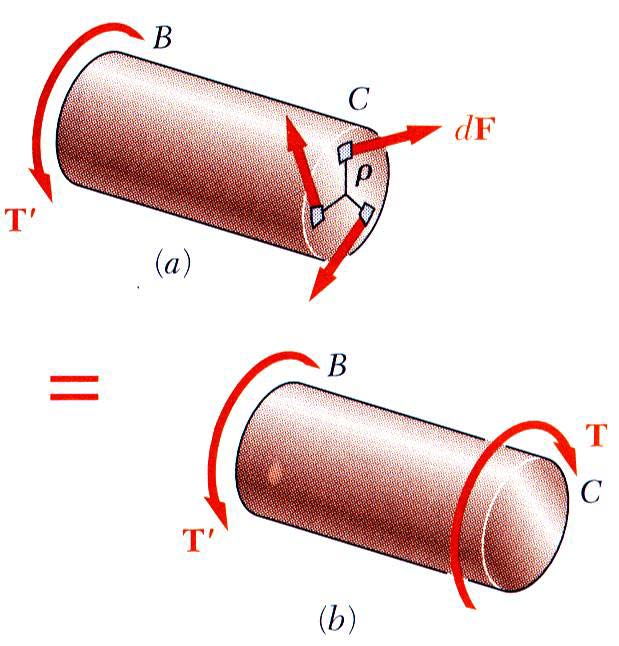
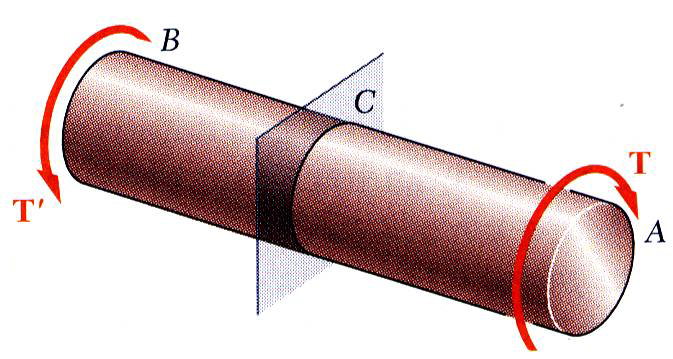
4 Net orque Due to Internal Stresses Net of the internal shearing stresses is an internal torque, equal and opposite to the applied torque, ( τ ) ρ df ρ da Although the net torque due to the shearing stresses is known, the distribution of the stresses is not Distribution of shearing stresses is statically indeterminate must consider shaft deformations Unlike the normal stress due to axial loads, the distribution of shearing stresses due to torsional loads can not be assumed uniform.
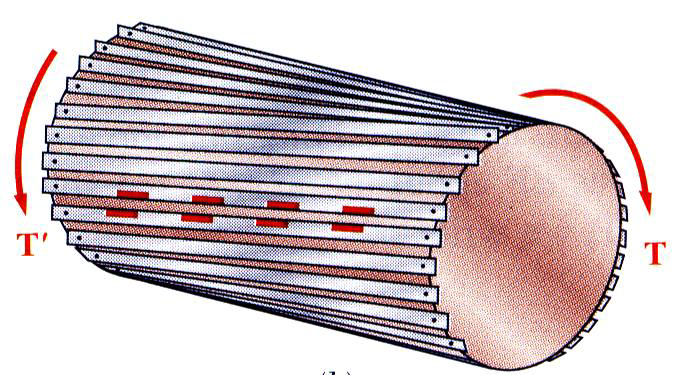
5 Axial Shear Components orque applied to shaft produces shearing stresses on the faces perpendicular to the axis. Conditions of equilibrium require the existence of equal stresses on the faces of the two planes containing the axis of the shaft he existence of the axial shear components is demonstrated by considering a shaft made up of axial slats. he slats slide with respect to each other when equal and opposite torques are applied to the ends of the shaft.
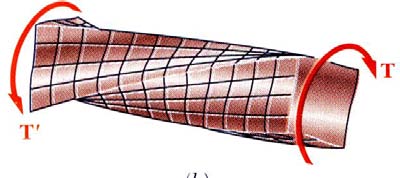
6 Shaft Deformations From observation, the angle of twist of the shaft is proportional to the applied torque and to the shaft length. φ φ L When subjected to torsion, every cross-section of a circular shaft remains plane and undistorted. Cross-sections for hollow and solid circular shafts remain plain and undistorted because a circular shaft is axisymmetric. Cross-sections of noncircular (nonaxisymmetric) shafts are distorted when subjected to torsion.

7 Shearing Strain Consider an interior section of the shaft. As a torsional load is applied, an element on the interior cylinder deforms into a rhombus. Since the ends of the element remain planar, the shear strain is equal to angle of twist. It follows that Lγ ρφ or γ ρφ L Shear strain is proportional to twist and radius γ cφ L and γ ρ γ c

8 Stresses in Elastic Range J 1 4 π c Multiplying the previous equation by the shear modulus, ρ G γ From Hooke s Law, τ ρ c τ Gγ c τ Gγ, so he shearing stress varies linearly with the radial position in the section. Recall that the sum of the moments from the internal stress distribution is equal to the torque on the shaft at the section, τ da τ ρτ ρ da c c J J 4 4 ( c ) 1 c 1 π he results are known as the elastic torsion formulas, c ρ τ and τ J J
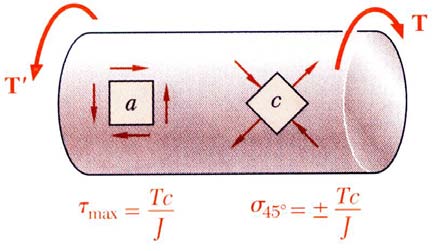
9 Normal Stresses Elements with faces parallel and perpendicular to the shaft axis are subjected to shear stresses only. Normal stresses, shearing stresses or a combination of both may be found for other orientations. Consider an element at 45 o to the shaft axis, F ( τ A ) cos 45 τ A σ o 45 F A 0 τ A 0 A 0 τ Element a is in pure shear. 0 Element c is subjected to a tensile stress on two faces and compressive stress on the other two. Note that all stresses for elements a and c have the same magnitude

10 orsional Failure Modes Ductile materials generally fail in shear. Brittle materials are weaker in tension than shear. When subjected to torsion, a ductile specimen breaks along a plane of imum shear, i.e., a plane perpendicular to the shaft axis. When subjected to torsion, a brittle specimen breaks along planes perpendicular to the direction in which tension is a imum, i.e., along surfaces at 45 o to the shaft axis.

11 Example SOLUION: Cut sections through shafts AB and BC and perform static equilibrium analysis to find torque loadings Shaft BC is hollow with inner and outer diameters of 90 mm and 10 mm, respectively. Shafts AB and CD are solid of diameter d. For the loading shown, determine (a) the minimum and imum shearing stress in shaft BC, (b) the required diameter d of shafts AB and CD if the allowable shearing stress in these shafts is 65 MPa. Apply elastic torsion formulas to find minimum and imum stress on shaft BC Given allowable shearing stress and applied torque, invert the elastic torsion formula to find the required diameter

12 SOLUION: Cut sections through shafts AB and BC and perform static equilibrium analysis to find torque loadings M AB x 0 6kN m ( 6kN m) CD AB M BC x 0 ( 6kN m) + ( 14kN m) BC 0kN m

13 Apply elastic torsion formulas to find minimum and imum stress on shaft BC Given allowable shearing stress and applied torque, invert the elastic torsion formula to find the required diameter J τ τ τ τ π 4 4 π 4 4 ( c c ) [( 0.060) ( 0.045) ] min min τ 6 86.MPa c c 1 m BC c J 64.7 MPa 4 τmin 86.MPa ( 0kN m)( m) m 4 45mm 60mm τ 86.MPa τ min 64.7 MPa τ c J c π 3 c c m 4 65MPa d 6kN m π 3 c c 77.8mm

14 Angle of wist in Elastic Range Recall that the angle of twist and imum shearing strain are related, γ cφ L In the elastic range, the shearing strain and shear are related by Hooke s Law, γ τ c G JG Equating the expressions for shearing strain and solving for the angle of twist, φ L JG If the torsional loading or shaft cross-section changes along the length, the angle of rotation is found as the sum of segment rotations il φ i J G i i i
15 Example 7-1
16 Solution: he shaft consists of three portions AB, BC, CD each of uniform cross section and each with a constant internal torque
17 Angle of wist: Recalling that G8- Gpa for the entire shaft, we have

18 Example SOLUION: Apply a static equilibrium analysis on the two shafts to find a relationship between CD and 0 Apply a kinematic analysis to relate the angular rotations of the gears wo solid steel shafts are connected by gears. Knowing that for each shaft G 11. x 10 6 psi and that the allowable shearing stress is 8 ksi, determine (a) the largest torque 0 that may be applied to the end of shaft AB, (b) the corresponding angle through which end A of shaft AB rotates. Find the imum allowable torque on each shaft choose the smallest Find the corresponding angle of twist for each shaft and the net angular rotation of end A

19 SOLUION: Apply a static equilibrium analysis on the two shafts to find a relationship between CD and 0 Apply a kinematic analysis to relate the angular rotations of the gears M M CD B C F F ( 0.875in. ) (.45in. ) 0 CD r φ φ B φ r φ B B B r r C B C φ C.8φ C C.45in. φ 0.875in. C

20 Find the 0 for the imum allowable torque on each shaft choose the smallest Find the corresponding angle of twist for each shaft and the net angular rotation of end A φ A/ B J AB AB L G π ( 561lb in. )( 4in. ) 4 6 ( 0.375in. ) ( psi) τ τ lb in. J J AB AB CD c CD c 561lb in psi 8000 psi 0 π ( 0.375in. ) 4 ( 0.375in. ).8 π 0 ( 0.5in. ) 4 ( 0.5in. ) 0 561lb in φ C / D φ φ B A rad. J.8φ π rad.95 φ CD CD L G C.8.8 o ( 561lb in. )( 4in. ) 4 6 ( 0.5in. ) ( psi) o o (.95 ) 8.6 o o o B + φa/ B o φ A o

21 Statically Indeterminate Shafts Given the shaft dimensions and the applied torque, we would like to find the torque reactions at A and B. From a free-body analysis of the shaft, A + B 90lb ft which is not sufficient to find the end torques. he problem is statically indeterminate. Divide the shaft into two components which must have compatible deformations, φ φ φ Substitute into the original equilibrium equation, A 1 B B J1G JG L 1 J 90lb ft L J1 A + A L L L1 J L J 1 A

22 Example aluminum steel
23
24

25
SHAFTS: TORSION LOADING AND DEFORMATION
 ECURE hird Edition SHAFS: ORSION OADING AND DEFORMAION A. J. Clark Shool of Engineering Department of Civil and Environmental Engineering 6 Chapter 3.1-3.5 by Dr. Ibrahim A. Assakkaf SPRING 2003 ENES 220
Analysis of Stresses and Strains
 Chapter 7 Analysis of Stresses and Strains 7.1 Introduction axial load = P / A torsional load in circular shaft = T / I p bending moment and shear force in beam = M y / I = V Q / I b in this chapter, we
Torsion Tests. Subjects of interest
 Chapter 10 Torsion Tests Subjects of interest Introduction/Objectives Mechanical properties in torsion Torsional stresses for large plastic strains Type of torsion failures Torsion test vs.tension test
COMPLEX STRESS TUTORIAL 3 COMPLEX STRESS AND STRAIN
 COMPLX STRSS TUTORIAL COMPLX STRSS AND STRAIN This tutorial is not part of the decel unit mechanical Principles but covers elements of the following sllabi. o Parts of the ngineering Council eam subject
STRESS AND DEFORMATION ANALYSIS OF LINEAR ELASTIC BARS IN TENSION
 Chapter 11 STRESS AND DEFORMATION ANALYSIS OF LINEAR ELASTIC BARS IN TENSION Figure 11.1: In Chapter10, the equilibrium, kinematic and constitutive equations for a general three-dimensional solid deformable
MATERIALS AND MECHANICS OF BENDING
 HAPTER Reinforced oncrete Design Fifth Edition MATERIALS AND MEHANIS OF BENDING A. J. lark School of Engineering Department of ivil and Environmental Engineering Part I oncrete Design and Analysis b FALL
ENGINEERING COUNCIL CERTIFICATE LEVEL ENGINEERING SCIENCE C103 TUTORIAL 3 - TORSION
 ENGINEEING COUNCI CETIFICATE EVE ENGINEEING SCIENCE C10 TUTOIA - TOSION You should judge your progress by completing the self assessment exercises. These may be sent for marking or you may request copies
MCE380: Measurements and Instrumentation Lab. Chapter 9: Force, Torque and Strain Measurements
 MCE380: Measurements and Instrumentation Lab Chapter 9: Force, Torque and Strain Measurements Topics: Elastic Elements for Force Measurement Dynamometers and Brakes Resistance Strain Gages Holman, Ch.
The elements used in commercial codes can be classified in two basic categories:
 CHAPTER 3 Truss Element 3.1 Introduction The single most important concept in understanding FEA, is the basic understanding of various finite elements that we employ in an analysis. Elements are used for
MECHANICS OF SOLIDS - BEAMS TUTORIAL 1 STRESSES IN BEAMS DUE TO BENDING. On completion of this tutorial you should be able to do the following.
 MECHANICS OF SOLIDS - BEAMS TUTOIAL 1 STESSES IN BEAMS DUE TO BENDING This is the first tutorial on bending of beams designed for anyone wishing to study it at a fairly advanced level. You should judge
Solid Mechanics. Stress. What you ll learn: Motivation
 Solid Mechanics Stress What you ll learn: What is stress? Why stress is important? What are normal and shear stresses? What is strain? Hooke s law (relationship between stress and strain) Stress strain
8.2 Elastic Strain Energy
 Section 8. 8. Elastic Strain Energy The strain energy stored in an elastic material upon deformation is calculated below for a number of different geometries and loading conditions. These expressions for
Stresses in Beam (Basic Topics)
 Chapter 5 Stresses in Beam (Basic Topics) 5.1 Introduction Beam : loads acting transversely to the longitudinal axis the loads create shear forces and bending moments, stresses and strains due to V and
Stress Strain Relationships
 Stress Strain Relationships Tensile Testing One basic ingredient in the study of the mechanics of deformable bodies is the resistive properties of materials. These properties relate the stresses to the
MECHANICS OF MATERIALS
 T dition CHTR MCHNICS OF MTRIS Ferdinand. Beer. Russell Johnston, Jr. John T. DeWolf ecture Notes: J. Walt Oler Texas Tech University Stress and Strain xial oading - Contents Stress & Strain: xial oading
Objectives. Experimentally determine the yield strength, tensile strength, and modules of elasticity and ductility of given materials.
 Lab 3 Tension Test Objectives Concepts Background Experimental Procedure Report Requirements Discussion Objectives Experimentally determine the yield strength, tensile strength, and modules of elasticity
EDEXCEL NATIONAL CERTIFICATE/DIPLOMA MECHANICAL PRINCIPLES AND APPLICATIONS NQF LEVEL 3 OUTCOME 1 - LOADING SYSTEMS TUTORIAL 3 LOADED COMPONENTS
 EDEXCEL NATIONAL CERTIICATE/DIPLOMA MECHANICAL PRINCIPLES AND APPLICATIONS NQ LEVEL 3 OUTCOME 1 - LOADING SYSTEMS TUTORIAL 3 LOADED COMPONENTS 1. Be able to determine the effects of loading in static engineering
B.TECH. (AEROSPACE ENGINEERING) PROGRAMME (BTAE) Term-End Examination December, 2011 BAS-010 : MACHINE DESIGN
 No. of Printed Pages : 7 BAS-01.0 B.TECH. (AEROSPACE ENGINEERING) PROGRAMME (BTAE) CV CA CV C:) O Term-End Examination December, 2011 BAS-010 : MACHINE DESIGN Time : 3 hours Maximum Marks : 70 Note : (1)
Structural Axial, Shear and Bending Moments
 Structural Axial, Shear and Bending Moments Positive Internal Forces Acting Recall from mechanics of materials that the internal forces P (generic axial), V (shear) and M (moment) represent resultants
Chapter Outline. Mechanical Properties of Metals How do metals respond to external loads?
 Mechanical Properties of Metals How do metals respond to external loads? Stress and Strain Tension Compression Shear Torsion Elastic deformation Plastic Deformation Yield Strength Tensile Strength Ductility
CH 6: Fatigue Failure Resulting from Variable Loading
 CH 6: Fatigue Failure Resulting from Variable Loading Some machine elements are subjected to static loads and for such elements static failure theories are used to predict failure (yielding or fracture).
Design Analysis and Review of Stresses at a Point
 Design Analysis and Review of Stresses at a Point Need for Design Analysis: To verify the design for safety of the structure and the users. To understand the results obtained in FEA, it is necessary to
MECHANICAL PRINCIPLES HNC/D PRELIMINARY LEVEL TUTORIAL 1 BASIC STUDIES OF STRESS AND STRAIN
 MECHANICAL PRINCIPLES HNC/D PRELIMINARY LEVEL TUTORIAL 1 BASIC STUDIES O STRESS AND STRAIN This tutorial is essential for anyone studying the group of tutorials on beams. Essential pre-requisite knowledge
ENGINEERING COUNCIL CERTIFICATE LEVEL
 ENGINEERING COUNCIL CERTIICATE LEVEL ENGINEERING SCIENCE C103 TUTORIAL - BASIC STUDIES O STRESS AND STRAIN You should judge your progress by completing the self assessment exercises. These may be sent
Module 5 Couplings. Version 2 ME, IIT Kharagpur
 Module 5 Couplings Lesson 1 Introduction, types and uses Instructional Objectives At the end of this lesson, the students should have the knowledge of The function of couplings in machinery. Different
Introduction to Mechanical Behavior of Biological Materials
 Introduction to Mechanical Behavior of Biological Materials Ozkaya and Nordin Chapter 7, pages 127-151 Chapter 8, pages 173-194 Outline Modes of loading Internal forces and moments Stiffness of a structure
Mechanics lecture 7 Moment of a force, torque, equilibrium of a body
 G.1 EE1.el3 (EEE1023): Electronics III Mechanics lecture 7 Moment of a force, torque, equilibrium of a body Dr Philip Jackson http://www.ee.surrey.ac.uk/teaching/courses/ee1.el3/ G.2 Moments, torque and
www.mathsbox.org.uk Displacement (x) Velocity (v) Acceleration (a) x = f(t) differentiate v = dx Acceleration Velocity (v) Displacement x
 Mechanics 2 : Revision Notes 1. Kinematics and variable acceleration Displacement (x) Velocity (v) Acceleration (a) x = f(t) differentiate v = dx differentiate a = dv = d2 x dt dt dt 2 Acceleration Velocity
Design Project 2. Sizing of a Bicycle Chain Ring Bolt Set. Statics and Mechanics of Materials I. ENGR 0135 Section 1040.
 Design Project 2 Sizing of a Bicycle Chain Ring Bolt Set Statics and Mechanics of Materials I ENGR 0135 Section 1040 November 9, 2014 Derek Nichols Michael Scandrol Mark Vavithes Nichols, Scandrol, Vavithes
5-58. The two shafts are made of A-36 steel. Each has a diameter of 1 in., and they are supported by bearings at A,
 J. J.'- '-'.1J L.d 1V J L...,V./ 5-58. The two shafts are made of A-36 steel. Each has a diameter of 1 in., and they are supported by bearings at A, L and C, which allow free rotation. If the support at
MECHANICS OF SOLIDS - BEAMS TUTORIAL 2 SHEAR FORCE AND BENDING MOMENTS IN BEAMS
 MECHANICS OF SOLIDS - BEAMS TUTORIAL 2 SHEAR FORCE AND BENDING MOMENTS IN BEAMS This is the second tutorial on bending of beams. You should judge your progress by completing the self assessment exercises.
Type of Force 1 Axial (tension / compression) Shear. 3 Bending 4 Torsion 5 Images 6 Symbol (+ -)
 Cause: external force P Force vs. Stress Effect: internal stress f 05 Force vs. Stress Copyright G G Schierle, 2001-05 press Esc to end, for next, for previous slide 1 Type of Force 1 Axial (tension /
SHEAR AND TORSION. David Roylance Department of Materials Science and Engineering Massachusetts Institute of Technology Cambridge, MA 02139
 SHER ND TORSION David Roylance Department of Materials Science and Engineering Massachusetts Institute of Technology Cambridge, M 02139 June 23, 2000 Introduction Torsionally loaded shafts are among the
MECHANICS OF SOLIDS - BEAMS TUTORIAL TUTORIAL 4 - COMPLEMENTARY SHEAR STRESS
 MECHANICS OF SOLIDS - BEAMS TUTORIAL TUTORIAL 4 - COMPLEMENTARY SHEAR STRESS This the fourth and final tutorial on bending of beams. You should judge our progress b completing the self assessment exercises.
ENGINEERING SCIENCE H1 OUTCOME 1 - TUTORIAL 3 BENDING MOMENTS EDEXCEL HNC/D ENGINEERING SCIENCE LEVEL 4 H1 FORMERLY UNIT 21718P
 ENGINEERING SCIENCE H1 OUTCOME 1 - TUTORIAL 3 BENDING MOMENTS EDEXCEL HNC/D ENGINEERING SCIENCE LEVEL 4 H1 FORMERLY UNIT 21718P This material is duplicated in the Mechanical Principles module H2 and those
State of Stress at Point
 State of Stress at Point Einstein Notation The basic idea of Einstein notation is that a covector and a vector can form a scalar: This is typically written as an explicit sum: According to this convention,
Bending Stress in Beams
 936-73-600 Bending Stress in Beams Derive a relationship for bending stress in a beam: Basic Assumptions:. Deflections are very small with respect to the depth of the beam. Plane sections before bending
Elasticity Theory Basics
 G22.3033-002: Topics in Computer Graphics: Lecture #7 Geometric Modeling New York University Elasticity Theory Basics Lecture #7: 20 October 2003 Lecturer: Denis Zorin Scribe: Adrian Secord, Yotam Gingold
AN EXPLANATION OF JOINT DIAGRAMS
 AN EXPLANATION OF JOINT DIAGRAMS When bolted joints are subjected to external tensile loads, what forces and elastic deformation really exist? The majority of engineers in both the fastener manufacturing
CHAPTER 7 DISLOCATIONS AND STRENGTHENING MECHANISMS PROBLEM SOLUTIONS
 7-1 CHAPTER 7 DISLOCATIONS AND STRENGTHENING MECHANISMS PROBLEM SOLUTIONS Basic Concepts of Dislocations Characteristics of Dislocations 7.1 The dislocation density is just the total dislocation length
Analysis of Stress CHAPTER 1 1.1 INTRODUCTION
 CHAPTER 1 Analysis of Stress 1.1 INTRODUCTION The basic structure of matter is characterized by nonuniformity and discontinuity attributable to its various subdivisions: molecules, atoms, and subatomic
Mechanical Properties - Stresses & Strains
 Mechanical Properties - Stresses & Strains Types of Deformation : Elasic Plastic Anelastic Elastic deformation is defined as instantaneous recoverable deformation Hooke's law : For tensile loading, σ =
Introduction to Beam. Area Moments of Inertia, Deflection, and Volumes of Beams
 Introduction to Beam Theory Area Moments of Inertia, Deflection, and Volumes of Beams Horizontal structural member used to support horizontal loads such as floors, roofs, and decks. Types of beam loads
Fatigue. 3. Final fracture (rough zone) 1. Fatigue origin. 2. Beach marks (velvety zone)
 Fatigue Term fatigue introduced by Poncelet (France) 1839 progressive fracture is more descriptive 1. Minute crack at critical area of high local stress (geometric stress raiser, flaws, preexisting cracks)
Center of Gravity. We touched on this briefly in chapter 7! x 2
 Center of Gravity We touched on this briefly in chapter 7! x 1 x 2 cm m 1 m 2 This was for what is known as discrete objects. Discrete refers to the fact that the two objects separated and individual.
bi directional loading). Prototype ten story
 NEESR SG: Behavior, Analysis and Design of Complex Wall Systems The laboratory testing presented here was conducted as part of a larger effort that employed laboratory testing and numerical simulation
Module 2. Analysis of Statically Indeterminate Structures by the Matrix Force Method. Version 2 CE IIT, Kharagpur
 Module Analysis of Statically Indeterminate Structures by the Matrix Force Method esson 11 The Force Method of Analysis: Frames Instructional Objectives After reading this chapter the student will be able
GEAROLOGY 2-1 SPUR GEARS SPUR GEARS
 GEAROLOGY 2-1 2 2-2 GEAROLOGY COMMON APPLICATIONS: Spur gears are used to Now that you ve been introduced to both Boston Gear and some of the basics of our Gearology course which we like to call Power
SOLID MECHANICS DYNAMICS TUTORIAL CENTRIPETAL FORCE
 SOLID MECHANICS DYNAMICS TUTORIAL CENTRIPETAL FORCE This work coers elements of the syllabus for the Engineering Council Exam D5 Dynamics of Mechanical Systems C10 Engineering Science. This tutorial examines
Screw Thread Design. Rev. 3-4-09
 Screw Thread Design Screw Thread Fundamentals A screw thread is defined as a ridge of uniform section in the form of a helix on either the external or internal surface of a cylinder. Internal threads refer
Hardened Concrete. Lecture No. 14
 Hardened Concrete Lecture No. 14 Strength of Concrete Strength of concrete is commonly considered its most valuable property, although in many practical cases, other characteristics, such as durability
4.2 Free Body Diagrams
 CE297-FA09-Ch4 Page 1 Friday, September 18, 2009 12:11 AM Chapter 4: Equilibrium of Rigid Bodies A (rigid) body is said to in equilibrium if the vector sum of ALL forces and all their moments taken about
P4 Stress and Strain Dr. A.B. Zavatsky MT07 Lecture 3 Statically Indeterminate Structures
 4 Stress and Strain Dr... Zavatsky MT07 ecture 3 Statically Indeterminate Structures Statically determinate structures. Statically indeterminate structures (equations of equilibrium, compatibility, and
Section 16: Neutral Axis and Parallel Axis Theorem 16-1
 Section 16: Neutral Axis and Parallel Axis Theorem 16-1 Geometry of deformation We will consider the deformation of an ideal, isotropic prismatic beam the cross section is symmetric about y-axis All parts
Highly flexible couplings
 Construction and operation 8.03.00 Instructions for installation 8.03.00 Types of stress 8.04.00 Diagrams for static deformation of the coupling ring 8.05.00 Coupling size 8.07.00 Examples of combinations
Reinforced Concrete Design
 FALL 2013 C C Reinforced Concrete Design CIVL 4135 ii 1 Chapter 1. Introduction 1.1. Reading Assignment Chapter 1 Sections 1.1 through 1.8 of text. 1.2. Introduction In the design and analysis of reinforced
Mechanical Properties of Metals Mechanical Properties refers to the behavior of material when external forces are applied
 Mechanical Properties of Metals Mechanical Properties refers to the behavior of material when external forces are applied Stress and strain fracture or engineering point of view: allows to predict the
EDEXCEL NATIONAL CERTIFICATE/DIPLOMA MECHANICAL PRINCIPLES AND APPLICATIONS NQF LEVEL 3 OUTCOME 1 - LOADING SYSTEMS
 EDEXCEL NATIONAL CERTIFICATE/DIPLOMA MECHANICAL PRINCIPLES AND APPLICATIONS NQF LEVEL 3 OUTCOME 1 - LOADING SYSTEMS TUTORIAL 1 NON-CONCURRENT COPLANAR FORCE SYSTEMS 1. Be able to determine the effects
Shear Forces and Bending Moments
 Chapter 4 Shear Forces and Bending Moments 4.1 Introduction Consider a beam subjected to transverse loads as shown in figure, the deflections occur in the plane same as the loading plane, is called the
SECTION 3 DESIGN OF POST TENSIONED COMPONENTS FOR FLEXURE
 SECTION 3 DESIGN OF POST TENSIONED COMPONENTS FOR FLEXURE DEVELOPED BY THE PTI EDC-130 EDUCATION COMMITTEE LEAD AUTHOR: TREY HAMILTON, UNIVERSITY OF FLORIDA NOTE: MOMENT DIAGRAM CONVENTION In PT design,
Mechanics of Materials. Chapter 4 Shear and Moment In Beams
 Mechanics of Materials Chapter 4 Shear and Moment In Beams 4.1 Introduction The term beam refers to a slender bar that carries transverse loading; that is, the applied force are perpendicular to the bar.
Force measurement. Forces VECTORIAL ISSUES ACTION ET RÉACTION ISOSTATISM
 Force measurement Forces VECTORIAL ISSUES In classical mechanics, a force is defined as "an action capable of modifying the quantity of movement of a material point". Therefore, a force has the attributes
Lap Fillet Weld Calculations and FEA Techniques
 Lap Fillet Weld Calculations and FEA Techniques By: MS.ME Ahmad A. Abbas Sr. Analysis Engineer [email protected] www.advancedcae.com Sunday, July 11, 2010 Advanced CAE All contents Copyright
Structural Bolting. Notice the Grade 5 has a much smaller head configuration and a shorter shank then the A325 structural bolt. Rev.
 Structural Bolting ASTM A325 and ASTM A490 are the two U.S. standard structural bolts. When looking at the mechanical requirements of bolts it appears that an ASTM A325 and SAE J429 Grade 5 are identical
MENSURATION. Definition
 MENSURATION Definition 1. Mensuration : It is a branch of mathematics which deals with the lengths of lines, areas of surfaces and volumes of solids. 2. Plane Mensuration : It deals with the sides, perimeters
EDEXCEL NATIONAL CERTIFICATE/DIPLOMA MECHANICAL PRINCIPLES OUTCOME 2 ENGINEERING COMPONENTS TUTORIAL 1 STRUCTURAL MEMBERS
 ENGINEERING COMPONENTS EDEXCEL NATIONAL CERTIFICATE/DIPLOMA MECHANICAL PRINCIPLES OUTCOME ENGINEERING COMPONENTS TUTORIAL 1 STRUCTURAL MEMBERS Structural members: struts and ties; direct stress and strain,
Eðlisfræði 2, vor 2007
 [ Assignment View ] [ Pri Eðlisfræði 2, vor 2007 28. Sources of Magnetic Field Assignment is due at 2:00am on Wednesday, March 7, 2007 Credit for problems submitted late will decrease to 0% after the deadline
Problem 1: Computation of Reactions. Problem 2: Computation of Reactions. Problem 3: Computation of Reactions
 Problem 1: Computation of Reactions Problem 2: Computation of Reactions Problem 3: Computation of Reactions Problem 4: Computation of forces and moments Problem 5: Bending Moment and Shear force Problem
REHAB 442: Advanced Kinesiology and Biomechanics INTRODUCTION - TERMS & CONCEPTS
 Rehab 442: Introduction - Page 1 REHAB 442: Advanced Kinesiology and Biomechanics INTRODUCTION - TERMS & CONCEPTS Readings: Norkin & Levangie, Chapters 1 & 2 or Oatis, Ch. 1 & 2 (don't get too bogged down
NOTCHES AND THEIR EFFECTS. Ali Fatemi - University of Toledo All Rights Reserved Chapter 7 Notches and Their Effects 1
 NOTCHES AND THEIR EFFECTS Ali Fatemi - University of Toledo All Rights Reserved Chapter 7 Notches and Their Effects 1 CHAPTER OUTLINE Background Stress/Strain Concentrations S-N Approach for Notched Members
Solution for Homework #1
 Solution for Homework #1 Chapter 2: Multiple Choice Questions (2.5, 2.6, 2.8, 2.11) 2.5 Which of the following bond types are classified as primary bonds (more than one)? (a) covalent bonding, (b) hydrogen
Multiaxial Fatigue. Professor Darrell Socie. 2008-2014 Darrell Socie, All Rights Reserved
 Multiaxial Fatigue Professor Darrell Socie 2008-2014 Darrell Socie, All Rights Reserved Outline Stresses around holes Crack Nucleation Crack Growth MultiaxialFatigue 2008-2014 Darrell Socie, All Rights
Mohr s Circle. Academic Resource Center
 Mohr s Circle Academic Resource Center Introduction The transformation equations for plane stress can be represented in graphical form by a plot known as Mohr s Circle. This graphical representation is
Lab 7: Rotational Motion
 Lab 7: Rotational Motion Equipment: DataStudio, rotary motion sensor mounted on 80 cm rod and heavy duty bench clamp (PASCO ME-9472), string with loop at one end and small white bead at the other end (125
CosmosWorks Centrifugal Loads
 CosmosWorks Centrifugal Loads (Draft 4, May 28, 2006) Introduction This example will look at essentially planar objects subjected to centrifugal loads. That is, loads due to angular velocity and/or angular
Solution Derivations for Capa #11
 Solution Derivations for Capa #11 1) A horizontal circular platform (M = 128.1 kg, r = 3.11 m) rotates about a frictionless vertical axle. A student (m = 68.3 kg) walks slowly from the rim of the platform
SECTION 3 DESIGN OF POST- TENSIONED COMPONENTS FOR FLEXURE
 SECTION 3 DESIGN OF POST- TENSIONED COMPONENTS FOR FLEXURE DEVELOPED BY THE PTI EDC-130 EDUCATION COMMITTEE LEAD AUTHOR: TREY HAMILTON, UNIVERSITY OF FLORIDA NOTE: MOMENT DIAGRAM CONVENTION In PT design,
Structural Integrity Analysis
 Structural Integrity Analysis 1. STRESS CONCENTRATION Igor Kokcharov 1.1 STRESSES AND CONCENTRATORS 1.1.1 Stress An applied external force F causes inner forces in the carrying structure. Inner forces
TZ WEDGE ANCHOR FOR CRACKED AND UNCRACKED CONCRETE
 SECTION 2.2 PAGE 1 / 9 l DESCRIPTION UCAN TZ torque controlled mechanical expansion wedge anchors have a Category 1 classification. They are used to resist static, wind and seismic tension and shear loads
Mechanical Principles
 Unit 4: Mechanical Principles Unit code: F/60/450 QCF level: 5 Credit value: 5 OUTCOME 3 POWER TRANSMISSION TUTORIAL BELT DRIVES 3 Power Transmission Belt drives: flat and v-section belts; limiting coefficient
Differential Relations for Fluid Flow. Acceleration field of a fluid. The differential equation of mass conservation
 Differential Relations for Fluid Flow In this approach, we apply our four basic conservation laws to an infinitesimally small control volume. The differential approach provides point by point details of
Statics of Structural Supports
 Statics of Structural Supports TYPES OF FORCES External Forces actions of other bodies on the structure under consideration. Internal Forces forces and couples exerted on a member or portion of the structure
Angular acceleration α
 Angular Acceleration Angular acceleration α measures how rapidly the angular velocity is changing: Slide 7-0 Linear and Circular Motion Compared Slide 7- Linear and Circular Kinematics Compared Slide 7-
ME 343: Mechanical Design-3
 ME 343: Mechanical Design-3 Design of Shaft (continue) Dr. Aly Mousaad Aly Department of Mechanical Engineering Faculty of Engineering, Alexandria University Objectives At the end of this lesson, we should
System. Stability. Security. Integrity. 150 Helical Anchor
 Model 150 HELICAL ANCHOR System PN #MBHAT Stability. Security. Integrity. 150 Helical Anchor System About Foundation Supportworks is a network of the most experienced and knowledgeable foundation repair
3D Stress Components. From equilibrium principles: τ xy = τ yx, τ xz = τ zx, τ zy = τ yz. Normal Stresses. Shear Stresses
 3D Stress Components From equilibrium principles:, z z, z z The most general state of stress at a point ma be represented b 6 components Normal Stresses Shear Stresses Normal stress () : the subscript
PHY121 #8 Midterm I 3.06.2013
 PHY11 #8 Midterm I 3.06.013 AP Physics- Newton s Laws AP Exam Multiple Choice Questions #1 #4 1. When the frictionless system shown above is accelerated by an applied force of magnitude F, the tension
Copyright 2011 Casa Software Ltd. www.casaxps.com. Centre of Mass
 Centre of Mass A central theme in mathematical modelling is that of reducing complex problems to simpler, and hopefully, equivalent problems for which mathematical analysis is possible. The concept of
METU DEPARTMENT OF METALLURGICAL AND MATERIALS ENGINEERING
 METU DEPARTMENT OF METALLURGICAL AND MATERIALS ENGINEERING Met E 206 MATERIALS LABORATORY EXPERIMENT 1 Prof. Dr. Rıza GÜRBÜZ Res. Assist. Gül ÇEVİK (Room: B-306) INTRODUCTION TENSION TEST Mechanical testing
Chapter 10 Rotational Motion. Copyright 2009 Pearson Education, Inc.
 Chapter 10 Rotational Motion Angular Quantities Units of Chapter 10 Vector Nature of Angular Quantities Constant Angular Acceleration Torque Rotational Dynamics; Torque and Rotational Inertia Solving Problems
How to Design Helical Piles per the 2009 International Building Code
 ABSTRACT How to Design Helical Piles per the 2009 International Building Code by Darin Willis, P.E. 1 Helical piles and anchors have been used in construction applications for more than 150 years. The
SEISMIC DESIGN. Various building codes consider the following categories for the analysis and design for earthquake loading:
 SEISMIC DESIGN Various building codes consider the following categories for the analysis and design for earthquake loading: 1. Seismic Performance Category (SPC), varies from A to E, depending on how the
Plane Stress Transformations
 6 Plane Stress Transformations ASEN 311 - Structures ASEN 311 Lecture 6 Slide 1 Plane Stress State ASEN 311 - Structures Recall that in a bod in plane stress, the general 3D stress state with 9 components
Chapter 16. Mensuration of Cylinder
 335 Chapter 16 16.1 Cylinder: A solid surface generated by a line moving parallel to a fixed line, while its end describes a closed figure in a plane is called a cylinder. A cylinder is the limiting case
σ y ( ε f, σ f ) ( ε f
 Typical stress-strain curves for mild steel and aluminum alloy from tensile tests L L( 1 + ε) A = --- A u u 0 1 E l mild steel fracture u ( ε f, f ) ( ε f, f ) ε 0 ε 0.2 = 0.002 aluminum alloy fracture
Design MEMO 54a Reinforcement design for RVK 41
 Page of 5 CONTENTS PART BASIC ASSUMTIONS... 2 GENERAL... 2 STANDARDS... 2 QUALITIES... 3 DIMENSIONS... 3 LOADS... 3 PART 2 REINFORCEMENT... 4 EQUILIBRIUM... 4 Page 2 of 5 PART BASIC ASSUMTIONS GENERAL
Activity 2.3b Engineering Problem Solving Answer Key
 Activity.3b Engineering roblem Solving Answer Key 1. A force of 00 lbs pushes against a rectangular plate that is 1 ft. by ft. Determine the lb lb pressure in and that the plate exerts on the ground due
LECTURE SUMMARY September 30th 2009
 LECTURE SUMMARY September 30 th 2009 Key Lecture Topics Crystal Structures in Relation to Slip Systems Resolved Shear Stress Using a Stereographic Projection to Determine the Active Slip System Slip Planes
Mechanics of Materials. Chapter 5 Stresses In Beams
 Mechanics of Materials Chapter 5 Stresses In Beams 5.1 Introduction In previous chapters, the stresses in bars caused by axial loading and torsion. Here consider the third fundamental loading : bending.