
Graduate Certificate courses and single subjects. Postgraduate Studies 2015
|
|
|
- Dustin Campbell
- 10 years ago
- Views:
Transcription
1 Graduate Certificate courses and single subjects Postgraduate Studies 2015

2 ACN Advancing nurse leadership Australian College of Nursing (ACN) is the national professional organisation for all nurse leaders: Nurses with an interest in leadership. Nurses aspiring to leadership roles. Nurses in leadership roles across the Australian health system. ACN is an advocate for the nursing profession, advancing the skills and expertise of nurses to provide leadership in their contribution to the policy, practice and delivery of health care. To learn more: w: e: p: * *call charges may apply
3 Contents ACN contacts 2 Foreword 3 ACN membership 4 ACN education 6 Course information 7 Eligibility criteria 11 Enrolments 12 NSW Ministry of Health-supported places 14 Important dates 15 Fees and payments 16 Graduate Certificate courses 19 Acute Care Nursing 21 Aged Care Nursing 24 Breast Cancer Nursing 26 Cancer Nursing 28 Child and Family Health Nursing 30 Critical Care Nursing 33 Drug and Alcohol Nursing 35 Leadership and Management 37 Musculoskeletal and Rheumatology Nursing 39 Neonatal Nursing 41 Nursing Practice 44 Orthopaedic Nursing 47 Paediatric Nursing Studies 49 Perioperative Nursing 53 Stomal Therapy Nursing 55 Subject descriptors 57 Postgraduate Studies 2015

4 ACN contacts Course information and enrolment t: freecall: (charges may apply) f: e: Library t: f: e: Membership t: freecall: (charges may apply) f: e: ACN corporate partners With thanks to the support of our corporate partners Corporate partner Insurance partner All information in this handbook is correct at the time of publishing and is subject to change without notice Australian College of Nursing Published by Australian College of Nursing 1 Napier Close, Deakin ACT 2600 t: [email protected] ABN < 2 > Postgraduate Studies 2015

5 Foreword I am pleased to present the Australian College of Nursing (ACN) Postgraduate Studies 2015 Graduate Certificate courses and single subjects handbook. ACN is a Higher Education Provider, registered and accredited by the Tertiary Education Quality Standards Agency (TEQSA) Australia s independent national regulator of the higher education sector. The past twelve months have seen the awarding of seven years accreditation of 15 graduate certificate (GC) courses to ACN by TEQSA. This handbook contains an overview of each of the 15 GC courses and nearly 80 subjects offered by ACN as well as subject overviews, important dates and how to apply. Students may study the GC courses to achieve a tertiary award in their specialty or may choose to study single subjects. Single subjects will enable students to develop in-depth knowledge in a specific subject area. Most single subjects studied may be credited towards a GC. ACN courses are offered in both distance education (DE) and online modes, allowing students the flexibility to study while balancing work and family life. All students are fully supported by education staff and tutors who are committed to facilitating the learning experience. If you are a member of ACN you may receive substantial reductions in course fees as well as the entitlement to a range of discounts on ACN products and services and access to the Katie Zepps Library, the largest dedicated nursing library in the Southern Hemisphere. Our specialist library staff will provide you with electronic access to books, journals, database searches, interlibrary loans and much more. For more details about all other ACN educational opportunities, please visit our website at Adjunct Professor Debra Thoms FACN (DLF) Chief Executive Officer Postgraduate Studies 2015 < 3 >

6 ACN membership ACN is the national professional organisation for all nurse leaders: Nurses with an interest in leadership, nurses aspiring to leadership roles and nurses in leadership roles across the Australian health system. The leadership capabilities of all nurses play a critical role in the delivery of health services to the Australian community. ACN is an advocate for the nursing profession, advancing the skills and expertise of nurses to provide leadership in their contribution to the policy, practice and delivery of health care. ACN encourages and supports nurses to develop and grow to become nurse leaders who are able to contribute by providing professional, economic and health perspectives. General benefits > ACN Fellows and Members may use the postnominals applicable to their membership category. > ACN publications (free of charge subscriptions to The Hive and Collegian) and regular updates and newsletters. > Discount on ACN CE courses, ACN conferences and ACN CPD workshops. > ACN Grants and Awards. > Access to 3LP (ACN s Life Long Learning Program), a web-based health care learning environment for ACN members that: - assists nurses to develop and maintain the highest standards of professional excellence - encourages nurses to plan, implement and evaluate their professional development - assists nurses in maintaining a customised professional e-portfolio. > Access to the largest dedicated nursing library in the Southern Hemisphere, the Katie Zepps Nursing Library for database and literature search services both on location or online. > Various discount opportunities for members including Guild Insurance for professional liability, Toga Hospitality, and Elsevier Australia. < 4 > Postgraduate Studies 2015

7 Regional, national and global professional activities ACN has a presence in regional, national and international activities, providing members with a range of opportunities to represent, influence and advance nursing. ACN provides members with the opportunity to: > Connect with nurses in their geographical area through ACN s Regions and in their area of expertise through ACN s Communities of Interest networks. > Network at ACN events, expos and member only events. > Save with lower member registration fees for ACN events. > Liaise with other health industry and professional organisations. > Provide input on nursing professional and political issues. > Engage in advocacy at state and federal levels with health departments and ministers. > Contribute to policy and discussion papers on issues that affect the nursing profession. > Access comprehensive historical and archival collections. > Raise their professional profile through representing ACN on relevant committees. > Stay abreast of international issues as ACN is a member of the International Council of Nurses and represents Australian nurses in international nursing policy development and reform. For more information on membership benefits, categories and fees please call ACN s membership team on freecall or check out the membership section on the website: Fees are listed in the membership brochure and application form online. Postgraduate Studies 2015 < 5 >

8 ACN education Graduate Certificate courses and single subjects Our GC courses prepare nurses for a rewarding career in the health and community services sector. We offer coursework programs that are academically challenging and professionally relevant, in an environment that encourages independent learning and interaction amongst peers, supported by tutors and nurse educators. The courses provide the knowledge, skills and attitudes directly suited to working in specialist areas of health care and are designed to meet contemporary industry needs. GC qualifications awarded by ACN are of an equivalent standard to qualifications at other Australian higher education institutions, including universities. ACN s courses may be recognised by universities, enabling advanced standing towards higher degrees, under the Australian Qualifications Framework. Students have the option of undertaking a single subject from our GC courses. Continuing Professional Development program ACN offers an extensive range of short courses that attract continuing professional development (CPD) hours. The CPD calendar and handbook are published twice a year in January and June, and are available at To request s updating you on upcoming CPD courses contact [email protected]. Registered Training Organisation courses Other courses offered by ACN include nationally-accredited training courses, such as Certificate IV in Training and Assessment and courses for enrolled nurses. Further information on these courses is available at or by contacting [email protected]. < 6 > Postgraduate Studies 2015

9 Course information Course delivery and attendance ACN offers a flexible learning environment, with modes of delivery including DE online, face-to-face and professional experience placements. ACN s online learning platform is CNnect and can be accessed via login and password at via Education > Current students or directly at cnnect.acn.edu. au. Students should confirm with ACN, the dates and times for any face-to-face workshop sessions and professional experience placements prior to making any leave or travel arrangements. Subjects All the GC subjects are supported by subject specific learning guides, resources, the virtual online classroom and relevant, work related assessment. Students have the option of undertaking a single subject from our GC courses. This is useful for people who wish to develop in-depth knowledge in a specific subject area, or those who want to sample a GC subject prior to enrolling in a full GC course. Not all GC subjects are offered as a single subject option. Relevant subjects that have been satisfactorily completed as single subjects may be credited towards up to 50 per cent of a GC (subject to entry requirements, satisfactory academic performance and timely enrolment in a GC course). Structure of courses The GC courses are professional development programs for nurses currently employed in the health care sector. They are designed to be undertaken part-time. In order to graduate, students must successfully complete all the requirements for the course. The courses are usually structured around a number of core (compulsory), specialty and elective subjects. Each GC course comprises of four subjects, each equivalent to 150 student hours and worth six credit points (total of 24 credit points). Usual part-time progression means students study two subjects each semester. Students wishing to vary this study pattern need to do so in accordance with the Student Management Policy. Course duration Normal course duration is conducted over two 20-week semesters; two subjects per semester. A single subject comprises 150 hours over one semester. Postgraduate Studies 2015 < 7 >

10 Workload It is recommended that students study hours per week. The actual amount of time will be determined by individual learning needs and the sequence of assessment items. Course sequence The core, specialty and elective subjects indicated for each course are found at ACN website edu.au/postgraduate, under Education > Future students > Postgraduate courses tab. Courses are designed to build and develop students skills and knowledge. As the student progresses through the course they are encouraged to think more widely and more critically. All students at this level are required to demonstrate an understanding of evidence-based practice and basic research principles. Students are responsible to check their enrolment is correct regarding the sequence of subjects, prerequisites and co-requisites as required for their specific GC. Course completion Students must satisfy all the stipulated requirements for their course and pay any outstanding debts to be eligible to complete their course. Students are advised to contact Student Services for further advice or assistance with determining and confirming their eligibility for completion. GC courses must be completed within three years. Student resources ACN requires all students to have a current address and access to a computer and the Internet. Recommended minimum system requirements PC 512MB RAM 6GB HDD 300MHz Processor 1280 X 1024 resolution display preferred (notebooks may operate on other resolutions) Windows XP or later operating system CD/DVD drive Speakers (either inbuilt or external) and microphone (preferably external) Internet Explorer 10 plus or Firefox or Chrome Ability to save file in Microsoft Office format Mac 512MB RAM 6GB HDD Intel based processor 1280 X 1024 display OSX 10.5.x or later CD/DVD drive Speakers (either inbuilt or external) and microphone (preferably external) Safari or Firefox or Chrome Ability to save file in Microsoft Office format < 8 > Postgraduate Studies 2015

11 CNnect IT support ACN provides CNnect IT support for students (during business hours) to assist them to access and utilise CNnect. On CNnect, you will find the Student Management Policy, resources, discussion forums, links to websites, study and assessment timetables and subject information and assessment books relevant to your course. Contact details for CNnect IT support can be found on the CNnect website at cnnect.acn. edu.au. Study skills workshops Students are encouraged to attend the writing and study skills workshops conducted during February and July each year. The half-day workshops include valuable information on academic writing, referencing and assessments. Further details are available on the website, or by contacting Student Services via Katie Zepps Library As an ACN student, you also have access to the library. Workshop/subject/course cancellation ACN reserves the right to cancel a workshop/subject/course if there are insufficient enrolments. A full refund will be made of all fees paid. Where subjects are unavailable in a GC course, students may be required to choose an alternative elective subject or defer to the next semester where the subject is offered. A decision to cancel a workshop/subject/course will be made ten working days prior to workshop/subject/course commencement and students will be notified of their options. Advanced standing/recognition of Prior Learning (RPL) and credit transfer Applications for advanced standing/rpl and credit transfer must be made in writing on application to the course and must include supporting documentation. Advanced standing/rpl and credit transfer cannot be sought for more than 50% of a GC course. Students seeking advanced standing/rpl* and credit transfer on any basis other than ACN subjects will be charged a fee. Successful applications will have fees adjusted as determined by ACN. Students who have been granted advanced standing for ACN subjects leading to an exemption from one subject (six credit points), will not be charged for the subject. Credit transfer will generally only apply for studies undertaken within the last five years. *Fees may apply. Postgraduate Studies 2015 < 9 >

12 Transcripts Students receive their Academic Transcript free of charge on completion of all the requirements of their course. There is a charge for the issue of a replacement ACN testamur and award certificates. Contact Student Services for details. Library fines Fines imposed by the library will result in the imposition of sanctions and may halt your progression within a course. These sanctions remain until such time as proof is received that the debt has been paid. If a sanction is imposed, a student is: > not permitted to receive a result in any course or subject completed > not permitted to enrol, re-enrol or vary enrolment in any course or subject completed > not permitted to graduate from any course or receive a transcript or testamur. ACN policies and guidelines The policies and guidelines of ACN have been written to provide guidance on the responsibilities of students to their studies. Students should read and be familiar with the policies and guidelines, especially the Student Management Policy, which can be found on our website at Student complaints and appeals ACN is committed to providing a learning and working environment in which complaints are responded to promptly, with minimum distress and maximum protection to all parties. All students and staff have a responsibility to contribute to the achievement of a productive, safe and equitable study and work environment. The Student Management Policy outlines what a complaint or grievance is and contains information about how to make a complaint or appeal and the process associated with appeals. < 10 > Postgraduate Studies 2015

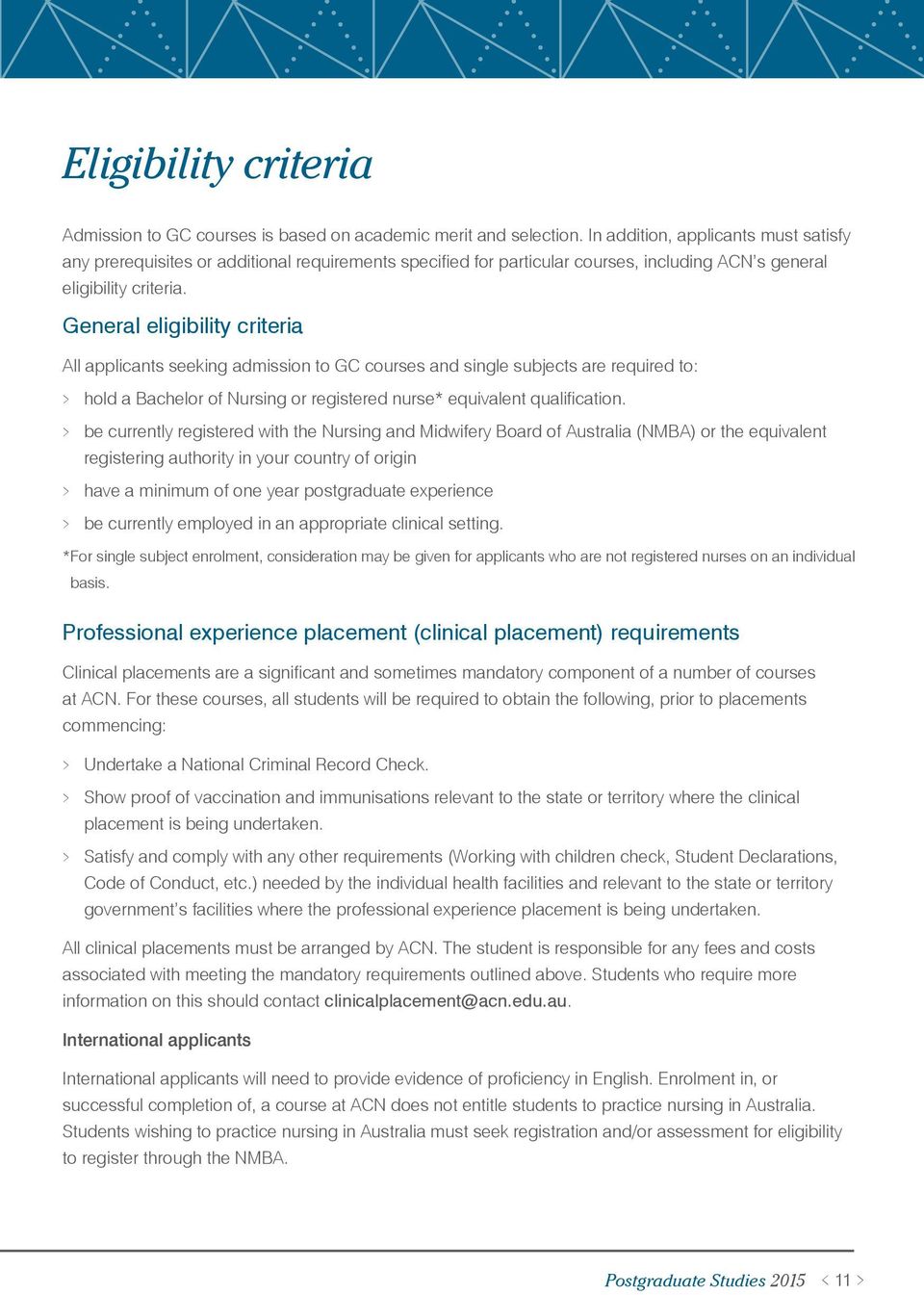
13 Eligibility criteria Admission to GC courses is based on academic merit and selection. In addition, applicants must satisfy any prerequisites or additional requirements specified for particular courses, including ACN s general eligibility criteria. General eligibility criteria All applicants seeking admission to GC courses and single subjects are required to: > hold a Bachelor of Nursing or registered nurse* equivalent qualification. > be currently registered with the Nursing and Midwifery Board of Australia (NMBA) or the equivalent registering authority in your country of origin > have a minimum of one year postgraduate experience > be currently employed in an appropriate clinical setting. * For single subject enrolment, consideration may be given for applicants who are not registered nurses on an individual basis. Professional experience placement (clinical placement) requirements Clinical placements are a significant and sometimes mandatory component of a number of courses at ACN. For these courses, all students will be required to obtain the following, prior to placements commencing: > Undertake a National Criminal Record Check. > Show proof of vaccination and immunisations relevant to the state or territory where the clinical placement is being undertaken. > Satisfy and comply with any other requirements (Working with children check, Student Declarations, Code of Conduct, etc.) needed by the individual health facilities and relevant to the state or territory government s facilities where the professional experience placement is being undertaken. All clinical placements must be arranged by ACN. The student is responsible for any fees and costs associated with meeting the mandatory requirements outlined above. Students who require more information on this should contact [email protected]. International applicants International applicants will need to provide evidence of proficiency in English. Enrolment in, or successful completion of, a course at ACN does not entitle students to practice nursing in Australia. Students wishing to practice nursing in Australia must seek registration and/or assessment for eligibility to register through the NMBA. Postgraduate Studies 2015 < 11 >
14 Enrolments Enrolments for GC courses and single subjects are made through Student Services. Application forms can be obtained online at How to apply 1. Seek course advice If you would like advice on which course you should attend or whether you meet the selection criteria for a particular course, please refer to the course descriptions on the website at or contact the Course Coordinator or Student Services at ACN on freecall (charges may apply) or Submit an application form Available on the website at Forward the completed form to ACN before the closing date (where vacancies exist, late enrolments may also be considered). 3. Await confirmation of enrolment letter Following the closing date for a course, the Course Coordinator and the Course Selection Committee will review enrolments. Successful applicants will be sent a confirmation of enrolment letter detailing any outstanding payment, dates, venue and course requirements. 4. Accept your position Your position must be accepted in writing. Students are required to return the signed and completed Acceptance of Position form to confirm their place (sent with confirmation of enrolment letter). Students wishing to withdraw or defer after submitting an acceptance of position MUST notify ACN in writing and before the census date. < 12 > Postgraduate Studies 2015

15 Deferred enrolment Students who have requested a deferral are sent a letter of confirmation detailing the dates and subjects that they have deferred into. Please be advised that NSW Ministry of Health (MOH)-supported students are generally unable to defer. Re-enrolling in courses and subjects will incur a recommencement fee and will occur only after the student to complete section of the confirmation of deferral letter has been returned. Enrolment in subjects Following admission, students are required to identify the subjects that will constitute their enrolment. Please refer to the course outlines at for the core/elective/specialty subjects for GC courses. Correct enrolment in subjects is the responsibility of the student. Additions and deletions can be made to an enrolment by contacting Student Services before the Census Date. Failure to notify ACN of withdrawal from a subject before the Census Date can result in subject failure and incurs financial liability. Students should be aware that it is their responsibility to notify Student Services to ensure that: > their personal details, postal address and contact telephone numbers are correct, and that ACN is informed of any changes as they occur > their enrolment details are correct > they are registered into activities (online, CNnect, etc.) > their subject enrolment is consistent with the completion rules of the course. Postgraduate Studies 2015 < 13 >

16 NSW Ministry of Health-supported places Nurses employed by the NSW MOH who meet the eligibility criteria can apply for GC courses that are supported by NSW MOH. These positions are not available for those on 457 visas and those employed on casual basis. How to apply 1. Seek course advice Please refer to the course descriptions on the website at or contact the Course Coordinator or Student Services at ACN on freecall (charges may apply). 2. Complete the NSW MOH application Available from your nursing administration or on the website at Both you and your Nursing Unit Manager must complete the relevant sections and forward the application form to your Director of Nursing and Midwifery, by the advertised closing date. Priorities will be assigned to applicants by the Local Health District/Network, based on Local Health District/Network needs. 3. Submit an application form The completed application will be forwarded to ACN by the Local Health District/Network before the closing date (where vacancies exist, late enrolments may also be considered). 4. Student selection A panel compromising ACN and NSW MOH representatives will convene in November and June of each year to determine student selection for NSW MOH-supported courses. Selection is made according to the priorities and workforce needs of Local Health Districts/ Networks (provided the applicant meets the course admission criteria). 5. Await confirmation of selection letter Following student selection, successful applicants will be sent a Confirmation of Selection Letter, detailing requirements for accepting the offer. Directors of Nursing and Midwifery at the Local Health Districts/ Networks are advised in writing of the outcomes within one week of the selection process occurring. 6. Accept your position Your position must be accepted in writing. Students are required to return the signed and completed Acceptance of Position form to confirm their place (sent with confirmation of selection letter). Please note: NSW MOH-supported students generally cannot defer and students are expected to complete the course within 12 months. < 14 > Postgraduate Studies 2015

17 Important dates ACN is required to set a Census Date for each course it offers. The Census Date is: > the date students become financially liable for any subjects in which they are enrolled > the final day students can withdraw from a subject without financial liability (minus an administrative fee) and academic penalty > the final day ACN is allowed to accept upfront payments for full fee paying students. For more detailed information on semester dates see the appropriate GC course page on the website at Academic calendar 09 Feb 26 Jun 2015 SEMESTER (FEB) 31 Oct 2014 Closing date for 2015 Semester (Feb) enrolments for NSW MOH-supported applicants 9 Jan 2015 Closing date for 2015 Semester (Feb) enrolments for all other Graduate Certificate applicants 9 Feb 2015 Semester (Feb) commences 20 Feb 2015 Census Date Semester (Feb) (5 pm) 27 Mar 2015 Closing date for Semester (July) new enrolments for NSW MOH-supported applicants 5 Jun 2015 Closing date for 2015 Semester (July) new enrolments for all other Graduate Certificate applicants 26 Jun 2015 Semester (Feb) ends 27 Jul 2015 Semester (Feb) grade release day 27 Jul 11 Dec 2015 SEMESTER (JULY) 27 Jul 2015 Semester (July) commences 7 Aug 2015 Census Date Semester (July) (5 pm) 16 Oct 2015 Closing date for 2016 Semester (Feb) enrolments for NSW MOH-supported applicants 11 Dec 2015 Semester (July) ends 18 Jan 2016 Semester (July) grade release day 8 Jan 2016 Closing date for 2016 Semester (Feb) enrolments for all other Graduate Certificate applicants 8 Feb 2016 Semester (FEB) commences Postgraduate Studies 2015 < 15 >

18 Fees and payments The course fee covers education materials, educator/tutor support and assessment marking where applicable. The course fee also has an administration fee included. Course fees do not cover the supply of recommended and prescribed texts, or salary supplementation for face-to-face components. Course fees may be tax deductible. Speak with your tax advisor for further details. Course fees are payable on acceptance of a position in a course. Students have the option of paying in full or part payments; full, up-front payments will receive a discount. See below for payment options. > Up-front will mean a total of $5,750; each subject costing $1,438. > Two subjects per semester will mean a total payment of $6,050; each subject costing $1,513. > One subject per semester will mean a total of $7,000; each subject costing $1,750. > All payments are due four weeks before the start of each subject. > Failure to pay course fees by course commencement date will result in the cancellation of course enrolment. > All requests to withdraw from a course/subject must be made in writing to ACN. > All students will be required to pay a recommencement fee if their program of study is varied due to extenuating circumstances. > All courses are subject to a non-refundable accounting fee. < 16 > Postgraduate Studies 2015

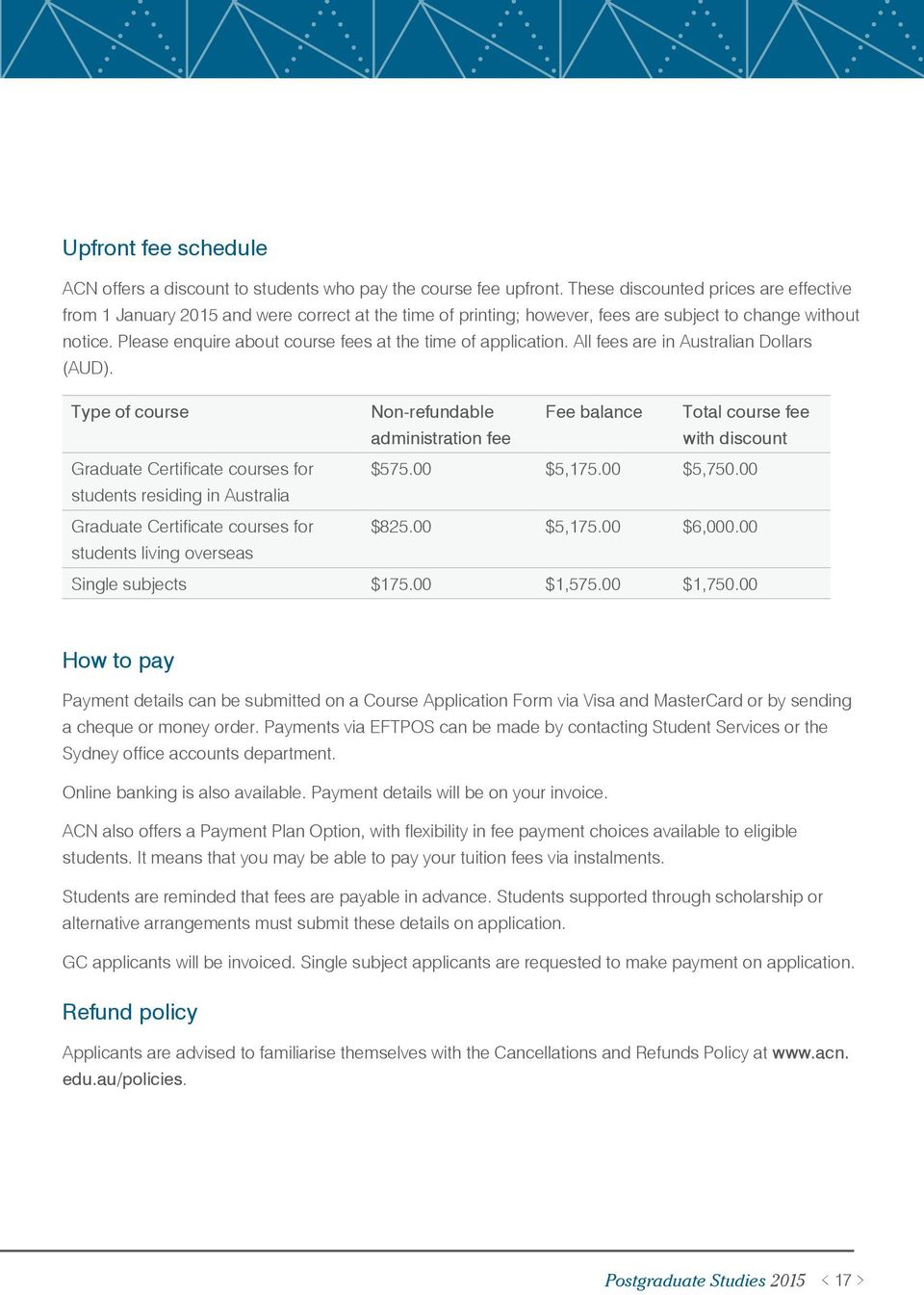
19 Upfront fee schedule ACN offers a discount to students who pay the course fee upfront. These discounted prices are effective from 1 January 2015 and were correct at the time of printing; however, fees are subject to change without notice. Please enquire about course fees at the time of application. All fees are in Australian Dollars (AUD). Type of course Non-refundable administration fee Fee balance Total course fee with discount Graduate Certificate courses for $ $5, $5, students residing in Australia Graduate Certificate courses for $ $5, $6, students living overseas Single subjects $ $1, $1, How to pay Payment details can be submitted on a Course Application Form via Visa and MasterCard or by sending a cheque or money order. Payments via EFTPOS can be made by contacting Student Services or the Sydney office accounts department. Online banking is also available. Payment details will be on your invoice. ACN also offers a Payment Plan Option, with flexibility in fee payment choices available to eligible students. It means that you may be able to pay your tuition fees via instalments. Students are reminded that fees are payable in advance. Students supported through scholarship or alternative arrangements must submit these details on application. GC applicants will be invoiced. Single subject applicants are requested to make payment on application. Refund policy Applicants are advised to familiarise themselves with the Cancellations and Refunds Policy at edu.au/policies. Postgraduate Studies 2015 < 17 >
20 Withdrawal from a course or subject Notification of a student s intention to withdraw either before or after the commencement of a course/ subject must be made in writing. Withdrawal by telephone or by implication is not acceptable under any circumstances. Withdrawals prior to Census Date are subject to a non-refundable administrative fee as outlined in the fee schedule. If withdrawal occurs after Census Date there is no refund. See the Student Management Policy and the Cancellations and Refunds Policy at Recommencement fees A recommencement fee is charged when a student has been granted deferral and is wanting to reenrol. This fee covers the administration involved with re-enrolling, contracting a tutor and marker and the ongoing support required for students. Re-enrolment to a course will only occur once the recommencement fee is paid. Students supported by way of scholarship or NSW MOH are also liable for this fee. Collection of unpaid fees Students with outstanding fees who have received notification of the amount owing will be referred to the appropriate debt recovery agency for recovery action. Please note that students will be liable for recovery costs incurred. < 18 > Postgraduate Studies 2015

21 Graduate Certificate courses
22 Graduate Certificate courses All GC course information and subject descriptors can be found on the website at Graduate Certificate Acute care nursing Aged care nursing Breast cancer nursing Cancer nursing Child and family health nursing Critical care nursing Drug and alcohol nursing Leadership and management Musculoskeletal and rheumatology nursing Neonatal nursing Nursing practice Orthopaedic nursing Paediatric nursing studies Perioperative nursing Stomal therapy nursing Please note: courses/subjects may not be available as advertised each semester Semester available Medical/surgical stream (Feb and July) Renal stream (Feb and July) (Feb only) (July only) (Feb and July) (Feb and July) Cardiac stream (Feb and July) Emergency stream (Feb and July) Intensive care stream (Feb and July) (July only) (Feb and July) (July only) Intensive care stream (Feb only) Special care stream (Feb only) (Feb only) (Feb only) General stream (Feb and July) Emergency stream (Feb and July) Oncology stream (July only) Intensive care stream (Feb only) Child and adolescent mental health stream (July only) (Feb only) (July only) < 20 > Postgraduate Studies 2015
23 Graduate Certificate in Acute Care Nursing Award GradCertAcuteCareNurs Course code Mode of delivery Course duration Distance education/online Two semesters at 20 weeks/semester February intake July intake Course dates 9 February 2015 to 11 Dec July 2015 to 24 June 2016 NSW Health supported course Course overview The Graduate Certificate in Acute Care Nursing is designed to enhance the skills of nurses across a broad number of disciplines. This course provides registered nurses with the knowledge and skills as a specialist in acute care nursing practice. The content is directed to participants current roles, directions and career aspirations and equips participants with the knowledge, skills and attitudes needed to deal confidently with the diverse nature of health care and the multifactorial nature of illness and illness prevention. The Graduate Certificate in Acute Care Nursing offers two specialist streams: Medical/surgical nursing The focus of learning in this medical/surgical (generalist) stream is the nursing management of adults admitted to health care facilities with acute episodic medical-surgical conditions. Students analyse and apply their knowledge and problem-solving skills to clinical case scenarios based on commonly encountered medical-surgical problems. The subjects provide students with an opportunity to extend their ability to undertake increasingly complex nursing activities in a range of medical and surgical care settings. Students study three core subjects and select one elective subject. Renal nursing This stream offers opportunities for the registered nurse to enhance their knowledge and clinical expertise to the level required in a specialised renal environment. The course focuses on adults experiencing alterations in renal function and provides a comprehensive theoretical platform with a strong clinical focus. It encompasses a problem solving approach to the management of patients in all stages of chronic kidney disease and acute kidney injury. There is particular focus on systematic renal assessment, pre-dialysis preparation, renal replacement therapies, and contemporary trends in renal nursing. Please note to undertake this stream students must be working in a haemodialysis unit. Students select four core subjects. Postgraduate Studies 2015 < 21 >
24 Learning outcomes At successful completion of the course students should be able to: 1. demonstrate provision of competent interpersonal and clinical care to patients through the acquisition, application and communication of specialist knowledge and skills which reflect professional and ethico-legal integrity 2. identify, appraise and apply research evidence to inform nursing practice and develop professional responsibility and accountability commensurate with the specialist role 3. critically evaluate available knowledge in relation to complex situations to guide the assessment, planning, implementation and evaluation of evidence-based nursing care 4. collaborate with the multidisciplinary team in provision of effective therapeutic relationships and continuity of care within the context of acute care nursing practice 5. consider strategies when caring for a culturally and linguistically diverse population and reflect on the health care team s ability to meet the nursing and communication needs of the Aboriginal and Torres Strait Islander people 6. create an effective clinical learning environment through demonstrating mentorship and the propagation of specialised knowledge and technical skill 7. demonstrate leadership through participation in policy development, service provision and quality improvement within the specialist context. Graduate outcomes Graduates of this course will: > enhance their professional, social and ethical understanding in a specialist area of practice > extend their general theoretical preparation in nursing knowledge and research to apply skills in clinical decision making and prioritisation in the acute care nursing environment > provide leadership and exert a positive influence on the health of the community and workplace > reflect on learning experiences, including an analysis of their own learning needs and outcomes to develop lifelong learning in the context of specialist nursing practice. < 22 > Postgraduate Studies 2015
25 Eligibility General eligibility requirements outlined on page 11 AND Renal nursing stream applicants must be currently employed in a haemodialysis setting AND professional experience placement requirements on page 11 for relevant subjects, as listed below. Subjects Streams Subject code Subject name Medical/ surgical 277 Stress response and health breakdown C C 038 Principles of acute care nursing C 115 Principles of renal nursing E C 233 Principles of renal replacement therapy E C 920 Professional practice in acute care nursing C C 036 Respiratory nursing E 050 Wound management E 054 Assessment of the older person E 092 Symptom management in advanced disease states E 113 Assessing and managing adult pain E 117 Principles of infection control E 187 Communication applied strategies for health care professionals E 243 Medical imaging E Renal C=Core E=Elective Postgraduate Studies 2015 < 23 >
26 Graduate Certificate in Aged Care Nursing Award GradCertAgedCareNurs Course code Mode of delivery Course duration Distance education/online Two semesters at 20 weeks/semester February intake Course dates 9 February 2015 to 11 Dec 2015 NSW Health supported course Course overview The Graduate Certificate in Aged Care Nursing studies the complex needs of the older person being cared for within diverse health care environments. The aim of this course is to strengthen and develop the knowledge, skills and attitudes of nurses caring for the older adult. The course provides an advanced grounding in methods of research, in addition to developing the theoretical and practical aspects of management, clinical practice and education in aged care nursing. The single subjects in this course draw upon the student s nursing experience in aged care and combine this experience with theory, current research and best practice guidelines to enhance the student s specialist knowledge and skills, critical thinking and analysis abilities and clinical decision-making within aged care environments. Learning outcomes At successful completion of the course students should be able to: 1. integrate specialist knowledge, assessment skills and information to support an improved standard of client care 2. demonstrate enhanced clinical decision making skills using multiple modes of enquiry and collaborative approaches 3. establish and maintain effective therapeutic relationships with aged care clients, families, professional colleagues and stakeholders 4. demonstrate professional leadership and educational skills 5. critically analyse literature and develop evidence-based practice in aged care 6. promote the aged care nurse s role within the multidisciplinary team 7. advocate for aged care clients within all aged care environments. < 24 > Postgraduate Studies 2015
27 Graduate outcomes This course is designed to provide graduates with critical, analytical and integrative thinking skills to extend their problem solving and clinical decision making abilities. Graduates of this course will: > develop skills in locating, appraising and integrating information from research and nursing practice, providing them with a foundation for evidence-based nursing > extend their knowledge, skills and attitudes within their context of practice by adopting lifelong learning and reflective practice philosophies > enhance their professional, social and ethical understanding of contemporary aged care nursing practice. Eligibility General eligibility requirements and professional experience placement requirements are outlined on page 11. Subjects Subject Subject name code 054 Assessment of the older person C 055 Clinical issues in the care of the older person C 903 Professional issues in aged care nursing C 045* Continence management E 050 Wound management E 053 Healthy ageing E 064 Dementia care E 113 Assessing and managing adult pain E 117 Principles of infection control E C=Core E=Elective *Special considerations/mandatory requirements 045 Professional experience placement 40hrs Postgraduate Studies 2015 < 25 >
28 Graduate Certificate in Breast Cancer Nursing Award GradCertBreastCancerNurs Course code Mode of delivery Course duration Distance education/online Two semesters at 20 weeks/semester July intake Course dates 27 July 2015 to 24 June 2016 Scholarships are made available by the McGrath Foundation to study this course. Course overview This course is designed to provide graduates with the principles of breast cancer nursing in order to improve their knowledge and skills for the provision and coordination of evidence-based breast cancer care. The aim is to encourage professional and ethical understanding of clinical practice development for the improvement of patient outcomes. The course aligns with the Specialist Breast Nurse Competency Standards and associated educational requirements (NBCC 2005) and the National Professional Development Framework for Cancer Nursing (EdCaN 2009). It responds to industry requirements by preparing graduates for specialist breast cancer nursing roles within the wide scope of breast cancer care. Through critical analysis and reflection students are given the opportunity to evaluate their clinical and educational requirements to promote professional development for specialist breast cancer nursing care and lifelong learning. The course also supports development in clinical leadership roles such as clinical nurse specialists, clinical nurse consultants or breast cancer nurse coordinators. The course focus includes the continuum of breast cancer care, evidence-based practice, future trends and the impact of breast cancer on individuals, their families and communities. Learning outcomes This course is designed to develop an understanding of breast cancer nursing with a strong clinical focus. It enables students to: 1. demonstrate specialist knowledge that informs evidence-based breast cancer nursing practice for the provision and coordination of patient care 2. develop specialist clinical practice and advance their clinical decision making skills for the assessment and management of patients with breast cancer 3. engage in and maintain effective therapeutic relationships with patients, their significant others and other members of the multidisciplinary care team < 26 > Postgraduate Studies 2015
29 4. develop professional and educational leadership skills to provide support for other clinicians and provide an overall contribution to the multi-disciplinary breast cancer care team 5. critically analyse current literature and nursing practice to provide evidence-based contemporary care for patients diagnosed with breast cancer 6. examine their ability to reflect on personal and professional values and attitudes in relation to the care of patients with breast cancer and their families and carers. Graduate outcomes Graduates from this course will be recognised as having specialist knowledge relevant to breast cancer. Graduates of this course will: > contribute to the community of breast cancer nursing at a specialist level > provide professional and ethical understanding in practice development > demonstrate critical analysis and reflection to become lifelong learners in the specialty of breast cancer nursing. Eligibility General eligibility requirements outlined on page 11. Subjects Subject Subject name code 112 Breast cancers C 279 Breast cancer treatments C 280 Continuum of care in breast cancer nursing C 092 Symptom management in advanced disease states E 187 Communication applied strategies for health care professionals E 217 Chemotherapy and other systemic treatments in cancer care E 916* Professional practice in breast cancer nursing E 113 Assessing and managing adult pain E C=Core E=Elective *Includes optional Breast Cancer Nursing Practicum Postgraduate Studies 2015 < 27 >
30 Graduate Certificate in Cancer Nursing Award GradCertCancerNurs Course code Mode of delivery Course duration Distance education/online Two semesters at 20 weeks/semester February intake July intake Course dates 9 February 2015 to 11 Dec July 2015 to 24 June 2016 NSW Health supported course Course overview This course is designed to provide graduates with the principles of cancer nursing to improve knowledge and skills for the provision and coordination of evidence-based cancer care. The aim is to encourage professional and ethical understanding of clinical practice development for the improvement of patient outcomes. The course aligns with the National Professional Development Framework for Cancer Nursing (EdCaN 2009) and responds to industry requirements for flexible multifaceted practitioners who are able to practice in various cancer environments as well as preparing graduates for specialist cancer nursing roles within the wide scope of cancer nursing. Students engage in the planning, development and evaluation of their own clinical and educational requirements to promote lifelong learning through critical analysis and reflection of their student experiences. Graduates can use their extended knowledge in clinical specialties to develop their career pathway and can go on to seek employment in various specialist cancer nursing areas and leadership roles such as clinical nurse specialists, clinical nurse consultants or cancer nurse coordinators. The focus is on evidence-based practice for the prevention, diagnosis, pathology and treatments of cancer. The continuum of care is addressed from a multidisciplinary team approach from diagnosis, primary care to include follow-up care, survivorship and palliative care. Future treatment trends and the exploration of the impact on the individual, family and community are included. Learning outcomes This course is designed to develop an understanding of cancer nursing with a strong clinical focus. It enables students to: 1. demonstrate a specialist knowledge base within cancer nursing for the provision and coordination of cancer care 2. develop specialist clinical practice and advance their clinical decision making skills in the assessment and management of patients with cancer < 28 > Postgraduate Studies 2015
31 3. engage in and maintain effective therapeutic relationships with patients, their significant others and other members of the multidisciplinary care team 4. implement professional, educational and leadership skills to provide support for other clinicians and provide an overall contribution to the multi-disciplinary health care team 5. critically analyse current literature and nursing practice to provide evidence-based contemporary care for patients 6. examine their ability to reflect on personal and professional values and attitudes in relation to the care of patients with cancer and their families and carers. Graduate outcomes Graduates from this course will be recognised as having specialist knowledge relevant to cancer and haematology nursing. Graduates of this course will: > contribute to the community of cancer nursing at a specialist level > provide professional and ethical understanding in practice development > demonstrate critical analysis and reflection to become lifelong learners in cancer nursing practice. Eligibility General eligibility requirements outlined on page 11. Subjects Subject Subject name Cancer code 277 Stress response and health breakdown C 217 Chemotherapy and other systemic treatments in cancer care C 917 Professional practice in cancer nursing C 092 Symptom management in advanced disease states E 112 Breast cancers E 113 Assessing and managing adult pain E 185 Haematology nursing E 186 Blood and marrow transplantation E 187 Communication applied strategies for health care professionals E C=Core E=Elective Postgraduate Studies 2015 < 29 >
32 Graduate Certificate in Child and Family Health Nursing Award GradCertChild&FamilyHealthNurs Course code Mode of delivery Course duration Distance education/online/professional experience placement Two semesters at 20 weeks/semester February intake July intake Course dates 9 February 2015 to 11 Dec July 2015 to 24 June 2016 NSW Health supported course Course overview The Graduate Certificate in Child and Family Health Nursing (CFHN) aims to provide nurses with a sound understanding of child and family health nursing within a legal, moral and ethical framework that reflects current models of care and government policy and practice initiatives. The course is designed to engage students in the planning and evaluation of their own clinical and educational needs in an environment conducive to their learning and development to prepare them for work in this specialty nursing field. Contemporary CFHN practice is influenced by a global paradigm shift in CFHN knowledge, practice and theory. Research into infant mental health and brain development, the influences of the family, relationships and environment on the developing child and the importance of the early years of a child s life have all led to changes in the world view of child health and wellbeing. Assessing and facilitating child and family health and wellbeing within a culturally diverse Australian society requires an appreciation of the bio-psychosocial, cultural and emotional needs of the family, and the promotion of a nurturing and supportive environment in which children can thrive. Nurses working, or intending to work, in the specialty of CFHN require an in-depth understanding of primary health care and health promotion, family dynamics, structure and function, and consideration of the connections between the family, their community and health care providers. Health and developmental surveillance of infants and young children continues to be a major focus of contemporary CFHN services, but the expert model of the past has been replaced by a family partnership model that focuses on the provision of psychosocial support and for new parents as well as continuing to be a central point of access for families into community health services. < 30 > Postgraduate Studies 2015
33 Learning outcomes This course is designed to develop specific learning outcomes. Students will: 1. demonstrate the knowledge, skills and attitudes required to practice in the specialty of child and family health nursing that is benchmarked against professional child and family health nursing practice standards 2. develop an understanding of best practice models, policies and standards to provide contemporary, evidence-based practice within child and family health nursing service delivery 3. analyse and apply the principles of primary health care, health promotion and relationship-based nursing practice to facilitate optimal health and development of infants, young children and families 4. identify the key elements required to foster effective therapeutic relationships with infants, young children, families and communities within the professional boundaries of ethical nursing practice and health care responsibilities 5. discuss the importance of the role of the child and family health nurse, working in a strengths-based partnership model, in the promotion of healthy family functioning and child-parent attachment 6. demonstrate an awareness of, and sensitivity towards social, cultural, including Aboriginal and Torres Strait Islander, environmental and political factors that influence the practice of child and family health nursing 7. critically examine and apply current research to develop reflective, problem-solving and critical thinking skills in the context of contemporary child and family health nursing practice. Graduate outcomes This course is designed to provide graduates with the skills to be lifelong learners and thus able to extend their professional and ethical understanding and knowledge through critical analysis and reflection on practice within the contemporary child and family health environment. Graduates of this course will: > analyse, evaluate and develop ethical nursing practice in the context of specialist child and family health nursing > extend clinical and leadership skills through research and reflection to facilitate lifelong learning in the context of caring for infants, young children and their families > apply professional knowledge, skills and attitudes to contribute to the community of child and family health. Postgraduate Studies 2015 < 31 >
34 Eligibility General eligibility requirements outlined on page 11 AND professional experience placement requirements on page 11 for relevant subjects, as listed below. Subjects Subject Subject name code 040 Family and child health nursing C 201 Infant and child nutrition and feeding C 018 Child development in the family context C 921* Professional practice in child and family health nursing C C=Core *Special considerations/mandatory requirement 921 Professional experience placement 80hrs < 32 > Postgraduate Studies 2015
35 Graduate Certificate in Critical Care Nursing Award GradCertCritCareNurs Course code Mode of delivery Course duration Course dates Distance education/online Two semesters at 20 weeks/semester February intake July intake 9 February 2015 to 11 Dec July 2015 to 24 June 2016 Course overview The Graduate Certificate in Critical Care Nursing enables students to develop specialist knowledge and skills required of a nurse in a variety of critical care areas, including emergency departments, coronary care and intensive care units. The course fosters both academic and clinical competence enabling students to integrate theory into practice and further develop clinical decision making skills. Comprehensive, multidisciplinary team approach is advocated to manage and support critically ill patients and their families. This course enables nurses to develop their professional autonomy and provide leadership within their chosen areas of critical care nursing. The course is conducted by distance education (DE), including self-directed study and online collaborative learning activities. Students need to complete four subjects - three cores and one specialty elective. Learning outcomes This course is designed for registered nurses wishing to further their education in the practice of critical care nursing. It enables students to: 1. apply specialist knowledge and high levels of clinical competence in the critical care setting to facilitate patient-centred care and ensure optimal clinical outcomes 2. formulate a sound theoretical base to inform nursing practice in dynamic, complex and demanding critical care environments 3. demonstrates the provision of comprehensive assessment and care delivery for patients with lifethreatening health problems using evolved clinical judgement and skills 4. evaluate qualitative and quantitative health research to determine evidence for critical care nursing practice 5. analyse the nurse s role as an integral member of the critical care team, relying on effective communication to ensure safe practice and support for other clinicians, patients and families 6. develop leadership, mentoring and educational skills to contribute to high standard critical care practice and facilitate quality improvement in the health care setting. Postgraduate Studies 2015 < 33 >
36 Graduate outcomes The Graduate Certificate in Critical Care Nursing promotes lifelong learning, reflective practice, critical thinking, leadership and the advancement of knowledge in critical care nursing. Graduates of this course will: > meet the standards of specialist practice relevant to the Australian College of Critical Care Nurses and/or College of Emergency Nursing Australasia > utilise critical care knowledge, skills, competencies and problem solving skills to promote practice development in the critical care community > analyse and critique delivery of specialist nursing care in the current health care context > foster information literacy, research and enquiry to extend professional practice and contribute to the generation of knowledge for critical care nursing practice. Eligibility General eligibility requirements outlined on page 11. Specialty streams Cardiology stream currently employed in a critical care cardiac unit equipped to provide observation, care and treatment to patients with critical cardiac illnesses, such as acute myocardial infarction and unstable angina and who may have undergone interventional/surgical procedures from which recovery is possible. Emergency stream currently employed in a Level 3 or above emergency department. Intensive care stream currently employed in an adult intensive care level 3, level 2 or level 1 capable of providing mechanical ventilation and invasive haemodynamic monitoring. Subjects Subject code Subject name Cardiology Emergency Intensive care 277 Stress responses and health breakdown C C C 281 Principles of critical care nursing* C C C 924 Professional practice in critical care C C C 067 Cardiac nursing S E 069 Emergency nursing S E 070 Intensive care nursing S E C = Core SE = Specialty elective *Pre/co-requisite Stress response and health breakdown < 34 > Postgraduate Studies 2015
37 Graduate Certificate in Drug and Alcohol Award GradCertD&ANurse Course code Mode of delivery Course duration Distance education/online Two semesters at 20 weeks/semester February intake July intake Course dates 27 July 2015 to 24 June 2016 NSW Health supported stream Course overview This course will provide students with an understanding of substance use issues from both an individual and public health perspective. Students will explore a range of opinions around the policy of harm minimisation and the socio-political aspects of substance use. Biological and psychological models of both causes and treatments are reviewed. Assessment and nursing care of intoxication, overdose and withdrawal are examined. Specialised skills in motivational interviewing, relapse prevention, pharmacotherapy services, case management, co-morbidities and complex care will be studied. The importance of primary health care interventions is emphasised. Learning outcomes At successful completion of the course students should be able to: 1. examine the causes, incidence and prevalence of substance use and critically analyse government policy and strategy 2. discuss the importance of the health professional s attitude and cultural sensitivity in working with clients, families and significant others in the drug and alcohol context 3. perform a holistic drug and alcohol assessment and determine an appropriate therapeutic response rationalising the use of pharmacotherapies and psychosocial interventions 4. evaluate evidence-based, best-practice nursing care of people with substance intoxication, overdose and withdrawal 5. discuss case management care with the multidisciplinary team 6. analyse and appraise public health approaches and primary health care models in the drug and alcohol context. Postgraduate Studies 2015 < 35 >
38 Graduate outcomes The Graduate Certificate in Drug and Alcohol Nursing is designed to promote lifelong learning, reflective practice, critical thinking and analysis, clinical decision making and the advancement of knowledge and skills in drug and alcohol nursing. Graduates of this course will be prepared to work in: > pharmacotherapy and outpatient clinics > consultation and liaison services > detoxification units > rehabilitation, drug and alcohol primary health care services. Eligibility General eligibility requirements outlined on page 11. Subjects Subject Subject name code 259 Drug and alcohol nursing practice C 287 Public and primary health drug and alcohol C 276 Addiction nursing C 289 Complex care drug and alcohol C C=Core Special considerations/mandatory requirements & Co-requisite 276 < 36 > Postgraduate Studies 2015
39 Graduate Certificate in Leadership and Management Award GradCertLeadMgt Course code Mode of delivery Course duration Course dates Distance education/online Two semesters at 20 weeks/semester February intake July intake 9 February 2015 to 11 Dec July 2015 to 24 June 2016 Course overview Capable clinical leaders and managers are pivotal to the health care system as they are required to manage human and financial resources to provide quality patient care. The Graduate Certificate in Leadership and Management is designed for registered nurses and midwives aspiring to management positions, as well as for those already holding such positions who wish to enhance their professional practice through formal study. The course aims to develop knowledge, skills and attitudes relevant to clinical leadership and management incorporating human resource management, financial management and quality processes. Through the exploration and integration of theoretical knowledge and concepts, nurses are prepared for their role as leaders and managers within the contemporary health care landscape. The subjects encourage students to draw upon their experiences, providing opportunities to reflect on and critique their knowledge, and abilities, in light of current literature, research and bestpractice guidelines. Learning outcomes This course is designed to develop specific learning outcomes. It enables students to: 1. develop a deeper awareness of theories and approaches to human resources development, leadership, quality and financial management through critical analysis of current literature and evidence-based practice 2. enhance leadership, management and educational skills in the workplace setting to mentor and coach other staff and provide a significant contribution to the health care team 3. develop an appreciation of the effects of social, political, ethical, legal, environmental and personal factors that impact on the role of a leader and manager 4. enhance and build on fundamental academic and personal attributes to encourage the leader and manager to establish and maintain effective therapeutic relationships 5. understand the nature and strategic importance of leadership and management in the achievement of an organisation s business objectives, productivity, quality and people outcomes 6. develop and enhance the clinical manager s decision making skills using multiple modes of inquiry to manage and coordinate services within a dynamic health care environment. Postgraduate Studies 2015 < 37 >
40 Graduate outcomes Graduates of this course will: > develop social, ethical and professional understanding of contemporary health care environments to successfully lead and manage change in the health care context > develop superior critical thinking and analysis to promote and encourage practice development within the clinical environment > develop capabilities in their chosen profession to contribute in an entrepreneurial and innovative way within their workplace or community > extend current knowledge and skills within the context of clinical management and advocate an attitude of lifelong learning through information literacy. Eligibility General eligibility requirements outlined on page 11. Subjects Subject Subject name code 249 Introduction to leadership and management C 285 Human resource management in the health care setting C 286 Financial management in the health care system C 284 Quality C C=Core < 38 > Postgraduate Studies 2015
41 Graduate Certificate in Musculoskeletal and Rheumatology Nursing Award GradCertM&RNurs Course code Mode of delivery Course duration Course dates Distance education/online Two semesters at 20 weeks/semester February intake July intake 27 July 2015 to 24 June 2016 Course overview The Graduate Certificate in Musculoskeletal and Rheumatology Nursing enables nurses to provide care in a variety of settings. It explores chronic and complex bone and connective tissue disorders with a strong emphasis on assessment and management. You will also have the opportunity to study the role of the nurse situated in clinical practice related to the care of patients with musculoskeletal and rheumatology conditions. The course will enhance the nurse s application of knowledge and skills for the intervention and prevention of disease states and the facilitation of client self-management. Learning outcomes At successful completion of the course students should be able to: 1. apply specialist knowledge of anatomy and physiology and pathophysiology in the assessment and management of patients with chronic and complex musculoskeletal dysfunction 2. evaluate management strategies bench marked against best-practice guidelines to promote evidence-based nursing 3. plan nursing care, including the promotion of patient education and rehabilitation options for a patient centred approach 4. establish therapeutic relationships with stakeholders, families and the multidisciplinary team to promote a holistic approach to care 5. critically review current practice to develop a philosophy of knowledge sharing 6. explore legal, professional and cultural issues in relation to the care of people with musculoskeletal disorders. Postgraduate Studies 2015 < 39 >
42 Graduate outcomes Graduates of this course will: > demonstrate ethical and professional understanding of musculoskeletal and rheumatology nursing to promote and manage change in the health care environment > critically analyse and reflect upon clinical practice to encourage practice development and improve patient outcomes > integrate research and enquiry within the context of musculoskeletal and rheumatology nursing to promote evidence-based practice and foster an attitude of lifelong learning. Eligibility General eligibility requirements outlined on page 11. Subjects Subject code C=Core Subject name Nursing assessment and management of patients with inflammatory joint conditions Nursing assessment and management of patients with bone diseases Professional practice in musculoskeletal and rheumatology nursing Therapeutic nursing of people with musculoskeletal and rheumatology conditions C C C C < 40 > Postgraduate Studies 2015
43 Graduate Certificate in Neonatal Nursing Award GradCertNeonatalNurs Course code Mode of delivery Course duration Distance education/online Two semesters at 20 weeks/semester February intake Course dates 9 February 2015 to 11 Dec 2015 NSW Health supported course Course overview The aim of this course is to enhance professional and ethical understanding of neonatal clinical practice, and increase knowledge and skills for the provision of evidence-based care: therefore improving the outcomes for sick and/or convalescing infants and their families. The guiding principles sit within the holistic framework of trans-culturally appropriate, individualised and developmentally supportive, family centred care. The course aligns with the domains and standards for neonatal nurses (ACNN, 2012) and responds to industry requirements for flexible multifaceted practitioners who are able to practice in dynamic multidisciplinary teams. Graduates may use their extended knowledge in clinical specialties to develop their career pathway and may find employment in various specialist neonatal nursing, educational and clinical leadership roles such as clinical nurse specialists, or credit toward further studies at Masters level which may lead to higher leadership roles such as clinical nurse consultant, nurse practitioner and research opportunities. There are two streams: Intensive care stream Subjects in this stream focus on the wide range of conditions that present in the perinatal environment. Nursing in the perinatal environment (256) focuses on several often intersecting populations including the extremely premature, sick term and infants requiring surgery. Nursing the high risk newborn (257) does not cover extreme prematurity and is designed for students working within specialist neonatal units attached to delivery suites or within children s hospitals, which provide care for high risk infants and/or infants requiring surgery. Special care stream Neonatal special care (207) aims to develop the student s ability to evaluate and manage the wide array of conditions presenting in the special care environment. Postgraduate Studies 2015 < 41 >
44 Learning outcomes On the completion of the Graduate Certificate in Neonatal Nursing, students will be better able to: 1. implement strategies to facilitate individualised developmentally supportive, family centred care integrating knowledge to practice 2. demonstrate their awareness of trans-culturally appropriate care; including sensitivity to Aboriginal and Torres Strait Islander peoples and culturally and linguistically diverse populations 3. examine evidence-based specialist knowledge related to foetal development, antenatal considerations, pregnancy, birth and transition integrating knowledge to practice 4. analyse evidence-based specialist knowledge and comprehensive patient assessment skills integrating knowledge to practice 5. evaluate clinical decision making skills, using the nursing process, collaboration and multiple modes of inquiry to enhance neonatal practice 6. evaluate leadership skills and promote collaboration with the health care team and other stakeholders 7. reflect on and appraise professional development activities across the spectrum of health care 8. examine quality improvement and reflection in complex neonatal environments to enhance contemporary neonatal practice. Graduate outcomes Graduates of this course will: > extend their professional and ethical understanding and knowledge through critical analysis and reflection in the neonatal environment > implement information literacy in appraising the value of evidence and research and demonstrate clinical competence against the Australian College of Neonatal Nurses; Competency Standards for Neonatal Nurses (2012) > apply critical, integrative and analytical thinking to enhance and evaluate clinical practice for the benefit of infants, families and the community > integrate research and enquiry with practice to extend neonatal knowledge and to promote an attitude of lifelong learning. Eligibility General eligibility requirements outlined on page 11 AND Neonatal intensive care stream During the course students must be working in a neonatal area with the capability of providing mechanical ventilation and where the student is responsible to provide care for intensive care neonates. Special care stream During the course students must be working in an area with a neonatal case mix. < 42 > Postgraduate Studies 2015
45 Subjects Subject Subject name Neonatal Special care code 071 Applied neonatal physiology C C 255* Assessment of growth and development C C 919* Professional practice in neonatal nursing C C 207* Neonatal special care C 256* Nursing in the perinatal environment E 257* Nursing the high-risk newborn E C=Core E=Elective *Special considerations/mandatory requirements & or Co-requisite & & Postgraduate Studies 2015 < 43 >
46 Graduate Certificate in Nursing Practice Award GradCertNursPrac Course code Mode of delivery Course duration Distance education/online Two semesters at 20 weeks/semester February intake July intake Course dates 9 February 2015 to 11 Dec July 2015 to 24 June 2016 NSW Health supported course Course overviews The Graduate Certificate in Nursing Practice enables nurses the provision and continuity of care in the primary health care setting. The course will enhance the nurse s application of knowledge and skills for the early intervention and prevention of worsening disease states, transition from acute to sub-acute/ community care and facilitation of client self-management. The structure of the course recognises this evolving role of nursing in the context of core areas of specialist primary health care practice namely practice nursing, community nursing and chronic disease management. Learning outcomes At successful completion of the course students should be able to: 1. critically examine the relationship between social determinants of health, health outcomes and the context of specialist nursing practice 2. examine the economic and political factors influencing determinants of health and health outcomes 3. evaluate evidence-based research to enhance clinical decision making skills and client intervention 4. rationalise their professional, ethical and social responsibilities commensurate to the context of nursing practice 5. analyse contemporary models of care that meet the specialised needs of the individual to optimise health outcomes 6. promote an effective learning environment through the development, dissemination and fostering of specialist knowledge and skills 7. evaluate available services and resources that support the management of a client with diverse health care needs. < 44 > Postgraduate Studies 2015
47 Graduate outcomes The exploration and integration of theoretical knowledge into practice will ensure graduates are prepared for practice as specialist nurses in contemporary settings within the Australian health care landscape. Graduates from this course will: > explore contemporary nursing practice and evolving models of care in the context of primary health care, practice nursing and chronic disease management > expand their knowledge of international, national and local influences on health care > enhance evidence-based, reflective practice and their application in diverse nursing environments > analyse and apply the principles of client-centred care to facilitate optimal health and development for clients and their families. Eligibility General eligibility requirements and professional experience placement requirements are outlined on page 11. Subjects Subject Subject name code 263 Developing nursing practice C 265 Primary health nursing E/S 266 Practice nursing E/S 120 Chronic and complex care E/S 242* Clinical issues in audiometry nursing E 231* Sexual health nursing: Clinical practice E 233* Principles of renal replacement therapy E 276* Addiction nursing E 045* Continence management E 286 Financial management in the health care system E 284 Quality E 018 Child development in the family context E 026 Electrocardiography: Clinical application E 285 Human resource management in the health care setting E 036 Respiratory nursing E 050 Wound management E 053 Healthy ageing E 054 Assessment of the older person E 064 Dementia care E Postgraduate Studies 2015 < 45 >
48 092 Symptom management in advanced disease states E 113 Assessing and managing adult pain E 115 Principles of renal nursing E 117 Principles of infection control E 187 Communication: Applied strategies for health care E professionals 190 Men s health E 241 Audiometry nursing E 243 Medical imaging nursing E 245 Sexual health nursing: Principles and practice E 259 Drug and alcohol nursing practice E 262 Foundational perspectives of women s health E 277 Stress response and health breakdown E C=Core E=Elective S=Specialty *Special considerations/mandatory requirements 045 Professional experience placement 40hrs /Professional experience placement 30hrs /Professional experience placement 60hrs < 46 > Postgraduate Studies 2015
49 Graduate Certificate in Orthopaedic Nursing Award GradCertOrthoNurse Course code Mode of delivery Course duration Course dates Distance education/online Two semesters at 20 weeks/semester February intake July intake 9 February 2015 to 11 Dec 2015 Course overview The Graduate Certificate in Orthopaedic Nursing is designed for registered nurses working in a variety of orthopaedic environments. This course aims to cultivate excellence in the delivery of nursing care through the exploration and integration of theoretical knowledge, evidence-based practice and clinical nursing. Content includes exploration of the impact of acute and chronic illness, differentiation of the range of musculoskeletal dysfunction associated with trauma and emphasises assessment and management strategies within both the adult and paediatric setting. Participants have an opportunity to expand their professional development and improve their research skills through online forums and discussion of professional and clinical issues. This online course uses a variety of learning modes including case studies, multimedia and discussion forums in a virtual classroom. Graduates of this course will be better prepared to implement evidence-based practice and contemporary research to improve patient outcomes. Learning outcomes This course is designed to develop specific learning outcomes. Students will: 1. apply specialist knowledge of physiology, pathophysiology of diseases and trauma to the nursing assessment and management of orthopaedic patients 2. explore the legal, ethical and cultural issues in relation to the nursing care of orthopaedic patients 3. demonstrate specialist knowledge, comprehensive assessment skills and evidence-based practice to improve orthopaedic nursing care 4. evaluate complex clinical problems demonstrating a specialist approach to practice across the lifespan 5. critically reflect on current practice and learning experiences to promote leadership, knowledge sharing and development of a philosophy of lifelong learning 6. develop advanced communication skills in order to establish therapeutic relationships with stakeholders, families and the multidisciplinary team for a holistic approach to nursing care. Postgraduate Studies 2015 < 47 >
50 Graduate outcomes Graduates of this course will: > develop skills in locating, appraising and integrating information from research and nursing practice, providing a foundation for evidence-based nursing > enhance their professional and ethical understanding and knowledge through critical analysis within the orthopaedic environment > extend their knowledge, skills and attitudes within the context of orthopaedics by adopting lifelong learning and reflective practices. Eligibility General eligibility requirements outlined on page 11 AND must be able to work within the orthopaedic environment and in the clinical specialty being studied. Subjects Subject Subject name code 042 Principles of orthopaedic nursing C 922 Clinical practice in orthopaedic nursing C 923 Professional issues in orthopaedic nursing C 113 Assessing and managing adult pain E 054 Assessment of the older person E 187 Communication: Applied strategies for health care professionals E 270 Nursing assessment and management of patients with E inflammatory joint conditions 197 Paediatric pain: assessment and management E 138 Principles of acute paediatric nursing E 277 Stress response and health breakdown E 050 Wound management E < 48 > Postgraduate Studies 2015
51 Graduate Certificate in Paediatric Nursing Studies Award GradCertPaedNursStudies Course code Mode of delivery Course duration Distance education/online Two semesters at 20 weeks/semester February intake July intake Course dates 9 February 2015 to 11 Dec July 2015 to 24 June 2016 NSW Health supported course Course overview The Graduate Certificate in Paediatric Nursing Studies is designed to meet the educational needs of nurses working within the diverse contexts of contemporary paediatric health care. The course aims to cultivate excellence in the provision of nursing care to sick infants, children and young adults, within a family-focused framework. Through the exploration and integration of theoretical knowledge and clinical nursing, graduates are prepared for practice as specialist paediatric nurses within multidisciplinary health care teams. The course is designed to foster a purposeful and child-centred approach that makes a real difference to children s services and student career satisfaction. This course is aimed at those with an interest in pursuing paediatric studies from a variety of perspectives. There are five specialist streams to meet the individual needs of students, allowing nurses within these areas to share a common body of knowledge, while also advancing their specialty knowledge and expertise. These streams are: General paediatrics The aim of the general paediatric stream is to challenge and extend the knowledge base, skills and attitudes of those working as generalist paediatric nurses in a variety of contexts. The focus of this stream is the holistic and family focused assessment and management of infants, children and young adults, using growth and development and normal anatomy and physiology as a foundation for learning. Nursing interventions that are linked with positive evidence-based clinical outcomes will be explored. The subjects in this stream offer flexibility to meet the needs of paediatric nurses working in several contexts. In this stream, the students select the two core subjects and two elective subjects. Paediatric intensive care The intensive care stream provides the advanced knowledge and skills required by nurses providing care to critically ill infants, children and adolescents. This stream aims to develop the student s ability to assess and manage the complex conditions admitted to the paediatric intensive care unit and to confidently manage the multiple technologies used to support these patients. Students in this stream select the two core subjects, one specialty subject and one elective subject. This stream is only offered in the February course intake. Postgraduate Studies 2015 < 49 >
52 Paediatric emergency The emergency stream is designed to develop the specialist knowledge and skills required by nurses caring for infants, children and adolescents presenting to the emergency department. The subjects in this stream provide the student with a broad understanding of the science and practice of paediatric emergency and trauma care. Students in this stream select the two core subjects, one specialty subject and one elective subject. Paediatric oncology The oncology stream is aimed at advancing the paediatric nurse s knowledge and skills in the specialty of childhood cancer. Particular emphasis is placed on national and international research findings and evidence-based guidelines aimed at ensuring optimal outcomes for children with haematological or oncological conditions. Students in this stream select the two core subjects, one specialty subject and one elective subject. This stream is only offered in the July course intake. Child and adolescent mental health The child and adolescent mental health stream is aimed at developing the knowledge and skills of nurses working with infants, children and adolescents with mental health disorders, using a patient and family centred approach. This stream addresses mental health assessment, case planning, and evidence-based therapeutic interventions. Students in this stream select the two core subjects and two specialty subjects. This stream is only offered in the July course intake. Learning outcomes Completion of this course will enable the student to: 1. demonstrate the knowledge, skills and attitudes required of the paediatric nurse within their specialty context, and benchmark against appropriate professional standards 2. analyse complex clinical problems using critical thinking/clinical reasoning skills, multiple modes of enquiry and a collaborative approach 3. critically evaluate nursing practice against research and current literature, to identify potential areas of practice development, and support the provision of contemporary evidence-based paediatric nursing care 4. develop and utilise a variety of communication skills in order to establish effective interpersonal relationships with children, their families and the interdisciplinary health care team 5. model the skills and abilities that provide a foundation for future leadership roles, including reflective practice, knowledge sharing and a commitment to lifelong learning 6. identify and discuss the legal, ethical and cultural issues affecting paediatric patients and their families, thereby providing safe, holistic and family centred health care. < 50 > Postgraduate Studies 2015
53 Graduate outcomes This course is designed to provide graduates with critical, analytical and integrative thinking skills to extend their problem solving and clinical decision making abilities. Graduates of this course will: > develop a sound theoretical base and specialist decision making skills to provide legal, ethical and culturally sound application of nursing practice in diverse paediatric health care environments > critically appraise current literature and nursing practice, and demonstrate the ability to integrate new information to support the provision of contemporary evidence-based paediatric nursing care > identify, appraise and apply research evidence to inform clinical nursing practice and develop professional accountability and responsibility commensurate with the delivery of specialist nursing practice > enhance leadership skills in order to provide mentorship and positive role modelling for other clinicians within the paediatric health care team. Eligibility In addition to general course eligibility, students must meet the specific criteria for the specialty streams as stated below: General paediatric stream students must be currently employed in a paediatric unit/ward/service, or a mixed ward that has paediatric beds. Emergency stream students must be currently employed in a paediatric or mixed adult/paediatric emergency department. Intensive care stream students must be currently employed in a paediatric intensive care unit [ICU] or an adult ICU with paediatric beds. Oncology stream students must be currently employed in a clinical area where the case mix is predominantly children with cancer or haematological disease. Child & adolescent mental health stream students must be currently employed in a clinical area caring for children and young adults with mental health disorders. Postgraduate Studies 2015 < 51 >
54 Subjects Subject code Subject name General Emergency ICU Oncology C&A MH 138 Principles of acute paediatric nursing C C C C C 248 Professional issues in paediatric nursing C C C C C 139 Paediatric intensive care nursing S 057 Paediatric emergency nursing S 137 Paediatric assessment; physiology & development E E E E 197 Paediatric pain; assessment & management E E E E 201 Infant & child nutrition and feeding E 040 Family and child health E E 257 Nursing the high risk newborn E 186 Blood & marrow transplantation S 185 Haematology nursing S * Chemotherapy & other systemic treatments in cancer care nursing Communication; applied strategies for health care professionals Child & adolescent mental health nursing; clinical assessment Child & adolescent mental health nursing; intervention & management E E E S E S S 092 Symptom management in advanced disease states E C=Core E=Elective S=Specialty *Special considerations/mandatory requirements < 52 > Postgraduate Studies 2015
55 Graduate Certificate in Perioperative Nursing Award GradCertPeriopNurs Course code Mode of delivery Course duration Distance education Two semesters at 20 weeks/semester February intake Course dates 9 February 2015 to 11 Dec 2015 NSW Health supported course Course overview The Graduate Certificate in Perioperative Nursing is designed to encourage the development of a perioperative nurse who is able to provide holistic, patient-centred care from preadmission through to discharge from second stage recovery. It promotes a deep understanding of complex perioperative issues as they relate to patient outcomes. The course combines theory and practice to meet the educational needs of clinicians working in the diverse perioperative environments. The core subject highlights the practice and philosophies of perioperative nursing. Pre-, intra- and postoperative nursing assessment and care are explored in-depth, as well as the broader aspects of legal and ethical issues associated with perioperative nursing roles. Students may choose a relevant specialty depending on the area of specialisation, anaesthetic, instrument/circulating or post anaesthetic recovery nurse subjects are available. Students will develop advanced nursing knowledge, clinical skills and judgement to facilitate best outcomes for perioperative patients. The advantage of an online education course is that the course is available to registered nurses from all states in both rural and metropolitan areas. Learning outcomes On completion of the course students will be able to: 1. reflect upon and benchmark against professional competency standards and practice guidelines developed by ACORN 2. apply knowledge and understanding of legislation, professional and ethical standards and health care policies within the contemporary perioperative environment 3. formulate an advanced knowledge base to promote the safe and comprehensive provision and coordination of evidence-based care within the contemporary perioperative environment 4. critically analyse the theoretical constructs underpinning the care of the patient undergoing procedures in the perioperative environment Postgraduate Studies 2015 < 53 >
56 5. utilise leadership and management skills to create an effective clinical learning environment to enable the dissemination of knowledge and skills 6. demonstrate continuity of care and maintain effective therapeutic relationships by contributing to multidisciplinary collaboration and quality improvement in the perioperative environment. Graduate outcomes Successfully completing this course will contribute to the recognition of your attainment of the following ACN graduate outcomes: > demonstrate a positive attitude to lifelong learning, by being empowered to expand their knowledge, skills, attitudes and values within the context of perioperative nursing > develop a sound understanding of the professional and ethical role of the perioperative nurse in complex perioperative environments > promote and encourage practice development and information literacy in the perioperative community. Eligibility General eligibility requirements outlined on page 11. Subjects Subject code Subject name 219 Practice and philosophy of perioperative nursing C 282 Post anaesthetic recovery unit nursing S or E 221 Anaesthetic nursing S or E 283 Instrument and circulating nurse S or E 113 Assessing and managing adult pain E 117 Principles of infection control E 197 Paediatric pain: Assessment and management E 234 Principles of perioperative management E 235 Day surgery and day procedure: Principles and practice E 243 Medical imaging nursing E 277 Stress response and health breakdown E C=Core E=Elective S=Specialty < 54 > Postgraduate Studies 2015
57 Graduate Certificate in Stomal Therapy Nursing Award GradCertStomalTherapyNurs Course code Mode of delivery Course duration Course dates Distance education/online/professional experience placement Two semesters at 20 weeks/semester July intake 27 July 2015 to 24 June 2016 Course overview The Graduate Certificate in Stomal Therapy nursing provides the opportunity to develop the attributes of a specialist nurse, adopting an active role in stomal therapy, wound management and continence management. The course aims to provide students with the broad theoretical framework for the stomal therapy nurse role and to provide comprehensive nursing care for clients who have had, or are about to have, stoma formation, wounds or fistulae. The subjects outline the knowledge, skills and attitudes necessary to provide holistic nursing care to promote continence, effectively evaluate stomal therapy interventions with particular attention to the patient s adaptation in the long term and the ability to effectively assess, manage and evaluate wounds or incontinence in a variety of health care settings. The course has a strong clinical focus and the compulsory professional experience placement will expand the nurses health assessment knowledge and skills applied to care of patients with stomas, wounds or incontinence problems. Learning outcomes This course is designed to develop specific learning outcomes. Students will: 1. demonstrate a specialist knowledge base through the development of comprehensive assessment skills, and the competent provision, coordination and management of care for stomal patients and their families 2. develop and enhance clinical decision-making skills using multiple modes of enquiry and a collaborative approach 3. develop the skills to establish and maintain effective therapeutic relationships with stomal therapy clients, family and/or significant others 4. demonstrate advanced critical thinking and reflection to provide comprehensive patient care based on current literature and best practice Postgraduate Studies 2015 < 55 >
58 5. develop confidence and competency in undertaking the professional, ethical and social responsibilities commensurate to the stomal nursing role and develop their ability to facilitate nursing practice that helps empower the person to play an active role in their health care 6. develop leadership and educational skills in the clinical setting in order to provide coaching and support for other clinicians and an overall contribution to the health care team. Graduate outcomes Graduates from this course will: > develop critical enquiry skills and research mindedness through the implementation of evidencebased nursing > apply critical reasoning to issues through independent thought and informed judgement related to stomal therapy nursing > develop an understanding of the professional and ethical responsibilities of stomal therapy nurses and their leadership role in complex health environments > develop a positive attitude to lifelong learning and extend knowledge, skills and attitudes within the context of stomal therapy nursing. Eligibility General eligibility requirements outlined on page 11 AND professional experience placement requirements on page 11 for relevant subjects, as listed below. Subjects Subject code Subject name 044* Principles of stoma care C 050 Wound management C 045* Continence management C 078* Professional issues in stomal therapy nursing C C=Core *Special considerations/mandatory requirements 044 Professional experience placement 40hrs 045 Professional experience placement 40hrs < 56 > Postgraduate Studies 2015
59 Subject descriptors
60 Subject descriptors Many of these subjects can be undertaken outside of a Graduate Certificate and are identified as single subject under availability. Prescribed text: you must access/buy this to complete the course work. Suggested reading: you might like to access this if you want further information or improve your knowledge in this subject. Please note: subjects may not be available as advertised each semester due to re-development. Addiction nursing Subject code 276 GC drug and alcohol nursing standalone single subject February only 259 Drug and alcohol nursing practice This subject explores drug and alcohol addiction, treatment options and relapse prevention. Students will examine the concepts of therapeutic relationships and legal and ethical dimensions of caring for clients with addictions. Case management for clients with a drug and alcohol addiction involves a collaborative approach to service delivery; it involves comprehensive treatment and management to ensure optimum recovery and relapse prevention. This subject explores the use of pharmacotherapies, case management and drug and alcohol counselling. Prescribed text: Nil < 58 > Postgraduate Studies 2015
61 Anaesthetic nursing Subject code 221 GC perioperative nursing single subject February and July This subject prepares students to plan, assess and manage patients receiving anaesthesia. Through a series of activities and readings, students will investigate the necessity of planning in peri-anaesthesia nursing. Commencing with the importance of physical assessment and interviewing techniques, the student then applies these findings to the preparation of patients for their surgical and anaesthetic experience. Topics such as the use, care and maintenance of anaesthetic equipment, techniques used in anaesthesia, identifying and managing anaesthetic emergencies, and the pharmacology of anaesthesia are discussed. Through the acquisition of theoretical knowledge and skill development the student will be able to meet the competency standards required to practice as an anaesthetic nurse as developed by ACORN and ANZCA. Prescribed texts: Australian College of Operating Room Nurses (ACORN) 2012, ACORN standards for perioperative nursing : including nursing roles, guidelines and position statements, ACORN: Adelaide. Nagelhout, JJ & Plaus KL 2014, Nurse anesthesia, 5th edn, Elsevier Saunders, St Louis. Applied neonatal physiology Subject code 071 GC neonatal nursing single subject February only This is the foundational neonatal subject. The purpose of this subject is for students to develop greater understanding of normal physiology which will in turn facilitate the development of advanced clinical assessment skills. This is achieved by providing essential grounding in embryological and neonatal development and physiology. Students are guided through the processes involved in foetal to neonatal transition and adaption. The concepts of oxygenation, thermoregulation and metabolism are discussed in relation to the early neonatal period. These concepts underpin the neonatal nurse s ability to interpret clinical assessment findings for both term and preterm infants. Prescribed text: Carlson, BM 2013, Human embryology and developmental biology, 5th edn, Mosby, Philadelphia. Postgraduate Studies 2015 < 59 >
62 Assessing and managing adult pain Subject code 113 GC acute care/gc aged care nursing/gc breast cancer nursing/gc cancer nursing/gc nursing practice/gc perioperative nursing/gc orthopaedic nursing single subject February and July The purpose of this subject is to link evidence-based nursing to clinical practice and by using a principles approach to learning. You will have the opportunity to explore the concepts of acute and chronic pain. Content covered includes clinical guidelines, pain assessment, and investigations relevant to identifying the type of pain experienced. Comprehensive pain assessment will be reviewed along with pharmacological and non-pharmacological strategies required for the relief of pain. A multidisciplinary team approach to patient care will be included. Through the integration of these principles, this subject examines issues in contemporary nursing practice as they relate to the neurophysiology, assessment and management of adult pain. Prescribed text: Nil Assessment of growth and development Subject code 255 Pre/co-requisite GC neonatal nursing single subject February only 071 Applied neonatal physiology The purpose of this subject is to extend on and complement knowledge achieved in Applied neonatal physiology (071). Students are challenged to consider issues specifically related to assessment, growth and development of the neonate. This subject is composed of three themes: neonatal assessment, family centred developmental care and finally, neonatal nutrition. Prescribed texts: Boxwell, G (ed.) 2010, Neonatal intensive care nursing, 2nd edn, Routledge, London. Davies, L & McDonald, S 2008, Examination of the newborn and neonatal health, Churchill Livingstone, Edinburgh. < 60 > Postgraduate Studies 2015
63 Assessment of the older person Subject code 054 GC acute care/gc aged care/gc orthopaedic nursing single subject February and July This subject takes a case study approach to clinical assessment to promote a better understanding of the ageing process, theories of ageing and changes in physiology. It is designed to provide the student with the skills and knowledge that will be needed to effectively assess older people. This subject includes methods of clinical assessment for older people, evaluation of a variety of assessment tools and the interpretation and integration of assessment findings relevant to care. The subject encourages the student to look at older people in their clinical setting by critically examining their practice and the assessment tools they currently use, reflecting on their current knowledge and skills related to the assessment of older people, and referring to current literature and best practice models to critically evaluate current clinical practice. Prescribed text: Meiner, SE (ed) 2011, Gerontologic nursing, 4th edn, Mosby Elsevier, St Louis. Audiometry nursing Subject code 241 GC nursing practice single subject February and July This subject is designed to facilitate the development of the audiometry nurse s understanding of the hearing process and client assessment. Content covered within this subject includes the anatomy, physiology and pathology of hearing, alterations to hearing, assessment and monitoring hearing. The subject is designed to meet the needs of audiometry nurses working within a variety of settings and caring for clients across the lifespan. Prescribed text: Kramer, S 2014, Audiology: Science to practice, 2nd edn, Plural Publishing, San Diego. Postgraduate Studies 2015 < 61 >
64 Blood and marrow transplantation Subject code 186 GC cancer nursing/gc paediatric nursing studies single subject February and July The subject content relates to haemopoietic stem cell transplantation (peripheral blood and bone marrow) and includes physiology of transplant immunology, patient and donor transplant work up, review of common transplant protocols, treatment and management strategies. The psychological impact of transplantation is threaded throughout the subject and both acute and long-term effects of treatment explored. Content aims to encourage skill development in the student s own clinical practice, for example, assessing, identifying and pre-empting consequences of treatments, such as neutropenia, sepsis and graft versus host disease. This subject is suitable for nurses working in adult and paediatric specialist haematology and blood and marrow transplant centres, and nurses caring for patients who have undergone haemopoietic transplantation. Prescribed text: Nil Breast cancers Subject code 112 GC breast cancer nursing/gc cancer nursing single subject February and July This subject is designed for both breast specialist and generalist nurses. The subject reviews normal anatomy and physiology of the breast in relation to pathological findings associated with the different types of breast cancer. Global issues of epidemiology, aetiology, risk factors, genetics, and breast cancer screening and diagnostic factors are discussed in detail. Clinical presentation, diagnostic strategies, pathology findings and pathophysiology of specific types of breast cancers are addressed in relation to current treatment guidelines. Prescribed text: Nil < 62 > Postgraduate Studies 2015
65 Breast cancer treatments Subject code 279 GC breast cancer nursing single subject February and July This subject addresses treatment options relevant to individuals diagnosed with breast cancer. Topics include localised treatments such as surgery and radiotherapy, systemic treatments including chemotherapy, hormonal therapy, and biological modifiers. Treatment induced side effects will also be addressed. Broader issues related to culture, body image and sexuality will be discussed along with the role of community support and follow-up. Prescribed texts: Wilkes, GM & Barton-Burke, M 2012, Oncology nursing drug handbook, Jones and Bartlett, Boston [Previous 4 years editions may also be used]. Harmer, V 2011, Breast cancer nursing: care and management, 2nd edn, Wiley-Blackwell, Hoboken, New Jersey. Cardiac nursing Subject code 067 GC critical care nursing single subject February and July Students are required to be working in an area that has critical care cardiac patients. Single subject CPD only available for graduates of GC critical care nursing or equivalent This subject is designed to explore issues specific to nursing practice in the cardiac critical care setting. Topics explored in this subject include: advanced cardiopulmonary support, heart failure, hypertension, diabetes and heart disease, advanced cardiac pharmacology, valvular heart disease, diagnostic and interventional cardiology, surgical management of heart disease and secondary prevention strategies. Prescribed text: Nil Postgraduate Studies 2015 < 63 >
66 Chemotherapy and other systemic treatments in cancer care Subject code 217 GC breast cancer nursing/gc cancer nursing/gc paediatric nursing studies single subject February and July This subject has been designed to develop the nurse s ability to manage patients receiving various systemic therapies for cancer. Systemic treatment regimens include cytotoxic therapy, biotherapy, targeted therapies, hormonal therapy and supportive therapies. Integral to patient care is an understanding of the complex physiological and psychological effects of diagnosis and treatment and the legal and ethical consideration of these treatment regimes. This subject will meet the needs of nurses who care for cancer patients in a variety of practice settings such as general wards, outpatient departments, acute care, palliative care and community, as well as specialist oncology, haematology and paediatric units. Prescribed text: Wilkes, GM & Barton-Burke, M 2012, Oncology nursing drug handbook, Jones and Bartlett, Boston. Child and adolescent mental health nursing clinical assessment Subject code 080 GC paediatric nursing studies single subject February and July This subject is designed to prepare paediatric nurses for the assessment and management of children and young adults who present with mental health problems. Particular reference is made to mental health nursing assessment and diagnostic categories of mental disorders. Case assessment, planning and implementation are also examined. The subject introduces the nurse to current trends in psychopharmacology, behavioural therapy, living with mental disorders and the impact of mental disorders on the client and their family. Prescribed text: Carr, A 2006, The handbook of child and adolescent clinical psychology: a contextual approach, Routledge, London. < 64 > Postgraduate Studies 2015
67 Child and adolescent mental health nursing intervention and management Subject code 093 GC paediatric nursing studies single subject February 080 Child and adolescent mental health nursing: clinical assessment This subject explores the therapeutic interventions available to children and adolescents with mental health disorders. Different models of therapy including cognitive behavioural therapy, psychodynamic psychotherapy, and family therapy are considered. The content covers the spectrum of potential clinical presentations and their treatment. Psychopharmacology is examined in detail as well as nonpsychopharmacological interventions, such as ECT. Finally, pathways for recovery are appraised, including phases of recovery, relapse prevention, and stress and mental illness. Prescribed text: Carr, A 2006, The handbook of child and adolescent clinical psychology: a contextual approach, Routledge, London. Child development in the family context Subject code 018 GC child and family health nursing single subject February and July The aim of this subject is to help students explore child development within the theory and context of the family s bio-psychosocial and cultural environment. Child and family health clinicians working with families with infants and young children must have an in-depth understanding of a child s physical, emotional, cognitive and social development and the contextual and environmental influences on child health. This knowledge assists child and family health clinicians in facilitating parenting strengths and promoting the infant/child carer-relationship, therefore enabling the attachment process, which is a fundamental element in the healthy development of young children. Central to the role of child and family health clinicians is the acquisition of skills in growth and developmental assessment. The interpretation of findings in relation to a child s developmental age within their family, social and cultural context provides a good foundation for optimal developmental assessment, health screening and surveillance, and facilitates early intervention when developmental issues are detected. Child and family health clinicians promote the optimal development of children through a partnership approach and the provision of anticipatory guidance to parents; therefore, knowledge of child development helps child and family health clinicians provide clientcentred health promotion strategies leading to optimum child health outcomes. Prescribed text: Berk, LE 2012, Infants and children: Prenatal through middle childhood, 7th edn, Pearson, Boston. Postgraduate Studies 2015 < 65 >
68 Chronic and complex care Subject code 120 GC nursing practice single subject February and July This subject explores the impetus for change in conventional health service delivery and the issues related to providing health services for people with chronic disease. Nurses manage patients with chronic and complex issues and, in doing so, need to develop their knowledge and skills in this area. Students explore issues in the management of clients in their care by critiquing appropriate models of care, patient assessment and management. Themes in this subject refer to epidemiology, models of care, collaborative case management, assessment (principles and application), patient management, disease progression, medication management, enhanced primary care, as well as bioethical and psychosocial issues. Prescribed texts: Nil Clinical issues in audiometry nursing Subject code 242 GC nursing practice single subject February and July 241 Audiometry nursing This subject is designed for nurses working in the audiometry setting. The focus of this subject is on integration of theory to practice and the competencies required to work as an audiometry nurse. Concepts covered include communication, professional standards, patient education and hearing promotion. This subject involves the completion of 90 theoretical hours in the DE mode and 60 hours of clinical practice. Prescribed text: Kramer, S 2014, Audiology: Science to practice, 2nd edn, Pleural Publishing, San Diego, CA. < 66 > Postgraduate Studies 2015
69 Clinical issues in care of the older person Subject code 055 GC aged care nursing single subject February and July This subject is designed to allow students to explore, consolidate and apply clinical knowledge of acute and chronic disorders that affect older people. Common disorders are grouped into a syndromes approach referred to as the five I s: instability, immobility, incontinence, iatrogenesis and impaired cognition and sensory input, in recognition that they cannot be satisfactorily attributed to a condition or body system impairment. Other areas explored include cancer, cardiovascular disease, infections, diabetes and chronic obstructive airways disease. Palliative care is discussed from the perspective of symptom control and the psychosocial aspects of care. In order to meet the needs of older people in acute and residential care, alternative health care delivery models are presented in an attempt to challenge the traditional acute care/disease approach often employed in aged care settings. Prescribed text: Meiner, SE (eds) 2011, Gerontologic nursing, 4th edn, Mosby Elsevier, St Louis. Clinical practice in orthopaedic nursing Subject code 922 GC orthopaedic nursing single subject February only Principles of orthopaedic nursing 042 This subject is designed for registered nurses working in the orthopaedic environment. The purpose of the subject is to examine the pathophysiology and management of patients with orthopaedic conditions with a focus on trauma and musculoskeletal disorders Content includes pathophysiology of common musculoskeletal conditions, specific fracture assessment, pain management strategies, a collaborative approach to care and contemporary research and management. Evidence-based practice and research is explored to promote clinical practice and improve patient outcomes. This subject is designed to meet the developing needs of orthopaedic nurses. Students must be working in an orthopaedic environment and in the clinical specialty being studied. Prescribed text: Jester, R., Santy, J. and Rodgers, J Oxford Handbook of orthopaedic and trauma nursing. Oxford University Press. Oxford. Postgraduate Studies 2015 < 67 >
70 Communication applied strategies for health care professionals Subject code 187 GC acute care nursing/gc breast cancer nursing/gc cancer nursing/gc nursing practice/gc orthopaedic nursing/gc paediatric nursing studies single subject February and July The subject is designed to advance existing communication skills and provide the student with the opportunity to develop additional strategies to improve their interpersonal skills when caring for patients facing various health challenges, such as life-limiting illnesses and life-threatening events. Communication is an essential skill for the contemporary nurse. This subject explores the many challenges that may affect the nurse in everyday practice, and aims to empower the student to have confidence within themselves and to be an effective communicator. Students are encouraged to explore their own emotional responses to challenges and engage in self-reflection and analysis of their own communication methods and strategies to increase their awareness of sensitive issues. Prescribed texts: Complex care drug and alcohol Subject code 289 Co-requisite GC drug and alcohol single subject February only 259 Drug and alcohol nursing practice 276 Addiction nursing The focus of this subject is the needs of the client with both substance use and other complex needs. The clients groups included are young people, pregnant women, those with mental health needs, those under an involuntary treatment order and those who have a blood born virus. Students explore evidence-based guidelines, case management, working in the multidisciplinary team and holistic assessment, care planning and evaluation. Prescribed text: < 68 > Postgraduate Studies 2015
71 Continence management Subject code 045 GC aged care nursing/gc stomal therapy February and July Urinary and faecal incontinence affect many patients across the age span; therefore, nurses working across a diversity of practice settings require an understanding of continence management to sensitively plan and implement care. This subject identifies key aspects of continence management and addresses myths and barriers, relevant anatomy, physiology and function, assessment, causes and types of incontinence, management, appliances and aids, and community resources. Students are referred to current literature and best practice models to critically evaluate current clinical practice. To meet subject requirements the student must fulfil 40 hours of clinical experience. (Please refer to clinical placement information) Continence management is not available as a single subject. Prescribed texts: Getliffe, K. and Dolman, M. (eds) 2007 Promoting continence. A clinical research resource. 3rd edn, Baillière Tindall, London. Norton, C. and Chelvanayagam, S. (eds) 2004 Bowel continence nursing. Beaconsfield Publishing Ltd, Beaconsfield UK. Continuum of care in breast cancer nursing Subject code 280 GC breast cancer nursing single subject February and July Nurses are pivotal to providing a continuum of patient care and require knowledge and skills to work within a multidisciplinary team and caring for patient s once their initial intense treatments have completed. This subject explores the specialist breast care nurses role in the management of follow-up care, survivorship and the impact and care required if breast cancer reoccurs. It is designed to equip nurses with knowledge about metastatic breast disease and addresses communication and psychological issues in the advanced stage of breast cancer care. Prescribed text: Kissane, D, Bultz, B, Burlow, P and Findlay, I (eds) 2011, Handbook of communication in oncology and palliative care, Oxford University Press, Oxford. Postgraduate Studies 2015 < 69 >
72 Day surgery and day procedure principles and practice Subject code 235 GC acute care nursing/gc perioperative nursing single subject July only Day surgery involves the care, treatment and management of patients who are admitted for a planned surgical procedure. Day patients may undergo a variety of surgical or anaesthetic procedures in a variety of settings. This subject will explore the history and types of day surgery environments, the issues that directly impact on the care of the day surgery patient, current trends, assessment methodologies, procedures, patient care and discharge. Prescribed text: Lemos, P. Jarrett, P., and Philip, B 2006, Day surgery development and practice 1st edn. Dementia care Subject code 064 GC aged care/gc nursing practice single subject February and July This subject is designed for registered nurses with a specific interest in, or who work with, clients who have dementia. It provides students with opportunities to develop new knowledge or extend their current knowledge in this challenging specialty. The subject explores what is and isn t dementia, behavioural and psychological symptoms of dementia, and therapeutic approaches to dementia care. Students will also have the opportunity to examine specific issues related to caring for the person with dementia and caring for the carer. Legal and ethical issues related to end-of-life care will also be considered. Prescribed text: Nil Developing nursing practice Subject code 263 GC nursing practice single subject February and July Advanced nursing practice requires not only an understanding of specialist or generalist clinical nursing knowledge but also broader notions of professional practice, health policy and research. This subject explores the notion of advanced nursing practice within the context of the health care system, the clinical practice domain and the nursing profession. Its purpose is to challenge registered nurses to identify their position in the health care profession, discuss their practice environment and identify the professional development of themselves and of others. Prescribed text: Nil < 70 > Postgraduate Studies 2015
73 Drug and alcohol nursing practice Subject code 259 GC drug and alcohol nursing July only Drug and alcohol use impacts on the health and welfare of many Australians, health service delivery and the provision of nursing care across many settings. This subject aims to facilitate the development of the required knowledge and skills to enable the nurse to provide contemporary care to clients with drug and alcohol problems. The concepts of health promotion and harm minimisation are explored and provide a basis for the management of clients with drug and alcohol problems. Prescribed text: Nil Electrocardiography clinical application Subject code 026 GC nursing practice single subject February and July The subject is designed to provide the student with a framework for the systemic analysis and interpretation of the 12-lead ECG. The subject demystifies electrocardiography and provides students with the opportunity to develop skills in interpreting the ECG and recognise its value as a clinical assessment tool. Students will explore the normal electrical activity of the heart; identify the components of ECG waveform; systemically analyse and interpret a 12-lead ECG; recognise the common arrhythmias on the 12-lead ECG; identify conduction abnormalities and the potential complications; discuss the management of common arrhythmias; identify the ECG changes associated with acute coronary syndrome and link ECG findings to the management of patients. Prescribed text: Conover, M 2003, Understanding electrocardiography, 8th edn, Mosby, St. Louis. Emergency nursing Subject code 069 GC critical care nursing single subject February and July Single subject CPD only available for graduates of GC critical care nursing or equivalent This subject is designed to explore issues specific to nursing practice in the emergency setting. Topics explored in this subject include triage, trauma management, medical and surgical presentations, mental health emergencies, disaster management, and stabilisation and transfer. Prescribed text: Nil Postgraduate Studies 2015 < 71 >
74 Family and child health Subject code 040 GC child and family health nursing/gc paediatric nursing single subject February and July This subject is designed to deepen the student s understanding of the complexity of contemporary child and family health nursing care in the community setting. The family is examined from a socio-ecological perspective and within the broader environment in which families live. Primary health care and health promotion principles are explored within a strengths-based framework and the importance of family and community in promoting optimal child health in the early years is discussed. Students also explore tools for assessment of families, critical analysis of family theory and models of care that provide a framework for child and family health nursing practice. Students are introduced to the social determinants of health and the concept of working in partnership with families, government, non-government and support agencies to facilitate the transition to parenting, promote resilience, empowerment and community connectedness. Current government guidelines, directives, initiatives and research are examined within the context of child and family health nursing. Prescribed text: McMurrary, A & Clendon, J 2011, Community health and wellness: Primary health care in practice, 4th edn, Elsevier Churchill Livingston, Sydney. Financial management in the health care system Subject code 286 GC leadership and management single subject February and July This subject is designed to form the basis for a sound understanding of financial management in health care. Funding arrangements in the Australian health care system, including economic principles and decision-making, and the implications of scarce resources, are outlined. Accrual accounting, cost centre management and major issues in private versus public financial management are explored. The course also provides comprehensive coverage of the impact and place of case mix in contemporary financial management and the principles and practice of budgeting, incorporating case mix-based data and information. Private sector financial management issues and the application of case mix and financial management in the aged care sector are also discussed, providing a sound overview of financial management in health care generally. Prescribed text: Courtney, M & Briggs, D 2004, Health care financial management, McLennan Petty, Sydney. < 72 > Postgraduate Studies 2015
75 Foundational perspectives of women s health Subject code 262 GC nursing practice single subject February and July This subject explores the position and role of women from sociological, psychological and political perspectives. By reviewing the issues concerning the position of women, feminism (including the historical and current views) and the discourses surrounding women s health, the student will have the opportunity to examine issues of access and equity for specific groups of women including women from diverse cultural backgrounds. Prescribed text: Nil Haematology nursing Subject code 185 GC cancer nursing/gc paediatric nursing studies single subject February and July This subject is designed to meet the learning needs of nurses caring for adults and children with haematological disorders in a variety of clinical areas, such as general wards, cancer care, palliative care and the community. The content aims to broaden the student s theoretical knowledge of the physiological principles of haemopoiesis, immune function and coagulation which underpin most haematological disorders and diseases. The pathological processes underlying common haematological disorders such as anaemia, coagulation disorders and bone marrow malfunction are examined and contemporary management strategies explored. Students are encouraged to evaluate their nursing practice against best practice guidelines and consider specific patient issues relating to diagnosis of chronic/life threatening diseases. Prescribed text: Brown, M., Cutler, T. (eds) 2012 Haematology nursing Wiley-Blackwell, West Sussex. Postgraduate Studies 2015 < 73 >
76 Healthy ageing Subject code 053 GC aged care/gc nursing practice single subject February and July This subject is designed to optimise the student s understanding of what it is like to age in today s society. It provides an opportunity to critically evaluate attitudes, myths and stereotypes associated with ageing, giving students the opportunity to explore the challenges that an ageing population presents for society and the health care system. The subject explores the demographics of the older population, key issues influencing quality of life and independence, and health promotion strategies that contribute to a positive ageing experience. Australian aged care reform, legislation and policy are also discussed. Prescribed text: Nil Human resource management in the health care setting Subject code 285 GC leadership and management/gc nursing practice single subject February and July This subject is designed to provide comprehensive coverage of specific and essential aspects of human resource management. Topics include managing people and employee relations, team building, performance management, recruitment and selection of staff, training and development. This subject also covers dealing with grievance and disciplinary matters, conflict negotiation, dispute resolution and the role of the nurse manager in leadership and motivation, managing change, stress management and debriefing. Relevant legislative requirements such as equal employment opportunity and anti-discrimination are addressed. Prescribed text: Nil < 74 > Postgraduate Studies 2015
77 Infant and child nutrition and feeding Subject code 201 GC child and family health nursing/gc paediatric nursing studies single subject February and July This subject aims to develop students knowledge and skills relating to infant and child nutrition and feeding. The aim is to develop clinicians who can work in partnership with the family to promote, support and maintain breastfeeding and advise on the ongoing nutritional requirements of infants and young children. The subject explores breastfeeding and lactation, formula feeding, solids and other aspects of infant and child nutrition, and investigates international, national and state policies and best practice recommendations relating to infant and child nutrition. Students will build on an undergraduate knowledge of breast anatomy and lactation physiology and apply this to the facilitation of the breastfeeding woman and her family. Students will be encouraged to develop a deeper understanding of the social and cultural complexities of infant feeding processes to provide insight into the underlying attitudes and values likely to influence infant feeding and nutritional outcomes. Prescribed text: Walker, M Breastfeeding management for the clinician: Using the evidence. 3rd edn, Jones and Bartlett, Sudbury, MA. Intensive care nursing Subject code 070 GC critical care nursing single subject February and July Single subject CPD only available for graduates of GC critical care nursing or equivalent This subject explores advanced assessment and management of patients requiring intensive care nursing. Topics explored in this subject include multi-organ dysfunction syndrome, infection control issues in intensive care, advanced concepts in haemodynamic monitoring, further exploration of mechanical ventilation principles and advanced strategies, advanced cardiac management, management of major trauma and renal replacement therapies. Prescribed text: Nil Postgraduate Studies 2015 < 75 >
78 Introduction to leadership and management Subject code 249 GC leadership and management single subject February and July This subject introduces students to leadership and management in the modern Australian health care system. Theoretical ideas around management, leadership, organisations and change management are introduced. Students will reflect on organisational culture, teamwork and motivation. The student will be asked to apply theoretical ideas to practice and to the workplace through practical exercises. The opportunity for deeper learning occurs as students study contemporary economic, social and political issues that influence the Australian health care system. Prescribed text: Robbins, SP & Judge, TA 2013, Essentials of organizational behaviour, 12th edn, Pearson Education Limited. England, Global Edition. Introduction to renal nursing Subject code 260 Single subject only 30hrs only February and July Renal disease is a highly complex condition which makes caring for patients with a renal condition both challenging and rewarding. This subject is designed to provide the nurse with insight into the pathophysiology and systemic implications for the patient experiencing chronic kidney disease or acute kidney injury. There is exploration of the cause and effect of symptomology as well as consideration of management strategies to minimise symptom progression and optimise outcomes. The design of the subject ensures that it is equally appropriate for nurses with limited previous renal nursing experience as well as nurses currently working within a renal specialty. This subject provides credit transfer for one assessment item in Principles of renal nursing 115. Prescribed text: Thomas, N 2008, Renal Nursing, 3rd edn, Baillière Tindall Elsevier, Philadelphia. < 76 > Postgraduate Studies 2015
79 Instrument/circulating nurse Subject code 283 GC perioperative nursing single subject February and July This subject provides students with opportunities to consolidate and expand their clinical knowledge, skills, and attitudes within the specialty of the instrument and circulating nurse in the context of perioperative nursing. It concentrates on patient care in the perioperative environment. In applying theory to practice to provide optimum patient care, students examine such issues as the design of the operating room, the preparation of patients for surgery, advanced aseptic principles including sterilisation, preparation, care and handling of surgical instruments, managing technology specific to the operating theatre environment, the care and handling of specimens and wound closure. The nurse working in the perioperative environment needs a sound foundation of physiology, disease processes, assessment and management options to form the basis for clinical decision-making and problem-solving. Through the acquisition of theoretical knowledge and skill development the student will be able to meet the competency standards developed for instrument and circulating nurses by ACORN. Prescribed text: Australian College of Operating Room Nurses (ACORN) 2012, ACORN standards for perioperative nursing : including nursing roles, guidelines and position statements, ACORN, Adelaide. Recommended text: Rothrock, JC (ed) 2013, Alexander s care of the patient in surgery, 15th edn, Mosby Elsevier, St Louis. Medical imaging nursing Subject code 243 GC acute care nursing/gc perioperative nursing/gc nursing practice single subject February and July This subject is designed to facilitate the development of the nurses understanding of the medical imaging environment. Content covered within this subject includes imaging modalities, nursing responsibilities including pre-procedure, during and post-procedure, safety, medications and professional and legal responsibilities. The subject is designed to meet the needs of medical imaging nurses working within a variety of settings and caring for clients across the lifespan. Students need to be working in medical imaging. Prescribed text: Nil Postgraduate Studies 2015 < 77 >
80 Men s health Subject code 190 GC nursing practice single subject February and July This subject examines the historical, social, economic and cultural influences on men s health. Themes explored include the epidemiology of men s health and the historical events and cultural contexts that have shaped men and their roles in contemporary society. Students analyse popular stereotypes and examine their own values and attitudes in relation to these stereotypes. Students examine the effects of men s lifespan transitions and the physical, emotional and psychological development of men in relationship to health issues. The last two themes examine health promotion, in particular, communication and men, and capacity building. Throughout the subject policies, legislation and service provision models that impact on men s health are examined. Prescribed text: Nil Neonatal special care Subject code 207 GC neonatal nursing single subject July only 071 Applied neonatal physiology/255 Assessment of growth and development The purpose of this subject is to build on and consolidate knowledge achieved in the pre-requisite subjects. The subject will focus on diagnoses and cases commonly encountered in the special care nursery. Students will reflect on their own neonatal nursing practice. The ability to stabilise a sick new-born prior to transport as well as provide comfort and support to families experiencing this crisis is essential for nurses working in level two centres. This subject will extend previous challenges to include the assessment and clinical management of new-borns who require emergency resuscitation and on-going stabilisation for a variety of underlying pathophysiological conditions. Clinical management strategies covered within the subject content include modes of respiratory support such as Continuous Positive Airway Pressure (CPAP) and High Flow nasal cannula oxygen. Students must be working in an area with a neonatal case mix. Suggested reading: Davies, L & McDonald, S, 2008 Examination of the newborn and neonatal health: a multidimensional approach, Churchill Livingston: Elsevier, London. < 78 > Postgraduate Studies 2015
81 Nursing assessment and management of patients with bone disease Subject code 271 GC musculoskeletal and rheumatology nursing single subject July only This subject is designed for registered nurses working in musculoskeletal and rheumatology environments. The purpose is to encourage professional growth and career development within this clinical specialty. Content includes: physiological processes, pathophysiology of common bone diseases, nursing assessment findings, evaluation of management strategies and the role of the multidisciplinary team. There is a focus on chronic and complex diseases processes and care. Prescribed text: Oliver, SM 2009, Oxford handbook of musculoskeletal nursing, Oxford University Press, Oxford. Nursing assessment and management of patients with inflammatory joint conditions Subject code 270 GC musculoskeletal and rheumatology nursing/gc orthopaedic nursing single subject February and July This subject is designed to meet the needs of registered nurses working in a variety of musculoskeletal and rheumatology clinical environments. The purpose of the subject is to examine inflammatory joint disease, assess clinical manifestations and explore contemporary management. Content includes physiological principles, assessment, diagnostic investigations, disease and nursing management and the role of the multidisciplinary team. Evidencebased practice and research is explored to improve clinical practice and improve patient outcomes. Prescribed text: Oliver, SM 2009, Oxford handbook of musculoskeletal nursing, Oxford University Press, Oxford. Postgraduate Studies 2015 < 79 >
82 Nursing in the perinatal environment Subject code 256 GC neonatal nursing single subject July only 071 Applied neonatal physiology/255 Assessment of growth and development The purpose of this subject is to build on and consolidate knowledge achieved in the pre-requisite subjects. This subject considers issues specifically related to the special needs of the new-born and family admitted to a neonatal intensive care unit. Such babies are often admitted due to their prematurity, or because they require ongoing support for acute illness, complex conditions or post-surgical convalescence. This subject is comprised of three themes the first theme covers assessment, clinical considerations for the preterm neonate and common complications of preterm birth. The second theme discusses the various ongoing concerns for the infant born prematurely. The third theme looks at the additional diagnoses warranting the admission of the term new-born to a neonatal intensive care unit. Students must be working in a neonatal area with the capability of providing mechanical ventilation and where the student is responsible to provide care for intensive care neonates. Prescribed text: Boxwell, G (ed) 2010, Neonatal intensive care nursing, 2nd edn, Routledge, London. Nursing the high-risk newborn Subject code 257 GC neonatal nursing/gc paediatric nursing studies July only 071 Applied neonatal physiology and 255 Assessment of growth and development for GC neonatal nursing OR available in GC paediatrics intensive care stream This subject is aimed at students caring for critically unwell/unstable infants. The purpose of this subject is to build on and consolidate knowledge achieved in the pre/co-requisite subjects. This subject is designed for nurses employed within specialist neonatal units attached to delivery services or within children s hospitals that provide care for neonates with anomalies, high risk infants and/or infants requiring surgery. This subject does not cover extreme prematurity. Students will reflect on their own neonatal nursing practice. Students must be working in either neonatal or paediatric intensive care units with the capability of providing mechanical ventilation, and where the student is responsible for providing the neonate with intensive nursing care Prescribed text: Boxwell, G (ed) 2010, Neonatal intensive care nursing, 2nd edn, Routledge, London. < 80 > Postgraduate Studies 2015
83 Paediatric assessment physiology and development Subject code 137 GC paediatric nursing studies single subject February and July This subject considers normal childhood development theories along with physiological and pathophysiological processes. A body systems approach is used to explore anatomical and physiological changes in infants, children and adolescents. A variety of clinical contexts, including oncology, intensive care, emergency and general paediatric settings, are used as backdrops for clinical vignettes demonstrating the principles of holistic nursing assessment. This subject provides the student with the knowledge and understanding to anticipate, recognise and manage challenges that arise when normal human physiological function is impaired. Suggested reading: Hockenberry, MJ & Wilson, D 2011, Wong s nursing care of infants and children, 9th edn, Mosby, St Louis. Or Hockenberry, MJ & Wilson, D 2012, Wong s essentials of pediatric nursing, 9th edn, Mosby, St Louis. Paediatric emergency nursing Subject code 057 GC paediatric nursing studies single subject February and July The student must be working in an emergency department that has a paediatric case mix This subject has been designed to enhance the specialist knowledge and skills required by nurses who care for critically ill or injured paediatric patients presenting to the emergency department. Themes covered within the subject include an introduction to professional practice for emergency nurses, triage and physical assessment, common medical presentations, trauma, mental health presentations and the special needs of infants in the emergency department. This subject challenges students to reflect on, and develop their nursing practice using contemporary evidence and industry endorsed clinical practice guidelines. Suggested reading: Curtis, K and Ramsden, C Emergency and Trauma care for nurses and paramedics. Mosby Elsevier: Sydney. Postgraduate Studies 2015 < 81 >
84 Paediatric intensive care Subject code 139 GC paediatric nursing studies single subject February only The student must be working in an intensive care setting where there is a paediatric case mix This subject has been designed to explore issues specific to nursing practice in a specialist paediatric intensive care setting. Topics explored in this subject include multi-organ dysfunction syndrome, advanced concepts in haemodynamic monitoring and modes of assisted ventilation, complex post-operative care, management of major trauma and renal replacement therapies. The subject maintains a focus on the collaborative relationship between the nurse and the family/significant others in providing care to the critically ill infant, child or adolescent. Prescribed text: Nil Paediatric pain assessment and management Subject code 197 GC acute care/gc paediatric nursing studies/gc orthopaedic nursing/gc perioperative nursing single subject February and July This subject is designed to examine initiation and perception of pain, pain physiology, pain assessment and management of children experiencing acute, chronic, cancer, and procedural pain. Pain assessment tools are evaluated and both pharmacological and non-pharmacological management are explored. Pain management in the paediatric setting is complex and nurses need to consider management in light of current best practice, cultural diversity and belief systems. Prescribed text: Nil < 82 > Postgraduate Studies 2015
85 Post-anaesthetic recovery unit nursing Subject code 282 GC perioperative nursing single subject February and July This subject prepares students to assess and manage patients in the initial recovery period following surgery or an anaesthetic procedure. Issues and content covered in this subject provide students with an opportunity to develop advanced clinical skills, especially in airway management, respiratory and cardiac assessment, management of context-specific technology and enhanced decision-making skills. Through the acquisition of theoretical knowledge and skill development the student will be able to meet the competency standards required to practice as a PARU nurse within the framework developed by ACORN. Prescribed texts: Australian College of Operating Room Nurses (ACORN) 2012, ACORN standards for perioperative nursing : including nursing roles, guidelines and position statements, ACORN, Adelaide. Hatfield, A & Tronson, M, 2009, The complete recovery room book, 4th edn, Oxford University Press, Oxford. Practice and philosophy of perioperative nursing Subject code 219 GC perioperative nursing single subject February only This subject provides the student with the opportunity to explore the role of the nurse across a diversity of perioperative settings, as well as identifying professional issues related to specialist perioperative practice. The subject considers contemporary and professional issues related to perioperative nursing through reflective practice, facilitation of clinical teaching and collaboration within the multidisciplinary team. Nursing research is examined to promote evidence-based practice, and legal and ethical issues are applied to perioperative nursing practice. Activities within the subject learning guide encourage students to explore contemporary and professional issues within the operating suite environment and reflect on their own clinical and professional needs. Prescribed texts: Australian College of Operating Room Nurses (ACORN) 2012, ACORN standards for perioperative nursing : including nursing roles, guidelines and position statements, ACORN, Adelaide. Hamlin, L, Richardson-Tench, M & Davies, Mc 2009, Perioperative nursing: an introductory text, Mosby, Sydney. Postgraduate Studies 2015 < 83 >
86 Practice nursing Subject code 266 GC nursing practice single subject February and July Practice nurses require diverse and specialist skills and knowledge so they can work collaboratively in the general practice environment. The role of the practice nurse is expanding with new models of care building on their knowledge and skills in primary health care, care coordination and supporting patients with chronic disease. This subject will explore the professional issues that impact on the practice nurse, understanding of funding arrangements, the use of information management systems and the provision of clinical care using evidence-based guidelines and frameworks including patient and carer education, and preventative health. Prescribed text: TBA Primary health nursing Subject code 265 GC nursing practice single subject February and July Primary health care encompasses many diverse areas of practice for nurses - for example community nursing, occupational health, general practice and community outreach programs. This subject will examine the nurses role in primary health care through exploring the students application of the social determinants of health in the context of the community use and social and government policy responses. Collaborative models, stakeholder participation and health promotion activities are explored. This subject explores the professional issues that impact on the primary health nurse, the use of information management and the provision of clinical care using evidence-based guidelines and frameworks. Prescribed text: TBA < 84 > Postgraduate Studies 2015
87 Principles of acute care nursing Subject code 038 Pre/co-requisite GC acute care nursing single subject February and July 277 Stress response and health breakdown The subject is designed to advance the acute care nurses ability to assess and manage acutely ill adults. Concepts explored in this subject will focus on factors used for the assessment and management of the deteriorating patient. These include advanced clinical assessment, tissue oxygenation and noninvasive ventilator management, principles of electrocardiography and assessment and management of acute coronary syndrome; issues related to patients with neurological and gastrointestinal disorders; the pathophysiology of shock and the early recognition and management of the early stages of shock. Suggested reading: McCance KL & Huether, SE (eds) 2010, Pathophysiology: the biologic basis for disease in adults and children 6th edn. Principles of acute paediatric nursing Subject code 138 GC orthopaedic nursing/gc paediatric nursing studies single subject February and July This subject focuses on the assessment and management of infants, children and young people with acute illness/injury in the hospital setting. Building on the students foundational knowledge of normal anatomy and physiology, and childhood development, the content is presented using a body system approach, with case vignettes used to link theory to practice. A family centred and interdisciplinary approach feature in holistic management strategies, and students are challenged to critique their nursing practice against contemporary research and industry endorsed clinical practice guidelines. This subject helps prepare paediatric nurses for leadership by encouraging critical thinking, reflection, and a strong evidence-based practice philosophy. Prescribed texts: Hockenberry, MJ & Wilson, D 2011, Wong s nursing care of infants and children, 9th edn, Mosby, St Louis; or Hockenberry, MJ & Wilson, D 2012, Wong s essentials of pediatric nursing, 9th edn, Mosby, St Louis. Postgraduate Studies 2015 < 85 >
88 Principles of critical care nursing Subject code 281 GC critical care nursing single subject February and July Nil This subject is designed to provide students with an in-depth understanding of the nature of critical illness and the role of a nurse in meeting the needs of patients with life threatening conditions. The subject allows the students to acquire advanced clinical knowledge that underpins the provision of expert care for patients in the critical care setting. The students will explore major system alternations and multi-organ failure characteristic of critical illness. Problem solving through critical thinking is emphasised in assessment and prioritising patients needs. Best practice guidelines are used to inform nursing interventions in order to optimise health outcomes for patients, families and the community. Prescribed text: Marieb, EN & Hoehn, K 2013, Human anatomy and physiology, 9th edn, Pearson Benjamin Cummings, Boston. International edition (with CD-ROM). Principles of infection control Subject code 117 GC acute care/gc aged care nursing/gc nursing practice/gc perioperative nursing single subject February and July This subject aims to provide a comprehensive overview of the importance of infection control within the workplace. Students examine the issues related to legislation, quality, prevention, transmission and management of infections. Students will explore some of the specific issues encountered when planning strategies to minimise potential transmission between patients, staff and all personnel involved in the health care system. The subject also examines infection control principles at both local and organisational levels focusing on the process of achieving positive quality health outcomes. Prescribed text: Nil < 86 > Postgraduate Studies 2015
89 Principles of orthopaedic nursing Subject code 042 GC orthopaedic nursing single subject February only This subject is designed for registered nurses working in a variety of orthopaedic environments. Patient assessment and clinical manifestations of patients presenting with musculoskeletal/traumatic conditions are examined. Adult learning principles are used to address topics such as: anatomy and physiology, clinical assessment, diagnostic investigations, pharmacology, the role of the multidisciplinary team and complications of orthopaedic disorders related to musculoskeletal dysfunction/trauma. This subject is designed to meet the developing needs of orthopaedic nurses. Students must be able to work in an orthopaedic environment. Prescribed text: Jester, R., Santy, J. and Rodgers, J Oxford Handbook of orthopaedic and trauma nursing, Oxford University Press, Oxford. Principles of perioperative management Subject code 234 GC perioperative nursing single subject July only Operating suite management involves the comprehensive use of resources as well as the management of people. This subject aims to equip students with the fundamental principles of management and the skills required to manage the unique operating suite environment. Students will review organisational theory. Skills to manage a changing work environment are also examined, from developing business plans to design briefs, business submissions and equipment acquisition. The analytical process for strategic planning and reliance on information systems are also discussed. Prescribed text: Australian College of Operating Room Nurses (ACORN) 2012, ACORN standards for perioperative nursing : including nursing roles, guidelines and position statements, ACORN, Adelaide. Postgraduate Studies 2015 < 87 >
90 Principles of renal nursing Subject code 115 GC acute care nursing/gc nursing practice single subject February and July This subject addresses the pathophysiology and systemic implications for the patient experiencing renal disease/injury. There is exploration of the cause and effect of symptomology as well as consideration of management strategies to minimise symptom progression. There is a strong focus on the patient s journey from stages 1 to 5 of chronic kidney disease, including transition to renal replacement therapy or conservative management. Emphasis is placed on the importance of comprehensive assessment, models of care and pre-dialysis preparation. Quality of life and ethical considerations are explored with particular focus on conservative management and palliative care. Also explored are the implications for the paediatric and adolescent patient, the Aboriginal and Torres Strait Islander populations, patients living in rural/remote locations and the older person. Prescribed text: Thomas N 2014, Renal Nursing, 4th edition, John Wiley. Principles of renal replacement therapy Subject code 233 GC acute care nursing single subject February and July 115 Principles of renal nursing This subject has been designed for nurses working in a renal dialysis unit who wish to expand their understanding of the complex care requirements of a patient undergoing renal replacement therapy. It encompasses exploration of the physiological and mechanical principles behind treatment modalities as well as complications and risk reduction strategies designed to optimise patient outcomes. The importance of patient empowerment and involvement in decision making are emphasised. The registered nurse is provided with the opportunity to develop a structured, holistic and reflective approach to patient management while developing their skills in advanced problem solving techniques. Prescribed text: Thomas, N 2014, Renal Nursing, 4th edition, John Wiley. < 88 > Postgraduate Studies 2015
91 Principles of stoma care Subject code 044 GC stomal therapy nursing July only This subject introduces the student to the multifaceted role of stomal therapy nurses as well as providing a theoretical basis for clinical practice and competency development in stoma care. Normal anatomy and physiology and some common pathophysiology that may necessitate stoma formation are discussed. Students explore common medical and surgical treatments that are often experienced by people with stomas. Finally, it examines principles of stoma care and management, thereby laying the theoretical foundations for the student to develop their clinical practice in this area. This subject has a compulsory clinical placement of 40 hours. Prescribed text: Colwell, JC, Goldberg, MT & Carmel, JE 2004, Fecal and urinary diversions: Management principles, Mosby, St Louis. Professional issues in aged care nursing Subject code 903 GC aged care nursing single subject February and July The subject explores the role of the aged care nurse across a diversity of settings, as well as identifying specialist knowledge and skills related to advanced clinical practice. Students will explore professional issues such as ethics, legislation, euthanasia, guardianship, restraint, interpersonal skills, counselling and conflict resolution and stress management. This subject has a clinical practice activity to be undertaken in the student s workplace. Prescribed text: Nil Postgraduate Studies 2015 < 89 >
92 Professional issues in orthopaedic nursing Subject code 923 GC orthopaedic nursing single subject July only This subject is designed for registered nurses working in a variety of orthopaedic environments. It addresses contemporary professional issues facing the orthopaedic nurse in a changing health care environment. The subject promotes new ways of thinking and learning and addresses such issues as: the role of the nurse in the health care system, leadership and knowledge sharing, communication skills and change management. Evidence-based practice and research is explored to promote clinical practice and improve patient outcomes Students must be working in an orthopaedic environment Prescribed text: Jester, R., Santy, J. and Rodgers, J Oxford Handbook of orthopaedic and trauma nursing, Oxford University Press, Oxford. Professional issues in paediatric nursing Subject code 248 GC paediatric nursing studies single subject February and July This subject is designed to introduce paediatric nurses to the professional issues faced within contemporary paediatric nursing practice. Examples of such issues include: professional roles, advanced practice, competency standards, critical thinking and reflection, evidence-based practice and nursing research, leadership, initiating change in the workplace, cultural competence and ethical practice. The aim of the subject is to facilitate the personal and professional growth of nurses by promoting new ways of thinking and learning, developing teaching and mentoring abilities, enhancing communication skills, and exploring their potential for leadership and practice development within the workplace. At the completion of this subject it is hoped that the nurse will have a better knowledge of the tools available to continue to develop nursing leadership skills for example through the development of mentorship relationships and the use of critical reflection on practice. Prescribed text: Nil < 90 > Postgraduate Studies 2015
93 Professional issues in stomal therapy Subject code 078 GC stomal therapy nursing February only 044 Principles of stoma care The purpose of this subject is to explore the professional role of stomal therapy nurses as well as providing opportunities for clinical practice and competency development. Students will gain an understanding of advanced nursing practice within the context of stomal therapy nursing and examine the role of quality, research, evidence-based practice and the professional development of self and others. Students will enhance their clinical skills through an analysis of best practice principles to help them better manage the care of clients and develop their clinical decision-making ability. Prescribed text: Nil Professional practice in acute care nursing Subject code 920 GC acute care nursing February and July 038 Principles of acute care nursing This subject is designed to introduce you to the professional issues you face within contemporary acute care nursing practice. The subject will promote new ways of thinking and learning, developing your teaching and mentoring abilities, enhancing your communication skills, and exploring your potential for leadership and practice development within the workplace. At the completion of this subject it is hoped that you will have a better knowledge of the tools available to continue to develop your nursing leadership skills, for example through the development of mentoring relationships and the use of critical reflection on your practice. Prescribed text: Nil Postgraduate Studies 2015 < 91 >
94 Professional practice in breast cancer nursing Subject code 916 GC breast cancer nursing single subject February only This subject addresses professional development in contemporary practice of breast cancer nursing. The subject is designed to address the diversity of roles in breast cancer nursing and geographical locations in which breast cancer is provided. The subject champions contemporary, evidence-based breast cancer care. It is relevant to professional practice, reflection and critical thinking, leadership, communication, research, ethics and cultural sensitivity to name some of the key concepts students will have the opportunity to learn. Continual health system changes that affect breast cancer nurses and care of patients are addressed. The subject refers to industry domains for professional practice for a specialist breast cancer nurse and supports the further development of a professional portfolio that aligns to requirements for annual registration as a registered nurse in Australia. This subject includes the option of undertaking the breast care nurse practicum which is a one week clinical observation component in collaboration with ACN, Westmead Cancer Institute and the McGrath Foundation. Suggested readings: Aranda, S and Yates, P 2009, A national professional development framework for cancer nurses, 2nd edn, Cancer Australia, Canberra. Available at URL: pdf <viewed 27 August 2013> National Breast Cancer Centre 2005, Specialist Breast Nurse Competency Standards and associated educational requirements, Camperdown. < 92 > Postgraduate Studies 2015
95 Professional practice in cancer nursing Subject code 917 GC cancer nursing single subject February and July This subject is designed to address the diversity of needs for professional practice and development in the variety of contexts and geographical locations in which cancer care nurses work. It champions contemporary evidence-based practice in cancer care relevant to professional practice, reflection and critical thinking, leadership, communication, research, ethics and cultural sensitivity to name some of the key concepts students will have the opportunity to learn. Continual health system changes that affect cancer nurses and care of patients are addressed. Non-assessable activities engage the students as individuals in active learning within an e-community of learners. The subject refers to industry domains for professional practice for a specialist cancer nurse and supports the further development of a professional portfolio that aligns to requirements for annual registration as a registered nurse in Australia. Suggested reading: Aranda, S & Yates, P 2009, A national professional development framework for cancer nurses, 2nd edn, Cancer Australia, Canberra. Available at URL: pdf <viewed 27 August 2013> Professional practice in child and family health nursing Subject code 921 GC child and family health nursing February and July Professional practice in child and family health nursing is conducted over one semester by distance education, and in the workplace through a professional experience placement. This subject is designed to introduce students to the professional issues you will face within the context of contemporary child and family health nursing practice. The subject will explore professional roles, competency standards, critical thinking and reflection, evidence-based practice and nursing research, leadership, cultural competence, and legal and ethical practice. The notion of benchmarking practice with, will also be explored. The aim of this subject is to facilitate students personal and professional growth by promoting new ways of thinking and learning, developing their teaching and mentoring abilities, enhancing their communication skills, and exploring their potential for leadership and practice development within the workplace. There is a compulsory 80 hours professional experience placement for this subject. The professional experience placement will provide students with opportunities to learn and build on their existing skills as well as immersing themselves in the role of the child and family health nurse, so that they gain an appreciation of the child and family health scope of practice and have opportunities for professional discourse and clinical skills development. Prescribed text: Nil Postgraduate Studies 2015 < 93 >
96 Professional practice in critical care nursing Subject code 924 GC critical care nursing single subject February and July 281 Principles of critical care nursing Critical care nurses work as members of multidisciplinary teams where leadership, mentoring and teamwork are vital in achieving a safe working environment. The purpose of this subject is to develop an understanding of evidence-based nursing practice, its application to provide optimum patient outcomes and to achieve professional enhancement for specialist nurses in critical care settings. The students will explore contemporary and professional issues impacting on critical care. They will examine the use of evidence in developing and sustaining expert clinical judgement needed to guide management of patients and resources in critical care environments. The subject also focuses on the role of health promotion, legal/ ethical issues and professional development strategies in critical care. Prescribed text: Nil Professional practice in musculoskeletal and rheumatology nursing Subject code 272 GC musculoskeletal and rheumatology nursing single subject July only This subject is designed to enhance the practice of registered nurses working within the musculoskeletal and rheumatology nursing specialties. The purpose of this subject is to enhance the professional role of the musculoskeletal and rheumatology nurse by examining contemporary issues including legislation, career development, reflective practice, health promotion, change management, and the importance of evidence-based practice and research. Additionally, this subject promotes effective communication and the development of teaching skills. Prescribed text: Nil < 94 > Postgraduate Studies 2015
97 Professional practice in neonatal nursing Subject code 919 GC neonatal intensive care nursing single subject July only 071 Applied neonatal physiology This subject is designed to introduce neonatal nurses to the professional issues faced within contemporary neonatal nursing practice. This subject is based upon the ACNN (2012) domains for neonatal nursing. The aim of this subject is to facilitate the student s personal and professional growth by promoting new ways of thinking and learning, developing teaching and mentoring abilities, enhancing communication skills and exploring potential for leadership and practice development within the workplace. Students will reflect on their own neonatal nursing practice. Students must be working in an area with a neonatal case mix Prescribed text: Nil Public and primary health drug and alcohol Subject code 287 GC drug and alcohol single subject July only In this subject students examine the social determinants of health in the context of drug and alcohol use and social and government policy responses. Collaborative models, stakeholder participation and health promotion activities are explored. Students gain an overarching view of drug and alcohol problems and public policy and health approaches and can debate many of the broader ethical questions raised. Prescribed text: Nil Postgraduate Studies 2015 < 95 >
98 Quality Subject code 284 GC leadership and management/gc nursing practice/gc paediatric nursing studies single subject February and July This subject is designed for registered nurses as an introduction to quality management. The promotion and maintenance of quality is vital to all aspects of health care. Specific emphasis is given to the difficulties in managing quality in the Australian health care environment and to the variety of methods and practices that can be used in quality management. The subject focuses on improving the student s ability to initiate and manage creative and appropriate interdisciplinary, organisation-wide quality in action processes. Prescribed text: Nil Respiratory nursing Subject code 036 GC acute care/gc nursing practice single subject February and July This subject is designed for registered nurses working in a variety of clinical settings where they care for patients with respiratory problems. It addresses key issues relevant to respiratory nursing, and reviews respiratory physiology, clinical management of respiratory disorders, oxygen therapy, airway management, tracheostomy care, chronic respiratory conditions, thoracic surgery, sleep and breathing, and infectious respiratory disorders. Prescribed text: Nil < 96 > Postgraduate Studies 2015
99 Sexual health nursing clinical practice Subject code 231 GC nursing practice single subject February only 245 Sexual health nursing principles and practice This subject is designed to provide nurses with a competency based clinical framework leading to sexual health skills accreditation. The competencies addressed include responding to complex communication issues related to sexual health nursing, implementing the sexual health consultation to achieve optimum outcomes, sourcing appropriate health education resources for clients and managing client follow up within service policies, guidelines and competency standards. The subject is designed for nurses currently working in sexual health nursing or nurses who wish to develop advanced clinical skills to work in sexual health settings. This subject has a compulsory professional experience placement of 30 hours. Prescribed text: Bradford, D, Dore, G, Hoy, J, Kidd, M, Matthews, G, Mijch, & Strasser, S (eds) 2008, HIV, viral hepatitis and STIs: a guide for primary care, Australasian Society for HIV Medicine, Darlinghurst, NSW. Sexual health nursing principles and practice Subject code 245 GC nursing practice single subject July This subject is designed to improve nursing practice by providing the theoretical knowledge base required to assess and manage clients in a sexual health setting. Concepts explored in this subject include population health, client education and models of behaviour change, assessment and management of sexually transmitted infections and blood borne viruses and sexual health history taking and risk assessment. The subject is designed for nurses currently working in sexual health nursing or nurses who wish to develop the theoretical knowledge base to work in sexual health settings. Prescribed text: Bradford, D, Dore, G, Hoy, J, Kidd, M, Matthews, G, Mijch, & Strasser, S (eds) 2008, HIV, viral hepatitis and STIs: a guide for primary care, Australasian Society for HIV Medicine, Darlinghurst, NSW. Postgraduate Studies 2015 < 97 >
100 Stress response and health breakdown Subject code 277 GC acute care/gc cancer nursing/gc critical care nursing/gc nursing practice/gc orthopaedic nursing/gc perioperative nursing single subject February and July This subject aims to expand the student s undergraduate understanding of applied clinical physiology to that of an advanced level. This is achieved through the linking of complex theoretical concepts to clinical practice by utilisation of diverse clinical case scenarios. The students are required to analyse, rationalise and evaluate normal versus abnormal physiology and validate patient management in light of findings. This subject provides a strong foundational platform for students wishing to explore specialist areas of nursing. Prescribed text: Marieb, EN & Hoehn, K 2013, Human anatomy and physiology, 9th edn, Pearson Benjamin Cummings, Boston. International edition (with CD-ROM). Symptom management in advanced disease states Subject code 092 GC acute care nursing/gc cancer nursing/gc nursing practice/gc paediatric nursing studies single subject February and July This subject is designed for nurses working in a variety of settings such as general wards, specialist oncology and haematology units, outpatient departments, acute care, palliative care and the community. Content covers a wide range of symptoms and complications experienced in advanced diseases, including various forms of pain, problems related to respiratory and gastrointestinal systems, wound care and the psychological and cognitive effect on patients. Strategies are explored to develop nursing skills in holistic assessment and planning appropriate evidence-based care, such as assessment and management of pain and pain relief strategies. Psychological and social effects of advanced disease on the patient and their family/significant others are examined and appropriate strategies to minimise the effect on the patient s health and well-being discussed. The physical, psychosocial and cultural aspects of the dying process are explored and the need for self-care and support for nurses addressed. Prescribed text: Kuebler, K, Heidrich, D & Esper, P 2007, Palliative and End-of-Life Care: Clinical Practice Guidelines, 2nd edn, Saunders Elsevier, St Louis. < 98 > Postgraduate Studies 2015
101 Therapeutic nursing of people with musculoskeletal and rheumatology conditions Subject code 273 GC musculoskeletal and rheumatology nursing single subject February only This subject is designed for registered nurses working in the musculoskeletal and rheumatology environment. The purpose of the subject is to examine the clinical manifestations and management of patients with musculoskeletal conditions with a focus on non-inflammatory joint disease. Content includes pathophysiology of common musculoskeletal conditions, diagnostic investigations, and contemporary research and management. Evidence-based practice and research is explored to promote clinical practice and improve patient outcomes. Prescribed text: Oliver, SM 2009, Oxford handbook of musculoskeletal nursing, Oxford University Press, Oxford. Wound management Subject code 050 GC acute care nursing/gc aged care/gc nursing practice/gc orthopaedic nursing/ GC stomal therapy nursing single subject February and July This subject is designed to promote the development of advanced knowledge and skills in wound management. It revises the anatomy and physiology of the skin, examines the physiology of wound healing, wound assessment, principles of wound management and explores specific types of wounds and their management. Professional issues related to wound management practice are also explored. It encourages the use of current literature and best practice models to critically evaluate current clinical practice. Prescribed text: Carville, K 2012, Wound care manual, 6th edn, Silver Chain Foundation, Osborne Park, Western Australia. Postgraduate Studies 2015 < 99 >
102 Notes < 100 > Postgraduate Studies 2015
103 $101 per online course Online CPD courses Manage your continuing professional development in your own time, at your own pace and in your own space. A range of online courses are available, with more on the way, including: > Abdominal assessment > Cardiac assessment > Deteriorating patients > Musculoskeletal and neurovascular assessment of the lower limbs > Musculoskeletal and neurovascular assessment of the upper limbs > Neurological assessment > Physical assessment > Respiratory assessment Available now > Pay online for instant access > Benefit your practice through increased knowledge > Start your course immediately > Access your content 24/7 > Three months for you to complete your course > Print your online certificate after course completion For more information and a full list of courses currently available please visit or freecall (charges may apply) or [email protected]
104 Save the date October 2015 THE NATIONAL NURSING FORUM Brisbane Convention & Exhibition Centre
Immunisation for registered nurses. Course information
 Immunisation for registered nurses Course information Contents Immunisation for registered nurses............................................. 3 Course overview......................................................
Immunisation for registered nurses Course outline
 Immunisation for registered nurses Course outline IMMUNISATION FOR REGISTERED NURSES Course Dates 1. 03 Feb 24 25 Apr 24 2. 03 Mar 24 23 May 24 3. 07 Apr 24 27 Jun 24 4. 05 May 24 25 Jul 24 5. 02 Jun 24
MASTER OF CLINICAL NURSING ADVANCING PRACTICE CLINICAL IMPACT
 MASTER OF CLINICAL NURSING ADVANCING PRACTICE CLINICAL IMPACT School of Nursing The School of Nursing at the University of Adelaide brings together nursing clinicians and academics committed to advancing
69794 DIPLOMA OF REHABILITATION Course Guide
 69794 DIPLOMA OF REHABILITATION Course Guide Contents INTRODUCTION 3 OUTCOME OF THE TRAINING PROGRAM 4 COURSE OUTLINE 4 Career Opportunities 5 Further Education Opportunities 6 Further Study Pathways 7
Diploma of Management
 155 Wharf St, Brisbane. P.O Box 218 Spring Hill QLD 4004 Free call: 1300 857 767. Diploma of Management NTIS Code: BSB51107 CRICOS Course Code: 071387K Organisations have recognised that effective workplace
Initial Application for Enrolment Form: Domestic Students Diploma of Counselling CHC51712
 Initial Application for Enrolment Form: Domestic Students Diploma of Counselling CHC51712 Information and Support Applicants are encouraged to contact Student and Learning Services for support throughout
AHRI PRACTISING CERTIFICATION PROGRAM
 AHRI PRACTISING CERTIFICATION PROGRAM PROGRAM INFORMATION 2016 AHRI.COM.AU/EDUCATION TABLE OF CONTENTS HR CERTIFICATION IN AUSTRALIA... 2 AHRI PRACTISING CERTIFICATION PROGRAM OVERVIEW... 2 Program Structure...3
Medicine, Nursing and Health Sciences. Postgraduate Degrees. School of Nursing and Midwifery. www.med.monash.edu/nursing
 Medicine, Nursing and Health Sciences Postgraduate Degrees School of Nursing and Midwifery Monash University is ranked in the top 100 of World universities and is the only Australian member of the prestigious
PRACTICE FRAMEWORK AND COMPETENCY STANDARDS FOR THE PROSTATE CANCER SPECIALIST NURSE
 PRACTICE FRAMEWORK AND COMPETENCY STANDARDS FOR THE PROSTATE CANCER SPECIALIST NURSE MARCH 2013 MONOGRAPHS IN PROSTATE CANCER OUR VISION, MISSION AND VALUES Prostate Cancer Foundation of Australia (PCFA)
BSB41015 CERTIFICATE IV IN HUMAN RESOURCES
 BSB41015 CERTIFICATE IV IN HUMAN RESOURCES COURSE INFORMATION 2016 4 MONTH PROGRAM AHRI.COM.AU/EDUCATION TABLE OF CONTENTS BSB41015 CERTIFICATE IV IN HUMAN RESOURCES... 3 Course pre-requisites...3 COURSE
Fees & Refund Policy
 Fees & Refund Policy Contents Preamble... 3 Scope... 3 Notification of Fees and Charges... 3 Fee-for-Service Courses... 3 Smart & Skilled Subsidised Courses... 3 Other Subsidised Programs... 3 Fees and
How To Become A Doctor Of Philosophy (Clinical Psychology)
 Doctor of Philosophy (Clinical Psychology) Working Rules THE AUSTRALIAN NATIONAL UNIVERSITY COLLEGE OF MEDICINE, BIOLOGY & ENVIRONMENT DOCTOR OF PHILOSOPHY (CLINICAL PSYCHOLOGY) Definitions WORKING RULES
Programme name Advanced Practice in Health and Social Care (Advanced Nurse Practitioner- Neonatal/Child/Adult)
 PROGRAMME SPECIFICATION KEY FACTS Programme name Advanced Practice in Health and Social Care (Advanced Nurse Practitioner- Neonatal/Child/Adult) Award MSc School School of Health Sciences Department Division
STUDENT NURSING HANDBOOK CONNECT: VOCATIONAL TRAINING DIPLOMA OF NURSING (ENROLLED-DIVISION 2 NURSING)
 STUDENT NURSING HANDBOOK CONNECT: VOCATIONAL TRAINING DIPLOMA OF NURSING (ENROLLED-DIVISION 2 NURSING) Table of Contents Introduction... 4 Program information... 4 Work Commitments... 6 English language
Graduate Certificate and other programs of study Enrolment Form
 New South Wales Health (Nursing and Midwifery Office) Graduate Certificate and other programs of study Enrolment Form Section 1 1. Course details Name of course... Specialty stream (if applicable)... Course
Application Guidelines GC-CLINNU Graduate Certificate in Clinical Nursing
 High Dependency Nursing Coronary Care Nursing Emergency Nursing Intensive Care Nursing Neonatal Nursing Paediatric Intensive Care Nursing Note: Acute Care Nursing Stream and Perioperative Nursing Stream
Introduction Continuing Competence Framework Components Glossary of Terms. ANMC Continuing Competence Framework
 continuing competence framework february 2009 Introduction Continuing Competence Framework Components Glossary of Terms ANMC Continuing Competence Framework Component Requirement PROFESSIONAL PORTFOLIO
Managed learning solutions for aged care providers
 Corporate Brochure Managed learning solutions for aged care providers Ongoing learning and development is central to the CQI process that underpins Residential Care accreditation and Home Care quality
RCSA - FREQUENTLY ASKED QUESTIONS TABLE OF CONTENTS
 RCSA - FREQUENTLY ASKED QUESTIONS TABLE OF CONTENTS BSB51107 DIPLOMA OF MANAGEMENT... 3 KEY DATES... 4 WHEN DOES THE COURSE START & FINISH?... 4 DISTANCE... 4 STUDYING BY DISTANCE... 4 WHAT IS INCLUDED
BSB41015 CERTIFICATE IV IN HUMAN RESOURCES
 BSB41015 CERTIFICATE IV IN HUMAN RESOURCES COURSE INFORMATION 2016 12 MONTH PROGRAM AHRI.COM.AU/EDUCATION TABLE OF CONTENTS 12 MONTH PROGRAM... 1 BSB41015 CERTIFICATE IV IN HUMAN RESOURCES... 3 Course
Graduate Nurse and Midwife Programs 2015
 Information sessions When: Wednesday 25 June 2014 Where: Academic Centre at Frankston Hospital Peninsula Health Times: 10:00am 2:00pm 7:00pm Graduate Nurse and Midwife Programs 2015 Please RSVP on 9784
Bachelor of Bachelor of Education (Honours)
 Bachelor of Bachelor of Education (Honours) Detailed Course Requirements The 2016 Monash University Handbook will be available from October 2015. This document contains interim 2016 course requirements
AUSTRALIAN PROFESSIONAL STANDARDS FOR TEACHERS I L C O U N C
 AUSTRALIAN PROFESSIONAL STANDARDS FOR TEACHERS QUALITY TEACHING I L C O U N C Contents Introduction 2 Organisation of the Australian Professional Standards for Teachers 4 Professional Knowledge 8 Professional
CHC30113 Certificate III in Early Childhood Education and Care
 QUALIFICATION OVERVIEW 1. QUALIFICATION SUMMARY National code/title: Industry relevance: Entry requirements: Recommended skills: CHC30113 Certificate III in Early Childhood Education and Care This qualification
University of Ballarat Master of Nursing (Coursework)
 University of Ballarat Master of Nursing (Coursework) A message from the Dean The new School of Health Sciences was officially formed at the University of Ballarat in July 2011 with the convergence of
The National Health Plan for Young Australians An action plan to protect and promote the health of children and young people
 The National Health Plan for Young Australians An action plan to protect and promote the health of children and young people Copyright 1997 ISBN 0 642 27200 X This work is copyright. It may be reproduced
QUEEN S UNIVERSITY BELFAST STUDENT FINANCE FRAMEWORK C O N T E N T S
 FINAL QUEEN S UNIVERSITY BELFAST STUDENT FINANCE FRAMEWORK C O N T E N T S Section 1. Introduction 2. Tuition Fees Setting and Approval Mechanism 2.1 Approval Process 2.2 Fees set by Government 2.3 Calculation
Diploma of Nursing (Domestic enrolments)
 Overview EQUALS International is an accredited Educational Institute which is approved to deliver this qualification through the Australian Quality Training Framework. Learners enjoy a supportive learning
The facts. www.nursing.manchester.ac.uk
 Nurses, Midwives and Allied Health Care Professionals Undergraduate and Postgraduate Continuing Professional Development 2015 www.nursing.manchester.ac.uk The facts International reputation for research,
Education programme standards for the registered nurse scope of practice
 Education programme standards for the registered nurse scope of practice July 2010 2 Introduction Under the Health Practitioners Competence Assurance Act 2003 ( the Act ) the Nursing Council of New Zealand
2011 Course Enrolment Guide
 School of Law & Justice 2011 Course Enrolment Guide School of Law & Justice Associate Degree in Law (Paralegal Studies) Bachelor of Legal and Justice Studies Graduate Diploma in Law The School of Law and
Diploma & Advanced Diploma. of Nursing (I)
 Diploma & Advanced Diploma of Nursing (I) Diploma of Nursing The Diploma of Nursing qualification encompasses the application of knowledge and skills required for registration as an Enrolled Nurse. The
Programme Specification PG Cert/ PG Dip/ MA Integrative Counselling
 Programme Specification PG Cert/ PG Dip/ MA Integrative Counselling 1. Awarding institution/body University of Worcester 2. Teaching institution The Iron Mill Institute, Exeter PCI College, Dublin 3. Programme
Graduate Diploma of Family Dispute Resolution Practice (FDRP)
 Graduate Diploma of Family Dispute Resolution Practice (FDRP) WORKSHOPS HELD IN OUR SYDNEY, BRISBANE, MELBOURNE AND PERTH OFFICES. EMAIL US [email protected] CALL US 1300 506 402 VISIT US collaw.edu.au/fdrp
Nurse Practitioner Frequently Asked Questions
 HEALTH SERVICES Nurse Practitioner Frequently Asked Questions The Frequently Asked Questions (FAQs) have been designed to increase awareness and understanding of the Nurse Practitioner role within the
Understanding the role
 Section 1 Understanding the role SECTION 1 Understanding the role 1. Overview To address structural pressures on the health system and to better meet changing health care needs of the population, the National
Continuing Education Allowances (CEA) - Public Health System Nurses' & Midwives' (State) Award
 Policy Directive Ministry of Health, NSW 73 Miller Street North Sydney NSW 2060 Locked Mail Bag 961 North Sydney NSW 2059 Telephone (02) 9391 9000 Fax (02) 9391 9101 http://www.health.nsw.gov.au/policies/
STUDENT HANDBOOK Part A All Students Section 3 Pre-Enrolment Information, Certificates, Fees and Refunds
 STUDENT HANDBOOK Part A All Students Section 3 Pre-Enrolment Information, Certificates, Fees and Refunds Foreword to International Students These policies and procedures on pre-enrolment information, fees
EARLY CHILDHOOD EDUCATION (BIRTH 5 YEARS)
 EARLY CHILDHOOD EDUCATION (BIRTH 5 YEARS) WHY STUDY EARLY CHILDHOOD EDUCATION AT AVONDALE?... 2 BACHELOR OF EDUCATION EARLY CHILDHOOD (BIRTH 5 YEARS)... 3 Details... 3 Overview... 3 Entry Requirements...
Launch Your Career! Launch Your Career! Master of Business Degree Programs Administration (MBA) Graduate Diploma in Business. Administration (MBA)
 Formerly Formerly UIC UIC SYDNEY SYDNEY Launch Your Career! Launch Your Career! Master of Business Degree Programs Administration (MBA) Master of Business Discipline of Accounting Administration (MBA)
Language, Literacy and Numeracy (LLN) Practitioner Scholarships Programme (the Programme) Round Five
 Language, Literacy and Numeracy (LLN) Practitioner Scholarships Programme (the Programme) Round Five Frequently Asked Questions (FAQs) The information provided in this document is designed to answer common
Bachelor of Health Sciences
 Medicine, Nursing and Health Sciences Bachelor of Health Sciences Bachelor of Emergency Health and Paramedic Practice Bachelor of Human Services Bachelor of Public Health Science Bachelor of Radiation
Information for Individuals Becoming a Mental Health First Aid Instructor
 What is mental health first aid? Information for Individuals Becoming a Mental Health First Aid Instructor Mental health first aid is the help offered to a person developing a mental health problem or
TABLE OF CONTENTS. BSB41013 CERTIFICATE IV IN HUMAN RESOURCES 12 Week Course Information 2015 12 WEEK PROGRAM... 1
 TABLE OF CONTENTS 12 WEEK PROGRAM... 1 Course pre-requisites...3 COURSE INFORMATION... 3 Course topics...3 Course Duration and Delivery...4 2015 key dates...4 Study option 1: Part-time: 12 week workshop
BACHELOR OF NURSING (HONG KONG) (REG. NO: 212145)
 BACHELOR OF NURSING (HONG KONG) (REG. NO: 212145) INTRODUCTION is a three-year day-time programme comprising 24 units. The enable them to obtain a Bachelor s degree by completing 8 units via part-time
Professional Qualification Courses
 Professional Qualification Courses INSTITUTE OF FAMILY PRACTICE PROFESSIONAL QUALIFICATION COURSES Contents 2 WHY STUDY AT THE INSTITUTE OF FAMILY PRACTICE? 4 OVERVIEW OF RELATIONSHIP EDUCATION COURSES
New Health Science Courses
 New Health Science Courses The University of Western Sydney is introducing a new set of flexible health science courses in 2010. The new approach responds to the demand for healthcare professionals, especially
Master in School Leadership
 Education with specialist streams in Literacy and Numeracy Australia n China n India n Italy n Malaysia n South Africa www.education.monash.edu Become a transformational leader with the Faculty of Education
HEALTH AND COMMUNITY EMPLOYEES PSYCHOLOGISTS (STATE) AWARD
 IRC No 423 of 2015 Walton P New Award effective 1 July 2015 IRC IIIRCSCC HEALTH AND COMMUNITY EMPLOYEES PSYCHOLOGISTS (STATE) AWARD INDUSTRIAL RELATIONS COMMISSION OF NEW SOUTH WALES Arrangement Clause
Australian Medical Council Limited. Standards for Assessment and Accreditation of Primary Medical Programs by the Australian Medical Council 2012
 Australian Medical Council Limited Standards for Assessment and Accreditation of Primary Medical Programs by the Australian Medical Council 2012 Medical School Accreditation Committee December 2012 December
Promote your nursing and midwifery career with UWS
 NURSING PRACTISE NURSING SKILLFULLY, WITHIN ETHICAL LEGAL BOUNDARIES. 2015 POSTGRADUATE STUDY Promote your nursing and midwifery career with UWS The School of Nursing and Midwifery suite of postgraduate
Master of Nursing Science Stage 2
 Master of Nursing Science Stage 2 Overview The Master of Nursing Science is an academic program designed to provide opportunities for nurses to develop advanced skills in clinical inquiry, practice and
Nursing & Midwifery. Studies Assistance Grant Scheme. Information Pack 2015 Round 2. Nursing & Midwifery Studies Assistance Grant Scheme
 Nursing & Midwifery Studies Assistance Grant Scheme Nursing & Midwifery Studies Assistance Grant Scheme Information Pack 2015 Round 2 www.nt.gov.au/health 1 Nursing & Midwifery Studies Assistance Grant
Accreditation Standards for Entry-Level. Occupational Therapy Education Programs. December 2013
 ACN 159 509 387 Accreditation Standards for Entry-Level Occupational Therapy Education Programs December 2013 Occupational Therapy Council (Australia & New Zealand) Ltd PO Box 959 South Perth WA 6951 Phone:
Master of Nursing. The Chinese University of Hong Kong The Nethersole School of Nursing
 The Chinese University of Hong Kong A clinically based programme The Chinese University of Hong Kong Esther Lee Building Shatin, N.T., Hong Kong http://www.cuhk.edu.hk/med/nur DIVISION OF NURSING Staff
Contact: ACT Health Nursing & Midwifery Scholarship Team Nursing & Midwifery Office Level 3, Building 6 Canberra Hospital PO Box 11 Woden ACT 2606
 ACT Health Nursing & Midwifery Post Graduate Scholarship Scheme Guidelines & Information: 2016 Contact: ACT Health Nursing & Midwifery Scholarship Team Nursing & Midwifery Office Level 3, Building 6 Canberra
Scope of Social Work Practice in Health
 in Health Section 1 The unique contribution of social work practice in the health context The social work profession operates at the interface between people and their social, cultural, physical and natural
POSITION DESCRIPTION. Classification: Job and Person Specification Approval JOB SPECIFICATION
 POSITION DESCRIPTION POSITION DETAILS Position Title: Central Adelaide Director of Psychology Classification: Administrative Unit: Allied Health Term: Type of Appointment: Ongoing Date Created: November
MASTER OF FINANCIAL PLANNING COURSE BROCHURE. Your success is how we measure our own
 MASTER OF FINANCIAL PLANNING COURSE BROCHURE Your success is how we measure our own Contents Master of Financial Planning 4 Graduate Diploma of Financial Planning 5 Graduate Certificate of Financial Planning
Diploma of Counselling (Online Learning)
 Diploma of Counselling (Online Learning) Information and Take the next step in your community services career! Who is this course designed for? Counselling skills are highly valued and useful across the
PROGRAMME SPECIFICATION POSTGRADUATE PROGRAMMES. School of Health Sciences Division of Applied Biological, Diagnostics and Therapeutic Sciences
 PROGRAMME SPECIFICATION POSTGRADUATE PROGRAMMES KEY FACTS Programme name Award School Department or equivalent Programme code Type of study Full Time Part Time Total UK credits 180 Total ECTS 90 PROGRAMME
Master of Nursing Practice
 Medicine, Nursing and Health Sciences Practice School of Nursing and Midwifery The course is an effective blend of theory and practice, with about half your study week spent in class and the other half
Diploma of Early Childhood Education and Care
 of community services Diploma of Early Childhood Education and Care CHC50113 The information on this course guide is for Australian students only. This course is currently not available for overseas students.
EARLY CHILDHOOD/PRIMARY EDUCATION (BIRTH 12 YEARS)
 EARLY CHILDHOOD/PRIMARY EDUCATION (BIRTH 12 YEARS) WHY STUDY EARLY CHILDHOOD EDUCATION AT AVONDALE?... 2 BACHELOR OF EDUCATION (EARLY CHILDHOOD/PRIMARY) (BIRTH 12 YEARS)... 3 Details... 3 Overview... 3
Postgraduate Nursing Institute. Nursing Career Advancement Program. Promoted By
 Nursing Career Advancement Program Promoted By Y o u r L e a r n i n g P a r t n e r Nursing Career Advancement Program NCAP is a skills and career advancement program for nurses developed by Institute
Handbook of Student Regulations (Taught programmes) 2015 146
 Section 13 Credit Control and Debt Management Policy If you require this section in a different format, contact the Student Appeals and Complaints Ombudsman ([email protected]).
CHC50612 Diploma of Community Services Work
 CHC50612 Diploma of Community Services Work Information and 2015 CHC50612 Diploma of Community Services Work Is this qualification for me? This qualification is for community workers with some experience
2016 Course Prospectus
 RTO ID 88112 2016 Course Prospectus For Certificate IV, Diploma and Advanced Diploma Qualifications Practical. Accessible. Simple to use. PO Box 493, Fyshwick, ACT 2610 T: 02 6188 4320 F: 02 6273 8988
School of Health Sciences. Nursing
 School of Health Sciences Nursing 2016 What Is IMU s Nursing Programme About? Overview The Nursing degree is a 4-year full-time programme which prepares a student to become a registered nurse, qualified
QUEEN S UNIVERSITY BELFAST. STUDENT FINANCE FRAMEWORK 2015-16 Revised November 2014 C O N T E N T S
 QUEEN S UNIVERSITY BELFAST Annex A STUDENT FINANCE FRAMEWORK 2015-16 Revised November 2014 C O N T E N T S Section 1. Introduction 2. Tuition Fees Setting and Approval Mechanism 2.1 Approval Process 2.2
MASTER OF HEALTH SCIENCE POSTGRADUATE DIPLOMA IN HEALTH SCIENCE Information for International applicants 2016 ENTRY. international.eit.ac.
 POSTGRADUATE DIPLOMA IN HEALTH SCIENCE Information for International applicants 2016 ENTRY The Master of Health Science is a 180 credit (one and one-half years full time) programme which provides the opportunity
National Professional Development Framework for Cancer Nursing in New Zealand
 National Professional Development Framework for Cancer Nursing in New Zealand Adapted from: National Cancer Education Project (EdCan). 2008. National Education Framework: Cancer nursing A national professional
ACUcom Student Handbook VET FEE-HELP Guide 2015
 ACUcom Student Handbook VET FEE-HELP Guide 2015 Table of Contents Welcome... 3 What is the purpose of this Guide?... 3 Legislative Instruments... 3 Definitions... 4 Contact Information... 4 Courses and
CHC30113: CERTIFICATE III OF EARLY CHILDHOOD EDUCATION AND CARE CHC50113: DIPLOMA
 tabua 1 Who is Empower College? Empower College is a Registered Training Organisation based in Parramatta, New South Wales specialising in the Children s Services Industry. Our trainers are professionals
PROPOSAL FOR ACADEMIC DEVELOPMENT NEW COURSES
 PROPOSAL FOR ACADEMIC DEVELOPMENT NEW COURSES SECTION 1 1. Name of Award Course MASTER IN STRATEGIC PUBLIC RELATIONS GRADUATE DIPLOMA IN STRATEGIC PUBLIC RELATIONS GRADUATE CERTIFICATE IN STRATEGIC PUBLIC
Foreword. Closing the Gap in Indigenous Health Outcomes. Indigenous Early Childhood Development. Indigenous Economic Participation.
 National Aboriginal and Torres Strait Islander Health Workforce Strategic Framework 2011 2015 Prepared for The Australian Health Ministers Advisory Council by the Aboriginal and Torres Strait Islander
Fact Sheet: Diploma of Early Childhood Education and Care
 The CHC50113 Diploma of Early Childhood has a strong emphasis on advocacy for the rights of children; the development of strong relationships, effective workplace processes; inclusive, respectful and responsive
MASTER OF HEALTH SCIENCE POSTGRADUATE DIPLOMA IN HEALTH SCIENCE Information for International applicants 2016 ENTRY. international.eit.ac.
 MASTER OF HEALTH SCIENCE POSTGRADUATE DIPLOMA IN HEALTH SCIENCE Information for International applicants 2016 ENTRY The Master of Health Science is a 180 credit (one and one-half years full time) programme
Smart and Skilled Student Information Booklet
 Smart and Skilled Student Information Booklet CHC30113 Certificate III in Early Childhood Education and Care National Training Package This training is subsidised by the NSW Government NSW Family Day Care
Common Rules Courses leading to the Awarding of a Professional Doctorate (Research) Doctor of
 Common Rules Courses leading to the Awarding of a Professional Doctorate (Research) Doctor of Version: 3.00 Approved: Council Date: 20 June 2008 Administered: Governance Next Review: June 2011 COMMON RULES
BACHELOR OF APPLIED SCIENCE ARTS BACHELOR OF
 BACHELOR OF APPLIED SCIENCE ARTS BACHELOR OF WELCOME TO OPEN POLYTECHNIC Whether you are looking to improve your career prospects or want to learn something new, we can help you achieve your goal. We specialise
Commonwealth of Australia 2008
 Commonwealth of Australia 2008 This work is copyright. Apart from any use as permitted under the Copyright Act 1968, no part may be reproduced by any process without prior written permission from the Commonwealth.
REGULATIONS: SCHOOL OF NURSING AND MIDWIFERY FREMANTLE AND BROOME
 REGULATIONS: SCHOOL OF NURSING AND MIDWIFERY FREMANTLE AND BROOME Purpose: These School Regulations apply to all students in the courses and units offered by the Schools of Nursing and Midwifery at the
Course Outline. CHC52212 Diploma of Community Services Coordination. CHC52212 Diploma of Community Services Coordination
 Course Outline CHC52212 Diploma of Community Services Coordination Why Health Industry Training Health Industry Training is passionate and committed to inspiring students to achieve their career goals
(This list will be progressively updated as further RTO information is provided)
 Post-Separation Service Scholarships for people of Aboriginal and Torres Strait Islander and/or Culturally and Linguistically Diverse Backgrounds for commencement in the first half of 2016. Eligible Courses
TOWNSVILLE HOSPITAL AND HEALTH SERVICE Outstanding People Genuine Care Incredible Location Role Description
 TOWNSVILLE HOSPITAL AND HEALTH SERVICE Outstanding People Genuine Care Incredible Location Role Description Job ad reference: TV202320 Role title: Clinical Nurse Status: Permanent full time (Please note:
International Application
 International Application Personal Details Family Name: Given Names: Date of Birth (DDMMYYYY): Gender: Male Female Place of Birth: Nationality: Language(s) spoken at home: Passport Number: Passport Expiry
BSB40215 Certificate IV in Business (CRICOS Course Code: 088103K) (International Students)
 BSB40215 Certificate IV in Business (CRICOS Course Code: 088103K) (International Students) Who Should Study this Course? This course is for people desiring to work as Administrators or Project Officers
Intern training National standards for programs
 Intern training National standards for programs Introduction These national standards outline requirements for processes, systems and resources that contribute to good quality intern training. Health services
APPLICATION FORM VET FEE HELP (VFH)
 APPLICATION FORM VET FEE HELP (VFH) (AUSTRALIAN CITIZEN OR PERMANENT HUMANITARIAN VISA HOLDER RESIDING IN AUSTRALIA, MUST BE 18 YEARS OF AGE TO ENROL) PERSONAL DETAILS (PLEASE FILL USING CAPITAL LETTERS)
Master of Nursing 2016
 Master of Nursing 2016 For New Zealand Citizens & Permanent Residents The Master of Nursing is a 240 credit (two years full-time or five years part-time), applied clinically-focused programme characterised