
2011 Course Enrolment Guide
|
|
|
- Cora Holland
- 9 years ago
- Views:
Transcription
1 School of Law & Justice 2011 Course Enrolment Guide School of Law & Justice Associate Degree in Law (Paralegal Studies) Bachelor of Legal and Justice Studies Graduate Diploma in Law

2 The School of Law and Justice PO Box 157, Lismore, NSW, 2480 Phone: Freecall: (Student Services) OR (Distance Education) Fax: Web: Published September 2011

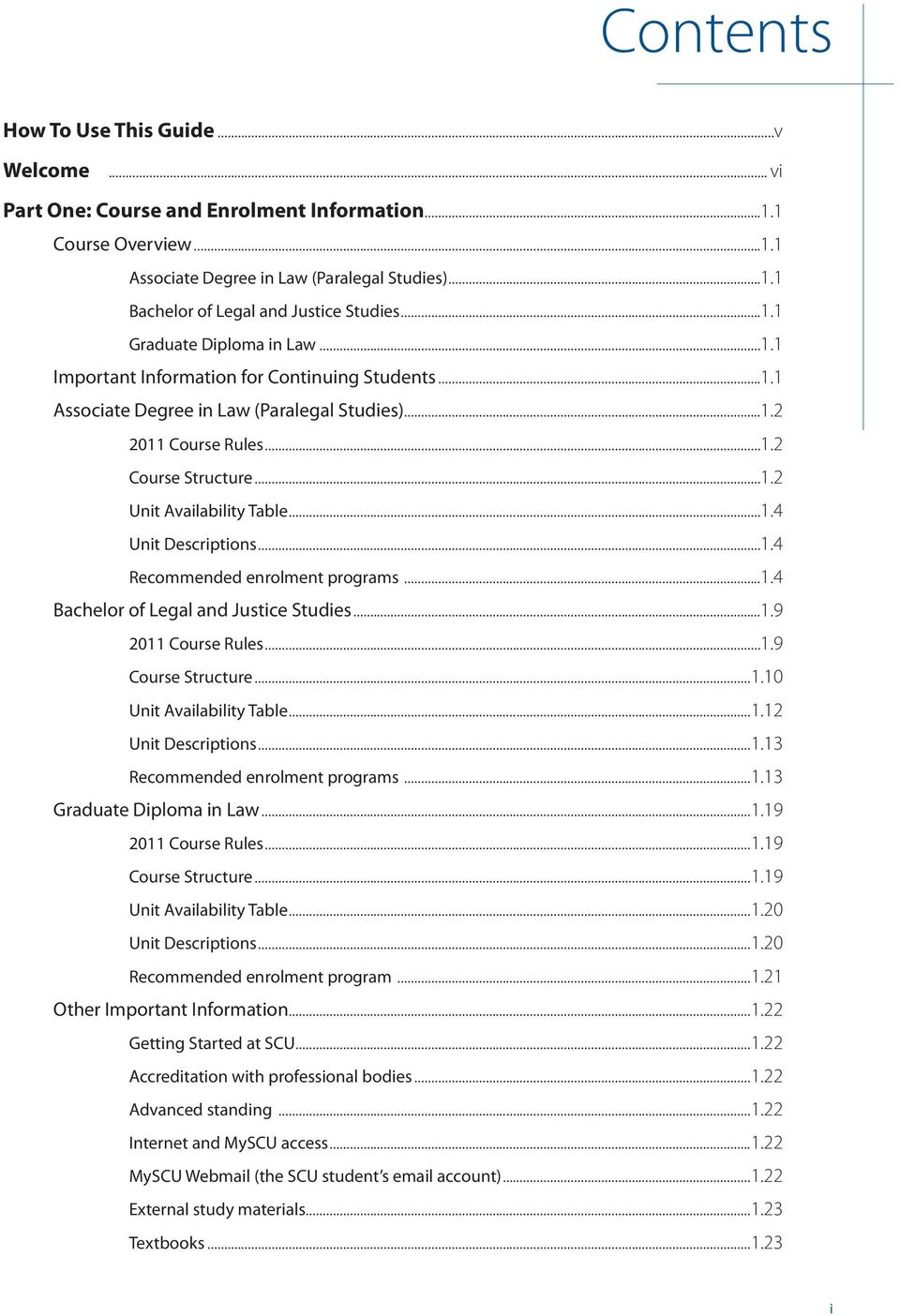
3 Contents How To Use This Guide...v Welcome... vi Part One: Course and Enrolment Information Course Overview Associate Degree in Law (Paralegal Studies) Bachelor of Legal and Justice Studies Graduate Diploma in Law Important Information for Continuing Students Associate Degree in Law (Paralegal Studies) Course Rules Course Structure Unit Availability Table Unit Descriptions Recommended enrolment programs Bachelor of Legal and Justice Studies Course Rules Course Structure Unit Availability Table Unit Descriptions Recommended enrolment programs Graduate Diploma in Law Course Rules Course Structure Unit Availability Table Unit Descriptions Recommended enrolment program Other Important Information Getting Started at SCU Accreditation with professional bodies Advanced standing Internet and MySCU access MySCU Webmail (the SCU student s account) External study materials Textbooks i
4 ii Course Enrolment Guide 2010 Frequently Asked Questions School Contacts Law and Justice Reception Student Liaison or Support Team contacts Academic staff contacts Part Two: Administrative and General Information Online enrolment Fees Other related costs Income support and the Three-Session Teaching Calendar Study load for International onshore students Census dates Commonwealth Assistance Notices (CAN) Final date to enrol in unit/s Deferring studies Advanced standing recognition of prior work or study Class timetabling Class registration Leave of absence Variation to enrolment Withdrawing from a course or unit Cross-institutional studies Course transfer Further information about enrolment issues MySCU Textbooks Study materials and Books of Readings Turnitin Orientation and transition Beat the Stress Week Student support services University Library Academic Skills Development Unit Services for distance education students Information technology and technical support Early engagement and intervention support Examinations Special consideration/special examination Grades and academic standing

5 Contents iii Staying in touch with SCU SCU General Information Key Dates for Useful University Websites Getting started About the University Schools and Colleges Southern Cross University Orientation Program

6 iv Course Enrolment Guide 2010

7 How To Use This Guide This course enrolment guide has been developed by the Faculty of Business and Law to assist students with unit selection, to facilitate online enrolment and provide advice about important contacts, resources and support services available. It is also a valuable resource containing easily referenced material that no student should be without. Part One contains course specific information and sets out the rules and structure of the course, maps the Study Plan that is necessary to satisfy course requirements for graduation including suggested or compulsory unit progressions and (where applicable) major/ specialisation sequences per study period. Part Two provides helpful information in relation to important dates, useful websites and relevant administrative information including the contact details of specialist staff within the University who are available to assist with specific enquiries. Getting Started: We encourage you to become familiar with the information in this guide and the resources available to you within the School and the University. We also suggest you refer to the Getting Started at SCU brochure (sent with your offer letter), which outlines the easy steps to online enrolment. Together, these documents will answer many of your questions and guide you through the enrolment process. What to do next: 1. Print or download this guide. If you are a first year student, retain this guide for reference throughout the duration of your course. 2. As the course is governed by the Award Rules for the year in which study commenced, first year students must be familiar with the Award Rules and the course structure requirements (refer to the Student Handbook at 3. Choose the units you will study in each study period using the course structure and unit information provided. 4. Enrol in units for the whole year online in `My Enrolment at myenrolment The new Southern Cross University three session teaching calendar provides students with the flexibility to spread their study load over three sessions or to fast track and complete studies earlier. To ensure the University can plan classes and tutorials appropriately we strongly advise students to enrol in units for each study period at the commencement of the academic year. Please note, Session 3 is an optional study period. 5. Register for your internal classes online through `My Enrolment at au/myenrolment only after the Online Class Registration notification is sent to your SCU webmail account [not applicable to University Wide (external) students studying by distance education]. 6. For assistance with `My Enrolment refer to the Demonstration Guides located on the Student Enrolment and Support Services site or contact the Enrolments Team by phone: or [email protected]! 7. Once enrolled in your units, visit MySCU to become familiar with where your School s Student Centre and Learning Sites are located. You will not have access to your Learning Sites until one week before the first day of the study period and sites do not become interactive for teaching and moderation of discussion boards until day one of the study period. While there, you might explore your Unit Information Guide and Study Guide. v

8 vi Course Enrolment Guide 2010 Important notice: Continuing students who commenced studies prior to 2011 can access the guide for the year they commenced studies via the School s Student Centre, located in the Information Sites area of MySCU at If the guide is not listed, or a student is unable to adhere to the structure in place when study commenced, please contact the Student Support Team or Shared Services Advisor for the course (refer to School Contacts located later in Part One of this guide). The information contained in this guide is correct at the date of publication. This guide is revised each year. Welcome On behalf of all staff, I would like to welcome you to the School of Law and Justice s learning community. Our School is committed to providing you with high quality teaching and learning opportunities that will make your experience of studying Law at Southern Cross University a unique and memorable one. We are equally committed to providing effective academic and administrative support services that meet your needs and promote your well-being. We look forward to meeting you on campus or on-line during your studies. Dr Jennifer Nielsen BSc(Monash), LLB(Hons)(Monash), PhD(Melb)

9 Part One: Course and Enrolment Information Course Overview Associate Degree in Law (Paralegal Studies) The School of Law and Justice runs a large paralegal program each year and is recognised for its extensive experience in teaching paralegal studies at university level. The Associate Degree in Law (Paralegal Studies) continues to set the national benchmark for paralegal education. Graduates may find employment within the national legal industry or, more specifically, in property conveyancing in NSW. Students who achieve the required grade point average during the course may apply to transfer to the Bachelor of Laws. Bachelor of Legal and Justice Studies This course provides an excellent grounding in legal issues and the opportunity for entry into the field of justice studies or law at the sub-professional level. If you ve been working professionally in the legal and justice field, it will also help you to extend and develop your knowledge, skills and expertise to develop your career and recognise your contribution to the field of law. Additionally, the course equips students with the knowledge and skills required to enter the criminal justice system including policing, corrective services and security. Graduate Diploma in Law A Graduate Diploma in Law is available to graduates of any discipline who wish to obtain a working knowledge of the Law. It is particularly suited to teachers of Legal Studies or those in management positions. Important Information for Continuing Students Students who commenced study in the Associate Degree in Law (Paralegal Studies) or the Bachelor of Legal and Justice Studies prior to 2009, and wish to continue with that course structure, should refer to the pre 2009 Course Structures available for their courses via the Enrolment tab in the Law Student Centre under Information Sites in MySCU. If unsure as to which units to enrol in, please contact the Student Liaison or Support Team. (See School Contacts at the end of Part One of this Guide). 1.1

10 1.2 Course Enrolment Guide 2011 Associate Degree in Law (Paralegal Studies) 2011 Course Rules The Award Rules for each course are published in the Student Handbook. The current Student Handbook is available from The handbook is updated annually, with versions from prior years available via the publications web page edu.au/about/index.php/17/. Specific Award Rules See the University s Rules Relating to Awards, in conjunction with the Specific Award Rules listed below. 4.2 Requirements for an Award (a) (b) To be eligible for the award of Associate Degree in Law (Paralegal Studies) a candidate shall successfully complete not less than sixteen (16) units comprising: i. all units listed in Part A of the Schedule of Units attached to these Rules; ii. an eight (8) unit major from Part B of the Schedule, OR eight (8) elective units including at least two (2) units from Part C of the Schedule of Units. A candidate who while enrolled for the Bachelor of Legal and Justice Studies degree, has completed the requirements for the Associate Degree in Law (Paralegal Studies) may elect to be awarded the Associate degree following withdrawal from candidature for the Bachelors degree. Course Structure Part A Core Units LAW00051 Legal Research and Writing LAW10157 LAW00050 LAW00128 LAW00054 LAW00052 LAW00053 LAW10159 Australian Legal System Criminal Process Interviewing, Negotiation and Ethics Family Law Practice Introduction to Land Law Foundations of Torts Principles of Contract Law Part B Major Areas of Study Paralegal Studies Core LAW00062 LAW00108 LAW10158 LAW10068 Wills and Estates Choose four from the following: LAW00058 LAW00106 LAW00104 Legal and Conveyancing Practice Introduction to Evidence and Advocacy Law and Government Decision Making Litigation Practice EEO & OH&S Law and Practice Employment and Industrial Relations Law

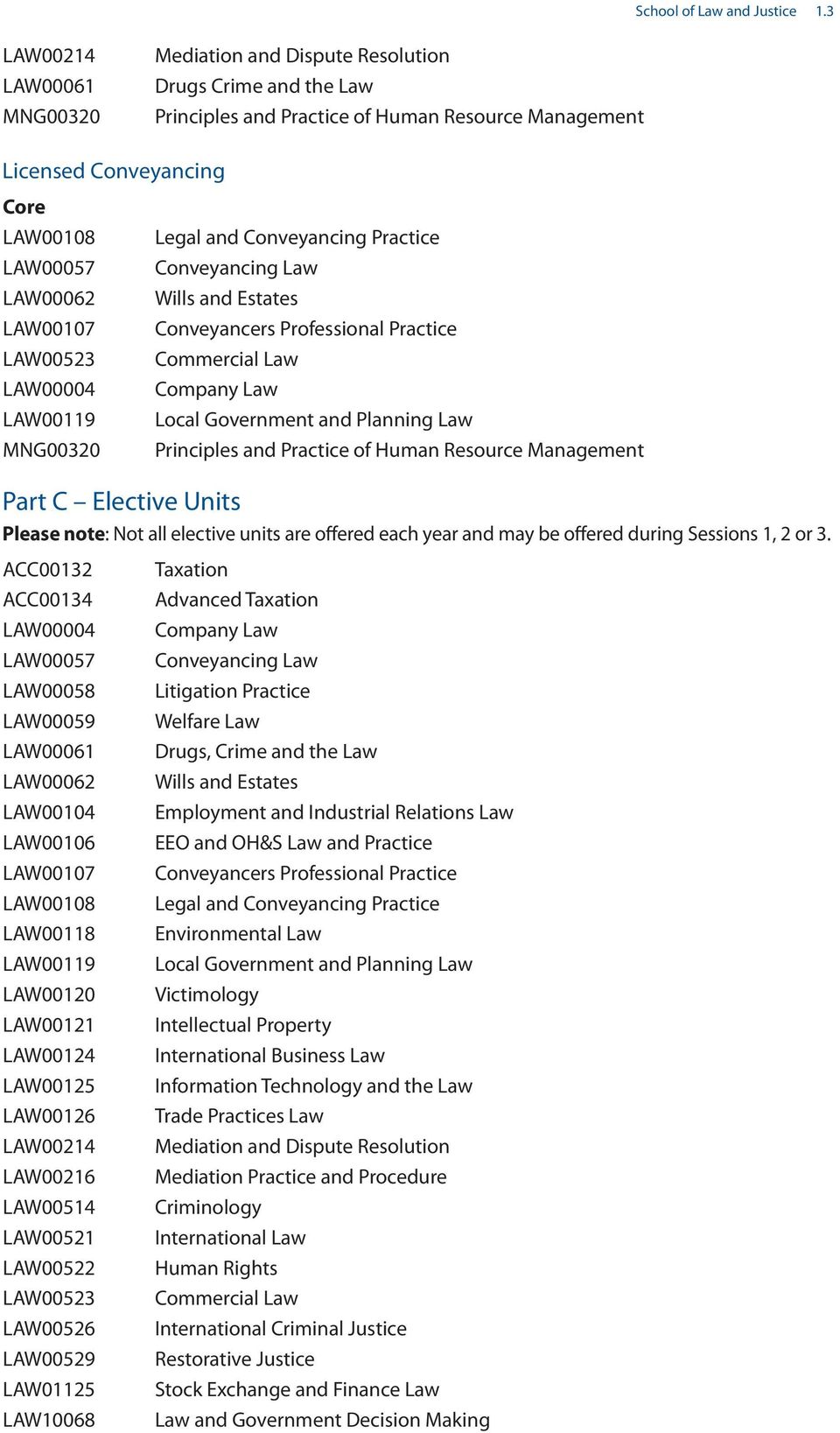
11 School of Law and Justice 1.3 LAW00214 LAW00061 MNG00320 Mediation and Dispute Resolution Drugs Crime and the Law Principles and Practice of Human Resource Management Licensed Conveyancing Core LAW00108 LAW00057 LAW00062 LAW00107 LAW00523 LAW00004 LAW00119 MNG00320 Legal and Conveyancing Practice Conveyancing Law Wills and Estates Conveyancers Professional Practice Commercial Law Company Law Local Government and Planning Law Principles and Practice of Human Resource Management Part C Elective Units Please note: Not all elective units are offered each year and may be offered during Sessions 1, 2 or 3. ACC00132 ACC00134 LAW00004 LAW00057 LAW00058 LAW00059 LAW00061 LAW00062 LAW00104 LAW00106 LAW00107 LAW00108 LAW00118 LAW00119 LAW00120 LAW00121 LAW00124 LAW00125 LAW00126 LAW00214 LAW00216 LAW00514 LAW00521 LAW00522 LAW00523 LAW00526 LAW00529 LAW01125 LAW10068 Taxation Advanced Taxation Company Law Conveyancing Law Litigation Practice Welfare Law Drugs, Crime and the Law Wills and Estates Employment and Industrial Relations Law EEO and OH&S Law and Practice Conveyancers Professional Practice Legal and Conveyancing Practice Environmental Law Local Government and Planning Law Victimology Intellectual Property International Business Law Information Technology and the Law Trade Practices Law Mediation and Dispute Resolution Mediation Practice and Procedure Criminology International Law Human Rights Commercial Law International Criminal Justice Restorative Justice Stock Exchange and Finance Law Law and Government Decision Making
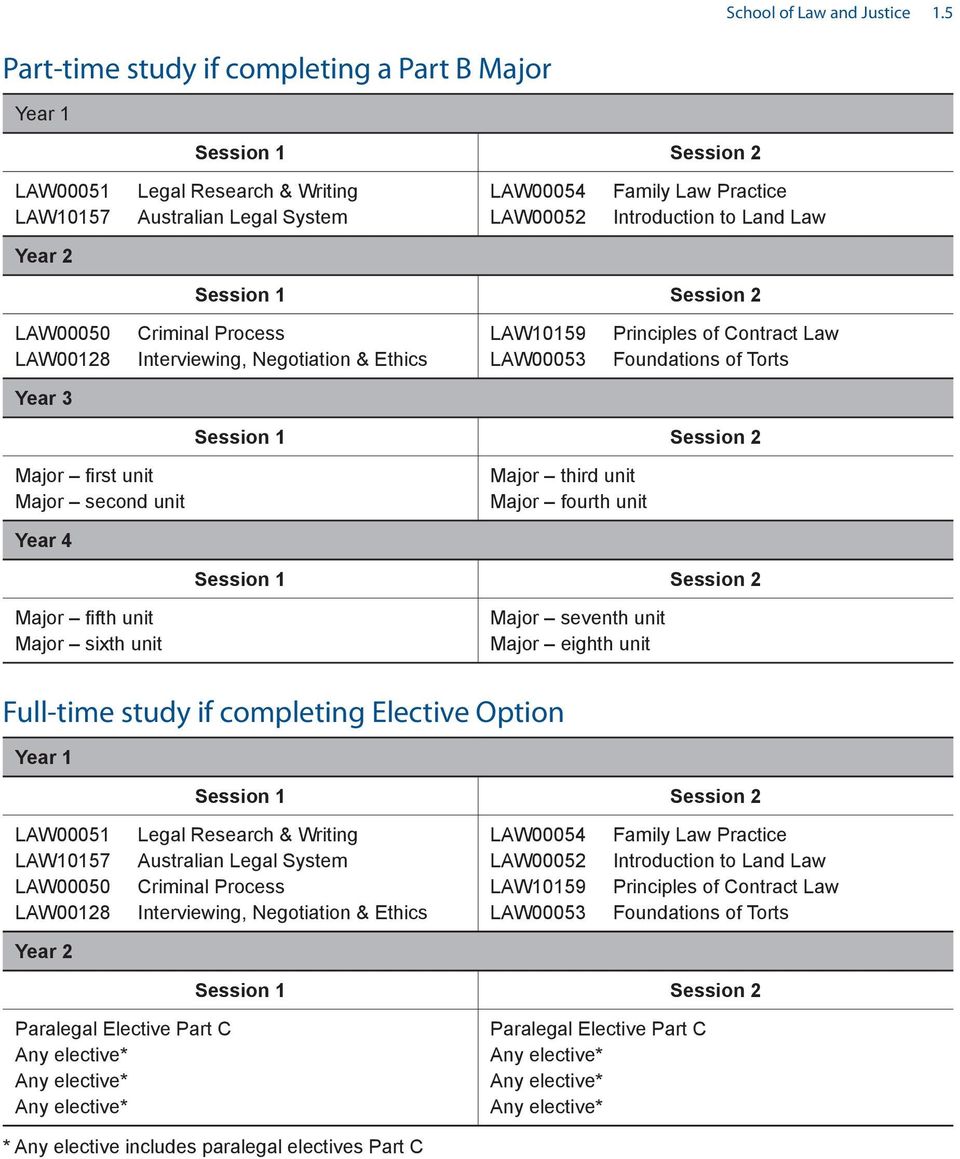
12 1.4 Course Enrolment Guide 2011 LAW10158 LAW10171 LAW10288 LAW10487 Introduction to Evidence and Advocacy Mediating Across Cultures Mooting Animal Law The School also offers a small group of elective units each year at our Byron Bay Summer School ( for further information). Unit Availability Table As the unit availabilities may change from study period to study period, students are advised to refer to the Schedule of Undergraduate Units (SoU) for the most up to date session availability and pre-requisite information. The SoU is available at The first few pages of the SoU explain how it should be used, as well as the various codes used throughout the document. It is therefore important that you read these pages. Unit Descriptions Unit descriptions are available in the Student Handbook. Hardcopies of the Handbook are available for purchase at the Coop Bookshop. An online version of the Handbook is found at Recommended enrolment programs The following tables map out the recommended enrolment programs for the Associate Degree in Law (Paralegal Studies) for both the major and elective options. Students enrolling in a part time load should enrol in the following units: LAW00051 LAW10157 Legal Research and Writing and Australian Legal System Students wishing to enrol in one unit only for their first session of study should enrol in: LAW00051 Legal Research and Writing Students may enrol in the units relevant to their major, their ADL Electives from Part C or their Any Electives in any order they choose as long as they have completed the pre-requisites. Students commencing in Session 1 Full-time study if completing a Part B Major Year 1 Year 2 "#$%%%&E!! "#$%%%&=!! "#$'%'&H!! "#$%%%&K!! "#$%%%&'!! "()*+!,(-(*./0!1!$.2324) "#$'%'&5!! #6-3.*+2*4!"()*+!78-3(9 "#$%%%&%!! :.2924*+!;.</(-- "#$%%'=>!!?43(.@2(A24)B!C()<32*32<4!1!D302/- F*92+8!"*A!;.*/32/(?43.<G6/32<4!3<!"*4G!"*A ;.24/2I+(-!<J!:<43.*/3!"*A F<64G*32<4-!<J!L<.3-!"#$%&'&(%)*&+,-* M*N<.!O!-(/<4G!6423 M*N<.!O!302.G!6423 M*N<.!O!J<6.30!6423!"#$%&'&(.*/&+,-* M*N<.!O!-2P30!6423 M*N<.!O!-(@(430!6423 M*N<.!O!(2)030!6423

13 School of Law and Justice 1.5 Part-time study if completing a Part B Major Q(*.!' "#$%%%&'!! "()*+!,(-(*./0!1!$.2324) "#$'%'&5!! #6-3.*+2*4!"()*+!78-3(9 Year 2 "#$%%%&E!! "#$%%%&=!! F*92+8!"*A!;.*/32/(?43.<G6/32<4!3<!"*4G!"*A Year 3 "#$'%'&H!! "#$%%%&K!! "#$%%%&%!! :.2924*+!;.</(-- "#$%%'=>!!?43(.@2(A24)B!C()<32*32<4!1!D302/- ;.24/2I+(-!<J!:<43.*/3!"*A! F<64G*32<4-!<J!L<.3-!"#$%&'&(%)*&+,-* M*N<.!O!-(/<4G!6423 M*N<.!O!302.G!6423 M*N<.!O!J<6.30!6423 Year 4!"#$%&'&(.*/&+,-* M*N<.!O!-2P30!6423 M*N<.!O!-(@(430!6423 M*N<.!O!(2)030!6423 Full-time study if completing Elective Option Year 1 Year 2 "#$%%%&E!! "#$%%%&=!! "#$'%'&H!! "#$%%%&K!! "#$%%%&'!! "()*+!,(-(*./0!1!$.2324) "#$'%'&5!! #6-3.*+2*4!"()*+!78-3(9 "#$%%%&%!! :.2924*+!;.</(-- "#$%%'=>!!?43(.@2(A24)B!C()<32*32<4!1!D302/- F*92+8!"*A!;.*/32/(?43.<G6/32<4!3<!"*4G!"*A ;.24/2I+(-!<J!:<43.*/3!"*A F<64G*32<4-!<J!L<.3- ;*.*+()*+!D+(/32@(!;*.3!: ;*.*+()*+!D+(/32@(!;*.3!: R!#48!(+(/32@(!24/+6G(-!I*.*+()*+!(+(/32@(-!;*.3!:
14 1.6 Course Enrolment Guide 2011 Part-time study if completing Elective Option Year 1 "#$%%%&'!! "()*+!,(-(*./0!1!$.2324) "#$'%'&5!! #6-3.*+2*4!"()*+!78-3(9 Year 2 "#$%%%&E!! "#$%%%&=!! F*92+8!"*A!;.*/32/(?43.<G6/32<4!3<!"*4G!"*A Year 3 "#$'%'&H!! "#$%%%&K!! ;*.*+()*+!D+(/32@(!;*.3!: ;*.*+()*+!D+(/32@(!;*.3!: Year 4 R!#48!(+(/32@(!24/+6G(-!I*.*+()*+!(+(/32@(-!;*.3!: Students commencing in Session 2 Enrolments at mid year are limited to part time, external study only. You may elect to enrol internally or in a full time load in subsequent sessions. Full-time study if completing a Part B Major Year 1 Year 2 "#$%%%&'!! "()*+!,(-(*./0!1!$.2324) "#$'%'&5!! #6-3.*+2*4!"()*+!78-3(9 "#$%%%&%!! :.2924*+!;.</(-- "#$%%'=>!!?43(.@2(A24)B!C()<32*32<4!1!D302/- ;.24/2I+(-!<J!:<43.*/3!"*A! F<64G*32<4-!<J!L<.3- "#$%%%&%!! :.2924*+!;.</(-- "#$%%'=>!!?43(.@2(A24)B!C()<32*32<4!1!D302/-!"#$%&'&(%)*&+,-* M*N<.!O!-(/<4G!6423 Year 3 "#$%%%&E!! "#$%%%&=!! "#$'%'&H!! "#$%%%&K!! F*92+8!"*A!;.*/32/(?43.<G6/32<4!3<!"*4G!"*A ;.24/2I+(-!<J!:<43.*/3!"*A F<64G*32<4-!<J!L<.3-! M*N<.!O!302.G!6423 M*N<.!O!J<6.30!6423!"#$%&'&(.*/&+,-* M*N<.!O!-2P30!6423 M*N<.!O!-(@(430!6423 M*N<.!O!(2)030!6423

15 School of Law and Justice 1.7 Part-time study if completing a Part B Major Year 1 Year 2 "#$%%%&'!! "()*+!,(-(*./0!1!$.2324) "#$'%'&5!! #6-3.*+2*4!"()*+!78-3(9 Year 3 "#$%%%&E!! "#$%%%&=!! F*92+8!"*A!;.*/32/(?43.<G6/32<4!3<!"*4G!"*A!"#$%&'&(%)*&+,-* M*N<.!O!-(/<4G!6423 Year 4 "#$'%'&H!! "#$%%%&K!! M*N<.!O!302.G!6423 M*N<.!O!J<6.30!6423!"#$%&'&(.*/&+,-* M*N<.!O!-2P30!6423 Year 5 M*N<.!O!-(@(430!6423 M*N<.!O!(2)030!6423 Full-time study if completing Elective Option Year 1 Year 2 "#$%%%&'!! "()*+!,(-(*./0!1!$.2324) "#$'%'&5!! #6-3.*+2*4!"()*+!78-3(9 "#$%%%&%!! :.2924*+!;.</(-- "#$%%'=>!!?43(.@2(A24)B!C()<32*32<4!1!D302/- ;.24/2I+(-!<J!:<43.*/3!"*A! F<64G*32<4-!<J!L<.3- "#$%%%&%!! :.2924*+!;.</(-- "#$%%'=>!!?43(.@2(A24)B!C()<32*32<4!1!D302/- ;*.*+()*+!D+(/32@(!;*.3!: ;*.*+()*+!D+(/32@(!;*.3!: Year 3 "#$%%%&E!! "#$%%%&=!! "#$'%'&H!! "#$%%%&K!! F*92+8!"*A!;.*/32/(?43.<G6/32<4!3<!"*4G!"*A ;.24/2I+(-!<J!:<43.*/3!"*A F<64G*32<4-!<J!L<.3-! R!#48!D+(/32@(!24/+6G(-!I*.*+()*+!(+(/32@(-!;*.3!:

16 1.8 Course Enrolment Guide 2011 Part-time study if completing Elective Option Year 1 Year 2 "#$%%%&'!! "()*+!,(-(*./0!1!$.2324) "#$'%'&5!! #6-3.*+2*4!"()*+!78-3(9 Year 3 "#$%%%&E!! "#$%%%&=!! F*92+8!"*A!;.*/32/(?43.<G6/32<4!3<!"*4G!"*A ;*.*+()*+!D+(/32@(!;*.3!: ;*.*+()*+!D+(/32@(!;*.3!: Year 4 "#$'%'&H!! "#$%%%&K!! "#$%%%&%!! :.2924*+!;.</(-- "#$%%'=>!!?43(.@2(A24)B!C()<32*32<4!1!D302/- ;.24/2I+(-!<J!:<43.*/3!"*A! F<64G*32<4-!<J!L<.3- Year 5 R!#48!(+(/32@(!24/+6G(-!I*.*+()*+!(+(/32@(-!;*.3!:

17 School of Law and Justice 1.9 Bachelor of Legal and Justice Studies 2011 Course Rules The Award Rules for each course are published in the Student Handbook. The current Student Handbook is available from The handbook is updated annually, with versions from prior years available via the publications web page edu.au/about/index.php/17/. Specific Award Rules See the University s Rules Relating to Awards, in conjunction with the Specific Award Rules listed below. 4.2 Requirements for the Award a. To be eligible for the award of Bachelor of Legal and Justice Studies a candidate shall successfully complete not less than twenty-four (24) units comprising: i. All units in Part A of the Schedule of Units attached to these Rules; and ii. iii. iv. One eight (8) unit major from Part B of the Schedule of units; and Either a second eight (8) unit major from Part B of the Schedule of units; or Eight (8) elective units of which a minimum of two (2) are selected from Part C of the Schedule of Units; or one (1) eight (8) unit University-wide major selected from the University wide Schedule of majors, excluding the Law and Justice major. b. Where a candidate undertakes two majors, a unit may not be counted towards both majors except where a unit is a core unit in both majors. In this case a candidate must still complete twenty-four (24) units as in 4.2(a) above, including eight (8) units from each of the two majors. 4.3 Advanced Standing a. Candidates who have completed an Associate Degree in Law or Diploma in Law (Paralegal Studies), Associate Degree in Law or Diploma in Law (Aboriginal Paralegal Studies), Associate Diploma in Business (Paralegal Studies) or Associate Degree in Correctional Administration may be granted advanced standing for up to sixteen (16) units towards the Bachelor of Legal and Justice Studies. b. Candidates who have successfully completed the three (3) following Queensland Police Service in-service courses may be granted advanced standing for twelve (12) units towards the Bachelor of Legal and Justice Studies: Police Recruit Operational Vocational Education Program; and First Year Constable Program; and Constable Development Program. Candidates in this category will be deemed to have completed an eight (8) unit major in Policing Studies and four (4) units from Part C. 4.4 Surrender of Award Candidates who hold the Associate Degree in Law or Diploma in Law (Paralegal Studies) or Associate Degree or Diploma in Law (Aboriginal Paralegal Studies) or the Associate Diploma in Business (Paralegal Studies) or Associate Degree in Correctional Administration and are granted advanced standing for greater than the equivalent of twelve (12) units, must surrender the award prior to conferral of the degree.

18 1.10 Course Enrolment Guide 2011 Course Structure Part A Core Units LAW00051 Legal Research and Writing LAW10157 LAW00050 LAW00128 LAW00054 LAW00052 LAW00053 LAW10159 Australian Legal System Criminal Process Interviewing, Negotiation and Ethics Family Law Practice Introduction to Land Law Foundations of Torts Principles of Contract Law Part B Major Areas of Study Criminal Justice Studies Core LAW00514 LAW00120 LAW00056 Criminology Victimology Aborigines, Torres Strait Islanders and the Criminal Justice System Choose any five units from the following: LAW00061 SOC01123 LAW00059 LAW00529 LAW00526 LAW00055 CUL00413 Drugs, Crime and the Law Deviance in Society Welfare Law Restorative Justice International Criminal Justice Aborigines, Torres Strait Islanders and Contemporary Legal Issues Human Rights and Indigenous Peoples Dispute Resolution Core LAW10158 Introduction to Evidence and Advocacy LAW00214 Mediation and Dispute Resolution Choose any six units from the following: LAW00215 Dispute Resolution and Aboriginal Communities LAW00216 Mediation Practice and Procedure CSL00231 Counselling Theory and Practice CSL00120 Managing Conflict LAW00058 Litigation Practice LAW00529 Restorative Justice BHS00161 Interpersonal Communication LAW10171 Mediating Across Cultures

19 School of Law and Justice 1.11 Social Justice Studies Core LAW00059 Welfare Law LAW00522 Human Rights Choose any six units from the following LAW00106 EEO and OH&S Law and Practice LAW00055 Aborigines, Torres Strait Islanders and Contemporary Legal Issues LAW00514 Criminology CUL00402 Contemporary Australian Indigenous Issues SOC00417 Race and Racism LAW00526 International Criminal Justice CUL00413 Human Rights and Indigenous Peoples POL10024 Justice in World Politics LAW00215 Dispute Resolution and Aboriginal Communities LAW00529 Restorative Justice Licensed Conveyancing Core LAW00108 LAW00057 LAW00062 LAW00107 LAW00523 LAW00004 LAW00119 MNG00320 Legal and Conveyancing Practice Conveyancing Law Wills and Estates Conveyancers Professional Practice Commercial Law Company Law Local Government and Planning Law Principles and Practice of Human Resource Management Paralegal Studies Core LAW00062 Wills and Estates LAW00108 Legal and Conveyancing Practice LAW10158 Introduction to Evidence and Advocacy LAW10068 Law and Government Decision Making Choose any four units from the following LAW00058 Litigation Practice LAW00106 EEO & OH&S Law and Practice LAW00104 Employment and Industrial Relations Law LAW00214 Mediation and Dispute Resolution LAW00061 Drugs Crime and the Law MNG00320 Principles and Practice of Human Resource Management Policing Studies Refer to Rule 4.3(b)

20 1.12 Course Enrolment Guide 2011 Part C Elective Units Please note: Not all elective units are offered each year and may be offered during Sessions 1, 2 or 3. ACC00132 ACC00134 LAW00004 LAW00048 LAW00057 LAW00058 LAW00059 LAW00061 LAW00062 LAW00104 LAW00106 LAW00107 LAW00108 LAW00118 LAW00119 LAW00120 LAW00121 LAW00124 LAW00125 LAW00126 LAW00214 LAW00216 LAW00514 LAW00521 LAW00522 LAW00523 LAW00526 LAW00529 LAW01125 LAW10068 LAW10158 LAW10171 LAW10288 LAW10487 Taxation Advanced Taxation Company Law Legal Project Conveyancing Law Litigation Practice Welfare Law Drugs, Crime and the Law Wills and Estates Employment and Industrial Relations Law EEO and OH&S Law and Practice Conveyancers Professional Practice Legal and Conveyancing Practice Environmental Law Local Government and Planning Law Victimology Intellectual Property International Business Law Information Technology and the Law Trade Practices Law Mediation and Dispute Resolution Mediation Practice and Procedure Criminology International Law Human Rights Commercial Law International Criminal Justice Restorative Justice Stock Exchange and Finance Law Law and Government Decision Making Introduction to Evidence and Advocacy Mediating Across Cultures Mooting Animal Law The School also offers a small group of elective units each year at our Byron Bay Summer School ( for further information). Unit Availability Table As the unit availabilities may change from study period to study period, students are advised to refer to the Schedule of Undergraduate Units (SoU) for the most up to date session availability and pre-requisite information. The SoU is available at The first few pages of the SoU explain how it should be used, as well as the various codes used throughout the document. It is therefore important that you read these pages.

21 Unit Descriptions Unit descriptions are available in the Student Handbook. Hardcopies of the Handbook are available for purchase at the Coop Bookshop. An online version of the Handbook is found at Recommended enrolment programs The following tables map out the recommended enrolment programs for the Bachelor of Legal and Justice Studies for both the major/s and elective options. Students enrolling in a part time load should enrol in the following units: LAW00051 LAW10157 Legal Research and Writing and Australian Legal System Students wishing to enrol in one unit only for their first session of study should enrol in: LAW00051 Legal Research and Writing Students may enrol in the units relevant to their major/s, their BLJS Electives from Part C or their Any Electives in any order they choose as long as they have completed the pre-requisites. Students commencing in Session 1 Full-time study if completing one Part B Major and Electives Year 1 School of Law and Justice 1.13 Year 2 "#$%%%&E!! "#$%%%&=!! "#$'%'&H!! "#$%%%&K!! "#$%%%&'! "()*+!,(-(*./0!1!$.2324) "#$'%'&5! #6-3.*+2*4!"()*+!78-3(9 "#$%%%&%!! :.2924*+!;.</(-- "#$%%'=>!?43(.@2(A24)B!C()<32*32<4!1!D302/- F*92+8!"*A!;.*/32/(?43.<G6/32<4!3<!"*4G!"*A ;.24/2I+(-!<J!:<43.*/3!"*A F<64G*32<4-!<J!L<.3-!"#$%&'&(%)*&+,-* M*N<.!O!-(/<4G!6423 M*N<.!O!302.G!6423 M*N<.!O!J<6.30!6423!"#$%&'&(.*/&+,-* M*N<.!O!-2P30!6423 M*N<.!O!-(@(430!6423 M*N<.!O!(2)030!6423 Year 3 S"T7!D+(/32@(!;*.3!: #48!D+(/32@(R #48!D+(/32@(R #48!D+(/32@(R S"T7!D+(/32@(!;*.3!: #48!D+(/32@(R #48!D+(/32@(R #48!D+(/32@(R R#48!D+(/32@(!9*8!24/+6G(!*!S"T7!D+(/32@(!;*.3!:
22 1.14 Course Enrolment Guide 2011 Part-time study if completing one Part B Major and Electives Year 1 "#$%%%&'! "()*+!,(-(*./0!1!$.2324) "#$'%'&5! #6-3.*+2*4!"()*+!78-3(9 Year 2 "#$%%%&E!! "#$%%%&=! F*92+8!"*A!;.*/32/(?43.<G6/32<4!3<!"*4G!"*A Year 3 "#$'%'&H! "#$%%%&K! "#$%%%&%! :.2924*+!;.</(-- "#$%%'=>!?43(.@2(A24)B!C()<32*32<4!1!D302/- ;.24/2I+(-!<J!:<43.*/3!"*A! F<64G*32<4-!<J!L<.3-!"#$%&'&(%)*&+,-* M*N<.!O!-(/<4G!6423 M*N<.!O!302.G!6423 M*N<.!O!J<6.30!6423 Year 4!"#$%&'&(.*/&+,-* M*N<.!O!-2P30!6423 M*N<.!O!-(@(430!6423 M*N<.!O!(2)030!6423 Year 5 S"T7!D+(/32@(!;*.3!: #48!D+(/32@(R S"T7!D+(/32@(!;*.3!: #48!D+(/32@(R Year 6 #48!D+(/32@(R #48!D+(/32@(R #48!D+(/32@(R #48!D+(/32@(R R#48!D+(/32@(!9*8!24/+6G(!*!S"T7!D+(/32@(!;*.3!: Full-time study if completing two Part B Majors Year 1 Year 2 "#$%%%&E!! "#$%%%&=! "#$'%'&H!! "#$%%%&K!! "#$%%%&'!! "()*+!,(-(*./0!1!$.2324) "#$'%'&5!! #6-3.*+2*4!"()*+!78-3(9 "#$%%%&%!! :.2924*+!;.</(-- "#$%%'=>!!?43(.@2(A24)B!C()<32*32<4!1!D302/- F*92+8!"*A!;.*/32/(?43.<G6/32<4!3<!"*4G!"*A ;.24/2I+(-!<J!:<43.*/3!"*A F<64G*32<4-!<J!L<.3-!"#$%&0&'&(%)*&+,-* M*N<.!'!O!-(/<4G!6423 M*N<.!'!O!302.G!6423 M*N<.!'!O!J<6.30!6423!"#$%&0&'&(.*/&+,-* M*N<.!'!O!-2P30!6423 M*N<.!'!O!-(@(430!6423 M*N<.!'!O!(2)030!6423 Year 3!"#$%&1&'&(%)*&+,-* M*N<.!=!O!-(/<4G!6423 M*N<.!=!O!302.G!6423 M*N<.!=!O!J<6.30!6423!"#$%&1&'&(.*/&+,-* M*N<.!=!O!-2P30!6423 M*N<.!=!O!-(@(430!6423 M*N<.!=!O!(2)030!6423
23 School of Law and Justice 1.15 Part-time study if completing two Part B Majors Year 1 "#$%%%&'!! "()*+!,(-(*./0!1!$.2324) "#$'%'&5!! #6-3.*+2*4!"()*+!78-3(9 Year 2 "#$%%%&E!! "#$%%%&=!! F*92+8!"*A!;.*/32/(!?43.<G6/32<4!3<!"*4G!"*A Year 3 "#$'%'&H!! "#$%%%&K!!!"#$%&0&'&(%)*&+,-* M*N<.!'!O!-(/<4G!6423 M*N<.!'!O!302.G!6423 M*N<.!'!O!J<6.30!6423 Year 4!"#$%&0&'&(.*/&+,-* M*N<.!'!O!-2P30!6423 M*N<.!'!O!-(@(430!6423 M*N<.!'!O!(2)030!6423 Year 5!"#$%&1&'&(%)*&+,-* M*N<.!=!O!-(/<4G!6423 M*N<.!=!O!302.G!6423 M*N<.!=!O!J<6.30!6423 Year 6!"#$%&1&'&(.*/&+,-* M*N<.!=!O!-2P30!6423 M*N<.!=!O!-(@(430!6423 M*N<.!=!O!(2)030!6423 Students commencing in Session 2 Enrolments at mid year are limited to part time, external study only. You may elect to enrol internally or in a full time load in subsequent sessions. Full-time study if completing one Part B Major and Electives Year 1 Year 2 "#$%%%&'!! "()*+!,(-(*./0!1!$.2324) "#$'%'&5!! #6-3.*+2*4!"()*+!78-3(9 "#$%%%&%!! :.2924*+!;.</(-- "#$%%'=>!!?43(.@2(A24)B!C()<32*32<4!1!D302/- ;.24/2I+(-!<J!:<43.*/3!"*A! F<64G*32<4-!<J!L<.3- "#$%%%&%!! :.2924*+!;.</(-- "#$%%'=>!!?43(.@2(A24)B!C()<32*32<4!1!D302/-!"#$%&'&(%)*&+,-* M*N<.!O!-(/<4G!6423 "#$%%%&E!! "#$%%%&=!! "#$'%'&H!! "#$%%%&K!! F*92+8!"*A!;.*/32/(?43.<G6/32<4!3<!"*4G!"*A ;.24/2I+(-!<J!:<43.*/3!"*A F<64G*32<4-!<J!L<.3-!
24 1.16 Course Enrolment Guide 2011 Year 3 M*N<.!O!302.G!6423 M*N<.!O!J<6.30!6423!"#$%&'&(.*/&+,-* M*N<.!O!-2P30!6423 M*N<.!O!-(@(430!6423 M*N<.!O!(2)030!6423 S"T7!D+(/32@(!;*.3!: S"T7!D+(/32@(!;*.3!: Year 4 R!#48!(+(/32@(!9*8!24/+6G(!*!ST"7!D+(/32@(!;*.3!: Part-time study if completing one Part B Major and Electives Year 1 Year 2 "#$%%%&'!! "()*+!,(-(*./0!1!$.2324) "#$'%'&5!! #6-3.*+2*4!"()*+!78-3(9 Year 3 "#$%%%&E!! "#$%%%&=!! F*92+8!"*A!;.*/32/(?43.<G6/32<4!3<!"*4G!"*A!"#$%&'&(%)*&+,-* M*N<.!O!-(/<4G!6423 Year 4 "#$'%'&H!! "#$%%%&K!! "#$%%%&%!! :.2924*+!;.</(-- "#$%%'=>!!?43(.@2(A24)B!C()<32*32<4!1!D302/- ;.24/2I+(-!<J!:<43.*/3!"*A! F<64G*32<4-!<J!L<.3- M*N<.!O!302.G!6423 M*N<.!O!J<6.30!6423!"#$%&'&(.*/&+,-* M*N<.!O!-2P30!6423 Year 5 M*N<.!O!-(@(430!6423 M*N<.!O!(2)030!6423 S"T7!D+(/32@(!;*.3!: S"T7!D+(/32@(!;*.3!: Year 6 Year 7 R!#48!(+(/32@(!9*8!24/+6G(!*!ST"7!D+(/32@(!;*.3!:
25 School of Law and Justice 1.17 Full-time study if completing two Part B Majors Year 1 Year 2 "#$%%%&'!! "()*+!,(-(*./0!1!$.2324) "#$'%'&5!! #6-3.*+2*4!"()*+!78-3(9 "#$%%%&%!! :.2924*+!;.</(-- "#$%%'=>!!?43(.@2(A24)B!C()<32*32<4!1!D302/-!"#$%&0&'&(%)*&+,-* M*N<.!'!O!-(/<4G!6423 Year 3 "#$%%%&E!! "#$%%%&=!! "#$'%'&H!! "#$%%%&K!! F*92+8!"*A!;.*/32/(?43.<G6/32<4!3<!"*4G!"*A ;.24/2I+(-!<J!:<43.*/3!"*A F<64G*32<4-!<J!L<.3-! M*N<.!'!O!302.G!6423 M*N<.!'!O!J<6.30!6423!"#$%&0&'&(.*/&+,-* M*N<.!'!O!-2P30!6423 M*N<.!'!O!-(@(430!6423 M*N<.!'!O!(2)030!6423!"#$%&1&'&(%)*&+,-* M*N<.!=!O!-(/<4G!6423 Year 4 M*N<.!=!O!302.G!6423 M*N<.!=!O!J<6.30!6423!"#$%&1&'&(.*/&+,-* M*N<.!=!O!-2P30!6423! M*N<.!=!O!-(@(430!6423 M*N<.!=!O!(2)030!6423 Part-time study if completing two Part B Majors Year 1 Year 2 "#$%%%&'!! "()*+!,(-(*./0!1!$.2324) "#$'%'&5!! #6-3.*+2*4!"()*+!78-3(9 Year 3 "#$%%%&E!! "#$%%%&=!! F*92+8!"*A!;.*/32/(?43.<G6/32<4!3<!"*4G!"*A!"#$%&0&'&(%)*&+,-* M*N<.!'!O!-(/<4G!6423 Year 4 "#$'%'&H!! "#$%%%&K!! "#$%%%&%!! :.2924*+!;.</(-- "#$%%'=>!!?43(.@2(A24)B!C()<32*32<4!1!D302/- ;.24/2I+(-!<J!:<43.*/3!"*A F<64G*32<4-!<J!L<.3- M*N<.!'!O!302.G!6423 M*N<.!'!O!J<6.30!6423!"#$%&0&'&(.*/&+,-* M*N<.!'!O!-2P30!6423 Year 5 M*N<.!'!O!-(@(430!6423 M*N<.!'!O!(2)030!6423!"#$%&1&'&(%)*&+,-* M*N<.!=!O!-(/<4G!6423
26 1.18 Course Enrolment Guide 2011 Q(*.!U M*N<.!=!O!302.G!6423 M*N<.!=!O!J<6.30!6423!"#$%&1&'&(.*/&+,-* M*N<.!=!O!-2P30!6423 Q(*.!5 M*N<.!=!O!(2)030!6423
27 School of Law and Justice 1.19 Graduate Diploma in Law 2011 Course Rules The Award Rules for each course are published in the Student Handbook. The current Student Handbook is available from The handbook is updated annually, with versions from prior years available via the publications web page edu.au/about/index.php/17/. Specific Award Rules See the University s Rules Relating to Awards, in conjunction with the Specific Award Rules listed below. 4.2 Requirements for an Award To be eligible for the award of Graduate Diploma in Law a candidate shall successfully complete not less than eight (8) units comprising: a. all units listed in Part A of the Schedule of Units attached to these Rules; and b. five (5) units selected from the units provided by the School of Law and Justice. 4.3 Advanced Standing Advanced standing is not granted in this course. However, if a candidate is able to demonstrate competence in one or more units in the course by virtue of undergraduate study, the candidate may apply to the Course Co-ordinator to substitute other units for those in which competency is established. Unit substitution does not reduce the number of units required to complete the course. Course Structure Part A Core Units LAW10157 LAW00051 Australian Legal System Legal Research & Writing LAW00048 Legal Project # # Students should complete the core unit LAW00048 Legal Project in their last session of study where possible. This unit is offered in Session 2 each year. Students cannot self-enrol and must submit a Unit Approval Request through My Study Plans in MyEnrolment. Graduate Diploma in Law Elective Units Please note: Not all elective units are offered each year and may be offered in Session 1, 2 or 3. LAW00004 LAW00050 LAW00052 LAW00053 LAW00054 LAW00057 LAW00058 LAW00059 LAW00061 LAW00062 Company Law Criminal Process Introduction to Land Law Foundations of Torts Family Law Practice Conveyancing Law Litigation Practice Welfare Law Drugs, Crime and the Law Wills and Estates
28 1.20 Course Enrolment Guide 2011 LAW00104 LAW00106 LAW00107 LAW00108 LAW00118 LAW00119 LAW00120 LAW00121 LAW00124 LAW00125 LAW00126 LAW00128 LAW00214 LAW00216 LAW00514 LAW00521 LAW00522 LAW00523 LAW00526 LAW00529 LAW01125 LAW10068 LAW10158 LAW10159 LAW10171 Employment and Industrial Relations Law EEO and OH&S Law and Practice Conveyancers Professional Practice Legal and Conveyancing Practice Environmental Law Local Government and Planning Law Victimology Intellectual Property International Business Law Information Technology and the Law Trade Practices Law Interviewing, Negotiation and Ethics Mediation and Dispute Resolution Mediation Practice and Procedure Criminology International Law Human Rights Commercial Law International Criminal Justice Restorative Justice Stock Exchange and Finance Law Law and Government Decision Making Introduction to Evidence and Advocacy Principles of Contract Law Mediating Across Cultures Unit Availability Table As the unit availabilities may change from study period to study period, students are advised to refer to the Schedule of Undergraduate Units (SoU) for the most up to date session availability and pre-requisite information. The SoU is available at The first few pages of the SoU explain how it should be used, as well as the various codes used throughout the document. It is therefore important that you read these pages. Unit Descriptions Unit descriptions are available in the Student Handbook. Hardcopies of the Handbook are available for purchase at the Coop Bookshop. An online version of the Handbook is found at
29 Recommended enrolment program Students commencing in Session 1 Full-time Study Year 1 "#$'%'&5!! #6-3.*+2*4!"()*+!78-3(9 "#$%%%&'!! "()*+!,(-(*./0!1!$.2324) D+(/32@( D+(/32@( Part-time Study Year 1 "#$'%'&5!! #6-3.*+2*4!"()*+!78-3(9 "#$%%%&'!! "()*+!,(-(*./0!1!$.2324) Year 2 D+(/32@( D+(/32@( D+(/32@( D+(/32@( D+(/32@( "#$%%%E>!! "()*+!;.<N(/3 D+(/32@( D+(/32@( Students commencing in Session 2 Full-time Study Year 1 Year 2 D+(/32@( "#$%%%E>!! "()*+!;.<N(/3 "#$'%'&5!! #6-3.*+2*4!"()*+!78-3(9 "#$%%%&'!! "()*+!,(-(*./0!1!$.2324) School of Law and Justice 1.21 D+(/32@( D+(/32@( D+(/32@( Part-time Study Year 1 D+(/32@( D+(/32@( "#$%%%E>!! "()*+!;.<N(/3 "#$'%'&5!! #6-3.*+2*4!"()*+!78-3(9 "#$%%%&'!! "()*+!,(-(*./0!1!$.2324) Year 2 D+(/32@( D+(/32@( Year 3 D+(/32@( D+(/32@( "#$%%%E>!! "()*+!;.<N(/3! D+(/32@(
30 1.22 Course Enrolment Guide 2011 Other Important Information Getting Started at SCU Please make sure that you carefully read the Getting Started at SCU brochure that you received with your offer. This brochure provides important information on accessing MySCU, MyEnrolment and how to enrol in your units, amongst a lot of other very valuable information. Accreditation with professional bodies Completion of the Licensed Conveyancing major, plus a period of work experience, will qualify graduates of the Associate Degree in Law (Paralegal Studies) and the Bachelor of Legal and Justice Studies to apply for a Conveyancers Licence through the NSW Department of Fair Trading. Please note that all Australian States and Territories have individual statutory requirements for conveyancing practice, with the exception of Queensland where conveyancing is carried out by qualified solicitors. Advanced standing A student may apply for advanced standing (credit) in the Associate Degree in Law (Paralegal Studies) or the Bachelor of Legal and Justice Studies, on the basis of previous University studies with Southern Cross University or another institute (University, TAFE or other private provider), for Diploma or higher level qualifications that are no more than 10 years old. The School of Law and Justice does not grant advanced standing on the basis of industry/ professional experience or industry training, in-service courses or seminars. The maximum advanced standing normally allowed is 50% of a given University award. Applications for advanced standing are made on the University s Advanced Standing Application Form which can be downloaded from the University s website. Applications must be accompanied by an original, or certified copy of an original, academic transcript and unit outlines. Applications for Advanced Standing should be submitted to the School together with supporting documents. Internet and MySCU access Students enrolled in a course/unit offered by the School of Law and Justice are expected to have Internet access and units will be offered on that assumption. Students without Internet access will be disadvantaged in their learning experience. Students especially need to make sure that they regularly access MySCU (the University s online learning portal, detailed in Part Two of this Guide), particularly the Law Student Centre under the heading Information Sites and the Unit Learning Site under the heading Learning Sites. MySCU Webmail (the SCU student s account) On admission to Southern Cross University, all students are issued with a SCU account. It is University policy for staff to use student SCU addresses and any correspondence sent in this manner will be deemed as being received and read by all students on the recipient list. Therefore it is very important that students access their Webmail account via MySCU on a regular basis to ensure that important information is not missed. See Staying in touch with SCU in Part Two of this Guide for more details.
31 External study materials The mail out of study materials to students enrolled in an external unit should commence one week prior to the start of each study period. Delays in receiving study materials will be experienced by students who enrol, or vary their enrolment, close to or after the study period commencement date. If enrolled in an external unit, and study materials have not been received by the first day of the study period, please contact the relevant School that teaches the unit. For a Law and Justice unit please the School s External Studies Officer at [email protected] Subject: External Study Course Materials. Please include the student ID number, full name, unit code and name and confirm the postal address. Electronic study materials will also be available under the Unit Documents tab in each unit s Learning Site in MySCU once the site has been opened (normally one week prior to the commencement of the teaching session). Refer to Unit Learning Sites and ereserve in Part Two of this Guide for further information. Textbooks Textbooks are not included in tuition fees. The prescribed textbook is not included in study materials and should be purchased separately. All textbook lists will be displayed on the University Co-op Bookshop website coop-bookshop.com.au Once on this site, please select Book Search and then Text List Search. You then need to select Southern Cross University Lismore and the relevant teaching session, the unit code and hit the search button. Refer to Textbooks in Part Two of this Guide for further information. School of Law and Justice 1.23 Frequently Asked Questions Q1: What units should I or can I enrol in each study period/session? A: Each course requires students to complete core units of study that is, compulsory units. Depending on the course, a student would also be required to complete a major or majors and/or a specified number of elective units. By checking the course structure, you will find a list of the core units that must be completed. In addition you will see a list of the majors, if relevant, and the elective units that could be selected within the course. The School strongly encourages you to follow the recommended pattern of enrolment. In particular, you should complete LAW00051 Legal Research and Writing in your first session of study. Q2: How many units should I enrol in per study period/session? A: Three to four units per study period is deemed full-time study and one to two units, parttime study. You are able to enrol in one to four units without the School s permission. A student should dedicate 10 hours per week to each unit that they are enrolled in. Where you have full-time family or work commitments, you are encouraged to commence with no more than two units. If you are able to manage two units it is possible to increase your study load to three or four units in later study periods. Similarly, where you know you are likely to be very busy outside of your studies you may like to consider studying only one unit for that study period. However, you should be aware of the time limits allowed for the completion of your Award (degree/course) under the University Rules (available in the Student Handbook). It is important to keep in mind that employment related issues and pressures arising from the demands of other units of study are generally not considered to be acceptable grounds for an extension or requests for special consideration. However, if you are
32 1.24 Course Enrolment Guide 2011 experiencing unusual difficulties then you should contact your Unit Assessor to discuss whether or not the policy applies to your situation. If you need to withdraw from any of your units due to work or personal commitments, please do so before the Census date to avoid any financial liability. Q3: What is the Unit Information Guide? A: When you begin each unit of study, you will receive a document called a Unit Information Guide. It is a very important document and you must read it! The Unit Information Guide provides you with contact details for the staff involved in the unit, the unit s learning objectives, the text or other materials that you are expected to purchase to complete the unit, the assignment and assessment details, including the due dates for assignments, the criteria that will be used to mark your assignments, and the rules related to completing assignments. Q4: As an external student will I be required to attend workshops? A: The School offers workshops in some core units to support external students. Attendance at core unit workshops is not compulsory but is highly recommended. Your unit assessor in each unit of study will provide details of workshops. Some of the units offered in majors or as elective units by the School require students to attend compulsory workshops as these units are best taught with hands-on, experientially based learning strategies. These units are: i) the two mediation units, LAW00214 Mediation & Dispute Resolution and LAW00216 Mediation Practice & Procedure, which both require attendance at a compulsory weekend workshop held at either our Lismore or Gold Coast - Beachside campus, and ii) LAW00057 Conveyancing Law, which requires attendance at a compulsory one day workshop. The Unit Assessor for this unit normally holds a workshop in Sydney as well as one at one of our other campuses such as Lismore or Gold Coast - Beachside. Q5: I am an internal student. Can I enrol in external units? A: If you are enrolled in the Associate Degree in Law (Paralegal Studies), the Bachelor of Legal and Justice Studies or the Graduate Diploma in Law, you may study any combination of internal and external (University Wide) units by distance education. You should note that you may need Course Co-ordinator approval to vary your study mode once you are enrolled in a unit. Q6: What do I do if I fail a core unit in my first study period/session? A: Failure of a core unit may result in your enrolment for the following session being cancelled, especially if the unit that you failed is a pre-requisite unit. If this happens please contact the Student Liaison or Support Team as soon as possible to ensure that you are correctly enrolled for the next study period or session. Q7: Do I need to complete my Associate Degree in Law (Paralegal Studies) before I can apply to course transfer to the Bachelor of Legal and Justice Studies degree? A: No. A student who is enrolled past Census date may apply to course transfer to a different course for the following study period. Q8: Do I need to complete my Associate Degree in Law (Paralegal Studies) or Bachelor of Legal and Justice Studies before I can apply to course transfer to the Bachelor of Laws degree? A: Our current policy is that students may apply to course transfer from the Associate Degree in Law (Paralegal Studies) or the Bachelor of Legal and Justice Studies to the (Undergraduate Entry) Bachelor of Laws after the completion of 8 or more units with, as a guide, a credit average or 4 7 units with, as a guide, a distinction/credit average. However the completion of this requirement does not guarantee an offer into the Bachelor of Laws.
33 School of Law and Justice 1.25 Q9: Do I need to complete my Graduate Diploma in Law if I decide to apply to course transfer to the Bachelor of Laws degree? A: Our current policy is that students may apply to course transfer from the Graduate Diploma in Law to the (Graduate Entry) Bachelor of Laws after the completion of 8 units with, as a guide, a credit average or 4-7 units with, as a guide, a distinction/credit average. However the completion of this requirement does not guarantee an offer into the Bachelor of Laws. Q10: Who can I contact when I need help in the units I am studying? A: Each unit has a Unit Assessor who has responsibility for administering the unit and providing academic support to those studying it. The name and contact details of your Unit Assessor are set out in each Unit Information Guide. The Unit Assessor will help you with your questions about the unit as well as granting extensions and discussion of your marks. However, school policy does not allow staff to discuss your answers or proposed answers to assessment tasks before you submit them. This is because assignments are the vehicle by which students are assessed in relation to their knowledge of the unit content. This means that your Unit Assessor and the Resident Tutor (below) will be able to answer your questions about the topics you are studying but will not be able to provide individual help when you are preparing an assignment for assessment. In addition, you may find support by contacting either of the following: School of Law and Justice Resident Tutor The Resident Tutor is appointed to assist external students with content questions about units of study. Primarily, the Resident Tutor s role is to assist first year external students who experience difficulties understanding the content of units and/or adapting to tertiary study. All other students should attempt to contact the Unit Assessor during their contact times and the Resident Tutor only if the Unit Assessor is not available. The Resident Tutor may be contacted by +*A363<.V -/6W(G6W*6 More information about the Resident Tutor, including contact times, is available in the Law Student Centre under Information Sites in MySCU. Academic Skills Development Unit (ASDU) The Academic Skills Development Unit provides educational support by developing students critical thinking, academic language and learning skills as well as providing strategies for effective study and time management. Details are provided in Part Two of this Guide and are available on the web at:
34 1.26 Course Enrolment Guide 2011 School Contacts Law and Justice Reception If you have a general query, or are not sure who to contact, please don t hesitate to contact the School s Reception. Location: Hours: Lismore Campus, upstairs in L Block 9am 5pm Monday to Friday Reception contact details D9*2+X! +*A.(/(IV-/6W(G6W*6 ;0<4(X! Y%=Z!UU=%!K'%H F*PX! Y%=Z!UU==!E'U5 $([!*GG.(--X! Post/DX address ;<-3X! ;\!S<P!'&5! "?7M\,D!C7$!=E>% ]^!*GG.(--X! ]^!5U&'!"?7M\,D!C7$ Student Liaison or Support Team contacts The Student Liaison or Support Team aims to provide you with a high level of friendly, efficient and professional service and can be used as the first point of contact for enquires you may have regarding your course. If they do not have the answer to your question, they will be able to refer you to the relevant area within the University or to the appropriate staff member. Staff in the Student Liaison or Support Team can provide you with assistance during the course of your studies in relation to the following types of enquiries: Staff Name Role Contact Details Location,<[84!]699( ,-)*%"*-56&7.(86%9 :*+36,*&;-"-)$,&7.(86% %=!UU=%!K'%5 +*A.(/(IV-/6W(G6W*6 "2-9<.(,<<9X!"=O=U T6+2(!S ,-)*%"*-56&7.(86%9 :*+36,*&;-"-)$,&7.(86% %=!UU=%!K''& +*A.(/(IV-/6W(G6W*6 "2-9<.(,<<9X!"=O%E LS# <=*6%,">&:*+3-6)&7.(86% Y%=Z!%=!UU=%!K'%E +*A.(/(IV-/6W(G6W*6 "2-9<.(,<<9X!"=O=E
35 School of Law and Justice 1.27 Academic staff contacts Academic staff are available to discuss any questions or issues you may have regarding the specific unit or course content. Course Coordinators have responsibility for the overall coordination, development, review and administration of a course. Please familiarise yourself with the name of your Course Coordinator. Unit Assessors have responsibility for the overall coordination, development, review and administration of a unit. Please familiarise yourself with the name of your unit assessor. Lecturers and Tutors have responsibility for conducting lectures and tutorials/workshops. Course Coordinator All Law courses _(<JJ.(8!M*42<4 %=!UU=%!KEE& +*A.(/(IV-/6W(G6W*6 "2-9<.(,<<9X!"=W%5 A full list of the School s academic staff is available on the School s website: au/law
36 1.28 Course Enrolment Guide 2011
37 Part Two: Administrative and General Information This section of the guide is a summary of administrative and general information relative to students and their studies. Wherever possible you will be directed to sources of further information and assistance. A comprehensive list of useful websites is located at the end of this guide. Online enrolment To assist students to enrol online Students Services have developed an easy reference guide called Getting started at SCU. This guide outlines the easy steps to online enrolment. Students can download a copy of Getting started at SCU from the Student Services website. Fees The cost of attending university will vary and much depends on your program of study. Expenses can generally be broken into three groups: study costs, living expenses and other expenses. This section focuses on study costs or fees and includes important information to remember when enrolling into units of study in a course. At SCU a student is either a Commonwealth supported student or a fee-paying student, also known as a non-commonwealth supported student. Fee-paying students are required to pay full tuition fees for each unit of study. Undergraduate courses The University offers very few undergraduate fee-paying courses. Generally, undergraduate courses are Commonwealth-supported for eligible students. Postgraduate courses The majority of SCU fee-paying courses relate to postgraduate study and FEE-Help is available to eligible students. Commonwealth-supported students A Commonwealth-supported place entitles all eligible students in an undergraduate degree (and some postgraduate degrees) to a Student Learning Entitlement (SLE), with access to seven years of equivalent full-time study. Every unit of study undertaken under Commonwealth support has a cost. The Commonwealth Government meets part of that cost and the student pays the other part. This student cost is called the Student Contribution Amount. At SCU the Student Contribution varies and is determined by the units selected by each student, the discipline category or band of the units studied and the year the student commenced their course of study or degree. To find out exactly which band(s) your unit/s of study belong to visit the University s Fees and Financial Assistance website 2.1
38 2.2 Course Enrolment Guide 2011 Part Two Before enrolling in units for the first time, new students must read the Information for Commonwealth supported students booklet available from SCU Student Services or at www. goingtouni.gov.au Students complete the request for Commonwealth Support Form (and HECS-Help) from SCU. This is known as an electronic Commonwealth Assistance Form (ecaf), which is completed and submitted electronically via My Enrolment. The ecaf must be completed before enrolment into any units. The deadline for finalising payment arrangements for each unit of study is the census date. Commonwealth-supported students can pay for all or part of their Student Contribution upfront or defer payment to the Australian Tax Office (ATO) and repay it later through the Australian tax system when their income is above the nominated minimum threshold. If the Student Contribution is paid on or before the census date a 20% discount applies for payment of $500 or more. Domestic fee-paying students A fee-paying student, also known as a non-commonwealth supported student, is required to pay full tuition fees for each unit of study in a study period. Eligible fee-paying students can either: study period; and/or submitting a Request for FEE-HELP assistance form (ecaf). The Australian Government will pay the amount of the loan to SCU on the student s behalf. A loan fee of 20% applies for undergraduate courses of study. There is no loan fee to a FEE-HELP loan for postgraduate study, enabling courses, units of study with Open Universities Australia and bridging study for overseas trained professionals. The deadline for finalising payment arrangements via a FEE-Help loan is the census date. To be eligible to receive a FEE-HELP loan the student must be an Australian citizen or holder of a Humanitarian visa. FEE-HELP is not available to New Zealand citizens or permanent residents. Students, who wish to access a FEE-HELP loan, must read the FEE-HELP information booklet available from Student Services or at They must also complete and submit an ecaf via My Enrolment and provide their Tax File Number. Payment of a FEE-HELP loan is deferred to the Australian Tax Office (ATO) and is repaid later through the Australian tax system when their income is above the nominated minimum threshold. International on-shore and miscellaneous fee-paying students International onshore students and miscellaneous fee-paying students are required to ensure that their fees are paid on or before two weeks prior to the start of the study period. International tuition fee information, including information about unit withdrawal impacts, due dates for student fees and refund rules, is available from the International Office and the SCU Fees and Financial Assistance website. To contact the International Office: Phone: <JJV-/6W(G6W*6
39 Course Enrolment Guide 2011 Part Two 2.3 Remission of Student Contribution Amounts Where extenuating circumstances exist, students may apply for a remission of the Student Contribution Amount by contacting Student Services. More information For more information on University fees or Commonwealth-supported places go to the University s Fees and Financial Assistance website and To contact Student Services: Phone: (4.<+V-/6W(G6W*6 Other related costs There are a number of other administrative fees that students may be required to pay at some time during their University life. These may include such things as textbooks, field trips, student services and amenities fee, penalty charges (sanctions) and costs associated with graduation etc. For further information see Administrative Charges in the Student Handbook. Income support and the Three-Session Teaching Calendar The new three-session teaching calendar provides students with the flexibility to spread their full-time study load over three sessions, if they choose. This does not mean that students have to enrol in all three sessions to qualify for income support. There are many combinations of study that satisfy the eligibility criteria for income support. Students will still be able to study a full-time load over Session 1 and 2 and take Session 3 as a break. It is an optional study period. Schools will be offering units during Session 3 that will enable students to accelerate their learning or spread their study load. Please note, not all courses offer units in Session 3, students will need to check the Schedule of Units for that study period to see what is available to study. Centrelink considers students to be full-time if they are doing a HECS loading of at least for each study period OR they are doing at least 75% of the full time workload. At Southern Cross University one single weighted unit of study has a HECS loading of Students need to demonstrate to Centrelink that they are studying at least 3 single-weighted units in each study period OR at least 6 single weighted units over the full teaching year in order to be entitled to income support. Please note if a student is enrolled in less than 3 units in Session 1 and receiving income support payments, Centrelink will write to them and ask if they intend to be enrolled as a full-time student over the remainder of the teaching year. To prove to Centrelink a student will be studying full-time they will need to enrol in units over the remainder of the year and send that study plan advice to Centrelink. Students don t necessarily need to enrol in both the remaining sessions to make up a full-time study load. There is no obligation to study in all three sessions of the Teaching Calendar. Requirements regarding full-time study can be found on the Centrelink website at centrelink.gov.au/. Students should discuss their eligibility for income support with Centrelink s Youth and Student Services by telephoning Study load for International onshore students International onshore students must complete their course within the expected duration of study as specified by Standard 9 of the National Code of Practice This means Southern Cross University must monitor the workload of International onshore students to ensure they complete their course within the duration specified in their Confirmation of Enrolment (CoE) and do not exceed the allowable portion of online or distance learning. SCU will only enable
40 2.4 Course Enrolment Guide 2011 Part Two students to extend the expected duration of study for the course through the issuing of a new CoE in limited circumstances. International onshore students are required to complete eight (8) single-weighted units of study (1 EFTSL) each year or pro-rata if a student commences in Sessions 2 or 3. Therefore, International onshore students must study a minimum of three (3) units (up to four (4) units) in each of the mandatory sessions (Sessions 1 and 2) to satisfy full-time enrolment. No session can contain less than three (3) units. If only the mandatory sessions (Sessions 1 and 2) are studied then four (4) units each session are required. International onshore students can study up to twenty-five percent (25%) of their course by online and/or distance learning, but in each mandatory study period each student must study at least one unit that is not by distance or online. Approval must be sought from both the International Office and the relevant School using a `Unit Approval Request submitted through My Enrolment. International onshore students not studying four units in each of the two mandatory sessions (Sessions 1 and 2) are required to liaise with an International Student Advisor to map and sign their study plan for each year of study. More information For more information go to Southern Cross University s International Office website or the Australian Government Australian Education International website at To contact Southern Cross University s International Office: Phone: <JJV-/6W(G6W*6 Census dates Each unit of study in a study period at SCU has a census date that is the day upon which a student s enrolment for unit(s) in the study period becomes fixed and final. After the census date a student cannot enrol or withdraw from units without significant financial and/or academic liability. If using the HECS-HELP or FEE-HELP Government loan schemes, the debt for units in the study period is deferred on the census date. Census dates vary depending on the unit/s in which a student is enrolled. Therefore, it is important that students are aware of the census date for each enrolled unit for a particular study period. To determine the actual census date for each unit of study, students must check My Enrolment: Log into My Enrolment Select My Study Plans From the menu to the left of the screen select Current Enrolment Each unit in which a student is enrolled will be displayed with the census date clearly identified. Commonwealth Assistance Notices (CAN) A Commonwealth Assistance Notice (CAN) is issued to all Commonwealth Supported, FEE-HELP and OS-HELP assisted students within twenty-eight (28) days past the census date for each unit of study. The CAN shows detailed enrolment information for each unit of study within the relevant study period including upfront student contribution amounts and/or amounts deferred via HECS- HELP, FEE-HELP or OS-HELP. The CAN is available by accessing My Enrolment (use the My Finance menu option). It is important to check all the information on your CAN within fourteen (14) days of its release. If you believe the information on the CAN is incorrect, please make a request in writing to (4.<+V-/6W(G6W*6 to have your information corrected.
41 Course Enrolment Guide 2011 Part Two 2.5 More information For more information on census dates or Commonwealth Assistance Notices go to the University s Fee and Financial Assistance website Final date to enrol in unit/s The final date to enrol in unit/s online without approval is the end of Week 2 (Sunday) of each study period. Students wishing to enrol in unit/s after this date will require approval from the relevant School and should submit a Unit Approval Request through My Enrolment stating the reason for the late enrolment. Where approval is not granted, the relevant School will contact the student. Deferring studies If you cannot commence studies in this academic year, then you need to defer to secure your place in the following year. But, if you can commence studies in Session 2 or Session 3 then you do not need to defer, you simply enrol in that study period. Note, if your offer is for Session 3 and you are unable to commence study, deferment is the only option available as there are no remaining study periods. Deferment will incur a non-refundable $100 fee. Deferment is only available to applicants who have been made a Commonwealth Supported or Hotel School Employer Reserved offer. Deferment is not available for Bachelor of Education (Secondary) graduate entry, Bachelor of Laws graduate entry, Bachelor of Education (4 th year upgrade) and all one year Honours courses. Deferment is also not available to continuing students (continuing students wishing to take a break from studies should refer to the section Leave of Absence ). Students can defer an offer to a course prior to accepting through My Enrolment. To defer an offer once a student has accepted, declined or enrolled in units, please send a request by to G(J(.V-/6W(G6W*6 Students will be notified in writing of the outcome of their deferment request and payment options. For more information about how to defer an offer please download the My Offers Request to Defer your Offer guide, which is located on the Student Services downloads page. Advanced standing recognition of prior work or study Students who have relevant professional experience or demonstrable expertise or have completed previous post-secondary study in the last ten years, including TAFE courses, this experience may be credited toward their university degree. At Southern Cross University this is known as Advanced Standing and refers to Recognition of Prior Learning, Credit, Credit transfer or Credit for previous learning or study. If a student applies for Advanced Standing and is successful, it may decrease the number of units they need to study and shorten the time it would otherwise take to complete their degree. If students need to apply for advanced standing during their studies they should submit an application to their School or Shared Services Centre at least one month before the start of the relevant study period. All requests for advanced standing should be completed before the final study period. This will ensure that course completion and graduation are not unnecessarily delayed. The amount and type of credit awarded will determine a student s study plan so we recommend that students apply for advanced standing at the same time as they apply for admission.
42 2.6 Course Enrolment Guide 2011 Part Two International students should apply to be pre-assessed for advanced standing (Credit Transfer) at the time of lodging their application for admission to the International Office. Students should also check that the basis on which they are applying for advanced standing aligns with that stipulated for the course or the relevant School or College. Therefore, if applying for advanced standing solely on the basis of professional level experience it is important to check with the relevant School or College to ensure that applications for advanced standing are accepted on this basis. If applying for advanced standing based on previous tertiary study, including study at TAFE, private providers or other universities, please attach the following: Transcript/s for completed or partially completed qualification/s (including failures and an explanation of the grading system) Detailed course and/or unit outline/s and where applicable: Statement of Attainment for partially completed qualification/s OR Testamur/Certificate for completed qualification/s Students who have previously been enrolled at Southern Cross University (SCU) will not generally need to submit their transcript of results but may need to supply copies of unit statements for units completed. The documents submitted must be originals or certified copies of originals. Non-English documents must be submitted in the original language, accompanied by an authorised English translation. For further guidance download the Certification and Translation Guidelines, this is located on the Advanced Standing website. To apply for Advanced Standing students should first download and complete the Advanced Standing Application Form. Be sure to: read the form carefully print clearly and neatly, in English, using black pen, completing all relevant sections in full initial and date any change that you make to the form sign and date Part 3, DECLARATION photocopy the completed form for your records securely attach supporting documents to the form. Individual schools may have particular documents that will be required, if this is the case those documents will be noted in Part One of this guide. Submit the Application for Advanced Standing together with supporting documents in person, by fax, post or to the relevant School or College, or Shared Services Centre. It may take from one to four weeks to process and assess an application, depending on the level of assessment complexity and whether complete information and sufficient supporting documents have been supplied. Students will be notified of the outcome in writing. International students studying in Australia, who have applied and been granted advanced standing following the commencement of the course, are required by the Education Services for Overseas Students (ESOS) Act to acknowledge, in writing, acceptance of the advanced standing granted. The Advanced Standing Acceptance Declaration, supplied with the notification of advanced standing, must be signed, dated and returned to the SCU International Office within two calendar weeks of the date of the Advanced Standing Notification. The International Office will then vary the period of study on an International student s Confirmation of Enrolment (CoE).
43 Course Enrolment Guide 2011 Part Two 2.7 Students may query the outcome of their Application for Advanced Standing and may appeal any decision except academic judgement. Appeals will be dealt with in accordance with the Student Grievance Policy. A student who has accepted advanced standing may at any time, apply in writing to the relevant School or College to rescind (withdraw, overturn or cancel) part or all of this credit. Requests to rescind credit will only be approved for sound academic reasons (e.g. the student wishes to undertake the unit, to change direction in their degree or undertake an approved exchange or study abroad program). Once credit has been rescinded, students will not automatically be regranted that credit. Any advanced standing granted or rescinded will affect a student s study plan and the units in which they will need to enrol to complete their course. For study plan and unit sequence advice contact the relevant School or College immediately. International students should consult their International Refund Policy ( Listed in your Acceptance of Offer Agreement ) about the refund impacts this may have. More information For more information go to Southern Cross University s Advanced Standing website. Class timetabling Information about class timetables is available from the University s Class and Exam Timetables website. This represents the most up-to-date timetable information for SCU on-campus students and does not apply to external studies. Students can use the timetables online search facility to check class timetables for the following locations: Coffs Harbour Gold Coast Beachside Lismore Port Macquarie Tweed Heads Lakeside Tweed Heads Riverside Please continue to check timetables periodically as times may change. Class registration Students who elect to enrol in units offered internally must register for classes online. Students will receive an from Student Services advising when online class registration is open for each study period. All Schools/Colleges use online class registration and students must register for classes through My Enrolment. Please note some students do not register for classes, for example, distance education/external/university-wide students. It is easier for students to register into their preferred class if they already know the class they wish to take. Therefore, we recommend students review the class timetables for their enrolled units prior to class registration opening and to have alternative classes selected in case their preferred class is already full. This will make online registration easier. Remember you must be enrolled in the unit before you can register into classes. There are very few classes that do not register online. However, if a unit has only one class scheduled (i.e. there is no choice about the days students can attend classes), then students will be automatically allocated to that class. Students will see they have been registered into the class when they look at their timetable in My Enrolment. Where there is a choice of classes (usually for tutorials, workshops or Lab sessions), then students must register for classes online through My Enrolment (use the My Classes menu option).
44 2.8 Course Enrolment Guide 2011 Part Two Class registration opens progressively during the week for Schools/Colleges. Please note, units belong to each School; students should ensure that classes are open before they try to register. This is particularly important for students who are studying units across schools. HINT: the earlier a student registers for classes once class registration opens the greater chance they have of gaining their first preference of class. For more information about class registration download the Student Services Demonstration Guides: My Classes Registering in Classes and My Classes Swapping Classes. Leave of absence Students can apply for a Leave of Absence for up to one year (12 months) provided they have remained enrolled in at least one unit of study past a given census date. Students can apply for an extended Leave of Absence up to two years (24 months) upon approval from the relevant School. Applications for Leave of Absence are submitted through My Enrolment. Students who do not make application for a Leave of Absence will be automatically withdrawn from their course of study where no enrolment is evident after a certain period. Should the student wish to return to study at a later date, they will need to re-apply to the University either directly or via UAC/QTAC and either provide the same supporting documentation as the initial application or evidence of the SCU study prior to withdrawal. International onshore students are only permitted six (6) months Leave of Absence. All International onshore students considering taking a Leave of Absence must first seek approval from the SCU International Office. For further information please refer to Rules Relating to Awards in the Student Handbook (see Rule 2.7(a f)). Variation to enrolment A student may vary their original unit enrolment details through My Enrolment. Deadlines exist for enrolment variations and course and unit withdrawals. Changing the mode of study, for example internal (on-campus) to external study (distance education/university wide), and unit substitutions are enrolment variation requests and are subject to the same deadlines. The dates by which a student must vary their enrolment are set out in the Principal Dates section of the Student Handbook. Enrolment variations after the prescribed dates can affect a student s academic record and financial liability. International onshore students on a student visa are only permitted to study twenty-five (25) percent of their course by distance education (external/university wide). All International onshore students considering varying their enrolment to include external units must first seek approval from the SCU International Office. Withdrawing from a course or unit After certain dates in the academic calendar have passed, withdrawing from a course or unit can have a serious impact on a student s financial liability and/or academic record. Withdrawing from unit/s without incurring a Student Contribution Amount The final day to withdraw from unit/s without incurring a Student Contribution Amount (SCA) is the census date. Census dates vary depending on the unit/s in which a student is enrolled. Students can check the census date for each enrolled unit through My Enrolment. Each enrolled unit will be displayed with its census date clearly identified. Students who withdraw from unit/s after census date will incur a SCA.
45 Course Enrolment Guide 2011 Part Two 2.9 Withdrawing from unit/s without incurring a Fail grade The final day to withdraw from unit/s without incurring a Fail grade is referred to as the `Withdrawal Without Failure date. Withdrawal Without Failure will still incur a Student Contribution Amount as the final day to withdraw without incurring this debt is census date. Students who withdraw from unit/s after the Withdrawal Without Failure date will incur a Fail grade. To check the final day to withdraw without incurring a Fail grade go to the Key Dates on the Southern Cross University website. Fee-paying courses If you are enrolled in a fee-paying course and you withdraw from your course or unit/s after the start of the study period you may be liable for a partial fee. Refer to the University Refund Policy set out in the Rules Relating to Student Fees and Charges in the Student Handbook. It is the responsibility of each student to be aware of the relevant dates and consequences before withdrawing from a course or unit. Course or unit withdrawal can be done through My Enrolment. Regulations relating to a course or unit withdrawal are also set out in the Enrolment Rules, which are printed in the Rules section of the Student Handbook (see Rules ). Students who require further information or assistance should contact Student Services on: Phone: *G924V-/6W(G6W*6 International onshore students International on-shore students should contact the International Office if they intend to withdraw from their course. Phone: <JJV-/6W(G6W*6 Further information about unit withdrawal impacts for International students are detailed at Cross-institutional studies It may be possible for SCU students to undertake a unit/s of study at another university and have the unit/s credited to their award (course, degree or program). Students interested in applying for approval to study cross-institutionally at another institution should first discuss their intention with their school. The School may require the application be in writing and accompanied by the unit statement/s for the unit/s a student wishes to study. Where the request is approved, the School will provide written approval, which will be required by the university that you wish to study at. It is the student s responsibility to organise enrolment at that university. As each university will have different requirements and deadlines, students will need to check these carefully. On completion of cross-institutional study, the student will need to provide their School with their academic transcript, or a certified copy, attached to a completed Advanced Standing Application form to have the unit/s credited towards their SCU degree. To avoid delays with graduation, please make sure that all applications for advanced standing are submitted as soon as possible after the completion of cross-institutional study. International onshore students on a student visa are only permitted to study twenty-five (25) percent of their course by distance education (external/university wide), which includes crossinstitutional studies. All International onshore students considering undertaking a unit of study at another university must first seek approval from the SCU International Office.
46 2.10 Course Enrolment Guide 2011 Part Two Students studying at other universities may apply to study cross-institutionally at SCU. Application is made direct to SCU using the University s Direct Application form. Normal admission deadlines apply. For more information about cross institutional study please contact Student Services: Phone: *G924V-/6W(G6W*6 International onshore students should contact Southern Cross University s International Office: Phone: <JJV-/6W(G6W*6 Course transfer Students may transfer to another SCU course where they have remained enrolled in their current course past the census date in the previous study period. Students can apply to do so by one of two options: completing a new Direct Application for Admission form and select the Yes box for the question Is this an application for a Course Transfer? or making application online through My Enrolment. If you are seeking credit transfer (advanced standing) for units in the course that you are transferring to based on similar units you have studied in your current course, please complete an Advanced Standing Application form. You will not have to supply supporting documentation as a copy of your academic record will be accessed to ascertain your eligibility to course and credit transfer. Students cannot transfer to another course at another University or Higher Education Institute. Instead you must withdraw from the SCU course using My Enrolment and make application to the new institute via their published application process. Please note students wishing to exit from an SCU course with a lesser award should contact the relevant School or College for further information. Further information about enrolment issues Further information or assistance regarding enrolment issues is available by consulting: the relevant course and unit entries in the Student Handbook the relevant Enrolment Rules in the Rules section of the Student Handbook the School or College Student Liaison or Support Team a Student Services Enrolment Officer: Phone: (4.<+V-/6W(G6W*6 MySCU The `MySCU portal is a student s point of entry to a range of services and resources that are available online to support study and student life at Southern Cross University. The services and resources include online learning sites, support services and the University Library. MySCU is a student s `doorway to unit materials and online activities. MySCU contains two main sites on the home page: Information Sites and Learning Sites, where students can access resources and communication tools and links that are integral to their study throughout the study period. Contact details for teaching staff and information and messages specific to each unit are provided, together with grades and grading standards and the referencing requirements specific to an area of study.
47 Course Enrolment Guide 2011 Part Two 2.11 Students should regularly check the following location in their browser: This opens the MySCU student intranet page. MySCU Information Sites MySCU `Information Sites contain the Student Centres for each School and are typically online information forums specifically developed to support students studying units offered by a particular school. Following are examples of the information that may be contained within Student Centres under MySCU Information Sites: Notice Board contains important announcements posted in relation to administrative deadlines, re-enrolment, examinations, upcoming events and internship opportunities, as well as a range of other relevant details. Important Information about advanced standing, leave of absence, candidature extension and graduation together with links to other University sites such as Schedule of Units, principal dates, Student Handbook, special consideration and examination, maps, student classifieds and My Enrolment. Textbooks and Timetables link students to information about textbooks and timetables for classes and examinations. Course Information contains a link to the current course enrolment guides and relevant course related information. Unit Assessor List for units on offer in each study period. Discussion Board is an interactive forum that allows students to communicate with staff and/or network with other students. Staff Contacts lists School staff and their contact details. Job Opportunities provides students with information in relation to employment vacancies and where applicable opportunities for industry Scholarships. Important Links are provided to the University Co-op Bookshop, Schedule of Units, University Library, Student Services, Academic Skills Development Unit and Counselling Services. MySCU Learning Sites `Learning Sites contain vital information about the unit of study in which a student is currently enrolled and it is within these sites that students can obtain unit and assessment information, study materials and resources, including the Unit Information Guide and Study Guide. The Unit Information Guide is an important document as it contains details of the aims, objectives and syllabus of the unit, as well as the essential prescribed textbook (if applicable) and the assessment tasks with due dates. Students should obtain a copy of this guide once the unit learning site is activated. It is strongly recommended that Unit Information Guides are kept upon completion of each unit. Should a student decide to further their studies or apply for advanced standing at a later date, they may be requested to supply this information to SCU or another institute as evidence of the unit requirements. Through the Learning Sites students can also link to ElluminateLive! where lecturers may have real-time discussions with their students while they view PowerPoint slides, web sites, a whiteboard and shared applications all of which are interactive. Students will obtain access to MySCU Learning Sites one week prior to the commencement of the study period providing they are enrolled in that unit. Please note Learning Sites will be open to allow students to become familiar with the site and to download information but teaching and moderation of discussion boards will not occur until the first teaching day of the study period.
48 2.12 Course Enrolment Guide 2011 Part Two If the symbol is displayed to the left of the link to the Learning Site this means the site is not yet available. Where a student cannot see a particular unit listed under Learning Sites they should first check their enrolment status through My Enrolment. If it appears the student is not enrolled in that unit, they should either enrol in that unit or a variation request to Student Services at (4.<+V-/6W(G6W*6 If a student is enrolled in a unit but still cannot see the Learning Site they should send an to 0(+IG(-`V-/6W(G6W*6 Elluminate Live! Elluminate Live! is web-based audio-conferencing software for real-time collaboration; a mix of a teletutorial and virtual classroom with additional features. Depending on the unit of study, the virtual environment can include recordable e-classroom sessions, enabling students and teachers the choice to actively engage with each other and their learning materials by communicating verbally via a headset or by typing on-screen. Elluminate Live! can contain information presented using Microsoft products such as: Word, Excel, PowerPoint or other databases e.g. the University s Student Management System. Elluminate Live! sessions can be pre-recorded or conducted live and recorded for future reference. Students are encouraged to find out more by clicking the ElluminateLive! Help button within their MySCU Learning Site, or go to MySCU login details Students can access their MySCU login details through My Enrolment. Once in My Enrolment students can click on the MySCU Details tab to find their MySCU username, SCU address and login details. Following is an example of the login message a student will find there: Listed below are the MySCU details we have recorded for you. Your MySCU and SCU password is initially set to your date of birth in eight digit format DDMMYYYY e.g This password must be changed after you first log in you can change your password in the Computing & IT section of your MySCU welcome page. MySCU Username: SCU Address: jcitiz10 [email protected] HINT 1: Commencing/first year students should check MySCU as soon as possible as it will assist their preparedness for university studies. HINT 2: It is important students read and understand the information contained in the Unit Information Guide. Textbooks Prescribed textbook details can be found on the University Co-op Bookshop website and are also contained in your Unit Information Guide for each unit. Approximately two to three weeks prior to each study period commencement students can check their prescribed textbook list on the University Co-op Bookshop website. Information regarding prices and availability can also be checked on this site. Prescribed textbooks can be purchased from on campus Co-op Bookshops at Coffs Harbour, Lismore and Beachside, or online for delivery to residential addresses. When searching for textbooks or ordering online students should use the text search facility. Go to the website and find `Text List Search in the `Book Search drop down menu at the top left. Enter the Southern Cross University campus, relevant study period and unit code/s. Searching
49 Course Enrolment Guide 2011 Part Two 2.13 or ordering using the `Text List Search will link automatically to the textbook information a Southern Cross University member of staff has given the University Coop Bookshop and will ensure that the correct books are selected. Limited copies of required texts are placed on reserve in the University Library. The University Co-op Bookshop contact details are: Lismore campus Online: Phone: Fax: Coffs Harbour campus Online: +2-9<.(V/<<Ia[<<`-0<IW/<9W*6 Phone: Fax: Beachside campus Online: /<JJ-V/<<Ia[<<`-0<IW/<9W*6 Phone: Fax: /6[(*/0-2G(V/<<Ia[<<`-0<IW/<9W*6 For further information visit the website: Study materials and Books of Readings Distance education (university wide/external) students Once enrolled, distance education students (external, university wide) will be sent study materials that include the Study Guide and Book of Readings, if applicable to a unit. Study materials will generally be provided on a CD. Hardcopies are only available upon request. Copies of study materials are also available online. The Unit Information Guide and Study Guide are available on the MySCU Learning Site for each unit. The Book of Readings, if applicable to a unit, is available on the University Library ereadings website (for online viewing and saving). Some Study Guides and workbooks, if applicable, may also be available on ereadings. Study materials will be forwarded to the preferred address listed in the student contact details in My Enrolment under the My Details tab. Please ensure this address is kept up to date at all times. Delays in receiving study materials may be experienced if you enrol (or vary your enrolment) only a few weeks before the study period commencement date. If study materials are not received by the commencement of the study period, students should immediately contact their School or College External Studies Dispatch Officer by or telephone. Internal (on-campus) students Internal (on-campus) students can obtain copies of study materials from the MySCU Learning Site for each unit. The Book of Readings, if applicable to a unit, is available on the university library ereadings website (for online viewing and saving). Students can obtain printed copies using Rapidprint, which is a student print-on-demand system where printed copies of the study materials in ereadings can be purchased. Your SCU username and password is required.
50 2.14 Course Enrolment Guide 2011 Part Two Students in correctional centres If you are currently in a Correctional Centre, please advise the relevant School or College as soon as possible. We are aware that students in Correctional Centres may require Southern Cross University to make special arrangements to ensure access to study materials. Books of Readings Books of Readings are often produced by Schools or Colleges to supplement textbooks and are available on the University Library ereadings website. In ereadings study materials are available for students to browse. Students can obtain printed copies using RapidPrint. RapidPrint is a student print-on-demand system where printed copies of the study materials in ereadings can be purchased. Credit cards are accepted and any Australia Post charges are added to the cost of the order. Your SCU username and password is required. Distance education (university wide/external) students receive a copy of the Book of Readings in their study materials but are welcome to use the services of RapidPrint, if they wish. More Information For more information on RapidPrint or to access their printing services go to the SCU RapidPrint website. Where a School has alternative arrangements in place regarding study materials and Books of Readings, students will find specific information in Part One of this guide. Turnitin Many assignments at the University will be submitted (through MySCU) to Turnitin, a textmatching system that finds similarities between assignments and other documents such as web pages and academic journals. Turnitin produces an Originality Report, a report identifying sections of text in the submitted assignment which match sections of text in these other documents. Turnitin at SCU is set up so that students can self-check their work before submitting a final copy of their assignment. For further information, see the SCU Turnitin website. Orientation and transition The orientation program at Southern Cross University is a four-week program welcoming first-year and returning students to SCU. The program offers essential information to help students start and recommence their university life. This essential information includes, course information sessions, academic support sessions and student support information. There is also a comprehensive sport and cultural program and opportunities to meet other students and staff in a supportive environment. To find out more go to Beat the Stress Week `Beat the Stress Week is an integral part of the Southern Cross University Orientation Program. It showcases support services and associated staff and puts a face to a name. The Beat the Stress Week program include, a festival day, clubs and society s day, informative sessions and workshops, entertainment and much more. To find out more go to
51 Student support services Southern Cross University has a Student Health and Support Service (SHSS) that offers a range of services to encourage academic success and increase a student s enjoyment of study and university life. The SHSS provides students with personal assistance including medical, dental, counselling, disability support, equity and pastoral care services. The contact details for Student Health and Support Services are: Counselling Lismore & Distance Education students: Coffs Harbour: Gold Coast and Tweed Heads: After Hours: /<64-(++24)V-/6W(G6W*6 Medical Lismore: After Hours (Lismore): Disability Support Lismore, Tweed, Gold Coast & Distance Ed: Coffs Harbour: Chaplaincy Lismore: Coffs Harbour (Anglican): Coffs Harbour (Roman Catholic): Gold Coast and Tweed Heads: Student Mentoring All enquiries: (Mental Health Access Line) The Student Health and Support Services website will assist external students and students on all campuses to locate the services available either on campus or online. The website can be found at University Library The library provides a wide range of services, print and electronic resources to support students in their study and assessment tasks, including distance education students and students with special needs. To discover how the library can help students, visit the Southern Cross University Library website. Library services and resources include: Course Enrolment Guide 2011 Part Two 2.15 Getting Help: librarian assistance, finding information, referencing, EndNote and copyright Online Resources: catalogue, databases, Ebooks, ereadings, journals, past examination papers, and search tools Library Services: borrowing, document supply and podcasts SCU Library Guides: subject guides.
52 2.16 Course Enrolment Guide 2011 Part Two Southern Cross University Library contact details are: Lismore campus (located in Block A) Freecall: or Fax: [G(-`V-/6W(G6W*6 Coffs Harbour campus (located in Block E1) Phone: Fax: /<JJ-+2[.*.8V-/6W(G6W*6 Gold Coast, Tweed campuses (located at Gold Coast Campus) Phone: Fax: )<+G/<*-3+2[.*.8V-/6W(G6W*6 Academic Skills Development Unit The Academic Skills Development Unit (ASDU) provides educational support to the staff and students at Southern Cross University. The support aims to improve the quality of students learning by developing their skills in: critical thinking and analysis academic language and literacy numeracy study skills time management ASDU staff are available at the Lismore, Coffs Harbour, and Gold Coast & Tweed Heads Campuses and online via the ASDU website. Students can: explore the ASDU website for information on: - Academic skills - Numeracy resources - Workshops (both online and face-to-face) - Drop in sessions (both online and face-to-face) obtain a copy of the CD What is expected of me at university? by ing */*G(92/-`2++-V -/6W(G6W*6 form a small group and */*G(92/-`2++-V-/6W(G6W*6 to organise a group session on a particular topic Academic Skills Development Unit contact details are: Website: Phone: */*G(92/-`2++-V-/6W(G6W*6 (domestic students) 243<JJV-/6W(G6W*6 (international students).964.<v*/*g(92/w-/[23w(g6w*6 (SCBIT Students) (domestic students) (international students)
53 Services for distance education students Distance education students (external, university-wide) can access all Southern Cross University services in-person at any one of the SCU campus locations. Distance education students can also access SCU information and services via the SCU website, telephone, , instant messaging, SCU Connect and MySCU. The University has also established a Student Services freecall number for external students Information technology and technical support Information Technology and Technical Support (IT&TS) provide technology, Internet connectivity and information systems services, training and support to students to support teaching, learning, research and administrative activities. These services include: Course Enrolment Guide 2011 Part Two 2.17 SCU Connect provides staff and students with access to a range of computing services including internet access, dial-up (modem) access, , on-campus computing labs, website support, and online services, including MySCU, My Enrolment and Webmail. IT Support: The helpdesk allows students to log a call for assistance as well as view open and archived calls. The contact details for IT&TS are: Freecall: , 9am 5pm weekdays (the call will be directed to the relevant Helpdesk). Lismore, Tweed Heads and Gold Coast campuses Phone: Website: Coffs Harbour campus 0(+IG(-`V-/6W(G6W*6 Phone: Website: /0(/W0(+IG(-`V-/6W(G6W*6 Early engagement and intervention support Southern Cross University has a whole-of-university approach to early engagement and intervention support for students. Part 3 of Academic Policy relates to student retention and standing and focuses on the first-year experience and to improving student retention and student success, which includes enhancing preparedness for study, enhancing the first year experience, ensuring a quality curriculum and authentic, engaging assessment with timely feedback and clear expectations about standards. Southern Cross University has also implemented formal early interventions and strategies to assist students better academic performance, where necessary. Early engagement and intervention support includes: Appropriate orientation to the social and academic culture of the University. Information about the various forms of assistance and student support services available to students. Targeted intervention and support for those students who have not engaged with their studies or do not pass early assessment items. For example, most Schools or Colleges will require students to undertake an early online orientation assessment or activity that is associated with at least one core unit during the first year. Students who do not participate or struggle with the activity will be contacted and offered appropriate assistance and support to develop the necessary skills to successfully undertake their studies.
54 2.18 Course Enrolment Guide 2011 Part Two Opportunities within each course to participate in community-building activities such as peer mentoring schemes. Tracking student progress through the allocation of academic standings based on a student s Grade Point Average (GPA) and implementing appropriate intervention procedures, academic support and learning assistance activities to students who require support. Students should become familiar with Academic Policy Part 3, Student retention and standing, which can be accessed through My Enrolment by selecting Grades under MyGrades. If further information is required please contact your School or College. Examinations Final examinations are held at the end of each study period. Not all units require examinations so students should carefully check the assessment requirements of all the units in which they are enrolled. Examination dates are detailed in the Southern Cross University Teaching Calendar. Examinations are held in many cities and towns throughout Australia and in some countries overseas. If a student is living within 120km of an established Exam Centre they are expected to attend that centre. Examinations can be arranged outside of Australia, however they attract a fee. Distance education students (external, university wide) are required to select an Examination Centre through My Enrolment when they select their first units of study. Distance education students will receive a letter from the Examinations and Progression Unit, Student Services detailing the exam timetable, the exam location, the exam supervisor and any special instructions regarding the centre. Distance education students should ensure that they check their examination centre immediately. Changes to an examination centre can be made in My Enrolment. Select the Change External Exam Centre Details link under My Details. Changes less than three (3) weeks prior to the commencement of an examination period attract an additional administrative charge. If a student is unable to select a suitable Examination Centre they should contact the Examinations and Progression Team. Students who need to sit an examination at an overseas location must contact the Examinations and Progression Team to make the required arrangements. All students will receive two s to their SCU regarding the examination timetable. The first is to notify that the Draft Exam Timetable is available. The second is to notify that the Final Exam Timetable is available. The Draft Exam Timetable and the Final Exam Timetable are published on the SCU website and in My Enrolment. To view, select Exam Timetable under My Exams. Please read all information carefully and follow all instructions. It is a student s responsibility to check their Final Exam Timetable, exam centre details and to complete all required examinations. Details will not be given out by telephone. Misreading an examination timetable is not grounds for special consideration or a special examination. Student Services must be notified immediately if you cannot attend an examination at a nominated external examination centre. The University s rules governing Student Assessment and Examinations are set out in the Rules section of the Student Handbook. For assistance please contact the Examinations and Progression Unit: Phone: or (P*9-V-/6W(G6W*6
55 Special consideration/special examination The Student Assessment and Examination rules provide for students to be granted a special examination or special consideration in appropriate circumstances. A student may apply for special consideration to vary the deadline for an assignment assessment task (extension). This does not apply to an end of unit examination. Where a student completes an assessment task (examination or assignment) and they believe their preparation or performance was adversely affected by health, compassionate circumstances, serious unforeseen personal events, selection in State, national or international sporting or cultural events or attendance at Defence Forces activities, the student may apply for special consideration regarding the marking of the assessment. If a student is unable to sit for an examination due to medical or other exceptional circumstances they may apply for a special examination by completing an Application for Special Consideration and submitting it to the relevant School or College. Except in exceptional circumstances, a special examination will not be granted once a student sits for an examination. Misreading the exam timetable is not grounds for a special examination. An application form for Special Consideration is available from the Student Centre, from your School or College and on the Student Services website. All applications for special consideration/special examination must be accompanied by supporting documentation and/or corroborative evidence as follows: Health grounds A health certificate from a registered health practitioner that must include the date of consultation and a specific statement of effect of medical complaint and/or treatment on your ability to complete any relevant task. Compassionate circumstances Factual details of the circumstances or event and corroborative evidence that may support your claim e.g. health certificate, newspaper death notice. State, National or International sporting or cultural events A statement signed by an authorised officer of the appropriate organisation which validates a conflict with the University s timetable. Grades and academic standing At the end of each study period upon the release of grades a student can check their grades for each unit, print a copy of their grades and identify their academic standing for that study period. There are four categories of standing: Course Enrolment Guide 2011 Part Two 2.19 GPA 3.0 or above: The student will commence their studies in this category, and once they have obtained final grades in units will then obtain a GPA for that study period. Seek Help: The student has a GPA greater than or equal to 2.50 and below 3.00 in their units for that study period. Must Get Help: The student has a GPA below 2.50 in their units for that study period. Excluded: The student has obtained a GPA below 2.50 in their units for two consecutive study periods. Students allocated an academic standing of Seek Help or Must Get Help will be advised by: a notification posted within My Enrolment My Grades; and an issued to their SCU account. The `Seek Help notification provides students with a weblink to various sources of academic assistance and they are encouraged to seek and use these resources during their next study period.
56 2.20 Course Enrolment Guide 2011 Part Two A student with a `Must Get Help academic standing will be given a weblink to sources of academic assistance and informed that they must urgently contact their Course Co-ordinator. They will also be advised that two consecutive Must Get Help standings will result in automatic exclusion from the University. A student with this standing must consult with the Course Coordinator about subsequent unit selection prior to re-enrolling and/or commencing the next study period. Both `Seek Help and `Must Get Help students are advised that if they have outstanding grade results that are likely to increase their GPA, they should delay making contact with the University until those grades are finalised. Students who receive an academic standing of `Excluded will be advised by: a notification posted within My Enrolment My Grades; and an to their SCU account; and a letter to the preferred address recorded in the Student Management System. An `Excluded student will be informed they have been excluded for one study period and advised of their re-enrolment and appeal rights, which are set out in detail under Rule 2.10 in the Rules Relating to Awards. International onshore students who receive an academic standing of Must Get Help or `Excluded are advised they must contact the International Student Advisor at their campus. Students can access their grades and academic standing in My Enrolment by selecting My Grades. Here students will also find a link to the relevant policy Academic Policy, Part 3, Student retention and standing. Students may query the grade awarded for any unit by first contacting their Unit Assessor to discuss the matter. The Unit Assessor will provide advice regarding the process, which is specified under Rule 3.14 Query of Final Grade in the Rules Relating to Awards. Staying in touch with SCU Students should ensure that they keep their contact details up to date in My Enrolment, including work, home and mobile telephone numbers and residential, postal and delivery addresses. Students should also regularly access MySCU, (the University s online learning portal). Most lecturers make use of MySCU for announcements to all students regarding unit related matters, to answer individual or commonly asked questions and to offer assistance, tips or feedback with assignments. In MySCU students can also participate in discussion groups, upload assignments, access study materials and participate in online assessments. The University encourages the use of electronic mail ( ) to enhance communications and the sharing of knowledge and ideas. University services are intended to allow greater efficiency and support teaching, learning, research and administration activities. The University student address is viewed and used as the University s primary form of written communication with students. Students should access their SCU webmail weekly (even during University vacation periods) as changes to enrolment details, all-student notices and important reminders relating to University studies are sent to student SCU accounts. Forwarding of SCU student to a private address is permitted. Forwarding instructions are detailed in My Enrolment under Forwards click on the Webmail Forward link. For further information please refer to the IT&TS Policy, Access and Availability Student Accounts.
57 MySCU and webmail login details Students can access their MySCU and login details through My Enrolment. Once in My Enrolment students can click on the MySCU Details tab to find their MySCU username, SCU address and login details. Following is an example of the login message a student will find there: Listed below are the MySCU details we have recorded for you. Course Enrolment Guide 2011 Part Two 2.21 Your MySCU and SCU password is initially set to your date of birth in eight digit format DDMMYYYY e.g This password must be changed after you first log in you can change your password in the Computing & IT section of your MySCU welcome page. MySCU Username: SCU Address: jcitiz10 [email protected] SCU The University has a commitment to seeking feedback from students and staff, and acknowledges the right of students, staff or members of the public to complain if they are dissatisfied. The University has established a Complaints Management Framework to provide for the timely and fair resolution to complaints. The Framework will help students to decide how to proceed with a complaint or concern. Students are encouraged to make a complaint informally, as many complaints can be sorted out with the staff member directly responsible. However, if a complaint submitted informally is not resolved, then students should set out their complaint in writing to the nominated officer. For further information about how to submit a complaint please refer to: SCU Complaints Management Framework Sources of advice at SCU Nominated Complaints Officers
58 2.22 Course Enrolment Guide 2011 Part Two General Information Key Dates for 2011 Session 1, 2011 Trimester A, 2011 Orientation and transition starts Wednesday, 16 February Studies commence Monday, 21 February Monday, 17 January Beat the Stress Week (showcasing Support Services) Monday, 7 March Friday, 11 March Last date to enrol online Sunday, 6 March Sunday, 30 January Census date Check your census date in My Enrolment Check your census date in My Enrolment Study break Monday 4 April Friday 8 April Study break Monday 23 May Wednesday 25 May Last withdrawal without fail Saturday, 30 April Saturday, 26 March Exam period Tuesday, 26 May Saturday, 4 June Monday, 18 April Friday, 29 April Grade publication Saturday, 18 June Monday, 9 May Inter-session or inter-trimester break Monday, 6 June Friday, 17 June Monday, 2 May Friday, 6 May Session 2, 2011 Trimester B, 2011 Orientation and transition starts Wednesday, 15 June Studies commence Monday, 20 June Monday, 9 May Beat the Stress Week (showcasing Support Services) Monday, 4 July Friday 8 July Last date to enrol online Sunday, 3 July Sunday, 22 May Census date Check your census date in My Enrolment Check your census date in My Enrolment Last withdrawal without fail Saturday, 27 August Saturday, 16 July Study break Monday, 1 August Friday, 5 August Study break Monday, 19 September Wednesday, 21 September Exam period Thursday, 22 September Saturday, 1 October Monday, 8 August Friday, 19 August Grade publication Saturday, 15 October Monday, 29 August Inter-session or inter-trimester break Monday, 3 October Friday, 14 October Monday, 22 August Friday 26 August
59 Course Enrolment Guide 2011 Part Two 2.23 Session 3, Trimester C, 2011 Orientation and transition starts Wednesday, 12 October Studies commence Monday, 17 October Monday, 29 August Beat the Stress Week (showcasing Support Services) Monday, 31 October Friday, 4 November Last date to enrol online Sunday, 30 October Sunday, 11 September Census date Check your census date in My Enrolment Check your census date in My Enrolment Last withdrawal without fail Saturday, 24 December Saturday, 5 November Study break Monday, 19 December Friday, 23 December Recess Monday, 26 December Friday, 30 December Study break Monday, 23 January Wednesday, 25 January Exam period Friday, 27 January Saturday, 4 February Monday, 28 November Friday, 9 December Grade publication Saturday, 12 February Monday, 9 January For further enquires please telephone
60 2.24 Course Enrolment Guide 2011 Part Two Useful University Websites Getting started New and re-enrolling student information Getting Started at SCU brochure Academic Skills Development Unit Accommodation Campus maps Key dates Change your password ereadings Fees and financial assistance information Fees and financial assistance document downloads First year student support Future students document downloads International students unit withdrawal impacts International onshore students document downloads Library My Enrolment MySCU Orientation and transition Policy and information Academic Standings and Appeals Principal teaching dates RapidPrint Schedule of units SCU Connect Student associations Student Mentoring Program Student Handbook Student life [OASIS] Student Services Student Support Services Test your browser Textbooks index.php/dds dds
61 Course Enrolment Guide 2011 Part Two 2.25 Timetables Turnitin Webmail About the University About the University Academic faculties General contact details International Office Virtual tour Schools and Colleges Arts and Social Sciences Commerce and Management Education Environmental Science and Management Gnibi College of Indigenous Australian Peoples Graduate College of Management Graduate Research College Health and Human Sciences Law and Justice Tourism and Hospitality Management The Hotel School Sydney
62 2.26 Course Enrolment Guide 2011 Part Two Southern Cross University Orientation Program ALL WELCOME Welcome to our new and returning students. The orientation program provides important orientation sessions such as: UÊ Essential course information sessions, UÊ Academic skills development sessions, UÊ Library and campus tours, and UÊ IT essentials. The Office of Sport and Cultural Activities, (OSCA), in conjunction with the SCU student associations, also offer a variety of social, sporting and cultural programs. SCU3272 Start by going to: and get all your orientation information we welcome you to SCU!
A PATHWAY TO LEGAL PRACTICE
 A PATHWAY TO LEGAL PRACTICE with The Legal Profession Admission Board and The University of Sydney Law Extension Committee 2 CONTENTS Objectives of the Program... 1 Becoming a Lawyer... 2 The Study Program
(This list will be progressively updated as further RTO information is provided)
 Post-Separation Service Scholarships for people of Aboriginal and Torres Strait Islander and/or Culturally and Linguistically Diverse Backgrounds for commencement in the first half of 2016. Eligible Courses
POLICY DOCUMENT POLICY DOCUMENT. Admissions Policy
 POLICY DOCUMENT Students Admissions Policy Prepared by: Carol Gibney Title: Accreditation Manager Approved by: Gilliane Burford Title: CEO Development date: 07/05/2014 Approval Date: 07/05/2014 Revision
Enrolment. Step by Step Guide
 Enrolment Step by Step Guide ENROLMENT PROCESS FLOWCHART... 3 STEP 1: RECEIVE YOUR OFFER EMAIL... 4 DOMESTIC STUDENTS SATAC (UNDERGRADUATE)... 4 DOMESTIC STUDENTS GRADSTART (POSTGRADUATE)... 4 INTERNATIONAL
COURSE REGULATIONS SCHOOL OF MEDICINE BACHELOR OF MEDICINE/BACHELOR OF SURGERY MBBS. BACHELOR OF MEDICINE/BACHELOR OF SURGERY (HONOURS) MBBS(Hons)
 COURSE REGULATIONS SCHOOL OF MEDICINE BACHELOR OF MEDICINE/BACHELOR OF SURGERY MBBS BACHELOR OF MEDICINE/BACHELOR OF SURGERY (HONOURS) MBBS(Hons) COURSE CODE: 3342 & 3314 THESE COURSE REGULATIONS ARE EFFECTIVE
CHC50612 Diploma of Community Services Work
 CHC50612 Diploma of Community Services Work Information and 2015 CHC50612 Diploma of Community Services Work Is this qualification for me? This qualification is for community workers with some experience
Prospective Students Frequently Asked Questions
 Prospective Students Frequently Asked Questions Please select a topic below for further information Can you give an outline of the course?... 2 What are my employment prospects if I do this course?...
COURSE REGULATIONS SCHOOL OF BUSINESS. MASTER OF BUSINESS MBus COURSE CODE: 5016
 COURSE REGULATIONS SCHOOL OF BUSINESS MASTER OF BUSINESS MBus COURSE CODE: 5016 THESE COURSE REGULATIONS ARE EFFECTIVE FROM 1.1.2014 SCHOOL OF BUSINESS 1. These Course Regulations apply to all students
EARLY CHILDHOOD EDUCATION (BIRTH 5 YEARS)
 EARLY CHILDHOOD EDUCATION (BIRTH 5 YEARS) WHY STUDY EARLY CHILDHOOD EDUCATION AT AVONDALE?... 2 BACHELOR OF EDUCATION EARLY CHILDHOOD (BIRTH 5 YEARS)... 3 Details... 3 Overview... 3 Entry Requirements...
COURSE REGULATIONS SCHOOL OF LAW BACHELOR OF LAWS/BACHELOR OF HUMAN RESOURCE MANAGEMENT LLB/BHRM
 COURSE REGULATIONS SCHOOL OF LAW BACHELOR OF LAWS/BACHELOR OF HUMAN RESOURCE MANAGEMENT LLB/BHRM BACHELOR OF LAWS (HONOURS)/BACHELOR OF HUMAN RESOURCE MANAGEMENT LLB(Hons)/BHRM COURSE CODES: 3402, 3394
Nottingham Trent University Course Specification. LL.B (Honours) Business Law
 Nottingham Trent University Course Specification LL.B (Honours) Business Law Basic Course Information 1. Awarding Institution: Nottingham Trent University 2. School/Campus: Nottingham Law School (City
Thank you for your enquiry about our Business Management Programme. 8 Quick Facts about the Business Management Programme
 Information Booklet Welcome Thank you for your enquiry about our Business Management Programme. 8 Quick Facts about the Business Management Programme The Business Management Programme consists of the NZIM
MASTER OF CLINICAL NURSING ADVANCING PRACTICE CLINICAL IMPACT
 MASTER OF CLINICAL NURSING ADVANCING PRACTICE CLINICAL IMPACT School of Nursing The School of Nursing at the University of Adelaide brings together nursing clinicians and academics committed to advancing
Course Enrolment Guide 2011
 Course Enrolment Guide Associate Degree in Early Childhood (for Indigenous Students) Bachelor of Education (Early Childhood and Primary) (for Indigenous Students) School of Education Brisbane - Queensland
COURSE REGULATIONS SCHOOL OF BUSINESS MASTER OF PROFESSIONAL ACCOUNTING MPA COURSE CODE: 5105
 COURSE REGULATIONS SCHOOL OF BUSINESS MASTER OF PROFESSIONAL ACCOUNTING MPA COURSE CODE: 5105 THESE COURSE REGULATIONS ARE EFFECTIVE FROM 1.1.2014 SCHOOL OF BUSINESS 1. These Course Regulations apply to
Bachelor of Laws (Honours)
 Bachelor of Laws (Honours) Detailed Course Requirements The 2016 Monash University Handbook will be available from October 2015. This document contains interim 2016 course requirements information. Description
PROPOSAL FOR ACADEMIC DEVELOPMENT NEW COURSES
 PROPOSAL FOR ACADEMIC DEVELOPMENT NEW COURSES SECTION 1 1. Name of Award Course MASTER IN STRATEGIC PUBLIC RELATIONS GRADUATE DIPLOMA IN STRATEGIC PUBLIC RELATIONS GRADUATE CERTIFICATE IN STRATEGIC PUBLIC
Professional Qualification Courses
 Professional Qualification Courses INSTITUTE OF FAMILY PRACTICE PROFESSIONAL QUALIFICATION COURSES Contents 2 WHY STUDY AT THE INSTITUTE OF FAMILY PRACTICE? 4 OVERVIEW OF RELATIONSHIP EDUCATION COURSES
How To Become A Doctor Of Philosophy (Clinical Psychology)
 Doctor of Philosophy (Clinical Psychology) Working Rules THE AUSTRALIAN NATIONAL UNIVERSITY COLLEGE OF MEDICINE, BIOLOGY & ENVIRONMENT DOCTOR OF PHILOSOPHY (CLINICAL PSYCHOLOGY) Definitions WORKING RULES
ASSOCIATE DEGREE OF AVIATION (OPERATIONS MANAGEMENT) COURSE OUTLINE 2015
 GOVERNMENT OF WESTERN AUSTRALIA ASSOCIATE DEGREE OF AVIATION (OPERATIONS MANAGEMENT) COURSE OUTLINE 2015 Information correct as of August 2014. Provider CRICOS Code 00020G Higher Education Provider The
Bachelor of Bachelor of Education (Honours)
 Bachelor of Bachelor of Education (Honours) Detailed Course Requirements The 2016 Monash University Handbook will be available from October 2015. This document contains interim 2016 course requirements
MASTER OF EDUCATIONAL LEADERSHIP IN EARLY CHILDHOOD
 EDUCATIONAL LEADERSHIP IN EARLY CHILDHOOD 01 EDUCATIONAL LEADERSHIP IN EARLY CHILDHOOD The University of Canberra The University of Canberra (UC), established in 1968, is located in Australia s national
AUSTRALIAN SOCIAL WORK EDUCATION AND ACCREDITATION STANDARDS
 AUSTRALIAN ASSOCIATION OF SOCIAL WORKERS AUSTRALIAN SOCIAL WORK EDUCATION AND Published March 2008 Updated June 2009, January 2010, June 2012 to include addendums Canberra ACT CONTENTS INTRODUCTION...
Nottingham Trent University Course Specification
 Nottingham Trent University Course Specification Basic Course Information 1. Awarding Institution: Nottingham Trent University 2. School/Campus: Law/City 3. Final Award, Course Title and LLM Legal Practice
Faculty of Education: Masters Degrees Regulations
 Made by the Academic Board of Monash University Version incorporating amendments as at 12 July 2013 Part I - General 1. Degrees 1.1 The masters degrees listed in Schedule 1 may be undertaken in the faculty
INFORMATION AND LIBRARY STUDIES
 INFORMATION AND LIBRARY STUDIES WELCOME TO OPEN POLYTECHNIC Whether you are looking to improve your career prospects or learn something new, we can help you achieve your goal. We specialise in open learning
Full-time Special Education Sponsorship Program 2015
 Full-time Special Education Sponsorship Program 2015 Information package Introduction Thank you for expressing interest in sponsorship as a Special Education Teacher in 2015. The following information
(Australian Children's Education and Care Quality Authority (ACECQA) approved )
 2015 Course Enrolment Guide Faculty of and Arts National Master of Early Childhood (Students Commencing in 2015) (Australian Children's and Care Quality Authority (ACECQA) approved ) Information last updated
BACHELOR OF BUSINESS ADMINISTRATION
 UTS BUSINESS SCHOOL BACHELOR OF BUSINESS ADMINISTRATION AN INNOVATIVE NEW DEGREE FOR ABORIGINAL AND TORRES STRAIT ISLANDER STUDENTS UTS acknowledges the Gadigal and Guring-gai people of the Eora Nation
COURSE REGULATIONS SCHOOL OF MEDICINE. PRE-MEDICINE CERTIFICATE PreMedCert COURSE CODE: 0096
 COURSE REGULATIONS SCHOOL OF MEDICINE PRE-MEDICINE CERTIFICATE PreMedCert COURSE CODE: 0096 THESE COURSE REGULATIONS ARE EFFECTIVE FROM 1.1.2015 SCHOOL OF MEDICINE 1. These Course Regulations apply to
STUDENT NURSING HANDBOOK CONNECT: VOCATIONAL TRAINING DIPLOMA OF NURSING (ENROLLED-DIVISION 2 NURSING)
 STUDENT NURSING HANDBOOK CONNECT: VOCATIONAL TRAINING DIPLOMA OF NURSING (ENROLLED-DIVISION 2 NURSING) Table of Contents Introduction... 4 Program information... 4 Work Commitments... 6 English language
Bachelor of Early Childhood Education and Care (Birth-5) More than you imagine
 Bachelor of Early Childhood Education and Care (Birth-5) More than you imagine Study with TAFE NSW Higher Education Shellharbour Campus The TAFE NSW Bachelor of Early Childhood Education and Care (Birth-5)
2016 Course Prospectus
 RTO ID 88112 2016 Course Prospectus For Certificate IV, Diploma and Advanced Diploma Qualifications Practical. Accessible. Simple to use. PO Box 493, Fyshwick, ACT 2610 T: 02 6188 4320 F: 02 6273 8988
PROGRAMME SPECIFICATION Final. PGCert Criminology and Criminal Justice. Name of institution Host department Course status 1. SELECT 2. 3.
 s PROGRAMME SPECIFICATION Final PART 1: COURSE SUMMARY INFORMATION Course summary Final award Intermediate award Course status Awarding body Faculty Location of study/ campus Partner institution(s) MA
Course Information Handbook 2016. BSB50615 Diploma of Human Resources Management
 Course Information Handbook 2016 BSB50615 Diploma of Human Resources Management Description of Qualification This qualification reflects the role of individuals working in a variety of roles within the
EARLY CHILDHOOD/PRIMARY EDUCATION (BIRTH 12 YEARS)
 EARLY CHILDHOOD/PRIMARY EDUCATION (BIRTH 12 YEARS) WHY STUDY EARLY CHILDHOOD EDUCATION AT AVONDALE?... 2 BACHELOR OF EDUCATION (EARLY CHILDHOOD/PRIMARY) (BIRTH 12 YEARS)... 3 Details... 3 Overview... 3
TAFE NSW HIGHER EDUCATION STUDENT PROGRESSION, EXCLUSION AND GRADUATION PROCEDURES
 TAFE NSW HIGHER EDUCATION STUDENT PROGRESSION, EXCLUSION AND GRADUATION PROCEDURES Version 4 Page 1 of 12 Contents 1. Introduction... 3 2. Audience and applicability... 3 3. Definitions... 3 4. Document
QUEENSLAND University Degree Location Support Recognition of Prior Learning (RPL) Central Queensland University
 QUEENSLAND University Degree Location Support Recognition of Prior Learning (RPL) Central Queensland University On- campus or distance OP: 18 SR: 61 ATAR: 4 6.45 Bundaberg Mackay Rockhampton Office of
CERTIFICATE III Property Services (Agency) - CPP30211. CERTIFICATE IV Property Services (Real Estate) - CPP40307
 REIT Training CERTIFICATE III Property Services (Agency) - CPP30211 CERTIFICATE IV Property Services (Real Estate) - CPP40307 DIPLOMA Property Services (Agency Management) - CPP50307 Student Handbook View
NSW INSTITUTE OF TEACHERS
 NSW INSTITUTE OF TEACHERS THE UNDERGRADUATE STUDIES AND POSTGRADUATE STUDIES POLICY SUPPORTING THE MAINTENANCE OF ACCREDITATION AT PROFESSIONAL COMPETENCE 1 Contents 1. Purpose..3 2. Legislation... 3 3.
DIPLOMA OF PROGRAMMING (APPLICATIONS)
 GOVERNMENT OF WESTERN AUSTRALIA DIPLOMA OF PROGRAMMING (APPLICATIONS) COURSE OUTLINE 2016 Information correct as of December 2015. Provider CRICOS Code 00020G Higher Education Provider The Administrative
Language, Literacy and Numeracy (LLN) Practitioner Scholarships Programme (the Programme) Round Five
 Language, Literacy and Numeracy (LLN) Practitioner Scholarships Programme (the Programme) Round Five Frequently Asked Questions (FAQs) The information provided in this document is designed to answer common
New Health Science Courses
 New Health Science Courses The University of Western Sydney is introducing a new set of flexible health science courses in 2010. The new approach responds to the demand for healthcare professionals, especially
Document Name: Diploma Student Handbook Revision Number: 2.3 1
 1 CONTENTS Welcome... 3 Our course... 3 Assessment guidelines... 4 Student selection... 5 Student enrolment... 5 Recognition of Prior Learning (RPL)... 6 Student services... 7 Training pathways... 7 The
Business Services (Administration) Curriculum Framework
 Business Services (Administration) Curriculum Framework Stage 6 Syllabus Part A for implementation from 2000 Business Services Office Administration (120 indicative hours) Business Services Office Administration
Graduate Diploma of Family Dispute Resolution Practice (FDRP)
 Graduate Diploma of Family Dispute Resolution Practice (FDRP) WORKSHOPS HELD IN OUR SYDNEY, BRISBANE, MELBOURNE AND PERTH OFFICES. EMAIL US [email protected] CALL US 1300 506 402 VISIT US collaw.edu.au/fdrp
1. the graduate. 2. the award. certification. 3. awarding institution. Bachelor of Laws with Honours
 1. the graduate Family Name Smith Given Name Jonathan Student Number 4512345 2. the award Name of award Bachelor of Laws with Honours The Australian Higher Education Graduation Statement is provided by
Licence Application Guidelines
 Licence Application Guidelines Conveyancers Licensing Act 2003 Table of Contents Disclaimer... 1 Definition of conveyancing business... 2 What is conveyancing work?... 2 Licensing requirements... 2 Disqualified
Common Rules Courses leading to the Awarding of a Professional Doctorate (Research) Doctor of
 Common Rules Courses leading to the Awarding of a Professional Doctorate (Research) Doctor of Version: 3.00 Approved: Council Date: 20 June 2008 Administered: Governance Next Review: June 2011 COMMON RULES
BACHELOR OF BUSINESS MANAGEMENT International Undergraduate Students Group Academic Advising
 This session is not for exchange students Study Abroad and Exchange Students: Enrolment and Timetable Session Study Abroad and Exchange Students: Academic Advising Session Today, Tuesday 21 July 2:00pm
G R A D U A T E P R O G R A M S
 37 GRADUATE PROGRAMS Degrees and Certificates Offered... 38 Doctor of Juridical Science (S.J.D.)... 39 Master of Laws in Advocacy... 39 Master of Laws Degree Requirements (for Programs Other Than Advocacy)...
Registered and Accredited Individual Non-government Schools (NSW) Manual
 Registered and Accredited Individual Non-government Schools (NSW) Manual October 2014 (incorporating changes from 2004 to 2014) Please note: Amendments to the Manual are noted, as they take effect, in
STUDY AT ONE OF THE WORLD S BEST UNIVERSITIES
 STUDY AT ONE OF THE WORLD S BEST UNIVERSITIES FIVE REASONS TO STUDY AT UOW 5-STAR RATING FOR GETTING A FULL- TIME JOB 1 WE RE GOING PLACES UOW is one of the best modern universities in Australia. We connect
Applying to Bond University
 Applying to Bond University How to apply Print this form and complete it. Send the completed form to Study Options, 83 Alma Road, Clifton, Bristol, BS8 2DP, with your supporting documents. Supporting documents
ADMISSION TO HIGHER DEGREEE RESEARCH PROGRAMS. Effective date. 16 March 2016. This procedure applies to admission to all HDR programs at UNSW
 PROCEDURE Area covered ADMISSION TO HIGHER DEGREEE RESEARCH PROGRAMS This Procedure is University-wide Version 2.0 Approval date 16 March 2016 Effective date 16 March 2016 Next review date March 2019 Policy
UNIVERSITY OF WOLLONGONG www.uow.edu.au 57
 UNIVERSITY OF WOLLONGONG www.uow.edu.au 57 EDUCATION The Faculty of has built an international reputation on the excellence of its pre-service education programs and the quality and diversity of its ongoing
Fact Sheet: Diploma of Early Childhood Education and Care
 The CHC50113 Diploma of Early Childhood has a strong emphasis on advocacy for the rights of children; the development of strong relationships, effective workplace processes; inclusive, respectful and responsive
2014 Social Work Course Information CONTENTS
 2014 Social Work Course Information CONTENTS Working with People 2 Careers in the Social Work 3 Pathways to a Professional Qualification 4 Application and Enrolment 5 Bachelor of Social Work Regulations
Humanities & Social Sciences 2016. Arts. It s all about U. scu.edu.au/sass. CRICOS Provider: 01241G
 UNDERgraduate GUIDE Humanities & Social Sciences 2016 Arts CREATIVE WRITING Social Science Social Welfare Double DegreeS ARTS/LAW & ARTS/BUSINESS It s all about U scu.edu.au/sass CRICOS Provider: 01241G
DIPLOMA IN BUSINESS ADMINISTRATION (NQF 6) (3 YEAR) CHE (HEQF) ACCREDITED QUALIFICATION SAQA ID: 88897
 DIPLOMA IN BUSINESS ADMINISTRATION (NQF 6) (3 YEAR) CHE (HEQF) ACCREDITED QUALIFICATION SAQA ID: 88897 1. Diploma in Business Administration (NQF 6) (6 Year) The PC Training & Business College (Pty) Ltd
2015 Course Enrolment Guide
 2015 Course Enrolment Guide National School of Arts (Qld) Brisbane - Qld Bachelor of Social Science (Psychology) (Continuing students only) This Guide is provided to assist you to select your units for
This Programme Schedule applies to the Master of Applied Practice (MAppPrac) Level 9, 180 credits.
 PROGRAMME REGULATIONS Programme Schedule Master of Applied Practice To be read in conjunction with the Masters Generic Regulations. 1. Programme Schedule This Programme Schedule applies to the Master of
COURSE REGULATIONS SCHOOL OF BUSINESS MASTER OF BUSINESS ADMINISTRATION MBA COURSE CODE: 5018
 COURSE REGULATIONS SCHOOL OF BUSINESS MASTER OF BUSINESS ADMINISTRATION MBA COURSE CODE: 5018 THESE COURSE REGULATIONS ARE EFFECTIVE FROM 1.1.2015 SCHOOL OF BUSINESS 1. These Course Regulations apply to
List of Courses. Study Discipline Areas. Details of Courses
 39Course Information List of Courses alphabetical by award level... 36 Study Discipline Areas alphabetical... 42 University Wide Majors... 48 Details of Courses Certificates and Diplomas... 51 Associate
YAPUG www.newcastle.edu.au
 YAPUG www.newcastle.edu.au YAPUG Are you an Aboriginal and/or Torres Strait Islander Australian and keen to go to uni? Perhaps you missed out on the HSC results to get into uni, or maybe you were unable
REGULATIONS FOR THE DEGREE OF BACHELOR OF HOUSING MANAGEMENT (BHousMan)
 1391 REGULATIONS FOR THE DEGREE OF BACHELOR OF HOUSING MANAGEMENT (BHousMan) (See also General Regulations and Regulations for First Degree Curricula) HM1 In these Regulations, and in the Syllabuses for
2015 Course Enrolment Guide
 2015 Course Enrolment Guide School of Business North Sydney, NSW Bachelor of Business Information Systems Bachelor of Business Information Systems (Honours) Continuing Student only This Guide is provided
BA Community Health and Nursing Studies
 BA Community Health and Nursing Studies Awarding Institution: Teaching Institution: Relevant QAA benchmarking group Faculty of Economic and Social Sciences For students commencing the programme in 2002
Diploma of Early Childhood Education and Care
 Diploma of Early Childhood The CHC50113 Diploma of Early Childhood has a strong emphasis on advocacy for the rights of children; the development of strong relationships, effective workplace processes;
Knowledge and Understanding
 PROGRAMME SPECIFICATION 1 Awarding Institution Newcastle University 2 Teaching Institution Newcastle University 3 Final Award MSc 4 Programme Title Computer Security and Resilience 5 UCAS/Programme Code
Diploma of Counselling (Online Learning)
 Diploma of Counselling (Online Learning) Information and Take the next step in your community services career! Who is this course designed for? Counselling skills are highly valued and useful across the
POSTGRADUATE PROGRAMMES. DEGREES v DIPLOMAS. Faculty of Education
 POSTGRADUATE PROGRAMMES DEGREES v DIPLOMAS Faculty of Education FACULTY OF EDUCATION INDEX POSTGRADUATE PROGRAMMES The University reserves the right, at any time, should circumstance dictate, to make changes
LOOKING TO EXPAND YOUR HORIZONS? CONNECT: TAFE AND UOW BUSINESS JOINT DEGREES
 LOOKING TO EXPAND YOUR HORIZONS? CONNECT: TAFE AND UOW BUSINESS JOINT DEGREES Bachelor of Commerce (Event Management) Bachelor of Commerce (Tourism Management) Bachelor of Commerce (Hospitality Management)
COURSE REGULATIONS SCHOOL OF EDUCATION. GRADUATE CERTIFICATE IN EARLY CHILDHOOD EDUCATION GCertEaChEd COURSE CODE: 4147
 COURSE REGULATIONS SCHOOL OF EDUCATION GRADUATE CERTIFICATE IN EARLY CHILDHOOD EDUCATION GCertEaChEd COURSE CODE: 4147 THESE COURSE REGULATIONS ARE EFFECTIVE FROM 1.7.2016 SCHOOL OF EDUCATION 1. These
Applying to Lincoln University
 Applying to Lincoln University How to apply Print this form and complete it. Send the completed form to Study Options, 83 Alma Road, Clifton, Bristol, BS8 2DP, with your supporting documents. Supporting
BACHELOR OF INFORMATION TECHNOLOGY
 BACHELOR OF INFORMATION TECHNOLOGY WELCOME TO OPEN POLYTECHNIC Whether you are looking to improve your career prospects, or just learn something new, we can help you achieve your goal. We specialise in
Graduate Certificate in Internal Auditing
 Graduate Certificate in Internal Auditing Your gateway to a rewarding career in Internal Auditing About IIA-Australia The Institute of Internal Auditors Australia is the leading body representing internal
MASTER OF FINANCIAL PLANNING COURSE BROCHURE. Your success is how we measure our own
 MASTER OF FINANCIAL PLANNING COURSE BROCHURE Your success is how we measure our own Contents Master of Financial Planning 4 Graduate Diploma of Financial Planning 5 Graduate Certificate of Financial Planning
ASSOCIATE DEGREE OF BUSINESS COURSE OUTLINE 2015. Information correct as of August 2014. Provider CRICOS Code 00020G Higher Education Provider
 GOVERNMENT OF WESTERN AUSTRALIA ASSOCIATE DEGREE OF BUSINESS COURSE OUTLINE 2015 Information correct as of August 2014. Provider CRICOS Code 00020G Higher Education Provider The Administrative Information
UNIVERSITY OF WOLLONGONG www.uow.edu.au
 82 LAW A UOW Bachelor of Laws (LLB) degree provides an excellent foundation for a career in legal practice, and it also opens up a diverse range of other career options as well (see Graduate Destinations,
Bachelor of Teaching (Early Childhood Education)
 PROGRAMME REGULATIONS Programme Schedule Bachelor of Teaching (Early Childhood Education) To be read in conjunction with the Bachelor Generic Regulations. 1. Programme Schedule This Schedule applies to
and MASTERS DEGREE BY THESIS (and Qualifier)
 P.O. Box 157, LISMORE NSW 2480 Telephone: (02) 6620 3414 Fax: (02) 6626 9145 APPLICATION FOR ADMISSION DOCTOR OF PHILOSOPHY (and Qualifier) and MASTERS DEGREE BY THESIS (and Qualifier) INSTRUCTION SHEET
Programme Specification PG Cert/ PG Dip/ MA Integrative Counselling
 Programme Specification PG Cert/ PG Dip/ MA Integrative Counselling 1. Awarding institution/body University of Worcester 2. Teaching institution The Iron Mill Institute, Exeter PCI College, Dublin 3. Programme
In line with the QAA criminology benchmark statements on learning outcome thresholds the programme aims to:
 Course Record Information Name and Level of final and Intermediate Awards Awarding Body Location of Delivery Mode of Study UW Course Code JACS Code UCAS Code QAA Subject Benchmarking Group Professional
BACHELOR OF VETERINARY BIOLOGY / DOCTOR OF VETERINARY
 BACHELOR OF VETERINARY BIOLOGY / DOCTOR OF VETERINARY MEDICINE i VETERINARY SCIENCE MESSAGE FROM THE DEAN As a high achiever, you can realise your dreams of contributing to a noble and rewarding mission:
Qualifications assessment guide Caseworker, casework manager and helpline team leader
 Qualifications assessment guide Caseworker, casework manager and helpline team leader 1 October 2014 Introduction Degree level qualification is mandatory for appointment to caseworker, casework manager,