
Technical Standards and Guidelines for Planning and Design DRAFT VOLUME FLOOD CONTROL
|
|
|
- Kory Norton
- 10 years ago
- Views:
Transcription
1 DEPARTMENT OF PUBLIC WORKS AND HIGHWAYS JAPAN INTERNATIONAL COOPERATION AGENCY Technical Standards and Guidelines for Planning and Design DRAFT VOLUME FLOOD CONTROL MARCH 2002 Project for the Enhancement of Capabilities in Flood Control and Sabo Engineering of the DPWH

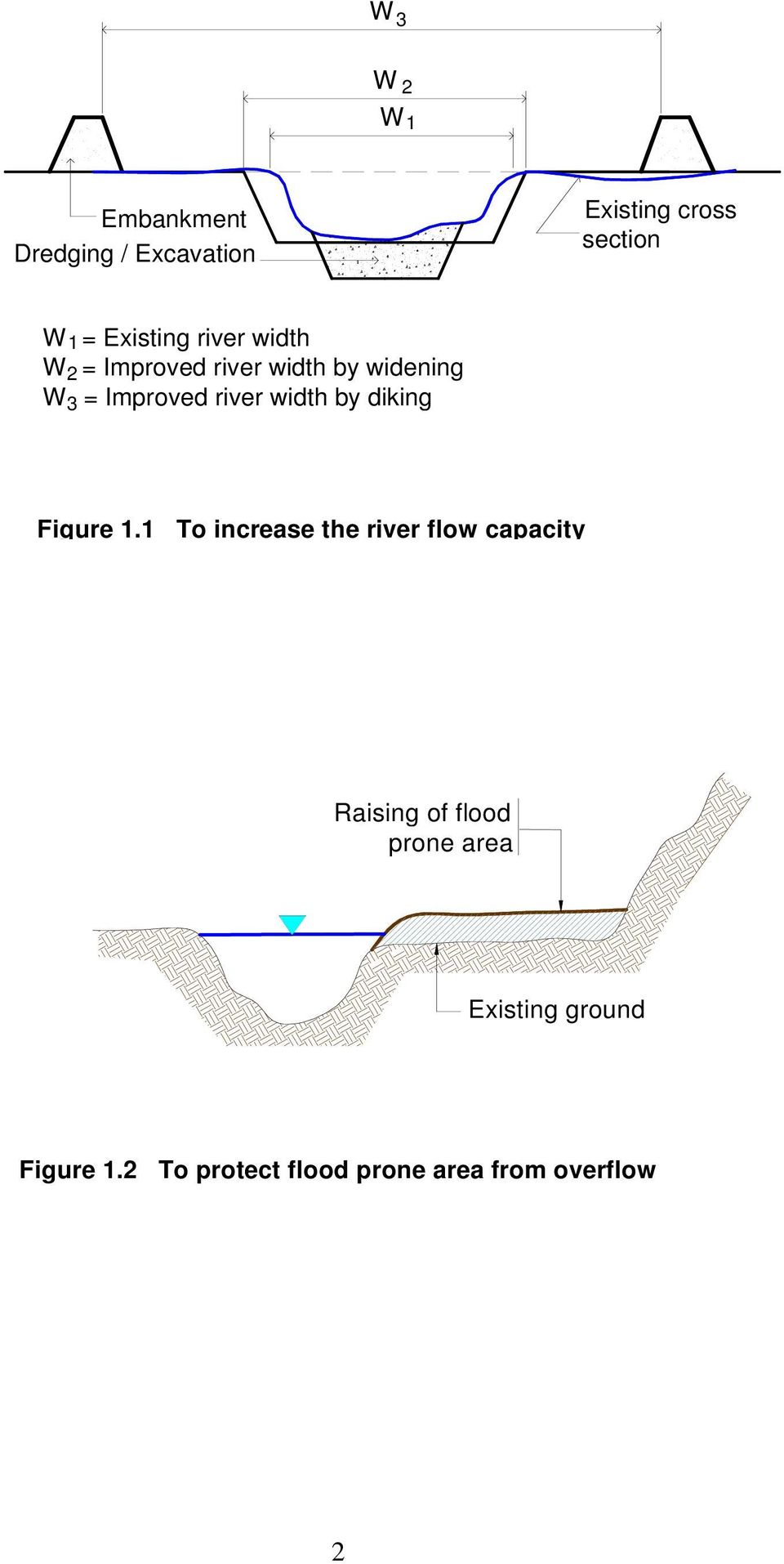
2 CHAPTER 1 GENERAL PROVISIONS 1.1 SCOPE AND APPLICATION This volume of the Technical Guidelines was formulated in order to establish uniformity in planning and designing of flood control projects. It aims to provide the engineers of DPWH involved in flood control planning and design, the essential tools to formulate effective and efficient countermeasures against floods. 1.2 CATEGORIES OF FLOOD CONTROL Flood control is divided into six (6) categories according to purpose: a. To increase the river discharge capacity a.1 To protect the flood prone area from overflow b. To reduce and/or control the peak discharge of flood c. To prevent inland flood d. To prevent bank collapse and harmful degradation of riverbed e. To prevent obstruction against river flow and/or maintain/conserve the good condition of the river in order to keep the flow uninterrupted To Increase the River Flow Capacity by dike/levee by widening of the waterway/river by dredging/excavation combination of the above 1

3 W W 3 W 2 1 Embankment Dredging / Excavation Existing cross section W 1= Existing river width W 2 = Improved river width by widening W = Improved river width by diking 3 Figure 1.1 To increase the river flow capacity Raising of flood prone area Existing ground Figure 1.2 To protect flood prone area from overflow 2
4 1.2.2 To Reduce and/or Control the Peak Discharge of Flood Flood discharge peak discharge without dam / retarding basin peak discharge with dam/retarding basin Figure 1.3 Hydrograph of reduction of peak discharge Time To Prevent Inland Flooding Floods are classified as: Overflow flood flood caused by overtopping of the riverbanks/dikes. Inland flooding flood caused by localized torrential rain which could not be drained by gravity due to the high water stage of the river. Overflow flood could be prevented by: (Refer to countermeasures mentioned in Section 1.2.1) Inland flooding could be prevented by: Lateral improvement (Ex. storm drain, drainage main, open canals, ditches, etc.) Tributary improvement (Ex. branches of main river) Pumping station 3

5 Overflow flood Inland flood Rainfall Figure 1.4 Types of Floods To Prevent Bank Collapse and Harmful Degradation of Riverbed By revetment By spur dike By change of waterway/ cut-off channel By groundsill (to prevent riverbed degradation) Spurdike : 1. To direct the river flow away from the bank 2. To reduce velocity of flow Revetment : To protect the property behind the riverbank Groundsill : To prevent riverbed degradation 4
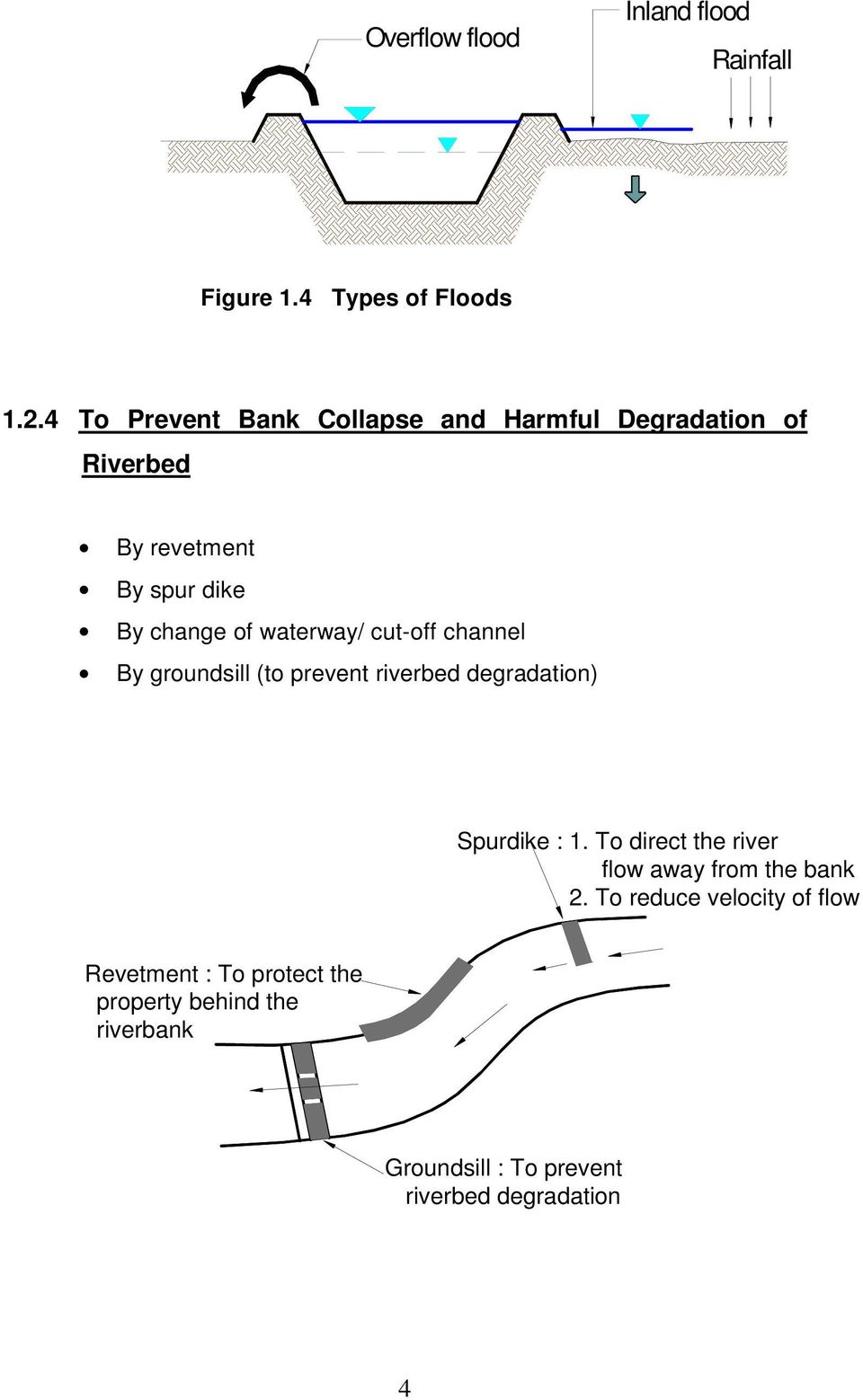
6 Figure 1.5 Countermeasures against bank collapse and harmful degradation of riverbed To Prevent Obstruction Against River Flow and/or Maintain/Conserve the Good Condition of the River in Order to Keep the Flow Uninterrupted. By sabo works (for sediment control) By regular maintenance (channel excavation/dredging) 1.3 NECESSITY OF FLOOD CONTROL PLAN Whenever the catchment area and/or flood prone area to be considered is big or very important, and when the flood safety level is not balance between upstream and downstream portions of the river, it should have a flood control plan. A Flood Control Plan should be formulated from the basin-wide view point, and requires proper coordination with the other plans such as: - Irrigation development plan, - Road network/bridge plan, - Sabo plan, - Environmental management plan. 5

7 It is necessary to consider the effect/influence of other development plans in the formulation of flood control plan. For example, the height of levee will affect the design height of bridge. Likewise, the design riverbed profile will affect the design of the irrigation intake/canal and other related facilities Design Flood Frequency Basically, all flood control projects must have a flood control plan. It is necessary to make a flood control plan based on the forecasted river phenomena which is likely to occur as a result of the discharges corresponding to the design flood frequencies. Design Flood Frequency is expressed by return period, i.e., the probability (expressed in years) where a flood of a target size/magnitude is likely to occur. The return period should be determined based on the size of catchment area, the degree of importance of the proposed project area and the economic viability of the project. Thus, it is necessary to determine the design flood discharge corresponding to the design flood frequency of the river. It is also necessary to consider the funds needed for the implementation of the proposed improvement works and the expected benefits Classification of Flood Control Plan Flood control plan is classified according to its objective: 1. Master Plan 2. Flood Control Project Implementation Plan 6

8 Master Plan The Master Plan explains the flood control policy, strategy, target flood magnitude and main works, etc. by river system. It is necessary to conduct wide range survey, investigation and analysis to formulate the flood control master plan. Since the implementation of each flood control project may affect other areas of the river basin, a long-term time frame for each of the projects identified in the Master Plan must be formulated to obtain optimum benefits of the projects. There is no need to prepare master plan for small projects as long as the appropriate design discharge for utilization in the Project Implementation Plan (see Section ) is determined. Master Plan shall include the following: 1. Project area: The project area shall describe, among others the natural condition, topography and/or its historical background. 2. Strategy of flood control/main objective: This takes into consideration which appropriate improvement has to be undertaken (i.e., widening the river, excavating the river mouth, embankment, etc). The structures shall decided based on an overall perspective of the desired flood management for the whole river basin. 3. Basin-wide rainfall-runoff model: A simulation model for the estimation of the probable flood discharge at all the control points is necessary to be developed. 4. Diagram of design discharge: It is necessary to make a diagram at the control points to determine the critical areas which are affected by high water stages to plan the necessary improvements. 5. Main works: What are the main works to be undertaken (i.e., dike, dredging, etc.). 7
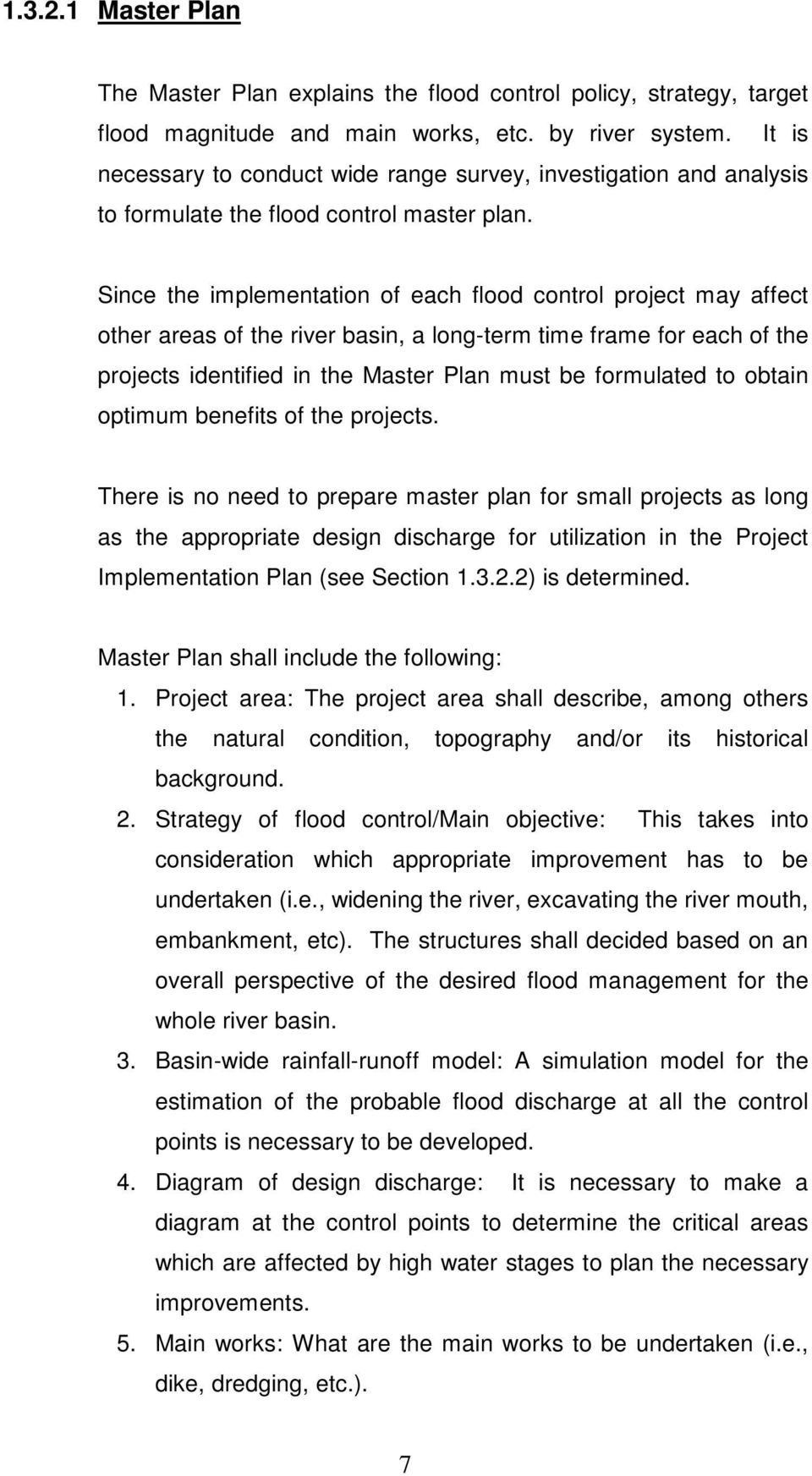
9 6. Typical cross section of the river. 7. Typical structure design (i.e., embankment/revetment, etc.). 8. Location map of main works Project Implementation Plan The Flood Control Project Implementation Plan specifies the works selected from the Master Plan to be implemented considering the funds needed in the project implementation and benefits to be derived from the project. Implementation period of this plan is usually 5 to 10 years. Economic analysis shall be conducted to determine the scope of the Project Implementation Plan (Calculation of Economic Internal Rate of Return (EIRR) is explained in Section 4.3) Flood Control Project Implementation Plan shall include the following: 1. Channel plan (1:1,000 1:10,000) 2. Cross section (Existing/Design) 3. Longitudinal profile (Existing/Design) 4. Structural design drawings 5. Cost estimates 6. Benefit estimation 7. Environment/Social Impact 8. Project Evaluation 8

10 CHAPTER 2 SURVEY AND INVESTIGATION 2.1 NECESSITY OF SURVEY AND INVESTIGATION The primary purpose of survey and investigation is to provide the basic data and information necessary for the subsequent flood control planning and design of river training structures and bank protection works. Data collection, analysis and utilization are basically important in making plan/design more appropriate. It is noted that the appropriateness of a particular plan/design rely much on the veracity and/or authenticity of available basic data and information. 2.2 MASTER PLAN Topographic Information To understand the general profile of a river system, catchment area and flood prone area, the following maps are required: 1. Topographic map with a scale of 1:50,000 or better 2. Land use map 3. Geological map 4. Other available map from the related Local Government Units In the absence of the appropriate maps for planning, aerial photography and topographic surveys should be undertaken. From the maps mentioned above, the following activities shall be conducted: 1. Delineate catchment area. (Refer to Section 3.4.1) 2. Classify the geological/geographical features of each subcatchment area. 3. Classify the existing vegetation by each sub-catchment area. 9

11 4. Identify the flood prone sites roughly. (Exact area should be identified and determined from the field investigation and water level analysis) 5. Identify the cities and municipalities in the flood prone area. 6. Identify the important public facilities such as national road, provincial road, city hall, church and school, etc. within the flood prone area. 7. Classify the land use in flood prone area, such as commercial area, residential area, industrial area, agricultural area, etc. 8. Identify the changes in the river course and longitudinal profile General Information Collect all information regarding land use, population, economic activities, future development plans, etc. within the catchment area and flood prone area. 1. Population by city / municipality 2. Increasing ratios of population by city 3. Statistics of commercial activities per year by region and city 4. Statistics of industrial product per year by region and city 5. Statistics of agricultural products per year by region and city 6. Long term and medium term development plan by region, city and municipality Hydrological Data Collect the following hydrologic data of the river basin: 1. Daily rainfall data of all gauging stations within and around the catchment area throughout the recording period from PAGASA and other related agencies. 2. Hourly rainfall data of all gauging stations within and around the catchment area during the duration of the flood. 3. Hyetographs of past typical floods on all synoptic rainfall gauging stations from PAGASA and other related agencies. 10

12 4. Data on the maximum water levels during peak floods at all water level gauging station from BRS and by interview. (For rainfall and runoff analysis). 5. Discharge measurement record for all water level gauging stations. 6. H-Q (Height-Discharge relationship) rating curve for all water level gauging stations (with location, cross-section and flow velocity during flooding time) Field Survey and Investigation Conduct field survey as follows: 1. River cross sections at typical sites. - Every 500 m to 1,000 m intervals along the stretches of river proposed for improvement (Depends on the size of the river). 2. Longitudinal profile. - Rough profile of the river to be taken from topographic map -Longitudinal profile taken from cross section survey 3. Identification of the riverbed material. -By segment features of the river Conduct field investigation and interviews to get the following information. 1. The information/records of past floods. (Frequency, area, depth, duration of flooding) 2. Conditions of the existing river facilities. 3. History of flood control activities in the basin. 11

13 2.3 PROJECT IMPLEMENTATION PLAN Topographic Survey Considerations: 1. Map with a scale of 1:500 to 1:10,000 (Depends on the size of the river) 2. All the river improvement stretch should be covered. 3. The width of survey area shall be extended at least 50m beyond both banks (The extension is necessary to determine the ground elevation of the main flood prone area.) Cross Section Survey Considerations: 1. Section with a horizontal scale of 1:500 to 1:2,000 (Depends on the size of the river) 2. Section with a vertical scale of 1:100 to 1:500 (Depends on the topographic condition) 3. Interval of cross section survey ranges from 100 m to 1,000 m. 4. The width of survey area shall be extended at least 20m beyond both banks (This shall be widen when it is necessary to know the ground elevation of main flood prone area.) 5. Interval of measurement ranges from 2m to 5m on narrow rivers and 5m to 20m on wide rivers. 12

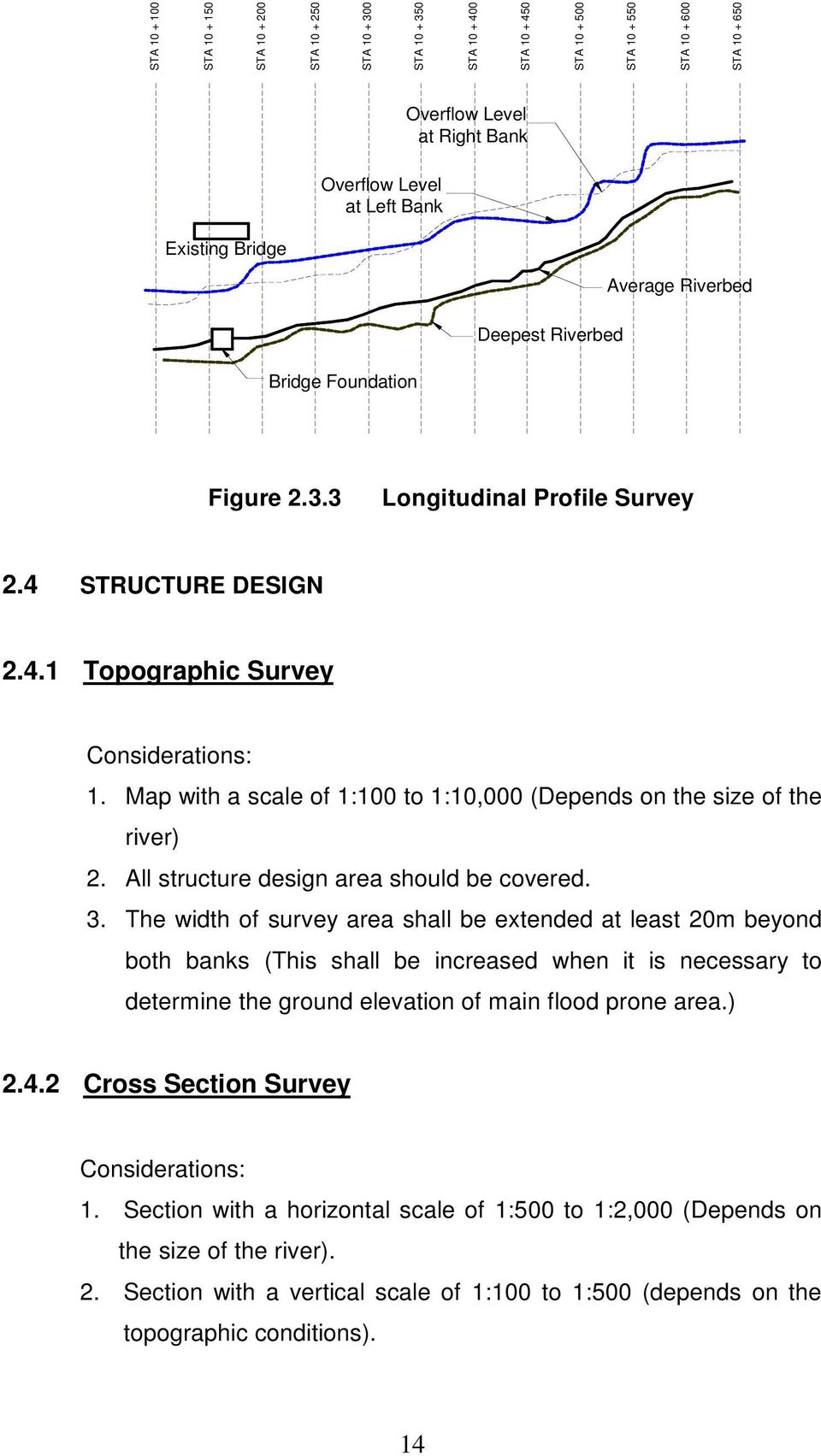
14 20 m Overflow Level at Left 20 m (min.) (min.) Overflow Level at Right Deepest Riverbed Cross - section Survey Limit Ordinary Water Level (rainy season) Average Riverbed Figure Cross section Survey (Project Implementation Plan) Other considerations: 1. The overflow level of both banks should be identified and indicated on cross section profile. 2. The water level during the time of the survey (if any), should be indicated in the survey. 3. The ordinary water level during the rainy season should be indicated. (This water level should be identified based on the interview in the absence of installed water elevation staff gauges.) 4. The deepest riverbed should be identified and indicated. 5. The average riverbed should be identified and indicated. 6. The information of land use behind the bank should be noted. 7. All elevations shall be reckoned from an established benchmark Longitudinal Profile Survey The average riverbed profile/gradient shall be utilized in plotting the longitudinal profile, wherein the gradient obtained shall be the one used in Chapter 3: Hydrologic Analysis. The stationing of cross section measurements shall be indicated in the longitudinal profile. In case, that there is an existing structure in the river (e.g.; bridge foundation/pier, groundsill, etc.), it should be indicated/superimposed in the profile. 13

15 STA STA STA STA STA STA STA STA STA STA STA STA Overflow Level at Left Bank Overflow Level at Right Bank Existing Bridge Deepest Riverbed Average Riverbed Bridge Foundation Figure Longitudinal Profile Survey 2.4 STRUCTURE DESIGN Topographic Survey Considerations: 1. Map with a scale of 1:100 to 1:10,000 (Depends on the size of the river) 2. All structure design area should be covered. 3. The width of survey area shall be extended at least 20m beyond both banks (This shall be increased when it is necessary to determine the ground elevation of main flood prone area.) Cross Section Survey Considerations: 1. Section with a horizontal scale of 1:500 to 1:2,000 (Depends on the size of the river). 2. Section with a vertical scale of 1:100 to 1:500 (depends on the topographic conditions). 14
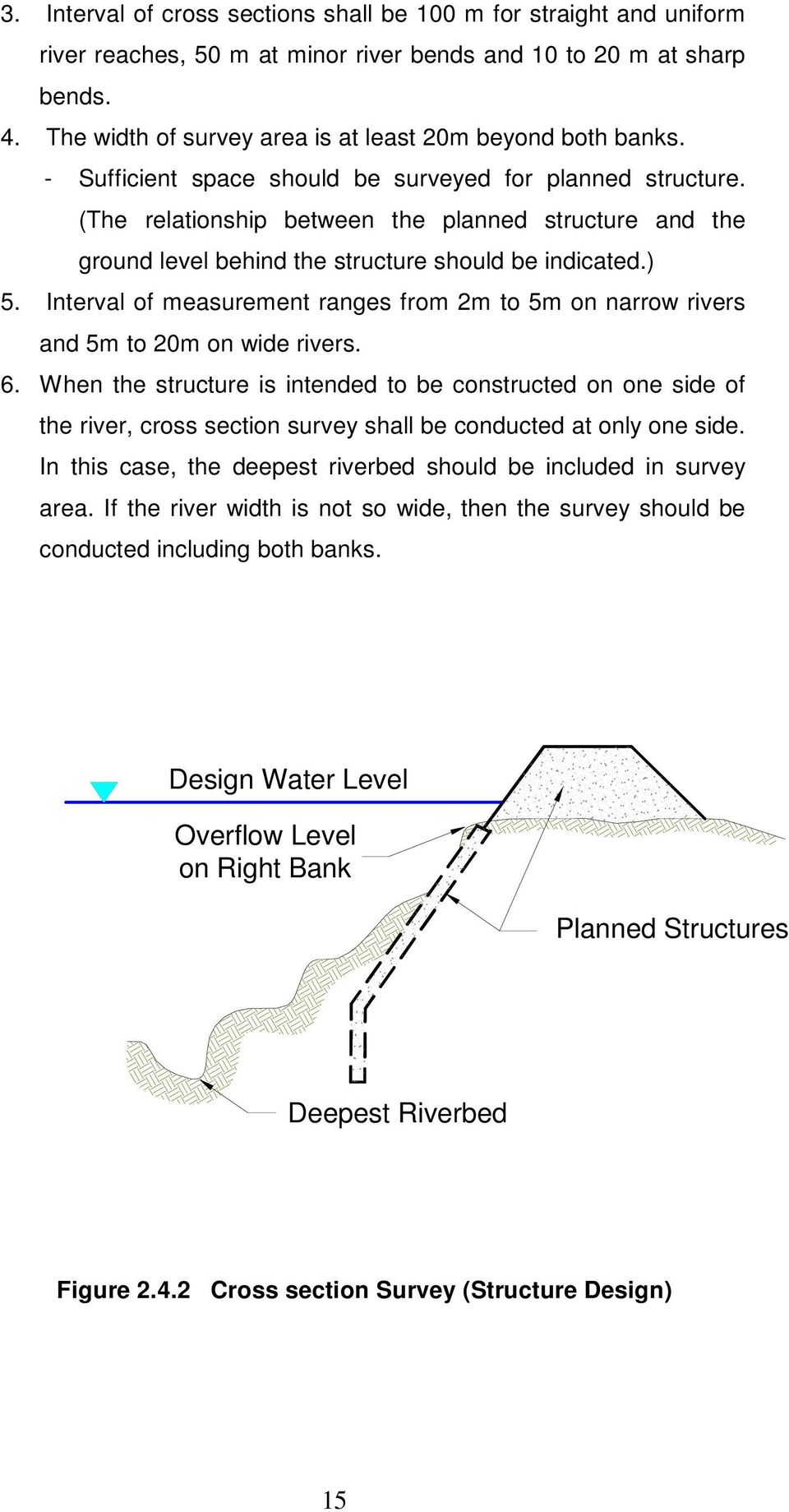
16 3. Interval of cross sections shall be 100 m for straight and uniform river reaches, 50 m at minor river bends and 10 to 20 m at sharp bends. 4. The width of survey area is at least 20m beyond both banks. - Sufficient space should be surveyed for planned structure. (The relationship between the planned structure and the ground level behind the structure should be indicated.) 5. Interval of measurement ranges from 2m to 5m on narrow rivers and 5m to 20m on wide rivers. 6. When the structure is intended to be constructed on one side of the river, cross section survey shall be conducted at only one side. In this case, the deepest riverbed should be included in survey area. If the river width is not so wide, then the survey should be conducted including both banks. Design Water Level Overflow Level on Right Bank Planned Structures Deepest Riverbed Figure Cross section Survey (Structure Design) 15
17 2.4.3 Material Survey The type of materials of riverbank and water area shall be surveyed and indicated in the topographic map and cross section profiles in order to: - Determine the riverbed characteristics (Manning s n ) - Determine the quality of riverbed materials (if suitable for construction use). - Determine the relationship of the diameter of riverbed materials, riverbed gradient, etc. with the velocity of flow. - Classify the river segment based on the river morphology. 16

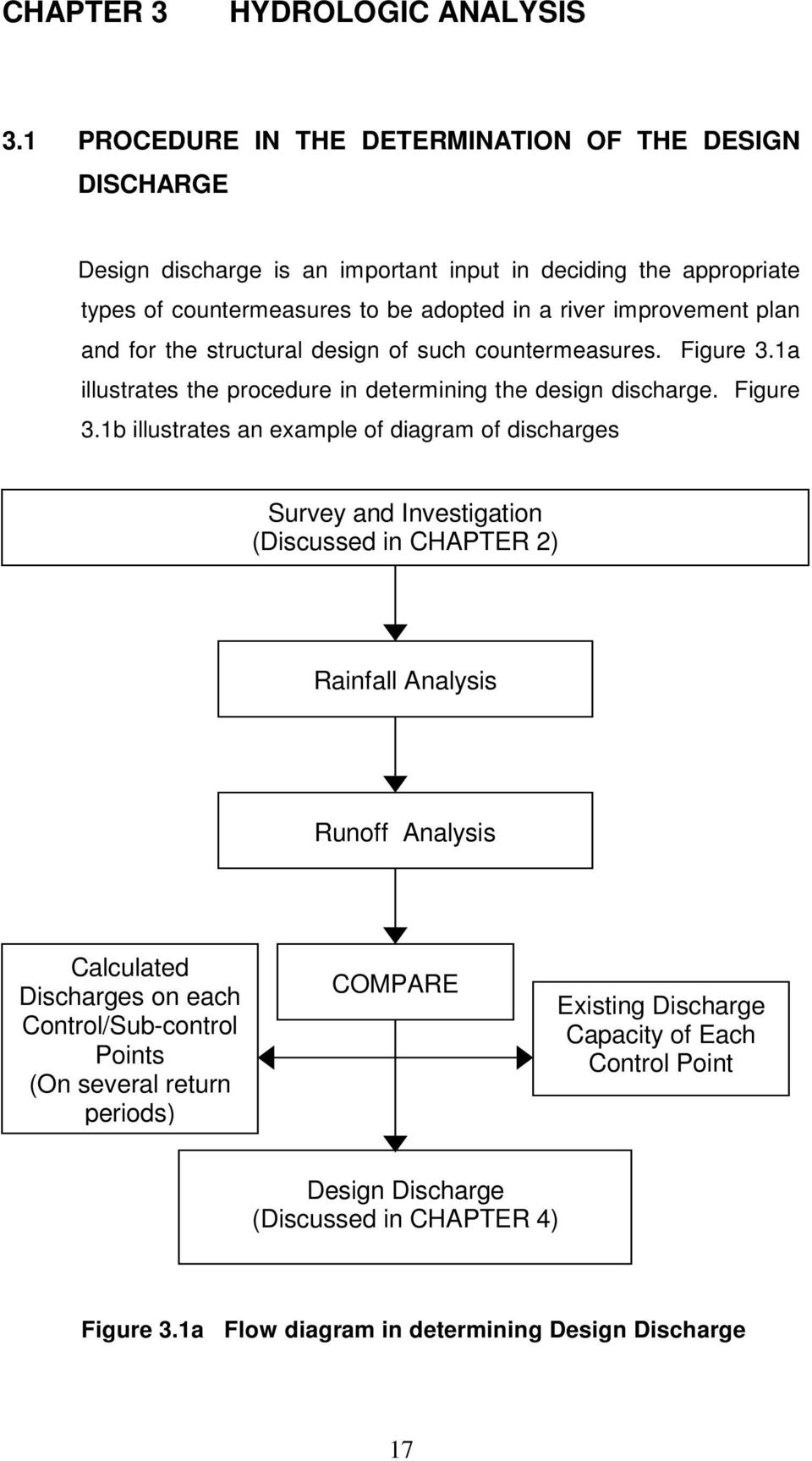
18 CHAPTER 3 HYDROLOGIC ANALYSIS 3.1 PROCEDURE IN THE DETERMINATION OF THE DESIGN DISCHARGE Design discharge is an important input in deciding the appropriate types of countermeasures to be adopted in a river improvement plan and for the structural design of such countermeasures. Figure 3.1a illustrates the procedure in determining the design discharge. Figure 3.1b illustrates an example of diagram of discharges Survey and Investigation (Discussed in CHAPTER 2) Rainfall Analysis Runoff Analysis Calculated Discharges on each Control/Sub-control Points (On several return periods) COMPARE Existing Discharge Capacity of Each Control Point Design Discharge (Discussed in CHAPTER 4) Figure 3.1a Flow diagram in determining Design Discharge 17
19 Main Control Sub-Control Point Point 3 1 <6000> <4500> <3000> (4000) (3000) (1800) 2 Sub - Control Point <Q> = Long-term target discharge Q = Design discharge (Q) = Existing discharge capacity Figure 3.1b Diagram of Discharges (Example) Notes: 1. Calculated discharge is the discharge for a particular return period. 2. Long-term target discharge is determined based on the degree of importance of the river (e.g.; major city is located near the river, or only paddy fields, less important areas, etc.) and defined by its return period. 3. Design discharge is the improved river capacity (target level capacity) 4. It is noted that if the design discharge Q has to be adopted, all the control points has a shortage of capacity, thereby requiring any of the following countermeasures or a combination thereof; Dam Retarding basin Embankment Widening Etc. 18

20 Based on the above parameters, it is necessary to make a rough estimation of cost based on an attainable budget appropriation. If the estimated cost is not economically viable, then the design discharge is reduced in order to meet the project economic viability. 3.2 POINT OF VIEW ON RUNOFF ANALYSIS In planning a river for improvement, it is necessary to set the design discharge (targeted volume of flood flow). Basically, if the design discharge is not determined, it is difficult to determine the required width of the river, height of dike, volume of dredging, depth and length of revetment, etc. Ideally, calculated discharges are obtained based on runoff analysis using available rainfall data. But, in cases where there are sufficient past annual maximum flood data on the project site, it will be more convenient to analyze these flood data compared with rainfall data. For example, there are available annual maximum flood discharge data in a 30-year period, the largest among these data is approximately the flood discharge for a 30-year to 60-year return period. In cases where there are already project studies of the area/site, a review is needed to determine the applicability of data in the study, particularly the design discharge and other relevant data. In actual situation, however, it is almost impossible to determine the flood discharge data at each project site in a considerable number of years, say 30 years, even if there were water level gauging stations because, if the flood discharge is greater than the existing river capacity, flood water will overflow and therefore it is very hard to establish the cross section (wetted perimeter) needed for calculating the flood discharge. In other words, it is very difficult to estimate the flood discharge based from the water level data. 19

21 3.3 ESTABLISHMENT OF CONTROL/SUB-CONTROL POINTS Control points are locations where design discharges are set/fixed and are usually strategically placed at locations where it is easy to collect the data (e.g., observer s house is near, place is easily accessible, etc.) and importance of the adjacent area. Establishment of control points is done to provide sufficient hydraulic data as base points for hydraulic and hydrologic analyses. In cases where the catchment area is larger than 100 km 2, it is advisable to set-up sub-control points in the main stream and its tributaries. When there are no water level gauges present/installed at the control point, a gauge must be placed in order to verify the output of the runoff model to be discussed in Section RAINFALL ANALYSIS Rainfall data will be the basis of determining the return-period of flood, as these are the only readily available data compared with discharge. For catchment areas below 20 km 2, a Rainfall Intensity Duration Frequency Curve (see reference A-1) shall be utilized in calculating the discharge using the Rational Formula Method. In cases where there are no available rainfall data, the RIDF Curve may be utilized in calculating the discharge for catchment areas up to 100 km 2 using the Rational Formula. For catchment areas greater than 20 km 2, the following procedure shall be followed: 1. Delineation of catchment area 2. Calculate average rainfall in catchment area 20
22 3. Calculate annual maximum average rainfall (2-day, 3-day, etc.) 4. Calculate average rainfall by selected return periods 5. Collect typical rainfall patterns (hyetographs) of past major floods and establish typical rainfall accumulation mass curve for each duration. 6. Generate hyetograph for each duration and return period. Note : Items 5 and 6 are utilized in the Storage Function Method in determining runoff Delineation of Catchment Area Using the latest edition of topographic map with a scale of 1:50,000 prepared by the National Mapping and Resource Information Administration (NAMRIA), calculate the catchment area by the use of a planimeter or by triangulation method Average Rainfall in Catchment Area There are three (3) methods of determining the average rainfall in catchment area presented in this Volume i.e.: a) Arithmetic-Mean Method, b) Thiessen Method and c) Isohyetal Method. a) Arithmetic-Mean Method This is the simplest method in determining areal average rainfall. It involves averaging the rainfall depths recorded at a number of gages. This method is satisfactory if the precipitation is almost uniformly distributed within the catchment area. 21
23 P1 P2 Station P2 Observed rainfall within the catchment area (mm) 30.0 P P3 P4 P Average Rainfall = / 3 = 40.0 mm Figure 3.4.2a Arithmetic-Mean Method (Example) b) Thiessen Method This method assumes that at any point in the catchment area, the rainfall is the same as that of the nearest rainfall gage so, the value recorded at a given rainfall gage can be applied to a distance halfway to the next station in any direction. The relative weights for each gage are determined from the corresponding areas of application in a Thiessen polygon network, the boundaries of the polygons being formed by the perpendicular bisectors of the lines joining adjacent gages P 2 90 P P 4 0 P 3 Station Observed Rainfall (mm) Weighted Area 2 (km ) Rainfall (mm) P P 2 P P Total Average Rainfall = / 21.0 = 40.0 mm Figure 3.4.2b Thiessen Method (Example) 22
24
25 Subdivision of catchment areas shall be done considering the following: 1. It should be done or reflected on a NAMRIA Map with scale of 1:50, Inland flood area must be separately measured to reflect the flood retarding effect to the downstream for development of flood run-off model. 3. If a dam is planned, delineation of catchment of the proposed site must be done Annual Maximum Average Rainfall (2-day, 3-day, etc.) In order to determine the annual maximum average rainfall (2-day, 3- day, etc.), rainfall data records at PAGASA or other government/nongovernment institutions and private firms where such data is available, shall be collected. Preferably, the data should be for a period of fifteen (15) years or more. Design rainfall duration should be determined based on the observed lag-time between the peak rainfall and peak flood. If the lag-time is within one (1) day, hourly rainfall distribution should be developed based on annual maximum one (1) day rainfall. If lag-time is more than four (4) days, design rainfall duration should be more than four (4) days. Lag-time between peak rainfall and peak flood reflects the basin capacity for floodwater storage. Year Dates of Occurrence Maximum Annual 2-day Rainfall Amount (mm) 1985 September 2 & August 14 & October 4 & September 16& Figure Table of Maximum Annual 2-day Rainfall Amount (Example) 24
26 As shown in the Figure 3.4.3, 510 mm is the maximum annual 2-day rainfall amount recorded during the 15 year period. The 510 mm amount of rainfall for 2 days is therefore for a 15-year return period. For the next higher maximum annual value, it is for a 14-year return period and so on Average Rainfall by Return Period As explained in Section 3.2, return-period of rainfall depends on the available amount of data for a period of years. Rough estimation of hydrological quantities, such as average rainfall by return period may be done using probability paper. First, data of available annual maximum rainfall (2-day, 3-day, etc.) is gathered and arranged from the highest to the lowest value, with the highest value having an order of 1 (n = 1) and 2 (n = 2) for the next highest value, and so on, up to the number of data. The data are then plotted using a probability paper with plotting positions determined/calculated using the Weibull or Hazen plots. But since the amount obtained using the Weibull plot is higher than that of the Hazen plot in the upper range of the distribution, it is deemed better to estimate the design rainfall using the Weibull plot Probability of nonexceedence, (F %) (Rejected data) Probability of nonexceedence, (F%) N = 50 (Weibull Plot) Rainfall depth (mm) 1000 Figure Plot of Average Rainfall (Example) 25
27 Weibull Plot: F(x n ) = n (N+1) where : F(x n ) : probability of non-exceedance N : number of data n : order from the highest value (1, 2, 3. N) x n : rainfall of order n In order to determine the amount of rainfall for a higher return period than the available years of data, it is necessary to plot a particular number of available annual maximum rainfall data which is at least one-half the target return period (e.g., to get the design rainfall for a 100yr. return period, there should be at least available annual maximum rainfall data for 50 years). To approximate the value of the return-period, a line is manually drawn based on the plotted points and extended to the upper range of the distribution, as shown in Figure Thus, a relationship between the probability of non-exceedance/return period and the approximate design rainfall could be established Typical Rainfall Patterns of Past Major Floods Considering the wide variety of rainfall patterns causing flood, rainfall patterns (hyetograph) of past major floods should be extracted for reference in simulating the average rainfall selected in Section
28 July 30 July 31 (1985) Annual Maximum 2 - Day Rainfall amount = 510 mm (Sample from Section 3.4.3) Aug. 3 Aug. 4 (1989) 2 - Day Rainfall amount = 350 mm (RAINFALL PATTERN NO.1) Figure Rainfall Pattern of Past Major Floods (Example) 27
29 3.4.6 Modification of Typical Rainfall Patterns Based on Return Period Modify the typical rainfall patterns selected in Section by proportionally increasing the rainfall amount to that selected in Section About 3 to 5 cases may suffice to arrive at the most critical rainfall pattern to be used as input for the Storage Function Method. For example, Rainfall Pattern No. 1 (2-day rainfall amount of 350 mm) is modified by multiplying each hourly rainfall by the ratio of the average rainfall selected in Section (510 mm) and that of Rainfall Pattern No. 1, i.e., hourly rainfall of Rainfall Pattern No. 1 multiplied by the ratio 510 mm/ 350 mm (see Figure 3-6). Aug. 3 Aug. 4 (1989) Modified Rainfall Pattern No.1= 510 mm Hourly Data No. 1 X 510/350 Figure Modified Rainfall Pattern (Example) 3.5 RUNOFF ANALYSIS Runoff analysis is important in managing rivers effectively thru appropriate planning of flood control facilities/structures and discharge control, particularly the construction of dams and retarding basins. 28
30 This analysis aims to establish the relationship of the amount of rainfall with the discharge in rivers. Presently, there are many methods for runoff analysis already developed/being developed. Methods of runoff analysis introduced in this Volume are the following: 1. Rational Formula 2. Unit Hydrograph Method 3. Storage Function Method Rational Formula The Rational Formula Method is a convenient method for estimating the peak discharge of flood. It is widely utilized in rivers for which there is no need to consider the storage phenomena. This method considers the shape of catchment as rectangle which is symmetrical about the river course and considers that rainwater flows down the slope of the catchment at a constant speed towards the river course. Maximum flood discharge is given by the following rational formula: Q p = cia 3.6 where: Where, Q p = maximum flood discharge (m 3 /s) c = dimensionless runoff coefficient i = rainfall intensity within the time of flood concentration ( mm / h ) A = catchment area (km 2 ) The Rational Formula Method is applicable to a catchment area smaller than 20 km 2. 29
31 CHARACTERISTICS Lawn, gardens meadows and cultivated lands Parks, open spaces including unpaved surfaces and vacant lots Suburban districts with few building Residential districts not densely built Residential districts densely built For watershed having steep gullies and not heavily timbered For watershed having moderate slope, cultivated and heavily timbered For suburban areas For agricultural areas COEFFICIENT OF RUNOFF Source: Design Guidelines Criteria and Standards, Volume I, MPWH, 1987 CHARACTERISTICS Dense urban area General urban area Farm land and field Paddy field Mountainous land COEFFICIENT OF RUNOFF Source: Manual for River Works in Japan, Planning, River Bureau, Ministry of Construction Table Coefficients of Runoff 30
32 3.5.2 Unit Hydrograph Method The Unit Hydrograph Method uses the following assumptions: a. Duration of direct runoff is in direct proportion to the intensity of rainfalls with equal duration is constant, irrespective of the intensity of that rainfall. In other words, the base length is constant. b. Volume of direct runoff is in direct proportion to the intensity of rainfall. c. Volume of runoff is to be determined by adding together the run-off components of each rainfall. Main point of this method is that the discharge curve at a certain point of a river by the unit effective rainfall which had fallen in a unit time has always the same form. The discharge curve obtained at that time is called the Unit Hydrograph Storage Function Method The Storage Function Method represents the relation between storage and runoff in a river basin or river channel through the use of a storage function. This method assumes that there is a unique functional relation between the volume of storage and runoff. The relationship between storage and runoff/discharge based on this method is expressed with the following equation of motion: S = k x Q p where: S = Storage Q = Runoff/Discharge k, p = Constants 31
33 Runoff calculations are performed using the above equation in combination with the following equation of continuity: ds1 = 1 x f x r ave x A - Q l (t) dt 3.6 where: f = inflow coefficient r ave = average rainfall in basin (mm/hr) A = area of basin (km 2 ) Q l (t) = Q(t + T l ) = volume of runoff considering lag time (T l ) and excluding baseflow (m 3 /s) S = apparent volume of storage in basin (m 3 /s) T l = lag time (hr) 3.6 EXISTING DISCHARGE CAPACITY There are two methods in calculating the existing discharge capacity according to the types of flow and river condition. a. Uniform Flow Calculation b. Non-uniform Flow Calculation Uniform Flow Calculation Uniform flow calculation is applicable for rivers with the following conditions: a. When there are no points of abrupt change of riverbed gradients. b. When there are no structures/obstruction that impede the flow discharge. c. When the cross sectional area of the river is almost the same longitudinally. d. When there is relatively long straight river reach. 32
34 There are many velocity formulae, but generally, Manning s Equation, as the average velocity formula, is the most appropriate because it suites the characteristics of rivers (velocity, roughness coefficient, hydraulic mean depth) which is easy to use and convenient as a calculation formula. Manning s Equation V = 1 x R 2/3 x S ½ (m/s) n or Q c = 1 x A x R 2/3 x S ½ (m 3 /s) n where: where: Q c = Existing discharge capacity (m 3 /s) V = Average river velocity (m/s) A = Average river cross-sectional area (m 2 ) R = Hydraulic radius (m) = Average river cross-sectional area (m 2 ) wetted perimeter (m) S = Riverbed gradient n = Manning s coefficient of roughness Manning s coefficient of roughness (n) shall be determined with emphasis on the analysis of experienced floods: Provided that, when the data of experienced floods are few or when the data are not so accurate. Table shows the recommended values of n. General waterway: Rapid river of wide and shallow river: Temporary waterway excavated without timbering: Three-sided lined channel: River tunnel: Table Manning s Coefficient of Roughness Non-uniform Flow Calculation When analyzing the current with the discharge changing with time, the unsteady flow calculations are used, but other currents are mostly considered to be non-uniform flow. 33
35 For making non-uniform flow calculations, it is required to investigate the characteristics of river sections. In addition, it is required to check the location of water level controlling facilities such as weirs and groundsills and also to know whether a control section may occur at points where the riverbed gradient or section changes suddenly. The boundary condition for non-uniform flow calculations is the water level at the downstream end (sea level at river mouth, water level from the rating curve, water level of control section, etc.) for subcritical flow and the water level at upstream section for supercritical flow. For numerically calculating the water level of sub critical flow by nonuniform flow calculations, the following formulae of standard successive calculations should be used for single cross sections: Energy equation: he = { H 2 + 1/2g (Q 2 /A 2 ) 2 }- { H 1 + 1/2g (Q 1 /A 1 ) 2 } Energy loss: he = 1 ( n 2 1 Q 2 1 /(A 2 1 R 4/3 1 ) + 2 n 2 2 Q 2 2 /(A 2 2 R 2 4/3 )) x where, the subscript 1 is for the known hydraulic quantity of downstream sections, subscript 2 is for the unknown hydraulic quantity at upstream section, and Q 2 and n 2 are known. Various methods of numerical solutions are available for non-uniform flow, but the standard successive calculating method can be the most easily used when the sections change as in the case of rivers. The above formulae can also be applied when the discharge varies between sections. Today numerical calculations of non-uniform flow can be performed using computer softwares. 34
36 CHAPTER 4 FLOOD CONTROL PLANNING 4.1 DETERMINATION OF DESIGN DISCHARGE Ideal Determination Procedure The ideal procedure in determining the design discharge is as follows: 1. Determine the safety level (Flood frequency). 2. Calculate the discharges corresponding to the flood frequency level. The output of this calculation is the target flood discharge of flood control. This target hydrograph is called Design Hydrograph and the peak of Design Hydrograph is called Design Discharge. This is defined as the Long Term Target Discharge in this sub-section. 3. Calculate the existing river flow capacities. 4. Discuss the alternative plans of discharge allotment The Long Term Target Discharge = (Increased river flow capacity) + (Peak cut off by dam and/or retarding basin). If the river flow capacity can be increased, the number of dam and/or its storage capacity can be reduced. 5. Estimate the rough cost of each alternative plan. 6. Determine the most appropriate plan Actual Determination Procedure The procedure mentioned in is for the formulation of a longterm flood control plan. It is very difficult and time consuming to construct so many dams for flood control purposes. So it should be considered to increase the river flow capacity as much as possible at first and what frequency of its capacity can be secured should be understood. If the improved river s capacity is still inadequate, it 35
37 means that the possibility of over flow is high, so, structures have to be designed based on over flow frequencies in that case. The target discharge of river flow capacity of improved river is defined as the Design Discharge. Ideal situation requires that the design discharge have to be planned and the amount of shortage from the Long Term Target Discharge have to be allocated to the peak cut of dams/retarding basin/flood diversion channel. Although the discharges corresponding to several frequency levels can be calculated and the Long Term Target Discharge is determined, it is unnecessary to plan the actual peak cut plan. Initially, the design discharge should be assessed considering the existing discharge capacity of each river, since the frequency levels of target flood for each river are different. The procedure of determination of design discharge is as follows: 1. Calculate the discharges corresponding to several flood frequency levels. 2. Calculate the existing river flow capacities on several control points, as explained in Section 3.6, Existing River Flow Capacity. 3. Investigate the flood damages caused by past major floods and develop the relationship between flood discharge and flood damage. 4. Discuss the possibilities of river improvement. 5. Determine the preliminary river improvement plan. 6. Evaluate the cost to be incurred in the preliminary river improvement plan. If the preliminary river improvement planning is not realistic, back again to Determine the most appropriate plan. 36
38 Existing River Improvement Case Capacity (By Widening) Dam Cut Long Term Target (m 3 /s) (m 3 /s) (m 3 /s) Discharge (m 3 /s) I 2, ,000 5,000 II 2,000 1,500 1,500 5,000 III 2,000 2,000 1,000 5,000 IV 2,000 3, ,000 Figure 4.1.2a Long Term Target Discharge (Example) 2, , , ,000 4 Legend : 1 = 2,000 2 = 3,500 3 = 4,000 4 = 5,000 3 m / s 3 m / s 3 m / s m 3/ s Figure 4.1.2b Improved River Capacity by Widening (Example) 37
39 COST I II III IV Figure 4.1.2c Comparative Cost Analysis of Improvement Legend: Improvement by Dam Improvement by Widening Case I = Improvement by Widening only Cases II & III = Improvement thru a combination of Widening and Dam Case IV = Improvement by Dam only Compare which case is efficient, effective and economically viable. Adopt an alternative that satisfies the 3E s Determination of Design Hydrograph In case of calculation of discharge by Storage Function Method, the target typical rainfall pattern should be selected Section 3.4.5, Typical Rainfall Patterns of Past Major Floods. The several cases of discharge shall be calculated for above typical rainfall patterns. Even if the input of rainfall on calculation is same, but the rainfall pattern is different, the peak discharge will also differ. If the flood control plan should be discussed on most safety level, the biggest output of calculation should be automatically the design discharge. The design hydrograph should be carefully selected from the above-calculated 38
40 discharges since the maximum output may be sometimes extraordinary Calculated Discharges by Design Flood Frequencies In the design hydrograph is determined. As a preparation in determining the design discharge, several discharges must be calculated for comparison with the existing discharge capacity. The discharge shall be calculated at each control point and tributaries based on several return periods. (Refer to Section Typical Rainfall Patterns of Past Major Flood) Upon the determination of the run off model in Section 3.5 Runoff Analysis, the calculation shall be automatically done by inputting several rainfalls on each return period. Control Return Period Points 1/1 1/5 1/10 1/20 1/30 1/50 1/70 C.P.-1 4,000 4,500 5,000 5,300 5,500 5,800 6,000 C.P-2 3,600 4,100 4,600 4,900 5,100 5,400 5,600 Tributary-A C.P-3 3,300 3,750 4,200 4,500 4,600 4,900 5,050 Tributary-B ,100 1,200 1,300 1,400 1,500 C.P.-4 2,800 3,100 3,400 3,600 3,700 3,900 4,000 Figure Calculated Discharges (Example) Discharge of Tributaries The results of the discharge calculations for tributaries differ for each rainfall patterns. It should be noted that rainfall is sometimes unevenly distributed. It is therefore necessary to consider the most reasonable design discharge based on the output of calculation. 39
41 However, in the absence of gauging stations, i.e., one station only is available, the same output may be used for calculating the design discharge. On the other hand, if the flood prone area affected by the tributary is very important, an individual tributary calculation should be made. The safety level of tributary is usually smaller than the main river because the catchment area of the tributary is smaller than that of the main river. The design discharge of tributary is determined in comparison to several outputs of all basin wide run off analysis and the individual calculation of tributary run off analysis Relation Between the Discharges of Main Rivers and Tributaries Peak discharge of the main river and its tributary usually do not occur at the same time. In other words, the peak discharge of tributary and the main river occur at different times. 4,000 Discharge Time 3, ,000 3,500 Figure Relation Between the Discharges of Main River and Tributaries (Example) 40
42 4.1.7 Preliminary River Improvement Plan Identify the most important flood prone area, then, verify/confirm the existing flow capacity (discharge). The preliminary flood frequency level shall be determined and the river improvement plan should be discussed based on Chapter 5 River Improvement Planning. Therefore, the most important thing is to consider whether it is possible to realize the project, (e.g., land acquisition for new river width). Important points to be considered in the plan are the following: 1. Purpose of river improvement. 2. Degree of importance of the area to be protected. 3. Location of the area to be protected. So the real flood frequency and past flood damage have to be investigated. The preliminary river alignment shall be determined, which is the alignment of new banks (dikes) and preliminary design flood level shall also be determined. Basically, flood frequency of improved river should be the same level in all river system, but the flood prone area is sometimes divided and it is sometimes unnecessary to improve small flood prone areas. In special cases, only the flood frequency level on the important flood prone area should be fixed at higher (safer) frequency level Evaluation of the Preliminary River Improvement Plan For the preliminary river improvement plan, the cost-benefit analysis shall be conducted. At this time, the cost of project is estimated very roughly using the unit price of land acquisition, embankment and revetment, etc. If the subject river is very long and wide, the plan may be divided to several phases. (The method of cost-benefit analysis is mentioned in Section 4.3, Economic Analysis ). 41
43 4.1.9 Design Discharge The design discharges shall be decided based on the results of evaluation of the preliminary improvement plan. If the width of river and/or the height of dike should be changed, all the plans for the river system should be reconsidered based on the effect on both upstream and downstream reaches. Finally, the design discharges on several control points, river alignment (bank alignment), longitudinal plan (design water level), cross-sectional plan, main structure shall be determined. 4.2 ASSESSMENT OF DESIGN DISCHARGE BY SPECIFIC DISCHARGE CHART The Specific Discharge Chart explains the relationship between the flood peak discharge per unit catchment area (m 3 /s/km 2 ), otherwise called as the unit discharge (ordinate), and size of catchment (abscissa). Based on this chart, the reliability of the determined design discharge can be easily assessed by comparing it with other design discharges. Using this Chart, design discharge is roughly determined without any runoff analysis. This chart is used to assess the peak discharge in a relatively same size of catchment area. For example, the existing flow capacity was calculated, when it is intended to know the degree of capacity, this chart provides the range of unit discharge of other rivers and make it easy to know the level relatively. This method is based on the concept that the flood peak discharge per unit catchment area for small rivers is comparatively larger than that of the bigger rivers. 42
44 The reason for such concept is that the effective rainfall per unit catchment area on a small river is larger compared to a large river where the rainfall intensity is not uniformly distributed and/or occurs simultaneously throughout the entire river basin. Also, the critical rainfall duration of target flood is different corresponding to the river size (catchment area). Generally the critical rainfall duration for small rivers is shorter compared with the one for large rivers. It means that the rainfall per unit time that generates flood for small rivers is larger than the one of large rivers. In using this method, the existing flow capacity (determined thru the uniform or non-uniform flow analysis) per unit catchment area is plotted on the Specific Discharge Chart to compare with the plotted specific discharge on the same catchment area in order to determine the needed improvements on the subject river (Note: If flood control dam or retarding basin is existing in the upstream, the Unit Discharge of design discharge is indicated smaller. In this case, it is inappropriate to compare it with other rivers). In addition to the above explanation, the percentage of urbanized area within the catchment area is also an important factor in assessing the flood peak discharge per unit catchment area. In case there are two (2) catchment areas with the same size, the one with the higher percentage of urbanized area will most likely have a higher flood peak discharge than the other. 43
45 4.3 ECONOMIC ANALYSIS The projects under the DPWH area of responsibility shall be subjected to economic evaluation to determine their viability and justify their implementation and inclusion under the DPWH Infrastructure Program. The proposed projects shall pass the following criteria to be judged if it is economically feasible: a) The Net Present Value NPV should be at least nil; b) The Benefit-Cost Ratio B/C should be at least one; c) The Internal Rate of Return IRR should be at least 15% The NPV, B/C, IRR are economic indicators estimated by comparing the present value of benefits against the present value of project economic cost discounted at 15% discount factor within the economic life span of the project. NPV = (Present Value of Benefits)-(Present Value of Cost) B/C = (Present Value of Benefits)/(Present Value of Cost) IRR = Discount Rate that will make the Present Value of Benefits equal to Present Value of Cost Evaluation of Flood Control Projects Flood control projects for wide range area with increasing target flood frequency level are evaluated by estimating the reduction in damages brought about by the project as benefits and comparing it against the economic cost including maintenance cost of the project considering the implementation period and economic life of the project. 44
46 Small-scale flood control projects, especially projects for preventing bank collapse (erosion and scouring) and harmful degradation of riverbed are fundamental flood protection works. In this case, Economic Analysis is not necessary. a. Project Benefits Project benefits are estimated as the reduction of damages that will result with the construction of flood control facilities. There are two classifications of damages that can be considered for flood control projects: 1. Flooding Damages Flooding damages consist of direct and indirect damages. - Direct damages within the flood prone area are estimated from damageable value of properties multiplied by damage ratio depending on the flooding condition. Damageable value of properties can be estimated as the unit assed value of properties by land classification (i.e. residential, commercial, agricultural) multiplied by the corresponding area, damage to infrastructure can be assumed as 50% of the damage to residential or commercial area. - Indirect damages including income loss and emergency costs due to flooding can be estimated as 5 to 50% of the total direct cost, which depends on the condition of flood prone area. 45
47 AFD = ( (RA x AVRA + CIA x AVCIA) x AA x AVAA) x 1.05 Where: AFD : Annual Flood Damages RA : Residential Area CIA : Commercial/Industrial Area AA : Agricultural Area AVRA : Assessed Value of damageable property within RA AVCIA : Assessed Value of damageable property within CIA AVAA : Assessed Value of damageable property within AA Reduction on flooding damages is estimated as a certain percentage of annual flooding damages depending on the design period of facilities. Benefit = AFD x (% of reduction of flooding due to the project) Among the facilities that can be considered under this category are flood control dam, dike/levee/embankment, retarding basin, cut-off/diversion channel, deepening/widening/dredging works. 2. Bank Erosion Damages There are two types of bank erosion damages: a) due to continuous bank erosion and b) due to river course change. - Continuous bank erosion damages are assumed to be the assessed value of damageable area based on the bank erosion rate. - Damages to river course change are assumed to be the assessed value of properties within the areas enclosed by the existing and possible river course. 46
48 Benefits on bank erosion damages is estimated as the assessed value of properties within the area being threatened. ABED = TAVP/PL where : ABED : Annual Bank Erosion Damages TAVP : Total Assessed Value of Property within the threatened area PL : Project Life Among the facilities that can be considered under this category are revetment, spur dike, cut-off channel, re-channeling, groundsill, etc. Intangible Damages Other than the flooding and bank erosion damages, there are intangible damages which badly affect the people s social life and economic activities such as: - damages to people s livelihood - damages to traffic and transportation - damages to business activities - loss of lives and injuries Development Benefit If regional economic activities are expected to be developed due to the flood control project, the development benefit can be considered as a benefit of the project. For example, the un-used swamp area can be changed to farmland after the construction of the flood control project, the amount of products from the swampland can be considered as flood control benefit. Also, if dike road is expected to be constructed, the benefit of the road (i.e. saving of fuel and transportation cost) can be counted as the benefit. 47
49 b. Economic Cost The economic cost, which is used for comparative studies and evaluation of project from economic viewpoint of the project, can be estimated as 86% of the financial cost. Where, the 14% reduction covers taxes, profits and other indirect costs. The cost of Right-of-Way will not be included in the economic cost. c. Economic Life of the Project The economic life of flood control facilities is assumed to be 50 years. 48
50 SAMPLE EVALUATION OF FLOOD CONTROL PROJECT Project Category: Flood Control Project Cost: P 500,000,000 Type of Facilities: Dike - - flood control Revetment - bank erosion control Flood Prone Area: Land Use Area Damageable Property Classification (km 2 ) (P/km 2 ) 1. Agriculture 50 2,000, Residential 3 5,000, Commercial 1 10,000,000 Properties Threatened by Bank Erosion: Type of Facility Quantity Unit Assessed Value (Pesos/Unit) 1. Buildings 50 units 500,000/unit 2. Road 500 meters 12 m/km 3. Movables 100,000/bldg. 4. Land 10,000 sq.m. 2,000/sq.m. Design Period: 25-year flood (assumed to be equivalent to 80% flood reduction) Implementation Period: 3 years of equal fund disbursement Computation: Benefits AFD = (AVRA + CIA x AVCIA) AA x AVAA) x 1.05 = ((3 x 5,000, x 10,000,000) x 2,000,000) x 1.05 = P 144,375,000 ABED = TAVP/PL = ((50 x 500,000) + (500/1,000) x 12,000,000) + (50 x 100,000 +2,000 x 10,000))/50 = P 1,120,000 TOTAL Annual Benefits = AFD x (% Reduction) + ABED = (144,375,000 x 0.8) + 1,120,000 = P116,620,000 Economic Cost = 0.86 x P500,000,000 = P 430,000,000 Maintenance Cost = 3% of Project Cost 15,000,000/annum Implementation = 3 years of equal fund disbursement Result: NPV = P 64,496,753 B/C = IRR = % Conclusion: The project is economically feasible 49
51 4.4 FLOOD CONTROL MASTER PLAN The Flood Control Master Plan explains the flood control policy, strategy, target flood magnitude and main works, etc. by river system. Each flood control project should be conducted based on the Flood Control Project Implementation Plan. This flood control project implementation plan should be formulated based on the Flood Control Master Plan. Flood Control Master Plan shall consist of the following: 1. Main booklet that explains general strategy for flood control 2. Topographic map (1:50,000) (Location map of project) 3. Longitudinal profile of rivers 4. Typical cross section of rivers 5. Reference booklets (report of rainfall analysis, runoff analysis, data used in the calculation) Main Booklet In the main booklet of Master Plan, the following contents shall be explained: 1. Natural condition of river basin Geography (mountainous, plain, etc.), geology, meteorology (climatic condition), vegetation, etc. 2. Social condition of river basin Main cities and municipalities, population and forecasted growth rate, commercial activities, industrial products, agricultural products, etc. 3. Development plan Regional development plan, Provincial development plan, City development plan, other related development plans. 50
52 4. Past major flood data Report of past major floods, area of flood, affected population, damaged cost, frequency of floods, etc 5. River condition Existing river capacity on several control points, flood prone area, meandering, sedimentation, soil and gravel material along the river, etc. 6. Flood Control Strategy Diagram of Design Discharges/Existing Capacity, identification of the proposed improvement stretches, flood control measures (dam construction, widening of river, dredging, embankment, etc). Typical cross section of the river in important/critical areas should be plotted. 7. Main works Main works in each stretch (widening of river, dredging, embankment, revetment works, etc). Typical structure design for the main works in the important/critical areas should be prepared. 8. Cost and Benefit for Main Works. 9. Long-term implementation/investment plan Topographic Map (Location Map) The following information should be indicated on a 1:50,000 NAMRIA map: 1. Proposed improvement stretches 2. Control points 3. Hydrological gauging stations 4. Delineation of flood prone area 5. Main highways 6. Location of Regional Office/District Engineering Offices 7. Land use condition in the basin 51
53 4.4.3 Longitudinal Profile of River The longitudinal profile indicates the preliminary design water level. Since it is very difficult to conduct cross section survey for the entire river stretch in the Master Plan, the preliminary design water level should be indicated for limited stretches only. The proposed improvement stretches should be indicated in the longitudinal plan. Marking the location of kilometer-posts is also an essential information for identifying the places of flooding and damage occurrence Typical Cross Section Profile The river improvement plan should be discussed preliminary for important river stretches. The typical cross sectional plans should be arranged correspond to the longitudinal plan. 4.5 FLOOD CONTROL PROJECT IMPLEMENTATION PLAN The Flood Control Project Implementation Plan specifies the works for implementation based from Master Plan with due consideration on the funds needed for the project implementation and benefits to be derived from the project. This plan should be formulated for each project. Flood Control Project Implementation Plan shall consist of the following: 1. Main plan (Project cost estimation and EIRR) 2. Channel plan 3. Cross section plan 4. Longitudinal plan 52
54 5. Typical structure design drawings 6. Right-of-Way/Resettlement Plan (if any) 7. Project Implementation Schedule 8. Cost-Disbursement Schedule Main Plan In the main booklet of Project Implementation Plan, the following contents shall be explained: 1. Project area 2. Expected duration of project 3. Types of proposed improvement 3.1 Amount of each improvement (length, extent, etc) 4. Total cost of project 5. Estimated benefit (explanation of protected property) 6. Economic Evaluation (EIRR) Channel Plan On the topographic map (1:2,000 1:10,000), the following information shall be indicated in the topographic map: 1. Existing river area 2. Delineation of flood control area 3. Planned structure alignment 4. Main property to be protected by flood control structure 5. Existing condition of sedimentation and vegetation 53
55 4.5.3 Cross Section Plan On each cross section, the following information should be indicated. 1. Existing river cross section profile 2. Design cross section profile of river 3. Design cross section profile of structure 4. Design flood level 5. Ordinary water level (Dry season, Rainy season) Longitudinal Plan The longitudinal profile should be formulated based from the cross section survey. The following information should be indicated: 1. Deepest riverbed 2. Average riverbed 3. Design water level 4. Existing bank overflow levels at both sides 5. Design crest level 6. Design riverbed 7. Ground level just behind the dike (In case of diked river) 8. Planned river gradient by different stretch/segment Typical Structure Design Drawings Typical structure design drawing should be prepared for each structure Right-of-Way/Resettlement Plan Project Implementation Schedule Cost-Disbursement Schedule 54
56 4.5.9 References Reference booklets should be arranged as a separate volume. The main contents are as follows: 1. Detailed figure of cost estimation (Used unit price and amount) 2. Detailed figure of benefit 55
57 CHAPTER 5 - RIVER IMPROVEMENT PLANNING 5.1 CLASSIFICATION OF RIVER SEGMENT When river improvement planning and structure designing are planned, it is necessary to understand the characteristics of river. The shape of the river is formed through the recurring effects of scouring, meandering and sedimentation as a result of perennial and annual maximum floods. The shape/configuration of a natural river generally depends on the parameters of riverbed gradient, riverbed material and the annual maximum flood. Moreover, the riverbed materials can be roughly assessed through the riverbed gradient too. It means that the riverbed gradient information can roughly provide the phenomenon of the stream and river characteristics. Therefore, when the river improvement planning is discussed as a first step before river structure could be designed, it is necessary to undertake the river survey and the actual river (riverbed) gradient. However, since actual cross sectional survey as well as riverbed gradient determination from the result of the said survey is difficult, the importance of understanding the river characteristics according to long-range section is introduced in this guideline. Classification of River Segment is introduced here as the assessment method in determining the river characteristics. Each segment of the river classified by the gradient of riverbed and has its own characteristics. The characteristics pertain to the riverbed material, tractive force of flow during flood, river width and water depth during ordinary flood, etc. In the same segment, the roughness and/or sand bar conditions are almost the same. So it means that the velocity of flow and phenomena of scouring are almost the same range in the same segment. It is very useful to make a river planning and the designing of structure, if the river segment of target stretch for improvement is identified. Availability of 56
58 past plan and design of structure in the same segment may be of useful references. A river system is classified into several segments as shown in Table 5.1. Longitudinal profile of the river gradually becomes gentle from the upstream towards the downstream. It has been thought that the friction action of the riverbed materials makes them smaller. However, the longitudinal profile and the size of riverbed materials are changed in a certain point rather than gradually changing. The riverbed materials such as gravel disappear in a certain area, and the rough sand appears. There is no tractive force to move the gravel in the downstream at that point where the riverbed gradient is gentle, and gravel accumulates in the upstream point. Moreover, the fine sediment is produced from the mountain area and flows downstream, so it does not remain so much in the upstream area. The safety of river structure against scouring phenomena depends upon the river characteristics by segment. The main factor of external forces that destroy the dikes and banks is flow velocity. This flow velocity depends upon the river alignment, longitudinal and cross section profiles and types of riverbed materials. The countermeasure required to overcome this external force is by considering to change/adjust the riverbed gradient. Thus, primarily when the river improvement plan is discussed, the classification of each river segment should be recognized. 57
59 Classification Segment M Segment 1 Segment Segment 3 Mountain Alluvial Geography Narrow Plane Natural Levee Delta Bank Scouring Heavy Heavy Diameter of Various More than cm Less than 0.3 Typical materials cm. mm mm. Riverbed Materials Many Riverbank Lower Mixture of Silt and Clay Riverbank types of material is layer of the fine sand, soil and composed of riverbank clay and Material rocks thin layer of material is silt. Same appear on sand and silt the same material the banks which is same with the with as well as as the riverbed. riverbed on riverbed. riverbed. Various. Gradient Generally 1:60 1:400 1:400 1:5,000 1:5,000 Level steep gradient. Large and Meandering Various Few Heavy meandering small bend/meander meandering course changes where Location/course bigger riverbed of stream is Medium. Mainstream Weak. materials exist. almost fixed. Water Depth of Annually Various 0.5-3m m m Maximum Flood Table 5.1 Classification of River Segment and its Characteristics See Figures 5.1a and 5.1b of Diameter of Riverbed Material with the Annual Maximum Water Depth and Mean Velocity, respectively. 58
60 ANNUAL MAXIMUM WATER DEPTH (m) I = 1:5000 b I = 1:2500 b I = 1:600 b I = 1:1200 b I = 1:2500 b I = 1:1200 b I = 1:6000 b DIAMETER OF TYPICAL RIVERBED MATERIAL (cm) I = 1:400 b I = 1:200 b I = 1:100 b I b 1:100 ~ 1:200 1:200 ~ 1:300 1:300 ~ 1:600 1:600 ~ 1:1200 1:1200 ~ 1:2500 1:2500 ~ 1:5000 1:5000 ~ 1:6000 Figure 5.1 Relationship with the Diameter of Riverbed Material and Annual Maximum Water Depth Mean Velocities and Segments The flow velocity of the flood depends on the river gradient, riverbed material (roughness) and depth (hydraulic radius). Originally, the assumption of the flow velocity during flood should be calculated using Manning s Equation by measuring the riverbed gradient, assuming the roughness from the riverbed material and assuming the target water depth of flood. However, when there is no information of cross section survey and longitudinal profile of river, it is necessary to assume roughly the flow velocity in relation with the riverbed materials. Figure explains the mean velocity of the low-water channel of a compound section channel that corresponds to the annual maximum flood and the assumed design flood (roughly assumed twice the depth of annual maximum discharge) where the small-scale riverbed wave has been formed. 59
61 Dr = 1 cm or less; The velocity, V = 2m/sec or less at the annual maximum flood. Dr = 0.5 mm or less; Roughly V = 3 m/sec or less at the design discharge. Dr = 0.5 mm 4mm; Roughly V = 4m/sec at the design discharge by making the riverbed plain. Dr = 1 cm or more; V = 2m/sec or more at the annual maximum flood; V = 3m/sec or more at the design discharge. Dr = 3-4 cm or more; When the riverbed gradient becomes steeper than 1:250, V = 5 m/sec or more at the design discharge. 7 6 Annual Maximum Discharge Design Discharge Average Velocity Diameter of Typical Riverbed Material (cm) Figure Relationship with the Diameter of Riverbed Material and Mean Velocity Based on the Diked Rivers of Japan 60
62 5.2 PROCEDURE FOR RIVER IMPROVEMENT PLANNING Generally, it is necessary to prepare the river improvement plan before designing any flood control structures. The said plan delineates the river stretch, riverbed and cross sectional forms to be improved and or upgraded. The design discharge is decided by comparing a sufficient number of calculated design discharges derived from runoff analysis and the existing discharge capacity of the river. The river improvement plan is formulated to allow the safe passage of the design discharge without overflow flooding and or causing scouring of the riverbank. To formulate the river improvement plan, the following steps shall be undertaken: 1. Setting the improvement stretch of the project 2. Setting the river channel route 3. Setting the alignment of river 4. Setting the riverbed gradient 5. Setting the river s cross section The alignment, riverbed gradient and cross sections of the river are not planned independently, rather these factors must be jointly considered in formulating the optimum plan Improvement Stretch To protect the flood prone area, a continuous river improvement plan must be formulated along the stretch/portion wherein the susceptible area is considerably wide. The discontinuity of the improvement plan might still cause inundation. However, the stretch for necessary improvement could be connected to another non-required improvement stretch provided that the existing discharge capacities between these sections are different even if the latter (non-required 61
63 improvement stretch) is included in the flood prone area (Figure 5.2.1a). The improvement stretch shall be decided considering what flood control countermeasures are to be undertaken to resolve the problems relating to inadequate flow capacity, existing obstruction of flow, scouring, and so on. Generally, the right and left banks should be planned in a single river improvement plan. However, if the priority area to be protected is only one side of the river especially in case of large rivers where sometimes the opposite bank has no existing land use, then this vital area that needs appropriate countermeasures must be primarily considered in the implementation of the improvement plan (Figure 5.2.1b). Existing alignment Non - required improvement section Planned alignment / improvement section Figure 5.2.1a Connecting the Improvement to Non-required Improvement Stretch 62
64 Flood prone area but no existing land use (Low Priority Area) Mountain Priority of Improvement Stretch Road Mountain Flood prone are (city,town,etc.) Figure b Prioritization of Improvement Stretch Figure 5.2.1b shows that both banks are flood prone but with different condition wherein the right bank has no land uses or if there is, the same has less importance after evaluation as compared to the other bank in which the economic and commercial activities and the like exist there River Channel Route The common improvement works on existing river are widening, dredging, construction of dikes, and so on. Although the main method to increase the flow capacity is to widen the river width, construction of floodway must also be considered if it is very difficult to widen the existing river due to the large-scale congestion of houses and commercial establishments especially in urban areas, and the site area to be acquired for floodway is comparatively economically and easy to secure. If there is a problem on the existing land use and flow disruption because of sharp meandering, then cut off channel shall be 63
65 discussed. Several routes shall be set by combining the portions of existing river use and the portions of new river excavation, and for the respective routes, the topographic and geologic reasonableness, considerations for the present and future land uses, administrative district, irrigation and drainage systems, influence to groundwater level, countermeasure against inner waters, influence to the upper and lower reaches of the planned section, project cost for improvement, maintenance after improvement shall be taken into account to select the best route. For setting the improvement route, the following matters shall be essentially followed: 1. Alignment must be set smoothly with minimal meanderings. 2. As much as possible, the improved river channel route should be far away from a densely populated area. 3. The embankment sections shall be a mountain-connected dike as practically as possible. 4. The high velocity rivers shall be planned to have many open dikes Floodway Floodway is a channel branching somewhere along the existing river by excavating a new manmade waterway directly discharging into the sea, lake, or another main river, in order to avoid the drastic widening of the existing river or to shorten the extension of improvement. The floodway requires big amount of project cost, and since floods are going to be introduced in an area which is almost free from the damage of floods from the past, then comparative design must be employed for planning under the sufficient pursuit of economic warrant and safety as to the flood flow and with comprehensive discussion made on the following points: 64
66 (1) The diverted floodwater of the design flood discharge to the floodway is generally decided by assuming several separation ratios to calculate the improvement costs, and by finding the combination to minimize the total of all the improvement costs for the main river and floodway. (2) The floodway is decided to be as linear as possible, but it should be constructed far away from a densely populated areas. Moreover, sufficient attention should be observed such as the preservation of natural environment, protection of cultural properties, land use consideration, present water use, administrative district, and so on. (3) The floodway should be decided whether it is to be made by means of natural diversion or by any structures such as fixed weir, gate, etc. These structures should also be planned whether they are to be constructed at the main river, at the floodway itself or whatever it is envisioned to be more effective. (4) In case of cut off channel, the longitudinal profile of floodway is generally steeper than the upper and lower reaches of the existing river. Furthermore, variation of river flow is apparent considering differences in the types of riverbed materials. Therefore, the method of reducing the flood energy should be sufficiently discussed as well as the safety measures for structures by deepening the embedment of bridge piers, revetments, and other facilities. (5) For the cross sectional form, the compound cross section shall be employed as practically as possible with the emphasis on safety (Section 5.2.5). (6) The designed floodway for flood diversion is not ordinarily used for low flow diversion in order to keep the water use of the main river especially during non-flood phase, but for other cases other than flood. The river function should be discussed such as to initiate a propose for water purification during the rainy season. For excavating new river such as a cut off channel or a floodway, any countermeasure against inner waters should be sufficiently taken into 65
67 consideration to prevent problem of inland flood. Also, sufficient investigation must be made beforehand regarding groundwater to avoid conspicuous troubles. Therefore, the drainage system particularly in the drainage basin along the river must be sufficiently planned. With respect to the diked river, countermeasures against inland waters shall be examined so as not to impair the functions of existing drainage channels. The waterway should be an artificially excavated waterway if it is allowed by the conditions of the upper and lower reaches. In this case, the runoff from the drainage basin of the new river shall be included in the calculation of the design flood discharge Cut-off Channel Cut-off channel is a shortened waterway made by excavating new river course to correct/straight conspicuous meandering. Conspicuous meandering are river stretches with insufficient flow capacity where bank collapse is apparently inevitable. Countermeasure along the said meandering requires meticulous planning considering the behavior of the river. On the other hand, significant maintenance is expected when flood control structures are constructed on the meander portion. In a river with stable riverbed in the state of meandering, the steep gradient is considered to break the stability, causing riverbed degradation to endanger structures because of increased velocity in the upper reach, and also causing the rise of riverbed because of deposition caused in the lower reach. For this reason, planning is not only confined at the cut off section, rather at the same time, it is necessary to consider the long stretch in the upper and lower reaches such as the improvement of riverbed gradient, alignment and cross section forms of the waterway. For this purpose, basic investigation must be made as to bed variations such as form of waterway, riverbed gradient, bed materials, river regime and the 66
68 newly designed riverbed variation must be estimated to find the optimum design Open Dike Open dikes should be constructed along wide rivers where high flow velocity exists during flooding time in order to confine as much as possible the floodwaters into the main stream. To minimize disasters due to excessive floods, deposition at riverbeds, breaking of dikes, etc, open dikes shall be arranged positively in a rapid river, particularly of steep gradients, as far as they do not provide a hindrance in view of land use in the hinterlands. Existing / natural banks Excess flood Excess flood Figure Open Dike Mountain-Connected Dike At the upper end of the river, the runoff from the upper reach and mountain areas must run/flow into the river, otherwise, it should flow into the inland. Therefore, the alignment shall be set to connect dikes to any sufficiently high points, roads, mountains, etc. in the hinterland. 67
69 Mountain Planned alignment of dike Mountain - connected dike Mountain Figure Mountain-Connected Dike Alignment of River For deciding the alignment of river, the following points must be comprehensively examined: 1. Generally, all cross sections where sufficient river width exists should be considered by maintaining or preserving its original width as wide as possible; in anticipation of the retarding effect. 2. During the event of floods, the direction of river flows and positions of flow attack zones along the river should be analysed cautiously in order to devise the suitable alignment for the floodwater to flow with a little resistance as much as possible. Generally in most cases, rapid rivers are almost linear. Medium to small rivers shall avoid sharp bend, rather their alignments should be generally smooth. In large rivers, flow attack zones can be fixed in order to omit the revetments on the other side. In this case, most designs are worked out with mild bends for large rivers with meandering course. 3. The position of new flow attack zone shall be decided in consideration with the present river course, topographic and geologic features in the hinterland, and conditions of land use. 68
70 House-congested areas and the closing places of old rivers, etc. shall be avoided as practically as possible. 4. At the point of sharp bend, it is necessary to offset the bend as well as the river width into a mild course so that flow velocity towards the flow attack zone could be decelerated or slackened. 5. The bank alignment of the low flow channel in a compound cross section should be normally parallel in the alignment of the dike whenever it is linear or slightly curved. But in other cases, its alignment is not parallel to those of the banks, as it is decided generally in consideration of the channel maintenance, low flow channel uses, i.e., navigational, irrigation purposes, etc. It is necessary to arrange/set the banks as far as possible from the dikes Longitudinal Profile and Cross Section of River Channel The longitudinal profile shall be determined according to the average elevation of the existing riverbed and not on its centerline. This is the safest method in setting up the said river profile, because whatever riverbed modification has been introduced through dredging/deepening, it will return to its original profile (Figure 5.2.4a). The deepest riverbed should be indicated in the longitudinal profile because this will be the one of the important parameters in deciding the design foundation depth of revetment. In order to increase the discharge capacity, cross sectional area has to be improved through widening, but without any revision/changing of the longitudinal profile (Figure 5.2.4b). However, the Design Flood Level (DFL) shall primarily be determined before deciding the required longitudinal profile and cross section form of the river channel. 69
71 Deepest riverbed elevation Average riverbed elevation Average riverbed elevation C L Deepest riverbed At Section " A " Figure 5.2.4a Longitudinal Profile Existing cross section Average riverbed elevation Figure 5.2.4b Cross Section Form Design Flood Level Design Flood Level (DFL) means the high water level that corresponds to the Design Discharge. Basically, the DFL shall be set at about ground height along the river. For non-diked rivers, it should not be higher than the ground level. It should not be set above the experienced maximum flood level because it will induce problems on overflow flooding, tributary confluence, etc. As much as possible, river should be planned non-diked, because it allows the sufficient afflux of drainage from the hinterland into the river and the damage potential once overflow flooding takes place is 70
72 minimal. On the other hand, if the floodwaters continue to rise, it induces a large pressure against the dike for diked rivers and its damage potential is great once the dike is broken. DFL derived from existing cross sectional form Ground level DFL derived from the improved cross sectional form Existing cross sectional form Improved cross sectional form Figure Design Flood Level (DFL) Design Flood Level of Tributary Affected by Backwater of Main River The peak flood discharge of the main river and a tributary river do not usually occur at the same time. When the situations of the drainage basins are extremely different between the main river and tributary and little relationship is considered to exist in the situations of peak flood occurrence, the backwater of the main river is surmised to be almost horizontal. In consideration to the relation between the catchments area of the main river and tributary, if the two peak discharges might appear at same time, the backwater effect should be taken by the uniform flow calculation. 71
73 Gradient of Riverbed The gradient of riverbed, as one of the parameters in the calculation of flow velocity, is based according to the average elevation of the existing riverbed. However, it varies according to the classification of river segment that exists in a certain river (Section 5.1). Basically, the riverbed should be set as low as possible for the flood flow, however, too much lowering of riverbed will also cause a problem of lowering the ground water level Planned River Channel Cross Section In a large river, when the ratio of the design flood level to the ordinary water level is large, the design cross-section form (of a waterway) should be a compound cross section, if possible. However, it is costly to maintain the low water channel because it is normally planned with revetment to maintain the waterway. The purpose of setting a low water channel is to secure and/or fix the waterway stability to prevent meandering, to protect the bank and to maintain a navigable waterway. In a small river, there usually occurs rapid flow resulting to several changes in watercourse. Under such situation, it is often difficult to clearly set low water channel and to maintain it, thus, the single cross section is normally adopted. 72
74 W H W L Figure Compound cross section Note: W L Width of low water channel W H Width of high water channel River Width The river width shall be decided according to the design flood discharge, considering the gradient, topographic features of the river, and the situations of land use from the upstream to the downstream of the river, etc. Even if the discharge is the same, the difference in water depth, gradient and bed roughness changes the required and/or desired river width from the viewpoint of the river capacity. Furthermore, it depends upon the conditions of housing congestion along the river, situations of land acquisition, and so on. For making a river improvement plan, it is recommended to make a discussion in reference to the following values given in Table : 73
75 Design Flood Discharge River Width (M) (m 3 /s) , , , Table Recommended River Width Low and High Water Channels The height of a high water channel is to be discussed together with the width of a low water channel, as it is not preferable to have an excessively high velocity on the high water channel from the maintenance viewpoint, i.e., to secure the stability of high water channel on the occasion of a flood. The design velocity on the high water channel should be less than 2 m/sec. If a large design velocity on the high water channel is inevitable, then bed protection for the high water channel shall be designed, Figure The width of a low water channel is generally decided with emphasis on the present situation, and the height of a high water channel is designed by calculating the flow capacity for the frequency of one to three floods on high water channel per year, depending on the demand for utilization of high-water channel. 74
76 Bed protection Figure Bed Protection for High Water Channel Cross Section Form at Curve At a curve of waterway, a drift current occurs during floods, and the water level at the concave side of the curve rises to cause high velocity locally, threatening to make the waterway unstable. Considering that dead water zone is caused inside the curve, and that the effective cross-section area of the river is decreased due to eddy, river width at said portion shall be designed about 10% to 20% wider. And at the outer bend side, if scouring and erosion occurred frequently, cut off channel should be considered. Dead water zone Figure River Curve (Example) 75
77 CHAPTER 6 FLOOD CONTROL AND RIVER TRAINING STRUCTURES 6.1 REVETMENT Function of revetment is to protect the collapse of riverbank due to erosion, scouring and/or riverbed degradation Planning of Revetment Main factor of bank erosion is river flow velocity. The external force of erosion depends on the velocity of river flow. Therefore the determination to provide revetment should be made depending on the river flow velocity, embankment material, topographical, morphological, and geological conditions of the riverbank and river flow direction, etc., with due consideration to the appropriate type of revetment suited to the existing site condition. On the other hand, revetment should be so design to withstand the lateral forces in case of high velocity flow, flow attack zone, weak geological condition of riverbank, and poor embankment materials Location and Alignment Revetment should be planned at riverbanks in high velocity areas with consideration to the site condition (river flow direction, topography, geology, and embankment material). In case of sluggish stream area and budgetary limitation, priority of construction should be conducted on river bend or at stream attack part or drift stream part as shown in Figure This is because the possibility of scour is very high on these locations comparing with other parts along the river system. Although the alignment of revetment depends on the channel plan or existing 76
78 alignment of bank, bank alignment should be improved with revetment as smooth as possible particularly at bend areas. Revetment Scouring and Degradation Part Sand Bar Formation Fig Construction of Revetment at River Bend Height Basically, the height of revetment is determined by setting it at the Design Flood Level (DFL). However, the revetment height should be designed up to the top of riverbank or crest of embankment because there is a possibility of occurrence of floodwaters to exceed the DFL or top of the bank. If the height of revetment is more than 5.0 meters, berm (banquette) must be provided and is so designed in order to separate the revetment into segments, as well as in consideration of site condition (geography and geology). Berm shall be at least 1.0 meter in width for maintenance purposes, patrolling the river and stability of the revetment. For a single-berm revetment, the berm is located just above the ordinary water level whenever possible. 77
79 Freeboard DFL H Figure 6.1.3a Case when H < 5 meters Berm (banquette) H Figure 6.1.3b Case when H > 5 meters Depth For a narrow river (less than 50 meters in width) the minimum depth of revetment foundation should be 1.0 meter below the deepest riverbed elevation of the original riverbed or design riverbed, because riverbed materials are subjected to erosion during flood times (Figure 6.1.4a). In case of a wide river (more than 50 meters in width), more than 1.0-meter depth of revetment foundation should be considered. If there is a tendency for riverbed degradation, the foundation has to be placed deeper than 1.0 meter. 78
80 In the case of a wide river where the velocity is generally mild and when the mainstream course is fixed and flowing very far from the bank required for revetment, (more than 20 meters away) the foundation may be placed 1.0 meter below from existing toe of the bank (Figure 6.1.4b). However, if the mainstream course has a tendency to changed, the foundation depth should be determined more than 1.0 meter below the original and designed river bed. If it is impossible to place the revetment foundation below the original or designed riverbed in technical viewpoint due to higher low water level, the pile type revetment should be considered below the ordinary water level. Revetment Toe 1.0 M 1.0 M Deepest riverbed > 20.0 M Figure 6.1.4a Figure 6.1.4b 79
81 6.1.5 Segment Length The length of one segment of revetment in the longitudinal direction should be less than 50 meters in order to prevent the extension of damage once one section of revetment collapses. Edge of the segment end shall be adequately filled with joint material (mortar) to connect with the adjoining revetment Slope The slope of revetment should be gentle as much as possible to for stability purposes. Though standard slope is 2:1 horizontal and vertical, respectively, it depends on the natural slope of the ground before construction. For concrete revetment, a maximum slope of 0.3:1 shall be observed considering stability and the resulting residual hydraulic pressure. The slope of each type of revetment is shown in Table Concrete Block 2 2 : : 1 Fig a Revetment with : 1 slope is for pitching types of revetment (stone and concrete block pitching, gabion) Fig b Revetment with 0.3:1 slope is for concrete and rubble concrete type 80
82 6.1.7 Thickness The thickness of revetment is generally decided based on the existing flow velocity, sediment runoff whenever the latter exists or likely to occur in the proposed improvement stretch (topography and geological conditions, scouring, degradation, etc.), soil and groundwater pressure at the back of revetment and other associated factors. Minimum overall thickness should be 300 mm for all types of revetment, except for reinforced concrete type Drainage Pipe / Weep Hole Drainage pipes/weep holes should be designed and provided for both types of revetment for diked and non-diked rivers. During flood times, the rise of flood water level in the river is almost coinciding with the rise of groundwater behind the revetment especially when the ground has been already saturated. After the floods, the rate of subsidence of floodwater in the river is usually greater than the recession of groundwater level behind the revetment without drainage pipes/weep holes. If the disparity between the subsiding floodwater and groundwater stages is significantly high, residual hydraulic pressure exists at back of the revetment which might become higher (Figure 6.1.8). Weep holes should be provided in the revetment using 50~75 mm diameter PVC drainpipes, staggerdly placed in the horizontal direction and spaced 2 meters center to center. Moreover, pervious materials consisting of crushed gravel or geo-textile is placed between the revetment and original ground to prevent the outflow of the bank materials through the weep holes. The lowest weep holes shall be installed just above the ordinary water level. 81
83 Water level Groundwater level Residual hydraulic pressure Water level Groundwater level (a) During flood (b) After flood Fig Development of Residual Hydraulic Pressure without Drainage Pipes/Weep Holes Prevention of Outflow of Backfill/Behind Material One of the main causes of caving in of soil particles behind the revetment is the flowing out of fine backfill materials through the joints of revetment and weep holes. This phenomenon leads to the collapse of the revetment. In order to prevent the outflow of these fine materials, filter cloth, such as geo-textile is necessary to be laid behind the revetment. However, cost of procuring filter cloth should be considered in planning and design of the revetment. As alternative, gravel may be used instead. Weephole Cave -in Filter Cloth Gravel Weephole Fig a) weep hole without filter cloth and gravel Fig b) weep hole with filter cloth and gravel 82
84 Strengthening Upper and Lower Ends Generally, most scouring occurs at the upstream and downstream ends of the revetment. The scouring develops sucking out of backfill materials resulting to the gradual destruction of the revetment. So, the revetment ends should be strengthened by making it massive/thick and providing a transition structure like gabion/boulder which are called the end protection works of the revetment. Provision against scouring of existing bank adjacent the revetment. (boulder/ gabion type) b > _ 20 cm a > _ 50 cm River Flow PLAN A 50 cm Original bank End protection SECTION A - A Fig End Protection Works Protection of Revetment Crest For non-diked rivers, if the overflow frequency is very high due to the inadequate flow capacity, it is necessary to plan the protection of the crest. Basically crest protection is planned for the low water channel revetment in a compound cross section waterway if the frequency of flow on the high water channel is high. Once overflow exists or reach the high water channel, damage possibility is very high just at the shoulder of the revetment. 83
85 Crest protection Weep Hole Fig Crest Protection Bridge Site and Tributary Confluence At the upstream and downstream portions of the bridge, sluice gate and culvert, weir, groundsill and confluence of rivers, the river flow is constricted by the presence of these structures and river conditions change. Hence, it is therefore necessary to provide adequate length of revetment in these areas to prevent bank erosion due to the adverse effects of constricted river flow. 20 m 20 m Revetment P L A N Fig Revetment at bridge abutment 84
86 Structural Change Point Revetment should be constructed continuously with no structural change point. Destruction might happen where the revetment slope has suddenly changed, such as, at construction joint portions. In such case, the joints should be adequately strengthened by providing reinforcing bar with mortar Countermeasure Works for Stability of Revetment a. Protection Against Scour On degrading river or on end portions where revetment is always subjected to direct water attack, appropriate countermeasures (i.e., gabion mattress, spur dike) shall be provided for possible scouring resulting to its damaged/destruction. In case of abrupt change of the riverbed, foot protection works should be provided. Foot protection works should be adequately placed in front of the revetment foundation to prevent scouring. The foot protection should have a minimum width of 2.0 meters towards the centerline of stream. In some cases, it is very difficult to set the foundation if the ordinary water level area is so deep and is influenced by high tide. However, if scouring is likely to occur down to the same level of the deepest riverbed, the foundation of revetment should be placed deeper. In such case, steel sheet pile or concrete sheet pile should be provided with provision of adequate foot protection works in front of the sheet pile foundation to prevent scouring. 85
87 Minimum 2.0 m Ordinary Water Level Revetment Concrete or Steel Sheet Pile Fig Protection Against Scour b. End Protection The end points of revetment are always subjected to external forces, which make these portions of the structure become weak and prone to damage or possible collapse. In constructing a piece-meal project, temporary protection works (e.g., boulder and gabion) shall be provided Provision of Access Road and Stairs Access road shall be provided on some portions of revetment where people s activity is always associated with the river (i.e., quarry, fishing, agriculture, etc.). It should be built with consideration to the flood control function of a revetment and/or dike. Access road shall be constructed near the existing peripheral and/or riverside road with its entrance facing the downstream in riverside. If stair is needed to be built as an integral structure with the revetment for maintenance and other purposes, it shall be built strong enough to withstand the expected external forces. 86
88 Flow Revetment Access Road Access Road PLAN Revetment Access Road Flow PERSPECTIVE Fig Provision of Access Road 87
89 Main Causes of Revetment Damages In order to design a stable revetment, it is necessary to understand the main causes of damages. 1) Local scouring and riverbed degradation The scouring at riverbed along foundation of revetment is a main cause of revetment damages. Figure a 2) Movement/extraction of particle/block caused by high velocity flow. Particle(s)/block(s) of revetment are (e.g., dry boulder riprap) detached by strong velocity flow. Figure b 88
90 3) Damage at the end section due to direct water attack and scouring R e vetm e n t F lo w S courin g P L A N Figure c 4) Outflow of fine materials behind the revetment The fine materials behind the revetment are sucked out from the crevice/weep hole of revetment. Cave - in Weephole Sand material Figure d 89
91 5) Residual water pressure When the floodwater level is going down, residual water pressure of the remaining groundwater at the back of the revetment may create piping. In case of steep slope revetment, the residual water pressure and earth pressure causes the revetment to collapse. Ground Water Level During Flood Ground Water Level After Flood Residual Water Pressure Figure e 6) Erosion on the top of the revetment When the floods overtops the revetment and flows back to the river, the back portion of the top of revetment might be damaged. Figure f 90
92 7) Direct hit by big boulder and/or logs Logs and rocks carried by strong river flow directly hits the revetment resulting to damage on it. Damage Figure g Selection of Types of Revetment Types of revetment shall be selected considering flow velocity, slope of banks, availability of construction materials near the site, ease of construction works, economy, etc. 91
93 Type of Revetment 1. Sodding with grass or some other vegetation (natural bank) 2. Wooden pile fence 3. Dry boulder riprap 4. Gabion mattress, spread type 5. Grouted riprap, spread type 6. Gabion mattress, pileup type 7. Grouted riprap, wall type 8. Rubble Allowable Maximum Velocity (m/s) Slope (H:V) < 2 Milder than 2:1 < 4 < 5 < 5.0 >5 concrete 9. Stone masonry >5 10.Crib wall >6 Milder than 0.6:1 Milder than 1.5:1 Milder than 1.5:1 Milder than 1.5:1 <6.5 1:1 to 1.5:1 >5 Steeper than 1:1 >5 Steeper than1:1 Steeper than 1:1 Steeper than1:1 Height (m) Remarks This revetment type is preferably built above the ordinary water level. For revetment lower than the ordinary water level, use other type Preferably for rivers with considerably few boulders in riverbed and bank Small vegetation can grow in consideration to environment Not preferable for rivers with saline water intrusion. Not preferable for rivers where large boulders (>20cm diameter) are present If the height of bank is higher, provide berm For interim use (Beginning/End protection works) Leaning wall type, rubble masonry Gravity type Gravity type 11.Reinforced concrete with concrete sheet pile foundation Steeper than1:1 Minimum thickness of 20 cm. Provide temperature bars 12 mm diameter spaced not to exceed 40 cm on centers, both ways 92
94 12.Steel sheet pile 13.Steel sheet pile and reinforced concrete (segment combination) Milder than 1.5:1 but not steeper than 1.5:1* When ordinary water level is very high (affected by tidal fluctuation, i.e., Pasig River). Foundation depth must be analyzed considering the flow velocity, foundation material and scouring depth for keeping its stability -do- Note: If the height of the bank is more than 5.0 meters and the slope is 1.5:1 or higher, provide berm to separate segment. Berm may be constructed just above the ordinary water level whenever possible. Table Criteria for Selection of Revetment * Separate foundation for the Reinforced Concrete (RC) revetment shall be provided and offset a minimum of 50 cm away from the steel sheet pile crest so that the load of the RC revetment will not be transposed to the steel sheet pile foundation. See Figure l 93
95 Figure a Sodding with Grass or Some Other Plants (Natural Type) Figure b Wooden Pile Fence 94
96 Figure c Dry Boulder Riprap Gabion Mattress Pile (Optional) Figure d Gabion Mattress, Spread Type 95
97 Figure e Grouted Riprap, Spread Type Figure f Gabion Mattress, Pile-up Type 96
98 Figure g Grouted Riprap, Wall Type Base Concrete Figure h Rubble Concrete 97
99 Base Concrete Figure i Stone Masonry Grouted Riprap Reinforced Concrete A Figure j Crib Wall 98
100 20 cm (min) Reinforced Concrete Ordinary Water Level Sheet Pile Figure k Reinforced Concrete Ordinary water level 50 cm. (min.) Reinforced Concrete Pile cap Sheet pile Figure l Steel Sheet Pile and Reinforced Concrete (Segment Combination) 99
101 Foot Protection (Toe Protection) Foot protection work is planned in order to protect the revetment foundation from local riverbed scouring and/or the degradation of riverbed. Foot protection reduces the force of flow at the foundation, thus reduces the abrupt scouring of riverbed. Basically, upper surface level of foot protection is set below the original riverbed or designed riverbed. However, in case that foot protection is given a function as spur dike, or there is a difficulty to provide foot protection below the riverbed due to high water level, then the foot protection can be placed on the original riverbed or designed riverbed with due consideration to the regimen of the stream, river cross-sectional area, river flow direction and type of revetment. Types of foot protection: 1) Wooden stockade 2) Gabion 3) Boulder 4) Concrete block Figure a Wooden Stockade Type 100
102 Gabion Box Figure b Gabion Type Figure c Boulder Type 101
103 Figure d Concrete Block Type Type of Foot Protection 1. Wooden stockade type 2. Gabion type 3. Boulder Type Water Depth* (m) Design Velocity (m/s) Diameter of Boulder (cm) Design Velocity (m/s) Diameter (cm) Table Criteria for the Selection of Foot Protection *Water depth in flood 102
104 W(t) Weight of concrete block V d (m/s) Velocity of flow Single unit Disorder pile up Order pile up Disorder pile up Order pile up Figure e Relationship Between Concrete Block and Flow Velocity 103
105 6.2 DIKE Basic Concept Dike (sometimes called levee) is a flood prevention structure from overflow into the inland ground (city, important land etc.) that lets the flood discharge flow confined within the river. The dike is built continuously to protect flood prone area, where people and their property exist. The height of dike is designed based on the calculated design flood level, which is not fixed by the hinterland level. If the calculated design flood level is higher than the hinterland level, dike has to be planned. In this case, the drainage water from the inland cannot flow into the river naturally. Consequently, in this area, the river improvement plan should be planned with non-diked river for easy drainage if possible. Generally, the purpose of the dike is to lead the flood flow into the downstream with no overflow that will be allowed into the protected area, and keeping its stability, and safety of the people and cities. Dikes generally consists of soil and sand. The advantages of using soil and sand are as follows: 1) Reasonable cost because of the availability of materials. 2) Almost no deterioration for long term (it will last more than a hundreds years). 3) It could easily be mixed with the foundation ground. 4) It follows the transformation (and subsidence) of foundation ground well. 5) When flood control plan would be upgraded, it is easy to enlarge it. 6) When the dike will be destroyed by earthquake or some other inevitable disaster, it is easy to restore. 7) For environmental consideration. 104
106 Soil type dike is sometimes very difficult or improper due to land acquisition problem considering the existence of important facilities in the behind areas or using the bank for shipping, etc. In such cases, concrete retaining wall type dike may be adopted. Main causes of damages on dike are as follows: 1. Erosion (Scouring) 2. Overflow 3. Seepage 4. Earthquake Countermeasures for design: 1. Erosion: The surface of dike should be covered with vegetation for protection against gully erosion. The riverside should be protected with revetment if required. 2. Overflow: It depends on the design height of the dike, but it should be considered that there is a possibility of overflow. 3. Seepage: For large/wide river, the flooding time is very long, crest width of dike is required to be enlarged/widened to prevent the collapse of dike slope caused by seepage inside the dike. Embankment materials for the dike should be consisted of impervious soil in the riverside, and pervious soil in the inland side. Drainage structures and related facilities works should be provided at the inland side to drain accumulated water. 4. Earthquake: There is a concept that earthquake and flood would not occur at the same time. In case of earthquake, the dike may be damaged, and requires immediately repaired after the earthquake. If the ground level of the flood prone area is lower than the water level (in the case of seashore dike), the design of the dike should consider earthquake. 105
107 Impervious or Revetment (Wet rubble masonry) Pervious soil or dry rubble masonry Seepage line Drain Figure Countermeasures against seepage Forms of Dike Construction The major forms of dike construction are to construct new dike and to enlarge the existing dike (including raising). 1) Construction of New Dike For new dikes, the construction is required in flood prone area without dikes (including floodway and cut off), and the backward displacement at narrow path. Excluding the inevitable case for dike alignment plan, unstable (peat & muck) foundation of the dike such as weak subsoil like quicksand portions shall be avoided to prevent the subsidence of the dike s foundation. 2) Enlargement of Existing Dike The enlargement shall be preferably made on the landside. In the case of enlarging existing dike, whether enlargement is made on the landside or waterside it is decided according to the position of the design alignment, and in general it is desirable to enlarge the dike towards the landside to leave the stable waterside slope as it is. 106
108 When the land acquisition is very difficult or when the water way is wide with sufficient high water cross sectional area, enlargement may inevitably be made on the waterside. However, when the toe of dike slope is close to the low-flow channel in case of a compound cross section, it is desirable to avoid enlargement on the waterside even if there is sufficient river width. Enlargement Existing Figure Enlargement of Existing Dike Height The height of a dike is based on the design flood level with a required freeboard added to it. Actually in many cases, the design flood level is not fixed, then the height of the dike is usually decided based on past maximum flood level and in consideration with the hinterland elevation. In this case, flood water levels should be calculated and consider the longitudinal gradient of provisional design flood level. For determination of the design discharge, the existing flow capacity should be calculated roughly by Manning s Formula or Non-uniform flow calculation methods. The calculated flow capacity from the above methods should be used as the Design Flood Discharge for fixing the freeboard height. 107
109 D.F.L. Freeboard Dike height = Design flood level + Freeboard Figure Dike Height Freeboard The freeboard of a dike is an allowance in height and shall not be less than the value given in Table 6.2.4, according to the design flood discharge. When the ground height in the inland adjacent to the dike concerned is higher than the design flood level, the freeboard can be 0.6 m or more even if the design flood discharge is 200 m 3 /s or more. Design flood discharge (m 3 /s) Freeboard (m) Less than and up to and up to 2, ,000 and up to 5, ,000 and up to 10, ,000 and over 2.0 Table Minimum Required Freeboard Basically, freeboard is a margin of the height that does not allow overflow against the design flood level. In general, the dike is made of earth and sand and is very weak to overflow. Therefore, it is provided with adequate freeboard in preparation for the temporary 108
110 rises of the water level caused by wind and waves on the occasion of a flood, swell and hydraulic jump, etc. There is no such actual fixed design flood discharge in almost all rivers because there is always a high possibility that overflow will occur. So it is better to provide adequate freeboard for margin of flood discharge. However, too much freeboard leads to high potential of damage in case collapse/failure of dike occurs. In case of bridge design, it is very important to set the freeboard. When the design flood discharge is not calculated, the possibility is very high that the existing flow capacity is insufficient for the design flood level. In this case, the provisional flood level should be set on the full level of the dike. Especially in mountain areas, the freeboard of bridge should be designed sufficiently in consideration to the types of floating debris such as logs, uprooted trees, etc. that passes underneath the bridge structure. For the backwater phenomena in a tributary, the height of the dikes shall be so decided such that its elevation shall not be lower than the dike s height in the main river. It must be as high as the dike of the main river or even higher at the confluence in order to prevent inundation in the subject areas as a result of the construction of the dikes in the main river. In general, the dike s height of the main river at the confluence point is brought horizontally and is decided based on the design flood discharge of the main river. 109
111 Tributary freeboard Backwater by simultaneous joining of tributary Main river freeboard Main river backwater level Design flood level of tributary Figure 6.2.4a Backwater Freeboard according to design flood discharge When the ground level of hinterland is higher than design flood level D.F.L. Suitably be reduced down to 0.6 m. min. Figure 6.2.4b Freeboard when hinterland is higher than design flood level Crest The crest width of a dike shall be in accordance with the design flood discharge, and shall not be less than the value given in Table When the inland ground height is higher than the design flood level, the crest width can be made 3 m or more irrespective of the design flood discharge. Crest is also considered to cover various factors such as securing safety for patrolling against floods and executing 110
112 emergency flood prevention works. When the crest of dike is to be used as road, road slope requirement must also be considered. In general, for wider river where its design discharge is large, the duration of flooding is long and the flood damage potential is large. Therefore, the width of crest is designed to be in accordance with the design flood discharge. Width of the dike is fixed by the width of its crest and slope. If the duration of high water flooding is long, then the dike should be so designed to prevent it from possible collapse caused by seepage which is also dependent on the width of the dike s crest. Design flood discharge in m 3 /sec Crest Width (m) Less than and up to 2, ,000 and up to 5, ,000 and up to 10, ,000 and over 7 Table Crest Width of Dike For the backwater phenomenon of the affected tributary, the crest width of the dike shall be designed such that it is not narrower than the dike crest width of the main river Maintenance Road The dike shall be provided with a maintenance road for patrol of the river, emergency flood prevention activity during the occurrence of floods, etc. However, when any proper road to replace it is provided; when a dike of concrete or steel sheet pile materials are already 111
113 existing; and when the difference in height between the dike and the inland ground is not so big; provision of a maintenance road is no longer necessary. When the maintenance road is planned, its width shall be 3.0 meters or more. In the absence of the above, the dike s crest itself can be used as a maintenance road Slope The slope of a dike shall have a gentle gradient of 2:1 (Horizontal/Vertical) or less. The slope is decided based on the dike s body. A gradient steeper than 2:1 is generally not preferable in view of the stability conditions of the slope face. There are many cases of sliding and sloughing, etc. caused not only by seepage of high flood level but also by rainfall actions. Therefore, the slope of 2: 1 should be regarded as the upper limit/maximum allowable limit Berm The berm arrangement is decided as required to secure the stability of the dike, in view of the dike body material, duration of a flood, stability to the seepage of flood, and the foundation ground of the dike, etc. It also serves as landing area for maintenance operations and patrolling purposes. Berm is to be constructed considering the following: 1) The berm shall be provided at the middle of the dike, when it is recognized to be inevitable due to topographic conditions. 2) The berm shall be provided every 3 m to 5 m from the crest on the waterside if the dike s height is 6 m or more, and every 2 m to 3 m from the crest on the landside if the dike s height is 4 m or more. 112
114 3) Earth dike shall have a minimum berm width of at least 3 meters. Masonry dike may have a minimum berm width of 1 meter when necessary, for stability purposes. A berm provided on the waterside is called a waterside berm and a berm provided on the landside is called a landside berm. The berms are called 1 st berm, 2 nd berm, in the descending order from the crest. 2 : 1 2 : m 3-5 m 2 : 1 2 :1 2-3 m 2 : m 2 :1 Figure Arrangement of Berm Floodwall for Dike If the land acquisition is very difficult for the dike that is close to an urban district or any important facilities, a floodwall may have to be used. The height of a floodwall in this case shall be in the range of the freeboard, but for a large river or in the place with high wave length, the floodwall may be higher than a man s height, more or less, not allowing to see the river, and also impair the scenic views, etc. Therefore, the desirable height should be 80 cm or less. A height of this extent gives the feeling of stability from the structural standpoint as well. 113
115 Freeboard Reinforced concrete retaining wall Old levee Foundation pile Figure 6.2.9a Self-Standing Retaining Wall (Example) Parapet height (desirable to be 80 cm or less) H.W.L. Parapet wall Dotted line shows the standard section to which no special levee is applied Standard crest width Figure 6.2.9b Parapet Wall (Example) Dike Affected by Tidal Fluctuation The dike height affected by high tide (section at which design high-tide level is higher than the design flood level) shall be designed in consideration to the high-tide level + uprush height due to wave action. 114
116 The dike (affected by high tide) should be generally covered on the respective three faces by concrete or similar material, taking into account the wave overtopping action. It is necessary to provide drainage at the dike s heel in order to collect local runoff and the floodwaters resulting from the wave overtopping action Lakeshore Dike Lakeshore dike should be planned in accordance with the shoreline preservation plan. The works should be planned in consideration of the following: 1. The height shall be carefully designed in consideration to the high-tide level + uprush height due to wave overtopping action during storm surge. 2. The design wave shall be dealt with by any of the following or a combination thereof; Dissipate the waves partly or entirely by the sand beach in the area. Dissipate the waves partly or entirely by wave dissipation works Dissipate the waves partly or entirely by offshore dikes and the sand beaches created or maintained by the dikes in the hinterland 3. Erosion control works shall also be considered Overflow Dike The dike for special purpose, such as overflow levee, guide levee, separation levee, etc. shall be planned to allow sufficient demonstration of the functions. 115
117 The height, length, width, etc. (of overflow levee, guide levee, separation levee, etc.) depend on the place of construction, purpose, etc., and therefore must be thoroughly discussed on a case to case basis. In some cases, hydraulic model tests, etc. must be conducted to confirm the appropriateness of the design of each structure. B Floodgate River Detention Pond A PLAN Overflow dike SECTION - A SECTION - B Figure Illustrative Example of Overflow Dike 116
118 Provision of Access Road and Stairs On some portions of a dike, where man s activity is associated with the river (i.e., quarry, fishing, agriculture, etc.,), it is necessary to provide an access road for the purpose. Access road shall be built with care in consideration to the flood control function of a dike. Whenever possible, access road shall be constructed near the existing peripheral and/or riverside road with its entrance facing the downstream side. For maintenance and other purposes, a built-in stair is also necessary. Stairway shall be built strong enough to withstand the expected external forces acting on it. Dike PLAN Access Road Dike Flow Access Road PERSPECTIVE 117
119 6.3 SPUR DIKE Basic Concept Purposes of spur dike are as follows: 1) Prevent bank scouring by reducing the river flow velocity. 2) Redirect river flow away from the riverbank Types Basically, spur dikes are grouped into permeable and impermeable/semi-permeable types, as described below: 1) Permeable Type Spur dike of this type is made of piles and frames, preferably in series. Its purpose is to reduce the river flow velocity at the immediate downstream of the spur dike and induce sedimentation. In cases where piles cannot be driven due to the presence of boulders on the riverbed, crib frame, skeleton works or concrete block type shall be used. 2) Impermeable/semi-permeable type This type of spur dike is made of wet masonry (impermeable) or concrete blocks and loose boulder (semi-permeable), preferably in series. Its purpose is to change the river flow direction away from the riverbank. However, should there be any damage on the spur dike itself especially at the tip, as a result of strong velocity during floods, sediment runoff, etc., is not considered a major problem, provided that the structure s function in relation with its intended purpose has been achieved. 118
120 6.3.3 Alignment The alignment of spur dikes deflected towards the upstream, should have an angle (θ spur ) between 10 to 15 with the line perpendicular to the riverbank at straight sections and 0 to 10 at flow attack zones. This type of alignment induces sedimentation at the foot/front of the riverbank immediately downstream that serves as protection for the toe of revetment and/or dike. The right angle spur dike is usually adopted because it gives the average effects. The relationship between the alignment of spur dike and scouring/sedimentation is shown in Figure At right angles Deflected Upstream Ο spur Overflow and Non - overflow Type Overflow Type Flow Direction - Sedimentation Area - Scouring Area PLAN Figure Relationship between spur dike alignment and resulting sedimentation scouring 119
121 6.3.4 Dimensions Typical dimensions and section of a spur dike are shown in Figures a & b. DFL : Design Flood Level H spur = OWL + ( 0.5m. to 1.0m.) L spur <_ ( 0.1x W) Crest slope = 1:20 to 1:100 OWL : Ordinary Water Level ( Rainy Season) Figure 6.3.4a Where: W = Width of River Crest width = 1.0 to 2.0m Toe Protection Flow Direction H spur Riverbed Depth of embedment ** Figure 6.3.4b 120
122 Notes: The side slope of a non permeable spur dike in the upstream side ranges from 1:1 to 2:1, whereas in the downstream side ranges from 1:1 to 3:1, (Horizontal to Vertical). ** Depth of embedment shall be decided based from the existing riverbed material and the materials to be used for construction of the spur dike (See Section Embedment Depth ) Length Length of spur dike is generally taken as 10% of the river width or less, but not to exceed 100m. Examination of the river flow capacity should be conducted in cases where length of spur dike is more than 10% of the river width (distance of left to right bank) or the spur dike is to be constructed in a narrow river, since this could affect the opposite bank and considerably reduce the river flow capacity Crest The width of the crest of spur dike ranges from 1 meter to 2 meters. In case where the design flood level has been identified, the height of spur dike shall be fixed within 10% to 40% of the distance reckoned from the average riverbed to the design flood level. Otherwise, the height shall be 0.5 meter to 1.0 meter above the ordinary water level during rainy season. Design flood level is the water level corresponding to the design discharge determined in Chapter 3, Hydrologic Analysis. 121
123 Spacing The spacing of spur dikes shall be 1.4 to 1.8 times its length at flow attack zones and 1.7 to 2.3 times at straight sections Toe Protection Works Provision against scouring of toe of spur dike should be provided to prevent its collapse. Such provision should be implemented under the following conditions: a. Riverbed degradation b. River flow velocity is high. TOE PROTECTION : Gabion Mattress / Boulders PLAN 122
124 Figure Toe Protection Works Depth of Embedment In case of the concrete and stone masonry type spur dike, a minimum embedment depth of 0.5 m is recommended. For the permeable type (i.e., pile-type, crib-type, etc.), an embedment depth of 2/3 the pile length is recommended. For gabion-type, boulder type and concrete block type spur dikes, only a provision of about 0.2 m layer of gravel before placement of the main body is sufficient. 123
125 6.4 GROUNDSILL Basic Concept The groundsill plan will determine the necessary location, the height and form of the structure, direction, location, etc. in order to stabilize the riverbed. Purpose of groundsill is to fix the riverbed elevation in order to prevent riverbed degradation resulting to local scours under forces of turbulent flow during floods. The groundsill is classified into two types, drop structure type and sill type. It is constructed for the following purposes to stabilize the riverbed: 1. To moderate the bed slope, decreasing the scouring force of the river water, for stabilization of the riverbed in the upper reach (generally, with head). 2. To prevent turbulent flow, fixing the flow direction (mostly, with head). 3. To prevent scouring and drop of the riverbed (generally, without head) When the riverbed is scoured by the action of floodwater, then the foundation of revetment rises, it being dangerous for flood control and the riverbed drops, making the intake of various irrigation water stages difficult, in addition with other problems involved. In such cases, to maintain and stabilize the riverbed at the designed depth necessary for the channel plan, then the groundsill is constructed across the waterway. In view of increasing the flow capacity of the waterway by making the section of the waterway/channel as large as possible, the measures first to be discussed against the bed drop is to deepen the embedment of revetment to perform its intended function, and by 124
126 providing additional foot protection works, etc. Moreover, the groundsill plan becomes necessary when the bed elevation must be maintained at a pre-determined elevation in relation with the river utilization facilities such as the intake of various irrigation water, or from the relationship between the longitudinal slope of the river and bed material, etc. However, groundsill is not suggested if there is no thorough study and evaluation, as it affects the river environment as a whole Selection on the Types of Groundsill Bed protection (upstream) W.S. Designed Riverbed Bed protection, soft type like gabion 2 meters (Max.) Apron Existing Riverbed Bed protection, hard type, like concrete Cut-off wall, to prevent piping Approach wall Flood channel protection Fishway Top of Slope Flood channel Foot protection Bed protection B Bed protection B Apron Cut off - wall Revetment Main Structure Upstream bed protection Figure 6.4.2a Drop structure type (head type) 125
127 Groundsill i 1 L= 1/1 / i=i =150 Figure 6.4.2b Sill Type (Non-head Type) a. Length, L is same to both types b. In a wide river, groundsill need not be embedded in the dike/revetment in order not to induce damage to the dike/revetment. c. In a narrow river especially with high velocity flow, embedment is necessary. Flow Flow Dike Wide river : generally gentle slope Narrow river : generally steep slope 126
128 6.4.3 Location and Alignment The plane form of a groundsill shall be linear as a general rule. The direction shall be at right angles to the direction of river flow in the lower reaches in principle, considering the direction of river flow on the occasion of flood flow. The relationship between the plane form of groundsill and flow direction is shown in Figure Linear form at right angles to the flow direction: This is the form most commonly used, and is less problematic for flood control and cheaper in work cost than other forms. 2. Linear form at an angle to the flow direction: This should not be used in principle, except in the case of meeting the flow direction in the lower reach of the groundsill, in consideration of the dike alignment in the lower reaches, etc. This is often seen in old agricultural intake weirs, etc. but often badly affects the river. Fig Plane Forms of Ground Sills and Flow Direction 3. Polygonal form with a vertex at the center of river: The midstream in the lower reach of the groundsill can be centrally collected. But it involves high work cost, being liable to cause deep scouring in the lower reach, and the maintenance of the groundsill and the riverbed in the lower reaches becomes difficult. 127
129 4. Curved form with a vertex at the center of the river: A circular arc of parabola is used mostly, but it has the same difficulty as the polygonal form Height, etc. 1. The crest height of a groundsill shall coincide with the design bed height in general, and the standard height (referring to the head of riverbed by the ground sill work) shall be within 2 m. 2. Both ends of the groundsill body shall be anchored sufficiently in the dike or revetment. 3. In the lower reach of the groundsill, an apron shall be properly provided according to necessity. The groundsill is provided to stabilize the riverbed, but it creates the bigger problem as to the stability of the riverbed in the immediate lower reaches. Therefore, the groundsill is normally as high as about 1 to 2 meters only. The crest height is generally the same as the design bed height, but in a river with considerable riverbed variation, the crest height must be decided in reference to the existing riverbed and future trends. Lest the ends of the groundsill should be scoured, both ends of the groundsill must be sufficiently anchored Apron and Mattress The apron and mattress shall have the necessary lengths and the appropriate structures required for keeping the safety of the groundsill body. Main causes of damage on the groundsill include the runoff of water/sediment resulting to scouring especially in the downstream 128
130 reach and water seepage below the body. As a countermeasure against scouring, sufficient length of apron and bed protection like mattress for the upstream and downstream of the groundsill must be provided. Against water seepage, cut-off walls like sheet piles must be provided. There are several types of mattresses, namely; fascine mattress, wooden mattress, gabion mattress, concrete mattress, concrete block, etc. These are intended to reduce the effects of flowing force as practically as possible. Gradual arrangement from hard structure to soft structure should be adopted for making it flexible enough with the riverbed SLUICEWAY AND CONDUIT Basic Concept Sluiceway is a flood control structure that connects the culvert passing through the dikes and its gate. Sluiceway is categorized into two (2) types according to its purpose: one is to drain the inland water into river, and the other is to draw the water (as an intake structure) from the river for irrigation use or some other purposes. Sluiceway for drainage: When the drainage area is so big, the drainage way might be considered as a tributary. Generally in this case, the profile of the confluence should be an open-type river channel. When the drainage area is small and the height of dike is high, sluiceway (culvert) is planned. Of course, sluiceway is not planned in non-diked rivers. 129
131 Design Flood Level Gate Drainage Lateral Figure 6.5.1a Sluiceway for Drainage The gate of sluiceway is usually opened even during rainy days to drain the inland water. When the water level of river rises and is about to flow out through the sluiceway, then the gate should be closed. So this facility always require a person to operate the gate. Sluiceway for water intake: Generally there is a dam structure (weir) at the downstream reach of the intake sluiceway to draw water easily. During water intake, the gate is opened. On the other hand, the gate should be closed when it is not necessary to take water. However, when the water level of the river rises due to flood, then the gate should be closed. Moreover, this facility also requires a person to operate the gate always. 130
132 Design Water Level Necessary Water Level for intake Drainage Lateral Sluiceways shall be carefully planned and so designed to conform to the river improvement plan and other relevant plans to meet with the functional and safety requirements for the dikes/levees Selection of Location The location of a sluiceway shall be selected according to its intended purpose. However, the sluiceway is not recommended in cases where sections of the river which the dike is constructed has unstable river regime. Furthermore, the number of construction places shall be limited as much as possible so as to promote integration with the dike structure. Sluiceways are constructed for the purposes of irrigation, drainage and combination of both. A sluiceway structure tends to make the dike weak. Considering the operation and maintenance cost, the number of sluiceway should be limited as much as possible for its full integration Direction The direction of a sluiceway shall be at right angles to the dike alignment in principle. 131
133 Since the construction of a sluice gate poses a weak point in the dike, its direction is specified to avoid the complication of the structure and to ensure the intended function. However, if an oblique arrangement is inevitable due to the form of confluence with a tributary which is distant to the other side of the main river, sufficient measures should be taken for securing the safety of the structure and execution of work Opening Level The opening level of a sluiceway for the purpose of irrigation shall be decided according to the purpose of its respective intake, but bed variations in the future shall also be taken into account. For the purpose of drainage, the opening level shall be decided, considering the height of the riverbed or the foundation height of the channel to be connected. There are cases where water intake for irrigation becomes difficult due to bed drop. For the construction of a sluiceway, it is necessary to examine the trend of bed variation in the past, and to sufficiently discuss the possibility of bed drops in the future. However, if the opening level is too low, the volume of intake might be more than the water demand, and therefore the volume of intake must be adjusted. As for the drainage sluiceway, if the opening height is too low, then sedimentation is induced, thus decreasing the effective sectional area. On the other hand, if the foundation height is too high, the drainage capacity decreases, requiring much cost for the maintenance of the outfall. The relationship with the bed height of the river, or opening height (level) of the channel to be connected with a conduit must be sufficiently studied and evaluated in order to decide the opening level of the sluiceway. 132
134 6.5.5 Decision of Sectional Profile For irrigation sluiceway, the sectional profile shall be large enough to secure the design intake volume even during the dry season, within the safe range of the intake plan. For drainage sluiceway, the sectional profile shall be determined by making inner water analyses based on the rainfall depth within the drainage basin covered by the sluiceway and the sudden rise or the overflow of water of the main river and the inner water. It shall be carefully arranged so that the velocity in the drainage sluiceway does not considerably changed in comparison with the velocity of a tributary to be connected. The minimum diameter of the section of a sluiceway shall be 60 cm. As for the irrigation sluiceway, particular interpretation seems to be unnecessary. However, if the possible intake volume becomes excessive due to too low opening level or employment of a minimum section of 60 cm., measures shall be taken into account in the channel to be connected to the sluiceway, so as not to allow water intake exceeding the designed water demand. As regards velocity in the discharge sluiceway which is normally 1 to 2 meters per second (m/s) is taken as the design velocity for a river with a generally level terrain. However, when the sectional form is decided in reference to the maximum discharge by the Rational formula without making the inner water analysis even for a small-scale sluiceway, a rather large velocity of about 3.5 m/sec shall be employed, since the momentary peak value is in question. If partial ponding is allowed, the velocity of about 2.5 m/sec shall be the standard to avoid sedimentation. 133
135 6.6 WEIR (Including River Mouth Weir) Selection of Location The location of a weir shall be selected according to the purpose of the construction. A curved section or a section with narrow section form of waterway shall be avoided as practically as possible. The weir is classified into an intake weir, diversion weir, tide weir, etc., and it is further classified into fixed weirs, and mobile weirs according to the weir s intended purpose. The location of these weirs is to be selected to sufficiently achieve their respective purposes. However, since the construction of the weirs threatens to disorder the river regime and hinder the passage of water especially during floods, then the location of the weir is selected at the point where the axis of channel is straight with insignificant change of velocity. Moreover, the midstream should be stable enough with little riverbed variation. It seems to be advantageous to select a location with narrow river width due to the construction cost, but it must be avoided as much as possible since special arrangement must be made to assure safe flow during floods and considering that the weir will also pose a restrictive condition to the waterway in the future Form and Direction The plane form of a weir shall be linear in principle. The direction shall be at right angles to the direction of the river flow in the lower reach of the weir, considering the direction of river flow at the time of high water. 134
136 6.6.3 Crest Height of Fixed Weir or Foundation Height of Mobile Weir The crest height of fixed weir or the foundation height of a mobile weir shall be (including the fixed portion) set lower than the existing or designed riverbed, in principle. When raising the height of a fixed weir is inevitable, considerations must be made in such a way that the existing cross sectional area must have enough capacity to flow the water especially during floods. In a mountainous area, or when it is recognized that the height of crest does not particularly interfere with flood control function viewed from the river conditions, topographic conditions, etc., crest elevation can be made higher. The construction of a weir fixes the height of riverbed at that point, and the cross sectional area of the waterway cannot be enlarged any more. For safe passage of water at the time of floods, the sectional area must be adequate. If the waterway is used for navigation purpose, it must be thoroughly discussed to serve its intended purpose Ponding Level The design ponding level of a weir shall not go beyond 50 cm above the inland ground height, provided, however, that the same shall not apply when proper measures such as embankments are taken. River dikes are generally not designed as structures to support normal ponding as this causes the problem of inefficient drainage in the inland or the rise of ground water level. Therefore, for selecting the location of weir, these problems must be sufficiently taken into consideration. If inevitable due to topographic condition, any special measure must be taken in the inland ground, by embankment, etc. 135
137 6.6.5 Span Length The span length of a mobile weir shall be long enough not to hinder the flow of water at the time of flood, but shall not be more than the length given in Table Design flood discharge (m 3 /sec) Span length (m) Less than and up to 2, ,000 and up to 4, ,000 and over 40 Source: Manual for River Planning Ministry of Construction, Japan Table Design Flood Discharge and Span Length If the span length of a mobile weir is not within the given parameters shown in Table 6.6.5, it can be specified as follows, respectively. a. When the overall length of the mobile section of a weir is less than 30 m, and the design flood discharge is less than 500 cubic meter/second, (m 3 /s) the span length of the mobile section shall be 12.5 m or more. b. In the case of a weir with 2 m or less in height with mobile roof section, the ratio of length and height of the gate shall be 1/10 or less (15 meters if less than 15 meters) c. According to Table 6.6.5, when the span length of a mobile weir becomes 50 m or more because of span allocation, any value less than 50 closest to any value in the above Table shall be taken. In this case, the span lengths of respective mobile sections must be equal. However, if the average value 136
138 of span lengths of mobile sections is 30 m or more, the span length of the mobile section relating to portion other than the midstream shall be more than 30 m. d. In spans with the function of sediment way, if the design flood discharge is 2,000 m 3 /s or more, the length shall be more than a half inclusive (15 m if less than 15 m) of the value specified in Table 6.6.5, and if the design flood discharge is 2,000 m 3 /s or less, the value shall be reduced to 12.5 m: Provided that the average of span lengths in the total weir length shall not be less than the value specified in the said table. e. If the design flood discharge is 4000 m 3 /s or more, the span length in the other portion except the midstream portion shall be 30 m or more: Provided that the average of span lengths of the total weir length shall not be less than 40 m. Since the columns of a mobile weir may hinder the safe passage of a flood, it is desirable to adopt long span length as much as possible, with weir construction techniques, economic efficiency, etc. shall be taken into consideration. 137
139 GLOSSARY OF TERMS AGGRADATION - Progressive rising of the riverbed elevation as a result of sediment accumulation. Rapid aggradation of the riverbed usually occurs during volcanic eruption (like the case of Mt. Pinatubo eruption) where the lahar and debris flow are deposited in the mountainside and are carried by water in abundant quantities during typhoon/floods. ALLUVIAL - Soil or earth material which has been deposited by running water. ALLUVIAL FAN - A fan shaped deposit formed where a stream emerges from an entrenched valley into a plain or flat (sometimes referred to as 'gravel wash'). Outspread mass of alluvium deposited by flowing water where it debouches from a steep, narrow canyon onto a plain or valley floor. The abrupt change of gradient eventually reduces the transport of sediment by the issuing stream. ALLUVIAL PLAIN - General name for a plain produced by the deposition of alluvium from the action of rivers; e.g. flood plain, delta plain, alluvial fan, etc. ALLUVIAL SEGMENT - A river segment wherein the bed materials is generally made up of sand or clay washed down together by the flowing of water from the upstream portion (mountain area) where a river system originates. ANNUAL MAXIMUM FLOOD DISCHARGE - The highest momentary peak discharge in a year. APRON - A floor or lining of concrete, gabion, or other resistant materials provided at the toe of the dam, spillway, groundsill, etc. to protect from local scouring caused by falling water or turbulent flow. AREA, CATCHMENT - Area from which rainfall flows into a drainage line, reservoir, etc. The area from which a lake, stream or waterway receives surface water which originates as precipitation. Also called "DRAINAGE BASIN, RIVER BASIN". The drainage area of a basin is the plane area enclosed within its divide; that is the area of its horizontal projection. 138
140 AVERAGE RIVERBED - The average riverbed profile in a cross section survey which is set in order to establish the elevation of the longitudinal profile and to compute the area of river cross section. BACKWATER - The rise of water level that occurs immediately upstream from a structure (dam) or obstructions in a river to a considerable distance brought about by the presence of structure. Backwater effect in a river is also caused by tidal influence. BAR - An alluvial deposit at the mouth of a stream or at any point in the stream itself which causes an obstruction of flow and to navigation, in the case of a bay or inlet. BARRAGE - A weir equipped with series of sluice gates to regulate the water elevation at its upstream side. BASIN, RIVER - A term used to designate the area drained by the main river and its tributaries. SEE AREA, CATCHMENT. BENCHMARK - A permanent point or monument, whose elevation above a given datum is known, and which is used as a point of reference in the determination of other elevations. BERM - A horizontal step or landing in a revetment/dike to cut the continuity of an otherwise long slope for stabilizing the structure itself and for maintenance purposes. CHANNEL, OPEN - Any conduit in which water flows with a free surface. Channel in which the stream is not completely enclosed by solid boundaries and therefore has a free surface subjected only to atmospheric pressure. CONCAVE BEND (OUTER BEND) - A curvature and/or a meander stretch of a river wherein high velocity usually occurs resulting to heavy scouring and forming a drift stream. Also known as direct water attack or flow attack zone. CONTROL POINT - In a river, the place or location of observation point where the planned discharge is observed and fixed. CONVEX BEND (INNER BEND) - A curvature and/or a meander stretch of a river wherein low velocity or sometimes no flow is observed. This is the part of the river where sediment accumulation is formed. Also known as dead water zone. 139
141 CROSS SECTION, COMPOUND - A river cross sectional form which is composed of low-water and high water channels. This section is usually applied for large rivers wherein the ratio of the design flood level with the normal water level is relatively large. CUT-OFF CHANNEL - A channel connecting the beginning and the end of a meandering portion of a stream. DEEPEST RIVERBED - The lowest elevation in a river section which should be taken into account during cross-sectional survey as basis for deciding foundation depth of flood control structure - particularly revetment. DEGRADATION - Progressive lowering of riverbed elevation at the downstream caused by the insufficient supply of sediment from the upstream. Rapid degradation in the downstream usually occurs when a structure (like dam or weir) is constructed upstream due to the sudden cut of sediment supply. DELTA - A relatively wide area with a very gentle ground slope towards the river so that its profile is almost parallel to the river stage. Once overflow to the area occurs, it finds hard to drain into the river. DEPTH OF SCOUR - The depth of materials removed below the set datum. DESIGN DISCHARGE - The calculated discharge based on the frequency of a return period. DESIGN FLOOD LEVEL - The design floodwater elevation of a river to which the flood will rise in relation to the design flood frequency used (e.g., 1-year, 2-years, 5-years return period, etc) in computing the design discharge. DIKE - An embankment, sometimes called levee, constructed parallel to the banks of a stream, river, lake or other body of water for the purpose of protecting the landside from inundation by flood water, or to confine the stream flow to its regular channel. DITCH - An artificial open channel or waterway usually constructed parallel to the dike to drain the overflow or seepage water from the river. DRIFT STREAM PART - A portion of a river, usually at outer bends where the riverbed has become deep. DUNE - A ridge of piled up sand. 140
142 EDDY - A whirling and/or circular motion of water that usually occurs in an irregular cross section of a waterway, like on outer bends. EXISTING DISCHARGE CAPACITY - Full discharge capacity of a waterway, usually a river before any improvement works take place. FLOOD LOSS, ANNUAL - Is the average of damages caused by flood over a considerable period of time. It is taken to be the actual cost of the flood risk. Since flood losses are intermittent and uncertain, the annual evaluation of a loss must be based upon some expression of the probabilities of occurrence. FLOOD PLAIN - Flat land bordering a river. A habitually flood-prone area. FLOW ATTACK ZONE - See CONCAVE BEND FREEBOARD - Allowance in height (of a revetment/levee) to arrest overtopping of water due to wave action. FRESHET - The sudden rise or overflow of water in a stream, brought on by melting snow or a heavy rain; the flow of fresh water into the sea. GROUNDSILL A flood control structure, usually built downstream of the bridge in order to fix the riverbed and prevent further degradation. Groundsill is classified into two (2) types, the head type and the nonhead type. GULLY EROSION - Erosion on the dike slopes caused by heavy rainfall. HOLE, WEEP - An opening provided in the revetment, retaining walls, catch walls, etc., to permit drainage of water collected behind such structures to eliminate and/or reduce residual hydraulic pressure. IMPLEMENTING PLAN - A specific plan for project execution. This plan includes the channel plan, its cross section and longitudinal profile, structural drawings, cost estimates and implementing schedule. INNER BEND - SEE CONVEX BEND LEVEL OF PLANNED DISCHARGE - The planned discharge capacity (of a river) to be finally adopted based on the viability of the project. LEVEL, MAXIMUM FLOOD - The highest recorded flood level. LONG-TERM TARGET DISCHARGE - The ideal maximum discharge capacity of a river system corresponding to the flood frequency (50- years, 100-years return period, etc.) used in calculation. MAINTENANCE PATHWAY - A service and/or maintenance road for maintenance activities of a dike or revetment. 141
143 MASTER PLAN The overall description of the project area. Sometimes referred to as a basin-wide comprehensive study of a river system. Master plan explains the flood control policy, strategy, target flood magnitude, main works, etc. of a river system. NARROW PLANE A plane composed of sand and other fine materials which is formed and conveyed by the overflowing of flood water from the river running between two mountains. Width of narrow plane ranges from 50 to 200 meters. NON-DIKED RIVER - SEE RIVER, NON-DIKED ORDINARY WATER LEVEL - Refers to the average water elevation of a river during rainy season. Average water level elevation is established/derived from the measurement of water level elevations during the months of July to November. OUTER BEND SEE CONCAVE BEND POLYGONAL FORM - One of the plane forms of the Groundsill structure wherein its vertex meets at the center of the river. RESIDUAL HYDRAULIC PRESSURE - (1) An overturning action of water behind the revetment. This is caused by the sudden drop of water elevation at the riverside due to tidal variation;(2) Pressure exerted by the ground water behind the revetment. This pressure is developed when there is a big disparity in elevation between the subsiding floodwater in the river and the groundwater stages, due to the absence of drainage pipes/weep holes, like revetment structure. RETARDING BASIN - A natural or man-made reservoir designed and operated to reduce the peak volume of the flood flow of a stream or river through temporary storage. RETURN PERIOD - The probability, expressed in years, where a phenomena (i.e., flood, rainfall) of a targeted size/magnitude will likely to occur. REVETMENT - A flood control structure for protection of the riverbank from collapse brought about by erosion, scouring and riverbed degradation. RIPPLE - A small wave spreading outward from a point where the surface of water is disturbed. RIVER BANK - River bank is herein defined as the highest point and/or ground elevation of a river which can contain flood water without flooding the adjacent land areas. 142
144 RIVER, DIKED - A river where improvement (like dike) has been introduced. RIVER, NON-DIKED - River of natural bank wherein no improvement (like dike) has been introduced. RUN-OFF ANALYSIS - Calculation of discharge. SCOUR - Lowering of streambed or undermining of foundations caused by the tractive force of flowing water. SCOURING, LOCAL - Scouring concentrated on a specific part or location of the river. Local scouring occurs in areas like the pier of bridge. SPUR DIKE - A flood control structure to reduce the flow velocity near the bank by directing the flow away from the bank and in order to protect the riverbank from collapse. TIME OF CONCENTRATION - This refers to the period of time for the storm water or rain water to flow from the most distant point of the drainage area to the point under consideration. The sum of inlet time + flow time. TRACTIVE FORCE The velocity-resisting force or action of riverbed materials. TRIBUTARY - A stream or other body of water, surface or under ground, which contributes its water, either continuously or intermittently, to another larger stream or body of water. TRIBUTARY RIVER - A confluence river usually smaller that the main river WATER DEPTH OF ANNUAL MAXIMUM FLOOD Floodwater depth of a river in an average 1 to 2 year return period. WATERSHED - The line which follows the ridges or summits forming the exterior boundary of a drainage basin, and which separates one drainage basin from another. Watershed is equivalent to Drainage Divide. WATERWAY - General term denoting a river, stream and other similar tributary area. 143
CHAPTER 9 CHANNELS APPENDIX A. Hydraulic Design Equations for Open Channel Flow
 CHAPTER 9 CHANNELS APPENDIX A Hydraulic Design Equations for Open Channel Flow SEPTEMBER 2009 CHAPTER 9 APPENDIX A Hydraulic Design Equations for Open Channel Flow Introduction The Equations presented
Appendix 4-C. Open Channel Theory
 4-C-1 Appendix 4-C Open Channel Theory 4-C-2 Appendix 4.C - Table of Contents 4.C.1 Open Channel Flow Theory 4-C-3 4.C.2 Concepts 4-C-3 4.C.2.1 Specific Energy 4-C-3 4.C.2.2 Velocity Distribution Coefficient
CITY UTILITIES DESIGN STANDARDS MANUAL
 CITY UTILITIES DESIGN STANDARDS MANUAL Book 2 (SW) SW9 June 2015 SW9.01 Purpose This Chapter provides information for the design of open channels for the conveyance of stormwater in the City of Fort Wayne.
Travel Time. Computation of travel time and time of concentration. Factors affecting time of concentration. Surface roughness
 3 Chapter 3 of Concentration and Travel Time Time of Concentration and Travel Time Travel time ( T t ) is the time it takes water to travel from one location to another in a watershed. T t is a component
Appendix C - Risk Assessment: Technical Details. Appendix C - Risk Assessment: Technical Details
 Appendix C - Risk Assessment: Technical Details Page C1 C1 Surface Water Modelling 1. Introduction 1.1 BACKGROUND URS Scott Wilson has constructed 13 TUFLOW hydraulic models across the London Boroughs
Open Channel Flow 2F-2. A. Introduction. B. Definitions. Design Manual Chapter 2 - Stormwater 2F - Open Channel Flow
 Design Manual Chapter 2 - Stormwater 2F - Open Channel Flow 2F-2 Open Channel Flow A. Introduction The beginning of any channel design or modification is to understand the hydraulics of the stream. The
1 in 30 year 1 in 75 year 1 in 100 year 1 in 100 year plus climate change (+30%) 1 in 200 year
 Appendix C1 Surface Water Modelling 1 Overview 1.1 The Drain London modelling was designed to analyse the impact of heavy rainfall events across each London borough by assessing flow paths, velocities
CHAPTER 2 HYDRAULICS OF SEWERS
 CHAPTER 2 HYDRAULICS OF SEWERS SANITARY SEWERS The hydraulic design procedure for sewers requires: 1. Determination of Sewer System Type 2. Determination of Design Flow 3. Selection of Pipe Size 4. Determination
SIMULATION OF SEDIMENT TRANSPORT AND CHANNEL MORPHOLOGY CHANGE IN LARGE RIVER SYSTEMS. Stephen H. Scott 1 and Yafei Jia 2
 US-CHINA WORKSHOP ON ADVANCED COMPUTATIONAL MODELLING IN HYDROSCIENCE & ENGINEERING September 19-21, Oxford, Mississippi, USA SIMULATION OF SEDIMENT TRANSPORT AND CHANNEL MORPHOLOGY CHANGE IN LARGE RIVER
Basic Hydrology. Time of Concentration Methodology
 Basic Hydrology Time of Concentration Methodology By: Paul Schiariti, P.E., CPESC Mercer County Soil Conservation District What is the Time of Concentration? The time it takes for runoff to travel from
Emergency Spillways (Sediment basins)
 Emergency Spillways (Sediment basins) DRAINAGE CONTROL TECHNIQUE Low Gradient Velocity Control Short-Term Steep Gradient Channel Lining Medium-Long Term Outlet Control Soil Treatment Permanent [1] [1]
CHAPTER 3 STORM DRAINAGE SYSTEMS
 CHAPTER 3 STORM DRAINAGE SYSTEMS 3.7 Storm Drains 3.7.1 Introduction After the tentative locations of inlets, drain pipes, and outfalls with tail-waters have been determined and the inlets sized, the next
2.0 BASIC CONCEPTS OF OPEN CHANNEL FLOW MEASUREMENT
 2.0 BASIC CONCEPTS OF OPEN CHANNEL FLOW MEASUREMENT Open channel flow is defined as flow in any channel where the liquid flows with a free surface. Open channel flow is not under pressure; gravity is the
Land Disturbance, Erosion Control and Stormwater Management Checklist. Walworth County Land Conservation Department
 Land Disturbance, Erosion Control and Stormwater Management Checklist Walworth County Land Conservation Department The following checklist is designed to assist the applicant in complying with the Walworth
Chapter 13 OPEN-CHANNEL FLOW
 Fluid Mechanics: Fundamentals and Applications, 2nd Edition Yunus A. Cengel, John M. Cimbala McGraw-Hill, 2010 Lecture slides by Mehmet Kanoglu Copyright The McGraw-Hill Companies, Inc. Permission required
FLOODPLAIN DELINEATION IN MUGLA-DALAMAN PLAIN USING GIS BASED RIVER ANALYSIS SYSTEM
 FLOODPLAIN DELINEATION IN MUGLA-DALAMAN PLAIN USING GIS BASED RIVER ANALYSIS SYSTEM Dr. Murat Ali HATİPOĞLU Fatih KESKİN Kemal SEYREK State Hydraulics Works (DSI), Investigation and Planning Department
Appendix F Benefit-Cost Analysis of Flood Protection Measures
 Appendix F Benefit-Cost Analysis of Flood Protection Measures Acronyms used in Appendix F: AA B AA C AA D BC BFE EAD FEMA NED O&M PV RED USACE Average Annual Benefits Average Annual Cost Average Annual
Contents Small- to Mid-Size River Development Projects. Recent issues. 1.1 The rivers of Tokyo. Small- to Mid-Size River Development Projects
 Small- to Mid-Size River Development Projects Contents Small- to Mid-Size River Development Projects Kanda River Recent issues 1 1.1 The rivers of Tokyo Four river systems run through the Tokyo Metropolitan
2011 HYDRAULICS MANUAL
 STATE OF LOUISIANA DEPARTMENT OF TRANSPORTATION AND DEVELOPMENT P.O. Box 94245 Baton Rouge, Louisiana 70804-9245 http://www.dotd.la.gov/ HYDRAULICS MANUAL Hydraulics (225) 379-1306 PREFACE The following
5.3.1 Arithmetic Average Method:
 Computation of Average Rainfall over a Basin: To compute the average rainfall over a catchment area or basin, rainfall is measured at a number of gauges by suitable type of measuring devices. A rough idea
5.0 OVERVIEW OF FLOOD DAMAGE REDUCTION MEASURES
 5.0 OVERVIEW OF FLOOD DAMAGE REDUCTION MEASURES Flood damage reduction consists of two basic techniques structural and non-structural. Structural methods modify the flood and take the flood away from people
How To Understand And Understand The Flood Risk Of Hoang Long River In Phuon Vietnam
 FLOOD HAZARD AND RISK ASSESSMENT OF HOANG LONG RIVER BASIN, VIETNAM VU Thanh Tu 1, Tawatchai TINGSANCHALI 2 1 Water Resources University, Assistant Professor, 175 Tay Son Street, Dong Da District, Hanoi,
Assessment of hydropower resources
 Assessment of hydropower resources Oliver Froend Assessment of hydropower resources Relevance of surveys, data assessment and analyses to the success of the project. Required data and field survey. Key
Chapter 9. Steady Flow in Open channels
 Chapter 9 Steady Flow in Open channels Objectives Be able to define uniform open channel flow Solve uniform open channel flow using the Manning Equation 9.1 Uniform Flow in Open Channel Open-channel flows
TENNESSEE GAS PIPELINE COMPANY, L.L.C.
 TENNESSEE GAS PIPELINE COMPANY, L.L.C. HYDROLOGIC & HYDRAULIC CALCULATIONS FOR WATERBODIES CROSSED BY CONNECTICUT PIPELINE EXPANSION PROJECT CONNECTICUT LOOP Submitted by: Tennessee Gas Pipeline Company,
URBAN DRAINAGE CRITERIA
 URBAN DRAINAGE CRITERIA I. Introduction This division contains guidelines for drainage system design and establishes a policy for recognized and established engineering design of storm drain facilities
Rational Method Hydrologic Calculations with Excel. Rational Method Hydrologic Calculations with Excel, Course #508. Presented by:
 Rational Method Hydrologic Calculations with Excel, Course #508 Presented by: PDH Enterprises, LLC PO Box 942 Morrisville, NC 27560 www.pdhsite.com Calculation of peak storm water runoff rate from a drainage
Riprap-lined Swale (RS)
 Riprap-lined Swale (RS) Practice Description A riprap-lined swale is a natural or constructed channel with an erosion-resistant rock lining designed to carry concentrated runoff to a stable outlet. This
Design Charts for Open-Channel Flow HDS 3 August 1961
 Design Charts for Open-Channel Flow HDS 3 August 1961 Welcome to HDS 3-Design Charts for Open-Channel Flow Table of Contents Preface DISCLAIMER: During the editing of this manual for conversion to an electronic
ROSE CREEK WATERSHED HYDROLOGIC, HYDRAULIC, SEDIMENT TRANSPORT, AND GEOMORPHIC ANALYSES TASK 1 EXISTING DATA AND INFORMATION SUMMARY REPORT BACKGROUND
 ROSE CREEK WATERSHED HYDROLOGIC, HYDRAULIC, SEDIMENT TRANSPORT, AND GEOMORPHIC ANALYSES TASK 1 EXISTING DATA AND INFORMATION SUMMARY REPORT BACKGROUND The Rose Creek Watershed (RCW) consists of three planning
LYNDE CREEK WATERSHED EXISTING CONDITIONS REPORT CHAPTER 12 - STORMWATER MANAGEMENT
 Whitby CLOCA Whitby CLOCA LYNDE CREEK WATERSHED EXISTING CONDITIONS REPORT CHAPTER 12 - STORMWATER MANAGEMENT June 2008 TABLE OF CONTENTS 1.0 INTRODUCTION... 3 2.0 STUDY AREA AND SCOPE... 4 3.0 METHODOLOGY...
Catchment Scale Processes and River Restoration. Dr Jenny Mant [email protected]. The River Restoration Centre therrc.co.uk
 Catchment Scale Processes and River Restoration Dr Jenny Mant [email protected] The River Restoration Centre therrc.co.uk 3 Main Catchment Elements Hydrology Energy associated with the flow of water affects
What is the most obvious difference between pipe flow and open channel flow????????????? (in terms of flow conditions and energy situation)
 OPEN CHANNEL FLOW 1 3 Question What is the most obvious difference between pipe flow and open channel flow????????????? (in terms of flow conditions and energy situation) Typical open channel shapes Figure
Storm Drainage Systems 11.9-1
 Storm Drainage Systems 11.9-1 11.9 Gutter Flow Calculations 11.9.1 Introduction Gutter flow calculations are necessary in order to relate the quantity of flow (Q) in the curbed channel to the spread of
OPEN-CHANNEL FLOW. Free surface. P atm
 OPEN-CHANNEL FLOW Open-channel flow is a flow of liquid (basically water) in a conduit with a free surface. That is a surface on which pressure is equal to local atmospheric pressure. P atm Free surface
The Rational Method. David B. Thompson Civil Engineering Deptartment Texas Tech University. Draft: 20 September 2006
 The David B. Thompson Civil Engineering Deptartment Texas Tech University Draft: 20 September 2006 1. Introduction For hydraulic designs on very small watersheds, a complete hydrograph of runoff is not
Lower Raritan Watershed Management Area Stormwater & Flooding Subcommittee Strategy Worksheet LRSW-S3C1
 Strategy Name: Reduce Existing Potential for Flood Damages LRSW-S3C1. Develop and implement a program to: Minimize flood damages through the use of structural measures. Minimize flood damages through the
Topic 8: Open Channel Flow
 3.1 Course Number: CE 365K Course Title: Hydraulic Engineering Design Course Instructor: R.J. Charbeneau Subject: Open Channel Hydraulics Topics Covered: 8. Open Channel Flow and Manning Equation 9. Energy,
Lecture 22 Example Culvert Design Much of the following is based on the USBR technical publication Design of Small Canal Structures (1978)
 Lecture 22 Example Culvert Design Much of the following is based on the USBR technical publication Design of Small Canal Structures (1978) I. An Example Culvert Design Design a concrete culvert using the
CHAPTER 5 OPEN CHANNEL HYDROLOGY
 5.4 Uniform Flow Calculations 5.4.1 Design Charts CHAPTER 5 OPEN CHANNEL HYDROLOGY Following is a discussion of the equations that can be used for the design and analysis of open channel flow. The Federal
Index. protection. excavated drop inlet protection (Temporary) 6.50.1 6.51.1. Block and gravel inlet Protection (Temporary) 6.52.1
 6 Index inlet protection excavated drop inlet protection (Temporary) 6.50.1 HARDWARE CLOTH AND GRAVEL INLET PROTECTION Block and gravel inlet Protection (Temporary) sod drop inlet protection ROCK DOUGHNUT
Chapter 12 - HYDROLOGICAL MEASUREMENTS
 Water Quality Monitoring - A Practical Guide to the Design and Implementation of Freshwater Quality Studies and Monitoring Programmes Edited by Jamie Bartram and Richard Ballance Published on behalf of
MIKE 21 FLOW MODEL HINTS AND RECOMMENDATIONS IN APPLICATIONS WITH SIGNIFICANT FLOODING AND DRYING
 1 MIKE 21 FLOW MODEL HINTS AND RECOMMENDATIONS IN APPLICATIONS WITH SIGNIFICANT FLOODING AND DRYING This note is intended as a general guideline to setting up a standard MIKE 21 model for applications
Hydraulics Prof. A. K. Sarma Department of Civil Engineering Indian Institute of Technology, Guwahati. Module No. # 02 Uniform Flow Lecture No.
 Hydraulics Prof. A. K. Sarma Department of Civil Engineering Indian Institute of Technology, Guwahati Module No. # 02 Uniform Flow Lecture No. # 04 Computation of Uniform Flow (Part 02) Welcome to this
06 - NATIONAL PLUVIAL FLOOD MAPPING FOR ALL IRELAND THE MODELLING APPROACH
 06 - NATIONAL PLUVIAL FLOOD MAPPING FOR ALL IRELAND THE MODELLING APPROACH Richard Kellagher 1, Mike Panzeri 1, Julien L Homme 1, Yannick Cesses 1, Ben Gouldby 1 John Martin 2, Oliver Nicholson 2, Mark
Open Channel Flow. M. Siavashi. School of Mechanical Engineering Iran University of Science and Technology
 M. Siavashi School of Mechanical Engineering Iran University of Science and Technology W ebpage: webpages.iust.ac.ir/msiavashi Email: [email protected] Landline: +98 21 77240391 Fall 2013 Introduction
The Alternatives of Flood Mitigation in The Downstream Area of Mun River Basin
 The Alternatives of Flood Mitigation in The Downstream Area of Mun River Basin Dr.Phattaporn Mekpruksawong 1, Thana Suwattana 2 and Narong Meepayoong 3 1 Senior Civil Engineer, Office of Project Management,
SUSTAINABLE URBAN DRAINAGE SYSTEMS
 overflow can lead into a permeable conveyance system to increase further the benefit and reduce the need for pipe systems. Pollutant removal rates have been shown to be high, with some pollutants being
CLACKAMAS COUNTY ZONING AND DEVELOPMENT ORDINANCE
 1008 STORM DRAINAGE (3/24/05) 1008.01 PURPOSE To minimize the amount of stormwater runoff resulting from development utilizing nonstructural controls where possible, maintain and improve water quality,
Rural Flooding: The Potential Role of Forestry
 Rural Flooding: The Potential Role of Forestry Nadeem Shah, Tom Nisbet, & Huw Thomas Centre for Forestry and Climate Change Structure Background Woodland and Flood Alleviation The Theory. Studies on Woodland
Impact of water harvesting dam on the Wadi s morphology using digital elevation model Study case: Wadi Al-kanger, Sudan
 Impact of water harvesting dam on the Wadi s morphology using digital elevation model Study case: Wadi Al-kanger, Sudan H. S. M. Hilmi 1, M.Y. Mohamed 2, E. S. Ganawa 3 1 Faculty of agriculture, Alzaiem
Evaluation of Open Channel Flow Equations. Introduction :
 Evaluation of Open Channel Flow Equations Introduction : Most common hydraulic equations for open channels relate the section averaged mean velocity (V) to hydraulic radius (R) and hydraulic gradient (S).
BRIDGE SCOUR INVESTIGATION: DEVELOPING A SCREENING AND HYDRAULIC VULNERABILITY RATING SYSTEM FOR BRIDGES B.HERON 1 & C.BOWE 2
 BRIDGE SCOUR INVESTIGATION: DEVELOPING A SCREENING AND HYDRAULIC VULNERABILITY RATING SYSTEM FOR BRIDGES B.HERON 1 & C.BOWE 2 1 O Connor Sutton Cronin Consulting Engineers, Dublin, Ireland 2 Iarnród Éireann,
2D Modeling of Urban Flood Vulnerable Areas
 2D Modeling of Urban Flood Vulnerable Areas Sameer Dhalla, P.Eng. Dilnesaw Chekol, Ph.D. A.D. Latornell Conservation Symposium November 22, 2013 Outline 1. Toronto and Region 2. Evolution of Flood Management
Interactive comment on A simple 2-D inundation model for incorporating flood damage in urban drainage planning by A. Pathirana et al.
 Hydrol. Earth Syst. Sci. Discuss., 5, C2756 C2764, 2010 www.hydrol-earth-syst-sci-discuss.net/5/c2756/2010/ Author(s) 2010. This work is distributed under the Creative Commons Attribute 3.0 License. Hydrology
System components and Design
 System components and Design Lecture Note: Part 1 Solomon Seyoum Chapter 7. System components and Design This chapter gives an overview of the elements that make up urban drainage and sewer system components.
Stormwater Management Functional Servicing Report
 Stormwater Management Functional Servicing Report Part of Lot 12, Concession 10 Township of Cavan Monaghan Ian Cameron Rural Subdivision Engage Project No. 14016 Engage Engineering Ltd. January 7, 2015
SECTION 5 - STORM DRAINS
 Drainage Criteria Manual SECTION 5 - STORM DRAINS 5.1.0 GENERAL This The purpose of this section discusses briefly is to consider the hydraulic aspects of storm drains and their appurtenances in a storm
AZ EGER-PATAK HIDROLÓGIAI VIZSGÁLATA, A FELSZÍNI VÍZKÉSZLETEK VÁRHATÓ VÁLTOZÁSÁBÓL ADÓDÓ MÓDOSULÁSOK AZ ÉGHAJLATVÁLTOZÁS HATÁSÁRA
 AZ EGER-PATAK HIDROLÓGIAI VIZSGÁLATA, A FELSZÍNI VÍZKÉSZLETEK VÁRHATÓ VÁLTOZÁSÁBÓL ADÓDÓ MÓDOSULÁSOK AZ ÉGHAJLATVÁLTOZÁS HATÁSÁRA GÁBOR KEVE 1, GÉZA HAJNAL 2, KATALIN BENE 3, PÉTER TORMA 4 EXTRAPOLATING
FLOOD PROTECTION BENEFITS
 IV. (340 points) Flood Protection Benefits A. Existing and potential urban development in the floodplain (50) 1. Describe the existing and potential urban development at the site and the nature of the
EXAMPLES (OPEN-CHANNEL FLOW) AUTUMN 2015
 EXAMPLES (OPEN-CHANNEL FLOW) AUTUMN 2015 Normal and Critical Depths Q1. If the discharge in a channel of width 5 m is 20 m 3 s 1 and Manning s n is 0.02 m 1/3 s, find: (a) the normal depth and Froude number
STATE OF FLORIDA DEPARTMENT OF TRANSPORTATION DRAINAGE HANDBOOK OPEN CHANNEL. OFFICE OF DESIGN, DRAINAGE SECTION November 2009 TALLAHASSEE, FLORIDA
 STATE OF FLORIDA DEPARTMENT OF TRANSPORTATION DRAINAGE HANDBOOK OPEN CHANNEL OFFICE OF DESIGN, DRAINAGE SECTION TALLAHASSEE, FLORIDA Table of Contents Open Channel Handbook Chapter 1 Introduction... 1
Module 6 : Quantity Estimation of Storm Water. Lecture 6 : Quantity Estimation of Storm Water
 1 P age Module 6 : Quantity Estimation of Storm Water Lecture 6 : Quantity Estimation of Storm Water 2 P age 6.1 Factors Affecting the Quantity of Stormwater The surface run-off resulting after precipitation
USING DETAILED 2D URBAN FLOODPLAIN MODELLING TO INFORM DEVELOPMENT PLANNING IN MISSISSAUGA, ON
 22nd Canadian Hydrotechnical Conference 22e Conférence canadienne d hydrotechnique Water for Sustainable Development : Coping with Climate and Environmental Changes L eau pour le développement durable:
Flooding Hazards, Prediction & Human Intervention
 Page 1 of 10 EENS 3050 Tulane University Natural Disasters Prof. Stephen A. Nelson Flooding Hazards, Prediction & Human Intervention This page last updated on 19-Oct-2015 Hazards Associated with Flooding
Flash Flood Science. Chapter 2. What Is in This Chapter? Flash Flood Processes
 Chapter 2 Flash Flood Science A flash flood is generally defined as a rapid onset flood of short duration with a relatively high peak discharge (World Meteorological Organization). The American Meteorological
1.7.0 Floodplain Modification Criteria
 1.7.0 Floodplain Modification Criteria 1.7.1 Introduction These guidelines set out standards for evaluating and processing proposed modifications of the 100- year floodplain with the following objectives:
CEE 370 Fall 2015. Laboratory #3 Open Channel Flow
 CEE 70 Fall 015 Laboratory # Open Channel Flow Objective: The objective of this experiment is to measure the flow of fluid through open channels using a V-notch weir and a hydraulic jump. Introduction:
Simulating Sedimentation Model in Balarood Dam Reservoir Using CCHE2D Software
 Bulletin of Environment, Pharmacology and Life Sciences Bull. Env. Pharmacol. Life Sci., Vol 4 [1] December 2014: 67-72 2014 Academy for Environment and Life Sciences, India Online ISSN 2277-1808 Journal
How To Check For Scour At A Bridge
 Case Studies Bridge Scour Inspection and Repair Edward P. Foltyn, P.E. Senior Hydraulic Engineer ODOT Bridge Unit 2013 PNW Bridge Inspectors Conference April 2013 REFERENCES Stream Stability at Highway
8.1.3 General Design Guidelines. The following guidelines shall be used when designing inlets along a street section:
 . Introduction Presented in this chapter are the criteria and methodology for design and evaluation of storm sewer inlets located in Town of Castle Rock. The review of all planning submittals will be based
STORMWATER MANAGEMENT CHECKLIST
 STORMWATER MANAGEMENT CHECKLIST *This checklist must be completed and part of the Land Disturbing Permit submittal for review if the acreage disturbed is one (1) acre or more: I. SUPPORTING DATA Narrative
Lecture 24 Flumes & Channel Transitions. I. General Characteristics of Flumes. Flumes are often used:
 Lecture 24 Flumes & Channel Transitions I. General Characteristics of Flumes Flumes are often used: 1. Along contours of steep slopes where minimal excavation is desired 2. On flat terrain where it is
Stream Rehabilitation Concepts, Guidelines and Examples. Objectives. Pierre Y. Julien. Three Laws of Stream Restoration
 Stream Rehabilitation Concepts, Guidelines and Examples Pierre Y. Julien Wuhan 2005 Objectives Part I - Stream restoration and rehabilitation: 1. Present and discuss important concepts, laws, criteria
Computing Stormwater Runoff Rates and Volumes
 New Jersey Stormwater Best Management Practices Manual February 2004 C H A P T E R 5 Computing Stormwater Runoff Rates and Volumes This chapter discusses the fundamentals of computing stormwater runoff
SECTION 6A STORM DRAIN DESIGN Mar. 2002 S E C T I O N 6A STORM DRAIN - DESIGN
 S E C T I O N 6A STORM DRAIN - DESIGN 6A.l Scope 6A.2 Storm Water Quantity 6A.3 Storm Drain Hydraulics 6A.4 Depths 6A.5 Locations 6A.6 Curved Storm Drains 6A.7 Manholes 6A.8 Catch basins 6A.9 Storm Drain
Environmental Data Management Programs
 Hydrologic Engineering Centre (HEC) Software CD Collection of programs, developed by the U.S. Army Corps of Engineers Environmental Data Management Programs Name: HEC-DSS Package Purpose: Data Storage
M6a: Open Channel Flow (Manning s Equation, Partially Flowing Pipes, and Specific Energy)
 M6a: Open Channel Flow (, Partially Flowing Pipes, and Specific Energy) Steady Non-Uniform Flow in an Open Channel Robert Pitt University of Alabama and Shirley Clark Penn State - Harrisburg Continuity
Outlet stabilization structure
 Overview of Sedimentation and Erosion Control Practices Practice no. 6.41 Outlet stabilization structure Erosion at the outlet of channels, culverts, and other structures is common, and can cause structural
2O-1 Channel Types and Structures
 Iowa Stormwater Management Manual O-1 O-1 Channel Types and Structures A. Introduction The flow of water in an open channel is a common event in Iowa, whether in a natural channel or an artificial channel.
BLACK/HARMONY/FAREWELL CREEK WATERSHED EXISTING CONDITIONS REPORT CHAPTER 12 - STORMWATER MANAGEMENT
 Harmony Creek subwatershed Harmony Creek subwatershed BLACK/HARMONY/FAREWELL CREEK WATERSHED EXISTING CONDITIONS REPORT CHAPTER 12 - STORMWATER MANAGEMENT April 2011 TABLE OF CONTENTS 1.0 INTRODUCTION...
Performing a Steady Flow Analysis
 C H A P T E R 7 Performing a Steady Flow Analysis This chapter discusses how to calculate steady flow water surface profiles. The chapter is divided into two parts. The first part discusses how to enter
1. Carry water under the canal 2. Carry water over the canal 3. Carry water into the canal
 Lecture 21 Culvert Design & Analysis Much of the following is based on the USBR publication: Design of Small Canal Structures (1978) I. Cross-Drainage Structures Cross-drainage is required when a canal
4. Environmental Impacts Assessment and Remediation Targets
 4. Environmental Impacts Assessment and Remediation Targets 4.1 Environmental Impacts Significant additional development in the Alder Creek watershed is not anticipated at this time; however, there are
Fort Dodge Stormwater Master Planning. Prepared By: Ralph C. Stark, Jr., P.E., C.F.M. Joel N. Krause, P.E., C.F.M.
 Fort Dodge Stormwater Master Planning Prepared By: Ralph C. Stark, Jr., P.E., C.F.M. Joel N. Krause, P.E., C.F.M. Project Location Project Background Flooding History Localized flooding and storm sewer
LECTURE 9: Open channel flow: Uniform flow, best hydraulic sections, energy principles, Froude number
 LECTURE 9: Open channel flow: Uniform flow, best hydraulic sections, energy principles, Froude number Open channel flow must have a free surface. Normally free water surface is subjected to atmospheric
ARTICLE II STORM DRAINAGE. (From Ordinance No. 1987-17; August 4, 1987; Sections III through VIII)
 ARTICLE II STORM DRAINAGE (From Ordinance No. 1987-17; August 4, 1987; Sections III through VIII) SECTION 2.1 Standard Provisions Standard Provisions All construction for storm drainage in the development
Swannanoa River Flood Risk Management Study
 Swannanoa River Flood Risk Management Study Measures Evaluated to Reduce Future Flood Damages City of Asheville U.S. Army Corps of Engineers Flooding History Part of the 132 square mile Swannanoa River
DESCRIPTION OF STORMWATER STRUCTURAL CONTROLS IN MS4 PERMITS
 DESCRIPTION OF STORMWATER STRUCTURAL CONTROLS IN MS4 PERMITS Phase I MS4 permits require continuous updating of the stormwater system inventory owned and operated by the MS4. They also include inspection
DANIELS RUN STREAM RESTORATION, FAIRFAX, VIRGINIA: FLOODPLAIN ANALYSIS REPORT
 DANIELS RUN STREAM RESTORATION, FAIRFAX, VIRGINIA: FLOODPLAIN ANALYSIS REPORT By: Conor C. Shea Stream Habitat Assessment and Restoration Program U.S. Fish and Wildlife Service CBFO-S07-01 Prepared in
Rainfall Intensities for Southeastern Arizona
 Rainfall Intensities for Southeastern Arizona By Herbert B. Osborn, Member, ASCE1 and Kenneth G. Renard, Fellow, ASCE1 Introduction Small watershed storm runoff in the southwestern United States is dominated
Final. Contact person: Colin Whittemore Aurecon Centre 1 Century City Drive Waterford Precinct, Century City Cape Town, South Africa
 Review Report and Recommendations for the Remediation of Flood Damage at the Berg River Causeway and the Dam Bypass Channel on Portion of Farms 1646 and 1014, Franschhoek Contact person: Colin Whittemore
Quality Assurance Reviews of Hydraulic Models Developed for the Central Valley Floodplain Evaluation and Delineation Program
 Quality Assurance Reviews of Hydraulic Models Developed for the Central Valley Floodplain Evaluation and Delineation Program Techniques Applied and Lessons Learned Seth Ahrens, P.E., CFM Selena Forman,
Estimating Potential Reduction Flood Benefits of Restored Wetlands
 Estimating Potential Reduction Flood Benefits of Restored Wetlands Kenneth W. Potter University of Wisconsin Introduction Throughout the summer of 1993 a recurring question was the impact of wetland drainage
Engineering Specifications February, 2004 Schedule H to Bylaw 7452, Subdivision Bylaw Page 18
 Schedule H to Bylaw 7452, Subdivision Bylaw Page 18 3.4 Sanitary Sewers 3.4.1 Materials 3.4.1.1 The class and type of pipe and fittings, together with required class of bedding and trench widths, shall
Action plans for hotspot locations - Ash Study
 Appendix 9 Action plans for hotspot locations - Ash Study Ash Vale North 1. Local evidence indicates the culvert could not discharge during December 2013 because the outlet was blocked on the western side
Type of Sewer Systems. Solomon Seyoum
 Type of Sewer Systems Solomon Seyoum 0 Learning objectives Upon completion of this lecture, the participants will be able to differentiate between types of sewer systems and discuss different aspects of
Guidance for Flood Risk Analysis and Mapping. Changes Since Last FIRM
 Guidance for Flood Risk Analysis and Mapping Changes Since Last FIRM May 2014 This guidance document supports effective and efficient implementation of flood risk analysis and mapping standards codified
Abaya-Chamo Lakes Physical and Water Resources Characteristics, including Scenarios and Impacts
 LARS 2007 Catchment and Lake Research Abaya-Chamo Lakes Physical and Water Resources Characteristics, including Scenarios and Impacts Seleshi Bekele Awulachew International Water Management Institute Introduction