
RESERVE BANK INFORMATION AND TRANSFER SYSTEM. RITS/SWIFT Interface User Guide
|
|
|
- Christopher Mosley
- 9 years ago
- Views:
Transcription
1 RESERVE BANK INFORATION AND TRANSFER SYSTE RITS/SWIFT Interface User Guide November 2014

2 Table of Contents 1. OVERVIEW Document purpose Related documents ethods of access to RITS via SWIFT SWIFT message validations in RITS BICs - Bank Identifier Codes RITS session times System Queue processing SWIFT ESSAGE CONTENT SPECIFICATIONS OVERVIEW System Queue processing AUTOATED INFORATION FACILITY (AIF) RITS online functions used to set up AIF messages Pre-and Post-Settlement Advices Request to receive unsolicited advices System Queue status values Credit and liquidity management AIF - COANDS Recalling payments Change ESA Status Change Credit Status Change ESA and Credit Status General Reject message ( ST040) Change ESA Sub-Limit AIF - ENQUIRIES ESA Balance Enquiry Client Cash Account Balance - Intraday Enquiry AIF - UNSOLICITED ADVICES ESA Balance Start of Day Advice (T941) Recall Advice ( ST003) Notification of change made via the RITS user interface Pre-Settlement Advices Post-Settlement Advices Time Period Advices ( ST030) Broadcast message ( ST034) RITS holiday advice ( ST039) essages received at end of day SWIFT PAYENT AND RELATED ESSAGES SWIFT Payment message flow Payment instructions Settlement requests (T096) Processing by RITS Settlement response (T097) Delayed NAK (T015) essages exchanged between FIN-Copy and banks essages exchanged between SWIFT & banks Bank to bank messages AUSTRACLEAR PAYENTS AND THE AIF Overview Austraclear related AIF messages Pre-Settlement Advices Post-Settlement Advices Austraclear client account details Intrabank Austraclear transactions Status values November

3 8.8 RITS testing for settlement Summary of client functionality Differences between RITS and Austraclear clients processing Austraclear intrabank payment Post-Settlement Advice Austraclear interbank payments - Automated credit management Austraclear interbank payments Combined credit and liquidity management Recall of an Austraclear payment CHESS-RTGS FEEDER ESSAGES CHESS-RTGS feeder settlement requests ( ST121) CHESS-RTGS feeder settlement response ( ST122) CHESS-RTGS feeder recall request ( ST123) CHESS-RTGS feeder recall response ( ST124) BATCH FEEDER ESSAGES Overview Batch Feeder settlement requests ( ST131) Batch Feeder settlement response ( ST132) Batch Feeder recall request ( ST133) Batch Feeder recall response ( ST134) DATA DICTIONARY TROUBLESHOOTING Q & As General Commands Enquiries Unsolicited advices CHESS-RTGS feeder messages BATCH feeder messages REJECT CODES GLOSSARY November

4 Overview 1. OVERVIEW This RITS/SWIFT Interface User Guide describes the features of the RITS interface with the SWIFT system. The interface permits RITS embers to enter transactions into RITS for RTGS settlement, to exchange information with RITS in the form of commands and enquiries and unsolicited advices and to enter batches of transactions. There are five components to the RITS/SWIFT interface: SWIFT Payments (T103, T103STP, T202 and T202COV) are used to enter payments into RITS for RTGS settlement. The SWIFT Payments Delivery System (SWIFT PDS) is a closed user group of banks administered by APCA. The SWIFT PDS uses the SWIFT FIN-Copy service. Automated Information Facility (known as the AIF) is a closed user group of banks administered by the RBA. The AIF permits members to send commands to RITS (eg to change the status of a transaction) and to receive information from RITS (eg pre and post settlement advices). The AIF uses the SWIFT FIN service. Batch Feeder to RITS permits authorised Batch Administrators to send batches of Settlement-only Batch transactions to RITS (using the SWIFT FIN service) for settlement. CHESS-RTGS Feeder to RITS permits the ASX to send transactions for RTGS settlement using the SWIFT FIN service. This service is not currently in use. Low Value Settlement Service (LVSS) via the SWIFT FileAct service allows embers to send File Settlement Instructions (FSIs) to RITS to extinguish underlying low-value clearing obligations. RITS embers wishing to use any of the above services should contact the RITS Help Desk for more information. 1.1 Document purpose The purpose of this document is to provide: detailed information regarding the processing of SWIFT PDS Payments, batch transactions and CHESS-RTGS Feeder transactions by RITS (LVSS transactions are covered seperately in the LVSS User Guide; detailed information regarding the various messages available in the Automated Information Facility (AIF); instructions on how to receive messages in the Automated Information Facility (AIF); examples of ways that these messages can be used to enhance banks operations through automating transaction management; detailed specifications for message content; examples of the most commonly used advices; and answers to the most commonly asked questions. November

5 Overview 1.2 Related documents Information regarding settlement of RITS transactions (including batches)and LVSS documentation are available online on the RITS Information Facility. Information regarding SWIFT PDS message flows, rules and content are contained within the relevant APCA procedures. Refer to Appendix D of APCA's HVCS Procedures for details regarding SWIFT Paymentcontents and procedures. Information regarding Austraclear functions referred to in this guide can be obtained from Austraclear. 1.3 ethods of access to RITS via SWIFT There are three services that can be used to access RITS via SWIFT: FileAct; FIN; and FIN_Copy. Please refer to to obtain information specific to these SWIFT services. FileAct RITS utilises SWIFT FileAct to facilitate LVCS file transfers and for members to input LVSS transactions. FIN RITS utilises SWIFT FIN for transmission of RITS Automated Information Facility (AIF) messages (see Section 3). FIN-Copy RITS uses the SWIFT FIN-Copy service in Y mode for the SWIFT Payments Delivery Service. 1.4 SWIFT message validations in RITS All SWIFT messages exchanged with RITS are subject to standard SWIFT validations and must also meet RITS requirements, and for SWIFT PDS messages, APCA High Value Clearing Stream rules, some of which are validated by SWIFT in the closed user group rules. As a guide, the key validations are listed below. Where a message fails a RITS validation, a response will be returned containing the appropriate reject code. Only valid essage Types will be accepted. The Bank IDs must be valid, and for CHESS-RTGS messages the sender BIC must be an authorised BIC. Transactions must pass SWIFT security and authentication. essages arriving within a period of time (a grace period) of the end of a particular SWIFT session are validated against that session s rules, provided that the message was time stamped by SWIFT prior to the end of that session. Payments must be in Australian dollars (AUD). Where commands and enquiry messages are used, the Sub-essage Type (ST) must be valid for the request being made. November

6 Overview The format of each message must be correct including mandatory fields and any conditional field rules, and that each field matches the format and content as set out in this guide. essages indicating the RITS System Queue status values (set in the banking priority tag) must be either blank, A, D or P or null. The value date for SWIFT Payments must be either today s date, or a date no more than 5 business days in the future for warehoused payments (for warehoused payments refer also to APCA High Value Clearing System Regulations). A SWIFT Payment amount must be less than or equal to the maximum allowable amount which is currently $9,999,999, The Transaction Reference Number (TRN) must be unique for a period of 14 days for the sending ID. See the next section for TRN details Unique transaction ID (TRN) Each message sent between banks and RITS must be assigned a unique TRN. This is contained in tag 20 of the message. The TRN assigned by banks to SWIFT Payments, AIF commands and enquiries, Settlementonly Batches and CHESS-RTGS messages and LVSS FSIs may be any combination of alphanumeric characters, provided that they conform to SWIFT standards for field 20, are unique for the participant within a 14 day period, and do not start with the character strings RITS, ACLR or "ASXC". These transactions retain the TRN assigned by the Sending Bank (Originator for LVSS FSIs) as their transaction ID within RITS. essages emanating from RITS (SWIFT Payment Settlement Responses, AIF command and enquiry responses and unsolicited advices, Batch Feeder Settlement Responses (for Settlement-only Batches) and CHESS-RTGS Feeder Settlement Responses) will contain a TRN beginning with: "S" for SWIFT Payment Settlement Responses; C for command responses; E for enquiry responses; and U for unsolicited advices "ASX" for CHESS-RTGS Feeder Settlement Responses. L for LVSS advices and responses RITS assigns transaction IDs beginning with: RITS for RITS transactions; ACLR for Austraclear transactions; ASXC for CHESS-RTGS Feeder transactions. A unique 4 letter code is assigned to each Batch Stream in RITS. (e.g. ASXB for CHESS, CAU for astercard and PEXA for the Property Settlement Batch Feeder transactions). November

7 Overview A sender must assign a new TRN to any command, enquiry, SWIFT Payment, CHESS-RTGS Feeder message or LVSS FSI that is re-sent as the result of the previous message being rejected by RITS. A RITS ember sending from multiple BICs must ensure that the uniqueness of the TRN is applied across these BICs. This is because the uniqueness is validated at the sending ID level, ie sending ID plus TRN, not at the BIC level. These rules ensure that within RITS, the transaction ID is always unique irrespective of the source system and message type Client IDs In SWIFT AIF messages, clients within RITS are identified by a RITS Cash Account Number stored within RITS. Each client Cash Account has an Account Number which consists of the client s bank s BSB and the Client s account number at the bank. This is known as the Client ID. The Client ID is sent in many of the AIF messages, so that a bank can credit/debit a client s account within its internal systems Value date Value date must be either today s date, or a date no more than 5 business days in the future for warehoused payments Status values Cash Account, Credit and ESA Status must have values of either A, D or P or null. If any of these status are left blank then RITS will default to the value A inimum/maximum amounts aximum amount is $9,999,999, inimum amount is $0.00. $0.00 is accepted by the system as a valid transaction. 1.5 BICs - Bank Identifier Codes Bank IDs and BICs SWIFT Payments and AIF commands and enquiries A bank is identified in RITS by a four character RITS ember mnemonic. For SWIFT payments and AIF commands and enquiries the first four characters of the SWIFT BIC is used as the Bank ID in all AIF messages. This identifier may not be the same as the RITS ember mnemonic. The following table provides examples of the BIC, RITS Branch nemonic(associated with one or many cash accounts), RITS ID and SWIFT Bank ID. BIC RITS Branch nemonic SWIFT Bank ID RITS Bank ID ANZBAU3RXXX ANZBS1 ANZB ANZB CITIAUSXXXX CINA2E CITI CINA CITIAU2XXXX CITIS1 CITI CITI November

8 Overview BIC RITS Branch nemonic SWIFT Bank ID RITS Bank ID CTBAAUSRXXX CBAAS1 CTBA CBAA NATAAU3RXXX NABLS1 NATA NABL RSBKAU2SXXX RBAAS1 RSBK RBAA WPACAUSRXXX WPACS1 WPAC WPAC SGBLAU2SXXX WPACS1 WPAC WPAC The SWIFT Bank ID is used in a number of AIF messagesto identify the other bank involved in a transaction. This is always the same as the first four characters of the bank s BIC. where a bank does not have a BIC, it will be the first 4 characters of it s RITS member mnemonic. Banks wishing to receive unsolicited advices must specify, within RITS, the BIC (ie the 11 character BIC) that is to receive each advice. This is set up via the RITS user interface function Unsolicted Advice aintenance. CHESS-RTGS Feeder RITS translates the BICs of the paying and receiving participants into Bank IDs, which are used to identify banks in all unsolicited advices. All responses are returned to the CHESS system at the ASX. Batch Feeder Banks are identified in all unsolicited advices by Bank IDs based on the SWIFT BIC if available. If not available, then RITS 4 character ember mnemonic is used RITS BICs There are four BICs for the CSI: RSBKAUYXxxx and RSBKAUYYxxx and RSBKAUYZxxx - for the sending and receipt of all SWIFT PDS payment messages between RITS and FIN-Copy. The test and training BICs are RSBKAUY0xxx and ZYABAUY0xxx and ZYAGAUY0xxx.. The use of 3 BICs allows for load sharing. RSBKAUSRxxx - for the sending and receipt of commands and enquiries and unsolicited advices in the AIF, Batch Feeder transactions and CHESS-RTGS Feeder transactions over the SWIFT FIN service. The test and training BIC is RSBKAUS0xxx. This BIC is addressed by banks sending AIF commands and enquiries and by CHESS- RTGS and Batch Administrators. November

9 Overview 1.6 RITS session times Session Name Time (Winter) Time (Summer) Primary Sessions orning Settlement Session 07:30 to 08:45 07:30 to 08:45 9am Processing 08:45 to 09:15 08:45 to 09:15 Daily Settlement Session 09:15 to 16:30 09:15 to 16:30 Settlement Close Session 16:30 to 17:15 16:30 to 17:15 Interim Session 17:15 to 17:20* 17:15 to 17:20* Evening Settlement Session 17:20* to 22:00 17:20* to 22:00 Reports Session 22:00 to 22:30 22:00 to 22:30 Overnight Enquiry Session 22:30 to 07:30** 22:30 to 07:30** SWIFT Sessions SWIFT Daily Settlement Session (all T202s and T103s) SWIFT Final Settlement Session (T202s between evening agreed banks) 09:15 to 16:30 09:15 to 16:30 16:30 to 18:05 16:30 to 20:05 SWIFT End Session (no new SWIFT payments can be entered) 18:05 to 18:30 20:05 to 20:30 * Approximate time the Evening Settlement Session will commence as soon as the interim cashlist job suite, which is run during the Interim Session, is complete. ** This time is the following RITS business day. 1.7 System Queue processing All RITS transactions, SWIFT PDS payments, Austraclear, Batch Feeder, CHESS-RTGS and LVSS transactions that enter RITS are sent to the RITS System Queue for testing and settlement. When the Cash Account, Credit and ESA Statuses are active or priority the system tests if sufficient funds are available in the Paying ember's RITS Cash Account and the Paying Bank's ESA. Successful transactions are settled irrevocably. If a transaction fails a test it remains on the System Queue and is retested later. Refer to the Overview of Functionality (available on the RITS Information Facility) for a description of System Queue processing including features like auto-offset. November

10 SWIFT essage Content Specifications Overview 2. SWIFT ESSAGE CONTENT SPECIFICATIONS OVERVIEW This chapter reviews the general structure of SWIFT messages used in the SWIFT PDS. Details of the specification of individual SWIFT messages are contained in Chapter 7 of this document SWIFT Payment essages. The SWIFT FileAct service allows for transfer of files and does not follow these message content specifications. Notation Standard SWIFT notation has been used throughout this document to describe the size and content of fields. Also, the following symbols and abbreviations are used: O T ST Start of repeating group. End of repeating group. andatory field. Optional or conditional field. essage Type The Sub-essage Type uniquely identifies proprietary messages, eg ST037. Where the Tag column has been split, this indicates that a field or fields is contained within another field. In the example below, field 21 is contained within field 77E. Tag 77E System Queue processing essage headers and trailers are standard across all SWIFT message types, including the messages used in the SWIFT PDS. The following table describes the structure of a SWIFT T message. 1. Basic Header Block Contains address of sender or receiver, session number and unique sequence number. 2. Application Header Block For input messages. Contains message type, address of receiver, priority, delivery notification and obsolescence period. For output messages. Contains message type, input time, message input reference (which contains the address of sender), output date and time, priority, delivery notification and obsolescence period. 3. User Header Block Contains service code, banking priority (Cash Account, Credit and ESA Status values), message user reference and, in some circumstances, payment release information for the receiver. 4. Text Block This part varies for each message type. Later sections describe the content of this block. 5. Trailer Block Contains security components, duplicate message identifiers, control totals etc. November

11 SWIFT essage Content Specifications Overview Basic Header Block Field Name Size Notes Block Identifier 1x 1 Application Identifier 1x F (FIN) Application Protocol Data Unit (APDU) 2x 01 (FIN) 21 (ACK/NAK) LT Address 12x Session Number 4n Sequence Number (ISN or OSN) 6n Application Header Block - Input Field Name Size Notes Block Identifier 1x 2 Input/Output Identifier 1a I (input) essage Type 3n Recipient s SWIFT Address 12x essage Priority (Used within FIN Application Header only) Delivery onitoring (Applies only to FIN user to user messages) 1a S = system U = urgent N = normal 1n O 1 = non-delivery warning 2 = delivery notification 3 = both 1 and 2 Not present = no monitoring Obsolescence Period 3n O 003 (15 mins) for U priority 020 (100 mins) for N priority N.B. In FIN user-to-user messages, the only permitted combinations of essage Priority and Delivery onitoring are U1, U3, N and N2. November

12 SWIFT essage Content Specifications Overview Application Header Block - Output Field Name Size Notes Block Identifier 1x 2 Input/Output Identifier 1a O (output) essage T ype 3n Input time 4n (HH) essage Input Reference (IR) - contains ISN 28x Output Date 6n (YYDD) Output time 4n (HH) essage Priority (FIN messages only) 1a S = system U = urgent N = normal User Header Block Field Name Size Notes Block Identifier 1x O 3 Service Code (tag 103) 3a O Banking Priority (tag 113) 4x O essage User Reference (UR) (tag 108) 16x O FIN-Copy Receiver Information (tag 115) 32x O Validation Flag (tag 119) 3x STP or COV This field is required to identify the message as the T103STP or T202COV Text Block Field Name Size Notes Block Identifier 1x 4 Details of this section are provided separately for each essage Type. November

13 SWIFT essage Content Specifications Overview Trailer Block Field Name Size Notes Block Identifier 1x 5 Can contain PKI Signature,, PDE, SYS, PD, DL, TNG,, RF and CHK trailers as per the SWIFT handbook. November
14 AIF Unsolicited Advices 3. AUTOATED INFORATION FACILITY (AIF) Providing for greater automation between banks and RITS, the Automated Information Facility (AIF) uses SWIFT FIN messages to send and receive information, primarily for credit and ESA liquidity management, and to access ESA statements. The commands and enquiries available via the AIF are a subset of the manual facilities available via the RITS online user interface. The AIF is a closed user group managed by the Reserve Bank. The RITS Help Desk is the key contact for more information. The AIF comprises three groups of messages: commands; enquiries; and unsolicited advices. This chapter outlines the way that banks can use AIF messages to manage their RTGS payments in RITS. It describes how AIF messages are selected by banks and provides some message flow examples involving a bank's credit and liquidity management systems. Chapters 4, 5 and 6 provide information on AIF commands, enquiries and unsolicited advices respectively. See the Overview of RITS, available in the RITS Information Facility, for more information on the functionality that RITS offers. November
15 AIF Unsolicited Advices 3.1 RITS online functions used to set up AIF messages The following RITS user interface functions are typically used by a bank to set up its AIF messaging: Function Override Credit Status Set Override Activity Where a bank wishes to receive a Pre-Settlement Advice for certain payments, in order to make a credit decision, the Override Credit Status function is needed to ensure that those payments are automatically set to a Credit Status of deferred. This ensures the payments will not settle until a credit decision has been made and a subsequent update has been made changing the status from deferred to active or priority. Transactions can arrive in RITS with a credit status already set. The Override Credit Status function will override any status already set on the incoming transaction. Transactions in Reservation Batches will arrive on the RITS Queue with a credit status of priority, this cannot be overriden. The Credit Status applies to both interbank and intrabank transactions. Override ESA Status Set Override Unsolicited Advices aintenance The Override ESA Status work similarly to the above credit status override, however, the ESA Status only applies to interbank transactions. Transactions in Reservation Batches will arrive on the RITS Queue with an ESA status of priority, this cannot be overriden.a deferred override ESA Status will not defer intrabank transactions from settlement. Use the Unsolicited Advices function to select the types of payments which require a Pre and/or Post Settlement Advice eg transactions of Austraclear clients. Also use this function to indicate you require an T950 ESA Statement at the end of each day. Cash Account Limit Set Limit In RITS, payments can be tested against a Cash Account Limit in addition to testing against a bank's credit ESA balance. Use this function to set a Limit, or to turn limits processing off. Typical example An override Credit and/or ESA Status is set to ensure that selected transactions arrive on the System Queue with a status of deferred. Pre-Settlement Advices are selected so that a credit and/or liquidity decision may be made in the bank's own systems. Turn Cash Account Limit processing off (ie no limit), meaning that credit worthiness is assessed by management of the Credit Status. November

16 AIF Unsolicited Advices 3.2 Pre-and Post-Settlement Advices RITS generates advices prior to settlement and after settlement, if requested in Unsolicited Advices aintenance. The following table shows the availability of Pre- and Post-Settlement Advices for the different transaction sources. TRANSACTION SOURCE ADVICES Austraclear SWIFT & CHESS-RTGS Feeder Batches (9am) Batch Feeder RITS Branches (including LVSS) Austraclear Pre-Settlement Advice (Credit Level) ST027 (intra and interbank transactions) Pre-Settlement Advice (Credit Level) ST028 (intra and interbank transactions) Pre-Settlement Advice (ESA Level) ST029 (interbank transactions only) Pre-Settlement Advice (Pending Credit) ST041 Post-Settlement Advice (Debit) ST036 (interbank transactions) Post-Settlement Advice (Credit) ST037 (interbank transactions) Post-Settlement Advice (Debit) ST936 (intrabank transactions) Post-Settlement Advice (Credit) ST937 (intrabank transactions) n/a n/a n/a n/a n/a n/a n/a n/a n/a n/a n/a Pre-Settlement Advices are sent to the Paying Bank only (except for the Batch Feeder Pre-Settlement Advice (Pending Credit ST041) which is sent to the receiving bank). Post-Settlement Advices are sent to both Paying (debit) and Receiving (credit) Banks. Banks with: credit management systems would select Pre-Settlement (Credit Level) Advices; combined credit/liquidity management systems would select Pre-Settlement (Credit Level) Advices; liquidity management systems would select Pre-Settlement (ESA Level) Advices; and separate credit and liquidity management systems would select both Pre-Settlement (Credit Level) Advices and Pre-Settlement (ESA Level) Advices. November

17 AIF Unsolicited Advices essages may be selected for transactions of individual RITS branches or transaction sources see the next section. The Austraclear System provides a similar facility for selection of Pre-Settlement Advices by client (Austraclear branch). 3.3 Request to receive unsolicited advices The RITS user interface function Unsolicited Advices aintenance is used to nominate the unsolicited advices you wish to receive. Once requested, these advices are generated automatically upon: a payment arriving on the System Queue (Pre-Settlement Advices); or settlement of transactions (Post-Settlement Advice); or after an event, e.g. change ESA or Credit Status, change session time or start of day and end of day (unsolicited advices). Alterations and additions to the Unsolicited Advices aintenance function are not effected immediately. The function is refreshed at approximately 30 minute intervals. The only unsolicited advice that is not required to be requested in this function is the SWIFT broadcast message (ST034). Unsolicited advices can be nominated to be received for: RITS transactions RITS cash transfers. ay be selected at an individual branch level (select relevant branches) or for all branches (select Transaction Source of RITS). Other RITS transactions. Select 2E branch to receive advices for ESA Interest, cash transfers and LVSS transactions across 2E branch. LVSS Batch Feeder SWIFT Austraclear Low Value Settlement Service transactions. Select individual LVSS branches. Batch Streams using the Batch Feeder. Includes the CHESS equities Batch, astercard International s domestic AUD obligations settlement Batch, and the Property Settlement Batch. Select the relevant branch. SWIFT PDS payments. Select Transaction Source of SWIFT. Austraclear payments. Select Transaction Source of AUSTRACLEAR. Banks nominate whether Austraclear Pre-Settlement Advices (ST027) are to be sent for Austraclear payments based on selections in that system. They are not driven by this selection in RITS. However, an entry is also required in Unsolicited Advices aintenance so that RITS knows which BIC code is to receive the Pre-Settlement Advice. Post-Settlement Advices are selected in RITS. CHESS-RTGS CHESS-RTGS Feeder transactions. Select Transaction Source of CHESS RTGS. Detailed instructions on how to select to receive unsolicted advices (including pre- and postsettlement advices) are contained in the ember Administration User Guide, which is availble on the RITS Information Facility.. November

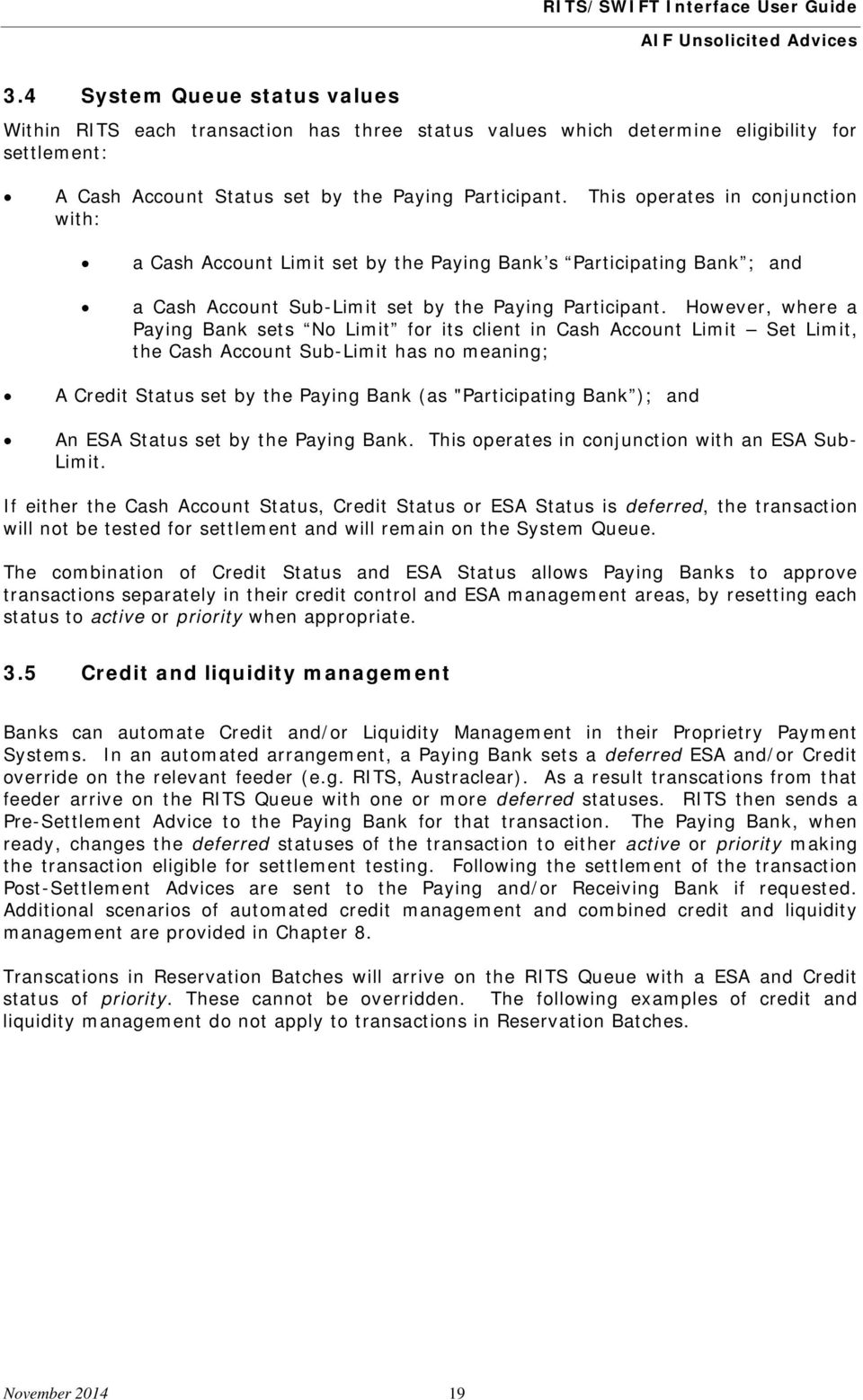
18 AIF Unsolicited Advices 3.4 System Queue status values Within RITS each transaction has three status values which determine eligibility for settlement: A Cash Account Status set by the Paying Participant. This operates in conjunction with: a Cash Account Limit set by the Paying Bank s Participating Bank ; and a Cash Account Sub-Limit set by the Paying Participant. However, where a Paying Bank sets No Limit for its client in Cash Account Limit Set Limit, the Cash Account Sub-Limit has no meaning; A Credit Status set by the Paying Bank (as "Participating Bank ); and An ESA Status set by the Paying Bank. This operates in conjunction with an ESA Sub- Limit. If either the Cash Account Status, Credit Status or ESA Status is deferred, the transaction will not be tested for settlement and will remain on the System Queue. The combination of Credit Status and ESA Status allows Paying Banks to approve transactions separately in their credit control and ESA management areas, by resetting each status to active or priority when appropriate. 3.5 Credit and liquidity management Banks can automate Credit and/or Liquidity anagement in their Proprietry Payment Systems. In an automated arrangement, a Paying Bank sets a deferred ESA and/or Credit override on the relevant feeder (e.g. RITS, Austraclear). As a result transcations from that feeder arrive on the RITS Queue with one or more deferred statuses. RITS then sends a Pre-Settlement Advice to the Paying Bank for that transaction. The Paying Bank, when ready, changes the deferred statuses of the transaction to either active or priority making the transaction eligible for settlement testing. Following the settlement of the transaction Post-Settlement Advices are sent to the Paying and/or Receiving Bank if requested. Additional scenarios of automated credit management and combined credit and liquidity management are provided in Chapter 8. Transcations in Reservation Batches will arrive on the RITS Queue with a ESA and Credit status of priority. These cannot be overridden. The following examples of credit and liquidity management do not apply to transactions in Reservation Batches. November
19 AIF Unsolicited Advices Combined credit & liquidity management RITS transaction The following diagram shows the message flows for banks requiring combined credit and liquidity management of interbank RITS Payments. RITS Interbank Payment Combined Credit & Liquidity anagement RITS Terminal 1. Transaction entry RITS 2. atch transaction 5.1. Pre-Settlement Advice (Credit Level) 5.2. Change Credit/ESA Status Request 5.3. Change Credit/ESA Status Response System Queue 3. Transaction queued 4. Assign override Credit and ESA Status values 5. Send Pre-Settlement Advice (Credit Level) 6. Transaction tested for settlement 7. Transaction settle d 8. Send Post-Settlement Advices 8a. Post-Settlement 8b. Post-Settlement Advice (Debit) Advice (Credit) Credit ngt. and Liquidity ngt. Paying Bank PPS Receiving Bank PPS optional 1: Transaction Entry - via the RITS user interface Both parties to a transaction enter the details. The Paying party sets the Cash Account Status for the transaction. For the purposes of this example, it is assumed to be active. 2: atch transaction The transaction entries are matched by RITS. 3: Transaction on System Queue The transaction is placed on the System Queue. 4: Assign default Credit and ESA Status values RITS checks for override Credit and ESA Status values set by the Paying Bank, and, if applicable, applies them. In this example, the override Credit Status is set to deferred and the override ESA Status is set to deferred. 5.1: Pre-Settlement advice - RITS to Paying Bank ST028 The Paying Bank has chosen to be notified of the transaction for credit and liquidity management purposes at the same time, and a Pre-Settlement Advice (Credit Level) message is forwarded to the Paying Bank s PPS (proprietry payments system). November

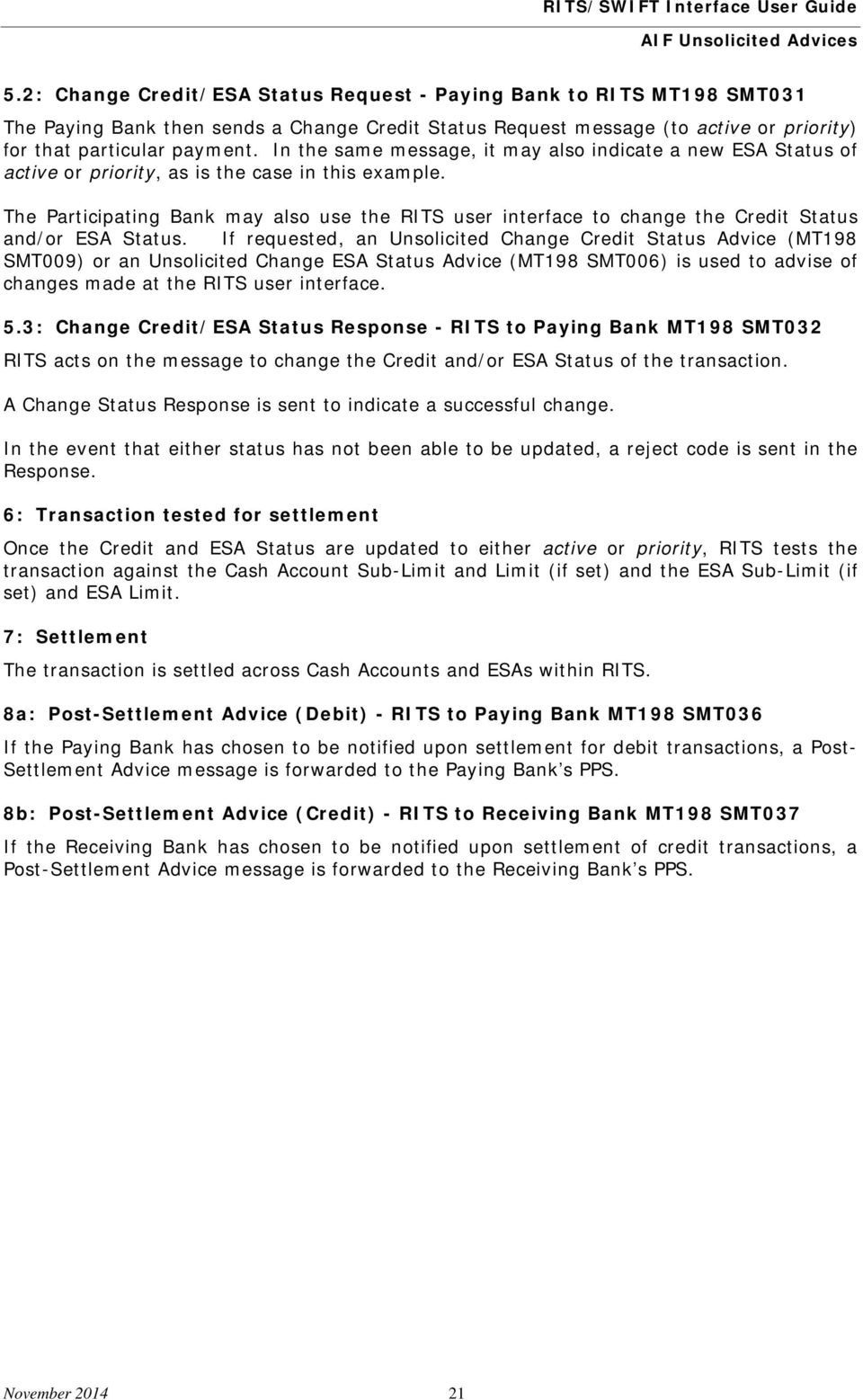
20 AIF Unsolicited Advices 5.2: Change Credit/ESA Status Request - Paying Bank to RITS ST031 The Paying Bank then sends a Change Credit Status Request message (to active or priority) for that particular payment. In the same message, it may also indicate a new ESA Status of active or priority, as is the case in this example. The Participating Bank may also use the RITS user interface to change the Credit Status and/or ESA Status. If requested, an Unsolicited Change Credit Status Advice ( ST009) or an Unsolicited Change ESA Status Advice ( ST006) is used to advise of changes made at the RITS user interface. 5.3: Change Credit/ESA Status Response - RITS to Paying Bank ST032 RITS acts on the message to change the Credit and/or ESA Status of the transaction. A Change Status Response is sent to indicate a successful change. In the event that either status has not been able to be updated, a reject code is sent in the Response. 6: Transaction tested for settlement Once the Credit and ESA Status are updated to either active or priority, RITS tests the transaction against the Cash Account Sub-Limit and Limit (if set) and the ESA Sub-Limit (if set) and ESA Limit. 7: Settlement The transaction is settled across Cash Accounts and ESAs within RITS. 8a: Post-Settlement Advice (Debit) - RITS to Paying Bank ST036 If the Paying Bank has chosen to be notified upon settlement for debit transactions, a Post- Settlement Advice message is forwarded to the Paying Bank s PPS. 8b: Post-Settlement Advice (Credit) - RITS to Receiving Bank ST037 If the Receiving Bank has chosen to be notified upon settlement of credit transactions, a Post-Settlement Advice message is forwarded to the Receiving Bank s PPS. November
21 AIF Unsolicited Advices 4. AIF - COANDS The following table lists the commands available in the facility. AIF ESSAGES - AUTOATED COANDS T Sub essage Type essage Description Recall Request Recall Response Change ESA Status Request Change ESA Status Response Change Credit Status Request Change Credit Status Response Change ESA Sub-Limit Request Change ESA Sub-Limit Response Change ESA and Credit Status Request Change ESA and Credit Status Response 4.1 Recalling payments Payments may be recalled from RITS before they settle. Recalls must be made from the source of the payment. That is: SWIFT payments must be recalled using a SWIFT message. RITS payments must be recalled from the RITS user interface. Austraclear Feeder System Payments must be recalled from an Austraclear terminal. CHESS-RTGS Feeder Settlement Advice must be recalled by the ASX. LVSS transactions must be recalled using a File Recall Instruction (FRI). Settlement-only Batches may be recalled by either a SWIFT message or from the RITS user interface. Reservation Batches must be recalled using a Reservation Recall Request. November
22 AIF Unsolicited Advices Recall request for a SWIFT payment ( ST001) SWIFT payments (warehoused in RITS or on the System Queue) may be only recalled by the bank originating the payment. The next diagram shows the message flows of a Recalled SWIFT Payment. Recall of SWIFT Payment Paying Bank SWIFT (FIN) Network 1. Recall Request RITS PPS CBT 2b. Recall Response CSI RITS 3. Abort Notification FIN-Copy service 2a. Settlement Response (Recall) Recalls are placed at the top of the update queue within RITS, so that they are processed as soon as possible. Prior to the testing for settlement of every transaction, the system checks for the existence of any recall commands and processes them. The Recall Request (ST001) must be sent with a unique TRN (field 20). The TRN of the SWIFT Payment being recalled must be included in the Related Reference field 21. essage content - ST001 Tag Field Name SWIFT PDS Notes 20 Transaction Reference Number 12 Sub- essage Type The TRN of the recall request Format C + up to 15 alphanumeric characters 001 Recall Request 77E Narrative Refer to the data dictionary 21 Related Reference O TRN of original SWIFT Payment to be recalled 32A Value Date, Currency Code, Amount O Not validated by RITS November
23 AIF Unsolicited Advices Recall Response ( ST002) After RITS removes the SWIFT payment from the System Queue or warehouse, a Recall Response is sent to the Paying Bank indicating that the recall was successful. Recall Requests that fail to find the SWIFT Payment that is to be recalled are held by RITS for 40 minutes awaiting the possible receipt of the SWIFT payment. If no payment arrives within that time RITS returns a Recall Response (ST002) with the reason for the failure in field 432. essage content - ST002 Tag Field Name SWIFT PDS Notes 20 Transaction Reference Number The TRN of the recall response Format C + up to 15 alphanumeric characters 12 Sub-essage Type 002 Recall Response 77E Narrative Refer to the data dictionary 21 Related Reference O TRN of the Recall Request 451 Accept/Reject Code O 0 = accept, 1 = reject 432 Reason for Reject O O Refer to the data dictionary CONDITIONAL FIELD RULES If field 451 (Accept/Reject Code) contains 1 (ie reject), field 432 (Reason for Reject) must be present. Where the Recall Request has been successful, RITS also forwards a Settlement Response (T097) to FIN-Copy, indicating that the payment has been recalled. FIN-Copy then forwards an Abort Notification (T019) to the Paying Bank. November
24 AIF Unsolicited Advices 4.2 Change ESA Status Change ESA Status Request ( ST004) A Paying Bank may change the ESA Status of its payments on the System Queue (arising from RITS, SWIFT, Austraclear, Batch Feeder or CHESS-RTGS or LVSS) via this SWIFT message or via the RITS user interface. The ESA Status applies only to interbank transactions. It is not possible to change the ESA Status of an LVSS transaction when it is locked for settlement testing in a ultilateral Run. The change status request will fail with the reject code 62 (Unable to process update - LVSS ultilateral Settlement testing in progress). It is not possible to change the ESA Status of a transaction in a Reservation Batch via an AIF message or the RITS user interface. The RITS user interface function to change an ESA Status are: ESA Status Queue anagement; ESA Status Queue anagement - LVSS; and ESA Status Bulk Status Change. essage content - ST004 Tag Field Name SWIFT PDS Notes 20 Transaction Reference Number 12 Sub-essage Type The TRN of the change status request Format C + up to 15 alphanumeric characters 004 = Change ESA Status Request 77E Narrative Refer to the data dictionary 21 Related Reference O TRN of the transaction to be updated 113* Banking Priority O Sub-field 1 = New ESA Status Sub-field 2 is not used for this message type Sub-field 3 is not used for this message type Sub-field 4 is not used for this message type *RITS specifications require sub-fields 2, 3 and 4 in field 113 in this request to be blank. November
25 AIF Unsolicited Advices Change ESA Status Response ( ST005) RITS returns a Change ESA Status Response to indicate a successful or unsuccessful change. An unsuccessful change (for example, due to the payment having been already settled or the ESA Status already changed to that status) is indicated by a reject code. essage content - ST005 Tag Field Name SWIFT PDS Notes 20 Transaction Reference Number 12 Sub-essage Type The TRN of the change status response Format C + up to 15 alphanumeric characters 005 = Change ESA Status Response 77E Narrative Refer to the data dictionary 21 Related Reference 451 Accept/Reject Code 432 Reason for Reject O TRN of ESA Status Change Request O 0 = accept, 1 = reject O O Refer to the data dictionary 113 Banking Priority O O Sub-field 1 = New ESA Status (confirming the status change) Sub-field 2 = Current Credit Status Sub-field 3 is not used in this message type Sub-field 4 is not used in this message type CONDITIONAL FIELD RULES If field 451 (Accept/Reject Code) contains 1 (ie reject), field 432 (Reason for Reject) must be present and field 113 is not present. If field 451 (Accept/Reject Code) contains 0 (ie accept), field 113 (Banking Priority) must be present, and will confirm the details of the change. 4.3 Change Credit Status Change Credit Status Request ( ST007) A Paying Bank may change the Credit Status of its payments on the System Queue (arising from RITS, SWIFT, Austraclear, Settlement-only Batch or CHESS-RTGS or LVSS) via this SWIFT message or via the RITS user interface. The Credit Status applies to both intrabank and interbank transactions. It is not possible to change the Credit Status of an LVSS transaction when it is locked for settlement testing in a ultilateral Run. The change status request will fail with the reject code 62 (Unable to process update - LVSS ultilateral Settlement testing in progress). November
26 AIF Unsolicited Advices It is not possible to change the Credit Status of a transaction in a Reservation Batch via an AIF message or the RITS user interface. The RITS user interface functions to change a Credit Status are: Credit Status Queue anagement; and Credit Status Bulk Status Change. essage content - ST007 Tag Field Name SWIFT PDS Notes 20 Transaction Reference Number 12 Sub-essage Type The TRN of the change status request Format C + up to 15 alphanumeric characters 007 = Change Credit Status Request 77E Narrative Refer to the data dictionary 21 Related Reference O TRN of the transaction to be updated 113* Banking Priority O Sub-field 1 is not used in this message type Sub-field 2 = New Credit Status Sub-field 3 is not used in this message type Sub-field 4 is not used in this message type * RITS specifications require sub-fields 1, 3 and 4 in field 113 in this request to be blank. November
27 AIF Unsolicited Advices Response Change Credit Status ( ST008) RITS returns a Change Credit Status Response to indicate a successful or unsuccessful change. An unsuccessful change (for example, due to the payment having been already settled or the Credit Status already changed to that status) is indicated by a reject code. essage content - ST008 Tag Field Name SWIFT PDS Notes 20 Transaction Reference Number 12 Sub- essage Type The TRN of the change status response Format C + up to 15 alphanumeric characters 008 = Change Credit Status Response 77E Narrative Refer to the data dictionary 21 Related Reference 451 Accept/Reje ct Code 432 Reason for Reject 113 Banking Priority O TRN of the Credit Status Change Request O 0 = accept, 1 = reject O O Refer to the data dictionary O O Sub-field 1 = Current ESA Status Sub-field 2 = New Credit Status (confirming the status change) Sub-field 3 is not used Sub-field 4 is not used CONDITIONAL FIELD RULES If field 451 (Accept/Reject Code) contains 1 (ie reject), field 432 (Reason for Reject) must be present and field 113 is not present. If field 451 (Accept/Reject Code) contains 0 (ie accept), field 113 (Banking Priority) must be present, and will confirm the details of the change. November
28 AIF Unsolicited Advices 4.4 Change ESA and Credit Status Change ESA and Credit Status Request ( 031) The Paying Bank may send a Change Credit and ESA Status request message for a payment on the System Queue in a single message. This message is also valid for intrabank transactions where only the Credit Status is used and the ESA Status is ignored. It is not possible to change the ESA or Credit Status of an LVSS transaction when it is locked for settlement testing in a ultilateral Run. The change status request will fail with the reject code 62 (Unable to process update - LVSS ultilateral Settlement testing in progress). It is not possible to change the ESA or Credit Status of a transaction in a Reservation Batch via an AIF message or the RITS user interface. essage content - ST031 Tag Field Name SWIFT PDS Notes 20 Transaction Reference Number 12 Sub-essage Type The TRN of the change status request Format C + up to 15 alphanumeric characters 031 = Change ESA and Credit Status Request 77E Narrative Refer to the data dictionary 21 Related Reference 113 Banking Priority O TRN of transaction to be updated O Sub-field 1 = New ESA Status Sub-field 2 = New Credit Status Sub-field 3 is not used for this message type Sub-field 4 is not used CONDITIONAL FIELD RULES If field 12 (Sub-essage Type) contains 031 (i.e. change Credit and ESA Status) and is being applied to an interbank transaction, if one status value is invalid, the whole message is rejected, ie the valid status value is not applied to the payment. November
29 AIF Unsolicited Advices Change ESA and Credit Status Response ( ST032) RITS returns a Change ESA and Credit Status Response to indicate a successful or unsuccessful change. An unsuccessful change (due to the payment having been already settled or the ESA or the Credit Status already changed to that status) is indicated by a reject code. essage content - ST032 Tag Field Name SWIFT PDS Notes 20 Transaction Reference Number 12 Sub-essage Type The TRN of the change status response Format C + up to 15 alphanumeric characters 032 = Change ESA and Credit Status Response 77E Narrative Refer to the data dictionary 21 Related Reference 451 Accept/Reject Code 432 Reason for Reject 113 Banking Priority O TRN of Change ESA and Credit Status Request O 0 = accept, 1 = reject O O Refer to the data dictionary O O Sub-field 1 = New ESA Status (confirming the change) Sub-field 2 = New Credit Status (confirming the change) Sub-field 3 is not used in this message type Sub-field 4 is not used in this message type CONDITIONAL FIELD RULES If field 451 (Accept/Reject Code) contains 1 (ie reject), field 432 (Reason for Reject) must be present and field 113 is not present. If field 451 (Accept/Reject Code) contains 0 (ie accept), field 113 (Banking Priority) must be present, confirming the details of the change. November
30 AIF Unsolicited Advices 4.5 General Reject message ( ST040) RITS provides a General Reject message ( ST040) when requests (both commands and enquiries) are received with a Sub-essage Type not known to RITS. essage content - ST040 Tag Field Name SWIFT PDS Notes 20 Transaction Reference Number The TRN of the general reject message Format C + up to 15 alphanumeric characters 12 Sub-essage Type 040 General Reject essage 77E Narrative Refer to the data dictionary 21 Related Reference O TRN of the Request message 451 Accept/Reject Code O Reason for Reject O Change ESA Sub-Limit A bank may set an ESA Sub-Limit to reserve funds for transactions with a priority ESA Status. The ESA Sub-Limit may be change by an AIF message or in the following RITS user interface function: Change ESA Sub-Limit check for the correct and complete name please Change ESA Sub-Limit Request ( ST013) The following message is sent by a bank to RITS to change the ESA Sub-Limit. essage content - ST013 Tag Field Name SWIFT PDS Notes 20 Transaction Reference Number 12 Sub-essage Type The TRN of the change request Format C + up to 15 alphanumeric characters 013 Change ESA Sub-Limit Request 77E Narrative Refer to the data dictionary 32B Currency Code and Amount O New ESA Sub-Limit November
31 AIF Unsolicited Advices Change ESA Sub-Limit Response ( ST014) The following message will be returned by RITS to the bank in response to a Change ESA Sub-Limit Request. essage content - ST014 Tag Field Name SWIFT PDS Notes 20 Transaction Reference Number 12 Sub-essage Type The TRN of the change request Format C + up to 15 alphanumeric characters 014 Change ESA Sub-Limit Response 77E Narrative Refer to the data dictionary 21 Related Reference 451 Accept/Reject Code 432 Reason for Reject O TRN of the Change ESA Sub-Limit Request O 0 = accept, 1 = reject O O Refer to the data dictionary 32B 32B Currency Code and Amount Currency Code and Amount O O Old ESA Sub-Limit O O New ESA Sub-Limit 901 Time O O Time ESA Sub-Limit updated CONDITIONAL FIELD RULES If field 451 (Accept/Reject Code) contains 1 (ie reject), field 432 (Reason for Reject) must be present. If field 451 (Accept/Reject Code) contains 0 (ie accept), fields 32B (Old Limit), 32B (New Limit) and 901 (Time) must be present, and will confirm the details of the change. November
32 AIF Unsolicited Advices 5. AIF - ENQUIRIES The next table lists the enquiries available to AIF participants. AIF ESSAGES - ENQUIRIES T Sub essage Type essage Description 920 ESA Balance Enquiry Request (941) 920 ESA Statement Intraday Request (942) 941 ESA Balance Response 942 ESA Statement Intraday Response ESA Balance Request Reject ESA Statement Intraday Reject Client Cash Account Balance Intraday Request Client Cash Account Balance Intraday Response 5.1 ESA Balance Enquiry Request (T920) Banks can enquire on their ESA balance or obtain an ESA statement at any time throughout the day using this message. This message can be used to request an ESA balance (T941) or an interim ESA transaction listing (T942). essage content - T920 Tag Field Name SWIFT T920 PDS Notes 20 Transaction Reference Number The TRN allocated by the sender Can be up to 16 characters alphanumeric but must not start with RITS, ACLR or ASXC 12 Sub-essage Type 25 Account Identification essage Type of message requested: 941 (ESA Balance Enquiry Request) or 942 (ESA Statement Intraday Enquiry Request) The Exchange Settlement Account number 34F Currency Code, Debit or Credit Indicator, Amount O O Floor Limit Indicator set minimum amount November
33 AIF Unsolicited Advices Tag Field Name SWIFT T920 PDS Notes 34F Currency Code, Debit or Credit Indicator, Amount O O Floor Limit Indicator set minimum amount CONDITIONAL FIELD RULES If field 12 (essage Requested) contains 942, at least one field 34F (Floor Limit Indicator) must be present ESA Balance Enquiry Response (T941) RITS returns the current ESA balance, total number and value of debits and credits, the current balance and the balance of funds available over and above the Sub-Limit for active ESA Status transactions. essage content - T941 Tag Field Name SWIFT T941 PDS Notes 20 Transaction Reference Number 21 Related Reference 25 Account Identification The TRN of the response message Format E = up to 15 characters alphanumeric O TRN of original request (T920) The Exchange Settlement Account number 28C 13D 60F Statement Number/Page Number Date/time indicator Opening Balance For example 001/001 Date and time when T941 is generated O Opening ESA balance for this value date + Currency adjustment Format C + YYDD + AUD + $balance 90D 90C Number and Sum of Entries - Debit Number and Sum of Entries - Credit O Format number of entries + AUD + total value Excludes intrabank transactions O Format number of entries + AUD + total value Excludes intrabank transactions November
34 AIF Unsolicited Advices Tag Field Name SWIFT PDS Notes 62F Closing Balance (Booked Funds) Current ESA balance Format C + YYDD + AUD + $balance 64 Closing Available Balance (Available Funds) 65 Forward Available Balance 86 Information for Account Owner O Current ESA balance above ESA Sub-Limit Format C + YYDD + AUD + $balance O O This field will not be present O O This field will not be present Field 64 shows the Closing Available Balance (known in RITS as the Active Balance). This is the amount of ESA funds that is held above the ESA Sub-Limit, ie the amount that is available for transactions with an active ESA status. In some cases this field may be negative. The following examples illustrate: Scenario A ESA Balance of $100,000 and ESA sub-limit of $20,000 B ESA Balance of $100,000 and ESA sub-limit of zero C ESA Balance of $15,000 and ESA sub-limit of $20,000 Field 64 shows $80, $100, ($5,000.00) ie negative ESA Statement Intraday Response (T942) This message is received in response to ESA Statement Intraday Request (T920) with 942 entered into Tag 12. Intraday statements are returned in an T942 format. All transactions that are settled across ESAs (interbank transactions) are included in the statement. The message contains details of all ESA transactions since the start-of-day ESA balance, regardless of whether any previous ESA intraday statements have been received. November
35 AIF Unsolicited Advices essage content - T942 Tag Field Name SWIFT T942 PDS Notes 20 Transaction Reference Number The TRN of the response message Format E = up to 15 characters alphanumeric 21 Related Reference O TRN of the original request (T920) 25 Account Identification The Exchange Settlement Account number 28C 34F Statement No/Page Number Currency Code, Debit or Credit Indicator, Amount For example 001/001 Floor Limit Indicator Format AUD + debit or credit indicator amount + amount 34F Currency Code, Debit or Credit Indicator, Amount O O Floor Limit Indicator Format AUD + debit or credit indicator amount + amount 13D Date/Time Indicator YYDDHH 61 Statement Line O O Format YYDD + C credit or D debit + NSC if non-swift payment else S103 or S202 if SWIFT + TRN + Time Settled HHSS + Other Bank mnemonic + RITS Tran Type + ES Account number 86 Information for Account Owner O O This field will not be present 90D 90C Number and Sum of Entries - Debit Number and Sum of Entries - Credit O nnnnn + AUD + sum 15n O nnnnn + AUD + sum 15n 86 Information for Account Owner O Will contain statement number and page number, in same format as field 28C CONDITIONAL FIELD RULES If there are no items to report, field 61 (Statement Line) will not be present. Transaction type codes which are found in field 61 of this message are listed in the data dictionary. For LVSS transactions, the Payment Service ID (e.g. BECN, CECS) rather than a feeder system ID, will be populated in the RITS Tran Type code (which occurs within field 61). November
36 AIF Unsolicited Advices ESA Statement/Balance Reject ( ST016 & ST017) Where either the ESA Balance Enquiry or ESA Statement Intraday request is unsuccessful, RITS returns the following reject message to the sender. essage content - ST016 (ESA Balance Enquiry Reject) and ST017 (ESA Statement Intraday Reject) Tag Field Name SWIFT PDS Notes 20 Transaction Reference Number The TRN of the response message Format E = up to 15 characters alphanumeric 12 Sub-essage Type 016 ESA Balance Enquiry Reject 017 ESA Statement Intraday Enquiry Reject 77E Narrative Refer to the data dictionary 21 Related Reference O TRN of original request (T920) 451 Accept/Reject Code O 1 - reject 432 Reason for Reject O 88 = Sub-essage Type does not exist 5.2 Client Cash Account Balance - Intraday Enquiry Client Cash Account Balance Intraday Enquiry Request ( ST018) A participating bank may request a Cash Account balance at any time during the day using this message. The participating bank has the option to request either all client balances or the balance for a particular client. Field 25 is left blank to obtain details of all cash account balances. essage content - ST018 Tag Field Name SWIFT PDS Notes 20 Transaction Reference Number The TRN of the response message Format E = up to 15 characters alphanumeric 12 Sub-essage Type E Narrative Refer to the data dictionary 25 Account Identification O O Enter the Client account ID or leave blank to obtain balances for all accounts November
37 AIF Unsolicited Advices CONDITIONAL FIELD RULES If field 25 (Account Identification) is blank, all client account balances are returned Client Cash Account Balance Intraday Enquiry Response ( ST019) If the message validation is successful, a list of Cash Account balances is returned. This advice contains for each client; client name, BSB and client account number, current cash account balance and External Account Balance (now redundant). If the request is invalid (eg client ID not found), the response is returned with a reject code to indicate the reason the request was unsuccessful. essage content - ST019 Tag Field Name SWIFT PDS Notes 20 Transaction Reference Number 12 Sub-essage Type The TRN of the response 019 Format E + up to 15 characters alphanumeric 77E Narrative Refer to the data dictionary 903 Date O Date processed YYYYDD 901 Time O Time processed HHSS 21 Related Reference 451 Accept/Reject Code O TRN of original request ( ST018) O Reason for Reject O O 25 Account Identification O O Client s RITS cash account number 62 Balance O O Cash Account balance Format C credit D debit + YYDD + AUD + amount 62 Balance O O External Account Balance Format C credit D debit + YYDD + AUD + amount 32B Currency Code and Amount O O Cash Account Limit Format AUD + amount CONDITIONAL FIELD RULES If field 451 (Accept/Reject Code) contains 1 (ie reject), field 432 (Reason for Reject) must be present. November
38 AIF Unsolicited Advices If field 451 (Accept/Reject Code) contains 0 (ie accept), at least one occurrence of the repeating sequence of fields 25 (Account Identification), 62 (cash account balance), 62 (External Account Balance) and 32B (Cash Account Limit) must be present, and will contain the details requested. November
39 AIF Unsolicited Advices 6. AIF - UNSOLICITED ADVICES The following table lists the unsolicited advices available to AIF participants. AIF ESSAGES - UNSOLICITED ADVICES T ST essage Description 941 ESA Balance Start of Day Advice Recall Advice Change ESA Status Advice (via RITS user interface) Change Credit Status Advice (via RITS user interface) ESA Sub-Limit Change Advice Client Cash Account Balances End-of-Day Advice Pre-Settlement Advice (Credit Level - Austraclear) Pre-Settlement Advice (Credit Level) Pre-Settlement Advice (ESA Level) Time Period Advice - Start of Day Broadcast essage Post-Settlement Advice Debit (Intrabank or Interbank) Post-Settlement Advice Credit (Intrabank or Interbank) Unsettled Transaction End of Day Advice RITS Holiday Advice Pre-Settlement Advice (Pending Credit) ESA Interim Statement Advice ESA Statement End of Day Advice (at Interim Session) ESA Statement End of Day Advice (at Final Close) The following advices are available for selection in the RITS function Unsolicited Advices aintenance. When selected, the ST036 and ST037 are delivered Post-Settlement Advice Debit (Intrabank) Post-Settlement Advice Credit (Intrabank) November
40 AIF Unsolicited Advices 6.1 ESA Balance Start of Day Advice (T941) Where requested, this message is sent at 7.30 am to notify banks of their opening ESA Balance. This balance equals the closing balance of the previous day.the balance does not include any other RBA Payments, such as ESA interest which is posted in RITS as a separate transaction. Post-Settlement Advices may be selected for these transactions. essage content - T941 Tag Field Name SWIFT T941 PDS Notes 20 Transaction Reference Number 21 Related Reference 25 Account Identification 28 Statement Number/Page Number The TRN of the unsolicited advice Format U + up to 15 characters alphanumeric O O This field will not be present The Exchange Settlement Account number 00001/00001 Statement and page numbers are reset to 1 on 1 January each year 13D Date/Time Indicator 60F Opening Balance O ESA Balance; will be the same as field 62F Format C credit D debit + YYDD + AUD + amount 90D 90C Number and Sum of Entries - Debit Number and Sum of Entries - Credit O O This field will not be present O O This field will not be present 62F Closing Balance ESA Balance; will be the same as field 60F Format C credit D debit + YYDD + AUD + amount 64 Closing Available Balance 65 Forward Available Balance 86 Information for Account Owner O Balance above ESA Sub-Limit Format C credit D debit + YYDD + AUD + amount O O This field will not be present O O This field will not be present Field 64 of this message shows the Closing Available Balance (known in RITS as the Active Balance). See section November
41 AIF Unsolicited Advices 6.2 Recall Advice ( ST003) This message is sent to the Paying Bank when a RITS, LVSS, Austraclear, Batch Feeder or CHESS-RTGS Feeder transaction is recalled from the System Queue. essage content - ST003 Tag Field Name SWIFT PDS Notes 20 Transaction Reference Number 12 Sub-essage Type The TRN of the unsolicited advice 003 Format U + up to 15 characters alphanumeric 77E Narrative Refer to the data dictionary 21 Related Reference O RITS, LVSS, Austraclear, Batch Feeder or CHESS-RTGS Feeder Transaction ID. SWIFT Payments that are recalled are advised to the Paying Bank via an Abort Notification (T019). 6.3 Notification of change made via the RITS user interface The following messages are generated by RITS when a change has been effected using the RITS user interface for a RITS, LVSS, SWIFT, Austraclear, Batch Feeder or CHESS-RTGS transaction on the System Queue ESA Status changed via RITS user interface ( ST006) This message is sent when the ESA Status of a transaction is changed via the RITS user interface. essage content - ST006 Tag Field Name SWIFT PDS Notes 20 Transaction Reference Number 12 Sub-essage Type The TRN of the unsolicited advice Format U + up to 15 characters alphanumeric 006 = Change ESA Status 77E Narrative Refer to the data dictionary 21 Related Reference O RITS, LVSS, SWIFT or Austraclear CHESS-RTGS and Batch Feeder Transaction ID November
42 AIF Unsolicited Advices Tag Field Name SWIFT PDS Notes 113 Banking Priority O Sub-field 1 = New ESA Status Sub-field 2 is not used in this message type Sub-field 3 is not used in this message type Sub-field 4 is not used in this message type Credit Status changed via RITS user interface ( ST009) This message is sent when the Credit Status of a transaction is changed via the RITS user interface. essage content - ST009 Tag Field Name SWIFT PDS Notes 20 Transaction Reference Number 12 Sub-essage Type The TRN of the unsolicited advice Format U + up to 15 characters alphanumeric 009 = Change Credit Status 77E Narrative Refer to the data dictionary 21 Related Reference O RITS, LVSS, SWIFT or Austraclear CHESS-RTGS and Batch Feeder Transaction ID 113 Banking Priority O Sub-field 1 is not used in this message Sub-field 2 = New Credit Status Sub-field 3 is not used in this message Sub-field 4 is not used in this message Change ESA Sub-Limit Advice ( ST015) This advice will be sent to banks for changes to the ESA Sub-Limit via the RITS user interface. essage content - ST015 Tag Field Name SWIFT PDS Notes 20 Transaction Reference Number The TRN of the unsolicited advice Format U + up to 15 characters alphanumeric November
43 AIF Unsolicited Advices Tag Field Name SWIFT PDS Notes 12 Sub-essage Type E Narrative Refer to the data dictionary 901 Time O Time updated 34F 34F Currency Code, Debit or Credit Indicator and Amount Currency Code, Debit or Credit Indicator and Amount O Old ESA Sub-Limit O New ESA Sub-Limit 6.4 Pre-Settlement Advices When requested, Pre-Settlement Advices are sent to the Paying Bank and to the Receiving Bank ( ST041 only) when a transaction arrives on the System Queue. The Credit or ESA Status, or both, of the transaction would typically be deferred, though this is not mandatory. The ESA status returned in Pre-Settlement Advices for intrabank transactions will always have a value of A. This is independant of any ESA status set. Banks are advised to ignore this status for intrabank transactions, as no ESA element is involved. Pre-Settlement Advices contain the Transaction Type, Transaction ID, Paying Client ID, Amount, Time Received on System Queue, ESA, Credit and Cash Account Status. Warehoused transactions Pre-Settlement advices for warehoused transactions are sent to the Paying Bank when the transaction arrives on the System Queue at 7.30 am on the date of settlement. Warehoused RITS cash transfer and SWIFT transactions are not tested for settlement until after the 9.00 am Batch settlement. Warehoused LVSS transactions are tested for settlement in the orning Settlement Session, subject to Payment Service eligibility and the LVSS Settlement ethod. Austraclear transactions Paying Banks control the receipt of Pre-Settlement Advices for Austraclear payments at the client level within the Austraclear system. A Pre-Settlement Advice flag is included in the Settlement Requests sent from Austraclear to RITS. To receive these advices: In Austraclear set the Pre-Settlement Advice flag(s) to Y for each client that advices are to be received for; and ake an entry in the RITS function Unsolicited Advices aintenance so that RITS knows which BIC to send the advice to, noting the source as AUSTRACLEAR. If the flag(s) are set at yes, a Pre-Settlement Advice (Credit Level) (ST027) will be generated by RITS and sent to the Paying Bank. November
44 AIF Unsolicited Advices Pre-Settlement Advices for Austraclear transactions contain the client s Austraclear account number, not the bank s Austraclear Cash Account number in RITS. CHESS-RTGS transactions Paying Banks control the receipt of Pre-Settlement Advices for CHESS-RTGS transactions within the CHESS system. Two Pre-Settlement Advice flags (Credit and ESA level) are included in the CHESS-RTGS Settlement Request sent from CHESS to RITS. To receive these advices, the paying bank must make two entries in the RITS function Unsolicited Advices aintenance so that RITS knows which BIC to send the advice to, noting the source as CHESS-RTGS If both flags are set at "yes", both Pre-Settlement Advice (Credit Level) (ST028) and Pre- Settlement Advice (ESA Level) (ST029) are generated by RITS and sent to the Paying Bank Pre-Settlement Advice (credit) Austraclear ( ST027) To receive this message, a bank must: in Austraclear, indicate the request for this message for each client (based on account number) for which it wishes to receive this message. in RITS enter the message type in Unsolicited Advices aintenance, allocate the appropriate BIC and enter the source as Austraclear. The message is generated when an Austraclear payment arrives at RITS with a Cash Account Status of Active or Priority (ie. not deferred). A deferral block may be set in RITS (using the function Cash Account Limit Set Limit) which will prevent a client from changing the status back to deferred once it has been made active or priority. This message type is generated once for each payment. Banks are advised to contact Austraclear for requirements to be listedas an AIF Bank and for detailed instructions relating to the setting up in Austraclear to receive this advice. essage content - ST027 Tag Field Name SWIFT PDS Notes 20 Transaction Reference Number 12 Sub-essage Type The TRN of the unsolicited advice Format U + up to 15 characters alphanumeric 027 = Austraclear Pre-Settlement advice (Credit level). 77E Narrative Refer to the data dictionary 21 Related Reference O TRN of the Austraclear transaction 905 Receiver s Bank Code O O 25 Account Identification O O Paying client s cash account in Austraclear November
45 AIF Unsolicited Advices Tag Field Name SWIFT PDS Notes 32A Value Date, Currency Code, Amount O Format YYDD + AUD + amount 901 Time O Time received on System Queue 908 Transaction Type O 113 Banking Priority O Sub-field 1 = ESA Status Sub-field 2 = Credit Status Sub-field 3 = Cash Account Status Sub-field 4 is not used and will be blank These are the status values after any RITS defaults have been applied. For intrabank transactions Sub-field 1 = A 911 Limit Type O O S = Secured limit U = Unsecured limit This field will only apply to two-sided cash transfers RITS Pre-Settlement Advice (Credit Level) ( ST028) This Pre-Settlement Advice could be used by banks that have combined credit and liquidity management systems. If a payment arrives on the System Queue with a deferred Cash Account Status, this message will be sent when the Cash Account Status is changed to active or priority. A deferral block can be set in RITS (using the function Cash Account Limit Set Limit) that restricts a client from changing the Cash Account Status back to deferred once it has been made active or priority. This message is generated once for each payment. essage content - ST028 Tag Field Name SWIFT PDS Notes 20 Transaction Reference Number 12 Sub-essage Type The TRN of the unsolicited advice Format U + up to 15 characters alphanumeric 028 = RITS Pre-Settlement advice (Credit level) 77E Narrative Refer to the data dictionary 21 Related Reference O TRN of related SWIFT payment, TRN of LVSS transaction, RITS Transaction ID (including batch transactions) or Austraclear Transaction ID 22C BIN O O Batch Identification Number - populated only for batch transactions November
46 AIF Unsolicited Advices Tag Field Name SWIFT PDS Notes 905 Receiver s Bank Code O O The first 4 characters of the SWIFT BIC, otherwise the 4 character RITS mnemonic If Batch Type = (multilateral) this will be the participants own code 25 Account Identification O O Paying RITS cash account 32A Value Date, Currency Code, Amount O Format YYDD + AUD + amount 901 Time O Time received on System Queue 908 Transaction Type O ACLR, AAT, RITS, ESINT, CHESR, SWIFT For batch transactions = the Batch Stream ID eg ASXB, CAU or PEXA For LVSS transactions = the Payment Service ID eg BECN, CECS etc. 113 Banking Priority O Sub-field 1 = ESA Status Sub-field 2 = Credit Status Sub-field 3 = Cash Account Status Sub-field 4 is not used and will be blank These are the status values after any RITS defaults have been applied. For intrabank transactions Sub-field 1 = A 911 Limit Type O O S = Secured limit U = Unsecured limit This field will only apply to two-sided cash transfers. CONDITIONAL FIELD RULES Field 22C (Batch Identification Number) is present if the transaction is a Batch Feeder transaction (i.e. CHESS Batch, astercard Batch, or the Property Settlement Batch). Field 25 (Account Identification) is not present if the transaction is a SWIFT PDS payment. Field 908 (Transaction Type) displays the Batch Stream ID for a Batch Feeder transaction. Field 908 (Transaction Type) displays the Payment Service ID (e.g. BECN, CECS) rather than a feeder system ID for an LVSS transaction RITS Pre-Settlement Advice (ESA Level) ( ST029) This Pre-Settlement Advice (ESA Level) is sent when an interbank transaction arrives on the System Queue, after any Pre-Settlement Advices (Credit Level) have been sent and where the Credit Status is active or priority. This advice is sent independently of the ESA Status value and is only sent once. This is used by banks with liquidity management systems or separate credit and liquidity management systems. November
47 AIF Unsolicited Advices Austraclear Availability Banks that wish to receive a Pre-Settlement Advice (ESA Level) for Austraclear transactions must specify the client s account number in the Austraclear system. Austraclear will then instruct RITS to generate the ST29. (NB. RITS requires an entry in the function Unsolicited Advices aintenance with Austraclear as the source.) Banks are advised to refer to Austraclear documentation regarding the setting up to receive this advice. essage content - ST029 Tag Field Name SWIFT PDS Notes 20 Transaction Reference Number 12 Sub-essage Type The TRN of the unsolicited advice Format U + up to 15 characters alphanumeric 029 = RITS Pre-Settlement advice (ESA level) 77E Narrative Refer to the data dictionary 21 Related Reference O TRN of related SWIFT payment, TRN of LVSS transaction, RITS Transaction ID (including batch transactions) or Austraclear Transaction ID 22C BIN O O Batch Identification Number - populated only for batch transactions 905 Receiver s Bank Code 25 Account Identification O O The first 4 characters of the SWIFT BIC, otherwise the 4 character RITS mnemonic If Batch Type = (multilateral) this will be the participants own code O O Paying RITS cash account 32A Value Date, Currency Code, Amount O Format YYDD + AUD + amount 901 Time O Time received on System Queue 908 Transaction Type 113 Banking Priority O ACLR, AAT, RITS,, ESINT, CHESR, SWIFT For batch transactions = the Batch Stream ID eg ASXB, CAU or PEXA For LVSS transactions = the Payment Service ID eg BECN, CECS etc. O Sub-field 1 = ESA Status Sub-field 2 = Credit Status Sub-field 3 = Cash Account Status Sub-field 4 is not used and will be blank These are the status values after any RITS defaults have been applied. For intrabank transactions Sub-field 1 = A November
48 AIF Unsolicited Advices Tag Field Name SWIFT PDS Notes 911 Limit Type O O S = Secured limit U = Unsecured limit This field will only apply to two-sided cash transfers. CONDITIONAL FIELD RULES Field 22C (Batch Identification Number) is present if the transaction is a Batch Feeder transaction (i.e. the CHESS Batch, astercard Batch, or the Property Settlement Batch). Field 25 (Account Identification) is not present if the transaction is a SWIFT PDS payment. Field 908 (Transaction Type) displays the Batch Stream ID for a Batch Feeder transaction. Field 908 (Transaction Type) displays the Payment Service ID (e.g. BECN, CECS) rather than a feeder system ID for a LVSS transaction RITS Pre-Settlement Advice (Pending Credit) ( ST041) This Pre-Settlement Advice is available only for batch transactions and is sent to a receiving bank when a transaction in a batch (entered via the Batch Feeder) arrives on the System Queue. essage content - ST041 Tag Field Name SWIFT PDS Notes 20 Transaction Reference Number 12 Sub-essage Type The TRN of the unsolicited advice Format U + up to 15 characters alphanumeric Pre-Settlement advice (Pending Credit) 77E Narrative Refer to the data dictionary 21 Related Reference O RITS Transaction ID of related transaction in the batch 22C BIN O Batch Identification Number 904 Sender s Bank Code 25 Account Identification O O The first 4 characters of the SWIFT BIC, otherwise the 4 character RITS mnemonic If Batch Type = (multilateral) this will be the participants own code O O Receiving RITS cash account November
49 AIF Unsolicited Advices Tag Field Name SWIFT PDS Notes 32A Value Date, Currency Code, Amount O Format YYDD + AUD + amount 901 Time O Time received on System Queue 908 Transaction Type O Batch Stream ID eg ASXB, CAU or PEXA 6.5 Post-Settlement Advices Post-Settlement Advices may be sent to Paying or Receiving Banks when transactions settle on the System Queue. Advices are sent in order of settlement. It is possible that banks may receive the Post-Settlement Advice via SWIFT FIN prior to the advice of settlement of a SWIFT Payment in the SWIFT Settlement Response sent via SWIFT FIN-Copy. Each Post-Settlement Advice message contains Transaction Type, Transaction ID, Batch Identification Number (populated only for batch transactions), Paying Bank ID (Credit Advice), Receiving Bank ID (Debit Advice), Paying Client RITS cash account (Debit Advice), Receiving Client RITS cash account (Credit Advice), amount, time settled and resulting Cash Account and ESA balances. Four types of Post-Settlement Advice can be separately selected in RITS: ST936 - Post-Settlement Intrabank Debit ST937 - Post-Settlement Intrabank Credit ST036 - Post-Settlement Interbank Debit ST037 - Post-Settlement Interbank Credit The ST936 and ST937 are for the purpose of differential selection of advices between interbank and intrabank transactions. For these selections the advices actually sent are ST036 and 037. Transactions settled via Auto-Offset will contain the same time settled and resulting ESA balance. RITS transactions For RITS cash transfers, Paying and Receiving Banks may elect to receive Post-Settlement Advices by individual RITS branches or for all RITS cash transfers. For other RITS transactions (ESA Interest)the 2E branch must be selected. LVSS transactions For LVSS transactions, Paying and Receiving Banks may elect to receive Post-Settlement Advices by selecting the relevant RITS branches. November
50 AIF Unsolicited Advices Austraclear transactions Post-Settlement advices, if selected, are sent for all Austraclear transactions it is not possible to receive advices on the basis of Austraclear client. Post-Settlement Advices for Austraclear transactions contain the client s Austraclear account number, not the bank s Austraclear Cash Account number in RITS. Batch Feeder Post Settlement Advices can be selected for Batch Feeder transactions on the basis of the RITS branch used for the particular Batch Stream. SWIFT Payments Post-Settlement Advices are available for SWIFT Payments. However, senders of SWIFT Payments are notified of settlement in the SWIFT payment message response. CHESS-RTGS Feeder transactions Post-Settlement Advices are available for CHESS-RTGS Feeder transactions. However, senders of CHESS-RTGS Feeder transactions are notified of settlement in the message response Overview of Post-Settlement Advices - Intrabank The following diagram and table describe the message flows for advising the settlement of an intrabank transaction. Post-Settlement Advices - Intrabank Transactions RITS SWIFT (FIN) Network 1a. Post-Settlement Advice (Debit) 1b. Post-Settlement Advice (Credit) Bank PPS optional essage Description SWIFT essage Type 1a Post-Settlement Advice (Debit) - RITS to Paying Bank This message contains the debit details of the settled intrabank transaction. Each message contains the Transaction Type, Transaction ID, Amount, Time Settled, Paying Client RITS cash account, Receiving Bank ID, resulting Cash Account balance and resulting ESA balance. ST036 November
51 AIF Unsolicited Advices 1b essage Description Post-Settlement Advice (Credit) - RITS to Receiving Bank This message contains the credit details of the settled intrabank transaction. Each message will contain the Transaction Type, Transaction ID, Amount, Time Settled, Receiving Client RITS cash account, Paying Bank ID, resulting Cash Account balance and resulting ESA balance. SWIFT essage Type ST Overview of Post-Settlement Advices - Interbank The following diagram and table describe the message flows for advising the settlement of an interbank transaction. Post-Settlement Advices - Interbank Transactions RITS SWIFT (FIN) Network 1a. Post-Settlement Advice (debit) 1b. Post-Settlement Advice (credit) Paying Bank PPS Receiving Bank PPS optional essage Description SWIFT essage Type 1a 1b Post-Settlement Advice (Debit) - RITS to Paying Bank This message contains the debit details of the settled interbank transaction. Each message will contain the Transaction Type, Transaction ID, Amount, Time Settled, Paying Client RITS cash account, Receiving Bank ID, resulting Cash Account balance and resulting ESA Balance. Post-Settlement Advice (Credit) - RITS to Receiving Bank This message contains the credit details of the settled interbank transaction. Each message will contain the Transaction Type, Transaction ID, Amount, Time Settled, Receiving Client RITS cash account, Paying Bank ID, resulting Cash Account balance and resulting ESA balance. ST036 ST037 November
52 AIF Unsolicited Advices Post-Settlement Advice Interbank Debit ( ST036) This advice is sent to the Paying Bank to advise the settlement of the debit transaction. essage content - ST036 Tag Field Name SWIFT PDS Notes 20 Transaction Reference Number 12 Sub-essage Type The TRN of the unsolicited advice Format U + up to 15 characters alphanumeric 036 Post-Settlement advice (Interbank Debit) 77E Narrative Refer to the data dictionary 21 Related Reference O TRN of related SWIFT payment, TRN of LVSS transaction, RITS Transaction ID (including batch transactions) and Austraclear Transaction ID 22C BIN O O Batch Identification Number 905 Receiver s Bank Code 25 Account Identification O O The first 4 characters of the SWIFT BIC, otherwise the 4 character RITS mnemonic If Batch Type = (multilateral) this will be the participants own code ay be the same as Paying Bank for intrabank transactions. O O Paying Client RITS cash account 32A Value Date, Currency Code, Amount O Format YYDD + AUD + amount 901 Time O Time settled 908 Transaction Type O ACLR, AAT, RITS, ESINT, CHESR, SWIFT For batch transactions = the Batch Stream ID eg ASXB, CAU or PEXA For LVSS transactions = the Payment Service ID eg BECN, CECS etc. 62 Intermediate Balance 62 Intermediate Balance O ESA Balance resulting from the settlement O Cash Account balance resulting from the settlement CONDITIONAL FIELD RULES Field 22C (BIN) is only present for Batch Feeder transactions (i.e. the CHESS Batch, astercard Batch, or the Property Settlement Batch). November
53 AIF Unsolicited Advices Field 25 (Account Identification) is not present if the transaction is a SWIFT PDS payment. Field 908 (Transaction Type) displays the Payment Service ID (e.g. BECN, CECS) rather than a feeder system ID for a LVSS transaction Post-Settlement Advice Interbank Credit ( ST037) This advice is sent to the Receiving Bank to advise the settlement of the credit transaction. essage content - ST037 Tag Field Name SWIFT PDS Notes 20 Transaction Reference Number 12 Sub-essage Type The TRN of the unsolicited advice Format U + up to 15 characters alphanumeric 037 Post-Settlement advice (Interbank Credit) 77E Narrative Refer to the data dictionary 21 Related Reference O TRN of related SWIFT payment, TRN of LVSS transaction, RITS Transaction ID (including batch transactions) and Austraclear Transaction ID 22C BIN O O Batch Identification Number 904 Sender s Bank Code 25 Account Identification O O The first 4 characters of the SWIFT BIC, otherwise the 4 character RITS mnemonic If Batch Type = (multilateral) this will be the participants own code ay be the same as Receiving Bank for intrabank transactions O O Receiving client RITS cash account 32A Value Date, Currency Code, Amount O Format YYDD + AUD + amount 901 Time O Time settled 908 Transaction Type O ACLR, AAT, RITS, ESINT, CHESR, SWIFT For batch transactions = the Batch Stream ID eg ASXB, CAU, or PEXA For LVSS transactions = the Payment Service ID eg BECN, CECS etc. 62 Intermediate Balance 62 Intermediate Balance O ESA Balance resulting from the settlement O Cash Account balance resulting from the settlement November
54 AIF Unsolicited Advices CONDITIONAL FIELD RULES Field 22C (BIN) is only present for Batch Feeder transactions (i.e. the CHESS Batch, astercard Batch, or the Property Settlement Batch). Field 25 (Account Identification) is not present if the transaction is a SWIFT PDS payment. Field 908 (Transaction Type) displays the Payment Service ID (e.g. BECN, CECS) rather than a feeder system ID for a LVSS transaction. 6.6 Time Period Advices ( ST030) Time period advices are sent as follows. Session/Processor Code Time Period Advices Sent When Session Start Session End Changed Session times Reopen Session orning Settlement Session 0900CLEAR 0900BATCH SWIFT Daily Settlement Session 02 Y n/a n/a 06 Y Y Y Daily Settlement Session 03 Y Y Y Settlement Close Session 04 Y Y Y Interim Session 10 Y Y Y Evening Settlement Session SWIFT Evening Settlement Session SWIFT Final Settlement Session SWIFT Settlement Close Session (SWIFTEND) 11 Y Y Y 12 Y Y Y 13 Y Y Y 09 Y Y Y Reports Session 05 Y Y Y SWIFT payments processor (SWIFTPP) 07 Y Y RITS System Queue 08 Y Overnight Enquiry Session 01 Y Y November
55 AIF Unsolicited Advices Each time period advice contains a code in field 907 indicating the session (or processor) affected (e.g. 03 for the Daily Settlement Session) and a code in field 912 indicating the type of event e.g. S for a session opening and R for a revised session time. When the end time of a session is extended, a time period advice is sent to advise the new closing time of this session and another advice is sent to advise the new opening time of the next session. For example, if the end time of the Daily Settlement Session is changed from 16:30 to 16:45, a time period advice is sent to indicate this change ( 03, R, 0915, 1645 ) and another advice is sent to indicate the change to the start time of the Settlement Close Session ( 04, R, 1645, 1715 ). When a session is re-opened a time period advice is sent to advise the new closing time of this session and another advice is sent to advise the new opening time of the next session, and an advice is sent to advise the opening of the first session. For example, after the Daily Settlement Session has closed the end time for this session is extended to 16:45. A time period advice is sent to indicate this change ( 03, R, 0915, 1645 ) and another advice is sent to indicate the change to the start time of the Settlement Close Session ( 04, R, 1645, 1715 ). A third advice is sent to indicate the re-opening of the Daily Settlement Session ( 03, S, 0915, 1645 ). Time period advices are also sent when the RITS System Queue is shut-down. Advices are only sent for the SWIFT payment processor (known as SWIFTPP) when its time of operation is changed. The following table provides a summary of the Time Period Advices sent to banks on a normal day (AEST). Time sent Event Time period advice Code 7.30 am orning Settlement Session opens orning Settlement Session am RITS and SWIFT Daily Settlement Sessions open 4.30 pm Settlement Close Session and SWIFT Final Sessions open (RITS and SWIFT Daily Settlement Sessions close) Daily Settlement Session SWIFT Daily Settlement Session Settlement Close Session SWIFT Final Settlement Session pm Interim Session opens Interim Session 10 (Settlement Close Session closes) November
56 AIF Unsolicited Advices Time sent Event Time period advice Code 5.25* pm Evening Settlement Session opens Evening Settlement Session 11 (Interim Session closes) 6.05 pm (Winter) 8.05 pm (Summer) SWIFT End Session (SWIFTEND) opens SWIFT End Session (SWIFTEND) 09 (SWIFT Final Settlement Session closes) pm Reports Session opens (Evening Settlement Session closes) Reports Session End of day for settlements for Evening Agreed banks 05 10:29 pm SWIFT Payment Processor Shutdown (advices are sent only when time of operation changes) pm Overnight Enquiry Session pm System Queue processing complete 08 * Approximate time the Evening Settlement Session commences when the Interim cashlist job suite, which is run during the Interim Session, is complete. essage content - ST030 Tag Field Name SWIFT PDS Notes 20 Transaction Reference Number 12 Sub-essage Type The TRN of the unsolicited advice Format U + up to 15 characters alphanumeric 030 Time Period advice 77E Narrative Refer to the data dictionary 907 Change in Operational Settlement Session O 01 Overnight Enquiry Session 02 orning Settlement Session 03 Daily Settlement Session 04 Settlement Close Session 05 Reports Session 06 SWIFT Daily Settlement Session 07 SWIFT Payment Processor Shut-down 08 RITS System Queue Shut-down 09 SWIFT Settlement Close Session (SWIFTEND) 10 Interim Session 11 Evening Settlement Session 12 SWIFT Evening Settlement Session (SWIFTEVE) (not currently used) 13 SWIFT Final Settlement Session (SWIFTFINAL) November
57 AIF Unsolicited Advices Tag Field Name SWIFT PDS Notes 912 Standard/ Revised Time Indicator O "S" start of session "R" revised start or end time, or both 175 Time O Start time: HH 175 Time O End time: HH 6.7 Broadcast message ( ST034) The System Administrator can also send a broadcast message to RITS users (which can be seen in the function Read essage) and to banks via the AIF. Broadcast messages may be used to notify banks of general information about RITS eg training, testing, disruptions to RITS processing and changes to RITS system parameters. essage content - ST034 Tag Field Name SWIFT PDS Notes 20 Transaction Reference Number 12 Sub-essage Type The TRN of the unsolicited advice Format U + up to 15 characters alphanumeric 034 Broadcast essage 77E Narrative Refer to the data dictionary Broadcast Text O Up to 10 lines of 50 characters in length 6.8 RITS holiday advice ( ST039) A message is sent to RITS members when changes are made to the table listing dates on which RITS will be closed in the following year. The table is updated around November each year. essage content - ST039 Tag Field Name SWIFT PDS Notes 20 Transaction Reference Number 12 Sub-essage Type The TRN of the unsolicited advice Format U + up to 15 characters alphanumeric 039 Holiday Table Advice November
58 AIF Unsolicited Advices Tag Field Name SWIFT PDS Notes 77E Narrative Refer to the data dictionary 903 Date O RITS close date 910 Text O Description of the holiday 6.9 essages received at end of day The following advices are available from the end of the Daily Settlement Session. These advices provide banks with information on sessions and acount balances and statements. ESSAGE TYPE ESSAGE DESCRIPTION 1a ST030 Time Period Advice Field 907 = 05 End of Day Session Cut-off for transactions that involve non-banks 1b ST038 Unsettled Transaction End-of-Day advice 1c T950 ST 888 ESA Statement End-of- Day Advice Payments that must be settled in Day Session are removed from the Queue at the end of the Settlement Close Session ESA Statement at the end of the Settlement Close Session 2a ST030 Time Period Advice Field 907 = 11 End of Evening Session 2b ST038 Unsettled Transaction End-of-Day advice 2c T950 ST 999 ESA Statement End-of- Day Advice All unsettled payments are removed from the Queue at the end of the Evening Session ESA Statement at the end of the Evening Session 3 ST030 Time period advice Field 907 = 08 System Queue processing shut-down 5 ST026 Client Cash Account Balances End-of-Day Advice Balances of the RITS cash accounts of the bank 6 ST030 Time Period Advice Field 907 = 01 Overnight Enquiry Session November
59 AIF Unsolicited Advices Unsettled transaction - End of Day Advice ( ST038) This message is used to notify Paying Banks of RITS, LVSS, Austraclear, Batch Feeder or CHESS-RTGS Feeder transactions which remain unsettled at the end of the Settlement Close Session, at the end of the SWIFT End Session or at the end of the Evening Session. A separate message is sent for each unsettled transaction. Unsettled transactions that do not have the Evening Transaction Flag are removed from the System Queue at the end of the Settlement Close Session, except for Reservation Batch transactions, which are retained on the System Queue at the end of the Settlement Close Session even if they do not have a Evening Transaction Flag. Unsettled SWIFT and Austraclear transactions are removed from the System Queue at the close of the SWIFT End Session. Remaining unsettled transactions are removed from the System Queue at the end of the Evening Settlement Session. Note, for an LVSS transaction that remains unsettled at end of day the orginator and/or counterparty gets an FSRU3, if they have elected to receive it. essage content - ST038 Tag Field Name SWIFT PDS Notes 20 Transaction Reference Number The TRN of the unsolicited advice Format U + up to 15 characters alphanumeric 12 Sub-essage Type 038 Unsettled Advice (at End of Day) 77E Narrative Refer to the data dictionary 21 Related Reference O RITS, LVSS transaction, Austraclear, Batch Feeder or CHESS-RTGS Feeder Transaction ID. (Unsettled SWIFT Payments are advised to the Paying Bank via an T019.) 432 Reason for Reject O Unsettled SWIFT Transactions RITS automatically notifies SWIFT of unsettled SWIFT PDS payments when they are removed from the Queue at end of day. SWIFT then advises Paying Banks by issuing an Abort Notification (T019) for each transaction returned by RITS Cash Account Balances End-of-Day Advice ( ST026) This message is sent to banks after the completion of the Settlement Close and the Evening Sessions when the Interim and end of day Cashlist (respectively) are run. This advice details balances for all branches of a bank within RITS. Information advised includes the current Cash Account balance, External Account Balance (now redundant), Client Name, BSB and RITS cash account number. The details in this message are the same as the end-of-day Cashlist report. November
60 AIF Unsolicited Advices essage content - ST026 Tag Field Name SWIFT PDS Notes 20 Transaction Reference Number 12 Sub-essage Type The TRN of the unsolicited advice Format U + up to 15 characters alphanumeric 026 Client Cash Account Balances End of Day Advice 77E Narrative Refer to the data dictionary 25 Account Identification O RITS cash account number 32B 62F 62F Currency Code and Amount Closing Balance (Booked Funds) Closing Balance (Booked Funds) O Cash Account Limit O Cash Account balance O External Cash Account balance ESA Statement End-of-Day Advice (Final) (T950 ST999) This advice includes all interbank transactions that are settled across ESAs, listed in the order in which they were settled since the last ESA Statement (T950 ST999). Transactions which settle simultaneously eg Auto-Offset, LVSS multilateral runs and batches have the same time settled and resulting ESA balance. essage content - T950 Tag Field Name SWIFT T950 PDS Notes 20 Transaction Reference Number The TRN of the unsolicited advice Format U + up to 15 characters alphanumeric 25 Account Identification ESA Number 28C Statement Number/Page Number November
61 AIF Unsolicited Advices Tag Field Name SWIFT PDS Notes 60a Opening Balance Opening ESA balance for this statement. (For the first statement of a day ( F ), this will be equal to the closing ESA balance from the previous day. For subsequent statements ( ), this will be the carried forward balance from the previous statement, i.e. the opening balance should equal the previous statement s closing balance.) Format C + YYDD + AUD + $balance Options F or will be used, depending on whether this is the first or intermediate opening balance. 61 Statement Line O O Format YYDD + C credit or D debit + Amount + NSC if non-swift payment else S103 or S202 if SWIFT + TRN + Time Settled HHSS + Other Bank mnemonic + RITS Tran Type + Client Account Identification 62a Closing Balance (Booked Funds) Contains the Closing ESA Balance for this statement. (For the last statement of a day ( F ), this will be equal to the closing ESA balance for the day. For the first and intermediate statements ( ), this will be the ESA balance as at the last transaction on each statement. Options F or will be used, depending on whether this is the final or intermediate closing balance. Format C credit D debit + YYDD + AUD + amount 64 Closing Available Balance (Available Funds) O O This field will not be present. CONDITIONAL FIELD RULES If there are no items to report, field 61 (Statement Line) will not be present. The transaction types that appear in field 61 of this message are listed in the Data Dictionary. The overnight ESA balance, which is shown in the Settled Payments on-line enquiry as the first transaction of the day under the transaction type ESEOD, is not shown in the T950 as a Statement Line (tag 61). The overnight ESA balance is the figure in tag 60 of the first statement message of the day. RBA payments (for example, ESA interest) have an other bank code of RSBK in tag 61 Statement Line. November
62 AIF Unsolicited Advices For LVSS transactions, the Payment Service ID (e.g. BECN, CECS) rather than a feeder system ID, will be populated in the RITS Tran Type code (which occurs within field 61) ESA interim statement advice (T950 ST888) The ESA Interim Statement Advice is issued at the end of the Settlement Close Session. This advice records all transactions that have been settled during the day up until the end of the Settlement Close Session. It has the same format as the final ESA Statement End of Day Advice (T950 ST999) ESA interim statement advice at Interim (T942 ST001) This Advice records all transactions that have been settled during the day up until the end of the Settlement Close Session. The format of this advice is identical to the ESA Statement Intraday Response (T942) except that field 21 is not present. In the ESA Intraday Response this field contains the TRN of the original T920 request. This message may be used by banks that are Evening participants that require an ESA statement at the end of the Settlement Close Session, but who do not wish to receive two T950s. November
63
64 Austraclear Payments and the AIF 7. SWIFT PAYENT AND RELATED ESSAGES This chapter provides message flows and message content specifications relating to SWIFT Payments. SWIFT Payments are one-sided payments representing payments on behalf of clients or payments of the institution. Each payment message contains a single payment that, if settled, will result in a debit and a credit to the appropriate RITS Cash Accounts and ESAs. SWIFT PDS Payments use the SWIFT FIN-Copy service. The Australian Payments and Clearing Association (APCA) set the rules and control entry to the SWIFT Payments Delivery System closed user group. APCA is also responsible for the specification of the SWIFT payment and related messages. The message content specifications shown here are from the APCA Procedures, as atjanuary Banks should refer to the APCA Procedures for further details and for any updates since then. PDS header Only SWIFT FIN-Copy user messages should contain a Service Code (field 103; content PDS ) in the User Header section. Currently the SWIFT FIN-Copy user messages are T103, T103STP, T202 and T202COV. AIF message-based commands, enquiries and unsolicited advices are regular SWIFT FIN messages, not SWIFT FIN-Copy messages, and therefore must not contain a Service Code in the User Header section. 7.1 SWIFT Payment message flow The following diagram shows the end to end SWIFT payments processing cycle: The messages exchanged between FIN-Copy and RITS use the original User essage Reference as the identifier of the originating transaction. This is used by FIN-Copy to match Settlement Responses with the original Payment Orders. 7.2 Payment instructions APCA is responsible for the specification of the SWIFT payment and related messages. The message content specifications shown here are copied from the APCA Procedures, as at January Banks should refer to the APCA Procedures for any updates since this time Single Customer Credit Transfer (T103) Tag Field Name SWIFT T103 Basic Header Block Application Header Block Input User Header Block PDS Notes Contains sender s SWIFT address and other data Contains receiver s SWIFT address and other data Block Identifier Service Code O November
65 Austraclear Payments and the AIF Tag Field Name SWIFT PDS Notes 113 Banking Priority O O 108 essage User Reference O O essage Text Block Identifier 4 20 Transaction Reference Number 13C Time Indication O O 23B Bank Operation Code 23E Instruction Code O O 26T Transaction Type Code O O This field should not be used 32A Value Date, Currency Code, Amount 33B Currency Instructed Amount O O 36 Exchange Rate O O 50a Ordering Customer 51A Sending Institution O O This field should not be used 52a Ordering Institution O O 53a Sender s Correspondent O O 54a Receiver s Correspondent O O This field should not be used 55a Third Reimbursement Institution O O This field should not be used 56a Intermediary O O 57a Account with Institution O 59a Beneficiary Customer 70 Details of Payment Order O O 71A Details of Charges 71F Sender s Charges O O 71G Receiver s Charges O O 72 Sender to Receiver Information O O 77B Regulatory Reporting O O 77T Envelope Contents O O This field should not be used N.B. A BSB code, preceded by //AU, must be present in the account number line of the first of fields 56 (Intermediary) or 57 (Account with Institution) to appear in the payment instruction. See the Conditional Field Rules which follow. November
66 Austraclear Payments and the AIF CONDITIONAL FIELD RULES If field 53 (Sender s Correspondent) is present, it must be in the format 53A and must contain the RITS BIC (i.e. RSBKAUYY for the live RTGS environment and RSBKAUY0 for the test and training environment). If field 56 (Intermediary) is present, a BSB code, preceded by //AU, must be present in the account number line of this field. If field 56 (Intermediary) is not present, a BSB code, preceded by //AU, must be present in the account number line of field 57 (Account with Institution). If a payment is being returned because it was recalled by the sender, field 72 (Sender to Receiver Information) must be present, and should contain the codeword /RETN/ plus codes as specified in the SWIFT User Handbook. If a payment is being returned because it was rejected by the receiver, field 72 (Sender to Receiver Information) must be present, and should contain the codeword /REJT/ plus codes as specified in the SWIFT User Handbook. Unpublished BICs are not to be used within the Text Block of the payment instruction. An unpublished BIC is a BIC used within the PDS which has been designated by SWIFT as not to be published in the SWIFT BIC Directory Single Customer Credit Transfer (T103STP) Tag Field Name SWIFT T103STP Basic Header Block Application Header Block Input User Header Block PDS Notes Contains sender s SWIFT address and other data Contains receiver s SWIFT address and other data Block Identifier Service Code O 113 Banking Priority O O 108 essage User Reference O O 119 Validation Flag STP essage Text Block Identifier 4 20 Transaction Reference Number 13C Time Indication O O 23B Bank Operation Code 23E Instruction Code O O 26T Transaction Type Code O O This field should not be used November
67 Austraclear Payments and the AIF Tag Field Name SWIFT PDS Notes 32A Value Date, Currency Code, Amount 33B Currency Instructed Amount O O 36 Exchange Rate O O 50a Ordering Customer 52a Ordering Institution O O 53a Sender s Correspondent O O 54A Receiver s Correspondent O O This field should not be used 55A Third Reimbursement Institution O O This field should not be used 56A Intermediary O O 57A Account with Institution O 59a Beneficiary Customer 70 Details of Payment Order O O 71A Details of Charges 71F Sender s Charges O O 71G Receiver s Charges O O 72 Sender to Receiver Information O O 77B Regulatory Reporting O O N.B. A BSB code, preceded by //AU, must be present in the account number line of the first of fields 56 (Intermediary) or 57 (Account with Institution) to appear in the payment instruction. See the Conditional Field Rules which follow. CONDITIONAL FIELD RULES If field 53 (Sender s Correspondent) is present, it must be in the format 53A and must contain the RITS/RTGS BIC (i.e. RSBKAUYY for the live RTGS environment and RSBKAUY0 for the test and training environment). If field 56 (Intermediary) is present, a BSB code, preceded by //AU, must be present in the account number line of this field. If field 56 (Intermediary) is not present, a BSB code, preceded by //AU, must be present in the account number line of field 57 (Account with Institution). If a payment is being returned because it was recalled by the sender, field 72 (Sender to Receiver Information) must be present, and should contain the codeword /RETN/ plus codes as specified in the SWIFT User Handbook. When returning an T103STP message the message will be returned as an T103 (ie the validation flag field (tag 119) should not be used for a returned message). November
68 Austraclear Payments and the AIF If a payment is being returned because it was rejected by the receiver, field 72 (Sender to Receiver Information) must be present, and should contain the codeword /REJT/ plus codes as specified in the SWIFT User Handbook. When rejecting an T103STP it is to be rejected as an T103 (ie the validation flag field (tag 119) should not be used for rejecting a message). Unpublished BICs are not to be used within the Text Block of the payment instruction. An unpublished BIC is a BIC used within the PDS which has been designated by SWIFT as not to be published in the SWIFT BIC Directory General Financial Institution Transfer (T202) Tag Field Name SWIFT T202 Basic Header Block Application Header Block Input User Header Block PDS Notes Contains sender s SWIFT address and other data Contains receiver s SWIFT address and other data Block Identifier Service Code O 113 Banking Priority O O 108 essage User Reference O O essage Text Block Identifier 4 20 Transaction Reference Number 21 Related Reference 32A Value Date, Currency Code, Amount 52a Ordering Institution O O 53A Sender s Correspondent O O 54a Receiver s Correspondent O O This field should not be used 56a Intermediary O O 57a Account with Institution O 58a Beneficiary Institution 72 Sender to Receiver Information O O N.B. A BSB code, preceded by //AU, must be present in the account number line of the first of fields 56 (Intermediary) or 57 (Account with Institution) to appear in the payment instruction. See the Conditional Field Rules which follow. November
69 Austraclear Payments and the AIF CONDITIONAL FIELD RULES If field 53 (Sender s Correspondent) is present, it must be in the format 53A and must contain the RITS/RTGS BIC (ie. RSBKAUYY for the live RTGS environment and RSBKAUY0 for the test and training environment). If field 56 (Intermediary) is present, a BSB code, preceded by //AU, must be present in the account number line of this field. If field 57 (Account with Institution) is present and field 56 (Intermediary) is not present, a BSB code, preceded by //AU, must be present in the account number line of field 57 (Account with Institution). If neither field 56 (Intermediary) nor field 57 (Account with Institution) is present, a BSB code, preceded by //AU, must be present in the account number line of field 58 (Beneficiary Institution). If a payment is being returned because it was recalled by the sender, field 72 (Sender to Receiver Information) must be present, and should contain the codeword /RETN/ plus codes as specified in the SWIFT User Handbook. If a payment is being returned because it was rejected by the receiver, field 72 (Sender to Receiver Information) must be present, and should contain the codeword /REJT/ plus codes as specified in the SWIFT User Handbook. Unpublished BICs are not to be used within the Text Block of the payment instruction. An unpublished BIC is a BIC used within the PDS which has been designated by SWIFT as not to be published in the SWIFT BIC Directory General Financial Institution Transfer (T202COV) Tag Field Name SWIFT Basic Header Block Application Header Block Input User Header Block PDS Notes Contains sender s SWIFT address and other data Contains receiver s SWIFT address and other data Block Identifier Service Code O 113 Banking Priority O O 108 essage User Reference O O 119 Validation Flag COV essage Text Block Identifier 4 20 Transaction Reference Number 21 Related Reference November
70 Austraclear Payments and the AIF Tag Field Name SWIFT PDS Notes 32A Value Date, Currency Code, Amount 52a Ordering Institution O O 53A Sender s Correspondent O O 54a Receiver s Correspondent O O This field should not be used 56a Intermediary O O 57a Account with Institution O O 58a Beneficiary Institution 72 Sender to Receiver Information O O andatory sequence B Underlying customer credit transfer details 50a Ordering customer 52a Ordering institution O O 56a Intermediary institution O O 57a Account with institution O O 59a Beneficiary customer 70 Remittance information O O 72 Sender to receiver information O O 33B Currency/instructed amount O O N.B. A BSB code, preceded by //AU, must be present in the account number line of the first of fields 56 (Intermediary) or 57 (Account with Institution) to appear in the payment instruction. See the Conditional Field Rules which follow. CONDITIONAL FIELD RULES If field 53 (Sender s Correspondent) is present, it must be in the format 53A and must contain the RITS/RTGS BIC (ie. RSBKAUYY for the live RTGS environment and RSBKAUY0 for the test and training environment). If field 56 (Intermediary) is present, a BSB code, preceded by //AU, must be present in the account number line of this field. If field 57 (Account with Institution) is present and field 56 (Intermediary) is not present, a BSB code, preceded by //AU, must be present in the account number line of field 57 (Account with Institution). If neither field 56 (Intermediary) nor field 57 (Account with Institution) is present, a BSB code, preceded by //AU, must be present in the account number line of field 58 (Beneficiary Institution). November
71 Austraclear Payments and the AIF If a payment is being returned because it was recalled by the sender, field 72 (Sender to Receiver Information) must be present, and should contain the codeword /RETN/ plus codes as specified in the SWIFT User Handbook. If a payment is being returned because it was rejected by the receiver, field 72 (Sender to Receiver Information) must be present, and should contain the codeword /REJT/ plus codes as specified in the SWIFT User Handbook. Unpublished BICs are not to be used within the Text Block of the payment instruction. An unpublished BIC is a BIC used within the PDS which has been designated by SWIFT as not to be published in the SWIFT BIC Directory. 7.3 Settlement requests (T096) Upon receipt of a SWIFT PDS message SWIFT identifies the message as a FIN-Copy payment via the PDS indicator in the message and checks that both Paying and Receiving Banks are members of the FIN-Copy Closed User Group (CUG). Fin-Copy also checks that it is a valid message type for that CUG. Upon successful validation, FIN-Copy holds the payment in a queue and copies the settlement details for sending to RITS. This creates the Settlement Request (T096), which is forwarded to RITS via the CSI. Settlement details sent to RITS contain (from the original Payment Order): Transaction Reference Number (TRN); Paying Bank BIC; Receiving Bank BIC; Amount; Value Date; Cash Account Status, Credit Status, and ESA Status (the ESA Status is ignored for intrabank transactions). RITS accepts future dated payments, which are warehoused by RITS until the value date. The sending bank will not receive a response from RITS on the date received for these payments. Warehoused SWIFT Payments are tested for settlement on the value date from the commencement of the Daily Settlement Session. essage content - T096 Tag Field Name SWIFT T096 essage Text PDS Notes Block Identifier 4 Details From Original essage November
72 Austraclear Payments and the AIF Tag Field Name SWIFT PDS Notes Block 1. Basic Header Contains sender s SWIFT address and other data Block 2. Application Header Input Contains message type, receiver s SWIFT address and other data User Header Block Block Identifier Service Code O 113 Banking Priority O O 108 essage User Reference O O essage Text Block Identifier 4 20 Transaction Reference Number O From original message (T103 or T202) 32A Value Date, Currency Code, Amount Trailer Block 5 O From original message (T103 or T202) Block Identifier 5 PKI CHK RF The original message does not contain this RF trailer in this form. It is added by FIN-Copy. End of Details From Original essage Trailer Block 5 Block Identifier 5 CHK SYS 7.4 Processing by RITS The CSI sends the necessary details of the Settlement Request to RITS. RITS validates the Settlement Request (eg that it has a valid value date and is not a duplicate). Upon successful validation and on the value date, the Settlement Request is placed on the System Queue for testing. After settlement has occurred, RITS returns a response (T097) to the CSI. November
73 Austraclear Payments and the AIF 7.5 Settlement response (T097) This message is sent from RITS to the FIN-Copy service via thecsi. It confirms (or rejects) Settlement Requests (T096) previously sent from FIN-Copy. The Settlement Response contains the following details for on-forwarding to the Paying Bank (T012) and Receiving Bank (T103 or T202): date/time Settlement Request received within RITS; time settled (hhmmss); resulting ESA Balance for Paying Bank (sent to Paying Bank only); and resulting ESA Balance for Receiving Bank (sent to Receiving Bank only). The CSI adds the appropriate security (PKI signature) () for the Receiving Bank, and forwards the Settlement Response T097 (Confirm) to FIN-Copy. Detailed specifications for T097 messages are shown below: essage content - T097 Tag Field Name SWIFT T097 PDS Notes 103 Service Code 109 Original essage User Reference The contents of the RF trailer from the T096. Used by FIN-Copy to match the Settlement Response to the original Payment Order. 451 Accept/Reject Code 432 Reason for Reject O O 114 Payment Release Information Sender 115 Payment Release Information Receiver O O O O CONDITIONAL FIELD RULES If field 451 (Accept/Reject Code) contains 1 (ie reject), field 432 (Reason for Reject) must be present. If field 451 (Accept/Reject Code) contains 0 (ie accept), fields 114 (Sender Information) and 115 (Receiver Information) will be present, and if field 451 (Accept/Reject Code) contains 1 (ie reject), fields 114 (Sender Information) and 115 (Receiver Information) will not be present. 7.6 Delayed NAK (T015) This message is sent from the FIN-Copy service to RITS when FIN-Copy cannot match a Settlement Response (T097) received from RITS with the original Payment Order (T103 or T202) November
74 Austraclear Payments and the AIF It is possible for FIN-Copy to receive a Settlement Response (T097) from RITS, validate it and return a positive acknowledgment to RITS, and discover later, when FIN-Copy tries to match the Settlement Response (T097) with the original Payment Order (T103 or T202), that for some reason, a match cannot be made. In this situation, a Delayed NAK (T015) is returned to RITS. The RITS System Administrator is automatically advised if an T015 is received. essage content - T015 Tag Field Name SWIFT T015 essage Text PDS Notes Block Identifier Rejection Reason Trailer Block 5 Block Identifier 5 SYS Contains the input time and essage Input Reference of the message to which the Delayed NAK refers. 7.7 essages exchanged between FIN-Copy and banks This section has been included here to complete the picture for the benefit of participating banks. The Reserve Bank of Australia is not responsible for maintaining this information. Refer to the Australian Payments Clearing Association s High Value Clearing System (CS4) Procedures for the latest details Sender notification (T012) This message is sent from FIN-Copy to the Paying Bank to advise that the payment has been settled. essage content T012 Tag Field Name SWIFT T012 PDS Notes 175 Time Time of original message 106 essage Input Reference (IR) 108 essage User Reference (UR) O O Contains the UR of original payment message (T103, T103STP, T202 or T202COV). This will typically be the same as the TRN of the original message. 102 SWIFT Address Contains the destination address of the original payment message, ie Receiver s SWIFT address 103 Service Code November
75 Austraclear Payments and the AIF Tag Field Name SWIFT PDS Notes 114 Payment Release Information Sender Abort notification (T019) This message is sent from FIN-Copy to the Paying Bank to advise that the payment has not been settled. On receipt of notification from RITS, FIN-Copy will also forward an Abort Notification to the Paying Bank for all payments removed from the RITS Queue at end-ofday. essage content T019 Tag Field Name SWIFT T019 PDS Notes 175 Time Time of original message 106 essage Input Reference (IR) 108 essage User Reference (UR) O O 102 SWIFT Address Receiver s SWIFT address 432 Reason For Reject 619 VAS Code FIN Copy Service Code copy of field tag 103 of the aborted message PDS Payment notification to receiving bank (T103, T103STP, T202 or T202COV) The FIN-Copy service reconciles the incoming Settlement Response (T097) with the relevant Payment Order (T103, T103STP,T202 or T202COV) held on its queue. FIN-Copy then copies the Receiver Information (Tag 115) from the Settlement Response (T097) to the User Header block of the original Payment Order, and adds the message authentication to the trailer. It then forwards the Payment Order message to the Receiving Bank. 7.8 essages exchanged between SWIFT & banks Delivery Notifications These are standard optional SWIFT messages. November
76 Austraclear Payments and the AIF Non-delivery warning (T010) essage content - T010 Tag Field Name SWIFT T010 PDS Notes 106 essage Input Reference (IR) 108 essage User Reference (UR) O O 431 essage Status 102 SWIFT Address Receiver s SWIFT address 104 essage Priority Delivery notification (T011) essage content - T011 Tag Field Name SWIFT T011 PDS Notes 175 Time Time of input of original message by the Sending Bank 106 essage Input Reference (IR) 108 essage User Reference (UR) O O 175 Time Time of output of the original message to the Receiving Bank 107 essage Output Reference (OR) 7.9 Bank to bank messages Request for cancellation (T192/T292) To request the return of a settled payment, the Paying Bank sends a Request for Cancellation (T192 or T292) to the Receiving Bank. The Receiving Bank sends a Response to Request for Cancellation (T196 or T296) to the Paying Bank and, if the November
77 Austraclear Payments and the AIF Paying Bank agrees to the request, returns the funds to the original sender via RITS using the same message type as the original payment instruction (ie T103 or T202). essage content - T192/T292 Tag Field Name SWIFT T192 or T292 PDS Notes 20 Transaction Reference Number 21 Related Reference 11S T & Date of Original essage 79 Narrative Description of the Original essage Copy of at least the andatory Fields of the Original essage O O O O CONDITIONAL FIELD RULES Either field 79 (Narrative Description of the Original essage) or a copy of at least the mandatory fields of the original message must be present Response to cancellation request (T196/T296) The Receiving Bank should respond to the request, indicating whether it has accepted or rejected it, via a T196 or T296. If the request is accepted, the funds must also be returned using the same message type as the original payment instruction. essage content - T196/T296 Tag Field Name SWIFT T196 or T296 PDS Notes 20 Transaction Reference Number 21 Related Reference 76 Answers Accept/Reject Text 77A Narrative O O 11R T & Date of Original essage O O 79 Narrative O O Description of the Original essage Copy of at least the andatory Fields of the Original essage O O November
78 Austraclear Payments and the AIF 8. AUSTRACLEAR PAYENTS AND THE AIF 8.1 Overview Every Austraclear transaction that involves a movement of funds between banks is required to be passed to RITS for settlement across ESAs. Intrabank Austraclear may also be passed to RITS at the discretion of the paying bank. Austraclear transactions that enter RITS may be advised to banks via the AIF facility. The sending of Pre-Settlement Advices is driven within the Austraclear system. The following diagram describes the flows for an Austraclear Payment. It includes the flows involved if credit control is performed in the Paying Bank s Proprietary Payments System (PPS). Austraclear Payment flows RITS System Queue AIF Interface Interbank and selected intrabank payments Settlement Response Interface Austraclear System Austraclear Queue Austraclear Pre-settlement Austraclear Advices CSI Optional Pre-settlement advice of deferred Austraclear transactions SWIFT FIN Service Bank authorises transaction by Change Status message (Credit and/or ESA) Austraclear Network Austraclear transactions entered CLIENT Individual Bank The components shown in the above diagram work in conjunction to enable Austraclear Payments to be processed. These components are: The Austraclear system sends all interbank and selected intrabank transactions to RITS for settlement. RITS receives and processes Austraclear Settlement Requests and Recall Requests. RITS generates requested AIF messages relating to Austraclear Payments. November
79 Austraclear Payments and the AIF The requirements for each of these components are described in this chapter. Austraclear Cash Account in RITS Each bank has one Austraclear Cash Account in RITS (held by the A1 branch). All Austraclear payments submitted to RITS for settlement are recorded as belonging to the Austraclear Cash Account of the Paying and Receiving Banks. If the transaction is intrabank the credit and debit is recorded against the same RITS Austraclear Cash Account. Austraclear use of the AIF Austraclear-related AIF messages are sent and received over SWIFT FIN using the RBA s AIF BIC. Debit Caps in Austraclear Within Austraclear, a Paying Bank elects whether or not to set a Debit Cap (or aximum Cash Limit) for each client. Where a Debit Cap is entered, a Debit Cap Test must be passed in Austraclear before a Settlement Request is forwarded to RITS. Where a Paying Bank elects not to set a Debit Cap, the Settlement Request will be forwarded to RITS without a Debit Cap Test occurring. In these casesthe Paying Bank will usually select a Pre-Settlement Advice (Credit Level) and request the Credit Status to be set to deferred. For each Settlement Request submitted to RITS, Austraclear will reserve funds (in shadow balance) and securities (where applicable) at the Cash Account and Securities Account level while awaiting a Settlement Response from RITS. 8.2 Austraclear related AIF messages The AIF messages that relate to Austraclear transactions are summarised in the following table. All are essage Type 198. For detailed information on the content of these messages, refer to Chapters 5, 6 and 7. Sub-essage Type ST003 ST004 ST005 ST006 ST007 ST008 ST009 ST027 ST029 ST031 ST032 ST036 Description Unsolicited Recall Advice Change ESA Status Request Change ESA Status Response Change ESA Status Advice Change Credit Status Request Change Credit Status Response Change Credit Status Advice Austraclear Pre-Settlement Advice (Credit Level) Pre-Settlement Advice (ESA Level) Change ESA and Credit Status Request Change ESA and Credit Status Response Post-Settlement Advice (Interbank Debit) November
80 Austraclear Payments and the AIF Sub-essage Type ST037 ST936 ST937 ST038 Description Post-Settlement Advice (Interbank Credit) Post-Settlement Advice (Intrabank Debit) Post-Settlement Advice (IntrabankCredit) Unsettled Transaction End-of-Day Advice An Austraclear transaction can be identified by either the Related Reference Field (Tag 21) where the first 4 characters of the Transaction ID are ACLR or by the Transaction Type Field (Tag 908) where the transaction type is ACLR. Where applicable, the Account Identification Field (Tag 25) of ST027, 036 & 037 messages contains the bank account number details of the Paying or Receiving Austraclear Client in the Austraclear system. 8.3 Pre-Settlement Advices The receipt of Pre-Settlement Advices for Austraclear payments, by individual client, is controlled by Paying Banks from within Austraclear. A Pre-Settlement Advice flag is included in each Settlement Request sent by Austraclear to RITS. If this flag is Yes, Pre- Settlement Advice(s) (Credit and/or ESA Level) are generated by RITS and forwarded to the Paying Bank s PPS. If the flag is No, Pre-Settlement Advices are not sent. To receive these advices, the following must be done: In the Austraclear system set the Pre-Settlement Advice flag(s) to Y. This is done for each client that advices are to be received for. In the RITS function Unsolicited Advices aintenance enter the source as Austraclear so that RITS knows which BIC to send the advice to. 8.4 Post-Settlement Advices All requests for Post-Settlement Advices are controlled in RITS and not from within Austraclear. Paying and Receiving Banks cannot elect to receive Post-Settlement advices for individual Austraclear Clients. Instead advices are sent for all clients by selecting source = Austraclear Within RITS, a bank may separately elect to receive Post-Settlement Advices relating to: T 198 ST all intrabank Austraclear Payments (Debit); T 198 ST all intrabank Austraclear Payments (Credit); T 198 ST all interbank Austraclear Payments (Debit); and T 198 ST all interbank Austraclear Payments (Credit). 8.5 Austraclear client account details Austraclear provides Paying and Receiving Client identification details (BSB, Account Number and 6-character mnemonic) for all Austraclear transactions submitted to RITS. To identify transactions in RITS, a Paying Bank can view, via the RITS user interface, the Paying Austraclear Client bank account and mnemonic details (and Receiving Bank - but not November
81 Austraclear Payments and the AIF the Receiving Austraclear Client). A Receiving Bank can view the Receiving Austraclear Client bank account and mnemonic details (and Paying Bank - but not the Paying Austraclear Client). For an intrabank transaction the Bank can view both the Paying and Receiving client details. For Austraclear Payments submitted to RITS, all pre- and post-settlement advices (ie ST027, 036, 037 &) contain the bank account number details of the Paying or Receiving Austraclear Client in the Account Identification Field (Tag 25). ESA statements printed from RITS show the Austraclear Client mnemonic for Austraclear transactions. SWIFT ESA statements show Austraclear Client details by BSB and account number. 8.6 Intrabank Austraclear transactions RITS accepts intrabank transactions submitted by Austraclear to allow Paying Banks to perform credit control within their own systems (generally via the AIF). An intrabank transaction is submitted to RITS when a Pre-Settlement Advice (selected within Austraclear) is requested by the Paying Bank of the Austraclear Client. The transaction will usually have a Credit Status of deferred. For intrabank transactions, the same Austraclear Cash Account (within RITS) will be credited and debited once the payment is approved. After entries are passed, a confirmation is returned to Austraclear in the form of a Settlement Response. No ESA transaction is generated. ESA Status values, even where they may be deferred, are ignored by the System Queue for all intrabank transactions. 8.7 Status values Within Austraclear the: Paying Bank may assign, for each of its Austraclear Clients, a RITS Credit Status of either active, deferred or priority. Paying Banks may assign, for each of its Austraclear Clients, a RITS ESA Status of either active, deferred or priority. The Credit Status will generally work in conjunction with the selection of Pre-Settlement Advices (Credit Level). With the Credit Status set to deferred and the Debit Cap test turned off ( No Limit ), credit checking is done in RITS. Paying Banks may also set an override status for Credit and/or ESA in RITS. If set, these will override any statuses sent with transactions to RITS from Austraclear. Banks should refer to Austraclear documentation for the use of functions in that system. 8.8 RITS testing for settlement Within RITS, a Paying Bank may set a cash account limit on their Austraclear Feeder System Cash Account, or turn limit processing off. If a limit has been set, each transaction will be tested against the limit provided the transaction has no status of deferred. Interbank transactions will be also tested against the ESA balance and/or ESA Sub-limit (where set). If all tests pass, the transaction settles. A Settlement Response is then forwarded to Austraclear. November
82 Austraclear Payments and the AIF 8.9 Summary of client functionality The following functionality is provided within Austraclear to allow a bank to independently preset the following conditions for each of its Austraclear clients: Is a SWIFT Pre-Settlement Advice (Credit Level) ( ST027) required? - Yes or No Set the Client Credit Status for RITS - D(eferred), A(ctive) or P(riority) Set the ESA Status for RITS - D(eferred), A(ctive) or P(riority) Set Debit Cap Limit - enter $ figure or No Limit (ie bypass Debit Cap test) Is Intrabank Settlement via AIF and RITS required? - Yes or No The first three selections are included in the Settlement Request submitted by Austraclear to RITS. The fourth option will allow a bank to separately elect to do credit checking either within Austraclear or outside Austraclear on a client by client basis. The fifth option allows a bank to receive Post-Settlement Advices for intrabank Austraclear transactions and to manage the credit of the paying client in RITS Differences between RITS and Austraclear clients processing Differences between the way transactions are processed in RITS and Austraclear are that: there is no warehousing of Austraclear Payments in RITS. Only Austraclear Payments with a value date of today are passed to RITS; banks are not able to elect to receive a Pre-Settlement Advice (ESA Level) by individual Austraclear Client; and there are no AIF messages relating to Client Cash Account Balances and Debit Cap (or limit) settings in Austraclear. November
83 Austraclear Payments and the AIF 8.11 Austraclear intrabank payment Post-Settlement Advice The following diagram shows the message flows for an intrabank Austraclear Payment where no bank controls are in place, except those available via the RITS user interface, but where the bank wishes to receive a Post-Settlement Advice for the transaction. Austraclear Intrabank Payment - Post-Settlement Advice AUSTRACLEAR 2. atch transaction 3. Credit Status, Pre-Settlement Flag and Debit Cap Test 11.Settle at client level 1. Transaction entry ACLR Terminal 4. Settlement Request 10a. Settlement Response RITS System Queue 5. Transaction queued 6.Check for override Credit and ESA Status values 7. No Pre-Settlement Advice 8. Transaction tested for settlement 9. Transaction settled 10. Send Settlement Response and Post--Settlement Advices 10b. Post-Settlement Advice (Debit) 10c. Post-Settlement Advice (Credit) Paying/Receiving Bank PPS optional The following table summarises the relevant business flows: essage Description 1 Transaction Entry - via Austraclear terminal Both parties to a transaction enter the details. If either the Paying or Receiving Bank wishes to receive a Post-Settlement advice for the intrabank transaction, Austraclear is instructed to forward the payment to RITS. 2 atch transaction The transaction is matched and queued within Austraclear. SWIFT essage Type n/a n/a November
84 Austraclear Payments and the AIF essage Description 3 Set Credit Status and Pre-Settlement Advice flag, Debit Cap (limit) Test The Paying Bank will set a Credit Status of active in Austraclear. In this example the Paying Bank does not wish to receive a Pre-Settlement Advice. RITS is advised in the Settlement Request that a Pre-Settlement Advice (Credit Level) is not required. A Debit Cap is set within Austraclear and the Debit Cap Test for the Paying Client will occur within Austraclear. Austraclear reserves funds (in shadow balance) at the Cash Account level while awaiting a Settlement Response from RITS. 4 Settlement Request - Austraclear to RITS Once the Debit Cap test is passed in Austraclear, settlement details are passed by Austraclear to RITS. Details contained in the Settlement Request include the Cash Account, ESA and Credit Status values (all active). In addition, the Settlement Request includes a field to show whether or not the Paying Bank requires a Pre-Settlement Advice (Credit Level) - in this example this is no. 5 Transaction Received on System Queue RITS validates the Settlement Request and if valid, the transaction is placed on the System Queue. If the Settlement Request is invalid, a Settlement Response with a reject code is returned to Austraclear. Rejection reasons include: duplicate Settlement Request, RITS not open, invalid value date and invalid Paying/Receiving Bank codes. 6 Check RITS Austraclear Cash Account Status Defaults RITS checks whether the status values sent in the Settlement Request from Austraclear are to be accepted or overridden by RITS. In this example they are accepted. 7 Pre-Settlement Advice - RITS to Paying Bank RITS checks the Austraclear Settlement Request to see whether it requires a Pre-Settlement Advice (Credit Level) to be sent to the Paying Bank. In this example a Pre-Settlement Advice (Credit Level) is not required. 8 Transaction Tested for Settlement RITS then test the transaction against any limit set on the Austraclear Cash Account in RITS. If the Cash Account test passes, settlement occurs. Note: there is no ESA settlement of intrabank transactions. 9 Transaction Settled The transaction is settled across the bank s Austraclear Cash Account within RITS. SWIFT essage Type n/a n/a n/a n/a n/a n/a n/a 10a 10b Settlement Response - RITS to Austraclear Upon settlement, a Settlement Response message is returned to Austraclear. Post-Settlement Advice (Debit) - RITS to Paying Bank If the Paying Bank has chosen (within RITS) to be notified upon settlement of all debit intrabank Austraclear transactions, a Post- Settlement Advice (Debit) is forwarded to the Paying Bank s PPS. n/a ST036 November
85 Austraclear Payments and the AIF 10c essage Description Post-Settlement Advice (Credit) - RITS to Receiving Bank If the Receiving Bank has chosen (within RITS) to be notified upon settlement of all credit intrabank Austraclear transactions, a Post- Settlement Advice (Credit) is forwarded to the Receiving Bank s PPS. SWIFT essage Type ST Settle at Austraclear Client level Once a Settlement Response is received by Austraclear it is used to simultaneously update transaction details, client Cash Accounts, and Security Accounts (where applicable). Where securities are involved DvP will then be complete. n/a 8.12 Austraclear interbank payments - Automated credit management The following diagram shows the message flows for banks requiring credit management of interbank Austraclear payments without ESA management. The table following this diagram summarises the business flows. Austraclear Interbank Payment - Automated Credit anagement AUSTRACLEAR 2. atch transaction 3. Credit Status, Pre-Settlement Flag and Debit Cap Test 11.Settle at client level 1. Transaction entry ACLR Terminal 4. Settlement Request 10a. Settlement Response 7.1. Pre-Settlement Advice (Credit Level) 7.2. Change Credit Status Request 7.3. Change Credit Status Response RITS System Queue 5. Transaction queued 6. Check for override Credit and ESA Status values 7. Send Pre-Settlement Advice (Credit Level) 8.Transaction tested for settlement 9. Transaction settled 10. Send Settlement Response and - Post-Settlement Advices 10b. Post-Settlement 10c. Post-Settlement Advice (Debit) Advice (Credit) Credit ngt. Liquidity ngt. optional Receiving Bank PPS + Paying Bank PPS The following table summarises the relevant business flows: November
86 Austraclear Payments and the AIF essage Description 1 Transaction Entry - via Austraclear terminal Both parties to a transaction enter the details. All transactions that give rise to an interbank obligation must be submitted to RITS by Austraclear. 2 atch transaction The transaction is matched and queued within Austraclear. 3 Set Credit Status and Pre-Settlement Advice flag, Debit Cap (limit) Test The Paying Bank sets a Credit Status of deferred in Austraclear. In this example the Paying Bank wishes to receive a Pre-Settlement Advice to perform credit management in its PPS. RITS is advised in the Settlement Request that a Pre-Settlement Advice (Credit Level) is required. A Debit Cap is not set within Austraclear and the Debit Cap test for the Paying Client is ignored. Austraclear reserves funds (in shadow balance) at the cash account level while awaiting a Settlement Response from RITS. 4 Settlement Request - Austraclear to RITS Settlement details are passed by Austraclear to RITS. Details contained in the Settlement Request include the Cash Account, ESA (both active) and Credit Status values (deferred). In addition, the Settlement Request includes a field to show whether or not the Paying Bank requires a Pre-Settlement Advice (Credit Level) - in this example this is yes. 5 Transaction Received on System Queue RITS validates the Settlement Request. If valid, the transaction is placed on the System Queue. If the Settlement Request is invalid, a Settlement Response containing a rejct code is returned to Austraclear. Rejection reasons include: duplicate Settlement Request, RITS not open, invalid value date and invalid Paying/Receiving Bank codes. 6 Check RITS Austraclear Cash Account Status Defaults RITS checks whether the status values sent in the Settlement Request from Austraclear are to be accepted or overridden by RITS. In this example they are accepted. 7.1 Pre-Settlement Advice (Credit Level) - RITS to Paying Bank RITS checks the Austraclear Settlement Request to see if the Paying Bank requires notification prior to settlement. In this example, an advice at Credit Level is required. A Pre-Settlement Advice (Credit Level) message is forwarded to the Paying Bank s PPS to enable the Paying Bank to make a credit decision. 7.2 Change Credit Status Request - Paying Bank to RITS The Paying Bank may then send a Change Credit Status Request message (to active or priority) for that particular payment. The Paying Bank may also use its RITS user interface to change the Credit Status. If requested, a Change Credit Status advice is used to advise of changes via the RITS user interface. SWIFT essage Type n/a n/a n/a Prop. n/a n/a ST027 ST007 November
87 Austraclear Payments and the AIF essage Description 7.3 Change Credit Status Response - RITS to Paying Bank RITS acts on the message to change the Credit Status of the transaction. RITS returns a Change Credit Status Response to indicate a successful change. In the event that the Credit Status has not been able to be updated (for example, the payment may have already settled or the status may have previously been changed), a response containing a reject code is returned. 8 Transaction Tested for Settlement RITS thens test the transaction against any limit set on the RITS Austraclear Cash Account. The transaction is also tested against the ESA balance and any ESA Sub-limit that has been set. If all tests pass, settlement occurs. 9 Settlement The transaction is settled across banks RITS Austraclear Cash Accounts and ESAs within RITS. SWIFT essage Type ST008 n/a n/a 10a 10b 10c Settlement Response (Confirm) - RITS to Austraclear Upon settlement, a Settlement Response message is returned to Austraclear. This will contain similar details to the T097. Post-Settlement Advice (Debit) - RITS to Paying Bank If the Paying Bank has chosen to be notified upon settlement of all Austraclear interbank debit transactions, a Post-Settlement Advice message is forwarded to the Paying Bank s PPS. This also contains Paying Client bank account number details which were passed in the Settlement Request from Austraclear. Post-Settlement Advice (Credit) - RITS to Receiving Bank If the Receiving Bank has chosen the option to be notified upon settlement of all Austraclear interbank credit transactions, a Post-Settlement Advice message is forwarded to the Receiving Bank s PPS. This also contains Receiving Client bank account number details passed in the Settlement Request from Austraclear. Prop. ST036 ST Settle at Austraclear Client level Once a Settlement Response is received by Austraclear it is used to settle the transaction, i.e simultaneously update transaction details, client Cash Accounts, and Security Accounts (where applicable). Where securities are involved DvP is then complete. n/a November
88 Austraclear Payments and the AIF 8.13 Austraclear interbank payments Combined credit and liquidity management The following diagram shows the message flows for banks requiring combined credit and liquidity management of interbank Austraclear Payments. Austraclear Interbank Payment Combined Credit & Liquidity anagement AUSTRACLEAR 2. atch transaction anagement 3. Credit Status, Pre-Settlement Flag and Debit Cap Test 11. Settle at client level 1. Transaction entry ACLR Terminal 4. Settlement Request 10a. Settlement Response 7.1. Pre-Settlement Advice (Credit Level) 7.2. Change Credit/ESA Status Request 7.3. Change Credit/ESA Status Response RITS System Queue 5. Transaction queued 6. Assign override Credit and ESA Status values 7. Send Pre -Settlement Advice (Credit Level) 8. Transaction tested for settlement 9. Transaction settled 10. Send Settlement Response and Post-Settlement Advices b. Post-Settlement 10c. Post-Settlement Advice (Debit) Advice (Credit) Credit ngt. and Liquidity ngt. Paying Bank PPS optional Receiving Bank PPS 1: Transaction Entry - in Austraclear Both parties to the transaction enter the details into Austraclear. 2: atch transaction The transaction entries are matched by Austraclear, and the transaction is queued within Austraclear. 3: Set ESA Status, Credit Status and Pre-Settlement Advices Flag, Debit Cap (limit) Test In Austraclear the Paying Bank will have set an ESA Status and/or Credit Status of deferred for this Paying Client in Austraclear. These statuses will be applied to the transaction before it is passed to RITS. The Paying Bank can also indicate that it wishes to receive a Pre-Settlement Advice to perform credit and liquidity management in a PPS. RITS is advised in the Settlement Request that a Pre-Settlement Advice (Credit Level) is required. As credit checking in this example is done in RITS, a Debit Cap on the Austraclear client Cash Account is not set and the Debit Cap test for the Paying Client is ignored. Austraclear will reserve funds (in a shadow balance) at the Cash Account level while awaiting a Settlement Response from RITS. November
89 Austraclear Payments and the AIF 4: Settlement Request - Austraclear to RITS Transactions that give rise to an interbank obligation must be submitted to RITS by Austraclear. Intrabank transactions may also be optionally sent to RITS. Details contained in the Settlement Request will include the Cash Account Status (always active) and ESA and/or Credit Status (deferred). In addition, the Settlement Request will include a field to show whether or not the Paying Bank requires a Pre-Settlement Advice (Credit Level) - in this example this will be yes. 5: Transaction Received on System Queue RITS validates the Settlement Request and if valid it is placed on the System Queue. If the Settlement Request is invalid, a Settlement Response containing a reject code is returned to Austraclear. Rejection reasons include: duplicate Settlement Request, RITS is closed, invalid value date and invalid Paying/Receiving Bank codes. 6: Check RITS Austraclear Credit and ESA Status Defaults RITS checks whether the status values sent in the Settlement Request from Austraclear are to be accepted or overridden by RITS. In this example the statuses are accepted. 7.1: Pre-Settlement Advice (Credit Level) - RITS to Paying Bank ST027 RITS also checks the Austraclear Settlement Request to see whether a Pre-Settlement Advice (Credit Level) is to be sent to the Paying Bank. In this example a Pre-Settlement Advice (Credit Level) is required. The unsolicited advices table is checked for the ST027 to obtain the bank s BIC code. A Pre-Settlement Advice (Credit Level) message is forwarded to the Paying Bank. 7.2: Change Credit/ESA Status Request - Paying Bank to RITS ST031 The Paying Bank receives the ST 027 advising a cash a/c number and amount of it s client s transaction. This enables the Paying Bank to check the clients account for available funds. When ready, (and this may be after debiting the client s account) the Paying Bank sends a Change Credit/ESA Status Request message for that particular payment to RITS. In the same message, a change of either or both the ESA or Credit Status of the transaction from deferred to active or priority, is entered. The Participating Bank may also use the RITS user interface to change the Credit Status or ESA Status. If requested, an Unsolicited Change Credit Status Advice ( ST009) and/or Unsolicited Change ESA Status Advice ( ST006) is used to advise of changes made at the RITS user interface. 7.3: Change Credit/ESA Status Response - RITS to Paying Bank ST032 RITS acts on the message ( ST031) to alter the Credit and/or ESA Status of the transaction. RITS returns a Change ESA and Credit Status Response to indicate a successful change. In the event that either status has not been able to be updated, the response contains a reject code indicating the reason for the failure. 8: Transaction Tested for Settlement RITS then tests the transaction against the sub-limit and limit (if set) on the RITS Cash Account for Austraclear transactions (the A1 branch). The transaction is also tested against the ESA limit and/or the ESA Sub-limit (if set). If all tests pass, settlement occurs. November
90 Austraclear Payments and the AIF 9: Settlement The transaction is settled across banks RITS Cash Accounts for Austraclear transactions (A1 branches) and ESAs within RITS. 10a: Settlement Response - RITS to Austraclear Upon settlement, a Settlement Response message is returned to Austraclear. 10b: Post-Settlement Advice (Debit) - RITS to Paying Bank ST036 If the Paying Bank has chosen to be notified upon settlement of all Austraclear debit transactions, a Post-Settlement Advice message is forwarded to the Paying Bank. This will also contain Paying Client bank account number details which were passed in the Settlement Request from Austraclear. 10c: Post-Settlement Advice (Credit) - RITS to Receiving Bank ST037 If the Receiving Bank has chosen to be notified upon settlement of all Austraclear credit (receipt) transactions, a Post-Settlement Advice message is forwarded to the Receiving Bank s PPS. This will also contain Receiving Client bank account number details passed in the Settlement Request from Austraclear. 11: Settle at Austraclear Client level Once the Settlement Response is received by Austraclear it will trigger the settlement of the transaction in Austraclear, i.e. simultaneously update transaction details, client Cash Accounts and Security Accounts (where applicable). Where securities are involved DvP will then be complete. November
91 Austraclear Payments and the AIF 8.14 Recall of an Austraclear payment Austraclear Settlement Requests may only be recalled (by a counterparty) from the Austraclear system. The Recall Request submitted by Austraclear to RITS will only be successful if the transaction is awaiting settlement on the RITS System Queue. The following diagram shows the message flows for a recall of an Austraclear Payment. The table following this diagram summarises the business flows. AUSTRACLEAR 2. Verify Recall 6. Update Transaction Status and shadow balance Recall of Austraclear Interbank Payment RITS 3. Recall Request 4. Remove transaction from System Queue 5a. Recall Response System Queue 5. Send Recall Response and Recall Advice 1. Recall transaction ACLR Terminal 5b. Recall Advice Paying Bank PPS The following table summarises the relevant business flows. essage Description 1 Recall Transaction - via Austraclear terminal The Austraclear Client uses their Austraclear terminal to enter a Recall Request for a particular transaction sent previously by Austraclear. 2 Verify Recall Austraclear verifies that the transaction is not yet settled - ie a Settlement Response has not been received from RITS. 3 Recall Request - Austraclear to RITS Austraclear sends a Recall Request for a transaction previously submitted to RITS for settlement. This request will include the transaction ID of the original Settlement Request. 4 Remove Transaction from System Queue RITS ensures that the transaction exists to be recalled and then removes it from the System Queue. RITS rejects the Recall Request when: the payment does not exist; the payment has already been recalled; the payment has already settled; or, the Recall Request is an unauthorised Recall. SWIFT essage Type n/a n/a n/a n/a November
92 Austraclear Payments and the AIF 5a 5b essage Description Recall Response - RITS to Austraclear A Recall Response is forwarded to Austraclear. Recall advice - RITS to Paying Bank If the Paying Bank has requested advice of recalled Austraclear Payments, a Recall Advice is sent. SWIFT essage Type n/a ST003 6 Austraclear Update Transaction Status The status of the transaction is updated to Recalled within Austraclear. The Cash Account Shadow Balance is also updated. Where applicable, reserved securities become available. n/a November
93 CHESS-RTGS Feeder essages 9. CHESS-RTGS FEEDER ESSAGES This chapter reviews the structure of CHESS-RTGS Feeder messages. diagram shows the CHESS-RTGS Feeder transactions processing cycle. The following CHESS-RTGS FEEDER ASX Pre-Settlement advices sent to Paying banks Pre: ST 027/028 Pre and Post-Settlement advises sent to paying and Receiving banks Post: ST 036/037 SWIFT Network FIN Settlement Requests ST121 Recall Requests ST123 Settlement Reponses ST122 Recall Responses ST124 RITS Exchange Settlement Accounts 9.1 CHESS-RTGS feeder settlement requests ( ST121) This message is sent by the ASX to RITS via SWIFT FIN. It contains: Transaction Reference Number with prefix of "ASXC"; Sub essage Type of 121; Paying Bank BIC; Receiving Bank BIC; Value Date and Amount; Cash Account Status, Credit Status and ESA Status (the ESA Status is ignored for intrabank transactions). RITS validates the CHESS Feeder Settlement Request. Upon successful validation, the CHESS-RTGS transaction is placed on the System Queue for testing. November
94 CHESS-RTGS Feeder essages RITS accepts future dated CHESS Feeder Settlement Requests; these Settlement Requests are warehoused by RITS until the value date. Warehoused Settlement Requests are tested for settlement on the value date from the commencement of the Daily Settlement Session. essage content - ST121 Tag Field Name Status Notes Basic Header Block "1". The sender is the ASX BIC Application Header Block "2" User Header Block O "3" 108 essage User Reference O essage Text "4" 20 Transaction Reference Number The TRN prefix is "ASXC" 12 Sub essage Type E Narrative Refer to the data dictionary 32A Value Date, Currency Code, Amount 908 Transaction Type Code 113 Banking Priority 914 Pre Settlement Advice indicator 917 Pre Settlement Advice indicator 53A Paying Bank ID 50A Paying Customer Identifier 25a Paying Account Identifier 54A Receiving Bank ID 59A Receving Customer Identifier 25 Receiving Account Identifer Credit Level ESA Level November
95 CHESS-RTGS Feeder essages 9.2 CHESS-RTGS feeder settlement response ( ST122) This message is sent from RITS to the ASX. It confirms (or rejects) CHESS Feeder Settlement Requests ( ST121) previously sent from CHESS. CHESS Feeder Settlement Responses contain the following details: Date/time CHESS Feeder Settlement Request received at RITS; Time settled (down to seconds) for Paying Bank; and Time settled for Receiving Bank essage content - ST122 Tag Field Name Status Notes 20 TRN (RITS Reference Number) Generated by RITS and start with ASX. 12 Sub essage Type E Narrative Refer to the data dictionary 21 Related Reference Number 32A Value Date, Currency Code, Amount TRN of original Settlement Request 451 Accept/Reject Code 432 Reason For Reject 114 Payment Release Information 115 Payment Release Information Sender Receiver CONDITIONAL FIELD RULES If field 451 (Accept/Reject Code) contains 1 (ie reject), field 432 (Reason for Reject) must be present. Fields 114 (Sender Information) and 115 (Receiver Information) will not be present. If field 451 (Accept/Reject Code) contains 0 (ie accept), fields 114 (Sender Information) and 115 (Receiver Information) will be present. Field 432 (Reason for Reject) will not be present. November
96 CHESS-RTGS Feeder essages 9.3 CHESS-RTGS feeder recall request ( ST123) This Settlement Recall is used by the ASX to recall CHESS-RTGS Feeder Settlement Requests from RITS. The CHESS-RTGS Feeder Settlement Recall is placed at the "top" of the updated queue within RITS, so that it is processed as soon as possible. essage content - ST123 Tag Field Name SWIFT Notes 20 Transaction Reference Number The TRN prefix is "ASXC" 12 Sub-essage Type E Narrative Refer to the data dictionary 21 Related Reference TRN of original CHESS Feeder Settlement Request to be recalled 32A Value Date, Currency Code, Amount Not validated by RITS 9.4 CHESS-RTGS feeder recall response ( ST124) After RITS finds the transaction to be recalled it removes it from the System Queue or warehouse file and sends a CHESS-RTGS Feeder Recall Response to CHESS indicating that the Recall was succesful. If RITS fails to find the CHESS-RTGS Feeder Settlement Request that is to be recalled it holds the Settlement Recall for 40 minutes awaiting the possible receipt of the CHESS-RTGS Feeder Settlement Request. If no Settlement Request arrives within that time RITS returns a CHESS-RTGS Feeder Recall Response ( ST124) with the reason for the reject in field 432. essage content - ST124 Tag Field Name SWIFT PDS Notes 20 Transaction Reference Number 12 Sub-essage Type E Narrative Refer to the data dictionary 21 Related Reference O TRN of Recall Request 451 Accept/Reject Code O 432 Reason for Reject O O CONDITIONAL FIELD RULES If field 451 (Accept/Reject Code) contains 1 (ie reject), field 432 (Reason for Reject) must be present. November
97 CHESS-RTGS Feeder essages Where the Recall has been successful, RITS forwards a CHESS-RTGS Feeder Settlement Response ( ST122) to CHESS, indicating that the Settlement Request has been recalled. If required, RITS optionally sends a Recall Advice ( ST003) to the Paying Bank. November
98 Batch Feeder essages 10. BATCH FEEDER ESSAGES 10.1 Overview The Batch Feeder facility enables the entry of batches of transactions by a Batch Administrator into RITS by SWIFT message, via the RITS user interface or via the COIN. There are two types of batches: Settlement-only and Reservation. Reservation Batches are entered into RITS via xml-formatted files transmitted across the Community of Interest Network (COIN). Only Settlement-only Batches use SWIFT AIF messages for input. This section of the RITS/SWIFT Interface User Guide therefore focuses on Settlement Only Batches. The messaging outlined in this chapter is not used for Reservation Batches. Different upstream businesses use different batch streams. Each batch stream has its own Batch Administrator. Batches may be multilateral (where amounts are settled against the system ) or central party (where the central party is a participant in all batch payments). The Batch Administrator, which is appointed by the Upstream Business Operator, constructs net interbank obligations for batch participants from data supplied by the Upstream Business Operator, and enters these into RITS in the form of a central party or multilateral batch. Participants in a batch stream are members of a closed user group of institutions. Details of the Batch Stream and the closed user group of participants are maintained in RITS by the Reserve Bank. The System Queue separately tests each transaction within the batch for the availability of funds of the paying participants (at the cash account level) and for the availability of ESA funds of the paying banks. When all of the batch transactions are funded, they are settled simultaneously. Settlement-only Batches can be either central party or multilateral. November
99 Batch Feeder essages This chapter reviews the structure of Batch Feeder messages for Settlement-only Batches. The components shown in the above diagram work in conjunction to enable batches in this facility to be processed. These components are: The Batch Administrator sends Batch Settlement Requests and Recall Requests to RITS using SWIFT for processing. (Batches may also be entered and recalled using the RITS user interface). RITS receives and processes Batch Feeder Settlement Requests and Recall Requests. RITS generates requested AIF messages relating to the batch payments. Batch Cash Account in RITS Each bank has one nominated RITS Cash Account in RITS for each Batch Stream. All batch payments submitted to RITS for settlement in that stream are recorded as belonging to the nominated Cash Account of the Paying and Receiving Banks. November
100 Batch Feeder essages Batch Feeder use of the AIF Batch Feeder transactions can make use of the AIF messages that are available to other RITS transactions. In addition a separate Pre-Settlement Advice ( ST041) is available for Batch Feeder transactions which provides receiving participants in the batch with notification that the batch has entered the RITS Queue. Pre-Settlement Advice (Pending Credit) ( ST041) This advice is available only for batches and is sent to a receiving participant in a batch. (All other pre-settlement advices are sent to paying participants only). For detailed information on the content of this messages, refer to section Batch Feeder settlement requests ( ST131) This message is sent by the Batch Administrator to RITS via SWIFT FIN for Settlement-only Batches. If the batch transactions do not fit in one message, more than one message may bereceived. RITS waits until all messages for the batch have been received before processing the batch. RITS validates the Batch Feeder Settlement Request (eg that it is sent from an authorised sender, has valid participants, etc). Upon successful validation, the batch of transactions is placed on the System Queue for testing. Batch Feeder Settlement Requests contain: Transaction Reference Number with 4 character prefix (eg "ASXB" for the CHESS Batch or CAU for the astercard Batch); Sub essage Type of 131; Paying Bank BIC; Receiving Bank BIC; Value Date and Amount; Cash Account Status, Credit Status and ESA Status (the ESA Status is ignored for intrabank transactions). RITS does not accept future dated Batch Settlement Requests. November
101 Batch Feeder essages essage content - ST131 Tag Field Name Status Notes Basic Header Block "1". The sender is the Batch Administrator s BIC Application Header Block "2" User Header Block O "3" essage Text "4" 20 Transaction Reference Number The TRN prefix is "ASXB for the CHESS Batch or CAU for the astercard Batch 12 Sub essage Type E Narrative Refer to the data dictionary 22A Batch Stream Identifier 119 Batch Identification Number (BIN) 16A essage Number/Number of messages for the batch ASXB or CAU ASXB or CAU then up to 12 characters alphanumeric 171 Settlement Date YYDD 175 Batch Activation Time O HH 127 Transaction (Credit or Debit) indicator CR or DR 32B Currency Code and Amount AUD + amount ( ) 113 Banking Priority C Sub-field 1 = ESA status Sub-field 2 = CREDIT status Sub-field 3 = CASH ACCOUNT status Sub-field 4 = not used Possible values A, P, D or null. 102 Transaction (paying or receiving) batch participant RITS branch mnemonic 203 Total payments Number of payments expected in a batch CONDITIONAL FIELD RULES If field 127 = DR field 113 must be present. November
102 Batch Feeder essages 10.3 Batch Feeder settlement response ( ST132) This message is sent from RITS to the Batch Administrator. It confirms (or rejects) Batch Feeder Settlement Requests ( ST131) previously sent by the Batch Administrator. This Batch Feeder Settlement Response contains the following details: Date/time Batch Feeder Settlement Request received within RITS; Time settled for Paying Bank; and Time settled for Receiving Bank essage content Tag Field Name Status Notes 20 TRN (RITS Reference Number) Generated by RITS and starts with e.g. ASXB, or CAU 12 Sub essage Type E Narrative Refer to the data dictionary 21 Related Reference Number 22A Batch Stream Identifier 119 Batch Identification Number (BIN) TRN of original Batch Settlement Request Batch Stream ID Starts with ASXB or CAU From the original batch settlement request 451 Accept/Reject Code 0 = accepted, 1 = rejected 13E Settlement Date and Time Indicator YYDD HHSS 432 Reason for Reject Sender CONDITIONAL FIELD RULES If field 451 (Accept/Reject Code) contains 1 (ie reject), field 432 (Reason for Reject) must be present. If field 451 (Accept/Reject Code) contains 0 (ie accept), field 13E (Settlement Date and Time Indicator) must be present Batch Feeder recall request ( ST133) This Settlement Recall is used to recall Batch Feeder Settlement Requests. Batches may also be recalled using the RITS user interface. Only the Batch Administrator can recall a Batch Feeder Settlement Request. The Batch Feeder Settlement Recall is placed at the "top" of the update queue within RITS, so that it is processed as soon as possible. November
103 Batch Feeder essages essage content - ST133 Tag Field Name SWIFT Notes 20 Transaction Reference Number The TRN prefix is e.g. "ASXB" or CAU 12 Sub-essage Type E Narrative Refer to the data dictionary 22A Batch Stream Identifier Batch Stream ID 119 Batch Identification Number Starts with ASXB, or CAU to recall a specific batch. Or, CALL to recall all batches in the batch stream in field 22A 171 Settlement Date YYDD 10.5 Batch Feeder recall response ( ST134) After RITS finds the batch of transactions to be recalled it removes the batch from the System Queue and sends a Batch Feeder Recall Response to the Batch Administrator indicating that the Recall was succesful. If RITS fails to find the batch that is to be recalled it holds the Settlement Recall for 40 minutes awaiting the possible receipt of the Batch Feeder Settlement Request. If no Settlement Request arrives within that time RITS returns a Batch Feeder Recall Response ( ST134) with the reason for the reject in field 432. essage content - ST134 Tag Field Name SWIFT PDS Notes 20 Transaction Reference Number The TRN prefix is e.g. "ASXB" or CAU 12 Sub-essage Type E Narrative Refer to the data dictionary 21 Related Reference O TRN of Recall Request 451 Accept/Reject Code O 0 = accepted, 1 = rejected 432 Reason for Reject O O CONDITIONAL FIELD RULES If field 451 (Accept/Reject Code) contains 1 (ie Reject), field 432 (Reason for Reject) must be present. Where the Settlement Recall has been successful, RITS also forwards a Batch Feeder Settlement Response ( ST132) to the Batch Administrator, indicating that the Settlement Request has been recalled. If required, RITS will optionally send a Recall Advice ( ST003) to the Paying Bank. November
104 Data Dictionary 11. DATA DICTIONARY This section details the SWIFT fields and standard codes used by SWIFT and RITS. It includes bank identifications, transaction identifications, account number standards and date/time standards. The fields in the following table have been used in the messages in this user guide. Where there is no explanation required, or the fields follow standard SWIFT conventions, no comments have been made. Otherwise, fields specific to RITS show the allowable values. Tag Field Name Appears in essage Type Format Allowable RITS Values 11a T and Date of Original essage T192 T196 T292 T296 3n6n[4n6n ] 3n = SWIFT essage Type 6n = date (YYDD) 4n = session number of original message 6n = ISN of original message The optional fields, session number and ISN of the original message, should be provided if they are known. 12 Sub-essage Type ST001 ST002 ST003 ST004 ST005 ST006 ST007 ST008 ST009 ST013 ST014 ST015 ST016 ST017 ST018 3n 001 = Recall Request 002 = Recall Response 003 = Recall Advice 004 = Change ESA Status Request 005 = Change ESA Status Response 006 = Change ESA Status advice 007 = Change Credit Status Request 008 = Change Credit Status Response 009 = Change Credit Status advice 013 = Change ESA Sub-Limit Request 014 = Change ESA Sub-Limit Response 015 = Change ESA Sub-Limit Advice 016 = ESA Balance Enquiry Reject 017 = ESA Statement Intraday Enquiry Reject 018 = Client Cash Account Balances Intraday Enquiry Request 019 = Client Cash Account Balances Intraday Enquiry Response 026 = Client Cash Account Balances End-of-Day Advice 027 = Austraclear Pre-Settlement Advice (Credit Level) 028 = RITS Pre-Settlement Advice (Credit Level) 029 = RITS Pre-Settlement Advice (ESA Level) 030 = Time Period Advice 031 = Change ESA and Credit Status Request 032 = Change ESA and Credit Status Response ST = RITS Broadcast essage 035 = Bank Status Advice 036 = Post-Settlement Advice (Debit) November
105 Data Dictionary Tag Field Name Appears in essage Type ST026 ST027 ST028 ST029 ST030 ST031 ST032 ST034 ST035 ST036 ST037 ST038 ST039 ST040 ST041 ST121 ST122 ST123 ST124 ST131 ST132 ST133 ST134 T920 Format Allowable RITS Values 037 = Post-Settlement Advice (Credit) 038 = Unsettled Transaction End-of-Day Advice 039 = RITS Holiday Advice 040 = General Reject essage 041 = Pre-Settlement Advice (Pending Credit) "121" = CHESS-RTGS Feeder Settlement Request "122" = CHESS-RTGS Feeder Settlement Response "123" = CHESS-RTGS Feeder Recall Request "124" = CHESS-RTGS Feeder Recall Response "131" = BATCH Feeder Settlement Request "132" = BATCH Feeder Settlement Response "133" = BATCH Feeder Recall Request "134" = BATCH Feeder Recall Response 941 = ESA Balance Enquiry Response 942 = ESA Statement Intraday Enquiry Response 13D Date/Time T942 15n YYDDHH + HH November
106 Data Dictionary Tag Field Name Appears in essage Type Format Allowable RITS Values Indicator 13E Date/Time Indicator T942 ST132 15n YYDDHH + HH 20 Transaction Reference Number T096 T103 T103STP T192 T196 ST001 ST002 ST003 ST004 ST005 ST006 ST007 ST008 ST009 ST010 ST011 ST012 ST013 ST014 ST015 ST016 ST017 ST018 ST019 ST020 16x For SWIFT Payments (T103 and T202), CHESS- RTGS Feeder and other SWIFT messages (ie Command and Enquiry Requests) sent by banks, any combination of alphanumeric characters, provided that: it conforms to SWIFT standards for field 20 it is unique for the bank within a 14 day period; and it does not start with RITS or ACLR. For RITS Payments created within RITS, the unique transaction ID will start with RITS. For Austraclear payments passed to RITS, the unique transaction ID (created in Austraclear) will start with ACLR. For CHESS-RTGS Feeder transactions, the unique transaction ID will start with "ASXC" For messages emanating from RITS, the following standard will apply for the first position of the TRN: S = Payment Responses (T097) C = Command Responses E = Enquiry Responses U = Unsolicited advices "ASX" = CHESS-RTGS Feeder Responses The rest of the field may have any combination of alphanumeric characters that uniquely identifies this message (irrespective of the receiver of the message), for a period of 14 days. November
107 Data Dictionary Tag Field Name Appears in essage Type ST021 ST022 ST023 ST024 ST025 ST026 ST027 ST028 ST029 ST030 ST031 ST032 ST034 ST035 ST036 ST037 ST038 ST039 ST040 ST041 ST121 ST122 ST123 ST124 ST131 ST132 Format Allowable RITS Values November
108 Data Dictionary Tag Field Name Appears in essage Type Format Allowable RITS Values ST133 ST134 T202 T202COV T292 T296 T920 T941 T942 T950 T999 November
109 Data Dictionary Tag Field Name Appears in essage Type Format Allowable RITS Values 16A essage Number/Num ber of essages per batch ST Related Reference T192 T196 ST001 ST002 ST003 ST004 ST005 ST006 ST007 ST008 ST009 ST011 ST014 ST016 ST017 ST019 ST021 ST023 ST024 ST025 ST027 ST028 ST029 ST036 16x Refer to specific messages for contents of this field. November
110 Data Dictionary Tag Field Name Appears in essage Type Format Allowable RITS Values ST037 ST038 ST040 ST041 ST122 ST124 ST132 ST134 T202 T292 T296 T941 T942 T999 22A 22C Batch Stream Identifier Batch Identification Number ST131 ST132 ST133 ST041 ST036 ST Account Identification ST010 ST011 ST012 ST018 ST019 ST020 ST022 ST023 35x Account number. In most cases, it will commence with a 6 digit BSB in positions 1-6. For Pre-Settlement Advices, Post-Settlement Advices and ESA Statement lines regarding Austraclear transactions, this will be the client s Austraclear account number, not the bank s Austraclear Cash Account number in RITS. November
111 Data Dictionary Tag Field Name Appears in essage Type ST025 ST026 ST027 ST028 ST029 ST036 ST037 ST041 ST121 ST131 T920 T941 T942 T950 Format Allowable RITS Values 25a ST131 28C Statement Number, Page Number T941 T942 T950 5n/5n Statement numbers are reset to 1 on 1 January each year. Although the second sub-field, page number, is optional in general SWIFT usage, it will always be supplied in RITS messages, so it is not shown here as optional. 32A Value Date, Currency Code, Amount T096 T103 T103STP ST001 ST027 ST028 ST029 ST036 ST037 ST041 6n3a15nu m Where: 6n = date (YYDD) 3a = AUD 15num = amount November
112 Data Dictionary Tag Field Name Appears in essage Type Format Allowable RITS Values ST121 ST122 ST123 ST124 ST131 ST132 ST133 ST134 T202 32B Currency Code and Amount ST010 ST011 ST012 ST013 ST014 ST019 ST026 ST131 3a15num Where: 3a = AUD 15num = amount 34F Currency Code, Debit or Credit Indicator, Amount ST015 ST023 ST025 T920 T942 3a[1a]15n um Where: 3a = AUD [1a] = D (debit) or C (credit) 15num = amount 50 Ordering Customer T103 T103STP ST121 ST131 4*35x 52a Ordering Institution T103 T103STP T202 Allowable options A or D November
113 Data Dictionary Tag Field Name Appears in essage Type T202COV Format Allowable RITS Values 53a 54a Sender s Corresponden t Receiver s Corresponden t T103 T103STP T202 T202COV ST121 ST131 T103 T103STP T202 T202COV ST121 ST131 If field 53 is present, it must be in the format 53A and must contain the BIC of RITS. This field should not be used. 56a Inter-mediary T103 T103STP T202 T202COV Allowable options are A or D. A BSB code, preceded by //AU, must be present in the account number line of the first of fields 56 or 57 to appear in a T103, and the first of fields 56, 57 or 58 to appear in a T a Account With Institution T103 T103STP T202 T202COV Option A or D only. If a BIC is available, option A must be used. Otherwise, option D should be used, and a freeformat description of the bank and branch should be supplied. A BSB code, preceded by //AU, must be present in the account number line of the first of fields 56 or 57 to appear in a T103, and the first of fields 56, 57 or 58 to appear in a T a Beneficiary Institution T202 Allowable options are A or D If neither field 56 nor 57 is present in a T202, the account number line is mandatory, and must adhere to the following: position 1-4 = //AU position 5-10 = 6 digit BSB Otherwise, the account number line is optional, but if present, must adhere to the following: position 1 = / position 2-35 = account number 59 Beneficiary Customer T103 T103STP ST121 [/34x] 4*35x The account number line must adhere to the following - position 1 = / position 2-35 = account number only November
114 Data Dictionary Tag Field Name Appears in essage Type Format Allowable RITS Values ST131 For ST121, it is a mandatory field 60a Opening Balance T941 T950 1a6n3a15n um Where: 1a = D (debit) or C (credit) 6n =date (YYDD) 3a = AUD 15num =amount Options F or will be used, depending on whether this is the first or intermediate opening balance. 61 Statement Line T942 T950 6n2a15nu m 4x16x34x Where: 6n =date (YYDD) 2a = D (debit) or C (credit) 15num =amount 4x =Transaction Type Code S103 or S202 for SWIFT payments, NSC for others 16x =TRN of payment 34x =time settled (6n) HHSS Bank Code of other bank (4a) : same definition as tags 904 & 905 RITS Transaction Type (5x): refer list in tag 908 Client Account Identification (BSB and Account Number) (19x): same definition as tag 25. The BSB and Account Number stored within RITS can be a maximum of 20x, therefore beware that the last character may be truncated. Optional subfields 2, 4 and 8 have been omitted, as they will not be supplied. Optional sub-field 9 is shown here as mandatory, as it will always be supplied. 62a Closing Balance (Booked Funds) ST019 ST021 ST026 ST036 ST037 ST041 T941 T950 1a6n3a15n um Where: 1a = D (debit) or C (credit) 6n = date (YYDD) 3a = AUD 15num = amount Options F or will be used, depending on whether this is the final or intermediate closing balance. 64 Closing Available Balance (Available T941 T950 1a6n3a15n um Where: 1a = D (debit) or C (credit) 6n = date (YYDD) November
115 Data Dictionary Tag Field Name Appears in essage Type Funds) Format Allowable RITS Values 3a = AUD 15num = amount 65 Forward Available Balance T941 1a6n3a15n um Where: 1a = D (debit) or C (credit) 6n = date (YYDD) 3a = AUD 15num = amount 70 Details of Payment T103 T103STP 4*35x 71A Details of Charges T103 T103STP 3a Where: 3a = BEN or OUR or SHA 72 Sender to Receiver Information T103 T103STP T202 T202COV 6*35x If a payment is being returned or rejected: line 1 = the codewords /RETN/ or /REJT/ followed (optionally) by the tag of the field in which the error occurred (the codeword must appear at the beginning of the first line) line 2 = a valid reason code from the SWIFT Reject Guidelines line 3 = the codeword /REF/ plus the TRN of the original payment message line 4-6 = (optional) additional codewords and values as specified in the SWIFT Reject Guidelines 76 Answers T196 T296 77A Narrative T196 T296 77E Narrative ST001 ST002 ST003 ST004 ST005 ST006 ST007 ST008 ST009 ST010 6*35x 20*35x 73x[n*78x ] The first line of this field must contain CrLf (carriage return, line feed) only, followed by the relevant sub-fields as specified for each Sub- essage Type. Sub-fields should have the same format as regular SWIFT fields, ie : (colon), field tag, : (colon), field content, CrLf (carriage return, line feed). November
116 Data Dictionary Tag Field Name Appears in essage Type Format Allowable RITS Values ST011 ST012 ST013 ST014 ST015 ST016 ST017 ST018 ST019 ST020 ST021 ST022 ST023 ST024 ST025 ST026 ST027 ST028 ST029 ST030 ST031 ST032 ST034 ST035 ST036 ST037 November
117 Data Dictionary Tag Field Name Appears in essage Type ST038 ST039 ST040 ST041 ST121 ST122 ST123 ST124 ST131 ST132 ST133 ST134 Format Allowable RITS Values 79 Narrative T192 T196 T292 T296 T999 35*50x Free format 86 Information for Account Owner T941 T942 6*65x 90C Number and Sum of Entries - Credit ST021 T941 T942 5n3a15nu m For credit entries, where: 5n = number of entries 3a = AUD 15num = amount 90D Number and Sum of Entries - Debit ST021 T941 T942 5n3a15nu m For debit entries, where: 5n = number of entries 3a = AUD 15num = amount 102 SWIFT Address T010 T012 T019 T096 ST035 12x November
118 Data Dictionary Tag Field Name Appears in essage Type Format Allowable RITS Values ST Service Code T012 T028 T029 T066 T082 T083 T096 T097 3a PDS for the SWIFT Payment Delivery System. T103 T103STP T202 T202COV 104 essage Priority T010 1a S, U or N. 106 essage Input Reference (IR) T010 T011 T012 T019 T029 28x 107 essage Output Reference (OR) T011 28x 108 essage User Reference (UR) T010 T011 T012 T019 T096 16x This field is optional on the payment messages T100, T103 and T202. If entered, it will be copied onto the other system messages. T103 T103STP T202 T202COV 109 Original essage User Reference T097 6n6n28x Where: 6n = date (YYDD) 6n = time (HHSS) 28x = original user IR 113 Banking Priority T096 T103 T103STP 4x Each of the 4 characters is a sub-field, where: Sub-field 1 = ESA Status November
119 Data Dictionary Tag Field Name Appears in essage Type ST004 ST005 ST006 ST007 ST008 ST009 ST020 ST022 ST023 ST025 ST027 ST028 ST029 ST031 ST032 ST121 ST131 T202 T202COV Format Allowable RITS Values Sub-field 2 = Credit Status Sub-field 3 = Cash Account Status Sub-field 4 may be used. For sub-fields 1, 2 3 and 4, allowable values are A, D, P and blank, where; A = active D = deferred P = priority. Sub-field 4 must be valid, but is ignored by RITS. The sub-fields must always maintain their relative position within the main field eg Credit Status must always appear in the second character. The sub-fields which are not relevant to a particular Sub-essage Type have no meaning within that message and must be blank, eg on a ST008 Change Credit Status (only) Response, sub-fields 1, 3 and 4 will be blank. This does not mean that the ESA Status on the actual payment transaction is blank, simply that those sub-fields have no meaning within this message. 114 Payment Release Information Sender T012 T097 ST122 (paying bank only) ST132 (paying bank only) 32x Sub-fields: date/time received - 10n (YYDDHH) time settled - 6n (HHSS) ESA Balance - 15n (Not applicable for ST122 and ST132) 115 Payment Release Information T097 T103(Receiv er only) 32x Sub-fields: time settled - 6n (HHSS) ESA Balance - 15n (Not November
120 Data Dictionary Tag Field Name Appears in essage Type Format Allowable RITS Values Receiver T202 (Receiver only) ST122 (receiving bank only) ST132 (receiving bank only) applicable for ST122 and ST132) 119 Batch Identification Number ST131 ST132 ST Transaction (Credit or Debit) indicator ST Date ST131 ST133 6n YYDD 175 Time T011 T012 T019 ST030 ST131 Batch Activation Time 4n HH HH 177 Date Time T028 T029 10n YYDDHH 202 Section Number T029 4n 203 Total Sections T029 ST131 4n 243 Hold Queue Request Type FIN-Copy essage Status Request 1n Where: 1 = Counts and IRs 2 = Counts only November
121 Data Dictionary Tag Field Name Appears in essage Type T028 FIN-Copy essage Status Response T029 Format Allowable RITS Values 405 Rejection Reason T015 3x Standard SWIFT error codes; or FIN-Copy specific codes 431 essage Status T010 T021 T023 T066 T082 T083 2n Standard SWIFT codes; OR FIN-Copy specific codes: 31 = Authorised by the Copy Service Server and delivered 32 = Not authorised by the Copy Service Server and aborted by the system 33 = Copy message is aborted and not delivered to the Copy Service Server 34 = Authorised by the Copy Service Server but aborted by the system 35 = Not yet authorised/refused by the Copy Service Server 37 = Authorised by the Copy Service Server but no delivery attempt 38 = Authorised by the Copy Service Server but one or more unsuccessful delivery attempts 41 = Copy Service by-passed and message delivered 44 = Copy Service by-passed but message aborted by the system 47 = Copy Service by-passed but no delivery attempt for message 48 = Copy Service by-passed but one or more unsuccessful delivery attempts for message; OR PDS-specific codes (created by RITS): 60 = Did not make FIN-Copy Cut-off Time 61 = Did not make SWIFT Payment Cut-off Time 70 = Payment Order (Transaction ID) does not exist 71 = Payment Order already has this status 72 = Payment Order settled 73 = Unauthorised Command/Enquiry 74 = Duplicate TRN (for this date) 75 = RITS Closed 76 = Bank code does not exist 77 = Bank suspended 78 = Value date is prior to current date 79 = Value date is more than 7 days in advance of current date November
122 Data Dictionary Tag Field Name Appears in essage Type Format Allowable RITS Values 80 = ESA Status is not A, D or P 81 = Credit Status is not A, D or P 82 = This Cash Account does not exist 83 = Request not valid during this period (RITS Session) 84 = Warehoused Payments not accepted from feeder system 85 = essage Recalled 86 = essage Unsettled at End-of-Day 87 = Does not meet essage Format Standards 88 = Sub-essage Type does not exist 89 = Authentication checks failed 90 = essage not valid during SWIFTEVE RITS/RTGS 91 = essage not valid during SWIFTFINAL RITS/RTGS 92 = Rejected by RITS/RTGS because no evening agreement or ineligible transaction source or ineligible party 93 = Rejected by RITS/RTGS because one or more parties is not a bank (Aclr or CHESS-RTGS feeder) 94 = essage not valid during SWIFTDAY RITS/RTGS 95 = Reject by RITS/RTGS because ineligible participant in Batch Stream 96 = Reject by RITS/RTGS because batch does not sum to zero November
123 Data Dictionary Tag Field Name Appears in essage Type Format Allowable RITS Values 432 Reason for Reject T019 T097 ST002 ST005 ST008 ST011 ST014 ST016 ST017 ST019 ST021 ST023 ST025 ST032 ST038 ST040 ST041 ST122 ST124 ST132 ST134 2n Standard SWIFT codes; OR FIN-Copy specific codes: 11 = essage is too old; it was, however, authorised 12 = Too many delivery attempts; the message was, however, authorised 13 = Destination is disabled; the message was, however, authorised 14 = essage is too long; it was, however, authorised 21 = essage is too old and was by-passed 22 = Too many delivery attempts, and the message was by-passed 23 = Destination is disabled, and the message was by-passed 24 = essage is too long, and it was by-passed 32 = essage is too old, and it was not authorised 33 = Copy message is aborted and not delivered to the Copy Service Server; OR PDS-specific codes (created by RITS): 60 = Did not make FIN-Copy Cut-off Time 61 = Did not make SWIFT Payment Cut-off Time 62 = Unable to process update LVSS ultilateral Settlement testing in progress 63 = Invalid XL root element 64 = Invalid LVSS Payment Service 65 = Invalid LVSS Settlement ethod 66 = Cash Account Status not A D or P 67 = Unauthorised LVSS Participant 68 = Invalid Payment Date/Settlement Date combination 70 = Payment Order (Transaction ID) does not exist 71 = Payment Order already has this status 72 = Payment Order settled 73 = Unauthorised Command/Enquiry 74 = Duplicate TRN (for this date) 75 = RITS Closed 76 = Bank code does not exist 77 = Bank suspended 78 = Value date is prior to current date 79 = Value date is more than 7 days in advance of current date 80 = ESA Status is not A, D or P 81 = Credit Status is not A, D or P 82 = This Cash Account does not exist November
124 Data Dictionary Tag Field Name Appears in essage Type Format Allowable RITS Values 83 = Request not valid during this period (RITS Session) 84 = Warehoused Payments not accepted from feeder system 85 = essage Recalled 86 = essage Unsettled at End-of-Day 87 = Does not meet essage Format Standards 88 = Sub-essage Type does not exist 89 = Authentication checks failed 90 = essage not valid during SWIFTEVE 91 = essage not valid during SWIFTFINAL 92 = Rejected by RITS/RTGS because no evening agreement or ineligible transaction source 93 = Rejected by RITS/RTGS because one or more parties is not a bank (Aclr or CHESS-RTGS feeder) 94 = essage not valid during SWIFTDAY RITS/RTGS 95 = Reject by RITS/RTGS because ineligible participant in Batch Stream 96 = Reject by RITS/RTGS because batch does not sum to zero 451 Accept/ Reject Code T097 ST002 ST005 ST008 ST011 ST014 ST016 ST017 ST019 ST021 ST023 ST025 ST032 ST040 ST041 1n Where: 0 = accepted 1 = rejected November
125 Data Dictionary Tag Field Name Appears in essage Type ST122 ST124 ST132 ST Time ST012 ST014 ST015 ST019 ST021 ST023 ST025 ST027 ST028 ST029 ST036 ST037 ST041 Format 6n Allowable RITS Values HHSS. It is always the actual Sydney time. 902 Enquiry Option ST020 ST022 5x INWPT = inward payments OUTPT = outward payments INOUT = all payments CREDT = by Credit Status INTER = interbank INTRA = intrabank ESAST = by ESA Status CLINT = by client ID 903 Date ST019 ST021 ST023 8n CCYYDD November
126 Data Dictionary Tag Field Name Appears in essage Type Format Allowable RITS Values ST024 ST025 ST Sender s Bank Code ST023 ST025 ST037 ST041 4a A bank code as defined by SWIFT, ie the first four characters of a BIC. This will always be supplied. This may be different to the RITS member mnemonic. In multilateral type batches (no central party) will be the first four characters of the Receiver s BIC. Where the RITS ember does not have a SWIFT BIC, it will be the ember s four character RITS menmonic. 905 Receiver s Bank Code ST023 ST025 ST027 ST028 ST029 ST036 4a A bank code as defined by SWIFT, ie the first four characters of a BIC. This will always be supplied. This may be different to the RITS member mnemonic. In multilateral type batches (no central party) will be the first four characters of the Receiver s BIC. Where the RITS ember does not have a SWIFT BIC, it will be the ember s four character RITS menmonic. 906 Payment Status ST025 1x S = settled R = recalled W = warehoused Q = System Queue U = unsettled X = rejected 907 Change in Operational Settlement Session ST030 2n 01 = RITS Closed 02 = orning Settlement Session 03 = Daily Settlement Session 04 = Settlement Close Session 05 = End-of-Day Session 06 = FIN-Copy Cut-off Time* 07 = SWIFT Payment Cut-off Time* 08 = System Queue processing complete * This advice is not sent daily; it is only sent if the cut-off time is changed. 908 Transaction Type ST023 5x RITS = RITS Cash Transfer etc. ACLR = Austraclear Trade/Cash Transfer etc. AAT = Austraclear aturity transaction (only November
127 Data Dictionary Tag Field Name Appears in essage Type ST025 ST027 ST028 ST029 ST036 ST037 ST041 ST121 ST131 Format Allowable RITS Values sent to Paying Bank). SWIFT = SWIFT Payment The following are codes for certain transactions involving the RBA: ESINT = RBA ESA Interest Transaction For CHESS-RTGS Feeder, it can be any 5 alpha characters assigned by ASX. For BATCH Feeder transactions it is the Batch Stream ID (ASXB for CHESS batch, CAU for the astercard Batch and PEXA for the Property Settlement Batch). For LVSS transactions, is the Payment Service ID (e.g. BECN, CECS). 909 Bank Status Code ST035 2n 01 = Connected to SWIFT 02 = Not connected to SWIFT 910 Text ST035 ST Limit Type ST027 ST028 ST029 ST041 30x 1x S = Secured limit U = Unsecured limit 912 Standard/ Revised Time Indicator ST030 1a S = essage indicating start of session (including re-opened sessions). R = This message is advising of revision to either the start time, or the end time, or both. 914 Pre=Settleme nt Advice indicator - Credit ST Pre=Settleme nt Advice indicator - ESA ST131 November
128 Troubleshooting Q & As 12. TROUBLESHOOTING Q & As 12.1 General Q A Q A Q A Should the PDS indicator be included on AIF messages? No. It should not be included on AIF messages (SWIFT FIN). These are separate from the SWIFT PDS messages (SWIFT FIN-Copy). How can I be sure that a command or enquiry is received by RITS? Request a SWIFT Delivery Notification for those messages. This will notify your CBT when the message is received by the Central SWIFT Interface. Alternatively, wait for a response from RITS (which usually should be within two minutes). If there is no response call the RITS Help Desk. Who pays the SWIFT transaction charges for AIF messages eminating from RITS? The receiving bank. The RBA has special arrangement with SWIFT to reverse bill all messages sent from the AIF BIC RSBKAUSR Commands Q A Q A Q A Q A Do any format validations take place within SWIFT for the messages? Not for the fields within 77E, which is where the main information resides. All format validations are performed by RITS with an appropriate reject code returned. RITS will return an ST040 if it receives a ST that is unknown to RITS. Is field 32A of the Recall Request validated by RITS? Ie, must it match that of the original SWIFT Payment? This is not validated by RITS, it is only used as a manual cross-reference if required. Does the sending Bank receive two messages when a SWIFT Payment is recalled via a Recall Request message? Yes. The Bank will receive a Recall Response to the Recall Request, and an T019 for the SWIFT Payment recalled. Can a Change Credit/ESA Status request (ST031) be sent for an intrabank transaction? Yes. ESA and Credit Status values are validated (to be either A, D, or P ) upon receipt. If either fail validation then the message is rejected. When the update request is received for an intrabank transaction, then the ESA status value is ignored, and only the new Credit Status is applied Enquiries Q A Q A Q A What transaction data is returned in a SWIFT Intraday ESA Statement Request? All that value date s transactions since 7.30am. What if multiple Intraday ESA Statement Requests have been initiated? Intraday ESA Statements contain all of that value date s transactions since This is independent of whether a previous Intraday ESA Statement has been sent. What is the maximum length of each SWIFT ESA statement message? The maximum message length for a SWIFT message is around 1,950 characters. RITS will November
129 Troubleshooting Q & As create a maximum message length of around 1,800 characters. If more are needed a second (or more) message is created Unsolicited advices Q What message format will be used to notify banks of their opening ESA balance? A T941. This is the same message type as a response to an ESA Balance Request. Fields 21, 90D, 90C will not be present. Field 60F and 62F will contain the same opening balance. Q A Q A Q A Q A Q A Q A Q A Can Pre-Settlement Advices (ST027) be selected at the Austraclear client level? Yes. This is selected within the Austraclear system. The Austraclear advice to RITS will indicate whether or not a Pre-Settlement Advice is required. When is the Holiday Table distributed? If it is re-distributed what does it contain? The Holiday Table Advice will be distributed to banks that have selected it in Unsolicited Advices aintenance at the end of each year (typically in November). It includes all RITS holidays from the current date plus 365 days. If changes occur during the year, the Holiday Table Advices will be re-distributed with a full list of holiday dates for the next 365 days. When SWIFT ESA Statements are produced at End-of-Day, what transactions do they contain? All ESA transactions (interbank) since the previous end-of-day ESA Statement (for the previous working day). SWIFT ESA statements will contain details (at the transaction level) of all interbank RITS, Austraclear, SWIFT Payments and CHESS Feeder and LVSS transactions. When are Pre-Settlement Advices (Credit Level) sent? These are sent when a transaction arrives on the System Queue, with a Cash Account Status of active or priority. The status values are included in the Pre-Settlement Advice. A block can be set in RITS and or Austraclear (set in the function BLIIT) that restricts a client from changing the Cash Account status back to deferred once it has been made active or priority. This message will only be generated once for each payment. Does field 113 of the Pre-Settlement Advice contain the status values after RITS defaults have been applied? Yes, this Advice will contain the final status after any defaults have been applied. What does the SWIFT Opening ESA balance reflect? What message type is used? T941 is used to notify banks of their opening ESA balance, which will be the same as the previous night s closing ESA balance ESA interest is notified separately via (an optional) Post- Settlement Advice. At what level within RITS are Pre- and Post-Settlement Advices selected? They are selected at the client level (ie by RITS branches eg CORP20). Banks may either select: all clients, which would include themselves as clients; or a selection of clients. This is done by specifying the RITS branches for each client eg CORP20. This selection may also include a bank's own RITS branches, eg BANK2E. Each RITS branch may operate with one or more Cash Accounts. These messages may not be selected by Cash Account, only by client mnemonic. It may be the case that you would prefer to select Pre-Settlement Advices by RITS client so that advices are not received for RBA payments to the ESA branch. These would settle prior to the message being received. November
130 Troubleshooting Q & As 12.5 CHESS-RTGS feeder messages Q A What Unsolicited Advices are applicable to CHESS-RTGS Feeder essages? The following unsolicited advcies are applicable to CHESS-RTGS Feeder essages: ST003 - Unsolicited Recall Advice (Recall by Feeder) ST028 Pre-Settlement Advice (Credit Level) for RITS/SWIFT ST029 Pre-Settlement Advice (ESA Level) ST Post Settlement Advice (Interbank Debit) ST037 Post-Settlement Advice (Interbank Credit) ST936 Post-Settlement Advice (Intrabank Debit) ST937 Post-Settlement Advice (Intrabank Credit) 12.6 BATCH feeder messages Q A Q A What Unsolicited Advices are applicable to BATCH Feeder essages? The following unsolicited advcies are applicable to BATCH Feeder essages: ST003 - Unsolicited Recall Advice (Recall by Feeder) ST028 Pre-Settlement Advice (Credit Level) for RITS/SWIFT ST029 Pre-Settlement Advice (ESA Level) ST Post Settlement Advice (Interbank Debit) ST037 Post-Settlement Advice (Interbank Credit) ST041 Pre-Settlement Advice (Pending Credit) ST936 Post-Settlement Advice (Intrabank Debit) ST937 Post-Settlement Advice (Intrabank Credit) Are multilateral and central party batches treated differently? In a multilateral batch banks transactions are against the system. In pre-settlement advices ( ST028/029/041) and post-settlement advcies ( ST 036/037) the code used in fields 904 or 905 is the first four characters of the bank s SWIFT BIC. November
131 Reject Codes 13. REJECT CODES Code Description 50 Insufficient funds 51 Processing error 60 Did not make FIN-Copy cut-off time 61 Did not make SWIFT Payment cut-off time 62 Unable to process update - LVSS ultilateral Settlement testing in progress 63 Invalid XL root element 64 Invalid LVSS Payment Service 65 Invalid LVSS Settlement ethod 66 Cash Account Status not A D or P 67 Unauthorised LVSS Participant 68 Invalid Payment Date/Settlement Date combination 70 Payment Order (Transaction ID) does not exist 71 Payment Order already has this status 72 Payment Order Settled 73 Unauthorised Command/Enquiry 74 Duplicate TRN (for this date) 75 RTGS Closed 76 Bank code does not exist 77 Bank suspended 78 Value date is prior to current date 79 Value date is more then 7 days in advance of current date 80 ESA Status is not A D or P 81 Credit Status is not A D or P 82 This Cash Account does not exist 83 Request not valid during this period (RITS/RTGS State) 84 Warehoused payments not accepted from feeder system 85 essage recalled 86 essage unsettled at end of day 87 Does not meet message format standards November
132 Reject Codes Code Description 88 Sub-essage type does not exist 89 Authentication checks failed 90 essage not valid during SWIFTEVE RITS/RTGS 91 essage not valid during SWIFTFINAL RITS/RTGS 92 Rejected by RITS/RTGS because no evening agreement or ineligible transaction source 93 Rejected by RITS/RTGS because one or more counter parties is not a bank 94 essage not valid during SWIFTDAY RITS/RTGS 95 Rejected by RITS/RTGS because ineligible participants in Batch Stream 96 Rejected by RITS/RTGS because batch does not sum to zero November
133 Glossary 14. GLOSSARY This chapter describes the key terms and acronyms used in this guide. Abort Notification ACK Automated Information Facility (AIF) AIF essages APC APCA Asynchronous The message sent by FIN-Copy to the Paying Bank, indicating that the original Payment Order was unable to be settled. Positive acknowledgmentof a SWIFT message. The software running on RITS that handles essage-based Commands and Enquiries and Unsolicited Advices. essage-based commands, enquiries and unsolicited advices sent to/from RITS. (SWIFT) Application Control - the first SWIFT application that a CBT logs in to. APC controls the flow of messages between the CBT and the FIN application. The Australian Payments Clearing Association, owned by banks, building societies and credit unions, which manages the various streams of payments clearings in Australia. The sending of messages one after the other, without waiting for the receiver to acknowledge receipt. Austraclear System The system owned and operated by Australian Stock Exchange (ASX). The Austraclear System facilitates settlement of government, semigovernment and private-sector debt securities transactions. Automated Information Facility (AIF) Bank Batch Administrator Batch Amount Batch Feeder Batch Settlement Batch Stream Bank nemonic BIC Bank Identification Code The software running on RITS that handles SWIFT message-based Commands and Enquiries and Unsolicited Advices. A bank is defined as an institution that conducts an Exchange Settlement Account at the RBA and includes other ESA holders. A Batch Administrator is an entity that will, with the authority of participant banks, the upstream business operator and the Reserve Bank, send to RITS net interbank obligations of participant banks that are to be settled in a batch. The amount to be applied to an ESA resulting from a Batch Settlement. The Batch Settlement functionality. Batches can be entered via the RITS user interface, by SWIFT message, or by XL formatted file sent to RITS over the COIN. A group of bilateral obligations which has been multilaterally netted to determine the amounts owing from and owing to each Bank. A batch stream is a defined category of financial transactions arising from a real or financial business that are collated into net interbank positions and settled in RITS. Unique ID used to identify a bank. The code used to identify a bank within a SWIFT message. November
134 Glossary Branch RITS Branch Cash Account Cash Account Limit Cash Account Status Cash Account Sub-Limit Cash Transfer Central SWIFT Interface (CSI) CHESS CHESS-RTGS COIN Client Client ID CLS (Continuous Linked Settlement) RITS branches are the functional entities in RITS that undertake transactions on the System in cash. ESA Participant - 2E" branch; SWIFT branch - S1 branch; Austraclear Feeder System branch - the A1 branch; CHESS-RTGS Feeder System branch the C1 branch; Batch Feeder branch as nominated. Each ember of RITS has at least one Cash Account to record transactions settled on the RITS System Queue. All transactions recorded against a RITS cash account are also simultaneously recorded against the ESA. The amount (if any) by which a Participating Bank has authorised a Cash Account to be in debit. Each transaction on the System Queue will contain a Cash Account Status (of active, deferred or priority) set by the Paying ember (Client) which determines how the transaction is processed by RITS. Where a Cash Account Sub-Limit is set, any Cash Account balance below the Sub-Limit may only be spent by a transaction with a priority Cash Account Status. Any balance over the Cash Account Sub-Limit is available to transactions with an active or priority Cash Account Status. RITS cash transfers are two-sided cash payments ie matching entries must be made via the RITS user interface. RITS interface to the SWIFT network and security. Clearing House Electronic Sub-Register System, owned and operated by the ASX. CHESS records its embers trading in equities and determines the resulting settlement obligations for its Client Banks. Facility for RTGS settlement of selected CHESS transactions. Community of Interest Network, COIN is a network for secure transmission of payments files and messages between payment participants. COIN is administered by the Australian Payments Clearing Association (APCA). To operate in RITS, members must have entered into an arrangement with a bank for it to provide the facilities to operate in the system. Following the movement of CGS to the Austraclear system only banks operate in RITS. This is the client s cash account number within the Austraclear Feedersystem, that is used to uniquely identify a client. The settlement of eligible foreign currency transactions on a paymentversus-payment basis across the books of CLS Bank International. Credit Status A Credit Status is allocated to each payment by the Paying Bank, i.e. active, deferred or priority, to determine how it is processed by RITS. Customer Delivery Notification A third party that generates payments through their bank which are sent to RITS by that bank via its SWIFT Gateway. A message sent from SWIFT to the Paying Bank advising that a SWIFT Payment has been delivered to the Receiving Bank (T012). November
135 Glossary Delivery versus Payment (DvP) ESA Exchange Settlement Account Transfer of ownership of securities provided at the same instant as the irrevocable payment for those securities. An account held at the RBA used for the settlement of interbank payment obligations. ESA Status Feeder System FIN-Copy Closed User Group (CUG) FSI File Settlement Instruction Gateway Irrevocable ISN LT Logical Terminal LVSS ember Settlements Support (SS) essage essage entered batch essage Instances essage-based Commands and Enquiries UG essage User Group NAK Other Exchange Settlement Account Holder OSN An ESA Status is allocated to each interbank payment by the Paying Bank, i.e. active, deferred or priority, to determine how it is processed by RITS. A system external to RITS which sends interbank obligations (and some intrabank transactions) directly to RITS for testing on the System Queue to ensure that the paying bank has sufficient credit funds for a transaction to proceed. Systems include the SWIFT PDS, Austraclear and CHESS-RTGS. A group of banks who use the SWIFT FIN-Copy service to access RITS for the purpose of making SWIFT Payments. PDS is the Australian FIN-Copy closed user group administered by APCA. A file containing settlement instructions relating to a bilateral obligation arising in a low-value clearing system. The software and hardware components situated in a bank s premises which are responsible for sending and receiving messages to and from the RITS. The Gateway will be a SWIFT CBT and SWIFTNet Link for the sending of one-sided payments and access to the Automated Information Facility. The obligation and its underlying transaction cannot be cancelled. Input Sequence Number to SWIFT network from RITS. This is the logical entity with which SWIFT users exchange FIN messages. Low Value Settlement Service. The area of the RBA that, in an emergency, may perform RITS actions on behalf of embers. embers data entry and authorising passwords must be supplied. Audit trail reports monitor actions. Data exchanged between a Gateway and RITS, in a defined format. Also referred to as a message-based exchange. A Batch that is entered into RITS via a SWIFT message. SWIFT essages may be originals, copies or notifications. They are known collectively as a message instance. Commands and Enquiries sent by banks to RITS via message flows. A group which SWIFT users must belong to if they want to receive a particular category of standard messages, or specific message types. Negative acknowledgment of a SWIFT message. A body corporate that is not a bank that conducts an Exchange Settlement Account with the Reserve Bank. Output Sequence Number from SWIFT network coming into RITS. Participant Entity that undertakes transactions in RITS. November
136 Glossary Participating bank Paying Bank Paying Client Paying Participant Payment Notification Payment Order A Participating bank is a bank that has agreed to participate as a banker in RITS on behalf of a ember. Since RITS no longer has non-bank settlement members, the participating bank functionality is only used by banks to manage the operations of their own branches. The bank which is paying ESA Funds. The customer of the Paying Bank, i.e. the originator of a Payment. The counterparty to a transaction that is making a payment. A message, sent from SWIFT to the Receiving Bank Gateway, notifying that a Payment has been settled on RITS. This contains the same details as the original Payment, plus ESA balance and the date/time settled. The message sent by the Paying Bank to FIN-Copy, which contains payment details. PEXA A system owned by Property Exchange Australia Ltd that facilitates e- conveyancing, including electronic lodgement and settlement of property transactions. PKI signature Proprietary Payments System (PPS) RBA Real-Time Gross Settlement RTGS Recall Received Transactions Receiving Bank Receiving Client Receiving Participant Reject Restart/Recovery Reservation Batches Re-synchronise RITS RITS Branch Public Key Infrastructure signature used to verify the authentication of a sender, the integrity of the exchanged information and to ensure the confidentiality of the information. PKI signature values are present in an incoming T096 to RITS and the T097 returned to SWIFT. A bank s internal payments application software outside the boundaries of the SWIFT Gateway. In this document, PPS is a generic term to describe the variety of bank systems that may interface to RITS via SWIFT. Reserve Bank of Australia. Individual settlement, in real time, of payments out of credit funds in Exchange Settlement Accounts. The debit to the paying bank s ESA and the credit to the receiving bank s ESA are made simultaneously. These are payments that are removed from the System Queueor warehouse. Used on the Gateway to identify Payment Notifications received at the Gateway. The bank which is to receive ESA funds. The customer of the Receiving Bank, i.e. the recipient of a Payment. The counterparty to a transaction that is receiving a payment. A message sent from RITS to a Gateway, rejecting the previous message received. Payments, Commands and Enquiries can be rejected by RITS. System recovery procedures after a failure. A batch in which funds are first reserved in the ESAs of paying participants. The batch is then settled at the request of the Batch Administrator, using previously Reserved Funds. The process by which RITS and a Gateway ensures that each has the latest message sent and received, i.e. they are in sync with each other. The Reserve Bank Information and Transfer System. RITS is Australia s Real-Time Gross Settlement System. The SWIFT PDS, EXIGO and CHESS are systems external to RITS. A RITS branch allows members to record transactions against a branch, and movements in each are reflected in the branch s cash account. November
137 Glossary RA RTGS Gateway Relationship anagement Application service of SWIFT which allows financial institutions to manage business relationships i.e to control who is able to send you the authenticated SWIFT messages. The software and hardware components situated in a bank s own premises which are responsible for sending and receiving payment messages to and from RITS. Sender Notification Sending Bank Settlement Settlement Confirmation Settlement Day Settlement Only Batch Settlement Request Settlement Response Settlement Sessions SOAP SSPs - Special Service Providers Status Sub-Limit SWIFT SWIFT CBT SWIFT FIN Service The message sent by FIN-Copy to the Paying Bank indicating settlement of a SWIFT Payment. The bank initiating a SWIFT message. Settlement occurs when ESAs have been debited and credited. For transactions that do not create an interbank obligation, Settlement occurs when the transaction is deemed completed by the System Queue and entries posted to relevant Cash Accounts. This is the message sent by FIN-Copy to the Paying Bank indicating settlement of a SWIFT payment has occurred (T012) A day when RITS is open for business. A batch that is entered into RITS for settlement, without any prior reservation of ESA funds. A message sent from SWIFT FIN-Copy to RITS via the CSI requesting settlement by RITS of a Payment. This message contains selected (settlement) details from the Payment Order, but no customer details (T096) The message sent from RITS to FIN-Copy, responding to a Settlement Request. This is used to indicate either Confirm (settled), Rejected, Recalled or Unsettled (T097) The operating day is broken into settlement sessions, which apply the business rules for the eligibility of transaction to be processed. Simple Object Access Protocol host adapter based on Web Services and implements a protocol to ensure a reliable and recoverable exchange of messages over an HTTPS link. The SOAP host adapter is built into Alliance Access (CSI) and provides an interface between the CSI and RITS. Industry-based bodies, registered under the Financial Institutions Scheme, which provide treasury, settlement and other services to building societies and credit unions. A Status may be allocated to a payment message i.e. active, deferred or priority to determine how it is processed by RITS. Three types of statuses are available: Cash Account, Credit and ESA. The amount of funds set aside in the Cash Account or ESA which may only be accessed by transactions with a Cash Account Status or ESA Status of priority. Society for Worldwide Interbank Financial Telecommunication, owned by the international banking community. It provides communication services and automated financial data processing. SWIFT Computer Based Terminal The messaging service that enables the secure and reliable exchange of SWIFT messages. (FIN is short for Financial) November
138 Glossary SWIFT FIN-Copy SWIFT FIN-Copy is the name of the service provided by SWIFT which encompasses a number of message copy systems, including T-Copy and Y-Copy. The Y-Copy variation isused for the exchange of SWIFT Payments between banks Gateways (SWIFT CBTs) and the CSI. SWIFT Payment SWIFT PDS SWIFTAlliance Access A SWIFT Payment is a one-sided payment sent via the SWIFT FIN-Copy service to be applied against ESAs (in RITS) upon settlement. SWIFT Payments include customer details which are removed by the SWIFT Fin- Copy service, with only interbank settlement details passed to RITS for settlement testing. The SWIFT Payment Delivery System is a closed user group of ESA holders for sending SWIFT Payments to RITS via the SWIFT FIN-Copy service. APCA conducts the SWIFT PDS. SWIFTAlliance Access is the messaging software that allows users to connect their in-house applications with the SWIFT Network. SWIFTAlliance Gateway SWIFTAlliance Gateway acts as a communication interface between the SWIFT Network and message software such as SWIFT Alliance Access. System System Administrator System Queue Transaction ID Transaction Processing Status Transaction Reference Number (TRN) Transaction Type Transaction(s), or payment(s) Unsecured Cash Limit Unsettled Advice Unsettled Transaction Unsolicited Advices The "System" refers to RITS. The RBA is the System Administrator and is responsible for oversight of the System, including such matters as establishing members, allocating passwords and System functions to member institutions, setting opening and closing times etc. The RITS System Queue in which all transactions are tested to ensure that paying members, and their Participating banks have sufficient funds. Unique ID assigned to a transaction within RITS. For SWIFT Payments, this is the TRN (field 20). Indicates the Status of a Payment, i.e. Entered, Verified, Sent, Received etc. Unique ID assigned by the sender to messages sent over the SWIFT network. The TRN is also used as the Transaction ID within RITS for SWIFT Payments (field 20). A Transaction Type is an abbreviated description of a transaction used in reports and enquiry functions. Value transactions affecting Cash Accounts and/or ESAs. The amount (if any) by which a Participating Bank has authorised its Participant s Cash Account to go into debit. Unsettled Advices are sent to Paying Banks Gateways and list any unsettled Payments that remain in the System Queue at Close of Day. Transactions that are on the System Queue at the end of the RITS day, and have not been settled. essage-based Advices created by RITS, and sent to banks as required. embers must make a once-off selection to receive these Advices. November
139 Glossary Warehoused Transactions Transactions entered into RITS ahead of the settlement date. RITS allows for up to 5 day ahead of settlement date. November
INFORMATION PAPER RITS INFORMATION PAPER RITS REGULATIONS AND CONDITIONS OF OPERATION
 RITS REGULATIONS AND CONDITIONS OF OPERATION CONTENTS 1. OVERVIEW 1 2. OUTLINE OF REGULATIONS 2 3. KEY CONCEPTS 3.1 Types of Members 3.2 Branches 3.3 Cash Accounts 3.4 Cash Elements and Interbank Cash
PROCEDURES HIGH VALUE CLEARING SYSTEM FRAMEWORK
 Effective 24 February 2015 Version E035 AUSTRALIAN PAYMENTS CLEARING ASSOCIATION LIMITED ABN 12 055 136 519 A Company limited by Guarantee PROCEDURES for HIGH VALUE CLEARING SYSTEM FRAMEWORK (CS4) Commenced
Fast Settlement Service Information Paper 3. Requirements Phase. April 2014. Fast Payments SPRINT Program
 Fast Settlement Service Information Paper 3 Requirements Phase April 2014 Fast Payments SPRINT Program Glossary Below is a list of selected terms used in this document. Relevant definitions have been adopted
RESERVE BANK INFORMATION AND TRANSFER SYSTEM. Same-day Settlement of Low-value Payments in RITS. Industry Consultation Paper
 RESERVE BANK INFORMATION AND TRANSFER SYSTEM Same-day Settlement of Low-value Payments in RITS Industry Consultation Paper May 2008 1. INTRODUCTION...2 2. ALTERNATIVES FOR SAME-DAY SETTLEMENT OF BULK LOW-VALUE
The Introduction of Same-day Settlement of Direct Entry Obligations in Australia
 The Introduction of Same-day Settlement of Direct Entry Obligations in Australia Sascha Fraser and Adriarne Gatty* In November 213, the Reserve Bank introduced changes to its Reserve Bank Information and
Real-time Gross Settlement in Australia
 Real-time Gross Settlement in Australia Peter Gallagher, Jon Gauntlett and David Sunner* The introduction of real-time gross settlement (RTGS) in Australia in 1998 was a major reform to reduce risk in
STEP2 Pan-European Bulk Payment Processing System. Functional Overview
 STEP2 Pan-European Bulk Payment Processing System Functional Overview Final 3v1 of 11 th September 2006 1 Contents 1 Introduction...4 1.1 References...4 1.2 Modification History...4 2 The Scope Of The
Interface Certification for a FIN Interface
 Title Page Interface Certification for a FIN Interface BOX Messaging Hub (formerly known as BOX For SWIFTNet) Conformance Statement Table of Contents Title Page... 1 1 General Information... 3 1.1 Supplier...
RITS Training. Accessing RITS Password Administration Certificate Administration
 RITS Training Accessing RITS Password Administration Certificate Administration Contents Accessing RITS Setting up your PC Network and internet access to RITS Connectivity testing Security features Logging
Wire Transfer. itreasury Module User Guide. It s time to expect more. Regions Bank 032013. Member FDIC
 Wire Transfer itreasury Module User Guide It s time to expect more. Regions Bank 032013 Member FDIC 1 Welcome to Regions itreasury Welcome to Regions itreasury online banking. The itreasury suite of services
10. MONEY SETTLEMENT. 10.1 Introduction. 10.1.1 Repealed. 10.1.2 Direct Debit Mandate. 10.1.3 Change of Designated Bank or Settlement Bank
 10. 10.1 Introduction Unless otherwise specified by SEOCH, the money settlement process of SEOCH will be effected by cash in the Settlement Currency transferred between the bank accounts of SEOCH maintained
SWIFT Certified Application - Exceptions and Investigations
 Service Partner Programme SWIFT Certified Application - Exceptions and Investigations Label Criteria 2016 This document explains the criteria required to obtain the SWIFT Certified Application - Exceptions
RESERVE BANK INFORMATION AND TRANSFER SYSTEM. Low Value Clearing Service (Clearing Interconnector) User Guide
 RESERVE BANK INFORMATION AND TRANSFER SYSTEM Low Value Clearing Service (Clearing Interconnector) User Guide July 2010 TABLE OF CONTENTS 1. INTRODUCTION... 1 1.1 Background to the Low Value Clearing Service...
AUSTRALIAN SETTLEMENTS LIMITED ABN 14 087 822 491 ASL SETTLEMENT MANUAL
 AUSTRALIAN SETTLEMENTS LIMITED ABN 14 087 822 491 ASL SETTLEMENT MANUAL 1 Contents 1. Overview of ASL Process... 3 1.1 The Setup Process... 3 1.2 Payment Clearing Systems... 3 1.3 Service Providers...
Operating Rules for ACH Participants
 Operating Rules for ACH Participants ver 6.01.01 Table Of Contents 1. RULE 1 - INTRODUCTION... 6 1.1 General...6 1.2 ACH Payment System...6 1.3 Objective...6 1.4 Membership...6 1.5 Ownership and Licensing...6
CHAPS Technical Requirements
 CHAPS Technical Requirements 1. Technical Overview CHAPS provides a payment system between its Members settling in real time across sterling settlement accounts at the Bank of England. The key components
1.1. Overview... 5 1.2. Direct credits... 6 1.3. Direct debits... 9 1.4. Nab direct credits... 12
 1.1. Overview... 5 1.2. Direct credits... 6 1.3. Direct debits... 9 1.4. Nab direct credits... 12 2.1. Overview... 16 2.2. Credit card transaction... 17 2.3. Credit card response... 20 3.1. Overview...
AUSTRALIAN SETTLEMENTS LIMITED ABN 14 087 822 491 ASL SETTLEMENT MANUAL
 AUSTRALIAN SETTLEMENTS LIMITED ABN 14 087 822 491 ASL SETTLEMENT MANUAL Contents 1. Overview of ASL Process... 3 1.1 The Setup Process... 3 1.2 Payment Clearing Systems... 3 1.3 Service Providers... 3
User's manual for OTPdirekt Internet Banking. v.1.0
 User's manual for OTPdirekt Internet Banking v.1.0 1 Contents General... 4 Log in... 4 Logging out... 4 Home page... 5 Accounts... 5 Accounts - Overview of movements... 6 Accounts - OTPdirekt transactions...
ANZ TRANSACTIVE FILE FORMATS WEB ONLY 07.2013. Page 1 of 118
 ANZ TRANSACTIVE FILE FORMATS WEB ONLY 07.2013 Page 1 of 118 ANZ Transactive and ANZ Transactive - Mobile are provided by Australia and New Zealand Banking Group Limited (ACN 005 357 522). References to
South African Reserve Bank National Payment System Department Position Paper- Interbank Settlement Network
 Position Paper- Interbank Settlement Network Position Paper number 01/2008 Date issued: 2008-05-15 Interbank Settlement Network_Position Paper Page 2 Table of Contents 1. Executive summary...3 2. Introduction...3
Moscow Exchange Fix protocol specifications for OTC trades report system (OTC-monitor)
 Moscow Exchange Fix protocol specifications for OTC trades report system (OTC-monitor) Moscow, 2014 1 Table of Contents 1. Introduction... 4 1.1. Document purpose... 4 1.2. General description... 4 2.
Post Trade. Business Process Requirements Document Broker Matching Solution
 Business Process Requirements Document Broker Matching Solution Disclaimer This document is intended for discussion purposes only and does not create any legally binding obligations on the part of AFME.
Transactional and Savings Accounts. Combined Product Disclosure Statement and Financial Services Guide
 Transactional and Savings Accounts Combined Product Disclosure Statement and Financial Services Guide Transaction and Savings Accounts Combined Product Disclosure Statement and Financial Services Guide
2013 Self-assessment of the Reserve Bank Information and Transfer System
 2013 Self-assessment of the Reserve Bank Information and Transfer System December 2013 Contents 1. Introduction and Executive Summary 1 2. General Background 4 3. Summary of Ratings and Actions 15 4. Self-assessment
BANKOH BUSINESS CONNECTIONS WIRE TRANSFER GUIDE
 BANKOH BUSINESS CONNECTIONS WIRE TRANSFER GUIDE Revision 2/2013 1 of 35 Contents GENERAL INFORMATION... 3 Wire Transfers... 3 Types of Wires... 3 Wire Templates... 3 Bankoh Business Connections Wire Cut-off
SWIFT MT940 MT942 formats for exporting data from OfficeNet Direct
 SWIFT MT940 MT942 formats for exporting data from OfficeNet Direct January 2008 2008 All rights reserved. With the exception of the conditions specified in or based on the 1912 Copyright Act, no part of
Business Internet Banking System Customers User Guide
 Business Internet Banking System Customers User Guide Version 1.1 Table of Contents Table of Contents... 2 Introduction... 3 Using Business Internet Banking... 4 Accessing the Website... 4 Logging onto
USER REQUIREMENTS CHAPTER 16 STATIC DATA REQUIREMENTS
 USER REQUIREMENTS CHAPTER STATIC DATA REQUIREMENTS TS Project Team Reference: TS-0-0 Date: July 00 Version:. Status: Draft TS User requirements - Chapter - Static data requirements TABLE OF CONTENTS 0
TERMS AND CONDITIONS OF PAYMENT ORDER IN FOREIGN EXCHANGE TRANSACTIONS AT PKO BP SA BANK
 TERMS AND CONDITIONS OF PAYMENT ORDER IN FOREIGN EXCHANGE TRANSACTIONS AT PKO BP SA BANK TABLE OF CONTENTS SECTION 1 General provisions... 1 I. General rules for payment execution in foreign exchange transactions...
TRANS-TASMAN ANZ TRANSACTIVE AUSTRALIA AND NEW ZEALAND 01.2012. Simplifying and connecting your transaction banking across Australia and New Zealand
 TRANS-TASMAN ANZ TRANSACTIVE User GUIDE AUSTRALIA AND NEW ZEALAND 01.2012 Simplifying and connecting your transaction banking across Australia and New Zealand contents Notes...4 Introduction to the ANZ
Automated Funding Proposal
 Disability Services Individual Support Package Automated Funding Proposal Business Practice Guide For application in: Client Relationship Information System and Client Relationship Information System for
PROCEDURES BULK ELECTRONIC CLEARING SYSTEM FRAMEWORK
 Effective 19 October 2015 Version E055 AUSTRALIAN PAYMENTS CLEARING ASSOCIATION LIMITED ABN 12 055 136 519 A Company limited by Guarantee PROCEDURES for BULK ELECTRONIC CLEARING SYSTEM FRAMEWORK (CS2)
Swaziland Interbank Payment and Settlement System (SWIPSS)
 Adopted by RTGS Steering Committee May 2007 TABLE OF CONTENTS SECTION 1 DEFINITIONS 3 SECTION 2 PRELIMINARY PROVISIONS 6 SECTION 3 PARTICIPATION REQUIREMENTS 7 SECTION 4 WITHDRAWAL AND SUSPENSION FROM
Cathay Business Online Banking
 Cathay Business Online Banking A QUICK GUIDE TO CATHAY BUSINESS ONLINE BANKING R6119 CATHAY 8_5x11 Cover V2.indd 1 6/11/13 5:50 PM Welcome Welcome to Cathay Business Online Banking (formerly known as Cathay
Request title: Securities account and T2S Dedicated Cash account to be defined by CSDs and NCBs. Request ref. no: T2S 0305 URD
 General Information (Origin of Request) User Requirements (URD) or GUI Business Functionality Document (BFD) Other User Functional or Technical Documentation (SYS) Request raised by: Target Working Group
3. Description of Services
 3. 3.1 Enquire Stock Account Movement Investors as SSA Statement Recipients can online enquire the stock movements of SSAs with Statement Service via the CCASS Phone System and the CCASS Internet System.
How To Settle In Asx
 SECTION 9. SETTLEMENT... 9-1 9.1 Settlement Principles... 9-1 9.1.1 Delivery versus Payment (DvP) Settlement...9-1 9.1.2 Free of Payment (FOP) Delivery... 9-2 9.1.3 Settlement of Market Trades... 9-2 9.1.4
Corporate Online. Import format for Payment Processing Service files
 Corporate Online Import format for Payment Processing Service files Payment Processing Service file specification About Corporate Online Westpac Corporate Online is an internet-based electronic platform,
PROCEDURES BULK ELECTRONIC CLEARING SYSTEM FRAMEWORK
 Effective 1 January 2015 Version E054 AUSTRALIAN PAYMENTS CLEARING ASSOCIATION LIMITED ABN 12 055 136 519 A Company limited by Guarantee PROCEDURES for BULK ELECTRONIC CLEARING SYSTEM FRAMEWORK (CS2) Commenced
HBZ Bank Internet Banking (HBZBankweb) guidelines
 HBZ Bank Internet Banking (HBZBankweb) guidelines Internet Banking with HBZBankweb 3 Fees 4 Apply for HBZBankweb Access 5 New HBZBankweb users 5 Existing HBZBankweb users 5 Logging in 6 Changing your password
Interface Certification for a Store-andforward InterAct Messaging Interface
 Title Page Interface Certification for a Store-andforward InterAct Messaging Interface IBM Sterling B2B Integrator SWIFTNet MEFG Server Conformance Statement Table of Contents Title Page... 1 1 General
PY3141 Umoja Payroll Master Data Maintenance
 PY3141 Umoja Payroll Master Data Maintenance 1 Agenda Course Introduction Module 1: Umoja Payroll Overview Module 2: Master Data Module 3: Advance Recovery Module 4: Advance Payment Module 5: Recurring
New York State Specifications for Electronic Bulk Payments of Fiduciary Income and Estimated Tax
 New York State Department of Taxation and Finance Publication 90-B 01/2012 New York State Specifications for Electronic Bulk Payments of Fiduciary Income and Estimated Tax Tax Year 2011 1 P age Table of
Table of Contents. Access this document and other HRIS information at http://ai.catholic.net.au/hris Page 1
 Table of Contents 1. Introduction... 2 2. General... 3 2.1 What is a Secret Question and Answer... 3 2.2 Set up Secret Question and Answer... 4 2.3 General Questions... 6 3. Home Portal... 7 3.1 Mail Inbox...
Cash Management Balance Reporting Specifications Version 2. Technical Reference Manual
 Cash Management Balance Reporting Specifications Version 2 Technical Reference Manual 10/2005 Printed in the United States of America Copyright 2005 by BAI, Chicago, Illinois All rights reserved. No part
Application for Registration. Tender Counterparty. Government Securities Tenders
 Application for Registration Tender Counterparty Government Securities Tenders INTRODUCTION Thank you for your interest in establishing a domestic dealing relationship with the New Zealand Debt Management
MySagePay. User Manual. Page 1 of 48
 MySagePay User Manual Page 1 of 48 Contents About this guide... 4 Getting started... 5 Online help... 5 Accessing MySagePay... 5 Supported browsers... 5 The Administrator account... 5 Creating user accounts...
ACHieve Access 4.3 User Guide for Corporate Customers
 ACHieve Access 4.3 User Guide for Corporate Customers January 2015 Citizens Bank 1 February 2015 Table of Contents SECTION 1: OVERVIEW... 4 Chapter 1: Introduction... 5 How to Use This Manual... 5 Overview
Complete the attached direct debit form and provide it to your retailer or send it to HSBC directly, using the address details on the form.
 Date Name Address Dear Name Welcome Thank you for choosing HSBC for your interest free purchase at merchant name. As part of your interest free purchase, you will be provided with a Visa credit card that
Work Order Management. Release 8.7.2
 Work Order Management Release 8.7.2 Legal Notices 2011 Epicor Software Corporation. All rights reserved. Unauthorized reproduction is a violation of applicable laws. Epicor and the Epicor logo are registered
SWIFT Certified Application Payments
 SWIFT Certified Application Payments Technical validation Guide 2014 Version 1.1 April 2014 Legal notices Copyright SWIFT 2014. All rights reserved. You may copy this publication within your organisation.
FIX Protocol One Day Course. By Khader Shaik
 FIX Protocol One Day Course By Khader Shaik 1 Agenda Part 1 FIX Protocol Introduction Overview History Usage / Players Message Types Message Format Communication Model Anatomy of sample message Sample
SEPA CREDIT TRANSFER SCHEME RULEBOOK
 EPC125-05 Version 8.2 Date issued: 03 March 2016 Date effective: 01 April 2016 SEPA CREDIT TRANSFER SCHEME RULEBOOK Conseil Européen des Paiements AISBL Cours Saint-Michel 30 B 1040 Brussels Tel: +32 2
PAIN.002. Format description Functional
 PAIN.002 Format description Functional Content 1. PAIN.002 STATUS EXPORT FORMAT 3 2. PAIN.002 SCENARIOS 5 APPENDIX 1: EXPORTING PAIN.002 FROM RABO CASH MANAGEMENT 12 APPENDIX 2: DOWNLOADING PAIN.002 FROM
www.cathaybank.com Cathay Business Online Banking Quick Guide
 www.cathaybank.com Cathay Business Online Banking Quick Guide Effective 06/2016 Disclaimer: The information and materials in these pages, including text, graphics, links, or other items are provided as
Funds Transfer Oracle FLEXCUBE Universal Banking Release 11.3.1.0.0EU [April] [2012] Oracle Part Number E51534-01
![Funds Transfer Oracle FLEXCUBE Universal Banking Release 11.3.1.0.0EU [April] [2012] Oracle Part Number E51534-01](/thumbs/31/15033068.jpg "Funds Transfer Oracle FLEXCUBE Universal Banking Release 11.3.1.0.0EU [April] [2012] Oracle Part Number E51534-01") Funds Transfer Oracle FLEXCUBE Universal Banking Release 11.3.1.0.0EU [April] [2012] Oracle Part Number E51534-01 Table of Contents Funds Transfer 1. ABOUT THIS MANUAL... 1-1 1.1 INTRODUCTION... 1-1 1.1.1
Funds Transfer Oracle FLEXCUBE Universal Banking Release 11.3.1.0.0EU [April] [2012] Oracle Part Number E51534-01 Table of Contents Funds Transfer 1. ABOUT THIS MANUAL... 1-1 1.1 INTRODUCTION... 1-1 1.1.1
Data Exchange and Protocol Process Flows for Electric Deregulation in The State of New Jersey
 Data Exchange and Protocol Process Flows for Electric Deregulation in The State of New Jersey Prepared by: The Consumer Process Working Groups July 17, 2000 Version 1.2 Table of Contents Table of Contents...
Cathay Business Online Banking. User Guide. Version 1.0
 Cathay Business Online Banking User Guide Version 1.0 07/2013 Disclaimer: The information and materials in these pages, including text, graphics, links, or other items are provided as is and available.
MiGS Merchant Administration Guide. July 2013 Software version: MR 29
 MiGS Merchant Administration Guide July 2013 Software version: MR 29 Copyright MasterCard and its vendors own the intellectual property in this Manual exclusively. You acknowledge that you must not perform
Electronic Funds Transfer Policy
 Electronic Funds Transfer Policy APPROVED BY: Ronald J. Paprocki DATE: February 2, 2010 PAGE: 5 I. Date of Initiation/Revision February 2, 2010 II. Policy Classification Treasury Department III. Policy
Transactional and Savings Accounts. Combined Product Disclosure Statement and Financial Services Guide
 Transactional and Savings Accounts Combined Product Disclosure Statement and Financial Services Guide BOQ Specialist Transaction and Savings Accounts (with Overdraft) Combined Product Disclosure Statement
Merchant Implementation Guide
 Merchant Implementation Guide Version 5.0 2013 Centricom Pty Limited. All rights reserved. Disclaimer and limitation of Liability This Merchant Implementation Guide sets out the proper procedures for the
SEPA CREDIT TRANSFER SCHEME INTER-BANK IMPLEMENTATION GUIDELINES
 Doc: EPC115-06 30 November 2012 (Version 7.0 Approved) EPC SEPA CREDIT TRANSFER SCHEME INTER-BANK IMPLEMENTATION GUIDELINES Abstract Document Reference Issue This document sets out the rules for implementing
MACQUARIE LIFETIME INCOME GUARANTEE POLICY
 MACQUARIE LIFETIME INCOME GUARANTEE POLICY series 1: Product disclosure statement issued 8 march 2010 Important NOTICE This Product Disclosure Statement ( PDS ) is dated 8 March 2010 and together with
Dated 29 July 2013. Terms and conditions
 Dated 29 July 2013 Terms and conditions Contents 1 CommBiz Security Guarantee 3 Part 1: Payment types 3 1.1 Transfers between your accounts 3 1.2 Direct credits and debits 3 1.3 Priority payments 3 1.4
Our global technology. Your advantage. Telegraphic Transfers. Product Disclosure Statement Issued 2 June 2008
 Our global technology. Your advantage. Telegraphic Transfers Product Disclosure Statement Issued 2 June 2008 ONLINE SECURE SIMPLE FX INTERNATIONAL PAYMENTS Contents Product Disclosure Statement Telegraphic
RESERVE BANK OF AUSTRALIA. Payments Network Connectivity. Partner Migration Information Paper
 RESERVE BANK OF AUSTRALIA Payments Network Connectivity Partner Migration Information Paper December 2009 TABLE OF CONTENTS 1. INTRODUCTION... 1 1.1 Background... 1 1.2 Aim... 1 1.3 Scope... 1 1.4 Document
Functional specifications for Nordea XML Direct Debit (NDD) Corporate egateway
 Functional specifications for Nordea XML Direct Debit (NDD) Corporate egateway Table of contents 1 Introduction... 1 1.1 NDD documents 1 2 Basic description of the NDD service... 1 2.1 Basic architecture
Decree No. 18/2009 (VIII. 6.) MNB of the Governor of the National Bank of Hungary. on Payment Services Activities CHAPTER I GENERAL PROVISIONS.
 Decree No. 18/2009 (VIII. 6.) MNB of the Governor of the National Bank of Hungary on Payment Services Activities Pursuant to the authorization conferred under Paragraph a) of Subsection (2) of Section
Infusion Business Software Update 8.200
 Infusion Business Software Update 8.200 Administration The re-index process now has an option to complete all the Integrity checks for Customers, Suppliers, Products and Financials along with a History
MONETA.Assistant API Reference
 MONETA.Assistant API Reference Contents 2 Contents Abstract...3 Chapter 1: MONETA.Assistant Overview...4 Payment Processing Flow...4 Chapter 2: Quick Start... 6 Sandbox Overview... 6 Registering Demo Accounts...
User Guide Electronic Funds Transfer (EF T) Service
 User Guide Electronic Funds Transfer (EF T) Service Contents What You Need to Know About ATB s EFT Service 4 Funding EFT Files 4 1.Liquidity Limit 4 2.Exchange Funding 5 Limits 5 1.File Limits 6 2.Limits
ASCII Interface Version-11.0 9NT1316-ORACLE FCUBSV.UM 11.0.0.0.0.0.0 [January] [2010] Oracle Part Number E51712-01
![ASCII Interface Version-11.0 9NT1316-ORACLE FCUBSV.UM 11.0.0.0.0.0.0 [January] [2010] Oracle Part Number E51712-01](/thumbs/40/20610358.jpg "ASCII Interface Version-11.0 9NT1316-ORACLE FCUBSV.UM 11.0.0.0.0.0.0 [January] [2010] Oracle Part Number E51712-01") ASCII Interface Version-11.0 9NT1316-ORACLE FCUBSV.UM 11.0.0.0.0.0.0 [January] [2010] Oracle Part Number E51712-01 Document Control Author: Documentation Team Created on: October 01, 2008 Updated by: Documentation
ASCII Interface Version-11.0 9NT1316-ORACLE FCUBSV.UM 11.0.0.0.0.0.0 [January] [2010] Oracle Part Number E51712-01 Document Control Author: Documentation Team Created on: October 01, 2008 Updated by: Documentation
Generate Electronic Payments in Accounts Payable
 Generate Electronic Payments in Accounts Payable IMPORTANT NOTICE This document and the Sage 300 Construction and Real Estate software may be used only in accordance with the Sage 300 Construction and
Guidelines for Processing and Settling Cash Discrepancies
 Guidelines for Processing and Settling Cash Discrepancies Financial institutions typically use a tamper evident bag (TEB) or tamper evident device (TED) to clear surplus cash among themselves. Institutions
ESPA 4.4.4 Nov 1984 PROPOSAL FOR SERIAL DATA INTERFACE FOR PAGING EQUIPMENT CONTENTS 1. INTRODUCTION 2. CHARACTER DESCRIPTION
 PROPOSAL FOR SERIAL DATA INTERFACE FOR PAGING EQUIPMENT CONTENTS 1. INTRODUCTION 2. CHARACTER DESCRIPTION 2.1 CHARACTER STRUCTURE 2.2 THE CHARACTER SET 2.3 CONTROL CHARACTERS 2.3.1 Transmission control
ANZ egate Merchant Administration. Quick Reference Guide
 ANZ egate Merchant Administration Quick Reference Guide Purpose The purpose of this Quick Reference Guide is to provide the user with a quick reference to using the ANZ egate Merchant Administration. We
EFT Overview Guide for Australia and New Zealand
 EFT Overview Guide for Australia and New Zealand 111109 2009 Blackbaud, Inc. This publication, or any part thereof, may not be reproduced or transmitted in any form or by any means, electronic, or mechanical,
Electronic foreign currency payments, LUM2
 Electronic foreign currency payments, LUM2 Contents 1 Electronic foreign currency payment service... 3 2 Service agreement and testing... 3 2.1 Agreement... 3 2.2 Testing... 4 2.2.1 File transfer and processing...
Accounts Payable Entry Tips
 [MU-FN-6-E] [MU-FN-10-E) Accounts Payable Entry Tips Munis-Financials: Accounts Payable CLASS DESCRIPTION This class will examine new ways to improve efficiency and streamline functionality within the
SEPA Direct Debit Creditor Guide
 SEPA SEPA Direct Debit Creditor Guide Glossary of Terms Version Control Version Date Name Update V1.0 30/10/2013 Bank of Ireland Creditors Guide published on BOI website This document is published by Bank
Getting Started Guide
 Page 2 of 9 Introduction This guide is designed to provide you with the information you need to complete your Payment Gateway account set up and begin processing live payment transactions. As a quick overview,
NZD 1.0000 GBP 0.3842. Telegraphic Transfers (New Zealand)
 NZD 1.0000 GBP 0.3842 Telegraphic Transfers (New Zealand) Product Disclosure Statement Issued 1 July 2009 1 VND 11107.55 USD 1.00 NZD 1.0000 EUR 0.4550 Contents. Product Disclosure Statement. Introduction
SWIFT for high-value payment market infrastructures. End-to-end solutions for payment clearing and settlement
 SWIFT for high-value payment market infrastructures End-to-end solutions for payment clearing and settlement 1 Table of contents Introduction 03 03 Executive Summary 04 04 Evolving demand 05 05 SWIFT s
Merchant Interface Online Help Files
 Merchant Interface Online Help Files Table of Contents Merchant Interface Online Help Files... 5 Tools... 6 Virtual Terminal... 7 Submit a Credit Card Charge... 7 Submit a Credit Card Refund... 9 Submit
SEPA CORE DIRECT DEBIT SCHEME CUSTOMER-TO-BANK IMPLEMENTATION GUIDELINES
 Doc: EPC130-08 30 November 2012 (Version 7.0 Approved) EPC SEPA CORE DIRECT DEBIT SCHEME CUSTOMER-TO-BANK IMPLEMENTATION GUIDELINES Abstract Document Reference Issue This document sets out the rules for
Bankline internet banking import file layout user guide
 Bankline internet banking import file layout user guide Bankline internet banking import file layout user guide 2 Contents 1. Introduction to Bankline import...3 1.1 What is Bankline import?...3 1.2 How
BZWBK24 Internet. How to access the Bank? Logging on to BZWBK24 Internet: Step-by-step instruction
 BZWBK24 Internet BZWBK24 Internet is a service which offers quick and easy access to bank accounts using a personal computer connected to the Internet. This service ensures the most comprehensive access
FedACH Risk SM Origination Monitoring Service
 FedACH Risk SM Origination Monitoring Service FedACH Risk Origination Monitoring Service Handbook July 2009 Table of Contents Introduction 2 Service Overview 2 Description 2 Service Feature Examples 3
Changes to the Protected Payments System (PPS) Currency holiday processing & Day 1 Currencies
 Changes to the Protected Payments System (PPS) Currency holiday processing & Day 1 Currencies March 2016 The copyright in this work is vested in LCH.Clearnet Ltd and is issued in confidence for the purpose
CECS MANUAL CONSUMER ELECTRONIC CLEARING SYSTEM
 Effective 26 August 2014 Version E229 AUSTRALIAN PAYENTS CLEARING ASSOCIATION LIITED ABN 12 055 136 519 A Company limited by Guarantee CECS ANUAL for CONSUER ELECTRONIC CLEARING SYSTE (CS3) Commenced 14
Oracle ERP Cloud Period Close Procedures O R A C L E W H I T E P A P E R J U N E 2 0 1 5
 Oracle ERP Cloud Period Close Procedures O R A C L E W H I T E P A P E R J U N E 2 0 1 5 Table of Contents Introduction 7 Chapter 1 Period Close Dependencies 8 Chapter 2 Subledger Accounting Overview 9