
Knowing and Using Number Facts
|
|
|
- Dortha Lawrence
- 9 years ago
- Views:
Transcription
1 Knowing and Using Number Facts Use knowledge of place value and Use knowledge of place value and addition and subtraction of two-digit multiplication facts to to numbers to derive sums and derive related multiplication and differences and doubles and halves division facts involving decimals of decimals (e.g , half of (e.g , 4.8 6) 5.6, double 0.34) Use knowledge of addition and subtraction facts and place value to derive sums and differences of pairs of multiples of 10, 100 or 1000 Identify the doubles of two-digit numbers; use these to calculate doubles of multiples of 10 and 100 and derive the corresponding halves Derive and recall multiplication facts up to 10 10, the corresponding division facts and multiples of numbers to 10 up to the tenth multiple Use knowledge of rounding, number operations and inverses to estimate and check calculations Identify pairs of fractions that total 1 Identify pairs of factors of two-digit whole numbers and find common multiples (e.g. for 6 and 9) Recall quickly multiplication facts up to and use them to multiply pairs of multiples of 10 and 100; derive quickly corresponding division facts Use knowledge of rounding, place value, number facts and inverse operations to estimate and check calculations Recognise that prime numbers have only two factors and identify prime numbers less than 100; find the prime factors of two-digit numbers Use knowledge of multiplication facts to derive quickly squares of numbers to and the corresponding squares of multiples of 10 Use approximations, inverse operations and tests of divisibility to estimate and check results Recognise and use multiples, factors, divisors, common factors, highest common factors and lowest common multiples in simple cases Consolidate rapid recall of number facts, including multiplication facts to and the associated division facts Recognise the square roots of perfect squares to Make and justify estimates and approximations to calculations
2 Using and Applying Mathematics Solve one-step and two-step problems involving numbers, money or measures, including time; choose and carry out appropriate calculations, using calculator methods where appropriate Solve one-step and two-step problems involving whole numbers and decimals and all four operations, choosing and using appropriate calculation strategies, including calculator use Solve multi-step problems, and problems involving fractions, decimals and percentages; choose and use appropriate calculation strategies at each stage, including calculator use Solve problems by breaking down complex calculations into simpler steps; choose and use operations and calculation strategies appropriate to the numbers and context; try alternative approaches to overcome difficulties; present, Represent a puzzle or problem using number sentences, statements or diagrams; use these to solve the problem; present and interpret the solution in the context of the problem Suggest a line of enquiry and the strategy needed to follow it; collect, organise and interpret selected information to find answers Identify and use patterns, relationships and properties of numbers or shapes; investigate a statement involving numbers and test it with examples Represent a puzzle or problem by identifying and recording the information or calculations needed to solve it; find possible solutions and confirm them in the context of the problem Plan and pursue an enquiry; present evidence by collecting, organising and interpreting information; suggest extensions to the enquiry Explore patterns, properties and relationships and propose a general statement involving numbers or shapes; identify examples for which the statement is true or false Tabulate systematically the information in a problem or puzzle; identify and record the steps or calculations needed to solve it, using symbols where appropriate; interpret solutions in the original context and check their accuracy Suggest, plan and develop lines of enquiry; collect, organise and represent information, interpret results and review methods; identify and answer related questions Represent and interpret sequences, patterns and relationships involving numbers and shapes; suggest and test hypotheses; construct and use simple expressions and formulae in words then symbols (e.g. the cost of c pens at 15 pence each is 15c pence) interpret and compare solutions Represent information or unknown numbers in a problem, for example in a table, formula or equation; explain solutions in the context of the problem Develop and evaluate lines of enquiry; identify, collect, organise and analyse relevant information; decide how best to represent conclusions and what further questions to ask Generate sequences and describe the general term; use letters and symbols to represent unknown numbers or variables; represent simple relationships as graphs
3 Report solutions to puzzles and problems, giving explanations and reasoning orally and in writing, using diagrams and symbols Explain reasoning using diagrams, graphs and text; refine ways of recording using images and symbols Explain reasoning and conclusions, using words, symbols or diagrams as appropriate Explain and justify reasoning and conclusions, using notation, symbols and diagrams; find a counter-example to disprove a conjecture; use step-by-step deductions to solve problems involving shapes Counting and Understanding Number Count from any given number in Find the difference between a whole-number and decimal steps, positive and a negative integer, or extending beyond zero when two negative integers, in context counting backwards; relate the numbers to their position on a number line Recognise and continue number sequences formed by counting on or back in steps of constant size Partition, round and order fourdigit whole numbers; use positive and negative numbers in context and position them on a number line; state inequalities using the symbols and (e.g. -3-5, -1 1) Use decimal notation for tenths and hundredths and partition decimals; relate the notation to money and measurement; position one-place and two-place decimals on a number line Explain what each digit represents in whole numbers and decimals with up to two places, and partition, round and order these numbers Use decimal notation for tenths, hundredths and thousandths; partition, round and order decimals with up to three places, and position them on the number line Compare and order integers and decimals in different contexts
4 Recognise the equivalence between decimal and fraction forms of one half, quarters, tenths and hundredths Use diagrams to identify equivalent fractions (e.g. and, or and ); interpret mixed numbers and position them on a number line (e.g. 3 ) Use the vocabulary of ratio and proportion to describe the relationship between two quantities (e.g. 'There are 2 red beads to every 3 blue beads, or 2 beads in every 5 beads are red'); estimate a proportion (e.g. 'About one quarter of the apples in the box are green') Express a smaller whole number as a fraction of a larger one (e.g. recognise that 5 out of 8 is ); find equivalent fractions (e.g., or 1 ); relate fractions to their decimal representations Use sequences to scale numbers up or down; solve problems involving proportions of quantities (e.g. decrease quantities in a recipe designed to feed six people) Understand percentage as the number of parts in every 100 and express tenths and hundredths as percentages Express a larger whole number as a fraction of a smaller one (e.g. recognise that 8 slices of a 5-slice pizza represents or 1 pizzas); simplify fractions by cancelling common factors; order a set of fractions by converting them to fractions with a common denominator Solve simple problems involving direct proportion by scaling quantities up or down Express one quantity as a percentage of another (e.g. express 400 as a percentage of 1000); find equivalent percentages, decimals and fractions Order a set of fractions by converting them to decimals Use ratio notation, reduce a ratio to its simplest form and divide a quantity into two parts in a given ratio; solve simple problems involving ratio and direct proportion (e.g. identify the quantities needed to make a fruit drink by mixing water and juice in a given ratio) Recognise approximate proportions of a whole and use fractions and percentages to describe and compare them, for example when interpreting pie charts
5 Calculating Extend mental-methods for Calculate mentally with integers whole-number calculations, for and decimals: U.t U.t, TU U, example to multiply a two-digit by TU U, U.t U, U.t U a one-digit number (e.g. 12 9), to multiply by 25 (e.g ), to subtract one near-multiple of 1000 from another (e.g ) Add or subtract mentally pairs of two-digit whole numbers (e.g , 91-35) Refine and use efficient written methods to add and subtract twodigit and three-digit whole numbers and.p Multiply and divide numbers to 1000 by 10 and then 100 (wholenumber answers), understanding the effect; relate to scaling up or down Use efficient written methods to add and subtract whole numbers and decimals with up to two places Use understanding of place value to multiply and divide whole numbers and decimals by 10, 100 or 1000 Use efficient written methods to add and subtract integers and decimals, to multiply and divide integers and decimals by a onedigit integer, and to multiply twodigit and three-digit integers by a two-digit integer Consolidate and extend mental methods of calculation to include decimals, fractions and percentages Understand how the commutative, associative and distributive laws, and the relationships between operations, including inverse operations, can be used to calculate more efficiently; use the order of operations, including brackets Use standard column procedures to add and subtract integers and decimals, and to multiply two-digit and three-digit integers by a onedigit or two-digit integer; extend division to dividing three-digit integers by a two-digit integer
6 Develop and use written methods to record, support and explain multiplication and division of twodigit numbers by a one-digit number, including division with remainders (e.g. 15 9, 98 6) Find fractions of numbers, quantities or shapes (e.g. of 30 plums, of a 6 by 4 rectangle) Use a calculator to carry out onestep and two-step calculations involving all four operations; recognise negative numbers in the display, correct mistaken entries and interpret the display correctly in the context of money Refine and use efficient written methods to multiply and divide HTU U, TU TU, U.t U and HTU U Find fractions using division (e.g. of 5 kg), and percentages of numbers and quantities (e.g. 10, 5 and 15 of 80) Use a calculator to solve problems, including those involving decimals or fractions (e.g. find of 150 g); interpret the display correctly in the context of measurement Relate fractions to multiplication and division (e.g. 6 2 of 6 6 ); express a quotient as a fraction or decimal (e.g or 13 ); find fractions and percentages of whole-number quantities (e.g. of 96, 65 of 260) Use a calculator to solve problems involving multi-step calculations Calculate percentage increases or decreases and fractions of quantities and measurements (integer answers Use bracket keys and the memory of a calculator to carry out calculations with more than one step; use the square root key
7 Understanding Shape Make and draw shapes with increasing accuracy and apply knowledge of their properties Draw polygons and classify them by identifying their properties, including their line symmetry Visualise 3-D objects from 2-D drawings; make nets of common solids Recognise horizontal and vertical lines; use the eight compass points to describe direction; describe and identify the position of a square on a grid of squares Know that angles are measured in degrees and that one whole turn is 360 ; compare and order angles less than 180 Identify, visualise and describe properties of rectangles, triangles, regular polygons and 3-D solids; use knowledge of properties to draw 2-D shapes, and to identify and draw nets of 3-D shapes Read and plot coordinates in the first quadrant; recognise parallel and perpendicular lines in grids and shapes; use a set-square and ruler to draw shapes with perpendicular or parallel sides Estimate, draw and measure acute and obtuse angles using an angle measurer or protractor to a suitable degree of accuracy; calculate angles in a straight line Complete patterns with up to two lines of symmetry; draw the position of a shape after a reflection or translation Describe, identify and visualise parallel and perpendicular edges or faces; use these properties to classify 2-D shapes and 3-D solids Use coordinates in the first quadrant to draw, locate and complete shapes that meet given properties Estimate angles, and use a protractor to measure and draw them, on their own and in shapes; calculate angles in a triangle or around a point Visualise and draw on grids of different types where a shape will be after reflection, after translations, or after rotation through 90 or 180 about its centre or one of its vertices Construct a triangle given two sides and the included angle Extend knowledge of properties of triangles and quadrilaterals and use these to visualise and solve problems, explaining reasoning with diagrams Use all four quadrants to find coordinates of points determined by geometric information Know the sum of angles on a straight line, in a triangle and at a point, and recognise vertically opposite angles Identify all the symmetries of 2-D shapes; transform images using ICT Use correctly the vocabulary, notation and labelling conventions for lines, angles and shapes
8 Measuring Read, choose, use and record Select and use standard metric standard metric units to estimate units of measure and convert and measure length, weight and between units using decimals to capacity to a suitable degree of two places (e.g. change 2.75 accuracy (e.g. the nearest litres to 2750 ml, or vice versa) centimetre); convert larger to smaller units using decimals to one place (e.g. change 2.6 kg to 2600 g) Choose and use standard metric units and their abbreviations when estimating, measuring and recording length, weight and capacity; know the meaning of 'kilo', 'centi' and 'milli' and, where appropriate, use decimal notation to record measurements (e.g. 1.3 m or 0.6 kg) Interpret intervals and divisions on partially numbered scales and record readings accurately, where appropriate to the nearest tenth of a unit Draw rectangles and measure and calculate their perimeters; find the area of rectilinear shapes drawn on a square grid by counting squares Read time to the nearest minute; use am, pm and 12-hour clock notation; choose units of time to measure time intervals; calculate time intervals from clocks and timetables Interpret a reading that lies between two unnumbered divisions on a scale Draw and measure lines to the nearest millimetre; measure and calculate the perimeter of regular and irregular polygons; use the formula for the area of a rectangle to calculate the rectangle's area Read timetables and time using 24-hour clock notation; use a calendar to calculate time intervals Read and interpret scales on a range of measuring instruments, recognising that the measurement made is approximate and recording results to a required degree of accuracy; compare readings on different scales, for example when using different instruments Calculate the perimeter and area of rectilinear shapes; estimate the area of an irregular shape by counting squares Convert between related metric units using decimals to three places (e.g. convert 1375 mm to m, or vice versa) Calculate the area of right-angled triangles given the lengths of the two perpendicular sides, and the volume and surface area of cubes and cuboids
9 Solve problems by measuring, estimating and calculating; measure and calculate using imperial units still in everyday use; know their approximate metric values Handling Data Answer a set of related questions Solve problems by collecting, by collecting, selecting and selecting, processing, presenting organising relevant data; draw and interpreting data, using ICT conclusions, using ICT to present where appropriate; draw features, and identify further conclusions and identify further questions to ask questions to ask Answer a question by identifying what data to collect; organise, present, analyse and interpret the data in tables, diagrams, tally charts, pictograms and bar charts, using ICT where appropriate Compare the impact of representations where scales have intervals of differing step size Construct frequency tables, pictograms and bar and line graphs to represent the frequencies of events and changes over time Construct and interpret frequency tables, bar charts with grouped discrete data, and line graphs; interpret pie charts Explore hypotheses by planning surveys or experiments to collect small sets of discrete or continuous data; select, process, present and interpret the data, using ICT where appropriate; identify ways to extend the survey or experiment Construct, interpret and compare graphs and diagrams that represent data, for example compare proportions in two pie charts that represent different totals
10 Describe the occurrence of familiar events using the language of chance or likelihood Find and interpret the mode of a set of data Describe and predict outcomes from data using the language of chance or likelihood Describe and interpret results and solutions to problems using the mode, range, median and mean Understand and use the probability scale from 0 to 1; find and justify probabilities based on equally likely outcomes in simple contexts Write a short report of a statistical enquiry and illustrate with appropriate diagrams, graphs and charts, using ICT as appropriate; justify the choice of what is presented
Charlesworth School Year Group Maths Targets
 Charlesworth School Year Group Maths Targets Year One Maths Target Sheet Key Statement KS1 Maths Targets (Expected) These skills must be secure to move beyond expected. I can compare, describe and solve
Numeracy Targets. I can count at least 20 objects
 Targets 1c I can read numbers up to 10 I can count up to 10 objects I can say the number names in order up to 20 I can write at least 4 numbers up to 10. When someone gives me a small number of objects
Primary Curriculum 2014
 Primary Curriculum 2014 Suggested Key Objectives for Mathematics at Key Stages 1 and 2 Year 1 Maths Key Objectives Taken from the National Curriculum 1 Count to and across 100, forwards and backwards,
MATHS LEVEL DESCRIPTORS
 MATHS LEVEL DESCRIPTORS Number Level 3 Understand the place value of numbers up to thousands. Order numbers up to 9999. Round numbers to the nearest 10 or 100. Understand the number line below zero, and
Level 1 - Maths Targets TARGETS. With support, I can show my work using objects or pictures 12. I can order numbers to 10 3
 Ma Data Hling: Interpreting Processing representing Ma Shape, space measures: position shape Written Mental method s Operations relationship s between them Fractio ns Number s the Ma1 Using Str Levels
My Year 1 Maths Targets
 My Year 1 Maths Targets Number number and place value I can count to and across 100, forwards and backwards, beginning with 0 or 1, or from any given number. I can count in multiples of twos, fives and
In mathematics, there are four attainment targets: using and applying mathematics; number and algebra; shape, space and measures, and handling data.
 MATHEMATICS: THE LEVEL DESCRIPTIONS In mathematics, there are four attainment targets: using and applying mathematics; number and algebra; shape, space and measures, and handling data. Attainment target
Key Stage 2 Mathematics Programme of Study
 Deeloping numerical reasoning Identify processes and connections Represent and communicate Reiew transfer mathematical to a ariety of contexts and eeryday situations identify the appropriate steps and
Mathematics K 6 continuum of key ideas
 Mathematics K 6 continuum of key ideas Number and Algebra Count forwards to 30 from a given number Count backwards from a given number in the range 0 to 20 Compare, order, read and represent to at least
Cambridge Primary Mathematics Curriculum Framework (with codes)
 Cambridge Primary Mathematics Curriculum Framework (with codes) Contents Introduction Stage 1...1 Stage 2...5 Stage 3...9 Stage 4...14 Stage 5...18 Stage 6...24 Note on codes Each learning objective has
Mathematics standards
 Mathematics standards Grade 6 Summary of students performance by the end of Grade 6 Reasoning and problem solving Students represent and interpret routine and non-routine mathematical problems in a range
The National Curriculum 2014 Programmes of Study for Mathematics
 The National Curriculum 2014 Programmes of Study for Mathematics Information inserted by the Lancashire Mathematics Team to support schools and teachers in identifying elements of the curriculum that have
Scope and Sequence KA KB 1A 1B 2A 2B 3A 3B 4A 4B 5A 5B 6A 6B
 Scope and Sequence Earlybird Kindergarten, Standards Edition Primary Mathematics, Standards Edition Copyright 2008 [SingaporeMath.com Inc.] The check mark indicates where the topic is first introduced
Bridging Documents for Mathematics
 Bridging Documents for Mathematics 5 th /6 th Class, Primary Junior Cycle, Post-Primary Primary Post-Primary Card # Strand(s): Number, Measure Number (Strand 3) 2-5 Strand: Shape and Space Geometry and
CAMI Education linked to CAPS: Mathematics
 - 1 - TOPIC 1.1 Whole numbers _CAPS curriculum TERM 1 CONTENT Mental calculations Revise: Multiplication of whole numbers to at least 12 12 Ordering and comparing whole numbers Revise prime numbers to
EVERY DAY COUNTS CALENDAR MATH 2005 correlated to
 EVERY DAY COUNTS CALENDAR MATH 2005 correlated to Illinois Mathematics Assessment Framework Grades 3-5 E D U C A T I O N G R O U P A Houghton Mifflin Company YOUR ILLINOIS GREAT SOURCE REPRESENTATIVES:
Illinois State Standards Alignments Grades Three through Eleven
 Illinois State Standards Alignments Grades Three through Eleven Trademark of Renaissance Learning, Inc., and its subsidiaries, registered, common law, or pending registration in the United States and other
ISAT Mathematics Performance Definitions Grade 4
 ISAT Mathematics Performance Definitions Grade 4 EXCEEDS STANDARDS Fourth-grade students whose measured performance exceeds standards are able to identify, read, write, represent, and model whole numbers
FOREWORD. Executive Secretary
 FOREWORD The Botswana Examinations Council is pleased to authorise the publication of the revised assessment procedures for the Junior Certificate Examination programme. According to the Revised National
Numeracy and mathematics Experiences and outcomes
 Numeracy and mathematics Experiences and outcomes My learning in mathematics enables me to: develop a secure understanding of the concepts, principles and processes of mathematics and apply these in different
Grade 5 Mathematics Curriculum Guideline Scott Foresman - Addison Wesley 2008. Chapter 1: Place, Value, Adding, and Subtracting
 Grade 5 Math Pacing Guide Page 1 of 9 Grade 5 Mathematics Curriculum Guideline Scott Foresman - Addison Wesley 2008 Test Preparation Timeline Recommendation: September - November Chapters 1-5 December
National curriculum tests. Key stage 2. Mathematics test framework. National curriculum tests from 2016. For test developers
 National curriculum tests Key stage 2 Mathematics test framework National curriculum tests from 2016 For test developers Crown copyright 2015 2016 key stage 2 mathematics test framework: national curriculum
Mathematics Scope and Sequence, K-8
 Standard 1: Number and Operation Goal 1.1: Understands and uses numbers (number sense) Mathematics Scope and Sequence, K-8 Grade Counting Read, Write, Order, Compare Place Value Money Number Theory K Count
Everyday Mathematics CCSS EDITION CCSS EDITION. Content Strand: Number and Numeration
 CCSS EDITION Overview of -6 Grade-Level Goals CCSS EDITION Content Strand: Number and Numeration Program Goal: Understand the Meanings, Uses, and Representations of Numbers Content Thread: Rote Counting
COMMON CORE STATE STANDARDS FOR MATHEMATICS 3-5 DOMAIN PROGRESSIONS
 COMMON CORE STATE STANDARDS FOR MATHEMATICS 3-5 DOMAIN PROGRESSIONS Compiled by Dewey Gottlieb, Hawaii Department of Education June 2010 Operations and Algebraic Thinking Represent and solve problems involving
Everyday Mathematics GOALS
 Copyright Wright Group/McGraw-Hill GOALS The following tables list the Grade-Level Goals organized by Content Strand and Program Goal. Content Strand: NUMBER AND NUMERATION Program Goal: Understand the
Voyager Sopris Learning Vmath, Levels C-I, correlated to the South Carolina College- and Career-Ready Standards for Mathematics, Grades 2-8
 Page 1 of 35 VMath, Level C Grade 2 Mathematical Process Standards 1. Make sense of problems and persevere in solving them. Module 3: Lesson 4: 156-159 Module 4: Lesson 7: 220-223 2. Reason both contextually
NEW MEXICO Grade 6 MATHEMATICS STANDARDS
 PROCESS STANDARDS To help New Mexico students achieve the Content Standards enumerated below, teachers are encouraged to base instruction on the following Process Standards: Problem Solving Build new mathematical
Autumn - 12 Weeks. Spring 11 Weeks. Summer 12 Weeks. Not As We Know It Limited 2014
 A Year 5 Mathematician Planning of coverage and resources. Autumn - 12 Weeks Spring 11 Weeks Summer 12 Weeks TARGETS NHM YR 5 Collins 5 Abacus 5 Abacus 6 LA Prior Step NHM 4 CPM 4 Ginn 4 Number, place
Number Sense and Operations
 Number Sense and Operations representing as they: 6.N.1 6.N.2 6.N.3 6.N.4 6.N.5 6.N.6 6.N.7 6.N.8 6.N.9 6.N.10 6.N.11 6.N.12 6.N.13. 6.N.14 6.N.15 Demonstrate an understanding of positive integer exponents
Unit 9. Unit 10. Unit 11. Unit 12. Introduction Busy Ant Maths Year 2 Medium-Term Plans. Number - Geometry - Position & direction
 Busy Ant Maths Year Medium-Term Plans Unit 9 Geometry - Position & direction Unit 0 ( Temperature) Unit Statistics Unit Fractions (time) 8 Busy Ant Maths Year Medium-Term Plans Introduction Unit Geometry
Standards and progression point examples
 Mathematics Progressing towards Foundation Progression Point 0.5 At 0.5, a student progressing towards the standard at Foundation may, for example: connect number names and numerals with sets of up to
The Australian Curriculum Mathematics
 The Australian Curriculum Mathematics Mathematics ACARA The Australian Curriculum Number Algebra Number place value Fractions decimals Real numbers Foundation Year Year 1 Year 2 Year 3 Year 4 Year 5 Year
numerical place value additional topics rounding off numbers power of numbers negative numbers addition with materials fundamentals
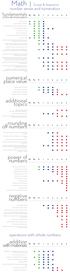 Math Scope & Sequence fundamentals number sense and numeration of the decimal system Count to 10 by units Associate number to numeral (1-10) KN 1 KN 1 KN 2 KN 2 Identify odd and even numbers/numerals and
Everyday Mathematics. Grade 4 Grade-Level Goals CCSS EDITION. Content Strand: Number and Numeration. Program Goal Content Thread Grade-Level Goal
 Content Strand: Number and Numeration Understand the Meanings, Uses, and Representations of Numbers Understand Equivalent Names for Numbers Understand Common Numerical Relations Place value and notation
Manitoba Curriculum. Alignment with Mathletics. Supported by independent evidence-based research and practice. Powerful reporting.
 Supported by independent evidence-based research practice. Follows provincial curricula Powerful reporting Student centred Content Kindergarten Grade 1 Grade 2 02 04 08 Grade 10 Applied & Pre-Calculus
Solve addition and subtraction word problems, and add and subtract within 10, e.g., by using objects or drawings to represent the problem.
 Solve addition and subtraction word problems, and add and subtract within 10, e.g., by using objects or drawings to represent the problem. Solve word problems that call for addition of three whole numbers
Everyday Mathematics. Grade 4 Grade-Level Goals. 3rd Edition. Content Strand: Number and Numeration. Program Goal Content Thread Grade-Level Goals
 Content Strand: Number and Numeration Understand the Meanings, Uses, and Representations of Numbers Understand Equivalent Names for Numbers Understand Common Numerical Relations Place value and notation
Year 3 Year 4 Year 5 Year 6. Strand 1 Number
 NRICH http://nrich.maths.org problems linked to the primary national curriculum for mathematics in Years 3, 4, 5 and 6 The stars indicate the level of confidence and competence needed to begin the activity.
SIL Maths Plans Year 3_Layout 1 06/05/2014 13:48 Page 2 Maths Plans Year 3
 Maths Plans Year 3 Contents Introduction Introduction 1 Using the Plans 2 Autumn 1 7 Autumn 2 21 Spring 1 43 Spring 2 59 Summer 1 75 Basic Skills 89 Progression 97 The Liverpool Maths team have developed
Math 0980 Chapter Objectives. Chapter 1: Introduction to Algebra: The Integers.
 Math 0980 Chapter Objectives Chapter 1: Introduction to Algebra: The Integers. 1. Identify the place value of a digit. 2. Write a number in words or digits. 3. Write positive and negative numbers used
r the COR Common Core State Standards Learning Pathways
 BUI LT fo COM r the MON COR E 2015 2016 Common Core State Standards Learning Pathways Table of Contents Grade 3...3 Grade 4...8 Grade 5... 13 Grade 6... 18 Grade 7...26 Grade 8...32 Algebra Readiness...36
Tennessee Mathematics Standards 2009-2010 Implementation. Grade Six Mathematics. Standard 1 Mathematical Processes
 Tennessee Mathematics Standards 2009-2010 Implementation Grade Six Mathematics Standard 1 Mathematical Processes GLE 0606.1.1 Use mathematical language, symbols, and definitions while developing mathematical
Glencoe. correlated to SOUTH CAROLINA MATH CURRICULUM STANDARDS GRADE 6 3-3, 5-8 8-4, 8-7 1-6, 4-9
 Glencoe correlated to SOUTH CAROLINA MATH CURRICULUM STANDARDS GRADE 6 STANDARDS 6-8 Number and Operations (NO) Standard I. Understand numbers, ways of representing numbers, relationships among numbers,
Decimals and Percentages
 Decimals and Percentages Specimen Worksheets for Selected Aspects Paul Harling b recognise the number relationship between coordinates in the first quadrant of related points Key Stage 2 (AT2) on a line
Grade 5 Math Content 1
 Grade 5 Math Content 1 Number and Operations: Whole Numbers Multiplication and Division In Grade 5, students consolidate their understanding of the computational strategies they use for multiplication.
1A: Understand numbers, ways of representing numbers, relationships among numbers, and number systems.
 NCTM STANDARD 1: Numbers and Operations Kindergarten Grade 2 1A: Understand numbers, ways of representing numbers, relationships among numbers, and number systems. Kindergarten Grade One Grade Two 1. Count
Fourth Grade Math Standards and "I Can Statements"
 Fourth Grade Math Standards and "I Can Statements" Standard - CC.4.OA.1 Interpret a multiplication equation as a comparison, e.g., interpret 35 = 5 x 7 as a statement that 35 is 5 times as many as 7 and
Summary Of Mental Maths Targets EYFS Yr 6. Year 3. Count from 0 in multiples of 4 & 8, 50 & 100. Count back in 100s, 10s, 1s eg.
 Autumn 1 Say the number names in order to 10. Read and write from 1 to 20 in numerals and words. Count in steps of 2, 3, and 5 from 0, and in tens from any number, forward and backward. Count from 0 in
Medium term Plans for Spring Year 5
 Medium term Plans for Spring Year 5 Help these children be in a better position to achieve good results in the Y6 Sats in 2015. Although these tests will officially be based on the old curriculum, it is
MACMILLAN/McGRAW-HILL. MATH CONNECTS and IMPACT MATHEMATICS WASHINGTON STATE MATHEMATICS STANDARDS. ESSENTIAL ACADEMIC LEARNING REQUIREMENTS (EALRs)
 MACMILLAN/McGRAW-HILL MATH CONNECTS and IMPACT MATHEMATICS TO WASHINGTON STATE MATHEMATICS STANDARDS ESSENTIAL ACADEMIC LEARNING REQUIREMENTS (EALRs) And GRADE LEVEL EXPECTATIONS (GLEs) / Edition, Copyright
Math - 5th Grade. two digit by one digit multiplication fact families subtraction with regrouping
 Number and Operations Understand division of whole numbers N.MR.05.01 N.MR.05.02 N.MR.05.03 Understand the meaning of division of whole numbers with and without remainders; relate division to and to repeated
Number and Place Value. September 2014 1. Year 3 Year 4 Year 5 Year 6
 NRICH http://nrich.maths.org problems linked to the primary national curriculum for mathematics in Years 3, 4, 5 and 6 The stars indicate the level of confidence and competence needed to begin the activity.
Prentice Hall Mathematics: Course 1 2008 Correlated to: Arizona Academic Standards for Mathematics (Grades 6)
 PO 1. Express fractions as ratios, comparing two whole numbers (e.g., ¾ is equivalent to 3:4 and 3 to 4). Strand 1: Number Sense and Operations Every student should understand and use all concepts and
of surface, 569-571, 576-577, 578-581 of triangle, 548 Associative Property of addition, 12, 331 of multiplication, 18, 433
 Absolute Value and arithmetic, 730-733 defined, 730 Acute angle, 477 Acute triangle, 497 Addend, 12 Addition associative property of, (see Commutative Property) carrying in, 11, 92 commutative property
CALCULATIONS. Understand the operation of addition and the associated vocabulary, and its relationship to subtraction
 CALCULATIONS Pupils should be taught to: Understand the operation of addition and the associated vocabulary, and its relationship to subtraction As outcomes, Year 4 pupils should, for example: Use, read
WORK SCHEDULE: MATHEMATICS 2007
 , K WORK SCHEDULE: MATHEMATICS 00 GRADE MODULE TERM... LO NUMBERS, OPERATIONS AND RELATIONSHIPS able to recognise, represent numbers and their relationships, and to count, estimate, calculate and check
Section 1: How will you be tested? This section will give you information about the different types of examination papers that are available.
 REVISION CHECKLIST for IGCSE Mathematics 0580 A guide for students How to use this guide This guide describes what topics and skills you need to know for your IGCSE Mathematics examination. It will help
LESSON 4 Missing Numbers in Multiplication Missing Numbers in Division LESSON 5 Order of Operations, Part 1 LESSON 6 Fractional Parts LESSON 7 Lines,
 Saxon Math 7/6 Class Description: Saxon mathematics is based on the principle of developing math skills incrementally and reviewing past skills daily. It also incorporates regular and cumulative assessments.
Florida Math 0018. Correlation of the ALEKS course Florida Math 0018 to the Florida Mathematics Competencies - Lower
 Florida Math 0018 Correlation of the ALEKS course Florida Math 0018 to the Florida Mathematics Competencies - Lower Whole Numbers MDECL1: Perform operations on whole numbers (with applications, including
Mathematics. Steps to Success. and. Top Tips. Year 5
 Pownall Green Primary School Mathematics and Year 5 1 Contents Page 1. Multiplication and Division 3 2. Positive and Negative Numbers 4 3. Decimal Notation 4. Reading Decimals 5 5. Fractions Linked to
Mathematics. Programme of study for key stage 3 and attainment targets (This is an extract from The National Curriculum 2007)
 Mathematics Programme of study for key stage 3 and attainment targets (This is an extract from The National Curriculum 2007) Crown copyright 2007 Qualifications and Curriculum Authority 2007 Curriculum
Grade 5 Common Core State Standard
 2.1.5.B.1 Apply place value concepts to show an understanding of operations and rounding as they pertain to whole numbers and decimals. M05.A-T.1.1.1 Demonstrate an understanding that 5.NBT.1 Recognize
Current Standard: Mathematical Concepts and Applications Shape, Space, and Measurement- Primary
 Shape, Space, and Measurement- Primary A student shall apply concepts of shape, space, and measurement to solve problems involving two- and three-dimensional shapes by demonstrating an understanding of:
Grade 6 Mathematics Performance Level Descriptors
 Limited Grade 6 Mathematics Performance Level Descriptors A student performing at the Limited Level demonstrates a minimal command of Ohio s Learning Standards for Grade 6 Mathematics. A student at this
ModuMath Basic Math Basic Math 1.1 - Naming Whole Numbers Basic Math 1.2 - The Number Line Basic Math 1.3 - Addition of Whole Numbers, Part I
 ModuMath Basic Math Basic Math 1.1 - Naming Whole Numbers 1) Read whole numbers. 2) Write whole numbers in words. 3) Change whole numbers stated in words into decimal numeral form. 4) Write numerals in
NCTM Curriculum Focal Points for Grade 5. Everyday Mathematics, Grade 5
 NCTM Curriculum Focal Points and, Grade 5 NCTM Curriculum Focal Points for Grade 5 Number and Operations and Algebra: Developing an understanding of and fluency with division of whole numbers Students
The Crescent Primary School Calculation Policy
 The Crescent Primary School Calculation Policy Examples of calculation methods for each year group and the progression between each method. January 2015 Our Calculation Policy This calculation policy has
Indicator 2: Use a variety of algebraic concepts and methods to solve equations and inequalities.
 3 rd Grade Math Learning Targets Algebra: Indicator 1: Use procedures to transform algebraic expressions. 3.A.1.1. Students are able to explain the relationship between repeated addition and multiplication.
Minnesota Academic Standards
 A Correlation of to the Minnesota Academic Standards Grades K-6 G/M-204 Introduction This document demonstrates the high degree of success students will achieve when using Scott Foresman Addison Wesley
Key Topics What will ALL students learn? What will the most able students learn?
 2013 2014 Scheme of Work Subject MATHS Year 9 Course/ Year Term 1 Key Topics What will ALL students learn? What will the most able students learn? Number Written methods of calculations Decimals Rounding
Multiplication. Year 1 multiply with concrete objects, arrays and pictorial representations
 Year 1 multiply with concrete objects, arrays and pictorial representations Children will experience equal groups of objects and will count in 2s and 10s and begin to count in 5s. They will work on practical
Performance Level Descriptors Grade 6 Mathematics
 Performance Level Descriptors Grade 6 Mathematics Multiplying and Dividing with Fractions 6.NS.1-2 Grade 6 Math : Sub-Claim A The student solves problems involving the Major Content for grade/course with
Senior Phase Grade 8 Today Planning Pack MATHEMATICS
 M780636110236 Senior Phase Grade 8 Today Planning Pack MATHEMATICS Contents: Work Schedule: Page Grade 8 2 Lesson Plans: Grade 8 4 Rubrics: Rubric 1: Recognising, classifying and representing numbers...22
How To Learn To Understand And Understand The Math Of The Year
 Year R Maths Objectives In order to meet the Early Learning Goals at the end of Year R children must be able to: Numbers Count reliably with numbers from -0, place them in order and say which number is
Annotated work sample portfolios are provided to support implementation of the Foundation Year 10 Australian Curriculum.
 Work sample portfolio summary WORK SAMPLE PORTFOLIO Annotated work sample portfolios are provided to support implementation of the Foundation Year 10 Australian Curriculum. Each portfolio is an example
BPS Math Year at a Glance (Adapted from A Story Of Units Curriculum Maps in Mathematics K-5) 1
 Grade 4 Key Areas of Focus for Grades 3-5: Multiplication and division of whole numbers and fractions-concepts, skills and problem solving Expected Fluency: Add and subtract within 1,000,000 Module M1:
Such As Statements, Kindergarten Grade 8
 Such As Statements, Kindergarten Grade 8 This document contains the such as statements that were included in the review committees final recommendations for revisions to the mathematics Texas Essential
CCSS Mathematics Implementation Guide Grade 5 2012 2013. First Nine Weeks
 First Nine Weeks s The value of a digit is based on its place value. What changes the value of a digit? 5.NBT.1 RECOGNIZE that in a multi-digit number, a digit in one place represents 10 times as much
Math 5th grade. Create your own number and explain how to use expanded form to show place value to the ten millions place.
 Number Properties and Operations Whole number sense and addition and subtraction are key concepts and skills developed in early childhood. Students build on their number sense and counting sense to develop
Unit 8 Angles, 2D and 3D shapes, perimeter and area
 Unit 8 Angles, 2D and 3D shapes, perimeter and area Five daily lessons Year 6 Spring term Recognise and estimate angles. Use a protractor to measure and draw acute and obtuse angles to Page 111 the nearest
Medium term Plan for Summer Year 3
 Medium term Plan for Summer Year 3 Week Main focus of teaching and activities each day Starter Outcomes of each day 1 Place Value and number Day 1: Partition and represent 3-digit numbers using Place Value
Arithmetic 1 Progress Ladder
 Arithmetic 1 Progress Ladder Maths Makes Sense Foundation End-of-year objectives page 2 Maths Makes Sense 1 2 End-of-block objectives page 3 Maths Makes Sense 3 4 End-of-block objectives page 4 Maths Makes
Common Core Unit Summary Grades 6 to 8
 Common Core Unit Summary Grades 6 to 8 Grade 8: Unit 1: Congruence and Similarity- 8G1-8G5 rotations reflections and translations,( RRT=congruence) understand congruence of 2 d figures after RRT Dilations
Assessment Anchors and Eligible Content
 M07.A-N The Number System M07.A-N.1 M07.A-N.1.1 DESCRIPTOR Assessment Anchors and Eligible Content Aligned to the Grade 7 Pennsylvania Core Standards Reporting Category Apply and extend previous understandings
Addition Methods. Methods Jottings Expanded Compact Examples 8 + 7 = 15
 Addition Methods Methods Jottings Expanded Compact Examples 8 + 7 = 15 48 + 36 = 84 or: Write the numbers in columns. Adding the tens first: 47 + 76 110 13 123 Adding the units first: 47 + 76 13 110 123
Securing number facts, calculating, identifying relationships
 1 of 19 The National Strategies Primary Year 4 Block E: Three 3-week units Securing number facts, calculating, identifying relationships Tables 10 10; multiples Written methods: TU U; TU U; rounding remainders
1 of 20 The National Strategies Primary Year 4 Block D: Calculating, measuring and understanding shape
 1 of 20 The National Strategies Primary Year 4 Block D: Three 2-week units Calculating, measuring and understanding shape Standard metric units Reading from partly numbered scales am, pm, 12-hour clock
MAFS: Mathematics Standards GRADE: K
 MAFS: Mathematics Standards GRADE: K Domain: COUNTING AND CARDINALITY Cluster 1: Know number names and the count sequence. CODE MAFS.K.CC.1.1 Count to 100 by ones and by tens. MAFS.K.CC.1.2 MAFS.K.CC.1.3
Topic Lesson Widget HOTsheet
 Numbers to 1000 and beyond Numbers to 1000 Words and numbers Number machine Ordering numbers Numbers beyond 1000 Number creator Jersey numbers Number grid puzzles Number creator Digit cards Passwords Splitting
Geometry Progress Ladder
 Geometry Progress Ladder Maths Makes Sense Foundation End-of-year objectives page 2 Maths Makes Sense 1 2 End-of-block objectives page 3 Maths Makes Sense 3 4 End-of-block objectives page 4 Maths Makes
Unit 11 Fractions and decimals
 Unit 11 Fractions and decimals Five daily lessons Year 4 Spring term (Key objectives in bold) Unit Objectives Year 4 Use fraction notation. Recognise simple fractions that are Page several parts of a whole;
Grade 4 Unit 3: Multiplication and Division; Number Sentences and Algebra
 Grade 4 Unit 3: Multiplication and Division; Number Sentences and Algebra Activity Lesson 3-1 What s My Rule? page 159) Everyday Mathematics Goal for Mathematical Practice GMP 2.2 Explain the meanings
Math Journal HMH Mega Math. itools Number
 Lesson 1.1 Algebra Number Patterns CC.3.OA.9 Identify arithmetic patterns (including patterns in the addition table or multiplication table), and explain them using properties of operations. Identify and
Guidance paper - The use of calculators in the teaching and learning of mathematics
 Guidance paper - The use of calculators in the teaching and learning of mathematics Background and context In mathematics, the calculator can be an effective teaching and learning resource in the primary
Prentice Hall Connected Mathematics 2, 7th Grade Units 2009
 Prentice Hall Connected Mathematics 2, 7th Grade Units 2009 Grade 7 C O R R E L A T E D T O from March 2009 Grade 7 Problem Solving Build new mathematical knowledge through problem solving. Solve problems
Biggar High School Mathematics Department. National 5 Learning Intentions & Success Criteria: Assessing My Progress
 Biggar High School Mathematics Department National 5 Learning Intentions & Success Criteria: Assessing My Progress Expressions & Formulae Topic Learning Intention Success Criteria I understand this Approximation
Pocantico Hills School District Grade 1 Math Curriculum Draft
 Pocantico Hills School District Grade 1 Math Curriculum Draft Patterns /Number Sense/Statistics Content Strands: Performance Indicators 1.A.1 Determine and discuss patterns in arithmetic (what comes next
Measurement with Ratios
 Grade 6 Mathematics, Quarter 2, Unit 2.1 Measurement with Ratios Overview Number of instructional days: 15 (1 day = 45 minutes) Content to be learned Use ratio reasoning to solve real-world and mathematical