
Lecture 3 SU(2) January 26, Lecture 3
|
|
|
- Thomas Underwood
- 9 years ago
- Views:
Transcription
1 Lecture 3 SU(2) January 26, 2 Lecture 3
2 A Little Group Theory A group is a set of elements plus a compostion rule, such that:. Combining two elements under the rule gives another element of the group. E E = E 2. There is an indentity element E I = I E = E 3. Every element has a unique inverse E E = E E = I 4. The composition rule is associative A (B C) = (A B) C Lecture 3

3 The U() Group The set of all functions U(θ) = e iθ form a group. E(θ) U(θ ) = e i(θ+θ ) = E(θ + θ ) I = E() E (θ) = E( θ) ( E(θ ) E(θ 2 ) ) U(θ 3 ) = E(θ ) (E(θ 2 ) E(θ 3 ) ) This is the one dimensional unitary group U() Lecture 3 2

4 Lie Groups If the elements of a group are differentiable with respect to their parameters, the group is a Lie group. U() is a Lie group. de dθ = ie For a Lie group, any element can be written in the form ( n ) E(θ, θ 2,, θ n ) = exp iθ i F i i= The quantities F i are the generators of the group. The quatities θ i are the parameters of the group. They are a set of i real numbers that are needed to specify a particular element of the group. Note that the number of generators and parameters are the same. There is one generator for each parameter. Lecture 3 3

5 U() The group U() is the set of all one dimensional, complex unitary matrices. The group has one generator F =, and one parameter, θ. It simply produces a complex phase change. E(θ) = e iθf = e iθ Since the generator F, commutes with itself, the group elements also commute. E(θ )E(θ 2 ) = e iθ e iθ 2 = e iθ 2 e iθ = E(θ 2 )E(θ ) Such groups are called Abelian groups. Lecture 3 4
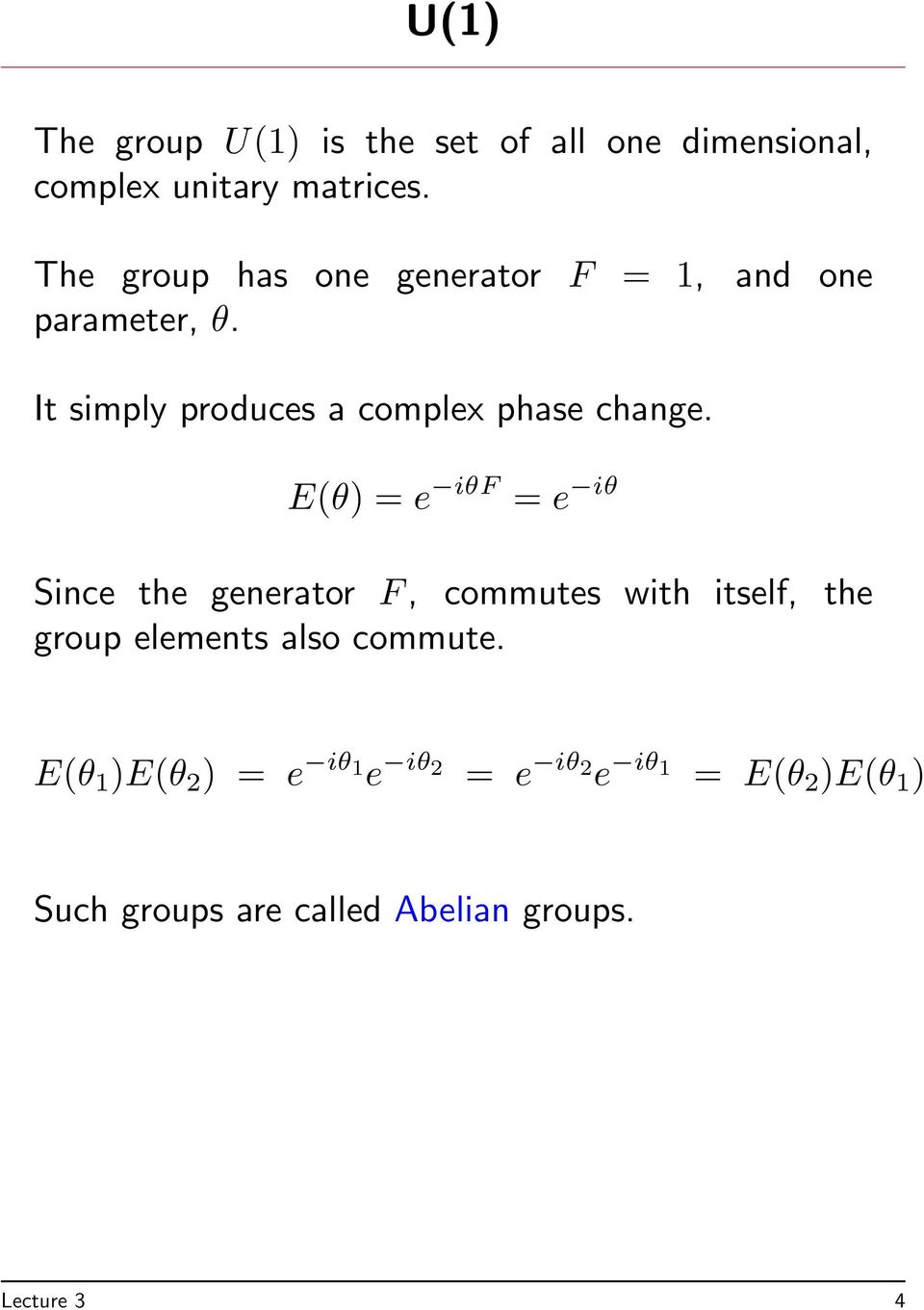
6 U(2) The group U(2) is the set of all two dimensional, complex unitary matrices. An complex n n matrix has 2n 2 real parameters. The unitary condition constraint removes n 2 of these. The group U(2) then has four generators and four parameters. E(θ, θ, θ 2, θ 3 ) = e iθ jf j where j =,, 2, 3 The generators are: F i = σ i /2 F = 2 ( ) F = 2 ( ) F 2 = 2 ( ) i i F 3 = 2 ( ) Lecture 3 5
7 SU(2) The operators represented by the elements of U(2) act on two dimensional complex vectors. The operations generated by F = σ /2 simply change the complex phase of both components of the vector by the same amount. In general we are not so interested in these operations. The group SU(2) is the set of all two dimensional, complex unitary matrices with unit determinant. The unit determinant constraint removes one more parameter. The group SU(2) then has three generators and three parameters. E(θ, θ 2, θ 3 ) = e iθ jf j where j =, 2, 3 The generators of SU(2) are a set of three linearly independent, traceless 2 2 Hermitian matrices: F = ( ) F 2 2 = ( ) i F 2 i 3 = ( ) 2 Since the generators do not commute with one another, this is a non Abelian group. Lecture 3 6

8 SO(3) The group SO(3) is the set of all three dimensional, real orthogonal matrices with unit determinant. [Requiring that the determinant equal and not, excludes reflections.] A real n n orthogonal matrix has n(n )/2 real parameters The group SO(3) then has three parameters. The group SO(3) represents the set of all possible rotations of a three dimensional real vector. For example, in terms of the Euler angles R(α, β, γ) = cos γ sin γ cos β sin β cos α sin α sin γ cos γ A A sin α cos α A sin β cos β Lecture 3 7
![] A real n n orthogonal matrix has n(n )/2 real parameters The group SO(3) then has three parameters.](/docs-images/46/21557762/images/page_8.jpg "The group SO(3) represents the set of all possible rotations of a three dimensional real vector.")
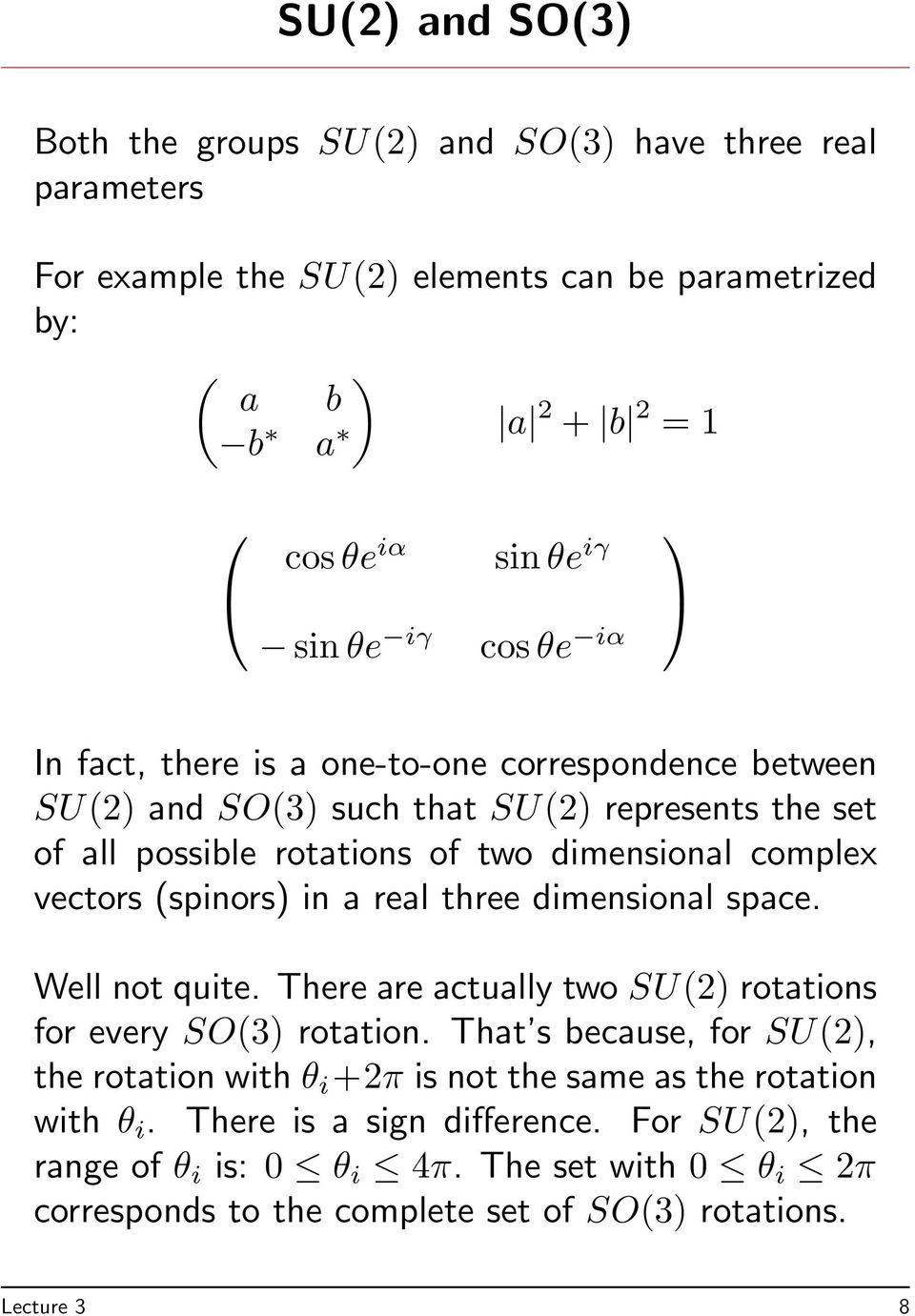
9 SU(2) and SO(3) Both the groups SU(2) and SO(3) have three real parameters For example the SU(2) elements can be parametrized by: ( ) a b b a a 2 + b 2 = cos θeiα sin θe iγ sin θe iγ cos θe iα In fact, there is a one-to-one correspondence between SU(2) and SO(3) such that SU(2) represents the set of all possible rotations of two dimensional complex vectors (spinors) in a real three dimensional space. Well not quite. There are actually two SU(2) rotations for every SO(3) rotation. That s because, for SU(2), the rotation with θ i +2π is not the same as the rotation with θ i. There is a sign difference. For SU(2), the range of θ i is: θ i 4π. The set with θ i 2π corresponds to the complete set of SO(3) rotations. Lecture 3 8
10 The Group SU(2) As we have seen, for the case of j = /2, rotations are represented by the matrices of the form e iθ σ ˆθ/2 = cos(θ/2)i i( σ ˆθ) sin(θ/2) These matrices are 2 2 complex unitary matrices with unit determinant. The determinant is unity because det(e iθ σ ˆθ/2 ) = e Tr( iθ σ ˆθ/2) = e = The set of all of these matrices forms the group SU(2) under the operation of matrix multiplication. These elements are described by a set of three real parameter (θ x, θ y, θ z ) ( ) σ ˆθ ˆθz ˆθx iˆθ = y ˆθ x + iˆθ y ˆθ z This set of matrices are then elements of a three dimension real vector space that can be identified as the space of physics vectors and the three generators of rotations, σ, σ 2, σ 3 can be identified with the three components of a physical vector S x = h 2 σ S y = h 2 σ 2 S z = h 2 σ 3 Lecture 3 9

11 SU(2) and Rotations e iθ σ ˆθ/2 Any normalized( element of a complex two dimensional α vector space is also described by three real β) parameters, the real and imaginary parts of α and β with the constraint α 2 + β 2 = Any normalized element of the two dimensional vector ( space can be obtained by a rotation of the state ) = cos(θ/2) = «i sin(θ/2) ˆθ z ˆθ x + iˆθ y cos θ 2 iˆθ z sin θ 2 ( ˆθ y iˆθ x ) sin θ 2 (ˆθ y iˆθ x ) sin θ 2 cos θ 2 + iˆθ z sin θ 2 ˆθx iˆθ y ˆθ z ( e iθ σ ˆθ/2 = ) cos θ 2 iˆθ z sin θ ( 2 α = (ˆθ y iˆθ x ) sin β) θ 2 ( α Conversely, for every state there is some direction β) ˆn such that: ( α S ˆn β) = h 2 ( α β)! Lecture 3

12 A Check on Consistency Under a π/2 rotation about the x-axis, the expectation valuer of Ŝy for the rotated system should equal the expectation value of Ŝz for the non-rotated system. ψ Ŝy ψ = ψ Ŝz ψ Let s check it. ψ Ŝz ψ = ψ e iπσ x/4 e iπσ x/4 Ŝ z e iπσ x/4 e iπσ x/4 ψ = ψ e iπσ x/4 Ŝ z e iπσ x/4 ψ Now, does e iπσx/4 iπσ Ŝ z e x/4 = Ŝy Lecture 3

13 Generalization of the Anticommutation Relations σ i σ j = σ j σ i for i j σ i σ n j = ( ) n σ n j σ i = ( σ j ) n σ i Then for any analytic function of σ j, i.e. and function that can be expanded as a power series, we have σ i f(σ j ) = f( σ j )σ i Using this result we have e iπσ x/4 Ŝ z e iπσ x/4 = h 2 eiπσ x/4 σ z e iπσ x/4 = h 2 eiπσ x/4 e iπσ x/4 σ z = h 2 eiπσ x/2 σ z = h 2 (cos π 2 + iσ x sin π 2 )σ z = h 2 iσ xσ z = h 2 σ y = Ŝy It checks. Lecture 3 2

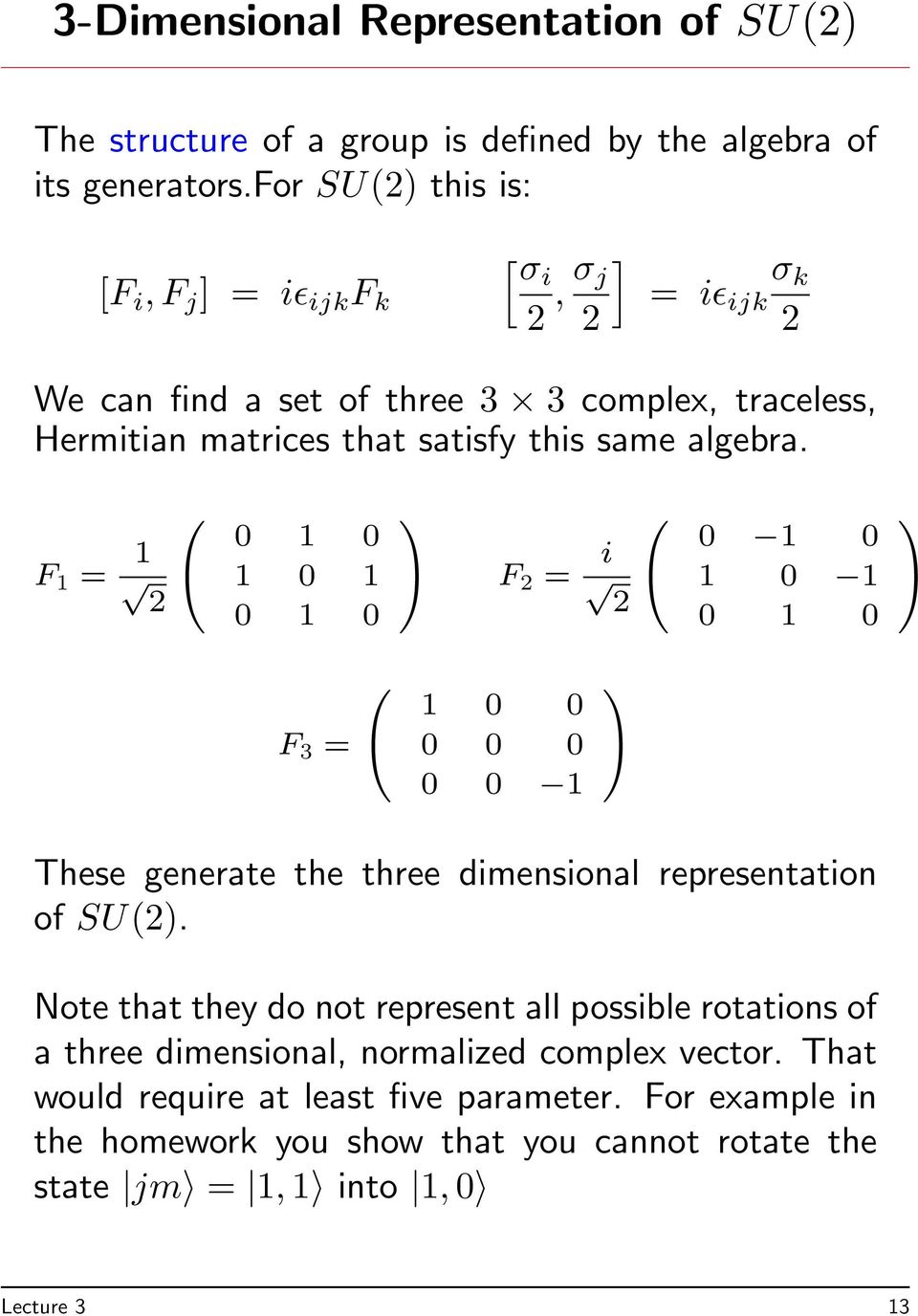
14 3-Dimensional Representation of SU(2) The structure of a group is defined by the algebra of its generators.for SU(2) this is: [ σi [F i, F j ] = iɛ ijk F k 2, σ ] j 2 = iɛ ijk σ k 2 We can find a set of three 3 3 complex, traceless, Hermitian matrices that satisfy this same algebra. F = 2 A F 2 = i 2 A F 3 = A These generate the three dimensional representation of SU(2). Note that they do not represent all possible rotations of a three dimensional, normalized complex vector. That would require at least five parameter. For example in the homework you show that you cannot rotate the state jm =, into, Lecture 3 3
15 Isospin We are used to SU(2) in spin space Transformations are physical rotations in 3- dimensional space Generators are angular momentum operators Now we want to consider SU(2) in a new isospin space. Complete analogy with SU(2) in spin space. But, transformations are not physics rotations but rather rotations in the abstract isospin space. ψ = e ik x c c «{z } spin cu c d «{z } isospin Lecture 3 4

16 SU(3) The group SU(3) is the set of all three dimensional, complex unitary matrices with unit determinant. This set has 2(3) 2 (3) 2 = 8 parameters and generators. E(θ, θ 2,, θ 8 ) = e iθ jf j where j =, 2,, 8 The generators of SU(3) are a set of eight linearly independent, traceless 3 3 Hermitian matrices: Since there are eight generators, the e SU(3) elements represent rotations of complex three component vectors in an eight dimensional space. Lecture 3 5

17 SU(3) Generators λ = A λ 2 = i i A λ 3 = A λ 4 = A λ 5 = i i A λ 6 = A λ 7 = i i A λ 8 = 3 2 A The structure of SU(3) is: [λ a, λ b ] = 2if abc λ c f 23 = f 458 = f 678 = 3 2 f 47 = f 56 = f 246 = f 257 = f 345 = f 637 = 2 f abc is totally antisymmetric Lecture 3 6

 α α λ α = = λ λ α ψ = = α α α λ λ ψ α = + β = > θ θ β > β β θ θ θ β θ β γ θ β = γ θ > β > γ θ β γ = θ β = θ β = θ β = β θ = β β θ = = = β β θ = + α α α α α = = λ λ λ λ λ λ λ = λ λ α α α α λ ψ + α =
Chapter 9 Unitary Groups and SU(N)
 Chapter 9 Unitary Groups and SU(N) The irreducible representations of SO(3) are appropriate for describing the degeneracies of states of quantum mechanical systems which have rotational symmetry in three
Lecture L3 - Vectors, Matrices and Coordinate Transformations
 S. Widnall 16.07 Dynamics Fall 2009 Lecture notes based on J. Peraire Version 2.0 Lecture L3 - Vectors, Matrices and Coordinate Transformations By using vectors and defining appropriate operations between
The three-dimensional rotations are defined as the linear transformations of the vector x = (x 1, x 2, x 3 ) x i = R ij x j, (2.1) x 2 = x 2. (2.
 2 The rotation group In this Chapter we give a short account of the main properties of the threedimensional rotation group SO(3) and of its universal covering group SU(2). The group SO(3) is an important
Physics 235 Chapter 1. Chapter 1 Matrices, Vectors, and Vector Calculus
 Chapter 1 Matrices, Vectors, and Vector Calculus In this chapter, we will focus on the mathematical tools required for the course. The main concepts that will be covered are: Coordinate transformations
Quantum Mechanics and Representation Theory
 Quantum Mechanics and Representation Theory Peter Woit Columbia University Texas Tech, November 21 2013 Peter Woit (Columbia University) Quantum Mechanics and Representation Theory November 2013 1 / 30
Continuous Groups, Lie Groups, and Lie Algebras
 Chapter 7 Continuous Groups, Lie Groups, and Lie Algebras Zeno was concerned with three problems... These are the problem of the infinitesimal, the infinite, and continuity... Bertrand Russell The groups
Lecture 7. Matthew T. Mason. Mechanics of Manipulation. Lecture 7. Representing Rotation. Kinematic representation: goals, overview
 Matthew T. Mason Mechanics of Manipulation Today s outline Readings, etc. We are starting chapter 3 of the text Lots of stuff online on representing rotations Murray, Li, and Sastry for matrix exponential
Unified Lecture # 4 Vectors
 Fall 2005 Unified Lecture # 4 Vectors These notes were written by J. Peraire as a review of vectors for Dynamics 16.07. They have been adapted for Unified Engineering by R. Radovitzky. References [1] Feynmann,
1 Comparing Complex Numbers to Clifford Algebra
 1 1 Comparing Complex Numbers to Clifford Algebra As the saying goes, learning proceeds from the known to the unknown. There are at least two possibilities: 1) If you are starting from scratch, a nice
The Matrix Elements of a 3 3 Orthogonal Matrix Revisited
 Physics 116A Winter 2011 The Matrix Elements of a 3 3 Orthogonal Matrix Revisited 1. Introduction In a class handout entitled, Three-Dimensional Proper and Improper Rotation Matrices, I provided a derivation
Linear Algebra Review. Vectors
 Linear Algebra Review By Tim K. Marks UCSD Borrows heavily from: Jana Kosecka [email protected] http://cs.gmu.edu/~kosecka/cs682.html Virginia de Sa Cogsci 8F Linear Algebra review UCSD Vectors The length
Particle Physics. Michaelmas Term 2011 Prof Mark Thomson. Handout 7 : Symmetries and the Quark Model. Introduction/Aims
 Particle Physics Michaelmas Term 2011 Prof Mark Thomson Handout 7 : Symmetries and the Quark Model Prof. M.A. Thomson Michaelmas 2011 206 Introduction/Aims Symmetries play a central role in particle physics;
THE COMPLEX EXPONENTIAL FUNCTION
 Math 307 THE COMPLEX EXPONENTIAL FUNCTION (These notes assume you are already familiar with the basic properties of complex numbers.) We make the following definition e iθ = cos θ + i sin θ. (1) This formula
Complex Numbers. w = f(z) z. Examples
 omple Numbers Geometrical Transformations in the omple Plane For functions of a real variable such as f( sin, g( 2 +2 etc ou are used to illustrating these geometricall, usuall on a cartesian graph. If
Spin. Chapter 6. Advanced Quantum Physics
 Chapter 6 Spin Until we have focussed on the quantum mechanics of particles which are featureless, carrying no internal degrees of freedom However, a relativistic formulation of quantum mechanics shows
Linear algebra and the geometry of quadratic equations. Similarity transformations and orthogonal matrices
 MATH 30 Differential Equations Spring 006 Linear algebra and the geometry of quadratic equations Similarity transformations and orthogonal matrices First, some things to recall from linear algebra Two
0.1 Phase Estimation Technique
 Phase Estimation In this lecture we will describe Kitaev s phase estimation algorithm, and use it to obtain an alternate derivation of a quantum factoring algorithm We will also use this technique to design
Geometric Transformation CS 211A
 Geometric Transformation CS 211A What is transformation? Moving points (x,y) moves to (x+t, y+t) Can be in any dimension 2D Image warps 3D 3D Graphics and Vision Can also be considered as a movement to
[1] Diagonal factorization
![[1] Diagonal factorization](/thumbs/40/21671034.jpg "[1] Diagonal factorization") 8.03 LA.6: Diagonalization and Orthogonal Matrices [ Diagonal factorization [2 Solving systems of first order differential equations [3 Symmetric and Orthonormal Matrices [ Diagonal factorization Recall:
8.03 LA.6: Diagonalization and Orthogonal Matrices [ Diagonal factorization [2 Solving systems of first order differential equations [3 Symmetric and Orthonormal Matrices [ Diagonal factorization Recall:
Math 241, Exam 1 Information.
 Math 241, Exam 1 Information. 9/24/12, LC 310, 11:15-12:05. Exam 1 will be based on: Sections 12.1-12.5, 14.1-14.3. The corresponding assigned homework problems (see http://www.math.sc.edu/ boylan/sccourses/241fa12/241.html)
The Two-Body Problem
 The Two-Body Problem Abstract In my short essay on Kepler s laws of planetary motion and Newton s law of universal gravitation, the trajectory of one massive object near another was shown to be a conic
Lecture 3: Coordinate Systems and Transformations
 Lecture 3: Coordinate Systems and Transformations Topics: 1. Coordinate systems and frames 2. Change of frames 3. Affine transformations 4. Rotation, translation, scaling, and shear 5. Rotation about an
Chapter 17. Orthogonal Matrices and Symmetries of Space
 Chapter 17. Orthogonal Matrices and Symmetries of Space Take a random matrix, say 1 3 A = 4 5 6, 7 8 9 and compare the lengths of e 1 and Ae 1. The vector e 1 has length 1, while Ae 1 = (1, 4, 7) has length
v 1 v 3 u v = (( 1)4 (3)2, [1(4) ( 2)2], 1(3) ( 2)( 1)) = ( 10, 8, 1) (d) u (v w) = (u w)v (u v)w (Relationship between dot and cross product)
![v 1 v 3 u v = (( 1)4 (3)2, [1(4) ( 2)2], 1(3) ( 2)( 1)) = ( 10, 8, 1) (d) u (v w) = (u w)v (u v)w (Relationship between dot and cross product)](/thumbs/40/20880945.jpg "v 1 v 3 u v = (( 1)4 (3)2, [1(4) ( 2)2], 1(3) ( 2)( 1)) = ( 10, 8, 1) (d) u (v w) = (u w)v (u v)w (Relationship between dot and cross product)") 0.1 Cross Product The dot product of two vectors is a scalar, a number in R. Next we will define the cross product of two vectors in 3-space. This time the outcome will be a vector in 3-space. Definition
0.1 Cross Product The dot product of two vectors is a scalar, a number in R. Next we will define the cross product of two vectors in 3-space. This time the outcome will be a vector in 3-space. Definition
Mathematics Course 111: Algebra I Part IV: Vector Spaces
 Mathematics Course 111: Algebra I Part IV: Vector Spaces D. R. Wilkins Academic Year 1996-7 9 Vector Spaces A vector space over some field K is an algebraic structure consisting of a set V on which are
EXPLORATORY DATA ANALYSIS WITH APPLICATIONS TO BIOINFORMATICS
 EXPLORATORY DATA ANALYSIS WITH APPLICATIONS TO BIOINFORMATICS KANTI V. MARDIA, JOHN T. KENT, ZHENGZHENG ZHANG AND CHARLES C. TAYLOR DEPARTMENT OF STATISTICS, UNIVERSITY OF LEEDS, LEEDS, UK. ABSTRACT. There
Linear Algebra Notes for Marsden and Tromba Vector Calculus
 Linear Algebra Notes for Marsden and Tromba Vector Calculus n-dimensional Euclidean Space and Matrices Definition of n space As was learned in Math b, a point in Euclidean three space can be thought of
Addition and Subtraction of Vectors
 ddition and Subtraction of Vectors 1 ppendi ddition and Subtraction of Vectors In this appendi the basic elements of vector algebra are eplored. Vectors are treated as geometric entities represented b
1 Introduction to Matrices
 1 Introduction to Matrices In this section, important definitions and results from matrix algebra that are useful in regression analysis are introduced. While all statements below regarding the columns
Cross product and determinants (Sect. 12.4) Two main ways to introduce the cross product
 Cross product and determinants (Sect. 12.4) Two main ways to introduce the cross product Geometrical definition Properties Expression in components. Definition in components Properties Geometrical expression.
MA106 Linear Algebra lecture notes
 MA106 Linear Algebra lecture notes Lecturers: Martin Bright and Daan Krammer Warwick, January 2011 Contents 1 Number systems and fields 3 1.1 Axioms for number systems......................... 3 2 Vector
AP Physics - Vector Algrebra Tutorial
 AP Physics - Vector Algrebra Tutorial Thomas Jefferson High School for Science and Technology AP Physics Team Summer 2013 1 CONTENTS CONTENTS Contents 1 Scalars and Vectors 3 2 Rectangular and Polar Form
VECTOR ALGEBRA. 10.1.1 A quantity that has magnitude as well as direction is called a vector. is given by a and is represented by a.
 VECTOR ALGEBRA Chapter 10 101 Overview 1011 A quantity that has magnitude as well as direction is called a vector 101 The unit vector in the direction of a a is given y a and is represented y a 101 Position
Computing Euler angles from a rotation matrix
 Computing Euler angles from a rotation matrix Gregory G. Slabaugh Abstract This document discusses a simple technique to find all possible Euler angles from a rotation matrix. Determination of Euler angles
Rotation Matrices and Homogeneous Transformations
 Rotation Matrices and Homogeneous Transformations A coordinate frame in an n-dimensional space is defined by n mutually orthogonal unit vectors. In particular, for a two-dimensional (2D) space, i.e., n
Similarity and Diagonalization. Similar Matrices
 MATH022 Linear Algebra Brief lecture notes 48 Similarity and Diagonalization Similar Matrices Let A and B be n n matrices. We say that A is similar to B if there is an invertible n n matrix P such that
Standard Model of Particle Physics
 Standard Model of Particle Physics Chris Sachrajda School of Physics and Astronomy University of Southampton Southampton SO17 1BJ UK SUSSP61, St Andrews August 8th 3rd 006 Contents 1. Spontaneous Symmetry
Math Placement Test Practice Problems
 Math Placement Test Practice Problems The following problems cover material that is used on the math placement test to place students into Math 1111 College Algebra, Math 1113 Precalculus, and Math 2211
5 VECTOR GEOMETRY. 5.0 Introduction. Objectives. Activity 1
 5 VECTOR GEOMETRY Chapter 5 Vector Geometry Objectives After studying this chapter you should be able to find and use the vector equation of a straight line; be able to find the equation of a plane in
Operators and Matrices
 Operators and Matrices You ve been using operators for years even if you ve never heard the term. Differentiation falls into this category; so does rotation; so does wheel-alignment. In the subject of
Lecture L5 - Other Coordinate Systems
 S. Widnall, J. Peraire 16.07 Dynamics Fall 008 Version.0 Lecture L5 - Other Coordinate Systems In this lecture, we will look at some other common systems of coordinates. We will present polar coordinates
Lectures notes on orthogonal matrices (with exercises) 92.222 - Linear Algebra II - Spring 2004 by D. Klain
 Lectures notes on orthogonal matrices (with exercises) 92.222 - Linear Algebra II - Spring 2004 by D. Klain 1. Orthogonal matrices and orthonormal sets An n n real-valued matrix A is said to be an orthogonal
MATH 381 HOMEWORK 2 SOLUTIONS
 MATH 38 HOMEWORK SOLUTIONS Question (p.86 #8). If g(x)[e y e y ] is harmonic, g() =,g () =, find g(x). Let f(x, y) = g(x)[e y e y ].Then Since f(x, y) is harmonic, f + f = and we require x y f x = g (x)[e
Section 9.1 Vectors in Two Dimensions
 Section 9.1 Vectors in Two Dimensions Geometric Description of Vectors A vector in the plane is a line segment with an assigned direction. We sketch a vector as shown in the first Figure below with an
MAT 1341: REVIEW II SANGHOON BAEK
 MAT 1341: REVIEW II SANGHOON BAEK 1. Projections and Cross Product 1.1. Projections. Definition 1.1. Given a vector u, the rectangular (or perpendicular or orthogonal) components are two vectors u 1 and
Lecture 18 - Clifford Algebras and Spin groups
 Lecture 18 - Clifford Algebras and Spin groups April 5, 2013 Reference: Lawson and Michelsohn, Spin Geometry. 1 Universal Property If V is a vector space over R or C, let q be any quadratic form, meaning
2D Geometric Transformations
 2D Geometric Transformations (Chapter 5 in FVD) 2D Geometric Transformations Question: How do we represent a geometric object in the plane? Answer: For now, assume that objects consist of points and lines.
Lecture 8. Generating a non-uniform probability distribution
 Discrete outcomes Lecture 8 Generating a non-uniform probability distribution Last week we discussed generating a non-uniform probability distribution for the case of finite discrete outcomes. An algorithm
5. Orthogonal matrices
 L Vandenberghe EE133A (Spring 2016) 5 Orthogonal matrices matrices with orthonormal columns orthogonal matrices tall matrices with orthonormal columns complex matrices with orthonormal columns 5-1 Orthonormal
Least-Squares Intersection of Lines
 Least-Squares Intersection of Lines Johannes Traa - UIUC 2013 This write-up derives the least-squares solution for the intersection of lines. In the general case, a set of lines will not intersect at a
Review A: Vector Analysis
 MASSACHUSETTS INSTITUTE OF TECHNOLOGY Department of Physics 8.02 Review A: Vector Analysis A... A-0 A.1 Vectors A-2 A.1.1 Introduction A-2 A.1.2 Properties of a Vector A-2 A.1.3 Application of Vectors
Physics 221A Spring 2016 Notes 18 Irreducible Tensor Operators and the Wigner-Eckart Theorem
 Copyright c 2016 by Robert G. Littlejohn Physics 221A Spring 2016 Notes 18 Irreducible Tensor Operators and the Wigner-Eckart Theorem 1. Introduction The Wigner-Eckart theorem concerns matrix elements
Lecture L30-3D Rigid Body Dynamics: Tops and Gyroscopes
 J. Peraire, S. Widnall 16.07 Dynamics Fall 2008 Version 2.0 Lecture L30-3D Rigid Body Dynamics: Tops and Gyroscopes 3D Rigid Body Dynamics: Euler Equations in Euler Angles In lecture 29, we introduced
Relationships among the UNITARY BASES. of WEYL, SCHWINGER, WERNER & OPPENHEIM. Nicholas Wheeler March 2012
 Relationships among the UNITARY BASES of WEYL, SCHWINGER, WERNER & OPPENHEIM Nicholas Wheeler March 22 Introduction. Near the conclusion of our get-acquainted lunch (2 January 22) I asked Maximilian Schlosshauer
Metrics on SO(3) and Inverse Kinematics
 Mathematical Foundations of Computer Graphics and Vision Metrics on SO(3) and Inverse Kinematics Luca Ballan Institute of Visual Computing Optimization on Manifolds Descent approach d is a ascent direction
Algebra I: Section 3. Group Theory 3.1 Groups.
 Notes: F.P. Greenleaf, 2000-08 Algebra I: Section 3. Group Theory 3.1 Groups. A group is a set G equipped with a binary operation mapping G G G. Such a product operation carries each ordered pair (x, y)
Mathematical Physics, Lecture 9
 Mathematical Physics, Lecture 9 Hoshang Heydari Fysikum April 25, 2012 Hoshang Heydari (Fysikum) Mathematical Physics, Lecture 9 April 25, 2012 1 / 42 Table of contents 1 Differentiable manifolds 2 Differential
Lecture 14: Section 3.3
 Lecture 14: Section 3.3 Shuanglin Shao October 23, 2013 Definition. Two nonzero vectors u and v in R n are said to be orthogonal (or perpendicular) if u v = 0. We will also agree that the zero vector in
Chapter 7. Permutation Groups
 Chapter 7 Permutation Groups () We started the study of groups by considering planar isometries In the previous chapter, we learnt that finite groups of planar isometries can only be cyclic or dihedral
MATH2210 Notebook 1 Fall Semester 2016/2017. 1 MATH2210 Notebook 1 3. 1.1 Solving Systems of Linear Equations... 3
 MATH0 Notebook Fall Semester 06/07 prepared by Professor Jenny Baglivo c Copyright 009 07 by Jenny A. Baglivo. All Rights Reserved. Contents MATH0 Notebook 3. Solving Systems of Linear Equations........................
Gauge theories and the standard model of elementary particle physics
 Gauge theories and the standard model of elementary particle physics Mark Hamilton 21st July 2014 1 / 35 Table of contents 1 The standard model 2 3 2 / 35 The standard model The standard model is the most
Introduction to Matrices for Engineers
 Introduction to Matrices for Engineers C.T.J. Dodson, School of Mathematics, Manchester Universit 1 What is a Matrix? A matrix is a rectangular arra of elements, usuall numbers, e.g. 1 0-8 4 0-1 1 0 11
Solutions to Problems in Goldstein, Classical Mechanics, Second Edition. Chapter 7
 Solutions to Problems in Goldstein, Classical Mechanics, Second Edition Homer Reid April 21, 2002 Chapter 7 Problem 7.2 Obtain the Lorentz transformation in which the velocity is at an infinitesimal angle
Finite dimensional C -algebras
 Finite dimensional C -algebras S. Sundar September 14, 2012 Throughout H, K stand for finite dimensional Hilbert spaces. 1 Spectral theorem for self-adjoint opertors Let A B(H) and let {ξ 1, ξ 2,, ξ n
Name: Section Registered In:
 Name: Section Registered In: Math 125 Exam 3 Version 1 April 24, 2006 60 total points possible 1. (5pts) Use Cramer s Rule to solve 3x + 4y = 30 x 2y = 8. Be sure to show enough detail that shows you are
4: EIGENVALUES, EIGENVECTORS, DIAGONALIZATION
 4: EIGENVALUES, EIGENVECTORS, DIAGONALIZATION STEVEN HEILMAN Contents 1. Review 1 2. Diagonal Matrices 1 3. Eigenvectors and Eigenvalues 2 4. Characteristic Polynomial 4 5. Diagonalizability 6 6. Appendix:
13 MATH FACTS 101. 2 a = 1. 7. The elements of a vector have a graphical interpretation, which is particularly easy to see in two or three dimensions.
 3 MATH FACTS 0 3 MATH FACTS 3. Vectors 3.. Definition We use the overhead arrow to denote a column vector, i.e., a linear segment with a direction. For example, in three-space, we write a vector in terms
Some Comments on the Derivative of a Vector with applications to angular momentum and curvature. E. L. Lady (October 18, 2000)
 Some Comments on the Derivative of a Vector with applications to angular momentum and curvature E. L. Lady (October 18, 2000) Finding the formula in polar coordinates for the angular momentum of a moving
13.4 THE CROSS PRODUCT
 710 Chapter Thirteen A FUNDAMENTAL TOOL: VECTORS 62. Use the following steps and the results of Problems 59 60 to show (without trigonometry) that the geometric and algebraic definitions of the dot product
Concepts in Theoretical Physics
 Concepts in Theoretical Physics Lecture 6: Particle Physics David Tong e 2 The Structure of Things 4πc 1 137 e d ν u Four fundamental particles Repeated twice! va, 9608085, 9902033 Four fundamental forces
Lecture 1: Schur s Unitary Triangularization Theorem
 Lecture 1: Schur s Unitary Triangularization Theorem This lecture introduces the notion of unitary equivalence and presents Schur s theorem and some of its consequences It roughly corresponds to Sections
5.04 Principles of Inorganic Chemistry II
 MIT OpenourseWare http://ocw.mit.edu 5.4 Principles of Inorganic hemistry II Fall 8 For information about citing these materials or our Terms of Use, visit: http://ocw.mit.edu/terms. 5.4, Principles of
State of Stress at Point
 State of Stress at Point Einstein Notation The basic idea of Einstein notation is that a covector and a vector can form a scalar: This is typically written as an explicit sum: According to this convention,
Maximum Likelihood Estimation
 Math 541: Statistical Theory II Lecturer: Songfeng Zheng Maximum Likelihood Estimation 1 Maximum Likelihood Estimation Maximum likelihood is a relatively simple method of constructing an estimator for
Efficiency and the Cramér-Rao Inequality
 Chapter Efficiency and the Cramér-Rao Inequality Clearly we would like an unbiased estimator ˆφ (X of φ (θ to produce, in the long run, estimates which are fairly concentrated i.e. have high precision.
Lecture 17: Conformal Invariance
 Lecture 17: Conformal Invariance Scribe: Yee Lok Wong Department of Mathematics, MIT November 7, 006 1 Eventual Hitting Probability In previous lectures, we studied the following PDE for ρ(x, t x 0 ) that
Kinematics of Robots. Alba Perez Gracia
 Kinematics of Robots Alba Perez Gracia c Draft date August 31, 2007 Contents Contents i 1 Motion: An Introduction 3 1.1 Overview.......................................... 3 1.2 Introduction.........................................
GCE Mathematics (6360) Further Pure unit 4 (MFP4) Textbook
 Version 36 klm GCE Mathematics (636) Further Pure unit 4 (MFP4) Textbook The Assessment and Qualifications Alliance (AQA) is a company limited by guarantee registered in England and Wales 364473 and a
MAT188H1S Lec0101 Burbulla
 Winter 206 Linear Transformations A linear transformation T : R m R n is a function that takes vectors in R m to vectors in R n such that and T (u + v) T (u) + T (v) T (k v) k T (v), for all vectors u
Adding vectors We can do arithmetic with vectors. We ll start with vector addition and related operations. Suppose you have two vectors
 1 Chapter 13. VECTORS IN THREE DIMENSIONAL SPACE Let s begin with some names and notation for things: R is the set (collection) of real numbers. We write x R to mean that x is a real number. A real number
CURVATURE. 1. Problems (1) Let S be a surface with a chart (φ, U) so that. + g11 g 22 x 1 and g 22 = φ
 CURVTURE NDRÉ NEVES 1. Problems (1) Let S be a surface with a chart (φ, U) so that. = 0 x 1 x 2 for all (x 1, x 2 ) U. Show that [ 1 K φ = 2 g 11 g 22 x 2 where g 11 = x 1. x 1 ( ) x2 g 11 + g11 g 22 x
Mathematical Tripos: IA Vectors & Matrices
 Mathematical Tripos: IA Vectors & Matrices Contents -1 Vectors & Matrices: Introduction i -0.7 Schedule.................................................. i -0.6 Lectures..................................................
PROJECTIVE GEOMETRY. b3 course 2003. Nigel Hitchin
 PROJECTIVE GEOMETRY b3 course 2003 Nigel Hitchin [email protected] 1 1 Introduction This is a course on projective geometry. Probably your idea of geometry in the past has been based on triangles
Geometric Transformations
 Geometric Transformations Definitions Def: f is a mapping (function) of a set A into a set B if for every element a of A there exists a unique element b of B that is paired with a; this pairing is denoted
Linear Algebra: Vectors
 A Linear Algebra: Vectors A Appendix A: LINEAR ALGEBRA: VECTORS TABLE OF CONTENTS Page A Motivation A 3 A2 Vectors A 3 A2 Notational Conventions A 4 A22 Visualization A 5 A23 Special Vectors A 5 A3 Vector
Quantum Physics II (8.05) Fall 2013 Assignment 4
 Quantum Physics II (8.05) Fall 2013 Assignment 4 Massachusetts Institute of Technology Physics Department Due October 4, 2013 September 27, 2013 3:00 pm Problem Set 4 1. Identitites for commutators (Based
F Matrix Calculus F 1
 F Matrix Calculus F 1 Appendix F: MATRIX CALCULUS TABLE OF CONTENTS Page F1 Introduction F 3 F2 The Derivatives of Vector Functions F 3 F21 Derivative of Vector with Respect to Vector F 3 F22 Derivative
Section 4 Molecular Rotation and Vibration
 Section 4 Molecular Rotation and Vibration Chapter 3 Treating the full internal nuclear-motion dynamics of a polyatomic molecule is complicated. It is conventional to examine the rotational movement of
Techniques algébriques en calcul quantique
 Techniques algébriques en calcul quantique E. Jeandel Laboratoire de l Informatique du Parallélisme LIP, ENS Lyon, CNRS, INRIA, UCB Lyon 8 Avril 25 E. Jeandel, LIP, ENS Lyon Techniques algébriques en calcul
171:290 Model Selection Lecture II: The Akaike Information Criterion
 171:290 Model Selection Lecture II: The Akaike Information Criterion Department of Biostatistics Department of Statistics and Actuarial Science August 28, 2012 Introduction AIC, the Akaike Information
MATLAB Workshop 3 - Vectors in MATLAB
 MATLAB: Workshop - Vectors in MATLAB page 1 MATLAB Workshop - Vectors in MATLAB Objectives: Learn about vector properties in MATLAB, methods to create row and column vectors, mathematical functions with
1 Lecture 3: Operators in Quantum Mechanics
 1 Lecture 3: Operators in Quantum Mechanics 1.1 Basic notions of operator algebra. In the previous lectures we have met operators: ˆx and ˆp = i h they are called fundamental operators. Many operators
1 VECTOR SPACES AND SUBSPACES
 1 VECTOR SPACES AND SUBSPACES What is a vector? Many are familiar with the concept of a vector as: Something which has magnitude and direction. an ordered pair or triple. a description for quantities such
Review Jeopardy. Blue vs. Orange. Review Jeopardy
 Review Jeopardy Blue vs. Orange Review Jeopardy Jeopardy Round Lectures 0-3 Jeopardy Round $200 How could I measure how far apart (i.e. how different) two observations, y 1 and y 2, are from each other?
Chapter 9 Rigid Body Motion in 3D
 Chapter 9 Rigid Body Motion in 3D Rigid body rotation in 3D is a complicated problem requiring the introduction of tensors. Upon completion of this chapter we will be able to describe such things as the