
Mathematics overview: Stage 7
|
|
|
- Jade Harper
- 9 years ago
- Views:
Transcription
1 Mathematics overview: Stage 7 Unit Hours Mastery indicators Essential knowledge Numbers and the number system Counting and comparing Calculating Visualising and constructing Investigating properties of shapes Algebraic proficiency: tinkering Exploring fractions, decimals and percentages Proportional reasoning Pattern sniffing Measuring space Investigating angles Calculating fractions, decimals and percentages Solving equations and inequalities Use positive integer powers and associated real roots Apply the four operations with decimal numbers Write a quantity as a fraction or percentage of another Use multiplicative reasoning to interpret percentage change Add, subtract, multiply and divide with fractions and mixed numbers Check calculations using approximation, estimation or inverse operations Simplify and manipulate expressions by collecting like terms Simplify and manipulate expressions by multiplying a single term over a bracket Substitute numbers into formulae Solve linear equations in one unknown Understand and use lines parallel to the axes, y = x and y = x Calculate surface area of cubes and cuboids Understand and use geometric notation for labelling angles, lengths, equal lengths and parallel lines Calculating space 6 Checking, approximating and estimating 2 Mathematical movement 8 Presentation of data 6 Measuring data 5 Stage 7 BAM Progress Tracker Sheet Know the first 6 cube numbers Know the first 12 triangular numbers Know the symbols =,, <, >,, Know the order of operations including brackets Know basic algebraic notation Know that area of a rectangle = l w Know that area of a triangle = b h 2 Know that area of a parallelogram = b h Know that area of a trapezium = ((a + b) 2) h Know that volume of a cuboid = l w h Know the meaning of faces, edges and vertices Know the names of special triangles and quadrilaterals Know how to work out measures of central tendency Know how to calculate the range Stage 7: Page 1

2 Numbers and the number system use the concepts and vocabulary of prime numbers, factors (divisors), multiples, common factors, common multiples, highest common factor and lowest common multiple use positive integer powers and associated real roots (square, cube and higher), recognise powers of 2, 3, 4, 5 recognise and use sequences of triangular, square and cube numbers, simple arithmetic progressions Solve problems involving prime numbers Use highest common factors to solve problems Use lowest common multiples to solve problems Explore powers and roots Investigate number patterns 9 hours The Big Picture: Number and Place Value progression map Recall prime numbers up to 50 Know how to test if a number up to 150 is prime Know the meaning of highest common factor and lowest common multiple Recognise when a problem involves using the highest common factor of two numbers Recognise when a problem involves using the lowest common multiple of two numbers Understand the use of notation for powers Know the meaning of the square root symbol ( ) Use a scientific calculator to calculate powers and roots Make the connection between squares and square roots (and cubes and cube roots) Identify the first 10 triangular numbers Recall the first 15 square numbers Recall the first 5 cube numbers Use linear number patterns to solve problems Know how to find common multiples of two given numbers Know how to find common factors of two given numbers Recall multiplication facts to and associated division facts Number and Place Value: #6 ((Lowest) common) multiple and LCM ((Highest) common) factor and HCF Power (Square and cube) root Triangular number, Square number, Cube number, Prime number Linear sequence Index notation: e.g. 5 3 is read as 5 to the power of 3 and means 3 lots of 5 multiplied together Radical notation: e.g. 49 is generally read as the square root of 49 and means the positive square root of 49 ; 3 8 means the cube root of 8 When using Eratosthenes sieve to identify prime numbers, why is there no need to go further than the multiples of 7? If this method was extended to test prime numbers up to 200, how far would you need to go? Convince me. Kenny says 20 is a square number because 10 2 = 20. Explain why Kenny is wrong. Kenny is partially correct. How could he change his statement so that it is fully correct? Always / Sometimes / Never: The lowest common multiple of two numbers is found by multiplying the two numbers together. KM: Exploring primes activities: Factors of square numbers; Mersenne primes; LCM sequence; n² and (n + 1)²; n² and n² + n; n² + 1; n! + 1; n! 1; x 2 + x +41 KM: Use the method of Eratosthenes' sieve to identify prime numbers, but on a grid 6 across by 17 down instead. What do you notice? KM: Square number puzzle KM: History and Culture: Goldbach s Conjectures NRICH: Factors and multiples NRICH: Powers and roots KM: 7M1 BAM Task Pupils need to know how to use a scientific calculator to work out powers and roots. Note that while the square root symbol ( ) refers to the positive square root of a number, every positive number has a negative square root too. NCETM: Departmental workshop: Index Numbers The following definition of a prime number should be used in order to minimise confusion about 1: A prime number is a number with exactly two factors. Every classroom has a set of number classification posters on the wall Many pupils believe that 1 is a prime number a misconception which can arise if the definition is taken as a number which is divisible by itself and 1 A common misconception is to believe that 5 3 = 5 3 = 15 See pedagogical note about the square root symbol too Stage 7: Page 2

3 Counting and comparing order positive and negative integers, decimals and fractions use the symbols =,, <, >,, Compare numbers Order numbers 4 hours The Big Picture: Number and Place Value progression map Place a set of negative numbers in order Place a set of mixed positive and negative numbers in order Identify a common denominator that can be used to order a set of fractions Order fractions where the denominators are not multiples of each other Order a set of numbers including a mixture of fractions, decimals and negative numbers Use inequality symbols to compare numbers Make correct use of the symbols = and Understand that negative numbers are numbers less than zero Order a set of decimals with a mixed number of decimal places (up to a maximum of three) Order fractions where the denominators are multiples of each other Order fractions where the numerator is greater than 1 Know how to simplify a fraction by cancelling common factors Positive number Negative number Integer Numerator Denominator The equals sign: = The not equal sign: The inequality symbols: < (less than), > (greater than), (less than or equal to), (more than or equal to) Jenny writes down > Kenny writes down < Who do you agree with? Explain your answer. Find a fraction which is greater than 3/5 and less than 7/8. And another. And another Convince me that 15 < 3 KM: Farey Sequences KM: Decimal ordering cards 2 KM: Maths to Infinity: Fractions, decimals and percentages KM: Maths to Infinity: Directed numbers NRICH: Greater than or less than? Zero is neither positive nor negative. The set of integers includes the natural numbers {1, 2, 3, }, zero (0) and the opposite of the natural numbers { 1, 2, 3, }. Pupil must use language correctly to avoid reinforcing misconceptions: for example, 0.45 should never be read as zero point forty five ; 5 > 3 should be read as five is greater than 3, not 5 is bigger than 3. Ensure that pupils read information carefully and check whether the required order is smallest first or greatest first. The equals sign was designed by Robert Recorde in 1557 who also introduced the plus (+) and minus ( ) symbols. Teachers use the language negative number to avoid future confusion with calculation that can result by using minus number Every classroom has a negative number washing line on the wall Some pupils may believe that is greater than 0.58 Pupils may believe, incorrectly, that: A fraction with a larger denominator is a larger fraction A fraction with a larger numerator is a larger fraction A fraction involving larger numbers is a larger fraction Some pupils may believe that 6 is greater than 3. For this reason ensure pupils avoid saying bigger than Stage 7: Page 3

4 Calculating understand and use place value (e.g. when working with very large or very small numbers, and when calculating with decimals) apply the four operations, including formal written methods, to integers and decimals use conventional notation for priority of operations, including brackets recognise and use relationships between operations, including inverse operations (e.g. cancellation to simplify calculations and expressions) Apply understanding of place value Explore written methods of calculation Calculate with decimals Know and apply the correct order of operations Use knowledge of place value to multiply with decimals Use knowledge of place value to divide a decimal Use knowledge of place value to divide by a decimal Use knowledge of inverse operations when dividing with decimals Be fluent at multiplying a three digit or a two digit number by a two digit number Be fluent when using the method of short division Know the order of operations for the four operations Use brackets in problem involving the order of operations Understand and apply the fact that addition and subtraction have equal priority Understand and apply the fact that multiplication and division have equal priority Fluently recall multiplication facts up to Fluently apply multiplication facts when carrying out division Know the formal written method of long multiplication Know the formal written method of short division Know the formal written method of long division Convert between an improper fraction and a mixed number Calculating: #2, #3, #4, #5 Fractions, decimals & percentages: #6, #7 Solving problems: #2 Improper fraction Top heavy fraction Mixed number Operation Inverse Long multiplication Short division Long division Remainder 9 hours The Big Picture: Calculation progression map Note that if not understood fully, BIDMAS can give the wrong answer to a calculation; e.g The grid method is promoted as a method that aids numerical understanding and later progresses to multiplying algebraic statements. Later in this stage there is chance to develop and practice these skills with an emphasis on checking, approximating or estimating the answer. KM: Progression: Addition and Subtraction, Progression: Multiplication and Division and Calculation overview NCETM: Departmental workshop: Place Value NCETM: Subtraction, Multiplication, Division, Glossary All classrooms display a times table poster with a twist The use of long multiplication is to be promoted as the most efficient method. Short division is promoted as the most efficient method. If any acronym is promoted to help remember the order of operations, then BIDMAS is used as the I stands for indices. Jenny says that = 25. Kenny says that = 17. Who is correct? How do you know? KM: Long multiplication template KM: Dividing (lots) Find missing digits in otherwise completed long multiplication / short KM: Interactive long division This can result in incorrect calculations. division calculations KM: Misplaced points Show me a calculation that is connected to = 364. And KM: Maths to Infinity: Multiplying and dividing another. And another NRICH: Cinema Problem 10 times smaller. NRICH: Funny factorisation NRICH: Skeleton NRICH: Long multiplication KM: 7M2 BAM Task The use of BIDMAS (or BODMAS) can imply that division takes priority over multiplication, and that addition takes priority over subtraction. Pupils may incorrectly apply place value when dividing by a decimal for example by making the answer 10 times bigger when it should be Some pupils may have inefficient methods for multiplying and dividing numbers. Stage 7: Page 4

5 Visualising and constructing 5 hours The Big Picture: Properties of Shape progression map use conventional terms and notations: points, lines, vertices, edges, planes, parallel lines, perpendicular lines, right angles, polygons, regular polygons and polygons with reflection and/or rotation symmetries use the standard conventions for labelling and referring to the sides and angles of triangles draw diagrams from written description Interpret geometrical conventions and notation Apply geometrical conventions and notation Properties of shapes: #3, #4 Know the meaning of faces, edges and vertices Use notation for parallel lines Know the meaning of perpendicular and identify perpendicular lines Know the meaning of regular polygons Identify line and rotational symmetry in polygons Use AB notation for describing lengths Use ABC notation for describing angles Use ruler and protractor to construct triangles from written descriptions Use ruler and compasses to construct triangles when all three sides known Use a ruler to measure and draw lengths to the nearest millimetre Use a protractor to measure and draw angles to the nearest degree Edge, Face, Vertex (Vertices) Plane Parallel Perpendicular Regular polygon Rotational symmetry The line between two points A and B is AB The angle made by points A, B and C is ABC The angle at the point A is  Arrow notation for sets of parallel lines Dash notation for sides of equal length NCETM: Departmental workshop: Constructions The equals sign was designed (by Robert Recorde in 1557) based on two equal length lines that are equidistant Dynamic geometry software to be used by all students to construct and explore dynamic diagrams of perpendicular and parallel lines. Given SSS, how many different triangles can be constructed? Why? Repeat for ASA, SAS, SSA, AAS, AAA. KM: Shape work (selected activities) KM: Rotational symmetry Two line segments that do not touch are perpendicular if they would meet at right angles when extended Always / Sometimes / Never: to draw a triangle you need to know the size of three angles; to draw a triangle you need to know the size of three sides. NRICH: Notes on a triangle Convince me that a hexagon can have rotational symmetry with order 2. KM: 7M13 BAM Task Pupils may believe, incorrectly, that: perpendicular lines have to be horizontal / vertical only straight lines can be parallel all triangles have rotational symmetry of order 3 all polygons are regular Stage 7: Page 5

6 Investigating properties of shapes 6 hours The Big Picture: Properties of Shape progression map identify properties of the faces, surfaces, edges and vertices of: cubes, cuboids, prisms, cylinders, pyramids, cones and spheres derive and apply the properties and definitions of: special types of quadrilaterals, including square, rectangle, parallelogram, trapezium, kite and rhombus; and triangles and other plane figures using appropriate language Investigate the properties of 3D shapes Know the vocabulary of 3D shapes Explore quadrilaterals Know the connection between faces, edges and vertices in 3D shapes Explore triangles Visualise a 3D shape from its net Recall the names and shapes of special triangles and quadrilaterals Know the meaning of a diagonal of a polygon Know the properties of the special quadrilaterals (including diagonals) Apply the properties of triangles to solve problems Apply the properties of quadrilaterals to solve problems Know the names of common 3D shapes Face, Edge, Vertex (Vertices) Know the meaning of face, edge, vertex Cube, Cuboid, Prism, Cylinder, Pyramid, Cone, Sphere Understand the principle of a net Quadrilateral Know the names of special triangles Square, Rectangle, Parallelogram, (Isosceles) Trapezium, Kite, Rhombus Know the names of special quadrilaterals Delta, Arrowhead Know the meaning of parallel, perpendicular Diagonal Know the notation for equal sides, parallel sides, right angles Perpendicular Parallel Properties of shapes: #1, #2 Triangle Scalene, Right angled, Isosceles, Equilateral Dash notation to represent equal lengths in shapes and geometric diagrams Right angle notation Ensure that pupils do not use the word diamond to describe a kite, or a square that is 45 to the horizontal. Diamond is not the mathematical name of any shape. A cube is a special case of a cuboid and a rhombus is a special case of a parallelogram A prism must have a polygonal cross section, and therefore a cylinder is not a prism. Similarly, a cone is not a pyramid. NCETM: Departmental workshop: 2D shapes Every classroom has a set of triangle posters and quadrilateral posters on the wall Models of 3D shapes to be used by all students during this unit of work Show me an example of a trapezium. And another. And another KM: Euler s formula Some pupils may think that all trapezia are isosceles Always / Sometimes / Never: The number of vertices in a 3D shape is greater than the number of edges KM: Visualising 3D shapes KM: Dotty activities: Shapes on dotty paper Some pupils may think that a diagonal cannot be horizontal or vertical Which quadrilaterals are special examples of other quadrilaterals? Why? Can you create a quadrilateral family tree? KM: What's special about quadrilaterals? Constructing quadrilaterals from diagonals and summarising results. Two line segments that do not touch are perpendicular if they would meet at right angles when extended. Therefore the diagonals of an What is the same and what is different: Rhombus / Parallelogram? KM: Investigating polygons. Tasks one and two should be carried out with irregular polygons. arrowhead (delta) are perpendicular despite what some pupils may think NRICH: Property chart NRICH: Quadrilaterals game Some pupils may think that a square is only square if horizontal, and even that a non horizontal square is called a diamond The equal angles of an isosceles triangle are not always the base angles as some pupils may think Stage 7: Page 6

7 Algebraic proficiency: tinkering understand and use the concepts and vocabulary of expressions, equations, formulae and terms use and interpret algebraic notation, including: ab in place of a b, 3y in place of y + y + y and 3 y, a² in place of a a, a³ in place of a a a, a/b in place of a b, brackets simplify and manipulate algebraic expressions by collecting like terms and multiplying a single term over a bracket where appropriate, interpret simple expressions as functions with inputs and outputs substitute numerical values into formulae and expressions use conventional notation for priority of operations, including brackets 9 hours The Big Picture: Algebra progression map Understand the vocabulary and notation of algebra Know the meaning of expression, term, formula, equation, function Manipulate algebraic expressions Know basic algebraic notation (the rules of algebra) Explore functions Use letters to represent variables Evaluate algebraic statements Identify like terms in an expression Simplify an expression by collecting like terms Know how to multiply a (positive) single term over a bracket (the distributive law) Substitute positive numbers into expressions and formulae Given a function, establish outputs from given inputs Given a function, establish inputs from given outputs Use a mapping diagram (function machine) to represent a function Use an expression to represent a function Use the order of operations correctly in algebraic situations Use symbols (including letters) to represent missing numbers Algebra Pupils will have experienced some algebraic ideas previously. Ensure Substitute numbers into worded formulae Expression, Term, Formula (formulae), Equation, Function, Variable that there is clarity about the distinction between representing a variable Substitute numbers into simple algebraic formulae Mapping diagram, Input, Output and representing an unknown. Know the order of operations Represent Note that each of the statements 4x, 42 and 4½ involves a different Substitute operation after the 4, and this can cause problems for some pupils when Algebra: #1 Evaluate Like terms Simplify / Collect working with algebra. NCETM: Algebra See key concepts above All pupils are expected to learn about the connection between mapping diagrams and formulae (to represent functions) in preparation for future representations of functions graphically. Show me an example of an expression / formula / equation Some pupils may think that it is always true that a=1, b=2, c=3, etc. Always / Sometimes / Never: 4(g+2) = 4g+8, 3(d+1) = 3d+1, a 2 = 2a, ab = ba A common misconception is to believe that a 2 = a 2 = a2 or 2a (which it can do on rare occasions but is not the case in general) What is wrong? When working with an expression such as 5a, some pupils may think Jenny writes 2a + 3b + 5a b = 7a + 3. Kenny writes 2a + 3b + 5a b = 9ab. What would you write? Why? that if a=2, then 5a = 52. Some pupils may think that 3(g+4) = 3g+4 KM: Pairs in squares. Prove the results algebraically. KM: Algebra rules KM: Use number patterns to develop the multiplying out of brackets KM: Algebra ordering cards KM: Spiders and snakes. See the clouding the picture approach KM: Maths to Infinity: Brackets NRICH: Your number is NRICH: Crossed ends NRICH: Number pyramids and More number pyramids KM: 7M7 BAM Task, 7M8 BAM Task, 7M9 BAM Task The convention of not writing a coefficient of 1 (i.e. 1x is written as x may cause some confusion. In particular some pupils may think that 5h h = 5 Stage 7: Page 7

8 Exploring fractions, decimals and percentages express one quantity as a fraction of another, where the fraction is less than 1 or greater than 1 define percentage as number of parts per hundred express one quantity as a percentage of another 3 hours The Big Picture: Fractions, decimals and percentages progression map Understand and use top heavy fractions Write one quantity as a fraction of another where the fraction is less than 1 Understand the meaning of percentage Write one quantity as a fraction of another where the fraction is greater than 1 Explore links between fractions and percentages Write a fraction in its lowest terms by cancelling common factors Convert between mixed numbers and top heavy fractions Understand that a percentage means number of parts per hundred Write a percentage as a fraction Write a quantity as a percentage of another Understand the concept of a fraction as a proportion Understand the concept of equivalent fractions Understand the concept of equivalence between fractions and percentages Fractions, decimals & percentages: #1, #2 Fraction Improper fraction Proper fraction Vulgar fraction Top heavy fraction Percentage Proportion Diagonal fraction bar / horizontal fraction bar Describe 1 /3 as there are three equal parts and I take one, and 3 /4 as there are four equal parts and I take three. Be alert to pupils reinforcing misconceptions through language such as the bigger half. To explore the equivalency of fractions make several copies of a diagram with three quarters shaded. Show that splitting these diagrams with varying numbers of lines does not alter the fraction of the shape that is shaded. NRICH: Teaching fractions with understanding NCETM: Teaching fractions NCETM: Departmental workshop: Fractions All pupils are made aware that per cent is derived from Latin and means out of one hundred Jenny says 1/10 is the same as proportion as 10% so 1/5 is the same proportion as 5%. What do you think? Why? What is the same and what is different: 1/10 and 10% 1/5 and 20%? Show this fraction as part of a square / rectangle / number line / KM: Crazy cancelling, silly simplifying NRICH: Rod fractions KM: 7M3 BAM Task A fraction can be visualised as divisions of a shape (especially a circle) but some pupils may not recognise that these divisions must be equal in size, or that they can be divisions of any shape. Pupils may not make the connection that a percentage is a different way of describing a proportion Pupils may think that it is not possible to have a percentage greater than 100% Stage 7: Page 8

9 Proportional reasoning use ratio notation, including reduction to simplest form divide a given quantity into two parts in a given part:part or part:whole ratio Understand and use ratio notation Solve problems that involve dividing in a ratio 4 hours The Big Picture: Ratio and Proportion progression map Describe a comparison of measurements or objects using the language a to b Describe a comparison of measurements or objects using ratio notation a:b Use ratio notation to describe a comparison of more than two measurements or objects Convert between different units of measurement State a ratio of measurements in the same units Simplify a ratio by cancelling common factors Identify when a ratio is written in its lowest terms Find the value of a unit in a division in a ratio problem Divide a quantity in two parts in a given part:part ratio Divide a quantity in two parts in a given part:whole ratio Express correctly the solution to a division in a ratio problem Find common factors of pairs of numbers Convert between standard metric units of measurement Convert between units of time Recall multiplication facts for multiplication tables up to Recall division facts for multiplication tables up to Solve comparison problems Ratio and proportion: #1 Using Cuisenaire rods: If the red rod is 1, explain why d (dark green) is 3. Can you say the value for all the rods? (w, r, g, p, y, d, b, t, B, o). Extend this understanding of proportion by changing the unit rod e.g. if r = 1, p =?; b =?; o + 2B=? If B = 1; y =? 3y =?; o =? o + p =? If o + r = 6/7; t =? Ratio Proportion Compare, comparison Part Simplify Common factor Cancel Lowest terms Unit Ratio notation a:b for part:part or part:whole Note that ratio notation is first introduced in this stage. When solving division in a ratio problems, ensure that pupils express their solution as two quantities rather than as a ratio. NCETM: The Bar Model NCETM: Multiplicative reasoning All pupils are explicitly taught to use the bar model as a way to represent a division in a ratio problem Show me a set of objects that demonstrates the ratio 3:2. And another, and another KM: Division in a ratio and checking spreadsheet KM: Maths to Infinity: FDPRP Some pupils may think that a:b always means part:part Some pupils may try to simplify a ratio without first ensuring that the Convince me that the ratio 120mm:0.3m is equivalent to 2:5 KM: Stick on the Maths: Ratio and proportion units of each part are the same Always / Sometimes / Never: the smaller number comes first when writing a ratio NRICH: Toad in the hole NRICH: Mixing lemonade Many pupils will want to identify an additive relationship between two quantities that are in proportion and apply this to other NRICH: Food chains quantities in order to find missing amounts NRICH: Tray bake Stage 7: Page 9

10 Pattern sniffing generate terms of a sequence from a term to term rule Explore number sequences Explore sequences Use a term to term rule to generate a linear sequence Use a term to term rule to generate a non linear sequence Find the term to term rule for a sequence Describe a number sequence Solve problems involving the term to term rule for a sequence Solve problems involving the term to term rule for a non numerical sequence Know the vocabulary of sequences Find the next term in a linear sequence Find a missing term in a linear sequence Generate a linear sequence from its description Number and Place Value: #4, #5 Pattern Sequence Linear Term Term to term rule Ascending Descending 3 hours The Big Picture: Algebra progression map Term to term rule is the only new vocabulary for this unit. Position to term rule, and the use of the nth term, are not developed until later stages. NRICH: Go forth and generalise NCETM: Algebra All students are taught to describe the term to term rule for both numerical and non numerical sequences Show me a (non )linear sequence. And another. And another. KM: Maths to Infinity: Sequences When describing a number sequence some students may not What s the same, what s different: 2, 5, 8, 11, 14, and 4, 7, 10, 13, 16,? KM: Growing patterns NRICH: Shifting times tables appreciate the fact that the starting number is required as well as a term to term rule Create a (non linear/linear) sequence with a 3 rd term of 7 NRICH: Odds and evens and more evens Some pupils may think that all sequences are ascending Always/ Sometimes /Never: The 10 th term of is double the 5 th term of the (linear) sequence Kenny thinks that the 20 th term of the sequence 5, 9, 13, 17, 21, will be 105. Do you agree with Kenny? Explain your answer. Some pupils may think the (2n) th term of a sequence is double the n th term of a (linear) sequence Stage 7: Page 10

11 Measuring space use standard units of measure and related concepts (length, area, volume/capacity, mass, time, money, etc.) use standard units of mass, length, time, money and other measures (including standard compound measures) using decimal quantities where appropriate change freely between related standard units (e.g. time, length, area, volume/capacity, mass) in numerical contexts measure line segments and angles in geometric figures 5 hours The Big Picture: Measurement and mensuration progression map Measure accurately Use a ruler to accurately measure line segments to the nearest millimetre Convert between measures Use a protractor to accurately measure angles to the nearest degree Solve problems involving measurement Convert fluently between metric units of length Convert fluently between metric units of mass Convert fluently between metric units of volume / capacity Convert fluently between units of time Convert fluently between units of money Solve practical problems that involve converting between units State conclusions clearly using the units correctly Convert between metric units Length, distance Use decimal notation up to three decimal places when converting metric units Mass, weight Volume Convert between common Imperial units; e.g. feet and inches, pounds and ounces, pints and gallons Capacity Metre, centimetre, millimetre Convert between units of time Tonne, kilogram, gram, milligram Use 12 and 24 hour clocks, both analogue and digital Litre, millilitre Hour, minute, second Measures: #3 Inch, foot, yard Pound, ounce Pint, gallon Line segment Abbreviations of units in the metric system: m, cm, mm, kg, g, l, ml Abbreviations of units in the Imperial system: lb, oz Weight and mass are distinct though they are often confused in everyday language. Weight is the force due to gravity, and is calculated as mass multiplied by the acceleration due to gravity. Therefore weight varies due to location while mass is a constant measurement. The prefix centi means one hundredth, and the prefix milli means one thousandth. These words are of Latin origin. The prefix kilo means one thousand. This is Greek in origin. Classify/Estimate angle first Every classroom has a sack of sand (25 kg), a bag of sugar (1 kg), a cheque book (1 cheque is 1 gram), a bottle of water (1 litre, and also 1 kg of water) and a teaspoon (5 ml) Show me another way of describing 2.5km. And another. And another. KM: Sorting units KM: Another length Some pupils may write amounts of money incorrectly; e.g. 3.5 for 3.50, especially if a calculator is used at any point Show me another way of describing 3.4 litres. And another. And another. KM: Measuring space KM: Another capacity Some pupils may apply an incorrect understanding that there are 100 minutes in a hour when solving problems Show me another way of describing3.7kg. And another. And another. KM: Stick on the Maths: Units Some pupils may struggle when converting between 12 and 24 hour Kenny thinks that 14:30 is the same time as 2.30 p.m. Do you agree NRICH: Temperature clock notation; e.g. thinking that 15:00 is 5 o clock with Kenny? Explain your answer. Some pupils may use the wrong scale of a protractor. For example, What s the same, what s different: 2 hours 30 minutes, 2.5 hours, 2⅓ hours and 2 hours 20 minutes? they measure an obtuse angle as 60 rather than 120. Stage 7: Page 11

12 Investigating angles apply the properties of angles at a point, angles at a point on a straight line, vertically opposite angles 3 hours The Big Picture: Position and direction progression map Investigate angles Identify fluently angles at a point, angles at a point on a line and vertically opposite angles Identify known angle facts in more complex geometrical diagrams Use knowledge of angles to calculate missing angles in geometrical diagrams Properties of shapes: #5 Know that angles in a triangles total 180 Find missing angles in triangles Find missing angles in isosceles triangles Explain reasoning using vocabulary of angles Identify angles that meet at a point Angle It is important to make the connection between the total of the angles in Identify angles that meet at a point on a line Degrees a triangle and the sum of angles on a straight line by encouraging pupils Identify vertically opposite angles Right angle to draw any triangle, rip off the corners of triangles and fitting them Know that vertically opposite angles are equal Acute angle Obtuse angle Reflex angle Protractor Vertically opposite Geometry, geometrical together on a straight line. However, this is not a proof and this needs to be revisited in Stage 8 using alternate angles to prove the sum is always 180. The word isosceles means equal legs. What do you have at the bottom of equal legs? Equal ankles! Right angle notation Arc notation for all other angles The degree symbol ( ) Show me possible values for a and b. And another. And another. KM: Maths to Infinity: Lines and angles KM: Stick on the Maths: Angles Convince me that the angles in a 40 NRICH: Triangle problem triangle total 180 a b NRICH: Square problem Convince me that the angles in a quadrilateral must total 360 NRICH: Two triangle problem What s the same, what s different: Vertically opposite angles, angles at a point, angles on a straight line and angles in a triangle? Kenny thinks that a triangle cannot have two obtuse angles. Do you agree? Explain your answer. Jenny thinks that the largest angle in a triangle is a right angle? Do you agree? Explain your thinking. Teachers convince pupils that the sum of the angles in a triangle is 180 by ripping the corners of triangles and fitting them together on a straight line. Some pupils may think it s the base angles of an isosceles that are always equal. For example, they may think that a = b rather than a = c. c a Some pupils may make conceptual mistakes when adding and subtracting mentally. For example, they may see that one of two angles on a straight line is 127 and quickly respond that the other angle must be 63. b Stage 7: Page 12

13 Calculating fractions, decimals and percentages apply the four operations, including formal written methods, to simple fractions (proper and improper), and mixed numbers interpret percentages and percentage changes as a fraction or a decimal, and interpret these multiplicatively compare two quantities using percentages solve problems involving percentage change, including percentage increase/decrease Calculate with fractions Calculate with percentages 12 hours The Big Picture: Fractions, decimals and percentages progression map Apply addition to proper fractions, improper fractions and mixed numbers Apply subtraction to proper fractions, improper fractions and mixed numbers Multiply proper and improper fractions Multiply mixed numbers Divide a proper fraction by a proper fraction Apply division to improper fractions and mixed numbers Use calculators to find a percentage of an amount using multiplicative methods Identify the multiplier for a percentage increase or decrease Use calculators to increase (decrease) an amount by a percentage using multiplicative methods Compare two quantities using percentages Know that percentage change = actual change original amount Calculate the percentage change in a given situation, including percentage increase / decrease Add and subtract fractions with different denominators Add and subtract mixed numbers with different denominators Multiply a proper fraction by a proper fraction Divide a proper fraction by a whole number Simplify the answer to a calculation when appropriate Use non calculator methods to find a percentage of an amount Convert between fractions, decimals and percentages Fractions, decimals & percentages: #3, #4, #5 Ratio and proportion: #2 Mixed number Equivalent fraction Simplify, cancel, lowest terms Proper fraction, improper fraction, top heavy fraction, vulgar fraction Percent, percentage Multiplier Increase, decrease Mixed number notation Horizontal / diagonal bar for fractions Show me a proper (improper) fraction. And another. And another. Show me a mixed number fraction. And another. And another. Jenny thinks that you can only multiply fractions if they have the same common denominator. Do you agree with Jenny? Explain your answer. Benny thinks that you can only divide fractions if they have the same common denominator. Do you agree with Jenny? Explain. Kenny thinks that.do you agree with Kenny? Explain. Always/Sometimes/Never: To reverse an increase of x%, you decrease by x% Lenny calculates the % increase of 6 to 8 as 25%. Do you agree with Lenny? Explain your answer. KM: Stick on the Maths: Percentage increases and decreases KM: Maths to Infinity: FDPRP KM: Percentage methods KM: Mixed numbers: mixed approaches NRICH: Would you rather? NRICH: Keep it simple NRICH: Egyptian fractions NRICH: The greedy algorithm NRICH: Fractions jigsaw NRICH: Countdpwn fractions KM: 7M4 BAM Task, 7M5 BAM Task It is important that pupils are clear that the methods for addition and subtraction of fractions are different to the methods for multiplication and subtraction. A fraction wall is useful to help visualise and re present the calculations. NCETM: The Bar Model, Teaching fractions, Fractions videos When multiplying a decimal by a whole number pupils are taught to use the corresponding whole number calculation as a general strategy When adding and subtracting mixed numbers pupils are taught to convert to improper fractions as a general strategy Teachers use the horizontal fraction bar notation at all times Some pupils may think that you simply can simply add/subtract the whole number part of mixed numbers and add/subtract the fractional art of mixed numbers when adding/subtracting mixed numbers, e.g Some pupils may make multiplying fractions over complicated by applying the same process for adding and subtracting of finding common denominators. Some pupils may think the multiplier for, say, a 20% decrease is 0.2 rather than 0.8 Some pupils may think that percentage change = actual change new amount Stage 7: Page 13

14 Solving equations and inequalities recognise and use relationships between operations, including inverse operations (e.g. cancellation to simplify calculations and expressions) solve linear equations in one unknown algebraically 6 hours The Big Picture: Algebra progression map Explore way of solving equations Choose the required inverse operation when solving an equation Solve two step equations Identify the correct order of undoing the operations in an equation Solve three step equations Solve one step equations when the solution is a whole number (fraction) Solve two step equations (including the use of brackets) when the solution is a whole number Solve two step equations (including the use of brackets) when the solution is a fraction Solve three step equations (including the use of brackets) when the solution is a whole number Solve three step equations (including the use of brackets) when the solution is a fraction Check the solution to an equation by substitution Know the basic rules of algebraic notation Algebra, algebraic, algebraically This unit focuses on solving linear equations with unknowns on one side. Express missing number problems algebraically Unknown Although linear equations with the unknown on both sides are addressed Solve missing number problems expressed algebraically Equation in Stage 8, pupils should be encouraged to think how to solve these Operation equations by exploring the equivalent family of equations such as if 2x = Algebra: #2 Solve Solution 8 then 2x + 2 = 10, 2x 3 = 5, 3x = x + 8, Brackets Symbol Substitute x x x 23 x 8 The lower case and upper case of a letter should not be used interchangeably when worked with algebra Juxtaposition is used in place of. 2a is used rather than a2. Division is written as a fraction 3x + 2 = x + 10, etc. Encourage pupils to re present the equations such as 2x + 8 = 23 using the Bar Model. NCETM: The Bar Model NCETM: Algebra, Pupils should explore solving equations by applying inverse operations, but the expectation is that all pupils should solve by balancing: 2x + 8 = x = x = 7.5 (or 15 /2) Pupils are expected to multiply out the brackets before solving an equation involving brackets. This makes the connection with two step equations such as 2x + 6 = 22 Show me an (one step, two step) equation with a solution of 14 (positive, fractional solution). And another. And another KM: Spiders and snakes. The example is for an unknown on both sides but the same idea can be used. Some pupils may think that equations always need to be presented in the form ax + b = c rather than c = ax + b. Kenny thinks if 6x = 3 then x = 2. Do you agree with Kenny? Explain NRICH: Inspector Remorse Some pupils may think that the solution to an equation is always Jenny and Lenny are solving: 3(x 2) = 51. Who is correct? Explain NRICH: Quince, quonce, quance positive and/or a whole number. Jenny s solution Lenny s solution NRICH: Weighing the baby Some pupils may get the use the inverse operations in the wrong 3(x 2) = 15 3(x 2) = 15 order, for example, to solve 2x + 18 = 38 the pupils divide by 2 first 3 3 Multiplying out brackets and then subtract 18. x 2 = 5 3x 6 = 15 KM: 7M10 BAM Task x = 7 3x = x = = 7 x Stage 7: Page 14

15 Calculating space use standard units of measure and related concepts (length, area, volume/capacity) calculate perimeters of 2D shapes know and apply formulae to calculate area of triangles, parallelograms, trapezia calculate surface area of cuboids know and apply formulae to calculate volume of cuboids understand and use standard mathematical formulae Develop knowledge of area Investigate surface area Explore volume 6 hours The Big Picture: Measurement and mensuration progression map Recognise that the value of the perimeter can equal the value of area Use standard formulae for area and volume Find missing lengths in 2D shapes when the area is known Know that the area of a trapezium is given by the formula area = ½ (a + b) h = = Calculate the area of a trapezium Understand the meaning of surface area Find the surface area of cuboids (including cubes) when lengths are known Find missing lengths in 3D shapes when the volume or surface area is known Understand the meaning of area, perimeter, volume and capacity Know how to calculate areas of rectangles, parallelograms and triangles using the standard formulae Know that the area of a triangle is given by the formula area = ½ base height = base height 2 = Know appropriate metric units for measuring area and volume Measures: #4, #5, #6 Perimeter, area, volume, capacity, surface area Square, rectangle, parallelogram, triangle, trapezium (trapezia) Polygon Cube, cuboid Square millimetre, square centimetre, square metre, square kilometre Cubic centimetre, centimetre cube Formula, formulae Length, breadth, depth, height, width Abbreviations of units in the metric system: km, m, cm, mm, mm 2, cm 2, m 2, km 2, mm 3, cm 3, km 3 Ensure that pupils make connections with the area and volume work in Stage 6 and below, in particular the importance of the perpendicular height. Pupils have already derived the formula for the area of a parallelogram. They use this to derive the formula for the area of a trapezium as by copying and rotating a trapezium as shown above. Pupils use the area of a triangle as given by the formula area =. Every classroom has a set of area posters on the wall. Always / Sometimes / Never: The value of the volume of a cuboid is greater than the value of the surface area KM: Equable shapes (for both 2D and 3D shapes) KM: Triangle takeaway Some pupils may use the sloping height when finding the areas of parallelograms, triangles and trapezia Convince me that the area of a triangle = ½ base height = base KM: Surface area Some pupils may think that the area of a triangle is found using area height 2 = KM: Class of rice = base height KM: Stick on the Maths: Area and Volume (Given a right angled trapezium with base labelled 8 cm, height 5 cm, Some pupils may think that you multiply all the numbers to find the KM: Maths to Infinity: Area and Volume top 6 cm) Kenny uses the formula for the area of a trapezium and area of a shape NRICH: Can They Be Equal? Benny splits the shape into a rectangle and a triangle. What would Some pupils may confuse the concepts of surface area and volume you do? Why? KM: 7M12 BAM Task Some pupils may only find the area of the three distinct faces when finding surface area Stage 7: Page 15

16 Checking, approximating and estimating round numbers and measures to an appropriate degree of accuracy (e.g. to a specified number of decimal places or significant figures) estimate answers; check calculations using approximation and estimation, including answers obtained using technology recognise and use relationships between operations, including inverse operations (e.g. cancellation to simplify calculations and expressions) 2 hours The Big Picture: Number and Place Value progression map Explore ways of approximating numbers Approximate by rounding to any number of decimal places Explore ways of checking answers Know how to identify the first significant figure in any number Approximate by rounding to the first significant figure in any number Understand estimating as the process of finding a rough value of an answer or calculation Use estimation to predict the order of magnitude of the solution to a (decimal) calculation Estimate calculations by rounding numbers to one significant figure Use cancellation to simplify calculations Use inverse operations to check solutions to calculations Approximate any number by rounding to the nearest 10, 100 or 1000, , or Approximate (noun and verb) Round Approximate any number with one or two decimal places by rounding to the nearest whole number Decimal place Check Approximate any number with two decimal places by rounding to the one decimal place Solution Answer Simplify a fraction by cancelling common factors Estimate (noun and verb) Order of magnitude Accurate, Accuracy Significant figure Cancel Inverse Operation The approximately equal symbol () Significant figure is abbreviated to s.f. or sig fig This unit is an opportunity to develop and practice calculation skills with a particular emphasis on checking, approximating or estimating the answer. Pupils should be able to estimate calculations involving integers and decimals. Also see big pictures: Calculation progression map and Fractions, decimals and percentages progression map All pupils are taught to visualise rounding through the use a number line Convince me that rounds to to one significant figure KM: Approximating calculations Some pupils may truncate instead of round Convince me that does not round to 1 to one significant figure KM: Stick on the Maths: CALC6: Checking solutions Some pupils may round down at the half way point, rather than. What is wrong: 150. How can you correct it? round up... Some pupils may think that a number between 0 and 1 rounds to 0 or KM: 7M6 BAM Task 1 to one significant figure Some pupils may divide by 2 when the denominator of an estimated calculation is 0.5 Stage 7: Page 16

17 Mathematical movement work with coordinates in all four quadrants understand and use lines parallel to the axes, y = x and y = x solve geometrical problems on coordinate axes identify, describe and construct congruent shapes including on coordinate axes, by considering rotation, reflection and translation describe translations as 2D vectors Explore lines on the coordinate grid Write the equation of a line parallel to the x axis or the y axis Use transformations to move shapes Draw a line parallel to the x axis or the y axis given its equation Describe transformations Identify the lines y = x and y = x Draw the lines y = x and y = x Carry out a reflection in a diagonal mirror line (45 from horizontal) Find and name the equation of the mirror line for a given reflection Describe a translation as a 2D vector Understand the concept and language of rotations Carry out a rotation using a given angle, direction and centre of rotation Describe a rotation using mathematical language Work with coordinates in all four quadrants (Cartesian) coordinates Carry out a reflection in a given vertical or horizontal mirror line Axis, axes, x axis, y axis Carry out a translation Origin Quadrant Position and direction: #1, #2 Translation, Reflection, Rotation Transformation Object, Image Congruent, congruence Mirror line Vector Centre of rotation Cartesian coordinates should be separated by a comma and enclosed in brackets (x, y) Vector notation where a = movement right and b = movement up 8 hours The Big Picture: Position and direction progression map Pupils should be able to use a centre of rotation that is outside, inside, or on the edge of the object Pupils should be encouraged to see the line x = a as the complete (and infinite) set of points such that the x coordinate is a. The French mathematician Rene Descartes introduced Cartesian coordinates in the 17 th century. It is said that he thought of the idea while watching a fly moving around on his bedroom ceiling. Pupils use ICT to explore these transformations Teachers do not use the phrase along the corridor and up the stairs as it can encourage a mentality of only working in the first quadrant. Later, pupils will have to use coordinates in all four quadrants. A more helpful way to remember the order of coordinates is x is a cross, wise up! Teachers use the language negative number, and not minus number, to avoid future confusion with calculations. Always / Sometimes / Never: The centre of rotation is in the centre of the object KM: Lines KM: Moving house Some pupils will wrestle with the idea that a line x = a is parallel to the y axis Convince me that y = 0 is the x axis KM: Transformations: Bop It? When describing or carrying out a translation, some pupils may count Always / Sometimes / Never: The line x = a is parallel to the x axis KM: Dynamic Autograph files: Reflection, Rotation, Translation KM: Autograph transformations the squares between the two shapes rather than the squares that describe the movement between the two shapes. KM: Stick on the Maths SSM7: Transformations NRICH: Transformation Game When reflecting a shape in a diagonal mirror line some students may draw a translation Some pupils may think that the centre of rotation is always in the centre of the shape KM: 7M11 BAM Task Some pupils will confuse the order of x and y coordinates When constructing axes, some pupils may not realise the importance of equal divisions on the axes Stage 7: Page 17

18 Presentation of data 6 hours The Big Picture: Statistics progression map interpret and construct tables, charts and diagrams, including frequency tables, bar charts, pie charts and pictograms for categorical data, vertical line charts for ungrouped discrete numerical data and know their appropriate use Explore types of data Construct and interpret graphs Select appropriate graphs and charts Know the meaning of categorical data Know the meaning of discrete data Interpret and construct frequency tables Construct and interpret pictograms (bar charts, tables) and know their appropriate use Construct and interpret comparative bar charts Interpret pie charts and know their appropriate use Construct pie charts when the total frequency is not a factor of 360 Choose appropriate graphs or charts to represent data Construct and interpret vertical line charts Construct and interpret a pictogram Construct and interpret a bar chart Construct and interpret a line graph Understand that pie charts are used to show proportions Use a template to construct a pie chart by scaling frequencies Statistics: #1, #2, #3 Data, Categorical data, Discrete data Pictogram, Symbol, Key Frequency Table, Frequency table Tally Bar chart Time graph, Time series Bar line graph, Vertical line chart Scale, Graph Axis, axes Line graph Pie chart Sector Angle Maximum, minimum When tallying, groups of five are created by striking through each group of four In stage 6 pupils constructed pie charts when the total of frequencies is a factor of 360. More complex cases can now be introduced. Much of the content of this unit has been covered previously in different stages. This is an opportunity to bring together the full range of skills encountered up to this point, and to develop a more refined understanding of usage and vocabulary. William Playfair, a Scottish engineer and economist, introduced the bar chart and line graph in He also introduced the pie chart in Pie charts are constructed by calculating the angle for each section by dividing 360 by the total frequency and not using percentages. The angle for the first section is measured from a vertical radius. Subsequent sections are measured using the boundary line of the previous section. Show me a pie chart representing the following information: Blue (30%), Red (50%), Yellow (the rest). And another. And another. KM: Constructing pie charts KM: Maths to Infinity: Averages, Charts and Tables Some pupils may think that a line graph is appropriate for discrete data Always / Sometimes / Never: Bar charts are vertical NRICH: Picturing the World Some pupils may think that each square on the grid used represents Always / Sometimes / Never: Bar charts, pie charts, pictograms and NRICH: Charting Success one unit vertical line charts can be used to represent any data Some pupils may confuse the fact that the sections of the pie chart Kenny says If two pie charts have the same section then the amount total 100% and 360 of data the section represents is the same in each pie chart. Do you agree with Kenny? Explain your answer. Some pupils may not leave gaps between the bars of a bar chart Stage 7: Page 18

19 Measuring data interpret, analyse and compare the distributions of data sets from univariate empirical distributions through appropriate measures of central tendency (median, mean and mode) and spread (range) Investigate averages Explore ways of summarising data Analyse and compare sets of data 5 hours The Big Picture: Statistics progression map Understand the mode and median as measures of typicality (or location) Find the mode of set of data Find the median of a set of data Find the median of a set of data when there are an even number of numbers in the data set Use the mean to find a missing number in a set of data Calculate the mean from a frequency table Find the mode from a frequency table Find the median from a frequency table Understand the range as a measure of spread (or consistency) Calculate the range of a set of data Analyse and compare sets of data Appreciate the limitations of different statistics (mean, median, mode, range) Understand the meaning of average as a typicality (or location) Calculate the mean of a set of data Statistics: #4 Average Spread Consistency Mean Median Mode Range Measure Data Statistic Statistics Approximate Round The word average is often used synonymously with the mean, but it is only one type of average. In fact, there are several different types of mean (the one in this unit properly being named as the arithmetic mean ). Every classroom has a set of statistics posters on the wall Always use brackets when writing out the calculation for a mean, e.g. ( ) 4 = 14 4 = 3.5 Show me a set of data with a mean (mode, median, range) of 5. KM: Maths to Infinity: Averages If using a calculator some pupils may not use the = symbol (or Always / Sometimes / Never: The mean is greater than the mode for a set of data KM: Maths to Infinity: Averages, Charts and Tables KM: Stick on the Maths HD4: Averages brackets) correctly; e.g. working out the mean of 2, 3, 4 and 5 as = Always / Sometimes / Never: The mean is greater than the median NRICH: M, M and M Some pupils may think that the range is a type of average for a set of data NRICH: The Wisdom of the Crowd Some pupils may think that a set of data with an even number of Convince me that a set of data could have more than one mode. items has two values for the median, e.g. 2, 4, 5, 6, 7, 8 has a median What s the same and what s different: mean, mode, median, range? of 5 and 6 rather than Some pupils may not write the data in order before finding the median. Stage 7: Page 19

Charlesworth School Year Group Maths Targets
 Charlesworth School Year Group Maths Targets Year One Maths Target Sheet Key Statement KS1 Maths Targets (Expected) These skills must be secure to move beyond expected. I can compare, describe and solve
Numeracy Targets. I can count at least 20 objects
 Targets 1c I can read numbers up to 10 I can count up to 10 objects I can say the number names in order up to 20 I can write at least 4 numbers up to 10. When someone gives me a small number of objects
MATHS LEVEL DESCRIPTORS
 MATHS LEVEL DESCRIPTORS Number Level 3 Understand the place value of numbers up to thousands. Order numbers up to 9999. Round numbers to the nearest 10 or 100. Understand the number line below zero, and
Primary Curriculum 2014
 Primary Curriculum 2014 Suggested Key Objectives for Mathematics at Key Stages 1 and 2 Year 1 Maths Key Objectives Taken from the National Curriculum 1 Count to and across 100, forwards and backwards,
Scope and Sequence KA KB 1A 1B 2A 2B 3A 3B 4A 4B 5A 5B 6A 6B
 Scope and Sequence Earlybird Kindergarten, Standards Edition Primary Mathematics, Standards Edition Copyright 2008 [SingaporeMath.com Inc.] The check mark indicates where the topic is first introduced
of surface, 569-571, 576-577, 578-581 of triangle, 548 Associative Property of addition, 12, 331 of multiplication, 18, 433
 Absolute Value and arithmetic, 730-733 defined, 730 Acute angle, 477 Acute triangle, 497 Addend, 12 Addition associative property of, (see Commutative Property) carrying in, 11, 92 commutative property
Level 1 - Maths Targets TARGETS. With support, I can show my work using objects or pictures 12. I can order numbers to 10 3
 Ma Data Hling: Interpreting Processing representing Ma Shape, space measures: position shape Written Mental method s Operations relationship s between them Fractio ns Number s the Ma1 Using Str Levels
In mathematics, there are four attainment targets: using and applying mathematics; number and algebra; shape, space and measures, and handling data.
 MATHEMATICS: THE LEVEL DESCRIPTIONS In mathematics, there are four attainment targets: using and applying mathematics; number and algebra; shape, space and measures, and handling data. Attainment target
The National Curriculum 2014 Programmes of Study for Mathematics
 The National Curriculum 2014 Programmes of Study for Mathematics Information inserted by the Lancashire Mathematics Team to support schools and teachers in identifying elements of the curriculum that have
Mathematics standards
 Mathematics standards Grade 6 Summary of students performance by the end of Grade 6 Reasoning and problem solving Students represent and interpret routine and non-routine mathematical problems in a range
numerical place value additional topics rounding off numbers power of numbers negative numbers addition with materials fundamentals
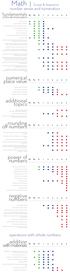 Math Scope & Sequence fundamentals number sense and numeration of the decimal system Count to 10 by units Associate number to numeral (1-10) KN 1 KN 1 KN 2 KN 2 Identify odd and even numbers/numerals and
Mathematics K 6 continuum of key ideas
 Mathematics K 6 continuum of key ideas Number and Algebra Count forwards to 30 from a given number Count backwards from a given number in the range 0 to 20 Compare, order, read and represent to at least
Biggar High School Mathematics Department. National 5 Learning Intentions & Success Criteria: Assessing My Progress
 Biggar High School Mathematics Department National 5 Learning Intentions & Success Criteria: Assessing My Progress Expressions & Formulae Topic Learning Intention Success Criteria I understand this Approximation
CAMI Education linked to CAPS: Mathematics
 - 1 - TOPIC 1.1 Whole numbers _CAPS curriculum TERM 1 CONTENT Mental calculations Revise: Multiplication of whole numbers to at least 12 12 Ordering and comparing whole numbers Revise prime numbers to
Illinois State Standards Alignments Grades Three through Eleven
 Illinois State Standards Alignments Grades Three through Eleven Trademark of Renaissance Learning, Inc., and its subsidiaries, registered, common law, or pending registration in the United States and other
My Year 1 Maths Targets
 My Year 1 Maths Targets Number number and place value I can count to and across 100, forwards and backwards, beginning with 0 or 1, or from any given number. I can count in multiples of twos, fives and
Geometry Progress Ladder
 Geometry Progress Ladder Maths Makes Sense Foundation End-of-year objectives page 2 Maths Makes Sense 1 2 End-of-block objectives page 3 Maths Makes Sense 3 4 End-of-block objectives page 4 Maths Makes
Number Sense and Operations
 Number Sense and Operations representing as they: 6.N.1 6.N.2 6.N.3 6.N.4 6.N.5 6.N.6 6.N.7 6.N.8 6.N.9 6.N.10 6.N.11 6.N.12 6.N.13. 6.N.14 6.N.15 Demonstrate an understanding of positive integer exponents
Key Stage 2 Mathematics Programme of Study
 Deeloping numerical reasoning Identify processes and connections Represent and communicate Reiew transfer mathematical to a ariety of contexts and eeryday situations identify the appropriate steps and
Quick Reference ebook
 This file is distributed FREE OF CHARGE by the publisher Quick Reference Handbooks and the author. Quick Reference ebook Click on Contents or Index in the left panel to locate a topic. The math facts listed
NEW MEXICO Grade 6 MATHEMATICS STANDARDS
 PROCESS STANDARDS To help New Mexico students achieve the Content Standards enumerated below, teachers are encouraged to base instruction on the following Process Standards: Problem Solving Build new mathematical
Cambridge Primary Mathematics Curriculum Framework (with codes)
 Cambridge Primary Mathematics Curriculum Framework (with codes) Contents Introduction Stage 1...1 Stage 2...5 Stage 3...9 Stage 4...14 Stage 5...18 Stage 6...24 Note on codes Each learning objective has
Section 1: How will you be tested? This section will give you information about the different types of examination papers that are available.
 REVISION CHECKLIST for IGCSE Mathematics 0580 A guide for students How to use this guide This guide describes what topics and skills you need to know for your IGCSE Mathematics examination. It will help
Math 0980 Chapter Objectives. Chapter 1: Introduction to Algebra: The Integers.
 Math 0980 Chapter Objectives Chapter 1: Introduction to Algebra: The Integers. 1. Identify the place value of a digit. 2. Write a number in words or digits. 3. Write positive and negative numbers used
FOREWORD. Executive Secretary
 FOREWORD The Botswana Examinations Council is pleased to authorise the publication of the revised assessment procedures for the Junior Certificate Examination programme. According to the Revised National
Algebra Geometry Glossary. 90 angle
 lgebra Geometry Glossary 1) acute angle an angle less than 90 acute angle 90 angle 2) acute triangle a triangle where all angles are less than 90 3) adjacent angles angles that share a common leg Example:
EVERY DAY COUNTS CALENDAR MATH 2005 correlated to
 EVERY DAY COUNTS CALENDAR MATH 2005 correlated to Illinois Mathematics Assessment Framework Grades 3-5 E D U C A T I O N G R O U P A Houghton Mifflin Company YOUR ILLINOIS GREAT SOURCE REPRESENTATIVES:
Autumn - 12 Weeks. Spring 11 Weeks. Summer 12 Weeks. Not As We Know It Limited 2014
 A Year 5 Mathematician Planning of coverage and resources. Autumn - 12 Weeks Spring 11 Weeks Summer 12 Weeks TARGETS NHM YR 5 Collins 5 Abacus 5 Abacus 6 LA Prior Step NHM 4 CPM 4 Ginn 4 Number, place
Everyday Mathematics CCSS EDITION CCSS EDITION. Content Strand: Number and Numeration
 CCSS EDITION Overview of -6 Grade-Level Goals CCSS EDITION Content Strand: Number and Numeration Program Goal: Understand the Meanings, Uses, and Representations of Numbers Content Thread: Rote Counting
Unit 8 Angles, 2D and 3D shapes, perimeter and area
 Unit 8 Angles, 2D and 3D shapes, perimeter and area Five daily lessons Year 6 Spring term Recognise and estimate angles. Use a protractor to measure and draw acute and obtuse angles to Page 111 the nearest
ModuMath Basic Math Basic Math 1.1 - Naming Whole Numbers Basic Math 1.2 - The Number Line Basic Math 1.3 - Addition of Whole Numbers, Part I
 ModuMath Basic Math Basic Math 1.1 - Naming Whole Numbers 1) Read whole numbers. 2) Write whole numbers in words. 3) Change whole numbers stated in words into decimal numeral form. 4) Write numerals in
Geometry and Measurement
 The student will be able to: Geometry and Measurement 1. Demonstrate an understanding of the principles of geometry and measurement and operations using measurements Use the US system of measurement for
Math - 5th Grade. two digit by one digit multiplication fact families subtraction with regrouping
 Number and Operations Understand division of whole numbers N.MR.05.01 N.MR.05.02 N.MR.05.03 Understand the meaning of division of whole numbers with and without remainders; relate division to and to repeated
Everyday Mathematics GOALS
 Copyright Wright Group/McGraw-Hill GOALS The following tables list the Grade-Level Goals organized by Content Strand and Program Goal. Content Strand: NUMBER AND NUMERATION Program Goal: Understand the
Math 5th grade. Create your own number and explain how to use expanded form to show place value to the ten millions place.
 Number Properties and Operations Whole number sense and addition and subtraction are key concepts and skills developed in early childhood. Students build on their number sense and counting sense to develop
COMMON CORE STATE STANDARDS FOR MATHEMATICS 3-5 DOMAIN PROGRESSIONS
 COMMON CORE STATE STANDARDS FOR MATHEMATICS 3-5 DOMAIN PROGRESSIONS Compiled by Dewey Gottlieb, Hawaii Department of Education June 2010 Operations and Algebraic Thinking Represent and solve problems involving
Mathematics Scope and Sequence, K-8
 Standard 1: Number and Operation Goal 1.1: Understands and uses numbers (number sense) Mathematics Scope and Sequence, K-8 Grade Counting Read, Write, Order, Compare Place Value Money Number Theory K Count
ISAT Mathematics Performance Definitions Grade 4
 ISAT Mathematics Performance Definitions Grade 4 EXCEEDS STANDARDS Fourth-grade students whose measured performance exceeds standards are able to identify, read, write, represent, and model whole numbers
Tennessee Mathematics Standards 2009-2010 Implementation. Grade Six Mathematics. Standard 1 Mathematical Processes
 Tennessee Mathematics Standards 2009-2010 Implementation Grade Six Mathematics Standard 1 Mathematical Processes GLE 0606.1.1 Use mathematical language, symbols, and definitions while developing mathematical
Glencoe. correlated to SOUTH CAROLINA MATH CURRICULUM STANDARDS GRADE 6 3-3, 5-8 8-4, 8-7 1-6, 4-9
 Glencoe correlated to SOUTH CAROLINA MATH CURRICULUM STANDARDS GRADE 6 STANDARDS 6-8 Number and Operations (NO) Standard I. Understand numbers, ways of representing numbers, relationships among numbers,
ALGEBRA. sequence, term, nth term, consecutive, rule, relationship, generate, predict, continue increase, decrease finite, infinite
 ALGEBRA Pupils should be taught to: Generate and describe sequences As outcomes, Year 7 pupils should, for example: Use, read and write, spelling correctly: sequence, term, nth term, consecutive, rule,
Numeracy and mathematics Experiences and outcomes
 Numeracy and mathematics Experiences and outcomes My learning in mathematics enables me to: develop a secure understanding of the concepts, principles and processes of mathematics and apply these in different
Indicator 2: Use a variety of algebraic concepts and methods to solve equations and inequalities.
 3 rd Grade Math Learning Targets Algebra: Indicator 1: Use procedures to transform algebraic expressions. 3.A.1.1. Students are able to explain the relationship between repeated addition and multiplication.
Bridging Documents for Mathematics
 Bridging Documents for Mathematics 5 th /6 th Class, Primary Junior Cycle, Post-Primary Primary Post-Primary Card # Strand(s): Number, Measure Number (Strand 3) 2-5 Strand: Shape and Space Geometry and
How do you compare numbers? On a number line, larger numbers are to the right and smaller numbers are to the left.
 The verbal answers to all of the following questions should be memorized before completion of pre-algebra. Answers that are not memorized will hinder your ability to succeed in algebra 1. Number Basics
Standards and progression point examples
 Mathematics Progressing towards Foundation Progression Point 0.5 At 0.5, a student progressing towards the standard at Foundation may, for example: connect number names and numerals with sets of up to
Prentice Hall Mathematics: Course 1 2008 Correlated to: Arizona Academic Standards for Mathematics (Grades 6)
 PO 1. Express fractions as ratios, comparing two whole numbers (e.g., ¾ is equivalent to 3:4 and 3 to 4). Strand 1: Number Sense and Operations Every student should understand and use all concepts and
Common Core Unit Summary Grades 6 to 8
 Common Core Unit Summary Grades 6 to 8 Grade 8: Unit 1: Congruence and Similarity- 8G1-8G5 rotations reflections and translations,( RRT=congruence) understand congruence of 2 d figures after RRT Dilations
Vocabulary checklist. Year 7. Applying mathematics and solving problems. Numbers and the number system
 Vocabulary checklist Year 7 This list contains the key words used in the Year 7 teaching programme and supplement of examples. Some words will be familiar to pupils in Year 7 from earlier work. For definitions
National curriculum tests. Key stage 2. Mathematics test framework. National curriculum tests from 2016. For test developers
 National curriculum tests Key stage 2 Mathematics test framework National curriculum tests from 2016 For test developers Crown copyright 2015 2016 key stage 2 mathematics test framework: national curriculum
Key Topics What will ALL students learn? What will the most able students learn?
 2013 2014 Scheme of Work Subject MATHS Year 9 Course/ Year Term 1 Key Topics What will ALL students learn? What will the most able students learn? Number Written methods of calculations Decimals Rounding
Mathematics. GCSE subject content and assessment objectives
 Mathematics GCSE subject content and assessment objectives June 2013 Contents Introduction 3 Subject content 4 Assessment objectives 11 Appendix: Mathematical formulae 12 2 Introduction GCSE subject criteria
Day 1. 1. What number is five cubed? 2. A circle has radius r. What is the formula for the area of the circle?
 Mental Arithmetic Questions 1. What number is five cubed? KS3 MATHEMATICS 10 4 10 Level 7 Questions Day 1 2. A circle has radius r. What is the formula for the area of the circle? 3. Jenny and Mark share
Everyday Mathematics. Grade 4 Grade-Level Goals. 3rd Edition. Content Strand: Number and Numeration. Program Goal Content Thread Grade-Level Goals
 Content Strand: Number and Numeration Understand the Meanings, Uses, and Representations of Numbers Understand Equivalent Names for Numbers Understand Common Numerical Relations Place value and notation
10-4-10 Year 9 mathematics: holiday revision. 2 How many nines are there in fifty-four?
 DAY 1 Mental questions 1 Multiply seven by seven. 49 2 How many nines are there in fifty-four? 54 9 = 6 6 3 What number should you add to negative three to get the answer five? 8 4 Add two point five to
Revision Notes Adult Numeracy Level 2
 Revision Notes Adult Numeracy Level 2 Place Value The use of place value from earlier levels applies but is extended to all sizes of numbers. The values of columns are: Millions Hundred thousands Ten thousands
Unit 9. Unit 10. Unit 11. Unit 12. Introduction Busy Ant Maths Year 2 Medium-Term Plans. Number - Geometry - Position & direction
 Busy Ant Maths Year Medium-Term Plans Unit 9 Geometry - Position & direction Unit 0 ( Temperature) Unit Statistics Unit Fractions (time) 8 Busy Ant Maths Year Medium-Term Plans Introduction Unit Geometry
1A: Understand numbers, ways of representing numbers, relationships among numbers, and number systems.
 NCTM STANDARD 1: Numbers and Operations Kindergarten Grade 2 1A: Understand numbers, ways of representing numbers, relationships among numbers, and number systems. Kindergarten Grade One Grade Two 1. Count
Common Core State Standards for Mathematics Accelerated 7th Grade
 A Correlation of 2013 To the to the Introduction This document demonstrates how Mathematics Accelerated Grade 7, 2013, meets the. Correlation references are to the pages within the Student Edition. Meeting
Mathematics. Steps to Success. and. Top Tips. Year 5
 Pownall Green Primary School Mathematics and Year 5 1 Contents Page 1. Multiplication and Division 3 2. Positive and Negative Numbers 4 3. Decimal Notation 4. Reading Decimals 5 5. Fractions Linked to
Everyday Mathematics. Grade 4 Grade-Level Goals CCSS EDITION. Content Strand: Number and Numeration. Program Goal Content Thread Grade-Level Goal
 Content Strand: Number and Numeration Understand the Meanings, Uses, and Representations of Numbers Understand Equivalent Names for Numbers Understand Common Numerical Relations Place value and notation
Paper 1. Calculator not allowed. Mathematics test. First name. Last name. School. Remember KEY STAGE 3 TIER 5 7
 Ma KEY STAGE 3 Mathematics test TIER 5 7 Paper 1 Calculator not allowed First name Last name School 2009 Remember The test is 1 hour long. You must not use a calculator for any question in this test. You
LESSON 4 Missing Numbers in Multiplication Missing Numbers in Division LESSON 5 Order of Operations, Part 1 LESSON 6 Fractional Parts LESSON 7 Lines,
 Saxon Math 7/6 Class Description: Saxon mathematics is based on the principle of developing math skills incrementally and reviewing past skills daily. It also incorporates regular and cumulative assessments.
Shape Dictionary YR to Y6
 Shape Dictionary YR to Y6 Guidance Notes The terms in this dictionary are taken from the booklet Mathematical Vocabulary produced by the National Numeracy Strategy. Children need to understand and use
Geometry Notes PERIMETER AND AREA
 Perimeter and Area Page 1 of 57 PERIMETER AND AREA Objectives: After completing this section, you should be able to do the following: Calculate the area of given geometric figures. Calculate the perimeter
Algebra 1 2008. Academic Content Standards Grade Eight and Grade Nine Ohio. Grade Eight. Number, Number Sense and Operations Standard
 Academic Content Standards Grade Eight and Grade Nine Ohio Algebra 1 2008 Grade Eight STANDARDS Number, Number Sense and Operations Standard Number and Number Systems 1. Use scientific notation to express
Grade 5 Math Content 1
 Grade 5 Math Content 1 Number and Operations: Whole Numbers Multiplication and Division In Grade 5, students consolidate their understanding of the computational strategies they use for multiplication.
Such As Statements, Kindergarten Grade 8
 Such As Statements, Kindergarten Grade 8 This document contains the such as statements that were included in the review committees final recommendations for revisions to the mathematics Texas Essential
Senior Phase Grade 8 Today Planning Pack MATHEMATICS
 M780636110236 Senior Phase Grade 8 Today Planning Pack MATHEMATICS Contents: Work Schedule: Page Grade 8 2 Lesson Plans: Grade 8 4 Rubrics: Rubric 1: Recognising, classifying and representing numbers...22
Decimals and Percentages
 Decimals and Percentages Specimen Worksheets for Selected Aspects Paul Harling b recognise the number relationship between coordinates in the first quadrant of related points Key Stage 2 (AT2) on a line
Fourth Grade Math Standards and "I Can Statements"
 Fourth Grade Math Standards and "I Can Statements" Standard - CC.4.OA.1 Interpret a multiplication equation as a comparison, e.g., interpret 35 = 5 x 7 as a statement that 35 is 5 times as many as 7 and
Voyager Sopris Learning Vmath, Levels C-I, correlated to the South Carolina College- and Career-Ready Standards for Mathematics, Grades 2-8
 Page 1 of 35 VMath, Level C Grade 2 Mathematical Process Standards 1. Make sense of problems and persevere in solving them. Module 3: Lesson 4: 156-159 Module 4: Lesson 7: 220-223 2. Reason both contextually
MEASUREMENTS. U.S. CUSTOMARY SYSTEM OF MEASUREMENT LENGTH The standard U.S. Customary System units of length are inch, foot, yard, and mile.
 MEASUREMENTS A measurement includes a number and a unit. 3 feet 7 minutes 12 gallons Standard units of measurement have been established to simplify trade and commerce. TIME Equivalences between units
The Australian Curriculum Mathematics
 The Australian Curriculum Mathematics Mathematics ACARA The Australian Curriculum Number Algebra Number place value Fractions decimals Real numbers Foundation Year Year 1 Year 2 Year 3 Year 4 Year 5 Year
CCSS Mathematics Implementation Guide Grade 5 2012 2013. First Nine Weeks
 First Nine Weeks s The value of a digit is based on its place value. What changes the value of a digit? 5.NBT.1 RECOGNIZE that in a multi-digit number, a digit in one place represents 10 times as much
Mental Questions. Day 1. 1. What number is five cubed? 2. A circle has radius r. What is the formula for the area of the circle?
 Mental Questions 1. What number is five cubed? KS3 MATHEMATICS 10 4 10 Level 8 Questions Day 1 2. A circle has radius r. What is the formula for the area of the circle? 3. Jenny and Mark share some money
Grade 4 Unit 3: Multiplication and Division; Number Sentences and Algebra
 Grade 4 Unit 3: Multiplication and Division; Number Sentences and Algebra Activity Lesson 3-1 What s My Rule? page 159) Everyday Mathematics Goal for Mathematical Practice GMP 2.2 Explain the meanings
Possible Stage Two Mathematics Test Topics
 Possible Stage Two Mathematics Test Topics The Stage Two Mathematics Test questions are designed to be answerable by a good problem-solver with a strong mathematics background. It is based mainly on material
WORK SCHEDULE: MATHEMATICS 2007
 , K WORK SCHEDULE: MATHEMATICS 00 GRADE MODULE TERM... LO NUMBERS, OPERATIONS AND RELATIONSHIPS able to recognise, represent numbers and their relationships, and to count, estimate, calculate and check
BPS Math Year at a Glance (Adapted from A Story Of Units Curriculum Maps in Mathematics K-5) 1
 Grade 4 Key Areas of Focus for Grades 3-5: Multiplication and division of whole numbers and fractions-concepts, skills and problem solving Expected Fluency: Add and subtract within 1,000,000 Module M1:
Manitoba Curriculum. Alignment with Mathletics. Supported by independent evidence-based research and practice. Powerful reporting.
 Supported by independent evidence-based research practice. Follows provincial curricula Powerful reporting Student centred Content Kindergarten Grade 1 Grade 2 02 04 08 Grade 10 Applied & Pre-Calculus
Measurement with Reasoning
 compare, describe and solve practical problems for: * lengths and heights [e.g. long/short, longer/shorter, tall/short, double/half] * mass/weight [e.g. heavy/light, heavier than, lighter than] * capacity
For examination in June and November 2016. Also available for examination in March 2016 for India only.
 SYLLABUS Cambridge IGCSE Mathematics 0580 For examination in June and November 2016. Also available for examination in March 2016 for India only. This syllabus is approved for use in England, Wales and
Year 3 Year 4 Year 5 Year 6. Strand 1 Number
 NRICH http://nrich.maths.org problems linked to the primary national curriculum for mathematics in Years 3, 4, 5 and 6 The stars indicate the level of confidence and competence needed to begin the activity.
Higher Education Math Placement
 Higher Education Math Placement Placement Assessment Problem Types 1. Whole Numbers, Fractions, and Decimals 1.1 Operations with Whole Numbers Addition with carry Subtraction with borrowing Multiplication
Mathematics Syllabus Primary
 Mathematics Syllabus Primary Ministry of Education SINGAPORE Copyright 2006 Curriculum Planning and Development Division. This publication is not for sale. All rights reserved. No part of this publication
Expression. Variable Equation Polynomial Monomial Add. Area. Volume Surface Space Length Width. Probability. Chance Random Likely Possibility Odds
 Isosceles Triangle Congruent Leg Side Expression Equation Polynomial Monomial Radical Square Root Check Times Itself Function Relation One Domain Range Area Volume Surface Space Length Width Quantitative
Vocabulary Cards and Word Walls Revised: June 29, 2011
 Vocabulary Cards and Word Walls Revised: June 29, 2011 Important Notes for Teachers: The vocabulary cards in this file match the Common Core, the math curriculum adopted by the Utah State Board of Education,
Angles that are between parallel lines, but on opposite sides of a transversal.
 GLOSSARY Appendix A Appendix A: Glossary Acute Angle An angle that measures less than 90. Acute Triangle Alternate Angles A triangle that has three acute angles. Angles that are between parallel lines,
What You ll Learn. Why It s Important
 These students are setting up a tent. How do the students know how to set up the tent? How is the shape of the tent created? How could students find the amount of material needed to make the tent? Why
Measurements 1. BIRKBECK MATHS SUPPORT www.mathsupport.wordpress.com. In this section we will look at. Helping you practice. Online Quizzes and Videos
 BIRKBECK MATHS SUPPORT www.mathsupport.wordpress.com Measurements 1 In this section we will look at - Examples of everyday measurement - Some units we use to take measurements - Symbols for units and converting
Day 1. Mental Arithmetic Questions. 1. What number is five cubed? 2. A circle has radius r. What is the formula for the area of the circle?
 Mental Arithmetic Questions 1. What number is five cubed? KS3 MATHEMATICS 10 4 10 Level 6 Questions Day 1 2. A circle has radius r. What is the formula for the area of the circle? 3. Jenny and Mark share
Current Standard: Mathematical Concepts and Applications Shape, Space, and Measurement- Primary
 Shape, Space, and Measurement- Primary A student shall apply concepts of shape, space, and measurement to solve problems involving two- and three-dimensional shapes by demonstrating an understanding of:
Pre-Algebra 2008. Academic Content Standards Grade Eight Ohio. Number, Number Sense and Operations Standard. Number and Number Systems
 Academic Content Standards Grade Eight Ohio Pre-Algebra 2008 STANDARDS Number, Number Sense and Operations Standard Number and Number Systems 1. Use scientific notation to express large numbers and small
The symbols indicate where the topic is first introduced or specifically addressed.
 ingapore Math Inc. cope and equence U: U.. Edition : ommon ore Edition : tandards Edition : ommon ore tandards 1 2 3 4 5 Reviews in ommon ore Edition cover just the unit whereas those in U.. and tandards
Which two rectangles fit together, without overlapping, to make a square?
 SHAPE level 4 questions 1. Here are six rectangles on a grid. A B C D E F Which two rectangles fit together, without overlapping, to make a square?... and... International School of Madrid 1 2. Emily has
Curriculum Overview YR 9 MATHS. SUPPORT CORE HIGHER Topics Topics Topics Powers of 10 Powers of 10 Significant figures
 Curriculum Overview YR 9 MATHS AUTUMN Thursday 28th August- Friday 19th December SUPPORT CORE HIGHER Topics Topics Topics Powers of 10 Powers of 10 Significant figures Rounding Rounding Upper and lower
Discovering Math: Exploring Geometry Teacher s Guide
 Teacher s Guide Grade Level: 6 8 Curriculum Focus: Mathematics Lesson Duration: Three class periods Program Description Discovering Math: Exploring Geometry From methods of geometric construction and threedimensional
MATH 60 NOTEBOOK CERTIFICATIONS
 MATH 60 NOTEBOOK CERTIFICATIONS Chapter #1: Integers and Real Numbers 1.1a 1.1b 1.2 1.3 1.4 1.8 Chapter #2: Algebraic Expressions, Linear Equations, and Applications 2.1a 2.1b 2.1c 2.2 2.3a 2.3b 2.4 2.5
How To Learn To Understand And Understand The Math Of The Year
 Year R Maths Objectives In order to meet the Early Learning Goals at the end of Year R children must be able to: Numbers Count reliably with numbers from -0, place them in order and say which number is