
Solving Mass Balances using Matrix Algebra
|
|
|
- Meghan Flowers
- 9 years ago
- Views:
Transcription
1 Page: 1 Alex Doll, P.Eng, Alex G Doll Consulting Ltd. Abstract Matrix Algebra, also known as linear algebra, is well suited to solving material balance problems encountered in plant design and optimisation. A properly constructed matrix is not sensitive the iterations of circular calculations that can cause 'hard wired' spreadsheet mass balances to fail to properly converge and balance. This paper demonstrates how to construct equations and use matrix algebra on a typical computer spreadsheet to solve an example mass balance during a mineral processing plant design. Introduction Mass balance calculations describe an engineering problem where mass flows between unit operations and the composition of those flows are partly known and partly unknown. The purpose of the calculation is to mathematically analyse the known flows and compositions to solve for the unknown flows and compositions. Two main types of mass balances are commonly performed: design calculations and operating plant reconciliation. The design calculation mass balance typically has few known values and many unknown values. These are typically encountered during plant design when the results of testwork and a flowsheet are the only known values. The purpose of a design mass balance is to calculate values for the unknown flows and compositions. Operating plant reconciliation, by contrast, tends to have a large amount of data which may be contradictory. Data sources such as on-stream analysers and flowmeters produce large amounts of data, all of which are subject to random noise, calibration and sampling errors. The purpose of an operating plant reconciliation is to remove the random noise and errors to produce a single, consistent and reasonable snapshot of the state of an operating plant. This paper will deal exclusively with the design calculation situation where there are few known values and several unknowns. No filtering and reconciliation will be performed on the known data. An example solving a copper concentrator flotation circuit is presented and the process flow diagram is given below.

2 Page: 2 Example Process Flow Diagram Plant Feed Rougher Plant Tails Cleaner Scavenger Final Conc The example will use the following design criteria from metallurgical testwork: Plant feed rate 10,000 tonnes/day of 0.5%Cu ore. Overall plant recovery of 90% by weight. Final concentrate grade of 27.5%Cu by weight. Rougher concentrate grade of 7%Cu by weight. Method The method consists of three major operations: creating a diagram of the flowsheet, deriving equations the describe the flowsheet, and using a standard personal computer spreadsheet to solve the equations. Creating a Diagram The first step in solving mass balance calculations is to create a diagram clearly depicting the positions where flows and analysis values will be calculated. Each flow position (stream) will be labelled with a unique identifier. The following notation is used: Fx denotes the Feed stream to unit operation 'x', Tx denotes the Tails stream from unit operation 'x', and Cx denotes the Concentrate stream from unit operation 'x'. Where 'x' is one of: 0. Entire Flotation circuit, 1. Rougher Flotation,

3 Page: 3 2. Scavenger Flotation, or 3. Cleaner Flotation Example Diagram Depicting stream names Flotation Feed F0 F1 T1 Rougher Flotation Scavenger Flotation F2 C1 C2 Cleaner Flotation T2 T3 F3 C3 C0 Final Concentrate T0 Final Tails Deriving Equations All nodes (unit operations and connections between unit operations) can be described using formulae. This example consists of the following nodes: Mass Balance Nodes, Unit Operations: 1. Rougher Flotation 2. Scavenger Flotation 3. Cleaner Flotation Mass Balance Nodes, Connections: 4. Plant feed to Rougher Flotation 5. Rougher Tails to Final Tails 6. Rougher and Scavenger Concentrate to Cleaner Flotation 7. Cleaner Tails and Scavenger Tails to Final Tails 8. Cleaner Concentrate to Final Concentrate

4 Page: 4 The stream names indicated on the diagram represent the total mass flows (as t/h) of the respective streams. Expressing these unit operations connections as formulae, the first series of equations is derived governing the total mass flows around all nodes: F T C F T C F T C F F T F C C F T T T C C Now derive a second set of equations that expresses the copper balance around these same nodes. The copper flow will be expressed as (AZ Z) where AZ is the copper mass% in stream Z and Z is the total mass flow in stream Z: AF F AT T AC C AF F AT T AC C AF F AT T AC C AF F AF F AT T AF F AC C AC C AF F AT T AT T AT T AC C AC C Now identify the known values. In this example, the design criteria sets the plant feed rate F and grade AF, the final concentrate grade AC, the rougher concentrate grade AC, and the overall plant recovery. The overall recovery is actually a new formula that will be added to the equations. Thus AF, AC, AC, F are underlined. Underline the known values in the equations and add the recovery formula: F T C F T C F T C F F T F C C F T T T C C AF F AT T AC C AF F AT T AC C AF F AT T AC C A F F AF F AT T AF F A C C AC C AF F AT T AT T AT T AC C AC C AT T -Recovery AF F

5 Page: 5 Attempt to simplify the equations by eliminating some of the x=y combinations. In this example, F and F are identical and therefore one may substitute for and eliminate the other. The same substitution may be done for C and C, and for T and F. Furthermore, several streams will have identical analyses, allowing the following substitutions: A F AF AT AF A C AC After eliminating unknowns, the simplified equations are: F T C F T C F T C equation eliminated equation eliminated C C F T T T equation eliminated A F F AT T AC C AT T AT T AC C AF F AT T AC C equation eliminated equation eliminated A C C AC C AF F AT T AT T AT T equation eliminated AT T -Recovery AF F Check that all instances of F, C, F, AF, AF, and AC have been removed from these simplified equations. Reorganise these equations such that only the completely known terms appear on the right of the equal sign, and any terms with unknown values appear on the left. T C F T C - T T C - F C C - F T T - T AT T AC C AF F AT T AC C - AT T AT T AC C - AF F A C C AC C - AF F AT T AT T - AT T AT T -Recovery AF F

6 Page: 6 Several of the terms in the reorganised equations are nonlinear they contain two unknown values multiplied together. Such terms cannot be solved using matrix algebra and, therefore, these terms must be eliminated. AT T, AT T, AT T, AT T, AF F and AC C are all nonlinear terms, whereas AC C is linear because one of the values is known (and underlined). There are two ways to resolve nonlinear terms: formula substitution and term substitution. Formula substitution may be performed when the nonlinear term appears in only two of the equations. Express the equations in terms of the nonlinear components, and then the two equations are merge eliminating the nonlinear term. For example: AT T AC C AF F AT T AT T - AT T becomes AT T AF F - AC C AT T AT T - AT T set the two equations equal to each other and eliminate the nonlinear term. In this example, AT T AT T A F F - AC C AT T - AT T equation eliminated Another formula substitution is combination of equations 6 and 11 yielding: AF F - AC C -Recovery AF F - AT T equation eliminated Terms substitution may be done when one of the unknowns of a nonlinear term only appears in that nonlinear term. In this example the nonlinear term AF F contains an AF value that only appears in formulae multiplied by F. F, by contrast, appears in formulae without AF. Because AF only appears with F, this AF F term is a suitable candidate for term substitution. In the language of mathematics, we substituting an arbitrary new degree of freedom for the single degree of freedom belonging to AF. After the substitution there must be no instances of AF left in any equations. Create an arbitrary new unknown set equal to the nonlinear term. Substitute this new unknown into all instances of the nonlinear term in the equations. For example: Create new YT AT T, YT AT T, YF AF F and a new YC AC C. Substitute these into the equations (also include the formula substitution for equations 6. and 10.). T C F T C - T T C - F C C - F

7 Page: 7 T T - T YT - AC C -Recovery AF F - AF F YT YC - YT YT AC C - YF A C C YC - YF equation eliminated equation eliminated Reorganising, equations are eliminated and the known and unknown components are moved to proper sides of the equal sign. This set of equations is suitable for solving because it does not contain any nonlinear terms. T C F T C - T T C - F C C - F T T - T C C - YT Recovery AF F A YT YC - YT YT AC C - YF C C YC - YF A This completes the first attempt to mathematically describe the flowsheet and mass balance. Several checks must be performed prior to continuing to the next step. First check that all the known values underlined. Next, have all the term substitutions eliminated one unknown term from all the equations? Finally, count the number of unknown values and the number of equations; there must be more equations than unknowns in order to proceed. In this example, there are 12 unknowns (T, C, T, C, T, C, F, T, YT, YC, YT and YF ) and 9 equations so it is not safe to proceed to the spreadsheet and attempt to solve the mass balance. In order to solve the example, either more equations must be added or some unknowns must be converted to known values. Add constraints or remove degrees of freedom in the language of matrix mathematics. Two new equations describing the overall mass balance and overall copper balance can be added without creating any more unknowns. A third equation can be added describing the concentrate mass flow in terms of the plant recovery. These new equations are: F C T A F F AC C AT T A C C Recovery AF F Equation 11 is not a suitable addition because it contains a term that was already eliminated earlier (AT T ). Reject this equation and instead, substitute a different equation that describes the relationship between YT and the overall cleaner copper flows. A C C - AC C YT

8 Page: 8 The example is still not suitable for solving because there are still too few equations, and no obvious new formulae are evident from the design criteria and the flowsheet. The solution will require assumptions of either additional criteria or values for one or more of the unknowns. Reviewing the flowsheet and criteria indicates that no data exists to describe the operation of the scavenger flotation cells, so this is a reasonable place to begin adding assumptions. Assume the concentrate grade of the scavenger AC is 3%Cu (eliminating the need for YC ). Substitute all occurrences of YC with AC C and underline the AC term. The relation between the two tailings streams T and T is not well described either, so assume a cleaner flotation recovery of 80%. This assumption adds a new equation: YT -ClnrRec YF The 13 reorganised equations are: T C F T C - T T C - F C C - F T T - T A C C - YT Recovery AF F YT AC C - YT YT AC C - YF A C C AC C - YF C T F A C C - AC C - YT A C C Recovery AF F -ClnrRec YF - YT The 11 remaining unknowns are: (T, C, T, C, T, C, F, T, YT, YT, and YF ) The quantity of equations now exceeds the number of unknowns, so it is safe to proceed to the next step and program a spreadsheet to solve the mass balance.

9 Page: 9 Programming the Spreadsheet The mass balance will be solved using the matrix algebra formula for the regression equation: T 1 T is the vector of unknowns, A is the matrix of equations and w = A A A y where w y is the vector of known values1. The determinant of the product of AT A will be checked prior to inversion to ensure that it is significantly greater than zero. This avoids the spreadsheet performing an inversion on a matrix it thinks has a determinant of due to floating-point errors. The spreadsheet used in this example is part of the OpenOffice suite which is freely available for download from OpenOffice performs matrix functions similar to Microsoft Excel and the example code should be identical. Lotus 1-2-3, MathCAD, Mathematica and other maths packages use different syntax and structures to solve matrix algebra, so the spreadsheet functions used in the example will not work without modification. The overall procedure given is still appropriate to these other packages. Matrices in OpenOffice (and Excel) are subsets of an Array structure. Array formulae return results that span more than one cell, and it is the responsibility of the engineer programming the spreadsheet to know the correct dimensions of the matrix output. Refer to a matrix algebra textbook for the details of the dimensions to be expected from the output of matrix multiplication. Array formulae differ from regular OpenOffice (and Excel) formulae by requiring the output range to be highlighted whilst typing the formula, and ending the formula with a ctrl-shiftenter keystroke rather than the usual enter keystroke. Refer to the spreadsheet documentation for details of array functions.2 The first programming step is to create the matrix A and vector y. Expand the equations such that each equation includes all of the possible variables, with the exponent of a variable being zero if that variable is not used in an equation. T C T C C T F T YT YT YF F T C T C C - T F T YT YT YF T C T C C T - F T YT YT YF T C T C C T - F T YT YT YF T C T C C T F - T YT YT YF T AC C T C C T F T - YT YT YF Recovery AF F T C T AC C C T F T YT - YT YF T C T C AC C T F T YT YT - YF T AC C T AC C C T F T YT YT - YF T C T C C T F T YT YT YF F T AC C T C - AC C T F T - YT YT YF T C T C AC C T F T YT YT YF Recovery AF F T C T C C T F T YT - YT -ClnrRec YF 1 Derivation of regression equation: 2 A good introduction on spreadsheet arrays available at

10 Page: 10 Equations are transferred to a matrix in the spreadsheet software. Label the top row of the matrix with the name of the unknown, label the leftmost column of the matrix with the equation number, and fill the matrix with the coefficients of the unknown values. Leave a couple of blank columns then enter the expressions from the right-hand side of the equal signs. Use the same constant notation as the derivation to avoid confusion.

11 Page: 11 Enter a block of info below the matrix containing the known values. Copy the matrix and vector below the info block and calculate the known values using the info block values. The regression procedure requires an 'error' column with the value 1 be added to the matrix A. This new unknown value, e provides the method with a degree of freedom to fit the equations together. More on the derivation of the regression procedure is available on the Internet or in a statistics or mathematics textbook. Optional step, create range names for each of the matrix and vector. Name the vector range Matrix_A and the vector range Vector_Y.

12 Page: 12 This screenshot shows the matrix with error column selected in the spreadsheet. The range name is displayed in one of the boxes in the top-left of the window. The next step in the procedure is to create a transpose of matrix A. This transpose will contain as many columns as Matrix_A has rows, and as many rows as Matrix_A has columns. A shortcut to get a properly sized matrix transpose is to copy the matrix, and paste-special and select Transpose.

13 Page: 13 After the paste, the range selected will be the correct size for the matrix transpose. If the optional range name is set, then type the formula =transpose(matrix_a) and press CtrlShift-Enter on the keyboard. The formula without a range name will depend on where the matrix is positioned on the spreadsheet; in this example the alternate formula is =transpose (B27:M13) followed by the Ctrl-Shift-Enter keystroke. The formula will appear with {curly braces} if it is correctly composed. Optional, name this transposed matrix Matrix_At. The next step is AT A the multiplication3 of the transposed matrix by matrix A. Count the number of columns in Matrix_A. Label a square area with this number of columns and rows. This example consists of 12 columns in Matrix_A, so the matrix multiplication result will be a 12x12 matrix. Select the output range, type =mmult(matrix_at;matrix_a), and press ctrlshift-enter. The semi-colon in this formula may need to be replaced with a comma depending upon the nationality your computer is configured to. 3 Definition of multiplication of matrices:

14 Page: 14 Name this new range Matrix_AtA. Check the determinant4 of Matrix_AtA. The matrix inversion step will only succeed if the determinant is significantly greater than zero. Select a cell to the right of Matrix_AtA and enter the formula =mdeterm(matrix_ata) and press enter (not ctrl-shift-enter, just enter). The example has a determinant of zero, and therefore cannot be solved yet. In the language of mathematicians, the problem contains too many degrees of freedom relative to the constraints. Even though the matrix contains more equations (constraints) than variables (degrees of freedom), some of the equations are duplicates of the same underlying constraint. Again, the language of mathematicians says that this situation consists of linearly dependent equations. The example's equations 1 through 5 can be considered to describe the same constraint as equation 10 (it is possible to reorganise equations 1 through 5 to obtain equation 10). It is necessary to stop programming and return to the derivation to add more equations or remove some unknowns. Any equations added should be linearly independent of the existing equations. Assume a concentration ratio of 4:1 for the scavenger flotation stage (the mass of concentrate is one-quarter the mass of the cleaner tailing). This adds one additional design criteria resulting in a new equation: C - T Start a fresh spreadsheet file and create a new matrix and transpose using the method above. It is strongly recommended that the new equation not be appended to the existing spreadsheet because of the way Array functions and range names misbehave when columns and rows are 4 Definition of determinant:

15 Page: 15 inserted into existing spreadsheets. It is safer to start over than to modify the existing spreadsheet. The new file will look like this:

16 Page: 16 Perform the matrix multiplication and check the determinant. The determinant is significantly greater than zero, so the example may now be solved using the regression method. It contains sufficient constraints (linearly independent equations) to solve the unknowns.

17 Page: 17 Invert5 the square Matrix_AtA AT A 1 using the =MInverse() array function (the dimensions of the inverted matrix will be the same as the dimensions of Matrix_AtA). Name the inverted matrix Inv_AtA. 5 Definition of matrix inversion:

18 Page: 18 Multiply the inverted matrix by the transposed matrix AT A 1 AT. Name the resulting matrix Inv_AtA_At. The dimensions of this matrix will be the same as the transpose Matrix_At.

19 Page: 19 Finally, multiply the previous matrix by the original vector Y. This is the final step in the T 1 T programming of the regression equation w = A A A y. The dimensions of the output will be a single column with as many rows as there are unknowns (including the 'e' term). Copy and paste-special, transpose the labels for the unknowns from above Matrix_A to a location at the bottom of the spreadsheet (this gives the list of the names of the unknowns, in order. C0, T1, T0, and so on). Perform the final matrix multiply =MMULT(Inv_AtA_At;Vector_Y) to create the output vector. Name this range Vector_W.

20 Page: 20 Unravel the 'substituted' unknowns YT, YT and YF by adding fomulae to calculate the assay copper values in these streams.

21 Page: 21 Checking Results The calculation is now done, and it is time to check the results to ensure no errors have appeared in the calculation. The first check is to review the results and confirm they are reasonable. In this example, the assays and flows all appear to be roughly the right order of magnitude. The second check is the equivalent to plotting the regression line with the raw data points. w actually gives us a Vector Y that looks like Run the regression in reverse to see that y = A the Vector Y at the beginning of the spreadsheet. The example returns the sample values in this Check vector Y as the original Vector Y, so the calculation is successful. The third check is highly recommended, although arduous. Spreadsheet packages are notorious for having poorly programmed higher maths functions and the results must be considered suspect until verified by software that uses a different calculation algorithm. Repeat the calculation in another program -- and look closely at the residual error ('e') and the determinant in the second program. If the residual error and determinant exactly match the values in the first program, then the test is inconclusive and must be repeated with a different program. (The second program likely uses the same software code library6 as the first to perform the 6 Software developers commonly construct new software out of older code libraries of common functions. These building blocks speed the development of new programs, but any errors or simplifications existing in the code library will also appear in the final software. If a second program is built from the same code library as the first, then the two of them will share the same errors and simplifications contained in the library.
22 Page: 22 mathematics. Errors in that library will not be evident when comparing the two programs). In the example, OpenOffice calculated the residual error is and the determinant as The same calculation in Excel results in an error of and a determinant of The same again, in Lotus yields error of (but does not contain a function for matrix determinants). All three programs provide the same material balance results, but do so with insignificant differences in the residual error and determinant. Therefore the three programs use different code libraries to perform matrix math, yet return the same material balance results. Therefore this check is successful: it determined that there are no errors in the underlying code library providing a false positive result. Normalisation, et al. Matrices are supposed to be normalised as part of the regression procedure. The method presented in this paper skips that step due to the system not being overly constrained. Normalisation is needed when doing regression on a large pool of noisy data to ensure that all noise is weighted the same when fitting coefficients. The check that normalisation is not necessary is in the residual error term e in Vector W. If the residual error is orders of magnitude smaller than the smallest value in the data set, then normalisation is unnecessary. If the data set is over constrained and the residual error is the same order of magnitude as the data, then refer to a maths textbook and apply the normalising procedure it describes. In this example, the residual error is on the order of 10-12, whereas the smallest value is on the order of The error is significantly smaller than the data, so normalisation is not required. Conclusion Application of a regression equation matrix algebra approach to material balance calculations, together with spreadsheet software, solve design calculations. The example determines a material balance around the flotation circuit where the results are displayed in the output vector and the unravelled unknowns.
Typical Linear Equation Set and Corresponding Matrices
 EWE: Engineering With Excel Larsen Page 1 4. Matrix Operations in Excel. Matrix Manipulations: Vectors, Matrices, and Arrays. How Excel Handles Matrix Math. Basic Matrix Operations. Solving Systems of
3.1. Solving linear equations. Introduction. Prerequisites. Learning Outcomes. Learning Style
 Solving linear equations 3.1 Introduction Many problems in engineering reduce to the solution of an equation or a set of equations. An equation is a type of mathematical expression which contains one or
Question 2: How do you solve a matrix equation using the matrix inverse?
 Question : How do you solve a matrix equation using the matrix inverse? In the previous question, we wrote systems of equations as a matrix equation AX B. In this format, the matrix A contains the coefficients
December 4, 2013 MATH 171 BASIC LINEAR ALGEBRA B. KITCHENS
 December 4, 2013 MATH 171 BASIC LINEAR ALGEBRA B KITCHENS The equation 1 Lines in two-dimensional space (1) 2x y = 3 describes a line in two-dimensional space The coefficients of x and y in the equation
8.2. Solution by Inverse Matrix Method. Introduction. Prerequisites. Learning Outcomes
 Solution by Inverse Matrix Method 8.2 Introduction The power of matrix algebra is seen in the representation of a system of simultaneous linear equations as a matrix equation. Matrix algebra allows us
Equations, Inequalities & Partial Fractions
 Contents Equations, Inequalities & Partial Fractions.1 Solving Linear Equations 2.2 Solving Quadratic Equations 1. Solving Polynomial Equations 1.4 Solving Simultaneous Linear Equations 42.5 Solving Inequalities
MATRIX ALGEBRA AND SYSTEMS OF EQUATIONS
 MATRIX ALGEBRA AND SYSTEMS OF EQUATIONS Systems of Equations and Matrices Representation of a linear system The general system of m equations in n unknowns can be written a x + a 2 x 2 + + a n x n b a
MATH10212 Linear Algebra. Systems of Linear Equations. Definition. An n-dimensional vector is a row or a column of n numbers (or letters): a 1.
 MATH10212 Linear Algebra Textbook: D. Poole, Linear Algebra: A Modern Introduction. Thompson, 2006. ISBN 0-534-40596-7. Systems of Linear Equations Definition. An n-dimensional vector is a row or a column
MATRIX ALGEBRA AND SYSTEMS OF EQUATIONS. + + x 2. x n. a 11 a 12 a 1n b 1 a 21 a 22 a 2n b 2 a 31 a 32 a 3n b 3. a m1 a m2 a mn b m
 MATRIX ALGEBRA AND SYSTEMS OF EQUATIONS 1. SYSTEMS OF EQUATIONS AND MATRICES 1.1. Representation of a linear system. The general system of m equations in n unknowns can be written a 11 x 1 + a 12 x 2 +
Continued Fractions and the Euclidean Algorithm
 Continued Fractions and the Euclidean Algorithm Lecture notes prepared for MATH 326, Spring 997 Department of Mathematics and Statistics University at Albany William F Hammond Table of Contents Introduction
Operation Count; Numerical Linear Algebra
 10 Operation Count; Numerical Linear Algebra 10.1 Introduction Many computations are limited simply by the sheer number of required additions, multiplications, or function evaluations. If floating-point
Introduction to Matrix Algebra
 Psychology 7291: Multivariate Statistics (Carey) 8/27/98 Matrix Algebra - 1 Introduction to Matrix Algebra Definitions: A matrix is a collection of numbers ordered by rows and columns. It is customary
Simple Regression Theory II 2010 Samuel L. Baker
 SIMPLE REGRESSION THEORY II 1 Simple Regression Theory II 2010 Samuel L. Baker Assessing how good the regression equation is likely to be Assignment 1A gets into drawing inferences about how close the
1 Review of Least Squares Solutions to Overdetermined Systems
 cs4: introduction to numerical analysis /9/0 Lecture 7: Rectangular Systems and Numerical Integration Instructor: Professor Amos Ron Scribes: Mark Cowlishaw, Nathanael Fillmore Review of Least Squares
Solving Systems of Linear Equations Using Matrices
 Solving Systems of Linear Equations Using Matrices What is a Matrix? A matrix is a compact grid or array of numbers. It can be created from a system of equations and used to solve the system of equations.
CURVE FITTING LEAST SQUARES APPROXIMATION
 CURVE FITTING LEAST SQUARES APPROXIMATION Data analysis and curve fitting: Imagine that we are studying a physical system involving two quantities: x and y Also suppose that we expect a linear relationship
Review of Fundamental Mathematics
 Review of Fundamental Mathematics As explained in the Preface and in Chapter 1 of your textbook, managerial economics applies microeconomic theory to business decision making. The decision-making tools
Solutions to Math 51 First Exam January 29, 2015
 Solutions to Math 5 First Exam January 29, 25. ( points) (a) Complete the following sentence: A set of vectors {v,..., v k } is defined to be linearly dependent if (2 points) there exist c,... c k R, not
SYSTEMS OF EQUATIONS AND MATRICES WITH THE TI-89. by Joseph Collison
 SYSTEMS OF EQUATIONS AND MATRICES WITH THE TI-89 by Joseph Collison Copyright 2000 by Joseph Collison All rights reserved Reproduction or translation of any part of this work beyond that permitted by Sections
Vector and Matrix Norms
 Chapter 1 Vector and Matrix Norms 11 Vector Spaces Let F be a field (such as the real numbers, R, or complex numbers, C) with elements called scalars A Vector Space, V, over the field F is a non-empty
This unit will lay the groundwork for later units where the students will extend this knowledge to quadratic and exponential functions.
 Algebra I Overview View unit yearlong overview here Many of the concepts presented in Algebra I are progressions of concepts that were introduced in grades 6 through 8. The content presented in this course
Solving simultaneous equations using the inverse matrix
 Solving simultaneous equations using the inverse matrix 8.2 Introduction The power of matrix algebra is seen in the representation of a system of simultaneous linear equations as a matrix equation. Matrix
Systems of Linear Equations
 Systems of Linear Equations Beifang Chen Systems of linear equations Linear systems A linear equation in variables x, x,, x n is an equation of the form a x + a x + + a n x n = b, where a, a,, a n and
Notes on Determinant
 ENGG2012B Advanced Engineering Mathematics Notes on Determinant Lecturer: Kenneth Shum Lecture 9-18/02/2013 The determinant of a system of linear equations determines whether the solution is unique, without
Row Echelon Form and Reduced Row Echelon Form
 These notes closely follow the presentation of the material given in David C Lay s textbook Linear Algebra and its Applications (3rd edition) These notes are intended primarily for in-class presentation
MATH 304 Linear Algebra Lecture 18: Rank and nullity of a matrix.
 MATH 304 Linear Algebra Lecture 18: Rank and nullity of a matrix. Nullspace Let A = (a ij ) be an m n matrix. Definition. The nullspace of the matrix A, denoted N(A), is the set of all n-dimensional column
3.2. Solving quadratic equations. Introduction. Prerequisites. Learning Outcomes. Learning Style
 Solving quadratic equations 3.2 Introduction A quadratic equation is one which can be written in the form ax 2 + bx + c = 0 where a, b and c are numbers and x is the unknown whose value(s) we wish to find.
Linear Programming. March 14, 2014
 Linear Programming March 1, 01 Parts of this introduction to linear programming were adapted from Chapter 9 of Introduction to Algorithms, Second Edition, by Cormen, Leiserson, Rivest and Stein [1]. 1
Linearly Independent Sets and Linearly Dependent Sets
 These notes closely follow the presentation of the material given in David C. Lay s textbook Linear Algebra and its Applications (3rd edition). These notes are intended primarily for in-class presentation
Linear Algebra Notes for Marsden and Tromba Vector Calculus
 Linear Algebra Notes for Marsden and Tromba Vector Calculus n-dimensional Euclidean Space and Matrices Definition of n space As was learned in Math b, a point in Euclidean three space can be thought of
a 11 x 1 + a 12 x 2 + + a 1n x n = b 1 a 21 x 1 + a 22 x 2 + + a 2n x n = b 2.
 Chapter 1 LINEAR EQUATIONS 1.1 Introduction to linear equations A linear equation in n unknowns x 1, x,, x n is an equation of the form a 1 x 1 + a x + + a n x n = b, where a 1, a,..., a n, b are given
University of Lille I PC first year list of exercises n 7. Review
 University of Lille I PC first year list of exercises n 7 Review Exercise Solve the following systems in 4 different ways (by substitution, by the Gauss method, by inverting the matrix of coefficients
This is a square root. The number under the radical is 9. (An asterisk * means multiply.)
 Page of Review of Radical Expressions and Equations Skills involving radicals can be divided into the following groups: Evaluate square roots or higher order roots. Simplify radical expressions. Rationalize
Name: Section Registered In:
 Name: Section Registered In: Math 125 Exam 3 Version 1 April 24, 2006 60 total points possible 1. (5pts) Use Cramer s Rule to solve 3x + 4y = 30 x 2y = 8. Be sure to show enough detail that shows you are
Practical Guide to the Simplex Method of Linear Programming
 Practical Guide to the Simplex Method of Linear Programming Marcel Oliver Revised: April, 0 The basic steps of the simplex algorithm Step : Write the linear programming problem in standard form Linear
1 Determinants and the Solvability of Linear Systems
 1 Determinants and the Solvability of Linear Systems In the last section we learned how to use Gaussian elimination to solve linear systems of n equations in n unknowns The section completely side-stepped
Click on the links below to jump directly to the relevant section
 Click on the links below to jump directly to the relevant section What is algebra? Operations with algebraic terms Mathematical properties of real numbers Order of operations What is Algebra? Algebra is
Least-Squares Intersection of Lines
 Least-Squares Intersection of Lines Johannes Traa - UIUC 2013 This write-up derives the least-squares solution for the intersection of lines. In the general case, a set of lines will not intersect at a
A Little Set Theory (Never Hurt Anybody)
 A Little Set Theory (Never Hurt Anybody) Matthew Saltzman Department of Mathematical Sciences Clemson University Draft: August 21, 2013 1 Introduction The fundamental ideas of set theory and the algebra
CHAPTER 2 Estimating Probabilities
 CHAPTER 2 Estimating Probabilities Machine Learning Copyright c 2016. Tom M. Mitchell. All rights reserved. *DRAFT OF January 24, 2016* *PLEASE DO NOT DISTRIBUTE WITHOUT AUTHOR S PERMISSION* This is a
5.5. Solving linear systems by the elimination method
 55 Solving linear systems by the elimination method Equivalent systems The major technique of solving systems of equations is changing the original problem into another one which is of an easier to solve
Linear Programming. Solving LP Models Using MS Excel, 18
 SUPPLEMENT TO CHAPTER SIX Linear Programming SUPPLEMENT OUTLINE Introduction, 2 Linear Programming Models, 2 Model Formulation, 4 Graphical Linear Programming, 5 Outline of Graphical Procedure, 5 Plotting
Solving Simultaneous Equations and Matrices
 Solving Simultaneous Equations and Matrices The following represents a systematic investigation for the steps used to solve two simultaneous linear equations in two unknowns. The motivation for considering
Linear Algebra and TI 89
 Linear Algebra and TI 89 Abdul Hassen and Jay Schiffman This short manual is a quick guide to the use of TI89 for Linear Algebra. We do this in two sections. In the first section, we will go over the editing
Epipolar Geometry. Readings: See Sections 10.1 and 15.6 of Forsyth and Ponce. Right Image. Left Image. e(p ) Epipolar Lines. e(q ) q R.
 Epipolar Geometry We consider two perspective images of a scene as taken from a stereo pair of cameras (or equivalently, assume the scene is rigid and imaged with a single camera from two different locations).
LS.6 Solution Matrices
 LS.6 Solution Matrices In the literature, solutions to linear systems often are expressed using square matrices rather than vectors. You need to get used to the terminology. As before, we state the definitions
Lecture 1: Systems of Linear Equations
 MTH Elementary Matrix Algebra Professor Chao Huang Department of Mathematics and Statistics Wright State University Lecture 1 Systems of Linear Equations ² Systems of two linear equations with two variables
9.4. The Scalar Product. Introduction. Prerequisites. Learning Style. Learning Outcomes
 The Scalar Product 9.4 Introduction There are two kinds of multiplication involving vectors. The first is known as the scalar product or dot product. This is so-called because when the scalar product of
Solutions of Linear Equations in One Variable
 2. Solutions of Linear Equations in One Variable 2. OBJECTIVES. Identify a linear equation 2. Combine like terms to solve an equation We begin this chapter by considering one of the most important tools
MATH 551 - APPLIED MATRIX THEORY
 MATH 55 - APPLIED MATRIX THEORY FINAL TEST: SAMPLE with SOLUTIONS (25 points NAME: PROBLEM (3 points A web of 5 pages is described by a directed graph whose matrix is given by A Do the following ( points
1 Introduction to Matrices
 1 Introduction to Matrices In this section, important definitions and results from matrix algebra that are useful in regression analysis are introduced. While all statements below regarding the columns
Lecture 3: Finding integer solutions to systems of linear equations
 Lecture 3: Finding integer solutions to systems of linear equations Algorithmic Number Theory (Fall 2014) Rutgers University Swastik Kopparty Scribe: Abhishek Bhrushundi 1 Overview The goal of this lecture
Association Between Variables
 Contents 11 Association Between Variables 767 11.1 Introduction............................ 767 11.1.1 Measure of Association................. 768 11.1.2 Chapter Summary.................... 769 11.2 Chi
Nonlinear Iterative Partial Least Squares Method
 Numerical Methods for Determining Principal Component Analysis Abstract Factors Béchu, S., Richard-Plouet, M., Fernandez, V., Walton, J., and Fairley, N. (2016) Developments in numerical treatments for
Introduction to Engineering Analysis - ENGR1100 Course Description and Syllabus Monday / Thursday Sections. Fall '15.
 Introduction to Engineering Analysis - ENGR1100 Course Description and Syllabus Monday / Thursday Sections Fall 2015 All course materials are available on the RPI Learning Management System (LMS) website.
Mathematics Course 111: Algebra I Part IV: Vector Spaces
 Mathematics Course 111: Algebra I Part IV: Vector Spaces D. R. Wilkins Academic Year 1996-7 9 Vector Spaces A vector space over some field K is an algebraic structure consisting of a set V on which are
Part 1 Expressions, Equations, and Inequalities: Simplifying and Solving
 Section 7 Algebraic Manipulations and Solving Part 1 Expressions, Equations, and Inequalities: Simplifying and Solving Before launching into the mathematics, let s take a moment to talk about the words
EXCEL SOLVER TUTORIAL
 ENGR62/MS&E111 Autumn 2003 2004 Prof. Ben Van Roy October 1, 2003 EXCEL SOLVER TUTORIAL This tutorial will introduce you to some essential features of Excel and its plug-in, Solver, that we will be using
5 Homogeneous systems
 5 Homogeneous systems Definition: A homogeneous (ho-mo-jeen -i-us) system of linear algebraic equations is one in which all the numbers on the right hand side are equal to : a x +... + a n x n =.. a m
Nonlinear Programming Methods.S2 Quadratic Programming
 Nonlinear Programming Methods.S2 Quadratic Programming Operations Research Models and Methods Paul A. Jensen and Jonathan F. Bard A linearly constrained optimization problem with a quadratic objective
Linear Equations ! 25 30 35$ & " 350 150% & " 11,750 12,750 13,750% MATHEMATICS LEARNING SERVICE Centre for Learning and Professional Development
 MathsTrack (NOTE Feb 2013: This is the old version of MathsTrack. New books will be created during 2013 and 2014) Topic 4 Module 9 Introduction Systems of to Matrices Linear Equations Income = Tickets!
4.5 Linear Dependence and Linear Independence
 4.5 Linear Dependence and Linear Independence 267 32. {v 1, v 2 }, where v 1, v 2 are collinear vectors in R 3. 33. Prove that if S and S are subsets of a vector space V such that S is a subset of S, then
The KaleidaGraph Guide to Curve Fitting
 The KaleidaGraph Guide to Curve Fitting Contents Chapter 1 Curve Fitting Overview 1.1 Purpose of Curve Fitting... 5 1.2 Types of Curve Fits... 5 Least Squares Curve Fits... 5 Nonlinear Curve Fits... 6
Unit 1 Equations, Inequalities, Functions
 Unit 1 Equations, Inequalities, Functions Algebra 2, Pages 1-100 Overview: This unit models real-world situations by using one- and two-variable linear equations. This unit will further expand upon pervious
CITY UNIVERSITY LONDON. BEng Degree in Computer Systems Engineering Part II BSc Degree in Computer Systems Engineering Part III PART 2 EXAMINATION
 No: CITY UNIVERSITY LONDON BEng Degree in Computer Systems Engineering Part II BSc Degree in Computer Systems Engineering Part III PART 2 EXAMINATION ENGINEERING MATHEMATICS 2 (resit) EX2005 Date: August
Overview of Violations of the Basic Assumptions in the Classical Normal Linear Regression Model
 Overview of Violations of the Basic Assumptions in the Classical Normal Linear Regression Model 1 September 004 A. Introduction and assumptions The classical normal linear regression model can be written
K80TTQ1EP-??,VO.L,XU0H5BY,_71ZVPKOE678_X,N2Y-8HI4VS,,6Z28DDW5N7ADY013
 Hill Cipher Project K80TTQ1EP-??,VO.L,XU0H5BY,_71ZVPKOE678_X,N2Y-8HI4VS,,6Z28DDW5N7ADY013 Directions: Answer all numbered questions completely. Show non-trivial work in the space provided. Non-computational
Linear Programming for Optimization. Mark A. Schulze, Ph.D. Perceptive Scientific Instruments, Inc.
 1. Introduction Linear Programming for Optimization Mark A. Schulze, Ph.D. Perceptive Scientific Instruments, Inc. 1.1 Definition Linear programming is the name of a branch of applied mathematics that
α = u v. In other words, Orthogonal Projection
 Orthogonal Projection Given any nonzero vector v, it is possible to decompose an arbitrary vector u into a component that points in the direction of v and one that points in a direction orthogonal to v
Using row reduction to calculate the inverse and the determinant of a square matrix
 Using row reduction to calculate the inverse and the determinant of a square matrix Notes for MATH 0290 Honors by Prof. Anna Vainchtein 1 Inverse of a square matrix An n n square matrix A is called invertible
5 Systems of Equations
 Systems of Equations Concepts: Solutions to Systems of Equations-Graphically and Algebraically Solving Systems - Substitution Method Solving Systems - Elimination Method Using -Dimensional Graphs to Approximate
DERIVATIVES AS MATRICES; CHAIN RULE
 DERIVATIVES AS MATRICES; CHAIN RULE 1. Derivatives of Real-valued Functions Let s first consider functions f : R 2 R. Recall that if the partial derivatives of f exist at the point (x 0, y 0 ), then we
0.8 Rational Expressions and Equations
 96 Prerequisites 0.8 Rational Expressions and Equations We now turn our attention to rational expressions - that is, algebraic fractions - and equations which contain them. The reader is encouraged to
LEARNING OBJECTIVES FOR THIS CHAPTER
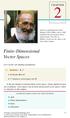 CHAPTER 2 American mathematician Paul Halmos (1916 2006), who in 1942 published the first modern linear algebra book. The title of Halmos s book was the same as the title of this chapter. Finite-Dimensional
15.062 Data Mining: Algorithms and Applications Matrix Math Review
 .6 Data Mining: Algorithms and Applications Matrix Math Review The purpose of this document is to give a brief review of selected linear algebra concepts that will be useful for the course and to develop
General Framework for an Iterative Solution of Ax b. Jacobi s Method
 2.6 Iterative Solutions of Linear Systems 143 2.6 Iterative Solutions of Linear Systems Consistent linear systems in real life are solved in one of two ways: by direct calculation (using a matrix factorization,
Follow links Class Use and other Permissions. For more information, send email to: [email protected]
 COPYRIGHT NOTICE: David A. Kendrick, P. Ruben Mercado, and Hans M. Amman: Computational Economics is published by Princeton University Press and copyrighted, 2006, by Princeton University Press. All rights
Chapter 6 Quantum Computing Based Software Testing Strategy (QCSTS)
 Chapter 6 Quantum Computing Based Software Testing Strategy (QCSTS) 6.1 Introduction Software testing is a dual purpose process that reveals defects and is used to evaluate quality attributes of the software,
13 MATH FACTS 101. 2 a = 1. 7. The elements of a vector have a graphical interpretation, which is particularly easy to see in two or three dimensions.
 3 MATH FACTS 0 3 MATH FACTS 3. Vectors 3.. Definition We use the overhead arrow to denote a column vector, i.e., a linear segment with a direction. For example, in three-space, we write a vector in terms
Department of Chemical Engineering ChE-101: Approaches to Chemical Engineering Problem Solving MATLAB Tutorial VI
 Department of Chemical Engineering ChE-101: Approaches to Chemical Engineering Problem Solving MATLAB Tutorial VI Solving a System of Linear Algebraic Equations (last updated 5/19/05 by GGB) Objectives:
To give it a definition, an implicit function of x and y is simply any relationship that takes the form:
 2 Implicit function theorems and applications 21 Implicit functions The implicit function theorem is one of the most useful single tools you ll meet this year After a while, it will be second nature to
Methods for Finding Bases
 Methods for Finding Bases Bases for the subspaces of a matrix Row-reduction methods can be used to find bases. Let us now look at an example illustrating how to obtain bases for the row space, null space,
Using Microsoft Excel Built-in Functions and Matrix Operations. EGN 1006 Introduction to the Engineering Profession
 Using Microsoft Ecel Built-in Functions and Matri Operations EGN 006 Introduction to the Engineering Profession Ecel Embedded Functions Ecel has a wide variety of Built-in Functions: Mathematical Financial
1.2 Solving a System of Linear Equations
 1.. SOLVING A SYSTEM OF LINEAR EQUATIONS 1. Solving a System of Linear Equations 1..1 Simple Systems - Basic De nitions As noticed above, the general form of a linear system of m equations in n variables
Linear Algebra Notes
 Linear Algebra Notes Chapter 19 KERNEL AND IMAGE OF A MATRIX Take an n m matrix a 11 a 12 a 1m a 21 a 22 a 2m a n1 a n2 a nm and think of it as a function A : R m R n The kernel of A is defined as Note
Scaling and Biasing Analog Signals
 Scaling and Biasing Analog Signals November 2007 Introduction Scaling and biasing the range and offset of analog signals is a useful skill for working with a variety of electronics. Not only can it interface
SOLVING COMPLEX SYSTEMS USING SPREADSHEETS: A MATRIX DECOMPOSITION APPROACH
 SOLVING COMPLEX SYSTEMS USING SPREADSHEETS: A MATRIX DECOMPOSITION APPROACH Kenneth E. Dudeck, Associate Professor of Electrical Engineering Pennsylvania State University, Hazleton Campus Abstract Many
ENGG1811 Computing for Engineers. Data Analysis using Excel (weeks 2 and 3)
 ENGG1811 Computing for Engineers Data Analysis using Excel (weeks 2 and 3) Data Analysis Histogram Descriptive Statistics Correlation Fitting Equations to Data Solving Equations Matrix Calculations Finding
Chapter 3. Cartesian Products and Relations. 3.1 Cartesian Products
 Chapter 3 Cartesian Products and Relations The material in this chapter is the first real encounter with abstraction. Relations are very general thing they are a special type of subset. After introducing
Current Standard: Mathematical Concepts and Applications Shape, Space, and Measurement- Primary
 Shape, Space, and Measurement- Primary A student shall apply concepts of shape, space, and measurement to solve problems involving two- and three-dimensional shapes by demonstrating an understanding of:
160 CHAPTER 4. VECTOR SPACES
 160 CHAPTER 4. VECTOR SPACES 4. Rank and Nullity In this section, we look at relationships between the row space, column space, null space of a matrix and its transpose. We will derive fundamental results
Regression III: Advanced Methods
 Lecture 16: Generalized Additive Models Regression III: Advanced Methods Bill Jacoby Michigan State University http://polisci.msu.edu/jacoby/icpsr/regress3 Goals of the Lecture Introduce Additive Models
Chapter 10. Key Ideas Correlation, Correlation Coefficient (r),
 Chapter 0 Key Ideas Correlation, Correlation Coefficient (r), Section 0-: Overview We have already explored the basics of describing single variable data sets. However, when two quantitative variables
Tutorial Customer Lifetime Value
 MARKETING ENGINEERING FOR EXCEL TUTORIAL VERSION 150211 Tutorial Customer Lifetime Value Marketing Engineering for Excel is a Microsoft Excel add-in. The software runs from within Microsoft Excel and only
Using R for Linear Regression
 Using R for Linear Regression In the following handout words and symbols in bold are R functions and words and symbols in italics are entries supplied by the user; underlined words and symbols are optional
Signal to Noise Instrumental Excel Assignment
 Signal to Noise Instrumental Excel Assignment Instrumental methods, as all techniques involved in physical measurements, are limited by both the precision and accuracy. The precision and accuracy of a
Lecture L3 - Vectors, Matrices and Coordinate Transformations
 S. Widnall 16.07 Dynamics Fall 2009 Lecture notes based on J. Peraire Version 2.0 Lecture L3 - Vectors, Matrices and Coordinate Transformations By using vectors and defining appropriate operations between
Matrix Differentiation
 1 Introduction Matrix Differentiation ( and some other stuff ) Randal J. Barnes Department of Civil Engineering, University of Minnesota Minneapolis, Minnesota, USA Throughout this presentation I have
Linear Equations and Inequalities
 Linear Equations and Inequalities Section 1.1 Prof. Wodarz Math 109 - Fall 2008 Contents 1 Linear Equations 2 1.1 Standard Form of a Linear Equation................ 2 1.2 Solving Linear Equations......................