
From scalar to vector optimization
|
|
|
- Natalie Hart
- 9 years ago
- Views:
Transcription
1 I.Ginchev, A.Guerraggio, M.Rocca From scalar to vector optimization 2003/17 UNIVERSITÀ DELL'INSUBRIA FACOLTÀ DI ECONOMIA

2 In questi quaderni vengono pubblicati i lavori dei docenti della Facoltà di Economia dell Università dell Insubria. La pubblicazione di contributi di altri studiosi, che abbiano un rapporto didattico o scientifico stabile con la Facoltà, può essere proposta da un professore della Facoltà, dopo che il contributo sia stato discusso pubblicamente. Il nome del proponente è riportato in nota all'articolo. I punti di vista espressi nei quaderni della Facoltà di Economia riflettono unicamente le opinioni degli autori, e non rispecchiano necessariamente quelli della Facoltà di Economia dell'università dell'insubria. These Working papers collect the work of the Faculty of Economics of the University of Insubria. The publication of work by other Authors can be proposed by a member of the Faculty, provided that the paper has been presented in public. The name of the proposer is reported in a footnote. The views expressed in the Working papers reflect the opinions of the Authors only, and not necessarily the ones of the Economics Faculty of the University of Insubria. Copyright I.Ginchev, A.Guerraggio, M.Rocca Printed in Italy in June 2003 Università degli Studi dell'insubria Via Ravasi 2, Varese, Italy All rights reserved. No part of this paper may be reproduced in any form without permission of the Author.

3 From Scalar to Vector Optimization Ivan Ginchev Technical University of Varna Department of Mathematics 9010 Varna, Bulgaria Angelo Guerraggio University of Insubria Department of Economics Varese, Italy Matteo Rocca University of Insubria Department of Economics Varese, Italy Abstract Initially, second-order necessary and sufficient optimality conditions in terms of Hadamard type derivatives for the unconstrained scalar optimization problem ϕ(x) min, x R m, are given. These conditions work with arbitrary functions ϕ, but they show inconsistency with the classical derivatives. This is a base to pose the question, whether the formulated optimality conditions remain true when the inconsistent Hadamard derivatives are replaced with the consistent Dini derivatives. It is shown that the answer is affirmative if ϕ is of class C 1,1 (i.e. differentiable with locally Lipschitz derivative). Further, considering C 1,1 functions, the discussion is raised to unconstrained vector optimization problems. Using the so called oriented distance from a point to a set, we generalize to an arbitrary ordering cone, some necessary and sufficient second-order optimality conditions given by Liu, Neittaanmäki, Křířek for a polyhedral cone. Furthermore, we show that the obtained conditions are sufficient not only for efficiency, but also for strict efficiency. Key words: Scalar and vector optimization, C 1,1 functions, Hadamard and Dini derivatives, Second-order optimality conditions, Lagrange multipliers. Math. Subject Classification: 90C29, 90C30, 49J52. 1 Introduction In this paper we use the notation R = R { } {+ } for the extended real line. Let m be a positive integer and ϕ : R m R be a given function and recall that the domain of ϕ is the set dom ϕ = {x R m ϕ ± }. The problem to find the local minima of ϕ (in general a nonsmooth function) is denoted by ϕ(x) min, x R m. Optimality conditions in nonsmooth optimization are based on various definitions of directional derivatives. Further we give the definitions of first and second-order Hadamard and Dini derivatives. In terms of Hadamard derivatives Ginchev [10] gives second-order sufficient and necessary optimality conditions. We choose them as a starting point for our discussion because of the amazing property that they obey, namely they could be applied for quite arbitrary functions ϕ, while in contrast the known conditions in nonsmooth optimization usually assume in advance certain regularity of the optimized function ϕ, say the usual prerequisite is that ϕ is a locally Lipschitz function with some additional properties. The following complementary principle in nonsmooth optimization is welcome: if the optimized function is a smooth one, then the optimality conditions should reduce to known classical optimality conditions. Recall that the notion of complementary principle in physics is used in sense that the laws of classical physics are obtained as limits from those of relativistic physics. 1

4 Obviously, similar demand in optimization is not imperative and the inconsistency is not a ground to overthrow a meaningful theory. Nevertheless a consistency meets with our natural expectations. Having in mind the above remark, in Sections 2, 3 and 4 we show that the defined secondorder Hadamard derivatives do not coincide with the classical ones in the case of C 2 function, while there is a coincidence for the Dini derivatives. Accounting that the classical second-order conditions deal rather with Dini derivatives, in the spirit of the complementary principle, we put the natural question, whether the formulated second-order conditions remain true if the inconsistent Hadamard derivatives are replaced with the consistent Dini ones. In Example 1 we show that in general the answer is negative. This observation leads to another problem, namely to find a class F of functions for which the optimality conditions in Dini derivatives are true. We show that the class of C 1,1 functions solves affirmatively this problem, while the same is not true for the class C 0,1 (here C k,1 denotes the class of functions which are k times Fréchet differentiable with locally Lipschitz k-th derivative). Considering C 1,1 functions we move towards vector optimization problems. In section 5, we give scalar characterizations of efficiency in terms of the oriented distance function from a point to a set. Section 6 is devoted to generalize (in the case of unconstrained vector optimization problems) to an arbitrary convex, closed and pointed ordering cone, the second-order optimality conditions obtained by Liu, Neittaanmäki, Křířek [22] for polyhedral cones. Here, we state also sufficient conditions for strict efficiency [5]. Finally, Section 7 is devoted to some comparison with the results obtained by Guerraggio, Luc [14] and Bolintenéanu, El Maghri [6]. 2 Directional derivatives and second-order conditions Denote the unit sphere and the open unit ball in R m by S = {x R m x = 1} and B = {x R m x < 1}. Given ϕ : R m R, x 0 dom ϕ and u S (actually the same definitions hold for u R m \ {0}) we define the first and second-order lower directional Hadamard derivatives (for brevity we say just Hadamard derivatives) as follows. The first-order Hadamard derivative ϕ H (x0, u) takes values in R and is defined by ϕ H(x 0, u) = 1 ( lim inf ϕ(x 0 + tv) ϕ(x 0 ) ). (t,v) (+0,u) t Turn attention that the difference in the right hand side is well defined, since due to x 0 dom ϕ only ϕ(x 0 + tv) could eventually take infinite values. The second-order Hadamard derivative ϕ H (x0, u) is defined only if the first-order derivative ϕ H (x0, u) takes a finite value. Then we put ϕ H(x 0, u) = 2 ( lim inf ϕ(x 0 (t,v) (+0,u) t 2 + tv) ϕ(x 0 ) t ϕ H(x 0, u) ). The expression in the parentheses has sense, since only ϕ(x 0 + tv) eventually takes an infinite value. The first and second-order lower Dini directional derivatives (we call them just Dini derivatives) are defined similarly for u S (and for arbitrary u R m ) with the only difference that there is no variation in the directions. We put for the first-order derivative ϕ D(x 0, u) = lim inf t +0 1 t ( ϕ(x 0 + tu) ϕ(x 0 ) ). The second-order Dini derivative ϕ D (x0, u) is defined only if the first-order derivative ϕ D (x 0, u) takes a finite value and ϕ D(x 0 2 (, u) = lim inf ϕ(x 0 t +0 t 2 + tu) ϕ(x 0 ) t ϕ D(x 0, u) ). 2

5 The first-order derivatives ϕ H (x0, u) and ϕ D (x0, u) are considered, for instance, in Demyanov and Rubinov [9], who propose the names of Hadamard and Dini derivatives. We use these names for the given above second-order derivatives because of the used same type of convergence as in [9]. The definitions of second-order derivatives look natural in the framework of what comes out if one solves the classical Taylor expansion formula of second-order for a twice differentiable function with respect to the second-order derivative. Hence, the second-order Hadamard and Dini derivatives are Peano-type derivatives [11, 27]. Let us however mention, that another second-order directional derivative of Hadamard type can be obtained if in the above definition of second-order Hadamard derivative the term tϕ H (x0, u) is replaced with tϕ H (x0, v). Although, because of the used type of convergence, such a derivative could also pretend for the name second-order Hadamard derivative, here it is out of our interest, since with this new understanding of the second-order Hadamard derivative the cited below Theorem 1 fails to be true. Let us also make the remark that in Theorem 1 we assume that u S. When the Hadamard derivatives are restricted to u S, we may assume that by the lim inf in their definition, the convergence (t, v) (+0, u) is such that v remains on S. Obviously, such a restriction does not change the values of ϕ H (x0, u) and ϕ H (x0, u). Recall that x 0 R m is said to be a local minimizer (we prefer to say simply minimizer) of ϕ, if for some neighbourhood U of x 0 it holds ϕ(x) ϕ(x 0 ) for all x U. The minimizer is strong if this inequality is strong for x U \ {x 0 }. It is said to be an isolated minimizer of order k (k is a positive integer) if there is a constant A > 0 such that ϕ(x) ϕ(x 0 ) + A x x 0 k, x U. Obviously, each isolated minimizer is a strong minimizer. The concept of an isolated minimizer has been popularized by Auslender [4]. The following theorem states second-order necessary and sufficient conditions in terms of Hadamard derivatives and is a particular case of a result proved in Ginchev [10]. Theorem 1 Let ϕ : R m R be an arbitrary function. (Necessary Conditions) Let x 0 dom ϕ be a minimizer of ϕ. following two conditions hold N H : ϕ H (x0, u) 0, N H : if ϕ H (x0, u) = 0 then ϕ H (x0, u) 0. Then for each u S the (Sufficient Conditions) Let x 0 dom ϕ. If for each u S one of the following two conditions hold S H : ϕ H (x0, u) > 0, S H : ϕ H (x0, u) = 0 and ϕ H (x0, u) > 0, then x 0 is a strong minimizer of ϕ. Moreover, these conditions are sufficient and necessary for x 0 to be an isolated minimizer of second order. 3 Consistency with the classical derivatives The astonishing property of Theorem 1 is that it works with quite arbitrary functions ϕ : R m R. Further, the sufficiency characterizes the isolated minimizers of second order of such functions, that is the sufficient conditions are both sufficient and necessary for a point to be an isolated minimizer. The next example illustrates an application of this theorem. Example 1 Consider ϕ : R 2 R, ϕ(x 1, x 2 ) = max ( 2x x 2, x 2 1 x 2 ). (1) 3

6 Then the point x 0 = (0, 0) is not a minimizer, which is seen by observing that the necessary conditions from Theorem 1 are not satisfied. We have in fact for nonzero u = (u 1, u 2 ) u 2, u 2 > 0, ϕ H(x 0, u) = ϕ D(x 0, u) = 0, u 2 = 0, u 2, u 2 < 0, ϕ H(x 0, u) = 4u 2 1 and ϕ D(x 0, u) = 2u 2 1 for u 2 = 0. Therefore ϕ H (x0, u) 0 for all u S, that is the first-order necessary condition N H is satisfied. However for u = (u 1, u 2 ) = (±1, 0) it holds ϕ H (x0, u) = 0 and ϕ H = 4u2 1 < 0, hence the second-order necessary condition N H is not satisfied. In Example 1 we calculated the Dini derivatives for the purpose of comparison. It falls into eyes immediately that the second-order derivatives in general are different ϕ H (x0, u) ϕ D (x0, u). The next simple example shows that such a difference occurs even for C 2 functions. The genesis of this difference is in the definition of the Hadamard derivatives, where in the lim inf the convergence (t, v) (+0, u) means an independent convergence t +0 and v u. Example 2 For the function ϕ : R 2 R, ϕ(x 1, x 2 ) = x 1 and nonzero u = (u 1, u 2 ) we have ϕ H (x, u) = ϕ D (x, u) = u 1, while ϕ H (x, u) = differs from (x, u) = 0. ϕ D Let ϕ : R m R be twice differentiable at x. In this case the gradient of ϕ at x is denoted by ϕ (x) and the Hessian by ϕ (x). Then, the classical first and second-order directional derivatives of ϕ are ϕ 1 (x, u) = lim t +0 t (ϕ(x + tu) ϕ(x)) = ϕ (x)u and ϕ 2 ( (x, u) = lim ϕ(x + tu) ϕ(x) t ϕ t +0 t 2 (x, u) ) = ϕ (x)(u, u). The classical optimality conditions can be obtained from Theorem 1 by replacing the Hadamard derivatives with the classical directional derivatives. Actually, simple reasonings show that in this case the first-order conditions are replaced with the assumption for stationarity ϕ (x 0, u) = 0 for all u S or equivalently by ϕ (x 0 ) = 0. It is easily seen that for a twice differentiable at x 0 functions ϕ : R m R the classical first and second-order directional derivatives coincide with the Dini derivatives of first and secondorder respectively, i. e. ϕ (x)u = ϕ D (x, u) and ϕ (x)(u, u) = ϕ D (x, u). Therefore the following problem arises naturally as an attempt to generalize the classical optimality conditions in a consistency preserving way. Problem 1 Determine a class F of functions ϕ : R m R, such that Theorem 1 with Hadamard derivatives replaced with the respective Dini derivatives holds true for all functions ϕ F. The classical second-order conditions show that the class of twice differentiable functions solves this problem. We show in Section 4 that the class of C 1,1 functions also solves this problem, while this is not true for the class of C 0,1 functions. Actually, Problem 1 concerns only the sufficient conditions as one sees from the following remark. 4

7 Remark 1 The necessary conditions in Dini derivatives remain true for arbitrary class F, which follows from the following reasoning. If x 0 is a minimizer for ϕ : R m R and u S then t 0 = 0 is a minimizer for the function ϕ u : R R, ϕ u (t) = ϕ(x 0 + tu). We can write the necessary conditions from Theorem 1 for the function ϕ u. The Hadamard derivatives for ϕ u in direction 1 however coincide with the respective Dini derivatives for ϕ in direction u, whence we see that the necessary conditions in Dini derivatives are satisfied. 4 Optimization of C 1,1 functions The function in Example 1 satisfies the sufficient conditions in terms of Dini instead of Hadamard derivatives as it is seen from the calculated there Dini derivatives. Hence, the sufficiency with Dini instead of Hadamard derivatives does not hold for arbitrary functions ϕ, that is why we need to restrict the class F of the considered functions in order to get a solution of Problem 1. Recall that in practical optimization the classes C 0,1 and C 1,1 play an important rôle. A function ϕ : R m R is said to be of class C 0,1 on R m if it is locally Lipschitz on R m. It is said to be of class C 1,1 on R m if it is differentiable at each point x R m and its gradient ϕ (x) is locally Lipschitz on R m. Similarly one defines functions of class C 0,1 or C 1,1 having as domain the open set X R m. The case of an open proper subset X R m does not introduce new elements in our discussion, that is why we confine to X = R m. Let us underline that for a C 1,1 function ϕ in the definition of ϕ D (x0, u) in Section 2 the term ϕ D (x0, u) is replaced with ϕ (x 0 )u. In the sequel we discuss whether we get a solution of Problem 1 by taking for F one of the classes C 0,1 and C 1,1. The function in Example 1 is of class C 0,1 as a maximum of C 2 functions. Therefore the class C 0,1 does not solve the posed problem. We show however in Theorem 2 that the class C 1,1 is a solution of this problem. For the proof we need the following lemma. Lemma 1 Let ϕ : R m R be a C 1,1 function. Let ϕ be Lipschitz with constant L in x 0 + r cl B where x 0 R m and r > 0. Then for u, v R m and 0 < t < r it holds 2 ( ϕ(x 0 t 2 + tv) ϕ(x 0 ) tϕ (x 0 )v ) 2 ( ϕ(x 0 t 2 + tu) ϕ(x 0 ) tϕ (x 0 )u ) L ( u + v ) v u (2) and consequently For v = 0 we get and ϕ D(x 0, v) ϕ D(x 0, u) L ( u + v ) v u. (3) 2 ( ϕ(x 0 t 2 + tu) ϕ(x 0 ) tϕ (x 0 )u ) L u 2, ϕ D(x 0, u) L u 2. In particular, if ϕ (x 0 ) = 0 inequality (2) implies 2 ( ϕ(x 0 t 2 + tv) ϕ(x 0 + tu) ) L ( u + v ) v u. (4) 5

8 Proof We have 2 ( ϕ(x 0 t 2 + tv) ϕ(x 0 ) tϕ (x 0 )v ) = 2 (( ϕ(x 0 t 2 + tv) ϕ(x 0 + tu) ) tϕ (x 0 )(v u) ) + 2 ( ϕ(x 0 t 2 + tu) ϕ(x 0 ) tϕ (x 0 )u ) = 2 t (v u) 1 ( 0 ϕ (x 0 + (1 s)tu + stv) ϕ (x 0 ) ) ds + 2 ( ϕ(x 0 t 2 + tu) ϕ(x 0 ) tϕ (x 0 )u ) 2L v u 1 0 (1 s)u + sv ds + 2 t 2 ( ϕ(x 0 + tu) ϕ(x 0 ) tϕ (x 0 )u ) 2L v u 1 0 ((1 s) u + s v ) ds + 2 t 2 ( ϕ(x 0 + tu) ϕ(x 0 ) tϕ (x 0 )u ) = L ( u + v ) v u + 2 t 2 ( ϕ(x 0 + tu) ϕ(x 0 ) tϕ (x 0 )u ). Exchanging u and v we get inequality (2) and as a particular case also (4). Inequality (3) is obtained from (2) after passing to a limit. Theorem 2 Let ϕ : R m R be a C 1,1 function. (Necessary Conditions) Let x 0 be a minimizer of ϕ. Then ϕ (x 0 ) = 0 and for each u S it holds ϕ D (x0, u) 0. (Sufficient Conditions) Let x 0 R m be a stationary point, that is ϕ (x 0 ) = 0. If for each u S it holds ϕ D (x0, u) > 0 then x 0 is an isolated minimizer of second order for ϕ. Conversely, each isolated minimizer of second order satisfies these sufficient conditions. Proof The necessity is satisfied according to Remark 1. Since ϕ is differentiable, we have only to observe that ϕ (x 0, u) = ϕ (x 0 )( u) = ϕ (x 0 )(u) = ϕ (x 0, u), whence if both ϕ (x 0, u) 0 and ϕ (x 0, u) 0 hold, we get ϕ (x 0, u) = ϕ (x 0 ) u = 0. If the equality ϕ (x 0 )u = 0 holds for all u S, then ϕ (x 0 ) = 0. Now we prove the sufficiency. Let ϕ be Lipschitz with constant L in the ball x 0 + r cl B, r > 0. Let u S and 0 < 3 ε(u) < ϕ D (x0, u). Choose 0 < δ(u) < r such that for 0 < t < δ(u) it holds 2 t 2 ( ϕ(x 0 + tu) ϕ(x 0 ) tϕ (x 0 )u ) > ϕ D(x 0, u) ε(u). Put also U(u) = u + (ε(u)/2l)b and let v U(u) S. Then applying Lemma 1 we get 2 ( ϕ(x 0 t 2 + tv) ϕ(x 0 ) ) = 2 ( ϕ(x 0 t 2 + tu) ϕ(x 0 ) ) + 2 ( ϕ(x 0 t 2 + tv) ϕ(x 0 + tu) ) 2 ( ϕ(x 0 t 2 + tu) ϕ(x 0 ) tϕ (x 0 )u ) 2L v u ϕ D(x 0, u) 2 ε(u) > ε(u) > 0. Therefore ϕ(x 0 + tv) ϕ(x 0 ) ( ϕ D(x 0, u) 2 ε(u) ) t 2. The compactness of S yields that S U(u 1 )... U(u n ) for some u 1,..., u n S. Put δ = min δ(u i ), A = min 1 ( 2 ϕ D (x0, u i ) 2ε(u i ) ). The above chain of inequalities implies that for x x 0 < δ it holds ϕ(x) ϕ(x 0 ) + A x x 0 2. Therefore x 0 is an isolated minimizer of second order. 6

9 Conversely, if x 0 is an isolated minimizer of second order for the C 1,1 function ϕ, then from the necessary conditions ϕ (x 0 ) = 0. Further, for some A > 0, t > 0 sufficiently small and u S, it holds ϕ(x 0 + tu) ϕ(x 0 ) + A t 2, whence 2 t 2 ( ϕ(x 0 + tu) ϕ(x 0 ) tϕ (x 0 ) u ) 2A and consequently ϕ D (x0, u) 2A > 0. Remark 2 If ϕ D (x0, u) is defined as the set of all cluster points of (2/t 2 )(ϕ(x 0 + tu) ϕ(x 0 ) tϕ (x 0 )u) as t +0, then Lemma 1 and Theorem 2 can be restated in terms of this new definition, since the same proof is applied to this new interpretation. This new point of view fits better to the vector case studied in Section 6. If ϕ : R m R is a C 1,1 function, then ϕ is locally Lipschitz and according to the Rademacher theorem the Hessian ϕ exists almost everywhere. Then a second-order subdifferential of ϕ at x 0 is defined by 2 ϕ(x 0 ) = cl conv { lim ϕ (x i ) x i x 0, ϕ (x i ) exists }. The C 1,1 functions in optimization and second-order optimality conditions have been introduced in Hiriart-Urruty, Strodiot, Hien Nguen [15]. Thereafter an intensive study of various aspects of C 1,1 functions was undertaken (see for instance Klatte, Tammer [18], Liu [20], Yang [29, 30, 31], Liu, Křířek [21], Liu, Neittaanmäki, Křířek [22], La Torre, Rocca [19]). Taylor expansion formula and necessary conditions for C k,1 functions, i. e. functions having k-th order locally Lipschitz derivative, have been generalized in Luc [24]. The following result is proved in Guerraggio, Luc [14]. Theorem 3 Let ϕ : R m R be C 1,1 function. (Necessary Conditions) Let x 0 be a minimizer of ϕ. Then ϕ (x 0 ) = 0 and for each u S there exists ζ 2 ϕ(x 0 ) such that ζ(u, u) 0. (Sufficient Conditions) Let x 0 R m. If ϕ (x 0 ) = 0 and if ζ(u, u) > 0 for all u S and ζ 2 ϕ(x 0 ), then x 0 is a minimizer of ϕ. For functions of class C 2 obviously Theorem 3 coincides with the classical second-order conditions. However, already for twice differentiable but not C 2 functions the hypothesis of the sufficient conditions of Theorem 3 fails to be true, which is seen in the next example. Example 3 The function ϕ : R R defined by { x ϕ(x) = 4 sin 1 x + ax2, x 0, 0, x = 0, is twice differentiable but is not C 2 function. Its first and second derivatives are given by { ϕ 4x (x) = 3 sin 1 x x2 cos 1 + 2ax, x 0, x 0, x = 0, and ϕ (x) = { 12x 2 sin 1 x 6x cos 1 x sin 1 + 2a, x 0, x 2a, x = 0. For a > 0 the point x 0 = 0 is an isolated minimizer of second order. The sufficient conditions at x 0 of Theorem 2 are satisfied. At the same time 2 ϕ(0) = [ 1 + 2a, 1 + 2a] and therefore for 0 < a < 1/2 the hypothesis of the sufficient conditions of Theorem 3 are not satisfied, although x 0 is an isolated minimizer of second order. 7

10 5 Scalar characterization of vector optimality concepts Our purpose from here on is to generalize the result of Theorem 2 from scalar to vector optimization. In this section we introduce optimality concepts for vector optimization problems and give some scalar characterizations. We consider a vector function f : R m R n. We denote by, S, B and,, respectively the norm, the unit sphere, the open unit ball and the scalar product, both in the domain and the image space, since from the context it is clear which of the two spaces is considered. Further C is a given pointed closed convex cone in R n. We deal with the minimization problem f(x) min, x R m. (5) There are different concepts of solutions of this problem. The point x 0 is said to be a weakly efficient (efficient) point, if there is a neighbourhood U of x 0, such that if x U then f(x) f(x 0 ) / int C (respectively f(x) f(x 0 ) / (C \ {0}) ). The point x 0 is said to be properly efficient if there exists a pointed closed convex cone C such that C \{0} int C and x 0 is weakly efficient point with respect to C. In this paper the weakly efficient, the efficient and the properly efficient points will be called respectively w-minimizers, e-minimizers and p-minimizers. Each p-minimizer is e-minimizer, which follows from the implication f(x) f(x 0 ) / int C f(x) f(x 0 ) / (C \ {0}), a consequence of C \ {0} int C. Each e-minimizer is w-minimizer, which follows from the implication f(x) f(x 0 ) / (C \ {0}) f(x) f(x 0 ) / int C, a consequence of int C C \ {0}. Let us underline, that we do not assume in advance that int C. If int C =, then according to our definition each point x 0 is w-minimizer. In the case int C = we can define x 0 to be a relative weakly efficient point, and call it rw-minimizer, if f(x) f(x 0 ) / ri C. Here ri C stands for the relative interior of C. However, in the sequel we will not use rw-minimizers. For the cone K R n its positive polar cone K is defined by K = {ξ R n ξ, y 0 for all y K}. The cone K is closed and convex. It is well known that (K ) := K = cl co K, see e. g. Rockafellar [28, Chapter III, 15]. In particular for the closed convex cone C we have C = {ξ R n ξ, y 0 for all y C} and C = C = {y R n ξ, y 0 for all ξ C }. A relation of the vector optimization problem (5) to some scalar optimization problem can be obtained in terms of the positive polar cone of C. Proposition 1 The point x 0 R m is a w-minimizer of f : R m R n with respect to the pointed closed convex cone C if and only if x 0 is a minimizer of the scalar function ϕ(x) = max { ξ, f(x) f(x 0 ) ξ C, ξ = 1 }. (6) Proof If int C = then each point x 0 R m is w-minimizer. At the same time, since C contains at least one pair of opposite unit vectors ˆξ, ˆξ, for each x R m it holds ( ) ϕ(x) max ˆξ, f(x) f(x 0 ), ˆξ, f(x) f(x 0 ) = ˆξ, f(x) f(x 0 ) 0 = ϕ(x 0 ), i. e. ϕ has a minimum at x 0. Assume now that int C and let x 0 be a w-minimizer. Let U be the neighbourhood from the definition of w-minimizer and fix x U. Then f(x) f(x 0 ) / int C. From the well known Separation Theorem there exists ξ x R n, ξ x = 1, such that ξ x, f(x) f(x 0 ) 0 and ξ x, y = ξ x, y 0 for all y C. The latter inequality shows that ξ x C and the former one shows that ϕ(x) ξ x, f(x) f(x 0 ) 0 = ϕ(x 0 ). Thus ϕ(x) ϕ(x 0 ), x U, and therefore x 0 is a minimizer of ϕ. 8

11 Let now x 0 be a minimizer of ϕ. Choose the neighbourhood U of x 0, such that ϕ(x) ϕ(x 0 ), x U, and fix x U. Then there exists ξ x C, ξ x = 1, such that ϕ(x) = ξ x, f(x) f(x 0 ) ϕ(x 0 ) = 0 (here we use the compactness of the set {ξ C ξ = 1}. From ξ x C it follows ξ x, y < 0, y int C. Therefore f(x) f(x 0 ) / int C. Consequently x 0 is w-minimizer. We call x 0 a strong e-minimizer if there is a neighbourhood U of x 0, such that f(x) f(x 0 ) / C for x U \{x 0 }. Obviously, each strong e-minimizer is e-minimizer. The following characterization of the strong e-minimizers holds (the proof is omitted, since it nearly repeats the reasonings from the proof of Proposition 1). Proposition 2 The point x 0 R m is a strong e-minimizer of f : R m R n with respect to the pointed closed convex cone C if and only if x 0 is a strong minimizer of the scalar function (6). The p-minimizers admit the following characterization. Proposition 3 The point x 0 R m is a p-minimizer of f : R m R n with respect to the pointed closed convex cone C if and only if there exists a nontrivial closed convex cone C, such that C \ {0} int C and x 0 is a minimizer of the scalar function { ϕ(x) = max ξ, f(x) f(x 0 ) ξ C }, ξ = 1. (7) Proof Let us mention, that in this case we put for the cone C required in the definition of a p-minimizer, the positive polar of C, i.e. C := ( C ). Then from C closed convex cone it follows that C is the positive polar cone of C. Indeed, we have C = (( C ) ) = ( C). This observation justifies the consistency of the notations. The inclusion C \{0} int C is equivalent to C \ {0} int C and according to Proposition 1 point x 0 is a w-minimizer of f with respect to C if and only if x 0 is a minimizer of function (7). Proposition 1 claims that the statement x 0 is a w-minimizer of (5) is equivalent to the statement x 0 is a minimizer of the scalar function (6). Applying some first or second-order sufficient optimality conditions to check the latter, we usually get more, namely that x 0 is an isolated minimizer respectively of first and second order of (6). It is natural now to introduce the following concept of optimality for the vector problem (5): Definition 1 We say that x 0 is an isolated minimizer of order k for the vector function f if it is an isolated minimizer of order k for the scalar function (6). To interpret geometrically the property that x 0 is a minimizer for f of certain type we introduce the so called oriented distance. Given a set A Y := R n, then the distance from y R n to A is given by d(y, A) = inf{ a y a A}. The oriented distance from y to A is defined by D(y, A) = d(y, A) d(y, Y \ A). Saying oriented distance one may think of a generalization of the well known oriented distance from a point to an oriented with a given normal plane (here we rather prefer to relate this oriented distance to the half-space with given outer normal). The function D is introduced in Hiriart-Urruty [16, 17] and is used later in Ciligot-Travain [7], Amahroq, Taa [3], Miglierina [25], Miglierina, Molho [26]. Zaffaroni [32] gives different notions of efficiency and uses the function D for their scalarization and comparison. Ginchev, Hoffmann [13] use the oriented distance to study approximation of set-valued functions by single-valued ones and in case of a convex set A show the representation D(y, A) = sup ξ =1 (inf a A ξ, a ξ, y ). In particular from this representation, if C is a convex cone and taking into account { 0, ξ C inf ξ, a =, a C, ξ / C, 9

12 we get easily D(y, C) = sup ( ξ, y ), D(y, C) = sup ( ξ, y ). ξ =1, ξ C ξ =1, ξ C In particular putting y = f(x) f(x 0 ) we obtain a representation of the function (6) in terms of the oriented distance: ϕ(x) = D(f(x) f(x 0 ), C). Now Propositions 1 3 are easily reformulated in terms of the oriented distance and in the new formulation they are geometrically more evident. With the made there assumptions, we get the conclusions: x 0 w-minimizer D(f(x) f(x 0 ), C) 0 for x U, x 0 strict e-minimizer D(f(x) f(x 0 ), C) > 0 for x U \ {x 0 }, x 0 p-minimizer D(f(x) f(x 0 ), C) 0 for x U. The definition of the isolated minimizers gives x 0 isolated minimizer of order k D(f(x) f(x 0 ), C) A x x 0 k for x U. Now we see, that the isolated minimizers (of a positive order) are strong e-minimizers. The next Proposition gives a relation between the p-minimizers and the isolated minimizers of first order (the proof of the following result can be found in [8]). Proposition 4 Let f : R m R n be locally Lipschitz at x 0. If x 0 is an isolated minimizer of first order, then x 0 is a p-minimizer (with respect to the same pointed closed convex cone C). Let us turn attention, that the proposition fails to be true, if we replace the property of x 0 isolated minimizer of first order with x 0 isolated minimizer of second order. In fact the property x 0 isolated minimizer of second order can be considered as some generalization of the property x 0 is p-minimizer. Namely, isolated minimizers of second order are related to strictly efficient points. Definition 2 [5] A point x 0 is said locally strictly efficient, when there exists a neighborhood U of x 0 such that for every ε > 0 there exists δ > 0 with (f(x) f(x 0 )) (δb C) εb, x U. We will refer to (locally) strictly efficient points as s-minimizers of f. It is known [33] that each p-minimizer is also a s-minimizer and each s-minimizer is e-minimizer. Hence, strictly efficient points are a class intermediate between efficient and properly efficient points. The following Proposition can be found in [8]. Proposition 5 Let f be a continuous function. If x 0 is an isolated minimizer of second-order for f, then x 0 is a s-minimizer. Let C be a proper closed convex cone with int C. Then its positive polar C is a pointed closed convex cone. Recall that the set Ξ is a base for C, if Ξ is convex with 0 / Ξ and C = cone Ξ := {y y = λ ξ, λ 0, ξ Ξ}. The properties C pointed closed convex and the finite dimensional setting imply that C possesses a compact base Ξ and 0 < α = min{ ξ ξ Ξ} max{ ξ ξ Ξ} = β < +. (8) Further let us assume that Ξ 0 is a compact set such that Ξ = conv Ξ 0. With the help of Ξ 0 we define the function ϕ 0 (x) = max { ξ, f(x) f(x 0 ) ξ Ξ 0 }. (9) 10

13 Proposition 6 Propositions 1 5 and Definition 1 remain true, if the function (6) (or equivalently the oriented distance D(f(x) f(x 0 ), C)) is replaced with the function (9). Proof We get in a routine way from (8) the inequalities α ϕ(x) ϕ 0 (x) β ϕ(x), if ϕ(x) 0 and β ϕ(x) ϕ 0 (x) α ϕ(x), if ϕ(x) < 0 whence we see that in Propositions 1 5 and Definition 1 the same properties hold both for ϕ and ϕ 0 (e. g. in Proposition 1 the point x 0 is w-minimizer iff x 0 is a minimizer of ϕ, which due the shown inequalities is equivalent to x 0 is a minimizer of ϕ 0 ). Corollary 1 In the important case C = R n + function (6) can be replaced with the maximum of the coordinates. ( ϕ 0 (x) = max fi (x) f i (x 0 ) ). (10) 1 i n Proof Clearly, C = R n + has a base Ξ = conv Ξ 0, where Ξ 0 = {e 1,..., e n } are the unit vectors on the coordinate axes. With this set we get immediately that the function (9) is in fact (10). More generally, the cone C is said to be polyhedral, if C = cone Ξ 0 with some finite set of nonzero vectors Ξ 0 = {ξ 1,..., ξ k }. In this case, similarly to Corollary 1 the function (9) is a maximum of a finite number of functions ϕ 0 (x) = max 1 i k ξ i, f i (x) f i (x 0 ). The reduction of the vector optimization problem to a scalar one allows to make conclusions from the scalar case, which is demonstrated on the next example. Example 4 Consider the optimization problem (5) for f : R 2 R 2, f(x 1, x 2 ) = ( 2x x 2, x 2 1 x 2 ) (11) with respect to C = R 2 +. Then the scalar function (10) for x 0 = (0, 0) reduces to the function ϕ from Example 1. Therefore on the base of Theorem 1 it can be established in terms of Hadamard derivatives that x 0 is not a minimizer (the second-order necessary conditions are not satisfied). Similar second-order necessary conditions in Dini derivatives are satisfied, but they do not imply that x 0 is a minimizer. This example is a source of some speculations. The function f in (11) possesses a continuous second-order Fréchet derivative, but for x 0 = (0, 0) the respective scalar function ϕ in (1) is only C 0,1 and consequently it does not allow application of more smooth optimality conditions, say ones like these of Theorem 2. This observation shows that even a smooth vector optimization problem obeys a nonsmooth nature, that is it suffers the nonsmooth effect of the corresponding scalar representation. Further, in order to take advantage of the differentiability of the vector function, it is better to formulate optimality conditions directly to the vector problem instead of to the scalar representation established in Proposition 1. The next section is devoted to this task. 11

14 6 The vector problem This section generalizes from scalar to vector optimization the second-order conditions from Section 4. The scalar experience suggests us to deal with Dini derivatives, since the inconsistency of the Hadamard ones. Although the literature on second-order theory in vector optimization is rather limited, lately there is a growing interest on the subject, see e. g. Aghezzaf [1], Bolintenéanu, El Maghri [6], Guerraggio, Luc [14], Liu, Neittaanmäki, Křířek [22]. Our main result is Theorem 5 which, for an unconstrained vector optimization problem, turns to be an extension of Theorems 3.1 and 3.3 in [22]. We devote a subsequent paper to the case of a constrained problem. 6.1 Optimality conditions in primal form Saying that y R n, we accept that this point is y = (y 1,..., y n ). Similarly, the point x R m is x = (x 1,..., x m ), the point ξ R n is ξ = (ξ 1,..., ξ n ), and the function f : R m R n is f = (f 1,..., f n ). We say, that the vector function f is C 1,1 if all of its components are C 1,1. Equivalently, f is C 1,1, if it is Fréchet differentiable with locally Lipschitz derivative f. Wishing like in Theorem 2 to exploit Dini derivatives, we need first to define them for a vector function f : R m R n. We confine in fact to a C 1,1 function f. The first Dini derivative as in the scalar case is the usual directional derivative f D(x, 1 u) = lim t +0 t (f(x + tu) f(x)) = f (x 0 )u. The second derivative f D (x0, u) was introduced in [22] and is defined as the set of the cluster points of (2/t 2 ) ( f(x 0 + tu) f(x 0 ) t f (x 0 ) u ) when t +0, or in other words as the Kuratowski upper limit set f D(x 0, u) = Limsup t +0 2 t 2 ( f(x 0 + tu) f(x 0 ) t f (x 0 ) u ). This definition is convenient for the vector case, but differs from the definition of the second-order Dini derivative in the scalar case, which was commented in Remark 2. The next theorem gives second-order necessary conditions for the vector optimization problem (5). Theorem 4 Assume that f : R m R n is a C 1,1 function minimized with respect to the pointed closed convex cone C with int C. (Necessary Conditions) Let x 0 be a w-minimizer of f. Then for each u S the following two conditions are satisfied: N p : f (x 0 )u / int C, N p : if f (x 0 )u (C \ int C) then for all y f D (x0, u) it holds conv {y, im f (x 0 )} ( int C) =. The notions, such as directional derivatives, stated straight in terms of the image space R n, are called primal. The subscript p in N p and N p refers to conditions (necessary of first and secondorder respectively) stated in primal concepts. We confine here only to necessary conditions. In the next subsection we formulate necessary and sufficient conditions in dual concepts, such as the elements of the positive polar cone. We call here dual the concepts stated in terms of the dual space to the image space R n. 12

15 Proof of Theorem 4. We prove first N p. Since x 0 is a w-minimizer we have (1/t)(f(x 0 + tu) f(x 0 )) / int C for 0 < t sufficiently small, whence passing to a limit we get f (x 0 )u / int C. Now we prove N p. Assume in the contrary, that for some u S we have f (x 0 )u (C \ int C) and there exists y(u) f D (x0, u), such that conv {y(u), im f (x 0 )} ( int C). (12) According to the definition of f D (x0, u), there exists a sequence t k +0, such that lim k y k (u) = y(u), where for v R m we put y k (v) = 2 t 2 k ( f(x 0 + t k v) f(x 0 ) t k f (x 0 )v ). Condition (12) shows that there exists w R m and λ (0, 1), such that (1 λ)y(u) + λf (x 0 ) w int C. Let v k u. For k large enough, we have, as in Lemma 2 below and hence y k (v k ) y k (u) L( u + v k ) v k u y k (v k ) y(u) y k (v k ) y k (u) + y k (u) y(u) L( u + v k ) v k u + y k (u) y(u) 0, as k + (here L denote a Lipschitz constant for f ). For k = 1, 2,, let v k be such that w = 2(1 λ) t k λ v k u. For every k, we have (v k u), that is v k = u + λ 2(1 λ) t k w and hence f(x 0 + t k v k ) f(x 0 ) = t k f (x 0 )u + t k f (x 0 )(v k u) t2 k y(u) + o(t2 k ( ) = t k f (x 0 1 (1 )u + 2 ( 1 λ ) 2 ( 1 t2 k λ) λ ) ) y(u) + f (x 0 )(v k u) + o(t 2 k t ) ( k ( )) = t k f (x 0 1 (1 2(1 )u + 2 ( 1 λ ) λ) t2 k λ) y(u) + λ f (x 0 ) (v k u) + o(t 2 k t ) k λ = t k f (x 0 1 )u + 2 ( 1 λ ) (( t2 k 1 λ) y(u) + λ f (x 0 ) w ) + o(t 2 k ) C int C + o(t2 k ) For k large enough, the last set in the previous chain of inclusions is contained in int C and this contradicts to x 0 w-minimizer. Now we apply Theorem 4 to Example 4. We minimize the C 2 function f(x) = ( 2x 2 1 +x 2, x 2 1 x 2) with respect to the cone R 2 +. Simple calculations give f (x)u = ( 4x 1 u 1 + u 2, 2x 1 u 1 u 2 ), f D (x, u) = f (x)(u, u) = ( 4u 2 1, 2u2 1 ). If x 1 0 then im f (x) = R 2 and condition N p is not satisfied. Therefore only the points x 0 = (0, x 0 2 ), x0 2 R, could eventually be w-minimizers. On each such point im f (x 0 ) = {x x 1 + x 2 = 0} and condition N p is satisfied. Further f (x 0 )u = (u 2, u 2 ) (C \ int C) if and only if u 2 = 0. Then u = (u 1, 0) S implies u 1 = ±1. In each of these cases f (x 0 )(u, u) = ( 4, 2). Now (3, 3) im f (x 0 ) (instead of (3, 3) we can use any point from im f (x 0 ) \ {0}) and 1 2 ( 4, 2) (3, 3) = ( 1 2, 1 2 ) int C. Therefore condition N p is not satisfied. Consequently, on the basis of Theorem 4 we conclude, that the function in Example 4 does not possess w-minimizers. 13

16 6.2 Optimality conditions in dual form: Lagrange multipliers In this subsection we establish necessary and sufficient optimality conditions in dual terms, that is in terms of vectors from the dual space, which as usually are called Lagrange multipliers. Further the subscript d in say N d stands for dual. The next theorem is our main result. Theorem 5 Assume that f : R m R n is a C 1,1 function minimized with respect to the pointed closed convex cone C with int C and let (x) = {ξ R n ξ f (x) = 0, ξ = 1}. (Necessary Conditions) Let x 0 be a w-minimizer of f. Then for each u S the following two conditions are satisfied: N d : (x0 ) C, N d : if f (x 0 ) u (C \ int C) then min max{ ξ, y ξ y f D (x0,u) C (x 0 )} 0. (Sufficient Conditions) Let x 0 R m and let condition N d hold. Suppose further, that for each u S one of the following two conditions is satisfied: S d : f (x 0 ) u / C, S d : f (x 0 ) u (C \ int C) and min max{ ξ, y ξ y f D (x0,u) C (x 0 )} > 0. Then x 0 is an isolated minimizer of second order for f. These conditions are not only sufficient, but also necessary for x 0 to be an isolated minimizer of second order for f. Proof of the Necessary Conditions. Since N p holds, the linear subspace of R n, im f (x 0 ) does not intersects int C. According to the Separation Theorem, there exists a nonzero vector (ξ, α) R n R, such that ξ, f (x 0 )u α for u R m, and ξ, y α for y C. Since both im f (x 0 ) and C are cones, we get easily α = 0, and hence ξ 0. Now the second inequality gives ξ C. Further ξ, f (x 0 ) = 0, since 0 ξ, f (x 0 )( u) = ξ, f (x 0 )u 0 for all u R n, which holds only if ξ, f (x 0 )u = 0. Since we can assume ξ = 1, we see that ξ (x 0 ) C, i. e. (x 0 ) C. Denote by + (x) the set of all ξ R n, ξ = 1, such that ξ, f (x 0 )u 0 for all u R m and ξ, y 0 for all y C. We have shown, that + (x 0 ) = (x 0 ) C and if x 0 is w-minimizer, then + (x 0 ). The notation + (x 0 ) instead of (x 0 ) C stresses the underlying separation property. We prove now the necessity of Condition N d. Let u S be such that f (x 0 )u (C \ int C) and ȳ f D (x0, u). We must show that max { ξ, ȳ ξ (x 0 ) C } 0. According to Theorem 4 the set A = conv {ȳ, im f (x 0 )} is separated from C. Therefore, like in the proof of N d, there exists a vector ξȳ R n, ξȳ = 1, such that ξȳ, y 0 for y im f (x 0 ), ξȳ, ȳ 0, (13) ξȳ, y 0 for y C. (14) The first inequality (13) and inequality (14) show that ξȳ (x 0 ) C, whence max{ ξ, ȳ ξ (x 0 ) C } ξȳ, ȳ 0. 14

17 Further we set Γ = {ξ C ξ = 1}, which is a compact set as the intersection of the closed cone C with the unit sphere. Therefore the maximum D(y, C) = max{ ξ, y ξ Γ}, y R n, is attained. In Section 5 we called D(y, C) the oriented distance from y to C. In particular D(f (x 0 )u, C) = max{ ξ, f (x 0 )u ξ Γ} is the oriented distance from f (x 0 )u to C, which appears in conditions N d and S d. Condition N d can be written as D(f (x 0 )u, C) 0, which is equivalent to f (x 0 )u / int C. We can write the appearing in N d and S d condition f (x 0 )u (C \ int C) also into the dual form D(f (x 0 )u, C) = 0 or max{ ξ, f (x 0 )u ξ Γ} = 0. To prove the sufficient conditions in Theorem 5 we need some lemmas. The first one generalizes Lemma 1 for vector functions. Lemma 2 Let f : R m R n be a C 1,1 function. Let f be Lipschitz with constant L in x 0 +r cl B where x 0 R m and r > 0. Then for u, v R m and 0 < t < r it holds 2 ( f(x 0 t 2 + tv) f(x 0 ) tf (x 0 )v ) 2 ( f(x 0 t 2 + tu) f(x 0 ) tf (x 0 )u ) L ( u + v ) v u In particular for v = 0 we get 2 ( f(x 0 t 2 + tu) f(x 0 ) tf (x 0 )u ) L u 2. We skip the proof, since with obvious changes of the notation it repeats the proof of Lemma 1. Let us mention, that the function defined by ϕ(x) = ξ, f(x) satisfies the conditions of Lemma 1, whence it satisfies the obtained there estimations. We use this function in the proof of the sufficiency. The next lemma gives some of the properties of the Dini derivative. Lemma 3 Let f : R m R n be like in Lemma 2. Then sup y f D (x0,u) y L u 2 and hence, u R m, f D (x0, u) is a compact set. For each y u f D (x0, u), u R m, there exists a point y v f D (x0, v), v R m, such that y u y v L ( u + v ) v u. Consequently the set-valued function f D (x0, ) is Locally Lipschitz (and hence continuous) with respect to the Hausdorff distance in R n. Proof The inequality sup y f D (x0,u) y L u 2 follows from the estimations in Lemma 2. The closedness of f D (x0, u) is a direct consequence of its definition, whence f D (x0, u) is compact. The remaining assertion also follow straightforward from Lemma 2. Proof of the Sufficient Conditions. We prove, that if x 0 is not an isolated minimizer of second order for f, then there exists u 0 S for which neither of the conditions S d and S d is satisfied. Choose a monotone decreasing sequence ε k +0. Since x 0 is not an isolated minimizer of second order, there exist sequences t k +0 and u k S such that D(f(x 0 + t k u k ) f(x 0 ), C) = max ξ Γ ξ, f(x0 + t k u k ) f(x 0 ) < ε k t 2 k. (15) Passing to a subsequence we may assume u k u 0. 15

18 We prove that S d is not satisfied at u0. Let ε > 0. We claim that there exists k 0, such that for all ξ Γ and all k > k 0 the following inequalities hold: 1 ( ) ξ, f(x 0 + t k u k ) f(x 0 ) < 1 t k 3 ε, (16) ξ, f (x 0 )u k 1 ) (f(x 0 + t k u k ) f(x 0 ) < 1 t k 3 ε, (17) ξ, f (x 0 )(u 0 u k ) < 1 3 ε. (18) Inequality (16) follows from (15). Inequality (17) follows from the Fréchet differentiability of f ξ, f (x 0 )u k 1 (f(x 0 + t k u k ) f(x 0 ) ) 1 ( ) f(x 0 + t k u k ) f(x 0 ) f (x 0 )u k < 1 t k t k 3 ε true for all sufficiently small t k. Inequality (18) follows from ξ, f (x 0 )(u 0 u k ) f (x 0 ) u 0 u k < 1 3 ε, true for u k u 0 small enough. Now we see, that for arbitrary ξ Γ and k > k 0 we have ξ, f (x 0 )u 0 1 ( ) = ξ, f(x 0 + t k u k ) f(x 0 ) t k + ξ, f (x 0 )u k 1 ) (f(x 0 + t k u k ) f(x 0 ) + ξ, f (x 0 )(u 0 u k ) t k < 1 3 ε ε ε = ε, whence D(f (x 0 )u 0, C) = max ξ Γ ξ, f (x 0 )u 0 < ε. Since ε > 0 is arbitrary, we see D(f (x 0 )u 0, C) 0. The geometric sense of the proved inequality is f (x 0 )u 0 C. Thus, condition S d is not satisfied. Now we prove that S d is not satisfied at u0. We assume that f (x 0 )u 0 (C \int C) (otherwise the first assertion in condition S d would not be satisfied). Recall that the sequences {t k } and {u k } are such that t k +0, u k u 0, u k S, and inequality (15) has place. We have 1 ( ) lim f(x 0 + t k u k ) f(x 0 ) = f (x 0 )u 0, k t k which follows easily from the Fréchet differentiability of f and the following chain of inequalities, true for arbitrary ε > 0 and sufficiently large k 1 ) (f(x 0 + t k u k ) f(x 0 ) f (x 0 )u 0 t k 1 ) (f(x 0 + t k u k ) f(x 0 ) f (x 0 )u k + f (x 0 ) u k u 0 1 t k 2 ε ε = ε. Let 0 < t k < r, where r > 0 is such that f is Lipschitz with constant L in x 0 + r cl B. Passing to a subsequence, we may assume that y k,0 = 2 t 2 k ( f(x 0 + t k u 0 ) f(x 0 ) t k f (x 0 )u 0) y 0. Obviously y 0 f D (x0, u 0 ) according to the definition of the second-order Dini derivative. Put y k = 2 ( t 2 f(x 0 + t k u k ) f(x 0 ) t k f (x 0 )u k). k 16

19 Lemma 2 implies y k y k,0 L ( u 0 + u k ) u k u 0, whence y k y 0. Let ξ (x 0 ) C. We have ξ, y k = 2 t 2 k ξ, f(x 0 + t k u k ) f(x 0 ) t k f (x 0 )u k 2 t 2 ξ, f(x 0 + t k u k ) f(x 0 ) 2 k t 2 max ξ, k ξ Γ f(x0 + t k u k ) f(x 0 ) = 2 t 2 D(f(x 0 + t k u k ) f(x 0 ), C) < 2 k t 2 ε k t 2 k = 2ε k. k Passing to a limit we get ξ, y 0 0. Since y 0 f D (x0, u 0 ) and ξ (x 0 ) C is arbitrary, we get min max{ ξ, y ξ y f D (x0,u 0 ) C (x 0 )} 0. Therefore condition S d is not satisfied at u0. The reversion of the sufficient conditions. Let x 0 be an isolated minimizer of second order, which means that there exists r > 0 and A > 0, such that D(f(x 0 + tu) f(x 0 ), C) > At 2 for all 0 < t < r and u S. Therefore, for all t (0, r) and u S, there exists ξ (t) C, ξ (t) = 1, such that ξ (t), f(x 0 + tu) f(x 0 ) > At 2 (recall that D(y, C) = max{ ξ, y ξ Γ}). Let t k +0; passing to a limit in the inequality ξ (t k ), (1/t k )(f(x 0 + tu) f(x 0 )) > At k we can assume ξ (t k ) ξ Γ and we get ξ, f (x 0 )u 0. This inequality, together with ξ C, ξ = 1, shows that ξ (x 0 ) C and f (x 0 )u / int C. Therefore for each fixed u S exactly one of the following two possibilities hold: 1 0. f (x 0 )u / C. Then condition S d is satisfied f (x 0 )u (C \ int C). With account of ξ C we have ξ, f (x 0 )u = 0. Let y f D (x0, u) be arbitrary and y = lim k (2/t 2 k )(f(x0 + t k u) f(x 0 ) t k f (x 0 )u), for some sequence t k +0. Then ξ 2, y = lim k t 2 ξ (t k ), f(x 0 + t k u) f(x 0 ) t k f (x 0 )u k 2 = lim k t 2 ξ (t k ), f(x 0 + t k u) f(x 0 2 ) lim k k t 2 At 2 k = 2A > 0. k Therefore condition S d is satisfied. Theorems 3.1 and 3.3 in Liu, Neittaanmäki, Křířek [22] are of the same type as Theorem 5. The latter is however more general and has several advantages. Theorem 5 in opposite to [22] concerns arbitrary and not only polyhedral cones C. In Theorem 5 the conclusion in the sufficient conditions part is x 0 isolated minimizer of second order and the conclusion in [22] is only that the reference point is e-minimizer. The property of being an isolated minimizer is more essential for the solution of the vector optimization problem than the property of being e-minimizer (efficient point). The isolated minimizers are s-minimizers and for such points stability (well-posedness) has place, that is a small (with respect to the sup norm) perturbation of the objective function results a small move of the minimizer (compare with Auslender [4]). Finally, in Theorem 5 we give a reversal of the sufficient conditions, showing that they are also necessary for the reference point to be an isolated minimizer of second order, while in [22] a reversal is absent. 17

20 Corollary 2 In the case n = 1 Theorem 5 obviously transforms into Theorem 2. In the previous section we treated Example 4 with the help of Theorem 4. Now we demonstrate the solution of the same problem with the help of Theorem 5. The function f(x) = ( 2x x 2, x 2 1 x 2) is optimized with respect to C = R 2. If ξ, f (x 0 )u = ξ 1 ( 4x 1 u 1 + u 2 ) + ξ 2 (2x 1 u 1 u 2 ) = 2x 1 ( 2ξ 1 + ξ 2 )u 1 + (ξ 1 ξ 2 )u 2 = 0 for arbitrary u 1, u 2, then ξ 1 = ξ 2 and x 1 = 0. The latter shows that x 0 = (0, x 0 2 ) are the only points, for which condition N d could be satisfied, and then ξ 1 = ξ 2 = 1/ 2. Then f (x 0 )u = (u 2, u 2 ) C iff u 2 = 0, whence u = (u 1, 0) = (±1, 0). Now f D (x0, u) = f (x 0 )(u, u) = ( 4u 2 1, 2u2 1 ) = ( 4, 2) and min max{ ξ, y ξ y f D (x0,u 0 ) C (x 0 )} = 4ξ 1 + 2ξ 2 = = 2 < 0. 2 Therefore for x 0 = (0, x 0 2 ) and u = (±1, 0) we have f (x 0 )u (C \ int C) but condition N d is not satisfied. On this basis we conclude, that f does not possess w-minimizers. Example 5 The function f : R R 2, f(x) = { ( 2x 2, x 2 ), x 0, (x 2, 2x 2 ), x < 0, is C 1,1. If f is optimized with respect to the cone C = R 2 +, then x 0 = 0 is an isolated minimizer of second order, which can be verified on the basis of the sufficient conditions of Theorem 5. Indeed, f is C 1,1, which follows from ( 4x, 2x), x > 0, f (x) = (0, 0), x = 0, (2x, 4x), x < 0. At x 0 = 0 condition N d is satisfied, since for all ξ R2 it holds ξ f (x 0 )u = 0, u R, whence (x 0 ) C = {ξ C ξ = 1} = {ξ R 2 ξ 1 0, ξ 2 0, ξ ξ 2 2 = 1}. Fix u S = { 1, 1}; then f (x 0 )u = (0, 0) (C \ int C). The second-order Dini derivative is { f D(x 0 ( 4u, u) = 2, u 2 ), u > 0, (2u 2, 4u 2 ), u < 0. For u = 1 we get min y f D (x0,u) max{ ξ, y ξ C (x 0 )} = max{ 4ξ 1 + 2ξ 2 ξ 1 0, ξ 2 0, ξ ξ2 2 = 1} = 2 > 0, which verifies condition S d. Similarly, S d is satisfied also for u = 1. Obviously, Theorem 5 remains true if (x) is replaced with {ξ R n ξf (x) = 0, ξ Ξ}, where Ξ is a compact base of C. The particular case of C = R n + and Ξ = conv {ξ 1,... ξ n }, where ξj i = 1 for i = j and ξi j = 0 for i j, gives a proof of the following Corollary 3 and answers affirmatively the conjecture formulated in [12]. 18

21 Corollary 3 Let f : R m R n be C 1,1 function minimized with respect to the cone C = R n +. (Necessary Conditions) Let x 0 be a w-minimizer of f. Then: a) The set D R n consisting of all ξ, such that ξ R n +, n j=1 ξ j = 1, and ξ f (x 0 ) = 0, is nonempty. b) For each u S, such that f (x 0 ) u (R n + \ int R n +), it holds inf y f sup D (x0,u) ξ D ξ, y 0. (Sufficient Conditions) Assume that for x 0 R m the Necessary Condition a) holds. Suppose further, that for each u S one of the following two conditions is satisfied: ( c) max f (x 0 )u ) > 0 (here the subscript i stands for the i-th coordinate). 1 i n i ( d) max f (x 0 )u ) = 0 and inf ξ, y > 0. 1 i n i y f sup D (x0,u) ξ D Then x 0 is an isolated minimizer of second order for f. These conditions are not only sufficient, but also necessary x 0 to be an isolated minimizer of second order for f. As in the scalar case, if a vector function f is C 2, then it is also C 1,1. However if f is only twice differentiable at x 0, it need not be C 1,1. For a scalar function, it was shows that the second-order optimality conditions of Theorem 2 hold also under the hypotheses of twice differentiability at x 0. Also in the vector case, when f is twice differentiable at x 0, one can prove conditions analogous to those of Theorem 5, observing that, f D (x, u) = f (x)(u, u), where f (x) is the Hessian of f. 7 Comparison results The next Theorem 6 is from Guerraggio, Luc [14] (see [14, Theorems 5.1 and 5.2]). It generalizes to the vector case Theorem 3 and gives second-order optimality conditions for C 1,1 vector functions in terms of the Clarke second-order subdifferential, defined as follows. Since f is Lipschitz, according to Rademacher s Theorem, the Hessian f exists almost everywhere. Then the second-order subdifferential of f at x 0 is defined by 2 f(x 0 ) = cl conv { lim f (x i ) x i x 0, f (x i ) exists }. Theorem 6 Let f : R m R n be C 1,1 function minimized with respect to the closed pointed convex cone C with int C. (Necessary Conditions) Assume that x 0 is a w-minimizer of f. Then the following conditions hold for each u S: a) ξ f (x 0 ) = 0 for some ξ C \ {0}, b) if f (x 0 )(u) (C \ int C) then 2 f(x 0 )(u, u) ( int C) c. (Sufficient Conditions) Assume that for each u S either of the following two conditions is satisfied: c) ξ f (x 0 ) = 0 for some ξ int C, d) if u ker f (x 0 ) then 2 f(x 0 )(u, u) int C. Then x 0 is e-minimizer for f. 19
22 In order to compare the necessary conditions of Theorem 6 and Theorem 5 we observe that Theorem 6 does not work with Example 4. We check, that the necessary conditions of Theorem 6 are satisfied at x 0 = (0, 0) and therefore on this basis the suspect that x 0 is a w-minimizer cannot be rejected (in the previous section we have shown that this is not the case when dealing with Theorem 5). Indeed, for the function f(x 1, x 2 ) = ( 2x x 2, x 2 1 x 2) we have For x 0 = (0, 0) we have [ ] f 4x1 1 (x) = 2x 1 1, f 1 (x) = [ ], f 2 (x) = [ ξ f (x 0 )u = ξ, f (x 0 )u = (ξ 1 ξ 2 )u 2 0 ξ 1 ξ 2 = 0 and condition a) holds for say ξ = (1, 1). We have f (x 0 )u = (u 2, u 2 ) (C \ int C) only if u 2 = 0. For u = (u 1, u 2 ) with u 2 = 0 we have 2 f(x 0 )(u, u) = ( 4u 2 1, 2u2 1 ) / int C. In order to compare the sufficient conditions of Theorem 6 and Theorem 5 we observe that Theorem 6 does not work with Example 5. We check, that the sufficient conditions of Theorem 6 are not satisfied at x 0 = 0 and therefore on this basis it does not follow that x 0 is e-minimizer (in the previous section we have shown that Theorem 5 implies x 0 isolated minimizer of second order, hence e-minimizer). We have ξ f (x 0 ) = 0 for all ξ R 2, hence condition c) is satisfied. The second-order subdifferential at x 0 is the segment 2 f(x 0 ) = [( 4, 2), (2, 4)]. Although u ker f (x 0 ) for all u R\{0}, it is not true that 2 f(x 0 )(u, u) = [( 4u 2, 2u 2 ), (2u 2, 4u 2 )] int C (even more, 2 f(x 0 )(u, u) does not intersect C = R 2 +). The foundations of the Lagrange multipliers technique and an unified approach to programming, calculus of variations and optimal control are presented in Alexeev, Tikhomirov, Fomin [2]. Bolintenéanu, El Maghri [6] generalize to vector optimization some second-order conditions from [2]. Their results concern constrained problems in Banach spaces. For the sake of comparison in Theorem 7 we restrict these results (see Bolintenéanu, El Maghri [6, Theorems 3.1 and 4.2]) to unconstrained problems in finite dimensional spaces. We enlist first some assumptions and notations. The optimization problem (5) minimized with respect to C = R n + is considered with twice Fréchet differentiable vector function f : R m R n. The Lagrangian of this problem is given by L : R m R n R, L(x, ξ) = ξ, f(x). It is assumed that there is no point x 0, such that x 0 is a minimizer for all f j, j = 1,... n (we call it assumption H)). This assumption has some technical consequences, namely if x 0 is w-minimizer, then The respective definitions are the following: K w (x 0 ) and 1 J < n for all J K w (x 0 ). J w (x 0 ) is the set of all J {1, 2,..., n}, such that in any neighbourhood U of x 0 there exists a point x J U, such that f J (x J ) f J (x 0 ) int R J +. Here f J = (f j ) j J is the restriction of f to those indices, which belong to J and J denotes the cardinality of J. Further K w (x 0 ) = arg min J. J J w(x 0 ) In Theorem 7 below, condition b) involves the constraint qualification (CQ) 2 w. We say that x 0 verifies (CQ) 2 w with respect to ξ 0 Ω w (J, k) if the operator (f K + (x 0 ), 1 K+ ) L(R m R, R K + ) is surjective. Here K + = {j J {k} ξ 0 j > 0}, 1 K + = (1, 1,..., 1) R K + and L(R m R, R K + ) is the space of the linear operators from R m R into R K ].
23 Theorem 7 Let f : R m R n be of class C 2, minimized with respect to C = R n + and let assumption H) hold. (Necessary Conditions) Assume that x 0 is a w-minimizer and choose arbitrarily J K w (x 0 ) and k {1,..., n}. Then there exist Lagrange multipliers ξ 0 Ω w (J, k) := {ξ C ξ j = 1 and ξ j = 0 for j / J {k}}, j J {k} such that a) L x(x 0, ξ 0 ) = 0. b) Assume x 0 verifies (CQ) 2 w with respect to ξ 0 Ω w (J, k) and condition a) is fulfilled. Then L xx(x 0, ξ 0 )(u, u) 0 for all u ker f J {k} (x0 ). (Sufficient Conditions) Let x 0 R m. Suppose that there exists ξ 0 C \ {0} such that c) L x(x 0, ξ 0 ) = 0, d) L xx(x 0, ξ 0 )(u, u) 0 for all u 0. Then x 0 is a w-minimizer. We apply Theorem 7 to Example 4. In this case f(x) = ( 2x x 2, x 2 1 x 2). The Lagrange function is L(x, ξ) = ( 2ξ 1 + ξ 2 )x (ξ 1 ξ 2 )x 2. The Jacobian L x(x, ξ) is given by x 1 L(ˆx, ˆξ) = ( 4ξ 1 + 2ξ 2 )x 1, x 2 L(ˆx, ˆξ) = ξ 1 ξ 2. Therefore the pairs (x 0, ξ 0 ) satisfying condition a) are given by x 0 1 = 0, ξ0 1 = ξ0 2 = 1/2. For the Hessian L xx(x 0, ξ 0 ) we have ( ) L xx(x 0, ξ 0 4ξ1 + 2ξ ) = and L xx(x, ξ)(u, u) = ( 4ξ 1 + 2ξ 2 )u 2 1. Further f (x)u = ( 4x 1 u 1 + u 2, 2x 1 u 1 u 2 ). Therefore for the distinguished pairs (x 0, ξ 0 ) and for u = 0 it holds f (x 0 )u = (u 2, u 2 ) = 0 iff u 2 = 0, u 1 0. In this case however L xx(x 0, ξ 0 )(u, u) = 2ξ1 0u2 1 < 0. Therefore condition b) is not satisfied and consequently x 0 is not a w-minimizer. We have shown that in principle Theorem 7 can reject the suspect that the function in Example 4 has w-minimizers. From practical point of view the check of some of the conditions may introduce difficulties (in this example we omitted the details). Assuming that assumption H) holds, one binds to check separately that this is the case. At last, generalizing results from scalar to vector optimization, one would rather try to avoid constraint qualifications on the objective function, since they are usually absent in the scalar case. Obviously, if a minimizer x 0 can be recognized on the basis of the sufficient conditions of Theorem 7, then x 0 is necessarily a solution of the linearly scalarized problem ϕ(x) = ξ 0, f(x) min, ξ 0 C \ {0}. (19) Each solution of the linearly scalarized problem is a w-minimizer. The converse is true for C-convex functions (see Luc [23]), but in general these concepts are different. Theorem 5 in opposite to Theorem 7 allows on one hand to treat C 1,1 problems being more general than C 2 ones, on the other hand as seen from Example 5 it gives recognition of minimizers being no solutions of any linearly scalarized problem (19). 21
24 References [1] B. Aghezzaf: Second-order necessary conditions of the Kuhn-Tucker type in multiobjective programming problems. Control Cybernet. 28 No. 2 (1999), [2] V. M. Alekseev, V. M. Tikhomirov, S. V. Fomin: Optimal control. Consultants Bureau, New York 1987 (Russian original: Optimal noe upravlenie. Nauka, Moscow 1979). [3] T. Amahroq, A. Taa: On Lagrange-Kuhn-Tucker multipliers for multiobjective optimization problems. Optimization 41 (1997), [4] A. Auslender: Stability in mathematical programming with nondifferentiable data. SIAM J. Control Optim. 22 (1984), [5] E. Bednarczuk, W. Song: PC points and their application to vector optimization. Pliska Studia Mathematica Bulgarica 12 (1998), [6] S. Bolintenéanu, M. El Maghri: Second-order efficiency conditions and sensitivity of efficient points. J. Optim. Theory Appl. 98 No. 3 (1998), [7] M. Ciligot-Travain: On Lagrange-Kuhn-Tucker multipliers for Pareto optimization problems. Numer. Funct. Anal. Optim. 15 (1994), [8] G. P. Crespi, I. Ginchev, M. Rocca: Minty variational inequality and vector optimization. submitted. [9] V. F. Demyanov, A. M. Rubinov: Constructive nonsmooth analysis. Peter Lang, Frankfurt am Main [10] I. Ginchev: Higher order optimality conditions in nonsmooth optimization. Optimization 51 No 1 (2002), [11] I. Ginchev, A. Guerraggio, M. Rocca: Equivalence on (n + 1)-th order Peano and usual derivatives for n-convex functions. Real Anal. Exchange, 25 ( ), [12] I. Ginchev, A. Guerraggio, M. Rocca: On second-order conditions in vector optimization. J. Appl. Anal., submitted (Preprint 2002/32, Universitá dell Insubria, Facoltá di Economia, Varese 2002, 32.pdf). [13] I. Ginchev, A. Hoffmann: Approximation of set-valued functions by single-valued one. Discussiones Mathematicae, Differential Inclusions, Control and Optimization 22 (2002), [14] A. Guerraggio, D. T. Luc: Optimality conditions for C 1,1 vector optimization problems. J. Optim. Theory Appl. 109 No. 3 (2001), [15] J.-B. Hiriart-Urruty, J.-J Strodiot, V. Hien Nguen: Generalized Hessian matrix and second order optimality conditions for problems with C 1,1 data. Appl. Math. Optim. 11 (1984), [16] J.-B. Hiriart-Urruty: New concepts in nondifferentiable programming. Analyse non convexe, Bull. Soc. Math. France 60 (1979), [17] J.-B. Hiriart-Urruty: Tangent cones, generalized gradients and mathematical programming in Banach spaces. Math. Oper. Res. 4 (1979),
25 [18] D. Klatte, K. Tammer: On the second order sufficient conditions to perturbed C 1,1 optimization problems. Optimization 19 (1988), [19] D. La Torre, M. Rocca: C 1,1 functions and optimality conditions. J. Comput. Anal. Appl., to appear. [20] L. Liu: The second-order conditions of nondominated solutions for C 1,1 generalized multiobjective mathematical programming. J. Syst. Sci. Math. Sci. 4 No. 2 (1991), [21] L. Liu, M. Křířek: The second-order optimality conditions for nonlinear mathematical programming with C 1,1 data. Appl. Math. 42 (1997), [22] L. Liu, P. Neittaanmäki, M. Křířek: Second-order optimality conditions for nondominated solutions of multiobjective programming with C 1,1 data. Appl. Math. 45 (2000), [23] D. T. Luc: Theory of vector optimization. Springer Verlag, Berlin [24] D. T. Luc: Taylor s formula for C k,1 functions. SIAM J. Optim. 5 No. 3 (1995), [25] E. Miglierina: Characterization of solutions of multiobjective optimization problems. Rendiconti Circ. Mat. Palermo, 50 (2001), [26] E. Miglierina, E. Molho: Scalarization and its stability in vector optimization. J. Optim. Theory Appl., 114 (2002), [27] G. Peano: Sulla formula di Taylor. Atti Accad. Sci. Torino 27 (1891-2), [28] R. T. Rockafellar: Convex analysis. Princeton University Press, Princeton [29] X. Q. Yang, V. Jeyakumar: Generalized second-order directional derivatives and optimization with C 1,1 functions. Optimization 26 (1992), [30] X. Q. Yang: Second-order conditions in C 1,1 optimization with applications. Numer. Funct. Anal. Optim. 14 (1993), [31] X. Q. Yang: Generalized second-order derivatives and optimality conditions. Nonlin. Anal., 23 (1994), [32] A. Zaffaroni: Degrees of efficiency and degrees of minimality. SIAM J. Optimization, to appear. [33] C. Zalinescu: On two definitions of proper efficiency. In: Brokowski and Martensen (Eds.), Optimization in Mathematical Physics, Peter Lang,
Second-order conditions in C 1,1 constrained vector optimization
 Ivan Ginchev, Angelo Guerreggio, Matteo Rocca Second-order conditions in C 1,1 constrained vector optimization 2004/17 UNIVERSITÀ DELL'INSUBRIA FACOLTÀ DI ECONOMIA http://eco.uninsubria.it In questi quaderni
Well-posedness and scalarization in vector optimization
 E.Miglierina, E. Molho, M. Rocca Well-posedness and scalarization in vector optimization 2004/7 UNIVERSITÀ DELL'INSUBRIA FACOLTÀ DI ECONOMIA http://eco.uninsubria.it In questi quaderni vengono pubblicati
Duality of linear conic problems
 Duality of linear conic problems Alexander Shapiro and Arkadi Nemirovski Abstract It is well known that the optimal values of a linear programming problem and its dual are equal to each other if at least
1 if 1 x 0 1 if 0 x 1
 Chapter 3 Continuity In this chapter we begin by defining the fundamental notion of continuity for real valued functions of a single real variable. When trying to decide whether a given function is or
2.3 Convex Constrained Optimization Problems
 42 CHAPTER 2. FUNDAMENTAL CONCEPTS IN CONVEX OPTIMIZATION Theorem 15 Let f : R n R and h : R R. Consider g(x) = h(f(x)) for all x R n. The function g is convex if either of the following two conditions
Metric Spaces. Chapter 7. 7.1. Metrics
 Chapter 7 Metric Spaces A metric space is a set X that has a notion of the distance d(x, y) between every pair of points x, y X. The purpose of this chapter is to introduce metric spaces and give some
No: 10 04. Bilkent University. Monotonic Extension. Farhad Husseinov. Discussion Papers. Department of Economics
 No: 10 04 Bilkent University Monotonic Extension Farhad Husseinov Discussion Papers Department of Economics The Discussion Papers of the Department of Economics are intended to make the initial results
Date: April 12, 2001. Contents
 2 Lagrange Multipliers Date: April 12, 2001 Contents 2.1. Introduction to Lagrange Multipliers......... p. 2 2.2. Enhanced Fritz John Optimality Conditions...... p. 12 2.3. Informative Lagrange Multipliers...........
Notes on metric spaces
 Notes on metric spaces 1 Introduction The purpose of these notes is to quickly review some of the basic concepts from Real Analysis, Metric Spaces and some related results that will be used in this course.
(Basic definitions and properties; Separation theorems; Characterizations) 1.1 Definition, examples, inner description, algebraic properties
 Lecture 1 Convex Sets (Basic definitions and properties; Separation theorems; Characterizations) 1.1 Definition, examples, inner description, algebraic properties 1.1.1 A convex set In the school geometry
TOPIC 4: DERIVATIVES
 TOPIC 4: DERIVATIVES 1. The derivative of a function. Differentiation rules 1.1. The slope of a curve. The slope of a curve at a point P is a measure of the steepness of the curve. If Q is a point on the
Math 4310 Handout - Quotient Vector Spaces
 Math 4310 Handout - Quotient Vector Spaces Dan Collins The textbook defines a subspace of a vector space in Chapter 4, but it avoids ever discussing the notion of a quotient space. This is understandable
A NEW LOOK AT CONVEX ANALYSIS AND OPTIMIZATION
 1 A NEW LOOK AT CONVEX ANALYSIS AND OPTIMIZATION Dimitri Bertsekas M.I.T. FEBRUARY 2003 2 OUTLINE Convexity issues in optimization Historical remarks Our treatment of the subject Three unifying lines of
Separation Properties for Locally Convex Cones
 Journal of Convex Analysis Volume 9 (2002), No. 1, 301 307 Separation Properties for Locally Convex Cones Walter Roth Department of Mathematics, Universiti Brunei Darussalam, Gadong BE1410, Brunei Darussalam
Research Article Stability Analysis for Higher-Order Adjacent Derivative in Parametrized Vector Optimization
 Hindawi Publishing Corporation Journal of Inequalities and Applications Volume 2010, Article ID 510838, 15 pages doi:10.1155/2010/510838 Research Article Stability Analysis for Higher-Order Adjacent Derivative
Walrasian Demand. u(x) where B(p, w) = {x R n + : p x w}.
 Walrasian Demand Econ 2100 Fall 2015 Lecture 5, September 16 Outline 1 Walrasian Demand 2 Properties of Walrasian Demand 3 An Optimization Recipe 4 First and Second Order Conditions Definition Walrasian
BANACH AND HILBERT SPACE REVIEW
 BANACH AND HILBET SPACE EVIEW CHISTOPHE HEIL These notes will briefly review some basic concepts related to the theory of Banach and Hilbert spaces. We are not trying to give a complete development, but
Metric Spaces Joseph Muscat 2003 (Last revised May 2009)
 1 Distance J Muscat 1 Metric Spaces Joseph Muscat 2003 (Last revised May 2009) (A revised and expanded version of these notes are now published by Springer.) 1 Distance A metric space can be thought of
INDISTINGUISHABILITY OF ABSOLUTELY CONTINUOUS AND SINGULAR DISTRIBUTIONS
 INDISTINGUISHABILITY OF ABSOLUTELY CONTINUOUS AND SINGULAR DISTRIBUTIONS STEVEN P. LALLEY AND ANDREW NOBEL Abstract. It is shown that there are no consistent decision rules for the hypothesis testing problem
Introduction to Topology
 Introduction to Topology Tomoo Matsumura November 30, 2010 Contents 1 Topological spaces 3 1.1 Basis of a Topology......................................... 3 1.2 Comparing Topologies.......................................
Continued Fractions and the Euclidean Algorithm
 Continued Fractions and the Euclidean Algorithm Lecture notes prepared for MATH 326, Spring 997 Department of Mathematics and Statistics University at Albany William F Hammond Table of Contents Introduction
LEARNING OBJECTIVES FOR THIS CHAPTER
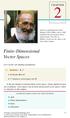 CHAPTER 2 American mathematician Paul Halmos (1916 2006), who in 1942 published the first modern linear algebra book. The title of Halmos s book was the same as the title of this chapter. Finite-Dimensional
MASSACHUSETTS INSTITUTE OF TECHNOLOGY 6.436J/15.085J Fall 2008 Lecture 5 9/17/2008 RANDOM VARIABLES
 MASSACHUSETTS INSTITUTE OF TECHNOLOGY 6.436J/15.085J Fall 2008 Lecture 5 9/17/2008 RANDOM VARIABLES Contents 1. Random variables and measurable functions 2. Cumulative distribution functions 3. Discrete
t := maxγ ν subject to ν {0,1,2,...} and f(x c +γ ν d) f(x c )+cγ ν f (x c ;d).
 1. Line Search Methods Let f : R n R be given and suppose that x c is our current best estimate of a solution to P min x R nf(x). A standard method for improving the estimate x c is to choose a direction
THE BANACH CONTRACTION PRINCIPLE. Contents
 THE BANACH CONTRACTION PRINCIPLE ALEX PONIECKI Abstract. This paper will study contractions of metric spaces. To do this, we will mainly use tools from topology. We will give some examples of contractions,
Convex analysis and profit/cost/support functions
 CALIFORNIA INSTITUTE OF TECHNOLOGY Division of the Humanities and Social Sciences Convex analysis and profit/cost/support functions KC Border October 2004 Revised January 2009 Let A be a subset of R m
CONTINUED FRACTIONS AND PELL S EQUATION. Contents 1. Continued Fractions 1 2. Solution to Pell s Equation 9 References 12
 CONTINUED FRACTIONS AND PELL S EQUATION SEUNG HYUN YANG Abstract. In this REU paper, I will use some important characteristics of continued fractions to give the complete set of solutions to Pell s equation.
MINIMIZATION OF ENTROPY FUNCTIONALS UNDER MOMENT CONSTRAINTS. denote the family of probability density functions g on X satisfying
 MINIMIZATION OF ENTROPY FUNCTIONALS UNDER MOMENT CONSTRAINTS I. Csiszár (Budapest) Given a σ-finite measure space (X, X, µ) and a d-tuple ϕ = (ϕ 1,..., ϕ d ) of measurable functions on X, for a = (a 1,...,
Practice with Proofs
 Practice with Proofs October 6, 2014 Recall the following Definition 0.1. A function f is increasing if for every x, y in the domain of f, x < y = f(x) < f(y) 1. Prove that h(x) = x 3 is increasing, using
1. Prove that the empty set is a subset of every set.
 1. Prove that the empty set is a subset of every set. Basic Topology Written by Men-Gen Tsai email: [email protected] Proof: For any element x of the empty set, x is also an element of every set since
Metric Spaces. Chapter 1
 Chapter 1 Metric Spaces Many of the arguments you have seen in several variable calculus are almost identical to the corresponding arguments in one variable calculus, especially arguments concerning convergence
Let H and J be as in the above lemma. The result of the lemma shows that the integral
 Let and be as in the above lemma. The result of the lemma shows that the integral ( f(x, y)dy) dx is well defined; we denote it by f(x, y)dydx. By symmetry, also the integral ( f(x, y)dx) dy is well defined;
MATH10212 Linear Algebra. Systems of Linear Equations. Definition. An n-dimensional vector is a row or a column of n numbers (or letters): a 1.
 MATH10212 Linear Algebra Textbook: D. Poole, Linear Algebra: A Modern Introduction. Thompson, 2006. ISBN 0-534-40596-7. Systems of Linear Equations Definition. An n-dimensional vector is a row or a column
CHAPTER II THE LIMIT OF A SEQUENCE OF NUMBERS DEFINITION OF THE NUMBER e.
 CHAPTER II THE LIMIT OF A SEQUENCE OF NUMBERS DEFINITION OF THE NUMBER e. This chapter contains the beginnings of the most important, and probably the most subtle, notion in mathematical analysis, i.e.,
Finite dimensional topological vector spaces
 Chapter 3 Finite dimensional topological vector spaces 3.1 Finite dimensional Hausdorff t.v.s. Let X be a vector space over the field K of real or complex numbers. We know from linear algebra that the
Class Meeting # 1: Introduction to PDEs
 MATH 18.152 COURSE NOTES - CLASS MEETING # 1 18.152 Introduction to PDEs, Fall 2011 Professor: Jared Speck Class Meeting # 1: Introduction to PDEs 1. What is a PDE? We will be studying functions u = u(x
Further Study on Strong Lagrangian Duality Property for Invex Programs via Penalty Functions 1
 Further Study on Strong Lagrangian Duality Property for Invex Programs via Penalty Functions 1 J. Zhang Institute of Applied Mathematics, Chongqing University of Posts and Telecommunications, Chongqing
Undergraduate Notes in Mathematics. Arkansas Tech University Department of Mathematics
 Undergraduate Notes in Mathematics Arkansas Tech University Department of Mathematics An Introductory Single Variable Real Analysis: A Learning Approach through Problem Solving Marcel B. Finan c All Rights
ON SEQUENTIAL CONTINUITY OF COMPOSITION MAPPING. 0. Introduction
 ON SEQUENTIAL CONTINUITY OF COMPOSITION MAPPING Abstract. In [1] there was proved a theorem concerning the continuity of the composition mapping, and there was announced a theorem on sequential continuity
ALMOST COMMON PRIORS 1. INTRODUCTION
 ALMOST COMMON PRIORS ZIV HELLMAN ABSTRACT. What happens when priors are not common? We introduce a measure for how far a type space is from having a common prior, which we term prior distance. If a type
SOLUTIONS TO EXERCISES FOR. MATHEMATICS 205A Part 3. Spaces with special properties
 SOLUTIONS TO EXERCISES FOR MATHEMATICS 205A Part 3 Fall 2008 III. Spaces with special properties III.1 : Compact spaces I Problems from Munkres, 26, pp. 170 172 3. Show that a finite union of compact subspaces
Increasing for all. Convex for all. ( ) Increasing for all (remember that the log function is only defined for ). ( ) Concave for all.
 1. Differentiation The first derivative of a function measures by how much changes in reaction to an infinitesimal shift in its argument. The largest the derivative (in absolute value), the faster is evolving.
Mathematical Methods of Engineering Analysis
 Mathematical Methods of Engineering Analysis Erhan Çinlar Robert J. Vanderbei February 2, 2000 Contents Sets and Functions 1 1 Sets................................... 1 Subsets.............................
Scalar Valued Functions of Several Variables; the Gradient Vector
 Scalar Valued Functions of Several Variables; the Gradient Vector Scalar Valued Functions vector valued function of n variables: Let us consider a scalar (i.e., numerical, rather than y = φ(x = φ(x 1,
A QUICK GUIDE TO THE FORMULAS OF MULTIVARIABLE CALCULUS
 A QUIK GUIDE TO THE FOMULAS OF MULTIVAIABLE ALULUS ontents 1. Analytic Geometry 2 1.1. Definition of a Vector 2 1.2. Scalar Product 2 1.3. Properties of the Scalar Product 2 1.4. Length and Unit Vectors
1 Norms and Vector Spaces
 008.10.07.01 1 Norms and Vector Spaces Suppose we have a complex vector space V. A norm is a function f : V R which satisfies (i) f(x) 0 for all x V (ii) f(x + y) f(x) + f(y) for all x,y V (iii) f(λx)
I. GROUPS: BASIC DEFINITIONS AND EXAMPLES
 I GROUPS: BASIC DEFINITIONS AND EXAMPLES Definition 1: An operation on a set G is a function : G G G Definition 2: A group is a set G which is equipped with an operation and a special element e G, called
Follow links for Class Use and other Permissions. For more information send email to: [email protected]
 COPYRIGHT NOTICE: Ariel Rubinstein: Lecture Notes in Microeconomic Theory is published by Princeton University Press and copyrighted, c 2006, by Princeton University Press. All rights reserved. No part
HOMEWORK 5 SOLUTIONS. n!f n (1) lim. ln x n! + xn x. 1 = G n 1 (x). (2) k + 1 n. (n 1)!
 Math 7 Fall 205 HOMEWORK 5 SOLUTIONS Problem. 2008 B2 Let F 0 x = ln x. For n 0 and x > 0, let F n+ x = 0 F ntdt. Evaluate n!f n lim n ln n. By directly computing F n x for small n s, we obtain the following
Linear Programming Notes V Problem Transformations
 Linear Programming Notes V Problem Transformations 1 Introduction Any linear programming problem can be rewritten in either of two standard forms. In the first form, the objective is to maximize, the material
Chapter 20. Vector Spaces and Bases
 Chapter 20. Vector Spaces and Bases In this course, we have proceeded step-by-step through low-dimensional Linear Algebra. We have looked at lines, planes, hyperplanes, and have seen that there is no limit
0 <β 1 let u(x) u(y) kuk u := sup u(x) and [u] β := sup
![0 <β 1 let u(x) u(y) kuk u := sup u(x) and [u] β := sup](/thumbs/40/20844595.jpg "0 <β 1 let u(x) u(y) kuk u := sup u(x) and [u] β := sup") 456 BRUCE K. DRIVER 24. Hölder Spaces Notation 24.1. Let Ω be an open subset of R d,bc(ω) and BC( Ω) be the bounded continuous functions on Ω and Ω respectively. By identifying f BC( Ω) with f Ω BC(Ω),
456 BRUCE K. DRIVER 24. Hölder Spaces Notation 24.1. Let Ω be an open subset of R d,bc(ω) and BC( Ω) be the bounded continuous functions on Ω and Ω respectively. By identifying f BC( Ω) with f Ω BC(Ω),
Fixed Point Theorems
 Fixed Point Theorems Definition: Let X be a set and let T : X X be a function that maps X into itself. (Such a function is often called an operator, a transformation, or a transform on X, and the notation
Cost Minimization and the Cost Function
 Cost Minimization and the Cost Function Juan Manuel Puerta October 5, 2009 So far we focused on profit maximization, we could look at a different problem, that is the cost minimization problem. This is
4.5 Linear Dependence and Linear Independence
 4.5 Linear Dependence and Linear Independence 267 32. {v 1, v 2 }, where v 1, v 2 are collinear vectors in R 3. 33. Prove that if S and S are subsets of a vector space V such that S is a subset of S, then
The Steepest Descent Algorithm for Unconstrained Optimization and a Bisection Line-search Method
 The Steepest Descent Algorithm for Unconstrained Optimization and a Bisection Line-search Method Robert M. Freund February, 004 004 Massachusetts Institute of Technology. 1 1 The Algorithm The problem
n k=1 k=0 1/k! = e. Example 6.4. The series 1/k 2 converges in R. Indeed, if s n = n then k=1 1/k, then s 2n s n = 1 n + 1 +...
 6 Series We call a normed space (X, ) a Banach space provided that every Cauchy sequence (x n ) in X converges. For example, R with the norm = is an example of Banach space. Now let (x n ) be a sequence
Max-Min Representation of Piecewise Linear Functions
 Beiträge zur Algebra und Geometrie Contributions to Algebra and Geometry Volume 43 (2002), No. 1, 297-302. Max-Min Representation of Piecewise Linear Functions Sergei Ovchinnikov Mathematics Department,
INCIDENCE-BETWEENNESS GEOMETRY
 INCIDENCE-BETWEENNESS GEOMETRY MATH 410, CSUSM. SPRING 2008. PROFESSOR AITKEN This document covers the geometry that can be developed with just the axioms related to incidence and betweenness. The full
FUNCTIONAL ANALYSIS LECTURE NOTES: QUOTIENT SPACES
 FUNCTIONAL ANALYSIS LECTURE NOTES: QUOTIENT SPACES CHRISTOPHER HEIL 1. Cosets and the Quotient Space Any vector space is an abelian group under the operation of vector addition. So, if you are have studied
Mathematical Induction
 Mathematical Induction (Handout March 8, 01) The Principle of Mathematical Induction provides a means to prove infinitely many statements all at once The principle is logical rather than strictly mathematical,
1 Local Brouwer degree
 1 Local Brouwer degree Let D R n be an open set and f : S R n be continuous, D S and c R n. Suppose that the set f 1 (c) D is compact. (1) Then the local Brouwer degree of f at c in the set D is defined.
Høgskolen i Narvik Sivilingeniørutdanningen STE6237 ELEMENTMETODER. Oppgaver
 Høgskolen i Narvik Sivilingeniørutdanningen STE637 ELEMENTMETODER Oppgaver Klasse: 4.ID, 4.IT Ekstern Professor: Gregory A. Chechkin e-mail: [email protected] Narvik 6 PART I Task. Consider two-point
Inner Product Spaces
 Math 571 Inner Product Spaces 1. Preliminaries An inner product space is a vector space V along with a function, called an inner product which associates each pair of vectors u, v with a scalar u, v, and
8.1 Examples, definitions, and basic properties
 8 De Rham cohomology Last updated: May 21, 211. 8.1 Examples, definitions, and basic properties A k-form ω Ω k (M) is closed if dω =. It is exact if there is a (k 1)-form σ Ω k 1 (M) such that dσ = ω.
NOTES ON LINEAR TRANSFORMATIONS
 NOTES ON LINEAR TRANSFORMATIONS Definition 1. Let V and W be vector spaces. A function T : V W is a linear transformation from V to W if the following two properties hold. i T v + v = T v + T v for all
MATH10040 Chapter 2: Prime and relatively prime numbers
 MATH10040 Chapter 2: Prime and relatively prime numbers Recall the basic definition: 1. Prime numbers Definition 1.1. Recall that a positive integer is said to be prime if it has precisely two positive
9 More on differentiation
 Tel Aviv University, 2013 Measure and category 75 9 More on differentiation 9a Finite Taylor expansion............... 75 9b Continuous and nowhere differentiable..... 78 9c Differentiable and nowhere monotone......
6. Define log(z) so that π < I log(z) π. Discuss the identities e log(z) = z and log(e w ) = w.
 hapter omplex integration. omplex number quiz. Simplify 3+4i. 2. Simplify 3+4i. 3. Find the cube roots of. 4. Here are some identities for complex conjugate. Which ones need correction? z + w = z + w,
24. The Branch and Bound Method
 24. The Branch and Bound Method It has serious practical consequences if it is known that a combinatorial problem is NP-complete. Then one can conclude according to the present state of science that no
ON NONNEGATIVE SOLUTIONS OF NONLINEAR TWO-POINT BOUNDARY VALUE PROBLEMS FOR TWO-DIMENSIONAL DIFFERENTIAL SYSTEMS WITH ADVANCED ARGUMENTS
 ON NONNEGATIVE SOLUTIONS OF NONLINEAR TWO-POINT BOUNDARY VALUE PROBLEMS FOR TWO-DIMENSIONAL DIFFERENTIAL SYSTEMS WITH ADVANCED ARGUMENTS I. KIGURADZE AND N. PARTSVANIA A. Razmadze Mathematical Institute
Lecture L3 - Vectors, Matrices and Coordinate Transformations
 S. Widnall 16.07 Dynamics Fall 2009 Lecture notes based on J. Peraire Version 2.0 Lecture L3 - Vectors, Matrices and Coordinate Transformations By using vectors and defining appropriate operations between
Section 4.4 Inner Product Spaces
 Section 4.4 Inner Product Spaces In our discussion of vector spaces the specific nature of F as a field, other than the fact that it is a field, has played virtually no role. In this section we no longer
FACTORING POLYNOMIALS IN THE RING OF FORMAL POWER SERIES OVER Z
 FACTORING POLYNOMIALS IN THE RING OF FORMAL POWER SERIES OVER Z DANIEL BIRMAJER, JUAN B GIL, AND MICHAEL WEINER Abstract We consider polynomials with integer coefficients and discuss their factorization
Vector and Matrix Norms
 Chapter 1 Vector and Matrix Norms 11 Vector Spaces Let F be a field (such as the real numbers, R, or complex numbers, C) with elements called scalars A Vector Space, V, over the field F is a non-empty
Section 1.1. Introduction to R n
 The Calculus of Functions of Several Variables Section. Introduction to R n Calculus is the study of functional relationships and how related quantities change with each other. In your first exposure to
Chapter 17. Orthogonal Matrices and Symmetries of Space
 Chapter 17. Orthogonal Matrices and Symmetries of Space Take a random matrix, say 1 3 A = 4 5 6, 7 8 9 and compare the lengths of e 1 and Ae 1. The vector e 1 has length 1, while Ae 1 = (1, 4, 7) has length
The Heat Equation. Lectures INF2320 p. 1/88
 The Heat Equation Lectures INF232 p. 1/88 Lectures INF232 p. 2/88 The Heat Equation We study the heat equation: u t = u xx for x (,1), t >, (1) u(,t) = u(1,t) = for t >, (2) u(x,) = f(x) for x (,1), (3)
Quotient Rings and Field Extensions
 Chapter 5 Quotient Rings and Field Extensions In this chapter we describe a method for producing field extension of a given field. If F is a field, then a field extension is a field K that contains F.
Section 1.3 P 1 = 1 2. = 1 4 2 8. P n = 1 P 3 = Continuing in this fashion, it should seem reasonable that, for any n = 1, 2, 3,..., = 1 2 4.
 Difference Equations to Differential Equations Section. The Sum of a Sequence This section considers the problem of adding together the terms of a sequence. Of course, this is a problem only if more than
Adaptive Online Gradient Descent
 Adaptive Online Gradient Descent Peter L Bartlett Division of Computer Science Department of Statistics UC Berkeley Berkeley, CA 94709 bartlett@csberkeleyedu Elad Hazan IBM Almaden Research Center 650
Unified Lecture # 4 Vectors
 Fall 2005 Unified Lecture # 4 Vectors These notes were written by J. Peraire as a review of vectors for Dynamics 16.07. They have been adapted for Unified Engineering by R. Radovitzky. References [1] Feynmann,
Similarity and Diagonalization. Similar Matrices
 MATH022 Linear Algebra Brief lecture notes 48 Similarity and Diagonalization Similar Matrices Let A and B be n n matrices. We say that A is similar to B if there is an invertible n n matrix P such that
1. Let X and Y be normed spaces and let T B(X, Y ).
 Uppsala Universitet Matematiska Institutionen Andreas Strömbergsson Prov i matematik Funktionalanalys Kurs: NVP, Frist. 2005-03-14 Skrivtid: 9 11.30 Tillåtna hjälpmedel: Manuella skrivdon, Kreyszigs bok
3 Contour integrals and Cauchy s Theorem
 3 ontour integrals and auchy s Theorem 3. Line integrals of complex functions Our goal here will be to discuss integration of complex functions = u + iv, with particular regard to analytic functions. Of
4. Expanding dynamical systems
 4.1. Metric definition. 4. Expanding dynamical systems Definition 4.1. Let X be a compact metric space. A map f : X X is said to be expanding if there exist ɛ > 0 and L > 1 such that d(f(x), f(y)) Ld(x,
Fuzzy Differential Systems and the New Concept of Stability
 Nonlinear Dynamics and Systems Theory, 1(2) (2001) 111 119 Fuzzy Differential Systems and the New Concept of Stability V. Lakshmikantham 1 and S. Leela 2 1 Department of Mathematical Sciences, Florida
SECOND DERIVATIVE TEST FOR CONSTRAINED EXTREMA
 SECOND DERIVATIVE TEST FOR CONSTRAINED EXTREMA This handout presents the second derivative test for a local extrema of a Lagrange multiplier problem. The Section 1 presents a geometric motivation for the
ON LIMIT LAWS FOR CENTRAL ORDER STATISTICS UNDER POWER NORMALIZATION. E. I. Pancheva, A. Gacovska-Barandovska
 Pliska Stud. Math. Bulgar. 22 (2015), STUDIA MATHEMATICA BULGARICA ON LIMIT LAWS FOR CENTRAL ORDER STATISTICS UNDER POWER NORMALIZATION E. I. Pancheva, A. Gacovska-Barandovska Smirnov (1949) derived four
Numerisches Rechnen. (für Informatiker) M. Grepl J. Berger & J.T. Frings. Institut für Geometrie und Praktische Mathematik RWTH Aachen
 (für Informatiker) M. Grepl J. Berger & J.T. Frings Institut für Geometrie und Praktische Mathematik RWTH Aachen Wintersemester 2010/11 Problem Statement Unconstrained Optimality Conditions Constrained
The Mean Value Theorem
 The Mean Value Theorem THEOREM (The Extreme Value Theorem): If f is continuous on a closed interval [a, b], then f attains an absolute maximum value f(c) and an absolute minimum value f(d) at some numbers
Notes on Determinant
 ENGG2012B Advanced Engineering Mathematics Notes on Determinant Lecturer: Kenneth Shum Lecture 9-18/02/2013 The determinant of a system of linear equations determines whether the solution is unique, without
Elasticity Theory Basics
 G22.3033-002: Topics in Computer Graphics: Lecture #7 Geometric Modeling New York University Elasticity Theory Basics Lecture #7: 20 October 2003 Lecturer: Denis Zorin Scribe: Adrian Secord, Yotam Gingold
DIFFERENTIABILITY OF COMPLEX FUNCTIONS. Contents
 DIFFERENTIABILITY OF COMPLEX FUNCTIONS Contents 1. Limit definition of a derivative 1 2. Holomorphic functions, the Cauchy-Riemann equations 3 3. Differentiability of real functions 5 4. A sufficient condition
88 CHAPTER 2. VECTOR FUNCTIONS. . First, we need to compute T (s). a By definition, r (s) T (s) = 1 a sin s a. sin s a, cos s a
 88 CHAPTER. VECTOR FUNCTIONS.4 Curvature.4.1 Definitions and Examples The notion of curvature measures how sharply a curve bends. We would expect the curvature to be 0 for a straight line, to be very small
5 Numerical Differentiation
 D. Levy 5 Numerical Differentiation 5. Basic Concepts This chapter deals with numerical approximations of derivatives. The first questions that comes up to mind is: why do we need to approximate derivatives