
Tuning Manager. Hitachi Command Suite. Server Administration Guide MK-92HC FASTFIND LINKS Document Organization. Product Version.
|
|
|
- Arlene Evans
- 9 years ago
- Views:
Transcription
1 Hitachi Command Suite Tuning Manager Server Administration Guide FASTFIND LINKS Document Organization Product Version Getting Help Contents MK-92HC021-38

2 2015 Hitachi, Ltd. All rights reserved. No part of this publication may be reproduced or transmitted in any form or by any means, electronic or mechanical, including photocopying and recording, or stored in a database or retrieval system for any purpose without the express written permission of Hitachi, Ltd. Hitachi, Ltd., reserves the right to make changes to this document at any time without notice and assumes no responsibility for its use. This document contains the most current information available at the time of publication. When new or revised information becomes available, this entire document will be updated and distributed to all registered users. Some of the features described in this document might not be currently available. Refer to the most recent product announcement for information about feature and product availability, or contact Hitachi Data Systems Corporation at Notice: Hitachi, Ltd., products and services can be ordered only under the terms and conditions of the applicable Hitachi Data Systems Corporation agreements. The use of Hitachi, Ltd., products is governed by the terms of your agreements with Hitachi Data Systems Corporation. Hitachi is a registered trademark of Hitachi, Ltd., in the United States and other countries. Hitachi Data Systems is a registered trademark and service mark of Hitachi, Ltd., in the United States and other countries. Archivas, Essential NAS Platform, HiCommand, Hi-Track, ShadowImage, Tagmaserve, Tagmasoft, Tagmasolve, Tagmastore, TrueCopy, Universal Star Network, and Universal Storage Platform are registered trademarks of Hitachi Data Systems. AIX, AS/400, DB2, Domino, DS6000, DS8000, Enterprise Storage Server, ESCON, FICON, FlashCopy, IBM, Lotus, MVS, OS/390, RS/6000, S/390, System z9, System z10, Tivoli, VM/ESA, z/os, z9, z10, zseries, z/ VM, and z/vse are registered trademarks or trademarks of International Business Machines Corporation. All other trademarks, service marks, and company names in this document or website are properties of their respective owners. Microsoft product screen shots are reprinted with permission from Microsoft Corporation. Notice on Export Controls: The technical data and technology inherent in this Document may be subject to U.S. export control laws, including the U.S. Export Administration Act and its associated regulations, and may be subject to export or import regulations in other countries. Reader agrees to comply strictly with all such regulations and acknowledges that Reader has the responsibility to obtain licenses to export, re-export, or import the Document and any Compliant Products. ii

3 Contents Preface xi Intended audience xii Product version xii Release notes xii Document organization xii Referenced documents xiii Document conventions xiii Convention for storage capacity values xiv Accessing product documentation xv Getting help xv Comments xv 1 Overview Tasks to perform before starting operations Overview of the Tuning Manager administrative GUI Data entry guidelines for the Tuning Manager GUI Logging in to a Tuning Manager server as an Administrator Initial administrator login Logging out Services registered for Tuning Manager server (Windows only) Resident processes of Tuning Manager server Starting services About automatically started services Starting services manually Checking service statuses (at service startup) Notes on starting services Stopping services Tuning Manager server service (HiCommand Suite TuningManager) Performance Reporter service (HiCommand Performance Reporter) HiRDB service Stopping services of all Hitachi Command Suite products and HiRDB Notes on stopping services iii

4 Setting up the user property file Properties for the user.properties file Ports used by a Tuning Manager server Port numbers used to connect to API Agent host Port numbers used to connect to Device Manager Operating in a network where a firewall is set Changing the port numbers used to connect to Device Manager Changing the network settings of the management server Restricting web terminals that can connect to a Tuning Manager server About machine time differences Behavior when there is a time difference between a Tuning Manager server and an Agent When the Tuning Manager server time is earlier than the Agent time When the Tuning Manager server time is later than the Agent time Behavior when there is a time difference between a Tuning Manager server and a Device Manager server When the time difference between a Tuning Manager server and a Device Manager server is constant When setting the Device Manager server time behind the Tuning Manager server time during operation When setting the Device Manager server time ahead of the Tuning Manager server time during operation Notes on adjusting the time of the machine on which the Tuning Manager series products are installed Operating a Tuning Manager server in an IPv6 environment Restrictions on operations in an IPv6 environment Settings for operations in an IPv6 environment IPv6 settings Settings for SSL communication Working with licenses Managing licenses Registering a license key Viewing the Tuning Manager server version and license information Managing the Tuning Manager server database Overview of the Tuning Manager server database Displaying the database capacity Backing up the database Options for the hcmds64backups command Restoring the database Options for the hcmds64db command Changing the total database capacity Estimating the total database capacity Expanding the total database capacity iv

5 Options for the htm-db-setup command Reducing the total database capacity Migrating databases Options for the hcmds64dbtrans command Notes on database migration Installing Hitachi Command Suite products on the migration destination server Exporting the database at the migration source server Importing the database at the migration destination server Managing users About login modes Overview of user management operations Overview of creating and setting up permissions for a new user Linking user accounts with an external authentication server Available user permissions User account operations Permissions for user account operations Creating a new user account Setting permissions for a user Viewing or editing user profiles Viewing or editing another user's profile Viewing or editing your own profile Changing passwords Changing your own password Changing another user's password Changing the lock status of a user account Settings for locking the system account Deleting a user account Managing user password security Setting security options at login Setting password conditions Setting automatic locking of user accounts Warning banner messages Setting a warning banner message Editing a warning banner message Registering a banner message Deleting a warning banner message Configuring connection and initial settings Configuring connection settings for Device Manager Tuning Manager server host settings Device Manager server host settings Configuring connection settings for Agents Configuring settings for Agents that use Tuning Manager API v
6 Specifying automatic refresh interval to collect API Agent information Configuring Tuning Manager server settings to use Tuning Manager API Settings for using the Tuning Manager API Changing the port number of Tuning Manager server host connecting to API Agent host Steps required after changing the host name of an Agent host that use Tuning Manager API Configuring initial settings for Performance Reporter Date format specified in the initialization settings file (config.xml) Display format for date tag specifications Example of specifying the date format Working with the repository for storing bookmark definition data Changing the repository storage location About corrupted repository files Backing up and restoring repository files Managing repository files before removing Tuning Manager server Caching of data used when displaying a real-time report Memory reduction mode Report series paging Separate-and-send mode Report cache filing Estimating the disk space requirements for report cache files Reviewing a sample initialization settings file Editing the initialization settings file (Windows) Editing the initialization settings file (Linux) Changing the default window for Performance Reporter Preparing to use the Device Manager CLI Acquiring a list of array families Registering storage system information Overview of Oracle Java support Executing the hcmds64chgjdk command to switch Java versions Output messages from the hcmds64chgjdk command Setting the display language in Windows Specifying settings for data acquisition from Agents and Device Manager Using a Tuning Manager server to acquire data (polling) Data collected from an information source Information resources for the monitoring host Selecting a host's information source (Agentless host mode) Required conditions for enabling each host monitoring mode Switching monitoring mode6-6 Differences in collected information by monitoring mode Refreshing configuration information retained in Device Manager Preparation for performing polling Device Manager settings vi

7 Agent settings Polling offset settings Supported Agents Time required for initial data collection Monitoring virtualization environments6-11 Installing the Tuning Manager server for use with virtualization environments Operation during troubleshooting and configuration changes in production6-12 Monitoring capacity information Performance management considerations Prerequisites Device Manager Host Data Collector is used for monitoring Monitoring an NPIV environment Changing pair volume configuration Migrating LDEVs Removing a virtualization server6-16 Monitoring Agentless hosts Adding an Agentless host as a monitoring target Refreshing Agentless host information Updating configuration information Determining the current monitoring mode Switching the host monitoring mode from Agent to Agentless Switching the host monitoring mode from Agentless to Agent Deleting an Agentless host as a Tuning Manager monitoring target Monitoring a host that uses an alias Notes about the exhosts.txt file Configuring the polling settings Checking the polling settings Editing the polling settings Operating polling manually Starting polling manually Stopping polling manually About polling during Daylight Saving Time changes Polling data recorded during Daylight Saving Time changes Polling schedule during Daylight Saving Time changes Specifying a time managed by a Tuning Manager server Data retention periods Checking the data retention period settings Editing the data retention periods System reports Checking polling status reports Checking system alerts Specifying Agent polling status alerts Error handling procedures Error handling procedures vii

8 Troubleshooting Data update is delayed Database capacity is insufficient Number of Agent instances exceeds the maximum number monitored by a single Tuning Manager server Adding an additional Tuning Manager server host Desktop heap is insufficient Increasing the desktop heap size Agents are not displayed in the data polling window All user accounts are locked When the hcmds64db and hcmds64dbtrans commands fail to recover the database Executing the hcmds64dbrepair command to restore the database View Server service runs out of memory An attempt to connect to View Server from Main Console fails (KATN14858-E) Data that must be collected if a problem occurs Windows event log Main Console information output to the event log Performance Reporter information output to the event log UNIX syslog Editing the configuration file to direct alert messages to syslog Main Console information output to syslog Performance Reporter information output to syslog Main Console logs Output destinations of the Main Console log data Output format for the Main Console message log Changing the settings of the Main Console logs Levels of data in the Main Console trace log Performance Reporter log Output destination of the Performance Reporter log Output format for the Performance Reporter log Performance Reporter log settings Levels of data in the Performance Reporter trace log API log Output destinations of the API log data Changing the settings of the API logs Collecting maintenance information Using commands to collect maintenance information Manually collecting maintenance information Information required to determine the circumstances in which a problem has occurred Calling the Hitachi Data Systems technical support center Working with Common Component Common Component functions viii

9 Installing and removing Common Component Integrated logging Integrated log output Common Component trace log properties Setting the trace log properties for Common Component (Windows) Managing ports used by Common Component Changing a Common Component port in Windows Changing a Common Component port in Linux Manually adding an exception to Windows firewall Manually adding an exception (Tuning Manager server) Manually adding an exception (HBase64) Troubleshooting Changing the host name or IP address of a management server Steps required after changing the host name or IP address of the Device Manager host Changing the host name of the Tuning Manager server host Changing the settings of the Hitachi Command Suite Common Component database Changing the IP address of the Tuning Manager server host Changing the startup URL for a Tuning Manager server Setup for starting a Web application from Web Client Using hcmds64link to register an application Modifying the URL information for starting Web Client Security settings for user accounts password.min.length password.min.uppercase password.min.lowercase password.min.numeric password.min.symbol password.check.userid account.lock.num Generating audit logs Categories of information output to audit logs on a Tuning Manager server 8-24 Editing the audit log environment settings file Format of output audit log data A Default installation directories for the Tuning Manager series programs A-1 Default installation directories for the Tuning Manager series programs A-2 Glossary Index ix
10 x

11 Preface This document describes how to manage the Hitachi Command Suite Tuning Manager software on a server. This guide is intended for system administrators who use Tuning Manager to manage data on storage systems. We recommend that the readers of this manual have a basic knowledge of Storage Area Networks (SANs), data processing and peripheral storage device systems and their basic functions, OSs on which the web client runs, and the content of user manuals for their storage systems. This preface includes the following information: Intended audience Product version Release notes Document organization Referenced documents Document conventions Convention for storage capacity values Accessing product documentation Getting help Comments Preface xi

12 Intended audience Product version Release notes This document is intended for the following users: System administrators Application developers System integrators Technology consultants System architects and capacity planners who rely on Tuning Manager reports and forecasts This document revision applies to Tuning Manager v8.1.3 or later. Release notes contain requirements and more recent product information that may not be fully described in this manual. Be sure to review the release notes before installation. Document organization The following table provides an overview of the contents and organization of this document. Click the chapter title in the left column to go to that chapter. The first page of each chapter provides links to the sections in that chapter. Chapter Description Overview on page 1-1 Working with licenses on page 2-1 Managing the Tuning Manager server database on page 3-1 Managing users on page 4-1 Configuring connection and initial settings on page 5-1 Specifying settings for data acquisition from Agents and Device Manager on page 6-1 Error handling procedures on page 7-1 Working with Common Component on page 8-1 Provides an overview of key system administration tasks including configuring and operating Tuning Manager server components. Describes how to manage your Tuning Manager server license. Describes how to manage the Tuning Manager server database. Describes how to create and manage Tuning Manager server user accounts. Describes the settings needed to launch related applications. Describes the functions for acquiring data from Agents and Device Manager (referred to hereafter as polling) and how to specify the settings for data acquisition. Explains how to handle any errors that may occur while using Main Console and Performance Reporter. Describes the functions provided by Common Component. xii Preface

13 Chapter Description Default installation directories for the Tuning Manager series programs on page A-2 Glossary on page Glossary-1 Referenced documents The following Hitachi referenced documents can be found on the applicable Hitachi documentation CD: Hitachi Command Suite Documents: Hitachi Command Suite Administrator Guide, MK-90HC175 Hitachi Command Suite Installation and Configuration Guide, MK- 90HC173 Tuning Manager Agent Administration Guide, MK-92HC013 Tuning Manager User Guide, MK-92HC022 Tuning Manager Hardware Reports Reference, MK-95HC111 Tuning Manager Operating System Reports Reference, MK-95HC112 Tuning Manager Application Reports Reference, MK-95HC113 Tuning Manager Messages, MK-95HC114 Tuning Manager CLI Reference Guide, MK-96HC119 Tuning Manager Installation Guide, MK-96HC141 Tuning Manager API Reference Guide, MK-92HC218 Hitachi Data Systems Portal, Document conventions Lists the default installation directories for the Tuning Manager series programs. Defines the acronyms and abbreviations used in this document. The terms Universal Storage Platform V and Universal Storage Platform VM refer to all models of the Hitachi Universal Storage Platform V and VM storage systems, unless otherwise noted. This document uses the following typographic conventions: Convention Bold Italic screen/code Description Indicates text on a window, other than the window title, including menus, menu options, buttons, fields, and labels. Example: Click OK. Indicates a variable, which is a placeholder for actual text provided by the user or system. Example: copy source-file target-file Note: Angled brackets (< >) are also used to indicate variables. Indicates text that is displayed on screen or entered by the user. Example: # pairdisplay -g oradb Preface xiii
14 Convention Description < > angled brackets Indicates a variable, which is a placeholder for actual text provided by the user or system. Example: # pairdisplay -g <group> Note: Italic font is also used to indicate variables. [ ] square brackets Indicates optional values. Example: [ a b ] indicates that you can choose a, b, or nothing. { } braces Indicates required or expected values. Example: { a b } indicates that you must choose either a or b. vertical bar Indicates that you have a choice between two or more options or arguments. Examples: [ a b ] indicates that you can choose a, b, or nothing. { a b } indicates that you must choose either a or b. This document uses the following icons to draw attention to information: Icon Meaning Description Note Tip Notes emphasize or supplement important points of the main text. Tips provide helpful information, guidelines, or suggestions for performing tasks more effectively. Caution WARNING Cautions indicate that failure to take a specified action could result in damage to the software or hardware. Warnings indicate that failure to take a specified action could result in loss of data or serious damage to hardware. Convention for storage capacity values Physical storage capacity values (for example, drive capacity) are calculated based on the following values: Physical Capacity Unit Value 1 kilobyte (KB) 1000 (10 3 bytes) 1 megabyte (MB) 1,000 KB or (10 2 bytes) 1 gigabyte (GB) 1,000 MB or (10 3 bytes) 1 terabyte (TB) 1,000 TB or (10 4 bytes) 1 petabyte (PB) 1,000 PB or (10 5 bytes) 1 exabyte (EB) 1,000 EB or (10 6 bytes) Logical storage capacity values (for example, logical device capacity) are calculated based on the following values: xiv Preface

15 Logical Capacity Unit Value Accessing product documentation Getting help Comments 1 KB 1,024 (2 10 ) bytes 1 MB 1,024 KB or 1,024 2 bytes 1 GB 1,024 MB or 1,024 3 bytes 1 TB 1,024 GB or 1,024 4 bytes 1 PB 1,024 TB or 1,024 5 bytes 1 EB 1,024 PB or 1,024 6 bytes 1 block 512 bytes The Tuning Manager user documentation is available on the Hitachi Data Systems Portal: Check this site for the most current documentation, including important updates that may have been made after the release of the product. Hitachi Data Systems Support Portal is the destination for technical support of your current or previously-sold storage systems, midrange and enterprise servers, and combined solution offerings. The Hitachi Data Systems customer support staff is available 24 hours a day, seven days a week. If you need technical support, log on to the Hitachi Data Systems Support Portal for contact information: Hitachi Data Systems Community is a new global online community for HDS customers, partners, independent software vendors, employees, and prospects. It is an open discussion among these groups about the HDS portfolio of products and services. It is the destination to get answers, discover insights, and make connections. The HDS Community complements our existing Support Portal and support services by providing an area where you can get answers to non-critical issues and questions. Join the conversation today! Go to community.hds.com, register, and complete your profile. Please send us your comments on this document: [email protected]. Include the document title, number, and revision, and refer to specific sections and paragraphs whenever possible. All comments become the property of Hitachi Data Systems Corporation. Thank you! Preface xv

16 xvi Preface

17 1 Overview This chapter provides an overview of key system administration tasks including configuring and operating Tuning Manager server components. For details on the GUI framework described in this manual, see the Tuning Manager User Guide. This chapter includes the following topics: Tasks to perform before starting operations Overview of the Tuning Manager administrative GUI Logging in to a Tuning Manager server as an Administrator Logging out Services registered for Tuning Manager server (Windows only) Resident processes of Tuning Manager server Starting services Stopping services Setting up the user property file Ports used by a Tuning Manager server Changing the network settings of the management server Restricting web terminals that can connect to a Tuning Manager server About machine time differences Overview 1 1
18 Operating a Tuning Manager server in an IPv6 environment 1 2 Overview

19 Tasks to perform before starting operations Figure 1-1 Flow of tasks to perform before starting operations on page 1-3 shows the flow of the tasks you must perform from when you prepare to install a Tuning Manager server to when you begin operations. Figure 1-1 Flow of tasks to perform before starting operations Once you have performed the tasks listed in Figure 1-1 Flow of tasks to perform before starting operations on page 1-3, you can use reports and alarms, called a solution set, which contain the pre-defined information you need to start operating the Tuning Manager server. You can also customize the definitions in the reports and alarms included in the solution set to better match your environment. For details about how to use reports and alarms, see the Tuning Manager User Guide. Table 1-1 Overview and reference location of tasks required before starting operations on page 1-4 provides an overview of the tasks listed in Figure 1-1 Flow of tasks to perform before starting operations on page 1-3, and indicates where you can find a detailed description of each task. Overview 1 3

20 Table 1-1 Overview and reference location of tasks required before starting operations Number in the figure Task Overview Reference location 8 Start the Tuning Manager server. 10 Configure Tuning Manager server license information. Start the Tuning Manager server. If you are performing a new installation, you must configure the license information for the Tuning Manager server. 11 Log in. Log in to the Tuning Manager server by using a user account that has the Admin (user management) permission. 12 Set up users. Create user accounts and specify permissions for the accounts. 13 Specify settings for Agents. Configure polling and add monitoring targets in the settings for the Agents. Starting services on page 1-21 Working with licenses on page 2-1 Logging in to a Tuning Manager server as an Administrator on page 1-15 Managing users on page 4-1 Specifying settings for data acquisition from Agents and Device Manager on page 6-1 Overview of the Tuning Manager administrative GUI This section describes the Administrator view of the Tuning Manager server, and functions that can be executed from each component, such as the application bar area, title area, and explorer area shown in Figure 1-2 Administrator view on page 1-4. Global tasks bar area Figure 1-2 Administrator view 1 4 Overview
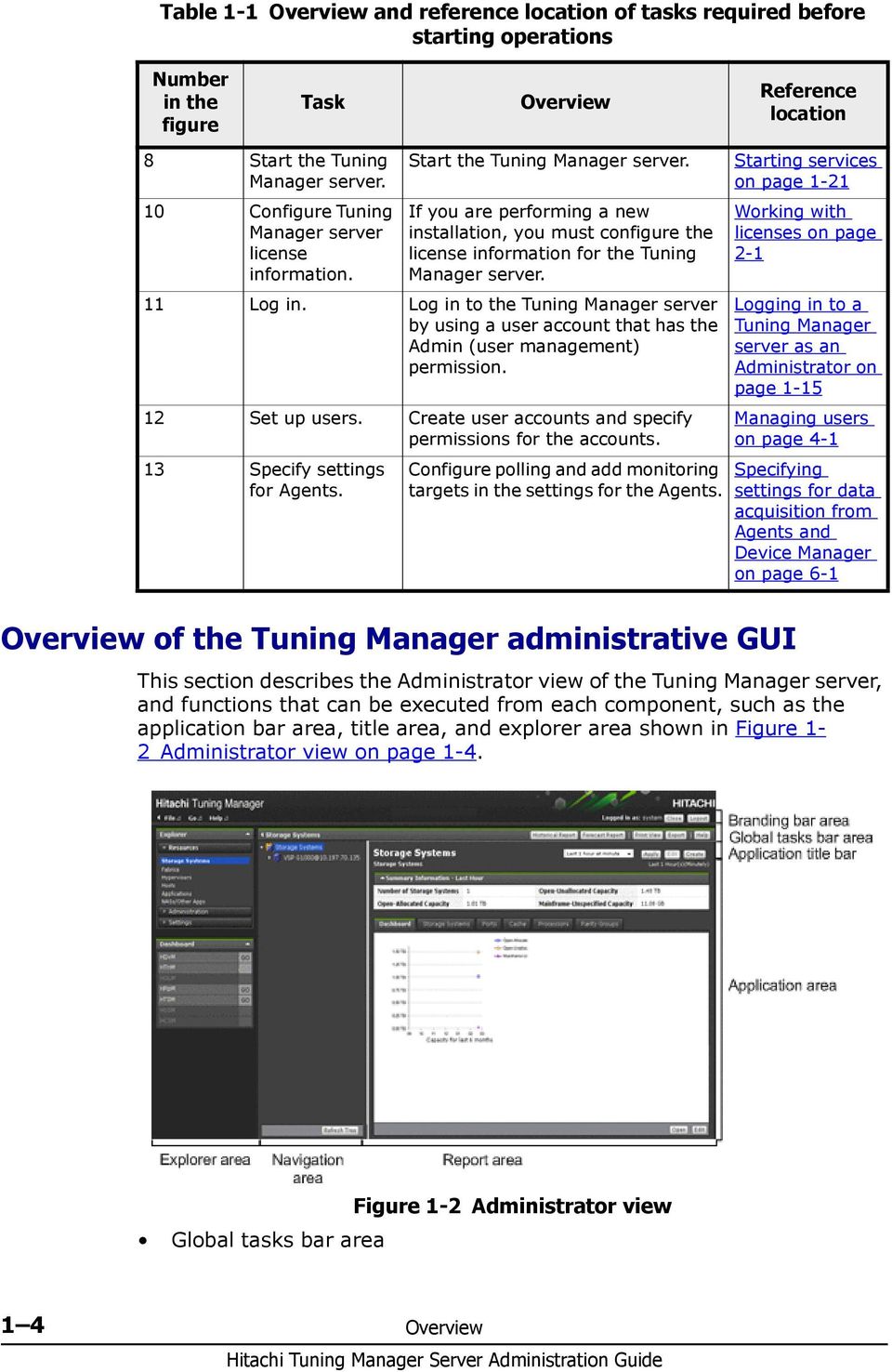
21 The global tasks bar area provides links for the following operations: Logging out from Tuning Manager (see Logging out on page 1-16) Running Performance Reporter or other applications (see the Tuning Manager User Guide) Opening online Help Viewing version information (such as product version or license information) Viewing the full name user ID of the current user Note: The full name is displayed only if it has been specified in the user profile file. Otherwise, the user ID is displayed. For details, see Creating a new user account on page 4-5. If a registered license is not valid for storage systems that are monitored by the Tuning Manager server, a warning message appears on the global tasks bar area. For details on licenses, see Working with licenses on page 2-1. Explorer area The explorer area provides links to the functions of the Tuning Manager server. For details on the functions linked from the explorer area, see the Tuning Manager User Guide. Resources Displays a resource tree in the navigation area and resource information in the information area. Administration Allows you to change the settings of the administrative functions for the Tuning Manager server. Settings Displays information about users. Application bar area The application bar area displays the administration task that you selected in the explorer area. Click Help to view the online Help in a separate window. Navigation area The navigation area displays the menus for the administration task that you selected in the explorer area. The menus differ for each administration task. Some tasks do not have menus. Title area The title area displays the name of the administration task you selected in the navigation area or explorer area. Information area Overview 1 5
22 The information area displays information about resources managed by the Tuning Manager server. Error messages and warning messages might also appear here. You can sort or filter a table that is displayed in the information area. When you sort or filter a table, note the following points: The sort order of each item differs depending on the type of the monitoring target. If you specify = or<> as the filtering condition and no data is extracted, filter the table by specifying a range (by using<, >,>=, or <=). Note: If your browser suppresses popup windows or if you have an installed utility that suppresses them, be sure to disable popup suppression when using the Tuning Manager server. The most recent information cannot be displayed when polling is being performed by the Tuning Manager server. For details, see Specifying settings for data acquisition from Agents and Device Manager on page 6-1. Data entry guidelines for the Tuning Manager GUI The following table lists the characters that can be used for text field values, such as the text fields in the Add User window. Table 1-2 Tuning Manager server administrator field entry guidelines Tuning manager server window name Entry field Specifiable values Maximum field length Minimum field length Notes Add User User a to z, A to Z, ID 1, 2 0 to 9, and the following special # $ % ^ & * ( ) _ + - \ '. = You cannot specify a hyphen (-) at the beginning. When a user is added, a user ID must be entered for that user. You cannot use spaces. User IDs are not case sensitive. 1 6 Overview
23 Tuning manager server window name Entry field Specifiable values Maximum field length Minimum field length Notes Add User Password a to z, A to Z, 0 to 9 and the following special # $ % ^ & * ( ) _ + - \ '. = Confirm Password a to z, A to Z, 0 to 9 and the following special # $ % ^ & * ( ) _ + - \ '. = You cannot specify a hyphen (-) at the beginning If the password is not entered, the password that is already set remains the same. If user authentication common to all Hitachi Command Suite products is used, when a user is added, a password must be entered. If linkage with an external authentication server is enabled in the exauth.proper ties file, entering a password is optional You cannot use spaces. Passwords are case sensitive. You cannot use two or more consecutive dollar signs (for example, $$ or $$$). By setting security options, you can change the conditions for input values. Overview 1 7
24 Tuning manager server window name Entry field Specifiable values Maximum field length Minimum field length Notes Add User Full Name a to z, A to Z, 0 to 9 and the following special characters:! " # $ % & ' ( ) * +, -. / : ; < = [ \ ] ^ _ ` { } ~ a to z, A to Z, 0 to 9 and the following special characters: - Descripti on a to z, A to Z, 0 to 9 and the following special characters:! " # $ % & ' ( ) * +, -. / : ; < = [ \ ] ^ _ ` { } ~ 80 0 You can use spaces You must specify an alphanumeric character at the beginning You can use spaces. 1 8 Overview
25 Tuning manager server window name Entry field Specifiable values Maximum field length Minimum field length Notes Edit Profile - user-id Full Name a to z, A to Z, 0 to 9 and the following special characters:! " # $ % & ' ( ) * +, -. / : ; < = [ \ ] ^ _ ` { } ~ a to z, A to Z, 0 to 9 and the following special characters: Descripti on a to z, A to Z, 0 to 9 and the following special characters:! " # $ % & ' ( ) * +, -. / : ; < = [ \ ] ^ _ ` { } ~ 80 0 You can use spaces You must specify an alphanumeric character at the beginning You can use spaces. Overview 1 9
26 Tuning manager server window name Entry field Specifiable values Maximum field length Minimum field length Notes Change Password - user-id Edit Polling Settings New Password Verify Password Data Backdate Offset Retry Interval Retry Times a to z, A to Z, 0 to 9 and the following special # $ % ^ & * ( ) _ + - \ '. = a to z, A to Z, 0 to 9 and the following special # $ % ^ & * ( ) _ + - \ '. = You cannot specify a hyphen (-) at the beginning If the password is not entered, the password that is already set remains the same. You must enter the password. You cannot use spaces. Passwords are case sensitive. You cannot use two or more consecutive dollar signs (for example, $$ or $$$). By setting security options, you can change the conditions for input values. 0 to N/A 0 to N/A 0 to N/A 1 10 Overview
27 Tuning manager server window name Entry field Specifiable values Maximum field length Minimum field length Notes Edit Data Retention Setting Hourly 1 to Applicable when Day is selected in the list box. 1 to Applicable when Week is selected in the list box. 1 to Applicable when Month is selected in the list box. Daily 1 to Applicable when Day is selected in the list box. 1 to Applicable when Week is selected in the list box. 1 to Applicable when Month is selected in the list box Applicable when Year is selected in the list box. Weekly 1 to Applicable when Week is selected in the list box. 1 to Applicable when Month is selected in the list box Applicable when Year is selected in the list box. Monthly 1 to Applicable when Month is selected in the list box. 1 to Applicable when Year is selected in the list box. Yearly 1 to Applicable when Year is selected in the list box. Overview 1 11
28 Tuning manager server window name Entry field Specifiable values Maximum field length Minimum field length Notes Edit Data Retention Setting Host Configur ation Array Configur ation Fabric Configur ation 1 to Applicable when Day is selected in the list box. 1 to Applicable when Week is selected in the list box. 1 to Applicable when Month is selected in the list box. 1 to Applicable when Year is selected in the list box. 1 to Applicable when Day is selected in the list box. 1 to Applicable when Week is selected in the list box. 1 to Applicable when Month is selected in the list box. 1 to Applicable when Year is selected in the list box. 1 to Applicable when Day is selected in the list box. 1 to Applicable when Week is selected in the list box. 1 to Applicable when Month is selected in the list box. 1 to Applicable when Year is selected in the list box Overview
29 Tuning manager server window name Entry field Specifiable values Maximum field length Minimum field length Notes Edit Data Retention Setting Edit System Alert Applicati on Configur ation System Reports 1 to Applicable when Day is selected in the list box. 1 to Applicable when Week is selected in the list box. 1 to Applicable when Month is selected in the list box. 1 to Applicable when Year is selected in the list box. 1 to Applicable when Day is selected in the list box. 1 to Applicable when Month is selected in the list box. 1 to Applicable when Year is selected in the list box. threshold 1 to N/A To a to z, A to Z, 0 to 9, and the following special characters: ` ~! # $ % & ' * + -. / ^ _ { } N/A Overview 1 13
30 Tuning manager server window name Entry field Specifiable values Maximum field length Minimum field length Notes Edit System Alert Edit System Alert Note 1: Mail Server User Name Spaces, a to z, A to Z, 0 to 9, and the following special characters: ` ~! " # $ % & ' ( ) * +, -. / : ; < = [ \ ] ^ _ { } a to z, A to Z, 0 to 9, and the following special characters:! # $ % & ' ( ) * +, -. \ ^ _ Password a to z, A to Z, 0 to 9, and the following special characters:! # $ % & ' ( ) * +, -. \ ^ _ 50 1 A string consisting of spaces only cannot be specified. A space leading or trailing the specified character string is not registered. The Tuning Manager server recognizes\ or ~ as ASCII codes 0x5c and 0x7E, respectively. However, Tuning Manager might recognize an entered \ or ~ as a different character depending on your OS or browser The Tuning Manager server recognizes \ as ASCII code 0x5c. However, Tuning Manager might recognize an entered \ as a different character depending on your OS or browser The Tuning Manager server recognizes \ as ASCII code 0x5c. However, Tuning Manager might recognize an entered \ as a different character depending on your OS or browser Overview
31 If you register the following users, specify a character string that includes a realm: A user that is authenticated by another RADIUS server connected via a RADIUS server that is specified as the connection destination in the exauth.properties file A user that is registered in a Kerberos server and belongs to a realm other than the realm specified as the default in the exauth.properties file Note 2: If the Tuning Manager server and Device Manager are installed on the same host, a user ID that contains any of the following characters cannot be used to log in to Replication Manager on the same host from the login window:! $ % & ' ( ) * = \ ^ Logging in to a Tuning Manager server as an Administrator To log in to a Tuning Manager server as an Administrator (that is, as a user who has the Admin (application management) permission): 1. Launch the Tuning Manager server by entering a URL consisting of the name of the host on which the Tuning Manager server is installed, and the port number. In the following example, the host name is host01 and the port number is 22015: The login screen is displayed. Note: Adobe Flash Player 10.1 or later is required to be installed in the client in which the browser is used. However, if Tuning Manager server is installed in a host that is different from a host Device Manager is installed in, and only Tuning Manager server is operated, Adobe Flash Player is not required. The design of the login screen depends on whether Tuning Manager server and Device Manager are installed in the same host or not. 2. Enter the user ID and password of a user who has the Admin (application management) permission. 3. Click Log In. 4. To access the Administrator View, click Administration in the explorer area. A submenu of administration tasks appears. Note: Before logging in for the first time, you must activate your license key. For detailed information, see Managing licenses on page 2-2. If you have just installed the Tuning Manager server, use the initial user account. For details, see Initial administrator login on page For further information about authentication, see About login modes on page 4-2. Overview 1 15
32 Initial administrator login Logging out Hitachi Command Suite products include the following built-in account: User ID system Password manager Permissions Admin permission for user management and Hitachi Command Suite products. Use this account when you log in to the Tuning Manager server for the first time. We recommend that you change the default password as soon as possible after you have logged in to the Tuning Manager server. For details on how to change the password, see Changing passwords on page 4-9. About login modes on page 4-2 Changing your own password on page 4-9 Do one of the following to logout: In the global tasks bar area. click Logout or from the File menu, select Logout. Note: Note that in the Single Sign-On (SSO) mode, this operation might close other Hitachi Command Suite products. In the SSO mode, to close only the Tuning Manager server, do the following: In the global tasks bar area. click the Close link or from the File menu, select Close. When you want to start Performance Reporter, you can select which Performance Reporter window to display: the Main window or the Report Tree Selection window. If the Main window of Performance Reporter is displayed, the Performance Reporter window remains open even after you log out of the Tuning Manager server. For details about how to start and stop Performance Reporter, see the Tuning Manager User Guide. Services registered for Tuning Manager server (Windows only) In Windows, Common Component services are registered to use Hitachi Command Suite products. The following shows the correspondence between service names and functions: When Device Manager is not installed on the Tuning Manager server: 1 16 Overview
33 PFM - Name Server: Name Server service PFM - Master Manager: Master Manager service PFM - View Server: View Server service PFM - Correlator: Correlator service PFM - Action Handler: Action Handler service PFM - Trap Generator: Trap Generator service PFM - Master Store: Master Store service PFM - Status Server: Status Server service PFM - Agent for HealthCheck: Agent Collector service PFM - Agent Store for HealthCheck: Agent Store service HiRDB/EmbeddedEdition _HD1 (HiRDB service) Hitachi Network Objectplaza Trace Monitor 2: Hitachi Command Suite common trace service Hitachi Network Objectplaza Trace Monitor 2 (x64) (Hitachi Command Suite common trace service) HBase 64 Storage Mgmt Web Service: Hitachi Command Suite common Web service HBase 64 Storage Mgmt SSO Service: Web service for single sign-on common throughout Hitachi Command Suite single sign-on service HiCommand Suite TuningManager: Tuning Manager HiCommand Performance Reporter: Performance Reporter service HCS Tuning Manager REST Application Service: Tuning Manager server REST API component service Use this service to work with the Tuning Manager API. This service is not started or stopped on an individual basis because it is started and stopped by the Tuning Manager server service. When Device Manager is installed on the Tuning Manager server: PFM - Name Server: Name Server service PFM - Master Manager: Master Manager service PFM - View Server: View Server service PFM - Correlator: Correlator service PFM - Action Handler: Action Handler service PFM - Trap Generator: Trap Generator service PFM - Master Store: Master Store service PFM - Status Server: Status Server service PFM - Agent for HealthCheck: Agent Collector service PFM - Agent Store for HealthCheck: Agent Store service HiRDB/EmbeddedEdition _HD1 (HiRDB service) Hitachi Network Objectplaza Trace Monitor 2: Hitachi Command Suite common trace service Overview 1 17
34 Hitachi Network Objectplaza Trace Monitor 2 (x64) (Hitachi Command Suite common trace service) HBase 64 Storage Mgmt Web Service: Hitachi Command Suite common Web service HBase 64 Storage Mgmt SSO Service: Web service for single sign-on common throughout Hitachi Command Suite single sign-on service HBase 64 Storage Mgmt Common Service: Hitachi Command Suite single sign-on service HBase 64 Storage Mgmt Web SSO Service: Hitachi Command Suite single sign-on service HCS Device Manager Web Service: Device Manager servlet service HiCommand Suite TuningManager: Tuning Manager HiCommandServer (Device Manager service) Host Data Collector Base Service (Host Data Collector service) HiCommand Performance Reporter: Performance Reporter service HCS Tuning Manager REST Application Service: Tuning Manager server REST API component service Use this service to work with Tuning Manager API. This service is not started or stopped on an individual basis because it is started and stopped by the Tuning Manager server service. Resident processes of Tuning Manager server The following table lists and describes the resident Common Component processes in Windows systems. Table 1-3 Resident processes of Common Component (Windows) Process HiCommandServer hntr2srv.exe hntr2mon.exe httpsd.exe rotatelogs.exe httpsd.exe rotatelogs.exe Functionality Device Manager server process. This service is started only when Device Manager is installed on the Tuning Manager server host. Hitachi Command Suite common trace service process (Processes the events from the service control panel.) Hitachi Command Suite common trace information collection process (Collects integrated trace information.) Hitachi Command Suite common Web service A process that runs when web server log data is being chunked according to the time period Hitachi Command Suite Web service for single sign-on The single sign-on service is started only when Device Manager and Tuning Manager are installed on the same host. Do not register this service to cluster resources. A process that runs when the log data for HSSO specific log data is being chunked according to the time period 1 18 Overview
35 Process hcmdssvctl.exe cjstartweb.exe hcmdssvctl.exe cjstartsv.exe pdservice.exe jpcnsvr.exe.exe jpcmm.exe jpcsto.exe Agent.exe jpctrap.exe jpctraps.exe jpcep.exe jpcvsvr.exe jpcstatsvr.exe jpcah.exe jpcagt.exe jpc0collect.exe Hitachi Command Suite servlet services The following services are started as servlets: Hitachi Command Suite Single Sign-On service. This service is started only when Device Manager is installed on the Tuning Manager server host. Tuning Manager server Performance Reporter service Device Manager servlet service. This service is started only when Device Manager is installed on the Tuning Manager server host. J2EE servlet process Functionality HiRDB process server control. This service is required to run always. Do not stop this service manually or, register to cluster resources. Name Server service Master Manager service Master Store service Agent store service Trap Generator service Trap Generator service Correlator service View Server service Status Server service Action Handler service Agent Collector service Agent Collector service The following table lists and describes the resident Common Component processes in Linux systems. Table 1-4 Resident processes of Common Component (Linux) Process hntr2mon hicmdserver jpcnsvr jpcmm jpcsto Agent jpctrap Functionality Hitachi Command Suite common trace information collection process (Collects integrated trace information.) Device Manager server service. This service is started only when Device Manager is installed on the Tuning Manager server host Name Server service Master Manager service Master Store service Agent Store service Trap Generator service Overview 1 19
36 Process jpctraps jpcep jpcvsvr jpcstatsvr jpcah jpcagt jpc0collect httpsd httpsd webcont.sh pdprcd rotatelogs rotatelogs hcs_hsso hcs_xxx cjstartweb cjstartsv Functionality Trap Generator service Correlator service View Server service Status Server service Action Handler service Agent Collector service Agent Collector service Hitachi Command Suite common Web service Hitachi Command Suite Web service for single sign-on The single sign-on service is started only when Device Manager and Tuning Manager are installed on the same host. Do not register this service to cluster resources. Hitachi Command Suite servlet services The following services are started as servlets: Hitachi Command Suite Sign-On service. This service is started only when Device Manager is installed on the Tuning Manager server host. Tuning Manager server Performance Reporter service HiRDB process server control. This service is required to run always. Do not stop this service manually or, register to cluster resources. A process that runs when web server log data is being chunked according to the time period A process that runs when Hitachi Command Suite web service for single sign-on web server log data is being chunked according to the time period A process that manages a server running Hitachi Command Suite Sign-On service A process that manages the services of the servlet-engine-mode server, and J2EE server registered in each product. The value of xxx depends on how services are registered in each product. The following lists the names of the processes that are used in the web container server environment provided for HBase v7.0 systems: hcs_sso: HBase 64 Storage Mgmt Common service hcs_tm: HiCommand Suite TuningManager hcs_pr: HiCommand Performance Reporter hcs_dm: HCS Device Manager Web service hcs_csm: HCS Compute Systems Manager Web service hcs_ao: HCS Automation Engine Web service Servlet-engine-mode server process J2EE server process 1 20 Overview
37 Starting services Before changing the environment settings of the Tuning Manager server, you need to start or stop services. This section describes how to start services manually and provides notes on starting services. For details about how to start services in a cluster system, see the Tuning Manager Installation Guide. About automatically started services The following services are set to start automatically when you start the OS in which the Tuning Manager server is installed: Tuning Manager server service (HiCommandSuiteTuningManager) Performance Reporter service (HiCommandPerformanceReporter) HiRDB services The common component services (HBase 64 Storage Mgmt SSO Service and HBase 64 Storage Mgmt Web Service) Tuning Manager server REST API component service (HCS TuningManager REST Application Service) This service is used when you use the API functions. You cannot start or stop this service independently, because this service depends on the Tuning Manager server service. You need a Tuning Manger server license to use the API functions. For details about the services of other Hitachi Command Suite products that are installed on the same host, see the manual for each product. For details about the services of Collection Manager, see the Tuning Manager Agent Administration Guide. Starting services manually This topic describes how to start services manually. Tuning Manager server service (HiCommand Suite TuningManager) To start HiCommand Suite TuningManager, execute the following command: In Windows Common-Component-installation-folder\bin\hcmds64srv /start /server TuningManager In Linux Common-Component-installation-directory/bin /hcmds64srv -start -server TuningManager Overview 1 21
38 Performance Reporter service (HiCommand Performance Reporter) To start HiCommand Performance Reporter, execute the following command: In Windows Common-Component-installation-folder\bin\hcmds64srv /start /server PerformanceReporter In Linux Common-Component-installation-directory/bin/ hcmds64srv -start -server PerformanceReporter HiRDB service To start the HiRDB service, execute the following command: In Windows Common-Component-installation-folder\bin\hcmds64dbsrv /start In Linux Common-Component-installation-directory/bin/ hcmds64dbsrv -start Services of all Hitachi Command Suite products and HiRDB To start the services of HiRDB and all Hitachi Command Suite products (including Common Component) that are installed on the same host, execute the following command: In Windows Common-Component-installation-folder\bin\hcmds64srv /start In Linux Common-Component-installation-directory/bin/ hcmds64srv -start Note: You can also use the htmsrv command to start, stop, and check the status of the Collection Manager and Agent services. Checking service statuses (at service startup) To check service statuses, execute the command below. When you execute the command, the statuses of the services of all Hitachi Command Suite products (including Common Component) and HiRDB are displayed. In Windows: Common-Component-installation-folder\bin\hcmds64srv /statusall 1 22 Overview
39 In Linux: Common-Component-installation-directory/bin/hcmds64srv - statusall Notes on starting services Note the following on starting services: If the Tuning Manager server has already collected data for a resource over a range of time periods, restarting the Tuning Manager server will not result in data loss, replacement, or redundancy of previously collected data. To start the Tuning Manager server service, the services of the HiRDB instance that is used by the prerequisite product Device Manager server must be running. When you execute this command immediately after executing the stop command of the Tuning Manager server, the KAPM05007-I message might appear. This occurs because it takes time to stop the Tuning Manager server service. In this case, wait a while, then re-execute the command to start the Tuning Manager server service. Before starting the Tuning Manager server service, the connection settings for Device Manager must be specified. For details about the connection settings for Device Manager, see Configuring connection settings for Device Manager on page 5-2. Stopping services Before changing the environment settings of Tuning Manager server, you need to start or stop services. Every service automatically stops when the OS shuts down. The following sections describe how to stop services manually and provides notes on stopping services. For details about how to start services in a cluster system, see the Tuning Manager Installation Guide. Tuning Manager server service (HiCommand Suite TuningManager) To stop HiCommand Suite TuningManager, execute the following command: In Windows: Common-Component-installation-folder\bin\hcmds64srv /stop /server TuningManager In Linux: Common-Component-installation-directory/bin/ hcmds64srv -stop -server TuningManager Overview 1 23
40 Performance Reporter service (HiCommand Performance Reporter) HiRDB service To stop HiCommand Performance Reporter, execute the following command: In Windows: Common-Component-installation-folder\bin\hcmds64srv /stop /server PerformanceReporter In Linux: Common-Component-installation-directory/bin/ hcmds64srv -stop -server PerformanceReporter To stop the HiRDB service, execute the following command: In Windows: Common-Component-installation-folder\bin\hcmds64dbsrv /stop In Linux: Common-Component-installation-directory/bin/ hcmds64dbsrv -stop Stopping services of all Hitachi Command Suite products and HiRDB To stop the services of HiRDB and all Hitachi Command Suite products (including Common Component) that are installed on the same host, execute the following command: In Windows: Common-Component-installation-folder\bin\hcmds64srv /stop In Linux: Common-Component-installation-directory/bin/ hcmds64srv -stop Note: When the services of HiRDB and all Hitachi Command Suite products are stopped, the KAPM06445-E message might appear. This message appears when HiRDB termination processing takes a lot of time. If it appears, wait a while, and then re-execute the command. Notes on stopping services The following notes apply to stopping services: In a Windows environment, do not stop the HiRDB/EmbeddedEdition _HD1 service registered in the Services window. This service must be active at all times Overview
41 Do not stop services when polling is being performed. Avoid stopping services during the period 10 minutes before and after the specified polling time, and make sure that In polling is not displayed in the status column in the polling status reports. For details about the polling status reports, see Checking polling status reports on page If the Common Component service has not completely started, do not stop the following services: Tuning Manager server service Performance Reporter service If you do this, you might not be able to stop services by using the stop option even if the resident process of the service is running. If you cannot stop services, restart the Tuning Manager server host. Setting up the user property file After installing and setting up a Tuning Manager server, you might need to specify settings in the user.properties file. You can change the settings related to the Tuning Manager server operation by changing the settings in the user.properties file. The user.properties file is stored in the following location: In Windows: Tuning-Manager-installation-folder\conf\user.properties In Linux: Tuning-Manager-installation-directory/conf/user.properties The following information applies to the format of the settings in the user.properties file: A line that begins with a hash mark (#) is considered to be a comment. If the same property name is specified more than once, the value specified last in the file is applied. If you specify the installation folder in a Windows environment, use a forward slash (/) as a folder separator, not a backslash (\). If you specify backslashes (\) in a value, they must be escaped with another backslash (\\). To change the settings in the user.properties file: 1. Stop the Tuning Manager server services. For details on how to stop the Tuning Manager server services, see Stopping services on page Back up the user.properties file manually. To restore a backed up file, stop the Tuning Manager server services, and then overwrite the user.properties file in the user property file storage location with the backup file that you saved. 3. Open the user.properties file with a text editor, and specify the settings in the following format: [property]=[setting-value] Overview 1 25
42 4. Start the Tuning Manager server services. For details on how to start the Tuning Manager server, see Starting services on page For details on the settings in the user.properties file, see Properties for the user.properties file on page Properties for the user.properties file The following table provides details on the settings in the user.properties file. Table 1-5 Properties for the user.properties file Property Description Specifiable values Default value alert. .from alert. .smtpport alert. .subject If you want to send from the Tuning Manager server, specify the sender's address. Specify the SMTP server port number used for messages sent from the Tuning Manager server. Specify the subject of the sent from the Tuning Manager server. Values are case sensitive. One-byte space, A to Z, a to z, 0 to 9, and the following special characters: ` ~! " # $ % & ' ( ) * +, -. / : ; < = [ \ ] ^ _ { } Note: Any backslashes (\) in a value must be escaped with another backslash (\\). N/A 1 to 65, Values are case sensitive. One-byte space, A to Z, a to z, 0 to 9, and the following special characters: ` ~! " # $ % & ' ( ) * +, -. / : ; < = [ \ ] ^ _ { } Note: Any backslashes (\) in a value must be escaped with another backslash (\\). N/A 1 26 Overview
43 Property Description Specifiable values Default value csv.encode.type pr.incontextlaunch.mo de table.filter.default. unit.datasize table.filter.default. unit.transferrate portnumbercli Specify the character encoding to be used in the exported CSV file. If you omit this value, UTF-8 will be specified. Specify which window to display (the Main window or the Report Tree Selection window) when you start Performance Reporter from Advanced Information with an agent specified. If a value other than a specifiable value is specified, an error message is output to the log file and the default is set. Specify the data size unit to be selected by default in the window for entering conditions of the filter function. Specify the data transfer rate unit to be selected by default in the window for entering conditions for the filter function. The data transfer rate unit is KB/sec, MB/ sec, GB/sec, TB/ sec, or PB/sec, however, the /sec portion is omitted from the values set for this property. Specify the port number that is used by the reporting commands to access the HBase 64 Storage Mgmt Web Service. Values are not casesensitive. Shift_JIS or UTF-8 Values are not casesensitive. main: Displays the Main window. tree: Displays the Report Tree Selection window. Values are not casesensitive. KB, MB,GB, TP, or PB Values are not casesensitive. KB, MB,GB, TP, or PB UTF-8 tree GB GB 0 to Overview 1 27
44 Property Description Specifiable values Default value cli.workdir poller.offset dbvup.workdir Specify the output directory folder path for the temporary file that is output when the htmhostgroups command is executed. Specify the offset value to apply for the starting time of the polling schedule (units: minutes). The starting time will be delayed by the specified value. Specify the absolute path for the database schema upgrade working directory, which is used temporarily in database upgrade. The specified directory must be empty. For details, see the Tuning Manager Installation Guide. 1 to 128 bytes For more information about how to specify the cli.workdir property, see Table 1-7 cli.workdir property settings on page to 59 5 In Windows: Tuning- Managerserverinstallationfolder \system\work In Linux: Tuning Managerserverinstallationdirectory /system/work up to 128 bytes In Windows: Note: The maximum Tuningspecifiable character Manager- value should not server- exceed 128 bytes. For details about the installation- folder estimation of the working directory \system\work capacity, see Table 1-6 dbvup.workdir In Linux: property settings on Tuning page 1-33 Managerserverinstallationdirectory /system/work 1 28 Overview
45 Property Description Specifiable values Default value userdata.cleanup.enab le rpt.flashmode rpt.printview.fullsiz e rpt.antialiasing rest.discovery.agent. interval Specify whether you want to enable or disable this property. If you enable this property, the report windows and historical reports are detected and deleted periodically. Note that the historical report information that is set to be shared is not deleted. Specify whether the charts should be displayed in flash mode or HTML mode. Specify the size of the charts in the print view. You can view the charts as full-sized images or as thumbnails in the print view. Specify whether to anti-alias the charts displayed in PNG format. Specify the automatic refresh interval to display the Agent information from the Agents that use API functions. Specifying 0 disables the periodic refresh Values are not case sensitive. true: User data cleanup property is enabled. The clean up process is initiated along with the Tuning Manager server service and is repeated every 24 hours. false: User data cleanup property is disabled. Values are not casesensitive. true: The charts are displayed in flash mode. false: The charts are displayed in HTML mode. Values are not casesensitive. true: In the print view, you can view the full size charts. false: In the print view, you can view the charts as thumbnails. Values are not casesensitive. true: Charts are anti-aliased. false: Charts are not anti-aliased. true false true true 0 to 2,147,483, Overview 1 29
46 Property Description Specifiable values Default value rest.discovery.agent. global.primary.enable d rest.discovery.agent. global.primary.protoc ol rest.discovery.agent. global.primary.port rest.discovery.agent. global.secondary.enab led Specify whether to enable or disable the primary discovery method common to all hosts. Specify the primary protocol for generating the URL parameter when detecting the HTTP interface information of Tuning Manager Agent REST API component. This property is common to all the hosts. Specify the primary port number for generating the URL parameter when detecting the HTTP interface information of Tuning Manager Agent REST API component. This property is common to all the hosts. Specify whether to enable or disable the secondary discovery method common to all the hosts. Values are not casesensitive. true: The primary discovery method common to all the hosts is enabled. false: The primary discovery method common to all the hosts is disabled. Values are case insensitive. http https true https 1 to Values are case insensitive. true: The secondary discovery method common to all hosts is enabled. false: The secondary discovery method common to all hosts is disabled. true 1 30 Overview
47 Property Description Specifiable values Default value rest.discovery.agent. global.secondary.prot ocol rest.discovery.agent. global.secondary.port rest.discovery.agent. host.hostnamen 1.host rest.discovery.agent. host.hostnamen 1.proto col Specify the secondary protocol for generating the URL parameter when detecting the HTTP interface information of Tuning Manager Agent REST API component. The property specified is common to all hosts. Specify the secondary port number for generating the URL parameter when detecting the HTTP interface information of Tuning Manager Agent REST API component. The property specified is common to all hosts. Specify the IP address for generating the URL parameter when detecting the HTTP interface information of Tuning Manager Agent REST API component. Alternatively, specify the agent host name that can resolve to that IP address 2. Set this property for each host 3. Specify the protocol for generating the URL parameter when detecting the HTTP interface information of Tuning Manager Agent REST API component. This property is specified for each host separately. Values are case insensitive. You can specify the following values: http https http 0 to An IPv4 address or an agent host name that resolves to an IPv4 address. Values are case sensitive Values are case insensitive. You can specify the following values: http https -- https Overview 1 31
48 Property Description Specifiable values Default value rest.discovery.agent. host.hostnamen 1.port clustermode Specify the port number for generating the URL parameter when detecting the HTTP interface information of Tuning Manager Agent REST API component. This property is specified for each host separately. Specify whether the Tuning Manager Agent REST API component can collect performance data from the agent instances set up on the logical host. 0 to true: If there are agent instances on the logical host, performance data is collected from them. If not, performance data is collected from the agent instances on the physical host. false: Performance data is collected from the agent instances on the physical host. true Note 1: For HostNamen, specify the API agent host name (use the host name displayed in the jpcctrl list command output). Note 2: A host name specified only in the jpchosts file cannot resolve to an IP address. Note 3: The following shows the property specification rules. If these rules are violated, the Tuning Manager API might not operate correctly. If the host name specified for the HostNamen property resolves to an IP address: SSL communication: If the host name specified for the HostNamen property is equal to the Common Name (CN) specified during the creation of an SSL certificate, you can omit the value of the property Overview
49 If the host name specified for the HostNamen property is different from the Common Name (CN) specified during the creation of an SSL certificate, specify the host name that is specified for CN. Non-SSL communication: The value of the property can be omitted. However, when the Tuning Manager Server and agent are connected over two or more networks, and if you want to use only a specific network for connection, specify an IP address. If the host name specified for the HostNamen property does not resolve to an IP address: SSL communication: Specify the same host name that was specified for the Common Name (CN) during the creation of an SSL certificate. Non-SSL communication: Specify an IP address. Table 1-6 dbvup.workdir property settings Item Available characters Route designation Existence of the directory Network drives Description of specification For Windows: A-Z, a-z, 0-9, and the following special characters: _ () (space) : \. Note: To specify backslash (\) as a value, escape it with an additional backslash (\\). (\\) is considered as one byte. For Linux: A-Z, a-z, 0-9, and the following special characters: _ / The following route designation cannot be specified: For Windows: Drive-name:\\ For Linux: / You cannot specify a path that contains a symbolic link. For Windows: Path names are not case-sensitive. For Linux: Path names are case-sensitive. Do not specify a network drive. Overview 1 33
50 Item Description of specification Access right The following access permissions are necessary to access a specific path. For Windows: The system user must have read, write and execute permissions. For Linux: The root user must have read, write and execute permissions. Table 1-7 cli.workdir property settings Item Available characters Restrictions for specifying the directory path Notes about specifying the temporary file output directory Description of specification Windows A-Z, a-z, 0-9, and the following special characters: _ () (single-byte space) : \ Note: To specify backslash (\) as a value, escape it with an additional backslash (\\). (\\) is considered as one byte. Linux: A-Z, a-z, 0-9, and the following special characters: _ / Specify an existing directory. (Do not specify the file name of an existing file.) Do not specify the following for the directory path: The HTnM installation directory Tuning- Manager-server-installation-folder A root directory Windows: Drive-name:\\ Linux: / Directory path starting with \\. If you specify a directory path starting with \\, normalization cannot be performed. A relative path A network drive A path that contains a symbolic link Note that the program does not check whether the directory specified is acceptable. Do not place any files under the temporary file output directory. Do not change the value of the cli.workdir property, while the service is running. If you change the default temporary file output directory, make sure you delete it manually after removing Tuning Manager. The user-specified path is not deleted automatically when you remove the Tuning Manager Overview
51 Item Access permissions Description of specification Windows: A user with administrator privileges is granted read, write and execute permissions. Linux: A user with root privileges is granted read, write and execute permissions. Ports used by a Tuning Manager server This section describes the port numbers used by a Tuning Manager server. Port numbers used to connect to API Agent host The following table shows the default port numbers used by the Tuning Manager server to connect to the Agent hosts that use the API functions: Table 1-8 Port numbers used by the Tuning Manager server for connection with the Agent host that use the API functions Port number Connection from Connection to Remarks 24221/TCP Tuning Manager server Agent hosts that use the API functions Access port for Tuning Manager - Agent REST Web Service for non-ssl communication 24222/tcp Tuning Manager server Agent hosts that use the API functions Access port for Tuning Manager - Agent REST Web Service for SSL communication Port numbers used to connect to Device Manager Table 1-9 Port numbers used by the Tuning Manager server for connection with the Device Manager server on page 1-35 shows the port number used by a Tuning Manager server to connect to a Device Manager server. For details about port numbers that the Tuning Manager server uses when connecting to Agents, see the Tuning Manager Agent Administration Guide. Table 1-9 Port numbers used by the Tuning Manager server for connection with the Device Manager server Port number Connection from Connection to Remarks 24230/TCP Tuning Manager server Device Manager Communication port for the Device Manager host / TCP Device Manager Tuning Manager server Communication port for the Tuning Manager server host 22015/TCP Tuning Manager server Device Manager Communication port for the Device Manager host (non-ssl) Overview 1 35
52 Port number Connection from Connection to Remarks 22016/TCP Tuning Manager server Device Manager Communication port for the Device Manager host (SSL) 22286/TCP Device Manager Tuning Manager server Communication port for the Tuning Manager server host Operating in a network where a firewall is set If a firewall is set between the Tuning Manager server host and the Device Manager host, use the port numbers listed in Table 1-9 Port numbers used by the Tuning Manager server for connection with the Device Manager server on page 1-35 to enable communication between the hosts. Changing the port numbers used to connect to Device Manager If a firewall is set between the Tuning Manager server host and the Device Manager host, and you need to use a specific port number for communication, or any other application is using the default port number (24230) used when the Tuning Manager server host connects to the Device Manager host, you need to change the port number as follows. To change the port number: 1. Execute the following commands to stop the Tuning Manager server service: In Windows: Common-Component-installation-folder \bin\hcmds64srv /stop /server TuningManager In Linux: Common-Component-installation-directory/bin/ hcmds64srv -stop -server TuningManager 2. Execute the following commands to change the port number used to connect to Device Manager: In Windows: Tuning-Manager-server-installation-folder\bin\ htm-dvm-setup /d Device-Manager-host-name-or-IP-address /s Port-number-to-be-used-for-the connectionbetween-tuning-manager-server-and-device-manager In Linux: Tuning-Manager-server-installation-directory/bin/ htm-dvm-setup -d Device-Manager-host-name-or-IP-address -s Port-number-to-be-used-for-the-connectionbetween-Tuning-Manager-server-and-Device-Manager 1 36 Overview
53 For the -s option, specify the value you specified for the service port number option of the htmsetup command of Device Manager. Specify a value in the range of 5001 to Execute the following commands to start the Tuning Manager server service: In Windows: Common-Component-installation-folder\bin\hcmds64srv / start /server TuningManager In Linux: Common-Component-installation-directory/bin/ hcmds64srv -start -server TuningManager Changing the network settings of the management server After you upgrade a Tuning Manager server from a version earlier than 5.1 in a Windows environment, change the network settings by referring to the procedure below. Note that you must perform this procedure only once after performing an upgrade installation. You do not have to perform this procedure each time you reconnect the network. To disconnect the network: 1. If HiCommand (R) Suite products whose versions are earlier than 5.7 are running, stop their services. For details about how to stop these services, see the manual for each Hitachi Command Suite product version. 2. Execute the following command to stop the services of Hitachi Command Suite products and Common Component: Common-Component-installation-folder/bin/hcmds64srv /stop 3. Edit the pdsys file and the def_pdsys file. Change the value for the pdunit parameter's -x option to the loopback address The default installation locations of the pdsys file and def_pdsys file are as follows: Common-Component-installation-folder/HDB/conf/pdsys Common-Component-installation-folder/database/work/ def_pdsys 4. Edit the pdutsys file and the def_pdutsys file. Change the value for the pd_hostname parameter to the loopback address If the pd_hostname parameter does not exist, add the pd_hostname parameter to set a loopback address. The default installation locations of the pdutsys file and def_pdutsys file are as follows: Common-Component-installation-folder/HDB/conf/pdutsys Overview 1 37
54 Common-Component-installation-folder/database/work/ def_pdutsys 5. Edit the HiRDB.ini file. Change the value for the PDHOST parameter to the loopback address The default installation location of the HiRDB.ini file is as follows: Common-Component-installation-folder/HDB/conf/emb/HiRDB.ini 6. Restart the Tuning Manager server host. 7. Execute the following command to make sure that the Common Component service is running: Common-Component-installation-folder/bin/hcmds64srv /status Restricting web terminals that can connect to a Tuning Manager server You can restrict the web terminals that can connect to a Tuning Manager server by specifying specific hosts in the user_httpsd.conf file. To restrict the web terminals that can connect to a Tuning Manager server: 1. Execute the following command to stop the HBase 64 Storage Mgmt Web Service, Tuning Manager server, and Performance Reporter services: In Windows: Common-Component-installation-folder\bin\ hcmds64srv /stop In Linux: Common-Component-installation-directory/bin/ hcmds64srv -stop 2. Open the user_httpsd.conf file. The user_httpsd.conf file is located in the following directory. In Windows: Common-Component-installation-folder\uCPSB\httpsd\conf/ In Linux: Common-Component-installation-directory/uCPSB/httpsd/conf/ 3. Register hosts that can be connected to the Tuning Manager server in the last line of the user_httpsd.conf file. The following shows the format for registering hosts in the user_httpsd.conf file. <Location /TuningManager> order allow,deny allow from host [host...] </Location> Make sure that hosts are written in one of the following formats: 1 38 Overview
55 The domain name (example: hitachi.abcdefg.com) Part of the domain name (example: hitachi) The whole IP address (example: ) Part of the IP address (example: 10.1 which, in this case, means /16) Network/Netmask format (dot notation) (example: / ) Network/n (CIDR notation: n is the number of bits representing the network address) (example: /16) Notes on the registration format: If you want to specify two or more hosts in a command line for allow from, delimit the hosts with a space. Multiple lines can be used to specify hosts for allow from. If you attempt to connect from a machine which has a Tuning Manager server installed, you must also specify the local loop-back address ( or localhost). Make sure that you specify the order in the specified format. If extra spaces or tabs are inserted, the operation will fail. Example of host registration: <Location /TuningManager> order allow,deny allow from allow from /26 </Location> 4. Execute the following commands to start the services of HBase 64 Storage Mgmt Web Service, Tuning Manager server, and Performance Reporter: In Windows: Common-Component-installation-folder \bin\hcmds64srv /start In Linux: Common-Component-installation-directory/bin /hcmds64srv -start About machine time differences If the time of a machine on which a Tuning Manager server is installed does not match the time of a machine on which an Agent is installed, the Tuning Manager server cannot collect data from that Agent correctly. Also, if the time of a machine on which a Tuning Manager server is installed does not match the time of a machine on which a Device Manager server is installed, the Tuning Manager server might not collect data from that Device Manager server correctly. This section explains the behavior when there is a difference between the times and provides notes on changing the times. Overview 1 39
56 In the following sections, the time of the machine on which the Tuning Manager server is installed is called the Tuning Manager server time, the time of a machine on which an Agent is installed is called the Agent time, and the time of a machine on which a Device Manager server is installed is called the Device Manager server time. Behavior when there is a time difference between a Tuning Manager server and an Agent This section describes the behavior when there is a time difference between machines while the Tuning Manager server and an Agent are running on different machines. When the Tuning Manager server time is earlier than the Agent time This example assumes that the Tuning Manager server time is 12:00 and Agent time is 14:00. When the Tuning Manager server time reaches 12:00, the Tuning Manager server collects the data of 12:00 stored in the Agent. In this case, the Tuning Manager server collects older data (of 12:00) from the Agent, not the latest data (of 14:00) because there is a time difference. The following describes the behavior when you adjust the time: When you synchronize the Agent time to the Tuning Manager server time The same times are repeated when the Agent time is moved back. In this case, the Agent stores the data for the repeated times by overwriting the previously collected data. If you change the Agent time from 14:00 to 12:00, the Agent overwrites the data for 13:00 and 14:00. When you synchronize the Tuning Manager server time to the Agent time There are some times at which the Tuning Manager server does not collect data because the Tuning Manager server time is moved forward. The uncollected data is collected the next time the Tuning Manager server collects data. If you change the Tuning Manager server time from 12:00 to 14:00, the data for 13:00 will be collected when the data of 14:00 is collected. When the Tuning Manager server time is later than the Agent time This example assumes that the Tuning Manager server time is 12:00 and the Agent time is 10:00. When the Tuning Manager server time reaches 12:00, the Tuning Manager server attempts to collect the data of 12:00 stored in the Agent. In this case, the Tuning Manager server collects the past data from the Agent, which it has not collected yet, because the Agent does not have data for 12:00. The following describes the behavior when you adjust the time. When you synchronize the Agent time to the Tuning Manager server time There are some times at which the Agent has not stored data because the Agent time is moved forward. If you change the Agent time to 12:00, no data will not be stored for 11:00. When you synchronize the Tuning Manager server time to the Agent time 1 40 Overview
57 If you turn back the Tuning Manager server time, be careful that the time when the Tuning Manager server will next start is not earlier than the time when the Tuning Manager server previously stopped. Therefore, you need to stop the Tuning Manager server for the time period equal to the time period you turn back the Tuning Manager server time. If you stop the Tuning Manager server at 12:00 of the Tuning Manager server time, and then turn back the Tuning Manager server time two hours, you must start the Tuning Manager server after two hours have passed. Behavior when there is a time difference between a Tuning Manager server and a Device Manager server When a Tuning Manager server and a Device Manager server are running on different hosts, if the time difference between the Tuning Manager server and the Device Manager server is 5 minutes or more, logging in to the Tuning Manager server will fail and the message KATN12204-E will be output. In this case, you need to adjust the time difference between the Tuning Manager server and the Device Manager server so that they match each other. We recommend that you use a time adjusting method such as NTP to automatically correct the time in order to keep the time synchronized on the Tuning Manager and the Device Manager servers. For notes on adjusting times, see Notes on adjusting the time of the machine on which the Tuning Manager series products are installed on page This section describes the results of data collection processing when there is a time difference between hosts. When the time difference between a Tuning Manager server and a Device Manager server is constant This example assumes that the time difference between a Tuning Manager server and a Device Manager server is always 30 minutes and that the Tuning Manager server collects the data stored in the Device Manager server at 9:00 and 10:00. If the Tuning Manager server time is 30 minutes ahead of the Device Manager server time When the Tuning Manager server time reaches 9:00, the Tuning Manager server collects the data stored in the Device Manager server until 8:30 (Device Manager server time). When the Tuning Manager server time reaches 10:00, the Tuning Manager server collects the data stored in the Device Manager server from 8:30 until 9:30 (Device Manager server time). If the Tuning Manager server time is 30 minutes behind the Device Manager server time When the Tuning Manager server time reaches 9:00, the Tuning Manager server collects the data stored in the Device Manager server until 9:00 (Device Manager server time). At this time, data has been stored in the Device Manager server until 9:30 (Device Manager server Overview 1 41
58 time). However, the Tuning Manager server does not collect the data stored in the Device Manager server after 9:00 (Device Manager server time) until the Tuning Manager server time reaches 10:00. When setting the Device Manager server time behind the Tuning Manager server time during operation This example assumes that you set the Device Manager server time behind the Tuning Manager server time during operation, that the Tuning Manager server collects the data stored in the Device Manager server at 9:00 and 10:00, and that there is no time difference between the Tuning Manager server and the Device Manager server until 9:00 (Tuning Manager server time). When the Tuning Manager server time reaches 9:00, the Tuning Manager server collects the data stored in the Device Manager server until 9:00 (Device Manager server time). When setting the Device Manager server time 30 minutes behind the Tuning Manager server time When the Tuning Manager server time reaches 10:00, the Tuning Manager server collects the data stored in the Device Manager server from 9:00 to 9:30 (Device Manager server time). When setting the Device Manager server time 1 hour and 30 minutes behind the Tuning Manager server time When the Tuning Manager server time reaches 10:00, the Tuning Manager server attempts to collect the data stored in the Device Manager server until 10:00 (Device Manager server time). At this time, however, the Tuning Manager server assumes that there is no data stored in the Device Manager server after 9:00 and will not collect data because the Device Manager server time is still 8:30. When setting the Device Manager server time ahead of the Tuning Manager server time during operation This example assumes that you set the Device Manager server time ahead of the Tuning Manager server time during operation, that the Tuning Manager server collects the data stored in the Device Manager server at 9:00 and 10:00, and that there is no time difference between the Tuning Manager server and the Device Manager server until 9:00 (Tuning Manager server time). When the Tuning Manager server time reaches 9:00, the Tuning Manager server collects the data stored in the Device Manager server until 9:00 (Device Manager server time). When setting the Device Manager server time 30 minutes ahead of the Tuning Manager server time When the Tuning Manager server time reaches 10:00, the Tuning Manager server collects the data stored in the Device Manager server until 10:00 (Device Manager server time). At this time, data has been stored in the Device Manager server until 10:30 (Device Manager server 1 42 Overview
59 time). However, the Tuning Manager server does not collect the data stored in the Device Manager server after 10:00 (Device Manager server time) until the next time the Tuning Manager server collects data. When setting the Device Manager server time 1 hour ahead of the Tuning Manager server time When the Tuning Manager server time reaches 10:00, the Tuning Manager server collects the data stored in the Device Manager server until 10:00 (Device Manager server time). At this time, data has been stored in the Device Manager server until 11:00 (Device Manager server time). However, the Tuning Manager server does not collect the data stored in the Device Manager server after 10:00 (Device Manager server time) until the next time the Tuning Manager server collects data. Notes on adjusting the time of the machine on which the Tuning Manager series products are installed If the time of a machine is changed while the Common Component services and the Tuning Manager server service are running, the Tuning Manager server might not operate correctly. If you need to change this time, do so before installation. If you use a protocol such as NTP to automatically adjust the time, make sure that the protocol functionality gradually adjusts the machine time (and does not immediately synchronize the machine time) if the machine time is ahead of the actual time. There are some functions that gradually adjust the time if the difference between the time of a machine and the actual time is within a certain fixed period, or immediately synchronize the time if the time difference exceeds a certain fixed period. Therefore, set the frequency of the time adjustments for the function that you are using so that the time difference does not exceed the fixed period. For example, the Windows Time service can gradually adjust the time of a machine without immediately synchronizing the time if the time is ahead of the actual time and the difference between the time of a machine and the actual time is within a certain fixed period. Therefore, check the range in which the Windows Time service can gradually adjust the time, and then set the frequency of the time adjustments for the Windows Time service so that the difference between the time of the machine and the actual time does not exceed that range. Changing the time after installing the Tuning Manager series products If you cannot use functionality that adjusts the time automatically, or if you need to change the time immediately, perform the following procedure to change the time of a machine: 1. Stop the services of Common Component and all Hitachi Command Suite products. 2. Change the time of the machine. 3. Restart the services. Overview 1 43
60 Tuning Manager servers enable you to adjust the time by using a system time recorder that is usually used by the NTP service. However, when setting the time back, the time must not be set earlier than the time when the HBase 64 Storage Mgmt Web Service service last stopped. If you change the time of the Tuning Manager server host more than 10 minutes, restart the Tuning Manager server. Changing the time by performing an overwrite installation If the time difference is large (for example, a month or year), instead of stopping the Tuning Manager server to adjust the time, you can perform an overwrite installation of the Tuning Manager server. The following describes how to change the time by overwriting the Tuning Manager server. 1. Stop the services of Common Component and all Hitachi Command Suite products. 2. Change the time of the machine. 3. Perform an overwrite installation of the Tuning Manager server. 4. Start the services of Common Component and all Hitachi Command Suite products. For details about performing an overwrite installation, see the Tuning Manager Installation Guide. Operating a Tuning Manager server in an IPv6 environment Tuning Manager server 6.0 or later supports IPv6 environments. Restrictions on operations in an IPv6 environment When using a Tuning Manager server in an IPv6 environment, the following restrictions apply: An IPv6-only environment is not supported. For example, the Tuning Manager server and Device Manager (or Hitachi Command Suite) communicate using IPv4. Set up the OS so that the Tuning Manager server can use both IPv4 and IPv6. Only global addresses can be used as IPv6 addresses. You cannot use global unique local addresses (site local addresses) or link addresses. When you specify an IP address or a host name for the Tuning Manager server host, Hitachi recommends that you specify the host name. If you specify an IPv6 address, Internet Explorer 6 might not be able to connect to the Tuning Manager server or transitions between screens might not occur Overview
61 Settings for operations in an IPv6 environment IPv6 settings To operate a Tuning Manager server in an IPv6 environment, edit the user_httpsd.conf file after installing the Tuning Manager server. When you log in, specify the port number that you specified in the user_httpsd.conf file, for the URL. The user_httpsd.conf file is stored in the following location: In Windows: Common-Component-installation-folder\uCPSB\httpsd\conf\ In Linux: Common-Component-installation-directory/uCPSB/httpsd/conf/ Note: Before editing the user_httpsd.conf file, stop the Tuning Manager server and Common Component (see Starting services on page 1-21 for details). After you finish editing, restart the Tuning Manager server, Performance Reporter, and Common Component for the changes to take effect (see Stopping services on page 1-23 for details). To allow a Tuning Manager server and Agents to communicate in an IPv6 environment, edit the jpchosts file. For details about how to do this, see the Tuning Manager Installation Guide. If you perform a new installation of the Tuning Manager server 6.0 or later in an environment where IPv6 is enabled, the installer will automatically set the information described in the following subsections. Remove the hash mark (#) from the line that includes Listen [::]:22015 (the default setting). By default, all IP addresses are set to allow communication. You must specify the same port number that is specified in the Listen line for IPv4. The default port number is The following example shows the updated user_httpsd.conf file. ServerName example.com Listen Listen [::]:22015 SSLDisable Listen #Listen [::]:22016 <VirtualHost *:22016> ServerName example.com SSLEnable Caution: Do not delete or edit the default setting, Listen If you change or delete it, communication via IPv4 is disabled. Overview 1 45
62 Settings for SSL communication Remove the hash mark (#) from the line that includes Listen [::]:22016 (the default setting). By default, all IP addresses are set to allow communication. You must specify the same port number that is specified in the Listen line for IPv4. The default port number for SSL communication is The following shows an example of the user_httpsd.conf file (when the port is open): ServerName example.com Listen Listen [::]:22015 SSLDisable Listen Listen [::]:22016 <VirtualHost *:22016> ServerName example.com SSLEnable Caution: Do not delete or edit the default setting, Listen If you change or delete it, communication via IPv4 is disabled Overview
63 2 Working with licenses This chapter covers key topics necessary for managing your Tuning Manager server license and includes the following topics: Managing licenses Registering a license key Viewing the Tuning Manager server version and license information Working with licenses 2 1
64 Managing licenses A Tuning Manager server accepts the following types of license keys: Temporary A temporary license enables you to use a Tuning Manager server on a trial basis before committing to a permanent license key. Temporary licenses are valid for a Tuning Manager server for 120 days after installation. After 120 days, you cannot log in to the Tuning Manager server or use command-line utilities to administer or view information collected by the Tuning Manager server. The Tuning Manager server will continue to poll agents and collect data while you obtain a permanent license key to enter. Note: A temporary license cannot be reactivated after it has expired. Emergency An emergency license key enables you to use an expired license for a maximum of 30 days until you obtain a new permanent license key. Note: Emergency licenses are valid for a maximum of 30 days, and can be entered only once. Permanent Permanent licenses are valid for using a Tuning Manager server on an ongoing basis. The permanent license key does not expire. Subscription A per-dkc capacity license that has an expiration date. The subscription license key expires on the expiration date defined for the key, irrespective of the registration date and time. A subscription license is also issued as a limited-time additional capacity license for a permanent key for same operations. Registering a license key Note: Functionality for migrating license information from a consolidated configuration to a separated configuration is not provided. After the upgrade to a separated configuration has been completed, you must reenter the license information that was originally entered in the consolidated configuration in the Tuning Manager license window. To register a license key: 1. Open the dialog box for the Tuning Manager server license information. Perform one of the following operations: Before logging in to the Tuning Manager server, click the Licenses button in the Tuning Manager server Login panel. After logging in to the Tuning Manager server, in the global tasks bar area, select Help and then About. 2 2 Working with licenses
65 After logging in to the Tuning Manager server, in the Explorer menu, select Settings and then License Info. To install a license key, in the License Info window, click the Edit License button. If you only want to view license information, go to step Specify the license key that you want to register. To enter the license key directly, select the Key radio button, and then enter the license key. To use a license key file, select the File radio button, and then use the Browse button to select a license key file. Note: License keys are case sensitive. 3. To register the license key entered in step 2, click the Save button. A message reports that the license key has been installed. 4. Click the Close button. Note: If Tuning Manager server and Device Manager are installed in the same host, license information about Hitachi Command Suite products is displayed. If Tuning Manager server is installed in a host that is different from the host in which Device Manager is installed, license information about Tuning Manager server only is displayed. Viewing the Tuning Manager server version and license information You can view the Tuning Manager server version and license information through one of the following methods: From the Explorer menu, choose Settings and then License Info to view license information in the window that is displayed in the application area. To change the registered license information, click the Edit License button in the window to display a dialog box for editing license information. From the global tasks bar area, choose Help and then About to view license information in the dialog box that is displayed. Note: If the Tuning Manager server software and Device Manager are installed on the same host, the license status of each Hitachi Command Suite product is displayed in list format in the window. If the Tuning Manager server software is installed on a host different from the host on which Device Manager is installed, the license status of only the Tuning Manager server is displayed. You can also change the registered license information from this dialog box. Working with licenses 2 3
66 With either method, if you are using a temporary, emergency, or subscription license, the number of days remaining until the license expires and the license's expiration date are displayed in the area that displays the Tuning Manager server version and license type. Note: Tuning Manager uses the following conventions for Current Capacity values (the conventions vary according to the storage system model): For Hitachi USP or Universal Storage Platform V/VM series: 1TB = bytes For Hitachi SMS series, or Hitachi HUS100/AMS2000/AMS/WMS series: 1TB = bytes For Current Capacity in the license information dialog box, Not available will be displayed for all microcode versions. 2 4 Working with licenses
67 3 Managing the Tuning Manager server database This chapter describes how to manage the Tuning Manager server database and includes the following topics: Overview of the Tuning Manager server database Displaying the database capacity Backing up the database Restoring the database Changing the total database capacity Migrating databases Managing the Tuning Manager server database 3 1
68 Overview of the Tuning Manager server database This section describes the database of the Tuning Manager server. The database management system for Hitachi Command Suite products is HiRDB. Therefore, the Tuning Manager server database is managed by HiRDB. The same HiRDB instance manages databases of all Hitachi Command Suite products installed on the same host. For example, if the Tuning Manager server and other Hitachi Command Suite products are installed on the same host, the same HiRDB instance manages the following databases: The Tuning Manager server database The databases of all other Hitachi Command Suite products installed on that host The Common Component database Displaying the database capacity To display the database capacity, execute the following command: In Windows: Tuning-Manager-installation-folder\bin\htm-db-status In Linux: Tuning-Manager-installation-directory/bin/htm-db-status Note: For details on the default installation directory for the Tuning Manager server, see the Tuning Manager Installation Guide. For details on the htm-db-status command, see the Tuning Manager CLI Reference Guide. If you execute the htm-db-status command, the used database capacity and the total database capacity are displayed as follows: Database Capacity (Used/Total): / kbytes Area Path: D:\Program Files\HiCommand\TuningManager\database\TuningManager\TM00 The total database capacity is the maximum capacity of the Tuning Manager server database. The used database capacity is the capacity that is being used by the Tuning Manager server, within the total database capacity. To monitor for database capacity shortages, set an alert that uses or other means to report that the database capacity is insufficient. For details on how to set an alert, see Specifying Agent polling status alerts on page Backing up the database Backing up the Tuning Manager server database backs up the data in the Hitachi Command Suite products that are installed on the same host. 3 2 Managing the Tuning Manager server database
69 The data stored in the following databases will be backed up: Tuning Manager server database Databases for other Hitachi Command Suite products that have been installed on the host where the Tuning Manager server has been installed Common Component database Note the following precautions when backing up the database: When you back up the Tuning Manager server database, always use the hcmds64backups command. If you execute this command with the auto option specified, the command automatically stops all services of Hitachi Command Suite products and starts HiRDB before starting backup processing. However, the auto option is ineffective for the services of Hitachi Command Suite products whose version is earlier than 5.7. If such Hitachi Command Suite products have been installed, you must stop their services manually. For details on how to stop the services of Hitachi Command Suite products whose version is earlier than 5.7, see the manual of each product. When Hitachi Command Suite products are used in a cluster environment, always execute the hcmds64backups command on the active node. For details on the default installation directory for the Tuning Manager server and Common Component, see the Tuning Manager Installation Guide. Regardless of the backup method for each Hitachi Command Suite product, data for all the Hitachi Command Suite products that have been installed on the same host are backed up. On the same host, backup is required only once because, whether the product used is a Tuning Manager server or any other Hitachi Command Suite product, the same contents are backed up. When performing a backup operation, make sure that the backup destination directory has sufficient free capacity. The required free capacity can be calculated as follows: required-free-capacity-for-the-backup-destination-directory = (totalused-database-capacity-for-all-hitachi-command-suite-productsinstalled-on-the-same-host GB) 2 To check the used database capacity for the Tuning Manager server, execute thehtm-db-status command. For details on how to use the htm-db-status command to check the used database capacity, see Displaying the database capacity on page 3-2. If other Hitachi Command Suite products are installed on the same host, refer to the section of the manual for each product that describes how to check the used database capacity. To back up the databases: 1. If Hitachi Command Suite products whose version is earlier than 5.7 have been installed, stop all their services. Managing the Tuning Manager server database 3 3
70 For details on how to stop the services, see the manual for each product. Note: Do not stop HBase 64 Storage Mgmt Web Service. If you do this, the HiRDB service also stops. When you need to stop services of other Hitachi Command Suite products, stop the services before backing up the databases. To check whether the services need to be stopped during backup operations, see the manual for each product. 2. Execute the following command to back up the databases (change the parameter values to appropriate values described in Options for the hcmds64backups command on page 3-4): Windows: Common-Component-installationfolder\bin\hcmds64backups/dir directory-name /auto Linux: Common-Component-installation-directory/bin/ hcmds64backups/dir directory-name /auto When the hcmds64backups command is executed, a backup file (backup.hdb) is created for the databases of the Hitachi Command Suite products installed on the server on which the command is executed. At the same time, the settings files for Common Component and other Hitachi Command Suite products are also backed up. Options for the hcmds64backups command The hcmds64backups command backs up the Tuning Manager database. The following shows command line usage for the hcmds64backups command: Windows: Common-Component-installation-folder\bin\hcmds64backups/ dir directory-name /auto Linux: Common-Component-installation-directory/bin/hcmds64backups/ dir directory-name /auto The following describes the options for the hcmds64backups command. dir directory-name Specify a directory on the local drive for storing the backup data. If Hitachi Command Suite products are used in a cluster environment, specify the absolute path to a directory in a shared folder. If the specified directory does not exist, the directory will be created by executing the command. If you specify an existing directory, make sure that it is empty. In addition, if the directory name contains a space, enclose the name in double quotation marks ("). auto You can specify the auto option when a Hitachi Command Suite products whose version is 5.7 or later has been installed. When you execute the command with the auto option specified, in preparation for database operation, this option automatically stops the services of Hitachi Command Suite products and starts HiRDB. When the database operation has finished, the services of Hitachi Command Suite products 3 4 Managing the Tuning Manager server database
71 will be started. Therefore, once the command is executed, the services of Hitachi Command Suite products and HiRDB will be started. However, the services of Hitachi Command Suite products whose version is earlier than 5.7 cannot be started or stopped automatically. Restoring the database On a Tuning Manager server, you can perform either of the following two restore operations for databases: Restoring only the Tuning Manager server data Restoring the data of all Hitachi Command Suite products that have been installed Note the following precautions on restoring databases: Be sure to start the service of the agent connected to Tuning Manager server. When you restore the Tuning Manager server database, always use the hcmds64db command. If you execute this command with the auto option specified, the command first stops all the services of Hitachi Command Suite products and HiRDB before starting restore processing. When Hitachi Command Suite products are used in a cluster environment, always execute the hcmds64db command on the active node. For details on the default installation directory for the Tuning Manager server and Common Component, see the Tuning Manager Installation Guide. Before restoring the database, be sure to confirm that the following are the same in the backup source Tuning Manager server host and the restore destination Tuning Manager server host. If the following are not the same, the database cannot be restored. Types, versions, and revisions of the installed Hitachi Command Suite products Installation location for each Hitachi Command Suite product, Common Component, each Hitachi Command Suite product database, and Common Component database The IP address and host name of the machines When you execute the hcmds64db command for restoring the database, a temporary file is created. Before restoring the database, make sure that: You have write permission to the backup file directory The backup file directory has as much free space as the size of the existing backup files To restore the databases: 1. If Hitachi Command Suite products whose version is earlier than 5.7 have been installed, stop all their services. For details on how to stop the services, see the manual of each product. Managing the Tuning Manager server database 3 5
72 2. Execute the following command to restore the databases: Windows: Common-Component-installation-folder\bin\hcmds64db /restore backup-file-name /type {TuningManager All} /auto Linux: Common-Component-installation-directory/bin/hcmds64db /restore backup-file-name /type {TuningManager All} /auto For details about the command options for hcmds64db, see Options for the hcmds64db command on page 3-6. Options for the hcmds64db command The hcmds64db command restores the Tuning Manager database. The following shows command line usage for the hcmds64db command on Windows: Windows: Common-Component-installation-folder\bin\hcmds64db / restore backup-file-name /type {TuningManager All} /auto Linux: Common-Component-installation-directory/bin/hcmds64db / restore backup-file-name /type {TuningManager All} /auto The following shows options for the hcmds64db command: restore backup-file-name In backup-file-name, specify the absolute path to the backup file (backup.hdb) that is used for restoration. type {TuningManager All} Specify TuningManager to restore only the Tuning Manager server data. Specify ALL to restore the data of all Hitachi Command Suite products that have been installed. auto You can specify the auto option when a Hitachi Command Suite product whose version is 5.7 or later is installed. When you execute the command with the auto option specified, in preparation for database operation, this option automatically stops the services of Hitachi Command Suite products and HiRDB. Once the command is executed, the services of Hitachi Command Suite products and HiRDB will be stopped. However, the services of Hitachi Command Suite products whose version is earlier than 5.7 cannot be started or stopped. Changing the total database capacity This topic describes how to change the total database capacity. As the amount of information managed by the Tuning Manager server increases, the database space might be insufficient. In such a case, you need to either shorten the retention periods for the capacity data for resources or increase the total database capacity. Likewise, if the used database capacity is small, you can increase the free space of the drive by decreasing the total database capacity. 3 6 Managing the Tuning Manager server database
73 For details on how to check the total database capacity and the used database capacity, see Displaying the database capacity on page 3-2. Estimating the total database capacity The initial total database capacity of the Tuning Manager server is 2 GB when it is installed. You can increase the total database capacity to a maximum of 32 GB. This section describes how to estimate the total database capacity needed. For the total database capacity of the Tuning Manager server, specify the result that is calculated by using the formula explained in this section. The total database capacity can be specified in multiples of 2 GB, up to 32 GB. Make sure that the result of the calculations does not exceed 32 GB. Also, be sure to round results up to the nearest 2 GB. For example, if the result of the calculations is 10.2 GB, specify a total database capacity from 12 GB to 32 GB. The following formula can be used to estimate the total database size needed for the Tuning Manager server. For details on the variables used in the formula, see Table 3-1 Variables used in the formula to estimate the total database size on page 3-8. total-database-size (in GB) = (18,530 * P *S + 7,050 * L *S * (DPV + L / 2(see 1 )) *M * (F +FM) *H * F *M + 2,600 * D *H + 29,630 * DM *H + 3,170 * HOST * H + 7,340 * VM * H + 10,100 * DS * H * DS * H)/ 1, (see 2 ) Note 1: Do not divide L by 2 if the number of externally connected logical devices exceeds one-half of the total number of logical devices. Instead, read the "L/ 2" portion as "L". Note 2: Managing the Tuning Manager server database 3 7
74 Add this value only when you are using Agent for Oracle. Table 3-1 Variables used in the formula to estimate the total database size P L Variable Descriptions Acceptable values The number of storage system ports The number of logical devices A positive number A positive number DPV The number of Dynamic A positive number Provisioning volumes F The number of file systems A positive number FM The average number of file systems mounted per month A positive number D The number of device files A positive number DM (see Note 1) The number of MPIO device A positive number files HOST The number of virtualization A positive number servers VM The number of virtual A positive number machines DS The number of datastores A positive number M (see Note 2) The number of capacity A positive number data collections S The retention period for historical data of a storage device configuration A positive number (indicating the number of months) H The retention period for historical data of a host configuration A positive number (indicating the number of months) Note 1: If Agent for Server System is running on a host in an MPIO environment, depending on the path management program in use, you might need to use the variable DM instead of the variable D for the number of device files. To check whether you need to use the variable DM for the number of device files, see Table 3-2 Whether it is necessary to use the variable DM for the number of device files in an MPIO environment on page 3-9. Note 2: To calculate the variable M, use the retention period for each type of capacity data. Calculate the number of capacity data collections as follows: number-of-capacity-data-collections =number-of-hourly-datacollections +number-of-daily-data-collections +number-of-weeklydata-collections +number-of-monthly-data-collections +number-ofyearly-data-collections 3 8 Managing the Tuning Manager server database
75 The following table describes how to determine whether you need to use the variable DM for the number of device files. Table 3-2 Whether it is necessary to use the variable DM for the number of device files in an MPIO environment OS Path management program Whether it is necessary to use the variable DM Windows Dynamic Link Manager No Other than Dynamic Link Yes Manager AIX Any path management No HP-UX program Yes Linux Yes The following table describes how to calculate the number of data collections for each type of capacity data. Table 3-3 How to calculate the number of capacity data collections Type of capacity data Number of capacity data collections for each unit Period Number of capacity data collections Number of capacity data collections when the data retention period and the number of times to perform polling is set to the default Default capacity data retention period Equation for determining the number of capacity data collections Hourly data 1 day 24 7 days 7 1 = 7 (see Note) Daily data 1 month 31 3 months 3 31 = 93 Weekly data 1 month 4 3 months 3 4 = 12 Monthly data 1 year 12 2 years 2 12 = 24 Yearly data 1 year 1 5 years 5 1 = 5 Note: Hourly data is collected once per polling. By default, polling is performed once per day. Therefore, if the number of times to perform polling is set to the default, hourly data is collected only once per day. The formula for estimating the total database capacity needs to be used if the interval for adding a resource and the interval for changing the resource configuration satisfy the conditions listed in the following table. Managing the Tuning Manager server database 3 9
76 Table 3-4 Conditions under which to use the formula for estimating the total database capacity Classification Resource Interval for adding a resource (average) Interval for changing the configuration (average) Storage system Storage system Once a day Once a day Port controller Once a month Once a month Port Once every three Once a day months Host Group Once a month Once a month CLPR Once a month Once a month Processor Once every three months per port Once every three months per port DKA pair Once a day Once a day Parity group Once a month Once a month Concatenated parity group Once a month Once a month Physical drive Once every three months per port Once every three months per port Logical device Once a month Once a month LU path Once a month Once a month Label Once a month Once a month Dynamic Once a month Once a month Provisioning volume SLPR Once a month Once a month Correspondence between storage system port and host WWN Once every three months Once every three months Host Host Once a month Once a month Device file Once a month Once a month Drive group Once a month Once a month File system Once a month Once a month Port Once a day Once a day Path Once a day Once a day MPIO environment path Once a month Once a month 3 10 Managing the Tuning Manager server database
77 Classification Resource Interval for adding a resource (average) Interval for changing the configuration (average) Hypervisor Virtualization server Once a month Once a month Virtual machine Once a month 10 times a month Datastore Once a month Once a month Mapping information Twice a month Twice a month for a virtualization server and its datastores Mapping information Twice a month Twice a month for a virtual machine and its datastores Mapping information Twice a month Twice a month for a datastore and its logical devices Switch Switch Once a day Once a day Port Once every three months Once every three months Oracle Oracle instance Once a day Once a day Tablespace Data file Expanding the total database capacity Once every three months Once every three months per tablespace This topic describes how to expand the total database capacity. Once every three months Once every three months per tablespace Note: Before expanding the total database capacity, make sure that the database is backed up. For details on how to back up the database, see Backing up the database on page 3-2. To expand the total database capacity: 1. Check the current total database capacity. For details on how to check the database capacity, see Displaying the database capacity on page Stop all services of Hitachi Command Suite products. For details about how to stop the services, see Stopping services on page Execute the htm-db-setup command to increase the total database capacity as follows: Windows: Tuning-Manager-installation-folder\bin\htm-db-setup [/size increment] [/areapath database-directory-path] Linux: Managing the Tuning Manager server database 3 11
78 Tuning-Manager-installation-directory/bin/htm-db-setup [/size increment] [/areapath database-directory-path] Specify the appropriate information for each parameter (see Options for the htm-db-setup command on page 3-12 for details). Note: You cannot use the htm-db-setup command to decrease the current total database capacity. For information on decreasing the total database capacity, see Reducing the total database capacity on page If the Tuning Manager server is in a cluster configuration, execute the htm-db-setup command on the active node only. 4. Start the Hitachi Command Suite services. For details on how to start the services, see Starting services on page Note: HiRDB is automatically started after the htm-db-setup command is executed. Options for the htm-db-setup command The htm-db-setup command is used to increase or reduce the size of the Tuning manager database. The following shows command line usage for the htm-db-setup command on Windows: Windows: Tuning-Manager-installation-folder\bin\htm-db-setup [/size increment] [/areapath database-directory-path] Linux: Tuning-Manager-installation-directory/bin/htm-db-setup [/size increment] [/areapath database-directory-path] The following describes the options for the htm-db-setup command. When you specify these options, specify the appropriate information for each parameter. -size increment Specify the size by which you want to increase the total database capacity in multiples of 2 GB. That is, the size you specify is the new total database capacity minus the current total database capacity. You can specify a multiple of 2 in the range from 2 to 30. areapath database-directory-path Specify the absolute path name of the directory for storing the database files. If you omit this parameter, the directory for storing the database files will be the directory in which the database files are created, which you selected during installation Managing the Tuning Manager server database
79 For additional details about the htm-db-setup command, see the Tuning Manager CLI Reference Guide Reducing the total database capacity This topic describes how to reduce the total database capacity. Before reducing the total database capacity, check both used and total database capacities. For details, see Displaying the database capacity on page 3-2. Note: The minimum value for the total database capacity is 2 GB. If the amount of data currently stored in the database is 2 GB or less, you cannot reduce the total database capacity. Before reducing the total database capacity, you must back up the database. For details on how to back up the database, see Backing up the database on page 3-2. The following example shows how to reduce the total database capacity to 6 GB when the total database capacity is 10 GB and the used capacity is 4 GB. To reduce the total database capacity: 1. Execute the hcmds64dbtrans command to export the database. For details on how to export the database, see Exporting the database at the migration source server on page Perform an overwrite installation of the Tuning Manager server. Do not inherit the existing database. In this case, the total database capacity will become 2GB (the default value). For details on how to perform an overwrite installation of the Tuning Manager server, see the Tuning Manager Installation Guide. 3. Execute the htm-db-setup command to expand the total database capacity to 6 GB. For details on how to expand the total database capacity, see Expanding the total database capacity on page For details about the options for the htm-db-setup command, see Options for the htm-db-setup command on page Execute the hcmds64dbtrans command to import the database. For details on how to import the database, see Importing the database at the migration destination server on page Migrating databases When you upgrade Hitachi Command Suite products or the number of objects to be managed has increased, you might need another machine. If this occurs, database migration will be one important component of the machine replacement process. For Hitachi Command Suite products, you can use the hcmds64dbtrans command to migrate databases. This Managing the Tuning Manager server database 3 13
80 command migrates information stored in the database of each Hitachi Command Suite product, and user information managed by Common Component. You can use the hcmds64dbtrans command to migrate the Tuning Manager server database to a machine that has a different environment than the currently operating server machine, in cases such as the following: Migration to a different platform machine Migration to a machine on which the installation locations for Hitachi Command Suite products are different from the ones on the migration source Note: For details on the available options for the hcmds64dbtrans, see Options for the hcmds64dbtrans command on page To migrate the Tuning Manager server database: 1. Check the amount of the drive capacity used by the database on the migration source server. 2. On the migration destination server, install the Hitachi Command Suite products for which you want to migrate the database. 3. On the migration source server, use the hcmds64dbtrans command to export the database. 4. Transfer the exported database archive file from the migration source server to the migration destination server. 5. On the migration destination server, use the hcmds64dbtrans command to import the database. Options for the hcmds64dbtrans command The following options are available for the hcmds64dbtrans command: workpath Specify the absolute path to the directory where you wish to temporarily store database information. In UNIX, do not specify a path that includes a space character. Specify a directory on your local drive. file Specify the absolute path to the archive file of the databases to be imported or exported. In UNIX, do not specify a path that includes a space character. type Specify the names of the Hitachi Command Suite products whose databases will be migrated. Only the databases of the specified products are migrated. To migrate the Tuning Manager server database, specify TuningManager. For details on the names that you specify when migrating the databases of other products, see the manual for each product. To specify multiple product names, use a comma as the delimiter between the names Managing the Tuning Manager server database
81 To migrate the databases of all the installed Hitachi Command Suite products at one time, specify ALL. The databases of the Hitachi Command Suite products installed on the migration destination server are automatically selected and migrated. You can use the type option to migrate the databases only when the databases of all the specified products exist in the directory specified by the archive file or the workpath option, and all the specified products are installed on the migration destination server. If any of the products do not meet the conditions above, migration will not be performed. auto You can specify the auto option when a Hitachi Command Suite product whose version is 5.7 or later is installed. When you execute the command with the auto option specified, in preparation for database operation, this option automatically stops the services of Hitachi Command Suite products and starts HiRDB. When the database operation has finished, the services of Hitachi Command Suite products will be started. Therefore, once the command is executed, the services of Hitachi Command Suite products and HiRDB will be started. However, the services of Hitachi Command Suite products whose version is earlier than 5.7 cannot be started or stopped. Notes on database migration The following are notes to keep in mind when migrating databases. Notes on changing the connection-target Device Manager: If you want to change the connection-target Device Manager when migrating databases, do so after the migration. For details on how to do this, see the section that describes the settings for the connection-target Device Manager in the Tuning Manager Installation Guide. Notes for configurations and versions of the Hitachi Command Suite products on the migration source and migration destination servers: The database of a Hitachi Command Suite product that is not installed on the migration destination server cannot be migrated. Install all necessary Hitachi Command Suite products on the migration destination server. If the version of any Hitachi Command Suite product installed on the migration destination server is earlier than the version of the same product on the migration source server, the database cannot be migrated. On the migration destination server, install Hitachi Command Suite products whose versions are the same as or higher than the ones on the migration source server. If the version of the Tuning Manager server is earlier than 6.0, first upgrade the Tuning Manager server to v6.0 or later on both the migration source and migration destination servers. Set the same capacity for the Tuning Manager server database on both the migration source and migration destination servers. For details on how to change the capacity of the database, see Changing the total database capacity on page 3-6. Managing the Tuning Manager server database 3 15
82 Notes for user information of the Hitachi Command Suite products on the migration source and migration destination servers: If there is user information on the migration destination server, this user information will be replaced with the user information from the migration source server. Therefore, do not perform a migration to a machine on which user information for Hitachi Command Suite products already exists. You cannot perform migration to integrate the Hitachi Command Suite products that were running on multiple management servers on to one management server because user information will be overwritten with each successive migration. Notes about information that is not migrated automatically during the database migration: User properties and logging properties To migrate user properties and logging properties, you need to manually copy the files. For details on the storage location of the user property file, see Setting up the user property file on page For details on the storage location of the logging property file, see Main Console logs on page Performance Reporter initialization settings file (config.xml) To migrate the Performance Reporter initialization settings file (config.xml), you need to manually copy the file. For details on the Performance Reporter initialization settings file, see Configuring initial settings for Performance Reporter on page 5-8. Performance Reporter report and alarm definition information You need to re-specify the Performance Reporter report and alarm definition information. For details, see the Tuning Manager User Guide. Installing Hitachi Command Suite products on the migration destination server On the migration destination server, install the Hitachi Command Suite products whose databases will be migrated. The version of each Hitachi Command Suite product installed on the migration destination server must be the same as or higher than the one on the migration source server. Exporting the database at the migration source server To export the databases, a directory for temporarily storing the database information, and a directory for storing the archive file are required. Each of these directories requires more capacity than the total size of the following two directories: The directory storing the Tuning Manager server database The directory storing the Common Component database (excluding the SYS directory and the directories beneath it) 3 16 Managing the Tuning Manager server database
83 This capacity is a guideline value applied when only the Tuning Manager server database is installed. If Hitachi Command Suite products other than the Tuning Manager server are also installed, take the capacities of those databases into account as well. Note the following precautions on exporting the databases: When you export the databases on the migration source server, always use the hcmds64dbtrans command. If you execute this command with the auto option specified, the command automatically stops all the services of Hitachi Command Suite products and starts HiRDB before starting export processing. However, the auto option is ineffective for the services of Hitachi Command Suite products whose version is earlier than 5.7. If such Hitachi Command Suite products have been installed, you must stop their services manually. For details on how to stop these services, see the manual for each product. To create an archive file of the database information, execute the hcmds64dbtrans command with the file option specified. Make sure you have enough free space on the destination directory to create the archive file. If the disk space is too low, the archiving process might fail. If the archive file is not created, you must manually transfer all the files stored in the directory specified by the workpath option to the destination directory. For details on the default installation directory for the Tuning Manager server and Common Component, see the Tuning Manager Installation Guide. To export the databases: 1. If Hitachi Command Suite products whose version is earlier than 5.7 have been installed, stop all their services. For details on how to stop the services, see the manual for each product. Note: Do not stop the service named HBase 64 Storage Mgmt Web Service. If you do so, the HiRDB service also stops. 2. Execute the following command to export the databases: In Windows: Common-Component-installation-folder\bin\hcmds64dbtrans / export /workpath working-folder /file archive-file /auto In Linux: Common-Component-installation-directory/bin/hcmds64dbtrans - export -workpath working-directory -file archive-file -auto For details on the available options, see Options for the hcmds64dbtrans command on page Caution: Specify an empty directory for the workpath option. If you specify a directory other than an empty directory, export processing will be cancelled. If this occurs, specify an empty directory, and then execute the hcmds64dbtrans command again. 3. Transfer the archive file to the migration destination server. Managing the Tuning Manager server database 3 17
84 If the archive file cannot be created, transfer all the files stored in the directory specified by the workpath option. In that case, do not change the file structure in the directory specified by the workpath option. Importing the database at the migration destination server On a Tuning Manager server, you can perform either of the following import operations for databases: Importing only the Tuning Manager server data Importing the data of all Hitachi Command Suite products that have been installed The following are precautions on importing the databases: When you import the databases on the migration destination server, always use the hcmds64dbtrans command. If you execute this command with the auto option specified, the command automatically stops all the services of Hitachi Command Suite products and starts HiRDB before starting import processing. However, the auto option is ineffective for the services of Hitachi Command Suite products whose version is earlier than 5.7. If such Hitachi Command Suite products have been installed, you must stop their services manually. For details, see the manual for each product. For details on the default installation directory for the Tuning Manager server and Common Component, see the Tuning Manager Installation Guide. To import the databases: 1. If Hitachi Command Suite products whose versions are earlier than 5.7 have been installed, stop all of their services. For details on how to stop the services, see the manual for each product. Note: Do not stop the service named HBase 64 Storage Mgmt Web Service. If you do so, the HiRDB service also stops. 2. Execute the following command to import the databases: Windows: Common-Component-installation-folder\bin\hcmds64dbtrans / import /workpath working-folder [/file archive-file ] /type {All name-of-the-hitachi-command-suite-products-whosedatabases-are-migrated} /auto Linux: Common-Component-installation-folder/bin/hcmds64dbtrans - import -workpath working-folder [-file archive-file] -type {ALL name-of-the-hitachi-command-suite-products-whosedatabases-are-migrated} -auto 3 18 Managing the Tuning Manager server database
85 For details on the available options, see Options for the hcmds64dbtrans command on page Caution: Specify an empty directory for the workpath option. If the specified directory is not empty, the import processing will be cancelled. If this occurs, specify an empty directory, and then execute the hcmds64dbtrans command again. 3. After you import the database, it is upgraded for the first time when you start the service. It is necessary to prepare the working directory for the database schema upgrade. Perform the following steps to secure the drive. a. Execute the htm-db-status command to ascertain the required drive capacity. - Check the value of Used in the command result. >htm-db-status Database Capacity (Used/Total): 30200/ kbytes - Multiply the Used value by 0.3. If the resulting value is less than 100 megabytes, secure the drive for 100 megabyte capacity. If the resulting value is 100 or more megabytes, secure the drive for the calculated value. b. Check whether the default working directory for the database schema upgrade has sufficient capacity. The default working directory for database schema upgrade is: In Windows: Tuning-Manager-server-installation-folder/system/work In Linux: Tuning-Manager-server-installation-directory/system/work c. If there is no sufficient capacity in the default working directory, specify an absolute path to a working directory that meets the capacity requirements in the user.properties file. dbvup.workdir=absolute-path-of-any-directory d. Check the system resource limit of the root user (the maximum file size for each process). For Linux only: Use the limit or ulimit command in the OS to ensure that the system resource limit is tallest equal to the required drive capacity calculated, and then edit the threshold if necessary. Complete the above steps and start the service. Check the Tuning Manager Main Console login window and the log to ensure successful database upgrade. For details about starting services, see Starting services on page Managing the Tuning Manager server database 3 19
86 3 20 Managing the Tuning Manager server database
87 4 Managing users This chapter covers key topics for creating and managing Tuning Manager server user accounts and includes the following topics: About login modes Overview of user management operations User account operations Managing user password security Managing users 4 1
88 About login modes A Tuning Manager server uses the Single Sign-On mode (SSO mode) as the login mode. Common Component can centrally manage user accounts for Hitachi Command Suite products. Therefore, once you have started the Tuning Manager server, you do not need to enter user IDs and passwords for other Hitachi Command Suite products to activate them from the Tuning Manager server. This feature is called Single Sign-On (SSO). In an environment in which both the Tuning Manager server and Device Manager have been installed on the same host, only one instance of Common Component is installed on the host. This Common Component instance manages the user accounts for the environment. In an environment in which the Tuning Manager server and Device Manager have been installed on separate hosts, the Common Component instance on the host on which Device Manager has been installed manages the user accounts. For details on how to create and manage user accounts in this case, see the Hitachi Command Suite Help. Overview of user management operations On a Tuning Manager server, you can set user permissions to restrict operations performed by individual users. For details about permissions, see Available user permissions on page 4-3. Tuning Manager servers support functions that enhance the security when a user logs in. For details on these functions, see Managing user password security on page Overview of creating and setting up permissions for a new user The Administration menu is available in the explorer area when you log in with the User Management permission or Admin permission. To manage users, in the explorer area choose Administration. To create a new user: 1. Create a new user (see Creating a new user account on page 4-5). 2. Set permissions for the new user (see Setting permissions for a user on page 4-7). Linking user accounts with an external authentication server If you want to integrate user account authentication with other Hitachi Command Suite products to provide consolidated management with other applications, you can link to an external authentication server (a Kerberos server, LDAP directory server, or RADIUS server for user authentication). A user account that is managed by the external authentication server is the same account that is registered in a Hitachi Command Suite product, and the user ID and password for the account are authenticated on the external 4 2 Managing users
89 authentication server. You can specify for each user whether an account is authenticated as an account specific to a Hitachi Command Suite product or is authenticated on the external authentication server. When Windows Active Directory is used as an external authorization server, if you register a group of users in the Hitachi Command Suite products, you can specify permissions for the group. For details on linking with an external authentication server, see the Hitachi Command Suite Administrator Guide. For details about GUI operation to change the authentication method, or to enable linkage with an external authentication server, see Hitachi Command Suite Help. By default, Tuning Manager server periodically deletes the report windows and historical chart information generated by the users, who are not managed by the Hitachi Command Suite products. However, the historical chart information that is set to be shared is not deleted. If your operation uses both external certification server and external authentication server, it is recommended to disable the userdata.cleanup.enable property defined in the user.properties file. For details about userdata.cleanup.enable property, see Properties for the user.properties file on page Note: To distinguish from external authentication, this document uses the phrase user authentication common to Hitachi Command Suite products to indicate user authentication provided by Hitachi Command Suite products. Available user permissions There are two types of Tuning Manager Admin permissions: the Admin permission for product operation and the Admin permission for managing users. This document uses the following terms to describe the different types of Admin permissions: Admin permission refers to the Admin permission for operating the Tuning Manager server. User Management permission refers to the Admin permission for managing users. The user management functionality common to all Hitachi Command Suite products enables you to set the following permissions for each user: User Management permission, which is common to all Hitachi Command Suite products Admin permission for operating the Tuning Manager server Permissions for Hitachi Command Suite products other than the Tuning Manager server For details on the permissions for Hitachi Command Suite products other than the Tuning Manager server, see the manual for the relevant product. The following table lists and describes the permissions relating to Tuning Manager server users. Managing users 4 3
90 Table 4-1 List of permissions Classification Permission Description Permissions for Tuning Manager server operations Permissions for managing users Admin View User Management 1 Allows the user to change the settings for the functions provided by the Tuning Manager server. If you set the Admin permission for a user, the View permission is set at the same time. A user who has only this permission cannot use the user management functionality of Hitachi Command Suite products. Allows the user to view the available range of resources. Allows the users of Hitachi Command Suite products to use the user management functionality. You can set this permission in combination with any of the Tuning Manager server operation permissions. Note 1: To set the User Management permission, select Admin for User Management in the dialog box for setting user permissions. User account operations The following topics describe user account operations on your own or another user s account. Permissions for user account operations With the User Management permission, you can perform operations on any user account. Without the User Management permission, you can modify only your own profile (full name, address, and description) and your password. The Tuning Manager server user account operations include: Creating a user (see Creating a new user account on page 4-5) The User Management permission is required for this operation. Viewing and changing user permissions (see Setting permissions for a user on page 4-7) The User Management permission is required for these operations. However, even users who have the User Management permission cannot change their own permissions. 4 4 Managing users
91 Viewing and editing user profiles (see Viewing or editing user profiles on page 4-7) Changing passwords (see Changing passwords on page 4-9) Changing the lock status of a user account (see Changing the lock status of a user account on page 4-10) Only users who have the User Management permission can lock or unlock user accounts. Deleting a user (see Deleting a user account on page 4-12) The User Management permission is required for this operation. However, even users who have the User Management permission cannot delete their own accounts. Linking with an external authentication server (see the Hitachi Command Suite Administrator Guide) Creating a new user account With the User Management permission, you can create user accounts common to all Hitachi Command Suite products as required. If linkage with an external authentication group is enabled, there is no need to add a user because the external authorization server manages user accounts. For details on the valid values for setting these items, see the Tuning Manager Server Administration Guide. If you edited the exauth.properties file to specify settings for linking with an external authentication server, external authentication will be the default method used to authenticate the user to be added. For details on the exauth.properties file, see the Hitachi Command Suite Administrator Guide. To create a new user account: 1. Log in to the Tuning Manager server with an account that has the User Management permission. 2. In the explorer area, choose Administration, and then Users and Permissions. In the navigation area, select Users. The Users window appears. User List is displayed in the Users window. 3. Click the Add User button in the Users window. The Add User dialog box is displayed. 4. Enter the following information for the new user: User ID Enter a user ID. Password You must enter a password if the user to be added will use user authentication common to Hitachi Command Suite products. If linkage to the external authentication server is enabled by using the exauth.properties file, entering a password is optional. Managing users 4 5
92 Specified conditions might apply to the minimum number of characters or combination of characters that can be used when setting a password. Passwords that do not meet these conditions cannot be set. For information on the specified conditions, contact your system administrator. Verify Password Re-enter the password for confirmation. Full Name (optional) Enter a full name. The full name is displayed in the global tasks bar area after a user logs in. If this item is omitted, the user ID will be displayed in the global tasks bar area. (optional) Enter an address. Description (optional) Enter a description of the user (for example, their job title). 5. Click the OK button to save the settings. The user account is created and you are returned to the Users window. Also, the new user account appears in User List. Note: The new user cannot access the Tuning Manager server yet because he or she does not have any permissions. To enable the new user to access the Tuning Manager server, you must set permissions for the user. For details on setting permissions, see Setting permissions for a user on page 4-7. For the new user to view Hitachi Command Suite resource information, you must set a Hitachi Command Suite permission (Admin, Modify, or View) and assign a resource group to the user. For details on how to set permissions, see Setting permissions for a user on page 4-7. For details on how to assign a resource group, see the Hitachi Command Suite Help. 4 6 Managing users
93 Setting permissions for a user With the User Management permission, you can set permissions for users other than yourself to access the Tuning Manager server and other Hitachi Command Suite products. If linkage with an external authentication group is enabled, grant the permissions to an authorization group. For details, see the Hitachi Command Suite Help. Note: You cannot change the permissions associated with the System account. Do not change the permissions for the HaUser account. This account is the default user for the Device Manager agent. The User Management permission does not allow you to change your own permissions. To change your own permissions, you must log in to the Tuning Manager server using the System account or the user ID of another user who has the User Management permission. To set permissions for a user: 1. Log in to the Tuning Manager server with an account that has the User Management permission. 2. In the explorer area, choose Administration, and then Users and Permissions. 3. In the navigation area, expand the Users object tree, and then select the user ID for which to set permissions. The user-id window appears in the application area. Here you can view the permissions already set for the user. 4. To change the permissions, click the Change Permission button. The Change Permission-user-ID dialog box appears. 5. Select the permissions for each application that you want to set for the user, and then click the OK button to save the settings. For the combinations of permissions you can set, see Available user permissions on page 4-3. Viewing or editing user profiles With the User Management permission, you can view and edit the profile of any user. Without the User Management permission, you can view and edit only your own profile. If linkage with an external authentication group is enabled, user profiles cannot be changed because the external authorization server manages the user profiles. To edit a profile, use Windows Active Directory. The procedures for viewing or editing a profile are described in the following topics. Viewing or editing another user's profile To view or edit another user's profile: Managing users 4 7
94 1. Log in to the Tuning Manager server with an account that has the User Management permission. 2. In the explorer area, choose Administration, and then Users and Permissions. 3. In the navigation area, expand the Users object tree, and then select the user ID whose profile you want to view or edit. The user-id window appears in the application area. Here you can view the user's profile and permissions. 4. To edit the profile, click the Edit Profile button. The Edit Profile - user-id dialog box appears. In this dialog box, you can edit the Full Name, , and Description settings. 5. Click the OK button to save the edited settings. The user's profile information in the user-id window is updated. Viewing or editing your own profile To view or edit your own profile: 1. Log in to the Tuning Manager server with any user ID. 2. In the explorer area, choose Settings and then User Profile. The User Profile window appears in the application area. Here you can view the profile and permissions of the user account you logged in with. 3. To edit the profile, click the Edit Profile button. The Edit Profile - user-id dialog box appears. To change your profile, edit the Full Name, , and Description settings. 4. Click the OK button to save the edited settings. The edited information is reflected in the User Profile window. 4 8 Managing users
95 Changing passwords With the User Management permission, you can change the password of any user. Without the User Management permission, you can change your own password only. For details on the valid values for the setting items, see the Hitachi Command Suite Administrator Guide. Note: When the Tuning Manager server is running in a cluster environment, if you change the password for the System account, specify the same settings on all nodes that make up the cluster. For details on cluster environments, see the Tuning Manager Installation Guide. The passwords and number of unsuccessful login attempts of users for which external authentication is enabled are managed by the external authentication server. Therefore, you cannot change the password for these users on the Tuning Manager server. For details on linking with an external authentication server, see the Hitachi Command Suite Administrator Guide. If Hitachi Command Suite products and Storage Navigator Modular 2 are installed on the same computer, Common Component centrally manages the user accounts for both. Therefore, if you change the password for a user ID in one of a Hitachi Command Suite product or Storage Navigator Modular 2, the password for the other is also changed. Changing your own password To change your own password: 1. Log in to the Tuning Manager server using any user account. 2. In the explorer area, choose Settings and then User Profile. The User Profile window appears in the application area. 3. Click the Change Password button. The Change Password - user-id dialog box appears. 4. Enter your current password in the Old Password text box. Type your new password in the New Password and Verify Password text boxes, and then click the OK button. Changing another user's password To change another user's password: 1. Log in to the Tuning Manager server with a user account that has the User Management permission. 2. In the explorer area, choose Administration and then Users and Permissions. 3. In the navigation area, expand the Users object tree, and then select the user ID whose password you want to change. The user-id window appears in the application area. 4. Click the Change Password button. The Change Password - user-id dialog box appears. Managing users 4 9
96 5. Enter the new password in the New Password and Verify Password text boxes, and then click the OK button. Changing the lock status of a user account Users who have the User Management permission can manually lock and unlock user accounts registered in Hitachi Command Suite products. When a user account is locked, the user cannot log in to any Hitachi Command Suite products until the user account is unlocked. Users who have the User Management permission can also unlock user accounts that were locked automatically because of repeated login failures. If linkage with an external authentication group is enabled, the settings of the external authentication server are applied for the number of unsuccessful login attempts and the account lock. Therefore, you cannot change the setting for locking user accounts using Hitachi Command Suite products. Note: Users with the User Management permission cannot lock their own user account. If you lock the user account of a user who is currently logged in, the user will not be able to perform any operations. Before locking a user account, make sure that the user is not logged in to the Tuning Manager server. Before you can change the lock status of the System account, you must edit Common Component properties. For details on how to edit these properties, see the Hitachi Command Suite Administrator Guide. If all user accounts have been locked, you must use a command to unlock them. For details on how to do this, see the Hitachi Command Suite Administrator Guide. When you change user authentication from external authentication to user authentication common to Hitachi Storage Command Suite products, if a password has not been set for a user account, that user account will be locked. When you set a password, the user account will be unlocked. For details on how to set passwords, see the Hitachi Command Suite Administrator Guide. To manually change the lock status of a user account when linkage with an external authentication group is not enabled: 1. In the explorer area, choose Administration, and then Users and Permissions. Then select a user in the navigation area. The Users window appears. The User List is displayed in the Users window. 2. In User List, select the user whose account lock status you want to change. If you select the check box in the title bar, all users will be selected. Even if you select a user account that is locked because no password has been set, the user account cannot be unlocked. 3. Click the Lock Users or Unlock Users button Managing users
97 A dialog box is displayed to confirm that you want to change the lock status for the user account. 4. Click the OK button to change the account status, or the Cancel button to cancel the change. You are returned to the Users window. If you changed the lock status, the Status field is updated in the User List. Settings for locking the system account The initial settings specify that the System account is not subject to locking. Along with changing the settings to allow the System account to be locked, you can also set automatic locking or change the lock status of the System account as you can do for other user accounts. This section describes how to specify that the System account is subject to locking. Note: The changes to the settings are applied when the Common Component service is restarted. When the System account becomes subject to locking, it is subject to both automatic locking and manual locking in all Hitachi Command Suite products, including those whose version is earlier than 6.1. If all user accounts including System have been locked, you must use a command to unlock them. For details on how to unlock user accounts by using a command, see All user accounts are locked on page 7-8. To make the System subject to locking, add the account.lock.system property in the user.conf file. The following shows the location of the user.conf file. If the file does not exist, create it. In Windows: Common-Component-installation-folder\conf\user.conf In Linux: Common-Component-installation-directory/conf/user.conf Add the following account.lock.system property: account.lock.system = true Note: If you specify false for the account.lock.system property, the System account is not subject to locking. After you have changed the contents of the user.conf file, you must restart the Common Component service to apply the changes. Make sure that you stop the service before restarting it. For details on how to start a service, see Starting services on page For details on how to stop a service, see Stopping services on page Managing users 4 11
98 Deleting a user account With the User Management permission, you can delete a user account that is used across one or more Hitachi Command Suite products. Do not delete the following accounts: The System account. The HaUser account. The HaUser account is the default user account used to log in to the Device Manager agent. If you delete this account, the Device Manager agent cannot transmit information to the Device Manager server. Note: If you delete the account of a user who is currently logged in, that user will be unable to continue Tuning Manager operations. Before deleting any account, make sure that the user is not logged in to the Tuning Manager server. To delete a user account from the Tuning Manager server: 1. Log in to the Tuning Manager server with an account that has the User Management permission. 2. In the explorer area, choose Administration, and then Users and Permissions. In the navigation area, select Users. The Users window appears, which displays User List. 3. To delete all listed user accounts: a. In User List, click the check box in the title bar to select all the check boxes next to all listed user accounts. b. Click the Delete Users button. The Delete User - Confirmation dialog box appears. c. Click to confirm and delete all listed user accounts. 4. To delete a specific user: a. In User List, select the check box of the user that you want to delete. b. Select the required user ID in User List. A user-id window appears. c. In the user-id window, click the Delete User button to delete the selected account. The Delete User - Confirmation dialog box appears. d. Click to confirm and delete the selected user s account. Managing user password security To manage user password security options, you must log in with an account that has User Management permissions. Setting security options at login To enhance security when a user logs in, users who have the User Management permission can set security options Managing users
99 The following login security options can be set: Setting password conditions (see Setting password conditions on page 4-13). Setting automatic locking of user accounts (see Setting automatic locking of user accounts on page 4-14). Setting a warning banner message (see Setting a warning banner message on page 4-16). Note: When the Tuning Manager server is operated in a cluster configuration, the security options are set for the active node only. To set the security options for the standby node, you must edit the Common Component properties file or use Common Component commands. For details on how to set password conditions and automatic locking of user accounts by editing the Common Component properties file, see Security settings for user accounts on page For details on how to set a warning banner message by executing Common Component commands, see Warning banner messages on page When the settings for password conditions or automatic locking of user accounts are changed, the security option settings file (security.conf) is overwritten. If you intend to manually edit the settings file, we recommend that you back up the file beforehand. For details on how to edit the settings file manually, see Security settings for user accounts on page Setting password conditions Users who have the User Management permission can set password conditions. To prevent users' passwords from being guessed by a third party, the Tuning Manager server enables you to specify password conditions (the minimum number of characters and the combination of characters that can be used). The password conditions apply when a user account is created or a password is changed. Because the password conditions are not applied to passwords of existing user accounts, existing users can log in to the system even if the passwords do not meet the currently specified conditions. If an external authentication server authenticates a user, the settings on the external authentication server are applied to the characters that can be used for passwords. To set password conditions: 1. Log in to the Tuning Manager server with an account that has the User Management permission. 2. In the explorer area, choose Administration, and then Security. In the navigation area, select Password. The Password window appears in the application area. The Password window displays the set password conditions. Managing users 4 13
100 3. To change the password conditions, click the Edit Settings button. The Password dialog box appears. 4. Enter the following information to set the password conditions. Minimum length Specify the minimum number of characters that can be set as a password. The available range is 1 to 256 characters. The default is 4. Minimum number of characters Specify the minimum number of uppercase, lowercase, numeric, and symbolic characters that must be included in a password. You must specify the values such that the total number of required types of characters does not exceed the minimum length that can be specified for a password. You can specify from 0 to 256 characters. The default is0. Allow password to be the same as the User ID If you select no, a user cannot use his or her user ID as a password. The default is yes. 5. To change the password conditions, click the OK button. To cancel modification of the password conditions, click the Cancel button. You are returned to the Password window. The password conditions are updated to reflect the new settings. Setting automatic locking of user accounts Users who have the User Management permission can set automatic locking of user accounts. When automatic locking has been set for user accounts, operations by a user are automatically locked if an invalid password for that user account is entered repeatedly. When enabling automatic locking of a user account, you can specify the number of login failures allowed before the user account is automatically locked. However, the accounts for which external authentication is enabled are not controlled by the settings for automatic account locking described in this topic because such accounts follow the settings specified in an external authentication server. The settings on the external authentication server are applied to auto-lock control of user accounts that are authenticated by the external authentication server. Unsuccessful attempts to log in to other Hitachi Command Suite products that use the Single Sign-On function count towards the number of unsuccessful login attempts. For example, if the number of unsuccessful attempts is set to 3, when a user fails to log in to the Tuning Manager server once, fails to log in to Device Manager once, and then fails to log in to Tiered Storage Manager once, the user account will be automatically locked Managing users
101 Changing the number of unsuccessful login attempts does not affect users who have already registered a number of unsuccessful attempts or whose user account is locked. When a user account is locked, the user cannot log in to any Hitachi Command Suite products until the user account is unlocked. For details on how to unlock a user account, see Changing the lock status of a user account on page Note: To allow the System account to be locked automatically, you must edit the Common Component properties file (user.conf). For details on how to edit the Common Component properties file, see Settings for locking the system account on page To set automatic locking of a user account: 1. Log in to the Tuning Manager server with an account that has the User Management permission. 2. In the explorer area, choose Administration, and then Security. In the navigation area, select Account Lock. The Account Lock window appears in the application area. When automatic locking of a user account has been set in the Account Lock window, the number of allowable consecutive login failures is displayed. If automatic locking has not been set, the Account Lock window indicates unlimited. 3. To change the automatic lock setting, click the Edit Settings button. The Account Lock dialog box appears. 4. In the Account Lock dialog box, change the automatic lock setting for the user account. To enable automatic locking of the user account, select Lockout a user account after number of failed attempts, and then enter a value from 1 and 10 in Maximum number of login attempts. 5. To enable the change to the automatic lock setting for the user account, click the OK button. To cancel modification of the automatic lock setting, click the Cancel button. You are returned to the Account Lock window. The automatic lock setting for the user account is updated. Warning banner messages In Hitachi Command Suite products v5.1 or later, with which Common Component is bundled, an optional message (a warning banner) can be displayed as a security risk measure at login. Issuing a warning beforehand to third parties that might attempt invalid access can help reduce the risk of problems such as data loss or information leakage. Managing users 4 15
102 A user with Administrator permissions in Windows can freely set this message. The message displayable on the Login window must be no more than 1,000 characters. If a message with the same content is registered in a different language for each locale, the message can be automatically switched to match the locale of the Web browser. Note: Sample English and Japanese messages are provided in the following locations: In Windows: Common-Component-installationfolder\sample\resource In Linux: Common-Component-installation-directory/sample/ resource When you upgrade or reinstall Tuning Manager, these sample files are overwritten so, if you wish to use a sample file, copy it to another location before you edit it. If a cluster system is used, configure the same settings on both the active node and the standby node. Setting a warning banner message Users who have the User Management permission can set a warning banner message. For Hitachi Command Suite products of v5.1 or later that come with Common Component, you can set any message (warning banner) as a security measure at login. To set a warning banner message: 1. Log in to the Tuning Manager server with an account that has the User Management permission. 2. In the explorer area, choose Administration, and then Security. In the navigation area, select Warning Banner. The Warning Banner window appears in the application area. If no message has been set, the Warning Banner window indicates No Message. 3. Click the Edit Message button. The Edit Message dialog box appears. 4. In the Message text box, enter the new message in HTML format. 5. To check the message, click the Preview button. If the message has been entered correctly, the HTML image of the message appears in Preview. If you have used tags that cannot be used or if there is a problem in the HTML syntax, an error message appears and Preview is blank. 6. After you have confirmed that the message is displayed correctly, click the OK button to save the editing changes. To cancel editing of the message, click the Cancel button Managing users
103 7. When you are finished setting the message, register it. For details, see Registering a banner message on page Note: button. To delete a set message before you register it, click the Delete You can also use the hcmds64banner command to set a warning banner message. Unlike Web Client, when you set a message using the hcmds64banner command, there are no restrictions on the HTML tags that you can use. You can even set different messages for different locales. For details on how to set a warning banner message using the hcmds64banner command, see Warning banner messages on page Note: On Web Client, you can edit only the warning banner message displayed as the default. However, you cannot edit a message set using the hcmds64banner command if that message contains HTML tags that cannot be used on Web Client. Notes about editing a warning banner message in HTML format The maximum number of characters that you can use, including HTML tags, is 1,000. HTML tags are not case sensitive. To display characters used as HTML tags in the message, use the corresponding HTML escape sequence for the character. To insert a line feed into the message to be displayed, use the HTML tag <br> at the desired position. Note: Line feed characters entered when editing the message are ignored when the message is registered. When the message is registered, the HTML syntax is neither checked nor corrected. Edit the message correctly in accordance with HTML syntax rules because the edited message will be registered as is. If there is an error in the HTML syntax in the message, the message might not display correctly in the Login window. There are no restrictions on the characters usable in the message, other than that the character encoding must be Unicode (UTF-8). To display a character used in HTML syntax (e.g., <,>,, `,&), use the HTML escape sequence. For example, to display an ampersand (&) in the Login window, write & in the HTML file. In addition to the usual characters, you can use HTML tags to change font attributes or place line breaks in desired locations. (The tag characters are also counted in the number of characters.) Usable characters are from the Unicode UTF-8 encoding. The following is an example of a message. Managing users 4 17
104 <center><b>warning Notice!</b></center> This is a {Company Name Here} computer system, which may be accessed and used only for authorized {Company Name Here} business by authorized personnel. Unauthorized access or use of this computer system may subject violators to criminal, civil, and/or administrative action. <br> All information on this computer system may be intercepted, recorded, read, copied, and disclosed by and to authorized personnel for official purposes, including criminal investigations. Such information includes sensitive data encrypted to comply with confidentiality and privacy requirements. Access or use of this computer system by any person, whether authorized or unauthorized, constitutes consent to these terms. There is no right of privacy in this system. When editing the message on Web Client, you can use the following HTML tags: <b></b><i></i><center></center><br> <div dir="ltr"><div dir="rtl"><div style="direction:rtl"> <div style="direction:ltr"></div> Editing a warning banner message Users who have the User Management permission can set a warning banner message. To edit the warning banner message: 1. Log in to the Tuning Manager server with an account that has the User Management permission. 2. In the explorer area, choose Administration, and then Security. In the navigation area, select Warning Banner. The Warning Banner window appears in the application area. The set message appears in the Warning Banner window. 3. Click the Edit Message button. The Edit Message dialog box appears. 4. In the Message text box, edit the message in HTML format. 5. To check the edited message, click the Preview button. If the message has been edited correctly, the HTML image of the message appears in Preview. If you have used tags that cannot be used or if there is a problem in the HTML syntax, an error message appears and Preview is blank. 6. After you have confirmed that the message is displayed correctly, click the OK button to save the editing changes. To cancel editing of the message, click the Cancel button. 7. When you are finished editing the message, you must register it again. For details, see Registering a banner message on page Managing users
105 Registering a banner message Use the hcmds64banner command to register a new or edited warning banner message. Note: If a message for the specified locale is already registered, it will be overwritten with the new registered message. To use the hcmds64banner command to register a new or edited warning banner message: 1. Execute the following command: In Windows: Common-Component-installation-folder\bin\hcmds64banner /add /file file-name [/locale locale-name] In Linux: Common-Component-installation-directory/bin/hcmds64banner - add -file file-name [-locale locale-name] The execution results of the hcmds64banner command are output to the hcmds64bannern.log file. The following describes the variables used for the hcmds64banner command: file-name: Using an absolute path, specify the file that stores the message. locale-name: Specify the locale of the language used for the message (e.g., en for English, or ja for Japanese). If omitted, the default locale of the browser set for the server will be specified. Deleting a warning banner message The procedure for deleting a warning banner message depends on whether it has been registered. To use the Tuning Manager GUI to delete anunregistered warning banner message: 1. Log in to the Tuning Manager server with an account that has the User Management permission. 2. In the explorer area, choose Administration, and then Security. In the navigation area, select Warning Banner. The Warning Banner window appears in the application area. If the Warning Banner window indicates No Message, there are no messages to delete. 3. Click the Edit Message button. The Edit Message dialog box appears. 4. To delete the message, click the Delete button. To use the CLI to delete aregistered warning banner message: Managing users 4 19
106 1. Use the hcmds64banner command to delete a registered message. Execute the following command: In Windows: Common-Component-installation-folder\bin\hcmds64banner / delete [/locale locale-name] In Linux: Common-Component-installation-directory/bin/hcmds64banner - delete [-locale locale-name] Note: For locale-name, specify the locale of the message to be deleted (e.g., en for English, or ja for Japanese). If omitted, the default locale of the browser set for the server will be specified. The execution results of the hcmds64banner command are output to the file hcmds64bannern.log Managing users
107 5 Configuring connection and initial settings A Tuning Manager server can launch related applications. This chapter describes the settings needed to launch related applications and includes the following topics: Configuring connection settings for Device Manager Configuring connection settings for Agents Configuring settings for Agents that use Tuning Manager API Configuring Tuning Manager server settings to use Tuning Manager API Configuring initial settings for Performance Reporter Reviewing a sample initialization settings file Editing the initialization settings file (Windows) Editing the initialization settings file (Linux) Changing the default window for Performance Reporter Preparing to use the Device Manager CLI Overview of Oracle Java support Configuring connection and initial settings 5 1
108 Configuring connection settings for Device Manager Before a Tuning Manager server can be used, the Device Manager connection settings must be specified. A Device Manager can connect to only one Tuning Manager server. Likewise, a Tuning Manager server can connect to only one Device Manager. This section describes the commands used to specify the Device Manager connection settings. Tuning Manager server host settings The htm-dvm-setup command is used to configure the Tuning Manager server settings for connecting to Device Manager. The connection settings between the Tuning Manager server and Device Manager are configured automatically when the Tuning Manager server is installed. If you want to change the instance of Device Manager to which the Tuning Manager server connects, execute the htm-dvm-setup command to modify the connection settings for Device Manager. Installation of the Tuning Manager server precedes installation of Device Manager, which is the prerequisite product of the Tuning Manager server. The connected instance of Device Manager is removed and then reinstalled after Tuning Manager server operation has started. The Tuning Manager server is migrated to another host and the target Device Manager host is changed. To manually execute the htm-dvm-setup command: 1. Stop the services of all Hitachi Command Suite products and HiRDB. For details on how to stop these services, see Stopping services on page Start the HiRDB-related services. For details on how to start these services, see Starting services on page Execute the htm-dvm-setup command to configure the Device Manager connection settings. The following example shows how to execute the command when configuring Device Manager, which is installed on the Windows host whose name is host01, as the connection destination. This example assumes that the Tuning Manager server uses the port number to remotely connect to the HiRDB on the Device Manager host. In Windows: Tuning-Manager-server-installation-folder\bin\htm-dvm-setup /d host01 /s In Linux: Tuning-Manager-server-installation-directory/bin/htm-dvmsetup -d host01 -s The following example shows how to execute the command when configuring Device Manager, which is installed on the same host as the Tuning Manager server, as the connection destination. 5 2 Configuring connection and initial settings
109 In Windows: Tuning-Manager-server-installation-folder\bin\htm-dvm-setup /local In Linux: Tuning-Manager-server-installation-directory/bin/htm-dvmsetup --local For details on the htm-dvm-setup command, see the Tuning Manager CLI Reference Guide. 4. Set the information needed to connect to the server that manages user accounts. Execute the following command: The user accounts are managed by common component on the host where the connection target Device Manager is installed. In Windows: If SSL is set for HBase 64 Storage Mgmt Web service of Device Manager: Common-Component-installation-folder\bin\hcmds64prmset / hostdevice-manager-host-name /sslport HBase-64-Storage- Mgmt-Web-Service-of-Device-Manager-SSL-port-number If SSL is not set for HBase 64 Storage Mgmt Web service of Device Manager: Common-Component-installation-folder\bin\hcmds64prmset / host Device-Manager-IP-address-or-host-name /port HBase- 64-Storage-Mgmt-Web-Service-of-Device-Manager-non-SSLport number In Linux: If SSL is set for HBase 64 Storage Mgmt Web Service of Device Manager: Common-Component-installation-directory/bin/hcmds64prmset -host Device-Manager-host-name -sslport HBase-64-Storage- Mgmt-Web-Service-of-Device-Manager-SSL-port-number For details about the hcmds64prmset command, see the Tuning ManagerCLI Reference Guide. If SSL is not set for HBase 64 Storage Mgmt Web Service of Device Manager: Configuring connection and initial settings 5 3
110 Common-Component-installation-directory/bin/hcmds64prmset -host Device-manager-IP-address-or-host-name -port HBase- 64-Storage-Mgmt-Web-Service-of-Device-Manager-non-SSLport-number Note: If you specified the Device Manager that is installed on a different host as the connection target, specify the same value for the host option as the -d option of the htm-dvm-setup command. If you specified the Device Manager installed on the host where Tuning Manager server is installed, specify the setprimary option instead of the host option. For the port option, specify the port number that is used to access the HBase 64 Storage Mgmt Web Service of the connection target. The default port number is Device Manager server host settings The htmsetup command is used to configure the Device Manager settings for connecting to the Tuning Manager server. If the Tuning Manager server is installed on a different host from Device Manager, you need to execute the htmsetup command. If the Tuning Manager server and Device Manager are installed on the same host, you do not need to execute the htmsetup command. The htmsetup command is provided by Device Manager. After executing the htm-dvm-setup command on the host on which the Tuning Manager server is installed, execute the htmsetup command on the host on which Device Manager is installed. For details about the htmsetup command, see the Hitachi Command Suite Administrator Guide. Configuring connection settings for Agents Before a Tuning Manager server can be used, the Agent connection settings must be configured. Agent information is usually automatically registered during installation of a Tuning Manager server. However, some of the following settings need to be modified after starting operation: Settings that must be manually configured in Collection Manager If the changes below occur after starting operation, you need to delete the service information that is displayed by using the jpcctrl list command. If the service information is not deleted, unnecessary service information remains in the location managed by Performance Reporter or Collection Manager. An Agent has been removed. The host name of the Tuning Manager server or an Agent has been changed after starting operation. 5 4 Configuring connection and initial settings
111 If the service information of an Action Handler service is deleted, the alarm action that uses the Action Handler service can no longer be executed. Therefore, you need to re-configure the Action Handler service that executes the alarm action. To delete the service information, use the jpcctrl delete command of Collection Manager. After deleting the service information, restart the Collection Manager services. For details, see the Tuning Manager Agent Administration Guide. After restarting Collection Manager, perform the following procedure to reflect the deletion results into the Tuning Manager server GUI: a. On the Tuning Manager server, display the Data Polling window. b. Click the Start Polling button to update the information. Settings that must be manually configured in Main Console You do not need to re-configure the settings in Main Console because Main Console refers to the Agent information managed by Collection Manager. Settings that must be manually configured in Performance Reporter You need to re-configure the settings when you want to update the version of an Agent data model that has already been registered. For details about registering an Agent, see the Tuning Manager Installation Guide. Configuring settings for Agents that use Tuning Manager API The Tuning Manager server manages information about the Agents that use the Tuning Manager API. You must configure the Agent settings to collect the Agent information. Specifying automatic refresh interval to collect API Agent information The Tuning Manager server manages information about the Agents that use the API functions. To configure the Tuning Manager server to collect the Agent information automatically at regular intervals, you must edit the rest.discovery.agent.interval property in the user.properties file. For details about how to edit the user.properties file, see Setting up the user property file on page Agent information includes the following items: Instance information of the Agents (per instance) HTTP interface information of the Tuning Manager Agent REST API component (per host) Identification information of Agent monitoring targets (per instance) Configuring connection and initial settings 5 5
112 Note that if you make any of the following changes to the Agent environment, the Agent information might not be refreshed automatically and might be outdated. Therefore, you must manually update the Agent information using the Tuning Manager API. For details about how to use the API functions, see the Tuning Manager API Reference Guide. Install an Agent Set up an Agent instance Delete an Agent instance Change the host name of an Agent Upgrade the data model of an Agent If you add or delete an Agent that uses the Tuning Manager API, you must use the API to update the Agent information managed by the Tuning Manager server. Note: In addition to the automatic periodic refresh, you also need to refresh the information manually immediately after starting the Tuning Manager server. Configuring Tuning Manager server settings to use Tuning Manager API This section describes the Tuning Manager server settings required for using the Tuning Manager API. Settings for using the Tuning Manager API Review the following Tuning Manager server settings for using the Tuning Manager API: Restricting API clients connecting to Tuning Manager server. To restrict the API clients that can connect to the Tuning Manager server, edit the user_httpsd.conf file. For details, see Restricting web terminals that can connect to a Tuning Manager server on page Changing the port number If you change the default port numbers of an API client, you must also change the port numbers of the Tuning Manager server host connecting to the API clients. For details, see Changing the port number of Tuning Manager server host connecting to API Agent host on page 5-7 Setting up SSL communication between the Tuning Manager server and the API clients. For details, see the Hitachi Command Suite Administrator Guide. IPv6 settings You can use the IPv6 settings defined for the Tuning Manager server. If you configured the IPv6 settings for the Tuning Manager server, you do not need to configure any additional settings for using the API. Note that, after enabling the IPv6 settings on an agent on which the Tuning Manager API is available, you must complete any necessary 5 6 Configuring connection and initial settings
113 preparations for the Agent to communicate with the Tuning Manager server using IPv6. For details, see the Tuning Manager Agent Administration Guide. Configuration of the user properties file When you change the host name of an API Agent host, you must edit the user properties file to reflect the new host name. For details, see the Tuning Manager Agent Administration Guide. Configuration of the config.xml file Changing the port number of Tuning Manager server host connecting to API Agent host If you changed the default port numbers of an Agent host that use Tuning Manager API, you must change the port numbers that are defined on the Tuning Manager server host for establishing communication with the API clients. The following describes the procedure for changing the port numbers of the Tuning Manager server host: 1. Execute the following command to stop the Tuning Manager server service. In Windows: Common-Component-installation-destinationfolder\bin\hcmds64srv \stop \server TuningManager In Linux: Common-Component-installation-destination-directory/bin/ hcmds64srv -stop -server TuningManager 2. Specify the port numbers that you specified for the Agent host in the user.properties file: If you changed the access port for non-ssl communication, edit the following properties: rest.discovery.agent.global.secondary.port rest.discovery.agent.host.hostnamen#.port For HostNamen, specify the host name of the Agent. If you changed the access port for SSL communication, edit the following properties: rest.discovery.agent.global.primary.port rest.discovery.agent.host.hostnamen.port For HostNamen, specify the host name of the Agent. 3. Execute the following command to start the Tuning Manager server. In Windows: Common-Component-installation-destinationfolder\bin\hcmds64srv \start\server TuningManager In Linux: Configuring connection and initial settings 5 7
114 Common-Component-installation-destination-folder/bin/ hcmds64srv -start -server TuningManager Steps required after changing the host name of an Agent host that use Tuning Manager API If you change the host name of an API Agent host, you also need to change the configuration of the user.properties file as follows: 1. Stop the Tuning Manager server services. For details, see Stopping services on page Specify the host name (for a cluster system, the logical host name) that you specified for the Agent host in the user.properties file. For HostNamen, specify the host name of the Agent. If you do not specify the same host name as the one you specified for the Agent host, you cannot access the Tuning Manager - Agent REST Web Service. Edit the following properties in the user.properties file: rest.discovery.agent.host.hostnamen.host rest.discovery.agent.host.hostnamen.protocol rest.discovery.agent.host.hostnamen.port 3. Restart the Hitachi Command Suite-related services. For details on how to do this, see Starting services on page Refresh to update the agent information. Use a manual refresh when you update the agent information. For details about how to use the API, see the Tuning Manager API Reference Guide. Configuring initial settings for Performance Reporter The initialization settings file (config.xml) is read from the initialization module that is executed during Performance Reporter startup. The Windows initialization settings file (config.xml) is located in: Tuning-Manager-server-installation-folder\ PerformanceReporter\conf\ The Linux initialization settings file (config.xml) is located in: Tuning-Manager-server-installation-directory/ 5 8 Configuring connection and initial settings
115 PerformanceReporter/conf/ Note: If you want to restore the config.xml file to its initial state, overwrite the file in the above location with the config.xml file copied from the following directory: In Windows: Tuning-Manager-server-installationfolder\PerformanceReporter\sample\conf In UNIX: /opt/hicommand/tuningmanager/performancereporter/sample/ conf For details about the default installation folder for the Tuning Manager server, see the Tuning Manager Installation Guide. Table 5-1 Initialization settings files (config.xml) on page 5-9 shows items in the initialization settings files. All items listed in the table are editable. Table 5-1 Initialization settings files (config.xml) logdir Item logfilenumber logfilesize logfilenumbermulti 1 Description Specify the directory to which the Performance Reporter log file is to be output. The default directories are as follows: For Windows: Tuning-Manager-server-installationfolder\PerformanceReporter\log For Linux: Tuning-Manager-server-installation-folder/ PerformanceReporter/log An error occurs if an invalid directory, such as an inaccessible or remote directory, is specified. Also, an error occurs if the specified directory or file name includes invalid characters. For information about this error, see the Windows event log or syslog. If no directory is specified, the default is assumed. Specify (as an integer) the number of log files the Performance Reporter can output. Value range: 1-16 Default: 10 If the specified value is outside the permitted range, the default is assumed. Specify the size of a log file in megabytes. Value range: Default: 4 If the specified value is outside the permitted range, the default is assumed. Specify (as an integer) the number of log files that Performance Reporter outputs for multi-processing (excluding results of the jpcrpt command). Value range: 1-64 Default: 10 If the specified value is outside the permitted range, the default is assumed. Configuring connection and initial settings 5 9
116 Item logfilesizemulti 1 loglevel lineseparator charactercode csvfilename Description Specify (in megabytes) the size of a log file for multi-processing (excluding results of the jpcrpt command). Value range: 1-16 Default: 4 If the specified value is outside the permitted range, the default is assumed. Specify one of the following as the log output level: FATAL: Output log data in the event of a significant event, significant exception, or unresumable error. WARN: Output log data before or after a call to another program or in the event of a warning. DEBUG: Output log data during creation of a Performance Reporter main class, during start or end of a main method, or during execution. TRACE: Output detailed log data during creation of a Performance Reporter normal class, during start or end of a normal method, or during execution. This information is for analysis purposes. The default is WARN. If a value other than one of the above values is specified, the default is assumed. Specify the linefeed code used when reports are output in CSV format: CRLF: Linefeed code supported by Windows. The default value is CRLF. If a value other than one of the above values is specified, the default is assumed. Specify one of the following as the character encoding set for output files when reports are output in CSV format: US-ASCII, windows-1252,iso , UTF-8, UTF-16, UTF-16BE, UTF-16LE, Shift_JIS, EUC-JP, EUC-JP-LINUX, or MS932. The default is US-ASCII. If a value other than one of the values listed is specified, the default is assumed. Specify the name of the file to be output when reports are output in CSV format. No more than 100 characters can be specified. You can specify the following characters: Numeric characters 0 to 9 Period (.) Underscore (_) One-byte space Alphabetic characters A to Z and a to z The default is Export.csv. If a character other than one of the above values is specified, the default is assumed Configuring connection and initial settings
117 host 2 port Item maxfetchcount (under the <vsa> tag) displaycountperpag e maxrealtimecache realtimecacheinter val 2 Description Specify the logical host name or the logical IP address of the Collection Manager to be connected. If you want to specify a logical host name, use no more than 32 bytes of one-byte alphanumeric characters. You cannot specify a space. Also, you cannot specify a host name in FQDN format. When specifying the host name, do not include the domain name. If this specification is omitted or outside the range, localhost is set. This item is available only when a cluster system is used. Specify the port number of the Collection Manager to be collected. Value range: ,535. Default: 22,286. Specify (as an integer) the maximum number of records that can be collected from the Collection Manager. Value range: 1-2,147,483,647 Default: 1,440 If the specified value is outside the permitted range, the default is assumed. Note that the compound reports do not use this value. Instead, they use the Maximum number of records value specified while bookmarking. Specify (as an integer) the number of records that can be displayed per page when a table is displayed in the Report window. Value range: 1-2,147,483,647. Default: 20. If the specified value is outside the permitted range, the default is assumed. Specify (as an integer) the maximum number of records that can be stored in the data cache for one real-time report. Value range: Default: 30 If the specified value is outside the permitted range, the default is assumed. Specify the time limit (milliseconds) of the request interval for auto-refresh of real-time reports. The request interval is checked every 10 seconds to see if it exceeds the time limit. When the time limit of the auto-refresh request interval is exceeded, the server and agent determine that the report processing finished without notification and terminate the processing. Value range: 60,000-3,600,000 Default: 600,000 If the specified value is outside the permitted range or omitted, the default is assumed. Configuring connection and initial settings 5 11
118 Item exponentialdisplay Mode selectformat bookmarkrepositor y 2 updateinterval service-agentcollector-node Specify whether the scales of the vertical axis of the graph are displayed as an exponential number, as follows: true: Scales are displayed as an exponential number. false: Scales are not displayed as an exponential number. The default is true. If a value other than one of the above values is specified, or no value is specified, the default is assumed. If true is specified, scales are displayed as an exponential number when the value is 10 7 or more, or the value is less than Specify the display format for the date as follows: pattern-ddmmyyyy pattern-mmddyyyy pattern-yyyymmdd The default is pattern-ddmmyyyy. If a format other than one of the above formats is specified, the default is assumed. Specify the storage location of the repository 3 with an absolute path. This repository saves the definition information of the bookmark function. If the specified directory does not exist, the directory is created when starting the service of Performance Reporter. The maximum length of the path: 150 characters The default directories are as follows: For Windows: Tuning-Manager-server-installationfolder\PerformanceReporter\bookmarks For Linux: Tuning-Manager-server-installationdirectory/PerformanceReporter/bookmarks Specify the automatic update interval for the Performance Reporter window. Value range: 10-3,600 Default: 60 If the specified value is outside the permitted range, the default is assumed. The specified value remains valid until the user who has logged in to Performance Reporter changes the automatic update interval for his or her own environment. Define a node to be added to the information tree displayed by the property distribution function of an agent. Use this tag to define the nodes for the Agent Collector service. Specify the entries in the following format: <param name="node-name" value="true" /> By default the following nodes are defined: Detail Records 5 Log Records 5 Interval Records 5 API Data Management 6 DB Data Management 7 Description 5 12 Configuring connection and initial settings
119 maxfetchcount (under the <command> tag) blocktransfermode ownport 2 Item owncmdport 2 Description Use an integer to specify the maximum number of records to be acquired from View Server and that are output to a report by using the jpcrpt command. Value range: 1-2,147,483,647 Default: 1,440 For information about how to estimate the number of records, see the appendix in the Tuning Manager Agent Administration Guide. If the specified value is outside the permitted range or no value is specified, the default is assumed. Note that the compound reports do not use this value. Instead, they use the Maximum number of records value specified while bookmarking. Specify whether to enable the separate-and-send mode. Note: In Tuning Manager v7.5 or later, the value that you specify for the blocktransfermode property is used only when you set the memoryreductionmode property to false. The values that you can specify are as follows: true: The separate-and-send mode is enabled. false: The separate-and-send mode is disabled. The default value is true. If you specify an invalid value, or omit the setting, the default value is used. The separate send mode supports the following: Outputting reports in the CSV format using the jpcrpt command Outputting history reports containing a large volume of data without experiencing memory errors in the CSV format using the jpcrpt command for single agent and multiple agents. A CSV report file of the size 5 MB or larger is considered to be a large report. Outputting reports in the HTML format using the jpcrpt command when the memoryreductionmode property is enabled (v7.5 or later) Displaying a GUI report when the memoryreductionmode property is enabled (v7.5 or later) Specify the port number used by Performance Reporter (WWW server) for communication with the View Server service. Value range: 1,024-65,535 If you do not specify a value, an available port number is set. Specify the port number used by Performance Reporter (command) for communication with the View Server service. Value range: 1,024-65,535 Default: Any available port If you do not specify a value, an available port number is set. Configuring connection and initial settings 5 13
120 ownhost 2 Item linesymbolsize legendseriesorderf orhbar enableautolabelat DefaultDisp Description Specify the host name or the IP address that is used as the callback target from the View Server service when Performance Reporter connects to the View Server service. You must specify the name of the host on which Performance Reporter is running. You can specify the following characters. The specified value must begin with an alphanumeric character. Numeric characters: 0 to 9 Periods (.) Underscore (_) Alphabetic characters: A to Z and a to z If you want to specify a logical host whose host name is in FQDN format, you must specify the IP address instead of the host name. When no value or a character other than one within the above range is specified, the IP address of the Performance Reporter host is set. Specify the size of the data points in a line graph. You can specify any of the following values: LARGE MEDIUM SMALL AUTO The default value is MEDIUM. Specify the order in which the legends are displayed in a bar graph. You can specify any of the following values: FORWARD REVERSE The default value is REVERSE. The values are not case-sensitive. If you omit the setting or specify an invalid value, the system uses the default value. Specify a value to enable or disable the ShowAutoLabel check box. When you set this property to true, the tooltips are displayed for the chart elements. You cannot apply this setting for combination reports. You can specify any of the following values: true: The tooltips are enabled by default. false: The tooltips are disabled by default. The default value is false. The values are case-sensitive. If you omit the setting or specify an invalid value, the system uses the default value Configuring connection and initial settings
121 Item autolabelmaxinteg erdigits autolabelmaxfracti ondigits autolabeltruncatel ength maxautolabelpoint s Description Specify the maximum number of digits for the integer part of a data value displayed in the tooltip. Value range: 1 to 14 Default value for config.xml: 7 If the integer part of a data value has more digits than the value specified in this parameter, only the specified number of digits from the end of the integer value are displayed. For example, if the value of this property is 3 and the value for a data point is 123,456, 456 is displayed in the tooltip. If you omit the setting or specify an invalid value, the system uses the default value. Specify the maximum number of digits for the fractional part of a data value displayed in the tooltip. For example, if the value of this property is 2, and the value for the data point is , 1.24 is displayed in the tooltip. The number is rounded to the nearest significant digit. Value range: 1 to 6 Default value for config.xml: 3 If you omit the setting or specify an invalid value, the system uses the default value. Specify the threshold length for the series names and x-axis labels. You can control the length of the series names and x-axis labels and ensure that it fits in the tooltip box by using this parameter. When the string exceeds the maximum length, it will be displayed in the former-part...latter-part format. If the value of this parameter is an odd number, the initial-part will have one character more than the final-part. If the value of this parameter is an even number, both the initial-part and the final-part will have equal number of characters. The characters that are not displayed are replaced with an ellipsis (...). If you specify 0, the string is displayed from the beginning, and you cannot see all of the string text. Value range: 0 to 2,147,483,647 Default value for config.xml: 0 If you omit the setting, or specify an invalid value, the default value is used. Specify the maximum number of data points ((x-axis data, y- axis data)) that can be auto-labelled in a graphical chart. When the number of data points exceed the limit, the property is automatically disabled. By enabling this property, you can avoid the memory shortage issue. Default value for config.xml: 1440 Value range: 1 to 2000 If you omit the setting or specify an invalid value, the default value is used. Configuring connection and initial settings 5 15
122 foregroundcombin ationgraph precision Item appendcommadisp layedfornum Description Specify the order of displaying a 3D column graph, a stacked column graph, or a line graph for combination reports. You can specify any of the following values: 3DBAR: 3DBAR graph is displayed first. LINE: LINE graph is displayed first. The Default value is 3DBAR. The values are not case-sensitive. If you omit the setting or specify an invalid value, the default value for the program is used. Specify the maximum number of decimal places for a data label that represent the scale of a graph. The scale of a graph is automatically adjusted by the graph library depending on the size of the display screen. If the fractional part of a data value has more number of digits than the value specified by this parameter, the number is rounded to the nearest significant digit. For example, if the property value is 3, and the data value for the label is , is displayed. If the fractional part of a data value has less number of digits than the threshold specified by this parameter, the data value is displayed as is, zeroes are not appended at the end. For example, if the property value is 3 and the data value of the label is 0.5, 0.5 is displayed instead of Value range: 0 to 15 Default value for config.xml: 0 If you set the value of this property to 0, decimal places are not displayed. If you omit the setting or specify an invalid value, the default value is used. If you install Tuning Manager server v7.3 or later as a new installation, the default value of this parameter in the config.xml is 3. Specify whether to append a comma for every three digits in the integer part of a data value. Specify any of the following values: true: A comma is inserted for every three digits. false: The property is disabled. Default value for config.xml:false The values are not case-sensitive. If you omit the setting or specify an invalid value, the default value is used Configuring connection and initial settings
123 Item enableantialiasfor NonAreaGraph nousecirclecolor Description Specify whether the graphs should be anti-aliased. You can use this property effectively for line graphs and pie graphs, but not for the area graphs. Anti-aliasing smooths out the rough areas in a chart and the chart objects appear clearer and sharper. But anti-aliasing can degrade the chart performance and cause a slight delay in loading the charts. You can specify the following values: true: The graphs are anti-aliased. false: The graphs are not anti-aliased. The default value is true. If you omit this setting or specify an invalid value, the default value is used. Specify the numbers corresponding to the colors (color1 to color16) that you do not want to use for the pie graphs. Value range: 0 to 16 Default value:0 (If you specify 0, you can use all the colors for pie graphs.) In the following cases, the system assumes the default value (0), and you can specify any of the colors from color1 to color16 for the pie graphs: This parameter is not specified. At least one specified value is outside the specifiable range or invalid. At least one 0 is specified. In the following cases, the default values for color1 to color12 are applied for the pie graphs: All color numbers are specified. None of the parameters from color1 to color16 is specified. Configuring connection and initial settings 5 17
124 Item color1 to color16 memoryreduction Mode Description Specify the colors for the series groups in a graph. The series groups are colored in ascending order starting from color1 to color16. You can also use color1 for series 17. Note that the order in which the colors are used is not related to the order in which they are specified in the config.xml file. The value of each parameter consists of three comma-delimited elements corresponding to R, G, and B values. Value range: 0 to 255 You can specify color1 to color16. See Table 5-2 Default RGB values for color1 to color12 (V7.3 or later) on page 5-20 for the default values. If you specify a value consisting of four or more elements, the system assumes that a value outside the range is specified. For color1 to color12: If the R, G, and B values that you specify are outside the range, the system uses the default values. For color13 to color16: If the R, G, and B values that you specify are outside the range, the system assumes that the color is not specified. Only the colors specified by this property are applied to the series groups. If you do not specify a color, it is not used. For example, if you do not specify color3, the series groups are colored starting from color1, color2, color4 and so on. color3 is skipped. If at least one of the colors from color1 to color16 is valid, then it is used. For example, if three color parameters are valid, then only those three colors are used. In addition, the color settings used for v7.2.1 or earlier are specified as comment lines in the config.xml file. You can restore the colors used in v7.2.1 or earlier by editing the config.xml file. For information about customizing the colors for graphs using config.xml, see the Tuning Manager User Guide Specify whether to enable the memory reduction mode. If you specify true, the functions that reduce the memory usage are enabled. When you enable this property, the report series paging function, separate-and-send mode, and report cache file function are enabled. You can specify any of the following values: true: The property is enabled. false: The property is disabled. The default value is false. The values are not case-sensitive. If you omit the setting, or specify an invalid value, the system uses the default value Configuring connection and initial settings
125 Item reportcachefiledir displaylegendcoun t printcachesize printtablemaxrows ize Description Specify an absolute path to store the report cache files. When you enable the memoryreductionmode property, the report series paging function is enabled. Value range: A character string with a maximum path length of 150 characters Default path Default path for the GUI reports Windows: Tuning-Manager-server-installationfolder\PerformanceReporter\reportcache\serv Linux: Tuning-Manager-server-installation-folder/ PerformanceReporter/reportcache/serv Default path for the CLI reports Windows: Tuning-Manager-server-installationfolder\PerformanceReporter\reportcache\cmd Linux: Tuning-Manager-server-installation-folder/ PerformanceReporter/reportcache/cmd Do not save the cache files on a network drive. If you save the cache files on a network drive, it might take a long time to execute the commands and perform GUI operations. If you omit the setting, the default path is used. If the specified directory does not exist, the directory is created when you start the Performance Reporter service. If the specified directory cannot be created, or if the specified directory does not exist, a message is output to the log and the startup of the service is halted. When you enable the memoryreductionmode property, the report series paging function is enabled. The report series paging functions divides a report with large amount of data into multiple pages. You can specify the number of series groups to be displayed on the graphs in a single report page. You can specify an integer within the following range: Value range: 1 to 43 Default value: 14 If you omit the setting, or specify an incorrect value, the default value is used Specify the maximum number of data items to be cached for printing in the print window. Value range: 5 to 20. Default value in the config.xml: 10 Specify the maximum number of table rows to be output to a print window. Value range: 0 to Default value: 10 The program only outputs the specified number of rows. The remaining rows are truncated. If you specify 0, the rows are not truncated. Note 1: Configuring connection and initial settings 5 19
126 Decide the necessary number of log files and their size based on the size of the log file output when the jpcrpt command is executed once, the number of times the jpcrpt command is executed per day, and the number of days that pass from when the jpcrpt command is executed until you check the command execution result. Note 2: In the default initialization settings file, these items are commented out. If you want to change the default values, delete the comment characters, and then specify valid values. Note 3: For information about the repository, see Working with the repository for storing bookmark definition data on page 5-26 Note 4: Main Console, Performance Reporter, and Collection Manager use TCP/ IP for communication. For this reason, an accessible host name or IP address must be set for each service (If host names are used, the system uses the IP addresses that were first resolved from the host name of Main Console and Performance Reporter, and the host name of Collection Manager). For example, IP addresses must be set in the following situations: The Tuning Manager server host connects to a business LAN and a monitoring LAN, and the Tuning Manager server communicates with other hosts in the monitoring LAN. The LAN cable is temporarily unplugged from the NIC during host maintenance (this can cause the IP address assigned to the NIC to no longer be valid). Note 5: The status of this node do not change regardless of whether you define the node name or not. Note 6: This node name is added to the information tree of the agent that uses the Store database and for which the API is enabled. Note 7: This node name is added to the information tree of the agent that uses the Hybrid Store database. Table 5-2 Default RGB values for color1 to color12 (V7.3 or later) Parameter Color Default RGB values color1 color2 color3 Dark orange( ) Dark red ( ) Dark green ( ) 235,143,21 204,0,0 102,153, Configuring connection and initial settings
127 Parameter Color Default RGB values color4 color5 color6 color7 color8 color9 color10 color11 color12 Dark blue ( ) Dark violet ( ) Dark pink ( ) Light orange ( ) Light red ( ) Light green ( ) Light blue ( ) Light violet ( ) Light pink ( ) 0,102, ,0, ,51, ,185,0 255,17,17 136,204,0 71,145, ,51, ,149,246 Date format specified in the initialization settings file (config.xml) For the display format for date, the default date format is set by the locale setting of the browser or the language and locale setting of the server OS. Table 5-3 Date display format for each locale (default display in Performance Reporter) on page 5-21 lists the default date display format for each locale setting in Performance Reporter. Table 5-3 Date display format for each locale (default display in Performance Reporter) Locale settings en_us en ja or ja_jp other than the above Display format for date in Performance Reporter MM dd yyyy dd MM yyyy yyyy MM dd dd MM yyyy Legend: dd: date MM: month yyyy: year separator string. This indicates the default value, a space. Configuring connection and initial settings 5 21
128 You can change the date display format (display of date, month, year, and separator string) by editing the initialization settings file (config.xml). By doing this, you can specify a display format that is independent from the locale setting, or change the display format for a special locale setting as desired. You can change the display format by specifying the pattern (display of date, month, and year), separator (separator string), and locale parameters in the format tag of the initialization settings file (config.xml). Display format for date tag specifications To set the display format of the date in the initialization settings file, config.xml, use the tag specifications in Table 5-4 Tags of the display format for date on page Table 5-4 Tags of the display format for date Tag Attribute Contents format Not applicable Indicates the route tags specifying the display format for the date. localeformat modifyformat Defines the locale, the pattern and the separator corresponding to the locale. The following tags are valid in the locale-format tag. date-format locale locale-format If the locale tag is omitted, the locale-format tag will be invalid. Specifies a change in the pattern and separator corresponding to the locale. The following tags are valid in the modify-format tag. date-format locale 5 22 Configuring connection and initial settings
129 Tag Attribute Contents Not applicable Legend: dd: date MM: month yyyy: year Example of specifying the date format Specifies the pattern and separator. Priority is given to the date-format tag when both the date-format tag and the selectformat tag are specified directly under the format tag. dateformat pattern The specification values are as follows: pattern-mmddyyyy pattern-ddmmyyyy pattern-yyyymmdd separator The specification values are as follows: space slash hyphen period If no value is specified, the following default values will be used: Directly under the format tag: space Directly under the locale-format tag: the separator for the base format pattern of the locale-format tag Directly under the modify-format tag: none exportseparator The same specification value as the separator. locale Not applicable Specifies the locale. This section shows examples of config.xml coding using each tag. Changing the date format defined as default Example 1 shows how to change the date format that applies when the locale is other than en_us, en, ja, or ja_jp. Example 1: In the example below, pattern-mmddyyyy is specified as the pattern for the date format. When the locale is other than en_us, en, ja, or ja_jp, dates will be displayed as MMddyyyy. <format> <param name="selectformat" value="pattern-mmddyyyy"/> </format> Configuring connection and initial settings 5 23
130 Changing the date format for the locale Examples 1 and 2 show how to define the date format that is applied to a locale. Example 1: In the example below, the display format for the locale en_us, en, jp, or ja_jp is defined with pattern-mmddyyyy specified as the pattern for the date format, and a slash specified as the separator. Also, the display format for the locale en_za is defined with pattern-yyyymmdd specified as the pattern for the date format. When the locale is en_us, en, jp, or ja_jp, dates for the locale will be displayed as MM/dd/yyyy. When the locale is en_za, dates for the locale will be displayed as yyyy/mm/ dd. A slash, which is the separator applied for the locales en_us, en, jp, and ja_jp, is applied as the separator for this locale, because the separator has not been defined for this locale. <format> <data-format pattern="pattern-mmddyyyy" separator="slash"/> <locale-format> <date-format pattern="pattern-yyyymmdd" /> <locale>en_za</locale> </locale-format> </format> Example 2: In the example below, the display format for the locale en_us, en, jp, or ja_jp is defined with pattern-mmddyyyy specified as the pattern for the date format. Also, the display format for the locale en_za is defined with pattern-yyyymmdd specified as the pattern for the date format, a hyphen specified as the separator, and a slash specified as the separator for the CSV output. In addition, ja is defined in this definition. When the locale is en_us, en, or ja_jp, dates for the locale will be displayed as MMddyyyy. When the locale is en_za, dates for the locale will be displayed as yyyy-mmdd. Also, dates for the CSV output will be displayed as yyyy/mm/dd. When the locale is ja, the date format will be the same as the one for the locale en_za, which is the parent locale of ja. <format> <date-format pattern="pattern-mmddyyyy"/> <locale-format> <date-format pattern="pattern-yyyymmdd"/> <locale>en_za</locale> <locale-format> <date-format separator="hyphen" export-separator="slash"/> <locale>ja</locale> </locale-format> 5 24 Configuring connection and initial settings
131 </locale-format> </format> Operation when the locale definition is duplicated If the locale definition is duplicated, the last definition will be enabled, as demonstrated in Example 1. Example 1: In the following example, the last definition is enabled. When the locale is en_za, dates for the locale will be displayed as MM/dd/yyyy. <format> <date-format pattern="pattern-mmddyyyy" export-separator="slash"/> <locale-format> <date-format pattern="pattern-yyyymmdd"/> <locale>en_za</locale> <locale-format> <date-format separator="hyphen" /> <locale>en_za</locale> </locale-format> </locale-format> <locale-format> <date-format separator="slash"/> <locale>en_za</locale> </locale-format> </format> Changing the difference from the pattern of the defined date format You can change the difference from the pattern of the already defined date format, by specifying the modify-format tag. The following examples show how to define the date format. Example 1: In the following example, a slash is specified as the separator for the CSV output when the locale is en_us, en, jp, or ja_jp. When the locale is en_us, en, jp, or ja_jp, the date format for each locale will be displayed in the defined format (see Table 5-3 Date display format for each locale (default display in Performance Reporter) on page 5-21), except that the separator for the CSV output will be unified and displayed as a slash (/). <format> <modify-format> <date-format export-separator="slash"/> </modify-format> Configuring connection and initial settings 5 25
132 </format> Example 2: In the following example, a slash is defined as the separator for the CSV output when the locale is en, jp, or de. When the locale is en or jp, the definition will be enabled. However, when the locale is de, the definition will be ignored because the locale de is not defined. <format> <modify-format> <date-format export-separator="slash"/> <locale>ja</locale> <locale>en</locale> <locale>de</locale> </modify-format> </format> Example 3: In the following example, a slash is defined as the separator for the CSV output when the locale is en, jp, or de. Also, a hyphen is defined as the separator when the locale is jp. In this case, the definition is overwritten in order. When the locale is ja, dates for the locale will be displayed as yyyy-mm-dd. Also, dates for the CSV output will be displayed as yyyy/mm/dd. When the locale is en, dates for the locale will be displayed as dd MM yyyy as listed in Table 5-3 Date display format for each locale (default display in Performance Reporter) on page Also, dates for the CSV output will be displayed as dd/mm/yyyy as defined. When the locale is de, the definition will be ignored because the locale de is not defined. <format> <modify-format> <date-format export-separator="hyphen"/> <locale>ja</locale> <locale>en</locale> <locale>de</locale> </modify-format> </format> Working with the repository for storing bookmark definition data The configuration information of bookmarks and bookmark folders is stored in the file system of the OS as a flat file. This is called the repository. The storage location of the default repository created when installing is as follows: Windows: One-byte space 5 26 Configuring connection and initial settings
133 PerformanceReporter#\bookmarks Note: If Performance Reporter is operated on a logical host in a cluster environment, this is an environment directory. An environment directory is a directory that is created on a shared drive when setting up the logical host environment on the Tuning Manager server. Changing the repository storage location The directory that stores the bookmark repository can be changed by using bookmarkrepository in the initialization settings file (config.xml). You need to reboot the Performance Reporter service to apply the changed value. For details on the parameters in the initialization settings file, see Table 5-1 Initialization settings files (config.xml) on page 5-9. For details on how to edit the initialization settings file, see Editing the initialization settings file (Windows) on page If the directory specified in the initialization settings file (config.xml) does not exist when you start the Performance Reporter service, the directory will be created automatically. Note: If Performance Reporter is operated on a logical host, you must specify the same storage directory for the active node and standby node. About corrupted repository files The bookmark repository consists of multiple files. If an error occurs during creation, update, or deletion of the repository information and processing cannot be continued, the consistency of the repository files will be lost. In this case, the corrupted information is repaired or discarded, log data is output, and the system is rebooted. Part of the bookmark information may be lost during repair or discarding. In this case, restore the bookmark repository information from a backup. The status of information will be the same as when the backup was made. Backing up and restoring repository files Because part of the bookmark information might be lost if the repository file is corrupted during operation, we recommend that you back up the bookmark repository information each time you modify the bookmark information. If you restore the backed-up bookmark repository information, you can return the system to the state it was in when you backed up the information. To back up or restore the bookmark repository information, you must first stop the Performance Reporter service, and then copy and save the files and directories manually to a location of your choice. You must back up (or restore) the entire repository installation directory at one time because the repository recognizes the directory format also as part of the information. Configuring connection and initial settings 5 27
134 Also, if the repository installation directory was changed during bookmark operation, to pass on the repository information from the directory used before the change to the directory used after the change, you must first stop the Performance Reporter service, and then copy the repository files manually. Note: The bookmark repository information consists of multiple files. Therefore, if an error occurs during creation, update, or deletion of the repository information and processing cannot be continued, the consistency of the repository information files might be lost. In this case, repair or discard the corrupted information and check the output log data. Managing repository files before removing Tuning Manager server If you did not change the installation directory of the repository from the default directory, the installation directory and the repository files are deleted automatically during removal of Tuning Manager server. If you changed the installation directory, the installation directory and the repository files are not deleted automatically, therefore, delete them manually if necessary. Caching of data used when displaying a real-time report The following provides notes on setting the items that affect the caching of data used when displaying a real-time report. The maximum interval for issuing a request to automatically update each real-time report is set using realtimecacheinterval in the config.xml file. If a new request cannot be issued within the maximum interval, processing on the server and agents may terminate. If a request to update a real-time report is issued after such processing has terminated, an error occurs. If the number of records to be collected has increased because there are many Agent instances, the error message (KAVJS4012-E) appears in the window that displays a real-time report. If such an error occurs frequently, you can lower the frequency by increasing the realtimecacheinterval value. However, if the value is too large, the processing on the server and agents remain for a longer time. As a result, the server and agents are busier, and the overall speed of report drawing is reduced. The maximum number of records that can be cached for each real-time report is set using maxrealtimecache in the config.xml file. The maxrealtimecache value specifies the number of records to be collected for displaying one real-time report. You can set an integer from 1 to 360 for maxrealtimecache. If the number of records automatically sent from an agent exceeds the maxrealtimecache value, the oldest record in the cache is deleted and the newest one is cached Configuring connection and initial settings
135 Memory reduction mode Report series paging A large amount of memory might be required by Performance Reporter to display reports with a large amount of data. In Tuning Manager v7.5 or later, you can improve the Performance Reporter memory usage by enabling the memoryreduction mode property. This property collectively enables the following memory reducing functions: Report series paging function Separate-and-send mode Report cache filing function You can configure the settings for the memoryreduction mode property in the config.xml properties file. The report series paging function divides the report with a large amount of data into multiple pages. You can navigate from one page to another using the navigation buttons. The report pagination improves the performance for displaying large reports. If a graph displays a large amount of data on a single report page, the system might become too slow and cause delay in loading the data, or become unstable. Report series paging function allows you to limit the number of fields displayed on the graphs per report page, thereby reducing the amount of memory used for drawing the graphs. You can specify the number fields displayed on the graphs in a single report page by editing the displaylegendcount property in the config.xml file. For example, if you specify displaylegendcount = 14 for a multiple series graph, you can display a maximum of 14 series groups on the graphs per report page, you must navigate to another page to view the graph for the remaining series groups. In Tuning Manager v7.5 or later, the report series paging function supports only GUI based history reports and real-time reports. The CLI based history reports and real-time reports are not supported. Separate-and-send mode Report cache filing The separate-and-send mode splits the report data into chunks and temporarily stores in the report cache file. Separate-and-send mode is a prerequisite for using the report cache filing function. When you enable the separate-and-send mode, you can display a report with large amount of data, without experiencing memory errors. You can configure the settings for the separate-and-send mode in the config.xml file. Report cache filing function reduces the Performance Reporter memory usage by temporarily storing the report data in a report cache file on your local drive. Configuring connection and initial settings 5 29
136 Performance Reporter uses the separate-and-send mode to obtain data from ViewServer. The record row data kept in the memory is output to a report cache file and then deleted from the memory. The report cache files are stored at a specified directory in the file system. The record row data stored in the report cache file is used to generate reports, thereby reducing the amount of memory used by Performance Reporter and ViewServer. Data other than the record row data (report definition information, display conditions information, metric information, etc.) is still stored in the memory. Types of report cache files The report cache files are output to a specified storage directory. In the config.xml file, edit the reportcachefiledir property to specify the storage directory for the report cache files. Following table lists the types of report cache files Table 5-5 Types of report cache files Row data file File Name Row data file pointer list file Time position information file Temporary file (when outputting a history report (multiple agents)) Output content Outputs the report data for all the records. This file is used for obtaining the actual field values in a report. Outputs the file pointers for the row data file. The information about the row data start position is output to the row data file. This file is used for the direct access to the specified rows in the row data file. Outputs information about when the row records were originally created. This file is used to obtain the axis time position and the corresponding time for each record in the row data file. The content is the same as the row data file. This is a temporary file that is used to sort the row data obtained from View Server based on the time Estimating the disk space requirements for report cache files The amount of disk space used increases when you enable the report cache file function. You need to re-estimate the memory and disk space requirements, and then decide whether to enable the function. Following is the formula for calculating the disk space requirements for report cache files when displaying a report: Disk space requirements for report cache files = (Row-data-file -capacity) + (Time-position-information-file-capacity) + (Row-data-file-pointer-listfile-capacity) 5 30 Configuring connection and initial settings
137 Estimating the row data file capacity The field (column) data format for each record (row) might differ for each and every report. Following is the formula for calculating the row data file capacity for a report: Row data file capacity = (Number-of-fields-for-all-records * Output-datatype-identification-value) + (Number-of-record-rows * Number-of-rowtermination-values)) + (Number-of-fields-for-all-records * Number-ofbytes-for-all-columns) Table 5-6 Identifiers for column data Output data type Output field values (bytes) Output data type identification value(bytes) Integer 4 0 Long 8 1 Date 8 (output as long type) 2 Float 4 3 Double 8 4 Short 2 5 Byte 1 6 Character 2 7 String 4+M* 8 Null 0 9 * where M is the number of bytes for the string (UTF format), and not the character length of the string. When a string is output, the byte length of the string is first output in 4-byte integer format, and then the character string is converted to a byte array output. Estimating the time position information file capacity The size of the time position information file is directly proportional to the number of output data times. Time position information file capacity = (Number-of-output-data-times) * 12 bytes For example, if no records are missing during the report generation period, and if the reports are for a one-hour period with one-minute intervals, the value will be 60 (hour/minute). Estimating the row data file pointer list file capacity The size of the row data file pointer list file is directly proportional to the number of row data records in the output data. Configuring connection and initial settings 5 31
138 Row data file pointer file capacity = (Total-number-of-row-data-records) * 8 bytes Reviewing a sample initialization settings file The following shows an example of an initialization settings file (config.xml). Sample initialization settings file (config.xml) <?xml version="1.0" encoding="utf-8" standalone="no"?> <!DOCTYPE application SYSTEM "config.dtd"> <!-- * Title: Performance Reporter Configuration File * Copyright: Copyright (c) 2003, 2013, Hitachi, Ltd. * Licensed Material of Hitachi, Ltd. Reproduction, use, modification or disclosure otherwise than permitted in the License Agreement is strictly prohibited. * Note: Original * Version: * $Revision: 1 $ * $Modtime: 13/03/14 14:30 $ --> <application name="performancereporter"> <logging> <!-- Path of log files directory --> <param name="logdir" value=""/> <!-- Maximum number of log files Specifiable values: 1 to 16 Default : 10 --> <param name="logfilenumber" value="10"/> <!-- Size of a log file (unit: MB=1024x1024byte) Specifiable values: 1 to 100 Default : 4 --> <param name="logfilesize" value="4"/> 5 32 Configuring connection and initial settings
139 <!-- Maximum number of log files This parameter affects only jpcrpt command log. Specifiable values: 1 to 64 Default : 10 --> <param name= logfilenumbermulti value= 10 /> <!--Size of a log file (unit: MB=1024*1024byte) Specifiable values: 1 to 16 Default : 4 --> <param name= logfilesizemulti value= 4 /> <!-- Logging level of a log file Specifiable values: FATAL/WARN/DEBUG/TRACE Default : WARN --> <param name="loglevel" value="warn"/> <!--Retention period of a log file Specifiable values: 1 to 30 Default : 30 --> <param name="logfileretention" value="30"/> </logging> <export> <!-- lineseparator Specifiable values: CRLF,LF Default : CRLF --> <param name="lineseparator" value="crlf"/> <!-- charactercode Specifiable values: US-ASCII,windows-1252,ISO , UTF-8,UTF-16,UTF-16BE,UTF-16LE,Shift_JIS,EUC-JP, EUC-JP-LINUX,MS932 Configuring connection and initial settings 5 33
140 --> <param name="charactercode" value=""/> <!-- Export filename --> <param name="csvfilename" value="export.csv"/> </export> <vsa> <vserver-connection> <!-- The host computer name to which PFM View Server operates. --> <param name="host" value="localhost"/> --> <!-- The port number which PFM View Server uses. Specifiable values: 1024 to Default : > <param name="port" value="22286"/> <param name="ownport" value="22222"/> <param name="owncmdport" value="22223"/> <param name="ownhost" value="host1"/> </vserver-connection> <!-- The maximum limits of the records. Specifiable values: 1 to 2,147,483,647 Default : 1,440 --> <param name="maxfetchcount" value="1440"/> <!-- The maximum caches of the print windows. Specifiable values: 5 to 20 Default : 20 --> <param name="printcachesize" value="10"/> <!-- The maximum print window output table rows. Specifiable values: 0 to 15,000 Default : Configuring connection and initial settings
141 --> <param name="printtablemaxrowsize" value="15000"/> <!-- Reduce amount of virtual memory used when displaying reports. Specifiable values: true,false Default : false --> <param name="memoryreductionmode" value="false"/> <!-- The display count per a page. Specifiable values: 1 to 2,147,483,647 Default : 20 --> <param name="displaycountperpage" value="20"/> <!-- Maximum data receiving count per report. Specifiable values: 1 to 360 Default : 30 --> <param name="maxrealtimecache" value="30"/> <!-- Maximum data receiving interval per report. (unit: ms) Specifiable values: to Default : > <!-- <param name="realtimecacheinterval" value="600000"/> --> <!-- The auto refresh interval. Specifiable values: 10 to 3600 Default : 60 --> <param name="updateinterval" value="60"/> <!-- The login session timeout which Performance Reporter service uses (unit: s) Configuring connection and initial settings 5 35
142 Specifiable values: 0 to Default : > <param name="sessiontimeout" value="4000"/> <!-- The range extension for condition expression definitions using ulong fields. Specifiable values: true,false Default : false --> <param name="condexpvalueulongextension" value="false"/> <!-- Maximum series label length. Specifiable values: 1 to 1024 Default : 30 --> <param name="maxserieslabellength" value="30"/> <!-- The Switch of the divided data receivable. Specifiable values: true or false Default : true --> <param name="blocktransfermode" value="true"/> <!-- <param name="realtimecacheinterval" value="600000"/> --> <!-- Exponential display for scales of graph. Specifiable values: true,false Default : true --> < param name="exponentialdisplaymode" value="true"/> <report-cachefile-mode> <!-- The directory that stores the reportcache files. Default : <install directory>\reportcache --> <!--<param name="reportcachefiledir" value=""/> --> 5 36 Configuring connection and initial settings
143 <!-- graph Report Max ReportDataSize. Specifiable values: 1 to 2,000,000--> <param name="graphmaxreportdata" value=" "> </report-cachefile-mode> <format> <!-- Format set is specified. Specifiable values : pattern-ddmmyyyy,pattern-mmddyyyy,patternyyyymmdd --> <param name="selectformat" value=""/> </format> <service-agent-collector-node> <!-- Service tree node --> <param name="detail Records" value="true"/> <param name="interval Records" value="true"/> <param name="log Records" value="true"/> <param name="api Data Management" value="true"/> <param name="db Data Management" value="true"/> </service-agent-collector-node> <bookmark> <!-- The directory where bookmark repository is stored. Default : <install directory>\bookmarks --> <param name="bookmarkrepository" value="c:\program Files\Hitachi\jp1webopt\bookmarks"/> </bookmark> <health-check> <!-- Priority of health check. Specifiable values: HOST or AGENT Default : HOST --> <param name="priority" value="host"/> </health-check> Configuring connection and initial settings 5 37
144 <graph-collection-points> <! Display legend count Specifiable values: 1 to 43 Default :14 --> <param name="displaylegendcount" value="14"> </ graph-collection-points> </vsa> <command> <export> <!-- The maximum limits of the records. Specifiable values: 1 to 2,147,483,647 Default : The value of maxfetchcount of the <vsa> tag is applied. --> <param name="maxfetchcount" value="1440"/> </export> <draw> <chart-symbol color for graph. Possible to set, color1 to color16. Set RGB color, R, G, and B can be set delimits by comma. Specifiable values: 0 to > <!-- dark orange --> <param name= color1 value= 235,143,21 /> <!-- dark red --> <param name= color2 value= 204,0,0 /> <!-- dark green --> <param name= color3 value= 102,153,0 /> <!-- dark blue --> <param name= color4 value= 0,102,255 /> <!-- dark violet --> 5 38 Configuring connection and initial settings
145 <param name= color5 value= 102,0,255 /> <!-- dark pink --> <param name= color6 value= 255,51,153 /> <!-- light orange --> <param name= color7 value= 255,185,0 /> <!-- light red --> <param name= color8 value= 255,17,17 /> <!-- light green --> <param name= color9 value= 136,204,0 /> <!-- light blue --> <param name= color10 value= 71,145,255 /> <!-- light violet --> <param name= color11 value= 134,51,255 /> <!-- light pink --> <param name= color12 value= 255,149,246 /> <!-- Not use Color Number at Graph type Circle. Possible multiple number, set delimits by comma. Specifiable values: 0 to 16 Default : 0 --> <!-- <param name= nousecirclecolor value= /> --> <!-- sample setting pattern, colors are used before Performance Reporter color1 : red color2 : orange color3 : blue color4 : light gray color5 : magenta color6 : yellow Configuring connection and initial settings 5 39
146 color7 : gray color8 : lime color9 : dark gray color10 : cyan color11 : black color12 : pink Do not use color Number at Graph type Circle.: color1 --> <!-- <param name= color1 value= 255,0,0 /> <param name= color2 value= 255,200,0 /> <param name= color3 value= 0,0,255 /> <param name= color4 value= 192,192,192 /> <param name= color5 value= 255,0,255 /> <param name= color6 value= 255,255,0 /> <param name= color7 value= 128,128,128 /> <param name= color8 value= 0,255,0 /> <param name= color9 value= 64,64,64 /> <param name= color10 value= 0,255,255 /> <param name= color11 value= 0,0,0 /> <param name= color12 value= 255,175,175 /> <param name= nousecirclecolor value= 1 /> --> </chart-symbolcolors> <!--Symbol Size of line graph. Specifiable values: LARGE, MEDIUM, SMALL, AUTO Default : MEDIUM --> <param name= linesymbolsize value= MEDIUM /> <!--legend Series Order or Horizontal Bar. Specifiable values: FORWARD, REVERSE Default : REVERSE 5 40 Configuring connection and initial settings
147 --> <param name= legendseriesorderforhbar value= REVERSE /> <!--Using enable auto label in default graph option settings. Specifiable values: true or false Default : false --> <param name= enableautolabelatdefaultdisp value= false /> <!-- Maximum Integer Digits for auto label. Specifiable values: 1 to 14 Default : 7 --> <param name= autolabelmaxintegerdigits value= 7 /> <!-- Maximum Fraction Digits for auto label. Specifiable values: 1 to 6 Default : 3 --> <!--Maximum Truncate Length for auto label. Specifiable values: 0 to 2,147,483,647 Default : 0 --> <param name= autolabeltruncatelength value= 0 /> <!-- Maximum plot data for auto label. Specifiable values: 1 to 2000 Default : > <param name= maxautolabelpoints value= 1440 /> <!--Displayed on the foreground for combination Graph. Specifiable values: 3DBAR, LINE Default : 3DBAR --> <param name= foregroundcombinationgraph value= 3DBAR /> <!--Displayed maximum fraction digits for data label. Configuring connection and initial settings 5 41
148 Specifiable values: 0 to 15 Default : 0 --> <param name= precision value= 3 /> <!--displayed append comma in Number for data label. Specifiable values: true or false Default : false --> <param name= appendcommadisplayedfornum value= false /> <!Use anti-aliasing to generate a graph of an area does not contain. Specifiable values: true or false Default : true --> <param name= enableantialiasfornonareagraph value= true /> </draw> <command> <export> <!-- The maximum limits of the records. Specifiable values: 1 to 2,147,483,647 Default is applied. : The value of maxfetchcount of the <vsa> tag --> <param name= maxfetchcount value= 1440 /> </export> </command> </application> The following shows a sample DTD file (config.dtd). Sample DTD file (config.dtd) file defining parameter entries <!-- * Title: Performance Reporter Configuration File DTD * Copyright: Copyright (c) 2003, 2013, Hitachi, Ltd Configuring connection and initial settings
149 * Licensed Material of Hitachi, Ltd. Reproduction, use,modification or disclosure otherwise than permitted in the License Agreement is strictly prohibited. * Note: * Version: * $Revision: 1 $ * $Modtime: 13/03/14 16:03 $ --> <!ELEMENT application (logging,export,vsa,draw?,command?,common?)> <!ATTLIST application name ID #REQUIRED> <!ELEMENT param (#PCDATA)> <!ATTLIST param name CDATA #REQUIRED> <!ATTLIST param value CDATA #REQUIRED> <!-- common parameters --> <!ELEMENT common (param*)> <!-- logging parameters --> <!ELEMENT logging (param+ separately?)* > <!ELEMENT separately (param*)> <!-- export parameters --> <!ELEMENT export (param*)> <!-- vsa parameters --> <!ELEMENT vsa (vserver-connection,param*,vsa-factory?,reportcachefile-mode?,format,bookmark?,service-agent-collectornode?,service-agent-store-node?,health-check?, functionswitch?,graph-collection-points?)> <!ELEMENT vserver-connection (param*)> <!ELEMENT vsa-factory (param*)> <!-- report-cachefile-mode --> <!ELEMENT format (param?,date-format?,locale-format*,modifyformat*)> <!ELEMENT date-format (#PCDATA)> <!ATTLIST date-format pattern ) (pattern-yyyymmdd pattern-ddmmyyyy pattern-mmddyyyy #IMPLIED Configuring connection and initial settings 5 43
150 separator (space slash hyphen period ) #IMPLIED export-separator (space slash hyphen period ) #IMPLIED> <!ELEMENT locale-format (date-format?,locale*,locale-format*)> <!ELEMENT locale (#PCDATA)> <!ELEMENT modify-format (date-format?,locale*)> <!--bookmark parameters --> <!ELEMENT bookmark (param*)> <!--service agent node --> <!ELEMENT service-agent-collector-node (param*)> <!ELEMENT service-agent-store-node (param*)> <!--health check--> <!ELEMENT health-check (param*)> <!--function-switch--> <!ELEMENT function-switch (agent-icon?)> <!ELEMENT agent-icon (param*)> <!-- collection-points --> <!ELEMENT graph-collection-points (param*?)> <!-- command parameters --> <!ELEMENT command (export?)> <!-- draw parameters --> <!ELEMENT draw (chart-symbolcolors chart-style errorimage param)*> <!ELEMENT chart-symbolcolors (param*)> <!ELEMENT chart-style (param*)> <!ATTLIST chart-style id CDATA #REQUIRED> <!ELEMENT error-image (param*)> <!ATTLIST error-image id CDATA #REQUIRED> Editing the initialization settings file (Windows) The initialization settings file (config.xml) contains configuration settings for Performance Reporter Configuring connection and initial settings
151 Procedure notes Review the following notes before performing the procedure that follows. Changing a setting value in the initialization settings file (config.xml) other than the items indicated in Table 5-1 Initialization settings files (config.xml) on page 5-9 might cause a problem with Performance Reporter. When a cluster system is used, restart the Performance Reporter service from the cluster software. Upgrading may change the structure of the initialization settings file. To apply the edits of the initialization settings file (config.xml) to the new initialization settings file after upgrading: Compare the edits in the Tuning-Manager-server-installationfolder\PerformanceReporter\conf\config.xml file with those in Configuring initial settings for Performance Reporter on page 5-8 to confirm that the edited file is correct. Back up the Tuning-Manager-server-installationfolder\PerformanceReporter\conf\config.xml file. In the installation folder, replace the Tuning-Manager-serverinstallation-folder\PerformanceReporter\conf\config.xml file with the Tuning-Manager-server-installationfolder\PerformanceReporter\sample\conf\config.xml file. Apply the edits you confirmed in step 1 to the new Tuning-Managerserver-installation-folder\PerformanceReporter\conf\config.xml file. In the config.xml file, the XML tags for each parameter is commented out using bracket delimiters <!-- -->. When you edit the initialization settings file, make sure to uncomment each set of tags for which you specify a value. To edit the initialization settings file on Windows: 1. Edit the initialization settings file. The folder that contains the initialization settings file (config.xml) is Tuning-Manager-server-installationfolder\PerformanceReporter\conf\. 2. Close the Performance Reporter window if it is open. 3. Stop the Performance Reporter service by using the hcmds64srv command. 4. Start the Performance Reporter service by using the hcmds64srv command. 5. Log in to the Tuning Manager server. The main window of Main Console is displayed. 6. In the global tasks bar area, click Go, and then Performance Reporter. The initialization settings file (config.xml) is read from the initialization module when Performance Reporter starts, and the new settings take effect. Configuring connection and initial settings 5 45
152 For details on the setup items in the initialization settings file (config.xml) and an example, see Reviewing a sample initialization settings file on page For details on the hcmds64srv command, see Tuning Manager CLI Reference Guide. Editing the initialization settings file (Linux) The initialization settings file (config.xml) contains configuration settings for Performance Reporter. Procedure notes Review the following notes before performing the procedure that follows. Changing a setting value in the initialization settings file (config.xml) other than the items indicated in Table 5-1 Initialization settings files (config.xml) on page 5-9 might cause a problem with Performance Reporter. When a cluster system is used, restart the Performance Reporter service from the cluster software. Upgrading may change the structure of the initialization settings file. To apply the edits of the initialization settings file (config.xml) to the new initialization settings file after upgrading: Compare the edits in the Tuning-Manager-server-installation-directory/ PerformanceReporter/conf/config.xml file with those in Configuring initial settings for Performance Reporter on page 5-8 to confirm that the edited file is correct. Back up the Tuning-Manager-server-installation-directory/ PerformanceReporter/conf/config.xml file. In the installation folder, replace the Tuning-Manager-serverinstallation-directory/PerformanceReporter/conf/config.xml file with the Tuning-Manager-server-installation-directory/ PerformanceReporter/sample/conf/config.xml file. Apply the edits you confirmed in step 1 to the new Tuning-Managerserver-installation-directory/PerformanceReporter/conf/config.xml file. In the config.xml file, the XML tags for each parameter is commented out using bracket delimiters <!-- -->. When you edit the initialization settings file, make sure to uncomment each set of tags for which you specify a value. To edit the initialization settings file on Linux: 1. Edit the initialization settings file. The folder that contains the initialization settings file (config.xml) istuning-manager-server-installation-directory/performancereporter/ conf/. 2. Close the Performance Reporter window if it is open. 3. Stop the Performance Reporter service by using the hcmds64srv command Configuring connection and initial settings
153 4. Start the Performance Reporter service by using the hcmds64srv command. 5. Log in to the Tuning Manager server. The main window of Main Console is displayed. 6. In the global tasks bar area, click Go, and thenperformance Reporter. The initialization settings file (config.xml) is read from the initialization module when Performance Reporter starts, and the new settings take effect. For details on the setup items in the initialization settings file (config.xml) and an example, see Reviewing a sample initialization settings file on page For details on the hcmds64srv command, see Tuning Manager CLI Reference Guide. Changing the default window for Performance Reporter You can start Performance Reporter by using either of the following methods: By choosing Start in the global menu with no Agent specified. From the information area with an Agent specified. When you start Performance Reporter from the information area by specifying an Agent, you can select whether you want to display the Performance Reporter main window or Report Tree Selection window. The default setting displays the Report Tree Selection window as shown in the following figures. Figure 5-1 Displaying the main window for Performance Reporter Configuring connection and initial settings 5 47
154 Figure 5-2 Displaying the report tree selection window for Performance Reporter For details on Performance Reporter, see the Tuning Manager User Guide. To change the starting window: 1. Stop the Tuning Manager server. For details, see Stopping services on page Use a text editor to open the user.properties file. The following shows where the user.properties file is stored. Windows: Tuning-Manager-server-installationfolder\conf\user.properties Linux: Tuning-Manager-server-installation-directory/conf/ user.properties 3. Add the pr.incontextlaunch.mode item to theuser.properties file. If you want to specify the Performance Reporter main window for the starting window, specify as follows: Pr.incontextlaunch.mode=main For details on the user.properties file, see Setting up the user property file on page Restart the Tuning Manager server. For details, see Starting services on page Preparing to use the Device Manager CLI You must set up a Java environment to use the Device Manager CLI on a machine on which the Device Manager server is installed. Also, check information such as the installation folder and login ID before executing commands Configuring connection and initial settings
155 Java environment settings To use the JRE used by the Device Manager server for the Device Manager CLI, specify the path of that JRE to the environment variable HDVM_CLI_JRE_PATH. The path of the JRE is as follows: Windows: Common-Component-installation-folder\jdk\jre\bin Linux: Common-Component-installation-directory/jdk/jre/bin Requirements for using the Device Manager CLI You need to check the items in Table 5-7 Items required to execute the Device Manager CLI on page 5-49 to execute commands in the Device Manager CLI. Table 5-7 Items required to execute the Device Manager CLI Item Description Installation directory for the Device Manager CLI URL of the Device Manager server User ID and password Command format When using the Device Manager CLI, change the current directory to the installation directory for the Device Manager CLI, and then execute the following command: HiCommandCLI Device-Manager-server-URL -u user-id -p password command-format Note: Subsequent command execution examples shown in this topic omit the following portion of the command: Acquiring a list of array families Execute the GetServerInfo command to acquire a list of array families. You can use the array family information acquired by using this command to add storage systems. Command format: GetServerInfo -o file-path The installation directory for the Device Manager CLI is as follows: Windows: installation-directory-for-device- Manager\DeviceManager\HiCommandCLI Linux: installation-directory-for-device-manager/devicemanager/ HiCommandCLI The default URL is The user ID and password used to operate Device Manager software are required. You can use the user ID and password of the built-in account (user ID: System) that is registered when Device Manager software is installed. See the command format described in the following sections. Device-Manager-server-URL -u user-id -p password Configuring connection and initial settings 5 49
156 With the -o option, you can output the command execution result to a file. Specify the absolute or relative path of the file. Add storage systems based on the information output to the file. Command execution result: The following shows an output example of the command. Use the values for arrayfamily, and displayarrayfamily to add storage systems. RESPONSE: An instance of ServerInfo serverversion=hicommand Device Manager Server v5.9 Build (Jan 16, 2008) serverurl= uptime=7 minutes 55 seconds upsince=wed, 23 Jan :07:01 GMT currentapiversion=5.9 license=1 List of 11 StorageArray elements: An instance of StorageArray arrayfamily=hitachi USP displayarrayfamily=hitachi USP An instance of StorageArray arrayfamily=hitachi USP displayarrayfamily=hitachi USP : Registering storage system information Execute the AddStorageArray command to register storage system information in the Device Manager server database. Table 5-8 AddStorageArray command parameters on page 5-51 shows the command parameters for the AddStorageArray command. Command format: AddStorageArray ipaddress=ip-address family=array-family displayfamily=array-family-to-be-displayed userid=user-id arraypasswd=user-password 5 50 Configuring connection and initial settings
157 Table 5-8 AddStorageArray command parameters Parameter name ipaddress family displayfamily userid 1 arraypasswd 1 Description IP address of the storage system For the Universal Storage Platform V/VM series, this parameter can be specified by using an IPv6 address. Array family of the storage system Enter the value of arrayfamily shown in the execution result of the GetServerInfo command. Display name of array family for the storage system Enter the value of displayarrayfamily shown in the execution result of the GetServerInfo command. User ID for accessing the storage system User password for accessing the storage system Note 1: For the Hitachi USP series, specify searchcommunity (the SNMP community name of the storage system) instead of userid and arraypasswd. The default is public. Command execution example: The following example shows how to register the storage system of an array family (family: Hitachi USP, IP address: ). The user ID and password are assumed to be root and rootpass, respectively. HiCommandCLI AddStorageArray -o "D:\logs\9980V AddStorageArray.log" ipaddress= family=hitachi USP userid=root arraypasswd=rootpass displayfamily=hitachi USP Command execution result: The following example shows the result of executing the command. Check the values for arrayfamily, displayarrayfamily, userid, and ipaddress to make sure that the storage system registered correctly. RESPONSE: An instance of StorageArray : : arrayfamily=hitachi USP : : displayarrayfamily=hitachi USP : Configuring connection and initial settings 5 51
158 : List of 1 CommParameters elements: An instance of CommParameters userid=root ipaddress= : : Overview of Oracle Java support Tuning Manager server supports Oracle Java v7.0. By default, the Tuning Manager server employs the Java Development Kit (JDK) that comes along with the Hitachi Command Suite products. You can switch to Oracle JDK and vice versa by executing the hcmds64chgjdk command. Executing the hcmds64chgjdk command to switch Java versions To switch from the bundled JDK to Oracle JDK and vice versa, perform the following steps: 1. Stop all Hitachi Command Suite product services. For details about stopping services, see Stopping services on page Check the service status of all the products. For details about the checking services, see Checking service statuses (at service startup) on page Execute the following command: In Windows: hcmds64chgjdk [/jdkpath JDK-installation-path] In UNIX: hcmds64chgjdk [ jdkpath JDK-installation-path] The command displays a list of JDKs. 4. Select the JDK version from the JDK list. To select a JDK version or to execute an option in the JDK list, input a number representing the option. For example, input 2 to select Java Development Kit The existing Oracle JDK is overwritten. The following is an example of the JDK list shown in the command window: Enter the number of the JDK to use. JDK currently being used: Java Development Kit bundled with the product 0) Exit 1) Use the Java development kit bundled with the product 2) Use Java Development Kit ) Use Java Development Kit ) Set the installation path to a Java Development Kit > Configuring connection and initial settings
159 Note: Use Oracle JDK x64 version. 5. To specify an installation path for the updated JDK, perform the following steps: a. In the command window, input a corresponding number to display the JDK installation path input screen. b. Enter the installation path. You can specify a value up to 1000 bytes. The following shows an example of entering the JDK installation path in a command window. Enter the JDK installation path. To maintain the current settings, do not enter anything, and then press [Enter]. > C:\Program Files\Java\jdk1.6.0_21 6. Edit the javavm.ini file (see Note). a. Open the following file using a text editor. In Windows: Tuning-Manager-server-installationfolder\jp1pc\mgr\viewsvr\javavm.ini In Linux: Tuning-Manager-server-installation-folder/jp1pc/mgr/viewsvr/ javavm.ini b. Specify the installation path name of JDK you want to use for the JREPATH parameter as follows. You can specify the installation path name up to 259 characters. JRE_PATH=JDK-installation-full-path-name Following is an example: In Windows: JDKPATH=C:\Program Files (x86)\java\jdk1.7.0 In Linux: Configuring connection and initial settings 5 53
160 JDKPATH=/usr/java/jdk1.7.0 Note: Use an x86 version of Oracle JDK. If an inaccurate path name is specified for the JRE_PATH parameter, Collection Manager and Agents do not work and as a result you cannot acquire performance information. The installation path name of JDK you specify for the JRE_PATH parameter cannot end with a slash or backslash ( / or \ ) In Linux, parameter names in the javavm.ini file are case-sensitive. Use the OS specific line feed code in the javavm.ini file. After you perform overwrite installation of Tuning Manager server, edit the javavm.ini file again since the file is initialized. If you press Enter without entering any text or if you enter an invalid value, the command terminates with an error message. If the command terminates, check the error message and take appropriate measures to fix the error. For details, see the Tuning Manager CLI Reference Guide. When you specify an installation path, the command attempts to obtain the version information for the JDK used at the specified path. If the command fails to obtain the required information, it terminates with an error message. If the command terminates, check the error message and take appropriate measures to fix the error. For details, see the Tuning Manager CLI Reference Guide. The JDK list displays a warning message, if the original bundled JDK is the only available JDK. For information about the messages output by the hcmds64chgjdk command, see Table 5-9 Messages output by the hcmds64chgjdk command on page Notes on executing the hcmds64chgjdk command In Windows, install the JDK in the New Technology File System (NTFS). In UNIX, install the JDK in the default installation directory. The JDK list in UNIX displays only the Oracle JDK versions installed in the default installation directory. The JDK list displays only the version numbers of the installed JDKs and not the update numbers. If there are multiple updates for the selected version, select the latest update. To remove the Oracle JDK, you must switch the Oracle JDK back to the original bundled JDK. If you remove the Oracle JDK without switching, you cannot remove the Hitachi Command Suite products. You can import the certificates and other files managed for the new JDK after you switch. The JDK installation directory changes after you switch JDK versions, requiring re-execution of the command Configuring connection and initial settings
161 Ensure that the new program products that you install on a server that contains Hitachi Command Suite products support the JDK switch over functionality. Output messages from the hcmds64chgjdk command The following table provides information about the messages that are output by the hcmds64chgjdk command. Table 5-9 Messages output by the hcmds64chgjdk command Message code Message 0 The JDK being used was changed. 1 The JDK being used was not changed. 248 The file system at the installation destination is not NTFS. 249 The specified value was invalid. 250 The specified JDK cannot be used. 251 The platform is not supported. 252 Creation of a symbolic link failed. 255 A fatal error occurred. Setting the display language in Windows When you execute the Main Console commands in Windows environment, the language used by Windows OS to display the messages in Main Console and in the log output files might vary depending on the system locale settings and the JDK version you use. You can change the display language by using the OS locale settings. If you set the OS locale setting to Japanese, the messages are output in Japanese. In other cases, the messages are output in English. Windows Server 2008 If you are using the JDK that comes along with the Hitachi Command Suite products in a Windows Server 2008 environment, perform the following steps to change the language: a. Go to Start > Control Panel > Regional and Language and click the Formats tab. b. In the Formats list, select the language and click Ok. If you are using Oracle JDK 7 or 8 in a Windows Server 2008 environment, perform the following steps to change the language: a. Go to Start > Control Panel > Regional and Language and click Keyboards and Languages. Configuring connection and initial settings 5 55
162 b. Under Display language, select a language from the list, and click Ok. Note: If you don't see a list of display languages, you must install additional language files. For more information, see the Windows Help documentation. Windows Server 2012 If you are using the JDK that comes along with the Hitachi Command Suite products in a Windows Server 2012 environment, perform the following steps to change the language: a. Go to Control Panel > Clock, Language, and Region > Region and click the Formats tab. b. In the Formats list, select the language and click Ok. If you are using Oracle JDK 7 or 8 in a Windows Server 2012 environment, perform the following steps to change the language: a. Go to Control Panel > Clock, Language, and Region > Language and click the Advanced settings tab. b. Under Override for Windows display language, from the Use language list, select the display language, and click Save. Note: If you don't see a list of display languages, you must install additional language files. For more information, see the Windows Help documentation Configuring connection and initial settings
163 6 Specifying settings for data acquisition from Agents and Device Manager This chapter describes the functions for acquiring data from Agents and Device Manager and how to specify the settings for data acquisition. To specify the settings for data acquisition, you must log in as a user with Admin permissions when specifying the settings for data acquisition. This chapter includes the following topics: Using a Tuning Manager server to acquire data (polling) Data collected from an information source Information resources for the monitoring host Refreshing configuration information retained in Device Manager Preparation for performing polling Supported Agents Time required for initial data collection Monitoring virtualization environments Monitoring Agentless hosts Configuring the polling settings Checking the polling settings Editing the polling settings Specifying settings for data acquisition from Agents and Device Manager 6 1
164 Operating polling manually About polling during Daylight Saving Time changes Data retention periods System reports 6 2 Specifying settings for data acquisition from Agents and Device Manager
165 Using a Tuning Manager server to acquire data (polling) A Tuning Manager server collects data from Agents and Device Manager, and stores it in the Tuning Manager server database. This function is called polling. Polling can be performed automatically by specifying a polling schedule or manually at a desired point of time. When polling is performed, a series of operations are performed, such as aggregating collected data, deleting data that is older than the data retention periods from the database, and then issuing system alerts. This section describes data that is collected from Agents or Device Manager when polling is performed. In this manual, Agents and Device Manager for which polling is performed are called information sources. Data collected from an information source When polling is performed, data stored in an information source is collected and then stored in the Tuning Manager server database. The system configuration data and capacity data is collected when polling is performed. The following notes apply to polling: A storage system from which data is collected must be monitored by an Agent and managed by Device Manager. Performance information is not collected during polling. It is collected from Agents when the performance information report is displayed. The Tuning Manager server monitors all the virtualization servers that are configured in Device Manager except for those that are manually registered from the Device Manager GUI or CLI. To check information about virtualization servers, display the host list in the host management window of Device Manager. Note that the Tuning Manager server can only monitor the virtualization servers that are configured in Device Manager. It is not possible to add, or remove virtualization servers as monitoring targets on the Tuning Manager server side. When you set the polling schedule or perform manual polling of Tuning Manager server, make sure that the connection target Device Manager has completely collected the data. If you perform polling when Device Manager is collecting the data, polling of Tuning Manager server may fail. The Tuning Manager server cannot display information about a datastore in a virtualization environment that has been created on NFS connected via an IP network, because Device Manager is unable to acquire information about it. Capacity information for a hypervisor is displayed only when the datastore type is Datastore (VMFS). To monitor capacity information of datastores on free VMware ESXi, you must have a valid VMware license. To acquire mapping information for a file system of a guest OS and a logical device, configure the settings for accessing the logical device from the guest OS via a path through the connection of RAW Device Specifying settings for data acquisition from Agents and Device Manager 6 3
166 Mapping of VMware and Hyper V. For more information about the settings, refer to the administration software documentation for each virtualization environment. If the Tuning Manager server software collects information for monitoring hosts from Device Manager, the Tuning Manager server software operating as a stand-alone program cannot add or remove specific hosts as monitored hosts. The following table lists information sources from which data about system configuration and data capacity is collected. The table also lists resources monitored by each information source. Table 6-1 Relationships between information sources and monitored resources Monitored resource Information source for configuration information Information source for capacity information Storage CLPR or SLPR Agent for RAID Agent for RAID system Processor Agent for RAID None Dynamic Device Manager Agent for RAID Provisioning pool and Dynamic Provisioning volume Other Device Manager Device Manager Hypervisor Virtualization Device Manager Device Manager environment Host (Agent OS Agent for Platform Agent for Platform mode) * File system Agent for RAID Map Agent for Platform Device file Host OS Device Manager None (Agentless mode) * File system Device Manager None Device file Fabric Switch Agent for SAN Switch None Application Oracle Agent for Oracle Agent for Oracle NAS and others Other Agents Other Agents * If the monitoring resource is a host, you can select an information source from the following: (a) Agent for Raid Map and Agent for Platform or (b) Device Manager. For details, see Selecting a host's information source (Agentless host mode) on page Specifying settings for data acquisition from Agents and Device Manager
167 Information resources for the monitoring host The mode in which information is obtained from Agent for Raid Map and Agent for Platform is called Agent mode. The mode in which information is obtained from Device Manager is called Agentless mode. A host that is managed by Tuning Manager server in the Agentless mode is called an Agentless host. A host that is managed by Tuning Manager server in the Agent mode is called an Agent host. When you monitor hosts using Tuning Manager server, you can select an information resource from the following options: Agent mode: Agent for RAID Map and Agent for Platform Agentless mode: Device Manager Agent mode takes effect when both the following conditions are met: Agent for RAID Map and Agent for Platform have been set up. Agent for RAID Map and Agent for Platform are running and recognized by Collection Manager. Selecting a host's information source (Agentless host mode) The following table describes the differences between using Agent for RAID Map and Agent for Platform, or Device Manager as a monitoring host. Table 6-2 Host monitoring mode Host monitoring mode Description Agent The information resources used for the Agent mode are Agent for RAID Map and Agent for Platform. Configuration, performance, and capacity information is acquired. Agent for RAID Map and Agent for Platform must be installed on each host. The relationship between hosts and storage system is more apparent. Performance information of hosts and capacity information trends can be tracked, and alarms can be set. Specifying settings for data acquisition from Agents and Device Manager 6 5
168 Host monitoring mode Description Agentless The information resources used for the Agentless mode are Device Manager or Device Manager Agent. Note: If the Device Manager Host Data Collector is used, Device Manager Agent is not required. Information about the configuration of monitored hosts is acquired. Neither Agent for RAID Map nor Agent for Platform is required to be installed on each host. Relationships between hosts and storage systems are more apparent. Required conditions for enabling each host monitoring mode The following conditions are required for enabling the Agent mode or Agentless mode: Agent mode Both Agent for RAID Map and Agent for Platform have been set up on each host. Agentless mode Information from each Agentless host has been refreshed. For details, see Monitoring Agentless hosts on page Note: If the conditions for enabling Agent mode and Agentless mode are both satisfied, the monitoring mode is set to Agent mode. When an alias name is set to a host, both Agent mode and Agentless mode are applied. As a result, Tuning Manager server GUI displays both the host s real name and its alias name as the monitoring target host. To ensure that only the alias name of the host is used for Tuning Manager reports, you must disable Agentless mode. For details about disabling Agentless mode, see Monitoring a host that uses an alias on page For details about disabling Agentless mode, see the Tuning Manager Server Administration Guide. Switching monitoring mode After operation starts, you can switch to Agent mode or Agentless mode. For details, see Monitoring Agentless hosts on page Specifying settings for data acquisition from Agents and Device Manager
169 Differences in collected information by monitoring mode Some collected information might differ depending on whether the host is monitored in Agent mode or in Agentless mode. The following table shows cases in which the information that is collected differs by monitoring mode. Note: When you use the AIX VIOS functionality to deploy a VSCSI device on a VIOC-zoned host, the file system associated with the device file of the VSCSI device is displayed in Agent mode, but not in Agentless mode. Table 6-3 Differences in collected information by monitoring mode Cases in which different information is collected in each monitoring mode Information that is collected for Agent monitoring mode Agentless monitoring mode Display specification for Agentless monitoring mode Creating a file system on a logical volume created using VERITAS Volume Manager (VxVM) on a Solaris host Collecting device file names on a Solaris host For Tuning Manager Agents v5.9 and later: The relationship with the device files comprising the logical volume under the corresponding file system is collected as the relationship between the file system and device files. For Tuning Manager Agents earlier than v5.9: The relationship with the device files comprising the drive group under the corresponding file system is collected as the relationship between the file system and device files. The device file name is the instance name (kernel compression name). The relationship with the device files comprising the drive group under the corresponding file system is collected as the relationship between the file system and device files. For host monitoring by Host Data Collector: The device file name is the instance name (kernel compression name). For host monitoring by Hitachi Command Suite Agent: The device file name is the logical drive device name. For host monitoring by Hitachi Command Suite Agent: The device file name is the logical drive device name LU information is collected and treated as a resource. Specifying settings for data acquisition from Agents and Device Manager 6 7
170 Cases in which different information is collected in each monitoring mode Information that is collected for Agent monitoring mode Agentless monitoring mode Display specification for Agentless monitoring mode Collecting device files The following types of information are collected and treated as resources: Local drives LUs The following types of information are collected and treated as resources LUs Local drive information cannot be collected. Refreshing configuration information retained in Device Manager The configuration information retained in Device Manager must always be the latest. If the configuration of a storage system, host (only when agentless mode is used), or virtualization environment managed by Device Manager is changed, you need to manually refresh the storage system, host, or virtualization environment in Device Manager. For details on refreshing a storage system, host, or virtualization environment, see the Hitachi Command Suite Help. If the following operations have been performed, you need to refresh the storage system or virtualization environment in Device Manager: When a storage system configuration has been changed on Storage Navigator. Refresh the storage system. When capacity has been allocated to the server by using the volume capacity virtualization function of Dynamic Provisioning. Refresh the storage system. When the system configuration of the virtualization environment managed by Device Manager has been changed. Refresh the configuration information of the virtualization server to which a change has been made. When a performance bottleneck has been detected in the storage system or virtualization server. Immediately refresh the resource in which the performance bottleneck has been detected. When you want to update the capacity information of datastores on a virtualization environment 6 8 Specifying settings for data acquisition from Agents and Device Manager
171 Refresh the capacity information of datastores only. The frequency of updating the capacity information using Device Manager should be one time a day. If the Device Manager license is Core License, you cannot refresh storage systems or virtualization environments by using the Web Client. In this case, use the Device Manager CLI for refreshing. To refresh storage systems, use the RefreshStorageArrays command. To refresh virtualization environments, use the RefreshVirtualizationServer command. For details on the commands, see the Hitachi Command Suite CLI Reference Guide. For details about the procedure for monitoring a virtualization environment, see Monitoring virtualization environments on page Preparation for performing polling Before performing polling, the procedures described in the following subsections must be completed. Device Manager settings Agent settings To collect data from Device Manager, make sure that the Device Manager connection settings have been specified. For details about the settings, see Configuring connection and initial settings on page 5-1. To collect data from Agents that are subject to polling, set the Log property value to Yes for the records shown in the following table. Table 6-4 Records for which settings need to be specified at Agents that are subject to polling Agents that are subject to polling Agent for RAID Agent for RAID Map Agent for Platform (Windows) Agent for Platform (UNIX) Agent for SAN Switch Agent for Oracle Records PI, PI_LDS, PI_LDS1, PI_LDS2, PI_LDS3, PI_LDA, PI_PTS, PI_RGS, PI_CLPS, PI_PRCS, PI_CLCS, PI_PDOS, PI_LDE,PI_LDE1,PI_LDE2,PI_LDE3, PD, PD_LDC, PD_PTC, PD_LSEC, PD_RGC, PD_ELC, PD_CLPC, PD_VVC, PD_PLC PD, PD_FSC, PD_IAC PI, PI_LOGD, PI_PHYD PI, PI_DEVD, PD_FSL, PD_FSR PI, PD, PD_PTD, PI_SWS, PI_PTS,PD_CPTD,PD_DEVD,PI_PTES,PI_SWES PI,PI_PITS, PI_PIDF, PI_PIDB, PD_PDTS, PD_PDI Specifying settings for data acquisition from Agents and Device Manager 6 9
172 Note: For records whose record type is PI or PD, set the CollectionInterval property value to 3600 or lower. However, for Agent for RAID PD_VVC records or PD_PLC records, specify a value of or lower. Polling offset settings When you change the CollectionOffset value of an Agent from the default, set the polling offset value to Collection-Offset-value-of-Agent + five minutes. If an Agent monitors many targets, and data collection at the Agent does not finish within five minutes, set the polling offset value of the Tuning Manager server to a value of time-to-finish-collection-at-agent + five minutes. For details about how to set the polling offset value, see Setting up the user property file on page Supported Agents For records whose record type is PI or PD, set the CollectionOffset property value to 3600 or lower. Do not set the LOGIF property. Note: Regarding resources to be monitored by Agents, for storage systems, servers, SAN switches, and Oracle resources that are monitored by Agents, specify settings so that a single resource is monitored by a single Agent. If you specify the settings so that a single resource is monitored by multiple Agents, the Agents for which those settings are specified will not be polled. Tuning Manager server recognizes and monitors Agent for Platform (UNIX), Agent for Platform (Windows), Agent for RAID Map, Agent for RAID, Agent for SAN Switch, and Agent for Oracle. Other Agents appear in the subresource section under NASs/Others Apps. Tuning Manager server does not collect data from the Agents that appear under NASs/Others Apps. To monitor the Agents that appear under NASs/Others Apps, launch Performance Reporter from the Tuning Manager server. Time required for initial data collection The Tuning Manager server displays records collected from Agents by polling. Perform polling after Agents have created the records listed in Table 6-4 Records for which settings need to be specified at Agents that are subject to polling on page 6-9. The following table lists the estimated time required to create records that are subject to polling Specifying settings for data acquisition from Agents and Device Manager
173 Table 6-5 Estimated time required to create records that are subject to polling Agents that are subject to polling Agent for RAID Agent for RAID Map Agent for Platform (Windows) Agent for Platform (UNIX) Agent for SAN Switch Agent for Oracle Estimated time required to create records A maximum of one hour after the Agent services start 1 A maximum of two hours after the Agent services start 2 Note 1: If Collection Interval for a record has been set to 3,600 seconds, the record will be created on the 00 minute of every hour. Therefore, it will take a maximum of one hour to create the record after the Agent services start. Note 2: If Collection Interval for a record has been set to 3,600 seconds and the delta has been set to Yes, the record will be created based on 2 data collections on the 00 minute of every hour. Therefore, it will take a maximum of two hours to create the record after the Agent services start. If the system time for the Agent host is later than the system time for the Tuning Manager host for more than the polling offset value of the Tuning Manager server, it will take longer to acquire the initial data because the Agent has not finished creating the record at the polling time specified by the Tuning Manager server. Therefore, the system time for the Agent hosts and the Tuning Manager host must match. For details on how to adjust the system time for hosts, see the section About machine time differences on page Monitoring virtualization environments This section describes how to monitor virtualization environments managed by Device Manager by using the Tuning Manager server. For details on Device Manager operations and the Device Manager CLI, see the Device Manager manuals. Note: When you monitor the capacity information of a datastore using the free version of VMware ESXi, you must introduce the purchased VMware license separately. Installing the Tuning Manager server for use with virtualization environments To install Device Manager and the Tuning Manager server on a host that connects to a virtualization environment: Specifying settings for data acquisition from Agents and Device Manager 6 11
174 1. Install and set up Device Manager. For information on installing and configuring Device Manager, see the Hitachi Command Suite Installation and Configuration Guide. 2. Install and set up the Tuning Manager server. In the connection settings for Device Manager, specify the Device Manager host. Alternatively, install the Tuning Manager server on the same host as Device Manager. For information on installing and configuring the Tuning Manager server, see the Tuning Manager Installation Guide 3. Use the Device Manager GUI or the AddVirtualizationServer command to register virtualization servers to be monitored by Device Manager. 4. Use the Device Manager GUI or the AddStorageArrays command to register with Device Manager the storage system associated with the newly-registered virtualization server. 5. Use the Tuning Manager server to manually perform polling. In the Data Polling window of the Tuning Manager server, make sure that Device Manager is shown as a polling target, and then manually perform polling. 6. In the Tuning Manager server window, make sure that the virtualization servers to be monitored are shown as monitoring targets of the Tuning Manager server. Under Hypervisors in Resource Tree of the Tuning Manager server, check whether the virtualization servers that you added are displayed properly. Operation during troubleshooting and configuration changes in production When a performance problem occurs during monitoring system operations, if you want to identify which storage system (that is the base for a specific datastore) where the problem occurred, or if the configuration of the monitored virtualization servers has been changed, refresh the configuration information retained in Device Manager and the Tuning Manager server as follows: 1. If a performance problem has occurred in the storage system, use the Device Manager GUI or the RefreshStorageArrays command to refresh the configuration information. If the configuration of the virtualization servers has been changed, use the Device Manager GUI or the RefreshVirtualizationServer command to refresh the configuration information. 2. If you refreshed the virtualization server in step 1, use the Device Manager GUI or CLI to refresh the storage system associated with the refreshed virtualization server. 3. Use the Tuning Manager server to manually perform polling. In the Data Polling window of the Tuning Manager server, make sure that Device Manager is shown as a polling target, and then manually perform polling. However, note that you must wait at least one hour from the last polling to perform another polling Specifying settings for data acquisition from Agents and Device Manager
175 4. In the Tuning Manager server window, make sure that the virtualization servers to be monitored are shown as monitoring targets of the Tuning Manager server. Under Hypervisors in Resource Tree of the Tuning Manager server, make sure that the storage system where the performance problem occurred or the virtualization server whose configuration has been changed is displayed properly. Monitoring capacity information When performing threshold monitoring for capacity information on virtualization environments in a production environment, perform the following steps to update and obtain the capacity information kept by Device Manager and the Tuning Manager server: 1. Use the RefreshVirtualizationServer command with the mode=datastore option specified for virtualization server refreshing provided by Device Manager to update only datastore capacity information for virtualization servers managed by Device Manager. Before you can use the CLI, you might have to refresh the capacity information by using virtual-environment management software so that the latest information can be acquired from the virtual environment. When you monitor the capacity information of a datastore using the free version of VMware ESXi, you must introduce the purchased VMware license separately. For details about the requirements and procedure for refreshing the capacity information by using the virtual-environment management software, see the documentation for the virtualenvironment management software you use. To perform periodic monitoring, you can create and run scripts to periodically execute the RefreshVirtualizationServer command for virtualization server refreshing. Updating of the datastore capacity information in Device Manager is performed daily. 2. In the Data Polling window for the Tuning Manager, make sure that Device Manager is a polling target, and then perform manual polling. Note: You must wait at least one hour from the last polling to perform another polling. 3. Use Tuning Manager CLI or GUI to perform threshold monitoring for capacity information: a. From the command line: You can use the Tuning Manager htmdatastores command to periodically obtain datastore capacity information monitored by Tuning Manager. Users can use usercreated tools to detect datastores for which capacity thresholds have been exceeded from the obtained data. To periodically obtain monitoring information, users can create and run scripts that periodically execute the Tuning Manager htm-datastores command. b. From the Tuning Manager GUI: In the navigation tree, browse the virtualization server, VM, or datastore folder to display a list of datastore capacities. Specifying settings for data acquisition from Agents and Device Manager 6 13
176 Performance management considerations Prerequisites When monitoring VMware ESX 4.0 or later with Tuning Manager, some considerations are required for the following cases: Device Manager Host Data Collector is used for monitoring Monitoring an NPIV environment Changing pair volume configuration Migrating LDEVs To monitor VMware ESX 4.0 or later, one of the following versions of Device Manager must be installed: Device Manager v or later Device Manager v or later Device Manager Host Data Collector is used for monitoring If VMware vsphere client is used to disconnect a RAW Device Mapping volume from a virtual machine, the information about the volume is no longer displayed in Main Console. Main Console does not display information about any virtual machine that is orphaned as a result of the following procedure: 1. VMware vcenter Server and a virtualization server (host OS) are disconnected. 2. A virtual machine is removed from the virtualization server (host OS). 3. VMware vcenter Server and the virtualization server (host OS) are connected again. Monitoring an NPIV environment When monitoring NPIV environment provided by VMware ESX 4.0 or later, note the following: A physical WWN is displayed as a port WWN of HBA. In Main Console, when a WWN is associated to the host, the GUI displays the physical WWN assigned to the HBA. To display the physical WWN assigned to the HBA: a. Select Hosts on the explorer menu. b. Select an instance of guest OS. c. Select an instance of device file from the Device Files of the guest OS. d. Select the Detail tab for the instance of the device file. The Host Port Node WWN and Host Port WWN fields displayed on the Report area indicates the physical WWN of the HBA. WWN information displayed in the Performance Reporter GUI/CLI Specifying settings for data acquisition from Agents and Device Manager
177 When exporting the following WWN information provided by Hitachi Tuning Manager Agent for Server System, each WWN indicates the physical WWN of HBA. Record File system configuration (PD_FSC) Field Node WWN (NODE_WWN) Port WWN (PORT_WWN) To confirm the virtual WWN of HBA Port, perform these steps in the Device Manager host view: a. Select Hosts on the explorer menu. b. Select the target host from the host instance list. c. Confirm World Wide Names on the summary area of the host instance. Changing pair volume configuration When exporting the following pair volume information provided by Hitachi Tuning Manager Agent for Server System, information is kept regardless of configuration change. The information is updated when the virtualization server is rebooted. Record File system configuration (PD_FSC) Field P/S Volume (P_PAR_S_VOLUME) Migrating LDEVs To confirm the latest pair volume information without rebooting the virtual server, perform these steps in the Device Manager All Storage view: 1. Select All Storage on the explorer menu. 2. Select the storage target from the storage instance list. 3. Select Open-Allocated for the storage instance. 4. Confirm the Copy Type of the LDEV list. When exporting the following LDEV parity group information provided by Hitachi Tuning Manager Agent for Server System, information is kept regardless of volume migrations. The information is updated when the virtualization server is rebooted. Record File System Configuration (PD_FSC) Field RAID Group Number (RAID_GROUP_NUMBER) RAID Level (RAID_LEVEL) To verify the latest parity group information without rebooting the virtual server, view the information from one of the following resources in Main Console: LDEV list for the LDEV folder Specifying settings for data acquisition from Agents and Device Manager 6 15
178 Summary information for the LDEV instance Removing a virtualization server To remove monitored virtualization servers from the system, perform the following procedure to update the configuration information in Device Manager and the Tuning Manager server: 1. Use the Device Manager GUI or the DeleteHost command to exclude the virtualization servers to be removed from the management targets of the Device Manager. 2. Use the Tuning Manager server to manually perform polling. In the Data Polling window of the Tuning Manager server, make sure that Device Manager is shown as a polling target, and then manually perform polling. Note: You must wait at least one hour from the last polling to perform another polling. 3. In the Tuning Manager server window, make sure that the virtualization servers that you do not want to monitor are not shown as monitoring targets of the Tuning Manager server. Under Hypervisors in Resource Tree of the Tuning Manager server, make sure that the virtualization servers that have been removed from the monitoring target do not appear. Monitoring Agentless hosts The addition and deletion of monitoring targets is determined by Agent for RAID Map, Agent for Platform, and Device Manager monitoring status. A host can be switched between Agent mode and Agentless mode. Host information is automatically carried over when this happens. The polling history and schedule information are not carried over. Note: Polling history indicates whether host information was successfully obtained during the previous polling. Schedule information refers to the times set for each Agent to perform polling. Agent hosts and Agentless hosts can both exist within the same system. Because there is relatively no difference between the OS type of a storage management server running Tuning Manager server and Device Manager server and the OS type of a host that can be monitored by using Tuning Manager server and Device Manager server, hosts of any platform can be monitored. The following topics describe how to add, delete, and refresh monitoring of Agentless hosts from Device Manager GUI. For information about administering Device Manager, see Hitachi Command Suite Administrator Guide. Note: In addition to the GUI, you can interact with the Tuning Manager server with a command line interface (CLI). This comprehensive text-based command interface can accomplish all the tasks performed by the GUI. For details on using the CLI, see the Tuning Manager CLI Reference Guide Specifying settings for data acquisition from Agents and Device Manager
179 Adding an Agentless host as a monitoring target Because the Tuning Manager obtains information about Agentless hosts from all Hitachi Command Suite instances, once discovery is performed in Hitachi Command Suite, only Tuning Manager Main Console polling is needed. However, to display the relationship between Agentless hosts and storage resources, you first need to add the agentless hosts to discover Agentless hosts and storage systems in Hitachi Command Suite. Adding an agentless host 1. Register with Hitachi Command Suite any storage systems related to the monitored host. 2. Perform discovery in the Hitachi Command Suite GUI or CLI, and register the monitored host. 3. Perform Tuning Manager Main Console manual polling. In the Tuning Manager Main Console Data Polling window, make sure that Hitachi Command Suite is a polling target, and perform manual polling. 4. Make sure that the monitored hosts are displayed in the Tuning Manager Main Console window under Hosts in the Tuning Manager Main Console navigation tree, make sure that the host added as a monitoring target is displayed. Note: The Tuning Manager server cannot monitor any hosts that are manually registered in Device Manager from the Device Manager GUI or CLI. To check the host information, display the host list in the host management window of Device Manager. If the Agentless host cannot be added with the above procedures, an incompatibility with the Hitachi Command Suite specification exists. Refreshing Agentless host information You should periodically refresh the Agentless host information. To refresh agentless host information 1. Refresh any storage systems related to the monitored host, in Hitachi Command Suite. Use the Hitachi Command Suite GUI or CLI to perform a refresh operation, and then update the information about storage systems related to the monitored host. 2. Refresh the host in Hitachi Command Suite. Perform a refresh operation by using the Hitachi Command Suite GUI or CLI, and update information about monitored hosts. 3. Perform Tuning Manager server manual polling. In the Tuning Manager server Data Polling window, make sure that Hitachi Command Suite is a polling target, and perform manual polling. 4. Make sure that the monitored host is displayed in the Tuning Manager Main Console window. Specifying settings for data acquisition from Agents and Device Manager 6 17
180 Under Hosts in the Tuning Manager Main Console navigation tree, make sure that the refreshed host is displayed. Updating configuration information Before performing troubleshooting using Hitachi Command Suite for a production system, or to change the configuration of a host that is being monitored in Agentless mode, update the configuration information retained by Device Manager and Tuning Manager server as follows. 1. Refresh the host and storage system for which troubleshooting or configuration changes are to be performed. 2. In the Tuning Manager Main Console Data Polling window, make sure that Device Manager is a polling target, and perform manual polling. 3. Under Hosts in the Tuning Manager Main Console navigation tree, make sure that the corresponding host is displayed. Determining the current monitoring mode Use the jpcctrl list command to check whether a host Agent exists on the host for which the monitoring mode is to be determined. If the return from the jpcctrl list command shows that a host Agent exists, the monitoring mode for the host is Agent mode, otherwise the monitoring mode is Agentless mode. Switching the host monitoring mode from Agent to Agentless When the host monitoring mode is switched from Agent mode to Agentless mode, a host Agent needs to be removed from the host to be switched. The previous configuration information and capacity information collected and stored in the database by the Tuning Manager server will be carried over after the switch is completed. However, past collected performance information that is displayed on demand for the reports obtained from the Agent, and past capacity information collected and stored in the Tuning Manager database will no longer be accessible after the host Agent is removed. To switch the host monitoring mode from Agent to Agentless: 1. Back up the instance of the host Agent installed on the corresponding host, before removing the agent. 2. On the Tuning Manager server, delete the configuration information related to the host Agent on the corresponding host. a. To delete the service information, use the jpcctrl delete command. For details about the jpcctrl delete command, see the Tuning Manager CLI Reference Guide. b. Restart Collection Manager to complete the deletion of the service information. c. Restart Performance Reporter. 3. Add the corresponding host as a Tuning Manager monitoring target Specifying settings for data acquisition from Agents and Device Manager
181 4. Refresh the agent information in the Tuning Manager Main Console Data Polling window, and make sure that the host Agent for the corresponding host is displayed in the list. Switching the host monitoring mode from Agentless to Agent To switch the host monitoring mode from Agentless mode to Agent mode, use the following procedure. Note: The corresponding host does not need to be deleted from Device Manager. The host can be deleted only when it is no longer needed as a Device Manager management target. 1. Install a host Agent on the host for which the monitoring mode is to be switched, and add it as a Tuning Manager monitoring target. 2. In the Tuning Manager Main Console Data Polling window, refresh the Agent information. 3. Make sure that the instance of the host Agent for the corresponding host is displayed in the list, then set the corresponding host Agent as a polling target. 4. Perform manual polling. 5. Under Hosts in the Tuning Manager Main Console navigation tree, make sure that the corresponding host is displayed. Deleting an Agentless host as a Tuning Manager monitoring target This topic describes how to delete an Agentless host from the Hitachi Command Suite management target list and the Tuning Manager server. To delete an Agentless host 1. Delete the monitored Agentless host from the Hitachi Command Suite management target list. Perform the deletion operation from the Hitachi Command Suite GUI or CLI, and delete the monitored host from the Hitachi Command Suite management target list. 2. Perform Tuning Manager server manual polling. In the Tuning Manager server Data Polling window, make sure that Hitachi Command Suite is a polling target, and perform manual polling. 3. Make sure that the deleted host is not displayed in the Tuning Manager server Main Console window. Under Hosts in the Tuning Manager Main Console navigation tree, make sure that the host deleted from the Hitachi Command Suite management target list is not displayed. Specifying settings for data acquisition from Agents and Device Manager 6 19
182 Monitoring a host that uses an alias The Tuning Manager server identifies a host through its host name and type of operating system. Main Console displays both the host s real name and its alias name when the alias is set to a host in which Agent for RAID Map and Agent for Platform are installed. Device Manager also uses both the real name and alias name information to discover the host. To ensure that only the alias name of the host is used for Tuning Manager reports: 1. Stop the Tuning Manager server service. For details, see Stopping services on page Create a text file named exhosts.txt (see Notes about the exhosts.txt file on page 6-20 for information about the format and content of the file). Be sure to specify the real name of the host that is monitored by Agent for RAID Map and Agent for Platform, then save the exhosts.txt file to the following location: In Windows: Tuning-Manager-server-installation-folder\conf\ In Linux: Tuning-Manager-server-installation-directory/conf/ Note: file. You can include multiple host name entries in the exhosts.txt 3. Start the Tuning Manager server service. For details, see Starting services on page When Tuning Manager server starts, it will read the exhosts.txt file and will use the real name of the host for Tuning Manager reports. Notes about the exhosts.txt file The exhosts.txt file must have entries in the following format: host-name1 host-name2... For example: AgentlessHost001 AgentlessHost002 AgentlessHost003 The following notes apply to the exhosts.txt file: An alias name can be used for a host in which Agent for RAID Map and Agent for Platform are installed. However, a real host name must be specified for its entry in the exhosts.txt file. Real host name refers to the name that the Windows hostname command or UNIX uname -n command displays Specifying settings for data acquisition from Agents and Device Manager
183 Host names that are not registered to Device Manager are ignored. The host names specified in the exhosts.txt file are not case sensitive. The host names entered in the exhosts.txt file are not checked for unsupported characters until the Tuning Manager server is restarted. performed. If a host name entry in the contains tab or space characters, it is treated as a part of the real host name. You can enter up to 1000 real host names in the exhosts.txt file. Configuring the polling settings In a Tuning Manager server, you can specify the following polling settings: Polling schedule A Tuning Manager server performs polling according to a set schedule, and collects hourly data from the data retained in information sources. Polling processing involves the collection of resource data collected by information sources after the last time polling processing was performed. The Tuning Manager server collects data from the information sources and performs time-axis aggregation for the collected capacity information. We recommend that you perform polling once a day (at 0:00). If Daylight Saving Time is in effect, the values for all check boxes are treated as Daylight Saving Time values. Backdate offset periods Even if the polling schedule has been set, polling of Agents might fail. Possible causes are as follows: The Agents to be polled have stopped. Communication with the Agents to be polled has failed. In either of these cases, by setting a backdate offset period, you can specify that the data that could not be acquired from the Agents be acquired during the next polling. For example, assume that the polling schedule has been set to perform polling every hour on the hour, and that polling failed during the period from 12:00 to 16:00. In this case, you need to specify 4 hours for the backdate offset period to collect the past data that you failed to collect. By specifying 4 hours for the backdate offset period, the polling at 17:00 acquires not only the data for 17:00, but also the data not acquired at 13:00, 14:00, 15:00, and 16:00. The point at which data acquisition starts the next polling is dependent on whichever of the following times is nearer the current system time: current-record-time + 1 hour current-record-time -backdate-offset-period Specifying settings for data acquisition from Agents and Device Manager 6 21
184 For example, if the current time is 1 pm, the backdate offset value is 2 hours, and the most recent record was collected at 12 pm, the value of when the most recent record was collected plus 1 hour(1 pm) is used for the start time. Note: Specify an appropriate time at which polling processing is performed in the polling schedule so that the polling interval is equal to or shorter than the backdate offset period. The backdate offset period must be equal to or shorter than the data retention period. If you set a backdate offset value that is longer than the data retention period, the backdate offset value will automatically become the same as the data retention period. Setting polling retry options A Tuning Manager server can retry polling when an initial polling attempt for an Agent fails. You can specify the retry interval and the number of retries. By default, polling is not retried. Although the Tuning Manager server can retry polling when a polling attempt for an Agent fails, use the default setting unless the Technical Support Center recommends otherwise. When specifying the retry interval and the number of retries, you need to consider a polling schedule and time it takes to complete polling. For example, if polling is set to be performed 4 times a day (every 6 hours) and single polling takes 15 minutes to complete, the retry interval and the number of retries must satisfy the following equation: 15 minutes + (retry-interval + 15 minutes) number-of-retries 6 hours If you want to change the polling schedule, you need to estimate the time to complete the new polling, and then decide the appropriate retry interval and number of retries. If a subsequent polling start time occurs during a retry attempt, that polling is not performed. Checking the polling settings To check the polling settings: 1. Click Administration in the explorer area. 2. Click Data Polling in the submenu. The Data Polling window appears. The following tables describe the contents of each column in the Data Polling window Specifying settings for data acquisition from Agents and Device Manager
185 Table 6-6 Information displayed in the window for checking the polling settings Displayed information Description General Polling Settings Default Polling Schedule Backdate Offset Indicates the default polling schedule of an information source. If a new Agent is recognized, the default setting applies. If a new installation of the Tuning Manager server is performed, the default setting is 00:00. If the settings specify that polling is not to be performed, nothing is displayed. Indicates how far the polling processing goes back to acquire past data. The unit is hour(s). If this value is 0, the polling processing does not acquire past data. The default is 24. Retry Settings Indicates the settings about retries when polling processing fails. The retry interval and the number of retries are displayed. If the retry interval is 0, a retry occurs immediately after polling processing fails. If the number of retries is 0, no retry occurs. If the retry setting is not specified, Disabled is displayed. Agents Name Indicates the service ID of the Agent (Agent for SAN Switch, Agent for Oracle, or Agent for RAID Map) or HDvM. 1 Type Polling Schedule Indicates the type of the Agent or Device Manager. 1 Indicates the polling schedule for each Agent. The specified polling times are displayed with each polling time separated by a comma (,). If the default setting is used, Default is displayed. If the settings specify that polling is not to be performed, nothing is displayed. Last Polling Time Indicates the time at which the last polling processing was performed. If no polling processing has been performed or Status is Available, n/a is displayed. Related Agent The related Agent is displayed. 1 Note 1: The displayed items vary depending on the combination of Agents. The following table lists the displayed items. Specifying settings for data acquisition from Agents and Device Manager 6 23
186 Name Type Related Agent Monitoring targets HDvM HDvM Service ID of Agent for RAID Blank Service ID of Agent for RAID Map Service ID of Agent for SAN Switch Service ID of Agent for Oracle If Agent for Platform is for Windows, Windows is displayed. Otherwise, Unix is displayed. Service ID of Agent for Platform Switch Blank Switch Oracle Blank Oracle Storage system Host (Agentless mode) Hypervisor Host (Agentless mode) 3. If you want to check the current information in the Data Polling window, click Refresh. The Data Polling window is refreshed to display the current information. While the Tuning Manager server is polling, the system is unable to obtain the latest Agent information. During this time, the Tuning Manager server displays a message that indicates that the Tuning Manager server is currently polling in the message area. Note: You can estimate how long polling will typically require by examining the system log. Editing the polling settings You can edit the polling settings at one time by using a window for editing the polling settings. This section describes how to edit the polling settings. For details on the valid values for entries, see Data entry guidelines for the Tuning Manager GUI on page 1-6. For details on the valid values for entries, see the Server Administration Guide. To edit the polling settings: 1. Click Administration in the explorer area. 2. Click Data Polling in the submenu. The Data Polling window appears. 3. Click Edit General Polling Setting. The Edit Polling Settings dialog box appears Specifying settings for data acquisition from Agents and Device Manager
187 4. In Default Polling Schedule, select the check boxes in the table. To select all the check boxes: Click Select All. To clear all the check boxes: Click Deselect All. If you clear all the check boxes, polling is not performed. To select the check boxes for odd hours: Click Select Odd Hours. To select the check boxes for even hours: Click Select Even Hours. 5. Enter a value in Data Backdate Offset of Edit Polling Schedule. Note: For Default Polling Schedule, specify an appropriate time at which to perform polling so that the polling interval is equal to or shorter than the value specified for Data Backdate Offset. Example: If you specify the following settings, change the settings so that polling processing is performed once between 11:00 and 14:00 because data processed from 5:00 to 10:00 cannot be collected. Polling times specified in Default Polling Schedule: 5:00 and 20:00 Period specified for Edit Polling Schedule: 9 hours 6. In Polling Retry Settings, enter the retry interval and the number of retries. Note: Although the Tuning Manager server can retry polling when a polling attempt for an Agent fails, use the default setting unless the Technical Support Center asks. 7. Click OK to save the settings. (Click Cancel to discard the changes.) Polling is usually performed by following the default polling schedule. However, you can specify the polling schedule for each information source. To specify a time to perform polling by information source: 1. Click Administration in the explorer area. 2. Click Data Polling in the submenu. The Data Polling window appears. 3. Select the check box of the information source for which you want to specify the schedule, and then click Edit Polling Schedule. The Edit Polling Schedule window appears. 4. Select the Specify polling schedule radio button, and then select the check boxes in the table. To select all the check boxes: Click Select All. To clear all the check boxes: Specifying settings for data acquisition from Agents and Device Manager 6 25
188 Click Deselect All. If you clear all the check boxes, polling is not performed. To select the check boxes for odd hours: Click Select Odd Hours. To select the check boxes for even hours: Click Select Even Hours. 5. Click OK to save the settings. (Click Cancel to discard the changes.) Operating polling manually This section describes how to operate polling manually. Starting polling manually A Tuning Manager server allows you to start polling manually. When you start polling, valid data for the period from the last polling time to the current time is collected from all connected Agents. This has the following benefits: Provides users with the most recent data possible for reporting purposes. System administrators can start polling manually when activity of the Tuning Manager server host is relatively low. Once data is collected from information sources, the data will not be collected again. For example, if a polling schedule is set to 10:00, and you perform polling manually at 10:30, you can get data only from the information sources from which data was not collected at 10:00. To start polling now: 1. Click Administration in the explorer area. 2. Click Data Polling in the submenu. The Data Polling window appears. 3. Click Start Polling Now. A window showing the progress of the processing appears, and the processing is performed. Stopping polling manually Depending on the configuration of the information sources, polling processing performed by a Tuning Manager server might take a long time. For this reason, a function to stop polling is provided in the Tuning Manager server. This function is available only during active polling sessions. When you have stopped polling, the message area displays a message indicating that polling was stopped before completion. Once this message appears, it continues to be displayed until the Tuning Manager server is restarted. To stop an active polling session: 6 26 Specifying settings for data acquisition from Agents and Device Manager
189 1. Click Administration in the explorer area. 2. Click Data Polling in the submenu. The Data Polling window appears. 3. Click Interrupt Polling. A window showing the progress of the processing appears, and the processing is performed. About polling during Daylight Saving Time changes The following sections provide information about polling operations during Daylight Saving Time (DST) changes: Polling data recorded during Daylight Saving Time changes on page 6-27 Polling schedule during Daylight Saving Time changes on page 6-29 Specifying a time managed by a Tuning Manager server on page 6-30 Polling data recorded during Daylight Saving Time changes A Tuning Manager server uses the local time rather than Greenwich Mean Time (GMT) to store date-oriented data. If the computer running the Tuning Manager server automatically adjusts its local time to account for Daylight Saving Time changes during the polling schedule, the data collected at the point the time changes might be affected as follows: Changing from Standard Time to Daylight Saving Time: The Report window for the time the change occurred will not be available, since the local time on the computer is automatically advanced by one hour during the collection period. If you attempt to display the Report window for the time the change occurred, the Tuning Manager server automatically adjusts to display the next available Report window. The data points for the time the change occurred will not appear in any historical or forecast reports. Figure 6-1 Example of adjustment from Pacific Standard Time to Pacific Daylight Time on page 6-28 provides an example of this behavior: Specifying settings for data acquisition from Agents and Device Manager 6 27
190 Figure 6-1 Example of adjustment from Pacific Standard Time to Pacific Daylight Time Note: Data for the time period from the time at which the time is switched to Daylight Saving Time to 02:00 will not exist. If you set 03/1102:00 in the Report window, the Tuning Manager server will automatically adjust the setting to 03/1103:00. The data at 03/1102:00 will not be displayed in historical and forecast reports. Changing from Daylight Saving Time to Standard Time: A duplicate Report window is created, since the local time is automatically set back to the previous hour, for which the Tuning Manager server has already collected data. The duplicate Report window for the time the change occurred is deleted. The data points for the next period after the time change occurred will appear twice in reports, but only one instance will display the collected metrics. The following figure provides an example of this behavior: 6 28 Specifying settings for data acquisition from Agents and Device Manager
191 Figure 6-2 Example of adjustment from Pacific Daylight Time to Pacific Standard Time Note: The Tuning Manager server deletes the duplicated data created when the time is switched from Daylight Saving Time. The data points for this time will appear twice in historical and forecast reports, but only one of the duplicated data points will have metrics displayed. Polling schedule during Daylight Saving Time changes The window for setting the polling schedule displays Standard Time even during the period when Daylight Saving Time (DST) is in effect. During this period, if you set a time for polling (e.g., at 12:00 Standard Time), the polling will be executed at the corresponding DST time (e.g., at 13:00 DST). If polling is scheduled at the point when Daylight Saving Time starts or ends, as specified in the conditions shown in the table below, the polling schedule and data aggregation might not be performed at the specified time. This problem occurs only at the point when Daylight Saving Time starts or ends. Except for this point, the polling schedule is performed normally. If you take countermeasures to prevent the above problem, do so at least 24 hours before the point when Daylight Saving Time starts or ends. If you cancel the countermeasures, do so at least one hour after the point when Daylight Saving Time starts or ends. Specifying settings for data acquisition from Agents and Device Manager 6 29
192 Table 6-7 Polling schedule performed during Daylight Saving Time changes Daylight Saving Time Starting time Ending time Conditions When either of the following times is selected in the polling schedule: The time when Daylight Saving Time starts Example: For the year 2007, 03:00 in East Standard Time (US and Canada) The time that is one hour before Daylight Saving Time starts Example: For the year 2007, 02:00 in East Standard Time (US and Canada) When either of the following times is selected in the polling schedule: The time when Daylight Saving Time ends Example: For the year 2007, 02:00 in East Standard Time (US and Canada) The time that is one hour before Daylight Saving Time ends Example: For the year 2007, 01:00 in East Standard Time (US and Canada) Countermeasures In the polling schedule, select the time when Daylight Saving Time starts and the time that is one hour before the start of Daylight Saving Time. In the polling schedule, select the time when Daylight Saving Time ends and the time that is one hour before the end of Daylight Saving Time. Specifying a time managed by a Tuning Manager server The Tuning Manager server allows you to specify a range of dates and times to be displayed in the report window. This subsection provides notes on specifying a time. Around the time when Daylight Saving Time (DST) goes into effect, if you use the window for setting the polling schedule to specify a time and date that do not exist because of the effect of DST, the Tuning Manager server assumes that the specified time and date are a DST time and date. Also, when DST goes back to Standard Time (e.g., in the U.S., the morning of the first Sunday in November), you cannot specify the time that is duplicated (e.g., 01:00) for the polling date. The following is an example for Eastern Standard Time (GMT -05:00): If 2007/03/11 2:00 is specified in the time entry window The Tuning Manager server assumes that 2007/03/11 3:00 EDT (Eastern Daylight Time) is specified. If 2007/11/04 1:00 is specified in the time entry window 6 30 Specifying settings for data acquisition from Agents and Device Manager
193 2007/11/04 1:00 EDT cannot be specified because the Tuning Manager server assumes that 2007/11/04 1:00 EST (Eastern Standard Time) has been specified. Data retention periods A Tuning Manager server allows you to set the retention periods of configuration and capacity information stored in the database. Data which is older than the retention period is automatically deleted from the database. To conserve resources and maximize the performance of the Tuning Manager server, we recommend that you set the data retention periods according to your system environment. For example, if polling is interrupted due to insufficient free capacity in the database, you can shorten the data retention period to lower the database usage rate. You can also lower database utilization by increasing the total database capacity. For details on how to increase the total database capacity, see Managing the Tuning Manager server database on page 3-1. For details on how to increase the total database capacity, see the Server Administration Guide. Checking the data retention period settings To check the retention periods of configuration and capacity information in the Tuning Manager server database: 1. Click Administration in the explorer area. 2. Click Data Retention in the submenu. A window for checking the data retention periods appears. The following table describes the contents of each column in the window. Table 6-8 Information displayed in the window for checking the settings for data retention periods Displayed information Description Metrics data Hourly Indicates the period of time that hourly data is to be retained. Daily Weekly Monthly Yearly Indicates the period of time that daily data is to be retained. Indicates the period of time that weekly data is to be retained. Indicates the period of time that monthly data is to be retained. Indicates the period of time that yearly data is to be retained. Specifying settings for data acquisition from Agents and Device Manager 6 31
194 Configuration History System Reports Displayed information Host Configuration Array Configuration Fabric Configuration Application Configuration Description Indicates the period of time that the host and hypervisor configuration history is to be retained. Indicates the period of time that the device configuration history is to be retained. Indicates the period of time that the fabric configuration history is to be retained. Indicates the period of time that the application configuration history is to be retained. Indicates the period of time that the polling execution result is to be retained. Editing the data retention periods This section describes how to edit the retention periods for configuration and capacity information in the Tuning Manager server database. For details on the valid values for entries, see Data entry guidelines for the Tuning Manager GUI on page 1-6. For details on the valid values for entries, see the Server Administration Guide. To edit the retention periods: 1. Click Administration in the explorer area. 2. Click Data Retention in the submenu. A window for checking the data retention periods appears. 3. Click Edit Data Retention Settings. A dialog box for editing the data retention periods appears. 4. In Metrics data, specify the period of time that the capacity data of resources is to be retained. Hourly Specify a value in the field and select the unit of time. The default is 7 days. Daily Specify a value in the field and select the unit of time. The default is 3 months. Weekly Specify a value in the field and select the unit of time. The default is 3 months. Monthly Specify a value in the field and select the unit of time. The default is 2 years Specifying settings for data acquisition from Agents and Device Manager
195 Yearly Specify a value in the field. The unit of time is years. The default is 5 years. 5. In Configuration History, specify the period of time that the configuration history is to be retained. Host Configuration Specify a value in the field and select the unit of time. The default is 1 year. Array Configuration Specify a value in the field and select the unit of time. The default is 1 year. Fabric Configuration Specify a value in the field and select the unit of time. The default is 1 year. Application Configuration Specify a value in the field and select the unit of time. The default is 1 year. 6. In System Reports, specify the period of time that the polling result is to be retained. Specify a value in the field and select the unit of time. The default is 3 months. 7. To save the settings, click OK. To discard the settings, click Cancel. 8. To delete data that is older than the new data retention periods that you have set, click the Refresh button in the Data Polling window. Information in the Data Polling window is updated, and the Tuning Manager server deletes the data that is older than the data retention periods. System reports A Tuning Manager server provides functions for reporting about polling processing and notification of system alerts. The function for notification of system alerts monitors the execution status of polling processing, and send an to a specified destination. In the System Report window, you can check or set the following functions: Polling status reports You can check polling and Agents information. System alerts You can specify a destination to send an when an error occurs in the polling execution result. The conditions specified for the system alerts are called the alert definition. In the Tuning Manager server, you can set a single alert definition. System alerts do not support SSL. Specifying settings for data acquisition from Agents and Device Manager 6 33
196 Checking polling status reports In the polling status reports, you can check the entire processing information that includes the execution time and completion time, and the detailed information of each Agent. After polling starts, several minutes might be required before the polling status can be checked. To check a polling status report: 1. Click Administration in the explorer area. 2. Click System Reports in the submenu. The System Reports window appears. 3. Select the Polling Status Report tab. A window for checking the polling status appears. Table 6-9 Information displayed in the window for checking the polling status on page 6-34 describes the contents of each column in the Polling Status Report. 4. To check details about the polling, click any time in Polling Time. A window for checking the detailed polling result appears. Table 6-10 Information displayed in the window for checking the detailed polling result on page 6-35 describes the contents of each column in the window. Table 6-9 Information displayed in the window for checking the polling status Displayed information Polling Time Mode Status Total Time Agents Updated Agents Not Updated Resources Monitored Description Displays the time the polling was performed. Click this time to display details. If the status is In Polling, nothing is displayed even if you click this time. Displays one of the following polling types: Scheduled or Manual. Displays one of the following polling statuses: In Polling, Done, Interrupted, Skipped, Error, Warning, or Fatal. Displays the total amount of time the entire polling operation took to complete. If the status is Skipped, n/a is displayed. If the status is In Polling, the current progress value is displayed. Displays the number of connected Agents that were updated during the polling period. If the status is Skipped, n/a is displayed. If the status is In Polling, the current progress value is displayed. Displays the number of connected Agents that were not updated during the polling period. If the status is Skipped, n/a is displayed. If the status is In Polling, the current progress value is displayed. Displays the number of resources being monitored by the Tuning Manager server when the polling ended. If the status is Skipped, n/a is displayed. If the status is In Polling, the current progress value is displayed Specifying settings for data acquisition from Agents and Device Manager
197 Table 6-10 Information displayed in the window for checking the detailed polling result Displayed information Description Polling Information Mode Status Agent Updated Agents Not Updated Resources Monitored Total Time Time Consumed in Agent Refresh Time Consumed in Data Deletion Time Consumed in Data Collection Time Consumed in Data Aggregation Displays one of the following polling types: Scheduled or Manual. Displays one of the following polling statuses: In Polling, Done, Interrupted, Skipped, Error, Warning, or Fatal. Displays the number of connected Agents that were updated during the polling period. If the status is Skipped, n/a is displayed. If the status is In Polling, the current progress value is displayed. Displays the number of connected Agents that were not updated during the polling period. If the status is Skipped, n/a is displayed. If the status is In Polling, the current progress value is displayed. Displays the number of resources being monitored by the Tuning Manager server when the polling ended. If the status is Skipped, n/a is displayed. If the status is In Polling, the current progress value is displayed. Displays the total amount of time the entire polling operation took to complete. If the status is Skipped, n/a is displayed. If the status is In Polling, the current progress value is displayed. Displays the time the Agent takes to refresh. Displays the time required to delete data. When the status is Skipped, n/a is displayed. Displays the time required to collect data. When the status is Skipped, n/a is displayed. Displays the time required to aggregate data. When the status is Skipped, n/a is displayed. Specifying settings for data acquisition from Agents and Device Manager 6 35
198 Displayed information Description Agents Name Displays the service ID of the Agent (Agent for SAN Switch, Agent for Oracle, or Agent for RAID Map) or HDvM. Checking system alerts Type Polling Time Record Taken Last Record Time Consumed in Data Collection Resources Monitored Displays the type of the Agent or Device Manager. Displays the time at which the last polling processing was performed for each Agent. Displays the data collection period, that is, the start time and end time of the period during which data was collected from the Agent. Displays the time that the last record whose data was collected from the Agent was collected. Displays the time required to collect data from the Agent. Displays the number of resources being monitored by the Tuning Manager server when the polling ended. To check the system alert settings and report contents: 1. Click Administration in the explorer area. 2. Click System Reports in the submenu. The System Reports window appears. 3. Select the System Alerts Settings tab. A window for checking the system alert settings appears. The following table describes the contents of each column in the window Specifying settings for data acquisition from Agents and Device Manager
199 Table 6-11 Information displayed in the window for checking the system alert settings Displayed information Description Alert Definitions Alert Notification Alerts for agent status Alerts for polling skip Alerts for time consumed in polling Alerts for error in polling Alerts for DB space To Mail Server SMTP Authentication User Name Issues system alerts when data could not be collected from Device Manager and Agents even though the specified time has been exceeded. Enabled or Disabled is displayed. When Enabled is displayed, the monitoring time is displayed. Issues system alerts when the specified polling has been skipped because polling is already being performed. If the previous polling has not completed at the time when the current polling starts, the current polling is skipped. Enabled or Disabled is displayed. Issues system alerts when the period during which polling is being performed has exceeded the specified period. Enabled or Disabled is displayed. When Enabled is displayed, the monitoring time is displayed. Issues system alerts when polling is interrupted due to a fatal error. Enabled or Disabled is displayed. Issues system alerts when there is insufficient capacity for the database for polling. Enabled or Disabled is displayed. Indicates the destination address. Indicates the mail server used for sending . The host name or IP address is displayed. Indicates that SMTP authentication is used to send . Enabled or Disabled is displayed. Indicates the user name used by SMTP authentication. If SMTP authentication is set to Disabled, nothing is displayed. Specifying Agent polling status alerts This topic describes how to specify system alerts for Agents. For details on the valid values for entries, see Data entry guidelines for the Tuning Manager GUI on page 1-6. To specify system alerts for Agents: 1. Click Administration in the explorer area. 2. Click System Reports in the submenu. The System Reports window appears. 3. Select the System Alerts Settings tab. A window for checking system alerts appears. 4. Click Edit System Alerts. A dialog box for editing system alerts appears. 5. In Alert Definitions, specify the alert definition. Specifying settings for data acquisition from Agents and Device Manager 6 37
200 To monitor the polling status: Select the Alerts for agent status check box, and specify a time (hour) in the range from 1 to 24. The default is 24. To monitor polling skipped: Select the Alerts for polling skip check box. To monitor the polling time: Select the Alerts for time consumed in polling check box, and specify the time (hour) in the range from 1 to 24. The recommended value is 1. The default is 3. To monitor the polling processing: Select the Alerts for error in polling check box. To monitor the database for insufficient capacity: Select the Alerts for DB space check box. 6. In Alert Notification, specify the server and the destination. To Enter the destination address. You can register only one address. Mail Server Enter the host name or IP address of the server. 7. To perform SMTP authentication, select the SMTP check box in Alert Notification, and then set the following items: UserName Set the user name. Password To set a password, select the Edit check box, and then enter the password. 8. If you want to send a test , click Send Test . A test is sent and a window for checking the result appears. After checking the result, click Close to close the window. 9. Click OK. The settings are saved Specifying settings for data acquisition from Agents and Device Manager
201 7 Error handling procedures This chapter explains how to handle any errors that may occur while you are using Main Console and Performance Reporter and includes the following topics: Error handling procedures Troubleshooting Data that must be collected if a problem occurs Windows event log UNIX syslog Main Console logs Performance Reporter log API log Collecting maintenance information Calling the Hitachi Data Systems technical support center Error handling procedures 7 1
202 Error handling procedures This section describes the procedures for handling errors that might occur while you are using Main Console and Performance Reporter. For details on the procedures for handling errors that might occur while you are using Collection Manager and the Agent, see the Tuning Manager Agent Administration Guide. Check messages: If a problem occurs, check any messages output to the GUI or maintenance information, and then follow the instructions provided. In addition, check the maintenance information to determine the cause of the problem, and then take appropriate action. For details on messages, see the Tuning Manager Messages. For details on how to locate and check maintenance information, see Collecting maintenance information on page Use the troubleshooting steps: If no messages are output when a problem occurs, or if you are unable to correct the problem even after following message instructions, take the actions described in Troubleshooting on page Collect maintenance information, and then contact the Technical Support Center: If you are unable to correct the problem despite following the instructions in the message and taking the actions described in Troubleshooting on page 8-14, support is available. You can receive technical support by collecting the necessary maintenance information and contacting the Technical Support Center. The command used to collect maintenance information differs depending on which program is installed. Check which program is installed on the host where the problem occurred, and then execute the appropriate command as listed in the following table. Program installed on host where problem occurred Tuning Manager server Agents Tuning Manager server and Agents Command to acquire maintenance information hcmds64getlogs jpcras - hcmds64getlogs - jpcras After the hcmds64getlogs command has finished collecting maintenance information, send the maintenance information collected by the hcmds64getlogs command to the Technical Support Center. If Tuning Manager server and Agents are installed in the same host, execute the jpcras command after executing the hcmds64getlogs command as follows: jpcras <directory-name> all all 7 2 Error handling procedures
203 After executing the jpcras command, provide the gathered information to the support center. For details on how to collect the necessary information, see Data that must be collected if a problem occurs on page For details on how to call the Technical Support Center, see Calling the Hitachi Data Systems technical support center on page Troubleshooting This section describes how to determine the cause of and correct a problem when the cause cannot be determined from the messages and logs. Data update is delayed Agent operation is based on the clock of the host where the Agent is installed. If the system clock on the Agent host is earlier than the system clock on the Tuning Manager server host, data might be collected from the corresponding Agent for time periods earlier than the specified polling periods. This can occur because the Tuning Manager server cannot collect data from the Agents on a lagging machine, because the Agents do not report data for a time that has not yet occurred. Example: The clock on the host running the Tuning Manager server is set to 2:00 pm. The clock on the host running the Agent is set to 1:50 pm. The system administrator has set 2:00 pm as a polling time on the Tuning Manager server. When the Tuning Manager server queries the Agent for data, the Agent has nothing to report because the local clock has not yet reached 2:00 pm. To identify a time lag problem, from the System Report window examine the window for checking the polling status and the window for checking the detailed information about polling processing results. The Agent on a host with a lagging clock will display a clear difference from the Agents on hosts with correct clocks. Compare the Polling Time and Last Record columns. If the timestamp in the Polling Time column of an Agent is close to the timestamp in the Polling Times column of other Agents but the value in the Last Record column of the Agent is later than the value in the Last Record column of other Agents, the clock on the host running the Agent might be slow. To display the Last Record and Polling Time columns: 1. Click Administration in the explorer area. 2. Click Polling Status in the submenu. The System Reports window is displayed. 3. Select the Polling Status Report tab. A window for checking the polling status is displayed. Check the Polling Time column. Error handling procedures 7 3
204 4. Click the time in the Polling Time column. A window for checking the detailed information about polling processing results is displayed. Check the Last Record column. If the results indicate that the system clock on the Agent host is earlier than the system clock on the Tuning Manager server host, you need to adjust the system clock. For details, see About machine time differences on page Database capacity is insufficient If there is not enough capacity in the database, you can increase its capacity. For details on how to expand the database, see Expanding the total database capacity on page By setting an alert, you can be notified by or other means whenever a threshold value has been reached. You can also use the htm-db-status command to check the database capacity. For details on how to set alerts, see Specifying Agent polling status alerts on page For details on how to check the database capacity, see Displaying the database capacity on page 3-2. If you cannot expand the database because its capacity has already reached the maximum (32 GB), or if you want to increase the number of databases to reduce the amount of data stored in each database, add another Tuning Manager server host to increase the number of databases. By adding another Tuning Manager server host, you can reduce the amount of data stored in each database. For details on how to add Tuning Manager server hosts, see Adding an additional Tuning Manager server host on page 7-4. Number of Agent instances exceeds the maximum number monitored by a single Tuning Manager server If the number of monitored Agent instances continues to increase, the number of Agent instances might exceed the maximum number of Agents that can be monitored by a single Tuning Manager server. In this case, you need to prepare additional Tuning Manager servers, and then distribute the data collected up to that point over the servers to reduce the number of Agent instances monitored by each Tuning Manager server. For details, see Adding an additional Tuning Manager server host on page 7-4. Adding an additional Tuning Manager server host The following example explains how to add an additional Tuning Manager server host by using the information provided in Table 7-1 Example of adding a Tuning Manager server host on page 7-5. For convenience of explanation, this example assumes that there are eight Agent instances. 7 4 Error handling procedures
205 Table 7-1 Example of adding a Tuning Manager server host Before adding a Tuning Manager server host After adding a Tuning Manager server host Tuning Manager server host Monitored Agents Tuning Manager server host Monitored Agents host_a host_a Agent_1 host_a host_a Agent_1 Device Manager Tuning Manager Agent_2 Device Manager Tuning Manager host_b Agent_2 Agent_3 Agent_4 host_b Agent_3 host_z host_c Agent_5 host_c Agent_4 Agent_5 Agent_6 Agent_7 Device Manager Tuning Manager Agent_6 Agent_7 Agent_8 Agent_8 As shown in Table 7-1 Example of adding a Tuning Manager server host on page 7-5, before adding a Tuning Manager server host, the Tuning Manager server installed on the server host_a monitors all Agents (Agent_1 through Agent_8). In the following procedure, you set up a new server on host_z, and then have that Tuning Manager server monitor some Agents (Agent_5 through Agent_8) that are currently monitored by host_a. As a result, the configuration changes from the status shown in the Before Adding a Tuning Manager Server Host column to the status shown in the After Adding a Tuning Manager Server Host column in the above table. To have host_z monitor Agent_5 through Agent_8: 1. Install Device Manager and a Tuning Manager server on host_z. Install a version of the Tuning Manager server that is the same as or later than the version installed on host_a. You can install Device Manager and the Tuning Manager server on different hosts. For details on how to install Device Manager, see the Hitachi Command Suite Installation and Configuration Guide. For details on how to install the Tuning Manager server, see the Tuning Manager Installation Guide. 2. Set up a connection between Device Manager and the Tuning Manager server installed on host_z. For details on how to set up the connection-target Device Manager, see the information about setting up the connection-target Device Manager. 3. Stop the Agents running on host_c whose connection-target you want to change from host_a to host_z (Agent_5 through Agent_8). For details on how to stop Agents, see the Tuning Manager Agent Administration Guide. Error handling procedures 7 5
206 4. On host_a, execute the jpcctrl delete command to delete information registered in Collection Manager for Agent_5 through Agent_8. For details on how to use the jpcctrl delete command to delete Agent information, see the Tuning Manager CLI Reference Guide. 5. On host_a, stop the Performance Reporter and Collection Manager services. For details on how to stop the Performance Reporter services, see Stopping services on page For details on how to stop the Collection Manager services, see the Tuning Manager Agent Administration Guide. 6. On host_a, start the Performance Reporter and Collection Manager services. For details on how to start the Performance Reporter services, see Starting services on page For details on how to start the Collection Manager services, see the Tuning Manager Agent Administration Guide. 7. Make sure that Agent_5 through Agent_8 are no longer displayed in Main Console and Performance Reporter. To make sure that the Agents are no longer displayed in Main Console: Make sure that the Agents are no longer displayed in Agents in the Data Polling window. Before checking information in the Data Polling window, click the Refresh button to update the displayed information. For details on the information displayed in the Data Polling window, see Checking the polling settings on page To make sure that the Agents are no longer displayed in Performance Reporter: Click Agents in the Performance Reporter Navigation frame to display the Agent hierarchy, and then make sure that the Agents whose information has been deleted are no longer displayed. For details on how to display the Agent hierarchy in Performance Reporter, see the Tuning Manager User Guide. 8. Execute the hcmds64dbtrans command to migrate the information stored in the host_a database to the host_z database. For details on how to use the hcmds64dbtrans command, see Tuning Manager CLI Reference. 9. Execute the jpcnshostname command on host_c to specify host_z as the connection target of Agent_5 through Agent_ Error handling procedures
207 For details on how to use the jpcnshostname command to specify the connection targets for Agents, see the Tuning Manager Installation Guide. Note: You cannot change the connection target of the Agents that belong to host_a (Agent_1 and Agent_2) to host_z. Also, if you have created multiple instances in the same host, you cannot specify a different connection target for each of those instances. If an Agent whose connection target has been changed is monitoring a storage system, you need to have Device Manager which connects to the Tuning Manager server on host_z monitor that storage system. 10.On host_a and host_z, start Device Manager and the Tuning Manager server. 11.Start the Agents whose connection target you changed to host_z (Agent_5 through Agent_8). 12.Set polling on host_z. For details on how to set polling, see Configuring the polling settings on page Desktop heap is insufficient In a Windows environment where a Tuning Manager server is operated, the desktop heap might be insufficient and the KFPS01820-E message (endstate=8000) might be output to the event log file. If this message is output, database processing of the Tuning Manager server is stopped because the desktop heap is insufficient. If such a problem occurs, see Increasing the desktop heap size on page 7-7 for the steps to resolve this problem. Increasing the desktop heap size To increase the desktop heap size: 1. Stop all Hitachi Command Suite product services. For details, see Stopping services on page Make sure that all Hitachi Command Suite product services are stopped. For details, see Checking service statuses (at service startup) on page Use the registry editor to change the desktop heap size. Registry key:hkey_local_machine\system\currentcontrolset\control\s ession Manager\SubSystems Registry value: Windows Value: %SystemRoot%\system32\csrss.exe ObjectDirectory=\Windows SharedSection=1024,3072,512 Windows=On SubSystemType=Windows ServerDll=basesrv,1 ServerDll=winsrv:UserServerDllInitialization,3 ServerDll=winsrv:ConServerDllInitialization,2 ProfileControl=Off MaxRequestThreads=16 Error handling procedures 7 7
208 You need to change only the third parameter 512 in the SharedSection=1024,3072,512 part. If there is a fourth parameter, you still need to change only the third parameter. Change the third parameter from 512 to Restart Windows. If the desk heap is still insufficient even after changing the heap size from 512 to 1024, increase the heap size by 256 KB or 512 KB to make sure that the desktop heap is no longer insufficient. The amount of desktop heap used depends on services or applications running on the machine. If you increase the heap size, the number of desktops that can be created in the system will decrease because the total amount of desktop heap size is limited. Because the appropriate desktop heap size depends on the system environment, adjust the heap size appropriately for your system. Agents are not displayed in the data polling window If no Agents are displayed in the Data Polling window, make sure that installation and setup have been performed correctly. If no Agents are displayed even after installation and setup have been performed correctly, more than one Agent might be specified to monitor the same resource. Revise the Agent settings to make sure that each resource is monitored by one Agent. All user accounts are locked If all user accounts have been locked, use the hcmds64unlockaccount command, which unlocks the user accounts that have User Management permission. Note: Execute the hcmds64unlockaccount command on a host on which Device Manager has been installed. To execute the hcmds64unlockaccount command, you must have Administrator or root permissions for the OS. For details on how to unlock user accounts that do not have User Management permission, see Changing the lock status of a user account on page You cannot use the hcmds64unlockaccount command to unlock an account for which no password is set. To unlock such an account, set a password for it. For details on how to set a password, see Changing passwords on page 4-9. The following procedure shows how to use the command to unlock a user account. For details on the Common Component installation folder used in this procedure, see the Tuning Manager Installation Guide. To unlock a user account by using the hcmds64unlockaccount command: 1. Confirm that the Common Component and HiRDB services have started. 7 8 Error handling procedures
209 For details on how to check the status of services, see Checking service statuses (at service startup) on page If the Common Component and HiRDB services have not started, start them. For details on how to start the Common Component and HiRDB services, see Starting services on page Execute the following command to unlock the target user account: Windows: Common-Component-installationfolder\bin\hcmds64unlockaccount /user user-id /pass password For user-id, specify the user ID of the user account you want to unlock. If you execute the command without the user option, you will be prompted to specify a user ID. For password, specify the password for the corresponding user account you want to unlock. If you execute the command without the pass option, you will be prompted to specify a password. For details on the hcmds64unlockaccount command, see the Tuning Manager CLI Reference Guide. When the hcmds64db and hcmds64dbtrans commands fail to recover the database If the system area is corrupted, you can neither use hcmds64db nor hcmds64dbtrans commands to restore the database. You can use the hcmds64dbrepair command to restore the database based on the backup data obtained from the hcmds64dbtrans command. The configuration and version information must match for the products backed up by the hcmds64dbtrans command. Executing the hcmds64dbrepair command to restore the database To restore the database based on the backup data obtained from the hcmds64dbtrans command: 1. Execute the following command: In Windows: hcmds64dbrepair -trans backup-data In UNIX: hcmds6464dbrepair /trans backup-data For the backup data option, specify the working directory specified by the workpath option, or the absolute path to the archive file specified by the file option in the hcmds64dbtrans command. For information about hcmds64dbtrans command options, see Options for the hcmds64dbtrans command on page Error handling procedures 7 9
210 In a cluster environment, you can execute the hcmds64dbrepair command on active nodes, and not on standby nodes. Note: You must execute the hcmds64dbrepair command as the final step when the database is corrupted and cannot be restored by using the hcmds64db or hcmds64dbtrans command. For information about executing the hcmds64db and hcmds64dbtrans commands, see the Tuning Manager CLI Reference Guide. View Server service runs out of memory The following sections describe how to increase the maximum size of the memory that can be used by the View Server service on both Windows and UNIX when a large number of reports are simultaneously displayed. Windows If you use Performance Reporter to collect a large amount of report data, a memory shortage can occur with the View Server service. If this occurs, the KAVJS5001-I or KAVJS3001-E message is output. By default, the View Server service runs with a fixed maximum memory size of 256 MB. For this reason, a memory shortage can occur with the service according to the amount of data to be processed, regardless of how much memory is available in the system. (If this error occurs, the View Server service might output a KAVE00104-E message.) You can avoid this problem by shortening the report data collection period or decreasing the number of reports for which data is to be simultaneously collected. Alternatively, you can increase the maximum size of the memory that can be used by the View Server service to increase the amount of report data that can be processed at one time. To increase the maximum size of the memory that can be used by the View Server service: 1. Stop the Tuning Manager server. 2. Create an empty file with the name of jvmopt.ini in Tuning-Managerserver-installation-folder\jp1pc\mgr\viewsvr. 3. Use a text editor to add the following lines to jvmopt.ini: -Xmx{maximum-memory-size-to-be-used-by-the-View-Server-service} -Djava.rmi.dgc.leaseValue= Save jvmopt.ini. 5. Restart the Tuning Manager server. The following example increases the maximum size of the memory that can be used by the View Server service to 384 MB: -Xmx384M 7 10 Error handling procedures
211 -Djava.rmi.dgc.leaseValue= Note: The following notes apply to the proceeding procedure: The value specified with the -Xmx option ({maximum-memory-size-tobe-used-by-the-view-server-service}) indicates the maximum size of the memory that can be used by the View Server service. The -Xmx option indicates only the maximum size of the memory that can be used by the View Server service. This amount of memory is not always used by the service. You cannot specify a value greater than 384 MB as the maximum size of the memory that can be used by the View Server service. If the Tuning Manager server is running in a logical host environment, change the jvmopt.ini file in the installation directory of both the active node and the standby node. UNIX If you use Performance Reporter to collect a large amount of report data, a memory shortage can occur with the View Server service. If this occurs, the KAVJS5001-I or KAVJS3001-E message is output. By default, the View Server service runs with a fixed maximum memory size of 256 MB. For this reason, a memory shortage can occur with the service according to the amount of data to be processed, regardless of how much memory is available in the system. (If this error occurs, the View Server service might output a KAVE00104-E message.) You can avoid this problem by shortening the report data collection period or decreasing the number of reports for which data is to be simultaneously collected. Alternatively, you can increase the maximum size of the memory that can be used by the View Server service to increase the amount of report data that can be processed at one time. To increase the maximum size of the memory that can be used by the View Server service: 1. Stop the Tuning Manager server. 2. Use a text editor to search for and change the following line in /opt/ jp1pc/mgr/viewsvr/jpcvsvr: -Xmx{maximum-memory-size-to-be-used-by-the-View-Serverservice} \ 3. Save /opt/jp1pc/mgr/viewsvr/jpcvsvr. 4. Restart the Tuning Manager server. The following example increases the maximum size of the memory that can be used by the View Server service to 384 MB: Error handling procedures 7 11
212 -Xmx384m \ Note: The following notes apply to the proceeding procedure: The value specified with the -Xmx option indicates the maximum size of the memory that can be used by the View Server service. The -Xmx option indicates only the maximum size of the memory that can be used by the View Server service. This amount of memory is not always used by the service. When you perform an overwrite installation, the/opt/jp1pc/mgr/ viewsvr/jpcvsvr file is overwritten. If you increase the maximum size of the memory that can be used by the View Server service, back up the above file before overwriting the installation, and then overwrite the file with the backup. You cannot specify a value greater than 384 MB as the maximum size of the memory that can be used by the View Server service. If the Tuning Manager server is used in a logical host environment, edit /opt/jp1pc/mgr/viewsvr/jpcvsvr for both the active node and the standby node. An attempt to connect to View Server from Main Console fails (KATN14858-E) If you change the port number used by Collection Manager View Server using the jpcnsconfig port command, you cannot poll or display reports because an attempt to connect to View Server from Main Console fails, and the error message KATN14858-E is output. Main Console uses the Performance Reporter API to connect to View Server. Main Console uses as the default port number to connect View Server. Therefore, if you change the port number on the View Server side, an error occurs because the port numbers do not match, and the connection to View Server fails. As a corrective measure, you must restart the Main Console after you change the port number in config.xml file. When you restart the Main Console, it automatically uses the new port number to connect to View Server. Data that must be collected if a problem occurs This section describes the data that must be collected if a problem occurs in a Tuning Manager server. If a problem occurs in a Tuning Manager server, collect the relevant maintenance information. For details on how to collect the maintenance information, see Collecting maintenance information on page To determine the circumstances in which a problem has occurred, you need to check and record the time when the problem occurred and whether the problem can be replicated. For details on the information that must be checked and recorded, see Information required to determine the circumstances in which a problem has occurred on page Error handling procedures
213 The following maintenance information needs to be collected when a problem occurs in a Tuning Manager server. Maintenance information is kept in the following four logs: Windows event log (Windows only) This log records status and problems in Windows. For details on the Windows event log, see Windows event log on page syslog (UNIX only) This log records status and problems in UNIX. For details on syslog, see UNIX syslog on page Main Console logs This maintenance information is output by Main Console. For details on the Main Console logs, see Main Console logs on page Performance Reporter log This maintenance information is output by Performance Reporter. For details on the Performance Reporter log, see Performance Reporter log on page API log This maintenance information is output by Tuning Manager API. For details, see Main Console logs on page In addition to the above logs, you also need to collect maintenance information common to Hitachi Command Suite products. For details, see Integrated logging on page 8-3. If Device Manager and the Tuning Manager server are installed on different hosts, maintenance information for Device Manager is collected. For details about Device Manager maintenance information, see the Hitachi Command Suite Administrator Guide. Windows event log In the Windows Event Viewer window, the Windows event log data output by a Tuning Manager server can be identified by the term HiCommand Log displayed in the Source column. Main Console and Performance Reporter output the Windows event log data in different formats. The following sections describe the two formats. Main Console information output to the event log The Main Console information output to the Windows event log is formatted as follows: program-id[process-id]:message The following table explains the content of the output information. Error handling procedures 7 13
214 Item Table 7-2 Log file output items (for Main Console) Output Length (bytes) message A message identifier and corresponding message. If an error occurred in Main Console, a message log ID is added to the beginning of the message text. Following is an example of output information: HTNM [ C]: KATN01309-I The database status was displayed. Performance Reporter information output to the event log The Performance Reporter information output to the Windows event log is formatted as follows: program-id[process-id]:message The following table explains the content of the output information. 1-1,023 Table 7-3 Log file output items (for Performance Reporter) Item Output Length (bytes) UNIX syslog programid A program-symbolic name: HTNM 1-16 process-id A process identifier as a decimal number 1-10 programid A program-symbolic name: HTM-PR 1-16 process-id A process identifier as a decimal number 1-10 message A message identifier and corresponding message. If an error occurred in Performance Reporter, a message log ID is added to the beginning of the message text. Following is an example of output information: 1-1,023 HTM-PR [ C]: KAVJA5001-I The activation process will now start. To output information about a Tuning Manager server to syslog, you must edit the OS configuration file. Also, Main Console and Performance Reporter output syslog data in different formats. The following sections describe how to edit the configuration file and the syslog formats. Editing the configuration file to direct alert messages to syslog A Tuning Manager server can permit users to direct alert messages to syslog. But this feature cannot function unless you first enable user logging at the OS level Error handling procedures
215 To enable user-generated alerts, edit /etc/syslog.conf to add the following line: user.info /var/adm/messages After editing and saving /etc/syslog.conf, restart syslogd. Main Console information output to syslog The Main Console information output to syslog is formatted as follows: date-and-time host-name program-id [process-id]:message Table 7-4 Syslog log file output items (for Main Console) on page 7-15 explains the content of the output information. date-and-time Table 7-4 Syslog log file output items (for Main Console) Item Output Length (bytes) The date and time in monthddhh:mm:ss format: month indicates the month. dd indicates the date. hh indicates the hour. mm indicates the minute. ss indicates the second. host-name A host name program-id A program-symbolic name: HTNM 1-16 process-id A process identifier as a decimal 1-10 number message A message identifier and corresponding message 1-1,023 Performance Reporter information output to syslog The Performance Reporter information output to syslog is formatted as follows: date-and-time host-name program-id[process-id]:message The following table explains the content of the output information. Table 7-5 Syslog log file output items (for Performance Reporter) Item Output Length (bytes) 15 date-and-time The date and time in monthddhh:mm:ss format: month indicates the month. dd indicates the date. hh indicates the hour. mm indicates the minute. ss indicates the second. 15 Error handling procedures 7 15
216 Main Console logs host-name A host name program-id A program-symbolic name: HTM-PR 1-16 process-id A process identifier as a decimal 1-10 number message A message identifier and corresponding message 1-1,023 This section describes how to configure the message log and trace log output by Main Console and describes the log output formats. Output destinations of the Main Console log data This section describes the output destinations of the main console log data. Trace log The Main Console trace log is output to the following types of files: htmtrace#.log Stores the trace log that is output by the Tuning Manager server. command-nametrace#.log Stores the trace log that is output by operational commands. htmclitrace#.log Stores the trace log that is output by report commands. htmcli htmhostgroupstrace#.log Stores the trace log for the htm-hostgroups command htmcli_htmcsvconverttrace#.log Stores the trace log for the htm-csv-convert command Storage locations of trace log files are as follows: In Windows: Tuning-Manager-server-installation-folder\logs In Linux: Item Output Length (bytes) Note: The hash mark (#) represents a log file number. The system creates a new file for the Main Console trace log whenever the size of the existing log file reaches 5 megabytes by incrementing the log file number that the system adds to the name of the file by 1. When 10 files have been used, the system overwrites the files beginning with the oldest file (round-robin method). Tuning-Manager-server-installation-directory/logs 7 16 Error handling procedures
217 Message log The Main Console message log is output to the following types of files: htmmessage#.log Stores the messages that are output by the Tuning Manager server. command-namemessage#.log Stores the messages that are output by operational commands. htmclimessage#.log Stores the messages that are output by report commands. htmcli htmhostgroupsmessage#.log Stores the messages that are output by the htm-hostgroups command htmcli_htmcsvconvertmessage#.log Stores the messages that are output by the htm-csv-convert command Note: The hash mark (#) represents a log file number. The system creates a new file for the Main Console message log whenever the size of the existing log file reaches the specified size by incrementing the log file number that the system adds to the name of the file by 1. When the specified number of files has been used, the system overwrites the files beginning with the oldest file (round-robin method). Storage locations of message log files are as follows: In Windows: Tuning-Manager-server-installation-folder\logs In Linux: Tuning-Manager-server-installation-directory/logs Output format for the Main Console message log The following shows the output format for the Main Console message log (Table 7-6 Log file output format (for Main Console) on page 7-17 describes the output items): number date time AP-name pid tid message-id type message Table 7-6 Log file output format (for Main Console) Item Settings number Log serial number (4 bytes) date Log collection date: yyyy/mm/dd (10 bytes) time Log collection time: hh:mm:ss.sss Local time (JST) in milliseconds (12 bytes) AP name Process name: HTnM pid Process ID (8 bytes): Process ID assigned by the OS tid Thread identifier (8 bytes): Hash value of the java/lang/thread object Error handling procedures 7 17
218 Item message-id type message Message ID (11 bytes) Settings Event type code that determines the log output timing (4 bytes) For details, see Table 7-7 Log file event type codes (for Main Console) on page Message text The text is output in the following format: class-name-with-package#method-name message-text Table 7-7 Log file event type codes (for Main Console) Type code Description FB Start of function FE End of function EC Occurrence of exception FR Error message Other Changing the settings of the Main Console logs To change the settings of the logs output by Main Console, change the settings specified in the logging property file. The following shows the storage location of the logging property file: In Windows: Tuning-Manager-server-installationfolder\conf\logging.properties In Linux: Tuning-Manager-server-installation-directory/conf/ logging.properties To change the settings in the logging property file: 1. Stop the HiCommand TuningManager service. For details on how to stop the Tuning Manager server, see Tuning Manager server service (HiCommand Suite TuningManager) on page Use a text editor to open the logging property file, and then change the applicable values, which are in the following format: [key]=[value] Note: If a hash mark (#) appears at the beginning of a line, the line is treated as a comment. 3. Start the Hitachi Command Suite Tuning Manager service. For details on how to start the Hitachi Command Suite Tuning Manager service, see Starting services on page Error handling procedures
219 Table 7-8 Properties in the logging property file Key Log file to edit Description Default loglevel htmtrace#.log Indicates the trace level of the trace log files output by the Tuning Manager server. For details, see Levels of data in the Main Console trace log on page logfilenumber htmmessage#.log Indicates the number of message log files output by the Tuning Manager server *. Specify a value from 1 to 16. logfilesize htmmessage#.log Indicates the size of one log file (in megabytes) output by the Tuning Manager server *. Specify a value from 1 to cli.loglevel commandnametrace#.lo g cli.logfilenumb er htmclitrace#.log commandnamemessage#. log htmclimessage#.lo g cli.logfilesize commandnamemessage#. log htmclimessage#.lo g Indicates the trace level of the trace log files output by operational or report commands. For details, see Levels of data in the Main Console trace log on page Indicates the number of message log files output by operational or report commands *. Specify the value from 1 to 16. Indicates the size of one log file (in megabytes) output by operational or report commands *. Specify the value from 1 to * Whenever the size of the existing Main Console message log file reaches the specified size, the system creates a new file and increments the log file number that the system adds to the name of the file by 1. When the specified number of files has been used, the system overwrites the files beginning with the oldest file (round-robin method). Levels of data in the Main Console trace log The following table describes the trace levels. Table 7-9 Details of the trace levels (for Main Console) Trace level Description 10 Standard setting. This is set during normal operations. 20 Output information that enables you to identify the range of the cause when problems have occurred. The data can be used to replicate the circumstances in which the problem occurred. Error handling procedures 7 19
220 Trace level Description 30 Output information that is necessary to identify the cause of problems. This is set when you cannot identify the cause of the problem by using the trace level10 or20. Performance Reporter log This section describes how to configure the Performance Reporter log and describes the log output format. Output destination of the Performance Reporter log The Performance Reporter log is output to prtrace#.log (where # represents a log file number in the range from 1 to the specified number of files). Storage locations of prtrace#.log are as follows: In Windows: Tuning-Manager-server-installation-folder\PerformanceReporter\log In Linux: Tuning-Manager-server-installation-directory/ PerformanceReporter/log Output format for the Performance Reporter log The following shows the output format for the Performance Reporter log (the following table describes the output items): number date time AP-name pid tid message-id type message Table 7-10 Log file output format (for Performance Reporter) Item Settings Number Log serial number (4 bytes) Date Log collection date: yyyy/mm/dd (10 bytes) Time Log collection time: hh:mm:ss.sss Local time (JST) in milliseconds (12 bytes) AP name Process name: HTM-PR pid Process ID (8 bytes): Process ID assigned by the OS tid Thread identifier (8 bytes): Hash value of the java/lang/thread object message-id Message ID (11 bytes): KAVJxmnnn-z (x = package ID, m = message type number, nnn = message number, z = message type) Type Event type code that determines the log output timing (4 bytes) For details, see Table 7-11 Log file event type codes (for Performance Reporter) on page message Message text For details, see Table 7-12 Message log ID format on page Error handling procedures
221 Table 7-11 Log file event type codes (for Performance Reporter) Type code Description Notes OC Object creation There are two one-byte space characters after OD Object deletion these codes. FB Start of function FE End of function EC Occurrence of exception ER Error message PB Call from another program PE Return to another program Other This consists of four one-byte space characters. At the beginning of each message, a message log ID is output in the following format: [PRNNNN:%%%:$$]&&&&. The following table describes the message log ID format. Table 7-12 Message log ID format Item Description Settings [ Start of message log Opening bracket ID PR Prefix Always PR NNNN Log output number Four-digit decimal number indicating the number of log outputs (from 0000 to 9999). Once 9999 is reached, the number is reset to : Separator Colon (:) %%% Performance Reporter event type code Event type code (see Table 7-13 Performance Reporter event type codes on page 7-22) : Separator Colon (:) $$ Log level Two-digit number indicating the trace level of the output message. This number enables you to search for messages in the log file by using the trace level. The following list indicates the relationship between the numbers and the levels. 00: FATAL 10: WARN 20: DEBUG 30: TRACE ] End of message log ID Closing bracket Error handling procedures 7 21
222 Item Description Settings &&&& Message text Message text for the message log ID Performance Reporter log settings Table 7-13 Performance Reporter event type codes Type code Description Notes EC Occurrence of exception There are two one-byte space ER Error message (-E) characters after these codes. DP Debugging information INF Information message (-I, -Q, - K) CAL Call to another program RET Return from another program After you install Performance Reporter, you must specify settings in the initialization settings file (config.xml). For information about the config.xml file, see Configuring initial settings for Performance Reporter on page 5-8. The following table lists the information related to the Performance Reporter log that may be specified. Table 7-14 Log initialization settings Setting Description Value range Default Destination Number of files Size Trace level Specifies the log s output destination. Not applicable Specifies the number of output log files 1 Specifies the size of one log file (in megabytes). 1 Specifies the output trace level. For details, see Table 7-15 Details of the trace levels (for Performance Reporter) on page Fatal/Warn/ Debug/Trace For Windows: Tuning-Managerserver-installationfolder\PerformanceR eporter\log For Linux: Tuning- Manager-serverinstallationdirectory/ PerformanceReport er/log Warn Note 1: 7 22 Error handling procedures
223 Performance Reporter log data are named prtrace#.log (where # represents the log file number). When a log file reaches the specified file size, the system creates a new file with the log file number incremented by 1. When the specified number of files has been used, the system overwrites the files beginning with the oldest file. Levels of data in the Performance Reporter trace log The following table lists and describes the trace levels. Table 7-15 Details of the trace levels (for Performance Reporter) Trace level Fatal Warn Debug Trace Description Always output during system operation. Effects on performance are small enough to be ignored. Output information that enables you to get an overview of the processing flow. Output information that enables you to understand the processing flow. Effects on performance are small enough to be ignored. Normally, this is set during operation. Output all information that may be needed to identify the location of an error. API log This section describes the log information you need to collect if a problem occurs while using the Tuning Manager API. To verify the nature of the problem, you need to check and record the time at which the problem occurred, whether the problem is reproducible, and other information. The following describes the log information you need to collect if a problem occurs while using the Tuning Manager API: Windows event log (in Windows) The Windows event log contains log information that describes the status of the operating system and that reports errors in the system. For details, see Windows event log on page API log The following sections describes the API logging information in detail. Output destinations of the API log data This section describes the output destinations of the API log data. Trace log htmresttracen.log: Trace log data output by the Tuning Manager server REST API Component The trace log files are stored in the following location: Windows: Error handling procedures 7 23
224 Tuning-Manager-server-installation-folder\logs UNIX: Tuning-Manager-server-installation-directory/logs Message log htmrestmessagen.log: Messages output by the Tuning Manager server REST API Component The message log files are stored in the following location: Windows Tuning-Manager-server-installation-folder\logs UNIX Tuning-Manager-server-installation-directory/logs Changing the settings of the API logs To change the settings of the API logs, change the settings in the logging.properties file. The following shows the storage location of the logging.properties file: Windows: Tuning-Manager-server-installation-folder\conf Linux: Tuning-Manager-server-installation-directory/conf To change the settings in the logging.properties file: 1. Stop the HiCommand TuningManager service service. For details about how to stop the HiCommand TuningManager service, see Stopping services on page Edit the logging.properties file to change the settings. The properties are displayed in the following format: [property]=[value] Note: If a hash mark (#) appears at the beginning of a line, the line is treated as a comment. If the same property name is specified more than once, the last specified value takes effect. When specifying the installation folder in a Windows environment, use a forward slash (/) as a folder separator, not a backslash (\). 3. Restart the HiCommand TuningManager service. For details about how to start the HiCommand TuningManager service, see Starting services on page Error handling procedures
225 Table 7-16 Tuning Manager Agent REST API component user settings Property Description Specifiable values Default rest.loglevel htmresttrace#.log Indicates the trace level of the trace logs that are output by the Tuning Manager server REST API component. For details, see Levels of data in the Main Console trace log on page 7-19 rest.logfilenu mbe rest.logfilesi ze Indicates the number of message log files that are output by the Tuning Manager server REST API component. htmrestmessage#.log Indicates the size (in megabytes) of each message log file that is output by the Tuning Manager server REST API component. htmrestmessage#.log Specify a value from 1 to 16. Specify a value from 1 to * When the size of the existing API log file reaches the specified size, the system creates a new file and increments the log file number by 1. When the specified number is reached, the system overwrites the files beginning with the oldest file (round-robin method). Collecting maintenance information If a problem occurs during Tuning Manager server operation, collect the maintenance information and contact the Support Center. The Tuning Manager server provides commands for collecting the maintenance information that is necessary for receiving support. If you are unable to use the provided commands, you can collect the required maintenance information manually. Before you can receive support, you also need to collect other data in addition to the maintenance information. For details on the other data that is required, see Information required to determine the circumstances in which a problem has occurred on page Using commands to collect maintenance information If a problem occurs when using a Tuning Manager server, before you contact our Support Center, please execute the hcmds64getlogs command to collect necessary data. This command collects all necessary log information for the Tuning Manager server and log information common to all Hitachi Command Suite products. You can execute the commands below to individually collect only necessary maintenance information. However, we recommend that you execute the hcmds64getlogs command because this command collects all necessary data, including the data collected by executing the following commands: Error handling procedures 7 25
226 The htm-getlogs command: Collects the maintenance information collected by the htm-dump, jpcprras, and jpcras commands. Note: Agent Store database information is not acquired. If Tuning Manager server and Agents are installed on the same host, execute the jpcras command after executing the hcmds64getlogs command. The hcmds64getlogs command can collect maintenance information from the x86 and x64 versions of the common component when they coexist on the same host. The htm-dump command: Collects only the Main Console log data and the maintenance information output when the Tuning Manager server was installed. The jpcprras command: Collects only the Performance Reporter log data. The jpcras command: Collects only the Agent and Collection Manager maintenance information. Because the hcmds64getlogs command collects all maintenance information, a large amount of data is collected. If you want to decrease the amount of data to be collected and identify the location of the problem, you can execute the above commands independently. When the Tuning Manager server is in a cluster configuration, execute the hcmds64getlogs command on both the active and standby nodes. This section shows the estimated times that the Tuning Manager server needs to collect log entries when individual commands are executed. Table 7-20 Required time to collect maintenance information on page 7-27 shows the estimated times that the Tuning Manager server host needs to collect log entries when the Tuning Manager series is used in the environments described in Table 7-17 Specification of the Tuning Manager server host on page 7-26 through Table 7-19 Resources of the storage system on page If no error message is output after executing the command, collection of maintenance information is in progress. Therefore, do not cancel the command execution. Table 7-17 Specification of the Tuning Manager server host Specification CPU Intel Core i (3.40GHz) Memory 8 GB OS Windows Server 2008 R2 Enterprise Edition SP1 Installed programs Tuning Manager server v8.0 Device Manager v8.0 Table 7-18 Specification of the Agent host Specification CPU Intel Xeon CPU E (2.9GHz, 2 processors) 7 26 Error handling procedures
227 Specification Memory 256 GB OS Windows Server 2012 Datacenter Installed programs Agent for RAID v8.0 Table 7-19 Resources of the storage system storage system Resource type Number of resources Hitachi Universal Storage Platform V Logical device 45,875 LUSE 0 VDEV 40,937 Parity group 16 Port 48 CLPR 3 Pool 53 Table 7-20 Required time to collect maintenance information Command Required time to collect maintenance information (in seconds) hcmds64getlogs 1362 htm-getlogs 421 htm-dump 10 jpcprras 240 jpcras 175 For details on each command, see the Tuning Manager CLI Reference Guide. Manually collecting maintenance information The hcmds64getlogs command simplifies the log file collection process. However circumstances may require you to collect information manually. Maintenance information for Main Console and Performance Reporter need to be collected manually from the locations to which each log file is output. For details on the log file locations, see Output destinations of the Main Console log data on page 7-16 and Output destination of the Performance Reporter log on page Perform the steps in the following procedures that pertain to your operating system to manually collect system information. In Windows Collect the Windows event log data and Windows service information. Collecting the Windows event log data in Windows Server 2012 To save event logs: Error handling procedures 7 27
228 1. Perform either of the following procedures to launch the Event Viewer: GUI: Go to Start > Control Panel > Administrative Tools > Event Viewer. Command: Windows-folder\system32\eventvwr.msc /s 2. In the Event Viewer console tree, expand Windows Logs folder and select Application. 3. From the Action menu, select Save All Events As. 4. In the File name text box, enter the file name. Include the log type, your company name, and date. Example: log-system-yourcompany evtx 5. Click Save All Events As. 6. Repeat these steps for Security Log and System Log. Collecting the Windows service information in Windows Server 2012 environment To collect service information: 1. Perform either of the following procedures to launch the Services window: GUI: Go to Start > Control Panel > Administrative Tools > Services Command: Windows-folder\system32\services.msc /s 2. From the Action menu, select Export List. 3. In the File name text box, enter the file name. Include your company name and date. Example: services-yourcompany csv 4. In the Save as type list, select Text (Comma-Delimited) (*.csv). 5. Click Save. In UNIX Collect the process statuses into one file by executing the ps command: ps -ef >your-home-directory/psoutput.txt Information required to determine the circumstances in which a problem has occurred To receive support, in addition to providing maintenance information, you must record and collect information that can be used to determine the circumstances in which the problem occurred. The following describes the information that must be collected Error handling procedures
229 Details about the operation and the environment at the time the problem occurred Collect detailed information about the operation that was being performed when the problem occurred and the environment in which the operation was being performed. You must collect the following information: Details of the operation in progress when the error occurred Time the error occurred Machine configuration (type and version of the OS on the machine, and the host name) Whether the error is replicable User name logged in to the Main Console Error information on the screen Collect the information displayed on the screen when the problem occur. You must collect the following information: Printout of the Web browser Printout of the error message dialog box, including any detailed information Information displayed on the window where the command was executed In Windows Server 2012: Obtain a printout of the Windows PowerShell window. In UNIX: Collect the messages that were output to the console. Other information When a problem occurs, collect the following information in addition to the information already described. Windows Collect the System and Application logs from the Event Viewer window. For information about how to collect event logs, see Manually collecting maintenance information on page In Windows Server 2012, collect contents of System Information by selecting Start > Control Panel > System and Security > Administrative Tools > System Information. Command arguments specified, if an error occurs during command execution JavaVM thread dumps for each server (or service) when you use the web container server environment provided for HBase v7.0 or later systems. Error handling procedures 7 29
230 The JavaVM thread dump file is overwritten each time a thread dump is captured. You must back up any necessary previous versions of the file before saving another dump. After you capture a thread dump, you must always restart the Java service, otherwise the system might become unstable. a. Create a file named dump in the folder: Common-Componentinstallation-folder\uCPSB\CC\web\containers\container-name\ b. Stop the HiCommand Suite Tuning Manager service. For details about stopping services, see Stopping services on page c. JavaVM thread dumps file is output to the folder Common- Component-Installationfolder\uCPSB\CC\web\containers\container-name. If you are using the bundled Hitachi JDK, javacore###.####.txt file is output. If you are using Oracle JDK, container-name.log file is output. Following is an example of acquiring thread dump of the Device Manager Web Service a. Create a file named dump in the folder: Common-Component- Installationfolder\uCPSB\CC\web\containers\DeviceManagerWebService b. Stop the Device Manager Web Service service. For details about stopping services, see Stopping services on page c. JavaVM thread dumps file is output to the folder Common- Component-Installationfolder\uCPSB\CC\web\containers\DeviceManagerWebService. If you are using the bundled Hitachi JDK, javacore###.####.txt file is output. If you are using Oracle JDK, DeviceManagerWebService.log file is output. If you are using a servlet-engine-mode container that supports variable services in HBase64 v8.0 or later, you can acquire a thread dump for each server (or service) as follows: a. Create a file named dump in the folder: Common-Componentinstallation-folder\uCPSB\CC\web\containers\container-name\ b. Stop the HiCommand Suite Tuning Manager service. For details about stopping services, see Stopping services on page c. JavaVM thread dumps file is output to the folder Common- Component-Installationfolder\uCPSB\CC\web\containers\container-name. If you are using the bundled Hitachi JDK, javacore###.####.txt file is output. If you are using Oracle JDK, container-name.log file is output Error handling procedures
231 Linux JavaVM thread dumps for HiCommand Suite TuningManager and HCS TuningManager REST Application Service a. Create a file named dump in the following folder: Common-Component-installationfolder\uCPSB\CC\web\containers\TuningManager Common-Component-installationfolder\uCPSB\CC\server\public\ejb\TuningManagerRESTService b. Stop the HiCommand Suite Tuning Manager service. For details about stopping services, see Stopping services on page c. JavaVM thread dumps file is output to the folders Common-Component-Installationfolder\uCPSB\CC\web\containers\TuningManager. Common-Component-Installationfolder\uCPSB\CC\server\public\ejb\TuningManagerRESTService. If you are using the bundled Hitachi JDK, javacore###.####.txt file is output. If you are using Oracle JDK, TuningManager.log and TuningManagerRESTService.log files are created each time the service is restarted. Therefore, it is recommended that you rename these files before the service starts. The command arguments specified, if an error occurs during command execution. JavaVM thread dumps for each server (or service) when you use the web container server environment provided for HBase v7.0 or later systems. The JavaVM thread dump file is overwritten each time a thread dump is captured. You must back up any necessary previous versions of the file before saving another dump. After you capture a thread dump, you must always restart the Java service, otherwise the system might become unstable. Execute kill -3 PID as a root user. (PID is the process ID that is stored in the Common-Component-installation-directory/uCPSB/CC/web/ containers/container-name/logs/cjstdout.log file.) The JavaVM thread dump file is output to the folder: Common- Component-installation-directory/uCPSB/CC/web/containers/ container-name/ If you are using the bundled Hitachi JDK, javacore###.####.txt file is output. The number of digits and value of # is arbitrary. If you are using Oracle JDK, container-name.log file is output. Following is an example of acquiring thread dump of the Device Manager Web Service: Error handling procedures 7 31
232 Execute kill -3 PID as a root user. (PID is the Device Manager Web service process ID that is stored in the Common-Componentinstallation-directory/uCPSB/CC/web/containers/ DeviceManagerWebService/logs/cjstdout.log file.) The JavaVM thread dump file is output to the folder: Common- Component-installation-directory/uCPSB/CC/web/containers/ DeviceManagerWebService/ If you are using the bundled Hitachi JDK, javacore###.####.txt file is output. The number of digits and value of # is arbitrary. If you are using Oracle JDK, DeviceManagerWebService.log file is output. If you are using a servlet-engine-mode container that supports variable services in HBase64 v8.0 or later, you can acquire a thread dump for each server (or service) as follows: Execute kill -3 PID as a root user. (PID is the process ID that is stored in the Common-Component-installation-directory/uCPSB/CC/web/ containers/container-name/logs/cjstdout.log file.) The JavaVM thread dump file is output to the folder: Common- Component-installation-directory/uCPSB/CC/web/containers/ container-name/ If you are using the bundled Hitachi JDK, javacore###.####.txt file is output. The number of digits and value of # is arbitrary. If you are using Oracle JDK, container-name.log file is output. JavaVM thread dumps for HiCommand Suite TuningManager and HCS TuningManager REST Application Service Execute kill -3 PID as a root user. (PID is the process ID that is stored in the Common-Component-installation-directory/uCPSB/CC/web/ containers/container-name/logs/cjstdout.log file.) The JavaVM thread dump file is output to the folder: Common- Component-installation-directory/uCPSB/CC/server/public/ejb/ TuningManagerRESTService If you are using the bundled Hitachi JDK, javacore###.####.txt file is output. The number of digits and value of # is arbitrary. If you are using Oracle JDK, container-name.log file is output. Calling the Hitachi Data Systems technical support center Before calling the Hitachi Data Systems Support Center, please provide as much information about the problem as possible, including: The circumstances surrounding the error or failure. The exact content of any error message(s) displayed on the host system(s) Error handling procedures
233 Any troubleshooting data you have collected. The Hitachi Data Systems customer support staff is available 24 hours a day, seven days a week. If you need technical support, please call: United States: (800) Outside the United States: (858) Error handling procedures 7 33
234 7 34 Error handling procedures
235 8 Working with Common Component Common Component provides general functionality that is used by Hitachi Command Suite products. To use such functionality, each Hitachi Command Suite product bundles Common Component. The Tuning Manager server also bundles Common Component, which is installed when the Tuning Manager server is installed. This chapter includes the following topics: Common Component functions Installing and removing Common Component Integrated logging Managing ports used by Common Component Manually adding an exception to Windows firewall Troubleshooting Changing the host name or IP address of a management server Setup for starting a Web application from Web Client Security settings for user accounts Generating audit logs Working with Common Component 8 1
236 Common Component functions Common Component provides functions that are used by all Hitachi Command Suite products. This section describes the following functions: Integrated logging on page 8-3 Managing ports used by Common Component on page 8-5 Setup for starting a Web application from Web Client on page 8-19 Security settings for user accounts on page 8-20 Generating audit logs on page 8-22 This chapter also describes the Common Component settings that are required for performing maintenance (see Changing the host name or IP address of a management server on page 8-15). For details on changing the network setting, see Changing the network settings of the management server on page Installing and removing Common Component Common Component must be installed or removed as part of the installation or removal of another Hitachi Command Suite product, for example, Device Manager or a Tuning Manager server. You cannot install or remove just Common Component. The Hitachi Network Objectplaza trace common library is also installed during installation of Common Component. Whether Common Component is installed or upgraded during Tuning Manager server installation is determined by the following factors: If Common Component has not previously been installed on the system, it will be installed. If the previously installed Common Component version is earlier than or the same as the Common Component version to be installed, the installer will upgrade Common Component by overwriting the previous version. If the previously installed Common Component version is newer than the Common Component version to be installed, the previously installed version is left as is. Whether Common Component is removed or left as is during Tuning Manager server removal is determined by the following factors: If any other Hitachi Command Suite products are using Common Component, Common Component will not be removed. Common Component will not be removed until the last Hitachi Command Suite product that uses Common Component is removed. If Common Component is only being used by the Tuning Manager server, it will be removed as part of the Tuning Manager server removal process. 8 2 Working with Common Component
237 Integrated logging Common Component provides the Hitachi Command Suite products with a common library and common log files for logging. The Tuning Manager server uses this information to show log file details. This section describes the log files and how to change the number and size of trace log files output by Common Component. In addition to the logs output by Common Component that are described in this section, logs specific to the Tuning Manager server include logs output by Main Console and Performance Reporter. For details on these logs, see Main Console logs on page 7-16 or Performance Reporter log on page Integrated log output The following table lists and describes the log files output by the Tuning Manager server and Common Component. Table 8-1 Integrated log output (Windows) Log type Log name Description Location (Windows) Hitachi Command Suite common trace log file hntr2*.log Integrated trace log information produced by Common Component. The asterisk (*) in the file name indicates a file number. For details on specifying the number and size of files, see Common Component trace log properties on page 8-4. If messages whose error code is in the range from KAIC00000 to KAIC09999 contain the following characters, they will be converted as indicated when they are output: Line feed character: Converted to an at mark (@). At mark (@): Converted to \@. C:\Program Files\Hitachi\ HNTRLib2\spool Event log file Event log Windows event log (including the audit log). For details on the audit logs, see Generating audit logs on page Event viewer Working with Common Component 8 3
238 Table 8-2 Integrated log output (Linux) Log type Log name Description Location (Linux) Hitachi Command Suite common trace log file Common Component trace log properties The following sections describe the properties of the Common Component trace log files. Setting the trace log properties for Common Component (Windows) To specify the trace log properties for common component: 1. Log on to the system as a user with Administrator permissions. 2. Execute hntr2util.exe. The Windows HNTRLib2 utility is stored in the folder:c:\program Files\Hitachi\HNTRLib2\bin\hntr2util.exe 3. In the Hitachi Network Objectplaza Trace Utility 2 dialog box, you can specify the following trace log properties: Number of files You can specify a maximum of 16 for the number of trace log files. The default value is 4. Large number of trace log files can make it difficult to find specific information. File Size (KB) You can specify the size of each Common Component trace log file from 8 KB to 4 MB (4096 KB). The Common Component trace log monitoring program switches output from the current file to the next file when the current output file reaches the specified size. Make sure that you specify a value larger than the Buffer (KB) value. Buffer (KB) hntr2*.log Watch Dog (Sec) Integrated trace log information produced by Common Component. The asterisk (*) in the file name indicates a file number. For details on specifying the number and size of files, see Common Component trace log properties on page 8-4. If messages whose error code is in the range from KAIC00000 to KAIC09999 contain the following characters, they will be converted as indicated when they are output: Line feed character: Converted to an at mark (@). At mark (@): Converted to \@. Syslog file syslog Linux system log (including the audit log). For details on the audit logs, see Generating audit logs on page /var/tuning- Manager-serverinstallationdirectory/ hitachi/ HNTRLib2/spool Defined by /etc/ syslog.conf 8 4 Working with Common Component
239 4. Click Ok. 5. Restart the OS to apply the changes. Note: Changing the common trace log settings affects other program products that use the common trace log. Managing ports used by Common Component The following table lists the ports used by Common Component. Table 8-3 Ports used by Common Component Default port number Purpose Access port of HBase 64 Storage Mgmt Web Service (non-ssl) Access port of HBase 64 Storage Mgmt Web Service (SSL) AJP port of HBase 64 Storage Mgmt Common Service This service is used only when Tuning Manager and Device Manager are installed on the same host Stop request reception port of HBase 64 Storage Mgmt Common Service This service is used only when Tuning Manager and Device Manager are installed on the same host AJP port of HiCommand Suite TuningManager Stop request reception port of HiCommand Suite TuningManager AJP port of HiCommand Performance Reporter Stop request reception port of HiCommand Performance Reporter. You can change this default port AJP port of HCS Device Manager Web Service. This port is used only when Tuning Manager and Device Manager are installed on the same host Stop request reception port of HCS Device Manager Web Service. This port is used only when Tuning Manager and Device Manager are installed on the same host Ports used to access HBase 64 Storage Mgmt Web SSO Service. These ports are used only when Tuning Manager and Device Manager are installed on the same host. This port is supported in Windows only Access port for HiRDB. You can change this default port AJP port of HBase 64 Storage Mgmt SSO Service Stop request reception port of HBase 64 Storage Mgmt SSO Service * Port used by the Collection Manager to track login attempts from other components (Tuning Manager - Main Console, Tuning Manager - Performance Reporter, Device Manager) AJP port of HCS TuningManager REST Application Service Working with Common Component 8 5
240 Default port number Purpose RMI registry port number that HCS TuningManager REST Application Service uses Port number that server management commands use to communicate with HCS TuningManager REST Application Service Port number of the stripped-down Web server that HCS TuningManager REST Application Service uses Any unused port number * Any unused port number * * Set to a fixed arbitrary port by making an entry in the Performance Reporter config.xml file and configuring the Collection Manager settings. Changing a Common Component port in Windows To change the default port of a Common Component service: 1. Stop the Common Component service and HiCommand Suite TuningManager services. 2. Change the port number. For details about changing a Common Component port, see table Table 8-4 Changing Common Component ports (Windows) on page If you are operating Device Manager by connecting to the Tuning Manager server remotely, and you have changed the port number of a Common Component service which is installed on the Device Manager host, execute the hcmds64prmset command to re-register the port number of the server that manages the user accounts. If Tuning Manager and Device Manager have been installed on the same server: Port used to callback Tuning Manager - Performance reporter (GUI) from Collection Manager. Port used to callback Tuning Manager - Performance Reporter (command) from Collection Manager. Specify setprimary option instead of the host option. For the port or sslport command options, use the port number specified in the user_httpsd.conf file. For details about the hcmds64prmset command, see the Tuning Manager CLI Reference Guide. 4. Execute the hcmds64chgurl command to change the access information used when the application starts. For details about the hcmds64chgurl command, see the Tuning Manager CLI Reference Guide. 5. Restart the Common Component service, and HiCommand Suite TuningManager services. 6. Open the Tuning Manager server URL with the new port value. For example: 8 6 Working with Common Component
241 Note: If you change the port to the one on which SSL is enabled and then execute commands, specify the options as follows: --port port-number Following table lists the Common Component ports and the procedure for changing the ports: Table 8-4 Changing Common Component ports (Windows) Port Access port for HBase 64 Storage Mgmt Web Service (non-ssl) Access port for HBase 64 Storage Mgmt Web Service (SSL) AJP port of HBase 64 Storage Mgmt Common Service Stop request reception port of HBase 64 Storage Mgmt Common Service AJP port of HiCommand Suite Tuning Manager Procedure for changing the port Example: htm-storage -u user-id -w password --port portnumber Change the Listen directive in the following file: Common-component-installationfolder\uCPSB\httpsd\conf\user_httpsd.conf Change the Listen directive in the following file: Common-component-installationfolder\uCPSB\httpsd\conf\user_httpsd.conf Change the values of the following properties. Make sure that you specify the same value for both of these properties: The worker.hicommand64.port property in the Common- Component-installationdirectory\uCPSB\CC\web\redirector\workers.properties file The webserver.connector.ajp13.port property in thecommon- Component-installationdirectory\uCPSB\CC\web\containers\HiCommand64\usrconf\u srconf.properties file Change the value of the following property: The webserver.shutdown.port property in the Common-Componentinstallationfolder\uCPSB\CC\web\containers\HiCommand64\usrconf\usrconf. properties file The same port number should be set for the worker.tuningmanager.port value in the following file: Common- Component-installationfolder\uCPSB\CC\web\redirector\workers.properties and for the webserver.connector.ajp13.port value in the following file: Common-Component-installationfolder\uCPSB\CC\web\containers\TuningManager\usrconf\usrcon f.properties Working with Common Component 8 7
242 Port Procedure for changing the port Stop request reception port of HiCommand Suite Tuning Manager AJP port of HiCommand Performance Reporter Stop the request reception port of HiCommand Performance Reporter HBase 64 Storage Mgmt SSO Service Change the value for webserver.shutdown.port in the following file: Common-Component-installationfolder\CC\web\containers\TuningManager\usrconf\usrconf.prop erties The same port number should be set for the following properties: The worker.performancereporter.port property in the common-component-installationfolder\ucpsb\cc\web\redirector\workers.properties The webserver.connector.ajp13.port property in the commoncomponent-installationfolder\ucpsb\cc\web\containers\performancereporter\usrco nf\usrconf.properties file Change the value specified for the webserver.shutdown.port property in the common-component-installationfolder\cc\web\containers\performancereporter\usrconf\usrcon f.properties file Port used to access HBase Change the Listen directive in the following file: Common-Component-installationfolder\uCPSB\httpsd\conf\user_hsso_httpsd.conf 64 Storage Specify a port number as follows: Mgmt Web SSO Service Listen :port-number Access port for Change the values of the following properties. Make sure that you specify the same value for all these properties: HiRDB The PDNAMEPORT property in the Common-Componentinstallation-folder\HDB\CONF\emb\HiRDB.ini file The pd_name_port property in the Common-Componentinstallation-folder\HDB\CONF\pdsys file The pd_name_port property in the Common-Componentinstallation-folder\database\work\def_pdsys file Change the values of the following properties. Make sure that you specify the same value for all these properties: Stop request reception port of HBase 64 Storage Mgmt SSO Service The worker.hbase64stgmgmtssoservice.port property in the common-component-installationfolder\ucpsb\cc\web\redirector\workers.properties The webserver.connector.ajp13.port property in the commoncomponent-installationfolder\ucpsb\cc\web\containers\hbase64stgmgmtssoservice\ usrconf\usrconf.properties file Change the values of the following properties. The webserver.shutdown.port property in the Common-Componentinstallationfolder\uCPSB\CC\web\containers\HBase64StgMgmtSSOService\usr conf\usrconf.properties file. 8 8 Working with Common Component
243 Port Procedure for changing the port Change the value of the following property: AJP port of HCS TuningManager REST Application Service RMI registry port number that HCS TuningManager REST Application Service uses Port number that server management commands use to communicate with HCS TuningManager REST Application Service Port number of the strippeddown Web server that HCS TuningManager REST Application Service uses The worker.tuningmanagerrestservice.port property in Common-Component-installationfolder\uCPSB\CC\web\redirector\workers.properties The webserver.connector.ajp13.port property in Common- Component-installationfolder\uCPSB\CC\server\usrconf\ejb\TuningManagerRESTServ ice\usrconf.properties Change the value of the following property: The ejbserver.rmi.naming.port property in Common-Componentinstallationfolder\uCPSB\CC\server\usrconf\ejb\TuningManagerRESTService \usrconf.properties Change the value of the following property: The ejbserver.rmi.remote.listener.port property in Common- Component-installationfolder\uCPSB\CC\server\usrconf\ejb\TuningManagerRESTService \usrconf.properties Change the value of the following property: The ejbserver.http.port property in Common-Componentinstallationfolder\uCPSB\CC\server\usrconf\ejb\TuningManagerRESTService \usrconf.properties Changing a Common Component port in Linux To change the default port of a Common Component service: 1. Stop the Common Component service, and HiCommand Suite TuningManager services. 2. Change the port number. For details about changing a Common Component port, see table Table 8-5 Changing Common Component ports (Linux) on page Working with Common Component 8 9
244 3. If you are operating Device Manager by connecting to the Tuning Manager server remotely, and you have changed the port number of a Common Component service which is installed on the Device Manager host, execute the hcmds64prmset command to re-register the port number of the server that manages the user accounts. If Tuning Manager and Device Manager have been installed on the same server: Specify setprimary option instead of the host option. For the port or sslport command options, use the port number specified in the user_httpsd.conf file. For details about the hcmds64prmset command, see the Tuning Manager CLI Reference Guide. 4. Execute the hcmds64chgurl command to change the access information used when the application starts. For details about the hcmds64chgurl command, see the Tuning Manager CLI Reference Guide. 5. Restart the Common Component service, and HiCommand Suite TuningManager services. 6. Open the Tuning Manager server URL with the new port value. For example: Note: If you change the port to the one on which SSL is enabled and then execute commands, specify the options as follows: --port port-number Example: htm-storage -u user-id -w password --port port-number Following table lists the Common Component ports and the procedure for changing the ports: Table 8-5 Changing Common Component ports (Linux) Port Access port for HBase 64 Storage Mgmt Web Service (non-ssl) Access port for HBase 64 Storage Mgmt Web Service (SSL) Procedure for changing the port Change the Listen directive in the following file:common-componentinstallation-directory/ucpsb/httpsd/conf/user_httpsd.conf Change the Listen directive in the following file:common-componentinstallation-directory/ucpsb/httpsd/conf/user_httpsd.conf 8 10 Working with Common Component
245 Port Procedure for changing the port AJP port of HBase 64 Storage Mgmt Common Service Stop request reception port of HBase 64 Storage Mgmt Common Service AJP port of HiCommand Tuning Manager Stop request reception port of HiCommand Suite Tuning Manager AJP port of HiCommand Performance Reporter Stop the request reception port of HiCommand Performance Reporter Change the values of the following properties. Make sure that you specify the same value for both of these properties: The worker.hicommand64.port property in the Common- Component-installation-directory/uCPSB/CC/web/ redirector/workers.properties file The webserver.connector.ajp13.port property in thecommon- Component-installation-directory/uCPSB/CC/web/ containers/hicommand64/usrconf/usrconf.properties file Change the value of the following property: The webserver.shutdown.port property in the Common-Componentinstallation-directory/uCPSB/CC/web/containers/ HiCommand64/usrconf/usrconf.properties file The same port number should be set for the worker.tuningmanager.port value in the following file: Common- Component-installation-directory/uCPSB/CC/web/redirector/ workers.properties and for the webserver.connector.ajp13.port value in the following file: Common-Component-installation-directory/uCPSB/CC/web/ containers/tuningmanager/usrconf/usrconf.properties Change the value for webserver.shutdown.port in the following file: Common-Component-installation-directory/uCPSB/CC/web/ containers/tuningmanager/usrconf/usrconf.properties The same port number should be set for the following properties: The worker.performancereporter.port property in the common-component-installation-directory/ucpsb/cc/web/ redirector/workers.properties The webserver.connector.ajp13.port property in the commoncomponent-installation-directory/ucpsb/cc/web/containers/ PerformanceReporter/usrconf/usrconf.properties file Change the value specified for the webserver.shutdown.port property in the common-component-installation-directory/ucpsb/cc/ web/containers/performancereporter/usrconf/ usrconf.properties file Change the Listen directive in the following file: Port used to Common-Component-installation-directory/uCPSB/httpsd/conf/ access HBase user_hsso_httpsd.conf 64 Storage Specify a port number as follows: Mgmt Web SSO Service Listen :port-number Working with Common Component 8 11
246 Port Procedure for changing the port Access port for HiRDB AJP port of HBase 64 Storage Mgmt SSO Service Stop request reception port of HBase 64 Storage Mgmt SSO Service RMI registry port number that HCS TuningManager REST Application Serviceuses Port number that server management commands use to communicate with HCS TuningManager REST Application Service Port number of the strippeddown Web server that HCS TuningManager REST Application Service uses Change the values of the following properties. Make sure that you specify the same value for all of these properties: The PDNAMEPORT property in the Common-Componentinstallation-directory/HDB/CONF/emb/HiRDB.ini file The pd_name_port property in the Common-Componentinstallation-directory/HDB/CONF/pdsys file The pd_name_port property in the Common-Componentinstallation-directory/database/work/def_pdsys file Change the values of the following properties. Make sure that you specify the same value for all these properties: The worker.hbase64stgmgmtssoservice.port property in the common-component-installation-directory/ucpsb/cc/web/ redirector/workers.properties The webserver.connector.ajp13.port property in the commoncomponent-installation-directory/ucpsb/cc/web/containers/ HBase64StgMgmtSSOService/usrconf/usrconf.properties file Change the values of the following properties. The webserver.shutdown.port property in the Common-Componentinstallation-directory/uCPSB/CC/web/containers/ HBase64StgMgmtSSOService/usrconf/usrconf.properties Change the value of the following property: The ejbserver.rmi.naming.port property in Common-Componentinstallation-directory/uCPSB/CC/server/usrconf/ejb/ TuningManagerRESTService/usrconf.properties Change the value of the following property: The ejbserver.rmi.remote.listener.port property in Common- Component-installation-directory/uCPSB/CC/server/usrconf/ejb/ TuningManagerRESTService/usrconf.properties Change the value of the following property: The ejbserver.http.port property in Common-Componentinstallation-directory/uCPSB/CC/server/usrconf/ejb/ TuningManagerRESTService/usrconf.properties 8 12 Working with Common Component
247 Port AJP port of HCS TuningManager REST Application Service Procedure for changing the port Change the value of the following property: The worker.tuningmanagerrestservice.port property in Common-Component-installation-directory/uCPSB/CC/web/ redirector/workers.properties The webserver.connector.ajp13.port property in Common- Component-installation-directory/uCPSB/CC/server/usrconf/ ejb/tuningmanagerrestservice/usrconf.properties Manually adding an exception to Windows firewall Following procedures describe how to manually add exceptions to Windows firewall: Manually adding an exception (Tuning Manager server) To manually add an exception (HTnM Server) from the GUI: 1. Select Control Panel, and then Windows Firewall. 2. Select the Exceptions tab, click Add Program, and then specify the following file: Common-Component-installationfolder\Base64\uCPSB\CC\web\bin\cjstartweb.exe 3. To confirm that the service is added to the exception list using GUI: a. Select Control Panel, and then Windows Firewall. b. Select the Exceptions tab, and confirm the following. Make sure cjstartweb.exe file is displayed in the Programs and Services list, and the check box on the left is selected: To add an exception by using a command: 1. Execute the following command to add an exception: netsh advfirewall firewall add rule name="hbase64(cjstartweb)" dir=in action=allow program="<hb_install>\base64\ucpsb\cc\web\bin\cjstartweb.exe " enable=yes 2. To confirm that the service is added as an exception, execute the following command: > netsh advfirewall firewall show rule name="hbase64(cjstartweb)" verbose 3. Confirm the following from the command execution results: The rule HBase64(cjstartweb) appears. Enable is set toyes. The path to cjstartweb.exe is correct. After adding an exception, restart the HiCommand service to enable the settings. 4. To remove an exception, execute the following command: Working with Common Component 8 13
248 >netsh advfirewall firewall delete rule name="hbase64(cjstartweb)" dir=in program="<hb_install>\base64\ucpsb\cc\web\bin\cjstartweb.exe " Manually adding an exception (HBase64) Troubleshooting To add an exception by using a command: 1. Execute the following command to add an exception: Common-Component-installationfolder\Base64\bin\hcmds64fwcancel.exe 2. Confirming that the service is added as an exception by using the following command: > netsh advfirewall firewall show rule name="hbase(web)" verbose 3. Confirm the following in the command execution results: The rule HBase(Web) appears. Enable is set to Yes. The path to httpsd.exe is correct. After adding an exception, restart the HiCommand service to enable the settings. 4. To remove an exception, execute the following command: > netsh advfirewall firewall delete rule name="hbase(web)" dir=in program="<hb_install>\base64\ucpsb\httpsd\httpsd.exe" This section explains causes and countermeasures when both the HBase 64 Storage Mgmt Web Service and HBase 64 Storage Mgmt Common Service services are unable to start. If the problem might be due to a cause not listed in the following table, use the hcmds64getlogs command to collect maintenance information, and then contact the Support Center. Table 8-6 Causes and countermeasures Cause The port number used by the service is already being used. System resources are insufficient. Countermeasure Change the port number of HBase 64 Storage Mgmt Web Service or HBase 64 Storage Mgmt Common Service. For more information, see Managing ports used by Common Component on page 8-5. Increase the memory swap area or the amount of available memory. If you need to call the Hitachi Data Systems Support Center, make sure to provide as much information about the problem as possible, including the circumstances surrounding the error or failure, the exact content of any error messages displayed, and any troubleshooting data collected Working with Common Component
249 The Hitachi Data Systems customer support staff is available 24 hours a day, seven days a week. If you need technical support, please call: United States: (800) Outside the United States: (858) Changing the host name or IP address of a management server Note the following points when you change the host name or IP address of a host (management server) on which the Tuning Manager server or Device Manager is installed. Steps required after changing the host name or IP address of the Device Manager host After changing the host name or IP address of the Device Manager host, complete the steps below. For details on changing the host name or IP address of the Device Manager host, see the Hitachi Command Suite Administrator Guide. Perform the following steps on the host where the Tuning Manager server is installed. However, if the Tuning Manager server and Device Manager are installed on the same host, you do not need to perform these steps. For details about the default Common Component installation directory, see the Tuning Manager Installation Guide. 1. Stop the Tuning Manager server services. For details on how to do this, see Stopping services on page Make sure that the following services have stopped or started. Services that must be started: HBase 64 Storage Mgmt Common Service HBase 64 Storage Mgmt Web Service Service that must be stopped: HiCommand Suite TuningManager 3. Execute the following command to re-register the information that is used to connect to the server that manages the user accounts: User accounts are managed by Common Component and are stored on the connected host in which Device Manager has been installed. Windows: If SSL is not set for HBase 64 Storage Mgmt Web Service of Device Manager: Common-Component-installation-folder\bin\hcmds64prmset / host host-name-or-ip-address-of-device-manager / port portnumber-of-hbase-64-storage-mgmt- Web-Service-of-Device- Manager-(non-SSL) If SSL is set for HBase 64 Storage Mgmt Web Service of Device Manager: Working with Common Component 8 15
250 Common-Component-installation-folder\bin\hcmds64prmset /host host-name-of-device-manager /sslport port-number-of-hbase- 64-Storage-Mgmt- Web-Service-of-Device-Manager-(SSL) Linux: If SSL is not set for HBase 64 Storage Mgmt Web Service of Device Manager: Common-Component-installation-directory/bin/hcmds64prmset - host host-name-or-ip-address-of-device-manager -port port- number-of-hbase-64-storage-mgmt-web-service-of-device- Manager-(non-SSL) If SSL is set for HBase 64 Storage Mgmt Web Service of Device Manager: Common-Component-installation-directory/bin/hcmds64prmset - host host-name-of-device-manager -sslport port-number-of- HBase-64-Storage-Mgmt-Web- Service-of-Device-Manager-(SSL) For details about the hcmds64prmset command, see the Tuning Manager CLI Reference Guide 4. Restart the Hitachi Command Suite-related services. For details on how to do this, see Starting services on page Specify the settings for connecting the Tuning Manager server and Device Manager. For details on how to do this, see the Tuning Manager Installation Guide. Changing the host name of the Tuning Manager server host To change the host name: 1. Change the settings of the Hitachi Command Suite Common Component database. To do this, complete the procedure described in Changing the settings of the Hitachi Command Suite Common Component database on page Change the settings of the Tuning Manager server host and Agent host. For details about how to change the settings of the Tuning Manager Server host and Agent host, see the Tuning Manager Installation Guide. 3. Change the startup URL for the Tuning Manager server. For the procedure, see Changing the startup URL for a Tuning Manager server on page Changing the settings of the Hitachi Command Suite Common Component database To change the settings: 1. Stop all services of Hitachi Command Suite products. For details on how to do this, see the manual for each Hitachi Command Suite product. 2. If the SSL settings have been configured, configure them again Working with Common Component
251 Use the new host name to configure the SSL settings. For details about the SSL settings, see the section describing the security settings for Common Component in the Hitachi Command Suite Administrator Guide. 3. In the following configuration files, change the part specifying the management server's host name to the new host name. For details about the default installation directory, see the Tuning Manager Installation Guide. user_httpsd.conf file File location: In Windows: Common-Component-installationfolder\uCPSB\httpsd\conf\user_httpsd.conf In Linux: Common-Component-installation-directory/uCPSB/httpsd/conf/ user_httpsd.conf Part to change: Change the value of the ServerName parameter to the new host name. If SSL is set, you must also do the following: Change the host name specified for the <VirtualHost> tag to the new host name. Change the value for the ServerName parameter in the <VirtualHost> tag to the new host name. cluster.conf file (only in a cluster configuration) File location: In Windows: Common-Component-installationfolder\conf\cluster.conf Part to change: Change the relevant host name to the new host name. 4. Restart all services of Hitachi Command Suite products. For details on how to do this, see the manual for each Hitachi Command Suite product. 5. Make sure that all Hitachi Command Suite products-related services have started. For details on how to make sure that the services have started, see Checking service statuses (at service startup) on page Changing the IP address of the Tuning Manager server host To change the IP address: 1. Change the settings of the Hitachi Command Suite Common Component database. Working with Common Component 8 17
252 To do this, complete the procedure described in Changing the settings of the Hitachi Command Suite Common Component database on page Stop all the Tuning Manager server and agent services running on the Tuning Manager server host. To stop the Collection Manager and Agent services, use the jpcstop command. For information about how to stop the Collection Manager and Agent services, see the Tuning Manager Agent Administration Guide. To stop the Tuning Manager server services, use the hcmds64srv command. For more information, see Stopping services on page If the Tuning Manager server host is set up as a cluster system, you must stop the services from the cluster software. For information about how to stop the services in a cluster system, see the Tuning Manager Installation Guide. 3. Change the IP address of the Tuning Manager server host. 4. Specify the necessary network settings. Ensure that all the agent hosts and Tuning Manager server hosts can communicate with the target Tuning Manager server host. 5. Restart the services of the Tuning Manager series programs. To start the Collection Manager and Agent services, use the jpcstart command. For information about how to start the Collection Manager and Agent services, see the Tuning Manager Agent Administration Guide. To start the Tuning Manager server services, use the hcmds64srv command. For more information, see Starting services on page If the Tuning Manager server host is set up as a cluster system, you must start the services from the cluster software. For information about how to start the services in a cluster system, see the Tuning Manager Installation Guide. 6. Change the startup URL for the Tuning Manager server. For the procedure, see Changing the startup URL for a Tuning Manager server on page Changing the startup URL for a Tuning Manager server If you have changed the host name or IP address of the Tuning Manager server host, you also need to update the URL to access other Hitachi Command Suite products. To update the URL by using the hcmds64chgurl command: 1. Stop the Tuning Manager server. For details on how to do this, see Stopping services on page Make sure that statuses of the following services are as indicated: Services that must be started: 8 18 Working with Common Component
253 HBase 64 Storage Mgmt Common Service HBase 64 Storage Mgmt Web Service HiCommand Server Services that must be stopped: HiCommand Suite TuningManager 3. Run the following command to change the URL for starting the Tuning Manager server. For details about the default installation directory, see the Tuning Manager Installation Guide. In Windows: Common-Component-installation-folder\bin\hcmds64chgurl /change " " name-or-ip-address-of-the-tuning-manager-server-host:new-tuning- Manager-server-port-number" In Linux: Common-Component-installation-directory/bin/hcmds64chgurl - change " Manager-server-host : old-tuning-manager-server-port-number" " For details on the hcmds64chgurl command, see the Tuning Manager CLI Reference Guide. Setup for starting a Web application from Web Client This section describes how to change access information that is required to startweb Client, and how to register Web applications that can be started from Web Client. Using hcmds64link to register an application When you choose Go and then Links in the global tasks bar area of Web Client, a dialog box is displayed with links for starting applications registered by the user. By registering the web applications that you often use or the information that you want to reference (such as a device installation chart) to this window, you can easily call a desired application from Web Client. To register or unregister an application, use the hcmds64link command. This subsection describes how to use the hcmds64link command. For details about each command, see the Tuning Manager CLI Reference Guide. Modifying the URL information for starting Web Client Once you begin to operate a Tuning Manager server, if any of the following changes are made, you need to modify the access information (URL information) used to start Web Client: Change to the IP address of the host on which the Tuning Manager server is installed Working with Common Component 8 19
254 Change to a port used by HBase 64 Storage Mgmt Web Service Change to the settings of the Tuning Manager server system in order to use or stop using SSL The access information is stored in the database of Common Component. To change the information stored in the database, use the hcmds64chgurl command. For details about each command, see the Tuning Manager CLI Reference Guide. Security settings for user accounts To prevent users' passwords from being easily guessed by a third party, the Tuning Manager server allows password conditions (the minimum number of characters and the combination of characters that can be used) to be specified. You can also have user accounts locked automatically if the wrong password is repeatedly entered for a specific user ID. Security settings can also be specified from Web Client. However, if the system is in a cluster configuration, the settings from Web Client are only applied to the active node. To apply the settings to the standby node, switch the nodes, and then specify the same settings. For details on how to operate Web Client, see Setting security options at login on page When user authentication is performed using an external authentication server, the password conditions set for the external authentication server are applied. However, when a new user is registered for a Hitachi Command Suite product, the password conditions set for the Hitachi Command Suite product are applied. When user authentication is performed using an external authentication server, the settings on the external authentication server are applied for auto-lock control. Note: When you install v5.1 or later of Hitachi Command Suite products, the user account lock function and password complexity check function will be usable. These functions are enabled for users of all Hitachi Command Suite products, so the following problems might occur in operations of Hitachi Command Suite products that are v5.0 or earlier. A user is unable to log on even with a correct user ID and password. The user account might be locked. Take appropriate action such as unlocking the relevant account or registering a new user account. A password cannot be changed, or a user account cannot be added. The specified password might not follow the password-entry rules. Specify an appropriate password based on the output message. The password conditions and settings related to account locking are implemented from the security.conf file. The security.conf file is stored in the following location: In Windows: Common-Component-installation-folder\conf\sec 8 20 Working with Common Component
255 In Linux: Common-Component-installation-directory/conf/sec The password conditions that you set in the security.conf file are applied when a user account is created or when a password is changed, and are not applied to passwords of existing user accounts. As a result, even if an existing password does not satisfy the password conditions, a user can use the password to log on to the system. When you change a setting in the security.conf file, the change takes effect immediately. The specified values in the security.conf file are described in the following topics. password.min.length on page 8-21 password.min.uppercase on page 8-21 password.min.lowercase on page 8-21 password.min.numeric on page 8-21 password.min.symbol on page 8-22 password.check.userid on page 8-22 account.lock.num on page 8-22 password.min.length Specifies the minimum number of characters that can be set as a password. Specify a value in the range from 1 to 256. Default: 4 password.min.uppercase Specifies the minimum number of uppercase letters the password must contain. Specify a value in the range from 0 to 256. If you specify 0, no restriction applies. Default: 0 (no restriction) password.min.lowercase Specifies the minimum number of lowercase letters the password must contain. Specify a value in the range from 0 to 256. If you specify 0, no restriction applies. Default: 0 (no restriction) password.min.numeric Specifies the minimum number of numeric characters the password must contain. Specify a value in the range from 0 to 256. If you specify 0, no restriction applies. Default: 0 (no restriction) Working with Common Component 8 21
256 password.min.symbol Specifies the minimum number of symbols the password must contain. Specify a value in the range from 0 to 256. If you specify 0, no restriction applies. Default: 0 (no restriction) password.check.userid account.lock.num Specifies whether the password can be the same as the user ID. Specify true or false. If true is specified, passwords cannot be the same as the corresponding user ID. If false is specified, passwords can be the same as the corresponding user ID. Default: false (passwords can be the same as user IDs) Specifies the number of unsuccessful login attempts to allow before a user account is automatically locked. If a user makes the specified number of unsuccessful logon attempts, his or her user account will be locked. (However, the System account is not locked in the initial settings. If you want to allow the System account to be locked, see Settings for locking the system account on page 4-11.) Specify a value in the range from 0 to 10. If you specify 0, any number of unsuccessful logon attempts is allowed. Default: 0 (user accounts will not be locked) Unsuccessful attempts to logon to other Hitachi Command Suite products that use the Single Sign-On function count towards the number of unsuccessful logon attempts. For example, if the number of unsuccessful attempts is set to 3, and a user fails to logon to Device Manager once, and then fails to logon to Global Link Availability Manager once, his or her account will be automatically locked. If the number of unsuccessful logon attempts is changed, the new number will be applied the next time an attempt to logon fails. If a user is currently logged on and you attempt to logon using his or her account, but you fail the specified number of times, his or her user account will be locked. However, the user can continue to perform operations while still logged on. You can unlock user accounts from Web Client. You must have the User Management permission to unlock a user account. For details about unlocking user accounts, see Changing the lock status of a user account on page Generating audit logs User operations can be recorded to an audit log for Tuning Manager server and all other Hitachi storage-related products to certify compliance with laws, security standards, and various industry standards with an auditor or assessor. In order to collect audit logs, the auditlog.conf environment 8 22 Working with Common Component
257 settings file needs to be modified. For details about this environment settings file, see Editing the audit log environment settings file on page Audit logs are output to event log files (application log files). The following table lists and describes the categories of audit log data that can be generated from Hitachi storage-related products. Table 8-7 Categories and descriptions Category StartStop Failure LinkStatus ExternalService Authentication AccessControl ContentAccess ConfigurationAccess Description Events indicating starting or stopping of hardware or software: Starting or shutting down the OS Starting or stopping a hardware component (including micro components) Starting or stopping software on a storage system or SVP, and Hitachi Command Suite products Events indicating hardware or software failures: Hardware failures Software failures (memory error, etc.) Events indicating link status among devices: Whether a link is up or down Events indicating communication results between Hitachi storage-related products and external services: Communication with a RADIUS, LDAP, NTP, and DNS server Communication with a management server (SNMP) Events indicating that connection or authentication for a device, administrator, or end user succeeded or failed: FC login Device authentication (FC-SP authentication, iscsi login authentication, SSL server/client authentication) Administrator or end user authentication Events indicating that a device, administrator, or end user succeeded or failed in gaining access to resources: Access control for devices Access control for the administrator or end users Events indicating that attempts to access important data (such as accessing a system where access log files are audited) succeeded or failed: Access to contents when HTTP is supported Access to audit log files Events indicating that the administrator succeeded or failed in performing an allowed operation: Reference or update of the configuration information Update of account settings including addition or deletion of accounts Security configuration Reference or update of audit log settings Working with Common Component 8 23
258 Category Maintenance AnomalyEvent Description Events indicating that a performed maintenance operation succeeded or failed: Addition or deletion of hardware components Addition or deletion of software components Events indicating that anomalies such as a threshold excess occurred: Excess over network traffic threshold Excess over CPU load threshold Over-limit pre-notification or wraparound of audit log data temporarily saved internally Events indicating that abnormal communication occurred: SYN flood attacks to a regularly used port, or protocol violations Access to an unused port (for example, port scanning) Different products generate different types of audit log data. The following subsections describe the audit log data that can be generated by using the Tuning Manager server. For details on the audit log data generated by other products, see the manual for the corresponding product. Categories of information output to audit logs on a Tuning Manager server The following table lists the categories of information output to audit logs on a Tuning Manager server and the audit events. Each audit event is assigned a severity level. You can filter audit log data to be output according to the severity levels of events. Table 8-8 Categories of information output to audit logs, and audit events Category Type description Audit event Severity Message ID StartStop Start and stop of software Successful SSO server start Failed SSO server start 6 KAPM I 3 KAPM E SSO server stop 6 KAPM I 8 24 Working with Common Component
259 Category Type description Audit event Severity Message ID Authentication ConfigurationAc cess Administrator or end user authentication Automatic account lock User registration through the GUI User deletion through the GUI Successful login 6 KAPM I Successful login (log into an external authentication server) Failed login (wrong user ID or password) Failed login (attempt to log in as a locked user) Failed login (attempt to log in as a non-existing user) Failed login (no permission) Failed login (authentication failure) Failed login (authentication failure by an external authentication server) 6 KAPM I 4 KAPM W 4 KAPM W 4 KAPM W 4 KAPM E 4 KAPM E 4 KAPM W Successful logout 6 KAPM I Failed login 4 KAPM W Automatic account lock (repeated authentication failure or expiration of account) Successful user registration Failed user registration Successful single user deletion Failed single user deletion Successful multiple user deletion Failed multiple user deletion 4 KAPM W 6 KAPM I 3 KAPM E 6 KAPM I 3 KAPM E 6 KAPM I 3 KAPM E Working with Common Component 8 25
260 Category Type description Audit event Severity Message ID ConfigurationAc cess ConfigurationAc cess Password change (from the administrator panel) Password change (from the user's own panel) Profile change Permission change Successful password change by the administrator Failed password change by the administrator Failed in authentication processing for verifying old password Successful change of login user's own password (from the user's own panel) Failed change of login user's own password (from the user's own panel window) Successful profile change Failed profile change Successful permission change Failed permission change 6 KAPM I 3 KAPM E 3 KAPM E 6 KAPM I 3 KAPM E 6 KAPM I 3 KAPM E 6 KAPM I 3 KAPM E 6 KAPM07235 Account lock Successful account lock 1 -I Failed account lock 3 KAPM E Account lock release Successful account lock release 2 6 KAPM I Authentication method change Failed account lock release Successful authentication method change Failed authentication method change 3 KAPM E 6 KAPM I 3 KAPM E 8 26 Working with Common Component
261 Category Type description Audit event Severity Message ID ConfigurationAc cess External authentication group is added (from the GUI) External authentication group is successfully added 6 KAPM I Attempt to add an external authentication group fails 3 KAPM E External authentication group is deleted (from the GUI) Single external authentication group is successfully deleted 6 KAPM I Attempt to delete a single external authentication group fails 3 KAPM E Multiple external authentication groups are successfully deleted 6 KAPM I Attempt to delete multiple external authentication groups fails 3 KAPM E ConfigurationAc cess Permissions are changed for an external authentication group (from the GUI) Permissions are successfully changed for an external authentication group 6 KAPM I Attempt to change permissions for an external authentication group fails 3 KAPM E User is registered (from the GUI or CLI) User is successfully registered Attempt to register a user fails 6 KAPM I 3 KAPM E User information is updated (from the GUI or CLI) User information is successfully updated 6 KAPM I Attempt to update user information fails 3 KAPM E User is deleted (from the GUI or CLI) User is successfully deleted Attempt to delete a user fails 6 KAPM I 3 KAPM E Working with Common Component 8 27
262 Category Type description Audit event Severity Message ID ConfigurationAc cess External authentication group is registered (from the GUI or CLI) External authentication group is successfully registered 6 KAPM I Attempt to register an external authentication group fails 3 KAPM E External authentication group is deleted (from the GUI or CLI) External authentication group is successfully deleted 6 KAPM I Attempt to delete an external authentication group fails 3 KAPM E Permissions are changed for an external authentication group (from the GUI or CLI) Permissions are successfully changed for an external authentication group 6 KAPM I Attempt to change permissions for an external authentication group fails 3 KAPM E 8 28 Working with Common Component
263 Category Type description Audit event Severity Message ID ConfigurationAc cess Database backup or restore Successful backup using the hcmds64backups command 6 KAPM I Failed backup using the hcmds64backups command 3 KAPM E Successful full restore using the hcmds64db command 6 KAPM I Failed full restore using the hcmds64db command 3 KAPM E Successful partial rest ore using the hcmds64db command 6 KAPM I Failed partial restore using the hcmds64db command 3 KAPM E Working with Common Component 8 29
264 Category Type description Audit event Severity Message ID ConfigurationAc cess Database area creation or deletion Successful database area creation using the hcmds64dbsetup command 6 KAPM I Failed database area creation using the hcmds64dbsetup command 3 KAPM E Successful database area deletion using the hcmds64dbsetup command 6 KAPM I Failed database area deletion using the hcmds64dbsetup command 3 KAPM E Authentication data input/output Successful data output using the hcmds64authmove command 3 6 KAPM I Failed data output using the hcmds64authmove command 3 3 KAPM E Successful data input using the hcmds64authmove command 3 6 KAPM I Failed data input using the hcmds64authmove command 3 3 KAPM E Note 1: If an account is locked because the authentication method was changed for a user whose password is not set, this information is not recorded in the audit log. Note 2: If an account is unlocked because a password was set for a user, this information is not recorded in the audit log. Note 3: The Tuning Manager server does not use this command Working with Common Component
265 Editing the audit log environment settings file To generate Tuning Manager server audit log data, you must edit the environment settings file auditlog.conf. The audit log data can be generated by setting audit event categories, in Log.Event.Category of the environment settings file. To apply the changes in the environment settings file for the audit log, you need to restart the Tuning Manager server and Common Component. For Windows, the audit log data is output to the event log files (application log files). Note: A large volume of audit log data might be output. Change the log size and back up or archive the generated logs accordingly. The auditlog.conf file is stored in the following locations: In Windows: Common-Component-installation-folder\conf\sec\auditlog.conf In Linux: Common-Component-installation-directory/conf/sec/auditlog.conf The following table lists and describes the items that are set for the auditlog.conf file. Table 8-9 Items set for auditlog.conf Item Log.Facility Description Specify (by using a number) the facility to be used when the audit log messages are output to the syslog file. Log.Facility is used, in combination with the severity levels set for each audit event (see Table 8-8 Categories of information output to audit logs, and audit events on page 8-24), for filtering the output to the syslog file. For details about the values that can be specified for Log.FacilContentsity, see Table 8-10 Log.Facility values and the corresponding values in syslog.conf on page For details about the correspondence between the severity levels set for audit events and those set in the syslcontentsog.conf file, see Table 8-11 Correspondence between the severity levels of audit events, the severity levels in syslog.conf, and the types of event log data on page Log.Facility has an effect in UNIX only. Log.Facility is ignored in Windows, even if it is specified. Also, if an invalid value or a nonnumeric character is specified, the default value is used. Default value: 1 Working with Common Component 8 31
266 Item Log.Event.Categ ory Log.Level Description Specify the audit event categories to be generated. When specifying multiple categories, use commas (,) to separate them. Do not insert spaces between categories and commands. If Log.Event.Category is not specified, audit log data is not output. For information about the available categories, see Table 8-8 Categories of information output to audit logs, and audit events on page Log.Event.Category is not case-sensitive. If an invalid category name is specified, the specified file name is ignored. Default value: (not specified) Specify the severity level of audit events to be generated. Events with the specified severity level or lower will be output to the event log file. For information about the audit events that are output from the Tuning Manager server and their severity levels, see Table 8-8 Categories of information output to audit logs, and audit events on page For details about the correspondence between the severity levels of audit events and the types of event log data, see Table 8-11 Correspondence between the severity levels of audit events, the severity levels in syslog.conf, and the types of event log data on page Log.Level has an effect in Windows only. Log.Level is ignored in UNIX, even if it is specified. Also, if an invalid value or a nonnumeric character is specified, the default value is used. Specifiable values: 0 to 7 (severity level) Default value: 6 The following table lists the values that can be set for Log.Facility and the corresponding values specified in the syslog.conf file. Table 8-10 Log.Facility values and the corresponding values in syslog.conf Facility Corresponding values in syslog.conf 1 user 2 mail 1 3 daemon 4 auth 1 6 lpr 1 16 local0 17 local1 18 local2 19 local3 20 local4 21 local5 22 local6 23 local Working with Common Component
267 Note 1: We recommend not specifying this value. The following table lists the correspondence between the severity levels of audit events, the values indicating severity that are specified in the syslog.conf file, and the types of event log data. Table 8-11 Correspondence between the severity levels of audit events, the severity levels in syslog.conf, and the types of event log data Severity of audit events Severity in syslog.conf Type of event log data 0 emerg Error 1 alert 2 crit 3 err 4 warning Warning 5 notice Information 6 info 7 debug The following shows an example of the auditlog.conf file: # Specify an integer for Facility. (specifiable range: 1-23) Log.Facility 1 # Specify the event category. # You can specify any of the following: # StartStop, Failure, LinkStatus, ExternalService, # Authentication, AccessControl, ContentAccess, # ConfigurationAccess, Maintenance, or AnomalyEvent. Log.Event.Category # Specify an integer for Severity. (specifiable range: 0-7) Log.Level 6 In the example above, the audit events related to Authentication and ConfigurationAccess are output. For Windows, Log.Level6 outputs audit log data corresponding to the Error, Warning, and Information levels. Format of output audit log data This subsection describes the format of output audit log data. In Windows Server 2008 and Windows Server 2012: When you open an event by choosing Event Viewer, Windows Logs, and then Application, the following is displayed in the General tab in the Event Properties. program-name [process-id]:message-portion In UNIX: The contents of a syslog file Working with Common Component 8 33
268 date-timeserver-name (or IP-address)program-name[process-ID]:message-portion The format and contents of message-portion are described in the following example and in Table 8-12 Information output to message-portion on page In message-portion, a maximum of 953 single-byte characters are displayed. The output format of message-portion: Table 8-12 Information output to message-portion Item 1 uniform-identifier,unified-specification-revision-number, serial-number,message-id,date-and-time,detected-entity,detected-location,auditevent-type, audit-event-result,audit-event-result-subject-identification-information, hardware-identification-information,location-information,location-identificationinformation, FQDN,redundancy-identification-information,Agent-information,request-sourcehost, request-source-port-number,request-destination-host,request-destination-portnumber, batch-operation-identifier,log-data-type-information,application-identificationinformation, reserved-area,message-text uniform-identifier unified-specificationrevision-number serial-number message-id date-and-time The date and time when the message was output. This item is output in the format yyyy-mmddthh:mm:ss.stime-zone. detected-entity detected-location audit-event-type audit-event-result audit-event-result-subjectidentification-information hardware-identificationinformation location-information location-identificationinformation Fixed to CELFSS Fixed to 1.1 Description Serial number of audit log messages Message ID For details, see the Tuning Manager Messages. Component or process name Host name Event type Event result Account ID, process ID, or IP address corresponding to the event Hardware model or serial number Identification information for the hardware component Location identification information 8 34 Working with Common Component
269 Item 1 Fully qualified domain name Redundancy identification information Agent information Host name of the request sender Port number of the request sender Host name of the request destination Port number of the request destination Serial number of operations through the program Fixed to BasicLog Program identification information No output. Description The contents vary depending on the audit events. Characters that cannot be displayed are output as asterisks (*). Note 1: Some items are not output for some audit events. Example of message-portion output for the Login audit event: FQDN redundancy-identificationinformation Agent-information request-source-host request-source-port-number request-destination-host request-destination-portnumber batch-operation-identifier log-data-type-information application-identificationinformation reserved-area message-text CELFSS,1.1,0,KAPM01124-I, T14:08: :00,HBase- SSO,management-host,Authentication,Success,uid=hoge,,,,,,,,,,,,BasicLog,,," The login was successful. (session ID = session ID)" Working with Common Component 8 35
270 8 36 Working with Common Component
271 A Default installation directories for the Tuning Manager series programs This appendix describes the default installation directories for the Tuning Manager series programs. This appendix covers the following topics: Default installation directories for the Tuning Manager series programs Default installation directories for the Tuning Manager series programs A 1
272 Default installation directories for the Tuning Manager series programs The following tables show the default installation directories for the Tuning Manager series programs. Table A-1 Windows Server (x86) default installation folders System component Collection Manager Agents Default installation folder %SystemDrive%\Program Files\HiCommand\TuningManager\jp1pc %SystemDrive%\Program Files\HiCommand\TuningManager\jp1pc Table A-2 Windows Server (x64) default installation folders System component Tuning Manager server Common Component Performance Reporter Collection Manager Agents Default installation folder %SystemDrive%\Program Files\HiCommand\TuningManager %SystemDrive%\Program Files\HiCommand\Base64 %SystemDrive%\Program Files\HiCommand\TuningManager\PerformanceReporter %SystemDrive%\Program Files(x86)\HiCommand\TuningManager\jp1pc %SystemDrive%\Program Files(x86)\HiCommand\TuningManager\jp1pc Table A-3 Solaris, AIX, and HP-UX default installation directories System component Default installation directory Collection Manager Agents /opt/jp1pc /opt/jp1pc Table A-4 Linux default installation directories System component Tuning Manager server Common Component Performance Reporter Collection Manager Agents Default installation directory /opt/hicommand/tuningmanager /opt/hicommand/base64 /opt/hicommand/tuningmanager/performancereporter /opt/jp1pc /opt/jp1pc A 2 Default installation directories for the Tuning Manager series programs
273 Glossary The following acronyms and abbreviations are used in this document. A Active node A logical node that is actively performing tasks in the server systems that make up an active-standby cluster configuration. Agent host A host that is managed by Tuning Manager server in the Agent host monitoring mode. Agentless host A host that is managed by Tuning Manager server in the Agentless host monitoring mode. Agent host monitoring mode A mode where Agent for RAID Map and Agent for Platform are used to obtain host configuration information and capacity/performance information. Agentless host monitoring mode API A mode where the host that is managed by a Tuning Manager server that is in the Agent mode Application Programming Interface ASCII American Standard Code for Information Interchange # A B C D E F G H I J K L M N O P Q R S T U V W X Y Z Glossary 1
274 C CLPR D Cache Logical Partition Data point DKA DTD F Individual values that are plotted in a graph. Data point is a geometrical point represented by an ordered pair (x-coordinate, y-coordinate) of numbers. Related data points make up a series group. FQDN G GUI H HTML HTTP I ID IP Disk Adapter Document Type Definition Fully Qualified Domain Name Graphical User Interface HyperText Markup Language HyperText Transfer Protocol IDentifier, identification Internet Protocol # A B C D E F G H I J K L M N O P Q R S T U V W X Y Z Glossary 2
275 IPv4 IPv6 L LDEV LU N NAS O OS R RAID S Internet Protocol v4 Internet Protocol v6 Logical Device Unit Logical Unit Network Attached Storage Operating System Redundant Array of Inexpensive Disks series group SAN SLPR In a graph, related data points constitute a series group. For a combination report, a group of objects are registered using the combination bookmark. Each object represents a series group. Storage Area Network Storage Logical Partition # A B C D E F G H I J K L M N O P Q R S T U V W X Y Z Glossary 3
276 SMTP SSO Simple Mail Transfer Protocol Single sign-on Standby node SVP T A node associated with each server system that makes up an activestandby cluster configuration that stands by to take over tasks if a failure occurs in the active node. Service Processor Tooltip TCP X XML In a report, a box containing informational text that is displayed when hovering over an item with the cursor. Transmission Control Protocol Extensible Markup Language # A B C D E F G H I J K L M N O P Q R S T U V W X Y Z Glossary 4
277 Index A AddStorageArray command 5 50 AddVirtualizationServer command 6 12 Agent time 1 40 C Common Component ports 8 5 resident processes 1 18 D database backing up 3 2 expanding 3 6 restoring 3 5 database, Tuning Manager overview of 3 2 DeleteHost command 6 16 DST, polling operations during 6 27 E entering your license key 2 2 expanding procedure 3 11 G GetServerInfo command 5 49, 5 51 H HBase 64 Storage Mgmt Web Service 3 18 hcmds64backups command 3 3, 3 4 hcmds64banner 4 17 hcmds64banner command 4 19 hcmds64chgjdk command 5 52 hcmds64chgurl 8 10 hcmds64chgurl command 8 6, 8 18, 8 20 hcmds64dbrepair command 7 9 hcmds64dbtrans command 3 17, 3 18, 7 6 hcmds64getlogs command 8 14 hcmds64link command 8 19 hcmds64srv 5 46 hcmds64srv command 5 45 hcmds64unlockaccount 7 8 htm-db-status command 3 2, 3 3, 7 4 htm-dvm-setup command 5 2, 5 3, 5 4 htmsetup command 5 4 I initial administrator login 1 16 initial data collection 6 10 J jpcctrl delete command 5 5, 7 6 jpcctrl list command 5 4 jpcnshostname command 7 6 jpcrpt command 5 9 K KAPM05007-I message 1 23 KAPM06445-E message 1 24 KAVJS3001-E message 7 10 KAVJS4012-E message 5 28 KAVJS5001-I message 7 10 L license key entering 2 2 logging in as administrator 1 15 initial administrator login 1 16 M managing the Tuning Manager database, overview of 3 2 Memory reduction mode 5 29 messages KAPM05007-I 1 23 KAPM06445-E 1 24 KAVJS4012-E 5 28 KAVJS5001-I 7 10 Index 1
278 metrics data retention setup 6 32 O overview of Tuning Manager database 3 2 P Permanent (license types) 2 2 polling setting polling offset options 6 21 setting polling retry options 6 22 stopping 6 26 ports used by Common Component 8 5 processes resident for Common Component 1 18 R RefreshStorageArrays command 6 9, 6 12 RefreshVirtualizationServer command 6 9, 6 12 registered warning banner message, deleting 4 19 report cache filing 5 29 report series paging 5 29 resident processes of Common Component 1 18 Resources (Explorer area) 1 5 restoring database 3 5 retention setting data retention periods 6 31 S separate-and-send mode 5 29 setting metrics data retention 6 32 polling offset options 6 21 polling retry options 6 22 Settings (Explorer area) 1 5 stopping polling 6 26 T Temporary (license types) 2 2 Tuning Manager server time 1 40 U unregistered warning banner message, deleting 4 19 Index 2
279
280 Hitachi Data Systems Corporate Headquarters 2845 Lafayette Street Santa Clara, California U.S.A. Regional Contact Information Americas Europe, Middle East, and Africa +44 (0) Asia Pacific MK-92HC021-38
Compute Systems Manager
 Hitachi Command Suite Compute Systems Manager Installation and Configuration Guide MK-91HC195-12 2014, 2015 Hitachi, Ltd. All rights reserved. No part of this publication may be reproduced or transmitted
Hitachi Data Ingestor
 Hitachi Data Ingestor Backup Restore Features Supplement for Hitachi Data Protection Suite Product Version Getting Help Contents MK-90HDI009-14 2010-2015 Hitachi, Ltd. All rights reserved. No part of this
Compute Systems Manager
 Hitachi Command Suite Compute Systems Manager User Guide MK-91HC194-10 2014, 2015 Hitachi, Ltd. All rights reserved. No part of this publication may be reproduced or transmitted in any form or by any means,
Hitachi Universal Storage Platform V Hitachi Universal Storage Platform VM Hitachi Data Retention Utility User s Guide
 Hitachi Universal Storage Platform V Hitachi Universal Storage Platform VM Hitachi Data Retention Utility User s Guide FASTFIND LINKS Document Organization Product Version Getting Help Contents MK-96RD612-03
Hitachi Command Suite. Tuning Manager. Installation Guide. Document Organization. Product Version. Getting Help. Contents MK-96HC141-27
 Hitachi Command Suite Tuning Manager Installation Guide Document Organization Product Version Getting Help Contents MK-96HC141-27 2014, 2015 Hitachi, Ltd. All rights reserved. No part of this publication
Hitachi Virtual Storage Platform G1000
 Hitachi Virtual Storage Platform G1000 Encryption License Key User Guide FASTFIND LINKS Contents Product Version Getting Help MK-92RD8009-02 2014 Hitachi, Ltd. All rights reserved. No part of this publication
Hitachi Compute Blade 500 Series NVIDIA GPU Adapter User s Guide
 Hitachi Compute Blade 500 Series NVIDIA GPU Adapter User s Guide FASTFIND LINKS Getting Help Contents MK-91CB500083-01 2010-2015 Hitachi, Ltd. All rights reserved. No part of this publication may be reproduced
Hitachi Command Suite. Automation Director. Installation and Configuration Guide MK-92HC204-00
 Hitachi Command Suite Automation Director Installation and Configuration Guide MK-92HC204-00 2015 Hitachi, Ltd. All rights reserved No part of this publication may be reproduced or transmitted in any form
Hitachi Command Suite. Command Director. User Guide MK-90HCMD001-13
 Hitachi Command Suite Command Director User Guide MK-90HCMD001-13 2014 Hitachi, Ltd. All rights reserved. No part of this publication may be reproduced or transmitted in any form or by any means, electronic
Hitachi Command Suite. Dynamic Link Manager. (for Windows ) User Guide. Document Organization. Product Version. Getting Help. Contents MK-92DLM129-30
 Hitachi Command Suite Dynamic Link Manager (for Windows ) User Guide Document Organization Product Version Getting Help Contents MK-92DLM129-30 2014 Hitachi, Ltd. All rights reserved. No part of this publication
Hitachi Virtual Storage Platform
 Hitachi Virtual Storage Platform Encryption License Key User Guide FASTFIND LINKS Contents Product Version Getting Help MK-90RD7015-10 2010-2014 Hitachi, Ltd. All rights reserved. No part of this publication
Hitachi Device Manager Software Getting Started Guide
 Hitachi Device Manager Software Getting Started Guide FASTFIND LINKS Document Organization Software Version Getting Help Contents MK-98HC149-03 Copyright 2008, 2009 Hitachi Ltd., Hitachi Data Systems Corporation,
Hitachi Virtual Storage Platform
 Hitachi Virtual Storage Platform Hitachi Storage Navigator User Guide FASTFIND LINKS Contents Product Version Getting Help MK-90RD7027-15 2010-2014 Hitachi, Ltd. All rights reserved. No part of this publication
Hitachi Universal Storage Platform V Hitachi Universal Storage Platform VM Dynamic Provisioning User s Guide
 Hitachi Universal Storage Platform V Hitachi Universal Storage Platform VM Dynamic Provisioning User s Guide FASTFIND LINKS Document Organization Product Version Getting Help Contents MK-96RD641-07 Copyright
Hitachi Virtual Storage Platform
 Hitachi Virtual Storage Platform Performance Guide FASTFIND LINKS Document Organization Product Version Getting Help Contents MK-90RD7020-12 2010-2013 Hitachi Ltd. All rights reserved. No part of this
Job Management Partner 1/Performance Management - Remote Monitor for Virtual Machine Description, User's Guide and Reference
 Job Management Partner 1 Version 10 Job Management Partner 1/Performance Management - Remote Monitor for Virtual Machine Description, User's Guide and Reference 3021-3-353(E) Relevant program products
Hitachi Command Suite
 Hitachi Command Suite Hitachi Command Suite User Guide MK-90HC172-15 2014 Hitachi, Ltd. All rights reserved. No part of this publication may be reproduced or transmitted in any form or by any means, electronic
Hitachi Unified Storage VM Block Module
 Hitachi Unified Storage VM Block Module System Operations Using Spreadsheets FASTFIND LINKS Contents Product Version Getting Help MK-92HM7015-02 2012-2013 Hitachi Ltd. All rights reserved. No part of this
Hitachi NAS Blade for TagmaStore Universal Storage Platform and Network Storage Controller NAS Blade Error Codes User s Guide
 Hitachi NAS Blade for TagmaStore Universal Storage Platform and Network Storage Controller NAS Blade Error Codes User s Guide MK-95RD280-03 2006 Hitachi, Ltd., Hitachi Data Systems Corporation, ALL RIGHTS
Hitachi Virtual Storage Platform
 Hitachi Virtual Storage Platform Hitachi Universal Replicator User Guide FASTFIND LINKS Contents Product Version Getting Help MK-90RD7032-14 2010-2014 Hitachi, Ltd. All rights reserved. No part of this
Command Control Interface
 Command Control Interface User and Reference Guide Hitachi Virtual Storage Platform G1000 Hitachi Unified Storage VM Hitachi Virtual Storage Platform Hitachi Universal Storage Platform V/VM FASTFIND LINKS
Hitachi Compute Blade Series Hitachi Compute Rack Series Server installation and monitoring tool User's Guide log monitoring functions for VMware vma
 Hitachi Compute Blade Series Hitachi Compute Rack Series Server installation and monitoring tool User's Guide log monitoring functions for VMware vma FASTFIND LINKS Document Organization Product Version
Hitachi Application Protector Version 1.2 for SAP Release Notes
 Hitachi Application Protector Version 1.2 for SAP Release Notes Copyright Information... 2 Product Release Information... 4 Introduction... 4 Installation and Configuration Notes... 4 Manifest... 4 Minimum
Hitachi Application Protector User Guide for Microsoft SQL Server
 Hitachi Application Protector User Guide for Microsoft SQL Server FASTFIND LINKS Document Organization Product Version Getting Help Contents MK-91HAP007-06 Copyright 2011-2014 Hitachi, Ltd., Hitachi Data
Hitachi Compute Blade Series Hitachi Compute Rack Series Server installation and monitoring tool OS Setup Guide
 Hitachi Compute Blade Series Hitachi Compute Rack Series FASTFIND LINKS Document Organization Product Version Getting Help Contents MK-99COM061-07 2012-2015 Hitachi, Ltd. All rights reserved. No part of
Storage Systems User Administration
 Hitachi Unified Storage File Module Storage Systems User Administration Release 12.1 MK-92USF011-04 2011-2014 Hitachi, Ltd. All rights reserved. No part of this publication may be reproduced or transmitted
Hitachi NAS Platform F
 Hitachi NAS Platform F Plug-in for VMware vsphere Administrator's Guide Product Version Getting Help Contents MK-92NAS072-03 2013-2015 Hitachi, Ltd. All rights reserved. No part of this publication may
FASTFIND LINKS. Document Organization Product Version Getting Help Contents MK-96RD617-06
 Hitachi Universal Storage Platform V Hitachi Universal Storage Platform VM Hitachi Performance Manager User s Guide Performance Monitor, Volume Migration, and Server Priority Manager FASTFIND LINKS Document
Job Management Partner 1/File Transmission Server/FTP Description, Reference and Operator's Guide
 For Windows Systems Job Management Partner 1 Version 10 Job Management Partner 1/File Transmission Server/FTP Description, Reference and Operator's Guide 3021-3-334-10(E) Notices Relevant program products
HP TippingPoint Security Management System User Guide
 HP TippingPoint Security Management System User Guide Version 4.0 Abstract This information describes the HP TippingPoint Security Management System (SMS) client user interface, and includes configuration
Hitachi Virtual Storage Platform
 Hitachi Virtual Storage Platform Hitachi Storage Navigator User Guide FASTFIND LINKS Document Organization Product Version Getting Help Contents MK-90RD7027-11 2010-2013 Hitachi Ltd, All rights reserved.
HP IMC User Behavior Auditor
 HP IMC User Behavior Auditor Administrator Guide Abstract This guide describes the User Behavior Auditor (UBA), an add-on service module of the HP Intelligent Management Center. UBA is designed for IMC
FASTFIND LINKS. Document Organization. Product Version. Getting Help. Contents MK-96RD617-15
 Hitachi Universal Storage Platform V Hitachi Universal Storage Platform VM Hitachi Performance Manager User s Guide Performance Monitor and Server Priority Manager FASTFIND LINKS Document Organization
Juniper Secure Analytics
 Juniper Secure Analytics Big Data Management Guide Release 2014.2 Published: 2014-08-12 Juniper Networks, Inc. 1194 North Mathilda Avenue Sunnyvale, California 94089 USA 408-745-2000 www.juniper.net All
Avalanche Site Edition
 Avalanche Site Edition Version 4.8 avse ug 48 20090325 Revised 03/20/2009 ii Copyright 2008 by Wavelink Corporation All rights reserved. Wavelink Corporation 6985 South Union Park Avenue, Suite 335 Midvale,
Hillstone StoneOS User Manual Hillstone Unified Intelligence Firewall Installation Manual
 Hillstone StoneOS User Manual Hillstone Unified Intelligence Firewall Installation Manual www.hillstonenet.com Preface Conventions Content This document follows the conventions below: CLI Tip: provides
IBM Security QRadar Vulnerability Manager Version 7.2.1. User Guide
 IBM Security QRadar Vulnerability Manager Version 7.2.1 User Guide Note Before using this information and the product that it supports, read the information in Notices on page 61. Copyright IBM Corporation
Silect Software s MP Author
 Silect MP Author for Microsoft System Center Operations Manager Silect Software s MP Author User Guide September 2, 2015 Disclaimer The information in this document is furnished for informational use only,
VERITAS Bare Metal Restore 4.6 for VERITAS NetBackup
 VERITAS Bare Metal Restore 4.6 for VERITAS NetBackup System Administrator s Guide for UNIX and Windows N09870C Disclaimer The information contained in this publication is subject to change without notice.
TIBCO Hawk SNMP Adapter Installation
 TIBCO Hawk SNMP Adapter Installation Software Release 4.9.0 November 2012 Two-Second Advantage Important Information SOME TIBCO SOFTWARE EMBEDS OR BUNDLES OTHER TIBCO SOFTWARE. USE OF SUCH EMBEDDED OR
Hitachi Compute Blade Series Hitachi Compute Rack Series Server installation and monitoring tool User's Guide log monitoring functions for VMware vma
 Hitachi Compute Blade Series Hitachi Compute Rack Series Server installation and monitoring tool User's Guide log monitoring functions for VMware vma FASTFIND LINKS Document Organization Product Version
HP A-IMC Firewall Manager
 HP A-IMC Firewall Manager Configuration Guide Part number: 5998-2267 Document version: 6PW101-20110805 Legal and notice information Copyright 2011 Hewlett-Packard Development Company, L.P. No part of this
JP1/IT Desktop Management 2 - Agent (For UNIX Systems)
 JP1 Version 11 JP1/IT Desktop Management 2 - Agent (For UNIX Systems) 3021-3-B62(E) Notices Relevant program products JP1/IT Desktop Management 2 - Additional License for Linux P-8142-7GBL JP1/IT Desktop
Interstage Application Server V7.0 Single Sign-on Operator's Guide
 Interstage Application Server V7.0 Single Sign-on Operator's Guide Single Sign-on Operator's Guide - Preface Trademarks Trademarks of other companies are used in this user guide only to identify particular
Upgrading to Document Manager 2.7
 Upgrading to Document Manager 2.7 22 July 2013 Trademarks Document Manager and Document Manager Administration are trademarks of Document Logistix Ltd. TokOpen, TokAdmin, TokImport and TokExRef are registered
HiCommand Dynamic Link Manager (HDLM) for Windows Systems User s Guide
 HiCommand Dynamic Link Manager (HDLM) for Windows Systems User s Guide MK-92DLM129-13 2007 Hitachi Data Systems Corporation, ALL RIGHTS RESERVED Notice: No part of this publication may be reproduced or
http://docs.trendmicro.com/en-us/smb/hosted-email-security.aspx
 Trend Micro Incorporated reserves the right to make changes to this document and to the product described herein without notice. Before installing and using the product, review the readme files, release
Server Installation Guide ZENworks Patch Management 6.4 SP2
 Server Installation Guide ZENworks Patch Management 6.4 SP2 02_016N 6.4SP2 Server Installation Guide - 2 - Notices Version Information ZENworks Patch Management Server Installation Guide - ZENworks Patch
IBM Security QRadar SIEM Version 7.1.0 MR1. Administration Guide
 IBM Security QRadar SIEM Version 7..0 MR Administration Guide Note: Before using this information and the product that it supports, read the information in Notices and Trademarks on page 07. Copyright
This presentation covers virtual application shared services supplied with IBM Workload Deployer version 3.1.
 This presentation covers virtual application shared services supplied with IBM Workload Deployer version 3.1. WD31_VirtualApplicationSharedServices.ppt Page 1 of 29 This presentation covers the shared
EMC ApplicationXtender Server
 EMC ApplicationXtender Server 6.0 Monitoring Guide P/N 300 008 232 A01 EMC Corporation Corporate Headquarters: Hopkinton, MA 01748 9103 1 508 435 1000 www.emc.com Copyright 1994 2009 EMC Corporation. All
Plesk 8.3 for Linux/Unix System Monitoring Module Administrator's Guide
 Plesk 8.3 for Linux/Unix System Monitoring Module Administrator's Guide Revision 1.0 Copyright Notice ISBN: N/A SWsoft. 13755 Sunrise Valley Drive Suite 600 Herndon VA 20171 USA Phone: +1 (703) 815 5670
Installing and Configuring vcenter Support Assistant
 Installing and Configuring vcenter Support Assistant vcenter Support Assistant 5.5 This document supports the version of each product listed and supports all subsequent versions until the document is replaced
Basic System. Vyatta System. REFERENCE GUIDE Using the CLI Working with Configuration System Management User Management Logging VYATTA, INC.
 VYATTA, INC. Vyatta System Basic System REFERENCE GUIDE Using the CLI Working with Configuration System Management User Management Logging Vyatta Suite 200 1301 Shoreway Road Belmont, CA 94002 vyatta.com
Content Filtering Client Policy & Reporting Administrator s Guide
 Content Filtering Client Policy & Reporting Administrator s Guide Notes, Cautions, and Warnings NOTE: A NOTE indicates important information that helps you make better use of your system. CAUTION: A CAUTION
http://docs.trendmicro.com
 Trend Micro Incorporated reserves the right to make changes to this document and to the products described herein without notice. Before installing and using the product, please review the readme files,
Hitachi NAS Platform F1000 Series
 Hitachi NAS Platform F1000 Series Cluster Troubleshooting Guide Product Version Getting Help Contents MK-92NAS066-07 2012-2015 Hitachi, Ltd. All rights reserved. No part of this publication may be reproduced
Nasuni Management Console Guide
 Nasuni Management Console Guide Version 5.5 April 2014 2014 Nasuni Corporation All Rights Reserved Document Information Nasuni Management Console Guide Version 5.5 April 2014 Copyright Copyright 2010-2014
How To Manage A Cluster Server On A Server Farm On A Microsoft Server Farm (Microsoft) On A Network (Netware) On An Uniden Server (Networking) On Your Server Farm
 Hitachi Unified Storage File Module Server and Cluster Administration Guide Release 12.0 MK-92USF007-05 2011-2014 Hitachi, Ltd. All rights reserved. No part of this publication may be reproduced or transmitted
Cisco UCS Director Payment Gateway Integration Guide, Release 4.1
 First Published: April 16, 2014 Americas Headquarters Cisco Systems, Inc. 170 West Tasman Drive San Jose, CA 95134-1706 USA http://www.cisco.com Tel: 408 526-4000 800 553-NETS (6387) Fax: 408 527-0883
www.novell.com/documentation Jobs Guide Identity Manager 4.0.1 February 10, 2012
 www.novell.com/documentation Jobs Guide Identity Manager 4.0.1 February 10, 2012 Legal Notices Novell, Inc. makes no representations or warranties with respect to the contents or use of this documentation,
FileNet P8 Platform Directory Service Migration Guide
 FileNet P8 Platform Directory Service Migration Guide Release 3.5.1 November 2005 FileNet is a registered trademark of FileNet Corporation. All other product and brand names are trademarks or registered
Hitachi Content Platform Using the HCP OpenStack Swift API
 Hitachi Content Platform MK-92ARC041-00 2013-2015 Hitachi Data Systems Corporation. All rights reserved. No part of this publication may be reproduced or transmitted in any form or by any means, electronic
Accounting Manager. User Guide A31003-P1030-U114-2-7619
 Accounting Manager User Guide A31003-P1030-U114-2-7619 Our Quality and Environmental Management Systems are implemented according to the requirements of the ISO9001 and ISO14001 standards and are certified
Software License Registration Guide
 Software License Registration Guide When you have purchased new software Chapter 2 Authenticating a License When you would like to use the software on a different PC Chapter 3 Transferring a License to
EMC ApplicationXtender Server
 EMC ApplicationXtender Server 6.5 Monitoring Guide P/N 300-010-560 A01 EMC Corporation Corporate Headquarters: Hopkinton, MA 01748-9103 1-508-435-1000 www.emc.com Copyright 1994-2010 EMC Corporation. All
WhatsUp Gold v16.2 Installation and Configuration Guide
 WhatsUp Gold v16.2 Installation and Configuration Guide Contents Installing and Configuring Ipswitch WhatsUp Gold v16.2 using WhatsUp Setup Installing WhatsUp Gold using WhatsUp Setup... 1 Security guidelines
NetIQ Identity Manager Setup Guide
 NetIQ Identity Manager Setup Guide July 2015 www.netiq.com/documentation Legal Notice THIS DOCUMENT AND THE SOFTWARE DESCRIBED IN THIS DOCUMENT ARE FURNISHED UNDER AND ARE SUBJECT TO THE TERMS OF A LICENSE
TIBCO Administrator User s Guide. Software Release 5.7.1 March 2012
 TIBCO Administrator User s Guide Software Release 5.7.1 March 2012 Important Information SOME TIBCO SOFTWARE EMBEDS OR BUNDLES OTHER TIBCO SOFTWARE. USE OF SUCH EMBEDDED OR BUNDLED TIBCO SOFTWARE IS SOLELY
NMS300 Network Management System
 NMS300 Network Management System User Manual June 2013 202-11289-01 350 East Plumeria Drive San Jose, CA 95134 USA Support Thank you for purchasing this NETGEAR product. After installing your device, locate
HP IMC Firewall Manager
 HP IMC Firewall Manager Configuration Guide Part number: 5998-2267 Document version: 6PW102-20120420 Legal and notice information Copyright 2012 Hewlett-Packard Development Company, L.P. No part of this
Juniper Secure Analytics
 Juniper Secure Analytics Vulnerability Manager User Guide Release 2014.2 Published: 2014-12-08 Juniper Networks, Inc. 1194 North Mathilda Avenue Sunnyvale, California 94089 USA 408-745-2000 www.juniper.net
Chapter 8 Monitoring and Logging
 Chapter 8 Monitoring and Logging This chapter describes the SSL VPN Concentrator status information, logging, alerting and reporting features. It describes: SSL VPN Concentrator Status Active Users Event
IBM Security QRadar Vulnerability Manager Version 7.2.6. User Guide IBM
 IBM Security QRadar Vulnerability Manager Version 7.2.6 User Guide IBM Note Before using this information and the product that it supports, read the information in Notices on page 91. Product information
Veeam Backup Enterprise Manager. Version 7.0
 Veeam Backup Enterprise Manager Version 7.0 User Guide August, 2013 2013 Veeam Software. All rights reserved. All trademarks are the property of their respective owners. No part of this publication may
Storage Systems User Administration
 Hitachi NAS Platform Storage Systems User Administration Release 12.3 MK-92HNAS013-04 2011-2015 Hitachi, Ltd. All rights reserved. No part of this publication may be reproduced or transmitted in any form
Juniper Secure Analytics
 Juniper Secure Analytics Virtual Appliance Installation Guide Release 2014.1 Published: 2014-12-04 Juniper Networks, Inc. 1194 North Mathilda Avenue Sunnyvale, California 94089 USA 408-745-2000 www.juniper.net
Juniper Secure Analytics
 Juniper Secure Analytics Big Data Management Guide Release 2014.1 Published: 2014-03-17 Juniper Networks, Inc. 1194 North Mathilda Avenue Sunnyvale, California 94089 USA 408-745-2000 www.juniper.net All
IBM Information Server
 IBM Information Server Version 8 Release 1 IBM Information Server Administration Guide SC18-9929-01 IBM Information Server Version 8 Release 1 IBM Information Server Administration Guide SC18-9929-01
Administrator Operations Guide
 Administrator Operations Guide 1 What You Can Do with Remote Communication Gate S 2 Login and Logout 3 Settings 4 Printer Management 5 Log Management 6 Firmware Management 7 Installation Support 8 Maintenance
Scheduler Job Scheduling Console
 Tivoli IBM Tivoli Workload Scheduler Job Scheduling Console Feature Level 1.3 (Revised December 2004) User s Guide SC32-1257-02 Tivoli IBM Tivoli Workload Scheduler Job Scheduling Console Feature Level
Server Manual. For Administrators of Cameleon Version 4
 Server Manual For Administrators of Cameleon Version 4 Cameleon Version 4 Server Manual For Administrators of Cameleon Version 4 R4-07OCT04 Copyright 2004 360 Surveillance Inc. Camera Cameleon is a trademark
User's Guide - Beta 1 Draft
 IBM Tivoli Composite Application Manager for Microsoft Applications: Microsoft Hyper-V Server Agent vnext User's Guide - Beta 1 Draft SC27-2319-05 IBM Tivoli Composite Application Manager for Microsoft
Adaptive Log Exporter Users Guide
 IBM Security QRadar Version 7.1.0 (MR1) Note: Before using this information and the product that it supports, read the information in Notices and Trademarks on page page 119. Copyright IBM Corp. 2012,
How To Use An Org.Org Adapter On An Org Powerbook (Orb) With An Org Idm.Org (Orber) Powerbook With An Adapter (Orbor) With A Powerbook 2 (Orbi) With The Power
 Tivoli Identity Manager Version 4.6 Oracle ERP Adapter Installation and Configuration Guide SC32-1189-02 Tivoli Identity Manager Version 4.6 Oracle ERP Adapter Installation and Configuration Guide SC32-1189-02
EMC SourceOne Auditing and Reporting Version 7.0
 EMC SourceOne Auditing and Reporting Version 7.0 Installation and Administration Guide 300-015-186 REV 01 EMC Corporation Corporate Headquarters: Hopkinton, MA 01748-9103 1-508-435-1000 www.emc.com Copyright
Legal Notes. Regarding Trademarks. 2012 KYOCERA Document Solutions Inc.
 Legal Notes Unauthorized reproduction of all or part of this guide is prohibited. The information in this guide is subject to change without notice. We cannot be held liable for any problems arising from
Tivoli Monitoring for Databases: Microsoft SQL Server Agent
 Tivoli Monitoring for Databases: Microsoft SQL Server Agent Version 6.2.0 User s Guide SC32-9452-01 Tivoli Monitoring for Databases: Microsoft SQL Server Agent Version 6.2.0 User s Guide SC32-9452-01
Novell ZENworks Asset Management 7.5
 Novell ZENworks Asset Management 7.5 w w w. n o v e l l. c o m October 2006 USING THE WEB CONSOLE Table Of Contents Getting Started with ZENworks Asset Management Web Console... 1 How to Get Started...
How to Configure Access Control for Exchange using PowerShell Cmdlets A Step-by-Step guide
 SAP How-to Guide Mobile Device Management SAP Afaria How to Configure Access Control for Exchange using PowerShell Cmdlets A Step-by-Step guide Applicable Releases: SAP Afaria 7 SP3 HotFix 06, SAP Afaria
WNMS Mobile Application
 WNMS Mobile Application User s Guide Revision 1.0 18 October 2013 Copyright 2013 Deliberant www.deliberant.com Copyright 2013 Deliberant This user s guide and the software described in it are copyrighted
LogLogic Cisco IPS Log Configuration Guide
 LogLogic Cisco IPS Log Configuration Guide Document Release: March 2011 Part Number: LL600072-00ELS090000 This manual supports LogLogic Cisco IPS Release 1.0 and later, and LogLogic Software Release 4.9.1
NETWRIX EVENT LOG MANAGER
 NETWRIX EVENT LOG MANAGER ADMINISTRATOR S GUIDE Product Version: 4.0 July/2012. Legal Notice The information in this publication is furnished for information use only, and does not constitute a commitment
LogLogic Trend Micro OfficeScan Log Configuration Guide
 LogLogic Trend Micro OfficeScan Log Configuration Guide Document Release: September 2011 Part Number: LL600065-00ELS090000 This manual supports LogLogic Trend Micro OfficeScan Release 1.0 and later, and
WhatsUp Gold v16.1 Installation and Configuration Guide
 WhatsUp Gold v16.1 Installation and Configuration Guide Contents Installing and Configuring Ipswitch WhatsUp Gold v16.1 using WhatsUp Setup Installing WhatsUp Gold using WhatsUp Setup... 1 Security guidelines
IBM Tivoli Security Administrator for RACF IBM. User s Guide. Version 1.1 SC18-9476-02
 IBM Tivoli Security Administrator for RACF IBM User s Guide Version 1.1 SC18-9476-02 12 1 2 IBM Tivoli Security Administrator for RACF IBM User s Guide Version 1.1 SC18-9476-02 12 1 Second Edition (March
Data Center Connector for vsphere 3.0.0
 Product Guide Data Center Connector for vsphere 3.0.0 For use with epolicy Orchestrator 4.6.0, 5.0.0 Software COPYRIGHT Copyright 2013 McAfee, Inc. Do not copy without permission. TRADEMARK ATTRIBUTIONS
IBM i Version 7.2. Systems management Advanced job scheduler
 IBM i Version 7.2 Systems management Advanced job scheduler IBM i Version 7.2 Systems management Advanced job scheduler Note Before using this information and the product it supports, read the information
Rational Rational ClearQuest
 Rational Rational ClearQuest Version 7.0 Windows Using Project Tracker GI11-6377-00 Rational Rational ClearQuest Version 7.0 Windows Using Project Tracker GI11-6377-00 Before using this information, be
Portions of this product were created using LEADTOOLS 1991-2009 LEAD Technologies, Inc. ALL RIGHTS RESERVED.
 Installation Guide Lenel OnGuard 2009 Installation Guide, product version 6.3. This guide is item number DOC-110, revision 1.038, May 2009 Copyright 1992-2009 Lenel Systems International, Inc. Information