
Job Management Partner 1/File Transmission Server/FTP Description, Reference and Operator's Guide
|
|
|
- Matilda Lloyd
- 9 years ago
- Views:
Transcription
1 For Windows Systems Job Management Partner 1 Version 10 Job Management Partner 1/File Transmission Server/FTP Description, Reference and Operator's Guide (E)

2 Notices Relevant program products P-2W41-94AL Job Management Partner 1/File Transmission Server/FTP (for Windows) The above product includes the following: P-CC AL Job Management Partner 1/File Transmission Server/FTP (for Windows Server 2003) P-CC2A41-94AL Job Management Partner 1/File Transmission Server/FTP (for Windows Server 2008 and Windows Server 2012) Trademarks Itanium is a trademark of Intel Corporation in the United States and other countries. Microsoft and Visual Studio are either registered trademarks or trademarks of Microsoft Corporation in the United States and/or other countries. Microsoft is either a registered trademark or a trademark of Microsoft Corporation in the United States and/or other countries. MS-DOS is either a registered trademark or a trademark of Microsoft Corporation in the United States and/or other countries. Oracle and Java are registered trademarks of Oracle and/or its affiliates. UNIX is a registered trademark of The Open Group in the United States and other countries. Visual C++ is either a registered trademark or a trademark of Microsoft Corporation in the United States and/or other countries. Win32 is either a registered trademark or a trademark of Microsoft Corporation in the United States and/or other countries. Windows is either a registered trademark or a trademark of Microsoft Corporation in the United States and/or other countries. Windows Server is either a registered trademark or a trademark of Microsoft Corporation in the United States and/or other countries. Other product and company names mentioned in this document may be the trademarks of their respective owners. Throughout this document Hitachi has attempted to distinguish trademarks from descriptive terms by writing the name with the capitalization used by the manufacturer, or by writing the name with initial capital letters. Hitachi cannot attest to the accuracy of this information. Use of a trademark in this document should not be regarded as affecting the validity of the trademark. This product includes software developed by the Apache Software Foundation ( This product includes software developed by IAIK of Graz University of Technology. This software and documentation is based in part on BSD Networking Software, Release 1 licensed from The Regents of the University of California. We acknowledge the role of the Computer Systems Research Group and the Electrical Engineering and Computer Sciences Department of the University of California at Berkeley in its development. Other product and company names mentioned in this document may be the trademarks of their respective owners. Throughout this document Hitachi has attempted to distinguish trademarks from descriptive terms by writing the name with the capitalization used by the manufacturer, or by writing the name with initial capital letters. Hitachi cannot attest to the accuracy of this information. Use of a trademark in this document should not be regarded as affecting the validity of the trademark. Job Management Partner 1/File Transmission Server/FTP Description, Reference and Operator's Guide 2

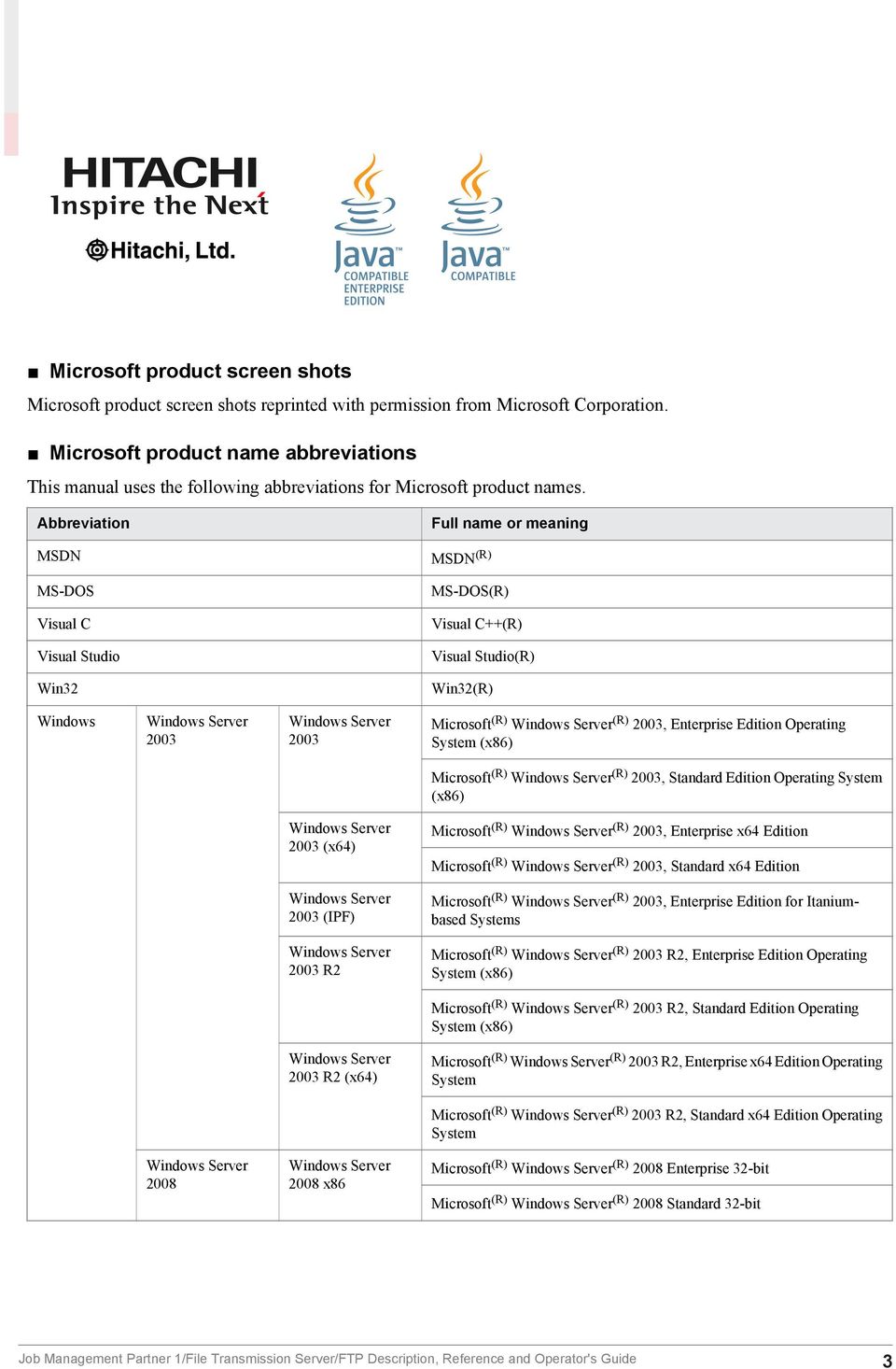
3 Microsoft product screen shots Microsoft product screen shots reprinted with permission from Microsoft Corporation. Microsoft product name abbreviations This manual uses the following abbreviations for Microsoft product names. Abbreviation Full name or meaning MSDN MSDN (R) MS-DOS MS-DOS(R) Visual C Visual C++(R) Visual Studio Visual Studio(R) Win32 Win32(R) Windows Windows Server 2003 Windows Server 2003 Microsoft (R) Windows Server (R) 2003, Enterprise Edition Operating System (x86) Microsoft (R) Windows Server (R) 2003, Standard Edition Operating System (x86) Windows Server 2003 (x64) Microsoft (R) Windows Server (R) 2003, Enterprise x64 Edition Microsoft (R) Windows Server (R) 2003, Standard x64 Edition Windows Server 2003 (IPF) Microsoft (R) Windows Server (R) 2003, Enterprise Edition for Itaniumbased Systems Windows Server 2003 R2 Microsoft (R) Windows Server (R) 2003 R2, Enterprise Edition Operating System (x86) Microsoft (R) Windows Server (R) 2003 R2, Standard Edition Operating System (x86) Windows Server 2003 R2 (x64) Microsoft (R) Windows Server (R) 2003 R2, Enterprise x64 Edition Operating System Microsoft (R) Windows Server (R) 2003 R2, Standard x64 Edition Operating System Windows Server 2008 Windows Server 2008 x86 Microsoft (R) Windows Server (R) 2008 Enterprise 32-bit Microsoft (R) Windows Server (R) 2008 Standard 32-bit Job Management Partner 1/File Transmission Server/FTP Description, Reference and Operator's Guide 3
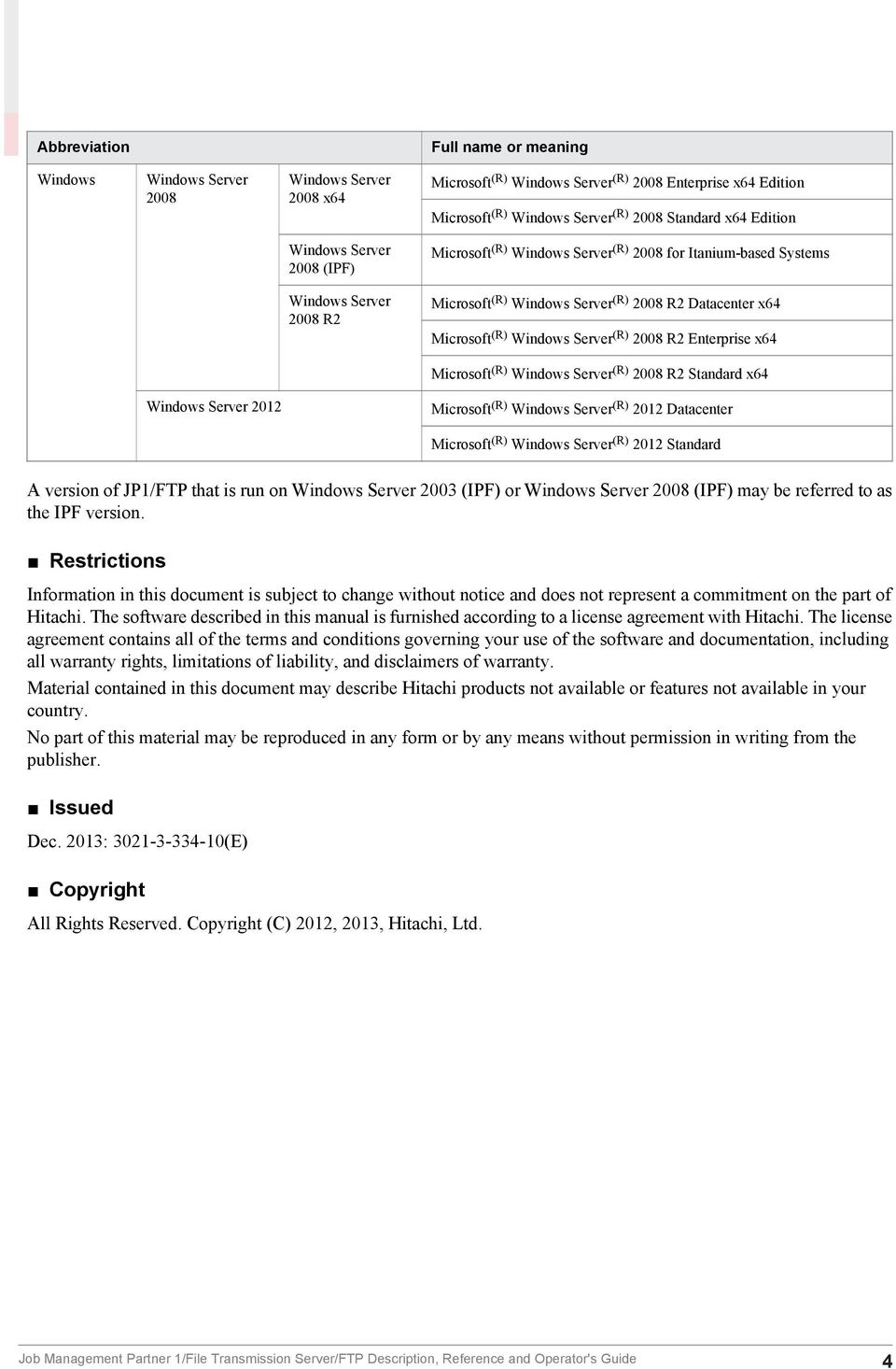
4 Abbreviation Full name or meaning Windows Windows Server 2008 Windows Server 2008 x64 Microsoft (R) Windows Server (R) 2008 Enterprise x64 Edition Microsoft (R) Windows Server (R) 2008 Standard x64 Edition Windows Server 2008 (IPF) Microsoft (R) Windows Server (R) 2008 for Itanium-based Systems Windows Server 2008 R2 Microsoft (R) Windows Server (R) 2008 R2 Datacenter x64 Microsoft (R) Windows Server (R) 2008 R2 Enterprise x64 Microsoft (R) Windows Server (R) 2008 R2 Standard x64 Windows Server 2012 Microsoft (R) Windows Server (R) 2012 Datacenter Microsoft (R) Windows Server (R) 2012 Standard A version of JP1/FTP that is run on Windows Server 2003 (IPF) or Windows Server 2008 (IPF) may be referred to as the IPF version. Restrictions Information in this document is subject to change without notice and does not represent a commitment on the part of Hitachi. The software described in this manual is furnished according to a license agreement with Hitachi. The license agreement contains all of the terms and conditions governing your use of the software and documentation, including all warranty rights, limitations of liability, and disclaimers of warranty. Material contained in this document may describe Hitachi products not available or features not available in your country. No part of this material may be reproduced in any form or by any means without permission in writing from the publisher. Issued Dec. 2013: (E) Copyright All Rights Reserved. Copyright (C) 2012, 2013, Hitachi, Ltd. Job Management Partner 1/File Transmission Server/FTP Description, Reference and Operator's Guide 4
5 Summary of amendments The following table lists changes in this manual ( (E)) and product changes related to this manual: Changes Windows Server 2012 is now supported. Visual Studio 2010 is now supported. Location 2.1.1, 2.2.1, 3.1.1, 4.1, ftsregc, ftshistory, Chapter 7., 8.2, 8.3.2, 8.3.3, 8.3.4, 8.3.5, 9.3.2, 9.3.6, Appendix A, F.1, F.2, Appendix G, Appendix H 7., Appendix A Remote host connections can now be controlled using IPv6 addresses Descriptions about the destinations of JP1 events when transmission ends were added or modified. 3.11, Ordinary users can now execute the ftstran command. ftstran, 8.3.1, 9.3.2, Appendix A Log service connection and disconnection messages can now be displayed. 8.2 Usage notes were modified. Appendix H In addition to the above changes, minor editorial corrections were made. Job Management Partner 1/File Transmission Server/FTP Description, Reference and Operator's Guide 5

6 Preface This manual describes the functions of and explains how to operate Job Management Partner 1/File Transmission Server/FTP. In this manual, Job Management Partner 1 is abbreviated as JP1, and Job Management Partner 1/ File Transmission Server/FTP is abbreviated as JP1/FTP. The IPF version of JP1/FTP is not supported. Intended readers This manual is intended for users who use JP1/FTP to transmit files. Conventions: Fonts and symbols The following table explains the text formatting conventions used in this manual: Text formatting Bold Italic Monospace Convention Bold characters indicate text in a window, other than the window title. Such text includes menus, menu options, buttons, radio box options, or explanatory labels. For example: From the File menu, choose Open. Click the Cancel button. In the Enter name entry box, type your name. Italic characters indicate a placeholder for some actual text to be provided by the user or system. For example: Write the command as follows: copy source-file target-file The following message appears: A file was not found. (file = file-name) Italic characters are also used for emphasis. For example: Do not delete the configuration file. Monospace characters indicate text that the user enters without change, or text (such as messages) output by the system. For example: At the prompt, enter dir. Use the send command to send mail. The following message is displayed: The password is incorrect. The following table explains the symbols used in this manual: Symbol Convention In syntax explanations, a vertical bar separates multiple items, and has the meaning of OR. For example: A B C means A, or B, or C. { } In syntax explanations, curly brackets indicate that only one of the enclosed items is to be selected. For example: {A B C} means only one of A, or B, or C. Job Management Partner 1/File Transmission Server/FTP Description, Reference and Operator's Guide 6

7 Symbol Convention [ ] In syntax explanations, square brackets indicate that the enclosed item or items are optional. For example: [A] means that you can specify A or nothing. [B C] means that you can specify B, or C, or nothing.... In coding, an ellipsis (...) indicates that one or more lines of coding have been omitted. In syntax explanations, an ellipsis indicates that the immediately preceding item can be repeated as many times as necessary. For example: A, B, B,... means that, after you specify A, B, you can specify B as many times as necessary. () Parentheses indicate the range of items to which the vertical bar ( ) or ellipsis (...) is applicable. (( )) Double parentheses enclose the range of values that can be specified. << >> Double angle brackets enclose the default value. Conventions: Version numbers The version numbers of Hitachi program products are usually written as two sets of two digits each, separated by a hyphen. For example: Version 1.00 (or 1.0) is written as Version 2.05 is written as Version 2.50 (or 2.5) is written as Version is written as The version number might be shown on the spine of a manual as Ver. 2.00, but the same version number would be written in the program as Job Management Partner 1/File Transmission Server/FTP Description, Reference and Operator's Guide 7

8 Contents Notices 2 Summary of amendments 5 Preface 6 1 Overview of JP1/FTP Features Functions File transmission function Operations-Manager function JP1 program linkage function Flow of JP1/FTP operations Registering JP1/FTP definition information Transmitting a file Saving and recovering JP1/FTP settings Checking the JP1/FTP definition information for other hosts 20 2 Installation and Setup JP1/FTP system configuration Supported OSs Basic system configuration Installing and setting up Installing JP1/FTP Setting the port numbers Uninstalling JP1/FTP Starting and stopping services Types of services Starting services Stopping services 27 3 File Transmission by JP1/FTP Defining an environment for JP1/FTP Defining an environment for JP1/FTP Using a definition file to define an environment for JP1/FTP Registering the users who can log in to a JP1/FTP server Registering the login users Changing login user information Deleting login user information 37 Job Management Partner 1/File Transmission Server/FTP Description, Reference and Operator's Guide 8

9 3.3 Registering auto-start programs Registering auto-start programs Changing the auto-start programs Deleting auto-start programs Changing the information displayed in the Auto-Start Program Registration window Registering transmission information Registering transmission information onto a transmission card Changing the information registered on a transmission card Deleting transmission cards Checking the contents of a transmission card Transmitting files Executing transmission by specifying a transmission card (Select Card method of file transmission) Executing transmission by entering a transmission card (Enter Information method of file transmission) Checking the transmission logs Checking the details of transmission results and errors Changing the information displayed in the Log Information window Changing the log file that is displayed Using the ftshistory command to display logs Saving and recovering JP1/FTP settings Saving definition information Recovering definition information Outputting definition information as text Outputting definition information as text File transmission in the PASV mode Registering the host names Function for controlling remote host connections Registering host names Using JP1/FTP in a multiple IP address environment Creating a definition file Collecting access logs Settings for collecting access logs Log output file Messages that are output to the access logs Function for using the access control function to change the root directory for absolute path names Registering the absolute path name format FTP connection response message control function Registering the definition information FTP connection response message that is displayed Using JP1/FTP in an IPv6 environment Registering the Internet protocol version 83 Job Management Partner 1/File Transmission Server/FTP Description, Reference and Operator's Guide 9

10 4 JP1/FTP Operations Management Setting up the Operations-Manager Console Adding managed hosts Deleting managed hosts Organization and functions of the Operations-Manager Console windows Environment Definition window User-To-Login Registration window Auto-Start Program Registration window Transmission Registration window Log Information window Examples of Operations-Manager Console menu operations Example of registering login user information Example of distributing (copying) transmission information Example of displaying log information Example of outputting multiple definition information items as text 96 5 Linkage with Other JP1 Programs Linking to JP1/AJS System configuration for linking to JP1/AJS Specifying the settings for linking to JP1/AJS Performing scheduled transmissions Linking to JP1/IM System configuration for linking to JP1/IM Specifying the settings for linking to JP1/IM Starting the services Monitoring transmission results by JP1/IM Commands 110 List of commands 111 Details of commands 112 ftstran - executes transmission 113 ftsregc - registers, changes, deletes, and displays transmission information 116 ftshistory - displays log information 119 ftssave - saves definition information 120 ftsload - recovers definition information API Library 123 How to use the library 124 Example of library usage 132 List of functions 136 Details of functions 137 fts_ftp_open_ex() - establish connection with JP1/FTP 138 fts_ftp_syn_request_ex() - register transmission requests (synchronous) 140 fts_ftp_asyn_request_ex() - register transmission requests (asynchronous) 142 Job Management Partner 1/File Transmission Server/FTP Description, Reference and Operator's Guide 10

11 fts_ftp_event_ex() - obtain the transmission-end results 144 fts_ftp_cancel() - cancel transmission 146 fts_ftp_close() - release connection with JP1/FTP Messages Format of displayed messages Message output formats Formats of message explanations Messages displayed in Event Viewer Messages displayed during command execution Messages displayed during execution of the ftstran command Messages displayed during execution of the ftsregc command Messages displayed during execution of the ftshistory command Messages displayed during execution of the ftsload command Messages displayed during execution of the ftssave command Messages output to the access log Troubleshooting Error handling procedures Types of log information Common message log Log by process Data to collect when a problem occurs Log information about the operating system (OS) Information about JP1/FTP List of JP1/FTP processes Operation information Error information on screen displays How to collect data 174 Appendixes 175 A List of Files and Directories 176 B Port Numbers 179 B.1 List of port numbers 179 B.2 Firewall passage directions 179 B.3 Items to check when performing transmission via a firewall 180 C List of Processes 181 D JP1 Events 182 D.1 List of JP1 events 182 D.2 Attributes of JP1 events 182 E Format Files Used for Output of Definition Information 191 E.1 Creating a format file 191 Job Management Partner 1/File Transmission Server/FTP Description, Reference and Operator's Guide 11
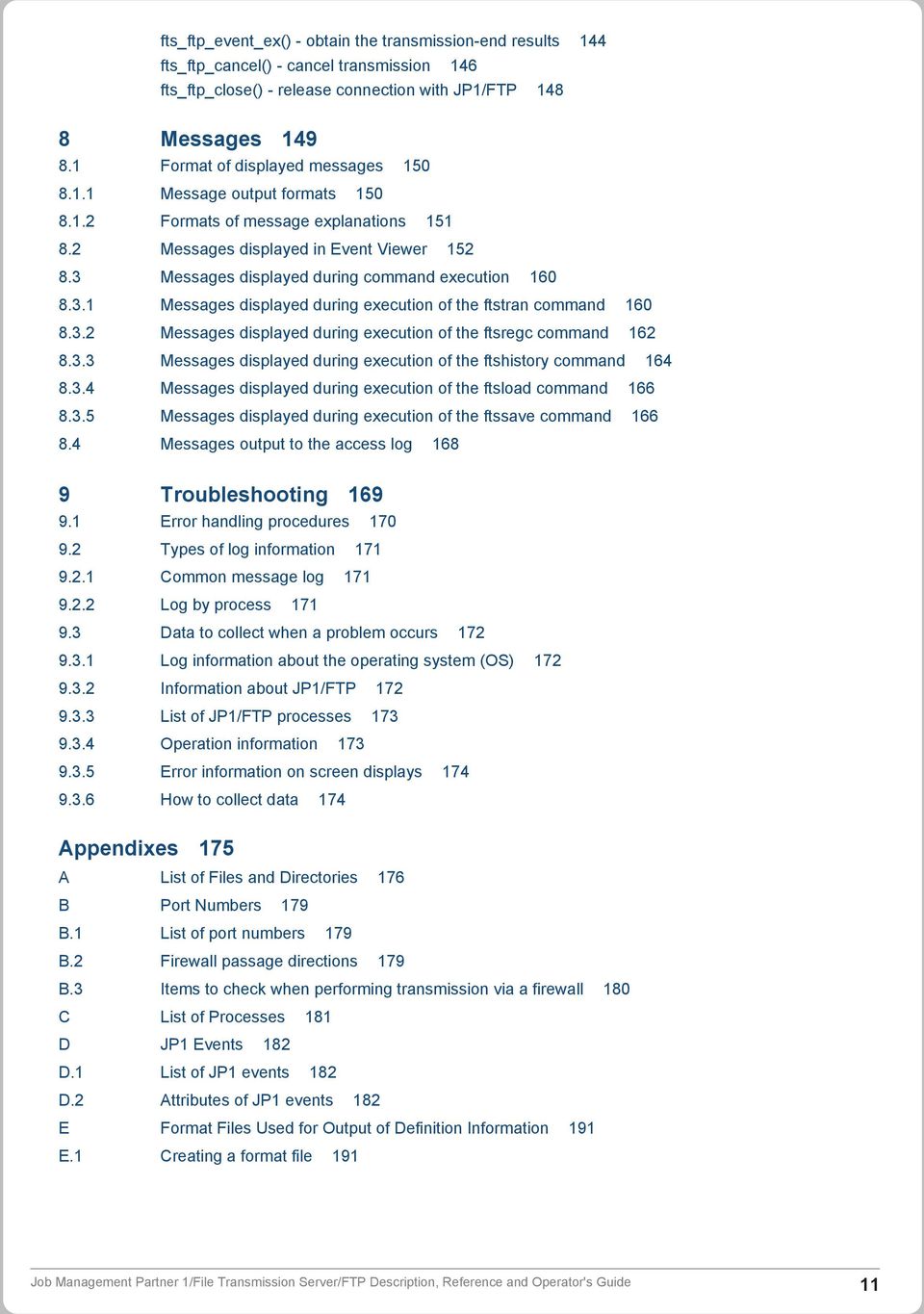
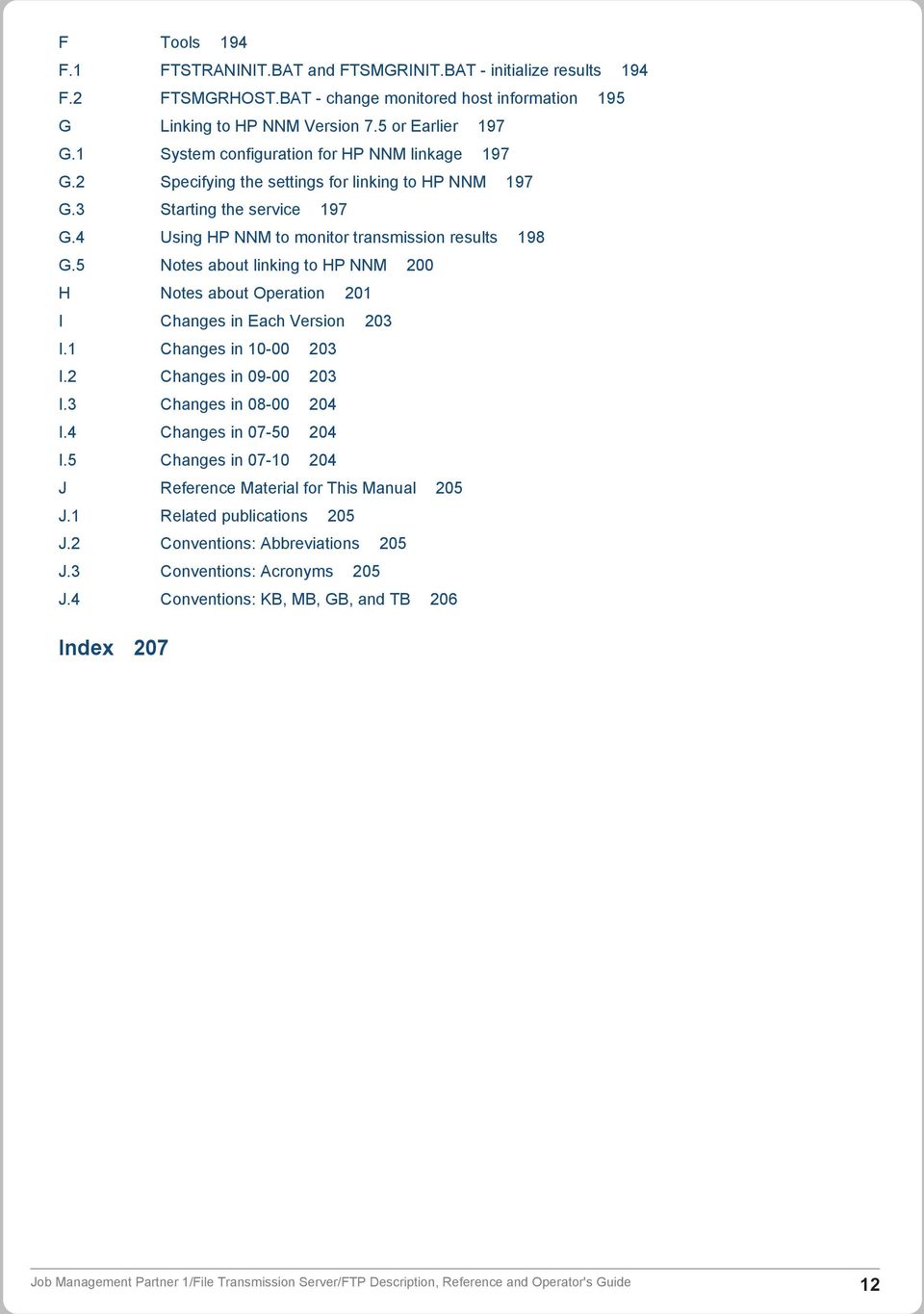
12 F Tools 194 F.1 FTSTRANINIT.BAT and FTSMGRINIT.BAT - initialize results 194 F.2 FTSMGRHOST.BAT - change monitored host information 195 G Linking to HP NNM Version 7.5 or Earlier 197 G.1 System configuration for HP NNM linkage 197 G.2 Specifying the settings for linking to HP NNM 197 G.3 Starting the service 197 G.4 Using HP NNM to monitor transmission results 198 G.5 Notes about linking to HP NNM 200 H Notes about Operation 201 I Changes in Each Version 203 I.1 Changes in I.2 Changes in I.3 Changes in I.4 Changes in I.5 Changes in J Reference Material for This Manual 205 J.1 Related publications 205 J.2 Conventions: Abbreviations 205 J.3 Conventions: Acronyms 205 J.4 Conventions: KB, MB, GB, and TB 206 Index 207 Job Management Partner 1/File Transmission Server/FTP Description, Reference and Operator's Guide 12
13 1 Overview of JP1/FTP JP1/FTP is a program for transmitting files in LAN and WAN environments. This chapter describes the features and functions of JP1/FTP. It also uses an example to explain the flow of the file transmission operations. Job Management Partner 1/File Transmission Server/FTP Description, Reference and Operator's Guide 13

14 1.1 Features JP1/FTP is a file transmission program that is provided with an Operations-Manager function. It uses the FTP procedure, a standard protocol for file transmission. Compared with the OS's standard FTP functions, JP1/FTP provides functions that are especially useful when files are transmitted by standard applications. Automation of file transmission jobs The job start function enables you to automate processing startup when file transmission is completed. The API function enables you to send files to and receive files from user applications. You can automate processing such as receiving data from a base server on a regular schedule throughout the day and then summing up the data at the end of the day. Management of execution status By using the display and notification of file transmission status, you can take actions such as error handling. You can manage the transmission status by collecting and displaying log information during file transmission. Scheduling transmissions When linked to JP1/AJS3, JP1/FTP enables you to easily perform scheduled transmission for standard applications. Additionally, JP1/FTP's automated job startup enables you to automate job execution when file transmission is finished. Centralized monitoring by JP1/IM By using JP1/IM, you can achieve centralized monitoring of services starting and stopping and the termination status of transmissions (normal, warning, abnormal). Operations-Manager function You can perform processing on multiple JP1/FTP hosts that are linked in a network, such as by displaying their file transmission histories and distributing and setting up various definition information. 1. Overview of JP1/FTP Job Management Partner 1/File Transmission Server/FTP Description, Reference and Operator's Guide 14

15 1.2 Functions The following figure presents an example of file transmission using JP1/FTP. Figure 1 1: Example of file transmission (transmitting files between the Chicago branch and the New York headquarters) Use of JP1/FTP to send and receive files between hosts is called transmission. The end that sends a file is called the client, while the end that receives the file is called the server. A host can function as both client and server. JP1/FTP provides the following three functions: File transmission function Operations-Manager function JP1 program linkage function The following subsections describe these functions File transmission function (1) Using transmission cards to register and transmit transmission information You use a transmission card to register the information to be transmitted. You can specify multiple transmission cards and transmit in batch mode. You can use a transmission card that has already been registered as a model by editing its contents and then transmitting the edited version. JP1/FTP supports the following operations: Transmitting multiple files in the batch mode You can use wildcards to specify multiple files that are to be transmitted. If you set standard file naming rules, you can achieve efficient transmission, for example when business report files of multiple groups are to be transmitted on a weekly basis. 1. Overview of JP1/FTP Job Management Partner 1/File Transmission Server/FTP Description, Reference and Operator's Guide 15

16 Checking the file size during transmission You can check that the size of a file is the same at the sender and the receiver. If transmission terminates successfully, any damage to the file that occurs during transmission is not detected. However, if you check the file size, any change in the file size is detected as a transmission error. This helps you achieve reliable transmission. You can check the file size only when transmission is between JP1/FTP instances or between JP1/FTP and ucosminexus Service Platform. (2) Automatically starting a program after file transmission You can specify a program to start automatically when file transmission is completed, thereby achieving automation of task execution. The following types of automated program startup are supported: Starting a specified program when file transmission is performed by a specified user Starting a specified program when a specified file is transmitted (3) Checking file transmission logs You can check transmission logs from either the server or the client. Supported operations include viewing transmission logs and checking for errors when transmission has terminated abnormally. You can also select the information to be included in the logs, such as displaying logs of abnormal termination information only. (4) Using an API to link with user programs You can use an API to link with user programs to perform file transmission. This feature enables you to achieve file transmission that is appropriate to the environment in use and to automate task execution after transmission. (5) Saving and restoring definition information You can save the JP1/FTP definition information items and distribute them to other hosts. You can also restore definition information from the saved items. By restoring the definition information of one host at multiple different hosts, you can simplify the setup procedure Operations-Manager function The Operations-Manager function enables you to reference the logs of multiple JP1/FTP hosts that are linked in a network and check their definition information from a single host, thereby reducing the administrator's workload JP1 program linkage function (1) Linking to JP1/AJS3 to perform scheduling transmissions You can link to JP1/AJS3 to execute jobs when transmission occurs. This function enables you to automate execution of a series of jobs. (2) Linking to JP1/IM to check transmission results You can link to JP1/IM to check the JP1/FTP service status and the results of file transmission. Normally, JP1/IM is used to monitor operations. In the event of an error, you can use the JP1/FTP logs to check the details. 1. Overview of JP1/FTP Job Management Partner 1/File Transmission Server/FTP Description, Reference and Operator's Guide 16

17 1.3 Flow of JP1/FTP operations To start each function of JP1/FTP, from the Start menu, choose Programs, JP1_File Transmission Server_FTP, and then a function menu. This section uses the following application example to describe the flow of the file transmission operations. Figure 1 2: Example of application Registering JP1/FTP definition information The following definition information must be registered: Environment definition information Transmission execution information (auto-start program information, transmission information, and login user information) 1. Overview of JP1/FTP Job Management Partner 1/File Transmission Server/FTP Description, Reference and Operator's Guide 17

18 Figure 1 3: Example of registering definition information Type of information Overview of operation Executing host Menu selection Environment definition information Defining environment definition information: Defines a JP1/FTP environment, such as the buffer size during transmission and the log file size. Server/client Environment Definition (see 3.1 Defining an environment for JP1/FTP) Transmission execution information Registering login user information: Registers the users who are permitted to log in to the server during file transmission. Server User-To-Login Registration (see 3.2 Registering the users who can log in to a JP1/FTP server) In the example, a user (sales) who logs in to the server at the New York headquarters from the Chicago branch is registered. Registering auto-start program information: Registers programs that are started automatically at the server when file transmission to the server is completed. Server Auto-Start Program Registration (see 3.3 Registering auto-start programs) The example registers into the server at the New York headquarters that the Totaling program is to be started when a Sales report file is received from sales. Registering transmission information: Registers in transmission cards the information to be transmitted (such as remote server names and transmission file names). A command can also be used to register transmission information. Client Transmission Regist. & Exe. (see 3.4 Registering transmission information) In this example, information about file transmission from the Chicago branch to the New York headquarters is registered Transmitting a file You register transmission information onto a transmission card and then execute transmission. Logs can be used to check the transmission results. 1. Overview of JP1/FTP Job Management Partner 1/File Transmission Server/FTP Description, Reference and Operator's Guide 18

19 Figure 1 4: Example of file transmission Overview of operation Executing host Menu selection Transmitting a file: Specifies a registered transmission card and then executes transmission. A command can also be used to execute transmission. This example transmits a file from the Chicago branch to the New York headquarters. Displaying logs: Displays logs to check the result of file transmission. In this example, reception logs can be checked at the New York headquarters and transmission logs can be checked at the Chicago branch. Client Server/client Transmission Regist. & Exe. (see 3.5 Transmitting files) Log Information (see 3.6 Checking the transmission logs) Saving and recovering JP1/FTP settings You can save and recover JP1/FTP settings and output them in text format. Figure 1 5: Example of saving and recovering JP1/FTP settings 1. Overview of JP1/FTP Job Management Partner 1/File Transmission Server/FTP Description, Reference and Operator's Guide 19

20 Overview of operation Executing host Menu selection Saving and recovering JP1/FTP settings: You can save the definition information created at one host and then recover it at other hosts. Definition information that can be saved and recovered: Environment settings User-to-login settings Auto-start program settings Transmission settings This example recovers definition information for the Chicago branch at the Los Angeles and San Francisco branches. This makes it easy to set up environments. Outputting definition information as text: You can output the registered information in text format. For the output format, use the provided sample. Definition information that can be output as text: User-to-login settings Auto-start program settings Transmission settings Log information Server/client where the information is registered Server/client where the information is registered Saving and Recovering Settings (see 3.7 Saving and recovering JP1/FTP settings) menu-item-for-type-of-information (see 3.8 Outputting definition information as text) Checking the JP1/FTP definition information for other hosts You can use the Operations-Manager Console to check and change other hosts' JP1/FTP definition information and to reference their logs. Figure 1 6: Example of checking the JP1/FTP definition information for other hosts Overview of operation Executing host Menu selection Operations-Manager Console: Enables you to check, register, change, and delete definition information for other hosts and to reference log information. The end that checks definition information is called the Operations-Manager Console, and the end whose definition information is checked is called the Operations-Manager Agent. Operations-Manager Console Manager Console (see 4. JP1/FTP Operations Management) 1. Overview of JP1/FTP Job Management Partner 1/File Transmission Server/FTP Description, Reference and Operator's Guide 20

21 Overview of operation Executing host Menu selection In the above example, the New York headquarters can reference each branch's log information and check its definition information. Operations-Manager Console Manager Console (see 4. JP1/FTP Operations Management) 1. Overview of JP1/FTP Job Management Partner 1/File Transmission Server/FTP Description, Reference and Operator's Guide 21
22 2 Installation and Setup This chapter describes the setup of JP1/FTP and the procedures required before JP1/FTP can be used. Job Management Partner 1/File Transmission Server/FTP Description, Reference and Operator's Guide 22
23 2.1 JP1/FTP system configuration This section describes the JP1/FTP system configuration Supported OSs The following OSs are supported: Windows Server 2003 Windows Server 2003 R2 Windows Server 2008 Windows Server 2008 R2 Windows Server Basic system configuration JP1/FTP must be installed at both the server and the client in order to transmit files. Files are transmitted from the client to the server. When you have finished installing JP1/FTP, you assign the client and server functions to individual machines at the time that you start services. You can also start the services of both the client and the server on the same machine. For details about starting services, see 2.3 Starting and stopping services. Figure 2 1: Example of a basic system configuration for using JP1/FTP to transmit files 2. Installation and Setup Job Management Partner 1/File Transmission Server/FTP Description, Reference and Operator's Guide 23
24 2.2 Installing and setting up This section describes how to install and set up JP1/FTP Installing JP1/FTP A distribution medium is provided for installing JP1/FTP, or you can use JP1/SD to perform remote installation. To install JP1/FTP from the distribution medium: 1. Log in to the machine on which JP1/FTP is to be installed as a user with Administrators permissions (or as an administrator in Windows Server 2008 or Windows Server 2012). 2. Terminate all programs. 3. Insert the distribution medium. The installer starts. Perform installation by following the installer's instructions. You will define the following information during installation: User information Enter your user name and organization name. Installation target Note: Specify the directory in which JP1/FTP is to be installed. The following default directories are used. In an x86 environment: OS-installation-drive:\Program Files\Hitachi\FTSFTP In an x64 environment: OS-installation-drive:\Program Files(x86)\Hitachi\FTSFTP In an x64 environment, do not install JP1/FTP under OS-installation-drive:\Program Files. Doing so may cause operational problems since the 64-bit module is located there Setting the port numbers After you have finished installing JP1/FTP, you must specify in the following file the port numbers to be used by JP1/ FTP. File used for setting the port numbers Settings OS-installation-directory\system32\drivers\etc\services ftssdata aaaaa-1/tcp #Used by the server during data transmission ftss aaaaa/tcp #Used by the server during reception ftsc bbbbb/tcp #Used by the client ftsclog ccccc/tcp #Used by the client to obtain log information 2. Installation and Setup Job Management Partner 1/File Transmission Server/FTP Description, Reference and Operator's Guide 24
25 ftsslog ddddd/tcp #Used by the server to obtain log information ftsagent eeeee/tcp #Used by the Operations-Manager function (agent) Legend: aaaaa, bbbbb, ccccc, ddddd, eeeee: Unique port numbers. Each must be different from any port numbers used by any other programs. aaaaa-1 can be set automatically, but we recommend that you specify the number explicitly, as shown above. If you specify a port number that is within the range of port numbers automatically assigned by the OS, it is assigned by the OS when JP1/FTP or another program is running. This may result in redundant assignment. If you plan to use the host only as a server or only as a client, specify one of the following sets of port numbers: To use the host only as a server: ftssdata, ftss, ftsslog To use the host only as a client: ftsc, ftsclog Example of setting port numbers ftssdata 20124/tcp #Used by the server during data transmission ftss 20125/tcp #Used by the server during reception ftsc 20126/tcp #Used by the client ftsclog 20127/tcp #Used by the client to obtain log information ftsslog 20128/tcp #Used by the server to obtain log information ftsagent 20252/tcp #Used by the Operations-Manager function (agent) A sample file is provided in JP1/FTP-installation-directory\services.sample. Specification during transmission To use JP1/FTP at the server, the client must specify the port number that was assigned to ftss during file transmission (in the above example, 20125). When transmitting files from the OS's default FTP to JP1/FTP If JP1/FTP is at the server and the OS's default FTP is used at the client to transmit files, the port specifications are as shown below. Figure 2 2: Example of file transmission from the OS's default FTP to JP1/FTP Uninstalling JP1/FTP To uninstall JP1/FTP (the following example is for Windows Server 2003): 1. Terminate all programs. 2. Stop all JP1/FTP services. For details about how to stop services, see 2.3 Starting and stopping services. 3. From the Windows Start menu, choose Control Panel, and then Add or Remove Programs. 2. Installation and Setup Job Management Partner 1/File Transmission Server/FTP Description, Reference and Operator's Guide 25
26 A dialog box for selecting the programs to be uninstalled is displayed. 4. While Change or Remove Programs is selected, select JP1/File Transmission Server/FTP from the list of currently installed programs, and then click the Remove button. A dialog box for confirming the deletion request is displayed. 5. Click the Yes button. The program is uninstalled. 2. Installation and Setup Job Management Partner 1/File Transmission Server/FTP Description, Reference and Operator's Guide 26
27 2.3 Starting and stopping services To use JP1/FTP, you must start its services Types of services To use JP1/FTP, you must start the services for the desired functions. The types of services are as follows: JP1/File Transmission Server/FTP Server Start this service to perform file transmission as the server. JP1/File Transmission Server/FTP Client Start this service to perform file transmission as the client. JP1/File Transmission Server/FTP Log Start this service to obtain log information. JP1/File Transmission Server/FTP Agent Start this service to use the Operations-Manager function Starting services Notes about starting services The JP1/FTP services are used with the account specified during logon. Permissions, such as file access permissions, depend on the account. Use the same account to start all the desired JP1/FTP services. Start the services to be used. You can also set services so that they will be started automatically when the system is started. To start services (the following example is for Windows Server 2003): 1. From the Windows Start menu, choose Control Panel, Administrative Tools, and then Services. The Services dialog box is displayed. 2. Right-click the name of a service to be started, and then from the displayed pop-up menu, choose Start. The service starts. If an error is displayed when the service starts, check the event log that is displayed in Event Viewer. For details about the event log, see 8.2 Messages displayed in Event Viewer. To start services automatically when the system starts: In the Properties dialog box for the service to be started, on the General page, set Startup type to Automatic. The service will start automatically whenever the system starts Stopping services To stop services (the following example is for Windows Server 2003): 1. From the Windows Start menu, choose Control Panel, Administrative Tools, and then Services. 2. Installation and Setup Job Management Partner 1/File Transmission Server/FTP Description, Reference and Operator's Guide 27
28 The Services dialog box is displayed. 2. Right-click the name of the service to be stopped, and then from the displayed pop-up menu, choose Stop. A confirmation message is displayed. 3. Click the OK button. The service stops. If any file is being transmitted, transmission processing is terminated forcibly, resulting in abnormal termination. 2. Installation and Setup Job Management Partner 1/File Transmission Server/FTP Description, Reference and Operator's Guide 28
29 3 File Transmission by JP1/FTP This chapter describes how to use JP1/FTP to transmit files. Job Management Partner 1/File Transmission Server/FTP Description, Reference and Operator's Guide 29
30 3.1 Defining an environment for JP1/FTP You must define an environment for JP1/FTP. To define an environment, you choose Environment Definition at both the server and the client, and then use the Environment Definition dialog box. How to display the Environment Definition dialog box From the Windows Start menu, choose Programs, JP1_File Transmission Server_FTP, and then Environment Definition. The following figure shows the Environment Definition dialog box. Figure 3 1: Environment Definition dialog box Defining an environment for JP1/FTP The default values are set during installation. We recommend that you change these values only if necessary. To use the Environment Definition dialog box to define an environment for JP1/FTP: 1. Change settings as desired in the Environment Definition dialog box, and then click OK. After you have changed the settings, restart all services. The following table lists and describes each item in the Environment Definition dialog box. Table 3 1: Items in the Environment Definition dialog box Item No. of file transmissions to log ((0 to 100,000)) <<2,000>> Setting Specifies the number of log entries to retain. One file transmission is counted as one entry. When the number of files transmitted exceeds the number of entries being retained, the oldest information is overwritten. Because the size of one entry is 1,500 bytes, the required file size equals number of retained entries x 1,500 bytes. Increasing the number of log entries to be retained: If you increase the number of log entries to be retained, it might take longer to display logs, depending on the CPU and hardware performance as well as on the amount of memory that 3. File Transmission by JP1/FTP Job Management Partner 1/File Transmission Server/FTP Description, Reference and Operator's Guide 30
31 Item No. of file transmissions to log ((0 to 100,000)) <<2,000>> Default Size of protocol trace file ((4 to 3,000 KB)) <<50 KB>> Size of Access log file ((0 to 100 MB)) <<0 MB>> Size of module trace file ((4 to 3,000 KB)) <<50 KB>> No. of retries (When connecting to a host) Retry interval (When connecting to a host) Size of TCP/IP window ((0 to 65,535 bytes)) <<32,768 bytes>> Time-limit waiting to send data ((1 to 3,600 seconds)) <<60 seconds>> Time-limit waiting to receive data ((1 to 3,600 seconds)) <<60 seconds>> Server/Client Setting is installed. If you want to retain log information over a long period of time, we recommend that you copy the log information file (JP1/FTP-installation-directory\history) and then store the copy. Clicking this button resets all environment definition settings to their default values. Specifies the size of a file to be used to collect FTP protocol trace information. The protocol trace files enable you to check the operation of commands at the FTP level. When the amount of trace information for a file exceeds the specified file size, the oldest information is overwritten. You need 120 files, each of the specified size. You can use a text editor such as Notepad to view the trace files. Specifies the size of the file to be used to store access logs. When the amount of access log information exceeds the specified size, the old information is backed up and a new file is created. If there already is a backup file, that file is overwritten. You can use a text editor such as Notepad to view the access log file. Specifies the size of a file to be used to collect module trace information. Module traces are collected as maintenance information. When the amount of trace information for a module trace file exceeds the specified file size, the oldest information is overwritten. You need 128 files, each of the specified size. The module trace files cannot be viewed. Specifies the number of and interval for retries in the event connection for file transmission cannot be established (for a reason such as busy status). Retries are attempted whenever a connect system call results in one of the following error codes: When attempting to establish control connection: WSAECONNREFUSED (10061) When attempting to establish data connection: WSAEADDRINUSE (10048) No. of retries (When connecting to a host) ((0 to 100,000)) <<5>> If you specify 0, no retries will be attempted. Retry interval (When connecting to a host) ((0 to 86,400 seconds)) <<2 seconds>> If you specify 0, retries are attempted immediately (without any interval between retry attempts). Specifies the size of a TCP/IP window. If the specified value is 0 or smaller than the system's window size (TCP/IP registry setting), the system's window size is assumed. Note that various factors affect transmission efficiency, such as the line speed, usage status, and CPU performance. Specify a value that is appropriate for the system being used. Specifies the amount of time to wait for the sending buffer to become available after a package has been sent during data transmission. If the buffer is still not available when the specified amount of time elapses, the transmission terminates abnormally. Specifies the amount of time to wait for a packet to be received during data reception (a packet is transmitted by a remote target). If no data is received after the specified amount of time has elapsed, the transmission terminates abnormally. Size of sending buffer/size of receiving buffer ((512 to 65,535 bytes)) <<4,096 bytes>> Specifies the size of the buffer (memory) for file transmission (sending) at both the server and the client. You might want to change this value if the amount of memory is limited or when you want to improve transmission efficiency. Note that various factors affect transmission efficiency, such as the line speed, usage status, and CPU performance. Specify a value that is appropriate for the system being used. 3. File Transmission by JP1/FTP Job Management Partner 1/File Transmission Server/FTP Description, Reference and Operator's Guide 31
32 Item Server/Client Directory for log ((2 to 230-byte character string)) <<JP1/FTP installation directory>> Link with JP1/IM Link with NNM Output transmission result to NT event log Restrict access Setting The memory size that should be allocated for the transmission buffer equals maximum number of concurrent transmissions x specified buffer size. Buffers for sending and receiving are not allocated at the same time. Allocation occurs only during transmission. Time-limit for idle connection ((30 to 7,200 seconds)) <<900 seconds>> If there is no request from the client for a specific period of time, the server releases the connection with the client. This item specifies the amount of time before the connection is to be released. Specifies the directory in which to create the log information files (history) and the trace information output directory (trace). The specified directory must be on the local drive. If you change this setting, the previous files and directory are retained. If you no longer need those files and directory, delete them. Specifies that JP1 events are to be issued. If you select this item, JP1 events will be issued when the service status changes and when transmission ends. If you link to JP1/IM, you can monitor the status on JP1/IM. For details about linkage with JP1/IM, see 5.2 Linking to JP1/IM. The default is that this item is not selected. Specifies whether to link to HP NNM (version 7.5 or earlier). When you link to HP NNM (version 7.5 or earlier), you can issue traps that change the color of the HP NNM symbol when the service status changes or when transmission is completed, enabling you to monitor the status on HP NNM. For details about linkage with HP NNM, see G. Linking to HP NNM Version 7.5 or Earlier. The default is that this item is not selected. This item cannot be selected in Windows Server 2008 or Windows Server Specifies whether to output file transmission results (normal or abnormal termination) and the start of file transmission to the event log. If you select this item, event IDs 33, 34, and from 24 to 27 are output. All other event IDs are always output to the event log, regardless of this setting. The default is that this item is not selected. Specifies whether a user who logs in to the server is allowed to access only the home directory specified during user registration and the files under that home directory. Because the highest directory becomes the root directory of each drive, no access between drives is permitted. This setting applies to all users. When Restrict access is selected, the system's root directory becomes the root directory for the absolute path names of files and directories that are displayed and set. However, if you register the absolute path name format beforehand, you can change the root directory for absolute path names to the home directory. For details about how to change the root directory for absolute path names to the home directory, see 3.13 Function for using the access control function to change the root directory for absolute path names. The default is that this item is not selected. Note If the value set in the Environment Definition dialog box in No. of file transmissions to log, Size of protocol trace file, and Size of module trace file is smaller than the current value for that item, the corresponding information files are deleted when the service is restarted. This means that the information existing before the restart will be deleted. The log information is backed up to the file log-information-directory\ftslogsave. Suppressing automatic display at the HP NNM console If you select Link with NNM in the Environment Definition dialog box and then save the environment definition, the linkage batch starts. The default is that the HP NNM console is displayed automatically. To suppress this display, add ovw to the registry HKEY_LOCAL_MACHINE\SOFTWARE\Hewlett-Packard\OpenView\Network Node Manager\OVConsole\CannotLaunchViewer. For details, see ovconsole in the HP NNM version 7.5 Help. 3. File Transmission by JP1/FTP Job Management Partner 1/File Transmission Server/FTP Description, Reference and Operator's Guide 32
33 3.1.2 Using a definition file to define an environment for JP1/FTP You can use a definition file to define some of the environment settings for JP1/FTP. You create a definition file and specify the definition information as described below. (1) Creating a definition file Create a definition file with the following path name: JP1/FTP-installation-directory\ftsenv.ini (2) Contents of the definition file Specify the definition information in the format of a Windows initialization file (.ini), as shown below: The following table lists and describes the sections, keys, and values that can be specified. Table 3 2: Contents of the definition file (ftsenv.ini) Section Key Value Description [ENV_INFO_VIEW] GEN_USER ON OFF <<OFF>> Specifies whether a non-administrator user or a user who does not have the administrator role can reference the definition information. #1 ON: Make the definition information referenceable. OFF: Do not display the definition information. [WELL_KNOWN_PORTS] Enable ON OFF <<OFF>> Specifies whether to permit connection when a well-known port (0 to 1023) is specified in the PORT command at the FTP server. #2 ON: Permit connection. OFF: Reject connection. [ANOTHER_ADDRESS] Enable ON OFF <<OFF>> Specifies whether to permit connection when the IP address specified in the PORT command at the FTP server does not belong to the client that established the control connection. #2 ON: Permit connection. OFF: Reject connection. [MASK_CMD] PORT ON OFF <<OFF>> Specifies whether to suppress reception of the PORT command at the FTP server. #2, #3 ON: Suppress. OFF: Do not suppress. 3. File Transmission by JP1/FTP Job Management Partner 1/File Transmission Server/FTP Description, Reference and Operator's Guide 33
34 Section Key Value Description [MASK_CMD] EPRT ON OFF <<OFF>> Specifies whether to suppress reception of the EPRT command at the FTP server. #2, #3 ON: Suppress. OFF: Do not suppress. [C_WELL_KNOWN_PORTS] Enable ON OFF <<OFF>> At the FTP client, specifies whether to permit a connection when a well-known port (0 to 1023) is specified in the port number received from the FTP server after the PASV command is issued. #4 ON: Permit connection. OFF: Reject connection. [C_ANOTHER_ADDRESS] Enable ON OFF <<OFF>> Specifies whether to permit a connection when the IP address received from the FTP server after the PASV command is issued at the FTP client does not belong to the server that established the control connection. #4 ON: Permit connection. OFF: Reject connection. #1 In version 8 or earlier, a non-administrator user or a user who does not have the administrator role cannot reference some of the definition information. If ON is specified, all the definition information becomes referenceable, including the information that was not referenceable in version 8 or earlier. When the Operations-Manager Console is used to reference definition information, the user must be an administrator or have the administrator role. #2 This registration information takes effect the next time the JP1/File Transmission Server/FTP Server service starts. #3 If ON is specified and the FTP server receives the corresponding command, the FTP server sends to the FTP client the response message 500 'command-name': command not understood. Note that Help for this command is not disabled. #4 This registration information takes effect the next time the JP1/File Transmission Server/FTP Client service starts. 3. File Transmission by JP1/FTP Job Management Partner 1/File Transmission Server/FTP Description, Reference and Operator's Guide 34
35 3.2 Registering the users who can log in to a JP1/FTP server You must register all login users who will be logging in to the server during file transmission. The server will reject reception requests from any other users. To register login users, you choose User-To-Login Registration at the server and then register the users in the User-To-Login Registration window. How to display the User-To-Login Registration window From the Windows Start menu, choose Programs, JP1_File Transmission Server_FTP, and then User-To-Login Registration. The following figure shows the User-To-Login Registration window. Figure 3 2: User-To-Login Registration window Note The login users that you register here are not the same as the Windows login users Registering the login users To register the login users: 1. In the User-To-Login Registration window, choose Register. The Register User To Login dialog box is displayed. Figure 3 3: Register User To Login dialog box 2. Specify each item and then click Register. You can register multiple users one after another until you click Close. 3. After you have finished registering users, click Close. The following table lists and describes each setting item in the Register User To Login dialog box. 3. File Transmission by JP1/FTP Job Management Partner 1/File Transmission Server/FTP Description, Reference and Operator's Guide 35
36 Table 3 3: Setting items in the Register User To Login dialog box Item User name ((1 to 50-byte character string)) Password ((0 to 50-byte character string)) Re-enter password Home directory ((2 to 259-byte character string)) Description Specifies the name of a user from whom the server can receive data. If Japanese characters (doublebyte characters) are specified for this item, the FTP client at the transmission target might refuse access or the text might become garbled in some cases. This item is mandatory. None of the following characters can be used: \, ", /, :, <, >,, *,? (all single-byte characters) A user name cannot be a string that begins or ends with a single-byte space. Specifies the password to be used by this user to log in to the server. If Japanese characters (doublebyte characters) are specified for this item, the FTP client at the transmission target might refuse access or the text might become garbled in some cases. If entry of a password will not be required, enter nothing in this item, in which case password checking will not be performed during file reception. For confirmation purposes, this field is used to re-enter the password that was specified in Password. If you have not specified a password, do not enter anything in this item. Specifies the directory to be used by this user to receive data during file transmission. If a file to be transmitted is specified by its relative path, the home directory specified here is assumed. You can also click Browse to find a directory in the system to use. This item is mandatory Changing login user information You can change a user's password and home directory in login user information that has been registered. To change login user information: 1. From the list in the User-To-Login Registration window, select a user and then choose Change. The Change User Information dialog box is displayed. Figure 3 4: Change User Information dialog box 2. Select an item you wish to change, and then enter the new information. You can change a user's password and/or home directory. 3. Click Change. 3. File Transmission by JP1/FTP Job Management Partner 1/File Transmission Server/FTP Description, Reference and Operator's Guide 36
37 3.2.3 Deleting login user information You can delete a user's registered login user information from the User-To-Login Registration window. When you delete a user's login information, any auto-start programs that have been set for that user are also deleted. To delete login user information: 1. From the list in the User-To-Login Registration window, select a user to delete. To delete multiple users at the same time, select the users while holding down the Shift or Ctrl key. 2. Choose Delete. A confirmation message is displayed. 3. Click Yes. 3. File Transmission by JP1/FTP Job Management Partner 1/File Transmission Server/FTP Description, Reference and Operator's Guide 37
38 3.3 Registering auto-start programs You can register a program to start at the server after file transmission is finished. To register auto-start programs, you start Auto-Start Program Registration at the server and then register auto-start programs in the Auto-Start Program Registration window. How to display the Auto-Start Program Registration window From the Windows Start menu, choose Programs, JP1_File Transmission Server_FTP, and then Auto-Start Program Registration. The Auto-Start Program Registration window is displayed. The following figure shows the Auto-Start Program Registration window. Figure 3 5: Auto-Start Program Registration window Registering auto-start programs The following features characterize auto-start programs: You can register different programs to start in the event of normal termination and abnormal termination of transmission. The time at which a specified program starts depends on how the transmission file is specified: file-name is specified The program starts when the specified file is transmitted. directory-name is specified The program starts when a file is transmitted to the specified directory. An auto-start program is executed when transmission is completed for the registered user. To register an auto-start program for all users, specify.default in User name. You can either specify from scratch an auto-start program to start, or you can edit existing registration information to specify a different auto-start program. To register auto-start programs: 1. In the Auto-Start Program Registration window, from the Register menu, choose For File Trigger or For Directory Trigger. Alternatively, select existing registration information, and then from the Register menu, choose For File Trigger or For Directory Trigger. The Register Auto-Start Program dialog box appears. 3. File Transmission by JP1/FTP Job Management Partner 1/File Transmission Server/FTP Description, Reference and Operator's Guide 38
39 Figure 3 6: Register Auto-Start Program dialog box (for files) 2. Specify the items and then click Register. You can make entries for multiple auto-start programs one after another until you click Close. 3. After registering the programs, click Close. The following table lists and describes each item in the Register Auto-Start Program dialog box. Table 3 4: Items in the Register Auto-Start Program dialog box Item User name ((user displayed in the list)) File name/directory name ((1 to 259-byte character string)) Program to start when transmission ends normally Program to start when transmission ends abnormally ((2 to 259-byte character string)) Setting Specifies a user name for registering an auto-start program. This item is mandatory. The following users displayed in the drop-down list can register auto-start programs. Users who have been registered as JP1/FTP login users.default (default users): All users who have been registered as login users When there is no registration information that corresponds to an individual user, JP1/FTP references the default user registration information. If such an item is found, JP1/FTP starts those programs automatically. When a user name is already set in User name: If a user has been specified in Info. For Specific User in the View menu, that user name is displayed here. From the View menu, choose Info. For All Users. Specifies the name of the file or directory that is to be subject to automatic start. This item is mandatory. If you specify a file, specify its full path or only the file name. If you specify a directory, specify its full path. For the directory delimiter, use \. Specifies the program to start when transmission terminates normally and/or when transmission terminates abnormally. For the name of a program to start, specify its full path. When the program starts, transmission information can be passed as arguments. For details, see (1) Parameter keywords. Note that if the length of the expanded parameter keywords exceeds 2,047 bytes, start processing of the specified auto-start program will fail. When a program name contains a space: If the specified program name contains a space, enclose the entire program name in doublequotation marks ("). Example: When specifying c:\aaa bbb\ccc ddd.exe as the name of an auto-start program: "c:\aaa bbb\ccc ddd.exe:" ( : Single-byte space) Note that in the case of a batch file, if you enclose both the program name and the arguments in double-quotation marks, the arguments will not be passed correctly. 3. File Transmission by JP1/FTP Job Management Partner 1/File Transmission Server/FTP Description, Reference and Operator's Guide 39
40 Notes about the programs to start Because the specified programs are started from the JP1/File Transmission Server/FTP Server service, we recommend that you note the following: Make sure that the account (user) used to start the JP1/File Transmission Server/FTP Server service is authorized to execute the specified programs. Because automatic start of programs is executed in a service session that is independent of the user's logon session, some of the information might not be readable (such as the registry settings specified during the user's logon session). If you specify a program that has a graphical user interface, specify Allow service to interact with desktop in the Properties dialog box for the JP1/FTP service (Logon page) (applicable to Windows Server 2003). Before you use the program, make sure that it runs normally, because programs are run according to Windows specifications. Priority of program start If multiple auto-start programs have been registered, the start condition (file name or directory name) might be applicable to more than one of the programs. In such a case, JP1/FTP searches the programs based on the priority order described below and starts only the first program that satisfies a priority condition. The following figure shows the priorities. Figure 3 7: Priority of starting auto-start programs How to start programs when multiple files are transmitted If a wildcard is used to transmit multiple files, an auto-start program is started as many times as there are file transmissions. Information is inherited to the auto-start program separately for each transmission. The transmission information cannot be inherited to all instances of the auto-start program at once. (1) Parameter keywords You can pass all the transmission-end information items to the user program by specifying a keyword in the auto-start program. You can also use keywords to pass specific transmission-end information items. The following table lists and describes the keywords. Table 3 5: List of parameter keywords Parameter keyword Information that is output Client Server ALL All the following items Y Y TRNO Transmission number Y Y 3. File Transmission by JP1/FTP Job Management Partner 1/File Transmission Server/FTP Description, Reference and Operator's Guide 40
41 Parameter keyword Information that is output Client Server TCNO Connection number Y Y CARD Card name Y -- HOST Connection-target host name or IP address Y -- Connecting client's IP address -- Y PORT Connection-target host's port number Y -- USER Login user name Y Y TRTP Transmission mode: 1: ASCII 2: Binary Y Y TRCM Transmission command: 1: Send 2: Receive 3: Append Y Y COMP Compression mode: 1: Stream 2: Compress Y Y LCFN Local file name Y Y RMFN Remote file name Y -- STTM Transmission start time (return value of time()) Y Y SPTM Transmission end time (return value of time()) Y Y TRSZ Transmission data size (bytes) Y Y CMNT Comment Y -- TRST Transmission end status: 1: Success 2: Failure Y Y ERKD Error type: 1: System call error 2: Logical error 3: Protocol error Y Y SYCN System call name Y Y SYKD System call type: 1: Win32 API 2: C runtime 3: Winsock API Y Y ERNO Error number Y Y PLMG Protocol message Y -- Legend: Y: Enabled --: Disabled 3. File Transmission by JP1/FTP Job Management Partner 1/File Transmission Server/FTP Description, Reference and Operator's Guide 41
42 About keyword specification If any keyword other than the ones shown in the table above or an invalid keyword is specified, the specified keyword is passed to the user program. If arguments to be passed to an auto-start program contain any spaces, you must enclose the keywords in doublequotation marks. Example: "ALL" When keywords are enclosed in double-quotation marks, the arguments are passed differently between.exe and.bat files, as shown below: Example: A.exe "PLMG" aargv[1]=aaa bbb Example: A.bat "PLMG" a%1="aaa bbb" Example of argument specification The following shows an example of specifying arguments. All transmission-end information: C:\USERS\accounting\PROC ALL Selected transmission-end information: C:\USERS\accounting\PROC1 TRNO USER TRCM STTM SPTM C:\USERS\accounting\PROC2 "PLMG" Command line during execution Example 1: Specifying keywords (without double-quotation marks): Specification: C:\USERS\accounting\PROC1 TRNO USER TRCM STTM SPTM Execution command line: C:\USERS\accounting\PROC1 12 accounting 1 12:45:35 12:45:45 (Transmission connection number: 12, login user name: accounting, transmission command: send(1), transmission start time: 12:45:35, transmission end time: 12:45:45) Example 2: Specifying keywords (with double-quotation marks): Specification: C:\USERS\WAKA\PROC2 "PLMG" Execution command line: C:\USERS\WAKA\PROC2 "550 D:\temp\test.dat:The system cannot find the path specified." (Protocol message: 550 D:\temp\test.dat:The system cannot find the path specified.) The user can obtain the entire command line character string by using the GetCommandLine function within the termination procedure. If the user program is a C runtime process, you can use the mechanism of argc and argv. 3. File Transmission by JP1/FTP Job Management Partner 1/File Transmission Server/FTP Description, Reference and Operator's Guide 42
43 3.3.2 Changing the auto-start programs You can use the Auto-Start Program Registration window to change registered auto-start programs. To change an auto-start program: 1. From the Auto-Start Program Registration window, select the information that you wish to change, and then click Change. The Change Auto-Start Program dialog box appears. Figure 3 8: Change Auto-Start Program dialog box 2. Enter the desired information in the applicable items. 3. Click Change Deleting auto-start programs You can delete auto-start programs from the Auto-Start Program Registration window. To delete auto-start programs: 1. From the Auto-Start Program Registration window, select the information that you wish to delete. To select multiple items, select them while holding down the Shift or Ctrl key. 2. Choose Delete. A configuration message is displayed. 3. Click Yes Changing the information displayed in the Auto-Start Program Registration window You can change how information is displayed in the Auto-Start Program Registration window, as follows: Display by user who is registered for the auto-start programs (all users, specified user, or default user) Display by program start trigger target (file or directory) 3. File Transmission by JP1/FTP Job Management Partner 1/File Transmission Server/FTP Description, Reference and Operator's Guide 43
44 (1) Displaying the auto-start programs by user To display the auto-start programs by user: 1. From the View menu, choose Info. For All Users, Info. For Specific User, or Info. For.default User. Info. For All Users Displays all the information that has been registered. Info. For Specific User Specify a desired user in the Specify User name dialog box. The following figure shows the Specify User name dialog box. Figure 3 9: Specify User name dialog box Info. For.default User Displays only the information registered for the default user. (2) Displaying the auto-start programs by program start trigger target (file or directory) To display the auto-start programs by program start trigger target: 1. Select File/Directory, and then select either Trigger Is File or Trigger Is Directory. Trigger Is File Displays only the information associated with files. Trigger Is Directory Displays only the information associated with directories. 3. File Transmission by JP1/FTP Job Management Partner 1/File Transmission Server/FTP Description, Reference and Operator's Guide 44
45 3.4 Registering transmission information You register information about a transmission (such as the remote host name, remote user name, and transmission file) onto a transmission card. You can also specify a program to be started by the client when transmission finishes. To register transmission information, you use Transmission Regist. & Exe. at the client to display the Registration And Execution Of Transmission Requests window. Alternatively, you can use a command. How to display the Registration And Execution Of Transmission Requests window From the Windows Start menu, choose Programs, JP1_File Transmission Server_FTP, and then Registration And Execution Of Transmission Requests. The Registration And Execution Of Transmission Requests window is displayed. The following figure shows the Registration And Execution Of Transmission Requests window. Figure 3 10: Registration And Execution Of Transmission Requests window Registering transmission information onto a transmission card You register transmission information onto a transmission card. This subsection describes two methods, one that uses the Registration And Execution Of Transmission Requests window and one that uses the command. Alternatively, you can edit an existing transmission card and register it as a new transmission card. (1) Using the Registration And Execution Of Transmission Requests window To register transmission information onto a transmission card: 1. In the Registration And Execution Of Transmission Requests window, choose Register, or select an existing transmission card, and then choose Register. The Register Transmission Information dialog box appears. 3. File Transmission by JP1/FTP Job Management Partner 1/File Transmission Server/FTP Description, Reference and Operator's Guide 45
46 Figure 3 11: Register Transmission Information dialog box 2. Specify the items and then click Register. You can register multiple sets of transmission information until you click Close. 3. After you have finished with the registration, click Close. The following table lists and describes each item in the Transmission Information dialog box. Table 3 6: Items in the Register Transmission Information dialog box Item Transmission card name ((1 to 20-byte character string)) Remote host name ((1 to 256-byte character string)) Port number ((1 to 65,535)) <<21>> Remote user name ((1 to 50-byte character string)) Password ((0 to 50-byte character string)) Send/receive type Transmission mode Output type Setting Specifies a name for the transmission information. If you link to JP1/AJS3, make sure that the specified transmission card name does not contain any spaces. This item is mandatory. Specifies the name or IP address of the remote host. When you specify an IP address, you can specify an IPv4 or IPv6 address. This item is mandatory. Specifies the port number of the remote host. If this item is omitted, 21 is assumed. For transmitting to the JP1/FTP server: Specify the port number that was specified in ftss in the port number settings. For transmitting to the OS's default FTP server: Specify the default value (21). Specifies the name of the login user at the transmission target. This item is mandatory. Specifies the password registered for the login user. If no password was specified during the registration process, leave this item blank. Specifies the transmission type: Send Receive Specifies the transmission mode according to the file to be transmitted. ASCII: In this transmission mode, the receiving end adjusts linefeed codes according to the local system. Use this mode to transmit text files. BINARY: This mode achieves transparent transmission without having to be aware of the data contents. Use this mode to transmit data files and executable files. Specifies how to output files after transmission: 3. File Transmission by JP1/FTP Job Management Partner 1/File Transmission Server/FTP Description, Reference and Operator's Guide 46
47 Item Output type Compression mode Size check Single/Multiple-file transmission Local file name Remote file name Setting Append: If a file with the same name already exists, the transmitted data will be appended to that file. If there is no file with the same name, a new file will be created. This option is not available when the send/receive type is Receive. Overwrite: If a file with the same name already exists, that file will be overwritten (in which case the file's existing contents will be destroyed). If there is no file with the same name, a new file will be created. Specifies whether to compress the transmitted files. About the compression specification: If the remote FTP host does not support the compression mode, data is not compressed during transmission even if you specify compression. The run-length compression method defined in RFC 959 (FILE TRANSFER PROTOCOL) is used as the compression method. Specifies whether to check the size of a transmitted file at the sending and receiving ends for errors after file transmission. If a file's transmission data size does not match between the sending and receiving ends, a transmission error results. For the size check to be enabled, the remote FTP server must be JP1/FTP (version or later) or ucosminexus Service Platform (version or later). Specifies whether to transmit is to be of a single file or of multiple files. Auto: If the remote file name contains * or?, JP1/FTP is to perform multiple-file transmission. If the file name does not contain * or?, JP1/FTP is to perform single-file transmission. Multiple: JP1/FTP is to perform multiple-file transmission exactly as dictated by the wildcard. Single: JP1/FTP is to perform single-file transmission. If a wildcard is specified, JP1/FTP treats it as a character and transmits a single file. Specification depends on the transmission type, as described below. This item is mandatory. Send transmission type ((1 to 259-byte character string)) Specifies the name of the file to be sent from the local system. You can use wildcard characters to specify multiple files. If you use a wildcard character, the length of the expanded path name must not exceed 259 bytes. To specify multiple files: You can use the following wildcard characters to specify multiple files: *: Any number of any characters, including no characters?: Any single character If you send multiple files, specify a directory for the remote files. Files with the same names as local files will be created in the specified directory. Receive transmission type ((1 to 259-byte character string)) Specifies the name of the file to be output at the local system after the file is received. If you have specified a wildcard in the remote file name, specify a directory name (other than the root directory). Note that the length of the expanded path name must not exceed 259 bytes. When specifying a relative path: If the specified directory and file exist under JP1/FTP-installation-directory\temp, the file is transmitted. If there is no such directory or file, the transmission terminates abnormally. Local file name: No shortcut can be specified for local file names. Specification depends on the transmission type, as described below. This item is mandatory. Send transmission type ((1 to 259-byte character string)) Specifies the name of the output file at the remote system. If you have used a wildcard character in the local file name, specify a directory name. Note that the length of the expanded path name must not exceed 259 bytes. Receive transmission type ((1 to 259-byte character string)) Specifies the name of the input file at the remote system. You can use wildcard characters (* and?) to specify multiple files. Note that the length of the expanded path name must not exceed 259 bytes. 3. File Transmission by JP1/FTP Job Management Partner 1/File Transmission Server/FTP Description, Reference and Operator's Guide 47
48 Item Remote file name Program to start at normal end ((0 to 259-byte character string)) Program to start at abnormal end ((0 to 259-byte character string)) FTP command ((0 to 300-byte character string)) Setting If you receive multiple files, specify a directory for the local files. Files with the same names as the remote files will be created in the specified directory. How wildcard characters are interpreted: A wildcard is specified in the NLST command and then sent to the remote FTP server. The file that is transmitted is determined by the response from the FTP server. Therefore, interpretation of the wildcard depends on the remote FTP server. JP1/FTP supports only * and? as wildcard characters. Wildcard characters cannot be used in directory names. If a directory name contains a wildcard, set Single/Multiple-file transmission to Single. When specifying a relative path: For both sending and receiving, the specified path is relative to the current directory. About the specification of remote files: Browse displays files as viewed from the local system. For the remote file name, specify a file name that is viewed from the remote system. If Japanese characters (double-byte characters) are specified for the remote file name, the remote FTP server might refuse access or the text might become garbled in some cases. Specifies the full path name of a program to start automatically at the client when transmission terminates normally. You can also specify arguments to pass as transmission information to the program when the program starts. For details about the arguments, see 3.3.1(1) Parameter keywords. Note that if the length of the converted parameter keywords exceeds 2,047 bytes, the specified auto-start program will not start. Specifies the full path name of a program to start automatically at the client when transmission terminates abnormally. You can also specify arguments to pass as transmission information to the program when the program starts. For details about the arguments, see 3.3.1(1) Parameter keywords. Note that if the length of the converted parameter keywords exceeds 2,047 bytes, the specified auto-start program will not start. Specifies an FTP command to be executed prior to transmission after connection is established with the server. To specify multiple commands, separate them with the semicolon (;). Example: CWD C:\users\user1;SITE xxxx You can specify only commands that do not establish a data connection. Whether the specified commands can be executed at the FTP server depends on the FTP server. When the FTP server is JP1/FTP: Major commands that can be specified: CDUP, CWD, DELE, HELP, MDTM, MKD, NOOP, PWD, RMD, SITE, SIZE, STAT, SYST, XCUP, XCWD, XMKD, XPWD, XRMD Commands that can reference the result by means of a protocol trace: HELP, MDTM, SIZE, STAT, SYST About the specification of FTP commands: Some commands require consecutive command transmission. Before using commands, check the FTP specifications. If you use a command accompanied by an argument, note the following: If Japanese characters (double-byte characters) are specified for the argument, the remote FTP server might refuse access or the text might become garbled in some cases. Comment ((0 to 80-byte character string)) Specifies any comment. Because the comment is displayed in the log information, this option is useful for setting a memo about the transmission. A comment is not passed to the transmission target. About the programs that are specified as auto-start programs Because auto-start programs are started from the JP1/File Transmission Server/FTP Client service, we recommend that you note the following: 3. File Transmission by JP1/FTP Job Management Partner 1/File Transmission Server/FTP Description, Reference and Operator's Guide 48
49 Make sure that the account (user) used to start the JP1/File Transmission Server/FTP Server service is authorized to execute the specified programs. Because automatic start of programs is executed in a service session that is independent of the user's logon session, some of the information might not be readable (such as the registry settings specified during the user's logon session). If you specify a program that has a graphical user interface, specify Allow service to interact with desktop in the Properties dialog box for the JP1/FTP service (Logon page) (applicable to Windows Server 2003). Before you use the program, make sure that it runs normally, because programs are run according to Windows specifications. How to start programs when multiple files are transmitted If a wildcard is used to transmit multiple files, an auto-start program is started as many times as there are file transmissions. Information is inherited to the auto-start program separately for each transmission. The transmission information cannot be inherited to all instances of the auto-start program at once. (2) Using the ftsregc command The following figure shows an example of using a command to register new transmission information: This example registers the following information: /TC: The transmission card name is card1. /TH: The connection-target host name is host1. /TU: The login user name is accounting. /TT: The send/receive type is SEND. /TY: The transmission mode is BINARY. /TL: The local file name is c:\temp\file1. /TR: The remote file name is c:\temp\file2. The following figure shows an example of a command that registers transmission information using an existing transmission card: This example registers the following information: The name of the existing transmission card that is being used is card1. /TC: The name specified for the new transmission card is card2. 3. File Transmission by JP1/FTP Job Management Partner 1/File Transmission Server/FTP Description, Reference and Operator's Guide 49
50 /TH: The connection-target host name is host1. /TU: The login user name is accounting. /TT: The send/receive type is SEND. /TY: The transmission mode is BINARY. /TL: The local file name is c:\temp\file1. /TR: The remote file name is c:\temp\file2. For details about the ftsregc command, see ftsregc - registers, changes, deletes, and displays transmission information in 6. Commands Changing the information registered on a transmission card You can change the information registered on a transmission card. This subsection describes two methods, one that uses the Registration And Execution Of Transmission Requests window and one that uses a command. (1) Using the Registration And Execution Of Transmission Requests window To change the information registered on a transmission card: 1. In the Registration And Execution Of Transmission Requests window, select the transmission card to be edited, and then choose Change. The Change Transmission Information dialog box appears. Figure 3 12: Change Transmission Information dialog box 2. Enter new information in the applicable items. 3. Click Change. (2) Using the ftsregc command The following example changes information on a transmission card: 3. File Transmission by JP1/FTP Job Management Partner 1/File Transmission Server/FTP Description, Reference and Operator's Guide 50
51 This example changes the following transmission information on card1: /TC: The card name is card2. /TH: The connection-target host name is host1. /TL: The local file name is c:\temp\file1. /TR: The remote file name is c:\temp\file2. For details about the ftsregc command, see ftsregc - registers, changes, deletes, and displays transmission information in 6. Commands Deleting transmission cards You can delete registered transmission cards from the Registration And Execution Of Transmission Requests window. This subsection describes two methods, one that uses the Registration And Execution Of Transmission Requests window and one that uses a command. (1) Using the Registration And Execution Of Transmission Requests window To delete transmission cards: 1. In the Registration And Execution Of Transmission Requests window, select a transmission card to be deleted. To select multiple transmission cards, select them while holding down the Shift or Ctrl key. 2. Choose Delete. A configuration message is displayed. 3. Click Yes. (2) Using the ftsregc command The following example deletes information on a transmission card: For details about the ftsregc command, see ftsregc - registers, changes, deletes, and displays transmission information in 6. Commands. 3. File Transmission by JP1/FTP Job Management Partner 1/File Transmission Server/FTP Description, Reference and Operator's Guide 51
52 3.4.4 Checking the contents of a transmission card You can check the contents of a transmission card before you start transmission. This subsection describes two methods, one that uses the Registration And Execution Of Transmission Requests window and one that uses a command. (1) Using the Registration And Execution Of Transmission Requests window To check the contents of a transmission card: 1. In the Registration And Execution Of Transmission Requests window, select a transmission card whose contents are to be displayed, and then choose Details. The Transmission Card Details dialog box appears. 2. After checking the contents, click OK. (2) Using the ftsregc command The following example displays the contents of a transmission card: For details about the ftsregc command, see ftsregc - registers, changes, deletes, and displays transmission information in 6. Commands. 3. File Transmission by JP1/FTP Job Management Partner 1/File Transmission Server/FTP Description, Reference and Operator's Guide 52
53 3.5 Transmitting files There are two ways to transmit files: Select Card method of file transmission This method specifies a registered transmission card in the Registration And Execution Of Transmission Requests window and then executes transmission. Enter Information method of file transmission For this method, you start Transmission Regist. & Exe. at the client to open the Registration And Execution Of Transmission Requests window. Alternatively, you can use a command. How to display the Registration And Execution Of Transmission Requests window From the Windows Start menu, choose Programs, JP1_File Transmission Server_FTP, and then choose Registration And Execution Of Transmission Requests. The Registration And Execution Of Transmission Requests window appears. The following figure shows the Registration And Execution Of Transmission Requests window. Figure 3 13: Registration And Execution Of Transmission Requests window Executing transmission by specifying a transmission card (Select Card method of file transmission) This method specifies a transmission card. You can specify multiple transmission cards. This subsection describes two methods, one that uses the Registration And Execution Of Transmission Requests window and one that uses a command. (1) Using the Registration And Execution Of Transmission Requests window To execute transmission: 1. In the Registration And Execution Of Transmission Requests window, select a transmission card to be transmitted. 2. Choose Exe.(Select Card). The Execute Transmission (Select Card) dialog box appears. 3. File Transmission by JP1/FTP Job Management Partner 1/File Transmission Server/FTP Description, Reference and Operator's Guide 53
54 Figure 3 14: Execute Transmission (Select Card) dialog box To change the sequence of transmission The Select Card method of file transmission transmits sequentially in the order that the files are listed in the Execute Transmission (Select Card) dialog box. To change the sequence, double-click a desired transmission card. The double-clicked transmission card is moved to the top of the list and will be transferred first. 3. Click either Sync. Execute or Async. Execute. Synchronous execution Transmission is executed sequentially for each card (each card name). Transmission of one file must be completed before the next file can be transmitted, thereby preventing line overloading. The transmission result is displayed under the details in the Execute Transmission (Select Card) dialog box. The numbers in parentheses indicate the sequential transmission numbers of the file transmissions. If an error occurs before transmission, no transmission number is displayed. Asynchronous execution All cards are transmitted in the batch mode. You can transmit a maximum of 60 files concurrently. If you select asynchronous execution, the message Registration ended is displayed, and no transmission results are displayed. You must check the logs for the results. 4. After executing transmission, click Close. How to cancel file transmission When you click Sync. Execute or Async. Execute, Stop or Force Stop is displayed. Stop Synchronous execution: The request is canceled after the current file transmission is finished. Asynchronous execution: The request is canceled after the current file transmission request is registered. If connection is established with the JP1/File Transmission Server/FTP Client service, the request is canceled after the connection is released. Force Stop Cancels the transmission immediately. When asynchronous execution is specified, transmissions that have already been registered are not canceled. Note that the file transmission log might not be output. If possible, try to avoid using this option because the system might not be able to release the resources. About the display of file transmission errors when a wildcard is used Only the first error that occurred is displayed in Comment or transmission results. 3. File Transmission by JP1/FTP Job Management Partner 1/File Transmission Server/FTP Description, Reference and Operator's Guide 54
55 (2) Using the ftstran command The following figure shows an example of using a command to execute the Select Card method of file transmission: Transmission by the ftstran command is applicable only to synchronous execution. For details about the ftstran command, see ftstran - executes transmission in 6. Commands Executing transmission by entering a transmission card (Enter Information method of file transmission) This method transmits the contents of a transmission card as is. You can enter a new transmission card or use an existing transmission card and edit its contents. The Enter Information method of file transmission does not register the transmission card. This subsection describes two methods, one that uses the Registration And Execution Of Transmission Requests window and one that uses a command. (1) Using the Registration And Execution Of Transmission Requests window To execute transmission: 1. In the Registration And Execution Of Transmission Requests window, choose Exe.(Enter Info.). Alternatively, in the Registration And Execution Of Transmission Requests window, specify the transmission card to use, and then choose Exe.(Enter Info.). The Execute Transmission (Enter Information) dialog box appears. Figure 3 15: Execute Transmission (Enter Information) dialog box 2. Enter or edit the transmission contents. For details about the settings of the items, see Registering transmission information onto a transmission card. 3. File Transmission by JP1/FTP Job Management Partner 1/File Transmission Server/FTP Description, Reference and Operator's Guide 55
56 3. Click either Sync. Execute or Async. Execute. Synchronous execution Transmission is executed sequentially for each card (each card name). Transmission of one file must be completed before the next file can be transmitted, thereby preventing line overloading. Asynchronous execution All cards are transmitted in the batch mode. You can transmit a maximum of 60 files concurrently. If you select asynchronous execution, the message Registration ended is displayed, and no transmission results are displayed. You must check the logs for the results. 4. After executing transmission, click Close. How to cancel file transmission When you click Sync. Execute or Async. Execute, the Now executing dialog box is displayed. Clicking Force Stop in this dialog box cancels the transmission immediately. Note that the file transmission log might not be output. If you execute synchronous execution after forced cancellation, there might be a delay before transmission begins. About the display of file transmission errors when a wildcard is used Only the first error that occurred is displayed in the message that is displayed after transmission. (2) Using the ftstran command The following figure shows an example of using a command to execute the Enter Information method of file transmission: This example changes the following transmission information on card1 and then executes transmission: /TC: The card name is card2. /TH: The connection-target host name is host1. /TT: The send/receive type is SEND. /TY: The transmission mode is BINARY. /TL: The local file name is c:\temp\file1. /TR: The remote file name is c:\temp\file2. Transmission by the ftstran command is applicable only to synchronous execution. For details about the ftstran command, see ftstran - executes transmission in 6. Commands. 3. File Transmission by JP1/FTP Job Management Partner 1/File Transmission Server/FTP Description, Reference and Operator's Guide 56
57 3.6 Checking the transmission logs You can check the logs of file transmissions (such as for the transmission times, the names of the transmitted files, the results and details of the transmissions, and the details of errors). Logs can be displayed by both the server and the client. Start Log Information to display the Log Information window, or use the ftshistory command. How to display the Log Information window From the Windows Start menu, choose Programs, JP1_File Transmission Server_FTP, and then Log Information. The Log Information window is displayed. The following figure shows the Log Information window. Figure 3 16: Log Information window Checking the details of transmission results and errors To display detailed information from the Log Information window: 1. From the Log Information window, select the log information whose details are to be displayed, and then choose Details. The Log Details dialog box appears. If a protocol trace and errors have been output, you can check the details of the errors. 3. File Transmission by JP1/FTP Job Management Partner 1/File Transmission Server/FTP Description, Reference and Operator's Guide 57
58 Figure 3 17: Log Details dialog box 2. Check the detailed information, and then click OK. The following table lists and describes each item in the Log Details dialog box. Table 3 7: Items in the Log Details dialog box Item Transmission number Transmission card name Transmission start-end Remote host name Remote port number Logged-in user Client or server Sent or received Output type Transmission mode Description Displays the transmission number. This number is determined separately at the server and the client. Because this is a unique number assigned to each transmission, you can use it as an identifier when you view logs. The largest transmission number is 999,999 (if this value is exceeded, the counter is reset to 0). Client: Displays the name of the card that was transmitted. Server: Not displayed. Displays the date and time transmission started and the date and time transmission ended. Displays the remote host name that was specified in the transmission request. This is a host name or IP address defined in the system. Client: Displays the remote port number that executed transmission. Server: Not displayed. Client: Displays the name of the remote login user that executed transmission. Server: Displays the name of the login user that received the transmission. Client: Displayed when file transmission was executed by the client. Server: Displayed when file transmission was executed by the server. Displays the send/receive type (Send or Receive) that was specified during the transmission request. Displays the output type (Append or Overwrite) that was specified in the transmission request. Displays the transmission mode (ASCII or BINARY) that was specified in the transmission request. 3. File Transmission by JP1/FTP Job Management Partner 1/File Transmission Server/FTP Description, Reference and Operator's Guide 58
59 Item Compression mode End status Transmission period Size transmitted Connection number Local file name Remote file name Comment Error type Protocol Trace Error Details Description Displays the compression mode (Compress or Uncompress) that was specified in the transmission request. Displays the termination status of the file transmission (Normal or Abnormal). If automatic program start fails but file transmission itself was successful, Normal is displayed. Displays the amount of time required for the file transmission. If this value is 24 hours or more, the number of days is not displayed. Displays the data size (in bytes) of the transmitted file. Displays a transmission identifier based on when JP1/FTP established connection with the remote system. This is a separate number for the server and the client in the range from 1 to 60 (the maximum value depends on the maximum number of connections). Because various traces (such as the protocol trace) are output for each connection number, you can use this number as a guide for viewing traces of the corresponding transmission. Example: When Connection number is 2: Client's protocol trace file: CSProtocolTrace2 Server's protocol trace file: SSProtocolTrace2 For sending: Displays the name of the file sent from the local system. For receiving: Displays the name of the file received by the local system. Client For sending: Displays the output file name at the remote system. For receiving: Displays the name of the input source file as is. Server: Not displayed. Client: Displays the comment that was specified in the transmission request. Server: Not displayed. When the transmission status is Abnormal, displays one of the errors listed below. To view the details of an error, click Error Details. System call error Protocol error Logical error Displays internal processing from the start to the end of the transmission. A response code that is preceded by an asterisk (*) means that the response was generated internally by the JP1/FTP client, and that it is not an actual response received from the remote server. For the protocol traces output by version or later, traces for the corresponding transmission are displayed. If there is no trace for the corresponding transmission, all traces are displayed. Displays error details, such as the error types and locations Changing the information displayed in the Log Information window You can change the information that is displayed in the Log Information window, such as by refreshing the information or displaying only those logs that satisfy specified conditions. To change the information: 1. In the Log Information window, from the View menu, choose the information that you wish to have displayed: 3. File Transmission by JP1/FTP Job Management Partner 1/File Transmission Server/FTP Description, Reference and Operator's Guide 59
60 Entire Log or Specify Log Info. Specifies either all logs or only those logs that satisfy specific conditions. If you choose Specify Log Info., the View Range dialog box is displayed. Sort By End Time or Sort By Start Time Specifies whether the logs are to be sorted by file transmission end time (starting with the most recent) or by file transmission start time (starting with the most recent). Newest Log Info. Refreshes the log information. Figure 3 18: View Range dialog box The following table lists and describes each item in the View Range dialog box. Table 3 8: Items in the View Range dialog box Item Date/time range All Info. Today's Info. Client or server Sent or received Transmission end status Setting Specifies the time period for which log information is to be displayed. The left column specifies whether the display is to be sorted based on start time or end time. The right column specifies the date/time range. Left column (sort order) Specifies whether the log information is to be searched by start time or by end time. Right column (time period) Specifies the beginning and ending dates and times of the period for which log information is to be displayed, using the following format: YYYY/MM/DD HH:MM:SS Sets the time period so that it is from the oldest log to the most recent log in the log file. Changes the time period settings to today's date. Specifies Client or Server as the log type to display. If there is no need to make this distinction, select Client and server. Specifies Sent or Received as the log type to display. If there is no need to make this distinction, select Sent and received. Specifies Normal or Abnormal as the log type to display. If there is no need to make this distinction, select Normal and abnormal. 3. File Transmission by JP1/FTP Job Management Partner 1/File Transmission Server/FTP Description, Reference and Operator's Guide 60
61 3.6.3 Changing the log file that is displayed You can specify to have a different log file displayed in the event of a failure. 1. In the Log Information window, from the File menu, choose Specify Log File. A dialog box for loading a log file is displayed. 2. Specify the log file to be loaded and then click Open. The specified log file is loaded. To return to the current log file, from the File menu, choose Current Log File Using the ftshistory command to display logs The following example displays the details of all log information (default format): For details about the ftshistory command, see ftshistory - displays log information in 6. Commands. 3. File Transmission by JP1/FTP Job Management Partner 1/File Transmission Server/FTP Description, Reference and Operator's Guide 61
62 3.7 Saving and recovering JP1/FTP settings Definition information can be saved and then restored in a different environment. You can achieve a standardized system environment by specifying definition information in one system and then distributing it to multiple systems. You can save and recover the following four types of definition information: Environment settings User-to-login settings Auto-start program settings Transmission settings To save or recover definition information, you start Saving and Recovering Settings to display the Saving and Recovering Settings dialog box. Alternatively, you can use a command. How to display the Saving and Recovering Settings dialog box From the Windows Start menu, choose Programs, JP1_File Transmission Server_FTP, and then Saving and Recovering Settings. The following figure shows the Saving and Recovering Settings dialog box. Figure 3 19: Saving and Recovering Settings dialog box Saving definition information To save definition information, you can use the Saving and Recovering Settings dialog box or you can execute a command. (1) Using the Saving and Recovering Settings dialog box To save settings: 1. In the Saving and Recovering Settings dialog box, click Save. The Select Settings To Save dialog box is displayed. The following figure shows the Select Settings To Save dialog box. 3. File Transmission by JP1/FTP Job Management Partner 1/File Transmission Server/FTP Description, Reference and Operator's Guide 62
63 Figure 3 20: Select Settings To Save dialog box 2. Select the boxes for the types of settings that you wish to save. You can also enter a comment (a character string of up to 40 bytes). This comment will be displayed when the settings are recovered. Entry of a comment is optional. When nothing is specified in the settings that are selected The settings are saved as is with no information specified and are recovered as is with nothing specified. You can specify applicable settings information during recovery processing. 3. Click OK. A dialog box for specifying a file name is displayed. 4. Specify the storage location and a name for the settings file, and then click Open. 5. In the Saving and Recovering Settings dialog box, click Close. (2) Using the ftssave command The following figure shows an example of the command that saves definition information: This example saves all definition information (environment settings, user-to-login settings, auto-start program settings, and transmission settings). You can also select the types of settings that are saved. For details about the ftssave command, see ftssave - saves definition information in 6. Commands Recovering definition information To recover saved definition information, you can use the Saving and Recovering Settings dialog box or you can execute a command. You must select one of the following formats for recovering definition information: Do not delete settings at destination This format recovers the definition file without deleting the existing settings at the destination. Delete settings at destination This format deletes the existing settings at the destination and then recovers the definition file. 3. File Transmission by JP1/FTP Job Management Partner 1/File Transmission Server/FTP Description, Reference and Operator's Guide 63
64 In the event of a failure during recovery processing If a failure occurs during recovery processing, the definition information is not recovered. We recommend that you always save the existing settings before you perform recovery with Delete settings at destination specified. About the log information directory during recovery of an environment definition The log information directory specified in the environment definition is not created automatically. If you are using a non-default log information directory, use the Environment Definition utility to update the environment definition. Without this directory, you will not be able to start various JP1/FTP services. (1) Using the Saving and Recovering Settings dialog box To recover settings: 1. In the Saving and Recovering Settings dialog box, click Recover. A dialog box for selecting the file to recover is displayed. 2. Specify the file to be recovered, and then click Open. The Select Settings For Recovery dialog box is displayed. Figure 3 21: Select Settings For Recovery dialog box 3. Select the boxes for the types of settings recover, and then select the radio button for the recovery method to use. 4. Click OK. A message is displayed. 5. Click OK. 6. In the Saving and Recovering Settings dialog box, click Close. The following table lists and describes each setting item in the Select Settings For Recovery dialog box. Table 3 9: Setting items in the Select Settings For Recovery dialog box Item Settings to be recovered Setting Selects the types of settings to be recovered: Environment settings Recovers information that was set by the Environment Definition utility. User-to-login settings Recovers information that was specified when login users were registered. Auto-start program settings Recovers information that was specified when auto-start programs were registered. 3. File Transmission by JP1/FTP Job Management Partner 1/File Transmission Server/FTP Description, Reference and Operator's Guide 64
65 Item Settings to be recovered Recovery method Comment Setting Transmission settings Recovers information that was registered when transmissions were registered and executed. Specifies whether to delete the existing settings. Do not delete settings at destination Recovers settings in the saved definition file without deleting the existing settings at the destination. If the destination contains key information identical to that given below, the settings at the destination are updated to those in the saved file. If the destination does not contain the same key information, the settings in the saved file are added. The keys are as follows: Environment settings: All environment settings become a single key. User-to-login settings: User name Auto-start program settings: File name, directory name Transmission settings: Card name Delete settings at destination Deletes the settings at the destination and then recovers the information in the saved file. Because the information in the saved file becomes the settings, no unneeded settings information remains. The existing settings are deleted one at a time after being checked. Note that environment settings will not be deleted. When user information is deleted, any associated auto-start program settings are also deleted. Displays the comment that was specified when the settings were saved. (2) Using the ftsload command The following figure shows an example of a command for recovering saved definition information: This example recovers all definition information (environment settings, user-to-login settings, auto-start program settings, and transmission settings) without deleting the existing settings at the destination. You can also select specific types of settings to recover, and you can specify to delete the existing settings. For details about the ftsload command, see ftsload - recovers definition information in 6. Commands. 3. File Transmission by JP1/FTP Job Management Partner 1/File Transmission Server/FTP Description, Reference and Operator's Guide 65
66 3.8 Outputting definition information as text You can output the following four types of definition information to a text file: Login user information Auto-start program information Transmission information Log information When you output definition information, you can use a sample format file that was set up during installation. You can edit the format file to a desired format. For details about format files, see E. Format Files Used for Output of Definition Information Outputting definition information as text To output definition information as text, you use the File menu in each registration window. You can select one of the following text output formats: Output text This format outputs information to a specified file. If the specified file already exists, its contents are overwritten. Append text This format adds the information after the last line of the specified file. To output definition information as text: 1. From the Windows Start menu, choose JP1_File Transmission Server_FTP, and then choose the registration window from which to output definition information as text. 2. From the File menu, choose Output To Text File or Append To Text File. A dialog box for specifying the output destination file is displayed. 3. Specify the output destination file and then click Open. The following figures show a format file for auto-start programs and an example of text output. Figure 3 22: Format file 3. File Transmission by JP1/FTP Job Management Partner 1/File Transmission Server/FTP Description, Reference and Operator's Guide 66
67 Figure 3 23: Example of text output 3. File Transmission by JP1/FTP Job Management Partner 1/File Transmission Server/FTP Description, Reference and Operator's Guide 67
68 3.9 File transmission in the PASV mode At the client, you can transmit files in the PASV mode. File transmission in the PASV mode can be enabled separately for each host at the remote FTP server. To transmit files in the PASV mode, you must register in advance the names of the hosts at the remote FTP server to which you wish to transfer files in the PASV mode. This registration information takes effect the next time the client service starts Registering the host names Create a definition file as shown below and then specify the host names. (1) Creating a definition file Create a definition file with the following path name: JP1/FTP-installation-directory\FTPPASV.INI (2) Contents of the definition file Specify information in the format of a Windows initialization file (.ini), as shown below: The following table lists and describes the section, keys, and values that can be specified. Table 3 10: Contents of the definition file in the PASV mode Section Key Value Description [PasvMode] MaxInfoCount maximum-number-of-hosts ALL Specifies the number of remote FTP server hosts to which transmission of files in the PASV mode will be permitted: maximum-number-of-hosts: Specifies a maximum value for X in the HostName[X] lines that follow this line. ALL: Specifies that file transmission in the PASV mode is to be permitted for all remote FTP server hosts. When ALL is specified, any HostName[X] lines are ignored. 3. File Transmission by JP1/FTP Job Management Partner 1/File Transmission Server/FTP Description, Reference and Operator's Guide 68
69 Section Key Value Description [PasvMode] HostName[X] host-name Specifies the host name or IP address of the remote FTP server to which files will be transmitted in the PASV mode. When you specify an IP address, you can specify an IPv4 or IPv6 address. Use one line for each host to be registered. For a host name, specify the same remote host name as is used in the transmission information. For X, specify a value of 1 or greater but no greater than the value of MaxInfoCount. If the specified value is greater than the value of MaxInfoCount, the specification is ignored. The X value on each line must be unique. The X values can be specified in any order. Examples Example 1: Enable transmission of files to HOST1 and HOST2 in the PASV mode: Example 2: Enable transmission of files to all hosts in the PASV mode: 3. File Transmission by JP1/FTP Job Management Partner 1/File Transmission Server/FTP Description, Reference and Operator's Guide 69
70 3.10 Function for controlling remote host connections At the FTP server, you can limit the FTP clients that are permitted to establish connection. When the IP addresses or host names of FTP clients whose connection is to be permitted are defined in a permission list, transmission can be performed only by those FTP clients. You can also control connection by defining in a rejection list the IP addresses or host names of FTP clients whose connection requests are to be rejected. This function checks the definitions in effect when an FTP client attempts to establish connection with the FTP server. If the connection request is rejected, the control connection is lost and no control connection response message is sent. Note that you can change definitions while the JP1/File Transmission Server/FTP Server service is running Registering host names You create a definition file as shown below and then specify host names. (1) Creating a definition file Create a definition file with the following path name: JP1/FTP-installation-directory\FTPHOSTACC.INF (2) Contents of the definition file Use a text editor to specify the definition file (FTPHOSTACC.INF) according to the following method: Begin by specifying a definition name, and then specify values on the following lines. If you specify multiple values, make sure that you specify only one value on each line. Any characters following a hash mark (#) through a linefeed are treated as a comment. The following table lists and describes the definition names and values that can be specified. Table 3 11: Definition names and values that can be specified in the definition file (FTPHOSTACC.INF) Definition name Description Value [allow_list] [deny_list] Specifies hosts whose connection is to be permitted. In the case of an IP address, you can specify an IPv4 or IPv6 address. Specifies hosts whose connection is to be rejected. In the case of an IP address, you can specify an IPv4 or IPv6 address. IP address or host name IP address or host name The following table shows the formats that can be used for specifying an IPv6 address. 3. File Transmission by JP1/FTP Job Management Partner 1/File Transmission Server/FTP Description, Reference and Operator's Guide 70
71 Table 3 12: Formats that can be specified for an IPv6 address No. Address to be specified Description Definition :0db8:0020:0003:1000:0100:0020:0003 All 128 bits specified Valid :db8::9abc Partial omission Valid 3 ::1 Loopback address specification Valid :F123:2221:2312:3333:4444::/96 Mask specification Valid :128:222:333 Last value omission specification :F123:2221:2312:3333:*:5555:6666 Multiple specifications :F123:2221:2312:3333:4444:5555:1111-FFFF Multiple-range specification Invalid Invalid Invalid Example (3) Notes If there is no definition file, connection is permitted from all hosts. 3. File Transmission by JP1/FTP Job Management Partner 1/File Transmission Server/FTP Description, Reference and Operator's Guide 71
72 If there is a definition file but it does not contain any valid definitions, connection requests from all hosts are rejected. A connection request from a host that is not specified in the definition file or a host that is specified in both [allow_list] and [deny_list] is rejected. When specifying an IPv6 address, specify a mask value in the format address-portion/xx (where xx is a decimal number between 1 and 128). IPv6 address specifications that have a scope ID (with the % character specified) are invalid. 3. File Transmission by JP1/FTP Job Management Partner 1/File Transmission Server/FTP Description, Reference and Operator's Guide 72
73 3.11 Using JP1/FTP in a multiple IP address environment In an environment in which multiple IP addresses can be used, such as an environment that uses multiple NICs or a cluster environment, the following functions are available: Function that enables you to specify the local IP address of the FTP client Setting the local address for the FTP client's source address is enabled by defining YES in the FTP client definition and specifying the logical host name in the API, in an argument of the ftstran command, or in the input field for the client host name in a custom job. Function for setting the FTP server host name in a response message sent by the FTP server to the address that accepted the connection Specifying the connected IP address or the host name obtained by converting the connected IP address as the FTP server's host name in a response message that is sent from the FTP server is enabled by defining either YES or NO in the FTP server definition. Function for specifying the destination of JP1 events Sending JP1 events to a specified host is enabled by defining the logical host name or logical IP address in the JP1 event definition. These functions take effect after the definition file is created, and then each service is started Creating a definition file Create a definition file as shown below. (1) Creating a definition file Create a definition file with the following path name: JP1/FTP-installation-directory\HOSTINFO.INI (2) Contents of the definition file Specify information in the format of a Windows initialization file (.ini), as shown below: The following table lists and describes the sections, keys, and values that can be specified. 3. File Transmission by JP1/FTP Job Management Partner 1/File Transmission Server/FTP Description, Reference and Operator's Guide 73
74 Table 3 13: Contents of the definition file (HOSTINFO.INI) Section Key Value Description [CSHOST] CSHost YES NO <<NO>> [RSPMSG] Reverse YES NO (omitted) <<omitted>> [JP1EVENT] HostName host-name IP-address (omitted) <<omitted>> At the FTP client, specifies whether the ftstran command's /H specification and the fts_ftp_open_ex() function's hostname specification are to be effective: YES: Set the FTP client's source address to the IP address of the host that is specified in /H in the ftstran command or in hostname in the fts_ftp_open_ex() function. If you specify YES but /H is omitted in the ftstran command, the physical host name is assumed. Also, if you specify YES but NULL is specified in hostname in the fts_ftp_open_ex() function, the physical host name is assumed. NO: Set the FTP client's source address to the value that is assigned automatically by the OS. Specifies the output format for the FTP server's host name in a response message that is sent from the FTP server: YES: Output the host name obtained by converting the connected IP address. NO: Output the connected IP address. Omitted: Output the physical host name. Specifies the destination for output of JP1 events: host-name IP-address: Specifies the destination for JP1 events that report the start and stop of services (client, server, log, or agent). When you specify an IP address, you can specify an IPv4 or IPv6 address. The destination (logical or physical address) of a JP1 event that is generated during termination of a transmission is set to the host that executed the transmission. Omitted: Send all JP1 events to the physical host. AgentIsSame TransIsSame YES NO <<YES>> YES NO <<NO>> Specifies whether to set the destination of the JP1 events reporting the start and stop of the agent service to the host specified in HostName. YES: Set the destination of JP1 events to the host specified in HostName. NO: Set the destination of JP1 events to the physical host. Specifies whether to set the destination of the JP1 events reporting the end of transmission to the host specified in HostName. YES: Set the destination of JP1 events to the host specified in HostName. NO: Set the destination of JP1 events to the host that executed the transmission. The following table shows the destination of the JP1 events reporting the end of transmission, as determined on the basis of the combination of defined specification values. 3. File Transmission by JP1/FTP Job Management Partner 1/File Transmission Server/FTP Description, Reference and Operator's Guide 74
75 Table 3 14: Destination of the JP1 events reporting the end of transmission, as determined on the basis of the combination of defined specification values HostName TransIsSame Destination of the JP1 events reporting the end of transmission Specified YES Host specified by HostName NO Host that executed the transmission Not specified YES Physical host NO Physical host Example This example enables the /H specification in the ftstran command and the hostname specification in fts_ftp_open_ex() function. This example sets the host name obtained by converting the connected IP address as the FTP server's host name in the FTP server's response message. This example sets the destination of JP1 events reporting the start and stop of services (client, server, log, or agent) or the end of transmission to Host1 (logical host name = Host1). (3) Note If there is no definition file, these functions are disabled (they operate on the basis of the default values). 3. File Transmission by JP1/FTP Job Management Partner 1/File Transmission Server/FTP Description, Reference and Operator's Guide 75
76 3.12 Collecting access logs At the FTP server, you can log invalid or unsuccessful access attempts by an FTP client until it successfully logs in (achieves user authentication) after establishing a connection Settings for collecting access logs To set JP1/FTP to collect access logs, you must specify a value of at least 1 megabyte in Size of Access log file in the Environment Definition dialog box. For details about the Environment Definition dialog box, see 3.1 Defining an environment for JP1/FTP Log output file Access logs are output as text to the access log file. The following table shows the access log file and its backup file. Table 3 15: Access log output file and backup file Description Access log file Backup file File name directory-for-log-information\ftsaccess.log directory-for-log-information\ftsaccess.log.old The file size is from 0 bytes to the size specified in Size of Access log file in the Environment Definition dialog box. When the output exceeds the size specified in Size of Access log file, JP1/FTP saves the file into the backup file, initializes the file size to 0 bytes, and then writes data from the beginning of the file. If the backup file already exists when a backup is needed, JP1/FTP overwrites the existing backup file Messages that are output to the access logs The following table lists and describes the messages that are output to the access logs. Table 3 16: Messages that are output to the access logs Message FTP-command #1 is invalid because it was sent by a user who was not logged in. [Remote host:ip-address #2 ] [Remote port:portnumber #3 ] [Connection number:connection-number #4 ] Login of user user-name #5 failed. [Remote host:ip-address #2 ] [Remote port:port-number #3 ] [Connection number:connectionnumber #4 ] The max. number of FTP clients was reached. No more clients can use the service. The connection was closed without login. [Remote host:ipaddress #2 ] [Remote port:port-number #3 ] [Connection number:connection-number #4 ] Description An FTP command that becomes executable after login was accepted before login. Login failed. More connections were accepted than the maximum permissible number of concurrent transmissions. The FTP client disconnected itself without logging in. 3. File Transmission by JP1/FTP Job Management Partner 1/File Transmission Server/FTP Description, Reference and Operator's Guide 76
77 #1 FTP-command: Indicates the FTP command. #2 IP-address: Indicates the IP address of the FTP client. #3 port-number: Indicates the port number of the FTP client. #4 connection-number: Indicates the connection number. #5 user-name: Indicates the user name. 3. File Transmission by JP1/FTP Job Management Partner 1/File Transmission Server/FTP Description, Reference and Operator's Guide 77
78 3.13 Function for using the access control function to change the root directory for absolute path names When you use the access control function, you can change the root directory for the absolute path names of files and directories to the user's home directory. This function enables you to hide the directory hierarchy above the user's home directory when the user views and sets files and directories. To use this function, you must have already registered the absolute path name format. The registered information takes effect the next time the JP1/File Transmission Server/FTP Server service starts Registering the absolute path name format Create a definition file and specify the absolute path name format as described below. (1) Creating a definition file Create a definition file with the following path name: JP1/FTP-installation-directory\AccessLimitation.ini (2) Contents of the definition file Specify information in the format of a Windows initialization file (.ini), as shown below: The following table lists and describes the section, key, and values that can be specified. Table 3 17: Contents of the definition file (AccessLimitation.ini) Section Key Value Description [HomeDir] Display Root FullPath <<FullPath>> Specifies the absolute path name format for files and directories: Root: Format in which the root directory is the home directory. FullPath: Format in which the root directory is the system's root directory (full path format). (3) Example of display and specification format This subsection describes the display and specification formats using examples based on the following directory structure: 3. File Transmission by JP1/FTP Job Management Partner 1/File Transmission Server/FTP Description, Reference and Operator's Guide 78
79 Example 1 Response message that is displayed when the pwd command is entered at the standard FTP client when the current directory is the home directory (Dir02): When Root is set: 257 "\" is current directory. When FullPath is set: Example "C:\Dir01\Dir02" is current directory. Specification for deleting File01 at the standard FTP client when the current directory is the home directory (Dir02): When Root is set: delete \File01 When FullPath is set: delete C:\Dir01\Dir02\File01 (4) Notes If there is no definition file, the full path format is assumed. If you do not use the access control function, this definition file is ignored. Messages are always output to the event log in the full path format regardless of this definition. 3. File Transmission by JP1/FTP Job Management Partner 1/File Transmission Server/FTP Description, Reference and Operator's Guide 79
80 3.14 FTP connection response message control function Normally, the following response message is displayed at the time of an FTP connection: You can set that the response message is not to display the host name, product name, and version information. You can also set the response message to display any optional character string. To change the FTP connection response message, you must have already registered the definition information. The registered information takes effect the next time the JP1/File Transmission Server/FTP Server service starts Registering the definition information Create a definition file and specify the definition information as described below. (1) Creating a definition file Create a definition file with the following path name: JP1/FTP-installation-directory\FtsBanner.ini (2) Contents of the definition file Specify information in the format of a Windows initialization file (.ini), as shown below: The following table lists and describes the section, key, and values that can be specified. Table 3 18: Contents of the definition file (FtsBanner.ini) Section Key Value Description [BANNER] Display ON OFF <<ON>> Specifies whether to display the host name, product name, and version information in the FTP connection response message: ON: Display. OFF: Do not display. 3. File Transmission by JP1/FTP Job Management Partner 1/File Transmission Server/FTP Description, Reference and Operator's Guide 80
81 (3) Creating an FTP connection response message file To set a character string of your choosing for the FTP connection response message, first set Display to OFF in the definition file, and then create an FTP connection response message file with the following path name: JP1/FTP-installation-directory\FtsBanner.txt (4) Contents of the FTP connection response message file Specify a text for the FTP connection response message as follows: Notes The FTP connection response message file must consist of at least one line. A maximum of 256 bytes of characters can be specified per line. Any additional characters are ignored. The maximum file size is 512 bytes. The file is ignored if it exceeds 512 bytes. A line consisting of a linefeed only is valid. You cannot specify a comment. If the file size is 0 bytes, the file is ignored. Depending on the connecting FTP client, some limitations might apply to the format of a response message. In the FTP connection response message file, make sure that you specify text that can be recognized by the connecting FTP client FTP connection response message that is displayed This subsection shows and explains the FTP connection response message that is displayed. If Display is set to OFF in the definition file (FtsBanner.ini), but there is no FTP connection response message file (FtsBanner.txt), the following FTP connection response message is displayed: If there is an FTP connection response message file (FtsBanner.txt), the FTP connection response message is set as follows according to the FTP protocol specifications: If the file contains only one line of data, response code 220 is added at the beginning of the line. If the file contains multiple lines, 220- is added at the beginning of the first line, 220 is added at the beginning of the last line, and five single-byte spaces are added at the beginning of each of the intervening lines. The following figures show an example of an FTP connection response message. Contents of the FTP connection response message file (FtsBanner.txt) 3. File Transmission by JP1/FTP Job Management Partner 1/File Transmission Server/FTP Description, Reference and Operator's Guide 81
82 FTP connection response message 3. File Transmission by JP1/FTP Job Management Partner 1/File Transmission Server/FTP Description, Reference and Operator's Guide 82
83 3.15 Using JP1/FTP in an IPv6 environment You can transmit files using an IPv6 address. To transmit files using an IPv6 address, you must first register the definition information Registering the Internet protocol version Create a definition file as shown below and describe the definition information. (1) Creating a definition file Create a definition file with the following path name: JP1/FTP-installation-directory\IPversion.ini (2) Contents of the definition file Specify information in the format of a Windows initialization file (.ini), as shown below: The following table lists and describes the section, key, and values that can be specified. Table 3 19: Contents of the definition file (IPversion.ini) Section Key Value Description [address_family_s] IPv4 ON OFF <<ON>> Specifies whether to use IPv4 at the FTP server when accepting a connection from the FTP client. ON: Uses IPv4. OFF: Does not use IPv4. IPv6 ON OFF <<OFF>> Specifies whether to use IPv6 at the FTP server when accepting a connection from the FTP client. ON: Uses IPv6. OFF: Does not use IPv6. [address_family_c] IPv4 ON OFF <<ON>> Specifies whether to use IPv4 at the FTP client when connecting to the FTP server. ON: Uses IPv4. OFF: Does not use IPv4. IPv6 ON OFF <<OFF>> Specifies whether to use IPv6 at the FTP client when connecting to the FTP server. ON: Uses IPv6. OFF: Does not use IPv6. Priority IPv4 IPv6 Specifies the Internet protocol version preferred by the FTP client when connecting to the FTP server. 3. File Transmission by JP1/FTP Job Management Partner 1/File Transmission Server/FTP Description, Reference and Operator's Guide 83
84 Section Key Value Description [address_family_c] Priority <<IPv4>> IPv4: IPv4 is given priority. IPv6: IPv6 is given priority. This definition is used for selecting the Internet protocol version to be used for connection in the following cases. When the FTP client's transmission source address is not specified: A host name is specified for the remote host name of the transmission card, and both IPv4 and IPv6 IP addresses are defined for that host name. When the FTP client's transmission source address is specified: A host name is specified in the /H option of the ftstran command, or in the client host name input field in a custom job, and both IPv4 and IPv6 IP addresses are defined for that host name. [address_family_l] Use IPv4 IPv6 <<IPv4>> Specifies the Internet protocol version to be used by the JP1/File Transmission Server/FTP Log service for connecting to the JP1/File Transmission Server/FTP Server service or the JP1/File Transmission Server/FTP Client service. IPv4: Uses IPv4. IPv6: Uses IPv6. (3) Notes If there is no definition file, the Internet protocol version selection is invalid. In this case, IPv4=ON and IPv6=OFF are assumed at both the FTP server and the FTP client. If IPv4=OFF and IPv6=OFF are defined at the FTP server, it is considered that there is no definition. In this case, IPv4=ON and IPv6=OFF are assumed. If IPv4=OFF and IPv6=OFF are defined at the FTP client, the definition is assumed not to exist. In this case, IPv4=ON and IPv6=OFF are assumed. 3. File Transmission by JP1/FTP Job Management Partner 1/File Transmission Server/FTP Description, Reference and Operator's Guide 84
85 4 JP1/FTP Operations Management The Operations-Manager Console enables you to check the definition information for other JP1/ FTPs and view transmission logs. This chapter describes how to use the Operations-Manager Console. Job Management Partner 1/File Transmission Server/FTP Description, Reference and Operator's Guide 85
86 4.1 Setting up the Operations-Manager Console To use the Operations-Manager function, you must run the program at both the managing host and the managed hosts. Note that only a user with Administrators permissions (or an administrator in Windows Server 2008 or Windows Server 2012) can start the Operations-Manager Console. Managing host: Start the Operations-Manager Console. Start the Operations-Manager Console at the managing host. It enables you to view transmission logs of the remote and local JP1/FTP servers and to register, update, and view definition information items. How to start the Operations-Manager Console From the Windows Start menu, choose Programs, JP1_File Transmission Server_FTP, and then Manager Console. Figure 4 1: Operations-Manager Console window 1. Choosing Host List from the Edit menu: See Adding managed hosts. 2. Choosing Display Log Count from the View menu: Set the number of logs to be displayed in the Log Information window. When the Display Log Count dialog box appears, specify the number of logs that you wish to display, in the range from 1 to 10, Tree window: This window displays a list of the managed hosts and corresponding information. The view switch tabs enable you to switch between displaying by hosts and displaying by functions. If there are too many managed hosts to fit in the tree window, information about four hosts before and after the selected host is displayed. 4. List window: This window provides a listing of the information selected in the tree window. You can use the view switch tabs to change the display for each function. 5. Details window: This window displays details of the information selected in the list window. Note that nothing is displayed for the Environment Definition utility. Managed host: Start the Operations-Manager Agent. Start the Operations-Manager Agent on each host where the Operations-Manager Agent is to be run. 4. JP1/FTP Operations Management Job Management Partner 1/File Transmission Server/FTP Description, Reference and Operator's Guide 86
87 How to start the Operations-Manager Agent To start a manager agent that is to be managed by the Operations-Manager Console, start the JP1/File Transmission Server/FTP Agent service. For details about how to start the service, see 2.3 Starting and stopping services Adding managed hosts You use the Operations-Manager Console to set the hosts that are to be managed. To add managed hosts: 1. At the Operations-Manager Console, from the Edit menu, choose Host List. The Define Managed Hosts dialog box appears. Figure 4 2: The Define Managed Hosts dialog box 2. Specify the address and display name, separated by a comma, of a managed host that is to be added. host-address[,name-to-display[,port-number]] host-address Specifies the host name or IP address of the managed host. This item is mandatory. name-to-display ((0 to 15-byte character string)) Specifies a name to be displayed for the managed host on the Operations-Manager Console window. This item is optional. If it is omitted, the specified host address is displayed. port-number Specifies the port number of the managed host. Specification of a port number is optional. If it is omitted, the port number of the local host in ftsagent is assumed. When the host address or name to be displayed contains a comma (,) or double-quotation mark (") Enclose the entire host address or name to be displayed in double-quotation marks ("). Example: Specifying aaa,bbb as the name to be displayed: myhost,"aaa,bbb",20252 Example: Specifying aaa"bbb as the name to be displayed: myhost,"aaa""bbb", JP1/FTP Operations Management Job Management Partner 1/File Transmission Server/FTP Description, Reference and Operator's Guide 87
88 3. Repeat step 2 for each additional host that is to be registered. 4. Click Change. The specified host names are displayed in the tree window Deleting managed hosts To delete a managed host: 1. At the Operations-Manager Console, from the Edit menu, choose Host List. The Define Managed Hosts dialog box appears. 2. Select the managed host that you want to delete, and then press the Delete key. 3. Click Change. Other editing method Information about the managed hosts is saved in the (comma-delimited) file JP1/FTP-installation-directory \manager\console\hostdef.csv. You can use a text editor such as Notepad to edit this file. To apply the edited information, you must restart the Operations-Manager Console. 4. JP1/FTP Operations Management Job Management Partner 1/File Transmission Server/FTP Description, Reference and Operator's Guide 88
89 4.2 Organization and functions of the Operations-Manager Console windows The Operations-Manager Console provides different windows for displaying various types of information. This section presents the windows of the Operations-Manager Console that are used to display information Environment Definition window The figure below shows an example of the Environment Definition window for another host that is displayed in the Operations-Manager Console. This subsection describes the functions that you can use in the Environment Definition window. Figure 4 3: Environment Definition window 1. Click, or right-click in the tree window: Opens host information. 2. Click, or right-click in the tree window: Copies host information. 3. Click, or right-click in the tree window: Pastes the copied information. 4. Click, or right-click in the list window: Changes the definition information. 5. Click, or right-click in the list window: Refreshes the information. Notes Definition information cannot be copied between Windows hosts and UNIX hosts that have been set as managed hosts. If definition information is copied from a version earlier than to version or later, single-byte spaces can no longer be entered in the file path names. 4. JP1/FTP Operations Management Job Management Partner 1/File Transmission Server/FTP Description, Reference and Operator's Guide 89
90 4.2.2 User-To-Login Registration window The figure below shows an example of another host's login user registration status that is displayed from the Operations- Manager Console. This subsection describes the functions that you can use in the User-To-Login Registration window. Figure 4 4: User-To-Login Registration window 1. Click, or right-click in the tree window: Opens host information. 2. Click, or right-click in the tree window: Copies all login user definition information. 3. Click, or right-click in the tree or list window: Pastes the copied login user information. 4. Click, or right-click in the list window: Registers a new login user. 5. Click, or right-click in the list window: Changes the information registered for the specified login user. 6. Click, or right-click in the list window: Deletes the specified login user. 7. Click, or right-click in the list window: Copies the specified login user information. 8. Click, or right-click in the list window: Refreshes the information. 9. Right-click in the tree window: Outputs the login user information as text. Notes When Cancel is clicked while Register or Change processing is underway, the message Canceled is displayed, but the registration or change processing might have already been completed. Login user information cannot be copied between Windows hosts and UNIX hosts that have been set as managed hosts Auto-Start Program Registration window The figure below shows an example of an Auto-Start Program Registration window that displays from the Operations- Manager Console the registration status of the auto-start programs at another host. This subsection describes the functions that you can use in the Auto-Start Program Registration window. 4. JP1/FTP Operations Management Job Management Partner 1/File Transmission Server/FTP Description, Reference and Operator's Guide 90
91 Figure 4 5: Auto-Start Program Registration window (for files) 1. Click, or right-click in the tree window: Opens host information. 2. Click, or right-click in the tree window: Copies all auto-start program definition information. 3. Click, or right-click in the tree or list window: Pastes the copied information. 4. Click, or right-click in the list window: Registers new auto-start programs. 5. Click, or right-click in the list window: Changes the registration details of auto-start programs. 6. Click, or right-click in the list window: Deletes auto-start programs. 7. Click, or right-click in the list window: Copies information about a specified auto-start program. 8. Click, or right-click in the list window: Refreshes information. 9. Right-click in the tree window: Outputs information about auto-start programs as text. Notes When Cancel is clicked while Register or Change processing is underway, the message Canceled is displayed, but the registration or change processing might have already been completed. If the manager agent is UNIX, whether the login user name has been registered is not checked when auto-start programs are registered. Information about auto-start programs cannot be copied between Windows hosts and UNIX hosts that have been set as managed hosts Transmission Registration window The figure below shows an example of a window that displays from the Operations-Manager Console the transmission information registration details at another host. This subsection describes the functions that you can use in the Transmission Registration window. 4. JP1/FTP Operations Management Job Management Partner 1/File Transmission Server/FTP Description, Reference and Operator's Guide 91
92 Figure 4 6: Transmission Registration window 1. Click, or right-click in the tree window: Opens host information. 2. Click, or right-click in the tree window: Copies all transmission definition information. 3. Click, or right-click in the tree or list window: Pastes the copied information. 4. Click, or right-click in the list window: Registers new transmission information. 5. Click, or right-click in the list window: Changes registered transmission information. 6. Click, or right-click in the list window: Deletes transmission information. 7. Click, or right-click in the list window: Copies the specified transmission information. 8. Click, or right-click in the list window: Refreshes information. 9. Right-click in the tree window: Outputs the transmission information as text. Notes When Cancel is clicked while Register or Change processing is underway, the message Canceled is displayed, but the registration or change processing might have already been completed. Transmission information cannot be copied between Windows hosts and UNIX hosts that have been set as managed hosts Log Information window The figure below shows an example of a window that displays from the Operations-Manager Console another host's log information. This subsection describes the functions that can be used in the Log Information window. 4. JP1/FTP Operations Management Job Management Partner 1/File Transmission Server/FTP Description, Reference and Operator's Guide 92
93 Figure 4 7: Log Information window 1. Click, or right-click in the tree window: Opens host information. 2. Click, or right-click in the list window: Displays all log information. 3. Click, or right-click in the list window: Displays specific log information. 4. Click, or right-click in the list window: Displays protocol trace. 5. Click, or right-click in the list window: Refreshes information. 6. Right-click in the tree window: Outputs log information as text. Notes If there are multiple logs with the same time, the order in which the information is displayed in the Operations- Manager Console's Log Information window might be different from the display order in the stand-alone Log Information window. The Log Information window displays all trace information, even if there is a trace of a transmission. This differs from when a protocol trace is displayed from the Windows Start menu by choosing Programs, JP1_File Transmission Server_FTP, and then Log Information. Operations-Manager Agent versions earlier than do not support a transmission size of 4 gigabytes or greater. Consequently, if the Operations-Manager Console is connected to an Operations-Manager Agent earlier than version 10-00, and if an attempt is made to reference a transmission log whose transmission size is 4 gigabytes or greater, the displayed value will be smaller than the actual transmission size. 4. JP1/FTP Operations Management Job Management Partner 1/File Transmission Server/FTP Description, Reference and Operator's Guide 93
94 4.3 Examples of Operations-Manager Console menu operations The operations when you use the Operations-Manager Console to register and edit information are the same in all windows. This section presents four examples of menu operations for reference purposes Example of registering login user information This example registers login user information in the New York headquarters. To register login user information: 1. In the tree window, double-click New York headquarters. 2. Under New York headquarters, select User-To-Login Registration, and then click. The login user information that has been registered in the New York headquarters is displayed in the list window. 3. In the list window, click. A dialog box for registering a login user is displayed. If login user information is selected in the list window, the selected login user information is displayed. You can also register new information by using the displayed information as a model. Figure 4 8: Dialog box for registering a login user 4. Enter the login user information and then click Register. For details about the information to be registered, see Registering the login users. You can register multiple sets of login user information one after another until you click Close. 5. Click Close. Changing and deleting login user information You can change and delete login user information in the same manner. Changing: Specify the desired login user information and then click. Deleting: Specify the desired login user information and then click Example of distributing (copying) transmission information This example copies transmission information by distributing it from the New York headquarters to three branches (Chicago, Los Angeles, and San Francisco). If the same information already exists, it will be overwritten. To copy information: 4. JP1/FTP Operations Management Job Management Partner 1/File Transmission Server/FTP Description, Reference and Operator's Guide 94
95 1. In the tree window, double-click New York headquarters. 2. Under New York headquarters, select Transmission Registration, and then click. 3. In the tree window, click Chicago, and then click Los Angeles and San Francisco while holding down the Shift or Ctrl key. 4. In the tree window or the list window, click. A dialog box for copying and pasting information is displayed. Figure 4 9: Dialog box for copying and pasting information About Overwrite the directory for log This option is enabled only when environment definition information is being copied. Select it only if you want to overwrite the existing log information directory. 5. Select Overwrite the same item and then click Execute. When the copy and paste operation is finished, Result and Details are displayed. By clicking Details, you can view the copied information and error information. 6. Click Close Example of displaying log information This example displays the log information for the New York headquarters. To display log information: 1. In the tree window, click the Func tab at the bottom. Information is displayed in the tree window by function. 2. In the tree window, double-click Log Information. 3. Select New York under the log information, and then click. Log information is displayed in the list window. To display only specific log information: In the list window, click. In the displayed dialog box, specify a condition for displaying information. 4. JP1/FTP Operations Management Job Management Partner 1/File Transmission Server/FTP Description, Reference and Operator's Guide 95
96 Figure 4 10: Dialog box for displaying specific information Example of outputting multiple definition information items as text This example outputs definition information for the Chicago, Los Angeles, and San Francisco branches as text. You can select for the output method either Output Text or Append Text. A sample format for text that is output is set up during installation. You can edit the format file to create a desired format. For details about how to edit the format file, see E. Format Files Used for Output of Definition Information. To output multiple definition information items as text: 1. In the tree window, click Chicago branch, and then click Los Angeles branch and San Francisco branch while holding down the Shift or Ctrl key. 2. From the right-click menu, choose Output Text. The Output or Append To Text File dialog box appears. 4. JP1/FTP Operations Management Job Management Partner 1/File Transmission Server/FTP Description, Reference and Operator's Guide 96
97 Figure 4 11: Output or Append To Text File dialog box 3. Specify the directory to which the text is to be output, and then click either Output Text or Append Text. Output Text Outputs the registration information to the specified file. If the specified file already exists, its contents are overwritten. Append Text Outputs the definition information at the end of the specified file. The text output status is displayed. 4. Click Close. File name for the output text The following table shows the name of the output file depending on the type of information. Table 4 1: Names of output text files Type of information File name #1 User information #2 Auto-start program information based on file Auto-start program information based on directory Transmission information Log information host-name-to-be-displayed_user.txt host-name-to-be-displayed_autof.txt host-name-to-be-displayed_autod.txt host-name-to-be-displayed_tran.txt host-name-to-be-displayed_hist.txt #1 If the host name part of the file name to be displayed contains any illegal character for a file name ([\/:;,*?<> ]), each such illegal character will be replaced with # to create the file name. #2 The information cannot be output when the target host is UNIX. 4. JP1/FTP Operations Management Job Management Partner 1/File Transmission Server/FTP Description, Reference and Operator's Guide 97
98 5 Linkage with Other JP1 Programs This chapter describes the settings required for linking JP1/FTP to other JP1 programs and the respective operation methods. Job Management Partner 1/File Transmission Server/FTP Description, Reference and Operator's Guide 98
99 5.1 Linking to JP1/AJS3 You can link JP1/FTP to JP1/AJS3 to perform scheduled file transmissions. This section describes the settings for linking to JP1/AJS3 and the operation method System configuration for linking to JP1/AJS3 Required programs Install the following programs on the computer where JP1/FTP is installed: JP1/AJS3 - Manager or JP1/AJS3 - Agent JP1/AJS3 - View When installing JP1/FTP and JP1/AJS3 - View on separate computers JP1/FTP and JP1/AJS3 - View might be installed on separate computers. In such a case, you must copy the definition program (fts_card.exe) to the computer on which JP1/AJS3 - View is installed. For details, see Specifying the settings for linking to JP1/AJS3. Figure 5 1: Example of a system configuration for linking to JP1/AJS Specifying the settings for linking to JP1/AJS3 To link JP1/FTP to JP1/AJS3, you must specify the following settings in JP1/AJS3: Register JP1/FTP as a custom job Register JP1/FTP into JP1/AJS3 as a custom job so that the job can be used in JP1/AJS3. Copy the transmission information for JP1/FTP If the host used to define jobs differs from the host used to execute the jobs, copy the transmission information from the host used to execute jobs into the host used to define jobs. 5. Linkage with Other JP1 Programs Job Management Partner 1/File Transmission Server/FTP Description, Reference and Operator's Guide 99
100 (1) Registering JP1/FTP as a custom job To register JP1/FTP into JP1/AJS3 as a custom job in order to link JP1/FTP to JP1/AJS3: 1. From the Windows Start menu, choose Programs, JP1_Automatic Job Management System 3 - View, and then Register Custom Job. The Register Custom Job dialog box appears. 2. Click Add. The Set Properties of Custom Job dialog box appears. 3. Set each item and then click OK. 4. Restart JP1/AJS3. The custom job is registered. The following shows the Set Properties of Custom Job dialog box and the settings. Figure 5 2: Set Properties of Custom Job dialog box Table 5 1: Settings in the Set Properties of Custom Job dialog box Item Name ((1 to 8-byte character string)) <<blank>> Comment ((0 to 40-byte character string)) <<blank>> Defining program Setting Specify any name for the custom job. This item is mandatory. Specify any desired comment. The forward slash (/) and the space cannot be used in a comment. Specify the following definition program name: JP1/FTP-installation-directory\FTS_CARD.EXE (fixed) If JP1/FTP is not installed on the same machine as JP1/AJS3 - View, you must copy the definition program, environment settings file, and the required DLL files to the machine on which JP1/AJS3 - View was started. The environment settings file is ftscard.ini. The following five DLL files are required: ftslang.dll, Fts_card_0409.dll, Fts_card_0411.dll, Fts_cmn_msg_0409.dll, and Fts_cmn_msg_0411.dll. 5. Linkage with Other JP1 Programs Job Management Partner 1/File Transmission Server/FTP Description, Reference and Operator's Guide 100
101 Item Defining program Executing program Version Class Job Type Setting You must copy the files to the following directories: Copy destination for ftscard.ini C:\Program Files\HITACHI\FTSFTP Copy destination for ftslang.dll Same directory as the copying destination of FTS_CARD.EXE Copy destination for Fts_card_0409.dll, Fts_card_0411.dll, Fts_cmn_msg_0409.dll, and Fts_cmn_msg_0411.dll C:\Program Files\HITACHI\FTSFTP\Lang Specify the name of the following executable program: JP1/FTP-installation-directory\FTS_JPCS.EXE (fixed) This executable program must be located on the executing host. If the executable program exists in multiple JP1/AJS3 - Agents and their installation paths are different, specify $xxx$\name-of-executable-file (xxx: variable). In this case, you must register (define) the variables at the JP1/AJS3 - Agent hosts. For details about the registration method, see the Job Management Partner 1/Automatic Job Management System 3 Linkage Guide. Note that the return value for the executable program is the same as that for the ftstran command. See the return value for this command (fixed) JP1FTP (fixed) PC (2) Copying the transmission information for JP1/FTP When you create a jobnet, you specify a transmission card for JP1/FTP. If the host used to define jobs differs from the host used to execute jobs, you must specify a transmission card for the executing host at the host used to define jobs. Therefore, copy the definition information for the executing host to the host used to define jobs. When the definition is copied, a list of transmission cards is displayed during jobnet creation, enabling you to select the desired transmission card name. If JP1/FTP is not installed on the host used to define jobs, transmission information cannot be copied. In such a case, you must enter a transmission card name directly because a list of transmission cards is not displayed during jobnet creation. To copy transmission information, use the functions for saving and recovering settings or the Operations-Manager Console. For details, see 3.7 Saving and recovering JP1/FTP settings or Example of distributing (copying) transmission information Performing scheduled transmissions To perform scheduled transmissions, you must first create a jobnet and then register the schedule in the jobnet. (1) Creating a jobnet To create a jobnet: 1. From the Windows Start menu, choose Programs, JP1_Automatic Job Management System 3 - View, and Job System Management, and then log in. The JP1/AJS3 - View window is displayed. 2. From the Edit menu, choose New, and then Jobnet to create a jobnet. 5. Linkage with Other JP1 Programs Job Management Partner 1/File Transmission Server/FTP Description, Reference and Operator's Guide 101
102 3. Specify each setting and then click OK. The following figure shows an example of the settings. For details, see the Job Management Partner 1/Automatic Job Management System 3 Linkage Guide. Figure 5 3: Example of the settings in the Define Details - [Jobnet] dialog box 4. Double-click the created jobnet. The Jobnet Editor window appears. 5. Select Exclusive edit. 6. From the icon list, drag the required job icon to the map area. The JP1/FTP icon is the icon on the Custom Jobs page. The Define Details - [Custom Job] dialog box appears. 7. Specify each setting. The figure below shows an example of the settings. For details, see the Job Management Partner 1/Automatic Job Management System 3 Linkage Guide. 5. Linkage with Other JP1 Programs Job Management Partner 1/File Transmission Server/FTP Description, Reference and Operator's Guide 102
103 Figure 5 4: Example of the settings in the Define Details - [Custom Job] dialog box 8. Click Details. The Specify Transmission Card dialog box is displayed. This dialog box lists information about the transmission cards that have been registered in the Registration And Execution Of Transmission Requests dialog box or by the Operations-Manager Console. 9. Specify each setting and then click OK. The following figure and table show an example of settings and the items in the Specify Transmission Card dialog box. 5. Linkage with Other JP1 Programs Job Management Partner 1/File Transmission Server/FTP Description, Reference and Operator's Guide 103
104 Figure 5 5: Example of the settings in the Specify Transmission Card dialog box Table 5 2: Items in the Specify Transmission Card dialog box Item Transmission card name Host name of client File to store transmission-end information ((0 to 259-byte character string)) Output format Description Select a transmission card from the list and then click Select, or double-click the desired transmission card. A transmission card whose name contains a single-byte space cannot be specified. To check the contents of a transmission card, select the card and then click Details. If JP1/FTP is not installed, no list of transmission cards is displayed. In such a case, enter a transmission card name. Specifies the host name (physical or logical host name) or IP address to be set as the FTP client's transmission source IP address. When you specify an IP address, you can specify an IPv4 or IPv6 address. If local IP address specification is enabled at the FTP client, the host name specified in this option becomes the FTP client's local IP address. If this option is omitted, the name of the FTP client's physical host is assumed. If local IP address specification is disabled at the FTP client, the address assigned automatically by the OS is used. For details about the definition for enabling local IP address specification at the FTP client, see 3.11 Using JP1/FTP in a multiple IP address environment. Specify the name of the file to which the transmission results are to be output. Express this file name as a full path. This item is optional. Specify the format of the transmission results output file. If you specify binary, the serial data of the FTS_FTP_API_DATA_EX and FTS_FTP_API_RETDATA_EX structures is output. 10. If necessary, set the job type as a PC job and associate the jobs. The following figure shows an example of the settings. 5. Linkage with Other JP1 Programs Job Management Partner 1/File Transmission Server/FTP Description, Reference and Operator's Guide 104
105 Figure 5 6: Example of the jobnet settings 11. Close the Jobnet Editor window. (2) Registering a schedule To register a schedule: 1. From the list area of the JP1/AJS3 - View window, select the jobnet that is to be scheduled, and then from the Edit menu, choose Schedule. The Schedule Settings dialog box is displayed. 2. Specify each setting and then click OK. The figure below shows an example of the settings. For details, see the Job Management Partner 1/Automatic Job Management System 3 Linkage Guide. 5. Linkage with Other JP1 Programs Job Management Partner 1/File Transmission Server/FTP Description, Reference and Operator's Guide 105
106 Figure 5 7: Example of the settings in the Schedule Settings dialog box 3. From the list area of the JP1/AJS3 - View window, select the jobnet to be registered for execution, and then from Operations, choose Register for Execution. The Register for Execution dialog box is displayed. 4. Specify each setting and then click OK. The figure below shows an example of the settings. For details, see the Job Management Partner 1/Automatic Job Management System 3 Linkage Guide. 5. Linkage with Other JP1 Programs Job Management Partner 1/File Transmission Server/FTP Description, Reference and Operator's Guide 106
107 Figure 5 8: Example of the settings in the Register for Execution dialog box 5. Linkage with Other JP1 Programs Job Management Partner 1/File Transmission Server/FTP Description, Reference and Operator's Guide 107
108 5.2 Linking to JP1/IM You can link JP1/FTP to JP1/IM in order to use JP1/IM's Event Console window to perform centralized monitoring of the start and stop of the JP1/FTP service and the termination of transmissions (normal, warning, abnormal). It will also become possible to start JP1/FTP programs directly from JP1/IM's Tool Launcher window System configuration for linking to JP1/IM Required programs Install the following program on the computer where JP1/FTP is installed: JP1/Base Additionally, install the following programs on the computer that is to be used to monitor JP1/FTP: JP1/IM - Manager JP1/IM - View JP1/Base Figure 5 9: Example of a system configuration for linking to JP1/IM Specifying the settings for linking to JP1/IM To specify the settings for linking to JP1/IM: 1. In the Environment Definition dialog box, select Link with JP1/IM, and then click OK. For details about the Environment Definition dialog box, see 3.1 Defining an environment for JP1/FTP Starting the services Start the JP1/Base, JP1/IM, and JP1/FTP services. This subsection describes how to start services using Windows Server 2003 as an example. If any of these services is already running, stop it and then restart it. 5. Linkage with Other JP1 Programs Job Management Partner 1/File Transmission Server/FTP Description, Reference and Operator's Guide 108
109 To start services: 1. From the Windows Start menu, choose Control Panel, Administrative Tools, and then Services. 2. Right-click the following services, and then from the displayed pop-up menu, choose Start: JP1/Base event service: JP1/Base Event JP1/IM service: JP1/IM-Manager JP1/FTP service The services start. Thereafter, JP1 events will be issued to report the status of the JP1/FTP service and the status of file transmissions. When JP1 events cannot be issued Issuance of JP1 events might fail depending on the status of the JP1/FTP service and the JP1/Base event service. If this happens, enter the following command at the command prompt to establish dependence: ftsdpnd.exe /D BASE To release the dependence, enter the following command at the command prompt: ftsdpnd.exe /I BASE Monitoring transmission results by JP1/IM To monitor transmission results in the Event Console window of JP1/IM: 1. From the Windows Start menu, choose Programs, JP1_Integrated Management - View, and then Integrated View. The Login window is displayed. 2. In the Login window, enter the user name, password, and name of the connected host. 3. Click OK. The Event Console window is displayed. For the list of JP1 events that are output by JP1/FTP and details about their attributes, see D. JP1 Events. 5. Linkage with Other JP1 Programs Job Management Partner 1/File Transmission Server/FTP Description, Reference and Operator's Guide 109
110 6 Commands This chapter describes the commands provided by JP1/FTP. Job Management Partner 1/File Transmission Server/FTP Description, Reference and Operator's Guide 110
111 List of commands The following table lists and describes the commands supported by JP1/FTP. Table 6 1: Commands supported by JP1/FTP Function Executes transmission Registers, changes, deletes, and displays transmission information Displays log information Saves definition information Recovers definition information Command name ftstran ftsregc ftshistory ftssave ftsload These commands are all executed as MS-DOS commands. 6. Commands Job Management Partner 1/File Transmission Server/FTP Description, Reference and Operator's Guide 111
112 Details of commands Storage location for commands: JP1/FTP-installation-directory The default is as follows (in the x64 edition, replace Program Files with Program Files(x86)): OS-installation-drive:\Program Files\Hitachi\FTSFTP 6. Commands Job Management Partner 1/File Transmission Server/FTP Description, Reference and Operator's Guide 112
113 ftstran - executes transmission Format ftstran transmission-card-name[/l file-name][/n file-name][/e file-name][/m [B T]][/H host-name][transmission-information-option transmission-optionparameter] Function The ftstran command executes file transmission based on the information in a specified transmission card (Select Card method of file transmission) or by modifying information in a specified transmission card (Enter Information method of file transmission). This command can be executed with the general user privilege. Arguments transmission-card-name ((1 to 20-byte character string)) Specifies the name of a transmission card that has been registered using Transmission Regist. & Exe. /L file-name ((1 to 259-byte character string)) Specifies the name of the file to which the following log information is output when the ftstran command terminates: Command termination time, return value, message, transmission card name, local file name, remote file name Specify a file for which the user who executes the command has the write privilege. If this option is omitted, no log information is output. If you specify a relative path for the file name, the command assumes the directory relative to the command execution directory. If the size of the file exceeds 1 megabyte, file-name is renamed as file-name_old. If file-name_old already exists, the existing file is deleted before file-name is renamed as file-name_old. The number of logs that can be stored in the file is as follows: 1 MB (length of transmission card name + length of local file name + length of remote file name + 122) + 1 /N file-name ((1 to 259-byte character string)) Specifies the name of the file to which the results are output when the transmission terminates normally. Specify a file for which the user who executes the command has the write privilege. If this option is omitted, transmission results are not output when the transmission terminates normally. If you specify a relative path for the file name, the command assumes the directory relative to the command execution directory. If a file with the same name exists, it is overwritten. 6. Commands Job Management Partner 1/File Transmission Server/FTP Description, Reference and Operator's Guide 113
114 /E file-name ((1 to 259-byte character string)) Specifies the name of the file to which the results are output when the transmission terminates abnormally. Specify a file for which the user who executes the command has the write privilege. If this option is omitted, transmission results are not output when the transmission terminates abnormally. If you specify a relative path for the file name, the command assumes the directory relative to the command execution directory. If a file with the same name exists, it is overwritten. /M [B T] Specifies the output format. B: Binary format (data consisting of consecutive FTS_FTP_API_DATA_EX and FTS_FTP_API_RETDATA_EX structures) T: Text format /H host-name ((1 to 256-byte character string)) Specifies the host name (physical or logical host name) or IP address to be set as the transmission source IP address of the FTP client. When you specify an IP address, you can specify an IPv4 or IPv6 address. If you have enabled specification of the FTP client's local IP address, the value specified in this option becomes the FTP client's local IP address. If you omit this option, the address of the FTP client's physical host is assumed. If you have disabled specification of the FTP client's local IP address, the address that is assigned automatically by the OS becomes the FTP client's local IP address. For details about how to enable specification of the FTP client's local IP address, see 3.11 Using JP1/FTP in a multiple IP address environment. transmission-information-option transmission-option-parameter Specifies desired options in order to modify some of the transmission information on the specified transmission card (Enter Information method of file transmission). For details about the transmission information options, see ftsregc - registers, changes, deletes, and displays transmission information in this chapter. For details about the transmission option parameters for the transmission information options, see Registering transmission information onto a transmission card. Return values (decimal number) 0 Normal termination. 10XXXXX 11XXXXX 12XXXXX Normal termination with a warning due to an open error on the transmission-end information storage file. The CreateFile function's extended error information is set in XXXXX. Normal termination with a warning due to an output error on the transmission-end information storage file. The WriteFile function's extended error information is set in XXXXX. Normal termination with warning due to a JP1/FTP connection release error. The last byte of the fts_ftp_close function's extended error information is set in XXXXX Abnormal termination due to unacquired card information. 50XXXXX Abnormal termination due to an error in fts_ftp_open_ex(). The last byte of the fts_ftp_open_ex function's extended error information is set in XXXXX. 6. Commands Job Management Partner 1/File Transmission Server/FTP Description, Reference and Operator's Guide 114
115 51XXXXX 52XXXXX Abnormal termination due to an error in fts_ftp_syn_request_ex(). The last byte of the fts_ftp_syn_request_ex function's extended error information is set in XXXXX. Abnormal termination due to an error in WSAStartup(). The WSAStartup function's extended error information is set in XXXXX Abnormal termination of transmission Abnormal termination due to an argument specification error Abnormal termination (logical error). For details about the messages that are displayed, see Messages displayed during execution of the ftstran command. Usage examples Example of the Select Card method of file transmission: Example of the Enter Information method of file transmission: This example changes the following transmission information on card1 and then executes transmission: /TC: The name for the new card is card2. /TH: The connection-target host name is host1. /TT: The send/receive type is SEND. /TY: The transmission mode is BINARY. /TL: The local file name is c:\temp\file1. /TR: The remote file name is c:\temp\file2. 6. Commands Job Management Partner 1/File Transmission Server/FTP Description, Reference and Operator's Guide 115
116 ftsregc - registers, changes, deletes, and displays transmission information Format Registering: ftsregc /N [transmission-card-name] [transmission-information-option transmission-option-parameter] Changing: ftsregc /C transmission-card-name [transmission-information-option transmission-option-parameter] Deleting: ftsregc /D transmission-card-name Displaying: ftsregc /L transmission-card-name Function The ftsregc command registers, changes, deletes, or displays transmission information. Arguments /N [transmission-card-name] [transmission-information-option transmission-option-parameter] There are two ways to register transmission information. One is by registering new transmission information that has been set on a transmission card. The other is by using an existing transmission card as a model and editing its contents in order to register it as a separate transmission card. Registering new transmission information onto a transmission card ftsregc /N [transmission-information-option transmission-option-parameter] This method creates new transmission information based on the information specified with the transmission information options. Among the available transmission information options, you must always specify /TC, /TH, / TU, /TT, /TY, /TL, and /TR. You must use the /TC transmission information option to specify a name for the transmission card. Registering transmission information using an existing transmission card ftsregc /N [transmission-card-name] [transmission-information-option transmission-option-parameter] This method specifies the name of a transmission card to use as a model and then specifies transmission information options to change. You must specify in /TC a name for the new transmission card that you are registering. The table below lists and describes the transmission information options. Table 6 2: Transmission information options Option name Transmission option parameter Value /TC Card name ((1 to 20 bytes)) /TH Connection-target host name ((1 to 256 bytes)) 6. Commands Job Management Partner 1/File Transmission Server/FTP Description, Reference and Operator's Guide 116
117 Option name Transmission option parameter Value /TP Connection-target port number ((1 to 65,535)) /TU Login user name ((1 to 50 bytes)) /TW Login password ((1 to 50 bytes)) /TT /TY /TM /TK Send/receive type: SEND: Sends files (overwrite). RECV: Receives files. APPE: Sends files (append). Transmission mode: ASCII: Transmits files in the ASCII mode. BINARY: Transmits files in the binary mode. Compression mode: STREAM: Transmits files without compressing them. COMPRESS: Compresses files during transmission. Size check: CHECK: Checks the size. UNCHECK: Does not check the size. SEND RECV APPE ASCII BINARY STREAM COMPRESS CHECK UNCHECK /TL Local file name ((1 to 259 bytes)) /TR Remote file name ((1 to 259 bytes)) /TS Name of the program to start when transmission ends normally ((1 to 259 bytes)) /TF Name of the program to start when transmission ends abnormally ((1 to 256 bytes)) /TX FTP command ((1 to 300 bytes)) /TO Comment ((1 to 80 bytes)) /TA Single-file or multiple-file transmission during reception: AUTO: Switches automatically between single-file transmission and multiple-file transmission. MULTIPLE: Transmits multiple files. SINGLE: Transmits a single file. AUTO MULTIPLE SINGLE For details about each transmission option parameter, see Registering transmission information onto a transmission card. /C card-name [transmission-information-option transmission-option-parameter] Changes from the specified card the transmission information that is specified by the transmission information options. /D card-name Deletes the transmission information identified by the specified card name. /L card-name Displays the transmission information for the specified card. Return values 0 Normal termination Omission of card name specification during registration Omission of remote host name specification during registration 6. Commands Job Management Partner 1/File Transmission Server/FTP Description, Reference and Operator's Guide 117
118 Omission of login user name specification during registration Omission of send/receive type specification during registration Omission of transmission mode specification during registration Omission of local file name specification during registration Omission of remote file name specification during registration Abnormal termination when an existing card name is specified Omission of card name specification during registration Abnormal termination during registration of card information Omission of card name specification during change Abnormal termination during acquisition of card information before change Abnormal termination during acquisition of card information after change Abnormal termination during deletion of card information before change Abnormal termination during change of card information Abnormal termination when ftsregc /D is specified Abnormal termination when ftsregc /L is specified Command line syntax error Abnormal termination common to ftsregc Abnormal termination (not executed by the administrator (applicable to Windows Server 2008 and Windows Server 2012)) For details about the messages that are displayed, see Messages displayed during execution of the ftsregc command. 6. Commands Job Management Partner 1/File Transmission Server/FTP Description, Reference and Operator's Guide 118
119 ftshistory - displays log information Format ftshistory Function The ftshistory command displays log information according to the output format defined by a format file. This command uses the same format file as is used with the function for outputting displayed log information as text. Return values (decimal number) 0 Normal termination Log information display error Abnormal termination due to an argument specification error Abnormal termination (not executed by the administrator (applicable to Windows Server 2008 and Windows Server 2012)) For the messages that are displayed, see Messages displayed during execution of the ftshistory command. 6. Commands Job Management Partner 1/File Transmission Server/FTP Description, Reference and Operator's Guide 119
120 ftssave - saves definition information Format ftssave file-name[/e][/u][/a][/t] Function The ftssave command saves definition information to a specified file. Arguments file-name Specifies a name for the file into which the information is saved. The permitted name is from 1 to 259 bytes of characters. If a relative path is specified, the location relative to the command execution path is assumed. /E Saves the environment settings. /U Saves the user-to-login settings. /A Saves the auto-start program settings. /T Saves the transmission settings. Notes If /E, /U, /A, and /T are all omitted, all definition information is saved. This command does not support specification of a comment. If the specified file already exists, the command terminates abnormally. If the information to save cannot be found, the command terminates normally with a warning. If there is no information to save in the specified definition information, the command executes save processing with no definition information. In these cases, definition information can be specified for recovery, but nothing will be registered. Any message issued by this command is also output to the event log. Return values 0 Normal termination 1 Normal termination with a warning 2 Abnormal termination For the messages that are displayed, see Messages displayed during execution of the ftssave command. 6. Commands Job Management Partner 1/File Transmission Server/FTP Description, Reference and Operator's Guide 120
121 ftsload - recovers definition information Format ftsload file-name[/m[n D]][/E][/U][/A][/T] Function The ftsload command recovers the saved definition information and defines an environment for JP1/FTP. Arguments file-name Specifies the name of the file to recover. If a relative path is specified, the location relative to the command execution path is assumed. /M[N D] Specifies the recovery method: N: Do not delete the original information. D: Delete the original information. /E Recovers the environment settings. /U Recovers the user-to-login settings. /A Recovers the auto-start program settings. /T Recovers the transmission settings. Notes: If /E, /U, /A, and /T are all omitted, all definition information is recovered. If the specified definition information is not in the specified file, the command recovers only the definition information contained in the file. If auto-start program registration information is to be recovered, but there is no corresponding user, the command terminates normally with a warning. If the specified file contains none of the specified definition information, the command terminates abnormally. Any message issued by this command is also output to the event log. Return values 0 Normal termination 1 Normal termination with a warning 6. Commands Job Management Partner 1/File Transmission Server/FTP Description, Reference and Operator's Guide 121
122 2 Abnormal termination For the messages that are displayed, see Messages displayed during execution of the ftsload command. 6. Commands Job Management Partner 1/File Transmission Server/FTP Description, Reference and Operator's Guide 122
123 7 API Library This chapter explains how to use the JP1/FTP API library, which is used for linking JP1/FTP to user programs. It also provides library usage examples and details of functions. Job Management Partner 1/File Transmission Server/FTP Description, Reference and Operator's Guide 123
124 How to use the library You use the JP1/FTP API library when you use the file transmission function of JP1/FTP from a user program. The JP1/FTP API library enables you to do the following: Register transmission requests from a single user program to multiple JP1/FTPs that are running on different hosts (or on the same host) Select the transmission type when you register transmission requests: Synchronous type: Waits until a transmission is completed and the termination result is obtained. Asynchronous type: Performs registration only and does not wait for the termination results (obtains the termination results later). Prerequisites for using the functions To use the functions provided by JP1/FTP, you need the following: JP1/FTP API library Compiler:Visual Studio The following languages are supported for user programs: C C++ The JP1/FTP API library requires the following compilers: Table 7 1: Compilers required by the JP1/FTP API library OS Compiler Header file Import library Windows Server 2003 Visual Studio 2005 (SP1) apihead.h FTSFTP80.lib Visual Studio 2008 apihead.h FTSFTP90.lib Visual Studio 2010 apihead.h FTSFTP100.lib Windows Server 2008 Visual Studio 2005 (SP1) apihead.h FTSFTP80.lib Visual Studio 2008 apihead.h FTSFTP90.lib Visual Studio 2010 apihead.h FTSFTP100.lib Windows Server 2012 Visual Studio 2005 (SP1) apihead.h FTSFTP80.lib Visual Studio 2008 apihead.h FTSFTP90.lib Visual Studio 2010 apihead.h FTSFTP100.lib For the header file and import library, use the files provided by JP1/FTP that are appropriate for your OS. For the storage locations, see A. List of Files and Directories. The OSs under which Visual Studio itself can be installed depend on the Visual Studio specifications. Setting up an environment Setting services Set the JP1/FTP client's service name as ftsc. For details, see Setting the port numbers. 7. API Library Job Management Partner 1/File Transmission Server/FTP Description, Reference and Operator's Guide 124
125 Setting hosts Set the host name and IP address of the host on which the client's JP1/FTP program is running. Specify this host name in the connection information structure and the transmission information structure. Add the following line to OS-installation-directory\system32\drivers\etc\HOSTS: xxx.xxx.xxx.xxx yyyyyy Legend: xxx.xxx.xxx.xxx: IP address yyyyyy: Host name Coding Specifying information for establishing a connection with JP1/FTP To establish a connection with the JP1/FTP Client service, specify the address of the connection information structure in the argument of fts_ftp_open_ex(). Connection information structure typedef struct _FTS_FTP_API_CONN_DATA { char hostname[256]; int priority; } FTS_FTP_API_CONN_DATA; Description of the connection information structure members Note hostname Specify the host name or IP address of the host on which the JP1/FTP Client service is running. When you specify an IP address, you can specify an IPv4 or IPv6 address. If a null value is specified, the local host name (the physical host name returned by the OS's hostname command) is assumed. If specification of a local IP address at the FTP client is enabled, the value specified in this argument becomes the local IP address of the FTP client. If a null value is specified, the physical host of the FTP client is assumed. If specification of a local IP address at the FTP client is disabled, the local IP address of the FTP client is automatically assigned by the OS. For details about the definition that enables specification of a local IP address at the FTP client, see 3.11 Using JP1/FTP in a multiple IP address environment. priority Specifies the Internet protocol version to be given priority. FTS_AF_INET: IPv4 is given priority. FTS_AF_INET6: IPv6 is given priority. In all other cases, FTS_AF_INET is assumed. Make sure that a char-type variable value ends with \0. Specifying the transmission information To register a file transmission request, you set the registered transmission card name and the address of the transmission information structure in the arguments of fts_ftp_syn_request_ex() and fts_ftp_asyn_request_ex(). 7. API Library Job Management Partner 1/File Transmission Server/FTP Description, Reference and Operator's Guide 125
126 Using the card name to register transmission requests: You can register a transmission request by specifying a transmission card name registered using Registration And Execution Of Transmission Requests. Using the transmission information structure to specify transmission information: You can register a transmission request by specifying the information needed for transmission. Transmission information structure typedef struct _FTS_FTP_API_DATA_EX { char cardname[20+1]; char host[256+1]; unsigned int portnum; char username[50+1]; char password[50+1]; int type; int mode; int cmd; char quote[300+1]; char localname[260+1]; char remotename[260+1]; char end_program[260+1]; char abend_program[260+1]; char comment[80+1]; int fsize; char reserve[1240]; /*Reserved area*/ } FTS_FTP_API_DATA_EX; Description of the transmission information structure members cardname Specifies the card name. host Specifies the FTP host name: ftp>open aaaa portnum Specifies the FTP port number: ftp>open aaaa bbbb username Specifies the login name: ftp>user aaaa password Specifies the password. type Specifies the transmission mode. FTS_TYPE_A: Interprets data as being in ASCII code and then sends it (ftp>ascii). FTS_TYPE_I: Interprets the data as an image and then sends it (ftp>binary). mode Specifies whether to use compressed transmission. FTS_MODE_S: Does not use compressed transmission. FTS_MODE_C: Uses compressed transmission. cmd Specifies the type of transmission. 7. API Library Job Management Partner 1/File Transmission Server/FTP Description, Reference and Operator's Guide 126
127 By using OR to specify single/multiple-file transmission, you can specify a combination of single-file transmission and multiple-file transmission. Note that this specification is applicable to reception only. Transmission types: FTS_CMD_SEND (send): ftp>put aaaa bbbb FTS_CMD_RECV (receive): ftp>get cccc ddddd FTS_CMD_APPE (send with append): ftp>append eeee fffff Single/multiple-file transmission: FTS_MLT_AUTO: Switch automatically between single-file and multiple-file transmission. This is the default. FTS_MLT_MULTIPLE: Perform multiple-file transmission. FTS_MLT_SINGLE: Perform single-file transmission. FTS_MLT_AUTO switches transmission automatically as follows: When sending The function checks whether * or? is used in the local file name. If * or? is used, multiple-file transmission is used. If neither of them is used, single-file transmission is used. When receiving The function checks whether * or? is used in the remote file name. If * or? is used, multiple-file transmission is used. If neither of them is used, single-file transmission is used. Example Receiving a single file: cmd = FTS_CMD_RECV FTS_MLT_SINGLE; mode Specifies compressed transmission. FTS_MODE_S: Does not perform compressed transmission. FTS_MODE_C: Performs compressed transmission. quote Specifies the FTP command to execute. This structure member is a character string consisting of commands, such as CWD and SITE, delimited by semicolons (;) (the character string must end with \0). Only commands that do not establish a data connection can be specified. Whether a command can be executed by the FTP server depends on the FTP server. localname Specifies the local file name. Examples ftp>put aaaa bbbb ftp>get cccc dddd remotename Specifies the remote file name. Examples ftp>put aaaa bbbb ftp>get cccc dddd end_program Specifies the full path name of the program to start when transmission ends normally. abend_program 7. API Library Job Management Partner 1/File Transmission Server/FTP Description, Reference and Operator's Guide 127
128 Specifies the full path name of the program to start when transmission ends abnormally. comment Specifies any character string. fsize Note Specifies whether to check the file size after transmission. FTS_FSIZE_TRUE: Checks the size. FTS_FSIZE_FALSE: Does not check the size. Make sure that a char-type variable value ends with \0. Obtaining transmission-end information You can obtain the termination information for transmission requests registered by fts_ftp_syn_request_ex() and fts_ftp_asyn_request_ex(). When fts_ftp_syn_request_ex() is used to register requests: Specify the address of the transmission-end information structure in the fourth argument of fts_ftp_syn_request_ex(). When fts_ftp_asyn_request_ex() is used to register requests: Specify the address of the transmission-end information structure in the second argument of fts_ftp_event_ex(). Transmission-end information structure typedef struct _FTS_FTP_API_RETDATA_EX { /* Data when transmission was successful */ int trans_status; /* Transmission end status: success (TRANS_SUCCESS) */ /* Transmission end status: failure (TRANS_FAILURE) */ char cardname[20+1]; /* Card name */ unsigned long trno; /* Transmission number */ unsigned long trcno; /* Connection number */ /* Data when transmission was successful */ unsigned long trans_size; /* Transmitted data size */ /* Data when transmission (compressed) was successful */ unsigned long trans_size_comp; /* Transmitted data size after compression */ /* Data when transmission failed */ int ab_kind; /* System call error (FTS_ERR_SYSTEM) */ /* Logical error (FTS_ERR_LOGIC) */ /* Protocol error (FTS_ERR_PROTOCOL) */ char ab_place[8]; /* Location of error */ char ab_func[32]; /* Name of module resulting in error */ char ab_system[32]; /* System call name */ 7. API Library Job Management Partner 1/File Transmission Server/FTP Description, Reference and Operator's Guide 128
129 int ab_syskind; /* System call type */ /* Win32 API(FTS_SYSKIND_WIN32) */ /* C runtime(fts_syskind_cruntime) */ /* WinSock API(FTS_SYSKIND_WINSOCK) */ unsigned long ab_errno; /* Error number */ char ab_promes[256]; /* Protocol message (error) */ /* Data when transmission of more than 4 gigabytes of */ /* data was successful */ DWORD trans_size_low; /* Transmitted data size (value of the trailing 32 bits). */ LONG trans_size_high; /* Transmitted data size (value of the leading 32 bits). */ /* Data when transmission of more than 4 gigabytes */ /* of data (compressed) was successful */ DWORD trans_size_comp_low; /* Transmitted data size after compression (value of the leading 32 bits). */ LONG trans_size_comp_high; /* Transmitted data size after compression (value of the trailing 32 bits). */ char reserve[1668]; /* Reserved area */ } FTS_FTP_API_RETDATA_EX; Description of transmission-end information structure members trans_status Returns one of the following values indicating the termination status of transmission: TRANS_SUCCESS: Normal termination TRANS_FAILURE: Abnormal termination cardname Returns the transmission card name. trno Returns the transmission number. trcno Returns the connection number. trans_size (Applicable to normal termination only) Transmitted data size trans_size_comp (Applicable to normal termination only) Transmitted data size after compression ab_kind (Applicable to abnormal termination only) Returns the error type: FTS_ERR_SYSTEM: System call error FTS_ERR_LOGIC: Logical error FTS_ERR_PROTOCOL: Protocol error ab_place (Applicable to abnormal termination only) Returns the location of the error. 7. API Library Job Management Partner 1/File Transmission Server/FTP Description, Reference and Operator's Guide 129
130 ab_func (Applicable to abnormal termination only) Returns the name of module resulting in the error. ab_system (Applicable to abnormal termination only) Returns the system call name. ab_syskind (Applicable to abnormal termination only) Returns the system call type: FTS_SYSKIND_WIN32: Win32 API FTS_SYSKIND_CRUNTIME: C runtime FTS_SYSKIND_WINSOCK: WinSock API ab_errno (Applicable to abnormal termination only) Returns the system call error number. ab_promes (Applicable to abnormal termination only) Returns the protocol message sent from the FTP server. trans_size_low (Applicable to normal termination only) Returns the value of the trailing 32 bits of the transmitted data size. trans_size_high (Applicable to normal termination only) Returns the value of the leading 32 bits of the transmitted data size. trans_size_comp_low (Applicable to normal termination only) Returns the value of the trailing 32 bits of the transmitted data size after compression. trans_size_comp_high (Applicable to normal termination only) Returns the value of the leading 32 bits of the transmitted data size after compression. Notes about coding Before and after you use the JP1/FTP API library functions, make sure that you call the following functions: Before calling WSAStartUp(): Winsock2 library After calling WSACleanUp(): Winsock2 library If you do not call these functions, the library functions will not run correctly. For details about how to use these functions, see the MSDN documentation. The two parameters trans_size_low and trans_size_high are combined to form a single 64-bit value. The two parameters trans_size_comp_low and trans_size_comp_high are combined to form a single 64-bit value. Linking When you create programs using the library functions, you must link FTSFTP.LIB. Notes about using libraries The following actions are not permitted: Issuing multiple fts_ftp_open_ex() functions concurrently by multiple threads in a single process 7. API Library Job Management Partner 1/File Transmission Server/FTP Description, Reference and Operator's Guide 130
131 Issuing multiple fts_ftp_syn_request_ex() or fts_ftp_asyn_request_ex() functions concurrently in a single fts_ftp_open_ex() function (issuing fts_ftp_syn_request_ex() or fts_ftp_asyn_request_ex() functions concurrently by multiple threads) When you upgrade JP1/FTP, you must recompile the program with new libraries and headers. If a wildcard is specified, fts_ftp_event_ex() can obtain the following transmission-end information: When the wildcard transmission terminates normally: Transmission-end information for the last file transmitted When the wildcard transmission terminates abnormally: Transmission-end information for the first file resulting in an error 7. API Library Job Management Partner 1/File Transmission Server/FTP Description, Reference and Operator's Guide 131
132 Example of library usage This sample program uses registered transmission cards (transmission card names: CARD1 through CARD3) to register asynchronous transmission requests and obtains the termination results. Figure 7 1: Flowchart of sample program /**********************************************************/ /* Sample program: program to register an asynchronous */ /* transmission request and obtain the transmission */ /* termination results */ /* (This example uses a registered card) */ /**********************************************************/ #include <apihead.h> #include <windows.h> #include <stdio.h> #define CARD1 #define CARD2 #define CARD3 "card1" "card2" "card3" #define FTS_EXECUTION 0 #define FTS_SUCCESS 1 #define FTS_MAX_RETRY 3 int main() { FTS_FTP_API_DATA_EX data1, data2, data3; /* Transmission information structure */ FTS_FTP_API_RETDATA_EX ret_data; /* End of transmission information structure */ FTS_FTP_API_CONN_DATA con_data; 7. API Library Job Management Partner 1/File Transmission Server/FTP Description, Reference and Operator's Guide 132
133 /* Connect information structure */ SOCKET sock; WSADATA WSAData; DWORD trno1, trno2, trno3; DWORD status; int flag1, flag2, flag3; int err_num; int i; /***************************************************/ /* Initialize the socket routine */ /* (This is required.) */ /***************************************************/ status = WSAStartup( MAKEWORD(2,2), &WSAData ); if( status ) { /* Error */ printf( "WSAStartup() error number = %d\n", status ); return 1; } flag1 = FTS_EXECUTION; flag2 = FTS_EXECUTION; flag3 = FTS_EXECUTION; for( i = 0; i <= FTS_MAX_RETRY; i++ ) { if( i == 0 ) { printf( "Transmission is executed. \n" ); } else { printf( "Transmission is executed again.\n" ); } memset( &data1, 0, sizeof(fts_ftp_api_data_ex) ); memset( &data2, 0, sizeof(fts_ftp_api_data_ex) ); memset( &data3, 0, sizeof(fts_ftp_api_data_ex) ); /***********************************************/ /* Establish a connection with JP1/FTP */ /***********************************************/ memset( &con_data, 0, sizeof(fts_ftp_api_conn_data) ); con_data.priority = FTS_AF_INET; sock = fts_ftp_open_ex( &con_data ); if( sock == INVALID_SOCKET ) { /* Error */ err_num = WSAGetLastError(); printf( "fts_ftp_open_ex() error!! error number = %d\n", err_num ); WSACleanup(); return 1; } /***********************************************/ /* Register the transmission request */ /***********************************************/ if( flag1 == FTS_EXECUTION ) { if(!fts_ftp_asyn_request_ex( sock, CARD1, &data1, &trno1, FTS_GET_RETURN ) ) { 7. API Library Job Management Partner 1/File Transmission Server/FTP Description, Reference and Operator's Guide 133
134 /* Error */ err_num = WSAGetLastError(); printf( "fts_ftp_request_ex(1) error!! error number = %d \n", err_num ); } } if( flag2 == FTS_EXECUTION ) { if(!fts_ftp_asyn_request_ex( sock, CARD2, &data2, &trno2, FTS_GET_RETURN ) ) { /* Error */ err_num = WSAGetLastError(); printf( "fts_ftp_request_ex(2) error!! error number = %d \n", err_num ); } } if( flag3 == FTS_EXECUTION ) { if(!fts_ftp_asyn_request_ex( sock, CARD3, &data3, &trno3, FTS_GET_RETURN ) ) { /* Error */ err_num = WSAGetLastError(); printf( "fts_ftp_request_ex(3) error!! error number = %d \n", err_num ); } } /***********************************************/ /* Obtain the transmission termination results */ /***********************************************/ while(1) { if(!fts_ftp_event_ex( sock, &ret_data ) ) { err_num = WSAGetLastError(); if( err_num == FTS_API_ERROR_NODATA ) { /* Obtained all the transmission termination results */ break; } else { /* Error */ printf( "fts_ftp_event_ex error!! error number = %d\n", err_num ); fts_ftp_close( sock ); WSACleanup(); return 1; } } if( flag1 == FTS_EXECUTION ) { if( ret_data.trno == trno1 ) { /* Termination of CARD1 */ if( ret_data.trans_status == TRANS_SUCCESS ) { /* Transmission ends normally. */ printf( "CARD1 trnas success!!\n" ); flag1 = FTS_SUCCESS; } else { /* Transmission ends abnormally. */ printf( "CARD1 trnas failure!!\n" ); } continue; } } if( flag2 == FTS_EXECUTION ) { 7. API Library Job Management Partner 1/File Transmission Server/FTP Description, Reference and Operator's Guide 134
135 } if( ret_data.trno == trno2 ) { /* Termination of CARD2 */ if( ret_data.trans_status == TRANS_SUCCESS ) { /* Transmission ends normally. */ printf( "CARD2 trnas success!!\n" ); flag2 = FTS_SUCCESS; } else { /* Transmission ends abnormally. */ printf( "CARD2 trnas failure!!\n" ); } continue; } } if( flag3 == FTS_EXECUTION ) { if( ret_data.trno == trno3 ) { /* Termination of CARD3 */ if( ret_data.trans_status == TRANS_SUCCESS ) { /* Transmission ends normally. */ printf( "CARD3 trnas success!!\n" ); flag3 = FTS_SUCCESS; } else { /* Transmission ends abnormally. */ printf( "CARD3 trnas failure!!\n" ); } continue; } } /***********************************************/ /* Release the connection with JP1/FTP */ /***********************************************/ fts_ftp_close( sock ); if( flag1 == FTS_SUCCESS && flag2 == FTS_SUCCESS && flag3 == FTS_SUCCESS ) { break; } } /***************************************************/ /* Release the socket routine. (Required) */ /***************************************************/ WSACleanup(); printf( "Transmission is ended. \n" ); } return 0; 7. API Library Job Management Partner 1/File Transmission Server/FTP Description, Reference and Operator's Guide 135
136 List of functions The following table lists and describes the functions supported by the JP1/FTP API library. Table 7 2: Functions supported by the JP1/FTP API library Function Establish connection with JP1/FTP Register transmission requests (synchronous) Register transmission requests (asynchronous) Obtain the transmission-end results Cancel transmission Release connection with JP1/FTP Function name fts_ftp_open_ex() fts_ftp_syn_request_ex() fts_ftp_asyn_request_ex() fts_ftp_event_ex() fts_ftp_cancel() fts_ftp_close() Note In addition to those listed above, the following functions are provided in order to maintain compatibility with earlier versions of JP1/FTP: fts_ftp_open() fts_ftp_syn_request() fts_ftp_asyn_request() fts_ftp_event() 7. API Library Job Management Partner 1/File Transmission Server/FTP Description, Reference and Operator's Guide 136
137 Details of functions Call the functions from a user program in the following order: 1. Establish connection with JP1/FTP by calling fts_ftp_open_ex(). 2. Set the transmission information in the transmission information structure and then call fts_ftp_syn_request_ex() (synchronous) or fts_ftp_asyn_request_ex() (asynchronous) to register transmissions. If you use fts_ftp_syn_request_ex(), you can obtain the result of each transmission upon termination of the function. 3. If you call fts_ftp_asyn_request_ex() in step 2, you can obtain transmission results by calling fts_ftp_event_ex(). 4. You can cancel the current transmission (server or client) by calling fts_ftp_cancel(). This does not require connection establishment with JP1/FTP. 5. Release connection with JP1/FTP by calling fts_ftp_close(). The details of the functions provided in the following sections describe individual functions in the order they are called. 7. API Library Job Management Partner 1/File Transmission Server/FTP Description, Reference and Operator's Guide 137
138 fts_ftp_open_ex() - establish connection with JP1/FTP Format #include <winsock2.h> #include <apihead.h> SOCKET fts_ftp_open_ex( FTS_FTP_API_CONN_DATA *condata ) Function This function establishes connection with the JP1/File Transmission Server/FTP Client service. Arguments condata Specifies the address of the connection information structure. JP1/FTP connects to the JP1/FTP Client service according to the connection information. Notes Call this function before you call fts_ftp_syn_request_ex(), fts_ftp_asyn_request_ex(), and fts_ftp_close(). This function's return value is needed when you use other functions. If you wish to obtain the extended error information, do not call any function before you call the WSAGetLastError function. If you call another function before the WSAGetLastError function, the information might be lost. Return values Socket handler INVALID_SOCKET Normal Abnormal To obtain extended error information, call the WSAGetLastError function. The table below lists and describes the return values for the extended error information. For details about other errors, see the MSDN documentation. Return value of extended error information (hexadecimal, decimal) FTS_API_ERROR_NOTSTARTUP (0x2FFFFF00, ) FTS_API_ERROR_UNDEFFTSHOST (0x2FFFFF01, ) FTS_API_ERROR_CONNREFUSED (0x2FFFFF02, ) FTS_API_ERROR_TIMEOUT (0x2FFFFF03, ) Description WSAStartup() has not been called. The specified host name is not defined in the HOSTS file. A connection request was rejected. The JP1/File Transmission Server/ FTP Client service might not have been started. A connection request to the JP1/File Transmission Server/FTP Client service resulted in a timeout. Connection processing in the JP1/File Transmission Server/FTP Client service might be taking too long or the system on which the JP1/File Transmission Server/FTP Client service is supposed to be running might be down. Can be retried? No No No Yes 7. API Library Job Management Partner 1/File Transmission Server/FTP Description, Reference and Operator's Guide 138
139 Return value of extended error information (hexadecimal, decimal) FTS_API_ERROR_UNREACH (0x2FFFFF04, ) FTS_API_ERROR_DISCONNECT (0x2FFFFF05, ) FTS_API_ERROR_MEMORY (0x2FFFFF0B, ) FTS_API_ERROR_UNDEFFTSSERV (0x2FFFFF0C, ) FTS_API_ERROR_MAXCONNECT (0x2FFFFF0F, ) Description Routing to the host on which the JP1/File Transmission Server/FTP Client service is running might have failed. A connection with the JP1/File Transmission Server/FTP Client service was released. If you want to register the transmission request again, you must start the process over from fts_ftp_open_ex(). Memory allocation failed. The definition of the JP1/File Transmission Server/FTP Client (ftsc) is missing in the SERVICES file. The permitted maximum number (64) of concurrent connections (issuances of fts_ftp_open_ex()) has been reached. No more connections can be established until another API releases connection (issues fts_ftp_close()). Can be retried? No No No No Yes 7. API Library Job Management Partner 1/File Transmission Server/FTP Description, Reference and Operator's Guide 139
140 fts_ftp_syn_request_ex() - register transmission requests (synchronous) Format #include <winsock2.h> #include <apihead.h> BOOL fts_ftp_syn_request_ex( SOCKET sock, const char *cardname, FTS_FTP_API_DATA_EX *data, FTS_FTP_API_RETDATA_EX *retdata ) Function This function registers a transmission request to JP1/FTP and returns the termination result when the transmission is terminated. You can specify the details for the transmission request by specifying a transmission information structure or the name of a registered transmission card. The termination result is returned to the transmission-end information structure. You can determine whether the transmission was successful by checking the trans_status member of the transmission-end information structure. Arguments sock Specifies the return value of fts_ftp_open_ex(). cardname Specifies the name of a registered transmission card. The file transmission request is registered in accordance with the information on the transmission card. data Specifies the address of a transmission information structure. If NULL is specified in cardname, the file transmission request is registered according to the information specified in data. If the name of a registered transmission card is specified in cardname, the file transmission request is registered according to the information on the transmission card. retdata Specifies the address of a transmission-end information structure. It returns the termination result of transmission. Notes Call this function after you have called fts_ftp_open_ex(). This function does not return control until the requested transmission is terminated. If you wish to obtain the extended error information, do not call any function before you call the WSAGetLastError function. If you call another function before the WSAGetLastError function, the information might be lost. 7. API Library Job Management Partner 1/File Transmission Server/FTP Description, Reference and Operator's Guide 140
141 Return values TRUE FALSE Normal Abnormal. Registration of the transmission request or acquisition of the transmission termination result failed. To obtain extended error information, call the WSAGetLastError function. The table below lists and describes the return values for the extended error information. For details about other errors, see the MSDN documentation. Return value of extended error information (hexadecimal, decimal) FTS_API_ERROR_NOTSTARTUP (0x2FFFFF00, ) FTS_API_ERROR_DISCONNECT (0x2FFFFF05, ) FTS_API_ERROR_NOTREADCARD (0x2FFFFF06, ) FTS_API_ERROR_BADFORMAT (0x2FFFFF07, ) FTS_API_ERROR_MAXPALTRANS (0x2FFFFF08, ) FTS_API_ERROR_MEMORY (0x2FFFFF0B, ) FTS_API_ERROR_NOTSOCK (0x2FFFFF0D, ) FTS_API_ERROR_LOGIC (0x2FFFFF10, ) Description WSAStartup() has not been called. A connection with the JP1/File Transmission Server/FTP Client service was released. To register the transmission request again, you must issue fts_ftp_close() and start the process over from fts_ftp_open_ex(). The specified card name cannot be referenced. The card might not have been registered correctly. An address with an invalid data type was specified in an argument. The maximum number of concurrent transmissions has been reached. Register the transmission request after another transmission is finished. Memory allocation failed. The return value of fts_ftp_open_ex() might not have been set in the first argument. A logical conflict error occurred in API. Can be retried? No No No No Yes No No No 7. API Library Job Management Partner 1/File Transmission Server/FTP Description, Reference and Operator's Guide 141
142 fts_ftp_asyn_request_ex() - register transmission requests (asynchronous) Format #include <winsock2.h> #include <apihead.h> BOOL fts_ftp_asyn_request_ex( SOCKET sock, const char *cardname, FTS_FTP_API_DATA_EX *data, unsigned long *trno, int get_return_flag ) Function This function registers a transmission request to JP1/FTP, but does not wait for the transmission to terminate. You must use fts_ftp_event_ex()to obtain the termination result. You can define the transmission request by specifying a transmission information structure or the name of a registered transmission card. You can determine whether the transmission was successful by checking the trans_status member of the transmission-end information structure that is obtained by fts_ftp_event_ex(). Arguments sock Specifies the return value of fts_ftp_open_ex(). cardname Specifies the name of a registered transmission card. The file transmission request is registered in accordance with the information on the transmission card. data Specifies the address of a transmission information structure. If NULL is specified in cardname, the file transmission request is registered according to the information specified in data. If the name of a registered transmission card is specified in cardname, the information on the transmission card is registered. trno Specifies the address at which the transmission number is stored. This matches the transmission number in the transmission-end information that is obtained from log information or by fts_ftp_event_ex(). get_return_flag If you have specified FTS_GET_RETURN, you can obtain the transmission-end information by calling fts_ftp_event_ex(). If you have specified FTS_UNGET_RETURN, the transmission-end information cannot be obtained. 7. API Library Job Management Partner 1/File Transmission Server/FTP Description, Reference and Operator's Guide 142
143 Notes Call this function after you have called fts_ftp_open_ex(). If you want to obtain transmission-end information, call fts_ftp_event_ex() with FTS_GET_RETURN specified in the fifth argument. In this case, make sure that you issue fts_ftp_event_ex(). If fts_ftp_event_ex() is not issued, you might not be able to release the system resources (memory) because the transmission-end information remains in the process that issued the function or in JP1/FTP. If you do not want to obtain termination information, specify FTS_UNGET_RETURN in the fifth argument. Return values TRUE FALSE Normal Abnormal. Registration of transmission request failed. To obtain extended error information, call the WSAGetLastError function. The table below lists and describes the return values for the extended error information. For details about other errors, see the MSDN documentation. Return value of extended error information (hexadecimal, decimal) FTS_API_ERROR_NOTSTARTUP (0x2FFFFF00, ) FTS_API_ERROR_DISCONNECT (0x2FFFFF05, ) FTS_API_ERROR_NOTREADCARD (0x2FFFFF06, ) FTS_API_ERROR_BADFORMAT (0x2FFFFF07, ) FTS_API_ERROR_MAXPALTRANS (0x2FFFFF08, ) FTS_API_ERROR_MEMORY (0x2FFFFF0B, ) FTS_API_ERROR_NOTSOCK (0x2FFFFF0D, ) FTS_API_ERROR_FTSMISS (0x2FFFFF0E, ) FTS_API_ERROR_LOGIC (0x2FFFFF10, ) Description WSAStartup() has not been called. A connection with the JP1/File Transmission Server/FTP Client service was released. To register the transmission request again, you must issue fts_ftp_close() and start the process over from fts_ftp_open_ex(). The specified card name cannot be referenced. The card might not have been registered correctly. An address with an invalid data type was specified in an argument. The maximum number of concurrent transmissions has been reached. Register the transmission request after another transmission is finished. Memory allocation failed. The return value of fts_ftp_open_ex() might not have been set in the first argument. An error occurred in the JP1/File Transmission Server/FTP Client service. A logical conflict error occurred in API. Can be retried? No No No No Yes No No No No 7. API Library Job Management Partner 1/File Transmission Server/FTP Description, Reference and Operator's Guide 143
144 fts_ftp_event_ex() - obtain the transmission-end results Format #include <winsock2.h> #include <apihead.h> BOOL fts_ftp_event_ex( SOCKET sock, FTS_FTP_API_RETDATA_EX *retdata ) Function This function obtains the termination results of a transmission that was registered by fts_ftp_asyn_request_ex(). You can determine whether the transmission was successful by checking the trans_status member of the transmission-end information structure. Arguments sock Specifies the return value of fts_ftp_open_ex(). retdata Specifies the address of a transmission-end information structure. It returns the termination result of transmission. Notes Call this function after you have called fts_ftp_open_ex(). If transmission is not finished when this function is issued, the function waits until the transmission is finished. If you wish to obtain the extended error information, do not call any function before you call the WSAGetLastError function. If you call another function before the WSAGetLastError function, the information might be lost. Return values TRUE FALSE Normal Abnormal. Acquisition of transmission-end information failed. To obtain extended error information, call the WSAGetLastError function. The table below lists and describes the return values for the extended error information. For details about other errors, see the MSDN documentation. Return value of extended error information (hexadecimal, decimal) FTS_API_ERROR_NOTSTARTUP (0x2FFFFF00, ) FTS_API_ERROR_DISCONNECT (0x2FFFFF05, ) Description WSAStartup() has not been called. A connection with the JP1/File Transmission Server/FTP Client service was released. To register the transmission request again, you must issue Can be retried? No No 7. API Library Job Management Partner 1/File Transmission Server/FTP Description, Reference and Operator's Guide 144
145 Return value of extended error information (hexadecimal, decimal) FTS_API_ERROR_DISCONNECT (0x2FFFFF05, ) FTS_API_ERROR_BADFORMAT (0x2FFFFF07, ) FTS_API_ERROR_NODATA (0x2FFFFF09, ) FTS_API_ERROR_NOTSOCK (0x2FFFFF0D, ) FTS_API_ERROR_LOGIC (0x2FFFFF10, ) Description fts_ftp_close() and start the process over from fts_ftp_open_ex(). An address with an invalid data type was specified in an argument. There is no registered transmission request. The return value of fts_ftp_open_ex() might not have been set in the first argument. A logical conflict error occurred in API. Can be retried? No No No No No 7. API Library Job Management Partner 1/File Transmission Server/FTP Description, Reference and Operator's Guide 145
146 fts_ftp_cancel() - cancel transmission Format #include <winsock2.h> #include <apihead.h> BOOL fts_ftp_cancel( int cs_flag, unsigned long trno ) Function This function cancels the transmission (server or client) that is underway. A canceled transmission terminates abnormally. Arguments cs_flag Specifies the service type of the transmission that you wish to cancel. If you specify FTS_CAN_SERVER, the function cancels the server's transmission. If you specify FTS_CAN_CLIENT, the function cancels the client's transmission. If you OR the two values, the function cancels both the server's and the client's transmissions. trno Specifies the transmission number of the transmission that you wish to cancel. If you specify FTS_CAN_ALL, the function cancels all transmissions for the specified service. Note This function does not require connection establishment with JP1/FTP. Return values TRUE FALSE Normal Abnormal. Cancellation of transmission failed. To obtain extended error information, call the WSAGetLastError function. The table below lists and describes the return values for the extended error information. For details about other errors, see the MSDN documentation. Return value of extended error information (hexadecimal, decimal) FTS_API_ERROR_LOGIC (0x2FFFFF10, ) FTS_API_ERROR_T_NOT_FOUND (0x2FFFFF11, ) Description A logical conflict error occurred in API. The specified transmission is not executing. Can be retried? No No 7. API Library Job Management Partner 1/File Transmission Server/FTP Description, Reference and Operator's Guide 146
147 Return value of extended error information (hexadecimal, decimal) FTS_API_ERROR_ARGUMENT (0x2FFFFF12, ) Description An invalid argument value was specified. Can be retried? No 7. API Library Job Management Partner 1/File Transmission Server/FTP Description, Reference and Operator's Guide 147
148 fts_ftp_close() - release connection with JP1/FTP Format #include <winsock2.h> #include <apihead.h> BOOL fts_ftp_close( SOCKET sock ) Function This function releases connection with JP1/FTP. Arguments sock Return value of fts_ftp_open_ex() Notes If fts_ftp_open_ex() has terminated normally, make sure that you call this function after all transmission registration processing is finished. If you wish to obtain the extended error information, do not call any function before you call the WSAGetLastError function. If you call another function before the WSAGetLastError function, the information might be lost. Return values TRUE FALSE Normal Abnormal To obtain extended error information, call the WSAGetLastError function. The table below lists and describes the return values for the extended error information. For details about other errors, see the MSDN documentation. Return value of extended error information (hexadecimal, decimal) FTS_API_ERROR_INVALIDSOCK (0x2FFFFF0A, ) FTS_API_ERROR_LOGIC (0x2FFFFF10, ) Description An invalid argument was specified. This might not be a return value of fts_ftp_open_ex(). A logical conflict error occurred in API. Can be retried? No No 7. API Library Job Management Partner 1/File Transmission Server/FTP Description, Reference and Operator's Guide 148
149 8 Messages This chapter describes the messages that are issued by JP1/FTP. Job Management Partner 1/File Transmission Server/FTP Description, Reference and Operator's Guide 149
150 8.1 Format of displayed messages Some messages issued by JP1/FTP are displayed in Event Viewer, while others are displayed during command execution. This section describes the message formats and the formats of the message explanations in this chapter Message output formats This subsection describes the messages for each output timing. (1) Messages displayed in Event Viewer To start Event Viewer, from the Windows Start menu, choose Programs, Administrative Tools (Common), and then Event Viewer. Type The messages are of the following types: Category Error: Processing is canceled. Warning: Processing continues after the message is displayed. Information: Provides information about system processing results. This information is displayed in the format XXX YYY. XXX: YYY: Identifies one of the following as the message output targets: Agent Backup Client Server Log Identifies the type of message: Error: Error Warning: Warning Info: Information (2) Messages displayed during command execution Only the message text is displayed. (3) Messages displayed in the access log The date and time and the message text are output to the access log file. 8. Messages Job Management Partner 1/File Transmission Server/FTP Description, Reference and Operator's Guide 150
151 8.1.2 Formats of message explanations This subsection describes the formats of the message explanations in this chapter. Variable text is indicated by italic typeface. (1) Messages displayed in Event Viewer The messages are presented in table format in the order of the message IDs. The following table shows an example of the message explanations: Event ID Type Category Description Notes Event ID Type of message Output target and type of error Message text Notes (2) Messages displayed during command execution The following table shows an example of the message explanations: Message that is displayed Cause Action Message text Cause of message output Action to be taken when the message is displayed (3) Messages displayed in the access log The following table shows an example of the message explanations: Message that is displayed Message text Cause Cause of message output 8. Messages Job Management Partner 1/File Transmission Server/FTP Description, Reference and Operator's Guide 151
152 8.2 Messages displayed in Event Viewer The table below lists and describes the messages that can be displayed in Event Viewer. Table 8 1: Messages displayed in Event Viewer Event ID Type Category #19 Description Notes 2 Error or Warning Log Error (107) Log Warning (109) Agent Error (113) Agent Warning (115) Server Warning (106) Client Error (101) Client Warning (103) System function error occurred. Function that caused error: #1 Place where error occurred: #2 Function name: #3 Error message: #4 Details: #5 Error and warning logs in the event of a system call error Action: See Table Error Server Error (104) System function error occurred. Connection number: #6 Function that caused error: #1 Place where error occurred: #2 Function name: #3 Error message: #4 User name: #7 IP address: #8 Details: #5 Error log in the event of a system call error 4 Error or Warning Server Error (104) Server Warning (106) System call error occurred. Connection number: #6 Transmission number: #9 Function that caused error: #1 Place where error occurred: #2 Error and warning logs in the event of a system call error during file transmission Action: See Table 8-3. Function name: #3 Error message: #4 User name: #7 IP address: #8 Local file name: #10 Details: #5 5 Error Client Error (101) Log Error (107) Server Error (104) Agent Error (113) Logic error occurred. Function that caused error: #1 Place where error occurred: #2 Error log in the event of a logical error 6 Warning Client Warning (103) Protocol error occurred. Function that caused error: #1 Place where error occurred: #2 Reply message: #11 Connection number: #6 Transmission number: #9 Log-in user name: #12 Log-in host name: #13 Error log in the event of a protocol error 8. Messages Job Management Partner 1/File Transmission Server/FTP Description, Reference and Operator's Guide 152
153 Event ID Type Category #19 Description Notes 6 Warning Client Warning (103) Transmission type: #14 Local file name: #15 Remote file name: #16 Error log in the event of a protocol error 7 Error or Warning Client Error (101) Client Warning (103) System call error occurred. Function that caused error: #1 Place where error occurred: #2 Function name: #3 Error log in the event of a system call error Action: See Table 8-4. Error message: #4 Connection number: #6 Transmission number: #9 Log-in user name: #12 Log-in hostname: #13 Transmission type: #14 Local file name: #15 Remote file name: #16 Details: #5 8 Error Client Error (101) Logic error occurred. Function that caused error: #1 Place where error occurred: #2 Connection number: #6 Transmission number: #9 Log-in user name: #12 Log-in hostname: #13 Transmission type: #14 Local file name: #15 Remote file name: #16 9 Error Log Error (107) File system is full, so cannot output log. Delete unnecessary files. Error log in the event of a logical error Error log when there was not enough disk space to write the log 10 Warning Client Warning (103) Server Warning (106) File system is full, so cannot output trace. Delete unnecessary files. Warning log when there was not enough disk space to write the trace log 11 Informati on Server Info (105) JP1/File Transmission Server/FTP Server service started. Information log when the server service started 12 Informati on Server Info (105) JP1/File Transmission Server/FTP Server service terminated. Information log when the server service stopped 14 Informati on Client Info (102) JP1/File Transmission Server/FTP Client service started. Information log when the client service started 15 Informati on Client Info (102) JP1/File Transmission Server/FTP Client service terminated. Information log when the client service stopped 17 Warning Client Warning (103) Server Warning (106) Log service forcibly terminated the connection. Warning log when Log service forcibly terminated the connection 8. Messages Job Management Partner 1/File Transmission Server/FTP Description, Reference and Operator's Guide 153
154 Event ID Type Category #19 Description Notes 18 Warning Server Warning (106) Number of concurrent transmissions exceeds the maximum, so the request is rejected. IP address of requestor: #8 Warning log when the maximum number of connections was exceeded during server connection 19 Informati on Log Info (108) JP1/File Transmission Server/FTP Log service started. Information log when the log service started 20 Informati on Log Info (108) JP1/File Transmission Server/FTP Log service terminated. Information log when the log service stopped 21 Error Client Error (101) Server Error (104) Log Error (107) Agent Error (113) Port number is not defined in the Services file.[service name for which a port number is not defined] Error log when the service started 24 Informati on Server Info (105) Transmission was finished normally. Connection number: #6 Transmission number: #9 Information log when transmission terminated normally User name: #7 IP address: #8 Local file name: #10 25 Error Server Error (104) Transmission was finished abnormally. Connection number: #6 Transmission number: #9 User name: #7 IP address: #8 Local file name: #10 Error log when transmission terminated abnormally 26 Informati on Client Info (102) Transmission was finished normally. Connection number: #6 Transmission number: #9 Information log when transmission terminated normally Card name: #17 Log-in user name: #12 Log-in hostname or IP address: #13 Local file name: #15 Remote file name: #16 27 Error Client Error (101) Transmission was finished abnormally. Connection number: #6 Transmission number: #9 Card name: #17 Log-in user name: #12 Log-in hostname or IP address: #13 Local file name: #15 Remote file name: #16 Information log when transmission terminated abnormally 8. Messages Job Management Partner 1/File Transmission Server/FTP Description, Reference and Operator's Guide 154
155 Event ID Type Category #19 Description Notes 28 Informati on Agent Info (114) JP1/File Transmission Server/FTP Agent service started. Information log when the Operations-Manager Agent service started 29 Informati on Agent Info (114) JP1/File Transmission Server/FTP Agent service terminated. Information log when the Operations-Manager Agent service ended 30 Informati on Log Info (108) The existing log information file (history) is being copied. (FTSLOGSAVE)( #18 )(Log information pointer) Information log when the log information file was copied 31 Informati on Log Info (108) A new log information file (history) will now be created. (Log information pointer) Information log when a new log information file was created 33 Informati on Server Info (105) Transmission was started. Connection number: #6 Information log when transmission started Transmission number: #9 User name: #7 IP address: #8 Local file name: #10 34 Informati on Client Info (102) Transmission was started. Connection number: #6 Information log when transmission started Transmission number: #9 Card name: #17 Log-in user name: #12 Log-in hostname or IP address: #13 Local file name: #15 Remote file name: #16 35 Error Client Error (101) Server Error (104) Agent Error (113) 37 Warning Client Warning (103) Server Warning (106) The trial version of Job Management Partner 1/File Transmission Server/FTP has passed the expiration date (m/d/y). An error occurred while a connection number or transmission number was being saved. Function that caused error: #1 Place where error occurred: #2 Function name: #3 Error message: #4 Details: #5 Error when the trial version has expired, but an attempt was made to start a service or receive a message at the port Warning log when writing of a connection number or transmission number failed 38 Error Client Error (101) Logic error occurred. Function that caused error: #1 Place where error occurred: #2 Details: #5 Error log in the event of a logical error 8. Messages Job Management Partner 1/File Transmission Server/FTP Description, Reference and Operator's Guide 155
156 Event ID Type Category #19 Description Notes 1001 Informati on Warning Backup Info (110) Backup Warning (111) Saved JP1/FTP settings. Information and warning logs when the ftssave command was used 1002 Informati on or Warning Backup Info (110) Backup Warning (111) Recovered JP1/FTP settings. Error log when the ftsload command was used 1003 Error Backup Error (112) Error occurred when saving JP1/FTP settings. # Error Backup Error (112) Error occurred when recovering JP1/FTP settings. # Error Backup Error (112) Incorrect parameter for ftssave command. # Error Backup Error (112) Incorrect parameter for ftsload command. #4 Error log when the ftssave command was used Error log when the ftsload command was used Error log when the ftssave command was used Error log when the ftsload command was used #1 Name of the function that contains the process resulting in the error #2 Location number in the function where the error was detected #3 Name of the function resulting in the error #4 Message indicating the nature of the error #5 Details of the error (applicable to server and client services) #6 Connection number managed by JP1/FTP #7 Name of the connected user (when the server is used) #8 IP address of the machine used by the connected user (when the server is used) #9 Transmission number managed by JP1/FTP #10 Name of the transmission file at the server (when the server is used) #11 Response message from the connection-target server #12 User name used for connection (when the client is used) #13 Host name or IP address of the connection target (when the client is used) #14 Send/receive type indicated as send (overwrite send), append (append send), or recv (receive) #15 Name of the transmission file at the client (when the client is used) 8. Messages Job Management Partner 1/File Transmission Server/FTP Description, Reference and Operator's Guide 156
157 #16 Name of the transmission file at the server (when the client is used) #17 Transmission card name (when the client is used) #18: One of the following: 1: The size of the log information has become smaller than the existing log information file. 2: The existing log information file has become smaller than the previous log information pointer. 3: The existing log information file is for an old version. #19 In Windows Server 2008 and Windows Server 2012, the number in parentheses is displayed. Table 8 2: Action to be taken when the event ID is 2 Function name Error message Action IMEventLoad The library was not found. (50) Install JP1/Base. IMEventOpenSender Cannot connect to the event service. (40) Start JP1/Base. Jp1NnmStatusTrap SNMP service is not installed. (1) Install the SNMP service. Jp1NnmStatusTrap SNMP service is not started. (2) Start the SNMP service. Jp1NnmStatusTrap Jp1NnmStatusTrap The community name is not specified. (3) SNMP trap trasmission-destination is not defined. (4) Set the community name of the SNMP service. Set the trap destination for the SNMP service. Table 8 3: Action to be taken when the event ID is 4 Name of function resulting in error Function name Error message Action -- IMEventLoad The library was not found. (50) -- IMEventOpenSender Cannot connect to the event service. (40) -- Jp1NnmStatusTrap SNMP service is not installed. (1) -- Jp1NnmStatusTrap SNMP service is not started. (2) -- Jp1NnmStatusTrap The community name is not specified. (3) -- Jp1NnmStatusTrap SNMP trap trasmissiondestination is not defined. (4) -- JpSeventOpen Cannot connect to the event server. (11) fts_ss_callproc SearchPath The system cannot find the file specified. (2) Install JP1/Base. Start JP1/Base. Install the SNMP service. Start the SNMP service. Set the community name of the SNMP service. Set the trap destination for the SNMP service. Check the status of the JP1/Base that is used as the event server. Check and, if necessary, revise Program to start when transmission ends normally (or Program to start when transmission ends abnormally) in the auto-start program settings. 8. Messages Job Management Partner 1/File Transmission Server/FTP Description, Reference and Operator's Guide 157
158 Name of function resulting in error Function name Error message Action fts_ss_callproc CreateProcess Access is denied. (5) Check and, if necessary, revise Program to start when transmission ends normally (or Program to start when transmission ends abnormally) in the auto-start program settings. retrieve GetFileAttributes The system cannot find the file specified. (2) Check and, if necessary, revise the transmission file name at the server. store CreateFile Access is denied. (5) Check and, if necessary, revise the transmission file name at the server. Legend: --: There is no applicable function. Table 8 4: Action to be taken when the event ID is 7 Name of function resulting in error Function name Error message Action -- IMEventLoad The library was not found. (50) -- IMEventOpenSender Cannot connect to the event service. (40) -- Jp1NnmStatusTrap SNMP service is not installed. (1) -- Jp1NnmStatusTrap SNMP service is not started. (2) -- Jp1NnmStatusTrap The community name is not specified. (3) -- Jp1NnmStatusTrap SNMP trap trasmissiondestination is not defined. (4) -- gethostbyname Authoritative Answer Host not found. (11001) fts_cs_callproc SearchPath The system cannot find the file specified. (2) Install JP1/Base. Start JP1/Base. Install the SNMP service. Start the SNMP service. Set the community name of the SNMP service. Set the trap destination for the SNMP service. Check and, if necessary, revise the host name in the transmission information. Check and, if necessary, revise Program to start at normal end (or Program to start at abnormal end) in the transmission settings. fts_cs_callproc CreateProcess Access is denied. (5) Check and, if necessary, revise Program to start at normal end (or Program to start at abnormal end) in the transmission settings. sendrequest GetFileAttributes The system cannot find the file specified. (2) Check and, if necessary, revise the transmission file name at the client. 8. Messages Job Management Partner 1/File Transmission Server/FTP Description, Reference and Operator's Guide 158
159 Name of function resulting in error Function name Error message Action fts_cs_recvrequest CreateFile Access is denied. (5) Check and, if necessary, revise the transmission file name at the client. Legend: --: There is no applicable function. 8. Messages Job Management Partner 1/File Transmission Server/FTP Description, Reference and Operator's Guide 159
160 8.3 Messages displayed during command execution This section presents for each command the messages that can be output, their causes, and the actions to take Messages displayed during execution of the ftstran command The table below lists and describes the messages that can be displayed when the ftstran command is executed. Table 8 5: Messages displayed during execution of the ftstran command Message that is displayed Cause Action Specify CHECK or UNCHECK after the /TK switch. Specify STREAM or COMPRESS after the /TM switch. Specify SEND, RECV, or APPE after the /TT switch. Specify ASCII or BINARY after the /TY switch. Specify AUTO, MULTIPLE or SINGLE after the /TA switch. The FTP command is too long. The name of the program that starts when file transmission ends abnormally is too long. In the name of the program that starts when file transmission ends abnormally you cannot specify the following characters: space < > " *? The name of the program that starts when file transmission ends abnormally is specified incorrectly. Specify the name of the program that starts when file transmission ends abnormally with a full-path name. The card information is unacquirable. - func(error) The card name is too long. Neither CHECK (do size checking) nor UNCHECK (do not do size checking) is specified after the /TK option. Neither STREAM (do not compress) nor COMPRESS (compress) is specified after the /TM option. Neither SEND (overwrite send), nor RECV (receive), nor APPE (append send) is specified after the /TT option. Neither ASCII nor BINARY is specified after the /TY option. Neither AUTO (switch automatically), nor MULTIPLE (transmit multiple files), nor SINGLE (transmit single file) is specified after the /TA option. The FTP command exceeds the maximum length. The name of the program that starts when transmission ends abnormally exceeds the maximum length. An invalid character is contained in the name of the program that starts when transmission ends abnormally. The name of the program that starts when transmission ends abnormally is invalid. The name of the program that starts when transmission ends abnormally is not specified as a full path. A system call error occurred during acquisition of card information. The specified card name exceeds the maximum length. Specify either CHECK (do size checking) or UNCHECK (do not do size checking). Specify either STREAM (do not compress) or COMPRESS (compress). Specify one of SEND (overwrite send), RECV (receive), or APPE (append send). Specify either ASCII or BINARY. Specify one of AUTO (switch automatically), MULTIPLE (transmit multiple files), or SINGLE (transmit single file). Specify the FTP command as no more than 300 bytes. Specify the name of the program to start when transmission ends abnormally as a string of 259 bytes or less. Check and, if necessary, revise the name of the program to start when transmission ends abnormally. Check and, if necessary, revise the name of the program to start when transmission ends abnormally. Express as a full path the name of the program to start when transmission ends abnormally. Take appropriate action as indicated by the function's error code. Specify the card name as a string of up to 20 bytes. 8. Messages Job Management Partner 1/File Transmission Server/FTP Description, Reference and Operator's Guide 160
161 Message that is displayed Cause Action The command syntax is incorrect. There is a syntax error in the command line. Check and, if necessary, revise the command line entry. The comment is too long. The specified comment exceeds the maximum length. Specify the comment as a string of up to 80 bytes. Duplicated switch.- opt A specified option is duplicated. Do not specify the same option more than once. The name of the program that starts when file transmission ends normally is too long. In the name of the program that starts when file transmission ends normally you cannot specify the following characters: space < > " *? The name of the program that starts when file transmission ends normally is specified incorrectly. Specify the name of the program that starts when file transmission ends normally with a full-path name. The name of the program that starts when transmission ends normally exceeds the maximum length. An invalid character is contained in the name of the program that starts when transmission ends normally. The name of the program that starts when transmission ends normally is invalid. The name of the program that starts when transmission ends normally is not specified as a full path. Specify the name of the program to start when transmission ends normally as a string of up to 259 bytes. Check and, if necessary, revise the name of the program to start when transmission ends normally. Check and, if necessary, revise the name of the program to start when transmission ends normally. Express as a full path the name of the program to start when transmission ends normally. Transmission ended abnormally. File transmission terminated abnormally. Check the transmission log. Transmission ended normally but with a warning. (Normal termination with a warning) Check the transmission log. Transmission ended normally. (Normal termination) -- The password is too long. The file name is too long. The file name is specified incorrectly. Specify the port number in the range from 1 to Specify the port number with an integer. The remote host name is too long. The remote host name is specified incorrectly. The name of a user to log in is too long. The name of a user to log in is specified incorrectly. The remote file name is too long. The specified password exceeds the maximum length. The specified file name exceeds the maximum length. The specified file name is invalid. The port number is not an integer from 1 to 65,535. The specified port number contains a nonnumeric character. The specified host name exceeds the maximum length. The specified host name is invalid. The specified user name exceeds the maximum length. The specified user name is invalid. The specified remote file name exceeds the maximum length. Specify the password as a string of up to 50 bytes. Specify the file name as a string of up to 259 bytes. Check and, if necessary, revise the file name. Specify the port number as an integer from 1 to 65,535. Specify an integer. Specify the host name as a string of up to 256 bytes. Check and, if necessary, revise the host name. Specify the user name as a string of up to 50 bytes. Check and, if necessary, revise the user name. Specify the remote file name as a string of up to 259 bytes. 8. Messages Job Management Partner 1/File Transmission Server/FTP Description, Reference and Operator's Guide 161
162 Message that is displayed Cause Action The remote file name is specified incorrectly. The local file name is too long. In the local file name you cannot specify the following characters: space < > " *? The local file name is specified incorrectly. Legend: --: There is no action that can be taken. The specified remote file name is invalid. The specified local file name exceeds the maximum length. The specified local file name contains an invalid character. The specified local file name is invalid. Check and, if necessary, revise the remote file name. Specify the local file name as a string of up to 259 bytes. Check and, if necessary, revise the local file name. Check and, if necessary, revise the local file name Messages displayed during execution of the ftsregc command The table below lists and describes the messages that can be displayed when the ftsregc command is executed. Table 8 6: Messages displayed during execution of the ftsregc command Message that is displayed Cause Action Specify CHECK or UNCHECK after the /TK switch. Specify STREAM or COMPRESS after the /TM switch. Specify SEND, RECV, or APPE after the /TT switch. Specify ASCII or BINARY after the /TY switch. Specify AUTO, MULTIPLE or SINGLE after the /TA switch. The FTP command is too long. The name of the program that starts when file transmission ends abnormally is too long. In the name of the program that starts when file transmission ends abnormally you cannot specify the following characters: < > *? The name of the program that starts when file transmission ends abnormally is specified incorrectly. Neither CHECK (do size checking) nor UNCHECK (do not do size checking) is specified after the /TK option. Neither STREAM (do not compress) nor COMPRESS (compress) is specified after the /TM option. Neither SEND (overwrite send), nor RECV (receive), nor APPE (append send) is specified after the /TT option. Neither ASCII nor BINARY is specified after the /TY option. Neither AUTO (switch automatically), nor MULTIPLE (transmit multiple files), nor SINGLE (transmit single file) is specified after the /TA option. FTP command exceeds the maximum length. The name of the program that starts when transmission ends abnormally exceeds the maximum length. An invalid character is contained in the name of the program that starts when transmission ends abnormally. The name of the program that starts when transmission ends abnormally is invalid. Specify either CHECK (do size checking) or UNCHECK (do not do size checking). Specify either STREAM (do not compress) or COMPRESS (compress). Specify one of SEND (overwrite send), RECV (receive), or APPE (append send). Specify either ASCII or BINARY. Specify one of AUTO (switch automatically), MULTIPLE (transmit multiple files), or SINGLE (transmit single file). Specify the FTP command as no more than 300 bytes. Specify the name of the program to start when transmission ends abnormally as a string of up to 259 bytes. Check and, if necessary, revise the name of the program to start when transmission ends abnormally. Check and, if necessary, revise the name of the program to start when transmission ends abnormally. 8. Messages Job Management Partner 1/File Transmission Server/FTP Description, Reference and Operator's Guide 162
163 Message that is displayed Cause Action Specify the name of the program that starts when file transmission ends abnormally with a full-path name. The card information is unacquirable. - func(error) The card name is too long. The name of the program that starts when transmission ends abnormally is not specified as a full path. A system call error occurred during acquisition of card information. The specified card name exceeds the maximum length. Express as a full path the name of the program to start when transmission ends abnormally. Take appropriate action as indicated by the function's error code. Specify the card name as a string of up to 20 bytes. Specify the card name. The card name is not specified. Specify the card name. The command syntax is incorrect. There is a syntax error in the command line. Check and, if necessary, revise the command line entry. The comment is too long. The specified card (card) is already registered. The specified card (card) is not registered. The specified comment exceeds the maximum length. The specified card name already exists. The specified card is not registered. Specify the comment as a string of up to 80 bytes. Change the card name. Specify a registered card name. Duplicated switch.- opt A specified option is duplicated. Do not specify the same option more than once. The name of the program that starts when file transmission ends normally is too long. In the name of the program that starts when file transmission ends normally you cannot specify the following characters: < > *? The name of the program that starts when file transmission ends normally is specified incorrectly. Specify the name of the program that starts when file transmission ends normally with a full-path name. Specify the name of the destination host to be connected. Specify the send or reception type (/ TT SEND RECV APPE). Specify the transmission mode (/TY ASCII BINARY). The password is too long. Specify the port number in the range from 1 to Specify the port number with an integer. The remote host name is too long. The name of the program that starts when transmission ends normally exceeds the maximum length. An invalid character is contained in the name of the program that starts when transmission ends normally. The name of the program that starts when transmission ends normally is invalid. The name of the program that starts when transmission ends normally is not specified as a full path. The name of the connection-target host is missing. The send/receive type is not specified. The transmission mode is not specified. The specified password exceeds the maximum length. The port number is not an integer from 1 to 65,535. The specified port number contains a nonnumeric character. The specified host name exceeds the maximum length. Specify the name of the program to start when transmission ends normally as a string of up to 259 bytes. Check and, if necessary, revise the name of the program to start when transmission ends normally. Check and, if necessary, revise the name of the program to start when transmission ends normally. Express as a full path the name of the program to start when transmission ends normally. Specify the name of the connection-target host. After /TT, specify SEND (overwrite send), RECV (receive), or APPE (append send) as the send/receive type. After /TY, specify either ASCII or BINARY as the transmission mode. Specify the password as a string of up to 50 bytes. Specify the port number as an integer from 1 to 65,535. Specify an integer. Specify the host name as a string of up to 256 bytes. 8. Messages Job Management Partner 1/File Transmission Server/FTP Description, Reference and Operator's Guide 163
164 Message that is displayed Cause Action The remote host name is specified incorrectly. The name of a user to log in is too long. The name of a user to log in is specified incorrectly. The remote file name is too long. The remote file name is specified incorrectly. The specified host name is invalid. The specified user name exceeds the maximum length. The specified user name is invalid. The specified remote file name exceeds the maximum length. The specified remote file name is invalid. Check and, if necessary, revise the host name. Specify the user name as a string of up to 50 bytes. Check and, if necessary, revise the user name. Specify the remote file name as a string of up to 259 bytes. Check and, if necessary, revise the remote file name. Specify the remote file name. The remote file name is not specified. Check and, if necessary, revise the remote file name. The local file name is too long. In the local file name you cannot specify the following characters: space < > " *? The local file name is specified incorrectly. The specified local file name exceeds the maximum length. The specified local file name contains an invalid character. The specified local file name is invalid. Specify the local file name as a string of up to 259 bytes. Check and, if necessary, revise the local file name. Check and, if necessary, revise the local file name. Specify the local file name. The local file name is not specified. Specify the local file name. Specify the name of a user to log in. The login user name is not specified. Specify the login user name. Start the program as an administrator. The user who started the command is not an administrator (applicable to Windows Server 2008 and Windows Server 2012). An administrator must start the command Messages displayed during execution of the ftshistory command The table below lists and describes the messages that might be displayed when the ftshistory command is executed. Table 8 7: Messages that might be displayed during execution of the ftshistory command Message that is displayed Cause Action The command syntax is incorrect. There is a syntax error in the command line. Check and, if necessary, revise the command line entry. JP1/FTP cannot read the specified log file. or JP1/FTP cannot copy temporary file. source-file destination-file CopyFile code= errno msg Copy operation on the temporary file failed. Check the error message and take appropriate action. There is no log-information. There is no log information to view. -- Error for access file. An error occurred while accessing the log file. Check the error message and take appropriate action. 8. Messages Job Management Partner 1/File Transmission Server/FTP Description, Reference and Operator's Guide 164
165 Message that is displayed Cause Action function-name code= errno msg Error for access file. function-name code= errno POS= pos msg Error for access file. function-name code= errno POS= pos1,pos2 msg A part of the log file is corrupted. position = pos This is not a JP1/FTP log file, or the file is corrupted. An error occurred while accessing the log file. An error occurred while accessing the log file. pos: Position of the erroneous log information in the log file (count) An error occurred while accessing the log file. pos1: Position of processing (count) pos2: Position of the erroneous log information in the log file (count) A portion of the log file is corrupted. pos: Position of the erroneous log information in the log file (count) This is not a JP1/FTP log file, or the log file is corrupted. Check the error message and take appropriate action. Check the error message and take appropriate action. Check the error message and take appropriate action. Check and, if necessary, revise the log file. Check and, if necessary, revise the log file. There is no form file. There is no format file. Check and, if necessary, revise the format file. JP1/FTP cannot reference form file. function-name code= errno msg An error occurred while accessing the format file. Check the error message and take appropriate action. There is no key in form. There are no keys in the format file. -- JP1/FTP cannot output to file. function-name code= errno msg JP1/FTP cannot get the installation directory. function-reg code= errno msg Assumed C:\Program Files\Hitachi \FTSFTP. Could not acquire a data directory. function-reg code= errno msg Assumed C:\Program Files\Hitachi \FTSFTP. A temporary directory cannot be acquired. GetTempPath code = errno msg Start the program as an administrator. Legend: --: There is no action that can be taken. File output failed. An error occurred while obtaining the installation directory. An error occurred while obtaining the directory for log information. An error occurred while obtaining the temporary directory. The user who started the command is not an administrator (applicable to Windows Server 2008 and Windows Server 2012). Check the error message and take appropriate action. Check the error message and take appropriate action. Check the error message and take appropriate action. Check the error message and take appropriate action. An administrator must start the command. 8. Messages Job Management Partner 1/File Transmission Server/FTP Description, Reference and Operator's Guide 165
166 8.3.4 Messages displayed during execution of the ftsload command The table below lists and describes the messages that might be displayed when the ftsload command is executed. Table 8 8: Messages that might be displayed during execution of the ftsload command Message that is displayed Cause Action JP1/FTP settings are recovered. (Normal termination) -- This is not a JP1/FTP settings storage file. The specified file is not a JP1/FTP definition information file. Check and, if necessary, revise the definition information file. There is no corresponding user, so there is no auto-start program settings to be recovered. (Normal termination with a warning) -- The command syntax is incorrect. There is a syntax error in the command line. Check and, if necessary, revise the command line. Duplicated switch - opt. An option is duplicated. Do not specify the same option more than once. The file name is not specified. There are no settings to be recovered. The name of the file to be recovered is not specified. The definition information to be recovered is not in the file. Specify the name of the file to be recovered. -- Invalid switch - opt. The specified option is invalid. Check and, if necessary, revise the option. Start the program as an administrator. Legend: --: There is no action that can be taken. The user who started the command is not an administrator (applicable to Windows Server 2008 and Windows Server 2012). An administrator must start the command Messages displayed during execution of the ftssave command The table below lists and describes the messages that might be displayed when the ftssave command is executed. Table 8 9: Messages that might be displayed during execution of the ftssave command Message that is displayed Cause Action JP1/FTP settings are saved. (Normal termination) -- The command syntax is incorrect. There is a syntax error in the command line. Check and, if necessary, revise the command line. No auto-start program settings have been registered. (Normal termination with a warning) -- Duplicated switch - opt. An option is duplicated. Do not specify the same option more than once. No transmission settings have been registered. (Normal termination with a warning) -- The file name is too long. The specified file name exceeds the maximum length. Specify the file name as a string of up to 259 bytes. 8. Messages Job Management Partner 1/File Transmission Server/FTP Description, Reference and Operator's Guide 166
167 Message that is displayed Cause Action The file name is not specified. The file name is not specified. Specify the file name. Invalid switch - opt. The specified option is invalid. Check and, if necessary, revise the option. No user-to-login settings have been registered. (Normal termination with a warning) -- Start the program as an administrator. Legend: --: There is no action that can be taken. The user who started the command is not an administrator (applicable to Windows Server 2008 and Windows Server 2012). An administrator must start the command. 8. Messages Job Management Partner 1/File Transmission Server/FTP Description, Reference and Operator's Guide 167
168 8.4 Messages output to the access log The following table lists and describes the messages that might be output to the access log. Table 8 10: Messages that might be output to the access log Message FTP-command #1 is invalid because it was sent by a user who was not logged in. [Remote host:ip-address #2 ] [Remote port:portnumber #3 ] [Connection number:connection-number #4 ] Login of user user-name #5 failed. [Remote host:ip-address #2 ] [Remote port:port-number #3 ] [Connection number:connectionnumber #4 ] The max. number of FTP clients was reached. No more clients can use the service. The connection was closed without login. [Remote host:ipaddress #2 ] [Remote port:port-number #3 ] [Connection number:connection-number #4 ] Cause An FTP command that becomes executable after login was accepted before login. Login failed. The number of connection requests has reached the maximum permissible number of concurrent transmissions. The FTP client disconnected itself without logging in. #1 #2 #3 #4 #5 FTP-command: Indicates the FTP command. IP-address: Indicates the IP address of the FTP client. port-number: Indicates the port number of the FTP client. connection-number: Indicates the connection number. user-name: Indicates the user name. 8. Messages Job Management Partner 1/File Transmission Server/FTP Description, Reference and Operator's Guide 168
169 9 Troubleshooting This chapter describes how to handle problems that can occur while you are using JP1/FTP. Job Management Partner 1/File Transmission Server/FTP Description, Reference and Operator's Guide 169
170 9.1 Error handling procedures This section describes the procedures for handling errors that might occur while you are using JP1/FTP. 1. Checking the processing event Check the processing event that was underway when the error occurred. If a message has been output, check the details of the message (for the messages, see 8. Messages). For details about the log information that is output by JP1/FTP, see 9.2 Types of log information. 2. Collecting data Collect data to determine the cause of the error. For details about the data to collect, see 9.3 Data to collect when a problem occurs. 3. Checking the problem Check the cause of the problem on the basis of the collected data. Also isolate the problem or the affected range. 9. Troubleshooting Job Management Partner 1/File Transmission Server/FTP Description, Reference and Operator's Guide 170
171 9.2 Types of log information The following two types of log information are output during operation of JP1/FTP: Common message log Log by process This section describes these two types of log information Common message log The common message log contains log information that reports system errors that have occurred and is intended for the system administrator. The common message log provides the minimum amount of error information that is required. The common message log is output to the Windows event log Log by process Log by process is the log information that is output by each function of JP1/FTP. The log by process is output to a separate log file for each function. For details about the log files, see Information about JP1/FTP. 9. Troubleshooting Job Management Partner 1/File Transmission Server/FTP Description, Reference and Operator's Guide 171
172 9.3 Data to collect when a problem occurs This section describes the data that we recommend you collect in the event of an error on JP1/FTP and how to collect it Log information about the operating system (OS) You need to collect the following log information about the OS: Windows event log Use Windows Event Viewer to check the Windows event log. We recommend that you also output the log information to a file Information about JP1/FTP The following table lists the information about JP1/FTP that needs to be collected. Table 9 1: Information about JP1/FTP File name Directory name Overview Size Management method History #1 directory-for-loginformation Results of file transmission Number of log entries to be retained, as specified in the environment definition, x 1,500 bytes Wraparound CSModuleTracen n: Value from 1 to 64 directory-for-loginformation\trace Module trace for the client Module trace file size specified in the environment definition Wraparound SSModuleTracen n: Value from 1 to 64 Module trace for the server Same as the above Wraparound CSProtocolTracen n: Value from 1 to 60 Protocol trace for the client Protocol trace file size specified in the environment definition Wraparound SSProtocolTracen n: Value from 1 to 60 Protocol trace for the server Same as the above Wraparound ftstran_trace ftstran_tracep %APPDATAFOLDER% \Hitachi\FTSFTP \trace #2 Transmission command trace Transmission command trace 2 megabytes Wraparound 4 bytes Overwrite ftsagent{1 2}.log ftsjnidll{1 2}.log JP1/FTP-installationdirectory\manager \trace Module trace for Operations- Manager Agent Module trace for Operations- Manager Agent 1 megabyte 2-file management 1 megabyte 2-file management 9. Troubleshooting Job Management Partner 1/File Transmission Server/FTP Description, Reference and Operator's Guide 172
173 File name Directory name Overview Size Management method ftsconsole{1 2}.log service1{1 2}.log JP1/FTP-installationdirectory\manager \trace Module trace for Operations- Manager Console Trace for the Operations- Manager Agent service 1 megabyte 2-file management 1 megabyte 2-file management service2{1 2}.log Trace for the Operations- Manager Agent service 1 megabyte 2-file management service3{1 2}.log Trace for the Operations- Manager Agent service 1 megabyte 2-file management ftsaccess.log[.old] directory-for-loginformation Access log Access log file size specified in the environment definition 2-file management Jp1Nnm.log Jp1Nnm.log JP1/FTP-installationdirectory\NnmTmp JP1/FTP-installationdirectory\manager \agent\nnmtmp Log file for HP NNM linkage 100,000 bytes Wraparound Log file for HP NNM linkage 100,000 bytes Wraparound #1 If you change the number of logs to be retained, the system might create a backup of the old log file. The backup file name is FTSLOGSAVE and the directory is the directory for log information. #2 The %APPDATAFOLDER% directory is found at the following locations: In Windows 2003: OS installation drive: \Documents and Settings\All Users\Application Data In Windows Server 2008 or Windows Server 2012: OS installation drive: \ProgramData List of JP1/FTP processes You use the Windows Task Manager to check the operating status of processes. For details about the processes, see C. List of Processes Operation information You need the following information about the operation that was underway when the error occurred, so record this information: Details of the operation Time the error occurred Computer configuration (such as the version of each OS and the host names) 9. Troubleshooting Job Management Partner 1/File Transmission Server/FTP Description, Reference and Operator's Guide 173
174 9.3.5 Error information on screen displays When an error is displayed in a window, collect that information. Also make a hardcopy of the following information: Error dialog box If Details is displayed, make a copy of that information How to collect data You can use the Extraction tool to collect the information described in Information about JP1/FTP. The Extraction tool simplifies the collection procedure. The extraction tool is described in detail below. (1) Name FTSLOGCLCT.BAT (2) Storage directory JP1/FTP installation directory (3) Execution format FTSLOGCLCT.BAT[ /D directory-for-log-information] target-directory : Single-byte space (4) Function This tool copies error information to the specified target directory. (5) Arguments directory-for-log-information Specifies the directory for the log information. If this argument is omitted, the directory for log information that is defined in the environment definition is assumed. target-directory Specifies the directory in which error information is to be collected. If the specified directory does not exist, the tool creates a new directory. If the specified directory already exists, the tool overwrites the data. (6) Execution permissions Administrators permissions (administrator in Windows Server 2008 and Windows Server 2012) 9. Troubleshooting Job Management Partner 1/File Transmission Server/FTP Description, Reference and Operator's Guide 174
175 Appendixes Job Management Partner 1/File Transmission Server/FTP Description, Reference and Operator's Guide 175
176 A. List of Files and Directories The following table lists the names of the files and directories that are used by JP1/FTP. The default directories are as follows: JP1/FTP installation directory: In an x86 environment: OS-installation-drive:\Program Files\Hitachi\FTSFTP In an x64 environment: OS-installation-drive:\Program Files(x86)\Hitachi\FTSFTP Directory for log information: In an x86 environment: OS-installation-drive:\Program Files\Hitachi\FTSFTP In an x64 environment: OS-installation-drive:\Program Files(x86)\Hitachi\FTSFTP Table A 1: List of files and directories for JP1/FTP Description File and directory names Commands Executes transmission JP1/FTP-installation-directory\ftstran.exe Registers transmission information Saves Recovers JP1/FTP-installation-directory\ftsregc.exe JP1/FTP-installation-directory\ftsload.exe JP1/FTP-installation-directory\ftssave.exe Log information files Log file directory-for-log-information\history Backup of log file #1 Module trace for the client Module trace for the server Protocol trace for the client Protocol trace for the server directory-for-log-information\ftslogsave directory-for-log-information\trace\csmoduletracen n: Value from 1 to 64 directory-for-log-information\trace\ssmoduletracen n: Value from 1 to 64 directory-for-log-information\trace\csprotocoltracen n: Value from 1 to 60 directory-for-log-information\trace\ssprotocoltracen n: Value from 1 to 60 Transmission command trace %APPDATAFOLDER%\Hitachi\FTSFTP\trace\ftstran_trace #3 %APPDATAFOLDER%\Hitachi\FTSFTP\trace\ftstran_tracep #3 Log files for HP NNM linkage JP1/FTP-installation-directory\NnmTmp\Jp1Nnm.log #2 JP1/FTP-installation-directory\manager\agent\NnmTmp\Jp1Nnm.log #2 A. List of Files and Directories Job Management Partner 1/File Transmission Server/FTP Description, Reference and Operator's Guide 176
177 Description Format files for text output Login user registration information Sample file for login user registration information Auto-start program information Sample file for auto-start program information Transmission request registration information Sample file for transmission request registration information Log information Sample file for log information File and directory names JP1/FTP-installation-directory\Form\enUSFORM.TXT JP1/FTP-installation-directory\Form\en \USFORM.TXT.sample JP1/FTP-installation-directory\Form\en \ATFORM.TXT JP1/FTP-installation-directory\Form\en \ATFORM.TXT.sample JP1/FTP-installation-directory\Form\en \CLFORM.TXT JP1/FTP-installation-directory\Form\en \CLFORM.TXT.sample JP1/FTP-installation-directory\Form\en \HSFORM.TXT JP1/FTP-installation-directory\Form\en \HSFORM.TXT.sample API library Import library (for VS2005) JP1/FTP-installation-directory\FTSFTP80.lib Operations management Import library (for VS2008) Import library (for VS2010) Header file Sample program Managed host definition information Operations-Manager Console module trace Operations-Manager Agent module trace Trace for the Operations- Manager Agent service JP1/FTP-installation-directory\FTSFTP90.lib JP1/FTP-installation-directory\FTSFTP100.lib JP1/FTP-installation-directory\apihead.h JP1/FTP-installation-directory\Sample.c JP1/FTP-installation-directory\manager\console\hostdef.csv JP1/FTP-installation-directory\manager\trace\ftsconsole1.log or ftsconsole2.log JP1/FTP-installation-directory\manager\trace\ftsagent1 or ftsagent2 JP1/FTP-installation-directory\manager\trace\ftsjnidll1.log or ftsjnidll2.log JP1/FTP-installation-directory\manager\trace\service11.log or service12.log JP1/FTP-installation-directory\manager\trace\service21.log or service22.log JP1/FTP-installation-directory\manager\trace\service31.log or service32.log Utilities Data collection tool JP1/FTP-installation-directory\FTSLOGCLCT.BAT Transmission result initialization tool Operations management initialization tool Managed host information changing tool JP1/FTP-installation-directory\FTSTRANINIT.BAT JP1/FTP-installation-directory\manager\FTSMGRINIT.BAT JP1/FTP-installation-directory\manager\console\FTSMGRHOST.BAT PASV transmission Definition file JP1/FTP-installation-directory\FTPPASV.INI A. List of Files and Directories Job Management Partner 1/File Transmission Server/FTP Description, Reference and Operator's Guide 177
178 Description File and directory names PASV transmission Sample definition file JP1/FTP-installation-directory\FTPPASV.INI.SAMPLE Correction patch information Function for controlling remote host connections Multiple IP address environment Log file Backup directory Definition file Sample definition file Definition file Sample definition file JP1/FTP-installation-directory\PATCHLOG.TXT JP1/FTP-installation-directory\patch_backup_dir JP1/FTP-installation-directory\FTPHOSTACC.INF JP1/FTP-installation-directory\FTPHOSTACC.INF.sample JP1/FTP-installation-directory\HOSTINFO.INI JP1/FTP-installation-directory\HOSTINFO.INI.sample Access log Access log file directory-for-log-information\ftsaccess.log Function for using the access control function to change the root directory of absolute path names FTP connection response message control function Environment definition information Port numbers Backup of the access log file Definition file Sample definition file Definition file Sample definition file FTP connection response message file Definition file Sample definition file Sample file for the port number settings directory-for-log-information\ftsaccess.log.old JP1/FTP-installation-directory\AccessLimitation.ini JP1/FTP-installation-directory\AccessLimitation.ini.sample JP1/FTP-installation-directory\FtsBanner.ini JP1/FTP-installation-directory\FtsBanner.ini.sample JP1/FTP-installation-directory\FtsBanner.txt JP1/FTP-installation-directory\ftsenv.ini JP1/FTP-installation-directory\ftsenv.ini.sample JP1/FTP-installation-directory\services.sample IPv6 environment Definition file JP1/FTP-installation-directory\IPversion.ini Sample definition file JP1/FTP-installation-directory\IPversion.ini.sample #1 If you change the number of logs to be retained, the system might create a backup of the old log file. #2 This file is created when the HP NNM linkage facility is used. Wraparound occurs in Jp1Nnm.log when its size reaches 100,000 bytes. The size increases by 650 bytes whenever a service starts or stops and by 860 bytes whenever a file transmission terminates abnormally or with a warning. #3 The %APPDATAFOLDER% directory is found at the following locations: In Windows 2003: OS installation drive: \Documents and Settings\All Users\Application Data In Windows Server 2008 or Windows Server 2012: OS installation drive: \ProgramData A. List of Files and Directories Job Management Partner 1/File Transmission Server/FTP Description, Reference and Operator's Guide 178
179 B. Port Numbers This appendix describes the port numbers used by JP1/FTP and the firewall passage directions. The protocol to be used is TCP/IP. B.1 List of port numbers Each port number is set after JP1/FTP has been installed. You can set any port number. The table below shows an example of port number settings. For details about the settings, see Setting the port numbers. Table B 1: List of port numbers for JP1/FTP Service name Port number (example) Usage ftssdata Used for transferring data to be received (FTP data connection) ftss Used as the server port (FTP control connection) ftsc Used by the client service ftsclog Used for JP1/FTP logging ftsslog Used for JP1/FTP logging ftsagent Used by the Operations-Manager function B.2 Firewall passage directions The following tables show the firewall passage directions. Table B 2: Firewall passage directions (ACTV mode) Connection type Product at server Port number (example) Firewall passage direction Product at client Port number Control connection JP1/FTP 20125/tcp <- JP1/FTP # ANY/tcp Data connection JP1/FTP 20124/tcp -> JP1/FTP # ANY/tcp Table B 3: Firewall passage directions (PASV mode) Connection type Product at server Port number (example) Firewall passage direction Product at client Port number Control connection JP1/FTP 20125/tcp <- JP1/FTP # ANY/tcp Data connection JP1/FTP ANY/tcp <- JP1/FTP # ANY/tcp # If the product at the client is not JP1/FTP, the port number depends on that product. ANY means that an available port number assigned by the OS is to be used. In this case, the range of available port numbers depends on the OS. B. Port Numbers Job Management Partner 1/File Transmission Server/FTP Description, Reference and Operator's Guide 179
180 B.3 Items to check when performing transmission via a firewall We recommend that you check the following when you perform file transmission via a firewall: 1. Check whether the firewall can pass the FTP protocol. YES -> 2 NO -> Use a firewall that can pass the FTP protocol (evaluate this change). 2. Check whether the OS's default FTP is also to be used. YES -> 3 NO -> Change ftssdata and ftss to the port numbers used for normal FTP: ftssdata: 20/TCP ftss: 21/TCP 3. Check whether the firewall settings allow addition of FTP ports. Note YES -> Set the firewall in such a manner that ftssdata and ftss can be used as FTP ports. NO -> If the default FTP is also used, JP1/FTP cannot be used. The Operations-Manager function cannot be used in an environment in which IP addresses are converted between Operations-Manager Console and Operations-Manager Agent. B. Port Numbers Job Management Partner 1/File Transmission Server/FTP Description, Reference and Operator's Guide 180
181 C. List of Processes The table below lists the processes of JP1/FTP. The value in parentheses is the maximum number of times the process can be executed concurrently. You can check these processes on the Processes page in the Task Manager window. Table C 1: List of JP1/FTP processes Process name ftpd (1) ftpcs (1) ftpl (1) ftsagent (1) Function Server service Client service Log service Agent service C. List of Processes Job Management Partner 1/File Transmission Server/FTP Description, Reference and Operator's Guide 181
182 D. JP1 Events This appendix provides a list of the JP1 events that are issued by JP1/FTP, as well as lists of their attributes. D.1 List of JP1 events Table D 1: List of JP1 events Event ID Event Message 00010D01 Start of the JP1/File Transmission Server/FTP Server service FTP Server service started D02 Start of the JP1/File Transmission Server/FTP Client service FTP Client service started D03 Start of the JP1/File Transmission Server/FTP Log service FTP Log service started D0F Start of the JP1/File Transmission Server/FTP Agent service FTP Agent service started D04 Stop of the JP1/File Transmission Server/FTP Server service FTP Server service ended D05 Stop of the JP1/File Transmission Server/FTP Client service FTP Client service ended D06 Stop of the JP1/File Transmission Server/FTP Log service FTP Log service ended D10 Stop of the JP1/File Transmission Server/FTP Agent service FTP Agent service ended D0B Normal termination of file transmission FTP file transmission ended normally D0C Abnormal termination of file transmission FTP file transmission ended abnormally D0D Termination of file transmission with a warning (auto-start program start failure) FTP file transmission is terminated with a warning. Automatic start of a program failed. D.2 Attributes of JP1 events This section presents the details of the JP1 events for each event ID. (1) Details of event ID: 00010D01 Attribute type Item Attribute name Description Basic attribute Message -- FTP Server service started. Extended attributes (common information) Severity SEVERITY Information User name USER_NAME User who started the service Product name PRODUCT_NAME /HITACHI/JP1/FTP Object type OBJECT_TYPE JOB Object name OBJECT_NAME SERVER Root object type ROOT_OBJECT_TYPE JOB D. JP1 Events Job Management Partner 1/File Transmission Server/FTP Description, Reference and Operator's Guide 182
183 Attribute type Item Attribute name Description Extended attributes (common information) Root object name ROOT_OBJECT_NAME JP1/FTP/SERVER Object ID OBJECT_ID SERVER Legend: --: There is no applicable information. Occurrence OCCURRENCE START Start time START_TIME Start time End time END_TIME -- End code RESULT_CODE -- (2) Details of event ID: 00010D02 Attribute type Item Attribute name Description Basic attribute Message -- FTP Client service started. Extended attributes (common information) Severity SEVERITY Information User name USER_NAME User who started the service Legend: --: There is no applicable information. Product name PRODUCT_NAME /HITACHI/JP1/FTP Object type OBJECT_TYPE JOB Object name OBJECT_NAME CLIENT Root object type ROOT_OBJECT_TYPE JOB Root object name ROOT_OBJECT_NAME JP1/FTP/CLIENT Object ID OBJECT_ID CLIENT Occurrence OCCURRENCE START Start time START_TIME Start time End time END_TIME -- End code RESULT_CODE -- (3) Details of event ID: 00010D03 Attribute type Item Attribute name Description Basic attribute Message -- FTP Log service started. Extended attributes (common information) Severity SEVERITY Information User name USER_NAME User who started the service Product name PRODUCT_NAME /HITACHI/JP1/FTP Object type OBJECT_TYPE JOB Object name OBJECT_NAME LOG Root object type ROOT_OBJECT_TYPE JOB D. JP1 Events Job Management Partner 1/File Transmission Server/FTP Description, Reference and Operator's Guide 183
184 Attribute type Item Attribute name Description Extended attributes (common information) Root object name ROOT_OBJECT_NAME JP1/FTP/LOG Object ID OBJECT_ID LOG Legend: --: There is no applicable information. Occurrence OCCURRENCE START Start time START_TIME Start time End time END_TIME -- End code RESULT_CODE -- (4) Details of event ID: 00010D0F Attribute type Item Attribute name Description Basic attribute Message -- FTP Agent service started. Extended attributes (common information) Severity SEVERITY Information User name USER_NAME User who started the service Legend: --: There is no applicable information. Product name PRODUCT_NAME /HITACHI/JP1/FTP Object type OBJECT_TYPE JOB Object name OBJECT_NAME AGENT Root object type ROOT_OBJECT_TYPE JOB Root object name ROOT_OBJECT_NAME JP1/FTP/AGENT Object ID OBJECT_ID AGENT Occurrence OCCURRENCE START Start time START_TIME Start time End time END_TIME -- End code RESULT_CODE -- (5) Details of event ID: 00010D04 Attribute type Item Attribute name Description Basic attribute Message -- FTP Server service ended. Extended attributes (common information) Severity SEVERITY Information User name USER_NAME User who started the service Product name PRODUCT_NAME /HITACHI/JP1/FTP Object type OBJECT_TYPE JOB Object name OBJECT_NAME SERVER Root object type ROOT_OBJECT_TYPE JOB D. JP1 Events Job Management Partner 1/File Transmission Server/FTP Description, Reference and Operator's Guide 184
185 Attribute type Item Attribute name Description Extended attributes (common information) Root object name ROOT_OBJECT_NAME JP1/FTP/SERVER Object ID OBJECT_ID SERVER Legend: --: There is no applicable information. Occurrence OCCURRENCE END Start time START_TIME -- End time END_TIME End time End code RESULT_CODE 0 (6) Details of event ID: 00010D05 Attribute type Item Attribute name Description Basic attribute Message -- FTP Client service ended. Extended attributes (common information) Severity SEVERITY Information User name USER_NAME User who started the service Legend: --: There is no applicable information. Product name PRODUCT_NAME /HITACHI/JP1/FTP Object type OBJECT_TYPE JOB Object name OBJECT_NAME CLIENT Root object type ROOT_OBJECT_TYPE JOB Root object name ROOT_OBJECT_NAME JP1/FTP/CLIENT Object ID OBJECT_ID CLIENT Occurrence OCCURRENCE END Start time START_TIME -- End time END_TIME End time End code RESULT_CODE 0 (7) Details of event ID: 00010D06 Attribute type Item Attribute name Description Basic attribute Message -- FTP Log service ended. Extended attributes (common information) Severity SEVERITY Information User name USER_NAME User who started the service Product name PRODUCT_NAME /HITACHI/JP1/FTP Object type OBJECT_TYPE JOB Object name OBJECT_NAME LOG Root object type ROOT_OBJECT_TYPE JOB D. JP1 Events Job Management Partner 1/File Transmission Server/FTP Description, Reference and Operator's Guide 185
186 Attribute type Item Attribute name Description Extended attributes (common information) Root object name ROOT_OBJECT_NAME JP1/FTP/LOG Object ID OBJECT_ID LOG Legend: --: There is no applicable information. Occurrence OCCURRENCE END Start time START_TIME -- End time END_TIME End time End code RESULT_CODE 0 (8) Details of event ID: 00010D10 Attribute type Item Attribute name Description Basic attribute Message -- FTP Agent service ended. Extended attributes (common information) Severity SEVERITY Information User name USER_NAME User who started the service Legend: --: There is no applicable information. Product name PRODUCT_NAME /HITACHI/JP1/FTP Object type OBJECT_TYPE JOB Object name OBJECT_NAME AGENT Root object type ROOT_OBJECT_TYPE JOB Root object name ROOT_OBJECT_NAME JP1/FTP/AGENT Object ID OBJECT_ID AGENT Occurrence OCCURRENCE END Start time START_TIME -- End time END_TIME End time End code RESULT_CODE 0 (9) Details of event ID: 00010D0B Attribute type Item Attribute name Description Basic attribute Message -- FTP file transmission ended normally. Extended attributes (common information) Severity SEVERITY Information User name USER_NAME FTP login user Product name PRODUCT_NAME /HITACHI/JP1/FTP Object type OBJECT_TYPE JOB Object name OBJECT_NAME For SERVER: Transmission number For CLIENT: Transmission card name D. JP1 Events Job Management Partner 1/File Transmission Server/FTP Description, Reference and Operator's Guide 186
187 Attribute type Item Attribute name Description Extended attributes (common information) Root object type ROOT_OBJECT_TYPE JOB Root object name ROOT_OBJECT_NAME JP1/FTP/SERVER or JP1/FTP/ CLIENT Object ID OBJECT_ID SERVER or CLIENT Occurrence OCCURRENCE END End time END_TIME End time End code RESULT_CODE 0 (program-specific information) Transmission number A0 Transmission number Connection number A1 Connection number Card name A2 Transmission card name (client only) Name of the host at the connection destination Number of the port at the connection destination A3 A4 Name of the host at the connection destination Number of the port at the connection destination (client only) Legend: --: There is no applicable information. User name A5 FTP login user name Transmission mode A6 ASCII or BINARY Transmission command A7 Send (overwrite), send (append), receive (overwrite), or receive (append) Compression mode A8 Compressed or uncompressed Local file name A9 Local file name Remote file name B0 Remote file name (client only) Transmission start time B1 Transmission start time Transmission end time B2 Transmission end time Size of the transmitted data B3 Size of the transmitted data (bytes) Comment B4 Comment (client only) Transmission end status B5 Normal termination (10) Details of event ID: 00010D0C Attribute type Item Attribute name Description Basic attribute Message -- FTP file transmission ended abnormally. Extended attributes (common information) Severity SEVERITY Error User name USER_NAME FTP login user Product name PRODUCT_NAME /HITACHI/JP1/FTP Object type OBJECT_TYPE JOB D. JP1 Events Job Management Partner 1/File Transmission Server/FTP Description, Reference and Operator's Guide 187
188 Attribute type Item Attribute name Description Extended attributes (common information) Object name OBJECT_NAME For SERVER: Transmission number For CLIENT: Transmission card name Root object type ROOT_OBJECT_TYPE JOB Root object name ROOT_OBJECT_NAME JP1/FTP/SERVER or JP1/FTP/ CLIENT Object ID OBJECT_ID SERVER or CLIENT Occurrence OCCURRENCE END End time END_TIME End time End code RESULT_CODE 1 (program-specific information) Transmission number A0 Transmission number Connection number A1 Connection number Card name A2 Transmission card name (client only) Name of the host at the connection destination Number of the port at the connection destination A3 A4 Name of the host at the connection destination Number of the port at the connection destination (client only) User name A5 FTP login user name Transmission mode A6 ASCII or BINARY Transmission command A7 Send (overwrite), send (append), receive (overwrite), or receive (append) Compression mode A8 Compressed or uncompressed Local file name A9 Local file name Remote file name B0 Remote file name (client only) Transmission start time B1 Transmission start time Transmission end time B2 Transmission end time Size of the transmitted data B3 Size of the transmitted data (bytes) Comment B4 Comment (client only) Transmission end status B5 Abnormal termination Module in which the error occurred C0 Module in which the error occurred Location of the error C1 Location of the error Error type B6 System call error or logical error, or protocol error Name of system call B7 Name of the system call in which the error occurred (Error type: system call error) System call message B8 System call error message (Error type: system call error) D. JP1 Events Job Management Partner 1/File Transmission Server/FTP Description, Reference and Operator's Guide 188
189 Attribute type Item Attribute name Description (program-specific information) Protocol message B9 Protocol error message (Error type: protocol error) Legend: --: There is no applicable information. (11) Details of event ID: 00010D0D Attribute type Item Attribute name Description Basic attribute Message -- FTP file transmission is terminated with a warning. Automatic start of a program failed. Extended attributes (common information) Severity SEVERITY Warning User name USER_NAME FTP login user Product name PRODUCT_NAME /HITACHI/JP1/FTP Object type OBJECT_TYPE JOB Object name OBJECT_NAME For SERVER: Transmission number Root object type ROOT_OBJECT_TYPE JOB For CLIENT: Transmission card name Root object name ROOT_OBJECT_NAME JP1/FTP/SERVER or JP1/FTP/ CLIENT Object ID OBJECT_ID SERVER or CLIENT Occurrence OCCURRENCE END End time END_TIME End time End code RESULT_CODE 2 (program-specific information) Transmission number A0 Transmission number Connection number A1 Connection number Card name A2 Transmission card name (client only) Name of the host at the connection destination Number of the port at the connection destination A3 A4 Name of the host at the connection destination Number of the port at the connection destination (client only) User name A5 FTP login user name Transmission mode A6 ASCII or BINARY Transmission command A7 Send (overwrite), send (append), receive (overwrite), or receive (append) Compression mode A8 Compressed or uncompressed Local file name A9 Local file name Remote file name B0 Remote file name (client only) D. JP1 Events Job Management Partner 1/File Transmission Server/FTP Description, Reference and Operator's Guide 189
190 Attribute type Item Attribute name Description (program-specific information) Transmission start time B1 Transmission start time Transmission end time B2 Transmission end time Legend: --: There is no applicable information. Size of the transmitted data B3 Size of the transmitted data (bytes) Comment B4 Comment (client only) Transmission end status B5 Normal termination Auto-start program name C3 Auto-start program name D. JP1 Events Job Management Partner 1/File Transmission Server/FTP Description, Reference and Operator's Guide 190
191 E. Format Files Used for Output of Definition Information This appendix describes the format files that are used for output of definition information. Sample format files are provided. For the storage locations and names of the sample format files, see A. List of Files and Directories. You can edit a format file for ease of use, such as by specifying the information you wish to have output. E.1 Creating a format file Keywords are used to specify the information that is to be output to a format file. During output, information is embedded into the format file at the locations of the corresponding keywords. Any characters other than the keywords (including linefeed and control characters) are output as is to the text file. Notes about creating a format file A format file must be created within a size limit of 2,048 bytes. If a created file exceeds 2,048 bytes, any excess information will be ignored. You can specify a maximum of 50 keywords in a format file. If you specify more than 50 keywords, the excess keywords will be ignored. (1) Keywords that can be specified This subsection lists the keywords that can be specified in each type of format file. Table E 1: Keywords that can be specified for login user definition information Keyword $ICNT $USER $CDIR Description Data count User name Current directory Table E 2: Keywords that can be specified for auto-start programs Keyword $ICNT $USER $AKEY Description Data count User name Trigger for auto-start $AFDK Key type # $ANML $AERR Name of the program to start when transmission ends normally Name of the program to start when transmission ends abnormally # The text output of the key type is output from the Operations-Manager Console. E. Format Files Used for Output of Definition Information Job Management Partner 1/File Transmission Server/FTP Description, Reference and Operator's Guide 191
192 Table E 3: Keywords that can be specified for transmission information Keyword $ICNT $USER Description Data count User name $PSWD Password # $CARD $LCAL $RMTE $TRAN $MODE $OUTK $COMP $FSIZ $HOST $PORT $ANML $AERR $CMND $CMNT $MULT Transmission card Local file name Remote file name Sending or receiving Transmission mode Output type Compression mode Size check Remote host name Port number Name of the program to start when transmission ends normally Name of the program to start when transmission ends abnormally FTP command Comment Single-file or multiple-file transmission # The text output of the password is output from the Operations-Manager Console. Table E 4: Keywords that can be specified for log information Keyword $ICNT $USER $CARD $LCAL $RMTE $TRAN $MODE $OUTK $COMP $HOST $PORT $CMNT Description Data count User name Transmission card Local file name Remote file name Sending or receiving Transmission mode Output type Compression mode Remote host name Port number Comment E. Format Files Used for Output of Definition Information Job Management Partner 1/File Transmission Server/FTP Description, Reference and Operator's Guide 192
193 Keyword $TRNO $SVCE $STAT $STIM $ETIM $TIME $TSIZ $CONO $ETYP $EPOS $EMOD $ESYS $EMSG $EPRT Description Transmission number Client or server End status Start time End time Transmission period Size transmitted Connection number Error type Location of the error Error module name Name of the system call Error message Protocol message E. Format Files Used for Output of Definition Information Job Management Partner 1/File Transmission Server/FTP Description, Reference and Operator's Guide 193
194 F. Tools The following table lists and describes the tools supported by JP1/FTP. Table F 1: Tools supported by JP1/FTP Function Initialize results Change monitored host information Tool name FTSTRANINIT.BAT FTSMGRINIT.BAT FTSMGRHOST.BAT These tools are executed as MS-DOS commands. F.1 FTSTRANINIT.BAT and FTSMGRINIT.BAT - initialize results FTSTRANINIT.BAT initializes the transmission results (log information, trace information, transmission number, and connection number), and FTSMGRINIT.BAT initializes the operation results of the Operations-Manager function (trace information). (1) Names FTSTRANINIT.BAT FTSMGRINIT.BAT (2) Storage directories FTSTRANINIT.BAT: JP1/FTP-installation-directory FTSMGRINIT.BAT: JP1/FTP-installation-directory\manager (3) Execution formats FTSTRANINIT.BAT FTSMGRINIT.BAT (4) Functions FTSTRANINIT.BAT: Initializes the transmission results as follows: Deletes log information. Deletes protocol traces. Deletes module traces. Resets the transmission number to its initial value. F. Tools Job Management Partner 1/File Transmission Server/FTP Description, Reference and Operator's Guide 194
195 Resets the connection number to its initial value. Initializes the access log file (becomes 0 bytes). FTSMGRINIT.BAT: Deletes the trace information for operations management. (5) Arguments None. (6) Execution permissions Administrators permissions (administrator in Windows Server 2008 and Windows Server 2012) (7) Notes FTSTRANINIT.BAT: Before you execute this tool, you must stop the client service, server service, and log service of JP1/FTP. FTSMGRINIT.BAT: Before you execute this tool, you must stop the agent service of JP1/FTP and close the Operations-Manager Console. F.2 FTSMGRHOST.BAT - change monitored host information FTSMGRHOST.BAT adds the local host to or deletes the local host from the monitored host information. (1) Name FTSMGRHOST.BAT (2) Storage directory JP1/FTP-installation-directory\manager\console (3) Execution format FTSMGRHOST.BAT /A /D (4) Function FTSMGRHOST.BAT changes the information about the local host in the monitored host information. (5) Arguments 1. /A Specifies to add the information about the local host to the monitored host information. 2. /D Specifies to delete the information about the local host from the monitored host information. F. Tools Job Management Partner 1/File Transmission Server/FTP Description, Reference and Operator's Guide 195
196 (6) Execution permissions Administrators permissions (administrator in Windows Server 2008 and Windows Server 2012) F. Tools Job Management Partner 1/File Transmission Server/FTP Description, Reference and Operator's Guide 196
197 G. Linking to HP NNM Version 7.5 or Earlier When you link JP1/FTP to HP NNM Version 7.5 or earlier, you can monitor from HP NNM the status of the JP1/FTP services and of file transmissions for abnormal termination. Linkage with HP NNM is not supported in Windows Server 2008 or Windows Server G.1 System configuration for HP NNM linkage Required programs You must install the following programs on the computer where JP1/FTP is installed: SNMP service You must also install the following programs on the computer that is to be used to monitor JP1/FTP: HP NNM JP1/FTP Figure G 1: Example of a system configuration for linking to HP NNM G.2 Specifying the settings for linking to HP NNM Linkage with HP NNM requires the use of SNMP traps. If the SNMP service has not been installed, add the Windows SNMP service and then configure the service. Service to be added: SNMP service Configuration of the SNMP service Community name: Jp1Trap Trap destination: IP address of the host to which you wish to send notifications G.3 Starting the service This subsection describes how to start the service. If the service is already running, stop it and start it again. G. Linking to HP NNM Version 7.5 or Earlier Job Management Partner 1/File Transmission Server/FTP Description, Reference and Operator's Guide 197
198 To start the service: 1. From the Windows Start menu, choose Control Panel, Administrative Tools, Services, and then SNMP Service. 2. From the Windows Start menu, choose Control Panel, Administrative Tools, Services, and then NNM Process Manager. 3. In the Environment Definition dialog box, select Link with NNM, and then click OK. The linkage batch starts. Execute the linkage batch while the NNM service is running, without starting HP NNM itself. For details about the Environment Definition dialog box, see 3.1 Defining an environment for JP1/FTP. How to suppress automatic display of the NNM console In a system running HP NNM or later, the NNM console is displayed automatically. To suppress this display, add ovw to the HP NNM registry key OVConsole\CannotLaunchViewer. For details, see the HP NNM version 7.5 Help. 4. Start the JP1/FTP service. Start the JP1/FTP service. The status of the JP1/FTP service and the status of file transmissions are sent to HP NNM. If the status symbols are not displayed correctly: The symbols might not be set correctly depending on the order in which JP1/FTP and HP NNM are installed, and when the Link with NNM option was enabled. In such a case, clear the Link with NNM check box in the Environment Definition dialog box, and then update the environment definition. After that, select the Link with NNM check box again, and then update the environment definition. The NNM console window then appears with the linkage enabled. G.4 Using HP NNM to monitor transmission results To use HP NNM's node submap to monitor transmission results: 1. From the Windows Start menu, choose Programs, Network Node Manager, and then Network Node Manager. HP NNM starts. The following figure shows an example of the node submap that displays the symbols for JP1/FTP. G. Linking to HP NNM Version 7.5 or Earlier Job Management Partner 1/File Transmission Server/FTP Description, Reference and Operator's Guide 198
199 Figure G 2: Node submap Relationships between traps and symbol colors The following table shows the relationships between traps and the symbol colors. Table G 1: Relationships between traps and symbol colors Trap timing JP1/FTP service start Abnormal termination of a file transmission Warning termination of a file transmission (auto-start program start error) Service stop Legend: XX: Service name Trap displayed in the event browser (Severity) The status of XX has become Normal (Normal) The status of XX has become Minor (Normal). File name, user name, and card name are displayed. The status of XX has become Warning (Normal). File name, user name, card name, and autostart program name are displayed. The status of XX has become Critical (Warning) Symbol type: Symbol color Started service: Green Corresponding service (client or server): Yellow Corresponding service (client or server): Light blue Stopped service: Red Display of symbols other than the above Immediately after installation There is no symbol (initial status). If HP NNM was linked previously, the color for the last trap sent during the previous operation remains in effect (this is usually red, indicating service stop). However, no trap might have been sent, depending on the computer status during the service stop and shutdown, in which case the color will not be red. When file transmission terminated normally after another file transmission terminated abnormally or with a warning The symbol color for the corresponding service (client or server) remains the same as for the abnormal termination or termination with a warning. To change the symbol color to green (running, no abnormal G. Linking to HP NNM Version 7.5 or Earlier Job Management Partner 1/File Transmission Server/FTP Description, Reference and Operator's Guide 199
200 termination or termination with a warning), from the Administer menu, choose JP1 Manager, Initialize Symbols, and then Normal. When file transmissions alternated between abnormal termination and termination with a warning The symbol colors alternate. G.5 Notes about linking to HP NNM If the event browser of HP NNM has terminated, receiving a trap from the agent does not change the symbol status. The symbol status remains unchanged even if you initialize the symbol. Immediately after you have configured the system or when you have deleted the node that corresponds to the agent host, the following error message might be displayed: no status color can be set. In this case, restart HP NNM, or from the Administer menu, choose JP1 Manager, and then Latest. In this way, you can suppress the message from being displayed. If the host name of an agent host is changed, multiple symbols (symbols for the host name before and after the change) might be displayed on the node submap for that host in HP NNM. In such a case, delete the symbol that does not respond to a received trap, or delete both symbols and then display a new symbol with a new trap. If a path indicating the location of an application includes a directory name that contains a space, that application might not run (depending on the HP NNM version being used). To link HP NNM in such a case, install the application using a JP1/FTP installation path consisting of directory names that contain no spaces. Do not change the attributes or selection names of symbol objects managed by JP1/FTP. If you uninstall JP1/FTP, the symbols managed by JP1/FTP that are already displayed on the HP NNM map remain the same. If they are no longer needed, delete them. When you uninstall JP1/FTP from the manager, make sure that the service of HP NNM is running but HP NNM itself has terminated. When you uninstall HP NNM, make sure that you first stop the JP1/FTP service. Depending on the system environment, no symbol might be displayed when a trap is received. In such a case, open JP1/FTP-installation-directory\NnmTmp\Jp1Nnm.log using a program such as Notepad and check for an error such as LoadLibrary Failed. If this error has been issued, you might be able to receive traps by changing the service account of HP NNM to another account (we recommend that you have a built-in account). If you use long host names with DNS, limit the maximum length of an agent host name to 228 bytes. If you use a longer host name, the manager's symbols will not be created. G. Linking to HP NNM Version 7.5 or Earlier Job Management Partner 1/File Transmission Server/FTP Description, Reference and Operator's Guide 200
201 H. Notes about Operation To use JP1/FTP commands, GUIs, and tools, you need Administrators permissions. Files are locked while they are engaged in file transmission (lock processing is performed). During send processing, such files can be read, but they are write-protected. During receive processing, the files are protected from both read and write operations. If file transmission is interrupted, such as by forced termination of file receive processing or by a transmission error, an incomplete file might be created. If overwrite receive processing is interrupted, the original file cannot be restored. JP1/FTP does not recognize files on network drives. It treats each such file as a single Windows file. Therefore, you can use files on a network drive only in an environment that supports them as Windows files and within the supported operation range. Due to problems specific to network drives, their settings, and the environment configuration, transmission might fail. Even if transmission is successful, the contents of a transmitted file might not be written correctly. If you use a network relay device (such as a router or a firewall) that performs IP address translation (such as Network Address Translation (NAT) or IP masquerading), file transmission via the device might fail due to use of the FTP protocol. Make sure that the device in use supports the FTP protocol. The Operations-Manager function cannot be used in an environment in which IP addresses are converted between Operations-Manager Console and Operations-Manager Agent. Furthermore, the IP address used by Operations- Manager Console to connect to Operations-Manager Agent must be the same as that of the physical host (the host returned by the hostname command) on the Operations-Manager Agent side. The Operations-Manager functions are supported even if the JP1/FTP versions for the Operations-Manager Console and the Operations-Manager Agent are different. JP1/FTP uses the IP addresses shown in the table below. Table H 1: IP addresses used by JP1/FTP No. Usage IP address to be used 1 Client IP address for control connection IP address that is assigned automatically by the OS 2 IP address for data connection IP address for control connection 3 Server IP address for control connection IP address that accepted the connection 4 IP address for data connection IP address for control connection 5 IP address of the Operations-Manager Agent Physical IP address (IP address corresponding to the host name that is returned by an OS command (such as hostname)) 6 IP address of the Operations-Manager Console IP address that is assigned automatically by the OS Provided below are notes about using JP1/FTP in a cluster system configuration (in an HA configuration that supports system switching). For details about the definition of JP1/FTP in an environment where logical addresses are used, see 3.11 Using JP1/FTP in a multiple IP address environment. A cluster system is the same as what is referred to as a node switching system in the JP1 manuals. Failover is not supported. Physical IP addresses must be enabled (IP addresses corresponding to the host names that are returned by an OS command, such as hostname). When JP1/FTP is run as the FTP server, file transmission is supported whether the FTP client specifies a local IP address or a physical IP address as the connection target. H. Notes about Operation Job Management Partner 1/File Transmission Server/FTP Description, Reference and Operator's Guide 201
202 When JP1/FTP is run as the FTP client, re-transmission initiated by a method such as automatic retries of file transmission is not performed in the event of a failure. FTP custom jobs can be used to perform file transmission. The following notes apply when the environment definition for a multiple IP address environment is not used: When JP1/FTP is run as the FTP client, the IP address for connection is usually a physical IP address because it is assigned automatically by the OS. JP1 events are sent to the physical IP address (IP address corresponding to the host name that is returned by an OS command, such as hostname). When JP1/FTP is run as the FTP server, the physical host name (host name returned by an OS command, such as hostname) is set in message 220, which is returned when control connection is established. The following notes apply when JP1/FTP is used in Windows Server 2008 or Windows Server 2012: You must start commands, GUIs, and tools as administrator. If a non-administrator user attempts to start them, an error message is displayed and processing terminates. An administrator is a user who satisfies the following conditions: - If User Account Control (UAC) is enabled: Administrator or a user who has been elevated to an administrator account - If User Account Control (UAC) is disabled: User who has Administrators permissions To start JP1/FTP from another linked product, the administrator must be executing that linked product. Otherwise, startup of JP1/FTP might fail. The JP1/FTP service account can be changed only to Administrator. If an attempt is made to change it to a nonadministrator user, JP1/FTP processing might be affected adversely and the service might stop during operation. An auto-start program cannot have a graphical user interface. If you specify that a program with a graphical user interface is to start automatically, JP1/FTP processing might be affected adversely and the service might stop during operation. Class-3 and class-4 characters are not supported. Help for GUIs is not available. Before you change the system time, stop all JP1/FTP services and GUIs. To reset the system time, you must initialize the transmission logs. The procedure for resetting the system time is as follows: 1. Stop all JP1/FTP services and GUIs. 2. Back up the log information file to a desired directory. 3. Change the system time. 4. Initialize the transmission results. For details about the initialization method, see F.1 FTSTRANINIT.BAT and FTSMGRINIT.BAT - initialize results. 5. Start the JP1/FTP services and GUIs. For user programs that use an API library, note the following if you upgrade from a version earlier than 10-00: The API libraries for Visual C++ 4.0, 5.0, 6.0 are no longer provided. Consequently, user programs created using API libraries must be recompiled using a compiler supported by version or later. The Winsock version used by the API libraries has been changed to Winsock2. Consequently, user programs created using the API libraries must be modified to use Winsock2. H. Notes about Operation Job Management Partner 1/File Transmission Server/FTP Description, Reference and Operator's Guide 202
203 I. Changes in Each Version This appendix describes the changes that have been made in each version of JP1/FTP. I.1 Changes in Files can now be transmitted using IPv6 addresses. The default values and maximum values of the following settings have been changed: Number of log entries that are retained Protocol trace file size Module trace file size The check specifications of the PASV command on the FTP client side have been modified. The 4-gigabyte restriction on the size of log information that can be displayed on Operations-Manager Console has been eliminated. The DLL file information required for registering custom jobs has been modified. The fts_ftp_open_ex function has been added. Notes have been added on using API libraries, previously used in versions earlier than 10-00, in version or later. Information on the compilers assumed by the API libraries has been modified. Event IDs 37 and 38 have been added to the messages displayed in Event Viewer. I.2 Changes in A non-administrator user or a user without administrator permissions can now reference the definition information. The PORT command checking specifications have been changed for the FTP server. The ftstran command's return value ( ) has been added. The ftsregc command's return value ( ) has been added. The ftshistory command's return value ( ) has been added. The fts_ftp_open function's return value (0x2FFFFF13) has been added. Messages for ftstran command execution have been added. Messages for ftsregc command execution have been added. Messages for ftshistory command execution have been added. Messages for ftsload command execution have been added. Messages for ftssave command execution have been added. Notes about using Windows Server 2008 have been added. The function for using the access control function to change the root directory of absolute path names has been added. The FTP connection response message control function has been added. I. Changes in Each Version Job Management Partner 1/File Transmission Server/FTP Description, Reference and Operator's Guide 203
204 Information has been added to the effect that when JP1/FTP is installed on multiple computers and JP1/AJS2 is linked, all installed JP1/FTPs in the system configuration must be the same version. Information about firewall passage directions has been added. The restriction on transmitting a file of more then 4 gigabytes has been removed (previously, transmission of a file of more than 4 gigabytes was supported only by the IPF version). The Defining program settings have been added to the Set Properties of Custom Job dialog box. I.3 Changes in Access logs are now collected. A single-file/multiple-file transmission selection function has been added. A function for controlling remote host connections has been added. A function for specifying the IP address to be used in a multiple IP address environment has been added. I.4 Changes in In Windows XP, JP1/FTP can now be linked to HP NNM. Event logs can now be output at the start of transmission. Single-byte spaces are now permitted in file path names. The PASV mode is now supported. When a protocol trace is displayed, the specified transmission is now displayed at the top. An event log message has been added at the start of transmission. Linkage with JP1/AJS2 Smart Edition is now supported. A tool for collecting error information has been added. Initialization tools have been added. A tool for changing managed host information has been added. I.5 Changes in The ftshistory command for displaying log information from the command line has been added. Actions for event IDs 2, 4, and 7 in the messages displayed in Event Viewer have been added. Messages for the ftshistory command execution have been added. I. Changes in Each Version Job Management Partner 1/File Transmission Server/FTP Description, Reference and Operator's Guide 204
205 J. Reference Material for This Manual This appendix provides reference information, including various conventions, for this manual. J.1 Related publications This manual is part of a related set of manuals. The manuals in the set are listed below (with the manual numbers): Job Management Partner 1 Version 10 Job Management Partner 1/Base User's Guide ( (E)) Job Management Partner 1 Version 10 Job Management Partner 1/Integrated Management - Manager Configuration Guide ( (E)) Job Management Partner 1 Version 10 Job Management Partner 1/Automatic Job Management System 3 Linkage Guide ( (E)) Job Management Partner 1/Software Distribution Administrator's Guide Volume 1 ( S81(E)), for Windows systems J.2 Conventions: Abbreviations This manual uses the following abbreviations for product names: Abbreviation HP NNM Full name or meaning HP Network Node Manager Starter Edition Software version 7.5 or earlier JP1 Job Management Partner 1 JP1/AJS3 JP1/AJS - Manager Job Management Partner 1/Automatic Job Management System 3 - Manager JP1/AJS - View Job Management Partner 1/Automatic Job Management System 3 - View JP1/FTP Job Management Partner 1/File Transmission Server/FTP JP1/IM JP1/IM - Manager Job Management Partner 1/Integrated Management - Manager JP1/IM - View Job Management Partner 1/Integrated Management - View JP1/SD Job Management Partner 1/ Software Distribution A version of JP1/FTP that is run on Windows Server 2003 (IPF) or Windows Server 2008 (IPF) may be referred to as the IPF version. J.3 Conventions: Acronyms This manual also uses the following abbreviations: Abbreviation API DNS IPF LAN Full name or meaning Application Programming Interface Domain Name System Itanium(R) Processor Family Local Area Network J. Reference Material for This Manual Job Management Partner 1/File Transmission Server/FTP Description, Reference and Operator's Guide 205
206 Abbreviation NIC RFC SNMP TCP/IP WAN Full name or meaning Network Interface Card Request for Comments Simple Network Management Protocol Transmission Control Protocol/Internet Protocol Wide Area Network J.4 Conventions: KB, MB, GB, and TB This manual uses the following conventions: 1 KB (kilobyte) is 1,024 bytes. 1 MB (megabyte) is 1,024 2 bytes. 1 GB (gigabyte) is 1,024 3 bytes. 1 TB (terabyte) is 1,024 4 bytes. J. Reference Material for This Manual Job Management Partner 1/File Transmission Server/FTP Description, Reference and Operator's Guide 206
207 Index A abbreviations defined 205 absolute path name changing root directory of, using access control function 78 registering format of 78 AccessLimitation.ini 78 access log collecting 76 setting for collecting 76 access log output file 76 acronyms 205 API library 124 append text 66 asynchronous execution 54 auto-start program changing 43 deleting 43 registering 38 Auto-Start Program Registration window 38, 91 C changing information displayed in 43 displaying 38 Change Auto-Start Program dialog box 43 Change Transmission Information dialog box 50 Change User Information dialog box 36 client 15 coding 125 notes about 130 command displaying log information 119 executing transmission 113 recovering definition information 121 registering, changing, deleting, and displaying transmission information 116 saving definition information 120 commands, list of 111 compiler 124 conventions abbreviations 205 acronyms 205 fonts and symbols 6 KB, MB, GB and TB 206 D version numbers 7 data to collect when problem occurs 172 definition information E example of outputting as text 96 outputting as text 66 registering 80 using ftsload command to recover 65 using ftssave command to save 63 Enter Information method of file transmission using ftstran command 56 using Registration And Execution Of Transmission Requests window 55 environment definition 30 Environment Definition dialog box 30 displaying 30 items in 30 Environment Definition window 89 environment for JP1/FTP defining 30 using definition file to define 33 error handling procedures 170 Execute Transmission (Enter Information) dialog box 55 F feature 14 file transmission canceling 54, 56 Enter Information method of 53 flow of 17 in PASV mode 68 Select Card method of 53 file transmission function 15 firewall item to check when performing transmission via 180 passage direction 179 font conventions 6 format file creating 191 keyword that can be specified in 191 Job Management Partner 1/File Transmission Server/FTP Description, Reference and Operator's Guide 207
208 FTP connection response message control function 80 FTP connection response message that is displayed81 FTPHOSTACC.INF 70 FTPPASV.INI 68 fts_ftp_asyn_request_ex() 142 fts_ftp_cancel() 146 fts_ftp_close() 148 fts_ftp_event_ex() 144 fts_ftp_open_ex() 138 fts_ftp_syn_request_ex() 140 FtsBanner.ini 80, 81 FtsBanner.txt 81 ftshistory (displaying log information) 119 ftsload (recovering definition information) 121 ftsregc (registering, changing, deleting, and displaying transmission information) 116 ftssave (saving definition information) 120 ftstran (executing transmission) 113 function canceling transmission 146 controlling remote host connection 70 establishing connection with JP1/FTP 138 obtaining transmission-end result 144 prerequisite for using 124 registering transmission request (asynchronous) 142 registering transmission request (synchronous) 140 releasing connection with JP1/FTP 148 using access control function to change root directory for absolute path name 78 functions 15 G details of 137 list of 136 GB meaning 206 H HOSTINFO.INI 73 HP NNM I notes about linking to 200 specifying setting for linking 197 using, to monitor transmission result 198 installing 24 Internet protocol version, registering 83 IPv6 environment, using JP1/FTP in 83 IPversion.ini 83 item in Environment Definition dialog box 30 in Log Details dialog box 58 in Register Auto-Start Program dialog box 39 in Register Transmission Information dialog box 46 in View Range dialog box 60 J JP1/AJS3, setting for linking to 99 JP1/FTP in multiple IP address environment, using 73 list of files and directories for 176 overview of 13 JP1/IM monitoring transmission result by 109 setting for linking to 108 JP1 events, list of 182 JP1 program linkage function 16 K KB meaning 206 L library example of using 132 notes about using 130 setting up environment 124 using 124 linking 130 to HP NNM Version 7.5 or earlier 197 to JP1/AJS3 99 to JP1/IM 108 Log Details dialog box 58 items in 58 log file, loading 61 log information example of displaying 95 using ftshistory command to display 61 Log Information window 57, 93 changing information displayed in 59 displaying 57 login user changing information of 36 deleting information of 37 Job Management Partner 1/File Transmission Server/FTP Description, Reference and Operator's Guide 208
209 M example of registering information of 94 registering 35 managed host adding 87 deleting 88 MB meaning 206 message displayed during command execution 160 displayed during execution of ftshistory command 164 displayed during execution of ftsload command 166 displayed during execution of ftsregc command 162 displayed during execution of ftssave command 166 displayed during execution of ftstran command 160 displayed in Event Viewer 152 output format of 150 multiple files, specifying 47 multiple IP address environment, using JP1/FTP in 73 O operation, notes about 201 Operations-Manager Agent 86 Operations-Manager Console 86 Operations-Manager Console window 86 Operations-Manager function 16 OS, supported 23 Output or Append To Text File dialog box 97 output text 66 output text file, name of 97 P parameter keyword 40 port numbers list of 179 setting 24 processes, list of 181 program start R priority of 40, 49 when multiple files are transmitted 40 Register Auto-Start Program dialog box 39 items in 39 Register Transmission Information dialog box 46 items in 46 Register User To Login dialog box 35 setting items in 36 Registration And Execution Of Transmission Requests window 45, 53 S displaying 45, 53 Saving and Recovering Settings dialog box 62 displaying 62 using, to recover setting 64 using, to save setting 62 scheduled transmission (JP1/AJS3) 101 Select Card method of file transmission using ftstran command 55 using Registration And Execution Of Transmission Requests window 53 Select Settings For Recovery dialog box 64 setting items in 64 Select Settings To Save dialog box 63 server 15 service starting 27 stopping 27 type of 27 setting item in Register User To Login dialog box 35 in Select Settings For Recovery dialog box 64 Specify User name dialog box 44 symbol conventions 6 synchronous execution 54 system configuration 23 T for linking to HP NNM 197 for linking to JP1/AJS3 99 for linking to JP1/IM 108 TB meaning 206 transmission 15 transmission card using ftsregc command to change information on 50 using ftsregc command to check content of 52 using ftsregc command to delete 51 using ftsregc command to register 49 using Registration And Execution Of Transmission Requests window to change information on 50 Job Management Partner 1/File Transmission Server/FTP Description, Reference and Operator's Guide 209
210 using Registration And Execution Of Transmission Requests window to check content of 52 using Registration And Execution Of Transmission Requests window to delete 51 using Registration And Execution Of Transmission Requests window to register 45 transmission-end information, obtaining 128 transmission information, example of distributing (copying) 94 Transmission Registration window 92 transmission results and errors, checking details of 57 U uninstalling 25 User-To-Login Registration window 35, 90 displaying 35 V version, change in each 203 version number conventions 7 View Range dialog box 60 items in 60 Job Management Partner 1/File Transmission Server/FTP Description, Reference and Operator's Guide 210
Job Management Partner 1/Performance Management - Remote Monitor for Virtual Machine Description, User's Guide and Reference
 Job Management Partner 1 Version 10 Job Management Partner 1/Performance Management - Remote Monitor for Virtual Machine Description, User's Guide and Reference 3021-3-353(E) Relevant program products
JP1/IT Desktop Management 2 - Agent (For UNIX Systems)
 JP1 Version 11 JP1/IT Desktop Management 2 - Agent (For UNIX Systems) 3021-3-B62(E) Notices Relevant program products JP1/IT Desktop Management 2 - Additional License for Linux P-8142-7GBL JP1/IT Desktop
Job Management Partner 1/IT Desktop Management 2 - Asset Console Description
 Job Management Partner 1 Version 10 Job Management Partner 1/IT Desktop Management 2 - Asset Console Description 3021-3-375(E) Notices Relevant program products Job Management Partner 1/IT Desktop Management
Hitachi Data Ingestor
 Hitachi Data Ingestor Backup Restore Features Supplement for Hitachi Data Protection Suite Product Version Getting Help Contents MK-90HDI009-14 2010-2015 Hitachi, Ltd. All rights reserved. No part of this
Administrator s Guide
 Administrator s Guide Citrix Network Manager for MetaFrame XPe Version 1.0 Citrix Systems, Inc. Information in this document is subject to change without notice. Companies, names, and data used in examples
Overview of ServerView Windows Agent This chapter explains overview of ServerView Windows Agent, and system requirements.
 ServerView User s Guide (For Windows Agent) Areas Covered - Before Reading This Manual This section explains the notes for your safety and conventions used in this manual. Chapter 1 Overview of ServerView
NEC Express5800 Series NEC ESMPRO AlertManager User's Guide
 NEC Express5800 Series NEC ESMPRO AlertManager User's Guide 7-2006 ONL-4152aN-COMMON-128-99-0606 PROPRIETARY NOTICE AND LIABILITY DISCLAIMER The information disclosed in this document, including all designs
PRIMEQUEST Integration
 C122-E062-01EN PRIMEQUEST Integration for Microsoft Operations Manager FUJITSU LIMITED Preface Purpose This manual explains the MOM management pack (PRIMEQUEST Server Agent MOM Connector), a function
Interworks. Interworks Cloud Platform Installation Guide
 Interworks Interworks Cloud Platform Installation Guide Published: March, 2014 This document contains information proprietary to Interworks and its receipt or possession does not convey any rights to reproduce,
Manuals for This Product
 Installation Guide Manuals for This Product Manuals for this product have the following structure. Read the manual according to your purpose for using this product. Disc Guides with this symbol are PDF
Network FAX Driver. Operation Guide
 Network FAX Driver Operation Guide About this Operation Guide This Operation Guide explains the settings for the Network FAX driver as well as the procedures that are required in order to use the Network
EMC Celerra Network Server
 EMC Celerra Network Server Release 5.6.47 Using Windows Administrative Tools with Celerra P/N 300-004-139 REV A02 EMC Corporation Corporate Headquarters: Hopkintons, MA 01748-9103 1-508-435-1000 www.emc.com
EMC NetWorker Module for Microsoft Exchange Server Release 5.1
 EMC NetWorker Module for Microsoft Exchange Server Release 5.1 Installation Guide P/N 300-004-750 REV A02 EMC Corporation Corporate Headquarters: Hopkinton, MA 01748-9103 1-508-435-1000 www.emc.com Copyright
Dell Statistica 13.0. Statistica Enterprise Installation Instructions
 Dell Statistica 13.0 2015 Dell Inc. ALL RIGHTS RESERVED. This guide contains proprietary information protected by copyright. The software described in this guide is furnished under a software license or
Sharp Remote Device Manager (SRDM) Server Software Setup Guide
 Sharp Remote Device Manager (SRDM) Server Software Setup Guide This Guide explains how to install the software which is required in order to use Sharp Remote Device Manager (SRDM). SRDM is a web-based
How To Create An Easybelle History Database On A Microsoft Powerbook 2.5.2 (Windows)
 Introduction EASYLABEL 6 has several new features for saving the history of label formats. This history can include information about when label formats were edited and printed. In order to save this history,
HP Device Manager 4.6
 Technical white paper HP Device Manager 4.6 Installation and Update Guide Table of contents Overview... 3 HPDM Server preparation... 3 FTP server configuration... 3 Windows Firewall settings... 3 Firewall
NETWRIX WINDOWS SERVER CHANGE REPORTER
 NETWRIX WINDOWS SERVER CHANGE REPORTER INSTALLATION AND CONFIGURATION GUIDE Product Version: 4.0 March 2013. Legal Notice The information in this publication is furnished for information use only, and
HP Intelligent Management Center v7.1 Virtualization Monitor Administrator Guide
 HP Intelligent Management Center v7.1 Virtualization Monitor Administrator Guide Abstract This guide describes the Virtualization Monitor (vmon), an add-on service module of the HP Intelligent Management
Sage 100 ERP. Installation and System Administrator s Guide
 Sage 100 ERP Installation and System Administrator s Guide This is a publication of Sage Software, Inc. Version 2014 Copyright 2013 Sage Software, Inc. All rights reserved. Sage, the Sage logos, and the
JP1/Automatic Job Management System 3 - Definition Assistant Description, Operator's Guide and Reference
 JP1 Version 11 JP1/Automatic Job Management System 3 - Definition Assistant Description, Operator's Guide and Reference 3021-3-B25(E) Notices Relevant program products For details about the applicable
Out n About! for Outlook Electronic In/Out Status Board. Administrators Guide. Version 3.x
 Out n About! for Outlook Electronic In/Out Status Board Administrators Guide Version 3.x Contents Introduction... 1 Welcome... 1 Administration... 1 System Design... 1 Installation... 3 System Requirements...
EMC NetWorker Module for Microsoft for Windows Bare Metal Recovery Solution
 EMC NetWorker Module for Microsoft for Windows Bare Metal Recovery Solution Release 3.0 User Guide P/N 300-999-671 REV 02 Copyright 2007-2013 EMC Corporation. All rights reserved. Published in the USA.
Core Protection for Virtual Machines 1
 Core Protection for Virtual Machines 1 Comprehensive Threat Protection for Virtual Environments. Installation Guide e Endpoint Security Trend Micro Incorporated reserves the right to make changes to this
OfficeServ Link. User Guide. Version 2.1 June 2005
 OfficeServ Link User Guide Version 2.1 June 2005 OfficeServ Link Version 2.1 User Guide This manual should be read before the installation and operation of the OfficeServ Link Software. COPYRIGHT This
JP1/Data Highway - Server System Administrator Guide
 JP1 Version 11 JP1/Data Highway - Server System Administrator Guide Description, User's Guide, Operator's Guide 3021-3-B43(E) Notices Relevant program products For details about the applicable OS versions,
Installation Instruction STATISTICA Enterprise Small Business
 Installation Instruction STATISTICA Enterprise Small Business Notes: ❶ The installation of STATISTICA Enterprise Small Business entails two parts: a) a server installation, and b) workstation installations
VRC 7900/8900 Avalanche Enabler User s Manual
 VRC 7900/8900 Avalanche Enabler User s Manual WLE-VRC-20030702-02 Revised 7/2/03 ii Copyright 2003 by Wavelink Corporation All rights reserved. Wavelink Corporation 6985 South Union Park Avenue, Suite
Configuration Manual. Version 3.5 - October 2012 File Transfer Daemon. Archive Digitization & Exploitation
 Configuration Manual Version 3.5 - October 2012 File Transfer Daemon Archive Digitization & Exploitation IP2Archive - Configuration Manual - File Transfer Daemon Version 3.5 Copyright EVS Broadcast Equipment
Docufide Client Installation Guide for Windows
 Docufide Client Installation Guide for Windows This document describes the installation and operation of the Docufide Client application at the sending school installation site. The intended audience is
EasyMP Monitor Operation Guide Ver.4.40
 EasyMP Monitor Operation Guide Ver.4.40 2 Notations Used in This Guide The following table shows the symbols used in this manual, along with descriptions of what they mean. Caution q s Indicates procedures
STATISTICA VERSION 12 STATISTICA ENTERPRISE SMALL BUSINESS INSTALLATION INSTRUCTIONS
 STATISTICA VERSION 12 STATISTICA ENTERPRISE SMALL BUSINESS INSTALLATION INSTRUCTIONS Notes 1. The installation of STATISTICA Enterprise Small Business entails two parts: a) a server installation, and b)
A-AUTO 50 for Windows Setup Guide
 A-AUTO 50 for Windows Setup Guide 1st Edition 1 A-AUTO is a registered trade mark of UNIRITA Inc. "This product includes software developed by the Apache Software Foundation (http://www.apache.org/)."
Hitachi Universal Storage Platform V Hitachi Universal Storage Platform VM Hitachi Data Retention Utility User s Guide
 Hitachi Universal Storage Platform V Hitachi Universal Storage Platform VM Hitachi Data Retention Utility User s Guide FASTFIND LINKS Document Organization Product Version Getting Help Contents MK-96RD612-03
Hillstone StoneOS User Manual Hillstone Unified Intelligence Firewall Installation Manual
 Hillstone StoneOS User Manual Hillstone Unified Intelligence Firewall Installation Manual www.hillstonenet.com Preface Conventions Content This document follows the conventions below: CLI Tip: provides
http://docs.trendmicro.com/en-us/smb/hosted-email-security.aspx
 Trend Micro Incorporated reserves the right to make changes to this document and to the product described herein without notice. Before installing and using the product, review the readme files, release
SysPatrol - Server Security Monitor
 SysPatrol Server Security Monitor User Manual Version 2.2 Sep 2013 www.flexense.com www.syspatrol.com 1 Product Overview SysPatrol is a server security monitoring solution allowing one to monitor one or
Copyright 2012 Trend Micro Incorporated. All rights reserved.
 Trend Micro Incorporated reserves the right to make changes to this document and to the products described herein without notice. Before installing and using the software, please review the readme files,
http://docs.trendmicro.com
 Trend Micro Incorporated reserves the right to make changes to this document and to the products described herein without notice. Before installing and using the product, please review the readme files,
HP LeftHand SAN Solutions
 HP LeftHand SAN Solutions Support Document Installation Manuals Installation and Setup Guide Health Check Legal Notices Warranty The only warranties for HP products and services are set forth in the express
VMware/Hyper-V Backup Plug-in User Guide
 VMware/Hyper-V Backup Plug-in User Guide COPYRIGHT No part of this publication may be reproduced, stored in a retrieval system, or transmitted in any form or by any means, electronic, mechanical, photocopying,
Portions of this product were created using LEADTOOLS 1991-2009 LEAD Technologies, Inc. ALL RIGHTS RESERVED.
 Installation Guide Lenel OnGuard 2009 Installation Guide, product version 6.3. This guide is item number DOC-110, revision 1.038, May 2009 Copyright 1992-2009 Lenel Systems International, Inc. Information
About This Guide... 4. Signature Manager Outlook Edition Overview... 5
 Contents About This Guide... 4 Signature Manager Outlook Edition Overview... 5 How does it work?... 5 But That's Not All...... 6 And There's More...... 6 Licensing... 7 Licensing Information... 7 System
Dell Recovery Manager for Active Directory 8.6. Quick Start Guide
 Dell Recovery Manager for Active Directory 8.6 2014 Dell Inc. ALL RIGHTS RESERVED. This guide contains proprietary information protected by copyright. The software described in this guide is furnished
EMC Data Protection Search
 EMC Data Protection Search Version 1.0 Security Configuration Guide 302-001-611 REV 01 Copyright 2014-2015 EMC Corporation. All rights reserved. Published in USA. Published April 20, 2015 EMC believes
BrightStor ARCserve Backup for Windows
 BrightStor ARCserve Backup for Windows Agent for Microsoft SQL Server r11.5 D01173-2E This documentation and related computer software program (hereinafter referred to as the "Documentation") is for the
ADMINISTRATOR S GUIDE
 F O R W I N D O W S N T ADMINISTRATOR S GUIDE 1997 Claris Corporation. All Rights Reserved. Claris Corporation 5201 Patrick Henry Drive Santa Clara, California 95052 Claris and FileMaker are trademarks
INSTALL AND CONFIGURATION GUIDE. Atlas 5.1 for Microsoft Dynamics AX
 INSTALL AND CONFIGURATION GUIDE Atlas 5.1 for Microsoft Dynamics AX COPYRIGHT NOTICE Copyright 2012, Globe Software Pty Ltd, All rights reserved. Trademarks Dynamics AX, IntelliMorph, and X++ have been
NETWRIX ACCOUNT LOCKOUT EXAMINER
 NETWRIX ACCOUNT LOCKOUT EXAMINER ADMINISTRATOR S GUIDE Product Version: 4.1 July 2014. Legal Notice The information in this publication is furnished for information use only, and does not constitute a
Pre-Installation Checks Installation Creating Users and Quick Setup Usage Examples and Settings Appendix
 Standard Setup Guide 1 2 3 4 5 Pre-Installation Checks Installation Creating Users and Quick Setup Usage Examples and Settings Appendix Read this manual carefully before you use this product and keep it
Installation Instruction STATISTICA Enterprise Server
 Installation Instruction STATISTICA Enterprise Server Notes: ❶ The installation of STATISTICA Enterprise Server entails two parts: a) a server installation, and b) workstation installations on each of
Acronis Backup & Recovery 11.5 Quick Start Guide
 Acronis Backup & Recovery 11.5 Quick Start Guide Applies to the following editions: Advanced Server for Windows Virtual Edition Advanced Server SBS Edition Advanced Workstation Server for Linux Server
http://docs.trendmicro.com
 Trend Micro Incorporated reserves the right to make changes to this document and to the products described herein without notice. Before installing and using the product, please review the readme files,
Omgeo OASYS Workstation Installation Guide. Version 6.4 December 13, 2011
 Omgeo OASYS Workstation Installation Guide Version 6.4 December 13, 2011 Copyright 2011 Omgeo LLC. All rights reserved. This publication (including, without limitation, any text, image, logo, compilation,
Tivoli Access Manager Agent for Windows Installation Guide
 IBM Tivoli Identity Manager Tivoli Access Manager Agent for Windows Installation Guide Version 4.5.0 SC32-1165-03 IBM Tivoli Identity Manager Tivoli Access Manager Agent for Windows Installation Guide
EMC NetWorker Module for Microsoft for Windows Bare Metal Recovery Solution
 EMC NetWorker Module for Microsoft for Windows Bare Metal Recovery Solution Version 9.0 User Guide 302-001-755 REV 01 Copyright 2007-2015 EMC Corporation. All rights reserved. Published in USA. Published
Upgrading to Document Manager 2.7
 Upgrading to Document Manager 2.7 22 July 2013 Trademarks Document Manager and Document Manager Administration are trademarks of Document Logistix Ltd. TokOpen, TokAdmin, TokImport and TokExRef are registered
Job Management Partner 1/Data Highway - Server System Administrator Guide
 Job Management Partner 1 Version 10 Job Management Partner 1/Data Highway - Server System Administrator Guide Description, User's Guide, Operator's Guide 3021-3-359(E) Notices Relevant program products
MGC WebCommander Web Server Manager
 MGC WebCommander Web Server Manager Installation and Configuration Guide Version 8.0 Copyright 2006 Polycom, Inc. All Rights Reserved Catalog No. DOC2138B Version 8.0 Proprietary and Confidential The information
Camera Management Tool User Manual
 Network Camera Camera Management Tool User Manual The Operation Guide should be read before using the network camera. ENGLISH Introduction This manual describes how to configure and operate Camera Management
Install / Users Guide
 Remote shutdown program for network Install / Users Guide Windows Vista 7 Server 2008 Windows NT4.0 2000 XP Server 2003 Windows 98 Me INR-HF51881e LICENSE AGREEMENT USE OF THIS SOFTWARE IS SUBJECT TO LICENSE
Copyright. Disclaimer. Introduction 1. System Requirements... 3. Installing the software 4
 Digital Signatures User Guide Revision 1.2 build 1, Document Revision 1.12 Published 31. Octover 2011 ii Contents Copyright Disclaimer iii iii Introduction 1 System Requirements... 3 Installing the software
Python for Series 60 Platform
 F O R U M N O K I A Getting Started with Python for Series 60 Platform Version 1.2; September 28, 2005 Python for Series 60 Platform Copyright 2005 Nokia Corporation. All rights reserved. Nokia and Nokia
WINDOWS SERVER 2008 OFFLINE SYSTEM RECOVERY USING WINDOWS SERVER BACKUP WITH NETWORKER
 TECHNICAL NOTES WINDOWS SERVER 2008 OFFLINE SYSTEM RECOVERY USING WINDOWS SERVER BACKUP WITH NETWORKER NETWORKER RELEASE 7.4 SERVICE PACK 2 AND LATER TECHNICAL NOTE P/N 300-010-339 REV A02 Table of Contents
EMC Data Domain Management Center
 EMC Data Domain Management Center Version 1.1 Initial Configuration Guide 302-000-071 REV 04 Copyright 2012-2015 EMC Corporation. All rights reserved. Published in USA. Published June, 2015 EMC believes
Using Windows Administrative Tools on VNX
 EMC VNX Series Release 7.0 Using Windows Administrative Tools on VNX P/N 300-011-833 REV A01 EMC Corporation Corporate Headquarters: Hopkinton, MA 01748-9103 1-508-435-1000 www.emc.com Copyright 2011 -
Crystal Reports Installation Guide
 Crystal Reports Installation Guide Version XI Infor Global Solutions, Inc. Copyright 2006 Infor IP Holdings C.V. and/or its affiliates or licensors. All rights reserved. The Infor word and design marks
Avaya Network Configuration Manager User Guide
 Avaya Network Configuration Manager User Guide May 2004 Avaya Network Configuration Manager User Guide Copyright Avaya Inc. 2004 ALL RIGHTS RESERVED The products, specifications, and other technical information
Virtual CD v10. Network Management Server Manual. H+H Software GmbH
 Virtual CD v10 Network Management Server Manual H+H Software GmbH Table of Contents Table of Contents Introduction 1 Legal Notices... 2 What Virtual CD NMS can do for you... 3 New Features in Virtual
HP Quality Center. Software Version: 9.20. Version Control Add-in Guide
 HP Quality Center Software Version: 9.20 Version Control Add-in Guide Document Number: QCGENVC9.2/01 Document Release Date: May 2007 Software Release Date: May 2007 Legal Notices Warranty The only warranties
Diamond II v2.3 Service Pack 4 Installation Manual
 Diamond II v2.3 Service Pack 4 Installation Manual P/N 460987001B ISS 26APR11 Copyright Disclaimer Trademarks and patents Intended use Software license agreement FCC compliance Certification and compliance
LogLogic Trend Micro OfficeScan Log Configuration Guide
 LogLogic Trend Micro OfficeScan Log Configuration Guide Document Release: September 2011 Part Number: LL600065-00ELS090000 This manual supports LogLogic Trend Micro OfficeScan Release 1.0 and later, and
This guide consists of the following two chapters and an appendix. Chapter 1 Installing ETERNUSmgr This chapter describes how to install ETERNUSmgr.
 Preface This installation guide explains how to install the "ETERNUSmgr for Windows" storage system management software on an ETERNUS DX400 series, ETERNUS DX8000 series, ETERNUS2000, ETERNUS4000, ETERNUS8000,
Networking Best Practices Guide. Version 6.5
 Networking Best Practices Guide Version 6.5 Summer 2010 Copyright: 2010, CCH, a Wolters Kluwer business. All rights reserved. Material in this publication may not be reproduced or transmitted in any form
Ahsay Replication Server v5.5. Administrator s Guide. Ahsay TM Online Backup - Development Department
 Ahsay Replication Server v5.5 Administrator s Guide Ahsay TM Online Backup - Development Department October 9, 2009 Copyright Notice Ahsay Systems Corporation Limited 2008. All rights reserved. Author:
EasyMP Monitor Operation Guide Ver.4.53
 EasyMP Monitor Operation Guide Ver.4.53 2 Notations Used in This Guide The following table shows the symbols used in this manual, along with descriptions of what they mean. q s Indicates additional information
HP A-IMC Firewall Manager
 HP A-IMC Firewall Manager Configuration Guide Part number: 5998-2267 Document version: 6PW101-20110805 Legal and notice information Copyright 2011 Hewlett-Packard Development Company, L.P. No part of this
DameWare Server. Administrator Guide
 DameWare Server Administrator Guide About DameWare Contact Information Team Contact Information Sales 1.866.270.1449 General Support Technical Support Customer Service User Forums http://www.dameware.com/customers.aspx
JP1/Base Function Reference
 JP1 Version 11 JP1/Base Function Reference 3021-3-A03(E) Notices Relevant program products For details about the supported operating systems and the service packs or patches that are required by JP1/Base,
Telelogic DASHBOARD Installation Guide Release 3.6
 Telelogic DASHBOARD Installation Guide Release 3.6 1 This edition applies to 3.6.0, Telelogic Dashboard and to all subsequent releases and modifications until otherwise indicated in new editions. Copyright
Features Reference. About Unified Communication System. Before Using This Machine. Starting a Meeting. What You Can Do During the Meeting
 Features Reference About Unified Communication System Before Using This Machine Starting a Meeting What You Can Do During the Meeting Leaving a Meeting Managing Address Book Changing Network Configuration
NETWRIX EVENT LOG MANAGER
 NETWRIX EVENT LOG MANAGER QUICK-START GUIDE FOR THE ENTERPRISE EDITION Product Version: 4.0 July/2012. Legal Notice The information in this publication is furnished for information use only, and does not
Deploying Microsoft Operations Manager with the BIG-IP system and icontrol
 Deployment Guide Deploying Microsoft Operations Manager with the BIG-IP system and icontrol Deploying Microsoft Operations Manager with the BIG-IP system and icontrol Welcome to the BIG-IP LTM system -
Oracle Enterprise Manager
 Oracle Enterprise Manager System Monitoring Plug-in for Oracle TimesTen In-Memory Database Installation Guide Release 11.2.1 E13081-02 June 2009 This document was first written and published in November
USER GUIDE WEB-BASED SYSTEM CONTROL APPLICATION. www.pesa.com August 2014 Phone: 256.726.9200. Publication: 81-9059-0703-0, Rev. C
 USER GUIDE WEB-BASED SYSTEM CONTROL APPLICATION Publication: 81-9059-0703-0, Rev. C www.pesa.com Phone: 256.726.9200 Thank You for Choosing PESA!! We appreciate your confidence in our products. PESA produces
DiskPulse DISK CHANGE MONITOR
 DiskPulse DISK CHANGE MONITOR User Manual Version 7.9 Oct 2015 www.diskpulse.com [email protected] 1 1 DiskPulse Overview...3 2 DiskPulse Product Versions...5 3 Using Desktop Product Version...6 3.1 Product
Studio 5.0 User s Guide
 Studio 5.0 User s Guide wls-ug-administrator-20060728-05 Revised 8/8/06 ii Copyright 2006 by Wavelink Corporation All rights reserved. Wavelink Corporation 6985 South Union Park Avenue, Suite 335 Midvale,
Microsoft File and Print Service Failover Using Microsoft Cluster Server
 Microsoft File and Print Service Failover Using Microsoft Cluster Server TechNote First Edition (March 1998) Part Number 309826-001 Compaq Computer Corporation Notice The information in this publication
Lepide Software. LepideAuditor for File Server [CONFIGURATION GUIDE] This guide informs How to configure settings for first time usage of the software
![Lepide Software. LepideAuditor for File Server [CONFIGURATION GUIDE] This guide informs How to configure settings for first time usage of the software](/thumbs/33/16328811.jpg "Lepide Software. LepideAuditor for File Server [CONFIGURATION GUIDE] This guide informs How to configure settings for first time usage of the software") Lepide Software LepideAuditor for File Server [CONFIGURATION GUIDE] This guide informs How to configure settings for first time usage of the software Lepide Software Private Limited, All Rights Reserved
Lepide Software LepideAuditor for File Server [CONFIGURATION GUIDE] This guide informs How to configure settings for first time usage of the software Lepide Software Private Limited, All Rights Reserved
Tuning Manager. Hitachi Command Suite. Server Administration Guide MK-92HC021-38. FASTFIND LINKS Document Organization. Product Version.
 Hitachi Command Suite Tuning Manager Server Administration Guide FASTFIND LINKS Document Organization Product Version Getting Help Contents MK-92HC021-38 2015 Hitachi, Ltd. All rights reserved. No part
Software License Registration Guide
 Software License Registration Guide When you have purchased new software Chapter 2 Authenticating a License When you would like to use the software on a different PC Chapter 3 Transferring a License to
Remote Console Installation & Setup Guide. November 2009
 Remote Console Installation & Setup Guide November 2009 Legal Information All rights reserved. No part of this document shall be reproduced or transmitted by any means or otherwise, without written permission
@ptitude Observer. Installation Manual. Part No. 32170700 Revision G
 Part No. 32170700 Revision G Installation Manual Copyright 2012 by SKF Reliability Systems All rights reserved. Aurorum 30, 977 75 Lulea Sweden Telephone: +46 (0) 31 337 10 00, Fax: +46 (0) 920 134 40
User's Guide. System Monitor - Performance Monitoring Services 5.0
 User's Guide System Monitor - Performance Monitoring Services 5.0 Preface System Monitor - Performance Monitoring Services (hereafter referred to as "System Monitor - Performance Monitoring Services")
webmethods Certificate Toolkit
 Title Page webmethods Certificate Toolkit User s Guide Version 7.1.1 January 2008 webmethods Copyright & Document ID This document applies to webmethods Certificate Toolkit Version 7.1.1 and to all subsequent
Intelligent Power Protector User manual extension for Microsoft Virtual architectures: Hyper-V 6.0 Manager Hyper-V Server (R1&R2)
 Intelligent Power Protector User manual extension for Microsoft Virtual architectures: Hyper-V 6.0 Manager Hyper-V Server (R1&R2) Hyper-V Manager Hyper-V Server R1, R2 Intelligent Power Protector Main
Sage ERP MAS 90 Sage ERP MAS 200 Sage ERP MAS 200 SQL. Installation and System Administrator's Guide 4MASIN450-08
 Sage ERP MAS 90 Sage ERP MAS 200 Sage ERP MAS 200 SQL Installation and System Administrator's Guide 4MASIN450-08 2011 Sage Software, Inc. All rights reserved. Sage, the Sage logos and the Sage product