
2013 Kaplan Business School Student Handbook
|
|
|
- Brianne Richard
- 10 years ago
- Views:
Transcription
1 2013 Kaplan Business School Student Handbook

2 Kaplan Business school Student Handbook Copyright: Material in this handbook is the copyright of Kaplan Business School, unless otherwise indicated. Material may be downloaded, copied, displayed, printed and reproduced in an unaltered form for personal, non-commercial use, provided the source of this material is acknowledged. Written permission must be sought from Kaplan Business School prior to using the material on this website for any use other than personal, non-commercial use. Permission requests can be ed to Official course information: For the KBS handbook and its respective online updates please refer to the following website for more information: Amendments: All authorised amendments to this handbook can be found at Disclaimers: The information in this handbook was as accurate as possible at the time of printing. Kaplan Business School reserves the right to make changes to the information in this handbook, including prerequisites for units of study, as appropriate and without notice. Students should check with the Student Services Manager for current, detailed information regarding subjects of study. Any links to external websites are provided for the convenience of website users. Kaplan Business School does not endorse the content of these external websites or accept any responsibility for the links provided. Handbook availability: Handbooks are available on the School s website (PDF download) and print on demand. See the Student Services Manager for more information. Handbook enquiries: For any enquiries relating to the handbook, please contact the Student Services Manager. 2

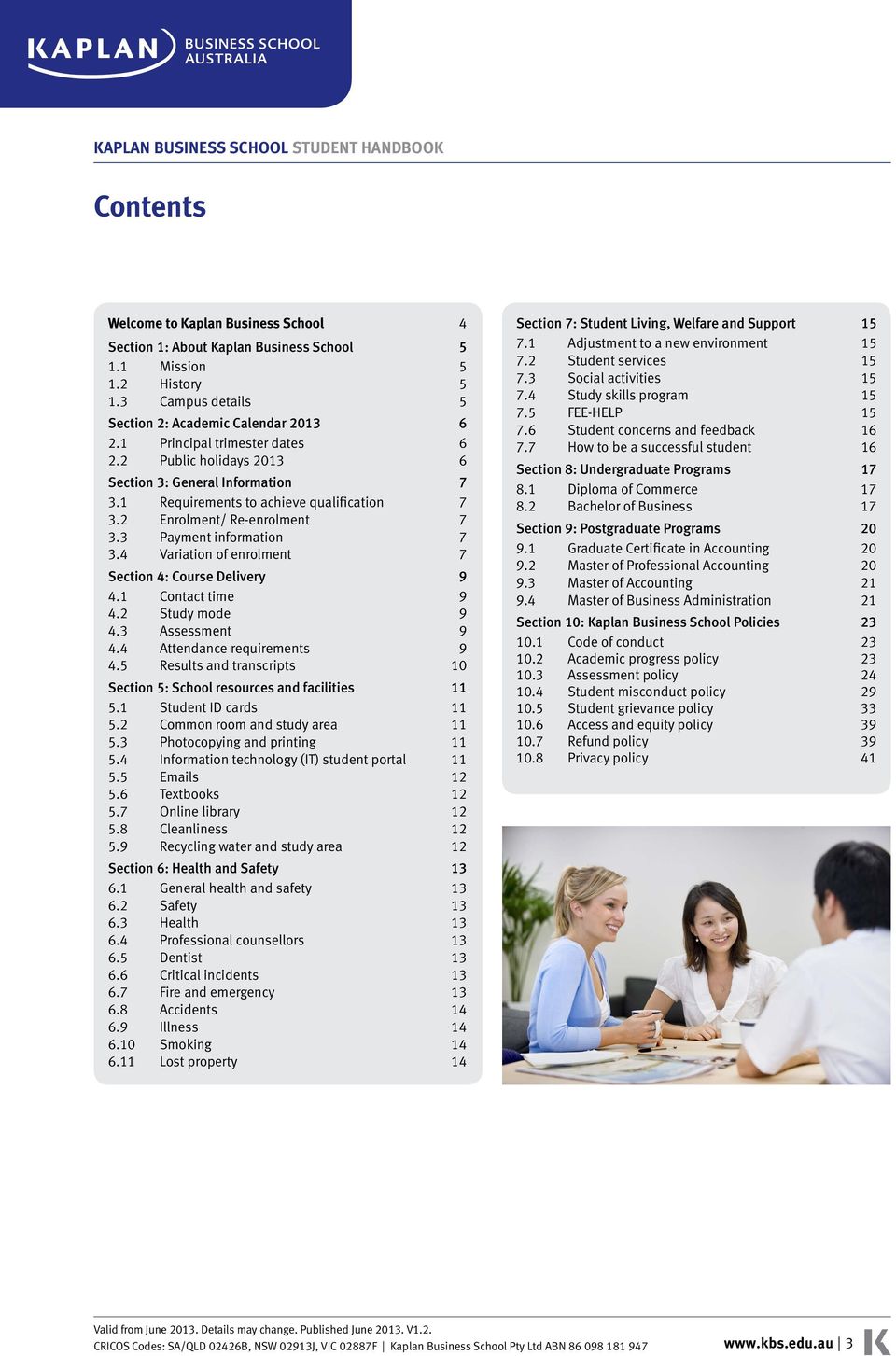
3 Kaplan Business school student Handbook Contents Welcome to Kaplan Business School 4 Section 1: About Kaplan Business School Mission History Campus details 5 Section 2: Academic Calendar Principal trimester dates Public holidays Section 3: General Information Requirements to achieve qualification Enrolment/ Re-enrolment Payment information Variation of enrolment 7 Section 4: Course Delivery Contact time Study mode Assessment Attendance requirements Results and transcripts 10 Section 5: School resources and facilities Student ID cards Common room and study area Photocopying and printing Information technology (IT) student portal s Textbooks Online library Cleanliness Recycling water and study area 12 Section 6: Health and Safety General health and safety Safety Health Professional counsellors Dentist Critical incidents Fire and emergency Accidents Illness Smoking Lost property 14 Section 7: Student Living, Welfare and Support Adjustment to a new environment Student services Social activities Study skills program FEE-HELP Student concerns and feedback How to be a successful student 16 Section 8: Undergraduate Programs Diploma of Commerce Bachelor of Business 17 Section 9: Postgraduate Programs Graduate Certificate in Accounting Master of Professional Accounting Master of Accounting Master of Business Administration 21 Section 10: Kaplan Business School Policies Code of conduct Academic progress policy Assessment policy Student misconduct policy Student grievance policy Access and equity policy Refund policy Privacy policy
4 Student Handbook Welcome Welcome to Kaplan Business School Congratulations on choosing to complete your studies with Kaplan Business School, you have made an excellent investment in your future. Before you get started, I want to highlight some reasons why you ve made the right choice, and what you can do to get the most out of your studies. Kaplan Business School is part of Kaplan Australia s education business offering undergraduate and postgraduate courses that are suitable for both domestic and international students in the areas of accounting and business. Kaplan is passionate about helping students reach their goals through quality education and Kaplan Business School has a strong customer service culture to ensure all students are given the best possible service and facilities such as study skills coaching, tutoring and English language support. Our courses are unique because they are created, written, presented and assessed by working professionals and academics who are experts in their fields, helping to bridge the gap between study and workforce. You will learn how concepts and techniques are applied in reallife work scenarios, which means you can confidently apply everything you learn immediately to your own work. Courses run through Kaplan Business School have direct links to a number of professional organisations including CPA Australia, NIA and ICAA and there is also a dedicated Career Officer to assist students. I encourage you to make the most of the opportunities for interaction with practitioners and academics and to participate as much as possible in activities as you will get more out of your studies and form important relationships with both the practitioners and your fellow students. Another reason why you have made the right choice is that we are part of Kaplan, Inc., a subsidiary of The Washington Post Company and a leading global education provider. Kaplan operates in over 30 countries throughout Asia, Europe and the Americas, and serves more than one million students each year. By studying with us you are now part of this global connection, which means that your qualification will be recognised throughout the world. Globally, Kaplan is also at the forefront of online education and has pioneered major advancements in online and mobile learning over recent years. In America alone, Kaplan University has over 50,000 students studying online. By leveraging this expertise, Kaplan Business School will continue to develop its online learning technology, delivering courses that are both innovative and flexible. State-of-the-art IT, Intranet and online facilities are available free to every student at Kaplan Business School. Finally, above all else we are dedicated to ensuring you have the best possible experience as a student. Kaplan Business School campuses are modern, contemporary and open, yet small compared to the campuses at large universities, making them easy to navigate. Our students are never far from their next class, tutor, lecturer or computer rooms. An intimate and supportive learning environment ensures that each student is given adequate attention and Student Services staff are available to you throughout your studies, whether you need advice on how to balance study with personal and career commitments, or help with deciding which subjects are right for you and your career goals. I sincerely wish you all the best with your studies, and hope you have a challenging and rewarding experience. I am confident that no matter what your goals may be, studying at Kaplan Business School will help you achieve them. Mark Falvo Director Kaplan Business School 4

5 Student handbook section 1 Section 1: About Kaplan Business School 1.1 Mission Kaplan s mission is to help individuals achieve their educational and career goals. We build futures one success story at a time. Our core values define our company culture and provide the framework for what we deliver to our customers and employees each day. These include: Integrity: We hold ourselves to the highest ethical standards in everything we do Knowledge: We offer expert resources to help you achieve your academic and career best Support: We give you the tools you need to succeed Opportunity: We open doors and broaden access to education Results: We re dedicated to helping you achieve your goals we succeed when you succeed 1.2 History Kaplan Business School Australia is part of Kaplan, Inc., a global provider of education services and courses to individuals, schools and businesses. Starting as a small test prep company in 1938 in the United States of America, Kaplan has pioneered new territory in online higher education, test preparation services and professional training with innovation and imagination. Through new technologies and a personalized approach to learning, Kaplan is opening doors to educational opportunities and inspiring people to strive for their personal best. Throughout its 70-year history, Kaplan has helped students unlock their talent by providing student-centred, outcomes-driven educational programs that help individuals reach their goals. We succeed when our students succeed. Headquarters in New York City, Kaplan is a subsidiary of The Washington Post Company. Kaplan Business School proudly inherits the experience and resources of Kaplan s 70 years as a leading provider of educational and career services and courses. In Australia, Kaplan Business School has four centrally located campuses in Adelaide, Brisbane, Melbourne and Sydney. 1.3 Campus Details Adelaide Campus Level 1, 68 Grenfell Street Adelaide SA (0) [email protected] Brisbane Campus 252 St Pauls Terrace, Spring Hill Brisbane QLD (0) [email protected] Melbourne Campus Level 4, 370 Docklands Drive, Docklands Melbourne VIC (0) [email protected] Sydney Campus Level 8, 540 George Street Sydney NSW (0) [email protected] 5
6 Student Handbook Section 2 Section 2: Academic Calendar Principal trimester dates 2.2 Public holidays 2013 Trimester 1 National Orientation 20 March - 21 March Australia day 28 January Trimester commences Enrolments close Last date to change subject selection 25 March 5 April 5 April Adelaide cup (Adelaide only) Labour day (Melbourne only) Good Friday Easter Monday 11 March 29 March 1 April Last day to withdraw without academic penalty Census date Exam period International students 5 April Domestic students 10 April 10 April 24 June - 28 June Anzac day Queen s Birthday Royal Queensland Show (Brisbane only) 25 April 10 June 14 August Supplementary exams Trimester ends 8 July - 10 July 14 June Labour day (Adelaide/Brisbane only) Melbourne cup 11 March 5 November Trimester 2 Orientation 10 July - 11 July Christmas day Boxing day 25 December 26 December Trimester commences 15 July Enrolments close 26 July Last date to change subject selection 26 July Last day to withdraw without academic penalty International students 26 July Domestic students 7 August Census date 7 August Exam period 14 October - 18 October Supplementary exams 28 October - 30 October Trimester ends 4 October Trimester 3 (Summer) Orientation Trimester commences Enrolments close Last date to change subject selection Last day to withdraw without academic penalty 6 November - 7 November 11 November 22 November 22 November International students 22 November Domestic students 6 December 6 December Census date Exam period 24 February - 28 February 2014 Supplementary exams 11 March - 13 March 2014 Trimester ends 14 February

7 Student handbook section 3 Section 3: General Information 3.1 Requirements to achieve qualification To receive an award, students are required to successfully complete all subjects of study in the qualification (course) they are enrolled in. Refer to the course structures detailed in the handbook for specific course completion requirements. 3.2 Enrolment/ Re-enrolment Students must complete a subject enrolment form prior to the commencement of each trimester and submit either to the campus representative in person or a scanned copy to your campus. 3.3 Payment information All tuition and related fees are payable directly to Kaplan Business School. All tuition fees are paid in advance each trimester with the terms set out below. Fees payable are calculated from the first trimester of enrolment and based on the student s enrolment details at the time their Letter of Offer is processed. Fees may vary from those stated on the Letter of Offer should the student for any reason extend the length of time they are enrolled at Kaplan Business School, and may be subject to increase. Ongoing trimester tuition fees are payable on the commencement of each trimester when selecting subjects for enrolment. All tuition fees are payable unless the student withdraws prior to the commencement of the course, in accordance to the refund policy. It is the responsibility of the student to purchase education materials and personal items including: textbooks, stationery, photocopying, printing, postage, telephone calls, computer supplies, a calculator and study implements. Late payment A fee of AUD250 applies for unpaid accounts after the date the payment was due. Payment difficulties Students who are suffering financial hardship and may be struggling to pay the tuition fees should schedule a meeting with the Director to discuss. Formal applications for payment plans may be made to the Finance Department. Non payment Failure to pay the trimester course fees will result in the following: access to the online learning sites will be removed access to facilities such as class rooms, computer labs and resource centres will be removed continued non-payment of fees may result in the cancellation of the course enrolment Any outstanding debts on completion of studies will result in: withholding of academic results and; students will not be permitted to graduate from the course Refunds Please refer to the Refund Policies located in section 10 of this handbook for further information. 3.4 Variation of enrolment Cancellation of enrolment by student Students wishing to cancel their enrolment in a particular subject with the intention of not re-activating their enrolment in the future must formally advise Kaplan Business School that they wish to terminate their course enrolment. The terms and conditions of the enrolment and refund policies apply to all enrolment transactions. A student s enrolment may be cancelled by Kaplan Business School when: a fee-paying student fails to pay the relevant Subject fee/s by the published deadline; or a student has been excluded or suspended because of misconduct; or a student has not met the conditions of their offer; or a student has failed to progress through the course as per the academic progress policy Cancellation of Enrolment by the School If any student disobeys School rules, the student will be issued with two warnings. If the student re-offends, the School reserves the right to expel the student and, for international students, inform the Department of Immigration and Citizenship (DIAC) that the student is no longer studying at the School. Please refer to the Student Misconduct Policy located in section 10 of this handbook for further information. Deferral and suspension of enrolment Students may defer a course that has been offered only once and this is subject to approval by the Director. Tuition and other fees may change when and if a new offer is generated. The policy of the School is to allow deferment of a formal offer until the commencement of the following intake. When a student withdraws, the refund policy applies and refunds are made depending upon the date at which a withdrawal is made. Refunds can also be made at the discretion of the School. Students accessing FEE-HELP must withdraw on or before the census date in order not to incur a debt to the Commonwealth Government. A student who wishes to transfer to another program at Kaplan Business School will only do so at the discretion of the School. Fees will be determined according to the difference in fees between the courses. 7
8 Student Handbook Section 3: General information Deferral during program of study If a current student wishes to postpone studies until a later period, and take a leave of absence from their studies, students should complete an Intermission of Studies/Deferral Request. Permission may be granted on the grounds of illness, injury or compelling personal reasons and for a maximum period of one year. Extension beyond this time period is only granted in exceptional circumstances and the application must be made in writing to the Director. Students returning to study after an approved period of leave should contact administration to confirm their re-enrolment no later than two weeks before the commencement of the program. Note: International students who decide to defer, withdraw or suspend their studies may risk having their visa cancelled by the Department of Immigration and Citizenship (DIAC). If this occurs, the student must apply for another student visa from their home country. Please refer to the Deferral, Suspension and Cancellation of Enrolment Policy for international students on the School s website at Interstate transfers Students wishing to transfer between KBS campuses must complete an Application for Campus Transfer form located on the School s website at International students may require a modified Confirmation of Enrolment based upon the change in location. Change of contact details It is absolutely essential that Kaplan is able to contact students at all times. All students must inform the School, within 7 days, if there is a change to any of the contact information provided to the School. In addition to this, it is a requirement of the Australian Government that Kaplan keeps on record the current address of all International students studying on a student visa. Students are required to give this information to the School on arrival at the start of their course and must notify the School within seven (7) days of any change of address. Many messages are sent via to students or placed on the online learning platform of the student portal. Students must regularly check the portal or their School account as important messages regarding exams, timetables and class changes are sent via this method. All written correspondence is sent to the address listed as the student s contact mailing address. Any correspondence sent to students by the School is printed on letterhead and identifies students by name and identity number. Whenever students write to the School they must include their identity number with their name and address. They must also have this ready when telephoning the School. Students must inform the administration office immediately of any change to their name, telephone number or address. The School does not accept responsibility if any official communication fails to reach students because the School has not been notified of a change of an or mailing address. Recognition of Prior Learning Students may apply for Recognition of Prior Learning for previous study or work experience where equivalent content is covered. Application forms are on the School s website under Student Forms. To do this, students must submit evidence that demonstrates they have already met the requirements of the subject through these other means. Evidence may take many forms e.g. information about approved study, information about work experience, certificates, transcripts or other credentials. Generally an exemption for a subject can be obtained via study with approved higher education providers. Relevant work experience at the appropriate level may also be included. A student may obtain exemptions for up to 50% of subjects in a course via recognition of prior learning. Exit points Some Kaplan Business School courses may offer more than one exit point. If a student is enrolled in a course that offers exit points they may be able to apply for graduation when they meet the course requirements up to that point. Any student wishing to take this option will need to contact the Academic Director in order to receive the award for the degree with which they have exited. 8
9 Student handbook section 4 Section 4: Course Delivery 4.1 Contact time Each student receives 3 contact hours per subject, per week. Students are expected to spend at least a further 8 hours per week outside of class contact time in private study. 4.2 Study mode Classes may be held as lectures, tutorials, seminars, workshops or laboratory sessions. The philosophy of the course in terms of delivery is to strike a balance between the intensive teachings that students require at this level, with the need to develop independent approaches to learning necessary for success at university. The teaching environment aims to: provide a framework for the subject of study by indicating areas of importance and key points supply a summary of essential knowledge in key areas present a particular point of view or a major concern or issue emphasise the application of knowledge by discussion, exploration and sharing of opinions on a problem, case study, example or practical exercise revise difficult material in a more detailed manner provide practice exercises provide opportunities to share and discuss solutions 4.3 Assessment Assessment is an integral part of the learning process at Kaplan Business School. And students should be familiar with the Kaplan Business School Assessment policy and other related policies. The School maintains high academic standards, which require students to be committed to their studies in order to achieve at the highest possible level. Students are expected to attempt all work allocated to them. This includes class work, homework, tests, assignments, essays, demonstrations, exams and any other academic tasks which may be set. Work may be required to be completed on an individual basis or in collaboration with other students as a group project. If students demonstrate commitment to their studies, the School will be devoted to helping them achieve academic success. Academic Misconduct Students should be familiar with the Academic Misconduct Policy and any related definitions. Kaplan Business School regards all matters of Academic Misconduct as very serious offences. Refer to the Academic Misconduct Policy located in Section 10 of this handbook. Special consideration Medical supplementary Students may receive special consideration if they demonstrate that illness, or other circumstances, substantially affected their work during a teaching period or performance in a test or other assessment. Students must submit the Application for Special Consideration to the Director within 72 hours of the missed assessment with documentary evidence (e.g. medical certificate) to support their application. If a student is ill and cannot attend their examination, they are given the opportunity to sit a supplementary examination. If a student does not provide a medical certificate they are not eligible for special consideration and will receive a Fail result for the assessment or examination. Reasonable adjustment If the School assesses (in accordance with the Disability Discrimination Act 1992) that it is unable to provide a modification or support service requested by the student, the School will contact the student and suggest a possible alternative. Students with disabilities can speak with the Student Services Manager regarding their learning and access requirements. For further information please refer to the Assessment Policy in Section 10 of this handbook. 4.4 Attendance Non-attendance or late arrival to class can be disruptive for the teachers/lecturers and other students in the class and it may also affect the student s progress. It is important that a student keep the School informed about their absence and if it is necessary for a class to be missed. Students should contact the School with reasons for absenteeism before 9:30am on the day of your absence and ensure strategies are in place to catch up on any work missed. Students are still expected to fulfil all homework requirements. The Australian Government has strict guidelines on attendance for students from overseas on student visas depending on the course being studied. Your attendance and course progress is therefore closely monitored and recorded. The Australian Government may ask to see your attendance when you apply to renew your visa. Lateness The School expects each student to arrive on time for every class to ensure maximum learning outcomes for each individual. Lateness is recorded and calculated as nonattendance. If a student is more than 10 minutes late to any lesson, the lecturer will record the student as absent and inform School management should it happen again. Holidays Students must take note of the published trimester dates and organise travel outside of these dates. Dates are published well in advance and are contained in this document. If students need to travel at any other time, approval needs to be granted by the Director. Students are permitted to take Trimester 3 as a summer study break, however students must still complete with the terms of their Confirmation of Enrolment and will be required to complete an Intermission of Studies/Deferral Request. 9

10 Student Handbook Section 4: Course delivery Census dates Domestic students accessing the FEE-HELP loan scheme must notify the School in writing on or before the census date if they wish to withdraw from the course or a subject of study. Students who withdraw after the census date will incur a debt to the Commonwealth Government. The census dates are detailed in the Academic Calendar on page 6 of this handbook. Renewal of health cover All international students are required to have current health insurance cover at all times during their study in Australia. Students should note what the expiry date is and make sure the health cover does not expire. Contact Student Services for advice on how to renew student health cover if needed. Renewal of Student Visa All international students will be required to bring in their passport and have a copy on file in the School. Your student visa has an expiry date. Note carefully what that date is and make sure that your visa does not expire without you seeking to renew it. The consequences if it expires may be very serious DO NOT LET YOUR VISA EXPIRE UNDER ANY CIRCUMSTANCES. If you need advice on how to renew your visa, see Student Services at your campus. 4.5 Results and transcripts Publication of results Students will be advised of the release date and the method by which examination results will be released. Final grades are released on the student portal at the end of trimester. Results for students with an outstanding debt to the School will be withheld pending payment in full of that debt. Academic transcripts The transcript shows all the student s results. Upon completion of the course students are issued with 3 copies of their transcript and a parchment. If at any time prior to the completion of their course students require a formal transcript of their academic record they must complete a Request for Official Transcript form available from college. Transcripts may take up to 5 business days to be produced once the form and the AUD20 fee is received. 10

11 Student handbook section 5 Section 5: School Resources and Facilities 5.1 Student ID cards Students will be issued with a student card. If a student loses their student identity card, a replacement card is available on payment of a fee. You must also report the loss to the administration office at your campus to prevent anyone else from using it. Your student ID card is not transferable to another person. Kaplan Business School students may be eligible for concession fares on admission to sports venues, entertainment centres, cultural events and tourist attractions upon presentation of their student ID card. Full-time students can use their student ID card to apply for concession fares on buses, trains, trams and ferries. Concessions may vary between campuses; the Student Services Manager in each campus will be able to provide information. 5.2 Common room and study areas The Kaplan Business School student lounge is available for students to meet and share conversation. The School is located close to the shopping district, where there are many cafés and other places to meet with friends and share a cup of coffee. Students are also able to access facilities at Kaplan Business School for heating food for lunch and storing food in refrigerators. Please be considerate of others and clean up your rubbish. It is very important that this area is kept clean and tidy for health regulations and everyone s comfort. Quiet study areas are available to students to read and study at the School. Students can also use the on-campus library/ resource room. 5.3 Photocopying and printing Students will be issued with a password to use the student photocopier on campus and allocated a photocopying/ printing quota which will enable students to print subject learning materials. It is important that you adhere to this quota and observe copyright rules. If you go over your photocopying/printing quota please see Reception. 5.4 Information Technology (IT) Student Portal Kaplan Business School offers a modern study environment with fast internet access, to meet the students study needs. All students are issued with a username and password during orientation which enables them to access the School s student Intranet (including webmail, applications) and internet. Students are expected to read and apply the School s Information Technology and Acceptable Use Policy before using the Kaplan Business School computers. It is important to note that students: do not download films or music as this is forbidden. do not eat or drink near the computers. do not unplug computers from the network point and plug in your laptops. Students have access to the online learning student portal where specific information and news regarding Kaplan Business School, your campus and your subjects of study are posted. It should be the first point of contact regarding information about your course. The Academic Director and your lecturers will use the portal to post lecture notes, assignments, exam details and other information relating to your subjects of study. To access the Student Portal: 1. Click on Internet Explorer 2. Type in the following address: elearning.kbs.edu.au 3. Enter username and password 4. Select application or link: (webmail/online library). Alternatively, students can log on through the Kaplan Business School website at Students are advised to the IT Support team ([email protected]) or see Reception if they have any questions regarding using the student portal, webmail, applications etc. The IT Support team may also provide information on software training and IT guides. 11

12 Student Handbook Section 5: School Resources and Facilities 5.5 s The following guidelines apply to student use of students should check their s at least four times per week as this is an important way in which the School will contact students with necessary information s should not be used for confidential communication. messages sent are not encrypted in any way, and hence the confidentiality of messages cannot be guaranteed students must respect other users by using appropriate behaviour and language in s. The Harassment Policy applies to all communication, including electronic messages students are discouraged from forwarding spam mail (which includes jokes, chain letters and graphics) and sending advertising on the School s system 5.6 Textbooks Students in the course are required to purchase the appropriate textbooks and equipment. You will be notified in the subject outlines exactly which texts you will be required to purchase. 5.7 Online library Kaplan Business School has three online libraries with access to an extensive range of resources such as electronic databases and indexes, journals and texts. The online library is accessed through the student portal. 5.8 Cleanliness Students must ensure that the School is kept clean at all times. This includes being responsible for cleaning up any mess made. 5.9 Recycling water and study areas At Kaplan Business School we are committed to reducing our environmental impact by recycling and conserving water and energy. You can make your contribution to the environment by following these simple rules: utilise the recycling bins* placed around the School shut down your computer when you are finished ensure you print and photocopy double-sided turn off lights when they are not needed i.e. when leaving a classroom, toilets, etc be careful not to waste water *If you are unsure about what items can be recycled or how to use the recycle bins, please ask a staff member - we are more than happy to assist. 12

13 Student handbook section 6 Section 6: Health and Safety 6.1 General health and safety Students on campus at Kaplan Business School who experience a problem which is an emergency should tell a staff member immediately. Students anywhere in Australia who experience a problem which is absolutely life threatening (e.g. someone is very badly hurt), then call: Life threatening emergency From mobile phones, even if locked For other non-urgent police assistance such as reporting a missing person or lost property, making a complaint, making general police related enquires and reporting a crime such as property theft, contact the local police station or call: New South Wales Police Force Assistance Line Victorian Police Force General Enquiries Line (03) South Australian Police Force Assistance Line Safety Students should be aware of their personal safety and security and take good care of themselves and their belongings. Students should avoid walking alone at night and remember not to leave valuables unattended. Always make sure that someone knows where you are and if possible always carry a mobile phone. 6.3 Health Students are encouraged (but not required to) report any special health needs or conditions they may have which are likely to affect your learning or wellbeing while at the School. In the event that a student may need emergency medical attention, ask the Student Services Manager the contact details of a local medical centre or hospital. Students who are unwell during class time should see either the class lecturer or a member of the administrative staff. Outside School hours, students will need to see a General Practitioner which will cost approximately AUD55. For international students a claim form along with the doctor s bill needs to be submitted to BUPA Overseas Health Cover for a refund. Students may also visit a direct billing doctor where no upfront payment will be required upon presentation of your Overseas Student Health Care Card or Medicare Card. Please see Student Services for a list of direct billing doctors, to learn more about the benefits available as part of your OSHC or for more information on medical centres, dental centres, counseling services etc. 6.5 Professional counsellors A professional counsellor can help students with personal problems which may be more serious, such as depression, severe homesickness and relationship problems. Contact Student Services and they can organise an appointment to speak with a counsellor. For urgent counseling contact: Lifeline Australia on or Kids Helpline (8-25 age group) Dentist Please see Student Services for a list of local dental practices near to your home or campus. Domestic and international students who have elected to pay for extra health cover will be able to claim a certain percentage back for dental treatment. Please check the conditions of your insurance to find out how much you can claim. 6.6 Critical incidents All critical incidents at the School must be reported to a member of the Kaplan Business School staff immediately. The staff member will consult with a senior staff member to decide what course of action to take. Critical incidents will be recorded and kept on file in the Student Services Manager s office. Critical incidents are those that are so unusual or the sights and sounds so distressing that they produce a high level of emotional reaction that may be immediate or delayed. The following events are defined as critical incidents: a robbery, sexual assault or abuse, violence or threats of violence, serious injury or death, a natural disaster or a bomb threat. If a critical incident occurs, the staff at Kaplan Business School will provide support to the students affected and will organise other professionals or departments to be involved when necessary, for example, the police, counseling service, doctors or paramedics. Students will be asked to nominate an emergency contact during enrolment. The School will contact this person if there is an emergency involving the student. Students must inform the School if their emergency contact details change. 6.7 Fire and emergency It is the responsibility of everyone at the School to follow these guidelines in the event of an emergency: assist anybody in immediate danger raise the alarm follow your lecturer s instructions follow designated escape routes and fire exits evacuate to the designated assembly area remain clear of danger area remain at the designated assembly area await further instruction from School staff 13

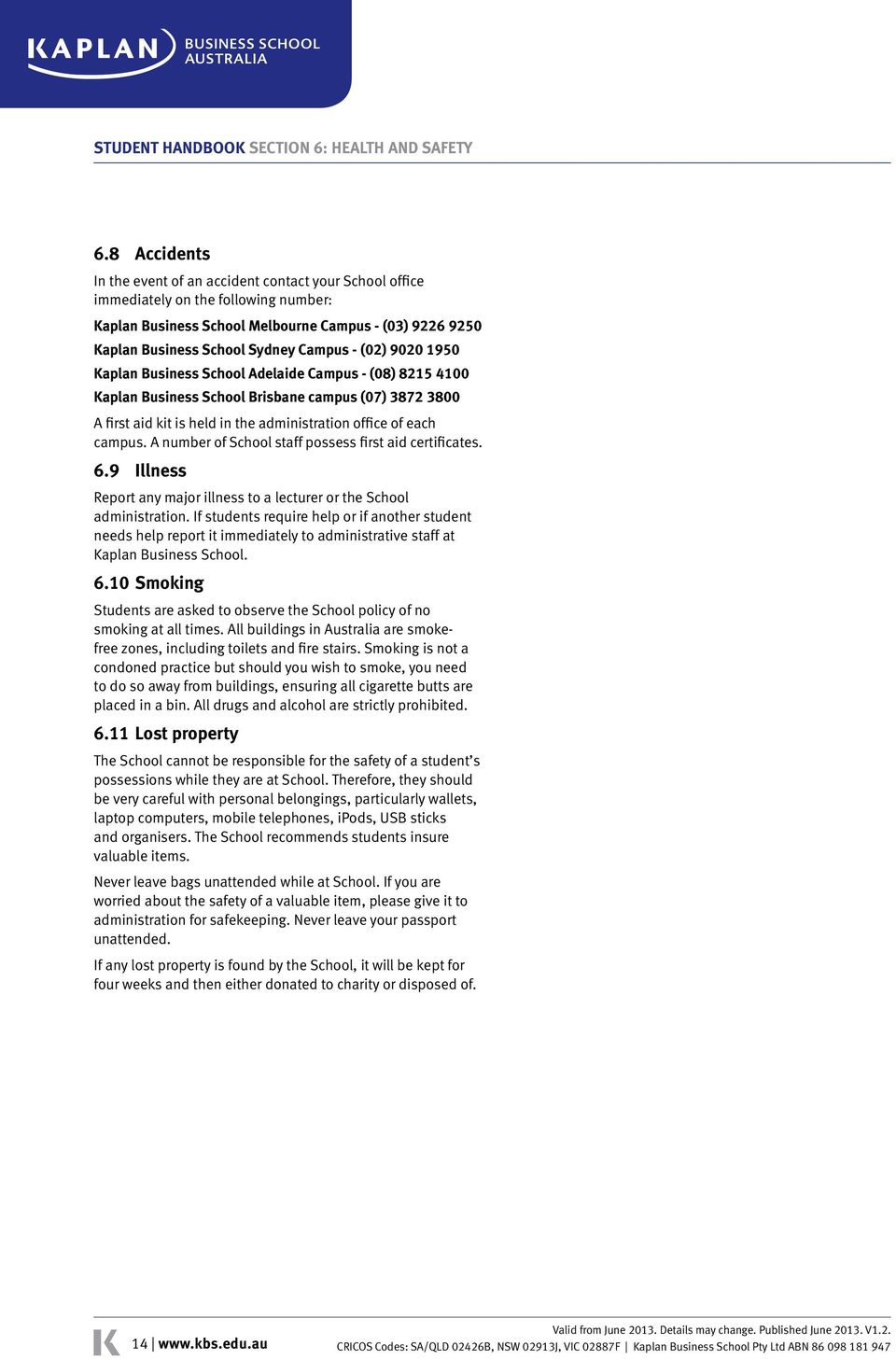
14 Student Handbook Section 6: Health and safety 6.8 Accidents In the event of an accident contact your School office immediately on the following number: Kaplan Business School Melbourne Campus - (03) Kaplan Business School Sydney Campus - (02) Kaplan Business School Adelaide Campus - (08) Kaplan Business School Brisbane campus (07) A first aid kit is held in the administration office of each campus. A number of School staff possess first aid certificates. 6.9 Illness Report any major illness to a lecturer or the School administration. If students require help or if another student needs help report it immediately to administrative staff at Kaplan Business School Smoking Students are asked to observe the School policy of no smoking at all times. All buildings in Australia are smokefree zones, including toilets and fire stairs. Smoking is not a condoned practice but should you wish to smoke, you need to do so away from buildings, ensuring all cigarette butts are placed in a bin. All drugs and alcohol are strictly prohibited Lost property The School cannot be responsible for the safety of a student s possessions while they are at School. Therefore, they should be very careful with personal belongings, particularly wallets, laptop computers, mobile telephones, ipods, USB sticks and organisers. The School recommends students insure valuable items. Never leave bags unattended while at School. If you are worried about the safety of a valuable item, please give it to administration for safekeeping. Never leave your passport unattended. If any lost property is found by the School, it will be kept for four weeks and then either donated to charity or disposed of. 14
15 Student handbook section 7 Section 7: Student Living, Welfare and Support 7.1 Adjustment to a new environment All the staff at Kaplan Business School wish to make a student s time with Kaplan as fulfilling, enjoyable and successful as possible. Kaplan s support is always available and we understand that it may take some time for international students to culturally adjust to this new environment but we are more than willing to share our knowledge of Australian customs and culture with you. Any questions are welcomed. 7.2 Student services Student Services can assist students with accommodation, overseas student health care and orientation, in addition to distributing information, general student assistance and the organisation of student activities. During orientation, students will be provided with information regarding the following: student support services legal services emergency and health services complaints and appeals processes assistance regarding any student visa course progress and attendance The Student Services staff also work toward ensuring the happiness of all students in their accommodation situations through constant management. Always feel free to contact them for help, information or advice their door is always open. Any questions are welcomed. 7.3 Social activities Kaplan Business School organises a variety of social and cultural activities for students outside of class time. Some activities are free, while others require a payment. Every student at Kaplan Business School is more than welcome to participate but the activities are not compulsory. It is entirely up to you to decide whether you wish to participate in these or not. 7.4 Study skills program Kaplan s experience tells us that many students need help with their studies throughout the year. Our Study Skills Program is designed to assist you with any problems you may have with your studies. Study Skills staff are available to help students with the following: writing and editing assignments understanding assignment questions time management and other study skills general English language assistance motivation and commitment to study general student support if you have any other problems 7.5 FEE-HELP FEE-HELP is available for Australian citizens and permanent humanitarian visa holders. Kaplan Business School has been approved as a Higher Education Provider (HEP) under section 16-50(1)(b) of the Higher Education Support Act 2003 (HESA) enabling students enrolled in the Diploma of Commerce, Bachelor of Business and Postgraduate Accounting Courses to apply for FEE-HELP The Australian Government pays the student s tuition fees to the Higher Education Provider on behalf of the student, and the student begins to repay their FEE-HELP debt to the Australian Government once their income reaches the repayment threshold. For more information refer to A loan fee of 25% applies to FEE-HELP loans for all undergraduate courses, effective January 1, Please refer to the following Commonwealth Government website: for further information regarding FEE-HELP. If you wish to withdraw from a subject of study you must do so before the census date. You will incur a FEE-HELP debt for all subjects of study in which you are enrolled after the census date. You will need to see the Director if you wish to withdraw and fill out a subject withdrawal form. 15

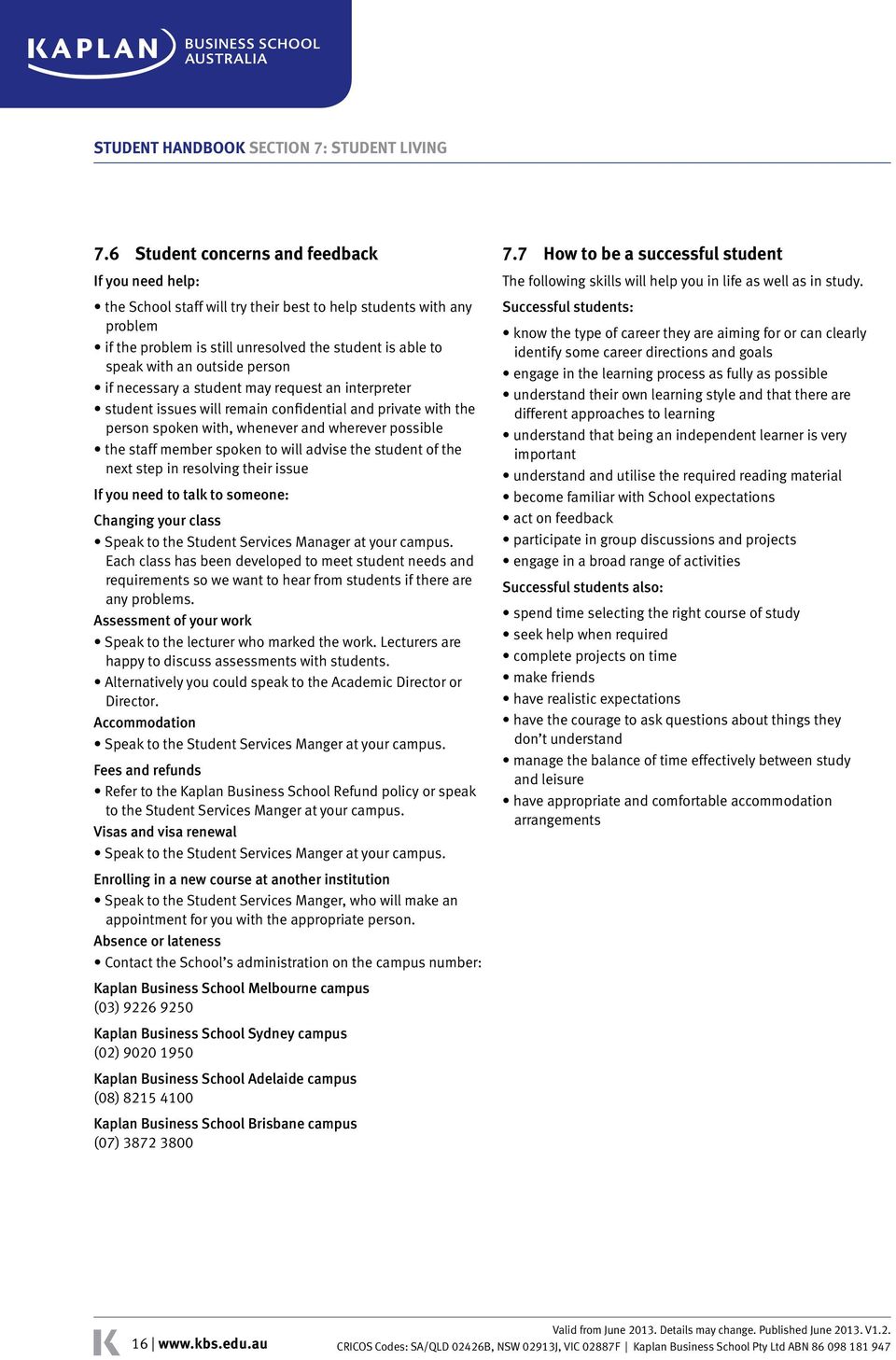
16 Student Handbook Section 7: Student Living 7.6 Student concerns and feedback If you need help: the School staff will try their best to help students with any problem if the problem is still unresolved the student is able to speak with an outside person if necessary a student may request an interpreter student issues will remain confidential and private with the person spoken with, whenever and wherever possible the staff member spoken to will advise the student of the next step in resolving their issue If you need to talk to someone: Changing your class Speak to the Student Services Manager at your campus. Each class has been developed to meet student needs and requirements so we want to hear from students if there are any problems. Assessment of your work Speak to the lecturer who marked the work. Lecturers are happy to discuss assessments with students. Alternatively you could speak to the Academic Director or Director. Accommodation Speak to the Student Services Manger at your campus. Fees and refunds Refer to the Kaplan Business School Refund policy or speak to the Student Services Manger at your campus. Visas and visa renewal Speak to the Student Services Manger at your campus. Enrolling in a new course at another institution Speak to the Student Services Manger, who will make an appointment for you with the appropriate person. Absence or lateness Contact the School s administration on the campus number: Kaplan Business School Melbourne campus (03) Kaplan Business School Sydney campus (02) Kaplan Business School Adelaide campus (08) Kaplan Business School Brisbane campus (07) How to be a successful student The following skills will help you in life as well as in study. Successful students: know the type of career they are aiming for or can clearly identify some career directions and goals engage in the learning process as fully as possible understand their own learning style and that there are different approaches to learning understand that being an independent learner is very important understand and utilise the required reading material become familiar with School expectations act on feedback participate in group discussions and projects engage in a broad range of activities Successful students also: spend time selecting the right course of study seek help when required complete projects on time make friends have realistic expectations have the courage to ask questions about things they don t understand manage the balance of time effectively between study and leisure have appropriate and comfortable accommodation arrangements 16
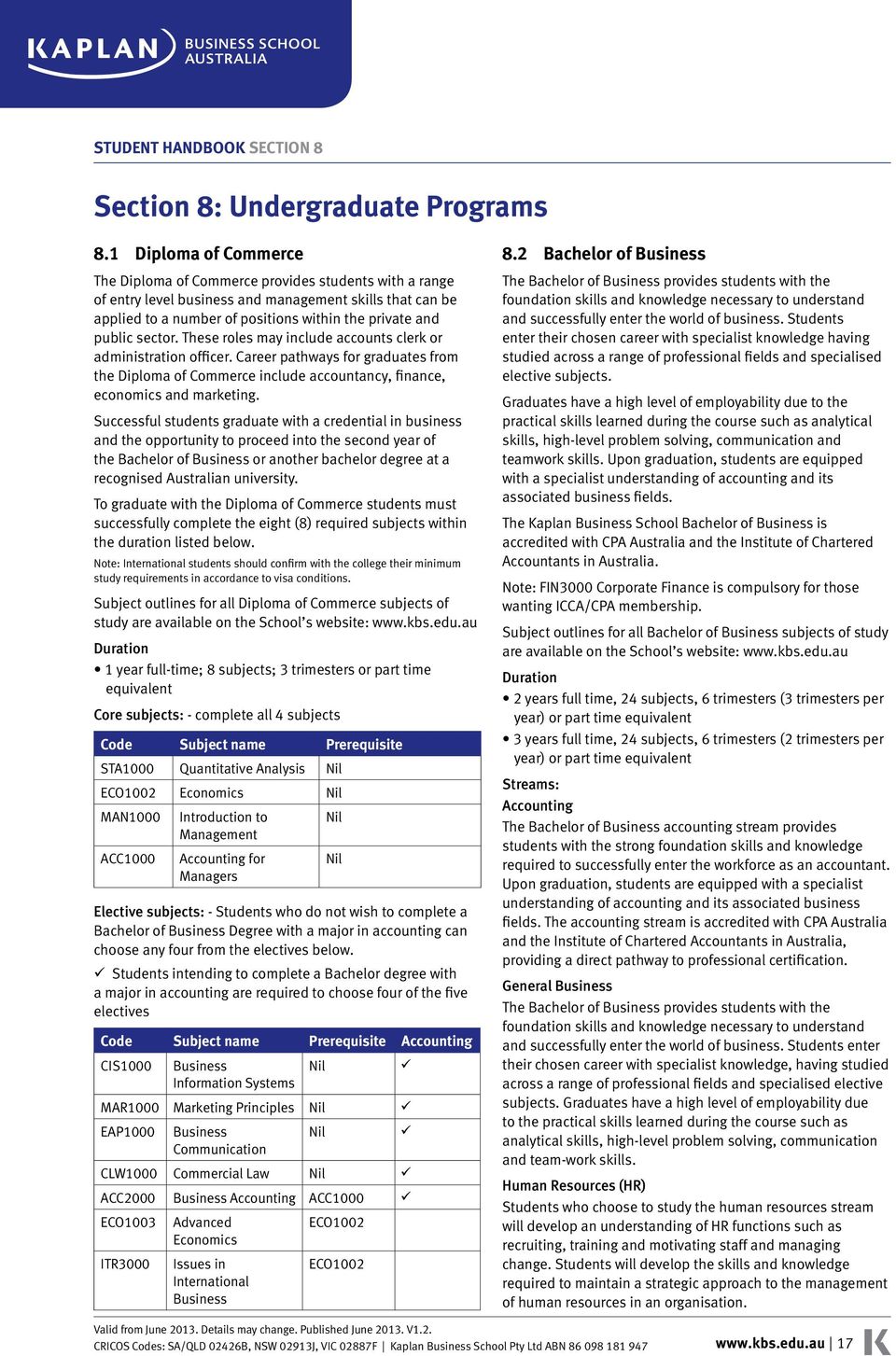
17 Student handbook section 8 Section 8: Undergraduate Programs 8.1 Diploma of Commerce The Diploma of Commerce provides students with a range of entry level business and management skills that can be applied to a number of positions within the private and public sector. These roles may include accounts clerk or administration officer. Career pathways for graduates from the Diploma of Commerce include accountancy, finance, economics and marketing. Successful students graduate with a credential in business and the opportunity to proceed into the second year of the Bachelor of Business or another bachelor degree at a recognised Australian university. To graduate with the Diploma of Commerce students must successfully complete the eight (8) required subjects within the duration listed below. Note: International students should confirm with the college their minimum study requirements in accordance to visa conditions. Subject outlines for all Diploma of Commerce subjects of study are available on the School s website: Duration 1 year full-time; 8 subjects; 3 trimesters or part time equivalent Core subjects: - complete all 4 subjects Code Subject name Prerequisite STA1000 Quantitative Analysis Nil ECO1002 Economics Nil MAN1000 Introduction to Nil Management ACC1000 Accounting for Managers Nil Elective subjects: - Students who do not wish to complete a Bachelor of Business Degree with a major in accounting can choose any four from the electives below. ü Students intending to complete a Bachelor degree with a major in accounting are required to choose four of the five electives Code Subject name Prerequisite Accounting CIS1000 Business Nil Information Systems MAR1000 Marketing Principles Nil EAP1000 Business Nil Communication CLW1000 Commercial Law Nil ACC2000 Business Accounting ACC1000 ECO1003 Advanced ECO1002 Economics ITR3000 Issues in International Business ECO Bachelor of Business The Bachelor of Business provides students with the foundation skills and knowledge necessary to understand and successfully enter the world of business. Students enter their chosen career with specialist knowledge having studied across a range of professional fields and specialised elective subjects. Graduates have a high level of employability due to the practical skills learned during the course such as analytical skills, high-level problem solving, communication and teamwork skills. Upon graduation, students are equipped with a specialist understanding of accounting and its associated business fields. The Kaplan Business School Bachelor of Business is accredited with CPA Australia and the Institute of Chartered Accountants in Australia. Note: FIN3000 Corporate Finance is compulsory for those wanting ICCA/CPA membership. Subject outlines for all Bachelor of Business subjects of study are available on the School s website: Duration 2 years full time, 24 subjects, 6 trimesters (3 trimesters per year) or part time equivalent 3 years full time, 24 subjects, 6 trimesters (2 trimesters per year) or part time equivalent Streams: Accounting The Bachelor of Business accounting stream provides students with the strong foundation skills and knowledge required to successfully enter the workforce as an accountant. Upon graduation, students are equipped with a specialist understanding of accounting and its associated business fields. The accounting stream is accredited with CPA Australia and the Institute of Chartered Accountants in Australia, providing a direct pathway to professional certification. General Business The Bachelor of Business provides students with the foundation skills and knowledge necessary to understand and successfully enter the world of business. Students enter their chosen career with specialist knowledge, having studied across a range of professional fields and specialised elective subjects. Graduates have a high level of employability due to the practical skills learned during the course such as analytical skills, high-level problem solving, communication and team-work skills. Human Resources (HR) Students who choose to study the human resources stream will develop an understanding of HR functions such as recruiting, training and motivating staff and managing change. Students will develop the skills and knowledge required to maintain a strategic approach to the management of human resources in an organisation. 17
18 Student Handbook Section 8: Undergraduate Programs Hospitality & Tourism Management The hospitality and tourism management stream has been developed based on industry demand for high quality graduates in both hospitality and tourism. This industry is very dynamic and requires graduates to be innovative and responsive to changes, as well as highly skilled within their chosen discipline. This specialism will equip students with the core business skills required to take advantage of career opportunities within global tourism industries. Structure Unit Code P: Prerequisite C: Corequisite First year Quantitative Analysis STA1000 Nil Accounting for Managers ACC1000 Nil Economics ECO1002 Nil Introduction to Management MAN1000 Nil Business Information Systems CIS1000 Nil Marketing Principles MAR1000 Nil Business Communication EAP1000 Nil Commercial Law CLW1000 Nil Introduction to Hospitality and Tourism HAT101 Nil Second year Business Accounting ACC2000 P: ACC1000 Management Accounting ACC2100 P: ACC1000 Marketing Management MAR2000 P: MAR1000 Financial Institutions & Markets FIN2000 Nil Financial Accounting ACC2200 P: ACC2000 Accounting Information Systems CIS2000 P: CIS1000, ACC1000 Organisational Behaviour MAN2000 P: MAN1000 Corporate Social Responsibility & Business Ethics MAN2100 P: MAN1000 Foundations of Human Resource Management MAN2200 P: MAN1000 The Hospitality and Tourism Market HAT201 P: HAT101 Hospitality and Tourism Management HAT202 P: HAT101 Services Marketing HAT203 P: HAT101 Attraction and Event Management HAT204 P: HAT101 C: MAN1000 Food and Beverage Management HAT205 P: HAT101 C: MAN1000 Accommodation Management HAT206 P: HAT101 C: MAN1000 Advanced Economics ECO1003 P: ECO1002 Strategic Business Management MAN2300 P: MAN1000, MAR2000 General Accounting HR Hospitality Select any 8 elective subjects Select any 5 elective subjects ü Required subject Select any 2 elective subjects 18

19 Student handbook section 8: Undergraduate Programs ü Required subject Unit Code P: Prerequisite C: Corequisite General Accounting HR Hospitality Third year Select any 8 elective subjects Select any 2 elective subjects Select any 3 elective subjects Select any 6 elective subjects Issues in International Business ITR3000 P: ECO1002 Market Research and Consumer Behaviour MAR3100 P: MAR1000 Strategic Human Resources Management MAN3000 P: MAN2200 Human Resource Development MAN3400 C: MAN2200 Employee Relations Management MAN3100 C: MAN2200 Managing Change MAN3200 P: MAN2200 Reward Management MAN3300 P: MAN2200 Corporate Governance & Regulatory Processes CGR3000 P: CLW1000 Financial Reporting ACC3000 P: ACC2200 Auditing and Assurance ACC3100 P: ACC2200, CLW1000 C: ACC3000, CIS2000 Accounting Theory and Contemporary Issues ACC3200 P: ACC2200 C: ACC3000 Corporations Law CLW3100 P: CLW1000 Taxation Law CLW3000 P: ACC2200, CLW1000 C: ACC3000 Corporate Finance* FIN3000 P: STAM4000 C: ACCM2200 Emerging Issues in Hospitality and Tourism HAT303 P: HAT101 *Corporate Finance (FIN3000) is compulsory for those wanting ICAA/CPA membership. General stream requires 16 electives total in 2nd and 3rd year. Accounting stream meets professional body entry requirements and requires 2 electives in 3rd year. HR stream requires 8 electives total in 2nd and 3rd year. Hospitality & Tourism stream requires 8 electives total in 2nd and 3rd year. 19

20 Student Handbook Section 9 Section 9: Postgraduate Programs Postgraduate course overview The Kaplan Business School postgraduate courses are designed for those from non-accounting backgrounds who wish to pursue a career in the accounting industry. They equip students with knowledge and skills in accounting and related fields to gain employment in a variety of organisations in public practice and industry. The Graduate Certificate in Accounting, Master of Professional Accounting and the Master of Accounting are accredited with CPA Australia (CPAA), The Institute of Chartered Accountants (ICAA) and National Institute of Accountants (NIA) which will enable our graduates to articulate into these prominent programs. 9.1 Graduate Certificate in Accounting The Graduate Certificate in Accounting is a four subject certificate that articulates into both the Master of Professional Accounting and the Master of Accounting. Subject outlines for all Graduate Certificate in Accounting subjects of study are available on the School s website Duration Full time: 1 trimester, Part time: 2 trimesters Structure Core subjects: - complete all 3 subjects Code Subject name Prerequisite ACCM4000 Accounting Principles Nil ECOM4000 Economics Nil STAM4000 Quantitative Methods Nil Elective subjects: - choose one from the electives below Code Subject name Prerequisite CLWM4000 Business & Corporations Law Nil EAPM4000 Professional Communication Practice Nil 9.2 Master of Professional Accounting The Master of Professional Accounting (MPA) is for students from non-accounting backgrounds who wish to pursue a career in the accounting industry. It equips students with knowledge and skills in accounting and related fields to gain employment in a variety of organisations in public practice and industry. Accredited with CPA Australia (CPA), and the Institute of Chartered Accountants (ICAA), students are able to easily articulate into these professional programs. The National Institute of Accountants (NIA) recognises that the MPA meets membership requirements for Associate status. Subject outlines for all Master of Professional Accounting subjects of study are available on the School s website Duration The recommended full-time study pattern is three subjects per trimester. Part-time study is one or two subjects per trimester, dependant on meeting the prerequisite requirement. Structure The Master of Professional Accounting CRICOS registered accounting conversion course which enables a graduate to be classified as an Accountant in conformity with the requirements of the Australian Standard Classification of Occupations (ASCO Code: ). Students complete 12 compulsory subjects Code Subject name P: Prerequisite C: Corequisite Level 1 subjects ACCM4000 Accounting Principles Nil CLWM4000 Business & Corporations Nil Law ECOM4000 Economics Nil STAM4000 Quantitative Methods Nil Level 2 subjects CISM4000 Accounting Information P: ACCM4000 Systems ACCM4100 Management Accounting P: ACCM4000 ACCM4200 Financial Accounting & P: ACCM4000 Reporting 1 Level 3 subjects ACCM4300 Financial Accounting & P: ACCM4200 Reporting 2 ACCM4400 Auditing & Assurance P: ACCM4200 C: CISM4000, ACCM4300 CLWM4100 Taxation Law P: ACCM4000, CLWM4000 C: ACCM4200 Level 4 subjects FINM4000 Finance P: STAM4000 C: ACCM4000 ACCM4600 Accounting Theory & Contemporary Issues P: ACCM4200 C: ACCM

21 Student handbook section 9: Postgraduate Programs 9.3 Master of Accounting The Master of Accounting (MACC) is a conversion course for students wishing to enter the accounting profession but have limited or no previous experience in accounting studies. The course develops business skills and leads to admission to the professional programs offered by CPA Australia and the Institute of Chartered Accountants. The National Institute of Accountants recognises that the MAS meets membership requirements for Associate status. Subject outlines for all Master of Accounting subjects of study are available on the School s website Duration The recommended full-time study pattern is three subjects per trimester. Part-time study is one or two subjects per trimester, dependant on meeting the prerequisite requirement. Structure The Master of Accounting enables a graduate to be classified as an Accountant in conformity with the requirements of the Australian Standard Classification of Occupations (ASCO Code: ). Students complete 16 compulsory subjects Code Subject name P: Prerequisite C: Corequisite Level 1 subjects ACCM4000 Accounting Principles Nil CLWM4000 Business & Corporations Law Nil ECOM4000 Economics Nil STAM4000 Quantitative Methods Nil EAPM4000 Professional Communication Nil Practice MANM4000 Introduction to Management Nil Level 2 subjects CISM4000 Accounting Information P: ACCM4000 Systems ACCM4100 Management Accounting 1 P: ACCM4000 ACCM4200 Financial Accounting & P: ACCM4000 Reporting 1 CGRM4000 Corporate Governance & P: CLWM4000 Regulatory Processes Level Three Subjects ACCM4300 Financial Accounting & P: ACCM4200 Reporting 2 ACCM4400 Auditing & Assurance P: ACCM4200 C: CISM4000, ACCM4300 CLWM4100 Taxation Law P: ACCM4000, CLWM4000 C: ACCM4200 Code Subject name P: Prerequisite C: Corequisite Level 4 subjects FINM4000 Finance P: STAM4000 C: ACCM4000 ACCM4500 Management Accounting 2 P: ACCM4100 ACCM4600 Accounting Theory & Contemporary Issues P: ACCM4200 C: ACCM Master of Business Administration The Master of Business Administration is designed to provide students with valuable practical management skills that will allow them to develop their capability to lead and inspire others in a global business environment. Subject outlines for all Master of Business Administration subjects of study are available on the School s website Duration Standard study option 2 years: 6 trimesters Accelerated Study Option This program may be completed in 4 trimesters. Ask your Kaplan representative for further information. Structure Students complete 15 subjects (12 compulsory subjects + 3 electives) Prerequisite/ Corequisite Session 1: Core units complete all GB500 Business Perspectives GB512 Business Communications Nil Nil Session 2: Core units complete all GB513 Business Analytics GB518 Financial Accounting Principles and Analysis Session 3: Core units complete all GB519 Measurement and Nil Decision Making GB520 Strategic Human Nil Resource Management Nil GB500, GB512, GB513 Total units Exit point for Graduate Certificate in Business Administration Session 4 GB530 Marketing Management GB540 Economics for Global Decision Makers GB500, GB512, GB513 GB500, GB512, GB
22 Student Handbook Section 9: Postgraduate Programs Session 5 Core units Complete all GB550 Financial Management GB580 Strategic Management Prerequisite/ Corequisite GB500, GB512, GB513 GB500, GB512, GB513 Exit point for Graduate Diploma of Business Administration Session 6 Core units Complete all GB600 Leadership Strategies GB500, GB512, GB513 2 for a Changing World GB601 MBA Capstone GB500, GB512, GB513 Session 7 Elective units Students choose 2 electives from specialisation area 2 Session 8 Elective units Students choose 1 elective from specialisation area Total units Total 15 Elective subjects Students have the opportunity to select their elective subjects from within 8 specialist management fields. The specialist management fields and their electives are: General Management Designing, Improving and Implementing Processes GB560 Managing the Value Chain GB570 Corporate Social Responsibility GB590 Entrepreneurship Entrepreneurship GB561 Small Business Administration GB562 Corporate Venturing GB564 The Entrepreneurial Lab GB565 Project Management Strategic Project Management GM591 Project Initiation, Planning and Execution GM592 Project Cost and Schedule Monitoring and Controlling GM Project Risk, Quality and Procurement Monitoring and Controlling GM594 Supply Chain Management and Logistics Supply Chain Management GM581 Inventory and Distribution Management GM582 Managing the Service Value Chain GM583 Strategic Global Logistics Management GM584 Finance Capital Markets and Investment GB521 Mergers and Acquisitions GB522 International Finance GB523 Financial Statement Analysis GB524 Health Care Management Health Care Systems GM521 Comprehensive Health Care Strategies GM522 Quality Health Care Management GM523 International Health Care Systems GM524 Human Resources Employment and Labour Law GB541 Training and Development GB542 Strategic Reward Systems GB545 Recruitment and Selection GB546 Marketing Advertising GB531 Marketing Research GB532 Sales force Management GB533 Marketing Psychology GB
23 Student handbook section 10 Section 10: Kaplan Business School Policies Please find below a range of relevant policies. For all Kaplan Business School policies and procedures, please see the School s website which also contains further information regarding the following: student grievance procedures credit transfer terms and conditions of enrolment fees and charges language, literacy and numeracy assessment code of Practice deferral, suspension or cancellation of enrolment ESOS framework 10.1 Code of Conduct Kaplan Business School is committed to maintaining high professional standards in the provision of education and training and providing a supportive educational environment in which students are encouraged to achieve a high level of academic success. Kaplan Business School is committed to high standards of professional and ethical conduct and its responsibility to students and lecturers is of paramount importance. All students and staff of the School are to treat each other with respect to observe everyone s right to work and study in an environment free from discrimination and harassment in the form of intimidation, threat and humiliation. Refer to page 20 for more information on the Harassment policy. All students and staff of the School are to treat the School property and environs with due care. To ensure appropriate conduct and behaviour at all times, students should be familiar with the School rules and regulations as set out in this handbook. Rights and responsibilities Everyone at Kaplan Business School has the right to: be provided with every opportunity for intellectual and emotional growth be treated with respect and take responsibility for treating others with respect privacy and confidentiality consistent with safety and legal responsibility feel equal and be treated with equality according to need feel safe and cared for and be free from verbal, physical, racial, sexual and emotional abuse seek and receive help, support or advice when needed Everyone at Kaplan Business School has the responsibility to: adhere to School rules and policies treat their own and other people s property with care and respect show courtesy and consideration respect others and tolerate different viewpoints and perspectives consider consequences and accept responsibility for choices monitor their own behaviour as a group member Harassment Kaplan Business School believes that the learning environment should be comfortable for all staff and students and free from any form of harassment. Harassment may take many forms including: Racial harassment unfairly disadvantages people based on negative attitudes about cultural backgrounds and physical characteristics Sexual harassment verbal or physical acts which refer to a person s sexuality or gender in an offensive or degrading manner Verbal harassment can overlap with any of the other forms of harassment, but also includes offensive language, slander, offensive notes or graffiti or telephone messages, SMS, or messages on blogs or on social networking websites about others Actions which take the form of harassment or assault or which are coercive, including those that are seemingly justified on the basis of being an initiation into, or punishment within a group, are unacceptable. Harassment is not tolerated at the School and the Director will deal with all incidents of harassment. The School will provide for anyone who feels that they are being harassed and will try to resolve the issue with both parties. If the problem persists, a formal complaint should be made to the Director and further action will be taken Academic Progress Policy The school will assess student academic progress throughout the course with assignments, tests and exams. Success in tertiary study is not possible without academic effort and the staff at KBS will be available to assist students who encounter problems with their studies. International students are required to maintain satisfactory course progress in each trimester as a condition of their student visa. An intervention strategy will be implemented for students identified by the School as not achieving satisfactory progress. Once the intervention strategy has been implemented, students who DO NOT achieve satisfactory progress in the following trimester risk being reported to the Australian Government via the Department of Education, Employment and Workplace Relations (DEEWR) reporting system and having their visa cancelled by the Department of Immigration and Citizenship (DIAC). 23
24 Student Handbook Section 10: Kaplan Business School Policies In general students are deemed to be making unsatisfactory course progress if: They fail at least 50% of their enrolled subjects of study in one trimester They fail the same subject twice They fail to meet the conditions of an intervention strategy Students at risk of not maintaining satisfactory course progress, through not submitting work, poor attendance or other indicators will be referred to the Academic Dean or Student Services Manager. Students experiencing either academic or personal difficulties will be offered appropriate assistance and support. Please refer to the complete Academic Progress Policy for more details which is located in the policy section of the School s website Assessment Policy This assessment policy applies to all courses offered by Kaplan Business School. Commencement This policy applies from June Purpose The purpose of the Assessment Policy is to: outline the principles that underpin the approach to the development and implementation of assessment for courses establish the responsibilities and obligations of the education provider and their students in relation to assessment set out the procedures, rules and regulations governing assessment The assessment process The following information provides details of the stages in the assessment process. These stages are provided to facilitate the design, development and implementation of assessment. Designing the assessment Assessment standards The following standards underpin assessment strategies. 1. Assessment will comply with the principles of fairness, equity, validity, reliability, flexibility, authenticity and sufficiency. 2. Assessment will involve the evaluation of sufficient evidence to enable judgments to be made about whether the unit learning outcomes and related course outcomes have been achieved. 3. Assessment will focus on the application of knowledge and skill to the standard of performance required in the workplace and will be aligned with the course level outcomes of a graduate. 4. Assessment will comply with the assessment requirements specified in Australian higher education courses and will lead to the issuing of a qualification and be completed in English. 5. Assessments will be validated by reference to the Assessment and Grade Ratification Working Group. 6. Students will be provided with information about the assessment process, the context and purpose of the assessment tasks, the penalties for late submission of assessment tasks and the procedures for reassessment and appeals of assessment results, at the beginning of each teaching period in the guide for the unit. 7. Formative assessment will be used to provide students with progressive feedback on their learning to enable improved performance on current or subsequent tasks. 8. Summative assessment will be used to determine a student s level of knowledge and skill progressively and at the conclusion of a unit. It certifies the attainment of a standard, and is used as the basis for progression in a course. 9. The assessment process will provide for credit transfer, recognition of prior learning and recognition of professional and, where applicable, workplace experience. Assessment events The following principles apply to assessment events: each unit will contain at least two assessment events constructed in a form and conducted in a manner appropriate to the unit and student cohort. for certain units an invigilated exam must form 50% of the total assessment to meet professional accreditation requirements. each assessment event will have a value of no more than 70% or no less than 10% of the total unit requirement. in the first units of a program, early assessment events should be used as a basis for development of early intervention programs. Variations to this general pattern may be approved by the Assessment and Grade Ratification Working Group as required, to ensure that assessment events are appropriate to the unit and the learning outcomes. Assessment instruments Assessment instruments, which may include examinations, written papers, presentations, participation etc, will be designed and developed: by the campus Lecturers, and where appropriate, in consultation with the Academic Director or Academic Dean to reflect the integration and application of skills, knowledge and attitudes required for the learning outcomes being assessed to ensure that students have an equitable opportunity to demonstrate their level of achievement in relation to the purpose of the unit 24
25 Student handbook section 10: Kaplan Business School Policies to ensure they are appropriate for the Australian Qualifications Framework (AQF) level of the course Marking guides Marking Guides will be provided for all assessment tools and will be developed and validated by the Lecturer. Marking Guides should be made available to students in the unit guide before the beginning of trimester. Conducting the assessment Supporting the student There are strategies to support students through their learning and assessment including: access to lecturing staff through lectures, tutorials and staff office hours opportunity to practise and acquire skills and knowledge through self assessment items and other resources Student advisors who can assist students with specific study needs such as special consideration, and reasonable adjustment (see below). For other learning support needs such as basic literacy, numeracy or English students may be referred to specialists in a particular area for assistance Assignments Assignments will vary in length depending on the task at hand and may be a combination of short answer, problems, case studies or essay type questions. Students are required to attach a declaration that the assignment is their work. Assignments that are submitted on time will be marked and graded according to the grading system. Students may apply for an extension in accordance with the student handbook or the unit guide but only on medical, compassionate or exceptional grounds. All such applications need to be accompanied by supporting documentation. - Lecturers have the discretion to approve extensions of up to one week in accordance with the guidelines above. - For extensions of more than one week, students will need to apply for special consideration. Details with regards to applying for special consideration are described in the special consideration section of the assessment policy. Penalties may be imposed on assignments that are submitted late in accordance with Table 1 unless approval in advance has been granted. Table 1: Penalties for submission of late assignments No. of Penalty days late 1-2 days 10% deducted from the total marks available 3-7 days 20% deducted from the total marks available 8-14 days 50% deducted from the total marks available After 14 days Assignments that are submitted more than 14 days after the due date will receive a mark of zero for the assignment(s) Assessment review and attrition It is recognized that students enrolled in designated first year units should be carefully supported, and that assessment in the first year of study should be as formative and developmental in flavour as possible, to build students academic skills and confidence. As such it is required that: lecturers should make special provisions for students in their first year of study to assist them to negotiate successfully the expectations underpinning any assessment task lecturers should make use of academic skills development staff in teaching students approaches to assessment tasks in the first year of study lecturers should monitor the assessment performance of first year students as a means of ensuring early intervention in cases where academic progress is not consistent with course expectations the Director in consultation with the National Academic Director will identify levels of attrition in units and courses and in particular in first year units. Where attrition in the unit is high as judged by the National Academic Director, the Lecturer will be required to implement specific practices to reduce attrition in that unit. These practices could include: 1. resubmitting after formal advice of any assessment task that has been given an initial grade of fail. The resubmit can only be awarded a pass or fail grade 2. mentoring of new students by senior students 3. formal peer review of students responses to assessment items prior to the due date. 4. a restriction that no first year assessment task should be worth more than 50% weighting towards a final mark 5. reviewing weighting, timing and number of assessment tasks in a unit; 6. offering supplementary exams on the recommendation of the Assessment and Grade Ratification Working Group Consultation with the academic skills development staff should be offered to any student on any key assessment task that has been given an initial grade of fail and selected by the Lecturers or Academic Dean as a resubmit 25
26 Student Handbook Section 10: Kaplan business School Policies Examinations Students can gain access to information on their examination via Exam Focus Sheets in the Student Subject Room or the Student Portal. Examinations will vary in length, and type and may be a combination of problem questions, calculation questions, case studies, short answer, essay type questions, or multiple choice questions. No examination will be longer than 3 hours for a 3 credit point unit. Students are not permitted to remove any items from the examination room. This includes exam papers, answer booklets, scrap paper, or other items that may be deemed to put the examination or future examinations at risk. Any student who breaks these rules will be subject to the penalties outlined in the Student Misconduct Policy External invigilators may be employed at exam venues to manage the examination. Information on the administration of these events will be provided to invigilators at these venues. Appropriate strategies are employed to ensure that examination papers are kept secure at all times. Assessment timetable Assessments are scheduled to ensure that a student s academic demands are taken into consideration. Details of the assessment due dates for a unit are available prior to enrolment with specific dates made known to students at the beginning of the trimester. Students with special needs or circumstances Support is provided for students with a range of needs. These are outlined below. Reasonable adjustment Reasonable adjustment is the process used to ensure that a student with documented special needs is still able to attempt the assessment requirements of a unit by modifying or adjusting the assessment without lessening the quality or demand of the assessment. The determination of reasonableness requires judgement that must take into account the impact on the organisation and the need to maintain the integrity of the unit or the learning outcome. Adjustments/assistance students receive (without compromising the academic integrity of the course) will be based on the documentation provided and discussions with the student and staff. Reasonable adjustment may include (but not be limited to): the use of adaptive technology or equipment (e.g. seating, PC) alternative methods of assessment(e.g. oral assessment) individual conditions of assessment (e.g. seating arrangements, toilet/rest/exercise breaks, bite sized food/drink) large print materials and/or coloured exam paper scribes (up to 10 minutes per hour additional time), or additional time during an examination for resting/writing (up to 10 minutes per hour) For further information refer to the Reasonable Adjustment form on the Student Portal or speak to a Student Services advisor. Special consideration and supplementary examinations Students may apply for special consideration if, through events such as serious illness, bereavement or personal trauma they are prevented from completing an assignment or sitting an examination, or if they feel their performance has been affected by the event. Applications for special consideration must be made using the special consideration form available on the Student Portal as soon as possible before the due date of the assessment (or within 72 hours after the event). Options for students as determined by the National Academic Director or nominee may include: deferring the assessment to the next trimester the unit is offered applying for a Supplementary Examination at another scheduled date completing an additional assessment item having their assessment grade or final grade adjusted, or having extra time to complete their assignment (or complete a different assignment if available) Work pressures and other personal or business commitments, unless exceptional, will not be accepted as valid reasons for special consideration. Students feeling the negative impact of these pressures should discuss their enrolment with their nominated student advisor. Records of all applications for special consideration are maintained, the basis on which the decision is made and any changes made to a student s records or results. Students may be awarded the right to sit a Supplementary Examination on Academic Grounds by the Assessment and Grade Ratification Working Group where: the student s final mark is in the range 45 to 49%, and the students has failed only one unit in the current trimester, or the unit is the last unit for a student s award. Supplementary examinations on academic grounds will normally be held. Students can receive a maximum final mark of 50% as a result of sitting a supplementary examination on academic grounds. Marking and providing feedback Marking and assessment criteria Marking an assessment will be conducted in accordance with the Marking Guides provided. Kaplan Business School uses a criterion based-referencing approach to assessment where students are assessed against a pre-determined set of criteria. 26
27 Student handbook section 10: Kaplan Business school Policies Feedback to students Constructive feedback is provided to students in a timely manner throughout the trimester and assessment process. Methods of providing feedback in the formative stages of learning may include: self-assessment exercises and learning activities throughout the unit material summaries that check a student s progress individual feedback on a student s assessment modified answer guides provided to the cohort in the form of a summary sheet Feedback following summative assessment should provide students with sufficient information to act on any identified competency or learning gaps. Internal results moderation and ratification Prior to their release, final results for a unit are reviewed by the Assessment and Grade Ratification Working Group. The group will analyse the results following completion of marking and consider any anomalies and monitor marker/ assessor variability. The Working Group may also consider individual assessment events with a value of more than 20% of the total unit requirement and the reliability of the assessment instruments employed. Based on the analysis the committee may: accept the results order a review or remark of assessment items based on marker means falling outside the acceptable range scale the assessment marks The Assessment and Grade Ratification Working Group will present its findings to the Academic Board each trimester. Provision of Assessment results Results for formative assessment events are normally available within two weeks of the event due date. Final results are generally available 4 weeks after the final assessment event due date. Students can access their results in the Student Portal via their personal ID number and password. To ensure student confidentiality and compliance with privacy legislation, assessment results will not be released over the telephone, by or to another party without the student s written permission. Students may obtain a copy of the Privacy Policy from the website. Results Pass requirements Students must make a reasonable attempt in all assessment events in order to be eligible to pass the unit and must achieve a combined result from all assessment events of at least 50% to pass the unit. If a student fails any individual piece of assessment they will be eligible to continue in the unit and attain a pass in the unit, provided their combined result from all assessment events in the unit is 50% or above. If a student fails the final examination but passes the unit overall, the Lecturer will review the student s performance and make a recommendation to the Assessment and Grade Ratification Working Group, who will determine the appropriate grade or prescribe an additional assessment prior to a final grade being determined. Assessment results Unit results on student records/transcripts will be recorded as grades and reported in the table below. Grade High Distinction (HD) Distinction (D) Mark range Comment Credit (C) Pass (P) Fail (F) 0-49 This result also applies where a student is awarded a fail in a unit as a result of misconduct. A Disciplinary fail will be recorded on the student s file and a Fail result reported on the Transcript. (See the Student Misconduct Policy available on website for further information). Absent Fail (AF) Incomplete (I) Withdrawn not fail (WNF) Withdrawn fail (WF) Exempt (E) 0 Indicates that a student did not submit or sit any assessment events for a unit and the student did not formally withdraw from the unit. Indicates that a student has not had a final grade determined because they have not completed all assessment tasks and has been granted an extension of time, or they have been granted a Supplementary Examination or additional assessment item. The grade must be finalised before the end of the following trimester. Indicates that a student has formally notified of their withdraw from the unit prior to census date. Kaplan may determine that this result is warranted after this date if the student has made out a special case based on illness or misadventure. Indicates that a student has formally notified of their withdrawal from a unit after the census date and prior to the final day of teaching in that trimester. Indicates that a student has achieved the assessment requirements for the unit through previous study or through mutual recognition. 27
28 Student Handbook Section 10: Kaplan Business School Policies Review of assessment items Policies and procedures are implemented for dealing with queries that students may have about the marking of their assessment items and any grievances and/or appeals that may result following this query. In the first instance students should contact their Lecturer if they believe that there has been: a calculation error in the totalling of marks for an assessment item or items questions, or parts of questions that have not been marked in an assessment item little or no feedback provided on the assignment (no feedback is provided for exams) The Lecturer may then complete a check of the calculations or arrange for the original or another qualified marker to complete the marking or provide feedback relative to the marks awarded. There is no fee for this service. Where a student believes their assessment item has been marked incorrectly (separate to those listed above), they may apply to have that assessment item re-marked once only. The re-mark process is outlined below: the student must submit a completed Re-mark request form available from the website, within ten (10) working days of release of the assessment results the student will be advised if the re-mark is approved an independent marker will re-mark the original assessment* submitted if the independent marker confirms that the original marking is accurate the student will be informed within fifteen (15) working days of the re-mark request and the original mark allocation will stand if the independent marker confirms that the original marking did not accurately reflect the result of the assessment item, the result will be amended. The amended mark (higher or lower) will be recorded as the final result for that assessment item. The student will be advised of the amended mark within fifteen (15) working days of the re-mark request form being received all outcomes of re-marks are approved by the Assessment and Grade Ratification Working Group or its nominated representative prior to release to students students who wish to lodge a grievance about the re-mark process (not the academic judgement used in re-marking their assessment item) should refer to the Student Grievance Policy on the website * Where the original assessment is a 100% multiple choice examination, the computer answer sheet will be manually re-marked. Guidelines for releasing student marks Students are entitled to access their final unit mark, raw and adjusted assignment mark and raw and adjusted examination mark upon submission of a request for marks form for a period of up to 12 months from the date marks are released. The release of marks does not entitle the student to contest the allocation of marks or the quality assurance processes adopted to ensure equity within and between student cohorts. Viewing examination papers Students may view their marked examination papers (paper based and computer answer sheet) under supervision up to 4 weeks after the results have been released. Requests to view examination papers should be made separately in writing to the student s local Student Services office. Students may not copy the examination paper or remove it from the premises. General information Rights and responsibilities: Student Students have a right to: be informed of all aspects of assessment policies and practices; consistent application of policies and practices; the timely return of the results with appropriate feedback; information which allows them to calibrate their performance against the criteria for each unit; review their assessment papers for the duration of the assessment retention period; have access to their student file and any other documents relating to the assessment; appeal against academic decisions made on the basis of flawed processes, during the appeal period; and be informed of mechanisms for appeal. Students have a responsibility to: behave ethically and appropriately, avoiding any action or behaviour which would unfairly disadvantage or advantage another student, or put Kaplan at risk; be aware of the rules of progression for each unit and the requirements for the award; be aware of, and abide by any Kaplan Business School s education policies available on the web site (including assessment, progression, academic misconduct and grievance); be aware of the means for seeking assistance within Kaplan Business School and to notify advisors as early as possible if difficulties arise with the timing or other requirements of assessment tasks; be aware of any requirements, including timetables, for examinations and other assessment tasks; submit assessment items on time, including a declaration that the assignment is their own work and that they are aware of the requirements relating to collusion and plagiarism; 28
29 Student handbook section 10: Kaplan Business School Policies advise Kaplan Business School of any substantial absence and be aware of the appropriate use of medical and other certificates in applications for special consideration. The provider The provider has a responsibility to ensure that: academic policies are explicit and consistently applied; assessment practices are explicit, fair, transparent and consistent across the institution and are available to staff and students; information on assessment type, weighting and due week is available to students at enrolment; resources are available to provide staff with access to information and expertise on the theory and practice of assessment; formative and summative feedback is available to students in a timely manner; assessment tasks reflect the relevant learning outcomes of the unit, the outcomes of the course and the generic attributes of graduates, as appropriate to the academic level of the students; examination scripts and other forms of summative assessment are held for the mandated script retention period and appeal period for review by students; any scaling or adjusting of marks is undertaken with appropriate strategies; staff have the opportunity to evaluate their own performance based on agreed standards and other methods of feedback; student s privacy is maintained in relation to any matters relating to assessment; staff do not discuss results or disclose personal information about students to anyone who does not have a legitimate right and need to have access to the information in order to carry out their duties Related policies This policy should be read in conjunction with the following related Kaplan policies and documents: Code of Practice Privacy Policy Student Grievance Policy Access and Equity Policy Student Misconduct Policy Terms and Conditions of Enrolment Students may obtain a copy of Kaplan Business School s policies and documents from Kaplan Business School s website. Responsible Officer The responsible officer for the implementation and relevant training of this policy is the Manager, Education Design and Governance Student Misconduct Policy Commencement This policy is effective from 18 July 2011 Purpose This policy applies to alleged and confirmed acts of misconduct, both academic and non academic, by students enrolled in award courses. The purpose of the Student Misconduct Policy is to provide: a fair, equitable and confidential framework and process for investigating and resolving alleged cases of student misconduct a set of principles to underpin the investigation process a set of procedures for dealing with confirmed acts of misconduct by students Definitions Act of Misconduct An Act of Misconduct refers to non-academic or academic misconduct by a student of Kaplan Business School. Academic Misconduct Academic misconduct refers to any form of dishonesty by a student related to the delivery of course material or assessment. It includes, but is not limited to: any attempt by a student to submit work for an assessment that is not their own any form of collusion between students or other individuals other than authorised collaboration any act that may impair or hinder the learning or assessment performance of others any action which is contrary to the study and assessment instructions given by Kaplan Business School any action by which an unfair advantage is sought or gained in relation to any work (or part of work) submitted for assessment and may include: taking material into an examination contrary to the instructions for that examination; or being in possession of material which might be used to convey information about the subject under examination; acting dishonestly in any way, assisting or attempting to assist any other student to act dishonestly in relation to an assessment or part of an assessment interfering with the orderly conduct of any examination, lecture, tutorial, discussion forum or other teaching class the removal or attempted removal (either physical or electronic) of examination materials from the examination environment 29
30 Student Handbook Section 10: Kaplan Business School Policies Non-academic misconduct Non-academic misconduct is any action or conduct by a student relating to people or property, which is contrary to the generally accepted standards expected by Kaplan Business School. Non-academic misconduct may include a student: submitting fraudulent documents to gain admission to a Kaplan Business School unit or course behaving inappropriately in an activity under the administration or supervision of Kaplan Business School placing other students or staff in a potential threat to their own health and safety altering or defacing any document or record belonging to Kaplan Business School misusing, stealing, destroying or damaging any property (including computer and communications facilities) of Kaplan Business School, a staff member or another student wilfully disobeying or disregarding any order, direction, rule or condition made by Kaplan Business School failing to comply with any condition or penalty imposed for student misconduct under this policy interfering with the freedom of others to pursue their studies or for staff to carry out their work related functions at Kaplan Business School harassing or intimidating another student or staff member because of race, ethnic or national origin, sex, marital status, sexual preference, disability, age, religious beliefs or political conviction or for any other reason, and unreasonably prejudicing or undermining the reputation, academic standing, authority, integrity or credibility of Kaplan Business School, its representatives, its courses or means of assessment Appeal process The appeal process is a process whereby a student may dispute the determination of a grievance or penalty in relation to an Act of Misconduct. Appeals Subcommittee The Appeals Subcommittee is the independent body which hears an appeal made by a student in relation to a determination of a grievance or penalty in relation to an Act of Misconduct. Collaboration Collaboration refers to authorised methods of cooperative work between students and may include: discussion about a subject and/or its materials, or an approach to an assessment task work produced with other students as part of a group exercise or assignment, with acknowledgement of the source and methods used work which incorporates or is based on templates or examples provided by Kaplan Business School, with acknowledgement of the source and methods used. Collaboration is a desired outcome of education because it supports interactivity and the cross-flow of ideas and knowledge. Collusion Collusion occurs when students work together in an attempt to gain an unfair advantage in the gaining of a Qualification or academic credit towards these. Collusion is considered contrary to authorised assessment preparation approaches and includes the following methods of work which are not authorised: joint effort in an assessment (unless it is part of authorised collaboration as defined above) copying of material prepared by another person for use in an assessment assistance from another person, not necessarily another student, in an assessment making assessment answers or material available to other students for viewing or copying, either knowingly or unknowingly. It is the responsibility of students to ensure their assessment material is secure and not easily accessible to other students. Disciplinary fail The result code disciplinary fail may be imposed for students as a penalty for academic misconduct. A disciplinary fail will be recorded internally on the student s record and a fail result will be recorded on any public record relating to that assessment event or subject. A student who receives more than one disciplinary fail during the course of their studies may be suspended or excluded from studying at Kaplan Business School for a determined period of time. Plagiarism Plagiarism refers to: any use of or attempt to use the work, words or ideas of others without attribution of the author, or any attempt to pass off the work, words or ideas of others as the writer s own In the context of an assessment, plagiarism occurs when a student: presents any phrase or extracts verbatim from any source (including Kaplan Business School subject material), without appropriate use of quotation marks or reference to the author presents an assessment event as their own work when it has been produced, in whole or part with other people, for example, with other students, practitioners or work colleagues without appropriate recognition presents all or part of an assessment event which has previously been submitted by another student (past or present) in their assessment Such acts are considered to be plagiarism whether they occur intentionally or carelessly. 30
31 Student Handbook Section 10: Kaplan Business School Policies Principles 1. Each case of alleged misconduct is dealt with on its merits, in consideration of the circumstances surrounding the case and in accordance with this policy. 2. Students will be treated fairly and equitably and with due regard to their privacy and the principles of natural justice and procedural fairness. 3. Students will be regarded as not having committed the alleged Act of Misconduct unless they admit to the misconduct, or an investigation/hearing determines that they committed an Act of Misconduct. 4. Knowledge of a student s previous behaviour will not be assumed to be evidence that they have acted in the same manner again. Such knowledge, however, may be considered relevant to the level of penalty that may be imposed. 5. Students are to be informed of their rights and responsibilities in relation to academic misconduct and its investigation. Guidelines for alleged cases of misconduct Stage 1: Alleged Act of Misconduct reported Where a staff member, marker or other approved individual reasonably believe or suspect that an Act of Misconduct by a student has occurred, or may have occurred, that person must submit a Report of Alleged Act of Misconduct (Please ask at reception for the appropriate form) to the Director within two (2) working days of the matter being detected. Confidentiality is to be maintained by all parties in this process. Stage 2: Investigation An investigation of the allegation will be conducted by the Academic Director or their representative. The investigation will take no longer than five (5) working days and may involve an interview with the student or other relevant parties to discuss the allegations and the evidence presented. Should an interview take place with the student, they are entitled to be supported by another person, but the student must advise the name of the support person prior to the interview. Where the investigation relates to assessment results, these will be withheld until all proceedings relevant to the allegation have been finalised. No misconduct identified Where it is determined that there is no case of misconduct the student will be notified in writing of the outcome of the investigation within (5) working days of the conclusion of the investigation, and where relevant, assessment results will be released. Misconduct identified Where it is determined that a case of misconduct has occurred the student will be notified in writing of the outcome of the investigation within (5) working days of the conclusion of the investigation and any penalty that is to be imposed. The student will also receive details on the appeals process. Note: Any overseas student who is suspended or excluded due to an Act of Misconduct will be reported to the Department of Immigration and Citizenship (DIAC) through the Department of Education, Employment and Workplace Relations (DEEWR) reporting system. Misconduct cannot be resolved or established Where a determination is unable to be reached after investigation the matter will be referred to a Review Panel. See Stage 4 Hearing of misconduct by Review Panel. Admission of misconduct by a student If, at any time during the process of the investigation the student concerned formally admits to the alleged Act of Misconduct, then all further investigation, hearing or referral of the allegation ceases. A determination will then be made as to an appropriate penalty. See Stage 3 - Determination of penalty. Stage 3: Determination of penalty Penalties imposed are to be appropriate to the nature and gravity of the Act of Misconduct established by the evidence. The decision on the penalty will take into account, but is not limited to: the type of misconduct involved, whether academic or nonacademic the previous discipline record of the student concerned whether the student admitted to the alleged misconduct whether the student assisted or hindered the investigation process whether or not there were any extenuating circumstances or mitigating factors the number of students affected by or involved in the misconduct the benefit derived from the misconduct by the student any other similar cases of student disciplinary and their outcomes Penalties for proven Acts of Misconduct One or more of the following penalties may be imposed on the student: a formal caution or reprimand, to be recorded on the student s record a deduction of all or a specific number of marks for the assessment event/item (or part thereof) the imposition of a maximum allowable grade (i.e. Pass grade) for the assessment item or subject a requirement to undertake a supplementary assessment or assessment items with the costs associated with marking and evaluating the additional assessment item to be borne by the student the annulment of all marks and the awarding of a Disciplinary fail on the student s record, and as a Fail grade on any public record relating to that assessment item or subject the exclusion of the student from courses permanently or suspension for a period of time 31
32 Student Handbook Section 10: Kaplan Business School Policies to make good any damage caused by the student to the property, performance or standing of the institution, a staff member or another student Stage 4: Hearing of matter by Review Panel If a misconduct matter cannot be resolved after investigation, a Review Panel will be convened to hear the case of alleged misconduct within seven (7) working days of the student being informed that the matter cannot be resolved. The Review Panel will consist of the Vice President, Higher Education or nominee, an external independent person nominated by the Director where the incident took place, and the Director where the incident took place who will chair the panel. The Review Panel will determine the conduct of investigations into the alleged Act of Misconduct, and determine the procedures to be adopted at a hearing, consistent with general principles of procedural fairness. Notice of misconduct hearing Students will be provided with: details of the hearing including the procedures to be followed by the Review Panel at the hearing details relating to the alleged Act of Misconduct notification that the student should attend the hearing in person (unless this is not feasible due to geographic, or other reasons) and to contact the College office if they cannot attend the hearing. notification that, if desired, the student may have one support person attend the hearing any other information that the Panel deems necessary to provide. notification that the student has five (5) working days after receipt of the Notice of Misconduct Hearing to make any queries or objections in relation to the hearing or composition of the Panel Student s confirmation The student will be required to return a Confirmation of Receipt of Hearing Notice (Appendix B) confirming their attendance at the hearing. Failure to confirm their attendance/non attendance at least two (2) working days prior to the hearing day will result in an automatic disciplinary fail in the assessment. Conduct of the hearing The Review Panel will review all evidence presented and may make inquiries as it thinks fit prior to and during the hearing. The student and institution will be entitled to provide any evidence, present a defence, correct any information and explain their conduct and any mitigating factors or extenuating circumstances relevant to the allegation. The Review Panel may also call on a person to give evidence or examine or cross-examine any person giving evidence at the hearing when reasonably necessary to do so. The hearing will be minuted and may be referred to by the Panel members or the student during the hearing and/or during any deliberations. The minutes may also be referred to by the Appeals Subcommittee in the event of an appeal by the student against the Panel s decision. The Panel must determine whether or not an Act of Misconduct has occurred and whether or not the student concerned committed that act and will also submit a written report to the relevant General Manager containing the findings and recommendations of the Panel for the record and for any further action required, within three (3) working days of the Panel completing its investigation. Stage 5: Appeals process Right to appeal Any student subject to a determination or penalty in relation to an Act of Misconduct is entitled to appeal to the Assessment and Grade Ratification Working Group against the determination made or the penalty imposed. If a student wishes to appeal against a determination, they must lodge a written Notice of Appeal. Please see the Student Grievance Policy for more information on the Appeal Process and any forms. Documentation The details relating to allegations of Acts of misconduct, both academic and non academic must be documented in writing and recorded on file in the relevant College office and, where appropriate, in the students individual file. All records of the alleged Act of Misconduct will be retained on file for a period of five years, or for the period of the student s enrolment. Related policies This policy should be read in conjunction with the following related policies and documents: Code of Practice Assessment Policy Access and Equity Policy Complaints and Appeals Policy Privacy Policy Terms and Conditions of Enrolment For further information on Kaplan s policies and documents please refer to the Kaplan Business School from the website Responsible Officer The responsible officer for the implementation and relevant training of this policy is the Vice President Academic, Kaplan Asia Pacific. 32
33 Student Handbook Section 10: Kaplan Business School Policies 10.5 Student Grievance Policy General principles Grievances will be addressed based on their particular circumstances however the following general principles will also be adhered to: All grievances will be made and dealt with in a timely manner according to the grievance policy. Resolution of a grievance may be reached at any stage. Upon resolution all further investigation ceases, unless, in the interests of improving the services, products or processes the manager involved in the investigation and resolution considers further investigation is warranted. Details of the grievance, its investigation and outcome will be documented and filed appropriately and can be requested at any stage of the process by the complainant or respondent. In the event of a grievance not being resolved internally, Kaplan and the complainant may appoint an independent arbiter to review the grievances and recommend a solution through the auspices of ACPET (Australian Council for Private Education and Training). Complainants have a right to appeal if they believe their grievance has not been adequately resolved. All grievances by students, parents or prospective students are dealt with free of charge. The complainant and respondent will not be victimised or discriminated against in any manner and all details of the grievance and subsequent investigation will remain strictly confidential. The complainant is entitled to ask for assistance in the form of a translator/ interpreter at any time during the process. The complainant and respondent may bring one person (such as a friend, family member, counsellor or other support person) to represent/support them to any meetings during the grievance process. Students will continue their studies as usual during the grievance procedure, except in circumstances where their health or safety is potentially at risk or if they pose a health or safety risk to others. For overseas students studying in Australia where the grievance relates to them being excluded from a Kaplan course due to not completing their course in the required time frame, or not making satisfactory course progress, the student will be notified in writing that they will be reported to the Department of Industry, Innovation, Science, Research and Tertiary Education (DIISRTE) for failing to achieve satisfactory course progress and this may result in DIAC (Department of Immigration and Citizenship) cancelling their student visa. The student will be informed that they have 20 working days to access the Grievance policy and appeals process. Scope This policy is applicable to the following Kaplan Higher Education Businesses: Kaplan Higher Education Pty Ltd t/a; - Kaplan Business School Definitions Appeal process The appeal process is a process whereby a Student may dispute the outcome of a determination of a grievance. Appeals committee The Appeals Committee (a committee of the Academic Committee) is the independent body which hears an appeal made by a student in relation to a determination of: a grievance, or the Misconduct Review Panel or Academic Directors on an allegation of an act of misconduct or other matters Appropriate manager Undergraduate and postgraduate studies Non academic matters Campus matters Director National Academic Director Student Services Manager Student Services Manager Complaints An expression of dissatisfaction with the organisation s procedures, charges, employees, agents or quality of service. Informal complaints may be made verbally either in person or over the telephone. Formal complaints must be made in writing by mail, fax or . Exceptional circumstances A non typical occurrence that happens beyond a person s control. Grievance A grievance is a complaint made by a student* (hereafter referenced as the complainant) about an issue related to a Kaplan qualification or an individual associated with Kaplan which requires a resolution. All students enrolled, or seeking to enrol, in Kaplan courses are entitled to access the grievance process. Activities which may give rise to academic and non-academic grievances covered by this policy include: student services and their processes (including contractor or employee conduct) subject enrolment, delivery, assessment, learning environment, outcomes or progression individuals who believe they have been treated unfairly on the grounds of access and equity occupational health and safety concerns related to subject delivery and/or assessment *In some cases this may also include parents, prospective students or other relevant parties. 33
34 Student Handbook Section 10: Kaplan Business School Policies Operations of KBS which may give rise to grievances covered by the policy include: Academic Grievances Academic programs (content or structure) Subject delivery or outcomes The learning environment Methods of assessment Access to resources. Non-Academic Grievances Student service Contractor or employee conduct Individuals who believe that they have been treated unfairly on the grounds of access and equity Occupational health and safety concerns Administrative action/inaction, procedure or decision Students - Students means students enrolled in KBS courses. Grievance process Stage 1: Alleged Act of Misconduct reported In the first instance, issues relating to the complaint should be raised informally with the relevant staff member concerned (e.g. lecturer/adviser). If this is not possible or if the complaint cannot be resolved the student should contact a Student Manager/Academic Advisor to try and resolve the matter. If the student then believes their grievance has not been adequately resolved the student may lodge a written grievance. Stage 2: Submitting a written grievance All written grievances must be submitted within 14 days of the incident. Additionally all assessment grievances must be submitted within 14 days of the release of results. Using Appendix A complainants must include: the subject/program and trimester/study period a summary of the issues relating to the complaint and why they are lodging a grievance a brief summary of any informal processes that have already occurred to manage the grievance provision of any new evidence s, examples, dates, times etc. Stage 3: Investigating the complaint/grievance The complainant will receive written confirmation within 48 hours that their written grievance has been received and it will be recorded on Kaplan s Grievance Register. Grievances are investigated and resolved by the relevant Manager who may call on relevant staff as required. The investigation of grievances may involve reviewing procedures, course materials, assessments and/or evaluations and may involve speaking to relevant staff or students. The manager may also arrange a formal meeting with the complainant/s involved in the grievance. Stage 4: Resolution of grievance Once the investigation has been conducted and a determination made, the student will receive a written response to their complaint within ten (10) working days of the decision being made and any implementation required following the decision. Appropriate staff responsible for the implementation will also be notified. If Kaplan receives no communication from the complainant within ten (10) working days of them receiving its response, the complaint will be considered closed except in exceptional circumstances. 34
35 Student Handbook Section 10: Kaplan Business School Policies Grievance Process Stage 1 Informal complaint received by Kaplan Resolution Stage 2 YES No further action NO Formal written complaint lodged Stage 3 NO Investigation of the complaint by the appropriate manager Stage 4 Resolution YES Action in response to complaint agreed and notification sent to student NO Follow Appeals Process Documentation related to complaint completed and actions to resolve complaint implemented 35
36 Student Handbook Section 10: Kaplan Business School Policies Appeals process Stage 1: Submitting an appeal Right to appeal Any complainant subject to a determination in relation to a grievance, who believes that they have grounds for appeal, is entitled to appeal that determination to the Appeals Committee. Notice of appeal The complainant must lodge a written Notice of Appeal (Ask for the Student Grievance form from reception) within ten (10) working days of the determination being made. There is no cost incurred for the complainant during the appeals process and parties will not be discriminated or victimised during the grievance process. The appeal must set out the grounds of the appeal and provide any evidence supporting the grounds of the appeal or any new information not previously provided in support of the complaint. Grounds of appeal An appeal of a determination may be made on one or more of the following grounds: that new evidence of a relevant nature is available that the decision was made without due consideration of the facts, evidence or circumstances that there was bias, prejudice or a conflict of interest by the investigative or hearing body, or that some significant policy/procedural irregularity occurred in the investigative or hearing process Students may not Appeal against Academic Results based on: the subject structure and assessment methods; student workload or the amount of work the student has done; financial implications of not passing the unit; grades received by the student in other units; a penalty imposed for plagiarism in accordance with Kaplan Policy; the need for additional marks to enable a pass/better grade; Stage 2: Investigation of appeal Formation of the Appeals Subcommittee In collaboration with the relevant Manager, the Chair of the Academic Committee will appoint the Appeals Subcommittee. It will comprise at least three (3) members of the Academic Committee and must not include any member who has: a personal involvement or connection with the student, or with the matters to be heard, or been involved in any activity that has or could potentially lead to bias, prejudice or a conflict of interest or would lead a reasonable person to conclude a bias, prejudice or conflict of interest in relation to the grievance. The Chair may also appoint a non-voting secretary to the Appeals Committee to keep a confidential record of the Appeals Committee hearing Duties of the Chair of the Appeals Subcommittee On receiving the appeal application, the Chair of the Appeals Subcommittee will review the application and determine whether to hear or dismiss the application. Where an appeal application is dismissed, complainants will receive written notification within five (5) days of the decision and informed of further appeal avenues (see reception for the appropriate form). If the Chair decides to hear the appeal, a meeting of the Appeals Subcommittee will be convened not more than ten (10) working days after receiving the Notice of Appeal. Duties and powers of the Appeals Subcommittee If the Appeals Subcommittee is convened it has the power to hear the appeal and review, uphold, dismiss or vary the determination of the grievance. Stage 3: Appeal hearing The Appeals Subcommittee will determine and communicate the order of proceedings and consider all documentation submitted in connection with the appeal (including evidence tendered during the hearing) by the student or Kaplan. Proceedings may include, but not be limited to, presentation of information by the student and the nominated Kaplan representative and/or witnesses and further cross examination of that information by the Appeals Subcommittee. Both the complainant and/or the respondent may be accompanied or assisted by a third party if so desired. Both parties may not appoint a legal representative to represent them at the appeal hearing. The Appeals Subcommittee may adjourn at any time during the appeal hearing to consider any matter it deems relevant. Stage 4: Resolution of appeal Appeals Subcommittee decision At the completion of the hearing, the Appeals Subcommittee must decide within ten (10) working days whether to uphold or deny the appeal and to communicate this in writing to the complainant and the respondent with any recommended actions. The complainant can withdraw their complaint at any stage in the process. If the complainant does this no further appeals will be accepted. The grievance will be deemed resolved. Upon upholding an appeal of a complaint, the Appeals Committee may determine what action is to occur. Where the Appeals Committee does not uphold (dismisses) an appeal, the original determination is confirmed and may be processed along with any recommendation originally made. The proceedings and decision of an appeal will be kept confidential, subject to the operation of law. A student may request access to records of the hearing and reasons for the determination. A decision of the Appeals Subcommittee is final and binding on all parties. The complainant may pursue relevant action available to them under Commonwealth or State legislation. Please ask reception for the full policy and for a list of relevant authorities.
37 Student Handbook Section 10: Kaplan Business School Policies Appeals Process Stage 1 Submit an Appeal Stage 2 Appeals subcommittee formed Chair of Appeals subcommittee reviews appeal Appeal application granted Appeal application dismissed Stage 3 Appeal hearing Written notification sent to student Stage 4 Appeal upheld Appeal not upheld No further action taken Determination made Written notification to student 37
38 Student Handbook Section 10: Kaplan Business School Policies External independent review If the Complainant wishes to appeal the decision of the appeals subcommittee, the complainant will have 20 days from the date of the letter (i.e. subcommittee s decision) to request an external review through ACPET (domestic students) and the Overseas Student Ombudsman (for overseas students). For further information please see If the complainant is dissatisfied with the outcome of the decision of the Appeals Committee the complainant may request an independent external review of the decision. This can only be entertained after the internal appeals process has been completed. The appeal should outline the reasons for appealing the decision and be directed to ACPET. ACPET is the Australian Council for Private Education and Training. Kaplan is a member of ACPET and has engaged ACPET to organise an independent reviewer. Students must complete the ACPET application form and pay a fee of AUD200. For more information please refer to appeals On receipt of the notice ACPET will administer the external review process. ACPET will organise a panel of independent reviewers to review the application. ACPET will notify Kaplan that an appeal has been submitted. The complainant and the designated representative of Kaplan is requested by ACPET to provide documents relating to the complaint within 14 days. ACPET will forward these to the external reviewer. The external reviewer will review all documentation and will make a recommendation. The external reviewer will include the decision and the reasons for the decision. No further appeals will be accepted and any actions intended in the previous correspondence will be completed. The parties will agree to be bound by the independent mediators recommendations and Kaplan will ensure that any recommendations arising from the decision will be implemented within 30 working days of the receipt of the decision by ACPET. At any part in the complaints process the complainant can refer the matter to an external agency (see Appendix C for further details). Documentation for grievances and appeals Where a complainant lodges a formal grievance or appeal they must be advised of: the receipt of the grievance or appeal by Kaplan and any proposed action to be taken the outcome of the grievance or appeal and any further avenues for appeal available All records relating to the grievance and/or appeal will be recorded on the complainants record and maintained for a minimum of 5 years to allow both parties access to these records upon written request. All records are considered confidential and will be covered by Kaplan s privacy policy. Related policies This Policy should be read in conjunction with the following Kaplan policies: Kaplan s Access and Equity Policy Kaplan s Assessment Policy Kaplan s Student Misconduct Policy. Responsible Officer The responsible officer for the implementation and relevant training of this policy is the Vice President Academic, Kaplan Asia Pacific. 38
39 Student Handbook Section 10: Kaplan Business School Policies 10.6 Access and Equity Policy Purpose This policy relates to the provision of all education and support services by Kaplan Business School to students. All staff and contractors employed or engaged by Kaplan are expected to comply with this policy. Kaplan strives to provide its current and future students with conditions of access to and participation in higher education that enables them to have an equal opportunity to succeed. Kaplan does not discriminate against people on the basis of age, race, colour, religion, ancestry, national origin, age, gender, sexual orientation, marital status, veteran status or physical or intellectual disability in the recruitment of students or the implementation of its policies, procedures and activities. Sexual harassment is a prohibited aspect of sexual discrimination under this policy. Kaplan is committed to: providing equal opportunity and promoting inclusive practices and processes for all students and clients within the limits of its resources integrating the principles of access and equity in its policies and procedures for students and clients. The purpose of this Access and Equity Policy is to provide: a set of principles which underpin the provision of education services by Kaplan a learning environment which is free from discrimination, harassment and victimisation. Access and equity principles Kaplan follows the principles set out under the Commonwealth Disability Discrimination Act 1992 and the Disability Standards for Education (2005). These principles are applied in the development and implementation of all learning and assessment strategies and the process in which students are supported in their enrolment and progression. 1. The student recruitment and admission process is bias-free and non-discriminatory. Admission to courses and programs is based solely on the applicant meeting published entry criteria and the availability of places. Kaplan courses are approved for FEE-HELP in Australia. 2. Students with identified needs are consulted with in relation to their study requirements and support throughout their enrolment. 3. The curriculum and course design is flexible and is inclusive of a range of student needs and avoids noninclusive and discriminatory language and examples. 4. The assessment process is fair, valid, reliable and consistent in relation to entry, recognition and progression through the subject or course. All students are provided with adequate information on course and subject assessment, prior to enrolment in the course. Students have the right to appeal an assessment or recognition decision. 5. Kaplan provides reasonable accommodation within the learning environment for students with special needs through a range of services such as, (but not limited to): reasonable adjustment, special consideration, physical access to premises. Kaplan also provides students with information on access to literacy and numeracy services and counselling services. 6. Grievances and appeals are addressed through an appropriate structure in a fair and equitable manner. 7. Adaptive technology is investigated, developed and made available where possible. Other related legislation Laws and guidelines related to access and equity are available from the related Acts below. Commonwealth legislation Disability Standards for Education (2005) Disability Discrimination Act 1992 Human Rights and Equal Opportunity Commission Act 1986 Age Discrimination Act 2004 Racial Discrimination Act 1975 Sex Discrimination Act 1984 States/Territories Each State and Territory has relevant Acts that relate to discrimination, disability and/or equal opportunity. Students may wish to review these as well. Related Policies This policy should be read in conjunction with the following related Kaplan policies and documents: Complaints and Appeals Policy Assessment Policy Reasonable adjustment form Special consideration form For further information on Kaplan s policies and documents please refer to the Kaplan Business School from the website Refund Policy International students Full tuition fee refunds are payable if: The College is unable to provide the academic program offered (tuition and all other compulsory fees will be refunded in this circumstance) The offer of enrolment is withdrawn for reasons other than incorrect or incomplete information supplied by the student at the time of enrolment An Australian visa application is refused. Students must supply evidence of their visa refusal to Kaplan Business School Approval of an Australian student visa is delayed for reasons beyond the student s control resulting in the student being unable to commence the program in which 39
40 Student Handbook Section 10: Kaplan Business School Policies they have accepted an offer of a place. Students must provide evidence that their visa has been delayed for reasons beyond their control Partial tuition fee refunds are payable in the following manner: 90% - when the offer of enrolment is withdrawn because of incorrect or incomplete information supplied by the student at the time of enrolment. 80% - when the student decides not to enrol at least four weeks prior to the commencement of the course. 50% - when the student decides not to enrol less than four weeks prior to the commencement of the course. No tuition fee refund is payable if: the College receives cancellation after the commencement date of the student s course after commencing the program*, the student withdraws before completing the program. In this case the student is liable to pay the full tuition fee and any expenses, costs or disbursements incurred in recovering the tuition fees the terms and conditions of the contract between the student and Kaplan Business School are breached the student s enrolment is cancelled by Kaplan Business School *Tuition Refunds after the program has commenced are given solely at the discretion of Kaplan Business School College and only if there are compelling, compassionate or exceptional circumstances, which can be verified. *Tuition fee transfers after the program has commenced are solely at the discretion of Kaplan Business School and are only made if the student is in the view of the School more suitably placed in another institutional program for academic reasons which may include: another institution is more suitable, for example, TAFE another program is more suitable for the student student is clearly not able to cope with the Kaplan Business School program academically The following fees are non-refundable prior to the commencement of the program: enrolment fee; accommodation placement fee if the accommodation has already been arranged; airport pick-up fee if the service has been used The following fees are non-refundable after the commencement of the program: enrolment fee; library fee; accommodation placement fee if the accommodation has already been arranged; airport pick-up fee if the service has been used; overseas Student Health Cover (OSHC) fee; fees charged for administrative services (for example, late fees, re-prints of transcripts) Where a refund is payable, the refund is made in Australian dollars, within 28 business days from the date the student lodges a written request for a refund of their tuition fees. If the College is unable to provide the academic program offered then a full refund is payable within two weeks of the default day. Protection of student fees are in place by way of an Australian Government recognised Tuition Assurance Scheme through the Australian Council for Private Education and Training (ACPET). In the unlikely event that Kaplan Business School defaults, for unforeseen reasons, and is unable to provide a course of study or continue a course of study, ACPET will arrange for students to enrol in a similar course of study and receive full recognition for any successfully completed subjects of study already undertaken. Students won t be charged for any subject of study they have already paid for at Kaplan Business School. Domestic students Purpose The purpose of this policy is to provide guidelines for granting refunds of enrolment fees, cancellation of enrolments and transfer requests. Scope This policy applies to domestic students only, Higher Education study for the following courses: Kaplan Business School Diploma of Commerce Bachelor of Business Graduate Certificate in Accounting Master of Professional Accounting Master of Accounting Master of Business Administration Subject enrolment fees Students must advise Kaplan that they are withdrawing from a subject enrolment. For subject withdrawals made on or before the census date for the trimester of enrolment, students will be entitled to a full refund. A late subject withdrawal fee of AUD250 is applicable for withdrawals after the commencement of the trimester/semester of study. Census dates can be found on Kaplan s website at Subject enrolment fees will not be refunded if a student withdraws from the subject after the census date for the trimester, except under the following circumstances: where the student s application for enrolment is declined by Kaplan where by reason or reasons beyond the student s control, including acts of government authorities, civil strikes and riots, the student is prevented from studying a module or subject where Kaplan cancels a subject in which the student has enrolled or where the commencement of the subject or module is postponed for more than four weeks 40
41 Student Handbook Section 10: Kaplan Business School Policies Transfers Students who have enrolled in a subject can transfer to another subject prior to the commencement of the program without penalty. Full tuition fee refunds are payable if: the School is unable to provide the academic program offered (tuition and all other compulsory fees will be refunded in this circumstance) the offer of enrolment is withdrawn for reasons other than incorrect or incomplete information supplied by the student at the time of enrolment the student formally withdraws from the program or a subject of study on or before the census date Where a refund is payable, the refund is made in Australian dollars, within 28 business days from the date the student lodges a written request for a refund of their tuition fees. If the School is unable to provide the academic program offered then a full refund is payable within two weeks of the default day. Refunds for students under 18 years of age will be paid directly to the parent(s) or guardian(s) unless the School receives written approval from the parent or guardian consenting for it to be paid directly to the student. No tuition fee refund is payable if: the student formally withdraws from the program or a subject of study after the census date*. In this case the student is liable to pay the full tuition fee and any expenses, costs or disbursements incurred in recovering the tuition fees the terms and conditions of the contract between the student and School are breached the student s enrolment is cancelled by Kaplan Business School *Tuition Refunds after the census date are given solely at the discretion of Kaplan Business School and only if there are compelling, compassionate or exceptional circumstances, which can be verified. *Tuition fee transfers after the program has commenced are solely at the discretion of Kaplan Business School and are only made if the student is in the view of the College more suitably placed in another institutional program for academic reasons which may include: another institution is more suitable, for example, TAFE. another program is more suitable for the student. student is clearly not able to cope with course academically. The following fees are non-refundable: fees charged for administrative services (for example, late fees, reprints of transcripts) protection of student fees. Protection of student fees are in place by way of an Australian Government recognised Tuition assurance Scheme through the Australian Council for Private Education and Training (ACPET) In the unlikely event that Kaplan Business School defaults, for unforeseen reasons, and is unable to provide a course of study or continue a course of study, ACPET will arrange for students to enrol in a similar course of study and receive full recognition for any successfully completed subjects of study already undertaken. Students won t be charged for any subject of study they have already paid for. Appeals If you wish to appeal the decision made regarding your refund application then you should follow the School s Student Grievance Policy and procedure detailed in section 10 of this handbook. Please note this refund policy, and the availability of complaints and appeals processes, does not remove your right to take further action under Australia s consumer protection laws Privacy Policy Kaplan Inc., Kaplan Australia and its subsidiaries (collectively referred to as Kaplan ) appreciate that privacy is very important to you. Kaplan has adopted the following Privacy Policy because we recognise your right to expect that other people will treat your personal information as private. This Privacy Policy covers Kaplan s treatment of personally identifiable information that we collect or hold. Like many other organisations, Kaplan must comply with the National Privacy Principles in the Privacy Act when dealing with personal information. The information we collect Please note that information provided by international students to Kaplan Business School may be made available to Commonwealth and State agencies and the Fund manager of ESOS Assurance funds, pursuant to obligations under the ESOS Act 2000 and the National Code of Practice. Kaplan will collect certain information about you, such as your name, address, and contact details when you register with us. We may also collect this and other specific types of personal information necessary for the particular product or service you request from us and during the course of dealing with you, for example when you register for testing or training with Kaplan. Where practicable, the purpose for which we are collecting that personal information will be made clear at the time of collection, as will the details of any law which requires us to collect particular information. We may also collect personal information about you from third parties where we are retained by those third parties, such as financial advisers, to assist them with auditing and compliance programs. 41
42 Student Handbook Section 10: Kaplan Business School Policies In the case of recruitment, we will collect personal information about you from third parties, such as your referees, as part of our assessment of your suitability for a position. In providing contact details for your referees, you are considered to have given your consent to our collecting that information. People can generally visit the websites of Kaplan Group without revealing who they are or divulging any personal information. Kaplan Group will not collect any personal information about visitors to the website, except when such visitors knowingly provide it. If you provide us with personal information through the Kaplan website, we may log your usage of Kaplan sites for the purposes described below. How we use your information Kaplan may use your personal information for the purposes disclosed at the time of collection, or otherwise as set out in this Privacy Policy. We will not use your personal information for any other purpose without first seeking your consent, unless authorised or required by law. Generally we will only use or disclose your personal information as follows: to provide the products, services or information requested from Kaplan, including providing you with products such as video workshops or training or providing you or others with services such as auditing and/or compliance programs for financial advisers; to register you for events, promotions or competitions or to conduct training, assessments or testing; by disclosing it to third parties where we have been retained by those third parties to assist them with recruitment of appropriately qualified personnel, or for the purpose of auditing or compliance checking their dealers, agents or contractors; to assist us to make Kaplan sites, services and products more valuable to our clients; for direct marketing of products or services and to keep you informed of new developments we believe may be of interest to you. If we contact you in this way without obtaining your prior consent, we will provide you with the opportunity to decline any further marketing communications Access to your information You can access your personal information held by Kaplan by contacting the Kaplan Privacy Officer through by contacting us. We will provide you with access unless we are legally authorised to refuse your request. We reserve the right to charge a reasonable fee for providing such information. If you wish to change any personal information, which is incomplete, inaccurate, or out of date, please contact us. After receiving notice from you, we will take reasonable steps to correct such information. If you wish to have your personal information removed from our records, please let us know and we will delete that information wherever practicable. We may refuse your request to access, amend or delete your personal information in certain circumstances. If we do refuse your request, we will provide you with a reason for our decision and, in the case of amendment, we will include a note with your personal information that you have disputed its accuracy. Internet security Kaplan will take reasonable steps to maintain the security of any personal information which we hold and to keep this information accurate and up to date. Personal information is stored in a secure server or secure files. The internet is not always a secure method of transmitting information. Accordingly, Kaplan cannot accept responsibility for the security of information you send to or receive from us over the Internet or for any unauthorised access or use of that information. Changes to this Privacy Policy Kaplan may amend this Privacy Policy from time to time. We suggest that you visit our website regularly to keep up to date with any such changes. Contacting us If you would like further information, or if you have any queries, problems or complaints relating to the Kaplan Business School Privacy Policy or our information processing practices, please contact our Privacy Officer at [email protected] 42
2015 Kaplan Business School Student Handbook
 2015 Kaplan Business School Student Handbook www.kbs.edu.au KAPLAN BUSINESS SCHOOL STUDENT HANDBOOK Copyright: Material in this handbook is the copyright of Kaplan Business School, unless otherwise indicated.
Domestic Student 2015 Enrolment Information
 Domestic Student 2015 Enrolment Information Industry-focused accounting, business and management qualifications For further information about our excellent range of courses please refer to the Kaplan Business
When you complete a subject from the Diploma of Interior Design + Decoration (MSF50213) you will receive a statement of attainment.
 FAQ s Online Study at instudio online Who is instudio Online? instudio Online is a division of the International School of Colour & Design (iscd), which is an established design school with over 30 years
Document Name: Diploma Student Handbook Revision Number: 2.3 1
 1 CONTENTS Welcome... 3 Our course... 3 Assessment guidelines... 4 Student selection... 5 Student enrolment... 5 Recognition of Prior Learning (RPL)... 6 Student services... 7 Training pathways... 7 The
ACUcom Student Handbook VET FEE-HELP Guide 2015
 ACUcom Student Handbook VET FEE-HELP Guide 2015 Table of Contents Welcome... 3 What is the purpose of this Guide?... 3 Legislative Instruments... 3 Definitions... 4 Contact Information... 4 Courses and
BSB40215 Certificate IV in Business (CRICOS Course Code: 088103K) (International Students)
 BSB40215 Certificate IV in Business (CRICOS Course Code: 088103K) (International Students) Who Should Study this Course? This course is for people desiring to work as Administrators or Project Officers
Student Fee and Refund Policy
 This policy provides potential students, current students, employers and employment service providers the terms and conditions on the payment and administration of our fees. Definitions Employment Service
FEES AND REFUND POLICY
 FEES AND REFUND POLICY Approved by: Chief Financial Officer/Director Corporate Services Date Effective: 21 October 2015 Date: 21 October 2015 Date of Next Review: 21 January 2016 Document No: POL-UOWC-14
Higher Education Fees, Charges and Refund Policy
 Higher Education Fees, Charges and Refund Policy POLICY ID POLICY NAME APPROVED BY ACADEMIC BOARD ON EDN-018B-POL Higher Education Fees, Charges and Refund Policy 12/11/15 SIGNATURE OF CHAIR OF ACADEMIC
COURSE OUTLINE BSB50215 Diploma of Business Re-enrolment after *BSB51107 Diploma of Management through VET FEE-HELP
 COURSE OUTLINE BSB50215 Diploma of Business Re-enrolment after *BSB51107 Diploma of Management through VET FEE-HELP INTRODUCTION Smart City Vocational College is an established Registered Training Organisation
How To Be A Responsible Student At Central Institute Of Technology
 Essentials Guide Responsibilities, Policies & Procedures ESSENTIALS GUIDE 1 CONTENTS standards and customer service p 2 fees, refunds and withdrawals p 3 your time at central p 7 your studies p 10 commonly
RCSA - FREQUENTLY ASKED QUESTIONS TABLE OF CONTENTS
 RCSA - FREQUENTLY ASKED QUESTIONS TABLE OF CONTENTS BSB51107 DIPLOMA OF MANAGEMENT... 3 KEY DATES... 4 WHEN DOES THE COURSE START & FINISH?... 4 DISTANCE... 4 STUDYING BY DISTANCE... 4 WHAT IS INCLUDED
BSB41015 CERTIFICATE IV IN HUMAN RESOURCES
 BSB41015 CERTIFICATE IV IN HUMAN RESOURCES COURSE INFORMATION 2016 4 MONTH PROGRAM AHRI.COM.AU/EDUCATION TABLE OF CONTENTS BSB41015 CERTIFICATE IV IN HUMAN RESOURCES... 3 Course pre-requisites...3 COURSE
BSB50215 Diploma of Business
 BSB50215 Diploma of Business Dear Students, Welcome to My Time Learning The Phoenix Institute trading as My Time Learning, is an exclusively dedicated to provide delivery and support to our Online Students.
VET FEE HELP. Commonwealth Assistance to Study Now Pay Later Important Considerations When Selecting Your Provider
 VET FEE HELP Commonwealth Assistance to Study Now Pay Later Important Considerations When Selecting Your Provider Contents New Skills Can Lead To New Lives... 3 Is Having The Cash For The Course Fees A
VET FEE-HELP. Diploma of Business Administration BSB50415 WWW.QUEENSFORD.EDU.AU
 VET FEE-HELP Diploma of Business Administration BSB50415 RTO: 31736 CRICOS: 03010G WWW.QUEENSFORD.EDU.AU Course Duration 40 Weeks Online Learning Face to Face Learning BSB50415 Diploma of Business Administration
Version: 1.00 Last Amendment: 29/04/2015. Contact Officer: QA Manager
 VET FEE-HELP and Domestic Client Admission Policy / Procedure Version: 1.00 Last Amendment: 29/04/2015 : Approved By: Executive Director (Academic) Date: 24/04/2015 Review Date: As required by legislative
VET FEE-HELP. Diploma of Accounting FNS50215 WWW.QUEENSFORD.EDU.AU
 VET FEE-HELP Diploma of Accounting FNS50215 RTO: 31736 CRICOS: 03010G WWW.QUEENSFORD.EDU.AU Course Duration 52 Weeks Online Learning FNS50215 Diploma of Accounting Course Overview This qualification reflects
Information Pack. HLT47315 - Certificate IV in Health Administration. RTO Code: 22504:
 Information Pack HLT47315 - Certificate IV in Health Administration RTO Code: 22504: Welcome to AMA RTO! 2 Studying is one of the best decision you can make for yourself. It will allow you to develop new
BSB51915 Diploma of Leadership and Management
 BSB51915 Leadership and Management BSB51915 Leadership and Management Leadership and Management Dear Students, Welcome to My Time Learning The Phoenix Institute trading as My Time Learning, is an exclusively
2015 APPLIED MANAGEMENT BACHELOR OF
 2015 APPLIED MANAGEMENT BACHELOR OF WELCOME TO OPEN POLYTECHNIC Whether you are looking to improve your career prospects or learn something new, we can help you achieve your goal. We specialise in open
VET FEE HELP STUDENT FREQUENTLY ASKED QUESTIONS
 VET FEE HELP STUDENT FREQUENTLY ASKED QUESTIONS VET FEE-HELP ASSISTANCE Why will the Government loan me this money? VET FEE-HELP is an extension of the Higher Education Loan Program (HELP). The program
Launch Your Career! Launch Your Career! Master of Business Degree Programs Administration (MBA) Graduate Diploma in Business. Administration (MBA)
 Formerly Formerly UIC UIC SYDNEY SYDNEY Launch Your Career! Launch Your Career! Master of Business Degree Programs Administration (MBA) Master of Business Discipline of Accounting Administration (MBA)
AHRI PRACTISING CERTIFICATION PROGRAM
 AHRI PRACTISING CERTIFICATION PROGRAM PROGRAM INFORMATION 2016 AHRI.COM.AU/EDUCATION TABLE OF CONTENTS HR CERTIFICATION IN AUSTRALIA... 2 AHRI PRACTISING CERTIFICATION PROGRAM OVERVIEW... 2 Program Structure...3
Enrolment. Step by Step Guide
 Enrolment Step by Step Guide ENROLMENT PROCESS FLOWCHART... 3 STEP 1: RECEIVE YOUR OFFER EMAIL... 4 DOMESTIC STUDENTS SATAC (UNDERGRADUATE)... 4 DOMESTIC STUDENTS GRADSTART (POSTGRADUATE)... 4 INTERNATIONAL
William Angliss Institute Call 1300 ANGlIss or visit: www.angliss.edu.au/sydney
 COURSE GUIDE 2016 About William Angliss Institute Since 1940 William Angliss Institute has been helping people learn what they love. With pathways from Certificate III through to diplomas, your career
College. College. College. BSB50215 Diploma of. Entrepreneurship. Achieve your dreams
 College Achieve your dreams BSB50215 Diploma of Business Entrepreneurship College College In Partnership with Royal Rehab 1 RTO / Diploma Number: of 90546 Business 4Life Pty Ltd Registered Training Organisation
YOU MUST READ THIS BOOKLET BEFORE SIGNING A COMMONWEALTH ASSISTANCE FORM BELOW.
 SA-HELP Information for 2015 www.studyassist.gov.au YOU MUST READ THIS BOOKLET BEFORE SIGNING A COMMONWEALTH ASSISTANCE FORM BELOW. WHEN YOU SIGN YOUR FORM, YOU DECLARE THAT YOU HAVE READ THIS BOOKLET
DENTAL ASSISTANT CERTIFICATE COURSES
 2014 DENTAL ASSISTANT CERTIFICATE COURSES INTRODUCTION ABOUT DENTAL ASSISTANT TRAINING SOLUTIONS Dental Assistant Training Solutions is a Registered Training Organisation (RTO), registered by the national
BELL TERMS AND CONDITIONS
 BELL TERMS AND CONDITIONS Adult courses The following terms and conditions apply to all bookings for courses at Bell Cambridge and Bell London, regardless whether the course is booked directly or through
Initial Application for Enrolment Form: Domestic Students Diploma of Counselling CHC51712
 Initial Application for Enrolment Form: Domestic Students Diploma of Counselling CHC51712 Information and Support Applicants are encouraged to contact Student and Learning Services for support throughout
TABLE OF CONTENTS. BSB41013 CERTIFICATE IV IN HUMAN RESOURCES 12 Week Course Information 2015 12 WEEK PROGRAM... 1
 TABLE OF CONTENTS 12 WEEK PROGRAM... 1 Course pre-requisites...3 COURSE INFORMATION... 3 Course topics...3 Course Duration and Delivery...4 2015 key dates...4 Study option 1: Part-time: 12 week workshop
STUDENT AGREEMENT. Dated: (insert) THE AGREEMENT
 STUDENT AGREEMENT Dated: (insert) THE AGREEMENT This agreement constitutes a binding contract between (Name of student) (The Student) and the Sydney Film School Pty Ltd ACN 106 693 190 (The School) trading
Christchurch Boys' High School
 Christchurch Boys' High School Conditions of Enrolment and Acceptance CODE: Christchurch Boys' High School has agreed to observe and be bound by the Code of Practice for the pastoral care of international
Postgraduate Coursework Degree
 how to apply for a Postgraduate Coursework Degree There are five main steps when applying for admission to a postgraduate coursework degree at Macquarie University: step 1 Research your study options step
69794 DIPLOMA OF REHABILITATION Course Guide
 69794 DIPLOMA OF REHABILITATION Course Guide Contents INTRODUCTION 3 OUTCOME OF THE TRAINING PROGRAM 4 COURSE OUTLINE 4 Career Opportunities 5 Further Education Opportunities 6 Further Study Pathways 7
STUDENT NURSING HANDBOOK CONNECT: VOCATIONAL TRAINING DIPLOMA OF NURSING (ENROLLED-DIVISION 2 NURSING)
 STUDENT NURSING HANDBOOK CONNECT: VOCATIONAL TRAINING DIPLOMA OF NURSING (ENROLLED-DIVISION 2 NURSING) Table of Contents Introduction... 4 Program information... 4 Work Commitments... 6 English language
ASSOCIATE DEGREE OF BUSINESS COURSE OUTLINE 2015. Information correct as of August 2014. Provider CRICOS Code 00020G Higher Education Provider
 GOVERNMENT OF WESTERN AUSTRALIA ASSOCIATE DEGREE OF BUSINESS COURSE OUTLINE 2015 Information correct as of August 2014. Provider CRICOS Code 00020G Higher Education Provider The Administrative Information
MASTER OF FINANCIAL PLANNING COURSE BROCHURE. Your success is how we measure our own
 MASTER OF FINANCIAL PLANNING COURSE BROCHURE Your success is how we measure our own Contents Master of Financial Planning 4 Graduate Diploma of Financial Planning 5 Graduate Certificate of Financial Planning
Student Course Outline
 Student Course Outline PSP61012 Advanced Diploma of Translating (English to Chinese) STUDENT COURSE OUTLINE PSP61012 Advanced Diploma of Translating (English to Chinese) AITI is a Registered Training Organisation
YOUR GUIDE TO VET FEE-HELP
 1 YOUR GUIDE TO VET FEE-HELP Welcome to our guide to VET FEE-HELP. Here you will find answers to the most asked questions around VET FEE-HELP and also explanations of exactly how it works. If you have
Policy Document Fee-Help and Its Administration at ACPE
 Policy Document Fee-Help and Its Administration at ACPE Contents 1. Preamble... 2 2. Nature of the FEE-HELP Scheme... 2 3. FEE-HELP Entitled students... 2 4. FEE-HELP Eligible Units of Study... 3 5. General
Community Services CHC43115 Certificate IV in Disability
 Course Description This qualification reflects the role of workers in a range of community settings and clients homes, who provide training and support in a manner that empowers people with disabilities
BRISBANE COLLEGE OF AUSTRALIA
 BRISBANE COLLEGE OF AUSTRALIA BUSINESS COURSES 2015 COURSE INFORMATION 1 BC BUSINESS COURSE INFORMATION Version 2.0: 25 June 2015 BRISBANE COLLEGE Brisbane College of Australia Accounting Courses Business
ASSOCIATE DEGREE OF AVIATION (OPERATIONS MANAGEMENT) COURSE OUTLINE 2015
 GOVERNMENT OF WESTERN AUSTRALIA ASSOCIATE DEGREE OF AVIATION (OPERATIONS MANAGEMENT) COURSE OUTLINE 2015 Information correct as of August 2014. Provider CRICOS Code 00020G Higher Education Provider The
Sydney city 15 minute fast ferry ICMS. Manly Beach
 POSTGRADUATE PROGRAMS International College of Management, Sydney 2014-2015 WELCOME ICMS Sydney city 15 minute fast ferry Manly Beach 5 minute walk The International College of Management, Sydney (ICMS)
DIPLOMA OF AUSTRALIAN TAXATION LAW
 Tax Practitioners Board Approved course in Australian Taxation Law DIPLOMA OF AUSTRALIAN TAXATION LAW The Tax Education Program Tax Practitioners Board Approved Course taxinstitute.com.au STUDYING AT THE
VET FEE-HELP. Diploma of Early Childhood Education and Care CHC50113 WWW.QUEENSFORD.EDU.AU
 VET FEE-HELP Diploma of Early Childhood Education and Care CHC50113 RTO: 31736 CRICOS: 03010G WWW.QUEENSFORD.EDU.AU Course Duration 52 Weeks Work Placement 240 Hours Online Learning Face to Face Learning
How To Pay Back Your Help Debt
 HECS-HELP Commonwealth supported places and HECS-HELP information for 2013 Need help paying for your uni degree? www.studyassist.gov.au 1290A 2013 09/12 You must read this booklet before signing the commonwealth
Online Master of Business Administration
 SCU Online Online Master of Business Administration Your MBA, your way 100% online Four star rated Seven specialisations It s all about U online.scu.edu.au CRICOS Provider: 01241G Why earn your MBA? Right
INFORMATION AND LIBRARY STUDIES
 INFORMATION AND LIBRARY STUDIES WELCOME TO OPEN POLYTECHNIC Whether you are looking to improve your career prospects or learn something new, we can help you achieve your goal. We specialise in open learning
YOU MUST READ THIS BOOKLET BEFORE SIGNING ONE OF THE COMMONWEALTH ASSISTANCE FORMS BELOW.
 YOU MUST READ THIS BOOKLET BEFORE SIGNING ONE OF THE COMMONWEALTH ASSISTANCE FORMS BELOW. WHEN YOU SIGN THE FORM, YOU DECLARE THAT YOU HAVE READ THIS BOOKLET AND THAT YOU ARE AWARE OF YOUR OBLIGATIONS
Information Pack. BSB50415 Diploma of Business Administration TOID3059
 Information Pack BSB50415 Diploma of Business Administration TOID3059 Swinburne Online Information Pack (BSB50415 Diploma of Business Administration) Welcome to Swinburne Online! Before you submit your
REGULATIONS: SCHOOL OF NURSING AND MIDWIFERY FREMANTLE AND BROOME
 REGULATIONS: SCHOOL OF NURSING AND MIDWIFERY FREMANTLE AND BROOME Purpose: These School Regulations apply to all students in the courses and units offered by the Schools of Nursing and Midwifery at the
2014 Course Enrolment Guide
 2014 Course Enrolment Guide School of Business North Sydney, NSW Melbourne, VIC Brisbane, QLD Master of Commerce Graduate Diploma in Commerce Graduate Certificate in Commerce This Guide is provided to
COURSE OUTLINE AHC50410 Diploma of Horticulture through VET FEE HELP
 COURSE OUTLINE AHC50410 Diploma of Horticulture through VET FEE HELP Smart City Vocational College is an established Registered Training Organisation (RTO) committed to providing a high standard of quality
2011 Course Enrolment Guide
 School of Law & Justice 2011 Course Enrolment Guide School of Law & Justice Associate Degree in Law (Paralegal Studies) Bachelor of Legal and Justice Studies Graduate Diploma in Law The School of Law and
International Student Offer Acceptance Information
 International Student Offer Acceptance Information STUDENT VISA APPLICATIONS Streamlined Visa Processing arrangements The University of Melbourne participates in the Australian Government s Streamlined
CHC30113: CERTIFICATE III OF EARLY CHILDHOOD EDUCATION AND CARE CHC50113: DIPLOMA
 tabua 1 Who is Empower College? Empower College is a Registered Training Organisation based in Parramatta, New South Wales specialising in the Children s Services Industry. Our trainers are professionals
Fees & Refund Policy
 Fees & Refund Policy Contents Preamble... 3 Scope... 3 Notification of Fees and Charges... 3 Fee-for-Service Courses... 3 Smart & Skilled Subsidised Courses... 3 Other Subsidised Programs... 3 Fees and
BRISBANE COLLEGE OF AUSTRALIA
 BRISBANE COLLEGE OF AUSTRALIA ACCOUNTING COURSES 2015 COURSE INFORMATION 1 BC ACCOUNTING COURSE INFORMATION Version 2.1: 17 September 2015 BRISBANE COLLEGE Brisbane College of Australia Accounting Courses
Business l Marketing l Accounting
 www.ahic.edu.au Business l Marketing l Accounting Australian Harbour International College Australian Harbour International College (AHIC) is a registered provider of vocational education and training,
Course Information Booklet 2016
 1 Course Information Booklet 2016 In partnership with Copyright 2 Title: The Entourage/Royal Rehab Course Information Booklet 2015-2016 Author: The Entourage Publisher: Royal Rehab Year created: November
EARLY CHILDHOOD EDUCATION (BIRTH 5 YEARS)
 EARLY CHILDHOOD EDUCATION (BIRTH 5 YEARS) WHY STUDY EARLY CHILDHOOD EDUCATION AT AVONDALE?... 2 BACHELOR OF EDUCATION EARLY CHILDHOOD (BIRTH 5 YEARS)... 3 Details... 3 Overview... 3 Entry Requirements...
5.4.16 Tuition Fee Refunds and Removal of FEE-HELP Debts
 5.4.16 Tuition Fee Refunds and Removal of FEE-HELP Debts Operating Policy and Procedures 1. Policy It is the policy of the Navitas College of Public Safety that all applicable refunds for tuition fees
ATTENDANCE POLICY AND PROCEDURE
 ATTENDANCE POLICY AND PROCEDURE Definitions a) The College means Australian Pacific College (APC), English Unlimited (EU) and Australian Pacific Travel & Tourism (APTT). b) Compassionate or compelling
Graduate Diploma of Family Dispute Resolution Practice (FDRP)
 Graduate Diploma of Family Dispute Resolution Practice (FDRP) WORKSHOPS HELD IN OUR SYDNEY, BRISBANE, MELBOURNE AND PERTH OFFICES. EMAIL US [email protected] CALL US 1300 506 402 VISIT US collaw.edu.au/fdrp
EARLY CHILDHOOD/PRIMARY EDUCATION (BIRTH 12 YEARS)
 EARLY CHILDHOOD/PRIMARY EDUCATION (BIRTH 12 YEARS) WHY STUDY EARLY CHILDHOOD EDUCATION AT AVONDALE?... 2 BACHELOR OF EDUCATION (EARLY CHILDHOOD/PRIMARY) (BIRTH 12 YEARS)... 3 Details... 3 Overview... 3
ASSOCIATE DEGREE OF HOSPITALITY MANAGEMENT
 GOVERNMENT OF WESTERN AUSTRALIA ASSOCIATE DEGREE OF HOSPITALITY MANAGEMENT COURSE OUTLINE 2015 Information correct as of August 2014. Provider CRICOS Code 00020G Higher Education Provider The Administrative
Online Master of Healthcare Leadership
 SCU Online Online Master of Healthcare Leadership Take your healthcare career to the next level 100% online Six teaching periods per year Accelerated, flexible affordable It s all about U online.scu.edu.au
Applying to Bond University
 Applying to Bond University How to apply Print this form and complete it. Send the completed form to Study Options, 83 Alma Road, Clifton, Bristol, BS8 2DP, with your supporting documents. Supporting documents
General information booklet for training with ABA
 General information booklet for training with ABA All relevant Australian Breastfeeding Association (ABA) policies can be accessed on the ABA website www.breastfeeding.asn.au RTO 21659 PO Box 4000, Glen
Adam Elhindi International Engagement Officer (Outbound) Telephone: 61 2 4921 8772 [email protected]
 The University of Newcastle Study Abroad and Exchange INFORMATION SHEET 2015 GENERAL INFORMATION Name Address The University of Newcastle, Australia Study Abroad & Exchange International Office The University
Postgraduate Information Technology Business Analysis
 Postgraduate Information Technology Business Analysis swinburne.edu.au/postgrad }Information } technology business analysis Swinburne s postgraduate program in information technology business analysis
VET FEES AND CHARGES POLICY 2015 EFFECTIVE: 1 JANUARY 2015 VERSION: 1.0
 VET FEES AND CHARGES POLICY 2015 EFFECTIVE: 1 JANUARY 2015 VERSION: 1.0 2 CONTENTS 1. POLICY STATEMENT... 3 2. SCOPE... 3 3. PRINCIPLES... 3 4. BACKGROUND... 3 5. DEFINITIONS AND ACRONYMS... 4 6. PROCEDURES...
International Application
 International Application Personal Details Family Name: Given Names: Date of Birth (DDMMYYYY): Gender: Male Female Place of Birth: Nationality: Language(s) spoken at home: Passport Number: Passport Expiry
Diploma of Management
 155 Wharf St, Brisbane. P.O Box 218 Spring Hill QLD 4004 Free call: 1300 857 767. Diploma of Management NTIS Code: BSB51107 CRICOS Course Code: 071387K Organisations have recognised that effective workplace
English Courses Business Courses. Launch y our C a r eer
 English Courses Business Courses MERCURY C OLLEGES Sydney, Australia Launch y our C a r eer Mercury Colleges will provide and exceed all the requirements for the delivery of quality education. We will
BACHELOR OF BUSINESS MANAGEMENT International Undergraduate Students Group Academic Advising
 This session is not for exchange students Study Abroad and Exchange Students: Enrolment and Timetable Session Study Abroad and Exchange Students: Academic Advising Session Today, Tuesday 21 July 2:00pm
APPLICATION FORM INTERNATIONAL STUDENT GENERAL ENGLISH / ELICOS COURSES VOCATIONAL COURSES AGENT S STAMP. STUDENT ID (if applicable)
 APPLICATION FORM INTERNATIONAL STUDENT AGENT S STAMP STUDENT ID (if applicable) UNIQUE STUDENT IDENTIFIER (USI) GENERAL ENGLISH / ELICOS COURSES ABSOLUTE BEGINNER 10361NAT Course in Preliminary Spoken
2014 Course Enrolment Guide
 2014 Course Enrolment Guide School of Business North Sydney, NSW Melbourne, VIC Brisbane, QLD Bachelor of Accounting and Finance This Guide is provided to assist you to select your units for the 2014 academic
23 Credit Control and Debt Management
 23 Credit Control and Debt Management 23.1 Introduction 23.2 Scope of this Policy 23.3 General Information 23.3.1 Payment Methods 23.3.2 Refund Methods 23.3.3 Bank Charges on Payments Received or Refunds
Graduate Certificate in Business Administration (Executive) - 2015
 Graduate Certificate in Business Administration (Executive) - 2015 Provided by POSTGRADUATE Graduate Certificate in Business Administration (Executive) About this course RMIT has been awarded a 5-star
FACULTY OF SCIENCE SCHOOL OF PSYCHOLOGY
 FACULTY OF SCIENCE SCHOOL OF PSYCHOLOGY UNDERGRADUATE STUDENT GUIDE 2015 UNDERGRADUATE STUDENT GUIDE This document contains School procedures relevant to students undertaking undergraduate Units of Study
Centre for Customs & Excise Studies. Vocational Course Guide. www.customscentre.com. Develop International Skills for Your Future
 Studies Knowledge Beyond Borders CANBERRA - AUSTRALIA Vocational Course Guide Develop Skills for Your Future VET Provider No. 40853 Endorsed by: www.customscentre.com Advanced Diploma of Business Management
chisholmonline.edu.au Apply yourself A quick guide to Chisholm Online chisholmonline.edu.au 1
 chisholmonline.edu.au Apply yourself A quick guide to Chisholm Online chisholmonline.edu.au 1 The 5 key benefits to studying with Chisholm Online 51 Study anywhere, anytime 2 A nationally accredited qualification
Prospective Students Frequently Asked Questions
 Prospective Students Frequently Asked Questions Please select a topic below for further information Can you give an outline of the course?... 2 What are my employment prospects if I do this course?...