
CS 261 Fall 2011 Solutions to Assignment #4
|
|
|
- Shanon Ramsey
- 9 years ago
- Views:
Transcription
1 CS 61 Fall 011 Solutions to Assignment #4 The following four algorithms are used to implement the bisection method, Newton s method, the secant method, and the method of false position, respectively. In order to apply these algorithms, an extra file named f.m needs to be created for each problem. Moreover, a second file named fp.m is needed for the Newton s method problems. Bisection Algorithm function p=bisect(a,b,tol,n) % Output: p estimate of root % Input: Interval [a,b], Tolerance tol, Max Interations n % Evaluates a user written function f() %Check intervals are opposite signs if f(a)*f(b) >=0 error( f(a) and f(b) do not have opposite signs ) % Initialize Variables i=1; fa=f(a) ; while i < n p = a+(b-a)/; fp=f(p); if fp==0 (b-a)/<tol i = i+1; if fa*fp > 0 a=p; fa=fp; else b=p; if i== n error( Max Iterations Reached, Method Failed )
![Bisection Algorithm function p=bisect(a,b,tol,n) % Output: p estimate of root % Input: Interval [a,b], Tolerance tol, Max Interations n % Evaluates a user written function f() %Check intervals are](/docs-images/48/18476837/images/page_1.jpg "opposite signs if f(a)*f(b) >=0 error( f(a) and f(b) do not have opposite signs ) % Initialize Variables i=1; fa=f(a) ; while i < n p = a+(b-a)/; fp=f(p); if fp==0 (b-a)/<tol i = i+1; if fa*fp > 0")
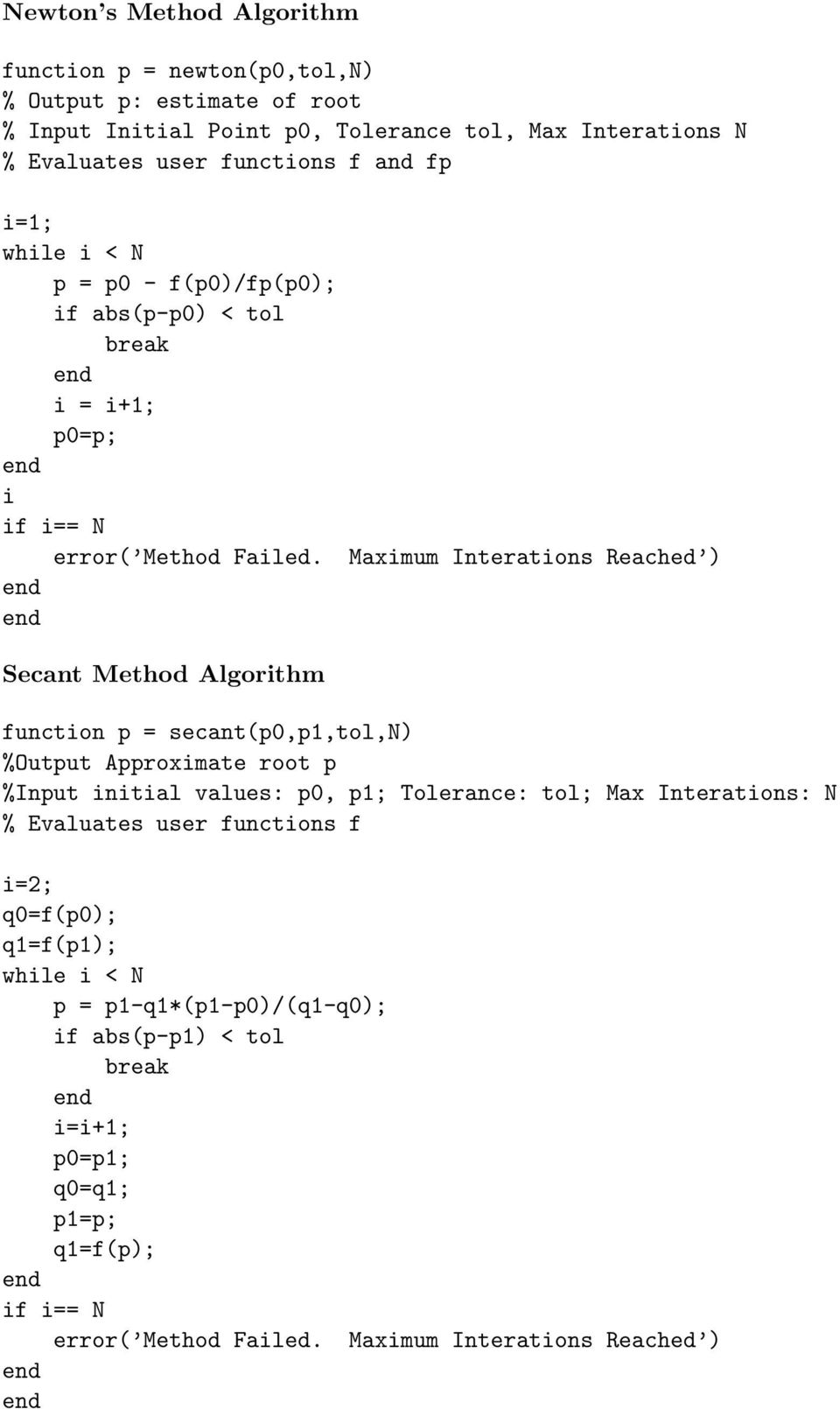
2 Newton s Method Algorithm function p = newton(p0,tol,n) % Output p: estimate of root % Input Initial Point p0, Tolerance tol, Max Interations N % Evaluates user functions f and fp i=1; while i < N p = p0 - f(p0)/fp(p0); if abs(p-p0) < tol i = i+1; p0=p; i if i== N error( Method Failed. Secant Method Algorithm Maximum Interations Reached ) function p = secant(p0,p1,tol,n) %Output Approximate root p %Input initial values: p0, p1; Tolerance: tol; Max Interations: N % Evaluates user functions f i=; q0=f(p0); q1=f(p1); while i < N p = p1-q1*(p1-p0)/(q1-q0); if abs(p-p1) < tol i=i+1; p0=p1; q0=q1; p1=p; q1=f(p); if i== N error( Method Failed. Maximum Interations Reached )
3 False Position Method Algorithm function p = falsepos(p0,p1,tol,n) %Output Approximate root p %Input initial values: p0, p1; Tolerance: tol; Max Interations: N % Evaluates user functions f i=; q0=f(p0); q1=f(p1); while i < N p = p1-q1*(p1-p0)/(q1-q0); if abs(p-p1) < tol i=i+1; q = f(p); if q*q1 <0 p0=p1; q0=q1; p1=p; q1=q; if i== N error( Method Failed. Maximum Interations Reached )

4 1. (Exercise #6 on page 54) % y = 3*x - e.^(x); % y = *x + 3*cos(x) - e.^(x); % y = x.^ - 4*x log(x); % y = x *sin(pi*x); (a) If f(x) = 3x e x, then the bisection method yields that the value of x with 1 x for which f(x) = 0 is (b) NOTE: There is an error in the textbook since the function f(x) = x + 3 cos x e x does not have a root in [0, 1]. This function does, however, have a root in [1, ]. Therefore, if f(x) = x + 3 cos x e x, then the bisection method yields that the value of x with 1 x for which f(x) = 0 is (c) If f(x) = x 4x + 4 ln x, then the bisection method yields that the value of x with 1 x for which f(x) = 0 is , and the value of x with x 4 for which f(x) = 0 is (d) If f(x) = x+1 sin(πx), then the bisection method yields that the value of x with 0 x 0.5 for which f(x) = 0 is , and the value of x with 0.5 x 1 for which f(x) = 0 is (Exercise #0 on page 55) y = * ( ( e.^(x) - e.^(-x) )/ - sin(x) ) * x.^; Suppose that x(t), the position of the object moving down the smooth inclined plane at time t, is given by x(t) = g ( e ωt e ωt ) ω sin ωt where g = 3.17 is acceleration due to gravity and ω < 0 is the constant rate of change of angle. (Note that we are told in the problem that ω < 0.) If it is known that x(1) = 1.7, then 1.7 = 3.17 ( e ω e ω ) ω sin ω so that ω < 0 satisfies ( e ω e ω ) 0 = 3.17 sin ω 3.4ω. In other words, we need to find the value of ω < 0 that is a root of the function ( e ωt e ωt ) f(ω) = 3.17 sin ωt 3.4ω. Note that while ω = 0 is a root; we want the value of ω < 0 that is a root. Using the bisection method we find the required value of ω is
![(b) NOTE: There is an error in the textbook since the function f(x) = x + 3 cos x e x does not have a root in [0, 1]. This function does, however, have a root in [1, ].](/docs-images/48/18476837/images/page_4.jpg "Therefore, if f(x) = x + 3 cos x e x, then the bisection method yields that the value of x with 1 x for which f(x) = 0 is 1.3970794677734.")
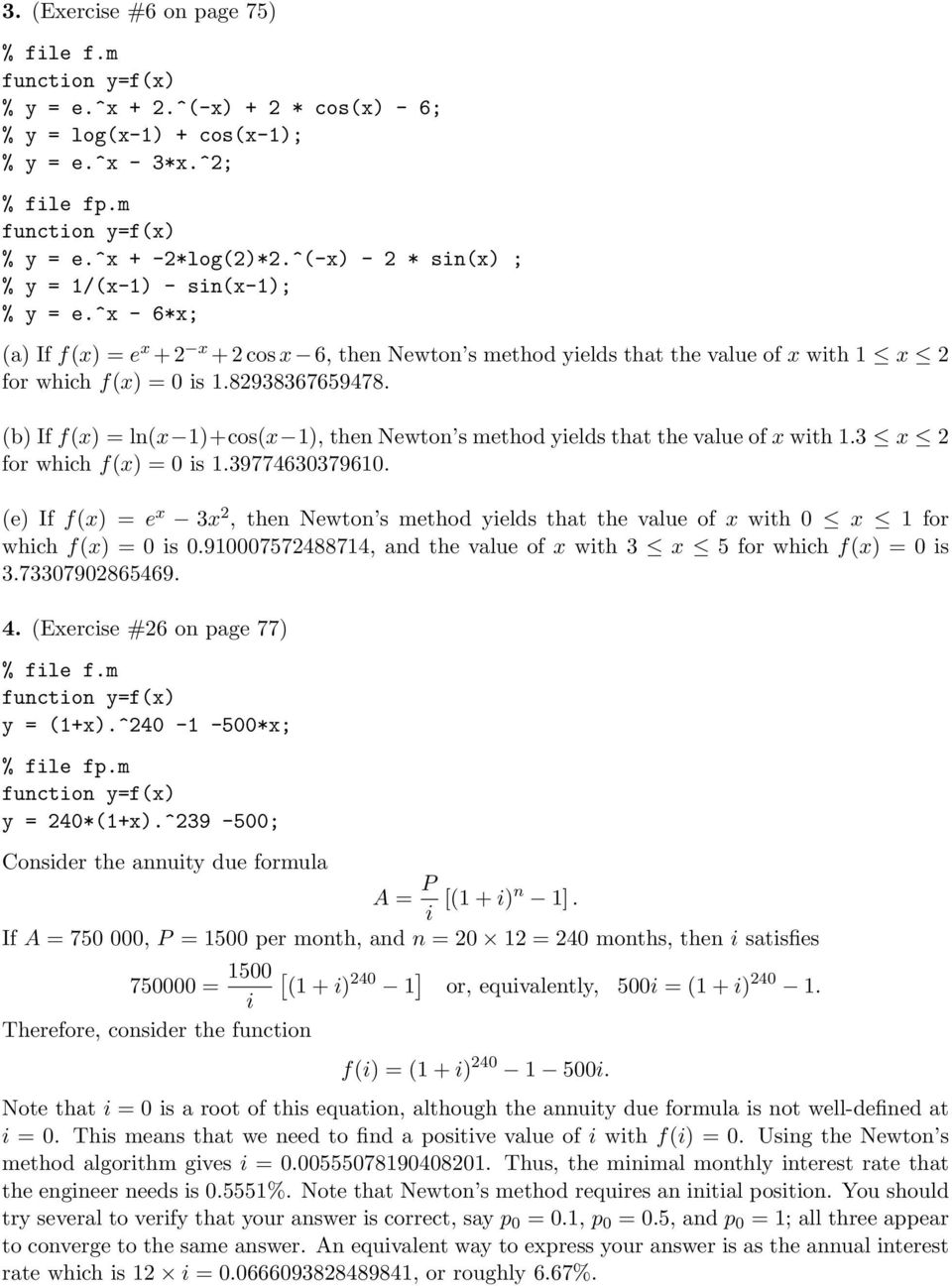
5 3. (Exercise #6 on page 75) % y = e.^x +.^(-x) + * cos(x) - 6; % y = log(x-1) + cos(x-1); % y = e.^x - 3*x.^; % file fp.m % y = e.^x + -*log()*.^(-x) - * sin(x) ; % y = 1/(x-1) - sin(x-1); % y = e.^x - 6*x; (a) If f(x) = e x + x + cos x 6, then Newton s method yields that the value of x with 1 x for which f(x) = 0 is (b) If f(x) = ln(x 1)+cos(x 1), then Newton s method yields that the value of x with 1.3 x for which f(x) = 0 is (e) If f(x) = e x 3x, then Newton s method yields that the value of x with 0 x 1 for which f(x) = 0 is , and the value of x with 3 x 5 for which f(x) = 0 is (Exercise #6 on page 77) y = (1+x).^ *x; % file fp.m y = 40*(1+x).^39-500; Consider the annuity due formula A = P i [(1 + i)n 1]. If A = , P = 1500 per month, and n = 0 1 = 40 months, then i satisfies = 1500 [ (1 + i) 40 1 ] i or, equivalently, 500i = (1 + i) Therefore, consider the function f(i) = (1 + i) i. Note that i = 0 is a root of this equation, although the annuity due formula is not well-defined at i = 0. This means that we need to find a positive value of i with f(i) = 0. Using the Newton s method algorithm gives i = Thus, the minimal monthly interest rate that the engineer needs is %. Note that Newton s method requires an initial position. You should try several to verify that your answer is correct, say p 0 = 0.1, p 0 = 0.5, and p 0 = 1; all three appear to converge to the same answer. An equivalent way to express your answer is as the annual interest rate which is 1 i = , or roughly 6.67%.
6 5. (Exercise #8 on page 75) % y = *x *cos(*x) - (x-).^; % y = (x-).^ - log(x); % y = sin(x) -e.^(-x); (c) If f(x) = x cos x (x ), then the secant method yields that the value of x with x 3 for which f(x) = 0 is , and the value of x with 3 x 4 for which f(x) = 0 is (d) If f(x) = (x ) ln x, then the secant method yields that the value of x with 1 x for which f(x) = 0 is , and the value of x with e x 4 for which f(x) = 0 is (f) If f(x) = sin x e x, then the secant method yields that the value of x with 0 x 1 for which f(x) = 0 is , the value of x with 3 x 4 for which f(x) = 0 is , and the value of x with 6 x 7 for which f(x) = 0 is (Exercise #1 on page 76) % y = x.^ - 4*x log(x); % y = x *sin(pi * x); (a) If f(x) = x 4x + 4 ln x, then the method of false position yields that the value of x with 1 x for which f(x) = 0 is , and the value of x with x 4 for which f(x) = 0 is Note that this is the same function as in (d) of the previous problem. (b) If f(x) = x + 1 sin πx, then the method of false position yields that the value of x with 0 x 1/ for which f(x) = 0 is , and the value of x with 1/ x 1 for which f(x) = 0 is

Math 104A - Homework 2
 Math 04A - Homework Due 6/0 Section. -, 7a, 7d, Section. - 6, 8, 0 Section. - 5, 8, 4 Section. - 5,..a Use three-digit chopping arithmetic to compute the sum 0 i= first by i + + +, and then by + + +. Which
G.A. Pavliotis. Department of Mathematics. Imperial College London
 EE1 MATHEMATICS NUMERICAL METHODS G.A. Pavliotis Department of Mathematics Imperial College London 1. Numerical solution of nonlinear equations (iterative processes). 2. Numerical evaluation of integrals.
Math 2400 - Numerical Analysis Homework #2 Solutions
 Math 24 - Numerical Analysis Homework #2 Solutions 1. Implement a bisection root finding method. Your program should accept two points, a tolerance limit and a function for input. It should then output
Homework # 3 Solutions
 Homework # 3 Solutions February, 200 Solution (2.3.5). Noting that and ( + 3 x) x 8 = + 3 x) by Equation (2.3.) x 8 x 8 = + 3 8 by Equations (2.3.7) and (2.3.0) =3 x 8 6x2 + x 3 ) = 2 + 6x 2 + x 3 x 8
correct-choice plot f(x) and draw an approximate tangent line at x = a and use geometry to estimate its slope comment The choices were:
 Topic 1 2.1 mode MultipleSelection text How can we approximate the slope of the tangent line to f(x) at a point x = a? This is a Multiple selection question, so you need to check all of the answers that
Inverse Functions and Logarithms
 Section 3. Inverse Functions and Logarithms 1 Kiryl Tsishchanka Inverse Functions and Logarithms DEFINITION: A function f is called a one-to-one function if it never takes on the same value twice; that
I. Pointwise convergence
 MATH 40 - NOTES Sequences of functions Pointwise and Uniform Convergence Fall 2005 Previously, we have studied sequences of real numbers. Now we discuss the topic of sequences of real valued functions.
Section 3.7. Rolle s Theorem and the Mean Value Theorem. Difference Equations to Differential Equations
 Difference Equations to Differential Equations Section.7 Rolle s Theorem and the Mean Value Theorem The two theorems which are at the heart of this section draw connections between the instantaneous rate
Nonlinear Algebraic Equations. Lectures INF2320 p. 1/88
 Nonlinear Algebraic Equations Lectures INF2320 p. 1/88 Lectures INF2320 p. 2/88 Nonlinear algebraic equations When solving the system u (t) = g(u), u(0) = u 0, (1) with an implicit Euler scheme we have
Continuity. DEFINITION 1: A function f is continuous at a number a if. lim
 Continuity DEFINITION : A function f is continuous at a number a if f(x) = f(a) REMARK: It follows from the definition that f is continuous at a if and only if. f(a) is defined. 2. f(x) and +f(x) exist.
AC 2012-4561: MATHEMATICAL MODELING AND SIMULATION US- ING LABVIEW AND LABVIEW MATHSCRIPT
 AC 2012-4561: MATHEMATICAL MODELING AND SIMULATION US- ING LABVIEW AND LABVIEW MATHSCRIPT Dr. Nikunja Swain, South Carolina State University Nikunja Swain is a professor in the College of Science, Mathematics,
1. Then f has a relative maximum at x = c if f(c) f(x) for all values of x in some
 Section 3.1: First Derivative Test Definition. Let f be a function with domain D. 1. Then f has a relative maximum at x = c if f(c) f(x) for all values of x in some open interval containing c. The number
5.1 Derivatives and Graphs
 5.1 Derivatives and Graphs What does f say about f? If f (x) > 0 on an interval, then f is INCREASING on that interval. If f (x) < 0 on an interval, then f is DECREASING on that interval. A function has
Section 2.7 One-to-One Functions and Their Inverses
 Section. One-to-One Functions and Their Inverses One-to-One Functions HORIZONTAL LINE TEST: A function is one-to-one if and only if no horizontal line intersects its graph more than once. EXAMPLES: 1.
1 if 1 x 0 1 if 0 x 1
 Chapter 3 Continuity In this chapter we begin by defining the fundamental notion of continuity for real valued functions of a single real variable. When trying to decide whether a given function is or
Roots of Equations (Chapters 5 and 6)
 Roots of Equations (Chapters 5 and 6) Problem: given f() = 0, find. In general, f() can be any function. For some forms of f(), analytical solutions are available. However, for other functions, we have
Roots of equation fx are the values of x which satisfy the above expression. Also referred to as the zeros of an equation
 LECTURE 20 SOLVING FOR ROOTS OF NONLINEAR EQUATIONS Consider the equation f = 0 Roots of equation f are the values of which satisfy the above epression. Also referred to as the zeros of an equation f()
Numerical Methods for Solving Systems of Nonlinear Equations
 Numerical Methods for Solving Systems of Nonlinear Equations by Courtney Remani A project submitted to the Department of Mathematical Sciences in conformity with the requirements for Math 4301 Honour s
Taylor and Maclaurin Series
 Taylor and Maclaurin Series In the preceding section we were able to find power series representations for a certain restricted class of functions. Here we investigate more general problems: Which functions
B Answer: neither of these. Mass A is accelerating, so the net force on A must be non-zero Likewise for mass B.
 CTA-1. An Atwood's machine is a pulley with two masses connected by a string as shown. The mass of object A, m A, is twice the mass of object B, m B. The tension T in the string on the left, above mass
Lectures 5-6: Taylor Series
 Math 1d Instructor: Padraic Bartlett Lectures 5-: Taylor Series Weeks 5- Caltech 213 1 Taylor Polynomials and Series As we saw in week 4, power series are remarkably nice objects to work with. In particular,
To differentiate logarithmic functions with bases other than e, use
 To ifferentiate logarithmic functions with bases other than e, use 1 1 To ifferentiate logarithmic functions with bases other than e, use log b m = ln m ln b 1 To ifferentiate logarithmic functions with
Example of the Glicko-2 system
 Example of the Glicko-2 system Professor Mark E. Glickman Boston University November 30, 203 Every player in the Glicko-2 system has a rating, r, a rating deviation, RD, and a rating volatility σ. The
NUMERICAL ANALYSIS PROGRAMS
 NUMERICAL ANALYSIS PROGRAMS I. About the Program Disk This disk included with Numerical Analysis, Seventh Edition by Burden and Faires contains a C, FORTRAN, Maple, Mathematica, MATLAB, and Pascal program
Objective: Use calculator to comprehend transformations.
 math111 (Bradford) Worksheet #1 Due Date: Objective: Use calculator to comprehend transformations. Here is a warm up for exploring manipulations of functions. specific formula for a function, say, Given
Intermediate Value Theorem, Rolle s Theorem and Mean Value Theorem
 Intermediate Value Theorem, Rolle s Theorem and Mean Value Theorem February 21, 214 In many problems, you are asked to show that something exists, but are not required to give a specific example or formula
6.4 Logarithmic Equations and Inequalities
 6.4 Logarithmic Equations and Inequalities 459 6.4 Logarithmic Equations and Inequalities In Section 6.3 we solved equations and inequalities involving exponential functions using one of two basic strategies.
Introduction to Numerical Math and Matlab Programming
 Introduction to Numerical Math and Matlab Programming Todd Young and Martin Mohlenkamp Department of Mathematics Ohio University Athens, OH 45701 [email protected] c 2009 - Todd Young and Martin Mohlenkamp.
Approximating functions by Taylor Polynomials.
 Chapter 4 Approximating functions by Taylor Polynomials. 4.1 Linear Approximations We have already seen how to approximate a function using its tangent line. This was the key idea in Euler s method. If
( ) = ( ) = {,,, } β ( ), < 1 ( ) + ( ) = ( ) + ( )
 { } ( ) = ( ) = {,,, } ( ) β ( ), < 1 ( ) + ( ) = ( ) + ( ) max, ( ) [ ( )] + ( ) [ ( )], [ ( )] [ ( )] = =, ( ) = ( ) = 0 ( ) = ( ) ( ) ( ) =, ( ), ( ) =, ( ), ( ). ln ( ) = ln ( ). + 1 ( ) = ( ) Ω[ (
Find all of the real numbers x that satisfy the algebraic equation:
 Appendix C: Factoring Algebraic Expressions Factoring algebraic equations is the reverse of expanding algebraic expressions discussed in Appendix B. Factoring algebraic equations can be a great help when
x a x 2 (1 + x 2 ) n.
 Limits and continuity Suppose that we have a function f : R R. Let a R. We say that f(x) tends to the limit l as x tends to a; lim f(x) = l ; x a if, given any real number ɛ > 0, there exists a real number
MATH 381 HOMEWORK 2 SOLUTIONS
 MATH 38 HOMEWORK SOLUTIONS Question (p.86 #8). If g(x)[e y e y ] is harmonic, g() =,g () =, find g(x). Let f(x, y) = g(x)[e y e y ].Then Since f(x, y) is harmonic, f + f = and we require x y f x = g (x)[e
Math 241, Exam 1 Information.
 Math 241, Exam 1 Information. 9/24/12, LC 310, 11:15-12:05. Exam 1 will be based on: Sections 12.1-12.5, 14.1-14.3. The corresponding assigned homework problems (see http://www.math.sc.edu/ boylan/sccourses/241fa12/241.html)
Review of Matlab for Differential Equations. Lia Vas
 Review of Matlab for Differential Equations Lia Vas 1. Basic arithmetic (Practice problems 1) 2. Solving equations with solve (Practice problems 2) 3. Representing functions 4. Graphics 5. Parametric Plots
Average rate of change of y = f(x) with respect to x as x changes from a to a + h:
 L15-1 Lecture 15: Section 3.4 Definition of the Derivative Recall the following from Lecture 14: For function y = f(x), the average rate of change of y with respect to x as x changes from a to b (on [a,
Physics Notes Class 11 CHAPTER 3 MOTION IN A STRAIGHT LINE
 1 P a g e Motion Physics Notes Class 11 CHAPTER 3 MOTION IN A STRAIGHT LINE If an object changes its position with respect to its surroundings with time, then it is called in motion. Rest If an object
Solutions to Homework 5
 Solutions to Homework 5 1. Let z = f(x, y) be a twice continously differentiable function of x and y. Let x = r cos θ and y = r sin θ be the equations which transform polar coordinates into rectangular
100. In general, we can define this as if b x = a then x = log b
 Exponents and Logarithms Review 1. Solving exponential equations: Solve : a)8 x = 4! x! 3 b)3 x+1 + 9 x = 18 c)3x 3 = 1 3. Recall: Terminology of Logarithms If 10 x = 100 then of course, x =. However,
A QUICK GUIDE TO THE FORMULAS OF MULTIVARIABLE CALCULUS
 A QUIK GUIDE TO THE FOMULAS OF MULTIVAIABLE ALULUS ontents 1. Analytic Geometry 2 1.1. Definition of a Vector 2 1.2. Scalar Product 2 1.3. Properties of the Scalar Product 2 1.4. Length and Unit Vectors
4.3 Lagrange Approximation
 206 CHAP. 4 INTERPOLATION AND POLYNOMIAL APPROXIMATION Lagrange Polynomial Approximation 4.3 Lagrange Approximation Interpolation means to estimate a missing function value by taking a weighted average
SMT 2014 Algebra Test Solutions February 15, 2014
 1. Alice and Bob are painting a house. If Alice and Bob do not take any breaks, they will finish painting the house in 20 hours. If, however, Bob stops painting once the house is half-finished, then the
WORKBOOK. MATH 30. PRE-CALCULUS MATHEMATICS.
 WORKBOOK. MATH 30. PRE-CALCULUS MATHEMATICS. DEPARTMENT OF MATHEMATICS AND COMPUTER SCIENCE Contributor: U.N.Iyer Department of Mathematics and Computer Science, CP 315, Bronx Community College, University
Section 12.6: Directional Derivatives and the Gradient Vector
 Section 26: Directional Derivatives and the Gradient Vector Recall that if f is a differentiable function of x and y and z = f(x, y), then the partial derivatives f x (x, y) and f y (x, y) give the rate
The Heat Equation. Lectures INF2320 p. 1/88
 The Heat Equation Lectures INF232 p. 1/88 Lectures INF232 p. 2/88 The Heat Equation We study the heat equation: u t = u xx for x (,1), t >, (1) u(,t) = u(1,t) = for t >, (2) u(x,) = f(x) for x (,1), (3)
Lecture 3 : The Natural Exponential Function: f(x) = exp(x) = e x. y = exp(x) if and only if x = ln(y)
 Lecture 3 : The Natural Exponential Function: f(x) = exp(x) = Last day, we saw that the function f(x) = ln x is one-to-one, with domain (, ) and range (, ). We can conclude that f(x) has an inverse function
CITY UNIVERSITY LONDON. BEng Degree in Computer Systems Engineering Part II BSc Degree in Computer Systems Engineering Part III PART 2 EXAMINATION
 No: CITY UNIVERSITY LONDON BEng Degree in Computer Systems Engineering Part II BSc Degree in Computer Systems Engineering Part III PART 2 EXAMINATION ENGINEERING MATHEMATICS 2 (resit) EX2005 Date: August
Homework #1 Solutions
 MAT 303 Spring 203 Homework # Solutions Problems Section.:, 4, 6, 34, 40 Section.2:, 4, 8, 30, 42 Section.4:, 2, 3, 4, 8, 22, 24, 46... Verify that y = x 3 + 7 is a solution to y = 3x 2. Solution: From
Introduction to Numerical Methods and Matlab Programming for Engineers
 Introduction to Numerical Methods and Matlab Programming for Engineers Todd Young and Martin J. Mohlenkamp Department of Mathematics Ohio University Athens, OH 45701 [email protected] May 5, 2015 ii Copyright
FIRST YEAR CALCULUS. Chapter 7 CONTINUITY. It is a parabola, and we can draw this parabola without lifting our pencil from the paper.
 FIRST YEAR CALCULUS WWLCHENW L c WWWL W L Chen, 1982, 2008. 2006. This chapter originates from material used by the author at Imperial College, University of London, between 1981 and 1990. It It is is
Review Solutions MAT V1102. 1. (a) If u = 4 x, then du = dx. Hence, substitution implies 1. dx = du = 2 u + C = 2 4 x + C.
 Review Solutions MAT V. (a) If u 4 x, then du dx. Hence, substitution implies dx du u + C 4 x + C. 4 x u (b) If u e t + e t, then du (e t e t )dt. Thus, by substitution, we have e t e t dt e t + e t u
2 Integrating Both Sides
 2 Integrating Both Sides So far, the only general method we have for solving differential equations involves equations of the form y = f(x), where f(x) is any function of x. The solution to such an equation
Rootfinding for Nonlinear Equations
 > 3. Rootfinding Rootfinding for Nonlinear Equations > 3. Rootfinding Calculating the roots of an equation is a common problem in applied mathematics. f(x) = 0 (7.1) We will explore some simple numerical
L 2 : x = s + 1, y = s, z = 4s + 4. 3. Suppose that C has coordinates (x, y, z). Then from the vector equality AC = BD, one has
 The line L through the points A and B is parallel to the vector AB = 3, 2, and has parametric equations x = 3t + 2, y = 2t +, z = t Therefore, the intersection point of the line with the plane should satisfy:
a cos x + b sin x = R cos(x α)
 a cos x + b sin x = R cos(x α) In this unit we explore how the sum of two trigonometric functions, e.g. cos x + 4 sin x, can be expressed as a single trigonometric function. Having the ability to do this
PRACTICE FINAL. Problem 1. Find the dimensions of the isosceles triangle with largest area that can be inscribed in a circle of radius 10cm.
 PRACTICE FINAL Problem 1. Find the dimensions of the isosceles triangle with largest area that can be inscribed in a circle of radius 1cm. Solution. Let x be the distance between the center of the circle
Solutions to old Exam 1 problems
 Solutions to old Exam 1 problems Hi students! I am putting this old version of my review for the first midterm review, place and time to be announced. Check for updates on the web site as to which sections
y cos 3 x dx y cos 2 x cos x dx y 1 sin 2 x cos x dx y 1 u 2 du u 1 3u 3 C
 Trigonometric Integrals In this section we use trigonometric identities to integrate certain combinations of trigonometric functions. We start with powers of sine and cosine. EXAMPLE Evaluate cos 3 x dx.
Roots of Polynomials
 Roots of Polynomials (Com S 477/577 Notes) Yan-Bin Jia Sep 24, 2015 A direct corollary of the fundamental theorem of algebra is that p(x) can be factorized over the complex domain into a product a n (x
Lecture 14: Section 3.3
 Lecture 14: Section 3.3 Shuanglin Shao October 23, 2013 Definition. Two nonzero vectors u and v in R n are said to be orthogonal (or perpendicular) if u v = 0. We will also agree that the zero vector in
Critical points of once continuously differentiable functions are important because they are the only points that can be local maxima or minima.
 Lecture 0: Convexity and Optimization We say that if f is a once continuously differentiable function on an interval I, and x is a point in the interior of I that x is a critical point of f if f (x) =
Part I Matlab and Solving Equations
 Part I Matlab and Solving Equations c Copyright, Todd Young and Martin Mohlenkamp, Mathematics Department, Ohio University, 2007 Lecture 1 Vectors, Functions, and Plots in Matlab In this book > will indicate
FINAL EXAM SECTIONS AND OBJECTIVES FOR COLLEGE ALGEBRA
 FINAL EXAM SECTIONS AND OBJECTIVES FOR COLLEGE ALGEBRA 1.1 Solve linear equations and equations that lead to linear equations. a) Solve the equation: 1 (x + 5) 4 = 1 (2x 1) 2 3 b) Solve the equation: 3x
PROBLEM SET. Practice Problems for Exam #1. Math 1352, Fall 2004. Oct. 1, 2004 ANSWERS
 PROBLEM SET Practice Problems for Exam # Math 352, Fall 24 Oct., 24 ANSWERS i Problem. vlet R be the region bounded by the curves x = y 2 and y = x. A. Find the volume of the solid generated by revolving
Rolle s Theorem. q( x) = 1
 Lecture 1 :The Mean Value Theorem We know that constant functions have derivative zero. Is it possible for a more complicated function to have derivative zero? In this section we will answer this question
The Mean Value Theorem
 The Mean Value Theorem THEOREM (The Extreme Value Theorem): If f is continuous on a closed interval [a, b], then f attains an absolute maximum value f(c) and an absolute minimum value f(d) at some numbers
12.6 Logarithmic and Exponential Equations PREPARING FOR THIS SECTION Before getting started, review the following:
 Section 1.6 Logarithmic and Exponential Equations 811 1.6 Logarithmic and Exponential Equations PREPARING FOR THIS SECTION Before getting started, review the following: Solve Quadratic Equations (Section
MATH 425, PRACTICE FINAL EXAM SOLUTIONS.
 MATH 45, PRACTICE FINAL EXAM SOLUTIONS. Exercise. a Is the operator L defined on smooth functions of x, y by L u := u xx + cosu linear? b Does the answer change if we replace the operator L by the operator
6 Further differentiation and integration techniques
 56 6 Further differentiation and integration techniques Here are three more rules for differentiation and two more integration techniques. 6.1 The product rule for differentiation Textbook: Section 2.7
Finding Equations of Sinusoidal Functions From Real-World Data
 Finding Equations of Sinusoidal Functions From Real-World Data **Note: Throughout this handout you will be asked to use your graphing calculator to verify certain results, but be aware that you will NOT
Coverage Characteristics of Earth Satellites
 Coverage Characteristics of Earth Satellites This document describes two MATLAB scripts that can be used to determine coverage characteristics of single satellites, and Walker and user-defined satellite
SOLUTIONS. f x = 6x 2 6xy 24x, f y = 3x 2 6y. To find the critical points, we solve
 SOLUTIONS Problem. Find the critical points of the function f(x, y = 2x 3 3x 2 y 2x 2 3y 2 and determine their type i.e. local min/local max/saddle point. Are there any global min/max? Partial derivatives
Chapter. Numerical Calculations
 Chapter 3 Numerical Calculations 3-1 Before Performing a Calculation 3-2 Differential Calculations 3-3 Quadratic Differential Calculations 3-4 Integration Calculations 3-5 Maximum/Minimum Value Calculations
Solutions to Homework 10
 Solutions to Homework 1 Section 7., exercise # 1 (b,d): (b) Compute the value of R f dv, where f(x, y) = y/x and R = [1, 3] [, 4]. Solution: Since f is continuous over R, f is integrable over R. Let x
y cos 3 x dx y cos 2 x cos x dx y 1 sin 2 x cos x dx
 Trigonometric Integrals In this section we use trigonometric identities to integrate certain combinations of trigonometric functions. We start with powers of sine and cosine. EXAMPLE Evaluate cos 3 x dx.
Practice Final Math 122 Spring 12 Instructor: Jeff Lang
 Practice Final Math Spring Instructor: Jeff Lang. Find the limit of the sequence a n = ln (n 5) ln (3n + 8). A) ln ( ) 3 B) ln C) ln ( ) 3 D) does not exist. Find the limit of the sequence a n = (ln n)6
Implicit Differentiation
 Revision Notes 2 Calculus 1270 Fall 2007 INSTRUCTOR: Peter Roper OFFICE: LCB 313 [EMAIL: [email protected]] Standard Disclaimer These notes are not a complete review of the course thus far, and some
t := maxγ ν subject to ν {0,1,2,...} and f(x c +γ ν d) f(x c )+cγ ν f (x c ;d).
 1. Line Search Methods Let f : R n R be given and suppose that x c is our current best estimate of a solution to P min x R nf(x). A standard method for improving the estimate x c is to choose a direction
The Steepest Descent Algorithm for Unconstrained Optimization and a Bisection Line-search Method
 The Steepest Descent Algorithm for Unconstrained Optimization and a Bisection Line-search Method Robert M. Freund February, 004 004 Massachusetts Institute of Technology. 1 1 The Algorithm The problem
Calculus 1: Sample Questions, Final Exam, Solutions
 Calculus : Sample Questions, Final Exam, Solutions. Short answer. Put your answer in the blank. NO PARTIAL CREDIT! (a) (b) (c) (d) (e) e 3 e Evaluate dx. Your answer should be in the x form of an integer.
Principles of Scientific Computing Nonlinear Equations and Optimization
 Principles of Scientific Computing Nonlinear Equations and Optimization David Bindel and Jonathan Goodman last revised March 6, 2006, printed March 6, 2009 1 1 Introduction This chapter discusses two related
Lecture 6. Weight. Tension. Normal Force. Static Friction. Cutnell+Johnson: 4.8-4.12, second half of section 4.7
 Lecture 6 Weight Tension Normal Force Static Friction Cutnell+Johnson: 4.8-4.12, second half of section 4.7 In this lecture, I m going to discuss four different kinds of forces: weight, tension, the normal
Techniques of Integration
 CHPTER 7 Techniques of Integration 7.. Substitution Integration, unlike differentiation, is more of an art-form than a collection of algorithms. Many problems in applied mathematics involve the integration
MATLAB LECTURE NOTES. Dr. ADİL YÜCEL. Istanbul Technical University Department of Mechanical Engineering
 MATLAB LECTURE NOTES Dr. ADİL YÜCEL Istanbul Technical University Department of Mechanical Engineering MATLAB LECTURE NOTES Student Name Student ID Dr. ADİL YÜCEL Istanbul Technical University Department
Course outline, MA 113, Spring 2014 Part A, Functions and limits. 1.1 1.2 Functions, domain and ranges, A1.1-1.2-Review (9 problems)
 Course outline, MA 113, Spring 2014 Part A, Functions and limits 1.1 1.2 Functions, domain and ranges, A1.1-1.2-Review (9 problems) Functions, domain and range Domain and range of rational and algebraic
4.5 Chebyshev Polynomials
 230 CHAP. 4 INTERPOLATION AND POLYNOMIAL APPROXIMATION 4.5 Chebyshev Polynomials We now turn our attention to polynomial interpolation for f (x) over [ 1, 1] based on the nodes 1 x 0 < x 1 < < x N 1. Both
Name: ID: Discussion Section:
 Math 28 Midterm 3 Spring 2009 Name: ID: Discussion Section: This exam consists of 6 questions: 4 multiple choice questions worth 5 points each 2 hand-graded questions worth a total of 30 points. INSTRUCTIONS:
APPLIED MATHEMATICS ADVANCED LEVEL
 APPLIED MATHEMATICS ADVANCED LEVEL INTRODUCTION This syllabus serves to examine candidates knowledge and skills in introductory mathematical and statistical methods, and their applications. For applications
RAJALAKSHMI ENGINEERING COLLEGE MA 2161 UNIT I - ORDINARY DIFFERENTIAL EQUATIONS PART A
 RAJALAKSHMI ENGINEERING COLLEGE MA 26 UNIT I - ORDINARY DIFFERENTIAL EQUATIONS. Solve (D 2 + D 2)y = 0. 2. Solve (D 2 + 6D + 9)y = 0. PART A 3. Solve (D 4 + 4)x = 0 where D = d dt 4. Find Particular Integral:
1.(6pts) Find symmetric equations of the line L passing through the point (2, 5, 1) and perpendicular to the plane x + 3y z = 9.
 .(6pts Find symmetric equations of the line L passing through the point (, 5, and perpendicular to the plane x + 3y z = 9. (a x = y + 5 3 = z (b x (c (x = ( 5(y 3 = z + (d x (e (x + 3(y 3 (z = 9 = y 3
Semester 2, Unit 4: Activity 21
 Resources: SpringBoard- PreCalculus Online Resources: PreCalculus Springboard Text Unit 4 Vocabulary: Identity Pythagorean Identity Trigonometric Identity Cofunction Identity Sum and Difference Identities
MAT12X Intermediate Algebra
 MAT12X Intermediate Algebra Workshop I - Exponential Functions LEARNING CENTER Overview Workshop I Exponential Functions of the form y = ab x Properties of the increasing and decreasing exponential functions
MA 408 Computer Lab Two The Poincaré Disk Model of Hyperbolic Geometry. Figure 1: Lines in the Poincaré Disk Model
 MA 408 Computer Lab Two The Poincaré Disk Model of Hyperbolic Geometry Put your name here: Score: Instructions: For this lab you will be using the applet, NonEuclid, created by Castellanos, Austin, Darnell,
LIMITS AND CONTINUITY
 LIMITS AND CONTINUITY 1 The concept of it Eample 11 Let f() = 2 4 Eamine the behavior of f() as approaches 2 2 Solution Let us compute some values of f() for close to 2, as in the tables below We see from
Calculus with Parametric Curves
 Calculus with Parametric Curves Suppose f and g are differentiable functions and we want to find the tangent line at a point on the parametric curve x f(t), y g(t) where y is also a differentiable function
1.3. DOT PRODUCT 19. 6. If θ is the angle (between 0 and π) between two non-zero vectors u and v,
 1.3. DOT PRODUCT 19 1.3 Dot Product 1.3.1 Definitions and Properties The dot product is the first way to multiply two vectors. The definition we will give below may appear arbitrary. But it is not. It
Section 9.5: Equations of Lines and Planes
 Lines in 3D Space Section 9.5: Equations of Lines and Planes Practice HW from Stewart Textbook (not to hand in) p. 673 # 3-5 odd, 2-37 odd, 4, 47 Consider the line L through the point P = ( x, y, ) that