
TARGET MARKET: CHINA
|
|
|
- Madlyn Quinn
- 9 years ago
- Views:
Transcription
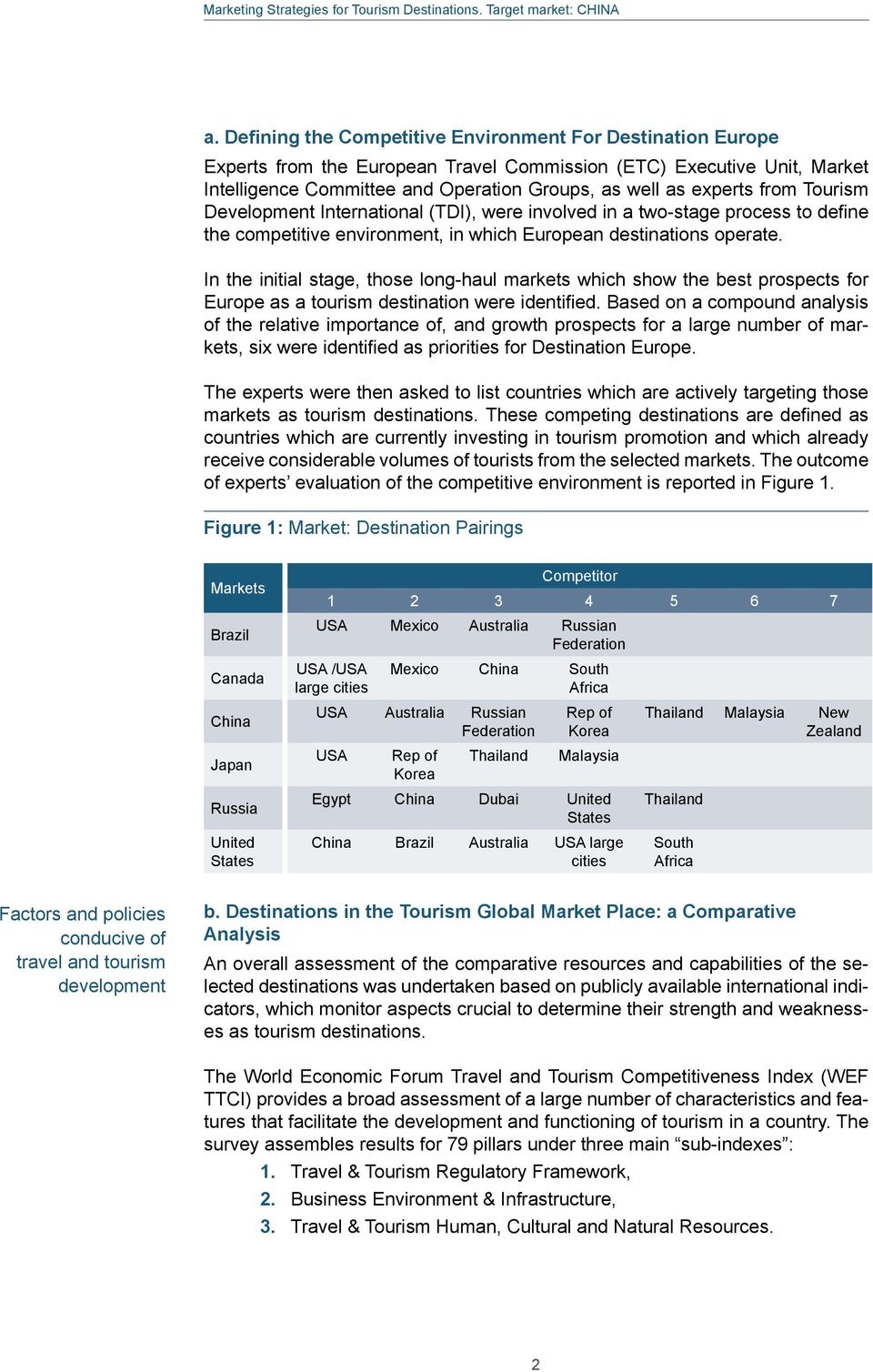
1 TARGET MARKET: CHINA MARKETING STRATEGIES FOR TOURISM DESTINATIONS A COMPETITIVE ANALYSIS

2 Marketing Strategies For Tourism Destinations A Competitive Analysis Target Market - China A report produced for European Travel Commission (ETC) by Tourism Development International Brussels, 2014

3 Published and printed by: European Travel Commission Rue du Marché aux Herbes, Brussels, Belgium Website: This report was compiled and edited by: Tourism Development International on behalf of the European Travel Commission. The designations employed and the presentation of material in this publication do not imply the expression of any opinion whatsoever on the part of the European Travel Commission concerning the legal status of any country, territory, city or area, or of its authorities or concerning the delimitations of its frontiers or boundaries. Cover photo: Nanchang scenery, view from the Tengwang pavilion, China; Copyright: chungking.
4 Contents Foreword i Introduction 1 a. Defining the Competitive Environment for Destination Europe 2 b. Destinations in the Global Market Place: a Comparative Analysis 2 Summary of China Market Study The Chinese Outbound Travel Market A Large and Fast Growing Market Chinese Tourism to Europe Characteristics of the Chinese Traveller Drivers of Growth Successful Destination Strategies Travel Destinations in the Chinese Market Visa Regimes Air Connections Political, Economic and Socio-Cultural Links Consumer Assessment (TripAdvisor) Profile of Europe s Main Competitors in China Destination Marketing Organisations The Australian Tourism Sector The Republic of Korea Tourism Sector The Malaysia Tourism Sector The New Zealand Tourism Sector The Russian Federation Tourism Sector The Thailand Tourism Sector The United States of America Tourism Sector Conclusions Marketing Strategy and Activities of Tourism Australia and Brand USA in China Tourism Australia Marketing Strategy and Activities in China Brand USA Marketing Strategy and Activities in China Key Factors in Destination Marketing in China Market Perceptions Marketing Performance and Opportunities 79 Appendices Appendix 1 European and Competing Destinations WET TTCI and 84 Bloom Country Brand Rankings Appendix 2 Weekly City-to-City Flights from Main Chinese Centres 87 Appendix 3 TripAdvisor Ratings 89 Appendix 4 Bibliography and References 91

5 Acknowledgments This report was prepared by Peter Mac Nulty and Robert Cleverdon of Tourism Development International on commission to the European Travel Commission (ETC), and was carried out under the supervision of Ms Valeria Croce, Head, Research and Development Department at ETC. The report is part of a series of fact-finding reports on the tourism strategy developed by destinations competing with Europe in select long-haul markets. The project was realised as part of the European Commission and ETC joint initiative Destination Europe We would like to acknowledge the support and contributions of the many ETC members, marketing organisations and tour operators associations who contributed to the realisation of this report. We also gratefully acknowledge the support of ETC partners, who committedly contributed to the realisation of this project. A special note of thanks to Mr Charlie Ballard, Director of Advertising Research at TripAdvisor, Mr Xu Jing, Regional Director for Asia and the Pacific at UNWTO, and Mr Daniel Velasco, Consultant at Amadeus Travel Intelligence Unit, for their contributions.

6 Foreword In an increasingly vibrant landscape, marked by new players, technological innovation and rapidly changing consumers, the need arises for European destinations to closely monitor others effort to win market shares in the global tourism market. This compilation of best practice examples in tourism and promotion strategies is meant to provide insights relevant to ETC and its member countries through a better understanding of the environment in which they operate. This series of reports provides insights into the strategic vision and the operational actions tourism destinations worldwide are developing to attract an increasing number of visitors from the most promising source markets. This fact-finding research offers a bird s-eye view of the competitive environment, and a portrait of the tourism strategy and marketing activities of competing destinations. References to official documents and publicly available reports facilitate access to detailed information, for those interested in achieving a higher level of knowledge. For Europe s strongest competitors, portraits are enriched with first-hand information gathered through personal interviews with NTOs marketing directors, representatives of the travel trade and experts. The common structure of reports facilitates cross-market comparisons. Key results are synthesised in a highly visual executive summary, conceived for dissemination to the public at large. We trust these reports will become for ETC and its members an important tool to identify key opportunities and challenges, and to strengthen their comparative advantage in the global tourism market. Executive Unit European Travel Commission i
7 Introduction This report s aim is to collect meaningful knowledge about the tourism strategy of destinations competing with destinations in Europe in select long-haul markets. This study is part of a series of publications, which offer an overview of the environment, in which European tourism destinations operate, and a profile of the tourism strategy and marketing activities of competing destinations. A listing of official documents, publicly available reports and media features is provided in an appendix and through the footnotes to permit more detailed examination of the information presented and issues raised. Each report also provides first-hand information on a selection of competing destinations, gathered through interviews with NTOs marketing directors, travel trade and experts. Defining the competitive environment for Destination Europe This project focuses on countries competing with European destinations in high potential long-haul markets, namely Brazil, Canada, China, Japan, Russia and the United States. In this analysis, Europe is defined as the 33 countries which are members of the European Travel Commission plus France, the Netherlands and the United Kingdom. The analysis followed a three step approach. The first step was to identify the key markets for Europe and the primary destinations competing with Europe in those markets. These markets are presented in Figure 1. The second step consisted of assessing strengths and weaknesses of destinations, which are significant competitors to Europe in the six target markets. The assessment has been based on the following indicators: the World Economic Forum Travel and Tourism Competitive Index (WEF TTCI), travel trade interviews and expert opinion, visa regimes and other visitor entry requirements, air connectivity and capacity, price competitiveness, political, economic and socio-cultural links, destination tourism development policy, destination tourism marketing strategy. The third step consisted of identifying those destinations which are the strongest competitors for Europe in each market, i.e. destinations which attract significant volumes of travellers and are actively investing in increasing their share in the market. A detailed profile of the organisations in charge of promoting inbound tourism to these destinations has been compiled. Information about the strongest competitors has been collected by the means of personal interviews as well as from secondary sources. 1

8 a. Defining the Competitive Environment For Destination Europe Experts from the European Travel Commission (ETC) Executive Unit, Market Intelligence Committee and Operation Groups, as well as experts from Tourism Development International (TDI), were involved in a two-stage process to define the competitive environment, in which European destinations operate. In the initial stage, those long-haul markets which show the best prospects for Europe as a tourism destination were identified. Based on a compound analysis of the relative importance of, and growth prospects for a large number of markets, six were identified as priorities for Destination Europe. The experts were then asked to list countries which are actively targeting those markets as tourism destinations. These competing destinations are defined as countries which are currently investing in tourism promotion and which already receive considerable volumes of tourists from the selected markets. The outcome of experts evaluation of the competitive environment is reported in Figure 1. Figure 1: Market: Destination Pairings Markets Brazil Canada China Japan Russia United States Competitor USA Mexico Australia Russian Federation USA /USA large cities Mexico China South Africa USA Australia Russian Federation USA Rep of Thailand Korea Rep of Korea Malaysia Egypt China Dubai United States China Brazil Australia USA large cities Thailand Malaysia New Zealand Thailand South Africa Factors and policies conducive of travel and tourism development b. Destinations in the Tourism Global Market Place: a Comparative Analysis An overall assessment of the comparative resources and capabilities of the selected destinations was undertaken based on publicly available international indicators, which monitor aspects crucial to determine their strength and weaknesses as tourism destinations. The World Economic Forum Travel and Tourism Competitiveness Index (WEF TTCI) provides a broad assessment of a large number of characteristics and features that facilitate the development and functioning of tourism in a country. The survey assembles results for 79 pillars under three main sub-indexes : 1. Travel & Tourism Regulatory Framework, 2. Business Environment & Infrastructure, 3. Travel & Tourism Human, Cultural and Natural Resources. 2
9 These illustrate the relative success of destinations in creating conditions to attract investment in tourism development. Figure 2 shows the ranking of the 13 destinations according to each of the sub-indexes and relative to each other. The rankings in columns i to iv are based on a total of 140 countries worldwide included in the WEF TTCI survey. The rankings in column v are within the set of 13 competitor destinations. Figure 2: WEF TTCI Rankings of Competing Destinations, 2013 Country Competitiveness Subindex Travel & Tourism Regulatory Framework Travel & Tourism Business Environment & Infrastructure Travel & Tourism Human, Cultural & Natural Resources Overall Ranking Ranking within 13 Competing Destinations (i) (ii) (iii) (iv) (v) Australia Brazil China Dubai (as UAE) Egypt Rep of Korea Malaysia Mexico New Zealand Russian Federation South Africa Thailand United States Source: TDI analysis of WEF TTCI report At a country level, European destinations (both ETC member countries and other countries in Europe) occupy the top positions of the WEF ranking - see Figures 25 to 28 in Appendix 1. The leading five positions in the overall ranking are European i.e. Switzerland, Germany, Austria, Spain and the United Kingdom. A further three European countries are placed in the band of 6 th to 15 th (i.e. France, Sweden, the Netherlands), and 15 rank in the top quarter up to 35 th place. Six of the 13 competing destinations examined in the study achieved a ranking in the top quarter of all destinations worldwide i.e. the United States 6 th, Australia 11 th, New Zealand 12 th, Rep of Korea 25 th, Dubai (based on the data for the UAE as a whole) 28 th and Malaysia 34 th. 3

10 Figure 3 shows the overall ranking position for four European countries (France, Italy, Spain and the United Kingdom), selected as benchmarks, and the 13 competing destinations. The comparative analysis of the resources and capabilities of the 13 destinations identified as competitors at sub-index level (see Appendix 1) suggests what follows: High ranking: United States, Australia and New Zealand. These countries show strengths in the following areas: New Zealand in respect of its travel and tourism regulatory framework, the United States for the travel and tourism business environment and infrastructure, and for travel and tourism human, cultural and natural resources, Australia for travel and tourism human, cultural and natural resources. The United States fares less well in respect of the travel and tourism regulatory framework, and lower rankings (though still in the top 25 globally) are recorded by Australia in respect of the business environment and infrastructure, and the regulatory framework, and by New Zealand for human, cultural and natural resources. Mid ranking: Republic of Korea, Dubai (UAE), Malaysia, Thailand, Mexico, China, Brazil. Six of these seven destinations, the exception being Dubai, score more highly than their overall ranking in respect of human, cultural and natural resources. The weaknesses for this group of destinations are in the regulatory framework (i.e. Mexico, Brazil, Thailand, China) and the business environment and infrastructure (i.e. Brazil, China, Mexico). Mid-to-low ranking: Russian Federation, South Africa. Both countries rankings are pulled down by their low assessment in respect of travel and tourism regulatory framework. In the case of South Africa, this is due to low performance on safety and security, and health and hygiene; while for the Russian Federation, the weaknesses are more widespread across four of the five pillars in the sub-index. Low ranking: Egypt. Its weak positioning reveals in each of the three sub-indexes suggests that this destinations doesn t have an overall comparative advantage in respect to destinations in Europe, but may be attractive in specific markets and segments. 4

11 Figure 3: WEF TTCI Overall Rankings Source: WEF - TTCI, 2013, 140 destinations Another competitive edge for destinations is the value of their tourism offer. While the perceived value of tourism services is a subjective construct that varies across markets, segments and experiences, an assessment based on standardised indices can highlight destinations comparative advantages related to cost-related aspects. The value of tourism products across destinations The WEF TTCI survey examines components that impact on price levels at a destination, including taxes levied on ticket sales, airport charges and fuel costs, as well as general taxation levels. The overall price competitiveness of destinations is derived from these five factors. The WEF TTCI also provides a hotel price index, as a proxy of price competitiveness from a consumer perspective. The WEF TTCI s rank order in terms of overall travel and tourism price competitiveness and the hotel price index for destinations competing with Europe are shown in Figures 4 and 5. It found that Malaysia and Thailand are the most price competitive destinations, although the United States fares well on hotel prices; Australia is the least competitive destination in terms of prices. By comparison, all European destinations are in the lowest tercile (ranked 100 th or lower), largely because of travel and fuel taxes. They are more competitive in respect of hotel prices, with Spain featuring 42 nd and the United Kingdom 53 rd while other European countries score less well, ranging from the Baltic states of Lithuania, Latvia and Estonia (all in the top 12 of hotel price competitiveness) to Switzerland, Serbia and France all ranked worse than 100 th in respect of hotel prices. See details in Appendix 1. 5

12 Figure 4: Destination Travel & Tourism Price Competitiveness: 13 Primary Competitors to Europe 1 European Benchmark Egypt Malaysia Competitor Destinations Thailand Mexico UAE-Dubai China South Africa Russian Federation New Zealand 1 01 Republic of Korea USA Spain Italy UK France Brazil Australia 1 61 Source: WEF - TTCI Source: WEF - TTCI Figure 5: Destination Travel & Hotel Price Competitiveness: 13 Primary Competitors to Europe Source: WEF - TTCI 6

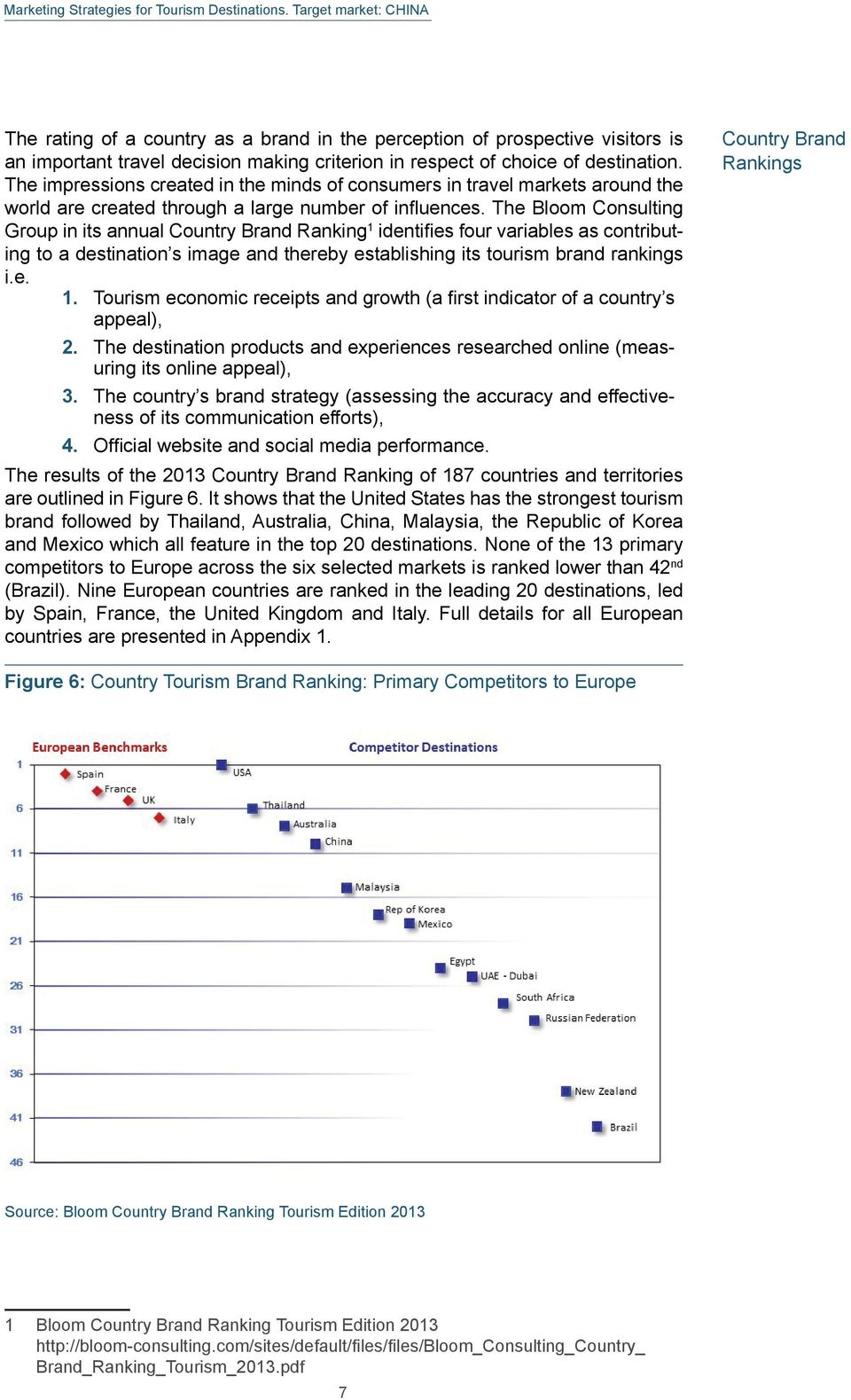
13 The rating of a country as a brand in the perception of prospective visitors is an important travel decision making criterion in respect of choice of destination. The impressions created in the minds of consumers in travel markets around the world are created through a large number of influences. The Bloom Consulting Group in its annual Country Brand Ranking 1 identifies four variables as contributing to a destination s image and thereby establishing its tourism brand rankings i.e. 1. Tourism economic receipts and growth (a first indicator of a country s appeal), 2. The destination products and experiences researched online (measuring its online appeal), 3. The country s brand strategy (assessing the accuracy and effectiveness of its communication efforts), 4. Official website and social media performance. The results of the 2013 Country Brand Ranking of 187 countries and territories are outlined in Figure 6. It shows that the United States has the strongest tourism brand followed by Thailand, Australia, China, Malaysia, the Republic of Korea and Mexico which all feature in the top 20 destinations. None of the 13 primary competitors to Europe across the six selected markets is ranked lower than 42 nd (Brazil). Nine European countries are ranked in the leading 20 destinations, led by Spain, France, the United Kingdom and Italy. Full details for all European countries are presented in Appendix 1. Country Brand Rankings Figure 6: Country Tourism Brand Ranking: Primary Competitors to Europe Source: Bloom Country Brand Ranking Tourism Edition Bloom Country Brand Ranking Tourism Edition Brand_Ranking_Tourism_2013.pdf 7
14 The competitive strength of any country as a tourism destination is a combination of many factors, some of which are fixed or otherwise factual while others are subject to the influence of both product developments and marketing and promotional activities. No destination is outstandingly strong or weak across all parameters. The strongest individual destination is the United States, rated as having the leading tourism brand and achieving 6th place in the global WEF TTCI survey of all tourism development factors (behind five European countries). The power of strong tourism industries combined with market-driven tourism product/experience development and well-targeted marketing is illustrated by comparing rankings on the WEF TTCI broad tourism development and facilitation survey (that does not take account of destination marketing) and the Bloom Consulting Group destination brand ranking (which features destination marketing elements as a key criterion). This is borne out particularly in the cases of Thailand, China, Malaysia, Mexico, Egypt, South Africa and the Russian Federation where weaknesses in either or both of the regulatory framework, and business environment and infrastructure, may be compensated for by price advantages and the appeal of the countries tourism product offering. Figure 7: Country Tourism Rankings Country Bloom Country Brand Ranking Overall WEF TTCI Ranking Europe s Competitors United States 1 6 Thailand 6 43 Australia 8 11 China Malaysia Rep of Korea Mexico Egypt UAE - Dubai South Africa Russian Federation New Zealand Brazil European Benchmarks Spain 2 4 Germany 3 2 France 4 7 United Kingdom 5 5 Italy 7 26 Austria 11 3 Switzerland 14 1 Sources: WEF TTCI survey, and Bloom Country Brand Ranking Tourism Edition

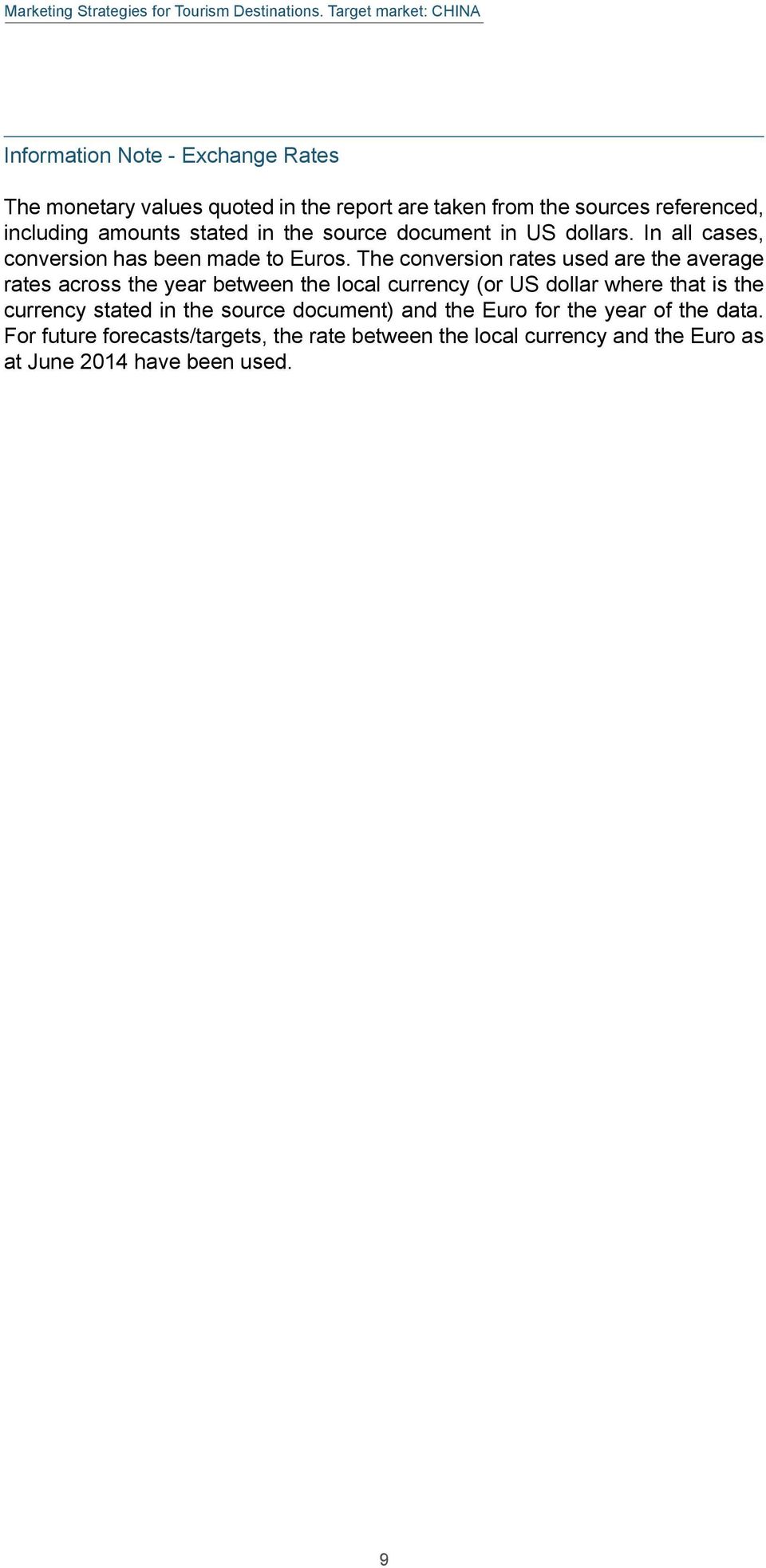
15 Information Note - Exchange Rates The monetary values quoted in the report are taken from the sources referenced, including amounts stated in the source document in US dollars. In all cases, conversion has been made to Euros. The conversion rates used are the average rates across the year between the local currency (or US dollar where that is the currency stated in the source document) and the Euro for the year of the data. For future forecasts/targets, the rate between the local currency and the Euro as at June 2014 have been used. 9
16 Summary of China Market Study OUTBOUND TRAVEL AND COMPETITIVE ENVIRONMENT KEY DEMOGRAPHIC AND ECONOMIC DATA 2013 Population 1,351mn GDP PPP per capita $9,828 7,280 Average annual GDP growth over past decade CHINA S PERFORMANCE IN INTERNATIONAL TOURISM International arrivals generated 2012: 82mn 2013 : 97.3mn up 18 to 19% GDP PPP per capita current prices 2 CNY42,026 5,075 Expenditure 2012: $102bn ( 78 bn) 2013: $ bn ( bn) up 18 to 27% in dollar terms but slightly less in Euros (14 to 23%) as a result of the depreciation of the dollar against the Euro since 2012 Leading outbound tourism country in terms of EXPENDITURE Second largest outbound market in terms of OVERNIGHT STAYS in OUTBOUND DESTINATIONS VISITED BY CHINESE 1. Hong Kong 6,752, Thailand 4,997, South Korea 3,440, Macau 3,132, Taiwan 2,815,741 Total trips to Europe: 3 million (first stop) with aggregate arrivals circa 5 million World Economic Outlook Database, October 2013, IMF. Euro values converted at average exchange rate for World Travel Monitor 2013, IPK International Singapore 1,563, Malaysia 1,476, Japan 889, Vietnam 682, France 648,376 TOP destinations are Asian 10

17 STRONG NON ASIAN GROWTH MARKETS GROWTH PER ANNUM p.a. p.a. p.a. p.a. United Arab Emirates United States of America Switzerland France POSITIVE INFLUENCES ON GROWTH PURPOSE OF VISIT Steadily developing economy Increasing international flights Appreciation of Chinese currency Expanding tourism consumption demand Easing of visa policies of foreign countries/regions Public (business, official) Private (leisure) Public (business, official) Private (leisure) OUTBOUND TRAVEL AND COMPETITIVE ENVIRONMENT Destination success in the Chinese tourism market from: 1. Understanding and catering for cultural needs, 2. Innovating, investing and working across sectors to deliver the right products/experiences, 3. Catering for increased FIT travel, 4. Focusing destination marketing on authentic features and offerings, 5. Incorporating China-friendly elements in the experiences offered, 6. Accurate product: market matching in line with the preferences and trends of the Chinese market, 7. Facilitating Chinese travellers to enter, travel around and obtain Chinese-oriented service. Europe s primary competitors across all aspects of tourism according to the WEF TTCI are other industrialised nations e.g. United States, Australia, New Zealand, Republic of Korea, In terms of overall price competitiveness in travel and tourism, European destinations are among the world s most costly, The 2013 Bloom Consulting Country Brand Ranking rates the United States as the leading tourism destination brand with Australia also in the top ten, while nine of the leading 20 tourism destination brands are European. 11

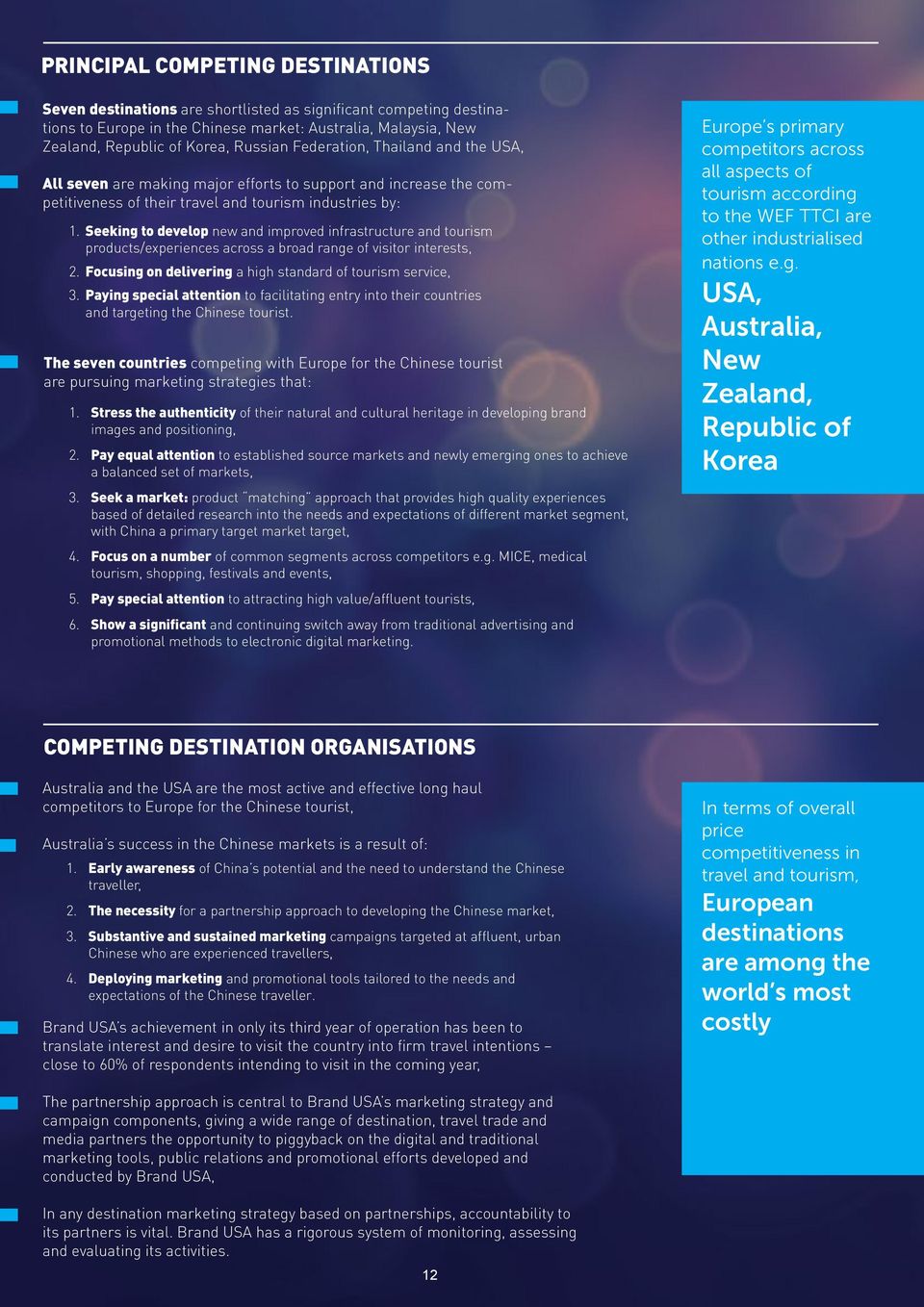
18 PRINCIPAL COMPETING DESTINATIONS Seven destinations are shortlisted as significant competing destinations to Europe in the Chinese market: Australia, Malaysia, New Zealand, Republic of Korea, Russian Federation, Thailand and the USA, All seven are making major efforts to support and increase the competitiveness of their travel and tourism industries by: 1. Seeking to develop new and improved infrastructure and tourism products/experiences across a broad range of visitor interests, 2. Focusing on delivering a high standard of tourism service, 3. Paying special attention to facilitating entry into their countries and targeting the Chinese tourist. The seven countries competing with Europe for the Chinese tourist are pursuing marketing strategies that: 1. Stress the authenticity of their natural and cultural heritage in developing brand images and positioning, 2. Pay equal attention to established source markets and newly emerging ones to achieve a balanced set of markets, 3. Seek a market: product matching approach that provides high quality experiences based of detailed research into the needs and expectations of different market segment, with China a primary target market target, 4. Focus on a number of common segments across competitors e.g. MICE, medical tourism, shopping, festivals and events, 5. Pay special attention to attracting high value/affluent tourists, 6. Show a significant and continuing switch away from traditional advertising and promotional methods to electronic digital marketing. Europe s primary competitors across all aspects of tourism according to the WEF TTCI are other industrialised nations e.g. USA, Australia, New Zealand, Republic of Korea COMPETING DESTINATION ORGANISATIONS Australia and the USA are the most active and effective long haul competitors to Europe for the Chinese tourist, Australia s success in the Chinese markets is a result of: 1. Early awareness of China s potential and the need to understand the Chinese traveller, 2. The necessity for a partnership approach to developing the Chinese market, 3. Substantive and sustained marketing campaigns targeted at affluent, urban Chinese who are experienced travellers, 4. Deploying marketing and promotional tools tailored to the needs and expectations of the Chinese traveller. Brand USA s achievement in only its third year of operation has been to translate interest and desire to visit the country into firm travel intentions close to 60% of respondents intending to visit in the coming year, In terms of overall price competitiveness in travel and tourism, European destinations are among the world s most costly The partnership approach is central to Brand USA s marketing strategy and campaign components, giving a wide range of destination, travel trade and media partners the opportunity to piggyback on the digital and traditional marketing tools, public relations and promotional efforts developed and conducted by Brand USA, In any destination marketing strategy based on partnerships, accountability to its partners is vital. Brand USA has a rigorous system of monitoring, assessing and evaluating its activities. 12
19 COMPARATIVE ASSESSMENT: EUROPE, THE UNITED STATES, AUSTRALIA Traditionally-held perceptions of Europe, the United States and Australia in China are that Europe is rich in cultural heritage, tradition and luxury, The United States represents wealth, modernity and popular culture, and Australia offers a natural environment and a relaxed lifestyle, Europe and the United States are top of the list in terms of choice as first time overseas destinations, while all three destinations can offer the range of attractions and activities to cater for the more experienced traveller seeking places to visit and things to do outside the normal tourist circuits, All the three destinations have extensive Chinese language programmes both in marketing campaigns in China, and in the delivery of tourism products and services in the destination. The United States has an advantage in that it is seen by the Chinese as being more attuned to Chinese tourists needs, All have invested heavily and effectively in studies and surveys to better understand the attitudes, motivations, behaviour and characteristics of Chinese travellers in order to be able to design marketing and promotional strategies and campaigns to achieve the highest possible penetration of the China market, The 2013 Bloom Country Brand Ranking rates the USA as the leading tourism destination brand with Australia also in the top ten, while nine of the leading 20 tourism destination brands are European The ETC is disadvantaged against Tourism Australia and Brand USA through a far smaller marketing budget in China, The disparate and limited marketing activities of European countries, without a strong, financially-empowered coordinating mechanism, lead to the prevailing market perception of Europe of a collection of countries without a central theme. Competition can be fostered indeed market competition is the essence of business in both Australia and the United States by linking together on certain marketing activities, generating benefit to all, in the spirit of co-opetition (i.e. cooperation AND competition) whereby the overall market is increased through working together enabling the destination s individual marketing activities to compete for a larger total market. The strength of both Tourism Australia and Brand USA is their focus on the partnership approach to destination marketing, Historical culture and heritage are Europe s key assets in the current (unmanaged) positioning of Europe; but the challenge of any future marketing campaign will to shift this positioning to highlight Europe s contemporary vibrancy, enterprise and innovation within tourism, and in particular to create knowledge about the rich and diverse tourism experiences that Europe can offer beyond the introductory tour of iconic sites and features. 13

20

21 The Chinese Outbound Travel Market A Large and Fast Growing Market China represents one of the principal motors for the growth in international tourism. Between 2000 and 2013, the volume of outbound departures of the Chinese population rose by between 18% and 19% a year reaching 97 million in Spending by Chinese tourists on international tourism also grew, reaching an estimated record level of between US$120 and 130 billion (EUR89 96 billion) in Average expenditure per outbound trip was calculated at US$1,226 (EUR943) in , with spending on long haul trips significantly higher than on trips to intra-asian destinations. Outbound travel from the leading source markets Germany, the United States and the United Kingdom - is growing far more slowly than from China with the result that China is now second for trips of one night or more as well as becoming the world s leading outbound travel market in terms of expenditure in 2012 with the total of US$102 billion (EUR78 billion). This represents a near five-fold increase from US$22 billion (EUR18.6 billion) in 2005 when it ranked seventh in international tourism expenditure, overtaking Italy, Japan, France, the United Kingdom, the United States and Germany in the seven-year period 7. China ranks high both in outbound travel and expenditure China now the leading outbound market in terms of expenditure Figure 8: Leading Outbound Travel Markets, 2013 Rank Trips (1+ nights) Overnight Stays Spending 1 Germany Germany China 2 China United Kingdom United States 3 United States United States Germany 4 United Kingdom China United Kingdom 5 France Russia Japan 6 Canada France Canada Source: World Travel Monitor 2013, IPK International 4 China Outbound Tourism in Travel China Guide 5 Ibid 6 The Chinese Outbound Travel Market 2012 Update. ETC/UNWTO 7 Ibid 15
22 Most travel from China remains within Asia The main destinations for Chinese tourists are in Asia, with the Special Administrative Regions (SAR) of Hong Kong and Macao attracting over 2/3 of total departures from China. In terms of arrivals of Chinese tourists, the top ten destinations are (2012 data): Hong Kong & Macau (China) 23 million, Rep of Korea 3.4 million, Thailand 2.8 million, Taiwan 2.6 million, Singapore 2.1 million, United States 1.6 million, Japan 1.5 million, Vietnam and Malaysia both 1.4 million. The trend towards intraregional travel within Asia reflects the continued expansion of the Chinese population able to travel abroad and who choose a nearby destination for their initial trip. In 2013, while total outbound trips rose 25%, Asian destinations recorded a rise of 31% while long haul trips grew by a lower 11%. Intra-Asian destinations also dominate for Chinese outbound trip destinations organised through travel agencies, as illustrated in Figure 9. Figure 9: Top 10 Outbound Destinations Visited by Chinese Tourists in Hong Kong 6,752, South Korea 3,440, Taiwan 2,815, Malaysia 1,476, Vietnam 682, Thailand 4,997, Macau 3,132, Singapore 1,563, Japan 889, France 648,376 Source: China National Tourism Administration Easing of travel regulations contributing to growth outside of Asia Outside Asia, the strongest growth has been recorded to the United Arab Emirates (30% p.a ), the United States and Switzerland (both 29% p.a.), and France (20% p.a.). In the last two years Australia (+16% in 2012 to 0.6 million arrivals), and New Zealand (+48% to over 0.2 million) have been especially strong destinations for the Chinese. The United States, Europe, Australia and New Zealand have grown substantially in recent years, in response to easier travel regulations and increased promotional targeting. Figure 10: Strong Non-Asian Growth Markets (% Growth Per Annum ) United Arab Emirates United States of America Switzerland France Source: Euromonitor International 16
23 Looking ahead, UNWTO forecasts that Asia and the Pacific will generate 358 million tourist arrivals in 2020 and 541 million tourist arrivals in Of these, nearly 20% will travel to destinations outside the region 8. China will be the prime generator of Asian outbound travel. The forecast of 100 million Chinese trips abroad by 2020 made by UNWTO in the late 1990s 9 will be achieved in While faster growth will remain for intraregional travel, demand for long haul trips will remain strong, growing by between 6.5% and 7% a year over the next five years to exceed 35 million by China will be the prime generator of Asian outbound travel to 2020 In terms of individual long haul destinations, Euromonitor International s forecasts for the period see the strongest growth in Chinese visitors in Switzerland, Spain, the UAE, the United States (all more than doubling the level of arrivals), Italy, Austria, New Zealand and Australia. 1.2 Chinese Tourism to Europe Chinese tourism to Europe has grown at the rate of 18% a year between 2008 and 2013, reaching a level of 7,475,000 12, following an annual rise of 11% in the previous five years, illustrating that Chinese outbound travel growth was largely unaffected by the global recession 13. Despite this rapid growth, Chinese tourists comprised just 1.3% of total arrivals in Europe in As a proportion of all Chinese long haul trips (defined as outside Northeast Asia), Europe s share has fallen by over 9% between 2004 and 2014, now accounting for one-in-three such trips 15. China is the 2 nd market for Europe from outside the region, after the United States The average expenditure of a Chinese visitor on a trip to European Union states was US$3,734 (EUR2,835) in China was the 15 th most important source market for European destinations in terms of international tourist arrivals in 2013, but the 2 nd market from outside the region, after the United States. The leading European destinations visited by the Chinese in 2012 were the Russian Federation 0.8 million, France 1.3 million, Germany 0.8 million, Switzerland 0.7 million, Austria 0.4 million, Italy 0.3 million, United Kingdom 0.2 million 17. In terms of regions within Europe, Chinese travellers primarily visit Western European and Central/Eastern European destinations, these two regions accounting for 55% and 20% respectively of Chinese arrivals in Europe in Western Europe accounts for over half of Chinese arrivals in Europe 18 8 Ibid 9 Tourism 2020 Vision UNWTO 10 European Tourism in 2014: Trends and Prospects (Q1 2014). ETC. 11 Euromonitor International 12 ETC Dashboard 13 European Tourism Portfolio Analysis: Market Share and Origin Market Growth. ETC 14 Ibid 15 European Tourism in 2014: Trends and Prospects (Q1 2014). ETC. 16 Market Profile China. December ETC 17 Euromonitor International 18 European Tourism Portfolio Analysis: Market Share and Origin Market Growth. ETC 17
24 Total Chinese arrivals to Europe forecast to reach 12 million by 2019 Chinese trips to Europe are forecast to grow at an average annual rate of between 7.5% and 8% over the next five years, resulting in a reversal of the decline of Europe s market share of Chinese long haul travel 19. Total arrivals will approach 12 million by Characteristics of the Chinese Traveller Population: 1,351 million population, forecast to grow at 0.23% to 2025, but declining thereafter as deaths outnumber births 20. Gross Domestic Product (2013): US$8,939 billion (EUR6,900 billion), with growth of between 6 and 7% a year forecast to China GDP forecast to grow to US$9,300 by 2017 GDP Per Capita (2013): US$6,569 (EUR5,075), rising to a forecast level of US$9,300 (EUR6,890) by Wide variation in the distribution of income, with 120 million Chinese having a disposable household income of over US$6,000 (EUR4,330) in 2010, while the lowest quintile of 151 million people had just over US$1,100 (EUR795) 23, as converted from Chinese yuan at the average 2010 exchange rate of 6.77 yuan to the dollar. Figure 11: Demographic and Economic Facts Population 1,351mn 1 GDP per capita $7,958 2 Average annual 3 GDP growth over past decade The major urban centres of Beijing, Shanghai, Guangzhou and Shenzhen account for most of the outbound travel demand among Chinese, but demand from smaller cities and towns is also growing fast. Shanghai is the primary source of outbound business travel 24. Chinese travel is traditionally concentrated from May to October Chinese travel is traditionally concentrated in the May and October holiday periods, but it is becoming increasingly spread across the year. A continuation of this trend is anticipated as holiday entitlements increase and longer duration trips are taken 25. Air transport dominates. China has a target of 244 airports by 2020, with a total of over 300 million passengers a year at present and a forecast growth rate in domestic air demand of 8% a year to 2028, fuelled by strong economic growth, market liberalisation and fast urbanisation with rising household travel expenditures European Tourism in 2014: Trends and Prospects (Q1 2014). ETC. 20 China Population World Population Statistics. 18 September IMF World Economic Outlook China 22 Ibid 23 The Chinese Outbound Travel Market 2012 Update. ETC/UNWTO 24 Ibid 25 Ibid 26 Ibid 18
25 As of September 2010, 23 airlines operated 471 weekly flights between Chinese and European airports, with a capacity of 140,000 seats 27. The split between public (i.e. business, official) and private (leisure) changed dramatically between 2000 and 2010, from 46:54 to 10:90, as holiday travel surged. Holiday travel particularly group travel expanded throughout the decade in line with the liberalisation of outbound travel. Private travel accounts for 90% of outbound travel Information is readily absorbed by Chinese people though there remains heavy reliance on peer group information from other Chinese. Electronic technology combines these two characteristics to fuel outbound travel growth, and to increase the proportion of trips or trip components booked online. There are 591 million Chinese internet users with 464 million citizens accessing the net via smartphones or other wireless device 28. Already, one-in-five Chinese travellers books online, a proportion that will rise significantly as independently-arranged or FIT (flexible independent travel) - travel expands. The incidence of first time overseas travellers still accounts for the majority but the proportion is declining (65% to 59% between 2011 and 2012) as regular overseas trip taking grows 29. One third of all trips are through travel agents 33.6 million in The Chinese Government regulation requires leisure travel to long haul destinations to be booked via licensed travel agencies but this condition has been eased recently resulting in travel agencies share of trips to destinations except Hong Kong and Macau falling from 89% in to between 70 and 75% in One-in-five Chinese travellers books online First time overseas travellers still account for the majority but the proportion is declining Given the size of the Chinese population and the severe restrictions on overseas travel until 1988, the majority of outbound travellers are still on their first trip outside the country. Highly structured package tours are the medium for such travellers, largely unaware of what to expect or do when in a foreign country. However, informed and stimulated by digital media, Chinese travel tastes are broadening out and the main trend now is for diversification, with niche products and destinations gaining ground, and more self-organised trips being taken. More experience and language skills lead to different forms of semi or partly organised trips with tour operators providing visa, air trip and, in some cases, hotel bookings. Just under half - 47% - of Chinese outbound tourists are travelling with members of their family, and another 24% with friends. Only 7% travel entirely without companions. 3% of travellers are participants in groups organised by their work units or companies - mostly for technical tours, incentives, and study 33. Trend towards more self-organised trips Just under half of Chinese outbound tourists are travelling with members of their family 27 Ibid July ibid 31 The Chinese Outbound Travel Market, 2012 Update, ETC/UNWTO 32 Author s estimate based on data in 33 Annual Report of China Outbound Tourism Development 2010 cited in The Chinese Outbound Travel Market, 2012 Update, ETC/UNWTO 19
26 The Chinese leisure market divides between the first time traveller attracted by: doing lots of things in a short timeframe, shopping for international brands, good value-for-money, finding familiar foods and interacting with Chinese communities, the prestige of visiting and having photos taken in front of iconic sites, a safe environment. the more experienced traveller, still attracted by many of these features but also looking to travel as a means of: expressing increasing self-confidence and individualism, seeking an emotional connection with the destination, through authenticity, clean air/blue skies, access to arts and culture etc. Greater segmentation of the market will require more effective online marketing The non-traditionalist Chinese tourists are fragmented into a range of sub-segments or niches but even niche products have relatively large volume demand given the scale of the Chinese market 34. Nonetheless, the greater segmentation of the market makes it more difficult to achieve economies of scale in terms of costs. This needs to be compensated for by using new online booking and sales concepts, making it possible to specifically address customer groups even for very special interests and destinations. Figure 12: Sophistication and Status for the Chinese Traveller Source: Understanding Chinese Outbound Tourism: What the Chinese blogosphere is saying about Europe. UNWTO/ETC Destination Investment. New Networks for Serving Affluent Chinese Visitors. Dr Wolfgang Georg Arlt, COTRI Chinese Outbound Travel Research Institute, IRB, March
27 The characteristics of the different tribes are summarised in Figure 13. Traditionalists, estimated to still account for 70% of demand, travel predominantly for reasons of prestige and are in tour groups. The Wenyi youth and Experience-centered tribes each account for 10%, with the remaining estimated 10% split between Connoisseurs (7%) and Hedonists (3%). Figure 13: Characteristics of the Chinese Travel Tribes Tribe Why They Travel Mode of Travelling With Whome Brings on the Trip Traditionalists Prestige Tour Groups Tour Groups Camera Wenyi Youth Experience centered Freedom, Uniqueness Togetherness, curiosity Backpacking Backpacking or independent driving Hedonists Pleasure City travel, shopping Connoisseurs Aesthetics, knowledge Independent driving Alone or with Friends Alone, with family or in in-depth travel tour groups With friends With partner or family Notebook, favourite book, mp-3 player, internet device Guidebook, phrasebook, electronic dictionary Their parents credit card Camera with equipment, specialised guidebook, laptop Source: Understanding Chinese Outbound Tourism: What the Chinese blogosphere is saying about Europe. UNWTO/ETC For the first time Chinese overseas traveller, the focus is on doing as much as possible. Trip durations are short typically 4 days, each day packed with activities, and duty free shopping is given the highest priority. The more experienced Chinese traveller is increasingly seeking out sites and attractions away from the honeypot areas, seeking a more depth experience of the destinations visited. There is a trend towards deep tours focused on a single country, or two countries 35. For the first time Chinese overseas traveller, the focus is on doing as much as possible 35 The Chinese Outbound Travel Market, 2012 Update, ETC/UNWTO 21
28 Travel has become integral to the Chinese middle-class lifestyle 1.4 Drivers of Growth Idealised as means to greater self-realisation, travel has become integral to the Chinese middle-class lifestyle 36 There seems little doubt that outbound travel for both business and leisure purposes will continue to expand over the present decade and beyond given: the dynamics of the socio-demographic trends in China, the Chinese population s rising awareness of, and interest in, engaging in foreign travel, the greater ease of making foreign outbound travel arrangements arising from the Chinese Government s commitment to support tourism, improved connectivity and changes to visa regimes. Though the Chinese population is forecast to grow at a low rate of 0.23% a year, this will still represent an increase in the country s population in excess of 3 million people a year. By 2030, the Chinese will make up just under 20% of the world population 37. Ageing Chinese population will boost overseas travel Key demographic trends with implications for travel and tourism are: the levelling out of fertility rates, large-scale urbanisation and the rapidly ageing population 38. By 2030, the largest group in the Chinese population will be aged An ageing population with retirees having financial means to travel will boost overseas travel. Increased and diversified leisure time, outside the prescribed Golden Weeks will also serve to increase travel. China s economic growth rate will slow down over the next five years, edging down from the 7.7% recorded in 2012 and forecast in 2013 to an annual rate of expansion of 6.5% by This is still above the rate of economic growth achieved elsewhere in the world. Income levels will continue to rise both in the medium and longer terms and will lead to growing numbers of middle class Chinese consumers with sufficient disposable income to travel. At the centre of the growth of all forms of consumer spending and activity including overseas travel and tourism - is the Chinese urban middle-class population. In 2000, only 4% of urban households in China were middle class; by 2012, that share had soared to over two-thirds; and by 2022, China s middle class should number 630 million that is, three-quarters of urban Chinese households and 45% of the entire population. 40 The numbers of affluent middle class Chinese is forecast to rise from 175 million in 2011 to 1.4 billion by The Chinese Outbound Travel Market 2012 Update. ETC/UNWTO. 37 Demographic Change and Tourism ETC & UNWTO. 38 Ibid 39 IMF World Economic Outlook China 40 Half a Billion: China s Middle Class-Class Consumers. D Barton, McKinsey and Company in The Diplomat, 30 May China Digital Times, Chinese Middle Class four times larger than America. 22
29 At present only about 7% of the Chinese have an annual income above US$15,000 (EUR11,000) and the country s total consumption expenditure per household at US$13,428 (EUR9,950) a year is relatively low compared to other Asian countries such as Japan and the Republic of Korea. The relatively small number of affluent Chinese consumers will grow and will follow the same pattern of spending on property, Western branded goods and luxury items, as well as travel. Given the young profile of these consumers, this spending trend is predicted to continue for the foreseeable future 42. The increasing urbanisation of the Chinese population will also be an important factor in stimulating travel and tourism. Already half of China s population live in Cities, a proportion that will grow to two-thirds by Major cities like Beijing, Shanghai, Guangzhou and Shenzen will get bigger but the approximately 170 second tier cities, many of which were boosted through the Chinese stimulus package providing better transport infrastructure and services, will also represent large travel markets e.g. Chongqing (29 million population), Chengdu (14 million), Wuhan (8.3 million). The increased rapid, recent and continuing urbanisation of the Chinese population has led to environmental problems of pollution in many cities leading to a desire to go to places without such issues. Worsening pollution and overcrowding will increasingly act as push factors for outbound tourism 43. The impact of digital technology on Chinese travellers continues to be immense. The Chinese have over 600 million smartphone users, the largest in the world, with sales of 283 million smartphones (to 216 million new users) forecast in Two-thirds of Chinese blog/have a personal space, almost half use social networking sites and and 83% use instant messaging 45. More extensive uses of digital technology will be made both by destinations and travel organisations so that, combined with the Chinese public s heightened use of social media, awareness of, interest in, and demand for travel will continue to grow. Increasing urbanisation of population will stimulate outbound travel from China Environmental problems of pollution will stimulate desire to go to places without such issues Digital technology crucial for Chinese travellers This heightened understanding of tourist destinations around the world is giving rise to a growing sense of prestige among the Chinese about the type of trip with package tours regarded as inferior to independently-organised travel and destinations that have been little visited by the Chinese and/or which create a strong desire among the Chinese to visit through their marketing campaigns having a high prestige. The Chinese outbound market will increasingly fragment, with package tours gradually losing relative importance towards growing semi-packaged and fully independent travel arrangements. 42 ITB World Travel Trends Report 2013/2014. March IPK International reporting presentation of Chandrashekhar Singh Khangjrakpam, Centaur Research. 43 Nine Important Developments in China s Outbound Tourism Wolfgang Arlt, COTRI China Outbound Tourism Research Institute profdrwolfgangarlt/2014/01/01/nine-important-developments-in-chinas-outboundtourism-2013/ 44 Smartphone explosion in 2014 will see usership in India pass US. The Guardian Global Development. 13 January China Internet Network Information Center, 2013 cited in Chinese & Brazilian Outbound Tourism Markets and Netnography, Eduardo Santander, ETC. 7th UNWTO/PATA Forum on Tourism Trends and Outlook, October
30 Recent policy initiatives contributed to increased travel by Chinese Liberalisation has led to expansion of air routes Chinese Government is actively supporting outbound tourism Two recent initiatives of the Chinese Government have served to increase travel and tourism by the Chinese population. The first dates back to the early 1990s when the Chinese Government s Approved Destination Status (ADS), a bilateral tourism agreement with to date 148 countries, was introduced to guarantee safe and reliable tourism services to Chinese travellers. It only concerns tour groups handled by assigned Chinese local travel agents who are allowed to promote and organise tourist groups to approved destinations, including visa application and payment of foreign currency top foreign parties. Having ADS permits countries to undertake marketing in China. Chinese travellers wishing to travel independently can do so making their own visa and other arrangements. In October 2013, the China National Tourism Law was passed, making it illegal to sell tours below cost and to engage in the practice of forced shopping. This entails the operator taking the tourists only to those shops that provide the operator with concessions, thereby making up the shortfall on the low price of the tour that attracted the tourist to purchase it. The second initiative is the introduction by the Communist Party General Secretary Xi Jinping in 2013 of the concept of the Chinese Dream. He describes it as a national rejuvenation, improvement of people s livelihoods, prosperity, construction of a better society and military strengthening. He exhorts young people to dare to dream, work assiduously to fulfil the dreams and contribute to the revitalisation of the nation 46 In consequence of these and other Chinese Government initiatives, trade has been increasingly liberalised and air routes increased, leading to large growth of: 1. international operations in China (many of which generate interest in visitation by the Chinese e.g. Swiss companies), 2. Chinese enterprises abroad, and 3. overseas travel and tourism by the Chinese. The Chinese Government is actively supporting outbound tourism. In a January 2013 meeting with UNWTO Secretary General, Taleb Rifai, the Chairman of the China National Tourism Administration (CNTA), Shao Qiwei, confirmed that tourism remained one of the Chinese Government s key strategic pillars for economic growth, and that outbound tourism will also boost China s development in the long term. The promotion of outbound tourism is valued because of the benefits of mutual collaboration, the benefits of which will eventually flow back to China 47. The increase in air service connectivity between China and trading partners and tourism destinations in Asia and interregionally has been very strong and will continue to exert a major influence on Chinese outbound tourist flows and directions. Between 2008/9 and 2013/4, scheduled service capacity from China s two main cities of Beijing and Shanghai grew by more than double to Thailand and the United States cities of Los Angeles and New York, and by close to double in the peak tourist season on the routes to Sydney (Australia) and Moscow (Russian Federation). The leading European destinations saw capacity increases over the period of up to a quarter, though new European routes were developed. Capacities will continue to increase in line with demand. 46 Chinese Dream. en.wikipedia.org/wiki/chinese_dream 47 COTTM China Outbound Travel and Tourism Market April COTRI China Outbound Tourism Research Institute. cotm-china-outbound-travel-and-tourism-market-presentation-april
31 Visa formalities are being eased across the world. While visas are still required for Chinese tourists to major destinations like the United States and Australia, the speeding up of processing is likely to serve to increase the numbers of Chinese FIT travellers. Figure 14: Nine Important Developments in China s Outbound Tourism Quantitative Growth 4 Encouragement by new Chinese Government 7 Move Towards New Destinations 2 New Push Factor Pollution 5 Visa Policy Dominos Starting to Fall 8 Chinese Investors Shopping Spree 3 New Push Factor Overcrowding 6 Move Towards More Self Organised Trips 9 Major Players Enter the Scene 1.5 Successful Destination Strategies Destination regions face increasing competition for the Chinese tourist. There are several factors that will determine the ability of a destination to attract significant flows of Chinese tourists: 1. Extent to which the cultural influences and specific needs of Chinese tourists are understood and catered for, 2. The provision of the right combinations of travel offer to the groups of Chinese tourists being targeted 48, 3. Recognition of the increased share of Chinese FIT travel, 4. Developing tourist products and experiences in line with the needs and expectations of the different Chinese market segments, 5. Designing destination marketing to appeal to the Chinese desire for authentic features and offerings, 6. Degree to which China-friendly elements are built into the experiences offered, 7. Facilitation of travel to and around the destination. 48 New Chinese Tourists in Europe from Trend Survey by Z_punkt The Foresight Company in cooperation with the TUI Think Tank at TUI AG,
32 2 Travel Destinations in the Chinese Market Based on the investigations and research conducted into recent trends in Chinese visitor flows and the comparative assessment that introduces this report, a short list of seven destinations was selected for further examination in respect of the Chinese market. The seven in alphabetical order - are: 1. ASEAN countries (Republic of Korea, Thailand, Malaysia), 2. Australia, 3. New Zealand, 4. Russian Federation, 5. United States. The remainder of this chapter illustrates the positioning of these countries in the Chinese market as compared to Europe. The positioning is assessed on factors that facilitate tourism flows, such as visa regimes, transport routes, and the political, socio economic and cultural links existing between the market and each destination. This section is enriched by an analysis of TripAdvisor ratings on accommodation, attractions and eateries, presented in Appendix 3. While not representative of Chinese travellers, TripAdvisor ratings are used as a proxy for consumers appreciation of key aspects of a holiday experience across competing destinations. 2.1 Visa Regimes The detailed comparison of visitor entry requirements for the selected 13 destinations competing with Europe considered three elements: 1. Whether the destination imposes a visa requirement for entry to the country, 2. The documentation and other details demanded for issuance of a visa, 3. A qualitative assessment of the hassle factor involved in obtaining the visa. Among the seven countries selected as prime competitors to Europe in the Chinese market, all destinations (including ETC member countries) - with the single exception of Thailand, where visas are granted on arrival require Chinese travellers to obtain a visa ahead of travel. 26
33 Figure 15: Visa Requirements of Chinese Travellers in Key Destinations Destination Yes/No Requirements/Process Australia Y Prior to travel application to Australian authorities in China. Visitor visa sub-class 600 required. Extensive supporting documentation required. From CNY2,060. Paper only application accepted through post, courier, or via approved travel agent. ETC Members Y Prior to travel to one of the member country s authorities in China. Uniform Schengen visa for 25 countries. Supporting documentation required. Up to 15 days. Eur60. Individual visa application requirements for non- Schengen European countries prior to travel via immigration offices of destinations in China. Malaysia Y Prior to travel to Malaysian authorities in China in person or through registered travel agency. 6 months passport validity requirement. Fee (RMB80.00, visit 90 days). New Zealand Y Prior to travel application to New Zealand authorities in China. Counter or postal application. Fee (CNY860 +CNY200 if via an ADS agent or CNY220 if not). Rep Korea Y Prior to travel to Korean authorities in China. Supporting documents as determined by the status of their country. Fee (US$30, single visit 90 days). Not required to show an outbound ticket. a Russian Federation Thailand Y Y (on arrival since January 2014) Prior to travel to Russian authorities in China. Electronic application accepted from January Confirmation of foreign tourist tour from inbound Russian travel agency. b Return ticket, proof of funds for stay. THB1,000. USA Y Prior to travel application to US authorities in China. Attend interview with passport. One week plus processing. From US$160. Notes: a. No visa for Chinese transit travellers through Korea i.e. bound for, and returning from, one of 30 European countries with an entry visa for entry into the respective country via Korea, with valid ticket maximum duration of transit stay 30 days. b. Visa not required for Chinese tourists staying a maximum of 15 days travelling as part of a tour group (5 to 50 persons), accompanied by a representative of a tour operator accredited in both Russia and China. 27
34 2.2 Air Connections The scheduled air capacity from China s two principal international air gateways to the shortlisted destinations competing with Europe was monitored on ETC s behalf by Amadeus. Two points in the year were examined week 24 in 2013 (broadly corresponding to high season) and week 6 in 2014 (low season), though this can only be taken as an approximate measure given the difference in northern and southern hemisphere climates at the different times of the year. Data for two years were considered in order to provide an indication of the trend in capacity on the various routes i.e. June 2008/June 2013, and February 2009/ February The destinations with the greatest frequencies for direct flights and capacities are, as to be expected, Asian destinations involving shorter flight times than to Australia, New Zealand, the United States or Europe. The weekly capacity of direct flights from the two main Chinese airports to Seoul is between 46 and 47 thousand on just over 200 flights, with a journey time of around two hours. For Bankgok, there are between 28 thousand seats (on 125 flights) and 33 thousand seats (on 140 flights), depending on season, with journey times of between four-and-a-half and five-and-a-half hours. However, whereas direct flight capacity over the five year period to Bangkok rose by between one and one-and-a-half times, seats to Seoul showed little change. Capacity of direct air services from China s two principal airports to Kuala Lumpur almost doubled over the period. Considerable seasonal variation in the volume of flights from China Journey times on direct flights to the Russian Federation taking the capital city, Moscow range between 8 and over 10 hours. There is considerable seasonal variation in the volume of flights with more capacity in June (nearly 13,000 seats on 45 flights in aggregate from Beijing and Shanghai) than in February (less than 7,500 seats on 25 flights). Capacity rose slightly in the winter period but grew by over a half in June 2013 compared with the same week five years earlier. Flights from China to Australia also show considerable seasonal variation but in the reverse order with more seats in the southern hemisphere summer period (32 flights with capacity of over 10,000) than in June (23 flights with 6,500 seats). There are no direct flights between main Chinese airports to the western Australian city of Perth. Direct flight seat capacity almost doubled over the five year period during the summer hemisphere months but by just under a half in June 2013 compared with the same month in Direct air capacity to New Zealand is limited to flights between Shanghai and Auckland with a doubling of capacity in the peak period, though this increase partly offset the withdrawal of direct air services from Beijing two years ago. The three United States airports included in the present study are Los Angeles, New York and Miami. There are no direct scheduled air services from China to Miami. Los Angeles receives 35 flights a week from Beijing and Shanghai with 13,000 seats. New York has 32 direct flights providing a capacity of over 11,500. Direct flight journey times are around 12 hours to Los Angeles and between 13.5 and nearly 15 hours for New York. 28
35 Capacity increases to the United States airports have been extremely high: in the case of Los Angeles, the rise was three-and-a-half times in the week being studied between June 2008 and 2013 and by almost double between February 2009 and the same week in For New York, direct flight seat capacity doubled June to June and one-and-a-half-times from February 2009 and February The pattern for China-Europe direct air services is for modest growth except for those cities with low base volume in the initial year being examined. This produces a high growth rate even though the number of seats is relatively small e.g. capacity to Madrid rose 88% between February 2009 and 2014 but still amounts to just over 1,000 seats a week. Significant capacity increases to the United States airports More modest growth in China-Europe direct air services The discrepancy between Europe and its competitors is less marked when connecting flights are considered. Apart from the fastest growth destinations such as Bangkok and New York, and newly emerging destinations with low base volumes of connecting flights in the first of the two years examined e.g. Perth and Miami, the increase in connecting flight services is broadly similar between the European benchmark destinations and competitors. Figure 16: Changes in Weekly Direct Flight Seat Capacity from China (Beijing and Shanghai Aggregated) to Selected Destinations, June 2008-June 2013 and February 2009-February 2014 Source: TDI calculations based on data supplied by Amadeus The analysis points to a comparative advantage of competing destinations in terms of air connections with China. Over the past five years, direct air capacity from China both to major short haul destinations (e.g. Thailand and Malaysia) and to long haul destination competing with Europe (i.e. Australia, Russian Federation and, most significantly, the United States) has expanded more significantly than to Europe. Europe's competitors have a comparative advantage in terms of air connections with China Full details of flights, capacities and flight time for direct and connecting flights for a week in June 2008 and 2013, and a week in February 2009 and 2014 are shown in Appendix 1. NOTE: figures in front of break (/) relate to the first year in the time series i.e. June 2008, while those after the break are for the later year i.e. June
36 Figure 17: Direct Flights Capacity Figure 16 Direct Flights Capacity Beijing - Europe 10,000 9,000 8,000 7,000 6,000 5,000 4,000 3,000 2,000 1,000 0 Beijing Amsterdam Beijing London Beijing Paris Beijing Rome Beijing Moscow Feb- 09 Feb- 14 Jun- 08 Jun- 13 Beijing - USA 8,000 6,000 4,000 2,000 0 Beijing New York Beijing Los Angeles Feb- 09 Feb- 14 Jun- 08 Jun- 13 Shanghai - USA Shanghai New York Shanghai - Los Angeles Feb- 09 Feb- 14 Jun- 08 Jun- 13 Beijing Madrid 9,000 8,000 7,000 6,000 5,000 4,000 3,000 2,000 1,000 0 Tourism Strategy of Europe s Main Competitors China Report Shanghai - Europe Shanghai - Amesterdam Shanghai - London Shanghai Paris Shanghai - Rome Shanghai - Moscow Feb- 09 Feb- 14 Jun- 08 Jun- 13 Beijing Shanghai 40,000 30,000 20,000 10,000 0 Shanghai - Asia Pacific Shanghai - Bangkok Shanghai - Kuala Lumpur Shanghai - Seoul Shanghai - Sydney Feb- 09 Feb- 14 Jun- 08 Jun- 13 Beijing - Asia Pacific 25,000 20,000 15,000 10,000 5,000 0 Beijing Bangkok Beijing Kuala Lumpur Beijing Seoul Beijing Sydney Beijing Auckland Feb- 09 Feb- 14 Jun- 08 Jun- 13 Shanghai - Auckland Source: TDI calculations based on data supplied by Amadeus 30
37 2.3 Political, Economic and Socio-Cultural Links China has developed and maintains strong relations with each of the seven countries under study, there remaining few barriers to the encouragement and facilitation of tourism to and from China. 4% of the Australian population 0.9 million - are of Chinese ancestry 49, with 319,000 having been born in Mainland China. Chinese Australians are now one of the most well-established immigrant ethnic groups in Australia. Chinese newspapers are published in Australia and three shortwave and longwave radio channels broadcast in Mandarin and Cantonese while the Australian public broadcaster SBS also provides television and radio on weekends. Chinese Australian social websites like Xīn Zújì ( 新 足 迹, and FREEOZ (www. freeoz.org) are popular. The relationship between China and Australia has grown closer in recent years, both countries being actively engaged economically, culturally and politically through a number of regional bodies e.g. APEC, East Asia Summit, G20. China is now Australia s largest trading partner and has large investments in Australian mining companies. Diplomatic relations between China and the Republic of Korea were only established in 1992, following the latter s withdrawal of recognition of the Republic of China (Taiwan). Since then, their political, economic, diplomatic, and cultural relations have advanced with unprecedented speed and scope. Currently, China is the Republic of Korea s largest trading partner while it is China s third largest. Though there remain apprehensions on both sides among the Koreans about China s rapid emergence as a global power and its support for the Democratic People s Republic of Korea (North Korea), and among the Chinese about the Republic of Korea s strong alliance with the United States this has not deterred continued expansion of all aspects of trade (including tourism). Relationship between China and Australia has grown closer in recent years China is the Republic of Korea s largest trading partner The Korean and Chinese people are knowledgeable about each other s culture and customs. Just over 1% of the Korean population is from China, though three-quarters of the 624,994 recorded in the 2009 census are ethnic Koreans 50. China and Malaysia have close and strong diplomatic relations. Chinese people are the second largest ethnic group in Malaysia making up 24.6% of the population 51. They have been dominant in trade and business since the early 20 th century. Malaysia has been China s top trading partner within ASEAN (Association of Southeast Asian Nations ten member countries) since China and New Zealand have maintained strong diplomatic relations since 1972, leading in 2008 to New Zealand being the first developed western country to enter into a free trade agreement with China. In the six years since the arrangement came into place, which enabled New Zealand to secure a greater share of the rapidly expanding Chinese market as well as the potential for deeper bilateral relations, China has become an increasingly important trade partner of New Zealand. In 2013, New Zealand s exports to Beijing exceeded NZD7 billion (EUR4.3 billion) and, in the first quarter of that year, China overtook Australia as New Zealand s top export market 52. Chinese people are the second largest ethnic group in Malaysia China is New Zealand s top export market Census. Australian Bureau of Statistics 50 More than 1 million foreigners line in Korea. The Chosunilbo. August Malaysian Population and Housing Census New Zealand between two great powers. Robert Patman, Fair Observer. 31
38 The 171,000 strong Chinese community makes up 4% of the New Zealand population in , having grown by 16% since the previous census in China has been Russia s largest trading partner for four consecutive years Tourism Year fostering China- Russia cooperation on Tourism 2014 marks the 65th anniversary of diplomatic relations between China and Russia, and bilateral relations are set to develop at a higher, faster and stronger rate, as evidenced by the fact that the Presidents of the two nations have met five times in the past year and established a close working relationship as well as a deep and valued personal friendship. China has been Russia s largest trading partner for four consecutive years. There is steady momentum on pragmatic and strategic cooperative projects, and people-to-people contacts are being further promoted through such programmes as the China-Russia Youth Friendly Exchanges Year. Since 2006, the two countries have held reciprocal events, namely the Year of Russia in China in 2006, the Year of China in Russia in 2007, and language years in 2009 and 2010, followed by tourism years. The most recent Tourism Year of China in Russia was opened in Moscow in March It is part of the China-Russia Tourism Year programme which began in 2012 with the Tourism Year of Russia in China to promote exchanges between the two countries. At the opening ceremony of Tourism Year of China in Russia, President Xi Jinping, urged both countries to take advantage of the Tourism Year to foster tourism cooperation into a new highlight in China-Russia strategic cooperation. Custom exchange programmes were organised serving to heighten the appreciation of each other s civilisations and cultures 54. The activities included self-driving tours from Moscow to Beijing and student exchange programmes. Though the great majority of Chinese tourists travel to the cities of Moscow, as illustrated by the air capacity details in the preceding sub-section, and St Petersburg, there are also substantial trading and other links between cities in the east of the Russian Federation and main centres in northern China. Direct or connecting flights are operated between Beijing, Harbin and Dalian and the Russian cities of Khaborovsk Novy, Khomutovo (Yuzhno-Sakhalinsk), Koltsovo (Yekaterinburg), Krasnoyarsk-Yemelyanovo, Novosibirsk Tolmachevo, Yakutsk and Vladivostok. Ethnic Chinese numbers in the Russian Federation are disputed. The 2010 census did not include the category. While the official number is around 35,000 from the 2002 census, Russian demographers accept a level of between 0.2 and 0.4 million 55. Temporary migration and cross-border trade not involving settling in Russia are prevalent. Most permanent Chinese residents are in Moscow. Sino-Thai relations continue to develop as trade has become the dominant theme in bilateral relations. Thailand continues to support the One China Policy, though maintaining unofficial relations with Taiwan, helping it gain access to capital and the Chinese mainland market. China is Thailand s second largest export market, while China is the largest source of Thailand s imports. 23 February New Zealand 2013 Census. Statistics New Zealand 54 President Xi Jinping s Address at the Opening Ceremony of Tourism Year of China in Russia. March
39 Thailand has the largest overseas Chinese community almost 10 million in and is also the most successful case of full assimilation. For over 400 years, Thai-Chinese have largely intermarried and assimilated with their compatriots. Thailand has largest overseas Chinese community Though aspects of strategic distrust persist between China and the United States, never in history has a rising power and an established one had such intensive economic interaction and interdependence, so many official bilateral institutions, and so much people-to-people engagement 57. China is the greatest beneficiary of the existing international system, and has proposed a new type of great power relations with the United States, to reassure Washington of China s commitment to peaceful development and constructive ties. A total of 3.8 million Chinese Americans or American-born Chinese were recorded in the 2010 United States census 58. Chinese culture is widespread in a country renowned for its racial and cultural diversity. The principal centres of the Chinese community are in the greater city areas of New York, San Francisco and Los Angeles which, together, account for half the Chinese living in the country. 3.8 million Chinese Americans or American-born Chinese in US 2.4 Consumer Assessment (TripAdvisor) This section presents an analysis of ratings provided by TripAdvisor users from China on three elements of a visitor experience: attractions, accommodation and eateries. While not representative of Chinese visitors behaviour, TripAdvisor ratings allow for cross-destination comparisons on components of a holiday experience. The analysis covers the six destinations competing with Europe in China, and four European destinations used as benchmark in this study (France, Italy, Spain and United Kingdom). The results for European countries and competing destinations are presented in Appendix 3. On average, TripAdvisor users from China positively rate accommodation in all selected destinations, with minor differences across destinations. In 2013, New Zealand accommodation (4.4) achieved the highest average review rating by Chinese TripAdvisor users, while the United States, the Russian Federation and Malaysia received a comparatively low average review rating (3.9). Compared to quality of accommodation in their own country (4.0), TripAdvisor users from China are more satisfied with accommodation in Italy (4.2), Spain, Republic of Korea, Thailand and United Kingdom (each at or close to 4.1). Australia and France perform marginally less well than local accommodation services. Average ratings for all destinations in Europe suggest that TripAdvisor users from China were in general satisfied with accommodation (4.2). These visitors were most satisfied with the location and cleanliness (both at 4.4) of the accommodation they selected for their stay, while they tended to be slightly less positive when evaluating the quality and value for money of the rented room (4.1). Quality of sleep and staff and service were averagely positive (4.2). TripAdvisor users from China were satisfied generally with accommodation in Europe 56 CIA World Factbook 57 China: US relations: the myth of the Thucydides Trap. Wei Zongyou, The Diplomat. 30 March Race reporting for the Asian population by selected categories, US Census Bureau. xhtml?pid=dec_10_sf1_qtp8&prodtype=table 33
40 Eateries seem not to be a distinctive trait of destinations for TripAdvisor users from China, as there are no major differences in ratings assigned to the destinations in the study, other than for the Russian Federation which received the high rating of 4.3. The Republic of Korea ranks next at 4.2. The United States, Thailand, Spain and Italy are rated in line with the average rating of Chinese eateries (4.08), while Australia, United Kingdom, Malaysia and France match the domestic benchmark (3.9). High average ratings for attractions confirm their importance for Chinese users TripAdvisor users from China assign the highest average ratings to attractions. Italy (4.5) scores highest in the evaluations posted in 2013 through the online platform, while Malaysia is associated with the lowest rating (4.0). Attractions in the Russian Federation, Spain and the United States each scored 4.4; while those in Australia, the United Kingdom and France achieved 4.3 (in line with the average for all destinations). Thailand s rating was slightly lower but still above the Chinese TripAdvisor users rating for attractions in their own country (4.2), a level than was matched by the Republic of Korea. Figure 18: TripAdvisor Ratings of Tourism Services in Competing Destinations TripAdvisor operates sites in 41 countries and 23 languages. TripAdvisor offers 150 million+ reviews and opinions on its site and receives 100+ user contributions a minute. TripAdvisor covers 810,000+ hotels, B&Bs and specialty lodgings, 2.2 million+ restaurants and 420,000+ attractions worldwide. As the world s largest travel site, with nearly 260 million unique monthly visitors*, TripAdvisor has valuable, global insights regarding travel patterns and trends. TripAdvisor data, such as user traffic patterns and average review ratings, can provide relevant insights for local hospitality and other travel industry businesses. *Source: comscore Media Metric for TripAdvisor Sites, worldwide, Q
41 Profile of Europe s Main Competitors in China Destination Marketing Organisations Within each competing destination, tourism authorities responsible to promote their country as tourism destination in China have been identified (Figure 19). Information about these organisations has been collected from existing sources and, whenever possible, through personal interviews. Figure 19: Listing of Competitor Destination DMOs and Tourism Representative Bodies Competitor Destination Australia Malaysia New Zealand Rep of Korea Destination Marketing Organisations Visit Australia Tourism Australia Association of Australian Convention Bureaux Inc. Association of Australian Convention Bureaux Inc. Tourism Malaysia Tourism New Zealand Tourism Industry Association of New Zealand Korea Tourism Organization Russia Thailand USA Russian National Tourist Office, Federal Agency for Tourism Ministry of Culture of the Russian Federation Russian Union of Tourist Industry RST Association of Tour Operators of Russia ATOR Tourism Authority of Thailand Association of Thai Travel Agents Brand USA USTOA US Tour Operators Association Source: TDI 35
42 The Australian Tourism Sector China is now 2nd most important generating market for Australia Australia received 6.5 million international tourist arrivals in 2013, a rise of 5.5% over Between 2008 and 2013, arrivals grew at the rate of just over 3% a year. Main markets are New Zealand, China, the United Kingdom, the United States and Japan. The increase in Chinese visitor arrivals in 2013 at 14.2% was considerably above the overall rise in that year, a total of 715,000 arrivals being recorded. Between 2008 and 2013, the share of Chinese arrivals grew from 6.4% to 11%. In consequence, China moved up from 5 th most important generating market in 2008 to 2 nd (after neighbouring New Zealand) in Tourism receipts totaled AUD32.9 billion (EUR25.9 billion) in 2012, virtually the same as four years earlier expressed in local currency, but lower than the 2009 peak of AUD34.7 billion (EUR21.7 billion) 59. However, because of the appreciation of the Australian dollar against its United States counterpart over the period 60, and especially between mid 2008 and mid 2009, the 2012 level was higher in United States dollar and Euro terms than in earlier years. Australia, it is the 10 th highest recipient of tourist spending Tourism provides direct employment for half a million Australians Though there are over 40 countries around the world that receive more international tourists than Australia, it is the 10 th highest recipient of tourist spending as a consequence of its long distance from generating markets leading to few low spending, cross border and other short duration visits. Direct tourism GDP for 2012/13 amounted to AUD42.3 billion (EUR31.8 billion), up 3.7% over the previous year, for a 2.8% share of the country s GDP. Tourism provided employment for 544,000 in 2012/ The Tourism 2020, Tourism Australia s Journey 2010 to 2013 report concludes that tourism in Australia: generates AUD107 billion (EUR80 billion) in consumption 62, provides direct employment for half a million Australians, represents the country s leading services export sector, contributes towards the funding of airports, roads, hotels and other infrastructure, assists in the economic development of regional Australia with 45 cents of every dollar being spent outside the major conurbations, achieves a high multiplier 91 cents generated for every tourist dollar. 59 OECD OECD Tourism Trends and Policies March OECD. oecd-tourism-trends-and-policies-2014_tour-2014-en 60 Yearly Average Currency Exchange Rates. IRS. International-Taxpayers/Yearly-Average-Currency-Exchange-Rates 61 Australian National Accounts: Tourism Satellite Account Australian Bureau of Statistics 62 Tourist Satellite Account, , Australia Bureau of Statistics,
43 On 3 October 2013, responsibility for tourism policy, programmes and research transferred from the former Department of Resources, Energy and Tourism to Austrade (the Australian Trade Commission). Australia s tourism marketing authority, Tourism Australia, remains a separate statutory authority with primary responsibility for the international marketing of Australian tourism, reporting to the Minister for Trade and Investment. Tourism Australia has primary responsibility for international marketing Tourism is one of four Australian National Investment Priorities. In recognition of the importance of high quality infrastructure, products and experiences, as a key component of maintaining the country s competitiveness as a tourism destination, Tourism Australia, the-then Department of Resources Energy and Tourism and Austrade officially commenced a five-year partnership in 2012 to drive investment opportunities in tourism. The National Long-Term Tourism Strategy, published in 2009, is the overarching Australia tourism industry strategy supported by federal, state and territory Tourism Ministers. The 2020 Tourism Industry Potential, published in 2010, explains what a successful Australian tourism industry will look like in The Tourism 2020 overview, published in 2011, provides an overview of Australia s national strategy to enhance growth and competitiveness in the tourism industry. The aims of Tourism 2020 are to achieve increases in: overnight tourism spend from AUD70 billion (EUR44 billion) in 2009 to between AUD115 billion and AUD140 billion (EUR80 to 97 billion) by 2020, tourism labour and skills, accommodation rooms, particularly in capital cities, international and domestic aviation capacity, standards in industry quality and productivity. A five-year partnership to drive investment opportunities in tourism Key targets for areas in which additional infrastructure investment and/or development is required are: increasing accommodation capacity by between 6,000 and 20,000 rooms, increasing international-operated and domestic aviation capacity over 2009 levels by up to 50% and 30% respectively 63. It focuses on 6 strategic areas: grow demand from asia, build competitive digital capability, encourage investment and implement regulatory reform, ensure tourism transport environment supports growth, increase supply of labour, skills and indigenous participation, build industry resilience, productivity and quality. 63 OECD Tourism Trends and Policies March OECD. oecd-tourism-trends-and-policies-2014/australia_tour en#page6 37
44 Initiatives included the release of a Tourism Investment Guide, a Tourism Investment Monitor and investment opportunities database; identifying and targeting key overseas investors; and establishing close working relationships with tourism specialists in state and territory tourism investment agencies 64. Tourism Major Project Facilitation service launched to assist tourism investment In November 2012 the Australian Government launched the Tourism Major Project Facilitation service to assist new tourism investment in gaining development approvals. A case manager is appointed to significant new tourism projects to provide support and broker solutions to problems. 24 enquiries have been made to the TMPF scheme, four of which involving investment of AUD2 billion (EUR1.4 billion) and the creation of 12,000 jobs are being assisted through Australian Government approvals. The 2020 Potential for the Business Events Sector, published in 2013, outlines how Australia s business events sector has the potential to double the overnight expenditure by visitor delegates to between AUD15.8 billion and AUD16.0 billion (i.e. around EUR11 billion) to by Tourism 2020, Tourism Australia s Journey 2010 to 2013, published in October 2013, provides an update on Tourism Australia s progress through phase one of the Tourism 2020 strategy about setting the foundation. Tourism Australia is an Australian Government statutory authority and the Federal Government agency responsible for international and domestic tourism marketing, attracting international visitors to Australia and encouraging Australians to travel domestically, both for leisure and business events. Its purpose is to increase the economic benefits to Australia of tourism. To do this it has implemented a new strategic approach Tourism 2020 aimed at growing overnight tourism expenditure to as much as AUD140 billion (EUR97 billion) by the end of the decade. Resources are dedicated to facilitating trade marketing opportunities As a marketing body, Tourism Australia s resources are dedicated to facilitating trade marketing opportunities for established businesses that will generate high yielding, sustainable market opportunities. Critical to its global marketing effort is reaching the customers most likely to enjoy what Australia has to offer. Tourism Australia is highly active in undertaking extensive research into tourist markets, trends and performance with the view to guiding future tourism development and marketing strategies. It disseminates such information widely to the private sector with which it has a number of partnerships and alliances to create demand for the destination using the current theme of There s Nothing Like Australia. Under the Tourism Australia Act (2004) Tourism Australia s objectives are: to influence people travelling to Australia to also travel throughout Australia, to influence Australians to travel throughout Australia, including for events, to help foster a sustainable tourism industry in Australia, to help increase the economic benefits to Australia from tourism. 64 Tourism 2020, Tourism Australia s Journey 2010 to 2013, Tourism Australia, October
45 Its outcome statement for 2013/14 as approved by the Government is to increase demand for Australia as a destination, strengthen the travel distribution system and contribute to the development of a sustainable tourism industry through consumer marketing, trade development and research activities. Tourism Australia s current slogan is There s Nothing Like Australia. Tourism Australia receives AUD130 million (EUR90 million) in yearly funding, and total tourism funding in the country (including for Austrade s Tourism Quality grants and the Tourism Industry Regional Development Fund) is about AUD185 million (EUR129 million). Three quarters of the marketing element of the 2013/14 appropriation for tourism is concentrated on category 1 and 2 markets, including Greater China. The country s focus is as a destination of leisure, events (including business events) and education. Tourism Australia receives AUD130 million (EUR90 million) in funding annually The Australian Commission of Audit has argued that the benefits of the near twothirds of Tourism Australia s budget directed to advertising and other promotional activities accrue to tourism operators and, as such, address market failures within the tourism industry. The Commission proposed that marketing Australia as a destination for international tourists should be undertaken at a Commonwealth level rather than on a State-by-State level whereby grant funding for the tourism industry would ceases and Tourism Australia s funding reduced by a half to focus on international marketing, with the function incorporated into a commercial arm of the Department of Foreign Affairs and Trade 65. The Government of Australia rejected the National Commission of Audit proposals and has confirmed that the Federal Budget will include AUD130 million (EUR90 million) in base funding for Tourism Australia and AUD13.5 million (EUR9.4 million) towards the Asia Marketing Fund 66. Activities include advertising, Public Relations and media programmes, trade shows and industry programs, consumer promotions, online communications and consumer research. Tourism Australia operates a 35 language website and uses digital marketing focused on personalising, socialising and mobilising its product offerings, enabling consumers to share their own stories and experiences. Tourism Australia s Facebook page exceeded 4.5 million fans worldwide in Tourism Australia launched its customised YouTube channel, youtube.com/australia, in 16 countries in November 2012, the first for national tourism organisations and the travel industry. Digital marketing used to personalise tourism product offerings Tourism Australia is active in around 30 key markets including Australia, promoting the unique attributes which will entice people to visit and targeting those people who its research indicates will spend more and travel most widely. 65 National Commission of Audit Recommendations. phase- one/recommendations.html 66 Tourism Funding Safe in 2014/15 Budget. tourism-funding- maintained-in budget 39
46 Tourism Australia s Key Market Regions are: Australia (domestic), Americas - United States of America, Canada and Brazil, Europe - France, Germany, Italy and the United Kingdom, Greater China - China and Hong Kong, Japan and Korea, New Zealand, South and South East Asia - Singapore, Malaysia, India, Indonesia, Vietnam and Gulf Countries. Key markets have been categorised by the potential of growth in visitor spend by Visitor spend, tracked by the International Visitor Survey refers to the amount of AUD spent by travellers in Australia (*denotes countries where Tourism Australia also targets Business Events in addition to leisure consumers): visitor spend by these markets has the potential to be worth over AUD5 billion (EUR3.4 billion) by 2020: Greater China* (China and Hong Kong), North America* (United States and Canada), United Kingdom*, Australia, visitor spend by these markets has the potential to be worth over AUD2.5 billion (EUR1.7 billion) by 2020: New Zealand*, Republic of Korea, Singapore, Malaysia, visitor spend by these markets has the potential to be worth over AUD1 billion (EUR0.7 billion) by 2020: Japan*, Indonesia*, India*, Germany, Middle East, fast emerging: Brazil, Vietnam, high priority: Italy, France. Youth market and experience seekers are key segments In each key market, Tourism Australia targets specific consumer segments which represent the best prospect for achieving the Tourism 2020 targets. Reaching this customer is at the core of all of Tourism Australia s consumer, distribution and partnership marketing activities. Youth - the youth segment is an important part of Australia s visitor mix. Youth contribute nearly AUD12 billion (EUR8.3 billion) annually in tourism spending and represent a quarter of all Australia s international arrivals, Experience Seekers are, by definition, looking for unique, involving and personal experiences from their holidays, The Cruise Industry - cruising is an important segment in Australia and one that is significant to our tourism industry, Aboriginal Tourism, Luxury Tourism. To do this they have gained greater insights in the past year to better understand what motivates their target customers to visit Australia through their Consumer Demand Research project, conducted in 11 key international markets plus Australia. 40
47 The research findings showed that potential visitors have high expectations of Australia, and for those considering a repeat visit the destination s biggest strengths are its world class beauty, safety and welcoming people. These insights will help to further shape and fine tune Tourism Australia s marketing in order to maintain Australia as a compelling proposition for travellers. Beauty, safety and welcome are primary motivators for repeat visitors Tourism Australia operates from its headquarters in Sydney and maintains overseas offices in Canada, China, Hong Kong, India, Japan, Republic of Korea, Malaysia, New Zealand, Singapore, the United Kingdom (covering the United Kingdom, Ireland and Nordic countries) and the United States. It has representative offices in Brazil, France, Germany (covering Continental Europe) and Italy. 41
48 The Republic of Korea Tourism Sector International tourist arrivals grew by 9.3% to reach 12.2 million in 2013 Travel & tourism spending represents 5.8% of GDP In 2013, international tourist arrivals grew by 9.3% to reach 12.2 million. The average annual growth in arrivals has been strong between 2009 and 2013 at 11.7%, placing it just outside the top 20 in terms of worldwide destinations. International tourism receipts reached US$13.4 billion (EUR10.3 billion) in , though the World Travel and Tourism Council (WTTC) study calculates visitor exports at KRW23,299 billion (US$21.5 billion, EUR16.0 billion) in This represents 18% of all service exports and 3% of all exports (including goods and services) 68. Each US$1 million (EUR0.7 million) in total travel & tourism spending in the economy generates US$1.1 million (EUR0.8 million) in GDP. Travel and tourism contributed US$68 billion (EUR50 billion), representing 5.8% of the Republic of Korea s economy in 2013, and provided 1.6 million jobs, 6.3% of employment. The 2013 WTTC report finds that for every US$1 million (EUR0.7 million) in travel & tourism spending, 25 jobs are supported 69. Following the election of a new government in February 2013, the Ministry of Culture, Sports and Tourism established a new Digital Content Industry Division. Within the Ministry, the Tourism Bureau has three divisions: Tourism Policy, Tourism Industry, and International Tourism. The Tourism and Leisure Planning Sub-Division comprises divisions for Tourism Development Planning, Tourism Development Support, and Tourism and Leisure Infrastructure. The Korea Tourism Organization is in charge of marketing. 67 OECD Tourism Trends and Policies March OECD com/digital-asset- Management/oecd/industry-and-services/oecd-tourism-trendsand-policies-2014/korea_tour en#page3 68 Travel and Tourism Economic Impact 2013 Korea. WTTC. site_media/uploads/downloads/south_korea2013_2.pdf 69 Republic of Korea s Travel & Tourism sector set to outperform economy over next ten years, February south-koreas-travel-tourism-sector-set-outperform- economy-over-n/ 42
49 In July 2013, the Ministry introduced a set of initiatives and policy reforms to achieve its 2017 targets of 16 million international visitors and 60,000 new jobs in the industry i.e. increased visa facilitation increase in multiple-entry visas for residents of Beijing and Shanghai, and to students at specified Chinese universities, replacement holiday plan giving Korean workers an average additional 1.1. vacation days in order to boost domestic tourism, hotel tax refund programme, whereby foreign visitors are reimbursed 10% value added tax on room charges, meeting, incentives, conventions, exhibitions (MICE) additional financial and administrative resources to boost the sector, medical tourism - development of infrastructure and mechanisms to establish medical tourism clusters in the country, cruise ships increased berths, National Police Agency Tourism Liaison Officer Programme to oversee tourist security and prevent exploitation of foreign tourists 70. The World Travel and Tourism Council (WTTC) study of tourism in the Republic of Korea, launched in February 2014, stresses the need for the country to continue to focus on policies which support the travel and tourism industry s strong growth potential assessed by the WTTC at 4.7% a year growth in its economic contribution over the next decade, significantly above the overall annual growth in the country s economy of 3.3%. Target to generate 60,000 new jobs by 2017 WTTC calls for policies to support growth of tourist industry WTTC encourages the government of the Republic of Korea to further improve visa facilitation, in order to make it easier for travellers to visit the country for short periods of time 71. The Korea Tourism Organization (KTO) is responsible for international and domestic tourism marketing and promotion. It operates an international network of offices and enters into partnerships with domestic and foreign operators (e.g. working with major tour operators to create a range of packages including special interest tours), as well as with organisations participating in events that can serve to promote tourism to the country. An example is its agreement with the Olympic gold-medal winning GB Taekwondo as the Preferred Destination Partner for The year-long partnership will see KTO run a number of initiatives throughout the year, starting with a presence at the inaugural World Taekwondo Grand Prix. The KTO s mission is to promote the Republic of Korea as a world-class travel destination, and spread awareness of Korean culture through the strengthening and development of the tourism industry. It is dedicated to spreading the unique heritage of Korea worldwide. KTO dedicated to spreading the unique heritage of Korea worldwide 70 OECD Tourism Trends and Policies March OECD com/digital-asset- Management/oecd/industry-and-services/oecd-tourism-trendsand-policies-2014/korea_tour en#page4 71 Republic of Korea s Travel & Tourism sector set to outperform economy over next ten years, February south-koreas-travel-tourism-sector-set-outperform- economy-over-n/ 43
50 Of the total US$2.54 billion (EUR1.95 billion) allocated from the general fund in 2012 to support the development and assistance of tourism resources, cooperation in international tourism, official development assistance in tourism and the establishment of tourism and leisure cities, US$644 million (EUR495 million) was for tourism promotion and development covering: medical tourism and MICE industries, tourist information centres and reporting centre management, overseas promotion for Korean tourism, tourism market research, overseas marketing. Its marketing directions are to focus both on individual and group tourism, to develop tourism products for the Chinese markets geared to the higher quality required by the new Chinese Government tourism law, maximising opportunities in the Russian market arising from the no visa arrangement and mutual visit year, support the MICE sector (maintaining Korea s position as the 5 th leading destination for international conferences), develop high value products such as for medical tourism, and enhance its use of online marketing 72. Recent focus on the development of tourism technology to promote Korean pop culture There is increasing demand for FIT from China Recent initiatives by KTO have focused on the development of tourism technology as a means of further promoting and enhancing the reach of Korean pop culture (the Korean wave or hallyu) to boost its tourism. In its 2014 Marketing Plan 73, KTO outlines its market expectations as: Japan difficult trading conditions because of Korea s role in diplomatic discussions about the China: Japan territorial dispute, and the weakness of the Japanese yen, China increasing demand for FIT due to improved Korean image and the fact that, as a short haul destinations, increasing numbers of Chinese can afford to travel to Korea, Asia and the Middle East positive influence of hallyu, increasing flights (Middle East) and introduction of group visa system (Vietnam, Indonesia, Philippines), Long haul markets increases stimulated by Korea-United States free trade agreement, and economic recovery, with growth in Russian visitors due to no-entry visa and the mutual visit year between Korea and Russia Korea Marketing Plan (as provided directly by the KTO) Korea Marketing Plan (as provided directly by the KTO) 44
51 Specifically in relation to the Chinese market, KTO s initiatives are to: develop high quality products/experiences for VIP travellers, promote shopping through international brand products, publish a FIT handbook, undertake joint promotions for FIT travel with renowned Chinese media and related organisations, provide support for student groups visiting Korea, create touring routes in the local regions with contents of interest for Chinese visitors, develop products related to local festivals and cultural tourism festivals, undertake special promotions to boost off-season business e.g. spring flower tour. KTO to focus on developing high quality products/ experiences The KTO operates Korea Plazas - one stop service centres - in Japan (2), China, Hong Kong, Malaysia and Singapore. It has offices in the United States (2), the United Kingdom, Canada, Dubai, Australia and Turkey. 45
52 The Malaysia Tourism Sector Malaysia ranks as the 10 th largest international tourist receiving country in terms of arrivals International tourist arrivals in Malaysia in 2013 amounted to 25.7 million and receipts were Malaysian Ringgit (MYR) billion (EUR15.3 billion) 74. Growth has been steady over the previous five years with a 3% a year rise in arrivals and a growth in receipts in excess of 5% a year in Malaysian Ringgit terms, though lower in dollar terms as a result of the 5% depreciation of the Malaysian currency against the dollar between the end of 2008 and Malaysia ranks as the 10 th largest international tourist receiving country in terms of arrivals but slightly lower in respect of receipts. Tourism accounts for 14% of all jobs in Malaysia Inbound tourist expenditure in Malaysia represented 8% of exports of merchandise and services in , with tourism as the third largest earner of foreign exchange. The 2013 World Travel and Tourism Council report noted that tourism employs 1.7 million people, or 14% of all jobs, when taking into account positions indirectly supported by the industry 75. Tourism is administered through the Ministry of Tourism and Culture (MOTC), founded in Vision is to promote Malaysia as a tourist destination with world class culture The policy for tourism development comprises: Vision: To promote Malaysia as a tourist destination with world class culture and build pride based on arts, culture and heritage, Mission: To drive tourism and culture as well as strengthen, preserve and conserve the nation s art, culture and heritage, Policy: To drive the tourism and culture of competitive and sustainable socio-economic development in the country. Objectives: empower arts, culture and heritage-based national cultural policy towards strengthening national unity, synergies and cooperation between tourism sector players and cultural interests to make Malaysia a selected destination, empower tourism and culture in order to improve the country s economy, promote the uniqueness of the art, culture and heritage as a major catalyst for the growth of the tourism sector and national culture, provide human capital knowledge, skills, creativity and innovation in tourism and culture Tourism Malaysia 75 Malaysian Tourism Satellite Account Department of Statistics, Malaysia. December LatestReleases/account/SR_TSA BI.pdf 76 Official Portal Ministry of Tourism and Culture Malaysia 46
53 In its country paper at the 2013 UNWTO Conference on Sustainable Tourism Development 77 Malaysia outlined its aspiration of becoming a high income country by 2020 through its Economic Transformation Programme. Tourism is one of the national key economic areas by which the country aims to achieve this economic transformation. In this regard, the Malaysia Tourism Transformation Programme (MTTP) was formulated to achieve the targets of attracting 36 million international tourists and generating MYR168 billion (EUR39 billion) in terms of tourist receipts i.e. a threefold expansion of foreign exchange earnings, thus contributing MYR3 billion (EUR700 million) revenue per week in This strategic ambition will be achieved through, inter alia, the 12 Entry Point Projects proposed under the Tourism National Key Economic Area based on the themes of: affordable luxury, family fun, nature adventure, business tourism, international events, spa and sports. As part of the country s efforts to promote a dynamic and vibrant tourism industry, creative tourism products are being developed, including: shopping, homestay, parks and gardens, contemporary art tourism, shoe festival. The former Tourist Development Corporation of Malaysia was incorporated within the MOTC and became the Malaysia Tourism Promotion Board (MTPB) through the Malaysia Tourism Promotion Board Act Popularly known as Tourism Malaysia, its full focus is on promoting Malaysia domestically and internationally. Malaysia aspiring to achieve economic transformation through tourism Creative tourism products are being developed Tactical advertising campaigns are conducted in collaboration with industry partners (i.e. travel agencies, local and international airlines, hotels and resorts) who usually bear the advertising costs or provide added value to the products advertised through special packages and discounts. 129 such campaigns were carried out in 2012 in the domestic and overseas markets 78. Malaysia is pursuing a strategy of collaborative/joint marketing targeted at long haul markets. It sees joint promotion as a cost-effective way to market multi-destination tourism packages, acknowledging that tourists do not wish to be constrained in their choices by administrative boundaries. A multi country multi destination joint promotion was carried out through the UNESCO Package initiative. This package provides an experience of visiting three heritage sites located in two countries, namely Malaysia and Indonesia. With the price of one package, a tourist gets to experience different cultural-mixes from three UNES- CO World Heritage sites, namely Borobudur in Indonesia, and Malacca and Penang in Malaysia. It also can help to upgrade the livelihood of the local economies through sustainable tourism for both nations. Strategy involved collaborative marketing targeted at long haul markets 77 UNWTO 25th CAP-CSA and UNWTO Conference on Sustainable Tourism Development, April Tourism Malaysia Annual Report
54 Mission is to market Malaysia as a destination of excellence Tourism Malaysia s mission is to market Malaysia as a destination of excellence and to make the tourism industry a major contributor to the socio-economic development of the nation. Its objective is to promote Malaysia as an outstanding tourist destination, aiming to: showcase Malaysia s unique wonders, attractions and cultures; develop domestic tourism and enhance Malaysia s share of the market for meetings, incentives, conventions and exhibitions (MICE). Its ultimate goal is to increase the number of foreign tourists to Malaysia, extend the average length of their stay and so increase Malaysia s tourism revenue. Tourism Malaysia aims to encourage tourism and its related industries in Malaysia. It is hoped that this would help promote new investments in the country, as well as provide increased employment opportunities. The growth of tourism would also contribute positively to the country s economic development and quality of life 79. Tourism Malaysia conducts a wide ranging set of marketing and promotional activities across all regions of the world. All forms of advertising are used. It uses 17 prime satellite TV and online channels, targeting an audience of 2.8 billion and over 150 million online viewers 80. Tourism Malaysia s Communications and Publicity Division undertakes an extensive programme of media and public relations activities, including the Malaysia Mega Familiarisation Programme through which 1,084 foreign guests were hosted in 2012 i.e. 347 travel agents, 622 media representatives and 115 representatives of foreign airlines 81. Malaysia is seeking to develop highspending niche markets With around 75% of all arrivals coming from neighbouring states such as Singapore (alone accounting for over one-third of arrivals), Indonesia, Thailand, Brunei and the Philippines, many of whom are on short trips and spend relatively little, Malaysia is seeking to develop high-spending niche markets. Examples include the MICE sector, medical, spa and wellness tourism, as well as shopping and duty free sales. In addition to medium and high income groups, its marketing campaigns target families, honeymooners, retired and senior citizens, special interest tourists and group tourists. The emphasis is being switched from traditional advertising to online marketing At the beginning of January 2013, Tourism Malaysia had 44 offices globally, of which 38 were full-fledged agencies with staff from the headquarters in Malaysia. At that time it announced a cost-cutting plan to reduce the numbers as well as turning some of the full-fledged offices into marketing agencies. The Tourism Malaysia website currently lists 35 overseas offices and 8 marketing representatives covering a total of 33 countries. The emphasis of marketing activities is being switched from traditional advertising to online marketing, including with online agents using banner advertising. The network of overseas offices is maintained for dealings with agents, operators and with the travelling public in key markets. These offices run tactical marketing campaigns on a cooperative basis with agents, operators and airlines on a matching fund basis. 79 Tourism Malaysia 80 Tourism Malaysia Annual Report Ibid 48
55 The New Zealand Tourism Sector New Zealand recorded 2.72 million international visitor arrivals in 2013, representing a 6% rise over China was the second largest source market (after Australia) with 231,000 arrivals, a rise of 18% over the preceding year. Between 2009 and 2013, international tourist arrivals grew by 2.5% a year. Excluding international airfares international visitor spending for 2013 amounted to NZD6.67 billion (EUR4 billion), up 5% and with spending by Chinese tourists up by 7% to NZD732 million (EUR448 million) 82. Tourism directly contributes NZD7.3 billion (EUR4.5 billion), or 3.7%, to New Zealand s total GDP (year ending March 2013). A further NZD9.8 billion (EUR6 billion), or 5.0%, is indirectly contributed. International tourist expenditure accounted for NZD9.8 billion (EUR6 billion), including international airfares paid to New Zealand carriers, or 16.1% of New Zealand s total export earnings. Tourism directly supports 110,800 full-time equivalent jobs (5.7% of the total workforce in New Zealand) 83. China was New Zealand s second largest source market (after Australia) Tourism contributes 3.7%, to New Zealand s GDP In 2012 four government ministries were merged to form the Ministry of Business, Innovation and Employment under the aegis of the Ministry of Tourism. This new ministry, positioned at the heart of the Government s economic plans to drive the business growth agenda through integrated policies to build a more competitive and internationally-focused economy. The restructuring facilitates and encourages stronger cooperation between tourism and immigration. The Prime Minister also serves as the Minister of Tourism. The Tourism Policy unit provides advice on how to create the right environment for increased productivity and growth, and the maximisation of the tourism sector s contribution to the country s economy. As part of the Internationally Focused Growth Package, a new Tourism Growth Partnership has been created to drive some of the strategic changes required to overcome constraints to growth and lift the value of international tourism. New Tourism Growth Partnership has been created to drive strategic changes 82 Key Tourism Statistics. Ministry of Business, Innovation and Employment January Ibid 49
56 The fund will co-invest in demand-led, commercially driven projects that meet one or both objectives of: boosting innovation in the tourism value chain to increase international visitor spending, lifting tourism sector productivity. A major events development fund has been set up to enable the Government to invest in cooperation with the events sector to support New Zealand s development as a destination for major events of global significance. In May 2013, the Government signed an agreement with SkyCity to develop a NZD402 million (EUR246 million) international-standard convention centre in Auckland for 3,500 delegates scheduled for opening in New Zealand Strategy 2025 sets out key priorities The New Zealand Tourism Association s Strategy 2025 (which Tourism New Zealand endorses) has the following priorities: to prioritise insight, to enable the sector to track its own performance, which in turn would support the industry s decision-making the need to increase the country s air connectivity. Ninety-nine percent of New Zealand s visitors arrive by air, and Tourism 2025 stressed the need for profitable international and domestic connectivity, the industry to target high-value opportunities, including source markets like China and sectors like international student family visits, which it said remain a rich, largely untapped, source of value, the need to provide an outstanding visitor experience, which in turn would drive repeat visits and word-of-mouth recommendations, the industry to focus on productivity for profit reducing seasonality issues and encouraging wider regional dispersal of visitors. In line with this, it identified the need to target new markets, such as cruise and MICE, which would improve productivity. The New Zealand Tourism Board, trading as Tourism New Zealand, was established to market New Zealand as an international visitor destination for the long term benefit of New Zealand. Tourism New Zealand aims to improve tourism s contribution to economic growth in New Zealand by growing the value of international visitors to New Zealand. It is a Crown Agent with the statutory functions under the New Zealand Tourism Board Act 1991 to: develop, implement and promote strategies for tourism, advise the Government and the New Zealand tourism industry on matters relating to the development, implementation and promotion of those strategies. 84 OECD Tourism Trends and Policies March OECD oecd-tourism-trends-and-policies-2014/new-zealand_tour en#page5 50
57 Partnerships are a key part of Tourism New Zealand s market strategy. Though budget restrictions required these to be reduced earlier in the decade, travel partnerships have secured some NZD20-25 million (EUR million) per year in co-marketing funds (cash and non-cash contributions) to promote New Zealand 85. In the 2014 to 2016 marketing plan, partnerships will be given increased emphasis. Commercial partnerships with the aviation industry, travel sellers and Regional Tourism Organisations will be created and further developed to extend marketing reach and strengthen conversion oriented activity. On-going activity will be delivered with aviation partners to maintain/grow air capacity supply. Emphasis will be placed on motivating travel sellers to advocate for New Zealand and improve value 86. Tourism New Zealand, as New Zealand s national tourism organisation, is the only entity with the mandate and resources to promote New Zealand in international visitor markets. Its work is carried out primarily through delivery of the 100% Pure New Zealand campaign through paid, earned and owned media. The campaign was conceived in 1999 and has evolved over the years to communicate the combination of unique experiences available to people who visit New Zealand, the character of the people of New Zealand, and the spectacular New Zealand landscapes 87. Partnerships are a key part of Tourism New Zealand s market strategy 100% Pure New Zealand campaign was conceived in 1999 Tourism New Zealand is charged with positioning the country as a high value destination to drive growth from: emerging markets e.g. India, Indonesia, Latin America, business and incentives segment, high spending traveller segments, New Zealand s current main source markets. Of the total 2013/14 budget of NZD129 million (EUR79 million), NZD113 million (EUR69 million) was allocated for destination promotion with an additional NZD158 million (EUR97 million), spread over four years, given for tourism as part of the Government s Internationally Focused Growth Package. Tourism New Zealand s budget will increase NZD29.5million (EUR18 million), from NZD83.8 million to NZD113.4million (i.e. EUR51.3 to 69.4 million), for the financial years FY14 and FY15, increasing to NZD115.8million (EUR70.8 million) in FY16 and FY17, enabling significant expansion on Tourism New Zealand s current activity. This additional funding allows Tourism New Zealand to remain and in some cases increase its activity in New Zealand s core markets, while also being able to focus on, and resource opportunities of, high value in emerging markets and high-value sectors 88. Tourism New Zealand s budget will increase to EUR70 million in Tourism New Zealand Three Year Marketing Strategy FY14 FY16. tourismnewzealand.com/media/ /tnz_three_year_strategy_fy14-fy16.pdf 86 Ibid 87 Tourism New Zealand Statement of Intent _amended_final_2_july_2013.pdf 88 Tourism New Zealand Three Year Marketing Strategy FY14 FY16. tourismnewzealand.com/media/ /tnz_three_year_strategy_fy14-fy16.pdf 51
58 Digital marketing campaign driving 12.8 million visitors a year to a re-vitalised newzealand.com Tourism New Zealand s foundation includes its successful and internationally recognised multi-channel 100% Pure New Zealand campaign, its digital marketing programme which is driving over 12.8 million visitors a year to a re-vitalised newzealand.com and 1.8 million industry referrals from the site, and a well-developed event leveraging programme which continues to capitalise on major sporting and cultural events, and strong travel partnerships 89. Priority 1 core markets: Australia, China, United States Priority 2 core markets: United Kingdom, Germany, Japan Priority 3 markets: Peninsula South East Asia, France, Rest of Europe, Republic of Korea, Canada Priority emerging markets: India, Indonesia, Latin America Tourism New Zealand has offices in Auckland and Wellington as well as 11 international regional offices (in Australia, the United Kingdom, the United States, Japan, China, Korea, India, Singapore and Thailand). 89 Tourism New Zealand Three Year Marketing Strategy FY14 FY16. fy16.pdf 52
59 The Russian Tourism Sector International tourist arrivals in the Russian Federation totalled 25.7 million in 2012, a rise of over 13% on 2011, with an average annual growth of close to 10% since 2009, a pattern that preliminary figures indicate was maintained in The Russian Federation received the 9 th largest inflow of foreign tourists in Russian Federation recorded annual growth of 10% in international arrivals since 2009 International tourism receipts reached US$11.2 billion (EUR8.6 billion) in By 2023, international tourist arrivals are forecast to total 52.5 million, generating expenditure of RUB1,002.3 billion (EUR21.5 billion), an average annual increase of 4.9%. Domestic travel is, however, the key segment in this vast country, both historically and into the future. Domestic tourism spending generated 76.0% of direct Travel & Tourism GDP in 2012 compared with 24.0% from international tourism receipts 91. Much inbound tourism is from the 20 countries that border Russia. Although outbound tourism remained much larger in terms of number of trips, inbound tourism posted stronger growth in 2011 and This was driven by several factors, including the Domestic and Inbound Tourism Development federal programme, growing online tourism and upcoming sports events. The direct contribution of tourism to GDP in the Russian Federation in 2012 was 2.3% while the total contribution to GDP was estimated at 6.3%. Tourism employment in Russia is put at 1.8 million 92. Responsibility for the governance of tourism moved in 2012 from the Ministry for Sports, Tourism and Youth Policy to the Ministry of Culture which defines the general laws, regulations and policy lines for the industry. The Ministry incorporates the Federal Agency for Tourism, set up in 2004, which is responsible for operational issues. Since neither the Ministry nor the Federal Agency for Tourism has a territorial structure, local and municipal administrations are responsible for tourism issues within their territories. In most of the (over 80) regional administrations in the Russian Federation, there are ministries, agencies, committees and departments that have responsibilities for tourism issues. Federal governing bodies the Ministry and the Agency co-ordinate efforts and co-operate with regional tourism authorities in the planning and administration of the industry. 90 UNWTO Tourism Highlights 2013 Edition. 91 WTTC 92 OECD Tourism Trends and Policies March OECD. oecd-tourism-trends-and-policies-2014/russian-federation_tour en 53
60 The Russian government has taken measures to speed up development of tourism In recent years, the Russian government has taken a series of substantial measures to speed up the development of tourism. In 1997, it adopted the Tourism Law of the Russian Federation, setting out the national policy for the development of tourism and the methods to make reasonable use of resources. In June 2007, the Basic Law on Tourism Business of the Russian Federation (Amendment) was officially put into effect. The Federal Target Programme for Development of Domestic and Inbound Tourism in the Russian Federation ( ), which is currently in effect, set the target at receiving 40 million foreign tourists and 50 million domestic (overnight) tourists by Though expansion of marketing through a special programme is being undertaken, there is recognition that investment in infrastructure to create tourism hubs is also needed, and that visa regulations have a significant impact. The development programme s primary focus is on building a modern tourism infrastructure with expansion of marketing activities a secondary priority. Infrastructure projects are being undertaken by regional and local administrations with solid tourism potential on a government-approved list assessed and evaluated by the government and public bodies for approval by the Coordination Commission. The programme involved 18 regions in Sustainable development of culture and tourism is a strategic priority The draft State Programme Development of Culture and Tourism for the period has its main purpose the implementation of the State s strategic role of culture as a spiritual and moral foundation of the development of the individual and the State and the unity of the Russian society. Achieving this objective will be through the three interrelated and complementary tasks, reflecting the established powers of public authorities in the sphere of culture and tourism: 1. Preservation of cultural and historical heritage of the people, ensuring citizens access to cultural values and participation in cultural life, the implementation of creative and innovative potential of the nation, 2. Improving the quality and accessibility of services in the field of domestic and international tourism, tourism development as an effective educational tool for familiarising citizens with national cultural and natural heritage, 3. The creation of favourable conditions for sustainable development of culture and tourism. The Federal Agency for Tourism is responsible for marketing and promotion. It maintains a register of federal tour operators and works closely with them. Most practical alliances are with regions but increasing attention is being paid to establishing partnerships. The organisation is relatively new whereas most Russian tour operators have been in business since the beginning of the 1990s and have offices across several regions. They cooperate with the Agency when they see specific advantage in doing so. Major players include Intourist, Inna Tour, Tez Tour, Natalie Tours and Nava International. The majority of travel agents and tour operators are based in Moscow and St Petersburg. 93 OECD Tourism Trends and Policies March OECD. oecd-tourism-trends-and-policies-2014/russian-federation_tour en#page4 54
61 The principal aims of the Federal Agency are: providing the state control of the activities in the tourism sphere, legal regulation in this field, promoting the tourist product on domestic and international markets, establishing favourable conditions for the development of the tourist infrastructure and for increasing the quality of tourist services, international cooperation in the tourism sphere. The Federal Agency for Tourism is monitoring visa facilitation programmes in cooperation with the Foreign Ministry. Draft legislation is under review for 72 hour visa-free visits. Draft legislation is under review for 72 hour visa-free visits The budget for the Federal Agency for Tourism in 2012 was RUB2,935 million (EUR72 million) of which RUB2,475 million (EUR61 million) was allocated for implementation of the 2012 schedule of the Federal Tourism Development Program RUB3,708 million (EUR91 million) is allocated to marketing over the seven year programme 94. The principal Federal Agency for Tourism marketing and promotion activity is through participation at all major international trade and consumer tourism fairs, and facilitating business and trade missions. The Agency focuses its marketing activity around: developing a centralised information resource on tourist opportunities in the Russian Federation on the Internet, carrying out the awareness campaign and promoting social advertising on tourism in Russia on TV, in electronic, print and out-of-home media, holding press-tours, providing support for information centres and rooms, making competitive digital content, organising and holding international, all-russia, interregional tourist forums, exhibitions and other events, carrying out works and rendering services for introducing innovative technologies and promoting the tourist project of the Russian Federation on the world and domestic tourist markets. Much activity is concentrated within Russia itself, but a series of roadshows and trade promotions are organised in target markets. For example, in Europe, the Agency undertakes roadshows to Berlin, Paris and London with representatives from tourism authorities of major destinations, hotels and tour operators in Russia, travel trade, investors, media and partners. Marketing activities are concentrated within Russia itself and European trade shows These missions: promote trade, investment and tourism opportunities of Russia, build on international business partnerships, benchmark best European practices. 94 Peculiarities of Marketing Promotion of the Russian Federation on Tourist Service Market: Problems and Solutions. Volkov, S. (2012). State University of Vladivostok. 55
62 The Agency brings together the leading players in the Russian tourism industry based around the following themes for domestic and inbound tourism development within the following sections: Promotion in Tourism PR in Russian Tourist products, Hunting for a Tourist how to make Russian tour-product saleable and competitive on the world market, Connections Decide Everything what is required for the efficient dialogue of state power and business on the event and business tourism development, Projects on Complex Territories Development how to attract the investor to the tourist infrastructure. Familiarisation visits and industry forums are organised which bring together up to 500 professionals of the tourist industry from Germany, India, Austria, Finland, the Baltic States and a number of Russian Regions. Marketing emphasis has been placed on the China market Emphasis has been placed on the Chinese market through the 2012 Tourism Year of Russia in China, and the reciprocal Tourism Year of China in Russia in According to the Federal Agency 95, Russia s main European target markets are: Germany, France, United Kingdom, Italy. Elsewhere the most promising markets for Russia are China, India, Saudi Arabia, the Gulf States, the Republic of Korea, Turkey and Iran. However, it is recognised that problems with infrastructure hold back the development of these markets Russia is positioned as a destination with rich cultural and natural heritage, as well as business and leisure destination to MICE (Meetings, Incentives, Conferences and Exhibitions), vastness and variety and as a welcoming destination for visitors and investors. There are Russian National Tourist Offices in the United Kingdom, United States and Greece. Russian private sector tourism companies also act as promoters of tourism to Russia
63 The Thailand Tourism Sector Thailand received a total of 26.7 million international visitor arrivals in 2013, exceeding the year s original target of 26.1 million, and representing a 19.6% increase over the 22.4 million attracted in China was the leading source market with 4.7 million arrivals, (a 69% rise over 2012). Thailand is now the 11 th largest tourist receiving country. Between 2008 and 2013, the average rate of growth in arrivals was almost 14% a year, largely fuelled by the near sixfold increase over the period of Chinese visitors. With 4.7 million arrivals, China was Thailand s main market Receipts from international tourism rose by 23% in local currency terms in 2013 to reach US$42 billion (just under EUR32 billion), the largest increase of any destination in the year. Since 2010, Thailand s tourism receipts have doubled representing an average annual rise of 28% (in US dollar terms). According to the World Travel and Tourism Council (WTTC), in 2012, travel and tourism made a direct contribution to the country s GDP of THB826 billion (EUR20.3 billion), 7% of total GDP, a level that rises to THB1.9 trillion (EUR46.8 billion), 16.7% of GDP, when indirect impacts are included. Travel and tourism employment amounts to 2 million direct jobs (5% of total employment) and 4.8 million total jobs (12% of all employment). By 2023, average annual increases of between 6.5% and 7% are forecast for travel and tourism s economic contribution with employment rising by between 4% a year (direct and indirect) and 5% a year (direct). By 2023, 18% of jobs in Thailand will be in, or related to, the travel and tourism industry i.e. 7.5 million 96. Travel and Tourism contributes to 7% of Thailand s GDP The Ministry of Tourism and Sports of the Kingdom of Thailand has the primary responsibility over tourism and sports. Though it is charged with the promotion of the tourism industry, this role is fulfilled by the Tourism Authority of Thailand. Thailand s National Tourism Development Plan, approved by Cabinet in 2011, has the objective of moving Thailand s tourism competitiveness up at least 15 places, which would put it among the top five destinations in Asia. The plan also intends to increase tourism income by at least 5% during the five-year period, National Tourism Development Plan aims to increase tourism income by at least 5% during UNWTO World Tourism Barometer, August
64 In order to achieve this aim, five strategies have been set for implementation: to develop infrastructure and logistics, linking with domestic and international tourism, the development and rehabilitation of tourism sites and improvement of various rules and regulations to enhance the country s potential for accommodating more tourist arrivals, the development of the creative economy, which is the focus in the 11 th National Economic and Social Development Plan, New products and services will be launched, while incentives for tourism trade and investment will be offered and human resource development will be emphasised, the creation of confidence in Thailand s good image among visitors, so that the country will welcome a greater number of tourists who will spend more in Thailand, the participation of the public sector, civil society, and local administrative organisations in tourism management 97. Government s policy is to distribute tourism income to local communities A key focus of the country s tourism development policy is sustainable development through the integrating organisation DASTA (Designated Area for Sustainable Tourism Administration). It was set up in accordance with the Government s policy to develop tourism in order to increase and distribute income to local communities with the roles defined for DASTA as: integration of the administration and development of the selected areas, central planning organisation, coordination with localities to promote and develop areas with tourism potential, mobilise personnel, budgets and tools, as required, promote the use of modern management methods 98. Tourism Authority of Thailand (TAT) is the agency responsible for the marketing and promotion of tourism to Thailand The Tourism Authority of Thailand (TAT) is the agency responsible for the marketing and promotion of tourism to Thailand, as well as domestic tourism. Established in 1980, TAT: supplies information and data on tourist areas to the public, promotes travel to, in and around Thailand, conducts studies to set development plans for tourist destinations, co-operates with and supports the production and development of personnel in the field of tourism. 97 Thailand s National Tourism Development Plan. media/news- highlights/thailand%e2%80%99s-national-tourism-development-plan 98 Sustainable Tourism Development in Thailand. UNWTO Conference on Sustainable Tourism Development, April net/sites/all/files/pdf/thailand_0.pdf 58
65 In a 2011 TAT- Pacific-Asia Tourism Association (PATA) conference five key areas of focus were identified for future branding campaigns. These are 99 : Thainess as conveyed through the spirit of welcome, the celebration of festivals, and cultural products such as Muay Thai boxing and Thai food, wellness encompassing spas, health, rejuvenation and meditation as the main themes, natural environment featuring the mountain, jungle and beach landscapes as physical experiences, listing on the PATA Thailand Chapter online member directory, support from a highly respected global organisation that stands up for the travel and tourism industry in both the good times and bad, value for money when it comes to the range of quality experiences that Thailand offers. Branding campaigns to focus on Thai hospitality, consumer products, wellness and nature TAT launched a new marketing strategy for the country in 2013, focused on driving the tourism sector up the value chain and boosting revenues as much as attracting greater volumes of visitors. There is a renewed emphasis on Thai culture and selling the country as a quality destination. The core theme of the strategy has been dubbed Higher Revenue through Thainess. TAT s Unique Selling Proposition (USP) is the Charm of Thainess, especially the Thai Experience, Thai Way of Life, and Thai Culture. The marketing budget for TAT for fiscal year 2014 is THB1.5 billion (EUR35 million) though marketing activities are under review as a consequence of political uncertainties in the country 100. The marketing budget for TAT for fiscal year 2014 is EUR35 million 99 Thailand Tourism Marketing Mapping the future forum provides insights into keeping Thailand competitive as a tourist destination mappiing_future_keep_thailand_competitive.html 100 TAT adjusts tourism promotion distribution plan. January com/forum/topic/ tat-adjusts-tourism-promotion-budget-distribution-plan/ 59
66 Aim is to establish Thailand as a tourism hub of Southeast Asia Luxury tourism products being developed to target middle and high income international visitors The key elements of its 2014 policy and marketing plan are as follows 101 : promote the tourism industry to be an important instrument in tackling the country s economic problem, creating jobs for people as well as increasing income for the country, making tourism play a vital role in the development of the quality of life in all regions of Thailand in line with government policy, design and undertake proactive marketing strategies to increase both new markets and niche markets. This is in order to attract more quality tourists to visit Thailand. At the same time, domestic travel for Thais is being strongly encouraged, develop a clear positioning for Thailand as a tourism destination, promote cooperation in all levels, domestically and internationally, on promotion for the development of tourism markets. This aims to get rid of all hindrances in the tourism industry and pave the way for Thailand to be the tourism hub of Southeast Asia, aim at organisational and management development, as well as development of the human resources ability, and to create a capable driving force in marketing tourism to Thailand, accelerate the development of a tourism technological system for accommodating business activities information (E-Tourism) on the Internet, including the conduct of electronic commerce and applying information technology in marketing. TAT is aiming to increase the proportion of visitors in the US$20,000-to-$60,000 (EUR15,000 to 45,000) income range from 30% to 40% in To this end, it is developing more luxury tourism products and working to bring in more middleto-high income visitors from growing markets such as Turkey, Eastern Europe, Africa and the Gulf, as well as building on core markets in Western Europe. The fastest-growing tourism markets for Thailand in 2014 will be China and Russia, with substantial populations that are increasingly keen to travel abroad. Most visitors from these countries tend to be in the low-to-medium-income tourism segments, and in order to boost arrival numbers and earnings, Thailand needs to start attracting more well off tourists from top emerging markets 102. Since the inception of the first local office of TAT in Chiang Mai in 1968, there are now 35 regional offices throughout Thailand. TAT has also established many overseas offices the first being in New York, which was opened in During the past 30 years, TAT has established 15 more offices in different parts of the world. 101 TAT Policy and Marketing Plan Thailand targets new source markets for tourism. news/?entryid82=
67 The United States Tourism Sector The United States is the second largest tourist receiving country in the world (after France) but the leading country for international tourism receipts 14.5% of the world total in It recorded 69.8 million arrivals in The average annual growth rate in international arrivals between 2009 and 2013 was 6%, though the 5% fall in the level of arrivals in 2009 over 2008 reduces the annual growth rate to 3.7% over the extended period of 2008 to USA is the leading country for international tourism receipts International tourists spending in the United States amounted to US$173 billion (EUR130 billion) in 2013, making it the leading country in terms of tourism receipts. The average annual growth between 2008 and 2013 was almost 10%. 103 Tourism contributes 2.8% of GDP in the United States and generates 8 million jobs (of which 5.7 million are direct tourism sector jobs). Travel and tourism sales amount to US$1.51 trillion (EUR1.12 trillion), with US$900 billion (EUR667 billion) being direct sales 104. Tourism in the USA generates 8 million jobs The United States is highly decentralised with respect to travel and tourism, with public authorities managing it at national, regional, state and local levels. It is not federally regulated as a distinct industry though parts of it e.g. transport are. The official source of statistics for tourism and the role of working for the enhancement of the competitive position of the country in travel and tourism rest with the National Travel and Tourism Office within the International Trade Administration of the United States Department of Commerce. The process of policy deliberation at the Department of Commerce includes the United States Travel and Tourism Advisory Board (made up of appointed travel and tourism private sector representatives) and the Tourism Policy Council (an interagency committee whose function is to coordinate national policies and programmes relating to travel and tourism, recreation and national heritage resources that involve federal agencies). 103 UNWTO Tourism Barometer, October 2010 and August Fast Facts: US Travel and Tourism Industry International Trade Administration, Industry and Analysis, National Travel and Tourism Office. April
68 Task Force goal to attract 100 million international visitors a year by 2021 In January 2012, President Obama issued an Executive Order calling for a Task Force on Travel and Competitiveness charged with developing a National Travel and Tourism Strategy to be implemented through the Tourism Policy Council. The goals set are for 100 million international visitors spending US$250 billion (EUR185 billion) a year by The five key areas identified for the United States to address were: destination promotion, enabling and enhancing travel and tourism to the United States, providing world class customer services and visitor experiences, coordinating across government, conducting research and measuring results. The establishment of Brand USA addresses the first of the areas identified in the President s Executive order - details of Brand USA are given in Chapter 4; while improvements to visitor entry arrangements are meeting the second issue e.g. new visa adjudicator positions have been established in key markets like China with expanded visa processing facilities so that 90% of applicants are interviewed within three weeks of applying 105. The mission of Brand USA is to encourage increased international visitation to the United States Brand USA is the Corporation for Travel Promotion of the United States, a public-private marketing entity, created in 2010 which began operations in May It works in close partnership with the travel industry to maximise the economic and social benefits of travel in communities around the country. Its purpose is to promote travel to the United States from all over the world, and its mission is to stimulate increased international visitation to the United States, thereby growing the country s share of the global travel market. Through its call-to-action, Discover America, Brand USA seeks to encourage and inspire travellers to explore the United States. The mission of Brand USA is to encourage increased international visitation to the United States and to grow America s share of the global travel market. In doing so, the aim is to bring millions of new international visitors who spend billions of dollars to the United States, creating tens of thousands of new American jobs. Brand USA income is generated on a matching funding basis The Corporation for Travel Promotion/Brand USA is a non-profit corporation that generates its income on a matching funding principle. Up until the end of fiscal year 2014/15 (i.e. ending September 2015), $10 out of every $14 dollars charged for Electronic System for Travel Authorisation paid by international travellers coming to the United States from countries under the Visa Waiver Programme is made available to the Corporation up to $100 million, provided matching funds are forthcoming from travel and tourism sources. For the ESTA income to be continued beyond fiscal 2014/15, reauthorisation will be required from the United States Congress OECD Tourism Trends and Policies March OECD. keepeek.com/digital-asset- Management/oecd/industry-and-services/oecdtourism-trends-and-policies-2014/united-states_tour en#page5 106 OECD Tourism Trends and Policies March Digital-Asset-Management/oecd/industry-and-services/oecd-tourism-trends-andpolicies-2014/united-states_tour en#page4 62
69 Brand USA s financial budget for the 2014 fiscal year is based on projected operating revenue of US$125 million (EUR93 million), made up of three components: 1. Travel fund proceeds (ESTA) US$100 million (EUR74 million), 2. Cash contributions from partners US$20 million (EUR15 million), 3. Sponsorship revenue US$5 million (EUR3.7 million). The deployment of these funds is shown in Figure 20. The bulk of the budget is used for activities undertaken with the organisation s partners, with other major share being for consumer advertising. Brand USA s financial budget for 2014 is US$125 million (EUR93 million) Figure 20: United States Budget Summary, 2014 Fiscal Year Component US$ million % of budget Partnership Services Consumer Advertising Global Partnerships Operations Marketing Research Communications and Public Policy Total Source: Brand USA Research from Oxford Economics commissioned by Brand USA found that its activity had already led to an additional 1.1 million visitors to the United States in 2013 generating additional spending of US$3.4 billion (EUR2.5 billion). This represents a return-on-investment ratio of 47:1, with US$47 (EUR35) returning to United States businesses for every dollar spent on the marketing budget of US$72 million (EUR53 million). The arrivals increase amounted to a 2.3% increase over the growth that would have occurred without Brand USA s activities 107. Alarmed by research findings that found widespread perceptions of the United States as an arrogant, unwelcoming and predictable nation, the Brand USA theme became the catalyst for creating the necessary shift to that of a beckoning land of boundless possibilities. The brand strategy adopted is: A return-oninvestment ratio of 47:1 has been achieved Brand USA theme addresses negative perceptions of country The United States of Awesome Possibilities Welcomes Everyone The strategies being adopted as set out in Brand USA s Marketing Plan FY are as follows: Relevance: Increase relevance of Brand USA as the nation s DMO, Leverage/Alignment: Leverage and align the industry s international marketing efforts, Return on Investment: Invest in programmes and allocate resources on markets and initiatives that will maximise results, 107 The Return on Investment of Brand USA Marketing Fiscal Year Analysis. USA%20ROI%20FY2013%20Final.pdf 108 Brand USA FY2013 Marketing Plan. February Brand%20USA%20Marketing%20P lan_february% pdf 63
70 Growth: Attract partners and stakeholder participation/support to generate cash and in-kind contributions that will fund the work of the organisation to fulfil its mandate, Collaborate: Collaborate on the development of programs with government and industry stakeholders, Co-op: Develop co-op opportunities that add, create, or amplify value to stakeholders, Content: Develop unique content that inspires engagement and promotes travel to the United States and which can be repurposed by destinations and travel brands, Digital: Enhance the content, functionality, and user experience on all digital platforms, Excellence: Build and organise a results-driven team and a culture that promotes inclusion and diversity, operates with integrity, and recognises and rewards performance, Awareness: Increase awareness of Brand USA as both a high-value brand and premier travel destination. The partnership approach is the essence of Brand USA s campaigns Co-operative programmes to increase penetration in overseas markets Marketing programme that includes both consumer and travel trade marketing efforts The partnership approach is the essence of Brand USA s campaigns. Its focus is on linking with United States agencies and firms to assist in their penetration of overseas markets, using the following programmes: Discover America Global Inspiration Guide: language specific guides featuring sponsored content, DiscoverAmerica.com: global website with a variety of programmes designed to drive traffic and referrals, media planning and buying: Brand USA works with each partner to determine which programmes can be maximised to extend its reach, Brand USA In-country Multi-channel Programmes: customised for each country to coincide with Brand USA consumer marketing campaigns using the channels that are most effective in driving prospective travellers to partners, customised in-country marketing initiatives: partners plans developed through Brand USA s international representative offices, media and travel trade outreach: through the Brand USA Travel Trade Network, assistance is provided to partners to enable them to target and connect with international travel media, USA Discovery Program: online training tool to equip source market industry to sell travel to the United States, international tradeshows and missions: partners can participate on United States Pavilions at Trade shows and on sales mission (e.g. to Hong Kong and China in Fiscal 2014, and China scheduled for October 2014), in-kind support: promotion and contributions: e.g. inclusion of the Brand USA logo on partner advertising, website etc; provision of ad space to Brand USA; contribute airfare, accommodations etc to support Brand USA events and activities. Brand USA is executing a dynamic marketing programme that includes both consumer and travel trade marketing efforts. The international consumer campaign is comprised of television, out-of-home, and print advertising, public relations, and social media/digital efforts. The business to business marketing effort includes trade shows and sales missions, tour operator and travel agent outreach, and educational campaigns about United States entry policies. As part of the busi- 64
71 ness to business effort, Brand USA is establishing one of the largest networks of international representation firms to support its efforts internationally. Brand USA undertakes a fully integrated, multi-channel campaign comprised of TV advertising, out of home, print, and social media plus direct in-market marketing through a global network of representation firms established in key international markets. Country-specific Facebook and Twitter pages showcase targeted promotions and the Discover America.com is an information portal for trip planning. The key message in the campaign is to Discover this land, like never before. The second component of this central message is to spread the USA s welcome to repeat visitors around the world, inviting travellers to visit the country again as if for the first time. DiscoverAmerica.com information portal for trip planning Brand USA s formula in the deployment of its resources for the consumer campaign follows the principle of maximising results, based on the evaluation of six key factors: volume numbers of visitors from each source market, value - the total revenue value of tourism from that country, growth year-on-year increase both in arrivals and revenue, costs media costs in the source markets, ease of entry assessment of ease/difficulty of procedures i.e. visa system, waiting time, political climate, systems and facilities influencing travel decisions - Brand USA representation and website presence, role and use of social media, strength of trade/media support. In 2013, Brand USA s campaign was active in nine of the markets that drive the highest level of visitation to, and spend in, the United States: Australia, Brazil, Canada, China, Germany, India, Japan, Mexico, the United Kingdom. Brand USA s campaign active in nine markets In total, these markets generate 75% of all international inbound visits to, and spend in, the United States equivalent to 50 million visitors and US$80 billion (EUR59 billion) in spending. Every 1% increase in visitation from these markets results in 500,000 more international travellers and US$800 million (EUR590 million) extra revenue for the United States 109. In-market representation is considered to be vital, as it permits Brand USA to gain important market-specific intelligence and to begin to establish strong relationships with the travel trade. In addition, prior to the consumer campaign launch, social media and website presence in the native language of the market are established
72 Europe s competitors are adopting a market:product matching approach Europe s competitors are switching to electronic digital marketing systems and activities 3.9 Conclusions The seven shortlisted destinations competing with Europe for the Chinese tourist are pursuing marketing strategies that: stress the authenticity of their natural and cultural heritage in developing brand images and positioning, pay equal attention to established source markets and newly emerging ones to achieve a balanced set of markets, seek a market: product matching approach that provides high quality experiences in line with the needs and expectations of different market segments based on detailed research and analysis of such markets and segments, with the Chinese market being the primary target for all destinations studied, focus on a number of common segments across competitors e.g. MICE, medical tourism, shopping, festivals and events, pay special attention to attracting high value/affluent tourists, show a significant and continuing switch away from traditional advertising and promotional methods to electronic digital marketing systems and activities. In selecting the destinations competing with Europe to be subject to detailed study in Chapter 5, consideration was given to: the recent growth trends in tourism from China, entry requirements for Chinese visitors, price levels, airline connectivity, political, economic and socio-cultural inks, destination tourism policy development, current and planned future destination marketing strategy and priority given to the Chinese market, the extent to which the destinations compete for the same/similar market segments in the Chinese market as Europe does. On this basis, two destinations are selected for full analysis and assessment in Chapter 4, namely: AUSTRALIA THE UNITED STATES OF AMERICA 66
73 Marketing Strategy and Activities of Tourism Australia and Brand USA in China 4 Australia The Chairman s Report to Tourism Australia s Annual Report stressed both the growing significance of Asian travel markets for Australia but also the need to keep a balance between traditional and new high growth markets. Three years ago, it was remarked that tourism was an industry in transition, from west to east, from traditional long-haul markets to fast-growing near-neighbour markets. As last year has shown us, that transition is well advanced. Responding to this transition, Tourism Australia shifted resources to capitalise on the growth in China, Indonesia, India and Malaysia, and the already well-established markets of Singapore, Japan and the Republic of Korea. However, the continued importance of Australia s traditional markets our oldest tourism friends is undeniable. Tourism Australia maintains a balanced portfolio approach, and continues to invest heavily in markets such as the United Kingdom, France, Italy, Germany, the United States and Canada. 110 Tourism Australia maintains a balanced approach to traditional and emerging markets To make significant progress towards the goal of doubling overnight tourism expenditures in Australia between 2009 and 2020 to reach AUD140 billion (EUR97 billion), Tourism Australia is targeting consumers in 17 markets in , with over three-quarters of its campaign investment being given to nine priority markets i.e. Category 1 (estimated to be worth at least AUD5 billion (EUR3.4 billion) a year by 2020 to the Australian economy, which includes Greater China), and Category 2 with the potential to generate more than AUD2.5 billion (EUR1.7 billion) a year. 110 Chairman s Report to Tourism Australia s Annual australia.com/documents/corporate/taca7893_annualreport_2012_13.pdf 67
74 One of the principal strategic thrusts is continued implementation of the Tourism Australia China 2020 Strategic Plan announced in June 2011 by the Minister for Tourism at the inaugural Australia-China Tourism Summit. The Plan aims to ensure Australian tourism remains competitive in the fast growing market for outbound travel from China. Developed by Tourism Australia in collaboration with industry and government stakeholders, the Plan underpins all of Tourism Australia s work in China and identifies five strategic pillars crucial to being competitive and winning market share in China: knowing the customer, ensuring a dedicated geographic strategy, delivering quality Australian tourism experiences, maintaining a healthy aviation development environment, having strong partnerships between government and industry. The China 2020 Strategic Plan has delivered significant results Asia Marketing Fund is investing in new aviation routes between Asia and Australia After two years, the China 2020 Strategic Plan has delivered significant results. In , China overtook the United Kingdom to become Australia s second largest inbound market by visitor arrivals, with 685,100 Chinese visitors to Australia. China remained Australia s most valuable inbound market, with Chinese visitors contributing AUD4.5 billion to the Australian economy. In calendar 2013, visitor arrivals from China reached 709,000, an increase of 14.5% relative to The Tourism 2020 Strategy document estimates that China has the potential to grow to between AUD7.4 billion and AUD9 billion (EUR5.1 to 6.3 billion) in total expenditure by Aside from its 2013/14 operating budget of AUD160.6 million (EUR112 million), a further boost to realising the opportunities presented by Asian markets is the Asia Marketing Fund, a 2012 Australian Government initiative, to invest in new aviation routes between Asia and Australia, with Australian State and Territory Organisations, and airports, matching the Government funding. It provides AUD48.5 million over four years and allows Tourism Australia to significantly increase its marketing footprint in Asia and build on the There s nothing like Australia campaign. In Greater China, Tourism Australia focuses its activities in China and Hong Kong, managing its activities from offices in Shanghai (regional offices), Beijing, Guangzhou, Chengdu and Hong Kong. Tourism Australia partnered with 19 airlines in 16 markets Partnerships and relationships with both traditional and non-traditional distributors are used to ensure the target customer can easily access quality Australian tourism products. Airline partnerships help to convert consumer desire to travel to Australia into travel bookings by combining destination and tactical price point marketing. For 2013/14, Tourism Australia partnered with 19 airlines in 16 markets to promote Australia collectively spending more than AUD32 million (EUR22 million) internationally on There s nothing like Australia campaigns. The two main Chinese carriers accounted for almost a quarter of the revenue generated by cooperative partnerships, as shown in the chart which details the top 6 cooperative partnerships by revenue contribution. 68
75 internationally on There s nothing like Australia campaigns. these partnerships enabled tourism australia to double its marketing investment in key markets. Marketing Strategies for Tourism Destinations. Target market: CHINA the organisation signed new memoranda of understanding (mou) with china eastern, etihad, air china and air new Zealand. Figure TOP six 21: CO-OPeRATIVe Top Six Co-operative PARTneRsHIPs Partnerships by ReVenue by Revenue COnTRIbuTIOn Contribution 1. air asia X 2. air canada 3. air china 4. air New Zealand 5. cathay Pacific 6. china eastern 7. china Southern 8. Delta airlines 9. emirates 10. etihad 11. Garuda 12. Japan airlines 13. Malaysian airlines 14. Qantas 15. Scoot 16. Sichuan airlines 17. Silk air 18. Singapore airlines 19. Virgin australia Source: Tourism Australia s Annual Report A Airlines cornerstone Memoranda of the China of Understanding 2020 Strategy (*new is putting ) the target customer at the centre of all that Tourism Australia does. This involves understanding their needs > air china* > Qantas > china southern and desires, and sharing these insights so that the Australian tourism industry can tap > air into new China s Zealand* fast > emirates growing > and singapore increasingly airlines affluent middle and upper classes. > china eastern* > etihad* > virgin australia Consumer research undertaken in 13 of China s largest and fastest growing cities, and published in 2012, produced the following findings: 1. Who they are: experienced travellers, men and women aged years, couples, live in first and second tier cities, affluent. Understanding customer needs and desires is a cornerstone of China 2020 strategy 2. Attitudes towards Australia highly aspirational destination, good offering laid back and easy going holiday with unique and iconic attractions, accessible visa system comparable to/easier than competing destinations of the United States and Europe BUT journey time, distance and cost a negative, awareness higher in first tier cities than in second tier cities. 36 achieving tourism Requirements from a long haul holiday experience difference, mix of natural environment, culture, history and development together with good products and services for accommodation, eating out, different cuisine options and local shopping, safety, value-for-money, welcoming and family friendly destination, 69
76 ability to see iconic and famous attractions, easy visa application process, accommodation options to include well-known international chains and mi-level 3 star hotels, chinese speaking tour guides, access to Chinese food, direct flights, local shopping, gambling and luxury shopping. 4. Influences on travel decision making highly influenced by traditional travel advertising, experienced travellers inspired by travel programmes, TV shows and magazine articles, travel agents are an important source, word-of-mouth recommendations highly influential. 5. Researching and Booking travel agents are key, almost half target customers use internet for planning and researching, travel distribution systems still predominate. 6. Travel arrangements with family/friends, first timers as part of group, trend towards greater independence and free time. Tourism Australia is seeking to target consumers in up to 30 Chinese cities Insights from the research have been used to prioritise Tourism Australia s marketing activities in China and to implement a phased geographic expansion plan in China. Over the period (Phase 1 of the China 2020 Strategy), consumer campaigns are being rolled out in eight second tier cities. Trade and distribution development is the initial focus in these cities to ensure consumers have access to Australian travel products and services. Tourism Australia is seeking to target consumers in up to 30 Chinese cities between now and The response to Tourism Australia s There s nothing like Australia campaign has been strongest in China with more than 90% of those who have seen the campaign confirming that they started researching a trip to Australia 111. A subsequent study published in June investigated how international consumers in 11 of Australia s most important inbound markets including China - view Australia and the factors most likely to motivate them to visit the country. 111 China 2020 Building the Foundations Knowing the Customer. Tourism Australia, the_foundations.pdf 112 Understanding the Chinese Consumer. Tourism Australia
77 For Chinese respondents the top five most important factors that emerged in the selection of a holiday destination were: world class beauty and natural environment 57% of respondents citing, a safe and secure destination 57%, good food, wine, local cuisine and produce 42%, friendly and open citizens, local hospitality 41%, native or cultural heritage or activities 31%. In terms of planning and booking holiday travel, the results of the earlier study are largely confirmed with the growing importance of online systems apparent e.g. 74% choosing a general internet search when planning a holiday to Australia, 66% a travel advice website, 55% a government tourism website and 53% a travel booking website. Though offline travel agents are still the preferred means for booking an Australian holiday 63% citing the use of online travel agents accounted for 30% of responses. 74% of Chinese visitors use a general internet search when planning a holiday to Australia In comparison to other destinations, Australia scores well among Chinese consumers for world class beauty and natural environment, and coastal scenery in both cases, 2nd to Hawaii, safety and security 3rd behind Singapore and Germany, friendly and open citizens 3rd behind Hawaii and Brazil, food and wine, clean cities and infrastructure, and native and cultural activities in each case in 4th place. Australia fared poorly 8 th in respect of history and heritage. Main activities and achievements of Tourism Australia in the China market in included: a new Chinese consumer website, australia.cn, was launched providing a tailored user experience and links to translated product information from the Australian Tourism Data Warehouse as well as key Chinese social media platforms. Tourism Australia consulted with target Chinese consumers and web design experts in the site s development and implementation, Tourism Australia s There s nothing like Australia brand campaign reached 89% of the target audience in target cities and 97% took action in researching or planning an Australian holiday, partnership marketing campaigns were undertaken with States and Territory Tourism Organisations as well as all major airlines in China, collectively reaching more than 22 million Chinese consumers, Tourism Australia s Public Relations and International Media Hosting Program generated more than 1,400 media stories in China, achieving an equivalent advertising value of AUD35.5 million (EUR26.5 million), Tourism Australia partnered with State and Territory Tourism Organisations to deliver training to more than 4700 retail travel agents, marketing agreements were signed with China Southern Airlines, China Eastern Airlines, Air China, China UnionPay, and China Travel Service, leveraging the Asia Marketing Fund, Tourism Australia accelerated its geographic expansion strategy in China, commencing trade and consumer marketing activities in Chengdu, Chongqing and Qingdao. 71 Australia.cn was launched to provide a tailored user experience
78 Business and trade development was the initial focus, the aim being to build a strong foundation of knowledgeable and qualified travel agents, operators and airlines able to sell travel to Australia. An office was opened in Chengdu in October 2012 while activities included: face-toface training, the roll-out of the Aussie Specialist Program, and a series of familiarisation programs for front-line agents and tourism decision makers. There s nothing like Australia campaign activity included partnering with five Premier Aussie Specialist agencies in the three cities to promote Australian holiday experiences. A 10-week brand campaign that used television, digital, print and outdoor was undertaken during April and May Activities undertaken to showcase Australia s tourism attractions Other activities in the China market include showcasing Australia s tourism attractions and facilities at the annual North Asia Showcase in Shanghai, and the holding in May 2013 of the biannual Australian meeting of Tourism Australia s China Industry Advisory Group (a body that meets every six months in China to discuss topics impacting Chinese tourism to Australia), with members touring popular holiday spots in South Australia in order to familiarise its members with the region s natural features and attractions. The significant impetus made in increasing Chinese tourist flows and spending in Australia can be attributed to a series of decisions and actions made by the Australian tourism authorities and implemented through Tourism Australia. 1. Awareness of China s Potential and the Need to Understand the Chinese Traveller. Early recognition of the growth potential of the Chinese market followed up by a major and ongoing programme of research and analysis of the attitudinal, motivational and behavioural characteristics of Chinese consumers in respect of outbound travel, and Australia s position within the mix of international destinations. 2. Partnership Approach. Creation of a wide spread of collaborative partnerships: across all sub-sectors of travel and tourism in Australia, with government agencies, with international airlines and tour operators, and through the creation of specialist market groups comprised of members from the source markets e.g. China Industry Advisory Group. 3. Substantive and Sustained Marketing Campaigns. The detailed and extensive series of research studies into the Chinese market has enabled a focused marketing strategy to be developed, clear target markets to be identified and marketing campaigns to be designed. Most importantly, these campaigns have been implemented on a wide-ranging, continuing and progressive way through the provision of sufficient funds through the Government of Australia. 4. Marketing and Promotional Activities Tailored to the Needs and Expectations of the Chinese. The marketing and promotional activities undertaken in the Chinese market by Tourism Australia are geared to the specific requirements and aspirations of the target market segments, making full use of Chinese language materials and digital marketing technology, including a dedicated website and social media. 72
79 Brand USA The evolution of the Chinese outbound travel market is so rapid that research and analysis have to be continuous process to keep up with changes and developments. Two important studies of China conducted over the past two years are: Market Profile: China, Office of Travel and Tourism Industries 113, 2. Market Profile: China in Brand USA s Fiscal 2014 Business Plan 114. The 2012 study found that the proportion of Chinese visitors making their first international trip to the United States was falling down from 55% in 2011 to 46% in 2012, illustrating the growing familiarity of the Chinese with overseas travel. In terms of activities in which they engaged, the top ten pursuits were dominated by shopping and sightseeing. Brand USA strategy in China based on market research Figure 22: Most Popular Activities of Chinese Tourists in the USA, 2012 Activity Participation in the USA (%) Shopping 87 Sightseeing 78 Experience fine dining 47 National parks/monuments 36 Small towns/countryside 36 Amusement/theme parks 34 Art gallery/museum 33 Guided tours 27 Visit historical locations 23 Cultural/ethnic heritage sites 23 Source: 2012 Market Profile: China, Office of Travel and Tourism Industries Profile.pdf 114 Market Profile: China in Brand USA FY 2014 Business Plan, pp BusinessPlan_Public-LIVE.pdf 73
80 desire to visit that destination? Select all that apply. For each of the following countries, select which characteristics, if any, describe it as a holiday destinaision and Air Booking Windows for Next Intercontinental Trip ISION Growing importance 1% of natural and 2% cultural heritage 10% 0% 5% 18% 17% Websites are primary channels 16% used in destination selection AIR BOOKING Research into I did/will the Chinese not research/ travel 1% market contained in the Brand USA Fiscal 2014 decide in advance Business Plan reveals the growing importance for the Chinese tourist in destination choice of natural and cultural heritage with 70% and 62% respectively citing 2 to 6 days 16% ecotourism and nature 1 to 2 week and cultural historical attractions 28% as motivations in selecting their most recent intercontinental destination. 3 to 4 weeks 1 to 2 months In 30% terms of channels used in destination selection for that trip, websites via computer or laptop ranked 3 to 5 highest months 66% 7% citing followed by personal recommendations from family/friends 53% - and personal advice from travel agents 43%. 6 to 12 months More than one year The United States ranks very highly 0% for the Chinese in respect of the country they would most likely to visit, with almost 60% anticipating they will visit the United f your departure date did/will you decide on the States destination? during Please select the one course answer for of each the of next the following year. questions. 85% How of respondents far in advance of your would recommend k the travel products for this holiday? Select one option from the drop-down box the United States in discussion about a future holiday with a friend or relative or tell people positive things about it, while only 3% would speak negatively about it. Used in Destination Countries travelers from China st Intercontinental Trip Figure 23: would Destinations most Chinese like to Travellers visit are Most Interested in Visiting 2% 22% 24% r ations ds ns % Selected 66% 53% 42% Japan Italy New Germany Zealand Greece Singapore Korea Spain Canada France Hong Kong Malaysia Brazil United States of America Egypt United Kingdom Australia Switzerland Thailand ravel 43% ents Chinese Travellers Hawaii (44%), California (40%) and New York (35%) are the three destinations in ns via 2012 Arrivals 2012 Spending most interested 34% the United States that Chinese travellers are most interested in visiting. in visiting Hawaii, 1.47 million $8.8 billion California and New China s leading destination +35% v 2011 marketing company, +14% AVIAREPS v 2011 Marketing Garden mation did/will you use to select the destination for this York Ltd. was named Brand USA s in-market representative in With offices in Rank: 7 Rank: 6 Beijing and Shanghai, the new Brand USA China team will be responsible for promoting tourism from China to the United States and for working hand-in-hand with key travel U.S. Department agent, of airline, Commerce, media, Office of Travel and brand Tourism Industries partners (OTTI) throughout China, to promote the United States as a world-class destination. In conjunction with the roprietary Research unless otherwise opening noted. of its two new offices in China, Brand USA will also be launching a new representative office in Hong Kong via ConnectWorldwide. 74
81 Figure 24: Brand USA s China country programmes Category Brand USA Originals Component Multi Channel Inspiration Guide Go USA.cn SEM In-language content Brand USA Affinity Programs Expedia/eLong/Hotels.com Orbitz Worldwide/HotelClub TripAdvisor/DaoDao CTrip MyWedding.com Student Travel Association Market Specific Programs Market Entry Program Sohu.com Quanar.com Missions Tourism Fairs Sales Mission in October BITE CITM Source: Brand USA FY 2014 Business Plan 75
82 Search Engine Marketing is a key component of Brand USA s international marketing efforts Inaugural campaign scheduled for autumn 2014 will comprise: 8-week digital campaign through a micro-site created and promoted across World Traveller Media s four digital platforms (World Traveller s Website, Weibo, Weixin, & EDM) - 4mn combined impressions, Television episodes (produced and grouped into themed or regional topics) with dedicated partner content produced and broadcast on over 30 television channels across China, Go USA print insert polybagged with the World Traveller Magazine to the VIP subscriber list of 28 to-40 year olds in the emerging middle class, OOH Metro LCD screens partner content from television segments shown on LCD screens in China metro stations. Search Engine Marketing is a key component of Brand USA s international marketing efforts. Print and digital versions of the Inspiration Guide will be available in several languages, including those for the Chinese markets, and be distributed through robust strategies targeting consumers and trade around the globe. Over 30 million banner impressions will be delivered through the digital version; and 575,000 copies of the printed guide will be distributed. Chinese language site that provides navigation (by interest and geography) and interactivity features. It offers three customised package levels for destinations or brand partners. Provided for USA Brand participating destinations to incorporate in their individual promotions. Authorised Brand USA Co-op marketing partners in China detailed in the FY2014 Business Plan are: ONLINE TRAVEL AGENCIES Expedia and ELong, Orbitz Worldwide (Orbitz/Ebookers/Hotel Club/Cheaptickets), TripAdvisor & Dao Dao MULTI MEDIA, WAYN PRINT, Essentially America. Market Specific Programs launched in individual markets Market Specific Programs are launched in individual markets and focus on attracting international travellers from specific markets, always customised to speak to the international traveller of that market. A current Market Entry Program is available for China. Partners are now able to focus their co-op marketing efforts with programmes that have been designed to reach specific markets. By working directly with our in-country experts, and with just a small contribution into this programme, partners can launch or expand their marketing efforts in a variety of growth markets. Turnkey programs developed by Brand USA s in-country representatives provide services to reach the travel trade industry; launch products; create awareness; participate in key in-market trade shows; introduce the destination or brand; participate in missions, roadshows and training seminars; and receive one-on-one consulting support to support partners sales and marketing teams. 76
83 Beijing International Tourism Expo (BITE) is an annual three-day tourism event, organised since 2003 and attended by over 50,000 in 2013, that provides a showcase for tourism destinations, attractions and travel-related goods and services to present to the Chinese tourism market. The China International Travel Mart is a four-day annual trade show held alternately in Kunming and Shanghai and jointly organised by China National Tourism Administration, the Civil Aviation Administration of China and the government of the province in which the event is held. It attracts around 2,500 exhibitors, including up to 1,000 overseas destinations and operators. The China Outbound Travel and Tourism Market, held in Beijing in April, is a business-to-business event that attracted over 8,000 attendees in The advent of Brand USA S marketing initiatives has stirred up destination marketing throughout the world, with the greatest impact being in emergent travel markets, like China, with populations with a strong desire to participate in international travel that has been restricted until recently. In such markets, the consumer is highly receptive to destination marketing campaigns of the scale, breadth and specificity of Brand USA s which communicates directly to many millions of Chinese people in their own language. The strategy of altering the perception of the United States from an arrogant and inhospitable country to a welcoming one has been effective judging by the highly positive perceptions now held by Chinese consumers of the Unites States and the desire of so many Chinese to visit the country in the next year, as reported in the preceding sub-section. The partnership approach is central to Brand USA s marketing strategy and campaign components, giving a wide range of destination, travel trade and media partners the opportunity to piggyback on the digital and traditional marketing tools, public relations and promotional efforts developed and conducted by Brand USA. This is especially effective in a market like China where United States travel trade partner knowledge about Chinese consumer preferences and methods of researching and selecting travel choices is limited. Brand USA s marketing has stirred up destination marketing throughout the world Strategy successful in altering the perception of the United States Partnership approach is central to Brand USA s success Given the high level of accountability to its partners, Brand USA has a rigorous system of monitoring, assessing and evaluating its activities. Brand USA is tracking and measuring its success based on improvements and increases related to: awareness and image of the United States as a travel destination, international travellers intent to travel to the United States, international visitation and spending. The commissioning of the Oxford Economics study The Return on Investment of Brand USA Marketing is an example of this rigorous system of performance reckoning. 77
84 5 Key Factors in Destination Marketing in China 5.1 Market Perceptions The USA represents wealth and popular culture, while Europe represents luxury and tradition. For Australia, the key motivator is the environment and lifestyle (Hangzhou travel agent quoted in China 2020 Building the Foundations Knowing the Customer. Tourism Australia, 2012). Market perceptions among the Chinese population are rapidly evolving First time Chinese travellers see Europe as a trip of a lifetime Experienced Chinese travellers consider a wider range of destinations Drawing on the various research studies conducted by ETC, and the Australian and United States tourism authorities and agencies, as well as the direct contacts made with DMOs and TOAs in the countries competing with Europe, it is clear that market perceptions among the Chinese population of competing long haul destinations are rapidly evolving. These are changing from the superficial and traditional based on historical events and the long-established tourist magnet sites and buildings to a more detailed awareness and knowledge of the other parts of the countries and their attractions. This change is equally marked for Europe, Australia and the United States. Among those Chinese who have not travelled to long haul destinations or are making their first such trip, both Europe and the United States are first choices, the former because Europe is seen as a trip of a lifetime, ideal for a honeymoon, the latter because it is viewed as being at the forefront of all new things new and has large Chinese communities. The danger for Europe in terms of marketing the region as opposed to the individual countries within it is that the image persists of a heritage theme park 115 as against the United States perceived as the future. For the more experienced outbound Chinese travellers, a wider range of destinations is considered, with travel away from the iconic sites and pursuing different themes and interests, as confirmed in both ETC and Tourism Australia studies. Indeed, Tourism Australia s target market in China is the experienced traveller 116, in recognition of the combination of the following: 1. Australia does not rank highly as a first timer s overseas visit, 2. The appeal of a laid back, easy-going holiday with unique and iconic attractions is strong among experienced travellers, 3. The experienced traveller is more adventurous in terms of the places visited and experiences sought i.e. prepared to go off-the-beatentrack. 115 Megatrends: Ten new directions transforming our lives, Naisbitt, J. 116 China 2020 Building the Foundations Knowing the Customer. Tourism Australia, the_foundations.pdf 78
85 Europe s advantages are its history and cultural heritage, rich diversity of cultures, iconic sites and structures, excellent shopping facilities and the blue sky factor (important for the Chinese urban dweller used to polluted environments). On the negative side are the perception of high prices, the complications of visa arrangements and inter-country travel, limited information on destinations and language barriers 117. Europe s advantages are its history and cultural heritage The United States strengths are much more about the character of the destination and its people: diverse (52% citing as a strong impression of the country 118 ), energetic, open-minded (both 49%), creative (43%) and trendy (35%). The negatives that prevailed prior to the launch of Brand USA of the United States being arrogant, unwelcoming and predictable nation seemed to have been largely dispelled among the Chinese consumer and, with a more positive attitude toward linguistic and pricing issues, and a heavy, fully coordinated and highly-targeted marketing campaign, the United States has clear advantages over Europe at present. Awareness of Australia is less well-developed outside the major Chinese cities but it is a highly aspirational destination for active overseas Chinese who have travellers who are looking for a less restrictive travel and tour arrangement than the group tour which offers a mix of natural environment, culture, history and development together with good products and services. Australia s nature resources and lifestyle are key advantages that it holds above both Europe and the United States for experienced Chinese travellers. Common factors in Chinese attitudes towards the three destinations are: visa and travel arrangements, and language. No significant advantage is held by any of the destinations in respect of their visa regimes but recent actions to speed up and otherwise facilitate the process are viewed highly positively. The increase in flight connections is also a positive development, common to all three areas. Each of the three destinations recognises and is implementing extensive Chinese language programmes both in marketing campaigns in China, and in the delivery of tourism products and services in the destination. The United States has an advantage in that it is seen by the Chinese as offering more ready access to Chinese speakers, cuisine etc with Europe less favourably viewed in this respect. 5.2 Marketing Performance and Opportunities Recognising the significant differences in Chinese society and culture from western systems, each of the three competing long haul destinations have invested heavily and effectively in studies and surveys. The findings of such research enables the destination marketing organisations to better understand the attitudes, motivations, behaviour and characteristics of Chinese travellers. This increased knowledge about the preferences of Chinese travellers, and trends in travel choices and patterns, leads to focused marketing strategies and the design of communications and promotional campaigns to achieve the highest possible penetration of the Chinese market. Chinese language programmes are crucial Competing long haul destinations have invested heavily and effectively in studies and surveys 117 Chinese and Brazilian Outbound Tourism Markets and Netnography, 7th UNWTO/ PATA Forum on Tourism Trends and Outlook, October 2013, ETC 118 Market Profile: China in Brand USA FY 2014 Business Plan, pp thebrandusa.com/~/media/files/key%20dox/2013/brandusa-businessplan_ Public-LIVE.pdf 79
86 The analyses arising from these researches have enabled activities to be delivered that resonate with the Chinese consumer and build awareness, interest and the desire to visit the destination. It is clear that marketing strategies are evidence-driven, indicating the vital importance of research as a key element in the development of destination s marketing strategy. ETC/UNWTO research studies - Understanding Chinese Outbound Tourism: What the Chinese blogosphere is saying about Europe, and The Chinese Outbound Travel Market, 2008 and 2012 update - identify key target markets in China for Europe. The ETC blogger campaign targeting the young traveller market segment is a good example of using research to identify appropriate means of communicating with a target market. The value of research is also evident in the Brand USA study that showed that 82% of China respondents intended to visit the country within the next two years with almost 60% planning to do within the next 12 months. Both Brand USA and Tourism Australia are investing heavily through dedicated budgets to research/understand the Chinese market. These organisations then use this information to design communication messages and undertake marketing and promotional activities to which the Chinese population is highly receptive. European maketing operations are not fully coordinated Predominant view of Europe is of a collection of countries without a central theme While individual European countries have their own operations in, and activities directed towards, Chinese consumers, these are not fully coordinated for both competitive and administrative reasons. By contrast, the Australian and USA states and major cities and other tourism destinations all work with the national DMO and conduct their own marketing activities in China, using them to complement each other. The fact that this is not so advanced in respect of Europe undermines the effectiveness of marketing efforts undertaken by individual destinations. The inevitable consequence of the disparate and limited marketing activities of European countries, without a strong, financially-empowered coordinating mechanism, is that the predominant view of Europe is of a collection of countries without a central theme. That is not to conclude that competition should not be fostered indeed market competition is the essence of business in both Australia and the United States but by linking together on certain marketing activities, benefit can accrue to all, in the spirit of co-opetition (i.e. cooperation intertwined with competition) whereby the overall market is increased through working together enabling the destination s individual marketing activities to compete for a larger total market. The strength of both Tourism Australia and Brand USA is their focus on the partnership approach to destination marketing. Research reported on in Chapter 1, Figure 12 shows that, as FIT travel from China increases its share of the outbound travel market, Chinese travellers divide into tribes according to level of sophistication and the importance attached to status. This enables destinations to cater for more of the tribes identified, designing their product/experience offer appropriately, key priorities being to: storify the destination, develop authentic products/experiences, deliver China-friendly services. 119 Understanding Chinese Outbound Tourism: What the Chinese blogosphere is saying about Europe. UNWTO/ETC
87 Brand USA addresses the high level of desire among all the Chinese travel tribes to visit the country by offering an extensive menu of travel products and experiences from which the different segments (or tribes) can pick and choose. Examining the activities that Chinese visitors undertook on their visits to the United States, the fact that fine dining and visits to small towns and countryside were placed in the top ten activities (recording 47% and 36% respectively), alongside the traditional activities of shopping and sightseeing, suggests that Brand USA is actively attracting different segments of Chinese travellers. This same type and level of opportunity is available to Europe since it has the natural and cultural resources, built environment, sophisticated urban facilities and unspoilt areas (the so-called blue sky effect, as Chinese seek to escape the pollution that envelops their major cities at times of the year 120 ) to cater for the full range of Chinese travellers. To realise this potential, much of which will entail cross-border travel related to themed products and experiences, a Europe-wide marketing campaign can create awareness of the opportunities and facilitative measures (e.g. visa requirements, transportation options) that the European country DMOs either individually or in small partnerships according to the optimal structure of the tour can build on. Brand USA is actively attracting different Chinese segments Opportunity is available to Europe to cater for full range of Chinese travellers Historical culture and heritage do appear to emerge as a key asset in the current (unmanaged) positioning of Europe. ETC s own research with its members indicates that Europe is perceived as historical and cultural experiences; part of Europe s appeal is the rich variety of cultures, landscapes and experiences in a relatively small geographical area supported by a good travel infrastructure. The challenge of any future marketing campaign would probably be to shift this positioning to highlight Europe s contemporary vibrancy, enterprise and innovation within tourism, and in particular to create knowledge about the far richer and more diverse tourism experiences that Europe can offer beyond the ten cities in ten days quick stop introductory tour. 120 What I wish for Chinese New Year. January
88
89 Appendices
90 Appendix 1 European and Competing Destinations WET TTCI and Bloom Country Brand Rankings Figure 25: WEF TTCI and Bloom Country Brand Rankings of European Countries Country World Economic Forum Travel and Tourism Competitive Index 2013 (out of 140 countries) T & T Regulatory Framework T & T Business Environment & Infrastructure T & T Human, Cultural and Natural Resources Overall Rank Bloom Country Brand Rank (Out of 187 Countries/ Territories) Switzerland Germany Austria Spain United Kingdom France Sweden Netherlands Iceland Finland Belgium Ireland Portugal Denmark Norway Luxembourg Malta Italy Cyprus Estonia Czech Republic Greece Croatia Slovenia Hungary Montenegro Poland Turkey Latvia Lithuania Bulgaria Slovak Republic Romania Serbia Monaco San Marino Source: WEF TTCI Survey and Bloom Country Brand Ranking, Tourism Edition
91 Figure 26: WEF TTCI Travel and Tourism Regulatory Framework Source: WEF - TTCI, 2013, 140 destinations Figure 27: WEF TTCI Business Environment and Infrastructure Source: WEF - TTCI, 2013, 140 destinations 85
92 Figure 28: WEF TTCI Travel and Tourism Human, Cultural and Natural Resources Source: WEF - TTCI, 2013, 140 destinations 86
93 Appendix 2 Weekly City-to-City Flights from Main Chinese Centres Figure 29: Weekly City-to-City Flights from Main Chinese Centres to Primary Destinations, June 2008 and 2013 Route Direct Flights Connecting Flights Flights Aggregate Capacity Average Flight Time (minutes) Flights Average Flight Time 10 Quickest Connections (minutes) AUSTRALIA Bjs (Beijing) Syd 6(2008)/5 1,719/1, / / /820 (Sydney) (2013) Sha (Shanghai) - Syd 10/18 2,727/5, / / /754 Bjs Per (Perth) -/- -/- -/- 80/ /749 Sha - Per -/- -/- -/- 146/ /668 REPUBLIC OF KOREA Bjs Sel (Seoul) 83/84 21,219/19, / / /245 Sha - Sel 131/119 31,678/26, / / /212 MALAYSIA Bjs Kul (Kuala 14/21 3,444/6, / / /494 Lumpur) Sha - Kul 21/28 4,760/7, / / /450 NEW ZEALAND Bjs Akl (Auckland) -/- -/- -/- 148/ /948 Sha - Akl 3/7 939/1, / / /866 RUSSIAN FEDERATION Bjs Mow (Moscow) 21/29 5,355/8, / / /694 Sha - Mow 7/16 1,533/4, / / /774 THAILAND Bjs Bkk (Bangkok) 28/39 7,711/10, / / /442 Sha - Bkk 28/86 6,944/17, / /1, /375 USA Bjs Lax (Los 7/14 2,149/7, / / /897 Angeles) Sha - Lax 5/21 1,610/5, / / /842 Bjs Nyc (New York) 14/18 4,651/7, / / /954 Sha Nyc 3/14 966/4, / /775 1,002/1,009 Bjs Mia (Miami) -/- -/- -/- 22/78 1,182/1,098 Sha - Mia -/- -/- -/- 53/77 1,101/1,141 EUROPEAN DESTINATIONS Bjs Ams 14/14 4,235/3, / / /700 (Amsterdam) Sha - Ams 14/12 3,962/3, / / /844 Bjs Lon (London) 14/18 4,417/6, / / /778 Sha - Lon 14/18 4,350/4, / / /861 Bjs Mad (Madrid) 2/4 552/1, / / /844 Sha Mad -/- -/- -/- 260/ /930 Bjs Par (Paris) 25/21 7,369/8, / / /755 Sha Par 19/27 5,808/8, / / /850 Bjs Rom (Rome) 7/7 1,932/2, / / /778 Sha - Rom -/7 -/1,848 -/ / /883 Source: Amadeus Travel Intelligence unit/amadeus IT Group 87
94 Figure 30: Weekly City-to-City Flights from Main Chinese Centres to Primary Destinations, February 2009 and 2014 Route Direct Flights Connecting Flights Flights Aggregate Capacity Average Flight Time (minutes) Flights Average Flight Time 10 Quickest Connections (minutes) AUSTRALIA BJS (Beijing) SYD 7(2009)/7 1,809/3, / / /836 (Sydney) (2014) SHA (Shanghai)- SYD 14/25 3,806/6, / / /754 BJS PER (Perth) -/- -/- -/- 80/ /750 SHA - PER -/- -/- -/- 121/ /720 REPUBLIC OF KOREA BJS SEL (Seoul) 75/84 16,997/19, / / /245 SHA - SEL 117/119 24,461/27, / / /254 MALAYSIA BJS KUL (Kuala 14/21 3,444/6, / / /511 Lumpur) SHA - KUL 18/32 4,538/8, / / /449 NEW ZEALAND BJS AKL (Auckland) 2/- 626/- 780/- 162/ /990 SHA - AKL 3/7 939/2, / / /880 RUSSIAN FEDERATION BJS MOW (Moscow) 18/14 4,633/4, / / /755 SHA - MOW 6/11 1,667/3, / / /780 THAILAND BJS BKK (Bangkok) 28/46 6,997/13, / /1, /445 SHA - BKK 22/93 6,361/19, / /1, /385 USA BJS LAX (Los 7/14 2,149/7, / / /860 Angeles) SHA - LAX 7/20 2,254/5, / / /820 BJS NYC (New York) 11/18 3,562/7, / / /973 SHA NYC 3/13 966/3, / /675 1,011/987 BJS MIA (Miami) -/- -/- -/- 18/87 1,133/1,069 SHA - MIA -/- -/- -/- 39/66 1,095/1,132 EUROPEAN DESTINATIONS BJS AMS (Amsterdam) 11/13 3,308/3, / / /775 SHA - AMS 10/9 2,830/2, / / /904 BJS LON (London) 12/14 3,552/5, / / /788 SHA - LON 14/19 4,254/5, / / /697 BJS MAD (Madrid) 2/4 552/1, / / /868 SHA MAD -/- -/- -/- 160/ /971 BJS PAR (Paris) 15/15 4,677/6, / / /770 SHA PAR 19/24 5,826/7, / / /904 BJS ROM (Rome) 5/7 1,411/1, / / /810 SHA - ROM -/5 -/1,320 -/ / /949 Source: Amadeus Travel Intelligence unit/amadeus IT Group 88
95 Appendix 3 TripAdvisor Ratings (Source Market: China) Figure 31: TripAdvisor Ratings of Tourism Services in Competing Destinations Ratings are based on a minimum of 500 reviews per item/country/year. Ratings market with * are based on more than 200 reviews (but less than 500). Destination Aspect Rating Country China Accommodation Eatery Attraction Thailand Accommodation Eatery Attraction United States Accommodation Eatery Attraction United Kingdom Eatery Accommodation Attraction Italy Accommodation Eatery Attraction Australia Accommodation Eatery Attraction Malaysia Accommodation Attraction Eatery 3.8* 4.0 France Accommodation Eatery Attraction 4.4* 4.3 Spain Eatery 4.1* 4.1 Accommodation Attraction 4.4* 4.4* Germany Accommodation Eatery 4.0* 4.0 Attraction 4.4* 4.4* New Zealand Accommodation Eatery 4.2* 4.2* Attraction 4.5* 4.5* Rep. of Korea Accommodation Attraction 4.0* 4.2* Eatery - - Turkey Accommodation 4.3* 4.4 Attraction 4.5* 4.4* Eatery - 4.3* Destination Aspect Rating Country Greece Accommodation 4.4* 4.4* Eatery - 4.2* Attraction - - Switzerland Accommodation 4.0* 4.0* Eatery - 3.9* Attraction - - Austria Accommodation - 4.0* Eatery - - Attraction - - The Netherlands Accommodation - 3.9* Eatery - 4.1* Attraction - - Czech Republic Accommodation - - Attraction - - Eatery - - Portugal Eatery - - Accommodation - - Attraction - - Russia Accommodation - - Attraction - - Eatery - - Ireland Accommodation - - Eatery - - Attraction - - Belgium Accommodation - - Eatery - - Attraction - - Hungary Accommodation - - Eatery - - Attraction - - Croatia Accommodation - - Eatery - - Attraction - - Sweden Accommodation - - Attraction - - Eatery - - Norway Accommodation - - Eatery - - Attraction
96 Figure 31: TripAdvisor Ratings of Tourism Services in Competing Destinations (cont.) Ratings are based on a minimum of 500 reviews per item/country/year. Ratings market with * are based on more than 200 reviews (but less than 500). Destination Aspect Rating Country Finland Accommodation - - Eatery - - Attraction - - Iceland Accommodation - - Attraction - - Eatery - - Denmark Accommodation - - Attraction - - Eatery - - Poland Accommodation - - Attraction - - Eatery - - Malta Accommodation - - Eatery - - Attraction - - Estonia Accommodation - - Eatery - - Attraction - - Romania Eatery - - Accommodation - - Attraction - - Cyprus Accommodation - - Eatery - - Attraction - - Latvia Accommodation - - Eatery - - Attraction - - Destination Aspect Rating Country Slovenia Accommodation - - Eatery - - Attraction - - Lithuania Accommodation - - Eatery - - Attraction - - Slovakia Attraction - - Eatery - - Accommodation - - Bulgaria Accommodation - - Eatery - - Attraction - - Monaco Eatery - - Accommodation - - Attraction - - Luxembourg Accommodation - - Eatery - - Attraction - - Montenegro Accommodation - - Eatery - - Attraction - - Serbia Accommodation - - Attraction - - Eatery - - San Marino Eatery - - Accommodation
97 Appendix 4 Bibliography and References The following reports, plans and other documents have been consulted. References are given as footnotes in the body of the text and are not reproduced below. China Chinese and Brazilian Outbound Tourism Markets and Netnography, ETC, 7 th UNWTO/PATA Forum on Tourism Trends and Outlook, October 2013 Destinations with ADS for Chinese outbound tourists, supplied by ETC Shaping the Future of Travel in China, Amadeus Asia Pacific, 2013 Destination Investment. New Networks for Serving Affluent Chinese Visitors. Dr Wolfgang Georg Arlt, COTRI Chinese Outbound Travel Research Institute, IRB, March 2013 How the Rise of Chinese Tourism will Change the Face of European Tourism. Blue Paper. Dr K Latham, School of Oriental and African Studies, University of London, 2012 Outbound Travel and Outward Investment from China, Adam Wu, China Business Network, 2012 China becomes a more Compelling International Tourist Destination, thanks to the Olympic Games, Nielsen, September 2008 China Market Insights, Jan ETC ITB World Travel Trends report, prepared by IPK, December 2011 CNTA and CNTO Profile information China Outbound Tourism in Travel China Guide The Chinese Outbound Travel Market (with special insight into the image of Europe as a destination), 2008, UNWTO/ETC The Chinese Outbound Travel Market, 2012 update, UNWTO/ETC MOU between China and the Europe Community on Visas etc Destinations with ADS for Chinese Outbound Tourists New Chinese Tourists in Europe from 2017, Z_punkt The Foresight Company Understanding Chinese Outbound Tourism, What the Chinese Blogosphere is Saying about Europe, UNWTO & ETC, 2012 Nine Important Developments in China s Outbound Tourism Wolfgang Arlt, COTRI China Outbound Tourism Research Institute China Outbound Travel Monitor, Nielsen/PATA How to enter China s Tourism Market, Prof Arlt for consortium of German and Slovak tourism interests, 2006 Half a Billion: China s Middle Class-Class Consumers. D Barton, McKinsey and Company in The Diplomat, 30 May 2013 China Population World Population Statistics. 18 September 2013 China 2020 Building the Foundations Knowing the Customer. Tourism Australia, 2012 Understanding the Chinese Consumer. Tourism Australia The Return on Investment of Brand USA Marketing. Oxford Economics. February 2014 Brand USA FY 2014 Business Plan Brand USA FY13 Marketing Plan 91
98 Bloom Consulting Country Brand Ranking Tourism Edition 2013 Statistics, reports and other data relating to all markets OECD Tourism Trends and Policies March OECD Scheduled air traffic from each market into Europe, 2012, IATA Scheduled air traffic from all global origins into Europe, Jan June 2014, IATA ETC Survey of Members Priorities: Markets and Products for ETC ETC Marketing Activity Report, 2013, ETC Tourism Satellite Accounts in Europe, 2010, EUROSTAT Methodologies and Working Papers ITB World Travel Trends Report, 2011/12. IPK Consulting Europe, the world s No 1 tourist destination a new political framework for tourism in Europe, June 2010, European Commission The Travel and Tourism Competitiveness Report, 2013, World Economic Forum UNWTO World Tourism Barometer, Volume 12, January 2014 Tourism Towards 2030/Global Overview, UNWTO, October 2011 UNWTO 25th CAP-CSA and UNWTO Conference on Sustainable Tourism Development, April Census. Australian Bureau of Statistics Australian National Accounts: Tourism Satellite Account Australian Bureau of Statistics Tourist Satellite Account, , Australia Bureau of Statistics, 2013 Tourism 2020, Tourism Australia s Journey 2010 to 2013, Tourism Australia, October 2013 Portfolio Budget Statements Budget Related Paper 1.16 Resources, Energy and Tourism Portfolio. Tourism Australia Budget Tourism Australia s Annual Report Malaysian Population and Housing Census 2010 New Zealand 2013 Census. Statistics New Zealand Key Tourism Statistics. Ministry of Business, Innovation and Employment, New Zealand, January 2014 Russian Tourism Policies and Trends. February 2011 Thailand s National Tourism Development Plan Travel and Tourism Economic Impact 2013 Thailand. World Travel and Tourism Council Sustainable Tourism Development in Thailand. UNWTO Conference on Sustainable Tourism Development, April 2013 TAT Policy and Marketing Plan Fast Facts: US Travel and Tourism Industry International Trade Administration, Industry and Analysis, National Travel and Tourism Office. April 2014 CIA World Factbook Race reporting for the Asian population by selected categories, US Census Bureau Megatrends: Ten new directions transforming our lives, Naisbitt, J.
99
Tourism 2020 Vision. World Tourism Organization
 Tourism 2020 Vision V o l u m e 4 World Tourism Organization Capitán Haya 42, 28020 Madrid, Spain Tel: 34915678100; Fax: 34915713733 E - m a i l : o m t @ w o r l d - t o u r i s m. o r g W e b : w w w.
Strong peak season anticipated for international tourism
 Volume 12 June 201 Contents Inbound tourism: short-term trends 201 Regional results 7 UNWTO s Panel of Tourism Experts 11 Air transport booking trends Forwardkeys 13 Statistical Annex Annex-1 to Annex-3
The Impact of The European Crisis on Travel To and From Europe and China & Asia-Pacific
 The Impact of The European Crisis on Travel To and From Europe and China & Asia-Pacific A Report by Research For Travel Ltd July 2012 Research For Travel Ltd The Impact of The European Crisis on Travel
Consumer Credit Worldwide at year end 2012
 Consumer Credit Worldwide at year end 2012 Introduction For the fifth consecutive year, Crédit Agricole Consumer Finance has published the Consumer Credit Overview, its yearly report on the international
TARGET MARKET: JAPAN MARKETING STRATEGIES FOR TOURISM DESTINATIONS A COMPETITIVE ANALYSIS
 TARGET MARKET: JAPAN MARKETING STRATEGIES FOR TOURISM DESTINATIONS A COMPETITIVE ANALYSIS Marketing Strategies For Tourism Destinations A Competitive Analysis Target Market - Japan A report produced for
Where Business Goes to Grow
 Where Business Goes to Grow Investment Opportunities in Hong Kong for European Tourism Companies Jimmy Chiang Head of Tourism & Hospitality Presentation Outline I. Introduction of InvestHK II. Overview
Factors affecting the inbound tourism sector. - the impact and implications of the Australian dollar
 Factors affecting the inbound tourism sector - the impact and implications of the Australian dollar 1 Factors affecting the inbound tourism sector - the impact and implications of the Australian dollar
Tourism Australia Corporate Plan 2014 17 Delegates from Perfect China climb the Sydney Harbour Bridge, 13 July 2013
 Tourism Australia Corporate Plan 2014 17 Delegates from Perfect China climb the Sydney Harbour Bridge, 13 July 2013 MINISTER S MESSAGE Tourism is a major contributor to the Australian economy. It generates
WTM Origin Market Seminar 2013. Brazil
 WTM Origin Market Seminar 2013 Brazil Brazil s Population Population 198.7 million (5 th in the world) Annual growth rate: 1.1% Relatively young population Diverse Ethnicity strong cultural links between
The Indian Outbound Travel Market. with Special Insight into the Image of Europe as a Destination
 The Indian Outbound Travel Market with Special Insight into the Image of Europe as a Destination Copyright 2009 World Tourism Organization and European Travel Commission Cover photo: Copyright Melissa
Australia s position in global and bilateral foreign direct investment
 Australia s position in global and bilateral foreign direct investment At the end of 213, Australia was the destination for US$592 billion of global inwards foreign direct investment (FDI), representing
Chinese students and the higher education market in Australia and New Zealand.
 Chinese students and the higher education market in Australia and New Zealand. by Ma Xiaoying English Department North China Electric University, Beijing, China and Malcolm Abbott Centre for Research in
2015 Country RepTrak The World s Most Reputable Countries
 2015 Country RepTrak The World s Most Reputable Countries July 2015 The World s View on Countries: An Online Study of the Reputation of 55 Countries RepTrak is a registered trademark of Reputation Institute.
Business Travel Dashboard Quarter 3 2014
 Business Travel Dashboard Quarter 3 214 Insight Department VisitScotland March 215 1 Welcome In today s rapidly changing world, having an informed outlook is vital. The tourism and hospitality sectors
Global Exhibition on Services
 Ministry of Commerce & Industry Global Exhibition on Services Concept Note 1 GES Concept Note Global Exhibition on Services (GES) - Concept Note The Government of India, Ministry of Commerce and Industry
Tourism Western Australia. Fast Facts Year Ending September 2014
 Tourism Western Australia Fast Facts Year Ending September 2014 Prepared by the Research Team December 2014 PLEASE NOTE Changes to National Visitor Survey Methodology Tourism Research Australia s (TRA)
U.S. Trade Overview, 2013
 U.S. Trade Overview, 213 Stephanie Han & Natalie Soroka Trade and Economic Analysis Industry and Analysis Department of Commerce International Trade Administration October 214 Trade: A Vital Part of the
The Role of Banks in Global Mergers and Acquisitions by James R. Barth, Triphon Phumiwasana, and Keven Yost *
 The Role of Banks in Global Mergers and Acquisitions by James R. Barth, Triphon Phumiwasana, and Keven Yost * There has been substantial consolidation among firms in many industries in countries around
How many students study abroad and where do they go?
 From: Education at a Glance 2012 Highlights Access the complete publication at: http://dx.doi.org/10.1787/eag_highlights-2012-en How many students study abroad and where do they go? Please cite this chapter
The rise of the cross-border transaction. Grant Thornton International Business Report 2013
 The rise of the cross-border transaction Grant Thornton International Business Report 2013 Foreword MIKE HUGHES GLOBAL SERVICE LINE LEADER MERGERS & ACQUISITIONS GRANT THORNTON INTERNATIONAL LTD When reflecting
Global Investment Trends Survey May 2015. A study into global investment trends and saver intentions in 2015
 May 2015 A study into global investment trends and saver intentions in 2015 Global highlights Schroders at a glance Schroders at a glance At Schroders, asset management is our only business and our goals
Global Expatriates: Size, Segmentation and Forecast for the Worldwide Market
 Global Expatriates: Size, Segmentation and Forecast for the Worldwide Market Report Prospectus January 2014 Finaccord Ltd., 2014 Web: www.finaccord.com. E-mail: [email protected] 1 Prospectus contents
 ACCESS INNOVATION GROWTH Recent trends in spending by visitors to Thailand An analysis of Visa card spending in Thailand by international cardholders ACCESS INNOVATION GROWTH Welcome On behalf of Visa
Kazakhstan Azerbaijan. 12 April 2016 14 April 2016
 Kazakhstan Azerbaijan 12 April 2016 14 April 2016 B2B Luxury & MICE Workshop WHAT IS IT? B2B Luxury & MICE workshop provides you a unique opportunity to meet with the top-tier local buyers from Azerbaijan
360 o View of. Global Immigration
 360 o View of Global Immigration In a fast moving global economy, remaining compliant with immigration laws, being informed and in control is more challenging than ever before. We are a globally linked
EXPERIAN FOOTFALL: FASHION CONVERSION BENCHMARKING REPORT: 2014
 EXPERIAN FOOTFALL: FASHION CONVERSION BENCHMARKING REPORT: 2014 An overall look into fashion conversion performance across different countries, sectors and categories. OVERVIEW The fashion conversion benchmark
Long-term macroeconomic forecasts Key trends to 2050
 A special report from The Economist Intelligence Unit www.eiu.com Contents Overview 2 Top ten economies in 5 at market exchange rates 3 The rise of Asia continues 4 Global dominance of the top three economies
McKinsey Global Institute. June 2010. Growth and competitiveness in the United States: The role of its multinational companies
 June 2010 Growth and competitiveness in the United States: The role of its multinational companies US multinational companies as a percentage of all US companies
2012 Country RepTrak Topline Report
 2012 Country RepTrak Topline Report The World s View on Countries: An Online Study of the Reputation of 50 Countries RepTrak is a registered trademark of Reputation Institute. Global Reputation Knowledge
Global Media Report. Global Industry Overview
 Global Media Report 203 Global Industry Overview McKinsey & Company Global Media Report 203 McKinsey & Company s Global Media and Entertainment Practice Never before has an integrated view across the media
AUSTRALIA S EXPORTS OF EDUCATION SERVICES 1
 AUSTRALIA S EXPORTS OF EDUCATION SERVICES 1 Introduction Australia s education services exports have continued to grow in importance this decade. Since 1982, education services exports have grown at an
I. World trade developments
 I. World trade developments World merchandise exports grew by 2 per cent in value terms in 2013 while exports of commercial services increased by per cent. Key developments in 2013: a snapshot Trade data
Foreign Taxes Paid and Foreign Source Income INTECH Global Income Managed Volatility Fund
 Income INTECH Global Income Managed Volatility Fund Australia 0.0066 0.0375 Austria 0.0045 0.0014 Belgium 0.0461 0.0138 Bermuda 0.0000 0.0059 Canada 0.0919 0.0275 Cayman Islands 0.0000 0.0044 China 0.0000
Trends in International Education
 Trends in International Education 1 Presentation Objectives 1. International landscape the competitive environment for recruitment of international students 2. Key statistics 3. Key trends 4. Observations/Conclusions
A Nielsen Report Global Trust in Advertising and Brand Messages. April 2012
 A Nielsen Report Global Trust in Advertising and Brand Messages April 2012 CONSUMER TRUST IN EARNED ADVERTISING GROWS IN IMPORTANCE Earned media sources remain most credible Trust in traditional paid advertising
41 T Korea, Rep. 52.3. 42 T Netherlands 51.4. 43 T Japan 51.1. 44 E Bulgaria 51.1. 45 T Argentina 50.8. 46 T Czech Republic 50.4. 47 T Greece 50.
 Overall Results Climate Change Performance Index 2012 Table 1 Rank Country Score** Partial Score Tendency Trend Level Policy 1* Rank Country Score** Partial Score Tendency Trend Level Policy 21 - Egypt***
IMD World Talent Report. By the IMD World Competitiveness Center
 2014 IMD World Talent Report By the IMD World Competitiveness Center November 2014 IMD World Talent Report 2014 Copyright 2014 by IMD: Institute for Management Development, Lausanne, Switzerland For further
The Case for International Fixed Income
 The Case for International Fixed Income June 215 Introduction Investing in fixed-income securities outside of the United States is often perceived as a riskier strategy than deploying those assets domestically,
Triple-play subscriptions to rocket to 400 mil.
 Triple-play criptions to rocket to 400 mil. Global triple-play criptions will reach 400 million by 2017; up by nearly 300 million on the end-2011 total and up by 380 million on the 2007 total, according
2015 Growth in data center employment continues but the workforce is changing
 Published in Conjunction with MARKET BRIEFING GLOBAL DATA CENTER EMPLOYMENT 2015 2015 Growth in data center employment continues but the workforce is changing Globally, the number of people working in
July 2012 Decoding Global Investment Attitudes
 July 2012 Decoding Global Investment Attitudes Investment decisions and matters of personal wealth vary by gender, age and geographic region Globally, men are 36% more active than women with investments
February 2013. Long-term strategy for the Icelandic tourism industry. Summary
 February 2013 Long-term strategy for the Icelandic tourism industry Summary Background and introduction In May 2012, PKF was commissioned by Promote Iceland to carry out a master-mapping project for the
Travel market. Briefing notes and sales support for newspaper media sales teams
 Travel market Briefing notes and sales support for newspaper media sales teams What s in this deck? This deck is split into two sections: Section 1 An overview of the Australian travel market The 2015
ROBERT WALTERS WHITEPAPER UNDERSTANDING EMPLOYEE BENEFITS IN THE MIDDLE EAST
 ROBERT WALTERS WHITEPAPER UNDERSTANDING EMPLOYEE BENEFITS IN THE MIDDLE EAST INTRODUCTION A key attraction of working in the Middle East has always been the employee benefits packages on offer but how
The Asian media landscape is turning digital
 The Asian media landscape is turning digital How can marketers maximise their opportunities? Copyright 2012 The Nielsen Company. i The Asian media landscape is turning digital. How can marketers maximise
A Bird s Eye View of Global Real Estate Markets: 2012 Update
 A Bird s Eye View of Global Real Estate Markets: 2012 Update FEBRUARY 2012 US Research Paul Fiorilla Vice President [email protected] Manidipa Kapas, CFA Director [email protected]
International Education Index comparative perspective from 21 countries. Janet Ilieva, PhD EDUCATION INTELLIGENCE
 International Education Index comparative perspective from 21 countries Janet Ilieva, PhD Background Rapid growth in participation in tertiary education across the world, in the number of students pursuing
Global growth rates Macroeconomic indicators CEDIGAZ Reference Scenario
 Medium and Long Term Natural Gas Outlook CEDIGAZ February 215 Global growth rates Macroeconomic indicators CEDIGAZ Reference Scenario 4 3 %/year 199-213 213-235 6 Main consuming markets - %/year (213-235)
food tourism october 2014 Culinary experiences as a means of travelling and discovering countries
 Culinary experiences as a means of travelling and discovering countries october 2014 WHO WE ARE p 3 THE STUDY p 4 SCENARIO p 6 TRENDS THE CULINARY TRAVELLER CONCLUSIONS p12 p21 p26 Pangaea network Who
IMD World Talent Report. By the IMD World Competitiveness Center
 2015 IMD World Talent Report By the IMD World Competitiveness Center November 2015 IMD World Talent Report 2015 Copyright 2015 by IMD Institute for Management Ch. de Bellerive 23 P.O. Box 915 CH-1001 Lausanne
BANK FOR INTERNATIONAL SETTLEMENTS P.O. BOX, 4002 BASLE, SWITZERLAND
 BANK FOR INTERNATIONAL SETTLEMENTS P.O. BOX, 4002 BASLE, SWITZERLAND PRESS RELEASE CENTRAL BANK SURVEY OF FOREIGN EXCHANGE AND DERIVATIVES MARKET ACTIVITY IN APRIL 1998: PRELIMINARY GLOBAL DATA The BIS
Importance of China for Mercedes-Benz Passenger Cars
 Importance of China for Mercedes-Benz Passenger Cars Merrill Lynch, 17 May 2011 Klaus Maier President and CEO of Slide 1 Agenda 1 2 3 4 Mercedes-Benz Growth in China 2006-2011 Today's Importance of China
WORLD. Geographic Trend Report for GMAT Examinees
 2011 WORLD Geographic Trend Report for GMAT Examinees WORLD Geographic Trend Report for GMAT Examinees The World Geographic Trend Report for GMAT Examinees identifies mobility trends among GMAT examinees
The spillover effects of unconventional monetary policy measures in major developed countries on developing countries
 The spillover effects of unconventional monetary policy measures in major developed countries on developing countries Tatiana Fic National Institute of Economic and Social Research Objective The objective
GLOBAL TRENDS IN HIGHER EDUCATION. David Stockley
 GLOBAL TRENDS IN HIGHER EDUCATION David Stockley Beijing May 2011 KEY TRENDS 1. Changing gglobal demographics 2. Increasing global student mobility 3. Higher education as a global market 4. Declining public
Chart 1: Zambia's Major Trading Partners (Exports + Imports) Q4 2008 - Q4 2009. Switzernd RSA Congo DR China UAE Kuwait UK Zimbabwe India Egypt Other
 Bank of Zambia us $ Million 1. INTRODUCTION This report shows Zambia s direction of merchandise trade for the fourth quarter of 2009 compared with the corresponding quarter in 2008. Revised 1 statistics,
Australian Outbound Student Mobility Snapshot
 Australian Outbound Student Mobility Snapshot Executive Summary One in eight Australian undergraduates studies overseas: 12.3% of completing Australian undergraduates in Australian universities undertake
The Borderless Workforce 2011. Australia and New Zealand Research Results
 The Borderless Workforce 2011 Australia and New Zealand Research Results Introduction Given the fact that neither Australia or New Zealand are facing problems, like high unemployment rates during the labour
B312 Hospitality and Tourism Management. Module Synopsis
 B312 Hospitality and Tourism Management Module Synopsis According to United Nation World Tourism Organization (UNWTO) report, Tourism Highlights (2008), tourism has been experiencing positive growth over
Verdict Financial: Wealth Management. Data Collection and Forecasting Methodologies
 Verdict Financial: Wealth Management Data Collection and Forecasting Methodologies April 2014 Contents Global Wealth Markets Methodology Methodology Methodology 2 Global Wealth Markets Section 1: Global
European SME Export Report - FRANCE Export / import trends and behaviours of SMEs in France
 SOUS EMBARGO JUSQU AU 8 JUILLET A 8H00 European SME Export Report - FRANCE Export / import trends and behaviours of SMEs in France July 2015 European SME Export Report Small and medium-sized enterprises
www.pwc.co.uk/economics The World in 2050 The accelerating shift of global economic power: challenges and opportunities January 2011
 www.pwc.co.uk/economics The World in 2050 The accelerating shift of global economic power: challenges and opportunities January 2011 Table of Contents Summary 3 1. Introduction 4 2. Approach 5 PPPs vs.
Japan 94% of parents think that their children s safety has improved since moving. China is home to the highest earning expats in the world
 Explorer Survey 2014 - life worldwide Canada is the most popular destination for retired expats UK expats spend more time socialising with locals than with other expats Switzerland comes top as an all-round
How international expansion is a driver of performance for insurers in uncertain times
 How international expansion is a driver of performance for insurers in uncertain times Accenture Global Multi-Country Operating Model Survey May 2009 Copyright 2009 Accenture. All rights reserved. Accenture,
Global outlook: Healthcare
 Global outlook: Healthcare March 2014 healthcare 1 Today s presenters Ana Nicholls Managing Editor, Industry Briefing Economist Intelligence Unit Lauren Brayshaw Marketing executive Economist Intelligence
World Consumer Income and Expenditure Patterns
 World Consumer Income and Expenditure Patterns 2014 14th edi tion Euromonitor International Ltd. 60-61 Britton Street, EC1M 5UX TableTypeID: 30010; ITtableID: 22914 Income Algeria Income Algeria Income
GLOBAL TOURISM - Geography Explained Fact Sheet
 Billion (US$) GLOBAL TOURISM - Geography Explained Fact Sheet Introduction With almost all the leading tourist destination countries having reported their international tourism receipts for 2006, the WTO
Employee Mobility Survey
 Employee Mobility Survey Employees in 24 Countries Assess Employee Mobility for a Total Global Perspective January 2013 Canadian Employee Relocation Council Executive Summary Executive Summary Thank you
EUROPEAN. Geographic Trend Report for GMAT Examinees
 2011 EUROPEAN Geographic Trend Report for GMAT Examinees EUROPEAN Geographic Trend Report for GMAT Examinees The European Geographic Trend Report for GMAT Examinees identifies mobility trends among GMAT
Contact Centre Integration Assessment
 Contact Centre Integration Assessment How well are your business objectives aligned with the right contact centre technologies? Knowing how the technology in your contact centre supports service delivery
International Market Profile: Thailand Year ending December 2015
 International Market Profile: Thailand Year ending December 2015 This fact sheet provides a summary of the latest tourism data for visitors from Thailand to Victoria. Information includes: visitor numbers,
MarketScan Russia 2013. The Hague, April 2013
 MarketScan Russia 2013 The Hague, April 2013 NBTC Holland Marketing NBTC Holland Marketing (NBTC) NBTC is responsible for branding and marketing the Netherlands nationally and internationally. Using the
Euler Hermes the world leader in credit insurance RISK ASSESSMENT CREDIT INSURANCE DEBT COLLECTION
 Euler Hermes the world leader in credit insurance RISK ASSESSMENT CREDIT INSURANCE DEBT COLLECTION Agenda 1 The Euler Hermes group 2 Our business 3 Our products and solutions 4 Our added value 2 The Euler
International Labor Comparisons
 Charting International Labor Comparisons 2010 Edition U.S. Department of Labor Material contained in this document is in the public domain and may be reproduced, fully or partially, without permission
DSV Air & Sea, Inc. Aerospace Sector. DSV Air & Sea, Inc. Aerospace
 DSV Air & Sea, Inc. Aerospace Sector DSV Air & Sea, Inc. Aerospace Introduction to DSV DSV is a global supplier of transport and logistics services. We have offices in more than 70 countries and an international
EXECUTIVE SUMMARY 3 INTRODUCTION 4. Drivers of international higher education 4 Report structure 4 METHODOLOGY 6
 Education Intelligence Postgraduate student mobility trends to 2024 October 2014 Contents EXECUTIVE SUMMARY 3 INTRODUCTION 4 Drivers of international higher education 4 Report structure 4 METHODOLOGY 6
WORLD ROBOTICS 2006 EXECUTIVE SUMMARY
 2005 World Robot Market Total world-wide sales: 126,700 units, up 30% on 2004 EXECUTIVE SUMMARY World total stock of operational industrial robots: 923,000 units, 9% greater than 2004 World market surged
Insurance market outlook
 Munich Re Economic Research 2 May 2013 Global economic recovery provides stimulus to the insurance industry long-term perspective positive as well Once a year, MR Economic Research produces long-term forecasts
THE BLEISURE REPORT 2014 BRIDGESTREET.COM
 THE BLEISURE REPORT 2014 BRIDGESTREET.COM THE BLEISURE REPORT 2014 BridgeStreet Global Hospitality s Bleisure Study, a recent survey of 640 international guests. EXECUTIVE SUMMARY Travel habits The majority
Global payments trends: Challenges amid rebounding revenues
 34 McKinsey on Payments September 2013 Global payments trends: Challenges amid rebounding revenues Global payments revenue rebounded to $1.34 trillion in 2011, a steep increase from 2009 s $1.1 trillion.
India s Services Exports
 Markus Hyvonen and Hao Wang* Exports of services are an important source of demand for the Indian economy and account for a larger share of output than in most major economies. The importance of India
UNWTO General Assembly 19 th Session. Gyeongju Republic of Korea 10 October 2011
 UNWTO General Assembly 19 th Session Gyeongju Republic of Korea 1 October 211 million Tourism 22 Vision vs. actual trend World International tourist arrivals 1, 1,4 1,2 1, 8 Tourism 22 Vision forecast
Domestic Tourism Promotion- a discussion paper
 1 Domestic Tourism Promotion- a discussion paper September 2005 2 About Our Association and Industry The Tourism Industry Association New Zealand (TIA) represents the interests of over 2,000 businesses
The big pay turnaround: Eurozone recovering, emerging markets falter in 2015
 The big pay turnaround: Eurozone recovering, emerging markets falter in 2015 Global salary rises up compared to last year But workers in key emerging markets will experience real wage cuts Increase in
Internet address: http://www.bls.gov/fls USDL: 04-2343
 Internet address: http://www.bls.gov/fls USDL: 04-2343 Technical information: (202) 691-5654 For Release: 10:00 A.M. EST Media contact: (202) 691-5902 Thursday, November 18, 2004 INTERNATIONAL COMPARISONS
Insurance Market Outlook
 Munich Re Economic Research May 2014 Premium growth is again slowly gathering momentum After a rather restrained 2013 (according to partly preliminary data), we expect growth in global primary insurance
Key Findings (preliminary): Asia Pacific Visitor Forecasts 2014-2018 Report
 Key Findings (preliminary): Asia Pacific Visitor Forecasts 2014-2018 Report Please Note The findings presented here are preliminary and as delivered at the ASEAN Tourism Forum, January 2014. Final checks
The Wine and Spirits Market in Asia-Pacific and Worldwide with Prospects Until 2017
 The Wine and Spirits Market in Asia-Pacific and Worldwide with Prospects Until 2017 From the VINEXPO* market study For the 12 th consecutive year, VINEXPO the international wine and spirits exhibition
Key facts on tourism
 Key facts on tourism 2008 edition Economic impact of tourism in France in 2007 Foreign trade Expenditure by foreign visitors in France: EUR 39.6 billion (+7.2%*) Expenditure by French residents abroad:
The Center Cannot Hold:
 The Center Cannot Hold: Singapore to overtake Switzerland as leading Offshore Hub by 2020 April, 2013 Offshore Centers: 2012 Private Banking Handbook The global private banking industry has AuM of $19.3
www.pwc.co.uk/economics Global wage projections to 2030 September 2013
 www.pwc.co.uk/economics Global wage projections to 2030 Summary: Wage gap between emerging and advanced economies will shrink significantly by 2030 By 2030, our projections in this report suggest that