
Job Management Partner 1/IT Desktop Management 2 - Asset Console Description
|
|
|
- George Morton
- 10 years ago
- Views:
Transcription
1 Job Management Partner 1 Version 10 Job Management Partner 1/IT Desktop Management 2 - Asset Console Description (E)

2 Notices Relevant program products Job Management Partner 1/IT Desktop Management 2 - Manager P AL Job Management Partner 1/IT Desktop Management 2 - Manager version The above product includes the following: P-CC2642-7AAL Job Management Partner 1/IT Desktop Management 2 - Manager version (for Windows Server 2012, Windows Server 2008, and Windows Server 2003) P-CC2642-7BAL Job Management Partner 1/IT Desktop Management 2 - Agent version (for Windows 8.1, Windows 8, Windows Server 2012, Windows 7, Windows Server 2008, Windows Vista, Windows Server 2003, and Windows XP) P-CC2642-7CAL Job Management Partner 1/IT Desktop Management 2 - Network Monitor version (for Windows 8.1 Enterprise, Windows 8.1 Pro, Windows 8 Enterprise, Windows 8 Pro, Windows Server 2012, Windows 7 Enterprise, Windows 7 Professional, Windows 7 Ultimate, Windows Server 2008, and Windows Server 2003 (x86)) P-CC2642-7DAL Job Management Partner 1/IT Desktop Management 2 - Asset Console version (for Windows Server 2012, Windows Server 2008, and Windows Server 2003) Trademarks Acrobat is either a registered trademark or a trademark of Adobe Systems Incorporated in the United States and/or other countries. Active Directory is either a registered trademark or a trademark of Microsoft Corporation in the United States and/or other countries. AMD, AMD Opteron, and combinations thereof, are trademarks of Advanced Micro Devices, Inc. Internet Explorer is either a registered trademark or trademark of Microsoft Corporation in the United States and/or other countries. ITIL(R) is a Registered Trade Mark of AXELOS Limited. Microsoft and Hyper-V are either registered trademarks or trademarks of Microsoft Corporation in the United States and/or other countries. ODBC is Microsoft's strategic interface for accessing databases. Oracle and Java are registered trademarks of Oracle and/or its affiliates. Pentium is a trademark of Intel Corporation in the United States and other countries. RSA and BSAFE are either registered trademarks or trademarks of EMC Corporation in the United States and/or other countries. UNIX is a registered trademark of The Open Group in the United States and other countries. Windows is either a registered trademark or a trademark of Microsoft Corporation in the United States and/or other countries. Windows Server is either a registered trademark or a trademark of Microsoft Corporation in the United States and/or other countries. This product includes software developed by the Apache Software Foundation ( This product includes software developed by Ben Laurie for use in the Apache-SSL HTTP server project. This product includes software developed by Daisuke Okajima and Kohsuke Kawaguchi ( This product includes software developed by IAIK of Graz University of Technology. Job Management Partner 1/IT Desktop Management 2 - Asset Console Description 2

3 Portions of this software were developed at the National Center for Supercomputing Applications (NCSA) at the University of Illinois at Urbana-Champaign. This product includes software developed by the University of California, Berkeley and its contributors. This software contains code derived from the RSA Data Security Inc. MD5 Message-Digest Algorithm, including various modifications by Spyglass Inc., Carnegie Mellon University, and Bell Communications Research, Inc (Bellcore). Regular expression support is provided by the PCRE library package, which is open source software, written by Philip Hazel, and copyright by the University of Cambridge, England. The original software is available from ftp:// ftp.csx.cam.ac.uk/pub/software/programming/pcre/ This product includes software developed by Ralf S. Engelschall for use in the mod_ssl project ( This product includes RSA BSAFE(R) Cryptographic software of EMC Corporation. Other product and company names mentioned in this document may be the trademarks of their respective owners. Throughout this document Hitachi has attempted to distinguish trademarks from descriptive terms by writing the name with the capitalization used by the manufacturer, or by writing the name with initial capital letters. Hitachi cannot attest to the accuracy of this information. Use of a trademark in this document should not be regarded as affecting the validity of the trademark. Microsoft product screen shots Microsoft product screen shots reprinted with permission from Microsoft Corporation. Restrictions Information in this document is subject to change without notice and does not represent a commitment on the part of Hitachi. The software described in this manual is furnished according to a license agreement with Hitachi. The license agreement contains all of the terms and conditions governing your use of the software and documentation, including all warranty rights, limitations of liability, and disclaimers of warranty. Material contained in this document may describe Hitachi products not available or features not available in your country. No part of this material may be reproduced in any form or by any means without permission in writing from the publisher. Job Management Partner 1/IT Desktop Management 2 - Asset Console Description 3

4 Issued April 2015: (E) Copyright All Rights Reserved. Copyright (C) 2015, Hitachi, Ltd. Copyright, patent, trademark, and other intellectual property rights related to the "TMEng.dll" file are owned exclusively by Trend Micro Incorporated. Job Management Partner 1/IT Desktop Management 2 - Asset Console Description 4

5 Preface This manual provides an overview of the functions and describes the typical uses of Job Management Partner 1/IT Desktop Management 2 - Asset Console (abbreviated hereafter to Asset Console). In this manual, Job Management Partner 1 is abbreviated to JP1. Intended readers The explanations in this manual assume that the readers are the following: System administrators planning to set up an asset management system that uses Asset Console Asset managers who will manage asset information Organization of this manual This manual is organized into the following chapters and appendixes: 1. Overview 2. Typical Uses Chapter 1 describes the purpose and features of Asset Console. This chapter also provides an overview of the information and applications that can be managed and executed by Asset Console. Chapter 2 describes the typical uses of Asset Console, such as how to use Asset Console in asset management jobs, and the preparation needed to use Asset Console after it has been installed. A. Differences Between the Asset Management Functions in Asset Console and in JP1/IT Desktop Management 2 Windows Appendix A describes the differences between the asset management functions in Asset Console and in JP1/IT Desktop Management 2 windows. B. Reference Material for This Manual C. Glossary Appendix B provides reference material for readers of this manual. Appendix C defines the terms used in this manual. Job Management Partner 1/IT Desktop Management 2 - Asset Console Description 5

6 Contents Notices 2 Preface 5 1 Overview Overview of Asset Console Purpose of Asset Console Resolving issues through the management of IT assets Improving the efficiency of asset management tasks and reducing management costs Providing support for security measures Allowing broad sharing of IT asset information via Web browsers Features of Asset Console Linkage with JP1 products Integrated management of corporate asset information Practical totaling functions and search functions designed for each type of work task Automating database maintenance and status monitoring Creating operation windows for routine jobs Restricting and extending tasks according to user roles License management of various license types Using a flow to apply for requests and approve tasks Login authentication using Active Directory services 25 2 Typical Uses Importing and exporting device information Importing data from another system into the asset management database Limiting the items to be exported for regular backups Managing the usage statuses of IP addresses Stocktaking Determining whether licenses are handled legally Checking the operation status by comparing the number of owned licenses to the number of used licenses Accurately managing targets according to the assigned licenses Adding asset information statuses, managed items, and windows Limiting available functions by user roles Prohibiting updating of information about software programs installed on devices Prohibiting execution of a Transfer License job Solving problems using Items Login authentication via linkage with Active Directory 57 Job Management Partner 1/IT Desktop Management 2 - Asset Console Description 6
7 2.9 Importing Active Directory information into the asset management database 58 Appendixes 59 A Differences Between the Asset Management Functions in Asset Console and in JP1/IT Desktop Management 2 Windows 60 B Reference Material for This Manual 63 B.1 Related publications 63 B.2 Conventions: Abbreviations for product names 63 B.3 Conventions: Acronyms 66 B.4 Conventions: Fonts and symbols 67 B.5 Conventions: Version numbers 67 B.6 About online help 68 B.7 Conventions: KB, MB, GB, and TB 68 C Glossary 69 Index 80 Job Management Partner 1/IT Desktop Management 2 - Asset Console Description 7

8 1 Overview Asset Console is a product developed to help solve problems that might occur during IT asset management. Asset Console provides efficient ways to manage IT assets through the centralized management of information. This chapter describes the purpose and features of Asset Console. It also provides an overview of the information and tasks that can be managed and executed by Asset Console. Job Management Partner 1/IT Desktop Management 2 - Asset Console Description 8

9 1.1 Overview of Asset Console This section provides an overview of Asset Console. Asset Console is one of the components of JP1/IT Desktop Management 2. Asset Console centrally manages information about components such as hardware (including network devices), software, and contracts. This facilitates streamlining and cost reduction of IT asset management jobs, such as deploying assets, managing software licenses, and maintaining hardware. JP1/IT Desktop Management 2 provides two asset management methods: Using Asset Console to manage assets Asset Console is used to manage assets and provides more advanced asset management than is available with window operation of JP1/IT Desktop Management 2. For example, the asset information search window can be customized, and asset management jobs can be executed based on Items (units of work that have defined routes). Using JP1/IT Desktop Management 2 windows to manage assets Asset windows of JP1/IT Desktop Management 2 - Manager are used to manage assets. This method is recommended for users who want to easily manage asset information collected by JP1/IT Desktop Management 2. For details about the differences between the above two methods, see Appendix A. Differences Between the Asset Management Functions in Asset Console and in JP1/IT Desktop Management 2 Windows. This manual describes only the asset management method that uses Asset Console. Note that only one of these methods can be used. Using both methods will create inconsistencies in the asset information. During system setup of JP1/IT Desktop Management 2, you must specify whether to use Asset Console for asset management. If the asset management method needs to be switched, the system must be set up again. 1. Overview Job Management Partner 1/IT Desktop Management 2 - Asset Console Description 9

10 1.2 Purpose of Asset Console This section explains the purpose of Asset Console, which can be used for the centralized management of IT asset information Resolving issues through the management of IT assets The number of PCs and workstations owned by corporations increases every year, and the overhead of managing information about IT assets, including hardware and software assets, has become significant. In many corporations, IT asset information is managed by various departments according to purpose. For example, device information is managed by the system management department, network information is managed by the network management department, and maintenance contract information is managed by the resources department. In addition, individual tools and databases are used for gathering and managing information, and formats vary between different management departments. Having the various departments manage IT asset information individually while maintaining a record of everything in a variety of different formats requires a large amount of overhead and costs. Furthermore, if the improper use of licenses were to become public knowledge, adverse effects on business would be unavoidable, due to the damage to the corporation's reputation. To prevent this, it is essential that software licenses be properly managed not only to reduce costs but also to protect against copyright violations. To address these issues concerning corporate IT asset management, there is a need for an asset management system that can handle IT assets efficiently. By using Asset Console to construct your asset management system, you can handle your corporate IT assets efficiently and solve any existing issues concerning asset management Improving the efficiency of asset management tasks and reducing management costs An asset management system using Asset Console allows you to centrally manage collected corporate IT asset information, as well as view that information from various perspectives. More specifically, all IT asset information, including information on both hardware and software assets, as well as information on network devices and maintenance contract information, can be stored in a database and centrally managed. This improves the efficiency of asset management tasks and reduces management costs associated with stocktaking and with introducing and transferring devices Providing support for security measures To protect IT devices against the threat of computer viruses, security measures must be systematically and exhaustively established and maintained on every device throughout the entire system. Asset Console allows you to detect devices to which the latest patches or virus definition files have not been applied. Such devices can be detected by using a variety of management information associated with the devices Allowing broad sharing of IT asset information via Web browsers Asset Console uses a Web browser to manage IT asset information. Because no special program is required, you can manage your IT assets by logging into Asset Console from any location. 1. Overview Job Management Partner 1/IT Desktop Management 2 - Asset Console Description 10

11 Users other than the administrator can also use the information in the database to check information about their PCs and the status of licenses for installed software programs. 1. Overview Job Management Partner 1/IT Desktop Management 2 - Asset Console Description 11

12 1.3 Features of Asset Console This section explains the Asset Console features developed to support solutions to a wide variety of issues that can occur in managing IT assets Linkage with JP1 products You can assemble an integrated asset management system by linking Asset Console to such JP1 products as JP1/IT Desktop Management 2 - Manager, JP1/IM - Manager, and JP1/IM - Service Support. For example, you can efficiently execute asset management jobs by loading database information from a linked product into Asset Console's asset management database or by referencing information about a linked product from Asset Console operation windows. The following figure shows the concept of the integrated operation of an asset management system linked to JP1 products. Figure 1 1: Concept of integrated asset management by linking to JP1 products Registering JP1 product information in the asset management database If Asset Console links with JP1/IT Desktop Management 2 - Manager, the CPU information, OS type, installed software, and other management information collected by JP1/IT Desktop Management 2 - Manager can be added to the asset management database. Registering various kinds of information into a database and keeping that information up-to-date requires a large amount of time and effort. In an asset management system that uses Asset Console, a task registered in Windows Task Scheduler can be used to collect management information periodically from JP1/IT Desktop Management 2 - Manager. The database can be updated periodically with the collected information. This function can be easily deployed even in a large-scale system. Sharing information with JP1 products 1. Overview Job Management Partner 1/IT Desktop Management 2 - Asset Console Description 12

13 If JP1/IM is used to monitor events occurring in the system by centrally managing networks, servers, applications, and other items, you can share the information about those events. You can also check problems and response statuses from Asset Console windows. For a problem for which action has been taken, you can register the details of the action and report the completion of the action to JP1/IM - Manager. You can also view asset information related to JP1 events by displaying Asset Console operation windows from the JP1/IM - Manager Event Console window. Using centrally managed asset information with Asset Console JP1/IM - Service Support can reference the device information in Asset Console during management of service support Items Integrated management of corporate asset information Managing corporate assets requires various types of information, such as information about devices, software programs, networks, and about maintenance and lease contracts. Defining inter-relationships among these information types allows you to effectively use this information. For example, you can perform operations such as comparing licenses installed on devices to the number of licenses owned by each group. An asset management system based on Asset Console can achieve integrated management of the asset information needed for asset management. For any specific device or software program, asset information can be added based on a variety of approaches. Corporate assets, such as equipment and networks, can be managed comprehensively by storing asset information in an asset management database. Additionally, you can easily handle changes to the organization because the information managed for each group can be extracted from the centrally managed asset information. A user to whom a division is assigned can also manage the asset information of other groups. The following figure shows the concept of the integrated management of asset information using Asset Console. 1. Overview Job Management Partner 1/IT Desktop Management 2 - Asset Console Description 13

14 Figure 1 2: Concept of the integrated management of asset information Asset Console can manage many types of information, in addition to those shown in Figure 1-2. Figure 1-3 shows the connection between the various types of information managed by Asset Console and asset management databases. 1. Overview Job Management Partner 1/IT Desktop Management 2 - Asset Console Description 14

15 Figure 1 3: Connection between asset information Information that can be managed by Asset Console can be classified broadly into hardware asset information, software asset information, contract information, user information, and location information. Asset information is management information created for each and every unit of hardware and unit of software. The information is designed to connect the various types of attribute information of each asset. Asset information is also used as a generic term to refer to information that can be managed by Asset Console. The various types of interconnected information, such as network information, IP address control information, and IP group information, can also be associated and managed in the asset management database. For details about how to manage information using the asset management database, see 8.1 Asset management database in the Planning and Configuration Guide. 1. Overview Job Management Partner 1/IT Desktop Management 2 - Asset Console Description 15

16 1.3.3 Practical totaling functions and search functions designed for each type of work task Taking advantage of centrally managed asset information for actual work requires the ability to perform certain tasks, such as totaling information, and selecting lists of required information. Asset Console allows you to use the main totaling functions used in asset management tasks and the search functions for listing appropriate asset information in each operation window. These totaling and search functions (which are performed from operation windows) can also be classified by group or location. A user to whom a division is assigned can also search the asset information of other groups. You can use the results of such operations to determine the status of current assets, and take appropriate action. The following figure shows the concept of performing a search for appropriate information from an operation window. Figure 1 4: Concept of asset management tasks that use operation windows For details about the configuration of the windows and common search and registration procedures, see Chapter 1. Basic Operating Procedure in the Administration Guide. For details about the operating procedures in each operation window, see Chapter 2. Executing Asset Management Jobs in the Administration Guide Automating database maintenance and status monitoring Among the issues in managing a large number of assets are the issues of how to efficiently maintain the asset management database containing the information and how to monitor the status of the assets. Asset Console allows you to use Windows Task Scheduler to maintain the asset management database containing the asset information as well as monitor asset statuses. Specified processing is executed automatically by tasks at specified dates and times. This reduces the workload on asset managers to maintain the database and monitor managed information. 1. Overview Job Management Partner 1/IT Desktop Management 2 - Asset Console Description 16

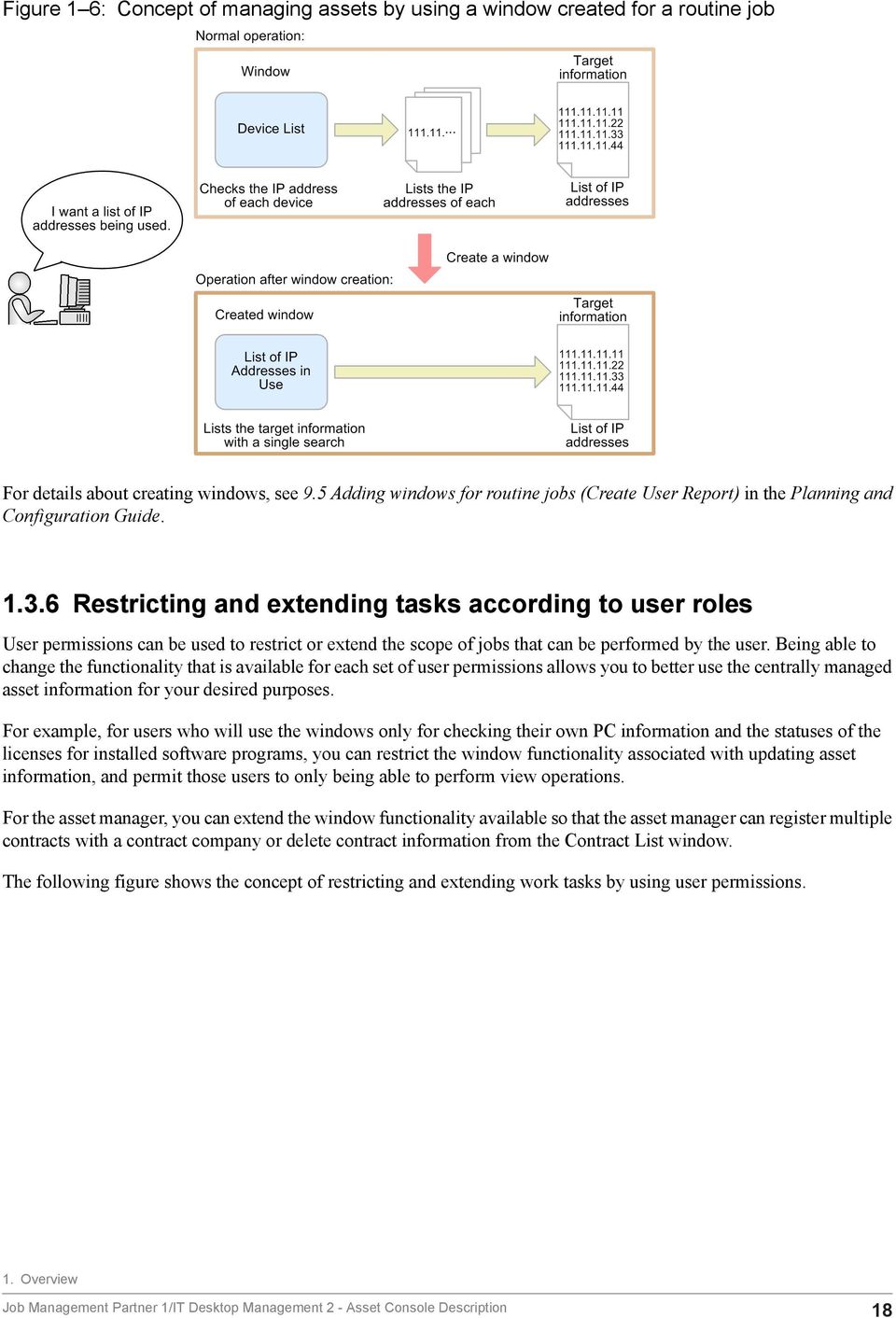
17 The following figure shows the concept of maintaining the asset management database and monitoring operating statuses. Figure 1 5: Concept of using tasks to update and monitor data in the asset management database Database maintenance: Asset Console allows you to effectively use database capacity while maintaining the integrity of data in the asset management database by also updating information related to the information being updated by Asset Console and removing unnecessary information. You can also register and periodically update information from linked products in the asset management databases based on information collected by JP1/IT Desktop Management 2 - Manager. Monitoring of operating statuses: You can periodically check for contracts whose expiration dates are getting close, and notify an asset manager by . This informs the asset manager about contracts that are about to expire, so that they can be renewed in a timely manner. You can also periodically total the usage statuses of software licenses, and provide an notification if an installation exceeds the number of owned licenses or an installation using an unauthorized license is detected. For details about setting up tasks with Task Scheduler, see 5.9 Setting the tasks that are registered in Task Scheduler in the Planning and Configuration Guide Creating operation windows for routine jobs You can improve operational efficiency by creating operation windows suitable for routine jobs that search for a specific type of information. For example, by creating an operation window, you can search by group for information that normally can be searched for only by device, or search for only the IP addresses that are currently in use. You can use the provided GUI to easily create windows appropriate for routine jobs. Note that you can create a window that searches the asset information managed by the asset management database and displays the results as a list, but you cannot create a window that totals or registers asset information. The following figure shows the concept of managing assets by using a window created for a routine job. 1. Overview Job Management Partner 1/IT Desktop Management 2 - Asset Console Description 17

18 Figure 1 6: Concept of managing assets by using a window created for a routine job For details about creating windows, see 9.5 Adding windows for routine jobs (Create User Report) in the Planning and Configuration Guide Restricting and extending tasks according to user roles User permissions can be used to restrict or extend the scope of jobs that can be performed by the user. Being able to change the functionality that is available for each set of user permissions allows you to better use the centrally managed asset information for your desired purposes. For example, for users who will use the windows only for checking their own PC information and the statuses of the licenses for installed software programs, you can restrict the window functionality associated with updating asset information, and permit those users to only being able to perform view operations. For the asset manager, you can extend the window functionality available so that the asset manager can register multiple contracts with a contract company or delete contract information from the Contract List window. The following figure shows the concept of restricting and extending work tasks by using user permissions. 1. Overview Job Management Partner 1/IT Desktop Management 2 - Asset Console Description 18
19 Figure 1 7: Concept of restricting and extending work tasks by using user permissions For details about restricting and extending functions of window operations, see 2.6 Limiting available functions by user roles. For details about how to perform such operations, see 9.3 Changing a window for a user role (Customize Job windows) in the Planning and Configuration Guide License management of various license types Asset Console allows you to manage various types of software licenses. This subsection describes the typical license types and the license management methods, and the license management method used by Asset Console. (1) License types There are many types of licenses, but the main ones are as follows. Installation license This license permits installation on a single device. User license This license permits use by a single user. It permits installation on multiple devices that are owned by the same user. Pre-installed This license covers installation on a purchased device. Server license This is a license for server products. Server products normally have additional licenses, such as for the permitted number of times the server can be accessed (client access license), the permitted number of CPUs (CPU license), or the permitted number of manageable nodes (managed node license). Second license 1. Overview Job Management Partner 1/IT Desktop Management 2 - Asset Console Description 19

20 This license permits installation on a specific second device, such as a portable device. It is typically together with an installation license that permits installation on only a single device. Concurrent execution license This license might be necessary, depending on the number of software programs that are to be concurrently executed or reside on a device. Volume license This license allows you to freely purchase any number of licenses within the predefined range. The purchaser can choose the desired combination and number of licenses, but both the minimum and maximum number of points that can be used during the contract period are predetermined. In addition to the above types of licenses, there are various options, such as whether software is upgradeable or downgradable. (2) License management methods The two main license management methods are total count management and per-license management. You can select the method that is best for your asset management system (or is appropriate for your software programs). Total count management This method manages licenses by comparing the total number of software licenses owned by the company or a group to the number of licenses in use. It eliminates the need for allocating individual licenses, thereby making management tasks comparatively easy. However, if licenses are not used properly, it is difficult to identify a specific device or user where a license violation is occurring. Even with the same license, if permitted options depend on purchase contract terms, it is difficult to determine whether the license is being used properly by each device or user. You cannot clearly determine which devices downgrade software licenses are being used for. Per-license management This method manages licenses by associating each owned license with a specific device or user. This method allows you to accurately determine the usage status according to each license's terms of purchase. It is also easy to identify devices or users that are illegally using licenses. However, this method requires that each license be associated with a device or a user. (3) License management via Asset Console Asset Console provides you with the flexibility to create license information appropriate to the types of licenses you have and the management method you are already using, thereby making it possible to manage licenses on a very detailed level. For example, you can efficiently manage licenses by using the appropriate management method for each license, such as employing total count management for licenses that are used throughout the entire company and per-license management for licenses that are individually purchased. In addition to the volume license management method, this section describes total count management and per-license management, which are license management methods supported by Asset Console. (a) Managing licenses based on the number of owned licenses and the number of used licenses This is the total count management method. 1. Overview Job Management Partner 1/IT Desktop Management 2 - Asset Console Description 20

21 This method registers the number of licenses you own when a license is purchased, obtains the number of licenses being used from the licenses installed on devices, and then compares these numbers. The following figure shows the concept of managing licenses on the basis of the number of owned licenses and the number of used licenses. Figure 1 8: Concept of managing on the basis of the number of owned licenses and the number of used licenses For an example of total count management, see Checking the operation status by comparing the number of owned licenses to the number of used licenses. (b) Managing licenses by assigning them to devices or users This is the per-license management method. Managing licenses by assigning them to devices This method manages licenses that are required for each device, such as installation licenses and second licenses, by assigning them to devices. A license's acquisition method, such as part of a package or pre-installed, can be managed as an attribute within the license information. The following figure shows the concept of managing licenses by assigning them to devices. 1. Overview Job Management Partner 1/IT Desktop Management 2 - Asset Console Description 21
22 Figure 1 9: Concept of managing licenses by assigning them to devices Managing licenses by assigning them to users This method manages licenses as User licenses by assigning them to users who are managed by Asset Console. The following figure shows the concept of managing licenses by assigning them to users. Figure 1 10: Concept of managing licenses by assigning them to users Second and concurrent execution licenses are managed as follows: 1. Overview Job Management Partner 1/IT Desktop Management 2 - Asset Console Description 22
23 Managing second licenses You can manage second licenses by adding and assigning them to devices, or by managing them as User licenses without adding the licenses. Managing concurrent execution licenses You can manage concurrent execution licenses by registering the number of licenses that can be executed concurrently as the number of owned licenses, or you can manage the number of copies that can be executed concurrently as a license attribute. For an example of per-license management, see Accurately managing targets according to the assigned licenses. (c) Managing downgrade software When you use a purchased license for an older version of some software, the older version of the software is called downgrade software. For example, if you use Windows 7 with a license purchased for Windows 8, Windows 7 is downgrade software. To manage downgrade software, you must perform per-license management as described in subsection (b) above. The following figure shows the concept of managing downgrade software by assigning licenses for each device and managing them as installation licenses. Figure 1 11: Concept of managing downgrade software Managing downgrade software requires specifying a number of settings in addition to performing per-license management. For details, see Adding downgrade software assets in the Administration Guide. (d) Managing volume license points You can manage the status of the number of accrued points by registering the volume license information and associating it with the applicable licenses. Options for volume licenses (such as whether software is upgradeable) are managed as part of the license information for software. 1. Overview Job Management Partner 1/IT Desktop Management 2 - Asset Console Description 23
24 The following figure shows the concept of managing volume license points. Figure 1 12: Concept of managing volume license points Using a flow to apply for requests and approve tasks Asset management tasks include those that require applying for and getting approval for something, as well as tasks that must be passed through an acceptance and handling process. For example, the installation of a new device requires a process for obtaining approval from a manager. Also, the details of actually arranging for and distributing the device must be dealt with by persons within the organization responsible for the overall management of the system. With Asset Console, these types of jobs are performed by creating an Item. An Item is a job that travels along a defined route. An Item can also be thought of as the electronic form used when performing the job. A task, such as the installation of a device or software program, proceeds through a system as it is sent and received by various parties. This process is referred to as a flow. Flows make it easier to achieve ITIL processing. Asset management tasks that use flows have the following benefits: By creating a single Item, you can process an application without needing to know who will handle the details, thereby making it easier to distribute required information. Information to be used by the procedure is registered onto the server, enabling the information to be managed reliably. Items can be managed centrally, making it easier to understand how far work related to the task has progressed. The use of Items for applying for and approving things also allows Items to be used as draft planning instruments, since all approvals are obtained through a formal processing route. Furthermore, Asset Console enables more efficient asset management with features, such as automatically registering information for problem resolutions as requested by an Item when a problem is resolved. The following figure shows the concept of performing application and approval tasks by using a flow. 1. Overview Job Management Partner 1/IT Desktop Management 2 - Asset Console Description 24
25 Figure 1 13: Concept of performing application and approval tasks by using a flow Login authentication using Active Directory services Active Directory services can be used for authentication when logging in to Asset Console. This allows login passwords to be consolidated in Active Directory, and means that you do not have to use Asset Console to manage passwords. 1. Overview Job Management Partner 1/IT Desktop Management 2 - Asset Console Description 25
26 2 Typical Uses This chapter describes the typical uses of Asset Console, such as how to use Asset Console in asset management tasks and the preparation needed to use Asset Console after it has been installed. Job Management Partner 1/IT Desktop Management 2 - Asset Console Description 26
27 2.1 Importing and exporting device information With Asset Console, you can import CSV data into asset management databases, and export asset management database information in CSV format. The following are examples of tasks that you can perform: Importing data from another system into the asset management database. Select output items, and perform regular backups. This section explains how to import and export information by using device information as an example Importing data from another system into the asset management database You can register the data migrated from other systems in a batch operation by importing the data into the asset management database. Provided you are working in a system environment that allows you to log in to Asset Console, you can import data from any location. You can use the Import window to import data from a CSV file. The following figure shows the Import window. Figure 2 1: Import window To import data, you must first create conditions and then import the data based on the conditions. Samples of import conditions are provided for each type of information. For details on the asset types used in these samples, see (1) Selecting the asset type in the Administration Guide. In addition to using the Import window, you can also import data by executing jamcsvimport.bat or the jamimport command. For details about these data import methods, see Inport flow in the Planning and Configuration Guide. 2. Typical Uses Job Management Partner 1/IT Desktop Management 2 - Asset Console Description 27
28 The procedure below explains how to import information managed by another system into the asset management database. In the example, the device information being managed includes machine numbers (a unique value assigned to each IT asset), names, PC statuses (Used or Unused), and MAC addresses. Figure 2 2: Workflow for importing information regarding devices managed by another system 1. Create a CSV file. Only CSV data can be imported into the asset management database. As such, you must first create a CSV file containing the data you want to import. You can use any character strings for the item names in the CSV file. For details about the CSV file format, see (1) CSV file format in the Administration Guide. The following figure shows an example of a created CSV file. 2. Typical Uses Job Management Partner 1/IT Desktop Management 2 - Asset Console Description 28
29 Figure 2 3: Example of a created CSV file 2. Change the Used and Unused character strings under PC Status. To unify the statuses with those already being used in Asset Console, the PC statuses Used and Unused in the CSV file must be changed to Active and Stock, respectively. To inherit the pre-migration names, use the Code window to change the character strings used as the statuses. For details about how to use the Code window, see Changing a code's display value in the Administration Guide. 3. Create import conditions. To register data into the asset management database, create import conditions and assign the item names in the CSV file to the managed items. To create import conditions, first click the Pattern button in the Import window to display the Select Category dialog box. After that, select Device information in the Category column. Next, click the Browse button for the managed items to display the Setting Assignment dialog box. In the dialog box, specify the managed item to which information from the CSV file is to be assigned. The following figure shows the Setting Assignment dialog box. Figure 2 4: Setting Assignment dialog box When specifying the import conditions, assign information to the managed items as shown below. Table 2 1: Settings for assigned items when the conditions are created Managed items Asset information.asset No. Asset information.user name Asset information.usage management Asset information.status Asset information.reg. date Hardware information.mac address Setting for assigned items Specify Machine No. for CSV items. Specify Name for CSV items. Specify Used for Constant value. Specify PC Status for CSV items. Select the Assigned items check box, and select Active. Specify 2006/01/01 for Constant value. Specify MAC Address for CSV items. Note the following when specifying the import conditions: A star ( ) indicates an item that must be specified. 2. Typical Uses Job Management Partner 1/IT Desktop Management 2 - Asset Console Description 29
30 If each asset is assigned a unique value as its asset number, the value that was used to manage the asset in another system can then be used as the asset number in Asset Console. If you do not register any values, asset numbers are provided automatically. When you import MAC addresses, the management information collected from JP1/IT Desktop Management 2 - Manager is assigned as the information of the imported devices. For details about how to create import conditions, see Creating import conditions in the Administration Guide. After you save the conditions, click the Back button to return to the previous window. 4. Import the data. In the Import window, specify the created conditions, and import the data. For details about how to import data, see Executing imports in the Administration Guide. 5. Check the import results. In the Result Import window, check the results of the import operation. For details about how to check the import results, see 4.12 Checking the import results (Result Import) in the Administration Guide. 6. Manage the devices. By using the Device Totals window, you can calculate the total number of devices you own, change device information from the Batch Update window, and perform other device management operations. Repeat steps 1 to 4 of the import procedure until you have imported all of the information Limiting the items to be exported for regular backups By creating conditions in advance to filter the items to be exported, you can export only the information that you want to output. By using the conditions you created, you can also easily limit the items to be exported when you back up the asset management database. The Export window is used to export the data to be backed up. The following figure shows the Export window. 2. Typical Uses Job Management Partner 1/IT Desktop Management 2 - Asset Console Description 30
31 Figure 2 5: Export window To export data, first create conditions, and then export the data based on those conditions. Samples of export conditions are provided for each type of information. You can use these samples to export all items. For details on the asset types used in these samples, also known as asset types, see (1) Selecting the asset type in the Administration Guide. In addition to using the Export window, you can also export data by executing jamcsvexport.bat or the jamexport command. For details about the differences among these export methods, see Collecting from CSV files in the Planning and Configuration Guide. The procedure explains how to export device information in CSV format. 1. Create export conditions. Begin by creating export conditions for backing up data. To create export conditions, first click the Pattern button in the Export window to display the Select Category dialog box. After that, select Device information in the Category column. Next, specify the items to be exported to the CSV file. When creating the export conditions, specify the following export items: Asset No. (Asset information) User name (Asset information) Status (Asset information) MAC address (Hardware information) For details about how to create export conditions, see Creating export conditions in the Administration Guide. Save the conditions, and then click the Back button to return to the previous window. 2. Export the data. In the Export window, specify the conditions created in step 1 and export the data. If you want to export only information from managed groups or otherwise filter the data being exported, click the Filter link to display the Set Condition dialog box, where you can filter the number of items. For details about how to export data, see Executing an export operation in the Administration Guide. 3. Specify a file name, and then save the data. 2. Typical Uses Job Management Partner 1/IT Desktop Management 2 - Asset Console Description 31
32 We recommend that you specify a file name that makes it easy to determine the date the file was exported and the contents of the file (for example, _device-info.csv). 4. Check the exported data. Check the data to make sure the export executed normally. To make use of the export functionality when you make regular data backups, repeat steps 2 to 4 using the export conditions created in step Typical Uses Job Management Partner 1/IT Desktop Management 2 - Asset Console Description 32
33 2.2 Managing the usage statuses of IP addresses The usage statuses of IP addresses are managed by associating them with groups. By separating the IP addresses into IP address ranges and managing them in group-specific IP groups, the group associated with the IP address of any particular device can be set automatically, even if JP1/IT Desktop Management 2 - Manager does not collect the group information as user information. This allows you to manage the usage statuses of IP addresses by group. The usage statuses of IP addresses are managed in the IP Group window. The following figure shows the IP Group window. Figure 2 6: IP Group window The figure below shows the workflow for managing the usage statuses of IP addresses by group, by registering the group associated with the IP addresses that are assigned to devices owned by the group. This example assumes that JP1/IT Desktop Management 2 - Manager does not collect group information as user information. 2. Typical Uses Job Management Partner 1/IT Desktop Management 2 - Asset Console Description 33
34 Figure 2 7: Workflow for associating a group with IP addresses, and managing the IP group 1. Set up automatic registration for the group to be associated with the IP addresses. To configure the system so that, when the IP address of a device changes, the group that includes the changed IP address is set automatically, specify Set for Settings for a group that uses a group-specific IP group in the Server Setup dialog box. For details about how to set values in the Server Setup dialog box, see Setting Basic Information in the Planning and Configuration Guide. Reference note You can also have the group corresponding to the IP address be recorded automatically during a task scheduler data maintenance task. Even when group information is being collected from the JP1/IT Desktop Management 2 - Manager management information, by executing this task, you can update the group to match the values set with the IP Group job menu. 2. Add an IP group. Add the IP group you want to manage using the Group-Specific IP Group tab in the IP Group window. For details about how to add an IP group, see Adding an IP group in the Administration Guide. 3. Register management information to the asset management database. 2. Typical Uses Job Management Partner 1/IT Desktop Management 2 - Asset Console Description 34
35 You can register the desired device information using the management information collected by JP1/IT Desktop Management 2 - Manager. For details about how to register management information, see Workflow necessary for linking to JP1/Software Distribution in the Planning and Configuration Guide. 4. View the IP address usage status. In the IP Address Management dialog box, you can view information about devices to which IP addresses are assigned and check for unused IP addresses. You can also display the Device Details dialog box by clicking the Asset No. link. For details about how to view IP address usage status, see Viewing IP address usage in the Administration Guide. When a new device is installed, you can check the IP group of the distribution destination group, and instruct the person responsible to assign an available IP address to the device. If more than one device is assigned to a single IP address, you can release the IP address of the invalidly assigned device, and assign a different IP address to that device. For details about how to release an IP address assigned to a device, see Releasing the IP addresses assigned to devices in the Administration Guide. For details about how to assign an IP address to a device, see Assigning IP addresses to devices in the Administration Guide. 2. Typical Uses Job Management Partner 1/IT Desktop Management 2 - Asset Console Description 35
36 2.3 Stocktaking You can search for devices for which stocktaking has not been completed by registering information about the devices for which stocktaking has been completed and the stocktaking date. This reduces the complexity of stocktaking jobs because you can check job progress and prevent items from being overlooked. If it exists, you can also use actual stocktaking data obtained using a device such as a bar-code reader to register such devices. To search for devices for which stocktaking has not been completed, use the Totals of Stocktaking-Unexecuted Devices window. The number of devices for which stocktaking has not yet been completed from the stocktaking start date can be confirmed in the Totals of Stocktaking-Unexecuted Devices window. The following figure shows the Totals of Stocktaking-Unexecuted Devices window. Figure 2 8: Totals of Stocktaking-Unexecuted Devices window You can easily register the actual stocktaking data into the asset management database by reading it with a bar-code reader or saving existing data in a ledger in CSV format. The following figure shows by way of example the procedure for a stocktaking job when a bar-code reader is used. 2. Typical Uses Job Management Partner 1/IT Desktop Management 2 - Asset Console Description 36
37 Figure 2 9: Procedure for stocktaking job 1. Use a bar-code reader to read the asset number of each device. 2. Create a CSV file from the obtained data. To manage the allocation of asset numbers for each device, specify the asset number and the stocktaking date in the CSV file that contains the actual stocktaking data. You can omit the stocktaking date, but make sure that the asset number is specified. For details about the format of the CSV file for actual stocktaking data, see Registering actual stocktaking data (Confirm Stocktaking Device) in the Administration Guide. 3. Register the CSV file containing the actual stocktaking data into the asset management database. You can register the actual stocktaking data by specifying its file from a window. For details about registering the actual stocktaking data, see Registering actual stocktaking data (Confirm Stocktaking Device) in the Administration Guide. 4. In the Totals of Stocktaking-Unexecuted Devices window, search for devices for which stocktaking has not been performed. Specify Stocktaking start date and Totals by to search for the devices for which stocktaking has not been performed. For Totals by, you can select Group name or Location. 2. Typical Uses Job Management Partner 1/IT Desktop Management 2 - Asset Console Description 37
38 For details about using the Totals of Stocktaking-Unexecuted Devices window, see Checking the number of devices that require stocktaking (Totals of Stocktaking-Unexecuted Devices) in the Administration Guide. 5. Instruct the user in charge of stocktaking to inventory the devices that were not counted. The search results for missing devices is useful for issuing instructions because it is provided for each group or location, making it easy to identify groups or locations that have not been included in stocktaking. You can also use the search results to view details about each device's users and group. You can also output the search results to a CSV file. Repeat steps 1 to 5 of the stocktaking job until stocktaking is completed for all devices. 2. Typical Uses Job Management Partner 1/IT Desktop Management 2 - Asset Console Description 38
39 2.4 Determining whether licenses are handled legally You can determine whether licenses are being handled legally by totaling usage in terms of whether the numbers of licenses being used have exceeded permitted values and whether licenses are being used by the correct users. There are two ways to manage licenses. One is called total count management, and it is based on comparing the number of licenses held (called owned licenses) with the number of licenses actually in use. The other is called per-license management, and it assigns each license individually. This section describes the job for managing licenses with each method Checking the operation status by comparing the number of owned licenses to the number of used licenses You can perform basic license management, such as determining use of an excess number of licenses and use of unauthorized licenses, by managing the license totals based on information about the installed licenses on all devices. To manage licenses, start from the job menus under Software License. In the Owned License List window (opened by clicking the Owned License List job menu), you can obtain the license usage status at a glance, because this window displays a table comparing the number of owned licenses, the number of licenses being used, and the number of available licenses. The following figure shows the Owned License List window. Figure 2 10: Owned License List window You can use this comparison table to purchase licenses when no more are available or to search for groups with too many licenses for transfer to groups with too few licenses. You can use the following job menus to identify inappropriate license usage: Excess License List 2. Typical Uses Job Management Partner 1/IT Desktop Management 2 - Asset Console Description 39
40 Allows you to check if any licenses are being used that exceed the number that has been set for owned licenses. Unauthorized Usage List Allows you to check if any expired licenses are being used, or whether licenses that have not been obtained are being used. Unknown Usage List Allows you to check if software programs with unregistered software names are being used. Tip You can set up the system to notify the asset manager by if an excess license is detected. This means you can prevent excess licenses from being overlooked, thereby reducing the asset manager's workload. Events that trigger asset manager notification can be monitored by registering a task to the Windows Task Scheduler to check for excess licenses. For details about how to set tasks, see 5.9 Setting the tasks that are registered in Task Scheduler in the Planning and Configuration Guide. The following figure shows the procedure for checking license status. Figure 2 11: Procedure for checking license status 1. Register management information into the asset management database. 2. Typical Uses Job Management Partner 1/IT Desktop Management 2 - Asset Console Description 40
41 To check license usage status, you need two types of information: Information about devices Information about the software programs installed on the devices You can use the management information acquired by JP1/IT Desktop Management 2 - Manager to register information about devices and about software programs installed on the devices. For details about registering management information, see Workflow necessary for acquiring JP1/IT Desktop Management 2 - Manager management information in the Planning and Configuration Guide. To efficiently manage licenses, we recommend that you configure the system to automatically assign the installed software name to a software name when you collect management information. For details about how to automatically assign the installed software name to a software name, see Setting the software name assignment method in the Planning and Configuration Guide. If the assignments are not performed automatically, you must use the Software Name job menu to assign names one at a time. 2. Register purchased license information. In this step, register the purchased license. For details about how to register licenses, see Adding a license (New Software) in the Administration Guide. 3. In Task Scheduler, enable the Notice of license excess task. 4. The task totals the license usage statuses and reports excess licenses. The task registered in Task Scheduler is executed at the specified date and time and totals the licenses. If any software exceeds a usage threshold (the default threshold is 100%), the task sends an to the asset manager reporting that excess licenses are in use. You can also total the licenses from the window that is displayed by selecting Totals List & Execution from the job menu. For details about how to total licenses using window operations, see Totaling licenses (Totals List & Execution) in the Administration Guide. 5. Check license usage status. In the window that is displayed by selecting Excess License List from the job menu, check for licenses that have been installed in excess of the number owned. You can also download the totals using a CSV file. For details about checking the excess licenses, see Checking for exceeded licenses (Excess License List) in the Administration Guide Accurately managing targets according to the assigned licenses You can accurately manage license usage status by creating license information according to license types and options and assigning licenses to specific targets. The figure below shows the procedure for managing licenses by assigning them. This procedure is an alternative to the procedure for total count management described in Checking the operation status by comparing the number of owned licenses to the number of used licenses. 2. Typical Uses Job Management Partner 1/IT Desktop Management 2 - Asset Console Description 41
42 Figure 2 12: Procedure for managing licenses by assignment 1. Create and register license information when you purchase licenses. Create the license information according to the license type and option settings. For example, for an Install license, register information such as upgrade assurance and compatibility with downgrade software. For details about how to register license information, see Adding a license (New Software) in the Administration Guide. 2. Assign the licenses to the targets. Assign the licenses to devices or users according to the license category. To assign a license, establish correspondence between the key information such as product ID and the targets. For details about assigning licenses, see 2.4.6(2) Assigning licenses in the Administration Guide. 3. Execute the same steps as for total count management. Install the software program on the devices to which licenses have been assigned and then execute the steps common to total count management (register management information, establish correspondence between software names, set up the task, and total the licenses). 2. Typical Uses Job Management Partner 1/IT Desktop Management 2 - Asset Console Description 42
43 4. Check to see if the licenses are handled correctly. Under Software License, you can use the following job menus to check the registered license information: Owned License List This menu lets you check the total for each license category. Excess License List This menu lets you check for any licenses being used that exceed the threshold set by the license category for owned licenses. If illegal use of a license is detected, you can identify the user or device immediately. To accurately manage licenses, it is important to create license information according to the license type and options and select an assignment method that is appropriate for your operating procedures. Also, all types of information that can be managed as license information must have been prepared, and the total number owned is executed on the basis of the license category. The following presents examples of license management that are suggested for license management using Asset Console: (1) Example of managing Install licenses You can manage licenses assigned to devices as follows: Create license information as Install license. To assign a license to a device, specify Install license for License category. Also specify other settings appropriate to the license, such as downgrade and upgrade assurance. Register the key information, such as the product ID of the purchased licenses, and assign one license to each device. This allows you to check whether use of the license is permitted for any particular device. (2) Example of managing User licenses You can manage licenses assigned to users as follows: Create license information as User license. To assign a license to a user, specify User license for License category. Also specify other settings appropriate to the license, such as downgrade and upgrade assurance. Register the key information, such as the product ID of the purchased license, and assign one license to each user. This allows you to total licenses correctly, even when the same user uses a license on multiple devices. To manage a license by assigning it to a user, the user must be registered in the applicable device. Additionally, this user must also be registered as an Asset Console user. (3) Example of managing pre-installed licenses You can manage pre-installed software licenses as follows: Create license information as Install license. Specify Install license for License category. Use Licensing method to specify that this is a pre-installed license. Disable the Downgrade property because normal pre-installed software programs are not downgradable. This enables you to determine whether the correct version has been installed. For the number of owned licenses, specify unlimited licenses. You can register a license by owning a single license per device; however, by specifying unlimited licenses, you can manage software programs more efficiently because any additional pre-installed licenses for the same software program can be assigned later, simply by adding its key information. 2. Typical Uses Job Management Partner 1/IT Desktop Management 2 - Asset Console Description 43
44 Assign a license to a single device by registering the key information such as product ID. As a result, you can determine whether the pre-installed software program is being used on the assigned device. (4) Example of managing server licenses You can manage the license of a server product as follows: Create license information as Install license. To assign a license to a device, specify Install license for License category. Also specify other settings appropriate to the license, such as downgrade and upgrade assurance. A server license is accompanied by other licenses, such as Client access, Managed node, and CPU licenses. The following describes a management example for each license: Client access license This license is given according to the number of administrators' computers (or the number of users) that access the server. Select one of the following management methods: Managing accessible administrators' computers as the number of owned licenses Register a single license separately from the server license and create client access license information. For example, register a client license with 100 accesses permitted as a software asset with 100 licenses owned. For License type, specify Client access license. This allows you to total the number of accesses permitted as the number of owned licenses. Note that information such as the number of used licenses is not totaled because there is no device-related information. Managing as the additional information for the server license As a simple method, register the number of accesses as remarks without registering the client access license as a license. You need to calculate the number of owned licenses manually. Managed node license This license is given according to the number of administrators' computers managed by the server. Select one of the following management methods: Managing the number of administrators' computers managed by the server as the number of owned licenses Register a single license separately from the server license and create managed node license information. For example, register a managed node license that permits 100 managed nodes as 100 owned licenses. For License type, specify Managed node license. This allows you to total the number of managed nodes permitted as the number of owned licenses. Note that information such as the number of used licenses is not totaled because there is no device-related information. Managing as the additional information for the server license CPU license As a simple method, register the number of managed nodes as additional information associated with the server license, without registering the managed node license as a license. In this case, you need to calculate the number of owned licenses manually. This license is given according to the number of CPUs. Create license information as CPU license, not as server license. 2. Typical Uses Job Management Partner 1/IT Desktop Management 2 - Asset Console Description 44
45 (5) Example of managing second licenses This subsection presents an example of managing licenses when installation on a second device is permitted. Select one of the following management methods: Managing as User license Create license information as User license (specify User license for License category). The license is managed assuming that installation on a second device that is used by the same user is permitted. However, the system cannot detect exceeded licenses even if the applicable software program is installed on more than two devices. Managing the license by adding second license information Register a license separately from the server license and create second license information. In this case, remarks about its correspondence with the original license would be useful. (6) Example of managing concurrent execution licenses This subsection presents an example of managing concurrent execution licenses. Select one of the following managing methods: Managing the number of concurrently executable licenses as the number of owned licenses Register a single license separately from the server license, and create concurrent execution license information. For example, register a concurrent execution license that permits 100 concurrent executions as 100 owned licenses. For License type, specify Concurrent execution license. This allows you to total the number of concurrent executions permitted by the license as the number of owned licenses. Note that information such as the number of used licenses is not totaled because there is no device-related information. Managing as the additional information for the server license As a simple method, register the number of executions as additional information associated with the server license without registering the concurrent execution license as a license. In this case, you need to calculate the number of owned licenses manually. Managing by assigning to devices Register the license using the permitted number of concurrent executions as the number of owned licenses. Create the license information as concurrent execution license, not as server license. Register the key information, such as the product ID of the purchased licenses, and assign one license to each device. You can limit the number of concurrent executions by permitting as many installations as there are permitted concurrent executions. 2. Typical Uses Job Management Partner 1/IT Desktop Management 2 - Asset Console Description 45
46 2.5 Adding asset information statuses, managed items, and windows You might want to perform more in-depth management of device and contract status or to use more management items than available with standard window operations of Asset Console, by customizing the system environment, according to the job. In this case, you can easily use window operations to add statuses and managed items. You can also create a window for searching your assets on the basis of the added statuses or managed items as key values and then add asset management jobs that can be executed from Asset Console. For example, you can add a job that groups devices by installation period and then manages the distribution status of the devices in groups. To do this, the following preparations are needed: Adding the status Waiting for distribution indicating that distribution has not been made to the device. Adding the managed item Group to manage the devices installed in the same period as a group. Adding a window for searching for devices by group to which distribution has not been made since installation You can easily do all this from the windows that are displayed by selecting the job menus under the System Management and System Definition job categories. The following figure shows the procedure for preparing and executing the job for checking the distribution status. 2. Typical Uses Job Management Partner 1/IT Desktop Management 2 - Asset Console Description 46
47 Figure 2 13: Procedure for checking the distribution status of devices by group 1. In the Code window, add the status. Add the status Waiting for distribution indicating that the device has not been distributed to a group after installation. The status is associated with the code and managed by the asset management database. Therefore, to add the status Waiting for distribution to devices, add the corresponding code to Status. For details about the operation in the Code window, see 4.8 Adding and changing types and statuses (Code) in the Administration Guide. 2. In the Customize Managed Items window, add a managed item. To manage the devices installed in the same period as a group, add Group to the managed items of Asset information. The added managed item takes effect in the entire asset management system. For details about the operation in the Customize Managed Items window, see 9.2 Changing managed items (Customize Managed Items) in the Planning and Configuration Guide. 2. Typical Uses Job Management Partner 1/IT Desktop Management 2 - Asset Console Description 47
48 3. In the Create User Report window, add a window. Add a window for checking for any device that was installed in the same period, but has not been distributed. In the window, search for devices using Group as the condition and list only those devices whose status is Waiting for distribution as the result. You can display the added window from the menu that is added to the job menu. You can also change the window's view setting (view or hide) from the Customize Job Menu window. For details about the operation in the Create User Report window, see 9.5 Adding windows for routine jobs (Create User Report) in the Planning and Configuration Guide. For details about the operation in the Customize Job Menu window, see 9.4 Changing the executable jobs (Customize Job Menu) in the Planning and Configuration Guide. 4. In the New Device window, register new devices. Register newly installed devices. When registering the devices, specify Waiting for distribution as Status. To manage the devices installed in the same period as one group, register the same number in Group. If the device installation date is included in the number, device management by group is facilitated. For details about the operation in the New Device window, see Registering device information (New Device) in the Administration Guide. 5. Distribute the newly installed devices to groups. After distributing the devices, the system administrator must use the Batch Update window to change the status of the distributed devices from Waiting for distribution to Active. For details about the operation in the Batch Update window, see Changing device information (Batch Update) in the Administration Guide. 6. Use the added window to search for any devices that have not been distributed. By executing a search with Group specified as the search condition, you can display a list of devices in the specified group that have not been distributed. You can then distribute those devices on the basis of this list. 2. Typical Uses Job Management Partner 1/IT Desktop Management 2 - Asset Console Description 48
49 2.6 Limiting available functions by user roles Asset Console's asset management system enables corporate assets information to be widely shared among users, from general users to the staff in charge of the asset management jobs. However, the asset management system might contain some information that should not be shared or manipulated by general users. If the usage of Asset Console depends on the nature of user jobs, available information and functions can be limited by means of user roles. For example, you can set the following limitations for general users: Prohibit updating of information about software programs installed on devices. Prohibit execution of Transfer License jobs. This section describes the procedures executed by the asset manager to set limitations on the operations available to general users Prohibiting updating of information about software programs installed on devices To strictly control the installation of unauthorized software, set up the system in such a manner that no user other than an administrator can update information about installed software. To limit the functions of a specific window, use the Customize Job Windows window. The following figure shows the Customize Job Windows window. Figure 2 14: Customize Job Windows window This window lists all Asset Console windows by job. Clicking the link for a desired window displays the window for changing the settings for that window (Customize Job Windows - Edit Form). The window settings are called a form. The following figure shows the procedure for limiting the functions of a specific window. 2. Typical Uses Job Management Partner 1/IT Desktop Management 2 - Asset Console Description 49
50 Figure 2 15: Procedure for limiting the functions of a window for a user role 1. In the Customize Job Windows - Edit Form window for the Software tab of the Device Details dialog box, specify the form settings. In the Customize Job Windows window, from the list of window names, select Device, and then Software. Then, in the Customize Job Windows - Edit Form window that is displayed, specify the following settings: Target role: Set User. Buttons: Hide the Add and Delete buttons. For details about the operation in the Customize Job Windows window, see 9.3 Changing a window for a user role (Customize Job Windows) in the Planning and Configuration Guide. 2. In the Customize Job Windows - Edit Form window for the Installed Software Details dialog box, specify the form settings. In the Customize Job Windows window, from the list of window names, select Device, Software, and then Installed Software Details. Click the link to display the Customize Job Windows - Edit Form window, and then specify the following settings: Target role: Set User. Buttons: Hide the Update button. Editable items: Set Read-only for all items. 3. Log in to Asset Console, and execute a job. For a general user, the displayed Software tab of the Device Details dialog box and the Installed Software Details dialog box allow only information referencing. Note that steps 1 and 2 can be reversed. 2. Typical Uses Job Management Partner 1/IT Desktop Management 2 - Asset Console Description 50
51 2.6.2 Prohibiting execution of a Transfer License job If the asset manager is to use a batch operation to transfer licenses, you must hide the job menu itself from general users. To hide a specific job menu, use the Customize Job Menu window. The following figure shows the Customize Job Menu window. Figure 2 16: Customize Job Menu window In the tab for each user role, specify the view setting (show or hide) for a job menu. The following figure shows the procedure for hiding a specific job menu. Figure 2 17: Procedure for hiding a job menu according to the user role 1. In the Customize Job Menu window, change the job assignment. 2. Typical Uses Job Management Partner 1/IT Desktop Management 2 - Asset Console Description 51
52 Select the Customize Job Menu job menu, and then, in the displayed window, remove Transfer License from the jobs that are available to general users. For details about the operation in the Customize Job Menu window, see 9.4 Changing the executable jobs (Customize Job Menu) in the Planning and Configuration Guide. 2. Log in to Asset Console, and execute a job. For a general user, the Transfer License job menu is no longer displayed. 2. Typical Uses Job Management Partner 1/IT Desktop Management 2 - Asset Console Description 52
53 2.7 Solving problems using Items If any type of problem occurs in a device used by the system, it is necessary in order to solve the problem to distribute information about the problem to pre-designated individuals within the organization who are responsible for receiving and solving problems. Normally, problem information is conveyed in a document or by , but this makes it difficult to keep track of the processing progress. By using Items, an overview of the problem can be easily determined and the processing status can be tracked. Items are selected and created from the New Item window. In the New Item window, the Items that can be used are displayed by tab according to category. The following figure shows the New Item window. Figure 2 18: New Item window Asset Console provides a Problem Report Form as a sample Item. Using this sample Item, the figure below is an overview of the actions required to handle an asset problem. The steps involve requesting help from concerned personnel, discovering the problem, implementing a solution, and completing the task. 2. Typical Uses Job Management Partner 1/IT Desktop Management 2 - Asset Console Description 53
54 Figure 2 19: Overview of handling an asset problem using a sample Item 1. Define the job flow. When a problem occurs, define the types of information, the path over which that information will be routed, and whether to perform troubleshooting. If you use the sample Item provided without any change, you can skip this step. Use the Item Definition window to define a workflow that uses an Item. For details about how to define an Item, see 10.1 Overview of Item definition in the Planning and Configuration Guide. 2. Use the Official Authority window to assign authorities to the users who will handle the Item. In the Problem Report Form Item, problem receivers and problem solvers have been defined as official authorities (authorities required to process the Item). Because all necessary authorities are already defined in the sample Item, simply assign the authorities to users who have sufficient permissions to perform the processing involved. For details about how to define users with authorities, see 10.2 Defining authority for processing the Item (Official Authority) in the Planning and Configuration Guide. 3. Exhibit the Problem Report Form Item. Because the status of the sample Item is registered as Creating, the status must be changed to Exhibit. For details about how to exhibit Items, see Setting an Item to Exhibit or Not exhibit in the Planning and Configuration Guide. Reference note In the New Item window, Items are displayed in tabs on the basis of the Item category. Initially, the Template tab is provided. Depending on the type or the contents of the work, change the name of this tab or add new 2. Typical Uses Job Management Partner 1/IT Desktop Management 2 - Asset Console Description 54
55 tabs. For details about how to add or change Item categories, see Adding codes in the Administration Guide. To display the Item in the Item category that was added, change the Item category before you exhibit the Item. For details about how to change Item categories, see Placing workers and processing in the Planning and Configuration Guide. 4. Create a Problem Report Form and request a problem resolution. From the New Item window, create a Problem Report Form Item and submit an application. The sent Item is placed in the next worker's inbox. The person responsible for receiving the problem opens the Problem Report Form in the inbox, checks the overview of the application, and requests a solution from the person responsible for solving the problem. For details about how to create Items and how to process received Items, see 3. Executing Asset Management Jobs That Use Items in the Administration Guide. 5. Confirm the overview of the problem resolution. After having solved the problem, the problem solver records the fact that the problem has been solved in the Problem Report Form, and then sends the form back to the applicant. To complete the Item, the applicant confirms that the problem has been solved. Changing the contents of an Item definition The sample Item provided by Asset Console is a model case of an asset management job. Change the settings, based on this sample, depending on the details of the actual asset management job. For details about how to confirm and change the contents of an Item definition, see 10.1 Overview of Item definition in the Planning and Configuration Guide. The following figure shows the Item definition elements required during consideration of jobs that use Items. Figure 2 20: Item definition elements Item route This defines the workers who are responsible, from the applicant and the problem reception desk until the Item is completed. The department and the personnel who execute the series of work, and the contents of that work, until completion of an Item are known as the node. For details about how to define the route, see 10.3 Defining the route (Flow Designer) in the Planning and Configuration Guide. Worker role The management node problem reception desk and problem resolution desk are defined so that Items are sent to workers with authority to execute the processing. The authority required to process Items is called official 2. Typical Uses Job Management Partner 1/IT Desktop Management 2 - Asset Console Description 55
56 authority. For details about how to define official authority, see 10.2 Defining authority for processing the Item (Official Authority) in the Planning and Configuration Guide. Window components processed by each worker Each worker defines the items to be specified and the buttons for execution in the windows. Such workerprocessed windows are called Item window. For details about how to define the Item window, see 10.4 Defining the Item window (Form Designer) in the Planning and Configuration Guide. Processing that accompanies Item execution This defines the processing to be executed once the solution has been implemented, when the overview of the problem and the overview of the solution are registered and the Item is sent to the next worker. Such processing that accompanies execution is called an activity. For details about how to define this processing, see 10.5 Defining each node's task (Activity Designer) in the Planning and Configuration Guide. Setting whether to send and processing time limits You can set options for an Item, such as whether the worker is to be notified by when the Item arrives at the next worker, or to specify a processing time limit. These send-time options for Items are called Item options. For details about how to define Item options, see 10.6 Setting the Item options (Flow Designer) in the Planning and Configuration Guide. 2. Typical Uses Job Management Partner 1/IT Desktop Management 2 - Asset Console Description 56
57 2.8 Login authentication via linkage with Active Directory Active Directory services can be used for authentication when logging in to Asset Console. This allows login passwords to be consolidated in Active Directory, and means that you do not have to manage passwords separately for each system you are using. Note Only passwords can be consolidated when Active Directory is used for login authentication. Asset Console user information must be used to manage user group information. The following figure shows the workflow for user authentication via linkage with Active Directory. Figure 2 21: Workflow for user authentication via linkage with Active Directory 1. Obtain configuration information and attribute names from the Active Directory server. The information required to configure linkage with Active Directory must be obtained in advance. For details about how to obtain this information, see Login authentication in the Planning and Configuration Guide. 2. Specify the settings to link with Active Directory. In order to link to Active Directory, you must configure the settings under Link with Directory Server in the Server Setup dialog box. For details about the settings required to link with Active Directory, see Setting Link with Directory Server in the Planning and Configuration Guide. 2. Typical Uses Job Management Partner 1/IT Desktop Management 2 - Asset Console Description 57
58 2.9 Importing Active Directory information into the asset management database User information managed by Active Directory services can be imported into the asset management database. You must create and periodically execute an Asset Console script in order to update the asset management database (user management information) with the user information that is managed by Active Directory services. Asset Console provides a sample script that can be used as a reference for creating your own script. The sample script updates the following items: Role names addresses Phone numbers For details about how to update the asset management database via linkage with Active Directory, see Acquiring user organization information in the Planning and Configuration Guide. 2. Typical Uses Job Management Partner 1/IT Desktop Management 2 - Asset Console Description 58
59 Appendixes Job Management Partner 1/IT Desktop Management 2 - Asset Console Description 59
60 A. Differences Between the Asset Management Functions in Asset Console and in JP1/IT Desktop Management 2 Windows The table below summarizes the differences between the asset management functions in Asset Console and in JP1/IT Desktop Management 2 windows. More detailed information about these functional differences is provided by JP1/IT Desktop Management 2 manuals and JP1/IT Desktop Management 2 - Asset Console manuals. Table A 1: Summary of the functional differences in asset management No. Function Summary A C ITDM 2 Features of AC 1 Device management 2 History management 3 Contract management 4 Problem management 5 License management 6 Item management Searches a specific organizational group or location, or the entire organization, to count the number of owned devices from a viewpoint of a specific managed item. This function can be used to change the managed information for multiple devices at the same time or to register the asset management database with device stocktaking results. Manages the change histories of hardware and installed software. The items to be collected can be selected according to the purpose of management. Manages the information about the contracts of devices and software programs. Manages the problems occurring in the asset management system, and the response statuses for the problems. Manages the software license usage statuses. This function can be used to check the excess licenses and manage volume licenses. Manages the application and approval jobs as a workflow by associating asset information. Y Y The number of owned devices can be checked from the viewpoint of the CPU clock speed or memory size. Note that Asset Console does not support the following operations: Launching the Device module from the Assets module Controlling USB devices Automatically registering IP addresses or MAC addresses in the network control list Y Y Fine-grained settings, such as those related to change history data collection, in a DHCP environment can be specified. For example, if the number of installed hardware devices or software programs has been changed, the change can be reported by . Y Y -- Y N Information about the JP1 events and SNMP traps managed by JP1/IM can be shared through Asset Console. Y Y Volume licenses can be managed. Y N Jobs related to asset management can be managed as a workflow. The application and approval jobs can be performed by A. Differences Between the Asset Management Functions in Asset Console and in JP1/IT Desktop Management 2 Windows Job Management Partner 1/IT Desktop Management 2 - Asset Console Description 60
61 No. Function Summary A C ITDM 2 Features of AC 6 Item management 7 User group management Manages the application and approval jobs as a workflow by associating asset information. Limits the area that can be accessed on an organizational level basis. Y N using asset information managed by Asset Console. Y Y The access scope from the group that the logged-in user belongs to can be limited. 8 Installation location management Manages installation locations. Y Y -- 9 IP group management 10 Device catalog management 11 Software name management 12 Installed software management 13 Code management Manages IP addresses based on IP groups, each of which consists of IP addresses in a specific range. This function can be used to manage the usage status of IP addresses by groups created for each department or location with easy-to-understand names. Allows users to add or edit the device catalog information that is used when devices are added. Maps installed-software names and software names. Manages the software that is installed. Allows users to edit the managed codes, including their attributes. This function can be used to add or edit search conditions specified with job menus or output results of job menus. Y N By registering an IP address range for each department or location, the usage and availability of IP addresses can be checked. Y N By creating a template for devices to be added, the time and effort required to add devices can be reduced. Y Y Software names can be automatically registered from the installed-software information. Software names can also be manually registered or imported. Y Y -- Y N Code management allows comparison of values based on the magnitude. This is useful when export data is automatically processed. For example, the operating statuses can be managed as follows: 101: Running, 201: Failed, 301: Discarded 14 Import Updates (adds, changes, or deletes) the asset information based on the information provided by a CSV file. 15 Export Outputs the asset information in the asset management database to a file in CSV format. Y Y Almost all information managed by Asset Console can be imported, including the hardware asset information, license information, and contract information. Y Y Almost all information managed by Asset Console can be exported, including the hardware asset information, license information, and contract information. A. Differences Between the Asset Management Functions in Asset Console and in JP1/IT Desktop Management 2 Windows Job Management Partner 1/IT Desktop Management 2 - Asset Console Description 61
62 No. Function Summary A C ITDM 2 Features of AC 16 Role management 17 Customize managed items 18 Customize Job Windows 19 Customize Job Menu 20 Create User Report 21 SAMAC dictionary linkage Limits the available functions and information according to the user's purpose, by changing the accessible range according to the user role or by adding user roles. Allows users to select the items to be displayed in windows, and to change the names of display items. Changes the window components (such as search conditions and editable items) according to the user role. Changes executable jobs according to the user role. Allows users to create their own search windows (user reports) for specific purposes if there are no default windows for those purposes. Determines whether the software is free or non-free based on the software information collected from terminals. Y Y Executable jobs can be limited according to the role assigned to the logged-in user. Y Y The operations explained on the left can be performed for almost all display items. Y N The components of windows can be changed according to the role assigned to the logged-in user. Y Y Executable jobs can be limited according to the role assigned to the logged-in user. Y N You can create a window that executes a search with any search conditions for classes that are combined under specific conditions and are managed by Asset Console using a database. The search results can also be exported to a CSV file based on the created conditions. This is useful when data is passed to another system. N Y Asset Console does not support this function. 22 Graphical report creation Creates graphical reports. N Y Asset Console does not support this function. 23 Viewing status by window operation Displays the statuses of assets in a window. N Y Asset Console does not support this function. 24 Custom group Allows an administrator to create any groups according to purposes so that assets can be managed by group. Y Y Asset Console supports only management on a department basis. Legend: AC: Asset management using Asset Console ITDM2: Asset management using JP1/IT Desktop Management 2 windows Y: The function is supported. N: The function is not supported. --: None in particular A. Differences Between the Asset Management Functions in Asset Console and in JP1/IT Desktop Management 2 Windows Job Management Partner 1/IT Desktop Management 2 - Asset Console Description 62
63 B. Reference Material for This Manual B.1 Related publications This manual is part of a related set of manuals. The manuals in the set are listed below (with the manual numbers): Job Management Partner 1 Version 10 Job Management Partner 1/IT Desktop Management 2 - Asset Console Planning and Configuration Guide ( (E)) Job Management Partner 1 Version 10 Job Management Partner 1/IT Desktop Management 2 - Asset Console Administration Guide ( (E)) Note that, in this manual, the titles of the above manuals are indicated with the abbreviated form, in which Job Management Partner 1 Version 10 Job Management Partner 1/IT Desktop Management 2 - Asset Console is omitted. When you encounter abbreviated manual titles, replace them with the complete titles, adding the omitted part. To learn about collecting information from JP1/IT Desktop Management 2 - Manager, see the following manuals: Job Management Partner 1 Version 10 Job Management Partner 1/IT Desktop Management 2 Overview and System Design Guide ( (E)) Job Management Partner 1 Version 10 Job Management Partner 1/IT Desktop Management 2 Configuration Guide ( (E)) To learn about the functions that are necessary to manage problems that occurred in the asset management system based on JP1 events, see the following manuals: Job Management Partner 1 Version 10 Job Management Partner 1/Base User's Guide ( (E)) Job Management Partner 1 Version 10 Job Management Partner 1/Integrated Management - Manager Overview and System Design Guide ( (E)) Job Management Partner 1 Version 10 Job Management Partner 1/Integrated Management - Manager GUI Reference ( (E)) To learn about the functions that are necessary to display the asset information about the devices related to a specific Item, see the following manual: Job Management Partner 1 Version 10 Job Management Partner 1/Integrated Management - Service Support Configuration and Administration Guide ( (E)) To learn about messages output from the database, see the following manual: HiRDB Version 8 Messages ( (E)) B.2 Conventions: Abbreviations for product names This manual uses the following abbreviations for product names: Abbreviation Asset Console or AC EUR Full name or meaning Job Management Partner 1/IT Desktop Management 2 - Asset Console ucosminexus EUR Server Enterprise or later B. Reference Material for This Manual Job Management Partner 1/IT Desktop Management 2 - Asset Console Description 63
64 Abbreviation JP1/Base JP1/IM Full name or meaning Job Management Partner 1/Base or later Job Management Partner 1/Integrated Management - Manager Job Management Partner 1/Integrated Management - Rule Operation Job Management Partner 1/Integrated Management - View Job Management Partner 1/Integrated Manager - Central Console Job Management Partner 1/Integrated Manager - Central Scope Job Management Partner 1/Integrated Manager - View JP1/IM - Manager Job Management Partner 1/Integrated Management - Manager Job Management Partner 1/Integrated Manager - Central Console JP1/IM - Service Support JP1/ITDM2 - Manager Pentium Job Management Partner 1/Integrated Management - Service Support or later Job Management Partner 1/IT Desktop Management 2 - Manager Pentium(R) This manual uses the following abbreviations for Microsoft product names: Abbreviation MBSA Full name or meaning Microsoft(R) Baseline Security Analyzer Microsoft Internet Information Services or IIS Microsoft(R) Internet Information Services 6.0 Microsoft(R) Internet Information Services 7.0 Microsoft(R) Internet Information Services 7.5 Microsoft(R) Internet Information Services 8.0 Microsoft(R) Internet Information Services 8.5 Windows 7 #1 Windows 7 Enterprise Microsoft(R) Windows(R) 7 Enterprise Windows 7 Home Premium Windows 7 Professional Windows 7 Starter Windows 7 Ultimate Microsoft(R) Windows(R) 7 Home Premium Microsoft(R) Windows(R) 7 Professional Microsoft(R) Windows(R) 7 Starter Microsoft(R) Windows(R) 7 Ultimate Windows 8 #1 Windows 8 Windows(R) 8 Windows 8 Enterprise Windows 8 Pro Windows(R) 8 Enterprise Windows(R) 8 Pro Windows 8.1 #1 Windows 8.1 Windows(R) 8.1 Windows 8.1 Enterprise Windows 8.1 Pro Windows(R) 8.1 Enterprise Windows(R) 8.1 Pro Windows Internet Explorer Windows(R) Internet Explorer(R) 7 Windows(R) Internet Explorer(R) 8 Windows(R) Internet Explorer(R) 9 B. Reference Material for This Manual Job Management Partner 1/IT Desktop Management 2 - Asset Console Description 64
65 Abbreviation Full name or meaning Windows Internet Explorer Windows(R) Internet Explorer(R) 10 Windows(R) Internet Explorer(R) 11 Windows Server 2003 #1 Windows Server 2003 (x86) Microsoft(R) Windows Server(R) 2003 R2, Enterprise Edition Microsoft(R) Windows Server(R) 2003, Enterprise Edition Microsoft(R) Windows Server(R) 2003 R2, Standard Edition Microsoft(R) Windows Server(R) 2003, Standard Edition Windows Server 2003 (x64) Microsoft(R) Windows Server(R) 2003 R2, Enterprise x64 Edition Microsoft(R) Windows Server(R) 2003 R2, Standard x64 Edition Microsoft(R) Windows Server(R) 2003, Enterprise x64 Edition Microsoft(R) Windows Server(R) 2003, Standard x64 Edition Windows Server Windows Server 2008 Datacenter Microsoft(R) Windows Server(R) 2008 R2 Datacenter 2008 #1, #2 Windows Server 2008 Enterprise Microsoft(R) Windows Server(R) 2008 R2 Enterprise Microsoft(R) Windows Server(R) 2008 Enterprise Microsoft(R) Windows Server(R) 2008 Enterprise without Hyper- V(R) Windows Server 2008 Standard Microsoft(R) Windows Server(R) 2008 R2 Standard Microsoft(R) Windows Server(R) 2008 Standard Microsoft(R) Windows Server(R) 2008 Standard without Hyper- V(R) Windows Server Windows Server Windows Server #1, # #3 Datacenter Windows Server 2012 R2 Windows Server 2012 Standard Microsoft(R) Windows Server(R) 2012 Datacenter Microsoft(R) Windows Server(R) 2012 Standard Microsoft(R) Windows Server(R) 2012 R2 Datacenter Microsoft(R) Windows Server(R) 2012 R2 Standard Windows Vista #1 Microsoft(R) Windows Vista(R) Business Microsoft(R) Windows Vista(R) Enterprise Microsoft(R) Windows Vista(R) Home Basic Microsoft(R) Windows Vista(R) Home Premium Microsoft(R) Windows Vista(R) Ultimate Windows XP #1 Microsoft(R) Windows(R) XP Home Edition Operating System #1 Microsoft(R) Windows(R) XP Professional Operating System If there are no functional differences between OSs, Windows is used generically when referring to Windows 7, Windows 8, Windows 8.1, Windows Server 2003, Windows Server 2008, Windows Server 2012, Windows Vista, or Windows XP. #2 Does not include Server Core installation. B. Reference Material for This Manual Job Management Partner 1/IT Desktop Management 2 - Asset Console Description 65
66 #3 If Windows Server 2012 R2 is noted alongside Windows Server 2012, the description for Windows Server 2012 does not apply to Windows Server 2012 R2. B.3 Conventions: Acronyms This manual also uses the following acronyms: Acronym AMD CD CN CPU CSV DBMS DC DN DVD FD GUI ID IT ITIL ITU LDAP MIB MO OS OU PC PDF RDB SNMP URL USB WS Full name or meaning Advanced Micro Devices Compact Disc Common Name Central Processing Unit Comma Separated Value Data Base Management System Domain Component Distinguished Name Digital Versatile Disk Floppy Disk Graphical User Interface IDentification Information Technology IT Infrastructure Library International Telecommunication Union Lightweight Directory Access Protocol Management Information Base Magneto-Optical disk Operating System Organization Unit Personal Computer Portable Document Format Relational Database Simple Network Management Protocol Uniform Resource Locator Universal Serial Bus Work Station B. Reference Material for This Manual Job Management Partner 1/IT Desktop Management 2 - Asset Console Description 66
67 B.4 Conventions: Fonts and symbols The following table explains the text formatting conventions used in this manual: Text formatting Bold Italic Convention Bold characters indicate text in a window, other than the window title. Such text includes menus, menu options, buttons, radio box options, or explanatory labels. For example: From the File menu, choose Open. Click the Cancel button. In the Enter name entry box, type your name. Italic characters indicate a placeholder for some actual text to be provided by the user or system. For example: Write the command as follows: copy source-file target-file The following message appears: A file was not found. (file = file-name) Italic characters are also used for emphasis. For example: Do not delete the configuration file. Monospace Monospace characters indicate text that the user enters without change, or text (such as messages) output by the system. For example: At the prompt, enter dir. Use the send command to send mail. The following message is displayed: The password is incorrect. The following table explains the symbols used in this manual: Symbol Convention In syntax explanations, a vertical bar separates multiple items, and has the meaning of OR. For example: A B C means A, or B, or C. { } In syntax explanations, curly brackets indicate that only one of the enclosed items is to be selected. For example: {A B C} means only one of A, or B, or C. [ ] In syntax explanations, square brackets indicate that the enclosed item or items are optional. For example: [A] means that you can specify A or nothing. [B C] means that you can specify B, or C, or nothing.... In coding, an ellipsis (...) indicates that one or more lines of coding have been omitted. In syntax explanations, an ellipsis indicates that the immediately preceding item can be repeated as many times as necessary. For example: A, B, B,... means that, after you specify A, B, you can specify B as many times as necessary. B.5 Conventions: Version numbers The version numbers of Hitachi program products are usually written as two sets of two digits each, separated by a hyphen. For example: Version 1.00 (or 1.0) is written as Version 2.05 is written as B. Reference Material for This Manual Job Management Partner 1/IT Desktop Management 2 - Asset Console Description 67
68 Version 2.50 (or 2.5) is written as Version is written as The version number might be shown on the spine of a manual as Ver. 2.00, but the same version number would be written in the program as B.6 About online help JP1/IT Desktop Management 2 provides online help in relation to the following subjects: How to use products This help provides operation examples for products, instructions on how to use the product's functions, and troubleshooting procedures. You can view these help topics by selecting IT Desktop Management 2 Help from the Help menu in the JP1/IT Desktop Management 2 user interface. Window descriptions This help describes how to use the screen that is currently displayed. You can view these help topics by clicking the Help button in the user interface. Job Management Partner 1/IT Desktop Management 2 - Asset Console Creating an Access Definition File Guide (assetscr.chm) Describes how to use scripts of JP1/IT Desktop Management 2 - Asset Console to add your own original processes. The Help file is stored in the following folder: JP1/IT Desktop Management 2 - Asset Console-installation-folder\help B.7 Conventions: KB, MB, GB, and TB This manual uses the following conventions: 1 KB (kilobyte) is 1,024 bytes. 1 MB (megabyte) is 1,024 2 bytes. 1 GB (gigabyte) is 1,024 3 bytes. 1 TB (terabyte) is 1,024 4 bytes. B. Reference Material for This Manual Job Management Partner 1/IT Desktop Management 2 - Asset Console Description 68
69 C. Glossary access permission Restrictions set for some of the asset information managed in an asset management system so that the users who can access the information are limited. Examples of such information are information about tax returns or maintenance contract fees. Access permissions that can be set in an asset management system include restrictions on the following: User authentication based on user ID and password Availability of the system by user role Role-based limitations on the functionality that can be executed from windows Role-based limitations on the menus accessory (device type) A type of hardware asset, including Monitor, Hard disk, CD-R, CD-R/W, DVD, DAT, MO, Printer, Peripheral Device, USB Device, and Storage. In the asset management system, hardware is classified into three device types: computing, accessories, and networking. Active Directory services Windows main component that manages information on objects comprising a Windows network environment and the relationships between these objects. The following generic names also exist: activity Active Directory Rights Management Service (AD RMS) Active Directory Domain Service (AD DS) Active Directory Lightweight Directory Service (AD LDS) Active Directory Certificate Service (AD CS) Active Directory Federation Service (AD FS) Processing that is a component of an Item definition and which is executed when the Item is sent to the next worker. Examples of such processing are Apply and Approve. Flow Designer is used to define activities, and Activity Designer is used to set activity details. administrator A network manager or device administrator in the group that handles company IT asset management tasks (an information systems management department). The administrator can handle all asset information. asset A unit of managing assets by user. Assets include device-related, software-related, and user-specific assets. The device-related assets consist of one or more devices, and software-related assets consist of one or more software items. User-specific assets consist of user-specific information. C. Glossary Job Management Partner 1/IT Desktop Management 2 - Asset Console Description 69
70 Asset Console A product that can reduce management costs and can streamline IT asset management jobs required for tasks such as installing assets, managing software licenses, and performing device maintenance. The product helps achieve these goals by using a database to implement integrated management of asset information such as hardware information (including network devices), software information, and contract information. Additionally, integrated management of IT assets can be achieved by linking Asset Console to JP1 products such as JP1/IM. asset information Information used to manage the hardware and software assets in a company. The asset information is represented by data such as Asset No., Group name, User name, Location name, and is not the hardware or software asset itself. Asset No. is used to identify each asset and can be assigned by the user. In an asset management system, Asset No. is the most basic unit of asset management. asset management database A database that stores asset information. asset management server A server that manages asset information and provides services related to asset information. asset management system A system that manages asset information. An asset management system consists of the following programs: Asset management server Web browser association class A class defining the relationship between object classes. An association represents a relationship between multiple classes. Specifically, an association defines a multiplex level between two classes and how the two classes are processed when data is added or deleted. audit log Log data that is output as a trace record of internal control. Audit log contains information about who executed what, when, and where. class A set of management information classified by asset information category. An asset management system handles object classes and association classes. CN (Common Name) Entry name attribute in Active Directory. For example, the name of a person (user) is a CN. code ID A unique ID assigned to an item managed by code in the asset management database. When codes are edited, codes are added or deleted based on this code ID. C. Glossary Job Management Partner 1/IT Desktop Management 2 - Asset Console Description 70
71 computing (device type) A type of hardware asset, including PC, PC server, UNIX, UNIX server, Smart Device, and Other system device. In the asset management system, hardware is classified into three device types: computing, accessories, and networking. contract information Information used to manage device and software assets under maintenance, lease, or rental contracts. By grouping multiple devices and software assets with the same contract and then assigning a contract number to the group, the user can manage the devices and software assets by contract. Customize Job Windows A function for limiting the operations available from windows by user role. This functionality allows the components of each window (such as buttons, search conditions, and editable items) to be changed according to the user role. data file A CSV file required for importing or exporting data. A data file consists of item title lines and data lines. For an import operation, asset information (asset data) is specified for each association class. For an export operation, the output destination of asset information is specified for each association class. data files definition file A text file that is needed in order to import or export multiple data files in a batch operation. A data files definition file defines the names of all data files to be imported or exported, and defines the display names of the association classes that correspond to the data files. DC (Domain Component) The element that constitutes a domain name in Active Directory. device catalog Registration information that is predetermined for a product, such as CPU and memory size. When registering a new device, the user can select a product from the device catalog and thereby save the time needed to enter the items predetermined for the product. device change log Information used to manage changes to devices, such as memory size and disk space. This information can be used to check for any illegitimate physical changes to a CPU, memory, or disk. division The device change log data is organized into fields such as Update date, Hard disk sizes, Memory, and Processor. Information for managing other groups as group jobs. Multiple divisions can be set up for each group. Assigning a division to a user allows that user to manage the information about the group (division group) that is set up as a division group for the division. C. Glossary Job Management Partner 1/IT Desktop Management 2 - Asset Console Description 71
72 division group Information about the group that is set to a division. DN (Distinguished Name) Identifier for uniquely identifying each entry in the Active Directory's directory tree. A distinguished name consists of a character string made up by linking entry attributes using commas (,). EUR A program that inputs table data and print forms. EUR provides the functionality that allows the user to design various forms without the need for complicated programming, and without having to know the format of the data source. event manager A user assigned to check Asset Console asset information from JP1/IM. If a password is set up for this user in advance, the user can automatically be logged into Asset Console when the user checks asset information from the Event Console window. export Output of information from the asset management database to a CSV file, in a batch operation. There are three export methods: Export by using the Export job menu The user creates export conditions for selecting the asset information to be output and, in a batch operation, outputs the information to a CSV file. This method can be used at any location where the user can log in to Asset Console. Export by using jamcsvexport.bat By executing this from the command line on the asset management server, the user can perform the same export processing as can be performed from the Export window. Export by using the jamexport command This method outputs data, in a batch operation, from the asset management database to CSV files as is. A CSV file is output for each class. This export function is implemented by a command provided by Asset Console. form Settings of each window customized by the Customize Job Windows function. For example, the settings can specify whether to show or hide buttons and search conditions. A form is set for each window, and multiple forms can be set for the same window. group A unit for handling user information. If user information is handled according to the groups to which users belong, access to the information can be controlled for each group. group information Information required for managing groups, such as the departments using the asset management system. Group information is represented by fields such as Local name, Group code, and Cost group code. C. Glossary Job Management Partner 1/IT Desktop Management 2 - Asset Console Description 72
73 hardware information Information used to manage hardware assets. Hardware information includes information about all hardware assets handled in an asset management system that uses Asset Console. Hardware information is about the devices themselves, and includes fields such as Device type and Device name. import The loading of information, in a batch operation, from a CSV file into the asset management database. There are three import methods: Import by using the Import job menu The user creates import conditions and updates asset information in the CSV file in a batch operation. This method can be used at any location where the user can log in to Asset Console. The user can update asset management database information without having to know the CSV file format, classes, or the relationships between classes. Import by using jamcsvimport.bat By executing this from the command line at the asset management server, the user can perform the same import processing as can be performed from the Import job menu. This method is useful for automating operations because the user can update asset management database information without having to know the CSV file format, classes, or the relationships between classes. Compared to the jamimport command, however, the processing takes more time. Import by using the jamimport command This method loads, in a batch operation, all data from a CSV file into the asset management database as is. The CSV file contains information about data in the asset management database that is to be added, changed, or deleted. This import function is implemented by a command provided by Asset Console. incident A unit of error events that degrade IT service quality or prevent normal system operation. installed software information Information used to manage the software assets installed on each device. Installed software information is used by importing information from a program such as JP1/IT Desktop Management 2 - Manager into an asset management database. Therefore, the names and versions of software assets depend on the source system (such as JP1/IT Desktop Management 2 - Manager) from which the information is imported. installed software list Information used to manage the names of software assets installed on each device. It is also used to manage various settings for installed software assets. IP group information Information used to manage IP addresses in groups. IP addresses can be managed under easy-to-understand names assigned to the groups. IT assets IT devices, such as PCs and printers, existing in a company, software assets, and the network environment for using them. C. Glossary Job Management Partner 1/IT Desktop Management 2 - Asset Console Description 73
74 IT service A service that satisfies the needs of customers by using an IT system to support implementation of businesses and services. Item Work with a defined route, such as Equipment Deployment Request Form or Error Report Form. Item auditor The official authority for auditing execution Items. A user who has this official authority can view the latest Item statuses and attached files in the Execution Item Management window. Item category A category of Items classified by the nature of the work. In the New Item window used to select a new Item, each Item category is displayed on a separate tab. ITIL A framework that systematizes IT system setup and operations. Setting up an IT system based on this framework is expected to enable the user to optimize IT services and continually improve day-to-day processes. JP1 event JP1-specific management information generated for detecting and reporting events (such as job execution results and service errors) that occur in a system managed by JP1. Asset Console can acquire these JP1 events via JP1/IM. JP1/Base The product that provides the basic functionality of JP1/IM. This product includes functionality for sending and receiving JP1 events, managing users, and controlling startup. The product also functions as an agent of a JP1/IM system. JP1/IM JP1/Base is a prerequisite for JP1/IM. A product that achieves integrated management of an entire corporate information system. By collaborating with JP1-series products that manage system operations in various ways, JP1/IM uses JP1 events to implement integrated management of the events that occur in the system. If an error occurs, JP1/IM promptly notifies the administrator and provides the infrastructure for operations needed to identify the location of the error and investigate its cause. JP1/IM - Service Support A product that provides the functionality for quickly investigating the cause (and taking action for) an Item that requires a solution (due to, for example, an inquiry or a system error). JP1/IT Desktop Management 2 - Manager management information Information that includes the status of hardware utilization and the types of software assets installed on a managed device. This management information is acquired from JP1/IT Desktop Management 2 - Manager. C. Glossary Job Management Partner 1/IT Desktop Management 2 - Asset Console Description 74
75 In an asset management system, the management information acquired from JP1/IT Desktop Management 2 - Manager can be registered as asset information. JP1/IT Desktop Management 2 window A window used for JP1/IT Desktop Management 2 - Manager operations. This term is used in contrast to Asset Console windows, which are simply called windows. LDAP (Lightweight Directory Access Protocol) A subset of the Directory Access Protocol used for accessing directories that support the ITU-recommended X.500 model. Active Directory is compatible with LDAP. license category The license categories for a purchased license are Install license and User license. Licenses are totaled for each license category. license information Information used to manage the details of software licenses. License information includes fields such as License name, Upgrade assurance, Downgrade, License type, Licensing method, and License category. license type The type of a purchased license. The license types are listed below: Install license User license Server license Client access license Managed node license CPU license Second license Concurrent execution license License type is used to manage the details of licenses and has no effect on the results of license totaling. location information Information used to manage asset locations. The location information includes fields such as Local name, Address, Area size, and Attribute. maintenance log Information used to manage details about device errors and remedial actions. If JP1/IM is linked, JP1 events can be acquired as maintenance log information. The maintenance log data is organized into fields such as Reg. date, Overview of problem, Importance, Host where problem occurred, Completion date, Overview of solution, Expense, and Reference materials (URL). C. Glossary Job Management Partner 1/IT Desktop Management 2 - Asset Console Description 75
76 managed item An individual piece of information managed by Asset Console. It corresponds to a class property managed in the asset management database. managed label A label set to limit accesses by group. If the same managed label (any character string) is set for both a group and a user role, the users with the corresponding role can handle only the information belonging to the group and subgroups for which that managed label is set. managed level A level for managing licenses. A managed level is set for installed software assets. The managed level is set in the Installed Software window, or in the settings for assigning information acquired from JP1/IT Desktop Management 2 - Manager. There are three managed levels: Managed object Includes software assets in the number of used licenses. Managed object not in license count Does not include software assets in the number of used licenses. Information is registered as installed software assets. Unmanaged object Does not manage licenses nor register information as installed software assets. management name A name used to identify the value for a text field, text area, or drop-down list defined by Form Designer when an Item is defined. The user can specify any character string without having to know the class properties. This name is used with Activity Designer to specify how to update the asset management database. meta table A table required to establish correspondence between class and table in the asset management database. When Asset Console is set up, importing the meta table to the asset management database defines the data structure of the database. network information Information used to manage the location of each device in the network. Network information includes fields such as IP address, MAC address, Node name, and Computer name. networking (device type) A type of hardware asset, including HUB, Router, Network printer, and Networking. In an asset management system, hardware is classified into three device types: computing, accessories, and networking. node A component of an Item definition that represents a worker (or group) on the route of the Item. For example, an Applicant or Approval user is a node. Flow Designer is used to define the nodes. C. Glossary Job Management Partner 1/IT Desktop Management 2 - Asset Console Description 76
77 object A collective name for components placed on the Item window, such as text fields and buttons. Form Designer is used to set objects. object class A class is a unit for managing asset information. An object class is the information representing each item managed by the asset management system. The information is represented by tables that correspond to classes and properties, or represented in the format used to input date to or output data from the asset management database. official authority Authority to limit the workers that can execute processing, such as to approve an Item. To execute work for which an official authority is defined, the user must have that official authority separately from the permissions needed to log in to Asset Console. OU (Organization Unit) The name attribute of organization entries in Active Directory. An organization unit corresponds to a group name. patch information Information used to manage each device's patch application status, such as Installation date and Applied status. patch name list Information, such as Patch name and Patch version, used to manage patch names. property An attribute of a class. role information Information used to manage the user roles in the asset management system. Administrator and User are set as the default user roles. route The order of workers that handle an Item. An Item is processed sequentially along the defined route. Flow Designer is used to define an Item's route. shared management item Information that can be optionally set by the user, such as user name and asset number. Shared management item information is acquired from JP1/IT Desktop Management 2 - Manager. In an asset management system, shared management item information acquired by JP1/IT Desktop Management 2 - Manager can be registered as asset information. SNMP trap Asset Console can acquire SNMP traps from JP1/IM as JP1 events. C. Glossary Job Management Partner 1/IT Desktop Management 2 - Asset Console Description 77
78 software information Information about the software assets registered in an asset management system, such as commercial software, shareware, and freeware. Software information includes fields such as Asset ID, Software name, and Number of licenses. software key information Key information used to assign licenses to target devices and users. Software key information includes fields such as Product ID, License key, and Serial No. task The processing contents that are combined when defining an activity, which is the processing executed when an Item is sent to the next worker. For example, an activity for registering information about a newly installed device is defined by combining the Add new device and Add network information tasks. Activity Designer is used to set the tasks for each activity. user information Information used to manage the users of the asset management system. User information includes fields such as User name, Phone, , and Official title. user library A library for sharing images among Items by uploading the images to the asset management server. Images must be added to the user library before they can be inserted in an Item window by Form Designer. user report Work (job) added by the user, and the window used to execute that work. Asset Console not only provides predefined job menus, but also enables the user to add user-specific jobs (user reports). virtual directory Asset Console must set a virtual directory to make Web contents accessible on IIS. virus definition information Information about the anti-virus software product installed on a device and about the virus definition files. The information includes fields such as Anti-virus product name, Anti-virus product version, and Virus definition version. volume contract information Information used to manage details about software volume licenses. window The volume license information includes fields such as Software assets, Number of Target points, Contract date, Contract start date, Contract end date, Contracted company, Overview of contract, and Status. A window used for Asset Console operations. This term is used in contrast to JP1/IT Desktop Management 2 - Manager windows. C. Glossary Job Management Partner 1/IT Desktop Management 2 - Asset Console Description 78
79 worker A user who executes an Item. An Item is sent to individual workers according to a defined route. C. Glossary Job Management Partner 1/IT Desktop Management 2 - Asset Console Description 79
80 Index A abbreviations for products 63 acronyms 66 Active Directory importing information into asset management database 58 login authentication via linkage with 57 activity 56 adding asset information statuses, managed items, and windows 46 Asset Console 10 features 12 purpose 10 asset information 13 asset information status, adding 46 asset management differences between asset management functions in Asset Console and in JP1/IT Desktop Management 2 windows 60 asset management database 13 importing Active Directory information 58 importing data from another system 27 asset management system 10 C concurrent execution license example of managing 45 managing 23 conventions D abbreviations for products 63 acronyms 66 fonts and symbols 67 KB, MB, GB, and TB 68 version numbers 67 device information, importing and exporting 27 E exporting device information 27 F font conventions 67 G GB meaning 68 glossary 69 accessory (device type) 69 access permission 69 Active Directory services 69 activity 69 administrator 69 asset 69 Asset Console 70 asset information 70 asset management database 70 asset management server 70 asset management system 70 association class 70 audit log 70 class 70 CN (Common Name) 70 code ID 70 computing (device type) 71 contract information 71 Customize Job Windows 71 data file 71 data files definition file 71 DC (Domain Component) 71 device catalog 71 device change log 71 division 71 division group 72 DN (Distinguished Name) 72 EUR 72 event manager 72 export 72 form 72 group 72 group information 72 hardware information 73 import 73 incident 73 installed software information 73 installed software list 73 IP group information 73 IT assets 73 Item 74 Job Management Partner 1/IT Desktop Management 2 - Asset Console Description 80
81 Item auditor 74 Item category 74 ITIL 74 IT service 74 JP1/Base 74 JP1/IM 74 JP1/IM - Service Support 74 JP1/IT Desktop Management 2 - Manager management information 74 JP1/IT Desktop Management 2 window 75 JP1 event 74 LDAP (Lightweight Directory Access Protocol) 75 license category 75 license information 75 license type 75 location information 75 maintenance log 75 managed item 76 managed label 76 managed level 76 management name 76 meta table 76 network information 76 networking (device type) 76 node 76 object 77 object class 77 official authority 77 OU (Organization Unit) 77 patch information 77 patch name list 77 property 77 role information 77 route 77 shared management item 77 SNMP trap 77 software information 78 software key information 78 task 78 user information 78 user library 78 user report 78 virtual directory 78 virus definition information 78 volume contract information 78 window 78 worker 79 I importing data from another system into asset management database 27 importing device information 27 importing information regarding devices managed by another system 28 Install license example of managing 43 IP addresses managing usage statuses 33 IP addresses, associating group with 34 IP groups, managing 34 Item category 54 Item definition elements 55 Item option 56 Item window 56 K KB meaning 68 L license determining whether licenses are handled legally 39 license management by assigning licenses to devices 21 by assigning licenses to users 22 concurrent execution license 23 second license 23 license management examples 43 concurrent execution license 45 Install license 43 pre-installed license 43 second license 45 server license 44 User license 43 license management via Asset Console 20 limiting items to be exported for regular backups 30 login authentication via linkage with Active Directory 57 M managed item, adding 46 management information 12 managing licenses by assigning licenses to users 22 examples of 43 managing licenses by assigning to devices 21 Job Management Partner 1/IT Desktop Management 2 - Asset Console Description 81
82 managing volume license points 23 MB meaning 68 N node 55 O official authority 55 online help 68 overview 8 overview of Asset Console 9 P per-license management 20 pre-installed licenses, example of managing 43 R reference material 63 related publications 63 S second license example of managing 45 managing 23 server license example of managing 44 stocktaking 36 stocktaking job, procedure for 37 symbol conventions 67 T TB meaning 68 total count management 20 typical uses 26 U User license, example of managing 43 V version number conventions 67 volume license points, managing 23 W window, adding 46 Job Management Partner 1/IT Desktop Management 2 - Asset Console Description 82
Job Management Partner 1/Data Highway - Server System Administrator Guide
 Job Management Partner 1 Version 10 Job Management Partner 1/Data Highway - Server System Administrator Guide Description, User's Guide, Operator's Guide 3021-3-359(E) Notices Relevant program products
JP1/Data Highway - Server System Administrator Guide
 JP1 Version 11 JP1/Data Highway - Server System Administrator Guide Description, User's Guide, Operator's Guide 3021-3-B43(E) Notices Relevant program products For details about the applicable OS versions,
Job Management Partner 1/Performance Management - Remote Monitor for Virtual Machine Description, User's Guide and Reference
 Job Management Partner 1 Version 10 Job Management Partner 1/Performance Management - Remote Monitor for Virtual Machine Description, User's Guide and Reference 3021-3-353(E) Relevant program products
JP1/Automatic Job Management System 3 - Definition Assistant Description, Operator's Guide and Reference
 JP1 Version 11 JP1/Automatic Job Management System 3 - Definition Assistant Description, Operator's Guide and Reference 3021-3-B25(E) Notices Relevant program products For details about the applicable
Operation, Monitoring, and Linkage Guide
 ucosminexus Application Server Operation, Monitoring, and Linkage Guide 3020-3-Y10-10(E) Relevant program products See the manual ucosminexus Application Server Overview. Export restrictions If you export
JP1/IT Desktop Management 2 - Agent (For UNIX Systems)
 JP1 Version 11 JP1/IT Desktop Management 2 - Agent (For UNIX Systems) 3021-3-B62(E) Notices Relevant program products JP1/IT Desktop Management 2 - Additional License for Linux P-8142-7GBL JP1/IT Desktop
Job Management Partner 1/File Transmission Server/FTP Description, Reference and Operator's Guide
 For Windows Systems Job Management Partner 1 Version 10 Job Management Partner 1/File Transmission Server/FTP Description, Reference and Operator's Guide 3021-3-334-10(E) Notices Relevant program products
Introducing FUJITSU Software Systemwalker Centric Manager V15.1.1
 Introducing FUJITSU Software Centric Manager V15.1.1 < Version 1.0 > May 2015 FUJITSU LIMITED 0 Contents Integrated Monitoring Required in Virtualization/Server Integration Characteristics of Centric Manager
JP1/Data Highway - Server Configuration and Administration Guide
 JP1 Version 11 JP1/Data Highway - Server Configuration and Administration Guide Description, User's Guide, Reference, Operator's Guide 3021-3-B42(E) Notices Relevant program products For details about
Job Management Partner 1/IT Desktop Management
 Job Management Partner 1/IT Desktop Management 3020-3-S99(E) Relevant program product P-2642-739L Job Management Partner 1/IT Desktop Management - Manager 09-50(for Windows 7 Professional,Windows 7 Enterprise,Windows
RSA Authentication Manager 7.1 Basic Exercises
 RSA Authentication Manager 7.1 Basic Exercises Contact Information Go to the RSA corporate web site for regional Customer Support telephone and fax numbers: www.rsa.com Trademarks RSA and the RSA logo
Avaya Identity Engines Ignition Server Release: 8.0 2013 Avaya Inc. All Rights Reserved.
 / 8.0.1 Ignition Server Release: 8.0 2013 Avaya Inc. All Rights Reserved. Notices While reasonable efforts have been made to ensure that the information in this document is complete and accurate at the
Administrator Operations Guide
 Administrator Operations Guide 1 What You Can Do with Remote Communication Gate S 2 Login and Logout 3 Settings 4 Printer Management 5 Log Management 6 Firmware Management 7 Installation Support 8 Maintenance
Novell ZENworks Asset Management 7.5
 Novell ZENworks Asset Management 7.5 w w w. n o v e l l. c o m October 2006 INSTALLATION GUIDE Table Of Contents 1. Installation Overview... 1 If you are upgrading... 1 Installation Choices... 1 ZENworks
Oracle Enterprise Manager
 Oracle Enterprise Manager System Monitoring Plug-in Installation Guide for Microsoft Active Directory Release 12.1.0.1.0 E28548-04 February 2014 Microsoft Active Directory, which is included with Microsoft
Server Installation Guide ZENworks Patch Management 6.4 SP2
 Server Installation Guide ZENworks Patch Management 6.4 SP2 02_016N 6.4SP2 Server Installation Guide - 2 - Notices Version Information ZENworks Patch Management Server Installation Guide - ZENworks Patch
Dell Enterprise Reporter 2.5. Configuration Manager User Guide
 Dell Enterprise Reporter 2.5 2014 Dell Inc. ALL RIGHTS RESERVED. This guide contains proprietary information protected by copyright. The software described in this guide is furnished under a software license
MULTIFUNCTIONAL DIGITAL COLOR SYSTEMS. User Management Guide
 MULTIFUNCTIONAL DIGITAL COLOR SYSTEMS User Management Guide SOFTWARE LICENSE AGREEMENT INSTALLING OR OTHERWISE USING THIS SOFTWARE PRODUCT CONSTITUTES YOUR ACCEPTANCE OF THE FOLLOWING TERMS AND CONDITIONS
Software License Registration Guide
 Software License Registration Guide When you have purchased new software Chapter 2 Authenticating a License When you would like to use the software on a different PC Chapter 3 Transferring a License to
http://docs.trendmicro.com
 Trend Micro Incorporated reserves the right to make changes to this document and to the products described herein without notice. Before installing and using the product, please review the readme files,
http://docs.trendmicro.com
 Trend Micro Incorporated reserves the right to make changes to this document and to the products described herein without notice. Before installing and using the product, please review the readme files,
AVG 8.5 Anti-Virus Network Edition
 AVG 8.5 Anti-Virus Network Edition User Manual Document revision 85.2 (23. 4. 2009) Copyright AVG Technologies CZ, s.r.o. All rights reserved. All other trademarks are the property of their respective
Verax Service Desk Installation Guide for UNIX and Windows
 Verax Service Desk Installation Guide for UNIX and Windows March 2015 Version 1.8.7 and higher Verax Service Desk Installation Guide 2 Contact Information: E-mail: [email protected] Internet: http://www.veraxsystems.com/
Operating Instructions Software (Fax Driver)
 Operating Instructions Software (Fax Driver) For Digital Imaging Systems Sending Document System Configuration General Description System Requirements Before using this software, please carefully read
Installing Management Applications on VNX for File
 EMC VNX Series Release 8.1 Installing Management Applications on VNX for File P/N 300-015-111 Rev 01 EMC Corporation Corporate Headquarters: Hopkinton, MA 01748-9103 1-508-435-1000 www.emc.com Copyright
Manuals for This Product
 Installation Guide Manuals for This Product Manuals for this product have the following structure. Read the manual according to your purpose for using this product. Disc Guides with this symbol are PDF
NetFlow Collection and Processing Cartridge Pack User Guide Release 6.0
 [1]Oracle Communications Offline Mediation Controller NetFlow Collection and Processing Cartridge Pack User Guide Release 6.0 E39478-01 June 2015 Oracle Communications Offline Mediation Controller NetFlow
StarWind iscsi SAN: Configuring Global Deduplication May 2012
 StarWind iscsi SAN: Configuring Global Deduplication May 2012 TRADEMARKS StarWind, StarWind Software, and the StarWind and StarWind Software logos are trademarks of StarWind Software that may be registered
Disaster Recovery. Websense Web Security Web Security Gateway. v7.6
 Disaster Recovery Websense Web Security Web Security Gateway v7.6 1996 2011, Websense, Inc. All rights reserved. 10240 Sorrento Valley Rd., San Diego, CA 92121, USA Published 2011 The products and/or methods
Administration Quick Start
 www.novell.com/documentation Administration Quick Start ZENworks 11 Support Pack 3 February 2014 Legal Notices Novell, Inc., makes no representations or warranties with respect to the contents or use of
Altiris Helpdesk Solution 6.0 SP5 Product Guide
 Altiris Helpdesk Solution 6.0 SP5 Product Guide Notice Helpdesk Solution 6.0 SP5 2000-2007 Altiris, Inc. All rights reserved. Document Date: August 29, 2007 Information in this document: (i) is provided
Oracle Enterprise Manager
 Oracle Enterprise Manager System Monitoring Plug-in Installation Guide for Microsoft Internet Information Services Release 12.1.0.2.0 E28547-05 February 2014 This document provides a brief description
Veeam Backup Enterprise Manager. Version 7.0
 Veeam Backup Enterprise Manager Version 7.0 User Guide August, 2013 2013 Veeam Software. All rights reserved. All trademarks are the property of their respective owners. No part of this publication may
Installation Guide Supplement
 Installation Guide Supplement for use with Microsoft ISA Server and Forefront TMG Websense Web Security Websense Web Filter v7.5 1996 2010, Websense Inc. All rights reserved. 10240 Sorrento Valley Rd.,
Novell ZENworks Asset Management 7.5
 Novell ZENworks Asset Management 7.5 w w w. n o v e l l. c o m October 2006 USING THE WEB CONSOLE Table Of Contents Getting Started with ZENworks Asset Management Web Console... 1 How to Get Started...
bbc Installing Your Development Environment Adobe LiveCycle ES July 2007 Version 8.0
 bbc Installing Your Development Environment Adobe LiveCycle ES July 2007 Version 8.0 2007 Adobe Systems Incorporated. All rights reserved. Adobe LiveCycle ES 8.0 Installing Your Development Environment
Imaging License Server User Guide
 IMAGING LICENSE SERVER USER GUIDE Imaging License Server User Guide PerkinElmer Viscount Centre II, University of Warwick Science Park, Millburn Hill Road, Coventry, CV4 7HS T +44 (0) 24 7669 2229 F +44
DiskPulse DISK CHANGE MONITOR
 DiskPulse DISK CHANGE MONITOR User Manual Version 7.9 Oct 2015 www.diskpulse.com [email protected] 1 1 DiskPulse Overview...3 2 DiskPulse Product Versions...5 3 Using Desktop Product Version...6 3.1 Product
Acronis Backup & Recovery 11.5 Quick Start Guide
 Acronis Backup & Recovery 11.5 Quick Start Guide Applies to the following editions: Advanced Server for Windows Virtual Edition Advanced Server SBS Edition Advanced Workstation Server for Linux Server
Trend Micro Incorporated reserves the right to make changes to this document and to the products described herein without notice.
 Trend Micro Incorporated reserves the right to make changes to this document and to the products described herein without notice. Before installing and using the software, please review the readme files,
JP1 Version 11: Example Configurations
 JP1 Version 11: Example Configurations Asset and Distribution Management January 2016 List of example configurations for IT asset and distribution management ITDM - 01 Configuration for centrally managing
NETWRIX FILE SERVER CHANGE REPORTER
 NETWRIX FILE SERVER CHANGE REPORTER ADMINISTRATOR S GUIDE Product Version: 3.3 April/2012. Legal Notice The information in this publication is furnished for information use only, and does not constitute
Interworks. Interworks Cloud Platform Installation Guide
 Interworks Interworks Cloud Platform Installation Guide Published: March, 2014 This document contains information proprietary to Interworks and its receipt or possession does not convey any rights to reproduce,
Symantec Mail Security for Microsoft Exchange
 Symantec Mail Security for Microsoft Exchange Getting Started Guide v7.0 Symantec Mail Security for Microsoft Exchange Getting Started Guide The software described in this book is furnished under a license
VERITAS NetBackup 6.0
 VERITAS NetBackup 6.0 Backup, Archive, and Restore Getting Started Guide for UNIX, Windows, and Linux N15278C September 2005 Disclaimer The information contained in this publication is subject to change
Installation Instruction STATISTICA Enterprise Server
 Installation Instruction STATISTICA Enterprise Server Notes: ❶ The installation of STATISTICA Enterprise Server entails two parts: a) a server installation, and b) workstation installations on each of
Audit Management Reference
 www.novell.com/documentation Audit Management Reference ZENworks 11 Support Pack 3 February 2014 Legal Notices Novell, Inc., makes no representations or warranties with respect to the contents or use of
Preface. System configuration diagram
 Panasonic Security System Configuration Tool (PSSCT) Operating Instructions Before attempting to connect or operate this product, please read these instructions carefully and save this manual for future
1 Changes in this release
 Oracle SQL Developer Oracle TimesTen In-Memory Database Support Release Notes Release 4.0 E39883-01 June 2013 This document provides late-breaking information as well as information that is not yet part
Copyright. Disclaimer. Introduction 1. System Requirements... 3. Installing the software 4
 Digital Signatures User Guide Revision 1.2 build 1, Document Revision 1.12 Published 31. Octover 2011 ii Contents Copyright Disclaimer iii iii Introduction 1 System Requirements... 3 Installing the software
Dell Statistica 13.0. Statistica Enterprise Installation Instructions
 Dell Statistica 13.0 2015 Dell Inc. ALL RIGHTS RESERVED. This guide contains proprietary information protected by copyright. The software described in this guide is furnished under a software license or
NetWrix Privileged Account Manager Version 4.0 Quick Start Guide
 NetWrix Privileged Account Manager Version 4.0 Quick Start Guide Table of Contents Table of Contents... 2 1. Introduction... 3 1.1. What is NetWrix Privileged Account Manager?... 3 1.2. Licensing... 3
Upgrading to Document Manager 2.7
 Upgrading to Document Manager 2.7 22 July 2013 Trademarks Document Manager and Document Manager Administration are trademarks of Document Logistix Ltd. TokOpen, TokAdmin, TokImport and TokExRef are registered
Universal Management Service 2015
 Universal Management Service 2015 UMS 2015 Help All rights reserved. No parts of this work may be reproduced in any form or by any means - graphic, electronic, or mechanical, including photocopying, recording,
Administrators Help Manual
 Administrators Help Manual Lepide Active Directory Self Service Lepide Software Private Limited Page 1 Administrators Help Manual for Active Directory Self-Service Lepide Active Directory Self Service
Sharp Remote Device Manager (SRDM) Server Software Setup Guide
 Sharp Remote Device Manager (SRDM) Server Software Setup Guide This Guide explains how to install the software which is required in order to use Sharp Remote Device Manager (SRDM). SRDM is a web-based
RSM Web Gateway RSM Web Client INSTALLATION AND ADMINISTRATION GUIDE
 RSM Web Gateway RSM Web Client INSTALLATION AND ADMINISTRATION GUIDE Installation and Administration Guide RSM Web Client and RSM Web Gateway 17 August, 2004 Page 1 Copyright Notice 2004 Sony Corporation.
Core Protection for Virtual Machines 1
 Core Protection for Virtual Machines 1 Comprehensive Threat Protection for Virtual Environments. Installation Guide e Endpoint Security Trend Micro Incorporated reserves the right to make changes to this
Oracle Virtual Desktop Infrastructure. VDI Demo (Microsoft Remote Desktop Services) for Version 3.2
 Oracle Virtual Desktop Infrastructure VDI Demo (Microsoft Remote Desktop Services) for Version 2 April 2011 Copyright 2011, Oracle and/or its affiliates. All rights reserved. This software and related
Imaging Computing Server User Guide
 Imaging Computing Server User Guide PerkinElmer, Viscount Centre II, University of Warwick Science Park, Millburn Hill Road, Coventry, CV4 7HS T +44 (0) 24 7669 2229 F +44 (0) 24 7669 0091 E [email protected]
WebSpy Vantage Ultimate 2.2 Web Module Administrators Guide
 WebSpy Vantage Ultimate 2.2 Web Module Administrators Guide This document is intended to help you get started using WebSpy Vantage Ultimate and the Web Module. For more detailed information, please see
HP Business Service Management
 HP Business Service Management Software Version: 9.26 Windows operating system RUM for Citrix - Best Practices Document Release Date: September 2015 Software Release Date: September 2015 RUM for Citrix
GFI Product Manual. ReportPack Manual
 GFI Product Manual ReportPack Manual http://www.gfi.com [email protected] The information and content in this document is provided for informational purposes only and is provided "as is" with no warranty of
AdminToys Suite. Installation & Setup Guide
 AdminToys Suite Installation & Setup Guide Copyright 2008-2009 Lovelysoft. All Rights Reserved. Information in this document is subject to change without prior notice. Certain names of program products
Attix5 Pro Server Edition
 Attix5 Pro Server Edition V7.0.2 User Manual for Mac OS X Your guide to protecting data with Attix5 Pro Server Edition. Copyright notice and proprietary information All rights reserved. Attix5, 2013 Trademarks
http://docs.trendmicro.com/en-us/smb/worry-free-business-security.aspx
 Trend Micro Incorporated reserves the right to make changes to this document and to the product described herein without notice. Before installing and using the product, review the readme files, release
MGC WebCommander Web Server Manager
 MGC WebCommander Web Server Manager Installation and Configuration Guide Version 8.0 Copyright 2006 Polycom, Inc. All Rights Reserved Catalog No. DOC2138B Version 8.0 Proprietary and Confidential The information
Studio 5.0 User s Guide
 Studio 5.0 User s Guide wls-ug-administrator-20060728-05 Revised 8/8/06 ii Copyright 2006 by Wavelink Corporation All rights reserved. Wavelink Corporation 6985 South Union Park Avenue, Suite 335 Midvale,
CA Nimsoft Monitor Snap
 CA Nimsoft Monitor Snap Quick Start Guide 7.0 Legal Notices Copyright 2013, CA. All rights reserved. Warranty The material contained in this document is provided "as is," and is subject to being changed,
Third-party software is copyrighted and licensed from Kofax s suppliers.
 2006-2008 Kofax, Inc., 16245 Laguna Canyon Road, Irvine, California 92618, U.S.A. All right reserved. Portions 2002-2006 Kofax Development GmbH. Portions 1997-2006 Kofax Development UK Ltd. All Rights
Lepide Active Directory Self Service. Installation Guide. Lepide Active Directory Self Service Tool. Lepide Software Private Limited Page 1
 Installation Guide Lepide Active Directory Self Service Tool Lepide Software Private Limited Page 1 Lepide Software Private Limited, All Rights Reserved This User Guide and documentation is copyright of
Copyright 2012 Trend Micro Incorporated. All rights reserved.
 Trend Micro Incorporated reserves the right to make changes to this document and to the products described herein without notice. Before installing and using the software, please review the readme files,
SafeGuard Enterprise upgrade guide. Product version: 6.1
 SafeGuard Enterprise upgrade guide Product version: 6.1 Document date: February 2014 Contents 1 About this guide...3 2 Check the system requirements...4 3 Download installers...5 4 About upgrading...6
Worry-FreeTM. Business Security Standard and Advanced Editions. System Requirements. Administrator s Guide. Securing Your Journey to the Cloud8
 Worry-FreeTM Business Security Standard and Advanced Editions Securing Your Journey to the Cloud8 Administrator s Guide System Requirements Trend Micro Incorporated reserves the right to make changes to
Embarcadero Performance Center 2.7 Installation Guide
 Embarcadero Performance Center 2.7 Installation Guide Copyright 1994-2009 Embarcadero Technologies, Inc. Embarcadero Technologies, Inc. 100 California Street, 12th Floor San Francisco, CA 94111 U.S.A.
Altiris Asset Management Suite 7.1 from Symantec User Guide
 Altiris Asset Management Suite 7.1 from Symantec User Guide Altiris Asset Management Suite 7.1 from Symantec User Guide The software described in this book is furnished under a license agreement and may
Crystal Reports Installation Guide
 Crystal Reports Installation Guide Version XI Infor Global Solutions, Inc. Copyright 2006 Infor IP Holdings C.V. and/or its affiliates or licensors. All rights reserved. The Infor word and design marks
Nexio Connectus with Nexio G-Scribe
 Nexio Connectus with Nexio G-Scribe 2.1.2 3/20/2014 Edition: A 2.1.2 Publication Information 2014 Imagine Communications. Proprietary and Confidential. Imagine Communications considers this document and
PRIMEQUEST Integration
 C122-E062-01EN PRIMEQUEST Integration for Microsoft Operations Manager FUJITSU LIMITED Preface Purpose This manual explains the MOM management pack (PRIMEQUEST Server Agent MOM Connector), a function
About Recovery Manager for Active
 Dell Recovery Manager for Active Directory 8.6.1 May 30, 2014 These release notes provide information about the Dell Recovery Manager for Active Directory release. About Resolved issues Known issues System
File Management Utility User Guide
 File Management Utility User Guide Legal Notes Unauthorized reproduction of all or part of this guide is prohibited. The information in this guide is subject to change without notice. We cannot be held
NetWrix Logon Reporter V 2.0
 NetWrix Logon Reporter V 2.0 Quick Start Guide Table of Contents 1. Introduction... 3 1.1. Product Features... 3 1.2. Licensing... 4 1.3. How It Works... 5 1.4. Report Types Available in the Advanced Mode...
Installation Guide: Delta Module Manager Launcher
 Installation Guide: Delta Module Manager Launcher Overview... 2 Delta Module Manager Launcher... 2 Pre-Installation Considerations... 3 Hardware Requirements... 3 Software Requirements... 3 Virtualisation...
MetaXpress High Content Image Acquisition & Analysis Software
 MetaXpress High Content Image Acquisition & Analysis Software Version 4.0 Installation and Update Guide 5015320 A August 2011 This document is provided to customers who have purchased Molecular Devices,
Solution Recipe: Improve PC Security and Reliability with Intel Virtualization Technology
 Solution Recipe: Improve PC Security and Reliability with Intel Virtualization Technology 30406_VT_Brochure.indd 1 6/20/06 4:01:14 PM Preface Intel has developed a series of unique Solution Recipes designed
HP Business Service Management
 HP Business Service Management for the Windows and Linux operating systems Software Version: 9.10 Business Process Insight Server Administration Guide Document Release Date: August 2011 Software Release
MySQL Installer Guide
 MySQL Installer Guide Abstract This document describes MySQL Installer, an application that simplifies the installation and updating process for a wide range of MySQL products, including MySQL Notifier,
Web Filter. SurfControl Web Filter 5.0 Installation Guide. www.surfcontrol.com. The World s #1 Web & E-mail Filtering Company
 Web Filter SurfControl Web Filter 5.0 Installation Guide www.surfcontrol.com The World s #1 Web & E-mail Filtering Company NOTICES NOTICES Copyright 2005 SurfControl plc. All rights reserved. No part
Parallels Virtual Automation 6.1
 Parallels Virtual Automation 6.1 Installation Guide for Windows April 08, 2014 Copyright 1999-2014 Parallels IP Holdings GmbH and its affiliates. All rights reserved. Parallels IP Holdings GmbH. c/o Parallels
Symantec Mail Security for Microsoft Exchange
 Symantec Mail Security for Microsoft Exchange Getting Started Guide v7.0.2 Symantec Mail Security for Microsoft Exchange Getting Started Guide The software described in this book is furnished under a license
Interstage Application Server V7.0 Single Sign-on Operator's Guide
 Interstage Application Server V7.0 Single Sign-on Operator's Guide Single Sign-on Operator's Guide - Preface Trademarks Trademarks of other companies are used in this user guide only to identify particular
IBM WebSphere Portal Reference Guide Release 9.2
 [1]JD Edwards EnterpriseOne IBM WebSphere Portal Reference Guide Release 9.2 E53620-03 March 2016 Describes how to use this guide to supplement the use of the IBM WebSphere Portal with Oracle JD Edwards
Attix5 Pro Server Edition
 Attix5 Pro Server Edition V7.0.3 User Manual for Linux and Unix operating systems Your guide to protecting data with Attix5 Pro Server Edition. Copyright notice and proprietary information All rights reserved.
Microsoft Dynamics GP. Engineering Data Management Integration Administrator s Guide
 Microsoft Dynamics GP Engineering Data Management Integration Administrator s Guide Copyright Copyright 2007 Microsoft Corporation. All rights reserved. Complying with all applicable copyright laws is
Oracle Virtual Desktop Client. Release Notes for Release 3.2
 Oracle Virtual Desktop Client Release s for Release 3.2 E36350-03 January 2013 Oracle Virtual Desktop Client: Release s for Release 3.2 Copyright 2013, Oracle and/or its affiliates. All rights reserved.
Application Discovery Manager User s Guide vcenter Application Discovery Manager 6.2.1
 Application Discovery Manager User s Guide vcenter Application Discovery Manager 6.2.1 This document supports the version of each product listed and supports all subsequent versions until the document