
2015 Hollywood Diversity Report: Flipping the Script
|
|
|
- Hector Young
- 10 years ago
- Views:
Transcription
1 2015 Hollywood Diversity Report: Flipping the Script

2 2015 Hollywood Diversity Report i About the Center For more than 45 years, the Ralph J. Bunche Center for African American Studies at UCLA has supported multidisciplinary research that expands our knowledge of the history, lifestyles, and sociocultural systems of people of African descent, and investigates problems that have bearing on their psychological, social, and economic well-being. As a unit of UCLA s Institute for American Cultures, the Bunche Center has strong affiliations and ongoing collaborations with UCLA s Chicano Studies Research Center, Asian American Studies Center, American Indian Studies Center, and the Center for the Study of Women. The Bunche Center s location in Los Angeles, the entertainment capital of the world, provides unrivaled access to Hollywood s leaders and creative talent. Its position as an interdisciplinary think tank allows center researchers to leverage the strengths of UCLA the campus s renowned faculty, outstanding humanities and social science divisions, and state-of-the-art research libraries with the center s own unique assets as the West Coast s premier research institute on African American Studies. Acknowledgements This report was authored by Dr. Darnell Hunt and Dr. Ana-Christina Ramón. Funmilola Fagbamila, Briana McKoy, Nicole Ramsey, Amberia Sargent, Adrien Sebro, Michael Tran, Breana Weaver, and Terrell Winder contributed to data collection for analyses. Dr. Allyson Field contributed to the development of the content analysis. Dr. Nancy Yuen, Dr. Zachary Price, and Michael Tran provided comments on earlier drafts of the report. Financial support was provided by the Ralph J. Bunche Center for African American Studies at UCLA (The Hollywood Advancement Project) and the following: CBS Entertainment Diversity, HBO, Sony Pictures Entertainment, The Henry J. Kaiser Family Foundation, The Walt Disney Company, Time Warner Inc., and the UCLA Office of the Vice Chancellor for Research. In addition to these sponsors, we would also like to thank the generous donors who contributed to this project through our UCLA Spark campaign. Photos by Shutterstock, Tiiu Roiser ( and Darnell Hunt February 2015
3 ii Ralph J. Bunche Center for African American Studies at UCLA 2015 Hollywood Diversity Report: Flipping the Script Table of Contents Executive Summary... 1 Background... 4 The Data... 4 The Hollywood Landscape... 5 Hollywood Diversity: Take Two... 9 Accolades Gatekeeping Images of Diversity Diversity and the Bottom Line: Casting and Writing, Box Office and Ratings Conclusion: Flipping the Script Endnotes Appendix... 59

4 2015 Hollywood Diversity Report 1 Executive Summary This is the second in a series of reports to examine relationships between diversity and the bottom line in the Hollywood entertainment industry. It considers the top 200 theatrical film releases in 2012 and 2013 and all broadcast, cable and digital platform television programs from the season in order to document the degree to which women and minorities are present in front of and behind the camera. It discusses any patterns between these findings and box office receipts and audience ratings. The following highlights emerge from the analysis: 1. Minorities. Constituting nearly 40 percent of the U. S. population in 2013, minorities will become the majority within a few decades. Although minorities posted small to modest gains in several Hollywood employment arenas since the last report, they remain underrepresented on every front: Greater than 2 to 1 among film leads 2 to 1 among film directors 3 to 1 among film writers Nearly 6 to 1 among broadcast scripted leads Nearly 2 to 1 among cable scripted leads Greater than 2 to 1 among leads for both broadcast and cable reality and other shows Nearly 2 to 1 among digital and syndicated platform leads Greater than 6 to 1 among the creators of broadcast scripted shows Greater than 3 to 1 among the creators of cable scripted shows Greater than 7 to 1 among the creators of digital platform and syndicated shows 2. Women. Compared to minorities, women enjoyed fewer gains in Hollywood employment since the previous report. They posted small gains in only two employment arenas (among film directors and the creators of broadcast scripted shows) and regressed in two others (among film writers and broadcast scripted leads). They remain underrepresented on nearly every front: 2 to 1 among film leads 8 to 1 among film directors About 4 to 1 among film writers Nearly 2 to 1 among cable scripted leads 2 to 1 among broadcast reality and other leads Nearly 2 to 1 among cable reality and other leads Nearly 2 to 1 among broadcast scripted leads Nearly 2 to 1 among creators of broadcast scripted shows Greater than 2 to 1 among creators of cable scripted shows
5 2 Ralph J. Bunche Center for African American Studies at UCLA Greater than 4 to 1 among the creators of digital platform and syndicated shows 3. Executives Suites. White males continued to dominate the positions from which greenlighting decisions are made in the Hollywood industry: Film studio heads were 94 percent white and 100 percent male Film studio senior management was 92 percent white and 83 percent male Film studio unit heads were 96 percent white and 61 percent male Television network and studio heads were 96 percent white and 71 percent male Television senior management was 93 percent white and 73 percent male Television unit heads were 86 percent white and 55 percent male 4. Accolades. Heralded by some as a breakout year for black films, 2013 marked notable gains for minority-led films at the Oscars. For women, however, 2013 meant continued underrepresentation on most fronts, though they reached parity with men as leads in Oscar-winning films. At the Emmys, minorities and women enjoyed modest gains but remained underrepresented on every front. 5. Gatekeeping. Since the last report, the three dominant talent agencies increased their combined shares of the film directors, film writers, film leads, broadcast scripted show creators, broadcast scripted leads, and cable scripted leads credited for the theatrical films and television shows examined. But despite modest gains in a few arenas, minority talent remained underrepresented on every front at the dominant agencies. 6. Images of Diversity. An analysis of the images circulating in a select sample of 16 diverse broadcast and cable scripted shows from the season found that: Male and black characters were overrepresented, while Latino characters were notably underrepresented Minority leads were more prominent in sitcoms, while white leads were more prominent in dramas White actors dominated the top credits LGBT characters were relegated to lower-credited actors Law enforcement, professional, and student were the most prominent character occupations Racial and gender stereotypes, though present at times, were muted 7. The Bottom Line. Consistent with findings from the previous Hollywood Diversity Report, new evidence suggests that increasingly diverse audiences prefer diverse film and television content: Films with relatively diverse casts enjoyed the highest median global box

6 2015 Hollywood Diversity Report 3 office receipts and the highest median return on investment Median viewer ratings (as well as most median household ratings among whites, blacks, and Latinos) peaked for broadcast and cable shows that at least match the minority share of the population in terms of overall cast diversity Median viewer ratings were highest for broadcast and cable scripted shows in which minorities wrote between 21 percent and 30 percent of the episodes
7 4 Ralph J. Bunche Center for African American Studies at UCLA Background This report is the second in a series of studies by the Ralph J. Bunche Center for African American Studies at UCLA to explore the relationships between diversity and the bottom line in the Hollywood entertainment industry. The Bunche Center s larger Hollywood Advancement Project, from which this report stems, has three primary goals: 1) to generate comprehensive research analyses of the inclusion of diverse groups in film and television, including lead roles, writing, directing, producing, and talent representation; 2) to identify and disseminate best practices for increasing the pipeline of underrepresented groups into the Hollywood entertainment industry; and 3) to consider the broader implications of diverse industry access and media images for society as a whole. The Data The 2015 Hollywood Diversity Report examines 172 theatrical films released in 2012 and 175 released in 2013, 1 as well as 1105 television shows airing during the season. 2 The television shows were distributed across six broadcast networks, 59 cable networks, 3 digital platforms, and through syndicated programming (see Table 1, Appendix); they were sorted into the following categories for analysis: 107 broadcast scripted shows; 100 broadcast reality and other shows; 168 cable scripted shows; 698 cable reality and other shows; and 32 digital platform and syndicated 3 shows. 4 Variables considered in the analyses for this report include the following: Racial status of lead talent Gender of lead talent Overall cast diversity Show creator racial status Show creator gender Show locations Writer diversity Director diversity Genres Talent agency representation Oscar and Emmy awards Nielsen ratings 5 Global and domestic box office Character occupations Character race, gender, and sexuality Character scene time Industry executives by race and gender Data for this report were compiled from a variety of sources that industry stakeholders rely upon for day-to-day updates on industry developments. These sources include The Studio System, Variety Insight, the Internet Movie Database (IMDb), Nielsen, and Box Office Mojo. Researchers also conducted a content analysis of a select sample of broadcast and cable scripted shows.
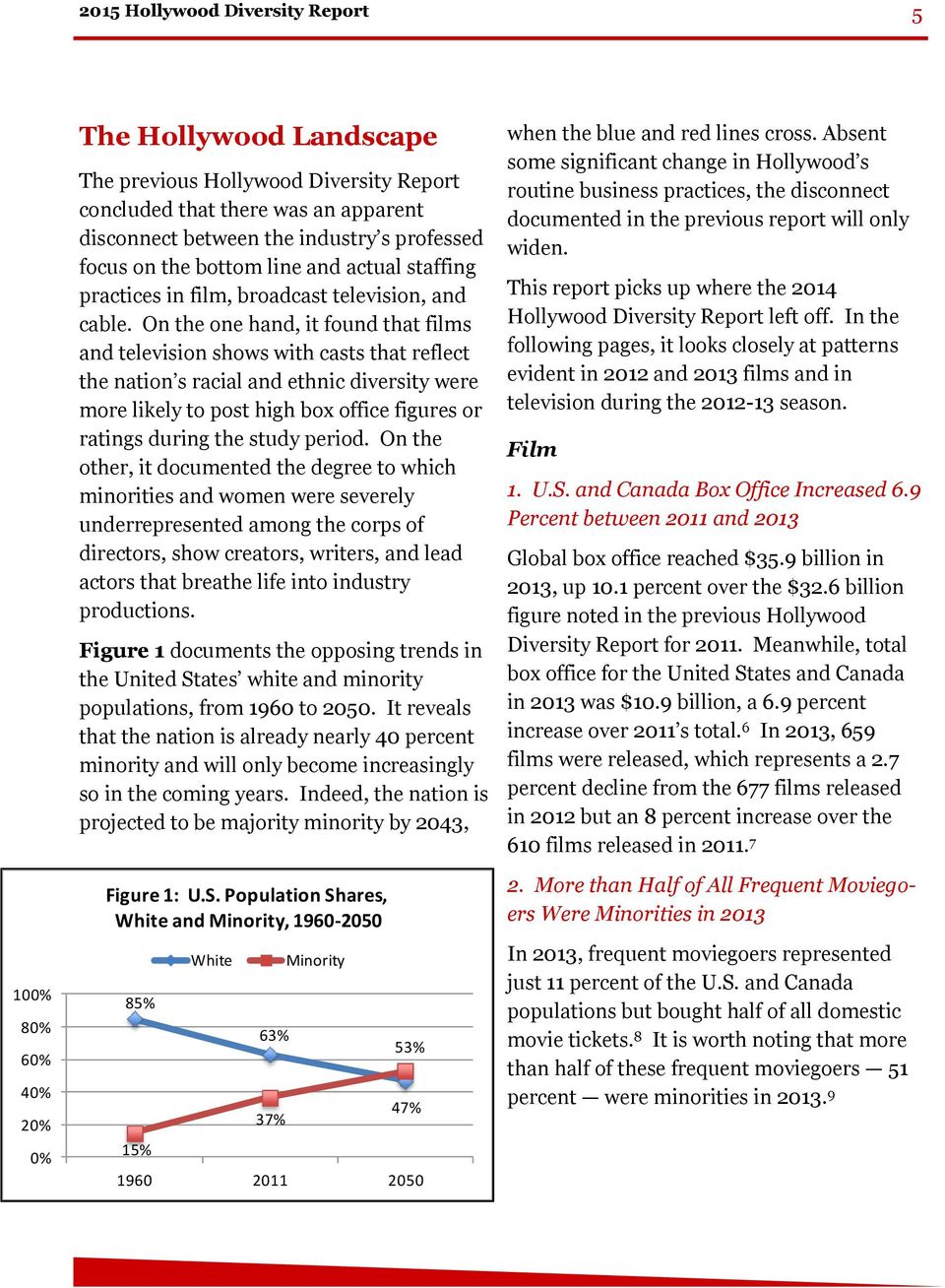
8 2015 Hollywood Diversity Report 5 100% 80% 60% 40% 20% 0% The Hollywood Landscape The previous Hollywood Diversity Report concluded that there was an apparent disconnect between the industry s professed focus on the bottom line and actual staffing practices in film, broadcast television, and cable. On the one hand, it found that films and television shows with casts that reflect the nation s racial and ethnic diversity were more likely to post high box office figures or ratings during the study period. On the other, it documented the degree to which minorities and women were severely underrepresented among the corps of directors, show creators, writers, and lead actors that breathe life into industry productions. Figure 1 documents the opposing trends in the United States white and minority populations, from 1960 to It reveals that the nation is already nearly 40 percent minority and will only become increasingly so in the coming years. Indeed, the nation is projected to be majority minority by 2043, Figure 1: U.S. Population Shares, White and Minority, % 15% White 63% 37% Minority 53% 47% when the blue and red lines cross. Absent some significant change in Hollywood s routine business practices, the disconnect documented in the previous report will only widen. This report picks up where the 2014 Hollywood Diversity Report left off. In the following pages, it looks closely at patterns evident in 2012 and 2013 films and in television during the season. Film 1. U.S. and Canada Box Office Increased 6.9 Percent between 2011 and 2013 Global box office reached $35.9 billion in 2013, up 10.1 percent over the $32.6 billion figure noted in the previous Hollywood Diversity Report for Meanwhile, total box office for the United States and Canada in 2013 was $10.9 billion, a 6.9 percent increase over 2011 s total. 6 In 2013, 659 films were released, which represents a 2.7 percent decline from the 677 films released in 2012 but an 8 percent increase over the 610 films released in More than Half of All Frequent Moviegoers Were Minorities in 2013 In 2013, frequent moviegoers represented just 11 percent of the U.S. and Canada populations but bought half of all domestic movie tickets. 8 It is worth noting that more than half of these frequent moviegoers 51 percent were minorities in
9 6 Ralph J. Bunche Center for African American Studies at UCLA 3. Comedy, Action, and Drama Films Dominate the Top Ranks The 172 films examined for 2012 and the 175 examined for 2013 were categorized into 16 genres. Three of the genres 10 Comedy, Action, and Drama collectively accounted for 65.1 percent of the top grossing films in 2012 and 66.3 percent in 2013 (see Figure 2). Television % % 1 5.0% 1. No Single Genre Dominates Broadcast Programming As Figure 3 reveals, no single genre represented a majority of broadcast television programming during the season. That is, dramas (34.3 percent) and other programming 11 (26.6 percent) together accounted for 60.9 percent of broadcast Figure 2: Percentage Distribution of Films by Genre, 2012 and 2013 (n=172, 175) programming, while the remaining 39.1 percent share was divided between reality (21.7 percent) and comedies (17.4 percent). 2. Reality Shows Dominate Cable Programming Consistent with the previous report, the picture was altogether different in cable. Figure 4 shows that 69.4 percent of cable programming during the season consisted of reality shows, followed by other programming (11.2 percent), drama (11 percent), and comedy (8.4 percent). Figure 3: Broadcast TV by Genre, Season (n=207) Figure 4: Cable TV by Genre, Season (n=866) 21.7% 26.6% 17.4% 34.3% comedy drama other 69.4% 8.4% 11.0% 11.2% comedy drama other reality reality

10 2015 Hollywood Diversity Report 7 3. Other Programming Dominates among Digital Platform and Syndicated Shows Figure 5 shows that 59.4 percent of digital platform and syndicated shows consisted of other programming during the season. By contrast, drama (21.9 percent), comedy (15.6 percent), and reality (3.1 percent) accounted for relatively small shares of the total. Figure 5: Digital and Syndicated TV by Genre, Season (n=32) 59.4% 3.1% 15.6% 21.9% comedy drama other reality 4. Los Angeles s Share of Broadcast TV Show Locations Declines Consistent with news accounts of runaway production, 12 the previous report noted that other regions around the country and in Canada have increased their shares of film and television production to notable levels. Figure 6 shows that for the season, Los Angeles accounted for just 51.6 percent of scripted series locations, down from 59 percent the previous season. The New York area (14.3 percent) and Vancouver (6.6 percent) also claimed significant shares of locations for broadcast scripted series during the season. As in previous report, Figure 7 suggests that Los Angeles s hold on broadcast reality and other shows is a bit more secure than it is with scripted shows. The Los Angeles region accounted for 59.1 percent these series locations during the season, though this figure too represented a decline compared to the 68.5 percent share posted in the previous report. Meanwhile, the New York area ranked second in terms of broadcast reality and other show locations for , claiming 20.5 percent of them. This latter figure was virtually unchanged between reports. 6.6% 20.5% Figure 6: Share by Location, Broadcast Scripted Shows, Season (n=91) 27.5% 14.3% 20.5% 51.6% 59.1% LA NYC Vancouver Remaining Figure 7: Share by Location, Broadcast Reality and Other Shows, Season (n=44) LA NYC Remaining

11 8 Ralph J. Bunche Center for African American Studies at UCLA 5. Cable TV Locations Continue to Be More Evenly Distributed Contrary to the case of broadcast television, no single location claimed a majority share of cable television production during the season. Though Figure 8 shows Los Angeles claimed far and away the single largest share of cable scripted series locations for (42.2 percent), other locations such as the Atlanta area (12.1 percent), Toronto (7.8 percent), New York (5.2 percent), and a collection of remaining locations (32.8 percent) combined for the majority of locations. 5.2% 7.8% Figure 8: Share by Location, Cable Scripted Shows, Season (n=116) 32.8% 12.1% 42.2% LA Atlanta Toronto NYC Remaining Figure 9 reveals that little has changed with the distribution of cable reality and other locations since the last report. That is, the Los Angeles area continued to account for a little less than a third of these locations (30.7 percent), while the rest were distributed throughout the United States and Canada New York (17.2 percent), Atlanta (3.1 percent), and a collection of dozens of remaining areas (49 percent). 6. Digital and Syndicated Locations Vary Widely In terms of location distribution, digital platform and syndicated production looks more like cable reality and other production than broadcast scripted production or broadcast reality and other production. That is, for the season, digital platform and syndicated production was spread over vast regions of the continent, with the Los Angeles area claiming a mere 38.9 percent share, New York an 11.1 percent share, and the remaining half of production spread over dozens of areas (see Figure 10). Figure 9: Share by Location, Cable Reality and Other Shows, Season (n=192) FIgure 10: Share by Location, Digital and Syndicated Shows, Season (n=18) 49.0% 3.1% 30.7% 17.2% LA NYC Atlanta Remaining % 11.1% LA NYC Remaining

12 2015 Hollywood Diversity Report 9 Hollywood Diversity: Take Two The previous Hollywood Diversity Report examined theatrical films released in 2011 and broadcast and cable shows airing during the season in order to assess the degree of racial and gender diversity in front of and behind the camera. For the various film and television arenas examined (e.g., lead roles, film director, film writer, television writer, and show creators), it found that underrepresentation was the norm for minorities and women. The only variation was the degree of underrepresentation, which ranged from marginal to extreme. Fast forward a year ahead in television and two years ahead in film. This report examines broadcast, cable, digital platform and syndicated shows airing during the season and theatrical films released in 2012 and 2013 in order to document any changes in the state of cast and crew diversity throughout the industry since the previous report. The following headlines summarize any notable trends. Film 1. Minorities Gain Ground among Lead Roles 13 in Film Figure 11 shows minorities (red line) claimed 16.7 percent of the lead roles in the 174 films examined for 2013, up from 15.1 percent in 2012 and just 10.5 percent in Because minorities collectively accounted for 37.4 percent of the U.S. population in 2013 (gray line), they were
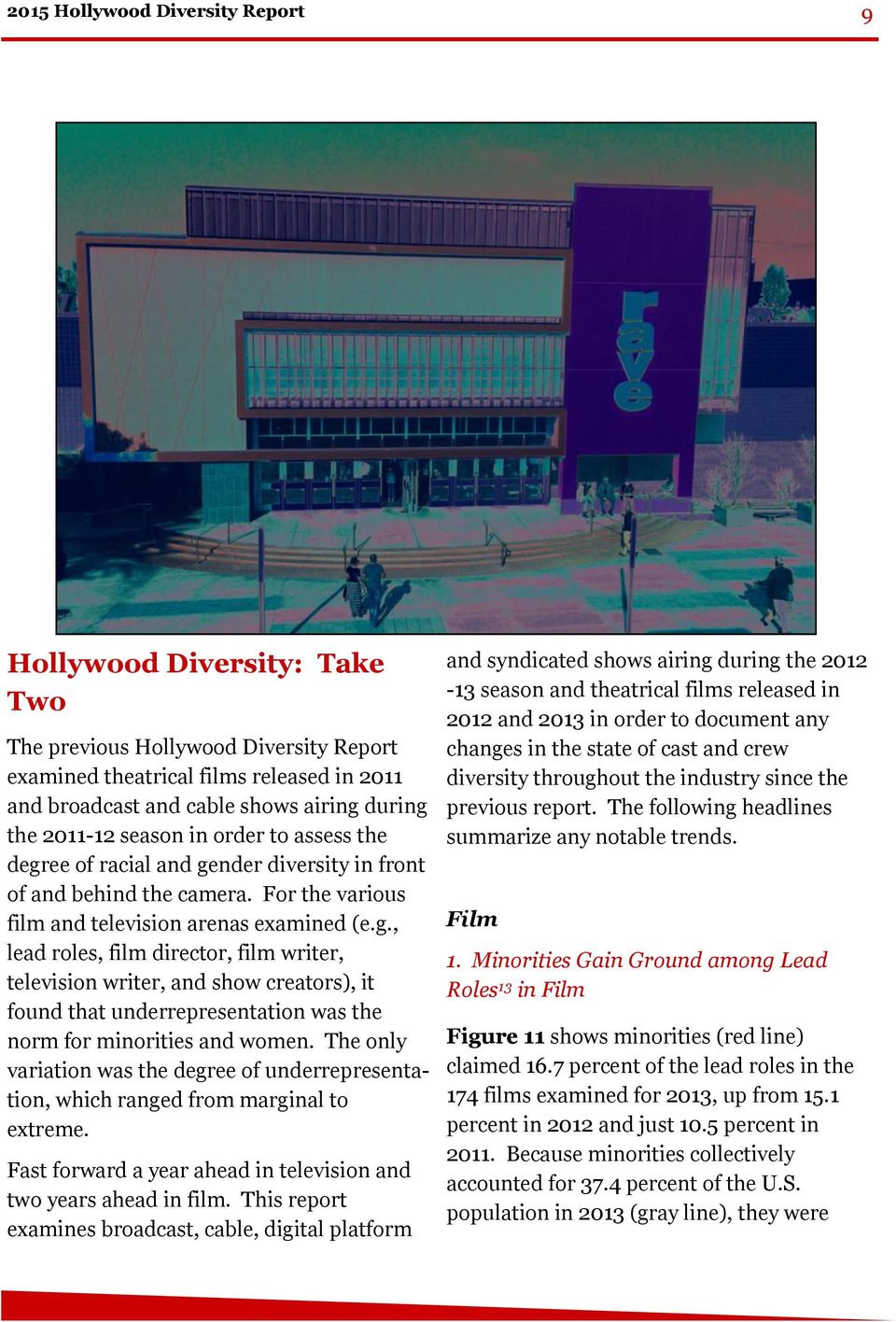
13 10 Ralph J. Bunche Center for African American Studies at UCLA Figure 11: Lead Actor Race, Theatrical Films, (n=172, 172, 174) Figure 12: Lead Actor Gender, Theatrical Films, (n=172, 172, 174) % Minority White U.S. pop 84.9% 83.3% % Male 69.2% Female 74.7% % 15.1% % 16.7% % 30.8% 25.3% underrepresented by a factor of a little over 2 to 1 among lead roles in the films examined for that year. In 2011, by contrast, the degree of underrepresentation had stood at nearly 4 to 1. Films with minority leads in 2013 include ethnic-targeted titles such as Tyler Perry s Madea s Big Happy Family, Tyler Perry Presents the Peeples, and Baggage Claim, as well as mainstream-oriented releases like Fast & Furious 6, G.I. Joe: Retaliation, and 12 Years a Slave. Meanwhile, titles from 2012 with diverse leads include: MIB 3, Django Unchained, Think Like a Man, and Tyler Perry s Madea s Witness Protection. Future reports will reveal whether 2013 dubbed by some as a breakout year for black film 14 represents the continuation of a new trend for minority leads begun in 2012 or just a brief deviation from business as usual. 2. Women Tread Water among Lead Roles in Film Women (red line) claimed the lead roles in only 25.3 percent of the 174 top films examined for 2013 (see Figure 12). This figure is a bit lower than the share the group claimed in 2012 (30.8 percent) but virtually identical to 2011 s figure (25.6 percent). Because women constitute slightly more than half of the U.S. population, they were underrepresented by a factor of about 2 to 1 among leads for the films examined in Films that featured female leads that year include: Gravity, The Hunger Games: Catching Fire, and Saving Mr. Banks. 3. Overall Cast Diversity 15 Increasing in Film Figure 13 reveals that films with casts 10 percent or less minority (top line) have declined significantly since the last report. These films share of all titles declined from slightly more than half in 2011 to just 31 percent in By contrast, the lines representing the shares for all the other cast diversity intervals trended upward over the period. Most notably, the share for films with casts from 41 percent to 50 percent minority (bottom line) increased from 0 percent to 6.3 percent, while the share for films with casts from 31 percent to 40
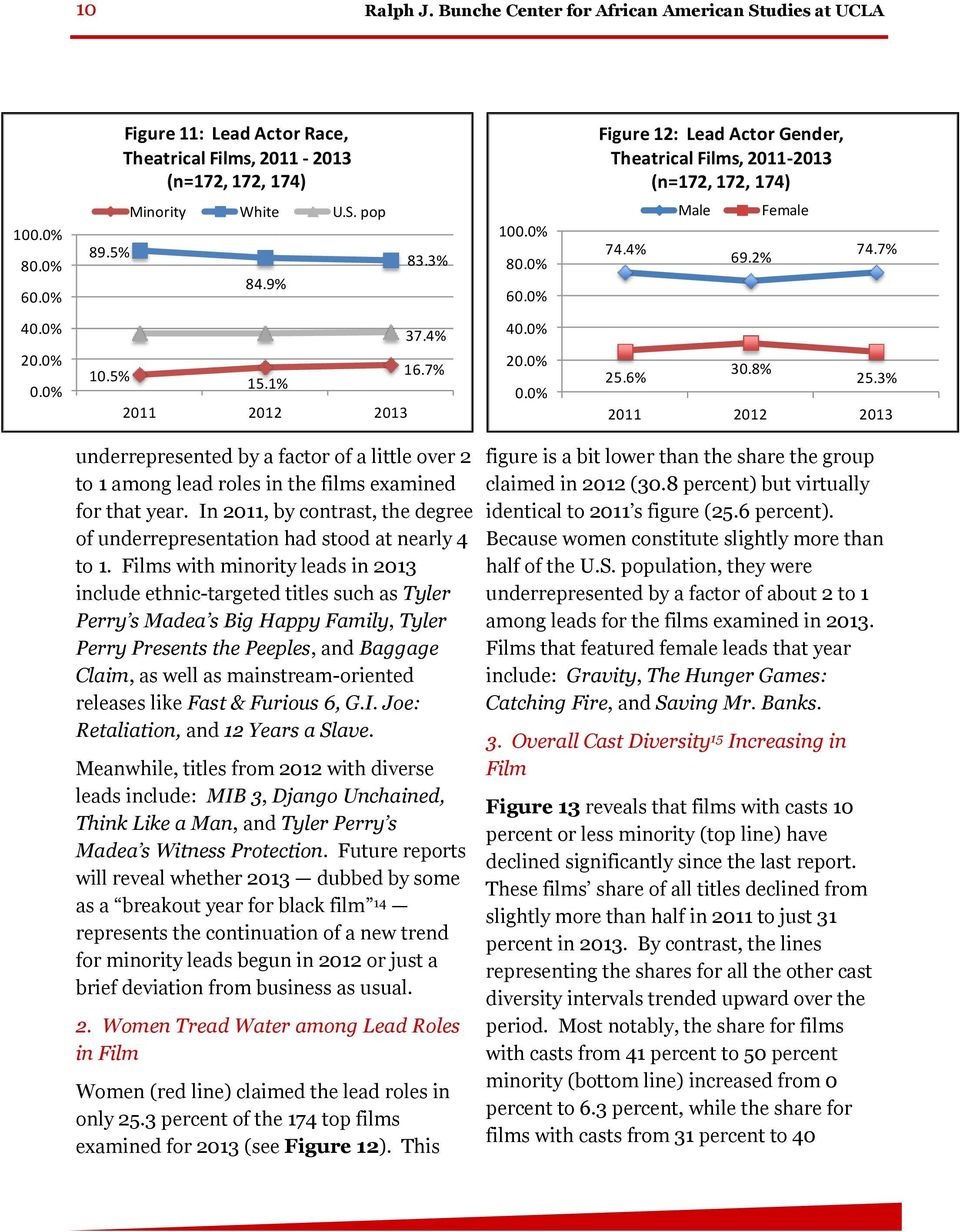
14 2015 Hollywood Diversity Report 11 percent minority the interval containing the minority share of the overall population increased from 2.3 percent to 7.5 percent. Similarly, it s worth noting that 13.8 percent of the films examined for 2013 featured casts that were majority minority, up from just 9.9 percent in While the films in this cast diversity interval tended be smaller, ethnicniche films in 2011, several of the 2013 films with majority-minority casts were more mainstream-oriented releases: Fast & Furious 6, Lee Daniels The Butler, Mandela: Long Walk to Freedom, and Fruitvale Station. 4. Minorities Gain Ground among Film Directors Minorities directed 17.8 percent of the 174 films examined for 2013 (see Figure 14), up from just 12.2 percent in 2011 and 11 percent in As minorities accounted for 37.4 percent of population in 2013 (gray line), they bettered their degree of underrepresentation within the corps of film directors from a factor of 3 to 1 noted in the previous report to a factor of 2 to 1. Examples of minoritydirected films from 2013 underscore the degree to which improvement in this arena was driven by the unusual number of % 22.1% 14.5% 9.9% 2.3% Figure 13: Minority Cast Share, by Share of Theatrical Films, (n=172, 172, 174) 10% or less 11% To 20% 21% to 30% 31% to 40% 41% to 50% 51% and over % 25.3% 16.1% 13.8% 7.5% 6.3% % 12.2% Figure 14: Director Race, Theatrical Films, (n=172, 172, 174) White Minority U.S. pop 89.0% 11.0% breakout year black films released. For example, these films include: 12 Years a Slave, Lee Daniels The Butler, Fruitvale Station, and The Best Man Holiday. 5. Women Still Less Likely than Minorities to Direct Top Films Consistent with findings from the previous report, women faced tougher odds at directing a top film in 2013 than did 82.2% 37.4% 17.8%
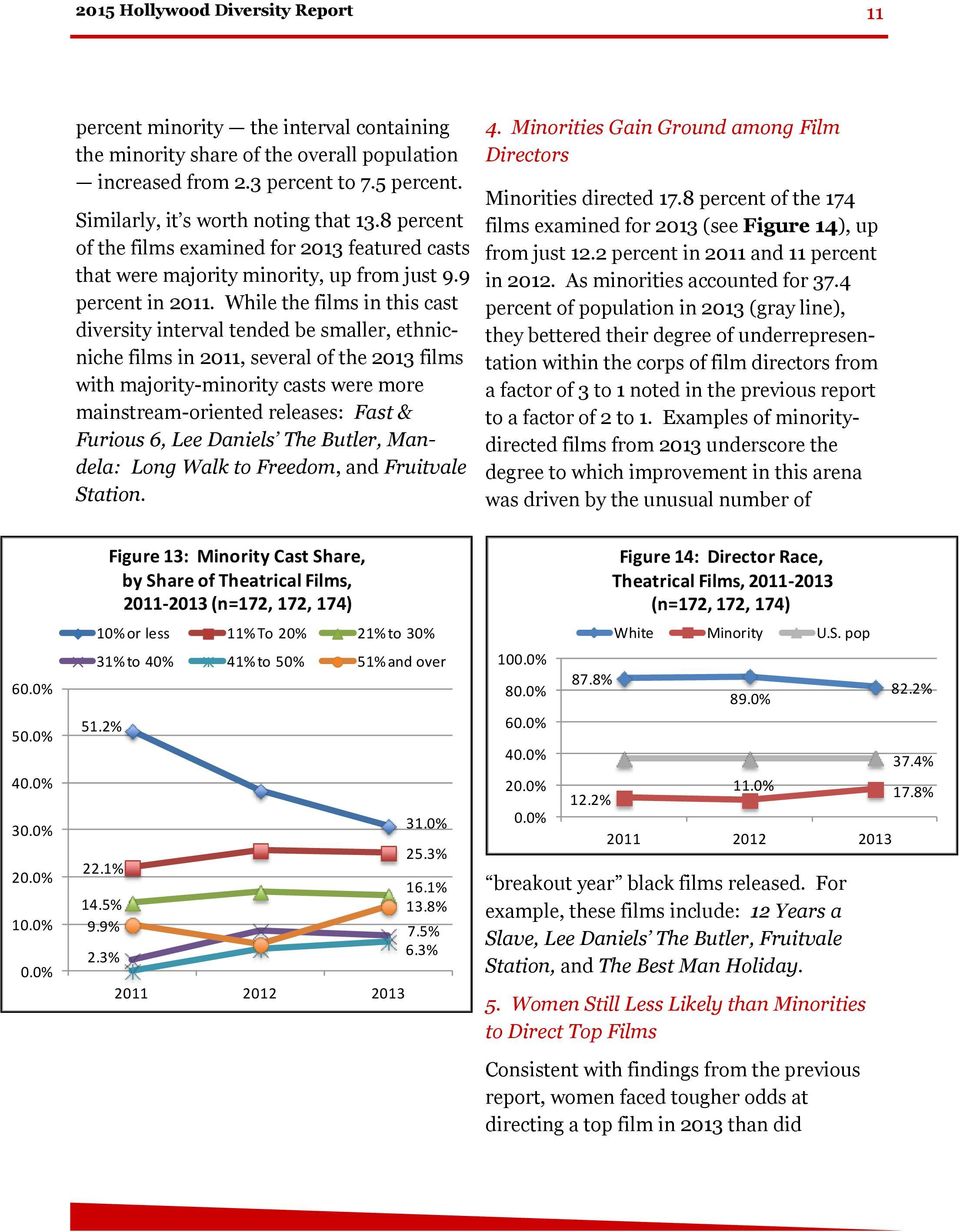
15 12 Ralph J. Bunche Center for African American Studies at UCLA Figure 15: Director Gender, Theatrical Films, (n=172, 167, 174) Figure 16: Writer Race, Theatrical Films, (n=172, 167, 170) 10 8 Male Female 95.9% 94.2% 93.7% % White Minority U.S. pop 92.2% 88.2% % 5.8% 6.3% % 7.8% % 11.8% minorities. Figure 15 shows that women directed just 6.3 percent of the films examined for 2013, albeit up from the 4.1 percent and 5.8 percent figures posted in 2011 and 2012, respectively. A little more than 50 percent of the population, women were underrepresented by a factor of about 8 to 1 among film directors in Films directed by women that year include: Carrie, Girl Most Likely, and Tyler Perry Presents Peeples. 6. Minorities Gain Ground among Film Writers 16 Consistent with findings above about the gains minorities have made since the previous report in their share of film leads and film directors, minorities have also gained a little ground within the corps of film writers. Figure 16 shows minorities wrote 11.8 percent of the 170 films examined for 2013, up from just 7.6 percent in 2011 and 7.8 percent in Relative to the minority share of the population (gray line), minorities were underrepresented by a factor of about 3 to 1 among film writers in 2013, an improvement over the 5 to 1 factor evident in Films from 2013 that featured minority writers include: Gravity, Star Trek Into Darkness, The Best Man Holiday, 12 Years a Slave, and Fruitvale Station. 7. Women Lose a Little Ground among Film Writers Figure 17 reveals that women received writing credits in just 12.9 percent of the 170 films examined for 2013, down slightly from the 14.1 percent figure posted in As in the previous report, however, women still fared better as writers in film in 2013 than as Figure 17: Writer Gender, Theatrical Films, (n=170, 169, 170) Male Female 85.9% 87.0% 87.1% 14.1% 13.0% 12.9%
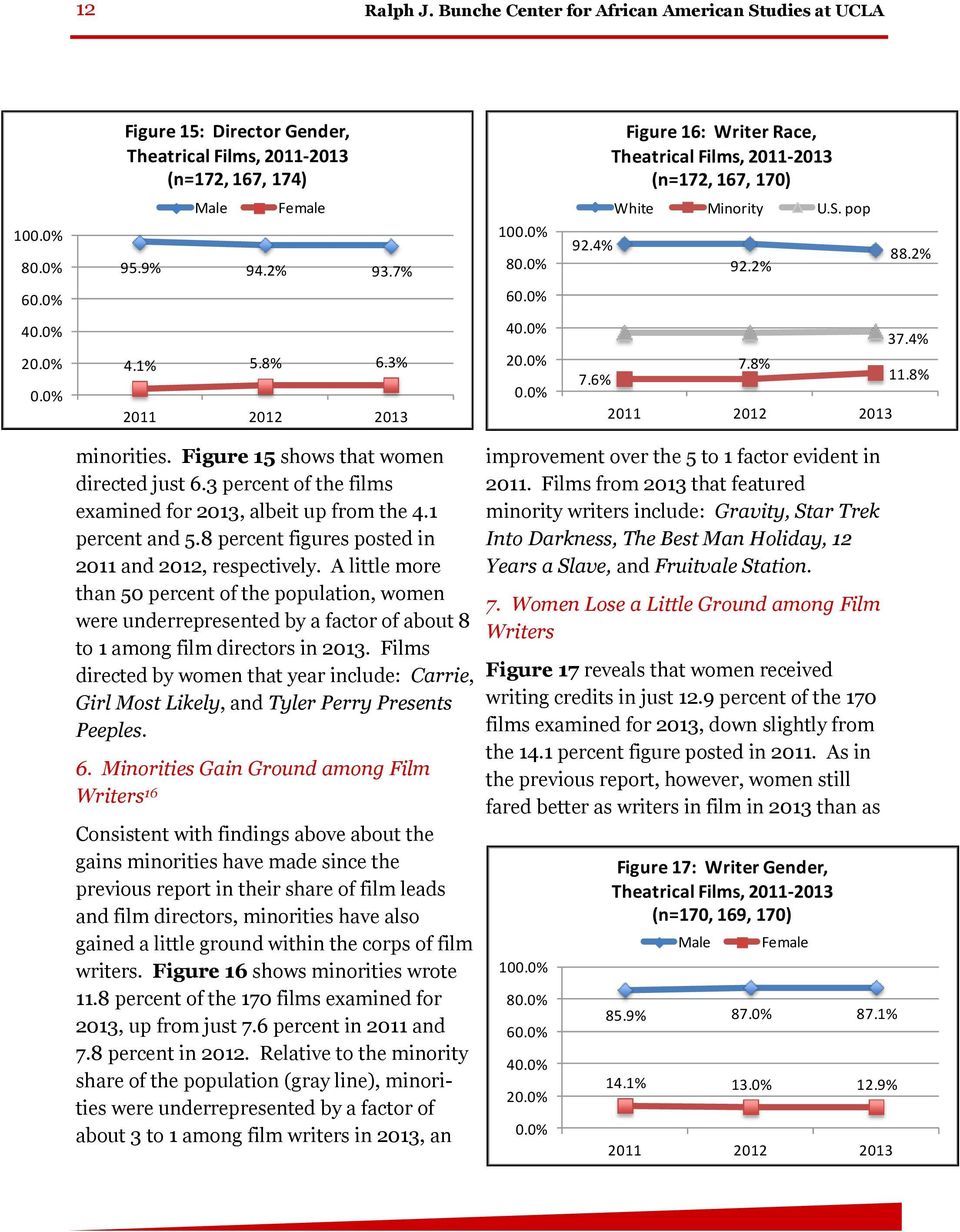
16 2015 Hollywood Diversity Report 13 directors, though they remained underrepresented by a factor of nearly 4 to 1 among film writers. Examples of films written by women that year include: Frozen, The Hobbit: The Desolation of Smaug, Saving Mr. Banks, and Safe Haven. 8. White Males Dominate Executive Suites in Film It s no secret that white men have always occupied the lion s share of executive positions from which green-lighting decisions are made in the Hollywood film industry. Figure 18, however, documents the degree to which this is still true today. It shows that at the time of this report s writing, the corps of CEOs and/or chairs running the 18 studios examined was 94 percent white and 100 percent male. Meanwhile, the studios senior management corps 17 was 92 percent white and 83 percent male. An accounting of industry unit heads 18 revealed a bit more gender diversity (just 61 Figure 18: Film Executives percent male), if not racial and ethnic diversity (96 percent white). Television Leads 1. Minorities Underrepresented by a Factor of Nearly 6 to 1 among Lead Roles in Broadcast Scripted Shows Minority actors claimed 6.5 percent of the lead roles in broadcast scripted programming during the season, up slightly from the 5.1 percent figure posted for the season (see Figure 19). Given that minorities accounted for 37.4 percent of the population in 2013 (gray line), their share of lead roles in this arena corresponds to underrepresentation by a factor of nearly 6 to 1. Examples of broadcast scripted shows that featured minority leads that season include: Scandal (ABC), The Mindy Project (Fox), and Nikita (CW). Chair/CEO (n=18) 94% White 100% Male Figure 19: Leads by Race, Broadcast Scripted, and Seasons (n=99, 107) White Minority U.S. Pop Sr. Mgmt. (n=76) 92% White 83% Male % 93.5% 96% White 61% Male Unit Heads (n=56) % 5.1% 6.5%

17 14 Ralph J. Bunche Center for African American Studies at UCLA Minorities Continue to Fare Better as Leads in Cable Scripted Shows Figure 20 shows minority actors accounted for 19.3 percent of the lead roles in cable scripted shows during the season nearly a 5 percentage point improvement over the figure (14.7 percent). Consistent with the previous report, this Figure 20: Leads by Race, Cable Scripted, and Seasons (n=156, 166) White Minority U.S. Pop 85.3% 80.7% 37.4% 14.7% 19.3% share is considerably larger than the corresponding broadcast share for minorities, due to the fact that several cable networks market primarily to minority (or urban ) audiences. Still, minorities remained underrepresented by a factor of a little less than 2 to 1 among cable scripted leads during the season (gray line). The following titles are among cable scripted shows that featured minority leads in : Real Husbands of Hollywood (BET), Love Thy Neighbor (OWN), Single Ladies (VH1), and Shake It Up! (Disney). 3. Women s Share of Lead Roles in Broadcast Scripted Shows Declines Slightly Women accounted for 48.6 percent of the lead roles in broadcast scripted shows during the season, down slightly from the 51.5 percent figure the group posted for (see Figure 21). Still, women ap-

18 2015 Hollywood Diversity Report % % 4 Figure 21: Leads by Gender, Broadcast Scripted, and Seasons (n=99, 107 ) 51.5% 48.5% Male Female % 48.6% proached proportionate representation among leads in the arena. 4. Women Continue to Fare Worse as Leads in Cable Scripted Shows Consistent with the previous report, Figure 22 reveals female talent claimed just 37.1 percent of the lead roles in cable scripted shows during the season. This figure is virtually identical to the 37.2 percent share the group posted for the season. At a little more than half of the U.S. population, women would have to increase their share of lead roles by nearly 40 percent to achieve proportionate representation in scripted cable television. 5. Minorities Still More Likely to Lead Reality and Other Shows than Scripted Shows in Broadcast Recall that minorities were underrepresented by a factor of nearly 6 to 1 among leads in broadcast scripted shows during the season. Among broadcast reality and other programming as the previous report also found the degree of underrepresentation was less pronounced. Figure 23 shows minorities accounted for 15.2 percent of the broadcast reality and other leads during the season, virtually unchanged from the 15.4 percent figure posted in Relative to their share of the population (gray line), minorities were underrepresented by a factor of a little more than 2 to 1 among these leads during the season. Broadcast reality and other shows that credited minorities as leads in included the following: 20/20 (ABC), America s Next Top Model (CW), Figure 22: Leads by Gender, Cable Scripted, and Seasons (n=156, 167) Male Female 62.8% 62.9% Figure 23: Lead Talent by Race, Broadcast Reality and Other Shows, and Seasons (n=104, 92) White Minority U.S. Pop 84.6% 84.8% % 37.1% % 15.4% 15.2%

19 16 Ralph J. Bunche Center for African American Studies at UCLA Let s Make a Deal (CBS), and Tavis Smiley (PBS). 6. Minorities Still Underrepresented by a Factor of More than 2 to 1 among Cable Reality and Other Leads Minority talent claimed 16.8 percent of the lead roles on cable reality and other shows during the season, up 3.6 percentage Figure 24: Lead Talent by Race, Cable Reality and Other Shows, and Seasons (n=463, 560) White Minority U.S. Pop 86.8% 83.2% 37.4% 13.2% 16.8% Women Still Underrepresented by a Factor of About 2 to 1 among Broadcast Reality and Other Leads Women accounted for just 25.8 percent of the lead roles in broadcast scripted shows during the season, a slight increase over the 24.5 percent share the group posted in (see Figure 25). At a little more than half of the population, women continued to be underrepresented by a factor of about 2 to 1 among broadcast reality and other leads in By contrast, you will recall, women were closer to proportionate representation among lead roles in broadcast scripted shows. Examples of broadcast reality and other shows that featured women leads in include: 20/20 (ABC), America s Next Top Model (CW), Live! With Kelly and Michael (ABC), and The Talk (CBS). points from the 13.2 percent share the group claimed in (see Figure 24). Nonetheless, given the minority share of the population (gray line), the minority share of cable reality and other leads still corresponded to underrepresentation by a factor of more than 2 to 1 in Examples of cable reality and other shows that featured minority lead talent that season include: 106 th & Park (BET), Basketball Wives (VH1), Braxton Family Values (WEtv), House Hunters (HGTV), and Tia and Tamera (Esquire) Figure 25: Lead Talent by Gender, Broacast Reality and Other Shows, and Seasons (n=106, 93) Male Female 75.5% 74.2% 24.5% 25.8% Women Lose a Little Ground among Cable Reality and Other Leads Figure 26 shows women accounted for just 27.4 percent of the lead roles in cable reality

20 2015 Hollywood Diversity Report Figure 26: Lead Talent by Gender, Cable Reality and Other Shows, and Seasons (n=520, 573) Male Female Figure 27: Lead Talent by Race, Digital and Syndicated Shows, Season (n=29) % 72.6% 30.6% 27.4% 21% 79% White Minority and other shows during the season, a 3.2 percentage point decrease from the 30.6 percent share the group claimed during the season. Women would thus have to nearly double their share of lead roles in cable reality and other programming in order to reach proportionate representation therein. The following titles are among the cable reality and other shows that credited women as leads in : America s Supernanny (Lifetime), Chelsea Lately (E!), Face-Off (Syfy), and Property Virgins (HGTV). 9. Minorities Most Likely to Lead Digital and Syndicated Shows Figure 27 shows minorities accounted for 21 percent of lead talent in digital platform and syndicated programming 19 for the season. This figure exceeds the minority share of leads in either broadcast or cable, scripted or reality and other. Still, minorities were underrepresented by a factor of nearly 2 to 1 among leads on these shows. Examples of digital platform or syndicated shows that featured minority lead talent for include: East Los High (Hulu), Rogue (DirecTV), The Wendy Williams Show (Syndicated), and Steve Harvey (Syndicated). 10. Women Also Most Likely to Lead Digital and Syndicated Shows Figure 28 shows women accounted for 52 percent of lead talent in digital platform and syndicated programming during the season a majority share that exceeds the corresponding figures for either broadcast or cable, scripted or reality and other. Examples of digital platform or syndicated Figure 28: Lead Talent by Gender, Digital and Syndicated Shows, Season (n=29) 52% 48% Male Female

21 18 Ralph J. Bunche Center for African American Studies at UCLA % % % 1 5.0% shows that featured women leads for include: Orange is the New Black (Netflix), Hemlock Grove (Netflix), The Ellen DeGeneres Show (Syndicated), and Access Hollywood Live (Syndicated). Overall Cast Diversity 1. Share of Least Diverse Broadcast Scripted Shows Increases Overall cast diversity for broadcast scripted shows declined since the last report. Figure 29 illustrates that 30.8 percent of shows in the season had casts that were only 10 percent minority or less the single largest share among the cast diversity intervals that season (top blue line). And this share was a notable increase over the 23.2 percent figure for the interval in Meanwhile, the share of broadcast Figure 29: Minority Cast Share, by Share of Broadcast Scripted Shows, and Seasons (n=99, 107) 10% or less 11% To 20% 21% to 30% 31% to 40% 41% to 50% 51% and over 35.4% 23.2% 16.2% 15.2% 8.1% 2.0% % 28.0% 16.8% 14.0% 10.3% scripted shows with casts that were from 11 percent to 20 percent minority declined between reports, from 35.4 percent during the season to just 28 percent during the season. Changes in the other diversity intervals were smaller between reports, though it s worth noting that the diversity interval containing the 37.4 percent minority share of the U.S. population (i.e., 31 percent to 40 percent) increased its share of broadcast scripted shows from 15.2 percent in to 16.8 percent in Examples of shows that fell into this diversity interval in include: 2 Broke Girls (CBS), Bones (Fox), Scandal (ABC), Beauty and the Beast (CW), and Law & Order: Special Victims Unit (NBC). 2. Share of Least Diverse Cable Scripted Shows Decreases, While Share of Those with Majority-Minority Casts Increases Figure 30 shows 35.3 percent of cable shows during the season had casts that were 10 percent minority or less, down slightly from the 37 percent figure posted in The next largest share of the programs 28.1 percent was composed of shows with casts between 11 percent and 20 percent minority. Meanwhile, cable scripted shows with majority-minority casts increased from 8.4 percent of all cable scripted shows in to 10.8 percent in The diversity interval containing the 37.4 percent minority share of the U.S. population (i.e., 31 percent to 40 percent) also contained 10.8 percent of the shows in But this figure was down from the 13 percent figure posted in Shows
22 2015 Hollywood Diversity Report % % % 1 5.0% Figure 30: Minority Cast Share, by Share of Cable Scripted Shows, and Seasons (n=152,167) 10% or less 11% To 20% 21% to 30% 31% to 40% 41% to 50% 51% and over 37.0% 25.3% 13.0% 10.4% 8.4% 35.3% 28.1% 10.8% 10.2% 5.8% 4.8% that fell into this latter interval in include: A.N.T. Farm (Disney), Homeland (Showtime), Graceland (USA), Army Wives (Lifetime), and Major Crimes (TNT). 3. Majority of Digital Scripted Shows Feature Casts with Relatively Few Minorities Figure 31 shows 46 percent of digital platform scripted shows featured casts that were 10 percent minority or less during the season, while another 18 percent had casts that were from 11 to 20 percent minority. By contrast, no digital scripted shows fell into the diversity interval containing the minority share of the population in (i.e., 31 percent to 40 percent). Two shows, East Los High (Hulu) and Rogue (DirecTV), alone populated the Figure 31: Minority Cast Share, by Share of Digital Scripted Shows, Season (n=11) 9% 9% 18% 18% 46% 10% or less 11% To 20% 21% to 30% 41% to 50% 51% and over majority-minority and 41 percent to 50 percent minority cast intervals, respectively. 4. White Actors Dominate Broadcast Scripted Roles Figure 32 reveals white actors claimed 81 percent of the 700 roles examined in broadcast scripted programming during the season, while minorities combined for just 19 percent. Minorities would have to nearly double their share of all broadcast scripted roles to reach proportionate representation for the season. Breakdowns for specific minority group shares include: Figure 32: Share of Roles, by Race, Broadcast Scripted Shows, Season (n=700) 10% 2% 4% 3% 0% 81% white black Latino Native Asian mixed other
23 20 Ralph J. Bunche Center for African American Studies at UCLA black (10 percent), Latino (2 percent), and Asian (4 percent). Representing about 17 percent of the U.S. population in 2013, Latinos were the most underrepresented among the minority groups, by a factor of more than 8 to White Actors Account for More than Three Quarters of Cable Scripted Roles Figure 33 presents the percentage distribution of cabled scripted roles by race during the season. It shows white actors claimed 77 percent of the 990 cable scripted roles, while minorities combined for 23 percent. Though minorities collectively Figure 33: Share of Roles, by Race, Cable Scripted Shows, Season (n=990) 14% 3% 3% 3% 0% 77% white black Latino Native Asian mixed other Figure 34: Share of Roles, by Gender, Broadcast Scripted Shows, Season (n=700) 46% 54% male female 5. Male Actors Claim Majority of Broadcast Scripted Roles Figure 34 shows male actors accounted for 54 percent of the 700 roles examined in broadcast scripted programming during the season, while women claimed 46 percent of the roles. 6. Male Actors Claim a Larger Share of Cable Scripted Roles The advantage enjoyed by male actors was more pronounced in the cable arena than it was in broadcast. Figure 35 shows male actors accounted for 58 percent of the 1070 fared a bit better in cable scripted casts than in broadcast, African American actors drove most of the increase: the group surpassed proportionate representation with 14 percent of the scripted roles. The shares of cable scripted roles claimed by other minority groups were similar to the small shares observed in broadcast scripted programming. Figure 35: Share of Roles, by Gender, Cable Scripted Shows, Season (n=998) 42% 58% male female
24 2015 Hollywood Diversity Report 21 roles examined in cable scripted programming during the season, while women claimed just 42 percent of the roles. 7. White Actors Occupy More than Three Quarters of Digital Scripted Roles Figure 36 presents the percentage distribution of digital scripted roles by race during the season. It shows white actors claimed 77 percent of the 64 scripted roles examined in digital platform programming, while minorities combined for 23 percent. The white/minority breakdown in digital scripted programming was identical to that observed above in cable scripted programming. But the distribution of specific minority group shares deviated significantly. In the digital arena, Latino actors claimed the largest share of the roles among the minority groups, 12 percent, while African Americans accounted for just 6 percent of the roles and Asians just 3 percent. Figure 36: Share of Roles, by Race, Digital Scripted Shows, Season (n=64) 6% 12% 3% 2% 77% white black Latino Native Asian mixed other 8. Male Actors Claim Majority of Digital Scripted Roles Figure 37 shows that male actors accounted for 54.2 percent of the 72 roles examined in digital scripted programming during the season, while women claimed 45.8 percent of the roles. Show Creators Figure 37: Share of Roles, by Gender, Digital Scripted Shows, Season (n=72) 46% 54% male female 1. Minorities Gain Ground among Creators 20 of Broadcast Scripted Shows By successfully selling the concept for a television show, a show s creator sets the stage for a number of production choices that ultimately impact the degree of diversity in writing and casting. Figure 38 reveals minorities were credited as creator in 5.9 percent of the broadcast scripted shows examined for the season, up from the 4.2 percent share posted in Still, minorities were underrepresented by a factor of more than 6 to 1 among the ranks of show creators in broadcast scripted programming. Consistent with findings from the previous report, half of the six
25 22 Ralph J. Bunche Center for African American Studies at UCLA Figure 38: Show Creators by Race, Broadcast Scripted, and Seasons (n=96, 102) White Minority U.S. Pop 95.8% 94.1% 37.4% 4.2% 5.9% minority-created shows for Grey s Anatomy (ABC), Private Practice (ABC), and Scandal (ABC) can be attributed to a sole minority show creator. Other shows created by minorities for the season include: Raising Hope (Fox) and The Mindy Project (Fox). factor of more than 3 to 1 among these important industry players in cable. Examples of cable scripted shows for which minorities were credited as show creator include: Let s Stay Together (BET), Single Ladies (VH1), The Haves and the Have Nots (OWN), and Supah Ninjas (Nick). 3. Minorities Underrepresented by a Factor of More than 7 to 1 among Creators of Digital and Syndicated Shows Minorities constituted just 5 percent of the creators of digital platform and syndicated programming during the season (see Figure 40). This share consisted of a single show, East Los High (Hulu), and corresponds to underrepresentation by a factor of more than 7 to 1 for minorities in the arena Minorities Gain Ground among Creators of Cable Scripted Shows Minorities were credited as creator in 10.7 percent of cable scripted shows for the season, an increase over the 7.4 percent figure posted in (see Figure 39). Still, minorities were underrepresented by a Figure 39: Show Creators by Race, Cable Scripted, and Seasons (n=148, 159) White Minority U.S. Pop 92.6% 89.3% 37.4% 7.4% 10.7% Figure 40: Show Creators by Race, Digital and Syndicated, Season (n=19) 5% 95% White Minority 4. Women Gain a Little Ground among Creators of Broadcast Scripted Shows Figure 41 shows 28.9 percent of the creators of broadcast scripted shows were women during the season, up 2.4 percentage points from the 26.5 percent
26 2015 Hollywood Diversity Report Figure 41: Show Creators by Gender, Broadcast Scripted, and Seasons (n=98, 104 ) Male Female 73.5% 71.2% 26.5% 28.9% figure the group posted in Among broadcast scripted shows that credited women as show creator in are the following: 30 Rock (NBC), Grey s Anatomy (ABC), Scandal (ABC), and New Girl (Fox). 5. Women Still Less Likely to Be Creators of Scripted Shows in Cable Women were credited as creator in 22.6 percent of cable scripted shows for the season, a figure similar to the 21.5 percent figure posted in (see Figure 42). Underrepresented by a factor of more than 2 to 1, women were less likely to create scripted shows in cable than they were in broadcast. Among cable scripted shows that credited women as show creator in are the following titles: Happily Divorced (TVLand), The Big C (Showtime), Girls (HBO), and The Game (BET). 6. Women Underrepresented by a Factor of More than 4 to 1 among Creators of Digital and Syndicated Shows Figure 43 shows 11 percent of the creators of digital platform and syndicated programming during the season were women. This share consisted of two shows in Orange is the New Black (Netflix) and Dr. Phil (Syndicated); it corresponds to underrepresentation by a factor of more than 4 to 1 for women among the creators of digital and syndicated shows. Figure 43: Show Creators, by Gender, Digital and Syndicated, Season (n=19) 11% Figure 42: Show Creators by Gender, Cable Scripted, and Seasons (n=149, 159) Male Female 78.5% 77.4% 21.5% 22.6% % Male Female
27 24 Ralph J. Bunche Center for African American Studies at UCLA TV Writers 1. Minorities Write 10 Percent or Fewer of Episodes on Nearly Two Thirds of Broadcast Scripted Shows Earlier studies have consistently found that Hollywood s writers rooms are far from diverse. 21 Data from the television season echo these findings. As Figure 44 shows, minority writers were credited for 10 percent or fewer of the episodes on 65 percent of broadcast scripted shows in The next largest share of shows, 25 percent, credited minority writers for between 11 and 20 percent of the episodes for the season. It s worth noting that only 2 percent of the shows credited minorities for writing between 31 percent and 40 percent of the episodes the diversity interval containing the minority share of the population (i.e., 37.4 percent). This latter interval was composed of just two shows, Criminal Minds (CBS) and Revolution (NBC). There were no broadcast scripted shows in for which minority writers penned the majority of the episodes. The overall minority share of writers for broadcast scripted shows that season was just 9.7 percent. 2. Minorities Credited for Writing Majority of Episodes for 6 Percent of Cable Scripted Shows Minority writers were a little more prominent on cable scripted shows during the season than in the broadcast scripted arena. Figure 45 shows minority writers were credited for more than half of the episodes for 6 percent of the shows that season. In the broadcast scripted arena, you will recall, there were no shows for which minority writers penned the majority of the episodes in The 6 percent share of shows featuring a majority of minority writers, of course, largely mirrored those with minority show creators and majorityminority casts in Indeed, all but one of the shows for which minorities wrote the majority of episodes Burning Love (E!) were black-oriented sitcoms and dramas airing on networks that cater to significant African American audiences. Figure 44: Minority Share of Writing Credits, by Share of Broadcast Scripted Shows, Season (n=99) Figure 45: Minority Share of Writing Credits, by Share of Cable Scripted Shows, Season (n=149) 25% 6% 2% 2% 65% 10% or less 11% to 20% 21% to 30% 19% 8% 3% 6% 64% 10% or less 11% to 20% 21% to 30% 31% to 40% 31% to 40% 41% to 50% 51% and over
28 2015 Hollywood Diversity Report 25 Examples of these shows include: Are We There Yet? (TBS), Let s Stay Together (BET), Single Ladies (VH1), The Haves and Have Nots (OWN), and Tyler Perry s For Better or Worse (TBS). The overall minority share of writers for cable scripted shows in was 11.8 percent. 3. Minorities Write 10 Percent or Fewer of Episodes for More than Three Quarters of Digital Scripted Shows As Figure 46 illustrates, minority writers were credited for 10 percent or fewer of the episodes on 78 percent of digital scripted shows in Minority writers were more prominent on only two of the nine shows in the digital arena Orange is the New Black (Netflix), where they penned between 21 percent and 30 percent of the episodes that season, and East Los High (Hulu), where they penned the majority of the episodes. Figure 46: Minority Share of Writing Credits, by Share of Digital Scripted Shows, Season (n=9) 4. Women Write More than 30 Percent of Episodes for Half of Broadcast Scripted Shows Consistent with findings from the previous report, women writers were much more likely to be credited for television show episodes in the season than for theatrical film scripts during the same period. Figure 47 shows women writers penned between 31 percent and 40 percent of the episodes for 21 percent of broadcast scripted shows, between 41 percent and 50 percent of the episodes for 14 percent of the shows, and the majority of episodes for 15 percent of the shows. By contrast, you will 14% Figure 47: Female Share of Writing Credits, by Share of Broadcast Scripted Shows, Season (n=100) 15% 21% 9% 22% 19% 10% or less 11% to 20% 21% to 30% 31% to 40% 41% to 50% 51% and over 11% 11% 78% 10% or less 21% to 30% 51% and over recall, women were credited as writers for only 12.9 percent of the theatrical films released in 2013 and 13 percent of the films released in Examples of broadcast scripted shows in which women wrote the majority of episodes in include: 2 Broke Girls (CBS), Grey s Anatomy (ABC), Beauty and the Beast (CW), Don t Trust the B---- in Apartment 23 (ABC), and Smash
29 26 Ralph J. Bunche Center for African American Studies at UCLA (NBC). The overall female share of writers for broadcast scripted shows in was 32 percent. 5. Cable Scripted Writing Credits Slightly Less Gender Diverse Women wrote more than 30 percent of the episodes for 42 percent of cable scripted shows in the season (see Figure 48) a figure lower than the 50 percent share of shows for which this was true in the broadcast scripted arena. That is, women received writing credits for between 31 percent and 40 percent of the episodes on 16 percent of the shows in , for between 41 percent and 50 percent of the episodes on 10 percent of the shows, and for the majority of the episodes on 16 percent of the shows. Examples of cable scripted shows for which women penned the majority of episodes in include: The Big C (Showtime), The Game (BET), Single Ladies (VH1), Happily Divorced (TVLand), and Jessie (Disney). The overall female share of writers for cable scripted shows in was 29.5 percent. 10% 16% Figure 48: Female Share of Writing Credits, by Share of Cable Scripted Shows, Season (n=150) 16% 13% 25% 20% 10% or less 11% to 20% 21% to 30% 31% to 40% 41% to 50% 51% and over 6. Women Write More than 30 Percent of Episodes for Majority of Digital Scripted Shows Figure 49 shows women wrote more than 30 percent of the episodes for 55 percent of digital scripted shows in the season. That is, women received writing credit for between 31 percent and 40 percent of the episodes on 11 percent of the shows, for between 41 percent and 50 percent of the episodes on 22 percent of the shows, and for the majority of the episodes on 22 percent of the shows. The two shows in this arena for which women received the majority of writing credits were East Los High (Hulu) and Orange is the New Black (Netflix). 22% Figure 49: Female Share of Writing Credits, by Share of Digital Scripted Shows, Season (n=9) 22% TV Directors 11% 34% 11% 10% or less 11% to 20% 31% to 40% 41% to 50% 51% and over 1. Minorities Direct 10 Percent or Fewer of Episodes for Nearly Two Thirds of Broadcast Scripted Shows As noted in the previous report, minorities have faced an uphill battle in the past when attempting to secure directing jobs in television. This also was the case during the
30 2015 Hollywood Diversity Report 27 21% Figure 50: Percent of Episodes Directed by Minorities, by Share of Broadcast Scripted Shows, Season (n=100) 11% 2% 2% 64% 10% or less 11% to 20% 21% to 30% 31% to 40% 41% to 50% 12% Figure 51: Percent of Episodes Directed by Minorities, by Share of Cable Scripted Shows, Season (n=152) 7% 2% 3% 6% 70% 10% or less 11% to 20% 21% to 30% 31% to 40% 41% to 50% 51% and over season, when for 64 percent of broadcast comedies and dramas, minorities directed 10 percent or less of the episodes (see Figure 50). By contrast, minorities directed between 31 percent and 40 percent of the episodes the diversity interval containing the 37.4 percent minority share of the U.S. population for only 2 percent of broadcast scripted shows. This interval was composed of two shows, Emily Owens, M.D. (CW), and Zero Hour (ABC), and both were canceled after one season. There were no shows in the broadcast scripted arena in for which minorities directed the majority of episodes. The overall minority share of directors for broadcast scripted shows in was just 7.5 percent. 2. Minority Directors Concentrated on Minority-Oriented Shows in Cable Figure 51 shows that for 70 percent of the cable scripted shows during the season, minorities directed 10 percent or fewer of the episodes. By contrast, minorities directed the majority of episodes on 6 percent of the shows and between 41 percent and 50 percent of the episodes for 3 percent of the shows. Cable scripted shows for which minorities directed the majority of episodes in like those observed above for which minorities received the majority of writing credits were typically blackoriented shows airing on networks with sizeable African American audiences. Examples of these shows include: Let s Stay Together (BET), Real Husbands of Hollywood (BET), The Game (BET), The Haves and Have Nots (OWN), and Tyler Perry s For Better or Worse (TBS). The overall minority share of directors for cable scripted shows in was 12.7 percent. 3. Minorities Direct 10 Percent or Fewer of Episodes for More than Three Quarters of Digital Scripted Shows Mirroring findings above regarding minority writers in the digital scripted arena, minorities directed 10 percent or fewer of the episodes on 78 percent of digital scripted shows in (see Figure 52). Moreover, the single digital scripted show for which minorities wrote the majority of
31 28 Ralph J. Bunche Center for African American Studies at UCLA Figure 52: Percent of Episodes Directed by Minorities, by Share of Digital Scripted Shows, Season (n=9) 11% 11% 78% 10% or less 11% to 20% 51% and over episodes for the season, East Los High (Hulu), was the same show for which minorities directed the majority of episodes. 4. Women Direct 20 Percent or Fewer of Episodes for Nearly Three Quarters of Broadcast Scripted Shows While previous studies document that women have had a harder time securing directing employment in television than their male counterparts, 23 their directorial prospects in television have far exceeded those in theatrical film. Recall that women directed only 6.3 percent of the films examined in 2013, up from the 4.1 percent share observed for 2011 films. Figure 53 shows that for the season, women directed 10 percent or fewer of the episodes for 41 percent of broadcast scripted shows, and between 11 and 20 percent of the episodes for 33 percent of the shows. Meanwhile, women directed more than 20 percent of episodes that season for 26 percent of broadcast scripted shows, which includes the majority of episodes for a single show, Call the Midwife (PBS). The overall female share of directors for broadcast scripted shows in was 11.3 percent. 5. Women TV Directors Don t Fare Better in Cable Figure 54 shows that for 59 percent of the cable scripted shows examined in , women directed 10 percent or fewer of the episodes. The comparable figure in the broadcast scripted arena, you will recall, was just 41 percent of the episodes. Meanwhile, women directed the majority of the episodes for just 3 percent of the cable scripted shows examined in Examples of these 12% Figure 53: Percent of Episodes Directed by Women, by Share of Broadcast Scripted Shows, Season (n=101) 10% 3% 1% 33% 41% 10% or less 11% to 20% 21% to 30% 31% to 40% 41% to 50% Figure 54: Percent of Episodes Directed by Women, by Share of Cable Scripted Shows, Season (n=153) 7% 6% 5% 3% 20% 59% 10% or less 11% to 20% 21% to 30% 31% to 40% 41% to 50% 51% and over
32 2015 Hollywood Diversity Report 29 shows include: Hit the Floor (VH1) and The Fosters (ABC Family). The overall female share of directors for cable scripted shows in was just 11.2 percent. 6. Women TV Directors Fare Worst in Digital Figure 55 shows that for 67 percent of the digital scripted shows examined in , women directed 10 percent or fewer of the episodes. Women directed more than 30 percent of the episodes for a single show in this arena Quick Draw (Hulu) for which they directed the majority of the episodes. 11% Figure 55: Percent of Episodes Directed by Women, by Share of Digital Scripted Shows, Season (n=9) 11% 11% 67% 10% or less 11% to 20% 21% to 30% 51% and over Sr. Mgmt. (n=142) or chairs running the 48 networks/tv studios examined was 96 percent white and just 71 percent male (compared to 100 percent male for film). Meanwhile, the studios senior management corps 23 was 93 percent white and 73 percent male. An accounting of television industry unit heads 24 revealed the most gender diversity just 55 percent male though whites still claimed a dominant 86 percent share of the positions. Summary Figure 56: TV Executives Chair/CEO (n=48) 96% White 71% Male 93% White 73% Male 86% White 55% Male Unit Heads (n=167) Executives TV Executive Suites Dominated by Whites, but More Gender Diverse than Film Counterparts While the corps of television executives positioned to green-light projects is far from diverse, women executives were notably more prominent in television than they were in film. Figure 56 shows that at the time of this report s writing, the corps of CEOs and/ Table 2 summarizes the various film and television arenas examined for by degree of underrepresentation for minorities and women (see Appendix). It shows that across all arenas, for both minorities and women, pronounced underrepresentation is still the norm, though minorities posted notable gains in key film and television arenas since the last report. In a couple of arenas, women also enjoyed gains but they actually regressed in a couple of others.
33 30 Ralph J. Bunche Center for African American Studies at UCLA Accolades In the Hollywood industry, members of professional academies each year come together to recognize and celebrate excellence in film and television production. Awards are presented in globally televised ceremonies that serve to crown new Hollywood royalty or to reinvigorate old bloodlines. But as the previous Hollywood Diversity Report noted, these ceremonies are often rather short on meaningful minority participation, an awkward reflection of academy memberships that are overwhelming white and male. 25 Moreover, the standards these members invoke to recognize artistic merit tend to reinforce a taste culture that has traditionally overlooked more diverse talent. Meanwhile, the paucity of diversity in accolades reaffirms the idea that the pool of minority talent isn t very deep. We come full circle. The following headlines survey the diversity of talent celebrated in film for 2012 and 2013 and television during the season. Particular attention is paid to any changes in the racial and gender distribution of Oscar and Emmy winners 26 since the previous report. Oscar 1. Minority-Directed Films Gain at Oscars Figure 57 shows minority directors led 25 percent of the eight films examined for 2013 that won at least one Oscar and 9.1 percent of the 11 films for Both figures mark notable gains for minority-directed films since the last report, given that none of the 21 films directed by minorities in 2011 won any Oscars. In 2012, the minority-directed share of Oscar winners was composed of a single film, Life of Pi. In 2013, Oscar
34 2015 Hollywood Diversity Report Figure 57: Oscar Winners by Director Race, Theatrical Films, (n=11, 11, 8) 10 White 90.9% 9.1% Minority 75.0% 25.0% winners included two minority-directed films, Gravity and 12 Years a Slave. 2. Share of Oscar-Winning Films Directed by Women Declines Figure 58 shows women directed only 9.1 percent of the eight films that received at least one Oscar in 2012 and none in This latter figure marks a decline since the previous report, which noted that women directed 9.1 percent of the 11 films that won at least one Oscar in The one womandirected Oscar winner in 2012 was Zero Dark Thirty. FIgure 58: Oscar Winners by Director Gender, Theatrical Films, (n=11, 11, 8) Male 90.9% 90.9% 9.1% 9.1% Female Films with Minority Leads Gain at Oscars As Figure 59 illustrates, the share of Oscarwinning films with minority leads has increased since the last report. That is, while no films with minority leads won at least one Oscar in 2011, 18.2 percent of the 11 Oscarwinning films had a minority lead in 2012 and 25 percent of the eight Oscar winners did so in Of course, 12 Years a Slave accounted for half of the Oscar-winning films Figure 59: Oscar Winners by Lead Actor Race, Theatrical Films, (n=11, 11, 8) 10 White 81.8% 75.0% 18.2% Minority 25.0% with a minority lead in 2013 as well as half of the Oscar-winning films directed by a minority. The other Oscar-winning film with a minority lead in 2013 was 20 Feet from Stardom. For 2012, the share of Oscar winners with a minority lead was composed of two films, Django Unchained and Life of Pi, which, you will recall, was also the single Oscar winner directed by a minority that year.
35 32 Ralph J. Bunche Center for African American Studies at UCLA Films with Women Leads Reach Parity with Those with Male Leads at Oscars The previous report noted that more than 80 percent of films that won at least one Oscar in 2011 featured a male lead. By 2013, however, films with a woman lead reached parity with their male-led counterparts at the Oscars. That is, half of the eight Oscarwinning films for 2013 featured women leads (see Figure 60). These films included: Frozen, Gravity, Blue Jasmine, and 20 Feet from Stardom. For 2012, women actors led 27.3 percent of the 11 films that won at least one Oscar. These three films included: Brave, Zero Dark Thirty, and Anna Karenina. Figure 60: Oscar Winners by Lead Actor Gender, Theatrical Films, 2011 (n=11, 11, 8) 82.0% 18.0% Male 72.7% 27.3% Female Likelihood of Winning Oscar Plummets with Casts Greater Than 30 Percent Minority Figure 61 charts a film s likelihood of winning at least one Oscar for 2011 and 2013, given the minority share of the cast. The previous report noted that the likelihood of winning an Oscar fell to zero for casts greater than 30 percent minority (blue line). By 12.0% 1 8.0% 6.0% 4.0% 2.0% 2013, however, 4.2 percent of the 24 films examined with casts greater than 50 percent minority won at least one Oscar. This share was composed of a single film, 12 Years a Slave. Emmy % 5.5% 7.9% 8.3% 4.5% 7.1% 1. Share of Emmy-Winning Shows Created by Minorities Increases in Broadcast For the season, minorities created 16.7 percent of the broadcast scripted shows that won at least one major Emmy, up from none in (see Figure 62). The Figure 61: Likelihood of Winning Oscar, by Minority Cast Share, Theatrical Films, 2011 and 2013 <10% 11% to 20% % to 30% 31% to 40% 41% to 50% Figure 62: Emmy Winners by Creator Race, Broadcast Scripted, and Seasons (n=5, 6) White Minority 83.3% 16.7% % Over 50%
36 2015 Hollywood Diversity Report Emmy-winning, broadcast scripted shows created by minorities in was composed of a single show, Scandal (ABC). 2. Share of Emmy-Winning Shows Created by Women Increases in Broadcast Figure 63 illustrates that women created half of the broadcast-scripted shows that won at least one Emmy in , up from just 20 percent a season earlier. The Emmywinning, broadcast scripted shows created by women in included the following: 30 Rock (NBC), Scandal (ABC), and The Good Wife (CBS). FIgure 63: Emmy Winners by Creator Gender, Broadcast Scripted, and Seasons (n=5, 6) 8 2 Male Female No Cable Shows Created by Minorities Win Emmy Consistent with findings from the previous report, white show creators were responsible for 100 percent of the cable scripted shows that won at least one Emmy in This figure, as Figure 64 shows, was unchanged from the previous season Figure 64: Emmy Winners by Creator Race, Cable Scripted, and Seasons (n=7, 9) White Minority Share of Emmy-Winning Shows Created by Women Increases in Cable Women created 22.2 percent of the cable scripted shows that won at least one Emmy in the , up from none the previous season (see Figure 65). The Emmywinning, cable scripted shows created by women in consisted of The Big C (Showtime) and The Hour (BBC America) Figure 65: Emmy Winners by Creator Gender, Cable Scripted, and Seasons (n=15, 9) 10 Male Female 77.8% 22.2%
37 34 Ralph J. Bunche Center for African American Studies at UCLA 5. Broadcast Scripted Shows with Casts 21 Percent to 30 Percent Minority Most Likely to Win Emmy Consistent with findings from the previous report for the season, broadcast scripted shows with casts that were from 21 percent to 30 percent minority were most likely to win at least one Emmy in Figure 66 reveals that 13.3 percent of the 15 shows in this diversity interval won at least one major Emmy that season. These two shows were Saturday Night Live (NBC) and The Good Wife (CBS). The previous season, a comparable 12.5 percent of the shows with casts that were from 21 percent to 30 percent were Emmy winners. It s worth noting that while no broadcast scripted show with a cast more than 30 percent minority won an Emmy in , a single show did so in That is, Scandal (ABC), which featured a cast that was from 31 percent to 40 percent minority, was an Emmy winner for Cable Scripted Shows with Casts 11 Percent to 20 Percent Minority Most Likely to Win Emmy Figure 67 charts the likelihood of a cable scripted show winning a major Emmy, by minority cast share, for the and seasons. Relative to the pattern evident above in broadcast, the casts of Emmy winners in cable tended to be a little less diverse. That is, shows with casts from just 11 percent to 20 percent minority were most likely to be Emmy winners in cable both seasons (7.7 percent of the shows in and 8.5 percent of 47 shows in ). These latter Emmy winners consisted of Boardwalk Empire (HBO), Nurse Jackie (Showtime), The Big C (Showtime), and Veep (HBO). No cable scripted shows with casts more than 40 percent minority won an Emmy in either season. 15.0% 1 5.0% Figure 66: Likelihood of Winning Emmy, by Minority Cast Share, Broadcast Scripted, and Seasons % 12.5% 1 5.0% Figure 67: Likelihood of Winning Emmy, by Minority Cast Share, Cable Scripted, and Seasons 7.7% % <10% 11% to 20% 21% to 30% 31% to 40% 41% to 50% Over 50% <10% 11% to 20% 21% to 30% 31% to 40% 41% to 50% Over 50%
38 2015 Hollywood Diversity Report 35 Gatekeeping The previous Hollywood Diversity Report concluded that the dominant talent agencies contributed very little to film or television diversity in Not only did these gatekeepers represent the lion s share of major talent credited in film and television that year but this talent was typically less diverse than the credited talent on the rosters of the remaining agencies. The following headlines report on relationships between agency representation and talent diversity in film and television for , paying particular attention to any changes since the last report. Film 1. Dominant Talent Agencies Increase Their Share of Film Directors The directors of the top films examined for 2012 and 2013 were represented by a collection of 11 different talent agencies. But as noted in the previous report, three of these agencies claimed on their rosters the lion s share of credited film directors. Indeed, these dominant agencies increased their collective share of directors from 70 percent in 2011, to 85.5 percent in 2012 and 82.4 percent in 2013 (see Figure 68) Figure 68: Dominant Agency Share of Directors, Theatrical Films, (n=172, 152, 153) 7 3 Dominant Remaining 85.5% 82.4% 14.5% 17.6%
39 36 Ralph J. Bunche Center for African American Studies at UCLA 8 2. Minority Film Directors Underrepresented by Factor of More than 2 to 1 at Dominant Talent Agencies The minority share of film directors represented by the three dominant talent agencies increased between 2011 and 2013 (see Figure 69). In 2012, 130 of the films Figure 69: Minority Share of Directors, Dominant vs. Remaining Agencies, Theatrical Films, (n=172, 152, 153) Dominant Remaining U.S. pop 3. Dominant Talent Agencies Increase Their Share of Film Writers Between 2011 and 2013, the three dominant talent agencies increased their combined share of the film writers credited each year (see Figure 70). In 2012, the writers credited for 74.8 percent of the 151 films examined that year were on the rosters of one of the dominant agencies, up from the 65.1 percent figure noted in the previous report. By 2013, the dominant agency share of credited writers had increased further to 76.3 percent % 11.5% 4.5% % 33.3% 15.9% examined that year featured directors who were on the rosters of the three dominant firms, and 15 of these directors were minorities (11.5 percent). In 2013, 126 of the films examined credited directors represented by the dominant agencies, and 20 were minorities (15.8 percent). While both of these figures are notable increases over the 9 percent minority share for directors the dominant agencies posted in 2011, they remain far below proportionate representation (gray line). By contrast, the combined minority share of credited film directors on the rosters of the remaining firms, 33.3 percent, approached proportionate representation in Figure 70: Dominant Agency Share of Writers, Theatrical Films, (n=172, 151, 152) 65.1% 34.9% Dominant Remaining 74.8% 76.3% 25.2% 23.7% Minority Film Writers Remain Underrepresented at Dominant and Remaining Talent Agencies Figure 71 shows the minority share of film writers represented by the dominant agencies increased between 2011 and 2013 from the 6.3 percent figure for 2011 noted in the previous report, to 7.1 percent in 2012 (8 of 113 writers), and to 11.2 percent in 2013 (13 of 116 writers). The minority shares of writers for the remaining firms were
40 2015 Hollywood Diversity Report marginally better over the period, though the shares at neither dominant nor remaining agencies approached anything close to proportionate representation (gray line). Figure 71: Minority Share of Writers, Dominant vs. Remaining Agencies, Theatrical Films, (n=172, 151,152) Dominant Remaining U.S. pop 37.4% 10.5% 7.8% 13.9% 6.3% 7.1% 11.2% Dominant Talent Agencies Increase Their Share of Film Leads Between 2011 and 2013, the dominant agencies each year tightened their hold on the talent credited as film leads. The three agencies combined to represent 79.9 percent of these leads in 2012 and 89.1 percent in 2013, both increases over the 72.1 percent figure reported for 2011 in the previous report (see Figure 72). 6. Minority Film Leads Underrepresented by Factor of More than 3 to 1 at Dominant Talent Agencies Figure 73 compares the minority share of film leads for the dominant and remaining talent agencies between 2011 and In 2013, you will recall, the remaining talent agencies represented just 18 of the 165 leads credited in the films examined (10.9 percent). But half of these leads (9 of 18) were minorities, which pushed the minority share of leads for the remaining agencies beyond proportionate representation that year (gray line). By contrast, only 12.2 percent of the credited leads represented by the three dominant agencies in 2013 were minorities (18 of 147 leads) a figure corresponding to underrepresentation by a factor of more than 3 to Figure 72: Dominant Agency Share of Leads, Theatrical Films, (n=172, 159, 165) 72.1% 27.9% Dominant 79.9% 89.1% 21.1% Remaining 10.9% Figure 73: Minority Share of Leads, Dominant vs. Remaining Agencies, Theatrical Films, (n=172, 159, 165) 18.8% 7.3% Dominant Remaining U.S. pop 15.0% 9.4% % 12.2%
41 38 Ralph J. Bunche Center for African American Studies at UCLA Television 1. Dominant Talent Agencies Increase Their Share of Show Creators in Broadcast The creators of the 92 broadcast scripted shows examined for the season were represented by a collection of 10 talent agencies. The same three agencies that dominated talent representation in film also did so in television. Collectively, these three agencies claimed on their talent rosters 77.2 percent of the show creators that season (71 of 92 show creators), which exceeded their combined 73.7 share noted in the previous report for the season (see Figure 74). Figure 74: Agency Share of Show Creators, Dominant vs. Remaining Agencies, Broadcast Scripted, and Seasons (n=99, 92) Dominant Remaining 73.7% 77.2% 26.3% 22.8% Minority Show Creators in Broadcast Underrepresented by Factor of Nearly 9 to 1 at Dominant Talent Agencies Figure 75 reveals that the minority share of the creators of broadcast scripted shows represented by the three dominant agencies actually increased since the previous report, from just 1.4 percent for the season to 4.2 percent in (3 of 71 show Figure 75: Minority Share of Show Creators, Dominant vs. Remaining Agencies, Broadcast Scripted, and Seasons (n=99, 92) Dominant Remaining U.S. pop 23.5% 37.4% 14.3% 1.4% 4.2% creators). Despite this increase, minorities were still far from reaching proportionate representation among the ranks of broadcast show creators at the dominant agencies (gray line). Meanwhile, the minority share of the show creators represented by the remaining talent agencies declined between the seasons, from 23.5 percent of the show creators on their rosters in to 14.3 percent in (3 of 21 show creators). 3. Dominant Talent Agencies Increase Their Share of Broadcast Scripted Leads Figure 76: Agency Share of Leads, Dominant vs. Remaining Agencies, Broadcast Scripted, and Seasons (n=99, 104) 55.6% 44.4% Dominant Remaining % 30.8%
42 2015 Hollywood Diversity Report 39 Fourteen talent agencies represented the lead talent credited on broadcast scripted shows examined for the and seasons. Figure 76 shows the three dominant agencies have increased their share of this talent since the last report, from 55.6 percent of leads in the season to 69.2 percent in (72 of 104 leads). 4. Minority Leads in Broadcast Underrepresented by Factor of Nearly 7 to 1 at Dominant Talent Agencies When we consider lead actor diversity in the broadcast arena for , the dominant talent agency rosters actually looked a bit better than those of the remaining agencies (see Figure 77). But by the season, the minority share of leads represented by the remaining agencies surpassed that of the dominant agencies (6.3 percent and 5.6 percent, respectively), though minority leads were still far below proportionate representation at either (gray line). Indeed, for the season, minority leads on broadcast scripted shows were underrepresented by a factor of nearly 7 to 1 at the dominant talent agencies and nearly 6 to 1 at the remaining agencies. 5. Dominant Talent Agencies Share of Show Creators in Cable Unchanged Nineteen agencies represented the talent credited with creating the cable scripted shows examined for the season. Figure 78 shows the dominant agencies combined share of these show creators has remained virtually the same since the last report 70.5 percent of credited show creators in and 69.2 percent in Figure 78: Agency Share of Show Creators, Dominant vs. Remaining Agencies, Cable Scripted, and Seasons (n=139, 143) Dominant Remaining 70.5% 69.2% 29.5% 30.8% Figure 77: Minority Share of Leads, Dominant vs. Remaining Agencies, Broadcast Scripted, and Seasons (n=99, 104) Dominant Remaining U.S. pop 37.4% 6.3% 5.5% 5.6% 2.4% Minority Show Creators in Cable Underrepresented by Factor of More than 4 to 1 at Dominant Talent Agencies Figure 79 reveals that the minority share of cable show creators represented by the dominant agencies has actually increased since the last report, from 6.1 percent for the season to 9.1 percent in (9 of 99 show creators). Still, minorities were underrepresented by a factor of more than 4
43 40 Ralph J. Bunche Center for African American Studies at UCLA Figure 79: Minority Share of Show Creators, Dominant vs. Remaining Agencies, Cable Scripted, and Seasons (n=139, 143) Dominant Remaining U.S. pop 12.2% 6.1% % 15.9% 9.1% to 1 among the ranks of cable show creators at the dominant agencies in By contrast, they were only underrepresented by a factor of about 2 to 1 at the remaining agencies that season. 7. Dominant Agencies Increase Their Share of Cable Scripted Leads Twenty-six talent agencies represented the actors credited as leads on the cable scripted shows examined for the season. The three dominant talent agencies combined to represent 50.7 percent of these leads, up Figure 80: Agency Share of Leads, Dominant vs. Remaining Agencies, Cable Scripted, and Seasons (n=150, 144) 54.0% 46.0% Dominant Remaining % 49.3% from the 46 percent share they claimed on their rosters in (see Figure 80). 8. Minority Leads in Cable Underrepresented by Factor of More than 2 to 1 at Dominant and Remaining Talent Agencies Figure 81 shows the minority share of cable leads represented by the dominant agencies has increased a bit since the last report, from 13 percent for the season to 15.1 percent in (11 of 73 leads). Meanwhile, the minority share for the remaining agencies was only marginally better that year, 16.9 percent. Minorities were thus underrepresented by a factor of more than 2 to 1 among the ranks of cable leads at both the dominant and remaining agencies in Figure 81: Minority Share of Leads, Dominant vs. Remaining Agencies, Cable Scripted, and Seasons (n=150, 144) Dominant Remaining U.S. pop 16.0% 13.0% % 16.9% 15.1%
44 2015 Hollywood Diversity Report 41 Images of Diversity For the first time in the Hollywood Diversity Report series, this report goes beyond questions of employment and bottom-line performance to consider the images of minorities and women that circulate on popular television shows. A sample of 16 diverse television shows was selected from the 1105 shows examined for the season (see Table 3, Appendix). 28 Five of the shows were situation comedies and the remaining 11 were dramas. Researchers viewed and coded 29 four episodes for each show, 30 for a total of 64 episodes or about 39 hours of programming (excluding commercials). The idea was to examine the content of shows that were most likely the best examples of programming that is successful both in terms of the bottom line and in modeling an inclusive society. How did these shows depict women and minority characters compared to their male and white counterparts? 1. Blacks Overrepresented, Latinos Underrepresented in Diverse Shows Figure 82 presents the racial shares of all 536 characters 31 coded. White characters accounted for 63.1 percent of the total, a figure that approximates the white share of the overall U.S. population in Meanwhile, black characters were somewhat overrepresented in the analysis, constituting 17.4 percent of all characters coded, though the African American share of the population was just 13.2 percent. By contrast, Latino characters were notably underrepresented in the shows, accounting for just 5.6 percent of the characters. Latinos constituted 17.1 percent of the population in Asian
45 Seconds 42 Ralph J. Bunche Center for African American Studies at UCLA Figure 82: Share of Characters, by Race, Select TV Shows, Season (n=536) 63.1% 17.4% 10.3% 5.6% 1.1% 0.4% 0.4% 1.9% American characters and Native (Pacific Islander) characters accounted for 10.3 percent and just.4 percent of the total, respectively. 2. Males Overrepresented on Diverse Shows Figure 83 presents the shares of all characters coded by gender. It shows males were overrepresented among the characters, accounting for 58.1 percent of the total. Women, by contrast, were underrepresented with a 41.3 percent share, while transgender characters and unclear gendered characters claimed.2 percent and.4 percent of the total, respectively. 3. Latino Characters Post Highest Scene Time in Diverse Shows, Followed by Whites and Blacks By considering the amount of time a character interacts with other characters within a scene, a useful measurement of character prominence can be established. 32 Figure 84 charts mean scene time by race for the characters examined in the 64 episodes. It shows that though Latinos were underrepresented among all characters coded, when they were present in a show, they were quite prominent. Latinos exceeded all other racial and ethnic groups in terms of scene time, a mean of 652 seconds per episode/appearance (about 10 minutes and 52 seconds). White characters followed next in terms of scene time, a mean of seconds per episode/appearance (about 10 minutes and 24 seconds). It s worth noting that not only did Native characters account for the smallest share of characters but they were also the least prominent in terms of Figure 83: Share of Characters, by Sex, Select TV Shows, Season (n=537) 58.1% 41.3% 0.2% 0.4% Male Female Trans Unclear Figure 84: Overall Mean Scene Time, by Race, Select TV Shows, Season
46 Seconds 2015 Hollywood Diversity Report scene time, a mean of just seconds per episode/appearance (about 3 minutes and 17 seconds). While black characters were second behind whites in terms of total number of characters, they ranked third in terms of scene time, a mean of seconds per episode/appearance (about 9 minutes and 59 seconds). 4. Minority Leads in Diverse Sitcoms More Prominent than White Counterparts Figure 85 charts the minority-white breakdown of mean scene time in situation comedies, by the credit rank of the actor playing the role (i.e., lead through ninth credited actor). As expected, it shows that mean scene time generally decreases as credit rank increases. It also shows that among the sitcom leads examined, minority characters posted a slightly higher mean Figure 85: Mean Scene Time, by Credit Rank, White vs. Minority Characters, Select Sitcoms, Season White 498 Minority scene time than their white counterparts (814.8 seconds versus seconds). But the only other times the minority mean scene time exceeded the corresponding white figure were for the fourth credited actor (498 seconds versus seconds) and for the sixth credited actor (518 seconds versus seconds). That is, the white mean scene time exceeded the corresponding minority figure for six of the nine credit ranks. It s worth noting here that the ninth credited actor, typically a guest star or major recurring character, posted a mean scene time of 411 seconds and was uniformly white in the sample of situation comedies examined. 5. White Leads in Diverse Dramas More Prominent than Minority Counterparts Figure 86 graphs the minority-white breakdown of mean scene time in dramas, by the credit rank of the actor playing the role. It shows that in dramas mean scene time also generally decreases as credit rank increases. But in contrast to what we observed above in sitcoms, the graph shows that among the drama leads examined, white characters occupied considerably more scene time on average than their minority counterparts ( seconds versus seconds). For the other credit ranks no clear pattern emerged regarding the relative prominence of white or minority characters in terms of mean scene time. 0 Lead 2nd 3rd 4th 5th 6th 7th 8th 9th
47 Seconds 44 Ralph J. Bunche Center for African American Studies at UCLA Figure 86: Mean Scene Time, by Credit Rank White vs. Minority Characters, Select Dramas, Season White Minority Lead 2nd 3rd 4th 5th 6th 7th 8th 9th 6. White Actors Dominate Top Credits in Diverse Shows Figure 87 presents the share of characters examined by race and credit rank. It shows that white characters accounted for the majority of the first three credited actors (including 75 percent of leads), after which the lines cross between the fourth and sixth credited actors and move in opposite directions. Recall that the ninth credited actor in this analysis is typically a guest star or major recurring actor. White actors also dominated these positions, accounting for 71 percent of the total across all 64 episodes examined. 7. Women Well-Represented among Top Credited Actors in Diverse Shows Figure 88 graphs the share of characters examined by gender and credit rank. It shows that among leads, males and females both posted a 50 percent share of the characters. With the exception of the second and fourth credited actors for which women held an advantage relative to their male counterparts the male shares for all of the other credit ranks exceeded those for women. In other words, though only 41.3 percent of all 537 characters coded were women (see above), women were well represented among the most prominent credited actors on the shows examined. Figure 87: Share of Characters, by Race and Credit Rank, Select TV Shows, Season Figure 88: Share of Characters, by Gender and Credit Rank, Select TV Shows, Season % White 55.6% Minority 71.0% Male Female Other 57.8% 56.3% 83.9% % 44.4% 25.0% Lead 2nd 3rd 4th 5th 6th 7th 8th 9th % 43.8% 16.1% 3.2% 1.6% Lead 2nd 3rd 4th 5th 6th 7th 8th 9th
48 2015 Hollywood Diversity Report LGBT Characters Relegated to Lower Credited Actors in Diverse Shows Figure 89 charts the share of characters by sexuality and credit rank. A number of findings emerge from this graph. First, the heterosexual share of characters is dominant at every credit rank, particularly among leads, where heterosexual characters accounted for 88.9 percent of the characters. Second, the sizable shares of characters for which sexuality is unclear 33 were distributed across each of the other credit ranks. Finally, the small shares of bisexual and homosexual characters in the sample were not very prominent relative to their heterosexual and unclear counterparts. Indeed, bisexual and homosexual characters did not appear before the fourth credited actor (1.6 percent homosexual and bisexual shares), after which other relatively larger shares emerged the sixth credited actor (11.3 homosexual share and 3.2 percent bisexual share), the seventh credited actor (4.7 percent homosexual share), and the eighth credited actor (4.9 percent homosexual share). 9. Law Enforcement, Professional, and Student: Top 3 Character Occupations in Diverse Shows Figure 90 presents, by race, the top occupations for the 536 characters examined in the 64 episodes. It shows that the occupational profiles for white and black characters were remarkably similar for the selected shows. That is, law enforcement was the most frequent occupation for both groups, accounting for 21.3 percent of the occupations for white characters and 20.4 percent of the occupations for black characters. This occupation was followed for both groups by professional and student, which each accounted for about 10 percent of group occupations. For Latino and Asian American characters, however, law enforcement dwarfed all other occupations, accounting for 60 percent and 36.4 percent of the groups occupations, respectively. Unlike whites and blacks, Asians and Latinos were rarely if ever depicted as students in the 64 episodes examined. Meanwhile, one of the two Native characters in the sample was depicted as working in law enforcement ( Figure 89: Share of Characters, by Sexuality and Credit Rank, Select TV Shows, Season 11.1% Hetero Homo Bi Unclear 88.9% 1.6% 11.3% 4.7% 4.9% 67.7% 32.3% 3.2% Lead 2nd 3rd 4th 5th 6th 7th 8th 9th Figure 90: Top Character Occupations, by Race, Select TV Shows, Season Law enforcement Professional Student 21.3% 20.4% % % White Black Latino Asian Native Mixed
49 46 Ralph J. Bunche Center for African American Studies at UCLA percent of the group s occupations), while mix-raced characters were the most likely to be depicted as students (33.3 percent of the group s occupations). day, media images that work against diversity also undermine the democracy we claim to be. 10. Racial and Gender Stereotypes Muted in Diverse Shows Researchers coded each of the 537 characters examined for a variety of qualities associated with prominent racial and gender stereotypes. These qualities included: intelligence ( dumb, average, smart ); economic class ( poor, middle, upper ); laziness ( yes, no, unclear ); helpfulness 34 ( gives help, receives help, both, unclear ); whether the character is defined by his or her race ( yes, no ); and whether or not the character s primary function is to provide comic relief ( yes, no ). A series of cross tabulations for these character qualities by race and gender suggested that while present at times in certain episodes 35 common racial and gender stereotypes were not typical features of the 64 episodes examined. Not Just Entertainment In the final analysis, these findings are meaningful because, as noted in the previous report, media images contribute greatly to how we think about ourselves in relation to others. When marginalized groups in society are absent from the stories a nation tells about itself, or when media images are rooted primarily in stereotype, inequality is normalized and is more likely to be reinforced over time through our prejudices and practices. 36 Given that our society is becoming more diverse with each passing
50 2015 Hollywood Diversity Report 47 Diversity and the Bottom Line: Casting and Writing, 37 Box Office and Ratings The previous Hollywood Diversity Report documented important positive relationships between cast diversity and bottom-line performance in film and television. Films with relatively diverse casts were found to excel in terms of box office receipts and return on investment. Similarly, television shows with casts that reflected the nation s diversity were found to shine in terms of audience ratings. Fast forward a year and the question is as follows: Do previous findings linking cast diversity to bottom-line performance hold up in the face of new data? The following headlines summarize the relationships between box office and cast diversity in theatrical films released in 2012 and 2013, and between cast and writer diversity and audience ratings during the television season. diversity interval for 164 films released in 2012 and 163 in As a benchmark for comparison, it includes the analysis presented in the previous report for films released in Several findings emerge from the chart. First, consistent with findings from the previous report, median global box office peaked in 2013 for the 28 films with casts that were from 21 percent to 30 percent minority ($143.3 million). Films that occupied this cast diversity interval in 2013 included: The Hunger Games: Catching Fire, Iron Man 3, Star Trek Into Film 1. Films with Relatively Diverse Casts Continue to Excel at Box Office Figure 91 presents an analysis of median global box office by cast
51 48 Ralph J. Bunche Center for African American Studies at UCLA $200.0 $150.0 $100.0 $50.0 Figure 91: Global Box Office (000,000s), by Minority Cast Share, Theatrical Films, (n=172, 164, 163) $160.1 $143.3 $ Figure 92: Return on Investment, by Minority Cast Share, Theatrical Films, (n=160, 147, 153) $0.0 10% or less 11% To 20% 21% to 30% 31% to 40% 41% to 50% 51% and over 0 10% or less 11% To 20% 21% to 30% 31% to 40% 41% to 50% 51% and over Darkness, and G.I. Joe: Retaliation. (Note that median worldwide box office was only $53.2 million for the 50 films with casts that were 1o percent minority or less in 2013.) Meanwhile, for 2012, median worldwide box office was actually highest for the 15 films with casts that were from 31 percent to 40 percent minority ($130.5 million), the cast diversity interval that contains the minority share of the U.S. population. Films occupying this cast diversity interval in 2012 included: Madagascar 3: Europe s Most Wanted, MIB 3, and Django Unchained. (Note that the median global box office was only $50.7 million for the 64 films with casts that were 10 percent minority or less in 2012.) 2. Films with Relatively Diverse Casts Continue to Excel in Terms of Return on Investment If we consider return on investment, 38 which factors a film s budget into the analysis, we see a similar pattern, which echoes the findings from the previous report. Figure 92 shows the 28 films that fell into the 21 percent to 30 percent minority interval in 2013 posted the highest median return on investment (2.1), while the 15 films in the 41 percent to 50 percent minority interval in 2012 celebrated the highest return (5.0). Television Broadcast Scripted Shows with Diverse Casts Continue to Excel in Ratings Figure 93 presents an analysis of median ratings (18-49, white households, black households, and Latino households) by minority cast share for broadcast scripted shows from the season. It mirrors findings from the previous report that suggest diversity has a meaningful, positive impact on the ratings bottom line. Among black and white households, median ratings peaked for shows with casts that were from 41 percent to 50 percent minority (4.27 ratings points and 5.42 ratings points, respectively). Meanwhile, median ratings were highest among Latino households and among viewers for shows with casts
52 2015 Hollywood Diversity Report Figure 93: Median Ratings by Minority Cast Share, and HH Race, Broadcast Scripted, Season (n=102) white black Latino <10% 11% to 20% 21% to 30% % to 40% 41% to 50% that were from 31 percent to 40 percent minority (2.12 ratings points and 2.06 ratings points, respectively). This cast diversity interval, of course, is the one that contains the minority share of the U.S. population. Examples of broadcast scripted shows that fell into the 31 percent to 40 percent cast diversity interval for the season include: Under the Dome (CBS), New Girl (Fox), and Scandal (ABC). Shows that fell into the 41 percent to 50 percent cast diversity interval included: Elementary (CBS), Grey s Anatomy (ABC), and Hawaii Five-0 (CBS). 2. Ratings Continue to Peak among Cable Scripted Shows with Casts that Reflect Nation s Racial Diversity Figure 94 replicates the previous analysis for cable scripted shows from the season. It reveals that median white household (.87 ratings points), Latino household (.60 ratings points), and ratings (.31 ratings points) all peaked for shows with casts that were from 31 percent to 40 percent minority the cast diversity interval containing the minority share of the U.S. population. Cable scripted shows that fell into this interval for the season included: Suits (USA), Major Crimes (TNT), and White Collar (USA).
53 50 Ralph J. Bunche Center for African American Studies at UCLA Figure 94: Median HH Ratings by Minority Cast Share, and HH Race, Cable Scripted, Season (n=167) white black Latino <10% 11% to 20% 21% to 30% % to 40% 41% to 50% 2.05 Over 50% Meanwhile, an altogether different pattern emerged for cable scripted programs among black households. Median black household ratings peaked for shows with casts that were over 50 percent minority (2.05 ratings points). This extraordinarily high figure for black households, of course, was driven by black viewers attraction to several blackoriented, cable scripted shows airing on niche-marketed networks during the season. Examples include: The Game (BET), The Haves and the Have Nots (OWN), Real Husbands of Hollywood (BET), and Let s Stay Together (BET). 3. Ratings Continue to Peak among Diverse Broadcast Reality and Other Shows Consistent with the ratings analyses presented above, Figure 95 shows broadcast reality and other shows that were from 31 percent to 40 percent minority enjoyed the highest median white household (3.42 ratings points 40 ), black household (3.47 ratings points), Latino household (1.92 ratings points), and viewer ratings (1.16 ratings p0ints) during the season. Examples of the eight broadcast reality and other shows that fell into this cast diversity interval for the season include: The Voice (NBC), Dancing with the Stars (ABC), America s Got Talent (NBC) Figure 95: Median Ratings, by Minorty Cast Share, and HH Race, Broadcast Reality and Other Shows, Season (n=92) white black Latino <10% 11% to 20% 21% to 30% % to 40% 41% to 50% 4. Ratings Peak for most Groups among Cable Reality and Other Shows with Diverse Casts As Figure 96 illustrates, the relationship between cast diversity and ratings for cable reality and other shows was similar in to the one observed above for cable Over 50%
54 2015 Hollywood Diversity Report Figure 96: Median HH Ratings, by Minority Cast Share, and HH Race, Cable Reality and Other Shows, Season (n=544) white black Latino 0.30 <10% 11% to 20% 21% to 30% % to 40% 41% to 50% 0.80 Over 50% scripted shows, but with one exception median white household ratings peaked for shows with casts that were only from 11 percent to 20 percent minority and for those with casts from 31 percent to 40 percent minority (both.30 ratings points). Meanwhile, median Latino household ratings (.31 ratings points) and viewer ratings (.20 ratings points) were highest for shows that fell into the 31 percent to 40 percent interval. Black household ratings (.80 ratings points) again crested for shows with casts that were majority minority. Examples of cable reality and other shows that fell into the 31 percent to 40 percent cast diversity interval for include: Kung Fu Panda: Legends of Awesomeness (Nick), Iron Chef America (Food) and Aqua Teen Hunger Force (Cartoon). Cable reality and other shows in the 11 percent to 20 percent cast diversity interval that were popular among white households include: Jersey Shore (MTV), Big Rig Bounty Hunters (History), and Archer (FX). Finally, examples from the majority-minority cast interval popular among black households include: Basketball Wives (VH1), 106 th & Park: BET Top 10 Live (BET), and Deon Cole s Black Box (TBS). 5. Ratings Peak among Broadcast Scripted Shows with Relatively Diverse Writings Corps Recall that in the season, the overall minority share of writers for broadcast scripted shows was just 9.7 percent and that minorities constituted 10 percent or fewer of the writers for nearly two-thirds of all broadcast scripted shows. Against this backdrop, Figure 97 reveals median ratings peaked in among all groups for broadcast scripted shows featuring relatively diverse writing corps. Median household ratings peaked among whites and Latinos for shows whose episodes were written between 31 percent and 40 percent of the time by minorities (6.98 ratings points and 2.81 ratings points, respectively), though this writer diversity interval contained only two shows in Criminal Minds (CBS) and Revolution (NBC). Meanwhile, six shows constituted the 21 percent to 30 percent writer diversity interval for which ratings peaked (2.20 ratings points). Examples of these shows for the season include: Scandal (ABC), Grey s Anatomy (ABC), and New Girl (Fox). Finally, median household ratings peaked among black households in for shows written
55 52 Ralph J. Bunche Center for African American Studies at UCLA Figure 97: Median HH Ratings, by Minority Writer Share, and HH Race, Broadcast Scripted, Season (n=96) Figure 98: Median HH Ratings, by Minority Writer Share, and HH Race, Cable Scripted, Season (n=149) white black Latino white black Latino <10% 11% to 20% % to 30% % to 40% 41% to 50% <10% 11% to 20% % to 30% % to 40% 0.47 Over 50% between 11 percent and 20 percent of the time by minorities. These shows included: NCIS: Los Angeles CBS), Chicago Fire (NBC), and The Big Bang Theory (CBS). 6. Ratings Also Peak among Cable Scripted Shows with Relatively Diverse Writing Corps Figure 98 reveals that median ratings for cable scripted shows were also highest among all groups in when writing corps were relatively diverse. For white households and viewers 18-49, median ratings peaked that season when the shows were written between 21 percent and 30 percent of the time by minorities (.65 ratings points and.32 ratings points, respectively). Cable scripted shows that fell into this writer diversity interval for include: True Blood (HBO), The Client List (Lifetime), and Sullivan & Son (TBS). Median Latino household ratings peaked for cable scripted shows in the 31 percent to 40 percent writer diversity interval (.47 ratings points), which included shows like Devious Maids (Lifetime) and House of Lies (Showtime). Finally, median black household ratings peaked for cable scripted shows that were written more than 50 percent of the time by minorities (2.99 ratings points). Shows falling into this writer diversity interval mirrored those noted above for the majorityminority cast diversity interval. Examples include: The Game (BET), Real Husbands of Hollywood (BET), and Let s Stay Together (BET).
56 2015 Hollywood Diversity Report 53 Conclusion: Flipping the Script The Hollywood race and gender problem documented in this report is nothing new. From the earliest days of the industry, white males have dominated the plum positions in front of and behind the camera, thereby marginalizing women and minorities in the creative process by which a nation circulates popular stories about itself. What s new is that business as usual in the Hollywood industry may soon be unsustainable. Evidence from this report (and its predecessor in the series) shows clearly that America s increasingly diverse audiences prefer diverse content created with the input of diverse talent. Diversity sells. The disconnect between this increasingly obvious fact and the stubborn fact of Hollywood s race and gender problem poses an interesting conundrum: How can we flip the script? Over the course of several years, the researchers behind this report have met with the full gamut of industry stakeholders in an effort to better understand how day-to-day business practices may either erect barriers to or provide opportunities for advancement on the Hollywood diversity front. The talent agencies tell us they are in the business of selling to the networks and studios the kinds of packaged projects they demand. Networks and studios whose executive suites are almost exclusively white and male ironically suggest that packaged projects could be more inclusive were it not for overly narrow talent rosters. Dominated by white male members, the academies continue to celebrate the work of white males as a matter of course, insisting that they do so in the name of talent and artistic merit. Meanwhile, women and minority talent decry being relegated to lower-tier projects or being excluded altogether from industry employment. But the idea that the pool of diverse talent is relatively small motivates employment guilds, networks, and studios to offer an array of pipeline initiatives that
57 54 Ralph J. Bunche Center for African American Studies at UCLA scarcely impact the overall diversity numbers confronting us each year. Conflicting Interests? Part of Hollywood s race and gender problem may lie in a latent conflict between individual and institutional interests. Industry employment can be incredibly lucrative for individuals privileged enough to have it. Because of the high risk associated with the typical project most new television shows fail, most films underperform individual stakeholders in the industry (typically white and male) look to surround themselves with other individuals with whom they feel comfortable, with whom they feel they have the best prospects for producing a successful project. These latter individuals, of course, tend to think and look like the former, thereby reproducing an industry culture that routinely devalues the talent of minorities and women. Institutional interests thus suffer as revenue is left on the table due to the failure of business as usual to provide for increasingly diverse audiences what they really want. In the end, every industry stakeholder individual and institutional has a role to play if meaningful industry advancement is to be achieved on the diversity front. Broadcast networks must begin to treat the airwaves as a public good through which diverse content promotes profits and democracy. Studios must cast the net much more widely when they entertain pitches for film and television projects. Talent agencies must diversify their rosters, packaged projects, and their own ranks. The film and television academies must overhaul their memberships. The guilds must better understand their respective membership pipelines and find ways to increase access and professional development for minorities and women. Individual producers and writers must finally accept the notion that having diverse voices and perspectives in the room actually increases their odds for success. Unfortunately, there s no magic bullet for Hollywood s race and gender problem. It s a multi-dimensional problem that requires innovative interventions on every front. It s not a problem that will simply fix itself in the normal course of business. The ongoing disconnect between the marginalization of minorities and women in Hollywood and what we know today s audiences desire should make this clear. Flipping the script will require a genuine commitment and considerable persistence. This report series aims to provide the data necessary for facilitating these efforts.
58 2015 Hollywood Diversity Report 55 Endnotes 1. These films included the top 200 theatrical films for 2012 and 2013, ranked by worldwide box office, minus foreign films. 2. The season is defined as television programming that originally aired between September 1, 2012 and August 31, Digital platform and syndicated programming were considered together in many analyses due to the relatively small number of shows in these arenas for the season. 4. Total numbers for the various analyses in this report may deviate from the overall total for the number of films (n=172, 175) or television shows considered (n=1105) due to focused analyses on a subset of the data (noted below) or missing values for some cases (e.g., many reality shows do not identify a cast, directors, or writers). 5. Household ratings (HH) are defined as the percentage of the universe of households tuned to a particular TV program during the average minute of the program. This includes incremental viewing to programs watched at the time of the telecast as well as watched in DVR playback that occurs within 7 days of the original telecast. The HH ratings presented by race are based on the race of the head of household, while ratings are based on individual viewers. 6. Theatrical Market Statistics: MPAA (2013), p These figures include films that received any domestic box office in a given year. Ibid, p Ibid., p Ibid, p Genres were derived from the primary genre The Studio System identified for each film. 11. Other programming includes news, sports, and animated. 12. According to the Los Angeles Times, the number of top-grossing films made in California has dropped 60 percent in the last 15 years (Horsey, January 8, 2014). A large share of television production has also left the state for other locales, where incentives offered to television producers enhance the bottom line (Watt, August 28, 2013). 13. Lead role is defined in this report as the first credited actor/performer for a given project s list of cast members movies/coming-soon-a-breakout-for-blackfilmmakers.html?pagewanted=all&_r=0 15. The cast diversity measure used in this report for both film and television is based only on the first eight credited actors for a given title. 16. Women and minorities were counted as writer for the film analyses if they were credited as the sole writer or at least as part of a writing team. 17. Examples of titles coded as part of senior management for film include: CFO, president, co-chairman, co-president, and COO. By contrast, the Chair/CEO was coded as the person at the very top of a given studio s organization chart. 18. The heads of the following types of film units were counted in the analysis: animation, production, creative affairs, acquisitions, and casting. 19. Digital platform and syndicated programming consisted of scripted as well as unscripted shows.
59 56 Ralph J. Bunche Center for African American Studies at UCLA 20. The analysis of creator racial status and gender was limited to individuals clearly credited as creator. 21. For example, see Hunt, D. (2014). Turning Missed Opportunities Into Realized Ones: The 2014 Hollywood Writers Report. Los Angeles: Writers Guild of America, West Senior management titles in television included the following examples: president, co-president, and CFO. 24. The heads of the following types of television units were counted in the analysis: current programming, alternative programming, comedy development, drama development, scheduling, casting, and production. 25. According to the Los Angeles Times, the Motion Picture Academy s membership today is about 93 percent white, 76 percent male, and has an average age of 63 years Horn & Smith (December 21, 2013). 26. In the analyses for this section, a film or television show that received an Oscar or Emmy in any category is counted as an Oscar winner or Emmy winner. No distinction is made between films or television shows that won a single or multiple awards. 27. Emmy winners for each season are defined as shows that won at least one major Emmy award. The relevant categories include the following: Outstanding Lead Actress in a Drama Series; Outstanding Lead Actor in a Drama Series; Outstanding Supporting Actress in a Drama Series; Outstanding Supporting Actor in a Drama Series; Outstanding Guest Actress in a Drama Series; Outstanding Guest Actor in a Drama Series; Outstanding Writing for a Drama Series; Outstanding Directing for a Drama Series; Outstanding Drama Series; Outstanding Lead Actress in a Comedy Series; Outstanding Lead Actor in a Comedy Series; Outstanding Supporting Actress in a Comedy Series; Outstanding Supporting Actor in a Comedy Series; Outstanding Guest Actress in a Comedy Series; Outstanding Guest Actor in a Comedy Series; Outstanding Writing for a Comedy Series; Outstanding Directing for a Comedy Series; Outstanding Comedy Series. 28. Show selection was based on the following criteria: the minority share of the first eight credited actors had to be at least 35 percent; overall household ratings had to exceed 1.00 for cable shows (with the exception of premium cable shows) and 2.00 for broadcast shows. 29. To maximize intercoder reliability, researchers reached agreement in a series of coding pretests before beginning work on data used in the analysis. 30. For each show, these episodes included the season premiere or pilot, the season finale, and two randomly selected episodes from the season. 31. Because the characters played by the first nine credited actors were coded for each of the four selected episodes of a given show, most of the characters were counted multiple times for the analyses that follow. The figures for the overall number of characters used in each chart may vary slightly due to missing values for race, gender, or some other variable. 32. For a lengthier discussion of this type of measure, see Hunt, D. (2005). Channeling
60 2015 Hollywood Diversity Report 57 Blackness: Studies on Television and Race in America. NY: Oxford University Press. 33. Characters coded as unclear in terms of sexuality were those for which there were no clear signifiers within the episode regarding their sexual orientation. these analyses. 40. The median black household ratings for shows between 41 percent and 50 percent minority was also 3.47 ratings points. 34. This variable was included to identify the presence of the magical negro, a stock supporting character whose primary function in Hollywood productions is to provide help for the protagonist, who is usually white. See Glenn, C. and Cunningham, L. (2009), The Power of Black Magic: The Magical Negro and White Salvation Films. Journal of Black Studies, 40(2), For example, in an episode of Elementary (CBS) from the sample, a call girl gives her business card to Watson (played by the Asian American actress Lucy Liu) in order to solicit a threesome, thus invoking the attractive- Asian-female-as-sex-goddess trope. The same episode reinforces a racial pecking order through the power dynamics between three major characters based on their relative intelligence: Sherlock (white male) >Watson (Asian American woman) >Detective Bell (black male). 36. See Entman, R. and Rojecki, A. (2000). The Black Image in the White Mind. Chicago, IL: University of Chicago Press. 37. For the film bottom-line analyses we only consider cast diversity due to the exceedingly small number of films in 2012 and 2013 written by minorities. 38. For these analyses, simple return on investment is computed as follows: (Revenue Budget)/Budget. That is, the higher the ratio, the higher the rate of return. 39. Only dramas and comedies are considered in
61 58 Ralph J. Bunche Center for African American Studies at UCLA About the Authors Dr. Darnell Hunt is director of the Ralph J. Bunche Center for African American Studies and professor of sociology and African American Studies at UCLA. Dr. Hunt has written extensively on race and media. He is editor of Channeling Blackness: Studies on Television and Race in America, (Oxford University Press, 2005), an anthology of classic and contemporary studies examining television access and images of race. He also authored (with Dr. Ana-Christina Ramon and Dr. Zachary Price) The 2014 Hollywood Diversity Report: Making Sense of the Disconnect, released by the Bunche Center in February of Over the past 20 years, Dr. Hunt has contributed to numerous projects addressing the issues of access and diversity in the entertainment industry, including work with the WGA, SAG, AFTRA, NAACP and U.S. Commission on Civil Rights. Dr. Ana-Christina Ramón, Assistant Director and Associate Researcher of the Bunche Center, is a social psychologist trained in quantitative and qualitative methods. She currently manages the Hollywood Advancement Project and supervises and trains its graduate student research team. For the past ten years, she has worked extensively on social justice issues related to equity and access in higher education and the entertainment industry. Her past research has also focused on conflict perceptions and racial and gender stereotypes. She co-edited (with Dr. Darnell Hunt) Black Los Angeles: American Dreams and Racial Realities (New York University Press, 2010). On behalf of California Social Science Researchers, she co-authored (with Dr. Hunt) amicus briefs in support of affirmative action which were submitted to the U.S. Federal Court of Appeals and to the U.S. Supreme Court. She previously worked at a market research company and was a summer research associate at the RAND Corporation.
62 2015 Hollywood Diversity Report 59 Appendix Table 1: Networks and digital platforms included in the study A&E ABC ABC Family AMC Adult Swim Animal Planet BBC America BET Bravo CBS CMT CNN CW Cartoon Network Cinemax Comedy Central DIY Destination America DirecTV Discovery Disney Disney XD E! ESPN Esquire FX Food Network Fox GAC HBO HGTV Hallmark Channel History Channel Hub Hulu IFC ION Television Investigation Discovery Lifetime Logo MSNBC MTV NBC National Geographic Nat Geo Wild Netflix Nickelodeon Nick Jr. OWN Oxygen PBS
63 60 Ralph J. Bunche Center for African American Studies at UCLA Reelz Science Channel Showtime Spike Starz Sundance Channel TruTV USA VH1 WEtv Syfy TBS TLC TNT TVLand TeenNick Travel Channel Table 2: Underrepresentation Factors, by Arena, Minorities and Women, * Arena Minorities Women Film Leads (2013) >2 to 1 2 to 1 Film Directors (2013) 2 to 1 8 to 1 Flm Writers (2013) 3 to 1 <4 to 1 Broadcast Scripted Leads <6 to 1 <Proportionate Cable Scripted Leads <2 to 1 <2 to 1 Broadcast Reality/Other Leads >2 to 1 2 to 1 Cable Reality/Other Leads >2 to 1 <2 to 1 Digital/Syndicated Leads <2 to 1 Proportionate Broadcast Scripted Creators >6 to 1 <2 to 1 Cable Scripted Creators >3 to 1 >2 to 1 Digital/Syndicated Creators >7 to 1 >4 to 1 *Gains since the previous report highlighted in green, losses in red.
64 2015 Hollywood Diversity Report 61 Table 3: Content analysis sample of diverse TV shows 1. A.N.T. Farm (Disney) 2. Castle (ABC) 3. Chicago Fire (NBC) 4. Community (NBC) 5. Dexter (Showtime) 6. Elementary (CBS) 7. Grey s Anatomy (ABC) 8. Hannibal (NBC) 9. Hawaii Five-0 (CBS) 10. House of Lies (Showtime) 11. Major Crimes (TNT) 12. Mistresses (ABC) 13. New Girl (Fox) 14. Parks and Recreation (NBC) 15. Scandal (ABC) 16. Treme (HBO)
65 62 Ralph J. Bunche Center for African American Studies at UCLA
66 Ralph J. Bunche Center for African American Studies at UCLA 160 Haines Hall, Box Los Angeles, CA
Hollywood Diversity Brief: Spotlight on Cable Television
 Hollywood Diversity Brief: Spotlight on Cable Television October 2013 Hollywood Diversity Brief: Spotlight on Cable Television Acknowledgements This brief was authored by Dr. Darnell Hunt and edited by
2014 Hollywood Diversity Report: Making Sense of the Disconnect
 2014 Hollywood Diversity Report: Making Sense of the Disconnect 2014 Hollywood Diversity Report About the Center Established in 1969 as an organized research unit (ORU) of the University of California,
Ratings, Audiences, & Failed Shows
 Ratings, Audiences, & Failed Shows TELEVISION RATINGS Before the Show Airs A New Season TV networks test programs Subjects view pilots or season finales for current shows in theaters. Meters record their
TV SCRIPT STANDARDS GUIDE #002
 TV SCRIPT STANDARDS GUIDE #002 INTRODUCTION While the nuts and bolts of formatting a pilot script for television are essentially the same as that of a feature film, there are some key differences between
/2012 2011/201 EARLY MORNING UPDATE. Fourth Quarter 2011: 9/19 19/1 /11. Strategic Intelligence National Television Report
 2011/201 /2012 EARLY MORNING UPDATE Fourth Quarter 2011: 9/19 19/1 /11 12/25/1 /11 Strategic Intelligence National Television Report Broadcast Networks Overall, ratings in broadcast network early morning
Industries. Industry Standards
 Industries Industry Standards Review: Top Domestic Grossing Films of All Time: Gone With the Wind (1939) Star Wars: Episode IV A New Hope (1977) The Sound of Music (1965) E.T. (1982) Titanic (1997) The
A Look at Character Attributes and Job-Related Aspirations in Film and Television
 Stacy L. Smith, PhD Marc Choueiti Ashley Prescott Katherine Pieper, PhD Annenberg School for Communication & Journalism University of Southern California Using a quantitative and qualitative approach,
Report of the V-Chip Task Force of the Federal Communications Commission on the Encoding of Television Ratings Information for Use With the V-Chip
 Report of the V-Chip Task Force of the Federal Communications Commission on the Encoding of Television Ratings Information for Use With the V-Chip July 20, 1999 In May 1999, Federal Communications Commission
Creative Skillset Employment Census of the Creative Media Industries
 0 Creative Skillset Employment Census of the Creative Media Industries Foreword Professor Mike Campbell OBE Chair, Creative Skillset Research and Evaluation Committee I am pleased to have the opportunity
WELCOME TO FLOW! YOUR DIGITAL WORLD EVOLVED DISCOVER A WHOLE NEW WAY TO ENJOY CABLE, BROADBAND & TELEPHONE SERVICES
 WELCOME TO FLOW! YOUR DIGITAL WORLD EVOLVED DISCOVER A WHOLE NEW WAY TO ENJOY CABLE, BROADBAND & TELEPHONE SERVICES SO MANY CHOICES AT YOUR FINGERTIPS AN EXPERIENCE WORTH SIGNING UP FOR FLOW VIDEO: With
RESEARCH BRIEF. Cultural Currency: Where Television Meets Social. Methodology
 RESEARCH BRIEF Cultural Currency: Where Television Meets Social Online social media has replaced Main Street USA as more and more citizens meet, develop, and maintain relationships in virtual reality.
Having been credentialed for other bowl games does not automatically qualify an agency or individual for credentials.
 COLLEGE FOOTBALL PLAYOFF MEDIA CREDENTIALING POLICIES To ensure that all qualified media agencies have the appropriate access, these policies have been developed by the 10 Football Bowl Subdivision commissioners,
Warner Bros. Entertainment
 Warner Bros. Entertainment Abstract: This report includes the summary of the current situation faced by Warner Bros. as well as an analysis of the company. Warner Bros. needs to reanalyze their current
California State University Los Angeles MFA in Television, Film and Theatre. Abstract
 California State University Los Angeles MFA in Television, Film and Theatre Abstract The Master of Fine Arts in Television, Film and Theatre is an interdisciplinary program between the departments of Communication
VIOLENCE IN CABLE-ORIGINATED TELEVISION PROGRAKB A Report to the National Cable Television Association by George Gerbner The AnneDberg School for
 1 VIOLENCE IN CABLE-ORIGINATED TELEVISION PROGRAKB A Report to the National Cable Television Association by George Gerbner The AnneDberg School for Communication university of Pennsylvania How much violence
UCLA School of Film, Television and Digital Media FTV 183a. Producing 1: Film and Television Development
 UCLA School of Film, Television and Digital Media FTV 183a. Producing 1: Film and Television Development Instructor: Alex Franklin Title: Lecturer in Film and Television Email: [email protected]
Target Your Market Select Your Television Networks Reach Your Customers 706.376.4701
 Target Your Market Select Your Television Networks Reach Your Customers Who Watches Cable TV? Research shows that men, women and children of all ages, with a variety of interests, with differing educational
A Near-Comprehensive Guide to Every Video Streaming App
 A Near-Comprehensive Guide to Every Video Streaming App Back in the dark ages of the Internet, if you wanted streaming video you had to deal with too few options and too many janky browser interfaces.
NORDICITY STUDY SHOWS MAJOR ECONOMIC BENEFITS OF FILM AND TELEVISION INDUSTRY IN CANADA
 NORDICITY STUDY SHOWS MAJOR ECONOMIC BENEFITS OF FILM AND TELEVISION INDUSTRY IN CANADA INDUSTRY SUPPORTS ALMOST 263,000 CANADIAN JOBS, GENERATES MORE THAN $20 BILLION IN GDP FOR THE CANADIAN ECONOMY Toronto,
Employers Make No Improvement in Diversity Hiring In Episodic Television: DGA Report
 FOR IMMEDIATE RELEASE September 17, 2014 CONTACT: Sahar Moridani (310) 289-5333 Employers Make No Improvement in Diversity Hiring In Episodic Television: DGA Report ~Report shows hiring practices for first-time
SUMMARY OF THE 2011 SCREEN ACTORS GUILD BASIC CABLE LIVE ACTION AGREEMENT
 SUMMARY OF THE 2011 SCREEN ACTORS GUILD BASIC CABLE LIVE ACTION AGREEMENT Note: The terms of the 2011 Basic Cable Live Action Agreement conform to the following applicable provisions in the 2011 SAG Basic
MGMT 180: Blockbusters: The Business of Movies & TV. Course Syllabus. June 23 July 30, 2015 Room C303, UCLA Anderson
 MGMT 180: Blockbusters: The Business of Movies & TV Course Syllabus Class Time: Course Instructor: Tuesday/Thursday 1 pm 4pm June 23 July 30, 2015 Room C303, UCLA Anderson Karen Glass Anderson School of
Matt Cherniss President WGN America and Tribune Studios. WGN America and Tribune Studios
 1 Matt Cherniss President WGN America and Tribune Studios WGN America and Tribune Studios 2 Scale & Diversification 2013 TODAY Superstation Full-Fledged Cable Network No Original Programming or Brand A
Overview of The 2012-13 Upfront. September 25th, 2012
 Overview of The 2012-13 Upfront September 25th, 2012 Upfront Definition The long range purchase of commercial time for the upcoming broadcast year. (Sometimes more than a year or can be a calendar year).
RADIO-TV-FILM: WHAT CAN I DO WITH THIS MAJOR?
 RADIO-TV-FILM: WHAT CAN I DO WITH THIS MAJOR? Directing Writing Post-/Editing Videography Freelance of private companies Large corporations Radio/Television/Film Studio Post-production companies Professional
IMPACT VISIBILITY IMPACT QUALITY LOYALTY BUYING POWER REACH MAGNITUDE LOCATION. LA County Fair
 IMPACT Attracts more guests than any other So. Cal event each September. The 2015 enabled sponsors to personally engage with nearly 1.3 million diverse Southern California consumers, who were armed with
ARE REALITY TV CRIME SHOWS CONTINUING TO PERPETUATE CRIME MYTHS?
 ARE REALITY TV CRIME SHOWS CONTINUING TO PERPETUATE CRIME MYTHS? By ELIZABETH MONK-TURNER, HOMER MARTINEZ, JASON HOLBROOK, & NATHAN HARVEY 1 ABSTRACT This article examines the portrayal of gender and race
Harsh Reality Working Conditions for Reality TV Writers
 Harsh Reality Working Conditions for Reality TV Writers 2007 WGA Report on Standards in Reality Television Executive Summary The entertainment industry is a vital sector of Southern California s economy.
THE BUSINESS RELATIONSHIP BETWEEN PRODUCERS/STUDIOS AND TELEVISION NETWORKS IN THE UNITED STATES
 THE BUSINESS RELATIONSHIP BETWEEN PRODUCERS/STUDIOS AND TELEVISION NETWORKS IN THE UNITED STATES Presentation notes by Richard Hofstetter, June 28, 2010 I was asked to address the MediaForum panel to examine
Cutting the Cable Cord. Crystal Lake Public Library Adult Services Department 126 Paddock Street Crystal Lake, IL 60014 815 459 1687 ext.
 Cutting the Cable Cord Crystal Lake Public Library Adult Services Department 126 Paddock Street Crystal Lake, IL 60014 815 459 1687 ext. 7 Disclaimers Cutting the cord may not be for you! This presentation
Application Trends Survey
 The premier provider of market intelligence Application Trends Survey SURVEY REPORT About This Study The Application Trends Survey is a product of the Graduate Management Admission Council (GMAC ), a global
Projections of the Size and Composition of the U.S. Population: 2014 to 2060 Population Estimates and Projections
 Projections of the Size and Composition of the U.S. Population: to Population Estimates and Projections Current Population Reports By Sandra L. Colby and Jennifer M. Ortman Issued March 15 P25-1143 INTRODUCTION
BizBuySell.com Small Business Buyer & Seller Demographic Study
 BizBuySell.com Small Business Buyer & Seller Demographic Study Table of Contents Report Executive Summary Younger, More Diverse Buyers Look to Acquire Retiring Baby Boomer Businesses Female Business Buyers
Georgia Department of Economic Development. Film, Music & Digital Entertainment
 Georgia Department of Economic Development Film, Music & Digital Entertainment March 29, 2012 1973: Beginning Deliverance Georgia Film & Videotape 2002: 2007: Music was added. Georgia Film, Video & Music
Global Advertising Specialties Impressions Study
 Global Advertising Specialties Impressions Study A cost analysis of promotional products versus other advertising media Released at the 2010 ASI Power Summit This report may be reproduced and used in presentations
The February 2009 Digital Television Transition: The State of Digital Readiness in the U.S. October 2008
 The February 2009 Digital Television Transition: The State of Digital Readiness in the U.S. October 2008 Introduction All full-power U.S. television stations are required to discontinue use of their analog
Philippi Communications System
 Philippi Communications System Rates & Services City of Philippi 108 North Main Street PO Box 460 Philippi, WV 26416 304-457-3700 304-457-2703 fax 304-457-3689 after hours Office Hrs: 8:00 am 4:30 pm Monday
Closing the Digital Gap. The Impact of Over-The-Top Platforms on Home Entertainment
 Closing the Digital Gap The Impact of Over-The-Top Platforms on Home Entertainment Closing the Digital Gap The Impact of Over-The-Top Platforms on Home Entertainment As Over-the-Top (OTT) platforms continue
The Celluloid Ceiling: Behind-the-Scenes Employment of Women on the Top 100, 250, and 500 Films of 2015
 The Celluloid Ceiling: Behind-the-Scenes Employment of Women on the Top 0, 250, and 500 Films of 15 by Martha M. Lauzen, Ph.D. Copyright 16 All rights reserved. The Celluloid Ceiling has tracked women
Viewing a Crime Drama
 LESSON PLAN Level: Grades 9 11 About the Author: Adapted, with permission, from a unit developed by Mark Zamparo, an Ottawa-based media educator Viewing a Crime Drama Overview In this lesson students explore
Let s talk about television in Austin VP & GM KEYE TV
 Let s talk about television in Austin Amy Villarreal VP & GM KEYE TV CBS Telemundo Judy Maggio Anchor KEYE TV CBS Households per County Metro DMA Counties TRAVIS 387,340 WILLIAMSON 153,140 HAYS 53,950
2013 Theatrical statistics summary
 2013 Theatrical statistics summary Global Global box office for all films released in each country around the world reached $35.9 billion in 2013, up 4% over 2012 s total, due to increases in international
Women, Wages and Work A report prepared by the UNC Charlotte Urban Institute for the Women s Summit April 11, 2011
 A report prepared by the UNC Charlotte Urban Institute for the Women s Summit April 11, 2011 A report prepared for the Women s Summit by the UNC Charlotte Urban Institute 1 Table of Contents Table of Contents...
Media, Diversity, & Social Change Initiative
 Inequality in 700 Popular Films: Examining Portrayals of Gender, Race, & LGBT Status from 2007 to 2014 Dr. Stacy L. Smith Marc Choueiti Dr. Katherine Pieper & Traci Gillig Dr. Carmen Lee Dylan DeLuca Media,
Joan Ganz Cooney is the founder of the Children s Television Workshop, Joan Ganz Cooney. Usingthemediatohelpothers
 BORN: November 30, 1929 Phoenix, Arizona American television producer As an education device, television has important strengths: it is accessible, it is cost effective, and it works. Joan Ganz Cooney
presents The Essential Guide to Internet Entertainment on Your TV
 presents The Essential Guide to Internet Entertainment on Your TV A DECADE AGO, TELEVISION ENTERTAINMENT LOOKED LIKE THIS: You tuned in at certain times every week for your favorite shows and news programs.
Cutting the Cord? Research for Marketers by Marketers
 Research for Marketers by Marketers Driving analysis, insights and strategic thinking through tools, audience trends and customized quantitative and qualitative primary research. Cutting the Cord? Traditional
HIGHLIGHTS TIME SPENT RATINGS YRS. GROWTH ORIGINALS INTERNET REACH INTERNET TIME SPENT VIDEO VIEWING APPS BUZZ CONTACT US
 HIGHLIGHTS Cable is Driven by the Quality and Original Content Choices it Provides to Consumers AcrossVideo Platforms. Quality and Original Content: Over 1,900 original ad-supported TV programs a month
Characteristics of Minnesota Business, 2007. All Firms Firms with Paid Employees Firms without Paid Employees. Number of Paid Employees
 Open for Business Women own one in four businesses in Minnesota, but the number of womenowned firms in the state grew at a surprisingly slow pace in the five years leading up to the recession. If you follow
VOD s Advantage: Viewers Watch TV Longer & Spend More Time With Commercials
 VOD s Advantage: Viewers Watch TV Longer & Spend More Time With Commercials VOD (Video on Demand) allows users to view/catch up on shows or movies through a single platform from cable, telco or satellite
Demographics of Atlanta, Georgia:
 Demographics of Atlanta, Georgia: A Visual Analysis of the 2000 and 2010 Census Data 36-315 Final Project Rachel Cohen, Kathryn McKeough, Minnar Xie & David Zimmerman Ethnicities of Atlanta Figure 1: From
THE PROFESSIONAL AND TECHNICAL WORKFORCE
 Fact Sheet 2013 THE PROFESSIONAL AND TECHNICAL WORKFORCE Introduction The professional and technical workforce is defined to include all workers in the U.S. Bureau of Labor Statistics (BLS) category management,
Better in-room experiences begin with better in-room technology.
 Time Warner Cable Business Class HOSPITALITY Better in-room experiences begin with better in-room technology. In a business as competitive as hospitality, hotel guests can demand a lot. That home away
The Contributions of the Film & Video Production Industries to Oregon s Economy in 2005
 The Contributions of the Film & Video Production Industries to Oregon s Economy in 2005 An Economic Impact Analysis for the Oregon Film & Video Office ECONOMICS FINANCE PLANNING 888 SW Fifth Avenue Suite
Media: Participants learn about the media s influence on our lives; participants identify how
 Media: Participants learn about the media s influence on our lives; participants identify how the media influences their attitudes; participants brainstorm ways to combat the media s negative influence.
College Enrollment by Age 1950 to 2000
 College Enrollment by Age 1950 to 2000 Colleges compete with the labor market and other adult endeavors for the time and attention of young people in a hurry to grow up. Gradually, young adults drift away
Focal firms and SMEs in Global Value Chains (GVC) A film in a cinema
 Focal firms and SMEs in Global Value Chains (GVC) Prof. Paul H. Dembinski A film in a cinema 1 Agenda Introduction The cinema Industry USA Differencies in the cinema industry USA/EU and market share Value
TABLE OF CONTENTS TABLE OF CONTENTS I.
 TABLE OF I. Basics...1 Penetration & Access Trends...3 Growth Of TV Penetration: 1950-2014...5 U.S. TV Home Platform Use And Device Ownership...6 Channel Availability...7 Distribution Of Channels Receivable
Cable Television Welcome Guide
 Cable Television Welcome Guide Fall / Winter 2013-2014 Prepared for Suffolk University Students # Dear Suffolk University Student, Congratulations and welcome to your new residence. This room has been
Principles of Filmmaking: Business & Production. By Eric Weiler
 Principles of Filmmaking: Business & Production By Eric Weiler 2 Before I go into depth about the 2-Day Film School by Dov S-S Simens I feel that it is necessary to talk about why I decided to attend this
OVERVIEW OF CURRENT SCHOOL ADMINISTRATORS
 Chapter Three OVERVIEW OF CURRENT SCHOOL ADMINISTRATORS The first step in understanding the careers of school administrators is to describe the numbers and characteristics of those currently filling these
Total Households (in millions) Broadcast Penetration. Cable Penetration. HDTV Penetration. Year
 Forget baseball! TV should be declared America s national pastime. Broadcast TV maintained a whopping 98.2% household penetration for over fi ve years. (According to the Nielsen Company, 2009 s dip to
Statistical Snapshot of Lawyers in Ontario from the Lawyer Annual Report (LAR) 2013
 FACT SHEET Statistical Snapshot of Lawyers in Ontario from the Lawyer Annual Report (LAR) 2013 RESPONSE RATES The Law Society of Upper Canada has been collecting self-identification data in the Lawyer
Two U.S. counties New York and
 The economic impact the creative arts industries: and Data from the BLS Quarterly Census Employment and Wages provide a fresh perspective on the impact and value the creative arts to the economies and
We Add Vibe to Brands Worldwide
 www.advybepr.com AD VYBE COMMUNICATION Press Release December 2012 Communicate with the world using mass media solutions We Add Vibe to Brands Worldwide ADDING VIBE TO BRANDS On National Cable Television
Oligopoly and Game Theory
 Oligopoly and Game Theory Characteristics of An Oligopoly There are few firms serving many consumers These few firms each are large relative to the total industry. There are some barriers to entry Rules
July 2009 Nielsen Global Online Consumer Survey Trust, Value and Engagement in Advertising
 July 2009 Nielsen Global Online Consumer Survey Trust, Value and Engagement in Advertising Overview Nielsen recently surveyed over 25,000 consumers online across more than 50 markets from Europe, Asia
USUAL WEEKLY EARNINGS OF WAGE AND SALARY WORKERS FIRST QUARTER 2015
 For release 10:00 a.m. (EDT) Tuesday, April 21, USDL-15-0688 Technical information: (202) 691-6378 [email protected] www.bls.gov/cps Media contact: (202) 691-5902 [email protected] USUAL WEEKLY EARNINGS
PlayStation Vue Review: A Real Rival to Cable TV For a Price...
 This copy is for your personal, non-commercial use only. To order presentation-ready copies for distribution to your colleagues, clients or customers visit http://www.djreprints.com. http://www.wsj.com/articles/playstation-vue-review-a-real-rival-to-cable-tvfor-a-price-1427224160
Contact details: Bill Daddi Daddi Brand Communications Inc, Phone: 646-370-1341 917-620-3717 Email: [email protected]
 Press Information Contact details: Bill Daddi Daddi Brand Communications Inc, Phone: 646-370-1341 917-620-3717 Email: [email protected] Kantar Media Reports U.S. Advertising Expenditures Increased 6.4
Economic Snapshot of the Salon and Spa Industry
 Economic Snapshot of the Salon and Spa Industry August 2013 Salon Industry Snapshot The salon and spa industry is a vibrant and growing component of the U.S. economy, with more than 1.1 million total establishments
The NBCUniversal Merger
 Amanda Lie Econ 106T Winter 2011 The NBCUniversal Merger On January 28, 2011, Comcast Corporation succeeded in acquiring a controlling 51% stake in NBC Universal, Inc. ( NBC Universal ) and obtaining control
MAKING SENSE OF BIG DATA. Making Sense of Big Data 1
 MAKING SENSE OF BIG DATA Making Sense of Big Data 1 HELLO! NICE TO MEET YOU! Shingly Lee Workshop Coordinator Brand Lover Eclectic foodie on Instagram: @shinglysylee Amy Martin Workshop Coordinator Fascinated
The British Film Industry by Numbers. Alex Tosta
 The British Film Industry by Numbers Alex Tosta The Bigger Picture Global revenue of the film industry in 2013 was 57 billion UK accounts for 1% of the world s population, but accounts for 7% of global
Television Network Industry
 Social Insights on the Television Network Industry Brandwatch.com Contents 1.0 A FOREWORD ON TELEVISION NETWORKS... 3 2.0 AIM & METHODOLOGY... 4 3.0 THE TELEVISION NETWORK SOCIAL PERFORMANCE INDEX... 5
Mellon Foundation Art Museum Staff Demographic Survey
 REPORT The Andrew W. Mellon Foundation Art Museum Staff Demographic Survey July 28, 2015 Roger Schonfeld Mariët Westermann With Liam Sweeney The Andrew W. Mellon Foundation endeavors to strengthen, promote,
College of Architecture Strategic Plan 2014-2025
 College of Architecture Strategic Plan 2014-2025 From the Dean The College of Architecture at the Georgia Institute of Technology houses a rich mix of disciplines that are critical in shaping how people
Examples of Diversity Programs at the University of Washington
 Examples of Diversity Programs at the University of Washington Diversity Area Strategy Examples Diversity Blueprint Goal 1: Leadership & Commitment to Diversity Demonstrate commitment Diversity in mission
THE WALT DISNEY COMPANY REPORTS RECORD QUARTERLY EARNINGS FOR THE FIRST QUARTER OF FISCAL 2016
 FOR IMMEDIATE RELEASE February 9, THE WALT DISNEY COMPANY REPORTS RECORD QUARTERLY EARNINGS FOR THE FIRST QUARTER OF FISCAL Global success of Star Wars: The Force Awakens drove record quarterly operating