
EC Pest Control Guidelines for Professional Turfgrass Managers
|
|
|
- Louise Turner
- 10 years ago
- Views:
Transcription
1 1 EC Pest Control Guidelines for Professional Turfgrass Managers

2 This publication is also available at:

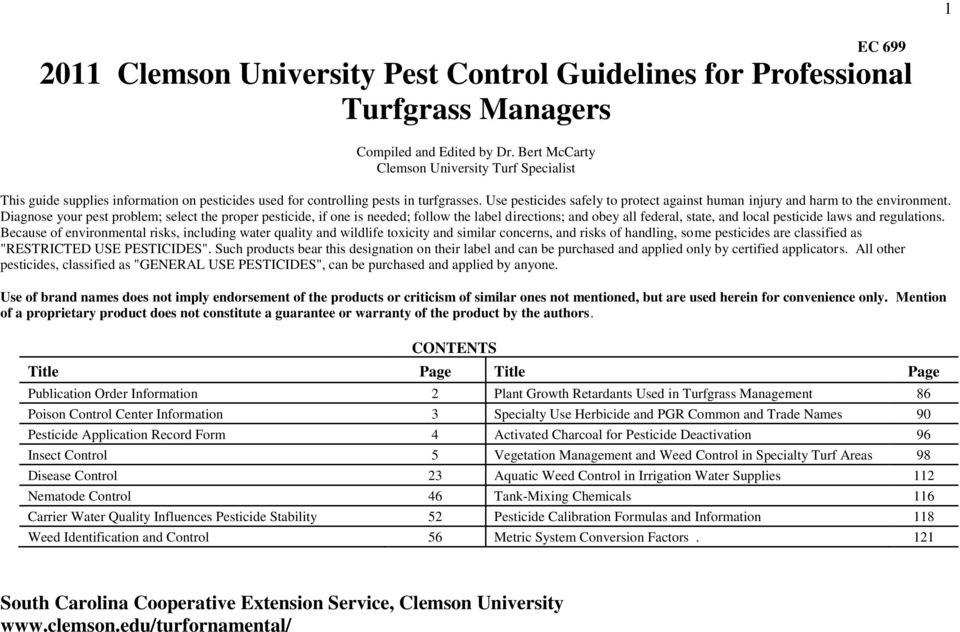
3 1 EC Clemson University Pest Control Guidelines for Professional Turfgrass Managers Compiled and Edited by Dr. Bert McCarty Clemson University Turf Specialist This guide supplies information on pesticides used for controlling pests in turfgrasses. Use pesticides safely to protect against human injury and harm to the environment. Diagnose your pest problem; select the proper pesticide, if one is needed; follow the label directions; and obey all federal, state, and local pesticide laws and regulations. Because of environmental risks, including water quality and wildlife toxicity and similar concerns, and risks of handling, some pesticides are classified as "RESTRICTED USE PESTICIDES". Such products bear this designation on their label and can be purchased and applied only by certified applicators. All other pesticides, classified as "GENERAL USE PESTICIDES", can be purchased and applied by anyone. Use of brand names does not imply endorsement of the products or criticism of similar ones not mentioned, but are used herein for convenience only. Mention of a proprietary product does not constitute a guarantee or warranty of the product by the authors. CONTENTS Title Page Title Page Publication Order Information 2 Plant Growth Retardants Used in Turfgrass Management 86 Poison Control Center Information 3 Specialty Use Herbicide and PGR Common and Trade Names 90 Pesticide Application Record Form 4 Activated Charcoal for Pesticide Deactivation 96 Insect Control 5 Vegetation Management and Weed Control in Specialty Turf Areas 98 Disease Control 23 Aquatic Weed Control in Irrigation Water Supplies 112 Nematode Control 46 Tank-Mixing Chemicals 116 Carrier Water Quality Influences Pesticide Stability 52 Pesticide Calibration Formulas and Information 118 Weed Identification and Control 56 Metric System Conversion Factors. 121 South Carolina Cooperative Extension Service, Clemson University
4 2 CLEMSON UNIVERSITY TURFGRASS PUBLICATION ORDER INFORMATION More Turfgrass and Related Weeds: Beyond the Color Atlas Designing and Maintaining Bermudagrass Sports Fields in the United States, 2 nd edition - EC 698 Weeds of Southern Turfgrasses - EB 150 Diseases of Turfgrasses in the Southeast - EB 146 Pest Management Handbook (vol. 2), Turfgrass and Ornamentals - EC 695 Sod Production in the Southern United States - EC 702 Southern Lawns - EC 707 Make check or money order payable to the Clemson University or for credit card orders call during weekday office hours or order on-line at: Send with this order form to: Clemson University Cooperative Extension Service Bulletin Room, Room 82 Poole Agricultural Center Clemson, SC Other Turfgrass Publications Common Turfgrass Weeds 84 slide set with narrative of the most common weeds in golf courses, home lawns, sports fields, & roadsides. Sports Field Construction 70 slide set with narrative on designing, constructing, and maintaining all levels of sports fields. Both are available from: CSSA Headquarters Office, Attn: Book Order Dept., 677 South Segoe Road, Madison, WI , Best Golf Course Management A complete text covering all agronomic practices for managing golf courses with minimum fertilizer and Practices (3rd edition) pesticide inputs. Order from Amazon.com; GCSAA.com; or BarnesandNoble.com ISBN X. Color Atlas of Turfgrass Weeds A complete text covering all major weeds occurring in Turfgrass and Ornamentals. Included are detailed (2nd edition) biology, reproductive means, distribution ranges and control recommendations. ISBN Managing Bermudagrass Turf A complete text concerning Bermudagrass Turf, especially golf greens. ISBN Order these books from GCSAA.com; Amazon.com; or BarnesandNoble.com. Weed Control in Turf and A complete text on turf and ornamental herbicides, their chemistry, mode of action, and control of the most Ornamentals important weeds in each. ISBN

5 3 POISON CENTERS Robert G. Bellinger, PhD Extension Pesticide Coordinator Palmetto Poison Center, College of Pharmacy, University of South Carolina, Columbia, SC Emergency - anywhere: Emergency - SC state-wide: Emergency - Columbia: Business number: If victim has collapsed or is not breathing, call 911. Georgia: North Carolina: National Pesticide Information Center (NPIC): For a pesticide chemical emergency or for any pesticide information. [email protected] World Wide Web: For small pesticide spills: call the manufacturer (see the product label), or the NPIC at PIP Pesticide Recordkeeping Requirements for Commercial & Non-commercial Applicators - In South Carolina, commercial and non-commercial pesticide applicators may be required to maintain records on their pesticide applications under more than one regulation. PIP Pesticide Application Information Disclosure Requirements - In South Carolina, all pesticide applicators are required to maintain records or display information on their pesticide applications, and often, under more than one regulation.
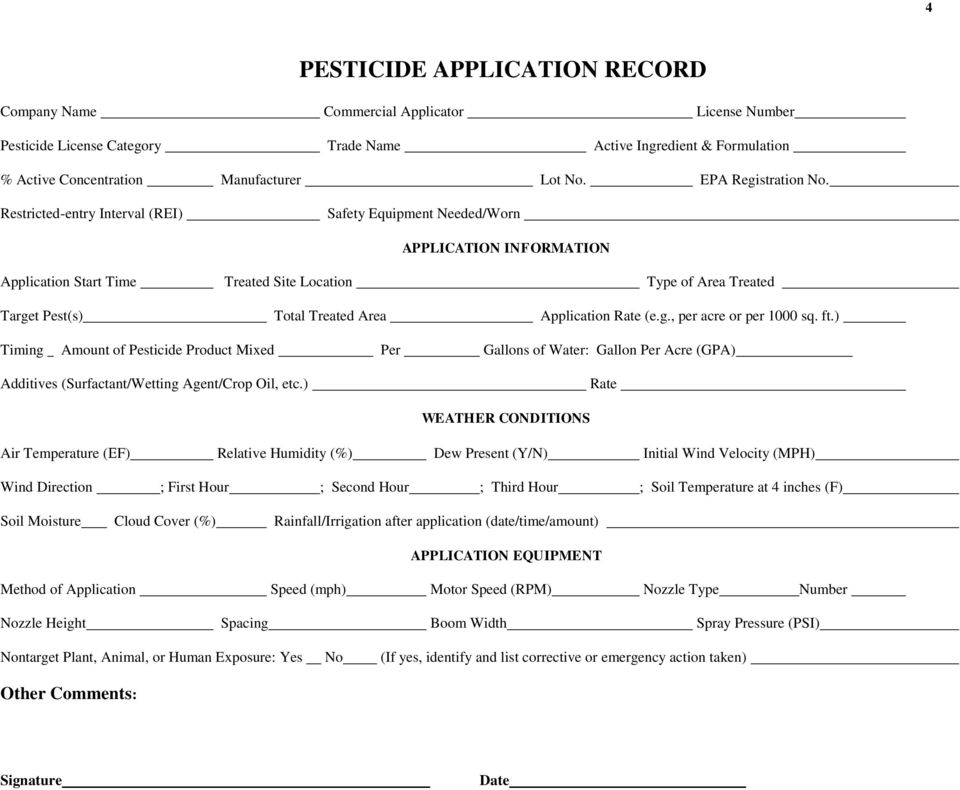
6 4 PESTICIDE APPLICATION RECORD Company Name Commercial Applicator License Number Pesticide License Category Trade Name Active Ingredient & Formulation % Active Concentration Manufacturer Lot No. EPA Registration No. Restricted-entry Interval (REI) Safety Equipment Needed/Worn APPLICATION INFORMATION Application Start Time Treated Site Location Type of Area Treated Target Pest(s) Total Treated Area Application Rate (e.g., per acre or per 1000 sq. ft.) Timing Amount of Pesticide Product Mixed Per Gallons of Water: Gallon Per Acre (GPA) Additives (Surfactant/Wetting Agent/Crop Oil, etc.) Rate WEATHER CONDITIONS Air Temperature ( F) Relative Humidity (%) Dew Present (Y/N) Initial Wind Velocity (MPH) Wind Direction ; First Hour ; Second Hour ; Third Hour ; Soil Temperature at 4 inches (F) Soil Moisture Cloud Cover (%) Rainfall/Irrigation after application (date/time/amount) APPLICATION EQUIPMENT Method of Application Speed (mph) Motor Speed (RPM) Nozzle Type Number Nozzle Height Spacing Boom Width Spray Pressure (PSI) Nontarget Plant, Animal, or Human Exposure: Yes No (If yes, identify and list corrective or emergency action taken) Other Comments: Signature Date
7 5 INSECT CONTROL Juang-Horng JC Chong Research and Extension Entomologist Contrary to most common beliefs, most insects that occur on turfgrass are not pests. Some, such as parasitic wasps and ground beetles, are in fact beneficial insects that feed on the pests and help reducing pest population and damage. Therefore, it is important to identify insects found on turfgrass correctly. An effective integrated pest management (IPM) program takes into consideration the biology, ecology, environment impacts, and all available treatment options. An IPM system is not difficult to adopt. Unbeknown to most turfgrass professionals, they are already utilizing some of these elements in making a pest management decision. Insecticide efficacy can be reduced by many environmental and biological factors. Water ph outside the suitable range can quickly degrade insecticides. Some insecticides may persist longer in clay than in sandy loam. Some insecticides may need irrigation after application to penetrate the soil and kill the insects that live underground. Insects may also develop resistance to one group of insecticides if the same group is applied to the same insect population repeatedly. In order to delay the development of insecticide resistance, avoid using insecticides from same mode of action or IRAC group number repeatedly. To assist in the decision to rotate insecticides, an IRAC table is included in this guide. Some of the most common insect pest of turfgrass are: Ants (nuisance ants and red imported fire ants): A large number of ant mounds can interfere with the play on the greens. RIFA is also a medical concern because of their stings. Monitoring: The small mounds made by the nuisance ants on the greens and the large mounds made by the RIFA along the periphery are the tell-tale signs. Treatment: Most ants can be treated by one of the three methods: individual mound treatment, broadcast granules of baits or long-residual toxicants, and a combination of the two methods. Billbug: Adults feed on the leaf blades and deposit eggs in the stem. The larvae, resembles legless white grubs, first bore into the stem and then feed on the rhizomes, roots and crown. Monitoring: Adults can often be found crawling on pavement in the spring. Larvae can be found by digging into the yellowing turf. Grasses fed by the larvae can be easily pulled out from the ground because the roots are consumed. Fine, whitish, saw dust materials may come out of the hollowed stems. Treatment: Adult control may not be effective. A similar management for white grubs can be used for billbug grubs. Insecticides should be applied in the spring when adults are observed. Caterpillars (cutworm, fall armyworm and sod webworm): Fall armyworm begins to appear in June while cutworms and sod webworms often in the spring. Monitoring: Conduct soap flush (1-2 fl oz detergent per gallon water) to determine the species and size. Frequent congregations of birds can sometime indicate caterpillar infestations. Treatment: Treatments are most effective when the caterpillars are small; so, soap flush to determine caterpillar size is crucial. Treat when needed. Do not irrigate within 24 hours after the insecticide application to allow for exposure of the caterpillars. Chinch bug: Southern chinch bug is the major pest of St. Augustinegrass, often create yellowing or dead patches in the hot, dry days of summer. Thick thatch often accentuate infestations. Monitoring: Two floatation methods can be used to monitor chinch bug population: 1) insert a large PVC pipe or cut-out coffee can deep into the turf and pour in tap water, or 2) cut a piece of sod and flood it inside a container with tap water. Chinch bugs will float to the top and can be counted. Treatment: Established treatment threshold is chinch bugs per sq ft. A high volume spray (minimum of 50 gal/acre) will be needed to deliver the chemicals into the thatch for control. Earthworm: Although usually considered beneficial, earthworm can still interfere with play by pushing a large number of castings onto the greens. No control is recommended. Mole cricket: Tawny and southern mole crickets create tunnels and expose the grass roots to desiccation. Adult flight occurs in April to June. Egg hatch occurs from June through July. Monitoring: Check for tunnels. Soap flush (1-2 fl oz lemon scented detergent per gallon water) in areas large numbers of tunnels can capture the mole crickets and determine body sizes. Treatment: Treatment of young nymphs in June and July is more effective than treatment of adults in spring and larger nymphs in the fall. When contact insecticides are used, irrigate after application can help to push the insecticides into the soil. White grubs: White grubs feed on the roots of turfgrass. Infested turf turns yellow and wilt. Severe infested turf feels spongy under foot and often fall apart when cut or lifted. Monitoring: Remove sod from the ground and carefully inspect root zone for the grubs. Treat when more than 7-10 grubs are found in 1 sq ft of sod. Treatment: Preventive treatment of young white grubs in May to June using long residual insecticides (such as neonicotinoids) is more effective than curative treatment of larger grubs in July and August (using insecticides such as trichlorfon). Because the grubs live deep underground, the insecticides have to be irrigated in after application. Biology and management information of the above mentioned and other pests of turfgrass are listed in the table.

8 6 Common Turf Insecticides Listed by IRAC Classification, Chemical Classes or MOA IRAC Group Mode of Action Chemical Classes Active Ingredient Trade Name 1 1A Carbamates carbaryl Sevin methiocarb Mesurol Acetylcholine esterase inhibitors acephate Orthene 1B Organophosphates chlorpyrifos Dursban trichlorfon Dylox 2B GABA-gated chloride channel antagonists Fipronil fipronil Chipco Choice, Chipco TopChoice bifenthrin Allectus 2, Aloft 2, Onyx, Talstar cyfluthrin Tempo 3 Sodium channel modulators Pyrethroids cypermethrin Demon deltamethrin Deltagard lambda-cyhalothrin Lambda, Battle, Demand, Scimitar permethrin Astro clothianidin Arena, Aloft 2 4A Nicotinic acetylcholine receptor dinotefuran Zylam Neonicotinoids agonists/antagonists imidacloprid Allectus 2, Merit, Bayer Advanced thiamethoxam Meridian 5 Nicotinic acetylcholine allosteric activator Spinosyns spinosad Conserve, Justice Fire Ant Bait 6 Chloride channel activators Avermectins abamectin Affirm, Varsity Fire Ant Bait 7A Junevile hormone analogues s-methoprene Firestrike 2, Extinguish, Extinguish Plus 2 7B Juvenile hormone mimics Fenoxycarb fenoxycarb Award Fire Ant Bait 7C Pyriproxyfen pyriproxyfen Distance Fire Ant Bait 11B1 Microbial disruptors of insect midgut B.t. var. aizawai Xentari Bacillus thuringiensis 11B2 membranes B.t. var. kurstaki Biobit, Crymax, Dipel, Juvelin, Lepinox 18A Ecdysone agonists.molting disruptors Diacylhydrazines halofenozide Mach 2 20 Mitochondrial complex III electron transport Amdro Firestrike 2, Extinguish Plus 2, Hydramethylnon hydramethylnon inhibitors (Coupling Site II) SiegePro 22A Voltage-dependent sodium channel blockers Indoxacarb indoxacarb Advion, Provaunt 28 Ryanodine receptor modulator Diamides chlorantraniliprole Acelypryn un Unknown MOA Dicofol dicofol Kelthane Bacteria Bacillus popillae Milky spore powder uc Unclassified: Pathogens Nematodes Steinernema and Heterprhabditis spp. Millenium, BioVector, Nemashield Fungi Beauveria bassiana Botanigard, Naturalis 1 Trade names are provided as examples only. No endorsement of products is intended, nor is criticism of unnamed products implied. 2 Allectus = imidacloprid + bifenthrin; Aloft = clothianidin + bifenthrin; Amdro Firestrike and Extinguished Plus = s-methoprene + hydramethylnon. Pesticide Application Information While the label is the law, the following sources may be helpful when seeking information regarding specific pesticide products. $ Department of Pesticide Regulation (DPR) $ Pesticide Information Page

9 7 Pest Pesticide Common Name INSECT PEST CONTROL Pesticide Trade Name and Formulation 1 Rate / 1,000 sq. ft. Pest Biology, Symptoms, Cultural Practices, and Comments Ants, Nuisance acephate 2 Orthene TT&O 75 and to 1.6 oz/gal, see label bifenthrin 2 Onyx 0.07 to 0.15 fl oz OnyxPro 0.16 to 0.32 fl oz Talstar EZ Golf, GC Gran, PL Talstar GC Flowable, Talstar One 2.3 to 4.6 lbs 0.25 to 1.0 fl oz carbaryl 2 Sevin 5 Bait 11 oz Sevin 10G 1.4 to 1.9 lbs Sevin 80 WSP Sevin SL 2.5 to5.0 lb/acre 1.5 to 3 fl oz In most cases ants serve as insect predators of turfgrass pests and competitors to red imported fire ants. Ants become a nuisance when they build up to a high number, invade buildings and equipments, and build mounds that interfere with the smoothness of the greens. Species identification and an understanding of ant biology is often critical in deciding where to treat and what to treat with, especially when baits are used. Ants are very susceptible to insecticide treatments, but relief of the problem seldom occurs unless the colony itself is eliminated. Sap-sucking insects (such as aphids, mealybugs, scale insects and leafhoppers) on nearby vegetations or landscape ornamentals should be controlled to reduce their attraction to the honeydew-seeking ants. Check labels for site restrictions. chlorpyrifos 2 Dursban 50W 2 lb/acre Dursban PRO for uses on golf courses, road medians, and industrial plants sites only. Dursban PRO 1.5 fl oz Dursban 50W can also be used on sod farms and seed productions. clothianidin Arena.25G 1.84 to 3.67 lbs Arena.5G 1.0 to 1.8 lbs clothinidin + bifenthrin Aloft GC SC, LC SC to 23.3 fl oz, see label Use GC formulation of Aloft for golf course and sod farms. Use LC formulation of Aloft Aloft GC G, LC G 80 to 160 lbs, see label for residential and commercial lawns, parks, recreational areas, and athletic fields. cyfluthrin Tempo (various formulations) See label Check label for site restrictions. cypermethrin Demon Max 0.5 fl oz/gal Demon WP 0.33 oz/gal Demon is for lawn and landscape uses. deltamethrin DeltaGard GC, DeltaGard T&O 0.4 to 0.6 fl oz DeltaGard for lawns, recreational areas and athletic fields. Use GC formulation for golf DeltaGard G, DeltaGard GC Gran 2 to 3 lbs courses and sod farms. fenoxycarb (bait) Award Fire Ant Bait 1 to 1.5 lbs/acre For fire ants and big-headed ants. Not for use on sod farms and seed productions. fipronil Chipco TopChoice 2 lbs Broadcast or slit applications. Provide 3 months control. Not for pasture and grazing Chipco Choice 4.6 oz lands. Check label for buffer zone and yearly application limit requirements. hydramethylnon (bait) Amdro Pro, SiegePro 1 to 1.5 lbs/acre Maxforce G 1 to 2 lbs For fire ants, big-headed ants, and harvester ants. imidacloprid + bifenthrin Allectus G, Allectus GC Gran 1.7 to 2.9 lbs Use GC formulation of Allectus on golf courses and sod farms. Allectus SC, Allectus GC SC 1.32 to 1.65 fl oz indoxacarb (bait) Advion Fire Ant Bait 1.5 lb/acre For fire ants, big-headed ants, and pavement ants. lambda-cyhalothrin 2 Demand EZ 13.6 to 28 ml Demand G 2 to 3 lbs Demand and Scimitar for use on lawns, recreational areas and athletic fields. GC formulation also for gold course and sod farm uses. Demand CS, Scimitar GC and CS 3.4 to 7 ml methoprene + Extinguish Plus hydramethylnon (bait) 1.5 lbs/acre For fire ants, native ants, big-headed ants, harvester ants, and Argentine ants. permethrin Astro 0.4 to 0.8 fl oz Astro for use on lawns, recreational areas and athletic fields. pyriproxyfen (bait) Distance Fire Ant Bait 1 to 1.5 lbs/acre Fir fire ants and big-headed ants.

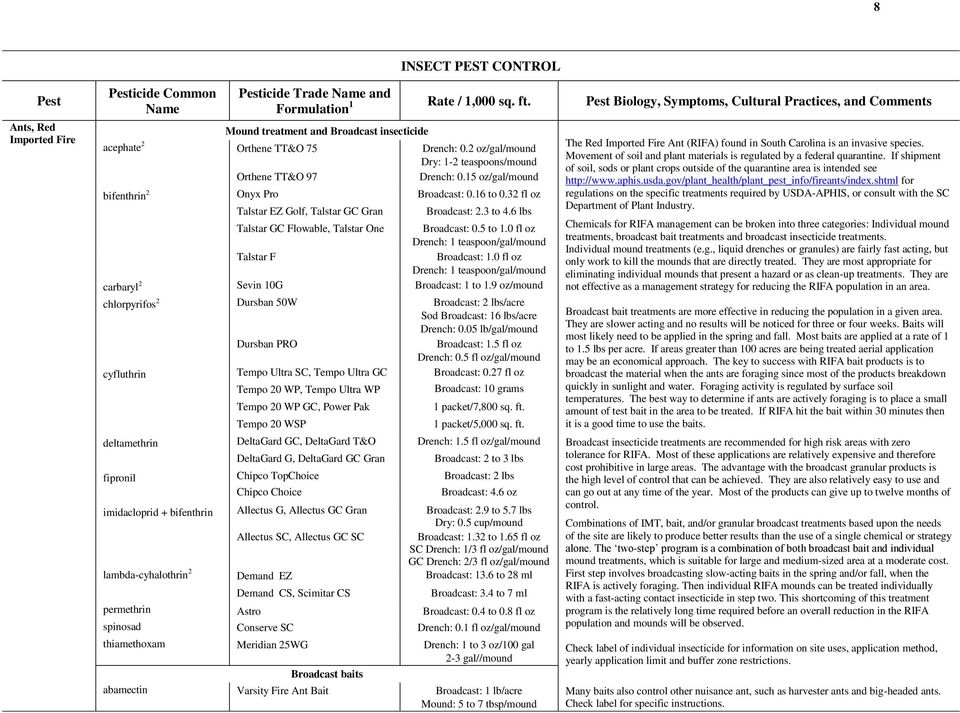
10 8 INSECT PEST CONTROL Pest Ants, Red Imported Fire Pesticide Common Name Pesticide Trade Name and Formulation 1 Rate / 1,000 sq. ft. Pest Biology, Symptoms, Cultural Practices, and Comments Mound treatment and Broadcast insecticide acephate 2 Orthene TT&O 75 Drench: 0.2 oz/gal/mound Dry: 1-2 teaspoons/mound Orthene TT&O 97 Drench: 0.15 oz/gal/mound bifenthrin 2 Onyx Pro Broadcast: 0.16 to 0.32 fl oz Talstar EZ Golf, Talstar GC Gran Broadcast: 2.3 to 4.6 lbs Talstar GC Flowable, Talstar One Broadcast: 0.5 to 1.0 fl oz Drench: 1 teaspoon/gal/mound Talstar F Broadcast: 1.0 fl oz Drench: 1 teaspoon/gal/mound carbaryl 2 Sevin 10G Broadcast: 1 to 1.9 oz/mound chlorpyrifos 2 Dursban 50W Broadcast: 2 lbs/acre Sod Broadcast: 16 lbs/acre Drench: 0.05 lb/gal/mound Dursban PRO Broadcast: 1.5 fl oz Drench: 0.5 fl oz/gal/mound cyfluthrin Tempo Ultra SC, Tempo Ultra GC Broadcast: 0.27 fl oz Tempo 20 WP, Tempo Ultra WP Broadcast: 10 grams Tempo 20 WP GC, Power Pak Tempo 20 WSP 1 packet/7,800 sq. ft. 1 packet/5,000 sq. ft. deltamethrin DeltaGard GC, DeltaGard T&O Drench: 1.5 fl oz/gal/mound DeltaGard G, DeltaGard GC Gran Broadcast: 2 to 3 lbs fipronil Chipco TopChoice Broadcast: 2 lbs Chipco Choice Broadcast: 4.6 oz imidacloprid + bifenthrin Allectus G, Allectus GC Gran Broadcast: 2.9 to 5.7 lbs Dry: 0.5 cup/mound Allectus SC, Allectus GC SC Broadcast: 1.32 to 1.65 fl oz SC Drench: 1/3 fl oz/gal/mound lambda-cyhalothrin 2 GC Drench: 2/3 fl oz/gal/mound Demand EZ Broadcast: 13.6 to 28 ml Demand CS, Scimitar CS Broadcast: 3.4 to 7 ml permethrin Astro Broadcast: 0.4 to 0.8 fl oz spinosad Conserve SC Drench: 0.1 fl oz/gal/mound thiamethoxam Meridian 25WG Drench: 1 to 3 oz/100 gal 2-3 gal//mound Broadcast baits abamectin Varsity Fire Ant Bait Broadcast: 1 lb/acre Mound: 5 to 7 tbsp/mound The Red Imported Fire Ant (RIFA) found in South Carolina is an invasive species. Movement of soil and plant materials is regulated by a federal quarantine. If shipment of soil, sods or plant crops outside of the quarantine area is intended see for regulations on the specific treatments required by USDA-APHIS, or consult with the SC Department of Plant Industry. Chemicals for RIFA management can be broken into three categories: Individual mound treatments, broadcast bait treatments and broadcast insecticide treatments. Individual mound treatments (e.g., liquid drenches or granules) are fairly fast acting, but only work to kill the mounds that are directly treated. They are most appropriate for eliminating individual mounds that present a hazard or as clean-up treatments. They are not effective as a management strategy for reducing the RIFA population in an area. Broadcast bait treatments are more effective in reducing the population in a given area. They are slower acting and no results will be noticed for three or four weeks. Baits will most likely need to be applied in the spring and fall. Most baits are applied at a rate of 1 to 1.5 lbs per acre. If areas greater than 100 acres are being treated aerial application may be an economical approach. The key to success with RIFA bait products is to broadcast the material when the ants are foraging since most of the products breakdown quickly in sunlight and water. Foraging activity is regulated by surface soil temperatures. The best way to determine if ants are actively foraging is to place a small amount of test bait in the area to be treated. If RIFA hit the bait within 30 minutes then it is a good time to use the baits. Broadcast insecticide treatments are recommended for high risk areas with zero tolerance for RIFA. Most of these applications are relatively expensive and therefore cost prohibitive in large areas. The advantage with the broadcast granular products is the high level of control that can be achieved. They are also relatively easy to use and can go out at any time of the year. Most of the products can give up to twelve months of control. Combinations of IMT, bait, and/or granular broadcast treatments based upon the needs of the site are likely to produce better results than the use of a single chemical or strategy alone. The two-step program is a combination of both broadcast bait and individual mound treatments, which is suitable for large and medium-sized area at a moderate cost. First step involves broadcasting slow-acting baits in the spring and/or fall, when the RIFA is actively foraging. Then individual RIFA mounds can be treated individually with a fast-acting contact insecticide in step two. This shortcoming of this treatment program is the relatively long time required before an overall reduction in the RIFA population and mounds will be observed. Check label of individual insecticide for information on site uses, application method, yearly application limit and buffer zone restrictions. Many baits also control other nuisance ant, such as harvester ants and big-headed ants. Check label for specific instructions.
11 9 INSECT PEST CONTROL Pest Ants, Red Imported Fire Billbugs (adults) Pesticide Common Name Pesticide Trade Name and Formulation 1 Rate / 1,000 sq. ft. Pest Biology, Symptoms, Cultural Practices, and Comments Broadcast baits fenoxycarb Award Fire Ant Bait Broadcast: 1 to 1.5 lbs/acre Mound: 1 to 3 tbsp/mound fipronil Maxforce FC Broadcast: 1.5 to 5 lbs/acre Mound: 2 to 5 tbsp/mound hydramethylnon Amdro Pro Fire Ant Bait Broadcast: 1 to 1.5 lbs/acre SiegePro Fire Ant Bait Mound: 2 to 5 tbsp/mound Maxforce G Broadcast: 1 to 2 lbs/acre Mound: 2 to 5 tbsp/mound indoxacarb Advion Fire Ant Bait Broadcast: 1.5 lb/acre Mound: 4 tablespoons/mound methoprene Extinguish Broadcast: 1 to 1.5 lbs/acre Mound: 3 to 5 tbsp/mound methoprene + hydramethylnon Extinguish Plus Broadcast: 1.5 lbs/acre Mound: 2 to 5 tbsp/mound Do not exceed 4 applications per year. Not for use on sod farms. Do not exceed 4 applications per year. Mix with other baits. pyriproxyfen Distance Fire Ant Bait Broadcast: 1 to 1.5 lbs/acre Mound: 1 to 4 tbsp/mound spinosad Justice Fire Ant Bait Broadcast: 2.5 to 5 lbs/acre Mound: 4-6 tbsp/mound bifenthrin 2 Onyx 0.07 to 0.15 fl oz Billbug adults and larvae feed on the roots and stems of various turfgrasses, with OnyxPro Talstar EZ Golf, GC Gran, PL Talstar GC Flowable, One, F 0.08 to 0.16 fl oz 1.15 to 2.3 lbs 0.25 to 0.5 fl oz carbaryl 2 Sevin 10G 1.4 to 1.9 lbs chlorpyrifos 2 Dursban 50W 2 to 4 lbs/acre Dursban PRO 1.5 fl oz clothianidin + bifenthrin Aloft GC SC, LC SC to 23.3 fl oz, see label Aloft GC G, LC G 80 to 160 lbs, see label cyfluthrin Tempo (various SC formulation) see label Tempo 20 WSP, Power Pak 1 packet/5,000 to 7,800 sq. ft. deltamethrin DeltaGard GC, DeltaGard T&O 0.6 to 0.9 fl oz DeltaGard GC Gran, DeltaGard G 2 to 3 lbs imidacloprid + bifenthrin Allectus G, Allectus GC Gran 1.7 to 2.9 lbs Allectus SC 0.4 to 1.65 fl oz Allectus GC SC 0.9 to 1.65 fl oz lambda-cyhalothrin 2 Demand EZ 28 ml Demand G 3 to 4 lbs Demand CS, Scimitar GC and CS 7 ml bermudagrass and zoysiagrass being the most susceptible. Symptoms are often misdiagnosed as drought stress or disease. Symptoms first appear as scattered dead stems and later enlarge to small patch turning from yellow to brown. Straw-color dead grasses are easily pulled out with the hollowed stem break away from the crown. Fine, sawdust-like frass can be seen at the base. The affected turf, which appears droughtstressed, does not recover with watering. Damage usually shows up in mid- to latesummer (worst in August) during extended drought period. Soil remains firm, not spongy underfoot as with white grub or mole cricket infestations. Adults can be forced from the grass with a detergent or captured with a pitfall trap. Detection and treatment for larvae are similar to white grubs. Treat when adults and/or larvae are found and damage is apparent. Most materials, particularly those against the grubs, should be watered-in with 2-inch immediately after application. Check label of individual insecticide for information on site uses, application method, yearly application limit and buffer zone restrictions.

12 10 INSECT PEST CONTROL Billbugs (grubs) Pest Caterpillars (Armyworms, Cutworms, Sod Webworms) Pesticide Common Name Pesticide Trade Name and Formulation 1 Rate / 1,000 sq. ft. Pest Biology, Symptoms, Cultural Practices, and Comments carbaryl 2 Sevin 80 WSP 10 lb/acre Sevin SL 6 fl oz chlorpyrifos 2 Dursban 50W 2 to 4 lbs/acre chlorantraniliprole Acelypryn to 0.46 fl oz Acelepryn granule 1.15 to 2.3 lb clothianidin Arena.25G 1.84 to 3.67 lbs Arena.5G 1.0 to 1.8 lbs Arena 50 WDG 6.4 to 12.8 oz clothianidin + bifenthrin Aloft GC SC to 19 fl oz Aloft GC G 80 to 132 lbs Aloft LC SC Aloft LC G to 23.3 fl oz 80 to 160 lbs imidacloprid 2 Merit 0.5 G 1.4 to1.8 lbs 0.5G not for use on sod farms. Merit 2 F 0.46 to 0.6 fl oz Merit 75 WP 3 to 4 teaspoons Merit WSP 1 packet/8,250-11,000 sq. ft. 1 packet = 1.6 oz imidacloprid + bifenthrin Allectus G, Allectus GC Gran 1.7 to 2.9 lbs Allectus SC 0.4 to 1.65 fl oz Allectus GC SC 0.9 to 1.65 fl oz Begin preventive treatment against larvae soon after the adults become active in the spring (usually in late April and May; monitor with pitfall traps). Larger grubs can also be controlled curatively (although less effectively) in early summer (when the grubs are in the soil) with methods similar to the white grubs. halofenozide Mach 2 2SC 2.9 fl oz 2SC not for uses in residential lawns. Mach 2 1.5G 3 lbs Allow 7 days before treatment and harvest of sods when using Mach 2. thiamethoxam Meridian 0.33G 1.42 to 1.88 lbs Meridian 25WG 0.3 to 0.39 oz trichlorfon Dylox 6.2G 3 lbs Dylox 80 T&O 3.75 fl oz/100 gal acephate 2 Orthene TT&O 75, 97 see label Bacillus thuringiensis (Bt) Biobit, Crymax, Deliver, Dipel, 0.5 to 3 lbs/acre, see label Javelin, Lepinox, XenTari bifenthrin 2 Onyx 0.07 to 0.15 fl oz OnyxPro 0.05 to 0.08 fl oz Talstar EZ Golf, GC Gran, PL Talstar GC Flowable, One, F 1.15 lbs 0.18 to 0.25 fl oz carbaryl 2 Sevin 10G 1.4 to 1.9 oz, see label Sevin 80 WSP 2.5 to10 lb/acre, see label Sevin SL 1.5 to 6 fl oz, see label Dylox for not uses in sod farms, seed productions and research. Fall armyworm, cutworm and sod webworm are the major pest caterpillar species of turfgrass. All lawn caterpillars feed on grass blades. True armyworms feed in groups, creating circular patches of bare grounds. Fall armyworms are less gregarious, so the damage often occurs as thinning of grasses in a broad area. Fall armyworm migrates from FL and southern GA each year. Damage begins to appear in June but at this time the caterpillars have become too big and difficult to control. Symptoms of care grounds often appear near building, trees, posts, poles and other erected structures as adult moths often lay eggs on these structures.

13 11 INSECT PEST CONTROL Pest Caterpillars (Armyworms, Cutworms, Sod Webworms) Pesticide Common Name Pesticide Trade Name and Formulation 1 Rate / 1,000 sq. ft. Pest Biology, Symptoms, Cultural Practices, and Comments chlorpyrifos 2 Dursban 50W 2 lbs/acre Dursban PRO 1.5 fl oz chlorantraniliprole Acelypryn to fl oz Acelepryn granule 1.15 to 2.3 lbs clothianidin Arena.25G 1.84 to 3.67 lbs Arena.5G 1.0 to 1.8 lbs Arena 50 WDG 12.8 oz clothianidin + bifenthrin Aloft GC SC, LC SC to 23.3 fl oz; see label Aloft GC G 80 to 132 lbs Aloft LC G 80 to 160 lbs cyfluthrin Tempo Ultra SC, Tempo Ultra GC to 0.27 fl oz Tempo 20 WP, Tempo Ultra WP Tempo 20 WP GC, Power Pak Tempo 20 WSP 5 to10 grams 1 packet/7,500-11,000 sq. ft. 1 packet/5,000-10,000 sq. ft. deltamethrin DeltaGard T&O, DeltaGard GC 0.2 to 0.4 fl oz DeltaGard G, DeltaGard GC Gran 2 to 3 lbs Cutworms dig a burrow in the thatch or soil and eat the grass around the burrow at night, resulting in small patches of dead greens and sunken areas; thus reducing the smoothness and uniformity of putting surface. Frequent mowing and clipping removal help to reduce population but not enough to achieve control. There are several generations of sod webworm in a year. The damage begins to appear in spring and becomes progressively severe with the season. Damage begins as general thinning, followed by small patches of brown, closely-cropped grass; later coalesces into large irregular patches with severe infestations. Adult sod webworm or lawn moths, which have characteristic snout-like projections in front of their heads, are active flyers over turfgrass in the evening. The presence of birds feeding on the caterpillar should also be an indicator. All caterpillar species can be monitored with detergent flush. Treated areas (with most contact insecticides) should not be irrigated within 24 hours of treatment so that the caterpillars will come in contact with the residues. Caterpillars are often attacked by natural enemies; therefore, conserve these natural enemies with less frequent sprays or compatible insecticides whenever possible. Use higher rates of Sevin for cutworm control. dinotefuran Zylam 20SG 1 oz Zylam registered for use on cutworm and sod webworm. nametodes 2 Various products See label Only effective against small caterpillars. halofenozide Mach 2 2SC 1.5 fl oz Mach 2 for use in commercial sites only. Both formulations are more effective against Mach 2 1.5G 1.55 lbs younger caterpillars. They are preventive rather than curative in nature. imidacloprid 2 Merit 0.5 G 1.4 to 1.8 lbs Merit 2 F 0.46 to 0.6 fl oz Merit 75 WP 3 to 4 teaspoons Merit 75 WSP 1 packet/8,250-11,000 sq. ft. 1 packet = 1.6 oz. imidacloprid + bifenthrin Allectus G, Allectus GC Gran 1.2 to 2.9 lbs Allectus GC SC 0.67 to 1.65 fl oz Allectus SC 0.4 to 1.65 fl oz indoxacarb Provaunt to oz Not for use on sod farms. lambda-cyhalothrin 2 Demand EZ 13.6 to 28 ml Demand G 2 to 3 lbs Demand CS, Scimitar GC, CS 3.4 to 7 ml permethrin Astro 0.4 to 0.8 fl oz spinosad Conserve SC 0.25 to 1.2 fl oz, see label trichlorfon Dylox 80 T&O 2.5 to 3.75 fl oz/100 gal Dylox 6.2G 2 lbs Merit is for cutworm only. Must be applied against early stages. May only achieve suppression of the population.

14 12 Pest Pesticide Common Name INSECT PEST CONTROL Pesticide Trade Name and Formulation 1 Rate / 1,000 sq. ft. Pest Biology, Symptoms, Cultural Practices, and Comments Chinch Bugs acephate 2 Orthene TT&O 75 and to 2.4 oz; see label Beauveria bassiana Botanigard 0.5 to 2 qts/100 gal bifenthrin 2 Onyx, OnyxPro See label Talstar EZ Golf, GC Granular, PL 2.3 to 4.6 lbs Talstar GC Flowable, One, F 0.25 to 0.5 fl oz carbaryl 2 Sevin 10G 1.4 to 1.9 lbs Sevin 80 WSP Sevin SL 7.5 to 10 lb/acre 4.5 to 6 fl oz chlorpyrifos 2 Dursban 50W 2 lbs/acre Dursban PRO 1.5 fl oz chlorantraniliprole Acelypryn to 0.46 fl oz Acelepryn granule 1.15 to 2.3 lbs clothianidin Arena.25G and.5g 1.5 to 3.67 lbs, see label Arena 50 WDG 12.8 oz clothianidin + bifenthrin Aloft GC SC to 19 fl oz Aloft GC G 80 to 132 lbs Aloft LC SC to 23.3 fl oz Aloft LC G 80 to 160 lbs cyfluthrin Tempo (various formulations) See label cypermethrin Demon Max 0.33 to 0.65 fl oz Chinch bugs are a major problem of St. Augustinegrass. Hot, dry weather, deep thatch, and high fertility favor chinch bug development. Infested turfgrass first appear yellow and stunted. As the infestation progresses, the grass wilt and dead, creating small dead patches which will expand as the infestation continues and the damage worsens. Sampling for chinch bugs is conducted using the floating method. Plugs of turf and soil can be placed in a 5-gallon bucket filled with clean water or an open ended cylinder (metal can or PIV pipe) driven into the ground and filled with clean water. Adults and nymphs will float to the surface within 10 minutes. Do not use soapy water. For best result sample along the edge of the damage. If chinch bugs are suspected and floating yields no results, visual examination of the stolens in the thatch layer may yield results. Treatments should be applied if 25 to 30 insects are found per square foot. Chinch bugs are often found in the thatch layer. Thus higher volume is critical in delivering the insecticides through the thatch layer and to successful insecticide treatments. See insecticide label for specifics. In general, use a minimum spray volume of 50 gallons/acre (1.2 gallons/1000 sq. ft.). St. Augustinegrass varieties Floratam, Floralawn and Captiva are resistant to chinch bugs. Cultural controls include less N, using water insoluble (slow release) N, using a sharp mower blade, mowing at 3" in sun areas, 4" in shaded areas, and controlling thatch. Irrigate with ¾-inch when grass begins to wilt. Minimize the use of atrazine on St. Augustinegrass during summer. Monitor turf regularly. To preserve beneficial arthropods, limit treatment to the damaged area and 5 to 10 feet beyond. Recheck in 2-3 days. Spot treat again, if needed. Acelypryn provides suppression only. deltamethrin DeltaGard GC, DeltaGard T&O SC 0.6 to 0.9 fl oz DeltaGard G, GC Gran, T&O Gran 2 to 3 lbs dinotefuran Zylam 20SG 1 oz Zylam only achieves suppression. imidacloprid 2 Merit 0.5 G 1.8 lbs Merit 2 F 0.6 fl oz Merit 75 WP 4 teaspoons imidacloprid + bifenthrin Allectus G, Allectus GC Gran 1.7 to 2.9 lbs Allectus SC, Allectus GC SC 1.65 fl oz lambda-cyhalothrin 2 Demand EZ 56 ml Demand G 3 to 4 lbs Demand CS, Scimitar GC, CS 14 ml permethrin Astro 0.4 to 0.8 fl oz Merit can only achieve suppression. thiamethoxam Meridian 0.33G 1.42 to 1.88 lbs Meridian may only provide suppression. Meridian 25WG 0.3 to 0.39 oz trichlorfon Dylox 80 T&O 3.75 fl oz/100 gal

15 13 Pest Chiggers and Ticks Earthworms Pesticide Common Name INSECT PEST CONTROL Pesticide Trade Name and Formulation 1 Rate / 1,000 sq. ft. Pest Biology, Symptoms, Cultural Practices, and Comments bifenthrin 2 OnyxPro 0.16 to 0.32 fl oz Talstar EZ Golf, GC Gran, PL Talstar GC Flowable, One, F 2.3 to 4.6 lbs 0.5 fl oz carbaryl 2 Sevin 10G 1.4 to 1.9 lbs Sevin 80 WSP Sevin SL 2.5 to5 lb/acre 1.5 to 3 fl oz chlorpyrifos 2 Dursban 50W 2 lbs/acre Dursban PRO 1.5 fl oz cyfluthrin Tempo Ultra SC, Tempo Ultra GC to 0.27 fl oz Tempo 20 WP, Tempo Ultra WP 5 to 10 grams cyfluthrin Tempo 20 WP GC, Power Pak 1 packet/7,500-11,000 sq. ft. Tempo 20 WSP 1 packet/5,000-10,000 sq. ft. deltamethrin DeltaGard T&O, DeltaGard GC 0.4 to 0.6 fl oz DeltaGard G, DeltaGard GC Gran 2 to 3 lbs fipronil Chipco TopChoice 2 lbs Chipco Choice 4.6 oz imidacloprid + bifenthrin Allectus G, Allectus GC Gran 2.9 lbs Allectus GC SC, Allectus SC 1.32 to 1.65 fl oz lambda-cyhalothrin 2 Demand EZ 13.6 to 28 ml Demand CS, Scimitar GC, CS 3.4 to 7 ml permethrin Astro 0.4 to 0.8 fl oz No control is recommended. Fleas acephate 2 Orthene TT&O to 2.4 oz Orthene TT&O to 1.8 oz bifenthrin 2 Onyx 0.07 to 0.15 fl oz OnyxPro 0.08 to 0.32 fl oz Chiggers (red bugs) and ticks may be present in turfgrass areas. Although they do not damage turfgrass, they are however significant health risks. Insecticide treatments are often ineffective. Only DeltaGard, Demand, Demon, Dursban. Scimitar, Sevin and Tempo are labeled at higher rates for chigger control. Keep grass mowed short to discourage chiggers and ticks. Avoid contact by applying repellents and wearing protective clothing. Broadcast application. 1 month control for ticks. Earthworms are considered beneficial organisms as they help aerate the soil and decompose organic materials (such as thatch). However, when a large number of dirt and castings are pushed up to the putting greens, they will interfere with the play. At this time, no control is recommended. Flea bites result in severe irritation and discomfort for human and pets. Pet owners can prevent infestation by treating the pets with a long-lasting insecticide or with flea collars. When curative treatment is needed, both infested area and pets need to be treated. Mowing the lawn before treatment may increase effectiveness. Talstar EZ Golf, GC Gran, PL 2.3 to 4.6 lbs Higher rates of bifenthrin for larval control, see label. Talstar GC Flowable, One, F 0.25 to 0.5 fl oz carbaryl 2 Sevin 10G 1.4 to 1.9 lbs Sevin 80 WSP 10 lb/acre Sevin SL 6 fl oz
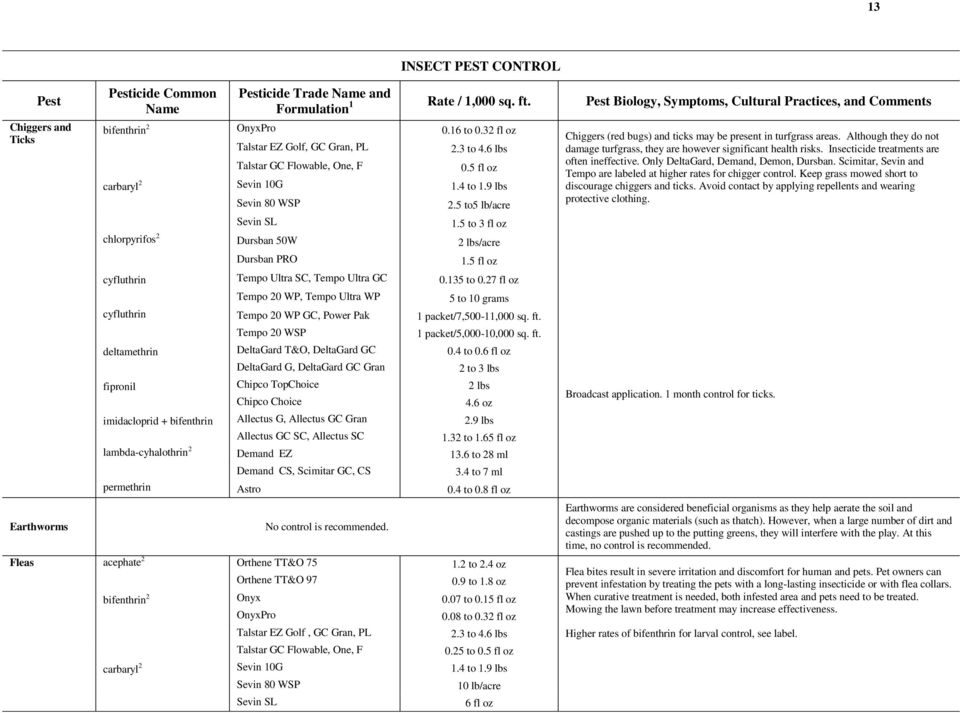
16 14 Pest Pesticide Common Name INSECT PEST CONTROL Pesticide Trade Name and Formulation 1 Rate / 1,000 sq. ft. Pest Biology, Symptoms, Cultural Practices, and Comments Fleas chlorpyrifos 2 Dursban 50W 2 lbs/acre Dursban PRO 1.5 fl oz cyfluthrin Tempo Ultra SC, Tempo Ultra GC 0.27 fl oz Tempo 20 WP, Tempo Ultra WP Tempo 20 WP GC, Power Pak Tempo 20 WSP 10 grams 1 packet/7,800 sq. ft. 1 packet/5,000 sq. ft. cypermethrin Demon Max, TC 0.33 to 0.65 fl oz deltamethrin DeltaGard T&O, DeltaGard GC 0.4 to 0.6 fl oz DeltaGard G, DeltaGard GC Gran 2 to 3 lbs fipronil Chipco TopChoice 2 lbs Broadcast application. 1 month control for fleas. imidacloprid + bifenthrin Allectus G, Allectus GC Gran 2.9 lbs Allectus SC, Allectus GC SC 0.4 to 1.65 fl oz, see label lambda-cyhalothrin 2 Demand EZ 28 ml Demand CS, Scimitar GC, CS 3.4 to 7 ml permethrin Astro 0.4 to 0.8 fl oz spinosad Conserve SC 1.2 fl oz Target flea larvae. Grasshoppers acephate 2 Orthene TT&O oz Grasshoppers are occasional pests of turfgrass. Usually infestations do not required Orthene TT&O oz treatment. During severe infestation, most contact insecticides are very effective. bifenthrin 2 Onyx 0.07 to 0.15 fl oz OnyxPro 0.08 to 0.16 fl oz Talstar GC Flowable, One, F 0.25 to 0.5 fl oz carbaryl 2 Sevin 5 Bait 11 oz Sevin 10G 1.4 to 1.9 oz Sevin 80 WSP Sevin SL 2.5 to5 lb/acre 1.5 to 3 fl oz clothianidin + bifenthrin Aloft GC SC to 19 fl oz Aloft GC G 80 to 132 lbs Aloft LC SC to 23.3 fl oz Aloft LC G 80 to 160 lbs chlorpyrifos 2 Dursban 50W 2 lbs/acre Dursban PRO 1.5 fl oz cyfluthrin Tempo Ultra SC, Tempo Ultra GC to 0.27 fl oz Tempo 20 WP, Tempo Ultra WP 5 to 10 grams Tempo 20 WP GC, Power Pak 1 packet/7,500-11,000 sq. ft.
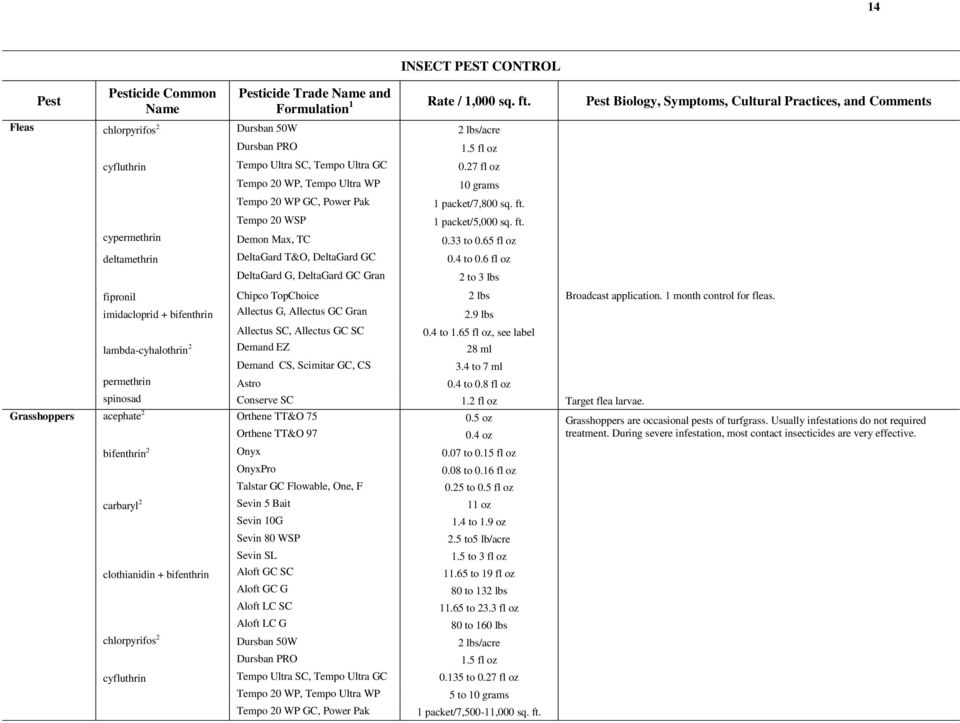
17 15 Pest Pesticide Common Name INSECT PEST CONTROL Pesticide Trade Name and Formulation 1 Rate / 1,000 sq. ft. Pest Biology, Symptoms, Cultural Practices, and Comments Grasshoppers deltamethrin DeltaGard T&O, DeltaGard GC 0.4 to 0.6 fl oz Ground Pearls Greenbugs (Aphids) DeltaGard G, DeltaGard GC Gran 2 to 3 lbs imidacloprid + bifenthrin Allectus SC 0.4 to 1.65 fl oz Allectus GC SC 0.9 to 1.65 fl oz indoxacarb Provaunt oz Not for sod farms. lambda-cyhalothrin 2 Demand EZ 13.6 to 28 ml Demand G 2 to 3 lbs Demand CS, Scimitar GC, CS No effective insecticide is available at the present time. 3.4 to 7 ml acephate 2 Orthene TT&O oz Orthene TT&O oz bifenthrin 2 Onyx, Talstar See label carbaryl 2 Sevin See label chlorpyrifos 2 Dursban See label clothianidin Arena.25G See label clothianidin + bifenthrin Aloft See label cyfluthrin Tempo See label cypermethrin Demon See label imidacloprid + bifenthrin Allectus See label imidacloprid 2 Merit See label lambda-cyhalothrin 2 Demand, Scimitar See label permethrin Astro See label thiamethoxam Meridian See label Two ground pearl species feed on the roots of bermudagrass, St. Augustinegrass, zoysiagrass, and centipedegrass. The movement of infested sods, tools, and even personnel contribute to the spread of ground pearls. Most of the stages are wellprotected in a pearl-like cyst. The cysts are often pink or yellow-brown in color. Damage (yellowing and later browning and death) is exacerbated by poor management and stresses. Sound turf management, including proper fertilization, mowing heights, and irrigation to grow healthy turf, is the only defense against ground pearl at this time. Greenbug is a species of aphid and is usually a pest of grain crops. In some years, greenbugs will invade turfgrass and suck sap from the grass blades. Population begins to build up in the spring; multiple generations per year. A toxic salivary injected during feeding can cause the leaf areas around the feeding site to turn yellow, then brown and eventually die. Dead grass sometimes show burnt orange coloration. Severe infestation can cause patches of dead grass. The honeydew produced by greenbugs is highly attractive to ants. Infestation is worsened in well fertilized lawns and golf courses. Avoid heavy fertilization. Also allow natural enemies to suppress aphid populations by using less frequent and more compatible insecticides. Currently, only Orthene is labeled specifically for greenbug control on golf courses and sod farms (not in landscape). Other contact and systemic insecticides are labeled for control of aphids in general on landscape ornamentals. Leafhoppers acephate 2 Orthene TT&O 75 1 oz Leafhoppers can sometime become a significant pest of turfgrass. Often overwinter as bifenthrin 2 Orthene TT&O oz eggs or adults. 1-5 generations per year. The adult and nymphs of leafhoppers suck sap from grass blades, often causing silvery or whitish flecks or spots. Heavy infestation Talstar EZ Golf, GC Gran, PL 1.15 to 2.3 lbs may cause mottled turf. Talstar GC Flowable, One, F 0.25 to 0.5 fl oz Leafhopper infestations usually do not require treatment. When necessary, most contact carbaryl 2 Sevin 10G 1.4 to 1.9 lbs and systemic insecticides are effective. Because of the movement of leafhoppers, Sevin 80 WSP 2.5 to 5 lb/acre repeated applications may be needed. Sevin SL 1.5 to 3 fl oz Keep lawns and turf area well maintained. Healthy lawns can outgrow the damage.

18 16 Pest Pesticide Common Name INSECT PEST CONTROL Pesticide Trade Name and Formulation 1 Rate / 1,000 sq. ft. Pest Biology, Symptoms, Cultural Practices, and Comments Leafhoppers chlorpyrifos 2 Dursban 50W 2 lbs/acre Dursban PRO 1.5 fl oz Rhodesgrass Mealybugs Millipedes Centipedes Pillbugs Sowbugs (Check cross reference table for specific chemicals) clothianidin + bifenthrin Aloft GC SC to 19 fl oz Aloft GC G 80 to 132 lbs Aloft LC SC to 23.3 fl oz Aloft LC G 80 to 160 lbs deltamethrin DeltaGard T&O, DeltaGard GC 0.4 to 0.6 fl oz DeltaGard G, T&O Gran, GC Gran 2 to 3 lbs imidacloprid + bifenthrin Allectus G, Allectus GC Gran 1.7 to 2.9 lbs Allectus GC SC 0.9 to 1.65 fl oz Allectus SC 0.4 to 1.65 fl oz lambda-cyhalothrin 2 Demand G 2 to 3 lbs bifenthrin 2 Talstar EZ Golf, GC Gran, PL 1.15 to 2.3 lbs Bermudagrass and St. Augustinegrass are most susceptible to attacks by Rhodesgrass Talstar GC Flowable, One, F 0.25 to 0.5 fl oz mealybug. Rhodesgrass mealybug feed similarly to aphids and leafhoppers by sucking carbaryl 2 Sevin the sap from leaf blades, stems and crowns. Damaged grass will first wilt, the turn from See label green to yellow to brown. The damage is especially serious during extended period of chlorpyrifos 2 Dursban See label drought. When the grass is pulled up, the Rhodesgrass mealybugs are visible as white clothianidin Arena See label cottony messed attached to the grass stems. The mealybugs produced copious amount of honeydew, which is very attractive to ants and wasps. clothianidin + bifenthrin Aloft See label cyfluthrin Tempo See label deltamethrin DeltaGard T&O, DeltaGard GC 0.4 to 0.6 fl oz DeltaGard T&O Gran, GC Gran 2 to 3 lbs imidacloprid + bifenthrin Allectus G, GC Gran 1.7 to 2.9 lbs Allectus SC, Allectus GC SC 0.9 to 1.65 fl oz imidacloprid 2 Merit See label lambda-cyhalothrin 2 Demand, Scimitar See label permethrin Astro See label thiamethoxam Meridian See label acephate 2 Orthene TT&O oz/gal bifenthrin 2 Talstar EZ Golf, GC Gran, PL 2.3 to 4.6 lbs Talstar GC Flowable, One, F 0.25 to 0.5 fl oz carbaryl 2 Sevin 10G 1.4 to 1.9 lbs Sevin 80 WSP 2.5 to5.0 lb/acre Sevin SL 1.5 to 3 fl oz chlorpyrifos 2 Dursban 50W 2 lbs/acre Dursban PRO 1.5 fl oz Normally Rhodesgrass mealybugs are not a problem for turfgrass, except in areas where the natural control by predators and parasites are disrupted. Conserve these natural enemies by reducing the frequency of insecticide applications and using more compatible insecticides. Full coverage and thorough penetration of infested grass is required to control the Rhodesgrass mealybugs. Therefore, use a high volume and a surfactant for the application. Withhold irrigation for 24 hours after the treatment to allow more contact or systemic activity against the mealybugs. Currently, only Talstar, DeltaGard and Allectus are labeled specifically for mealybug control on turfgrass. Other contact and systemic insecticides are available for control of mealybugs in landscape ornamentals. Millipedes, centipedes, pillbugs and sowbugs are common arthropods in turfgrass areas. They do not damage turfgrass. Centipedes may be important predators of other turfgrass pests. Control of these arthropods is not recommended. When necessary, perimeter treatment with contact insecticides can reduce the frequency of these arthropods invading buildings from the turfgrass areas.
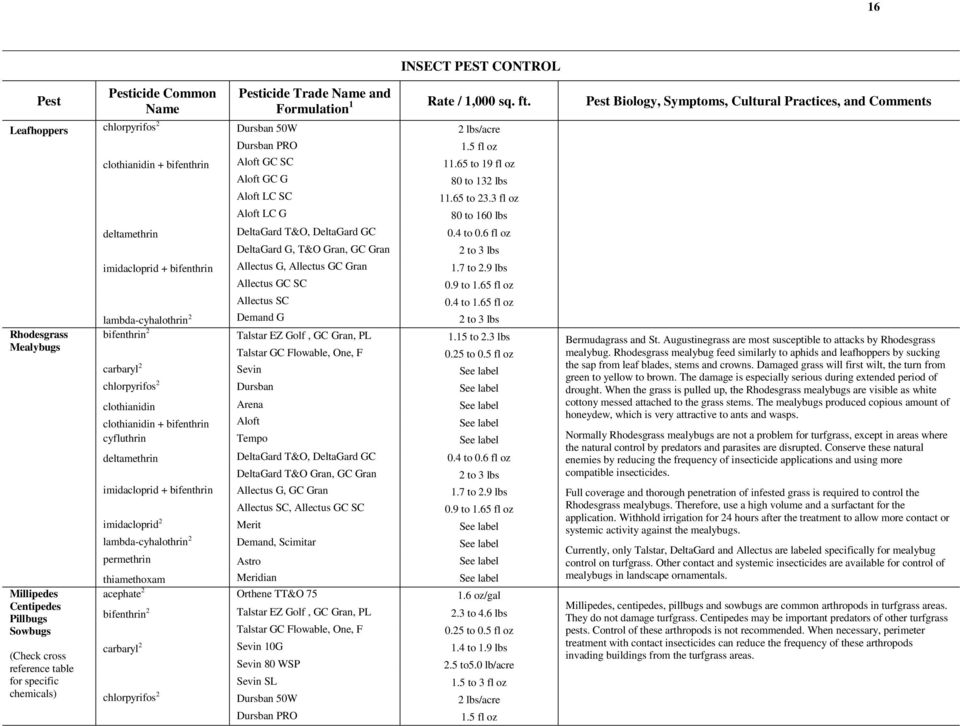
19 17 INSECT PEST CONTROL Pest Millipedes Centipedes Pillbugs Sowbugs (Check cross reference table for specific chemicals) Mites (Clover, Bermudagrass, and other eriophyid mites) Pesticide Common Name Pesticide Trade Name and Formulation 1 Rate / 1,000 sq. ft. Pest Biology, Symptoms, Cultural Practices, and Comments clothianidin + bifenthrin Aloft GC SC to 19 fl oz Aloft GC G 80 to 132 lbs Aloft LC SC to 23.3 fl oz Aloft LC G 80 to 160 lbs cyfluthrin Tempo Ultra SC, Tempo Ultra GC 0.54 fl oz Tempo 20 WP, Tempo Ultra WP 10 to 20 grams Tempo 20 WP GC, Power Pak 1 packet/ gal, see label cypermethrin Demon Max, TC 0.5 fl oz deltamethrin DeltaGard T&O, DeltaGard GC SC 0.4 to 0.6 fl oz DeltaGard G, DeltaGard GC Gran, DeltaGard T&O Gran 2 to 3 lbs imidacloprid + bifenthrin Allectus G, Allectus GC Gran lbs Higher rates for pillbug and sowbug control when using granules. Allectus SC 0.4 to 1.65 fl oz Allectus GC SC 0.9 to 1.65 fl oz lambda-cyhalothrin 2 Demand G 2 to 3 lbs Demand EZ 13.6 to 28 ml Demand CS 3.4 to 7 ml Scimitar GC, CS 3.4 to 7 ml permethrin Astro 0.4 to 0.8 fl oz bifenthrin 2 Onyx 0.07 to 0.15 fl oz OnyxPro 0.08 to 0.16 fl oz Talstar GC Flowable, One, F 0.25 to 0.5 fl oz chlorpyrifos 2 Dursban 50W 2 lbs/acre Dursban PRO 1.5 fl oz cyfluthrin Tempo 20 WP GC, Power Pak 1 packet/ gal, see label deltamethrin DeltaGard GC, DeltaGard T&O 0.6 to 0.9 fl oz DeltaGard GC Gran, DeltaGard G, DeltaGard T&O G 2 to 3 lbs dicofol Kelthane 50 WSP 0.5 to 1 lb/acre imidacloprid + bifenthrin Allectus SC 0.4 to 1.65 fl oz Allectus GC SC 0.9 to 1.65 fl oz lambda-cyhalothrin 2 Demand G 2 to 3 lbs Demand EZ Demand CS Scimitar GC, CS 13.6 to 28 ml 3.4 to 7 ml 3.4 to 7 ml Clover mites are a problem in spring and fall. Feeding damage is a silvery discoloration of grass and often near the house foundation. Bermudagrass mites (an eriophyid mite) are a problem on common bermudagrass during hot, dry weather. Feeding causes yellowing and distortion of the grass, often results in a tufted or twisted rosette or witch-broom growth. Another common eriophyid mite pest of warm-season turfgrass is the zoysiagrass mite which causes rosette growth on infested zoysiagrass. Newer, hybrid bermudagrasses and zoysiagrass are resistant to their respective mite pests. A wetting agent in the spray mixture improves control. Reapply in days. Cultural controls include collecting and removing clippings. Reduce mowing height as close as practical if mites are a problem. Do not use Kelthane on residential lawns.

20 18 Pest Pesticide Common Name INSECT PEST CONTROL Pesticide Trade Name and Formulation 1 Rate / 1,000 sq. ft. Pest Biology, Symptoms, Cultural Practices, and Comments Mole Crickets acephate 2 Orthene TT&O 75 and to 1.9 oz; see label bifenthrin 2 Onyx 0.07 to 0.15 fl oz OnyxPro Talstar EZ Golf, GC Gran, PL Talstar GC Flowable, One, F 0.16 to 0.32 fl oz 2.3 to 4.6 lbs 0.25 to 1.0 fl oz carbaryl 2 Sevin 5 Bait 20 to 48 lbs/acre chlorpyrifos 2 Dursban 50W 4-6 lbs/acre clothianidin Arena.25G and.5g 1.5 to 3.67 lbs, see label Arena 50 WDG 12.8 oz clothinidin + bifenthrin Aloft GC SC, LC SC to 23.3 fl oz, see label Aloft GC G, LC G 80 to 160 lbs, see label cyfluthrin Tempo (various formulations) See label deltamethrin DeltaGard GC 5 SC 0.6 to 0.9 fl oz DeltaGard GC Gran, DeltaGard G 2 to 3 lbs dinotefuran Zylam 20SG 1 oz nematodes 2 Nematac S, various See label fipronil Chipco Choice 0.1 G 4.6 to 9.4 oz TopChoice 2 lbs imidacloprid 2 Merit 0.5 G 1.8 lbs Merit 2 F 0.6 fl oz Merit 75 WP Merit 75 WSP 4 teaspoons 1 packet/8,250 sq. ft. Mole cricket adults are present during later winter and early spring. Mating flights occur from April through June. Egg hatch occurs from mid-june through July. The tawny mole cricket is a much more serious problem than the southern mole cricket. Tunneling is the most obvious sign of mole cricket infestation. To detect mole crickets, use a detergent flush consisting of 1 to 2 fl oz liquid detergent per gallon of water. One gallon will flush a 4 sq. ft. area. Treat when mole crickets and damage are present. Treatment in the early spring is probably beneficial because this will reduce the number of adult mole crickets laying eggs. Although small nymphs cause little noticeable damage, their treatment in late June and July is highly recommended. Sprays and granules should be applied during mid to late June. Application of baits and Orthene should be made when damage first appears (early- to mid-july). Insecticides can be applied later in the year (Aug.-Oct.). Soil should be moist at time of treatment. If soil is not moist, it is important to irrigate before applying sprays, granules and baits. After treatment, irrigate sprays or granulars into soil with 2 inch of water, except Orthene and baits. A surfactant may increase the efficacy of Orthene. Apply all pesticides as late in the day as possible. Do not irrigate after application of baits for 2-3 days if possible. Use a higher rate for large nymphs and adult mole cricket control. Cultural controls include not mowing turf shorter than recommended heights. Use a sharp mower blade. Maintain proper fertility and ph levels, as well as irrigation practices. Slit application when using Chipco Choice. Broadcast application when using Chipco TopChoice. 4 months of control. imidacloprid + bifenthrin Allectus G, Allectus GC 2.9 to 5.7 lbs Allectus SC, Allectus GC SC 1.32 to 3.3 fl oz indoxacarb Advion Mole Cricket Bait 1.15 to 4.6 lbs/acre Advion Mole Cricket Bait is not for use on sod farms and seed productions. Provanut oz Supplemental label. lambda-cyhalothrin 2 Demand G 3 to 4 lbs Demand EZ 28 to 56 ml Demand CS, Scimitar GC or CS 7 to 14 ml permethrin Astro 0.4 to 0.8 fl oz thiamethoxam Meridian 0.33G 1.42 to 1.88 lbs Meridian provides only suppression. Meridian 25WG 0.3 to 0.39 oz trichlorfon Dylox 80 T&O 3.75 fl oz/100 gal. Dylox 6.2G 3 lbs
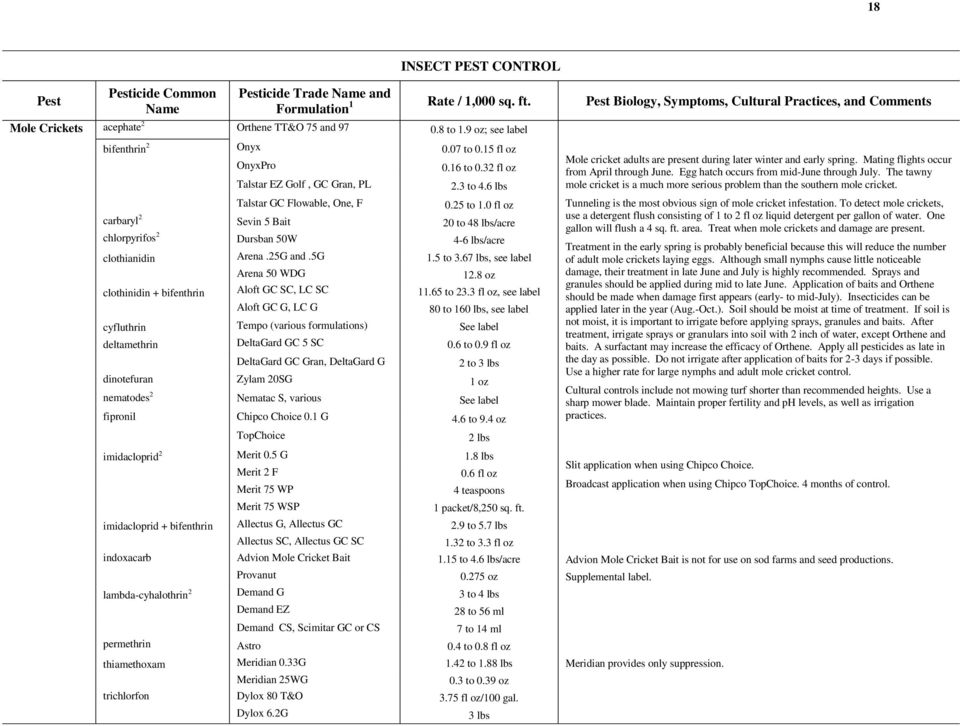
21 19 Pest Pesticide Common Name INSECT PEST CONTROL Pesticide Trade Name and Formulation 1 Rate / 1,000 sq. ft. Pest Biology, Symptoms, Cultural Practices, and Comments Snails and Slugs iron phosphate Sluggo 1 lb iron phosphate + spinosad Sluggo Plus 0.5 lb mesurol Mesurol 2% Bait 1 lb metaldehyde Deadline 6.4 oz Apply late in the evening, especially after rain or irrigation. Reapply when needed. Water infested area thoroughly before application. Do not re-water for 48 hours. Spittlebugs acephate 2 Orthene TT&O to 1.9 oz Orthene TT&O to 1.8 oz bifenthrin 2 Onyx 0.07 to 0.15 fl oz carbaryl 2 Sevin 10G 1.4 to 1.9 lbs Sevin 80 WSP 2.5 to 5.0 lb/acre Sevin SL 1.5 to 3 fl oz clothianidin Arena.25G 1.84 to 3.67 lbs Arena.5G 1.0 to 1.8 lbs clothianidin + bifenthrin Aloft GC SC to 19 fl oz Aloft GC G, LC G 80 to 160 lbs Aloft LC SC to 23.3 fl oz Spittlebugs are increasingly damaging, particularly to centipedegrass. The most common pest species of turfgrass in South Carolina is the two-lined spittlebugs. Adult two-lined spittle bugs have a reddish black with 2 orange or red lines across the wings and a bright red abdomen. Nymphs are found at the base of the grass plant. The nymphs are enclosed individually in white foamy spittle masses. Feeding causes yellowing of the grass. High mowing height and thatch buildup aggravate the problem. There are typically two generations in SC: the first peak of adults occurs in June-July and the second peak in August-September. Overwinter as eggs. Treat when nymphs are present and damage appears. Use a minimum of 50 gallons of water per acre (1.2 gallons/1000 sq. ft.). Mow and irrigate before treatment. Dethatching, withholding irrigation when nymphs are hatching in May and July, and avoiding planting Japanese hollies near centipedegrass can help reduce infestations. Wasps, Bees (Burrowing or Digging) cyfluthrin Tempo 20 WP GC, Power Pak 1 packet/ gal, see label deltamethrin DeltaGard G, GC Gran, T&O Gran 2 to 3 lbs lambda-cyhalothrin 2 Demand G 2 to 3 lbs acephate 2 Orthene TT&O oz/gal Orthene TT&O oz/gal bifenthrin 2 Talstar One 0.25 to 0.5 fl oz chlorpyrifos 2 Dursban 50W 0.25 to 4 lbs/50 gal, see label Dursban PRO 0.17 to 2.7 fl oz/gal, see label cyfluthrin Tempo Ultra SC, Tempo Ultra GC 0.54 fl oz/gal Tempo 20 WP, Tempo Ultra WP 20 grams/gal cypermethrin 2 Demon Max, TC 1 fl oz/gal Mounds and nests made by soil burrowing wasps and bees can interfere with play. Treatment should be done in the evening when foraging adults have returned to the nest. Thoroughly spray the entrance to the nest. Treatments of landscape ornamentals that are frequented by the honeybees and the native bees, with the hope of killing or dissuading visits by the bees, are strongly discouraged. deltamethrin DeltaGard G, DeltaGard GC Gran 2 to 3 lbs lambda-cyhalothrin 2 Demand See label Scimitar See label permethrin Astro 0.4 to 0.8 fl oz Lambda-cyhalothrin is registered for outdoor ornamental control of wasps.
22 20 Pest Pesticide Common Name INSECT PEST CONTROL Pesticide Trade Name and Formulation 1 Rate / 1,000 sq. ft. Pest Biology, Symptoms, Cultural Practices, and Comments White Grubs carbaryl 2 Sevin 10G 1.9 lbs Sevin 80 WSP Sevin SL 10 lb/acre 6 fl oz chlorpyrifos 2 Dursban 50W 2 to 8 lbs/acre Dursban PRO 1.5 fl oz chlorantraniliprole Acelepryn to fl oz Acelepryn granule 1.15 to 2.3 lbs clothianidin Arena.25G 1.84 to 3.67 lbs Arena.5G 1.0 to 1.8 lbs Arena 50 WDG 6.4 to 12.8 oz clothianidin + bifenthrin Aloft GC SC to 19 fl oz Aloft GC G 80 to 132 lbs Aloft LC SC to 23.3 fl oz Aloft LC G 80 to 160 lbs dinotefuran Zylam 20SG 1 oz halofenozide Mach 2 2SC 2.9 fl oz Mach 2 1.5G 3 lbs imidacloprid 2 Merit 0.5 G 1.4 to 1.8 lbs Merit 2 F 0.4 to 0.6 fl oz Merit 75 WP Merit 75 WSP 3 to 4 teaspoons 1 packet/11,000 sq. ft. May and June beetle, green June beetle, masked chafer, European chafer, black turfgrass ataenius, oriental beetle and Japanese beetle larvae are all grouped under white grubs. Identification of the species is based on the raster (area of spines, hair and bare spaces on the underside of the last abdominal segment). White grubs live in the soil and feed on the grass roots. Infested turf often appears wilt and turns yellow and then brown. Heavily damaged turf feels spongy underfoot. Damaged sod easily fall apart when cut or lifted. Large green June beetle grubs also burrow to the surface at night and cause small dirt mounds on the turf. To detect grubs, remove 1 sq. ft. of sod and carefully inspect the root zone. Pay particular attentions to areas with high feeding and searching activity of black parasitic wasps and other animals. In most cases, if more than 7 grubs are found per sq. ft., treatment is needed. Apply preventive treatment in April June or curative treatment against small grubs in July-August. Most materials should be watered-in immediately (at least 2 inches) after application. See label directions. Dursban Pro is only for green June beetle grub control. imidacloprid + bifenthrin Allectus G, Allectus GC 2.3 to 2.9 lbs Allectus SC, Allectus GC SC 1.32 to 1.65 fl oz lambda-cyhalothrin 2 Demand SC, Scimitar SC 7 ml Demand and Scimitar only provide suppression. Demand EZ Demand G 28 ml 3 to 4 lbs thiamethoxam Meridian 0.33G 1.42 to 1.88 lbs Meridian 25WG 0.3 to 0.39 oz trichlorfon Dylox 6.2G 3 lbs Dylox 80 T&O 3.75 fl oz/100 gal 1 Always check to be sure the formulation that you purchase is labeled for the site and pest you intend to use it for. No endorsement of products is intended, nor is criticism of unnamed products implied. Read container label carefully for, use directions, application techniques, irrigation requirements, worker protection information, and precautions. Be sure the formulation of pesticide you buy and use is labeled for use on turfgrass. 2 Several trades names available. Check label for active ingredients, formulations and instructions.
23 21 Cross reference table of insecticides for major turfgrass pests. Insecticide (Trade Names) Armyworms Mites Billbugs (Adult) Billbugs (Larva) Cutworms Mole Crickets Sod Webworm s acephate (Orthene) yes yes yes yes yes yes Chinch Bugs Spittlebugs White Grubs Bacillus thuringiensis (Dipel, etc.) yes yes yes bifenthrin (Onyx, Talstar, Allectus, Aloft) yes Onyx yes yes yes yes yes yes carbaryl (Sevin) yes 10G yes yes Bait yes yes yes yes chlopyrifos (Dursban) yes yes yes 50W yes 50W yes yes yes chlorantraniliprole (Acelypryn) yes yes yes yes yes yes clothianidin (Arena, Aloft).25G yes yes yes yes yes yes G yes clothianidin + bifenthrin (Aloft) yes yes yes yes yes yes yes yes yes cyfluthin (Tempo) yes yes yes yes yes yes WSP cypermethrin (Demon) yes yes deltamethrin (DeltaGard) yes yes yes yes yes yes yes Granule dicofol (Kelthane) yes fipronil (Chipco Choice, Chipco TopChoice) yes halofenozide (Mach2) yes yes yes yes yes imidacloprid (Merit) yes yes yes yes yes imidacloprid + bifenthrin (Allectus) yes SC yes yes yes yes yes yes yes indoxacarb (Advion, Provaunt) yes yes yes yes lambda-cyhalothrin (Demand, Scimitar) yes yes yes yes Yes yes yes Demand G Demand permethrin (Astro) yes yes yes yes spinosad (Conserve SC) yes yes yes thiamethoxam (Meridian) yes yes yes yes trichlorfon (Dylox) yes yes yes yes 80 T&O yes
24 Nuisance Ants Red Imported Fire Ants Chiggers Centipedes Fleas Greenbugs Grasshoppers Leafhoppers Mealybugs Millipedes Pillbugs Sowbugs Snails & Slugs Ticks Wasps & Bees 22 Cross reference table of insecticides for minor and nuisance turfgrass pests. Insecticide (Trade Names) acephate (Orthene) yes yes yes yes yes yes yes yes bifenthrin (Onyx, Talstar, Allectus, Aloft) yes yes yes yes yes yes Yes yes yes yes yes carbaryl (Sevin) yes yes yes yes yes yes yes yes yes yes chlopyrifos (Dursban) yes yes yes yes yes yes yes yes yes yes yes yes clothianidin (Arena, Aloft) yes yes? yes? clothianidin + bifenthrin (Aloft) yes yes yes yes yes yes cyfluthrin (Tempo) yes yes yes yes yes yes? yes yes? yes yes yes yes yes cypermethrin (Demon) yes yes yes yes yes yes? yes? yes yes yes yes yes deltamethrin (DeltaGard) yes yes yes yes G yes yes yes SC yes yes G fipronil (Chipco Choice, TopChoice) yes yes yes yes Fire ant baits (Amdro, etc.) yes imidacloprid (Merit, Allectus) yes? yes? imidacloprid + bifenthrin (Allectus) yes yes yes yes yes? SC yes yes yes yes yes yes indoxacarb (Advion, Provaunt) yes yes yes lambda-cyhalothrin (Demand, Scimitar) yes yes yes yes yes yes? yes yes yes? yes yes yes yes mesurol (Mesurol Bait) yes metaldehyde (Metaldehyde 7.5 G) yes permethrin (Astro) yes yes yes yes? yes? yes yes yes yes yes spinosad (Conserve) yes thiamethoxam (Meridian) yes yes? yes? 22
25 23 DISEASE CONTROL S. Bruce Martin Extension and Research Plant Pathologist Diseases are primary limiting factors to the successful culture of cool and warm season turfgrasses in South Carolina. The wide range of microclimates in the state allow culture of a wide variety of turfgrasses, but frequently the humid conditions and temperature extremes promote many diseases. Fortunately, grasses receiving proper cultural practices including proper irrigation, mowing, and fertilizing are less likely to develop diseases and are not as likely to be seriously damaged if a disease occurs. By enhancing plant vigor, diseases will be minimized and the need for the use of costly fungicides will be reduced. If used, alternate between classes of fungicides to prevent development of fungicide-resistant pathogens. NOTE: Products containing chlorothalonil, iprodione and vinclozolin are no longer labeled for use on home lawns and products containing thiophanate methyl are limited in their use on home lawns. Disease & Affected Grasses Algae (various species; primarily blue-green algae or cyanobacteria) All grasses Most prevalent on putting greens & other turf mowed excessively low. Anthracnose leaf blight and Anthracnose basal rot (Colletotrichum cereale Creeping bentgrass Symptoms and Cultural Controls Trade Name Fungicides 1 Rate (oz/1000 ft 2 ) Application Interval (Days) Turf areas in partially shaded, Daconil Weather Stik chlorothalonil 6F preventive damp locations become weak and begin to thin. Traffic and closemowing curative enhance potential for algae Daconil Zn chlorothalonil 4.16 F preventive development. Long-term overcast, rainy weather periods encourage curative algae on putting greens. These Daconil Ultrex, Chorothalonil DF chlorothalonil 82.5%WDG, DF preventive algae are commonly green or curative brown in color and can be sheetlike, leaf-like, or cushion-like in Renown chlorothalonil + azoyxystrobin 5.16SC appearance. Due to their high water Spectro 90 chlorothalonil + thiophanate methyl 90WDG content, algae are often quite Disarm C chlorothalonil + fluoxastrobin 4.25 SC slippery. Algae growth may become so prolific that they cover Reserve chlorothalonil + triticonazole 4.8SC turf plants and inhibit water Fore, Dithane, Pentathlon, others mancozeb 80WP penetration. Improve air circulation and light Protect DF, others mancozeb 75DF exposure. Improve drainage and Fore F, others mancozeb 4LF reduce irrigation frequency and Junction mancozeb + copper hydroxide 60DF amount. Reduce freely available nitrogen at site. On putting greens, Kocide copper hydroxide 53.8% 16 oz in 5 gal water variable verticut lightly, aerify, and/or Maneb plus Zinc maneb (37%)+ zinc F topdress to disrupt and dry algal mats. Best curative results are with note: chlorothalonil formulations have maximum use rates in effect that depends on site - see new labels for details. 5 gal water per 1,000 sq.ft. applied note: fungicides are most effective when used preventative. Fungicides containing copper hydroxide may be phytotoxic; read label carefully and for 3 consecutive weeks when air use precautions. temps. are at least 85 F. The causal fungus can infect leaves, sheaths, and tillers. In creeping bentgrass and Poa annua, stolons and crowns also may be rotted (anthracnose basal rot). Leaf infection appears as reddish-brown to brown lesions that are often surrounded by a yellow halo. Lesion size may span the blade Heritage azoxystrobin 50WDG Heritage TL azoxystrobin 0.8TL Headway azoxystrobin + propiconazole 1.4ME Daconil Zn chlorothalonil 4.16F pre-disease > post-disease Daconil WeatherStik, Chlorothalonil chlorothalonil 6 F pre-disease 720 SFT, others > pre-disease Daconil Ultrex, Chlorothalonil DF chlorothalonil 82.5% WDG, DF pre-disease 23
26 24 Disease & Affected Grasses and Annual Bluegrass primarily Brown Ring Patch (Rhizoctonia circinata var. circinata) Symptoms and Cultural Controls Trade Name Fungicides 1 Rate (oz/1000 ft 2 ) Application Interval (Days) width and often one lesion will > post-disease cause complete yellowing of a Renown chlorothalonil + azoyxystrobin 5.16SC blade. Tiller infection results in Disarm C chlorothalonil + fluoxastrobin 4.25SC stem girdling and the subsequent appearance of small, yellow chlorothalonil + potassium phosphite 5.27 SC 8 14 patches of turf. The causal fungus Headway chlorothalonil + propiconazole 4.3 SC can sometimes be observed with a Instrata chlorothalonil + propiconazole +fludioxonil hand lens. It will appear as dark, SC cushion-like reproductive structures (acervuli) with black spines (setae) extending from the margin of the cushion. Plants with anthracnose basal rot may have deep-seated infections that are not readily diagnosed with only a hand lens. Avoid stressed turf caused by consistent low mowing and rolling of greens, other pests, fertility imbalances, or moisture extremes. Thatch removal will be helpful. In bentgrass greens, manage localized dry spots to prevent anthracnose basal rot from developing. Affecting Poa annua or Poa trivialis overseedings during late spring/ early fall mild weather conditions. Symptoms resemble Yellow Patch, but the causal agent is more closely related to R. zeae and R.oryzae than to R. cerealis. Consyst chlorothalonil + thiophanate methyl 67WDG Spectro 90 chlorothalonil + thiophanate methyl 90WDG Rubigan AS fenarimol AS Medallion fludioxonil 50WP Disarm fluoxastrobin 4SC Disarm G fluoxastrobin 0.25G lb Systar flutolanil + thiophanate methyl 80WDG /36 iprodione + thiophanate methyl 3.8F Interface iprodione + trifloxystrobin 2.27 SC Duosan mancozeb + thiophanate methyl Tourney metconazole 50WDG Eagle myclobutanil 20 EW Affirm polyoxin 11.3%WDG Banner Maxx, Propiconazole 14.3, propiconazole 1.3 ME others Insignia pyraclostrobin 20 WDG Insignia Intrinsic pyraclostrobin 2.08 SC Honor Intrinsic pyraclostrobin + boscalid 28G thiophanate methyl 50WSB F thiophanate methyl 46%F thiophanate-methyl 41%F 2-8 fl thiophanate methyl 50WP Bayleton triadimefon 50 WSP, 41.7 Flo Compass trifloxystrobin 50WDG Armada trifloxystrobin + triadimefon 50WP Tartan trifloxystrobin + triadimefon 2SC Trinity triticonazole 1.7SC Triton triticonazole 70WDG Triton Flo triticonazole 3F Heritage azoyxystrobin 50%WG Heritage TL azoyxystrobin 0.8TL Heritage G azoyxystrobin 0.31 G 2-4 lb Headway azoyxystrobin + propiconazole 1.4ME Renown chlorothalonil + azoyxystrobin 5.16SC Reserve chlorothalonil + triticonazole 4.8SC
27 25 Disease & Affected Grasses Brown Patch, Rhizoctonia Blight (Rhizoctonia solani) bluegrass creeping bentgrass fescues ryegrass Symptoms and Cultural Controls Trade Name Fungicides 1 Rate (oz/1000 ft 2 ) Application Interval (Days) Yellow patches or rings of affected Medallion fludioxonil 50%WP turf occur and may be somewhat Tourney metconazole 50WDG depressed at the margins. Infections occur on leaf sheaths in the crown Affirm polyoxin 11.3%WDG 0.88 oz 7-14 region, with no leaf lesions. Insignia Intrinsic pyraclostrobin 2.08SC Honor Intrinsic pyraclostrobin + boscalid 28WDG Torque tebuconazole 3.6F Grass is killed in circular to irregular areas that may expand to several feet in diameter. In closecut cool season grasses, a darkened smoke ring border may be apparent. Brown patch in cool season grasses occurs during humid weather at >75 o F. High N, thatch buildup, and excessive moisture favor disease. Maintain adequate fertility. Avoid excess fast-release nitrogen. Irrigate deeply. Reduce thatch note: chlorothalonil formulations have new maximum use rates that depend on site - see new labels for details note: Fungicides containing copper hydroxide may be phytotoxic; read label carefully & use precautions. Trinity triticonazole 1.7SC Triton Flo triticonazole 3F Heritage azoxystrobin 50%WG Heritage TL azoxystrobin 0.8 TL Heritage G azoxystrobin 0.31G 2-4 lb Headway azoxystrobin + propiconazole 1.4ME Terraneb 65WP chloroneb 65WP Terraneb SP chloroneb 2.9F Daconil Weather Stik, chlorothalonil 6F pre-disease Chlorothalonil 720 SFT, others post-disease Daconil Zn, Chlorothalonil 500 Zn, chlorothalonil 4.17F pre-disease others post-disease Daconil Ultrex, Chlorothalonil DF chlorothalonil 82.5% WG,DF pre-disease post-disease Renown chlorothalonil + azoyxystrobin 5.16SC chlorothalonil + fenarimol F Disarm C chlorothalonil + fluoxastrobin 4.25 SC Vitalonil chlorothalonil + potassium phosphite 5.27SC Concert chlorothalonil + propiconazole 4.3SC Consyst chlorothalonil + thiophanate methyl 67WDG Spectro 90 chlorothalonil + thiophanate methyl 90WDG Reserve chlorothalonil + triticonazole 4.8SC Rubigan AS fenarimol 11.6% AS Medallion fludioxonil 50%WP Disarm fluoxastrobin 4SC Disarm G fluoxastrobin 0.25G lb Prostar flutolanil 70%WP, WDG Systar flutolanil + thiophanate methyl Chipco iprodione 50%WP Chipco 26GT, Iprodione Pro, others iprodione 2SC /36 iprodione + thiophanate methyl 3.8F Interface iprodione + trifloxystrobin 2.27 SC Fore, Dithane, Pentathlon, others mancozeb 80%WP Protect DF, others mancozeb 75%DF Junction mancozeb + copper hydroxide 60DF Maneb plus Zinc maneb (37%)+ zinc F
28 26 Disease & Affected Grasses Cercospora Leaf Spot (Cercospora fusimaculans) St. Augustinegrass Copper Spot (Gloeocercospora sorghi) Creeping bentgrass Symptoms and Cultural Controls Trade Name Fungicides 1 Rate (oz/1000 ft 2 ) Application Interval (Days) Tourney metconazole 50WDG Eagle, Myclobutanil 20EW myclobutanil 20 EW Affirm polyoxin 11.3%WDG Banner Maxx, Propiconazole 14.3, propiconazole 1.3ME others Insignia pyraclostrobin 20 WDG Insignia Intrinsic pyraclostrobin 2.08 SC Honor Intrinsic pyraclostrobin + boscalid 28G Torque tebuconazole 3.6F thiophanate methyl 50WSB F thiophanate methyl 46%F thiophanate methyl 50%WP F thiophanate methyl 41%F Spotrete thiram 4F Bayleton triadimefon 50%WSP, 4.15F Compass trifloxystrobin 50%WDG Tartan trifloxystrobin + triadimefon 2SC Armada trifloxystrobin + triadimefon 50WP Triton triticonazole 70WDG Triton Flo triticonazole 3F Trinity triticonazole 1.7SC Brown to purple leaf spots in patches 2-3" in diameter. In high disease severity, entire leaves will yellow, wither and die. Warm, humid weather favors disease incidence. Confused with gray leaf spot. N may reduce disease. Water deeply only when needed in mornings. 'Bitter-blue' selections are more resistant. Small bronze patches about the size of dollar spot occur in humid but mild temperatures. A minor disease in SC, nevertheless it does occasionally occur Manage moisture so that leaf wetness periods are limited. Limit soluble N fertilization. Curalan vinclozolin 50 WG or DF None available. Fungicides used to control other leaf spot diseases will provide suppression. Daconil Ultrex chlorothalonil 82.5 WDG Chlorothalonil DF chlorothalonil 82.5 DF Daconil WeatherStik, Chlorothalonil chlorothalonil 6F SFT, others Daconil Zn, Chlorothalonil 500 Zn, others chlorothalonil + Zn 4.16F 4-5.5; Renown chlorothalonil + azoyxystrobin 5.16SC Disarm C chlorothalonil + fluoxastrobin 4.25SC Concert chlorothalonil + propiconazole 4.3SC Consyst chlorothalonil + thiophanate methyl 67WDG Spectro 90 chlorothalonil + thiophanate methyl 90WDG
29 27 Disease & Affected Grasses Curvularia Blight (Curvularia spp.) Bermudagrass Dead Spot (Ophiosphaerella agrostis) Creeping bentgrass rarely Poa trivialis and bermudagrass greens Dollar Spot (Sclerotinia homoeocarpa) bahiagrass bermudagrass centipedegrass creeping bentgrass ryegrass rough bluegrass St. Augustinegrass tall fescue Symptoms and Cultural Application Controls Trade Name Fungicides 1 Rate (oz/1000 ft 2 ) Interval (Days) Rubigan AS fenarimol 1AS Usually associated with stressed plants from heat, excess moisture, drought, compaction, or other causes. Alleviate stress conditions that may occur. Small red or bronze spots develop during late spring or early fall that resemble ball marks. Spots die in the center and become tan, with black pepper-like pseudothecia fruiting bodies developing. May be mistaken for dollar spot initially. Generally a problem on young stands of bentgrass (1-4 yrs age). Fertilize with ammonium sulfate to suppress the disease. On fine textured grasses, spots appear 1-2" in diameter. On tall or coarse grasses, patches may reach 5 or more inches in diameter. Often, straw-colored lesions move in from leaf margins or occur as distinct bands across the leaf. Most active during o F in spring and fall. Moisture from fog, dew, or irrigation initiates disease. Low soil moisture, thatch, low N and K favor disease. Systar flutolanil + thiophanate methyl 80WDG /36 iprodione + thiophanate methyl 3.8F Protect DF mancozeb 75DF Fore, Dithane, others mancozeb 80WP Fore F, others mancozeb 4LF Junction mancozeb + copper hydroxide 60DF Tourney metconazole 50WDG Eagle myclobutanil 20EW Torque tebuconazole 3.6F , TM 4.5F, others thiophanate methyl 50WP, 4F, 4.5F plus thiophanate methyl 2F TM 85WDG thiophanate methyl 85WDG G thiophanate methyl 2G lb 14 Spotrete thiram 4F Bayleton triadimefon 50WSP, 4.15 F F thiophanate methyl 41%F WP thiophanate methyl 50WP /36 iprodione + trifloxystrobin 2.27 SC Headway azoyxystrobin + propiconazole 1.4ME Emerald boscalid 70WG Spectro 90 chlorothalonil + thiophanate methyl 90WDG Medallion fludioxonil 50% WP Insignia pyraclostrobin 20 WDG Insignia Intrinsic pyraclostrobin 2.08 SC Honor Intrinsic pyraclostrobin + boscalid 28WG F, 3336 plus thiophanate methyl 4F, 2F thiophanate methyl 50WP G thiophanate methyl 2G 6-9 lb 14 Headway azoxystrobin (5.73%) + propiconazole 1.4ME Emerald boscalid 70WDG Daconil WeatherStik, chlorothalonil 6F pre-disease Chlortothalonil 720 SFT, others pre-disease Daconil Zn, Chlorothalonil 500 Zn, others post-disease chlorothalonil 4.16F pre-disease pre-disease post-disease Chlorothalonil DF chlorothalonil 82.5% DF pre-disease
30 28 Disease & Affected Grasses zoysiagrasses Symptoms and Cultural Controls Trade Name Fungicides 1 Rate (oz/1000 ft 2 ) Application Interval (Days) Avoid N deficiency. Reduce leaf pre-disease wetness periods by altering irrigation timing. Avoid thatch buildup. Wipe heavy dew off in mornings. note: chlorothalonil formulations have maximum use rates in effect that depends on site. note: Fungicides containing copper hydroxide may be phytotoxic; read label carefully and use precautions. Fairy Ring Irregularly sized circular to semi- Heritage post-disease Daconil Ultrex chlorothalonil 82.5 WDG Renown chlorothalonil + azoyxystrobin 5.16SC Disarm C chlorothalonil + fluoxastrobin 4.25SC Vitalonil chlorothalonil + potassium phosphite 5.27 SC Concert chlorothalonil + propiconazole 4.3SC pre-disease pre-disease post-disease Consyst chlorothalonil + thiophanate methyl 67WDG Spectro 90 chlorothalonil + thiophanate methyl 90WDG Reserve chlorothalonil + triticonazole 4.8SC Rubigan AS fenarimol 1AS DisArm fluoxastrobin 4SC Disarm G fluoxastrobin 0.25G lb Systar flutolanil + thiophanate methyl 80WDG Chipco 26GT, Iprodione Pro, others iprodione 2F, 2SC /36 iprodione + thiophanate methyl 3.8F Interface iprodione + trifloxystrobin 2.27 SC Protect DF mancozeb 75DF Fore, Dithane, Pentathlon, others mancozeb 80WP Fore Flo mancozeb 4LF Junction mancozeb + copper hydroxide 60DF Maneb plus Zinc maneb (37%)+ zinc F Tourney metconazole 50WDG Eagle myclobutanil 20 EW Banner Maxx propiconazole 1.3ME Insignia pyraclostrobin 20WDG (suppression) Insignia Intrinsic pyraclostrobin 2.08 SC (suppression) Honor Intrinsic pyraclostrobin + boscalid 28WG Torque tebuconazole 3.6F WP thiophanate methyl 50WP F, 3336 plus thiophanate methyl 4F,2F TM 85WDG thiophanate methyl 85WDG G thiophanate methyl 2G lb 14 Spotrete thiram 75WDG Bayleton triadimefon 50WSP, 4.15F Tartan trifloxystrobin + triadimefon 2SC Armada trifloxystrobin + triadimefon 50WP Trinity triticonazole 1.7SC Triton Flo triticonazole 3F Triton triticonazole 70WDG Curalan vinclozolin 50WP or DF azoxystrobin 50WDG Heritage 28
31 29 Disease & Affected Grasses (Agrocybe, Chlorophyllum, Lycoperdon, Marasmius, Tricholoma spp., + other mushroom fungi). All grasses Fusarium Patch and Pink Snow Mold (Microdochium nivale) Cool season grasses are mostly affected, including bentgrass bluegrasses ryegrasses, and fescues Symptoms and Cultural Controls Trade Name Fungicides 1 Rate (oz/1000 ft 2 ) Application Interval (Days) circular bands of lush green turf Heritage TL azoxystrobin 0.8 TL 2 28 become apparent. Turf within Heritage G azoyxystrobin 0.31G 2-4 lb circular area may decline, turn Headway azoxystrobin + propiconazole 1.4ME brown and thin. Toxins may be Disarm C chlorothalonil + fluoxastrobin 4.25SC involved, but hydrophobic soil is a major problem. Mushrooms may Disarm fluoxastrobin 4SC be associated with the rings. Rings Disarm G fluoxastrobin 0.25G lb 28 may persist for years. Prostar flutolanil 70WP, 70 WDG Difficult to control. Plugging or Systar flutolanil + thiophanate methyl 80WDG aerating to allow more water and fertilizer to reach the roots may Tourney metconazole 50WDG help. Some surfactants have helped Affirm polyoxin 11.3%WDG water penetration. Insignia pyraclostrobin 20WDG Fusarium Patch: Begins in late fall and early winter in wet, humid weather as small, water-soaked spots of 2 inches up to 8 inches in diameter. Patches may appear wet or slimy. Gray to pinkish colored mycelium may be noticeable in patches. Snow is not required for development of Fusarium Patch. The disease may kill grasses in these patches; frequently misdiagnosed as cool weather Pythium. Pink Snow Mold: Same causal agent as Fusarium Patch, but the disease occurs under snow cover. Preventive fungicide applications must be made prior to persistent snow cover. Avoid excess nitrogen fertilization, irrigate infrequently but thoroughly, avoiding light frequent irrigations. Protect newly seeded areas that are highly susceptible. Reduce shade and increase air movement around greens. note: chlorothalonil formulations have new maximum use rates in effect that depends on site. Insignia Intrinsic pyraclostrobin 2.08 SC Honor Intrinsic pyraclostrobin + boscalid 28WG Torque tebuconazole 3.6 F Bayleton triadimefon 50DF,4.15F Tartan (2ee SC) triadimefon + trifloxystrobin Heritage azoxystrobin 50WDG Heritage TL azoxystrobin 0.8 TL Heritage G azoyxystrobin 0.31G 2-4 lb Headway azoxystrobin + propiconazole 1.4ME Renown chlorothalonil + azoyxystrobin 5.17SC Disarm C chlorothalonil + fluoxastrobin 4.25SC Concert chlorothalonil + propiconazole 4.3SC Instrata chlorothalonil + propiconazole + fludioxanil SC Consyst chlorothalonil + thiophanate methyl 67WDG 6-8 Single application Spectro 90 chlorothalonil + thiophanate methyl 90WDG Reserve chlorothalonil + triticonazole 4.8SC Daconil WeatherStik, Chlorothalonil chlorothalonil 6F SFT, others Daconil Zn, Chorothalonil 500 Zn, chlorothalonil 4.17F others Daconil Ultrex chlorothalonil 82.5%WDG Chlorothalonil DF chlorothalonil 82.5 DF Rubigan AS fenarimol 1AS applications Medallion fludioxonil 50%WP Disarm fluoxastrobin 4SC Disarm G fluoxastrobin 0.25G lb Systar flutolanil + thiophanate methyl 80WDG Chipco 26GT, iprodione pro, Ipro iprodione 2F, 2SC applications 2SE, others 26/36 iprodione + thiophanate methyl 3.8F
32 30 Disease & Affected Grasses Gray Leaf Spot (Pyricularia grisea) bahiagrass bermudagrass centipedegrass ryegrass St. Augustinegrass tall fescue Symptoms and Cultural Controls Trade Name Fungicides 1 Rate (oz/1000 ft 2 ) Application Interval (Days) Interface iprodione + trifloxystrobin 2.27 SC note: Fungicides containing copper Protect DF mancozeb 75DF wk hydroxide may be phytotoxic; read Fore, Dithane, Penthathlon, others mancozeb 80WP label carefully and use precautions. Fore Flo mancozeb 4LF Junction mancozeb + copper hydroxide 60DF Tourney metconazole 50WDG Late fall Eagle myclobutanil 20 EW Fall/winter Maneb + zinc maneb (37%)+ zinc F Junction mancozeb (15%) + copper hydroxide(46%) Affirm polyoxin 11.3%WDG Banner Maxx, others propiconazole 1ME 2-4 Single application Insignia pyraclostrobin 20WDG Insignia Intrinsic pyraclostrobin 2.08 SC Honor Intrinsic pyraclostrobin + boscalid 28WG Torque tebuconazole 3.6F Spotrete F thiram 4F 3-12 Fall and spring Spotrete 75WDG thiram 75WDG 3-8 Fall and spring 3336, 3336 plus thiophanate methyl 4F, 2F, 50WP TM 85WDG thiophanate methyl 85WDG Bayleton triadimefon 50WSP,4.15F Compass trifloxystrobin 50WG Tartan trifloxystrobin+ triadimefon 2SC 2 fall/ early spring Armada trifloxystrobin + triadimefon 50WP 1.2 fall/ early spring Trinity triticonazole 1.7SC Triton triticonazole 70WDG Late fall Triton Flo triticonazole 3F Curalan vinclozalin 50EG Small brown to ash-colored leaf spots with purple to brown margins. Lesions become covered with the gray, velvety, fungal mycelium of Pyricularia grisea. In severe cases leaves appear scorched. Prevalent during rainy, summer months. Mainly on St. Augustinegrass, but recently epidemics have occurred on tall fescue and perennial ryegrass. Avoid excess N. Irrigate deeply in early morning. Reduce traffic. Mostly a problem on newly planted St. Augustinegrass, especially in shade, or atrazine-treated St. Augustinegrass. note: chlorothalonil formulations Heritage azoxystrobin 50WG ; no more than 2 sequential treatments Heritage TL azoxystrobin 0.8 TL Heritage G azoyxystrobin 0.31G 2-4 lb Headway azoxystrobin + propiconazole 1.4ME Daconil WeatherStik, Chlorothalonil chlorothalonil 6F pre-disease 720 SFT, others post-disease Daconil Zn, Chlorothalonil 500 Zn, others chlorothalonil 4.16%F pre-disease post-disease Daconil Ultrex chlorothalonil 82.5%WDG pre-disease post-disease Chlorothalonil DF chlorothalonil 82.5 DF Renown chlorothalonil + azoyxystrobin 5.16SC TwoSome Flowable Fungicide chlorothalonil + fenarimol Disarm C chlorothalonil + fluoxastrobin 4.25 SC Vitalonil chlorothalonil + potassium phosphite 5.27 SC
33 31 Disease & Affected Grasses "Helminthosporium" Leaf Spot/ Melting Out (Bipolaris, Drechslera spp.) bahiagrass bermudagrass bluegrass creeping bentgrass ryegrass St. Augustinegrass zoysiagrassescho Symptoms and Cultural Controls Trade Name Fungicides 1 Rate (oz/1000 ft 2 ) Application Interval (Days) have new maximum use rates in Concert chlorothalonil + propiconazole 4.3SC effect that depends on site. Instrata chloroothalonil + propiconazole + fludioxanil SC Consyst chlorothalonil + thiophanate methyl 67WDG Spectro 90 chlorothalonil + thiophanate methyl 90WDG Medallion fludioxanil 50WP Disarm fluoxastrobin 4SC Disarm G fluoxastrobin 0.25G lb Fore, Dithane, Pentathlon, others mancozeb 80WP 8 14 Protect DF, others mancozeb 75DF Fore Flo, others mancozeb 4LF Duosan mancozeb + thiophanate methyl Tourney metconazole 50WG Eagle myclobutanil 20EW Banner Maxx, others propiconazole 1.3ME Insignia pyraclostrobin 20WDG Insignia Intrinsic pyraclostrobin 2.08 SC Honor Intrinsic pyraclostrobin + boscalid 28WG Torque tebuconazole 3.6F thiophanate methyl 50WP, 4F plus thiophanate methyl 2F Symptoms include leaf spotting and 'melting-out' phases. Leaves have circular to elongated, purplish or brown spots with straw-colored centers on older lesions. Numerous lesions cause leaves to turn reddish-brown, then yellow, and die. Sheath and crown rot may be present. Ryegrass, bluegrasses (Poa pratensis and P. trivialis) and bermudagrass are most susceptible. Most prevalent when temperatures range from o F during mild periods of spring and fall. Maintain a balanced fertility. Irrigate deeply in the mornings. Raise mower height during disease outbreaks. Reduce thatch. TM 85WDG thiophanate methyl 85WDG Bayleton triadimefon 50WSP, 4.15 Flo Compass trifloxystrobin 50WDG Tartan trifloxystrobin + triadimefon 2SC Armada trifloxystrobin + triadimefon 50WP Heritage azoxystrobin 50WDG Heritage TL azoxystrobin 0.8 TL Heritage G azoyxystrobin 0.31G 2-4lb Headway azoxystrobin + propiconazole 1.4ME Daconil WeatherStik, Chlorothalonil 720 SFT, others Daconil Zn, Chlorthalonil 500 Zn, others chlorothalonil 6F pre-disease post-disease post-disease chlorothalonil 4.16F pre-disease post-disease post-disease Daconil Ultrex chlorothalonil 82.5% WDG Renown chlorothalonil + azoyxystrobin 5.16SC Disarm C chlorothalonil + fluoxastrobin 4.25SC Vitalonil chlorothalonil + potassium phosphite 5.27SC Concert chlorothalonil + propiconazole 4.25SC
34 32 Disease & Affected Grasses Large Patch (brown patch in warm season grasses; Zoysia patch, large patch of zoysia) (Rhizoctonia solani AG 2, 2 LP) zoysiagrass bermudagrass St. Augustinegrass Symptoms and Cultural Controls Trade Name Fungicides 1 Rate (oz/1000 ft 2 ) Application Interval (Days) note: chlorothalonil formulations Instrata chlorothalonil + propiconazole +fludioxanil have new maximum use rates in effect that depends on site. Consyst 3.6SC chlorothalonil + thiophanate methyl 67WDG note: Fungicides containing copper Spectro 90 chlorothalonil + thiophanate methyl 90WDG hydroxide may be phytotoxic; read Reserve chlorothalonil + triticonazole 4.8SC label carefully and use precautions. Medallion fludioxonil 50%WP Disarm fluoxastrobin 4SC Disarm G fluoxastrobin 0.25 G lb Systar flutolanil + thiophanate methyl 80WDG Chipco 26GT, iprodione pro, others iprodione 2F, 2SC /36 iprodione + thiophanate methyl 3.8F Interface iprodione + trifloxystrobin 2.27 SC Duosan mancozeb + thiophanate methyl Fore, Dithane, Penthathlon, others mancozeb 80WP Protect DF, others mancozeb 75DF Fore Flo, others mancozeb 4LF Junction mancozeb + copper hydroxide 60DF Maneb plus Zinc maneb (37%)+ zinc F Eagle myclobutanil 20 EW Affirm polyoxin 11.3%WDG Banner Maxx, others propiconazole 1.3ME Insignia pyraclostrobin 20WDG Insignia Intrinsic pyraclostrobin 2.08 SC Honor Intrinsic pyraclostrobin + boscalid 28WG thiophanate methyl 50WP, 4F plus thiophanate methyl 2F G thiophanate methyl 2G 6-9lb 14 Spotrete thiram 4F Compass trifloxystrobin 50WDG Tartan trifloxystrobin + triadimefon 2SC Armada trifloxystrobin + triadimefon 50WP Triton triticonazole 70WDG Triticonazole triticonazole 1.7SC With Large Patch disease of warm season grasses, leaf fascicles pull easily from plant due to rot at leaf base. Initial infections are in the fall, but symptoms are usually most apparent in the spring as grasses emerge from winter dormancy. Maintain adequate fertility. Avoid excess fast-release nitrogen. Curalan vinclozolin 50WP or DF Heritage azoxystrobin 50WDG (1, 2 or 3 applications in fall Heritage TL azoxystrobin 0.8TL Heritage G azoyxystrobin 0.31G 2-4lb Headway azoyxystrobin + propiconazole 1.4ME Terraneb 65WP chloroneb 65 WP Terraneb SP chloroneb 2.9F Renown chlorothalonil + azoyxystrobin 5.16SC Disarm C chlorothalonil + fluoxastrobin 4.25SC Consyst chlorothalonil + thiophanate methyl 67WDG
35 33 Disease & Affected Grasses Centipedegrass Seashore Paspalum Pink Patch (Limonomyces roseipellis) Cool season grasses, but occasionally on warm season such as centipededgrass or bermudagrass Symptoms and Cultural Controls Trade Name Fungicides 1 Rate (oz/1000 ft 2 ) Application Interval (Days) Irrigate deeply. Reduce thatch. Reserve chlorothalonil + triticonazole 4.8SC Correct compaction and areas of Disarm fluoxastrobin 4SC poor drainage Disarm G fluoxastrobin 0.25G lb Prostar flutolanil 70WP, 70 WDG Chipco 26GT, iprodione pro, others iprodione 2F, 2SC /36 iprodione + thiophanate methyl 3.8F Interface iprodione + trifloxystrobin 2.27 SC Tourney metconazole 50WG Eagle myclobutanil 20 EW 2.4 Apply in fall before dormancy, repeat 28 days Affirm polyoxin 11.3%WDG Banner Maxx, others propiconazole 1.3ME application in early fall, prior to symptoms Insignia pyraclostrobin 20WG Insignia Intrinsic pyraclostrobin 2.08 SC Honor Intrinsic pyraclostrobin + boscalid 28WG Torque tebuconazole 3.6F , others thiophanate methyl 4F, 50WP to plus thiophanate methyl 2F Systar thiophanate methyl +flutolanil 80WDG Mats of mycelium that aggregate in clusters occur on leaves during cool, humid weather. Patches of affected turf range in size up to 6-8 inches diameter and has a pink color. Not severely damaging to turf, but the disease is unsightly.the causal agent is a basidiomycete with clamp connections visible on hyphae when viewed microscopically. Judiciously increase nitrogen fertility. Irrigate infrequently but thoroughly to prevent drought stress. Trinity triticonazole 1.7SC Triton triticonazole 70WDG Triton Flo triticonazole 3SC Heritage azoxystrobin 50WDG Heritage TL azoxystrobin 0.8TL Heritage G azoyxystrobin 0.31G 2-4lb Headway azoyxystrobin + propiconazole 1.4ME Renown chlorothalonil + azoyxystrobin 5.16SC Disarm C chlorothalonil + fluoxastrobin 4.3SC Concert chlorothalonil + propiconazole 4.3SC Reserve chlorothalonil + triticonazole 4.8SC Disarm fluoxastrobin 4SC Disarm G fluoxastrobin 0.25G lb Prostar flutolanil 70WP, 70WDG Systar flutolanil + thiophanate methyl 80WDG Interface iprodione + trifloxystrobin 2.27 SC 4 14 Banner Maxx, others propiconazole 1.3ME Insignia pyraclostrobin 20WG Insignia Intrinsic pyraclostrobin 2.08 SC Honor Intrinsic pyraclostrobin + boscalid 28WG Torque tebuconazole 3.6F Compass trifloxystrobin 50WDG
36 34 Disease & Affected Grasses Powdery Mildew (Blumeria graminis) Most grasses; Kentucky bluegrass especially susceptible. Pythium Blight (Pythium spp.) All grasses Symptoms and Cultural Controls Trade Name Fungicides 1 Rate (oz/1000 ft 2 ) Application Interval (Days) Tartan trifloxystrobin + triadimefon 2SC Armada trifloxystrobin + triadimefon 50WP Trinity triticonazole 1.7 SC Curalan vinclozolin 50EG White, powdery like growth on the upper and lower leaf surfaces of grasses. The disease is most common in excessively shaded areas with high humidities. Improve sunlight penetration and air movement or landscape the area with non-turfgrass plants that are shade tolerant. Grass dies in spots or streaks. Initially, the affected grass has a dark color and a greasy appearance, particularly in spots. Spots may develop a copper color and eventually a bleached, straw color as affected tissues die and dry. After prolonged moist or foggy periods, the cottony mycelium may be seen on the turf (note: this symptom is NOT always evident). Pythium can be spread by foot traffic or mowers passing over infected grasses. Occurs during warm, humid, foggy weather in poorly drained soils. Ryegrass, rough bluegrass, and bentgrass used for overseeding are most susceptible. Improve aeration and drainage. Avoid frequent, shallow irrigation. Reduce mowings and minimize equipment or foot traffic across infected turf. Wash equipment that Heritage azoxystrobin 50WDG Heritage TL azoxystrobin 0.8TL Heritage G azoyxystrobin 0.31G 2-4lb Headway azoyxystrobin + propiconazole 1.4ME Renown chlorothalonil + azoyxystrobin 5.16SC Disarm C chlorothalonil + fluoxastrobin 4.3SC Concert chlorothalonil + propiconazole 4.3SC Consyst chlorothalonil + thiophanate methyl 67WDG Spectro 90 chlorothalonil _ thiophanate methyl 90WDG Rubigan AS fenarimol AS 2-4 Single application Disarm fluoxastrobin 4SC Disarm G fluoxastrobin 0.25G lb Junction mancozeb + copper hydroxide 60DF Eagle myclobutanil 20 EW Banner Maxx, others propiconazole 1ME Insignia pyraclostrobin 20WG Insignia Intrinsic pyraclostrobin 2.08 SC Honor Intrinsic pyraclostrobin + boscalid 28WG Bayleton triadimefon 50WP, 4.15 Flo Heritage azoxystrobin 50WG; no more than 2 sequential sprays Heritage TL azoxystrobin 0.8TL; no more than 2 sequential sprays Heritage G azoyxystrobin 0.31G 2-4 lb Headway azoyxystrobin + propiconazole 1.4ME Terraneb 65SP chloroneb 65 SP Terraneb F chloroneb 2.9F Disarm C chlorothalonil + fluoxastrobin 4.25 SC Vitalonil chlorothalonil + potassium phosphite 5.27 SC Segway cyazofamid 3.3SC Koban ethazole 30WP Terrazole ethazole 35WP Disarm fluoaxastrobin 4SC Disarm G fluoaxastrobin 0.25G lb 14 Stellar fluopicolide + propamocarb 5.7SC Signature, Prodigy, Fosetyl Al fosetyl Al 80WDG WDG Protect DF mancozeb 75DF Fore F mancozeb 4LF 14 5 Junction mancozeb + copper hydroxide 60DF
37 35 Disease & Affected Grasses Pythium Root Rot /Pythium Root Dysfunction (Pythium arrhenomanes, P. aristosporum, P. volutum.) Creeping bentgrass primarily Symptoms and Cultural Controls Trade Name Fungicides 1 Rate (oz/1000 ft 2 ) Application Interval (Days) passes from infected to noninfected Maneb plus Zinc maneb (37%)+ zinc F grass areas. Subdue Maxx mefanoxam 2ME Subdue WSP mefanoxam 43WSP Subdue G mefanoxam 1G lb Subdue metalaxyl 2MEC Biophos phosphorous acid salts Alude phosphorous acid salts 5.17F Banol propamocarb 6S Insignia pyraclostrobin 20 WDG Insignia Intrinsic pyraclostrobin 2.08 SC Honor Intrinsic pyraclostrobin + boscalid 28WG Note: Fungicides containing copper hydroxide may be phytotoxic; read label carefully & use precautions. To minimize the potential for resistance, alternate between classes of fungicides. Roots are off color, tan or light brown, water-soaked appearance with few or no feeder roots present. Sometimes, new roots may be initiated from crown regions as older roots become diseased. Root rot is favored in poorly drained or continuously wet soils but can occur in sand-based rootzones with excellent drainage. Areas will appear chlorotic and be less vigorous in growth, but usually do not die. Can occur year around, especially on over-irrigated sites. Avoid overwatering. Aerate compacted and poorly drained soils. Foliar fertilizer treatments may be useful. Heritage azoxystrobin 50WG; no more than 2 sequential sprays Heritage TL azoxystrobin 0.8TL; no more than 2 sequential sprays Heritage G azoxystrobin 0.31G 2-4 lb Headway azoxystrobin + propiconazole 1.4ME Terraneb 65SP chloroneb 65SP Disarm C chlorothalonil + fluoxastrobin 4.25SC Segway cyazofamid 3.33SC Koban ethazole 30WP Terrazole ethazole 35WP Disarm fluoxastrobin 4SC Disarm G fluoaxastrobin 0.25G lb 14 Signature, Prodigy, Fosetyl Al fosetyl Al 80WG WDG Banol propamocarb 6S Insignia Intrinsic pyraclostrobin 2.08 SC Insignia pyraclostrobin 20WG Honor Intrinsic pyraclostrobin + boscalid 28WG Note: Water into the root-zone., except fosetyl Al formulations. To minimize the potential for resistance, alternate between classes of fungicides. Interface iprodione + trifloxystrobin 2.27 SC Fore mancozeb 80WP 8 14 Protect mancozeb 75WP 8 14 Rapid Blight (Labyrinthula terrestris) Patches from a few inches up to a foot in diameter occur most commonly in salinity-stressed cool season grasses. Affected turf can be chlorotic and water-soaked. Individual leaves appear blotchy. Insignia Insignia Intrinsic pyraclostrobin 20 WDG pyraclostrobin 2.08 SC The organism does not form a Honor Intrinsic pyraclostrobin + boscalid 28G mycelium. Manage salinity by core Compass trifloxystrobin 50 WDG aerification, gypsum applications and leaching regime. Tartan trifloxystrobin + triadimefon 50WP Red Thread In winter and early spring, leaf tips Heritage azoxystrobin 50WDG
38 36 Disease & Affected Grasses (Laetisaria fuciformis) fescues and ryegrasses Symptoms and Cultural Controls Trade Name Fungicides 1 Rate (oz/1000 ft 2 ) Application Interval (Days) appear shriveled and ragged, Heritage TL azoxystrobin 0.8TL occurring in patches up to 6 inches Heritage G azoyxystrobin 0.31G 2-4lb in diameter. Red to orange-colored Headway azoyxystrobin + propiconazole 1.4ME fungal threads appear to grow from affected leaf tips. Turf Daconil Weather Stik, Chlorthalonil chlorothalonil 6F pre-disease appears as if it has been cut with a 720 SFT, others > post-disease dull rotary mower. The disease is favored by cloudy, cold, humid post-disease weather. Daconil Zn, Chlorothalonil 500 Zn, chlorothalonil 4.16F pre-disease Maintain adequate fertility, and others > post-disease avoid transient drought conditions post-disease Mow frequently at the correct cutting height. Daconil Ultrex, Chlorothalonil DF chlorothalonil 82.5%WDG, DF pre-disease Note: chlorothalonil formulations have new maximum use rates in effect that depends on site - see new labels for details. Note: Fungicides containing copper hydroxide may be phytotoxic; read label carefully and use precautions. > post-disease 5 14 post-disease Renown chlorothalonil + azoyxystrobin 5.16SC Disarm C chlorothalonil + fluoxastrobin 4.25SC Vitalonil chlorothalonil + potassium phosphite 5.27SC Concert chlorothalonil + propiconazole 4.3SC Instrata chlorothalonil + propiconazole + fludioxanil SC Consyst chlorothalonil + thiophanate methyl 67WG Spectro 90 chlorothalonil + thiophanate methyl 90WG Reserve chlorothalonil + triticonazole 4.8SC Rubigan AS fenarimol 1AS 8 30 Disarm fluoxastrobin 4SC Disarm G fluoxastrobin 0.25G lb Prostar flutolanil 70WP, 70WDG Systar flutolanil + thiophanate methyl 80WG Chipco 26GT, iprodione pro, others iprodione 2F, 2SC /36 iprodione + thiophanate methyl 3.8F Interface iprodione + trifloxystrobin 2.27 SC 4 14 Fore mancozeb 80WP Protect mancozeb 75DF Fore F mancozeb 4LF Junction mancozeb + copper hydroxide 60DF Maneb plus Zinc maneb (37%)+ zinc F Tourney metconazole 50WDG Eagle myclobutanil 20 EW Affirm polyoxin 11.3%WDG Banner Maxx propiconazole 1.3ME Insignia pyraclostrobin 20WDG Insignia Intrinsic pyraclostrobin 2.08 SC Honor Intrinsic pyraclostrobin + boscalid 28WG Torque tebuconazole 3.6F WSP thiophanate methyl 50WSP
39 37 Disease & Affected Grasses Rust (Puccinia and Uromyces spp.) bermudagrass ryegrass, St. Augustinegrass tall fescue zoysiagrasses Symptoms and Cultural Controls Trade Name Fungicides 1 Rate (oz/1000 ft 2 ) Application Interval (Days) 3336F thiophanate methyl 4F TM 85WDG thiophanate methyl 85WG Spotrete thiram 4F Bayleton triadimefon 50WSP, 4.17 Flo Compass trifloxystrobin 50WDG Tartan trifloxystrobin + triadimefon 2SC Armada trifloxystrobin + triadimefon 50WP Trinity triticonazole 1.7SC Triton triticonazole 70WDG Curalan vinclozolin 50EG Small yellow to orange or reddishbrown pustules on the leaves. Heavily infected area appears thin and chlorotic. Ryegrass and zoysiagrasses are most susceptible. Plant resistant or tolerant varieties. Maintain growth by fertilizing and irrigating adequately. Mow frequently and remove clippings.humid weather following a drought period favors epidemics. note: chlorothalonil formulations have new maximum use rates in effect that depends on site - see new labels for details. Heritage azoxystrobin 50WDG Heritage TL azoxystrobin 0.8TL Heritage G azoyxystrobin 0.31G 2-4lb Headway azoxystrobin + propiconazole 1.4ME Daconil Weather Stik, chlorothalonil 6F pre-disease Chlorothalonil 720 SFT, others post-disease Daconil Zn, Chlorothalonil 500 Zn, others 37 chlorothalonil 4.16 F pre-disease post-disease Daconil Ultrex chlorothalonil 82.5% WDG pre-disease 5 14 post-disease Renown chlorothalonil + azoyxystrobin 5.16SC Disarm C chlorothalonil + fluoxastrobin 4.25SC Concert chlorothalonil +propiconazole 4.3SC Instrata chlorothalonil +propiconazole + fludioxanil SC Consyst chlorothalonil + thiophanate methyl 67WG Spectro 90 chlorothalonil +thiophanate methyl 90WG Reserve chlorothalonil + triticonazole 4.8SC Disarm fluoxastrobin 4SC Disarm G fluoxastrobin 0.25G lb Interface iprodione + trifloxystrobin 2.27 SC Protect DF mancozeb 75DF Fore, others mancozeb 80WP Fore F, others mancozob 4LF Junction mancozeb + copper hydroxide 60DF Maneb plus Zinc maneb (37%)+ zinc F Tourney metconazole 50WDG Eagle myclobutanil 20 EW Banner Maxx, others propiconazole 1.3ME Insignia pyraclostrobin 20 WDG Insignia Intrinsic pyraclostrobin 2.08 SC Honor Intrinsic pyraclostrobin + boscalid 28WG Torque tebuconazole 3.6F plus thiophanate methyl 2F
40 38 Disease & Affected Grasses Southern Blight (Sclerotium rolfsii) Creeping bentgrass, bluegrasses, fescues, and ryegrasses Slime Mold (Physarum sp., and Fuligo sp.) All grasses Spring Dead Spot - (Ophiosphaerella korrae, Ophiosphaerella narmari, or Ophiosphaerella herpotricha) bermudagrass, especially sterile hybrids Symptoms and Cultural Controls Trade Name Fungicides 1 Rate (oz/1000 ft 2 ) Application Interval (Days) 3336 thiophanage methyl 50WP, 4F TM 85WDG thiophanate methyl 85WG Spotrete thiram 4F Bayleton triadimefon 50WSP, 4.17 Flo Compass trifloxystrobin 50WDG Tartan trifloxystrobin + triadimefon 2SC Armada trifloxystrobin + triadimefon 50WP Trinity triticonazole 1.7SC Triton triticonazole 70WG Triton Flo triticonazole 3SC Yellow, circular or crescent shaped patches up to 1 ft in diameter, sometimes with frog-eye symptoms or less affected grass in the center of patches. Affected turf is a reddish-brown or bronze coloration, turning brown as it dies. Off-white or tan fungi sclerotia may be visible in the mat or thatch with a hand lens. Avoid drought conditions preceding hot, humid or wet weather; improve poorly drained soils and improve aeration to roots and crowns. Bluish-gray encrustations on leaf blades. In spring and summer during heavy rain, prominent white or yellow slimy masses may develop. Slime molds are not parasites of turf. Brush off or wash off mold with a strong stream of water. Mow. First appears as circular dead areas 6 inches up to 2 feet in diameter in the spring when the rest of the turf area turns green with new growth. Normally bermudagrass does not invade the dead areas as the growing season progresses nor do the dead areas increase in size until the next spring. note: scout and map diseased spots in spring, treat with fungicides in late summer through early fall. In established bermudagrass, thorough cultivation of dead areas may provide temporary recovery. Manage thatch by cultural Heritage azoxystrobin 50WDG Heritage TL azoxystrobin 0.8TL Heritage G azoyxystrobin 0.31G 2-4lb Headway azoyxystrobin + propiconazole 1.4ME Renown chlorothalonil + azoyxystrobin 5.16SC Terraneb SP chloroneb 65SP Disarm fluoxastrobin 4SC Disarm G fluoxastrobin 0.25G lb Prostar flutolanil 70WP, 70WDG Systar flutolanil + thiophanate methyl 80WG Bayleton triadimefon 50WSP, 4.15 Flo Tartan trifloxystrobin + triadimefon 2SC Armada trifloxystrobin + triadimefon 50WP Fore, others mancozeb 80WP Protect mancozeb 75DF Fore F, others mancozeb 37%F Heritage azoxystrobin 50WDG 0.4 Fall, 1 or 2 applications 1 month prior to dormancy, reapply days later. Heritage TL azoxystrobin 0.8TL 2 Fall, 1 or 2 applications 1 month prior to dormancy, reapply days later. Headway azoyxystrobin + propiconazole 1.4ME Rubigan AS fenarimol 1AS 6 1 application 4 2 applications days apart Disarm fluoxastrobin 4SC fall 38
41 39 Disease & Affected Grasses Stripe Smut (Ustilago striiformis) Bermudagrass Decline (Gaeumannomyces graminis var. graminis) Bermudagrass Take-all Root Rot (same pathogen as above) St. Augustinegrass Take-all Patch (Gaeumannomyces graminis var. Symptoms and Cultural Controls Trade Name Fungicides 1 Rate (oz/1000 ft 2 ) Application Interval (Days) methods, and avoid excess, Disarm G fluoxastrobin 0.25G lb fall unbalanced N fertilization in late summer or early fall. Eagle, Myclobutanil 20EW myclobutanil 20 EW 2.4 Fall, 28 days Tall fescue and Kentucky Bluegrass stands may become clumpy in appearance. Individual leaves appear shredded, with black linear streaks evident in the shredded leaves. Disorder first appears as chlorotic patches 8-24" in diameter, usually in late summer during prolonged cloudy weather. Without control, patches will expand. Grass thins and develops bare areas. Green shoots next to chlorotic ones are common. Plants in the affected areas have poor root system, no rhizomes and very few stolons. Usually observed first on outside edge of golf course putting greens. Associated with consistent, low mowing heights. Raise cutting height to increase photosynthetic area. Do not scalp St. Augustinegrass when mowed. Increased fertility may help by encouraging rapid cover of affected areas. Topdress golf course greens frequently. Alleviate all stresses on the grass. This is a disease primarily of creeping bentgrass Disease appears in spring or Banner Maxx, Propiconazole 14.3, others 39 propiconazole 1.3ME applications, 30 day interval Torque tebuconazole 3.6F thiophanate methyl 4F, 50WP 4-8 Apply in fall before dormancy/reapply in spring when soil temperatures reach 55-60F. Headway chlorothalonil + propiconazole 4.3SC Fall or spring Eagle myclobutanil 20 EW Banner Maxx, Propiconazole 14.3, propiconazole 1.3ME 1-2 Fall or Spring. others Torque tebuconazole 3.6F thiophanate methyl 50WSB, 4F TM 85WDG thiophanate methyl 85WG G thiophanate methyl 2G 6-9lb 14 Bayleton triadimefon 50WSP 1 See label Tartan trifloxystrobin + triadimefon 2SC 1 3 apps per season/ see label Armada trifloxystrobin + triadimefon 50WP 0.6 See label Insignia pyraclostrobin 20WG 0.9 spring/fall see label Insignia Intrinsic pyraclostrobin 2.08SC 0.7 spring/fall see label Honor Intrinsic pyraclostrobin + boscalid 28WDG 1.1 spring/fall see label Torque tebuconazole 3.6F F thiophanate methyl 41%F in mid-july 3336WP thiophanate methyl 50WP in mid-july Bayleton triadimefon 50WSP, 4.17 Flo Irrigate thoroughly after fungicide. application to move into the root zone. Heritage azoxystrobin 50%WG applications, 28 days apart in spring & fall.
42 40 Disease & Affected Grasses avenae) Symptoms and Cultural Controls Trade Name Fungicides 1 Rate (oz/1000 ft 2 ) Application Interval (Days) summer as patches of discolored Heritage TL azoxystrobin 0.8TL 2. 2 applications, 28 turf which may or may not exhibit days apart in spring a frog-eye symptom; more & fall. common on fairways than greens. Heritage G azoyxystrobin 0.31G 2-4lb 28 In severe cases, nonsusceptible ryegrass or bluegrasses may Headway azoyxystrobin + propiconazole 1.4ME colonize the center of patches, giving the frog-eye symptom. Disarm C chlorothalonil + fluoxastrobin 4.25SC Roots and crowns are rotted and Reserve chlorothalonil + triticonazole 4.8SC symptoms may become more severe as heat and water stresses become greater. More common on newly constructed sand-based greens, fumigated greens, and/or soils with ph levels > 6.0. Utilized acidifying fertilizers, such as ammonium sulfate or ammonium chloride, but at rates of N agronomically acceptable for bentgrass growth. Apply Mn at rates recommended by soil tests. Improve root health by aeration and other accepted cultural practices. Rubigan AS fenarimol 1AS applications 30 day apart in fall. Disarm fluoxastrobin 4SC fall and spring Disarm G fluoxastrobin 0.25G lb 28 Tourney metconazole 50WDG apps/ fall Eagle myclobutanil 20EW 2.4 Fall/spring 28 day Banner Maxx, Propiconazole 14.3, others propiconazole 1.3ME 2-4 Up to 2 applications in spring & fall. Insignia pyraclostrobin 20WDG applications, 28 days apart in spring & fall Insignia Intrinsic pyraclostrobin 2.08 SC Honor Intrinsic pyraclostrobin + boscalid 28WG Torque tebuconazole 3.6F thiophanate methyl 50WP, 4F 4-6 When disease symptoms appear, 7-14 day interval plus thiophanate methyl 2F G thiophanate methyl 2G 6-9lb 14 Bayleton triadimefon 50%WSP, 4.17 Flo 1-2 Early fall & early spring. Rhizoctonia Leaf and Sheath Spot (R. zeae and R. oryzae) bermudagrass centipedegrass Occurs during summer months when weather is hot and humid. In cool season grasses, symptoms can closely mimic brown patch, caused by R. solani. In bermudagrass, the most commonly observed symptoms are necrotic rings or partial rings that vary from a few Trinity triticonazole 1.7SC (fall and spring) Triton tritiizonazole 70WG Triton Flo triticonazole 3SC Heritage azoxystrobin 50WDG Heritage TL azoxystrobin 0.8ME Heritage G azoyxystrobin 0.31G 2-4lb Headway azoyxystrobin + propiconazole 1.4ME Daconil Weather Stik chlorothalonil 6F pre-disease. 40
43 41 Disease & Affected Grasses creeping bentgrass St. Augustinegrass tall fescue Yellow Patch (Cool weather brown patch) (Rhizoctonia cerealis) bentgrass, rough bluegrass, perennial ryegrass, zoysiagrass Symptoms and Cultural Controls Trade Name Fungicides 1 Rate (oz/1000 ft 2 ) Application Interval (Days) inches to a few feet in diameter post-disease. Spots may be observed on leaves at Daconil Zn chlorothalonil 4F pre-disease. edge of rings. Dry soil may be present under ring. If rings are associated with very dry soil, see Daconil Ultrex chlorothalonil 82.5% WG post-disease. section on Localized Dry Spots pre-disease post-disease Common in cold weather under prolonged cloudy conditions on bentgrass greens or overseeded bermudagrass greens. Yellow to orange irregular rings, with few leafspots in cool season grasses. Also in zoysia in early fall, causing leafspot symptoms in a ring-shaped pattern. Improve drainage, manage thatch accumulations Renown chlorothalonil + azoyxystrobin 5.16SC Vitalonil chlorothalonil + potassium phosphite 5.27SC Instrata chlorothalonil + propiconazole +fludioxanil 3.59SC Spectro 90 chlorothalonil + thiophanate methyl 9090WG Medallion fludioxonil 50%WP Prostar flutolanil 70WG Insignia pyraclostrobin 20WG Insignia Intrinsic pyraclostrobin 2.08 SC Honor Intrinsic pyraclostrobin + boscalid 28WG note: chlorothalonil formulations have new maximum use rates in effect that depends on site - see new labels for details. Some other active ingredients may be useful for control but are not specifically labeled for this disease thiophanate methyl and other fungicides in the benzimidazole class are ineffective. Heritage azoyxystrobin 50WG Heritage TL azoxystrobin 0.8TL 2 28 Heritage G azoyxystrobin 0.31G 2-4lb Headway azoxystrobin + propiconazole 1.4ME Renown chlorothalonil + azoyxystrobin 5.16SC Disarm C chlorothalonil + fluoxastrobin 4.25SC Instrata chlorothalonil +propiconazole + fludioxanil 8-11 late fall 3.6SC Reserve chlorothalonil + triticonazole 4.8SC Medallion fludioxonil 50%WP 0.5 late fall. Disarm fluoxastrobin 4SC Disarm G fluoxastrobin 0.25G lb Prostar flutolanil 70WP, 70WDG days Systar flutolanil + thiophanate methyl 80WG Tourney metconazole 50WDG Late fall Affirm polyoxin 11.3%WDG 0.88 Late fall Banner Maxx, Propiconazole 14.3, propiconazole 1.3ME 3-4 Late fall others Torque tebuconazole 3.6F thiophanate methy 4F, 50WP 4-8 Late fall 3336G thiophanate methyl 2G 6-9 lb Late fall Triton Flo triticonazole 3F
44 42 Disease & Affected Grasses Yellow Tuft (downy mildew) (Sclerophthora macrospora) Creeping bentgrass, St. Augustinegrass Symptoms and Cultural Application Controls Trade Name Fungicides 1 Rate (oz/1000 ft 2 ) Interval (Days) Trinity triticonazole 1.75SC In creeping bentgrass, the disease is usually associated with compacted, overly wet areas. In cool season grasses, individual plants will be yellow in color, with excessive proliferation of shoots, giving a bunchy appearance. In St. Augustinegrass, linear, gray raised pustules can be seen in the leaves, and leaves will shred longitudinally. Signature fosetyl Al 80WDG Subdue Maxx, Mefanoxam 2AQ mefenoxam 2ME Subdue G mefanoxam 1G lb Subdue metalaxyl 2MEC Insignia pyraclostrobin 20WG Insignia Intrinsic pyraclostrobin 2.08 SC Honor Intrinsic pyraclostrobin + boscalid 28G Improve drainage, sunlight penetration; relieve compaction; provide good growing conditions 1 Presence of a fungicide in this list does not constitute a recommendation. Trade names are used with the understanding no endorsement is intended nor is criticism implied of similar products not mentioned. All chemicals should be used in accordance with the manufacturer's instructions. Do not add adjuvants, surfactants, etc. to fungicides unless specified by the label. Check labels carefully to determine usage on residential, or commercial turf areas and other restrictions. 42
45 43 Trade Names for Common Turf Fungicides Common Name Trade Name Examples azoxystrobin Heritage, Heritage TL, Heritage G azoxystrobin + propiconazole Headway boscalid Emerald chloroneb Terraneb SP, Terremec SP chlorothalonil Daconil formulations, Chlorothalonil WG, Chlorothalonil 720 SFT, Manicure, Thalonil, Concorde, Echo, others cyazofamid Segway ethazole Koban, Terrazole fenarimol Rubigan 2, Patchwork fenarimol + chlorothalonil Twosome Flowable Fungicide fludioxonil Medallion fluoxastrobin Disarm fluoxastrobin + chlorothalonil Disarm C flutolanil Prostar flutolanil + thiophanate methyl SysStar fosetyl Al Aliette, Aliette Signature, Prodigy, Fosetyl Al 80WDG fluopicolide + propamocarb Stellar iprodione Chipco 26GT Flo, Iprodione Pro, Ipro 2SE, others maneb Manex, Maneb + zinc, Dithane M-22 Special, plus others maneb (37%)+ zinc F Pentathlon F mancozeb Fore, Dithane T&O, Tersan LSR, Manzate 200 Flowable, Protect T/O, Pentathlon DF, + others mefenoxam Subdue Maxx, Mefanoxam AQ, others metalaxyl Subdue 2E, Pythium Control, Apron 4 metconazole Tourney myclobutanil Eagle, Systhane WSP, Myclobutanil 20EQ T&O polyoxin D Affirm WDG propiconazole 3 Banner MAXX, Alamo, Propiconazole 14.3 phosphorous acid salts Alude, Magellan, Biophos, Resyst, Vital propamocarb Banol pyraclostrobin Insignia, Insignia Intrinsic pyraclostrobin + boscalid Honor, Honor Intrinsic tebuconazole Torque thiophanate methyl Cleary 3336, Fungo, SysTec 1998, Cavalier, Scotts Systemic Fungicide, TM 4.5F, TM 85WDG thiophanate + chloroneb Scotts Fungicide IV thiophanate + chlorothalonil ConSyst, Spectro 90, TM/C thiophanate + iprodione Scotts Fluid Fungicide, 26/36 thiophanate + maneb (mancozeb) Duosan thiophanate + thiram Bromosan thiram Spotrete 75, Spotrete-F, Thiramad, plus others triadimefon Bayleton, Scotts Proturf Fungicide 7, Accost 1G, Granular Turf Fungicide, Strike 25WP triadimefon + metalaxyl Scotts Fluid Fungicide II triadimefon + thiram Scotts Fluid Fungicide III trifloxystrobin Compass trifloxystrobin + triadimefon Tartan 2.4SC, Armada 50WP triticonazole Trinity, Triton Flo, Triton 70WDG vinclozolin Curalan 43
46 44 Currently Available Pre-packaged Turf Fungicide Combination Products Active ingredient -1 FRAC Code* Active ingredient -2 FRAC Code* Active ingredient - 3 FRAC Code* Some Common Trade Name (s) azoxystrobin 11 propiconazole 3 - Headway azoxystrobin 11 chlorothalonil M5 - Renown boscalid 7 pyraclostrobin 11 - Honor, Honor Intrinsic chloroneb 14 thiophanate-methyl 1 - Proturf Fungicide IX chlorothalonil M5 potassium phosphite 33 - Vitalonil chlorothalonil M5 propamocarb hydrochloride 28 Lesco Par Systemic Fungicide chlorothalonil M5 propiconazole 3 - Concert chlorothalonil M5 propiconazole 3 fludioxonil 12 Instrata chlorothalonil M5 thiophanate-methyl 1 - Broadside, ConSyst, Peregrine, Spectro, Tee-1-Up, TM/C chlorothalonil M5 fluoxastrobin 11 - Disarm C chlorothalonil M5 triticonazole 3 - Reserve copper hydroxide M1 mancozeb M3 - Junction flutolanil 7 thiophanate-methyl 1 - SysStar fluopicolide 43 propamocarb hydrochloride 28 - Stellar iprodione 2 thiophanate-methyl 1-26/36, Dovetail, Fluid Fungicide, Proturf Fluid Fungicide, Twosome iprodione 2 trifloxystrobin 11 - Interface mancozeb M3 myclobutanil 3 - MANhandle mancozeb M3 thiophanate-methyl 1 - Duosan metalaxyl 4 triadimefon 3 - Proturf Fluid Fungicide II myclobutanil 3 fluoxastrobin 11 - Disarm M thiram M3 triadimefon 3 - Proturf Fluid Fungicide III thiophanate-methyl 1 thiram M3 - Bromosan triadimefon 3 trifloxystrobin 11 - Armada, Tartan *FRAC code: M = multi-site mode of action (MOA); same numbers = fungicides with same MOA. 44
47 45 Turfgrass fungicides classified by chemical fungicide group. Chemical Group (activity) Common Name Trade Name Examples Anilide (Upward Mobile; Curative and Protective) boscalid Emerald Acetanilide (Phenylamide) (Upward Mobile; Curative and Protective) Aromatic Hydrocarbons (Contact; Protective) Benzamide (Upward Mobile; Curative and Protective) Benzimidazoles (Upward Mobile; Curative and Protective) Benzonitrile (Contact; Protective) Carbamates (Upward Mobile; Curative and Protective) Demethylation Inhibitors (DMI) (Upward Mobile; Curative and Protective) Dicarboximides (Local-penetrant; Protective) Dithiocarbamates (Contact; Protective) Phosphonates (Systemic; Curative and Protective) Strobilurines (Qoi) (Upward mobile, Curative and Protective-azoxystrobin) (local penetrant or mesostemic, curative and protective trifloxystrobin) Metalaxyl Subdue, Apron (seed treatment only) Mefanoxam Subdue Maxx Chloroneb Terraneb, Teremec Ethazole (Etridiazole) Koban, Terrazole PCNB (Quintozene) Terraclor, PCNB, Engage, Revere, Penstar, Turfcide Flutolanil ProStar Thiophanate Methyl Fungo 50, Fungo Flo, Cleary 3336, Systec 1998 Chlorothalonil Daconil Ultrex Propamocarb Hydrochloride Banol Fenarimol Rubigan Myclobutanil Eagle WSP Propiconazole Banner Triadimefon Bayleton, Scotts Proturf Fungicide 7 Metconazole Tourney Tebuconazole Torque Iprodione Chipco 26019, Chipco 26GT Vinclozolin Vorlan, Curalan, Touche Mancozeb Fore, Tersan LSR, Dithane M-45, Manzate 200FL, Protect Maneb Manex, security Maneb Spray, Dithane -22 Special Thiram Spotrete 75, Spotrete-F, Thiramad Fosetyl-Al Aliette, Chipco Signature, Prodigy phosphorous acid salts Alude, Magellan, Biophos, Resyst, Vital Azoxystrobin Heritage Trifloxystrobin Compass Pyraclostrobin Insignia Fluoxastobin DisArm 45
48 46 NEMATODE CONTROL S. Bruce Martin Extension Plant Pathologist Plant parasitic nematodes are small, microscopic, thread-like animals that utilize a stylet to puncture and feed from plant cells. In turf, these nematodes are root parasites. Nematodes are important turf pests in SC, particularly in sandy native soils of the Sandhills and coastal regions, but also in artificial, sand-based rootzone mixes on putting greens or athletic fields. Depending on the species of nematode and the numbers in soil, they are capable of contributing heavily to the decline of turf. However, many times weak turf is blamed on nematodes when poor cultural practices, fungi, insects, nutrient problems, soil compaction, poor drainage, or other environmental problems may be the more serious factor leading to the decline. All of these other stresses can also make nematode damage worse. Therefore, correct diagnosis is important to adequately address the problem and determine if the use of a nematicide is warranted. Nematicides are generally highly restricted in their use and vary in their effectiveness against different species of nematodes. It is critical to carefully consult the label to be sure a product can be used on a particular site. ABOVE GROUND SYMPTOMS: yellowing of turf initially, followed by wilting and slow recovery from wilt, poor response of turf to fertilization and eventual thinning in irregular shapes, followed by weed invasion. These symptoms occur over months and years. ROOT SYMPTOMS: short, stubby roots with few branch roots compared to healthy roots. Roots may have a dark brown color, and sometimes (with sting or stubby root nematodes) exhibit swollen root tips. In sod with severe infestations, the sod strength is low. SOIL SAMPLING: This is necessary for accurate diagnosis. Quart-size plastic bags can be obtained from the Cooperative Extension Service office in your county, and they will help you submit the samples to the nematode assay laboratory at Clemson University. The number of nematodes recovered from soil can vary greatly, depending on the time of year and the stage of crop or plant development at the time the samples are taken. Many other factors can be involved. Samples taken during the Winter and early Spring are less reliable, and in some situations certain nematodes may be missed entirely. In general, for routine assays, sample during the time of year that the turf is growing. For warm-season turfgrasses, June or July is a good time to detect high populations is they exist. For cool season grasses, late spring or early summer should detect damaging populations, if they exist. Diagnostic assays (those taken to determine if nematodes may be a factor) can be taken at any time: if high populations of damaging species are encountered, then certainly nematodes are a factor. However, if nematodes are not found in damaging numbers, it still doesn t preclude their role if the time of year the sample was taken is unfavorable for their survival. If nematode populations are high, determine the best approach to the problem including: improved turf management practices, planting new grass type, or chemical control. Usually a combination or integrated approach leads to the best success. Improve Turf Management Practices. Most grasses can withstand moderate numbers of most kinds of nematodes. Deep, infrequent waterings encourage deeper rooting of the turf, allowing grass to obtain more water and nutrients than a turf having a short root system due to shallow, daily waterings. Avoid excess nitrogen fertilization, as this encourages lush, succulent roots conducive to nematode population buildups. Avoid stresses to turf such as mowing too short. Alleviate compacted soils and correct any nutrient deficiencies. Plant a Different Grass. Planting another grass type may be a choice if the new grass provides acceptable quality and is adapted to the site. Sometimes nematodes are attacking a particular grass and damage is severe because it is not adapted to the site. However no variety of any turfgrass is known to have true resistance to all nematodes. Using proper turf management practices (see above) and best adapted turf species is a more practical approach than simply switching varieties.
49 47 CHEMICAL CONTROLS Because crop rotation, varietal resistance, biological control and several other disease management strategies are not always practical or effective for turfgrass nematode control, the use of chemical nematicides is currently the most reliable approach to reducing parasitic nematode levels in turfgrass stands. Chemical nematicides can be applied as preplant fumigants and as post-plant non-fumigant contact chemicals. Fumigants are toxic to plants and are labeled for use only before establishment of the turfgrass stand. In established turfgrass stands contact nematicides come in granular or spray formulations and are always watered in immediately after application. They also have some insecticidal activity. All nematicides are extremely toxic to humans and animals and should be handled with all precautions indicated on the product label. No single product is effective against all nematodes on a given turfgrass species. Nematodes and the Grasses Most Affected by Each Turfgrass Sting 1 Ring 2 Stubby- Root 3 Lance 4 Root-Knot 5 Spiral 6 Warm-season Bahiagrass? Centipedegrass St. Augustinegrass Bermudagrass? Zoysiagrass? Cool-season Creeping bentgrass Tall fescue Ryegrasses Bluegrasses 1 Sting nematodes damage all grasses although bahiagrass is somewhat tolerant; generally found only in very sandy soils. 2 Ring nematodes are widely distributed. Found on all turfgrasses but are considered a major pest only on centipedegrass. If populations are high enough, they can damage bermudagrass and zoysiagrass; populations may become high on bentgrass, but damage is usually minor. 3 Stubby-root nematodes occur in most soil types in South Carolina and cause damage similar to sting nematodes; however they are particularly encountered in bentgrass greens, but populations capable of causing severe damage are much higher than sting nematode populations capable of causing severe damage. 4 Lance nematodes are widely distributed. They attack all turfgrasses in South Carolina, but are especially damaging to and frequently associated with St. Augustinegrass. Lance nematodes also attack bermudagrass and bentgrass and may become a predominant nematode in old greens where sting nematode has been controlled with nematicides. 5 Root-knot nematodes are widely distributed. Found frequently in St. Augustinegrass, zoysiagrass, and bermudagrass. The effects of these nematodes on turf are not well known, but they are believed to be injurious at high population densities. Soil assays for larvae may not accurately reflect true infestations on perennial turfgrasses. 6 Spiral nematodes are frequently found on all turfgrasses, but are not believed to cause serious damage in most circumstances.
50 48 Soil Fumigation Before Planting Soil fumigants are chemicals applied as gases or liquids that readily vaporize. They are very toxic to the turfgrass but may be used to treat soil prior to seeding or planting to reduce populations of plant parasitic nematode, weeds, fungal pathogens, and other soil-borne microorganisms. Turfgrasses established in fumigated soil show more uniform and vigorous growth. The fumigants used in turf are the gas methyl bromide, and the liquids 1,3-Dichloropropene (Telone II), 1,3- dichloropropene-chloropicrin (Telone C-17) and metam-sodium (labeled as Vapam, Sectagon or Busan 1020). All three fumigants are Restricted Use pesticides that usually require special equipment and application only by licensed professionals especially when large areas are to be treated. A granular material, Basamid Granular, can be applied with a drop spreader but generates a fumigant, methyl isothiocyanate, that is toxic to nematodes. Basamid Granular carries a warning signal word on the label. Methyl bromide is a very effective broad-spectrum biocide that has served the turf industry well. It is standard practice to fumigate new greens and tees and areas being replanted with methyl bromide. For treatment of small areas, methyl bromide is available in small cans ( e.g., Brom-O-Gas) used under a plastic tarp seal. This is achieved not by injection but by allowing the gas to diffuse into the pores of the soil. Cans contain 1 or 1.5 lb of methyl bromide, enough to give excellent control of pests and weeds at a rate of 1 lb per square feet. However, the commercial production of methyl bromide is scheduled to be progressively phased out by Methyl bromide will therefore likely not be available for nematode control after the phase-out period. When fumigants or Basamid is used the best results are usually obtained when the old sod is first stripped from the area to be treated, followed by thorough tilling of the soil at least two weeks prior to the application of the fumigant to allow adequate decomposition of old roots. Tilling loosens the soil and permits more rapid and uniform diffusion of the fumigant. At the time of application the soil should be moist (not water-saturated). Too much fumigant escapes in dry soil and too little diffuses when pores are filled with water. The temperature of the soil should be about 50 to 80 F (at a depth of 4 inches). Too much fumigant evaporates from hot soil whereas diffusion is too slow in cold soil. For maximum effectiveness, the treated area should be sealed immediately with plastic tarp for several days. It is extremely important that the fumigated area is not recontaminated by accidental introduction of nematodes in soil clinging to tools, equipment, footwear, in run-off water, or in infested soil. Pests introduced into partially sterilized soil usually reproduce rapidly because of the lack of competition from microorganisms. Nematicides for Established Commercial Turf Only one chemical nematicide can still be used on established turfgrass stands if users have it in stock. It is an organophosphate, namely fenamiphos (Nemacur 10G or 3 EC). However, Nemacur has been withdrawn from the market and only existing stocks may be used. This material can only be used on commercial turf (including golf courses, cemeteries and industrial grounds) where the risks of exposure can be minimized. The active ingredient in the granules or emulsifiable concentrate must be carried into the soil by an adequate amount of irrigation or rain water (enough to reach the root zones and give effective control of nematodes but without product loss through leaching). Nematicide applications should be made in autumn or spring (before nematode populations peak) during periods when soil temperatures are above 60 F according to the product label. For granular formulations, gravity or drop-type granule spreaders are preferred (or required) over centrifugal types for more accurate application and for ensuring the safety of animals, humans and non-target plants. Experiments comparing the effectiveness of broadcast application of granules vs. subsurface injection of granules have shown similar effectiveness. Subsurface injection in fairways is practical and should reduce the potential for off-site movement of material. Prior to application, physical soil treatments that aid soil penetration by water (such as core cultivation, vertical mowing and mechanical thatch removal) may aid in effectiveness. Applications should be followed by adequate overhead irrigation in order to wash the active ingredient into the soil and avoid exposure of people, pets and wildlife to the chemical. The following rules are required for fenamiphos use. These measures are designed to reduce the risk of exposure to birds and aquatic organisms. It is suggested that others consider adopting these guidelines as good stewards of the environment as well as for the product. No more than 10 acres per golf course per day may be treated with Nemacur (3 EC or 10G). There must be a three-day interval before an additional 10 acres could be treated. Do not apply Nemacur closer than 10 feet from bodies of water and surface fairway drains. Total product application must not exceed 200 lb per acre per year.
51 49 At this juncture, instructions for the use of Nemacur remain the same as stated on the most current product label for other states in the Southeast. The safest guidelines are always on the product label. The product must be distributed evenly over the area to be treated and it must be washed immediately into the soil with at least 0.5 inches of water (usually up to the point when 1 inch of the top soil has become wet). Total irrigation should not result in puddling and runoff. Do not apply Nemacur where water runoff is likely to occur. The 3 EC formulation is not recommended for use on greens and tees. The purchase and use of all formulations of Nemacur are restricted to certified applicators for uses authorized by their certification, or to persons under their direct supervision. The effects of nematicides are only temporary. Fumigants leave behind no residual active ingredients, so nematodes that survived the treatment (i.e., were too deep to be reached by it) or were brought in on the new sod can begin to re-colonize the normal turf root-zone immediately. The non-fumigant nematicides that may be applied to living turf must remain in the root-zone (top 4-10 inches in which most turfgrass roots normally grow) for several weeks to be effective. However, they will eventually dissipate from that region as a result of combined effects of leaching and decomposition. These products do not necessarily kill all nematodes that are exposed to them, but "inactivate" or paralyze many of them. Therefore, when the chemical is gone, there are usually some nematodes ready to resume feeding and reproducing. With either kind of nematicide, the treatment only provides a limited period of relief from nematode stress. The treatment cannot result in the desired improvement in turf health unless other stresses are also controlled and the nutrients (especially potassium) and water that are needed for good root growth are available. OVER-USE OF NEMATICIDES No nematicide is equally effective against all nematodes. When one is used frequently, nematodes that are least affected by it will have a distinct advantage over those that are most affected by it. For instance, prolonged frequent use of a product that affects lance nematodes less than other species enables lance nematodes to become dominant in that population. We believe that this has happened with Mocap in some cases, at least in part because Mocap is not systemic (absorbed into the live root tissues) and therefore cannot reach endoparasitic nematodes that are living inside those roots. Enhanced biodegradation is a phenomenon that can reduce the effectiveness of soil-applied pesticides where the same product has been used over a prolonged period of time. Repeated application of the same chemical to soil encourages build-up of bacteria and other microbes which can metabolize ("digest") that chemical, so they can destroy it much more quickly than was the original case. The net effect is a shorter period of control from a given treatment. Enhanced microbial degradation has been reported for over 200 soil-applied pesticides, including nematicides, which have been used too frequently on a particular site. Enhanced biodegradation of Nemacur has been documented in South Carolina recently on several golf courses experiencing chronic problems with nematode control. Therefore, it is prudent to use all soil pesticides as little as necessary, to reduce chances of developing such soil microbial populations. It also seems wise to rotate or alternate among all products that are legal and effective for a particular problem, to avoid prolonged selection for microbes that can build up on a particular pesticide. Soil fumigants used pre-plant to control pests such as nematodes and weeds. Liquid Soil Fumigants Rate of Product/Broadcast Comments Telone II (1,3-dichloropropence, 94%) 9-18 gal/a - mineral soils gal/a - muck or peat soils These fumigants are injected into the soil with tractor-mounted equipment. Maximum effectiveness is achieved when soil is covered with a plastic tarp for one to several days. Telone C-17 (1,3-dichloropropene 78.3% + chloropicrin 16.5%) gal/a - mineral soils 21.8 gal/a - muck or peat soils Telone C-17 contains chloropicrin, which is an effective fungicide as well as a nematicide. Restricted Use Pesticides. Check labels for reentry periods
52 50 Liquid Soil Fumigants Rate of Product/Broadcast Comments Telone II (1,3-dichloropropence, 94%) 9-18 gal/a - mineral soils gal/a - muck or peat soils These fumigants are injected into the soil with tractor-mounted equipment. Maximum effectiveness is achieved when soil is covered with a plastic tarp for one to several days. Vapam (metam sodium, 32.7%) gal/a Apply either as a drench in water or inject by chisels. Cover after the treatment with a plastic tarp for maximum benefit. Restricted Use Pesticides. Vapam HL (metam sodium, 42%) gal/a Gaseous Soil Fumigants Rate of Product/Broadcast Comments Methyl Bromide Terr-O-Gas 1-2 lb/100 ft 2 Inject by chisels and cover immediately with a plastic tarp. Restricted Use Pesticide. Brom-O-Gas Available in small cans (1 lb or 1½ lb per can) for small area treatments. Must be covered with a plastic tarp to be effective. Restricted Use Pesticide Granular Soil Fumigant Rate of Product/Broadcast Comments Basamid Granular (dazomet 99%) lb/a This material carries a warning signal word, and is not a restricted use pesticide. It generates a gas when exposed to water, which fumigates the soil. It is more effective when tarped, but can be used with a water seal.
53 51 Nematicides for commercial turfgrass use. Nematicide Rate Comments Nemacur 10%; Turf & Ornamental Nematicide (fenamiphos 10%) 2.3 lb/1000 sq.ft. or 100 lb/a Golf courses, cemeteries, industrial grounds; DO NOT USE on residential lawns or public recreational areas other than golf courses; not for use on turf being grown for sale or other commercial use as sod, or for commercial seed production, or for research purposes. Irrigate immediately with at least ½ inch of water; do not allow puddling or run-off to occur. Do not treat newly-seeded areas until plants have developed secondary root systems. Restricted Use Pesticide. See product label for further application restrictions. Not to exceed 200 lbs/acre/year. Nemacur 3 Turf (fenamiphos 35%) Curfew EC Soil Fumigant (1,3-dichloro-propene 97.5%) 9.7 fl oz/1000 sq.ft. or 3.3 gal/a 3-5 gal/acre broadcast basis Use on golf courses, cemeteries, and industrial grounds; not recommended for tees or greens. DO NOT USE on residential lawns or public recreational areas other than golf courses; not for use on turf being grown for sale or other commercial use as sod, or for commercial seed production, or for research purposes. Apply dosage in minimum of ½ gallon of water per 1000 sq.ft. (min. 20 GPA). Irrigate immediately after treatment with a minimum of ½ inch of water. Do not treat newly seeded areas until plants have developed secondary root systems. Do not apply more than twice per year. Restricted Use Pesticide. Do not apply to more than 10 acres per golf course per day; wait 3 days before treating any additional area. See product label for further application restrictions. Special local need label. For golf course use only, by certified commercial applicators. Do not re-enter treated areas for 24 hours. Do not apply within 30 feet of any occupied structure, such as a school, hospital, business or residence. Curfew should be placed a minimum of 5 inches deep, with soil moisture adequate to provide good turfgrass growth, and such moisture content maintained for 7 days post-application. Immediately after application, apply ¼ to ½ inch of irrigation. 1 The presence of a nematicide in this list does not constitute a recommendation. Trade names are used with the understanding that neither no endorsement is intended nor is criticism implied of similar products, which are not mentioned. All chemicals should be used in accordance with the manufacturer's label. Nematicide Registration Sites Nematicide Golf Greens Fairways Tees Sod Farms Sports Fields Cemeteries Industrial Grounds Home Lawns Nemacur 3 yes yes yes no no no no no Nemacur 10G yes yes yes no no yes yes no Curfew EC yes yes yes no no no no no
54 52 Carrier Water Quality Influences Pesticide Stability By Dara Park, PhD and Juang-Horng J.C. Chong, PhD Clemson University Tank-mixing pesticides and fertilizers is a convenient and cost effective way to apply two or more chemicals at once. When done appropriately, tank-mixing can reduce labor and equipment costs, and save time and energy. Carrier water is the water you put in the tank to dilute your chemicals and to apply them with. Carrier water makes up ~95% of what you are applying. Certain water chemistry can potentially react with, and change the efficacy of, pesticides in both positive and negative ways. This article will discuss the origins of water chemistry, and how to take a water sample and determine the water quality. This article will also discuss the influence of and the remedies for common problematic water components. Origins of Water Chemistry The chemical and physical properties of minerals (i.e. mineralogy) and weathering influence water chemistry. Weathering is the decomposition process of rocks, minerals and soils by physical (ex: degradation by microorganisms and cracking by ice formation) and chemical (reactions between water and minerals) processes. Weathering results in different compounds as solutes and/or particulates within the water column. Here is an example of how mineralogy and weathering may influence water chemistry in South Carolina: Limestone, composed of mainly calcium carbonate (CaCO 3 ), is the underlying bedrock along coastal South Carolina. During each rain event, water combines with carbon dioxide in the atmosphere to form a weak acid called carbonic acid. As rain water passes over and through the limestone, the acid combines with the calcium carbonate to form calcium bicarbonate (Ca(HCO 3 ) 2 ), which is dissolved in the water. Calcium carbonate and calcium bicarbonate are the two principal causes of hard water. Water chemistry is also influenced by the sources of water. Saline aquifers, tidally influenced streams and rivers, reclaimed stormwater runoff, and reclaimed wastewater have a considerable amount of salts and other particulates. How to Test Water Sources Use opaque plastic containers to collect your water sample. Rinse out the bottle three times with the water you will be sampling before you take the actual water sample. Place your name, location, and date on the sample bottle with a permanent marker. Place the water sample in a cooler or refrigerator until delivering to the laboratory. Make sure to submit the sample within 24 hrs of collection. Regardless of which laboratory you send your sample to, you should receive an interpretation of results as part of your report. Some water components can be determined on site with relatively little expense and will be discussed in the following sections. Common Problematic Water Components ph What is it? ph or Potential of hydrogen is the measure of the concentration of hydrogen ions (H+) and hydroxide ions (OH-) in a solution. It is measured on a logarithmic scale of 1-14 with 1 = acidic (dominated by H+ ion), 7 = neutral, and 14 = alkaline (dominated by OH- ions). Water ph fluctuates diurnally (from photosynthesis and aerobic respiration) and seasonally (from increased rainfall, leaf litter, etc.). Over long periods of time, water ph tends to become more alkaline. How does it influence pesticide efficacy? Certain pesticides undergo chemical breakdown in alkaline water (ph more than 7). The reaction is termed alkaline hydrolysis and the severity and speed in which it occurs is dependent on the pesticide, the alkalinity of the water, the length of time the pesticide is in contact with the water, and the water temperature. Insecticides, particularly organophosphates and carbamates, are more susceptible to alkaline hydrolysis than other pesticides..in comparison, sulfonylurea herbicides are more susceptible to acid hydrolysis at ph less than 6.0..
55 53 How to keep it from becoming a problem? Check ph regularly and add buffering agents to carrier water whenever necessary. A pocket ph meter is relatively inexpensive and easy to operate. Test the water ph before adding any chemicals. Always read the pesticide label and check the pesticide MSDS for the recommended ph range. If correction is needed, add a buffering or acidifying agent before adding the pesticide. The acidifying agent may include acid forming nitrogen fertilizers, straight acids and may or may not be used in conjunction with surfactants. Always apply the tank mixture as soon as possible. Buffering agents should not be mixed with fixed copper and lime fungicides; otherwise, plant damage will occur. Salinity What is it? The concentration of mineral salts (ex: MgSO 4, MgCl, CaCl, NaHCO 3, NaCl, KCl) dissolved in water. It is measured by electrical conductance (EC) and is commonly reported in either ds/m or mmhos/cm. How does it influence pesticide efficacy? Salty water is alkaline and more resistant to ph changes, making adjustments with acids more difficult. Salinity of over 0.75 ds/m can stress sensitive plants and reduce absorption of systemic pesticides through plant roots. Besides what has been mentioned, not much is known about how salinity influences pesticide efficacy, or if it does at all. However, we are aware of instances in which a pesticide failed and the only water problem possible was salinity. If you have a similar problem, please have your county extension agent contact us immediately. How to keep it from becoming a problem? Check the salinity in you carrier water if you use water from reclaimed or tidally influenced sources. Pocket EC meters are inexpensive and easy to use. Combination Temperature/pH/EC pocket meters are slightly more expensive but still reasonable. Always read the pesticide label and check the pesticide MSDS to see if any precautions should be taken. Sometimes salinity is reported as total dissolved salts (TDS). Most pocket EC meters will give you the option for either an EC or TDS readout. If a saline water source is used, an alternative water source should be identified for permanent use or for blending with the saline water. Agitators and injection tanks can be installed for water treatment with calcium or sulfur. Ask your extension agent for more information. Water Hardness What is it? Hard water contains a high concentration of magnesium (Mg 2+ ), calcium (Ca 2+ ), and Ferric ions (Fe 3+ ). Water hardness is reported in ppm of CaCO 3 equivalent. Water <50 ppm is considered soft, ppm is considered medium hard, and ppm is considered hard. How does it influence pesticide efficacy? Hard water won t lather with soap. The cations in hard water bind with the pesticide molecules (1 cations can bind more than 2 susceptible pesticide molecules) to form insoluble salts and precipitate out of solution. 2,4-D, dicamba, glyphosate and clopyralid are susceptible to binding with hard water. Hard water can also reduce the efficacy of some surfactants and agents added to clear turbid water. Precipitates and scales formed in the sprayer can clog the nozzles and filters. How to keep it from becoming a problem? You will have to submit a water sample to a laboratory to test for hardness. Always read the pesticide label and check the pesticide MSDS for any precautions. If correction of water hardness is needed, add an agent such as those containing sulfate, organic acids and nonionic surfactants. Sulfate (SO - 4) and organic acids are often used to bind with the hard minerals. Non-ionic surfactants are commonly used to enhance herbicide efficacy but it should be noted that these will not correct the problem, and another agent still needs to be used. The agent should be mixed with the carrier water before adding the pesticide. Other options are to decrease the volume of carrier water and to use a higher label rate. Spray the tank mixture immediately. Solids What is it? Particulates of clay, silt and organic matter that are disturbed by water movement and brought into the column. Large particulates will eventually settle to the bottom but small particulates can suspend in the water column. Collectively, the total amount of particulates is known as turbidity and is commonly reported in Nephelometric Turbidity Units (NTU). The small particles that remain suspended are referred to as total suspended soilds and are reported in mg/l. How does it influence pesticide efficacy? These particles are both chemical and physical nuisance. Clay and silt can bind with pesticide molecules. The organic particles not only bind with pesticides but also harbor microbes that naturally degrade pesticides. The particulates can also clog filters and nozzles.
56 54 How to keep it from becoming a problem? To get an actual value of turbidity, a water sample will have to be submitted to a laboratory. The easiest way to test for a problem is to drop a quarter at the bottom of 5 gal bucket of the water. If you cannot see the coin, then the water must be treated. Always read the pesticide label and check the pesticide MSDS for any precautions on using dirty water. An inline filter can be installed to remove suspended solids. If the pump is within a surface water body, make sure that the location of the intake is not at the very bottom or close to the top of the water column. Locate an alternative water source for permanent use or to blend with turbid water. Additionally, agents can be added to help precipitate and clear the water. Iron What is it? It is the sixth most abundant element in the universe and is the fourth most abundant element in the earth s crust (although not commonly found in the free metal form). Iron is dissolved as water passes through the underlying rocks. The concentration of iron is reported in mg/l. How does it influence pesticide efficacy? In the air or water, iron reacts with oxygen to form rust (oxide and hydroxide forms of iron). Rust forms faster in the presence of salt (as in certain pesticides or within the carrier water). The rust can cause reddish-brown staining. Iron also combines with organic materials and bacteria to produce slimes. Rust flakes and slimes can clog nozzles, filters and lines. How to keep it from becoming a problem? A water sample will have to be submitted to a laboratory to get an actual value of iron concentration. Stains can appear at concentration as low as 0.3 mg/l. Treatment for excessive iron will depend on the type of problem that exists (stains, deposits, or slimes). The most common techniques include aeration followed by filtration, the use of a water softener (caution: these usually use sodium), and the use of potassium permanganate and chlorination followed by filtration. Contact your extension agent to help decide which is best for you. Take Precautions Always check your pesticide label and MSDS for recommendations and guidance. If you still have a question, contact the company representatives or county extension agents. Table 1 summarizes the effect of water quality on the most commonly used and more recent pesticides. If the irrigation source exhibits one of the above-mentioned water problems, and the pesticide requires water-in after application, the irrigation water should be treated as well. This can be done by installing inline injection tanks.
57 Common Names Brand Names * Table 1. Recommendations on the uses of selected fungicides, herbicides and insecticides in carrier water of problematic quality. The effects of water hardness and salinity on fungicides and insecticides are poorly studied; thus, the compatibility should be tested before mixing. Acidic Alkaline Muddy Hard Saline Water Quality (ph < 6) ( ph > 8) Fungicides: azoxystrobin Heritage NR chlorothalonil Daconil Test ethazole Terrazole Test fenarimol Rubigan fosetyl Al Aliette mancozeb Manzate NR NR Test mefenoxam Subdue Maxx Test Test PCNB Terracolr Test NR propiconazole Banner Maxx Test thiophanate methyl Cleary3336 Test Test trifloxystrobin Compass Test Test NR Herbicides: 2,4-D amine 2, 4-D Amine Test NR atrazine AAtrex NR Test chlorsulfuron Corsair clopyralid Lontrel Test dicamba Vanquish NR NR diquat (& paraquat) Reward glyphosate RoundUp Test halosulfuron methyl SedgeHammer MCPA MCPA Test NR metsulfuron Manor NR sethoxydim Vantage simazine Princep Test NR Insecticides: acephate Orthene bifenthrin Talstar carbaryl Sevin NR chlopyrifos Dursban clothianidin Arena fipronil TopChoice NR imidacloprid Merit Test indoxacarb Provaunt Test λ-cyhalothrin Scimitar spinosad Conserve Test Test thiamethoxam Meridian Test trichlorfon Dylox *Brand names are provided as examples. Mentioning of any products should not be considered as an endorsement. Key: = OK. = Do not use. NR = Not recommended but use soon after mixing if there is no alternative. Test = Test for compatibility. 55
58 56 WEED CONTROL Bert McCarty Turf and Weed Control Specialist The best defense against weeds is a dense, vigorously growing turf. By adapting the right grass to the site and following correct cultural management, including proper fertilization, mowing, and irrigation, weeds will not be able to compete as well as with the turf. Before deciding to use any herbicide, diagnose first why the turf is thin and weeds are invading. Correct the basic problem of unhealthy turf before using any herbicide. HERBICIDES ARE NOT A SUBSTITUTE FOR SOUND CULTURAL PRACTICES. Deciding Which Herbicide to Use The first step toward a successful weed management program is the accurate identification of the desirable and undesirable plants involved. There are about 100 weeds that commonly occur in turfgrass. These plants can be grouped as weedy grasses, grass-like weeds, sedges and broadleaf weeds. Refer to Color Atlas of Turfgrass Weeds, Weeds of Southern Turfgrasses listed on page 2 of this publication or to Turfgrass Slide Monograph, Common Turfgrass Weeds, available from the Crop Science Society of America, as pictorial identification guides. Next, determine if you wish to control weeds before planting (called Pre-plant). This involves either fumigating which controls most pests such as weeds, diseases, insects, and nematodes or do you just want to nonselectively control the existing weeds. If so, nonselective herbicides do not control weed seeds, insects, diseases, nematodes, etc., like fumigation does. Next, do you wish to control weeds before they emerge (before you see them). If so, then a preemergence (often abbreviated PRE) herbicide should be considered. This involves applying the herbicide before the weed seeds germinate. Refer to the tables on weed control efficacy by the various PRE herbicides and the one on turfgrass tolerance to decide which materials may be used for your situation. Additional information is available in the larger tables on the specific products, trade names, application rates, weeds controlled, and important comments. A separate table is provided which lists currently registered products for bentgrass and/or bermudagrass golf greens. Weeds which have already emerged are controlled selectively in turf with postemergence (often abbreviated POST) herbicides. The tables under Postemergence Herbicides should be consulted to determine weed susceptibility to various herbicides and more important, turf tolerance to these herbicides. Separate tables are provided on grass weed susceptibility and broadleaf weed susceptibility to the various POST herbicides. Again, additional information is available in the larger tables on the specific products, trade names, application rates, weeds controlled, and important comment sections. If you know that sedges are your problem, refer to the nutsedge control section. This lists products available, turf tolerance, weed susceptibility and additional information on each product. Finally, the last table of the Weed Control section lists the most often used products by common names along with their corresponding trade names, manufacturers and/or distributors.
59 57 PRE-PLANT NONSELECTIVE WEED CONTROL (Refer to Herbicide Label for Specific Use Listing) Common Name Trade Name(s) Soil Fumigant Soil Residual/ root uptake Foliar Uptake Contact Activity Ammoniated soaps of fatty acids Quick Fire Υ Bromacil Acti-Cil, Hyvar, Opti-Kill, Υ Υ Bromacil + diuron Krovar Υ Υ Dazomet Basamid Υ Diquat Reward, Aquatrim II Υ Glufosinate-ammonium Finale, Derringer Υ Υ Glyphosate Gly-Flo, Prosecutor, Razor, Roundup Pro & Pro Dry, Trailblazer, Touchdown Pro, + others Υ Glyphosate + diquat dibromide QuickPRO, Prosecutor Swift Acting Υ Υ Imazapyr Arsenal Υ Υ Imazapyr + diuron Sahara Υ Υ Metam sodium Metam CLR, Vapam HL, Soil Prep Υ Methyl bromide MB 98, MBC, Dowfume MC-2, Brom-o-gas, Profume, Terr-o-gas Υ Pelargonic acid Quik, Scythe Υ Prometon Pramitol, Spot Υ Prometon + 2,4-D Vegemec Υ Υ Υ Tebuthiuron Spike Υ
60 58 PRE-PLANT NONSELECTIVE WEED CONTROL (Refer to Herbicide Label for Specific Use Listing) Common Name Trade Name (rate) Weeds Controlled Comments Methyl bromide Dowfume MC-2 Brom-o-gas Profume Terr-o-gas (1 to 2 lb/100 ft 2 ) Non-selective, including bermudagrass, nutsedge, and soil pathogens & nematodes Methyl bromide is formulated as liquid gas under pressure that forms a vapor when released. One to 1½ lb material is used per 100 sq.ft. treated soils. Use the higher rate when soils are heavy in texture, wet, or soil temperatures are below 60 F. Fumigation will not be effective if soil temperature is below 50 F. Soil should be moist but not saturated when treated. Before use, the soil should be in a condition suitable for planting including seedbed preparation by plowing soil 8 to 10 inches in depth, free of clods and undecomposed organic matter, then releasing the chemical under a gasproof (plastic) cover with the edges sealed and leaving it for 24 to 48 hours. Control will be only as deep as the soil is adequately tilled. Most other soil pests are also controlled. Grass can be planted 2 to 3 days after cover removal but do not disturb soil below 2 inches when planting. Unclassified herbicide family. Methyl bromide is a toxic material used by professional applicators only, slated to be phased out starting Jan. 1, Some methyl bromide formulations are Restricted Use Pesticides. Hiring a contractor who specializes in fumigation is recommended for those unfamiliar with the process. Chloropicrin is added as an warning agent and will irritate eyes and lungs. Weed seeds with hard, water-impermeable seed coats such as mallow, sicklepod, Carolina geranium, dichondra, bindweed, prickly sida, white clover, redstem filaree, and morningglory are not controlled by Metam-sodium (metham) Vapam 33% (50 to 100 gal/a ) Vapam HL 42% (30 to 75 gal/a) Sectagon Dazomet Basamid 99 Granular (255 to 450 lb/a) glyphosate (4 lbs ai/a) glyphosate + diquat (3.55 to 6.7 lbs) glufosinate (¾ to 1½ lbs ai/a) diquat (1 lb ai/a) Roundup Pro/4S Touchdown Pro (4 to 5 qts/a) QuickPRO 76 WG (4.5 to 9 lb/a) Finale 1SC (¾ to 1½ gal/a) Reward 2EC (½ gal/a) Non-selective Torpedograss, bermudagrass, nutsedges, other perennial weeds. Non-selective. fumigants. If soil is too wet or dry, nutsedge control may be erratic. Both products must first decompose to the biocidal ingredient, methyl isothiocyanate, thus, inconsistent pest control often results as temperature, plant residue, and soil moisture affect this conversion. A plastic or polyethylene cover is not required but increased control usually results with one. When a cover is not used a water soil-seal method should be followed. Cultivate the soil to the desired depth of fumigant penetration. Soil temperatures should be above 50F before use. Moisten the soil and use 1 to 2 pints of metham product per 100 sq.ft. in 2 to 5 gallons of water or 8 to 10 oz of Dazomet per 100 sq.ft. of prepared soil surface. The soil should then immediately be incorporated with a rotary tiller 4 to 8 inches deep and sealed with water at 15 gals. per 100 sq.ft. Light rolling will improve soil/water seal. If a cover is available, treat the soil in front of a rotary tiller. Cover the soil for 2 days. Planting may take place 2 to 3 weeks after treatment. Aeration may be required by rototilling before planting. Metham is a dithiocarbamate herbicide member. Read and follow all label directions. Metham is a restricted-use-pesticide while Dazomet is not. Control of legumes, sedges from seed, and morningglories with dazomet may be erratic. These are applied only to unwanted vegetation and will not control non-germinated seeds, diseases, nematodes, or other pests. Used also for edging and trimming. Use 4 to 5 quarts per acre glyphosate (4 lb/gal) for broadcast bermudagrass control. Apply to actively growing green vegetation that is at least 4 to 5 inches tall. Wait 2 to 3 weeks after application for regrowth and re-apply. A minimum of 3 applications will be required to control bermudagrass or torpedograss. Fusilade II at 24 oz/a can be mixed with glyphosate (4 lb/gal) at 3 qts/a and applied twice for comparable control of bermudagrass (~95%) to 3 applications of glyphosate alone. However, 14 days should lapse between the last treatment and seeding. For spot treatment, Glyphosate (4 lb/gal) is applied at 2 oz. per gallon of water; Reward 2EC is used at 4 teaspoons (¾ fl oz) + 1 teaspoon of nonionic surfactant per gallon of water, QuickPRO is used at 1.5 oz per gallon while Finale 1SC is used at 1½ to 4 fl oz per gallon of water without additional surfactant. Finale has limited translocation, thus, is good for edging creeping turfgrasses. Do not apply any of these products to desirable plants. Glyphosate and glufosinate are Amino Acid Derivative herbicide family members while diquat is a bipyridyllum.
61 59 PREEMERGENCE HERBICIDES 1 (Refer to Herbicide Label for Specific Species and Use Listing) Comments. Preemergence herbicides work for 60 to 75 days and require repeat applications for season-long control. Approximate timing for preemergence crabgrass control are: March 1 in coastal and central areas and March in Piedmont/Mountain areas. Goosegrass germinates approximately 3 to 4 weeks later than crabgrass. Annual bluegrass (annual biotypes) germinates in late summer into early fall when air temperatures drop consistently into the mid-70sf. This usually corresponds with September 15 to October 1 in coastal and central areas and September 1 to 15 in Piedmont/mountain areas. Germination is earliest in weak turf areas such as shade or wet conditions. Additional annual bluegrass germination also occurs in early winter with warm days and cold nights. Adequate irrigation (0.25 in.) following herbicide application is necessary to ensure success. Dinitroaniline herbicides (e.g., benefin, oryzalin, pendimethalin, and prodiamine) are not recommended on high traffic areas such as athletic fields, cart paths, par-three tees, and areas not well established. For these high traffic areas with goosegrass, use a product containing oxadiazon for annual grass control and simazine for broadleaf weed control. Many herbicides are formulated as "stand alone" products as well as on granules in combination with a dry fertilizer as "weed-and-feed" products. Fall seeded turfgrasses should not be treated with a preemergence herbicide until the following spring. Preemergence Herbicide Efficacy Ratings (Refer to Herbicide Label for Specific Species and Use Listing) Herbicide (trade name) Crabgrass Goosegrass Annual bluegrass Common Chickweed FL Pusley Henbit Lawn Burweed Purslane Phyllanthus sp. Speedwell spp. Spurges Woodsorrel (Oxalis) atrazine (Aatrex) F 1 P E E G E G G E G F benefin (Balan) G-E F G-E G G P P P benefin+oryzalin (XL) E F-G G G G G G F F-G benefin+trifluralin (Team) F-G F G G G F F bensulide (Betasan, PreSan) G-E P-F F P P P F P bensulide + oxadiazon E G-E G-E G G dimethenamid (Tower) G F-G G G G G G G dithiopyr (Dimension) E G G-E G G F F G G G fenarimol (Rubigan) P P G-E P P P P P P P indaziflam (Specticle) E E E isoxaben (Gallery) P-F P P-F E F-G G E G G-E G G mesotrione (Tenacity) G F-G F G G G G F G G metolachlor (Pennant) F-G P-F G F G F P F P napropamide (Devrinol) G-E F G E P P E G E P G oryzalin (Surflan) E F-G G-E G G G F G P F-G G oxadiazon + prodiamine E G-E G-E G G G F G F-G G G G oxadiazon (Ronstar) G-E E G-E P G P P G F-G G G G pendimethalin (Pendulum) E F-G G-E E G G G G F-G G-E G G prodiamine (Barricade) E F-G G-E G G G F-G G F-G F-G G G pronamide (Kerb) P-F P G-E E F-G P G E P P simazine (Princep T&O) P-F P E E G E G-E G E F-G F 1 E=Excellent, >89% control; G=Good, 80 to 89% control; F=Fair, 70 to 79% control; P=Poor, <70% control; = Data not available. These are relative ratings and depend on many factors such as environmental conditions, turfgrass vigor or health, application timing, etc., and are intended only as a guide.
62 60 Turfgrass Tolerance to Preemergence Herbicides (Refer to Herbicide Label for Specific Turf Species Use Listing) Herbicides (trade name) Bahiagrass Bentgrass 1 Bermudagrass 1 Buffalograss Centipedegrass atrazine (Aatrex) NR 2 NR I (D) I (D) S NR NR NR NR NR NR S NR I-S benefin (Balan) S NR S NR S S NR NR S S NR S S S benefin + oryzalin (XL) S NR S I (D) S NR NR NR NR NR NR S S S benefin + trifluralin (Team) S NR S NR S S NR NR S S NR S S S bensulide (Betasan, PreSan) S S S NR S S NR I-S S S NR S S S bensulide + oxadiazon NR S S NR NR S NR NR S S NR NR S S dimethenamid (Tower) NR S S NR NR I NR I S NR S S S S dithiopyr (Dimension) S S S S S S S I S I S S S S ethofumesate (Prograss) 3 NR S S(D) NR NR I NR S(D) S I NR I I NR indaziflam (Specticle) S NR S S S NR S NR NR NR S S NR S isoxaben (Gallery) S NR S S S S NR I-S S S NR S S S fenarimol (Rubigan) NR NR S NR NR S NR S NR S NR NR S NR mesotrione (Tenacity) NR NR NR NR S S NR NR S-I S-I NR S-I S-I NR metolachlor (Pennant) S NR I NR S S NR NR NR S NR S S S napropamide (Devrinol) S NR S NR S NR NR NR NR NR NR S S NR oryzalin (Surflan) S NR S S S NR NR NR NR NR NR S I S oxadiazon (Ronstar) NR NR S S NR S NR I S S S S S S pendimethalin (Pre-M) S NR S S S S NR NR S S NR S S S prodiamine (Barricade) S NR S S S S NR I S S S S S S pronamide (Kerb) S NR S S S NR NR NR NR NR NR S NR S siduron (Tupersan) NR I NR NR NR S NR NR S S NR NR S S simazine (Princep) NR NR I (D) NR S NR NR NR NR NR NR S NR S Kentucky bluegrass Kikuyugrass 1 Check herbicide label to determine if product can be used on golf course putting greens. 2 S=Safe at labeled rates on mature, healthy turf; I=Intermediate safety - may cause slight damage to mature, healthy turf. Use only one-half the normal rate when temperatures are hot (>85 F) or if the turf is under water stress; NR=Not Registered for use on and/or damages this turf species. 3 Ethofumesate is labeled only for Dormant (D) bermudagrass overseeded with perennial ryegrass. These are relative rankings and depend on factors such as environmental conditions, turfgrass vigor or health, application timing, etc., and are intended only as a guide. Overseeded Ryegrass Perennial Ryegrass Red Fescue Seashore Paspalum St. Augustinegrass Tall Fescue Zoysiagrass
63 61 Preemergence Herbicides for Putting Greens (Refer to Herbicide Label for Specific Turf Species Use Listing). Trade Names Ingredients Bentgrass Bermudagrass Bermudagrass to be Overseeded (refer to label for specific timing) Weedgrass Preventer bensulide Υ Υ Υ Goosegrass/Crabgrass Control bensulide + oxadiazon Υ Υ Southern Weedgrass Control pendimethalin Υ Devrinol napronamide Υ Betasan bensulide Υ Υ Υ Kerb pronamide Υ Υ Revolver foramsulfuron Υ Rubigan fenarimol Υ Υ Tupersan siduron Υ
64 62 COMMON NAME (lbs ai/acre) 2 atrazine/simazine (1 to 2 lbs-sandy soil) (4 lbs-muck soil) mesotrione (0.125 to 0.25 lb) metolachlor (1.8 to 3.9 lbs) oxadiazon (2 to 4 lbs) TRADE NAME EXAMPLES (rate of product/acre) Atrazine Aatrex 4L (1-2 qts), 90DG ( lbs), 80W ( lbs); Purge Simazine Princep 90DF, 4L + others Tenacity 4L (4 to 8 fl.oz.) Pennant 7.8L (2 to 4 pts) Ronstar 2G (100 to 200 lbs) Ronstar 50W (4 to 6 lbs) PRE-PLANT HERBICIDES (Refer to Herbicide Label for Specific Turf Species Use Listing) 1 WEEDS CONTROLLED TURFGRASS USE COMMENTS Pre-plant for many broadleaf weeds and suppression of crabgrass Pre-plant crabgrass, chickweed, speedwells, + others Pre-plant yellow nutsedge, annual sedge, sprangletop, some annual grasses Pre-plant annual grasses, especially goosegrass Pre-plant centipedegrass seeding and preplant St. Augustinegrass, centipedegrass, & zoysiagrass sprigging/sodding Ky. bluegrass, tall fescue, perennial ryegrass, centipedegrass, St. Augustinegrass Pre-plant centipedgrass, St. Augustinegrass, and zoysiagrass sprigging Post-planting bermudagrass and zoysiagrass sprigging Apply to centipedegrass & St. Augustinegrass plus only dormant bermudagrass & zoysiagrass. Do not use on desirable cool-season grasses. Will provide good to excellent weed control with a minimum of growth retardation to newly sprigged, sodded, or plugged turf areas at rates not in excess of 1 lb ai/a. Effectiveness will be reduced as weeds mature. Two applications are allowed per year. Do not use during spring greenup. Do not apply within the root zone of ornamentals nor within 4 months of overseeding. Atrazine is a Restricted Use Pesticide. Triazine herbicides. A postemergence (primary) herbicide with some preemergence activity. Apply at grass seeding in at least 30 GPA (280 L/ha) Activate with 0.15-inch (3.8 mm) irrigation. Do not use on bentgrass, Poa annua, kikuyugrass, zoysiagrass, seashore paspalum, and bermudagrass. The higher rate will be necessary for turf grown on high organic (i.e., muck) soils. For commercial St. Augustinegrass sod production, do not use more than once every 6 weeks and do not apply more than 8 pts./a/yr. Tank mixing with atrazine will increase the weed control spectrum. Irrigate within 7 days after application. Acetanilide herbicide. Safest preemergence herbicide on newly sprigged or high traffic areas. Apply to dry turf and irrigate immediately after application. Apply the wettable powder (W) and liquid (L) formulation only to bare ground or dormant turf. Oxadiazole (or Triazolinone) herbicide. Ronstar Flo 3.17L (2.5 to 3.8 qts) Drive 75 DF (1 lb) quinclorac (0.75 lb) Drive XLR8 1.5L (0.5 gal) Pre-plant crabgrass, signalgrass, barnyardgrass, foxtail, broadleaf weeds such as pennywort, speedwells, dandelion, black medic, white clover, violets Pre-plant seeding of annual bluegrass, ryegrass, bentgrass fairways, common bermuda, Kentucky bluegrass, tall fescue, zoysiagrass Good soil moisture should be present before treatment. Creeping bentgrass, hybrid bermudagrass, & fine fescue have intermediate tolerance. Do not apply to desirable bahiagrass, centipedegrass, St. Augustinegrass, or dichondra. Tank mixing with N or Fe may lessen turf discoloration. Add a crop oil concentrate (2 pts/a) or methylated seed oil (1.5 pts/a) to increase performance. Not labeled for golf greens or collars. Avoid drift onto ornamentals. Quinolinecarboxylic Acid herbicide. siduron (8 to 12 lbs) Tupersan 50WP (16 to 24 lbs) Pre-plant crabgrass control Pre-seeding coolseason turfgrasses Provides ~30 days preemergence control of crabgrass in newly seeded Ky. bluegrass or fescue (red or tall) areas. Do not use on warm-season grasses. At least ½-inch of water is needed within 3 days of application for preemergence activity. Substituted urea herbicide.
65 63 COMMON NAME (lbs ai/acre) 2 atrazine/simazine (2.0 lbs-sandy soil) (4.0 lbs-muck soil) benefin (2 to 3 lbs) benefin (¾ -1a lbs) + trifluralin (¾ -1a lb) bensulide (7½ to 12½ lbs) TRADE NAME EXAMPLES (rate of product/acre) Atrazine Aatrex 4L (1-2 qts), 90DG ( lbs), 80W ( lbs); Purge Simazine Princep 90DF, 4L Wynstar 90DF + others Balan 2.5G (80 to 120 lbs) 2.5 Benefin G (80 to 120 lbs) Balan 1.5EC (1a to 2 gal) Team 2G (100 to 150 lbs) Team Pro 0.86 G (175 to 350 lbs) Betasan 3.6G ( lbs) Pre-San, Lescosan 7G ( lbs) Pre-San 12.5G ( lbs) Bensumec, Lescosan 4E ( gal) ProTurf Weedgrass Preventer 8.5G ( lbs) PREEMERGENCE HERBICIDES (Refer to Herbicide Label for Specific Turf Species Use Listing) 1 WEEDS CONTROLLED TURFGRASS USE COMMENTS Same as for benefin plus pennywort (dollarweed), henbit, chickweed, lawn burweed (or spurweed) and some annual sedges. Perennial broadleaf weeds such as wild garlic, dock & others usually escape. Summer annual grasses, annual bluegrass, some selected annual broadleaves. Centipedegrass St. Augustinegrass Zoysiagrass Dormant Bermuda Established Bahiagrass Bermudagrass Centipedegrass Kentucky bluegrass Red fescue St. Augustinegrass Tall fescue Zoysiagrass Apply to centipedegrass & St. Augustinegrass plus only dormant bermudagrass & zoysiagrass. Use in dormant bermudagrass in early December plus February for winter weed control. Do not use on desirable cool-season grasses. Will provide good to excellent weed control with a minimum of growth retardation to newly sprigged, sodded, or plugged turf areas at rates not in excess of 1 lb ai/a. Effectiveness will be reduced as weeds mature. Two applications are allowed per year. Do not use during spring greenup. Pennywort is easiest to control with a late fall and/or early winter application followed by a repeat application 4 to 6 weeks later. Winter weed control also is best with fall applications. Avoid application during spring green-up. Do not apply within the root zone of ornamentals nor within 4 months of overseeding. Atrazine is a Restricted Use Pesticide. Triazine herbicides. Apply only to well-established turf before annual weed seed germination. Due to short residual life, for continued weed control, a second application 60 to 75 days after the initial is required. For annual bluegrass control, use full rate in September. Wait to reseed or overseed with ryegrass 6 weeks following the low herbicidal rate and 12 to 16 weeks after for the high herbicidal rate. Minimum 3 month waiting period is required before sprigging or sodding. Read the label for irrigation requirements to activate the herbicide. DO NOT APPLY TO IMMATURE TURF, desirable overseeding, on golf greens, or make a spring application to fall-planted turfgrasses. Dinitroaniline herbicide. Same as for benefin. For use by professional applicators only. Good for use in mixed stands containing cool and warm-season turfgrasses. Wait to reseed or overseed with ryegrass 8 weeks following the low herbicidal rate and 12 to 16 weeks after for the high herbicidal rate. Team Pro is a dry fertilizer based material containing 0.43% benefin % trifluralin. Dinitroaniline herbicides. Same as for benefin. Use high rate in fall for annual bluegrass control. Safe on overseeded areas and golf greens. If used on putting greens, apply 4 months before overseeding. Apply a light irrigation following all applications. Sulfonamide herbicide.
66 64 COMMON NAME (lbs ai/acre) 2 dimethenamid-p (1 to 1.5 lbs ai/acre) dithiopyr (½ lbs) fenarimol (see comment) indazaflam (0.027 to 0.07 lb or 30 to 80 g ai/ha) isoxaben (½ to 1 lb) TRADE NAME EXAMPLES (rate of product/acre) Tower 6L (21 to 32 oz) Dimension 1E (½ gal) Dimension Ultra 40WSP (0.95 lbs) Rubigan 1AS (see comment) Specticle 20WP (2.1 to 5.7 oz) Gallery 75W (0.66 to 1.33 lbs) PREEMERGENCE HERBICIDES (Refer to Herbicide Label for Specific Turf Species Use Listing) 1 WEEDS CONTROLLED TURFGRASS USE COMMENTS Small seeded broadleaf weeds like doveweed, spurge, purslane + yellow nutsedge & some annual grasses. Same as for benefin, plus oxalis (woodsorrel) Annual bluegrass; also a fungicide Goosegrass, crabgrass, annual bluegrass plus various broadleaves Broadleaves such as chickweed, clover, henbit, bittercress, spurge, plantain, and others Bermudagrass Established Bermudagrass, Zoysiagrass Bahiagrass Buffalograss Bentgrass Bermudagrass Centipedegrass Chewings Fescue Perennial Ryegrass St. Augustinegrass Tall Fescue Zoysiagrass Safe on established cool- and warm-season turfgrass species. Use sites include golf courses (not greens) and highway rights-of-ways but not residential or recreational turfgrass, lawns, or sod farms. Repeat applications will be needed in 6 (21 oz/a rate) to 8 (32 oz/a rate) weeks. A total yearly allowance is 64 oz/acre. Same as for benefin. Do not use within 3 months of seeding or sprigging. A total of 1½ lb ai/a is allowed yearly not to exceed ½ lb ai/a per application. Provides early (1 to 3 leaf stage) postemergence crabgrass (some species) control. For preemergence Poa annua control, a 8 week interval is needed before ryegrass overseeding. Refer to label for additional timing and rate options. Each 5 oz water soluble bag of Dimension Ultra 40WSP contains lb dithiopyr. Pyridine herbicide. A systemic fungicide that reduces Poa annua populations. Use 3 applications spaced days apart with the third 2 weeks prior to ryegrass overseeding and 30 days prior to Poa trivialis or bentgrass overseeding. Use 4 oz/1000 sq.ft. each for 3 applications; or 6 oz/1000 sq.ft. each if 2 applications are used instead of 3. In heavy weed pressure sites, a follow-up of 2 oz/1000 sq.ft. will be needed in early January for season-long control. See supplemental label for more information. DeMethylation Inhibitor (DMI) fungicide. Do not use on cool-season turfgrasses. Turf must be well established before use. Possesses long soil residual, thus, has extended seeding and overseeding restriction occur. A 15-ft buffer is suggested between treated areas and adjacent cool-seaon grasses. Cellulose biosynthesis inhibitor. Alkalyazine herbicide. Control is best for annual broadleaf weeds. Tank mix with another preemergence grass herbicide for satisfactory grass weed control. In order to activate the material, ½" water is needed following application. Not labeled for golf greens or tees. Do not reseed nor overseed within 60 days after application. Do not apply to newly seeded turf until it has been mowed 3 times. Benzamide herbicide.
67 65 COMMON NAME (lbs ai/acre) 2 metolachlor (1.8 to 3.9 lbs) napropamide (2.0 lbs) oryzalin (1½ to 3 lbs) oryzalin (1-1½ lbs) + benefin (1-1½ lbs) oxadiazon (2 to 4 lbs) oxadiazon (1½ lb) + bensulide (6 lbs) pendimethalin (1.5 to 3.0) TRADE NAME EXAMPLES (rate of product/acre) Pennant 7.8L (1.8 to 4 pts) Pennant Magnum 7.62 L (1.9 to 4.1 pts) Devrinol 50WP (4.0 lbs) Devrinol 2G (100 lbs) Devrinol 5G (40 lbs) Surflan 4AS (1½ to 3 qts) XL 2G (100 to 150 lbs) Ronstar 2G (100 to 200 lbs) Ronstar 50W (4 to 6 lbs) Ronstar Flo 3.17L (2.5 to 3.8 qts) Goosegrass/Crabgrass Control 6.56 G (115 lbs) Pendulum 60 DF Pendulum Aquacap (see label) PREEMERGENCE HERBICIDES (Refer to Herbicide Label for Specific Turf Species Use Listing) 1 WEEDS CONTROLLED TURFGRASS USE COMMENTS Yellow nutsedge, annual sedge, sprangletop, some annual grass (e.g., crabgrass) suppression Same as for benefin Same as for benefin, plus goosegrass Same as for benefin, especially for goosegrass Same as for benefin, plus goosegrass, oxalis, speedwell Same as for benefin plus oxalis and speedwell. Established bermudagrass golf course fairways; centipedgrass and St. Augustinegrass sod farms and commercial lawns Established Bahiagrass Bermudagrass Centipedegrass Kentucky bluegrass Red Fescue St. Augustinegrass Tall Fescue Zoysiagrass Bermudagrass Buffalograss Kentucky Bluegrass Seashore Paspalum St. Augustinegrass Tall Fescue Zoysiagrass Same as for benefin. The higher rate will be necessary for turf grown on high organic (i.e., muck) soils. For commercial St. Augustinegrass sod production, do not use more than once every 6 weeks and do not apply more than 8 pts./a/yr. Tank mixing with atrazine will increase the weed control spectrum. Do not use Pennant on golf greens, tees, or aprons or within 4 months of overseeding or 6 months after overseeding. Irrigate within 7 days after application. Acetanilide herbicide. Do not apply to immature turf less than 3 months old. A second application 8 to 10 weeks after the first is suggested. Check specific label for putting greens use. Use the reduced rates for turf maintained at lower mowing heights. Irrigate after application. Do not reseed or overseed within six months after application. Susceptibility of cool-season turfgrasses may limit its use in overseed turf. Amide herbicide. Same as for benefin. Use a 1½ + 1½ lb ai/a split application approximately 60 to 75 days apart for best results. Most stable preemergence herbicide, allowing 21 days before rainfall or irrigation is needed for activation. Wait to reseed or overseed with ryegrass 90 to 120 days following application. Spring application on overseeded, cool-season grasses may prematurely thin them. Dinitroanaline herbicide. Same as for benefin. Dinitroanaline herbicide. Do not apply to wet turf, golf greens, or to home lawns. Ronstar 50WP and Flo can be used only on dormant bermudagrass, St. Augustinegrass, or zoysiagrass turf or excessive phytotoxicity will result. Thoroughly irrigate following application to increase effectiveness. A combination of oxadiazon (1%) plus benefin (0.5%) on a 38% ureaformaldehyde nitrogen fertilizer is available as Regal Star. Apply at 200 lbs/a (2 + 1 lbs ai oxadiazon + benefin/a). Another combination of oxadiazon + prodiamine is available as Regalstar II 1.2G. It is on a 38% UF nitrogen fertilizer and is applied at 200 lbs/a ( lbs ai oxadiazon + prodiamine/a). Oxadiazole (or Triazolinone) herbicide. Same as for oxadiazon. On overseeded golf greens, apply one-half maximum labeled rate to dry turf followed by the other half 10 days later. See label for precaution concerning use on putting greens. Contains 5.25% bensulide % oxadiazon. Apply only to dry turf and when temperatures are <80F & irrigate-in immediately with ¼ to ½-inch water. Do not overlap on greens. Do not use on newly sprigged turfgrasses. Not recommended for areas thinned from winter stress. Do not reseed within 4 months of application. Use low rate on tall fescue and Kentucky bluegrass, high rate may be used on warm-season grasses.
68 66 COMMON NAME (lbs ai/acre) 2 prodiamine (¾ lbs) pronamide (½ to 1 lb) TRADE NAME EXAMPLES (rate of product/acre) Barricade 65WG (1.15 lbs) Barricade 4L (1½ pints) ProClipse 65 WDG (1.15 lbs) RegalKade (check label) Kerb T/O 50 W (1 to 2 lbs) PREEMERGENCE HERBICIDES (Refer to Herbicide Label for Specific Turf Species Use Listing) 1 WEEDS CONTROLLED TURFGRASS USE COMMENTS Same as for benefin plus chickweed, spurge, goosegrass Annual bluegrass Established Bahiagrass Bermudagrass Centipedegrass Kentucky bluegrass Red Fescue St. Augustinegrass Tall Fescue Zoysiagrass All warm-season grasses Same as for benefin. Split applications at 0.38 to 0.75 lbs ai/a 60 to 75 days apart should be used for extended control and will be required for goosegrass suppression. May be applied to established ryegrass. Do not apply more than twice yearly or to golf greens. RegalKade formulations are on a dry fertilizer carrier and include a 0.5G and 0.37G formulation. Dinitroanaline herbicide. Safe on all warm-season grasses. Use PRE and POST only on bermudagrass. For PRE, make application at 45 to 60 days prior to overseeding. Activated charcoal can be used at 2 to 5 lbs/1000 sq.ft. to deactivate pronamide when applied closer than 45 days prior to overseeding. Inconsistency between years may occur with the charcoal approach. Works slowly (3 to 5 weeks); use high rate as annual bluegrass reaches maturity. Do not apply on or upslope to desirable cool-season turf as pronamide will move with runoff. Restricted Use Product. Amide herbicide. 1 Presence of a herbicide in this listing does not constitute a recommendation. Trade names are used with the understanding that no endorsement is intended or no criticism is implied of similar products which are not mentioned. All chemicals should be used in accordance with the manufacturer's instructions. 2 All herbicide rates are active ingredient rates per acre. For product rates for formulations not listed, check the label included with every herbicide container. The following conversions may be useful. Gal/acre x = oz/1000 ft 2 ; Qt/acre x = oz/1000 ft 2 ; Pint/acre x = oz/1000 ft 2 ; lbs/acre x = lb/1000 ft 2.
69 67 POSTEMERGENCE HERBICIDES (Refer to Herbicide Label for Specific Turf Species Use Listing) Comments: Best results occur young, actively growing weeds are treated. To avoid yellowing, good soil moisture and air temperatures <85 F (29 C) are needed. Repeat applications, 10 to 14 days apart, may be required for acceptable control. Do not mow within 48 hrs after application for most chemicals. Read the label to see if a spreader-sticker, adjuvant, crop oil, or wetting agent are needed or have been pre-added. Most postemergence herbicides need to dry on the leaf surface before irrigation or rainfall occurs. Established Turfgrass Tolerance to Postemergence Broadleaf Herbicides (Refer to Herbicide Label for Specific Species Listing) Herbicides Bahiagrass Bentgrass Fairways Bentgrass Greens Bermudagrass Buffalograss aminocyclopyrachlor (Imprelis) S NR NR NR NR NR S S S NR S S NR NR S S atrazine (Aatrex) NR 1 NR NR S-I(D) I (D) I 3 S NR NR NR NR NR NR S NR I bentazon (Basagran T&O) S I NR-I S S S S S S NR S-I S S-NR S S S bromoxynil (Buctril) S NR NR S NR S S S S NR S S NR S S S carfentrazone (QuickSilver) S S NR S S NR S S S NR S S S I S S carfen.+2,4-d+mcpp+dicamba (Speed Zone North.) NR S NR S NR NR NR S S NR S S NR NR S S carfen.+mcpa+mcpp+dicamba (Power Zone) NR NR NR S NR NR NR S S NR S S NR NR S S carfen.+2,4-d+mcpp+dicamba (Speed Zone So.) S S NR S S NR S S S NR S S S S S S chlorsulfuron (Corsair, TFC) I I NR S NR I I I-S S NR NR NR S I NR I clopyralid (Lontrel) S I NR S S S S S S NR S S NR S S S 2,4-D S NR I 1 S I I S-I S S S S-I S S I S S MCPP (mecoprop) S I S S I I I S S NR I S S I S S dicamba (Vanquish) S I I S I-NR I I S S NR I S S I S S 2,4-D + dichlorprop (2,4-DP) S I I S S I I S S S S S S I S S 2,4-D + triclopyr (Turflon) NR NR NR-I NR NR NR NR I S NR S S NR-P NR S NR 2,4-D + MCPP + dicamba S I I S I I I S S NR S S NR I S S 2,4-D + MCPP + 2,4-DP S I I S NR I I S S NR S S NR I S S MCPA + MCPP + 2,4-DP S I I S NR I I S S NR S S NR I S I MCPA + triclopyr + clopyralid S S S S S I S S S NR S S NR NR S S fluroxypyr + 2,4-D + dicamba (Escalade) S I NR S NR NR NR S S NR NR S NR NR S S fluroxypyr (Spotlight) S S NR S S S S S S S S S S S S S halosulfuron (Sedgehammer) S I NR S NR S S S S S S S S S S S iodosulfuron + dicamba + thiencarbazone (Celsius) NR S NR S S NR S NR NR NR NR NR NR S NR S imazapic (Plateau) NR NR NR S NR NR S NR NR NR NR NR NR NR NR NR imazaquin (Image) NR NR NR S-I S-NR I S NR NR NR NR NR NR S NR S mesotrione (Tenacity) NR NR NR NR NR NR S S-I S NR NR S-I NR S-I S-I NR metsulfuron (Manor) NR NR NR S S I S I I NR NR NR NR-S S-I NR S pyraflufen-ethyl (Octane) S S NR S S NR S-I S S S S S NR S S S quinclorac (Drive) NR I NR S S NR NR NR S NR S S NR-S NR S S quinclorac+sulfentrazone+2,4-d+dicamba (Q4) NR NR NR NR-I NR-I NR NR S S NR-I S S NR S NR-I simazine (Princep T&O) NR NR NR S-I(D) S I S-I NR NR NR NR NR NR S-I NR I sulfentrazone (Dismiss) S S NR S S S S I S S NR S S NR I S sulfentrazone + 2,4-D + dicamba + MCPP (Surge) S S NR S S S S S S S S S NR S S S triclopyr (Turflon) NR NR NR NR NR NR NR S S NR S S NR-P NR S NR triclopyr + clopyralid (Confront) I I NR I S NR S I S NR S S NR-I NR S S triclopyr + dicamba + 2,4-D + sulfentrazone (Tzone) S S NR S NR NR NR S S NR S S NR NR S S Carpetgrass Centipedegrass Fine Fescue Kentucky bluegrass Kikuyugrass Overseeded Ryegrass/Blends Ryegrass Seashore Paspalum St. Augustinegrass Tall Fescue Zoysiagrass
70 68 Established Turfgrass Tolerance to Postemergence Grass Herbicides (Refer to Herbicide Label for Specific Species Listing). Herbicides (trade names) Bahiagrass Bentgrass Fairways Bentgrass Greens Bermudagrass Buffalograss Carpetgrass Centipedegrass Fine Fescue Kentucky bluegrass Kikuyu-grass Overseeded Ryegrass/Blends Ryegrass Seashore Paspalum St. Augustinegrass Tall Fescue Zoysiagrass Grass Weed Control asulam (Asulox) NR NR NR 1 S-I 2 NR-I NR NR NR NR NR NR NR NR S-I NR NR-I bispyribac-sodium (Velocity) 3 NR NR NR S 3 NR NR NR NR NR NR S 4 S NR NR NR NR clethodim (Envoy) NR NR NR NR NR NR S NR NR NR NR NR NR NR NR NR diclofop (Illoxan) NR NR NR S NR-S NR NR NR NR NR NR NR NR NR NR NR DSMA, MSMA, CMA NR I NR-I S-I I NR NR I I NR NR S-I NR-P NR I S-I ethofumesate (Prograss) 4 NR I NR-I D NR NR NR I S NR I S NR-S NR S NR fenoxaprop (Acclaim Extra) NR-I I NR-I NR-I NR NR NR S S NR I S NR NR S I flazasulfuron (Katana) NR S NR S NR NR NR NR NR NR NR NR NR NR NR S fluazifop (Fusilade II) NR NR NR NR NR NR NR NR NR NR NR NR NR-P NR S-I I foramsulfuron (Revolver) NR NR NR S NR NR NR NR NR NR NR NR NR I NR S mesotrione (Tenacity) NR NR NR NR NR NR S S-I S NR NR S-I NR S-I S-I NR metribuzin (Sencor Turf) NR NR NR S-I NR NR NR NR NR NR NR NR NR-I NR NR NR pronamide (Kerb) S NR NR S NR NR S NR NR NR NR NR NR-S S NR S rimsulfuron (TranXit) NR NR NR S NR NR NR NR NR NR NR NR NR NR NR NR sethoxydim (Vantage) NR NR NR NR NR NR S S NR NR NR NR NR-P NR NR NR sulfosulfuron (Certainty) I NR NR S S NR S-I NR NR S NR NR NR S-I NR S trifloxysulfuron (Monument) NR NR NR S NR NR NR NR NR NR NR NR NR-P NR NR S quinclorac (Drive) NR I NR S-I S NR NR I S NR S S NR-S NR S S 1 S=Safe at labeled rates; I=Intermediate safety, use at reduced rates; NR=Not Registered for use on and/or damages this turfgrass; D=Dormant turf only. 2 Asulam is labeled for 'Tifway' (419) Bermudagrass and St. Augustinegrass. 3 Used on dormant bermudagrass overseeded with perennial ryegrass. These are relative rankings and depend on factors such as environmental conditions, turfgrass vigor or health, application timing, etc., and are intended only as a guide.
71 69 Guide to Grass Weed Control with Postemergence Turfgrass Herbicides (Refer to Herbicide Label for Specific Turf Species Use Listing) Herbicide 1 Crabgrass Goosegrass Annual Bluegrass Sandspur Dallisgrass Thin Paspalum Ryegrass Smutgrass Bahiagrass Carpetgrass Tall Fescue Bermudagrass Quackgrass atrazine (Aatrex) P-F 2 P G-E F P P G-E F-G F P F P-F F asulam (Asulox) G F P F P P-F F P G P P bispyribac-sodium (Velocity) G P P chlorsulfuron (Corsair, TFC) P P P P P P G F P P G P clethodim (Envoy) E G-E G G -- G-E P G G diclofop (Illoxan) P G-E P P P P G P P P P P DSMA, MSMA G F P G F F-G P P F G P P ethofumesate (Prograss) P P F-G* P P P P P P P P-G fenoxaprop (Acclaim) G-E G-E P G P P P P G P F-G fluazifop (Fusilade II) G-E G F G P P G-E P G P G G foramsulfuron (Revolver) P G E F E E P -- imazapic (Plateau) G G P F-G F F F G P P metribuzin (Sencor) F-G G-E G F P F P P F P metsulfuron (Manor) P P P P P P G P G P F P pronamide (Kerb) P P G-E P P P G-E P P G P F-G rimsulfuron (TranXit) P P G P P P G P P P P P P sethoxydim (Vantage) G-E G P G P-F P P P G P P F-G F-G simazine (Princep T&O) P-F P G-E P-F P P G-E F F P F P-F F sulfosulfuron (Certainty) P P G P P P -- P P G P G trifloxysulfuron (Monument) P P E F E F E P quinclorac (Drive) E P P F P P P P P P P 1 Repeat applications usually 5 to 14 days apart are needed for most herbicides and weeds. This is especially true as weeds mature, producing flowers and seedheads. 2 E = excellent (>90%) control with one application; G = good (80 to 90%) control with one application; F = Fair to good (70 to 89%), good control sometimes with high rates, however a repeat treatment 1 to 3 weeks later each at the standard or reduced rate is usually more effective; P = poor (<70%) control in most cases. = Control unknown as all weeds have not been tested for susceptibility to each herbicide listed. *Ethofumesate provides good to excellent control of most true annual biotypes of annual bluegrass but only poor to fair control of perennial biotypes.
72 70 Expected control of broadleaf weeds with turf herbicides (consult specific herbicide label for weed species listing). Weed Lifecycle Aminocyclopyrachlor Atrazine/Simazine 2,4-D MCPP Dicamba 2,4-D + MCPP 2,4-D +2,4-DP 2,4-D+MCPP+ dicamba Carfentrazone Carfentrazone + 2,4-D + MCPP + MCPA &/or dicamba Aster P 1 G F G F G G G G G G F G G G G Bedstraw, smooth P P P-F G F F G G G E G P G G F-G G G G G G Beggarticks A G G G G G G G E G G G G Betony, Florida P E F-G 2 F F F-G F F-G F-G G G G G G G G G G Bittercress, hairy WA G E F E E E E G G E G Bindweed, field P G G G E-F G E G G G E G G G F-G G Burclover A F-P E E E-F E E G F G G -- G G F-G Buttercups WA,B&P F G F F-G E E E G G G G G G G E E G E G G G G Buttonweed, Virginia P F F P-F F F E-F E-F F G F F G G G G F F-P G G G G Carpetweed SA E G F E E E E G G G G P G E G G G G G Carrot, wild A,B G F E G P-F E G G G E E G F G G G Chamberbitter SA,P G G-E P P E E Chickweed, common WA G E P G G E E E F G G G G G G G E G E E E G G G Chickweed, mouse-ear WA,P F-G F-G G G G E E E F G G P G G G G E G G P-F E-F E E G G G Chicory P G E G E E E G G E G G G G G G Cinquefoil, common P E E-F E-F E-F E-F E-F E-F G F G G G G G Clover, crimson SA G G G E E E G G G G E E E G G Clover, hop WA E E F-G G G E E E G G G G F E E E E G G Clover, white P E E F-G G G E E E G G G G G G G G E G E G F-G E-F E E G G G Cudweed WA E G-E G-E E G-E G-E E G G G E E G-E G-E G G G G Daisy, English P P F G G F E G F G F F-G G G F-G G Daisy, oxeye P,B F F F F F E-F G F G G G G Dandelion P G E-F G G G E E E G G F-G F-G G P-F G G E G F-G G G F-E G G G G G Dandelion, Catsear P G E-F F E E E E G G G G E E G Dayflower, Spreading SA G-E F F F F-G F-G F-G G -- G G P E F-G G G Deadnettle, purple WA G-E G F G F F-G G E G P G E F G G Dichondra P G E-F E F E-F E E E G P E E Dock, broadleaf & curly P E F G F-G F-G G F-G E-F G G G G G G-E G G F-G G E G G G Dogfennel P G G G E G G G G E E E G G Doveweed SA G-E F F F F-G F-G F-G G P-F F-G G Eveningprimrose, Cutleaf WA E G G F G G G G G G G G G Falsedandelion, Carolina WA,B P G G G G G G G-E E P G Filaree, redstem WA P-F G G G G E G G G Garlic, wild P P G P E-F E-F E-F G F G G G-E P G G G G G Geranium, Carolina WA E E E E-F E E E E G F G G P-F E -- G G G G Groundsel WA G G G G G G G G -- E E G G Hawkweed P G P G E-F E-F E-F G G G G G G G Healall P G G P E-F E E E G P G G G P E E G G Henbit WA G E F-G F G-E F E-F E F G G F-G G G G G E-F G E E G G G G G Chlorsulfuron Clopyralid Fluroxypyr Fluroxypyr + 2,4-D + dicamba Imazaquin Iodosulfuron+dicamba + thiencarbazone Mesotrione Metsulfuron Pyraflufen-ethyl Quinclorac Quinclorac + 2,4-D + sulfentrazone + dicamba Triclopyr 2,4-D + triclopyr Triclopyr + clopyralid MCPA + triclopyr + clopyralid Sulfentrazone + 2,4-D + MCPP + dicamba Sulfentrazone Triclopyr + dicamba + sulfentrazone + 2,4-D
73 71 Weed Lifecycle Aminocyclopyrachlor Atrazine/Simazine 2,4-D MCPP Dicamba 2,4-D + MCPP 2,4-D +2,4-DP 2,4-D+MCPP+ dicamba Carfentrazone Carfentrazone + 2,4-D + MCPP + MCPA &/or dicamba Horseweed WA,SA E F E G-E G G G F-G E E Ivy, ground P E F-G G F-G G F-E E-F F G G G G G G G G F G G G G G Knawel WA G P F E E-F E-F E G G G G G Knotweed, prostrate SA E F F G G G F-G G G F-G G F G E G G G G G G Kochia SA G G G F G F -- G G G G G G Lambsquarters SA G G G G F F G G G G G G G E G G F G G G G Lespedeza, common or annual SA E E F-P E E E-F F E G G G G E E G G E E G G G Mallow P F-G F G E-F E-F E-F G G G G G G G G G G G G Medic, black A E P F G G E E G G G G G G E E G G E G G G G Moneywort P G G G G -- G G Mugwort P F F-P G-E F F F F-G G P-F Mustard, wild WA E G F G E E-F E G G G G G G E G G G G G Nettle, stinging P F-G G F F F F G G F G G Onion, wild P P G P F G F E G F G G G-E G G G G Parsley-piert WA E P E-F E-F E-F P E-F G G G G-E E E G G G Pearlwort WA E-F E-F E-F E-F E-F G F Pennywort (dollarweed) P G-E E G G E-F E-F E-F E-F F G G G F-G G E G F E E Pepperweed, Virginia WA E G E-F G E-F E E G G E E E G G G G Pigweed SA G G G G E- G E G G G G G G G-E G E F-G E G G Pineapple-weed WA,SA F F F F F G G G G G G E F G G G Plantains P G F-P G G G E E E G F G F-G G G-F G F-G F-G E E G G G Purslane, common SA G G G F G G G E-F G G E G G E G G G G G Pusley, Florida SA F-G G G F G G G G G E G G G G G Ragweed, common SA G G G G G F G G G G G G G G G E G G F G G G G Rocket, yellow WA,B F-G F-G F G G G G G G P G E G G G Shepherd's-purse WA G E-F G E-F E-F E G G G F G G G E G G G G Sida spp. A F-G G G G Smartweed SA G G G G G G G G G G G F-G G G G F-G G G G G Sorrel, red P G E G G F G F G G G G G G F-G E G G G G Speedwell, common P F F F P G G G G G G F G E F-G F-G G F-G G G G Speedwell, corn WA F-G E F-P F F-P G F-G G G G G G G-E G F-G G F-G G F-G G Speedwell, germander P F P F P G G G G G F-G F-G G F-G G G Speedwell, purslane WA F F G G G G G G F-G -G F-G G G Speedwell, thymeleaf P F P-F F P F G G G G E F-G F-G G F-G G G Spurge, prostrate SA E-F F G G G F G F G G G E G G E F-G E-F E-F G G G G Spurge, spotted SA F-G E F-P G G G F G F G G G E G G E F-G F E-F G G G G Spurry, corn P F F-G F F G F F Spurweed (lawn burweed) WA G F-G F E-F E E-F F-G E F G G G-E E F-G E E G G Strawberry, Indian mock P P F E-F F P E-F G G G G Thistles B,P G P G G G E-F E-F E F G F G G G G G P-F E G G G G G Chlorsulfuron Clopyralid Fluroxypyr Fluroxypyr + 2,4-D + dicamba Imazaquin Iodosulfuron+dicamba + thiencarbazone Mesotrione Metsulfuron Pyraflufen-ethyl Quinclorac Quinclorac + 2,4-D + sulfentrazone + dicamba Triclopyr 2,4-D + triclopyr Triclopyr + clopyralid MCPA + triclopyr + clopyralid Sulfentrazone + 2,4-D + MCPP + dicamba Sulfentrazone Triclopyr + dicamba + sulfentrazone + 2,4-D
74 72 Lifecycle Aminocyclopyrachlor Atrazine/Simazine Carfentrazone + 2,4-D + MCPP + MCPA &/or dicamba Weed 2,4-D MCPP Dicamba 2,4-D + MCPP 2,4-D +2,4-DP 2,4-D+MCPP+ dicamba Carfentrazone Chlorsulfuron Clopyralid Fluroxypyr Fluroxypyr + 2,4-D + dicamba Imazaquin Iodosulfuron+dicamba + thiencarbazone Mesotrione Metsulfuron Pyraflufen-ethyl Quinclorac Quinclorac + 2,4-D + sulfentrazone + dicamba Triclopyr 2,4-D + triclopyr Triclopyr + clopyralid MCPA + triclopyr + clopyralid Sulfentrazone + 2,4-D + MCPP + dicamba Sulfentrazone Triclopyr + dicamba + sulfentrazone + 2,4-D Vetch, common WA, SA E E G G G G F G G G G G E G G G G E G Violet, Johnny-jumpup WA F-P F-P E-F F-P F F-P P-F G E G F F-G F-G Violet, wild P G F-P F-P E-F F-P F F-P G F G F-G F F F-G F-G F-G G G Woodsorrel, creeping P F P P G P-F P-F P-F G G F-G G F-G F-G F G G Woodsorrel, yellow P F-G P P G F-P F-P F-P G P G G E-F G F-G -- E-F G G Yarrow P F F E G G E-F G G G F-G G F-G G G G G 1 A = annual, B = biennial; P = perennial; SA = summer annual; WA = winter annual. 2 E = excellent (>89%) control; F = Fair to Good (70 to 89%), good control sometimes with high rates, however a repeat treatment 1 to 3 weeks later each at the standard or reduced rate is usually more effective, especially on perennial weeds; P = poor (<70%) control in most cases. Not all weeds have been tested for susceptibility to each herbicide listed.
75 73 COMMON NAME (lbs ai/acre) Aminocyclopyrachlor (0.047 to 0.08 lb) 2,4-D Amine (½ to 1 lb) See product label. 2,4-D + 2,4-DP (0.7 to 0.9 each) See product label. dicamba (⅛ to ½ lbs) See product label. dicamba (⅛ lbs) + 2,4-D, MCPP, MCPA, 2,4-DP (½ to ¾ lbs) &/or clopyralid, triclopyr, fluroxypyr, quinclorac, carfentrazone, sulfentrazone, pyraflufen carfentrazone ( to lbs) TRADE NAME (product rate/acre) Imprelis 2SL (3 to 5 fl.oz) Imprelis 80DF (1 to 1.6 oz) Several Brands Weedone DPC (3 to 4 pts) Vanquish 4S (¼ to 1 pts) plus others Many brands contain these mixtures. See product label for specific rates. QuickSilver 1.9 EC (0.55 to 2.1 fl oz) POSTEMERGENCE HERBICIDES (Refer to Herbicide Label for Specific Turf Species Use Listing) 1 WEEDS CONTROLLED Many broadleaf weeds. Many broadleaf weeds including matchweed, dandelion, pennywort, (dollarweed), wild garlic/onion, clover, chickweed, pearlwort, plantains, buttonweed. 2,4-DB alone will not adequately control leguminous weeds. White clover, spurges, woodsorrel, dichondra, wild onions, henbit, knotweed, lespedeza, docks, + others Same as for dicamba, also matchweed, clover, spurge, pennywort and others. Broadleaf weeds such as chickweed, white clover, dandelion, spurge, corn speedwell and plantain TURFGRASS USE Bahiagrass, Centipedegrass, Ky. bluegrass, Fine & tall fescue, Perennial ryegrass, Zoysiagrass Bahiagrass Bermudagrass Kentucky bluegrass Ryegrass Tall fescue Zoysiagrass COMMENTS Root and foliar uptake. Reseeding can occur immediately prior to or after application. Less volatilization problems. 18 oz per acre allowed yearly. Not for use on golf greens. Pyrimidine carboxylic acid herbicide. Apply when weeds are young and actively growing. Repeat application in 10 to 14 days may be necessary for complete control. Use lower rates (0.5 lb ai/a) on `Tifgreen' and `Tifdwarf' Bermudagrass. Amine formulations should be used near ornamentals as volatile ester formulations have drift and volatility problems. Use low rate on centipedegrass, bluegrass, fescue, and carpetgrass. Not recommended on St. Augustinegrass. For hard-to-control perennial broadleaf weeds like buttonweed, white clover, henbit, and chickweed, formulations containing dicamba and a wetting agent will increase control. Repeat in 3 to 6 weeks. Low volatile ester formulations at the high rate are best for wild garlic/onion control. For this, apply in December and early March. Repeat in 3 weeks. Phenoxy herbicides. Avoid drift. Often effective on weeds not controlled by 2,4-D such as henbit, knotweed, clovers, lespedeza, docks, and woodsorrel, therefore, is used in many 2- and 3-way mixtures. Do not apply within the root zone of ornamentals as dicamba may leach and damage desirable plants. Repeat applications 10 to 14 days apart may be needed for complete control but may also result in some turf injury. Check label for use on greens; may be used on bentgrass tees & fairways. Use low rate on cool-season grasses. Benzoic acid herbicide. Same as for dicamba. Refer to product label for rates as herbicide ratios vary between brands. Use only on actively growing, non-stressed turf. Use low rates on cool-season grasses. Check label for use on golf greens. Mecomec 4 (¾ fl oz/1000 sq.ft.) and MCPP-4 amine (¾ fl oz/1000 sq.ft.) are MCPP formulations labeled for greens. Triplet (¾ fl oz/1000 sq.ft.), Bentgrass Selective (1 fl oz/1000 sq.ft.), and Trimec Bentgrass (1 fl oz/1000 sq.ft.) are MCPP + 2,4-D + dicamba formulations for greens, yellowing may occur. Weed control is best when applied to small actively growing weeds (1-4 inches in height). This product is a contact herbicide with little to no residual activity. Can be used on centipedegrass and St. Augustinegrass (use low rate). For more advanced weeds and broader weed spectrum, this product can be tank mixed with 2,4-D, dichloprop, dicamba, MCPP, MCPA and atrazine. Use rates less than 1 fl oz/a when in combination with other herbicides. Maximum rate is 2.1 fl oz/a and a maximum of 3 broadcast applications per year per application site. Do not apply to hybrid bermudagrass or carpetgrass.
76 74 COMMON NAME (lbs ai/acre) clopyralid (0.09 to 0.5 lbs) clopyralid + triclopyr ( ) fluroxypyr (0.125 to 0.5 lbs) fluroxypyr + triclopyr (0.5 to 1.0 lb) iodosulfuron + dicamba + thiencarbazone (0.11 to 0.21 lbs) penoxsulam (0.01 to 0.06 lbs) TRADE NAME (product rate/acre) Lontrel T&O 3L (¼ to 1.33 pts) Confront 3L (1 to 2 pts) Spotlight 1.5L (0.66 to 2.66 pts) Tailspin 1.33L (3 to 6 pts) Celsius 68WDG (2.5 to 4.9 oz) LockUp + others POSTEMERGENCE HERBICIDES (Refer to Herbicide Label for Specific Turf Species Use Listing) 1 WEEDS CONTROLLED Broadleaf weeds, especially legumes such as clovers, vetch, and medic. Also for dock, speedwell, ragweed, and plantain. Broadleaf weeds such as white/hop clover, ground ivy, chickweed, henbit, dandelion, plantain, purple deadnettle, woodsorrel, annual lespedeza and other broadleaf weeds Numerous broadleaf weeds such as black medic, clover, woodsorrel, Vetch spp. plantain, Buttonweed, Veronica spp. Broadleaf weeds like medic, geranium, clover, speedwell, dandelion, dollarweed, doveweed, burweed, spurge, others + carpetgrass. Broadleaf weeds including FL Betony, ground ivy, chickweed, oxalis, bittercress, pigweed, killings, broadleaf plantain, TURFGRASS USE Cool-season turfgrasses only Bermudagrass, Buffalograss, Centipedegrass, St. Augustinegrass, Zoysiagrass most warm- & cool-season grasses except bahiagrass, fairways & roughs only COMMENTS Contains no 2,4-D. Safe on all warm- and cool-season turfgrasses but use high rates only on cool-season turfgrasses. Available for bentgrass fairways. Expect short-term phytotoxicity to warm-season grasses. Aster & legumes are especially susceptible. Not labeled for golf greens or tees or for residential turf. Do not use treated clippings for mulching and compost. Use only on grass mowed >½-inch. Picolinic acid herbicides. Weed control spectrum increases when tank-mixed with 2,4-D, MCPP, triclopyr, &/or dicamba. Note label rate restrictions for use on bentgrass, St. Augustinegrass, zoysiagrass and centipedegrass. Safe on most warm- and coolseason turfgrasses. Not labeled for golf greens or tees. Avoid treating to exposed suckers or exposed roots of trees and ornamentals. Do not use on newly seeded turfgrasses until they have been mowed at least twice. Pyridine herbicide. Bastion T, Battleship III, Chaser Ultra 2 Selective Herbicide, Escalade 4.4L and Escalade Low Odor 4.4L are pre-tank mixtures of fluroxypyr plus 2,4-D, 2,4-DP, MCPP, MCPA, triclopyr &/or dicamba. See comments for fluroxypyr and triclopyr. Not for use on greens or tees. Controls many tough broadleaf weeds. Some injury to bentgrass may occur. Maximum yearly use rate of 7.4 oz/acre. Not for golf greens or collars or nonestablished turf. Do not use on desirable bahiagrass or cool-season turfgrasses. Do not use within 14 days of overseeding with ryegrass or sprigging with bermudagrass, or 30 days prior to seeding bermuda or zoysiagrass. For dallisgrass suppression, tank-mix (up to 0.11 oz) with foramsulfuron (Revolver 0.19L) at 2 fl oz per gallon water. Spot treat in late summer, repeat in 14 days. A granular postemergence broadleaf herbicides that will be custom blended by distributors. Depending on the formulation, the medium rate will be 0.03 lbs ai/acre applied twice, 4 weeks apart. Will be mixed with dicamba or 2,4-D + dicamba. Sapphire will be a liquid formulation of penoxsulam available only in the Western USA specifically for English daisy control.
77 75 COMMON NAME (lbs ai/acre) pyraflufen-ethyl ( to lbs) sulfentrazone (0.125 to 0.375) sulfentrazone + quinclorac (0.75 lb ai) carfentrazone + quinclorac TRADE NAME (product rate/acre) Octane 0.177L (0.7 to 4 oz) Dismiss 4F, Spartan 4F (1/4 to 3/4 pts) Solitaire 75WG (1 lb) Square One 70WDG POSTEMERGENCE HERBICIDES (Refer to Herbicide Label for Specific Turf Species Use Listing) 1 WEEDS CONTROLLED Broadleaf weeds including dandelion, henbit, chickweed, clovers, knotweed, spurges, wild garlic and many others. Often an additive with other broadleaf herbicides to provide broader weed control spectrum and to hasten results. Broadleaf weeds including dandelion, henbit, clovers, chickweed, spurges, speedwells, wild garlic and many others. Also suppresses and controls annual sedges, purple and yellow nutsedge and kyllingas Numerous broadleaf weeds, yellow nusedge, crabgrass, & foxtail. Refer to label for complete listing. Numerous broadleaf weeds, yellow nusedge, crabgrass, & foxtail. Refer to label for complete listing. TURFGRASS USE Bentgrass Bermudagrass Centipedegrass Fine Fescue Kentucky bluegrass Ryegrass Tall Fescue Zoysiagrass Bahiagrass Bentgrass Bermudagrass Buffalograss Carpetgrass Centipedegrass Fine Fescue Kentucky bluegrass Ryegrass Seashore Paspalum Tall Fescue Zoysiagrass Bermudagrass, Bluegrass, Buffalograss, Centipedegrass, Perennial ryegrass, Seashore paspalum, Tall fescue, Zoysiagrass All cool- and warm-season turfgrasses except St. Augustinegrass COMMENTS Safe on most warm- and cool-season turfgrasses. Use rate is 0.7 to 2.5 fl.oz./acre when in tank mix combinations with other broadleaf herbicides; 1 to 4 fl oz per acre if used alone. Weed control spectrum increases when tankmixed with 2,4-D, dicamba, MCPA, triclopyr, fluroxypyr, and various combination of these. Do not apply to golf course tees or greens or to desirable carpetgrass or clovers. Do not use on newly seeded turfgrasses until they are established. Treated areas may be seeded or overseeded 1 day following application. Avoid drift onto ornamentals, trees, and shrubs. Professional use only. Safe on most warm- and cool-season turfgrasses. Maximum use rate on bentgrass, perennial ryegrass, fine and tall fescue is 4 fl oz/acre. Weed control spectrum increases when tank-mixed with 2,4-D and dicamba. Do not apply to golf course tees or greens. Do not apply directly to landscape ornamental or ornamental beds. Do not apply with surfactants unless compatibility test have been previously demonstrated as compatible and safe on grass type. Reseeding, overseeding, and sprigging can be performed three months after application due to product inhibiting establishment. Overseeding with ryegrass needs to be delayed 4 to 6 weeks after application but only if slight injury can be tolerated. Do not use on newly seeded turfgrasses until they have been mowed at least twice. Recommended that sod be established for at least 6 weeks before application and not within 3 months of a harvest. Spartan 4F is intended for sod and seed farms. Surge 2.18L is a pre-tank mixture of sulfentrazone plus 2,4-D, MCPP and dicamba. Echelon 4SC is a pre-tank mix of sulfentrazone + prodiamine. Refer to comments for sulfentrazone and quinclorac. Not for use on golf greens, collars, or tees. A one month seeding restriction follows use. Refer to comments for carfentrazone and quinclorac. Not for use on golf greens, collars, or tees. Can be used 1 day prior to or 7 days following seeding.
78 76 COMMON NAME (lbs ai/acre) sulfentrazone + metsulfuron triclopyr alone, (½ to 1 lb) triclopyr +2,4-D (¼ to ½) + (½ to 1 lb) MSMA/DSMA/CMA (1.0 to 2.0 lbs) MSMA (1.0 lbs) + metribuzin (⅛ to ¼ lbs) MSMA (1.0 lbs) + foramsulfuron (0.039 lbs) metribuzin (¼ to ½ lb) TRADE NAME (product rate/acre) Blindside 66WG Turflon Ester 4L (1 to 2 pts) Turflon II Amine (1 to 2 qts) Chaser 3L (1 to 2 qts) Several brands and formulations Several brands + Sencor 75DF (0.16 to 0.33 lbs) Several brands + Revolver 0.19L (27 oz) Sencor 75DF (0.33 to 0.66 lb) POSTEMERGENCE HERBICIDES (Refer to Herbicide Label for Specific Turf Species Use Listing) 1 WEEDS CONTROLLED Numerous broadleaf weeds esp. dollarweed, ground ivy, doveweed, wilt violet and some sedges (not Purple). Refer to label for complete listing. Broadleaf weeds; partial bermudagrass & kikuyugrass suppression Crabgrass, crowfootgrass, bahiagrass, nutsedge, dallisgrass, thin paspalum, alexandergrass, sandspur, annual broadleaf weeds Crabgrass, goosegrass, dallisgrass, nutsedge, thin paspalum Dallisgrass Goosegrass, annual broadleaf weeds TURFGRASS USE Bermuda, Centipedegrass, Ky. bluegrass, St. Augustinegrass, Tall fescue, Zoysiagrass Bahiagrass Bermudagrass Kentucky bluegrass Ryegrass Tall fescue Zoysiagrass Bermudagrass COMMENTS Refer to comments for sulfentrazone and metsulfuron. Not for use on golf greens, collars, or tees. A one month seeding restriction follows use. Use high rates only on cool-season turfgrasses. Even at low rates, expect shortterm phytotoxicity to warm-season grasses. Repeat applications spaced 4 weeks apart are necessary for hard-to-control broadleaf weeds such as speedwell, parsley piert, violets, ground ivy, and woodsorrel. Newly established turf should be mowed 3 times before application. Picolinic acid herbicide. Repeat (2 to 4) applications at 7-10 day intervals are necessary, especially as weeds mature. Turf discoloration may occur, especially on `Tifdwarf' and `Tifgreen.' Use reduced rates on these cultivars. Apply when soil moisture is adequate. A nonionic surfactant is necessary but read the label for specific instructions regarding this. Multiple applications 5 to 7 days apart are required for dallisgrass and bahiagrass control. Do not use on desirable St. Augustinegrass, centipedegrass or bahiagrass. Use low rates on zoysiagrass. Of the three, CMA causes less discoloration to turfgrasses and should be the product of choice on cool-season grasses such as Ky. bluegrass, bentgrass fairways, and tall fescue. Organic arsenical herbicides. NOTE: The USEPA has cancelled all arsenical herbicides, effective in The tank mix provides better goosegrass control than MSMA alone. Do not apply to turf under stress. Do not apply to tees, greens, or closely mowed turf. Do not add surfactant with this combination. Do not apply within the root zone of shallow rooted ornamentals. Some degree of short-term phytotoxicity can be expected, especially when applied during hot temperatures. Two applications 7 to 10 days apart may be necessary, especially with mature weeds. NOTE: The USEPA has cancelled all arsenical herbicides, effective in Two strategies are used. One is to tank mix MSMA + Revolver at the indicated rates and apply twice, 10 days apart. The other is to alternate MSMA followed by Revolver 7 days later and then MSMA 7 days after the Revolver treatment. NOTE: The USEPA has cancelled all arsenical herbicides, effective in Same as for MSMA + metribuzin above. Use higher rate on dormant bermudagrass for winter annual weed control. Use low rate on actively growing bermudagrass. Triazine herbicide.
79 77 COMMON NAME (lbs ai/acre) diclofop-methyl (¾ to 1 lbs) ethofumesate (1 to 1½ lb) pronamide (1 to 1½ lbs) metsulfuron (0.02 lb) rimsulfuron ( to 0.03) foramsulfuron (0.013 to 0.039) trifloxysulfuron (0.005 to 0.015) flazasulfuron (0.012 to 0.047) rimsulfuron (0.015 to lbs) simazine (1 lb) foramsulfuron (0.013 to 0.039) TRADE NAME (product rate/acre) Illoxan 3EC (1 to 1.4 qts) Prograss 1.5 EC (2.66 to 4 qt) Prograss 4 SC (2 to 3 pts) Kerb 50W (2 to 3 lbs) Manor/Blade 60 DF (1 oz) TranXit 25DG (0.5 to 2 oz) Revolver 0.19L (8.8 to 27 oz) Monument 75 WG (0.11 to 0.33 oz) Kantana 25DG (0.75 to 3 oz) TranXit GTA 25WSP (1 to 4 oz) Princep T&O 4L (1 qt) Revolver 0.19L (8.8 to 27 oz) POSTEMERGENCE HERBICIDES (Refer to Herbicide Label for Specific Turf Species Use Listing) 1 WEEDS CONTROLLED Goosegrass, ryegrass Annual bluegrass, chickweed Annual bluegrass, ryegrass clumps, Poa trivialis, spring transition, various broadleaf weeds Annual bluegrass Annual bluegrass, most winter annual broadleaf weeds All cool-season grasses including ryegrass, fescue, bluegrasses, etc., henbit, goosegrass TURFGRASS USE COMMENTS For use only on golf courses. Young goosegrass plants are easiest to control. The high rate is needed for older plants. Larger, mature goosegrass will not be adequately controlled. Do not mow hours after applying. Control takes 2-3 weeks. May cause temporary (7 to 10 days) phytotoxicity. Treat only well established and actively growing turf. Wait 6 weeks before overseeding after the last application. Tank mixing with MSMA, 2,4-D, or metribuzin increases turf burn and may reduce weed control. Restricted Use Pesticide. Aryl-oxy phenoxy herbicide. Provides annual bluegrass control in dormant bermudagrass overseeded with perennial ryegrass. The first application at 2b qts/a should be 30 to 45 days following overseeding. The second should be 21 to 28 days later. Do not apply after January 15. May cause premature dormancy if green bermudagrass is treated. Not labeled for golf greens. May injure poorly rooted, shaded or wet bentgrass fairways sites. Unclassified herbicide. Use only on bermudagrass or possibly zoysiagrass. Refer to the label for timing intervals of applications prior to overseeding. Do not apply on or upslope to desirable bentgrass or overseeded turf as these may run. Movement is encourage when saturated soils are treated and/or heavy (>0.25 in) rainfall occurs within 48 hours of application. Time required for control increases as weeds mature, therefore apply in late fall for optimum results. For slow (3 to 6 weeks) transition, use the low rate of each herbicide listed. For quick transition (1 to 2 weeks), use TranXit, Revolver, Katana, or Monument at the high rate in mid-may. Treated plants do not show herbicide symptoms until air temperatures are consistently above 60F. Pronamide is a Restricted Use Pesticide. Amide and sulfonylurea herbicides. Apply 7 to 10 days prior to overseeding. Also used for non-selective control of annual bluegrass and ryegrass in non-overseeded bermudagrass. Treat in fall to early winter for best results. Sulfonylurea herbicide. Do not exceed use rates. For winter annual weed control, apply 1 qt/a in early fall (after Oct. 15) and repeat in early winter. Do not apply on or upslope to desirable overseeded turf &/or golf greens. Do not use on bermudagrass during spring 'green-up' or summer unless temporary yellowing and stunting of bermudagrass can be tolerated. Triazine herbicide. Controls all cool-season grasses, and for transition, plus henbit and goosegrass (at higher rates). Bermudagrass and zoysiagrass (Meyer) are tolerant. Labeled for all commercial situations such as golf courses, athletic fields, lawns, and sod farms. Refer to the label for timing intervals of applications prior to overseeding. Sulfonylurea herbicide.
80 78 COMMON NAME (lbs ai/acre) bispyribac-sodium (0.022 to lb) glyphosate (0.375 lbs) glyphosate + diquat (3.55 to 6.7 lbs) glufosinate (¾ lbs) diquat (¼ to ½ lbs) clethodim (0.25 lbs) metribuzin (0.25 to 0.5) asulam (2.0 lbs) atrazine/simazine (1 to 2 lbs) atrazine + bentazon (½ to ¾ lbs) metsulfuron (0.01to 0.04 lb) TRADE NAME (product rate/acre) Velocity 17.6SC (6 to 12 oz) Roundup Pro 4L (¾ pt) QuickPRO 76 WG (4.5 to 9 oz) Finale 1SC (3 qts) Reward 2L (1 to 2 pts) Envoy 0.94 EC (34 oz/a) Sencor 75 Turf (0.33 to 0.67 lbs) Asulox 3.34L (5 pts) Several Brands. Read the label for rates Prompt 5L (1.8 to 2.4 pts) Manor 60DF Blade 60DF Escort 60DF (¼ to 1 oz) POSTEMERGENCE HERBICIDES (Refer to Herbicide Label for Specific Turf Species Use Listing) 1 WEEDS CONTROLLED Selective Poa annual and Poa trivialis control in overseeded ryegrass and bentgrass fairways Annual bluegrass, Winter broadleaf weeds Crabgrass, goosegrass, sandspur Many broadleaf weeds including matchweed, oxalis, pennywort, Florida betony and some annual sedges. Bahiagrass, foxtails, broadleaf weeds including chickweed, clover, dandelion, plantain, purslane, spurge, woodsorrel, wild onion/garlic TURFGRASS USE Bermudagrass fairways overseeded with ryegrass, Bentgrass fairways Dormant bermudagrass Bermudagrass, St. Augustinegrass sod production Centipedegrass St. Augustinegrass Zoysiagrass Centipedegrass St. Augustinegrass Zoysiagrass COMMENTS Apply between Feb. 1 and March 15 when daytime/nighttime temperatures are 70/50 F at 6 to 12 oz/acre in 25 to 50 gallons of water. Use higher labeled rates as Poa matures. Higher rates, however, may cause short-term ryegrass chlorosis. Reapply in 21 to 42 days if Poa regrowth is observed. Treated ryegrass should be overseeded before Oct. 15 th at >300 lbs seed/acre. No surfactant or adjuvants are needed. On bentgrass fairways, apply 2 to 6 oz/acre weekly in spring/summer only when the bentgrass is actively growing. For Poa trivialis control, apply 4 to 9 oz/acre weekly. For all scenarios, use lower rates when higher weed populations are present to prevent voids from developing. Apply only to fully dormant bermudagrass (no green stolons or leaf tissue visible, typically January 15 to 25 in SC). Apply glyphosate in 5 to 20 GPA. Do not apply to desirable green turf. Add a nonionic surfactant to diquat and clethodim at 0.25% v/v (1 qt/100 gal). Do not apply to desirable cool-season turf species. Envoy will not control broadleaf weeds. The Envoy label is a state 24 (c) Special Local Need Label for sod production. Use QuickPRO only in areas where bermudagrass and bahiagrass are desirable ground covers. Rates greater than 9 oz/a may result in injury or delayed greenup in highly maintained areas. Apply in 10 to 80 gallons of water per acre Use lower rate for annuals and higher rate for perennials. Do not apply to freshly mowed turf or turf under stress. On Bermudagrass use on `Tifway' only. Do not use a surfactant. Asulox is for professional applicators only and only for sod production when used on St. Augustinegrass. Carbamate herbicide. For hard to control weeds, make the first application in late fall and follow with another 4 to 6 weeks later. If weeds persist, follow atrazine applications with dicamba in 4 to 6 weeks. Some turf injury can be expected with this. Two applications of atrazine are allowed per year. Effectiveness will be reduced as weeds mature. Do not apply within the root zone of ornamentals. Triazine herbicides. Prompt 5L provides additional activity on hard-to-control weeds. Note the low use rate. As weeds mature, the rate must be increased. A nonionic surfactant at 0.25 % by volume (1qt/100 gal) increases control. Do not use beneath desirable trees or ornamentals or on desirable Pensacola bahiagrass. Escort is labeled for 'rough' turf such as roadsides, utility lines, and railroads while Manor and Blade are for fine turf including bermudagrass, St. Augustinegrass, zoysiagrass, centipedegrass, Ky. bluegrass and fine fescue. Do not apply to desirable tall fescue or ryegrass. Some bahiagrass varieties ( Common, Argentine, & Paraguayan ) are not completely susceptible. Sulfonylurea herbicide.
81 79 COMMON NAME (lbs ai/acre) dicamba (⅛ to ¼ lbs) dicamba + 2,4-D, 2,4-DP, MCPA, and/or MCPP (⅛ + ¼ to ½ lbs) bromoxynil (⅜ to ½ lb) sethoxydim (0.19 to 0.28 lbs) clethodim (0.125 to 0.25 lbs) imazapic (0.063 to lb) chlorsulfuron (0.05 to ¼ lb) TRADE NAME (product rate/acre) Vanquish 4S (¼ to ½ pts) Several brands contain these mixtures Buctril 2L (1 to 2 pts) Vantage 1L, Segment 1L (1½ to 2¼ pts) Envoy 0.94 EC (17 to 34 fl.oz.) Plateau 70 DG (1.43 to 2.86 oz or 1 to 2 water soluble packs) Corsair 75DF, TFC 75DF (1 to 5.3 oz) POSTEMERGENCE HERBICIDES (Refer to Herbicide Label for Specific Turf Species Use Listing) 1 WEEDS CONTROLLED White clover, spurge, woodsorrel White clover, spurge, woodsorrel, pennywort plus other broadleaf weeds. Many young broadleaf weeds Crabgrass, goosegrass and other annual grasses suppression of dallisgrass Common bermudagrass, other grasses such as johnsongrass, barnyardgrass Bahiagrass, crabgrass, Yellow and Purple nutsedges, annual sedge & Kyllinga species Broadleaves, wild garlic, tall fescue, perennial ryegrass in bentgrass fairways TURFGRASS USE Centipedegrass Fine Fescue Centipedegrass Sod Production Bermudagrass Bahiagrass Bentgrass fairways Fine fescue Kentucky bluegrass COMMENTS Avoid drift. Do not apply within the root zone of ornamentals. Use low rates on St. Augustinegrass. Treat when temperatures are #80 F to minimize turf damage. Benzoic acid herbicide. Observe same precaution as dicamba above. Refer to product label for rates. A second application on centipedegrass 7-14 days later may be needed. Use low rates on St. Augustinegrass. A tank mix of atrazine at 1 lb ai/a + 2,4-D & dicamba at 0.2 lb ai/a each provides good control with minimum turf damage when temperatures are #80 F. Phenoxy herbicides. All 2,4-D containing formulations are limited to a maximum number of 2 broadcast applications per treatment site per y ear. Labeled only for non-residential turf, seed and sod production. Contact herbicide, therefore, thorough coverage is necessary. Safe on seedling or sprigged turf with less drift potential than phenoxy herbicides. Tank mixing with 2,4-D, dicamba, &/or MCPP will provide increased control but should be used only on established turf. May also be used on bermudagrass, bentgrass, Ky. bluegrass, tall fescue, & ryegrass but not centipedegrass. Restricted Use Pesticide. Nitrile herbicide. Apply before weeds mature. Repeat applications are necessary to suppress bermudagrass or bahiagrass. Safe on centipedegrass seedlings after the third mowing. Vantage has oil concentrate pre-added. Cyclohexendione herbicide. This is a 24 (c) Special Local Need Label. Add non-ionic surfactant at 0.25% v/v (1 qt/100 gal). Apply only to actively growing, non-stressed turf. Repeat application 3 to 4 weeks apart may be necessary to suppress bermudagrass. Some discoloration to centipedegrass will occur at the higher rate. Cyclohexendione herbicide. For centipedegrass grown as sod, on golf courses, and other recreation areas. Not for use on home lawns. The highest rate may cause turf reddening. Repeat applications may be needed for tough to control perennial weeds such as bahiagrass. See label for mixing instructions of water soluble packs. Especially effective for tall fescue clump control. Spot treat tall fescue & perennial ryegrass when in established Kentucky bluegrass, bentgrass fairways, or fine fescue using a hand-held sprayer delivering 1 gallon of spray solution per 1,000 sq.ft. Spray only to wet the tall fescue blades. Avoid excessapplication. Repeat treatment may be needed in 60 days. Slow acting. Do not use underneath desirable shrubs or trees. Not for use in sod production. Read and follow all label directions before use. Sulfonylurea herbicide.
82 80 COMMON NAME (lbs ai/acre) ethofumesate (3.0 lb) fenoxaprop (0.06 to 0.17 lb) fluziafop-butyl (0.05 to 0.1 lbs) TRADE NAME (product rate/acre) Prograss 1.5EC (2 gal) Prograss 4SC (3 qts) Acclaim Extra 0.94 L (8 to 23 oz) Fusilade T&O II 2EC (3 to 6 oz) POSTEMERGENCE HERBICIDES (Refer to Herbicide Label for Specific Turf Species Use Listing) 1 WEEDS CONTROLLED Common bermudagrass control/suppression Annual weedy grasses, bermudagrass suppression Annual grasses, bermudagrass suppression TURFGRASS USE St. Augustinegrass Annual bluegrass Bentgrass fairways Fine fescue Kentucky bluegrass Perennial Ryegrass Tall fescue Zoysiagrass Tall fescue Zoysiagrass COMMENTS Timing is critical. Spring applications should start in the Carolinas in mid March. Repeat in 30 days. Tank mixing with atrazine or simazine at 2 lb ai/a significantly increases suppression. Temporary St. Augustinegrass stunting may result. Do not overlap. Unclassified herbicide. Young, actively growing weeds are easiest to control. Apply in late spring or early summer to actively growing weedy grasses. Do not apply to moisture- or heat-stressed turf or weeds. Repeat in 2 to 3 weeks for complete control. Control is reduced if applied within 14 days after a broadleaf herbicide. For bermudagrass suppression in tall fescue or zoysiagrass, begin treatment after spring green-up of the bermudagrass at 1½ pts/a and repeat at 3-week intervals. Seedlings should be at least 4 weeks old before treatment. Do not mow for 24 hrs after application, nor tank-mix with phenoxy herbicides. Not labeled for golf greens. The addition of triclopyr ester (Turflon Ester) at 1 pt/a may increase control but should not be used on warm-season grasses unless temporary phytotoxicity is acceptable. Aryl-oxy phenoxy herbicide. Add nonionic surfactant at 0.25% v/v. Begin treatment on zoysiagrass at 3 to 4 fl.oz./a in early June. Repeat application every 4 weeks. On tall fescue, make first application in spring after bermudagrass green-up at 5 to 6 fl.oz./a and a second application in early fall. Turf discoloration may occur for up to 14 days after application. Do not apply to tall fescue during hot, dry weather. Adding triclopyr ester (Turflon Ester) at 1 pt/a may increase control but should not be used on warm-season grasses unless temporary phytotoxicity is acceptable. Aryl-oxy phenoxy herbicide. quinclorac (0.75 lb) Drive 75 DF (1 lb) Drive XLR8 1.5L (0.5 gal) Crabgrass, signalgrass, torpedograss, barnyardgrass, foxtail, kikuyugrass, broadleaf weeds such as pennywort, speedwells, dandelion, black medic, white clover, violets Annual bluegrass Annual ryegrass Bentgrass fairways Buffalograss Common bermuda Kentucky bluegrass Perennial ryegrass Tall fescue Zoysiagrass At least 2 application 3 weeks apart are needed for control of perennial weeds. Multiple applications will be needed for torpedograss/kikuyugrass control. Good soil moisture should be present before treatment. Creeping bentgrass, hybrid bermudagrass, & fine fescue have intermediate tolerance. May be applied before, at, and during seedling emergence of bermudagrass, tall fescue, and zoysiagrass. Do not apply to desirable bahiagrass, centipedegrass, St. Augustinegrass, or dichondra. Tank mixing with N or Fe may lessen turf discoloration. Add a crop oil concentrate (2 pts/a) or methylated seed oil (1.5 pts/a) to increase performance but not until 28 days after seedling emergence. Not labeled for golf greens or collars. Avoid application and drift onto ornamentals. Quinolinecarboxylic Acid herbicide.
83 81 COMMON NAME (lbs ai/acre) mesotrione (0.125 to 0.25 lb) TRADE NAME (product rate/acre) Tenacity 4L (4 to 8 oz) POSTEMERGENCE HERBICIDES (Refer to Herbicide Label for Specific Turf Species Use Listing) 1 WEEDS CONTROLLED Bentgrass, crabgrass, goosegrass, foxtail, nimblewill, lovegrass, barnyardgrass, yellow nutsedge, Buttercup, buckhorn plantain, carpetweed, clover, chickweed, dandelion, dock, FL betony & pusley, ground ivy, henbit, lawn burweed, oxalis, pigweed, speedwell, Canada thistle, wild violet. TURFGRASS USE Ky Bluegrass, Tall fescue, Perennial ryegrass, Centipedegrass, Fine fescue, St. Augustinegrass COMMENTS For golf, sod, and commercial properties. Provides selective control of bentgrass in Ky. bluegrass and other turfgrass listed when treated twice, 3 weeks apart. Also control nimblewill, crabgrass, goosegrass and other grasses if treated before seedhead emergence. Also used prior to seeding listed coolseason turfgrasses for preemergence crabgrass control. Use low rate on St. Augustinegrass sod. Add a nonionic surfactant at 0.25% v/v. Bentgrass, bermudagrass, zoysiagrass, Poa annua, kikuyugrass, and seashore paspalum have low tolerance. For tufted lovegrass control in zoysiagrass sod production, use 2 oz/acre Tenacity plus 0.25 lb ai/acre atrazine twice, 10 days apart. Short term turfgrass phytotoxicity may occur. Triketone (callistemone) herbicide family. mecoprop (MCPP) alone (½ to 1 lb) or plus 2,4-D and dicamba See comment Postemergence annual broadleaf weeds Bentgrass Same as for dicamba. Refer to product label for rates as herbicide ratios vary depending on brands. Use only on actively growing, non-stressed turf. Check label for use on golf greens. Mecomec 4 (¾ fl oz/1000 sq.ft.) and MCPP-4 amine (¾ fl oz/1000 sq.ft.) are MCPP formulations labeled for greens. Triplet (¾ fl oz/1000 sq.ft.), Bentgrass Selective (1 fl oz/1000 sq.ft.), and Trimec Bentgrass (1 fl oz/1000 sq.ft.) are MCPP + 2,4-D + dicamba formulations for greens. Do not apply to stressed greens. Phenoxy herbicides. paclobutrazol (0.25 to 0.375) Turf Enhancer 50WP (0.5 to 0.75 lb/acre or 0.28 oz/1000 ft 2 ) Trimmit/Turf Enhancer 2 SC (16 to 24 oz/acre or 0.55 fl.oz/1000ft 2 Poa annua var. reptans (perennial biotype) conversion/ management in bentgrass golf greens Root absorbed. Apply 30 days apart at higher rate 2 or 3 times in fall (September to early Dec.) plus 2 or 3 times in very early spring (late Feb. to mid April) when bentgrass is actively growing. Increased Poa control often occurs at the lower rate if a sterol inhibitor fungicide (DMI) such as Banner Maxx at 1 oz/1000 sq.ft. is applied 2 weeks following each paclobutrazol applications. Do not use if Poa annua populations exceed 70% as severe stand thinning or discoloration may result. Do not apply within 4 weeks of anticipated cold or hot weather. Note: This program is designed as a gradual transition or conversion from Poa annua to bentgrass. Repeat applications over several years will be required. Treated Poa will appear noticeably lighter green in color while treated bentgrass may appear grainy. Apply only to actively growing bentgrass. Type II PGR. trinexapac-ethyl (0.05 to 0.11) Primo MAXX 1L (6 to 14 oz/acre or 0.14 to 0.32 fl.oz./1000ft 2 ) Poa annua var. reptans (perennial biotype) conversion/ management in bentgrass golf greens Foliar absorbed. The 6 oz/a rate is for golf greens while 11 oz/a is for fairways. A 7 oz/a rate may be used for bentgrass/poa annua mixed greens while up to 14 oz/a can be used if conversion to bentgrass is desired & temporary discoloration can be tolerated. Good golf green quality has been maintained with 2 to 6 oz/1000 ft 2 every 2 to 4 weeks. Type II PGR.
84 82 COMMON NAME (lbs ai/acre) siduron (11 to 22 lbs) TRADE NAME (product rate/acre) Tupersan 50WP (22 to 44 lbs) POSTEMERGENCE HERBICIDES (Refer to Herbicide Label for Specific Turf Species Use Listing) 1 WEEDS CONTROLLED Postemergence bermudagrass suppression TURFGRASS USE COMMENTS Granular formulations also are available. Used alone or in combination with ethofumesate (Prograss) or flurprimidol (Cutless). Control is generally best with spring (March + April + May + early June) and fall (late September + October + November) applications when the bentgrass is actively growing and the bermudagrass is not. Substituted urea herbicide. ethofumesate + flurprimidol (see remarks) carfentrazone (0.031 to 0.1) ethofumesate (0.5 to 0.75 lb) Prograss 1.5EC + Cutless 50W (see remarks) Quicksilver 1.9 L (2.1 to 6.7 oz) Prograss 1.5EC (3 to 4 pts) Prograss 4SC (1 to 1.5 pts) Postemergence bermudagrass suppression; Postemergence moss suppression (Bryum argenteum) Annual bluegrass Creeping bentgrass fairways & Ky. bluegrass fairways & roughs; Tall fescue Apply 1 st application (March-April) when bermudagrass is breaking dormancy at 1.5 (Prograss) (Cutless) lb ai/a; 2 nd application 6 weeks later at lb ai/a followed by 3 rd and 4 th applications spaced 3 weeks apart. Repeat applications are needed to maintain suppression. Approximately 30% bentgrass discoloration & thinning may follow high rate but should recover within 3 weeks. Reduce surface moisture and shade as these favor moss persistence; raise the mowing height. Quicksilver at 6.7 oz/acre at 100 GPA when air temperatures are <85F provides excellent silver thread moss suppression with good bentgrass/poa annua tolerance. Do not apply to desirable hybrid bermudagrass. Repeat this every 2 weeks until complete control occurs. Other, but less effective chemical options include Daconil Weather Stik 6L at 4 to 8 oz product per 1000 sq.ft. in 5 to 10 gallons of water; Apply when temperatures are >80F (preferably, >85F); Ironizer ( ) granular at 225 oz per 1000 sq.ft.; Iron sulfate alone at 32 oz/1000 sq.ft. or combined with ammonium sulfate at 48 oz/1000 sq.ft. Only use iron containing products when temperatures are cool. Other contact, burn-down products may also work. Treat young (1 to 5 leaf stage) weeds in fall. Use lower rate on closer mowed turf. Will not adequately control mature plants or perennial biotypes. Multiple applications spaced 3 weeks apart may be necessary. Do not use on turf less than 8 weeks old nor reseed within 6 weeks after application. Bentgrass that is shaded, poorly drained (wet), and cold often experience herbicide damage. Unclassified herbicide. 1 Comments: Active only on emerged, visible weeds. Best results occur when weeds are young. Temperatures above 85-90ΕF may result in phytotoxicity (yellowing) to the turf. Repeat applications may be required for acceptable control. These should be timed 10 to 14 days apart. Do not mow within 48 hrs after application for most chemicals. Most postemergence herbicides require the use of a spreader-sticker, adjuvant, crop oil, or wetting agent. Read the label before adding these as many herbicides are pre-packaged with them already added. Most postemergence herbicides need to dry on the leaf surface before irrigation or rainfall occurs.
85 83 Relative Sedge Control and Turf Tolerance to Various Herbicides (Refer to Herbicide Label for Specific Turf Species Use Listing). Sedge Control Turf Tolerance (excluding greens) Herbicide (trade names) 1 Annual Sedge Purple Nutsedge Yellow Nutsedge Annual Kyllinga spp. Perennial Kyllinga spp. Bermudagrass Bentgrass Bluegrass, Fescue, Ryegrass Centipedegrass St. Augustinegrass Bahiagrass Zoysiagrass Kikuyurass Tall Fescue Preemergence Control 2 3 Metolachlor (Pennant) G P G F-G P S NR NR NR NR NR S NR NR Oxadiazon (Ronstar 2G) G P P F P S NR S NR NR NR S NR S Postemergence Control Bentazon (Basagran T&O) G P G F-G F-G S S-I S S S S S NR S Imazaquin (Image) G G F G G I-S NR NR I I NR S NR NR Imazapic (Plateau) G G G I-S NR NR S NR NR NR NR NR Halosulfuron (Sedgehammer) G G-E G-E G F-G S S S S S S S S S MSMA/DSMA/CMA G P-F F G G S-I I NR NR NR NR S-I NR I-S Image + MSMA/DSMA G G G G G S-I NR NR NR NR NR S-I NR NR Sulfentrazone (Dismiss) G P-F F F F S S I-S S NR S S S S Sulfentrazone + imazethapyr (Dismiss South) G G G G G S NR NR S NR S S S NR Sulfosulfuron (Certainty) G G G G G S NR NR S S S S S NR Trifloxysulfuron (Monument) G G G G G S NR NR NR NR NR S NR NR 1 Repeat applications are necessary for complete control from all herbicides. This interval is from 5 days for MSMA/DSMA and 3 to 5 weeks for Certainty, Sedgehammer, Monument, or Image. 2 E = excellent (>89%) control; F = Fair to Good (70 to 89%), good control sometimes with high rates, however a repeat treatment 1 to 3 weeks later each at the standard or reduced rate is usually more effective; P = poor (<70%) control in most cases. 3 S=Safe at labeled rates; I=Intermediate safety, use at reduced rates; NR=Not Registered for use on and/or damages this turfgrass; D=Dormant turf only. These are relative rankings and depend on many factors such as environmental conditions, turfgrass vigor or health, application timing, etc., and are intended only as a guide.
86 84 COMMON NAME (lbs ai/acre) bentazon (1 to 2 lb) halosulfuron (0.03 to 0.06 lb) MSMA (2.0 lbs) 2,4-D (2.0 lbs) sulfosulfuron (0.035 to 0.059) trifloxysulfuron (0.015 to 0.026) imazaquin to 0.5 lb) imazaquin (0.38 lb) + MSMA (1 to 2 lbs) TRADE NAME (product rate/acre) Basagran T&O 4L (2-4 pts) Lescogran 4L (2-4 pts) Sedgehammer 75WP (0.66 to 1.3 oz) Sandea 75WP (0.66 to 1.3 oz) Several brands Certainty 75WDG (0.75 to 1.25 oz) Monument 75DF (0.33 to 0.56 oz) Image 1.5LC (2-2.5 pts) Image 1.5LC (2 pts) + Several Brands POSTEMERGENCE SEDGE CONTROL (Refer to Herbicide Label for Specific Turf Species Use Listing) 1 WEEDS CONTROLLED TURFGRASS USE COMMENTS Yellow nutsedge, globe sedge, annual sedge and many annual broadleaf weeds Most nutsedges and kyllinga species; groundsel, purslane Yellow nutsedge, annual (water) sedge Most sedges & kyllinga species Also controls certain broadleaves and annual bluegrass Purple nutsedge, kyllinga, sandspur, wild garlic, some broadleaves Most sedges and kyllinga species. Bahiagrass Bermudagrass Centipedegrass Fine fescue Kentucky bluegrass St. Augustinegrass Tall fescue Bermudagrass Zoysiagrass Bermudagrass Centipedegrass St. Augustinegrass Zoysiagrass Bermudagrass Apply when yellow nutsedge is actively growing under good soil moisture conditions. Thorough spray coverage is necessary as will repeat applications in 10 to 14 days. Will not satisfactory control purple nutsedge. Not labeled for golf greens. A pre-packaged combination of bentazon and atrazine is available as Prompt. Benzothiadiazole herbicide. Note the low use rate. Add 0.5% nonionic surfactant (½ gal/100 gal). Nutsedges should be actively growing when treated. Spot treat with 0.9 grams Sedgehammer 75WP + a fl oz surfactant per gallon of water. Repeat application(s) 3 to 4 weeks apart will be needed for complete control. Not labeled for golf greens. Note: Sandea is for Turfgrass Sod and Seed Farms only. Sulfonylurea herbicide. Repeat application will be needed 10 to 14 days apart. Use a wetting agent. Some turf discoloration can be expected. MSMA is an organic arsenical herbicide while 2,4-D is a phenoxy herbicide. NOTE: The USEPA has cancelled all arsenical herbicides, effective in Repeat application may be needed 3 to 4 weeks after the initial for perennial plants. Will injure/control cool-season turfgrass including tall fescue. Add 0.25% v/v nonionic surfactant. Sulfosulfuron is safe on all major warm-season turfgrasses. Refer to specific label for additional tolerant turfgrasses and susceptible weeds. Sulfonylurea herbicide. Add a nonionic surfactant at 0.25% (1 qt/100 gal). Do not apply to newly seeded, sodded, or sprigged areas or during spring transition. Not labeled for use on bahiagrass, cool-season grasses, or golf greens. Repeat applications may be required as weeds mature. For wild garlic/onion control, apply at 2 pts/a during December followed with b to 1a pt/a in early March. Treated turf may have a compacted growth habit and inhibited seedhead formation. Imidazolinone herbicide. Same as for MSMA and imazaquin. Repeat applications may be required as weeds mature. NOTE: The USEPA has cancelled all arsenical herbicides, effective in 2013.
87 85 sulfentrazone (0.125 to 0.375) Dismiss 4L (4 to 12 oz) Suppresses and controls annual sedges, yellow nutsedge and kyllingas. Also control various broadleaf weeds. Bahiagrass Bentgrass Bermudagrass Buffalograss Carpetgrass Centipedegrass Fine Fescue Kentucky bluegrass Ryegrass Seashore Paspalum St. Augustinegrass Tall Fescue Zoysiagrass Add a nonionic surfactant at 0.25 % v/v (1 quart per 100 gallons of spray solution). Good coverage is needed for optimum control. Rates less than ¾ pints/acre will generally suppress most sedges for at least 60 days requiring a second application 5 weeks following the initial. Temporary discoloration may results due to use of surfactant. Test compatibility of surfactant before use. sulfentrazone + imazethapyr (0.29 to 0.45 lbs) Dismiss South 4L (9.5 to 14.4 oz) Same weeds as Dismiss plus purple nutsedge and others. Bahiagrass Bermudagrass Buffalograss Centipedegrass Kikuyugrass Zoysiagrass Use only on well established labeled turfgrass species. Do not use with 4 weeks of reseeding, overseeding, or sprigging. Do not use on golf course greens or tees or directly to landscape ornamentals or ornamental beds. Suggested split application rate options are 9.5 oz followed by 4.9 oz/acre or 7.2 oz followed by 7.2 oz/acre 35 days after the initial for both. Aryltriazinone + imidazolinone herbicide. 1 Presence of a herbicide in this listing does not constitute a recommendation. Trade names are used with the understanding that no endorsement is intended or no criticism is implied of similar products not mentioned. All chemicals should be used in accordance with the manufacturer's instructions. The following conversions may be useful. Gal/acre x = oz/1000 ft 2 ; Qt/acre x = oz/1000 ft 2 ; Pint/acre x = oz/1000 ft 2 ; lbs/acre x = lb/1000 ft 2.
88 86 PLANT GROWTH REGULATORS FOR FINE TURF Bert McCarty Plant growth retardants (PGR's) or inhibitors are increasingly being used to suppress seedheads and leaf growth due to rising mowing costs and danger posed to operators and other personnel. Traditionally, plant growth retardants have been used in the South to suppress bahiagrass (Paspalum notatum Flugge.) or tall fescue (Festuca arundinacea) seedhead production exclusively in low maintenance areas such as highway roadsides, airports, and golf course roughs. However, in recent years, new chemicals which may be used in higher maintained commercial turf situations have been developed. Several undesirable characteristics which have been associated with growth retardants include: phytotoxicity (burn) of treated leaves from 4 to 6 weeks following applications; reduced recuperative potential from physical damage to treated turf; and increased weed pressure due to reduced competition from treated turf. Normally, growth retardants are used in low maintenance areas; therefore, these undesirable characteristics do not pose a problem to most managers. However, several growth regulatory materials have recently been developed for use on hybrid bermudagrass fairways and St. Augustinegrass. Vertical topgrowth (clippings) is suppressed, but horizontal spread (runners) is not. Therefore, turf recovery from golf club divots and other injuries occurs while topgrowth remains suppressed. Other uses involve areas where mowing has been discontinued due to heavy rains, equipment failure, etc., but topgrowth remains suppressed if the grass is treated. Note: These retardants used on hybrid bermudagrass and St. Augustinegrass do not satisfactorily suppress seedhead development. PGRs are separated into two groups, Type I and Type II, based on their method of growth inhibition or suppression. Type I inhibitors are primarily absorbed through the foliage and inhibit cell division and differentiation in meristematic regions. They are inhibitors of vegetative growth and interfere with seedhead development. Their growth inhibition is rapid, occurring within 4 to 10 days, and lasts 3 to 4 weeks, depending on application rate. Mefluidide, chlorflurenol, and maleic hydrazide are examples of Type I inhibitors that inhibit mitosis in growth and development. Other Type I PGRs that inhibit plant growth and development through interruption of amino acid or organic acid biosynthesis are herbicides used at low rates. Being herbicides, their margin of safety is narrow and are very rate dependent. Examples of Type I herbicide regulators include glyphosate, imidazolinones, sulfonylureas, sethoxydim, and fluazifop. Type II inhibitors are generally root absorbed and suppress growth through interference of gibberellic acid bio-synthesis, a hormone responsible for cell elongation. Type II PGRs are slower in growth suppression response, but their duration is usually from 4 to 7 weeks, again, depending on application rate. Type II PGRs have little effect on seedhead development and result in miniature plants. Paclobutrazol and flurprimidol are root absorbed Type II PGRS while trinexapac-ethyl is a foliar absorbed Type II PGR and is systemically translocated to the site of activity. Fenarimol is a type II fungicide that also suppresses annual bluegrass on putting greens. Proxy 2L is a PGR with best activity on cool-season grasses. It promotes ethylene production in plants which is a regulatory hormone that restricts plant growth. Root absorbed PGRs are activated by irrigation or rainfall after application and have less likelihood of over-lap leaf burn. Foliar absorbed materials (e.g., mefluidide, MH, and trinexapacethyl) require uniform and complete coverage for uniform response and must be leaf absorbed before irrigation or rainfall occurs. Usually low gallonage is used for foliar absorbed materials to minimize runoff from the leaf surface while high gallonage is used for root absorbed materials. Timing of application for seedhead suppression is somewhat important. Applications made after seedhead emergence may not be effective. For bahiagrass, mow the area as seedheads initially emerge (usually in late May to early June) to knock down these and weeds present. Begin plant growth retardant treatment about two weeks following mowing or just prior to new seedhead appearance. Additional applications 6 to 8 weeks later may be required if new seedheads begin to emerge. A complete weed control program must accompany any plant growth retardant use. Typically, annual broadleaf weeds will become established in PGR use areas as the treated grass is not actively growing, therefore, is not providing its usual competition. Normally, 2,4-D and/or dicamba is included in this broadleaf weed control. Other postemergence herbicides such as Velpar, for grass weed control, may also be incorporated in low maintenance bahiagrass areas. The following tables list chemicals, application rates, and general remarks about each product used to suppress plant growth. An available plant growth promoter is RyzUp from Abbott Laboratories. RyzUp is gibberellic acid which encourages cell division and elongation. When used, RyzUp helps initiate or maintain growth and prevent color changes (e.g., purpling) during periods of cold stress and light frosts on bermudagrass such as Tifdwarf and Tifgreen. Oftentimes, fall golf tournaments may experience an early light frost before the overseeding has become established. RyzUp helps the turf recover from this discoloration. PGRIV from MicroFlo is a combination of gibberellic acid and indolebutyric acid that is foliar absorbed. Research suggests this combination promotes root growth and vigor of certain plants growing under stressful conditions. Gibberellic acid containing PGRs also are used to reverse the inhibitory effects of Type II PGRs.
89 87 Characteristics of Plant Growth Regulators used in Fine Turf. Turfgrass Uses Site of Uptake Specific Uses Active ingredient (trade name example) Bahiagrass Bermudagrass Centipedegrass Creeping bentgrass Fine fescues Ky. bluegrass Kikuyugrass Perennial ryegrass Poa annua St. Augustinegrass Tall fescue Zoysiagrass Root Foliar Overseeding Aid Golf Greens Seedhead suppression Mode of Action Ethephon (Proxy) Flurprimidol (Cutless) Gibberellic acid (RyzUp) Indolebutyric acid + gibberellic acid Maleic hydrazide (Slo Gro) Mefluidide (Embark 2S) Paclobutrazol (Trimmit/TGR) Trinexapac-ethyl (Primo) Υ Υ Υ Υ Υ Υ Promotes ethylene which reduces cell elongation Υ Υ Υ Υ Υ Υ Υ Υ Type II GA inhibitor of cell elongation Υ Υ Chlorophyll (color) retention Υ Υ Υ Υ Υ Υ Υ Υ Υ Υ Υ Υ Enhance root growth & plant vigor Υ Υ Υ Υ Υ Υ Υ Υ Υ Type I growth & seedhead inhibitor Υ Υ Υ Υ Υ Υ Υ Υ Υ Υ Υ Υ Υ Type I growth & seedhead inhibitor Υ Υ Υ Υ Υ Υ Υ Υ Υ Υ Type II GA inhibitor of cell elongation Υ Υ Υ Υ Υ Υ Υ Υ Υ Υ Υ Υ Υ Υ Υ Type II GA inhibitor of cell elongation Amidochlor (Limit) Υ Υ Υ Υ Υ Type I cell division inhibitor * Embark T&O 0.2S can be used to control Poa annua seedheads in creeping bentgrass fairways.
90 88 Turf Use Bentgrass, Kentucky Bluegrass, Perennial Ryegrass, Tall and Fine Fescue Fairways, Roughs, and Commercial Areas Turfgrass Clipping Management/Turfgrass Enhancement Chemicals for Seedhead and Plant Growth Suppression (Refer to Herbicide Label for Specific Turf Species Use Listing) Chemical Name (rate, lbs ai/acre) ethephon (3.4) amidochlor (2.5) mefluidide (0.125 to 1.0) flurprimidol (0.375 to 1½) trinexapac-ethyl (0.02 to 0.086) paclobutrazol (½ to 1) Trade Names (rate, product) Remarks Proxy 2L (1.7 gal/acre or 5 fl oz/1000 ft 2 ) Limit 4F (0.625 gal/acre) Embark 2S (½ to 4 pts/ gal water) Embark T&O 0.2S [5 pts (St. Augustinegrass)] Cutless 50 WP (¾ to 3½ lb to 200 gal water or 0.28 to 1.3 oz/1,000 ft 2 ) Primo MAXX 1L (3 to 11 oz in 20 to 100 gal water) TGR Turf Enhancer 50WP (1 to 1½ lb/43 to 100 gal water) Apply only to actively growing turfgrass not suffering heat, moisture, disease, or insect stress. Seven to 10 days are necessary for activity. Repeat applications can be made 4 weeks following the first for bentgrass and fescues & 7 weeks for Kentucky bluegrass & perennial ryegrass. A spreader/sticker is not needed. Root absorbed. Use on nonresidential medium to low-managed turf such as cemeteries, parks, industrial and office sites and low maintenance areas (e.g., roughs, out-of-play areas) on golf courses. Water in within 5 days of application & before mowing. May cause some yellowing. Not recommended for areas of play. Also control some broadleaf weeds. Foliar absorbed. Apply to common bermudagrass (4 pts/a Embark 2S), tall fescue & Ky. bluegrass (1½ pts/a Embark 2S), and St. Augustinegrass (Embark Lite) only. Apply in spring approximately 2 weeks before seedhead appearance. Do not apply to turf within 4 growing months after seeding. Do not water-in and do not reseed within 3 days after application. Treated turf may appear less dense and temporarily discolored. Adding 1 to 2 qts of a nonionic surfactant per 100 gal of spray solution may enhance suppression; however, discoloration may also be increased. Poa annua seedhead control in fairways is with ½ pt/a in early January. Iron applications may lessen discoloration. Read and follow label recommendations before use. Miscellaneous family. Root absorbed. Apply to bermudagrass or zoysiagrass golf course fairways, hard-to-mow and trim areas. Provides 4 to 8 week suppression. Must be uniformly applied and irrigatedin with ½ inch water. Flurprimidol does not completely control seedheads. Temporary turf discoloration may follow this treatment. St. Augustinegrass, bahiagrass, and common bermudagrass require the higher rate. Repeat applications every 4 weeks on Tifway bermudagrass with 1.0 lb/a will minimize turf injury. Do not use with SI/DMI fungicides. Foliar absorbed. Use 3 oz/a for Tifdwarf bermudagrass greens and 6 oz/a for Tifgreen bermudagrass greens. Tifway & common bermudagrass fairways require 11 oz/a. Bermudagrass overseeding preparation requires 22 oz/a 1 to 5 days before overseeding and before verticutting, scalping, or spiking. One hour rain-free period is needed after application. Mowing 1 week after application improves results & appearance as will repeat applications in 3 to 4 weeks. Temporary turf discoloration may follow treatment. Do not add a surfactant. A 25 WSP formulation is also available. Cyclohexadione family. Root absorbed. Apply to well-maintained St. Augustinegrass or hybrid bermudagrass fairways. Used on overseeded golf greens during winter for turf enhancement and for annual bluegrass suppression. Do not apply to saturated soils and treat only dry foliage. Repeat applications 8 weeks apart may be made. Read & follow directions before use. flurprimidol + trinexapac-ethyl (4 oz/a flurprimidol + 6 oz/a trinexapac-ethyl) A pre-tank combination of flurprimidol + trinexapac-ethyl to provide darker green turf color, improved turf quality, longer growth suppression than either product alone, Poa annua suppression, extended growth suppression, and less scalping/rebound effect. Used on bentgrass, Ky. bluegrass, P. ryegrass, bermudagrass, and seashore paspalum fairways and sports fields.
91 89 Turf Use Foliar Suppression of Overseeded Bermudagrass Chemicals for Seedhead and Plant Growth Suppression (Refer to Herbicide Label for Specific Turf Species Use Listing) Chemical Name (rate, lbs ai/acre) mefluidide (0.125) flurprimidol (0.375 to 1½ lb) paclobutrazol (¼ lb) Trade Names (rate, product) Remarks Embark 2S (½ pts/ gal water) Cutless 50W (¾ to 3 lb/50 to 200 gal water) Turf Enhancer 50 WP (½ lb/40 to 100 gal water) Foliar absorbed. Do not apply to turf within 4 growing months after seeding, and do not reseed within 3 days after application. Treated turf may appear less dense and temporarily discolored. Adding 1 to 2 qts of a nonionic surfactant per 100 gal of spray solution may enhance suppression; however, discoloration may also be increased. Poa annua seedhead control in fairways is with ½ pt/a in early January. Iron applications may lessen discoloration. Read and follow label recommendations before use. Root absorbed. Apply to zoysiagrass or bermudagrass in late spring-early summer and/or late summer-early fall. Time the second application at least 3 months before expected dormancy. Do not apply to putting greens. Do not exceed 1½ lb/a per application on sandy soils. Irrigate with ½ in. water & resume mowing 3 to 5 days after application. Do not use with SI/DMI fungicides. Root absorbed. Repeat applications may be made 3 weeks apart. Do not use if Poa annua exceeds 70%. Application should be in early January. Poa annua var. reptans (perennial biotype) Conversion/Management in Bentgrass Golf Greens paclobutrazol (0.375) Turf Enhancer 50 WP (0.75 lb/acre or 0.28 oz/1000ft 2 ) Trimmit/Turf Enhancer 2 SC (24 oz/acre or 0.55 fl.oz./1000ft 2) Root absorbed. Apply 30 days apart 2 to 3 times in mid-fall (September to early Dec.) plus 2 to 3 times in very early spring (late Feb. to early May) when bentgrass is actively growing. Increased Poa control often occurs if a sterol inhibitor fungicide (DMI) such as Banner Maxx at 1 oz/1000 sq.ft. is applied 2 weeks following each paclobutrazol applications. Do not use if Poa annua populations exceed 70% as severe stand thinning or discoloration may result. Note: This program is designed as a gradual transition or conversion from Poa annua to bentgrass. Repeat applications over several years will be required. Treated Poa will appear noticeably lighter green in color while treated bentgrass may appear grainy. It is highly recommended to start at lower rates (e.g, 8 to 12 oz/a) to ensure proper coverage and application calibration before using more aggressive rates. flurprimidol (0.125 to ½) Cutless 50W (¼ to ½ lbs/acre) Apply in spring or in the fall. Repeat at 3 to 4 week intervals with the final application 8 weeks before winter dormancy or summer stress. Delay reseeding for 2 weeks after application. Extending the Life of Painted Lines on Sports Fields trinexapac-ethyl Primo MAXX 1EC (1 oz/gallon paint) Primo 25 WSB (½ oz/gallon paint) Used to extend the life of painted lines which reduces labor costs. The life expectancy of painted lines is extended 7 to 14 days on cool-season grasses and up to 30 days on warmseason grasses. One gallon of paint should treat approximately 1000 sq.ft. of line surface area. Chemicals for Growth & Color Promotion of Bermudagrass such as Tifdwarf & Tifgreen Gibberellic Acid (10 grams ai/a) RyzUp/ProGibb 4% active solution (10 fl oz/a or 0.23 fl oz/1000 sq.ft.) Apply 10 grams ai/acre weekly or 25 grams ai/acre biweekly in 25 to 100 GPA to promote the growth and prevent discoloration (e.g., purpling) during periods of cold stress and light frosts on bermudagrass such as Tifdwarf or Tifgreen. Do not apply when night temperatures exceed 65F. A combination product of indolebutryric acid + gibberellic acid is available as PGR IV. Read and follow all label recommendations. Products listed are for use by professional turf managers only. Trade and brand names are used for information only. The South Carolina Cooperative Extension Service does not guarantee nor warrant the standard of any product mentioned; neither do they imply approval of any product to the exclusion of others which may also be suitable. The following conversions may be useful. Gal/acre x = oz/1,000 ft 2 ; Qt/acre x = oz/1,000 ft 2 ; Pint/acre x = oz/1,000 ft 2 ; lbs/acre x = lb/1,000 ft 2.
92 90 Common Name Specialty Use Herbicide and PGR Common and Trade Names* Trade Name(s) Amicarbazone -Xecute 70WDG Aminoclopyrachlor -Imprelis 80DF, 2SL Aminoclopyrachlor + chlorosulfuron -Perspective Aminoclopyrachlor + chlorsulfuron + sulfometuron -Plainview Aminoclopyrachlor + metsulfuron -Streamline Aminoclopyrachlor + metsulfuron + imazapyr -Viewpoint Aminopyralid -Milestone 2L Aminopyralid + triclopyr amine - Milestone VM 2L Ammoniated soap of fatty acids -Quick-fire, Herbicidal Soap Asulam -Asulox 3.34L, Asulam 3.3L Atrazine -AAtrex, Atrazine Plus, Purge II, Aatrex 90, Atrazine 4L, Bonus S, St. Augustine Weedgrass Control + others Benefin -Balan 2.5G. 1.5EC, Crabgrass Preventer, + others Benefin + oryzalin -XL 2G Benefin + trifluralin -Team 2G, Crabgrass Preventer 0.92%, Team Pro Bensulide -Betasan, Pre-San 12.5 & 7 G, Bensumec 4L, Lescosan, Weedgrass Preventer, Betamec, Squelch, + others Bentazon -Basagran T/O 4L, Lescogran 4L, Nutgrass Nihilator Bentazon + atrazine -Prompt 5L, Laddock S-12 Bispyribac-sodium -Velocity 80WP, 17.6 WDG Bromoxynil -Buctril 2L, Brominal 4L, Bromox 2E, Moxy 2E Cacodylic Acid -Montar, Weed Ender Carfentrazone -Quicksilver 1.9 L Carfentrazone + 2,4-D + MCPP + dicamba -Speed Zone Southern, Speed Zone Northern and Bermuda 2.2L Carfentrazone + MCPA + MCPP + dicamba -Power Zone, Carfentrazone + quinclorac -Square One 70WDG Chlorsulfuron -Corsair 75DF, Telar 75DG Clethodim -Envoy 0.94 EC, Clethodim 2EC Clopyralid -Lontrel T&O 3L, Transline 3L CMA (CAMA) -Calar 1L, Ortho Crabgrass Killer - Formula II, Selectrol Corn gluten -Dynaweed, WeedzSTOP 100G Cytokinin -Agriplex PGR for T&O Dazomet -Basamid
93 91 Common Name Dichlobenil 2,4-D 2,4-D + clopyralid + dicamba Specialty Use Herbicide and PGR Common and Trade Names* Trade Name(s) -Casoron 4G, Dyclomec 4G, Norosac 4G -2,4-D Amine & Ester, Weedone LV4, Dacamine, Weedar 64, AM-40, 2,4-D LV4, Dymec, Lesco A-4D, Hardball, Esteron 638, Savana, + others -Millennium Ultra 3.75 lbs/gal 2,4-D + clopyralid + triclopyr -Momentum, Confront 3 2,4-D + dicamba -81 Selective Weedkiller, Four Power Plus, Triple D Lawn Weed Killer, Banvel 2,4-D 2,4-D + dichlorprop (2,4-DP) -2D + 2DP Amine, Turf D + DP, Fluid Broadleaf Weed Control, Weedone DPC Ester & Amine + others 2,4-D + dichlorprop (2,4-DP) + dicamba -Super Trimec, Brushmaster 2,4-D + dichlorprop (2,4-DP) + MCPP -Broadleaf Granular Herbicide, Dissolve, Spoiler 4.1L,Triamine, Triamine Jet-Spray Triplet SF, Turf Weeder, Weed Whacker 2,4-D + mecoprop (MCPP) -2D Amine + 2MCPP, 2 Plus 2, MCPP-2,4-D, Phenomec, Ortho Weed-B-Gon Lawn Weed Killer, + others 2,4-D + MCPP + 2,4-DP 2,4-D + MCPP + dicamba + MCPA and/or 2,4-DP -Broadleaf Granular Herbicide, Dissolve, Triamine, Tri-Ester, 3-Way Weed Control, Turf Weeder + others -Trimec Southern, Three-Way Selective, Eliminate DG, 33-Plus, Dissolve, Triamine 3.9 lb/gal, TriEster, Triplet, Trex-San, Weed-B-Gon, 2 Plus 2, Bentgrass Selective Weed Killer, Trimec Bentgrass Formula, Strike 3, Broadleaf Trimec, MECAmine-D, Trimec 992, Weed-B-Gon for Southern Lawns, Formula II, Endrun 3.22L + others 2,4-D + MCPP + dicamba + pyraflufen -4-Speed 3.1L 2,4-D + dicamba + triclopyr + pyraflufen -4-Speed XT 2.9L 2,4-D TIPA + MCPP + dicamba -Triplet Low Odor DCPA -Dacthal W-75 WP, Dacthal 6F Dicamba -Vanquish 4 L, K-O-G Weed Control, Bentgrass Selective, Banvel 4S, Oracle, Vision, + others Dicamba + MCPA + MCPP -Encore DSC, Tri-Power Dry, Tri-Power Selective, Trimec Encore Dichlobenil -Casoron 4G, Barrier 4G Diclofop -Illoxan 3EC Diflufenzopyr + Dicamba -Overdrive 70WG Dikegulac-sodium -Atrimmec Dimethenamid -Tower 6L, Outlook 6L Dimethenamid + pendulum -FreeHand 1.75G Diquat -Reward 2LS, Watrol, Vegetrol, Aquatate, Aquatrim II Dithiopyr -Dimension 1L, Dimension Ultra 40WSP, Lifeguard, Crab and Spurge Preventer, Dimension 270-G Diuron -Karmex, Diuron DSMA -Ansar, DSMA Liquid, Methar 30, Namate, DSMA 4 DSMA + 2,4-D -Weed Beater Plus
94 92 Common Name Ethofumesate Ethephon Specialty Use Herbicide and PGR Common and Trade Names* Trade Name(s) -Prograss 1.5EC, 4.0SC -Proxy 2L, Ethephon 2, ProTrim Fenarimol -Rubigan 1AS, Patchwork 0.78G Fenoxaprop -Acclaim Extra 0.94L Flazasulfuron -Katana 25WG Fluazifop -Fusilade II T&O, Ornamec 170, Ornamec Over-The-Top Flucarbazone -Align 70WDG, Everest Flumioxazin -SureGuard 51WDG, BroadStar 0.25G Fluroxypyr -Spotlight 1.5L, Vista 1.5L, Vista XRT 2.8L Fluroxypyr + 2,4-D + dicamba -Escalade 4.4L, Escalade2 4L Fluroxypyr + 2,4-D TIPA + dicamba -Escalade Low Odor 4.4L Fluroxypyr + MCPP -Bastion T Fluroxypyr + MCPP + 2,4-DP -Chaser Ultra 2 Selective Herbicide Fluroxypyr + triclopyr -Tailspin 1.33L Flurprimidol -Cutless 50WP Flurprimidol + trinexapac-ethyl -Legacy 1.52 MEC Foramsulfuron -Revolver 0.19L Fosamine Gibberellic Acid Gibberellic Acid + indolebutyric acid Glufosinate Glyphosate -Krenite 4S Glyphosate + 2,4-D -Campaign 3.1 L, LandmasterII 2.2L Glyphosate + Diquat -QuikPRO, Prosecutor Swift Acting -RyzUp, ProGibb T&O -PGR IV -Finale 1L -Roundup Pro 4L, Roundup ProDry, Accord 4L, Gly-Flo, GlyphoMate 41, Clear-Out 41 Plus, Glypro, AquaNeat, Razor Pro, Rodeo 5.4L, Kleenup Pro, Weed Wrangler, Prosecutor, Touchdown Pro, Trailblazer, Glyphomate 41 (3.8L), Fireball 1.55L (acid) + others Halosulfuron -Sedgehammer, 75WP, Sandea 75WP, Manage 75WP, Sempra 75WP Hexazinone -Velpar 2L Imazapic -Plateau 70DG, Panoramic 2SL, Impose 2L Imazapic + Glyphosate -Journey 2.25L Imazapyr -Arsenal 2S, Arsenal Powerline 2L, Arsenal Applicators Concentrate 4L, Habitat Imazapyr + diuron -Sahara DG
95 93 Common Name Imazaquin Indaziflam Iodosufluron + thiencarbazone + dicamba Isoxaben Isoxaben + trifluralin Maleic hydrazide MCPA MCPA + clopyralid + dichlorprop MCPA + clopyralid + triclopyr MCPA + fluroxypyr + triclopyr MCPA + MCPP + dicamba MCPA + MCPP + 2,4-DP MCPA + dicamba + triclopyr MCPP MSMA MSMA + 2,4-D +MCPP + dicamba Mefluidide Mesotrione Methyl chlorflurenol Metribuzin Specialty Use Herbicide and PGR Common and Trade Names* Trade Name(s) -Image 1.5L, 70DF -Specticle 20WP -Celsius 68WDG -Gallery 75DF -Preen 1.9G, Snapshot 2.5 TG, Gallery + Team Woodace Preen Plus -Royal Slo-Gro -Weedar MCPA 4 lb/gal, MCPA-4 Amine + others -Chaser Ultra -Battleship -Battleship III -Trimec Encore, Tri-Power, Trimec Encore DSC -Triamine II, Tri-Ester II -Eliminate, Three-Way Ester II, Horsepower 4.56 lb/gal, CoolPower 3.6 lb/gal, Clover Power, Spurge Power -Mecomec 4, Chickweed & Clover Control, Lescopex, MCPP-4 Amine, MCPP-4K + others -Daconate 6, Dal-E-Rad, Crab-E-Rad, MSMA 6.6L, Drexar 530, Bueno 6L, 120 Herbicide, Daconate Super, 912 Herbicide, MSMA Turf, Summer Crabicide, Target MSMA, Weed Hoe, + others -Trimec Plus (Quadmec) -Embark T&O, Embark 2S, Sta-Lo -Tenacity 4L -Maintain CF -Sencor 75DF Metolachlor -Pennant 7.8 lb/gal, Pennant Magnum 7.62L Metsulfuron -Manor 60 DF, Blade 60DF, Escort 60 DF, Patriot 60 WDG, Metsulfuron Pro, MSM Metsulfuron 60DF Methyl Bromide -Brom-O-Gas, Terr-O-Gas, MB 98, MBC Napropamide -Devrinol 50 DF, 2G, 10G, Ornamental Herbicide 5G Napropamide + oxadiazon -PrePair 6G Nicosulfuron + metsulfuron -Pastora 71DF Norflurazon -Predict Oryzalin -Surflan AS 4 lb/gal, Oryzalin Pro, Weed Impede, Surflan Coated Granules Oxadiazon -Ronstar 2G, 50WP, Ronstar Flo 3.17 L Oxadiazon + benefin -Regalstar 1.5G Oxadiazon + bensulide -Goosegrass/Crabgrass Control 6.56G Oxadiazon + dithiopyr -SuperStar
96 94 Common Name Oxadiazon + pendimethalin Oxadiazon + prodiamine -Regalstar II 1.2G Oxyfluorfen -Goal 2XL Oxyfluorfen + oxadiazon Oxyfluorfen + pendimethalin Oxyfluorfen + oryzalin Paclobutrazol Paraquat Pelargonic Acid Pendimethalin Penoxsulam Picloram Picloram + 2,4-D Prodiamine Pronamide Pyraflufen-ethyl Quinclorac Specialty Use Herbicide and PGR Common and Trade Names* Trade Name(s) -Kansel + ( ) 3G -OO-Herbicide 3G, Regal OO, LaSar -OH2 -Rout -Turf Enhancer 50WP, 2SC, Trimmit 2SC, TGR -Gramoxone Max 3L -Scythe, Quik -Pendulum (3.3EC, 2G), Pendulum AquaCap (3.8 CS), Hurdle, Turf Weedgrass Control, Halts, Corral 2.68G, ProPendi, Pendiflex 32 -LockUp G, Sapphire -Grazon, Tordon K -Pathway -Barricade 65WDG, Endurance 65 WDG, Factor 65 WDG, RegalKade 0.5G & 0.37G, Stonewall, ProClipse 65WDG, Cavalcade + others -Kerb 50WP -Octane 2%SC (0.177 lbs/gal) -Drive 75DF, XLR8 (1.5L) Quinclorac + 2,4-D + dicamba -Quincept 1.875L Quinclorac + MCPP + dicamba -OneTime 2.45L Quinclorac + 2,4-D + dicamba + sulfentrazone -Q4 Plus 1.8L Rimsulfuron -TranXit GTA 25DG Sethoxydim -Segment 1L, Sethoxydim G-Pro 1L, Vantage 1.0 lb/gal, Grass Getter, Poast, Poast Plus Siduron -Tupersan 50WP, 3.5%G, 4.6%G Simazine -Princep 4 lb/gal, T&O, 80WP, Simazine, Wynstar, Sim-Trol, + others Sulfentrazone -Dismiss Turf Herbicide 4L, Spartan 4F Sulfentrazone + 2,4-D + MCPP + dicamba -Surge 2.18L Sulfentrazone + imazethapyr -Dismiss South 4SC Sulfentrazone + metsulfuron -Blindside 66WG Sulfentrazone + prodiamine -Echelon 0.3G, 4SC Sulfentrazone + quinclorac -Solitaire 75WG
97 95 Common Name Sulfometuron-methyl Sulfosulfuron Specialty Use Herbicide and PGR Common and Trade Names* Trade Name(s) -Oust 75DG, Spyder 75DG, SFM G-Pro 75EG -Certainty 75WDG, Outrider 75WDG Triclopyr -Turflon Ester 4L, Garlon 3A (amine), 4A (ester), & Ultra 4L (ester), Pathfinder 1L (RTU), Tahoe 3A & 4E Triclopyr + 2,4-D -Turflon II Amine, Chaser 3L Ester, Chaser 2 Amine, Crossbow 3L Ester Triclopyr + clopyralid -Confront 3L, Confront NR Triclopyr + MCPP + dicamba -3-Way Ester II Triclopyr + sulfentrazone + 2,4-D + dicamba -T-Zone Broadleaf Herbicide 2.51L Trifloxysulfuron -Monument 75WG Trifluralin -Treflan 5G, Trifluralin 4EC, Trilin 4EC, 5EC, Preen, Vegetable and Ornamental Weeder Trifluralin + Isoxaben + Oxyfluorfen -Showcase 2.5G Trinexapac-ethyl -Primo 1EC, Triple Play, Primo WSP, Primo MAXX, Governor 0.055% ; 0.17% Xanthomonas campentris -X-Po *Refer to the herbicide label for specific site and use registration. All chemicals mentioned are for reference only. Not all are available for turf use. Some may be restricted by some states, provinces, or federal agencies. It is advisable to check the current status of the pesticide being considered for it use. Always read and follow the manufacturer's label as registered under the Federal Insecticide, Fungicide, and Rodenticide Act. Mention of a proprietary product does not constitute a guaranty or warranty of the product by the authors or the publishers of this book and does not imply approval to the exclusion of other products that also may be suitable.
98 ACTIVATED CHARCOAL FOR PESTICIDE DEACTIVATION Bert McCarty Activated charcoal (also called activated carbon) is often used to adsorb or deactivate organic chemicals such as pesticides. Activated charcoal has been used for many years to remove organic contaminants from waste waters and in water purification systems. Since most pesticides are organic chemicals, activated charcoal can effectively be used to deactivate or tie up these products in soil. Once the pesticide has been adsorbed onto activated charcoal, it is biologically inactive and cannot cause injury to the turfgrass. Therefore, this product can be beneficial to turfgrass managers in the case of an accidental pesticide spill or where a herbicide needs to be inactivated for seeding or sprigging of turfgrasses. Due to its dark color, thus ability to absorb heat, activated charcoal is also used to artificially warm the soil to minimize the effects of light frosts or to allow earlier seeding of an area. Charcoal is porous, soft, black substance made by heating in an restricted amount of air, substances containing carbon such as material from hardwood trees and coconut shells. Powdered activated charcoal is made up of very small carbon particles that have a high affinity for organic chemicals such as pesticides. Activated charcoal has a large surface area and can absorb 100 to 200 times its own weight. The amount of activated charcoal to apply to a pesticide-contaminated area varies with the chemical characteristics of the particular pesticide. Rates generally range from about 100 to 400 pounds of activated charcoal per acre (2.3 to 9.2 pounds per thousand square feet) for each pound of active ingredient of a pesticide applied per acre. A general rule is to apply about 200 pounds of activated charcoal per acre (4.6 pounds per thousand square feet) for each pound of pesticide active ingredient per acre. Rates of activated charcoal used for spills and deactivating turf pesticides. Application Recommendation Comments Spills For reducing the effects from spills of organic pesticides, some petroleum products, and hydraulic fluids. Use 100 to 400 lbs of activated charcoal to every pound of active material spilled per acre (2.3 to 9.2 lbs/1000 ft 2 ). If the active material has not been diluted with water at the time of spill, apply the charcoal directly as a dry power. If the active material has been diluted with water, apply the activated charcoal in a slurry with a sprinkle can or common sprayer equipment. The charcoal must be incorporated into the contaminated soil, preferably to a depth of 6 inches. With severe spills, some of the contaminated soils may need removal prior to activated charcoal application. Deactivating turf herbicides and soil warming Turf areas that have been treated with preemergence herbicides can be reseeded earlier than normal by treating with activated charcoal. Whenever it is desirable to terminate a preemergence herbicide, apply charcoal slurry at a rate of 2 to 4 lbs/1000 sq.ft. Water the slurry into the soil. Make sure the grass is washed free of heavy charcoal deposits. Where possible, it is desirable to rake the charcoal into the soil thoroughly. The area can be seeded 24 hrs after treatment. Example: Suppose Balan 2.5G was inadvertently applied at 2 pounds of active ingredient per acre to an area to be seeded with a turfgrass. To completely inactive this herbicide, an application of activated charcoal at 400 pounds per acre (or 9.2 pounds per 1000 square feet) would be needed. See the following table for additional conversions of rates per acre to pounds per 1000 square feet. Conversion from Pounds of Activated Charcoal Per Acre to Pounds of Activated Charcoal Per 1000 Square Feet. 96 Rate of Activated Charcoal (pounds per acre) ,600 3,200 Activated Charcoal Needed (pounds per 1000 square feet) Activated charcoal can be applied by various methods. It can be applied in the dry form with a drop spreader. However, activated charcoal particles are easily moved by wind, so it may be difficult to distribute the charcoal evenly when applied in the dry form. The easiest method is to suspend the charcoal in water and apply it by hand with a watering can (for small areas) or a power sprayer. Because activated charcoal does not mix easily with water, a 0.5 % solution of a nonionic surfactant (equivalent to 1 quart per 50 gallons) will enhance its suspension in water.
99 Note that charcoal particles are very abrasive and can damage spray equipment (particularly rotary type pumps). Therefore, if a sprayer is used to apply activated charcoal, care should be taken to thoroughly clean the equipment when finished. When deactivating a pesticide in a seedbed, the activated charcoal should be incorporated with a rotary tiller or other appropriate equipment so that the charcoal is placed in the upper few inches of soil. The objective is to get the activated charcoal in the same proximity as the pesticide. Uniform application of activated charcoal followed by thorough mixing is the key to inactivating a pesticide-contaminated area. If the pesticide is on the turf, in the thatch layer, or uppermost surface of the soil (for instance, if the pesticide has not been watered in), the pesticide can be inactivated by simply applying the charcoal to the area and thoroughly watering once charcoal application is complete. Again, the objective is to place the charcoal in the same proximity as the pesticide. If activated carbon is applied and either incorporated or watered correctly, inactivation of the pesticide will be successfully accomplished. For application convenience, it is recommended that activated charcoal be applied as a water slurry. To minimize dusting, always add activated charcoal to water slowly, keeping the bag as close to the water surface as possible. The following steps are suggested when mixing and applying charcoal. Spray Application 1. Make sure spray equipment, tubing, and nozzles are completely clean. Screens should be removed if practical. 2. The final spray mixture should contain 1 to 2 lbs of charcoal per gallon of water. 3. Add sufficient water to begin moderate agitation. Simultaneously add the balance of required water and charcoal. Continue agitation until a uniform mixture is obtained. 4. Maintain moderate agitation while spraying. It is important to understand situations where activated charcoal will not work. If a herbicide has been applied for several weeks and rainfall has occurred and/or irrigation water has been applied, the herbicide is most likely past the thatch layer and, depending on water solubility and soil adsorption of the herbicide, is probably in the upper inch or so in the soil. In this case, activated charcoal would have to be physically incorporated with a rotary tiller or other implement to get the charcoal in contact with the herbicide. The reason is activated charcoal will not leach through soil. If activated charcoal is applied to the soil surface and watered, the charcoal will remain on top of the soil and will not inactivate the herbicide below the soil surface. Activated charcoal is considered ineffective for inorganic pesticides such as arsenates, lead compounds, sodium chlorate, sulfur, borax, etc., and water-soluble organic pesticides such as, but not limited to, MSMA, and DSMA. Activated carbon is available from most suppliers of turfgrass products. It is a good idea to keep several bags on hand so it can be applied immediately instead of having to wait for delivery. Several different brands and formulations are on the market. There appears to be little if any differences in effectiveness of the different brands. However, some may be easier to apply than others, depending on the particular situation where it is to be used. Suppliers of activated charcoal include: 97 'Gro-Safe' from: American Norit Co., Inc Crown Pointe Parkway Atlanta, GA '52 Pickup' from: Parkway Research Corp Chrisman Road Houston, TX Clean Carbon from: Aquatrols 5 North Olney Ave. Cherry Hill, NJ D-Tox from: Cleary s Chemical Corporation 178 Ridge Road Dayton, NJ
100 98 VEGETATION MANAGEMENT AND WEED CONTROL IN SPECIALTY TURF AREAS SUCH AS ROADSIDES, INDUSTRIAL SITES, FIELDS, COMMON AREAS 1 Bert McCarty SITE/WEED COMMON NAME (lbs ai/acre) TRADE NAMES (rate of product/acre) REMARKS AND PRECAUTIONS (Always Use Drift Control as Recommended by Each Herbicide Label) Annual Grass and Broadleaf Weed Suppression in Dormant Bermudagrass sulfometuron (0.047 lb) Oust 75DG (1 oz) Oust may be applied once in November to early-february while the bermudagrass is dormant for the control of winter annual grass and broadleaf weeds, and fescue suppression. This treatment may delay greenup of the bermudagrass. This treatment should eliminate the need to mow the winter weeds. It also will help to suppress bahiagrass. Sulfonylurea family. glyphosate (0.38 to 0.5 lb) glyphosate (0.25 lb) + sulfometuron (0.012 lb) glyphosate (0.25 lb) + sulfometuron (0.012 lb) + chlorsulfuron (0.012 lb) glyphosate (0.3 to 0.6 lb) + 2,4-D amine (0.48 to 0.95 lb) imazapic (0.125 to lb) imazapic (0.091 to lb) + glyphosate (0.188 to lb) Roundup Pro 4L + others (12 to 16 fl oz) glyphosate 4L (8 fl oz) + Oust 75DG (0.25 oz) glyphosate 4L (8 fl oz) + Oust 75DG (0.25 oz) + Telar 75DG (0.25 oz) Campaign 3.1L (1 to 2 qts) Plateau 2L (8 to 12 fl.oz.) Journey 2.25 L (16 to 32 fl oz.) Glyphosate may be applied once in January to early-march while the bermudagrass is dormant for the control of winter annual grass, tall fescue, and broadleaf weeds. Glyphosate does not provide residual control. Amino Acid Derivative family Glyphosate and Oust may be tank-mixed to be applied once in December to early-march while the bermudagrass is dormant for the control of winter annual grass and broadleaf weeds. This treatment should eliminate the need to mow the winter weeds. It will also help to suppress bahiagrass. Bermudagrass greenup may be delayed with this treatment. Glyphosate + Oust + Telar may be applied once in December through early-march while the bermudagrass is dormant for the control of winter annual grasses and broadleaf weeds. This treatment should eliminate the need to mow winter weeds. It will also help to suppress bahiagrass, and control ryegrass, mustards and thistles. Bermudagrass greenup may be delayed by this treatment. Campaign may be applied once for the control of winter annual grass and broadleaf weeds before bermudagrass greenup. It may also suppress or control broadleaf weeds tolerant of these other treatments. Refer to the label for rates for particular species. It is not necessary to add a surfactant to Campaign. Since Campaign is a formulation containing 2,4-D, use special precautions when applying in the vicinity of 2,4-D sensitive crops such as vegetables, tobacco, fruit trees, ornamentals and cotton. Controls tall fescue, annual ryegrass, and winter annuals. Avoid application during bermudagrass greenup. Will injure green bahiagrass at these rates. Do not exceed 12 oz per acre in one year. See labeled for recommended additive. Sold only directly to governmental and educational institutions. Imidazolinone family. Controls tall fescue, ryegrass, winter annuals and specific perennial weeds (see SPECIAL WEED CONTROL section on label for rate for specific weed). See label for recommended tank mixes for additional weed control. A methylated seed oil concentrate at 1.5 to 2 pints per acre can be added to enhance control of specific weeds. Early spring applications made prior to full green-up may delay bermudagrass green-up.
101 99 VEGETATION MANAGEMENT AND WEED CONTROL IN SPECIALTY TURF AREAS SUCH AS ROADSIDES, INDUSTRIAL SITES, FIELDS, COMMON AREAS 1 SITE/WEED COMMON NAME (lbs ai/acre) aminopyralid (0.06 to 0.11) + glyphosate (0.25) diflufenzopyr (0.05 to 0.125) + dicamba (0.1 to 0.25) MSMA (2 lbs) or DSMA (3.6 lbs) diflufenzopyr (0.05 to 0.125) + dicamba (0.1 to 0.25) nicosulfuron (56%) + mesulfuron (15%) (0.044 to lb) aminopyralid (0.06 to 0.11) TRADE NAMES (rate of product/acre) Milestone 2L (4 to 7 oz) + glyphosate 4L (8 fl oz) Overdrive 76DF (4 to 8 oz) REMARKS AND PRECAUTIONS (Always Use Drift Control as Recommended by Each Herbicide Label) Controls numerous broadleaf weeds such as horseweed, dogfennel, horsenettle, thistles and tropical soda apple. Milestone is non-volatile, but use care when applying in the vicinity of broadleaf crops, fruit trees, and ornamentals. Milestone can be tank-mixed with other herbicides such Plateau, MSMA, 2,4-D, triclopyr, and numerous other products labeled for use on grass roadsides to increase weed spectrum. Add a nonionic surfactant at 0.25% v/v to the spray mix. Controls annual and perennial broadleaf weeds. Add a nonionic surfactant at 0.25% v/v or methylated seed oil at 2 pts per acre to the spray mix. Diflufenzopyr often improves the activity of auxin-like herbicides such as triclopyr, clopyralid, and picloram. Max be tank-mixed with Garlon 4 and 3A, 2,4- D, Plateau, glyphosate, Escort, Oust, Telar, and MSMA to increase spectrum of weed species controlled. Overdrive is rainfast within 4 hours after application. May be applied during summer months every 4 to 6 weeks for suppression or control of emerged weeds. This treatment will release actively growing bermudagrass and suppress bahiagrass, dallisgrass, broomsedge, johnsongrass, and several broadleaf weeds. Organic Arsenical family. Weed Control in Actively Growing Bermudagrass glyphosate (0.19 to lb) MSMA 6 L (a gal) or DSMA 3.6 L (1 gal) Overdrive 76DF (4 to 8 oz) Pastora 71DF (1.0 to 1.5 oz) Milestone 2L (4 to 7 oz) Roundup Pro 4L + others (6 to 10 fl oz) Controls annual and perennial broadleaf weeds. Add a nonionic surfactant at 0.25% v/v or methylated seed oil at 2 pts per acre to the spray mix. Diflufenzopyr often improves the activity of auxin-like herbicides such as triclopyr, clopyralid, and picloram. Max be tank-mixed with Garlon 4 and 3A, 2,4- D, Plateau, glyphosate, Escort, Oust, Telar, and MSMA to increase spectrum of weed species controlled. Overdrive is rainfast within 4 hours after application. Especially useful for postemergence sandspur control in bermudagrass. Add a nonionic surfactant at 0.25%v/v. Urea ammonium nitrate at 2 qts/acre may increase weed control and/or reduce bermudagrass injury. Controls numerous broadleaf weeds such as horseweed, dogfennel, horsenettle, thistles, and tropical soda apple. Milestone is non-volatile, but use care when applying in the vicinity of broadleaf crops, fruit trees, and ornamentals. Milestone can be tank-mixed with Plateau, glyphosate, MSMA, 2,4-D, triclopyr, and numerous other herbicides labeled for use on grass roadsides to increase weed spectrum. Add a nonionic surfactant at 0.25% v/v to the spray mix. Pyridine family. May be applied during summer months to suppress or control emerged weeds and to release wellestablished and actively growing bermudagrass. Some discoloration of bermudagrass may occur. Do not exceed recommended rate. For bahiagrass growth and seedhead suppression, apply a second application at 4.0 fl.oz. product/acre 6 to 8 weeks after the initial application. Amino Acid Derivative family.
102 100 VEGETATION MANAGEMENT AND WEED CONTROL IN SPECIALTY TURF AREAS SUCH AS ROADSIDES, INDUSTRIAL SITES, FIELDS, COMMON AREAS 1 SITE/WEED COMMON NAME (lbs ai/acre) imazapic (0.047 to lb) imazapic (0.047 to lb) + glyphosate (0.094 to 0.25 lb) sulfometuron (0.023lb) glyphosate (0.19 lb) + sulfometuron (0.012 lb) or MSMA (2 lb) + sulfometuron (0.012 lb) metsulfuron TRADE NAMES (rate of product/acre) Plateau 2L (3.0 to 4.0 fl oz) Journey 2.25 L (8 to 16 fl oz.) Oust 75DG (0.5 oz) Roundup Pro 4L + others (6 fl oz) + Oust 75DG (0.25 oz) or MSMA 6L (a gal) + Oust 75 DG (0.25 oz) Escort 60DF (0.5 to 1 oz) REMARKS AND PRECAUTIONS (Always Use Drift Control as Recommended by Each Herbicide Label) Apply after full spring green-up of bermudagrass or during the summer months to suppress bahiagrass growth and seedhead development. Controls tall fescue, annual ryegrass, and winter annuals. Add a nonionic surfactant at 0.25% v/v or methylated seed oil at 1.5 to 2.0 pts./acre to the spray mix. Do not apply immediately before or during bermudagrass green-up. A second treatment may be applied 6 to 10 weeks for continued growth suppression. For johnsongrass control, use 8 to 12 oz per acre when plants are 18 to 24 inches tall. Tank mixing with MSMA at 2 lbs ai/acre increases the spectrum and level of weed control and often eliminates a mid-summer application and reduces turf injury. This tank mix increases control of johnsongrass and dallisgrass. Imidazolinone family. Controls tall fescue, summer annuals and specific perennial weeds (see SPECIAL WEED CONTROL section on label for rate for specific weeds). Apply before weeds reach 6 inches in height. See label for recommended tank mixes for additional weed control. A methylated seed oil concentrate at 1.5 to 2 pints per acre can be added to enhance control of specific weeds. Some yellowing of unimproved common bermudagrass turf may occur with application during the growing season. Yellowing will usually disappear in 2 to 4 weeks under favorable weather conditions. Bahiagrass will be severely injured or controlled at these rates. Oust may be applied after full spring green-up of bermudagrass to suppress bahiagrass growth and seedhead development and for the control of certain broadleaf weeds and johnsongrass. A second treatment may be applied about 6 to 10 weeks later for continued suppression. Be certain that no bermudagrass injury is present before applying the second application. Add 2,4-D + dicamba at 1 to 2 qt/acre to increase broadleaf weed control spectrum. Provides poor control of vaseygrass, broomsedge, and dallisgrass. A nonionic surfactant at 0.25% v/v should be added to the spray mix. Sulfonylurea family. Glyphosate + Oust or MSMA + Oust may be applied to bermudagrass to provide bahiagrass seedhead inhibition, vegetative suppression and johnsongrass control. Apply after full greenup of bermudagrass and bahiagrass or after the bahiagrass has been mowed. Application should be made prior to seedhead emergence. Repeat application of the glyphosate + Oust tank-mix during the growing season are not recommended. A sequential application of MSMA, or DSMA may be needed later in the summer if seedheads or weeds begin to appear. If bermudagrass is present, this treatment allows it to gradually become the dominant grass. For bahiagrass, ryegrass, and hemp sesbania control. Add 1 qt. surfactant per 100 gal spray. Common, Argentine, & Paraguayan bahiagrass cultivars are not as susceptible as Pensacola. Also control foxtails and certain broadleaf weeds such as chickweed, clover, dandelion, plantain, purslane, spurge, woodsorrel, wild onion/garlic. Sulfonylurea family.
103 101 VEGETATION MANAGEMENT AND WEED CONTROL IN SPECIALTY TURF AREAS SUCH AS ROADSIDES, INDUSTRIAL SITES, FIELDS, COMMON AREAS 1 SITE/WEED Grass Weed Control in Centipedegrass General Broadleaf Weed Control including thistles COMMON NAME (lbs ai/acre) glyphosate ( lb) + 2,4-D ( lb) imazapic ( lb) sethoxydim (0.19 to 0.28 lb) metsulfuron (0.01 to 0.02 lb) dicamba (0.5 to 1.0 lb) diflufenzopyr (0.05 to 0.1) + dicamba (0.125 to 0.25) aminopyralid (0.06 to 0.11) TRADE NAMES (rate of product/acre) Campaign 3.1L (1 to 1½ qts) Plateau 2L (4 fl oz) Vantage 1.0L (1½ to 2¼ pt) Escort 60DF (¼ to 1 oz) Vanquish 4S or Banvel 4S (1 to 2 pts) Overdrive 70 WG 4 to 8 oz Milestone 2L (4 to 7 oz) REMARKS AND PRECAUTIONS (Always Use Drift Control as Recommended by Each Herbicide Label) Campaign may be applied to actively growing well established bermudagrass and bahiagrass to suppress or control emerged weeds and to allow the release of the bermudagrass. Use the low rate on bahiagrass. This treatment will control many broadleaf weeds tolerant of MSMA, DSMA, glyphosate, or glyphosate + Oust due to the 2,4-D. Rate of application should be based on the weed species most common on the roadside (Refer to label). It is not necessary to add a surfactant to Campaign. Since Campaign is a formulation containing 2,4-D, use care when applying in the vicinity of 2,4-D sensitive crops such as vegetables, cotton, tobacco, fruit trees, and ornamentals. Apply after greenup. Do not apply to drought stressed centipedegrass. Add 0.25% nonionic surfactant. Will provide suppression of many broadleaves. Imidazolinone family. Vantage may be applied to centipedegrass roadsides to suppress most annual and perennial grasses except dallisgrass. Repeat applications will be needed to suppress bahiagrass or bermudagrass. Apply in 30 to 40 gallons of water per acre. Vantage will not suppress or control broadleaf plants which may be released due to the suppression of grassy weeds. Cyclohexendione family. Note the low use rate. Best control for bahiagrass. A nonionic surfactant at 0.25% by volume (1 qt/100 gal) increases control. Common, Argentine, & Paraguayan bahiagrass cultivars are not as susceptible as Pensacola. Also control foxtails and certain broadleaf weeds such as chickweed, clover, dandelion, plantain, purslane, spurge, woodsorrel, wild onion/garlic. Sulfonylurea family. Add 1 to 2 qts nonionic surfactant per 100 gal of water. Apply March through July in 20 to 40 gal water per acre as a broadcast application or 100 gal per acre as a handgun or backpack application. Add a tracker dye and drift control agent. Avoid drift especially near sensitive crops. Do not apply within the rootzone of ornamentals. Controls many broadleaf weeds including white clover, spurge, thistles, woodsorrel. Treat small (3-in) tall weeds for best control. May be tank mixed with 2,4-D, Princep, Garlon and other herbicides to broaden weed and brush control spectrum. See label for instruction. Synthetic Auxin family. Controls many annual, biennial broadleaf weeds and controls or suppresses many perennial broadleaf weeds. For effective thistle control, apply when in the rosette stage in spring, to early summer but before bud stage. Also controls ragweed, marestail, kochia, and prickly lettuce. A maximum of 10 oz can be applied per season per treated acre in railroad, utility, pipeline, highway right-of-ways, and other noncropland sites. Use higher rate when treating large annuals/biennials and perennial weeds. An 80% active nonionic surfactant at 1 qt/100 gals or MSO at 1.5 to 2 pt/acre must be used to achieve consistent weed control. To complement weed spectrum or increase weed control, Overdrive can be tank mixed with various herbicides (see label for tank mix options). Controls numerous broadleaf weeds such as horseweed, dogfennel, horsenettle, thistles and tropical soda apple. Milestone is non-volatile, but use care when applying in the vicinity of broadleaf crops, fruit trees, and ornamentals. Milestone can be tank-mixed with Plateau, glyphosate, MSMA, 2,4-D, triclopyr, and numerous other herbicides labeled for use on grass roadsides to increase weed spectrum. Add a nonionic surfactant at 0.25% v/v to the spray mix. Pyridine family.
104 102 VEGETATION MANAGEMENT AND WEED CONTROL IN SPECIALTY TURF AREAS SUCH AS ROADSIDES, INDUSTRIAL SITES, FIELDS, COMMON AREAS 1 SITE/WEED COMMON NAME (lbs ai/acre) triclopyr (1.5 lbs) 2,4-D amine (1 to 4 lb) glyphosate (0.3 to 0.6 lb) + 2,4-D amine (0.48 to 0.95 lb) clopyralid (0.28 to 0.5 lb) fluroxypyr (0.12 to 0.5) TRADE NAMES (rate of product/acre) Garlon 3A (2 qts) or Garlon 4 (1.5 qts) 2,4-D amine (1 to 4 qts) Campaign 3.1L (1 to 2 qts) LandmasterII 2.2L (27 to 80 oz) Transline 3L (12 to 21 oz) Vista 1.5L (10 to 43 oz) REMARKS AND PRECAUTIONS (Always Use Drift Control as Recommended by Each Herbicide Label) Apply to actively growing plants. Add 2 to 4 qts. nonionic surfactant per 100 gals of spray. May be tank mixed with 2,4-D or fluroxpyr to broaden spectrum of weed control. Synthetic Auxin family. Controls most annual and perennial broadleaf weeds. Apply as a foliar spray in 30 gal water per acre to young, actively growing vegetation as a broadcast application. Add a drift control agent and be aware of nearby susceptible crops and other desirable vegetation. Synthetic Auxin family. Apply prior to green-up for non-selective control of winter weeds, tall fescue, and some weeds resistant to sulfonylurea herbicides. Add a drift control agent and be aware of nearby sensitive crops and desirable vegetation. Add 1 to 2 qts of nonionic surfactant to 100 gal of solution. Apply March through early May for winter broadleaf weeds and late June to early October for summer broadleaf weeds. Apply in 20 to 40 gal water per acre as a broadcast application or 100 gal per acre as a handgun or backpack application. Add a tracker dye and drift control agent. Controls kudzu, locust, redbud, mimosa, clover, sericea lespedeza. Synthetic Auxin family. Especially useful for lespedeza control as well as ragweed, goldenrod, blackberry, kochia, dandelion, thistles and others. Tank mix with 2,4-D or triclopyr to broaden spectrum of weed control Kudzu aminopyralid (0.11) clopyralid (0.5 lb) triclopyr (see trade name rates) Vista XRT 2.8L (5.5 to 23 oz) Milestone 2L (7 oz) Transline 3L (21 oz) Garlon 3A (1½ to 2 gal) Used as a broadcast or spot treatment. Apply during periods of active Kudzu growth. Add a nonionic surfactant at 0.25% V/V to the spray mixture. Do not use this product on areas where broadleaf plants, including legumes, are desired. Total application rate should not exceed 7 oz/acre per year. Used as a broadcast or spot treatment. Add 1 pt nonionic surfactant in 50 to 100 gals water. Apply during periods of active growth from June to Sept. Will also kill locust, redbud, mimosa trees, clover, sericea lespedeza. Synthetic Auxin family. Amine formulation. Used as a spot or broadcast treatment. Add 1 to 2 pts surfactant per acre. Coverage should be to wet all leaves, stems, and root collars. Best control is with mid- to late-summer treatments (June to Sept). Garlon 4 (1 gal/100 gal solution) Ester formulation. Used as a spot treatment in 20 to 100 gal water per acre. Add 1 to 2 qts surfactant. Best control is with mid- to late-summer treatments (June to Sept). Refer to label for application guidelines. Synthetic Auxin family. metsulfuron (0.045 lb) Escort 60DF (3 to 4 oz) Note the low use rate. Add 1 to 2 qt surfactant per 100 gal spray mix. Do not treat desirable bahiagrass. For handgun application, use 100 to 150 gal of spray mix per acre. Use 20 to 40 gal per acre for broadcast application. Thoroughly spray foliage and stems without excessive runoff. Sulfonylurea family.
105 103 VEGETATION MANAGEMENT AND WEED CONTROL IN SPECIALTY TURF AREAS SUCH AS ROADSIDES, INDUSTRIAL SITES, FIELDS, COMMON AREAS 1 SITE/WEED Bahiagrass Seedhead Suppression Bahiagrass and Weed Suppression in Actively Growing Fescue Tall Fescue Seedhead Suppression and Weed Control COMMON NAME (lbs ai/acre) imazapic ( to lb) glyphosate ( lb) TRADE NAMES (rate of product/acre) Plateau 2L (2 to 4 oz) Roundup Pro 4L (4 to 8 fl oz/10-25 gal water) glyphosate + 2,4-D Campaign 3.1L (16 to 24 oz/a) sulfometuron (0.023 lb) MSMA (2 lbs) or DSMA (3.6 lbs) glyphosate (0.19 to 0.25 lb) + sulfometuron (0.012 lb) imazapic ( to lb) sethoxydim (0.19 lb) Oust 75 DG (½ oz/a) MSMA 6 L (1/3 gal) or DSMA 3.6 L (1 gal) Roundup Pro 4L + others (6 to 8 fl oz) + Oust 75DG (0.25 oz) Plateau 2L (2 to 4 oz) Vantage 1.0L (1.5 pt) REMARKS AND PRECAUTIONS (Always Use Drift Control as Recommended by Each Herbicide Label) Foliar (primarily) and root absorbed. Add 1 qt/100 gal nonionic surfactant. Apply to bahiagrass in spring before seedhead formation or 7 days after mowing. Provides some broadleaf weed and nutsedge control. Do not apply to wetlands or to turf less than 3 years old. The 2 oz rate will provide partial control and minimal injury. At the 4 oz rate, treated areas may appear less dense and temporarily discolored, thus, raise the mowing height prior to this treatment. Do not use on St. Augustinegrass or drought- stress bahiagrass. Read and follow label directions before use. Imidazolinone family. Foliar absorbed. Apply to bahiagrass only. Add 2 qts nonionic surfactant per 100 gals spray. Note: Glyphosate is a nonselective herbicide if applications exceed these recommended rates. Make application after full greenup of bahiagrass (timing will vary across the state). Treated areas may appear less dense and temporarily discolored. Initial application of Roundup 4L or generic glyphosate (4L) at 8 oz/a followed by 4 to 6 oz/a 6 weeks later has provided good results. Read and follow label recommendations prior to use. Amino Acid Derivative family. Foliar absorbed. Applied after full spring green-up or 7 to 14 days after first mowing to suppress bahiagrass growth and seedhead development and for the control of certain broadleaf weeds. A second treatment may be applied about 6 to 10 weeks later for continued suppression. Often tank-mixed with Roundup or Campaign. Treated areas may appear less dense and temporarily discolored. Sulfonylurea family. Mow roadsides, if needed, when bahiagrass or dallisgrass seedheads begin to appear (usually in early June). Begin treatment when grasses begin to send up new seedheads. Air temperature in afternoons should be 80 degrees or above. Apply as needed when new seedheads or other weeds emerge usually at 4 to 6 week intervals. Two or three applications during the summer will be needed. This treatment suppresses bahiagrass, dallisgrass, johnsongrass and broadleaf weeds and allows fescue to remain with little injury. If bermudagrass is in the roadside, fescue may be gradually replaced. Organic Arsenical family. Glyphosate + Oust may be applied to tall fescue roadsides to suppress tall fescue seedhead production. Apply to established, actively growing tall fescue in the spring prior to seedhead emergence (usually between March 1 and April 1). Slight discoloration of the fescue may occur. glyphosate + Oust will also help to suppress many broadleaf weeds and grasses. This treatment may eliminate the need for mowing prior to the application of summer fescue treatments that are normally made in May or June. Add 2,4-D &/or dicamba plus 1 qt/acre surfactant to improve broadleaf weed control. Add 1 qt/100 gal nonionic surfactant to the 2 oz rate. Surfactant is not needed for the 4 oz rate. May cause temporary injury to turf and thinning of stand. Read and follow label directions before use. Imidazolinone family. Vantage may be used to suppress tall fescue seedhead production. Apply to established tall fescue that is actively growing in the spring before the emergence of seedheads (usually between March 1 and April 1.) Do not apply to fescue less than one year old. Apply in 30 to 40 gallons of water per acre. Vantage will not suppress or control broadleaf plants which may be released due to the suppression of tall fescue. Discoloration of the fescue will often occur and may sometimes be severe. Cyclohexendione family.
106 104 VEGETATION MANAGEMENT AND WEED CONTROL IN SPECIALTY TURF AREAS SUCH AS ROADSIDES, INDUSTRIAL SITES, FIELDS, COMMON AREAS 1 SITE/WEED Limb Trimming (side trimming) Brush Control (foliar) COMMON NAME (lbs ai/acre) chlorsulfuron (0.012 lb) glyphosate (0.19 to 0.25 lb) + chlorsulfuron (0.012 lb) glyphosate (0.19 to 0.25) + metsulfuron ( lb) diflufenzopyr (0.05 to 0.125) + dicamba (0.1 to 0.25) aminopyralid (0.06 to 0.11) fosamine (6 to 8 lbs) triclopyr (1 to 2 lbs) triclopyr (2 to3% solution) TRADE NAMES (rate of product/acre) Telar 75DG (0.25 oz) Roundup Pro 4L + others (6 to 8 fl oz) + Telar 75DG 0.25 oz Roundup Pro 4L + others (6 to 8 fl oz) + Escort 60 DG (0.25 oz) Overdrive 70 WG 4 to 8 oz Milestone 2L (4 to 7 oz) Krenite 4S (1½ to 2 gal) Garlon 4 (4 to 8 qts) Garlon 3A (2 gal/100 gal solution) REMARKS AND PRECAUTIONS (Always Use Drift Control as Recommended by Each Herbicide Label) Telar may be applied to suppress tall fescue seedhead production. Apply to established tall fescue that is actively growing in the spring prior to seedhead emergence (usually between March 1 and April 1). Some suppression of the grass growth may occur. This treatment will also help to suppress or control many broadleaf weeds. This treatment may eliminate the need for mowing prior to the application in the summer of MSMA or DSMA as weed control treatments in fescue. Apply in 20 to 30 gallons of water per acre. Sulfonylurea family. Glyphosate + Telar may be applied to tall fescue to suppress seedhead production and control some annual weeds. Apply to established tall fescue in the spring prior to seedhead emergence (usually between March 1 and April 1). Make only one application per season. This treatment may eliminate the need for mowing prior to the application of summer fescue treatments that are normally made in May or June. Telar provides better control of thistles and mustards than Oust. Glyphosate + Escort may be applied to tall fescue to suppress seedhead production and control some annual weeds. Apply to established tall fescue in the spring prior to seedhead emergence (usually between March 1 and April 1). This treatment may eliminate the need for mowing prior to the application of summer fescue treatments that are normally made in May or June. Do not apply to mixed tall fescue/bahiagrass stands unless bahiagrass control is the desired objective. Controls many annual and perennial broadleaf weeds. For effective thistle control, apply when in the rosette stage in spring, to early summer but before bud stage. Also controls ragweed, marestail, kochia, and prickly lettuce. A maximum of 10 oz can be applied per season per treated acre in railroad, utility, pipeline, highway right-of-ways, and other noncropland sites. Use higher rate when treating large annuals/biennials and perennial weeds. An 80% active nonionic surfactant at 1 qt/100 gals or MSO at 1.5 to 2 pt/acre must be used to achieve consistent weed control. To complement weed spectrum or increase weed control, Overdrive can be tank mixed with various herbicides (see label for tank mix options) and is rainfast within 4 hours after application. Controls numerous broadleaf weeds such as horseweed, dogfennel, horsenettle, and tropical soda apple. Milestone is non-volatile, but use care when applying in the vicinity of broadleaf crops, fruit trees, and ornamentals. Milestone can be tank-mixed with Plateau, glyphosate, MSMA, 2,4-D, and numerous other herbicides labeled for use on grass roadsides. Add a nonionic surfactant at 0.25% v/v to the spray mix. Add 1 qt crop oil per 100 gal. spray solution. Only controls treated (sprayed) limbs. Best to treat in late summer (Aug, Sep, Oct). Little foliage brownout occurs after treatment. Leaves drop off the tree in a normal fashion but are not produced the following spring. Use drift control as recommended on label. This is a dormant application (Feb., Mar., April). Apply within 10 weeks prior to normal bud break. Add 3 gal crop oil per 100 gals spray solution. Only controls treated (sprayed) limbs. Use drift control as recommended on label. Synthetic Auxin family. Used as a spot or broadcast treatment. Add 0.25% surfactant (1 qt/100 gal). Apply during the growing season (May through Sept). Provides selective control of brush and broadleaf weeds such as blackberry, oaks, pines, sumac, and sweetgum. Tank mix with Tordon K to increase weed control spectrum. Also used under guardrails, fences, signs, and bridge ends. Synthetic Auxin family.
107 105 VEGETATION MANAGEMENT AND WEED CONTROL IN SPECIALTY TURF AREAS SUCH AS ROADSIDES, INDUSTRIAL SITES, FIELDS, COMMON AREAS 1 SITE/WEED Brambles COMMON NAME (lbs ai/acre) fosamine (6 to 12 lbs) glyphosate (2 to 8.1 lb) glyphosate (2 to 5 lb) glyphosate (5%) + imazapyr (0.5%) triclopyr (see trade name rates) TRADE NAMES (rate of product/acre) Garlon 4 (1.5 to 3 gal/100 gal solution) Krenite 4S (1½ to 3 gal) Rodeo 5.4L (a to 1½ gal) Roundup Pro 4L (2 to 5 qts) generic glyphosate 4L (3 to 7 pts) Roundup Pro 4L (5 gal) + Arsenal 2S (2qt/100 gal) Garlon 3A (1½ to 3 qts) Garlon 4 (1½ gal/100 gal solution) REMARKS AND PRECAUTIONS (Always Use Drift Control as Recommended by Each Herbicide Label) Used as a spot or if stems are too numerous for cut stump application, use as a broadcast treatment. Add 2 gal crop oil concentrate. Apply as a dormant stem and basal season applications (Feb. through April) at 3 gal/acre rate or during late summer 4 to 8 months after cutting and vegetation is actively growing (1.5 gal/acre rate). Also used under fences, culvert ends, delineators, signs, ditches (no standing water present), and bridge ends. Synthetic Auxin family. Used as a spot or broadcast treatment. Add nonionic surfactant at 1 qt/100 gals. Use 50 gal of water per acre as a broadcast application or 100 gal water per acre as a handgun application. Thorough plant coverage is necessary for control. Best results with late summer (Aug to Oct) treatments. May be used in wetlands. Read label for details. Controls kudzu, blackberry, sumac, multiflora rose, pines, and other woody plants. Used as a spot or broadcast treatment. Add 2 to 4 qts nonionic surfactant per 100 gal solution. Best results with late summer (Aug to Oct) treatments. May be used in wetlands. Thorough plant coverage is necessary for control. Also used for trimming, curbs, gutters, rip-rap, and drainage ditches. Amino Acid Derivative family. Used as a spot treatment as treated grass will be damaged. Best results with late summer (Aug to Oct) treatments. Controls most annual weeds and many perennials such as johnsongrass, dock, milkweed, horsenettle, lespedeza, brambles, multiflora rose, and trumpetcreeper. Apply on a spray-to-wet basis. Grass understory will be killed at the base of the spot treatment. Use a drift control agent as recommended on the label. Add 2 to 4 qts nonionic surfactant per 100 gal solution for generic glyphosate. Amino Acid Derivative family. Apply in a low volume backpack sprayer to the point of leaf wet. Do not spray to drip. Special precaution should be followed to avoid root application in areas of desirable trees and minimize the amount of herbicide to soil contact. Weak on waxy leaf brush. Used as a spot treatment. Add 1 to 2 pts surfactant. Coverage should be to wet all leaves, stems, and root collars. Best control when applied in the spring immediately following flowering or in late summer (Aug to Nov). Used as a spot treatment in 20 to 30 gal water per acre. Add 1 to 2 pts surfactant. Treat dormant brush with most of the foliage dropped (Jan through March). Synthetic Auxin family. glyphosate (3 to 4 lb) glyphosate (1 to 1.5% solution) Roundup Pro 4L (3 to 4 qts) Roundup Pro 4L (1 to 1½ gal/100 gal) Used as a spot treatment after plants have reached full leaf maturity. Best results with late summer (Aug to Nov) treatments. Generic glyphosate 4L may be used as a 1% solution (1 gal/100 gal spray solution). Add 2 to 4 qts nonionic surfactant per 100 gal spray for generic glyphosate. Amino Acid Derivative family. metsulfuron (0.023 lb) Escort 60DF (2 oz) Note the low use rate. Add 1 to 2 qt surfactant per 100 gal spray mix. Do not treat desirable bahiagrass. For handgun application, use 100 to 150 gal of spray mix per acre. Use 20 to 40 gal per acre for broadcast application. Controls other plants such as hemp sesbania. Thoroughly spray foliage and stems without excessive runoff. Sulfonylurea family.
108 106 VEGETATION MANAGEMENT AND WEED CONTROL IN SPECIALTY TURF AREAS SUCH AS ROADSIDES, INDUSTRIAL SITES, FIELDS, COMMON AREAS 1 SITE/WEED COMMON NAME (lbs ai/acre) fluroxypyr (0.12 to 0.5) TRADE NAMES (rate of product/acre) Vista 1.5L (10 to 43 oz) REMARKS AND PRECAUTIONS (Always Use Drift Control as Recommended by Each Herbicide Label) Especially useful for lespedeza control as well as ragweed, goldenrod, blackberry, kochia, dandelion, thistles and others. Tank mix with 2,4-D or triclopyr to broaden spectrum of weed control Cut stump/stubble triclopyr (see trade name rates) Vista XRT 2.8L (5.5 to 23 oz) Garlon 3A (4 to 6 qts) Used as a broadcast treatment. Add ¼ to ½% nonionic surfactant. Best results when application is made 4 to 8 months after mowing or hand cutting and vegetation is actively growing. Use drift control. Injection Bareground (1 year) triclopyr (1 lb) imazapyr (1%) glyphosate (50% solution) picloram (3% ae) + 2,4-D (11.2% ae) 2,4-D amine (undiluted injection) glyphosate (undiluted injection) imazapyr (1.0 lb) + diuron (2.4 to 4) Garlon 4 (20% solution = 5 gal/100 gal) Pathfinder II 1L (100% solution, ready to use) Stalker 2L (2 qt/50 gal basal oil solution) Roundup Pro 4L (1:1 water to herbicide ratio) Pathway (see remarks) 2,4-D amine 4EC (1 to 2 ml of concentrate per injection) Roundup Pro 4L (1 ml of product per injection) Arsenal 2S (2 qts) + Karmex (3 to 5 lb) Apply anytime after cutting, including winter months. Used as a individual cut stump treatment. Add 25 gal Basal Oil per 100 gal spray. Used as a spot treatment in a squirt bottle, paint brush, or in a small hand held sprayer. Spray the root collar area, sides of the stump and the outer portion of the cut surface including cambium. Can be used on stumps for several weeks after cutting. Use a oil soluble dye. May be used year-round. May also be used during the dormant season (December through March) instead of Roundup Pro. Apply anytime after cutting, including winter months. Use a back-pack, squirt bottle, or small handheld sprayer to treat individual cut stumps. Wet the area adjacent to the cambium and bark around the entire circle and the sides of cut stumps. Side stumps (suckers) should be thoroughly wetted down to the root collar area, but not to the point of runoff. Do not treat in standing water which prevents spray from reaching the ground. Do not make applications when snow or water prevent spraying to ground level. Synthetic Auxin family. Add basal oil as the carrier. Treat immediately following mechanical or hand cutting. Only treat cambium region (outside a perimeter of cut stump) in a low volume backpack applicator. Imidazolinone family. Treat May through Sept immediately following cutting. Apply using a backpack sprayer or squirt bottle. Remove wood chips before application. Treat only a outside perimeter of cut stump. This is the cambium tissue where the herbicide translocates in the plant. Use a water soluble dye. No drift control agent is needed. Controls oak, sweet gum, and willow. Amino Acid Derivative family. Treat the stump as soon as possible after cutting. If more than one hour has elapsed since the time of cutting, use one of the oil-based products. Treat only the exposed cambium area next to the bark and around the entire circumference of the tree with undiluted Pathway. Treat May through October by making injections as near to the root collar as possible. Controls elm, popular, sassafras, willow, and many other woody species. Synthetic Auxin family. Inject product into base of tree every 2 to 3 inches around the trunk diameter. Applications should be made during periods of active growth. Controls oak, popular, sweetgum, and sycamore. Amino Acid Derivative family. Make broadcast applications in 40 to 50 gal of water per acre. Apply in 100 gal water per acre when using handgun. Controls many annual and perennial broadleaf and grass weeds.
109 107 VEGETATION MANAGEMENT AND WEED CONTROL IN SPECIALTY TURF AREAS SUCH AS ROADSIDES, INDUSTRIAL SITES, FIELDS, COMMON AREAS 1 SITE/WEED Soil Sterilants (>2 years) COMMON NAME (lbs ai/acre) imazapyr (0.48 to 1 lb) + diuron (3.73 to 8.09 lb) bromacil (6 to 12 lb) TRADE NAMES (rate of product/acre) Sahara DG (6 to 13 lbs) Hyvar X-L (3 to 6 gal) REMARKS AND PRECAUTIONS (Always Use Drift Control as Recommended by Each Herbicide Label) Tank mix with Roundup Pro for quicker control of emerged vegetation. Do not apply near roots of desirable plants. Apply in 100 to 200 gal of water per acre. Rainfall is required for activation. See label for specific recommendations and weeds controlled. Johnsongrass in bermudagrass bromacil (2.4 to 12 lb) + diuron (2.4 to 12 lb) imazapic (0.183 lb) + glyphosate (0.375 lb) imazapic (0.188 to lb) imazapic (0.123 to lb) + glyphosate (0.246 to lb) asulam (3.3 to 6.7 lb) Krovar I DF (6 to 30 lbs) Journey 2.25 L (32 fl oz.) Plateau 70DG (4 to 8 oz) or Plateau 2S (8 to 12 oz) Journey 2.25 L (21 to 32 fl oz.) Asulox 3.34L (1 to 2 gal) Apply prior to weed emergence. If small weeds exist at time of application, add 1 qt nonionic surfactant per 100 gal of spray solution. Rainfall will be needed to carry herbicide into the root zone of weeds. The length of weed control will be extended as rate is increased. See label for specific recommendations and weeds controlled. Excellent control of most grass and broadleaf weeds. Significant soil residual activity for weeks or months after application. May be mixed with glyphosate 1qt fl oz/a for additional knock down of larger vegetation. For best results, use a MSO at 1.5 to 2 pts/acre. Add 1 qt nonionic surfactant in 100 gals of spray solution. Apply in 20 to 40 gal per acre. Treat from May to Aug when plants are 18 to 24 inches tall. Controls johnsongrass, crabgrass, ragweed, sandspur, ragweed, tall fescue, prickly sida, trumpetcreeper. Use higher rate for later season treatment. To increase control, add MSMA at 2 lbs ai per acre. Do not mow prior to treatment or within 14 days after treatment. Imidazolinone family. Apply when johnsongrass has reached 18 to 24 inches in height at the whorl. Use higher rate as density increases. Also controls smutgrass, dallisgrass, bahiagrass, vaseygrass and other Paspalum spp. For best results, use a MSO at 1.5 to 2 pts/acre. Broadcast treatment when grass is 18 inches or taller. Use higher rate in heavy infestations. A nonionic surfactant can be added at 0.25% by volume. DO NOT TREAT DESIRABLE CENTIPEDEGRASS. glyphosate (0.25 to 1% solution) glyphosate (0.5 to 3 lb) See Remarks Roundup Pro 4L (¼ to 1 gal/100 gal) Roundup Pro 4L (0.5 to 3 qts) See Remarks Used as a spot treatment after plants have reached 12 to 18 inches in height. Best results with summer (June to Aug) treatments. Use higher rate with larger plants. Will cause temporary discoloration and result in turf thinning. Used as a broadcast treatment. Use 1 pt/acre for burndown of smaller plants up to 12 inches tall. Use 2 to 3 qt/acre for larger plants in the boot to head stage. Best results with summer (June to Aug) treatments. Generic glyphosate 4L may also be used as a 0.75% solution (3 qts/100 gal spray) as a spot treatment. Use 3 to 4.5 pts/acre for broadcast treatment. Add 2 to 4 qts nonionic surfactant per 100 gal spray. Treat only actively growing plants (June through September). Will cause temporary discoloration and result in turf thinning.
110 108 VEGETATION MANAGEMENT AND WEED CONTROL IN SPECIALTY TURF AREAS SUCH AS ROADSIDES, INDUSTRIAL SITES, FIELDS, COMMON AREAS 1 SITE/WEED Ryegrass COMMON NAME (lbs ai/acre) glyphosate (0.5 to 0.75 lb) + sulfometuron (0.047 to 0.09 lb) MSMA (2 lb) or DSMA (3.6 lb) sulfosulfuron (0.035 to lb) oryzalin (1.5 to 3 lbs) prodiamine (0.65 to 1.5 lbs) TRADE NAMES (rate of product/acre) Roundup Pro 4L (16 to 24 fl oz) + Oust 75DG (1 to 2 oz) MSMA 6 L (a gal) or DSMA 3.6 L (1 gal) Outrider 75 DF (0.75 to 1.33 oz) Surflan 2AS (3 to 6 qts) Endurance 65DF (1 to 2.3 lb) REMARKS AND PRECAUTIONS (Always Use Drift Control as Recommended by Each Herbicide Label) Apply after full greenup of bermudagrass and is actively growing. Repeat application of this tank-mix during the growing season is not recommended. Expect 2 to 4 weeks damage to the bermudagrass. A sequential application of Roundup Pro, MSMA, or DSMA may be needed later in the summer if weeds begin to appear. If bermudagrass is sporadically present, this treatment allows it to gradually become the dominant grass. Apply in 20 to 40 gal water per acre. Do not mow prior to treatment or within 14 days after treatment. Expected control is 80 to 85 % with low rates and 90 to 95% at the high rate. May be applied April through August every 4 to 6 weeks for suppression or control of emerged weeds. Two to 3 applications may be needed for control. Apply in 40 gal per acre. This treatment will release actively growing bermudagrass and suppress bahiagrass, dallisgrass, johnsongrass, and several broadleaf weeds. Treat when johnsongrass is 12 to 18 in-tall. Tank mixing with Oust at 1 oz/acre during the first treatment will help provide preemergence seedling johnsongrass control. Do not add Oust to subsequent treatments. Excellent (85 to 95%) for johnsongrass control in bermudagrass. To increase weed control spectrum, add Roundup Pro at 12 to 24 fl oz/acre or MSMA 6L at 3.3 to 4 pts/acre. Add 0.5% nonionic surfactant (2 qts/100 gal spray) or methylated seed oil if Roundup Pro is not used. Treat May through July when plants are small and temperatures above 80F. Sulfonylurea family. These preemergence herbicides must be applied prior to ryegrass germination, usually by mid-sept. Tank mix with glyphosate for postemergence control of emerged plants in bahiagrass. pendimethalin (2 to 4 lb) Pendulum 60DF (3.3 to 6.6 lb) metsulfuron (0.019 to lb) Escort 60DF (0.5 to 2 oz) Note the low use rate. Best to apply when ryegrass is immature (Nov. to early Jan.). Do not treat desirable bahiagrass. Sulfonylurea family. sulfometuron (0.04 to 0.09 lb) glyphosate ( lb) + 2,4-D ( lb) Oust 75DF (1 to 2 oz) Campaign 3.1L (1 to 2 qts) Do not add surfactant. Controls winter annual broadleaf weeds, ryegrass, fescue, and suppresses early summer annuals. Fall applications compared to later applications, permit earlier spring green-up of bermudagrass. Sulfonylurea family. Apply to dormant bermudagrass before March. High rate is needed unless ammonium sulfate (AMS) is added. With this combination, use Campaign at 1 qt/acre + AMS at 17 lbs per 100 gal of carrier. Apply in 20 to 40 gal water per acre. It is not necessary to add a surfactant to Campaign. Treat small weeds (<6-in tall) for best results. Since Campaign is a formulation containing 2,4-D, use care when applying in the vicinity of 2,4-D sensitive crops such as vegetables, cotton, tobacco, fruit trees, and ornamentals. Control is slow (2 to 4 weeks). Use appropriate drift control agent.
111 109 SITE/WEED VEGETATION MANAGEMENT AND WEED CONTROL IN SPECIALTY TURF AREAS SUCH AS ROADSIDES, INDUSTRIAL SITES, FIELDS, COMMON AREAS 1 COMMON NAME (lbs ai/acre) glyphosate (0.25 lb) + sulfometuron (0.012 lb) + chlorsulfuron (0.012 lb) imazapic (0.091 to lb) + glyphosate (0.188 to lb) TRADE NAMES (rate of product/acre) Roundup Pro 4L (8 fl oz) + Oust 75DG (0.25 oz) + Telar 75DG (0.25 oz) Journey 2.25 L (16 to 32 fl oz.) REMARKS AND PRECAUTIONS (Always Use Drift Control as Recommended by Each Herbicide Label) Do not use on desirable bahiagrass or tall fescue. Should be used from late Dec through early March for control of annual grasses and broadleaf weeds including mustards and thistles. Roundup Pro can be used alone at 16 oz/a or tank mixed with Oust and Telar for better control of broadleaf weeds. Bermudagrass greenup is not extensively delayed by this treatment. If used on dormant bahiagrass, greenup may be temporarily delayed. Apply when ryegrass is immature and actively growing. A methylated seed oil concentrate at 1.5 to 2 pints per acre can be added to enhance control. Early spring applications made prior to full green-up may significantly delay bermudagrass green-up. Do not apply during transition if delay in growth and greenup cannot be tolerated. Use on bahiagrass must be done on only dormant turf as use rates listed will severely injury or control bahiagrass. Apply on bahiagrass in late Dec to early Feb. and use lower rate of 16 oz/a, as delayed greenup can be expected. Note: In portions of the United States, numerous weed species have developed resistance to members of the sulfonylurea herbicide family (e.g. Telar, Oust, and Escort). Roadside managers are encouraged to follow these weed control practices to prevent sulfonylurea resistant weeds. (1) Tank mix sulfonylurea herbicides with herbicides that have a different mode-of action (e.g. Roundup, 2,4-D, etc.). (2) Do not let weed escapes go to seed in areas treated with sulfonylurea herbicide. (3) Respray problem areas with a herbicide that has a different mode-of-action than a sulfonylurea. (4) Rotate the use of sulfonylurea herbicides with herbicides that have a different mode-of-action. Imidazolinone herbicides have the same mode-of-action as sulfonylureas. 1 Spray equipment must be properly calibrated. A digital speed monitoring device helps maintain the correct ground speed of an application vehicle instead of relying on its stock speedometer. Spray pattern width should be continually monitored throughout the application. Spray pattern bending (distortion) because of excessive ground speeds ( 13 MPH) or wind will shorten spray widths and cause over-application. 2 Most herbicides should not be treated to drought stressed turf. Excessive turf damage and reduced weed control often results.
112 110 SPRAY ADDITIVES Product Description Trade Name Examples Acidifier Add to spray mix to lower ph. PAS-800; Monterey Super 7; phazol Activator Enhances activity of pesticide by enabling Surf-King Plus; BIO 90; Delux, Microyl, Pen-A-Trade, Persist, Speed, Bio90 improved plant absorption Buffer Stabilizes tank mix ph and makes it more No Foam A/B, BS-500; Surf-King Plus; Adjust, Buffer-Ten; New Balance resistant (buffer) to changes Colorant (dye) Adds color to spray mix to aid in spray pattern detection Turf Mark Blue & Green, Green Lawnger, Green Graphics; Blue Dye; Grass Greenzit; Finn Green Plus; Blazon; Gordon s Spray Colorant; H 2 O Blue; Mark-It Blue/Green/or Red; Red Dye; Signal; Signal Blue EZ Solupak; Signal Green EZ Solupak; Super Signal Blue/Green; Dy on Conditioning Agent Water-softening agent for hard water Perc-O-Late; Duke; Request; Spary-Start; Spectra Max Tank Mix; One-Ap XL; N-pHURIC GTO; PAL Compatibility Aids in even distribution of incompatible products MIX; Coblend ES; Blendex VHC; Compex; Convert Agent Crop Oil Defoaming/Antifoaming Agent Drift-Control Agent (or thickeners) Spreader/Sticker Sticker/Deposition Agent Surfactant/ Spreader/Wetting Agent Tank Cleaner Thickener in a spray tank Petroleum-based oils that increase spray penetration through plant leaf cuticle. Methylated seed oils (MSO) are plant-based crop oils. Minimizes foaming in the spray tank Reduces spray drift by increasing spray droplet size An adjuvant that lowers water surface tension and increases spray droplet adherence to the leaf surface Increases adhesion (rain fastness) of spray droplet on plant surface Surface-active agents that improves the emulsifying; dispersing, spreading, wetting or other properties of a liquid by modifying its surface characteristics. Wetting agent is a type of surfactant that improves the ability of water to penetrate water-repellent soils, thus, increases infiltration rates. Non-ionic surfactants do not ionize, thus, remain uncharged. These are unaffected by high water levels of Ca, Mg, or ferric ions and can be used in strong acid solutions. Cleans pesticide and fertilizer residues from spray tanks Increases spray droplet viscosity to reduce evaporation & allow more time for leaf absorption CMR Herbicide Activator; Peptoil; Primary; Hygrade EC; JLB Oil Plus Majestic; Pure & Simple; Monterey MSO; Crop Oil Concentrate; Persist Ultra; Sunwet Shakedown Liquid; Defoamer; NO FOAM A/B; Foam Buster; Fome-Kil; Concentrated Defoamer; Combat+; Anti-Foam; Ultra 90-NF; Knockdown; Foam-X Drift Down; AMS Supreme; LOX; Bridle; Confine; Gravity; Spary Start; Ground Zero; STA-PUT; Jetwet DC; Nalco-Tro; Exactrol; MORE; Detain II; Border EG 250; Direct; SANAG 38-F; SANAG 41-A ClearSpray T/O;NO FOAM B; CMR Silicone Surfactant; Pirene II; Surf-King Plus; Hyper-Active; Cohere; Induce; Bio-Film; Rocket DL; Ultra 90-NF; Umbrella; Silicone Super Wetter; Jetwet; Chem- Stik ClearSpray T/O; AMS Supreme; LOX; LOX Plus; Bind-It; Unbrella; Jetwet; Chem-Stik; Di-aqua Aqueduct; Dispatch; Primer Select; Sixteen 90; ClearSpray T/O; NO FOAM A/B; CMR Herbicide Activator; CMR Can-Hance; CMR Silicone Surfactant; Haf-Pynt; Sil-Fact; Surf AC820; Surf AC910; Thoroughbred; Joint Venture; Tournament-Ready; Granular; Hydro-Wet; Monterey AgResources; Rocket DL; Torpedo; Ultra 90-NF; Umbrella; Monterey MSO; Crop Oil Concentrate; Magnify; Silicone Super Wetter; Dura Wet; Naiad Liquid Wetting Agent/Pellets/Super Concentrate/Super Pellets/ Super Spreadable; Awuabond; Jetwet; Jetwet HL; Cascade Plus; Duplex; Magnus; Precision EZ Tabs; Oasis; Tension-Aid; Oasis Ultra; Agri-Dex; Aquatrols; Alleviate; Brilliance; Lesco Flow/Wet; Cascade; Cascade Plus; Cohort DC; Dura Wet; Genepol 26-L-80; Induce-F; Infiltrix; Jaf-Pynt; Jetwet HL; PsiMATRIC; EcoWet; Long-Term; Magic-Wet; Monterey AgResources; NoburnN; Pene-Turf; Rely/Rewet; Renex-30; Rocket DL; Short-Term; Surf Side 37A; Timberland 90Torpedo; X-77 Neutralize, Nutra-Sol; Tank Cleaner; CMR Pesticide Equipment Cleaner; Tank Cleaner; Tank Cleaner Dry Formulation; K-Klean Liquid Tank and Equipment Cleaner; Incide-Out; Nuway Bridle; Confine; Gravity; First Watch Mosquito Larvicide & Pupacide; Jetwet DC
113 111 Guide to Woody Plant Response to Herbicides* Herbicides Ash Bamboo Birch Blackberry Cedar Chinaberry Dogwood Elm Greenbrier Hawthorn Hickory Honey Locust Honeysuckle Kudzu Maple Mulberry Multiflora Rose Oaks Persimmon Pines Poison Ivy/Oak Poplar Privet, Chinese Sassafras Sumac Sweetgum Sycamore Trumpet Creeper Willow Foliage Application Arsenal G G G P P G P P G G P G P G G G G F P G F G G G G G G G Banvel/Vanquish P P F F F F F P F P P F G P F F G G F P F F F F F Crossbow F P F G P G P F P F F F P P F P F F F F F F F G F F P F 2,4-D amine P P F F P P P F P F F P P P P P P F P P P F P P F P F P P 2,4-D ester P P P P P P P P P P P P P P P P P P P P P F P P P Escort F P P G P F F P P P G G G F P F F P P P P P P P P P P P Garlon 3A F P F G P G F F P F F F P F F F F G F G F F P F G G F P F Krenite F P F F P F F P P P F F G F F F F F G P F P F F F F F Roundup Pro/Accord F P-F F F P P F P F P P F F P P F G F P F F G P F F P F F Transline P P P P P P P P P P P G P G P P P P P P P P P P P P P P P Weedmaster P P F F P P P P F P P F P P P P P F F F F P F P F F P Soil Application Hyvar F P F F F F F P F F F P P F F F F P F F F P F F F P F Spike F P F F P G G F P F G G P F F G G P F P F G P G F F F F Velpar F F F F F G F F P P P G P P F F G G P P F F G P F F F P F Basal Application Garlon 4 F P F G F G G F P F G F P F G F F G F G P F G F G G F P F Cut Stump Application 2,4-D amine P P F P P F F P P P F P F F F F G G F F F F G Garlon 4 F P F P F G F F P F F F P F G F F G F F G F G F G G F P F Roundup Pro/Accord F P F F F F F P F F F F P F F P G F G G F F F G G P F Pathway F P F P F F F P F F F F P F P P F F G P P P P F P P P *G = Good Control F = Fair (partial control or defoliation) P = Poor Control =data not available
114 112 AQUATIC WEED CONTROL IN IRRIGATION WATER SUPPLIES Jack M. Whetstone Department of Forestry and Natural Resources (note: this section updated in 2010) Aquatic weeds in ponds or lakes used as sources for irrigation water can be controlled by physical removal, biological control, or herbicides. The method, or combination of methods, used will depend on factors such as target weeds, non target plants, and what the water is used to irrigate. Physical removal can be accomplished manually or with machinery. It is time consuming, expensive and normally used alone if other methods are not feasible. However, a certain amount of physical removal may be necessary in combination with the use of biological control and herbicides. Biological control is an option for certain aquatic weeds. The major advantages are ease of application and no concern over damage to plants irrigated with treated water. Triploid grass carp can control many submerged vascular aquatic weeds. Grass carp are usually used to control all vegetation in a pond, rather than selectively controlling certain vegetation. Replacement stocking of grass carp is necessary when fish are lost. A permit is required to stock grass carp, and only triploid fish can be legally used in SC. Tilapia are stocked in the spring and control most algae species. The concern with tilapia is that they are tropical animals and usually die during cold winters thereby requiring an annual stocking. Tilapia are legal for use in SC. The South Carolina Department of Natural Resources (SC DNR) now requires a free of charge permit prior to stocking tilapia and triploid grass carp for aquatic weed control in SC. A permit can be obtained from SC DNR at or from registered dealers in SC. The short permit can be FAXed ( ) for a rapid turnaround. Check with your Department of Natural Resources to determine if grass carp and tilapia are legal to stock and if a permit is required in your state. Diquat, endothall, glyphosate, fluridone, triclopyr, copper, sodium carbonate peroxyhydrate, 2,4-D, carfentrazone, imazapyr, penoxsulam, and imazamox compounds can be used safely in ponds used as irrigation sources if the manufacturer s label directions are followed. Certain waiting periods may be required before using water for irrigation after the herbicide is applied, while in some cases waiting periods are not required. Various chemicals have different product formulations; only aquatic labeled pesticides and surfactants/adjuvants may be used in aquatic applications, by law. Labels change frequently; refer to the current herbicide label for specific application information. Never exceed the rates recommended on label of the specific product applied. The label is the law. Herbicide Aquathol Carfentrazone Copper Compounds 2,4-D Rate* Amount of Formulation for Application 0.3 to 2.6 gal/acre foot of 4.2 L or 13 to 108 lb of 10G/acre foot or 2.2 to 22.0 lb of 63G/acre foot. 3.4 to 13.5 fl. oz. per surface acre for floating vegetation gal/acre foot for submerged vegetation. 0.6 to 3.4 gal of Chelated Copper/acre foot or 0.1 to 0.5 ppm elemental copper. 1 to 2 gal/surface acre of 3.8 L or 150 to 200 lb of 20G/surface acre. Diquat 1 to 2 gal/surface acre of 2L. Fluridone 0.25 to 0.5 gal/surface acre. Check with Company rep for exact rates. Glyphosate Hydrothol Imazamox Imazapyr Penoxsulam 4.5 to 7.5 pt/surface acre of 5.4L. Triclopyr 2 to 8 quarts per surface acre of 3L. Sodium Carbonate Peroxyhydrate 3 to 170 pounds per acre-foot of 50G. *Acre foot = 1 surface acre of water (43,560 ft 2 ) 1 foot deep. 0.3 to 3.4 gal/acre foot of 2L or 11 to 136 lb of 11G/acre foot. 32 to 64 fl. oz. per surface acre broadcast foliar application. 50 to 500 ppb in water treatment. 2 to 6 pints per acre. 10 to 150 ppb Not to exceed 150 ppb per growing season. Follow label for specific rates.
115 113 Weed Copper complexes, copper sulfate 2,4-D Diquat (Reward) EFFECTIVENESS OF HERBICIDES FOR AQUATIC WEED CONTROL Aquathol K & G Endothall Hydrothol G & 191 Sodium Carbonate Peroxyhydrate ALGAE Filamentous E P P G P P E Planktonic E P G G P P E Branched (Chara) E P G G P P P Nitella E P G G P P P FLOATING PLANTS Bladderwort P P E E P G Duckweeds P G 1 G P P E P P E E E Water hyacinth P E E P G P E E E E E Watermeal P P P G P P G G SUBMERSED PLANTS Broadleaf P E E E E P P E G E watermilfoil Coontail P G E E E E P P Egeria P P G F F E P P E Elodea P E F F E P P E Eurasian P E E E E E P P E F E E watermilfoil Fanwort P F G E E E P P Hydrilla F 2 P G G G E P P F E Naiads P F E E E E P P G Parrotfeather P E E E E F P F E G E G Pondweeds P P G E E E P P G E (Potamogeton) EMERGENT PLANTS Alders P E F P P P E P Alligatorweed P F P P P G E P E E G G G American lotus P E P P P F G P E E F Arrowhead P E G G G E P E G Buttonbush P E F P P P G P E Cattails P G G P P F E P E E Common reed P P P P P P G P E F-G Fragrant & white P E P P P E E P E E G waterlily Frogbit P E E P E E E Maidencane P P F F E P E Most grasses P P P P P P G P E F Pickerelweed P G G P F P E E E G Pond edge annuals P G E E P E Rush P P F P P F E P E Imaza -mox Carfent -razone Fluridone Glyphosate Triclopyr Imazapyr Penoxsulam
116 114 Weed Copper complexes, copper sulfate 2,4-D Diquat (Reward) EFFECTIVENESS OF HERBICIDES FOR AQUATIC WEED CONTROL Aquathol K & G Endothall Hydrothol G & 191 Sodium Carbonate Peroxyhydrate Sedges and rushes P F F P P P G P E Slender spikerush P G G P P F G Smartweed P E F F E P E E G G Spatterdock P E P P P E G-E P E E G Southern P P - G E P watergrass Torpedograss P P P F G P E Watershield P E P G G P G Water pennywort P G G P P P G P E E E E Water primrose P E F F E P E E F G Willows P E F P P P E P E E=excellent control (90 to 100%); G=good control (80 to 89%); F=fair control (70 to 79%); P=poor control (<70%). A blank space indicates weed response is not known. 1 Ester formulations only. 2 Copper complex only. Imaza -mox Carfent -razone Fluridone Glyphosate Triclopyr Imazapyr Penoxsulam For more information on aquatic weed identification and control, these internet sites are recommended:
117 115 WAITING PERIOD (DAYS) BEFORE USING WATER AFTER APPLICATION OF HERBICIDES FOR AQUATIC WEED CONTROL Common Name Trade Name Irrigation Fish Consumption Watering Livestock Swimming Carfentrazone Stingray NR 2 0 to 1 NR Copper Crystalline copper sulfate and various liquid organic copper complexes NR NR NR NR 2,4-D Various formulations and manufacturers 3 Diquat Endothall Fluridone Reward Weedtrine D Water use restrictions vary by formulation and manufacturer. Certain labels allow irrigation if an approved chemical assay has reached acceptable levels. A few labels allow irrigation with specific waiting periods. Certain labels may allow irrigation on established turf, immediately. CHECK INDIVIDUAL LABEL. 1 to 3 4 NR 1 NR 5 NR 5 NR Aquathol K 7 to 25 NR 7 to 25 NR Aquathol granular 7 to 25 NR 7 to 25 NR Aquathol Super K 7 to 25 NR 7 to 25 NR Hydrothol to 25 NR 7 to 25 NR Hydrothol 191 granular 7 to 25 NR 7 to 25 NR Avast, Sonar AS, Sonar SRP, Sonar PR, Sonar Q NR NR NR Glyphosate Rodeo, AquaNeat, AquaMaster, AquaPro NR NR NR NR Imazamox Clearcast See note 5 NR NR NR Imazapyr Habitat 120 NR NR NR Penoxsulam Galleon <30 ppb Turf <1 ppb Others NR NR NR Sodium Green Clean, Pak 27, Carbonate Phycomycin Peroxyhydrate NR NR NR NR Triclopyr Renovate NR 7 NR 1 1 day if <20% of surface acreage is treated. 14 days if >than 20% is treated. Certified lab test of <5 ppb. NR = No restrictions. Most formulations do not permit application to ponds used for irrigation or for watering dairy cattle. Three days for irrigation of turf and nonfood crops; five days for irrigation of food crops (including tobacco) or for preparation of agricultural sprays. DO NOT use treated water for greenhouses, nurseries or hydroponics - bioassay for canola, onions, potatoes or sugar beets - other crops, 1 day. No restriction for established grasses and assay to reduce restriction time. 14 day restriction on grazing site and growing. Season grazing restriction on lactating livestock after irrigating pasture.
118 116 TANK-MIXING CHEMICALS Dara Park, PhD and Juang-Horng J.C. Chong, PhD Clemson University Tank-mixing pesticides and fertilizers is a convenient and cost effective way to apply two or more chemicals at once. When done appropriately, tank-mixing can reduce labor and equipment costs, and save time and energy. However, chemicals can potentially react with each other and/or change the characteristics of the carrier water. These interactions can change the efficacy of pesticides in both positive and negative ways: Positive Effects: Enhancement occurs when an additive is mixed with a pesticide to provide a greater response than if the pesticide was applied alone. Adjuvants are common enhancements added to tank-mixes. Adjuvants include spreaders, stickers and other materials. Additive effects result from the addition from each chemical added. The additive effect simply equals the sum of the effect if the chemicals would have been applied alone. Synergism is when the product of two chemicals interacting with each other provides increased efficacy (control). This may allow for lower rates of chemicals to be used. Negative Effects: Antagonism is the opposite of synergism. The components react chemically with each other so one or both chemicals are rendered less effective than if they were applied separately. In addition to poor performance, an increase in plant phytotoxicity may occur. Incompatibilities can occur from chemical reactions as mentioned above, or as the physical product of mixing chemicals. For example, if flocculants form, screens and nozzles may be clogged and the desired rate of chemical may not be applied. Flocculants and precipitants can also leave a residue on leaf surfaces. Other chemical incompatibilities occur from mixing chemical(s) with inadequate carrier water. Also, carrier water that is too low or high in ph and temperature, contain salts, or organic particulate can chemically alter the compound that is to be applied. Pesticide resistance to two or more chemicals within a tank-mix may develop if the same chemical combination is used repeatedly over a long period of time. Pests may develop resistance faster when the chemicals used in the same tank-mix are of the same mode of action (for example, cyfluthrin and bifenthrin are both synthetic pyrethroids and target the activity site in an insect s nervous system). Resistance may also occur when the chemicals are of different modes of action if they are used frequently. To make sure that only positive effects occur when tank-mixing, follow these guidelines for developing new tank-mixes: 1- Know the temperature, ph and salinity of your carrier water. Adjust your carrier water temperature and ph to the optimal range of each chemical before mixing in a spray tank or for a jar test. 2- Read the label of all chemicals products considered to be tank-mixed. The product labels will give you information on what type of chemical and carrier to avoid and potential problems that may occur. If you are still unsure about a mix, contact the manufacturer. 3- Perform a jar test following proper mixing procedures (Table 1). This will determine physical incompatibilities. 4- Many chemicals require constant agitation; be sure to follow all label instructions. Many labels will instruct you in the sequence for adding products to the tank mix. 5- Tank-mix enough to make a test application on part of the target site (preferred) or on a non-target site. Schedule the application to allow enough time for any negative effects (chemical incompatibilities) to be apparent before the actual application is made. 6- When making an actual application, spray as soon as possible. Do not use a spray solution that has been sitting for a long time. Some chemicals may degrade in spray solution after several hours. Performing a Jar Test Always wear label required personal protective equipment (PPE) when handling any chemical. When working with mixes of chemicals you must wear the PPE on the label of the most toxic material in the mixture. Step 1: Measure 1 pint of carrier water in a clear quart jar that is not used for any other purpose. Step 2: Add ingredients in the proper mixing order (Table 1), stirring each time a new chemical is added. Check for the formation of foam, scum or precipitates after adding each ingredient. It is sometimes necessary to premix some chemicals (some wettable powder (WP), dry flowable (DF), water-dispersing granule (WDG), or liquid flowable formulations as indicated on the labels) before adding to the spray tank. Do not mix the chemicals together without dilution before adding to the jar or spray tank.
119 Step 3: Let the mixture sit for 15 minutes. Check for foam, scum and precipitates and other unexpected results or appearance (for example, wettable powders will not dissolve). Feel the side of the jar to gauge temperature. If it is warm, let the jar sit and recheck in another 15 minutes. 117 Table 1. Proper mixing procedures for tank-mixing chemicals and amount of each chemical needed to perform a jar test. Order of addition Amount for Jar Test (per 100 gal of final spray volume) Chemical 1 Water conditioning agents and activators 1 teaspoon for each pint 2 Wettable powders and dry flowables 1 tablespoon for each pound 3 Water soluble concentrates or solutions 1 teaspoon for each pint 4 Emulsifiable concentrates 1 teaspoon for each pint 5 Soluble powders 1 teaspoon for each pint 6 Surfactants and oils 1 teaspoon for each pint 7 Fertilizers proportional
120 118 PESTICIDE CALIBRATION FORMULAS AND INFORMATION Bert McCarty Acres covered/hour: = MPH x Swath (ft) x or MPH x Swath (ft) 8.25 Gallons Per Acre (GPA): = GPM (whole boom) x 495 MPH x Swath (ft) Gallons per 1000 sq.ft. Ounces per 1000 sq.ft. Gallons Per Minute (GPM): GPM/Nozzle: = GPM per nozzle x 5940 MPH x nozzle spacing (inches) = fl.oz collected per nozzle in 100 ft x nozzle spacing (inches) = gallons collected per nozzle x no. nozzles x ft. traveled x Swath (ft) = x GPA = 2.94 x GPA = GPA x MPH x Swath (ft) 495 = GPA x MPH x nozzle spacing (inches) x no. nozzles 5940 = GPA x MPH x nozzle spacing (inches) 5940 = Test jar fl.oz x seconds to fill test jar = 15 seconds to fill 1 quart (32 fl.oz.) Minutes/Acre: = 495 MPH x Swath (ft) Minutes/load: = gallons/load x 495 MPH x GPA x Swath (ft) Travel Speed (Miles Per Hour, MPH) = Distance traveled (ft) x 0.68 time (seconds) to travel distance or GPM per nozzle x 495 MPH x nozzle spacing (ft) or GPM per nozzle x 5940 MPH x width of nozzle spray (inches) or fl.oz. collected per nozzle x 4084 ft. traveled x nozzle spacing (inches) or or or gallons per 1000 sq.ft fl.oz per minute 128 GPA x MPH x nozzle spacing (ft) 495 or 7.5 seconds to fill 1 pint (16 fl.oz.) Acres covered per tank: Material needed per tank = Gallons per tank GPA = rate/a x gallons/tank GPA Flow Rate (as influenced by pressure): GPA 1 GPA = 2 PSI PSI 1 2 or GPA = GPA x PSI 2 1 PSI 2 1 or PSI = PSI x GPA ( ) GPA1 For any change in travel speed (mph), calculate the resulting GPA 2 by: GPA = GPA1 xmph 2 MPH 2 1 or GPA 1 = GPA2 MPH MPH 2 1 or MPH = GPA1 xmph 2 GPA 2 1 lbs/acre nutrient applied PPM Fluid Application = x element concentration (ppm) x acre inches of solution applied = 1,000,000 x lbs ai used gal/tank x 8.34 = 1,000,000 x oz commercial material used x % ai (decimal) gal/tank x 8.34 x 16 = ppm of the element in the water x acre-inches water applied x lbs nutrients applied/acre lb ai to use per tank = PPM desired x gal/tank x ,000,000 lb commercial material to use per tank = PPM desired x gal/tank x ,000,000 x % ai (decimal) fl. oz. to use per tank = PPM desired x gal/tank x 8.34 x 128 1,000,000 x ai per gal gal commercial material to use per tank = ai (decimal) x 8.34 x gal/tank ai per gal x 100 or wt. of material to be used (lbs) x 1,000,000 wt. of tank mixture (lbs) or 1,000,000 x fl.oz. used x lb ai/gal gal/tank x 8.34 x 128 or ppm desired x gal/tank x ,000,000 x % ai or % desired x gal/tank x 8.34 % ai (decimal)
121 119 % ai in a spray mix = lbs. commercial material used x % ai (decimal) gal/tank x 8.34 gal commercial material for total treated acres lbs commercial material/acre gal commercial material/acre = PPM desired x GPA x acres x ,000,000 x lb ai/gal = lbs ai to be applied per acre % ai of material = lbs ai to be applied per acre lbs ai per gallon Active Ingredients (ai) gal commercial material/tank = gallons/tank x lb ai to be applied per acre gallons/acre x lbs ai per gallon Time (seconds) required to cover a specific distance to obtain a desired speed (MPH). Time Required (Seconds) to Travel a Distance of Desired MPH Feet per minute 100 ft. 200 ft. 300 ft Metric Prefix Definitions (basic metric unit = 1) tera = giga = 10 9 mega = 10 6 kilo = 10 3 hecto = 10 2 deca = 10 1 deci = 10-1 centi = 10-2 milli = 10-3 micro = 10-6 nano = 10-9 pico = Example (weight): 1kg = 10 3 g = 10 6 mg = 10 9 μg = ng 1g = 10-3 kg = 10 3 mg = 10 6 μg = 10 9 ng 1mg = 10-6 kg = 10-3 g = 10 3 μg = 10 6 ng 1μg = 10-9 kg = 10-6 g = 10-3 mg = 10 3 ng 1ng = kg = 10-9 g = 10-6 mg = 10-3 μg Example (volume): 1L = 10 3 ml = 10 6 μl 1mL = 10-3 L = 10-6 μl 1μL = 10-6 L = 10-3 ml Approximate Rates of Application Equivalents Weights 1 oz/ft 2 = lbs/a 1 oz/yd 2 = lbs/a 1 oz/100 ft 2 = 27.2 lbs/a 1 oz/1000 ft 2 = oz/a = 2.72 lbs/a 1 lb/a = 1 oz/2733 ft 2 = 8.5 g/1000 ft lb/a = 2.5 lb/1000 ft 2 1 yd 3 sand = 1.3 to 1.5 tons 1 bushel = 1¼ ft 3 = yd 3 Liquid 1 oz/1000 ft 2 = oz/a = 1.4 qt/a 1 pt/1000 ft 2 = 5.4 gal/a 100 gal/a = 2.3 gal/1000 ft 2 = 1 qt/100 ft 2 Rectangle, square or parallelogram: Helpful Calculations and Formulas: area = length (L) x width (W) Trapezoid: area = [a + (b x h)] ) 2 Circle: area = radius (r) 2 x (or π) = diameter (d) 2 x radius = d 2 diameter = r x 2 circumference = π x d Sphere: volume = r 3 x = d 3 x Triangle: area = (W x H) ) 2 Cylinder: volume = r 2 x π x L Finding Tank Capacity (gallons): Cylindrical tanks: (inches) = L x d 2 x (feet) = L x d 2 x Rectangle tanks: (inches) = L x W x height x
122 120 (feet) = L x W x height x 7.48 Elliptical tanks: (inches) = L x short diameter (sd) x long diameter (ld) x (feet) = L x sd x ld x L r H d H L Parallelogram Circle Triangle a H H H b Trapezoid Rectangle L Square L d r L H L W ld sd L Cylindrical Tank Rectangular Tank Elliptical Tank
123 121 Area Equivalents 1 acre = 43,560 ft 2 = 4840 yd 2 = hectares = 160 rods 2 = 4047 m 2 = sq. mile 1 hectare (ha) = 10,000 m 2 = 100 are = acres = 107,639 ft 2 Metric System Conversion Factors 1 acre-inch = m 3 = 27,154 gal = 3630 ft 3 1 cubic foot (ft 3 ) = 1728 in 3 = yd 3 = m 3 = 28,320 cm 3 1 cubic yard (yd 3 ) = 27 ft 3 = m 3 1 square foot (ft 2 ) = 144 in 2 = cm 2 = m 2 1 square yard (yd 2 ) = 9 ft 2 = m 2 Liquid Equivalents 1 ft 3 of water = 7.5 gal = 62.4 lbs. = 28.3 liters 1 acre-inch of water = 27,154 gal = 3630 ft 3 1 liter (l) = pts. = 1000 ml = qts. = 33.8 fl.oz. = 0.26 gal 1 US gallon=4 qt.=8 pt. = 16 cups = 128 fl.oz. = lbs of water = L = 3785 ml = 231 in 3 = 256 tbsp. = ft 3 1 quart = liters = 2 pt. = 32 fl. oz. = 4 cups = 64 tablespoons (tbsp.)=57.75 in 3 = 0.25 gal = ml 1 pint = 16 fl. oz. = 2 cups = ml = 32 level tablespoons = gal = 0.5 qt 1 cup = 8 fl. oz. = ½ pt. = 16 tablespoons = ml 1 tablespoon = 14.8 ml = 3 teaspoons (tsp.) = 0.5 fl.oz. 1 milliliter (ml) = 1 cm 3 = fl.oz. = pts 1 US fluid ounce = ml = 2 tablespoons = 6 tsp. = qt 1 teaspoon = 4.93 ml = fl. oz. = 80 drops Temperature Equivalents degrees Centigrade = ( F-32)x5/9 degrees Fahrenheit = ( Cx9/5)+32 Pressure Equivalents 1 lb per square inch (PSI) = 6.9 kilopascal (kpa) 1 PSI = 2.31 feet head of water 1 atm = 760 mmhg = x 10 5 Pa = bar = psi 1 mmhg = Pa = kpa = 133,333 mpa 1Pa = 10-3 kpa = 10-6 mpa 1mPa = 10 3 kpa = 10 6 Pa 1kPa = 1cb = 0.001MPa =10 cm H 2 0 = 10 mbar = 0.01 bar = 1J/kg = atm. = psi Length Equivalents centimeter (cm) = inch = 0.01 m = ft. meter (m) = 3.28 feet = 39.4 inches = 100 cm = yds = 1000 mm kilometer = statute mile = 1000 meters = 100,000 cm = 3281 ft = 39,370 in. inch = 2.54 cm = 25.4 mm = m = ft. foot = meters = cm = 12 inches yard = meters = 3 feet = 36 inches = cm statute mile = 1760 yards = 5280 feet = 1.61 kilometers = 1609 meters Mixture Ratios Flow 1 mg/g = 1000 ppm 1 fl.oz./gal = 7490 ppm 1 gpm = ft 3 /minute 1 fl.oz./100 gal = 75 ppm 1 qt/100 gal = 2 tablespoons/1.0 gal 1 ft 3 /min. (cfm) = 449 gal/hr. (gph) = gal/min 1 pt/100 gal = 1 teaspoons/1gal Weight Equivalents 1 ton (US) = 2000 lb = metric tons = kg 1 metric ton = 10 6 g = 1000 kg = 2205 lb 1 lb = 16 oz = grams (g) = kg 1 oz (weight) = g = lb 1 gram = 1000 mg = oz = kg = lb milligrams (mg) = grams 1 kilogram (kg) = 1000 grams = 35.3 oz = lbs microgram (µg) = 10-6 grams = mg nanogram (ng) = 10-9 grams = micrograms (:g) picogram = grams 1 ppm = % = 1 mg/kg = 1 mg/l = 1 µg/g = 1µl/l = 1μg/mL = g in 100 gal water = 8.34 x 10⁻⁶ lb/gal = fl oz in 100 gal 10 ppm = 0.001% = 10 mg/l 100 ppm = 0.01% = 100 mg/l 1000 ppm = 1mg/g = 0.1% = 1000 mg/l 1 ppb = 1 µg/kg = 1 µg/l = 1 ng/ml = 1 ng/1,000,000,000 1 ppt = 1 picogram/g 1 % = 10,000 ppm = 10g/L = 1g/100ml = 10g/kg = 1.33 oz by weight/gal water = 8.34 lbs/100 gal water
124 122 Approximate Weight of Dry Soil Type g/cm 3 lbs/ft 3 (6 inches deep) lbs/acre sand (or 2700 lbs/yd 3 ) 2,143,000 loam 1.3 to ,714,000 clay or silt 1.0 to ,286,000 muck ,000 peat ,000 Sand weights (tons): = yd 3 x 1.3 Gravel weights (tons): = ft 3 x to 1-inch diameter gravel = 2700 lbs/ton to inch diameter gravel = 3000 lbs/ton Conversions for determining turfgrass irrigation needs 1 acre-inch = 27,154 gal = 43,560 cu.in. = 3,630 cu.ft. 1 inch/1000 sq.ft. = 620 gal = 83 cu.ft. 1 gallon = cu.ft. = 8.34 lbs 1 million gallon = 3.07 acre-feet 7½ gallons = 1 cu.ft. = 231 cu.in. 1 acre-foot = 325,851 gal = 43,560 cu.ft. 1 pound of water = gal Precipitation rate (in/hr) = gpm x 96.3 area (ft 2 ) Rainfall (inches) = 0.5 x volume collected (ml) [diameter (cm) of opening] 2 Energy 1 calorie (cal) = Joule (J) Joule (J) = 1 kg m 2 s -2 1 kcal = kj
125 123 Metric Conversion Factors To Convert Multiply by To Obtain Acres (a) Hectare (ha) Acres 43,560 Sq. feet (ft 2 ) Acres Sq. kilometer (km 2 ) Acres 4047 Sq. meter (m 2 ) Acres 4840 Sq. yards (yd 2 ) Acre-feet 325,851 Sq. feet (ft 2 ) Acre-feet Cu. Feet (ft 3 ) Acre-feet m 3 Acre-inch m 3 Bar 14.5 lb/in 2 Bar g/cm 3 Bar inches 0 o C Bar 75 cm 0 o C Bar J/kg Bar 100 kpa Bushels (dry) m 2 Bushels ft 3 Calorie (cal) Joules (J) Centimeters (cm) Feet (ft) cm Inches (in) cm Yards (yd) cm 0.01 Meters (m) cm 10 Millimeters (mm) cm/sec ft/min cm/sec MPH cm 2 (square centimeters) ft 2 cm in 2 cm 3 (cubic centimeters) in 3 cm fl oz Cup 8 fl oz Cup cm 3 Feet (ft) cm ft m ft 305 mm ft 2 (square feet) 929 cm 2 ft m 2 ft x 10-6 Hectares (ha) ft 3 (cubic feet) m 3 ft Gallons ft Cubic inches (in 3 ) ft Cubic yards (yd 3 ) ft Liters (L) ft 3 /1,000 ft m 3 /100 m 2 Feet per minute MPH Feet head of water PSI
126 124 To Convert Metric Conversion Factors Multiply by To Obtain Foot candle Lux Gallons (gal) Liters Gal 3785 Milliliters Gal 128 Ounces (liquid) Gal ft 3 Gal/acre (gpa) Liters/hectare gpa L/100 m 2 gpa oz/1,000 ft 2 (liquid) Gal/1,000 ft L/100 m 2 Gal/minute x 10-3 Cubic feet/second Gal/min L/sec Gal/min m 3 /hr Grams (g) Pounds Gram oz g/cm lb/in 3 g/cm lb/ft 3 g/ha lbs/a g/ha oz/a g/kg 0.10 percent (%) g/liter 1000 PPM g/liter 10 Percent g/liter lbs/gal g/liter oz/gal g/m lb/ft 2 g/m lbs/1,000 ft 2 Hectares (ha) Acres Ha 107,639 ft 2 Ha ,000 ft 2 horsepower (hp) (electrical or mechanical) 746 watts hp 550 ft-pounds/sec hp metric horsepower Inches Centimeters Inches Meters Inches Millimeters Inches of mercury 3.4 kilopascals (kpa) in/ft mm/mm in cm 2 in cm 3 in fl oz in qt Joules per kilograms (J/kg) 1 kpa kilo Pascal (kpa) 1 J/kg kpa BAR kpa 100 bar Kilograms (kg) Pounds
127 125 To Convert Metric Conversion Factors Multiply by To Obtain kg/hectare Pounds/acre kg/ha lb/1,000 ft 2 kg/100 m lbs/1,000 ft 2 kg/l lb/gal Kilometers (Km) 100,000 Centimeters Kilometers 3281 Feet Kilometers 1000 Meters Kilometers Miles Kilometers 1094 Yards Km/h MPH Km/h ft/min Kilopascals (kpa) lbs/in 2 (psi) kpa bar kpa 1 J/kg Liters (L) Gallons L Ounces L Pints L Quarts L ft 3 L/100 m gal/1,000 ft 2 L/100 m pt/1,000 ft 2 Liters/hectare Gallons/acre L/ha gal/1,000 ft 2 L/ha oz/1,000 ft 2 L/ha pt/a L/min gal/hr Meters (m) Feet Meters Inches Meters yards Meters 100 Centimeters Meters Kilometers Meters 1000 Millimeters Meters/sec mph M 2 (square meters) ft 2 M 2 1,550 in 2 M yd 2 M 3 (cubic meters) ft 3 M yd 3 M 3 /ha ft 3 /acre M 3 /ha yd 3 /1,000 ft 2 M 3 /ha ft 3 /1,000 ft 2 mil inch mil millimeters Miles (nautical) Miles (statute) Miles (statute) 160,900 Centimeters
128 126 To Convert Metric Conversion Factors Multiply by To Obtain Miles 5280 Feet Miles Kilometers Miles 1760 Yards Miles/hour (mph) Feet/second mph 88 Feet/minute mph 1.61 Kilometers/hour mph meter/second mg/kg 1 Parts per million (ppm) Milliliters (ml) Ounces (fluid) ml Gallons ml/m oz/1,000 ft 2 ml/l oz/gal ml/10,000 L fl oz/1,000 gal Millimeters (mm) Inches 1 mm 0 C kpa 1 mm Hg mpa Ounces (fluid) Liters Ounces (fluid) Milliliters Ounces (fluid) qt. Oz (fluid)/gal 7.81 ml/l Ounces (fluid)/acre L/ha Ounces (fluid)/acre 73.1 ml/ha Ounces (fluid)/1,000 ft L/ha oz (weight) Grams oz (weight) lb oz (weight)/acre 0.07 kg/ha oz (weight)/acre 70 g/ha oz (weight)/1,000 ft kg/ha oz (weight)/ft g/m 2 oz (weight)/gal 7.5 g/l oz (weight)/1,000 ft g/m 2 Percent (%) 10 g/kg Pint (liquid) liter pt/a L/ha pt/a oz/1,000 ft 2 pt/1,000 ft L/100 m 2 Parts per million (ppm) lb ai/acre foot of water PPM 2.0 lbs/acre slice 7-in. deep PPM 2.25 kg/ha slice 7-in. deep PPM g/l PPM 8.34 lb/million gal PPM 1 mg/kg PPM Ounces/100 gal of water PPM Gal/acre-foot of water PPM lbs/million gal of water
129 127 To Convert Metric Conversion Factors Multiply by To Obtain Pounds (lbs) Kilograms (kg) Pounds Grams Pounds/acre 1.12 kg/hectare Pounds/acre g/100 ft 2 Pounds/acre lb/1,000 ft 2 Pounds/acre g/m 2 Pounds/acre-foot g/m 3 Pounds/acre-foot kg/m 3 Pounds/sq.ft g/m 2 Pounds/cu.ft kg/m 3 Pounds/1,000 ft g/m 2 Pounds/1,000 ft kg/ha Pounds/1,000 ft lb/a Pounds/1,000 ft g/100 m 2 Pounds/1,000 ft kg/100 m 2 Pounds/yd g/cm 3 Pounds/yd g/m 3 Pounds/gallon 0.12 kg/liter Pounds/1,000 gal 0.12 g/1,000 L PSI (pounds per square inch) 6.89 Kilopascals (kpa) PSI Bar PSI Atmosphere (atm) PSI 2.31 feet head of water Quarts Liters Quarts 946 Millimeters Qt/A L/ha Qt/A oz/1,000 ft 2 Qt/100 gal 2.5 ml/l Ton (2,000 lbs) 907 kg Ton (2,000 lbs)/acre 2240 kg/ha Ton (2,000 lbs) Ton (metric) Ton (2,000 lbs)/acre Ton (metric)/ha Ton (metric) 2,205 lb Ton (metric) 1,000 kg Ton (metric) ton (2,000 lb) Yards (yd) Centimeters Yards Meters Yards Millimeters yd M 2 yd 3 (cubic yards) 27 ft 3 yd m 3 yd L yd 3 /1,000 ft m 3 /100 m 2 P 2 O P K 2 O K
130 128 To Convert Metric Conversion Factors Multiply by To Obtain CaO Ca MgO Mg meq Ca +2 /100 g soil 400 lbs Ca +2 per acre furrow slice meq K + /100 g soil 780 lbs K + per acre furrow slice meq Na + /100 g soil 460 lbs Na + per acre furrow slice meq Mg +2 /100 g soil 109 lbs Mg +2 per acre furrow slice meq Fe +3 /100 g soil 372 lbs Fe +3 per acre furrow slice meq Zn +2 /100 g soil 654 lbs Zn +2 per acre furrow slice meq H + /100 g soil 20 lbs H + per acre furrow slice meq Al +3 /100 g soil 180 lbs Al +3 per acre furrow slice meq Ca +2 /100 g soil 9.2 lbs Ca +2 per 1,000 sq.ft. furrow slice meq K + /100 g soil 18 lbs K + per 1,000 sq.ft. furrow slice meq Na + /100 g soil 10.6 lbs Na + per 1,000 sq.ft. furrow slice meq Mg +2 /100 g soil 2.5 lbs Mg +2 per 1,000 sq.ft. furrow slice meq Fe +3 /100 g soil 8.5 lbs Fe +3 per 1,000 sq.ft. furrow slice meq Zn +2 /100 g soil 15 lbs Zn +2 per 1,000 sq.ft. furrow slice meq H + /100 g soil 0.46 lbs H + per 1,000 sq.ft. furrow slice meq Al +3 /100 g soil 4.1 lbs Al +3 per 1,000 sq.ft. furrow slice Decimal and Millimeter Length Equivalents Fraction (inch) Decimals (inch) Millimeters / / / ¾ / / / ½ / / / / / ¼ / / / / / / / / /
131 129 5/ / / / ⅛ / / / / / / / / Slopes 10% = 6Ε = 10:1 33% = 18Ε = 3:1 18% = 10Ε = 6:1 50% = 26Ε = 2:1 25% = 14Ε = 4:1 100% = 45Ε = 1:1
COMMERCIAL TURF GOLF COURSES
 The following table provides commercial turf and golf course insect control recommendations with pesticides for use by professional applicators. All chemical information provided below is given with the
Turf: Insects 6-5. Table 6.3 - Insecticides for White Grubs (larval stage)
 Turf: Insects 6-5 Insects Rod R. Youngman, Extension Entomologist, and Curt Laub, Research Associate, Virginia Tech Recommendations for management of major turfgrass pests are outlined below. The remarks
Fire Ant Products for Tennessee's Schools
 E&PP Info Note # 802 9 Nov. 2009, revised 9/25/14, 2/27/15 2015 Fire Ant Products for Tennessee's Schools Sorted By Active Ingredient Intended as a supplement to UT Extension PB1788 Managing Fire Ants
EVER RE-TREAT EVER SURRENDER
 EVER RE-TREAT EVER SURRENDER Never Re-Treat. Never Surrender. Win the insect battle with ALOFT Insecticide. Nothing controls insects better, faster or longer. Its one-of-a-kind formulation provides season-long
Lawn Insects. Identification, Biology & Principles of Control. Annual White Grub Species. Major Cool-Season Lawn Turfgrass Insect Pests
 Lawn Insects Identification, Biology & Principles of Control Dr. David Shetlar The Ohio State University/OARDC OSU Extension Columbus, OH Major Cool-Season Lawn Turfgrass Insect Pests White Grubs Billbugs
Crane Fly and Bill Bug Control in the Pacific Northwest
 Crane Fly and Bill Bug Control in the Pacific Northwest Dr. Jim Frelich JR Frelich & Associates Dr. Gwen Stahnke Washington State University-Puyallup 1 Insect Problems 1. Identify what insect is causing
2016 Pest Control for Professional Turfgrass Managers
 2016 Pest Control for Professional Turfgrass Managers Pest Control for Professional Turfgrass Managers 2016 To obtain a copy of this publication, contact the North Carolina Cooperative Extension center
Fertilizer, Weed Control, Grubs, and General Application Questions
 Lawn Care FAQ s Fertilizer, Weed Control, Grubs, and General Application Questions Why do we have so many weeds? Dandelions in particular, weeds in general, do not seem concerned about how long lawn has
Pesticides for use on Mangoes
 Pesticides for use on Mangoes Brian Thistleton, DPIFM and Scott Spencer, Landmark Talk Outline Insecticide issues Types Registration Labels Off label use Withholding periods Problems with insecticides
TOBACCO INSECT CONTROL Francis P. F. Reay-Jones, Extension Entomologist
 TOBACCO CONTROL Francis P. F. Reay-Jones, Extension Entomologist Integrated pest management (IPM) is the ecological approach to pest control. It uses ALL suitable techniques to reduce pests below economic
WHAT IS WRONG WITH MY LAWN?
 WHAT IS WRONG WITH MY LAWN? Lawn problems can occur in small areas or larger patches and entire lawns can be affected. Sometimes the problems are due to poor growing conditions, improper lawn care practices,
Insect Scouting and Diagnosis. Frank A. Hale, Ph.D. Professor Entomology & Plant Pathology
 Insect Scouting and Diagnosis Frank A. Hale, Ph.D. Professor Entomology & Plant Pathology Understanding the Pests to Manage the Pest Life cycle (what life stages are susceptible to control measures?) What
THE PERIMETER PEST GUIDE
 BACKED BY THE BEST It s science. It s support. It s our commitment to you. It s Backed by Bayer. And it s the best you can get. For any questions about our products & services, visit www.backedbybayer.com
Integrated Pest Management
 Chapter 2 Integrated Pest Management In This Chapter Keywords After learning the information in this chapter, you will be able to: 1. Define Integrated Pest Management (IPM). 2. List and describe the 5
Best Lawns News. Late Spring 2014 Edition Virginia Cooperative Extension Prince William Unit. Featured in This Issue
 Best Lawns News Late Spring 2014 Edition Virginia Cooperative Extension Prince William Unit Featured in This Issue Stilt Grass 2 National Arboretum s Grass Roots Exhibit 4 Grub Control 5 All content was
TOBACCO INSECT CONTROL Francis P. F. Reay-Jones, Extension Entomologist
 TOBACCO CONTROL Francis P. F. Reay-Jones, Extension Entomologist Integrated pest management (IPM) is the ecological approach to pest control. It uses ALL suitable techniques to reduce pests below economic
Pest Control for Professional Turfgrass Managers
 Pest Control for Professional Turfgrass Managers 2015 Pest Control for Professional Turfgrass Managers 2015 To obtain a copy of this publication, contact the North Carolina Cooperative Extension center
White Grubs in Texas Turfgrass
 E-211 6/04 White Grubs in Texas Turfgrass Michael Merchant, Stephen Biles and Dale Mott* White grubs are the larval stage of insects commonly known as May or June beetles (or Junebugs). Texas has almost
PASTURE AND HAY INSECT MANAGEMENT
 PASTURE AND HAY INSECT MANAGEMENT Jay Crouch, Extension Area Agronomy Agent, Brian Beer, Extension Area Livestock Agent, Robert Bellinger, Ph.D., Extension Entomologist Insect pests of pastures, hay fields
Hop Pest Control. H. E. Morrison. jpf^vrsiolnrru; - «ibntoj."' «- '',orto JUN 6 I-JJ3
 Hop Pest Control H. E. Morrison its of jpf^vrsiolnrru; - «th ' s ibntoj."' «- '',orto JUN 6 I-JJ3 Agricultural Experiment Station Oregon State College Corvallis Circular of Information 589 May 1958 Hop
BENEFITS OF USING IPM
 Edward J. Bechinski and William H. Bohl Potato growers who use IPM consider all available pest control tools. Alternatives to conventional pesticides are the foundation of every IPM plan. Pesticides play
Integrated Pest Management Strategies 1
 Circular 1149 1995 Integrated Pest Management Strategies 1 L. B. McCarty 2 One of the most appealing aspects of a landscape is the beauty of the lawn. The responsibility for maintaining this beauty and
Hard Decisions Ahead With Ash Trees
 Hard Decisions Ahead With Ash Trees By: Stanton Gill, Extension Specialist in IPM and Entomology for Greenhouses and Nurseries Central Maryland Research and Education Center University of Maryland Protect
Factors Contributing to Major Problems in St. Augustinegrass Lawns 2006-2007
 Factors Contributing to Major Problems in St. Augustinegrass Lawns 2006-2007 By James A. McAfee, Ph.D. Extension Turfgrass Specialist Texas A&M Research and Extension Center at Dallas Loss of St. Augustinegrass
Summer Stress Arrives Early on Cool Season Lawns
 Summer Stress Arrives Early on Cool Season Lawns Figure 1. A fall installed tall fescue sod showing the first signs of summer stress following the arrival of record setting heat in central Virginia in
Insects That Kill Trees. Diane G. Alston Extension Entomologist Utah State University 2004 Professional Tree Care Workshops
 Insects That Kill Trees Diane G. Alston Extension Entomologist Utah State University 2004 Professional Tree Care Workshops Topics Introduction websites, IPM strategies Ips bark beetles Tree borers flatheaded,
What is Integrated Pest Management?
 SLIDE 1: This is Steve Johnson, University of Maine Cooperative Extension, bringing you information on Integrated Pest Management. It is possible to receive a Maine Board of Pesticides Control recertification
B. Reduce the use of broad spectrum pesticides when feasible. C. Create awareness among City staff of less-toxic pest management techniques.
 City of Newark MAINTENANCE POLICY: INTEGRATED PEST MANAGEMENT POLICY ORIGINAL DATE: January 11, 2010; revised May 24, 2012 PURPOSE: The purpose of the City of Newark s Integrated Pest Management (IPM)
INTEGRATED PEST MANAGEMENT SYSTEM FOR KENNESAW STATE UNIVERSITY
 INTEGRATED PEST MANAGEMENT SYSTEM FOR KENNESAW STATE UNIVERSITY KENNESAW, GEORGIA PREPARED JANUARY 1997 REVISED NOVEMBER 2006 TABLE OF CONTENTS Introduction and Principles of Integrated Pest Management
earth-wise guide to Is damage patchy or not patchy? Patchy (throughout lawn) Not Patchy Are problems occurring during wet or dry conditions?
 earth-wise guide to Lawn Problems In this Fact Sheet: Chinch bugs Grubs Brown Patch Take All Patch Drought Stress Iron Chlorosis Shade Stress Quick Tips to avoid lawn problems Establish a healthy soil
SAMPLE INTEGRATED PEST MANAGEMENT (IPM) BID SPECIFICATIONS FOR COMMERCIAL PEST CONTROL SERVICES
 1. GENERAL SAMPLE INTEGRATED PEST MANAGEMENT (IPM) BID SPECIFICATIONS FOR COMMERCIAL PEST CONTROL SERVICES Ornamental & Turf & Arborist (Tree Care) Full Service Contract Includes Pesticide Applications
How To Plan A Buffer Zone
 Backyard Buffers Protecting Habitat and Water Quality What is a buffer? A buffer (also called a riparian buffer area or zone) is the strip of natural vegetation along the bank of a stream, lake or other
Integrated Pest Management
 Integrated Pest Management Science and Language Arts Brief Description: This lesson will focus all of the information the students have learned about pests in the other insect lessons in a decision-making
Integrated Pest Management
 Integrated Pest Management Andrea Veres Junior Technical Officer FAO REU [email protected] Yerevan, Armenia 2013 Why develop IPM? Agriculture was: not sustainable optimized inputs for maximum profit
INSECT MANAGEMENT (Roberts & McPherson)
 INSECT MANAGEMENT (Roberts & McPherson) A number of insect pests are capable of severely damaging soybeans. However, it is important to realize that soybeans can withstand considerable insect damage at
LOUISIANA RECOMMENDATIONS FOR CONTROL OF PECAN INSECTS IN COMMERCIAL PECAN ORCHARDS: AN ILLUSTRATED GUIDE
 LOUISIANA RECOMMENDATIONS FOR CONTROL OF PECAN INSECTS IN COMMERCIAL PECAN ORCHARDS: AN ILLUSTRATED GUIDE Control of insects is essential for profitable pecan production in Louisiana. Commercial pecan
Integrated Pest Management At Boise State University
 Integrated Pest Management At Boise State University Purpose The purpose of this document is to provide an overview of Boise State University Landscape Service department s philosophy regarding plant health
University of Florida s Pest Control Guide for Turfgrass Managers
 2012 University of Florida s Pest Control Guide for Turfgrass Managers 2012 University of Florida's Pest Control Guide for Turfgrass Managers Compiled and Edited by Dr. J. Bryan Unruh Professor and Extension
Tree Integrated Pest Management. Dan Nortman Virginia Cooperative Extension, York County
 Tree Integrated Pest Management Dan Nortman Virginia Cooperative Extension, York County IPM Refresher Definition: The use of a combination of appropriate pest control tactics to reduce pest population
Insecticide. NET CONTENTS 1 Gal 3850610 060706A
 Insecticide For general insect control in turfgrass and landscape ornamentals of residential lawns, commercial, industrial, institutional, and recreational areas including athletic field and parks. Not
Advanced Intelligence Report Tree & Shrub Insect Control: Protecting Trees from Emerald Ash Borer
 Advanced Intelligence Report Treating For Emerald Ash Borer With Bayer Advanced Tree and Shrub Insect Control Soil Drench Dr. Bruce Stewart, Bayer Advanced Consumer Products Emerald Ash Borer (EAB) is
Empire Landscaping Company, Plano Texas
 ** Lawn Maintenance Service Details from Empire Landscaping ** The following is a guideline of our service details. Please read carefully and email me with confirmation, questions and/or information or
SOYBEAN INSECTICIDE PERFORMANCE RATING, 2016
 Rating Scale: 0 = no control 10 = excellent Chemistry Restricted Entry Interval (hours) Restricted Use (R) Cutworm SOYBEAN INSECTICIDE PERFORMANCE RATING, 2016 Stem Feeders Defoliators Defoliators and
GENERAL WATERING & CARE GUIDE
 GENERAL WATERING & CARE GUIDE Between 30-60 percent of water applied to lawns and gardens is never absorbed by the plants. Water is often wasted because it is applied too quickly and runs off, evaporates
UTAH CERTIFIED NURSEY PROFESSIONAL UCNP TEST SYLLABUS
 UTAH CERTIFIED NURSEY PROFESSIONAL UCNP TEST SYLLABUS Contact Information: Utah Green-UNLA 1174 E 2760 S #16 Salt Lake City UT 84152 801-484-4426 or [email protected] UCNP Program Description: The
PREVENTING PEST DAMAGE IN HOME LAWNS
 PREVENTING PEST DAMAGE IN HOME LAWNS Quick Tips Summary Use mixed grass seeds rather than a single variety Fertilize with composted organics or slow-acting synthetic products Keep soil at ph 5.8 6.5 Keep
WHITE GRUBS IN TEXAS TURFGRASS
 L-1131 WHITE GRUBS IN TEXAS TURFGRASS House and Landscape Pests M.E. Merchant and R.L. Crocker* White grubs are the larval stage of insects commonly known as May or June beetles (or Junebugs). Almost 100
POLICY REGARDING PEST MANAGEMENT ON CITY PROPERTY
 POLICY REGARDING PEST MANAGEMENT ON CITY PROPERTY 1. The purpose of this policy is to eliminate or reduce pesticide use to the greatest possible extent. The City of Madison agrees with the US EPA that
It can be easy..without using pesticides you can increase the health of your landscape allowing it to naturally fight insects and diseases.
 The Pesticide By-law Think Outside the Box It can be easy..without using pesticides you can increase the health of your landscape allowing it to naturally fight insects and diseases. Let us help you. Your
suscon Green One application. 3 years control against grass grub. Grass grub damaged pasture
 suscon Green One application. 3 years control against grass grub. Grass grub damaged pasture suscon Green is a dust free, controlled release granule that controls Grass Grub in newly established pasture
Ornamental and Lawn Pest Control (For Homeowners)
 Oklahoma Cooperative Extension Service EPP-7306 Ornamental and Lawn Pest Control (For Homeowners) Eric Rebek Extension Entomologist and Associate Professor Mike Schnelle Extension Ornamentals - Floriculture
Systemic. Granules. Insect Control. Protects against damaging insects for up to 8 weeks CAUTION. Root Weevils. Birch Leaf Miner.
 Systemic Granules Insect Control Protects against damaging insects for up to 8 weeks Root Weevils Birch Leaf Miner Beetles Internal insect protection won t wash off with rain or water For use outdoors
Insect Management in Your Florida Lawn 1
 CIR-427 Insect Management in Your Florida Lawn 1 Eileen A. Buss and J. Bryan Unruh 2 Several insects and insect relatives live in Florida lawns, but not all of them hurt the grass. Many are harmless, some
BENEFITS OF A HEALTHY LAWN
 BENEFITS OF A HEALTHY LAWN It s good for the air A healthy lawn releases enough oxygen daily for a family of four, has the same cooling effect as three home central air conditioning units, and cleans the
Checking the Effectiveness of Pest Control Measures
 Checking the Effectiveness of Pest Control Measures Chris Hayes, PhD (Tampa) SE Technical Sales Manager & Mexico [email protected] Cell: 585-820-6807 6/15/2015 1 Thanks Cultivate 15 Thanks to YOU,
Integrated Pest Management Policy for City-Owned Facilities
 Page 1 of 6 ARTICLE XII Integrated Pest Management Policy for City-Owned Facilities Section 1 Background The City s National Pollutant Discharge Elimination System (NPDES) permit from the California Regional
Maintaining a Healthy Lawn
 Maintaining a Healthy Lawn in Western Oregon A.M. VanDerZanden and T. Cook EC 1521 Reprinted February 2001 $1.50 The typical home lawn is an evolving ecosystem that gets more complex each year. At first,
Tree Insect Problems: Scale, Aphids & Borers
 Tree Insect Problems: Scale, Aphids & Borers Diane Alston Entomologist, Utah State University Utah Pest Control & Lawncare Association Convention February 10-11, 2014 Karen Gail Miller Conference Center,
Carpenter Ants and Control in Homes
 Page 1 of 6 Carpenter Ants and Control in Homes Introduction Fact Sheet No. 31 Revised May 2000 Dr. Jay B Karren, Extension Entomologist Alan H. Roe, Insect Diagnostician Carpenter ants are members of
Native to the coastal regions of both the Gulf of
 Turf Management Feb. 2008 TM-3* St. Augustinegrass J.T. Brosnan and J. Deputy Department of Tropical Plant and Soil Sciences Native to the coastal regions of both the Gulf of Mexico and Mediterranean Sea,
Chemical Sub-group or Exemplifying Active Constituent. 1A Carbamates* 1B Organophosphates* 2A Cyclodiene organochlorines
 1* Acetylcholinesterase inhibitors * all members of this class may not be crossresistant 2 GABA-gated chloride channel antagonists 1A Carbamates* 1B Organophosphates* 2A Cyclodiene organochlorines 2B Phenylpyrazoles
What is a pest? How Insects Become Pests. How do insects become pests? Problems with Pesticides. What is most commonly used to control insect pests?
 What is a pest? How Insects Become Pests How do insects become pests? Introduction outside of native range Becomes disease vector Plant or animal (inclu. human) disease vector Host shift in native insect
Area-Wide Chemical Control of Ticks
 Area-Wide Chemical Control of Ticks Insecticides, or as termed for ticks, acaricides, are the most effective way to reduce ticks, particularly when combined with the landscaping changes to decrease tick
WHITE GRUBS IN TEXAS TURFGRASS
 L-1131 WHITE GRUBS IN TEXAS TURFGRASS House and Landscape Pests M.E. Merchant and R.L. Crocker* White grubs are the larval stage of insects commonly known as May or June beetles (or Junebugs). Almost 100
ORGANIC. PEST MANAGEMENT POLICY for. Turf and Landscape
 WAYNE 0. ATTRIDGE, D TOWN OF MARBLEHEAD Board of Health 7 WIDGER ROAD CARL D. GOODMAN, Esq., Ch MARBLEHEAD, MA 01945 DAVID B. BECKER, D.M.D., (781-631-0212) HELAINE R. HA ORGANIC PEST MANAGEMENT POLICY
MOSQUITO & GNAT BARRIER Kills & Repels Insects for up to 4 weeks
 MOSQUITO & GNAT BARRIER Kills & Repels Insects for up to 4 weeks Spray on Yard, Patio, Plants & Flowers Contains Permethrin, a long lasting insecticide, providing weeks of control. ACTIVE INGREDIENTS PERMETHRIN*
OSU Extension Service Master Gardener Program. Organic Pest Control. Weston Miller OSU Extension Service Community and Urban Horticulture faculty
 Organic Pest Control Weston Miller OSU Extension Service Community and Urban Horticulture faculty Audience Question What does the term organic pest control mean to you? Preview of Presentation Organic
Clarendon CISD. Integrated Pest Management Program (IPM) Manual Updated & Board Acknowledgement 11/10/11
 Clarendon CISD Integrated Pest Management Program (IPM) Manual Updated & Board Acknowledgement 11/10/11 See Official Board Policy Code CLB (LEGAL) & (LOCAL) 1 TABLE OF CONTENTS Policy Statement... 3 IPM
Outline. What is IPM Principles of IPM Methods of Pest Management Economic Principles The Place of Pesticides in IPM
 Improving Control Systems in Thailand for Plant and Plants Products Intended for Export to the European Union co-funded by the European Union and Thai Department of Agriculture Preharvest Use of Pesticides
Cooperative Extension Service The University of Georgia College of Agricultural and Environmental Sciences Athens
 Using Cooperative Extension Service The University of Georgia College of Agricultural and Environmental Sciences Athens Chemicals are applied to ponds and lakes to control aquatic weeds; to control fish
on Sports Fields New (and Newer) Options for Insect Control OTF Member Intro: Mark Jordan, Westfield Group C.C.
 The Ohio Turfgrass Foundation Magazine september/october 2015 Vol. 77, No. 5 OTF Member Intro: Mark Jordan, Westfield Group C.C. OSU Coach Tom Ryan to Deliver 2015 Conference Keynote New (and Newer) Options
Cloud Mountain Farm Center 6906 Goodwin Rd., Everson, WA 98247 (360)966-5859 voice, (360)966-0921 fax, www.cloudmountainfarmcenter.
 Disease and Pest Management in the Home Orchard Fruit trees have been grown in home orchards for centuries. The goal of many gardeners today is to have fresh fruit from their own trees with a minimum of
IPM Plan for Campus Landscape
 Created June 2014 IPM Plan for Campus Landscape Statement of Purpose The purpose of this integrated pest management (IPM) plan is to guide the use of environmentally sensitive pest management strategies
LAWN GUARDIAN GRUB CONTROL
 LAWN GUARDIAN GRUB CONTROL Beneficial Nematodes When Do I Apply? Grubs start feeding in April and again in August. Apply Beneficial Nematodes in May or when grubs are seen in the soil, ensure the soil
Integrated Pest Management (IPM) Policy
 Integrated Pest Management (IPM) Policy What is Integrated Pest Management (IPM)? Integrated pest management (IPM) is an approach to pest control that utilizes regular monitoring and record keeping to
University of Hawaii at Manoa, College of Tropical Agriculture and Human Resources
 University of Hawaii at Manoa, College of Tropical Agriculture and Human Resources J. Sugano, J. Uyeda, S. Fukuda, K. Wang, M. Kawate, C. Tamaru, B. Fox, and T. Radovich College of Tropical Agriculture
Rugose Spiraling Whitefly (previously Gumbo Limbo Spirling Whitefly) A New Whitefly in South Florida
 Adult whitefly Rugose Spiraling Whitefly (previously Gumbo Limbo Spirling Whitefly) A New Whitefly in South Florida Introduction: In March, 2009, a whitefly (Aleurodicus rugioperculatus Martin: Hemiptera:
Integrated Pest Management: Principles & Practice. Dr. Ana Legrand Connecticut IPM Program University of Connecticut
 Integrated Pest Management: Principles & Practice Dr. Ana Legrand Connecticut IPM Program University of Connecticut Integrated Pest Management IPM is the selection, integration and implementation of pest
Research Abstract for the CALIFORNIA LEAFY GREENS RESEARCH BOARD April 1, 2010 March 31, 2011
 Research Abstract for the CALIFORNIA LEAFY GREENS RESEARCH BOARD April 1, 2010 March 31, 2011 Project Title: Thrips Management In Lettuce Project Investigator: Eric Natwick University of California Cooperative
Hand-held and Backpack Sprayers for Applying Pesticides
 Hand-held and Backpack Sprayers for Applying Pesticides Cooperative Extension Service The University of Georgia College of Agricultural and Environmental Sciences Athens Hand-held and Backpack Sprayers
HOMEOWNER INSECTICIDE PRODUCT LIST
 acephate Orthene Fire Ant Killer Ortho 50% acephate Orthene Turf Tree & Ornamental WSP AMVAC 75% acephate Systemic Insect Control Bonide 9.4% acephate acetamiprid Flower, Fruit & Vegetable Insect Killer
2016 Soybean Insect Control Recommendations
 2016 Soybean Insect Control Recommendations Introduction Many different insects can be found on soybeans in Tennessee. Some are detrimental, while others are beneficial. The most economical and effective
Introduction to the concepts of IPM
 DEPARTMENT OF PRIMARY INDUSTRY AND FISHERIES Principles of Integrated Pest Management Deanna Chin and Brian Thistleton, Entomology, Diagnostic Services What is a pest? Principles of IPM Introduction to
Broadcast Baits for Fire Ant Control
 Broadcast Baits for Fire Ant Control Charles L. Barr Extension Program Specialist, Texas Cooperative Extension Tim Davis Clemson Extenson Agent, Clemson University Cooperative Extension Service Kathy Flanders
Grasshopper and Bean Leaf Beetle
 FS 905 Economic Thresholds in Soybeans Grasshopper and Bean Leaf Beetle Michael A. Catangui, Ph.D. Extension entomologist & assistant professor Plant Science Department South Dakota State University Economic
Chemical versus Biological Control of Sugarcane. By Abid Hussain Matiari Sugar Mills Ltd.
 Chemical versus Biological Control of Sugarcane By Abid Hussain Matiari Sugar Mills Ltd. Sugarcane It is an important cash crop, Pakistan is the fifth largest cane producing country. However, its yield
Busting the Most Common Lawn Myths and Misconceptions Aaron Patton
 DIVISION OF AGRICULTURE R E S E A R C H & E X T E N S I O N University of Arkansas System Agriculture and Natural Resources FSA6142 Busting the Most Common Lawn Myths and Misconceptions Aaron Patton Assistant
A DISCOVERY REGARDING THE DEATH OF ASH TREES IN THE PLYMOUTH AREA
 A DISCOVERY REGARDING THE DEATH OF ASH TREES IN THE PLYMOUTH AREA As you are probably aware, we have seen a significant amount of dying ash trees in the Plymouth, Canton, Northville area. This prompted
Control of Insect Pests in Eucalypt Plantations
 Control of Insect Pests in Eucalypt Plantations Number 30 Revised February 2007 By Charlma Phillips, Principal Forest Health Scientist Eucalypts are native to Australia and have evolved in association
Integrated Pest Management (IPM) Learning Objectives. What is Integrated Pest Management (IPM)? After studying this section, you should be able to:
 General Knowledge: Integrated Pest Management (IPM) Integrated Pest Management (IPM) Learning Objectives After studying this section, you should be able to: Define the concept of Integrated Pest Management
Karen J. English Graphic and Web Designer. Please click the thumbnails on the following pages to view larger versions of the images.
 Karen J. English Graphic and Web Designer Please click the thumbnails on the following pages to view larger versions of the images. graphic design: small pieces graphic design: large pieces web design
12. INSECT PEST AND DISEASE MANAGEMENT
 12. INSECT PEST AND DISEASE MANAGEMENT Conservation farming promotes a diversity of insect life, influences pest populations and also favours many beneficial insects. The beneficial insects which act as