
IBM Tivoli Composite Application Manager for Microsoft Applications: Microsoft Exchange Server Agent Version Fix Pack 2.
|
|
|
- Jasmine Chapman
- 10 years ago
- Views:
Transcription
1 IBM Tivoli Composite Application Manager for Microsoft Applications: Microsoft Exchange Server Agent Version Fix Pack 2 Reference
2

3 IBM Tivoli Composite Application Manager for Microsoft Applications: Microsoft Exchange Server Agent Version Fix Pack 2 Reference
4 Note Before using this information and the product it supports, read the information in Notices on page 293 This edition applies to version of IBM Tivoli Composite Application Manager for Microsoft Applications: Microsoft Exchange Server Agent (product number 5724-U17) and to all subsequent releases and modifications until otherwise indicated in new editions. Copyright IBM Corporation 2007, US Government Users Restricted Rights Use, duplication or disclosure restricted by GSA ADP Schedule Contract with IBM Corp.
5 Contents Tables vii Chapter 1. Workspaces reference Predefined workspaces Attribute groups used by predefined workspaces 3 Workspace descriptions Activity workspace Activity workspace Database workspace Database Logs workspace Information Store Historical workspace Information Store workspace IS Client workspace Storage Group Detail workspace Microsoft Exchange Server workspace MTA workspace Mailbox Server workspace Client Access Server workspace Edge Transport Server workspace Forefront Security workspace Hub Transport Server workspace Filter Reports workspace Topology workspace Unified Messaging Server workspace SMTP workspace Status workspace Status workspace Public Folder Detail workspace Usage workspace IS Private workspace Mailbox Detail workspace Database Availability Group workspace Exchange Disk Space Utilization workspace... 9 Exchange Information Store workspace Exchange LDAP Utilization workspace Exchange.Net Processes workspace Exchange Server Utilization workspace Forefront Exchange On Demand and Transport Scanner workspace Forefront Exchange Realtime and Scheduled Scanner workspace Services Detail workspace Reachability workspace Store Driver workspace Assistants workspace Active Directory Activity workspace IS Public workspace Server Information workspace Replication workspace Mailbox Replication (Exchange Server 2010) workspace Event Logs workspace Store Interface workspace Resource Scheduling Details workspace Availability Service Details workspace Address Book Service Details workspace Web Service Details workspace IS Store workspace Authentication Details workspace Delivery Status Notification Activity workspace 12 Mail Submission Activity workspace Mailbox Search Cache Details workspace Statistics workspace Statistics Historical workspace Chapter 2. Attributes reference Attribute groups and Exchange Server roles Attributes in each attribute group Forefront Exchange On Demand Scanner attributes Forefront Exchange Realtime Scanner attributes 24 Forefront Exchange Scheduled Scanner attributes 25 Forefront Exchange Transport Scanner attributes 26 Mailbox Server Cluster State attributes Microsoft Forefront Server Security Scan attributes MS Exchange Active Manager attributes MS Exchange Active Manager Client attributes 30 MS Exchange Active Manager Server attributes 31 MS Exchange Active Sync attributes MS Exchange ADAccess Caches attributes MS Exchange ADAccess Domain Controllers attributes MS Exchange ADAccess Forest Discovery attributes MS Exchange ADAccess Processes attributes.. 41 MS Exchange Address Book attributes MS Exchange Assistants attributes MS Exchange Assistants Per Database attributes 45 MS Exchange Attachment Filtering attributes.. 46 MS Exchange Authentication attributes MS Exchange Autodiscover Service attributes.. 48 MS Exchange Availability Service attributes MS Exchange Calendar Attendant attributes.. 49 MS Exchange Connection Filtering Agent attributes MS Exchange Content Filter Agent attributes.. 51 MS Exchange Control Panel (RBAC) attributes.. 53 MS Exchange Database Availability Group attributes MS Exchange DB attributes MS Exchange DB Instance attributes MS Exchange Delivery DSN attributes MS Exchange DS attributes MS Exchange Statistics attributes MS Exchange Event Details attributes MS Exchange Extensibility Agents attributes.. 65 MS Exchange FDS OAB attributes MS Exchange IS attributes MS Exchange IS Client attributes Copyright IBM Corp. 2007, 2014 iii
6 MS Exchange IS HA Active Database attributes 71 MS Exchange IS Private attributes MS Exchange IS Public attributes MS Exchange IS Public Replication attributes.. 79 MS Exchange IS Store attributes MS Exchange Lotus Notes Connector Summary attributes MS Exchange Mail Submission attributes MS Exchange Mail Tips attributes MS Exchange Mailbox Replication Service attributes MS Exchange Mailbox Replication Service per Mdb attributes MS Exchange Mailbox Detail attributes MS Exchange Managed Folder Assistant attributes MS Exchange MAPI Connectivity Details attributes MS Exchange MTA attributes MS Exchange MTA Connections attributes MS Exchange Non Delivery Report attributes.. 98 MS Exchange NLB Status attributes MS Exchange OAB Details attributes MS Exchange OAB Request Handler attributes 100 MS Exchange OWA attributes MS Exchange Protocol Analysis Agent attributes 102 MS Exchange Public Folder Detail attributes MS Exchange Reachability attributes MS Exchange Recipient Cache attributes MS Exchange Recipient Filter Agent attributes 106 MS Exchange Replication attributes MS Exchange Replication attributes (Superseded) MS Exchange Replica Seeder attributes MS Exchange Replication Server attributes MS Exchange Resource Booking attributes MS Exchange Resource Health attributes MS Exchange Rights Management Service attributes MS Exchange Role Based Services attributes MS Exchange Role Topology attributes MS Exchange RPC Client Access attributes MS Exchange Search Indices attributes MS Exchange Search Mailbox Operators attributes MS Exchange Search Mailbox Session Cache attributes MS Exchange Sender Filter Agent attributes MS Exchange Sender ID Agent attributes MS Exchange Server attributes MS Exchange Services Detail attributes MS Exchange Storage Group Detail attributes 134 MS Exchange Store Driver attributes MS Exchange Store Driver Database attributes 136 MS Exchange Store Driver Server attributes MS Exchange Store Interface attributes MS Exchange Submission attributes MS Exchange Submission DSN attributes MS Exchange Text Messaging attributes MS Exchange Throttling attributes MS Exchange Transport Database attributes MS Exchange Transport Dumpster attributes 147 MS Exchange Transport Queues attributes MS Exchange Transport Rules attributes MS Exchange Transport Shadow Redundancy attributes MS Exchange Transport SMTP Availability attributes MS Exchange Transport SmtpReceive attributes 152 MS Exchange Transport SmtpSend attributes 153 MS Exchange UM Auto Attendant attributes 154 MS Exchange UM Availability attributes MS Exchange UM Call Answer attributes MS Exchange UM Enabled User Details attributes MS Exchange UM General attributes MS Exchange UM Subscriber Access attributes 160 MS Exchange Web Services attributes MS Exchange Workloads attributes MS Exchange Workload Management Policies attributes RPC/HTTP Proxy attributes SMTP attributes Disk capacity planning for historical data Chapter 3. Situations reference Predefined situations Situation descriptions EX_DB_Log_Record_Stalls_Warn EX_DB_Log_Threads_Waiting_Warn EX_IS_Pri_Avg_Delvry_Warn EX_IS_Pri_Avg_Local_Delvry_Warn EX_IS_Pri_Message_Delvrd_Crit EX_IS_Pri_Message_Delvrd_Warn EX_IS_Pri_Receive_Queue_Warn EX_IS_Pri_Send_Queue_Warn EX_IS_Pub_Receive_Queue_Warn EX_IS_Pub_Send_Queue_Warn EX_IS_RPC_Operations_Warn EX_IS_RPC_Requests_Warn EX_MTA_Conn_Queue_Warn EX_MTA_Work_Queue_Warn EX_Server_Down EX_SMTP_Local_Queue_Warn EX_SMTP_Remote_Queue_Warn EX_Cache_Pg_Stall_Sec_Warn EX_Cache_Pg_Fault_Sec_Warn EX_Cache_Pg_Fault_Sec_Crit EX_DB_Log_Rec_Stall_Sec_Warn EX_DB_Log_Rec_Stall_Sec_Crit EX_Server_Status_Critical EX_Server_Attendant_Stat_Crit EX_Server_MTA_Status_Critical EX_Server_IS_Status_Critical EX_Server_Res_Status_Critical EX_Server_SMTP_Status_Cirtical EX_Server_WWW_Status_Critical EX_Server_App_Pct_Free_Warn EX_Server_App_Pct_Free_Critical EX_Server_Log_Pct_Free_Warn EX_Server_Log_Pct_Free_Critical EX_SMTP_Dir_PickupQ_Warn iv Microsoft Exchange Server agent Reference
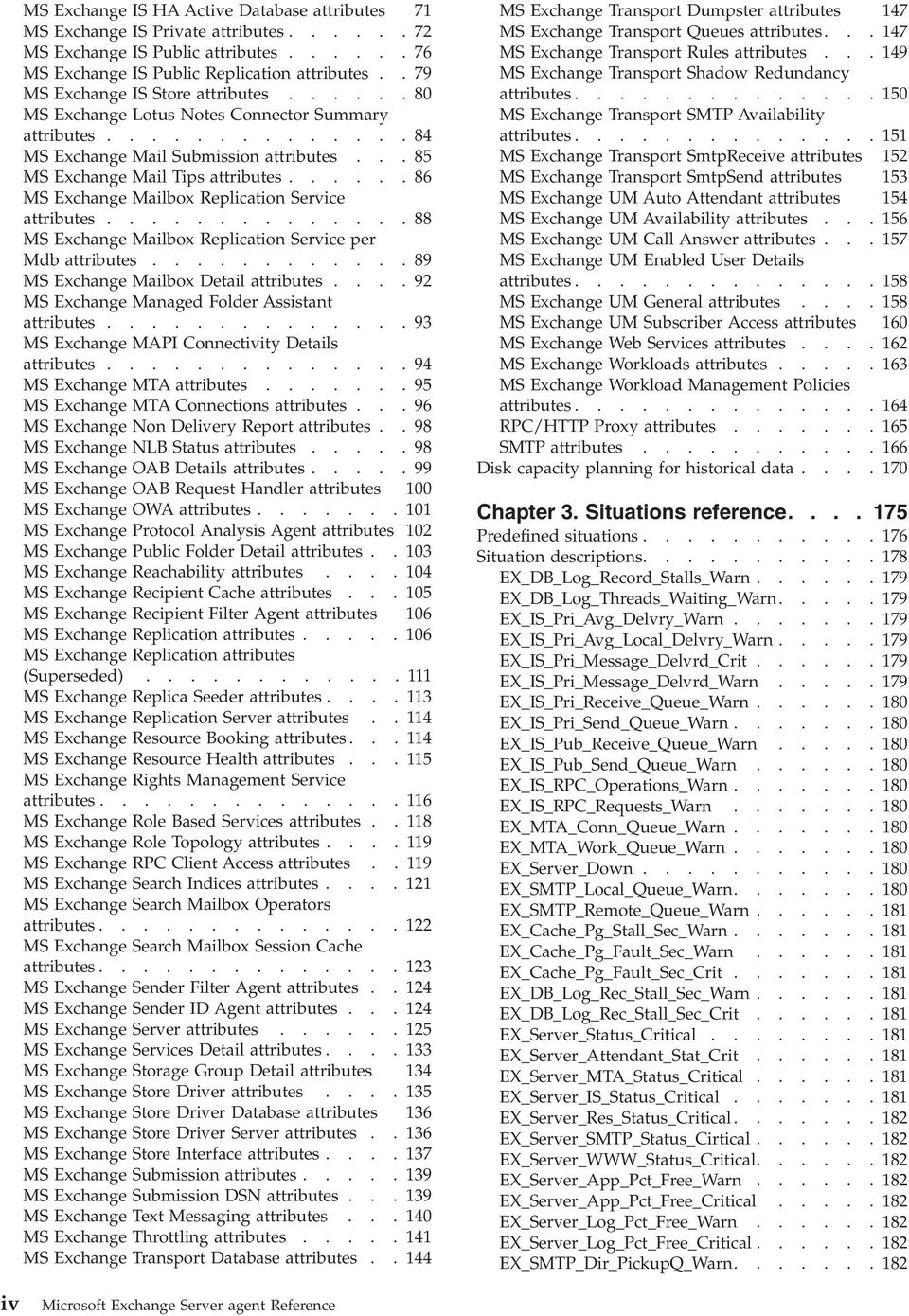
7 EX_SMTP_Queue_Len_Warn EX_SMTP_Retry_QLen_Warn EX_SMTP_Remote_RetryQ_Warn EX_SMTP_Categorizer_QLen_Warn EX_DB_Log_Gen_CkPt_Depth_Warn EX_DB_Log_Gen_CkPt_Depth_Crit EX_SMTP_Mess_Pend_Rt_Warn EX_SMTP_Mess_Pend_Rt_Critical EX_TQ_Act_RD_QLen_Warn EX_TQ_Act_RD_QLen_Crit EX_TQ_Retry_RD_QLen_Warn EX_TQ_Retry_RD_QLen_Crit EX_TQ_ActMail_Delivey_Q_Warn EX_TQ_ActMail_Delivey_Q_Crit EX_TQ_RtryMailDeliver_QLen_Warn EX_TQ_RtryMailDeliver_QLen_Crit EX_TQ_Act_nSMTP_Q_Len_Warn EX_TQ_Act_nSMTP_Q_Len_Crit EX_TQ_Rtry_nSMTP_Q_Len_Warn EX_TQ_Rtry_nSMTP_Q_Len_Crit EX_TQ_Agg_Delivery_Q_Len_Warn EX_TQ_Agg_Delivery_Q_Len_Crit EX_Service_State_Critical EX_Service_Status_Critical EX_Service_Start_Critical EX_IS_Mail_Store_State_Critical EX_Rep_Failed_Warn EX_Rep_Suspended_Warn Messages_Bypassed_Scan_Crit Messages_Bypassed_Scan_Warn Cluster_Mailbox_State_Crit EX_NLB_Status_Crit EX_Replication_Failed_Warn EX_Replication_Suspended_Warn EX_Error_Event EX_Asst_Avg_Evt_Proc_Time_Crit EX_ASync_Request_Queued_Crit EX_ASync_Request_Queued_Warn EX_DB_Log_Write_Avg_Lat_Crit EX_IS_Cli_RPC_Avg_Lat_Crit EX_IS_Cli_RPC_Fail_ServBsy_Crit EX_IS_Pri_Msg_Queue_Sub_Crit EX_IS_Pri_Search_Task_Rate_Crit EX_IS_Pri_Slow_FdRw_Rate_Crit EX_IS_Pub_Msg_Queue_Sub_Crit EX_IS_RPC_Avg_Latency_Crit EX_IS_RPC_Requests_Crit EX_IS_Slow_QP_Threads_Crit EX_IS_Slow_Search_Threads_Crit EX_RBAC_OBPrxy_Avg_RTime_Crit EX_OWA_Avg_Search_Time_Crit EX_Rep_Copy_Queue_Length_Crit EX_RBAC_Req_Avg_Resp_Time_Crit EX_Rsc_Book_Requests_Failed_Crit EX_Store_Int_RPC_Avg_Lat_Crit EX_Store_Int_RPC_Req_OutSt_Crit EX_Store_Int_RPC_Req_Fail_Crit EX_Store_Int_RPC_Slow_Req_Crit EX_TQ_Lar_Dlv_Q_Len_Crit EX_TQ_Lar_Dlv_Q_Len_Warn EX_TQ_Poison_Q_Len_Crit EX_TQ_Sub_Queue_Len_Crit EX_TQ_Sub_Queue_Len_Warn EX_TQ_Unreach_Q_Len_Crit EX_TQ_Unreach_Q_Len_Warn EX_CAS_RPC_Avg_Latency_Crit EX_CAS_RPC_Avg_Latency_Warn EX_CAS_RPC_Requests_Crit EX_CAS_RPC_Requests_Warn EX_AB_NSPI_RPC_Br_Avg_Lat_Crit EX_AB_NSPI_RPC_Req_Avg_Lat_Crit EX_AB_REF_RPC_Req_Avg_Lat_Crit EX_FDS_OAB_Dwnld_Task_Que_Warn EX_AVSER_Avg_Proc_Free_Bsy_Crit EX_HTTP_Pxy_Fail_Bknd_Con_Crit EX_SI_Avg_Doc_Idx_Time_Warn EX_SI_Full_Crawl_Mod_Sta_Warn EX_IS_Mailbox_Store_State_Crit Chapter 4. Take Action commands reference Predefined Take Action commands Take Action command descriptions Start Exchange Services action Stop Exchange Services action Mount Mailbox Database action Mount Public Folder Database action Chapter 5. Policies reference Predefined policies Chapter 6. Event mapping Chapter 7. Tivoli Common Reporting for the monitoring agent Cognos-based report packages Prerequisites for installing and running packages Extracting the package Importing Cognos report packages Cognos data models and reports Chapter 8. Discovery Library Adapter for the Microsoft Exchange Server agent DLA data model class types represented in CDM 277 DLA data model classes for Microsoft Exchange Server agent ExchangeServer class ExchangeStorageGroup class ExchangePublicFolderStore class Exchang BoxStore class TMSAgent class Chapter 9. Integration with Tivoli Business Service Manager Components for integrating with Tivoli Business Service Manager Contents v
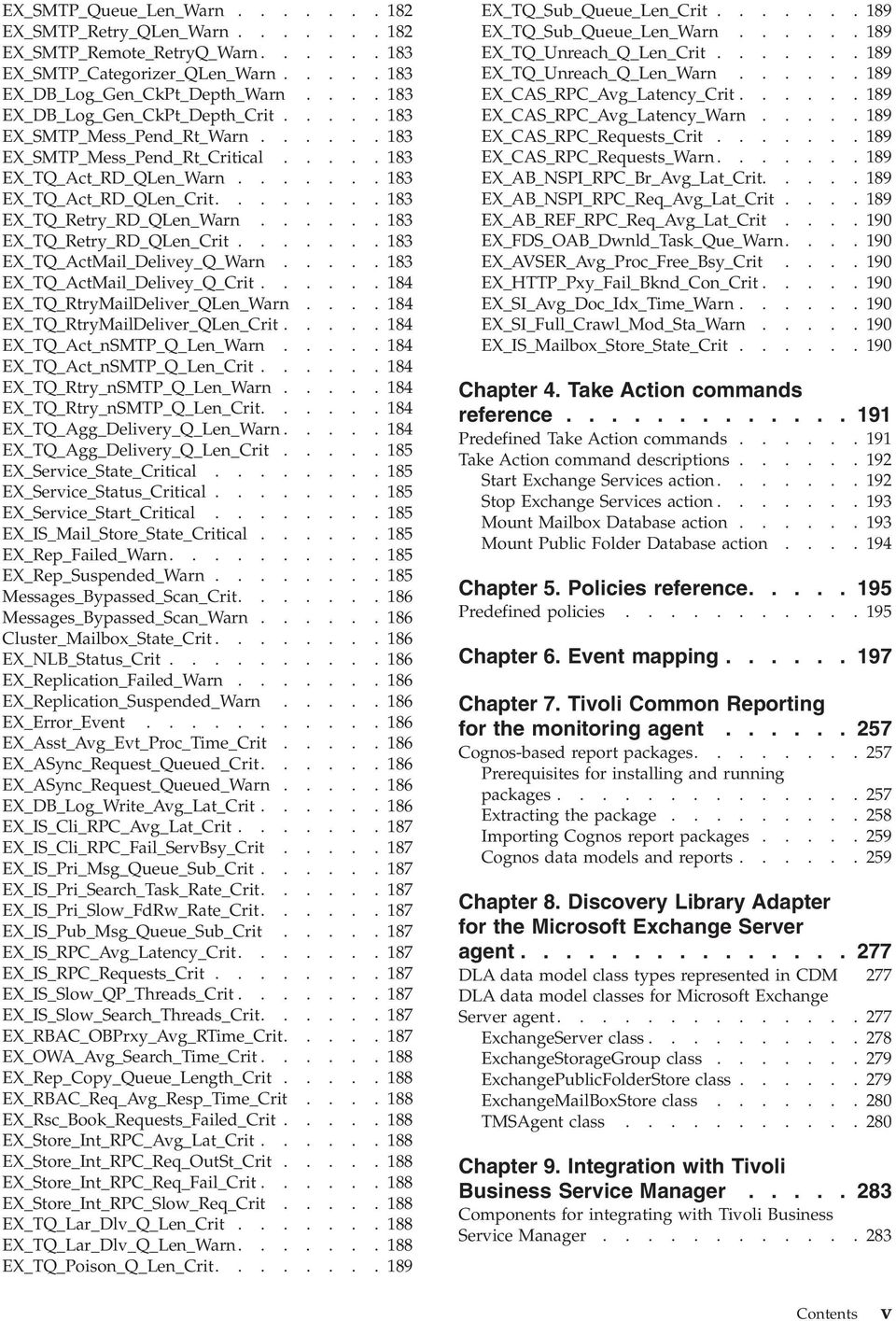
8 Tasks to integrate the agent with Tivoli Business Service Manager Installing the Discovery Library Toolkit on the Tivoli Business Service Manager Configuring the Tivoli Event Integration Facility (EIF) probe to enrich events Creating a service in Tivoli Business Service Manager Creating a data source mapping for each data source Configuring additional IBM Tivoli Monitoring web services Viewing data in the Tivoli Enterprise Portal Chapter 10. Upgrading for warehouse summarization Tables in the warehouse Effects on summarized attributes Upgrading your warehouse with limited user permissions Table summary Appendix. ITCAM for Microsoft Applications documentation library Prerequisite publications Related publications Tivoli Monitoring Community on Service Management Connect Other sources of documentation Notices Trademarks Privacy policy considerations Index vi Microsoft Exchange Server agent Reference

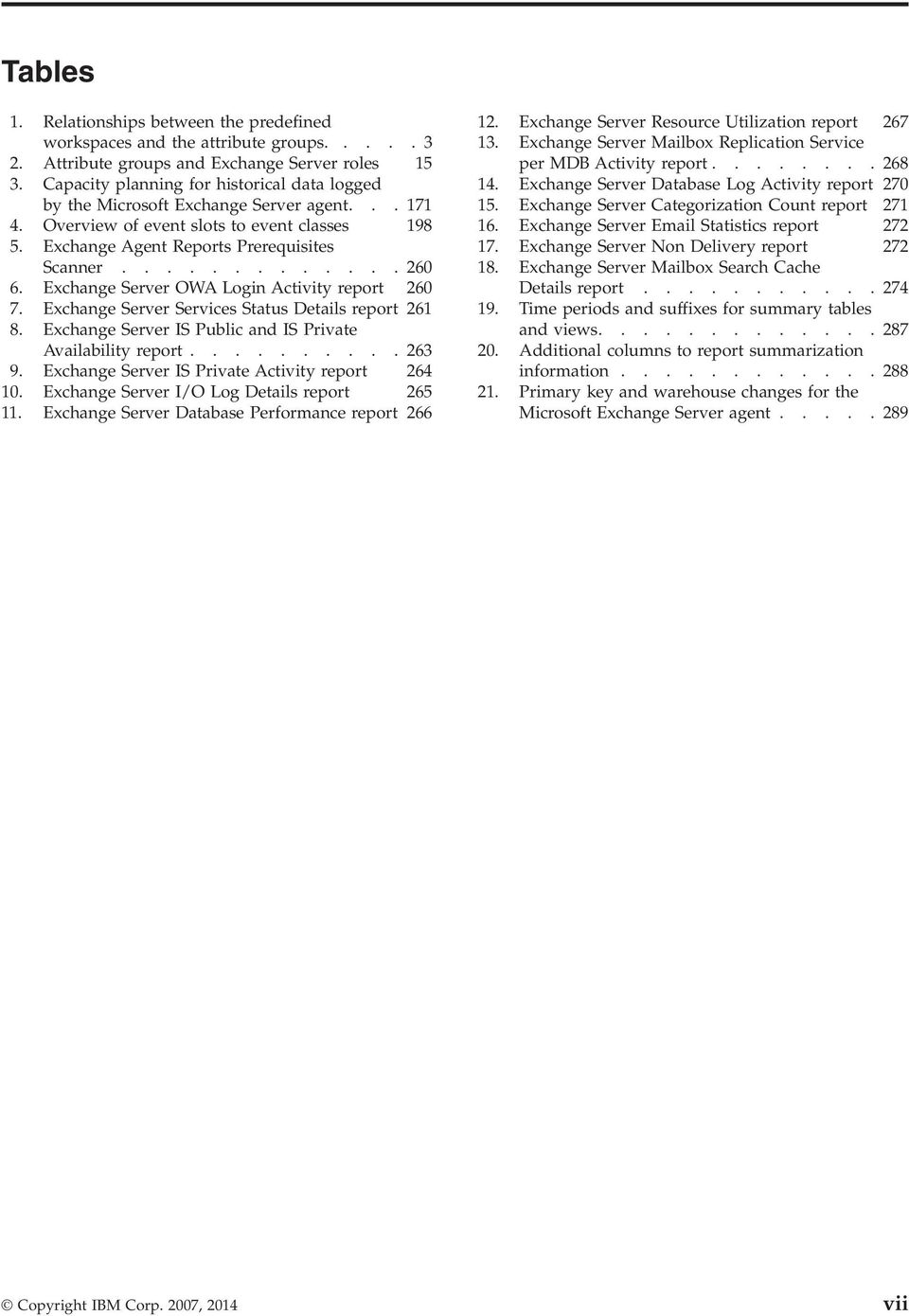
9 Tables 1. Relationships between the predefined workspaces and the attribute groups Attribute groups and Exchange Server roles Capacity planning for historical data logged by the Microsoft Exchange Server agent Overview of event slots to event classes Exchange Agent Reports Prerequisites Scanner Exchange Server OWA Login Activity report Exchange Server Services Status Details report Exchange Server IS Public and IS Private Availability report Exchange Server IS Private Activity report Exchange Server I/O Log Details report Exchange Server Database Performance report Exchange Server Resource Utilization report Exchange Server Mailbox Replication Service per MDB Activity report Exchange Server Database Log Activity report Exchange Server Categorization Count report Exchange Server Statistics report Exchange Server Non Delivery report Exchange Server Mailbox Search Cache Details report Time periods and suffixes for summary tables and views Additional columns to report summarization information Primary key and warehouse changes for the Microsoft Exchange Server agent Copyright IBM Corp. 2007, 2014 vii
10 viii Microsoft Exchange Server agent Reference

11 Chapter 1. Workspaces reference A workspace is the working area of the Tivoli Enterprise Portal application window. The Navigator contains a list of the workspaces provided by the agent. About workspaces Use the Navigator to select the workspace you want to see. As part of the application window, the status bar shows the Tivoli Enterprise Portal Server name and port number to which the displayed information applies and the ID of the current user. When you select an item in the Navigator, a default workspace is displayed. When you right-click a navigator item, a menu that includes a Workspace item is displayed. The Workspace item contains a list of workspaces for that navigator item. Each workspace has at least one view. Some views have links to other workspaces. You can also use the Workspace Gallery tool as described in the Tivoli Enterprise Portal User's Guide to open workspaces. The workspaces in the Navigator are displayed in a Physical view that shows your enterprise as a physical mapping or a dynamically populated logical view that is agent-specific. You can also create a Logical view. The Physical view is the default view. This monitoring agent provides predefined workspaces. You cannot modify or delete the predefined workspaces, but you can create new workspaces by editing them and saving the changes with a different name. Workspace views can be any combination of query-based views, event views, and special purpose views. Additional information about workspaces For more information about creating, customizing, and working with workspaces, see "Using workspaces" in the Tivoli Enterprise Portal User's Guide. For a list of the predefined workspaces for this monitoring agent and a description of each workspace, see Predefined workspaces and the information about each individual workspace. Some attribute groups for this monitoring agent might not be represented in the predefined workspaces or views for this agent. For a full list of the attribute groups, see Attributes in each attribute group on page 20. Predefined workspaces The Microsoft Exchange Server agent provides predefined workspaces, which are organized by navigator item. v Database navigator item Database workspace Database Logs workspace v Events navigator item Event Logs workspace v Information Store navigator item Information Store workspace Information Store Historical workspace Copyright IBM Corp. 2007,

12 IS Client workspace Storage Group Detail workspace v IS Mailbox navigator item Activity workspace Status workspace Usage workspace IS Private workspace IS Store workspace Mailbox Detail workspace Database Availability Group workspace v IS Public navigator item Activity workspace Status workspace Public Folder Detail workspace IS Public workspace v Microsoft Exchange Server navigator item Microsoft Exchange Server workspace v MTA navigator item MTA workspace v Replication navigator item Replication workspace Mailbox Replication (Exchange Server 2010) workspace v Roles navigator item Mailbox Server workspace Client Access Server workspace Edge Transport Server workspace Forefront Security workspace Hub Transport Server workspace Filter Reports workspace Topology workspace Unified Messaging Server workspace Forefront Exchange On Demand and Transport Scanner workspace Forefront Exchange Realtime and Scheduled Scanner workspace v SMTP navigator item SMTP workspace v Server navigator item Services Detail workspace Reachability workspace Store Driver workspace Assistants workspace Active Directory Activity workspace Server Information workspace Resource Scheduling Details workspace Availability Service Details workspace Address Book Service Details workspace 2 Microsoft Exchange Server agent Reference

13 Web Service Details workspace Authentication Details workspace Delivery Status Notification Activity workspace Mail Submission Activity workspace Mailbox Search Cache Details workspace Statistics workspace Statistics Historical workspace v Windows Systems navigator item Exchange Disk Space Utilization workspace Exchange Information Store workspace Exchange LDAP Utilization workspace Exchange.Net Processes workspace Exchange Server Utilization workspace Attribute groups used by predefined workspaces In most cases, a workspace contains data or columns that have similar attributes in an attribute group. The following table shows the relationships between the predefined workspaces and the attribute groups. Table 1. Relationships between the predefined workspaces and the attribute groups. Workspace Activity (IS Mailbox navigator item) Activity (IS Public navigator item) Client Access Server (Roles navigator item) Related attribute group For all views, see MS Exchange IS Private attributes on page 72. For all views, see MS Exchange IS Public attributes on page 76. For the NLB Status Details and the Services Details views, see MS Exchange Server attributes on page 125. For the Client RPC Status and the Client Connection Status views, see MS Exchange RPC Client Access attributes on page 119. Database (Database navigator item) Database Availability Group (IS Mailbox navigator item) Database Logs (Database navigator item) Edge Transport Server (Roles navigator item) Filter Reports (Roles navigator item) Forefront Exchange On Demand and Transport Scanner (Roles navigator item) For all views, see MS Exchange DB attributes on page 56. For all views, see MS Exchange Database Availability Group attributes on page 55. For all views, see MS Exchange DB attributes on page 56. For all views, see MS Exchange Server attributes on page 125. For all views, see MS Exchange Server attributes on page 125. For Forefront On Demand Scanner view, see Forefront Exchange On Demand Scanner attributes on page 22. For Forefront Transport Scanner view, see Forefront Exchange Transport Scanner attributes on page 26. Forefront Exchange Realtime and Scheduled Scanner (Roles navigator item) For Forefront Realtime Scanner view, see Forefront Exchange Realtime Scanner attributes on page 24. For Forefront Scheduled Scanner view, see Forefront Exchange Scheduled Scanner attributes on page 25. Chapter 1. Workspaces reference 3

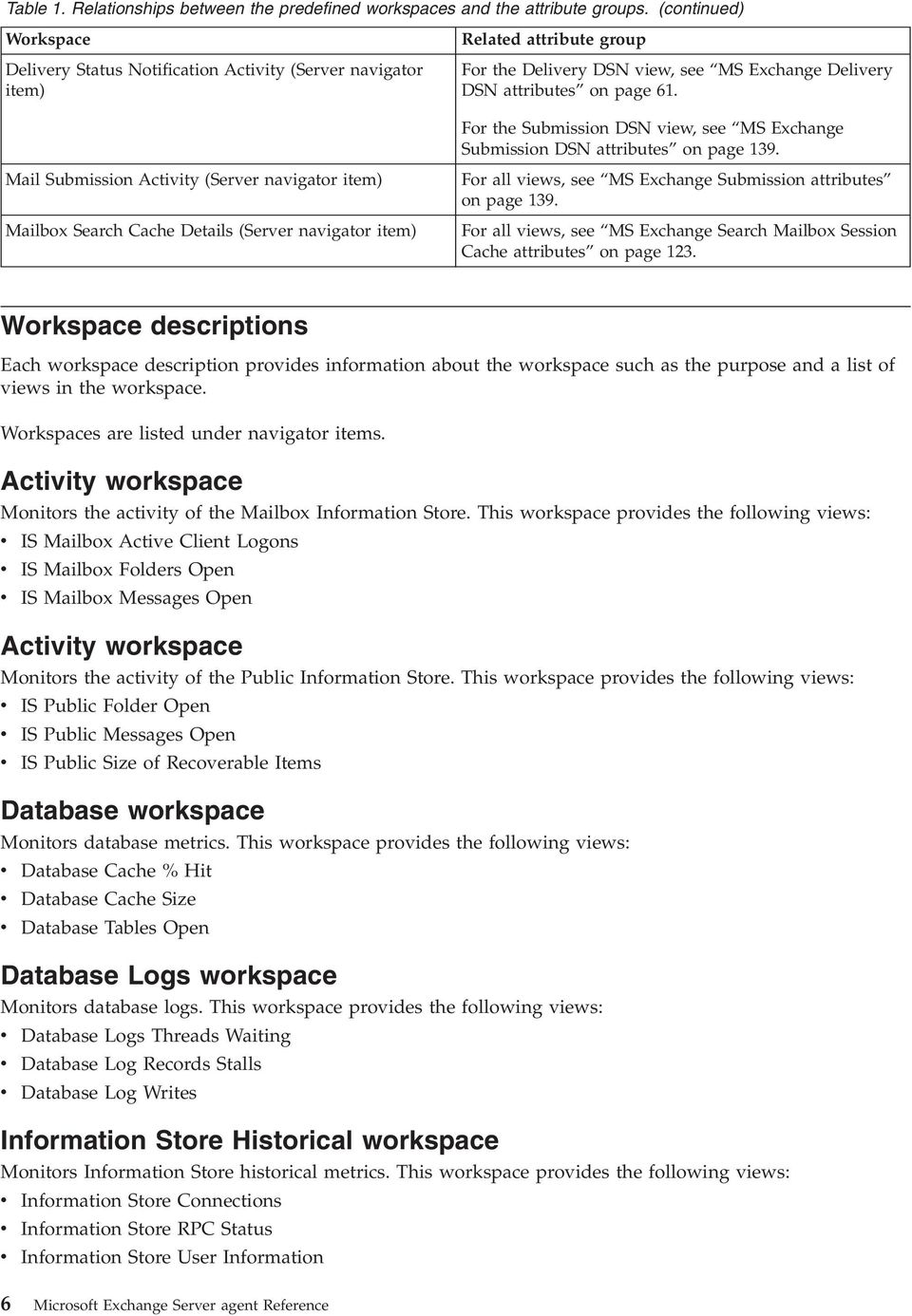
14 Table 1. Relationships between the predefined workspaces and the attribute groups. (continued) Workspace Related attribute group Forefront Security (Roles navigator item) For all views, see Microsoft Forefront Server Security Scan attributes on page 28. Hub Transport Server (Roles navigator item) For all views, see MS Exchange Server attributes on page 125. Information Store Historical (Information Store navigator item) Information Store (Information Store navigator item) IS Client (Information Store navigator item) Mailbox Server (Roles navigator item) Microsoft Exchange Server (Microsoft Exchange Server navigator item) For all views, see MS Exchange IS attributes on page 66. For all views, see MS Exchange IS attributes on page 66. For all views, see MS Exchange IS Client attributes on page 70. For all views, see MS Exchange Server attributes on page 125. For all views, see MS Exchange MTA Connections attributes on page 96. For MTA Work Queue, see MS Exchange MTA attributes on page 95. For Server Status, see MS Exchange Server attributes on page 125. MTA (MTA navigator item) For SMTP Queues, see SMTP attributes on page 166. For the MTA Connection Message Rates view, see MS Exchange MTA Connections attributes on page 96. For the MTA LAN Rates and MTA Message Totals see MS Exchange MTA attributes on page 95. SMTP (SMTP navigator item) For all views, see SMTP attributes on page 166. Status (IS Mailbox navigator item) For all views, see MS Exchange IS Private attributes on page 72. Status (IS Public navigator item) For all views, see MS Exchange IS Public attributes on page 76. Usage (IS Mailbox navigator item) For all views, see MS Exchange IS Private attributes on page 72. Storage Group Detail (Information Store navigator item) For all views, see MS Exchange Storage Group Detail attributes on page 134. IS Private (IS Mailbox navigator item) For all views, see MS Exchange IS Private attributes on page 72. Mailbox Detail (IS Mailbox navigator item) For all views, see MS Exchange Mailbox Detail attributes on page 92. Public Folder Detail (IS Public navigator item) For all views, see MS Exchange Public Folder Detail attributes on page 103. Topology (Roles navigator item) For all views, see MS Exchange Server attributes on page 125. Services Detail (Server navigator item) For all views, see MS Exchange Services Detail attributes on page 133. Reachability (Server navigator item) For all views, see MS Exchange Reachability attributes on page 104. Store Driver (Server navigator item) For all views, see MS Exchange Store Driver attributes on page Microsoft Exchange Server agent Reference
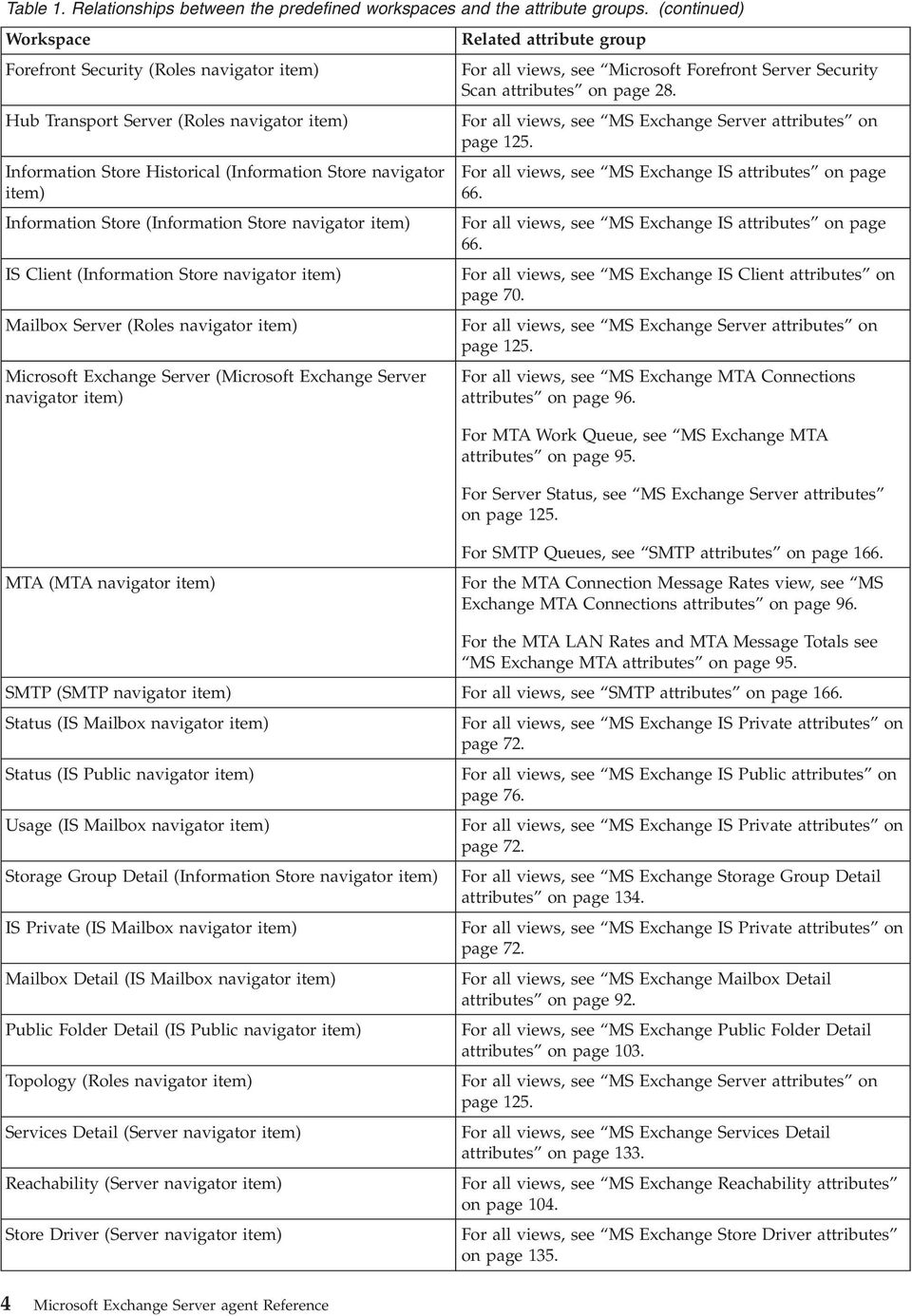
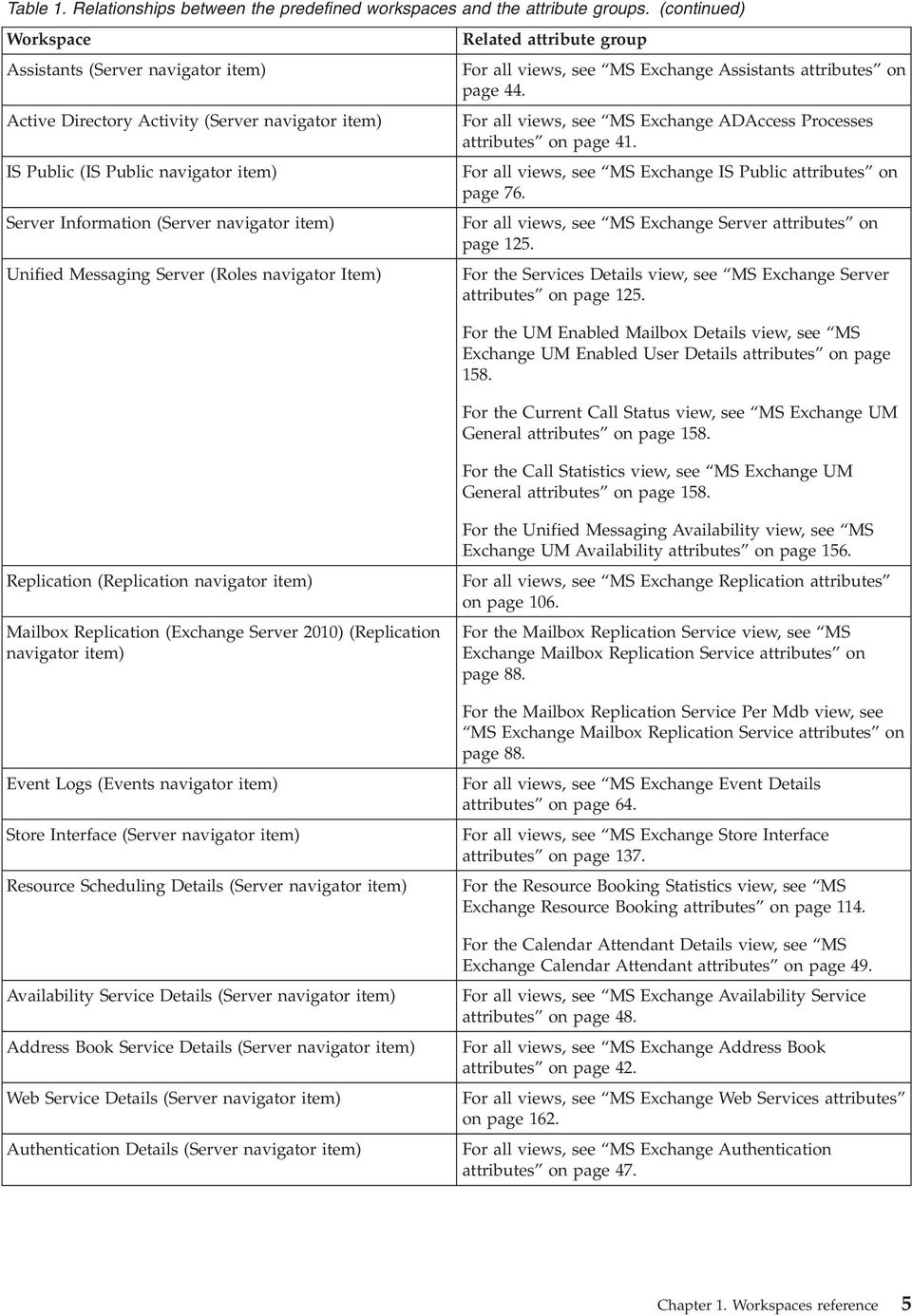
15 Table 1. Relationships between the predefined workspaces and the attribute groups. (continued) Workspace Related attribute group Assistants (Server navigator item) For all views, see MS Exchange Assistants attributes on page 44. Active Directory Activity (Server navigator item) For all views, see MS Exchange ADAccess Processes attributes on page 41. IS Public (IS Public navigator item) For all views, see MS Exchange IS Public attributes on page 76. Server Information (Server navigator item) For all views, see MS Exchange Server attributes on page 125. Unified Messaging Server (Roles navigator Item) For the Services Details view, see MS Exchange Server attributes on page 125. For the UM Enabled Mailbox Details view, see MS Exchange UM Enabled User Details attributes on page 158. For the Current Call Status view, see MS Exchange UM General attributes on page 158. For the Call Statistics view, see MS Exchange UM General attributes on page 158. Replication (Replication navigator item) Mailbox Replication (Exchange Server 2010) (Replication navigator item) Event Logs (Events navigator item) Store Interface (Server navigator item) Resource Scheduling Details (Server navigator item) Availability Service Details (Server navigator item) Address Book Service Details (Server navigator item) Web Service Details (Server navigator item) Authentication Details (Server navigator item) For the Unified Messaging Availability view, see MS Exchange UM Availability attributes on page 156. For all views, see MS Exchange Replication attributes on page 106. For the Mailbox Replication Service view, see MS Exchange Mailbox Replication Service attributes on page 88. For the Mailbox Replication Service Per Mdb view, see MS Exchange Mailbox Replication Service attributes on page 88. For all views, see MS Exchange Event Details attributes on page 64. For all views, see MS Exchange Store Interface attributes on page 137. For the Resource Booking Statistics view, see MS Exchange Resource Booking attributes on page 114. For the Calendar Attendant Details view, see MS Exchange Calendar Attendant attributes on page 49. For all views, see MS Exchange Availability Service attributes on page 48. For all views, see MS Exchange Address Book attributes on page 42. For all views, see MS Exchange Web Services attributes on page 162. For all views, see MS Exchange Authentication attributes on page 47. Chapter 1. Workspaces reference 5
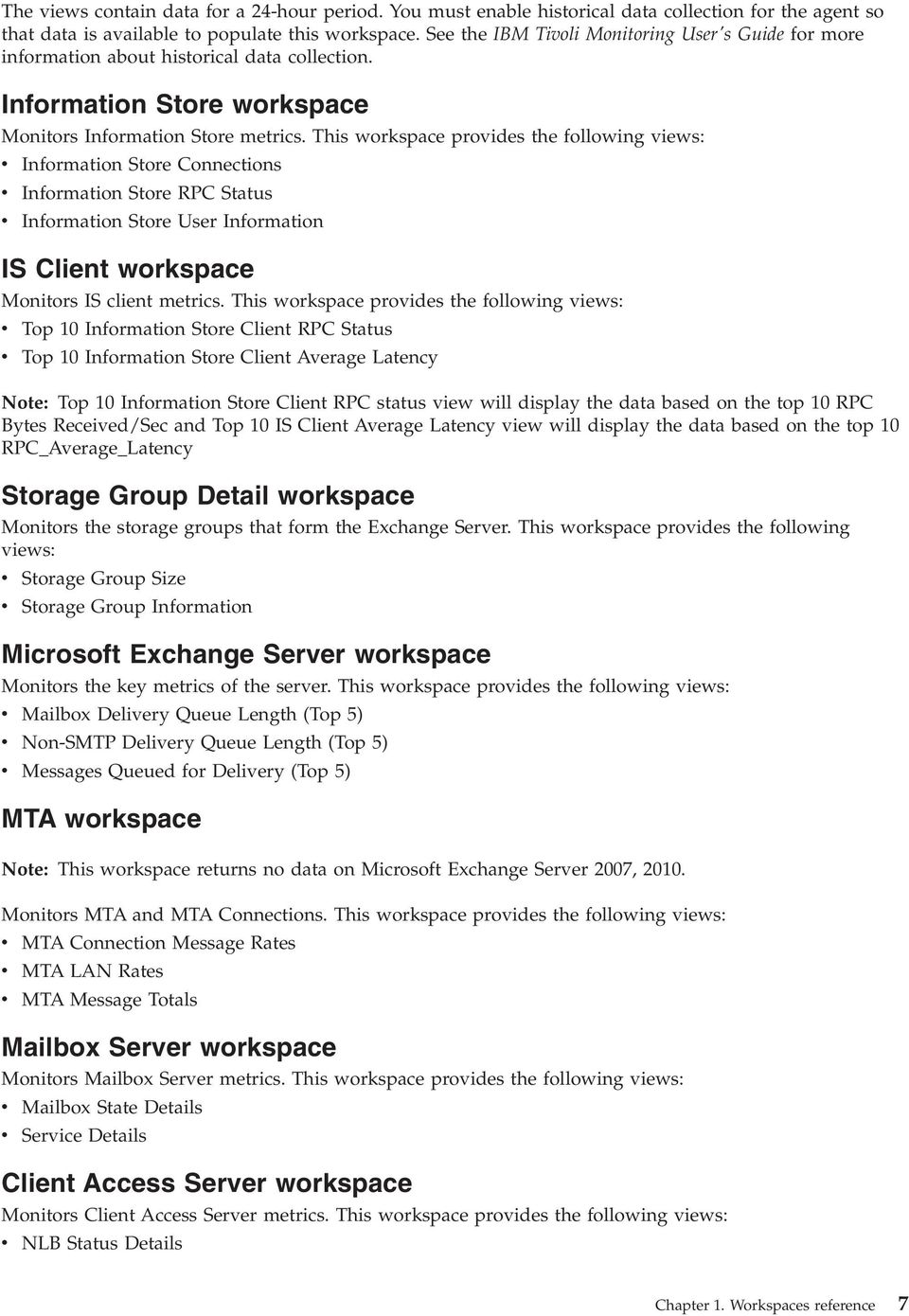
16 Table 1. Relationships between the predefined workspaces and the attribute groups. (continued) Workspace Delivery Status Notification Activity (Server navigator item) Related attribute group For the Delivery DSN view, see MS Exchange Delivery DSN attributes on page 61. For the Submission DSN view, see MS Exchange Submission DSN attributes on page 139. Mail Submission Activity (Server navigator item) Mailbox Search Cache Details (Server navigator item) For all views, see MS Exchange Submission attributes on page 139. For all views, see MS Exchange Search Mailbox Session Cache attributes on page 123. Workspace descriptions Each workspace description provides information about the workspace such as the purpose and a list of views in the workspace. Workspaces are listed under navigator items. Activity workspace Monitors the activity of the Mailbox Information Store. This workspace provides the following views: v IS Mailbox Active Client Logons v IS Mailbox Folders Open v IS Mailbox Messages Open Activity workspace Monitors the activity of the Public Information Store. This workspace provides the following views: v IS Public Folder Open v IS Public Messages Open v IS Public Size of Recoverable Items Database workspace Monitors database metrics. This workspace provides the following views: v Database Cache % Hit v Database Cache Size v Database Tables Open Database Logs workspace Monitors database logs. This workspace provides the following views: v Database Logs Threads Waiting v Database Log Records Stalls v Database Log Writes Information Store Historical workspace Monitors Information Store historical metrics. This workspace provides the following views: v Information Store Connections v Information Store RPC Status v Information Store User Information 6 Microsoft Exchange Server agent Reference
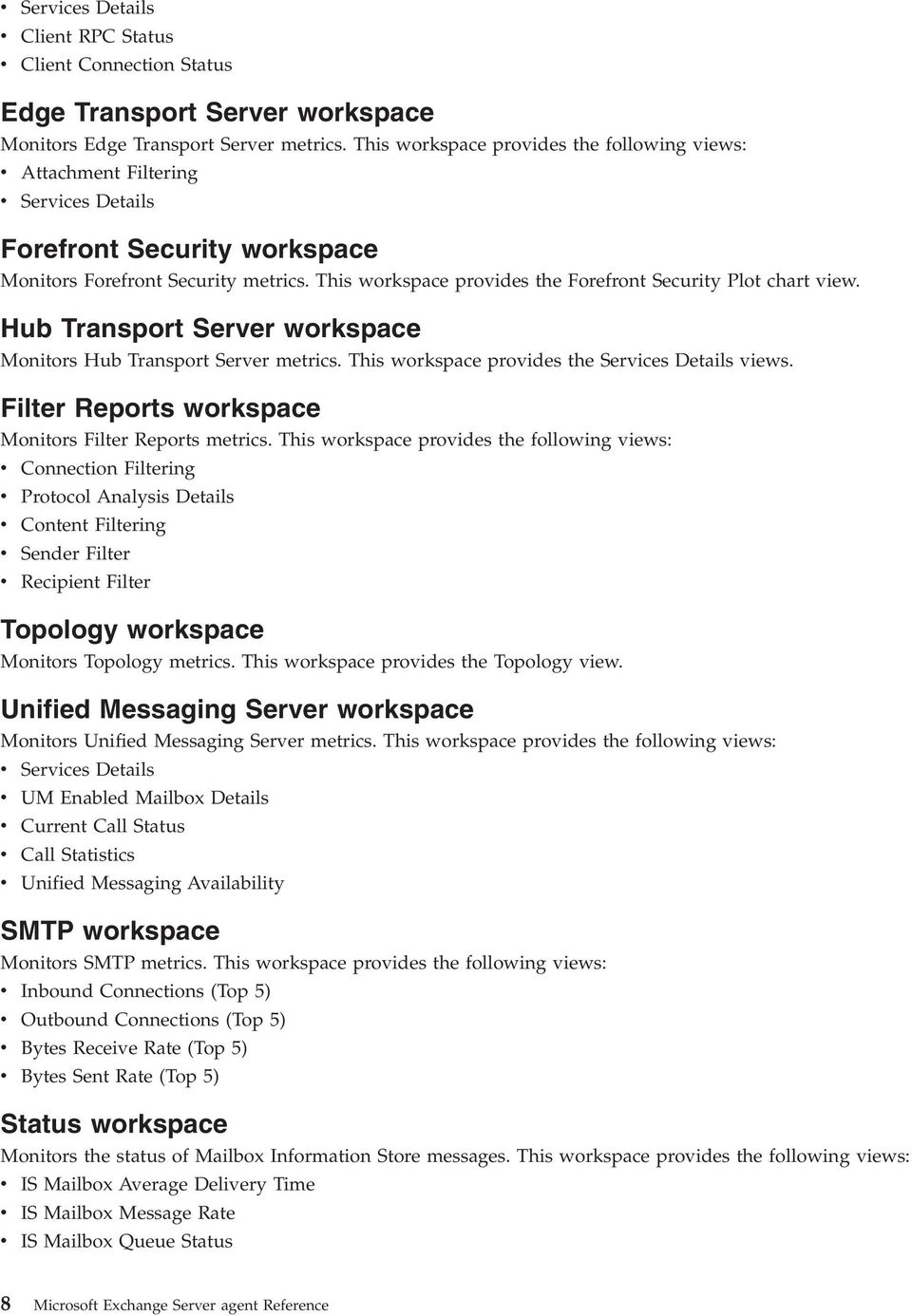
17 The views contain data for a 24-hour period. You must enable historical data collection for the agent so that data is available to populate this workspace. See the IBM Tivoli Monitoring User's Guide for more information about historical data collection. Information Store workspace Monitors Information Store metrics. This workspace provides the following views: v Information Store Connections v Information Store RPC Status v Information Store User Information IS Client workspace Monitors IS client metrics. This workspace provides the following views: v Top 10 Information Store Client RPC Status v Top 10 Information Store Client Average Latency Note: Top 10 Information Store Client RPC status view will display the data based on the top 10 RPC Bytes Received/Sec and Top 10 IS Client Average Latency view will display the data based on the top 10 RPC_Average_Latency Storage Group Detail workspace Monitors the storage groups that form the Exchange Server. This workspace provides the following views: v Storage Group Size v Storage Group Information Microsoft Exchange Server workspace Monitors the key metrics of the server. This workspace provides the following views: v Mailbox Delivery Queue Length (Top 5) v Non-SMTP Delivery Queue Length (Top 5) v Messages Queued for Delivery (Top 5) MTA workspace Note: This workspace returns no data on Microsoft Exchange Server 2007, Monitors MTA and MTA Connections. This workspace provides the following views: v MTA Connection Message Rates v MTA LAN Rates v MTA Message Totals Mailbox Server workspace Monitors Mailbox Server metrics. This workspace provides the following views: v Mailbox State Details v Service Details Client Access Server workspace Monitors Client Access Server metrics. This workspace provides the following views: v NLB Status Details Chapter 1. Workspaces reference 7
18 v Services Details v Client RPC Status v Client Connection Status Edge Transport Server workspace Monitors Edge Transport Server metrics. This workspace provides the following views: v Attachment Filtering v Services Details Forefront Security workspace Monitors Forefront Security metrics. This workspace provides the Forefront Security Plot chart view. Hub Transport Server workspace Monitors Hub Transport Server metrics. This workspace provides the Services Details views. Filter Reports workspace Monitors Filter Reports metrics. This workspace provides the following views: v Connection Filtering v Protocol Analysis Details v Content Filtering v Sender Filter v Recipient Filter Topology workspace Monitors Topology metrics. This workspace provides the Topology view. Unified Messaging Server workspace Monitors Unified Messaging Server metrics. This workspace provides the following views: v Services Details v UM Enabled Mailbox Details v Current Call Status v Call Statistics v Unified Messaging Availability SMTP workspace Monitors SMTP metrics. This workspace provides the following views: v Inbound Connections (Top 5) v Outbound Connections (Top 5) v Bytes Receive Rate (Top 5) v Bytes Sent Rate (Top 5) Status workspace Monitors the status of Mailbox Information Store messages. This workspace provides the following views: v IS Mailbox Average Delivery Time v IS Mailbox Message Rate v IS Mailbox Queue Status 8 Microsoft Exchange Server agent Reference
19 Status workspace Monitors the status of IS Public messages. This workspace provides the following views: v IS Public Average Delivery Time v IS Public Message Status v IS Public Queue Status Public Folder Detail workspace Provides details about the IS Public folder. This workspace provides the following views: v Public Folder Size v Public Information Store Detail Usage workspace Monitors the Mailbox Information Store messages. This workspace provides the following views: v IS Mailbox Count of Recoverable Items v IS Mailbox Single Instance Ratio v IS Mailbox Size of Recoverable Items IS Private workspace Provides the Exchange Server Information Store Private statistics. This workspace provides the following views: v Mailbox Information Store Size v Mailbox Information Store Details Mailbox Detail workspace Provides detail information about mailbox utilization with a storage group. This workspace provides the following views: v Mailbox Size v Mailbox Details Database Availability Group workspace Provides detail information about database availability group. This workspace provides the following views: v DAG Configuration v Mailbox Database Copies Exchange Disk Space Utilization workspace Provides information about the disk space utilization on the Exchange Servers. This workspace provides the Free Disk Space Availability view. Exchange Information Store workspace Provides information about the Microsoft Exchange Information store. This workspace provides the following views: v User Count v RPC Requests v Private Average Local/Remote Delivery Time v Public Average Local/Remote Delivery Time Chapter 1. Workspaces reference 9
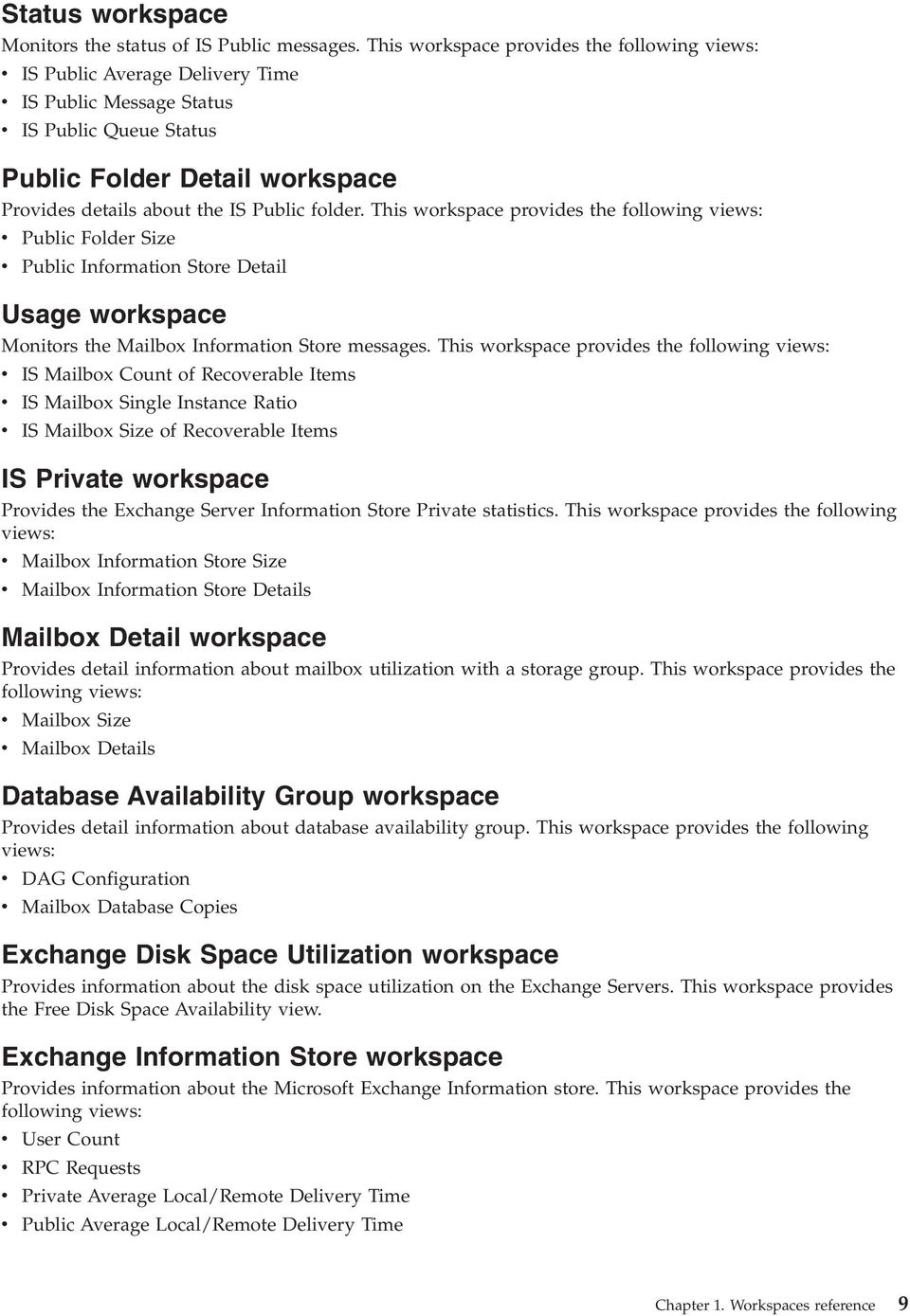
20 Exchange LDAP Utilization workspace Provides information about the LDAP utilization of the Exchange Servers. This workspace provides the following views: v Exchange LDAP Searches v Exchange Instantaneous LDAP Searches Exchange.Net Processes workspace Provides information about the processes of the Exchange.net. This workspace provides the following views: v Exchange.Net Processes Exchange Server Utilization workspace Provides information about the utilization of the Exchange server. This workspace provides the following views: v % Processor Time(store.exe) v % Processor Time(inteinfo.exe) v % Processor Time(mad.exe) Forefront Exchange On Demand and Transport Scanner workspace Provides information about Forefront Exchange On Demand and Transport Scanner attribute group. This workspace provides the following views: v Forefront On Demand Scanner v Forefront Transport Scanner Forefront Exchange Realtime and Scheduled Scanner workspace Provides information about Forefront Exchange Realtime and Scheduled Scanner attribute group. This workspace provides the following views: v Forefront Realtime Scanner v Forefront Scheduled Scanner Services Detail workspace Provides details about the services that form the Microsoft Exchange Server. This workspace provides the following views: v Situation Event Console v Services Detail Reachability workspace Provides details about mailbox reachability. This workspace provides the following views: v Situation Event Console v Reachability Detail Store Driver workspace Provides details about messages from the transport pipeline. This workspace provides the following views: v Inbound Recipients v Store Driver Information 10 Microsoft Exchange Server agent Reference
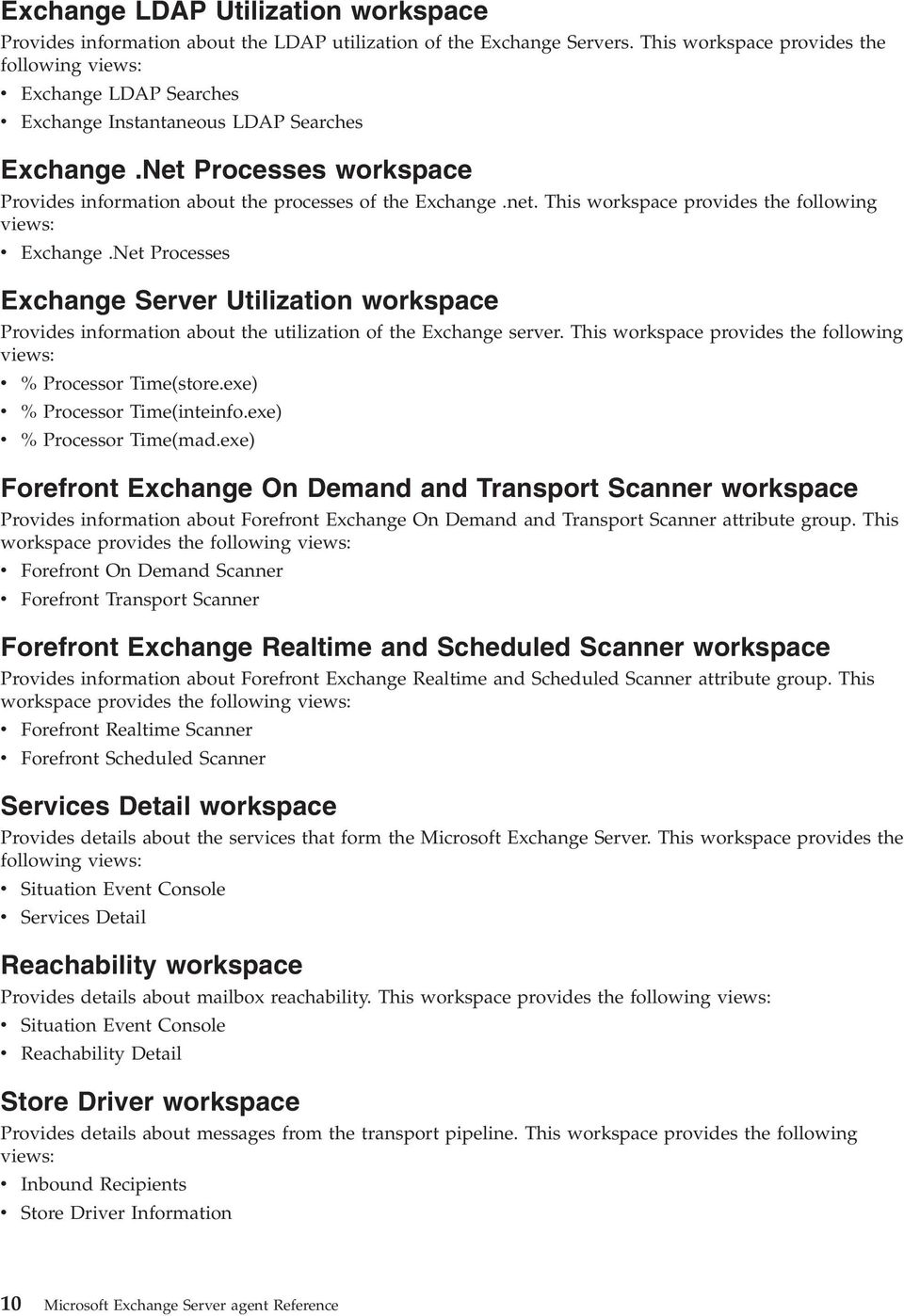
21 Assistants workspace Monitors the Microsoft Exchange Server Assistants services activity. This workspace provides the following views: v Situation Event Console v Exchange Assistants Information Active Directory Activity workspace Monitors the Microsoft Exchange Server Active Directory activity. This workspace provides the following views: v Situation Event Console v Active Directory Activity IS Public workspace Monitors the public folders and stores. This workspace provides the following views: v Public Information Store Size v Public Information Store Detail Server Information workspace Monitors the server status and status of some key services. This workspace provides the following views: v Server Information v Server Status Replication workspace Provides information about the replication activity on the Exchange Server. This workspace provides the following views: v Replication on Current Node v Replication on Remote Node v Copy Status Mailbox Replication (Exchange Server 2010) workspace Provides information about the replication activity on Exchange Server This workspace provides the following views: v Mailbox Replication Service v Mailbox Replication Service Per Mdb Event Logs workspace Provides information about the event logs on Exchange Server 2003, 2007, and This workspace provides the Event Log Details view. Store Interface workspace Provides information about the interface between the Exchange Information Store service on the Mailbox Server and the Hub Transport servers. This workspace provides the Store Interface Information view. Resource Scheduling Details workspace Provides information about the activities of the Resource Booking Attendant and the Calendar Attendant. This workspace provides the following views: v Resource Booking Statistics v Calendar Attendant Details Chapter 1. Workspaces reference 11
22 Availability Service Details workspace Provides information about the status of the Availability service on Exchange Server 2007 and This workspace provides the Availability Service Details view. Note: This workspace provides information only when the Client Access Server (CAS) role is installed on the server. Address Book Service Details workspace Provides information about the status of the Address Book service on Exchange Server This workspace provides the Address Book Service Details view. Note: This workspace provides information only when the CAS role is installed on the server. Web Service Details workspace Provides information about the status of the Exchange Web Services (EWS) on Exchange Server 2007 and This workspace provides the Web Service Details view. Note: This workspace provides information only when the CAS role is installed on the server. IS Store workspace Provides information about the activities of the Information Store on Exchange Server 2013, or later. This workspace provides the following views: v IS Mailbox Store Size v IS Store Details Authentication Details workspace Provides information about the user authentication activities on Exchange Server This workspace provides the following views: v Authentication Requests v Authentication Details Note: This workspace displays data only when the CAS role is installed. Delivery Status Notification Activity workspace Provides information about the delivery status notifications (DSN) for messages that are sent to the Mailbox Transport Delivery service and the Mailbox Transport submission service on Exchange Server This workspace provides the following views: v Delivery DSN v Submission DSN Note: This workspace displays data only when the Mailbox Server role is installed. Mail Submission Activity workspace Provides information about the submission of messages from the Mailbox server to the Hub Transport server on Exchange Server This workspace provides the following views: v Mail Submission v Mail Submission Details Note: This workspace displays data only when the Mailbox Server role is installed. 12 Microsoft Exchange Server agent Reference
23 Mailbox Search Cache Details workspace Provides information about the cache access activities that occur during search operations on Exchange Server This workspace provides the following views: v Mailbox Search Cache Statistics v Mailbox Search Cache Details Note: This workspace displays data only when the Mailbox Server Role is installed. Statistics workspace Provides information about messages tracking, such as message statistics and message delivery failures. This workspace provides the following views: v Statistics v NDR Recipients (Top 5) v NDR Recipients Details Statistics Historical workspace Provides information about historical data, such as s received, s sent, and the amount of data transfer though s. This workspace provides the following views: v Activity v Bytes Sent and Received Activity Chapter 1. Workspaces reference 13
24 14 Microsoft Exchange Server agent Reference
25 Chapter 2. Attributes reference Attributes are the application properties that are being measured and reported by the IBM Tivoli Composite Application Manager for Microsoft Applications: Microsoft Exchange Server Agent. About attributes Attributes are organized into attribute groups. Attributes in an attribute group relate to a single object such as an application, or to a single kind of data such as status information. Attributes in a group can be used in queries, query-based views, situations, policy workflows, take action definitions, and launch application definitions. Chart or table views and situations are two examples of how attributes in a group can be used: v Chart or table views Attributes are displayed in chart and table views. The chart and table views use queries to specify which attribute values to request from a monitoring agent. You use the Properties editor to apply filters and set styles to define the content and appearance of a view based on an existing query. v Situations You use attributes to create situations that monitor the state of your operating system, database, or application. A situation describes a condition you want to test. When you start a situation, the values you assign to the situation attributes are compared with the values collected by the Microsoft Exchange Server agent and registers an event if the condition is met. You are alerted to events by indicator icons that are displayed in the Navigator. Additional information about attributes For more information about using attributes and attribute groups, see the Tivoli Enterprise Portal User's Guide. For a list of the attributes groups, a list of the attributes in each attribute group, and descriptions of the attributes for this monitoring agent, see the Attributes in each attribute group on page 20 topic in this chapter. Attribute groups and Exchange Server roles Attribute values are displayed on the Tivoli Enterprise Portal only when the Exchange Server roles are installed. Each attribute group requires specific Exchange Server roles. Table 2 contains the version-wise list of Exchange Server roles that are required for each attribute group. If the required role is not configured, no data, or -1 ("Undefined"), is returned. Note: Exchange Server 2013 contains two roles; Mailbox Server role and Client Access Server role. The Edge Transport role is not available in Exchange Server When you install the Mailbox Server role, the Hub Transport role and the Unified Messaging role are automatically installed. Table 2. Attribute groups and Exchange Server roles Attribute group Exchange 2007 Server role Exchange 2010 Server role Exchange 2013 Server role Forefront Exchange On Demand Scanner Forefront Exchange Realtime Scanner Client Access Server role Client Access Server role Not applicable Mailbox Server role Mailbox Server role Not applicable Copyright IBM Corp. 2007,
26 Table 2. Attribute groups and Exchange Server roles (continued) Attribute group Exchange 2007 Server role Exchange 2010 Server role Exchange 2013 Server role Forefront Exchange Scheduled Scanner Mailbox Server role Mailbox Server role Not applicable Forefront Exchange Transport Scanner Mailbox Server Cluster State Microsoft Forefront Server Security Scan MS Exchange Active Sync MS Exchange ADAccess Caches MS Exchange ADAccess Domain Controllers MS Exchange ADAccess Processes MS Exchange Address Book MS Exchange Assistants MS Exchange Assistants Per Database MS Exchange Attachment Filtering MS Exchange Availability Service MS Exchange Autodiscover Service MS Exchange Calendar Attendant MS Exchange Connection Filtering Agent MS Exchange Content Filter Agent MS Exchange Control Panel (RBAC) MS Exchange Database Availability Group Hub Transport role and Edge Transport role Hub Transport role Edge Transport role Not applicable Mailbox Server role Not applicable Not applicable Edge Transport role and Hub Transport role Not applicable Not applicable Client Access Server role Client Access Server role Mailbox Server role Client Access Server role, Edge Transport role, or Mailbox Server role, or Unified Messaging role, or Hub Transport role Client Access Server role, Edge Transport role, or Mailbox Server role, or Unified Messaging role, or Hub Transport role Mailbox Server role and Client Access Server role Mailbox Server role Mailbox Server role Mailbox Server role and Client Access Server role Client Access Server role, Edge Transport role, or Mailbox Server role, or Unified Messaging role, or Hub Transport role Client Access Server role, Edge Transport role, or Mailbox Server role, or Unified Messaging role, or Hub Transport role Mailbox Server role and Client Access Server role Not applicable Client Access Server role Mailbox Server role Mailbox Server role Mailbox Server role Mailbox Server role Not applicable Mailbox Server role Mailbox Server role Edge Transport role Edge Transport role Not applicable Client Access Server role Client Access Server role Mailbox Server role Client Access Server role Client Access Server role Client Access Server role Mailbox Server role Mailbox Server role Mailbox Server role Edge Transport role or Hub Transport role Edge Transport role or Hub Transport role Not applicable Edge Transport role or Hub Transport role Edge Transport role or Hub Transport role Mailbox Server role, Unified Messaging role, Client Access Server role, Hub Transport role Mailbox Server role Mailbox Server role Mailbox Server role Not applicable Mailbox Server role Mailbox Server role 16 Microsoft Exchange Server agent Reference
27 Table 2. Attribute groups and Exchange Server roles (continued) Attribute group Exchange 2007 Server role Exchange 2010 Server role Exchange 2013 Server role MS Exchange DB Edge Transport role, Hub Transport role, or Mailbox Server role Edge Transport role, Hub Transport role, or Mailbox Server role Mailbox Server role MS Exchange DB Instance MS Exchange Event Details MS Exchange Extensibility Agents MS Exchange FDS OAB Edge Transport role, Hub Transport role, or Mailbox Server role Edge Transport role, Hub Transport role, Client Access Server role, Mailbox Server role, or Unified Messaging role Edge Transport role or Hub Transport role Edge Transport role, Hub Transport role, or Mailbox Server role Edge Transport role, Hub Transport role, Client Access Server role, Mailbox Server role, or Unified Messaging role Edge Transport role or Hub Transport role Mailbox Server role Mailbox Server role and Client Access Server role Mailbox Server role and Client Access Server role Client Access Server role Client Access Server role Not applicable MS Exchange IS Mailbox Server role Mailbox Server role Not applicable MS Exchange IS Client Mailbox Server role Mailbox Server role Mailbox Server role MS Exchange IS Mailbox Server role Mailbox Server role Not applicable Private MS Exchange IS Public Mailbox Server role Mailbox Server role Not applicable MS Exchange IS Public Mailbox Server role Mailbox Server role Not applicable Replication MS Exchange Mail Mailbox Server role Mailbox Server role Not applicable Submission MS Exchange Mailbox Not applicable Mailbox Server role Mailbox Server role Replication Service MS Exchange Mailbox Replication Service per Mdb Not applicable Mailbox Server role Mailbox Server role MS Exchange Mailbox Mailbox Server role Mailbox Server role Mailbox Server role Detail MS Exchange Managed Mailbox Server role Mailbox Server role Mailbox Server role Folder Assistant MS Exchange NLB Client Access Server role Client Access Server role Client Access Server role Status MS Exchange OWA Client Access Server role Client Access Server role Mailbox Server role MS Exchange Protocol Analysis Agent MS Exchange Public Folder Detail MS Exchange Recipient Cache MS Exchange Recipient Filter MS Exchange Replication MS Exchange Replica Seeder Edge Transport role or Hub Transport role Edge Transport role or Hub Transport role Mailbox Server role Mailbox Server role Mailbox Server role Mailbox Server role Hub Transport role Hub Transport role Mailbox Server role Edge Transport role or Hub Transport role Edge Transport role or Hub Transport role Mailbox Server role Mailbox Server role Mailbox Server role Mailbox Server role Mailbox Server role Mailbox Server role Mailbox Server role Chapter 2. Attributes reference 17
28 Table 2. Attribute groups and Exchange Server roles (continued) Attribute group Exchange 2007 Server role Exchange 2010 Server role Exchange 2013 Server role MS Exchange Resource Booking Mailbox Server role Mailbox Server role Mailbox Server role MS Exchange Rights Management Service MS Exchange Role Based Services MS Exchange Role Topology MS Exchange RPC Client Access MS Exchange Search Indices MS Exchange Sender Filter Agent MS Exchange Sender ID Agent Not applicable Mailbox Server role, Edge Transport role, Hub Transport role, Unified Messaging role, or Client Access Server role Mailbox Server role, Edge Transport role, Hub Transport role, Unified Messaging role, or Client Access Server role Mailbox Server role, Unified Messaging role, Client Access Server role, Hub Transport role Mailbox Server role, Edge Transport role, Hub Transport role, Unified Messaging role, or Client Access Server role Mailbox Server role, Edge Transport role, Hub Transport role, Unified Messaging role, or Client Access Server role Mailbox Server role Mailbox Server role and Client Access Server role Mailbox Server role and Client Access Server role Not applicable Client Access Server role Mailbox Server role Mailbox Server role Mailbox Server role Mailbox Server role Edge Transport role or Hub Transport role Edge Transport role or Hub Transport role Edge Transport role or Hub Transport role Edge Transport role or Hub Transport role Mailbox Server role Mailbox Server role MS Exchange Server Not applicable Not applicable Not applicable MS Exchange Services Detail MS Exchange Storage Group Detail MS Exchange Store Driver MS Exchange Store Interface MS Exchange Text Messaging MS Exchange Throttling MS Exchange Transport Database MS Exchange Transport Dumpster MS Exchange Transport Queues MS Exchange Transport Rules Mailbox Server role, Edge Transport role, Hub Transport role, Unified Messaging role, or Client Access Server role Mailbox Server role, Edge Transport role, Hub Transport role, Unified Messaging role, or Client Access Server role Mailbox Server role and Client Access role Mailbox Server role Not applicable Not applicable Hub Transport role Hub Transport role Not applicable Mailbox Server role and Client Access Server role Mailbox Server role and Client Access Server role Mailbox Server role and Client Access Server role Not applicable Hub Transport role Mailbox Server role Mailbox Server role Mailbox Server role Mailbox Server role Hub Transport Server role, Edge role Hub Transport Server role, Edge role Edge Transport role or Hub Transport role Hub Transport Server role, Edge role Hub Transport Server role, Edge role Edge Transport role or Hub Transport role Mailbox Server role Not applicable Mailbox Server role Hub Transport role Hub Transport role Mailbox Server role 18 Microsoft Exchange Server agent Reference
29 Table 2. Attribute groups and Exchange Server roles (continued) Attribute group Exchange 2007 Server role Exchange 2010 Server role Exchange 2013 Server role MS Exchange Transport Shadow Redundancy MS Exchange Transport SmtpReceive MS Exchange Transport SmtpSend MS Exchange UM Auto Attendant MS Exchange UM Availability MS Exchange UM Call Answer MS Exchange UM General MS Exchange UM Enabled User Details MS Exchange UM Subscriber Access MS Exchange Web Services Not applicable Edge Transport role or Hub Transport role Edge Transport role or Hub Transport role Hub Transport role, Edge role Edge Transport role or Hub Transport role Edge Transport role or Hub Transport role Mailbox Server role Mailbox Server role and Client Access role Mailbox Server role and Client Access role Unified Messaging role Unified Messaging role Mailbox Server role Unified Messaging role Unified Messaging role Mailbox Server role Unified Messaging role Unified Messaging role Mailbox Server role Unified Messaging role Unified Messaging role Mailbox Server role Mailbox Server role Mailbox Server role Mailbox Server role Unified Messaging role Unified Messaging role Mailbox Server role Client Access Server role Client Access Server role Mailbox Server role RPC/HTTP Proxy Client Access Server role Client Access Server role Mailbox Server role and Client Access Server role MS Exchange ADAccess Forest Discovery MS Exchange Authentication MS Exchange Delivery DSN MS Exchange Submission MS Exchange Submission DSN MS Exchange IS HA Active Database MS Exchange Search Mailbox Operators MS Exchange Search Mailbox Session Cache MS Exchange OAB Request Handler MS Exchange OAB Details MS Exchange Workloads Not applicable Not applicable Mailbox Server role and Client Access Server role Not applicable Not applicable Client Access Server role Not applicable Not applicable Mailbox Server role Not applicable Not applicable Mailbox Server role Not applicable Not applicable Mailbox Server role Not applicable Not applicable Mailbox Server role Not applicable Not applicable Mailbox Server role Not applicable Not applicable Mailbox Server role Not applicable Not applicable Mailbox Server role Mailbox Server role Mailbox Server role Mailbox Server role Not applicable Not applicable All roles Chapter 2. Attributes reference 19
30 Table 2. Attribute groups and Exchange Server roles (continued) Attribute group Exchange 2007 Server role Exchange 2010 Server role Exchange 2013 Server role MS Exchange Workload Management Policies Not applicable Not applicable All roles MS Exchange Non Delivery Report Edge Transport role or Hub Transport role Edge Transport role or Hub Transport role Mailbox Server role MS Exchange Statistics Edge Transport role or Hub Transport role Edge Transport role or Hub Transport role Mailbox Server role Attributes in each attribute group Attributes in each Microsoft Exchange Server agent attribute group collect data that the agent uses for monitoring. This monitoring agent contains the following attribute groups: v Forefront Exchange On Demand Scanner attributes v Forefront Exchange Realtime Scanner attributes v Forefront Exchange Scheduled Scanner attributes v Forefront Exchange Transport Scanner attributes v Mailbox Server Cluster State attributes v Microsoft Forefront Server Security Scan attributes v MS Exchange Active Manager attributes v MS Exchange Active Manager Client attributes v MS Exchange Active Manager Server attributes v MS Exchange Active Sync attributes v MS Exchange ADAccess Caches attributes v MS Exchange ADAccess Domain Controllers attributes v MS Exchange ADAccess Forest Discovery attributes v MS Exchange ADAccess Processes attributes v MS Exchange Address Book attributes v MS Exchange Assistants attributes v MS Exchange Assistants Per Database attributes v MS Exchange Attachment Filtering attributes v MS Exchange Authentication attributes v MS Exchange Autodiscover Service attributes v MS Exchange Availability Service attributes v MS Exchange Calendar Attendant attributes v MS Exchange Connection Filtering Agent attributes v MS Exchange Content Filter Agent attributes v MS Exchange Control Panel (RBAC) attributes v MS Exchange Database Availability Group attributes v MS Exchange DB attributes v MS Exchange DB Instance attributes v MS Exchange Delivery DSN attributes v MS Exchange DS attributes 20 Microsoft Exchange Server agent Reference
31 v MS Exchange Statistics attributes v MS Exchange Event Details attributes v MS Exchange Extensibility Agents attributes v MS Exchange FDS OAB attributes v MS Exchange IS attributes v MS Exchange IS Client attributes v MS Exchange IS HA Active Database attributes v MS Exchange IS Private attributes v MS Exchange IS Public attributes v MS Exchange IS Public Replication attributes v MS Exchange IS Store attributes v MS Exchange Lotus Notes Connector Summary attributes v MS Exchange Mail Submission attributes v MS Exchange Mail Tips attributes v MS Exchange Mailbox Replication Service attributes v MS Exchange Mailbox Replication Service per Mdb attributes v MS Exchange Mailbox Detail attributes v MS Exchange Managed Folder Assistant attributes v MS Exchange MAPI Connectivity Details attributes v MS Exchange Non Delivery Report attributes v MS Exchange MTA attributes v MS Exchange MTA Connections attributes v MS Exchange NLB Status attributes v MS Exchange OAB Details attributes v MS Exchange OAB Request Handler attributes v MS Exchange OWA attributes v MS Exchange Protocol Analysis Agent attributes v MS Exchange Public Folder Detail attributes v MS Exchange Reachability attributes v MS Exchange Recipient Cache attributes v MS Exchange Recipient Filter Agent attributes v MS Exchange Replication attributes v MS Exchange Replication attributes (Superseded) v MS Exchange Replica Seeder attributes v MS Exchange Replication Server attributes v MS Exchange Resource Booking attributes v MS Exchange Resource Health attributes v MS Exchange Rights Management Service attributes v MS Exchange Role Based Services attributes v MS Exchange Role Topology attributes v MS Exchange RPC Client Access attributes v MS Exchange Search Indices attributes v MS Exchange Search Mailbox Operators attributes v MS Exchange Search Mailbox Session Cache attributes v MS Exchange Sender Filter Agent attributes Chapter 2. Attributes reference 21
32 v MS Exchange Sender ID Agent attributes v MS Exchange Server attributes v MS Exchange Services Detail attributes v MS Exchange Storage Group Detail attributes v MS Exchange Store Driver attributes v MS Exchange Store Driver Database attributes v MS Exchange Store Driver Server attributes v MS Exchange Store Interface attributes v MS Exchange Submission attributes v MS Exchange Submission DSN attributes v MS Exchange Text Messaging attributes v MS Exchange Throttling attributes v MS Exchange Transport Database attributes v MS Exchange Transport Dumpster attributes v MS Exchange Transport Queues attributes v MS Exchange Transport Rules attributes v MS Exchange Transport Shadow Redundancy attributes v MS Exchange Transport SMTP Availability attributes v MS Exchange Transport SmtpReceive attributes v MS Exchange Transport SmtpSend attributes v MS Exchange UM Auto Attendant attributes v MS Exchange UM Availability attributes v MS Exchange UM Call Answer attributes v MS Exchange UM Enabled User Details attributes v MS Exchange UM General attributes v MS Exchange UM Subscriber Access attributes v MS Exchange Web Services attributes v MS Exchange Workloads attributes v MS Exchange Workload Management Policies attributes v RPC/HTTP Proxy attributes v SMTP attributes Forefront Exchange On Demand Scanner attributes This group of data monitors the activity of the Forefront Exchange On Demand Scanner. The _Total instance name displays values for all process instances that are currently active. If a process exits, the _Total instance does not display the data. _RunningTotal and _CumulativeTotal instances display the data since Microsoft Forefront Protection 2010 for Exchange Server was installed. Note: The attribute group is available only in Exchange Server 2007 and its service packs and Exchange Server This attribute group is a multi-instance attribute group. On Demand Scanner Job Name The name of the Forefront Exchange On Demand Scanner instance. The value format is an alphanumeric string with a maximum length of 600 characters. Malware Message Parts Cleaned The number of message parts that are removed because they are detected as malware. The value format is a 4-byte integer. 22 Microsoft Exchange Server agent Reference
33 Malware Message Parts Deleted The number of message parts that are deleted because they are detected as malware. The message parts are deleted because the delete action is configured or because a cleaning operation failed. The value format is a 4-byte integer. Malware Message Parts Detected The number of message parts that are detected as malware. The value format is a 4-byte integer. Malware Message Parts Quarantined The number of message parts that are quarantined because they are detected as malware. The value format is a 4-byte integer. Message Parts Scanned The number of message parts that are scanned. The value format is a 4-byte integer. Message Parts Scanned/sec The number of message parts that are scanned per second. The value format is a 4-byte float. Messages Scanned/sec The number of messages that are scanned per second. The value format is a 4-byte float. Sender Filter Messages Detected The number of messages that are detected because the sender of the messages matches a sender-domain filter. The value format is a 4-byte integer. Sender Filter Messages Quarantined The number of messages that are quarantined because the sender of the messages matches a sender-domain filter. The value format is a 4-byte integer. Sender Filter Messages Skipped The number of messages that are detected because the sender of the messages matches a sender-domain filter, but the messages are routed normally. The skip action is used when the scanner is configured and when the license exceeds the grace period. The value format is a 4-byte integer. Subject Filter Messages Detected The number of messages that are detected because the subject line matches a subject line filter. The value format is a 4-byte integer. Subject Filter Messages Quarantined The number of messages that are quarantined because the subject line matches a subject line filter. The value format is a 4-byte integer. Subject Filter Messages Skipped The number of messages that are detected because the subject line matches a subject line filter, but the messages are routed normally. The skip action is used when the scanner is configured and when the license exceeds the grace period. The value format is a 4-byte integer. System Name The key for the table view in the format hostname: EX. This character string provides a unique identifier for each server across an enterprise. The value is an alphanumeric string with a maximum length of 64 characters. Timestamp The time when the data was collected. The format is MM/DD/YY HH:mm:SS, where the following measures apply: MM Month DD Day YY Year HH Hour mm Minute SS Second Chapter 2. Attributes reference 23
34 Forefront Exchange Realtime Scanner attributes This group of data monitors the Forefront Exchange Realtime Scanner activity. The _Total instance name displays values for all process instances that are currently active. If a process exits, the _Total instance does not display the data. _RunningTotal and _CumulativeTotal instances display the data since Microsoft Forefront Protection 2010 for Exchange Server was installed. Note: The attribute group is available only in Exchange Server 2007 and its service packs and Exchange Server This attribute group is a multi-instance attribute group. Realtime Scanner Job Name The name of the Forefront Exchange Realtime Scanner instance. The value is an alphanumeric string with a maximum length of 600 characters. Malware Message Parts Cleaned The number of message parts that are removed because they are detected as malware. The value format is a 4-byte integer. Malware Message Parts Deleted The number of message parts that are deleted because they are detected as malware. The message parts are deleted because the delete action was configured or because a cleaning operation failed. The value format is a 4-byte integer. Malware Message Parts Detected The number of message parts that are detected as malware. The value format is a 4-byte integer. Malware Message Parts Quarantined The number of message parts that are quarantined because they are detected as malware. The value format is a 4-byte integer. Message Parts Scanned The number of message parts that are scanned. The value format is a 4-byte integer. Message Parts Scanned/sec The number of message parts that are scanned per second. The value format is a 4-byte float. Messages Scanned/sec The number of messages that are scanned per second. The value format is a 4-byte float. Sender Filter Message Parts Detected The number of message parts that are detected because the sender of the messages matches a sender-domain filter. The value format is a 4-byte integer. Sender Filter Message Parts Quarantined The number of message parts that are quarantined because the sender of the messages matches a sender-domain filter. The value format is a 4-byte integer. Sender Filter Message Parts Skipped The number of message parts that are detected because the sender of the messages matches a sender-domain filter, but the message parts are routed normally. The skip action is used when the scanner is configured and when the license exceeds the grace period. The value format is a 4-byte integer. Subject Filter Message Parts Detected The number of message parts detected because the subject line matches a subject line filter. The value format is a 4-byte integer. Subject Filter Message Parts Quarantined The number of message parts quarantined because the subject line matches a subject line filter. The value format is a 4-byte integer. Subject Filter Message Parts Skipped The number of message parts that are detected because the subject line matches a subject line filter, but the message parts are routed normally. The skip action is used when the scanner configured and when the license exceeds the grace period. The value format is a 4-byte integer. 24 Microsoft Exchange Server agent Reference
35 System Name The key for the table view in the format hostname: EX. This character string provides a unique identifier for each server across an enterprise. The value is an alphanumeric string with a maximum length of 64 characters. Timestamp The time when the data was collected. The format is MM/DD/YY HH:mm:SS, where the following measures apply: MM Month DD Day YY Year HH Hour mm Minute SS Second Forefront Exchange Scheduled Scanner attributes This group of data Monitors the activity of the Forefront Exchange Scheduled Scanner. The _Total instance name displays values for all process instances that are currently active. If a process exits, the _Total instance does not display the data. _RunningTotal and _CumulativeTotal instances display the data since Microsoft Forefront Protection 2010 for Exchange Server was installed. Note: The attribute group is available only in Exchange Server 2007 and its service packs and Exchange Server This attribute group is a multi-instance attribute group. Scheduled Scanner Job Name The name of the Forefront Exchange Scheduled Scanner instance. The value is an alphanumeric string with a maximum length of 600 characters. Malware Message Parts Cleaned The number of message parts that are removed because they are detected as malware. The value format is a 4-byte integer. Malware Message Parts Deleted The number of message parts that are deleted because they are detected as malware. A deletion occurs because the delete action was configured or because a cleaning operation failed. The value format is a 4-byte integer. Malware Message Parts Detected The number of message parts that are detected as malware. The value format is a 4-byte integer. Malware Message Parts Quarantined The number of message parts that are quarantined because they are detected as malware. The value format is a 4-byte integer. Message Parts Scanned The number of message parts that are scanned. The value format is a 4-byte integer. Message Parts Scanned/sec The number of message parts that are scanned per second. The value format is a 4-byte float. Messages Scanned/sec The number of messages that are scanned per second. The value format is a 4-byte float. Sender Filter Message Parts Detected The number of message parts that are detected because the sender of the messages matches a sender-domain filter. The value format is a 4-byte integer. Sender Filter Message Parts Quarantined The number of message parts that are quarantined because the sender of the messages matches a sender-domain filter. The value format is a 4-byte integer. Chapter 2. Attributes reference 25
36 Sender Filter Message Parts Skipped The number of message parts that are detected because the sender of the messages matches sender-domain filter, but the message parts are routed normally. The skip action is used when the scanner is configured and when the license exceeds the grace period. The value format is a 4-byte integer. Subject Filter Message Parts Detected The number of message parts that are detected because the subject line matches a subject line filter. The value format is a 4-byte integer. Subject Filter Message Parts Quarantined The number of message parts that are quarantined because the subject line matches a subject line filter. The value format is a 4-byte integer. Subject Filter Message Parts Skipped The number of message parts that are detected because the subject line matches a subject line filter, but the message parts are routed normally. The skip action is used when the scanner is configured and when the license exceeds the grace period. The value format is a 4-byte integer. System Name The key for the table view in the format hostname: EX. This character string provides a unique identifier for each server across an enterprise. The value is an alphanumeric string with a maximum length of 64 characters. Timestamp The time when the data was collected. The format is MM/DD/YY HH:mm:SS, where the following measures apply: MM Month DD Day YY Year HH Hour mm Minute SS Second Forefront Exchange Transport Scanner attributes This group of data represents Forefront Exchange Transport Scanner. The _Total instance name displays values for all process instances that are currently active. If a process exits, the _Total instance does not display the data. _RunningTotal and _CumulativeTotal instances display the data since Microsoft Forefront Protection 2010 for Exchange Server was installed. Note: The attribute group is available only in Exchange Server 2007 and its service packs and Exchange Server This attribute group is a multi-instance attribute group. Transport Scanner Job Name The name of the Forefront Exchange Transport Scanner instance. The value format is an alphanumeric string with a maximum length of 600 characters. Malware Message Parts Cleaned The number of message parts that are cleaned because they are detected as malware. The value format is a 4-byte integer. Malware Message Parts Deleted The number of message parts that are deleted because they are detected as malware. A deletion occurs because the delete action was configured or because a cleaning operation failed. The value format is a 4-byte integer. Malware Message Parts Detected The number of message parts that are detected as malware. The value format is a 4-byte integer. 26 Microsoft Exchange Server agent Reference
37 Malware Message Parts Quarantined The number of message parts that are quarantined because they are detected as malware. The value format is a 4-byte integer. Message Parts Scanned The number of message parts that are scanned. The value format is a 4-byte integer. Message Parts Scanned/sec The number of message parts that are scanned per second. The value format is a 4-byte float. Messages Scanned/sec The number of messages that are scanned per second. The value format is a 4-byte float. Sender Filter Messages Detected The number of messages that are detected because the sender of the messages matches a sender-domain filter. The value format is a 4-byte integer. Sender Filter Messages Quarantined The number of messages that are quarantined because the sender of the messages matches a sender-domain filter. The value format is a 4-byte integer. Sender Filter Messages Skipped The number of messages that are detected because the sender of the messages matches sender-domain filter, but the messages are routed normally. The skip action is used when the scanner is configured and when the license exceeds the grace period. The value format is a 4-byte integer. Subject Filter Messages Detected The number of messages that are detected because the subject line matches a subject line filter. The value format is a 4-byte integer. Subject Filter Messages Quarantined The number of messages that are quarantined because the subject line matches a subject line filter. The value format is a 4-byte integer. Subject Filter Messages Skipped The number of messages that are detected because the subject line matches a subject line filter, but the messages are routed normally. The skip action is used when the scanner is configured and when the license exceeds the grace period. The value format is a 4-byte integer. System Name The key for the table view in the format hostname: EX. This character string provides a unique identifier for each server across an enterprise. The value is an alphanumeric string with a maximum length of 64 characters. Timestamp The time when the data was collected. The format is MM/DD/YY HH:mm:SS, where the following measures apply: MM Month DD Day YY Year HH Hour mm Minute SS Second Mailbox Server Cluster State attributes This group of data provides details about mailbox server state in the cluster. Note: This attribute group is available only in Exchange Server You must configure this attribute group in a cluster environment. Chapter 2. Attributes reference 27
38 Clustered Mailbox Server Name Provides the name of the clustered mailbox server. Mailbox State Gives the current state of the mailbox server. The following table gives the possible Enum values of the attribute. Internal value External value Meaning 0 Online The server is completely online. 1 Partially Online One or more resources of the server are not online. 2 Online Pending One or more resources of the server are still coming online. 3 Offline The server is completely offline. 4 Offline Pending One or more resources of the server are still going offline. 5 Failed One or more resources have failed. Operational Machines Gives the list of computers that are a part of the mailbox server cluster. System Name The key for the table view in the format hostname: EX. This character string provides a unique identifier for each server across an enterprise. The value is alphanumeric with a maximum of 64 characters. Timestamp The time when this data was collected. The format is MM/DD/YY HH:mm:SS, where the following measures apply: MM Month DD Day YY Year HH Hour mm Minute SS Second Microsoft Forefront Server Security Scan attributes This group of data provides details about SMTP Send Service. Note: This attribute group is available only in Exchange Server This attribute group is a multi-instance attribute group. Attachments Cleaned Rate The rate at which the cleaned attachments are scanned. Attachments Detected Rate The rate at which the detected attachments are scanned. Attachments Removed Rate The rate at which the removed attachments are scanned. Attachments Scanned Rate The rate at which attachments are scanned. Scan Job Name The name of the scan job instance. System Name The key for the table view in the format hostname: EX. This character string provides a unique identifier for each server across an enterprise. The value is alphanumeric with a maximum of 64 characters. Timestamp The time when this data was collected. The format is MM/DD/YY HH:mm:SS, where the following measures apply: 28 Microsoft Exchange Server agent Reference
39 MM DD YY HH mm SS Month Day Year Hour Minute Second Total Attachments Cleaned The total number of cleaned attachments that were scanned. Total Attachments Detected The total number of detected attachments that were scanned. Total Attachments Removed The total number of removed attachments that were scanned. Total Attachments Scanned The total number of attachments that were scanned. Total Messages Detected The total number of detected messages that were scanned. Total Messages Purged The total number of purged messages that were scanned. Total Messages Scanned The total number of messages that were scanned. Total Messages Tagged The total number of tagged messages that were scanned. MS Exchange Active Manager attributes This attribute group contains attributes that are related to the Active Manager. Note: The attribute group is available in Exchange Server 2010, or later. This attribute group is a multi-instance attribute group. Active Manager Instance Name The name of the Active Manager instance. The value format is an alphanumeric string with a maximum length of 600 characters. Database Copy Role Active A numeric value that indicates whether the database copy is active. The value is Yes for an active copy and No for a passive copy. The value format is a 4-byte integer. The following table gives the possible Enum values of the attribute: Enum Value Value 0 No 1 Yes -1 Undefined Note: This attribute is available in Microsoft Exchange Server 2010 SP1 only. Database Mounted A numeric value that indicates whether the database is mounted. The value is Yes if the database is mounted and No if the database is not mounted. The value format is a 4-byte integer. Enum Value Value 0 No 1 Yes Chapter 2. Attributes reference 29
40 System Name The key for the table view in the format hostname: EX. This character string provides a unique identifier for each server across an enterprise. The value format is an alphanumeric string with a maximum length of 64 characters. Timestamp The time when data was collected. The format is MM/DD/YY HH:mm:SS, where the following measures apply: MM Month DD Day YY Year HH Hour mm Minute SS Second MS Exchange Active Manager Client attributes This attribute group contains attributes that are related to the Active Manager client. Note: The attribute group is available in Exchange Server 2010, or later. This attribute group is a multi-instance attribute group. Active Manger Client Instance Name The name of the Active Manager client instance. The value format is an alphanumeric string with a maximum length of 600 characters. Client Side Cache Hits The total number of GetServerForDatabase calls that have been processed by the cache without making a remote procedure call to the Microsoft Exchange Information Store since the service was started. The value format is a 4-byte integer. Client Side Cache Misses The total number of GetServerForDatabase calls that require a remote procedure call to the Microsoft Exchange Information Store since the service was started. The remote procedure calls are required because the cache does not contain the updated server information. The value format is a 4-byte integer. Client Side Calls The total number of GetServerForDatabase calls to the Microsoft Exchange Information Store between the start and end of the process since the service was started. The value format is a 4-byte integer. Client Side Calls ReadThrough The number of GetServerForDatabase calls using the ReadThrough flag since the service was started. The value format is a 4-byte integer. Client Side Calls/Sec The current rate (per second) at which remote clients are querying for the server that hosts a specific mailbox database. The value format is a 4-byte float. Client Side RPC Calls The sum of Client Side Calls Read Through and Client Side Cache Misses attribute values since the service was started. The value format is a 4-byte integer. Location Cache Entries The total number of entries in the location cache since the service was started. The value format is a 4-byte integer. Server Information Cache Entries The total number of entries in the server information cache since the service was started. The value format is a 4-byte integer. 30 Microsoft Exchange Server agent Reference
41 Server Information Cache Hits The total number of GetServerForDatabase calls that have been processed by the cache without querying the Active Directory since the service was started. The value format is a 4-byte integer. Server Information Cache Misses The total number of GetServerForDatabase calls that have queried the Active Directory since the service was started. The queries to Active Directory are required because the cache does not contain the updated server information. The value format is a 4-byte integer. Unique Databases Queried The total number of unique databases that have been returned by the GetServerForDatabase requests since the service was started. The value format is a 4-byte integer. Unique Servers Queried The total number of unique servers that have been returned by the GetServerForDatabase requests since the service was started. The value format is a 4-byte integer. System Name The key for the table view in the format hostname: EX. This character string provides a unique identifier for each server across an enterprise. The value format is an alphanumeric string with a maximum length of 64 characters. Timestamp The time when data was collected. The format is MM/DD/YY HH:mm:SS, where the following measures apply: MM Month DD Day YY Year HH Hour mm Minute SS Second MS Exchange Active Manager Server attributes This attribute group contains attributes that are related to the Active Manager server. Note: The attribute group is available in Exchange Server 2010, or later. This attribute group is a single instance attribute group. Active Manager Database State Writes To Persistent Storage The number of write operations to a persistent storage between the start and end of a process. The write operations update the database state information. The value format is a 4-byte integer. Active Manager Database State Writes To Persistent Storage/Sec The current rate at which the database state information is written to persistent storage per second. The value format is a 4-byte float. GetServerForDatabase Server Side Calls The number of GetServerForDatabase calls between the start and end of a process since the service was started. The value format is a 4-byte integer. Server Side Calls/Sec The rate at which remote clients are querying the current server that hosts a specific mailbox database. The value format is a 4-byte float. Total Number Of Databases The current number of databases on the computer where the Microsoft Exchange Server is configured. The value format is a 4-byte integer. Note: This attribute is available in Microsoft Exchange Server 2010 SP1 only. Chapter 2. Attributes reference 31
42 System Name The key for the table view in the format hostname: EX. This character string provides a unique identifier for each server across an enterprise. The value format is an alphanumeric string with a maximum length of 64 characters. Timestamp The time when data was collected. The format is MM/DD/YY HH:mm:SS, where the following measures apply: MM Month DD Day YY Year HH Hour mm Minute SS Second MS Exchange Active Sync attributes This attribute group monitors the Exchange Server integrated support for mobile devices. Average Request Time The average time (in milliseconds) that elapsed waiting for a request to complete. The value format is a 4-byte integer. Note: This attribute is not available on Microsoft Exchange Server 2003 SP2. The Enum value is displayed as Undefined for Microsoft Exchange Server 2003 SP2. Busy Threads The number of worker threads that are busy processing requests. The value format is a 4-byte integer. Note: This attribute is not available in Exchange Server 2003 Service Pack 2, 2010 Service Pack 1, and The Undefined enumeration value is displayed on the Tivoli Enterprise Portal for Exchange Server 2003 Service Pack 2, 2010 Service Pack 1, and Client Item Adds/Sec The number of client item adds (by the sync command) that are currently processed by Exchange ActiveSync per second. The value format is a 4-byte float. Note: This attribute is available only in Microsoft Exchange Server 2003 SP2. Client Item Changes/Sec The number of client item changes (by the sync command) that are currently processed by Exchange ActiveSync per second. The value format is a 4-byte float. Note: This attribute is available only in Microsoft Exchange Server 2003 SP2. Client Item Deletes/Sec The number of client item deletes (by the sync command) that are currently processed by Exchange ActiveSync per second. The value format is a 4-byte float. Note: This attribute is available only in Microsoft Exchange Server 2003 SP2. Client Item Fetches/Sec The number of client item fetches (by the sync command) that are currently processed by Exchange ActiveSync per second. The value format is a 4-byte float. Note: This attribute is available only in Microsoft Exchange Server 2003 SP2. Client Sync Items/Sec The number of client item adds, changes, deletes, and fetches (by the sync command) that are currently processed by Exchange ActiveSync per second. The value format is a 4-byte float. 32 Microsoft Exchange Server agent Reference
43 Note: This attribute is available only in Microsoft Exchange Server 2003 SP2. CreateCollection Commands/Sec The number of CreateCollection commands that are currently processed by Exchange ActiveSync per second. The value format is a 4-byte float. Note: This attribute is available in Microsoft Exchange Server 2003 SP2, 2010, and 2010 SP1. The Enum value is displayed as Undefined for Microsoft Exchange Server 2007 SP2. Current Active Directory Requests The current number of Active Directory requests that are pending. The value format is a 4-byte integer. Note: This attribute is available only in Microsoft Exchange Server 2003 SP2. Current Requests The number of HTTP requests that are received from ASP NET. The value format is a 4-byte integer. Note: This attribute is not available on Microsoft Exchange Server 2003 SP2. The Enum value is displayed as Undefined for Microsoft Exchange Server 2003 SP2. Empty Folder Contents Total The total number of requests of Empty Folder Contents that are processed since the service started. The value format is a 4-byte integer. Note: This attribute is not available in Microsoft Exchange Server 2003 SP2. Exchange Mailbox Server I/O Requests/Sec The current number of input/output requests that are currently sent by Exchange ActiveSync to the Exchange mailbox server per second. The value format is a 4-byte float. Note: This attribute is available only in Microsoft Exchange Server 2003 SP2. Exchange Mailbox Server Item Adds/Sec The number of Exchange mailbox server item adds (by the sync command) that are currently processed by Exchange ActiveSync per second. The value format is a 4-byte float. Note: This attribute is available only in Microsoft Exchange Server 2003 SP2. Exchange Mailbox Server Item Changes/Sec The number of Exchange mailbox server item changes (by the sync command) that are currently processed by Exchange ActiveSync per second. The value format is a 4-byte float. Note: This attribute is available only in Microsoft Exchange Server 2003 SP2. Exchange Mailbox Server Item Deletes/Sec The number of Exchange mailbox server item deletes (by the sync command) that are currently processed by Exchange ActiveSync per second. The value format is a 4-byte float. Note: This attribute is available only in Microsoft Exchange Server 2003 SP2. Exchange Mailbox Server Item Soft Deletes/Sec The number of Exchange mailbox server item soft deletes that are currently processed by Exchange ActiveSync per second. The value format is a 4-byte float. Note: This attribute is available only in Microsoft Exchange Server 2003 SP2. Chapter 2. Attributes reference 33
44 Exchange Mailbox Server Sync Items/Sec The number of Exchange mailbox server adds, changes, deletes, and soft deletes (by the sync command) that are currently sent to the client by Exchange ActiveSync per second. The value format is a 4-byte float. Note: This attribute is available only in Microsoft Exchange Server 2003 SP2. Failed Item Conversion Total The total number of items that fail to convert due to modifications made by the server since the service started. The value format is a 4-byte integer. Note: This attribute is not available in Microsoft Exchange Server 2003 SP2. Folder Create Commands/Sec The number of FolderCreate commands that are processed per second. The value format is a 4-byte float. Folder Create Total The total number of FolderCreate requests that are processed since the service started. The value format is a 4-byte integer. Folder Delete Commands/Sec The number of FolderDelete commands that are processed per second. The value format is a 4-byte float. Folder Delete Total The total number of FolderDelete commands that are processed since the service started. The value format is a 4-byte integer. Folder Sync Commands/Sec The number of FolderSync commands that are processed per second. The value format is a 4-byte float. Folder Sync Total The total number of FolderSync requests that are processed since the service started. The value format is a 4-byte integer. Folder Update Commands/Sec The number of FolderUpdate commands that are processed per second. The value format is a 4-byte integer. Folder Update Total The total number of FolderUpdate requests that are processed since the service started. The value format is a 4-byte integer. GAL Search Total The total number of GAL Search requests that are processed since the service started. The value format is a 4-byte integer. Note: This attribute is not available in Microsoft Exchange Server 2003 SP2. GAL Searches/sec The number of times the global address list is searched per second. The value format is a 4-byte float. Note: This attribute is not available in Microsoft Exchange Server 2003 SP2. GetHierarchy Commands/Sec The number of GetHierarchy commands that are currently processed by Exchange ActiveSync per second. The value format is a 4-byte float. Get Attachment Commands/Sec The number of GetAttachment commands that are processed each second. Clients who are running earlier versions of the Exchange ActiveSync protocol use this command to download attachments. The value format is a 4-byte integer. Get Attachment Total The total number of GetAttachments requests that are processed since the service was started. The value format is a 4-byte integer. 34 Microsoft Exchange Server agent Reference
45 Get Item Estimate Commands/Sec The number of GetItemEstimate commands that are processed each second. Clients use this command to display synchronization progress. The value format is a 4-byte integer. Idle Threads The number of worker threads that are currently idle. The value format is a 4-byte integer. Note: This attribute is available only in Microsoft Exchange Server 2007 SP2. Mailbox Attachment Fetch Commands/Sec The number of Mailbox Attachment Fetches that are processed per second. The value format is a 4-byte float. Note: This attribute is not available in Microsoft Exchange Server 2003 SP2. Mailbox Attachment Fetch Total The total number of Mailbox Attachment Fetch commands that are processed since the service is started. The value format is a 4-byte integer. Note: This attribute is not available in Microsoft Exchange Server 2003 SP2. Mailbox Item Fetch Commands/Sec The number of times that clients download the entire Exchange items per second. The value format is a 4-byte integer. Note: This attribute is not available in Microsoft Exchange Server 2003 SP2. Mailbox Item Fetch Total The total number of mailbox item fetch requests that are processed since the service was started. The value format is a 4-byte integer. Note: This attribute is not available in Microsoft Exchange Server 2003 SP2. Mailbox Searches/Sec The number of times that mailboxes are searched per second. The value format is a 4-byte integer. Note: This attribute is not available in Microsoft Exchange Server 2003 SP2. Mailbox Search Total The total number of mailbox search requests that are processed since the service was started. The value format is a 4-byte integer. Note: This attribute is not available in Microsoft Exchange Server 2003 SP2. Meeting Response Commands/Sec The number of Meeting Response commands that are processed per second. The client uses this command to designate a meeting as Accepted, Declined, or Tentative. The value format is a 4-byte integer. Meeting Response Total The total number of MeetingResponse commands that are received since the service was started. The value format is a 4-byte integer. Move Collection Commands/Sec The number of MoveCollection commands that are processed per second. The value format is a 4-byte float Move Collection Total The total number of MoveCollections requests that are processed since the service started. The value format is a 4-byte integer. Move Items Commands/Sec The number of MoveItems commands that are processed per second. The value format is a 4-byte float. Move Items Total The total number of MoveItems commands that are received since the service started. The value format is a 4-byte integer. Chapter 2. Attributes reference 35
46 Notify Commands/Sec The number of Notify commands that are currently processed by Exchange ActiveSync per second. Note: This attribute is available only in Microsoft Exchange Server 2003 SP2. PID The process ID that is hosting ActiveSync. The value format is a 4-byte integer. Note: This attribute is available in Microsoft Exchange Server 2007 SP2, 2010, and 2010 SP1. The Enum value is displayed as Undefined for Microsoft Exchange Server 2003 SP2. Ping Commands Dropped/Sec The number of ping commands per second whose connection to the client was dropped before a response could be issued. The value format is a 4-byte integer. Ping Commands Pending The number of ping commands that are currently pending on the server. The value format is a 4-byte integer. Ping Dropped Total The total number of ping commands whose connection to the client was dropped before a response could be issued. The value format is a 4-byte integer. Ping Total The total number of ping commands that are processed since the service was started. The value format is a 4-byte integer. Provision Commands/Sec The number of Provision commands that are processed per second. The value format is a 4-byte float. Requests Queued The number of HTTP requests that are waiting to be assigned to a thread. The value format is a 4-byte integer. Note: This attribute is not available in Exchange Server 2003 Service Pack 2, 2010 Service Pack 1, and The Undefined enumeration value is displayed on the Tivoli Enterprise Portal for Exchange Server 2003 Service Pack 2, 2010 Service Pack 1, and Requests Total The total number of HTTP requests that are received from ASP NET since the service was restarted. The value format is a 4-byte integer. Note: This attribute is not available on Microsoft Exchange Server 2003 SP2. The Enum value is displayed as Undefined for Microsoft Exchange Server 2003 SP2. Requests/Sec The number of HTTP requests that are received from the client through ASP NET per second. The value format is a 4-byte integer. Note: This attribute is not available on Microsoft Exchange Server 2003 SP2. The Enum value is displayed as Undefined for Microsoft Exchange Server 2003 SP2. ResolveRecipients Commands/Sec The number of ResolveRecipients commands that are currently processed by Exchange ActiveSync per second. The value format is a 4-byte float. Note: This attribute is available only in Microsoft Exchange Server 2003 SP2. Search Commands/Sec The number of Search commands that are processed per second. The value format is a 4-byte integer. Search Total The total number of Search requests that are processed since the service started. The value format is a 4-byte integer. 36 Microsoft Exchange Server agent Reference
47 Send Mail Commands/Sec The number of SendMail commands that are processed per second. The value format is a 4-byte integer. Send Mail Total The total number of SendMail commands that are processed. The value format is a 4-byte integer. Smart Forward Commands/Sec The number of SmartForward commands that are currently processed by Exchange ActiveSync per second. The value format is a 4-byte integer. Sync Commands/Sec The number of Sync commands that are processed per second. Clients use this command to synchronize items within a folder. The value format is a 4-byte integer. Sync Commands Pending The number of synchronous commands that are currently pending to be executed on the server. The value format is a 4-byte integer. Sync Total The total number of Sync requests that are processed since the service was started. The value format is a 4-byte integer. System Name The key for the table view in the format hostname: EX. This character string provides a unique identifier for each server across an enterprise. The value is alphanumeric with a maximum of 64 characters. Timestamp The time when data was collected. The format is MM/DD/YY HH:mm:SS, where the following measures apply: MM Month DD Day YY Year HH Hour mm Minute SS Second MS Exchange ADAccess Caches attributes This group of data provides details about the Exchange internal component that controls how all Exchange components access Active Directory. Note: This attribute group is available in Exchange Server 2007, or later. This attribute group is a multi-instance attribute group. ADAccess Caches Instance Name This is the name of AD Access Cache Instance Name. The value format is an alphanumeric string with a maximum of 384 characters. Cache Expiries/Sec (Configuration Data) The number of configuration data objects that expire from the cache per second. The value format is a 4-byte float. Cache Expiries/Sec (User Data) The number of user data objects that expire from the cache per second. The value format is a 4-byte float. Cache Expiries Total (Configuration Data) The total number of configuration data objects that expire from the cache since the system was initialized. The value format is a 4-byte integer. Cache Expiries Total (User Data) The total number of user data objects that expire from the cache since the system was initialized. The value format is a 4-byte integer. Chapter 2. Attributes reference 37
48 Cache Hits/Sec The number of object found in cache events per second. The value format is a 4-byte float. Cache Hits Total The total number of objects found in cache events since system was initialized. The value format is a 4-byte integer. Cache Misses/Sec The number of objects not found in cache events per second. The value format is a 4-byte float. Cache Misses Total The total number of objects not found in cache events since system was initialized. The value format is a 4-byte integer. DN Entries (Configuration Data) The total number of Configuration Data DN Object type entries in the cache. The value format is a 4-byte integer. DN Entries Memory Configuration Data (MB) The memory (in MB) occupied by all Configuration Data DN Entries in the cache. The value format is a 4-byte float. DN Entries Memory User Data (MB) The memory (in MB) occupied by all user Data DN Entries in the cache. The value format is a 4-byte float. DN Entries (User Data) The total number of user data DN object type entries in the cache. The value format is a 4-byte integer. LDAP Searches/Sec The total LDAP searches per second since the server was started. The format of the value is a 4-byte integer. LDAP Searches Total The total number of LDAP search requests issued since the system was initialized. The value format is a 4-byte integer. Not Found DN Entries (Configuration Data) The total number of Configuration Data Not Found DN type entries in the cache. The value format is a 4-byte integer. Not Found DN Entries Memory Configuration Data (MB) The memory (in MB) occupied by all Configuration Data Not Found DN Entries in the cache. The value format is a 4-byte float. Not Found DN Entries Memory User Data (MB) The memory (in MB) occupied by all user Data Not Found DN Entries in the cache. The value format is a 4-byte float. Not Found DN Entries (User Data) The total number of User Data Not Found DN type entries in the cache. The value format is a 4-byte integer. Outstanding Async Notifies The number of outstanding LDAP notification requests. The value format is a 4-byte integer. Outstanding Async Reads The number of outstanding LDAP read requests. The value format is a 4-byte integer. Outstanding Async Searches The number of outstanding LDAP search requests. The value format is a 4-byte integer. Search Entries (Configuration Data) The total number of configuration data search type entries in the cache. The value format is a 4-byte integer. Search Entries (User Data) The total number of user data search type entries in the cache. The value format is a 4-byte integer. 38 Microsoft Exchange Server agent Reference
49 System Name The key for the table view in the format hostname: EX. This character string provides a unique identifier for each server across an enterprise. The value is alphanumeric with a maximum of 64 characters. Timestamp The time when this data was collected. The format is MM/DD/YY HH:mm:SS, where the following measures apply: MM Month DD Day YY Year HH Hour mm Minute SS Second Total Entries (Configuration Data) The total number of configuration data entries in the cache. This number includes DN, Search, Not Found DN, and Not Found GUID type entries. The value format is a 4-byte integer. Total Entries Memory Configuration Data (MB) The memory (in MB) occupied by all configuration data entry objects in the cache. The value format is a 4-byte float. Total Entries Memory User Data (MB) The memory (in MB) occupied by all user data entry objects in the cache. The value format is a 4-byte float. Total Entries (User Data) The total number of user data entries in the cache. This number includes DN, Search, Not Found DN, and Not Found GUID type entries. The value format is a 4-byte integer. MS Exchange ADAccess Domain Controllers attributes This attribute group monitors the communication between the Exchange Server and the domain controllers. Note: This attribute group is available in Exchange Server 2007, or later. This attribute group is a multi-instance attribute group. Critical Data Flag A numeric value that indicates whether a domain controller has an Exchange Server account. A value of 1 indicates that the domain controller contains the Exchange Server account. A value of 0 indicates that the domain controller does not have the Exchange Server account. The value format is a 4-byte integer. Domain Controller Name The name of the domain controller that hosts the Exchange Server. The value format is an alphanumeric string with a maximum of 600 characters. DsGetDcName Elapsed Time The total time (in milliseconds) that has been spent to retrieve the domain controller by using the DsGetDcName API call since the service was started. The value format is a 4-byte integer. LDAP Pages/Sec The number of additional pages that are retrieved from the domain controller per second. The value format is a 4-byte float. Note: This attribute is not available in Exchange Server LDAP Read Calls/Sec The number of LDAP read calls per second. The value format is a 4-byte float. Chapter 2. Attributes reference 39
50 LDAP Read Time The time (in milliseconds) that is spent in sending an LDAP read request and receiving a response. The value format is a 4-byte integer. LDAP Search Calls/Sec The number of Depth 1 or 2 LDAP search calls that are made per second. The value format is a 4-byte float. LDAP Search Time The time (in milliseconds) that is spent in sending an LDAP search request and receiving a response. The value format is a 4-byte integer. LDAP Searches Timed Out/Min The number of LDAP search requests that were timed out per minute. The value format is a 4-byte integer. Long Running LDAP Operations/Min The number of LDAP operations per minute on the domain controller that run longer than the specified threshold. The default threshold is 15 seconds. The value format is a 4-byte integer. Note: This attribute is not available in Exchange Server System Name The key for the table view in the format hostname: EX. This character string provides a unique identifier for each server across an enterprise. The value format is an alphanumeric string with a maximum of 64 characters. Timestamp The time when data was collected. The format is MM/DD/YY HH:mm:SS, where the following measures apply: MM Month DD Day YY Year HH Hour mm Minute SS Second MS Exchange ADAccess Forest Discovery attributes This attribute group monitors the activities to discover Active Directory forests on the Exchange Server. Note: This attribute group is available in Exchange Server This attribute group is a multi-instance attribute group. Average Discovery Time The average time (in seconds) that is taken to complete the forest discovery process during the sampling period. The value format is a 4-byte float. Average Time to Discover Servers for Roles The average time (in seconds) that is taken to discover the servers according to the roles during the sampling period. The value format is a 4-byte float. Discovery Failures The total number of discovery attempts that failed to discover the forests since the process was started. The value format is a 4-byte integer. Domain Controller Name The name of the domain controller. The value format is an alphanumeric string with a maximum of 600 characters. In-site Domain Controllers The total number of suitable domain controllers that were discovered in the local site since the process was started. The value format is a 4-byte integer. 40 Microsoft Exchange Server agent Reference
51 In-site Global Catalogs The total number of suitable global catalogs that were discovered in the local site since the process was started. The value format is a 4-byte integer. Max Discovery Duration The maximum time (in seconds) that was taken to complete the forest discovery since the process was started. The value format is a 4-byte float. Maximum Time to Discover Servers for Roles The maximum time (in seconds) that was taken to discover the servers according to the roles since the process was started. The value format is a 4-byte float. Out-of-site Domain Controllers The total number of suitable domain controllers that were discovered outside the local site since the process was started. The value format is a 4-byte integer. Out-of-site Global Catalogs The total number of suitable global catalogs that were discovered outside the local site since the process was started. The value format is a 4-byte integer. System Name The key for the table view in the format hostname: EX. This character string provides a unique identifier for each server across an enterprise. The value format is an alphanumeric string with a maximum of 64 characters. Timestamp The time when the data was collected. The format is MM/DD/YY HH:mm:SS, where the following measures apply: MM Month DD Day YY Year HH Hour mm Minute SS Second Topology Discovery Duration The time (in seconds) that is taken to complete the last topology discovery process. The value format is a 4-byte float. MS Exchange ADAccess Processes attributes This attribute group monitors the Exchange Server Active Directory activity. Note: This attribute group is available in Exchange Server 2007, or later. This attribute group is a multi-instance attribute group. LDAP Not Found configuration read calls/sec The number of Depth 0 LDAP search calls made by the process that failed with 'Not found' per second. LDAP notifications received/sec The number of LDAP notification results received by the process per second. The value format is a 4-byte float. LDAP notifications Reported/Sec The number of LDAP notification results reported by the process to the users per second. The value format is a 4-byte float. LDAP Pages/Sec The number of additional pages that are retrieved by the process per second. LDAP Read calls/sec The number of Depth 0 LDAP search calls made by the process per second. It does not necessarily equal to the number of notifications reported to the users. Chapter 2. Attributes reference 41
52 LDAP Read Time The time (in milliseconds) taken to send an LDAP read request and receive a response. LDAP Search calls/sec The number of Depth 1 or 2 LDAP search calls made by the process per second. LDAP Search Time The time (in milliseconds) taken to send an LDAP search request and receive a response. LDAP Timeout errors/sec The number of LDAP operations made by the process failed because of exceeded timeout per second. LDAP Write calls/sec The number of LDAP add, modify, or delete requests made by the process per second. LDAP Write Time The time (in milliseconds) taken to send an LDAP add, modify, or delete request and receive a response. Long running LDAP operations/min The number of LDAP operations made by the process that took longer than the specified threshold per minute (default threshold is 15 seconds). Number of outstanding requests The current number of pending LDAP searches in the process. Open connections to Domain Controllers Open connections to Domain Controllers in the process. Open connections to Global Catalogs Open connections to Global Catalogs in the process. AD Process Name The name of the Microsoft Exchange ADAccess Processes instance. System Name The key for the table view in the format hostname: EX. This character string provides a unique identifier for each server across an enterprise. The value is alphanumeric with a maximum of 64 characters. Timestamp The time when data was collected. The format is MM/DD/YY HH:mm:SS, where the following measures apply: MM Month DD Day YY Year HH Hour mm Minute SS Second Topology version The current version of the Active Directory topology data used by the process. The value format is a 4-byte integer. MS Exchange Address Book attributes This attribute group monitors the activities of the Name Service Provider Interface (NSPI) service on the Microsoft Exchange Server. Note: This attribute group is available in Exchange Server 2010, or later. This attribute group is a single instance attribute group. NSPI Connections/Sec The number of NSPI client connections that are currently made per second to the server. The value format is a 4-byte integer. 42 Microsoft Exchange Server agent Reference
53 NSPI Connections Current The number of NSPI clients that are currently connected to the server. The value format is a 4-byte integer. NSPI Connections Total The total number of NSPI clients that have been connected to the server since the service was started. The value format is a 4-byte integer. NSPI RPC Browse Requests The number of NSPI RPC browse requests that are currently processed by the server. The value format is a 4-byte integer. NSPI RPC Browse Requests/Sec The number of RPC browse requests that are generated per second by the NSPI service. The value format is a 4-byte integer. NSPI RPC Browse Requests Average Latency The average time (in milliseconds) that is taken to complete the NSPI browse requests during the sampling period. The value format is a 4-byte float. NSPI RPC Browse Requests Total The total number of NSPI RPC browse requests that have been received by the server since the service was started. The value format is a 4-byte integer. NSPI RPC Requests The number of NSPI RPC requests that are currently processed by the server. The value format is a 4-byte integer. NSPI RPC Requests/Sec The number of NSPI requests that occur per second. The value format is a 4-byte integer. NSPI RPC Requests Average Latency The average time (in milliseconds) that the NSPI service takes to complete a browse request during the sampling period. The value format is a 4-byte float. NSPI RPC Requests Total The total number of NSPI requests that have been received by the server since the service was started. The value format is a 4-byte integer. Referral RPC Requests The number of referral RPC requests that are currently being processed by the server. The value format is a 4-byte integer. Referral RPC Requests/Sec The number of referral RPC requests that occur per second. The value format is a 4-byte integer. Referral RPC Requests Average Latency The average time (in milliseconds) that is required to process referral RPC requests during the sampling period. The value format is a 4-byte float. Referral RPC Requests Total The total number of referral requests that have been received by the server since the service was started. The value format is a 4-byte integer. System Name The key for the table view in the format hostname: EX. This character string provides a unique identifier for each server across an enterprise. The value format is an alphanumeric string with a maximum of 64 characters. Timestamp The time when data was collected. The format is MM/DD/YY HH:mm:SS, where the following measures apply: MM Month DD Day YY Year HH Hour mm Minute Chapter 2. Attributes reference 43
54 SS Second MS Exchange Assistants attributes This attribute group monitors the Exchange Server Assistants services activity, Microsoft Exchange Mail Submission, and Microsoft Exchange Mailbox Assistants. Note: This attribute group is available only in Exchange Server 2007 and This attribute group is a multi-instance attribute group. Average Event Processing Time In Seconds The average processing time (in seconds) of the events chosen as interesting. Average Event Queue Time In Seconds The average time (in seconds) that the event stays in the dispatcher queue. Average Mailbox Processing Time In Seconds The average processing time of mailboxes for time-based assistants per second. Note: This attribute is not available in Exchange Server 2010, or later. Average Queue Size of Event Dispatchers The average queue size of event dispatchers. Note: This attribute is not available in Exchange Server 2010, or later. Assistant Name The name of the Microsoft Exchange Assistants instance. Events in queue The number of events currently in the in-memory queue that are waiting to be processed by the assistants. Events Polled The number of events polled by the assistants. Note: This attribute is not available in Exchange Server 2010, or later. Events Polled/Sec The number of events polled per second. Note: This attribute is not available in Exchange Server 2010, or later. Events Processed The number of events processed by the assistants. Highest Event Counter Polled The highest event counter polled from the database. The value format is a 4-byte integer. Note: This attribute is not available in Exchange Server 2010, or later. Mailboxes processed The number of mailboxes processed by time-based assistants. Note: This attribute is not available in Exchange Server 2010, or later. Mailboxes processed/sec The number of times that mailboxes are processed by time-based assistants per second. Note: This attribute is not available in Exchange Server 2010, or later. Number of Event Dispatchers The number of event dispatchers currently in memory. 44 Microsoft Exchange Server agent Reference
55 Number of events processed /Second The number of events processed per second. Number of Failed Event Dispatchers The number of event dispatchers that are in the failed state. Number of Handled Exceptions The number of CLR exceptions handled by the code. Number of Threads Used The number of threads used from the CLR thread pool. Note: This attribute is not available in Exchange Server 2010, or later. Percentage of Interesting Events The percentage of events generated in the database that are processed by the assistants. The value format is a 4-byte float. Polling Delay The latency between the recent MAPI Event that is polled and the event that is created in seconds. Note: This attribute is not available in Exchange Server 2010, or later. System Name The key for the table view in the format hostname: EX. This character string provides a unique identifier for each server across an enterprise. The value is alphanumeric with a maximum of 64 characters. Timestamp The time when data was collected. The format is MM/DD/YY HH:mm:SS, where the following measures apply: MM Month DD Day YY Year HH Hour mm Minute SS Second MS Exchange Assistants Per Database attributes This attribute group monitors the activity of Microsoft Exchange Server Assistants. Note: The attribute group is available in Exchange Server 2010, or later. This attribute group is a multi-instance attribute group. Assistant Name Per Database The name of the Microsoft Exchange Assistants Per Database instance. The format of the value is an alphanumeric string with a maximum length of 600 characters. Average Event Processing Time In seconds The average processing time of the events that are chosen as interesting events. The format of the value is a 4-byte float. Average Mailbox Processing Time In seconds The average processing time of the mailboxes for time-based assistants per second. The format of the value is a 4-byte float. Events in queue The current number of events in the in-memory queue that are waiting to be processed by the assistants. The format of the value is a 4-byte integer. Events Polled The number of events that are polled by the assistants since the server was started. The format of the value is a 4-byte integer. Chapter 2. Attributes reference 45
56 Events Polled/sec The number of events that are currently polled per second. The format of the value is a 4-byte float. Highest Event Counter Polled The highest event counter that is polled from the database. The format of the value is a 4-byte integer. Mailboxes processed The number of mailboxes that are processed by time-based assistants since the server was started. The format of the value is a 4-byte integer. Mailboxes processed/sec The number of mailboxes that are processed by the time-based assistants per second. The format of the value is a 4-byte float. Number of Threads Used The number of threads that are currently used from the common language runtime (CLR) thread pool. The format of the value is a 4-byte integer. Percentage of Interesting Events The percentage of the events that are processed by the assistants. The format of the value is a 4-byte float. Polling Delay The latency between the most recent MAPI event that is polled and the event created, in seconds. The format of the value is a 4-byte float. System Name The key for the table view in the format hostname: EX. This character string provides a unique identifier for each server across an enterprise. The value is an alphanumeric string with a maximum length of 64 characters. Timestamp The time when the data is collected. The format is MM/DD/YY HH:mm:SS, where the following measures apply: MM Month DD Day YY Year HH Hour mm Minute SS Second MS Exchange Attachment Filtering attributes This attribute group represents MS Exchange Attachment Filtering statistics activity. Note: This attribute group is available only in Exchange Server 2007 and This attribute group is a single instance attribute group. Change in Messages Attachment Filtered The number of messages that were either blocked, attachment-stripped, or silent-deleted (according to configuration) by the attachment filtering agent in that sampling interval. The agent resets the attribute to its initial value on the startup of the Exchange Server. Messages Attachment Filtered The number of messages that were either blocked, attachment-stripped, or silent-deleted (according to configuration) by the attachment filtering agent. Messages Filtered/sec The number of messages per second that the attachment filtering agent blocked, attachment-stripped, or silent-deleted. 46 Microsoft Exchange Server agent Reference
57 System Name The key for the table view in the format hostname: EX. This character string provides a unique identifier for each server across an enterprise. The value is alphanumeric with a maximum of 64 characters. Timestamp The time when data was collected. The format is MM/DD/YY HH:mm:SS, where the following measures apply: MM Month DD Day YY Year HH Hour mm Minute SS Second MS Exchange Authentication attributes This attribute group monitors the user authentication activities on the Exchange Server. Note: This attribute group is available in Exchange Server This attribute group is a multi-instance attribute group. Accepted Requests The total number of authentication requests that were accepted since the service was started. The value format is a 4-byte integer. Authentication Instance Name The name of the authentication service provider. The value format is an alphanumeric string with a maximum of 600 characters. Latency The latency of the current authentication request. The value format is a 4-byte float. Outstanding Requests The number of current outstanding authentication requests. The value format is a 4-byte integer. Rejected Requests The total number of authentication requests that were rejected since the service was started. The value format is a 4-byte integer. System Name The key for the table view in the format hostname: EX. This character string provides a unique identifier for each server across an enterprise. The value format is an alphanumeric string with a maximum of 64 characters. Timestamp The time when the data was collected. The format is MM/DD/YY HH:mm:SS, where the following measures apply: MM Month DD Day YY Year HH Hour mm Minute SS Second Total Requests The total number of authentication requests that occurred since the service was started. The value format is a 4-byte integer. Chapter 2. Attributes reference 47
58 MS Exchange Autodiscover Service attributes This attribute group monitors the activities of the Autodiscover service on the Microsoft Exchange Server. The Autodiscover service provides the following services to Outlook clients: v v Configures user profiles automatically. Provides access to the Exchange Server features. Note: This attribute group is available in Exchange Server 2007, or later. This attribute group is a single instance attribute group. Error Responses The total number of Autodiscover error responses that have been processed since the service was started. The value format is a 4-byte integer. Error Responses/Sec The number of Autodiscover error responses that occurred per second. The value format is a 4-byte integer. Requests/Sec The number of Autodiscover service requests that are currently processed per second. The value format is a 4-byte integer. System Name The key for the table view in the format hostname: EX. This character string provides a unique identifier for each server across an enterprise. The value format is an alphanumeric string with a maximum of 64 characters. Timestamp The time when data was collected. The format is MM/DD/YY HH:mm:SS, where the following measures apply: MM DD YY HH mm SS Month Day Year Hour Minute Second Total Requests The total number of Autodiscover service requests that have been processed since the service was started. The value format is a 4-byte integer. MS Exchange Availability Service attributes This attribute group monitors the Availability service on the Microsoft Exchange Server. The Availability service provides free or busy information to the clients to improve scheduling activities for meetings and calendars. Note: This attribute group is available in Exchange Server 2007, or later. This attribute group is a single instance attribute group. Availability Requests/Sec The number of free or busy requests that are processed per second. The value format is a 4-byte integer. A free or busy request can query multiple mailboxes. Average Free Busy Request Processing Time The average time (in seconds) that is taken to process a free or busy request. The value format is a 4-byte float. A free or busy request can query multiple mailboxes. Average Mailboxes Processed Per Request The average number of mailboxes that are currently processed per request. The value format is a 4-byte float. 48 Microsoft Exchange Server agent Reference
59 Client Reported Failures AutoDiscover Failures The total number of free or busy requests that have been reported by the clients, and that have failed since the service was started because the Autodiscover service failed. The value format is a 4-byte integer. Client Reported Failures Connection Failures The total number of free or busy requests that have been reported by the clients, and that have failed because the clients could not connect to the Client Access Server since the service was started. The value format is a 4-byte integer. Client Reported Failures Total The total number of free or busy requests that have been reported by the clients, and that have failed since the service was started. The value format is a 4-byte integer. Client Reported Failures Partial Other Failures The total number of free or busy requests that have been reported by the clients, and that have failed because of the partial or other failures since the service was started. The value format is a 4-byte integer. Client Reported Failures Timeout Failures The total number of free or busy requests that have been reported by the clients, and that have failed because the requests timed out since the service was started. The value format is a 4-byte integer. Current Requests The current number of requests that are being processed. The value format is a 4-byte integer. Public Folder Queries/Sec The number of mailboxes for which free or busy information is requested per second from the public folders. The value format is a 4-byte integer. Public Folder Request Failures/Sec The number of requests that failed per second to retrieve the free or busy status of public folders. The value format is a 4-byte integer. Successful Client Reported Requests Total The total number of free or busy requests that have been reported by the clients, and that have been processed since the service was started. The value format is a 4-byte integer. System Name The key for the table view in the format hostname: EX. This character string provides a unique identifier for each server across an enterprise. The value format is an alphanumeric string with a maximum of 64 characters. Timestamp The time when data was collected. The format is MM/DD/YY HH:mm:SS, where the following measures apply: MM Month DD Day YY Year HH Hour mm Minute SS Second MS Exchange Calendar Attendant attributes This attribute group monitors the activities of the Calendar Attendant on the Microsoft Exchange Server. Note: This attribute group is available in Exchange Server 2007, or later. This attribute group is a single-instance attribute group. Chapter 2. Attributes reference 49
60 Average Calendar Attendant Processing Time The average time that is required for the Calendar Attendant to process requests. The value format is a 4-byte float. Meeting Cancellations The total number of meeting requests that have been cancelled by the Calendar Attendant since the service was started. The value format is a 4-byte integer. Meeting Messages Deleted The total number of meeting messages that have been deleted by the Calendar Attendant since the service was started. The value format is a 4-byte integer. Meeting Messages Processed The total number of meeting messages that have been processed by the Calendar Attendant since the service was started. The value format is a 4-byte integer. Meeting Requests Invitations The total number of meeting invitations that have been processed by the Calendar Attendant since the service was started. The value format is a 4-byte integer. Meeting Responses The total number of meeting responses that have been processed by the Calendar Attendant since the service was started. The value format is a 4-byte integer. Requests Failed The total number of requests that the Calendar Attendant failed to process since the service was started. The value format is a 4-byte integer. System Name The key for the table view in the format hostname: EX. This character string provides a unique identifier for each server across an enterprise. The value format is an alphanumeric string with a maximum of 64 characters. Timestamp The time when data was collected. The format is MM/DD/YY HH:mm:SS, where the following measures apply: MM Month DD Day YY Year HH Hour mm Minute SS Second MS Exchange Connection Filtering Agent attributes This attribute group represents MS Exchange Connection Filtering Agent statistics activity. Note: This attribute group is available in Exchange Server 2007, or later. This attribute group is a single instance attribute group. Connections on IP Allow List/Sec The number of connections on the IP allow list per second. Connections on IP Allow List Providers/Sec The number of connections on the IP allow list providers per second. The value format is a 4-byte float. Connections on IP Block List The total number of connections on the IP block list. The value format is a 4-byte integer. Connections on IP Block List/Sec The number of connections on the IP block list per second. Connections on IP Block List Providers/Sec The number of connections on the IP block list providers per second. The value format is a 4-byte float. 50 Microsoft Exchange Server agent Reference
61 Messages with Originating IP on IP Allow List/Sec The number of messages with an originating IP address on the IP allow list each second. Messages with Originating IP on IP Block List The total number of messages with originating IP on the IP block list. The value format is a 4-byte integer. Messages with Originating IP on IP Block List/Sec The number of messages with an originating IP address on the IP block list per second. Messages with Originating IP on IP Block List Providers/Sec The number of messages with originating IP on the IP block list providers per second. The value format is a 4-byte float. System Name The key for the table view in the format hostname: EX. This character string provides a unique identifier for each server across an enterprise. The value is alphanumeric with a maximum of 64 characters. Timestamp The time when data was collected. The format is MM/DD/YY HH:mm:SS, where the following measures apply: MM Month DD Day YY Year HH Hour mm Minute SS Second MS Exchange Content Filter Agent attributes This attribute group represents MS Exchange Content Filter Agent statistics. Note: This attribute group is available in Exchange Server 2007, or later. This attribute group is a single instance attribute group. Changes in Messages Bypassed Scanning The number of messages that were bypassed by the content filter (according to configuration) in that sampling interval. The agent resets the attribute to its initial value on the startup of the Exchange Server. Change in Messages Bypassed Scanning organization-wide safe sender The number of messages that were bypassed by the content filter due to an organization-wide safe sender, in that sampling interval. The agent resets the attribute to its initial value on the startup of the Exchange Server. Messages Bypassed Scanning The total number of messages that bypass scanning. Messages Bypassed Scanning organization wide safe sender The total number of messages that bypass scanning due to an organization-wide safe sender. Messages Deleted The total number of messages that are deleted by the Content Filter Agent. The value format is a 4-byte integer. Messages Outlook Postmark not validated The number of messages that include an Outlook postmark property and are not validated successfully. Messages Outlook Postmark validated successfully The number of messages that include an Outlook postmark property and are validated successfully. Chapter 2. Attributes reference 51
62 Messages Quarantined The total number of messages that are quarantined by the Content Filter Agent. The value format is a 4-byte integer. Messages Rejected The total number of messages that are rejected by the Content Filter Agent. The value format is a 4-byte integer. Messages Scanned The total number of messages scanned by the Content Filter Agent. The value format is a 4-byte integer. Messages Scanned /Second The number of messages that are scanned per second. Messages with SCL 0 The total number of messages that are assigned an SCL rating of 0. The value format is a 4-byte integer. Messages with SCL 1 The total number of messages that are assigned an SCL rating of 1. The value format is a 4-byte integer. Messages with SCL 2 The total number of messages that are assigned an SCL rating of 2. The value format is a 4-byte integer. Messages with SCL 3 The total number of messages that are assigned an SCL rating of 3. The value format is a 4-byte integer. Messages with SCL 4 The total number of messages that are assigned an SCL rating of 4. The value format is a 4-byte integer. Messages with SCL 5 The total number of messages that are assigned an SCL rating of 5. The value format is a 4-byte integer. Messages_with_SCL_6 The total number of messages that are assigned an SCL rating of 6. The value format is a 4-byte integer. Messages with SCL 7 The total number of messages that are assigned an SCL rating of 7. The value format is a 4-byte integer. Messages with SCL 8 The total number of messages that are assigned an SCL rating of 8. The value format is a 4-byte integer. Messages with SCL 9 The total number of messages that are assigned an SCL rating of 9. The value format is a 4-byte integer. System Name The key for the table view in the format hostname: EX. This character string provides a unique identifier for each server across an enterprise. The value is alphanumeric with a maximum of 64 characters. Timestamp The time when data was collected. The format is MM/DD/YY HH:mm:SS, where the following measures apply: MM Month DD Day YY Year HH Hour mm Minute SS Second 52 Microsoft Exchange Server agent Reference
63 MS Exchange Control Panel (RBAC) attributes This group of attributes represents Exchange Role-based access. Note: The attribute group is available in the Exchange Server 2010, or later. This attribute group is a single instance attribute group. Activation of Requests/Sec The number of requests that are activated per second in the Exchange Control Panel. The value format is a 4-byte float. ASP.NET Request Failures/Sec The current number of ASP.NET requests that failed per second in the Exchange Control Panel. The value format a 4-byte integer. Average Active Time of PowerShell Runspaces The average time (in seconds) for which Windows PowerShell runspaces are active while executing cmdlets in the Exchange Control Panel during the sampling period. The value format is a 4-byte float. Average Request Response Time The average time (in milliseconds) for the Exchange Control Panel to respond to a request during the sampling period. The value format is a 4-byte float. Average Response Time of Outbound Proxy Requests The average time (in milliseconds) for the secondary Client Access Server to respond to requests during the sampling period. The value format is a 4-byte float. Explicit SignOn Inbound Proxy Requests/Sec The current number of explicit SignOn requests that are received per second from the primary Client Access Server. The value format is a 4-byte integer. Explicit SignOn Inbound Proxy Sessions/Sec The current number of explicit SignOn inbound proxy sessions that are loaded per second in the Exchange Control Panel. The value format is a 4-byte integer. Explicit SignOn Outbound Proxy Requests/Sec The current number of explicit SignOn requests that are sent per second to the secondary Client Access Server. The value format is a 4-byte integer. Explicit SignOn Outbound Proxy Sessions/Sec The current number of explicit SignOn outbound proxy sessions that are loaded per second in the Exchange Control Panel. The value format is a 4-byte integer. Explicit SignOn Standard RBAC Requests/Sec The current number of requests that are received per second by the explicit SignOn standard RBAC session. The value format is a 4-byte integer. Explicit SignOn Standard RBAC Sessions The current number of explicit SignOn standard RBAC sessions that are loaded in the Exchange Control Panel. The value format is a 4-byte integer. Explicit SignOn Standard RBAC Sessions/Sec The current number of explicit SignOn standard RBAC sessions that are loaded per second in the Exchange Control Panel. The value format is a 4-byte integer. Explicit SignOn Standard RBAC Sessions Total The total number of explicit SignOn standard RBAC sessions that are loaded in the Exchange Control Panel since the process was started. The value format is a 4-byte integer. Inbound Proxy Requests/Sec The current number of requests that are received per second from the primary Client Access Server. The value format is a 4-byte integer. Inbound Proxy Sessions/Sec The current number of inbound proxy sessions that are loaded per second in the Exchange Control Panel. The value format is a 4-byte integer. Chapter 2. Attributes reference 53
64 Outbound Proxy Requests/Sec The current number of requests that are sent per second to the secondary Client Access Server. The value format is a 4-byte integer. Outbound Proxy Sessions/Sec The current number of outbound proxy sessions that are loaded per second in the Exchange Control Panel. The value format is a 4-byte integer. PowerShell Runspace Activations/Sec The number of Windows PowerShell runspaces that are activated per second in the Exchange Control Panel. The value format is a 4-byte float. PowerShell Runspaces/Sec The number of Windows PowerShell runspaces that are created per second in the Exchange Control Panel. The value format is a 4-byte float. RBAC Sessions The current number of RBAC sessions that are loaded in the Exchange Control Panel including standard sessions, inbound proxy sessions, and outbound proxy sessions. The value format is a 4-byte integer. RBAC Sessions Average Creation Time The average time (in seconds) that the Exchange Control Panel takes to create an RBAC session during the sampling period. The value format is a 4-byte integer. RBAC Sessions Peak The highest number of RBAC sessions that are simultaneously loaded in the Exchange Control Panel since the process was started. The value format is a 4-byte integer. RBAC Sessions Total The total number of RBAC sessions that are loaded in the Exchange Control Panel since the process was started. The value format is a 4-byte integer. RBAC Sessions/sec The number of RBAC sessions that are currently loaded per second in the Exchange Control Panel. The value format is a 4-byte float. Standard RBAC Requests The number of requests that are currently received by a standard RBAC session. The value format is a 4-byte integer. Standard RBAC Requests Peak The highest number of requests that are simultaneously received by a standard RBAC session since the process was started. The value format is a 4-byte integer. Standard RBAC Requests Total The total number of requests that are received by a standard RBAC session since the process was started. The value format is a 4-byte integer. Standard RBAC Requests/sec The number of requests that are currently received by a standard RBAC session per second. The value format is a 4-byte float. Standard RBAC Sessions The number of standard RBAC sessions that are currently loaded in the Exchange Control Panel. The value format is a 4-byte integer. Standard RBAC Sessions Peak The highest number of standard RBAC sessions that are simultaneously loaded in the Exchange Control Panel since the process was started. The value format is a 4-byte integer. Standard RBAC Sessions Total The total number of standard RBAC sessions that are loaded in the Exchange Control Panel since the process was started. The value format is a 4-byte integer. Standard RBAC Sessions/sec The number of standard RBAC sessions that are currently loaded per second in the Exchange Control Panel. The value format is a 4-byte float. System Name The key for the table view in the format hostname: EX. This character string provides a unique identifier for each server across an enterprise. The value is alphanumeric with a maximum of 64 characters. 54 Microsoft Exchange Server agent Reference
65 Timestamp The time when this data was collected. The format is MM/DD/YY HH:mm:SS, where the following measures apply: MM Month DD Day YY Year HH Hour mm Minute SS Second MS Exchange Database Availability Group attributes This group of data represents Exchange Server Database Availability Group. Note: The attribute group is available in Exchange server 2010, or later. This attribute group is a multi-instance attribute group. Activation Preference The numeric value used to break ties during database activation when multiple database copies meet the same criteria for activating. The value format is a 4-byte integer. Database Copy Status The copy status of mailbox databases that is available on the monitored node of a database availability group setup. The value format is an alphanumeric string with a maximum of 60 characters. DAG Name The name of the database availability group. The value format is an alphanumeric string with a maximum of 60 characters. File Share Witness Directory The name of the directory that is used to store the file share witness data. The value format is an alphanumeric string with a maximum of 384 characters. This directory is located on a server that is not a member of the database availability group. Member Count The number of nodes that are the member of a database availability group setup. The value format is a 4-byte integer. Mailbox Database Copies The list of mailbox database copies that are available on the monitored node of a database availability group setup. The value format is an alphanumeric string with a maximum of 332 characters. Replay Lag Time (Min) The amount of time in minutes, to delay log replay for the database copy. Witness server name The name of the witness server in a database availability group setup. The value format is an alphanumeric string with a maximum of 60 characters. System Name The key for the table view in the format hostname: EX. This character string provides a unique identifier for each server across an enterprise. The value is alphanumeric with a maximum of 64 characters. Timestamp The time when this data was collected. The format is MM/DD/YY HH:mm:SS, where the following measures apply: MM Month DD Day YY Year Chapter 2. Attributes reference 55
66 HH mm SS Hour Minute Second Truncation Lag Time The amount of time (in minutes) to delay the truncation of log files that have been replayed into the database copy since the replication service was started. The value format is a 4-byte integer. The time period starts after the log files are replayed into the database copy. MS Exchange DB attributes This group of attributes represents MS Exchange Server Database activity. Cache Size (MB) The size of system memory (in MB) that the database cache manager uses to hold frequently used information from the database files to prevent file operations. If the database cache size seems to be too small for optimal performance and there is very little available memory on the system (see Memory/Available Bytes), adding more memory to the system may increase performance. If there is a lot of available memory on the system and the database cache size is not growing beyond a certain point, the database cache size may be capped at an artificially low limit. Increasing this limit may increase performance. The value format is a 4-byte integer. Cache % Hit The percentage of database file page requests that were fulfilled by the database cache without causing a file operation since the server was started. If the percentage is too low, the database cache size might be too small. The value format is a decimal. Cache Page Fault Stalls/Sec The number of page faults per second that cannot be serviced because no pages are available for allocation from the database cache since the server was started. If this counter is greater than zero most of the time, the clean threshold might be too low. The value format is a decimal. Cache Page Faults/Sec The number of database page requests per second that require the database cache manager to allocate a new page from the database cache since the server was started. If this rate is too high, the database cache size might be too small. The value format is a decimal. Cache Size The amount of system memory in kilobytes that the database cache manager used to hold frequently accessed information from the database files and prevent file operations. If the database cache size seems to be too small for optimal performance and very little memory is available on the system, add more memory to the system to increase performance. If a lot of memory is on the system and the database cache size is not growing beyond a certain point, the database cache size might be capped at an artificially low limit. Increasing this limit might increase performance. The value format is a 4-byte integer. Database Name (Superseded) The name of the database instance. The value format is an alphanumeric string with a maximum of 60 characters. Database Name The name of the database instance. The value format is an alphanumeric string with a maximum of 332 characters. I/O Database Reads Average Latency The average length of time (in milliseconds) that each database read operation takes to finish. The value format is a 4-byte integer. Note: This attribute is available in Microsoft Exchange Server 2007 and Microsoft Exchange Server agent Reference
67 I/O Database Reads (Attached) Average Latency The average time (in milliseconds) that is required for reading data from the attached database. The value format is a 4-byte float. Attached databases are the databases that are currently active. Note: This attribute is available in Microsoft Exchange Server 2010, or later. I/O Database Reads (Recovery) Average Latency The average time (in milliseconds) that is required for reading data from the database that is used as a backup database. The value format is a 4-byte float. This database is part of the database availability group. Note: This attribute is available in Microsoft Exchange Server 2010, or later. I/O Database Reads/Sec The rate of database read operations. The value format is a 4-byte float. Note: This attribute is available in Microsoft Exchange Server 2003, version sp2, and later. I/O Database Writes Average Latency The average length of time (in milliseconds) that database write operation takes to finish. The value format is a 4-byte integer. Note: This attribute is available in Microsoft Exchange Server 2007 and I/O Database Writes (Attached) Average Latency The average time (in milliseconds) that is required for writing data to the attached database. The value format is a 4-byte float. Attached databases are the databases that are currently active. Note: This attribute is available in Microsoft Exchange Server 2010, or later. I/O Database Writes (Recovery) Average Latency The average time (in milliseconds) that is required for writing data to the database that is used as a backup database. The value format is a 4-byte float. This database is part of the database availability group. Note: This attribute is available in Microsoft Exchange Server 2010, or later. I/O Database Writes/Sec The rate of database write operations. The value format is a 4-byte float. Note: This attribute is available in Microsoft Exchange Server 2003, version sp2, and later. I/O Log Reads/Sec The rate of log file read operations. The value format is a 4-byte float. Note: This attribute is available in Microsoft Exchange Server 2003, version sp2, and later. I/O Log Read Average Latency The average time (in milliseconds) that is required to read a log file. The value format is a 4-byte float. Note: This attribute is available in Microsoft Exchange Server 2010, or later. I/O Log Writes Average Latency The average length of time (in milliseconds) that each log file write operation takes to finish. The value format is a 4-byte float. Note: This attribute is available in Microsoft Exchange Server 2007 and I/O Log Writes/sec The rate of log file write operations that are completed. The value format is a 4-byte float. Note: This attribute is available in Microsoft Exchange Server 2003, version sp2, and later. Chapter 2. Attributes reference 57
68 Log Bytes Write/sec The rate at which the bytes are written to the log. The value format is a 4-byte float. Note: This attribute is available in Microsoft Exchange Server 2007 and Log Record Stalls/Sec The number of records that cannot be added to the log buffers per second because the buffers are full since the server was started. If this counter is greater than zero for most of the time, the log buffer size might be a bottleneck. The value format is a decimal. Log Threads Waiting The number of threads waiting for their data to be written to the log to complete an update of the database since the server was started. If this number is too high, the log might be a bottleneck. The value format is a 4-byte integer. Log Writes/Sec The number of times that log buffers are written to the log files per second since the server was started. If this number approaches the maximum rate for the media that is holding the log files, the log is a bottleneck. The value format is a decimal. Pages Converted/Sec The rate at which a database page is converted from an older database format. The value format is a 4-byte float. Note: This attribute is not available in Microsoft Exchange Server 2010 SP1, or later. The Enum value is displayed as Undefined for Microsoft Exchange Server 2010 SP1, or later. Records Converted/Sec The rate at which a database record is converted from an older database format. The value format is a 4-byte float. Note: This attribute is not available in Microsoft Exchange Server 2010 SP1, or later. The Enum value is displayed as Undefined for Microsoft Exchange Server 2010 SP1, or later. System Name The key for the table view in the format hostname: EX. This character string provides a unique identifier for each server across an enterprise. The value is alphanumeric with a maximum of 64 characters. Table Open Cache % Hit The percent of operations that return a handle to a previously opened table since the server was started. The value format is a decimal. Table Open Cache Hits/Sec The number of OpenTable operations per second that were issued on tables that were previously opened since the server was started. The value format is a decimal. Table Open Cache Misses/Sec The number of OpenTable operations per second that were issued on tables that were not previously opened since the server was started. The value format is a decimal. Table Opens/Sec The total number of issued OpenTable operations per second since the server was started. The value format is a decimal. Timestamp The time when this data was collected. The format is MM/DD/YY HH:mm:SS, where the following measures apply: MM Month DD Day YY Year HH Hour mm Minute SS Second 58 Microsoft Exchange Server agent Reference
69 Version Buckets Allocated The total number of buckets that are allocated. Note: This attribute is available only in Microsoft Exchange Server 2007 and MS Exchange DB Instance attributes This group of data provides details about the Exchange database. Database Instance Name Exchange database name. The value format is an alphanumeric string with a maximum of 384 characters. I/O Database Reads/Sec The number of times the database read operations are completed per second. The value format is a 4-byte float. Note: This attribute is available in Microsoft Exchange Server 2003, version SP2, and later. I/O Database Reads Average Latency The average length of time (in milliseconds) taken per database read operation. Note: This attribute is available in Microsoft Exchange Server 2007 and I/O Database Writes/Sec The number of times the database write operations are completed per second. The value format is a 4-byte float. Note: This attribute is available in Microsoft Exchange Server 2003, version SP2, and later. I/O Database Writes Average Latency The average length of time (in milliseconds) taken per database write operation. Note: This attribute is available in Microsoft Exchange Server 2007 and I/O Log Reads/Sec The rate of log file read operations. Note: This attribute is available in Microsoft Exchange Server 2003, version sp2, and later. I/O Log Writes Average Latency The average length of time (in milliseconds) spent per log file write operation. The value format is a 4-byte integer. Note: This attribute is available in Microsoft Exchange Server 2007 and I/O Log Writes/Sec The rate of log file write operations. The value format is a 4-byte integer. Note: This attribute is available in Microsoft Exchange Server 2003, version SP2, and later. Log Bytes Write/Sec The rate at which bytes are written to the log. The value format is a 4-byte integer. Note: This attribute is available in Microsoft Exchange Server 2007 and Log Files Generated The total number of log files that are generated by an instance since the log files were last initialized. The value format is a 4-byte integer. Log Generation Checkpoint Depth The number of transaction log files that must be added or committed to the Exchange Server Edition (ESE) database. The value format is a 4-byte integer. Chapter 2. Attributes reference 59
70 Log Record Stalls/Sec The number of log records that are not added to the log buffers per second because they are full. If this counter is non-zero most of the time, the log buffer size can become a bottleneck. The value format is a 4-byte float. Log Threads Waiting The number of threads that are waiting for the data to be written to the log to finish an update of the database. If the number is too high, the log becomes a bottleneck. The value format is a 4-byte integer. Log Writes/Sec The number of times the log buffers are written to the log files per second. If this number approaches the maximum write rate for the media holding the log files, the log becomes a bottleneck. The value format is a 4-byte float. Pages Converted/Sec The rate at which a database page is converted from an older database format. The value format is a 4-byte float. Note: This attribute is not available in Microsoft Exchange Server 2010 SP1, or later. The Enum value is displayed as Undefined for Microsoft Exchange Server 2010 SP1, or later. Records Converted/Sec The rate at which a database record is converted from an older database format. The value format is a 4-byte float. Note: This attribute is not available in Microsoft Exchange Server 2010 SP1, or later. The Enum value is displayed as Undefined for Microsoft Exchange Server 2010 SP1, or later. System Name The key for the table view in the format hostname: EX. This character string provides a unique identifier for each server across an enterprise. The value is alphanumeric with a maximum of 64 characters. Table Open Cache % Hit The percentage of database tables that are opened by using cached schema information. If this percentage is low, the table cache size can be small too. The value format is a 4-byte float. Table Open Cache Hits/Sec The number of database tables that are opened by using cached schema information per second. If this rate is low, the table cache size can be small too. The value format is a 4-byte float. Table Open Cache Misses/Sec The number of database tables that are opened without using cached schema information per second. If this rate is too high, the table cache size can be small too. The value format is a 4-byte float. Table Opens/sec The number of database tables that are opened per second. The value format is a 4-byte float. Timestamp The time when this data was collected. The format is MM/DD/YY HH:mm:SS, where the following measures apply: MM Month DD Day YY Year HH Hour mm Minute SS Second 60 Microsoft Exchange Server agent Reference
71 Version buckets allocated The total number of version buckets that are allocated. The value format is a 4-byte integer. Note: This attribute is available only in Microsoft Exchange Server 2007 and MS Exchange Delivery DSN attributes This attribute group monitors the delivery status notifications (DSN) for messages that are sent to the Mailbox Transport Delivery service on the Exchange Server. DSN messages provide delivery failure reports and other status messages to message senders. Note: This attribute group is available in Exchange Server This attribute group is a multi-instance attribute group. Delay DSNs The total number of delay DSN messages that were generated since the service was started. A delay DSN message is generated after each message delivery failure. The value format is a 4-byte integer. Delivered DSNs The total number of DSN messages that were generated for the completed message deliveries since the service was started. The value format is a 4-byte integer. DSN Type The type of DSN. The value format is an alphanumeric string with a maximum of 600 characters. Expanded DSNs The total number of expanded DSN messages that were generated since the service was started. The value format is a 4-byte integer. Failure DSNs in Last Hour that can be Alerted The number of failure DSN messages that can be alerted within the last hour because of message delivery failures. The value format is a 4-byte integer. Failure DSNs Total The total number of failure DSN messages that were generated because of message delivery failures since the service was started. The value format is a 4-byte integer. Last Hour Delayed DSNs The number of delay DSN messages that are generated within the last hour. The value format is a 4-byte integer. Last Hour Failure DSNs The number of failure DSN messages that are generated within the last hour because of message delivery failures. The value format is a 4-byte integer. NDRs Generated for Catch-All Recipients The total number of delivery failure reports that were generated because the messages delivery to the catch-all mailbox recipients failed since the service was started. The value format is a 4-byte integer. Relay DSNs The total number of relay DSN messages that were generated since the service was started. The value format is a 4-byte integer. System Name The key for the table view in the format hostname: EX. This character string provides a unique identifier for each server across an enterprise. The value format is an alphanumeric string with a maximum of 64 characters. Timestamp The time when the data was collected. The format is MM/DD/YY HH:mm:SS, where the following measures apply: MM Month DD Day YY Year Chapter 2. Attributes reference 61
72 HH mm SS Hour Minute Second MS Exchange DS attributes This group of attributes represents MS Exchange Server Directory Service activity. Note: This attribute group is not available in Exchange Server AB ANR/Sec The rate at which address book clients perform ambiguous name resolution operations. The value format is a 4-byte float. AB Browses/Sec The number of times the Address Book clients perform browse operations per second after the server started. The format of the value is decimal. AB Client Sessions The number of connected Address Book client sessions. The value format is a 4-byte integer. AB Matches/Sec The rate at which address book clients perform find operations. The value format is a 4-byte float. AB Property Reads/Sec The rate at which address book clients perform property read operations. The value format is a 4-byte float. AB Proxy Lookups/Sec The rate at which proxy clients perform search operations. The value format is a 4-byte float. AB Searches/Sec The rate at which address book clients perform key search operations. The value format is a 4-byte float. DRA Sync Requests Made The number of synchronization requests that are made to the neighbors. The value format is a 4-byte integer. DRA Sync Requests Successful The number of synchronization requests that are made to the neighbors that returned successfully. The value format is a 4-byte integer. LDAP Active Threads The number of threads that are in use by the LDAP subsystem of the local directory service. The value format is a 4-byte integer. LDAP Bind Time The time taken (in milliseconds) for the last successful LDAP bind. The value format is a 4-byte float. LDAP Client Sessions The number of connected LDAP client sessions. The value format is a 4-byte integer. LDAP Closed Connections/Sec The number of LDAP connections that are closed in the last second. The value format is a 4-byte float. LDAP New Connections/Sec The number of new LDAP connections that arrive per second. The value format is a 4-byte float. LDAP Searches/Sec The number of times the LDAP clients perform search operations per second after the server was started. The value format is a decimal. 62 Microsoft Exchange Server agent Reference
73 LDAP Successful Binds/Sec The number of LDAP Binds per second. The value format is a 4-byte float. LDAP Writes/Sec The rate at which LDAP clients perform write operations. The value format is a 4-byte float. System Name The key for the table view in the format hostname: EX. This character string provides a unique identifier for each server across an enterprise. The value is alphanumeric with a maximum of 64 characters. Threads in Use The current number of threads that the directory service is using. This number is different from the number of threads in the directory service process. This attribute represents the number of RPC-generated threads that are currently in API calls, and can be used to indicate whether additional processors could be beneficial. The value format is a 4-byte integer. Timestamp The time when this data was collected. The format is MM/DD/YY HH:mm:SS, where the following measures apply: MM Month DD Day YY Year HH Hour mm Minute SS Second MS Exchange Statistics attributes This attribute group provides information about the number and size of messages that are sent and received by the Exchange Server. Data is collected for this attribute group according to the data collection interval that you specify when you configure the agent. For more information about specifying the data collection interval, see the "Agent installation and configuration" chapter in the Exchange Server Agent Installation and Configuration Guide. Note: This attribute group is available in Exchange Server 2007, or later. This attribute group is a single instance attribute group. s Received The number of messages that are received during the last collection. The value format is a 4-byte integer. s Sent The number of messages that are sent during the last collection. The value format is a 4-byte integer. System Name The key for the table view in the format hostname: EX. This character string provides a unique identifier for each server across an enterprise. The value format is an alphanumeric string with a maximum of 64 characters. Timestamp The time when data was collected. The format is MM/DD/YY HH:mm:SS, where the following measures apply: MM Month DD Day YY Year HH Hour mm Minute Chapter 2. Attributes reference 63
74 SS Second Total Bytes Received (MB) The total size (in MB) of messages that are received by the Exchange Server during the last collection. The value format is a 4-byte integer. Total Bytes Sent (MB) The total size (in MB) of messages that are sent from the Exchange Server during the last collection. The value format is a 4-byte integer. MS Exchange Event Details attributes This attribute group monitors the events that are triggered on Exchange Servers. Note: This attribute group is available in Exchange Server 2003, or later. This attribute group is a multi-instance attribute group. Event Age The age (in minutes) of the event since the event was triggered. The value format is a 4-byte integer. Event Category The category of the event. The value format is an alphanumeric string with a maximum of 600 characters. Event Description The description in the event log. The value format is an alphanumeric string with a maximum of 3072 characters. The enumeration value for this attribute is N/A (not available). Event ID The ID of the triggered event. The value format is a 4-byte integer. Event Log User The name of the user who was logged on when the event occurred. The value format is an alphanumeric string with a maximum of 332 characters. Event Source The name of the event source. The value format is an alphanumeric string with a maximum of 600 characters. Event Timestamp The time when the event was triggered. The format is MM/DD/YY HH:mm:SS, where the following measures apply: MM Month DD Day YY Year HH Hour mm Minute SS Second Event Type The type of event, such as error, warning, or Failure Audit. The value format is a 4-byte integer. System Name The key for the table view in the format hostname: EX. This character string provides a unique identifier for each server across an enterprise. The value format is an alphanumeric string with a maximum of 64 characters. Timestamp The time when this data was collected. The format is MM/DD/YY HH:mm:SS, where the following measures apply: MM Month DD Day 64 Microsoft Exchange Server agent Reference
75 YY HH mm SS Year Hour Minute Second MS Exchange Extensibility Agents attributes This attribute group monitors the activities of transport agents and the time taken by each agent to process messages. Note: This attribute group is available only in Exchange Server 2007 and This attribute group is a multi-instance attribute group. Average Agent Processing Time The average processing time (in seconds) of the agent per event. The value format is a 4-byte float. Extensibility Agent Name The name of the extensibility agent. The value format is an alphanumeric string with a maximum of 600 characters. System Name The key for the table view in the format hostname: EX. This character string provides a unique identifier for each server across an enterprise. The value format is an alphanumeric string with a maximum of 64 characters. Timestamp The time when data was collected. The format is MM/DD/YY HH:mm:SS, where the following measures apply: MM Month DD Day YY Year HH Hour mm Minute SS Second Total Agent Invocations The total number of agent invocations that have occurred since the agent was started. The value format is a 4-byte integer. MS Exchange FDS OAB attributes This attribute group monitors the activities of the File Distribution Service (FDS) on the Microsoft Exchange Server that are related to the Office Address Book (OAB). Note: This attribute group is available only in Exchange Server 2007 and This attribute group is a multi-instance attribute group. Bytes Downloaded The number of bytes that are downloaded by the current download task. The value format is a 4-byte integer. FDS OAB Instance Name The name of the FDS OAB instance. The value format is an alphanumeric string with a maximum of 64 characters. Download Tasks Completed The number of OAB download tasks that are currently completed. The value format is a 4-byte integer. Chapter 2. Attributes reference 65
76 Download Task Queued A numeric value that indicates whether the download task is queued for execution. The value format is a 4-byte integer. The following table provides the enumeration values of the attribute: Enum value Value 1 Yes 0 No System Name The key for the table view in the format hostname: EX. This character string provides a unique identifier for each server across an enterprise. The value format is an alphanumeric string with a maximum of 64 characters. Timestamp The time when data was collected. The format is MM/DD/YY HH:mm:SS, where the following measures apply: MM Month DD Day YY Year HH Hour mm Minute SS Second Total Bytes To Download The number of bytes that are currently pending to be downloaded by the current download task. The value format is a 4-byte integer. MS Exchange IS attributes This group of data represents MS Exchange Server Information Store activity. Note: This attribute group is available only in Exchange Server 2007 and This attribute group is a single instance attribute group. Active Anonymous User Count Number of active users. The value format is a 4-byte integer. Active Connection Count Number of connections that have shown some activity in the last 10 minutes. The value format is a 4-byte integer. Appointment Instances Created The number of appointment instances that are created. The value format is a 4-byte integer. Appointment Instances Deleted The number of appointment instances that are deleted. The value format is a 4-byte integer. Active User Count Number of user connections that have shown some activity in the last 10 minutes. The value format is a 4-byte integer. Anonymous User Count Number of anonymous users that are connected to the information store. The value format is a 4-byte integer. Client RPCs attempted The total number of RPCs attempted by the users since the store was started. The value format is a 4-byte integer. 66 Microsoft Exchange Server agent Reference
77 Client RPCs attempted/sec The client-reported rate of RPCs attempted by the users since the store was started. The value format is a 4-byte float. Client RPCs Failed The number of failed RPCs that are reported by the client since the store was started. The value format is a 4-byte integer. Client RPCs Failed/Sec The rate of failed RPCs that is reported by the client since the store was started. The value format is a 4-byte float. Client RPCs succeeded The number of successful RPCs that are reported by the client since the store was started. The value format is a 4-byte integer. Client RPCs succeeded/sec The rate of successful RPCs that is reported by the client since the store was started. The value format is a 4-byte float. Connection Count The number of client processes that are connected to the information store. The value format is a 4-byte integer. Database Session Hit Rate Percent hit rate on re-using database sessions since the server was started. The value format is a decimal. Note: The value is 0 for Exchange Server Exchmem Current Bytes Allocated (MB) The current number bytes (in MB) that is allocated through Exchmem (excluding virtual allocations). The value format is a 4-byte integer. Exchmem Current Number of Virtual Allocations The current number of Exchmem allocations that are directly allocated through virtual memory. The value format is a 4-byte integer. Exchmem Current Virtual Bytes Allocated (MB) The current number bytes (in MB) that is virtually allocated through Exchmem. The value format is a 4-byte integer. Exchmem Maximum Bytes Allocated (MB) The maximum concurrent bytes (in MB) allocated through Exchmem (excluding virtual allocations). The value format is a 4-byte integer. Exchmem Maximum Virtual Bytes Allocated (MB) The maximum concurrent bytes (in MB) virtually allocated through Exchmem. The value format is a 4-byte integer. Exchmem Number of Additional Heaps The number of Exchmem heaps that are created by the MS Exchange IS after startup. Exchmem Number of heaps with memory errors The total number of Exchmem heaps that were not allocated due to insufficient available memory. Exchmem Number of memory errors The total number of Exchmem allocations that cannot be satisfied by the available memory. Exchmem Total Number of Virtual Allocations The total number of Exchmem allocations that are directly allocated from virtual memory. The value format is a 4-byte integer. Maximum Anonymous Users The maximum number of anonymous users since server startup. The value format is a 4-byte integer. Maximum Connections The maximum number of concurrent connections since server startup. The value format is a 4-byte integer. Chapter 2. Attributes reference 67
78 Maximum Users The maximum number of concurrent users since server startup. The value format is a 4-byte integer. Peak Push Notifications Cache Size The maximum size of the Push Notifications Cache. The value format is a 4-byte integer. Push Notifications Cache Size The current size of the Push Notifications Cache since the server was started. The value format is a 4-byte integer. Push Notifications Generated/Sec The number of times the notifications are sent to clients, who have registered for notifications of changes to tables in the information store, per second. The value format is a decimal. Push Notifications Skipped/Sec The number of push notifications per second that were skipped by caching at the server. The value format is a decimal. Read Bytes RPC Clients /Sec The number of times that bytes are read from RPC clients per second since the server was started. The value format is a decimal. Recurring Appointment Creation Rate The number of recurring appointments that are created per second. The value format is a 4-byte float. Recurring Appointment Deletion Rate The number of recurring appointments that are deleted per second. The value format is a 4-byte float. Recurring Appointment Modification Rate The number of recurring appointments that are modified per second. The value format is a 4-byte float. RPC Averaged Latency The average RPC latency in milliseconds for the past 1024 packets. RPC Client Backoff/Sec The rate at which the server notifies a client to withdraw. The value format is a 4-byte float. RPC Num of Slow Packets The number of RPC packets in the past 1024 packets that have latencies longer than 2 seconds. The value format is a 4-byte integer. RPC Operations/Sec The number of times the RPC operations occur per second since the server was started. The value format is a decimal. RPC Operations Failed Due to Server Too Busy The number of RPC operations that failed because the server was too busy since the mailbox store was started. The value format is a 4-byte integer. RPC Operations Failed per Second Due to Server Too Busy The number of RPC operations that have failed per second because the server was too busy. The value format is a 4-byte float. RPC Packets/Sec The number of times the RPC packets are processed per second since the server was started. The value format is a decimal. RPC Requests The number of client requests that are currently being processed by the information store. The value format is a 4-byte integer. RPC Requests Peak The maximum number of client requests that were processed simultaneously by the information store since it was started. The value format is a 4-byte integer. Single Appointment Creation Rate The number of single instance appointments that are created per second. The value format is a 4-byte float. 68 Microsoft Exchange Server agent Reference
79 Single Appointment Deletion Rate The number of single instance appointments that are deleted per second. The value format is a 4-byte float. Single Appointment Modification Rate The number of single instance appointments that are modified per second. The value format is a 4-byte float. Single Appointments Created The number of single instance appointments that are created. The value format is a 4-byte float. Single Appointments Deleted The number of single instance appointments that are deleted. The value format is a 4-byte float. Single Appointments Modified The number of single instance appointments that are modified. The value format is a 4-byte float. Slow QP Threads The number of Query Processor threads that are running unoptimized queries. The value format is a 4-byte float. Slow Search Threads The number of search threads that currently run queries, which are not optimized. The value format is a 4-byte integer. System Name The key for the table view in the format hostname: EX. This character string provides a unique identifier for each server across an enterprise. The value is alphanumeric with a maximum of 64 characters. Timestamp The time when this data was collected. The format is MM/DD/YY HH:mm:SS, where the following measures apply: MM Month DD Day YY Year HH Hour mm Minute SS Second User Count The number of users that are connected to the information store. The value format is a 4-byte integer. Virus Scan Files Cleaned The total number of separate files that are cleaned by a virus scanner. The value format is a 4-byte integer. Virus Scan Files Cleaned/Sec The rate at which separate files are cleaned by a virus scanner. The value format is a 4-byte float. Virus Scan Files Quarantined The total number of files that are shifted into quarantine by a virus scanner. The value format is a 4-byte integer. Virus Scan Files Quarantined/Sec The rate at which separate files are shifted into quarantine by a virus scanner. The value format is a 4-byte float. Virus Scan Files Scanned The total number of separate files that are scanned by a virus scanner. The value format is a 4-byte integer. Chapter 2. Attributes reference 69
80 Virus Scan Files Scanned/Sec The rate at which separate files are scanned by a virus scanner. The value format is a 4-byte float. Virus Scan Folders Scanned in Background The total number of folders that are processed by background scanning. The value format is a 4-byte integer. Virus Scan Messages Cleaned The total number of top-level messages that are cleaned by a virus scanner. The value format is a 4-byte integer. Virus Scan Messages Cleaned/Sec The rate at which top-level messages are cleaned by a virus scanner. The value format is a 4-byte float. Virus Scan Messages Deleted The total number of top-level messages that are deleted upon the request of a virus scanner. The value format is a 4-byte integer. Virus Scan Messages Deleted/Sec The rate at which top-level messages are deleted upon the request of a virus scanner. The value format is a 4-byte float. Virus Scan Messages Processed The total number of top-level messages that are processed by a virus scanner. The value format is a 4-byte integer. Virus Scan Messages Processed/Sec The rate at which top-level messages are processed by a virus scanner. The value format is a 4-byte float. Virus Scan Messages Quarantined The total number of top-level messages that are shifted into quarantine by a virus scanner. The value format is a 4-byte integer. Virus Scan Messages Quarantined/Sec The rate at which top-level messages are shifted into quarantine by a virus scanner. The value format is a 4-byte float. Virus Scan Messages Scanned in Background The total number of messages that are processed by background scanning. The value format is a 4-byte integer. Virus Scan Queue Length The number of outstanding requests that are currently queued for virus scanning. The value format is a 4-byte integer. VM Largest Block Size The size of the largest free virtual memory block in megabytes. VM Total 16 MB Free Blocks The total number of free virtual memory blocks that are larger than or equal to 16 MB. VM Total Free Blocks The total number of free virtual memory blocks. VM Total Large Free Block Bytes The total number of megabytes in free virtual memory blocks that are larger than or equal to 16 MB. Write Bytes RPC Clients/Sec The number of times that bytes are written to RPC clients per second since the server started. The value format is a decimal. MS Exchange IS Client attributes This attribute group represents MS Exchange IS Client statistics. Note: This attribute group is available in Exchange Server 2007, or later. This attribute group is a multi-instance attribute group. 70 Microsoft Exchange Server agent Reference
81 Client Name The name of the client instance. JET Log Records/Sec The rate at which the database log records are generated while processing requests for the client. The value format is a 4-byte float. JET Pages Read/Sec The rate at which the database pages are read from disk while processing requests for the client. The value format is a 4-byte float. LDAP Reads/Sec The number of LDAP read operations that are performed per second while processing client requests. The value format is a 4-byte float. Note: This attribute is not available in Exchange Server The Undefined enumeration value is displayed on the Tivoli Enterprise Portal for Exchange Server LDAP Searches/Sec The number of LDAP search operations that are performed per second while processing client requests. The value format is a 4-byte float. RPC Average Latency The average server RPC latency in milliseconds for the past 1024 packets. RPC Bytes Received/Sec The number of times that bytes are received from RPC clients per second. RPC Bytes Sent/Sec The number of times that bytes are sent to RPC clients per second. RPC Packets/Sec The number of times that the RPC packets are processed per second. RPC Operations/Sec The number of RPC operations that are currently requested per second from the server. The value format is a 4-byte float. System Name The key for the table view in the format hostname: EX. This character string provides a unique identifier for each server across an enterprise. The value is alphanumeric with a maximum of 64 characters. Timestamp The time when data was collected. The format is MM/DD/YY HH:mm:SS, where the following measures apply: MM Month DD Day YY Year HH Hour mm Minute SS Second MS Exchange IS HA Active Database attributes This attribute group monitors the availability of active mailbox databases on the Exchange Server. Note: This attribute group is available in Exchange Server This attribute group is a multi-instance attribute group. Average Emit And Send Latency The average latency (in seconds) for processing messages that are sent to the network. The value format is 4-byte float. Average Emit Latency The average latency (in seconds) for processing messages. The value format is a 4-byte float. Chapter 2. Attributes reference 71
82 Block Mode Replication Overflows The total number of transitions that occurred out of the continuous replication - block mode because of the transmit queue overflow. The value format is a 4-byte integer. Compression Enabled A numeric value that indicates whether log data is compressed before it is sent to the passive database copies. The value format is a 4-byte integer. The following table provides the enumeration values for the attribute: External value Internal value Yes 1 No 0 Current Log Generation Number The generation sequence number of the last log file that is sent by the active database copy. The value format is a 4-byte integer. Emit Calls/Sec The number notifications that are generated per second to replicate log files. The value format is a 4-byte integer. Log Generation Rate The amount of log data that is generated per second. The value format is a 4-byte float. Mailbox Database Name The name of the mailbox database. The value format is an alphanumeric string with a maximum of 600 characters. System Name The key for the table view in the format hostname: EX. This character string provides a unique identifier for each server across an enterprise. The value format is an alphanumeric string with a maximum of 64 characters. Timestamp The time when the data was collected. The format is MM/DD/YY HH:mm:SS, where the following measures apply: MM Month DD Day YY Year HH Hour mm Minute SS Second Total Bytes Input to Compression The total amount of data (in bytes) that was compressed before replication since the service was started. The value format is a 4-byte float. Total Bytes Output from Compression The total amount of compressed data (in bytes) that was queued for replication since the service was started. The value format is a 4-byte float. Total Emit Calls The total number of times the log data was provided to replicate active mailbox database copies for high availability since the service was started. The value format is a 4-byte integer. Total Log Bytes Generated The total amount of log data (in bytes) that was queued for replication since the service was started. The value format is a 4-byte float. MS Exchange IS Private attributes This group of data represents MS Exchange IS Private activity. 72 Microsoft Exchange Server agent Reference
83 Note: This attribute group is available in Exchange Server 2003, 2007 and This attribute group is a multi-instance attribute group. Active Client Logons The number of clients that performed any action within the last 10 minute interval. The value format is a 4-byte integer. Average Delivery Time The average time in milliseconds between the submission of a message to the mailbox store and submission to other storage providers for the last 10 messages. The value format is a decimal. Average Local Delivery Time The average time in milliseconds between the submission of a message to the information store and the delivery to all local recipients on the same server for the last 10 messages. The value format is a decimal. Note: This attribute is available only in Exchange Server The Enum value is displayed as Undefined for Exchange Server 2003, 2007, and Categorization Count The number of categorizations that exist in the private information store. Categorizations are created when a user creates a filtered view or performs a search. When the information store must maintain an excessive number of categorizations, performance can be affected. The value format is a 4-byte integer. Client Logons The number of clients (including system processes) that are currently logged on. The value format is a 4-byte integer. Event History Deletes The number of events that are deleted from the event history of the mailbox store since the start of the mailbox store. The value format is a 4-byte integer. Event History Deletes/Sec The rate at which the events are deleted from the event history of the mailbox store. The value format is a 4-byte float. Event History Reads The number of events that are read from the event history of the mailbox store since the start of the mailbox store. The value format is a 4-byte integer. Event History Reads/Sec The rate at which the events are read from the event history of the mailbox store. The value format is a 4-byte float. Event History Writes The number of events that are written to the event history of the mailbox store since the start of the mailbox store. The value format is a 4-byte integer. Event History Writes/Sec The rate at which the events are written to the event history of the mailbox store. The value format is a 4-byte float. Folder Opens/Sec The number of times that requests to open folders are submitted to the information store per second since the server was started. The value format is a decimal. Local Deliveries Total number of messages delivered locally since the server was started. The value format is a 4-byte integer. Local delivery rate The Rate at which messages are delivered locally since the server started. The format of the value is decimal. Logon Operations/Sec The rate of Logon requests in the mailbox store. The value format is a 4-byte float. Chapter 2. Attributes reference 73
84 Mailbox IS Database Percent Space Used The percent of the total space the Mailbox Database is using. Mailbox Information Store Database takes up a percentage of the total Information Store space used. The value format is a 4-byte integer. Mailbox IS Percent Growth Mailbox Information Store growth percentage since the last interval sample was performed. The value format is a 4-byte integer. Mailbox IS Size The size of the mailbox information store in megabytes. Information Store maintains the messaging databases that contain all server-based mailboxes. Messaging databases are managed in storage groups and include transaction log files, a MAPI-based database file, and a streaming database. The value format is a 4-byte integer. Mailbox Name The name of the mailbox. The value format is an alphanumeric string with a maximum of 600 characters. Mailbox Store Distinguished Name The distinguished name of the mailbox database. The value format is an alphanumeric string with a maximum of 3072 characters. Mailbox Store State Reports if the Mailbox Store is either mounted or demounted. The Mailbox Store can be demounted for maintenance. The value format is a 4-byte integer. The following values are possible: External value Internal value Mounted 0 Dismounted 1 Message Opens/Sec The number of times that requests to open messages are submitted to the information store per second since the server was started. The value format is a decimal. Messages Queued For Submission The current number of submitted messages that are not processed by transport. The value format is a 4-byte integer. Message Recipients Delivered The total number of recipients that have received a message since server startup. The value format is a 4-byte integer. Message Recipients Delivered/min The number of messages that recipients receive per minute since the server was started. The value format is a decimal. The Enum value is displayed as Undefined for Microsoft Exchange Server 2003 and Messages Delivered The total number of messages delivered to all recipients since server startup. The value format is a 4-byte integer. Messages Delivered/min The number of messages delivered to all recipients per minute since the server was started. The value format is a decimal. Note: This attribute is available only in Exchange Server 2000 and The Enum value is displayed as Undefined for Exchange Server Messages Sent The total number of messages that were sent to the transport since server startup. The value format is a 4-byte integer. Messages Sent/min The number of messages sent to the transport per minute since the server was started. The value format is a decimal. Messages Submitted The total number of messages that clients submitted since server startup. The value format is a 4-byte integer. 74 Microsoft Exchange Server agent Reference
85 Messages Submitted/min The number of messages submitted by the clients per minute since the server was started. The value format is a decimal. Peak Client Logons The maximum number of concurrent client logons since the service was started. The value format is a 4-byte integer. Receive Queue Size The number of messages in the private information store receive queue. The value format is a 4-byte integer. Note: This attribute is available only in Microsoft Exchange Server 2000, 2003, and 2007, not on Microsoft Exchange Server RPC Average Latency The average time (in milliseconds) of the database RPC latency for the last 1024 packets. The value format is a 4-byte float. Search Task Rate The number of search tasks that are created per second. The value format is a 4-byte float. Send Queue Size The number of messages in the send queue of the private information store. The value format is a 4-byte integer. The Enum value is displayed as Undefined for Microsoft Exchange Server 2007 and Note: This attribute is available only on Microsoft Exchange Server 2000 and 2003, not on Microsoft Exchange Server 2007 and The Enum value is displayed as Undefined for Microsoft Exchange Server 2007 and Single Instance Ratio The average number of references to each message in the mailbox store since the server was started. The value format is a decimal with a valid range from 1 to 2. Note: This attribute is available only on Microsoft Exchange Server 2000, 2003, and 2007, not on Microsoft Exchange Server Slow FindRow Rate The rate at which the slower findrow must be used in the mailbox store. The value format is a 4-byte float. System Name The key for the table view in the format hostname: EX. This character string provides a unique identifier for each server across an enterprise. The value is alphanumeric with a maximum of 64 characters. Timestamp The time when this data was collected. The format is MM/DD/YY HH:mm:SS, where the following measures apply: MM Month DD Day YY Year HH Hour mm Minute SS Second Total Count of Recoverable Items The total number of items retained for Item Recovery since the server was started. The value format is a 4-byte integer. Total Size of Recoverable Items The total size in kilobytes of items retained for Item Recovery since the server was started. The value format is a 4-byte integer. Chapter 2. Attributes reference 75
86 MS Exchange IS Public attributes This group of data represents MS Exchange IS Public activity. Note: If public folder database is demounted, then the value for all the attributes will be displayed as 0. Active Client Logons The number of clients that are currently logged on. The value format is a 4-byte integer. Average Delivery Time The average time in seconds between the submission of a message to the public folder store and submission to other storage providers for the last 10 messages. The value format is a decimal. Average Local Delivery Time The average time in seconds between the submission of a message to the public folder store and the delivery to all local recipients (recipients on the same server) for the last 10 messages. The value format is a decimal. Note: This attribute is available only on Microsoft Exchange Server 2000, not on Microsoft Exchange Server 2003, 2007, and The Enum value is displayed as Undefined for Microsoft Exchange Server 2003, 2007, and Categorization Count The number of categorizations that exist in the information store. Categorizations are created when a user creates a filtered view or performs a search. When the information store must maintain an excessive number of categorizations, performance can be affected. The value format is a 4-byte integer. Client Logons The total number of client logons since server startup. The value format is a 4-byte integer. Event History Deletes The number of events deleted from the event history of the public store since the start of the public store. The value format is a 4-byte integer. Event History Deletes/Sec The rate at which events are deleted from the event history of the public store. The value format is a 4-byte float. Event History Reads The number of events that are read from the event history of the public store since the start of the public store. The value format is a 4-byte integer. Event History Reads/Sec The rate at which events are read from the event history of the public store. The value format is a 4-byte float. Event History Writes The number of events that are written to the event history of the public store since the start of the public store. The value format is a 4-byte integer. Event History Writes/Sec The rate at which events are written to the event history of the public store. The value format is a 4-byte float. Folder opens/sec The number of times that requests to open folders are submitted to the information store per second since the server was started. The value format is a decimal. Logon Operations/Sec The rate of Logon requests in the public store. The value format is a 4-byte float. Message Opens/Sec The number of times that requests to open messages are submitted to the information store per second since the server was started. The value format is a decimal. Messages Queued For Submission The current number of submitted messages that are not processed by transport. The value format is a 4-byte integer. 76 Microsoft Exchange Server agent Reference
87 Message Recipients Delivered The total number of recipients that have received a message since server startup. The value format is a 4-byte integer. Message Recipients Delivered/min The number of messages that recipients receive per minute since the server was started. The value format is a decimal. Message Submitted/min The number of messages that are submitted by clients per minute since the server was started. The value format is a decimal. For Microsoft Exchange 2003 environments the following value is possible: This table contains 2 columns; one for external value and the other for internal value. External value Internal value Undefined -1 Messages Delivered The total number of messages delivered to all recipients since server startup. The value format is a 4-byte integer. Messages Delivered/min The number of messages delivered to all recipients per minute since the server was started. The value format is a decimal. Note: This attribute is available only on Microsoft Exchange Server 2000 and 2003, not on Microsoft Exchange Server The Enum value is displayed as Undefined for Microsoft Exchange Server Messages Sent The total number of messages sent to other storage providers since server startup. The value format is a 4-byte integer. Messages Sent/min The number of messages sent to other storage providers per minute since the server was started. The value format is a decimal. Messages Submitted The total number of messages submitted by clients since server startup. The value format is a 4-byte integer. Name The name of Microsoft Exchange public folder store. The value format is an alphanumeric string with a maximum of 600 characters. Number of messages expired from public folders Number of messages expired from public folders since the server was started. The value format is a 4-byte integer. Peak Client Logons The maximum number of concurrent client logons since server startup. The value format is a 4-byte integer. Public Folder Distinguished Name The distinguished name of the Public Folder database. The value format is an alphanumeric string with a maximum of 3072 characters. Public IS Database Percent Space Used Public Folder Database takes up a percentage of the total Information Store space used. This attribute reports what percent of the total space the Public Folder Database is using. The value format is a 4-byte integer. Public IS Percent Growth Public Folder growth percentage since the last interval sample was performed. The value format is a 4-byte integer. Chapter 2. Attributes reference 77
88 Public IS Size Size of Public Information Store which maintains the messaging databases that contain all server-based public folders. Public Folder databases are managed in storage groups and include transaction log files. This reports the size of the Public Folder Information size in megabytes. The value format is a 4-byte integer. Public Store State This attribute reports if the Public Folder is mounted or demounted. Public Folder can be demounted for maintenance. The value format is a 4-byte integer. The following values are possible: External value Internal value Mounted 0 Dismounted 1 Receive Queue Size The number of messages in the receive queue of the public information store. The value format is a 4-byte integer. Note: This attribute is available only on Microsoft Exchange Server 2000, 2003, and 2007, not on Microsoft Exchange Server Replication Folder Changes Received The number of changes in the replication folder that are copied from other servers since the service was started. The value format is a 4-byte integer. Replication Folder Changes Sent The number of messages that are copied due to public folder hierarchy changes that are sent to other servers since the service was started. The value format is a 4-byte integer. Replication Receive Queue Size The number of copied messages that are to be processed. The value format is a 4-byte integer. Send Queue Size The number of messages in the send queue of the public information store. The value format is a 4-byte integer. Note: This attribute is available only on Microsoft Exchange Server 2000 and 2003, not on Microsoft Exchange Server 2007 and The Enum value is displayed as Undefined for Microsoft Exchange Server 2007 and Single Instance Ratio The average number of references to each message in the public store. Valid values range from 1 to 2. The value format is a decimal. Note: This attribute is available only on Microsoft Exchange Server 2000, 2003, and 2007, not on Microsoft Exchange Server System Name The key for the table view in the format hostname: EX. This character string provides a unique identifier for each server across an enterprise. The value is alphanumeric with a maximum of 64 characters. Timestamp The time when this data was collected. The format is MM/DD/YY HH:mm:SS, where the following measures apply: MM Month DD Day YY Year HH Hour mm Minute SS Second 78 Microsoft Exchange Server agent Reference
89 Total Count of Recoverable Items The total number of items retained for Item Recovery since the server was started. The value format is a 4-byte integer. Total Size of Recoverable Items The total size in kilobytes of items retained for Item Recovery since the server was started. The value format is a 4-byte integer. MS Exchange IS Public Replication attributes This group of data represents MS Exchange IS Public Replication activity. Name The name of the Microsoft Exchange IS Public Replication instance. The value format is an alphanumeric string with a maximum of 600 characters. Replication Backfill Data Messages Received The number of replication messages received from other servers in response to backfill requests since server startup. The value format is a 4-byte integer. Replication Backfill Data Messages Sent The number of replication messages sent in response to backfill requests from other servers since server startup. The value format is a 4-byte integer. Replication Backfill Requests Received The number of backfill request replication messages that were received from other servers since server startup. The value format is a 4-byte integer. Replication Backfill Requests Sent The number of backfill request replication messages that were sent to other servers since server startup. The value format is a 4-byte integer. Replication Folder Changes Received The number of folder changes that were replicated from other servers since server startup. The value format is a 4-byte integer. Replication Folder Changes Sent The number of replication messages due to public folder hierarchy changes that were sent to other servers since server startup. The value format is a 4-byte integer. Replication Folder Data Messages Received The number of replication messages due to changes to items in public folders that were received from other service since server startup. The value format is a 4-byte integer. Replication Folder Data Messages Sent The number of replication messages due to changes to items in public folders that were sent to other servers since server startup. The value format is a 4-byte integer. Replication Folder Tree Messages Received The number of replication messages due to public folder hierarchy changes that were received from other servers since server startup. The value format is a 4-byte integer. Replication Folder Tree Messages Sent The number of replication messages due to public folder hierarchy changes that were sent to other servers since server startup. The value format is a 4-byte integer. Replication Message Changes Received The number of changes to items in public folders that were received from other servers since server startup. The value format is a 4-byte integer. Replication Message Changes Sent The number of changes to items in public folders that were replicated to other servers since server startup. The value format is a 4-byte integer. Replication Messages Received The total number of replication messages received from other servers since server startup. The value format is a 4-byte integer. Chapter 2. Attributes reference 79
90 Replication Messages Sent The total number of replication messages that were sent to other servers since server startup. The value format is a 4-byte integer. Replication Status Messages Received The number of replication status request or response messages that were received from other servers since server startup. The value format is a 4-byte integer. Replication Status Messages Sent The number of replication status request or response messages that were sent to other servers since server startup. The value format is a 4-byte integer. System Name The key for the table view in the format hostname: EX. This character string provides a unique identifier for each server across an enterprise. The value is alphanumeric with a maximum of 64 characters. Timestamp The time when this data was collected. The format is MM/DD/YY HH:mm:SS, where the following measures apply: MM Month DD Day YY Year HH Hour mm Minute SS Second MS Exchange IS Store attributes This attribute group monitors the Information Store activities on the Exchange Server. Note: This attribute group is available in Exchange Server 2013, or later. This attribute group is a multi-instance attribute group. Active Mailboxes The number of mailboxes that are currently active. The value format is a 4-byte integer. AddressInfo Cache Lookups/Sec The number of times the AddressInfo cache is currently accessed per second. The value format is a 4-byte integer. AddressInfo Cache Misses/Sec The number of cache access attempts per second when the required data was not found in the AddressInfo cache. The value format is a 4-byte integer. Async Notification Calls in RPC Pools The number of asynchronous notification calls that are currently waiting to be processed in all the RPC context handle pools. The value format is a 4-byte integer. DatabaseInfo Cache Lookups/Sec The number of times the DatabaseInfocache is currently accessed per second. The value format is a 4-byte integer. DatabaseInfo Cache Misses/Sec The number of cache access attempts per second when the required data was not found in the DatabaseInfo cache. The value format is a 4-byte integer. DistributionListMembership Cache Lookups/Sec The number of times the DistributionListMembership cache is currently accessed per second. The value format is a 4-byte integer. DistributionListMembership Cache Misses/Sec The number of cache access attempts per second when the required data was not found in the DistributionListMembership cache. The value format is a 4-byte integer. 80 Microsoft Exchange Server agent Reference
91 Folders Created/Sec The number of folders that are currently created per second in the Information Store. The value format is a 4-byte integer. Folders Deleted/Sec The number of folders that are currently deleted per second in the Information Store. The value format is a 4-byte integer. Folders Opened/Sec The number of folders that are currently opened per second in the Information Store. The value format is a 4-byte integer. LogicalIndex Cache Hits/Sec The number of cache access attempts per second when the required data was found in the LogicalIndex cache. The value format is a 4-byte integer. Logical IndexCache Lookups/Sec The number of times the LogicalIndex cache is currently accessed per second. The value format is a 4-byte integer. LogicalIndex Cache Misses/Sec The number of cache access attempts per second when the required data was not found in the LogicalIndex cache. The value format is a 4-byte integer. MailboxInfo Cache Hits/Sec The number of cache access attempts per second when the required data was found in the MailboxInfo cache. The value format is a 4-byte integer. MailboxInfo Cache Lookups/Sec The number of times the MailboxInfo cache is currently accessed per second. The value format is a 4-byte integer. MailboxInfoCache Misses/Sec The number of cache access attempts per second when the required data was not found in the MailboxInfo cache. The value format is a 4-byte integer. Mailbox Database Name The name of the mailbox database. The value format is an alphanumeric string with a maximum of 600 characters. Mailbox Database Percent Growth The percentage of Information Store growth since the last query was processed. The value format is a 4-byte integer. Mailbox Database Percent Space Used The percentage of Information Store space that is currently used by the mailbox database. The value format is a 4-byte integer. Mailbox Database Size The current size (in MB) of the mailbox databases in the Information Store. The value format is a 4-byte integer. Mailbox Database State The state of the mailbox store, such as mounted or dismounted. The following table provides the enumeration values of the attribute: External value Internal value Mounted 0 Dismounted 1 N/A 2 Mailbox Database Distinguished Name The distinguished name of the mailbox database. The value format is an alphanumeric string with a maximum of 2000 characters. Mailbox Level Maintenance Items The number of mailbox maintenance items. The value format is a 4-byte integer. Chapter 2. Attributes reference 81
92 Mailbox Level Maintenances/Sec The number of maintenance tasks that are currently completed per second for the mailbox. The value format is a 4-byte integer. MAPI Messages Created/Sec The number of MAPI messages that are currently created per second in the database. The value format is a 4-byte integer. MAPI Messages Modified/Sec The number of MAPI messages that are currently modified per second in the database. The value format is a 4-byte integer. MAPI Messages Opened/Sec The number of MAPI messages that are currently opened per second in the database. The value format is a 4-byte integer. Messages Created/Sec The number of messages that are currently created per second in the top-level folders of the Information Store. The value format is a 4-byte integer. Messages Deleted/Sec The number of messages that are currently deleted per second in the top-level folders of the Information Store. The value format is a 4-byte integer. Messages Delivered/Sec The number of messages that are currently delivered per second to the database. The value format is a 4-byte integer. Messages Opened/Sec The number of messages that are currently opened per second in the top-level folders of the Information Store. The value format is a 4-byte integer. Messages Submitted/Sec The number of messages that are currently submitted per second from the database. The value format is a 4-byte integer. Messages Updated/Sec The number of messages that are currently updated per second in the top-level folders of the Information Store. The value format is a 4-byte integer. Number of Active RPC Context Handle Pools The number of RPC context handle pools that are currently active. The value format is a 4-byte integer. OrganizationContainer Cache Hits/Sec The number of cache access attempts per second when the required data was found in the OrganizationContainer cache. The value format is a 4-byte integer. OrganizationContainer Cache Lookups/Sec The number of times the OrganizationContainer cache is currently accessed per second. The value format is a 4-byte integer. OrganizationContainer Cache Misses/Sec The number of cache access attempts per second when the required data was not found in the OrganizationContainer cache. The value format is a 4-byte integer. Percent RPC Requests The percentage of MAPI RPC requests that are currently being processed. The value format is a 4-byte integer. Quarantined Mailbox Count The number of mailboxes that are currently quarantined per database. The value format is a 4-byte integer. RPC Average Latency The average time (in milliseconds) of the MAPI RPC latency. The value format is a 4-byte integer. RPC Operations/Sec The number of RPC operations that are currently processed per second. The value format is a 4-byte integer. RPC Packets/Sec The number of RPC packets that are currently processed per second. The value format is a 4-byte integer. 82 Microsoft Exchange Server agent Reference
93 RPC Pool Context Handles The number of RPC context handles that are currently available in all the RPC context handle pools. The value format is a 4-byte integer. RPC Requests The number of MAPI RPC requests that are currently running. The value format is a 4-byte integer. Search Queries/Sec The number of search queries that are currently processed per second on the database. The value format is a 4-byte integer. Search Results/Sec The number of search results that are currently generated per second during the database search operations. The value format is a 4-byte integer. Subobjects Cleaned/Sec The number of message attachments or embedded messages that are currently cleaned per second. The value format is a 4-byte integer. Subobjects Created/Sec The number of message attachments or embedded messages that are currently created per second. The value format is a 4-byte integer. Subobjects Deleted/Sec The number of message attachments or embedded messages that are currently deleted per second. The value format is a 4-byte integer. Subobjects Opened/Sec The number of message attachments or embedded messages that are currently opened per second. The value format is a 4-byte integer. Subobjects Searches/Sec The number of search operations that are currently completed per second on the database. The value format is a 4-byte integer. System Name The key for the table view in the format hostname: EX. This character string provides a unique identifier for each server across an enterprise. The value format is an alphanumeric string with a maximum of 64 characters. Timestamp The time when data was collected. The format is MM/DD/YY HH:mm:SS, where the following measures apply: MM Month DD Day YY Year HH Hour mm Minute SS Second Total Search Queries Completed in More Than 60 Seconds The number of search queries that are currently processed per database, and for which the processing time was greater than 60 seconds. The value format is a 4-byte integer. Total Search Queries Completed in Less Than 1 Second The number of search queries that are currently processed per database, and for which the processing time was less than 1 second. The value format is a 4-byte integer. Total Search Queries Completed in Less Than 2 Seconds The number of search queries that are currently processed per database, and for which the processing time was less than 2 seconds. The value format is a 4-byte integer. Chapter 2. Attributes reference 83
94 Total Search Queries Completed in 10 to 60 Seconds The number of search queries that are currently processed per database, and for which the processing time was in the range seconds. The value format is a 4-byte integer. Total Search Queries Completed in 2 to 10 Seconds The number of search queries that are currently processed per database, and for which the processing time was in the range 2-10 seconds. The value format is a 4-byte integer. Total Searches The total number of search operations per database. The value format is a 4-byte integer. Total Searches in Progress The number of search operations that are currently being processed per database. The value format is a 4-byte integer. Total Successful Search Queries The number of search queries that are currently completed per database. The value format is a 4-byte integer. MS Exchange Lotus Notes Connector Summary attributes This group of data provides details about Lotus Notes Connector. Note: This attribute group is available only in Exchange Server 2000 and This attribute group is a single instance attribute group. Message Queued Inbound The number of messages that are queued to be received from clients and are waiting to be delivered to Exchange Server. The value format is a 4-byte integer. Message Queued Outbound The number of messages that are queued to be sent from Exchange Server and are waiting to be delivered to clients. The value format is a 4-byte integer. Messages Received The total number of messages received through Lotus Notes Connector since the connector was started. The value format is a 4-byte integer. Messages Rejected From Exchange The total number of messages rejected from Exchange Server since the connector was started. The value format is a 4-byte integer. Messages Rejected From Notes The total number of messages rejected from Lotus Notes Connector since the connector was started. The value format is a 4-byte integer. Messages Sent The total number of messages sent by Lotus Notes Connector since the connector was started. The value format is a 4-byte integer. Rate Of Messages Received The number of messages received from clients per hour since the Lotus Notes Connector was started. The value format is a 4-byte integer. Rate Of Messages Sent The number of messages sent to clients per hour since the Lotus Notes Connector was started. The value format is a 4-byte integer. Rate Of Volume Received The number of bytes received from clients per hour since the Lotus Notes Connector was started. The value format is a 4-byte integer. Rate Of Volume Sent The number of bytes sent to clients per hour since the Lotus Notes Connector was started. The value format is a 4-byte integer. System Name The key for the table view in the format hostname: EX. This character string provides a unique identifier for each server across an enterprise. The value is alphanumeric with a maximum of 64 characters. 84 Microsoft Exchange Server agent Reference
95 Timestamp The time when this data was collected. The format is MM/DD/YY HH:mm:SS, where the following measures apply: MM Month DD Day YY Year HH Hour mm Minute SS Second Volume Queued Inbound The number of bytes that are queued to be received from clients and are waiting to be delivered to Exchange Server. The value format is a 4-byte integer. Volume Queued Outbound The number of bytes that are queued to be sent from Exchange Server and are waiting to be delivered to clients. The value format is a 4-byte integer. Volume Received The number of message bytes received from the Lotus Notes system during the collection cycle since the last sampling interval. The value format is a 4-byte integer. Volume Sent The number of message bytes sent by the Lotus Notes system during the collection cycle since the last sampling interval. The value format is a 4-byte integer. MS Exchange Mail Submission attributes This attribute group contains attributes that are related to the Microsoft Exchange Mail Submission service. Note: The attribute group is available only in Exchange Server 2010 and 2010 Service Pack 1. This attribute group is a multi-instance attribute group. Aggregate Shadow Queue Length The current number of messages in all shadow queues. The value format is a 4-byte integer. Failed Submissions/Sec The number of message submissions that have failed per second. The value format is a 4-byte float. Hub Servers The total number of Hub Transport servers that have been available in the same Active Directory site since the service was started. The value format is a 4-byte integer. Hub Servers In Retry The number of Hub Transport servers that have been in retry mode since the service was started. The value format is a 4-byte integer. Hub Transport Servers Percent Active The current percentage of active Hub Transport servers that are available in the same Active Directory site. The value format is a 4-byte float. Mail Submission Instance Name The name of the Microsoft Exchange Mail Submission instance. The value format is an alphanumeric string with a maximum length of 600 characters. Shadow Message Resubmissions Total The current number of shadow messages that are waiting for resubmission in all Submission queues. The value format is a 4-byte integer. Shadow Queue Auto Discards Total The total number of shadow messages that have been deleted from all shadow queues because the messages have exceeded the auto discard timeout interval since the service was started. The value format is a 4-byte integer. Chapter 2. Attributes reference 85
96 Shadow Resubmission Queue Length The current number of shadow messages that are waiting for resubmission in the Submission queue. The value format is a 4-byte integer. Successful Submissions The total number of successful message submissions to the Hub Transport server since the service was started. The value format is a 4-byte integer. Successful Submissions Per Second The total number of successful message submissions to the Hub Transport server per second. The value format is a 4-byte float. System Name The key for the table view in the format hostname: EX. This character string provides a unique identifier for each server across an enterprise. The value format is an alphanumeric string with a maximum length of 64 characters. Temporary Submission Failures/Sec The number of message submissions that have temporarily failed per second. The value format is a 4-byte float. Timestamp The time when data was collected. The format is MM/DD/YY HH:mm:SS, where the following measures apply: MM Month DD Day YY Year HH Hour mm Minute SS Second MS Exchange Mail Tips attributes This attribute group contains attributes that are related to the MailTips transport functionality. Note: This attribute group is available in Exchange Server 2010, or later. This attribute group is a single-instance attribute group. Automatic Replies One Second The current percentage of Automatic Replies MailTip queries that are returned by the Client Access server in 1 second. The queries are returned for the mailboxes for which Automatic Replies is turned on. The value format is a 4-byte float. Automatic Replies Ten Seconds The current percentage of Automatic Replies MailTip queries that are returned by the Client Access server in 10 seconds. The value format is a 4-byte float. Automatic Replies Three Seconds The current percentage of Automatic Replies MailTip queries that are returned by the Client Access server in 3 seconds. The value format is a 4-byte float. Automatic Replies Turned On The total number of MailTip queries that have been returned by the Client Access server on mailboxes with Automatic Replies turned on since the service was started. The value format is a 4-byte integer. Average Active Directory Response Time The average response time (in milliseconds) that the Active Directory takes to respond to the GetMailTips request. The value format is a 4-byte float. Group Metrics Queries/Sec The number of queries that were sent per second to read the group metrics data. The value format is a 4-byte float. 86 Microsoft Exchange Server agent Reference
97 GetMailTips Average Recipient Number The average number of recipients that send GetMailTips requests. The value format is a 4-byte float. GetMailTips Average Response Time The average time (in milliseconds) that is spent between the start and end of a MailTips query. The value format is a 4-byte float. GetMailTips Average Response Time For GroupMetrics Queries The average amount of time (in milliseconds) that is spent between the start and end of a MailTips GroupMetrics request. The value format is a 4-byte float. Note: This attribute is not available in Exchange Server The Undefined enumeration value is displayed on the Tivoli Enterprise Portal for Exchange Server GetMailTipsConfiguration Average Response Time The average amount of time (in milliseconds) that is spent between the start and end of a GetMailTipsConfiguration request. The value format is a 4-byte float. GetServiceConfiguration Average Response Time The average amount of time (in milliseconds) that is spent between the start and end of a GetServiceConfiguration request. The value format is a 4-byte float. Intra Site MailTips Failures/Sec The current number of intrasite mailbox queries that have failed per second. The value format is a 4-byte integer. Mailbox Full Answered Within One Second The current percentage of Mailbox Full MailTip queries that are returned by the Client Access server in 1 second. The value format is a 4-byte float. Mailbox Full Answered Within Ten Seconds The current percentage of Mailbox Full MailTip queries that are returned by the Client Access server in 10 seconds. The value format is a 4-byte float. Mailbox Full Answered Within Three Seconds The current percentage of Mailbox Full MailTip queries that are returned by the Client Access server in 3 seconds. The value format is a 4-byte float. Mailbox Full With Positive Responses The total number of GetMailTips MailboxFull queries that returned the mailbox full status for the recipient since the service was started. The value format is a 4-byte integer. MailTips Accumulated Exception Recipients The total number of clients that received an exception while querying the Mail Tips web service extension since the service was started. The value format is a 4-byte integer. MailTips Accumulated Mailbox Sourced Recipients The total number of mailbox sourced MailTips recipients that have been processed since the service was started. The value format is a 4-byte integer. MailTips Accumulated Recipients The total number of MailTips recipients that have been processed since the service was started. The value format is a 4-byte integer. MailTips Accumulated Requests The total number of MailTips requests that have been processed since the service was started. The value format is a 4-byte integer. Note: This attribute is available in Microsoft Exchange Server 2010 SP1 only. MailTips Current Requests The number of MailTips web service requests that are currently processed. The value format is a 4-byte integer. MailTips Queries Answered Within One Second The current percentage of all GetMailTips queries that are returned by the Client Access server in 1 second. The value format is a 4-byte float. Chapter 2. Attributes reference 87
98 MailTips Queries Answered Within Ten Second The current percentage of all GetMailTips queries that are returned by the Client Access server in 10 seconds. The value format is a 4-byte float. MailTips Queries Answered Within Three Second The current percentage of all GetMailTips queries that are returned by the Client Access server in 3 seconds. The value format is a 4-byte float. System Name The key for the table view in the format hostname: EX. This character string provides a unique identifier for each server across an enterprise. The value format is an alphanumeric string with a maximum length of 64 characters. Timestamp The time when data was collected. The format is MM/DD/YY HH:mm:SS, where the following measures apply: MM Month DD Day YY Year HH Hour mm Minute SS Second MS Exchange Mailbox Replication Service attributes This group of data represents Exchange Server Mailbox Replication Services. Note: The attribute group is available in Exchange server 2010, or later. This attribute group is a single instance attribute group. Last Scan Duration (msec) The duration of the last scan for jobs. The value format is a 4-byte integer. Last Scan Timestamp (UTC) The UTC timestamp of the last time this service was scanned for jobs. The value format is a 4-byte integer. Mailbox databases in Active Directory site The number of active mailbox databases in the active directory site that are currently scanned for jobs. The value format is a 4-byte integer. Note: This attribute is not available in Exchange Server The Undefined enumeration value is displayed on the Tivoli Enterprise Portal for Exchange Server Mailbox servers in Active Directory site The total number of mailbox servers in the active directory site that are currently scanned for jobs. The value format is a 4-byte integer. Note: This attribute is not available in Exchange Server The Undefined enumeration value is displayed on the Tivoli Enterprise Portal for Exchange Server System Name The key for the table view in the format hostname: EX. This character string provides a unique identifier for each server across an enterprise. The value is alphanumeric with a maximum of 64 characters. Timestamp The time when this data was collected. The format is MM/DD/YY HH:mm:SS, where the following measures apply: MM Month DD Day YY Year 88 Microsoft Exchange Server agent Reference
99 HH mm SS Hour Minute Second Unreachable Databases The number of mailbox databases that are not scanned for jobs. The value format is a 4-byte integer. Unreachable Servers The number of unreachable mailbox servers. The value format is a 4-byte integer. Note: This attribute is not available in Exchange Server The Undefined enumeration value is displayed on the Tivoli Enterprise Portal for Exchange Server MS Exchange Mailbox Replication Service per Mdb attributes This group of data represents Exchange Server Mailbox Replication Services per Mdb (mailbox database). Note: The attribute group is available in Exchange server 2010, or later. This attribute group is a multi-instance attribute group. Active Moves Total Moves The number of active moves. The value format is a 4-byte integer. Last Scan Duration (msec) The duration of the last job scan for the database. The value format is a 4-byte integer. Last Scan Timestamp (UTC) (Superseded) The UTC timestamp of the last job scan for the database. The value format is a 8-byte integer. Last Scan Timestamp (UTC) The UTC timestamp of the last job scan for the database. The value format is a 4-byte integer. Mailbox Database Name The name of the mailbox database instance. The value format is an alphanumeric string with a maximum of 332 characters. MDB Health Content Indexing Lagging The database health indicator shows that the content indexing is lagging. The value format is a 4-byte integer. MDB Health Database Replication Lagging The database health indicator shows that the database replication is lagging. The value format is a 4-byte integer. MDB Health Scan Failure The database health indicator shows that the MRS has encountered an exception while scanning for jobs. The value format is a 4-byte integer. MDB Queue Auto Suspended The number of moves that are currently auto-suspended in the mailbox database queue. The value format is a 4-byte integer. Note: This attribute is not available in Exchange Server The Undefined enumeration value is displayed on the Tivoli Enterprise Portal for Exchange Server MDB Queue Completed The number of moves that are currently completed in the mailbox database queue. The value format is a 4-byte integer. Note: This attribute is not available in Exchange Server The Undefined enumeration value is displayed on the Tivoli Enterprise Portal for Exchange Server Chapter 2. Attributes reference 89
100 MDB Queue Completed with Warnings The number of moves that are currently completed with warnings in the mailbox database queue. The value format is a 4-byte integer. Note: This attribute is not available in Exchange Server The Undefined enumeration value is displayed on the Tivoli Enterprise Portal for Exchange Server MDB Queue Completing The number of moves that are currently in the CompletionInProgress state in the mailbox database queue. The value format is a 4-byte integer. Note: This attribute is not available in Exchange Server The Undefined enumeration value is displayed on the Tivoli Enterprise Portal for Exchange Server MDB Queue Failed The number of moves that are currently failed in the mailbox database queue. The value format is a 4-byte integer. Note: This attribute is not available in Exchange Server The Undefined enumeration value is displayed on the Tivoli Enterprise Portal for Exchange Server MDB Queue In Progress The number of moves that are currently in progress in the mailbox database queue. The value format is a 4-byte integer. Note: This attribute is not available in Exchange Server The Undefined enumeration value is displayed on the Tivoli Enterprise Portal for Exchange Server MDB Queue Pull The number of pull moves that are currently in the mailbox database queue. The value format is a 4-byte integer. Note: This attribute is not available in Exchange Server The Undefined enumeration value is displayed on the Tivoli Enterprise Portal for Exchange Server MDB Queue Push The number of push moves that are currently in the mailbox database queue. The value format is a 4-byte integer. Note: This attribute is not available in Exchange Server The Undefined enumeration value is displayed on the Tivoli Enterprise Portal for Exchange Server MDB Queue Queued The number of queued moves that are currently in the mailbox database queue. The value format is a 4-byte integer. Note: This attribute is not available in Exchange Server The Undefined enumeration value is displayed on the Tivoli Enterprise Portal for Exchange Server MDB Queue Remote The number of remote (cross-org) moves that are currently in the mailbox database queue. The value format is a 4-byte integer. Note: This attribute is not available in Exchange Server The Undefined enumeration value is displayed on the Tivoli Enterprise Portal for Exchange Server MDB Queue Remote Legacy The number of remote legacy (cross-org) moves that are currently in the mailbox database queue. The value format is a 4-byte integer. Note: This attribute is not available in Exchange Server The Undefined enumeration value is displayed on the Tivoli Enterprise Portal for Exchange Server MDB Queue Suspended The number of suspended moves that are currently in the mailbox database queue. The value format is a 4-byte integer. 90 Microsoft Exchange Server agent Reference
101 Note: This attribute is not available in Exchange Server The Undefined enumeration value is displayed on the Tivoli Enterprise Portal for Exchange Server MDB Queue Total The total number of move requests that are in the mailbox database queue. The value format is a 4-byte integer. Note: This attribute is not available in Exchange Server The Undefined enumeration value is displayed on the Tivoli Enterprise Portal for Exchange Server Move Requests Canceled/hour The average rate of move requests cancellation. The value format is a 4-byte float. Move Requests Completed/hour The average rate of move requests completion. The value format is a 4-byte float. Move Requests Completed with Warnings/hour The average rate of move requests completion with warnings. The value format is a 4-byte float. Move Requests Failed Bad Item Limit/hour The average rate of move request failures because a bad-item limit was exceeded. The value format is a 4-byte float. Move Requests Failed Network/hour The average rate of move request failures because of network issues. The value format is a 4-byte float. Move Requests Failed Other/hour The average rate of move request failures because of other issues. The value format is a 4-byte float. Move Requests Failed Stall Content Indexing/hour The average rate of move request failures because of the content indexing. The value format is a 4-byte float. Move Requests Failed Stall Database Replication/hour The average rate of move request failures because of database replication. The value format is a 4-byte float. Move Requests Failed/hour The average rate of move request failures. The value format is a 4-byte float. Move Requests Move Stalls Content Indexing/hour The average rate of move stalls because of content indexing. The value format is a 4-byte float. Move Requests Move Stalls (Database Replication)/hour The average rate of stalled moves because of database replication. The value format is a 4-byte float. Move Requests Move Stalls/hour The average rate of stalled moves. The value format is a 4-byte float. Move Requests Transient Failures Network/hour The total number of transient failures because of network issues. The value format is a 4-byte float. Move Requests Transient Failures Proxy Backoff/hour The average rate of transient failures because of proxy backoff. The value format is a 4-byte float. Move Requests Transient Failures/hour The average rate of transient failures. The value format is a 4-byte float. System Name The key for the table view in the format hostname: EX. This character string provides a unique identifier for each server across an enterprise. The value is alphanumeric with a maximum of 64 characters. Chapter 2. Attributes reference 91
102 Timestamp The time when this data was collected. The format is MM/DD/YY HH:mm:SS, where the following measures apply: MM Month DD Day YY Year HH Hour mm Minute SS Second MS Exchange Mailbox Detail attributes This group of data provides details about mailbox utilization within a Storage Group. Note: This attribute group is available in Exchange Server 2007, or later. This attribute group is a multi-instance attribute group. Addresses addresses in Active Directory naming format suitable for representation and identification in Exchange Server. Multiple addresses will be separated by a semicolon. The value format is an alphanumeric string with a maximum of 384 characters. Information Store Name Information Store Name. The value format is an alphanumeric string with a maximum of 384 characters. Issue Warning Quota (MB) The size (in MB) of the mailbox that triggers a warning message when the mailbox size reaches or exceeds the specified maximum limit. The value format is a 4-byte float. Last Logon The last date and time a user logged into a mailbox. The format is MM/DD/YY HH:mm:SS, where the following measures apply: Format MM DD YY HH mm SS N/A N/C N/P Description Month Day Year Hour Minute Second Not applicable or not available Not calculated Not present Mailbox Database Name The name of the database where the mailbox is created. The value format is an alphanumeric string with a maximum of 64 characters. Mailbox Max Send Receive Size (MB) The maximum size (in MB) of the mailbox at which messages cannot be sent or received by the mailbox. The value format is a 4-byte float. Mailbox Max Size The maximum size Mailbox can reach in megabytes. If Mailbox Max Size is configured as unlimited, the amount of free space on the hard disk drive is displayed. The value format is a 4-byte float. 92 Microsoft Exchange Server agent Reference
103 Mailbox Name Name assigned to Mailbox Account by Microsoft Exchange Server when mailbox was created. The value format is an alphanumeric string with a maximum of 384 characters. Mailbox Size The size of mailbox in megabytes. The value format is a 4-byte float. Mailbox Type The type of mailbox, such as public or private. The value format is a 4-byte integer. The following table provides the enumeration values of the attribute: External value Internal value Private 1 TeamMailbox 2 PublicFolderPrimary 3 PublicFolderSecondary 4 N/A -1 Number Of Messages The total number of messages in mailbox since the server was started. The value format is a 4-byte integer. Storage Group Name Storage Group Name. The value format is an alphanumeric string with a maximum of 384 characters. System Name The key for the table view in the format hostname: EX. This character string provides a unique identifier for each server across an enterprise. The value is alphanumeric with a maximum of 64 characters. Timestamp The time when this data was collected. The format is MM/DD/YY HH:mm:SS, where the following measures apply: MM Month DD Day YY Year HH Hour mm Minute SS Second MS Exchange Managed Folder Assistant attributes This group of data monitors the activity of the Exchange Managed Folder Assistant. Note: The attribute group is available in Exchange Server 2007, or later. This attribute group is a single instance attribute group. Items Deleted but Recoverable The total number of deleted items that the Managed Folder Assistant can recover through the dumpster since the most recent schedule interval was started. The value format is a 4-byte integer. Items Marked as Past Retention Date The total number of items marked as past their retention date by the Managed Folder Assistant since the most recent schedule interval was started. The value format is a 4-byte integer. Items Moved The total number of items that are moved by the Managed Folder Assistant since the most recent schedule interval was started. The value format is a 4-byte integer. Chapter 2. Attributes reference 93
104 Items Permanently Deleted The total number of items that are permanently deleted by the Managed Folder Assistant since the most recent schedule interval was started. The value format is a 4-byte integer. Items Subject to Retention Policy The total number of items that are subject to retention policy by the Managed Folder Assistant since the most recent schedule interval was started. The value format is a 4-byte integer. System Name The key for the table view in the format hostname: EX. This character string provides a unique identifier for each server across an enterprise. The value is alphanumeric with a maximum of 64 characters. Timestamp The time when this data was collected. The format is MM/DD/YY HH:mm:SS, where the following measures apply: MM Month DD Day YY Year HH Hour mm Minute SS Second MS Exchange MAPI Connectivity Details attributes This report describes the status of MAPI Connectivity of the server. This attribute group is a single-instance attribute group. Note: This attribute group is not available in Exchange Server Connectivity Status The status of MAPI connectivity. The attribute can have one of following values: Enum Value Value Meaning 0 Success The mailbox database is accessible via a MAPI client. 1 Failure The mailbox database is not accessible via a MAPI client. Database Name The name of the database. Mailbox Server Name The name of the mailbox server. System Name The key for the table view in the format hostname: EX. This character string provides a unique identifier for each server across an enterprise. The value is alphanumeric with a maximum of 64 characters. Timestamp The time when this data was collected. The format is MM/DD/YY HH:mm:SS, where the following measures apply: MM Month DD Day YY Year HH Hour mm Minute SS Second 94 Microsoft Exchange Server agent Reference
105 MS Exchange MTA attributes This group of data represents MS Exchange Message Transfer Agent activity. Note: The following attributes are not available on Microsoft Exchange Server 2007 and Adjacent MTA Associations The number of open associations of MTA with other MTAs. The value format is a 4-byte integer. Admin Connections The number of Microsoft Exchange administrator programs connected to the MTA. The value format is a 4-byte integer. Deferred Delivery Msgs The number of messages in the deferred queue at the time the sample is taken. When many messages are sent to users who are no longer mailbox-enabled, the messages are deferred every half hour and can accumulate in large numbers. The messages are constantly cycled through the information store and back to the deferred delivery queue. The value format is a 4-byte integer. Disk File Deletes/Sec The rate of disk files that are deleted. The value format is a 4-byte float. Disk File Opens/Sec The rate of disk files that are opened. The value format is a 4-byte float. Disk File Reads/Sec The rate of the disk file read operation. The value format is a 4-byte float. Disk File Syncs/Sec The rate of disk files that are synchronized. The value format is a 4-byte float. Disk File Writes/Sec The rate of the disk file write operation. The value format is a 4-byte float. Inbound KB Total The total number of KB received by the MTA Service since MTA initialization. The value format is a 4-byte integer. Inbound Messages Total The total number of messages received since MTA initialization. The value format is a 4-byte integer. LAN Receive Bytes per Sec The number of times that bytes are received over a LAN from MTAs per second since the server was started. The value format is a decimal. LAN Transmit Bytes per Sec The number of times that bytes are transmitted over a LAN to MTAs per second since the server was started. The value format is a decimal. Message Bytes/Sec The rate at which message bytes are processed. The value format is a 4-byte float. Messages per Sec The number of times that messages are processed by MTA per second since the server was started. The value format is a decimal. Outbound KB Total The total number of KB sent by the MTA Service since MTA initialization since the server was started. The value format is a 4-byte integer. Outbound Messages Total The total number of messages transmitted since MTA initialization. The value format is a 4-byte integer. System Name The key for the table view in the format hostname: EX. This character string provides a unique identifier for each server across an enterprise. The value is alphanumeric with a maximum of 64 characters. Timestamp The time when this data was collected. The format is MM/DD/YY HH:mm:SS, where the following measures apply: Chapter 2. Attributes reference 95
106 MM DD YY HH mm SS Month Day Year Hour Minute Second Threads in Use The number of threads that are in use by the MTA. This number does not include RPC threads. The number can be used to determine whether additional processors are of benefit. The value format is a 4-byte integer. Total Recipients Inbound The total number of recipients inbound since MTA initialization. This value reflects the number of messages generated for inbound recipients. The value format is a 4-byte integer. Total Recipients Outbound The total number of recipients outbound since MTA initialization. This value reflects the number of messages generated for outbound recipients. The value format is a 4-byte integer. Total Recipients Queued The total number of recipients queued to be processed by the MTA Service at the time the sample was taken since the server was started. This value reflects the number of messages generated for inbound and outbound recipients. The value format is a 4-byte integer. Work Queue Bytes (MB) The total volume of messages (in MB) stored in the MTA. The value format is a 4-byte float. Work Queue Length The number of outstanding messages in the Work Queue, which indicates the number of messages not yet processed to completion by the MTA. The value format is a 4-byte integer. MS Exchange MTA Connections attributes The MS Exchange MTA Connections attribute group describes counters associated with MS Exchange Server Message Transfer Agent Connections. Note: This attribute group is available only in Exchange Server Associations The number of associations between the MTA and the connected MTA since the server was started. MTAs can open multiple associations, if additional transfer throughput is necessary. The value format is a 4-byte integer. Current Inbound Associations The current number of inbound (remote initiated) associations with the entity. The value format is a 4-byte integer. Current Outbound Associations The current number of outbound (locally initiated) associations with the entity. The value format is a 4-byte integer. Failed Outbound Associations The number of failed associations with other MTAs to transmit outbound messages since the server was started. The value format is a 4-byte integer. Inbound KB Total Total KB received between this MTA and all associations with other MTAs since the server was started. The value format is a 4-byte integer. Inbound Messages Total Total messages received between this MTA and all associations with other MTAs since server startup. The value format is a 4-byte integer. 96 Microsoft Exchange Server agent Reference
107 Name The name of connections established by the Exchange MTA. The value format is an alphanumeric string with a maximum of 332 characters. Outbound KB Total Total KB sent between this MTA and all associations with other MTAs since server startup. The value format is a 4-byte integer. Outbound Messages Total Total messages sent between this MTA and all associations with other MTAs since server startup. The value format is a 4-byte integer. Queue Length The number of outstanding messages queued for transfer to the entity. The value format is a 4-byte integer. Queued Bytes (MB) The total volume of message content (in MB) that is stored in the queue of the entity. The value format is a 4-byte integer. Receive Bytes/Sec The rate at which bytes are received from the connected entity. The value format is a 4-byte float. Receive Messages per Sec The number of times that messages are received from the connected entity per second since the server was started. The value format is a decimal. Rejected Inbound Associations The total number of inbound (initiated remotely) associations that are rejected since the MTA initialization. The value format is a 4-byte integer. Send Bytes/Sec The rate at which the bytes are sent to the connected entity. The value format is a 4-byte float. Send Messages per Sec The number of times that messages are sent to the connected entity per second since the server was started. The value format is a decimal. System Name The key for the table view in the format hostname: EX. This character string provides a unique identifier for each server across an enterprise. The value is alphanumeric with a maximum of 64 characters. Timestamp The time when this data was collected. The format is MM/DD/YY HH:mm:SS, where the following measures apply: MM Month DD Day YY Year HH Hour mm Minute SS Second Total Recipients Inbound The number of recipients received by the MTA Service since server startup. This value reflects the number of messages generated for inbound recipients. The value format is a 4-byte integer. Total Recipients Outbound The number of recipients sent by the MTA Service since the server was started. This value reflects the number of messages generated for outbound recipients. The value format is a 4-byte integer. Total Recipients Queued The total number of recipients that are stored in the queue of the entity. The value format is a 4-byte integer. Chapter 2. Attributes reference 97
108 MS Exchange Non Delivery Report attributes This attribute group monitors the mailboxes that are full, and provides information about the message delivery failures to these mailboxes. Data is collected for this attribute group according to the data collection interval that you specify when you configure the agent. For information about specifying the data collection interval, see the "Agent installation and configuration" chapter in the Exchange Server Agent Installation and Configuration Guide. Note: This attribute group is available in Exchange Server 2007, or later. This attribute group is a multi-instance attribute group. Failure Count The number of message deliveries that failed because the mailboxes were full. The value format is a 4-byte integer. This attribute shows the number of failed message deliveries during the last collection interval. Address The address of the user whose mailbox is full. The value format is an alphanumeric string with a maximum of 256 characters. System Name The key for the table view in the format hostname: EX. This character string provides a unique identifier for each server across an enterprise. The value format is an alphanumeric string with a maximum of 64 characters. Timestamp The time when data was collected. The format is MM/DD/YY HH:mm:SS, where the following measures apply: MM Month DD Day YY Year HH Hour mm Minute SS Second MS Exchange NLB Status attributes This group describes the Network Load Balancing (NLB) status of the server. NLB Status The NLB status of the computer. The following table gives the possible Enum values of the attribute: Enum Value Value Meaning 1005 Stopped Cluster operations have stopped on at least one node Converging The cluster is converging Converged The cluster has converged successfully Default The specified node has converged as the default host Draining One or more nodes are draining Suspended Cluster operations have been suspended on one or more nodes. 0 Undefined No data Machine Name The name of the machine. 98 Microsoft Exchange Server agent Reference
109 System Name The key for the table view in the format hostname: EX. This character string provides a unique identifier for each server across an enterprise. The value is alphanumeric with a maximum of 64 characters. Timestamp The time when this data was collected. The format is MM/DD/YY HH:mm:SS, where the following measures apply: MM Month DD Day YY Year HH Hour mm Minute SS Second MS Exchange OAB Details attributes This attribute group monitors the offline address book (OAB) that is generated by the Exchange Server. An offline address book is a downloaded copy of the available address list collection on the Exchange Server. Microsoft Outlook users can access the OAB without connecting to the Exchange Server. Note: This attribute group is available in Exchange Server 2007, or later. This attribute group is a multi-instance attribute group. Address Lists The address lists that are available in the OAB. The value format is an alphanumeric string with a maximum of 600 characters. Days Since Last OAB Updates The current number of days since the OAB files were last updated. The value format is a 4-byte integer. This attribute is not available in Exchange Server The following table provides the enumeration values for the attribute: External value Internal value Up-to-date 0 Undefined -1 N/A -2 Last Number Of Records The number of records that were updated during the last OAB generation process since the service was started. The value format is a 4-byte integer. This attribute is not available in Exchange Server The following table provides the enumeration values for the attribute: External value Internal value Undefined -1 N/A -2 OAB Name The name of the OAB. The value format is an alphanumeric string with a maximum of 65 characters. OAB Size The size (in MB) of the generated OAB files. The value format is a 4-byte float. The following table provides the enumeration values for the attribute: External value Internal value Undefined -1 Chapter 2. Attributes reference 99
110 External value Internal value N/A -2 System Name The key for the table view in the format hostname: EX. This character string provides a unique identifier for each server across an enterprise. The value format is an alphanumeric string with a maximum of 64 characters. Timestamp The time when data was collected. The format is MM/DD/YY HH:mm:SS, where the following measures apply: MM Month DD Day YY Year HH Hour mm Minute SS Second MS Exchange OAB Request Handler attributes This attribute group monitors the activities of downloading offline address book (OAB) files. Note: This attribute group is available in Exchange Server This attribute group is a single instance attribute group. Access Denied Failures The total number of requests to download OAB files that failed because of access denial problems since the service was started. The value format is a 4-byte integer. Access Denied Failures/Sec The number of requests to download OAB files that currently failed per second because of access denial problems. The value format is a 4-byte integer. Current Requests in Cache The number of OAB file generation requests that are currently available in the cache. The value format is a 4-byte integer. Directory Failures The total number of requests to download OAB files that failed because of directory access failures since the service was started. The value format is a 4-byte integer. Directory Failures/Sec The number of requests to download OAB files that currently failed per second because of directory access failures. The value format is a 4-byte integer. File Not Available Failures The total number of requests to download OAB files that failed because the OAB files were not available since the service was started. The value format is a 4-byte integer. File Not Available Failures/Sec The number of requests to download OAB files that currently failed per second because the OAB files were not available. The value format is a 4-byte integer. Invalid Request Failures The total number of requests that failed to download OAB files because of invalid requests since the service was started. The value format is a 4-byte integer. Invalid Request Failures/Sec The number of requests that currently failed per second to download OAB files because of invalid requests. The value format is a 4-byte integer. Request Handling Average Time The average time (in seconds) that is currently taken to process an OAB file download request during the sampling period. The value format is a 4-byte float. 100 Microsoft Exchange Server agent Reference
111 System Name The key for the table view in the format hostname: EX. This character string provides a unique identifier for each server across an enterprise. The value format is an alphanumeric string with a maximum of 64 characters. Timestamp The time when data was collected. The format is MM/DD/YY HH:mm:SS, where the following measures apply: MM Month DD Day YY Year HH Hour mm Minute SS Second MS Exchange OWA attributes This attribute group represents the MS Exchange Outlook Web Access (OWA) statistics activity. Note: This attribute group is available in Exchange Server 2007, or later. This attribute group is a single instance attribute group. Active Conversions The number of conversions that are being processed by the WebReady Document Viewing service. The value format is a 4-byte integer. AS Queries The total number of Availability Service queries since the process started. The value format is a 4-byte integer. AS Queries Failure % The percentage of the last 100 Availability Service lookups that failed. The value format is a 4-byte float. Average Response Time The average time (in milliseconds) between the beginning and the end of an OEH or an ASPX request. Average Search Time The average time (in milliseconds) that is required for a search to complete. Current Unique Users The number of unique users logged on to Outlook Web Access. This value monitors the number of unique active user sessions. When users log off or if their session times out, they are removed from this count. The value format is a 4-byte integer. Messages Sent The number of messages that are sent by users since the process restarted. The value format is a 4-byte integer. Names Checked The number of recipient names to be resolved since the process was started. The value format is a 4-byte integer. Queued Conversion Requests The number of requests for conversion that are queued to be processed. The value format is a 4-byte integer. Proxy Request Bytes The total number of HTTP header and content bytes in requests that are submitted to the proxy server since the beginning of the process. Proxy Response Bytes The total number of HTTP header and content bytes in responses that are submitted to the proxy server since the beginning of the process. Chapter 2. Attributes reference 101
112 Proxy Response Time Average The average time (in milliseconds) that has elapsed between the beginning and the end of requests sent to the proxy server. Proxy User Requests The total number of requests that are made by proxy users since the process was started. Proxy User Requests/Sec The number of requests sent to the proxy server per second. Rejected Conversions The total number of conversion requests that are rejected because the documents are in the block list. The value format is a 4-byte integer. Request Failed The number of requests that failed since the process was restarted. Requests The number of requests that were executed since the process was restarted. Requests/Sec The number of requests handled by Outlook Web Access per second. Searches The number of searches that are executed since the process restarted. The value format is a 4-byte integer. Searches Executed The total number of times a user requests a search since the process started. The value format is a 4-byte integer. Note: This attribute is not available in Exchange Server The Undefined enumeration value is displayed on the Tivoli Enterprise Portal for Exchange Server Searches Timed Out The number of searches that did not complete in the maximum time allowed since the process restarted. The value format is a 4-byte integer. System Name The key for the table view in the format hostname: EX. This character string provides a unique identifier for each server across an enterprise. The value is alphanumeric with a maximum of 64 characters. Timestamp The time when this data was collected. The format is MM/DD/YY HH:mm:SS, where the following measures apply: MM Month DD Day YY Year HH Hour mm Minute SS Second Total Users The total number of users that are connected to Outlook Web Access since the process started. The value format is a 4-byte integer. MS Exchange Protocol Analysis Agent attributes This attribute group represents the MS Exchange Protocol Analysis statistics activity. Note: This attribute group is available in Exchange Server 2007, or later. This attribute group is a single instance attribute group. 102 Microsoft Exchange Server agent Reference
113 Change in Senders Blocked Because of Local Open Proxy The total number of senders blocked because of a local open proxy in that sampling interval. Change in Senders Blocked Because of Local SRL The total number of senders blocked because of a local sender reputation level (SRL) in that sampling interval. The agent resets the attribute to its initial value on startup of the Exchange Server. Change in Senders Blocked Because of Remote Open Proxy The total number of senders blocked because of a remote open proxy in that sampling interval. The agent resets the attribute to its initial value on startup of the Exchange Server. Change in Senders Blocked Because of Remote SRL The total number of senders blocked because of a remote sender reputation level (SRL) in that sampling interval. The agent resets the attribute to its initial value on startup of the Exchange Server. Senders Blocked Because of Local Open Proxy The total number of senders blocked because of a local open proxy. Senders Blocked Because of Local SRL The total number of senders blocked because of a local sender reputation level (SRL). Senders Blocked Because of Remote Open Proxy The total number of senders blocked because of a remote open proxy. Senders Blocked Because of Remote SRL The total number of senders blocked because of a remote sender reputation level (SRL). Senders Processed The total number of senders that are processed. The value format is a 4-byte integer. System Name The key for the table view in the format hostname: EX. This character string provides a unique identifier for each server across an enterprise. The value is alphanumeric with a maximum of 64 characters. Timestamp The time when this data was collected. The format is MM/DD/YY HH:mm:SS, where the following measures apply: MM Month DD Day YY Year HH Hour mm Minute SS Second MS Exchange Public Folder Detail attributes This group of data provides details about the Public Folder. Folder Size The size of public folder in megabytes. Information Store Name Information Store Name. The value format is an alphanumeric string with a maximum of 384 characters. Last Logon The last date and time a user logged into a public folder. The format is MM/DD/YY HH:mm:SS, where the following measures apply: Chapter 2. Attributes reference 103
114 Format MM DD YY HH mm SS N/A N/C N/P Description Month Day Year Hour Minute Second Not applicable or not available Not calculated Not present Number Of Messages The total number of messages in public folder. Public Folder Name Public Folder name. The value format is an alphanumeric string with a maximum of 384 characters. Storage Group Name Storage Group Name. The value format is an alphanumeric string with a maximum of 384 characters. Note: The attribute is not available in Microsoft Exchange Server System Name The key for the table view in the format hostname: EX. This character string provides a unique identifier for each server across an enterprise. The value is alphanumeric with a maximum of 64 characters. Timestamp The time when this data was collected. The format is MM/DD/YY HH:mm:SS, where the following measures apply: MM Month DD Day YY Year HH Hour mm Minute SS Second MS Exchange Reachability attributes This group of data provides details mailbox reachability. Reachability Test Run Time The last date and time when the response time was captured. The format is MM/DD/YY HH:mm:SS, where the following measures apply: MM Month DD Day YY Year HH Hour mm Minute SS Second 104 Microsoft Exchange Server agent Reference
115 Reachable Yes or No indicator that address is reachable. The value format is a 4-byte integer. The following values are possible: External value Internal value No 0 Yes 1 Round Trip Response Time Reports the round trip response time of sent to target server in milliseconds. If the address is not reachable, the value is zero. The value format is a decimal. System Name The key for the table view in the format hostname: EX. This character string provides a unique identifier for each server across an enterprise. The value is alphanumeric with a maximum of 64 characters. Target Address Target address test is sent to. The value format is an alphanumeric string with a maximum of 384 characters. Target Server Target server name test is sent to. The value format is an alphanumeric string with a maximum of 384 characters. When the Target Address is unreachable, the Target Server Name is set to "unknown." Timestamp The time when this data was collected. The format is MM/DD/YY HH:mm:SS, where the following measures apply: MM Month DD Day YY Year HH Hour mm Minute SS Second MS Exchange Recipient Cache attributes This group of data provides details about Exchange Recipient Cache. Note: This attribute group is available in Exchange Server 2007, or later. This attribute group is a multi-instance attribute group. Address Lookups Pending Number of Address Book Lookups that are queued to be processed since the server was started. The value format is a 4-byte integer. Batched Address Lookups Total number of Batch Address Book Lookups that have been processed since the server was started. The value format is a 4-byte integer. Expand Group Requests Total number of requests to Expand Address Group since the server was started. The value format is a 4-byte integer. Individual Address Lookups Total number of Individual Address Book Lookups that have been processed since the server was started. The value format is 4-byte integer. Recipient Cache Instance Name Recipient Cache Instance name. The value format is an alphanumeric string with a maximum of 384 characters. Chapter 2. Attributes reference 105
116 System Name The key for the table view in the format hostname: EX. This character string provides a unique identifier for each server across an enterprise. The value is alphanumeric with a maximum of 64 characters. Timestamp The time when this data was collected. The format is MM/DD/YY HH:mm:SS, where the following measures apply: MM Month DD Day YY Year HH Hour mm Minute SS Second MS Exchange Recipient Filter Agent attributes This group of data represents MS Exchange Recipient Filter statistics activity. Note: This attribute group is available in Exchange Server 2007, or later. This attribute group is a single instance attribute group. Recipients Rejected by Block List The total number of recipients rejected by the block list. Recipients Rejected by Block List/Sec The total number of recipients rejected by the block list per second. Recipients Rejected by Recipient Validation The total number of recipients rejected by the recipient validation. Recipients Rejected by Recipient Validation/sec The total number of recipients rejected by the recipient validation per second. System Name The key for the table view in the format hostname: EX. This character string provides a unique identifier for each server across an enterprise. The value is alphanumeric with a maximum of 64 characters. Timestamp The time when this data was collected. The format is MM/DD/YY HH:mm:SS, where the following measures apply: MM Month DD Day YY Year HH Hour mm Minute SS Second MS Exchange Replication attributes This attribute group monitors the replication activity on the Exchange Server in the cluster environment. Activation Suspended A numeric value that indicates whether the automatic activation of the database copy is suspended. The value format is a 4-byte integer. The following table provides the enumeration values of the attribute: 106 Microsoft Exchange Server agent Reference
117 Enum value Value 0 No 1 Yes -1 Undefined -2 N/A Note: This attribute is available only in Exchange Server 2010, or later. Copy Generation Number The generation sequence number of the last log file that has been copied. The value format is a 4-byte integer. Copy Notification Generation Number The generation sequence number of the last log file that is known to the Microsoft Exchange Replication service. The value format is a 4-byte integer. Copy Queue Exceeds Mount Threshold A numeric value that indicates whether the copy queue length is greater than the threshold that is specified by the auto database mount dial. This attribute is used only in the cluster continuous replication (CCR) environment. In the CCR environment, the value of this attribute is 1 if the auto database mount dial is exceeded. In the local continuous replication (LCR) environment, this attribute value is always 0. The following table provides the enumeration values of the attribute: Enum value Value 0 CCR_Queue_Good 1 CCR_Queue_High -1 Undefined Note: This attribute is not available in Exchange Server The Undefined enumeration value is displayed on the Tivoli Enterprise Portal for Exchange Server Copy Queue Length The number of log files that are waiting to be copied and inspected. The value format is a 4-byte integer. Disconnected A numeric value that indicates whether the database copy is disconnected. The value format is a 4-byte integer. The Disconnected state indicates that no connection exists between the active database and the database copy. The following table provides the enumeration values of the attribute. Enum value Value 0 No 1 Yes -1 Undefined -2 N/A Note: This attribute is available only in Exchange Server 2010, or later. Failed and Suspended A numeric value that indicates whether the database copy is failed and suspended. The value format is a 4-byte integer. The Failed and Suspended state indicates that an unrecoverable difference has been detected between the active mailbox database and the database copy. The following table provides the enumeration values of the attribute. Chapter 2. Attributes reference 107
118 Enum value Value 0 No 1 Yes -1 Undefined -2 N/A Note: This attribute is available only in Exchange Server 2010, or later. Inspector Generation Number The generation sequence number of the last log file that was inspected. The value format is a 4-byte integer. Log Copy KB/Sec The size of the log files (in KB) that are copied per second. The value format is a 4-byte integer. Note: This attribute is available only in Exchange Server 2010, or later. MS Exchange Replication Instance Name The storage group instance name of the Microsoft Exchange Server. The value format is an alphanumeric string with a maximum of 600 characters. Node Type The type of node that indicates whether the node is active or passive. The value format is a 4-byte integer. Replay Batch Size The number of log files that are replayed together. The value format is a 4-byte integer. Replay Generation Number The generation sequence number of the last log file that was replayed. The value format is a 4-byte integer. Replay Generations Complete The number of log files that have been replayed in the current replay batch. The value format is a 4-byte integer. Note: This attribute is not available in Exchange Server The Undefined enumeration value is displayed on the Tivoli Enterprise Portal for Exchange Server Replay Generations Per Minute The number of generated log files that are replayed per minute in the current replay batch. The value format is a 4-byte integer. Note: This attribute is not available in Exchange Server The Undefined enumeration value is displayed on the Tivoli Enterprise Portal for Exchange Server Replay Generations Remaining The number of log files that remain to be replayed in the current replay batch. The value format is a 4-byte integer. Note: This attribute is not available in Exchange Server The Undefined enumeration value is displayed on the Tivoli Enterprise Portal for Exchange Server Replay Notification Generation Number The generation sequence number of the last log file that is known to the Microsoft Exchange Replication service. The value format is a 4-byte integer. Replay Queue Length The number of log files that are waiting to be replayed. The value format is a 4-byte integer. 108 Microsoft Exchange Server agent Reference
119 Replica Instance Failed A numeric value that indicates if the continuous replication for the selected instance (storage group) has failed. The following table provides the enumeration values of the attribute. Enum value Value 0 No 1 Yes -1 Undefined -2 N/A Replication Initializing A numeric value that indicates if the continuous replication for the selected instance (storage group) has initialized. The initialization indicates that the storage group performs initial startup checks or the Microsoft Exchange Replication service performs an incremental reseed. The following table provides the enumeration values of the attribute. Enum value Value 0 No 1 Yes -1 Undefined -2 N/A Replication Status The replication status of the storage group. The value format is a 4-byte integer. The following table provides the enumeration values of the attribute. Enum value Value 0 Replication_Initializing 1 Replication_Suspended 2 Replication_Failed 3 Replication_Disabled 4 Replication_Healthy 5 Replication_ServiceDown 6 Replication_Resynchronizing 7 Replication_Not_Supported 8 Replication_Stopped 9 Replication_Not_Configured 10 Replication_Seeding 11 Failed_Suspended 12 SinglePageRestore 13 SeedingSource 14 Mounted 15 Dismounted 16 Mounting 17 Dismounting 18 DisconnectedAndHealthy 19 DisconnectedAndResynchronizing -1 N/A Chapter 2. Attributes reference 109
120 Replication Suspended A numeric value that indicates if the continuous replication for the selected instance (storage group) has suspended. When the continuous replication is suspended, log files are not copied and replayed into the passive node. The following table provides the enumeration values of the attribute. Enum value Value 0 No 1 Yes -1 Undefined -2 N/A Resynchronizing A numeric value that indicates whether the database copy is resynchronizing. The value format is a 4-byte integer. The Resynchronizing state indicates that the mailbox database copy is being compared with the active mailbox database to check for any differences between the two database copies. The Resynchronizing state remains until all the differences between the two database copies are detected and resolved. The following table provides the enumeration values of the attribute. Enum value Value 0 No 1 Yes -1 Undefined -2 N/A Note: This attribute is available only in Exchange Server 2010, or later. Seeding A numeric value that indicates whether the passive database copy is being seeded. The value format is a 4-byte integer. The following table provides the enumeration values of the attribute. Enum value Value 0 No 1 Yes -1 Undefined -2 N/A Note: This attribute is available only in Exchange Server 2010 SP1, or later. Seeding Source A numeric value that indicates whether the passive database copy has been used as a source for seeding. The value format is a 4-byte integer. The following table provides the enumeration values of the attribute. Enum value Value 0 No 1 Yes -1 Undefined -2 N/A 110 Microsoft Exchange Server agent Reference
121 Note: This attribute is available only in Exchange Server 2010 SP1, or later. Single Page Restore A numeric value that indicates whether the single page restore operation has been performed on the database copy. The value format is a 4-byte integer. The following table provides the enumeration values of the attribute. Enum value Value 0 No 1 Yes -1 Undefined -2 N/A Note: This attribute is available only in Exchange Server 2010, or later. Suspended and Not Seeding A numeric value that indicates whether the continuous replication for the passive database copy has been suspended and the database copy has not been seeded. The value format is a 4-byte integer. When the continuous replication is suspended, log files are not copied and replayed into the passive database copy. The following table provides the enumeration values of the attribute. Enum value Value 0 No 1 Yes -1 Undefined -2 N/A Note: This attribute is available only in Exchange Server 2010 SP1, or later. System Name The key for the table view in the format hostname: EX. This character string provides a unique identifier for each server across an enterprise. The value format is an alphanumeric string with a maximum of 64 characters. Timestamp The time when data was collected. The format is MM/DD/YY HH:mm:SS, where the following measures apply: MM Month DD Day YY Year HH Hour mm Minute SS Second MS Exchange Replication attributes (Superseded) This attribute group monitors the Exchange Server Mailbox Store replication activity. Copy Generation Number The generation number of the last log file that is copied. The value format is a 4-byte integer. Copy Notification Generation Number The generation number of the last log file that the copier is aware of. The value format is a 4-byte integer. Chapter 2. Attributes reference 111
122 Copy Queue Exceeds Mount Threshold Is 1 if the copy queue length is larger than the Mount Threshold specified by the Auto Database Mount Dial that is with cluster continuous replication and it will always be undefined with Local Continuous Replication (LCR). The value format is a 4-byte integer. Note: This attribute is not available in Microsoft Exchange Server 2010 and 2010 SP1. The Enum value is displayed as Undefined for Microsoft Exchange Server 2010 and 2010 SP1. Copy Queue Length The number of log generations that is waiting to be inspected and copied successfully. The value format is a 4-byte integer. Inspector Generation Number The generation number of the last log file that is inspected. The value format is a 4-byte integer. Replay Batch Size The number of log generations that are replayed together. The value format is a 4-byte integer. Note: This attribute is not available in Microsoft Exchange Server 2010 SP1. The Enum value is displayed as Undefined for Microsoft Exchange Server 2010 SP1. Replay Generation Number The generation number of the last log file that is replayed successfully. The value format is a 4-byte integer. Replay Generations Complete The number of log generations that are already played in the current replay batch. The value format is a 4-byte integer. Note: This attribute is not available in Microsoft Exchange Server 2010 SP1. The Enum value is displayed as Undefined for Microsoft Exchange Server 2010 SP1. Replay Generations Per Minute The rate of replay in the log generations per minute in the current replay batch. The value format is a 4-byte integer. Note: This attribute is not available in Microsoft Exchange Server 2010 and 2010 SP1. The Enum value is displayed as Undefined for Microsoft Exchange Server 2010 and 2010 SP1. Replay Generations Remaining The number of log generations that remain to be played in current replay batch. The value format is a 4-byte integer. Note: This attribute is not available in Microsoft Exchange Server 2010 SP1. The Enum value is displayed as Undefined for Microsoft Exchange Server 2010 SP1. Replay Notification Generation Number The generation number of the last log file that replay knows about. The value format is a 4-byte integer. Replay Queue Length The number of log generations that is waiting to be replayed. The value format is a 4-byte integer. Replica Instance Failed Failed is 1 if the replica instance is set to failed, otherwise 0. The value format is a 4-byte integer. Replication Initializing Initializing has a value of 1 when the Microsoft Exchange Replication service performs initial startup checks or when incremental reseeding occurs for any storage group. Otherwise, initializing has a value of 0. The value format is a 4-byte integer. Replication Suspended Suspended is 1 if continuous replication is suspended. When continuous replication is suspended, logs are not copied and replayed into the passive copy. 112 Microsoft Exchange Server agent Reference
123 System Name The key for the table view in the format hostname: EX. This character string provides a unique identifier for each server across an enterprise. The value is alphanumeric with a maximum of 64 characters. Timestamp The time when data was collected. The format is MM/DD/YY HH:mm:SS, where the following measures apply: MM Month DD Day YY Year HH Hour mm Minute SS Second MS Exchange Replica Seeder attributes This attribute group monitors the replica seeder. Note: This attribute group is available in Exchange Server 2007, or later. This attribute group is a multi-instance attribute group. Database Seeding Progress Percent The percentage of database seeding that has been completed since the seeding was started. The value format is a 4-byte integer. Note: This attribute is not available in Exchange Server The Undefined enumeration value is displayed on the Tivoli Enterprise Portal for Exchange Server Database Seeding Bytes Read The total amount of data (in KB) that has been read by the database seeder since the seeding was started. The value format is a 4-byte integer. Note: This attribute is not available in Exchange Server Database Seeding Bytes Written The total amount of data (in KB) that has been written by the database seeder since the seeding was started. The value format is a 4-byte integer. Note: This attribute is not available in Exchange Server Replica Seeder Instance Name The name of the replica seeder instance. The value format is an alphanumeric string with a maximum of 600 characters. System Name The key for the table view in the format hostname: EX. This character string provides a unique identifier for each server across an enterprise. The value format is an alphanumeric string with a maximum of 64 characters. Timestamp The time when data was collected. The format is MM/DD/YY HH:mm:SS, where the following measures apply: MM Month DD Day YY Year HH Hour mm Minute Chapter 2. Attributes reference 113
124 SS Second MS Exchange Replication Server attributes This attribute group contains attributes that are related to the Replication Server. Note: The attribute group is available in Exchange Server 2010 Service Pack 1, or later. This attribute group is a single-instance attribute group. GetCopyStatus Server Side Calls The total number of GetCopyStatus requests to retrieve the status of database copies that are created on the mailbox server between the start and end of the process. The value format is a 4-byte integer. GetCopyStatus Server Side Calls/Sec The current rate at which a remote client queries for the status of database copies on the mailbox server. The value format is a 4-byte float. System Name The key for the table view in the format hostname: EX. This character string provides a unique identifier for each server across an enterprise. The value format is an alphanumeric string with a maximum length of 64 characters. Timestamp The time when data was collected. The format is MM/DD/YY HH:mm:SS, where the following measures apply: MM Month DD Day YY Year HH Hour mm Minute SS Second MS Exchange Resource Booking attributes This attribute group monitors the activities of the Resource Booking Attendant on the Microsoft Exchange Server. Note: This attribute group is available in Exchange Server 2007, or later. This attribute group is a single-instance attribute group. Average Resource Booking Processing Time The average time that is required for the Resource Booking Attendant to process a resource booking request. The value format is a 4-byte float. Cancelled Meeting Requests The total number of meeting requests that have been cancelled by the Resource Booking Attendant since the service was started. The value format is a 4-byte integer. Declined Meeting Requests The total number of meeting requests that have been declined by the Resource Booking Attendant since the service was started. The value format is a 4-byte integer. Meeting Requests Failed The total number of requests that have not been processed by the Resource Booking Attendant since the service was started. The value format is a 4-byte integer. Meeting Requests Processed The total number of meeting requests that have been processed by the Resource Booking Attendant since the service was started. The value format is a 4-byte integer. 114 Microsoft Exchange Server agent Reference
125 Meeting Requests Submitted The total number of meeting requests that have been submitted for processing to the Resource Booking Attendant since the service was started. The value format is a 4-byte integer. System Name The key for the table view in the format hostname: EX. This character string provides a unique identifier for each server across an enterprise. The value format is an alphanumeric string with a maximum of 64 characters. Timestamp The time when data was collected. The format is MM/DD/YY HH:mm:SS, where the following measures apply: MM Month DD Day YY Year HH Hour mm Minute SS Second MS Exchange Resource Health attributes This attribute group contains attributes that include the health information for the resources that are used by the Exchange Server. Note: This attribute group is available only in Exchange Server 2010 Service Pack 1. This attribute group is a multi-instance attribute group. Resource Health Instance Name The name of the Microsoft Exchange Resource Health instance. The value format is an alphanumeric string with a maximum length of 600 characters. Fair To Unhealthy Latency Threshold The current latency value at which the resource state changes from the Fair state to the Unhealthy state. The value format is a 4-byte integer. Healthy To Fair Latency Threshold The current latency value at which the resource state changes from the Healthy state to the Fair state. The value format is a 4-byte integer. Max Resource Delay Per Minute The maximum amount of time (in milliseconds) that the server waits to access the resource in 1 minute. The value format is a 4-byte float. Overflow Queue Count The number of new requests that are currently in the overflow queue. The new requests are redirected to the overflow queue when the count for target queue reaches a maximum value. The value format is a 4-byte integer. Overflow Queue Count Peak The maximum number of new requests that are redirected to the overflow queue. The value format is a 4-byte integer. Overflow Wait Time Peak The maximum amount of time (in milliseconds) that the current request waits in the overflow queue before being redirected to the target queue. The value format is a 4-byte integer. Raw Resource Value The parameter that is used to measure the current state of the resource since the service was started. The value format is a 4-byte integer. Requests Per Second The total number of requests that are received by the protected resource per second. The value format is a 4-byte float. Chapter 2. Attributes reference 115
126 Resource Health Measure The current resource health measure that is determined by the Exchange Server since the service was started. The value format is a 4-byte integer. Semaphore Count The current number of semaphores that control access to a shared resource, which is used by the Exchange Server. The value format is a 4-byte integer. Semaphore Count Peak The maximum number of semaphores that control access to a shared resource, which is used by the Exchange Server. The value format is a 4-byte integer. Total Semaphore Size The number of processes that can concurrently access the semaphore since the service was started. The value format is a 4-byte integer. Total Semaphore Size Peak The maximum number of processes that can concurrently access the semaphore. The value format is a 4-byte integer. Total Threads Beyond Acceptable Latency The total number of threads that exceed the predefined maximum latency since the service was started. The value format is a 4-byte integer. Unhealthy Health Measure The server health measure that is returned when the resource that is used by the Exchange Server is unhealthy. The value format is a 4-byte integer. System Name The key for the table view in the format hostname: EX. This character string provides a unique identifier for each server across an enterprise. The value is alphanumeric string with a maximum of 64 characters. Timestamp The time when data was collected. The format is MM/DD/YY HH:mm:SS, where the following measures apply: MM Month DD Day YY Year HH Hour mm Minute SS Second MS Exchange Rights Management Service attributes This group of data represents Exchange Server Rights Management Service. Note: The attribute group is available in Exchange Server 2010, or later. This attribute group is a single instance attribute group. Average time for successful AcquireLicense() The average time that is consumed by a single successful AcquireLicense() in milliseconds. The value format is a 4-byte integer. Average time for successful AcquirePreLicense() The average time that is consumed by a single successful AcquirePreLicense() in milliseconds. The value format is a 4-byte integer. Average time for successful AcquireTemplates() The average time that is consumed by a single successful AcquireTemplates() in milliseconds. The value format is a 4-byte integer. Average time for successful Certify() The average time that is consumed by a single successful Certify() in milliseconds. The value format is a 4-byte integer. 116 Microsoft Exchange Server agent Reference
127 Average time for successful FindServiceLocations() The average time that is consumed by a single successful FindServiceLocations() in milliseconds. The value format is a 4-byte integer. Average time for successful GetClientLicensorCert() The average time that is consumed by a single successful GetClientLicensorCert() in milliseconds. The value format is a 4-byte integer. Cache-hit of RMS Server Info/sec The number of cache-hits of RMS server information per second. The value format is a 4-byte float. Cache-miss of RMS Server Info/sec The number of cache-misses of RMS server information per second. The value format is a 4-byte float. Entries added into RMS License Store/sec The number of entries that are added into the RMS license store per second. The value format is a 4-byte float. Entries added into RMS Server Info cache/sec The number of entries that are added into the RMS server information cache per second. The value format is a 4-byte float. Entries removed from RMS License Store/sec The number of entries that are removed from the RMS license store per second. The value format is a 4-byte float. Entries removed from RMS Server Info cache/sec The number of entries that are removed from the RMS server information cache per second. The value format is a 4-byte float. Failed AcquireLicense()/sec The number of AcquireLicense() requests that are invoked but failed per second. The value format is a 4-byte float. Failed AcquirePreLicense()/sec The number of AcquirePreLicense() requests that are invoked but failed per second. The value format is a 4-byte float. Failed AcquireTemplates()/sec The number of AcquireTemplates() requests that are invoked but failed per second. The value format is a 4-byte float. Failed Certify()/sec The number of Certify() requests that are invoked but failed per second. The value format is a 4-byte float. Failed External AcquireLicense() Requests/sec The total number of failed AcquireLicense() requests that are made to external RMS servers per second. The value format is a 4-byte float. Failed External Certification Requests/sec The total number of failed certification requests that are made for external RMS servers per second. The value format is a 4-byte float. Failed FindServiceLocations()/sec The number of FindServiceLocations() requests that are invoked but failed per second. The value format is a 4-byte float. Failed GetClientLicensorCert()/sec The number of GetClientLicensorCert() requests that are invoked but failed per second. The value format is a 4-byte float. Successful AcquireLicense()/sec The number of AcquireLicense() requests that are invoked and processed successfully per second. The value format is a 4-byte float. Successful AcquirePreLicense()/sec The number of AcquirePreLicense() requests that are invoked and processed successfully per second. The value format is a 4-byte float. Successful AcquireTemplates()/sec The number of AcquireTemplates() requests that are invoked and processed successfully per second. The value format is a 4-byte float. Chapter 2. Attributes reference 117
128 Successful Certify()/sec The number of Certify() requests that are invoked and processed successfully per second. The value format is a 4-byte float. Successful External AcquireLicense() Requests/sec The total number of successful AcquireLicense() requests that are made for external RMS servers per second. The value format is a 4-byte float. Successful External Certification Requests/sec The total number of successful certification requests that are made for external RMS servers per second. The value format is a 4-byte float. Successful FindServiceLocations()/sec The number of FindServiceLocations() requests that are invoked and processed successfully per second. The value format is a 4-byte float. Successful GetClientLicensorCert()/sec The number of GetClientLicensorCert() requests that are invoked and processed successfully per second. The value format is a 4-byte float. System Name The key for the table view in the format hostname: EX. This character string provides a unique identifier for each server across an enterprise. The value is alphanumeric with a maximum of 64 characters. Timestamp The time when this data was collected. The format is MM/DD/YY HH:mm:SS, where the following measures apply: MM Month DD Day YY Year HH Hour mm Minute SS Second Total cache hit of RMS Server Info The total number of cache-hits of RMS server information. The value format is a 4-byte integer. Total cache miss of RMS Server Info The total number of cache-misses of RMS server information. The value format is a 4-byte integer. MS Exchange Role Based Services attributes This report provides the status of the MS Exchange system service on the server. Note: This attribute group is available in Exchange Server 2007, or later. This attribute group is a multi-instance attribute group. Roles The MS Exchange Server roles. Service Name (superseded) The name of the MS Exchange system service. Service Name The name of the MS Exchange server service. Status The status of MS Exchange system service. System Name The key for the table view in the format hostname: EX. This character string provides a unique identifier for each server across an enterprise. The value is alphanumeric with a maximum of 64 characters. 118 Microsoft Exchange Server agent Reference
129 Timestamp The time when this data was collected. The format is MM/DD/YY HH:mm:SS, where the following measures apply: MM Month DD Day YY Year HH Hour mm Minute SS Second MS Exchange Role Topology attributes This group of data provides details about the Topology of Exchange Server. Note: The following attributes are available in Microsoft Exchange Server 2007 and No data will be returned for all other Microsoft Exchange Servers. The name of the Microsoft Exchange 2007 and 2010 Server role to be used with each attribute group is in the "Attribute groups and Microsoft Exchange 2007 and 2010 Server roles" table in the User's Guide for this monitoring agent. Domain Name The fully qualified domain name. Exchange Server Name The name of the machine part of the organizational Exchange setup. Roles The list of roles installed on the machine. System Name The key for the table view in the format hostname: EX. This character string provides a unique identifier for each server across an enterprise. The value is alphanumeric with a maximum of 64 characters. Timestamp The time when this data was collected. The format is MM/DD/YY HH:mm:SS, where the following measures apply: MM Month DD Day YY Year HH Hour mm Minute SS Second MS Exchange RPC Client Access attributes This attribute group monitors the activities of the RPC Client Access service on the Microsoft Exchange Server. By using the RPC Client Access service, the clients can access the Mailbox Server through the Client Access Server. Note: This attribute group is available in Exchange Server 2010, or later. This attribute group is a single instance attribute group. Active User Count The total number of users who have been logged on to the server and have done some activity during the last 2 minutes since the service was started. The value format is a 4-byte integer. Client Background RPCs Failed The total number of background RPC requests that have been reported by the clients, and that have failed since the service was started. The value format is a 4-byte integer. Chapter 2. Attributes reference 119
130 Client Background RPCs Succeeded The total number of background RPC requests that have been reported by the clients, and that have been processed since the service was started. The value format is a 4-byte integer. Client Foreground RPCs Failed The total number of foreground RPC requests that have been reported by the clients, and that have failed since the service was started. The value format is a 4-byte integer. Client Foreground RPCs Succeeded The total number of foreground RPC requests that have been reported by the clients, and that have been processed since the service was started. The value format is a 4-byte integer. Client RPCs Attempted The total number of RPC requests that have been attempted by the users since the service was started. The value format is a 4-byte integer. Client RPCs Failed The total number of RPC requests that have been reported by the clients, and that have failed since the service was started. The value format is a 4-byte integer. Client RPCs Succeeded The total number of RPC requests that have been processed by the Outlook client since the service was started. The value format is a 4-byte integer. Connection Count The number of clients who are currently connected to the server. The value format is a 4-byte integer. RPC Average Latency The average RPC latency (in milliseconds) of the server for the last 1024 packets. The value format is a 4-byte float. RPC Clients Bytes Read The number of bytes that are currently read from the RPC clients. The value format is a 4-byte integer. RPC Clients Bytes Written The number of bytes that are currently written to the RPC clients. The value format is a 4-byte integer. RPC Operations/Sec The number of RPC operations that are currently requested from the server per second. The value format is a 4-byte integer. RPC Packets/Sec The number of RPC packets that are currently processed per second. The value format is a 4-byte integer. RPC Requests The number of RPC requests that are currently being processed by the RPC Client Access service. The value format is a 4-byte integer. System Name The key for the table view in the format hostname: EX. This character string provides a unique identifier for each server across an enterprise. The value format is an alphanumeric string with a maximum of 64 characters. Timestamp The time when data was collected. The format is MM/DD/YY HH:mm:SS, where the following measures apply: MM Month DD Day YY Year HH Hour mm Minute SS Second 120 Microsoft Exchange Server agent Reference
131 User Count The number of users who are currently using the RPC Client Access service. The value format is a 4-byte integer. MS Exchange Search Indices attributes This attribute group monitors the activities of the Microsoft Exchange Search Indexer service. Note: This attribute group is available only in Exchange Server 2007 and This attribute group is a multi-instance attribute group. Average Document Indexing Time The average time (in milliseconds) that is taken to index documents. The value format is a 4-byte float. Average Latency of RPCs to Obtain Content The average latency (in milliseconds) of the current RPC requests that retrieve the content from the specified database for the filter daemon. The value format is a 4-byte float. Note: This attribute is not available in Exchange Server Average Size of Indexed Attachments The average size of the attachments that have been indexed since the filter daemon process was started. The value format is a 4-byte float. Average Size of Indexed Attachments for Protected Messages The average size of the indexed attachments in the messages with Information Rights Management (IRM) protection. The value format is a 4-byte float. Note: This attribute is not available in Exchange Server Number of Failed Retries The total number of indexing attempts that have failed again for the documents for which indexing had initially failed since the service was started. The value format is a 4-byte integer. Full Crawl Mode Status A numeric value that indicates whether a full-text crawl has occurred on a database. The value format is a 4-byte integer. The following table provides the enumeration values of the attribute: Enum value Value 0 No 1 Yes Number of Items in Notification Queue The current number of items in the notification queue that are waiting to be indexed. The value format is a 4-byte integer. Number of Outstanding Batches The number of batches that are currently sent to the Microsoft Search Indexer service, and that are being processed. The value format is a 4-byte integer. Search Indices Instance Name The name of the Search Indices instance. The value format is an alphanumeric string with a maximum of 600 characters. Number of Successful Retries The total number of indexing attempts that have been processed for the documents for which indexing had initially failed since the service was started. The value format is a 4-byte integer. Chapter 2. Attributes reference 121
132 System Name The key for the table view in the format hostname: EX. This character string provides a unique identifier for each server across an enterprise. The value format is an alphanumeric string with a maximum of 64 characters. Timestamp The time when data was collected. The format is MM/DD/YY HH:mm:SS, where the following measures apply: MM Month DD Day YY Year HH Hour mm Minute SS Second Throttling Delay Value The total time (in milliseconds) for which a worker thread waits before retrieving a document from the Microsoft Exchange Information Store service. The throttling delay value is set by the throttling monitor thread. The value format is a 4-byte integer. Note: This attribute is not available in Exchange Server Total Indexing Time for Protected Messages The total time (in milliseconds) that is taken to index the messages with IRM protection. The value format is a 4-byte integer. Note: This attribute is not available in Exchange Server MS Exchange Search Mailbox Operators attributes This attribute group monitors the activities to search mailboxes on the Exchange Server. Note: This attribute group is available in Exchange Server This attribute group is a multi-instance attribute group. Items Processed in 0-50 ms The total number of items that were processed in the range 0-50 milliseconds since the search process was started. The value format is a 4-byte integer. Items Processed in ms The total number of items that were processed in the range milliseconds since the search process was started. The value format is a 4-byte integer. Items Processed in ms The total number of items that were processed in the range milliseconds since the search process was started. The value format is a 4-byte integer. Items Processed in Greater than 2000 ms The total number of items that were processed in the duration greater than 2000 milliseconds since the search process was started. The value format is a 4-byte integer. Items with Rights Management Attempted for Processing The total number of Information Rights Management (IRM) - protected items that were attempted for processing since the search process was started. The value format is a 4-byte integer. Items with Rights Management Partially Processed The total number of IRM-protected items that were partially processed since the search process was started. The value format is a 4-byte integer. Items with Rights Management Skipped The total number of IRM-protected messages that were not processed since the search process was started. The value format is a 4-byte integer. 122 Microsoft Exchange Server agent Reference
133 Items with Valid Annotation Token The number of items with a valid annotation token. The value format is a 4-byte integer. Items without Annotation Token The number of items without an annotation token. The value format is a 4-byte integer. Mailbox Database Name The name of the mailbox database. The value format is an alphanumeric string with a maximum of 600 characters. System Name The key for the table view in the format hostname: EX. This character string provides a unique identifier for each server across an enterprise. The value format is an alphanumeric string with a maximum of 64 characters. Timestamp The time when the data was collected. The format is MM/DD/YY HH:mm:SS, where the following measures apply: MM Month DD Day YY Year HH Hour mm Minute SS Second MS Exchange Search Mailbox Session Cache attributes This attribute group monitors the cache access activities that occur during search operations on the Exchange Server. Note: This attribute group is available in Exchange Server This attribute group is a multi-instance attribute group. Cache Hit Ratio The percentage of cache access attempts out of total cache access attempts when the required data was available in the cache. The value format is a 4-byte float. Cache Hits The total number of cache access attempts when the required data was available in the cache since the service was started. The value format is a 4-byte integer. Cache Instance Name The name of the cache instance. The value format is an alphanumeric string with a maximum of 600 characters. Cache Miss Ratio The percentage of cache access attempts out of total cache access attempts when the required data was not available in the cache. The value format is a 4-byte float. Cache Misses The total number of cache access attempts when the required data was not available in the cache since the service was started. The value format is a 4-byte integer. Cache Requests The total number of cache access requests that were processed since the service was started. The value format is a 4-byte integer. System Name The key for the table view in the format hostname: EX. This character string provides a unique identifier for each server across an enterprise. The value format is an alphanumeric string with a maximum of 64 characters. Chapter 2. Attributes reference 123
134 Timestamp The time when the data was collected. The format is MM/DD/YY HH:mm:SS, where the following measures apply: MM Month DD Day YY Year HH Hour mm Minute SS Second MS Exchange Sender Filter Agent attributes This group of data provides details about MS Exchange Sender Filter statistics activity. Note: This attribute group is available in Exchange Server 2007, or later. This attribute group is a single instance attribute group. Messaged Evaluated by Sender Filter The total number of messages evaluated by the Sender Filter agent. Messaged Evaluated by Sender Filter/Sec The total number of messages evaluated by the Sender Filter agent per second. Messaged Filtered by Sender Filter The total number of messages filtered by the Sender Filter agent. Messaged Filtered by Sender Filter/Sec The total number of messages filtered by the Sender Filter agent per second. System Name The key for the table view in the format hostname: EX. This character string provides a unique identifier for each server across an enterprise. The value is alphanumeric with a maximum of 64 characters. Timestamp The time when this data was collected. The format is MM/DD/YY HH:mm:SS, where the following measures apply: MM Month DD Day YY Year HH Hour mm Minute SS Second MS Exchange Sender ID Agent attributes This group of data provides details about the MS Exchange Sender ID Agent. Note: This attribute group is available in Exchange Server 2007, or later. This attribute group is a single instance attribute group. DNS Queries The total number of DNS Queries performed by Sender ID Agent since the server was started. The value format is a 4-byte integer. 124 Microsoft Exchange Server agent Reference
135 DNS Queries/Sec The total of DNS Queries per second performed by Sender ID Agent since the server was started. The value format is a 4-byte integer. DNS Queries/Sec (Superseded) The total of DNS Queries per second performed by Sender ID Agent since the server was started. The value format is a 4-byte integer. Messages That Bypassed Validation The total number of messages that bypass validation by the Sender Id agent. The value format is a 4-byte integer. Messages That Bypassed Validation/Sec The number of messages that bypass validation per second. The value format is a 4-byte float. Messages Validated The total number of messages that are validated by the Sender Id agent. The value format is a 4-byte integer. Messages Validated/Sec The number of messages that are validated per second. The value format is a 4-byte float. System Name The key for the table view in the format hostname: EX. This character string provides a unique identifier for each server across an enterprise. The value is alphanumeric with a maximum of 64 characters. Timestamp The time when this data was collected. The format is MM/DD/YY HH:mm:SS, where the following measures apply: MM Month DD Day YY Year HH Hour mm Minute SS Second MS Exchange Server attributes The MS Exchange Server attribute group describes the status of the server. Application Percent Free Space The percent of free space available on the logical drive where the Exchange Server application is installed. The agent will use the Exchange Home directory to determine the root directory for the Exchange Application. The agent will then determine the size of the disk and amount of free space from performance objects to determine the free space available to the Exchange Application. The value format is a decimal. Client Access Role This server is configured to processes client access. The Client Access server role supports Outlook 2007 and earlier versions, Outlook Web Access, and Exchange ActiveSync in addition to the Post Office Protocol version 3 (POP3) and Internet Message Access Protocol version 4 rev1 (IMAP4) protocols. The Client Access server role also makes it possible to use Exchange 2007 features such as the offline address book, the Autodiscover service, and the Availability service. You must have the Client Access server role installed in every Exchange 2007 organization. The Client Access server role handles communications between clients and Microsoft Exchange. Although Outlook communicates directly with the Mailbox server, it uses the Client Access server role to connect to Exchange mailboxes when you are Chapter 2. Attributes reference 125
136 using Outlook Anywhere (formerly known as RPC over HTTP) and for services such as the Autodiscover service and the Availability service. The Client Access server role also enables users to use such Unified Messaging features as Play on Phone. The value format is an alphanumeric string with a maximum of 3 characters. This attribute is not available for Microsoft Exchange Server 2000 or Microsoft Exchange Server 2003, and will return a value of No for these servers. The following values are possible: External value Yes No Internal value Y N Exchange Server FQDN The fully qualified domain name (FQDN) of the Exchange Server. The value format is an alphanumeric string with a maximum of 600 characters. Exchange Server Installation Path The path where the Exchange Server is installed. The value format is an alphanumeric string with a maximum of 2000 characters. Edge Transport Role This is an Edge Transport Server. Edge Transport servers are deployed in your organization's perimeter network and handle all Internet-facing mail flow, provide protection against spam, and provide secure message paths between business partners. The value format is an alphanumeric string with a maximum of 3 characters. This attribute is not available for Microsoft Exchange Server 2000 or Microsoft Exchange Server 2003, and will return a value of No for these servers. The following values are possible: External value Yes No Internal value Y N Hub Transport Role The Hub Transport role is responsible for all internal mail flow. This attribute is not available for Microsoft Exchange Server 2000 or Microsoft Exchange Server 2003, and will return a value of No for these servers. The value format is an alphanumeric string with a maximum of 3 characters. The following values are possible: External value Yes No Internal value Y N Information Store Status The Status of Exchange Information Store service. The value format is a 4-byte integer. The following values are possible: External value Internal value Unknown 0 Stopped 1 Start Pending 2 Stop Pending 3 Running 4 Continue Pending 5 Paused Pending Microsoft Exchange Server agent Reference
137 External value Internal value Paused 7 Log Percent Free Space Reports the percent free space of log data space between the current sample and previous sample. The agent will obtain the names and location of the Exchange Server Log files. The agent will then determine the free space available to each Log file. The information returned will then be aggregated by Exchange Server Storage Group name in order to determine the total size of all log files within the Storage Group and the Total free space available to that Storage Group. The Total Free Space must then be divided by the Total Logical Disk Size and that result multiplied by 100 to arrive at the Total Percent Free Space available. The value format is a decimal. Note: Configure mailbox role to display Log Percent Free Space values. If mailbox role is not available on Exchange Server 2007 or if the agent is configured on Exchange Server 2003 or 2000, the value is 0 or undefined. Mailbox Server Role This is a Mailbox Server. The Exchange Server 2007 Mailbox server role hosts both mailbox and public folder databases, and provides calendar access for users and messaging records management (MRM). The Mailbox server role is required if you plan to host user mailboxes, public folders, or both, on an Exchange 2007 server. However, if you want to implement all the features and functionality found in Exchange 2007, you will also have to install each of the other server roles. This attribute is not available for Microsoft Exchange Server 2000 or Microsoft Exchange Server 2003, and will return a value of No for these servers. The value format is an alphanumeric string with a maximum of 3 characters. The following values are possible: External value Yes No Internal value Y N MTA Status The Status of Exchange Mail Transfer Agent service. The value format is a 4-byte integer. This attribute is not available for Microsoft Exchange Server 2007, and will return a value of 0 for this server. The following values are possible: External value Internal value Unknown 0 Stopped 1 Start Pending 2 Stop Pending 3 Running 4 Continue Pending 5 Paused Pending 6 Paused 7 Routing Engine Status The Status of Exchange Routing Engine service. The value format is a 4-byte integer. This attribute is not available for Microsoft Exchange Server 2007, and will return a value of 0 for this server. The following values are possible: External value Internal value Unknown 0 Stopped 1 Chapter 2. Attributes reference 127
138 External value Internal value Start Pending 2 Stop Pending 3 Running 4 Continue Pending 5 Paused Pending 6 Paused 7 Server Status The status of the MS Exchange server. The value format is a 4-byte integer. The following values are possible: External value Internal value Up 1 Down 0 The tables below identify the default Windows services that must be running for the Server Status attribute to return an Up or Down state. These are the default Windows services unless they are configured through the agent configuration. Note: The default Windows services for Exchange Server 2007 and 2010 are same. Services in Microsoft Exchange Server 2003 Service name MSExchangeIS MSExchangeMTA RESvc MSExchangeSA SMTPSVC W3SVC Description Exchange Information Store service Message Transfer Agent service Exchange Routing Engine service Exchange System Attendant service Simple Mail Transfer Protocol service World Wide Web Publishing service Services in Microsoft Exchange Server 2007 for the Client Access role Service name Description MSExchangeADTopology Active Directory Topology service MSExchangeFDS Exchange File Distribution service MSExchangeServiceHost Exchange Service Host service Services in Microsoft Exchange Server 2007 for the Edge Transport role Service name Description MSExchangeTransport Exchange Transport service MSExchangeAntispamUpdate Exchange Anti-spam Update service ADAM MSExchange Exchange ADAM service EdgeCredentialSvc Exchange Credential service 128 Microsoft Exchange Server agent Reference
139 Services in Microsoft Exchange Server 2007 for the Mailbox Server role Service name Description MSExchangeADTopology Active Directory Topology service MSExchang boxAssistants Exchange Mailbox Assistants service MSExchang Submission Exchange Mail Submission service MSExchangeRepl Exchange Replication service MSExchangeSearch Exchange Search Indexer service MSExchangeSA Exchange System Attendant service W3Svc World Wide Web Publishing service Services in Microsoft Exchange Server 2007 for the Unified Messaging role Service name Description MSExchangeADTopology Active Directory Topology service MSSpeechService Exchange Speech Engine service MSExchangeUM Exchange Unified Messaging service MSExchangeFDS Exchange File Distribution service Services in Microsoft Exchange Server 2007 for the Hub Transport role Service name Description MSExchangeADTopology Active Directory Topology service MSExchangeTransport Exchange Transport service MSExchangeEdgeSync Exchange EdgeSync service MSExchangeAntispamUpdate Exchange Anti-spam Update service MSExchangeTransportLogSearch Exchange Transport Log Search service Services in Microsoft Exchange Server 2007 installed on single server Service name Description MSExchangeADTopology Active Directory Topology service MSExchangeFDS Exchange File Distribution service MSExchangeEdgeSync Exchange EdgeSync service MSExchangeAntispamUpdate Exchange Anti-spam Update service MSExchangeTransport Exchange Transport service MSExchangeTransportLogSearch Exchange Transport Log Search service MSExchang boxAssistants Exchange Mailbox Assistants service MSExchang Submission Exchange Mail Submission service MSExchangeRepl Exchange Replication service MSExchangeSearch Exchange Search Indexer service MSExchangeSA Exchange System Attendant service MSExchangeIS Exchange Information Store service W3Svc World Wide Web Publishing service Chapter 2. Attributes reference 129
140 Services in Microsoft Exchange Server 2013 for the Mailbox role Service name Description MSExchangeADTopology Exchange Active Directory Topology service MSExchangeIS Exchange Information Store service MSExchangeTransportLogSearch Exchange Transport Log Search service MSExchangeServiceHost Exchange Service Host service MSExchangeRepl Exchange Replication service MSExchangeMonitoring Exchange monitoring service MSExchang boxAssistants Exchange Mailbox Assistants service FMS Filtering Management service SearchExchangeTracing Exchange Tracing service for Search Wsbexchange Exchange Server Extension for Windows Server Backup service HostControllerService Exchange Search Host Controller service MSExchangeFastSearch Exchange Fast Search service MSExchangePOP3BE Exchange POP3 Backend service MSExchangeSubmission Exchange Mailbox Transport Submission service MSExchangeDelivery Exchange Mailbox Transport Delivery service MSExchangeIMAP4BE Exchange IMAP4 Backend service MSExchangeHM Exchange Health Manager service MSExchangeDiagnostics Exchange Diagnostic service MSExchangeThrottling Exchange Throttling service MSExchangeRPC Exchange RPC Client Access service MSExchang boxReplication Exchange Mailbox Replication service Services in Microsoft Exchange Server 2013 for the Client Access role Service name Description MSExchangeADTopology Exchange Active Directory Topology service MSExchangeIMAP4 Exchange IMAP4 service MSExchangeServiceHost Exchange Service Host service MSExchangePOP3 Exchange POP3 service MSExchangeMonitoring Exchange monitoring service MSExchangeUMCR Exchange Unified Messaging Call Router service MSExchangeHM Exchange Health Manager service MSExchangeFrontEndTransport Exchange Front End Transport service MSExchangeDiagnostics Exchange Diagnostic service MSExchangeRPC Exchange RPC Client Access service Services in Microsoft Exchange Server 2013 for the Unified Messaging role Service name Description MSExchangeADTopology Exchange Active Directory Topology service MSExchangeUM Exchange Unified Messaging service 130 Microsoft Exchange Server agent Reference
141 Services in Microsoft Exchange Server 2013 for the Unified Messaging role Service name Description MSExchangeServiceHost Exchange Service Host service MSExchangeMonitoring Exchange monitoring service Services in Microsoft Exchange Server 2013 for the Hub Transport role Service name Description MSExchangeADTopology Exchange Active Directory Topology service MSExchangeEdgeSync Exchange EdgeSync service MSExchangeAntispamUpdate Exchange Anti-spam Update service MSExchangeTransportLogSearch Exchange Transport Log Search service MSExchangeTransport Exchange Transport service MSExchangeServiceHost Exchange Service Host service MSExchangeMonitoring Exchange monitoring service Server Version The version of the Exchange Server. The value format is a 4-byte integer. The following values are possible: External value Internal value Unknown SMTP Status The Status of SMTP service. This attribute is not available for Microsoft Exchange Server 2007, and will return a value of 0 for this server. The value format is a 4-byte integer. The following values are possible: External value Internal value Unknown 0 Stopped 1 Start Pending 2 Stop Pending 3 Running 4 Continue Pending 5 Paused Pending 6 Paused 7 Sys Attendant Svc Status The Status of Exchange System Attendant service. This attribute is not available for Microsoft Exchange Server 2007, and will return a value of 0 for this server. The value format is a 4-byte integer. The following values are possible: Chapter 2. Attributes reference 131
142 External value Internal value Unknown 0 Stopped 1 Start Pending 2 Stop Pending 3 Running 4 Continue Pending 5 Paused Pending 6 Paused 7 System Name The key for the table view in the format hostname: EX. This character string provides a unique identifier for each server across an enterprise. The value is alphanumeric with a maximum of 64 characters. Timestamp The time when this data was collected. The format is MM/DD/YY HH:mm:SS, where the following measures apply: MM Month DD Day YY Year HH Hour mm Minute SS Second Unified Messaging Role This server is configured in a unified messaging role. The Unified Messaging server role enables voice mail, , and fax messages to be stored in a user's mailbox. Users can then access their Exchange 2007 mailbox from a telephone or from a computer. This attribute is not available for Microsoft Exchange Server 2000 or Microsoft Exchange Server 2003, and will return a value of No for these servers. The value format is an alphanumeric string with a maximum of 3 characters. The following values are possible: External value Yes No Internal value Y N WWW Service Status The Status of WWW publishing service. The value format is a 4-byte integer. The following values are possible: External value Internal value Unknown 0 Stopped 1 Start Pending 2 Stop Pending 3 Running 4 Continue Pending 5 Paused Pending Microsoft Exchange Server agent Reference
143 External value Internal value Paused 7 MS Exchange Services Detail attributes This group of data provides details about the services that make up the Exchange Server. Service Name Microsoft Exchange Server service name. The value format is an alphanumeric string with a maximum of 384 characters. Service State Current service state. The value format is a 4-byte integer. The following values are possible: External value Internal value Stopped 0 Start Pending 1 Stop Pending 2 Running 3 Continue Pending 4 Pause Pending 5 Paused 6 Unknown 7 Service Status Current service status. The value format is a 4-byte integer. The following values are possible: External value Internal value OK 0 Error 1 Degraded 2 Unknown 3 Pred Fail 4 Starting 5 Stopping 6 Service 7 Service Start Mode Defined start mode for the service. The value format is a 4-byte integer. The following values are possible: External value Internal value Automatic 1 Manual 2 Disabled 3 Unknown -1 Delayed 4 Chapter 2. Attributes reference 133
144 System Name The key for the table view in the format hostname: EX. This character string provides a unique identifier for each server across an enterprise. The value is alphanumeric with a maximum of 64 characters. Timestamp The time when this data was collected. The format is MM/DD/YY HH:mm:SS, where the following measures apply: MM Month DD Day YY Year HH Hour mm Minute SS Second MS Exchange Storage Group Detail attributes This group of data provides details about the storage groups that make up the Exchange Server. Note: The attribute group is not available in Microsoft Exchange Server This attribute group is a multi-instance attribute group. Storage Group Distinguished Name The distinguished name of the storage group. The value format is an alphanumeric string with a maximum of 3072 characters. Number of Mailboxes in Storage Group The number of mailboxes in a particular storage group. Storage Group Name The name assigned to Exchange storage group by system or selected at installation. The value format is an alphanumeric string with a maximum of 384 characters. Storage Group Percent Free Space The percent of free space available on the logical drive where the Exchange Server application is installed. The agent will use the Exchange Home directory to determine the root directory for the Exchange Application. The agent will then determine the size of the disk and amount of free space from performance objects to determine the free space available to the Exchange storage group. The value format is a 4-byte integer. Storage Group Percent Growth Reports the percent growth of the storage group between the current sample and previous sample. The value format is a decimal. Storage Group Size The size in megabytes of storage group. The value format is a decimal. System Name The key for the table view in the format hostname: EX. This character string provides a unique identifier for each server across an enterprise. The value is alphanumeric with a maximum of 64 characters. Timestamp The time when this data was collected. The format is MM/DD/YY HH:mm:SS, where the following measures apply: MM Month DD Day YY Year HH Hour mm Minute 134 Microsoft Exchange Server agent Reference
145 SS Second MS Exchange Store Driver attributes This attribute group places messages from the transport pipeline into the appropriate mailbox. Note: The following attributes are available only in Exchange Server 2007 and This attribute group is a multi-instance attribute group. Inbound Bytes Delivered The number of bytes delivered. Inbound Failed Recipients The number of failed deliveries. Inbound Local Delivery Calls The number of local delivery calls. Inbound Local Delivery Calls Per Second The local delivery calls per second. Inbound Message Delivery Attempts The number of attempts for delivering transport mail item. Inbound Message Delivery Attempts Per Second The number of attempts for delivering transport mail item per second. Inbound Number of Delivering Threads The number of threads in delivery. Inbound Recipients Delivered Recipients delivered. Inbound Recipients Delivered Per Second The number of inbound recipients delivered per second. Inbound Rerouted Recipients The number of deliveries rerouted. Inbound Retried Recipients The number of deliveries retried. Inbound Succeeded Recipients The number of successful deliveries. Inbound Total Meeting Failures The number of errors seen when processing meeting messages. Inbound Total Meeting Messages The total number of meeting messages processed. Outbound Mapi Events Without Message The number of submitted MAPI events without message item. Note: This attribute is not available in Microsoft Exchange Server 2010 SP1, or later. The Enum value is displayed as Undefined for Microsoft Exchange Server 2010 SP1, or later. Outbound Submitted Mail Items The number of submitted mail items. Outbound Submitted Mail Items Per Second The number of mail items that are submitted per second. Outbound Total Recipients The total number of recipients handled. Store Driver Name The name of the store driver. Note: This attribute is not available in Microsoft Exchange Server 2010 SP1, or later. The Enum value is displayed as Undefined for Microsoft Exchange Server 2010 SP1, or later. Chapter 2. Attributes reference 135
146 System Name The key for the table view in the format hostname: EX. This character string provides a unique identifier for each server across an enterprise. The value is alphanumeric with a maximum of 64 characters. Timestamp The time when data was collected. The format is MM/DD/YY HH:mm:SS, where the following measures apply: MM Month DD Day YY Year HH Hour mm Minute SS Second MS Exchange Store Driver Database attributes This attribute group contains attributes that are related to the Exchange store driver database. Note: This attribute group is available only in Exchange Server 2010 Service Pack 1. This attribute group is a multi-instance attribute group. Store Driver Database Instance Name The name of the Microsoft Exchange Store Driver Database instance. The value format is an alphanumeric string with a maximum length of 600 characters. Delivery Attempts Per Minute Over The Last Five Minutes The average number of attempts to deliver inbound messages by the store driver to Exchange stores in the last 5 minutes. The value format is a 4-byte float. Delivery Failures Per Minute Over The Last Five Minutes The average number of message deliveries by the store driver that have failed in the last 5 minutes. The value format is a 4-byte float. System Name The key for the table view in the format hostname: EX. This character string provides a unique identifier for each server across an enterprise. The value is alphanumeric string with a maximum length of 64 characters. Timestamp The time when data was collected. The format is MM/DD/YY HH:mm:SS, where the following measures apply: MM Month DD Day YY Year HH Hour mm Minute SS Second MS Exchange Store Driver Server attributes This attribute group contains attributes that display data for the Exchange store driver in each mailbox server. Note: The attribute group is available only in Exchange Server 2010 Service Pack 1. This attribute group is a multi-instance attribute group. 136 Microsoft Exchange Server agent Reference
147 Store Driver Server Instance Name The name of the Microsoft Exchange Store Driver instance. The value format is an alphanumeric string with a maximum length of 600 characters. Delivery Attempts Per Minute Over The Last Five Minutes The average number of attempts to deliver inbound messages by the store driver to Exchange stores in the last five minutes. The value format is a 4-byte float. Delivery Failures Per Minute Over The Last Five Minutes The average number of message deliveries by the store driver that have failed in the last five minutes. The value format is a 4-byte float. System Name The key for the table view in the format hostname: EX. This character string provides a unique identifier for each server across an enterprise. The value is an alphanumeric string with a maximum length of 64 characters. Timestamp The time when data was collected. The format is MM/DD/YY HH:mm:SS, where the following measures apply: MM Month DD Day YY Year HH Hour mm Minute SS Second MS Exchange Store Interface attributes This attribute group monitors the interface between the Exchange Information Store service on the Mailbox Server and the Hub Transport servers. Note: This attribute group is available in Exchange Server 2007, or later. This attribute group is a multi-instance attribute group. Average Latency of RPC Requests The average latency (in milliseconds) of RPC requests that are processed by using RPC context handle pools since the exrpc32.dll process was loaded. The value format is a 4-byte float. Note: This attribute is not available in Exchange Server Average Latency of Slow RPC Requests The average latency (in milliseconds) of the RPC requests with a processing time of more than 500 ms. The value format is a 4-byte float. ExRpcConnection Creation Events The number of ExRpcConnection object creation events that have occurred since the service was started. The value format is a 4-byte integer. ExRpcConnection Disposal Events The number of ExRpcConnection object disposal events that have occurred since the service was started. The value format is a 4-byte integer. Open RPC Context Handles The number of RPC context handles that are currently open in all the RPC context handle pools. The value format is a 4-byte integer. Note: This attribute is not available in Exchange Server Percent of RPC Requests Failed The percentage of RPC requests that have failed. The failed RPC requests are the requests with error codes and exceptions. The value format is a 4-byte float. Chapter 2. Attributes reference 137
148 Percent of Slow RPC Requests The percentage of RPC requests with a processing time of more than 500 ms. The value format is a 4-byte float. ROP Requests Outstanding The number of remote operation (ROP) requests that are currently pending to be processed. The value format is a 4-byte integer. RPC Bytes Received The total amount of data (in bytes) that has been received from the server since the exrpc32.dll process was loaded. The value format is a 4-byte integer. The "Value_Exceed_Maximum" enumeration value is displayed on the Tivoli Enterprise Portal when the amount of received data is greater than bytes. RPC Latency Average The average latency (in milliseconds) of RPC requests since the exrpc32.dll process was loaded. The value format is a 4-byte float. RPC Latency Total The total time (in seconds) that has been spent to process RPC calls since the exrpc32.dll process was loaded. The value format is a 4-byte integer. RPC Requests Failed with Exception The total number of RPC requests that have failed because of exceptions since the exrpc32.dll process was loaded. The value format is a 4-byte integer. RPC Requests Outstanding The number of RPC requests that are currently pending to be processed. The value format is a 4-byte integer. RPC Requests Sent The total number of RPC requests that have been initiated for processing since the exrpc32.dll process was loaded. The value format is a 4-byte integer. RPC Requests Sent/Sec The number of RPC requests that are currently initiated for processing per second. The value format is a 4-byte float. RPC Requests Succeeded The number of RPC requests that have succeeded since the exrpc32.dll process was loaded. The value format is a 4-byte integer. RPC Slow Requests The total number of RPC requests that have taken more than 500 ms for processing since the exrpc32.dll process was loaded. The value format is a 4-byte integer. System Name The key for the table view in the format hostname: EX. This character string provides a unique identifier for each server across an enterprise. The value format is an alphanumeric string with a maximum of 64 characters. Store Interface Instance Name The name of the store interface instance. The value format is an alphanumeric string with a maximum of 600 characters. Timestamp The time when data was collected. The format is MM/DD/YY HH:mm:SS, where the following measures apply: MM Month DD Day YY Year HH Hour mm Minute SS Second Total Latency of RPC Slow Requests The total processing time (in seconds) for the RPC calls with more than 500 ms processing time. The value format is a 4-byte integer. 138 Microsoft Exchange Server agent Reference
149 MS Exchange Submission attributes This attribute group monitors the activity of message submissions from the Mailbox server to the Hub Transport server. Note: This attribute group is available in Exchange Server This attribute group is a single instance attribute group. Failed Submissions The total number of message submissions that were failed since the service was started. The value format is a 4-byte integer. Failed Submissions/Sec The number of message submissions that currently failed per second. The value format is a 4-byte integer. Pending Submissions The number of messages that are currently waiting for submission. The value format is a 4-byte integer. Percent of Permanent Failed Submissions in Last 5 Minutes The percentage of current message submissions that permanently failed in the last 5 minutes. The value format is a 4-byte float. Successful Submissions The total number of messages that were submitted since the service was started. The value format is a 4-byte integer. Successful Submissions/Sec The number of messages that are currently submitted per second. The value format is a 4-byte integer. System Name The key for the table view in the format hostname: EX. This character string provides a unique identifier for each server across an enterprise. The value format is an alphanumeric string with a maximum of 64 characters. Temporary Submission Failures The number of current message submissions that temporarily failed. The value format is a 4-byte integer. Temporary Submission Failures/Sec The number of current message submissions that temporarily failed per second. The value format is a 4-byte integer. Timestamp The time when the data was collected. The format is MM/DD/YY HH:mm:SS, where the following measures apply: MM Month DD Day YY Year HH Hour mm Minute SS Second MS Exchange Submission DSN attributes This attribute group monitors the delivery status notifications (DSN) for messages that are sent to the Mailbox Transport Submission service on the Exchange Server. DSN messages provide delivery failure reports and other status messages to message senders. Note: This attribute group is available in Exchange Server This attribute group is a multi-instance attribute group. Chapter 2. Attributes reference 139
150 Delay DSNs The total number of delay DSN messages that were generated since the service was started. A delay DSN message is generated after each message delivery failure. The value format is a 4-byte integer. Delivered DSNs The total number of DSN messages that were generated for the completed message deliveries since the service was started. The value format is a 4-byte integer. DSN Type The type of DSN. The value format is an alphanumeric string with a maximum of 600 characters. Expanded DSNs The total number of expanded DSN messages that were generated since the service was started. The value format is a 4-byte integer. Failure DSNs in Last Hour that can be Alerted The number of failure DSN messages that can be alerted within the last hour because of message delivery failures. The value format is a 4-byte integer. Failure DSNs Total The total number of failure DSN messages that were generated because of message delivery failures since the service was started. The value format is a 4-byte integer. Last Hour Delayed DSNs The number of delay DSN messages that are generated within the last hour. The value format is a 4-byte integer. Last Hour Failure DSNs The number of failure DSN messages that are generated within the last hour because of message delivery failures. The value format is a 4-byte integer. NDRs Generated for Catch-All Recipients The total number of delivery failure reports that were generated because the messages delivery to the catch-all mailbox recipients failed since the service was started. The value format is a 4-byte integer. Relay DSNs The total number of relay DSN messages that were generated since the service was started. The value format is a 4-byte integer. System Name The key for the table view in the format hostname: EX. This character string provides a unique identifier for each server across an enterprise. The value format is an alphanumeric string with a maximum of 64 characters. Timestamp The time when the data was collected. The format is MM/DD/YY HH:mm:SS, where the following measures apply: MM Month DD Day YY Year HH Hour mm Minute SS Second MS Exchange Text Messaging attributes This attribute group monitors the text messaging activity of the Exchange Server. Note: This attribute group is available in Exchange Server 2010, or later. This attribute group is a single instance attribute group. 140 Microsoft Exchange Server agent Reference
151 Average Text Message Delivery Latency (milliseconds) The average time (in milliseconds) to send the recent 1024 text messages that have been processed by the Text Messaging Transport agent. The value format is a 4-byte integer. System Name The key for the table view in the format hostname: EX. This character string provides a unique identifier for each server across an enterprise. The value format is an alphanumeric string with a maximum of 64 characters. Text Messages Pending Delivery The total number of text messages that are currently being processed by the Text Messaging Transport agent. The value format is a 4-byte integer. Text messages Sent via SMTP/sec The number of text messages that have been sent by the Hub Transport Server per second via SMTP. The value format is a 4-byte integer. Text Messages Sent/sec The number of text messages that have been sent by the Hub Transport Server per second. The value format is a 4-byte integer. Timestamp The time when data was collected. The format is MM/DD/YY HH:mm:SS, where the following measures apply: MM Month DD Day YY Year HH Hour mm Minute SS Second Total Messages Sent via SMTP The total number of text messages that have been sent via SMTP since the service was started. The value format is a 4-byte integer. Total Text Messages Sent The total number of text messages that have been sent since the service was started. The value format is a 4-byte integer. MS Exchange Throttling attributes This attribute group contains attributes that are related to the client throttling policies. Note: The attribute group is available in Exchange Server 2010, or later. This attribute group is a multi-instance attribute group. Throttling Instance Name The name of the Microsoft Exchange Throttling instance. The value format is an alphanumeric string with a maximum length of 600 characters. Active PowerShell Runspaces The number of currently active Windows PowerShell runspaces that have been hosted by the Exchange Server. The value format is a 4-byte integer. Active PowerShell Runspaces/Sec The number of currently active Windows PowerShell runspaces that are hosted by the Exchange Server per second. The value format is a 4-byte float. Average Task Wait Time The average amount of time (in milliseconds) that was spent between adding and removing a task from the task queue. The value format is a 4-byte integer. Note: This attribute is available only in Exchange Server 2010 Service Pack 1. Chapter 2. Attributes reference 141
152 Average Thread Sleep Time The average amount of time (in milliseconds) for which the threads are idle. The value format is a 4-byte integer. Current Delayed Tasks The number of tasks that are currently delayed because of throttling. The value format is a 4-byte integer. Note: This attribute is available only in Exchange Server 2010 Service Pack 1. Delay Time Threshold The amount of time (in milliseconds) a single operation must be delayed in 1 minute before the value in the Users Delayed X Milliseconds attribute is incremented. The value format is a 4-byte integer. Note: This attribute is available only in Exchange Server 2010 Service Pack 1. Exchange Executing Cmdlets The number of Exchange cmdlets that are currently processed. The value format is a 4-byte integer. Exchange Executing Cmdlets/Sec The number of Exchange cmdlets that are currently processed per second. The value format is a 4-byte float. Max Delay Per Minute The maximum amount of time for which a caller was delayed in the current 1-minute window because of throttling. The value format is a 4-byte float. Note: This attribute is available only in Exchange Server 2010 Service Pack 1. Max Delayed Tasks The maximum number of tasks that have been delayed since the service was started. The value format is a 4-byte integer. Note: This attribute is available only in Exchange Server 2010 Service Pack 1. Max Effective Time In Active Directory Per Minute The maximum percentage of time that is spent on processing LDAP requests in the current 1-minute window. The value format is a 4-byte float. Note: This attribute is not available in Exchange Server The Undefined enumeration value is displayed on the Tivoli Enterprise Portal for Exchange Server Max Effective Time In Address Book Per Minute The maximum percentage of time that is spent on processing AddressBook requests in the current 1-minute window. The value format is a 4-byte float. Note: This attribute is not available in Exchange Server The Undefined enumeration value is displayed on the Tivoli Enterprise Portal for Exchange Server Max Effective Time In CAS Per Minute The maximum percentage of time that was spent to process the Client Access server code in the last 1 minute. The value format is a 4-byte float. Note: This attribute is not available in Exchange Server The Undefined enumeration value is displayed on the Tivoli Enterprise Portal for Exchange Server Max Effective Time In MailboxRPC Per Minute The maximum percentage of time that is spent on processing MailboxRPC requests in the current 1-minute window. The value format is a 4-byte float. Note: This attribute is not available in Exchange Server The Undefined enumeration value is displayed on the Tivoli Enterprise Portal for Exchange Server Max Task Queue Length The maximum length of the task queue. The value format is a 4-byte integer. 142 Microsoft Exchange Server agent Reference
153 Note: This attribute is available only in Exchange Server 2010 Service Pack 1. Max Worker Thread Count The maximum number of worker threads to which work items are assigned. The value format is a 4-byte integer. Note: This attribute is available only in Exchange Server 2010 Service Pack 1. New Task Rejections The total number of new tasks that are rejected. The value format is a 4-byte integer. Note: This attribute is available only in Exchange Server 2010 Service Pack 1. New Task Rejections/Sec The current number of new tasks that are rejected per second. The value format is a 4-byte float. Note: This attribute is available only in Exchange Server 2010 Service Pack 1. New Tasks Submitted/Sec The number of new tasks that are submitted per second. The value format is a 4-byte float. Note: This attribute is available only in Exchange Server 2010 Service Pack 1. Noninteractive Cutoff Percent The cut-off percentage at which noninteractive client connections to the mailbox server are interrupted. The value format is a 4-byte float. Note: This attribute is available only in Exchange Server 2010 Service Pack 1. OverBudget Threshold The number of times a user must go over budget in 1 minute to increment the Users X Times OverBudget attribute. The value format is a 4-byte integer. Note: This attribute is not available in Exchange Server The Undefined enumeration value is displayed on the Tivoli Enterprise Portal for Exchange Server Task Failures/Sec The total number of tasks that have failed per second. The value format is a 4-byte float. Note: This attribute is available only in Exchange Server 2010 Service Pack 1. Task Queue Length The total length of the task queue. The value format is a 4-byte integer. Note: This attribute is available only in Exchange Server 2010 Service Pack 1. Task Timeouts Per Minute The total number of tasks that have timed out in the current 1-minute window. The value format is a 4-byte float. Note: This attribute is available only in Exchange Server 2010 Service Pack 1. Total New Tasks The total number of new tasks that are submitted for processing. The value format is a 4-byte integer. Note: This attribute is available only in Exchange Server 2010 Service Pack 1. Total Task Failures The total number of tasks that have failed. The value format is a 4-byte integer. Note: This attribute is available only in Exchange Server 2010 Service Pack 1. Chapter 2. Attributes reference 143
154 Total Unique Budgets The total number of unique budgets that are processed in the current 1-minute window. The value format is a 4-byte integer. Note: This attribute is not available in Exchange Server The Undefined enumeration value is displayed on the Tivoli Enterprise Portal for Exchange Server Unique Budgets OverBudget The number of unique budgets that have exceeded the OverBudget threshold in the current 1-minute window. The value format is a 4-byte integer. Note: This attribute is not available in Exchange Server The Undefined enumeration value is displayed on the Tivoli Enterprise Portal for Exchange Server Users Delayed X Milliseconds The number of users that have to wait for X or more milliseconds in 1 minute. The value format is a 4-byte integer. Note: This attribute is not available in Exchange Server The Undefined enumeration value is displayed on the Tivoli Enterprise Portal for Exchange Server Users X Times OverBudget The total number of users for which the requests are rejected more than X times in the current 1-minute window. The value format is a 4-byte integer. Note: This attribute is not available in Exchange Server The Undefined enumeration value is displayed on the Tivoli Enterprise Portal for Exchange Server Worker Thread Count The total number of worker threads to which work items are assigned. The value format is a 4-byte integer. Note: This attribute is available only in Exchange Server 2010 Service Pack 1. System Name The key for the table view in the format hostname: EX. This character string provides a unique identifier for each server across an enterprise. The value is an alphanumeric string with a maximum length of 64 characters. Timestamp The time when data was collected. The format is MM/DD/YY HH:mm:SS, where the following measures apply: MM Month DD Day YY Year HH Hour mm Minute SS Second MS Exchange Transport Database attributes This group of data monitors the activity of the MS Exchange Transport Database. Note: The attribute group is available in Exchange Server 2007, or later. This attribute group is a multi-instance attribute group. Transport Database Instance Name The name of the Microsoft Exchange Transport Database instance. The format of the value is an alphanumeric string with a maximum length of 600 characters. 144 Microsoft Exchange Server agent Reference
155 Column cache load total The counter that is used to troubleshoot a complex issue that is related to the Exchange Server Extension (ESE). This information is required by the Microsoft Product Support Services. Column cache loaded bytes/sec The counter that is used to troubleshoot a complex issue that is related to the Exchange Server Extension (ESE). This information is required by the Microsoft Product Support Services. Column cache loaded columns total The counter that is used to troubleshoot a complex issue that is related to the Exchange Server Extension (ESE). This information is required by the Microsoft Product Support Services. Column cache loaded columns/sec The counter that is used to troubleshoot a complex issue that is related to the Exchange Server Extension (ESE). This information is required by the Microsoft Product Support Services. Column cache loaded bytes total The counter that is used to troubleshoot a complex issue that is related to the Exchange Server Extension (ESE). This information is required by the Microsoft Product Support Services. Column cache save total The counter that is used to troubleshoot a complex issue that is related to the Exchange Server Extension (ESE). This information is required by the Microsoft Product Support Services. Column cache save/sec The counter that is used to troubleshoot a complex issue that is related to the Exchange Server Extension (ESE). This information is required by the Microsoft Product Support Services. Column cache saved columns total The counter that is used to troubleshoot a complex issue that is related to the Exchange Server Extension (ESE). This information is required by the Microsoft Product Support Services. Column cache saved columns/sec The counter that is used to troubleshoot a complex issue that is related to the Exchange Server Extension (ESE). This information is required by the Microsoft Product Support Services. DataRow deletes total The counter that is used to troubleshoot a complex issue that is related to the Exchange Server Extension (ESE). This information is required by the Microsoft Product Support Services. DataRow deletes/sec The counter that is used to troubleshoot a complex issue that is related to the Exchange Server Extension (ESE). This information is required by the Microsoft Product Support Services. DataRow loads total The counter that is used to troubleshoot a complex issue that is related to the Exchange Server Extension (ESE). This information is required by the Microsoft Product Support Services. DataRow loads/sec The counter that is used to troubleshoot a complex issue that is related to the Exchange Server Extension (ESE). This information is required by the Microsoft Product Support Services. DataRow moves total The counter that is used to troubleshoot a complex issue that is related to the Exchange Server Extension (ESE). This information is required by the Microsoft Product Support Services. DataRow moves/sec The counter that is used to troubleshoot a complex issue that is related to the Exchange Server Extension (ESE). This information is required by the Microsoft Product Support Services. DataRow seeks total The counter that is used to troubleshoot a complex issue that is related to the Exchange Server Extension (ESE). This information is required by the Microsoft Product Support Services. DataRow seeks/sec The counter that is used to troubleshoot a complex issue that is related to the Exchange Server Extension (ESE). This information is required by the Microsoft Product Support Services. Chapter 2. Attributes reference 145
156 DataRow updates total The counter that is used to troubleshoot a complex issue that is related to the Exchange Server Extension (ESE). This information is required by the Microsoft Product Support Services. DataRow updates/sec The counter that is used to troubleshoot a complex issue that is related to the Exchange Server Extension (ESE). This information is required by the Microsoft Product Support Services. MailItem load/sec The counter that is used to troubleshoot a complex issue that is related to the Exchange Server Extension (ESE). This information is required by the Microsoft Product Support Services. MailItem load total The counter that is used to troubleshoot a complex issue that is related to the Exchange Server Extension (ESE). This information is required by the Microsoft Product Support Services. MailItem new total The counter that is used to troubleshoot a complex issue that is related to the Exchange Server Extension (ESE). This information is required by the Microsoft Product Support Services. MailItem new/sec The counter that is used to troubleshoot a complex issue that is related to the Exchange Server Extension (ESE). This information is required by the Microsoft Product Support Services. Stream bytes read total The counter that is used to troubleshoot a complex issue that is related to the Exchange Server Extension (ESE). This information is required by the Microsoft Product Support Services. Stream bytes read/sec The counter that is used to troubleshoot a complex issue that is related to the Exchange Server Extension (ESE). This information is required by the Microsoft Product Support Services. Stream bytes written total The counter that is used to troubleshoot a complex issue that is related to the Exchange Server Extension (ESE). This information is required by the Microsoft Product Support Services. Stream bytes written/sec The counter that is used to troubleshoot a complex issue that is related to the Exchange Server Extension (ESE). This information is required by the Microsoft Product Support Services. Stream read total The counter that is used to troubleshoot a complex issue that is related to the Exchange Server Extension (ESE). This information is required by the Microsoft Product Support Services. Stream read/sec The counter that is used to troubleshoot a complex issue that is related to the Exchange Server Extension (ESE). This information is required by the Microsoft Product Support Services. Stream writes total The counter that is used to troubleshoot a complex issue that is related to the Exchange Server Extension (ESE). This information is required by the Microsoft Product Support Services. Stream writes/sec The counter that is used to troubleshoot a complex issue that is related to the Exchange Server Extension (ESE). This information is required by the Microsoft Product Support Services. System Name The key for the table view in the format hostname: EX. This character string provides a unique identifier for each server across an enterprise. The value is alphanumeric with a maximum length of 64 characters. Timestamp The time when this data was collected. The format is MM/DD/YY HH:mm:SS, where the following measures apply: MM Month DD Day YY Year HH Hour mm Minute 146 Microsoft Exchange Server agent Reference
157 SS Second MS Exchange Transport Dumpster attributes This group of data represents Exchange data about the transport dumpster. Note: The attribute group is available only in Exchange Server 2007 and This attribute group is a single instance attribute group. Dumpster Deletes/sec The rate at which items are deleted from the transport dumpster. The format of the value is a 4-byte float. Dumpster Deletes Quota The total number of messages that the transport dumpster deletes when the quota exceeds the specified limit. The format of the value is a 4-byte integer. Note: This attribute is not available on Microsoft Exchange Server Dumpster Inserts/sec The rate at which items are inserted into the transport dumpster. The format of the value is a 4-byte float. Dumpster Item Count The total number of mail items that are currently in the transport dumpster. The format of the value is a 4-byte integer. Dumpster Mailbox Database Count The current number of associated mailbox databases for messages that are stored in the transport dumpster. The format of the value is a 4-byte integer. Note: This attribute is not available on Microsoft Exchange Server Dumpster Size The total size (in bytes) of mail items that are currently in the transport dumpster on the server. The format of the value is a 4-byte integer. Redelivery Count The number of mail items that were re-delivered from the transport dumpster on the server. The format of the value is a 4-byte integer. System Name The key for the table view in the format hostname: EX. This character string provides a unique identifier for each server across an enterprise. The value is an alphanumeric string with a maximum length of 64 characters. Timestamp The time when the data was collected. The format is MM/DD/YY HH:mm:SS, where the following measures apply: MM Month DD Day YY Year HH Hour mm Minute SS Second MS Exchange Transport Queues attributes This group of data provides details about Exchange Server Transport Queues. Note: This attribute group is available in Exchange Server 2007, or later. This attribute group is a multi-instance attribute group. Chapter 2. Attributes reference 147
158 Active Remote Delivery Queue Length The number of messages queued for remote delivery. The value format is a 4-byte integer. Note: This attribute is not available in Exchange Server The Undefined enumeration value is displayed on the Tivoli Enterprise Portal for Exchange Server Active Mailbox Delivery Queue Length The number of messages queued for delivery to an active mailbox. The value format is a 4-byte integer. Active Non-SMTP Delivery Queue Length The number of messages queued for delivery to a Non-SMTP transport. The value format is a 4-byte integer. Aggregate Delivery Queue Length The number of messages queued for aggregate delivery. The value format is a 4-byte integer. Note: This attribute is not available in Exchange Server The Undefined enumeration value is displayed on the Tivoli Enterprise Portal for Exchange Server Items Completed Delivery/Sec The number of times that messages completed delivery since the server was started per second. The value format is a decimal. Items Completed Delivery Total The total number of messages that completed delivery since the server was started. The value format is a 4-byte integer. Items Deleted by Admin Total The total number of items deleted by Admin since the server was started. The value format is a 4-byte integer. Items Queued For Delivery/Sec The number of times that messages are queued for delivery since the server was started per second. The value format is a decimal. Items Queued For Delivery Expired Total The total number of items queued for delivery that have expired since the server was started. The value format is a 4-byte integer. Items Queued For Delivery Total The total number of messages queued for delivery since the server was started. The value format is a 4-byte integer. Items Resubmitted Total The total number of items resubmitted since the server was started. The value format is a 4-byte integer. Largest Delivery Queue Length The number of items in the largest delivery queue. The value format is a 4-byte integer. Messages Completed Delivery/Sec The number of times that messages completed delivery since the server was started per second. The value format is a decimal. Messages Completed Delivery Total The total number of messages that completed delivery since the server was started. The value format is a 4-byte integer. Messages Queued For Delivery The number of messages queued to be delivered when sample was taken. The value format is a 4-byte integer. Messages Queued For Delivery/Sec The number of times that messages are queued for delivery since the server was started per second. The value format is a decimal. Messages Queued For Delivery Total The total number of messages that were queued for delivery since server started. The value format is a 4-byte integer. 148 Microsoft Exchange Server agent Reference
159 Messages Submitted/Sec The number of times that messages are being submitted per second since the server was started. The value format is a decimal. Messages Submitted Total The total number of messages submitted since the server was started. The value format is a 4-byte integer. Poison Queue Length The number of messages in the poison message queue. The value format is a 4-byte integer. Retry Mailbox Delivery Queue Length The number of messages queued for retry delivery to active mailbox since the server was started. The value format is a 4-byte integer. Retry Non-SMTP Delivery Queue Length The number of messages queued for delivery retry to a Non-SMTP transport since the server was started. The value format is a 4-byte integer. Retry Remote Delivery Queue Length The number of messages queued for delivery retry since the server was started. The value format is a 4-byte integer. Note: This attribute is not available in Exchange Server The Undefined enumeration value is displayed on the Tivoli Enterprise Portal for Exchange Server Submission Queue Items Expired Total The total number of items in submission queue that have expired since the server was started. The value format is a 4-byte integer. Submission Queue Length The number of items in the submission queue when sample was taken. The value format is a 4-byte integer. System Name The key for the table view in the format hostname: EX. This character string provides a unique identifier for each server across an enterprise. The value is alphanumeric with a maximum of 64 characters. Timestamp The time when this data was collected. The format is MM/DD/YY HH:mm:SS, where the following measures apply: MM Month DD Day YY Year HH Hour mm Minute SS Second Transport Queue Instance Name The Exchange Server Instance name where Transport Queue activity is reported from. The value format is an alphanumeric string with a maximum of 384 characters. Unreachable Queue Length The number of messages in Unreachable Queue when sample was taken. The value format is a 4-byte integer. MS Exchange Transport Rules attributes This attribute group reports Transport rules activity performed by the Exchange Server. Note: This attribute group is available in Exchange Server 2007, or later. This attribute group is a multi-instance attribute group. Chapter 2. Attributes reference 149
160 Messages Evaluated The total number of messages evaluated by Exchange Server Transport Rules since the server was started. The value format is a 4-byte integer. Messages Evaluated/Sec The number of times that messages are evaluated by Exchange Server Transport Rules per second since the server was started. The value format is a decimal. Messages Processed The total number of messages passed through Exchange Server Transport Rules since the server was started. The value format is a 4-byte integer. Messages Processed/Sec The number of times that messages are processed by Exchange Server Transport Rules per second since the server was started. The value format is a decimal. System Name The key for the table view in the format hostname: EX. This character string provides a unique identifier for each server across an enterprise. The value is alphanumeric with a maximum of 64 characters. Timestamp The time when this data was collected. The format is MM/DD/YY HH:mm:SS, where the following measures apply: MM Month DD Day YY Year HH Hour mm Minute SS Second Transport Rule Name Transport Rule Name that is confirmed by the Exchange Administrator. The value format is an alphanumeric string with a maximum of 384 characters. MS Exchange Transport Shadow Redundancy attributes This group of data monitors the activity of the Exchange Transport Shadow Redundancy. Note: The attribute group is available in the Exchange Server 2010, or later. This attribute group is a multi-instance attribute group. Current Messages Acknowledged before Relay Completed The current number of messages that are received and acknowledged before the relay is complete. The value format is a 4-byte integer. Redundant Message Discard Events The current number of discarded messages that are in queue for all shadow servers. The value format is a 4-byte integer. Redundant Message Discard Events Expired The total number of discarded messages that were in queue and are expired. The value format is a 4-byte integer. Transport Shadow Redundancy Instance Name The name of the Microsoft Exchange Transport Shadow Redundancy instance. The value format is an alphanumeric string with a maximum of 332 characters. System Name The key for the table view in the format hostname: EX. This character string provides a unique identifier for each server across an enterprise. The value is an alphanumeric with a maximum of 64 characters. Timestamp The time when this data was collected. The format is MM/DD/YY HH:mm:SS, where the following measures apply: 150 Microsoft Exchange Server agent Reference
161 MM DD YY HH mm SS Month Day Year Hour Minute Second MS Exchange Transport SMTP Availability attributes This attribute group contains attributes that are related to the Exchange Transport SMTP Availability. Note: The attribute group is available in Exchange Server 2010, or later. This attribute group is a multi-instance attribute group. Transport SMTP Availability Instance Name The name of the Microsoft Exchange Transport SMTP instance. The value format is an alphanumeric string with a maximum length of 600 characters. % Activity The combination of % Availability and Total Connections attribute values that are used for sending alerts. The value format is a 4-byte float. % Availability The ratio of successful connections to the total valid connections in the sliding window. The value format is a 4-byte float. % Failures Due To Active Directory Down The current percentage of valid connections in the sliding window that have failed because the Active Directory is unavailable. The value format is a 4-byte float. % Failures Due To Back Pressure The current percentage of valid connections in the sliding window that have failed because of back pressure. The value format is a 4-byte float. % Failures Due To I/O Exceptions The current percentage of valid connections in the sliding window that have failed because of input/output exceptions. The value format is a 4-byte float. % Failures Due To Max Inbound Connection Limit The current percentage of valid connections in the sliding window that have failed because the maximum inbound connection limit was exceeded. The value format is a 4-byte float. % Failures Due To TLS Errors The current percentage of valid connections in the sliding window that have failed because of Transport Layer Security (TLS) errors. The value format is a 4-byte float. Failures Due To Maximum Local Loop Count The number of message deliveries that have failed because the maximum number of local loop count was exceeded since the service was started. The value format is a 4-byte integer. Note: This attribute is available in Microsoft Exchange Server 2010 SP1 only. Total Connections The total number of valid connections in the sliding window since the server was started. The value format is a 4-byte integer. System Name The key for the table view in the format hostname: EX. This character string provides a unique identifier for each server across an enterprise. The value is alphanumeric string with a maximum of 64 characters. Timestamp The time when data was collected. The format is MM/DD/YY HH:mm:SS, where the following measures apply: Chapter 2. Attributes reference 151
162 MM DD YY HH mm SS Month Day Year Hour Minute Second MS Exchange Transport SmtpReceive attributes This group of data provides details about inbound message traffic. Note: This attribute group is available in Exchange Server 2007, or later. This attribute group is a multi-instance attribute group. Average bytes/connection (MB) The average number of bytes (in MB) that are received per connection. The value format is a 4-byte float. Average bytes/message (MB) The average number of message bytes (in MB) that are received per inbound message. The value format is a 4-byte float. Average messages/connection The average number of messages that are received per connection. The value format is a 4-byte float. Average Recipients Message The average messages received since SMTP initialization. This value reflects the number of messages generated for inbound and outbound recipients. Bytes Received/Sec The number of bytes received by SMTP Receive Service per second since the server was started. The value format is a decimal. Bytes Received Total Total bytes received by SMTP Receive Service since the server was started. The value format is a 4-byte integer. Connections Current The number of current connections to SMTP Receive Service since the server was started. The value format is a 4-byte integer. Connections Total The total number of connections to SMTP Receive Service since the server was started. The value format is a 4-byte integer. Disconnections By Agents The number of inbound connections that are dropped by agent actions. The value format is a 4-byte integer. Disconnections by Agents/Sec The number of inbound connections that are dropped by agent actions per second. The value format is a 4-byte float. Message Bytes Received Total The number of message bytes received by SMTP Receive Service since the server was started. The value format is a 4-byte integer. Message Bytes Received/Sec The number of message bytes received by SMTP Receive Service per second since the server was started. The value format is a decimal. Messages Received/Sec The number of messages received by SMTP Receive Service per second since the server was started. The value format is a decimal. 152 Microsoft Exchange Server agent Reference
163 Messages Received Total The total number of messages received by SMTP Receive Service since the server was started. The value format is a 4-byte integer. Messages Refused For Size The total number messages refused for size by SMTP Receive Service since the server was started. The value format is a 4-byte integer. Recipients accepted Total The number of recipients accepted. The value format is a 4-byte integer. SMTP Receive Instance Name The network name of the source of this information. The value format is an alphanumeric string with a maximum of 64 characters. System Name The key for the table view in the format hostname: EX. This character string provides a unique identifier for each server across an enterprise. The value is alphanumeric with a maximum of 64 characters. Timestamp The time when this data was collected. The format is MM/DD/YY HH:mm:SS, where the following measures apply: MM Month DD Day YY Year HH Hour mm Minute SS Second MS Exchange Transport SmtpSend attributes This group of data provides details about SMTP Send Service. Note: This attribute group is available in Exchange Server 2007, or later. This attribute group is a multi-instance attribute group. Average bytes/connection The average number of bytes that are sent by the SmtpSend connector per connection. The value format is a 4-byte float. Average message bytes/message The average number of bytes that are sent by the SmtpSend connector per message. The value format is a 4-byte float. Average messages/connection The average number of messages that are sent by the SmtpSend connector per connection. The value format is a 4-byte float. Average Recipients Message The average messages sent since SMTP initialization. This value reflects the number of messages generated for inbound and outbound recipients. The value format is a 4-byte integer. Bytes Sent/Sec The number of times that the bytes are sent by SMTP Send Service per second since the server was started. The value format is a decimal. Bytes Sent Total Total bytes sent by SMTP Send Service since the server was started. The value format is a 4-byte integer. Connections Created/Sec The number of outbound connections that are established by the SmtpSend connector per second. The value format is a 4-byte float. Chapter 2. Attributes reference 153
164 Connections Current The number of current connections to SMTP Send Service since the server was started. The value format is a 4-byte integer. Connections Total The total number of connections to SMTP Send Service since server last started. The value format is a 4-byte integer. Message Bytes Sent The number of message bytes sent by SMTP Send Service since the server was started. The value format is a 4-byte integer. Message Bytes Sent/Sec The number of times that the message bytes are sent by SMTP Send Service per second since the server was started. The value format is a decimal. Messages Sent/Sec The number of times that the messages are sent by SMTP Send service per second since the server was started. The value format is a decimal. Messages Sent Total The total number of messages sent by SMTP Send Service since the server was started. The value format is a 4-byte integer. Recipients sent The number of recipients sent by the SmtpSend connector. The value format is a 4-byte float. SMTP Send Instance Name The network name of the source of this information. The value format is an alphanumeric string with a maximum of 64 characters. System Name The key for the table view in the format hostname: EX. This character string provides a unique identifier for each server across an enterprise. The value is alphanumeric with a maximum of 64 characters.. Timestamp The time when the data was collected. The format is MM/DD/YY HH:mm:SS, where the following measures apply: MM Month DD Day YY Year HH Hour mm Minute SS Second MS Exchange UM Auto Attendant attributes This attribute group monitors the activities of the Unified Messaging (UM) auto attendants. Note: This attribute group is available in Exchange Server 2007, or later. This attribute group is a multi-instance attribute group. Auto Attendant Name The name of the UM auto attendant. The value format is an alphanumeric string with a maximum of 384 characters. Percentage of Successful Calls The percentage of total calls that have been answered by the UM auto attendant. The value format is a 4-byte integer. Average Call Time The average call duration with the UM auto attendant. The value format is a 4-byte integer. 154 Microsoft Exchange Server agent Reference
165 Average Recent Call Time The average time (in seconds) of the last 50 calls that have been answered by the UM auto attendant. The value format is a 4-byte integer. Business Hours Calls The total number of calls that have been answered by the UM auto attendant during business hours since the service was started. The value format is a 4-byte integer. Calls with Speech Input The total number of UM auto attendant calls for which callers have provided speech inputs since the service was started. The value format is a 4-byte integer. Calls with Spoken Name The total number of UM auto attendant calls for which callers have spoken their names since the service was started. The value format is a 4-byte integer. Directory Accessed The number of times the UM auto attendant has accessed the directory since the service was started. The value format is a 4-byte integer. Directory Accessed by Dial by Name The total number of times the subscriber has accessed the directory by using the Dial by Name feature since the service was started. The value format is a 4-byte integer. Directory Accessed by Extension The total number of times the subscriber has accessed the directory by specifying the extension number since the service was started. The value format is a 4-byte integer. Directory Accessed by Spoken Name The total number of times the subscriber has accessed the directory by providing the recipient name verbally since the service was started. The value format is a 4-byte integer. Directory Accessed Successfully using Dial by Name The total number of times the caller has accessed the directory by using the Dial by Name feature since the service was started. The value format is a 4-byte integer. This attribute value is incremented only when the caller connects with the user who is specified by using the Dial by Name feature after accessing the directory. Directory Accessed Successfully by Spoken Name The total number of times the caller has accessed the directory by providing the recipient name verbally since the service was started. The value format is a 4-byte integer. This attribute value is incremented only when the caller connects with the recipient after accessing the directory. Disconnected Without Input The total number of calls that have been dropped because callers did not provide inputs after being prompted by the UM auto attendant since the service was started. The value format is a 4-byte integer. System Name The key for the table view in the format hostname: EX. This character string provides a unique identifier for each server across an enterprise. The value format is an alphanumeric string with a maximum of 64 characters. Timestamp The time when the data was collected. The format is MM/DD/YY HH:mm:SS, where the following measures apply: MM Month DD Day YY Year HH Hour mm Minute SS Second Chapter 2. Attributes reference 155
166 Total Calls The total number of calls that have been answered by the UM auto attendant since the service was started. The value format is a 4-byte integer. Transferred Count The total number of calls that have been transferred by the UM auto attendant since the service was started. The value format is a 4-byte integer. This attribute value does not include calls that are transferred by the operator. MS Exchange UM Availability attributes This attribute group monitors the availability of the Unified Messaging system. Note: This attribute group is available in Exchange Server 2007, or later. This attribute group is a single instance attribute group. Average Hub Transport Access Failures Percentage The percentage of attempts that have failed to access the Hub Transport server since the service was started. The value format is a 4-byte integer. Note: This attribute is available only in Exchange Server 2010 SP1. Failed Mailbox Connection Attempts Percentage The percentage of attempts that failed to connect to the Mailbox server. The value format is a 4-byte integer. Note: This attribute is not available in Exchange Server Directory Access Failures The total number of attempts that have failed to access the Active Directory since the service was started. The value format is a 4-byte integer. Hub Transport Access Completed The total number of times the Hub Transport server has been accessed since the service was started. The value format is a 4-byte integer. Note: This attribute is available only in Exchange Server Hub Transport Access Failures The total number of attempts that have failed to access Hub Transport servers since the service was started. The value format is a 4-byte integer. This attribute value is incremented if all the Hub Transport servers are unavailable. Note: This attribute is available only in Exchange Server Mailbox Server Access Failures The total number of attempts that have failed to access the Mailbox server since the service was started. The value format is a 4-byte integer. Note: This attribute is available only in Exchange Server Percentage of Messages Successfully Processed Over the Last Hour The percentage of messages that have been processed by the Microsoft Exchange Unified Messaging service in the last hour. The value format is a 4-byte integer. Note: This attribute is not available in Exchange Server Retrieved System Name The total number of times the name of a user has been retrieved since the service was started. The value format is a 4-byte integer. System Name The key for the table view in the format hostname: EX. This character string provides a unique identifier for each server across an enterprise. The value format is an alphanumeric string with a maximum of 64 characters. 156 Microsoft Exchange Server agent Reference
167 Text to Speech Performed The total number of times the Text-to-Speech feature has been used to generate the audio output of the subscriber name since the service was started. The value format is a 4-byte integer. Timestamp The time when the data was collected. The format is MM/DD/YY HH:mm:SS, where the following measures apply: MM Month DD Day YY Year HH Hour mm Minute SS Second Total Worker Process Call Count The total number of calls that have been processed by the UM worker process since the service was started. The value format is a 4-byte integer. Worker Process Recycled The total number of times a new UM worker process has been recycled since the service was started. The value format is a 4-byte integer. MS Exchange UM Call Answer attributes This attribute group monitors the call answering activity of the Unified Messaging system. Note: This attribute group is available in Exchange Server 2007, or later. This attribute group is a single-instance attribute group. Average Greeting Size The average size (in seconds) of recorded greetings that have been retrieved by the Unified Messaging Server. The value format is a 4-byte integer. Average Recent Voice Message Size The average size (in seconds) of the last 50 voice messages that have been received for subscribers. The value format is a 4-byte integer. Average Voice Message Size The average size (in seconds) of the voice messages that have been received for subscribers. The value format is a 4-byte integer. Call Answering Calls The total number of diverted calls that have been answered on behalf of subscribers since the service was started. The value format is a 4-byte integer. Call Answering Missed Calls The total number of times a diverted call was dropped without leaving a message for the caller since the service was started. The value format is a 4-byte integer. Call Answering Voice Messages The total number of voice messages that have been submitted for delivery as a result of answering the calls on behalf of subscribers since the service was started. The value format is a 4-byte integer. Calls Without Personal Greetings The total number of diverted calls without greeting messages that have been received for subscribers since the service was started. The value format is a 4-byte integer. Diverted Extension Not Provisioned The total number of received calls for which the specified extension to divert calls is not the Unified Messaging subscriber extension since the service was started. The value format is a 4-byte integer. Chapter 2. Attributes reference 157
168 System Name The key for the table view in the format hostname: EX. This character string provides a unique identifier for each server across an enterprise. The value format is an alphanumeric string with a maximum of 64 characters. Timestamp The time when the data was collected. The format is MM/DD/YY HH:mm:SS, where the following measures apply: MM Month DD Day YY Year HH Hour mm Minute SS Second MS Exchange UM Enabled User Details attributes This attribute group monitors details of users who are enabled for Unified Messaging. This attribute group is a multi-instance attribute group. Note: This attribute group is available in Exchange Server 2007 or later. Dial Plan The name of the dial plan that is associated with the user. The value format is an alphanumeric string with a maximum of 384 characters. Mailbox Name The name of the user whose mailbox is enabled for Unified Messaging. The value format is an alphanumeric string with a maximum of 384 characters. System Name The key for the table view in the format hostname: EX. This character string provides a unique identifier for each server across an enterprise. The value format is an alphanumeric string with a maximum of 64 characters. Timestamp The time when the data was collected. The format is MM/DD/YY HH:mm:SS, where the following measures apply: MM Month DD Day YY Year HH Hour mm Minute SS Second UM Mailbox Policy The name of the Unified Messaging mailbox policy that is associated with the user. The value format is an alphanumeric string with a maximum of 384 characters. MS Exchange UM General attributes This attribute group monitors the general performance of the Unified Messaging system. Note: This attribute group is available in Exchange Server 2007, or later. This attribute group is a single instance attribute group. Average Call Duration The average duration (in seconds) of calls since the service was started. The value format is a 4-byte integer. 158 Microsoft Exchange Server agent Reference
169 Average MWI Latency The average time (in milliseconds) from the delivery of the voice mail to the receipt of the confirmation by the Unified Messaging Server. The value format is a 4-byte integer. The average is calculated for the last 50 messages. Note: This attribute is not available in Exchange Server Average Recent Call Duration The average duration (in seconds) of the last 50 calls. The value format is a 4-byte integer. Call Duration Exceeded The total number of calls that have been disconnected because the calls exceeded the maximum call limit that is specified in the Unified Messaging Server since the service was started. The value format is a 4-byte integer. This attribute value contains all types of calls including fax calls. Calls Disconnected by User Failure The total number of calls that have been disconnected because the inputs provided by users were invalid since the service was started. The value format is a 4-byte integer. Current Auto Attendant Calls The number of UM auto attendant calls that are currently connected to the Unified Messaging Server since the service was started. The value format is a 4-byte integer. Current Calls The number of calls that are currently connected to the Unified Messaging Server since the service was started. The value format is a 4-byte integer. Current Fax Calls The number of fax calls that are currently connected to the Unified Messaging Server since the service was started. The value format is a 4-byte integer. Voice calls change to fax calls after a fax tone is detected. Current Subscriber Access Calls The number of subscribers who are currently logged on and are connected to the Unified Messaging Server since the service was started. The value format is a 4-byte integer. Current Unauthenticated Pilot Number Calls The number of voice calls to the pilot number that are not authenticated since the service was started. The value format is a 4-byte integer. Current Voice Mail Calls The number of voice mail calls that are currently connected to the Unified Messaging Server since the service was started. The value format is a 4-byte integer. Note: This attribute is not available in Exchange Server Delayed Calls The total number of calls that have taken more than 2 seconds to connect since the service was started. The value format is a 4-byte integer. System Name The key for the table view in the format hostname: EX. This character string provides a unique identifier for each server across an enterprise. The value format is an alphanumeric string with a maximum of 64 characters. Timestamp The time when the data was collected. The format is MM/DD/YY HH:mm:SS, where the following measures apply: MM Month DD Day YY Year HH Hour mm Minute SS Second Chapter 2. Attributes reference 159
170 Total Calls The total number of calls that have been answered or made since the service was started. The value format is a 4-byte integer. This attribute value does not include transferred calls. Total Calls per Second The number of calls that have been received in the last second. The value format is a 4-byte float. User Response Latency The average response time (in milliseconds) of the system to respond to a user request. The value format is a 4-byte integer. The average is calculated for the last 25 calls. This attribute is used for calls that require significant processing. MS Exchange UM Subscriber Access attributes This attribute group monitors the Unified Messaging-related activities of subscribers. Note: This attribute group is available in Exchange Server 2007, or later. This attribute group is a single-instance attribute group. Average Recent Sent Voice Message Size The average size (in seconds) of the last 50 voice messages that have been sent. The value format is a 4-byte integer. Average Recent Subscriber Call Duration The average duration (in seconds) of the last 50 subscriber calls when subscribers were logged on to the system. The value format is a 4-byte integer. Average Sent Voice Message Size The average size (in seconds) of the voice messages that have been sent. The value format is a 4-byte integer. This attribute value does not include the size of an attachment. Average Subscriber Call Duration The average duration (in seconds) for which subscribers have been logged on to the system during the call. The call duration is calculated after subscribers log off from the system. The value format is a 4-byte integer. Calendar Accessed The total number of times the subscribers have accessed their calendars by using the telephone user interface since the service was started. The value format is a 4-byte integer. Calendar Items Details Requested The total number of times a subscriber has requested additional details for a calendar item since the service was started. The value format is a 4-byte integer. Calendar Items Heard The total number of calendar items that have been heard by subscribers since the service was started. The value format is a 4-byte integer. Calendar Late Attendance The total number of messages that have been sent to inform the meeting organizer about the late joining of the subscriber since the service was started. The value format is a 4-byte integer. Called Meeting Organizer The total number of times the subscribers have called the meeting organizer since the service was started. The value format is a 4-byte integer. Contact Items Heard The total number of times the subscribers have listened to the directory details since the service was started. The value format is a 4-byte integer. Contacts Accessed The total number of times the subscribers have accessed the Main Menu Contacts option by using the telephone user interface since the service was started. The value format is a 4-byte integer. Directory Accessed The total number of times the subscribers have accessed the Main Menu Directory option by using the telephone user interface since the service was started. The value format is a 4-byte integer. 160 Microsoft Exchange Server agent Reference
171 Directory Accessed by Dial by Name The total number of times the subscribers have accessed the directory by using the Dial by Name feature since the service was started. The value format is a 4-byte integer. Directory Accessed by Extension The total number of times the subscribers have accessed the directory by specifying the extension number since the service was started. The value format is a 4-byte integer. Message Queue Accessed The total number of times the subscribers have accessed their message queue by using the telephone user interface since the service was started. The value format is a 4-byte integer. Messages Deleted The total number of messages that have been deleted by subscribers since the service was started. The value format is a 4-byte integer. Messages Heard The total number of messages containing audio file attachments that have been heard by subscribers since the service was started. The value format is a 4-byte integer. Forward Messages Sent The total number of messages that have been forwarded by subscribers since the service was started. The value format is a 4-byte integer. Launched Calls The total number of subscriber calls that result in outbound calls being placed on hold since the service was started. The value format is a 4-byte integer. Meetings Accepted The total number of meeting acceptance messages that have been sent by subscribers since the service was started. The value format is a 4-byte integer. Meetings Declined The total number of meeting declined messages that have been sent by subscribers since the service was started. The value format is a 4-byte integer. Replied to Organizer The total number of reply messages that have been sent by subscribers to meeting organizers since the service was started. The value format is a 4-byte integer. Reply Messages Sent The total number of reply messages that have been sent by subscribers since the service was started. The value format is a 4-byte integer. Subscriber Authentication Failures The total number of subscriber authentications that have failed since the service was started. The value format is a 4-byte integer. The value of this attribute increments with each failed authentication. Multiple authentication failures are possible for a single phone call. Subscriber Logon Failures The total number of subscriber logon attempts that have failed since the service was started. The value format is a 4-byte integer. Subscriber Logons The total number of subscribers that have been authenticated since the service was started. The value format is a 4-byte integer. System Name The key for the table view in the format hostname: EX. This character string provides a unique identifier for each server across an enterprise. The value format is an alphanumeric string with a maximum of 64 characters. Timestamp The time when the data was collected. The format is MM/DD/YY HH:mm:SS, where the following measures apply: MM Month DD Day YY Year Chapter 2. Attributes reference 161
172 HH mm SS Hour Minute Second Voice Message Queue Accessed The total number of times the subscribers have accessed their voice message queue by using the telephone user interface since the service was started. The value format is a 4-byte integer. Voice Messages Deleted The total number of voice messages that have been deleted by subscribers since the service was started. The value format is a 4-byte integer. Voice Messages Played The total number of voice messages that have been played for subscribers since the service was started. The value format is a 4-byte integer. The value of this attribute increments when the voice playback starts. The subscriber might not listen to the entire message. Voice Messages Sent The total number of voice messages that have been sent by subscribers since the service was started. The value format is a 4-byte integer. MS Exchange Web Services attributes This attribute group monitors the activities of the Exchange Web Services (EWS) on the Microsoft Exchange Server. Note: This attribute group is available in Exchange Server 2007, or later. This attribute group is a single instance attribute group. Average Response Time The average time (in milliseconds) that has elapsed between the beginning and the end of requests that are sent through the proxy Client Access server. The value format is a 4-byte float. Total Number of IDs Converted The total number of identifiers that have been converted to other identifier formats since the service was started. The value format is a 4-byte integer. IDs Converted/Sec The number of identifiers that are currently converted per second to other identifier formats. The value format is a 4-byte integer. Number of Current Proxy Calls The number of requests that are currently sent through the proxy Client Access server to the other Client Access servers. The value format is a 4-byte integer. Number of EWS Failovers The total number of times the EWS has failed over to an alternate proxy Client Access server while processing proxy requests since the service was started. The value format is a 4-byte integer. Total Number of Proxy Request Bytes The total number of bytes in requests that have been sent through the proxy Client Access server to the other Client Access servers since the service was started. The value format is a 4-byte integer. Total Number of Proxy Response Bytes The total number of bytes in responses that have been generated for the requests sent through the proxy Client Access server since the service was started. The value format is a 4-byte integer. Proxy Average Response Time The average time (in milliseconds) that has elapsed between the beginning and the end of a request that is sent through the proxy Client Access server. The value format is a 4-byte float. 162 Microsoft Exchange Server agent Reference
173 Number of Proxy Failovers/Sec The average number of proxy failovers that occurred per second. The value format is a 4-byte float. Number of Proxy Requests/Sec The number of requests that are currently sent per second through the proxy Client Access server. The value format is a 4-byte integer. Requests/Sec The number of requests that are currently processed per second. The value format is a 4-byte integer. System Name The key for the table view in the format hostname: EX. This character string provides a unique identifier for each server across an enterprise. The value format is an alphanumeric string with a maximum of 64 characters. Timestamp The time when data was collected. The format is MM/DD/YY HH:mm:SS, where the following measures apply: MM Month DD Day YY Year HH Hour mm Minute SS Second Total Client Disconnects The total number of times the clients have been disconnected before completion of request processing since the service was started. The value format is a 4-byte integer. Note: This attribute is not available in Exchange Server Total Number of Proxy Requests The total number of requests that have been sent through the proxy Client Access server to the other Client Access servers since the service was started. The value format is a 4-byte integer. Note: This attribute is not available in Exchange Server MS Exchange Workloads attributes This attribute group monitors the workloads that are created in the Exchange Server. An Exchange workload is a feature or a service of Exchange Server that is used for management of Exchange system resources. The Exchange Server manages workloads to optimize resource usage. Examples of workloads include Outlook Web App, Exchange ActiveSync, mailbox migration, and mailbox assistants. Note: This attribute group is available in Exchange Server This attribute group is a multi-instance attribute group. Active Tasks The number of tasks that are currently running for the workload. The value format is a 4-byte integer. Average Step Execution Time The average time (in milliseconds) that is currently taken to process task steps. This average time does not include time that is taken for external factors, such as waiting time in a queue and any other delay times. The value format is a 4-byte float. Blocked Tasks The total number of tasks that were deferred for the workload since the service was started. The value format is a 4-byte integer. Chapter 2. Attributes reference 163
174 Completed Tasks The total number of tasks that were completed for the workload since the service was started. The value format is a 4-byte integer. Queued Tasks The number of tasks that are currently waiting to be processed for the workload. The value format is a 4-byte integer. State A numeric value that indicates the current state of the workload, such as active or paused. The value format is a 4-byte integer. The following table provides the enumeration values of the attribute: External value Internal value Active 1 Paused 0 N/A -1 System Name The key for the table view in the format hostname: EX. This character string provides a unique identifier for each server across an enterprise. The value format is an alphanumeric string with a maximum of 64 characters. Tasks Per Minute The number of tasks that are currently completed per minute for the workload. The value format is a 4-byte integer. Timestamp The time when data was collected. The format is MM/DD/YY HH:mm:SS, where the following measures apply: MM Month DD Day YY Year HH Hour mm Minute SS Second Workload Name The name of the workload. The value format is an alphanumeric string with a maximum of 600 characters. Yielded Tasks The total number of tasks that were added by the workload since the service was started. The value format is a 4-byte integer. MS Exchange Workload Management Policies attributes This attribute group monitors the workload management policies that are used for managing Exchange workloads. The workload management policies are applied to the Exchange Servers in your organization. Note: This attribute group is available in Exchange Server This attribute group is a multi-instance attribute group. Applicable Servers The names of servers to which the workload management policy is applied. The value format is an alphanumeric string with a maximum of 600 characters. Server names are separated by a comma. Policy Creation Time The timestamp when the workload management policy was created. The format is MM/DD/YY HH:mm:SS, where the following measures apply: MM Month 164 Microsoft Exchange Server agent Reference
175 DD YY HH mm SS Day Year Hour Minute Second Policy Name The name of the workload management policy. The value format is an alphanumeric string with a maximum of 600 characters. Policy Type The type of policy. The value format is an alphanumeric string with a maximum of 65 characters. The following table provides the enumeration values of the attribute: External value Internal value Precanned 1 GlobalOverride 2 Customized 3 N/A -1 Resource Policies The number of resource policies that are currently associated with the workload management policy. The value format is a 4-byte integer. System Name The key for the table view in the format hostname: EX. This character string provides a unique identifier for each server across an enterprise. The value format is an alphanumeric string with a maximum of 64 characters. Timestamp The time when data was collected. The format is MM/DD/YY HH:mm:SS, where the following measures apply: MM Month DD Day YY Year HH Hour mm Minute SS Second Workload Policies The number of workload policies that are currently associated with the workload management policy. The value format is a 4-byte integer. RPC/HTTP Proxy attributes This attribute group monitors the activities of the RPC/HTTP Proxy on the Microsoft Exchange Server. Note: This attribute group is available in Exchange Server 2010, or later. This attribute group is a single instance attribute group. Back-End Connection Attempts/Sec The number of attempts that are made per second by the RPC proxy server to connect to the back-end server. The value format is a 4-byte integer. Number of Incoming RPC/HTTP Connections The number of users that are currently connected to the front-end server by using the RPC/HTTP protocol. The value format is a 4-byte integer. Chapter 2. Attributes reference 165
176 Current Number of Unique Users The number of unique users that are currently connected to the back-end server by using the RPC over HTTP protocol. The value format is a 4-byte integer. Failed Back-End Connection Attempts/Sec The number of RPC proxy server attempts per second that currently failed to connect to the back-end server. The value format is a 4-byte integer. RPC/HTTP Requests/Sec The number of RPC over HTTP requests that are sent per second to the back-end servers. The value format is a 4-byte integer. System Name The key for the table view in the format hostname: EX. This character string provides a unique identifier for each server across an enterprise. The value format is an alphanumeric string with a maximum of 64 characters. Timestamp The time when data was collected. The format is MM/DD/YY HH:mm:SS, where the following measures apply: MM Month DD Day YY Year HH Hour mm Minute SS Second Total Incoming Bandwidth From Back-End Servers The number of bytes that are received per second by the back-end servers from the RPC proxy server. The value format is a 4-byte float. Total Outgoing Bandwidth to Back-End Servers The number of bytes that are sent per second by the back-end servers to the RPC proxy server. The value format is a 4-byte float. SMTP attributes This group of data represents MS Exchange SMTP activity. Use SMTP attributes to create situations to monitor a wide range of activities associated with the hosting of an electronic mail server. Note: The attribute group is available only in Exchange Server This attribute group is a multiple-instance attribute group. % Recipients Local The percentage of recipients to be delivered locally since the server was started. The value format is a decimal. % Recipients Remote The percentage of recipients to be delivered remotely since the server was started. The value format is a decimal. Avg Recipients/msg Received The average number of recipients per inbound message received since the server was started. The value format is a decimal. Avg Recipients/msg Sent The average number of recipients per outbound messages sent since the server was started. The value format is a decimal. Avg Retries/msg Delivered The average number of retries per local delivery since the server was started. The value format is a decimal. Avg Retries/msg Sent The average number of retries per outbound message sent since the server was started. The value format is a decimal. 166 Microsoft Exchange Server agent Reference
177 Badmailed Messages (Bad Pickup File) The number of malformed pickup messages that are sent to the badmail folder. The value format is a 4-byte integer. Badmailed Messages (General Failure) The number of messages that are sent to the badmail folder for reasons not associated with a specific counter. The value format is a 4-byte integer. Badmailed Messages (Hop Count Exceeded) The number of messages that are sent to the badmail folder because it exceeds the maximum hop count. The value format is a 4-byte integer. Badmailed Messages (NDR of DSN) The number of Delivery Status Notifications sent to the badmail folder because messages are not delivered. The value format is a 4-byte integer. Badmailed Messages (No Recipients) The number of messages that are sent to the badmail folder because they had no recipients. The value format is a 4-byte integer. Badmailed Messages (Triggered via Event) The number of messages that are sent to the badmail folder on the request of a server event sink. The value format is a 4-byte integer. Bytes Received/Sec The number of times that bytes are received per second since the server was started. The value format is a decimal. Bytes Sent/Sec The number of times that bytes are sent per second since the server was started. The value format is a decimal. Bytes Total/Sec The number of times that bytes are sent and received per second since the server was started. The value format is a decimal. Categorizer Queue Length The number of messages on categorizer queue since the server was started. The value format is a 4-byte integer. Connection Errors/Sec The number of connection errors per second since the server was started. The value format is a decimal. Current Messages in Local Delivery The number of messages that are being processed by a server event sink for local delivery. The value format is a 4-byte integer. Directory Drops/Sec The number of messages placed in a drop directory per second since the server was started. The value format is a decimal. Directory Drops Total The total number of messages placed in a drop directory since the server was started. The value format is a 4-byte integer. Directory Pickup Queue Length The number of messages in the directory pickup queue since the server was started. The value format is a 4-byte integer. For all versions of Microsoft Exchange environments the following value is returned: External value Internal value Undefined -1 DNS Queries/Sec The number of DNS lookups per second since the server was started. The value format is a decimal. DNS Queries Total The total number of DNS lookups since the server was started. The value format is a 4-byte integer. Chapter 2. Attributes reference 167
178 ETRN Messages/Sec The number of ETRN messages per second since the server was started. The value format is a decimal. ETRN Messages Total The total number of ETRN messages received by the server since the server was started. The value format is a 4-byte integer. Inbound Connections Current The total number of connections currently inbound since the server was started. The value format is a 4-byte integer. Inbound Connections Total The total number of inbound connections received since the server was started. The value format is a 4-byte integer. kbytes Received Total The total number of kilobytes received since the server was started. The value format is a 4-byte integer. kbytes Sent Total The total number of kilobytes sent since the server was started. The value format is a 4-byte integer. kbytes Total The total number of kilobytes sent and received since the server was started. The value format is a 4-byte integer. Local Queue Length The number of messages in the local queue since the server was started. The value format is a 4-byte integer. Local Retry Queue Length The number of messages in the local retry queue since the server was started. The value format is a 4-byte integer. Message Bytes Received/Sec The number of times that bytes are received in messages per second since the server was started. The value format is a decimal. Message Bytes Sent/Sec The number of times that bytes are sent in messages per second since the server was started. The value format is a decimal. Message Bytes Total/Sec The number of times that bytes are sent and received in messages per second since the server was started. The value format is a decimal. Messages Currently Undeliverable The number of messages that are reported as undeliverable by routing. The value format is a 4-byte integer. Messages Received Total The total number of inbound messages accepted since the server was started. The value format is a 4-byte integer. Messages Delivered/Sec The number of times that messages are delivered to local mailboxes per second since the server was started. The value format is a decimal. Messages Delivered Total The total number of messages delivered to local mailboxes since the server was started. The value format is a 4-byte integer. Message Delivery Retries The total number of local deliveries that were retried since the server was started. The value format is a 4-byte integer. Message kbytes Received Total The total number of kilobytes received in messages since the server was started. The value format is a 4-byte integer. Message kbytes Sent Total The total number of kilobytes sent in messages since the server was started. The value format is a 4-byte integer. 168 Microsoft Exchange Server agent Reference
179 Message kbytes Total The total number of kilobytes sent and received in messages since the server was started. The value format is a 4-byte integer. Messages Pending Routing The total number of messages to be routed that are pending since the server was started. The value format is a 4-byte integer. Messages Received/Sec The number of times that inbound messages are received per second since the server was started. The value format is a decimal. Messages Refused for Address Objects The total number of messages refused due to lack of address objects since the server was started. The value format is a 4-byte integer. Messages Refused for Mail Objects The total number of messages refused due to lack of mail objects since the server was started. The value format is a 4-byte integer. Messages Refused for Size The total number of messages rejected because they were too big since the server was started. The value format is a 4-byte integer. Message Send Retries The total number of outbound message sends that were retried since the server was started. The value format is a 4-byte integer. Messages Sent/Sec The number of times that outbound messages are sent per second since the server was started. The value format is a decimal. Messages Sent Total The total number of outbound messages sent since the server was started. The value format is a 4-byte integer. NDRs Generated The number of non-delivery reports that were generated since the server was started. The value format is a 4-byte integer. Number of MailFiles Open Number of handles to open mail files since the server was started. The value format is a 4-byte integer. Number of QueueFiles Open Number of handles to open queue files since the server was started. The value format is a 4-byte integer. Outbound Connections Current The number of connections currently outbound since the server was started. The value format is a 4-byte integer. Outbound Connections Refused The number of outbound connection attempts refused by remote sites since the server was started. The value format is a 4-byte integer. Outbound Connections Total The total number of outbound connections attempted since the server was started. The value format is a 4-byte integer. Pickup Directory Messages Retrieved/sec The rate at which the messages are retrieved from the mail pickup directory. The value format is a 4-byte float. Pickup Directory Messages Retrieved Total The total number of messages that are retrieved from the mail pickup directory. The value format is a 4-byte integer. Remote Queue Length The number of messages in the remote queue since the server was started. The value format is a 4-byte integer. Remote Retry Queue Length The number of messages in the retry queue for remote delivery since the server was started. The value format is a 4-byte integer. Chapter 2. Attributes reference 169
180 Routing Table Lookups/Sec The number of routing table lookups per second since the server was started. The value format is a decimal. Routing Table Lookups Total The total number of routing table lookups since the server was started. The value format is a 4-byte integer. SMTP Server The instance name (SMTP Server). The value format is a 64 character string. System Name The key for the table view in the format hostname: EX. This character string provides a unique identifier for each server across an enterprise. The value is alphanumeric with a maximum of 64 characters. Timestamp The time when this data was collected. The format is MM/DD/YY HH:mm:SS, where the following measures apply: MM Month DD Day YY Year HH Hour mm Minute SS Second Total Connection Errors The total number of connection errors since the server was started. The value format is a 4-byte integer. Total DSN Failures The total number of DSN generation attempts that are failed. The value format is a 4-byte integer. Total Messages Submitted The total number of messages submitted from SMTP Server since the server was started. The value format is a 4-byte integer. Disk capacity planning for historical data Disk capacity planning for a monitoring agent is a prediction of the amount of disk space to be consumed by the historical data in each attribute group that is collecting historical data. Required disk storage is an important factor when you are defining data collection rules and your strategy for historical data collection. The Capacity planning for historical data table provides the following information, which is required to calculate disk space for this monitoring agent: Table Table name as it is displayed in the warehouse database, if the attribute group is configured to be written to the warehouse. Attribute group Name of the attribute group that is used to create the table in the warehouse database if it is short enough to fit in the table naming constraints of the database that is being used for the warehouse. Bytes per row (agent) Estimate of the record length for each row or instance that is written to the agent disk for historical data collection. This estimate can be used for agent disk space planning purposes. Database bytes per row (warehouse) Estimate of the record length for detailed records that are written to the warehouse database, if 170 Microsoft Exchange Server agent Reference
181 the attribute group is configured to be written to the warehouse. Detailed records are records that were uploaded from the agent for long-term historical data collection. This estimate can be used for warehouse disk-space planning purposes. Aggregate bytes per row (warehouse) Estimate of the record length for aggregate records that are written to the warehouse database, if the attribute group is configured to be written to the warehouse. Aggregate records are created by the Summarization agent for attribute groups that were configured for summarization. This estimate can be used for warehouse disk-space planning purposes. In addition to the information in the tables, you must know the number of rows of data that you plan to collect. An attribute group can have single or multiple rows of data, depending on the application environment that is being monitored. For example, if your attribute group monitors each processor in your computer and you have a dual processor computer, the number of rows is two. Table 3. Capacity planning for historical data logged by the Microsoft Exchange Server agent Database bytes per row (warehouse) Table Attribute group Bytes per row (agent) FFEXODS Forefront_Exchange_On_Demand_ Scanner FFEXRTS Forefront_Exchange_Realtime_ Scanner FFEXSCHS Forefront_Exchange_Scheduled_ Scanner FFEXTRNSS Forefront_Exchange_Transport_ Scanner MSEABK MS_Exchange_AB MSEADCAH MS_Exchange_ADAccess_Caches MSEADDC MS_Exchange_ADAccess_Domain_ Controllers MSEADFD MS_Exchange_ADAccess_Forest_ Discovery MSEADACP MS_Exchange_ADAccess_Processes MSEAM MS_Exchange_Active_Manager MSEAMC MS_Exchange_Active_Manager_Client MSEAMS MS_Exchange_Active_Manager_Server MSEASYNC MS_Exchange_Active_Sync MSEASSIT MS_Exchange_Assistants MSEASSTDB MS_Exchange_Assistants_Per_ Database MSEAF MS_Exchange_Attachment_Filtering MSEAUTH MS_Exchange_Authentication MSEATDCVR MS_Exchange_Autodiscover MSEAVSERV MS_Exchange_Availability_Service MSECALATD MS_Exchange_Calendar_Attendant MSECFA MS_Exchange_Connection_Filtering_ Agent MSECONFA MS_Exchange_Content_Filter_Agent Aggregate bytes per row (warehouse) Chapter 2. Attributes reference 171
182 Table 3. Capacity planning for historical data logged by the Microsoft Exchange Server agent (continued) Database bytes per row (warehouse) Table Attribute group Bytes per row (agent) MSERBAC MS_Exchange_Control_Panel_RBAC MSEDB MS_Exchange_DB MSEDBINS MS_Exchange_DB_Instance MSEDS MS_Exchange_DS MSEDAG MS_Exchange_Database_Availability_ Group MSEDDSN MS_Exchange_Delivery_DSN MSEES MS_Exchange_ _Statistics MSEEVNTD MS_Exchange_Event_Details MSEXTAGT MS_Exchange_Extensibility_Agents MSEFOAB MS_Exchange_FDS_OAB MSEIS MS_Exchange_IS MSEISCLI MS_Exchange_IS_Client MSEISHAD MS_Exchange_IS_HA_Active_Database MSEISPRI MS_Exchange_IS_Private MSEISPUB MS_Exchange_IS_Public MSEISPUR MS_Exchange_IS_Public_Replication MSEISSTR MS_Exchange_IS_Store MSELOTUS MS_Exchange_Lotus_Notes_Connector_ Summary MSEMCD MS_Exchange_MAPI_Connectivity_ Details MSEMTA MS_Exchange_MTA MSEMTAC MS_Exchange_MTA_Connections MSEMS MS_Exchange_Mail_Submission MSEMT MS_Exchange_Mail_Tips MSEMBXD MS_Exchange_Mailbox_Detail MSEMREPS MS_Exchange_Mailbox_Replication_ Service MSEMRSPM MS_Exchange_Mailbox_Replication_ Service_per_Mdb MSEMANFA MS_Exchange_Managed_Folder_ Assistant MSENLBS MS_Exchange_NLB_Status MSENDR MS_Exchange_Non_Delivery_Report MSEOABDET MS_Exchange_OAB_Details MSEOABREH MS_Exchange_OAB_Request_Handler MSEOWA MS_Exchange_OWA MSEPAA MS_Exchange_Protocol_Analysis_ Agent Aggregate bytes per row (warehouse) 172 Microsoft Exchange Server agent Reference
183 Table 3. Capacity planning for historical data logged by the Microsoft Exchange Server agent (continued) Database bytes per row (warehouse) Table Attribute group Bytes per row (agent) MSEPFLDD MS_Exchange_Public_Folder_Detail MSEREACH MS_Exchange_Reachability MSERCACH MS_Exchange_Recipient_Cache MSERFA MS_Exchange_Recipient_Filter_ Agent MSERPSD MS_Exchange_Replica_Seeder MSEREPL MS_Exchange_Replication MSERS MS_Exchange_Replication_Server MSEREPLI MS_Exchange_Replication_ Version630 MSERSCBK MS_Exchange_Resource_Booking MSERH MS_Exchange_Resource_Health MSERMS MS_Exchange_Rights_Management_ Service MSERBS MS_Exchange_Role_Based_Services MSRTOPO MS_Exchange_Role_Topology MSERPCCA MS_Exchange_Rpc_Client_Access MSESRCHID MS_Exchange_Search_Indices MSESMO MS_Exchange_Search_Mailbox_ Operators MSESMSC MS_Exchange_Search_Mailbox_ Session_Cache MSESFA MS_Exchange_Sender_Filter_Agent MSESIDAG MS_Exchange_Sender_Id_Agent MSESERVR MS_Exchange_Server MSESRVCD MS_Exchange_Services_Detail MSESGRPD MS_Exchange_Storage_Group_Detail MSESTRDR MS_Exchange_Store_Driver MSESDD MS_Exchange_Store_Driver_Database MSESDS MS_Exchange_Store_Driver_Server MSESTOINT MS_Exchange_Store_Interface MSESUBM MS_Exchange_Submission MSESDSN MS_Exchange_Submission_DSN MSETXTMSG MS_Exchange_Text_Messaging MSET MS_Exchange_Throttling MSETRDB MS_Exchange_Transport_Database MSETRDMP MS_Exchange_Transport_Dumpster MSETRQUE MS_Exchange_Transport_Queues MSETRRUL MS_Exchange_Transport_Rules Aggregate bytes per row (warehouse) Chapter 2. Attributes reference 173
184 Table 3. Capacity planning for historical data logged by the Microsoft Exchange Server agent (continued) Database bytes per row (warehouse) Table Attribute group Bytes per row (agent) MSETSMTPA MS_Exchange_Transport_SMTP_ Availability MSETRSR MS_Exchange_Transport_Shadow_ Redundancy MSESMTPR MS_Exchange_Transport_SmtpReceive MSESMTPS MS_Exchange_Transport_SmtpSend MSEUMAATTD MS_Exchange_UM_Auto_Attendant MSEUMAVLBT MS_Exchange_UM_Availability MSEUMCANS MS_Exchange_UM_Call_Answer MSEUMEUDTS MS_Exchange_UM_Enabled_User_ Details MSEUMGEN MS_Exchange_UM_General MSEUMSA MS_Exchange_UM_Subscriber_Access MSEWS MS_Exchange_WS MSEWMP MS_Exchange_Workload_Management_ Policies MSEWLDS MS_Exchange_Workloads MSMBSCS Mailbox_Server_Cluster_State MSFSSS Microsoft_Forefront_Server_ Security_Scan MSEPRXY RPC_HTTP_Proxy KEXSMTP SMTP Aggregate bytes per row (warehouse) For more information about historical data collection, see the IBM Tivoli Monitoring Administrator's Guide. 174 Microsoft Exchange Server agent Reference
185 Chapter 3. Situations reference A situation is a logical expression involving one or more system conditions. Situations are used to monitor the condition of systems in your network. You can manage situations from the Tivoli Enterprise Portal by using the Situation Editor or from the command-line interface using the tacmd commands for situations. You can manage private situations in the private configuration XML file. About situations The monitoring agents that you use to monitor your system environment include a set of predefined situations that you can use as-is. You can also create new situations to meet your requirements. Predefined situations contain attributes that check for system conditions common to many enterprises. Using predefined situations can improve the speed with which you can begin using the IBM Tivoli Composite Application Manager for Microsoft Applications: Microsoft Exchange Server Agent. You can change the conditions or values being monitored by a predefined situation to the conditions or values best suited to your enterprise. You can display predefined situations and create your own situations using the Situation editor. The Situation editor initially lists the situations associated with the navigator item that you selected. When you click a situation name or create a situation, a panel opens with the following tabs: Formula Formula describing the condition being tested. Distribution List of managed systems (operating systems, subsystems, or applications) to which the situation can be distributed. All the Microsoft Exchange Server agent managed systems are assigned by default. Expert advice Comments and instructions to be read in the event workspace. Action Command to be sent to the system. EIF Until Customize forwarding of the event to an Event Integration Facility receiver. (Available when the Tivoli Enterprise Monitoring Server is configured to forward events.) Options to close the event after a period of time, or when another situation becomes true. Additional information about situations The Tivoli Enterprise Portal User's Guide contains more information about predefined and custom situations and how to use them to respond to alerts. For a list of the predefined situations and information about each individual situation for this monitoring agent, see Predefined situations on page 176. Copyright IBM Corp. 2007,
186 Predefined situations The monitoring agent contains predefined situations, which are organized by Navigator item. This monitoring agent contains the following predefined situations: v Main Exchange Navigator item EX_Server_Down EX_ASync_Request_Queued_Crit EX_ASync_Request_Queued_Warn EX_RBAC_OBPrxy_Avg_RTime_Crit EX_OWA_Avg_Search_Time_Crit EX_RBAC_Req_Avg_Resp_Time_Crit EX_Rsc_Book_Requests_Failed_Crit v Database Navigator item EX_DB_Log_Record_Stalls_Warn EX_DB_Log_Threads_Waiting_Warn EX_Cache_Pg_Fault_Sec_Crit EX_Cache_Pg_Fault_Sec_Warn EX_DB_Log_Gen_CkPt_Depth_Crit EX_DB_Log_Gen_CkPt_Depth_Warn EX_DB_Log_Rec_Stall_Sec_Crit EX_DB_Log_Rec_Stall_Sec_Warn EX_DB_Log_Write_Avg_Lat_Crit v Events Navigator item EX_Error_Event v Information Store Navigator item EX_IS_RPC_Operations_Warn EX_IS_RPC_Requests_Warn EX_IS_Slow_Search_Threads_Crit EX_IS_Slow_QP_Threads_Crit EX_IS_RPC_Requests_Crit EX_IS_RPC_Avg_Latency_Crit EX_IS_Cli_RPC_Fail_ServBsy_Crit EX_IS_Cli_RPC_Avg_Lat_Crit v IS Mailbox Navigator item EX_IS_Pri_Avg_Delvry_Warn EX_IS_Pri_Avg_Local_Delvry_Warn EX_IS_Pri_Message_Delvrd_Crit EX_IS_Pri_Message_Delvrd_Warn EX_IS_Pri_Receive_Queue_Warn EX_IS_Pri_Send_Queue_Warn EX_IS_Mail_Store_State_Critical EX_IS_Pri_Slow_FdRw_Rate_Crit EX_IS_Pri_Search_Task_Rate_Crit EX_IS_Pri_Msg_Queue_Sub_Crit v IS Public Navigator item 176 Microsoft Exchange Server agent Reference
187 EX_IS_Pub_Receive_Queue_Warn EX_IS_Pub_Send_Queue_Warn EX_IS_Pub_Msg_Queue_Sub_Crit v MTA Navigator item EX_MTA_Conn_Queue_Warn EX_MTA_Work_Queue_Warn v Replication Navigator item EX_Replication_Failed_Warn EX_Replication_Suspended_Warn EX_Rep_Copy_Queue_Length_Crit v Roles Navigator item Messages_Bypassed_Scan_Crit Messages_Bypassed_Scan_Warn Cluster_Mailbox_State_Crit EX_NLB_Status_Crit v SMTP Navigator item EX_SMTP_Local_Queue_Warn EX_SMTP_Remote_Queue_Warn EX_SMTP_Categorizer_QLen_Warn EX_SMTP_Dir_PickupQ_Warn EX_SMTP_Mess_Pend_Rt_Critical EX_SMTP_Mess_Pend_Rt_Warn EX_SMTP_Queue_Len_Warn EX_SMTP_Remote_RetryQ_Warn EX_SMTP_Retry_QLen_Warn v Server Navigator item EX_Rep_Failed_Warn EX_Rep_Suspended_Warn EX_Server_App_Pct_Free_Critical EX_Server_App_Pct_Free_Warn EX_Server_Attendant_Stat_Crit EX_Server_IS_Status_Critical EX_Server_Log_Pct_Free_Critical EX_Server_Log_Pct_Free_Warn EX_Server_MTA_Status_Critical EX_Server_Res_Status_Critical EX_Server_Status_Critical EX_Server_WWW_Status_Critical EX_Service_Start_Critical EX_Service_State_Critical EX_Service_Status_Critical EX_TQ_ActMail_Delivey_Q_Crit EX_TQ_ActMail_Delivey_Q_Warn EX_TQ_Act_RD_QLen_Crit EX_TQ_Act_RD_QLen_Warn Chapter 3. Situations reference 177
188 EX_TQ_Act_nSMTP_Q_Len_Crit EX_TQ_Act_nSMTP_Q_Len_Warn EX_TQ_Agg_Delivery_Q_Len_Crit EX_TQ_Agg_Delivery_Q_Len_Warn EX_TQ_Retry_RD_QLen_Crit EX_TQ_Retry_RD_QLen_Warn EX_TQ_RtryMailDeliver_QLen_Crit EX_TQ_RtryMailDeliver_QLen_Warn EX_TQ_Rtry_nSMTP_Q_Len_Crit EX_TQ_Rtry_nSMTP_Q_Len_Warn EX_TQ_Unreach_Q_Len_Crit EX_TQ_Unreach_Q_Len_Warn EX_TQ_Sub_Queue_Len_Warn EX_TQ_Sub_Queue_Len_Crit EX_TQ_Poison_Q_Len_Crit EX_TQ_Lar_Dlv_Q_Len_Warn EX_TQ_Lar_Dlv_Q_Len_Crit EX_Store_Int_RPC_Slow_Req_Crit EX_Store_Int_RPC_Req_OutSt_Crit EX_Store_Int_RPC_Req_Fail_Crit EX_Store_Int_RPC_Avg_Lat_Crit EX_SI_Avg_Doc_Idx_Time_Warn EX_SI_Full_Crawl_Mod_Sta_Warn EX_HTTP_Pxy_Fail_Bknd_Con_Crit EX_FDS_OAB_Dwnld_Task_Que_Warn EX_CAS_RPC_Requests_Warn EX_CAS_RPC_Requests_Crit EX_CAS_RPC_Avg_Latency_Warn EX_CAS_RPC_Avg_Latency_Crit EX_Asst_Avg_Evt_Proc_Time_Crit EX_AVSER_Avg_Proc_Free_Bsy_Crit EX_AB_REF_RPC_Req_Avg_Lat_Crit EX_AB_NSPI_RPC_Req_Avg_Lat_Crit EX_AB_NSPI_RPC_Br_Avg_Lat_Crit EX_Rsc_Book_Requests_Failed_Crit Situation descriptions Each situation description provides information about the situation that you can use to monitor the condition of systems in your network. The situation descriptions provide the following information: Description Information about the conditions that the situation tests. 178 Microsoft Exchange Server agent Reference
189 Formula Syntax that contains one or more logical expressions that describe the conditions for the situation to monitor. Distribution Whether the situation is automatically distributed to instances of the agent or is available for manual distribution. Run at startup Whether the situation starts monitoring when the agent starts. Sampling interval Number of seconds that elapse between one sample of data that the monitoring agent collects for the server and the next sample. Situation persistence Whether the conditions specified in the situation evaluate to "true" for the defined number of occurrences in a row before the situation is raised. The default of one means that no persistence-checking takes place. Severity Severity of the predefined events: Warning, Informational, or Critical. Clearing conditions Controls when a true situation closes: after a period, when another situation is true, or whichever occurs first if both are selected. EX_DB_Log_Record_Stalls_Warn Indicates the Database Log Record Stalls/Sec is high. Use the following formula: Log_Record_Stalls/Sec GT 0 EX_DB_Log_Threads_Waiting_Warn Indicates the Database Log Threads waiting is high. Use the following formula: Log_Threads_Waiting GT 25 EX_IS_Pri_Avg_Delvry_Warn Indicates the IS Mailbox Average Delivery time is high. Use the following formula: Average_Delivery_Time GT 3000 EX_IS_Pri_Avg_Local_Delvry_Warn Indicates the IS Mailbox Average Local Delivery time is high. Use the following formula: Average_Local_Delivery_Time GT 1000 Note: This situation applies only to Microsoft Exchange Server EX_IS_Pri_Message_Delvrd_Crit Indicates the IS Mailbox Messages Delivered/min is very high. Use the following formula: Messages_Delivered/min GT 3000 Note: This situation applies only to Microsoft Exchange Server 2000 and Microsoft Exchange Server EX_IS_Pri_Message_Delvrd_Warn Indicates the IS Mailbox Messages Delivered/min is high. Use the following formula: Messages_Delivered/min GT 1000 Chapter 3. Situations reference 179
190 Note: This situation applies only to Microsoft Exchange Server 2000 and Microsoft Exchange Server EX_IS_Pri_Receive_Queue_Warn Indicates the IS Mailbox Receive Queue size is high. Use the following formula: Receive_Queue_Size GT 50 EX_IS_Pri_Send_Queue_Warn Indicates the IS Mailbox Send Queue size is high. Use the following formula: Send_Queue_Size GT 100 Note: This situation applies only to Microsoft Exchange Server 2000 and Microsoft Exchange Server EX_IS_Pub_Receive_Queue_Warn Indicates the IS Public Receive Queue size is high. Use the following formula: Receive_Queue_Size GT 250 EX_IS_Pub_Send_Queue_Warn Indicates the IS Public Send Queue size is high. Use the following formula: Send_Queue_Size GT 1000 Note: This situation applies only to Microsoft Exchange Server 2000 and Microsoft Exchange Server EX_IS_RPC_Operations_Warn Indicates a high number of RPC Operations per second. Use the following formula: RPC_Operations/Sec GT 100 EX_IS_RPC_Requests_Warn Indicates a high number of RPC Request. Use the following formula: RPC_Requests GT 50 EX_MTA_Conn_Queue_Warn Indicates the MTA Connections Queue size is high. Use the following formula: Queue_Length GT 50 This situation is only applicable on Microsoft Exchange Server 2000 and Microsoft Exchange Server EX_MTA_Work_Queue_Warn Indicates the MTA Work Queue size is high. Use the following formula: Work_Queue_Length GT 50 This situation is only applicable on Microsoft Exchange Server 2000 and Microsoft Exchange Server EX_Server_Down Indicates Microsoft Exchange Server is down or unavailable. Use the following formula: Server_Status EQ DOWN EX_SMTP_Local_Queue_Warn Indicates the SMTP Local Queue size is high. Use the following formula: Local_Queue_Length GT Microsoft Exchange Server agent Reference
191 This situation is only applicable on Microsoft Exchange Server 2000 and Microsoft Exchange Server EX_SMTP_Remote_Queue_Warn Indicates the SMTP Remote Queue size is high. Use the following formula: Remote_Queue_Length GT 50 This situation is only applicable on Microsoft Exchange Server 2000 and Microsoft Exchange Server EX_Cache_Pg_Stall_Sec_Warn Indicates that the number of Cache Page Stalls/Sec is high. Use the following formula: MS_Exchange_DB.Cache_Page_Fault_Stalls/Sec GT 0.0 EX_Cache_Pg_Fault_Sec_Warn Indicates that the number of Cache Page Faults/Sec is high. Use the following formula: MS_Exchange_DB.Cache_Page_Faults/Sec GT 10.0 EX_Cache_Pg_Fault_Sec_Crit Indicates that the number of Cache Page Faults/Sec is very high. Use the following formula: MS_Exchange_DB.Cache_Page_Faults/Sec GT 20.0 EX_DB_Log_Rec_Stall_Sec_Warn Indicates that the Database Log Record Stalls/Sec is high. Use the following formula: MS_Exchange_DB.Log_Record_Stalls/Sec GT 50.0 EX_DB_Log_Rec_Stall_Sec_Crit Indicates that the Database Log Record Stalls/Sec is very high. Use the following formula: MS_Exchange_DB.Log_Record_Stalls/Sec GT EX_Server_Status_Critical Indicates that the Microsoft Exchange Server is down or unavailable. Use the following formula: MS_Exchange_Server.Server_Status EQ down EX_Server_Attendant_Stat_Crit Indicates that the Microsoft Exchange Server System Attendant Service is down or unavailable. Use the following formula: MS_Exchange_Server.System_Attendant_Svc_Status EQ Stopped EX_Server_MTA_Status_Critical Indicates that the Microsoft Exchange Server MTA service is down or unavailable. Use the following formula: MS_Exchange_Server.Exchg_MTA_Status EQ Stopped EX_Server_IS_Status_Critical Indicates that the Microsoft Exchange Server Information Store service is down or unavailable. Use the following formula: MS_Exchange_Server.Server_Status EQ down Chapter 3. Situations reference 181
192 EX_Server_Res_Status_Critical Indicates that the Microsoft Exchange Routing Engine service is down or unavailable. Use the following formula: MS_Exchange_Server.Res_Status EQ Stopped EX_Server_SMTP_Status_Cirtical Indicates that the Microsoft Exchange Server SMTP service is down or unavailable. Use the following formula: MS_Exchange_Server.SMTP_Status EQ Stopped EX_Server_WWW_Status_Critical Indicates that the World Wide Web service is down or unavailable. Use the following formula: MS_Exchange_Server.WWW_Status EQ Stopped EX_Server_App_Pct_Free_Warn Indicates the disk size and the free disk space that is available on the Microsoft Exchange Application. MS_Exchange_Server.Application_Percent_Free_Space LE 20.0 AND MS_Exchange_Server.Application_Percent_Free_Space GT 10.0 EX_Server_App_Pct_Free_Critical Indicates the disk size and the free disk space that is available on the Microsoft Exchange Application. MS_Exchange_Server.Application_Percent_Free_Space LE 10.0 EX_Server_Log_Pct_Free_Warn Indicates the name and the location of the Microsoft Exchange Server log files. The agent also provides information about the free space that is available for each log file. MS_Exchange_Server.Log_Percent_Free_Space GT 10.0 AND MS_Exchange_Server.Log_Percent _Free_Space LE 20.0 EX_Server_Log_Pct_Free_Critical Indicates the name and the location of the Microsoft Exchange Server log files. The agent also provides information about the free space that is available for each log file. MS_Exchange_Server.Log_Percent_Free_Space GE 0 AND MS_Exchange_Server.Log_Percent _Free_Space LE 10.0 EX_SMTP_Dir_PickupQ_Warn Indicates that the Directory Pickup Queue Length is high. Use the following formula: SMTP.Directory_Pickup_Queue_Length GT 25 EX_SMTP_Queue_Len_Warn Indicates that the Local Queue Length is high. Use the following formula: SMTP.Local_Queue_Length GT 25 EX_SMTP_Retry_QLen_Warn Indicates that the Local Retry Queue Length is high. Use the following formula: SMTP.Local_Retry_Queue_Length GT Microsoft Exchange Server agent Reference
193 EX_SMTP_Remote_RetryQ_Warn Indicates that the Remote Retry Queue Length is high. Use the following formula: SMTP.Remote_Retry_Queue_Length GT 25 EX_SMTP_Categorizer_QLen_Warn Indicates that the Categorizer Queue Length is high. Use the following formula: SMTP.Categorizer_Queue_Length GT 25 EX_DB_Log_Gen_CkPt_Depth_Warn Indicates that the Log Generation Checkpoint Depth is high. Use the following formula: MS_Exchange_DB_Instance.Log_Generation_Checkpoint_Depth GT EX_DB_Log_Gen_CkPt_Depth_Crit Indicates that the Log Generation Checkpoint Depth is very high. Use the following formula: MS_Exchange_DB_Instance.Log_Generation_Checkpoint_Depth GT EX_SMTP_Mess_Pend_Rt_Warn Indicates that the Messages Pending Routing is high. Use the following formula: SMTP.Messages_Pending_Routing GT 500 AND SMTP.Messages_Pending_Routing LE 750 EX_SMTP_Mess_Pend_Rt_Critical Indicates that the Messages Pending Routing is very high. Use the following formula: SMTP.Messages_Pending_Routing GT 750 EX_TQ_Act_RD_QLen_Warn Indicates the number of messages in the Remote Delivery Queue. It also indicates that the Remote Delivery Queue length is greater than 500 for the last 3 sample intervals. MS_Exchange_Transport_Queues.Active_Remote_Delivery_Queue_Length GT 500 AND MS _Exchange_Transport_Queues.Active_Remote_Delivery_Queue_Length LE 750 EX_TQ_Act_RD_QLen_Crit Indicates the number of messages in the Remote Delivery Queue. It also indicates that the Remote Delivery Queue length is greater than 750 for the last 3 sample intervals. MS_Exchange_Transport_Queues.Active_Remote_Delivery_Queue_Length GT 750 EX_TQ_Retry_RD_QLen_Warn Indicates that the Retry Remote Delivery Queue is holding messages that are in the retry state. It also indicates that the Retry Remote Delivery Queue length is greater than 500 for the last 3 sample intervals. MS_Exchange_Transport_Queues.Retry_Remote_Delivery_Queue_Length GT 500 AND MS _Exchange_Transport_Queues.Retry_Remote_Delivery_Queue_Length LE 750 EX_TQ_Retry_RD_QLen_Crit Indicates that the Retry Remote Delivery Queue is holding messages that are in the retry state. It also indicates that the Retry Remote Delivery Queue length is greater than 750 for the last 3 sample intervals. MS_Exchange_Transport_Queues.Retry_Remote_Delivery_Queue_Length GT 750 EX_TQ_ActMail_Delivey_Q_Warn Indicates the number of messages in Mailbox Delivery Queue. It also indicates that the Mailbox Delivery Queue length is greater than 500 for the last 3 sample intervals. Chapter 3. Situations reference 183
194 MS_Exchange_Transport_Queues.Active_Mailbox_Delivery_Queue_Length GT 500 AND MS _Exchange_Transport_Queues.Active_Mailbox_Delivery_Queue_Length LE 750 EX_TQ_ActMail_Delivey_Q_Crit Indicates the number of messages in Mailbox Delivery Queue. It also indicates that the Mailbox Delivery Queue length is greater than 750 for the last 3 sample intervals. MS_Exchange_Transport_Queues.Active_Mailbox_Delivery_Queue_Length GT 750 EX_TQ_RtryMailDeliver_QLen_Warn Indicates that the Retry Mailbox Delivery Queue is holding messages that are in the retry state. It also indicates that the Mailbox Delivery Queue length is greater than 500 for the last 3 sample intervals. MS_Exchange_Transport_Queues.Retry_Mailbox_Delivery_Queue_Length GT 500 AND MS _Exchange_Transport_Queues.Retry_Mailbox_Delivery_Queue_Length LE 750 EX_TQ_RtryMailDeliver_QLen_Crit Indicates that the Retry Mailbox Delivery Queue is holding messages that are in the retry state. It also indicates that the Mailbox Delivery Queue length is greater than 750 for the last 3 sample intervals. MS_Exchange_Transport_Queues.Retry_Mailbox_Delivery_Queue_Length GT 750 EX_TQ_Act_nSMTP_Q_Len_Warn Indicates the number of messages in the Non-SMTP Delivery Queue. It also indicates that the Non-SMTP Delivery Queue length is greater than 500 for the last 3 sample intervals. MS_Exchange_Transport_Queues.Active_Non-SMTP_Delivery_Queue_Length GT 500 AND MS _Exchange_Transport_Queues.Active_Non-SMTP_Delivery_Queue_Length LE 750 EX_TQ_Act_nSMTP_Q_Len_Crit Indicates the number of messages in the Non-SMTP Delivery Queue. It also indicates that the Non-SMTP Delivery Queue length is greater than 750 for the last 3 sample intervals. MS_Exchange_Transport_Queues.Active_Non-SMTP_Delivery_Queue_Length GT 750 EX_TQ_Rtry_nSMTP_Q_Len_Warn Indicates that the Retry Non-SMTP Delivery Queue is holding messages that are in a retry state. It also indicates that the Retry Non-SMTP Delivery Queue length is greater than 500 for the last 3 sample intervals. MS_Exchange_Transport_Queues.Retry_Non-SMTP_Delivery_Queue_Length GT 500 AND MS _Exchange_Transport_Queues.Retry_Non-SMTP_Delivery_Queue_Length LE 750 EX_TQ_Rtry_nSMTP_Q_Len_Crit Indicates that the Retry Non-SMTP Delivery Queue is holding messages that are in a retry state. It also indicates that the Retry Non-SMTP Delivery Queue length is greater than 750 for the last 3 sample intervals. MS_Exchange_Transport_Queues.Retry_Non-SMTP_Delivery_Queue_Length GT 750 EX_TQ_Agg_Delivery_Q_Len_Warn Indicates the total number of items that are in queue for delivery in all the queues. It also indicates that the total number of messages in all queues are greater than 500 for the last 3 sample intervals. MS_Exchange_Transport_Queues.Aggregate_Delivery_Queue_Length GT 500 AND MS_Exchange _Transport_Queues.Aggregate_Delivery_Queue_Length LE Microsoft Exchange Server agent Reference
195 EX_TQ_Agg_Delivery_Q_Len_Crit Indicates the total number of items that are in queue for delivery in all the queues. It also indicates that the total number of messages in all queues are greater than 750 for the last 3 sample intervals. MS_Exchange_Transport_Queues.Aggregate_Delivery_Queue_Length GT 750 EX_Service_State_Critical Indicates the state of the service. A service can be in one of the following states: v Stopped v Start Pending v Stop Pending v Running v Continue Pending v Pause Pending v Paused v Unknown MS_Exchange_Services_Detail.Service_State NE Running EX_Service_Status_Critical Indicates the status of the service. A service can have one of the following status: v Ok v Error v Degraded v Unknown v Pred Fail v Starting v Stopping v Service MS_Exchange_Services_Detail.Service_Status NE Starting EX_Service_Start_Critical Indicates that the service will either be started automatically when the system starts or manually by the user. MS_Exchange_Services_Detail.Service_Start_Mode NE Automatic EX_IS_Mail_Store_State_Critical Indicates the Information Mailbox Store state. You can mount or demount the Information Mailbox Store. MS_Exchange_IS_Private.Mailbox_Store_State EQ Dismounted EX_Rep_Failed_Warn Indicates that the Replica Instance has failed. Replication_Failed EQ 1 EX_Rep_Suspended_Warn Indicates that the Replica Instance is suspended. Replication_Suspended EQ 1 Chapter 3. Situations reference 185
196 Messages_Bypassed_Scan_Crit Indicates the number of messages that have bypassed scanning are 50 or more. Messages_Bypassed_Scanning GE 50 Messages_Bypassed_Scan_Warn Indicates the number of messages that have bypassed scanning are 40 or more, but less than 50. Messages_Bypassed_Scanning GE 40 and LT 50 Cluster_Mailbox_State_Crit Indicates that the server is offline. Mailbox_State EQ OFFLINE EX_NLB_Status_Crit Indicates that cluster operations have stopped on at least one node. NLB_Status EQ Stopped EX_Replication_Failed_Warn Indicates that replication has failed. Replication_Failed EQ Replication_Failed EX_Replication_Suspended_Warn Indicates that replication has been suspended. Replication_Suspended EQ Replication_Suspended EX_Error_Event Indicates that an error type event has occurred. Event_Type EQ Failure_Audit OR Error EX_Asst_Avg_Evt_Proc_Time_Crit Indicates that the average processing time of the selected events has exceeded the critical threshold. Average_Event_Processing_Time_In_seconds GE 2 EX_ASync_Request_Queued_Crit Indicates that the number of HTTP requests that are received from the client through ASP.NET has exceeded the critical threshold. Requests_Queued GE 100 EX_ASync_Request_Queued_Warn Indicates that the number of HTTP requests that are received from the client through ASP.NET has exceeded the warning threshold. Requests_Queued GE 95 and LT 100 EX_DB_Log_Write_Avg_Lat_Crit Indicates that the average latency (in milliseconds) of database log write operations has exceeded the critical threshold. IO_Log_Writes_Average_Latency GE Microsoft Exchange Server agent Reference
197 EX_IS_Cli_RPC_Avg_Lat_Crit Indicates that the average latency (in milliseconds) of RPC requests has exceeded the critical threshold. RPC_Average_Latency GE 50 EX_IS_Cli_RPC_Fail_ServBsy_Crit Indicates that some RPC requests have failed because the RPC server is too busy. Client_RPCs_Failed_Server_Too_Busy GT 0 EX_IS_Pri_Msg_Queue_Sub_Crit Indicates that the number of messages in the mailbox store have been queued for submission to the Transport Server and have exceeded the critical threshold. Messages_Queued_For_Submission GE 50 EX_IS_Pri_Search_Task_Rate_Crit Indicates that the number of search tasks that are created per second has exceeded the critical threshold. Search_Task_Rate GE 10 EX_IS_Pri_Slow_FdRw_Rate_Crit Indicates that the Slow FindRow Rate in the mailbox store has exceeded the critical threshold. Slow_Findrow_Rate GT 10 EX_IS_Pub_Msg_Queue_Sub_Crit Indicates that the number of replication messages in the public store that have been queued for submission to the Transport Server and have exceeded the critical threshold. Messages_Queued_For_Submission GE 20 EX_IS_RPC_Avg_Latency_Crit Indicates that the RPC average latency (in milliseconds) for the information store has exceeded the critical threshold. RPC_Averaged_Latency GT 10 EX_IS_RPC_Requests_Crit Indicates that the number of client requests in the information store process has exceeded the critical threshold. RPC_Requests GE 70 EX_IS_Slow_QP_Threads_Crit Indicates that the number of query processor threads, which contain queries that are not optimized, has exceeded the critical threshold. Slow_QP_Threads GE 10 EX_IS_Slow_Search_Threads_Crit Indicates that the number of search threads, which contain queries that are not optimized, has exceeded the critical threshold. Slow_Search_Threads GE 10 EX_RBAC_OBPrxy_Avg_RTime_Crit Indicates that the average completion time (in milliseconds) for the requests that are sent to the secondary Client Access Server during the sampling period has exceeded the critical threshold. Chapter 3. Situations reference 187
198 Average_Response_Time_of_Outbound_Proxy_Requests GE 6000 EX_OWA_Avg_Search_Time_Crit Indicates that the average search time (in milliseconds) has exceeded the critical threshold. Average_Search_Time GE 5000 EX_Rep_Copy_Queue_Length_Crit Indicates that the copy queue length has exceeded the critical threshold. Copy_Queue_Length GE 1 EX_RBAC_Req_Avg_Resp_Time_Crit Indicates that the average time (in milliseconds) for the Exchange Control Panel to respond to a request during the sampling period has exceeded the critical threshold. Average_Request_Response_Time GE 6000 EX_Rsc_Book_Requests_Failed_Crit Indicates that the Resource Booking Attendant has failed to process meeting requests. Meetings_Requests_Failed GT 0 EX_Store_Int_RPC_Avg_Lat_Crit Indicates that the average latency of RPC requests (in milliseconds) has exceeded the critical threshold. The average is calculated for all the RPC requests since the exrpc32.dll process has been loaded. RPC_Latency_Average GE 100 EX_Store_Int_RPC_Req_OutSt_Crit Indicates that some RPC requests are outstanding. The number of outstanding RPC requests must always be 0. RPC_Requests_outstanding GT 0 EX_Store_Int_RPC_Req_Fail_Crit Indicates the percentage of RPC requests that have failed. The failed RPC requests are the requests with error codes and exceptions. Percent_of_RPC_Requests_Failed GT 0 EX_Store_Int_RPC_Slow_Req_Crit Indicates that the processing time for some RPC requests has exceeded the specified threshold. An RPC request with a processing time of more than 500 ms is called a slow RPC request. Percent_of_Slow_RPC_Requests GE 1 EX_TQ_Lar_Dlv_Q_Len_Crit Indicates that the number of messages in the largest delivery queue has exceeded the critical threshold. Largest_Delivery_Queue_Length GE 200 EX_TQ_Lar_Dlv_Q_Len_Warn Indicates that the number of messages in the largest delivery queue has exceeded the warning threshold. Largest_Delivery_Queue_Length GE 190 and LT Microsoft Exchange Server agent Reference
199 EX_TQ_Poison_Q_Len_Crit Indicates that the poison message queue contains some messages. The poison message queue must always be empty. Poison_Queue_Length GT 0 EX_TQ_Sub_Queue_Len_Crit Indicates that the number of messages in the Submission queue has exceeded the critical threshold. Submission_Queue_Length GE 100 EX_TQ_Sub_Queue_Len_Warn Indicates that the number of messages in the Submission queue has exceeded the warning threshold. Submission_Queue_Length GE 95 and LT 100 EX_TQ_Unreach_Q_Len_Crit Indicates that the number of messages in the Unreachable queue has exceeded the critical threshold. Unreachable_Queue_Length GE 100 EX_TQ_Unreach_Q_Len_Warn Indicates that the number of messages in the Unreachable queue has exceeded the warning threshold. Unreachable_Queue_Length GE 95 and LT 100 EX_CAS_RPC_Avg_Latency_Crit Indicates that the RPC average latency for the last 1024 packets has exceeded the critical threshold. RPC_Averaged_Latency GE 250 EX_CAS_RPC_Avg_Latency_Warn Indicates that the RPC average latency for the last 1024 packets has exceeded the warning threshold. RPC_Averaged_Latency GE 225 AND RPC_Averaged_Latency LT 250 EX_CAS_RPC_Requests_Crit Indicates that the number of RPC requests that are processed by the RPC Client Access service has exceeded the critical threshold. RPC_Requests GE 40 EX_CAS_RPC_Requests_Warn Indicates that the number of RPC requests that are processed by the RPC Client Access service has exceeded the warning threshold. RPC_Requests GE 35 AND RPC_Requests LT 40 EX_AB_NSPI_RPC_Br_Avg_Lat_Crit Indicates that the average latency of the NSPI RPC browse requests has exceeded the critical threshold. NSPI_RPC_Browse_Requests_Average_Latency GE 1000 EX_AB_NSPI_RPC_Req_Avg_Lat_Crit Indicates that the average latency of the NSPI RPC requests has exceeded the critical threshold. NSPI_RPC_Requests_Average_Latency GE 1000 Chapter 3. Situations reference 189
200 EX_AB_REF_RPC_Req_Avg_Lat_Crit Indicates that the average latency of the referral RPC requests has exceeded the critical threshold. Referral_RPC_Requests_Average_Latency GE 1000 EX_FDS_OAB_Dwnld_Task_Que_Warn Indicates that the number of OAB download tasks that are queued for execution has exceeded the warning threshold. Download_Task_Queued GT 0 EX_AVSER_Avg_Proc_Free_Bsy_Crit Indicates that the average time to process a free or a busy request has exceeded the critical threshold. Average_Time_to_Process_Free_Busy_Request GE 5 EX_HTTP_Pxy_Fail_Bknd_Con_Crit Indicates that the number of attempts that failed to connect to the back-end server has exceeded the critical threshold. Number_of_Failed_Back_End_Connection_Attempts_per_Second GT 0 EX_SI_Avg_Doc_Idx_Time_Warn Indicates that the average document indexing time has exceeded the warning threshold. Average_Document_Indexing_Time GE 30 EX_SI_Full_Crawl_Mod_Sta_Warn Indicates that the utilization of server resources has increased because the full-text crawl is currently running on the database. Full_Crawl_Mode_Status EQ 1 EX_IS_Mailbox_Store_State_Crit Indicates that the mailbox store has been dismounted. Mailbox_Store_State EQ Dismounted 190 Microsoft Exchange Server agent Reference
201 Chapter 4. Take Action commands reference Take Action commands can be run from the portal client or included in a situation or a policy. About Take Action commands When included in a situation, the command runs when the situation becomes true. A Take Action command in a situation is also referred to as reflex automation. When you enable a Take Action command in a situation, you automate a response to system conditions. For example, you can use a Take Action command to send a command to restart a process on the managed system or to send a text message to a cell phone. In advanced automation, policies are used to take actions, schedule work, and automate manual tasks. A policy comprises a series of automated steps called activities that are connected to create a workflow. After an activity is completed, the Tivoli Enterprise Portal receives return-code feedback, and advanced automation logic responds with subsequent activities that are prescribed by the feedback. A basic Take Action command shows the return code of the operation in a message box that is displayed after the action is completed or in a log file. After you close this window, no further information is available for this action. Additional information about Take Action commands For more information about working with Take Action commands, see the Tivoli Enterprise Portal User's Guide. For a list of the Take Action commands for this monitoring agent and a description of each command, see the Predefined Take Action commands and the information for each individual command. Predefined Take Action commands Not all agents have predefined Take Action commands. You can create Take Action commands for the monitoring agent. This monitoring agent contains the following Take Action commands: v Start Exchange Services v Stop Exchange Services v Mount Mailbox Database v Mount Public Folder Database For information about these Take Action commands, see Take Action command descriptions on page 192. The following information is provided about each Take Action command: Authorization role The required authorization role Description Which actions the command performs on the system to which is it sent Arguments List of arguments, if any, for the Take Action with a short description and default value for each one Copyright IBM Corp. 2007,
202 Usage Notes Additional notes relevant to using the task. Take Action command descriptions Each Take Action command description provides information you can use to decide whether to run the Take Action command or whether to include the Take Action command in a situation or a policy. Start Exchange Services action The StartExchangeServices action starts all Microsoft Exchange services that are configured to start automatically in the Windows Services panel, but that are not currently running. Those services that are disabled or configured to be started manually are not started by the Start Take Action. This Take Action starts only the following services: v Front End Transport v Filtering Management v Host Controller v Microsoft Exchange Active Directory Topology v Microsoft Exchange ADAM v Microsoft Exchange Anti-spam Update v Microsoft Exchange Credential v Microsoft Exchange Diagnostic v Microsoft Exchange Delivery v Microsoft Exchange EdgeSync v Microsoft Exchange Extension for Windows Server Backup v Microsoft Exchange Fast Search v Microsoft Exchange Health Manager v IIS Admin v Microsoft Exchange Information Store v Microsoft Exchange IMAP4 v Microsoft Exchange Mailbox Assistants v Microsoft Exchange Mail Submission v Microsoft Exchange Mailbox Replication v Microsoft Exchange POP3 v Microsoft Exchange POP3BE v Microsoft Exchange Replication v Microsoft Exchange RPC Client Access v Microsoft Exchange System Attendant v Microsoft Exchange Search Indexer v Microsoft Exchange Service Host v Microsoft Exchange Speech Engine v Microsoft Exchange Submission v Microsoft Exchange Throttling v Microsoft Exchange Transport Log Search v Microsoft Search (Exchange Server) v Microsoft Exchange File Distribution v World Wide Web Publishing v Microsoft Exchange Tracing Service for Search 192 Microsoft Exchange Server agent Reference
203 v Microsoft Exchange Transport v Microsoft Exchange Unified Messaging v Microsoft Exchange Unified Messaging Call Router v Microsoft Exchange Monitoring Authorization role The user must be a domain user with local administrator rights on the Microsoft Exchange Server. Arguments There are no arguments for this Take Action command. Usage notes This action can take a couple of minutes to complete. You receive one of the following return codes when you run this Take Action command: 0 Successful non-zero Not successful. Check the RAS1 log for the Take Action command, or contact IBM Software Support. Stop Exchange Services action The StopExchangeServices action stops all Microsoft Exchange services that are currently running. This Take Action stops only those services that have a name starting with Microsoft Exchange. Note: The StopExchangeServices Take Action command stops the following dependent services: v Microsoft Exchange Address Book v Microsoft Exchange Mailbox Replication Service v Microsoft Exchange Protected Service Host v Microsoft Exchange RPC Client Access v Microsoft Exchange Throttling However, the StartExchangeService Take Action command does not start these services automatically. Authorization role The user must be a domain user with local administrator rights on the Microsoft Exchange Server. Arguments There are no arguments for this Take Action command. Usage notes This action can take a couple of minutes to complete. You receive one of the following return codes when you run this Take Action command: 0 Successful non-zero Not successful. Check the RAS1 log for the Take Action command, or contact IBM Software Support. Mount Mailbox Database action The MountMailboxDatabase action mounts the selected mailbox database on the Microsoft Exchange Server. You can access data that is stored in the database only when the database is mounted. Ensure that the Mailbox Server role is installed before running this Take Action command. Note: This Take Action command is available for Exchange Server 2007, or later. Chapter 4. Take Action commands reference 193
204 Authorization role The user must be a domain user with local administrator rights on the Microsoft Exchange Server. Arguments The name of the mailbox database to be mounted. Usage notes This action can take a couple of minutes to complete. You receive one of the following return codes when you run this Take Action command: 0 Successful non-zero Not successful. Check the RAS1 log for the Take Action command, or contact IBM Software Support. Mount Public Folder Database action The MountPublicFolderDatabase action mounts the selected public folder database on the Microsoft Exchange Server. You can access data that is stored in the database only when the database is mounted. Ensure that the Mailbox Server role is installed before running this Take Action command. Note: This Take Action command is available only for Exchange Server 2007 and Authorization role The user must be a domain user with local administrator rights on the Microsoft Exchange Server. Arguments The name of the public folder database to be mounted. Usage notes This action can take a couple of minutes to complete. You receive one of the following return codes when you run this Take Action command: 0 Successful non-zero Not successful. Check the RAS1 log for the for the Take Action command, or contact IBM Software Support. 194 Microsoft Exchange Server agent Reference
205 Chapter 5. Policies reference Policies are used as an advanced automation technique for implementing more complex workflow strategies than you can create through simple automation. All agents do not provide predefined policies, but you can create policies for any agent. A policy is a set of automated system processes that can take actions, schedule work for users, or automate manual tasks. You use the Workflow Editor to design policies. You control the order in which the policy executes a series of automated steps, which are also called activities. Policies are connected to create a workflow. After an activity is completed, the Tivoli Enterprise Portal receives return-code feedback, and advanced automation logic responds with subsequent activities prescribed by the feedback. For more information about working with policies, see "Automation with policies" in the Tivoli Enterprise Portal User's Guide. For information about using the Workflow Editor, see the IBM Tivoli Monitoring Administrator's Guide or the Tivoli Enterprise Portal online help. Predefined policies Not all agents have predefined policies. But you can create policies for any agent. The IBM Tivoli Composite Application Manager for Microsoft Applications: Microsoft Exchange Server Agent does not provide predefined policies. Copyright IBM Corp. 2007,
206 196 Microsoft Exchange Server agent Reference
207 Chapter 6. Event mapping The Tivoli Event Integration Facility (EIF) interface is used to forward situation events to Tivoli Netcool/OMNIbus or Tivoli Enterprise Console. EIF events specify an event class, and the event data is specified as name-value pairs that identify the name of an event slot and the value for the slot. An event class can have subclasses. IBM Tivoli Monitoring provides the base event class definitions and a set of base slots that are included in all monitoring events. Agents extend the base event classes to define subclasses that include agent-specific slots. For Microsoft Exchange Server agent events, the event classes correspond to the agent attribute groups, and the agent-specific slots correspond to the attributes in the attribute group. The situation editor in the Tivoli Enterprise Portal can be used to perform custom mapping of data to EIF slots instead of using the default mapping described in this topic. For more information about EIF slot customization, see the Tivoli Enterprise Portal User's Guide. Tivoli Enterprise Console requires that event classes and their slots are defined in BAROC (Basic Recorder of Objects in C) files. Each agent provides a BAROC file that contains event class definitions for the agent and is installed on the Tivoli Enterprise Monitoring Server in the TECLIB directory (install_dir/cms/ TECLIB for Windows systems and install_dir/tables/tems_hostname/teclib for UNIX systems) when application support for the agent is installed. The BAROC file for the agent and the base BAROC files provided with Tivoli Monitoring must also be installed onto the Tivoli Enterprise Console. For details, see "Setting up event forwarding to Tivoli Enterprise Console" in the IBM Tivoli Monitoring Installation and Setup Guide. For a description of the event slots for each event class, see Table 4 on page 198. For more information about mapping attribute groups to event classes, see the IBM Tivoli Monitoring Administrator's Guide. Each of the event classes is a child of KEX_Base. The KEX_Base event class can be used for generic rules processing for any event from the Microsoft Exchange Server agent. Copyright IBM Corp. 2007,
208 Table 4. Overview of event slots to event classes IBM Tivoli Enterprise Console event class Event slots ITM_MS_Exchange_Active_Sync MS_Exchange_Active_Sync attribute group v system_name: STRING v timestamp: STRING v requests_total: INTEGER v current_requests: INTEGER v average_request_time: INTEGER v requests_per_sec: REAL v meeting_response_total: INTEGER v meeting_response_commands_per_sec: REAL v requests_queued: INTEGER v sync_total: INTEGER v sync_commands_per_sec: REAL v get_item_estimate_commands_per_sec: REAL v get_attachment_total: INTEGER v get_attachment_commands_per_sec: REAL v send_mail_total: INTEGER v send_mail_commands_per_sec: REAL v mailbox_search_total: INTEGER v mailbox_searches_per_sec: REAL v mailbox_item_fetch_total: INTEGER v mailbox_item_fetch_commands_per_sec: REAL v ping_total: INTEGER v ping_commands_pending: INTEGER v ping_dropped_total: INTEGER v ping_commands_dropped_per_sec: REAL v busy_threads: INTEGER v busy_threads_enum: STRING v empty_folder_contents_total: INTEGER v empty_folder_contents_total_enum: STRING v failed_item_conversion_total: INTEGER v failed_item_conversion_total_enum: STRING v folder_create_commands_per_sec: REAL v folder_create_commands_per_sec_enum: STRING v folder_create_total: INTEGER v folder_create_total_enum: STRING v folder_delete_commands_per_sec: REAL v folder_delete_commands_per_sec_enum: STRING v folder_delete_total: INTEGER v folder_delete_total_enum: STRING v folder_sync_commands_per_sec: REAL v folder_sync_commands_per_sec_enum: STRING v folder_sync_total: INTEGER Continued on next page 198 Microsoft Exchange Server agent Reference
209 Table 4. Overview of event slots to event classes (continued) IBM Tivoli Enterprise Console event class Event slots ITM_MS_Exchange_Active_Sync v folder_sync_total_enum: STRING v folder_update_commands_per_sec: REAL Continued v folder_update_commands_per_sec_enum: STRING v folder_update_total: INTEGER v folder_update_total_enum: STRING v gal_search_total: INTEGER v gal_search_total_enum: STRING v gal_searches_per_sec: REAL v gal_searches_per_sec_enum: STRING v idle_threads: INTEGER v idle_threads_enum: STRING v mailbox_attachment_fetch_commands_per_sec: REAL v mailbox_attachment_fetch_commands_per_sec_enum: STRING v mailbox_attachment_fetch_total: INTEGER v mailbox_attachment_fetch_total_enum: STRING v move_collection_commands_per_sec: REAL v move_collection_commands_per_sec_enum: STRING v move_collection_total: INTEGER v move_collection_total_enum: STRING v move_items_commands_per_sec: REAL v move_items_commands_per_sec_enum: STRING v move_items_total: INTEGER v move_items_total_enum: STRING v pid: INTEGER v pid_enum: STRING v provision_commands_per_sec: REAL v provision_commands_per_sec_enum: STRING v search_commands_per_sec: REAL v search_commands_per_sec_enum: STRING v search_total: INTEGER v search_total_enum: STRING v client_item_adds_per_sec: REAL v client_item_adds_per_sec_enum: STRING v client_item_changes_per_sec: REAL v client_item_changes_per_sec_enum: STRING v client_item_deletes_per_sec: REAL v client_item_deletes_per_sec_enum: STRING v client_item_fetches_per_sec: REAL v client_item_fetches_per_sec_enum: STRING v client_sync_items_per_sec: REAL v client_sync_items_per_sec_enum: STRING Continued on next page Chapter 6. Event mapping 199
210 Table 4. Overview of event slots to event classes (continued) IBM Tivoli Enterprise Console event class Event slots ITM_MS_Exchange_Active_Sync v createcollection_commands_per_sec: REAL v createcollection_commands_per_sec_enum: STRING Continued v current_active_directory_requests: INTEGER v current_active_directory_requests_enum: STRING v exchange_mailbox_server_io_requests_per_sec: REAL v exchange_mailbox_server_io_requests_per_sec_enum: STRING v exchange_mailbox_server_item_adds_per_sec: REAL v exchange_mailbox_server_item_adds_per_sec_enum: STRING v exchange_mailbox_server_item_changes_per_sec: REAL v exchange_mailbox_server_item_changes_per_sec_enum: STRING v exchange_mailbox_server_item_deletes_per_sec: REAL v exchange_mailbox_server_item_deletes_per_sec_enum: STRING v exchange_mailbox_server_item_soft_deletes_per_sec: REAL v exchange_mailbox_server_item_soft_deletes_per_sec_enum: STRING v exchange_mailbox_server_sync_items_per_sec: REAL v exchange_mailbox_server_sync_items_per_sec_enum: STRING v gethierarchy_commands_per_sec: REAL v gethierarchy_commands_per_sec_enum: STRING v notify_commands_per_sec: REAL v notify_commands_per_sec_enum: STRING v resolverecipients_commands_per_sec: REAL v resolverecipients_commands_per_sec_enum: STRING v smartforward_commands_per_sec: REAL v smartforward_commands_per_sec_enum: STRING 200 Microsoft Exchange Server agent Reference
211 Table 4. Overview of event slots to event classes (continued) IBM Tivoli Enterprise Console event class Event slots ITM_MS_Exchange_Active_Manager_Client MS_Exchange_Active_Manager_Client attribute group v system_name: STRING v timestamp: STRING v active_manager_client_instance_name: STRING v client_side_cache_hits: INTEGER v client_side_cache_hits_enum: STRING v client_side_cache_misses: INTEGER v client_side_cache_misses_enum: STRING v client_side_calls: INTEGER v client_side_calls_enum: STRING v client_side_calls_read_through: INTEGER v client_side_calls_read_through_enum: STRING v client_side_calls_per_sec: REAL v client_side_calls_per_sec_enum: STRING v client_side_rpc_calls: INTEGER v client_side_rpc_calls_enum: STRING v location_cache_entries: INTEGER v location_cache_entries_enum: STRING v server_information_cache_entries: INTEGER v server_information_cache_entries_enum: STRING v server_information_cache_hits: INTEGER v server_information_cache_hits_enum: STRING v server_information_cache_misses: INTEGER v server_information_cache_misses_enum: STRING v unique_databases_queried: INTEGER v unique_databases_queried_enum: STRING v unique_servers_queried: INTEGER v unique_servers_queried_enum: STRING ITM_MS_Exchange_Active_Manager_Server MS_Exchange_Active_Manager_Server attribute group v system_name: STRING v timestamp: STRING v active_manager_database_state_writes_to_persistent_storage: INTEGER v active_manager_database_state_writes_to_persistent_storage _enum: STRING v active_manager_database_state_writes_to_persistent_storage _per_sec: REAL v active_manager_database_state_writes_to_persistent_storage _per_sec_enum: STRING v getserverfordatabase_server_side_calls: INTEGER v getserverfordatabase_server_side_calls_enum: STRING v server_side_calls_per_sec: REAL v server_side_calls_per_sec_enum: STRING v total_number_of_databases: INTEGER v total_number_of_databases_enum: STRING Chapter 6. Event mapping 201
212 Table 4. Overview of event slots to event classes (continued) IBM Tivoli Enterprise Console event class Event slots ITM_MS_Exchange_Active_Manager MS_Exchange_Active_Manager attribute group v system_name: STRING v timestamp: STRING v active_manager_instance_name: STRING v database_copy_role_active: INTEGER v database_copy_role_active_enum: STRING v database_mounted: INTEGER v database_mounted_enum: STRING ITM_MS_Exchange_ADAccess_Domain_ MS_Exchange_ADAccess_Domain_Controllers attribute group Controllers v system_name: STRING v timestamp: STRING v domain_controller_name: STRING v critical_data_flag: INTEGER v critical_data_flag_enum: STRING v dsgetdcname_elapsed_time: INTEGER v dsgetdcname_elapsed_time_enum: STRING v ldap_pages_per_sec: REAL v ldap_pages_per_sec_enum: STRING v ldap_read_calls_per_sec: REAL v ldap_read_calls_per_sec_enum: STRING v ldap_read_time: INTEGER v ldap_read_time_enum: STRING v ldap_search_calls_per_sec: REAL v ldap_search_calls_per_sec_enum: STRING v ldap_search_time: INTEGER v ldap_search_time_enum: STRING v ldap_searches_timed_out_per_min: INTEGER v ldap_searches_timed_out_per_min_enum: STRING v long_running_ldap_operations_per_min: INTEGER v long_running_ldap_operations_per_min_enum: STRING 202 Microsoft Exchange Server agent Reference
213 Table 4. Overview of event slots to event classes (continued) IBM Tivoli Enterprise Console event class Event slots ITM_MS_Exchange_ADAccess_Forest_ MS_Exchange_ADAccess_Forest_Discovery attribute group Discovery v system_name: STRING v timestamp: STRING v domain_controller_name: STRING v average_discovery_time: REAL v average_discovery_time_enum: STRING v discovery_failures: INTEGER v discovery_failures_enum: STRING v in-site_domain_controllers: INTEGER v in-site_domain_controllers_enum: STRING v in-site_global_catalogs: INTEGER v in-site_global_catalogs_enum: STRING v topology_discovery_duration: REAL v topology_discovery_duration_enum: STRING v max_discovery_duration: REAL v max_discovery_duration_enum: STRING v out-of-site_domain_controllers: INTEGER v out-of-site_domain_controllers_enum: STRING v out-of-site_global_catalogs: INTEGER v out-of-site_global_catalogs_enum: STRING v average_time_to_discover_servers_for_roles: REAL v average_time_to_discover_servers_for_roles_enum: STRING v maximum_time_to_discover_servers_for_roles: REAL v maximum_time_to_discover_servers_for_roles_enum: STRING ITM_MS_Exchange_ADAccess_Processes MS_Exchange_ADAccess_Processes attribute group v system_name: STRING v timestamp: STRING v process_u: STRING v ldap_read_time: REAL v ldap_search_time: REAL v ldap_write_time: REAL v ldap_read_calls_per_sec: REAL v ldap_search_calls_per_sec: REAL v ldap_write_calls_per_sec: REAL v ldap_pages_per_sec: REAL v ldap_not_found_configuration_read_calls_per_sec: REAL v long_running_ldap_operations_per_min: REAL v ldap_timeout_errors_per_sec: REAL v open_connections_to_domain_controllers: INTEGER v open_connections_to_global_catalogs: INTEGER v number_of_outstanding_requests: INTEGER Chapter 6. Event mapping 203
214 Table 4. Overview of event slots to event classes (continued) IBM Tivoli Enterprise Console event class Event slots ITM_MS_Exchange_Address_Book MS_Exchange_AB attribute group v system_name: STRING v timestamp: STRING v nspi_rpc_requests_average_latency: REAL v nspi_rpc_requests_average_latency_enum: STRING v referral_rpc_requests_average_latency: REAL v referral_rpc_requests_average_latency_enum: STRING v nspi_connections_current: INTEGER v nspi_connections_current_enum: STRING v nspi_connections_per_sec: INTEGER v nspi_connections_per_sec_enum: STRING v nspi_rpc_requests_per_sec: INTEGER v nspi_rpc_requests_per_sec_enum: STRING v referral_rpc_requests_per_sec: INTEGER v referral_rpc_requests_per_sec_enum: STRING v nspi_connections_total: INTEGER v nspi_connections_total_enum: STRING v nspi_rpc_requests: INTEGER v nspi_rpc_requests_enum: STRING v nspi_rpc_requests_total: INTEGER v nspi_rpc_requests_total_enum: STRING v nspi_rpc_browse_requests: INTEGER v nspi_rpc_browse_requests_enum: STRING v nspi_rpc_browse_requests_total: INTEGER v nspi_rpc_browse_requests_total_enum: STRING v nspi_rpc_browse_requests_average_latency: REAL v nspi_rpc_browse_requests_average_latency_enum: STRING v nspi_rpc_browse_requests_sec: INTEGER v nspi_rpc_browse_requests_sec_enum: STRING v referral_rpc_requests: INTEGER v referral_rpc_requests_enum: STRING v referral_rpc_requests_total: INTEGER v referral_rpc_requests_total_enum: STRING 204 Microsoft Exchange Server agent Reference
215 Table 4. Overview of event slots to event classes (continued) IBM Tivoli Enterprise Console event class Event slots ITM_MS_Exchange_Assistants MS_Exchange_Assistants attribute group v system_name: STRING v timestamp: STRING v assistant_u: STRING v events_in_queue: INTEGER v events_processed: INTEGER v number_of_events_processed_per_second: REAL v events_polled: INTEGER v events_polled_per_sec: REAL v polling_delay: REAL v average_event_queue_time_in_seconds: REAL v average_event_processing_time_in_seconds: REAL v average_queue_size_of_event_dispatchers: INTEGER v number_of_event_dispatchers: INTEGER v number_of_failed_event_dispatchers: INTEGER v number_of_threads_used: INTEGER v average_mailbox_processing_time_in_seconds: REAL v number_of_handled_exceptions: INTEGER v mailboxes_processed: INTEGER v mailboxes_processed_per_sec: REAL ITM_MS_Exchange_Assistants_Per_Database MS_Exchange_Assistants_Per_Database attribute group v system_name: STRING v timestamp: STRING v assistant_name_per_database_u: STRING v average_event_processing_time_in_seconds: REAL v average_mailbox_processing_time_in_seconds: REAL v events_in_queue: INTEGER v events_polled: INTEGER v events_polled_per_sec: REAL v highest_event_counter_polled: INTEGER v mailboxes_processed: INTEGER v mailboxes_processed_per_sec: REAL v number_of_threads_used: INTEGER v percentage_of_interesting_events: REAL v polling_delay: REAL ITM_MS_Exchange_Attachment_Filtering MS_Exchange_Attachment_Filtering attribute group v System_Name: STRING v Timestamp: TIMESTAMP v Messages_Attachment_Filtered: INTEGER v Messages_Filtered/sec: INTEGER v Change_in_Messages_Attachment_Filtered: INTEGER Chapter 6. Event mapping 205
216 Table 4. Overview of event slots to event classes (continued) IBM Tivoli Enterprise Console event class Event slots ITM_MS_Exchange_Authentication MS_Exchange_Authentication attribute group v system_name: STRING v timestamp: STRING v authentication_instance_name: STRING v latency: REAL v latency_enum: STRING v outstanding_requests: INTEGER v outstanding_requests_enum: STRING v rejected_requests: INTEGER v rejected_requests_enum: STRING v total_requests: INTEGER v total_requests_enum: STRING v accepted_requests: INTEGER v accepted_requests_enum: STRING ITM_MS_Exchange_Autodiscover MS_Exchange_Autodiscover attribute group v System_Name: STRING v Timestamp: STRING v total_requests: INTEGER v total_requests_enum: STRING v requests_per_sec: INTEGER v requests_per_sec_enum: STRING v error_responses: INTEGER v error_responses_enum: STRING v error_responses_per_sec: INTEGER v error_responses_per_sec_enum: STRING 206 Microsoft Exchange Server agent Reference
217 Table 4. Overview of event slots to event classes (continued) IBM Tivoli Enterprise Console event class Event slots ITM_MS_Exchange_Availability_Service MS_Exchange_Availability_Service attribute group v system_name: STRING v timestamp: STRING v average_time_to_process_free_busy_request: REAL v average_time_to_process_free_busy_request_enum: STRING v availability_requests: INTEGER v availability_requests_enum: STRING v current_requests: INTEGER v current_requests_enum: STRING v public_folder_queries: INTEGER v public_folder_queries_enum: STRING v average_number_of_mailboxes_processed_per_request: REAL v average_number_of_mailboxes_processed_per_request_enum: STRING v public_folder_request_failures: INTEGER v public_folder_request_failures_enum: STRING v client_reported_failures_total: INTEGER v client_reported_failures_total_enum: STRING v client_reported_failures_autodiscover_failures: INTEGER v client_reported_failures_autodiscover_failures_enum: STRING v client_reported_failures_timeout_failures: INTEGER v client_reported_failures_timeout_failures_enum: STRING v client_reported_failures_connection_failures: INTEGER v client_reported_failures_connection_failures_enum: STRING v client_reported_failures_partial_other_failures: INTEGER v client_reported_failures_partial_other_failures_enum: STRING v successful_client_reported_requests_total: INTEGER v successful_client_reported_requests_total_enum: STRING Chapter 6. Event mapping 207
218 Table 4. Overview of event slots to event classes (continued) IBM Tivoli Enterprise Console event class Event slots ITM_MS_Exchange_Control_Panel_RBAC MS_Exchange_Control_Panel_RBAC attribute group v system_name: STRING v timestamp: STRING v explicit_signon_standard_rbac_sessions: INTEGER v explicit_signon_standard_rbac_sessions_total: INTEGER v rbac_sessions: INTEGER v rbac_sessions_average_creation_time: INTEGER v rbac_sessions_peak: INTEGER v rbac_sessions_total: INTEGER v rbac_sessions_per_sec: REAL v standard_rbac_requests: INTEGER v standard_rbac_requests_peak: INTEGER v standard_rbac_requests_total: INTEGER v standard_rbac_requests_per_sec: REAL v standard_rbac_sessions: INTEGER v standard_rbac_sessions_peak: INTEGER v standard_rbac_sessions_total: INTEGER v standard_rbac_sessions_per_sec: REAL ITM_MS_Exchange_Database_Availability_ MS_Exchange_Database_Availability_Group attribute group Group v system_name: STRING v timestamp: STRING v dag_name: STRING v member_count: INTEGER v witness_server_name: STRING v mailbox_database_copies: STRING v database_copy_status: STRING v database_copy_status_enum: STRING v activation_preference: INTEGER v replay_lag_time: INTEGER ITM_MS_Exchange_DB MS_Exchange_DB attribute group v system_name: STRING v timestamp: STRING v database_name_u: STRING v cache_pct hit: REAL v cache_page_fault_stalls_per_sec: REAL v cache_page_faults_per_sec: REAL v cache_size: INTEGER v log_record_stalls_per_sec: REAL v log_threads_waiting: INTEGER v log_writes_per_sec: REAL v table_open_cache_pct hit: REAL v table_open_cache_hits_per_sec: REAL v table_open_cache_misses_per_sec: REAL v table_opens_per_sec: REAL 208 Microsoft Exchange Server agent Reference
219 Table 4. Overview of event slots to event classes (continued) IBM Tivoli Enterprise Console event class Event slots ITM_MS_Exchange_DB_Instance MS_Exchange_DB_Instance attribute group v system_name: STRING v timestamp: STRING v database_instance_name: STRING v log_generation_checkpoint_depth: INTEGER ITM_MS_Exchange_Delivery_DSN MS_Exchange_Delivery_DSN attribute group v system_name: STRING v timestamp: STRING v dsn_type: STRING v failure_dsns_in_last_hour_that_can_be_alerted: INTEGER v failure_dsns_in_last_hour_that_can_be_alerted_enum: STRING v delay_dsns: INTEGER v delay_dsns_enum: STRING v last_hour_delayed_dsns: INTEGER v last_hour_delayed_dsns_enum: STRING v delivered_dsns: INTEGER v delivered_dsns_enum: STRING v expanded_dsns: INTEGER v expanded_dsns_enum: STRING v failure_dsns_total: INTEGER v failure_dsns_total_enum: STRING v last_hour_failure_dsns: INTEGER v last_hour_failure_dsns_enum: STRING v ndrs_generated_for_catch-all_recipients: INTEGER v ndrs_generated_for_catch-all_recipients_enum: STRING v relay_dsns: INTEGER v relay_dsns_enum: STRING ITM_MS_Exchange_DS MS_Exchange_DS attribute group v system_name: STRING v timestamp: STRING v ab_browses_per_sec: REAL v ab_client_sessions: INTEGER v ldap_searches_per_sec: REAL v threads_in_use: INTEGER ITM_MS_Exchange_ _Statistics MS_Exchange_ _Statistics attribute group v system_name: STRING; v timestamp: STRING; v s_sent: INTEGER; v s_received: INTEGER; v total_bytes_sent: REAL; v total_bytes_received: REAL; Chapter 6. Event mapping 209
220 Table 4. Overview of event slots to event classes (continued) IBM Tivoli Enterprise Console event class Event slots ITM_MS_Exchange_Event_Details MS_Exchange_Event_Details attribute group v system_name: STRING v timestamp: STRING v event_id: INTEGER v event_timestamp: STRING v event_age: INTEGER v event_source: STRING v type: INTEGER v type_enum: STRING v event_category: STRING v event_description: STRING v event_log_user: STRING ITM_MS_Exchange_Extensibility_Agents MS_Exchange_Extensibility_Agents attribute group v system_name: STRING v timestamp: STRING v extensibility_agent_name: STRING v average_agent_processing_time: REAL v average_agent_processing_time_enum: STRING v total_agent_invocations: INTEGER v total_agent_invocations_enum: STRING ITM_MS_Exchange_FDS_OAB MS_Exchange_FDS_OAB attribute group v system_name: STRING v timestamp: STRING v fds_oab_instance_name: STRING v download_task_queued: INTEGER v download_task_queued_enum: STRING v download_tasks_completed: INTEGER v download_tasks_completed_enum: STRING v total_bytes_to_download: INTEGER v total_bytes_to_download_enum: STRING v bytes_downloaded: INTEGER v bytes_downloaded_enum: STRING 210 Microsoft Exchange Server agent Reference
221 Table 4. Overview of event slots to event classes (continued) IBM Tivoli Enterprise Console event class Event slots ITM_MS_Exchange_IS MS_Exchange_IS attribute group v system_name: STRING v timestamp: STRING v active_anonymous_user_count: INTEGER v active_connection_count: INTEGER v active_user_count: INTEGER v anonymous_user_count: INTEGER v connection_count: INTEGER v database_session_hit_rate: REAL v maximum_anonymous_users: INTEGER v maximum_connections: INTEGER v maximum_users: INTEGER v peak_push_notifications_cache_size: INTEGER v push_notifications_cache_size: INTEGER v push_notifications_generated_per_sec: REAL v push_notifications_skipped_per_sec: REAL v read_bytes_rpc_clients_per_sec: REAL v rpc_operations_per_sec: REAL v rpc_packets_per_sec: REAL v rpc_requests: INTEGER v rpc_requests_peak: INTEGER v user_count: INTEGER v write_bytes_rpc_clients_per_sec: REAL ITM_MS_Exchange_IS_Client MS_Exchange_IS_Client attribute group v System_Name: STRING v Timestamp: TIMESTAMP v Client_Name: STRING v RPC_Average_Latency: INTEGER v RPC_Bytes_Received/sec: INTEGER v RPC_Bytes_Sent/sec: INTEGER v RPC_Packets/sec: INTEGER Chapter 6. Event mapping 211
222 Table 4. Overview of event slots to event classes (continued) IBM Tivoli Enterprise Console event class Event slots ITM_MS_Exchange_IS_HA_Active_Database MS_Exchange_IS_HA_Active_Database attribute group v system_name: STRING v timestamp: STRING v mailbox_database_name: STRING v average_emit_and_send_latency: REAL v average_emit_and_send_latency_enum: STRING v average_emit_latency: REAL v average_emit_latency_enum: STRING v block_mode_replication_overflows: INTEGER v block_mode_replication_overflows_enum: STRING v compression_enabled: INTEGER v compression_enabled_enum: STRING v current_log_generation_number: INTEGER v current_log_generation_number_enum: STRING v emit_calls_per_second: INTEGER v emit_calls_per_second_enum: STRING v log_generation_rate: REAL v log_generation_rate_enum: STRING v total_bytes_input_to_compression: REAL v total_bytes_input_to_compression_enum: STRING v total_bytes_output_from_compression: REAL v total_bytes_output_from_compression_enum: STRING v total_emit_calls: INTEGER v total_emit_calls_enum: STRING v total_log_bytes_generated: REAL v total_log_bytes_generated_enum: STRING 212 Microsoft Exchange Server agent Reference
223 Table 4. Overview of event slots to event classes (continued) IBM Tivoli Enterprise Console event class Event slots ITM_MS_Exchange_IS_Private MS_Exchange_IS_Private attribute group v system_name: STRING v timestamp: STRING v mailbox_name_u: STRING v active_client_logons: INTEGER v average_delivery_time: REAL v average_local_delivery_time: REAL v average_local_delivery_time_enum: STRING v categorization_count: INTEGER v client_logons: INTEGER v folder_opens_per_sec: REAL v local_deliveries: INTEGER v local_delivery_rate: REAL v message_opens_per_sec: REAL v message_recipients_delivered: INTEGER v message_recipients_delivered_per_min: REAL v messages_delivered: INTEGER v messages_delivered_per_min: REAL v messages_sent: INTEGER v messages_sent_per_min: REAL v messages_submitted: INTEGER v messages_submitted_per_min: REAL v peak_client_logons: INTEGER v receive_queue_size: INTEGER v send_queue_size: INTEGER v single_instance_ratio: REAL v total_count_of_recoverable_items: INTEGER v total_size_of_recoverable_items: INTEGER v mailbox_is_size: INTEGER v mailbox_is_percent_growth: INTEGER v mailbox_is_database_percent_space_used: INTEGER v mailbox_store_state: INTEGER v mailbox_store_state_enum: STRING Chapter 6. Event mapping 213
224 Table 4. Overview of event slots to event classes (continued) IBM Tivoli Enterprise Console event class Event slots ITM_MS_Exchange_IS_Public MS_Exchange_IS_Public attribute group v system_name: STRING v timestamp: STRING v name_u: STRING v active_client_logons: INTEGER v average_delivery_time: REAL v average_local_delivery_time: REAL v average_local_delivery_time_enum: STRING v categorization_count: INTEGER v client_logons: INTEGER v folder_opens_per_sec: REAL v message_opens_per_sec: REAL v message_recipients_delivered: INTEGER v message_recipients_delivered_per_min: REAL v messages_delivered: INTEGER v messages_delivered_per_min: REAL v messages_sent: INTEGER v messages_sent_per_min: REAL v messages_submitted: INTEGER v messages_submitted_per_min: REAL v messages_submitted_per_min_enum: STRING v number_of_messages_expired_from_public_folders: INTEGER v peak_client_logons: INTEGER v receive_queue_size: INTEGER v send_queue_size: INTEGER v single_instance_ratio: REAL v total_count_of_recoverable_items: INTEGER v total_size_of_recoverable_items: INTEGER v public_is_size: INTEGER v public_is_percent_growth: INTEGER v public_is_database_percent_space_used: INTEGER v public_store_state: INTEGER v public_store_state_enum: STRING 214 Microsoft Exchange Server agent Reference
225 Table 4. Overview of event slots to event classes (continued) IBM Tivoli Enterprise Console event class Event slots ITM_MS_Exchange_IS_Public_Replication MS_Exchange_IS_Public_Replication attribute group v system_name: STRING v timestamp: STRING v name_u: STRING v replication_backfill_data_messages_received: INTEGER v replication_backfill_data_messages_sent: INTEGER v replication_backfill_requests_received: INTEGER v replication_backfill_requests_sent: INTEGER v replication_folder_changes_received: INTEGER v replication_folder_changes_sent: INTEGER v replication_folder_data_messages_received: INTEGER v replication_folder_data_messages_sent: INTEGER v replication_folder_tree_messages_received: INTEGER v replication_folder_tree_messages_sent: INTEGER v replication_message_changes_received: INTEGER v replication_message_changes_sent: INTEGER v replication_messages_received: INTEGER v replication_messages_sent: INTEGER v replication_status_messages_received: INTEGER v replication_status_messages_sent: INTEGER ITM_MS_Exchange_Mail_Submission MS_Exchange_Mail_Submission attribute group v system_name: STRING v timestamp: STRING v mail_submission_instance_name: STRING v aggregate_shadow_queue_length: INTEGER v aggregate_shadow_queue_length_enum: STRING v hub_servers: INTEGER hub_servers_enum: STRING v hub_servers_in_retry: INTEGER v hub_servers_in_retry_enum: STRING v hub_transport_servers_percent_active: REAL v hub_transport_servers_percent_active_enum: STRING v shadow_message_resubmissions_total: INTEGER v shadow_message_resubmissions_total_enum: STRING v shadow_queue_auto_discards_total: INTEGER v shadow_queue_auto_discards_total_enum: STRING v shadow_resubmission_queue_length: INTEGER v shadow_resubmission_queue_length_enum: STRING v successful_submissions: INTEGER v successful_submissions_enum: STRING v successful_submissions_per_second: REAL v successful_submissions_per_second_enum: STRING Chapter 6. Event mapping 215
226 Table 4. Overview of event slots to event classes (continued) IBM Tivoli Enterprise Console event class Event slots ITM_MS_Exchange_Mail_Tips MS_Exchange_Mail_Tips attribute group v system_name: STRING v timestamp: STRING v automatic_replies_one_sec: REAL v automatic_replies_one_sec_enum: STRING v automatic_replies_ten_sec: REAL v automatic_replies_ten_sec_enum: STRING v automatic_replies_three_sec: REAL v automatic_replies_three_sec_enum: STRING v automatic_replies_turned_on: INTEGER v automatic_replies_turned_on_enum: STRING v average_active_directory_response_time: REAL v average_active_directory_response_time_enum: STRING v count_of_group_metrics_queries: REAL v count_of_group_metrics_queries_enum: STRING v getmailtips_average_recipient_number: REAL v getmailtips_average_recipient_number_enum: STRING v getmailtips_average_response_time: REAL v getmailtips_average_response_time_enum: STRING v getmailtips_average_response_time_for_groupmetrics_queries: REAL v getmailtips_average_response_time_for_groupmetrics_ queries_enum: STRING v getmailtipsconfiguration_average_response_time: REAL v getmailtipsconfiguration_average_response_time_enum: STRING v getserviceconfiguration_average_response_time: REAL v getserviceconfiguration_average_response_time_enum: STRING v intra_site_mailtips_failures_per_sec: INTEGER v intra_site_mailtips_failures_per_sec_enum: STRING v mailboxfull_answered_within_one_second: REAL v mailboxfull_answered_within_one_second_enum: STRING v mailboxfull_answered_within_ten_seconds: REAL v mailboxfull_answered_within_ten_seconds_enum: STRING v mailboxfull_answered_within_three_seconds: REAL v mailboxfull_answered_within_three_seconds_enum: STRING v mailboxfull_with_positive_responses: INTEGER v mailboxfull_with_positive_responses_enum: STRING v mailtips_accumulated_exception_recipients: INTEGER v mailtips_accumulated_exception_recipients_enum: STRING v mailtips_accumulated_mailbox_sourced_recipients: INTEGER Continued on next page. 216 Microsoft Exchange Server agent Reference
227 Table 4. Overview of event slots to event classes (continued) IBM Tivoli Enterprise Console event class Event slots ITM_MS_Exchange_Mail_Tips v mailtips_accumulated_mailbox_sourced_recipients_enum: (Continued) STRING v mailtips_accumulated_recipients: INTEGER v mailtips_accumulated_recipients_enum: STRING v mailtips_accumulated_requests: INTEGER v mailtips_accumulated_requests_enum: STRING v mailtips_current_requests: INTEGER v mailtips_current_requests_enum: STRING v mailtips_queries_answered_within_one_second: REAL v mailtips_queries_answered_within_one_second_enum: STRING v mailtips_queries_answered_within_ten_second: REAL v mailtips_queries_answered_within_ten_second_enum: STRING v mailtips_queries_answered_within_three_second: REAL v mailtips_queries_answered_within_three_second_enum: STRING ITM_MS_Exchange_Mailbox_Replication_ MS_Exchange_Mailbox_Replication_Service attribute group Service v system_name: STRING v timestamp: STRING v last_scan_duration_msec: INTEGER v mailbox_databases_in_active_directory_site: INTEGER v mailbox_servers_in_active_directory_site: INTEGER v unreachable_databases: INTEGER v unreachable_servers: INTEGER v last_scan_timestamp_utc: REAL Chapter 6. Event mapping 217
228 Table 4. Overview of event slots to event classes (continued) IBM Tivoli Enterprise Console event class Event slots MS_Exchange_Mailbox_Replication_Service_ per_mdb MS_Exchange_Mailbox_Replication_Service_per_Mdb attribute group v system_name: STRING v timestamp: STRING v mailbox_database_name_u: STRING v active_moves_total_moves: INTEGER v mdb_health_content_indexing_lagging: INTEGER v mdb_health_database_replication_lagging: INTEGER v mdb_health_scan_failure: INTEGER v mdb_queue_auto_suspended: INTEGER v mdb_queue_completed: INTEGER v mdb_queue_completed_with_warnings: INTEGER v mdb_queue_completing: INTEGER v mdb_queue_failed: INTEGER v mdb_queue_in_progress: INTEGER v mdb_queue_pull: INTEGER v mdb_queue_push: INTEGER v mdb_queue_queued: INTEGER v mdb_queue_remote: INTEGER v mdb_queue_remote_legacy: INTEGER v mdb_queue_suspended: INTEGER v mdb_queue_total: INTEGER v move_requests_canceled_per_hour: REAL v move_requests_completed_with_warnings_per_hour: REAL v move_requests_completed_per_hour: REAL v move_requests_failed_bad_item_limit_per_hour: REAL v move_requests_failed_network_per_hour: REAL v move_requests_failed_other_per_hour: REAL v move_requests_failed_stall_content_indexing_per_hour: REAL v move_requests_failed_stall_database_replication_per_hour: REAL v move_requests_failed_per_hour: REAL v move_requests_move_stalls_content_indexing_per_hour: REAL v v v v v v v v move_requests_move_stalls_database_replication_per_hour: REAL move_requests_move_stalls_per_hour: REAL move_requests_transient_failures_network_per_hour: REAL move_requests_transient_failures_proxy_backoff_per_hour: REAL move_requests_transient_failures_per_hour: REAL last_scan_duration_msec: INTEGER last_scan_timestamp_utc: REAL last_scan_timestamp_utc_v623: INTEGER 218 Microsoft Exchange Server agent Reference
229 Table 4. Overview of event slots to event classes (continued) IBM Tivoli Enterprise Console event class Event slots ITM_MS_Exchange_Managed_Folder_Assistant MS_Exchange_Managed_Folder_Assistant attribute group v system_name: STRING v timestamp: STRING v items_deleted_but_recoverable: INTEGER v items_marked_as_past_retention_date: INTEGER v items_moved: INTEGER v items_permanently_deleted: INTEGER v items_subject_to_retention_policy: INTEGER ITM_MS_Exchange_MTA MS_Exchange_MTA attribute group v system_name: STRING v timestamp: STRING v deferred_delivery_msgs: INTEGER v inbound_bytes_total: INTEGER v inbound_messages_total: INTEGER v lan_receive_bytes_per_sec: REAL v lan_transmit_bytes_per_sec: REAL v messages_per_sec: REAL v outbound_bytes_total: INTEGER v outbound_messages_total: INTEGER v total_recipients_inbound: INTEGER v total_recipients_outbound: INTEGER v total_recipients_queued: INTEGER v work_queue_length: INTEGER ITM_MS_Exchange_MTA_Connections MS_Exchange_MTA_Connections attribute group v system_name: STRING v timestamp: STRING v associations: INTEGER v failed_outbound_associations: INTEGER v inbound_bytes_total: INTEGER v inbound_messages_total: INTEGER v name_u: STRING v outbound_bytes_total: INTEGER v outbound_messages_total: INTEGER v queue_length: INTEGER v receive_messages_per_sec: REAL v send_messages_per_sec: REAL v total_recipients_inbound: INTEGER v total_recipients_outbound: INTEGER Chapter 6. Event mapping 219
230 Table 4. Overview of event slots to event classes (continued) IBM Tivoli Enterprise Console event class Event slots ITM_MS_Exchange_Mailbox_Detail MS_Exchange_Mailbox_Detail attribute group v system_name: STRING v timestamp: STRING v mailbox_name: STRING v storage_group_name: STRING v information_store_name: STRING v number_of_messages: INTEGER v mailbox_size: INTEGER v mailbox_max_size: INTEGER v last_logon: STRING v _addresses: STRING ITM_MS_Exchange_Public_Folder_Detail MS_Exchange_Public_Folder_Detail attribute group v system_name: STRING v timestamp: STRING v public_folder_name: STRING v storage_group_name: STRING v information_store_name: STRING v number_of_messages: INTEGER v folder_size: INTEGER v last_logon: STRING ITM_MS_Exchange_Replication MS_Exchange_Replication attribute group v system_name: STRING v timestamp: STRING v copy_notification_generation_number: INTEGER v copy_generation_number: INTEGER v inspector_generation_number: INTEGER v replay_notification_generation_number: INTEGER v replay_generation_number: INTEGER v replay_queue_length: INTEGER v replay_batch_size: INTEGER v copy_queue_length: INTEGER v replay_generations_complete: INTEGER v replay_generations_remaining: INTEGER v replay_generations_per_minute: INTEGER v replica_instance_failed: INTEGER v replica_instance_failed_enum: STRING v replication_initializing: INTEGER v replication_initializing_enum: STRING v copy_queue_exceeds_mount_threshold: INTEGER v copy_queue_exceeds_mount_threshold_enum: STRING v replication_suspended: INTEGER v replication_suspended_enum: STRING 220 Microsoft Exchange Server agent Reference
231 Table 4. Overview of event slots to event classes (continued) IBM Tivoli Enterprise Console event class Event slots ITM_MS_Exchange_Replica_Seeder MS_Exchange_Replica_Seeder attribute group v system_name: STRING v timestamp: STRING v replica_seeder_instance_name: STRING v database_seeding_bytes_read: INTEGER v database_seeding_bytes_read_enum: STRING v database_seeding_bytes_written: INTEGER v database_seeding_bytes_written_enum: STRING v database_seeding_progress_percent: INTEGER v database_seeding_progress_percent_enum: STRING ITM_MS_Exchange_Replication_Server MS_Exchange_Replication_Server attribute group v system_name: STRING v timestamp: STRING v getcopystatus_server_side_calls: INTEGER v getcopystatus_server_side_calls_enum: STRING v getcopystatus_server_side_calls_per_sec: REAL v getcopystatus_server_side_calls_per_sec_enum: STRING ITM_MS_Exchange_Resource_Booking MS_Exchange_Resource_Booking attribute group v system_name: STRING v timestamp: STRING v average_resource_booking_processing_time: REAL v average_resource_booking_processing_time_enum: STRING v cancelled_meeting_requests: INTEGER v cancelled_meeting_requests_enum: STRING v declined_meeting_requests: INTEGER v declined_meeting_requests_enum: STRING v meetings_requests_failed: INTEGER v meetings_requests_failed_enum: STRING v meetings_requests_processed: INTEGER v meetings_requests_processed_enum: STRING v meetings_requests_submitted: INTEGER v meetings_requests_submitted_enum: STRING Chapter 6. Event mapping 221
232 Table 4. Overview of event slots to event classes (continued) IBM Tivoli Enterprise Console event class Event slots ITM_MS_Exchange_Resource_Health MS_Exchange_Resource_Health attribute group v system_name: STRING v timestamp: STRING v resource_health_instance_name: STRING v fair_to_unhealthy_latency_threshold: INTEGER v fair_to_unhealthy_latency_threshold_enum: STRING v healthy_to_fair_latency_threshold: INTEGER v healthy_to_fair_latency_threshold_enum: STRING v max_resource_delay_per_minute: REAL v max_resource_delay_per_minute_enum: STRING v overflow_queue_count: INTEGER v overflow_queue_count_enum: STRING v overflow_queue_count_peak: INTEGER v overflow_queue_count_peak_enum: STRING v overflow_wait_time_peak: INTEGER v overflow_wait_time_peak_enum: STRING v raw_resource_value: INTEGER v raw_resource_value_enum: STRING v requests_per_second: REAL v requests_per_second_enum: STRING v resource_health_measure: INTEGER v resource_health_measure_enum: STRING v semaphore_count: INTEGER v semaphore_count_enum: STRING v semaphore_count_peak: INTEGER v semaphore_count_peak_enum: STRING v total_semaphore_size: INTEGER v total_semaphore_size_enum: STRING v total_semaphore_size_peak: INTEGER v total_semaphore_size_peak_enum: STRING v total_threads_beyond_acceptable_latency: INTEGER v total_threads_beyond_acceptable_latency_enum: STRING v unhealthy_health_measure: INTEGER v unhealthy_health_measure_enum: STRING 222 Microsoft Exchange Server agent Reference
233 Table 4. Overview of event slots to event classes (continued) IBM Tivoli Enterprise Console event class Event slots ITM_MS_Exchange_Rights_Management_ MS_Exchange_Rights_Management_Service attribute group Service v system_name: STRING v timestamp: STRING v average_time_for_successful_acquirelicense: INTEGER v average_time_for_successful_acquireprelicense: INTEGER v average_time_for_successful_acquiretemplates: INTEGER v average_time_for_successful_certify: INTEGER v average_time_for_successful_findservicelocations: INTEGER v average_time_for_successful_getclientlicensorcert: INTEGER v cache-hit_of_rms_server_info_per_sec: REAL v cache-miss_of_rms_server_info_per_sec: REAL v entries_added_into_rms_license_store_per_sec: REAL v entries_added_into_rms_server_info_cache_per_sec: REAL v entries_removed_from_rms_license_store_per_sec: REAL v entries_removed_from_rms_server_info_cache_per_sec: REAL v failed_acquirelicense_per_sec: REAL v failed_acquireprelicense_per_sec: REAL v failed_acquiretemplates_per_sec: REAL v failed_certify_per_sec: REAL v failed_external_acquirelicense_requests_per_sec: REAL v failed_external_certification_requests_per_sec: REAL v failed_findservicelocations_per_sec: REAL v failed_getclientlicensorcert_per_sec: REAL v successful_acquirelicense_per_sec: REAL v successful_acquireprelicense_per_sec: REAL v successful_acquiretemplates_per_sec: REAL v successful_certify_per_sec: REAL v successful_external_acquirelicense_requests_per_sec: REAL v successful_external_certification_requests_per_sec: REAL v successful_findservicelocations_per_sec: REAL v successful_getclientlicensorcert_per_sec: REAL v total_cache_hit_of_rms_server_info: INTEGER v total_cache_miss_of_rms_server-info: INTEGER Chapter 6. Event mapping 223
234 Table 4. Overview of event slots to event classes (continued) IBM Tivoli Enterprise Console event class Event slots ITM_MS_Exchange_Server MS_Exchange_Server attribute group v system_name: STRING v timestamp: STRING v server_status: INTEGER v server_status_enum: STRING v server_version: INTEGER v server_version_enum: STRING v system_attendant_svc_status: INTEGER v system_attendant_svc_status_enum: STRING v exchg_mta_status: INTEGER v exchg_mta_status_enum: STRING v exchg_is_status: INTEGER v exchg_is_status_enum: STRING v res_status: INTEGER v res_status_enum: STRING v smtp_status: INTEGER v smtp_status_enum: STRING v www_status: INTEGER v www_status_enum: STRING v application_percent_free_space: REAL v log_percent_free_space: REAL v edge_transport_role: STRING v edge_transport_role_enum: STRING v mailbox_server_role: STRING v mailbox_server_role_enum: STRING v client_access_role: STRING v client_access_role_enum: STRING v unified_messaging_role: STRING v unified_messaging_role_enum: STRING v hub_transport_role: STRING v hub_transport_role_enum: STRING 224 Microsoft Exchange Server agent Reference
235 Table 4. Overview of event slots to event classes (continued) IBM Tivoli Enterprise Console event class Event slots ITM_SMTP SMTP attribute group v system_name: STRING v timestamp: STRING v smtp_server: STRING v pct recipients_local: REAL v pct recipients_remote: REAL v avg_recipients_per_msg_received: REAL v avg_recipients_per_msg_sent: REAL v avg_retries_per_msg_delivered: REAL v avg_retries_per_msg_sent: REAL v kbytes_received_total: INTEGER v bytes_received_per_sec: REAL v kbytes_sent_total: INTEGER v bytes_sent_per_sec: REAL v kbytes_total: INTEGER v bytes_total_per_sec: REAL v connection_errors_per_sec: REAL v directory_drops_total: INTEGER v directory_drops_per_sec: REAL v directory_pickup_queue_length: INTEGER v directory_pickup_queue_length_enum: STRING v dns_queries_total: INTEGER v dns_queries_per_sec: REAL v etrn_messages_total: INTEGER v etrn_messages_per_sec: REAL v inbound_connections_current: INTEGER v inbound_connections_total: INTEGER v local_queue_length: INTEGER v local_retry_queue_length: INTEGER v message_kbytes_received_total: INTEGER v message_bytes_received_per_sec: REAL v message_kbytes_sent_total: INTEGER v message_bytes_sent_per_sec: REAL v message_kbytes_total: INTEGER v message_bytes_total_per_sec: REAL v message_delivery_retries: INTEGER v messages_received_per_sec: REAL v message_send_retries: INTEGER v messages_delivered_total: INTEGER v messages_delivered_per_sec: REAL v messages_received_total: INTEGER v messages_refused_for_address_objects: INTEGER Continued on next page. Chapter 6. Event mapping 225
236 Table 4. Overview of event slots to event classes (continued) IBM Tivoli Enterprise Console event class Event slots ITM_SMTP v messages_refused_for_mail_objects: INTEGER (Continued) v messages_refused_for_size: INTEGER v messages_sent_total: INTEGER v messages_sent_per_sec: REAL v ndrs_generated: INTEGER v number_of_mailfiles_open: INTEGER v number_of_queuefiles_open: INTEGER v outbound_connections_current: INTEGER v outbound_connections_refused: INTEGER v outbound_connections_total: INTEGER v remote_queue_length: INTEGER v remote_retry_queue_length: INTEGER v routing_table_lookups_total: INTEGER v routing_table_lookups_per_sec: REAL v total_connection_errors: INTEGER v total_messages_submitted: INTEGER v categorizer_queue_length: INTEGER v messages_pending_routing: INTEGER ITM_MS_Exchange_Services_Detail MS_Exchange_Services_Detail attribute group v system_name: STRING v timestamp: STRING v service_name: STRING v service_state: INTEGER v service_state_enum: STRING v service_status: INTEGER v service_status_enum: STRING v service_start_mode: INTEGER v service_start_mode_enum: STRING ITM_MS_Exchange_Storage_Group_Detail MS_Exchange_Storage_Group_Detail attribute group v system_name: STRING v timestamp: STRING v storage_group_name: STRING v storage_group_size: REAL v storage_group_percent_free_space: REAL v storage_group_percent_growth: REAL 226 Microsoft Exchange Server agent Reference
237 Table 4. Overview of event slots to event classes (continued) IBM Tivoli Enterprise Console event class Event slots ITM_MS_Exchange_Store_Driver MS_Exchange_Store_Driver attribute group v system_name: STRING v timestamp: STRING v store_driver_u: STRING v inbound_local_delivery_calls: INTEGER v inbound_local_delivery_calls_per_second: REAL v inbound_message_delivery_attempts: INTEGER v inbound_message_delivery_attempts_per_second: REAL v inbound_recipients_delivered: INTEGER v inbound_recipients_delivered_per_second: REAL v inbound_bytes_delivered: INTEGER v inbound_number_of_delivering_threads: INTEGER v inbound_succeeded_recipients: INTEGER v inbound_failed_recipients: INTEGER v inbound_retried_recipients: INTEGER v inbound_rerouted_recipients: INTEGER v outbound_submitted_mail_items: INTEGER v outbound_submitted_mail_items_per_second: REAL v outbound_mapi_events_without_message: INTEGER v outbound_total_recipients: INTEGER v inbound_total_meeting_messages: INTEGER v inbound_total_meeting_failures: INTEGER ITM_MS_Exchange_Text_Messaging MS_Exchange_Text_Messaging attribute group v system_name: STRING v timestamp: STRING v average_text_message_delivery_latency_in_milliseconds: INTEGER v text_messages_pending_delivery: INTEGER v text_messages_sent_via_smtp_per_sec: INTEGER v text_messages_sent_per_sec: INTEGER v total_messages_sent_via_smtp: INTEGER v total_text_messages_sent: INTEGER ITM_MS_Exchange_Store_Driver_Database MS_Exchange_Store_Driver_Database attribute group v system_name: STRING v timestamp: STRING v store_driver_database_instance_name: STRING v delivery_attempts_per_minute_over_the_last_five_minutes: REAL v delivery_attempts_per_minute_over_the_last_five_minutes_enum: STRING v delivery_failures_per_minute_over_the_last_five_minutes: REAL v delivery_failures_per_minute_over_the_last_five_minutes_enum: STRING Chapter 6. Event mapping 227
238 Table 4. Overview of event slots to event classes (continued) IBM Tivoli Enterprise Console event class Event slots ITM_MS_Exchange_Store_Driver_Server MS_Exchange_Store_Driver_Server attribute group v system_name: STRING v timestamp: STRING v store_driver_server_instance_name: STRING v delivery_attempts_per_minute_over_the_last_five_minutes_ server: REAL v delivery_attempts_per_minute_over_the_last_five_minutes_ server_enum: STRING v delivery_failures_per_minute_over_the_last_five_minutes_ server: REAL v delivery_failures_per_minute_over_the_last_five_minutes_ server_enum: STRING 228 Microsoft Exchange Server agent Reference
239 Table 4. Overview of event slots to event classes (continued) IBM Tivoli Enterprise Console event class Event slots ITM_MS_Exchange_Store_Interface MS_Exchange_Store_Interface attribute group v system_name: STRING v timestamp: STRING v store_interface_instance_name: STRING v exrpcconnection_creation_events: INTEGER v exrpcconnection_creation_events_enum: STRING v exrpcconnection_disposal_events: INTEGER v exrpcconnection_disposal_events_enum: STRING v rpc_bytes_received: INTEGER v rpc_bytes_received_enum: STRING v rpc_latency_average_msec: REAL v rpc_latency_average_msec_enum: STRING v rpc_latency_total_sec: INTEGER v rpc_latency_total_sec_enum: STRING v average_latency_of_rpc_requests: REAL v average_latency_of_rpc_requests_enum: STRING v open_rpc_context_handles: INTEGER v open_rpc_context_handles_enum: STRING v rpc_requests_failed_pct: REAL v rpc_requests_failed_pct enum: STRING v rpc_requests_failed_with_exception: INTEGER v rpc_requests_failed_with_exception_enum: STRING v rpc_requests_outstanding: INTEGER v rpc_requests_outstanding_enum: STRING v rpc_requests_sent: INTEGER v rpc_requests_sent_enum: STRING v rpc_requests_sent_per_sec: REAL v rpc_requests_sent_per_sec_enum: STRING v rpc_requests_succeeded: INTEGER v rpc_requests_succeeded_enum: STRING v rpc_slow_requests: INTEGER v rpc_slow_requests_enum: STRING v rpc_slow_requests_pct: REAL v rpc_slow_requests_pct enum: STRING v total_latency_of_rpc_slow_requests: INTEGER v total_latency_of_rpc_slow_requests_enum: STRING Chapter 6. Event mapping 229
240 Table 4. Overview of event slots to event classes (continued) IBM Tivoli Enterprise Console event class Event slots ITM_MS_Exchange_Submission MS_Exchange_Submission attribute group v system_name: STRING v timestamp: STRING v failed_submissions: INTEGER v failed_submissions_enum: STRING v failed_submissions_per_sec: INTEGER v failed_submissions_per_sec_enum: STRING v pending_submissions: INTEGER v pending_submissions_enum: STRING v percent_of_permanent_failed_submissions_in_last_5_minutes: REAL v percent_of_permanent_failed_submissions_in_last_5_minutes _enum: STRING v successful_submissions: INTEGER v successful_submissions_enum: STRING v successful_submissions_per_sec: INTEGER v successful_submissions_per_sec_enum: STRING v temporary_submission_failures: INTEGER v temporary_submission_failures_enum: STRING v temporary_submission_failures_per_sec: INTEGER v temporary_submission_failures_per_sec_enum: STRING ITM_MS_Exchange_Submission_DSN MS_Exchange_Submission_DSN attribute group v system_name: STRING v timestamp: STRING v dsn_type: STRING v failure_dsns_in_last_hour_that_can_be_alerted: INTEGER v failure_dsns_in_last_hour_that_can_be_alerted_enum: STRING v delay_dsns: INTEGER v delay_dsns_enum: STRING v last_hour_delayed_dsns: INTEGER v last_hour_delayed_dsns_enum: STRING v delivered_dsns: INTEGER v delivered_dsns_enum: STRING v expanded_dsns: INTEGER v expanded_dsns_enum: STRING v failure_dsns_total: INTEGER v failure_dsns_total_enum: STRING v last_hour_failure_dsns: INTEGER v last_hour_failure_dsns_enum: STRING v ndrs_generated_for_catch-all_recipients: INTEGER v ndrs_generated_for_catch-all_recipients_enum: STRING v relay_dsns: INTEGER v relay_dsns_enum: STRING 230 Microsoft Exchange Server agent Reference
241 Table 4. Overview of event slots to event classes (continued) IBM Tivoli Enterprise Console event class Event slots ITM_MS_Exchange_Reachability MS_Exchange_Reachability attribute group v system_name: STRING v timestamp: STRING v target_server: STRING v target_ _address: STRING v reachable: INTEGER v reachable_enum: STRING v round_trip_response_time: REAL v reachability_test_run_time: STRING ITM_MS_Exchange_Lotus_Notes_Connector_ MS_Exchange_Lotus_Notes_Connector_Summary attribute group Summary v system_name: STRING v timestamp: STRING v messages_received: INTEGER v messages_rejected_from_notes: INTEGER v messages_sent: INTEGER v messages_rejected_from_exchange: INTEGER v volume_received: INTEGER v volume_sent: INTEGER v message_queued_inbound: INTEGER v message_queued_outbound: INTEGER v volume_queued_inbound: INTEGER v volume_queued_outbound: INTEGER v rate_of_messages_sent: INTEGER v rate_of_messages_received: INTEGER v rate_of_volume_sent: INTEGER v rate_of_volume_received: INTEGER ITM_MS_Exchange_Recipient_Cache MS_Exchange_Recipient_Cache attribute group v system_name: STRING v timestamp: STRING v recipient_cache_instance_name: STRING v recipient_cache_instance_name_enum: STRING v address_lookups_pending: INTEGER v address_lookups_pending_enum: STRING v batched_address_lookups: INTEGER v batched_address_lookups_enum: STRING v expand_group_requests: INTEGER v expand_group_requests_enum: STRING v individual_address_lookups: INTEGER v individual_address_lookups_enum: STRING Chapter 6. Event mapping 231
242 Table 4. Overview of event slots to event classes (continued) IBM Tivoli Enterprise Console event class Event slots ITM_MS_Exchange_ADAcess_Caches MS_Exchange_ADAcess_Caches attribute group v system_name: STRING v timestamp: STRING v adaccess_caches_instance_name: STRING v adaccess_caches_instance_name_enum: STRING v ldap_searches_per_sec: INTEGER v ldap_searches_per_sec_enum: STRING ITM_MS_Exchange_Transport_Rules MS_Exchange_Transport_Rules attribute group v system_name: STRING v timestamp: STRING v transport_rule_name: STRING v messages_processed: INTEGER v messages_processed_enum: STRING v messages_processed_per_sec: REAL v messages_processed_per_sec_enum: STRING v messages_evaluated: INTEGER v messages_evaluated_enum: STRING v messages_evaluated_per_sec: REAL v messages_evaluated_per_sec_enum: STRING 232 Microsoft Exchange Server agent Reference
243 Table 4. Overview of event slots to event classes (continued) IBM Tivoli Enterprise Console event class Event slots ITM_MS_Exchange_Transport_Database MS_Exchange_Transport_Database attribute group v system_name: STRING v timestamp: STRING v transport_database_instance_name: STRING v column_cache_load_total: INTEGER v column_cache_load_per_sec: REAL v column_cache_loaded_bytes_per_sec: REAL v column_cache_loaded_columns_total: INTEGER v column_cache_loaded_columns_per_sec: REAL v column_cache_save_total: INTEGER v column_cache_save_per_sec: REAL v column_cache_saved_columns_total: INTEGER v column_cache_saved_columns_per_sec: REAL v datarow_deletes_total: INTEGER v datarow_deletes_per_sec: REAL v datarow_loads_total: INTEGER v datarow_loads_per_sec: REAL v datarow_moves_total: INTEGER v datarow_moves_per_sec: REAL v datarow_seeks_total: INTEGER v datarow_seeks_per_sec: REAL v datarow_updates_total: INTEGER v datarow_updates_per_sec: REAL v mailitem_load_per_sec: REAL v mailitem_new_total: INTEGER v mailitem_new_per_sec: REAL v stream_bytes_read_total: INTEGER v stream_bytes_read_per_sec: REAL v stream_bytes_written_total: INTEGER v stream_bytes_written_per_sec: REAL v stream_read_total: INTEGER v stream_read_per_sec: REAL v stream_writes_total: INTEGER v stream_writes_per_sec: REAL v column_cache_loaded_bytes_total: INTEGER v mailitem_load_total: INTEGER Chapter 6. Event mapping 233
244 Table 4. Overview of event slots to event classes (continued) IBM Tivoli Enterprise Console event class Event slots ITM_MS_Exchange_Transport_Dumpster MS_Exchange_Transport_Dumpster attribute group v system_name: STRING v timestamp: STRING v dumpster_deletes_per_sec: REAL v dumpster_inserts_per_sec: REAL v dumpster_item_count: INTEGER v dumpster_mailbox_database_count: INTEGER v dumpster_mailbox_database_count_enum: STRING v dumpster_size: INTEGER v redelivery_count: INTEGER v dumpster_deletes_quota: INTEGER v dumpster_deletes_quota_enum: STRING 234 Microsoft Exchange Server agent Reference
245 Table 4. Overview of event slots to event classes (continued) IBM Tivoli Enterprise Console event class Event slots ITM_MS_Exchange_Transport_Queues MS_Exchange_Transport_Queues attribute group v system_name: STRING v timestamp: STRING v transport_queue_instance_name: STRING v transport_queue_instance_name_enum: STRING v active_remote_delivery_queue_length: INTEGER v active_remote_delivery_queue_length_enum: STRING v retry_remote_delivery_queue_length: INTEGER v retry_remote_delivery_queue_length_enum: STRING v active_mailbox_delivery_queue_length: INTEGER v active_mailbox_delivery_queue_length_enum: STRING v retry_mailbox_delivery_queue_length: INTEGER v retry_mailbox_delivery_queue_length_enum: STRING v active_non-smtp_delivery_queue_length: INTEGER v active_non-smtp_delivery_queue_length_enum: STRING v retry_non-smtp_delivery_queue_length: INTEGER v retry_non-smtp_delivery_queue_length_enum: STRING v aggregate_delivery_queue_length: INTEGER v aggregate_delivery_queue_length_enum: STRING v items_queued_for_delivery_total: INTEGER v items_queued_for_delivery_total_enum: STRING v items_queued_for_delivery_per_sec: REAL v items_queued_for_delivery_per_sec_enum: STRING v items_completed_delivery_total: INTEGER v items_completed_delivery_total_enum: STRING v items_completed_delivery_per_sec: REAL v items_completed_delivery_per_sec_enum: STRING v items_queued_for_delivery_expired_total: INTEGER v items_queued_for_delivery_expired_total_enum: STRING v items_deleted_by_admin_total: INTEGER v items_deleted_by_admin_total_enum: STRING v items_resubmitted_total: INTEGER v items_resubmitted_total_enum: STRING v messages_queued_for_delivery: INTEGER v messages_queued_for_delivery_enum: STRING v messages_queued_for_delivery_total: INTEGER v messages_queued_for_delivery_total_enum: STRING v messages_queued_for_delivery_per_sec: REAL v messages_queued_for_delivery_per_sec_enum: STRING v messages_completed_delivery_total: INTEGER v messages_completed_delivery_total_enum: STRING v messages_completed_delivery_per_sec: REAL Continued on next page Chapter 6. Event mapping 235
246 Table 4. Overview of event slots to event classes (continued) IBM Tivoli Enterprise Console event class Event slots ITM_MS_Exchange_Transport_Queues v messages_completed_delivery_per_sec_enum: STRING (Continued) v unreachable_queue_length: INTEGER v unreachable_queue_length_enum: STRING v poison_queue_length: INTEGER v poison_queue_length_enum: STRING v submission_queue_length: INTEGER v submission_queue_length_enum: STRING v messages_submitted_total: INTEGER v messages_submitted_total_enum: STRING v messages_submitted_per_sec: REAL v messages_submitted_per_sec_enum: STRING v submission_queue_items_expired_total: INTEGER v submission_queue_items_expired_total_enum: STRING ITM_MS_Exchange_Transport_Shadow_ MS_Exchange_Transport_Shadow_Redundancy attribute group Redundancy v system_name: STRING v timestamp: STRING v transport_shadow_redundancy_instance_name: STRING v current_messages_acknowledged_before_relay_completed: INTEGER v redundant_message_discard_events: INTEGER v redundant_message_discard_events_expired: INTEGER ITM_MS_Exchange_Transport_SMTP_ MS_Exchange_Transport_SMTP_Availability attribute group Availability v system_name: STRING v timestamp: STRING v transport_smtp_availability_instance_name: STRING v pct activity: REAL v pct activity_enum: STRING v pct availability: REAL v pct availability_enum: STRING v pct failures_due_to_active_directory_down: REAL v pct failures_due_to_active_directory_down_enum: STRING v pct failures_due_to_back_pressure: REAL v pct failures_due_to_back_pressure_enum: STRING v pct failures_due_to_io_exceptions: REAL v pct failures_due_to_io_exceptions_enum: STRING v pct failures_due_to_max_inbound_connection_limit: REAL v pct failures_due_to_max_inbound_connection_limit_enum: STRING v pct failures_due_to_tls_errors: REAL v pct failures_due_to_tls_errors_enum: STRING v failures_due_to_maximum_local_loop_count: INTEGER v failures_due_to_maximum_local_loop_count_enum: STRING v total_connections: INTEGER v total_connections_enum: STRING 236 Microsoft Exchange Server agent Reference
247 Table 4. Overview of event slots to event classes (continued) IBM Tivoli Enterprise Console event class Event slots ITM_MS_Exchange_Transport_SmtpReceive MS_Exchange_Transport_SmtpReceive attribute group v system_name: STRING v timestamp: STRING v smtp_receive_instance_name: STRING v smtp_receive_instance_name_enum: STRING v average_recipients_message: INTEGER v average_recipients_message_enum: STRING v bytes_received_total: INTEGER v bytes_received_total_enum: STRING v bytes_received_per_sec: REAL v bytes_received_per_sec_enum: STRING v connections_current: INTEGER v connections_current_enum: STRING v connections_total: INTEGER v connections_total_enum: STRING v message_bytes_received: INTEGER v message_bytes_received_enum: STRING v message_bytes_received_per_sec: REAL v message_bytes_received_per_sec_enum: STRING v messages_received_total: INTEGER v messages_received_total_enum: STRING v messages_received_per_sec: REAL v messages_received_per_sec_enum: STRING v messages_refused_for_size: INTEGER v messages_refused_for_size_enum: STRING Chapter 6. Event mapping 237
248 Table 4. Overview of event slots to event classes (continued) IBM Tivoli Enterprise Console event class Event slots ITM_MS_Exchange_Transport_SmtpSend MS_Exchange_Transport_SmtpSend attribute group v system_name: STRING v timestamp: STRING v smtp_send_instance_name: STRING v smtp_send_instance_name_enum: STRING v average_recipients_message: INTEGER v average_recipients_message_enum: STRING v bytes_sent_total: INTEGER v bytes_sent_total_enum: STRING v bytes_sent_per_sec: REAL v bytes_sent_per_sec_enum: STRING v connections_current: INTEGER v connections_current_enum: STRING v connections_total: INTEGER v connections_total_enum: STRING v message_bytes_sent: INTEGER v message_bytes_sent_enum: STRING v message_bytes_sent_per_sec: REAL v message_bytes_sent_per_sec_enum: STRING v messages_sent_total: INTEGER v messages_sent_total_enum: STRING v messages_sent_per_sec: REAL v messages_sent_per_sec_enum: STRING ITM_MS_Exchange_UM_Auto_Attendant MS_Exchange_UM_Auto_Attendant attribute group v system_name: STRING v timestamp: STRING v auto_attendant_name: STRING v pct successful_calls: INTEGER v average_call_time: INTEGER v average_recent_call_time: INTEGER v business_hours_calls: INTEGER v calls_with_speech_input: INTEGER v calls_with_spoken_name: INTEGER v directory_accessed: INTEGER v directory_accessed_by_dial_by_name: INTEGER v directory_accessed_by_extension: INTEGER v directory_accessed_by_spoken_name: INTEGER v directory_accessed_successfully_by_dial_by_name: INTEGER v directory_accessed_successfully_by_spoken_name: INTEGER v disconnected_without_input: INTEGER v total_calls: INTEGER v transferred_count: INTEGER 238 Microsoft Exchange Server agent Reference
249 Table 4. Overview of event slots to event classes (continued) IBM Tivoli Enterprise Console event class Event slots ITM_MS_Exchange_UM_Availability MS_Exchange_UM_Availability attribute group v system_name: STRING v timestamp: STRING v pct of_messages_successfully_processed_over_the_last_hour: INTEGER v directory_access_failures: INTEGER v name_ttsed: INTEGER v spoken_name_accessed: INTEGER v total_worker_process_call_count: INTEGER v worker_process_recycled: INTEGER v hub_transport_access_completed: INTEGER v hub_transport_access_completed_enum: STRING v hub_transport_access_failures: INTEGER v hub_transport_access_failures_enum: STRING v mailbox_server_access_failures: INTEGER v mailbox_server_access_failures_enum: STRING v failed_mailbox_connection_attempts_pct: INTEGER v failed_mailbox_connection_attempts_pct_enum: STRING v average_hub_transport_access_failures_pct: INTEGER ITM_MS_Exchange_UM_Call_Answer MS_Exchange_UM_Call_Answer attribute group v system_name: STRING v timestamp: STRING v average_greeting_size: INTEGER v average_recent_voice_message_size: INTEGER v average_voice_message_size: INTEGER v call_answering_calls: INTEGER v call_answering_missed_calls: INTEGER v call_answering_voice_messages: INTEGER v calls_without_personal_greetings: INTEGER v diverted_extension_not_provisioned: INTEGER Chapter 6. Event mapping 239
250 Table 4. Overview of event slots to event classes (continued) IBM Tivoli Enterprise Console event class Event slots ITM_MS_Exchange_UM_General MS_Exchange_UM_General attribute group v system_name: STRING v timestamp: STRING v average_call_duration: INTEGER v average_mwi_latency: INTEGER v average_recent_call_duration: INTEGER v call_duration_exceeded: INTEGER v calls_disconnected_by_user_failure: INTEGER v current_auto_attendant_calls: INTEGER v current_calls: INTEGER v current_fax_calls: INTEGER v current_subscriber_access_calls: INTEGER v current_unauthenticated_pilot_number_calls: INTEGER v current_voice_mail_calls: INTEGER v delayed_calls: INTEGER v total_calls: INTEGER v total_calls_per_second: REAL v user_response_latency: INTEGER ITM_MS_Exchange_UM_Enabled_User_Details MS_Exchange_UM_Enabled_User_Details attribute group v system_name: STRING v timestamp: STRING v mailbox_name: STRING v dial_plan: STRING v um_mailbox_policy: STRING 240 Microsoft Exchange Server agent Reference
251 Table 4. Overview of event slots to event classes (continued) IBM Tivoli Enterprise Console event class Event slots ITM_MS_Exchange_UM_Subscriber_Access MS_Exchange_UM_Subscriber_Access attribute group v system_name: STRING v timestamp: STRING v average_recent_sent_voice_message_size: INTEGER v average_recent_subscriber_call_duration: INTEGER v average_sent_voice_message_size: INTEGER v average_subscriber_call_duration: INTEGER v calendar_accessed: INTEGER v calendar_items_details_requested: INTEGER v calendar_items_heard: INTEGER v calendar_late_attendance: INTEGER v called_meeting_organizer: INTEGER v contact_items_heard: INTEGER v contacts_accessed: INTEGER v directory_accessed: INTEGER v directory_accessed_by_dial_by_name: INTEGER v directory_accessed_by_extension: INTEGER v _message_queue_accessed: INTEGER v _messages_deleted: INTEGER v _messages_heard: INTEGER v forward_messages_sent: INTEGER v launched_calls: INTEGER v meetings_accepted: INTEGER v meetings_declined: INTEGER v replied_to_organizer: INTEGER v reply_messages_sent: INTEGER v subscriber_authentication_failures: INTEGER v subscriber_logon_failures: INTEGER v subscriber_logons: INTEGER v voice_message_queue_accessed: INTEGER v voice_messages_deleted: INTEGER v voice_messages_heard: INTEGER v voice_messages_sent: INTEGER Chapter 6. Event mapping 241
252 Table 4. Overview of event slots to event classes (continued) IBM Tivoli Enterprise Console event class Event slots ITM_MS_Exchange_Throttling MS_Exchange_Throttling attribute group v system_name: STRING v timestamp: STRING v throttling_instance_name: STRING v active_powershell_runspaces: INTEGER v active_powershell_runspaces_enum: STRING v active_powershell_runspaces_per_sec: REAL v active_powershell_runspaces_per_sec_enum: STRING v average_task_wait_time: INTEGER v average_task_wait_time_enum: STRING v average_thread_sleep_time: INTEGER v average_thread_sleep_time_enum: STRING v current_delayed_tasks: INTEGER v current_delayed_tasks_enum: STRING v delay_time_threshold: INTEGER v delay_time_threshold_enum: STRING v exchange_executing_cmdlets: INTEGER v exchange_executing_cmdlets_enum: STRING v exchange_executing_cmdlets_per_sec: REAL v exchange_executing_cmdlets_per_sec_enum: STRING v max_delay_per_minute: REAL v max_delay_per_minute_enum: STRING v max_delayed_tasks: INTEGER v max_delayed_tasks_enum: STRING v max_effective_time_in_active_directory_per_minute: REAL v max_effective_time_in_active_directory_per_minute_enum: STRING v max_effective_time_in_address_book_per_minute: REAL v max_effective_time_in_address_book_per_minute_enum: STRING v max_effective_time_in_cas_per_minute: REAL v max_effective_time_in_cas_per_minute_enum: STRING v max_effective_time_in_mailboxrpc_per_minute: REAL v max_effective_time_in_mailboxrpc_per_minute_enum: STRING v max_task_queue_length: INTEGER v max_task_queue_length_enum: STRING v max_worker_thread_count: INTEGER v max_worker_thread_count_enum: STRING v new_task_rejections: INTEGER v new_task_rejections_enum: STRING v new_task_rejections_per_sec: REAL Continued on next page. 242 Microsoft Exchange Server agent Reference
253 Table 4. Overview of event slots to event classes (continued) IBM Tivoli Enterprise Console event class Event slots ITM_MS_Exchange_Throttling (Continued) ITM_MS_Exchange_Role_Topology v new_task_rejections_per_sec_enum: STRING v new_tasks_submitted_per_sec: REAL v new_tasks_submitted_per_sec_enum: STRING v non_interactive_cutoff_percent: REA v non_interactive_cutoff_percent_enum: STRING v over_budget_threshold: INTEGER v over_budget_threshold_enum: STRING v task_failures_per_sec: REAL v task_failures_per_sec_enum: STRING v task_queue_length: INTEGER v task_queue_length_enum: STRING v task_timeouts_per_minute: REAL v task_timeouts_per_minute_enum: STRING v total_new_tasks: INTEGER v total_new_tasks_enum: STRING v total_task_failures: INTEGER v total_task_failures_enum: STRING v total_unique_budgets: INTEGER v total_unique_budgets_enum: STRING v unique_budgets_overbudget: INTEGER v unique_budgets_overbudget_enum: STRING v users_delayed_x_milliseconds: INTEGER v users_delayed_x_milliseconds_enum: STRING v users_x_times_overbudget: INTEGER v users_x_times_overbudget_enum: STRING v worker_thread_count: INTEGER v worker_thread_count_enum: STRING MS_Exchange_Role_Topology attribute group v System_Name: STRING v Timestamp: TIMESTAMP v Machine_Name: STRING v Domain_Name: STRING v Roles: STRING Chapter 6. Event mapping 243
254 Table 4. Overview of event slots to event classes (continued) IBM Tivoli Enterprise Console event class Event slots ITM_MS_Exchange_Rpc_Client_Access MS_Exchange_RPC_Client_Access attribute group v system_name: STRING v timestamp: STRING v active_user_count: INTEGER v active_user_count_enum: STRING v connection_count: INTEGER v connection_count_enum: STRING v rpc_averaged_latency: REAL v rpc_averaged_latency_enum: STRING v rpc_operations: REAL v rpc_operations_enum: STRING v rpc_requests: INTEGER v rpc_requests_enum: STRING v user_count: INTEGER v user_count_enum: STRING v rpc_packets_sec: INTEGER v rpc_packets_sec_enum: STRING v rpc_clients_bytes_read: INTEGER v rpc_clients_bytes_read_enum: STRING v rpc_clients_bytes_written: INTEGER v rpc_clients_bytes_written_enum: STRING v client_rpcs_attempted: INTEGER v client_rpcs_attempted_enum: STRING v client_rpcs_succeeded: INTEGER v client_rpcs_succeeded_enum: STRING v client_background_rpcs_succeeded: INTEGE v client_background_rpcs_succeeded_enum: STRING v client_foreground_rpcs_succeeded: INTEGER v client_foreground_rpcs_succeeded_enum: STRING v client_rpcs_failed: INTEGER v client_rpcs_failed_enum: STRING v client_background_rpcs_failed: INTEGER v client_background_rpcs_failed_enum: STRING v client_foreground_rpcs_failed: INTEGER v client_foreground_rpcs_failed_enum: STRING 244 Microsoft Exchange Server agent Reference
255 Table 4. Overview of event slots to event classes (continued) IBM Tivoli Enterprise Console event class Event slots ITM_MS_Exchange_RPC_HTTP_Proxy MS_Exchange_RPC_HTTP_Proxy attribute group v system_name: STRING v timestamp: STRING v number_of_incoming_rpc_over_http_connections: INTEGER v number_of_incoming_rpc_over_http_connections_ enum: STRING v current_number_of_unique_users: INTEGER v current_number_of_unique_users_enum: STRING v number_of_failed_backend_connection_attempts_per_second: INTEGER v number_of_failed_backend_connection_attempts_per_second_ enum: STRING v rpc_http_requests_per_second: INTEGER v rpc_http_requests_per_second_enum: STRING v total_outgoing_bandwidth_to_backend_servers: REAL v total_outgoing_bandwidth_to_backend_servers_enum: STRING v total_incoming_bandwidth_from_backend_servers: REAL v total_incoming_bandwidth_from_backend_servers_enum: STRING v number_of_backend_connection_attempts_per_second: REAL v number_of_backend_connection_attempts_per_second_enum: STRING Chapter 6. Event mapping 245
256 Table 4. Overview of event slots to event classes (continued) IBM Tivoli Enterprise Console event class Event slots ITM_MS_Exchange_Search_Indices MS_Exchange_Search_Indices attribute group v system_name: STRING v timestamp: STRING v search_indices_instance_name: STRING v average_document_indexing_time: REAL v average_document_indexing_time_enum: STRING v recent_average_latency_of_rpcs_used_to_obtain_content: REAL v recent_average_latency_of_rpcs_used_to_obtain_content_enum: STRING v full_crawl_mode_status: INTEGER v full_crawl_mode_status_enum: STRING v total_time_taken_for_indexing_protected_messages: INTEGER v total_time_taken_for_indexing_protected_messages_enum: STRING v average_size_of_indexed_attachments_for_protected_messages: REAL v average_size_of_indexed_attachments_for_protected_messages_ enum: STRING v throttling_delay_value: REAL v throttling_delay_value_enum: STRING v average_size_of_indexed_attachments: REAL v average_size_of_indexed_attachments_enum: STRING v number_of_successful_retries: INTEGER v number_of_successful_retries_enum: STRING v number_of_failed_retries: INTEGER v number_of_failed_retries_enum: STRING v number_of_items_in_a_notification_queue: INTEGER v number_of_items_in_a_notification_queue_enum: STRING v number_of_outstanding_batches: INTEGER v number_of_outstanding_batches_enum: STRING 246 Microsoft Exchange Server agent Reference
257 Table 4. Overview of event slots to event classes (continued) IBM Tivoli Enterprise Console event class Event slots ITM_MS_Exchange_Search_Mailbox_Operators MS_Exchange_Search_Mailbox_Operators attribute group v system_name: STRING v timestamp: STRING v mailbox_database_name: STRING v items_processed_in_0_-_50_ms: INTEGER v items_processed_in_0_-_50_ms_enum: STRING v items_processed_in_100_-_2000_ms: INTEGER v items_processed_in_100_-_2000_ms_enum: STRING v items_processed_in_50_-_100_ms: INTEGER v items_processed_in_50_-_100_ms_enum: STRING v items_processed_in_greater_than_2000_ms: INTEGER v items_processed_in_greater_than_2000_ms_enum: STRING v items_with_rights_management_attempted_for_processing: INTEGER v items_with_rights_management_attempted_for_processing_enum: STRING v items_with_rights_management_partially_processed: INTEGER v items_with_rights_management_partially_processed_enum: STRING v items_with_rights_management_skipped: INTEGER v items_with_rights_management_skipped_enum: STRING v items_with_valid_annotation_token: INTEGER v items_with_valid_annotation_token_enum: STRING v items_without_annotation_token: INTEGER v items_without_annotation_token_enum: STRING ITM_MS_Exchange_Search_Mailbox_Session_ MS_Exchange_Search_Mailbox_Session_Cache attribute group Cache v system_name: STRING v timestamp: STRING v cache_instance_name: STRING v cache_hit_ratio: REAL v cache_hit_ratio_enum: STRING v cache_hits: INTEGER v cache_hits_enum: STRING v cache_miss_ratio: REAL v cache_miss_ratio_enum: STRING v cache_misses: INTEGER v cache_misses_enum: STRING v cache_requests: INTEGER v cache_requests_enum: STRING ITM_MS_Exchange_Sender_Filter_Agent MS_Exchange_Sender_Filter_Agent attribute group v System_Name: STRING v Timestamp: TIMESTAMP v Messages_Evaluated_by_Sender_Filter: INTEGER v Messages_Evaluated_by_Sender_Filter/sec: INTEGER v Messages_Filtered_by_Sender_Filter: INTEGER v Messages_Filtered_by_Sender_Filter/sec: INTEGER Chapter 6. Event mapping 247
258 Table 4. Overview of event slots to event classes (continued) IBM Tivoli Enterprise Console event class Event slots ITM_MS_Exchange_Sender_Id_Agent MS_Exchange_Sender_Id_Agent attribute group v system_name: STRING v timestamp: STRING v dns_queries: INTEGER v dns_queries_enum: STRING v dns_queries_per_sec: INTEGER v dns_queries_per_sec_enum: STRING ITM_MS_Exchange_Connection_Filtering_ MS_Exchange_Connection_Filtering_Agent attribute group Agent v System_Name: STRING v Timestamp: TIMESTAMP v Connections_on_IP_Allow_List/sec: INTEGER v Connections_on_IP_Block_List/sec: INTEGER v Messages_with_Originating_IP_on_IP_Allow_List/sec: INTEGER v Messages_with_Originating_IP_on_IP_Block_List/sec: INTEGER ITM_MS_Exchange_Protocol_Analysis_Agent MS_Exchange_Protocol_Analysis_Agent attribute group v System_Name: STRING v Timestamp: TIMESTAMP v Senders_Blocked_Because_of_Local_Open_Proxy: INTEGER v Senders_Blocked_Because_of_Local_SRL: INTEGER v Senders_Blocked_Because_of_Remote_Open_Proxy: INTEGER v Senders_Blocked_Because_of_Remote_SRL: INTEGER v Change_in_Senders_Blocked_Because_of_Local_Open_Proxy: INTEGER v Change_in_Senders_Blocked_Because_of_Local_SRL: INTEGER v Change_in_Senders_Blocked_Because_of_Remote_Open_Proxy: INTEGER v Change_in_Senders_Blocked_Because_of_Remote_SRL: INTEGER ITM_MS_Exchange_Content_Filter_Agent MS_Exchange_Content_Filter_Agent attribute group v System_Name: STRING v Timestamp: TIMESTAMP v Messages_Scanned_Per_Second: INTEGER v Messages_Bypassed_Scanning: INTEGER v Messages_Bypassed_Scanning_organization-wide_Safe_Sender: INTEGER v Messages_Outlook_Postmark_not_validated: INTEGER v Messages_Outlook_Postmark_validated_successfully: INTEGER v Change_in_Messages_Bypassed_Scanning: INTEGER v Change_in_Messages_Bypassed_Scanning_organizationwide_Safe_Sender: INTEGER ITM_MS_Exchange_Recipient_Filter_Agent MS_Exchange_Recipient_Filter_Agent attribute group v System_Name: STRING v Timestamp: TIMESTAMP v Recipients_Rejected_by_Block_List/sec: INTEGER v Recipients_Rejected_by_Recipient_Validation/sec: INTEGER v Recipients_Rejected_by_Block_List: INTEGER v Recipients_Rejected_by_Recipient_Validation: INTEGER 248 Microsoft Exchange Server agent Reference
259 Table 4. Overview of event slots to event classes (continued) IBM Tivoli Enterprise Console event class Event slots ITM_MS_Exchange_Calendar_Attendant MS_Exchange_Calendar_Attendant attribute group v system_name: STRING v timestamp: STRING v average_calendar_attendant_processing_time: REAL v average_calendar_attendant_processing_time_enum: STRING v meeting_requests_invitations: INTEGER v meeting_requests_invitations_enum: STRING v meeting_cancellations: INTEGER v meeting_cancellations_enum: STRING v meeting_messages_deleted: INTEGER v meeting_messages_deleted_enum: STRING v meeting_messages_processed: INTEGER v meeting_messages_processed_enum: STRING v meeting_responses: INTEGER v meeting_responses_enum: STRING v requests_failed: INTEGER v requests_failed_enum: STRING ITM_MS_Exchange_OWA MS_Exchange_OWA attribute group v System_Name: STRING v Timestamp: TIMESTAMP v Average_Response_Time: INTEGER v Average_Search_Time: INTEGER v Proxy_Request_Bytes: INTEGER v Proxy_Response_Bytes: INTEGER v Proxy_Response_Time_Average: INTEGER v Proxy_User_Requests: INTEGER v Proxy_User_Requests/sec: INTEGER v Requests: INTEGER v Request_Failed: INTEGER v Requests/sec: INTEGER Chapter 6. Event mapping 249
260 Table 4. Overview of event slots to event classes (continued) IBM Tivoli Enterprise Console event class Event slots ITM_Microsoft_Forefront_Server_Security_Scan Microsoft_Forefront_Server_Security_Scan attribute group v System_Name: STRING v Timestamp: TIMESTAMP v Scan_Job_Name: STRING v Attachments_Cleaned_Rate: INTEGER v Attachments_Detected_Rate: INTEGER v Attachments_Removed_Rate: INTEGER v Attachments_Scanned_Rate: INTEGER v Total_Attachments_Cleaned: INTEGER v Total_Attachments_Detected: INTEGER v Total_Attachments_Removed: INTEGER v Total_Attachments_Scanned: INTEGER v Total_Messages_Detected: INTEGER v Total_Messages_Purged: INTEGER v Total_Messages_Scanned: INTEGER v Total_Messages_Tagged: INTEGER ITM_Mailbox_Server_Cluster_State Mailbox_Server_Cluster_State attribute group v System_Name: STRING v Timestamp: TIMESTAMP v Clustered_Mailbox_Server_Name: STRING v Mailbox_State: STRING v Operational_Machines: STRING ITM_MS_Exchange_Non_Delivery_Report MS_Exchange_Non_Delivery_Report attribute group v system_name: STRING; v timestamp: STRING; v mailbox_id: STRING; v failure_count: INTEGER; ITM_MS_Exchange_NLB_Status MS_Exchange_NLB_Status attribute group v System_Name: STRING v Timestamp: TIMESTAMP v NLB_Status: INTEGER v Machine_Name: STRING ITM_MS_Exchange_OAB_Details MS_Exchange_OAB_Details attribute group v system_name: STRING; v timestamp: STRING; v oab_name: STRING; v days_since_last_oab_updates: INTEGER; v days_since_last_oab_updates_enum: STRING; v last_number_of_records: INTEGER; v last_number_of_records_enum: STRING; v oab_size: REAL; v oab_size_enum: STRING; v address_lists: STRING; v address_lists_enum: STRING; 250 Microsoft Exchange Server agent Reference
261 Table 4. Overview of event slots to event classes (continued) IBM Tivoli Enterprise Console event class Event slots ITM_MS_Exchange_OAB_Request_Handler MS_Exchange_OAB_Request_Handler attribute group v system_name: STRING; v timestamp: STRING; v access_denied_failures: INTEGER; v access_denied_failures_enum: STRING; v access_denied_failures_per_sec: INTEGER; v access_denied_failures_per_sec_enum: STRING; v current_requests_in_cache: INTEGER; v current_requests_in_cache_enum: STRING; v directory_failures: INTEGER; v directory_failures_enum: STRING; v directory_failures_per_sec: INTEGER; v directory_failures_per_sec_enum: STRING; v file_not_available_failures: INTEGER; v file_not_available_failures_enum: STRING; v file_not_available_failures_per_sec: INTEGER; v file_not_available_failures_per_sec_enum: STRING; v invalid_request_failures: INTEGER; v invalid_request_failures_enum: STRING; v invalid_request_failures_per_sec: INTEGER; v invalid_request_failures_per_sec_enum: STRING; v request_handling_average_time: REAL; v request_handling_average_time_enum: STRING; ITM_MS_Exchange_MAPI_Connectivity_ MS_Exchange_MAPI_Connectivity_Details attribute group Details v System_Name: STRING v Timestamp: TIMESTAMP v Mailbox_Server_Name: STRING v Database_Name: STRING v Connection_Status: INTEGER ITM_MS_Exchange_Role_Based_Services MS_Exchange_Role_Based_Services attribute group v System_Name: STRING v Timestamp: TIMESTAMP v Service_Name: STRING v Service_Status: INTEGER v Role_Name: STRING Chapter 6. Event mapping 251
262 Table 4. Overview of event slots to event classes (continued) IBM Tivoli Enterprise Console event class Event slots ITM_MS_Exchange_WS MS_Exchange_WS attribute group v system_name: STRING v timestamp: STRING v requests_per_sec: INTEGER v requests_per_sec_enum: STRING v total_number_of_ids_converted: INTEGER v total_number_of_ids_converted_enum: STRING v ids_converted_per_sec: INTEGER v ids_converted_per_sec_enum: STRING v number_of_current_proxy_calls: INTEGER v number_of_current_proxy_calls_enum: STRING v total_number_of_proxied_requests: INTEGER v total_number_of_proxied_requests_enum: STRING v number_of_proxied_requests_per_second: REAL v number_of_proxied_requests_per_second_enum: STRING v total_number_of_bytes_proxied: INTEGER v total_number_of_bytes_proxied_enum: STRING v total_number_of_proxy_response_bytes: INTEGER v total_number_of_proxy_response_bytes_enum: STRING v total_number_of_proxy_failover: INTEGER v total_number_of_proxy_failover_enum: STRING v number_of_proxy_failovers_per_second: REAL v number_of_proxy_failovers_per_second_enum: STRING v proxy_average_response_time: REAL v proxy_average_response_time_enum: STRING v average_response_time: REAL v average_response_time_enum: STRING v totalclientdisconnects: INTEGER v totalclientdisconnects_enum: STRING ITM_MS_Exchange_Workloads MS_Exchange_Workloads attribute group v system_name: STRING v timestamp: STRING v workload_name: STRING v state: INTEGER v state_enum: STRING v active_tasks: INTEGER v average_step_execution_time: REAL v blocked_tasks: INTEGER v completed_tasks: INTEGER v queued_tasks: INTEGER v tasks_per_minute: INTEGER v yielded_tasks: INTEGER 252 Microsoft Exchange Server agent Reference
263 Table 4. Overview of event slots to event classes (continued) IBM Tivoli Enterprise Console event class Event slots ITM_MS_Exchange_Workload_Management MS_Exchange_Workload_Management_Policies attribute group _Policies v system_name: STRING v timestamp: STRING v policy_name: STRING v applicable_servers: STRING v applicable_servers_enum: STRING v policy_type: STRING v policy_type_enum: STRING v workload_policies: STRING v workload_policies_enum: STRING v resource_policies: STRING v resource_policies_enum: STRING v policy_creation_time: STRING ITM_Forefront_Exchange_On_Demand_ Forefront_Exchange_On_Demand_Scanner attribute group Scanner v system_name: STRING v timestamp: STRING v on_demand_scanner_job_name_u: STRING v malware_message_parts_cleaned: INTEGER v malware_message_parts_deleted: INTEGER v malware_message_parts_detected: INTEGER v malware_message_parts_quarantined: INTEGER v message_parts_scanned: INTEGER v message_parts_scanned_per_sec: REAL v messages_scanned_per_sec: REAL v sender_filter_messages_detected: INTEGER v sender_filter_messages_quarantined: INTEGER v sender_filter_messages_skipped: INTEGER v subject_filter_messages_detected: INTEGER v subject_filter_messages_quarantined: INTEGER v subject_filter_messages_skipped: INTEGER Chapter 6. Event mapping 253
264 Table 4. Overview of event slots to event classes (continued) IBM Tivoli Enterprise Console event class Event slots ITM_Forefront_Exchange_Realtime_Scanner Forefront_Exchange_Realtime_Scanner attribute group v system_name: STRING v timestamp: STRING v realtime_scanner_job_name_u: STRING v malware_message_parts_cleaned: INTEGER v malware_message_parts_deleted: INTEGER v malware_message_parts_detected: INTEGER v malware_message_parts_quarantined: INTEGER v message_parts_scanned: INTEGER v message_parts_scanned_per_sec: REAL v messages_scanned_per_sec: REAL v sender_filter_message_parts_detected: INTEGER v sender_filter_message_parts_quarantined: INTEGER v sender_filter_message_parts_skipped: INTEGER v subject_filter_message_parts_detected: INTEGER v subject_filter_message_parts_quarantined: INTEGER v subject_filter_message_parts_skipped: INTEGER ITM_Forefront_Exchange_Scheduled_Scanner Forefront_Exchange_Scheduled_Scanner attribute group v system_name: STRING v timestamp: STRING v scheduled_scanner_job_name_u: STRING v malware_message_parts_cleaned: INTEGER v malware_message_parts_deleted: INTEGER v malware_message_parts_detected: INTEGER v malware_message_parts_quarantined: INTEGER v message_parts_scanned: INTEGER v message_parts_scanned_per_sec: REAL v messages_scanned_per_sec: REAL v sender_filter_message_parts_detected: INTEGER v sender_filter_message_parts_quarantined: INTEGER v sender_filter_message_parts_skipped: INTEGER v subject_filter_message_parts_detected: INTEGER v subject_filter_message_parts_quarantined: INTEGER v subject_filter_message_parts_skipped: INTEGER 254 Microsoft Exchange Server agent Reference
265 Table 4. Overview of event slots to event classes (continued) IBM Tivoli Enterprise Console event class Event slots ITM_Forefront_Exchange_Transport_Scanner Forefront_Exchange_Transport_Scanner attribute group v system_name: STRING v timestamp: STRING v transport_scanner_job_name_u: STRING v malware_message_parts_cleaned: INTEGER v malware_message_parts_deleted: INTEGER v malware_message_parts_detected: INTEGER v malware_message_parts_quarantined: INTEGER v message_parts_scanned: INTEGER v message_parts_scanned_per_sec: REAL v messages_scanned_per_sec: REAL v sender_filter_messages_detected: INTEGER v sender_filter_messages_quarantined: INTEGER v sender_filter_messages_skipped: INTEGER v subject_filter_messages_detected: INTEGER v subject_filter_messages_quarantined: INTEGER v subject_filter_messages_skipped: INTEGER Chapter 6. Event mapping 255
266 256 Microsoft Exchange Server agent Reference
267 Chapter 7. Tivoli Common Reporting for the monitoring agent ITCAM for Microsoft Applications V Microsoft Exchange Server reports are historical reports that include summarized data that is collected in the Tivoli Data Warehouse. These reports are built to run against the ITCAM for Microsoft Exchange Server agent V The reports can be administered and run on the following versions of Tivoli Common Reporting Server: v V1.3 v V2.1 v V2.1.1 and V2.1.1 Fix Pack 6 v V3.1, V3.1 Fix Pack 1, and V3.1 Fix Pack 2 For more information about Tivoli Common Reporting, see the developerworks website ( This version of Tivoli Common Reporting includes Cognos Business Intelligence and Reporting V8.4. Cognos-based report packages The Cognos-based Tivoli Common Reporting tool is used to create, view, and manage reports for the Tivoli group of products. You can use the Cognos reports to analyze resource information such as availability, utilization, performance, and so on. With Cognos reports, you can evaluate the key metrics of the computers that are on the managed environment of your organization. You can use the Tivoli Common Reporting tool for the following tasks: v Create custom reports by using the drag-and-drop feature integrated with the web-based editor. v Schedule, share, secure, and administer reports in a single interface. v Save the report in HTML, PDF, Excel, XML, or CSV file formats. v Share reports by or save the reports in a file system for later use. v Create report workspaces and active reports. The following databases are supported for all reports: v DB2 V9.7, Fix Pack 2, V10.1, and V10.5 v Oracle 10g and 11g v SQL Server 2005 and 2008 You can use Tivoli Common Reporting software to administer, run, and edit Cognos reports. For more information about Tivoli Common Reporting, see the IBM Tivoli Systems Management Information Center ( psc_c_tcr_oview.html). Prerequisites for installing and running packages Before you import the Cognos-based report package for the agent, ensure that the prerequisites that are required for installing and running packages are met. Ensure that the following prerequisites are met: Copyright IBM Corp. 2007,
268 v The Tivoli Common Reporting is installed. For information about installing Tivoli Common Reporting, see the documentation in the IBM Tivoli Systems Management Information Center ( tcr_t_install.html). v The IBM Tivoli Monitoring and the Microsoft Exchange Server agent are installed. For information about installing IBM Tivoli Monitoring and the agent, see IBM Tivoli Monitoring Installation and Setup Guide. v Historical collection is enabled, and the Summarization and Pruning agent is configured with or without enabling shifts. For information about how to enable historical collection and configure the Summarization and Pruning agent, see the following documentation: Managing historical data ( com.ibm.itm.doc_6.3fp2/adminuse/history_manage_intro.htm) Historical data collection configuration ( com.ibm.itm.doc_6.3fp2/adminuse/history_manage_collection.htm) Note: Historical collection and daily and hourly summarization must be enabled for all attribute groups of Microsoft Exchange Server agent V v The Tivoli Data Warehouse is configured to support Cognos dimensions that includes creating IBM_TRAM dimensions. The IBM_TRAM dimensions are required for running Cognos reports and using data models. For information about creating dimensions, see Creating and populating the time dimensions tables in the IBM Tivoli Monitoring Administrator's Guide at the IBM Tivoli Monitoring Information Center ( adminuse/tcr_reports_dimensionsshared.htm). v The Tivoli Common Reporting Server is connected with the Tivoli Data Warehouse. For information about connecting the Tivoli Data Warehouse with the Tivoli Common Reporting Server, see Connecting to the Tivoli Data Warehouse using the database client over ODBC in the IBM Tivoli Monitoring Administrator's Guide at the IBM Tivoli Monitoring Information Center ( pic.dhe.ibm.com/infocenter/tivihelp/v61r1/topic/com.ibm.itm.doc_6.3fp2/adminuse/ tcr_tdwconnect.htm). Extracting the package You must extract the package for the agent on your computer before you import it into Tivoli Common Reporting. Before you begin Ensure that you have completed all the tasks that are mentioned in the Prerequisites for installing and running packages topic. Procedure To extract the package, complete the following steps: 1. Obtain the reports package from the product media. The Cognos data model and predefined reports are available in the following package: Product Media root/reports/kex/itcamma_exchangeserver_v6312_cognos_reports. 2. Copy this package in a directory on any drive of the same computer where the Tivoli Common Reporting Server is installed, and extract the package in the same directory. The directory contents include: v Database scripts required to prepare the Tivoli Data Warehouse for Cognos reports. v A report installer that imports the reports into Tivoli Common Reporting and sets up the database connection. 258 Microsoft Exchange Server agent Reference
269 3. Open the setup.batch file, and verify that the specified drive is the same drive where the Tivoli Common Reporting Server is installed. If the specified drive is different, edit the setup.batch file to specify the correct drive. For example, change the TCR_DEFAULT_DIR=C:\IBM\tivoli\tip to TCR_DEFAULT_DIR=F:\IBM\tivoli\tip if the Tivoli Common Reporting Server is installed on the F drive. Importing Cognos report packages You must import the Cognos report package that contains the Microsoft Exchange Server agent data model and reports into Tivoli Common Reporting. Before you import the package for the agent into Tivoli Common Reporting, ensure that you have completed the following tasks: v All the prerequisites that are mentioned in the Prerequisites for installing and running packages on page 257 topic are met. v The package for the agent is extracted to your computer. To import the Cognos report package in Tivoli Common Reporting V1.3, use one of the following options: v Importing by running the reports installer For information about running the reports installer to import the Cognos report package, see the Importing reports by using the report installer topic in the IBM Tivoli Monitoring Administrator's Guide at the IBM Tivoli Monitoring Information Center ( tcr_install_itmreport.htm). v Importing manually For information about manually importing the reports package, see Importing report packages at the IBM Tivoli Systems Management Information Center ( infocenter/tivihelp/v3r1/topic/com.ibm.tivoli.tcr_cog.doc/ttcr_cog_import.html). To import the Cognos report package in Tivoli Common Reporting V2.1, see the Importing report packages topic at the Tivoli Common Reporting V2.1 Information Center ( infocenter/tivihelp/v3r1/topic/com.ibm.tivoli.tcr.doc_211/ttcr_import.html). To import the Cognos report package in Tivoli Common Reporting V3.1, or later, see the Importing Cognos report packages topic at the Tivoli Common Reporting Information V3.1 Information Center ( ttcr_import.html). Cognos data models and reports When all the prerequisites are met, you can use the Tivoli Integrated Portal interface to create, modify, and manage Cognos reports. In Tivoli Common Reporting, the historical data that is collected by the agent is used to build ad hoc reports and queries. The package that you import into Tivoli Common Reporting contains a Cognos data model. All the reports that you create in Tivoli Common Reporting are based on the data model. Cognos data models are virtual star schema models that contain facts and dimensions. Facts are measurable quantities that can be aggregated, such as CPU utilization and number of processors. Dimensions are the main identifiers by which facts can be grouped, aggregated, and organized. For example, time and server are dimensions by which the fact CPU utilization can be grouped. The facts in the data model are organized into the folders by their summarization type, such as Daily and Hourly. The Daily and the Hourly folders contain attribute groups that correspond to tables or views in the data warehouse. Each attribute group contains a group of facts and measures. Chapter 7. Tivoli Common Reporting for the monitoring agent 259
270 The data model is built on top of the data warehouse to organize data. The data model contains the Tivoli Reporting and Analytics Model (TRAM) Shared Dimensions, which are shared across Tivoli by products such as Time. To create reports in Tivoli Common Reporting tool, you can use one of the following report authoring tools: v Query Studio: A web-based product that is used mostly for ad hoc reporting. Users can create simple queries and reports, and apply basic formatting to the reports. v Report Studio: A web-based tool that is used by technical users and professional report writers for creating advanced reports. Users can retrieve data from multiple databases and create sophisticated reports that have multiple pages and multiple queries. Reports for the monitoring agent The Microsoft Exchange Server agent reporting package that you imported into Tivoli Common Reporting includes 13 reports and the Prerequisite Scanner report. Remember: Before you run the reports, ensure that the database connection with the Tivoli Data Warehouse is defined and tested. By using these reports, you can monitor the reporting activity and see what a typical Cognos report includes. These reports are available in the Common Reporting panel in Tivoli Common Reporting. The following tables describe these reports. Table 5. Exchange Agent Reports Prerequisites Scanner Report structure Name Description Purpose Parameters Output Usage Description Exchange Agent Reports Prerequisites Scanner This report provides the availability status of tables and views in the Tivoli Data Warehouse for each predefined report. You can use this report to verify whether all the tables and views that are required for running the predefined reports are available in the Tivoli Data Warehouse. The report contains links to the appropriate documentation for configuring historical collection and summarization and pruning. Specify values for the following parameters: v Database type, such as DB2, Oracle, or SQL v Report type such as show falling sections to view only those reports for which tables and views are not available in the Tivoli Data Warehouse, or show all sections to view all reports v Summarization type, such as Hourly, Daily, Monthly, and All This report shows the availability status of all the tables and views in the Tivoli Data Warehouse for each predefined report. The report also shows other information, such as prerequisites for Tivoli Common Reporting shared dimensions and IBM Tivoli Monitoring shared dimensions. The administrators can use this report to verify whether the tables and views that are required for running the reports are available in the Tivoli Data Warehouse. Sometimes, the reports cannot run because of insufficient data in the Tivoli Data Warehouse. The report displays the useful links to the appropriate documentation that administrators can refer to for populating the tables with data, such as running the database scripts. The Prerequisites Scanner report contains the Table Details report to view more details. The Table Details report displays the additional details on the corresponding table or view. Table 6. Exchange Server OWA Login Activity report Report structure Name Description Exchange Server OWA Login Activity report 260 Microsoft Exchange Server agent Reference
271 Table 6. Exchange Server OWA Login Activity report (continued) Report structure Description Description This report displays the total number of users who have connected to Outlook Web Access (OWA) since the process started. The report is available on Microsoft Exchange Server 2007 or later. Purpose This report helps you to determine the total number of users connected to OWA. Parameters Date Range Report Period Select the report period from a predefined date range, such as Last Week, Current Month, Last 30 Days, and so on. You can also enter a start date, an end date, and the time for the reporting period. Start Date Select a start date from the calendar and the start time from the time widget. You must select both a date and a time. End Date Select a start date from the calendar and the start time from the time widget. You must select both a date and a time. Summarization Selection Summarization Type Select the summarization type, such as Hourly, Daily, Weekly, Monthly, Quarterly, Yearly, or Default from the list. If you select the Default option, the summarization type is calculated according to the number of days in the date range. Shift Period If the Shift Period parameter is enabled, the hourly tables display the shift period as 1 (off-peak hours) or 2 (peak hours), depending on the off-peak and peak hours that are configured in the data warehouse. In the daily tables, the value 1 corresponds to peak hours, the value 2 corresponds to off-peak hours, and the value -1 corresponds to the summarized value for that day. If the Shift Period parameter is disabled, the default value is -1. Vacation Period If the Vacation Period parameter is not enabled, the default value is -1 (All Days). If the Vacation Period parameter is enabled, you can enter the value 0 (Work Days) or 1 (Vacation Days). Tables/Views Used Output Usage MS_Exchange_OWA_%V The Outlook Web Access Login Activity chart displays the total number of users who are connected to OWA for each Exchange Server. Administrators can use this report to determine the total number of users who have connected to Outlook Web Access (OWA) since the process started. Table 7. Exchange Server Services Status Details report Report structure Description Name Exchange Server Services Status Details report Description This report displays the status of the monitored services for the Microsoft Exchange Server in the current IBM Tivoli Monitoring environment. Purpose You can use this report to observe the status (Up or Down) of the Microsoft Exchange Server services. You can also observe the available time for the services in the selected report period. Chapter 7. Tivoli Common Reporting for the monitoring agent 261
272 Table 7. Exchange Server Services Status Details report (continued) Report structure Description Parameters Date Range Report Period Select the report period from a predefined date range, such as Last Week, Current Month, Last 30 Days, and so on. You can also enter a start date, an end date, and the time for the reporting period. Start Date Select a start date from the calendar and the start time from the time widget. You must select both a date and a time. End Date Select a start date from the calendar and the start time from the time widget. You must select both a date and a time. Summarization Selection Display Options Summarization Type Select the summarization type, such as Hourly, Daily, Weekly, Monthly, Quarterly, Yearly, or Default from the list. If you select the Default option, the summarization type is calculated according to the number of days in the date range. Shift Period If the Shift Period parameter is enabled, the hourly tables display the shift period as 1 (off-peak hours) or 2 (peak hours), depending on the off-peak and peak hours that are configured in the data warehouse. In the daily tables, the value 1 corresponds to peak hours, the value 2 corresponds to off-peak hours, and the value -1 corresponds to the summarized value for that day. If the Shift Period parameter is disabled, the default value is -1. Vacation Period If the Vacation Period parameter is not enabled, the default value is -1 (All Days). If the Vacation Period parameter is enabled, you can enter the value 0 (Work Days) or 1 (Vacation Days). Server Name Select the name of the server from the Server Name list. Tables/Views Used Output Usage MS_Exchange_Services_Detail_%V The Microsoft Exchange Server Services Status Availability bar chart displays the availability of the Microsoft Exchange services for the Microsoft Exchange Server (as a percentage) for a period of time. The other states for the services are: v Stopped - 0 v Start Pending - 1 v Stop Pending - 2 v Running - 3 v Continue Pending - 4 v Pause Pending - 5 v Paused - 6 v Unknown - 7 Administrators can use this report to observe the state of the Microsoft Exchange Server services as Running, Paused, Stopped, and so on. Administrators can observe the total available time for service in the selected report period. 262 Microsoft Exchange Server agent Reference
273 Table 8. Exchange Server IS Public and IS Private Availability report Report structure Description Name Exchange Server IS Public and IS Private Availability report Description This report displays the details of the availability of Public and Private Information Store of the storage group that is selected for the Microsoft Exchange Servers in the current IBM Tivoli Monitoring environment. This report is not available for Exchange Server Purpose You can use this report to observe the mount or unmount details of IS Public and IS Private stores in the storage groups of the Microsoft Exchange Server Information Store. Parameters Date Range Report Period Select the report period from a predefined date range, such as Last Week, Current Month, Last 30 Days, and so on. You can also enter a start date, an end date, and the time for the reporting period. Start Date Select a start date from the calendar and the start time from the time widget. You must select both a date and a time. End Date Select a start date from the calendar and the start time from the time widget. You must select both a date and a time. Summarization Selection Display Options Summarization Type Select the summarization type, such as Hourly, Daily, Weekly, Monthly, Quarterly, Yearly, or Default from the list. If you select the Default option, the summarization type is calculated according to the number of days in the date range. Shift Period If the Shift Period parameter is enabled, the hourly tables display the shift period as 1 (off-peak hours) or 2 (peak hours), depending on the off-peak and peak hours that are configured in the data warehouse. In the daily tables, the value 1 corresponds to peak hours, the value 2 corresponds to off-peak hours, and the value -1 corresponds to the summarized value for that day. If the Shift Period parameter is disabled, the default value is -1. Vacation Period If the Vacation Period parameter is not enabled, the default value is -1 (All Days). If the Vacation Period parameter is enabled, you can enter the value 0 (Work Days) or 1 (Vacation Days). Server Name Select the name of the server from the Server Name list. Tables or views used Output MS_EXCHANGE_IS_PUBLIC_%V MS_EXCHANGE_IS_PRIVATE_%V The IS Public Availability chart displays the mount or unmount status (in percentage) of the IS Public stores for the selected Microsoft Exchange Server. The table following the chart displays the same data. You can sort the information in the table based on the System Name and Public Folder Store Name columns. The IS Private chart displays the mount or unmount status (in percentage) of the IS Private stores for the selected Microsoft Exchange Server. The table following the chart displays the same data. You can sort the information in the table based on the System Name and Mailbox Store Name columns. Chapter 7. Tivoli Common Reporting for the monitoring agent 263
274 Table 8. Exchange Server IS Public and IS Private Availability report (continued) Report structure Description Usage An IT administrator can use this report to observe the status of the Public and Private (mailbox) stores. The status displays the mount or unmount percentage of the information store for the selected Microsoft Exchange Server. Table 9. Exchange Server IS Private Activity report Report structure Description Name Exchange Server IS Private Activity report Description This report displays the number of messages submitted, number of messages sent, number of messages delivered, average delivery time, and average local delivery time in IS Private queue of the selected Microsoft Exchange Server. This report is not available for Exchange Server Purpose You can use this report to observe the activity of messages in IS Private queue. Parameters Date Range Report Period Select the report period from a predefined date range, such as Last Week, Current Month, Last 30 Days, and so on. You can also enter a start date, an end date, and the time for the reporting period. Start Date Select a start date from the calendar and the start time from the time widget. You must select both a date and a time. End Date Select a start date from the calendar and the start time from the time widget. You must select both a date and a time. Summarization Selection Display Options Summarization Type Select the summarization type, such as Hourly, Daily, Weekly, Monthly, Quarterly, Yearly, or Default from the list. If you select the Default option, the summarization type is calculated according to the number of days in the date range. Shift Period If the Shift Period parameter is enabled, the hourly tables display the shift period as 1 (off-peak hours) or 2 (peak hours), depending on the off-peak and peak hours that are configured in the data warehouse. In the daily tables, the value 1 corresponds to peak hours, the value 2 corresponds to off-peak hours, and the value -1 corresponds to the summarized value for that day. If the Shift Period parameter is disabled, the default value is -1. Vacation Period If the Vacation Period parameter is not enabled, the default value is -1 (All Days). If the Vacation Period parameter is enabled, you can enter the value 0 (Work Days) or 1 (Vacation Days). Server Name Select the name of the server from the Server Name list. You can select a single server or all the servers (by selecting All) from the list. Tables or views used MS_Exchange_IS_Private_%V 264 Microsoft Exchange Server agent Reference
275 Table 9. Exchange Server IS Private Activity report (continued) Report structure Description Output The Message Delivery Details chart displays the average delivery time and the average local delivery time. The Message Activity Details chart displays the messages submitted, messages sent, and messages delivered. The Microsoft Exchange Message Queued for Submission Activity chart displays the number of messages that are queued for submission. Usage Administrators can use this report to observe the message trends on IS Private of the Microsoft Exchange Server. Table 10. Exchange Server I/O Log Details report Report structure Description Name Exchange Server I/O Log Details report Description This report displays the rate of the I/O log file read and the I/O log file write operations. Purpose You can use this report to determine the rate of the log file read and write operations. Parameters Date Range Report Period Select the report period from a predefined date range, such as Last Week, Current Month, Last 30 Days, and so on. You can also enter a start date, an end date, and the time for the reporting period. Start Date Select a start date from the calendar and the start time from the time widget. You must select both a date and a time. End Date Select a start date from the calendar and the start time from the time widget. You must select both a date and a time. Summarization Selection Display Options Summarization Type Select the summarization type, such as Hourly, Daily, Weekly, Monthly, Quarterly, Yearly, or Default from the list. If you select the Default option, the summarization type is calculated according to the number of days in the date range. Shift Period If the Shift Period parameter is enabled, the hourly tables display the shift period as 1 (off-peak hours) or 2 (peak hours), depending on the off-peak and peak hours that are configured in the data warehouse. In the daily tables, the value 1 corresponds to peak hours, the value 2 corresponds to off-peak hours, and the value -1 corresponds to the summarized value for that day. If the Shift Period parameter is disabled, the default value is -1. Vacation Period If the Vacation Period parameter is not enabled, the default value is -1 (All Days). If the Vacation Period parameter is enabled, you can enter the value 0 (Work Days) or 1 (Vacation Days). Server Name Select the name of the server from the Server Name list. Instance Name The name of the database instance on the selected server. Tables or views used MS_Exchange_DB_%V Chapter 7. Tivoli Common Reporting for the monitoring agent 265
276 Table 10. Exchange Server I/O Log Details report (continued) Report structure Description Output The Input Output Log Detail chart displays the I/O log read and I/O log write operations over a period of time. Usage Administrators can observe the details of the I/O log read and the I/O log write operations. Table 11. Exchange Server Database Performance report Report structure Description Name Exchange Server Database Performance report Description This report displays the activity details of Microsoft Exchange Server database. This report displays the heat map for cache percentage hit and cache page fault. Purpose You can use this report to identify the performance of the database of a system or instance for a period of time using the cache percentage hit and cache page fault attributes. Parameters Date Range Display Options Report Period Select the report period from a predefined date range, such as Last Week, Current Month, Last 30 Days, and so on. You can also enter a start date, an end date, and the time for the reporting period. Start Date Select a start date from the calendar and the start time from the time widget. You must select both a date and a time. End Date Select a start date from the calendar and the start time from the time widget. You must select both a date and a time. Server Name Select the name of the server from the Server Name list. Database Name Select the name of the database from the Database Name list. Shift Period If the Shift Period parameter is enabled, the hourly tables display the shift period as 1 (off-peak hours) or 2 (peak hours), depending on the off-peak and peak hours that are configured in the data warehouse. In the daily tables, the value 1 corresponds to peak hours, the value 2 corresponds to off-peak hours, and the value -1 corresponds to the summarized value for that day. If the Shift Period parameter is disabled, the default value is -1. Vacation Period If the Vacation Period parameter is not enabled, the default value is -1 (All Days). If the Vacation Period parameter is enabled, you can enter the value 0 (Work Days) or 1 (Vacation Days). Thresholds Enter the threshold values that represent the status. The threshold values that you specify are the default threshold values. Tables or views used Output Usage MS_Exchange_DB_HV This report displays the cache percentage hit and cache page faults. Administrators can use this report to observe the trends in the Microsoft Exchange database performance. 266 Microsoft Exchange Server agent Reference
277 Table 12. Exchange Server Resource Utilization report Report structure Description Name Exchange Server Resource Utilization report Description This report displays the basic information about resource utilization of the Microsoft Exchange Server resources. The following attributes provide details of the resource utilization by the Microsoft Exchange Server: v Categorization count v Storage Group Percent Free Space Purpose Parameters This report is not available for Exchange Server You can use this report to observe the utilization of the Microsoft Exchange Server. Date Range Report Period Select the report period from a predefined date range, such as Last Week, Current Month, Last 30 Days, and so on. You can also enter a start date, an end date, and the time for the reporting period. Start Date Select a start date from the calendar and the start time from the time widget. You must select both a date and a time. End Date Select a start date from the calendar and the start time from the time widget. You must select both a date and a time. Summarization Selection Display Options Summarization Type Select the summarization type, such as Hourly, Daily, Weekly, Monthly, Quarterly, Yearly, or Default from the list. If you select the Default option, the summarization type is calculated according to the number of days in the date range. Shift Period If the Shift Period parameter is enabled, the hourly tables display the shift period as 1 (off-peak hours) or 2 (peak hours), depending on the off-peak and peak hours that are configured in the data warehouse. In the daily tables, the value 1 corresponds to peak hours, the value 2 corresponds to off-peak hours, and the value -1 corresponds to the summarized value for that day. If the Shift Period parameter is disabled, the default value is -1. Vacation Period If the Vacation Period parameter is not enabled, the default value is -1 (All Days). If the Vacation Period parameter is enabled, you can enter the value 0 (Work Days) or 1 (Vacation Days). Server Name Select the name of the server from the Server Name list. Tables or views used MS_EXCHANGE_IS_Private_%V, MSESGRPD_%V Chapter 7. Tivoli Common Reporting for the monitoring agent 267
278 Table 12. Exchange Server Resource Utilization report (continued) Report structure Description Output The Storage Group Percent Free Space Available chart displays the free space in the storage group. You can drill down to the Exchange Server IS Public & IS Private Availability report to see the details of mailbox store availability. The X and Y axes represent the following attributes: v X-axis: System name v Y-axis: Percentage Usage The Categorization Count chart displays the categorization count for each Mailbox Store. You can drill down to the Exchange Server Categorization Count report. The X and Y axes represent the following attributes: v Mailbox Store Instance name v Categorization Count The table following each chart displays the same data for the selected servers or all servers. Administrators can use this report to observe the trends in the Microsoft Exchange Server resource utilization and plan extra resources, if needed. Administrators can use the trends to plan the resources, such as the number of processors, increased cache size, and storage. Table 13. Exchange Server Mailbox Replication Service per MDB Activity report Report structure Description Name Exchange Server Mailbox Replication Service per MDB Activity report Description This report displays the Microsoft Exchange mailbox replication service per Mailbox Database (MDB) activity detail. This report is applicable to Exchange Server Purpose You can use this report to determine the number of completed queues, in progress queues, failed queues, queued queues, suspended queues, and remote (cross-org) queues in mailbox database queue. 268 Microsoft Exchange Server agent Reference
279 Table 13. Exchange Server Mailbox Replication Service per MDB Activity report (continued) Report structure Description Parameters Date Range Report Period Select the report period from a predefined date range, such as Last Week, Current Month, Last 30 Days, and so on. You can also enter a start date, an end date, and the time for the reporting period. Start Date Select a start date from the calendar and the start time from the time widget. You must select both a date and a time. End Date Select a start date from the calendar and the start time from the time widget. You must select both a date and a time. Summarization Selection Display Options Summarization Type Select the summarization type, such as Hourly, Daily, Weekly, Monthly, Quarterly, Yearly, or Default from the list. If you select the Default option, the summarization type is calculated according to the number of days in the date range. Shift Period If the Shift Period parameter is enabled, the hourly tables display the shift period as 1 (off-peak hours) or 2 (peak hours), depending on the off-peak and peak hours that are configured in the data warehouse. In the daily tables, the value 1 corresponds to peak hours, the value 2 corresponds to off-peak hours, and the value -1 corresponds to the summarized value for that day. If the Shift Period parameter is disabled, the default value is -1. Vacation Period If the Vacation Period parameter is not enabled, the default value is -1 (All Days). If the Vacation Period parameter is enabled, you can enter the value 0 (Work Days) or 1 (Vacation Days). Server Name Select the name of the server from the Server Name list. You can select a single server or all the servers (by selecting All) from the list. Number of Servers to Display Specify the number of servers. Tables or views used Output Usage MSEMRSPM_%V The Mailbox Replication Service per MDB Activity is represented as a bar chart. Each vertical bar corresponds to MDB Queue Completed, MDB Queue Completing, Queue Failed, MDB Queue Queued, MDB Queue Remote, and MDB Queue Suspended attributes. The X and Y axes represent the following attributes: v X-axis: Server name v Y-axis: Mailbox Replication Service per MDB Administrators can use this report to observe the average number of MDB queues completed, completing, failed, queued, remote, and suspended. Chapter 7. Tivoli Common Reporting for the monitoring agent 269
280 Table 14. Exchange Server Database Log Activity report Report structure Description Name Exchange Server Database Log Activity report Description This report displays the activity details of a database log of the Microsoft Exchange Server. Administrators can take action about log size by using the following attributes: Log Record Stalls per second, Log Threads Waiting, and Log Writes per second. Purpose You can use this report to observe the activity details of a database log by using log records. Administrators can use this report to see the hindrances in the Microsoft Exchange database log. Parameters Date Range Report Period Select the report period from a predefined date range, such as Last Week, Current Month, Last 30 Days, and so on. You can also enter a start date, an end date, and the time for the reporting period. Start Date Select a start date from the calendar and the start time from the time widget. You must select both a date and a time. End Date Select a start date from the calendar and the start time from the time widget. You must select both a date and a time. Summarization Selection Display Options Summarization Type Select the summarization type, such as Hourly, Daily, Weekly, Monthly, Quarterly, Yearly, or Default from the list. If you select the Default option, the summarization type is calculated according to the number of days in the date range. Shift Period If the Shift Period parameter is enabled, the hourly tables display the shift period as 1 (off-peak hours) or 2 (peak hours), depending on the off-peak and peak hours that are configured in the data warehouse. In the daily tables, the value 1 corresponds to peak hours, the value 2 corresponds to off-peak hours, and the value -1 corresponds to the summarized value for that day. If the Shift Period parameter is disabled, the default value is -1. Vacation Period If the Vacation Period parameter is not enabled, the default value is -1 (All Days). If the Vacation Period parameter is enabled, you can enter the value 0 (Work Days) or 1 (Vacation Days). Server Name Select the name of the server from the Server Name list. You can select a single server or all the servers (by selecting All) from the list. Tables or views used Output Usage MS_Exchange_DB_%V This report contains three bar charts that display log threads waiting, log record stalls per second, and log writes per second. Administrators can use this report to observe the trends in the Microsoft Exchange database log activity and arrange physical resources. 270 Microsoft Exchange Server agent Reference
281 Table 15. Exchange Server Categorization Count report Report structure Description Name Exchange Server Categorization Count report Description This report displays the categorization count information of the Microsoft Exchange Server. This report is not available for Exchange Server Purpose You can use this report to observe the categorization count of the Microsoft Exchange Server. Parameters Date Range Display Options Report Period Select the report period from a predefined date range, such as Last Week, Current Month, Last 30 Days, and so on. You can also enter a start date, an end date, and the time for the reporting period. Start Date Select a start date from the calendar and the start time from the time widget. You must select both a date and a time. End Date Select a start date from the calendar and the start time from the time widget. You must select both a date and a time. Server Name Select the name of the server from the Server Name list. Instance Name Select the name of the mailbox database from the Instance Name list. Shift Period If the Shift Period parameter is enabled, the hourly tables display the shift period as 1 (off-peak hours) or 2 (peak hours), depending on the off-peak and peak hours that are configured in the data warehouse. In the daily tables, the value 1 corresponds to peak hours, the value 2 corresponds to off-peak hours, and the value -1 corresponds to the summarized value for that day. If the Shift Period parameter is disabled, the default value is -1. Vacation Period If the Vacation Period parameter is not enabled, the default value is -1 (All Days). If the Vacation Period parameter is enabled, you can enter the value 0 (Work Days) or 1 (Vacation Days). Thresholds Enter the threshold values that represent status. The following threshold values are the default threshold values: v Good: <= 20 v Fair: Between 20 and 30 v Warning: Between 30 and 50 v Bad: Between 50 and 80 v Critical: Above 80 Tables or views used Output Usage MS_Exchange_IS_Private_HV This report displays Categorization Count heat map. The first column of the heat map displays the dates during the selected time period and the other columns represent 24 hours in the day starting with 0. The last column represents the average value for the day. Administrators can use this report to observe the categorization count of the Microsoft Exchange database performance. Chapter 7. Tivoli Common Reporting for the monitoring agent 271
282 Table 16. Exchange Server Statistics report Report structure Description Name Exchange Server Statistics report Description This report displays the total number of s that are sent and received by the selected Exchange Server. The report also displays the amount of data (in bytes) that is sent and received through s for the selected Exchange Server. Purpose You can use this report to obtain traffic and data transfer. Parameters Date Range Report Period Select the report period from a predefined date range, such as Last Week, Current Month, Last 30 Days, and so on. You can also enter a start date, an end date, and the time for the reporting period. Start Date Select a start date from the calendar and the start time from the time widget. You must select both a date and a time. End Date Select a start date from the calendar and the start time from the time widget. You must select both a date and a time. Summarization Selection Display Options Summarization Type Select the summarization type, such as Hourly, Daily, Weekly, Monthly, Quarterly, Yearly, or Default from the list. If you select the Default option, the summarization type is calculated according to the number of days in the date range. Shift Period If the Shift Period parameter is enabled, the hourly tables display the shift period as 1 (off-peak hours) or 2 (peak hours), depending on the off-peak and peak hours that are configured in the data warehouse. In the daily tables, the value 1 corresponds to peak hours, the value 2 corresponds to off-peak hours, and the value -1 corresponds to the summarized value for that day. If the Shift Period parameter is disabled, the default value is -1. Vacation Period If the Vacation Period parameter is not enabled, the default value is -1 (All Days). If the Vacation Period parameter is enabled, you can enter the value 0 (Work Days) or 1 (Vacation Days). Server Name Select the name of the server from the Server Name list. Tables or views used Output Usage MS_Exchange_ _Statistics_%V The Traffic Details bar chart shows the total number of s that are sent and received for the selected Exchange Server. The Byte Transfer Details bar chart shows the amount of data (in bytes) that is transferred through s. The tables after the bar charts display the same information. Administrators can use this report to observe the traffic and data transfer through s. Table 17. Exchange Server Non Delivery report Report structure Description Name Exchange Server Non Delivery report 272 Microsoft Exchange Server agent Reference
283 Table 17. Exchange Server Non Delivery report (continued) Report structure Description Description The report displays the message delivery failures for the addresses when mailboxes are full. The report displays data for the specified number of addresses on the selected server. For example, if you enter 5, the report displays the top five addresses with high failure count. Purpose You can use this report to determine the addresses with a high count of message delivery failures. Parameters Date Range Report Period Select the report period from a predefined date range, such as Last Week, Current Month, Last 30 Days, and so on. You can also enter a start date, an end date, and the time for the reporting period. Start Date Select a start date from the calendar and the start time from the time widget. You must select both a date and a time. End Date Select a start date from the calendar and the start time from the time widget. You must select both a date and a time. Summarization Selection Display Options Summarization Type Select the summarization type, such as Hourly, Daily, Weekly, Monthly, Quarterly, Yearly, or Default from the list. If you select the Default option, the summarization type is calculated according to the number of days in the date range. Shift Period If the Shift Period parameter is enabled, the hourly tables display the shift period as 1 (off-peak hours) or 2 (peak hours), depending on the off-peak and peak hours that are configured in the data warehouse. In the daily tables, the value 1 corresponds to peak hours, the value 2 corresponds to off-peak hours, and the value -1 corresponds to the summarized value for that day. If the Shift Period parameter is disabled, the default value is -1. Vacation Period If the Vacation Period parameter is not enabled, the default value is -1 (All Days). If the Vacation Period parameter is enabled, you can enter the value 0 (Work Days) or 1 (Vacation Days). Server Name Select the name of the server from the Server Name list. Number of Mailbox IDs Enter a number of mailbox IDs for which you want to view the failure count. Tables or views used Output Usage MS_Exchange_Non_Delivery_Report_%V The Top n failure count bar chart displays the top n addresses on the selected server for which the message delivery failure count is high, where n is the number of addresses that you specify. The X and Y axes represent the following attributes: v X-axis: Mailbox ID v Y-axis: Failure count Administrators can use this report to monitor addresses with high message delivery failures. Chapter 7. Tivoli Common Reporting for the monitoring agent 273
284 Table 18. Exchange Server Mailbox Search Cache Details report Report structure Description Name Exchange Server Mailbox Search Cache Details report Description This report provides information about the cache activities that occur when you search content on the Exchange Server. This report is available only for Exchange Server Purpose You can use this report to obtain the details of cache activities. Parameters Date Range Report Period Select the report period from a predefined date range, such as Last Week, Current Month, Last 30 Days, and so on. You can also enter a start date, an end date, and the time for the reporting period. Start Date Select a start date from the calendar and the start time from the time widget. You must select both a date and a time. End Date Select a start date from the calendar and the start time from the time widget. You must select both a date and a time. Summarization Selection Display Options Summarization Type Select the summarization type, such as Hourly, Daily, Weekly, Monthly, Quarterly, Yearly, or Default from the list. If you select the Default option, the summarization type is calculated according to the number of days in the date range. Shift Period If the Shift Period parameter is enabled, the hourly tables display the shift period as 1 (off-peak hours) or 2 (peak hours), depending on the off-peak and peak hours that are configured in the data warehouse. In the daily tables, the value 1 corresponds to peak hours, the value 2 corresponds to off-peak hours, and the value -1 corresponds to the summarized value for that day. If the Shift Period parameter is disabled, the default value is -1. Vacation Period If the Vacation Period parameter is not enabled, the default value is -1 (All Days). If the Vacation Period parameter is enabled, you can enter the value 0 (Work Days) or 1 (Vacation Days). Server Name Select the name of the server from the Server Name list. Cache Instance Name Select a single instance or all instances (by selecting All) from the Cache Instance Name list. Number of Top Cache Instances Enter the number of cache instances for which you want to generate the report. Tables or views used MS_Exchange_Search_Mailbox_Session_Cache_%V 274 Microsoft Exchange Server agent Reference
285 Table 18. Exchange Server Mailbox Search Cache Details report (continued) Report structure Description Output The Mailbox Search Cache Statistics bar chart displays the cache hits and misses for a single instance or for the top n instances (on cache misses) for the selected server and period. The X and Y axes represent the following attributes: v X-axis: Instance name v Y-axis: Cache statistics Usage The Cache Hit Ratio Details bar chart compares the cache hit ratio of the top n instances for the selected server and report period. The X and Y axes represent the following attributes: v X-axis: Instance name v Y-axis: Cache hit ratio The Cache Miss Ratio Details bar chart compares the cache miss ratio of the top n instances for the selected server and report period. The X and Y axes represent the following attributes: v X-axis: Instance name v Y-axis: Cache miss ratio A single instance indicates the instance that you select from the Cache Instance Name list. The n number of instances indicates the number of instances that you specify in the Number of Top Cache Instances field. The Number of Top Cache Instances field is enabled when you select All from the Cache Instance Name list. The table following the charts displays the same information. This report provides details about the cache activities that occur when you search content on the Exchange Server. The details include mailbox search cache statistics, cache hit ratio, and cache miss ratio for the cache instances according to the selected server. Administrators can use this information to monitor the cache performance. Chapter 7. Tivoli Common Reporting for the monitoring agent 275
286 276 Microsoft Exchange Server agent Reference
287 Chapter 8. Discovery Library Adapter for the Microsoft Exchange Server agent The Tivoli Management Services Discovery Library Adapter (DLA) discovers resources and relationships, and creates a Discovery Library Book file for the agent. About the DLA The Book file follows the Discovery Library IdML schema and is used to populate the Configuration Management Database (CMDB) and Tivoli Business Service Manager products. The Tivoli Management Services DLA discovers Microsoft Exchange Server resources. For all Microsoft Exchange Server systems that are active and online at the Tivoli Enterprise Portal Server, information is included in the discovery book for those resources. The Tivoli Management Services DLA discovers active resources. It is run on demand and can be run periodically to discover resources that were not active during previous discoveries. The DLA discovers Microsoft Exchange Server components. More information about DLAs The following sources contain additional information about using the DLA program with all monitoring agents: v The IBM Tivoli Monitoring Administrator's Guide contains information about using the Tivoli Management Services Discovery Library Adapter. v For information about using a DLA with Tivoli Application Dependency Discovery Manager (TADDM), see the TADDM Information Center ( com.ibm.taddm.doc_7.2/welcome_page/welcome.html). DLA data model class types represented in CDM The source application data objects map to classes in the Common Data Model (CDM) for the Microsoft Exchange Server agent. The following information is provided for each class: CDM class name Class name for which the agent is providing information Relationships CDM relationships (hierarchical) between currently identified model objects CDM attributes, agent attributes, descriptions, and examples CDM and agent attributes that are required to create an instance of a resource, descriptions of the attributes, and examples of the attributes DLA data model classes for Microsoft Exchange Server agent Each agent that uses the Discovery Library Adapter has DLA data model classes defined for the agent. The Microsoft Exchange Server agent has the following Discovery Library Adapter data model classes: v ExchangeServer class v ExchangeStorageGroup class v ExchangePublicFolderStore class Copyright IBM Corp. 2007,
288 v Exchang BoxStore class v TMSAgent class ExchangeServer class The ExchangeServer class represents the instance of the Microsoft Exchange Server. CDM class name app.messaging.exchange.exchangeserver Relationships contains v Source: ExchangeServer v Target: ExchangeStorageGroup v Example: ExchangeServer contains ESX3-PG3-22-Second_Storage_Group- ExchangeStorageGroup monitors v Source: TMSAgent v Target: ExchangeServer v Example: EXCH14-W2K8:EX-TMSAgent monitors ExchangeServer runson v Source: ExchangeServer v Target: ComputerSystem v Example: ExchangeServer runs on ComputerSystem runson v Source: ExchangeServer v Target: OperatingSystem v Example: ExchangeServer runs on OperatingSystem CDM attributes, agent attributes, descriptions, and examples v CDM attribute: Id (IdML) Agent attribute: INODESTS.HOSTADDR Description: The IP address of the workstation where the Microsoft Exchange Server is running. Example: ExchangeServer v CDM attribute: ManagedSystemName Agent attribute: INODESTS.NODE Description: The name of the IBM Tivoli Monitoring component that provides data for the management of this instance. Example: PS0313:EX v CDM attribute: ActiveDirectoryDomainName Agent attribute: MSESERVR.SRVRADDN Description: The version of the Microsoft Exchange Server. Example: Exchange2000 v CDM attribute: Status Agent attribute: MSESERVR.STATUS Description: The status of the Microsoft Exchange Server. Example: Running v CDM attribute: Product Version Agent attribute: MSESERVR.VERSION Description: The version of the Microsoft Exchange Server. 278 Microsoft Exchange Server agent Reference
289 Example: 2000 ExchangeStorageGroup class The ExchangeStorageGroup class represents the storage group on the Microsoft Exchange Server. CDM class name app.messaging.exchange.exchangestoragegroup Relationships contains v Source: ExchangeServer v Target: ExchangeStorageGroup v Example: ExchangeServer contains ESX3-PG3-22-First Storage Group-ExchangeStorageGroup memberof v Source: Exchang boxStore v Target: ExchangeStorageGroup v Example: ESX3-PG3-22-First Storage Group-Mailbox Database-Exchang boxStore memberof ESX3-PG3-22-First Storage Group-ExchangeStorageGroup memberof v Source: ExchangePublicFolderStore v Target: ExchangeStorageGroup v Example: ESX3-PG3-22-Second_Storage_Group-Public_DB-ExchangePublicFolderStore memberof ESX3-PG3-22-Second_Storage_Group-ExchangeStorageGroup CDM attributes, agent attributes, descriptions, and examples v CDM attribute: Id (IdML) Agent attribute: MSESGRPD.SGNAME Description: The ID that represents the storage group on the Microsoft Exchange Server. Example: TestStorageGroup- ExchangeStorageGroup v CDM attribute: DistinguishedName Agent attribute: MSESGRPD.DISTNAME Description: The distinguished name of the storage group on the Microsoft Exchange Server. Example: CN=StorageGp333,CN=InformationStore,CN=IBMESX4-ITM- 284,CN=Servers,CN=Exchange Administrative Group (FYDIBOHF23SPDLT),CN=Administrative Groups,CN=First Organization,CN=Microsoft Exchange,CN=Services,CN=Configuration,DC=exchangepoc,DC=com v CDM attribute: ManagedSystemName Agent attribute: INODESTS.NODE Description: The name of the IBM Tivoli Monitoring component that provides data for the management of this instance. Example: PS0313:EX v CDM attribute: StorageGroupName Agent attribute: MSESGRPD.SGNAME Description: The name of the storage group. Example: LCRStorage ExchangePublicFolderStore class The ExchangePublicFolderStore class represents the public folder store on the Microsoft Exchange Server. CDM class name app.messaging.exchange.exchangepublicfolderstore Chapter 8. Discovery Library Adapter for the Microsoft Exchange Server agent 279
290 Relationships memberof v Source: ExchangePublicFolderStore v Target: ExchangeStorageGroup v Example: ESX3-PG3-22-Second_Storage_Group-Public_DB-ExchangePublicFolderStore memberof ESX3-PG3-22-Second_Storage_Group-ExchangeStorageGroup CDM attributes, agent attributes, descriptions, and examples v CDM attribute: Id (IdML) Agent attribute: MSEISPUB.DISTNAME Description: The ID of the storage group. Example: ESX3-PG3-22-Second_Storage_Group-Public_DB-ExchangePublicFolderStore v CDM attribute: DistinguishedName Agent attribute: MSEISPUB.DISTNAME Description: The distinguished name of the storage group. Example: CN=Public_DB,CN=Second_Storage_Group,CN=InformationStore,CN=IBMESX4-ITM- 284,CN=Servers,CN=Exchange Administrative Group (FYDIBOHF23SPDLT),CN=Administrative Groups,CN=First Organization,CN=Microsoft Exchange,CN=Services,CN=Configuration,DC=exchangepoc,DC=com v CDM attribute: PublicFolderStoreName Agent attribute: MSEISPUB.DISTNAME Description: The distinguished name of the public folder store. Example: Public_DB Exchang BoxStore class The Exchang BoxStore class represents the instance of a mailbox store on the Microsoft Exchange Server. CDM class name app.messaging.exchange.exchang boxstore Relationships memberof v Source: Exchang boxStore v Target: ExchangeStorageGroup v Example: ESX3-PG3-22-First Storage Group-Mailbox Database-Exchang boxStore memberof ESX3-PG3-22-First Storage Group-ExchangeStorageGroup CDM attributes, agent attributes, descriptions, and examples v CDM attribute: Id (IdML) Agent attribute: MSEISPRI.DISTNAME Description: The ID of the mailbox. Example: ESX3-PG3-22-First Storage Group-Mailbox Database-Exchang boxStore v CDM attribute: DistinguishedName Agent attribute: MSEISPRI.DISTNAME Description: The distinguished name of the mailbox. Example: CN=Mailbox Database,CN=First Storage Group,CN=InformationStore,CN=IBMESX4- ITM-284,CN=Servers,CN=Exchange Administrative Group (FYDIBOHF23SPDLT),CN=Administrative Groups,CN=First Organization,CN=Microsoft Exchange,CN=Services,CN=Configuration,DC=exchangepoc,DC=com TMSAgent class The TMSAgent class represents a Tivoli Management Services agent. 280 Microsoft Exchange Server agent Reference
291 CDM class name app.tmsagent Relationships memberof v Source: TMSAgent v Target: ExchangeServer v Example: EXCH14-W2K8:EX-TMSAgent memberof ExchangeServer CDM attributes, agent attributes, descriptions, and examples v CDM attribute: Id (IdML) Agent attribute: INODESTS.NODE Description: The ID of the IBM Tivoli Monitoring component that provides data for the management of this instance. Example: ESX3-PG3-22:EX-TMSAgent v CDM attribute: ManagedSystemName Agent attribute: INODESTS.NODE Description: The name of the IBM Tivoli Monitoring component that provides data for the management of this instance. Example: ESX3-PG3-22:EX v CDM attribute: ManagedObjectName Agent attribute: INODESTS.NODE Description: The name of the IBM Tivoli Monitoring component that provides data for the management of this instance. Example: p@esx3-pg3-22:ex v CDM attribute: SoftwareVersion Agent attribute: INODESTS.VERSION Description: The version of the Microsoft Exchange agent. Example: v CDM attribute: Product Code Agent attribute: INODESTS.PRODUCT Description : The product code of the Microsoft Exchange agent. Example : EX v CDM attribute: Affinity Agent attribute: INODESTS. AFFINITIES Description: The affinity of the Microsoft Exchange agent. Example: H468f0 v CDM attribute: Label Agent attribute: INODESTS.NODE Description: The label of the Microsoft Exchange agent. Example: ESX3-PG3-22:EX - Exchange Server Chapter 8. Discovery Library Adapter for the Microsoft Exchange Server agent 281
292 282 Microsoft Exchange Server agent Reference
293 Chapter 9. Integration with Tivoli Business Service Manager Microsoft Exchange Server agent provides data to create, update the status of, and view IBM Tivoli Business Service Manager services. The Tivoli Management Services Discovery Library Adapter (DLA) and Discovery Library Toolkit provides data for the Tivoli Business Service Manager service models. The Tivoli Event Integration Facility (EIF) probe updates the status of these services, and you use the Tivoli Enterprise Portal to view the data for the services. To implement the integration of the agent with Tivoli Business Service Manager, perform the integration tasks. Components for integrating with Tivoli Business Service Manager The data for integrating with Tivoli Business Service Manager is supplied through the following components: Tivoli Management Services Discovery Library Adapter (DLA) and Discovery Library Toolkit, Tivoli Event Integration Facility (EIF) probe, and Tivoli Enterprise Portal. Tivoli Management Services Discovery Library Adapter (DLA) and Discovery Library Toolkit By using data from the Tivoli Management Services Discovery Library Adapter, you can build Tivoli Business Service Manager service models that include resources monitored by the Microsoft Exchange Server agent. The DLA files can be imported directly into Tivoli Business Service Manager using the Discovery Library Toolkit or they can be loaded into IBM Tivoli Application Dependency Discovery Manager (TADDM) and then fed into Tivoli Business Service Manager using the Discovery Library Toolkit. See the following sources for more information about the DLA and Discovery Library Toolkit: v Resources and relationships that are discovered by the Microsoft Exchange Server agent and included in Tivoli Management Services DLA files: Chapter 8, Discovery Library Adapter for the Microsoft Exchange Server agent, on page 277 v Using the Tivoli Management Services DLA: IBM Tivoli Monitoring Administrator's Guide v Using the Discovery Library Toolkit: Tivoli Business Service Manager Customization Guide Tivoli Event Integration Facility (EIF) probe Situation events detected by the Microsoft Exchange Server agent can update the status of services in Tivoli Business Service Manager. The situation events are forwarded from IBM Tivoli Monitoring to the Netcool/OMNIbus Probe for the Tivoli Event Integration Facility. The Microsoft Exchange Server agent provides a probe rules file that updates its events with information to identify the affected service in Tivoli Business Service Manager. The EIF probe then forwards the events to the Netcool/OMNIbus ObjectServer. Tivoli Business Service Manager monitors the Netcool/OMNIbus ObjectServer for new events and updates the status of affected services. See the following sources for more information about event integration: v Installation (using an existing EIF probe and Netcool/OMNIbus ObjectServer installation or using Tivoli Business Service Manager to install these components): Netcool/OMNIbus Information Center or the Tivoli Business Service Manager Installation Guide. Copyright IBM Corp. 2007,
294 v Setting up event integration between IBM Tivoli Monitoring, the EIF probe, and the Netcool/OMNIbus ObjectServer: IBM Tivoli Monitoring Installation and Setup Guide. v Configuring the EIF probe to use the Microsoft Exchange Server agent rules file after the EIF probe has been installed and configured for event integration with IBM Tivoli Monitoring: Configuring the Tivoli Event Integration Facility (EIF) probe to enrich events Tivoli Enterprise Portal You can use the integration of the Tivoli Enterprise Portal with Tivoli Business Service Manager to view the services in the Tivoli Business Service Manager console. For more detailed examination and analysis, you can easily link from the Tivoli Business Service Manager console to the Tivoli Enterprise Portal to view the data within the Microsoft Exchange Server agent. Tasks to integrate the agent with Tivoli Business Service Manager To integrate the Microsoft Exchange Server agent with Tivoli Business Service Manager, you must install and configure the required components. Then, you can view the data in the Tivoli Enterprise Portal. To integrate the Microsoft Exchange Server agent with Tivoli Business Service Manager and view the data, complete the following tasks: v Install the Discovery Library Toolkit on thetivoli Business Service Manager server. v Configure the Tivoli Event Integration Facility (EIF) probe to enrich Microsoft Exchange Server agent events. v Create a service in the Tivoli Business Service Manager console that you want to monitor. v Create a data source mapping for each data source that you want to access within the Tivoli Business Service Manager. v Configure an additional IBM Tivoli Monitoring web service for each Tivoli Enterprise Portal Server. v View data in the Tivoli Enterprise Portal for the services that you have created to monitor through Tivoli Business Service Manager. Installing the Discovery Library Toolkit on the Tivoli Business Service Manager You must install the Discovery Library Toolkit on the Tivoli Business Service Manager server. The Discovery Library Toolkit imports data from the DLA files and TADDM, which includes information about the hardware and the applications that are discovered by the source. See "Installing the Discovery Library Toolkit" in the Tivoli Business Service Manager Installation Guide. Configuring the Tivoli Event Integration Facility (EIF) probe to enrich events The Netcool/OMNIbus Probe for Tivoli Event Integration Facility (EIF) forwards the Microsoft Exchange Server agent events that are received from IBM Tivoli Monitoring to the Netcool/OMNIbus ObjectServer. Tivoli Business Service Manager monitors the Netcool/OMNIbus ObjectServer for new events, and updates the status of affected services. The Microsoft Exchange Server agent provides a probe rules include file that updates its events with information to identify the affected service in Tivoli Business Service Manager. 284 Microsoft Exchange Server agent Reference
295 Before you begin Install and configure the Netcool/OMNIbus ObjectServer and EIF probe and set up event integration between IBM Tivoli Monitoring and Netcool/OMNIbus. About this task To enable event enrichment, configure the EIF probe to use the rules file for the agent. Procedure 1. Locate the Microsoft Exchange Server agent rules file (kex_tbsm.rules) on a computer system where the Microsoft Exchange Server agent, Tivoli Enterprise Monitoring Server, or Tivoli Enterprise Portal Server is installed. The file is in the following locations: v On Windows systems The file is in the installdir\cms\teclib directory of the monitoring server, in the installdir\cnps\teclib directory of the portal server, or in the installdir\tmaitm6\eiflib directory of the agent, where installdir is the IBM Tivoli Monitoring or ITCAM for Microsoft Applications installation directory. v On Linux and UNIX systems The file is in the installdir/tables/ms_name/teclib directory of the monitoring server or in the installdir/platform/xx/teclib directory of the agent, where installdir is the IBM Tivoli Monitoring or ITCAM for Microsoft Applications directory, ms_name is the name of the monitoring server, and platform is the architecture directory for the agent. 2. Copy the kex_tbsm.rules file to the following directory on the computer system where the EIF probe is installed: v On Windows systems %OMNIHOME%\probes\arch v On UNIX systems $OMNIHOME/probes/arch Where: OMNIHOME System-defined variable defining the installation location of Netcool/OMNIbus arch Operating system directory where the probe is installed; for example, solaris2 when running on a Solaris system, and win32 for a Windows system. 3. Edit the tivoli_eif.rules file and uncomment the include statement for kex_tbsm.rules. (The tivoli_eif.rules file is located in the same directory as the kex_tbsm.rules file.) If you are using a version of the tivoli_eif.rules file without an include statement for kex_tbsm.rules, add the following line after the include statement for itm_event.rules: include "kex_tbsm.rules" 4. Restart the EIF probe. Creating a service in Tivoli Business Service Manager You must create a service in the Tivoli Business Service Manager console for each service that you want to monitor. To create the services that you want to monitor in the Tivoli Business Service Manager console, see "Configuring services" in the IBM Tivoli Business Service Manager Service Configuration Guide. Chapter 9. Integration with Tivoli Business Service Manager 285
296 Creating a data source mapping for each data source You can create a data source mapping for each data source that you want to access within Tivoli Business Service Manager. Also, you can create the data fetchers and use the data to create incoming status rules that are populated in your service templates. For more information, see "Data sources" and "Data fetchers" in the IBM Tivoli Business Service Manager Service Configuration Guide. Configuring additional IBM Tivoli Monitoring web services You can configure additional IBM Tivoli Monitoring web services for each Tivoli Enterprise Portal Server. To configure an additional IBM Tivoli Monitoring web service for each Tivoli Enterprise Portal server, see "Configure TBSM charts" in the IBM Tivoli Business Service Manager Scenarios Guide. Viewing data in the Tivoli Enterprise Portal From Tivoli Business Service Manager, you can open the Tivoli Enterprise Portal and view the Microsoft Exchange Server agent. You can also launch Tivoli Business Service Manager from the Tivoli Enterprise Portal. For more information about launching applications, see "Launching to and from applications" in the Tivoli Business Service Manager Customization Guide. 286 Microsoft Exchange Server agent Reference
297 Chapter 10. Upgrading for warehouse summarization The Microsoft Exchange Server made changes to the warehouse information collected. These changes extend the warehouse data through additional attributes and attribute groups, allowing for more meaningful historical reports. This chapter explains those changes and the implications to your warehouse collection and reporting. Refer to this chapter only when you are upgrading the agent from V6.1 to V This chapter does not apply when you are upgrading the agent from V6.2 to V Warehouse summarization is controlled on a per-table basis. How the rows in each table are summarized is determined by a set of attributes in each table that are designated as primary keys. There is always one primary key representing the monitored resource, and data is minimally summarized based on this value. For all agents, this primary key is represented internally by the column name, ORIGINNODE; however, the external attribute name varies with each monitoring agent. One or more additional primary keys are provided for each attribute group to further refine the level of summarization for that attribute group. For example, in an OS agent disk attribute group, a primary key might be specified for the logical disk name that allows historical information to be reported for each logical disk in a computer. Tables in the warehouse For a monitoring agent, there are two main types of warehouse tables: v Raw tables: These tables contain the raw information reported by a monitoring agent and written to the warehouse by the Warehouse Proxy agent. Raw tables are named for the attribute group that they represent, for example, KEXMSESMTPS00. v Summary tables: These tables contain summarized information based on the raw tables and written to the warehouse by the Summarization and Pruning agent. Summarization provides aggregation results over various reporting intervals, for example, hours, days, and so on. Summary table names are based on the raw table name with an appended suffix, for example, KEXMSESMTPS00_H, KEXMSESMTPS00_D, and so on. Effects on summarized attributes When tables are summarized in the warehouse, the summary tables and summary views are created to include additional columns to report summarization information. Table 19 contains a list of the time periods and the suffixes for the summary tables and views. Table 19. Time periods and suffixes for summary tables and views Data collection time period Summary table suffixes Summary view suffixes Hourly _H _HV Daily _D _DV Weekly _W _WV Monthly _M _MV Quarterly _Q _QV Copyright IBM Corp. 2007,
298 Table 19. Time periods and suffixes for summary tables and views (continued) Data collection time period Summary table suffixes Summary view suffixes Yearly _Y _YV Table 20 shows the expansion to summary columns of some of the most commonly used attribute types. Table 20. Additional columns to report summarization information Attribute name Aggregation type Additional summarization columns MyGauge GAUGE MIN_MyGauge MAX_MyGauge SUM_MyGauge AVG_MyGauge MyCounter COUNTER TOT_MyCounter HI_MyCounter LO_MyCounter LAT_MyCounter MyProperty PROPERTY LAT_Property These additional columns are provided only for attributes that are not primary keys. In the cases when an existing attribute is changed to be a primary key, the Summarization and Pruning agent no longer creates summarization values for the attributes, but the previously created column names remain in the table with any values already provided for those columns. These columns cannot be deleted from the warehouse database, but as new data is collected, these columns will not contain values. Similarly, when the primary key for an existing attribute has its designation removed, that attribute has new summarization columns automatically added. As new data is collected, it is used to populate these new column values, but any existing summarization records do not have values for these new columns. Upgrading your warehouse with limited user permissions The IBM Tivoli Monitoring warehouse agents (Warehouse Proxy and Summarization and Pruning agents) can dynamically adjust warehouse table definitions based on attribute group and attribute information being loaded into the warehouse. These types of table changes must be done for this monitoring agent for one or both of the following conditions: v The monitoring agent has added new attributes to an existing attribute group and that attribute group is included in the warehouse. v The monitoring agent has added a new attribute group and that attribute group is included in the warehouse. For the warehouse agents to automatically modify the warehouse table definitions, they must have permission to alter warehouse tables. You might not have granted these agents these permissions, choosing instead to manually define the raw tables and summary tables needed for the monitoring agents. Or, you might have granted these permissions initially, and then revoked them after the tables were created. You have two options to effect the required warehouse table changes during the upgrade process: v Grant the warehouse agents temporary permission to alter tables If using this option, grant the permissions, start historical collection for all the desired tables, allow the Warehouse Proxy agent to add the new data to the raw tables, and allow the Summarization and Pruning agent to summarize data for all affected tables. Then, remove the permission to alter tables v Make the warehouse table updates manually 288 Microsoft Exchange Server agent Reference
299 If using this option, you must determine the table structures for the raw and summary tables. If you manually created the tables in the earlier warehouse definition, you already have a methodology and tools to assist you in this effort. You can use a similar technique to update and add new tables for this warehouse migration. For a method of obtaining raw table schema, refer to the IBM Redbook,Tivoli Management Services Warehouse and Reporting, January 2007, SG The chapter that explains warehouse tuning includes a section on creating data tables manually. Table summary Table 21 provides information to help you determine the effects of primary key and warehouse changes for this monitoring agent. The table shows each attribute group, the current primary keys (in addition to ORIGINNODE) for the attribute group, primary keys that were removed, and whether this table is being included in warehouse reporting. Table 21. Primary key and warehouse changes for the Microsoft Exchange Server agent Attribute group Current primary key attributes Removed primary key attributes Warehoused MS_Exchange_ADAcess_Caches ADAccess_Caches_Instance_Name None Yes MS_Exchange_DB_Instance Database_Instance_Name None Yes MS_Exchange_DB Database_Name_U None Yes MS_Exchange_DS None None Yes MS_Exchange_IS_Private Mailbox_Name_U None Yes MS_Exchange_IS_Public_Replication Name_U None Yes MS_Exchange_IS_Public Name_U None Yes MS_Exchange_IS None None Yes MS_Exchange_Lotus_Notes_ None None Yes Connector_Summary MS_Exchange_MTA_Connections Name_U None Yes MS_Exchange_MTA None None Yes MS_Exchange_Mailbox_Detail Mailbox_Name None Yes MS_Exchange_Public_Folder_Detail Public_Folder_Name None Yes MS_Exchange_Reachability Target_Server None Yes MS_Exchange_Recipient_Cache Recipient_Cache_Instance_Name None Yes MS_Exchange_Sender_Id_Agent None None Yes MS_Exchange_Server None None Yes MS_Exchange_Services_Detail Service_Name None Yes MS_Exchange_Storage_Group_Detail Storage_Group_Name None Yes MS_Exchange_Transport_Queues Transport_Queue_Instance_Name None Yes MS_Exchange_Transport_Rules Transport_Rule_Name None Yes MS_Exchange_Transport_SmtpReceive SMTP_Receive_Instance_Name None Yes MS_Exchange_Transport_SmtpSend SMTP_Send_Instance_Name None Yes SMTP SMTP_Server None None Yes Chapter 10. Upgrading for warehouse summarization 289
300 290 Microsoft Exchange Server agent Reference
301 Appendix. ITCAM for Microsoft Applications documentation library Various publications are relevant to the use of ITCAM for Microsoft Applications. For information about how to access and use the publications, see Using the publications ( using_publications.htm). To find publications from the previous version of a product, click Previous versions under the name of the product in the Contents pane. Documentation for this product is in the ITCAM for Microsoft Applications Information Center ( welcome_msapps631.html) v Quick Start Guides v Offering Guide v Download instructions v Links to Prerequisites v Installation and Configuration Guide for each agent v Link to Reference information for each agent v Link to Troubleshooting Guide for each agent Prerequisite publications To use the information about the agents effectively, you must have some prerequisite knowledge. See the following information at the IBM Tivoli Monitoring Information Center ( infocenter/tivihelp/v61r1/index.jsp) to gain prerequisite knowledge: v IBM Tivoli Monitoring Administrator's Guide v IBM Tivoli Monitoring Installation and Setup Guide v IBM Tivoli Monitoring High Availability Guide for Distributed Systems v IBM Tivoli Monitoring: Installation and Configuration Guides for the following agents: Operating System agents and Warehouse agents v IBM Tivoli Monitoring: User's Guides for the following agents: Agentless OS monitors, Log file agent, System p agents, Systems Director base agent v IBM Tivoli Monitoring Agent Builder User's Guide v IBM Tivoli Monitoring Command Reference v IBM Tivoli Monitoring: Messages v IBM Tivoli Monitoring Troubleshooting Guide v IBM Tivoli Monitoring: References for the following agents: Operating System agents and Warehouse agents v IBM Tivoli Monitoring: Troubleshooting Guides for the following agents: Operating System agents and Warehouse agents v Tivoli Enterprise Portal User's Guide Copyright IBM Corp. 2007,
302 Related publications The publications in related information centers provide useful information. See the following information centers, which you can find by accessing Tivoli Documentation Central ( %20Documentation%20Central): v Tivoli Monitoring v Tivoli Application Dependency Discovery Manager v Tivoli Business Service Manager v Tivoli Common Reporting v Tivoli Enterprise Console v Tivoli Netcool/OMNIbus Tivoli Monitoring Community on Service Management Connect Service Management Connect (SMC) is a repository of technical information that is organized by communities. Access Service Management Connect at For information about Tivoli products, see the Application Performance Management community ( Connect, learn, and share with Service Management professionals. Get access to developers and product support technical experts who provide their perspectives and expertise. You can use SMC for these purposes: v Become involved with transparent development, an ongoing, open engagement between other users and IBM developers of Tivoli products. You can access early designs, sprint demonstrations, product roadmaps, and prerelease code. v Connect one-on-one with the experts to collaborate and network about Tivoli and the Application Performance Management community. v Read blogs to benefit from the expertise and experience of others. v Use wikis and forums to collaborate with the broader user community. Other sources of documentation You can obtain additional technical documentation about monitoring products from other sources. See the following sources of technical documentation about monitoring products: v IBM Integrated Service Management Library ( ismlibrary/) is an online catalog that contains integration documentation as well as other downloadable product extensions. v IBM Redbook publications ( include Redbooks publications, Redpapers, and Redbooks technotes that provide information about products from platform and solution perspectives. v Technotes ( which are found through the IBM Software Support website, provide the latest information about known product limitations and workarounds. 292 Microsoft Exchange Server agent Reference
303 Notices This information was developed for products and services offered in the U.S.A. IBM may not offer the products, services, or features discussed in this document in other countries. Consult your local IBM representative for information on the products and services currently available in your area. Any reference to an IBM product, program, or service is not intended to state or imply that only that IBM product, program, or service may be used. Any functionally equivalent product, program, or service that does not infringe any IBM intellectual property right may be used instead. However, it is the user's responsibility to evaluate and verify the operation of any non-ibm product, program, or service. IBM may have patents or pending patent applications covering subject matter described in this document. The furnishing of this document does not give you any license to these patents. You can send license inquiries, in writing, to: IBM Director of Licensing IBM Corporation North Castle Drive Armonk, NY U.S.A. For license inquiries regarding double-byte (DBCS) information, contact the IBM Intellectual Property Department in your country or send inquiries, in writing, to: Intellectual Property Licensing Legal and Intellectual Property Law IBM Japan Ltd , Nihonbashi-Hakozakicho, Chuo-ku Tokyo , Japan The following paragraph does not apply to the United Kingdom or any other country where such provisions are inconsistent with local law: INTERNATIONAL BUSINESS MACHINES CORPORATION PROVIDES THIS PUBLICATION AS IS WITHOUT WARRANTY OF ANY KIND, EITHER EXPRESS OR IMPLIED, INCLUDING, BUT NOT LIMITED TO, THE IMPLIED WARRANTIES OF NON-INFRINGEMENT, MERCHANTABILITY OR FITNESS FOR A PARTICULAR PURPOSE. Some states do not allow disclaimer of express or implied warranties in certain transactions, therefore, this statement might not apply to you. This information could include technical inaccuracies or typographical errors. Changes are periodically made to the information herein; these changes will be incorporated in new editions of the publication. IBM may make improvements and/or changes in the product(s) and/or the program(s) described in this publication at any time without notice. Any references in this information to non-ibm Web sites are provided for convenience only and do not in any manner serve as an endorsement of those Web sites. The materials at those Web sites are not part of the materials for this IBM product and use of those Web sites is at your own risk. IBM may use or distribute any of the information you supply in any way it believes appropriate without incurring any obligation to you. Copyright IBM Corp. 2007,
304 Licensees of this program who wish to have information about it for the purpose of enabling: (i) the exchange of information between independently created programs and other programs (including this one) and (ii) the mutual use of the information which has been exchanged, should contact: IBM Corporation 2Z4A/ Burnet Road Austin, TX U.S.A. Such information may be available, subject to appropriate terms and conditions, including in some cases payment of a fee. The licensed program described in this document and all licensed material available for it are provided by IBM under terms of the IBM Customer Agreement, IBM International Program License Agreement or any equivalent agreement between us. Any performance data contained herein was determined in a controlled environment. Therefore, the results obtained in other operating environments may vary significantly. Some measurements may have been made on development-level systems and there is no guarantee that these measurements will be the same on generally available systems. Furthermore, some measurement may have been estimated through extrapolation. Actual results may vary. Users of this document should verify the applicable data for their specific environment. Information concerning non-ibm products was obtained from the suppliers of those products, their published announcements or other publicly available sources. IBM has not tested those products and cannot confirm the accuracy of performance, compatibility or any other claims related to non-ibm products. Questions on the capabilities of non-ibm products should be addressed to the suppliers of those products. All statements regarding IBM's future direction or intent are subject to change or withdrawal without notice, and represent goals and objectives only. All IBM prices shown are IBM's suggested retail prices, are current and are subject to change without notice. Dealer prices may vary. This information is for planning purposes only. The information herein is subject to change before the products described become available. This information contains examples of data and reports used in daily business operations. To illustrate them as completely as possible, the examples include the names of individuals, companies, brands, and products. All of these names are fictitious and any similarity to the names and addresses used by an actual business enterprise is entirely coincidental. COPYRIGHT LICENSE: This information contains sample application programs in source language, which illustrate programming techniques on various operating platforms. You may copy, modify, and distribute these sample programs in any form without payment to IBM, for the purposes of developing, using, marketing or distributing application programs conforming to the application programming interface for the operating platform for which the sample programs are written. These examples have not been thoroughly tested under all conditions. IBM, therefore, cannot guarantee or imply reliability, serviceability, or function of these programs. You may copy, modify, and distribute these sample programs in any form without payment to IBM for the purposes of developing, using, marketing, or distributing application programs conforming to IBM s application programming interfaces. 294 Microsoft Exchange Server agent Reference
305 Each copy or any portion of these sample programs or any derivative work, must include a copyright notice as follows: IBM Portions of this code are derived from IBM Corp. Sample Programs. Copyright IBM Corp All rights reserved. If you are viewing this information in softcopy form, the photographs and color illustrations might not be displayed. Trademarks IBM, the IBM logo, and ibm.com are trademarks or registered trademarks of International Business Machines Corp., registered in many jurisdictions worldwide. Other product and service names might be trademarks of IBM or other companies. A current list of IBM trademarks is available on the web at Copyright and trademark information ( Intel, Intel logo, and Intel Xeon, are trademarks or registered trademarks of Intel Corporation or its subsidiaries in the United States and other countries. Java and all Java-based trademarks and logos are trademarks or registered trademarks of Oracle and/or its affiliates. Linux is a registered trademark of Linus Torvalds in the United States, other countries, or both. Microsoft and Windows are trademarks of Microsoft Corporation in the United States, other countries, or both. UNIX is a registered trademark of The Open Group in the United States and other countries. Other company, product, or service names may be trademarks or service marks of others. Privacy policy considerations IBM Software products, including software as a service solutions, ( Software Offerings ) may use cookies or other technologies to collect product usage information, to help improve the end user experience, to tailor interactions with the end user or for other purposes. In many cases no personally identifiable information is collected by the Software Offerings. Some of our Software Offerings can help enable you to collect personally identifiable information. If this Software Offering uses cookies to collect personally identifiable information, specific information about this offering s use of cookies is set forth below. Depending upon the configurations deployed, this Software Offering may use session cookies that collect each user s user name for purposes of session management, authentication, and single sign-on configuration. These cookies cannot be disabled. Notices 295
306 If the configurations deployed for this Software Offering provide you as customer the ability to collect personally identifiable information from end users via cookies and other technologies, you should seek your own legal advice about any laws applicable to such data collection, including any requirements for notice and consent. For more information about the use of various technologies, including cookies, for these purposes, See IBM s Privacy Policy at and IBM s Online Privacy Statement at the section entitled Cookies, Web Beacons and Other Technologies and the IBM Software Products and Software-as-a-Service Privacy Statement at Microsoft Exchange Server agent Reference
307 Index A activities 195 additional information attributes 15 situations 175 Take Action commands 191 Workspaces 1 Application Performance Management community on SMC 292 attribute groups overview 15 attribute groups, navigator items 3 attributes additional information 15 overview 15 C calculate historical data disk space 170 capacity planning for historical data 170 commands Take Action 191 cookies 295 D descriptions 178 Discovery Library Adapter See DLA disk capacity planning for historical data 170 DLA 277 data model 277 classes 277 documentation See publications E event mapping 197 exchange roles 15 exchange server roles 15 G groups and roles 15 H historical data calculate disk space 170 disk capacity planning 170 L limited user permissions, upgrading your warehouse with 288 P permissions, upgrading your warehouse with limited user 288 policies 195 prerequisite publications 291 privacy policy 295 publications 291, 292 IBM Tivoli Monitoring 291 Integrated Service Management Library 292 prerequisite 291 Redbooks 292 related 292 Service Management Connect 292 SMC See Service Management Connect Technotes 292 Q queries, using attributes 15 R Redbooks 292 S Service Management Connect 292 situations 178 additional information predefined, defined 175 overview 175 predefined 176 Situation Editor 175 situations, using attributes 15 SMC See Service Management Connect T Take Action commands additional information 191 overview 191 predefined 191, 195 take actions descriptions 192 Technotes 292 I IBM Tivoli Enterprise Console event mapping 197 Integrated Service Management Library documentation 292 U upgrading for warehouse summarization 287 upgrading your warehouse with limited user permissions 288 Copyright IBM Corp. 2007,
308 user permissions, upgrading your warehouse with limited 288 W warehouse summarization upgrading for overview 287 warehouse summarization upgrading effects on summarized attributes 287 table summary 289 tables in the warehouse 287 Workflow Editor 195 workspaces predefined 1 Workspaces additional information 1 overview Microsoft Exchange Server agent Reference
309
310 Printed in USA
User s Guide: Beta 1 Draft
 IBM Tivoli Composite Application Manager for Microsoft Applications: Microsoft Exchange Server Agent vnext User s Guide: Beta 1 Draft SC23-6593-06 IBM Tivoli Composite Application Manager for Microsoft
Monitoring Agent for Microsoft Exchange Server 6.3.1 Fix Pack 9. Reference IBM
 Monitoring Agent for Microsoft Exchange Server 6.3.1 Fix Pack 9 Reference IBM Monitoring Agent for Microsoft Exchange Server 6.3.1 Fix Pack 9 Reference IBM Note Before using this information and the product
IBM Tivoli Composite Application Manager for Microsoft Applications: Microsoft Hyper-V Server Agent Version 6.3.1 Fix Pack 2.
 IBM Tivoli Composite Application Manager for Microsoft Applications: Microsoft Hyper-V Server Agent Version 6.3.1 Fix Pack 2 Reference IBM Tivoli Composite Application Manager for Microsoft Applications:
IBM Tivoli Composite Application Manager for Microsoft Applications: Microsoft Internet Information Services Agent Version 6.3.1 Fix Pack 2.
 IBM Tivoli Composite Application Manager for Microsoft Applications: Microsoft Internet Information Services Agent Version 6.3.1 Fix Pack 2 Reference IBM Tivoli Composite Application Manager for Microsoft
User's Guide - Beta 1 Draft
 IBM Tivoli Composite Application Manager for Microsoft Applications: Microsoft Cluster Server Agent vnext User's Guide - Beta 1 Draft SC27-2316-05 IBM Tivoli Composite Application Manager for Microsoft
User's Guide - Beta 1 Draft
 IBM Tivoli Composite Application Manager for Microsoft Applications: Microsoft Hyper-V Server Agent vnext User's Guide - Beta 1 Draft SC27-2319-05 IBM Tivoli Composite Application Manager for Microsoft
User's Guide - Beta 1 Draft
 IBM Tivoli Composite Application Manager for Microsoft Applications: Microsoft Internet Information Services Agent vnext User's Guide - Beta 1 Draft SC27-2314-05 IBM Tivoli Composite Application Manager
Tivoli Monitoring for Databases: Microsoft SQL Server Agent
 Tivoli Monitoring for Databases: Microsoft SQL Server Agent Version 6.2.0 User s Guide SC32-9452-01 Tivoli Monitoring for Databases: Microsoft SQL Server Agent Version 6.2.0 User s Guide SC32-9452-01
User's Guide: Beta 1 Draft
 IBM Tivoli Composite Application Manager for Microsoft Applications: Microsoft Lync Server Agent vnext User's Guide: Beta 1 Draft SC14-7414-02 IBM Tivoli Composite Application Manager for Microsoft Applications:
Foglight. Managing Microsoft Exchange User and Reference Guide
 Foglight Managing Microsoft Exchange User and Reference Guide 2013 Quest Software, Inc. ALL RIGHTS RESERVED. This guide contains proprietary information protected by copyright. The software described in
Centerity Service Pack for Microsoft Exchange 2013 Keep your e-mail services up and running!
 Centerity Service Pack for Microsoft Exchange 2013 Keep your e-mail services up and running! Key Features Client & server monitoring. Tens of monitored KPI s for in-depth inspection. Wide range of usage
Workshop 5051A: Monitoring and Troubleshooting Microsoft Exchange Server 2007
 Course Syllabus Workshop 5051A: Monitoring and Troubleshooting Microsoft Exchange Server 2007 About This Workshop Elements of this syllabus are subject to change. This two-day workshop teaches messaging
This course is intended for IT professionals who are responsible for the Exchange Server messaging environment in an enterprise.
 10233A: Designing and Deploying Messaging Solutions with Microsoft Exchange Server 2010 Course Number: 10233A Course Length: 5 Day Course Overview This instructor-led course provides you with the knowledge
Tivoli Log File Agent Version 6.2.3 Fix Pack 2. User's Guide SC14-7484-03
 Tivoli Log File Agent Version 6.2.3 Fix Pack 2 User's Guide SC14-7484-03 Tivoli Log File Agent Version 6.2.3 Fix Pack 2 User's Guide SC14-7484-03 Note Before using this information and the product it
5053A: Designing a Messaging Infrastructure Using Microsoft Exchange Server 2007
 5053A: Designing a Messaging Infrastructure Using Microsoft Exchange Server 2007 Course Number: 5053A Course Length: 3 Days Course Overview This three-day instructor-led course provides students with the
How To Check If Your Mailbox Is Running Properly
 CA Nimsoft Monitor Probe Guide for Exchange Server Monitor exchange_monitor v5.0 series Legal Notices Copyright 2013, CA. All rights reserved. Warranty The material contained in this document is provided
Monitoring Microsoft Exchange to Improve Performance and Availability
 Focus on Value Monitoring Microsoft Exchange to Improve Performance and Availability With increasing growth in email traffic, the number and size of attachments, spam, and other factors, organizations
70-662: Deploying Microsoft Exchange Server 2010
 70-662: Deploying Microsoft Exchange Server 2010 Course Introduction Course Introduction Chapter 01 - Active Directory and Supporting Infrastructure Active Directory and Supporting Infrastructure Network
IBM Tivoli Monitoring Version 6.3 Fix Pack 2. Infrastructure Management Dashboards for Servers Reference
 IBM Tivoli Monitoring Version 6.3 Fix Pack 2 Infrastructure Management Dashboards for Servers Reference IBM Tivoli Monitoring Version 6.3 Fix Pack 2 Infrastructure Management Dashboards for Servers Reference
Introduction. Part I Introduction to Exchange Server 2010 1
 Contents Introduction xxix Part I Introduction to Exchange Server 2010 1 Chapter 1 Introduction to Exchange Server 2010 3 Part II Brief History of Exchange Servers 4 New Features in Exchange Server 2010
IBM Tivoli Monitoring Version 6.3 Fix Pack 2. Windows OS Agent Reference
 IBM Tioli Monitoring Version 6.3 Fix Pack 2 Windows OS Agent Reference IBM Tioli Monitoring Version 6.3 Fix Pack 2 Windows OS Agent Reference Note Before using this information and the product it supports,
IBM Tivoli Monitoring for Virtual Environments: Dashboard, Reporting, and Capacity Planning Version 7.2 Fix Pack 2. User s Guide SC14-7493-03
 IBM Tivoli Monitoring for Virtual Environments: Dashboard, Reporting, and Capacity Planning Version 7.2 Fix Pack 2 User s Guide SC14-7493-03 IBM Tivoli Monitoring for Virtual Environments: Dashboard,
Hybrid Architecture. Office 365. On-premises Exchange org (Exchange 2007+) Provisioned via DirSync. Secure Mail flow
 Hybrid Deployment Hybrid Architecture Provisioned via DirSync Exchange 2010 (HUB/CAS) Exchange 2013 CAS & MBX Secure Mail flow Exchange Federation (Free/Busy, Mail Tips, Archive, etc.) Mailbox data via
Resonate Central Dispatch
 Resonate Central Dispatch Microsoft Exchange 2010 Resonate, Inc. Tel. + 1.408.545.5535 Fax + 1.408.545.5502 www.resonate.com Copyright 2013 Resonate, Inc. All rights reserved. Resonate Incorporated and
10135A: Configuring, Managing, and Troubleshooting Microsoft Exchange Server 2010
 10135A: Configuring, Managing, and Troubleshooting Microsoft Exchange Server 2010 Course Number: 10135A Course Length: 5 Day Course Overview This instructor-led course will provide you with the knowledge
Monitoring and Troubleshooting Microsoft Exchange Server 2007 (5051A) Course length: 2 days
 Monitoring and Troubleshooting Microsoft Exchange Server 2007 (5051A) Course length: 2 days Who Should Attend: This workshop is intended for experienced enterprise-level messaging professionals who have
5/20/2013. The primary design goal was for simplicity of scale, hardware utilization, and failure isolation. Microsoft Exchange Team
 Additions and Subtractions The primary design goal was for simplicity of scale, hardware utilization, and failure isolation. Microsoft Exchange Team Exchange Version Exchange Server 2003 and earlier versions
Load Balancing Exchange 2007 SP1 Hub Transport Servers using Windows Network Load Balancing Technology
 Load Balancing Exchange 2007 SP1 Hub Transport Servers using Windows Network Load Balancing Technology Introduction Exchange Server 2007 (RTM and SP1) Hub Transport servers are resilient by default. This
IBM Campaign Version-independent Integration with IBM Engage Version 1 Release 3 April 8, 2016. Integration Guide IBM
 IBM Campaign Version-independent Integration with IBM Engage Version 1 Release 3 April 8, 2016 Integration Guide IBM Note Before using this information and the product it supports, read the information
Lesson Plans Configuring Exchange Server 2007
 Lesson Plans Configuring Exchange Server 2007 (Exam 70-236) Version 2.1 Table of Contents Course Overview... 2 Section 1.1: Server-based Messaging... 4 Section 1.2: Exchange Versions... 5 Section 1.3:
IBM Security QRadar Vulnerability Manager Version 7.2.1. User Guide
 IBM Security QRadar Vulnerability Manager Version 7.2.1 User Guide Note Before using this information and the product that it supports, read the information in Notices on page 61. Copyright IBM Corporation
Monitoring Microsoft Exchange 2013
 Monitoring Microsoft Exchange 2013 eg Enterprise v6 Restricted Rights Legend The information contained in this document is confidential and subject to change without notice. No part of this document may
Discuss the new server architecture in Exchange 2013. Discuss the Client Access server role. Discuss the Mailbox server role
 Discuss the new server architecture in Exchange 2013 Discuss the Client Access server role Discuss the Mailbox server role 5 major roles Tightly coupled Forefront Online Protection for Exchange Edge Transport
PRO: Deploying Messaging Solutions with Microsoft Exchange Server 2007 by Exambie
 PRO: Deploying Messaging Solutions with Microsoft Exchange Server 2007 by Exambie Number: 70-238 Passing Score: 700 Time Limit: 120 min File Version: 2.73 Pass4Sure V2.73 Microsoft 70-238 Pro:Deploying
IBM Security SiteProtector System Configuration Guide
 IBM Security IBM Security SiteProtector System Configuration Guide Version 2.9 Note Before using this information and the product it supports, read the information in Notices on page 209. This edition
Release Notes for Websense Email Security v7.2
 Release Notes for Websense Email Security v7.2 Websense Email Security version 7.2 is a feature release that includes support for Windows Server 2008 as well as support for Microsoft SQL Server 2008. Version
NETWRIX ACCOUNT LOCKOUT EXAMINER
 NETWRIX ACCOUNT LOCKOUT EXAMINER ADMINISTRATOR S GUIDE Product Version: 4.1 July 2014. Legal Notice The information in this publication is furnished for information use only, and does not constitute a
Legal Notes. Regarding Trademarks. 2012 KYOCERA Document Solutions Inc.
 Legal Notes Unauthorized reproduction of all or part of this guide is prohibited. The information in this guide is subject to change without notice. We cannot be held liable for any problems arising from
Monitoring Replication
 Monitoring Replication Article 1130112-02 Contents Summary... 3 Monitor Replicator Page... 3 Summary... 3 Status... 3 System Health... 4 Replicator Configuration... 5 Replicator Health... 6 Local Package
Mimecast Services for Outlook (MSO4)
 Mimecast Services for Outlook (MSO4) End User Quick Start Guide for Outlook 2010/2013 Mimecast Services for Outlook (MSO 4) is a software application that integrates with your Microsoft Outlook. Once installed,
Administrator's Guide
 Tivoli IBM Tivoli Monitoring Version 6.2.2 Fix Pack 2 (Revised Feb 2011) Administrator's Guide SC32-9408-03 Tivoli IBM Tivoli Monitoring Version 6.2.2 Fix Pack 2 (Revised Feb 2011) Administrator's Guide
Microsoft Exchange Server 2010 SP1
 Microsoft Exchange Server 2010 SP1 Number: 70-663 Passing Score: 700 Time Limit: 120 min File Version: 1.0 http://www.gratisexam.com/ Mixed dump of Herby and oktrian, credit for these guys. Cleaned from
Monitoring Exchange 2007 and 2010 Environments
 Monitoring Exchange 2007 and 2010 Environments eg Enterprise v5.6 Restricted Rights Legend The information contained in this document is confidential and subject to change without notice. No part of this
Tivoli Enterprise Portal
 IBM Tivoli Monitoring Version 6.3 Tivoli Enterprise Portal User's Guide SC22-5447-00 IBM Tivoli Monitoring Version 6.3 Tivoli Enterprise Portal User's Guide SC22-5447-00 Note Before using this information
MCTS: Microsoft Exchange Server 2010
 MCTS: Microsoft Exchange Server 2010 Course Description and Overview Overview SecureNinja's Exchange Server 2010 training and certification boot camp in Washington, DC will provide you the knowledge necessary
Optimizing Microsoft Exchange in the Enterprise Part II: Hub Transport Server and Lync-SharePoint Integration
 Expert Reference Series of White Papers Optimizing Microsoft Exchange in the Enterprise Part II: Hub Transport Server and Lync-SharePoint Integration 1-800-COURSES www.globalknowledge.com Optimizing Microsoft
CA ARCserve and CA XOsoft r12.5 Best Practices for protecting Microsoft Exchange
 CA RECOVERY MANAGEMENT R12.5 BEST PRACTICES CA ARCserve and CA XOsoft r12.5 Best Practices for protecting Microsoft Exchange Overview Benefits The CA Advantage The CA ARCserve Backup Support and Engineering
Transaction Monitoring Version 8.1.3 for AIX, Linux, and Windows. Reference IBM
 Transaction Monitoring Version 8.1.3 for AIX, Linux, and Windows Reference IBM Note Before using this information and the product it supports, read the information in Notices. This edition applies to V8.1.3
MCSA Objectives. Exam 70-236: TS:Exchange Server 2007, Configuring
 MCSA Objectives Exam 70-236: TS:Exchange Server 2007, Configuring Installing and Configuring Microsoft Exchange Servers Prepare the infrastructure for Exchange installation. Prepare the servers for Exchange
Also on the Performance tab, you will find a button labeled Resource Monitor. You can invoke Resource Monitor for additional analysis of the system.
 1348 CHAPTER 33 Logging and Debugging Monitoring Performance The Performance tab enables you to view the CPU and physical memory usage in graphical form. This information is especially useful when you
Setting up Microsoft Office 365
 Setup Guide Revision F Using McAfee SaaS Email Protection to Secure Exchange Online in Microsoft Office 365 Setting up Microsoft Office 365 Use this guide to configure Microsoft Office 365 and Microsoft
MCSE Objectives. Exam 70-236: TS:Exchange Server 2007, Configuring
 MCSE Objectives Exam 70-236: TS:Exchange Server 2007, Configuring Installing and Configuring Microsoft Exchange Servers Prepare the infrastructure for Exchange installation. Prepare the servers for Exchange
Configuration Information
 This chapter describes some basic Email Security Gateway configuration settings, some of which can be set in the first-time Configuration Wizard. Other topics covered include Email Security interface navigation,
Vyapin Office 365 Management Suite
 Vyapin Office 365 Management Suite Last Updated: May 2015 Copyright 2015 Vyapin Software Systems Private Limited. All rights reserved. This document is being furnished by Vyapin Software Systems Private
8.7. Target Exchange 2010 Environment Preparation
 8.7 Target Exchange 2010 Environment Preparation 2011 Quest Software, Inc. ALL RIGHTS RESERVED. This document contains proprietary information protected by copyright. The software described in this document
Installation Manual UC for Business Unified Messaging for Exchange 2010
 Installation Manual UC for Business Unified Messaging for Exchange 2010 NEC Corporation nec.com Unified Messaging for Exchange Installation Manual - Exchange 2010 Edition Table of Contents About this Manual...
Erado Archiving & Setup Instruction Microsoft Exchange 2007 Push Journaling
 Erado Archiving & Setup Instruction Microsoft Exchange 2007 Push Journaling This document covers the following Microsoft Exchange Server Editions Microsoft Exchange Enterprise Edition 2007 Microsoft Exchange
ArcMail Technology Defender Mail Server Configuration Guide for Microsoft Exchange Server 2003 / 2000
 ArcMail Technology Defender Mail Server Configuration Guide for Microsoft Exchange Server 2003 / 2000 Version 3.2 ArcMail Technology 401 Edwards Street, Suite 1601 Shreveport, LA 71101 Support: (888) 790-9252
ONE Mail Direct for Desktop Software
 ONE Mail Direct for Desktop Software Version: 1 Document ID: 3931 Document Owner: ONE Mail Product Team Copyright Notice Copyright 2015, ehealth Ontario All rights reserved No part of this document may
LepideAuditor Suite for File Server. Installation and Configuration Guide
 LepideAuditor Suite for File Server Installation and Configuration Guide Table of Contents 1. Introduction... 4 2. Requirements and Prerequisites... 4 2.1 Basic System Requirements... 4 2.2 Supported Servers
Exchange Server Cookbook
 Exchange Server Cookbook Paul Robichaux, Missy Koslosky, and Devin t. Ganger CREILLT Beijing Cambridge Farnham Köln Paris Sebastopol Taipei Tokyo Table of Contents Preface xi 1. Getting Started 1 Cooking
Exchange Server 2013 Architecture. Ross Smith IV Principal Program Manager, Exchange Server
 Exchange Server 2013 Architecture Ross Smith IV Principal Program Manager, Exchange Server Disclaimer 2012 Microsoft Corporation. All rights reserved. Microsoft, Office 365, and other product and service
MS-10135 - Configuring, Managing and Troubleshooting Microsoft Exchange Server 2010
 MS-10135 - Configuring, Managing and Troubleshooting Microsoft Exchange Server 2010 Introduction This course will provide you with the knowledge and skills to configure and manage a Microsoft Exchange
High Availability Guide for Distributed Systems
 Tivoli IBM Tivoli Monitoring Version 6.2.2 Fix Pack 2 (Revised May 2010) High Availability Guide for Distributed Systems SC23-9768-01 Tivoli IBM Tivoli Monitoring Version 6.2.2 Fix Pack 2 (Revised May
MailEnable Scalability White Paper Version 1.2
 MailEnable Scalability White Paper Version 1.2 Table of Contents 1 Overview...2 2 Core architecture...3 2.1 Configuration repository...3 2.2 Storage repository...3 2.3 Connectors...3 2.3.1 SMTP Connector...3
RSA Security Analytics
 RSA Security Analytics Event Source Log Configuration Guide Microsoft Exchange Server Last Modified: Monday, August 17, 2015 Event Source Product Information: Vendor: Microsoft Event Source: Exchange Server
Installing and Using the Zimbra Reporting Tool
 Installing and Using the Zimbra Reporting Tool October 2014 Legal Notices Copyright 2005-2014 Zimbra, Inc. All rights reserved. This product is protected by U.S. and international copyright and intellectual
MS 10135B Configuring, Managing and Troubleshooting Microsoft Exchange Server 2010
 MS 10135B Configuring, Managing and Troubleshooting Microsoft Exchange Server 2010 Description: Days: 5 Prerequisites: This course will provide you with the knowledge and skills to configure and manage
Scan Sequence and Action in Microsoft Forefront Protection 2010 for Exchange Server
 Scan Sequence and Action in Microsoft Forefront Protection 2010 for Exchange Server Published: October, 2009 Software version: Forefront Protection 2010 for Exchange Server Carolyn Liu Introduction...
Lepide Software. LepideAuditor for File Server [CONFIGURATION GUIDE] This guide informs How to configure settings for first time usage of the software
![Lepide Software. LepideAuditor for File Server [CONFIGURATION GUIDE] This guide informs How to configure settings for first time usage of the software](/thumbs/33/16328811.jpg "Lepide Software. LepideAuditor for File Server [CONFIGURATION GUIDE] This guide informs How to configure settings for first time usage of the software") Lepide Software LepideAuditor for File Server [CONFIGURATION GUIDE] This guide informs How to configure settings for first time usage of the software Lepide Software Private Limited, All Rights Reserved
Lepide Software LepideAuditor for File Server [CONFIGURATION GUIDE] This guide informs How to configure settings for first time usage of the software Lepide Software Private Limited, All Rights Reserved
IBM Unica emessage Version 8 Release 6 February 13, 2015. User's Guide
 IBM Unica emessage Version 8 Release 6 February 13, 2015 User's Guide Note Before using this information and the product it supports, read the information in Notices on page 403. This edition applies to
GSX for Exchange. When End User performance... Matters! GSX Solutions 2015
 GSX for Exchange When End User performance...... Matters! 1 About GSX Solutions Founded 1996, Headquartered in Switzerland Offices in USA, UK, France, Switzerland, China 6 millions mailboxes monitored
MOC 5047B: Intro to Installing & Managing Microsoft Exchange Server 2007 SP1
 MOC 5047B: Intro to Installing & Managing Microsoft Exchange Server 2007 SP1 Course Number: 5047B Course Length: 3 Days Certification Exam This course will help you prepare for the following Microsoft
E2E Complete 4.1. Installation and Configuration Guide
 E2E Complete 4.1 Installation and Configuration Guide APRIL 2016 Table of Contents Table of Contents... 2 Section 1. Introduction... 3 1.1 Purpose... 3 1.2 Audience... 3 1.3 About E2E Complete... 3 1.4
SAS IT Resource Management 3.2
 SAS IT Resource Management 3.2 Reporting Guide Second Edition SAS Documentation The correct bibliographic citation for this manual is as follows: SAS Institute Inc 2011. SAS IT Resource Management 3.2:
IBM Campaign and IBM Silverpop Engage Version 1 Release 2 August 31, 2015. Integration Guide IBM
 IBM Campaign and IBM Silverpop Engage Version 1 Release 2 August 31, 2015 Integration Guide IBM Note Before using this information and the product it supports, read the information in Notices on page 93.
Scheduler Job Scheduling Console
 Tivoli IBM Tivoli Workload Scheduler Job Scheduling Console Feature Level 1.3 (Revised December 2004) User s Guide SC32-1257-02 Tivoli IBM Tivoli Workload Scheduler Job Scheduling Console Feature Level
Configuration Information
 Configuration Information Email Security Gateway Version 7.7 This chapter describes some basic Email Security Gateway configuration settings, some of which can be set in the first-time Configuration Wizard.
Administration GUIDE. Exchange Database idataagent. Published On: 11/19/2013 V10 Service Pack 4A Page 1 of 233
 Administration GUIDE Exchange Database idataagent Published On: 11/19/2013 V10 Service Pack 4A Page 1 of 233 User Guide - Exchange Database idataagent Table of Contents Overview Introduction Key Features
Configuring, Managing and Troubleshooting Microsoft Exchange Server 2010 Course 10135: 5 days; Instructor-Led
 Lincoln Land Community College Capital City Training Center 130 West Mason Springfield, IL 62702 217-782-7436 www.llcc.edu/cctc Configuring, Managing and Troubleshooting Microsoft Exchange Server 2010
Enterprise Vault Installing and Configuring
 Enterprise Vault Installing and Configuring Enterprise Vault 6.0 Legal Notice Copyright 2005 Symantec Corporation. All rights reserved. Symantec, the Symantec Logo, VERITAS, the VERITAS Logo, and Enterprise
Business Intelligence Tutorial: Introduction to the Data Warehouse Center
 IBM DB2 Universal Database Business Intelligence Tutorial: Introduction to the Data Warehouse Center Version 8 IBM DB2 Universal Database Business Intelligence Tutorial: Introduction to the Data Warehouse
GSX Monitor & Analyzer for Exchange On premise. Performance, Reporting, Management
 GSX Monitor & Analyzer for Exchange On premise Performance, Reporting, Management 1 About GSX Solutions Founded in 1996, Headquartered in Switzerland Offices in USA, UK, France, Switzerland, China 600
RSA Event Source Configuration Guide. Microsoft Exchange Server
 Configuration Guide Microsoft Exchange Server Last Modified: Tuesday, March 11, 2014 Event Source (Device) Product Information Vendor Microsoft Event Source (Device) Exchange Server Supported Versions
MS 10135 Configuring, Managing and Troubleshooting Microsoft Exchange Server 2010 Service Pack 2
 MS 10135 Configuring, Managing and Troubleshooting Microsoft Exchange Server 2010 Service Pack 2 P a g e 1 of 10 About this Course This course will provide you with the knowledge and skills to configure
IBM. Implementing SMTP and POP3 Scenarios with WebSphere Business Integration Connect. Author: Ronan Dalton
 IBM Implementing SMTP and POP3 Scenarios with WebSphere Business Integration Connect Author: Ronan Dalton Table of Contents Section 1. Introduction... 2 Section 2. Download, Install and Configure ArGoSoft
Exchange 2013 Uusi sähköposti. Jussi Lehtoalho Principal Consultant, Microsoft Oy Sakari Kouti Järjestelmäpäällikkö, FC Sovelto Oyj
 Exchange 2013 Uusi sähköposti Jussi Lehtoalho Principal Consultant, Microsoft Oy Sakari Kouti Järjestelmäpäällikkö, FC Sovelto Oyj Agenda Uusi Exchange 2013 arkkitehtuuri Exchange 2013 versiot Exchange
NETWRIX EVENT LOG MANAGER
 NETWRIX EVENT LOG MANAGER QUICK-START GUIDE FOR THE ENTERPRISE EDITION Product Version: 4.0 July/2012. Legal Notice The information in this publication is furnished for information use only, and does not
Setting up Microsoft Office 365
 Integration Guide Revision G McAfee SaaS Email Protection Securing Exchange Online in Microsoft Office 365 Setting up Microsoft Office 365 Use this guide to configure Microsoft Office 365 and Microsoft
Configuration Guide. BlackBerry Enterprise Service 12. Version 12.0
 Configuration Guide BlackBerry Enterprise Service 12 Version 12.0 Published: 2014-12-19 SWD-20141219132902639 Contents Introduction... 7 About this guide...7 What is BES12?...7 Key features of BES12...
EXAM - 70-662. TS: Microsoft Exchange Server 2010, Configuring. Buy Full Product. http://www.examskey.com/70-662.html
 Microsoft EXAM - 70-662 TS: Microsoft Exchange Server 2010, Configuring Buy Full Product http://www.examskey.com/70-662.html Examskey Microsoft 70-662 exam demo product is here for you to test the quality
PageScope Router. Version 1.5. Configuration Guide
 PageScope Router Version 1.5 Configuration Guide Table of Contents TABLE OF CONTENTS... 2 1. Introduction...3 1.1 IP Address and Domain Name...3 2. Sending Files to PageScope Router...4 2.1 MFP Device
Integrating WebSphere Portal V8.0 with Business Process Manager V8.0
 2012 Integrating WebSphere Portal V8.0 with Business Process Manager V8.0 WebSphere Portal & BPM Services [Page 2 of 51] CONTENTS CONTENTS... 2 1. DOCUMENT INFORMATION... 4 1.1 1.2 2. INTRODUCTION... 5
Novell ZENworks Asset Management 7.5
 Novell ZENworks Asset Management 7.5 w w w. n o v e l l. c o m October 2006 USING THE WEB CONSOLE Table Of Contents Getting Started with ZENworks Asset Management Web Console... 1 How to Get Started...
Quest Collaboration Services 3.7. Deployment Guide
 Quest Collaboration Services 3.7 Deployment Guide 2013 Quest Software, Inc. ALL RIGHTS RESERVED. This guide contains proprietary information protected by copyright. The software described in this guide
Slide Index. Technical Support Training
 MessageStats 7.1 Slide Index Learning Objectives- Slide 3 Product Overview- Slides 4-5 Common Issues- Slides 6-7 Troubleshooting Checklist- Slides 9-23 Common Error Messages- Slide 24 29 MessageStats Report