
Leica AR25 White Paper
|
|
|
- Dina Robinson
- 10 years ago
- Views:
Transcription
1 Leica AR25 White Paper

2 February 2009 Lennon Bedford, Neil Brown, Justin Walford Leica Geosystems AG Heerbrugg, Switzerland 2

3 Biography Lennon Bedford graduated from the University of Otago in 2003 with a Bachelor of Surveying (Hons). He is currently an Application Engineer for GNSS Networks and Reference Stations for Leica Geosystems based in Heerbrugg, Switzerland. Neil Brown holds a PhD in satellite geodesy from the University of Melbourne and has been involved with GNSS research since He is currently Senior Product Manager for GNSS Networks and Reference Stations for Leica Geosystems, based in Heerbrugg, Switzerland. Justin Walford holds an M.Sc.E in Survey Engineering from the University of New Brunswick, and has been involved in GNSS applications and research since He is currently Product Manager for GNSS Networks and Reference Station Hardware for Leica Geosystems, based in Heerbrugg, Switzerland. Abstract This paper introduces the AR25, a new multi constellation Global Navigation Satellite System (GNSS) choke ring antenna for precise geodetic applications. This revolutionary new 3D choke ring design allows better low elevation satellite tracking while maintaining the renowned performance characteristics of the traditional choke ring antenna such as smooth amplitude and phase pattern, effective multipath rejections and phase centre stability. The AR25 contains a new ultra wideband Dorne-Margolin element to allow for superior reception of all existing and planned GNSS signals, providing users with improved positioning precision and reliability. Introduction The well known Jet Propulsion Laboratory (JPL) designed choke ring antenna with a Dorne-Margolin vertical dipole has been widely accepted within the reference station community. Many choke rings from various manufacturers have been based on this design and used within the IGS and other reference station networks. However, antenna theory has evolved since this antenna was made allowing for innovative choke ring designs that provide better allround performance. Reference station operators demand the highest performance antennas to allow the most accurate determination of site positions and velocities and high quality Real Time Kinematic (RTK) corrections. The antenna is arguably the most important part of any reference station infrastructure as it defines the measurement reference point. In order to achieve the best performance there are many aspects to the antenna that must be considered, including: Low elevation tracking Phase centre stability Multipath mitigation Out of band rejection Front to back ratio Gain pattern Reference station operators are generally reluctant to change antennas because they are so important for the site position and accuracy. However, there are many new signals that are now available or planned as part of modernized GPS, modernized GLONASS, Galileo, Compass, QZSS and other satellite navigation or augmentation systems. These space segment improvements include signals transmitted on additional frequencies to the GPS L1 and L2 and GLONASS L1 and L2 that are commonly in use today. Antenna changes will be required to provide all in view tracking. Most notable are GPS L5, Galileo E1, E2, E5a, E5b, E6 and Compass B1, B2, B3. Hence it is also important, aside from the factors listed above, that an antenna supports these new signals to avoid the need to change the antenna again in a few years time. From an antenna design point of view however, widening an antenna to track this range of frequencies creates many challenges to optimize the above characteristics for each frequency. The Galileo E6 and Compass B3 frequencies are the most difficult because of their proximity to frequencies used by air traffic control. In this paper, the performance of the new wideband AR25 choke ring is compared to the AT504GG, an existing high-end choke ring antenna based on the original design from JPL. The AR25 uses an innovative 3D choke ring design in which the rings are at different heights and contain slots to allow dissipation of unwanted Radio Frequency (RF) energy. This new design helps to improve gain at the horizon while maintaining stable phase centre and pattern symmetry for amplitude, phase and group delay. This allows for better reception and tracking of low elevation satellites, improved multipath mitigation and out of band rejection. 3
4 In order to compare the antennas, various real world and laboratory tests were conducted to evaluate key performance criteria for each antenna. Anechoic chambers tests were used to assess the general antenna design and expected performance for the future signals. Empirical tests using the current GPS and GLONASS constellations were used to relate the theoretical characteristics to real world performance. New Signals Future proofing the AR25 for the planned GNSS frequencies detailed in Table 1 brings many benefits to reference station and network users. A nominal modernized GPS, modernized GLONASS and Galileo constellation will comprise 78 satellites. This level of coverage will bring new levels of: Satellite availability (allowing improved positioning in difficult environments such as urban canyons) Geometry (i.e. low GDOP, PDOP etc.) Productivity (reduced time to fix) Reliability (improved ambiguity resolution, especially in difficult environments) Redundancy (better ability of the system to detect problems) Precision (more precise signals, better modeling) Table 1: Existing and proposed GNSS signals [MHz] System L1/E1/E2/B1 L2/B2 L5/E5 E6/B3 GPS GLONASS * OmniSTAR and CDGPS k = -7, * Galileo , , Compass , , SBAS New Innovative 3D Choke Ring Design A typical choke ring antenna consists of several concentric ring structures that surround the central antenna element (Figure 1). The choke rings, which are usually slightly more than one quarter of a GPS L2 wavelength deep, are designed to eliminate reflected signals and prevent the propagation of surface waves near the antenna (Kunysz, 2001). Increased satellite availability leads to improved geometry and redundancy of observations. This in turn improves reliability and precision of position, important in a host of applications utilizing GNSS signals. The benefits of combined GNSS technologies for RTK applications are examined in detail by Takac and Walford (2006). The new AR25 3D choke ring design has been optimized for maximum compatibility with the antenna element, for the highest tracking performance. Figure 1: The AT504GG A traditional '2D' choke ring antenna The choke ring antenna has become the industry standard for high end permanent reference stations due to its proven phase center stability, smooth amplitude and phase pattern and low susceptibility to multipath. The choke ring antenna is used as a benchmark for antenna qualification as an IGS station (IGS, 2007). A significant weakness of the traditional choke ring antenna is its poor reception and tracking of satel- 4

5 lites near the horizon. Signals from low elevation satellites are very important for many applications of GNSS because they help to de-correlate station height and troposphere parameters. One of the main design features of the 3D design of the AR25 choke ring antenna (Figure 2) is the improved low elevation tracking. Figure 3: Cross-section of AR25 showing the groove depths Additionally the AR25 uses a new ultra wideband Dorne-Margolin element. The new element is specially constructed and tested to ensure consistent performance across all bands. Choke ring antennas are the preferred choice for reference station installations partly because of their durable construction. The AR25 s robust construction ensures that the antenna will pass the test of time in the harshest of environments. An optional weather proof radome is also available. Figure 2: New "3D" Leica AR25 wideband choke ring antenna The rings of the AR25 s ground plane are arranged with each ring sitting lower than the previous ring so that the choke ring forms a conical shape. The steps between the rings are configured in such a way that their length on the longer side is approximately equal to a quarter wavelength of the lowest frequency used, in this case L5-L2, and the shorter side is approximately a quarter wavelength of the highest frequency used, in this case L1-G1 (Figure 3). The net effect of this configuration is a high impedance surface, which attenuates any surface currents excited by the antenna, and eliminates distortion of the amplitude and phase pattern. The 3D design improves low elevation antenna gain while maintaining the renowned characteristics of the original choke ring antenna such as stable phase center, pattern symmetry for amplitude, phase and group delay. Testing The Anechoic chamber tests were conducted at the David Florida Labs of Canadian Space Agency located in Ottawa (Kanata) to determine the radiation pattern and phase center offset and variation in benign conditions (free of multipath). Data was collected at 23 GNSS discrete frequencies from MHz to 1610 MHz. Spatially, data was sampled at 3 deg. intervals in both azimuth and elevation planes. The wideband antenna was tested using a carrier wave RF frequency. The AR25 3D choke ring with its new Dorne-Margolin element was compared with an existing high-end 2D choke ring antenna with a standard Dorne-Margolin element. During the test the Low Noise Amplifier (LNA) circuits were bypassed to determine the net gain of the antenna element. In order to assess the performance of the antenna outside of an anechoic chamber, testing was carried out in a real world environment by Leica Geosystems in Switzerland. The antennas tested were production models including the filter and LNA. Antenna Gain The level of antenna gain is an important indicator of the antenna s tracking ability. High gain values over the elevation range translate into more complete data and a higher signal to noise ratio. While the bandwidth of the AR25 has been significantly widened and the low elevation performance 5

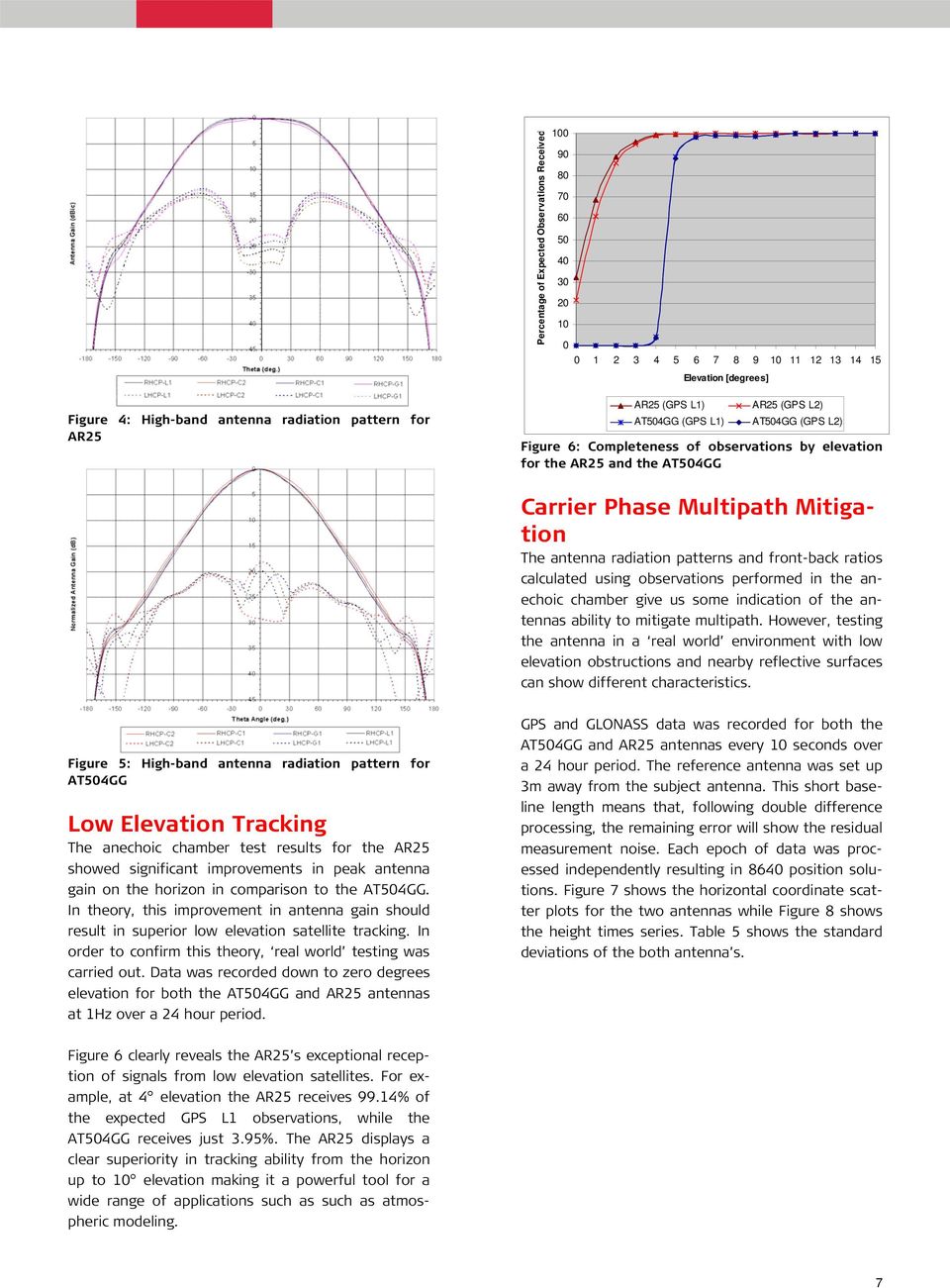
6 optimized, it is clear from Table 2 that the peak antenna gain at the zenith has not been compromised. Table 2: Comparison of the antenna peak gain of the AR25 and AT504GG measured at the zenith (90 El) for the three frequency bands High-Band Frequencies (L1,C1,C2,G1,E1,E2) Mid-Band Frequencies (L2,G2,E6,C6) Low-Band Frequencies (L5,E5a, E5b) AR dBic +7.0dBic +5.3dBic AT504GG +5.5dBic +7.7dBic +5.9dBic Table 3 shows that the peak gain on the horizon is better for the AR25 than for the AT504GG across all frequency bands, especially the high-band where significant improvement is seen. This indicates that the AR25 has superior low elevation tracking ability. Table 3: Comparison of the antenna peak gain of the AR25 and AT504GG measured on the horizon (0 El) for the three frequency bands High-Band Frequencies (L1,C1,C2,G1,E1,E2) Mid-Band Frequencies (L2,G2,E6,C6) Low-Band Frequencies (L5,E5a, E5b) AR25-4.3dBic -7.3dBic -9.0dBic AT504GG -11.1dBic -9.8dBic -10.2Bic Front-Back Ratio The front-back ratio indicates an antenna s directivity and resistance to multipath (Hekmat et al., 2005). The higher the ratio of gain from the front (90 elevation) compared to the back (-90 elevation), the better the antenna s theoretical ability to reject reflected signals. The front-back ratio is influenced by a combination of the antenna s backside shielding and sensitivity to Left Hand Circular Polarized (LHCP) signals. Table 4 shows the back-front ratios for the antennas for each of the 3 frequency bands. While the ratios are lower than those for the AT504GG, the values are still very good and exceed the values from a nonchoke ring antenna. Some trade off is to be expected due to the significantly improved low elevation tracking. Table 4: Comparison of the front back ratio for the AR25 and AT504GG tested at +/-90 elevation High-Band Frequencies (L1,C1,C2,G1,E1,E2) Mid-Band Frequencies (L2,G2,E6,C6) Low-Band Frequencies (L5,E5a, E5b) AR dB 35.5dB 24.9dB AT504GG 36.4dB 35.8dB 35.6dB Antenna Radiation Patterns The radiation pattern for an ideal antenna would show consistently high gain from the zenith down to the horizon and would then roll off rapidly for elevations below the horizon. A consistent radiation pattern across all frequencies translates to similar phase center offset and tracking ability. The greater the difference between the Right Hand Circular Polarized (RHCP) and Left Hand Circular Polarized (LHCP) antenna gain, the greater the antenna s resistance to reflected signals. The high frequency band antenna radiation patterns for the AR25 and the AT504GG are shown in Figures 4 and 5. The antenna gain values have been normalized to enable direct comparison of the patterns. The peak antenna gain is 0dBic in each case. Figures 4 and 5 show that while the antenna gain of the AT504GG falls away sharply as the high band signals elevation decreases, the AR25 maintains superior antenna gain over a greater elevation range. This translates into superior tracking ability of high band signals. The peak gain of the AR25 is +5dBic at the zenith and -5dBic on the horizon, enabling the antenna to track satellites at all elevation angles. It is also clear that, while the difference between the RHCP and LHCP signals is more or less the same for both antennas for the low elevations, the separation between the oppositely polarized signals is much greater for the AR25 for the high elevations, in comparison to the AT504GG. This indicates that, not only has the AR25 retained the renowned multipath mitigation characteristics of the AT504GG at low elevations, but has even improved the resistance reflected signals at high elevations for the high band frequencies. 6
7 Percentage of Expected Observations Received Elevation [degrees] Figure 4: High-band antenna radiation pattern for AR25 AR25 (GPS L1) AR25 (GPS L2) AT504GG (GPS L1) AT504GG (GPS L2) Figure 6: Completeness of observations by elevation for the AR25 and the AT504GG Carrier Phase Multipath Mitigation The antenna radiation patterns and front-back ratios calculated using observations performed in the anechoic chamber give us some indication of the antennas ability to mitigate multipath. However, testing the antenna in a real world environment with low elevation obstructions and nearby reflective surfaces can show different characteristics. Figure 5: High-band antenna radiation pattern for AT504GG Low Elevation Tracking The anechoic chamber test results for the AR25 showed significant improvements in peak antenna gain on the horizon in comparison to the AT504GG. In theory, this improvement in antenna gain should result in superior low elevation satellite tracking. In order to confirm this theory, real world testing was carried out. Data was recorded down to zero degrees elevation for both the AT504GG and AR25 antennas at 1Hz over a 24 hour period. GPS and GLONASS data was recorded for both the AT504GG and AR25 antennas every 10 seconds over a 24 hour period. The reference antenna was set up 3m away from the subject antenna. This short baseline length means that, following double difference processing, the remaining error will show the residual measurement noise. Each epoch of data was processed independently resulting in 8640 position solutions. Figure 7 shows the horizontal coordinate scatter plots for the two antennas while Figure 8 shows the height times series. Table 5 shows the standard deviations of the both antenna s. Figure 6 clearly reveals the AR25 s exceptional reception of signals from low elevation satellites. For example, at 4 elevation the AR25 receives 99.14% of the expected GPS L1 observations, while the AT504GG receives just 3.95%. The AR25 displays a clear superiority in tracking ability from the horizon up to 10 elevation making it a powerful tool for a wide range of applications such as such as atmospheric modeling. 7
8 elevation of the satellite signal. The difference between the electrical phase center and the physical center of the antenna can be removed through Phase Center Offsets (PCO) and Phase Center Variations (PCV) calculated through antenna calibration. These corrections are only effective if the predicted phase center movement is repeatable for all antennas of the same model. The horizontal phase center offsets (HPCO) for the GPS L1 and L2 frequencies were calculated for 20 production model AR25 antennas in order to asses the repeatability. Table 6 shows the mean HPCO values for the L1 and L2 frequencies along with the respective standard deviations. Figure 7: Horizontal coordinate variation for AR25 (red) and AT504GG (blue) Table 6: Horizontal Phase Center Offsets of a sample of 20 production model AR25 antennas L1 E L1 N L2E L2N Mean Std. Dev The average HPCO s are all 1mm or less (Table 6). However, since the constant offset is removed via the antenna calibration, the most important factor for insuring repeatable measurements is the unit to unit variation. The sub-millimeter standard deviations show that repeatability of the phase center is very good. Figure 8: Height displacement over time for AR25 (red) and AT504GG (blue) The horizontal scatter for the AR25 is noticeably less variable (Figure 7), and vertical variations are also significantly smaller (Figure 8), than for the AT504GG. This superiority is confirmed by the smaller standard deviations (STDV) in Table 5. Table 5: Dispersion of the calculated coordinates STDV (E) STDV (N) STDV (H) AR25 1.1mm 1.3mm 2.5mm AT504GG 1.3mm 1.8mm 3.8mm Phase Center Variation In an ideal GNSS antenna, the observation point would correspond exactly with the physical center of the antenna housing. In practice the observation point, or electrical phase center, moves around in three dimensions with the changing azimuth and Conclusion This paper presents the new AR25 3D wideband choke ring antenna from Leica Geosystems. With emerging satellites systems on the horizon, a new high performance antenna is needed to encompass all GNSS signals. The AR25 has sufficient bandwidth to receive all existing and currently planned GNSS signals, while maintaining the highest performance standards. A detailed comparison with the renowned AT504GG choke ring antenna has shown that the revolutionary new 3D choke ring design, combined with a new ultra wideband Dorne-Margolin element and high performance LNA, has revealed impressive performance improvements, especially with respect to low elevation tracking. The reception of the proposed new signals along with additional low elevation satellites will bring new levels of positional accuracy to reference networks, and benefits the end users of the data. The AR25 has been designed and built for durability and will stand the test of time, even in the harshest of environments. 8

9 References Hekmat, T., Nilass, N. and Maurer, M. (1995), Integrated GPS/GLONASS Antenna for High Performance Applications, Proceedings of ION GPS-95, September 12-15, Palm Springs, California IGS (1997), IGS Site Guidelines: s.html#allstrict Kunysz, W. (2001), A Three Dimensional Choke Ring Ground Plane Antenna, Novatel Inc. e_ring.pdf Takac, F. and Walford, J., (2006), Leica System 1200 High Performance GNSS Technology for RTK Applications, Proceedings of ION GNSS 2006, September 26-29, Fort Worth, Texas 9

10 Whether providing corrections from just a single reference station, or an extensive range of services from a nationwide RTK network innovative reference station solutions from Leica Geosystems offer tailor-made yet scalable systems, designed for minimum operator interaction whilst providing maximum user benefit. In full compliance with international standards, Leica Geosystems proven and reliable solutions are based on the latest technology. Precision, value, and service from Leica Geosystems. When it has to be right. Illustrations, descriptions and technical specifications are not binding and may change. Copyright Leica Geosystems AG, Heerbrugg, Switzerland, 2009 Leica Geosystems AG Heerbrugg, Switzerland

Leica GNSS Reference Antennas White Paper
 Leica GNSS Reference Antennas White Paper State of The Art, Leading Edge Geodetic Antennas from Leica Geosystems Justin Walford, Leica Geosystems BIOGRAPHY Justin Walford holds an M.Sc.E in Survey Engineering
A Novel GPS Survey Antenna
 A Novel GPS Survey Antenna Waldemar Kunysz, NovAtel Inc. BIOGRAPHY Waldemar Kunysz obtained a BSEE from the Technical University of Nova Scotia in 1989. From 1991 to 1995 he worked on phased array antennas
Enabling RTK-like positioning offshore using the global VERIPOS GNSS network. Pieter Toor GNSS Technology Manager
 Enabling RTK-like positioning offshore using the global VERIPOS GNSS network Pieter Toor GNSS Technology Manager Introduction PPP/RTK Positioning Techniques PPP-AR Technology Presentation Overview PPP-AR
Antenna Properties and their impact on Wireless System Performance. Dr. Steven R. Best. Cushcraft Corporation 48 Perimeter Road Manchester, NH 03013
 Antenna Properties and their impact on Wireless System Performance Dr. Steven R. Best Cushcraft Corporation 48 Perimeter Road Manchester, NH 03013 Phone (603) 627-7877 FAX: (603) 627-1764 Email: [email protected]
Monitoring of Open Pit Mines using Combined GNSS Satellite Receivers and Robotic Total Stations
 Monitoring of Open Pit Mines using Combined GNSS Satellite Receivers and Robotic Total Stations N. Brown Leica Geosystems, Switzerland S. Kaloustian Leica Geosystems, Switzerland M. Roeckle Leica Geosystems,
NAVICOM DYNAMICS RTK BASE STATION INSTALLATION AND COMMISSIONING INSTRUCTIONS
 NAVICOM DYNAMICS RTK BASE STATION INSTALLATION AND COMMISSIONING INSTRUCTIONS 1. Locate a suitable position inside the building to install the Base Station enclosure where mains power (240V AC) is available
Leica GR25 Don t think Receiver, think Reference Server
 Leica GR25 Don t think Receiver, think Reference Server Leica GR25 GNSS Reference Server Think Reference Server The GR25 is more than just a reference receiver, it is a GNSS Reference Server. Just like
Selecting Receiving Antennas for Radio Tracking
 Selecting Receiving Antennas for Radio Tracking Larry B Kuechle, Advanced Telemetry Systems, Inc. Isanti, Minnesota 55040 [email protected] The receiving antenna is an integral part of any radio location
Absolute GNSS Antenna Calibration with a Robot: Repeatability, GLONASS and Carrier-to-Noise Pattern
 Absolute GNSS Antenna Calibration with a Robot: Repeatability, GLONASS and Carrier-to-Noise Pattern Gerhard Wübbena, Martin Schmitz, Gerald Boettcher Geo++ GmbH 30827 Garbsen Germany www.geopp.com Content
Local monitoring by low cost devices and free and open sources softwares
 Local monitoring by low cost devices and free and open sources softwares Abstract Ludovico Biagi, Florin-Catalin Grec, Marco Negretti, Maria Grazia Visconti Politecnico di Milano, DICA@ComoCampus The purpose
GNSS and Heighting, Practical Considerations. A Parker National Geo-spatial Information Department of Rural Development and Land Reform
 GNSS and Heighting, Practical Considerations A Parker National Geo-spatial Information Department of Rural Development and Land Reform GNSS Global Navigation Satellite Systems (GNSS) Global Positioning
102 26-m Antenna Subnet Telecommunications Interfaces
 DSMS Telecommunications Link Design Handbook 26-m Antenna Subnet Telecommunications Interfaces Effective November 30, 2000 Document Owner: Approved by: Released by: [Signature on file in TMOD Library]
Guidelines for RTK/RTN GNSS Surveying in Canada
 Guidelines for RTK/RTN GNSS Surveying in Canada July 2013 Version 1.1 Ministry of Transportation Ministère des Transports EARTH SCIENCES SECTOR GENERAL INFORMATION PRODUCT 100-E Main Authors: Brian Donahue,
Leica SmartNet UK & Ireland Network RTK User Guide
 Leica SmartNet UK & Ireland Network RTK User Guide Contents Background.. Page 3 Single Base RTK.... Page 3 Advantages & Disadvantages of Single Base RTK Page 4 Network RTK... Page 4 Advantages & Disadvantages
Antennas & Propagation. CS 6710 Spring 2010 Rajmohan Rajaraman
 Antennas & Propagation CS 6710 Spring 2010 Rajmohan Rajaraman Introduction An antenna is an electrical conductor or system of conductors o Transmission - radiates electromagnetic energy into space o Reception
5. ANTENNA TYPES. Figure 5. The vertical dipole and its electromagnetic equivalent, the vertical monopole
 Antennas can be classified in several ways. One way is the frequency band of operation. Others include physical structure and electrical/electromagnetic design. The antennas commonly used for LMR both
International Global Navigation Satellite Systems Service
 International Global Navigation Satellite Systems Service IGS Multi-GNSS Experiment IGS M-GEX Call for Participation www.igs.org Response to this Call for Participation in IGS M-GEX via Web Form Submission
EE302 Lesson 14: Antennas
 EE302 Lesson 14: Antennas Loaded antennas /4 antennas are desirable because their impedance is purely resistive. At low frequencies, full /4 antennas are sometime impractical (especially in mobile applications).
700 and 800 MHz Band Slot Antennas
 Low Group Delay, Wide Bandwidth UHF Slot Antennas Omni-directional and Directional Patterns Available Low RFR Models Available Top or Side Mount Models Horizontal, Elliptical, or Circular Polarization
CDMA Technology : Pr. S. Flament www.greyc.fr/user/99. Pr. Dr. W. sk www.htwg-konstanz.de. On line Course on CDMA Technology
 CDMA Technology : Pr. Dr. W. sk www.htwg-konstanz.de Pr. S. Flament www.greyc.fr/user/99 On line Course on CDMA Technology CDMA Technology : CDMA / DS : Principle of operation Generation of PN Spreading
SAR ASSOCIATED WITH THE USE OF HANDS-FREE MOBILE TELEPHONES
 SAR ASSOCIATED WITH THE USE OF HANDS-FREE MOBILE TELEPHONES S.J. Porter, M.H. Capstick, F. Faraci, I.D. Flintoft and A.C. Marvin Department of Electronics, University of York Heslington, York, YO10 5DD,
Design and Certification of ASH Radio Systems for Japan
 Design and Certification of ASH Radio Systems for Japan RFM s second-generation ASH radio hybrids are being used in a wide variety of applications in Japan, operating under the Japanese BIJAKU radio regulations.
GeoMax GNSS Zenith10 & Zenith20 Series
 GeoMax GNSS Zenith10 & Zenith20 Series GeoMax About Us At GeoMax we provide a comprehensive portfolio of integrated solutions by developing, manufacturing and distributing quality construction and surveying
Leica Monitoring Solutions. Leica Monitoring Solutions Certainty builds confidence.
 Leica Monitoring Solutions Leica Monitoring Solutions Certainty builds confidence. Risk and Cost Reduction Proven Solutions Facing new challenges Engineering companies and contractors are facing challenges
Non-parametric estimation of seasonal variations in GNSS-derived time series
 Military University of Technology, Poland ([email protected]) Seasonal variations in the frame sites can bias the frame realization. I would like to invite you to click on each of the four
GNSS-PW Progress Session 5: Other GRUAN products
 GNSS-PW Progress Session 5: Other GRUAN products Markus Bradke Helmholtz-Centre Potsdam - GFZ German Research Centre for Geosciences Telegrafenberg, 14473 Potsdam, Germany Department 1: Geodesy and Remote
Prof. Ludovico Biagi. Satellite Navigation and Monitoring
 Prof. Ludovico Biagi Satellite Navigation and Monitoring Navigation: trajectories control positions estimations in real time, at high frequency popular applications: low accuracy (10 m) required specific
GEOGRAPHIC INFORMATION SYSTEMS Lecture 21: The Global Positioning System
 GEOGRAPHIC INFORMATION SYSTEMS Lecture 21: The Global Positioning System The Global Positioning System - recognize that GPS is only one of several Global Navigation Satellite Systems (GNSS) - the Russian
Online GPS processing services: an initial study
 GPS Solut (2006) 10: 12 20 DOI 10.1007/s10291-005-0147-5 ORIGINAL ARTICLE Reza Ghoddousi-Fard Peter Dare Online GPS processing services: an initial study Received: 15 September 2004 Accepted: 3 May 2005
RECOMMENDATION ITU-R P.1546-1. Method for point-to-area predictions for terrestrial services in the frequency range 30 MHz to 3 000 MHz
 Rec. ITU-R P.546- RECOMMENDATION ITU-R P.546- Method for point-to-area predictions for terrestrial services in the frequency range 30 MHz to 3 000 MHz (200-2003) The ITU Radiocommunication Assembly, considering
Apogee Series. > > Motion Compensation and Data Georeferencing. > > Smooth Workflow. Mobile Mapping. > > Precise Trajectory and Direct Georeferencing
 Ultimate accuracy MEMS Apogee Series Inertial Navigation System Motion Sensing and Georeferencing > INS > MRU > AHRS ITAR free 0,005 RMS Apogee Series High quality, high accuracy Hydrography > > Motion
Antenna Diversity in Wireless Local Area Network Devices
 Antenna Diversity in Wireless Local Area Network Devices Frank M. Caimi, Ph.D. Kerry L. Greer Jason M. Hendler January 2002 Introduction Antenna diversity has been used in wireless communication systems
Swedish User Guidelines for Network RTK
 Swedish User Guidelines for Network RTK Robert Odolinski GNSS Research Centre, Curtin University of Technology (Previously Geodetic Research Department of Lantmäteriet, Sweden) Perth, WA, Australia [email protected]
Internal GPS Active Patch Antenna Application Note
 Internal GPS Active Patch Antenna Application Note APN-13-8-002/A Page 1 of 14 1. BASICS 2. APPLICATIONS 3. SIZE 4. SHAPE 5. GROUND PLANE 6. IMPEDANCE 7. BANDWIDTH 8. VSWR 9. LINK BUDGET 10. GAIN 11. NOISE
Omni Antenna vs. Directional Antenna
 Omni Antenna vs. Directional Antenna Document ID: 82068 Contents Introduction Prerequisites Requirements Components Used Conventions Basic Definitions and Antenna Concepts Indoor Effects Omni Antenna Pros
AN003. Evaluation of Anechoic Chambers For EMC Measurements Using A CNE. Overview. CNE III 9kHz to 2GHz Conducted and radiated output
 Evaluation of Anechoic Chambers For EMC Measurements Using A CNE Overview Anechoic chambers are used for EMC testing primarily for radiated emissions (RE) and radiated immunity (RI) in the frequency range
Embedded FM/TV Antenna System
 1 Embedded FM/TV Antenna System Final Report Prepared for By January 21, 2011 2 Table of Contents 1 Introduction... 5 2 Technical Specification... 6 3 Prototype Antenna... 7 4 FASTROAD Active module fabrication...
Maximizing Throughput and Coverage for Wi Fi and Cellular
 Maximizing Throughput and Coverage for Wi Fi and Cellular A White Paper Prepared by Sebastian Rowson, Ph.D. Chief Scientist, Ethertronics, Inc. www.ethertronics.com March 2012 Introduction Ask consumers
INTEGRITY AND CONTINUITY ANALYSIS OCTOBER TO DECEMBER 2013 QUARTERLY REPORT FROM GPS. Integrity and Continuity Analysis 08/01/14 08/01/14 08/01/14
 INTEGRITY AND CONTINUITY ANALYSIS FROM GPS OCTOBER TO DECEMBER 2013 QUARTERLY REPORT Prepared by: M Pattinson (NSL) 08/01/14 Checked by: L Banfield (NSL) 08/01/14 Approved by: M Dumville (NSL) 08/01/14
NJDEP GPS Data Collection Standards For GIS Data Development
 NJDEP GPS Data Collection Standards For GIS Data Development Bureau of Geographic Information Systems Office of Information Resource Management June 8, 2011 1.0 Introduction... 3 2.0 GPS Receiver Hardware
SURVEYING WITH GPS. GPS has become a standard surveying technique in most surveying practices
 SURVEYING WITH GPS Key Words: Static, Fast-static, Kinematic, Pseudo- Kinematic, Real-time kinematic, Receiver Initialization, On The Fly (OTF), Baselines, Redundant baselines, Base Receiver, Rover GPS
An octave bandwidth dipole antenna
 An octave bandwidth dipole antenna Abstract: Achieving wideband performance from resonant structures is challenging because their radiation properties and impedance characteristics are usually sensitive
u-blox comprehensive approach to multi-gnss positioning
 WHITEPAPER u-blox comprehensive approach to multi-gnss positioning locate, communicate, accelerate Whitepaper by: Carl Fenger, Communications Manager, u-blox Uffe Pless, Product Manager, u-blox May 2012
Specifications. Trimble SPS461 Modular GPS Heading Receiver
 Receiver Name Configuration Option Base and Rover interchangeability Rover position update rate Rover maximum range from base Rover operation within a VRS network Heading operation Factory options General
GPS Precise Point Positioning as a Method to Evaluate Global TanDEM-X Digital Elevation Model
 GPS Precise Point Positioning as a Method to Evaluate Global TanDEM-X Digital Elevation Model 7 th FIG Regional Conference TS 1C Advances in GNSS Positioning and Applications I Volker Schwieger 1, Jürgen
The Applanix SmartBase TM Software for Improved Robustness, Accuracy, and Productivity of Mobile Mapping and Positioning
 The Applanix SmartBase TM Software for Improved Robustness, Accuracy, and Productivity of Mobile Mapping and Positioning Joe Hutton and Edith Roy, Applanix Corporation Introduction Applanix, along with
Uncertainty evaluations in EMC measurements
 Uncertainty evaluations in EMC measurements Carlo Carobbi Dipartimento di Elettronica e Telecomunicazioni Università degli Studi di Firenze Politecnico di Milano - 20 Feb. 2009 1 Non - reproducibility
General GPS Antenna Information APPLICATION NOTE
 General GPS Antenna Information APPLICATION NOTE General GPS Antenna Information Global Positioning System and Precise Time & Frequency The Global Positioning System (GPS) is a worldwide radio-navigation
GPS Receiver Test. Conducted by the Department of Mathematical Geodesy and Positioning Delft University of Technology
 GPS Receiver Test Conducted by the Department of Mathematical Geodesy and Positioning Delft University of Technology A. Amiri-Simkooei R. Kremers C. Tiberius May 24 Preface For the purpose of a receiver
Section 5.0 : Horn Physics. By Martin J. King, 6/29/08 Copyright 2008 by Martin J. King. All Rights Reserved.
 Section 5. : Horn Physics Section 5. : Horn Physics By Martin J. King, 6/29/8 Copyright 28 by Martin J. King. All Rights Reserved. Before discussing the design of a horn loaded loudspeaker system, it is
Flexible PCB Antenna with Cable Integration Application Note Version 2
 Flexible PCB Antenna with Cable Integration Application Note Version 2 CONTENTS 1. BASICS 2. APPLICATIONS 3. SIZE 4. SHAPE 5. GROUND PLANE SIZE 6. IMPEDANCE 7. BANDWIDTH 8. VSWR 9. GAIN 10. EFFICIENCY
APPLICATION NOTE. RF System Architecture Considerations ATAN0014. Description
 APPLICATION NOTE RF System Architecture Considerations ATAN0014 Description Highly integrated and advanced radio designs available today, such as the Atmel ATA5830 transceiver and Atmel ATA5780 receiver,
The Evolution of the Global Navigation Satellite System (GNSS) Spectrum Use
 The Evolution of the Global Navigation Satellite System (GNSS) Spectrum Use Spectrum Management 2012 National Spectrum Management Association Scott Pace (with thanks to Chris Hegerty, MITRE) Space Policy
'' EGGBEATER '' ANTENNA VHF/UHF ~ PART 2
 '' EGGBEATER '' ANTENNA VHF/UHF ~ PART 2 ON6WG / F5VIF Summary Note : In Part 1, Fig 1 shows a maximum gain of 6.45 dbi. Several design attempts were made using slightly different configurations ( i.e.
VCO Phase noise. Characterizing Phase Noise
 VCO Phase noise Characterizing Phase Noise The term phase noise is widely used for describing short term random frequency fluctuations of a signal. Frequency stability is a measure of the degree to which
Avaya WLAN 9100 External Antennas for use with the WAO-9122 Access Point
 Avaya WLAN 9100 External Antennas for use with the WAO-9122 Access Point Overview To optimize the overall performance of a WLAN in an outdoor deployment it is important to understand how to maximize coverage
Antenna Deployment Technical Brief
 ProCurve Networking Antenna Deployment Technical Brief Introduction... 2 Antenna types... 2 Omni directional antennas... 2 Directional antennas... 2 Diversity antennas... 3 High gain directional antennas...
Cellular Wireless Antennas
 Cellular Wireless Antennas A Technical Brief GarrettCom Inc., November 2010 Overview The Cellular Wireless Antenna Technical brief is provided to assist with the design and deployment of the DX940 Cellular
Bi-Directional DGPS for Range Safety Applications
 Bi-Directional DGPS for Range Safety Applications Ranjeet Shetty 234-A, Avionics Engineering Center, Russ College of Engineering and Technology, Ohio University Advisor: Dr. Chris Bartone Outline Background
Antenna Basic Concepts
 ANTENNA An antenna is a device to transmit and/or receive electromagnetic waves. Electromagnetic waves are often referred to as radio waves. Most antennas are resonant devices, which operate efficiently
The W5JCK Guide to the Mathematic Equations Required for the Amateur Extra Class Exam
 The W5JCK Guide to the Mathematic Equations Required for the Amateur Extra Class Exam This document contains every question from the Extra Class (Element 4) Question Pool* that requires one or more mathematical
TI GPS PPS Timing Application Note
 Application Note Version 0.6 January 2012 1 Contents Table of Contents 1 INTRODUCTION... 3 2 1PPS CHARACTERISTICS... 3 3 TEST SETUP... 4 4 PPS TEST RESULTS... 6 Figures Figure 1 - Simplified GPS Receiver
Laser Ranging to Nano-Satellites
 13-0222 Laser Ranging to Nano-Satellites G. Kirchner (1), Ludwig Grunwaldt (2), Reinhard Neubert (2), Franz Koidl (1), Merlin Barschke (3), Zizung Yoon (3), Hauke Fiedler (4), Christine Hollenstein (5)
GENERAL INFORMATION ON GNSS AUGMENTATION SYSTEMS
 GENERAL INFORMATION ON GNSS AUGMENTATION SYSTEMS 1. INTRODUCTION Navigation technologies with precision approach and landing systems, for civilian and military purposes, enable aircrafts to perform their
Pillbox Antenna for 5.6 GHz Band Dragoslav Dobričić, YU1AW [email protected]
 Pillbox Antenna for 5.6 GHz Band Dragoslav Dobričić, YU1AW [email protected] Introduction The pillbox or cheese antenna is made of two parallel plates which are connected to the narrow strip of parabolic
Datasheet. airmax 2x2 PtP Bridge Dish Antenna. Models: RD-2G24, RD-3G26, RD-5G30, RD-5G30-LW, RD-5G34. Powerful Performance for Long-Range Links
 airmax 2x2 PtP Bridge Dish Antenna Models: RD-2G24, RD-3G26, RD-5G30, RD-5G30-LW, RD-5G34 Powerful Performance for Long-Range Links Robust Design and Construction for Outdoor Use Seamless Integration with
Vector Network Analyzer Techniques to Measure WR340 Waveguide Windows
 LS-296 Vector Network Analyzer Techniques to Measure WR340 Waveguide Windows T. L. Smith ASD / RF Group Advanced Photon Source Argonne National Laboratory June 26, 2002 Table of Contents 1) Introduction
SPECIFICATION. MAT.03A Embedded Active GPS and Cellular Antenna Assembly and Reference Board
 SPECIFICATION Part Number: MAT.03A Product Name: Features: MAT.03A Embedded Active GPS and Cellular Antenna Assembly and Reference Board 2in1 Embedded Antenna Solution Two SMA(F) connectors for Output
Sound Power Measurement
 Sound Power Measurement A sound source will radiate different sound powers in different environments, especially at low frequencies when the wavelength is comparable to the size of the room 1. Fortunately
Experiment 7: Familiarization with the Network Analyzer
 Experiment 7: Familiarization with the Network Analyzer Measurements to characterize networks at high frequencies (RF and microwave frequencies) are usually done in terms of scattering parameters (S parameters).
Discussions on RF Signal Propagation and Multipath
 Now, what s tomorrow s challenge? APN-008 Rev 1 February 3, 2000 Discussions on RF Signal Propagation and Multipath Radio frequency (RF) signal multipathing is a phenomenon common to virtually all types
Antenna Trainer EAN. www.edibon.com. Technical Teaching Equipment INTRODUCTION
 Antenna Trainer EAN Technical Teaching Equipment Products Products range Units 3.-Communications INTRODUCTION Antennas are the main element of aerial communications. They are the transition between a transmission
 IMES (Indoor Messaging System) A Proposal for New Indoor Positioning System Presenter: Dr. Dinesh Manandhar GNSS Technologies Inc., Japan Third Meeting of the International Committee on Global Navigation
Global Positioning System
 B. Hofmann-Wellenhof, H. Lichtenegger, and J. Collins Global Positioning System Theory and Practice Third, revised edition Springer-Verlag Wien New York Contents Abbreviations Numerical constants xix xxiii
Status, Development and Application
 Federal Space Agency GLONASS GLONASS Status, Development and Application Sergey G. Revnivykh International Committee on Global Navigation Satellite Systems (ICG) Second Meeting, September 4-7, 2007, Bangalore,
Printed Dipole Array Fed with Parallel Stripline for Ku-band Applications
 Printed Dipole Array Fed with Parallel Stripline for Ku-band Applications M. Dogan 1, 3,K. Özsoy 1, 2, and I.Tekin 1, 1 Electronics Engineering, Sabanci University, Istanbul, Turkey 2 Vestek Electronic
Keywords: Slot antenna, ultra wideband (UWB), Microstrip line feeding, HFSS Simulation software.
 IJESRT INTERNATIONAL JOURNAL OF ENGINEERING SCIENCES & RESEARCH TECHNOLOGY Design of Compact UWB Printed Slot Antenna for GPS, GSM &Bluetooth Applications S.P.Shinde *1, M. M. Jadhav 2 *1, 2 Electronics
Measurement of RF Emissions from a Final Coat Electronics Corrosion Module
 Engineering Test Report No. 37802-02 Rev. A Measurement of RF Emissions from a Final Coat Electronics Corrosion Module For : Canadian Auto Preservation, Inc. 390 Bradwick Drive Concord, Ontario CANADA
This document is available at HTTP://WWW.FALCOM.DE/. FAL-ANT-1. GSM/DCS/GPS antenna (with Fakra-SMB connectors) Description. Version 1.
 This document is available at HTTP://WWW.FALCOM.DE/. FAL-ANT-1 GSM/DCS/GPS antenna (with Fakra-SMB connectors) Description Version 1.00 Contents 0 INTRODUCTION...3 0.1 GENERAL... 3 1 SECURITY...4 1.1 GENERAL...
Günter Seeber. Satellite Geodesy 2nd completely revised and extended edition
 Günter Seeber Satellite Geodesy 2nd completely revised and extended edition Walter de Gruyter Berlin New York 2003 Contents Preface Abbreviations vii xvii 1 Introduction 1 1.1 Subject of Satellite Geodesy...
EMC STANDARDS STANDARDS AND STANDARD MAKING BODIES. International. International Electrotechnical Commission (IEC) http://www.iec.
 EMC STANDARDS The EMC standards that a particular electronic product must meet depend on the product application (commercial or military) and the country in which the product is to be used. These EMC regulatory
Real-Time Reality by Arthur R. Andrew III, PLS
 Real-Time Reality by Arthur R. Andrew III, PLS A progressive RTK network in California deems the setting up of a base station a thing of the past. Imagine having the ability to survey using Real-Time Kinematic
An equivalent circuit of a loop antenna.
 3.2.1. Circuit Modeling: Loop Impedance A loop antenna can be represented by a lumped circuit when its dimension is small with respect to a wavelength. In this representation, the circuit parameters (generally
Amplifier for Small Magnetic and Electric Wideband Receiving Antennas (model AAA-1B)
 Amplifier for Small Magnetic and Electric Wideband Receiving Antennas (model AAA-1B) 1. Description and Specifications Contents 1.1 Description 1.2 1.2 Specifications 1.3 1.3 Tested parameters in production
R&S R-Line Compact Test Chamber Precise measurements of radiated emissions of wireless terminals 800 MHz to 18 GHz
 Test & Measurement Data Sheet 02.00 R&S R-Line Compact Test Chamber Precise measurements of radiated emissions of wireless terminals 800 MHz to 18 GHz R&S R-Line Compact Test Chamber At a glance The R-Line
Just a Dipole. Gary Wescom N0GW July 16, 2007
 Just a Dipole Gary Wescom N0GW July 16, 2007 Often we will hear people describing their antennas as just a dipole. After all, a coax cable fed, half wavelength dipole is one of the simplest antennas to
A GPS Digital Phased Array Antenna and Receiver
 A GPS Digital Phased Array Antenna and Receiver Dr. Alison Brown, Randy Silva; NAVSYS Corporation ABSTRACT NAVSYS High Gain Advanced GPS Receiver (HAGR) uses a digital beam-steering antenna array to enable
Design of an U-slot Folded Shorted Patch Antenna for RF Energy Harvesting
 Design of an U-slot Folded Shorted Patch Antenna for RF Energy Harvesting Diponkar Kundu, Ahmed Wasif Reza, and Harikrishnan Ramiah Abstract Novel optimized U-slot Folded Shorted Patch Antenna (FSPA) is
Agilent AN 1315 Optimizing RF and Microwave Spectrum Analyzer Dynamic Range. Application Note
 Agilent AN 1315 Optimizing RF and Microwave Spectrum Analyzer Dynamic Range Application Note Table of Contents 3 3 3 4 4 4 5 6 7 7 7 7 9 10 10 11 11 12 12 13 13 14 15 1. Introduction What is dynamic range?
40m-10m DELTA LOOP ANTENNA - GU3WHN
 This simple broad band antenna is easy to build, has gain similar to that of a dipole and is tolerant of nearby objects. It can be erected in almost any configuration provided the wires are well separated
Advances in High-Performance Ceramic Antennas for Small-Form-Factor, Multi-Technology Devices
 Advances in High-Performance Ceramic Antennas for Small-Form-Factor, Multi-Technology Devices 2007, Ethertronics 2007, Ethertronics Presentation outline Market Requirements Driving Multiple Antenna Integration
Technician Licensing Class
 Technician Licensing Class Antennas Presented by Amateur Radio Technician Class Element 2 Course Presentation ELEMENT 2 SUB-ELEMENTS (Groupings) About Ham Radio Call Signs Control Mind the Rules Tech Frequencies
Pre-Compliance Test Method for Radiated Emissions of Automotive Components Using Scattering Parameter Transfer Functions
 PreCompliance Test Method for Radiated Emissions of Automotive Components Using Scattering Parameter Transfer Functions D. Schneider 1*, S. Tenbohlen 1, W. Köhler 1 1 Institute of Power Transmission and
Tx/Rx A high-performance FM receiver for audio and digital applicatons
 Tx/Rx A high-performance FM receiver for audio and digital applicatons This receiver design offers high sensitivity and low distortion for today s demanding high-signal environments. By Wayne C. Ryder
Alberding GNSS data management & monitoring tools
 Alberding GNSS data management & monitoring tools 1/24 Alberding GNSS data management & monitoring tools Tamás Horváth Alberding GmbH EUREF 2013 Symposium, 29-31 May 2013, Budapest, Hungary Alberding GNSS
Connected U-Slots Patch Antenna for WiMAX Applications
 Connected U-Slots Patch Antenna for WiMAX Applications Hattan F. AbuTarboush (1), D. Budimir (2), R. Nilavalan (1) and H. S. Al-Raweshidy (1) (1) Wireless Network and Communication Centre (WNCC), School
Post Processing Service
 Post Processing Service The delay of propagation of the signal due to the ionosphere is the main source of generation of positioning errors. This problem can be bypassed using a dual-frequency receivers
Advanced Surveying Control Services for Building the Vertical Cities.
 Advanced Surveying Control Services for Building the Vertical Cities. Joël VAN CRANENBROECK, Switzerland Key words: Automatic Total Station, GNSS receivers, Precision Inclinometer, Least Squares Adjustment,
Circular Polarized antenna feed (For EME on 10GHz and 5.7GHz).
 Circular Polarized antenna feed (For EME on 10GHz and 5.7GHz). Luis Cupido - CT1DMK, Willi Bauer LX1DB On more than one occasion at the EME conferences, circular polarization was agreed to be to be the
Advanced RF Isolation Variable Beamwidth Antenna. Datasheet. Model: AM-V5G-Ti. Carrier-Class 2x2 MIMO PtMP BaseStation
 Advanced RF Isolation Variable Beamwidth Antenna Model: AM-V5G-Ti Carrier-Class 2x2 MIMO PtMP BaseStation Adjustable Beamwidth Configuration Reduced Co-Location Interference Advanced Carrier-Class PtMP