
Annual Report. Contents
|
|
|
- Sylvia Johnston
- 10 years ago
- Views:
Transcription
1 annual Report 2012

2 Annual Report 2012 Contents 01. Message from the Chairman Key figures Main milestones Organisation Geographic diversification Industry context Gamesa 2012 and strategy Wind turbines Wind farm development and sale Operation and maintenance services Technological diversification Sustainability 200 Business ethics 206 Shareholders and investors 208 Customers 209 Employees 210 Suppliers 214 Environment 215 Community 217

3 2 3 Message from the Chairman Message from the Chairman 01 Dear Message from the chairman shareholder, Gamesa had to operate in a very complex situation in 2012, characterized by macroeconomic and financial problems worldwide, which slowed the main economies, hampered access to funding and limited support for renewable energy in significant markets. This situation inevitably impacted the wind power industry, greatly reducing demand, curtailing official aid for renewable energy and leading to a cutback in investment plans by traditional customers. Moreover, regulatory changes made the adjustment more difficult. Because of this adverse situation, of lower growth and fiercer competition, Gamesa reported negative results in Nevertheless, we are among the companies in our industry that best weathered the year, as evidenced by our normalized margins as a result of our business model and geographical diversification. The situation is complex, but it is precisely in this context that Gamesa decided to make a bold move with a view to the future. We did so based on a realistic analysis, on prudence and, above all, on transparency, out of the conviction that Gamesa s operating excellence, its technology and innovation capabilities, its international leading position, and its product portfolio are sufficient to enable it to regain profitability. To this end, it was necessary to adjust the company s operations to economic and industry realities. To achieve this, we developed a Business Plan for which will enable us to create value at the bottom of the economic cycle while we prepare to respond to future growth and play a leading role in consolidation in the industry. This plan will enable us not only to weather the crisis successfully but also to emerge stronger, with an enhanced competitive position. Competitive advantages Gamesa is aware that strict cost control is a competitive advantage; consequently, it implemented a programme to contain costs which was completed in the first quarter of this year. As part of this programme, which ensures savings of 100 million euro, we are working on new production processes and on standardizing components, which will reduce the cost of energy; on consolidating a global supply chain; and on maximizing reliance on suppliers in Spain and China. The cost optimization strategy will also enable us to raise the contribution margin by four percentage points despite persisting price pressure, which will support an increase in returns with the goal of reaching 17-18% in 2013 and exceeding 20% by As a result of these strategies, Gamesa ended 2012 with a sound financial position and a solid equity situation, which, coupled with 2.2 billion euro in available credit lines, guarantee that the Business Plan can be implemented without having to seek additional funding. The markets have responded favourably to the plan s realistic approach and the proven progress since it was implemented. Since the plan was presented, Gamesa s share has gained 59%. That increase has been confirmed by the leading research firms, which have been raising the share s target price in recent months. Even so, Gamesa stock still has upside potential. I am convinced that the share price will appreciate further as the market begins to realize this. During these six months, since the plan was presented, we have completed the first vital part so as to return to profitability. But we still have work to do if we are to improve margins and recover profitability for our shareholders. Although the outlook for demand in 2013 remains weak, Gamesa will operate profitably in this context of lower growth, based not only on the actions set out in the Business Plan, but also on its flexible business model, with a presence throughout the value chain and sound sales diversification. company already has a sound position underpinned by local know-how, knowledge of customers needs, and reliable products and services. This reinforces the strategy of focusing the business on key markets. In 2012, 85% of Gamesa s sales came from international markets, and 32% from Latin America, where the company expects demand for wind facilities to grow by 25% in the next three years. Strong position for the future Despite market complexities, we maintain a positive outlook for 2013 in view of our Business Plan, sales diversification, strong liquidity and capital position, and flexible business model, supported also in part by cost savings and order intake: Gamesa ended 2012 with an order book of 1,657 MW, i.e. more than 50% of the sales volume target for Gamesa is moving forward from a sound position and has the best strategy and team to continue to create value for its stakeholders in all of the countries where it operates. Not only will we weather the crisis, we will emerge stronger from it. These solid long-term prospects are underpinned mainly by the efficiency of wind energy, with a cost of energy that is decreasing steadily, to the extent that it is already competitive without the need for incentives in some countries with high wind resource. Gamesa s goal is to operate profitably in the short, medium and long term, without relinquishing growth opportunities. And that is where all of our efforts will be focused. Implementing the plan required us to redimension our structure into line with market needs and an efficient operational model: this was difficult and painful, but nonetheless necessary to ensure the company s competitiveness. One of our goals is to consolidate Spain s position as the group s technology know-how centre and, with China, as a global production and supply hub. One of our strategic goals is to strengthen Gamesa s balance sheet. To adapt to market realities and the Business Plan, we booked 600 million euro in writedowns, which impacted our bottom line. To this end, the company is exerting strict control over working capital and capital expenditure, supported by the new business model in the wind farm development and sale business, which does not consume our own finance. Moreover, in line with the reduction in capital expenditure, Gamesa will concentrate its efforts on developing two new platforms 2.5 MW and 5 MW oriented towards meeting market needs and reducing the cost of energy (CoE). Operating in this way throughout the entire wind value chain provides the company with a unique competitive position in terms of improving the cost of energy, supported by its technological expertise. Gamesa has installed close to 27,000 MW in 42 countries and has more than 19,000 MW under maintenance for 180 clients evidence of its technological leadership. Wind farm development and sales is a key distinguishing factor which provides the company with a competitive advantage in the sector. Gamesa has developed 6,000 MW of proprietary capacity and has a pipeline of 18,000 MW. The company s strong international presence allows it to diversify sales and respond as demand shifts to emerging markets, like Brazil and Mexico. In those countries, the Ignacio Martín, Chairman and CEO of Gamesa

4 4 5 Key figures Main milestones main key figures milestones ECONOMIC INDICATORS (million euro) Sales 2,844 3,033 2,764 3,229 3,834 MW equivalent sold 2,119 2,802 2,405 3,145 3,684 EBIT (631) Net earnings after tax (659) NFD/EBITDA 2.5x 1 2x -0.6x 0.7x 0.1x Share price at 31 Dec. ( ) Earnings per share ( ) (2.63) Gross dividend per share ( /share) Contract with Iberdrola to maintain 80 wind farms in Spain and Portugal, with total installed capacity of 2,286 MW. Presentation of 2012 earnings, which mark the beginning of profitability defined in the Business Plan year maintenance contract for 264 MW in the US. Gamesa named leader in sustainability in the renewable energy equipment industry by Sustainability Yearbook Design certification for the Gamesa 5 MW offshore platform. social indicators Workforce 6,646 8,357 7,262 6,360 7,187 % international workforce % women in workforce % permanently employed Hours training/employee Accident severity index Frequency index Environmental indicators Raw materials (t/ mn) Energy consumption (GJ/ mn) Water consumption (m 3 / mn) Waste produced (t/ mn) Discharges produced (m 3 / mn) CO 2 emissions (t/ mn) CO 2 emissions avoided (t/co 2 ) 2 40,151,715 36,214,050 31,250,550 27,371,850 24,024,600 CO 2 emissions avoided (t/ mn) 1,384 1,636 1,403 1,036 1,239 Sustainability indexes United Nations Global Compact Dow Jones Sustainability Index FTSE4Good Ethibel Excellence Europe Global Challenges Index CleanTech Index (CTIUS) 1. Excluding extraordinary items. 2. Tonnes of CO 2 avoided due to the MW of wind capacity installed by Gamesa. Cumulative data First transaction under the new wind farm strategy: Heads of Terms with Impax to sell 183 MW of the wind farm pipeline in Germany. Presentation of the Business Plan to operate profitably and flexibly. Entered a new market, Finland, under a framework agreement to supply 135 MW with 4.5 MW turbines. Signature of a 260 million loan from EIB for R&D and innovation. Consolidating footprint in Brazil with a new contract to supply 258 MW for ten wind farms. Gamesa, leader in the renewable energy equipment manufacturing industry in terms of economic, social and environmental performance, in the Dow Jones Sustainability Index. Expanding presence in India: contract to supply 75 MW to ReNew Wind Power. Gamesa diversifies its customer portfolio by selling three wind farms in France and Germany (56 MW in total) to KGAL renewable energy fund. Entered a new market, Nicaragua, with the turnkey installation of a 44 MW wind farm. Reaffirming Gamesa s lead position in the environmental and energy efficiency fields with the first wind turbine in the world to receive eco-design certification (G MW). Entered a new market, Uruguay, with an agreement to supply 50 MW to Abengoa. Gamesa installed its first offshore prototype in Spain, at Arinaga port (Gran Canaria). Ignacio Martín appointed Executive Chairman. Launch of the G MW Class IIIA turbine, which maximises returns in low wind sites. European launch of large component refurbishment service. MoU with the Port of Leith to establish Gamesa's industrial base for offshore operations in the UK. Agreement to sell 480 MW in the US to Algonquin Power. Inauguration in Honduras of the largest wind farm in Latin America (102 MW). Strengthened manufacturing operations in growth markets: Gamesa opened its second plant in India.

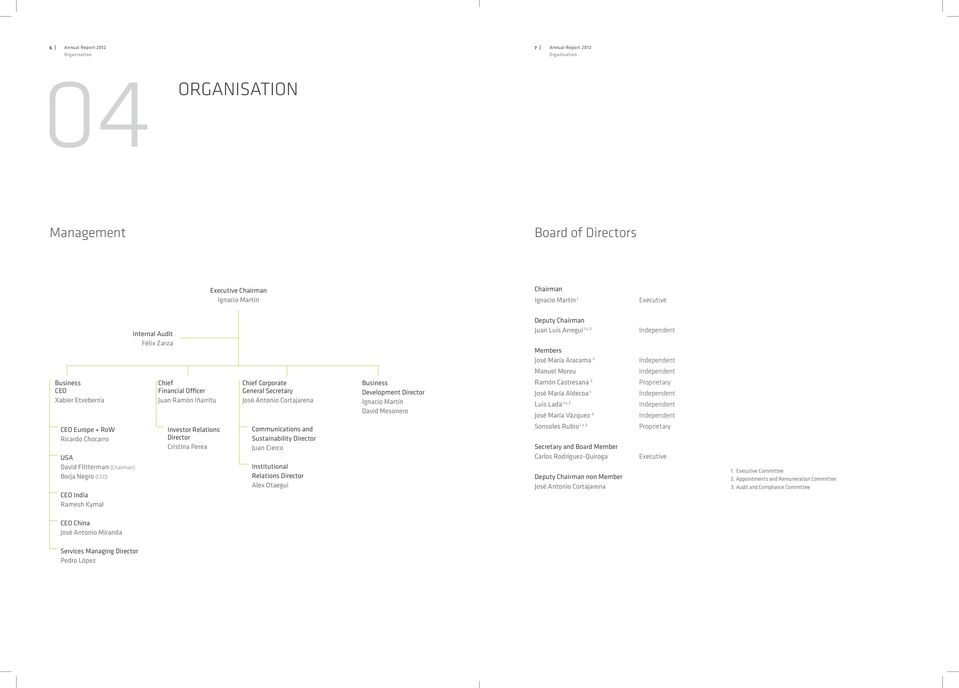
5 6 7 Organisation Organisation 04 organisation Management Board of Directors Executive Chairman Ignacio Martín Chairman Ignacio Martín 1 Executive Business CEO Xabier Etxeberria CEO Europe + RoW Ricardo Chocarro USA David Flitterman (Chairman) Borja Negro (CEO) CEO India Ramesh Kymal Internal Audit Félix Zarza Chief Financial Officer Juan Ramón Iñarritu Investor Relations Director Cristina Perea Chief Corporate General Secretary José Antonio Cortajarena Communications and Sustainability Director Juan Cierco Institutional Relations Director Alex Otaegui Business Development Director Ignacio Martín David Mesonero Deputy Chairman Juan Luis Arregui 1 & 2 Members José María Aracama 2 Manuel Moreu Ramón Castresana 2 José María Aldecoa 1 Luis Lada 1 & 3 José María Vázquez 3 Sonsoles Rubio 1 & 3 Secretary and Board Member Carlos Rodríguez-Quiroga Deputy Chairman non Member José Antonio Cortajarena Independent Independent Independent Proprietary Independent Independent Independent Proprietary Executive 1. Executive Committee 2. Appointments and Remuneration Committee 3. Audit and Compliance Committee CEO China José Antonio Miranda Services Managing Director Pedro López
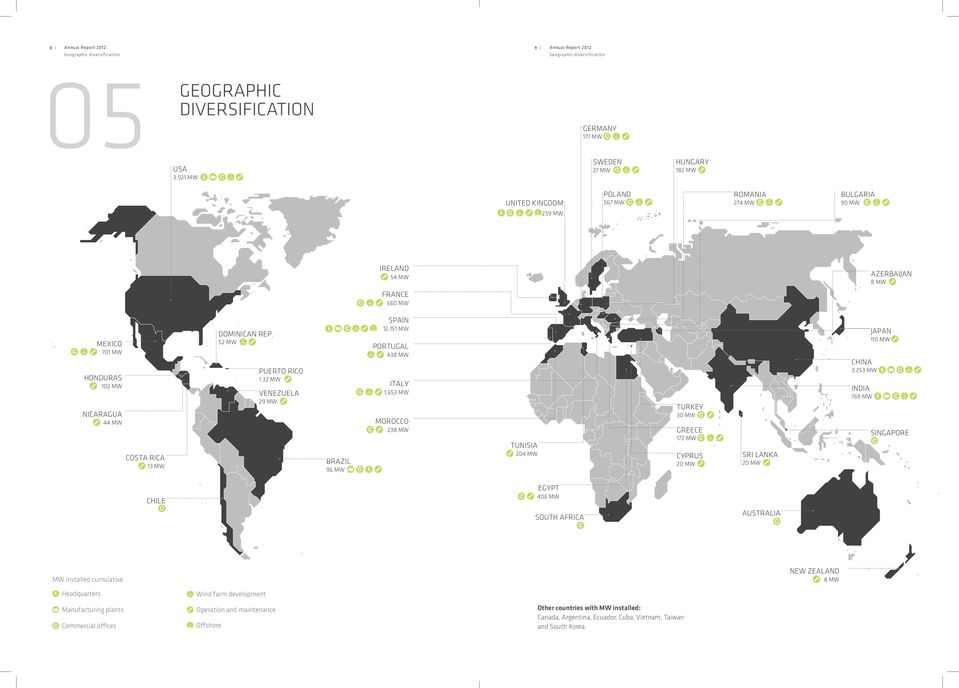
6 8. Geographic diversification 9 Geographic diversification 05 geographic diversification Germany 177 MW USA 3,921 MW Sweden 27 MW Hungary 182 MW United Kingdom 259 MW Poland 567 MW Romania 274 MW Bulgaria 90 MW Ireland 54 MW Azerbaijan 8 MW France 660 MW MEXICO 701 MW HONDURAS 102 MW NICARAGUA 44 MW COSTA RICA 13 MW DOMINICAN REP. 52 MW Puerto Rico 1.32 MW VENEZUELA 29 MW BRAZIL 96 MW Spain 12,151 MW Portugal 438 MW Italy 1,653 MW Morocco 238 MW Tunisia 204 MW Turkey 30 MW Greece 172 MW Cyprus 20 MW Sri Lanka 20 MW China 3,253 MW India 769 MW Japan 110 MW Singapore CHILE Egypt 406 MW South Africa Australia MW installed cumulative New Zealand 8 MW Headquarters Manufacturing plants Commercial offices Wind farm development Operation and maintenance Offshore Other countries with MW installed: Canada, Argentina, Ecuador, Cuba, Vietnam, Taiwan and South Korea.
7 10 Informe Anual Carta Aerogeneradores del presidente Industry context 06 industry context 282,430 MW installed worldwide (cumulative) 44,711 MW installed in 2012 Last year was a tough year for the wind energy sector, shaped by more sluggish growth closely linked to a number of factors. On the one hand, there was a temporary dip in demand for electricity in developed countries due to the economic slowdown; as a result, existing capacity was sufficient to cover electric power demand. Accordingly, there was a contraction in demand for new wind energy facilities and a shift in demand towards emerging markets. At the same time, policies supporting renewable energy continued to be pared down in a number of countries, in a bid to tackle their sizeable debt and in the context of the austerity policies. This trend has had a direct impact on the IRR of wind projects, on top of the difficulties in accessing funding in the current context, all of which has hampered electric utilities investment plans. To complete this tough picture, the wind energy sector has surplus manufacturing capacity, which is pressuring prices and manufacturers margins. However, the difficult economic and sector situation did not prevent the industry from installing a record 44,711 MW in 2012, i.e. 10% more than in the previous year, bringing total global capacity to 282,430 MW, according to Global Wind Energy Council (GWEC) figures. The United States and China vied for world leadership, both having installed just over 13 GW last year. However, while capacity in the US increased by 27%, China saw a significant slowdown. In the US, in a race against the imminent expiry at the end of 2013 of the production tax credits (PTC, extended in January 2013 until 2014), over 8,000 MW were installed in the fourth quarter of 2012, more than half of the year s total of 13,124 MW. Overall, 2012 was a historic year for wind energy, which became the largest single source of electric power generation in terms of new installed capacity (42% of the total) for the first time, according to American Wind Energy Association (AWEA) data. What is just as striking as the new records is the expansion of new customers. A total of 66 utilities bought or owned wind power in 2012, up from 42 in 2011, said AWEA CEO Rob Gramlich. Also in North America, installed capacity increased by 17% (935 MW in 2012) in Canada and more than doubled in Mexico, with 801 MW becoming operational, making a total of 1,370 MW; this brought the number of countries having more than 1,000 MW of total installed capacity to 24. Demand in Mexico is based on the competitiveness of wind power due to the high resource in the regions of Oaxaca and northern Mexico, and the potential to export power to the US from Baja California. In the next few years, Mexico s Energy Secretariat expects between 350 and 1,500 MW to be installed, depending on progress with nuclear power.

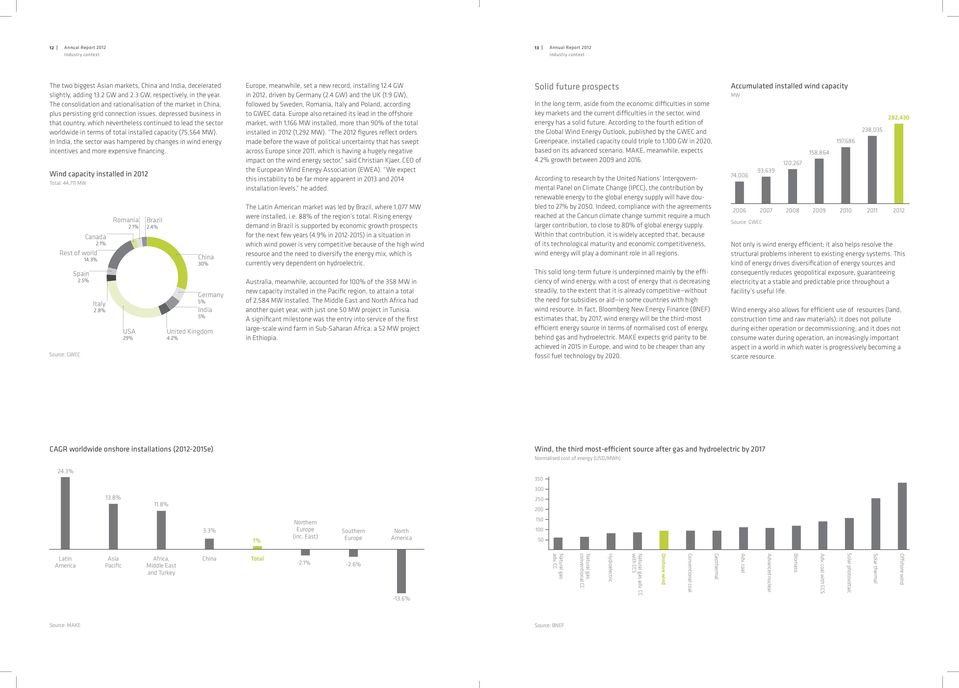
8 12 13 Industry context Industry context The two biggest Asian markets, China and India, decelerated slightly, adding 13.2 GW and 2.3 GW, respectively, in the year. The consolidation and rationalisation of the market in China, plus persisting grid connection issues, depressed business in that country, which nevertheless continued to lead the sector worldwide in terms of total installed capacity (75,564 MW). In India, the sector was hampered by changes in wind energy incentives and more expensive financing. Wind capacity installed in 2012 Total: 44,711 MW Canada 2.1% Rest of world 14.3% Source: GWEC Spain 2.5% Italy 2.8% Romania 2.1% USA 29% Brazil 2.4% China 30% Germany 5% India 5% United Kingdom 4.2% Europe, meanwhile, set a new record, installing 12.4 GW in 2012, driven by Germany (2.4 GW) and the UK (1.9 GW), followed by Sweden, Romania, Italy and Poland, according to GWEC data. Europe also retained its lead in the offshore market, with 1,166 MW installed, more than 90% of the total installed in 2012 (1,292 MW). The 2012 figures reflect orders made before the wave of political uncertainty that has swept across Europe since 2011, which is having a hugely negative impact on the wind energy sector, said Christian Kjaer, CEO of the European Wind Energy Association (EWEA). We expect this instability to be far more apparent in 2013 and 2014 installation levels, he added. The Latin American market was led by Brazil, where 1,077 MW were installed, i.e. 88% of the region s total. Rising energy demand in Brazil is supported by economic growth prospects for the next few years (4.9% in ) in a situation in which wind power is very competitive because of the high wind resource and the need to diversify the energy mix, which is currently very dependent on hydroelectric. Australia, meanwhile, accounted for 100% of the 358 MW in new capacity installed in the Pacific region, to attain a total of 2,584 MW installed. The Middle East and North Africa had another quiet year, with just one 50 MW project in Tunisia. A significant milestone was the entry into service of the first large-scale wind farm in Sub-Saharan Africa: a 52 MW project in Ethiopia. Solid future prospects In the long term, aside from the economic difficulties in some key markets and the current difficulties in the sector, wind energy has a solid future. According to the fourth edition of the Global Wind Energy Outlook, published by the GWEC and Greenpeace, installed capacity could triple to 1,100 GW in 2020, based on its advanced scenario. MAKE, meanwhile, expects 4.2% growth between 2009 and According to research by the United Nations Intergovernmental Panel on Climate Change (IPCC), the contribution by renewable energy to the global energy supply will have doubled to 27% by Indeed, compliance with the agreements reached at the Cancun climate change summit require a much larger contribution, to close to 80% of global energy supply. Within that contribution, it is widely accepted that, because of its technological maturity and economic competitiveness, wind energy will play a dominant role in all regions. This solid long-term future is underpinned mainly by the efficiency of wind energy, with a cost of energy that is decreasing steadily, to the extent that it is already competitive without the need for subsidies or aid in some countries with high wind resource. In fact, Bloomberg New Energy Finance (BNEF) estimates that, by 2017, wind energy will be the third-most efficient energy source in terms of normalised cost of energy, behind gas and hydroelectric. MAKE expects grid parity to be achieved in 2015 in Europe, and wind to be cheaper than any fossil fuel technology by Accumulated installed wind capacity MW 74, Source: GWEC 93, , , , , , Not only is wind energy efficient; it also helps resolve the structural problems inherent to existing energy systems. This kind of energy drives diversification of energy sources and consequently reduces geopolitical exposure, guaranteeing electricity at a stable and predictable price throughout a facility s useful life. Wind energy also allows for efficient use of resources (land, construction time and raw materials); it does not pollute during either operation or decommissioning; and it does not consume water during operation, an increasingly important aspect in a world in which water is progressively becoming a scarce resource. cagr worldwide onshore installations ( e) 24.3% Wind, the third most-efficient source after gas and hydroelectric by 2017 Normalised cost of energy (USD/MWh) % 11.8% % 1% Northern Europe (inc. East) Southern Europe North America Latin America Asia Pacific Africa, Middle East and Turkey China Total -2.1% -2.6% -13.6% Natural gas adv. CC Natural gas conventional CC Hydroelectric Natural gas adv. CC with CCS Onshore wind Conventional coal Geothermal Adv. coal Advanced nuclear Biomass Adv. coal with CCS Solar photovoltaic Solar thermal Offshore wind Source: MAKE Source: BNEF
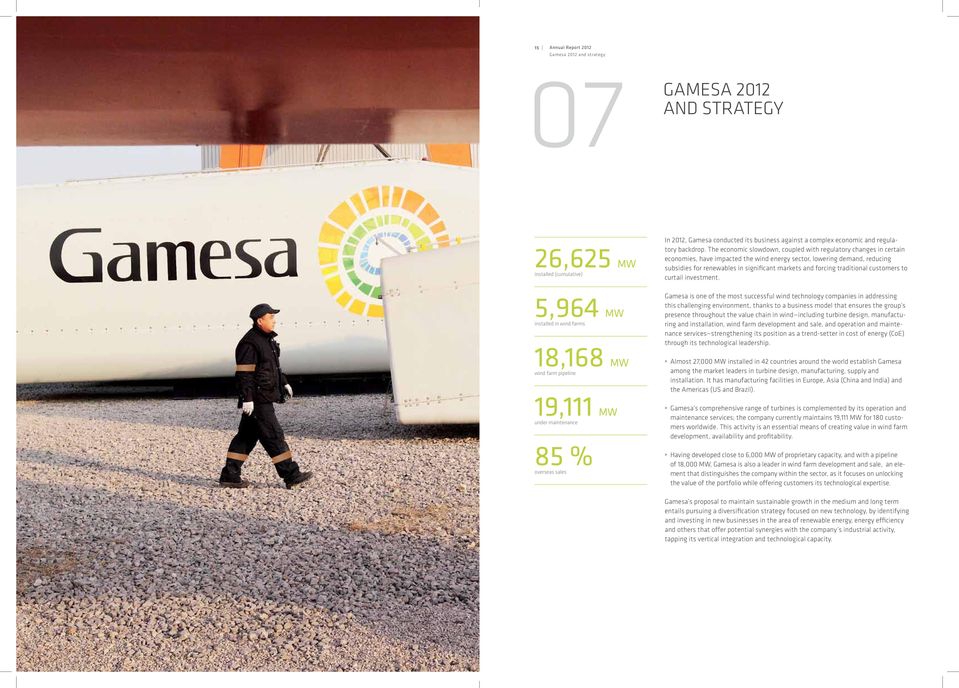
9 14 Informe Anual 2012 Gamesa 2012 y su estrategia 15 Gamesa 2012 and strategy 07 gamesa 2012 and strategy 26,625 MW installed (cumulative) 5,964 MW installed in wind farms 18,168 MW wind farm pipeline 19,111 MW under maintenance 85 % overseas sales In 2012, Gamesa conducted its business against a complex economic and regulatory backdrop. The economic slowdown, coupled with regulatory changes in certain economies, have impacted the wind energy sector, lowering demand, reducing subsidies for renewables in significant markets and forcing traditional customers to curtail investment. Gamesa is one of the most successful wind technology companies in addressing this challenging environment, thanks to a business model that ensures the group s presence throughout the value chain in wind including turbine design, manufacturing and installation, wind farm development and sale, and operation and maintenance services strengthening its position as a trend-setter in cost of energy (CoE) through its technological leadership. Almost 27,000 MW installed in 42 countries around the world establish Gamesa among the market leaders in turbine design, manufacturing, supply and installation. It has manufacturing facilities in Europe, Asia (China and India) and the Americas (US and Brazil). Gamesa s comprehensive range of turbines is complemented by its operation and maintenance services; the company currently maintains 19,111 MW for 180 customers worldwide. This activity is an essential means of creating value in wind farm development, availability and profitability. having developed close to 6,000 MW of proprietary capacity, and with a pipeline of 18,000 MW, Gamesa is also a leader in wind farm development and sale, an element that distinguishes the company within the sector, as it focuses on unlocking the value of the portfolio while offering customers its technological expertise. Gamesa s proposal to maintain sustainable growth in the medium and long term entails pursuing a diversification strategy focused on new technology, by identifying and investing in new businesses in the area of renewable energy, energy efficiency and others that offer potential synergies with the company s industrial activity, tapping its vertical integration and technological capacity.
10 16 Gamesa 2012 and strategy 17 Gamesa 2012 and strategy New strategy Despite the difficulties in the economy and the industry and the highly competitive market, Gamesa fulfilled its guidance in 2012 and laid the groundwork to recover profitability and create value, bolstered by the Business Plan that the company presented in October. Not only is this new strategy aimed at tackling the immediate economic situation, but it also lays the foundations for strengthening Gamesa as a leading player in the wind energy industry, through a number of strategies and actions: operating excellence, to operate profitably in the short, medium and long term, without relinquishing growth opportunities, based on: - A variable cost optimisation programme, leveraged upon adapting capacity to demand, enhancing manufacturing processes (standardising components and new processes), a make & buy strategy, maximising the supply chain in Spain and China, and a presence in consolidated and emerging markets with growth prospects. - A corporate structure that is suited to the current market and in line with an efficient operating model: organisation by processes, lean and results-oriented, but without compromising on flexibility. presence throughout the wind energy value chain, in order to optimise the cost of energy (CoE) through technological leadership: - focusing sales efforts on key markets, tapping wind farm development as a sales channel and opening new markets and securing new customers. This is based on a new business model enabling Gamesa to develop farms while ensuring its technological role, but without consuming its own financing, using external funding vehicles and enabling it to reduce debt and improve working capital. And developing operation and maintenance (O&M) services, which are key to boosting the company s technological leadership, as the basis for growth, centred upon those segments with the greatest added value. - optimising the cost of energy (CoE) through a product range focused on two new platforms, 2.5 MW and 5 MW (the latter suitable for onshore and offshore use), which will be available from mid- and late 2014, respectively, that are oriented to meeting market needs (95% of demand in the next few years). Solid balance sheet, reducing debt through stringent control of working capital and capital expenditure, underpinned by the new approach to wind farm development and sale. Implementation of the business plan required the company to adapt its balance sheet to the organisation s new scale, its new operating model and product strategy, as well as the market context, leading to a series of adjustments in the balance sheet that have impacted the bottom line. Within the strategy to dimension capital expenditure in line with the size of the business and customers cost of energy optimisation requirements, Gamesa closed 2012 with capex amounting to 190 million euro, to adapt the manufacturing capacity to the new platforms, and to develop its industrial presence in India and Brazil. Performance in 2012 Gamesa s revenues in 2012 amounted to 2,844 million euro, and EBIT before extraordinary items was positive. To align the company s balance sheet with the market reality and the Business Plan, Gamesa booked 600 million euro in writedowns, with an impact on the group s net profit (-659 million euro). Wind turbine sales (2,119 MWe) reflect more sluggish demand and the strategy to contain working capital by aligning manufacturing with deliveries and payments. Latin America and the Southern Cone (32%) is the main growth driver. The US contributed 20%; Europe and RoW 27%, and China and India 10% and 12%, respectively. The 1,657 MW of firm orders at 2012 year-end, against a backdrop of waning demand, evidence the rewards of the commercial diversification strategy and the boost from emerging markets, and account for more than 50% of projected 2013 sales volume. Revenues at the operation and maintenance services (O&M) division were up 23% to 344 million euro, and MW under maintenance rose by 17% (19,111 MW). Gamesa ended 2012 with a solid financial position: net interest-bearing debt of 495 million euro, after generating 690 million euro in net free cash flow in the fourth quarter and 216 million euro in the full year. Moreover, aligning the balance sheet to the market situation and the Business Plan has allowed the company to obtain a healthy equity position, which, in addition to the access to 2.2 billion euro in credit lines, ensures that the company will be able to implement its Business Plan without the need for additional funding. Progress in strategic actions Progress has also been made with the measures to optimise the cost of energy (CoE) through technological leadership. In addition to the planned development of new products, in January, Gamesa signed a preliminary agreement with Impax, an infrastructure fund manager, to develop 183 MW of the wind farm pipeline in Germany under the wind farm division s new business model. Furthermore, new operation and maintenance contracts for 664 MW were signed in January. Global presence and commercial positioning The demand outlook in 2013 remains sluggish, with a projected 12% decline in demand in the year, due mainly to the market situation in the US and China. Consequently, emerging markets are now the driver for growth in demand for wind energy facilities in the period. Of these markets, Latin American countries, most notably Brazil and Mexico, are set to play a pivotal role in the next three years in driving demand growth for wind energy facilities, with an estimated increase of 25%. Gamesa is already in a sound position in these markets, underpinned by its local knowledge, based on local teams and supply chains, coupled with knowledge of customers requirements and the reliability of both its products and its project execution (knowledge of grid connection requirements, administrative regulations, etc.). In 2012, Gamesa was among the leading manufacturers in Mexico, Brazil and India. Gamesa s presence throughout the wind value chain Throughout 2012 and in early 2013, Gamesa has made headway in strategic actions aimed at recovering profitability in a context of slower growth. To streamline the operating structure, Gamesa implemented a series of cost containment measures and has attained 90% of the target set for 2013, which it expects to meet fully in the first quarter of Gamesa customer profile % of MW installed per year Utilities IPPs Energy Investors wind farms WIND TURBINES 5.9 GW 26.6 GW DEVELOPMENT services 19.1 GW O&M GENERATION (RE)CYCLE Gamesa continues to develop its supply chain and its internal manufacturing processes. The company is implementing a number of actions to reduce large component manufacturing and procurement costs, such as pooling technological and manufacturing know-how with strategic suppliers. At the same time, it is diversifying its supplier base. 19.5% 6.2% 13.5% 10.9% 13.6% 8% 23.2% 0.7% 19.9% Prospecting Paperwork Delivery exworks EPC (1) /Logistics/ Construction Operation and maintenance Energy management 1-12 months months months Ongoing during 20+ years (1) Engineering, procurement, construction Not covered by Gamesa Repowering Decommissioning The company has also launched new manufacturing processes with the goal of optimising costs and helping to improve the cost of energy (CoE): infusion moulding for blade production (estimated savings of 25% in 2015) has already been applied in India and is expected to be introduced in Europe in new products for delivery from A new tower design has also been devised, reducing the weight/cost by up to 10%-12% in New transport systems and tools are being developed to offset the higher logistics costs resulting from greater commercial diversification. 38% 27.6% 31.4% 45.6% 50.2% 47% 53% 44% 23% 29% e

11 18 Informe Anual 2012 Aerogeneradores 19 Wind turbines 08 wind turbines 26,625 MW installed (cumulative) 42 countries worldwide 2,119 MWe sold in ,625 MW installed in 2012 Nineteen years experience, in which it has installed close to 27,000 MW in over forty countries, establish Gamesa as a global technology leader in the wind industry. In 2012, the wind turbine division was affected by the complex situation in the wind industry, with falling demand and pressure on prices in the markets that have historically had the greatest potential for wind energy development. Sales amounted to 2,119 MW in 2012, i.e. 24% less than in 2011 as a result of aligning orders to demand. Nevertheless, sales diversification and a presence in emerging markets enabled the division to end the year with 22 million euro in EBIT before extraordinary items. The decline in sales was partly offset by higher average revenues per MW as a result of the geographic mix of sales, the growing importance of the Gamesa 2 MW platform, the launch of the G MW platform, and growth by projects with a larger civil engineering component. Contrasting with the slump in demand in key markets such as China and India, emerging markets became the main growth driver and will continue to drive activity in the medium term. The company s positioning in those countries is supported by three fundamental factors: local know-how, knowledge of customers needs, and products reliability. In 2012, the company continued to focus on strict control of capital expenditure while ensuring a return on investment and a solid balance sheet, which is one of the key points of the Business Plan. Capital expenditure amounted to 190 million euro in 2012, compared with 229 million euro in 2011: R&D in new products and platforms (G MW, G MW, Gamesa 4.5 MW and offshore). Blade plant in India for the Gamesa 850 kw and Gamesa 2 MW platforms. Adapting production capacity to the G MW. Investment to manufacture the Gamesa 4.5 MW platform. Establishment in Brazil.

12 20 Wind turbines 21 Wind turbines Solid commercial diversification Gamesa s geographical diversification has enabled it to maintain a significant level of activity despite the tough conditions in the economy and the industry. The company sold 2,119 MWe of wind turbines in 2012, beating its own guidance (2,000 MWe). Latin America and the Southern Cone was the region that contributed most to sales (32%), making it the main growth driver of this activity. In that region, Gamesa opened up two new markets through agreements to supply twenty-five 2.0 MW wind turbines for a wind farm being developed by Abengoa in Uruguay, and a turnkey construction, supply and commissioning contract for a 44 MW farm owned by Eolo de Nicaragua in Nicaragua. In September, Gamesa won a contract to supply 258 MW for the 10 wind farms that Santa Vitória do Palmar Holding comprising the Río Bravo Energía I mutual fund and Eletrosul (subsidiary of Brazilian electric utility Eletrobras) is to develop in Río Grande do Sul State, in southern Brazil. This agreement includes the supply and installation of a total of 129 G MW wind turbines, as well as operation and maintenance services for 20 years. Since it entered Brazil just two years ago, Gamesa has signed agreements to supply a total of 652 MW in projects to be implemented in three of the main regions in terms of wind energy potential: Ceará, Bahía and Río Grande do Sul. This new contract has significant implications for the company, not only because of its scale (it is one of the biggest orders in the Brazilian wind energy market) but also because it is the first contract signed with a subsidiary of Brazil s national electric utility, which accounts for 36% of the country s electric power generation and is also present in Uruguay, Peru, Nicaragua, Argentina and Venezuela. The United States accounted for 20% of total wind turbine sales. In 2012, the company supplied its first G MW Class IIIA turbine to this market, at the Big Blue farm being developed by Exergy Development Group in Blue Earth, Minnesota. Europe and RoW contributed 27% to sales, driven mainly by deliveries in Italy and the UK in the second half. Gamesa will take part in Iberdrola s first repowering project in the UK, with the installation of ten G MW machines at the Carland Cross wind farm, which was commissioned in The new turbines will replace the 15 current units, with a unit capacity of 0.4 MW. India accounted for 12% of sales in 2012, compared with 19% in 2011, due mainly to changes in energy incentives and more costly financing there. Nevertheless, Gamesa s commercial success in India is evidenced by its 10% market share last year, making it the fourth-largest manufacturer in the country. Furthermore, the prospects are very positive due to the recent extension of GBIs (Generation Based Incentives) and the increase in the feed-in tariffs, as well as the five-year plan for , which envisages the installation of between 3,000 MW and 5,000 MW per year. China s contribution declined significantly, and, after accounting for almost a quarter of sales in 2011 (23%), it contributed barely 10% last year as a result of grid connection problems and delays in approving wind projects. MW installed 11% 89% MW installed in other countries MW installed in Spain MW sold, by platform Total 2012: 2,119 MWe Gamesa 850 kw 11% 85% 15% Gamesa 4.5 MW 1% New product strategy For 2013, Gamesa is focusing its efforts on developing a product range confined to two platforms that respond to market needs and reduce the cost of energy. For the mainstream segment, which accounted for 88% of MWe sold by Gamesa last year, the company will evolve its 2.0 MW platform to 2.5 MW. This new platform offers double-digit increases in swept area and in annual power output, is better adapted to the grid and makes less noise, all with the goal of reducing the cost of energy by over 10%. The 4.5 MW multi-megawatt platform will be ramped up to 5 MW (suitable for offshore and onshore use). This is an increasingly significant turbine, especially in mature markets, and is distinguished by its high availability, its easy transportation and compliance with the most stringent grid connection standards. Furthermore, working with a single platform for onshore and offshore will boost the company s operating experience in this segment, allowing shared and more reliable technical development. The multi-megawatt platform reduces the environmental impact of wind farms by obtaining the same capacity with fewer turbines, while also reducing civil engineering costs by between 10% and 45% per MW. This segment will be especially significant in markets with restrictions in regard to space and with the need for very high towers for installation in forest areas. Many of these markets are also the most mature and offer repowering opportunities without grid adaptability problems. Gamesa 2.0 MW 88% Geographic mix of sales Product strategy Total 2011: 2,802 MWe Total 2012: 2,119 MWe % 29% 27% < MW Mainstream 1-3 MW Multi MW Gamesa 850 kw Gamesa 2.0 MW / Gamesa 2.5 MW Gamesa 5.0 MW 14% 20% 23% 10% 19% 12% 15% Niche markets Adverse environments Dust/ Corrosion/Altitude India, China, South America, North Africa trending towards WTGs with more capacity and lower power density evolution towards CoE that is competitive with respect to traditional sources Very good adaptation to site Environment kit: High T/Low T/Anti-ice europe, North America, China, India, South America, North Africa Initial rationale: the offshore market is shifting rapidly towards larger capacity WTGs particularly for onshore markets with space restrictions/abrupt terrain and very demanding grid codes Common elements between onshore and offshore platforms Greater NPV for developer Germany, UK, Sweden, Finland, South-east China USA China India Latin America and Southern Cone Europe and others
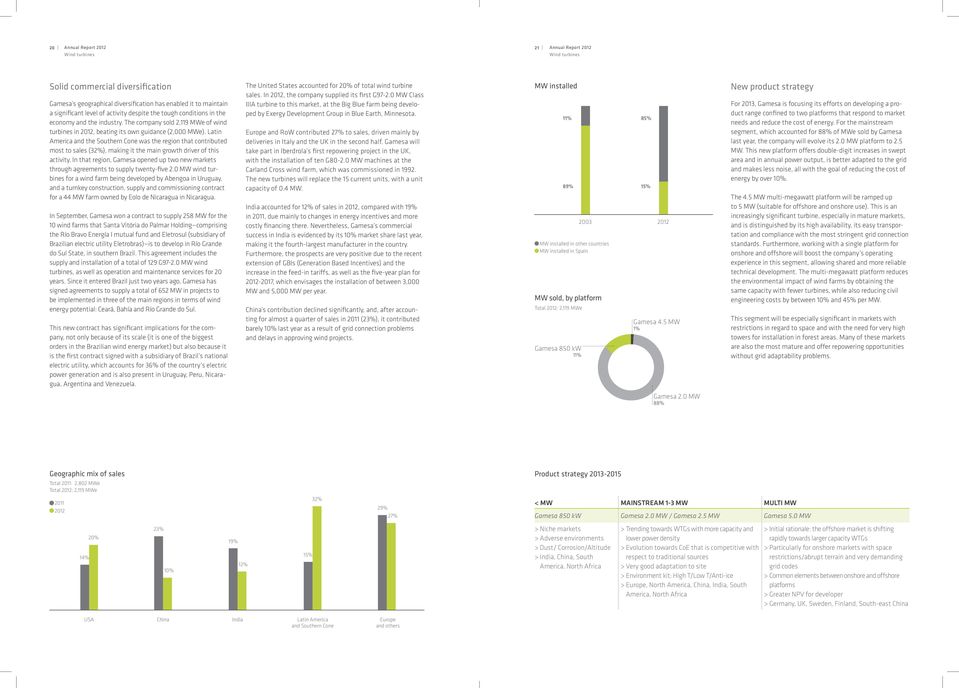
13 22 23 Wind turbines Wind turbines Main contracts 2012 UK Gamesa agrees to supply 10 wind generators for Iberdrola s first repowering project in the UK. FINLAND Gamesa enters the Finnish market with an order for 18 MW and a framework agreement for an additional 117 MW, all with 4.5 MW generators. CHINA Gamesa signs contract to supply 50 MW of G MW generators to Chinese electric utility Longyuan for the wind farm it is developing in Ningxia province. USA Gamesa agrees to supply its first G MW in the US to Exergy, in Minnesota. HONDURAS Inauguration of the largest wind farm in Latin America: 102 MW, comprised of 51 Gamesa G MW wind turbines. SPAIN Gamesa installs its first offshore prototype, the G MW, in Spain, at Arinaga (Gran Canaria) BRAZIL Gamesa strengthen its footprint in Brazil with a contract to supply 258 MW for the 10 wind farms that Santa Vitória do Palmar Holding is to develop in Río Grande do Sul State, in southern Brazil. URUGUAY Gamesa s first sale in Uruguay: 50 MW (25 G MW generators) to Abengoa. ITALY Gamesa signs contract to supply 30 MW for the wind farm being developed by Eólica Erchie in Brindisi province, Puglia region. India Gamesa signs contract to supply 75 MW to ReNew Wind Power in India. Last year, Gamesa won its first contract for this multi-megawatt platform and entered a new market, Finland, after securing an order for 18 MW from TuuliWatti Ltd, a wind energy joint venture between Finnish company St1 Ltd and national retail cooperative S-Group. The agreement entails the supply, installation and commissioning of four G128 turbines, each with a unit capacity of 4.5 MW, on 140-metre towers at the Simo wind farm in northern Finland. The supply of the turbines specifically configured for low temperatures is scheduled for the second quarter of 2013, and they are expected to commence operating in the fourth quarter of the year. The Simo wind farm turbines will be the largest installed in Finland to date. The farm will provide clean energy to 11,000 local households. The contract also includes a framework agreement for another 117 MW, all using 4.5 MW turbines, of which 54 MW have already materialised as firm orders for delivery in Also in the multi-megawatt segment, the platform installed in Finland (G MW) in 2012 became the first wind turbine generator in the world to obtain the TÜV Ecodesign certificate in accordance with ISO 14006/2011. Gamesa thereby guarantees the minimal environmental impact of this turbine throughout its life cycle: from the design of all components a stage in which 80% of the impacts generated by a product, process or service are defined to the selection of materials, manufacturing, packaging and distribution, installation, operation, maintenance and decommissioning. Gamesa remains firmly committed to participating in the offshore segment, although it has adjusted capital expenditure to match market developments. The company will have a certified prototype by early 2014 and plans to develop 7/8 MW platforms in the medium-to-long term. It also remains open to partnerships with other industrial companies and investors to share financing in this segment. Gamesa has started installing its first G MW offshore prototype in the port of Arinaga, in Gran Canaria (Spain), and it expects to commission it mid-2013, in order to obtain certification in the subsequent months and install the initial units in an offshore farm in A milestone in that calendar was the independent certification of the G MW offshore design by DNV (Det Norske Veritas). This certification implies an important step in the certification of the offshore platform, as a guarantee for the launch, marketing and industrialisation of the company s offshore platforms in the coming years. This offshore platform, with a 128-metre rotor and a modular, redundant design, guarantees reliability and maximises power output. The Gamesa G MW offshore incorporates technology that has been tried and tested by the company in its 4.5 MW platform and the expertise and experience acquired during its operation. Aside from the development of these new platforms, the last year was also important in terms of new product launches. At EWEA 2012, held in Copenhagen (Denmark), Gamesa presented its G MW Class IIIA turbine, which maximises returns in low wind sites. The turbine includes a new 114 metre rotor, with a swept area of 10,207 m², a 38% increase in the swept area and a 20% increase in the annual power output with respect to the G MW. Its 55.5-metre blade, aerodynamically designed with state-of-the-art technology, maximises power output while keeping noise to a minimum. The turbine has various tower heights, from 93 to 140 metres, depending on the location.
14 24 Informe Anual 2012 Promoción y venta de parques eólicos 25 Wind farm development and sale 09 Wind farm development and sale 18,168 MW in pipeline 5,964 MW developed for Gamesa 694 MW delivered in MW sale agreements in 2012 Gamesa s record as an industrial group in the renewables sector is rounded off with its presence, since 1995, in the development and sale of wind farms, a factor that distinguishes it in the market by focusing management on monetising the project pipeline while offering customers its technological expertise. Gamesa is a key player in this sector, having developed close to 6,000 MW and with a pipeline of 18,168 MW in different phases of development worldwide. The wind farm development and sale business includes all the activities linked to wind energy generation projects, from identifying sites to obtaining the necessary permits and licences for building and commissioning the installations, through to final sale of the farm, plus operation and maintenance once in service. This activity is a key element in Gamesa s wind energy value chain, as it is set up as a channel for obtaining sales and securing new markets and customers. This is based on a new business model that allows the company to develop farms, guaranteeing its technological role, using external funding vehicles and without consuming its own financing. In 2012, Gamesa s wind farm development and sale division was particularly active, having delivered 694 MW in Germany, France, Poland, Spain, the United States and Mexico. Furthermore, it signed sale agreements totalling 555 MW in the US, Mexico, France, Greece, Spain and Germany. At the end of the year, the company had 400 MW in the final phases of construction and commissioning as a result of implementing the new business model. In 2012, Gamesa decided to discontinue its development business in the US, due to low gas prices and regulatory volatility; however, it maintains its turbine manufacture and sales activities and its operation and maintenance services there.

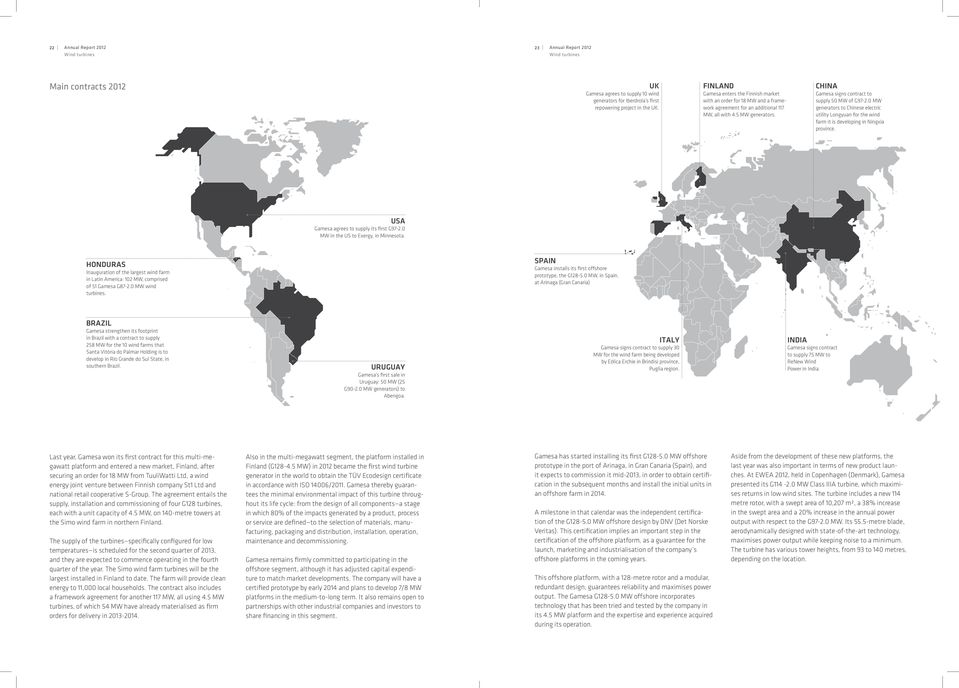
15 26 Wind farm development and sale 27 Wind farm development and sale Wind farm pipeline MW New business model 21,530 21,913 22,661 23,891 Gamesa s new business model in wind farm development and sale is focused on becoming a technology partner, monetising its expertise and project pipeline and guaranteeing a sales channel, but without consuming its own financing. 18,168 The first outcome of this strategy was the preliminary agreement to sell 183 MW of wind farms in Germany to Impax Asset Management, an infrastructure fund manager. In a turnkey agreement, Gamesa develops the wind projects, handles engineering, procurement and construction, supplies and installs the turbines and takes charge of operation and maintenance services for a period of 15 years In 2012, through its wind farms business, Gamesa strengthened and extended its customer portfolio by reaching agreements with several investor groups: Impax and KGAL, among others. Cumulative installed capacity MW ,161 The company reached an agreement to sell three wind farms in France and one in Germany, with a total installed capacity of 56 MW, to asset manager KGAL. It also sold two wind farms in Poland to the Polish renewables subsidiary of German group RWE. The two wind farms have a total installed capacity of 30 MW and 14 MW, respectively; this was Gamesa s third sale of a Polish wind farm to the RWE group in a year and-a-half ,578 4,114 4,972 5,964 During the year, Gamesa expanded in Latin America, specifically in Mexico, where it completed construction of the Bii Nee Stipa II wind farm in Oaxaca, developed for Enel Green Power. This wind farm comprises 37 G MW turbines and has a total installed capacity of 74 MW.
16 28 Informe Anual 2012 Servicios de operación y mantenimiento 29 Operation and maintenance services 10 operation and maintenance services 19,111 MW under maintenance 180 clients Operation and maintenance (O&M) rounds out Gamesa s comprehensive offering in the wind energy manufacturing business: this activity is conducted by a highly-qualified international team, which maintains more than 19,100 MW for 180 customers in 31 countries worldwide. O&M services are a key element of Gamesa s profitable growth because of their contribution to recurrent revenues, improving margins and generating cash flow. In 2012, Gamesa provided O&M services for 19,111 MW, i.e. 17% more than in the previous year. Revenues in the services business rose by 23% to 344 million euro. 31 countries worldwide 344 million sales in 2012 The services business is also an essential tool for value creation in the development, availability and profitability of a wind project. In this connection, Gamesa is working on value-added programmes aimed at maximising energy production, boosting wind turbine availability and reducing total operating costs, in order to optimise the cost of energy (CoE) for its customers: Gamesa s availability rate in all platforms and regions is 98%. More than 71% of Gamesa-installed MW aged two years or more have long-term O&M contracts, evidencing the degree of customer satisfaction with this service. In 2012, the retention rate of contracts expiring in the period was 91%. Growth levers Gamesa expects strong growth in operation and maintenance services in the next few years: cumulative sales ( ) will amount to 1.5 billion euro, while profitability in the business is set to double, and MW under maintenance will increase by 29%, to 24,600 MW, underpinned by technological leadership.
17 30 Operation and maintenance services 31 Operation and maintenance services MW under maintenance 29% 29, 600 Backed by 19 years of experience in O&M and the optimisation of wind turbines, Gamesa offers sophisticated technological solutions. The company is working to boost the development and sale of advanced solutions, including programmes to extend useful lives and improve the power curve, repair services for technology built by other manufacturers, and the supply of spare parts and enhancement of large components, as well as arranging finance tailored to each customer s needs as part of its ongoing commitment to offer maximum added value. 16,300 19,111 In 2012, Gamesa continued to diversify its customer base, with a greater bias towards customers whose priority is technology, such as IPPs and mutual funds. Main contracts e 2014e 2015e In 2012, Gamesa signed after-sales service contracts amounting to 698 million euro, more than doubling the previous year s figure. During the year, the company reached an agreement with Finnish company TuuliWatti to supply multi-megawatt wind turbine generators in the 4.5 MW platform, including a 10-year O&M contract with the option of a five-year extension. Diversification of the customer base % of total MW 92% ** In the first quarter of 2013, Gamesa continued to broaden its operating and maintenance services portfolio with agreements to maintain 664 MW. These projects include managing 264 MW over ten years at a wind farm in Virginia (US), owned by NedPower. The Mount Storm wind farm one of the largest in operation in the eastern United States has 132 G MW wind turbines, operated and maintained by Gamesa since the project came into service in % * 62% * In early March, Gamesa won an O&M contract for 80 wind farms owned by Iberdrola in Spain and Portugal, with total installed capacity of 2,286 MW. The company will handle the maintenance of 1,143 Gamesa 2.0 MW wind turbines for a three-year period, with the option of a two-year extension. Iberdrola has also awarded Gamesa an O&M contract for three wind farms in Hungary, with total installed capacity of 158 MW e Others Investment funds IPPs Electric utilities * Electric utilities' MW as % of total ** Increase in MW under maintenance for "non-utility" clients

18 32 Informe Anual 2012 Servicios de operación y mantenimiento 33 Technological diversification 11 Technological diversification Gamesa also supports businesses that offer synergies with its industrial activities Technological diversification is a key element for Gamesa s sustainable medium- and long-term growth, tapping new technologies and gaining footholds in new markets, by identifying and investing in new businesses and companies that develop proprietary technology, within the sphere of renewable energy generation, energy efficiency and others that offer synergies with the company s industrial and strategic activity. Gamesa s technological capacity and its vertical integration approach have enabled it to strengthen its position as a global leader in electric power equipment for markets such as photovoltaic, hydroelectric and nuclear, as well as electric traction and marine propulsion, in addition to wind. The investment undertaken by the company to drive technological and industrial development has enabled it to acquire considerable expertise and competitiveness with regard to the electrical component, underpinned by the development of the wind business. This process has enabled Gamesa to make a qualitative leap in its technical and manufacturing capacities, which it is able to leverage more intensely to drive other industrial segments in which it has been working for years through subsidiary Gamesa Electric, a global standard-bearer in the design and manufacture of electric power equipment. Gamesa Electric offers flexible end-to-end electric system solutions for wind, photovoltaic, hydroelectric and nuclear energies, electric traction and marine propulsion, with cutting-edge systems based on lean manufacturing, either through mass production or responding to the specific needs of its customers worldwide.

19 34 35 Technological diversification Technological diversification In the hydroelectric sector, the company s cumulative installed capacity reached 700 MW in In the photovoltaic segment, meanwhile, Gamesa Electric has installed more than 1,500 PV central inverters since it was incorporated, and offers cutting-edge technology for large-scale grid-connected solar farms. In 1993, the company designed and manufactured the first 450 kw PV central inverter and the first 100 kw IGBT PV inverter in Europe (which is still in service). In 2012, the company developed a new 1 MW photovoltaic central inverter, set to become the global benchmark in the segment of large farms because of its more competitive cost of energy (CoE), its reliability and its compliance with the most stringent grid connection codes. Gamesa operates in the solar energy business not only via Gamesa Electric but also through a minority stake in 9Ren, a company with proprietary technology and extensive experience with executing turnkey projects. As part of this technological diversification strategy, Gamesa is also committed to green mobility and, in 2012, it began marketing its first charging stations for electric vehicles. Through Gamesa Venture Capital, Gamesa supports the development of start-ups or growth companies that focus on highpotential renewable energy. Gamesa contributes its market position together with its technological, industrial and financial capacity and experience, thereby boosting value creation and and creating competitive advantages for enterprising ventures, with the possibility of joining the company in the medium-long term as a new business line or performing an IPO. Leading projects Gamesa Electric was particularly active in 2012, when it greatly increased order intake and entered new markets: Canada: supply of four generators for the Skookum and Jamie Creek hydro projects. Argentina: supply of 12 motors for the Atucha nuclear plant. united Kingdom: contract to supply a total of 29 PV central inverters for two photovoltaic farms. nigeria: the company s first hydroelectric project in Africa, supply of 48 MW for the Kashimbila project.

20 Consolidated Financial Statements

21 38 39 Translation of consolidated financial statements originally issued in Spanish and prepared in accordance with the regulatory financial reporting framework applicable to the Group (see Notes 2 and 38). In the event of a discrepancy, the Spanish-language version prevails. GAMESA CORPORACIÓN TECNOLÓGICA, S.A. AND SUBSIDIARIES GAMESA CORPORACIÓN TECNOLÓGICA, S.A. AND SUBSIDIARIES COMPOSING THE GAMESA GROUP CONSOLIDATED BALANCE SHEETS AT 31 DECEMBER 2012 AND 2011 (Thousands of euros) ASSETS Notes (*) EQUITY AND LIABILITIES Notes (*) COMPOSING THE GAMESA GROUP CONSOLIDATED INCOME STATEMENTS FOR THE YEARS ENDED 31 DECEMBER 2012 AND 2011 (Thousands of euros) NON-CURRENT ASSETS: EQUITY: Intangible assets- Of the Parent- 18 Goodwill Share capital Other intangible assets Share premium Other reserves Property, plant and equipment- 10 Unrealised asset and liability revaluation reserve (5.674) 702 Property, plant and equipment in use Translation differences Property, plant and equipment in the course of construction Treasury shares (7.157) (27.541) Net profit for the year ( ) Investments accounted for using the equity method Non-current financial assets- 13 Derivatives 28 Of non-controlling interests Investment securities Total equity Other non-current financial assets NON-CURRENT LIABILITIES: Deferred tax assets Provisions for contingencies and charges Total non-current assets Bank borrowings Other non-current liabilities Deferred tax liabilities Derivative financial instruments Total non-current liabilities CURRENT ASSETS: CURRENT LIABILITIES: Bank borrowings and other financial liabilities- Inventories Bank borrowings Trade and other receivables Derivative financial instruments Trade receivables from related companies Tax receivables Trade and other payables Other receivables Trade payables to related companies Current financial assets- Other payables- Derivative financial instruments Tax payables Other current financial assets Other current liabilities Other current financial assets from related companies Cash and cash equivalents Total current liabilities Total current assets Current assets classified as held for sale Current liabilities associated with assests classified as held for sale (Debit) Credit Notes (*) Continuing operations: Revenue 7 and 28.a /- Changes in inventories of finished goods and work in progress (57.401) Procurements 28.b ( ) ( ) Other operating income 28.a Staff costs 28.c ( ) ( ) Other operating expenses 28.d ( ) ( ) Depreciation 7 and 28.e (96.776) (98.693) Provisions 7 and 28.e ( ) ( ) Net impairment losses on assets 7, 9 and 10 ( ) - RESULTADO DE EXPLOTACIÓN ( ) Finance income 28.f Finance costs 28.g (71.556) (77.742) Exchange differences (gains and losses) (9.479) Net loss on disposal of non-current assets Net impairment losses 11 (24.647) (25.000) Results of companies accounted for using the equity method 11 (970) 146 PROFIT BEFORE TAX FROM CONTINUING OPERATIONS ( ) Income tax on profit from continuing operations (18.100) PROFIT FOR THE YEAR FROM CONTINUING OPERATIONS ( ) TOTAL ASSETS TOTAL EQUITY AND LIABILITIES (*) Presented for comparison purposes only. The accompanying Notes 1 to 38 and the Appendix are an integral part of the consolidated balance sheet at 31 December Discontinued operations: Profit from the year from discontinued operations 7 and 36 ( ) (17.598) PROFIT FOR THE YEAR ( ) Attributable to: Shareholders of the Parent 7 ( ) Non-controlling interests Profit from the year from discontinued operations attributable to: Shareholders of the Parent 36 ( ) (17.598) Non-controlling interests - - Total profir for the year Shareholders of the Parent ( ) Non-controlling interests Earnings per share in euros basic and dilutes 34 From continuing operations (2,0004) 0,2741 From discontinuedoperations (0,6297) (0,0702) Total Earnings per share in euros basic and dilutes (2,6301) 0, (*) Presented for comparison purposes only. The accompanying Notes 1 to 38 and the Appendix are an integral part of the consolidated income statement for
22 40 41 Translation of consolidated financial statements originally issued in Spanish and prepared in accordance with the regulatory financial reporting framework applicable to the Group (see Notes 2 and 38). In the event of a discrepancy, the Spanish-language version prevails. 4 GAMESA CORPORACIÓN TECNOLÓGICA, S.A. AND SUBSIDIARIES COMPOSING THE GAMESA GROUP CONSOLIDATED STATEMENTS OF COMPREHENSIVE INCOME FOR THE YEARS ENDED 31 DECEMBER 2012 AND 2011 Notes (*) CONSOLIDATED PROFIT FOR THE YEAR (I) ( ) Income and expense recognised directly in equity - Arising from cash flow hedges 18.c (17.714) Translation differences Tax effect 18.c (1.825) TOTAL INCOME AND EXPENSE RECOGNISED DIRECTLY IN EQUITY (II) (9.865) Transfers to profit or loss - Arising from cash flow hedges 18.c Tax effect 18.c (2.803) (2.450) TOTAL TRANSFERS TO PROFIT OR LOSS (III) TOTAL COMPREHENSIVE INCOME (I+II+III) ( ) a) Attributable to the Parent ( ) b) Attributable to non-controlling interests (*) Presented for comparison purposes only. The accompanying Notes 1 to 38 and the Appendix are an integral part of the consolidated statement of comprehensive income for Translation of consolidated financial statements originally issued in Spanish and prepared in accordance with the regulatory financial reporting framework applicable to the Group (see Notes 2 and 38). In the event of a discrepancy, the Spanish-language version prevails. GAMESA CORPORACIÓN TECNOLÓGICA, S.A. 3 AND SUBSIDIARIES COMPOSING THE GAMESA GROUP CONSOLIDATED STATEMENTS OF CHANGES IN EQUITY FOR THE YEARS ENDED 31 DECEMBER 2012 AND 2011 Restricted reserves Unrealised asset and liability Reserve for Reserve Share Share revaluation Legal Revaluation redenomination of for treasury Treasury Other Translation Net profit Non-controlling Total capital premium reserve reserve reserve capital in euros shares shares reserves differences for the year interests equity Balances at 1 January 2011 (*) (8.537) (34.188) Total comprehensive income for Distribution of 2010 profit: Other reserves (48.521) - - Dividend with a charge to 2010 profit (1.671) - (1.671) Scrip dividend and bonus issue (Note 18-a) (268) - (2.537) - (2.537) Treasury share transactions (Notes 3-o and 18-e) (6.647) incentive plan (Note 18-e) Transactions with non-controlling interests (Note 19) Balances at 31 December 2011(*) (27.541) Total comprehensive income for 2011 (6.376) ( ) 141 ( ) Distribution of 2011 profit: Otras reservas (49.430) - Dividend with a charge to 2011 profit (1.682) (1.682) Dividendo flexible y aumento de capital social liberado (Nota 18.a) (660) (461) (1.273) (1.273) Treasury share transactions (Notes 3-o and 18-e) (19.072) Incentive plans (Note 18-e) (1.312) Transactions with non-controlling interests (Note 19) Saldos al 31 de diciembre de (5.674) (7.157) ( ) (*) Presented for comparison purposes only. The accompanying Notes 1 to 38 and the Appendix are an integral part of the consolidated statement of changes in equity for 2012.
23 42 43 Translation of consolidated financial statements originally issued in Spanish and prepared in accordance with the regulatory financial reporting framework applicable to the Group (see Notes 2 and 37). In the event of a discrepancy, the Spanish-language version prevails. Gamesa Corporación Tecnológica, S.A. and Subsidiaries composing the GAMESA Group GAMESA CORPORACIÓN TECNOLÓGICA, S.A. AND SUBSIDIARIES CONSOLIDATED STATEMENTS OF CASH FLOWS FROM CONTINUING OPERATIONS FOR THE YEARS ENDED 31 DECEMBER 2012 AND 2011 (Thousands of euros) Notes to the Consolidated Financial Statements for the year ended 31 December Formation of the Group and its activities CONSOLIDATED STATEMENTS OF CASH FLOWS FROM CONTINUING OPERATIONS Notes (*) Cash flows from operating activities: Profit before tax from continuing operations ( ) Adjustments for- Depreciation and amortisation charge and provisions and allowances 9,10,22 and 28.e Incentive plan 18.e and 28.c Finance income and costs 28.f and 28.g Net loss on disposal of non-current assets (2.194) Net impairment losses on assets 10 and Changes in working capital: Change in trade and other receivables ( ) Change in inventories ( ) Change in trade and other payables (95.843) Effect on working capital of changes in consolidation method and/or scope (5.150) (613) Effect of translation differences on working capital of foreign companies (1.438) Provisions used for their intended purpose 22 ( ) (78.927) Income taxes paid (41.397) Interest received Net cash flows from operating activities (I) ( ) Cash flows from investing activities: Acquisition of subsidiaries, net of existing cash items - (4.386) Investments in intangible assets 9 (85.061) (91.690) Investments in property, plant and equipment 10 ( ) ( ) Investments in other non-current financial assets 13 (8.004) (7.079) Investments in other current financial assets - (2.874) Cobros por enajenaciones de inmovilizado intangible e inmovilizado material Cobros por enajenación de activos no financieros y activos financieros Net cash flows from investing activities (II) ( ) ( ) Cash flows from financing activities: Equity issue of subsidiaries New bank borrowings Dividends paid (3.366) (4.619) Interest paid (77.545) (72.816) Cash outflows relating to bank borrowings ( ) (42.274) Acquisition of treasury shares Net cash flows from financing activities (III) (44.222) Effect of foreign exchange rate changes on cash and cash equivalents (IV) (6.354) (11.451) The Company Gamesa Corporación Tecnológica, S.A. (hereinafter the Company or GAMESA ) was incorporated as a public limited liability company on 28 January Its registered office is located at Parque Tecnológico de Bizkaia, Edificio 222, Zamudio (Vizcaya - Spain). Its company object is the promotion and development of companies through temporary ownership interests in their share capital, for which it can perform the following transactions: a) Subscription and acquisition of shares, or securities that are convertible into shares, or which grant rights for their preferential acquisition, in companies whose shares may be listed or not on Spanish or foreign stock markets. b) Subscription and acquisition of fixed-income securities or any other securities issued by the companies in which it holds an interest, as well as the granting of participating loans or guarantees. c) Direct provision to investees of counselling, technical assistance and other similar services related to the management of investees, to their financial structure or to their production or marketing processes. The indicated activities will focus on the development, design, manufacture and supply of products, installations and technologically advanced services in the renewable energy sector. All the activities which make up the aforementioned company object may be carried on in Spain or abroad, and may be carried on indirectly (totally or partially) through the ownership of shares or other equity investments in companies with an identical or a similar corporate purpose. The Company may not carry on any business activity for which the applicable legislation provides for specific conditions or limitations unless it fully meets such conditions or limitations. The Company's bylaws and other public information on the Company may be consulted on the website and at its registered office. Effect of changes on cash and cash equivalents and of transfers to assets classified as held for sale (V) Net increase in cash and cash equivalents from continuing operations (I+II+III+IV+V) Cash and cash equivalents from continuing operations at beginning of year Total cash and cash equivalents from continuing operations at end of year (*) Presented for comparison purposes only. The accompanying Notes 1 to 38 and the Appendix are an integral part of the consolidated statement of cash flows for (1.031) ( ) In addition to the operations carried on directly by it, GAMESA is the head of a group of subsidiaries that engage in various business activities and which compose, together with the Company, the GAMESA Group ( the Group or the GAMESA Group ). Therefore, in addition to its own separate financial statements, the Company is obliged to present consolidated financial statements for the Group including its interests in joint ventures and investments in associates. The companies that form part of the Group are listed in the Appendix. The GAMESA Group currently operates as a manufacturing group and principal supplier of cuttingedge products, facilities and services in the renewable energy industry, structured in the following business units headed by the respective Group companies: 5 6
24 44 45 Consolidated of projects, financial which statementshave been determined and quantified and result in the need for a series of provisions for guarantees and other risks. Company Gamesa Eólica, S.L. Unipersonal Gamesa Energía, S.A. Unipersonal Main line of business Manufacture of wind generators (WTGSs) Development, promotion and sale of wind plants Within the context of the complex environment currently affecting the world economy in general, and the wind energy industry in particular, which leads to expectations of lower growth, during the second half of 2012 and after the change in the maximum levels of responsibility at GAMESA, the decision was taken to start the preparation of a new Business Plan for the period and it was finally published on 25 October Among other things, the aforementioned business plan contemplates the following measures, whose effects on the accompanying consolidating financial statements are disclosed in the indicated notes: - Rationalization of fixed expenses. Lower fixed expense structure by reducing payroll which allows for a structural size that is in line with the market situation and eliminate inefficiencies, as well as the closing of offices and service centres (Notes 3.q, 22 and 28.c). - Adaptation of the currently oversized production capacity to projected demand, at least in the short and medium term, and to the new platforms and the new product range, in line with existing and projected demand in the market. This orientation could mean the closing of manufacturing centres after 2012, taking into account the evolution of demand and the local regulatory requirements (Notes 3.f and 10). - Development of the Make/Buy strategy applied to all components as a basis for the industrial proposal through which the external supply of capital intensive components (such as the blades) will accelerate (Notes 3.f, 9 and 10). - Development of new manufacturing process, notably the blade manufacturing process using injected fiberglass (Notes 3.f, 9 and 10). - Product strategy consisting of two basic platforms, to address the evolution of the 2 MW to 2.5MW and the 4.5MW to the 5.5MW platforms. The latter has common elements for "onshore" and "offshore" facilities (Notes 3.f and 9). - New model to reduce inventories of products being manufactured and finished products and the optimization of raw material inventories as well as the inventory associated with Operations and Maintenance which will result, among other things, in a change in the mix of sales towards higher value-added services. There will be a definitive reduction in working capital that will make it possible to strengthen the balance sheet (Notes 3.g and 14). - Discontinuation of the development and sale of wind energy plants in the United States due to the regulatory uncertainty and volatility in that country, within the framework of the new strategic orientation of the Energy business model that gives rise to a focus on key markets and sales channels that do not consume financing (Notes 3.i and 36). - Maximum utilization of the supply and manufacturing chains in Spain and China, with a continuous focus on improving competitiveness in both operations and the assembly of nacelles in all key regions. The objectives and action plans deriving from the above considerations have had an impact on certain assets forming part of property, plant and equipment, intangible assets, inventories and other items. In addition, although not directly linked to the New Business Plan, in 2012 there have been regulatory changes (i.e. Spain) that have had an impact on the Group's assets and on the evolution As a result, the Group presents impairment before tax effects in the consolidated income statement of for projects, 2012 totalling which EUR have been million, determined as follows: and quantified and result in the need for a series of provisions for guarantees and other risks. of projects, which have been determined and quantified and result in the need for a series of provisions for guarantees and other risks. Continuing Discontinue As a result, the Group presents impairment before tax effects in the consolidated income statement operations d operations for 2012As totalling a result, EUR the Group presents million, impairment as follows: before tax effects in the consolidated income statement for 2012 totalling EUR million, as follows: Continuing Discontinue Gross operations operations d operations d operations amount (Million Note Note euro) Alignment of the balance sheet with the Business Plan : Property, plant and equipment and Intangible assets Inventories c) Accrued wages and salaries 22 and Other 28.c) 22 and c) Alignment of the balance sheet with the market situation: Investments accounted for using the equity method Portfolio of wind plants (inventories) 14 and Provisions and other Information on the environment- Information on the environment- In view of the business activities carried on by the GAMESA Group, it does not have any In viewenvironmental of the business liability, expenses, activitiesassets, carried provisions on byor the contingencies GAMESA thatgroup, might beitmaterial does with not have any environmental respect toliability, its equity, expenses, financial position assets, andprovisions results. Therefore, contingencies the directors did thatnot might include beany material with specific disclosures relating to environmental issues in these notes to the consolidated financial respect Information to itsonequity, the environment- financial position and results. Therefore, the directors did not include any statements. specific disclosures relating to environmental issues in these notes to the consolidated financial statements. In view of the business activities carried on by the GAMESA Group, it does not have any environmental 2. Basis of liability, presentation expenses, of the consolidated assets, provisions or contingencies that might be material with financial statements and basis of respect to its equity, financial position and results. Therefore, the directors did not include any consolidation 2. specific Basisdisclosures of presentation relating of to theenvironmental consolidatedissues in these notes to the consolidated financial statements. financial a) Basisstatements of presentation- and basis of consolidation The consolidated financial statements for 2012 of the GAMESA Group were formally prepared: 2. a) Basis Basisof ofpresentation- of the consolidated financial statements By the directors and of GAMESA, basis ofat the Board of Directors Meeting held on 7 February consolidation The consolidated Since 2005, financial in accordance statements with International for 2012 offinancial the GAMESA Reporting Group Standards were(ifrss) formally asprepared: adopted by the European Union, including the International Accounting Standards (IASs) a) Basis of presentation- By the andirectors the interpretations of GAMESA, issued at the by the Board International of Directors Financial Meeting Reporting held Interpretations 7 February Committee (IFRIC) and by the Standing Interpretations Committee (SIC). The consolidated The consolidated financial statements financial statements have been prepared for 2012 onof a the historical GAMESA cost basis, Group as were modified formally by theprepared: Sincerevaluation 2005, inof accordance available-for-sale with financial International assets and financial Financial assets Reporting and liabilities Standards (including (IFRSs) as adopted derivatives) by theateuropean fair value through Union, profit including and loss. thethe International principal accounting Accounting policies Standards (IASs) and By the the directors interpretations of GAMESA, issued at the by Board the International of Directors Meeting Financial held Reporting on 7 February Interpretations Committee (IFRIC) and by the Standing Interpretations Committee (SIC). The consolidated financial Since 2005, statements in accordance have been with prepared International afinancial historical Reporting cost basis, Standards as modified (IFRSs) by the as revaluation adopted byof the available-for-sale European Union, financial including assets theand International financial assets Accounting and liabilities Standards (including (IASs) derivatives) and the interpretations fair valueissued throughbyprofit the and International loss. TheFinancial principalreporting accounting 8 Interpretations policies and Committee (IFRIC) and by the Standing Interpretations Committee (SIC). The consolidated financial statements have been prepared on a historical cost basis, as modified by the revaluation of available-for-sale financial assets and financial assets and liabilities (including derivatives) at fair value through profit and loss. The principal accounting policies and Note Continuing Discontinue Gross amount (Million euro) Gross amount Alignment of the balance sheet with the Business Plan : (Million Property, plant and equipment euro) Alignment Intangible assets of the balance sheet with the Business Inventories Plan : Accrued Property, wages plant and andequipment salaries Intangible assets Other Inventories Accrued wages and salaries Alignment of the balance sheet with the market situation: Other Investments accounted for using the equity method Portfolio Alignment of wind of the plants balance (inventories) sheet with the market 14 and Provisions situation: and other Investments accounted for using the equity method Portfolio of wind plants (inventories) 14 and Provisions and other
25 measurement bases applied in preparing the GAMESA Group's consolidated financial statements for 2012 are summarised in Note 3. consolidated financial statements are presented in thousands of euro, which is Gamesa Group's functional and presentation currency. Taking into account all the mandatory accounting policies and rules and measurement bases with a material effect on the consolidated financial statements. So that they present fairly the consolidated equity and consolidated financial position of the GAMESA Group at 31 December 2012, and the consolidated results of its operations and its consolidated cash flows in the year then ended. On the basis of the accounting records kept by GAMESA and by the other Group companies. However, since the accounting policies and measurement bases used in preparing the Group's consolidated financial statements for 2012 (IFRSs) could differ from those used by the Group companies when preparing their individual financial statements in accordance with local standards, the required adjustments and reclassifications were made on consolidation to unify the policies and methods used and to make them compliant with International Financial Reporting Standards (IFRS). Transactions denominated in currencies other than the euro are recognised in accordance with the policies described in Note 3.l. d) Responsibility for the information- The information in these consolidated financial statements is the responsibility of GAMESA's Board of Directors. e) Information relating to the previous year- As required by IAS 1, the information relating to 2012 contained in these notes to the consolidated financial statements is presented, for comparison purposes, with the information relating to 2011 and, accordingly, it does not constitute the GAMESA Group's statutory consolidated financial statements for The consolidated financial statements of the GAMESA Group for 2011 were approved by the shareholders at the Annual General Meeting of GAMESA held on 29 June 2012 and were filed at the Vizcaya Mercantile Registry. The Group's 2012 consolidated financial statements have not yet been approved by the shareholders at the Annual General Meeting. However, the Board of Directors of GAMESA considers that these consolidated financial statements will be approved without any changes. b) Adoption of new or revised International Financial Reporting Standards (IFRS)- Mandatory standards, amendments and interpretation for all years starting 1 January 2012: IFRS 7 (Revised) Financial Instruments: Disclosures- Transfer of financial assets" The amendment of IFRS 7 requires that additional disclosures be made of exposure to risk deriving from financial assets transferred to third parties. It requires risk assessment and benefits be included with respect to transactions that do not qualify for the elimination of financial assets, and the identification of the associated financial liabilities and the details of information regarding transactions that did qualify for the elimination of financial assets increased: the result generated by the transaction, risks and remaining benefits and their initial and future recognition, and the estimated fair value of the "continued involvement" recognised in the balance sheet. Among others, this modification wold affect the sale transactions involving financial assets, factoring agreements, financial asset securitisation and securities loan agreements. In compliance with IFRS 5 Non-current assets held for sale and discontinued operations and in order to improve the comparability of 2012 and 2011, the breakdown in the accompanying consolidated income statement for 2011 has been adjusted to include the effect of the activities that were discontinued in Each item in the consolidated income statement for 2011 therefore relates to the information presented in the consolidated financial statements for 2011, increased or decreased, as appropriate, by the amount contributed in 2011 by the activities classified as discontinued in 2012 (Notes 3.i and 36). f) Basis of consolidation- Subsidiaries The subsidiaries over which the GAMESA Group exercises control were fully consolidated. Subsidiaries are all entities (including special-purpose companies) over which the Group has the power to govern the financial and operating policies generally accompanying a shareholding of more than one half of the voting rights. The existence and effect of potential voting rights that are currently exercisable or convertible are considered when assessing whether the Group controls another entity. The Group also evaluates the existence of control when it does not hold more than 50% of the voting rights but it is capable of directing the financial and operating policies through de facto control. Subsidiaries are consolidated from the date on which control is transferred to the Group. They are de-consolidated from the date that control ceases. This amendment to IFRS 7 is mandatory for all years commencing as from 1 January This amendment was taken into account when preparing the disclosures in the notes to the accompanying consolidated financial statements. Note 35 provides a detail of the most significant standards, amendments to standards and interpretations published by the IASB (International Accounting Standards Board) which at 31 December 2012 had not yet come into force. c) Functional and presentation currency- The accounting records kept by Group companies are measured using the currency of the principal economic environment in which the company operates («functional currency»). The Joint ventures
26 48 49 The multi-group companies that GAMESA Group managed together with other companies in 2011 were consolidated using the proportional method, in accordance with which the assets, liabilities, expenses and revenues for these companies were consolidated based on the stake held in them by GAMESA Group and were presented in the consolidated balance sheet and consolidated income statement in accordance with their specific nature. In 2012, GAMESA Group changed the criteria by recognizing the stakes using the equity method, without restating the comparative figures for 2011, given the little relevance of the figures involved with those businesses. Associated companies The associates over which the GAMESA Group is in a position to exercise significant influence, but not control, were accounted for in the consolidated balance sheet using the equity method. For the purpose of preparing these consolidated financial statements, it was considered that the GAMESA Group is in a position to exercise significant influence over companies in which it has an investment of between 20% and 50% of the share capital, except in specific cases where, although the percentage of ownership is lower, the existence of significant influence can be clearly demonstrated. Also, significant influence is deemed not to exist in cases where, although an ownership interest of more than 20% is held, the absence of significant influence can be clearly demonstrated. Significant influence is deemed to exist when the GAMESA Group has the power to influence the financial and operating policies of an investee (see Notes 2-g, 11 and 12). A list of GAMESA's subsidiaries and associates, together with the consolidation or measurement bases used in preparing the accompanying consolidated financial statements and other relevant information are disclosed in the Appendix. The operations of GAMESA and of the consolidated companies were consolidated in accordance with the following basic principles: The Group is considered to be carrying out a business combination when the assets acquired and liabilities assumed constitute a business. The Group accounts for each business combination by applying the acquisition method, which entails identifying the acquirer, determining the acquisition date -which is the date on which control is obtainedand cost of acquisition, recognising and measuring the identifiable assets acquired, the liabilities assumed and any non-controlling interest in the acquiree and, lastly, recognising and measuring goodwill or a gain from a bargain purchase. Goodwill arising as described in the preceding paragraph has not been amortised since 1 January 2004, the date of transition to IFRSs, although it is reviewed for impairment at least once a year (see Note 8). Goodwill is initially stated as the excess over the total compensation paid and the fair value of the non-controlling shareholding, if any, over the identifiable net assets acquired and the liabilities assumed. If the cost of acquisition is less than the fair value of the net assets of the subsidiary acquired, the difference is recognized directly in the income statement. Identifiable assets acquired and liabilities assumed are initially valued at their fair value at the acquisition date. (b) the proportional part that the current ownership instruments that represent in the amounts recognised by the acquiree as net identifiable assets. All other components of non-controlling shareholdings will be measured at their fair value at the date of acquisition, unless IFRS require another basis of valuation. The value of non-controlling shareholdings in the equity and results of the fully consolidated subsidiaries and any subsidiaries of proportionately consolidated jointly controlled entities is presented under Equity - Of Non-Controlling Interests in the consolidated balance sheet and Profit for the Year - Attributable to Non-Controlling Interests in the consolidated income statement. Any contingent compensation to be transferred by the Group is recognised at fair value on the date of acquisition. Subsequent changes in the fair value of the contingent compensation that is considered to be an asset or a liability are recognised in the income statement or a change in other comprehensive results in accordance with IAS 39. Contingent compensation that is classified as equity is not remeasured and subsequent payment is recorded under equity. Acquisitions-related costs are recognised as expenses in the year in which they are incurred and, therefore, are not considered to be an increase in the cost of the combination. In business combinations achieved in stages, the acquirer remeasures its previously held equity interest in the acquiree at its acquisition-date fair value and recognises the resulting gain or loss, if any, in profit or loss. Purchases and sales of non-controlling interests in companies that are and continue to be subsidiaries both prior and subsequent to the aforementioned transactions are considered to be transactions between shareholders and, therefore, the payments made will be recognised in the Group's consolidated equity (see Note 19). When the Group loses control over a subsidiary, it derecognises the subsidiary s assets (including goodwill) and liabilities and the non-controlling interest at the carrying amount thereof at the date on which control is lost.the consideration received and the investment retained in the aforementioned company are measured at their fair value at the date when control is lost and any gain or loss is recognised in profit or loss. The financial statements of foreign companies were translated to euros using the year-end exchange rate method. This method consists of translating to euros all the assets, rights and obligations at the exchange rates prevailing at the date of the consolidated financial statements, the consolidated income statement items at the average exchange rates for the year, and equity at the historical exchange rates at the date of acquisition (or in the case of retained earnings at the average exchange rates for the year in which they were generated), and the differences are recognised with a charge or a credit, as appropriate, to Equity - Of the Parent - Translation Differences in the consolidated balance sheet. The accompanying consolidated financial statements include certain adjustments to bring the accounting policies and procedures applied by the subsidiaries into line with those of GAMESA. At the date each business combination is acquired the buyer will measure the components of non-controlling shareholdings held by the acquiree that constitute current ownership and grant the holder the right to a proportional part of the company's net assets in the event of liquidation, at: (a) fair value, or All balances and transactions between fully or proportionately consolidated companies were eliminated on consolidation. Gains that arise on intra-group transactions that are recognised as assets are also eliminated (including transactions with associated companies). The result of accounting for ownership interests using the equity method (after eliminating results on intra-group transactions) is reflected under "Equity - Of the Parent Other Reserves" and Results of Companies Accounted for Using the Equity Method in the
27 50 51 accompanying consolidated balance sheet and consolidated income statement, respectively. The equity method consists of initially recognising the investment at cost and subsequently adjusting it, based on the changes in the portion of the entity's net assets that corresponds to the investor, recognising in the investor's profit or loss the corresponding portion of the investee's result for the year (see Note 11). g) Changes in the scope of consolidation- The most significant inclusions in the scope of consolidation in 2012 and 2011 were as follows: Incorporation of new companies 2012 Incorporated company Incorporating company Interest held by the Group Gamesa Venture Capital, S.C.R. de Régimen Simplificado, S.A. Gamesa Corporación Tecnológica, S.A. 100 % Unipersonal Gamesa Uruguay S.R.L (****) Gamesa Eólica, S.L. (Unipersonal) 100 % Gamesa Eólica Nicaragua, S.A. (***) Gamesa Eólica, S.L. (Unipersonal) 100 % Gamesa Kenya Limited S.L. (****) Gamesa Eólica, S.L. (Unipersonal) 100 % Gamesa Puerto Rico CRL Gamesa Eólica, S.L. (Unipersonal) 100 % Suchan Sp Z.o.o. Gamesa Energía, S.A. (Unipersonal) 100 % Wind Energy Construction Holdings I, LLC (**) Gamesa Energy USA, Inc. 100 % Wind Portfolio Memberco, LLC. (**) Gamesa Energy USA, Inc. 100 % Baja Wind Llc Gamesa Energy USA, Inc. 50% Energiaki Flabouro EPE (*) Gamesa Energía, S.A. (Unipersonal) (*) 100 % Torres Eólicas Do Brasil Ltda. Windar Renovables, S.L. 32% Wind Power Brasil S.L. Windar Renovables, S.L. 32% Windar Wind Services S.L. Windar Renovables, S.L. 32% Unipersonal Rajgarh Windpark Private, Ltd Gamesa Wind Turbines Private, Ltd 50% Fanbyn2 Vindenergi AB Gamesa Energy Sweden AB 100 % Kurnool Wind Farms Privated Ltd Gamesa Wind Turbines PTV, Lda 74% Kadapa Wind Farms Privated Ltd Gamesa Wind Turbines PTV, Lda 74% Anantapur Wind Farms Privated Ltd Gamesa Wind Turbines PTV, Lda 74% (*) Gamesa Energía S.A. holds 99% of the share capital of this Company, while Gamesa Inversiones Energéticas Renovables, S.C.R. de Régimen simplificado, S.A. (Sociedad Unipersonal) (*) Gamesa holdenergía the remaining S.A. holds 1%. 99% of the share capital of this Company, while Gamesa (**) Subsequently Inversiones Energéticas sold in Renovables, S.C.R. de Régimen simplificado, S.A. (Sociedad (***) Gamesa Unipersonal) Eólica, hold the S.L. remaining (Single-Shareholder 1%. Company) holds a 99.8% ownership interest in this company, (**) Subsequently and Gamesa sold in Innovation & Technology, S.L. (Single-Shareholder Company) holds(***) the remaining Gamesa Eólica, 0.2%. S.L. (Single-Shareholder Company) holds a 99.8% ownership interest in this company, and Gamesa Innovation & Technology, S.L. (Single-Shareholder Company) (****) Gamesa Eólica, S.L. (Single-Shareholder Company) holds a 99% ownership interest in holds the remaining 0.2%. this company, (****) Gamesa andeólica, Gamesa S.L. (Single-Shareholder Innovation & Technology, Company) S.L. holds(single-shareholder a 99% ownership interest Company) in holdsthis the company, remainingand 1%. Gamesa Innovation & Technology, S.L. (Single-Shareholder Company) holds the remaining 1%. At the end of 2012, the companies were consolidated using the full consolidation method, except Atfor the the endsubsidiaries of 2012, the of companies Windar Renovables, were consolidated S.L., using which thewere full consolidation consolidated method, using the equityexcept method. for the subsidiaries of Windar Renovables, S.L., which were consolidated using the equity method The detail The detail of the ofmain the main companies incorporated in 2011 is as follows: Incorporated Incorporated company company Incorporating company Interest Interest held by held by the Group the Group Gamesa Inversiones Energéticas Renovables, Eólica San Bartolomé, S.L. Gamesa Inversiones Energéticas Renovables, Eólica San Bartolomé, S.L. S.C.R. de Régimen simplificado, S.A. 100% Unipersonal S.C.R. de Régimen simplificado, S.A. 100% Unipersonal (Sociedad Unipersonal) (Sociedad Gamesa Inversiones Unipersonal) Energéticas Renovables, Jiloca Promociones Eólicas, Gamesa S.C.R. Inversiones de Régimen Energéticas simplificado, Renovables, S.A. 100% JilocaS.L. Promociones Unipersonal Eólicas, S.C.R. (SociedadeUnipersonal) Régimen simplificado, S.A. 100% S.L. Unipersonal (Sociedad Gamesa Inversiones Unipersonal) Energéticas Renovables, El Royal Energías Gamesa S.C.R. Inversiones de Régimen Energéticas simplificado, Renovables, S.A. 100% El Royal Renovables, EnergíasS.L. Unipersonal S.C.R. (Sociedad de Unipersonal) Régimen simplificado, S.A. 100% Renovables, GamesaS.L. Cyprus Unipersonal Limited Gamesa Eólica, S.L. Unipersonal 100% (Sociedad Unipersonal) Gamesa Energy Sweden AB Gamesa Energía, S.A. Unipersonal 100% Gamesa International Cyprus Limited Wind Farm Gamesa Eólica, S.L. Unipersonal 100% Gamesa Energy Sweden AB Gamesa Energía, S.A. Unipersonal 100% Development IV S.L. 100% International International Wind WindFarm Farm Gamesa Energía, S.A. Unipersonal 100% 100% Development IV S.L. VI S.L. International International Wind WindFarm Farm Gamesa Energía, S.A. Unipersonal 100% 100% Development Development VI S.L. VII S.L. International Gamesa NewWind Zeland Limited Farm Gamesa Eólica, S.L. Unipersonal 100% Ger Cerbal S.R.L. GamesaEnergía, S.A. Unipersonal (*) 100% 100% Development VII S.L. Ger Independenta S.R.L. Gamesa Energía S.A. Unipersonal (*) 100% Gamesa Ger New Jirlau Zeland S.R.L. Limited Gamesa Gamesa Eólica, Energía S.L. S.A. Unipersonal Unipersonal (*) 100% 100% Ger Cerbal Ger Ludus S.R.L. S.R.L. Gamesa Gamesa Energía S.A. Unipersonal (*) (*) 100% 100% Ger Independenta Ger Ponor S.R.L. S.R.L. Gamesa Energía S.A. Unipersonal (*) (*) 100% 100% Ger Jirlau Ger Pribeagu S.R.L. S.R.L. Gamesa Energía S.A. Unipersonal (*) (*) 100% 100% Ger Ludus Ger Bordusani S.R.L. S.R.L. Gamesa Energía S.A. Unipersonal (*) (*) 100% 100% Ger Ponor Ger Baraganu S.R.L. S.R.L. Gamesa Energía S.A. Unipersonal (*) (*) 100% 100% Ger Pribeagu Osiek Sp. S.R.L. Z o.o. Gamesa Energía, S.A. Unipersonal (*) 100% 100% Dzialdowo Sp. Z o.o. Gamesa Energía, S.A. Unipersonal 100% Ger Bordusani S.R.L. Gamesa Energía S.A. Unipersonal (*) 100% Eólica Dos Arbolitos, S.A.P.I. Ger Baraganu S.R.L. Gamesa Energía, S.A. Unipersonal (*) 87.5% 100% de C.V. Osiek Sp. Z o.o. Gamesa Energía, S.A. Unipersonal 100% Dzialdowo Sp. Z o.o. Gamesa Energía, S.A. Unipersonal 100% Eólica Dos Arbolitos, S.A.P.I. de C.V. Gamesa Energía, S.A. Unipersonal 87.5% 14
28 52 53 Interest held by Incorporated company Incorporating company the Group Gamesa Eólica, S.L. (Single-Shareholder Gamesa Azerbaijan LLC Interest held by 100% Incorporated company Company) Incorporating (**) company the Group Gamesa Chile SpA Gamesa Gamesa Eólica, Eólica, S.L. S.L. (Single-Shareholder Unipersonal 100% Gamesa Azerbaijan LLC 100% Company) Gamesa (**) Eólica, S.L. (Single-Shareholder Gamesa Dominicana, S.A.S. 100% Gamesa Chile SpA Gamesa Company) Eólica, (**) S.L. Unipersonal 100% Gamesa Australia PTY, LTD Gamesa Gamesa Eólica, Eólica, S.L. S.L. (Single-Shareholder Unipersonal 100% Gamesa Dominicana, S.A.S. 100% Eólica Zopiloapan, S.A.P.I de Company) (**) Gamesa Australia PTY, LTD Gamesa Gamesa Eólica, Energía, S.L. Unipersonal S.A. Unipersonal 100% 87.50% CV Eólica Zopiloapan, el Retiro, S.A.P.I. de de Gamesa Energía, S.A. Unipersonal 87.50% CV Gamesa Energía, S.A. Unipersonal 87.50% CV Eólica el Retiro, S.A.P.I. de Wind Gamesa Energía, S.A. Unipersonal 87.50% CV Portfolio Holding, LLC Gamesa Energy USA, LLC 100% Wind Portfolio Portfolio Holding, Sponsorco, LLC Gamesa Gamesa Energy Energy USA, USA, LLC LLC 100% 100% LLC Wind Portfolio Sponsorco, Gamesa Energy USA, LLC 100% Energiaki LLC Maristi (MEPE), Gamesa Energía, S.A. Unipersonal 100% S.L. Energiaki Unipersonal Maristi (MEPE), Gamesa Energía, S.A. Unipersonal 100% Gamesa S.L. Unipersonal Wind South Africa Gamesa Wind South Africa Gamesa Eólica, S.L. Unipersonal 100% PTY, LTD Gamesa Eólica, S.L. Unipersonal 100% PTY, LTD (*) (*) Gamesa Gamesa Energía Energía S.A. S.A. holds holds 95% 95% of the of share the share capital capital of this of Company, this Company, while Gamesa while Gamesa Inversiones Energéticas EnergéticasRenovables, Renovables, S.C.R. S.C.R. de Régimen de Régimen simplificado, simplificado, S.A. (Sociedad S.A. (Sociedad Unipersonal) hold holdthe the remaining 5%. 5%. (**) Gamesa Eólica, S.L. S.L. (Single-Shareholder Company) Company) holds aholds 99% ownership a 99% ownership interest ininterest this in this company, and Gamesa Innovation & Technology, & Technology, S.L. (Single-Shareholder S.L. (Single-Shareholder Company) Company) holds the holds the remaining 1%. 1%. Acquisition of new companiesh Acquisition of new companiesh In 2012 the following significant acquisitions were made: In 2012 the following significant acquisitions were made: Interest held by Company acquired Acquiring company the Group Interest held by SistemasCompany Energéticosacquired Almodóvar del Acquiring company Gamesa Eólica, S.L. Unipersonal 100 the % Group Río, S.L. Unipersonal. Sistemas Energéticos Almodóvar del 9Ren España, S.L. Gamesa Gamesa Corporación Eólica, S.L. Tecnológica, Unipersonal 49 % 100 % Río, S.L. Unipersonal. S.A. 9Ren España, S.L. Gamesa Corporación Tecnológica, 49 % S.A. The acquired company Sistemas Energéticos Almodóvar del Río, S.L. Unipersonal is consolidated using the full consolidation method. 9Ren España, S.L. is carried using the equity method (Note 11) The acquired company Sistemas Energéticos Almodóvar del Río, S.L. Unipersonal is consolidated using the full consolidation method. 9Ren España, S.L. is carried using the On 30 December 2011 an agreement was reached to sell the stake held in the Company equity method (Note 11) Sistemas Energéticos Almodóvar del Río, S.L. Unipersonal, in which Gamesa Group held an interest through its subsidiary Gamesa Eólica, S.L. Unipersonal. (see the heading "Exits from On 30 thedecember scope of consolidation 2011 an agreement 2011" in thiswas samereached note). Theto amount sell the of stake the consideration held in the to Company be Sistemas receivedenergéticos by the GroupAlmodóvar totals approximately del Río, EUR S.L. 58 Unipersonal, million. This amount in which was Gamesa net of the Group held adaptation an interest expenses throughthat its subsidiary are necessary Gamesa as a result Eólica, of the S.L. entry Unipersonal. into force of (see RD 1565/2010 the heading "Exits (19 from November), the scope as of estimated consolidation by the 2011" Company. in this same note). The amount of the consideration to be received by the Group totals approximately EUR 58 million. This amount was net of the adaptation expenses that are necessary as a result of the entry into force of RD 1565/2010 (19 November), as estimated by the Company. 15 At 31 December 2011 the total amount of this transaction was outstanding and is recognized under the heading "Other receivables" in the consolidated balance sheet at that date. If the total price was not received on or before 9 March 2012 the purchase agreement would automatically terminate (termination condition) and be null and void. At 31 December 2011, the Group estimated that the payment of the price would be received within the stipulated time and therefore the exit of that company from the scope of consolidation was recognized. Finally, and after successive renewals of the aforementioned termination condition, the sale was deemed null and void because payment was not received within the established term and, therefore, on 14 June 2012 the Group recovered full ownership and possession of the shares in the Company Sistemas Energéticos Almodóvar del Río, S.L. Unipersonal and it was included in the scope of consolidation in This transaction has meant, among other things, the recognition of property, plant and equipment for a net amount of EUR 56 million (Note 10) and at the time of recognition there was no effect whatsoever on consolidated equity or results or on the Group's total assets. However, and as a result of the events that took place during the second half of 2012 that are described in Note 10, this shareholding has become impaired at 31 December At 31 December 2011, GAMESA Group recorded EUR 71,872 thousand under the heading Other current financial assets, before taking into consideration the loan granted by the parent company to Toler Inversiones 2007, S.L. (currently called 9Ren España, S.L.). This loan, initially for EUR 60 million (capitalising interest, which would be amortised together with the principal at maturity), was granted to partially finance the acquisition of Gamesa Solar, S.A. from Gamesa Energía, S.A. Unipersonal on 24 April This loan matured on 24 April 2012 and at 31 December 2011 GAMESA Group identified indications of impairment of this financial asset as a result of a lower capacity to generate cash flows, mainly due to the deterioration of the activity in the sector in which it operates. At 31 December 2011 GAMESA Group identified indications of impairment of this financial asset as a result of a lower capacity to generate cash flows, mainly due to the deterioration of the activity in the sector in which it operated. This impairment was recorded based on the maximum solvency risk affecting the receivable, calculated based on GAMESA's best estimates under the scenario that represents the best estimates over 5 years. In order to calculate the recoverable value, discount rates based on the weighted average cost of capital (WACC) were used, including the value of money over time and the risks associated with this asset, which stood at between 9% and 11%. Based on the estimates and projections available to GAMESA, it recorded impairment totalling EUR 25,000 under the heading "Net asset impairment loses" in the consolidated income statement for The most relevant parameters for analysing impairment were: Net revenues Operating results Working capital Investments in non-current assets From a sensitivity analysis point of view, a 50 basis point change in the discount rate used (increase) would have given rise to additional impairment of EUR 1,300 thousand. On 29 June 2012, GAMESA and the shareholder of 9Ren España, S.L. agreed to increase share capital by capitalising the aforementioned loan, such that GAMESA increased its stake to 49% of the Company's share capital. For this purpose, the original shareholder of 9Ren España, S.L. has expressly waived its right to preferential acquisitions and the 15
29 54 55 principal amount of the loan totalling EUR 60 million was capitalised after GAMESA waived its right to collect the interest accrued up to the date of the agreement. Once the transaction was completed, in which EUR 5,859 thousand was added to the share capital of 9Ren España, S.L. and the remaining amount of EUR 54,141 thousand was added to the share premium account, the share capital increase was fully subscribed and paid in, together with the associated share premium. In the context of this loan capitalisation transaction, in June 2012 GAMESA Group recognised the equity instruments received at the fair value of the compensation paid, totalling EUR 48 million. The measurement of this shareholding was supported by a report issued by an independent expert on 30 June This measurement was based on cash flow projections that represented Management's best estimates over 4 years and a residual value, taking into account a 1% growth rate. In order to calculate the recoverable value, discount rates based on the weighted average cost of capital (WACC) were used, including the value of money over time and the risks associated with this asset, which stood at 11.62%. The main assumptions used to project cash flows were: Turnkey solar plant construction activities (EPC): Starting in 2012, increase in the MW constructed to 50MW in Decrease in prices to EUR 1.6 million per installed megawatt in Maintenance of solar plants (O&M): Increase in the maintenance portfolio to MW in Evolution of price based on estimated inflation. After GAMESA's acquisition of 49% of 9Ren España, S.L., it obtained significant influence over the company and the shareholding is included in the balance sheet using the equity method. As a result of the transaction described above, the Group classified a net amount of EUR 48,399 thousand under the heading "Investments recognised using the equity method" (Note 11). Subsequently, as a result of the events that took place during the second half of 2012 that are described in Note 11, this shareholding has become impaired at 31 December The contribution to consolidated revenues in 2012 made by these additions to the scope of consolidation in 2012 was not significant, although it was in terms of results if the aforementioned impairment is taken into account, as detailed in Notes 2, 10 and 11. If the acquisitions had taken place on 1 January 2012, the Group's revenues would not have been affected in any significant way. Interest held by the Company acquired Acquiring company Group Interest held by the GM Navarra Wind Company Energy acquired Private Acquiring company Gamesa Wind Turbines Private, Ltd Group 100% Limited GM Navarra Wind Energy Private Elecdey Barchín, Gamesa Wind Turbines Private, Ltd Limited S.A., Universal Gamesa Energía, S.A. Unipersonal 100% Lingbo SPW Elecdey ABBarchín, S.A., Universal Gamesa Gamesa Energía, Energía, S.A. S.A. Unipersonal 100% 80% Innovación Lingbo Eólica SPWde AB Salamanca, S.L. Gamesa Gamesa Energía, Energía, S.A. S.A. Unipersonal 80% 78% Kintech Innovación SantalpurEólica Windpark de Salamanca, Private S.L. Gamesa Energía, S.A. Unipersonal 78% Gamesa Wind Turbines Pvt. Ltd % Limited Kintech Santalpur Windpark Private Gamesa Wind Turbines Pvt. Ltd % Limited Gamesa Corporación Tecnológica, New Broadband Network Solutions, S.L. Gamesa Corporación Tecnológica, 18.81% New Broadband Network Solutions, S.L. S.A % S.A. The acquired The acquired companies companies are consolidated are consolidated using using the the full full consolidation consolidation method, method, except exceptfor for Kintech Kintech Santalpur Santalpur Windpark Windpark Private Private Limited Limited which which are are consolidated using the proportional method method and New andbroadband New Broadband Network Network Solutions, Solutions, S.L. S.L. which which is isconsolidated using the equity method method (Note 11). (Note 11). The compensation The compensation transferred transferred including, including, if appropriate, if the thecontingent compensation to tobe be transferred transferred by all companies by all companies acquired acquired in 2011 in 2011 totalled totalled EUR EUR4,996 4,996thousand. The effect of these changes in the scope of consolidation in 2011 on the consolidated The effect revenue of these and profit changes for 2011 in was the not scope significant. of consolidation in 2011 on the consolidated revenue and profit for 2011 was not significant. If the acquisitions had taken place on 1 January 2011, the Group's revenues would not have If the acquisitions been affected hadin taken any significant place onway. 1 January 2011, the Group's revenues would not have been affected in any significant way. The companies consolidated using the full consolidation method over which GAMESA The companies exercised consolidated control were recognized using the using full consolidation the acquisition method method. over Thewhich following GAMESA table summarizes the fair values of the acquired assets, the liabilities assumed and noncontrolling shareholdings held by these companies at the acquisition date: exercised control were recognized using the acquisition method. The following table summarizes the fair values of the acquired assets, the liabilities assumed and noncontrolling shareholdings held by these companies at the acquisition date: Carrying amount Fair value at the date of Thousand adjustments euro Fair value Carrying acquisition amount Fair (Note value 3.c). at the date of adjustments Fair value Net assets acquired: acquisition (Note 3.c). Inventories 3,200 3,188 6,388 Cash Net assets Other acquired: current assets 2,083-2,083 Inventories Total assets 3,200 5,297 3,188 3,188 8,485 6,388 Cash Deferred tax liability Other current Tradeassets and other payables 2,083 4, ,709 2,083 Total assets Total liabilities 5,297 4,709 3, ,438 8,485 DeferredMinority tax liability shareholdings Trade andtotal other acquisition payables cost 4, ,459-2,996 4,709 Total liabilities 4, ,438 Minority shareholdings In the event that the company Innovación Eólica de Salamanca, S.L. attains certain Total acquisitionmilestones, cost the Group will have to pay additional 537 compensation 2,459 in cash up to a maximum 2,996 amount of EUR 624 thousand. At 31 December 2011 the Group estimated that the amount 2011 In 2011 the following significant acquisitions took place: In the event that the company Innovación Eólica de Salamanca, S.L. attains certain milestones, the Group will have to pay additional compensation in cash up to a maximum amount of EUR 624 thousand. At 31 December 2011 the Group estimated that the amount 18 18
30 of the compensation would reach the maximum amount and a liability totalling EUR 624 thousand was recognized at 31 December There have not been any significant changes at 31 December Exits from the scope of consolidation 2012 of the compensation of the compensation would would reach reach the maximum the maximum amount amount and anda aliability totallingeur EUR In 2012 thousand the most thousand wassignificant recognized recognized exclusions at 31 at December from 31 December the scope of There consolidation have not ofbeen the GAMESA any significant Group werechanges as follows: at changes 31 December at 31 December Exits from the scope of consolidation Exits from the scope of consolidation Company Activity Registered address % In 2012 the most significant exclusions from the scope of consolidation of the GAMESA Group Wind farm Thransheide In 2012 the GmbH were most as follows: significant exclusionswind fromenergy the scope plant ofoperation consolidation of the GAMESA GermanyGroup 100% SAS SEPE Souvigne were as follows: Wind energy plant operation France 100% SAS SEPE des 4 Vallés Wind energy plant operation France 100% Stipa Nayáa, Sociedad de CV Company Wind energy plant Activity operation Registered Mexico address % 87.5% Krzecin Sp. Z.o.o. Wind energy plant operation Poland 100% Wind farm Company Thransheide GmbH Wind energy Activity plant Registered Germanyaddress 100% % Pelplin sp. Z.o.o. Wind energy plant operation Poland 100% Taciewo sp. SAS Z.o.o. SEPE Souvigne Wind Wind energy energy plant plant operation operation France Poland 100% 100% Wind farm Thransheide SAS SEPE desgmbh 4 Vallés Wind Wind energy energy plant plant operation Germany France 100% 100% Zuromin Sp. Z.o.o. Wind energy plant operation Poland 100% SAS SEPE Souvigne Stipa Nayáa, Sociedad de CV Wind Wind energy energy plant plant operation Mexico France 87.5% 100% Gamesa Wind Krzecin Engineering, Sp. Z.o.o. APS Engineering Wind energy services plant Denmark Poland 100% 100 % SAS SEPE des 4 Vallés Wind energy plant operation France 100% Wind Portfolio Pelplin Holding, sp. Z.o.o. LLC Wind Wind energy energy plant plant operation United Poland States 100% 100% Stipa Nayáa, Sociedad de CV Wind energy plant operation Mexico 87.5% Windfarm Sarow Taciewo GmbH sp. Z.o.o. Wind Wind energy energy plant plant operation Germany Poland 100% 100 % Krzecin Sp. Z.o.o. Wind energy plant operation Poland 100% PETAF Zuromin Energía Sp. Z.o.o. Eólica Sociedade Wind energy plant operation Poland 100% Pelplin sp. Z.o.o. Gamesa Wind Engineering, APS Wind Engineering energy plant services operation Denmark Portugal Poland % % Unipessoal Lda Taciewo sp. Wind Z.o.o. Portfolio Holding, LLC Wind Wind energy energy plant plant operation United Poland States 100% 100% Solar/wind energy plant Gamren ZurominEólico Sp. Windfarm Z.o.o. Solar, Sarow S.L. GmbH Wind Wind energy energy plant plant operation Germany Poland Spain % % 49% promotion Gamesa PETAF Energía Eólica Sociedade Toftingall Wind Renewable Engineering, Wind energy plant Portugal 100 % Unipessoal Lda Energy APS Park Ltd. Engineering Wind energy services plant operation United Denmark Kingdom % Wind Pencoed Portfolio Renewable Holding, Energy LLC Park Ltd Wind Wind energy Solar/wind energy plant plant operation energy operationplant United United Kingdom States 100% 100% Windfarm Gamren Eólico Solar, S.L. Spain 49% Wind Portfolio Sarow Memberco, GmbH LLC Wind Wind energy promotion energy plant plant operation operation United Germany States % % PETAF Toftingall Energía Renewable Eólica Energy Sociedade SAS SEPE Du p.e. Moreac Park Ltd. Wind Wind energy energy plant plant operation United Portugal France Kingdom % % % Unipessoal Lda Eólica Zopiloapan PencoedS.A.P.I. Renewable deenergy C.V. Park Ltd Wind Wind energy energy plant plant operation United Mexico Kingdom 100% 87.5% Wind Portfolio Memberco, LLC Solar/wind Wind energy energy plant operation plant United States 100% Gamren Minonk Wind, EólicoLLC Solar, S.L. Wind energy plant operation United Spain States 100% 49% SAS SEPE Du p.e. Moreac promotion Wind energy plant operation France 100% Sandy Ridge Toftingall Renewable Eólica Wind, Zopiloapan LLC EnergyS.A.P.I. Park Ltd. de C.V. Wind Wind Wind energy energy energy plant plant plant operation operation United United Mexico States Kingdom 87.5% 100% 100 % Trane Renewable Pencoed Renewable MinonkEnergy Wind, Energy LLC Park Ltd. Wind Park Ltd Wind Wind energy energy energy plant plant plant operation operation United United Kingdom Kingdom States 100% 100% 100% Foel Fynyddau Sandy Renewable Ridge Wind, Energy LLC Park Ltd. Wind Wind energy energy plant plant operation United Kingdom States 100% 100% Wind Portfolio Memberco, LLC Wind energy plant operation United States 100% Senate Wind, Trane LLCRenewable Energy Park Ltd. Wind Wind energy energy plant plant operation United Kingdom States 100% 100% SAS SEPE Du p.e. Moreac Wind energy plant operation France 100% Wind Energy Foel Construction Fynyddau Renewable HoldingsEnergy I, LLCPark Ltd. Wind Wind energy energy plant plant operation United Kingdom States 100% 100% Eólica Zopiloapan Senate Wind, S.A.P.I. LLCde C.V. Wind Wind energy energy plant plant operation operation United Mexico States 100% 87.5% SAS SEPE de la Souterraine Wind energy plant operation France 100% Minonk Wind, Wind LLC Energy Construction Holdings I, LLC Wind Wind energy energy plant plant operation United States 100% 100% SAS SEPE de Menetreol Sous Vatan Wind energy plant operation France 100% Sandy RidgeSAS Wind, SEPELLC de la Souterraine Wind Wind energy energy plant plant operation United France States 100% 100% SAS SEPE Saint Trane Renewable SAS SEPE Georges Energy de Menetreol de Noisné Park Ltd. Sous Vatan Wind Wind Wind energy energy energy plant plant plant operation operation United France France Kingdom 100% 100% 100% Sistemes Foel Fynyddau SAS Energetics Renewable SEPE Saint Georges Passanant, Energyde Park Noisné S.L. Ltd. Wind Wind energy energy plant plant operation operation United France Spain Kingdom 100% 100% UnipersonalSistemes Energetics Passanant, S.L. Senate Wind, LLC Wind Wind energy energy plant plant operation United SpainStates 100% 100% Unipersonal Wind Energy Construction Holdings I, LLC Wind energy plant operation United States 100% SAS SEPE de la Souterraine Wind energy plant operation France 100% SAS SEPE de The Menetreol other Sous exclusions Vatan from the scope Wind of consolidation energy plant mainly operation relate to wind farms France that were 100% SAS SEPE Saint Georges The deother Noisné exclusions from the Wind scope energy of consolidation plant operation mainly relate to wind farms France that were disposed of 100% disposed in 2012 of inwhose 2012 whose net assets net assets are classified are classified as as inventories inventoriesand, therefore, therefore, the thesale sale Sistemes Energetics thereof, as thereof, indicated Passanant, as indicated Note S.L. in 3-a, Note Wind is 3-a, recognised energy recognised plant under under operation Revenue in in the accompanying Spain 100% Unipersonal consolidated consolidated income statement income statement for 2012, for 2012, for an foramount an amount equal equal to tothe sum of the priceofof the the shares Annual Report of2012 the wind farms plus the amount of the net debt relating to the farms. The rest of the exits from the scope of consolidation relate to companies that were liquidated during the year, without any significant impact on the consolidated financial statements for shares of the wind farms plus the amount of the net debt relating to the farms. The rest of the shares of the wind farms plus the amount of net debt relating to the farms. The rest of the In exits 2011 fromthe exits the most from scope significant the of scope consolidation exclusions of consolidation relate from relate to thecompanies scope of consolidation to companies that that were were liquidated liquidated of the GAMESA during during the year, thegroup year, were without asany follows: without significant any significant impact impact on theonconsolidated consolidated financial statements for for Registered In 2011 the most significant exclusions from the scope of consolidation of the GAMESA Group In 2011 the Company were most as follows: significant exclusions from the scope of Activity consolidation of the GAMESA Group were as follows: address Energy production from Sistemas Energéticos Almodóvar del Río, S.L. Registered Vizcaya 100% Company photovoltaic Activity sources % address Eoliatec del Istmo Sapi Company de CV Wind energy Activity plant operation Registered Mexico 50% % Eoliatec del Pacífico Sapi de CV Wind Energy energy production plantfrom operation address Mexico 50% Sistemas Energéticos Almodóvar del Río, S.L. Vizcaya 100% Windfarm Wanlo/ Mönchengladbach GmbH Wind photovoltaic energy sources plant operation Germany 100% Eoliatec del Istmo Sapi de CV Wind energy Mexico 50% Energiaki Sistemas Energéticos Polimilou, S.A. Eoliatec del Almodóvar Pacífico Sapi del de CV Río, S.L. Wind Energy energy production plant operation from Wind energy plant operation Mexico Vizcaya Greece 100% 50% Sistemas Energéticos Windfarm Wanlo/ Alto Mönchengladbach do Seixal, GmbH S.A. photovoltaic sources Eoliatec del Istmo Sapi de CV Wind Wind energy plant operation Germany Vizcaya Mexico 100% 100% Unipersonal 50% Energiaki Polimilou, S.A. Wind energy operation Greece 100% Eoliatec del Pacífico Sapi de CV Wind Sistemas Energéticos Alto do Seixal, S.A. Operation energy of plant wind operation energy Mexico 50% Windfarm SAS SEPEWanlo/ de la Nelausa Unipersonal Mönchengladbach GmbH Wind energy plant operation Vizcaya Germany France 100% 100% plants Energiaki SAS SEPEPolimilou, D AussacS.A. SAS SEPE de Vadalle la Nelausa Wind Operation energyof plant wind operation energy Greece France France 100% 100% Sistemas plants Windfarm Hiddels Energéticos SAS SEPE II / D Aussac Ellenserdamm Alto do Vadalle GmbH Seixal, S.A. Wind energy energyplant operation France Germany Vizcaya 100% 100% Unipersonal Windfarm Riedener WindfarmBerg Hiddels GmbH II / Ellenserdamm GmbH Wind Windenergy plant operation Germany Germany 100% 100% Operation of wind energy SAS SEPE de Windfarm la Nelausa Riedener Berg GmbH Wind energy plant operation Germany France United 100% Chestnut Flats Wind, LLC Wind plantsenergy plant operation 100% 100% United Chestnut Flats Wind, LLC Wind States SAS 100% Sistemes SEPE Energetics D Aussac Conesa Vadalle I, S.L. Unipersonal Wind Wind energy energy plant plant operation operation States Vizcaya France 100% 100% Windfarm Hiddels SistemesII Energetics / Ellenserdamm Conesa I, S.L. GmbH Unipersonal Wind energy plant operation Vizcaya Germany 100% 100% Windfarm Riedener Berg GmbH Wind energy plant operation Germany 100% Chestnut Flats Wind, On 9 April LLC On April the 2011 Group the Group sold sold its stake its stake Wind the thenergy companies plant Eoliatec operation del del Istmo Istmo Sapi Sapi United de CVde CV 100% and Eoliatec and del Eoliatec Pacífico del Pacífico Sapi de Sapi CV, de CV, as Eolia as Eolia exercised its call optionforfor 50% 50% of the ofstates shares the shares Sistemes Energetics in those Conesa companies in those I, S.L. companies and Unipersonal Eolia and Eolia subrogated subrogated to Wind the to the proportional energy plant part operation of of the the credit credit rights rights Vizcaya granted granted 100% by GAMESA to those companies deriving from the loan agreements covering by GAMESA to those companies deriving from the inter-company loan agreements covering amounts totalling EUR 3,882 thousand and EUR 5,022 thousand, respectively. amounts totalling EUR 3,882 thousand and EUR 5,022 thousand, respectively. On 9 April Accordingly, 2011 thesince Group thatsold dateits thestake cross in options the companies that GAMESAEoliatec and del hadistmo granted Sapi were de CV Accordingly, and Eoliatec cancelled del since Pacífico that date Sapi the de cross CV, asoptions Eolia exercised that GAMESA its calland option Eolia for 50% had granted of the shares were cancelled in those companies and Eolia subrogated to the proportional part of the credit rights granted The capital gains obtained on the sale of these shareholdings totalled EUR 54 thousand and by GAMESA EURto 35those thousand, companies respectively deriving from the inter-company loan agreements covering The amounts capital totalling gains obtained EUR 3,882 onthousand the sale of and these EURshareholdings 5,022 thousand, totalled respectively. EUR 54 thousand and EUR 35 thousand, The other respectively exclusions from the scope of consolidation related to wind farms that were Accordingly, disposed sinceof that in 2011 date whose the net cross assets options are classified that GAMESA as inventories andand, Eolia therefore, had granted the sale were thereof, as indicated in Note 3-a, is recognised under Revenue in the accompanying cancelled The other exclusions from the scope of consolidation related to wind farms that were consolidated income statement for 2011, for an amount equal the sum of price of disposed of in 2011 whose net assets are classified as inventories and, therefore, the sale shares of the wind farms plus the amount of the net debt relating to the farms. The thereof, capital as gains indicated obtained Note on the 3-a, sale is of recognised these shareholdings under Revenue totalled EUR in the54accompanying thousand and EUR consolidated 35 thousand, income respectively statement for 2011, for an amount equal to the sum of the price of the shares of the wind farms plus the amount of the net debt relating to the farms. Changes in the shareholdings of subsidiaries The other exclusions from the scope of consolidation related to wind farms that were disposed of in 2011 whose net assets are classified as inventories and, therefore, the sale 2012 thereof, as indicated in Note 3-a, is recognised under Revenue in the accompanying Changes consolidated in the shareholdings income statement of subsidiaries for 2011, for an amount equal to the sum of the price of the shares of the wind farms plus the amount of the net debt relating to the farms % The other exclusions from the scope of consolidation mainly relate to wind farms that were disposed of in 2012 whose net assets are classified as inventories and, therefore, the sale thereof, as indicated in Note 3-a, is recognised under Revenue in the accompanying consolidated income statement for 2012, for an amount equal to the sum of the price of the Changes in the shareholdings of subsidiaries
31 58 59 In 2012 there were no changes in the shareholdings in subsidiaries On 14 March 2011, GAMESA acquired 2.5% of Gesacisa Desarrolladora S.A. de C.V., thereby raising its stake in that company to 87.5% through Gamesa Energía, S.A. Unipersonal. This Mexican company engages in the promotion of wind farms and was incorporated on 26 August The acquisition represented an increase in the investment totalling EUR 1 thousand. On 14 March 2011, GAMESA acquired 2.5% of Stipa Nayaa, Sociedad de Capital Variable, thereby raising its stake in that company to 87.5% through Gamesa Energía, S.A. Unipersonal. This Mexican company engages in the operation of wind farms and was incorporated on 26 November The acquisition represented an increase in the investment totalling EUR 1 thousand. Other corporate transactions 2012 In 2012 there the following changes in the methods used to consolidate the companies which form part of the GAMESA Group were applied: Over the course of 2012 EBV Holding Verwaltung GMBH, a subsidiary of Gamesa Energía Deutschland GmbH, merged with the following companies EBV WP Nr. 29 GmbH & Co. KG, EBV WP Nr. 30 GmbH & Co. KG y EBV WP Nr. 31 GmbH & Co. KG. At 31 December 2011, GAMESA wholly owned the companies Sandy Ridge Wind, LLC., Senate Wind, LLC. and Minonk Wind, LLC., created to develop wind energy plants in the United States. In 2012 the construction of these plants was completed and the companies were transferred to Wind Portfolio Sponsorco, LLC, in which GAMESA Group retains a 24.26% stake after their sale to third parties. At 31 December 2012 the remaining shareholding is classified under the heading "Disposal group of assets classified as held for sale" (Note 36) In 2011 there were no changes in the methods used to consolidate the companies which form part of the GAMESA Group. Also, in 2011 the following significant corporate transaction took place: On 29 December 2011 a merger took place through which SS.EE was taken over. Quiñoneria, S.A. and SS.EE. Sierra del Costanazo, S.A. was merged into SSEE La Jimena, S.A. The shareholders of the three companies involved in all cases were Gamesa Energía, SA (Unipersonal) with 60% of the shares and Eólica Navarra, SL (Unipersonal), and therefore the only change in GAMESA Group was the concentration of the shareholdings of two companies into a single third company. 3. Accounting principles and policies and measurement bases a) Revenue recognition- Revenue from sales is measured at the fair value of the assets or rights received as consideration for the goods and services provided in the normal course of the Group companies' business, net of discounts and applicable taxes. Sales of goods are recognised when the goods have been delivered and title thereto has been transferred and services are recognised when rendered. Revenue from construction contracts is recognised in accordance with the GAMESA Group s accounting policy described in Note 3-b. Sales of wind farms whose non-current assets are classified as inventories (see Note 3.i) are recognised under Revenue in the consolidated income statement for the total price of the shares of the wind farm plus the amount of the net borrowings relating to the facility (total debt less current assets).at the same time, the related inventories are derecognised with a charge to Changes in Inventories of Finished Goods and Work in Progress in the consolidated income statement. The difference between the two amounts represents the operating profit or loss obtained from the sale. Each wind farm adopts the legal structure of a public or private limited liability company (see Appendix), the shares of which are fully consolidated in the accompanying consolidated financial statements. As a general rule, a wind farm is effectively sold once it has entered into operation and has successfully completed the start-up period. Interest income is accrued on a time proportion basis, by reference to the principal outstanding and the effective interest rate applicable, which is the rate that exactly discounts estimated future cash receipts over the expected life of the financial asset to that asset's carrying amount. Dividend income from investments is recognised when the shareholder's rights to receive payment have been established. b) Stage of completion- The GAMESA Group applies the percentage of completion method (see Note 17) to firm wind farm construction contracts and contracts for the sale of WTGSs to non-group third parties that at 31 December of each year have the following characteristics: there is a firm obligation for the buyer. the total contract revenue can be measured reasonably reliably. both the contract costs to complete the contract and the stage of contract completion at the end of the reporting period can be measured reliably. if the contract is unilaterally terminated by the buyer, the latter is obliged to compensate the GAMESA Group for at least the costs and profit margin accrued up to the date of termination. This policy involves the recognition as revenue in the consolidated income statement of the result of applying to the estimated overall profit margin on each contract for the sale of wind farms the stage of completion of the wind farm at the end of the reporting period. The stage of completion of wind farm sale contracts is measured by reference to technical criteria in the case of wind farm development (location of sites, obtainment of permits and authorisation for the connection of the wind farm to the grid) and to economic criteria. In the case of the manufacture and assembly of WGTSs for third parties outside the GAMESA Group, the stage of completion is measured by reference to economic criteria, calculating the
32 60 61 proportion that contract costs incurred until the end of the reporting period bear to the estimated total contract costs to be incurred until contract completion. Future economic benefits will foreseeably be generated through the sale or use of the project by the GAMESA Group. The GAMESA Group recognises the total cost incurred plus the relevant margin in excess of that corresponding to the related stage of completion under Trade and Other Receivables and Trade Receivables from Related Companies in the consolidated balance sheet with a credit to Revenue in the consolidated income statement. Also, the costs incurred in the manufacture of WGTSs are recognised with a charge to Procurements in the consolidated income statement, whereas those incurred in the construction of wind farms are recognised with a charge to Changes in Inventories of Finished Goods and Work in Progress (see Note 17). If the total estimated costs exceed the contract revenue, the related loss is recognised immediately in the consolidated income statement (Notes 3.p and 22). If circumstances arise that change the initial estimates made for ordinary income, costs or the extent of completion, the estimates are changed. Revisions may result in increases or decreases in estimated income and costs and they are reflected in the income statement in the period in which the circumstances giving rise to those revisions are known by management. c) Goodwill- Goodwill arising on consolidation represents the excess of the cost of acquisition of the fully and proportionately consolidated subsidiaries over the Group's interest in the fair value of the net assets of those companies at the date of acquisition. Goodwill arising on the acquisition of companies with a functional currency other than the euro is translated to euros at the exchange rates prevailing at the date of the consolidated balance sheet. Goodwill acquired on or after 1 January 2004 is measured at acquisition cost and that acquired earlier is recognised at the carrying amount at 31 December 2003 in accordance with the accounting policies applied until that date. In both cases, since 1 January 2004 goodwill has not been amortised and at the end of each reporting period it is reviewed for impairment (i.e. a reduction in its recoverable amount to below its carrying amount) and, if there is any impairment, the goodwill is written down accordingly (see Note 3.f). d) Other intangible assets- Intangible assets are recognised initially at acquisition or production cost and are subsequently measured at cost less any accumulated amortisation and any accumulated impairment losses. Internally generated intangible assets - Development expenditure Expenditure on research activities is recognised as an expense in the year in which it is incurred. In conformity with IFRSs, the GAMESA Group classifies as intangible assets the expenses incurred in the development of projects for which it can be demonstrated that the following conditions have been met: The expenditure is specifically identified and controlled by project and its distribution over time is clearly defined. If it cannot be demonstrated that these conditions have been met, development expenditure is recognised as an expense in the period in which it is incurred. In-house work performed by the GAMESA Group on intangible assets is recognised at accumulated cost (external costs plus in-house costs, determined on the basis of the hourly costs of the employees engaged therein), and is recognised with a credit to the account Other Operating Income - Group Work on Non-Current Assets in the consolidated income statement (see Note 28-a). Amortisation of development expenditure begins when the projects are in the conditions necessary for them to be capable of operating in the manner initially intended by the GAMESA Group. The expenditure is amortised in general on a straight-line basis over the estimated period of time that the new product will generate economic benefits. These projects relate mainly to new models of WTGSs which the Group basically estimates to have a sale period of between five and seven years (see Note 9). The production unit method of depreciation is used when the financial reality shows that this method most reliably reflects the expected pattern of consumption of the future financial benefits deriving from the asset. This is the case of the Multi- MW wind turbine model. Concessions, patents, licences, trademarks and similar The amounts recognised by the GAMESA Group in connection with concessions, patents, licences and similar items relate to the costs incurred in their acquisition, which are amortised on a straight-line basis over the estimated useful lives of the assets, which range from five to ten years. Computer software The acquisition and development costs incurred in relation to the basic computer systems used in the management of the GAMESA Group are recognised with a charge to Other Intangible Assets in the consolidated balance sheet. The costs of maintaining computer systems are charged against the consolidated income statement in the year in which they are incurred. Computer software is amortised on a straight-line basis over five years from the entry into service of each application. e) Property, plant and equipment- Property, plant and equipment, which are all for own use, are stated in the balance sheet at acquisition cost less any accumulated depreciation and any recognised impairment losses. In addition to purchase price, acquisition cost includes non-recoverable indirect taxes and any other costs related directly to the entry into service of the asset for its intended use (including interest and other borrowing costs incurred during the construction period). Prior to 1 January 2004, the GAMESA Group revalued certain items of property, plant and equipment as permitted by the applicable legislation. The GAMESA Group, in conformity with IFRSs, treated the amount of these revaluations as part of the cost of these assets. They are feasible projects from a technical standpoint; it is intended to complete the projects and it is possible to use the results thereof. There are technical and financial resources to be able to complete the project. The project development expenditure can be measured reliably. The costs of expansion, modernisation or improvements leading to increased productivity, capacity or efficiency or to a lengthening of the useful lives of the assets are capitalised, together with the borrowing costs incurred during the construction period only. Repairs that do not lead to a lengthening of the useful lives of the assets and maintenance expenses are charged to the income statement for the year in which they are incurred.
33 62 63 In-house work performed by the GAMESA Group on property, plant and equipment assets is recognised at accumulated cost (external costs plus in-house costs, determined on the basis of the hourly costs of the employees engaged therein), and is recognised with a credit to the account Other Operating Income - Group Work on Non-Current Assets in the consolidated income statement (see Note 28.a). g) Inventories- Inventories in the consolidated balance sheet includes the assets that the GAMESA Group: holds for sale in the ordinary course of its business; The GAMESA Group depreciates its property, plant and equipment using the straight-line method, distributing the cost of the assets over the following years of estimated useful life: has in process of production, construction or development to this end; or Average years of estimated useful life Buildings Plant and machinery 5 10 Other property, plant and 3 10 equipment: Since the GAMESA Group does not have to incur any significant costs in relation to the closure of its facilities (disassembly or other similar costs) the accompanying consolidated balance sheet does not include any provisions in this connection. f) Asset impairment- At the end of each reporting period, the GAMESA Group reviews its non-current assets to determine whether there is any indication that those assets might have suffered an impairment loss. If any such indication exists, the recoverable amount of the asset is estimated in order to determine the extent of the impairment loss (if any). Where the asset itself does not generate cash flows that are independent from other assets, the GAMESA Group estimates the recoverable amount of the cash-generating unit to which the asset belongs. At the end of each reporting period the GAMESA Group systematically analyses the recoverability of goodwill and other intangible assets with an indefinite useful life or which have not yet come into operation (see Notes 3.c, 8 and 9). The recoverable amount is the higher of market value less costs to sell and value in use, which is taken to be the present value of the estimated future cash flows. In assessing value in use, the assumptions used in making the estimates include pre-tax discount rates, growth rates and expected changes in selling prices and costs. The GAMESA Group estimates pre-tax discount rates which reflect the time value of money and the risks specific to the cash-generating unit. The growth rates and the changes in selling prices and costs are based on in-house and industry forecasts and experience and future expectations, respectively. The discount rates used by the GAMESA Group are based on the weighted average cost of capital (WACC), which is between 10% and 11% (2011:between 9% and 11%), depending on the risks associated with each specific asset. If the recoverable amount of an asset is less than its carrying amount, an impairment loss is recognised for the difference with a charge to the consolidated income statement. Impairment losses recognised for an asset in prior years are reversed when there is a change in the estimates concerning the recoverable amount of the asset, increasing the carrying amount of the asset, but so that the increased carrying amount does not exceed the carrying amount that would have been determined had no impairment loss been recognised, except in the case of the impairment of goodwill, which must not be reversed. expects to consume in the production process or in the provision of services. Raw materials and supplies, work in progress and finished goods are stated at the lower of average acquisition or production cost and market value. Goods held for resale are stated at the lower of acquisition cost and market value. The non-current assets (basically WTGSs, fixtures and civil engineering work) of the wind farms that are included in the scope of consolidation and are held for sale are classified as inventories and are measured in the same way as other inventories, including the borrowing costs borne until they are ready for use. If a wind farm held for sale has been in operation for over one year and has no related thirdparty purchase commitment, purchase option or similar agreements, and none is any foreseen, the non-current assets assigned thereto are transferred from Inventories to Property, Plant and Equipment - Property, Plant and Equipment in Use in the consolidated balance sheet. Obsolete, defective or slow-moving inventories have generally been reduced to realisable value. h) Financial assets and liabilities- Financial investments Investments are recognized initially at fair value plus the transaction costs for all financial assets not carried at fair value through changes in profit or loss Financial assets stated at fair value through changes in profit and loss are initially recognized at their fair value and the transaction costs are expensed in the income statement. The GAMESA Group classifies its current and non-current financial assets in four categories: Financial assets at fair value through profit or loss. These assets have certain of the following characteristics: o o o The GAMESA Group intends to generate a profit from short-term fluctuations in their prices. They have been included in this asset category since initial recognition, since they form part of a portfolio of identified financial instruments that are managed together and for which there is evidence of a recent actual pattern of short-term profit taking. Derivative financial instruments that do not qualify for hedge accounting. The financial assets included in this category are stated in the consolidated balance sheet at fair value, and the changes in fair value are recognised under Finance Costs, Finance Income and Exchange Differences (Gains and Losses), as appropriate, in the consolidated income statement.
34 64 65 The GAMESA Group recognised in this category derivative financial instruments which, although they are effective as hedges in accordance with the GAMESA Group s risk management policies, do not qualify for hedge accounting under IAS 39, Financial Instruments. At 31 December 2012 and 2011, the impact of these financial instruments on the accompanying consolidated financial statements is not material (see Note 21). Held-to-maturity investments. These are financial assets with fixed or determinable payments and fixed maturity that the GAMESA Group has the positive intention to hold until the date of maturity. The assets included in this category are measured at amortised cost, and the interest income is recognised in profit or loss on the basis of the effective interest rate. The amortised cost is understood to be the initial cost minus principal repayments, plus or minus the cumulative amortisation of any difference between that initial amount and the maturity amount, and minus any reduction for impairment or uncollectibility. The effective interest rate is the discount rate that, at the date of acquisition of the asset, exactly matches the initial amount of a financial instrument to all its estimated cash flows of all kinds through its residual life. At 31 December 2012 and 2011, the GAMESA Group did not have any financial assets in this category. Loans and receivables. These are financial assets originated by the companies in exchange for supplying cash, goods or services directly to a debtor. The assets included in this category are also measured at amortised cost and are tested for impairment. Available-for-sale financial assets. These are financial assets not classified in any of the aforementioned three categories, nearly all of which relate to equity investments. These assets are presented in the consolidated balance sheet at fair value, which in the case of unlisted companies, is obtained using alternative methods, such as comparison with similar transactions or, if sufficient information is available, by discounting expected future cash flows. Changes in this market value are recognised with a charge or a credit to Equity - Of the Parent - Unrealised Asset and Liability Revaluation Reserve in the consolidated balance sheet until these investments are disposed of, at which time the accumulated balance of this heading relating to these investments is allocated in full to the consolidated income statement. Category 3: their fair value is determined using measurement techniques that include inputs for the assets and liabilities that are not directly observable market data. Non-current financial assets Derivative financial instruments (Note 21) - Current financial assets Derivative financial instruments (Note 21) Non-current liabilities Derivative financial instruments (Note 21) Current liabilities Derivative financial instruments (Note 21) Fair value at 31 December 2012 Category 1 Category 2 Category 3 Total ,057-4,057 - (4,046) - (4,046) - (8,524) - (8,524) - (8,513) - (8,513) Fair value at 31 December 2011 Category 1 Category 2 Category 3 Total Non-current financial assets Derivative financial instruments (Note 21) However, investments in the share capital of unlisted companies whose fair value cannot be measured reliably are measured at acquisition cost. This procedure was used for all the available-for-sale financial assets at 31 December 2012 and 2011 (Notes 12 and 13). Management of the GAMESA Group decides on the most appropriate classification for each asset on acquisition and reviews the classification at the end of each reporting period. Category of financial assets at fair value Following is an the analysis of the financial instruments which at 31 December 2012 and 2011 were measured at fair value subsequent to their initial recognition, classified in categories 1 to 3, depending on the fair value measurement method: Current financial assets Derivative financial instruments (Note 21) - 15,090-15,090 Non-current liabilities Derivative financial instruments (Note 21) - (4,343) - (4,343) Current liabilities Derivative financial instruments (Note 21) - (25,046) - (25,046) - (14,271) - (14,271) The market value of the various financial instruments is calculated as follows: Category 1: their fair value is obtained from directly observable quoted prices in active markets for identical assets and liabilities. The market value of derivatives listed on an organised market is their market price at yearend. Category 2: their fair value is determined using observable market inputs other than the quoted prices included in category 1 that are observable for the assets or liabilities, either directly (i.e. as prices) or indirectly (i.e. derived from prices). To measure derivatives not traded on an organised market, the GAMESA Group uses assumptions based on year-end market conditions. Specifically, the fair value of interest 28
35 66 67 rate swaps is calculated by discounting at a market interest rate the difference between the swap rates, and the market value of foreign currency forward contracts is determined by discounting the estimated future cash flows using the forward rates existing at year-end. Impairment of financial assets Except for the financial assets classified at fair value through profit or loss, the financial assets are analysed by GAMESA Group in order to test them for impairment periodically and at least at the end of each reporting period. A financial asset is impaired if there is objective evidence that the estimated future cash flows of the asset have been affected as a result of one or more events that occurred after the initial recognition of the financial asset. The GAMESA Group considers that a significant or prolonged decrease in fair value to below cost of unlisted shares classified as available for sale is objective evidence that the instrument has become impaired. For the other financial assets, the GAMESA Group considers the following to be objective indicators of impairment: - financial difficulty of the issuer or significant counterparty; - default or delinquency in interest or principal repayments; or - likelihood that the borrowers will enter bankruptcy or a financial reorganisation process. Cash and cash equivalents Cash and Cash Equivalents in the consolidated balance sheet includes cash on hand, demand deposits and other highly liquid short-term investments that can be readily realised in cash and are not subject to a risk of changes in value (see Note 16). Bank borrowings: Loans, bonds and similar interest-bearing items are initially recognised at the amount received, net of direct issue costs, under Bank Borrowings in the consolidated balance sheet. Borrowing costs are recognised on an accrual basis in the consolidated income statement using the effective interest method and they are aggregated to the carrying amount of the financial instrument to the extent that they are not settled in the year in which they arise. Also, obligations under finance leases are recognised at the present value of the lease payments under this consolidated balance sheet heading (see Note 20). Trade payables Trade payables are initially recognised at fair value and are subsequently measured at amortised cost using the effective interest method. Derivative financial instruments and hedge accounting (see Note 21) Financial derivatives are initially recognised at acquisition cost in the consolidated balance sheet and the required valuation adjustments are subsequently made to reflect their fair value at all times. Gains and losses arising from these changes are recognised in the consolidated income statement, unless the derivative has been designated as a hedge which is highly effective, in which case it is recognised as follows: In the case of fair value hedges, changes in the fair value of the derivative financial instruments designated as hedges and changes in the fair value of a hedged item due to the hedged risk are recognised with a charge or credit, as appropriate, to the consolidated income statement. In the case of cash flow hedges and hedges of a net investment in a foreign operation, the changes in the fair value of the hedging derivatives are recognised, in respect of the ineffective portion of the hedges, in the consolidated income statement, and the effective portion is recognised under Equity - Of the Parent - Unrealised Asset and Liability Revaluation Reserve and Equity - Of the Parent - Translation Differences, respectively, in the consolidated balance sheet. If a hedge of a firm commitment or forecasted transaction results in the recognition of a non-financial asset or a non-financial liability, this balance is taken into account in the initial measurement of the asset or liability arising from the hedged transaction. If a hedge of a firm commitment or forecasted transaction does not result in the recognition of a non-financial asset or a non-financial liability, the amount recognised under Equity - Of the Parent - Unrealised Asset and Liability Revaluation Reserve in the consolidated balance sheet is recognised in the consolidated income statement in the same period as that in which the hedged item affects the net profit or loss. The GAMESA Group tests the effectiveness of its hedges, and the related tests are performed prospectively and retrospectively. When hedge accounting is discontinued, any cumulative loss or gain at that date recognised under Equity - Of the Parent - Unrealised Asset and Liability Revaluation Reserve is retained under that heading until the hedged transaction occurs, at which time the loss or gain on the transaction will be adjusted. If a hedged transaction is no longer expected to occur, the gain or loss recognised under the aforementioned heading is transferred to the consolidated income statement. Derivatives embedded in other financial instruments are treated as separate derivatives in accordance with the policies described in this Note for the other derivatives when their characteristics and risks are not closely related to those of the host contracts and the host contracts are not stated at fair value, and the changes in value are recognised with a charge or a credit to the consolidated income statement. Financial liabilities and equity instruments The financial liabilities and equity instruments issued by the GAMESA Group are classified on the basis of the nature of the issue as liabilities or equity instruments, as appropriate. The GAMESA Group considers equity instruments to be any contract that evidences a residual interest in the assets of the Group after deducting all of its liabilities. 30
36 68 69 Disposal of financial instruments The GAMESA Group derecognises financial instruments only when the contractual rights on the cash flows from the assets expire, or the financial asset and substantially all the risks and rewards of ownership are transferred to another entity. The Group derecognises the collection rights assigned (factored) and drawn down, since the rewards, rights and risks associated with these accounts receivable are contractually transferred to the factor, and, specifically, the factor assumes the related bad debt risk. The unmatured balances receivable arising from without-recourse factoring transactions at 31 December 2012 that were derecognised by the Group, amounted to EUR 426 million (31 December 2011: EUR 415 million). The average amount of factored receivables in 2012 was EUR 226 million (2011:EUR 281 million). An exchange of debt instruments between a lender and borrower, provided that the instruments have substantially different conditions, will be recognized as the cancellation of the original financial liability and the recognition of a new financial liability. Similarly, a substantial modification of the current conditions governing a financial liability or a portion thereof (regardless of whether or not it is attributable to financial difficulties affecting the debtor) is recognised as a cancellation of the original financial liability and a new financial liability is recognised (Note 20). i) Non-current assets (or disposal groups of assets) classified as held-for-sale and discontinued operations- Assets and disposal groups are classified as held for sale if their carrying amount will be recovered through a sale transaction rather than through continuing use, for which they must be available for immediate sale in their present condition and their sale must be highly probable. For the sale of an asset or disposal group to be highly probable, the following conditions must be met: The GAMESA Group must be committed to a plan to sell the asset or disposal group. An active programme to locate a buyer and complete the plan must have been initiated. The asset or disposal group must be actively marketed for sale at a price that is reasonable in relation to its current fair value. The sale should be expected to qualify for recognition as a completed sale within one year from the date of classification as held for sale. It is unlikely that significant changes to the plan will be made. Assets and disposal groups classified as held for sale are measured in the consolidated balance sheet at the lower of carrying amount and fair value less costs to sell. Also, non-current assets are not depreciated while they are classified as held for sale. A discontinued transaction or activity is a component that has been sold or otherwise disposed of, or classified as held for sale and: - represents a significant line of business or a geographic area and which may be considered to be independent from the rest; - forms part of an individual and co-ordinated plan to sell or otherwise dispose of a significant line of business or a geographic area of operations that may be considered to be independent from the rest, or - is a subsidiary acquired solely for the purpose of resale. j) Leases- The GAMESA Group classifies leases as finance leases whenever the terms of the lease transfer substantially all the risks and rewards of ownership to the lessee. All other leases are classified as operating leases. Assets held under finance leases are classified in the appropriate asset category in the consolidated balance sheet based on their nature and function at the lower of the fair value of the leased asset and the aggregate present values of the amounts payable to the lessor plus the purchase option, with a credit to Bank Borrowings in the consolidated balance sheet. These assets are depreciated using methods similar to those used for the assets owned by the GAMESA Group (see Note 10). Lease payments under an operating lease are recognised as an expense on a straight-line basis over the lease term. k) Segment reporting- Reporting on operating segments is presented in accordance with the internal information that is provided to the maximum decision-taking authority. The maximum decision-taking authority has been identified, and is responsible for assigning resources and evaluating performance of operating segments, as the Board of Directors which is in charge of taking strategic decisions. l) Transactions denominated in foreign currencies l.1. Group companies The functional currency of most of the GAMESA Group companies is the euro. For all of the GAMESA Group s foreign companies with a functional currency other than the euro, the functional currency is the same as the local currency. Therefore, there are no functional currencies which are different from the local currencies in which each company pays the corresponding income tax. Consequently, changes in exchange rates do not give rise to any temporary differences which might lead to the recognition of a deferred tax asset or liability. l.2. Transactions and balances- Transactions in a currency other than the functional currency of the GAMESA Group companies are translated to euros at the exchange rates prevailing on the date of the transaction. During the year, exchange differences between the exchange rate at which the transaction was translated and the exchange rate at which the collection or payment was translated are recognised with a charge or a credit to the consolidated income statement.
37 70 71 Also, foreign currency fixed-income securities and receivables and payables at 31 December of each year are translated to the functional currency at the exchange rates prevailing at the consolidated balance sheet date. Any exchange differences arising are recognised with a charge or a credit, as appropriate, to Exchange Differences (Gains and Losses) in the consolidated income statement. The hedges that the GAMESA Group uses to reduce foreign currency risk are described in Note 21. The detail of the equivalent euro value of the monetary assets and liabilities denominated in currencies other than the euro held by the GAMESA Group at 31 December 2012 and 2011 is as follows: Currency Equivalent value in thousands of euros Assets Liabilities Assets Liabilities Pounds sterling 1,524 3, US dollars 289, , , ,164 Japanese yen Egyptian pounds 9,638 2,654 13,550 2,896 Chinese yuan 173,276 82, , ,684 Polish zlotys 5, ,434 38,266 Indian rupees 70, ,027 38, ,616 Brazilian real 275, ,602 9,034 8,794 Moroccan dirham 7,891 7,166 12,206 11,308 Romanian Lev 15,475 2,960 18,116 1,743 Mexican peso 97, ,929 37, Other currencies 20,025 8,598 3, Total 967,155 1,222, , ,134 The detail of the main foreign currency balances, based on the nature of the items concerned, is as follows: Nature of the balances Equivalent value in thousands of euros Assets Liabilities Assets Liabilities Trade receivables (Note 15) 540, ,686 - Cash and other liquid assets 426,862 - (Note 16) 163,705 - Payables - 823, ,959 Bank borrowings (Note 20) - 398, ,175 Total 967,155 1,222, , ,134 m) Government grants- Government grants related to assets are deducted from the carrying amount of the assets financed by them and, therefore, they reduce the annual depreciation/amortisation charge relating to each asset over its useful life (see Notes 9 and 10). includes EUR 270 thousand and EUR 539 thousand, respectively, in this connection (see Note 28.a). n) Classification of current and non-current liabilities- Liabilities are classified as current or non-current on the basis of the projected period to maturity, disposal or settlement. Therefore, non-current liabilities are amounts due to be settled within more than twelve months from the date of the consolidated balance sheet, except as explained below. Loans and credit facilities assigned to wind farms held for sale are classified at current or noncurrent on the basis of the period in which the wind farm will foreseeably be sold, since such sale, which is carried out through the sale of the shares of the public/private limited liability companies in which these wind farms are legally structured, entails the exclusion from the scope of consolidation of all the assets and liabilities of the wind farms. Accordingly, regardless of the repayment schedule contractually relating to these borrowings, the total amount of borrowings assigned to the wind farms that will foreseeably be sold within twelve months from year-end is classified as a current liability. ñ) Corporate income tax- Since 2002 GAMESA and certain subsidiaries located in the Basque Country subject to Álava corporation tax legislation have filed income tax returns under the special consolidated tax regime. Since 2010, as a result of the change of the tax group's parent company registered office (see Note 1), the application of this regime to the companies concerned has been governed by Vizcaya Corporation Tax Regulation 3/1996, of 26 July. Also, since 2010 the subsidiaries located in the Autonomous Community of Navarre Gamesa Eólica, S.L., Gamesa Innovation and Technology, S.L. Unipersonal and Estructuras Metálicas Singulares, S.A. Unipersonal have filed consolidated tax returns pursuant to Navarre Corporation Tax Regulation 24/1996, of 30 December. Foreign companies and the rest of the Spanish companies that are not taxed under tax consolidation, are taxed in accordance with the legislation in force in their respective jurisdictions. The income tax expense is accounted for using the balance sheet liability method. This method consists of determining deferred tax assets and liabilities on the basis of the differences between the carrying amounts of assets and liabilities and their tax base, using the tax rates that can objectively be expected to apply when the assets are realised and the liabilities are settled. Deferred tax assets and liabilities arising from direct charges or credits to equity accounts are also accounted for with a charge or credit to equity. However, if the deferred taxes arise from the initial recognition of an asset or liability on a transaction other than a business combination that at the time of the transaction has no effect on the tax gain or loss, they are recognised. Grants related to income are allocated to income in the year in which the related expenses are incurred. Other Operating Income in the consolidated income statements for 2012 and
38 72 73 The GAMESA Group recognises deferred tax assets to the extent that it is expected that there will be future taxable profits against which tax assets arising from temporary differences can be utilised (see Notes 24 and 26). Deferred income tax is provided on temporary differences arising on subsidiary's undistributed profits, except where the timing of the reversal of the temporary differences is controlled by the Group and it is probable that the temporary difference will not reverse in the foreseeable future. Double taxation and other tax credits and tax relief earned as a result of economic events occurring in the year are deducted from the income tax expense, unless there are doubts as to whether they can be realised. o) Treasury shares of the Parent Company- which the unavoidable costs to comply with the associated obligations exceed the financial benefits that are expected to be received from those contracts. Court proceedings and/or claims in progress At 31 December 2012, certain litigation and claims were in progress against the consolidated companies arising from the ordinary course of their operations. The Group's legal advisers and its directors consider that the provisions recognised for this purpose are sufficient and that the outcome of these proceedings and claims will not have an additional material effect on the consolidated financial statements for the years in which they are settled (see Note 22). At 31 December 2012 and 2011, there were no significant contingent liabilities or provisions that had not been recognised or disclosed in these consolidated financial statements. The treasury shares held by the Parent of the GAMESA Group at year-end are recognised at acquisition cost with a charge to Equity - Of the Parent - Treasury Shares in the consolidated balance sheet (see Note 18-e). The gains and losses obtained by the GAMESA Group on disposals of treasury shares are recognised with a charge or a credit to the Group's consolidated equity. p) Provisions- A distinction is drawn between: - Provisions: present obligations at the balance sheet date arising from past events which are uncertain as to their amount and/or timing. - Contingent liabilities: possible obligations that arise from past events and whose existence will be confirmed only by the occurrence or non-occurrence of one or more future events beyond the control of the consolidated companies; or possible obligations, whose occurrence is unlikely or whose amount cannot be reliably estimated. The Group's consolidated financial statements include all the material provisions with respect to which it is considered that it is more likely than not that the obligation will have to be settled and whose amount can be measured reliably. Contingent liabilities are not recognised in the consolidated financial statements but rather are disclosed, except for those which arise in business combinations (see Notes 2-g and 22). Provisions, which are quantified on the basis of the best information available on the consequences of the event giving rise to them and are reviewed and adjusted at the end of each year, are used to cater for the specific obligations for which they were originally recognised. Provisions are fully or partially reversed when such obligations cease to exist or are reduced. Provisions are recognised when the liability or obligation arises with a charge to the relevant heading in the consolidated income statement based on the nature of the obligation, for the present value of the provision when the effect of discounting the obligation is material. q) Termination benefits- Under current labour legislation, the consolidated companies are required to pay termination benefits to employees terminated under certain conditions. The provisions related to restructuring processes when the Group has the implicit obligation to cover an outflow of resources due to the existence of a detailed formal plan and the generation of valid expectations among affected parties that the process will take place, either because the plan has started to be executed or because its main characteristics have been announced. The provisions for restructuring only include the payments that are directly related to restructuring that are not associated with the Group's continuing operations. The Group has recorded the impact of the aforementioned indemnity expenses arising as a result of personnel restructuring under the heading "Personnel expenses - Change in provisions for restructuring" in the accompanying consolidated income statement (Note 28.c). r) Share-based payments- Equity-settled share-based payments are measured at the fair value of these obligations at the date of grant. This fair value is expensed on a straight-line basis over the vesting period, based on the GAMESA Group's estimate of the shares that will ultimately be delivered and credited to equity (see Note 18.e). Fair value is measured using the market prices available on the measurement date, taking into account the characteristics of the related plan. If market prices are not available, generally accepted valuation techniques for measuring financial instruments of this nature are used (see Note 18-e). If a concession of equity instruments is cancelled or liquidated during the period in which the concession is irrevocable (for a reason other than cancellation for failure to comply with the conditions for its irrevocable nature), Gamesa Group recognises the cancelation or liquidation as an acceleration of the consolidation of rights and, accordingly, will immediately recognise the amount in accordance with the preceding paragraphs that otherwise would have been recognised for the services received over the course of the period remaining for complying with the conditions. Provisions for warranty costs are recognised at the date of sale of the relevant products, at the best estimate of the expenditure required by the GAMESA Group to settle its liability, calculated on the basis of historical information and reports drawn up by the Technical Department (see Note 22). Present obligations deriving from those contracts considered to be onerous are recognized and recorded as provisions (Notes 3.b and 22). Onerous contracts are considered to be those in
39 74 75 For cash-settled share-based payments, a liability equal to their current fair value determined at each balance sheet date is recognised. s) Consolidated cash flow statement- The GAMESA Group presents the consolidated cash flow statement using the indirect method, whereby first the net profit or loss is presented, which is then corrected for the effects of nonmonetary transactions, of all manner of deferred and accrued payment items resulting from collections and payments in the past or in the future, and of consolidated income statement items associated with cash flows from activities classified as investing or financing activities. The following terms are used in the consolidated statement of cash flows with the meanings specified: u) Dividends- Any interim dividends approved by the Board of Directors are deducted from Equity - Of the Parent in the consolidated balance sheet. However, the final dividends proposed by the Board of Directors of GAMESA to the shareholders at the Annual General Meeting are not deducted from equity until they have been approved by the latter. v) Interest costs- General and specific interest expense directly attributable to the acquisition, construction or production of qualifying assets, which are assets that necessarily require a substantial period of time to be prepared for use or sale, the cost of those assets is added, up until the time at which they are substantially prepared for use or sale. Cash flows. Inflows and outflows of cash and cash equivalents, which are short-term, highly liquid investments that are subject to an insignificant risk of changes in value. Operating activities. The principal revenue-producing activities of the GAMESA Group companies and other activities that are not investing or financing activities. Financial income obtained on the temporary investment of specific loans until used on qualifying assets is deducted from the interest expense that may be capitalised. All other interest expenses are recognised in the income statement in the year in which they are incurred. Investing activities. The acquisition and disposal of long-term assets and other investments not included in cash and cash equivalents. 4. Financial risk management policy Financing activities. Activities that result in changes in the size and composition of the equity and borrowings that are not operating activities. Except for certain impacts relating to the New Business Plan identified in Note 1 and detailed in the relevant notes, there have been no significant additional non-monetary transactions in 2012 and t) Earnings per share- Basic earnings per share are calculated by dividing the net profit or loss for the year by the weighted average number of ordinary shares outstanding during the year, excluding the average number of GAMESA shares held. Diluted earnings per share are calculated by dividing the net profit or loss for the year by the weighted average number of ordinary shares outstanding in the year, adjusted by the weighted average number of ordinary shares that would be issued on the conversion of all the dilutive potential ordinary shares into ordinary shares of the Company. For these purposes, it is considered that the shares are converted at the beginning of the year or at the date of issue of the potential ordinary shares, if the latter were issued during the current period. Basic earnings per share in 2012 and 2011 coincided with diluted earnings per share, since there were no potential shares outstanding in those years (see Note 34). The GAMESA Group is exposed to certain financial risks that it manages by grouping together risk identification, measurement, concentration limitation and oversight systems. The GAMESA Corporate Division and the business units coordinate the management and limitation of financial risks through the policies approved at the highest executive level, in accordance with the established rules, policies and procedures. The identification, assessment and hedging of financial risks are the responsibility of each business unit. a) Market risk (exchange rate)- This risk arises as a result of the international transactions carried out by the GAMESA Group in the ordinary course of its business. Part of its revenues and its expenses are denominated in US dollars, Indian rupees, Chinese yaun and, to a lesser extent, other currencies apart from the euro. Therefore, to the extent that GAMESA Group does not use financial instruments or other hedging strategies to hedge its net exposure to current and future foreign currency risk, its earnings could be affected by fluctuations in the corresponding exchange rates. In order to manage and minimise this risk, the GAMESA Group uses hedging strategies, since its objective is to generate profits only through its ordinary business, and not by speculating in relation to exchange rate fluctuations. The GAMESA Group analyses foreign currency risk on the basis of its firm order book and the planned transactions that are highly probable on the basis of contractual evidence. Risk exposure limits are established each year for a time horizon, which is usually three years, although a time horizon of less than one year is also considered which enables the Group, where necessary, to adapt to market trends, always associated with its net cash flows. The Group s risk management policy is to cover around 25% of projected cash flows (mainly exports and purchases of inventory) in each principal currency in the following 12 months. The main foreign currency balances at 31 December 2012 and 2011 are detailed in Note 3.l to the accompanying notes to the consolidated financial statements. The instruments used to hedge against this risk are basically exchange rate swaps (see Note 21).
40 76 77 The following table shows the effects on profit and loss and equity of changes in exchange rates at the year-end for the Group's most significant currencies: Currency Exchange rate at Credit / (Debit) (*) 5% devaluation of the euro 5% appreciation of the euro Impact on profits before taxes Impact on equity before taxes Impact on profits before taxes Impact on equity before taxes US dollars ,994 2,263 (24,592) (2,266) Chinese yuan ,180 (5,099) (6,436) 5,075 Indian rupees ,356 (9,094) (5,748) 9,094 Excluding hedges Including hedges Excluding hedges Including hedges Fixed-income - 391, ,394 interest Floating(caes) rate of 1,372, ,810 1,349, ,257 The floating-rate debt is basically tied to the LIBOR or EURIBOR. The sensitivity of results and equity to changes in interest rates, taking into consideration the effect of the interest rate hedging derivatives, is as follows: Currency Exchange rate at Credit / (Debit) (*) 5% devaluation of the euro 5% appreciation of the euro Impact on profits before taxes Impact on equity before taxes Impact on profits before taxes Impact on equity before taxes US dollars (505) 2, (2,582) Chinese yuan (8,553) (604) 8,553 Indian rupees (3,958) (8) 3,958 Credit / (Debit) (*) Change in the interest rate -0.25% Change in the interest rate +0.25% Impact on profits before taxes Impact on equity before taxes Impact on profits before taxes Impact on equity before taxes 2012 (2,741) (19) 2, (1,561) 20 1,561 (20) (*) Negative impact on profits and equity and positive reductions in equity. (*) Negative impact on profits and equity and positive reductions in equity. b) Market risk (price)- The price risk considered by the Group is related to the price of raw materials that the Group mitigates, in general, transferring the risk to customers through sales contracts. c) Market risk (interest rate)- A characteristic common to all the GAMESA Group's activities is the need to make a significant volume of investments that requires an adequate financing structure. Accordingly, the GAMESA Group uses external financing to carry on certain of its operations and, therefore, it is exposed to the risk of an increase in interest rates. The loans issued at variable rates expose the Group to cash flow interest rate risk, which is partially offset by the cash maintained at variable rates. Fixed interest rate loans expose the Group to fair value interest rate risks. The Group's policy is to maintain 100% of its financing at variable rates and to obtain interest rate hedges for approximately 50% of the nominal amount of its main sources of long-term financing. The hedging instruments assigned specifically to debt instruments are limited to a maximum of the same nominal amounts and have the same established maturities as the hedged items (see Note 21). The debt structure at 31 December 2012 and 2011, drawing a distinction between fixed and floating rate borrowings (see Note 20), is as follows: d) Liquidity risk- The GAMESA Group holds cash and highly liquid non-speculative short-term instruments through leading banks in order to be able to meet its future obligations. Also, it attempts to maintain a financial debt structure that is in line with the nature of the obligations to be financed and, therefore, non-current assets are financed with long-term financing (equity and non-current borrowings), whereas working capital is financed with current borrowings. Also, in 2012 the GAMESA Group had an average of unused credit facilities equal to approximately 38.16% of the bank financing drawn down (2011: 38.67%). e) Credit risk- The GAMESA Group is exposed to credit risk to the extent that a counterparty or customer does not meet its contractual obligations. Products and services are sold to customers that have an appropriate and adequate credit history with respect to which solvency analyses are established. In addition, GAMESA Group's customer portfolio is mainly made up of large electric companies with high credit ratings. For customers with no credit rating and in the case of international sales to non-recurring customers, mechanisms such as irrevocable letters of credit and insurance policies are used to ensure collection. Also, the financial solvency of customers is analysed and specific terms and conditions are included in contracts aimed at guaranteeing payment of the stipulated price. The analysis of the age of financial assets outstanding for which no provision whatsoever has been deemed necessary at 31 December 2012 and 31 December 2011 is as follows:
41 Less than 90 days 66,778 62, years 17,731 38,345 More than 180 days 112,839 57,430 Total 196, ,401 The credit quality of cash and other cash equivalents at 31 December 2012 and 2011 is as follows: Thousand euro A+ 88, ,923 A 223,856 93,076 AA ,824 BBB+ 19,788 61,536 BBB 59, ,018 BBB- 491,025 3,709 BB 29,772 - BB- 3,191 - Total 915, , Estimates and sources of uncertainty The preparation of these consolidated financial statements made it necessary for the GAMESA Group to make assumptions and estimates. The estimates with a significant effect on the accompanying consolidated financial statements are as follows: The GAMESA Group made certain assumptions in order to calculate the liability arising from obligations to employees (see Notes 3.r and 18.e) The fair value of those financial instruments granted as share-based payments that are not traded in an active market is determined by using measurement techniques. The Group uses judgments to select a variety of methods and to develop assumptions that are primarily based on the market conditions existing at each balance sheet date. Changes in these assumptions would not have a significant impact on these consolidated financial statements. The impairment tests require the estimation of the future evolution of the businesses and the most appropriate discount rate in each case. GAMESA Group believes that its estimates in this area are adequate and coherent with the current economic environment and they reflect its investment plans and the best estimates available regarding its future revenues and income, and it considers that its discount rates adequately reflect the risks relating to each cash generating unit. At year-end the GAMESA Group analyses its accounts receivable and, on the basis of its best estimates, quantifies the amount thereof that could be uncollectible (see Note 15). At each year-end the GAMESA Group estimates its contingent liabilities (see Notes 3.p and 22). The Group is subject to income taxes in numerous jurisdictions. A significant level of judgment is required to determine the worldwide provision for income tax. There are many transactions and calculations with respect to which the ultimate calculation of the tax is uncertain in the ordinary course of business. The Group recognizes liabilities for potential tax claims based on an estimation of whether or not additional taxes will be necessary. When the final tax result differs from the amounts which were initially recognized, such differences will have an effect on income tax and the provisions for deferred taxes in the year in which they are deemed to arise. The GAMESA Group recognises deferred tax assets, tax loss carryforwards and unused tax credits and tax relief only to the extent that their future realisation or utilisation is sufficiently assured. As is indicated in Note 1, Gamesa has introduced a new Business Plan on 25 October 2012 which, among other things, includes measures that required management to make estimates of the recoverable value of certain property, plant and equipment, intangible assets (Notes 9 and 10) and stocks (Note 14), and the calculation of the provisions deriving from the restructuring process (Notes 3.p and 22). The GAMESA Group recognises by reference to the stage of completion revenue from wind farm and WTGS sale contracts that meet the requirements established in this connection (see Note 3-b). This requires that a reliable estimate must be made of the revenue from each contract and the total contract costs, as well as of the percentage of completion at year-end from technical and economic standpoints. As indicated in Note 3.f, each year the GAMESA Group tests for impairment assets for which there are indications that they might have become impaired and goodwill and intangible assets that have not yet come into service, and, therefore, it has to estimate their recoverable amount (see Notes 8, 9, 10 and 13.b). At each year-end the GAMESA Group estimates the current provisions required for warranties for possible repairs and start-up costs that the Group will have to incur in connection with sales of WTGSs (see Notes 3.p and 22). As is indicated in Notes 1 and 36, in accordance with the Business Plan and the new strategic orientation of wind energy plant development and sale, the assets and liabilities relating to the development activity in the United States are presented as disposal groups held for sale after the decision by Management to suspend the development and sale of wind energy plants in the United States. Although these estimates were made on the basis of the best information available at 31 December 2012 on the events analysed, events that take place in the future might make it necessary to change these estimates (upwards or downwards) in coming years. Changes in accounting estimates would be applied prospectively in accordance with the requirements of IAS 8, recognising the effects of the change in estimates in the related consolidated income statements. 6. Application of results The proposal for distributing 2012 net profits by Gamesa Corporación Tecnológica, S.A. that the Board of Directors will present to shareholders at a General Meeting for approval, calculated in accordance with Spanish accounting legislation applicable to the Company's individual financial statements, is as follows: 41
42 Segment reporting Thousand euro Basis of distribution: Loss for the year (454,812) (454,812) Distribution: Profit and loss brought forward (454,812) Legal reserve - To voluntary reserves - Dividend - Total (454,812) The main criteria applied when defining the segment information of the GAMESA Group included in the accompanying consolidated financial statements are as follows: The segments were taken to be business units, since the GAMESA Group is organisationally structured in this manner, and the internal information generated for the Board of Directors and is also presented in this way. Information is presented on the main segments and the Consolidation Adjustments column includes the adjustments and eliminations arising from the consolidation process. b) Profit for the year The breakdown, by segment, of the contribution to the profit after tax for the years ended 31 December 2012 and 2011 is as follows: Segment Production (501,581) 61,043 Generation ,524 Consolidation adjustments (562) (10,857) Profit for the year from continuing operations attributable to parent company shareholders (501,556) 68,710 Production - - Generation (189,577) (17,598) Consolidation adjustments 31,693 - Profit for the year from discontinued operations attributable to parent company shareholders (157,884) (17,598) Total results for the year attributable to the parent company (659,440) 51,112 The operating segments identified are as follows: c) Investments in assets - Manufacture of WTGSs and wind power components ( Manufacturing ) Development, promotion and sale of wind farms ( Generation ). The detail of the total cost incurred in the acquisition of property, plant and equipment and other intangible assets in the years ended 31 December 2012 and 2011 is as follows (see Notes 9 and 10): a) Revenue - Unless otherwise indicated, the information regarding the development and sale of wind energy plants in the United States, considered to be a "Disposal group of items classified as held for sale" are presented in this note within the Generation segment. Note 36 provides information regarding assets, liabilities, revenues and expenses relating to that activity. Companies consolidated using the equity method (Note 11) are all included in the Manufacturing segment. The breakdown, by segment, of consolidated revenue for the years ended 31 December 2012 and 2011 is as follows: Segment Other intangible assets Property, Other Property, plant and intangible plant and equipment assets: equipment Production 85, ,119 91, ,292 Generation 58 35, ,613 Investments in assets used in continuing operation 85, ,529 91, ,905 Segment Production 2,482,594 2,864,974 Generation 417, ,162 Consolidation adjustments (235,140) (370,427) Net revenues from continuing operations 2,664,841 3,005,709
43 82 83 d) Depreciation/ amortisation and provisions - The breakdown, by segment, of the depreciation and amortisation charge and of the expense relating to provisions for the years ended 31 December 2012 and 2011 is as follows: Segment f) Assets and liabilities - The detail, by segment, of the assets and liabilities at 31 December 2012 is as follows: Production Consolidation Generation adjustments Total at e) Net asset impairment losses Production 94,998 97,285 Generation 1,778 1,408 Amortisation/ depreciation charge 96,776 98,693 Production 288, ,292 Generation 30,095 5,057 Provision expense 318, ,349 The breakdown, by segment, of the net asset impairment losses for the years ended 31 December 2012 and 2011 is as follows: Segment Production 288,173 - Generation 453 Net asset impairment losses from continuing operations 288,626 - Property, plant and equipment and other assets Intangible assets 516,925 48, ,995 Goodwill and other non-current Current 720, , ,798 Current assets 3,718, ,703 (975,646) 3,560,694 Disposal groups of items classified as - 142, ,797 held-for-sale Total Assets 4,956,211 1,133,365 (975,292) 5,114,284 Equity 868, ,413 (8,918) 1,028,675 Borrowings 1,060, ,603-1,372,351 Other non-current liabilities 451,056 12, ,575 Other current liabilities 2,576, ,315 (966,374) 2,210,168 Liabilities associated with disposal groups of items classified as held-forsale - 39,515-39,515 Total liabilities and Equity 4,956,211 1,133,365 (975,292) 5,114,284 The detail, by segment, of the assets and liabilities at 31 December 2011 is as follows: Production Consolidation Generation adjustments Total at Property, plant and equipment and other assets Intangible assets 663,438 19, ,508 Goodwill and other non-current Current 604, , ,835 Current assets 3,773,831 1,257,816 (813,541) 4,218,106 Total Assets 5,041,599 1,403,391 (813,541) 5,631,449 Equity 1,376, ,076 (40,179) 1,692,098 Borrowings 1,115, ,661-1,349,651 Other non-current liabilities 346,499 27, ,107 Other current liabilities 2,202, ,046 (773,362) 2,215,593 Total liabilities and Equity 5,041,599 1,403,391 (813,541) 5,631,449 g) Net bank borrowings and Ebit - In accordance with the calculation and classification criteria used in the Group's management information:
44 84 85 Wind turbine Manufacturing Segment b) Total assets - o o o o EBIT 2012: 22 million euros EBIT 2011: 116 million euros Net bank borrowings ( : 243 million euros Net bank borrowings ( : 273 million euros Generation Segment o o Geographical information Bank borrowings (2012: 252 million euros Bank borrowings (2011: 438 million euros In addition, the GAMESA Group currently operates in the following geographical markets: Spain Rest of Europe United States China India Rest of the world The most significant disclosures in this connection are as follows: a) Revenue - The breakdown, by geographical segment, of revenue at 31 December 2012 and 2011 is as follows: Geographical area /31/2011 Thousand Thousand % euro euro Spain 254, % 261, % Rest of Europe 496, % 661, % United States 484, % 389, % China 251, % 669, % India 292,946 11% 530, % Rest of the world 885, % 492, % Total 2,664, % 3,005, % % The detail, by geographical segment, of the total assets at 31 December 2012 and 2011 is as follows: c) Investments in assets - The detail, by geographical segment, of the investments in property, plant and equipment and other intangible assets at 31 December 2012 and 2011 is as follows: Geographical area /31/2011 Thousand Thousand % euro euro Spain 158, % 157, % Rest of Europe 3, % 3, % United States 18, % 19, % China 4, % 15, % India 30, % 33, % Rest of the world 9, % 4, % Total 224, % 233, % 8. Goodwill Geographical area /31/2011 Thousand Thousand % euro euro Spain 2,292, % 2,473, % Rest of Europe 542, % 790, % United States 598, % 1,044, % China 376, % 559, % India 366, % 382, % Rest of the world 938, % 380, % Total 5,114, % 5,631, % The changes in Goodwill in the consolidated balance sheets in 2012 and 2011 were as follows: 2012 Balance at 31/12/2011 Disposals Impairment Balance at "Manufacturing" segment 312,500 (502) - 311,998 "Generation" segment 74, , ,258 (502) - 386,756 % % 48
45 Balance at 31/12/10 Additions Disposals Balance at Appearance of new products and improvements to existing ones, and penetration of emerging markets such as Brazil and Mexico and consolidation in China and India. Alignment of production with order inflows and inventory optimisation. "Manufacturing" segment 312, ,500 "Generation" segment 74, , , ,258 Goodwill originated in euro. As indicated in Note 3.c, each year the Group assesses whether its goodwill has become impaired. In this regard, for the purposes of performing the impairment test, the goodwill was allocated to each of the two operating segments identified by the Group (Note 7): Manufacturing and Generation, since they are both the smallest identifiable groups of assets that the Group s directors use to monitor them, as provided for in IAS 36. Goodwill allocated to the Manufacturing segment For the goodwill identified with the WTGS and wind energy component manufacturing segment (see Note 7), the recoverable amount of the cash generating unit taken as a whole was measured by reference to their value in use, which was calculated on the basis of cash flow projections (approved by management) which represent the best estimates covering a period of five years and an estimated residual value as a perpetual return of a year that does not contain cyclical or seasonal factors, with a growth rate of 1% (2011: 1.5%). 1.5%). The cash flows considered correspond to those generated by all the companies in the Manufacturing segment, engaging in general in the design, development, manufacture and sale of WTGSs and their related components, and the research and development activities associated therewith. These production activities are planned and managed jointly by the management of GAMESA regardless of the geographic location of the promotion and installation activity, based on availability and efficiency criteria. In order to calculate value in use, the assumptions made include the discount rates based on the weighted average cost of capital (WACC), include the factors involved in which the time value of money and the risks associated with the cash generating unit, which stand at between 10% and 11% (2011: 9% and 11%). From the business standpoint, the following key assumptions were made: Stability of the MW sold over the coming years, reaching the target level of 2,000 MW in 2013, and attaining 2200/ 2400 MW in 2015, due mainly to the contraction of global demand, as well as technological restrictions in emerging markets. Reduction of average revenue per MW in 2013, including significant savings in the mix of variable and fixed costs associated with the MW sold, as well as in the investments made, totalling EUR 150 million in 2013, and consolidating a recovery of the gross margin in , as a result of the already started improvement plans with working capital stabilised at 15% of sales in Increase in operation and maintenance activities by 29% in MW to 24,600 MW in 2015 and by 34% in terms of revenues between 2013 and The following key assumptions used in 2011: Gradual improvement in the MW sold in the coming years, attaining a level of 4,000 MW in Appearance of new products and improvements to existing ones, and penetration of emerging markets such as Brazil and Mexico and consolidation in the US, China and India. Reduction in average income per MW in 2012, regaining previous levels in 2013, as a result of the appearance of new products and a recovery of the gross margin in as a result of the cost improvement plans already initiated. Alignment of production with order inflows and inventory optimisation. Based on the estimates and projections available to the directors of GAMESA, the income forecasts attributable to each of the cash generating unit to which the aforementioned goodwill was allocated adequately support the amounts of goodwill recognised at 31 December 2012 and, therefore, no problems regarding the recovery of the aforementioned goodwill were detected, as was the case at 31 December In addition, from a perspective of analysing sensitivity, GAMESA Group has applied sensitivity calculations to the results of this impairment test, recording the following reasonable changes in the key assumptions: 5% decrease in the MW sold in coming years. 5% decrease in average revenues per MW. 5% increase in variable costs. These sensitivity analyses performed individually for each key assumption would not reveal the existence of any impairment. Furthermore, GAMESA has performed a sensitivity analysis, consisting of increasing the discount rate by 50 basis points, which would not lead to the need to record any impairment. Goodwill allocated to the Generation segment The amount of goodwill assigned to the development, promotion and sale of wind energy plants segment (Note 7) the amount of net assets recoverable from the entire associated cash generating unit has been evaluated based on a hypothetical portfolio of wind plant promotions valued at approximately 23,800 MW (24,500 MW in 2011). The methodology used to estimate the recoverable value of these cash generating unit from the segmenting of the promotion portfolio into various categories, is fundamentally based on the maturity of the projects making up the development and the assignment of success probabilities to each segment
46 88 89 These probabilities have been obtained from internal business information (basically past experience accumulated over the course of the years operating in the sector), compared with habitual practices in the sector. Also, a price per MW is considered on the basis of annual production, calculating a value for future MWs decreasing over time in order to reflect the time value of money. The estimate of the price applicable to each future MW is based on the measurement method for a wind farm. In general terms, the selling price for wind farms may be estimated by applying a multiple or index per estimated Mwah that will be produced in a year, which is based on transactions concluded by GAMESA in the various countries in which it promotes wind farms. An index is used for each country in accordance with the specific characteristics of, among other things, the wind energy rate or operating expenses and the maintenance in each geographic location. Furthermore, an estimate of the necessary investment for the promotion, construction and launch of a wind farm is used, which is based on internal business information that is obtained by also making a distinction among the various countries in which GAMESA operates. As estimate is made for the margin that Gamesa will obtain on the sale of a project in a certain country by multiplying the aforementioned index by the expected wind resources for the project concerned, subtracting the estimated investment in the farm. The assumptions made include the discount rates based on the weighted average cost of capital (WACC), include the factors involved in which the time value of money and the risks associated with the cash generating units (Note 14), which stand at between 10% and 11% (2011: 9% and 11%). Based on the estimates and projections available to the directors of GAMESA, the income forecasts attributable to each of the cash generating unit to which the aforementioned goodwill was allocated adequately support the amounts of goodwill recognised at 31 December 2012 and, therefore, no problems regarding the recovery of the aforementioned goodwill were detected, as was the case at 31 December In addition, from a perspective of analysing sensitivity, at 31 December 2012 and 2011 GAMESA Group has applied sensitivity calculations to the results of this impairment test, recording the following reasonable changes in the key assumptions: 5% decrease in MW in the portfolio 5% decrease in the probability of success assigned to each segment 5% decrease in the price per MW. These sensitivity analyses performed individually for each key assumption would not reveal the existence of any impairment. Furthermore, GAMESA has performed a sensitivity analysis, consisting of increasing the discount rate by 50 basis points, which would not lead to the need to record any impairment. 9. Other intangible assets The changes in Other Intangible Assets in the consolidated balance sheet in 2012 and 2010 were as follows: Development expenses Concessions, patents, licences, trademarks and similar Computer software Prepayments Cost - Balance at 1 January ,396 22,240 42,531 3, ,626 Additions 68,112 6,544 10,616 6,418 91,690 Disposals (38) - (506) - (544) Differences on exchange 738 (342) Transfers 1,145 5,536 (5,556) 1,125 Balance at ,353 28,442 58,227 4, ,343 Additions 74,904-4,092 6,065 85,061 Disposals - (88) (165) - (253) Differences on exchange (516) (334) (70) - (920) Transfers ,383 (8,340) 72 Transfers of items classified as held-forsale to disposal groups - (17) (362) - (379) Balance at ,769 28,004 70,105 2, ,924 Depreciation - Balance at 1 January 2011 (142,864) (15,499) (24,461) - (182,824) Charge for the year (Note 28.e) (18,424) (3,131) (7,307) - (28,862) Differences on exchange (35) 1 (16) - (50) Disposals Transfers (27) - (10) - (37) Balance at (161,312) (18,629) (31,794) - (211,735) Charge for the year (Note 28.e) (10,977) (3,136) (10,109) - (24,222) Differences on exchange Disposals Transfers (30) (2) (32) Transfers of items classified as held-forsale to disposal groups Balance at (172,295) (21,702) (41,653) - (235,650) Impairment losses - Balance at 1 January Impairment loss recognised in the year Amounts Used Balance at Impairment loss recognised in the year (126,607) - (35) - (126,642) Differences on exchange Balance at (126,201) - (35) - (126,236) Total other intangible assets At ,041 9,813 26,433 4, ,608 Total other intangible assets at ,273 6,302 28,417 2, ,038 During 2012, and within the framework of the new Business Plan (Note 1), there have been significant changes of a marked technological character, among other things, regarding the Total 52
47 90 91 new strategic orientation for the evolution of the new products and platforms such as new manufacturing processes. This change, both in products and technology, gave rise to Gamesa having recorded EUR 127 million for impairment, recorded under the heading "Net asset impairment losses" in the accompanying consolidated income statement for Fully amortised intangible assets in use at 31 December 2012 and 2011 amounted to approximately EUR 234,681 thousand and EUR 158,932 thousand, respectively. At 31 December 2012, GAMESA group had intangible asset purchase commitments amounting to EUR 14,300 thousand (31 December 2011: EUR 10,300 thousand). The aforementioned impairment fundamentally relates to those development expenses incurred to date and specifically to projects relating to a certain Multi-MW blade design and off-shore platforms up until the business plan. At 31 December 2012, after the impairment applied, the most significant capitalised R&D project relates to the development of the Multi-MW platform from 4.5MW and 5.5MW, for a net total amount of EUR 100 million. The recovery of the R&D investment in this project has been analysed taking into consideration the following key assumptions, without considering a terminal value: Sales of Multi-MW wind turbines (4.5MW) over the next 3 years, with evolution towards sales of 5MW and 5.5MW staring in 2016, to offer competitive wind turbines in a more unfavourable tariff environment. Prudent estimate of the selling price based on the actual sales price obtained for the first units sold. Discount rate based on the weighted average cost of capital - WACC which is between 10% and 11%. In accordance with the estimates and projections during the technological life of the model (18 years) available to the Directors of GAMESA, revenue projections attributable to the R&D expenses for the Multi-MW project adequately support the development values recorded and, therefore, no recovery problems have been detected after recognising the specific asset impairment mentioned above. In addition, from a perspective of analysing sensitivity, GAMESA Group has applied sensitivity calculations to the results of this impairment test, recording the following reasonable changes in the key assumptions: 10. Property, plant and equipment The changes in Property, Plant and Equipment in the consolidated balance sheet in 2012 and 2011 were as follows: Land and buildings Plant and machinery Other property, plant and equipmen t: Property, plant and equipme nt under construct ion Cost - Balance at 1 January , , ,456 46, ,515 Change in the scope of consolidation (Note 2.g) (83,164) (793) - - (83,957) Additions 6,938 23,644 74,751 36, ,905 Disposals (30) (6,880) (3,752) (135) (10,797) Differences on exchange 3,590 2,797 2,979 3,570 12,936 Transfers 12,776 16,383 6,384 (35,343) 200 Balance at , , ,818 51, ,802 Change in the scope of consolidation (Note 2.g) 64, (665) 64,888 Additions 3,890 24,070 54,901 56, ,529 Disposals (2,419) (21,223) (14,456) - (38,098) Differences on exchange (2,216) (1,487) (2,526) (3,729) (9,958) Transfers 17,166 28,315 1,219 (41,414) 5,286 Transfers of items classified as held-for-sale to disposal groups - (1,530) (988) (194) (2,712) Balance at , , ,984 61,862 1,035,737 Total 5% decrease in the MW sold in coming years. 5% increase in the MW sold in coming years. 5% decrease in average revenues per MW. 5% increase in average revenues per MW. These sensitivity analyses performed individually for each key assumption would not reveal the existence of any impairment. Furthermore, GAMESA has performed a sensitivity analysis, consisting of increasing the discount rate by 50 basis points, which would not lead to the need to record any impairment. In 2012 and 2011 the main addition to Development Expenditure is due to the development in the WTGS manufacturing segment (mainly at the subsidiary Gamesa Innovation and Technology, S.L. (Single-Shareholder Company), of new WTGS models and to the optimisation of the performance of their components amounting to approximately EUR 52,330 thousand and EUR 53,146 thousand, respectively. Research and development expenses not capitalised during 2012 totalled EUR 37.5 million (2011: EUR 34 million). 54
48 92 93 Land and buildings Plant and machinery Other property, plant and equipment: Property, plant and equipment under construction Depreciation - Balance at 1 January 2011 (46,423) (141,252) (183,157) - (370,832) Change in the scope of consolidation (Note 2.g) 17, ,098 Charge for the year (Note 28.e) (13,072) (20,362) (36,698) - (70,132) Disposals 2 5,573 3,143-8,718 Differences on exchange (764) (1,890) (1,823) - (4,477) Transfers (634) - (54) Balance at (43,153) (157,357) (219,169) - (419,679) Change in the scope of consolidation (Note 2.g) (8,399) (36) (10) - (8,445) Charge for the year (Note 28.e) (11,560) (25,913) (35,081) - (72,554) Disposals ,136 9,822-28,307 Differences on exchange ,002-2,148 Transfers Transfers of items classified as heldfor-sale to disposal groups - 1, ,750 Balance at (62,362) (163,171) (242,780) - (468,313) Impairment losses - Balance at 1 January 2011 (1,091) (16,843) - - (17,934) Application recognised in the year (Note 2.g) - 12, ,500 Transfers Differences on exchange - (167) - - (167) Balance at (1,091) (4,132) - - (5,223) Application recognised in the year (Note 2.g) - 2, ,307 Impairment loss recognised in the year (29,057) (55,336) (75,687) - (160,080) Transfers - (4,618) - - (4,618) Differences on exchange - 1, ,147 Balance at (30,148) (60,632) (75,687) (166,467) Total property, plant and equipment at ,582 90, ,649 51, ,900 Total property, plant and equipment at ,465 57,113 98,517 61, ,957 Changes in the scope of consolidation of a net total of EUR 56 million relate mainly to the entry into consolidation of Sistemas Energéticos Almodóvar del Rio, S.L. (Note 2.g). Total As a result of the measures included in the New Business Plan (Note 1), and specifically those relating to: - Adjustment of industrial capacity to demand, - design and development of new competitive manufacturing processes, - development of new products and platforms and - strengthening of the externalisation policies for various components In 2012 the Gamesa Group recorded the following impairment under the heading "Net asset impairment losses" in the accompanying consolidated income statement, all relating to the assets that were included in the manufacturing segment (Note 7) (million euro): Net carrying value before impairment Million Euro Installations, moulds and tooling for new processes and the application of other technologies in blade plants Closing of industrial plants USA China Europe Capacity adjustment Low profitability Total Installations, moulds and tooling for new processes and the application of other technologies in blade plants The impairment of installations, moulds and tooling is completely associated with the various R&D processes that have been cancelled and/or become impaired (Note 9), among which is that relating to industrialisation using an automatic blade and mould manufacturing process and other specific assets for the manufacturing of split blades. To calculate this impairment the pre-existing carrying value of specific assets that will no longer be used as a result of the new technological changes arising as a result of the new business plan was used and no residual value is considered to exist based on technical obsolescence. Closing of industrial plants Impairment due to the closing of industrial plants consists basically of: Industrial plants closed at 31 December 2012: mainly four in China for EUR 20 million. The closing of offices, basically in the United States, branches and service centres for EUR 16 million, and the individual impairment is not considered to be significant in any case. This impairment has been calculated by comparing the pre-existing carrying value of all the assets associated with those plants and the recoverable amount of the assets, calculated in accordance with the following. The recoverable value of land and buildings on the real estate market based on appraisals prepared for this purpose, less selling costs. In the case of the Chinese plants, there is no real estate value for land and buildings since they belong to the State. Given that the projected closing of those plants is due to the estimate of the useful lives of those installations, moulds and tooling associated with replacement and externalisation plans, other issues relating to the evolution of products and platforms and the new manufacturing processes, including the fibreglass injection blade manufacturing 55 56
49 94 95 and the change in the design of the Multi-MW blades, no residual value for these items is considered to exist as they are technologically obsolete. Capacity adjustments In addition, the Group has performed an analysis of the impairment test for those plants and assets that continue to be in operation but which are showing indications of impairment, taking into account the reduction of production in the future. Indications of impairment have been determined to exist at the Mainstream and Multi-MW blade manufacturing plants, fundamentally in Spain and, residually, in India, as well as other component manufacturing plants in Spain. These impairment tests have taken place taking into account projected cash flows over the coming years, bearing in mind a time horizon of 3 years, in line with the activities set out in the Business Plan , annual growth of 1% and the discount rate based on the weighted average cost of capital - WACC - which is between 10% and 11%. The key actuarial assumptions used are as follows: Units sold in coming years. Average revenues per unit. In accordance with the estimates and projections available to the Directors of GAMESA, the projections of revenue attributable to the fixed assets in Spain associated with the production of Mainstream and Multi-MW blades and other wind turbine components, give rise to the impairment of the value of those assets totalling EUR 18 million. In addition, from a perspective of analysing sensitivity, GAMESA Group has applied sensitivity calculations to the results of this impairment test, recording the following reasonable changes in the key assumptions: 10% decrease in the number of units sold in coming years. 2 % decrease in average revenues per unit. In addition, among the impairment due to low profitability, and as is mentioned in Note 2, the sale of Almodóvar del Río, S.L. in 2011 has become no and void due to the fact that price was not paid within the established term and therefore this transaction has given rise to additions to property, plant and equipment totalling EUR 56 million, among other things. After including the group under the heading Manufacturing (Note 7), it has recorded impairment totalling EUR 9,200 under the heading "Net asset impairment loses" in the consolidated income statement. This impairment originated in 2012 after the entry of the investment into GAMESA's scope of consolidation, as a result of the following events: On 27 December 2012 Law 15/2012 on tax measures for energy sustainability was approved and the measures entered into force on 1 January The law includes a group of tax measures intended to harmonize the tax system with the use of energy resources that is respectful of the environment and sustainability of the electrical system. To this end, it contemplates the creation of new tax concepts that will be applied to the various manifestations of financial capacity associated with the production of electricity including, among other things, a new tax on the value of electricity production. The new tax on the value of electricity production, which is direct and real, is established for the purpose of obtaining higher tax revenues from the producers of electricity that participate in the various types of trading on the electricity production market. The tax rate has been set at 7% and it will be applied to the total amount to be received by the taxpayer for the production and entry into the electricity system, measured by plant bars for each installation during the tax period, which as a general rule coincides with a calendar year. In addition, the regulatory clauses in that law amend the current financial framework for certain renewable energy facilities, excluding the energy relating to fossil fuels produced by facilities that primarily use renewable energies from that financial system and the Ministry of Industry, Energy and Tourism is responsible for preparing the method for calculating this energy. This measure would affect, for example, the thermo-solar plants since the energy produced using the natural gas support system would be compensated at a market price and not using the premium or tariff system as has been the case until now. These sensitivity analyses performed individually for each key assumption would reveal the existence of EUR 6 million in impairment. Furthermore, GAMESA has performed a sensitivity analysis, consisting of increasing the discount rate by 50 basis points, which would lead to the need to record additional impairment of EUR 1 million. Low profitability The group has performed an analysis of impairment tests for those G10X prototypes in operation since 2012 and for which indications of impairment have been identified, taking into account their profitability during the project launch stage. These impairment tests have taken place taking into account projected cash flows over the coming years, bearing in mind a time horizon of 20 years, in line with the estimated useful life of the prototype, annual growth of 1% and the discount rate based on the weighted average cost of capital - WACC - which is between 10% and 11%. The key actuarial assumptions used are as follows: The downturn in the situation faced by the Company's sector of activity, which makes it foreseeable that the limitation of equivalent production hours entitled to receive the government premium (1,250 hours) will extend further than 31 December The recoverable amount of this asset has been calculated based on value-in-use using an estimate of the future cash flows that represent Management's best judgement covering the remaining useful life of the assets and consider than their projections are reliable and that past experience demonstrates that they are predictable in periods such as those concerned. The growth rate used was 1% and the discount rate based on the weighted average cost of capital - WACC - used in this estimate was 9%. The key actuarial assumptions used are as follows: Hours of operation Operating and maintenance costs (O&M) In addition, from a perspective of analysing sensitivity, GAMESA Group has applied sensitivity calculations to the results of this impairment test, recording the following reasonable changes in the key assumptions: MW generated in coming years. Average revenues per MW. 10% decrease in the hours of operation In accordance with the estimates and projections available to the Directors of GAMESA, the projections of revenue attributable to the fixed assets give rise to the impairment of the value of those assets totalling EUR 29 million. This sensitivity analysis reveals the existence of additional impairment of approximately EUR 700 thousand.
50 96 97 Furthermore, GAMESA has performed a sensitivity analysis, consisting of increasing the discount rate by 50 basis points, which would lead to the need to record additional impairment of approximately EUR 1.8 million. The main additions in 2012 and 2011 were due to the investment in the new plants in India and Brazil, the launch of the G97 blade in all geographic areas and the additions relating to the G10X machine. At 31 December 2012 GAMESA's gross property, plant and equipment includes EUR 11,584 thousand (2011: EUR 3,226 thousand), approximating the value of GAMESA Group's assets that are covered by finance lease agreements and which were classified under the relevant heading on the basis of their nature (see Note 18). At 31 December 2012 and 2011, the minimum lease payments in this connection were as follows (in thousands of euro): and subsequent 7, Total payable 8, Finance cost Present value of lease payments 7, Total payable 8, Fully depreciated items of property, plant and equipment still in use amounted to EUR 300,210 thousand at 31 December 2012 (31 December 2011: EUR 249,908 thousand). At 31 December 2012 and 2011, most of these items related to moulds and tooling for the manufacture of WTGSs. At 31 December 2012, the GAMESA Group companies had property, plant and equipment purchase commitments amounting to approximately EUR 21,450 thousand (2011:EUR 13,800 thousand), relating mainly to production facilities and newly-developed WTGSs and their components. The GAMESA Group takes out insurance policies to adequately insure its property, plant and equipment. Also, GAMESA Group has taken out insurance policies to cover the WTGSs while they are being assembled and during their two-year warranty period. 11. Investments accounted for using the equity method The detail of the investments in associates of the GAMESA Group at 31 December 2012 and 2011 is as follows: Company Impairme Acquisition Acquisition cost nt cost Impairment - Windar Renovables, S.L. (Note 31) 40,022-39,198 - Worldwater & Solar Technologies, Inc. 1,949-2,108 - Skybuilt Power, Inc. 3,903 (3,647) 4,121 - New Broadband Network Solutions, S.L. - 1,942 (Note 2.g) 2,000-9ren España, S.L. (Note 2.g) 47,072 (21,000) - - Other ,105 (24,647) 47,446 - The changes in 2012 and 2011 in this heading in the consolidated balance sheet were as follows: Beginning balance 47,446 45,300 Changes in the scope of consolidation (Note 2-g) 48,399 2,000 Change in consolidation criteria (Note 2.f) Profit for the year (970) 146 Impairment loss recognised in the year (24,647) - Ending balance 70,458 47,446 The heading "Changes in the scope of consolidation" includes: - In 2012, Gamesa acquired 49% of the fair value of the net assets purchased from 9Ren España, S.L. (Note 2). - In 2011 the cost relating to the investment in the company New Broadband Network Solutions, S.L. representing 18.81% of the fair value of the net assets acquired (Note 2.g) The breakdown of consolidated assets, liabilities, revenues and expenses recognized using the equity method at 31 December 2012 is as follows:
51 Windar Renovables, S.L. and Subsidiaries Worldwater & Solar Technologies, Inc. Skybuilt Power, Inc. New Broadband Network Solutions, S.L. 9Ren España, S.L. Total non-current assets 46, ,454 19,657 Total current assets 12,625 68,915 1, ,141 1,12960,479 TOTAL ASSETS 115,630 1, ,595 80,136 Total equity Total non-current liabilities 58,716 12, ,131 1,129 59,726 1,579 Total current liabilities 44, ,831 TOTAL LIABILITIES AND EQUITY 115,630 1, ,595 80, Windar Renovables, S.L. and Subsidiaries Windar Renovables, S.L. and Subsidiaries Worldwater & Solar Technologies, Inc. Worldwater & Solar Technologies, Inc., Inc. Skybuilt Power, Inc. Skybuilt Power, Inc. New Broadband Network Solutions, S.L. New Broadband Network Solutions, S.L. The breakdown of consolidated assets, liabilities, revenues and expenses recognized using the equity method at 31 December 2011 is as follows: 9ren España, S.L. 9Ren España, S.L. Total non-current assets 46, ,454 19,657 Total current assets 68,915 1, ,141 60,479 TOTAL ASSETS 115,630 1, ,595 80,136 Total equity Total non-current liabilities 58, ,131 59,726 1,579 Total current liabilities 44, ,831 TOTAL LIABILITIES AND EQUITY 115,630 1, ,595 80, Windar Renovables, S.L. and Subsidiaries Worldwater & Solar Technologies Skybuilt Power, Inc. New Broadband Network Solutions, S.L. 9ren España, S.L. Total revenuetotal revenue 100, ,249 1,24958,634 58,634 Total expenses Total expenses (97,915) (1,498) (1,565) (1,565) (1,559) (1,559) (71,640) (71,640) PROFIT (LOSS) BEFORE TAX 2,692 (619) (760) (310) (13,006) PROFIT (LOSS) BEFORE TAX 2,692 (619) (760) (310) (13,006) Corporate income tax expense (117) Corporate income PROFIT tax(loss) expense AFTER TAX (117) 2,575 (619) - (760) - (310) (13,006) - - PROFIT (LOSS) AFTER TAX 2,575 (619) (760) (310) (13,006) The breakdown of consolidated assets, liabilities, revenues and expenses recognized using the equity method at 31 December 2011 is as follows: New Windar Worldwater Broadband 2011 Renovables, & Solar Skybuilt Network S.L. and Technologies Thousand Power, euro Inc. Solutions, Subsidiaries, Inc. New Windar Worldwater S.L. Broadband 2011 Renovables, & Solar Skybuilt Network Total non-current assets 36,114 S.L. and Technologies 1,420 Power, 216 Inc. Solutions, 1,051 Total current assets Subsidiaries 55,150, Inc ,867 S.L. 1,313 TOTAL ASSETS 91,264 1,520 2,083 2,364 Total equity Total non-current assets 56,600 36, , , Total current assets 55, ,934 Total non-current liabilities 7, ,867 1, Total current TOTAL liabilities ASSETS 27,389 91, ,520 2, , TOTALTotal LIABILITIES equity AND 56, ,934 Total non-current liabilities 91,2647,275 1, ,083 2,364 EQUITY 996 Total current liabilities 27, TOTAL LIABILITIES AND 91,264 1,520 2,083 2,364 EQUITY New Windar Worldwater Broadband 2011 Renovables, & Solar Skybuilt Network S.L. and New Windar Technologies Worldwater Power, Inc. Solutions, Broadband 2011 Subsidiaries Renovables,, Inc. & Solar Skybuilt Network S.L. S.L. and Technologies Power, Inc. Solutions, Subsidiaries, Inc. Total revenue 99,761 1, S.L. - Total expenses (98,305) (1,764) (749) - Total revenue 99,761 1, PROFIT (LOSS) BEFORE TAX 1,456 (537) (634) - Total expenses (98,305) (1,764) (749) - Corporate income tax expense PROFIT (LOSS) BEFORE TAX 1,456 (537) (634) PROFIT Corporate (LOSS) income AFTERtax TAX expense 1,456 - (537) - (634)- - PROFIT (LOSS) AFTER TAX 1,456 (537) (634) - Based on the agreements concluded in 2007, in 2014 the DANIEL ALONSO Group must inform GAMESA Based on the in agreements writing of its concluded intentionin as 2007, regards in 2014the thetotal DANIEL or partial ALONSO transfer Groupof must its ownership inform interest GAMESA in Windar writing Renovables, of its intention S.L. Whether as regardsthe thedaniel total or ALONSO partial transfer intends of its to transferownership its ownership interest interest Windar Windar Renovables, Renovables, S.L. Whether S.L. or whether DANIEL it decides ALONSOto intends continue to to hold it, transfer mechanisms its ownership wouldinterest be activated in Windar to Renovables, facilitate thes.l. saleorbywhether GAMESA it decides of its ownership to continue interestto in hold Windar it, mechanisms Renovables, would S.L. be activated to facilitate the sale by GAMESA of its ownership interest in Windar Renovables, S.L. In the event that the intention of Daniel Alonso if affirmative, the parties will seek In the event that the intention of Daniel Alonso if affirmative, the parties will seek mechanisms for realizing value and liquidity of their stakes in Windar Renovables, S.L. within mechanisms for realizing value and liquidity of their stakes in Windar Renovables, S.L. within one year. onein year. the event In the that event there that there is at least is at least one one binding binding offer offer that that is acceptable is acceptablewith withrespect to to all terms alland terms conditions and conditions for one forparty one party but is but not is not accepted accepted by by the the other, other, the thelatter latterwould be required required to acquire to acquire from the fromformer the former its stake its stake in Windar Windar Renovables, S.L. S.L. at atthe theprice and under the under same the terms same terms and conditions and conditions established established in the in the third-party binding offer referred to above. above. If the intention If the intention is negative: is negative: Daniel 1. Daniel Alonso Alonso will attempt will attempt to facilitate to facilitate the the entry entry of aof third-party a third-partybuyer buyerfor forgamesa's interest or, interest or,
52 After one year has elapsed since Daniel Alonso reported its negative intention, within one month after one year has elapsed Gamesa may provide written notice of its desire to sell its stake in Windar Renovables, S.L. to Daniel Alonso, which will be required to buy within one month following the date on which such notification was received. Turnkey solar plant construction activities (EPC): Starting in 2012, increase in the MW constructed to 20 MW in Decrease in prices to EUR 1.6 million per installed megawatt in In 2010 the Company recognised EUR 15,000 thousand under Net Impairment Losses in the accompanying consolidated income statement relating to impairment of the investment in Windar Renovables, S.L. as a result of the fall-off of activity suffered by this associate, which led to a decrease in the cash flows generated by it on which the fair value of the company was based at the time of the business combination. In addition, from a perspective of analysing sensitivity, GAMESA Group has applied sensitivity calculations to the results of this impairment test, recording the following reasonable changes in the key assumptions: Turnkey solar plant construction activities (EPC): At the end of 2012 the Group reviewed and updated the cash flow generation estimates used in the calculations to determine the recoverable amount of the shareholding (calculated using value-in-use), using a discount rate of between 9% and 11% (2011: 8% and 10%) and a growth rate of 1% (2011: 1.5%), and there is no indication that the impairment recognised in 2010 is insufficient or excessive. 5% decrease in MW constructed 5% increase in MW constructed 5% decrease in prices 5% increase in prices From a sensitivity analysis point of view, the estimate is that a 50 basis point change in the discount rate used (increase) would give rise to an irrelevant amount of additional impairment in both 2012 and In 2012, Gamesa acquired 49% of the fair value of the net assets purchased from 9Ren España, S.L. (Note 2). The acquisition agreement includes a limitation on the transfer of shares without the consent of the other party for three years following the date of acquisition and after this time the transfer must have the approval of the other party if the amount sold is less than the full amount and there is a right to preferential acquisition. Subsequent to its entry into consolidation and based on the amendment of the Business Plan for 9ren España, S.L., mainly due to the decline in the estimated activity in Italy and in Spain as a result of the new legislation governing the photovoltaic sector, Law 15/2012 (27 December) and RDL 2/2013 (12 February) (Notes 10 and 37), Gamesa recognised in the heading Net impairment losses on financial assets in the accompanying consolidated income statement an amount totalling EUR 21 million as a measurement adjustment, calculated based on its recoverable value. This recoverable value was calculated on the basis of the cash flow projections that represent the best estimates made by management and the board of Directors covering a period of five years and an estimated residual value as a perpetual return of a year that does not contain cyclical or seasonal factors, with a growth rate equal to 1%. In order to calculate value in use, the assumptions made included the discount rates based on the weighted average cost of capital (WACC), the factors involved in which include the time value of money and the risks associated with the aforementioned investment, which stood at 11%. The key assumptions used are as follows: These sensitivity analyses performed individually for each key assumption would reveal the existence of additional impairment totalling approximately EUR 300 thousand and a decrease in impairment of approximately EUR 400 thousand. Furthermore, GAMESA has performed a sensitivity analysis, consisting of increasing the discount rate by 50 basis points, which would lead to the need to record additional impairment of approximately EUR 500 thousand. - On 7 October and 10 December 2010, GAMESA acquired 1,802,140 and 766,667 shares of the US companies Worldwater & Solar Technologies Inc. and Skybuilt Power Inc., respectively, corresponding to 25% and 28.75% of their total share capital, for total amounts of EUR 2,243 thousand and EUR 4,303 thousand, respectively. Both amounts, corresponding to the percentages of the fair value of the net assets acquired, were recognised under Investments Accounted for Using the Equity Method in the consolidated balance sheet. In both cases, pursuant to the agreements entered into, GAMESA and the other respective shareholders of the two companies mutually acknowledged call and put options on the remaining shares of the companies. The put option granted to the other shareholders of the aforementioned companies will be exercisable four years after the agreement was entered into and the call option granted to GAMESA will be exercisable five years after the agreement was entered into, and will be valid for two years. The price of the call option and the put option will be determined using two multipliers applied to the earnings of the US company over the twelve months preceding the date on which the option is exercised. At 31 December 2012, GAMESA evaluated the recoverable value of the aforementioned investments, resulting in the impairment of the shareholding in Skybuilt Power, Inc. amounting to EUR 3.6 million, which is recognised under the heading Net impairment losses on financial assets in the consolidated income statement. 64
53 Financial assets: Nature/Category The breakdown of the Group's financial assets at 31 December 2012 and 2011, presented by nature and category for measurement purposes: 12. Financial instruments by categorya) Composition and breakdown of financial assets Other financial Availablefor-sale assets at fair Loans and value financial receivables through assets profit or loss Held-tomaturity investment s. Hedging derivatives (Note 21) Equity instruments Debt securities Derivatives Other financial assets - 37,191 3, ,066 Long-term/non-current - 37,191 3, ,066 Equity instruments Debt securities Derivatives ,057 4,057 Other financial assets , ,965 Trade and other receivables - - 1,743, ,743,666 Short-term / current - - 1,754,631-4,057 1,758,688 Total - 37,191 1,758,506-4,057 1,799, Other financial Availablefor-sale Loans and assets at fair value financial receivables through assets profit or loss Financial assets: Nature/Category Held-tomaturity investments. Hedging derivatives (Note 21) Equity instruments Debt securities Derivatives Other financial assets - 34,955 5, ,844 Long-term/non-current - 34,955 5, ,872 Equity instruments Debt securities Derivatives 1, ,035 15,090 Other financial assets , ,389 Trade and other receivables - - 2,059, ,059,719 Short-term / current 1,055-2,115,108-14,035 2,130,198 Total 1,055 34,955 2,120,997-14,063 2,171,070 Total Total b) Composition and breakdown of financial liabilities- The breakdown of the Group's financial liabilities at 31 December 2012 and 2011, presented by nature and category for measurement purposes: 2012 Other financial liabilities at fair Creditors and value payables through profit or loss Financial liabilities Nature/Category Hedging derivatives (Note 21) Total Bank borrowings - 1,121,138-1,121,138 Debentures and other marketable securities Derivatives - - 4,046 4,046 Other financial liabilities - 43,059-43,059 Long-term debts / noncurrent financial - 1,164,197 4,046 1,168,243 liabilities Bank borrowings - 251, ,213 Debentures and other marketable securities Derivatives - - 8,524 8,524 Other financial liabilities - 44,397-44,397 Trade and other payables - 1,906,300-1,906,300 Short-term debts / current financial liabilities - 2,201,910 8,524 2,210,434 Total - 3,366,107 12,570 3,378,677 65
54 Balance at 31/12/10 Additions Exchange Disposals differences Transfers Balance at Derivatives (Note 21) 2011 Other financial liabilities at fair Creditors and value payables through profit or loss Financial liabilities Nature/Category Hedging derivatives (Note 21) Total Bank borrowings - 940, ,791 Debentures and other marketable securities Derivatives - - 4,343 4,343 Other financial liabilities - 43,702-43,702 Long-term debts / non-current financial - 984,493 4, ,836 liabilities Bank borrowings - 408, ,860 Debentures and other marketable securities Derivatives ,046 25,046 Other financial liabilities - 43,194-43,194 Trade and other payables - 1,946,897-1,946,897 Short-term debts / current financial - 2,398,951 25,046 2,423,997 liabilities Total - 3,383,444 29,389 3,412, Non-current financial assets The changes in Other Intangible Assets in the consolidated balance sheet in 2012 and 2011 were as follows: Balance at 31/12/2011 Additions Exchange Disposals Transfers differences (28) Transfers held for sale 67 Changes in scope - - Balance at Securities portfolio 34,955 3,132 (339) (156) - (401) - 37,191 Other non-current financial assets 5, (70) (737) (1,872) (38) (58) 3,875 40,872 3,893 (409) (893) (1,900) (439) (58) 41,066 - Derivatives (Note 21) - Thousand - euro Balance at 28 Exchange Balance at Securities portfolio Additions Disposals Transfers 31/12/10 31,231 5,972 differences 620 (1,760) (1,108) ,955 Other non-current financial assets 77,241 1,148 (302) (2,360) (69,838) 5,889 Derivatives (Note 21) 108,472-7, (4,120) - (70,946) , Securities portfolio 31,231 5, (1,760) (1,108) 34,955 Other non-current financial assets 77,241 1,148 (302) (2,360) (69,838) 5,889 a) Trading portfolio- 108,472 7, (4,120) (70,946) 40,872 The detail of the cost of acquisition of the most representative long-term investment securities at 31a) December Trading portfolio and 2011 is as follows: The detail of the cost of acquisition of the most representative long-term investment securities at 31 December 2012 and 2011 is as follows: Thousand Thousand % shareholding % of ownership euro euro at at Anqiu Taipingshan Wind Power Co. Thousand Thousand % shareholding % of ownership 2,219 2,219 10% 10% Ltd. euro euro at at CGN Wind AnqiuPower Taipingshan Co. Ltd. Wind Power Co. 2,282 2,219 2,219 2,299 10% 25% 10% 25% JianpingLtd. Shiyingzi Wind Power Co. CGN Wind Power Co. Ltd. 4,437 2,282 2,299 4,437 25% 25% 25% 25% Ltd. Jianping Shiyingzi Wind Power Co. Yishui Tangwangshan 4,437 4,437 25% 25% Ltd. Wind Power 1,943 1,943 25% 25% Co. Ltd. Yishui Tangwangshan Wind Power 1,943 1,943 25% 25% Wendeng Co. Zhangjiachan Ltd. Wind 7,651 40% Power Co. Wendeng Ltd. Zhangjiachan Wind 7,651 7,651 40% 40% Power Co. Ltd. 7,651 40% Neimenggu Huadian Meiguiying Neimenggu Huadian Meiguiying 8,979 7,415 25% 25% Wind Power Co. Ltd. 8,979 7,415 25% 25% Wind Power Co. Ltd. CGN Changgao Wind Power Co. CGN Changgao Wind Power Co. 4,660 4,660 4,660 4,660 25% 25% 25% 25% Ltd. Ltd. Cheng Dingshan Cheng Dingshan 2,429 1,308 25% 25% 25% 25% Other Other 2,591 3,023 37,191 34,955 All the financial assets included under Non-Current Financial Assets - Investment Securities All theare financial recognised assets at acquisition included cost under since Non-Current these companies' Financial sharesassets not- listed Investment on organised Securities are recognised markets and, at acquisition therefore, their cost market sincevalue thesecannot companies' be reliably shares calculated. are not In listed any case, on organised the markets GAMESA and, therefore, Group considers their that market any difference value betweenbethereliably carryingcalculated. amount and the In any fair value case, the GAMESA wouldgroup not beconsiders material. that any difference between the carrying amount and the fair value would not be material. In 2012 and prior years the GAMESA Group invested in the share capital of various Chinese companies (wind farms), in general holding ownership interests of 25% to 40% (see Note 2-g). In 2012 Despite and prior holding years ownership the GAMESA interests Group of moreinvested than 20%, in GAMESA s the share directors capital of consider variousthat Chinese companies significant (wind influence farms), does in general not existholding at these ownership companies since interests thereof is no 25% power to 40% to participate (see Note in 2-g). Despite decisions holdingregarding ownership the financial interestsandofoperating more than policies 20%, of these GAMESA s companies. directors In general, consider the that significant GAMESA influence Groupdoes invests not in exist the share at these capitalcompanies of these companies since there solelyisin no order power to propitiate to participate the in decisions obtainment regarding of the the related financial permits and to develop operating these policies wind farms of these and construct companies. and sell InWTGSs general, the GAMESA thereto. Group Also, invests all the in share thepurchase share capital agreements of these entered companies into by the solely Group in order provideto for propitiate a put the option for GAMESA at the underlying carrying amount of the company at the time of exercise, obtainment of the related permits to develop these wind farms and construct and sell WTGSs once manufacture of the WTGSs has been completed. thereto. Also, all the share purchase agreements entered into by the Group provide for a put option for GAMESA at the underlying carrying amount of the company at the time of exercise, once manufacture of the WTGSs has been completed
55 b) Other non-current financial assets - The detail of Other Non-Current Financial Assets in the consolidated balance sheets at 31 December 2012 and 2011 of the GAMESA Group is as follows: Deposits and guarantees provided long term (Note 28.d) /31/2011 3,857 Interest rate Until 4,000 Euribor + spread Other long-term loans 18 1,889 Euribor + spread Total 3,875 5,889 Movements in 2012 (Note 28.e) Technological changes planned in the new business plan (Manufacturing) 36 Decline in the activity and increase in the reliability of the wind turbines (Manufacturing) 19 Low profitability (Generation) 28 Reversal of provisions for process improvements (6) Total 77 In 2011 the heading "Other non-current loans" included EUR 700 thousand for loans granted to several executives of the former group company Gamesa Solar, S.A. (sold in 2008). This loan matures in 2013 and it has been classified under Current items at 31 December The Company recognised EUR 58 thousand (2011:EUR 166 thousand) relating to interest receivable on these loans at 31 December 2012, which will also be paid in full on maturity. Under Long-Term Deposits and Guarantees Given the Group recognises mainly the guarantees provided to secure compliance with the obligations assumed by the Company, principally under leases (see Note 28.d). "Other non-current financial assets: are recognised at amortised cost, which fundamentally coincides with their market value. 14. Inventories The detail of this heading at 31 December 2012 and 2011 is as follows: Goods purchased for resale 1,045 1,073 Raw and auxiliary materials 288, ,224 Work in progress and finished goods 358, ,581 Pre-payments to suppliers 65,679 71,874 Inventory write-downs (Note 28.e) (123,913) (80,647) Total 590,389 1,116,105 Impaired inventories in 2011 related mainly to blades and towers. In 2012 the Gamesa Group recorded the following impairment under the heading "Change in the provision due to inventory depreciation" in the accompanying consolidated income statement (Note 28.e), all relating to the assets that were included in the manufacturing and generation segments (Note 7): Changes in technology and decline in the activity and increase in the reliability of the wind turbines The restructuring process started in 2012 by Gamesa Group establishes that one of its fundamental pillars is a new model for reducing inventory in progress and finished products, optimisation of raw materials and the optimisation of the inventories associated with Operations and Maintenance (Note 1). In addition, there are plans to close plants and warehouses that will allow production capacity to be adjusted and will direct the business towards new processes, new products and the externalisation of the production of several components will increase. This will take place within the framework of weak demand expected in at least the short and medium term. In the aforementioned context, an evaluation of the net realisable value of inventories was carried out at the year-end. As a result of this analysis, a provision for inventories was recorded for the manufacturing segment in accordance with the following: Due to changes in technology. As a result of the changes in technology set out in the new Business Plan, inventories with no indication of impairment in prior years have been identified, but which relate to abandoned or residual models in the new business plan and therefore the group has restated its expected rotation based on these new lines of business and, accordingly, recognised a provision totalling EUR 36 million. Decrease in the planned activity: As a result in the decline in projected activity of approximately 50% in the new business plan compared with the plan in force last year, together with the improvements already obtained with certain wind turbine models, the expected consumption of inventories in the service area has declined significantly and therefore an additional provision totalling EUR 19 million has been recorded based on expected consumption. Low profitability In addition, and once taking into consideration the new strategic orientation of the new energy business model published in the New Business Plan (note 1) and the impact that the new tax on electricity production made have (Note 10), an in-depth analysis has been carried out to determine the net realisable value of the capitalised costs classified as inventories and which include the costs relating to various projects for the promotion of wind energy plants in progress and for which the activity has not been interrupted (Note 36). The measurement adjustment recorded in 2012 totalled EUR 31 million, as follows: EUR 16 million for costs associated with wind energy plant development in Spain (EUR 11 million) and Greece (EUR 5 million), in which GAMESA has calculated the internal profitability rate associated with these projects, in accordance with their value-in-use and taking into consideration the total investments to be made for their launch. In those cases in which the expected profitability of a project is less than 9% and 16%, which are considered to be the target levels for wind projects in Spain and Greece, respectively, all of the costs already incurred in these projects, fundamentally for permits and licences, 69 70
56 have been fully impaired. This decision is based on the high degree of uncertainty currently existing with respect to the evolution of investments in the future as a result of current legislation and the absence, as a result, of an active market that allows these investments to be assumed at low profit levels. EUR 4 million for projects for which the necessary environmental licences for construction have not been obtained. EUR 7 million relating to 2 wind energy plants in operation in 2012 with an original cost of EUR 15 million. This impairment has been calculated based on their fair value less selling costs, which have been estimated using market condition non-binding bids received by GAMESA at the end of the year from unrelated parties that are interested and duly informed and these bids do not significantly differ from their value-in-use or, alternatively using the value-in-use calculation based on the estimate of future cash flows discounted at 10% and using a growth rate of 1%. From a sensitivity analysis point of view, a 50 basis point change in the discount rate used (increase) would give rise to additional impairment of EUR 1 million. In addition, in 2012 improvements to processes were developed that allowed for the use of materials for which provision had been made in At 31 December 2012 and 2011, there were no inventories provided to secure the payment of debts or in relation to any other obligations to third parties. Currency Equivalent value in thousands of euros Moroccan dirham 7,881 10,308 US dollars 85,606 81,458 Romanian Lev 3,123 17,471 Egyptian pounds 9,594 10,321 Chinese yuan 84,098 92,957 Polish zlotys 1,562 5,990 Indian rupees 49,336 23,585 Brazilian real 200,625 - Mexican peso 97,864 - Other currencies Total 540, ,686 Movements in the provision for the impairment of the value of the Group's trade and other receivables were as follows (thousand euro): Trade and other receivables The detail of Trade and Other Receivables in the consolidated balance sheets at 31 December 2012 and 2011 is as follows: Trade and other receivables 1,057, ,867 Construction contract receivables (Notes 3.b and 17) 418,754 1,000,458 Impairment due to uncollectible receivables (22,940) (9,149) Total trade and other receivables 1,453,108 1,511,176 All the aforementioned balances mature in less than twelve months and are non-interest-earning. Therefore, their realisable value does not differ significantly from their carrying amount. The heading Impairment for Uncollectible Receivables includes the balances receivable in relation to which there are doubts as to their recoverability (see Note 3.h). At each reporting date, the GAMESA Group analyses the recoverability of uncollected past-due amounts and potential problems relating to the collection of unmatured items. The carrying value of the Group's receivables and other receivables in foreign currency: 1 January 9,149 2,556 Provision of the impairment of the value of receivables 5,262 6,710 Receivables written off (479) (244) Reversal of unused amounts (267) (748) Transfers 11, Transfers of items classified as held-for-sale to disposal groups (1,795) - Exchange differences (205) 522 At 31 December 22,940 9, Cash and other cash equivalents The breakdown of Cash and Cash Equivalents in the accompanying consolidated balance sheets at 31 December 2012 and 2011 is as follows: Cash in euros 358, ,323 Cash in foreign currency (Note 3.l) 333, ,170 Liquid assets maturing in less than three months 223,431 68,593 Total 915, ,086 Cash and Cash Equivalents includes mainly the Group's cash and short-term bank deposits with an initial maturity of three months or less. Cash and cash equivalents accrue market interest rates. There are no restrictions on the use of the balances. 71
57 Contract revenue recognised by reference to the stage of completion The amount of revenue (variation in the stage of completion resulting from sales recognised by reference to the stage of completion) on the firm WTGS and wind farm sales contracts which at 31 December met the requirements indicated in Note 3-b for the application of the percentage of completion method in 2012 and 2011 declined by EUR 463,436 thousand and EUR 211,645 thousand, respectively, and are recognised under Revenue in the consolidated income statements for 2012 and 2011, respectively. For uncompleted contracts at 31 December 2012, the cumulative amount of costs incurred and revenues recognised until that date amounted to EUR 1,357,418 thousand (EUR 1,795,206 thousand for uncompleted contracts at 31 December 2011). The amount of ordinary revenue (change in the degree of completion of sales based on a completion basis) from firm wind energy plant sales contracts that at 31 December have the characteristics indicated in Note 3.b to apply the degree of completion criteria in 2012 and 2011 that were recorded under the heading "Profit/(loss) on discontinued operations" (Note 36) which represent a decrease totalling EUR 70,136 thousand and an increase of EUR 15,056 thousand, respectively. Similarly, for contracts in progress at 31 December 2012, there is no accumulated amount of incurred costs and profits recognised to date (Note 15), at 31 December 2011 the amount totalled EUR 64,736 thousand. Accounts receivable from contract customers for sales recognised by reference to the stage of completion included under Trade and Other Receivables, net of the advances received at 31 December 2012, amounted to EUR 418,754 thousand (31 December 2011:EUR 930,816 thousand). There is no amount recorded for discontinued operations relating to receivables for sales contracts under the degree of completion system net of advance payments received at 31 December 2012 at 31 December 2011, the amount totalled EUR 69,642. Accounts receivable from contract customers for sales recognised by reference to the stage of completion included under Trade Receivables from Related Companies, net of the advances received (see Note 31) at 31 December 2012, amounted to EUR 15,730 thousand (31 December 2011:EUR 166,414 thousand). Discontinued operations (Note 36) record no receivables from contracted sales under the degree of completion system at 31 December 2012 and Equity of the Parent a) Share capital- On 29 June 2012 (2011: 25 May 2011) the shareholders at the Annual General Meeting of Gamesa Corporación Tecnológica, S.A. resolved to increase capital by charging unrestricted reserves for a maximum reference market value of EUR 11,250 thousand gross (2011: EUR 11 million) through a bonus issue of ordinary shares to be allocated to the Company s shareholders. The aforementioned capital increase was approved by the shareholders at the Annual General Meeting of GAMESA in order to implement, for the second consecutive year, a system for remunerating the shareholders called Gamesa Dividendo Flexible. With this new system GAMESA endeavoured to: (i) offer its shareholders a new alternative that would allow them to decide whether they would prefer to receive all or a portion of their remuneration in cash or in the Company s new bonus shares; (iii) improve its dividend policy and bring it into line with the latest transactions carried out by other Spanish and international companies. Depending on the alternative chosen, each of GAMESA s shareholders receive either new bonus shares of the Company, or a cash amount as a result of selling the rights assigned at no charge either to GAMESA or in the market. The bonus issue was performed free of charges and fees for the subscribers with regard to the allocation of the new shares issued. GAMESA assumed the issue, subscription and admission to listing expenses in addition to any other bonus issue costs. After the period established for requesting the compensation and the negotiation of rights, on 27 July 2012 (2011: 15 July) GAMESA issued a total of 6,590,733 shares (1,580,167 shares in 2011), which increased share capital by EUR 1,120, (2011: EUR 268,628) charged against the heading Restatement reserves and "Share premium" under equity. In addition, for the other shareholders that have chosen to receive the amount in cash resulting from the sale of the rights to GAMESA, the amount payable totals EUR 1,273 thousand, which is EUR per right (2011: EUR 2,537 thousand, which was EUR per right), charged against the heading Reserves Other Reserves under equity. At 31 December 2012 and 2011 no amount remained outstanding in this respect. As a result of the aforementioned share capital increase, GAMESA was assigned 98,869 shares free of charge (EUR 24,678 shares in 2011) - Note 18.e. (of which at 31 December 2012 and ,364 shares and 10,275 shares, respectively, relate to the Equity Swap Note 12). At 31 December 2012, the share capital of Gamesa Corporación Tecnológica, S.A. amounted to EUR 43,160 thousand (31 December 2011:EUR 42,039 thousand) and was composed of 253,880,717 fully subscribed and paid ordinary shares (247,289,984 ordinary shares at 31 December 2011) with a EUR 0.17 par value each, traded by the book-entry system. Per public information in the possession of GAMESA, the shareholder structure of GAMESA at 31 December 2012 and 2011 was as follows: % ownership 2012 % ownership 2011 Iberdrola, S.A % 19.62% Blackrock Inc. 4.83% 4.96% Other (*) 75.48% 75.42% Total % % (*) All with an ownership interest of less than 3%. Gamesa's shares have been listed on the Spanish continuous market since 31 October 2000 and were included in the IBEX 35 until 31 December 2012, date on which the Company's shares were removed from the selective index. Since 31 October 2000, GAMESA s shares have been listed on the Madrid, Barcelona, Valencia and Bilbao Stock Exchanges and have been traded on the Spanish Stock Market Interconnection System. The main objectives of the GAMESA Group s capital management are to ensure short- and longterm financial stability, the positive market performance of the shares of GAMESA, the adequate financing of its investments or the reduction of the GAMESA Group s borrowing levels, all of which ensure that the GAMESA Group maintains its financial fortitude and the soundness of its financial ratios on which the foundations of its business are based and maximise shareholder value. (ii) allow those shareholders who so desire to benefit from the favourable tax treatment applicable to bonus issues, without limiting in any way the possibility of receiving the amount of the remuneration corresponding to them in cash; and The structure of the Group s capital includes financial debt, cash and cash equivalents (see Note 16) and the equity of the Parent, which includes capital and reserves. 74
58 At 31 December 2012, the GAMESA Group was within the parameters set by management for the purpose of managing this risk, as the ratio of debt (net of cash) to equity attributable to the Parent was 48.22% (31 December 2011: 41.86%). The ratios of debt (net of cash) to equity attributable to the Parent that are reflected in Note 18 are as follows: At 31 December 2012, the GAMESA Group was within the parameters set by management for the purpose of managing this risk, as the ratio of debt (net of cash) to equity attributable Thousandtoeuro the Parent was 48.22% (31 December 2011: 41.86%). The ratios of debt (net of cash) to equity attributable to the Parent that are reflected in Note 18 are Non-current as follows: liabilities Bank borrowings and other non-current liabilities on loans that 1,156, ,019 do not have to be repaid (note 20 and Note 23) Current liabilities Bank borrowings Non-current and liabilities other current liabilities on loans that do 258, ,434 not have tobank be repaid borrowings (Note and20 other andnon-current Note 23). liabilities on loans that 1,156, ,019 Total bank do borrowings not have to be repaid (note 20 and Note 23). 1,414,749 1,392,453 Current liabilities Cash and other Bank borrowings cash equivalents and other current liabilities on loans that do 915, ,086 Bank borrowings 258, ,434 not have tonet be repaid of cash (Note 20 and Note 23). 499, ,367 Total equity Total of thebank Parent borrowings 1,414,749 1,020,783 1,392,453 1,685,150 Proportion of Cash debt and (net other of cash) equivalents and equity 915, ,086 attributable Bank to the borrowings parent net company of cash 499, % 705, % Total equity of the Parent 1,020,783 1,685,150 Proportion of debt (net of cash) and equity b) attributable to the parent company Share premium % 41.86% The Spanish b) Share Limited premium- Liability Companies Law expressly permits the use of the share premium account balance to increase capital and does not establish any specific restrictions as to its use. The Spanish Limited Liability Companies Law expressly permits the use of the share premium account balance to increase capital and does not establish any specific restrictions as to its use. c) Unrealised asset and liability revaluation reserve- c) Unrealised asset and liability revaluation reserve- The changes in this reserve in 2012 and 2011 were as follows: The changes in this reserve in 2012 and 2011 were as follows: Change Change in in fair value fair value Thousandeuro euro Taken to Taken Change in Taken to to profit Change in profit profit fair value profit and loss fair value and loss and loss and loss Cash flow coverage: Cash flow coverage: (8,070 Interest rate swaps (Note 21) (12,393) (3,106) 7,429 (8,238 ) 8,630 (7,678 ) ) (8,070 Interest rate Currency swaps (Note forwards 21) (Note 21) (12,393) (209) (3,106) 9,191 7,429-8,982 (9,476 (8,238 ) ) - 8,630 (494 ) (7,678 ) (12,602) 6,085 7, ) (17,714 ) 8,630 (8,172 ) Currency forwards (Note 21) (209) 9,191-8,982 (9,476 ) - (494 ) Deferred taxes due to the remeasurement of (12,602) 6,085 7, (17,714 ) 8,630 (8,172 ) unrealised assets Deferred taxes due to and liabilities (Note 24) 4,065 (1,825) (2,450) (210) 5,511 (2,803 ) 2,498 the remeasurement Total of (8,537) 4,260 4, (12,203 ) 5,827 (5,674 ) unrealised assets and liabilities (Note 24) 4,065 (1,825) (2,450) (210) 5,511 (2,803 ) 2,498 Total (8,537) 4,260 4, (12,203 ) 5,827 (5,674 ) d) Other reserves- The detail of Other Reserves in the consolidated balance sheet is as follows: Restricted reserves - Legal reserve 8,408 8,354 Revaluation reserve Reserve for redenomination of capital in euros 1 1 Reserve for treasury shares 7,157 27,541 15,566 36,357 To voluntary reserves 363, ,868 Reserves attributable to the consolidated companies 1,121,791 1,149,150 Reserves of companies consolidated using the equity method (Note 11) 4,808 4,531 Reserves of proportionately consolidated companies Reserves of fully consolidated companies 1,116,983 1,144,488 Total Reserves 1,485,396 1,456,018 Legal reserve Under the Spanish Limited Liability Companies Law, 10% of net profit for each year must be transferred to the legal reserve until the balance of this reserve reaches at least 20% of the share capital. The legal reserve can be used to increase capital provided that the remaining reserve balance does not fall below 10% of the increased share capital amount. Otherwise, until the legal reserve exceeds 20% of share capital, it can only be used to offset losses, provided that other reserves are not available for this purpose. At 2012 year-end this reserve had not reached the stipulated level. Revaluation reserve Álava Regulation 4/1997 (see Note 10) The Revaluation Reserve account reflects the net effect of the asset revaluation approved by Álava Regulation 4/1997, of 7 February, of which GAMESA availed itself. Since the stipulated period for the verification of this reserve has elapsed, it can be used to offset losses, increase capital or set up restricted reserves. In 2012 the Company used all of the remaining balance of EUR 461 thousand to increase share capital, pursuant to the resolution adopted by the shareholders at the Annual General Meeting, as described in Note 18.a. During 2011 GAMESA used EUR 268 thousand to increase share capital. e) Treasury shares The detail of the total number of treasury shares and of the heading Equity - Of the Parent - Treasury Shares, and of the changes therein as a result of the transactions performed in 2012 and 2011, is as follows: 75 76
59 Number of shares Thousand euro Balance at 1 January ,267,749 (34,188) Acquisitions 1,495,678 (9,098) Allocation of scrip dividend (Note 18.a) 24,678 - Disposals (1,553,679) 15,745 Balance at 31 December ,234,426 (27,541) Acquisitions 6,779,400 (11,162) Allocation of scrip dividend (Note 18.a) 97,967 - Disposals (6,788,498) 30,234 GAMESA's Stock plan for employees: (225,087) 1,312 Balance at ,098,208 (7,157) The nominal value of the treasury shares acquired directly or indirectly by GAMESA, together with those already held by GAMESA and its subsidiaries does not exceed 10% of share capital in 2012 or On 25 May 2011, as in prior years, the shareholders at the Annual General Meeting of GAMESA resolved to authorise the acquisition of shares issued by GAMESA by the Board of Directors, representing up to 10% of the share capital, which can be used by GAMESA, inter alia, for their delivery to the employees or directors of the Company, either directly or as a result of the exercise of options or other rights envisaged in the incentive plans held by them or of which they are beneficiaries in accordance with the law, the bylaws or the applicable regulations. To hedge the Share Option Programme (already settled), Gamesa obtained a swap and forward agreement from a bank on 10 August Under the related agreement, GAMESA undertook to buy on maturity (set for 7 June 2011) a maximum of 2,212,000 shares. The acquisition price was set at EUR per share. As consideration, the bank receives interest on the notional amount of the transaction, which GAMESA recognises as financial expense on an accrual basis. In turn, GAMESA receives the dividends declared on the 2,212,000 shares. On 2 June the swap and forward arrangement was terminated through the cash liquidation of 1,222,748 outstanding shares for EUR 13,272 thousand. Simultaneously, Gamesa obtained a new swap and forward arrangement from a bank, with an acquisition commitment at maturity on 7 June 2012 of 1,222,748 shares. The acquisition price was set at EUR per share. The termination of the aforementioned swap and forward arrangement and the agreement for the new swap and forward arrangement gave rise to the simultaneous acquisition and write-off of 1,222,748 shares. As regards this "swap" and "forward" transaction that GAMESA agreed with a financial institution and maturing on 7 June 2012, on 4 June 2012 the termination of the transaction was agreed through a cash settlement of the 1,233,023 outstanding shares, for a total of EUR 7,795 thousand. Simultaneously, Gamesa obtained a new swap and forward arrangement from a financial institution, with an acquisition commitment at maturity (7 June 2013) of 1,233,023 shares. The acquisition price was set at EUR 1,473 per share, the settlement of the "swap" and "forward" arrangement and the agreement for the new "swap" and "forward" arrangement gave rise to the simultaneous acquisition and write-off of 1,233,023 shares. Since the risks inherent to fluctuations (upwards or downwards) in the market price of these treasury shares with respect to the aforementioned price per share and the dividend rights thereon remain for the account of GAMESA, this transaction is classified under Equity - Of the Parent - Treasury Shares and Non-Current Liabilities - Bank Borrowings" in the consolidated balance sheet. At 31 December 2012 the amount of treasury shares held by the Company in this respect totals EUR 1,816 thousand (EUR 7,795 thousand at 31 December 2011). In addition, in 2012 GAMESA acquired 225,087 treasury shares at an average price of EUR 5.83 as a result of GAMESA's employee stock plan. On 30 October 2012 Gamesa Corporación Tecnológica, S.A. concluded a liquidity agreement with Santander Investment Bolsa, which was reported on 31 October In addition, in 2012 GAMESA acquired 5,546,377 treasury shares at an average price of EUR 1.69 and sold EUR 5,555,475 treasury shares at an average price of EUR The write-off of treasury shares gave rise to a loss totalling EUR 19,056 thousand, charging the heading "Equity of the Parent - Reserves - Other reserves" in the consolidated balance sheet. In addition, in 2011 GAMESA acquired 272,930 treasury shares at an average price of EUR 4.76 and sold EUR 330,931 treasury shares at an average price of EUR The write-off of treasury shares gave rise to a loss totalling EUR 5,913 thousand, charging the heading "Equity of the Parent - Reserves - Other reserves" in the consolidated balance sheet Incentive Plan In 2011, GAMESA recognised the early termination of this long-term incentive programme as an acceleration of the consolidation (irrevocable) of the concession and therefore immediately recognised the amount that otherwise would have been recognised for the services received over the course of the consolidation period for the remaining concession, which has given rise to a charge totalling EUR 3,813 thousand under "Personnel expenses" in the consolidated income statement for 2011, crediting the heading "Reserves - Other reserves" under equity at 31 December The total accumulated cost of this incentive plan, charged against "Personnel expenses" in the consolidated income statements for the period was approximately EUR 11 million. The total effective cost (understood to be the fair value or real cost at the time of settlement) at the time the plan was settled early, obtained by reference to the listed price of the equity instruments to be delivered to the beneficiaries at the settlement date totalled approximately EUR 2,342 thousand Incentive Plan Shareholders at a General Meeting held on 25 May 2011 adopted a resolution to implement a Long-Term Incentive Plan. The plan offers a multiannual incentive consisting of the delivery of Company shares to the beneficiaries and is established to promote and motivate the achievement of the principal strategic objectives established for the period The plan was aimed at individuals who, due to their level of responsibility or their position at the GAMESA Group, contribute decisively to the achievement of the Company s objectives. In particular, the beneficiaries are executive directors, senior executives, executives and employees of Gamesa Corporación Tecnológica, S.A. and of the subsidiaries specifically included in the plan, if any. The number of shares to be provided to each beneficiary was determined by the degree to which the objectives established in the Plan for the period between 1 January 2011 and 31 December 2013 are met. The maximum number of shares available for delivery is established at 5,325,000 shares and no CEO can receive more than 408,201 shares. The shares will be delivered during the first 90 calendar days of 2014, once the Board of Directors has ratified the level of attainment of the objectives. In order to receive the shares, the beneficiaries must meet basically the following requirements:
60 Maintained the employment relationship from the date of entry into force of the plan to the date of delivery of the shares. Achieved their personal targets. Signed the necessary contractual documents agreeing to keep 50% of the shares received for at least one year from the date the shares are delivered. In 2011 GAMESA used the futures pricing formula and the Monte Carlo method, which is widely used in financial practice to measure transactions, in order to include the effect of market conditions on the value of the transferred equity instruments. The main assumptions used in the measurement were as follows: The risk-free rate is 0.79% To determine the volatility of the shares and the dividends distributed per share, the average value was calculated for the last three months of The dividends accrued during the period of the plan are not paid. As is described in Note 3.q, GAMESA records the rendering of services to the beneficiaries as personnel expenses on an accruals basis, apportioning the fair value of the financial instruments assigned over the term of the plan, which gave rise to a charge totalling EUR 1,505 thousand (2011: EUR 1,756 thousand) under the heading "Personnel expenses" in the consolidated income statement in 2012, crediting the heading Other Reserves under equity in the accompanying consolidated balance sheet 31 December Given the existence of a new Business Plan the early settlement of this incentive plan is being analysed. In any case, and if the early settlement is adopted, the effect on the 2012 consolidated annual accounts would be completely GAMESA's Stock plan for employees: 19. Minority shareholdings The detail of Equity - Of Non-Controlling Interests on the liability side of the accompanying consolidated balance sheet and of the changes therein in 2012 and 2011 is as follows: Thousand euro Balance at 1 January ,048 Profit for the year 583 Compass Transworld Logistics, S.L. dividend (411) Exchange differences (13) Companies acquired 820 Share capital increases and reductions 838 Other movements 83 Balance at 31 December ,948 Profit for the year 141 Compass Transworld Logistics, S.L. dividend (714) Exchange differences 23 Companies acquired - Share capital increases and reductions 1,388 Other movements 106 Balance at ,892 Compass Transworld Logistics, S.L. (51% owned by the GAMESA Group) distributed a dividend in 2012 amounting to EUR 1,457 thousand (2011:EUR 839 thousand). On 23 March 2011 the Board of Directors of Gamesa Corporación Tecnológica, S.A. approved the launch of a stock plan for Gamesa Corporación Tecnológica, S.A. employees around the world (including senior management and other executives). Through the plan the Company offers its employees the possibility of acquiring shares in Gamesa Corporación Tecnológica, S.A. with the company's commitment that it will provide one share in Gamesa Corporación Tecnológica, S.A. free of charge for each two shares acquired by the employee, provided that certain requirements are met, which are fundamentally the following: The beneficiary has held the shares acquired under this plan for one year (until May 2012) and The beneficiary continues to work for the Group during this period. The contribution that each beneficiary has made to the Plan was at least EUR 300 and no more than EUR 1,200. The total amount contributed by employees under this plan was EUR 3,305 thousand. GAMESA has valued this plan using the futures valuation method. GAMESA has recorded the rendering of services by beneficiaries as a personnel expense on an accruals basis, apportioning the fair value of the equity instruments assigned during the period the plan was in force. In 2012 this represented an expense totalling EUR 551 thousand (2011: EUR 1,102 thousand) under the heading "Personnel expenses" in the 2012 consolidated income statement, crediting the heading Other Reserves under equity in the accompanying consolidated balance sheet 31 December In accordance with the provisions of the stock incentive plan at Gamesa, on 19 June 2012 shares were given to those plan beneficiaries that met the requirements established in this respect.
61 Borrowings Bank borrowings in the accompanying consolidated balance sheet and the related contractual flows (including interest) without any discount at 31 December 2012 and 2011, as well as the maturity dates, are as follows: Carrying amount Balance at Balance at (*) Short Term Debts at 31 December 2012 maturing at Non-current and Subseque nt years Total Non-current Accrued interest 4,959 4,959 4,959 not paid Loans 918,584 1,013,249 94, ,021 54, ,339 6, , ,652 Equity swaps (Note 18-e) 1,816 1,816 1, Payables for 25,230 25,656 25,656 loan draw downs Payables for 23,459 23,855 23,855 discounted bills Loans in euro 974,048 1,069, , ,021 54, ,339 6, , ,652 US dollars 252, ,848 10, ,800 4, , ,474 Indian rupees 99, ,776 90, ,160 2,098 7,486 12,488 Chinese yuan 13,000 13,220 13, Other 33,474 34,039 34, Loans and credit facilities denominated in foreign currency (Note 398, , , ,172 4, ,323 2,098 7, ,962 3.l) TOTAL 1,372,351 1,493, , ,193 59, ,662 8, ,784 1,194,614 Accrued interest Carrying amount Balance at Balance at (*) Carrying amount Short Term Short Term Debts at 31 December 2010 maturing at Debts at 31 December 2010 maturing at Non-current Non-current Balance at 2017 and Balance at Total not paid 6, Subseque ,832 6, Non-current- - (*) nt years (*) The information regarding the maturity dates for bank borrowings in the accompanying tables differs from the amounts included in the consolidated balance sheet because the accompanying information is based on contractual flows without any discount while the bank borrowings in the consolidated balance sheet are recognised at amortised cost using the effective interest rate method. On 16 December 2004, Gamesa Corporación Tecnológica, S.A. obtained a loan from the European Investment Bank for the project called Gamesa Wind Power RDI. This loans will be drawn down in two tranches: EUR 150,000 thousand and EUR 80,000 thousand, respectively. On 20 December 2005, Gamesa Eólica, S.L. Unipersonal (indirectly wholly owned by Gamesa Corporación Tecnológica, S.A.) subrogated to the contractual position of Gamesa Corporación Tecnológica, S.A. At the end of 2012, Gamesa Eólica S.L. Unipersonal owes the European Investment Bank EUR 82,143 thousand (EUR 115,000 thousand at 31 December 2011). On 19 December 2008, Gamesa Eólica, S.L. (Single-Shareholder Company) (an indirectly whollyowned investee of Gamesa Corporación Tecnológica, S.A.) entered into a financing agreement with the European Investment Bank for a maximum of EUR 200 million, divided into two parts, EUR 140 million and EUR 60 million, respectively. At the end of 2010, Gamesa Eólica, S.L. Unipersonal had drawn down EUR 160 million. On 22 June 2011 a financial institution became the guarantor of Gamesa Eólica, S.L. Unipersonal for EUR 40 million and Gamesa Eólica, S.L. Unipersonal drew down the entire amount of the loan and Subseque nt years Total Non-current Loans 862, ,220 72,093 60, , , , , ,127 Equity swaps (Note Accrued18-e) interest 7,795 7,795 7, Payables for not paid 6,832 6,832 6, loan draw downs Loans 8,342862,866 8, ,220 8,482 72,093 60, , , , , , Equity swaps (Note 18-e) 7,795 7,795 7, Payables for Payables for discounted bills loan draw downs 49,641 8,342 50,467 8,482 50,467 8, Euro loans Payables for 935,476 1,059, ,669 60, , , , , ,127 discounted bills 49,641 50,467 50, US dollars 196, ,406 80,812 4,198 4, , ,594 Euro loans 935,476 1,059, ,669 60, , , , , ,127 Indian rupees US dollars 127,738196,999129, ,406129,864 80,812 4,198-4, , , Chinese yuan Indian rupees 73,316127,738 74, ,864 74, , Other Chinese yuan 16,122 73,316 16,391 74,537 16,391 74, Other 16,122 16,391 16, Loans and credit Loans and credit facilities denominated facilities denominated in in foreign currency foreign (Note currency (Note 414, ,175433, ,198301,604 4,198 4,193 4, , , , ,594 3.l) 3.l) TOTAL TOTAL 1,349,651 1,492, ,273 1,349,651 1,492, , , , , ,422 64, , , ,526 1,045, ,422 1,045,721 (*) The information regarding the maturity dates for bank borrowings in the accompanying tables differs from the amounts included in the consolidated balance sheet because the accompanying information is based on contractual flows without any discount while the bank borrowings in the consolidated balance sheet are recognised at amortised cost using the effective interest rate method. On 16 December 2004, Gamesa Corporación Tecnológica, S.A. obtained a loan from the European Investment Bank for the project called Gamesa Wind Power RDI. This loans will be drawn down in two tranches: EUR 150,000 thousand and EUR 80,000 thousand, respectively. On 20 December 2005, Gamesa Eólica, S.L. Unipersonal (indirectly wholly owned by Gamesa Corporación Tecnológica, S.A.) subrogated to the contractual position of Gamesa Corporación Tecnológica, S.A. At the end of 2012, Gamesa Eólica S.L. Unipersonal owes the European Investment Bank EUR 82,143 thousand (EUR 115,000 thousand at 31 December 2011). On 19 December 2008, Gamesa Eólica, S.L. (Single-Shareholder Company) (an indirectly whollyowned investee of Gamesa Corporación Tecnológica, S.A.) entered into a financing agreement with the European Investment Bank for a maximum of EUR 200 million, divided into two parts, On 22 June 2011 Gamesa Group obtained a new syndicated loan for EUR 1,200 million, which EUR 140 replaces million the andprevious EUR 60 syndicated million, loan respectively. that the Group At had the maturing end of in2010, October Gamesa The Eólica, S.L. Unipersonal conditions had drawn of the new down syndicated EUR 160 loanmillion. establishon progressive 22 June maturity 2011dates a financial the period institution became the guarantor 2016 of andgamesa the accrual Eólica, of interest S.L. at Euribor Unipersonal plus a market for EUR spread, 40without million substantial and Gamesa changes in Eólica, S.L. Unipersonal drew down the entire amount of the loan. On 22 June 2011 Gamesa Group obtained a new syndicated loan for EUR 1,200 million, which replaces the previous syndicated loan that the Group had maturing in October The conditions of the new syndicated loan establish progressive maturity dates in the period and the accrual of interest at Euribor plus a market spread, without substantial 82 changes in 81 82
62 the rest of the significant conditions or the present discounted value of cash flows. The amount drawn down on this loan at 31 December 2012 to talks EUR 920 million (2011: EUR 776 million). On 29 June 2012, Wind Energy Construction Holdings I, LLC. concluded a loan agreement for USD 250 million to finance the construction of two wind energy plants in the United States. The Company partially repaid this loan (USD 13.4 million) on 9 October 2012, and it was fully repaid on 9 December The loan accrues the Project Finance interest rate plus a market spread. On 29 November 2012, Gamesa Eólica, S.L., UnipersonaL obtained a EUR 260,000 thousand loan from the European Investment Bank to finance innovation, research and development projects relating to the processes of improving existing wind turbines, and the development of new products. The conditions of the new loan establish its maturity date in 2019 and it accrues an interest rate referenced to the euribor rate plus a market spread. At the end of 2012, Gamesa Eólica S.L. Unipersonal did not owe any amount to the European Investment Bank for this loan. At 31 December 2012, the GAMESA Group had been granted loans and undrawn credit facilities that accounted for % (31 December 2011: %) of the total financing granted to it, which mature between 2011 and 2020 and which bear weighted average interest at Euribor plus a market spread. The loans outstanding at 31 December 2012 and 2011 bore annual weighted average interest at approximately 3.49 % and 3.80%, respectively, at that date. At 31 December 2012 the Consolidated Group companies had loan agreements totalling EUR 838 million (2011: EUR 661 million) and EUR 282 million (2011: EUR 315 million), respectively, which establish certain obligations, among which compliance with two financial ratios throughout the life of the agreement is notable and relate the capacity to generate resources from operations to the debt level and financial charges. Also, they establish certain limits on the arrangement of additional borrowings or obligations and on the distribution of dividends, as well as other additional conditions. Failure to meet these contractual conditions would enable the banks to demand early repayment of the related amounts. The Directors of GAMESA consider that the financial ratios established in the loan and commercial credit agreements are met at 31 December 2012 and they will continue to be met in the future during the normal course of business. Specifically, for the purposes of the calculation of the aforementioned ratios and in accordance with Clause of the syndicated loan agreement, and consistent with prior years, the asset impairment losses, allocations to trade provisions for operations or losses on discontinued operations do not reduce EBITDA. Change in the value of the debt Change in interest rates Changes in Changes in exchange rate Change in exchange rate (EUR/foreign interest rates (EUR/foreign currency) currency) % - 0,25% + 5% - 5% % - 0,25% + 5% - 5% US dollars 568 (568) 12,019 (13,285) 503 (503) 9,381 (10,368) Chinese yuan 207 (207) 619 (684) 2 (2) 3,491 (3,859) Brazilian real 48 (48) 1,277 (1,411) Swedish krona (351) Indian rupees 48 (48) 6,083 (6,723) 347 (347) 6,083 (6,723) The GAMESA Group hedges part of the risk associated with the volatility of cash flows relating to the interest payments on borrowings tied to floating interest rates through derivative financial instruments (see Notes 4 and 21). 21. Derivative financial instruments The GAMESA Group uses derivative financial instruments to hedge the risks to which its activities, transactions and future cash flows are exposed, mainly foreign currency and interest rate risk. The detail of the balances that represent the revaluation of derivatives in the consolidated balance sheets at 31 December 2012 and 2011 is as follows: At 31 December 2012 and 2011, the GAMESA Group did not have any bank borrowings tied to fixed interest rates, except for the hedges described in Note 21. The fair value of bank borrowings at 31 December 2012 and 2011 is similar to the carrying value since the debt is subject to variable interest rates and accrue market spreads. The sensitivity of the market value of bank borrowings based on the position to interest rate changes at 31 December 2012 and 2011 is as follows: Change in the value of the debt Interest rate change % - 0,25% % - 0,25% 1,870 (1,870) 1,382 (1,382) The sensitivity of the market value of foreign currency bank borrowings based on the position to exchange rate and interest rate changes at 31 December 2012 and 2011 is as follows: 84
63 INTEREST RATE HEDGES: Cash flow hedges Interest rate swaps - 5,079-2, , ,660 FOREIGN CURRENCY HEDGES: Cash flow hedges Currency forwards Fair value hedges Currency forwards NON- HEDGING DERIVATIVES: Currency forwards Current Non-current Current Non-current Assets Liability Assets Liability Assets Liability Assets Liability TEREST TE DGES: sh flow Current Non-current Current Non-current ges Assets Liability Assets Liability Assets Liability Assets Liability rest rate swaps - 5,079-2, , ,660 REIGN RRENCY DGES: sh flow ges rency ards ir value ges rency ards N- DGING RIVATIVES: rency ards 761 1, ,173 3,090-1, , ,173 3,090-1,102 3,296 2,190-1, , ,581 3,296 2,190-1, , , , , Currency US dollars 196, ,189 Chinese yuan 43,345 42,951 Brazilian real - 117,875 Polish zlotys ,512 Indian rupees 71,916 6,552 Mexican peso - 12,178 Pounds sterling 4,054 6,309 Swedish krona - 1,519 Also, the GAMESA Group arranges interest rate hedges in order to mitigate the effect of interest rate fluctuations on future cash flows from loans tied to floating interest rates. At 31 December 2012 and 2011, the nominal value of the liabilities hedged by interest rate hedges amounted to EUR 391,541 thousand and EUR 570,770 thousand, respectively. The main features of the cash flow hedges are as follows: 2012 Estimated period of cash flows and Subsequent years 4,057 4,057 8,524 8, ,046 15,090 15,090 25,046 25, , ,343 In 2012 and 2011, to offset the effect on the consolidated income statement of hedging transactions, the GAMESA Group recognised an expense of EUR 8,630 thousand (2011: EUR 7,429 thousand) under Finance Costs in the consolidated income statement for 2012 (see Note 28-g), with a credit to Equity - Of the Parent - Unrealised Asset and Liability Revaluation Reserve (see Note 18-c), under which they had previously been classified. In 2012 and 2011, to offset the effect on the consolidated income statement of hedging transactions, the GAMESA Group recognised an expense of EUR 8,630 thousand (2011: EUR 7,429 thousand) under Finance Costs in the consolidated income statement for 2012 (see Note 28-g), with a credit to Equity - Of the Parent - Unrealised Asset and Liability Revaluation Reserve (see Note 18-c), under which they had previously been classified. The GAMESA Group uses derivatives as foreign currency hedges to mitigate the possible adverse effect of exchange rate fluctuations on future cash flows from transactions and loans in currencies other than the functional currency of the company concerned. Also, the GAMESA Group designates hedges to cover the foreign currency risk associated with certain intra-group monetary transactions between companies with different functional currencies the results of which are not fully eliminated upon consolidation in accordance with applicable accounting legislation. These hedging transactions mature in At 31 December 2012 and 2011 the total nominal value covered by exchange rate hedges is as follows: The GAMESA Group uses derivatives as foreign currency hedges to mitigate the possible adverse effect of exchange rate fluctuations on future cash flows from transactions and loans in currencies other than the functional currency of the company concerned. Also, the GAMESA Group designates hedges to cover the foreign currency risk associated with certain intra-group monetary transactions between companies with different functional currencies the results of which are not fully eliminated upon consolidation in accordance with applicable accounting legislation. These hedging transactions mature in At 31 December 2012 and 2011 the total nominal value covered by exchange rate hedges is as follows: Interest rates (EURIBOR) - 346,286 Interest rates (LIBOR) - 45,255 Exchange rates 64,367 - No ineffectiveness has been detected in the hedges designated by GAMESA Group in 2012 and Credit risk The breakdown of the risk, by geographical area and counterparty, indicating the carrying amount thereof at the relevant dates, is as follows: Thousand euro % Thousand euro % By geographical area: Spain 2, % 13, % Other European Union countries % % Rest of the world 1, % 1, % 4, % 15, % By counterparty categories: Credit institutions 4, % 15, % 4, % 15, %
64 The detail of the derivatives based on the credit ratings assigned by external credit rating agencies is as follows: Thousand Thousand % euro euro Risks rated A % 12, % Risks rated A 1, % - - Risks classified as AA - - 1, % Risks rated AA , % Risks rated BBB % - - Risks rated BBB- 2, % - - 4, % 15, % Market risk The sensitivity of the market value of the hedging derivatives arranged by the GAMESA Group to interest rate and exchange rate changes is as follows: Change in the value of the hedge Change in the value of the hedge 22. Provisions for liabilities and charges Interest rate change % - 0,25% % - 0,25% (19) (20) Percentage change in exchange rates % - 5% + 5% - 5% (42) 42 3 (3) The detail of Provisions for Contingencies and Charges on the liability side of the accompanying consolidated balance sheet and of the changes therein in 2012 and 2011 is as follows: % Balance at 1 January 2011 Period provisions charged to income Provisions for litigation, termination benefits, taxes and similar Provisions for warranties 11, ,839 statement (Note 28-e) 1, ,792 Changes in the scope of consolidation (Note 2-g) Transfers to current items Reversal due to excess provisions (Note 28(e)) Provisions used for their intended purpose Differences on exchange Balance at 31 December 2011 Period provisions charged to income Earnings (Notes 28.e and 28.c) Changes in the scope of consolidation (Note 2-g) Transfers to current items Transfers of items classified as held-forsale to disposal groups (7,975) - (7,180) Provisions for contracts reflecting losses Provision for restructurin g (319) (78,608) , , , , ,598 15,183 32,615 (5) (479) Total provisions 231, ,824 - (7,975) (7,180) (78,927) 1, , ,118 Reversal due to excess provisions (17) (10,061) (Note 28(e)) - - (10,078) Provisions used for (472) (124,921) their intended purpose - (23,621) (149,014) Differences on exchange - (2,274) - - (2,274) Balance at , ,702 15,183 8, (479) 359,
65 Information regarding the Group's provisions is divided into 4 major groups: Provisions for litigation, termination benefits, taxes and similar The GAMESA Group recognises provisions for third-party liability arising from litigation in progress and from termination benefits, obligations, collateral and other similar guarantees for which the Company is legally liable. At the end of each reporting period the GAMESA Group estimates the liabilities arising from litigation and similar events which require the recognition of provisions of a tax and legal nature. Although the Group considers that the cash outflows will take place in the coming years, it cannot predict the settlement date of these liabilities and, therefore, it does not make an estimate of the specific dates of the cash outflows, considering the effect of a potential discount to present value to be immaterial. During 2012 the Group recorded a provision totalling approximately EUR 48.7 million, fundamentally as a result of the following events: Execution of the guarantee for the cancellation of a EUR 7.2 million contract as a result of the investment restrictions established on a European level and based on a court judgement in the second half of 2012 handed down in this respect and favourable to the execution of the guarantee. Provisions for penalty clauses arising on the early cancellation of lease agreement, the repayment of subsidies and other items totalling EUR 10.2 million deriving from the launch of the Business Plan The personnel restructuring process, as well as the decisions to close production centres to adapt capacity to current demand, requires the termination of several lease agreements, the refund of subsidies due to the failure to comply with conditions and other items, in accordance with the penalty clauses stipulated in the relevant agreements. Of the total provision, the most significant balance relates to the early cancellation of the lease agreement covering the offices in the United States total EUR 3.9 million and the lease of offices in Spain for EUR 1.3 million. Identification of several problems at a plant owned by the customer, after which negotiations were held to reach a commercial agreement. Despite the fact that negotiations continue, in May 2012 a demand for arbitration was formally presented and fundamentally during the months of October through December 2012 evidentiary action was taken during the arbitration process and as a result, and of the expansion of the claim made by the counterparty in December 2012, a negotiated settlement is deemed to be unlikely. The measurement of the relevant liability gave rise to an estimate of the provision at the end of 2012 of approximately EUR 31 million. In prior years the Group allocated approximately EUR 9 million to "provisions for litigation, indemnities, taxes and similar items", fundamentally due to the obligation (more likely than not) deriving from a discrepancy in the interpretation and scope of the law applicable to the promotion and construction of renewable energy wind farms in the European Union. Provisions for guarantees The provision for warranties relates basically to the possible repair and start-up expenses which should be covered by the Group during the warranty period established in each WTGS sale agreement (generally two years). The decrease in this provision mainly derives from the decline in the MW under warranty as a result of the decline in activity during the year (which gives rise to fewer MW under warranties) and the end of warranty periods for the energy plants delivered in prior years. Other non-recurring provisions for guarantees As a result of several factors, including customer claims exclusively affecting the Group's operating activities, which fundamentally arose during the second half of 2012, during the year a multidisciplinary team was created to identify solutions for the various specific problems that are the responsibility of GAMESA, and extraordinary factors affecting energy plants. The working team that was created in September 2012 is also charged with leading the organization and correcting it with respect to the searching for solutions to the customer claims, therefore pursuing the optimization of customer management. The solutions to these problems have been developed using various initiatives called "Special Projects", whose estimated financial quantification is not covered by the ordinary provision for warranties. In the foregoing context, several action plans have been established and are intended to: - Develop technical preventive and corrective solutions to be implemented once the business decision has been taken. - Development of new knowledge to optimize the repair techniques to be implemented. - Development of new inspection and incident detection methods or improvement of the current method. - Classification of the various types of problems to allow resolving them to be more agile. - Specification of manufacturing containment and correction action involving components delivered by suppliers and/or in the fleet (the affected population). - Contracting of external companies to make final resolution more agile. - Increase the training of energy plant maintenance personnel. Over a large part of 2012 the aforementioned issues gave rise to negotiations with affected customers, which resulted in: - Agreements to apply corrective measures. - Increases of guarantees. - Commitment letters to jointly agree to the solution for the problems and pending work to be performed. - New maintenance contracts, As a result of the commitments acquired with the aforementioned customers, the Group has allocated a provision under the heading "Provision for warranties" totalling EUR 73 million ( of which EUR 66 million is pending payment at the end of the year), and therefore the present obligation deriving from subsequent contracts and agreements with customers to be applied over the next 3 years, mainly to cover the cost of replacement or the repair costs within the execution deadlines agreed with the customers based on the solutions identified by the multidisciplinary group created for this purpose. All of the above means that at the end of 2012 a reasoned estimate of the cost must be made based on technical reports regarding the solutions and a plan for implementing them. This will specify the future payments that the resolution of these issues could represent. 90
66 Contracts reflecting losses On 10 October 2012, GAMESA concluded a framework agreement for the supply of 4.5 MW wind turbines in Finland in 2013 and The agreement gives rise to a manufacturing and sales commitment that GAMESA cannot avoid for those units and for which it has already received and accepted the order. At 31 December 2012 the estimation is that the total cost will exceed the revenues obtained from the contract and therefore, in accordance with the accounting policy described in Note 3.b), a provision has been recorded for liabilities and charges totalling EUR 15 million under the heading "Change in provisions for contracts reflecting losses" in the consolidated income statement for 2012 (Note 28.c). The acceptance of this order falls within the scenario of developing the Multi-MW technology and, therefore, the assumption of a contract reflecting losses is intended to favour the learning curve involved with this technology. Prepayments refundable Balance at Prepayments refundable at 31 December 2012 maturing at Short Non-current Term and later Total longterm 42,398 6,804 2,362 4,529 4,512 4,268 19,923 35,594 Restructuring As is mentioned in Note 1, Gamesa has launched a new Business Plan which contemplates the rationalization of fixed expenses by reducing the payroll to allow the size of its structure to be in line with the market situation and without inefficiencies, as well as the closing of offices, branches and service centres. In this context, in 2012 GAMESA has recognized personnel restructuring costs when they have been formally informed of this decision in 2012, totalling EUR 32.6 million (Note to 28.c). Balance at Refundable advances at 31 December 2011 maturing at Short Non-current Term and later Total longterm 23. Other non-current liabilities The detail of Other Non-Current Liabilities in the accompanying consolidated balance sheets at 31 December 2012 and 2011 is as follows: Prepayments refundable 42,802 6,574 6,889 6,172 4,831 4,068 14,268 36, Refundable advances 35,594 36,228 Non-current advances from customers 3,290 1,765 Other non-current liabilities 4,175 5,709 Total 43,059 43,702 Refundable Advances includes basically interest-free advances provided to the Group companies Gamesa Innovation and Technology, S.L. (Single-Shareholder Company) and Cantarey Reinosa, S.A. (Single-Shareholder Company) by the Ministry of Science and Technology and other public agencies to finance R&D projects, which are repayable over seven or ten years, following a three-year grace period. The portion of these advances maturing at short term is recognised under Other current liabilities in the consolidated balance sheet. These amounts mature as follows: The financial liability corresponding to these refundable advances is recognised at its present value, which coincides with its fair value, and the difference up to its repayment value calculated at a rate between 3.5% and 5%, is recognised as an implicit aid to be recognised as income on a systematic basis, over the periods required to offset it with the related costs (see Note 3.h). 24. Deferred taxes The detail of Deferred Tax Assets and Deferred Tax Liabilities in the accompanying consolidated balance sheet and of the changes therein in 2012 and 2011 is as follows: 91
67 Application and/or Credit (charge) to the income statement (Note 26) Credit (charge) to asset and liability revaluatio n reserve Differences on exchange Transfers to Assets held for sale Excluded from consolidation Deferred tax assets: Revaluation of derivative financial instruments (Note 21) 3,460 - (761) ,726 Tax loss carryforwards 24,650 34, ,230 Unused tax credits recognised 106,034 19, ,010 Temporary differences 121,115 40,006 - (350) (1,219) - 159, ,259 94,550 (761) (311) (1,219) - 347,518 Deferred tax liabilities: Deductible goodwill (36,501) (120) (36,621 ) Revaluation of derivative financial instruments (Note (3,670) - 3, (228) 21) Temporary differences (44,146) 18, ,150 (20,365) (84,317) 18,296 3, ,150 (57,214) Deferred tax assets: Revaluation of derivative financial instruments (Note 21) Tax loss carryforwards Applicatio n and/or Credit (charge) to the income statement (Note 26) Credit (charge) to asset and liability revaluation reserve Differences on exchange Disposals ,065 - (658) 53-3,460 14,642 9, (3) 24,650 Unused tax credits recognised 106, , Temporary differences 97,757 21,933-1, , ,854 32,360 (658) 1,706 (3) 255,259 Deferred tax liabilities: Deductible goodwill (31,939) (4,562) (36,501) Revaluation of derivative financial instruments (Note 21) - - (3,670) - - (3,670) Temporary differences (17,150) (26,766) - (230) - (44,146) (49,089) (31,328) (3,670) ,317 The GAMESA Group recognises deferred tax assets, tax loss carryforwards and unused tax credits and tax relief only to the extent that their future realisation or utilisation is sufficiently assured. The breakdown of temporary asset differences for items such as the following: 2012 Provisions for liabilities and charges and other provisions 35,940 Impairment of property, plant and equipment 76,450 Financial expense 7,447 Other temporary differences 39, ,
68 Public institutions The Parent Company has its domicile for tax purposes in Bizkaia, and the tax legislation applicable to 2012 and 2011 is that in force in the Historic Territory of Bizkaia. The detail of Current Assets Tax Receivables and Other Payables Tax Payables on the asset and liability sides, respectively, of the consolidated balance sheets at 31 December 2012 and 2011 is as follows: In 2012, when the Parent was subject to Vizcaya tax legislation, GAMESA and its subsidiaries that met the requirements established in the applicable legislation, resolved to be taxed under the special consolidated VAT regime provided for in Chapter IX of Vizcaya Regulatory VAT Decree 12/1993 (19 November) which regulates this tax, at its basic level. GAMESA is the Parent of this tax group and its subsidiaries. Gamesa Corporación Tecnológica, S.A. (parent company). Gamesa Electric, S.A. Unipersonal Especial Gear Transmissions, S.A. Unipersonal Gamesa Energía, S.A. Unipersonal Cametor, S.L. Unipersonal Gamesa inversiones energéticas renovables, S.C.R. International Windfarm Development II, S.L. International Windfarm Development III, Tax receivables - VAT refundable 152, ,252 Tax withholdings and interim payments made 6,886 26,033 VAT refunds receivable and other 119,754 93,762 Grants receivable 16,641 17, , , Tax payables - VAT payable 185, ,476 Tax withholdings payable 8,568 5,113 Income tax payable 7,382 19,973 Other tax payables 3,607 3,938 Social security contributions payable 5,619 6, , ,661 Sistemas energéticos Fonseca, S.A. Unipersonal Sistemas energéticos Serra de Lourenza, S.A. Unipersonal Sistemas energéticos Sierra de Valdefuentes, S.L. Unipersonal Sistemas energéticos Sierra del Carazo, S.L. Unipersonal Sistemas energéticos Monte Genaro, S.L. Unipersonal Sistemas energéticos Argañoso, S.A. Unipersonal Sistemas energéticos Carril, S.A. Unipersonal Sistemas energéticos Jaralón, S.A. S.L. International Windfarm Development IX, S.L. International Windfarm Development IV, S.L. International Windfarm Development V, S.L. International Windfarm Development VI, S.L. Sistemas energéticos Balazote, S.A. Unipersonal 26. Income tax expense (income) Unipersonal Sistemas energéticos Lomas del Reposo, S.A. Unipersonal Gamesa Energía Galicia, S.A. Unipersonal Sistemas energéticos Tarifa, S.A. Unipersonal International Windfarm Development VII, S.L. Since 2002 GAMESA and the following subsidiaries subject to Basque Country income tax legislation have filed their income tax returns under the special consolidated tax regime. Gamesa Corporación Tecnológica, S.A. (parent company). Gamesa Electric, S.A. Unipersonal Especial Gear Transmissions, S.A. Unipersonal Gamesa Energía, S.A. Unipersonal Cametor, S.L. Unipersonal Gamesa inversiones energéticas renovables, S.C.R. International Windfarm Development II, S.L. International Windfarm Development III, S.L. International Windfarm Development IX, S.L. International Windfarm Development IV, S.L. International Windfarm Development V, S.L. International Windfarm Development VI, S.L. Sistemas energéticos Balazote, S.A. Unipersonal Sistemas energéticos Fonseca, S.A. Unipersonal Sistemas energéticos Serra de Lourenza, S.A. Unipersonal Sistemas energéticos Sierra de Valdefuentes, S.L. Unipersonal Sistemas energéticos Sierra del Carazo, S.L. Unipersonal Sistemas energéticos Monte Genaro, S.L. Unipersonal Sistemas energéticos Argañoso, S.A. Unipersonal Sistemas energéticos Carril, S.A. Unipersonal Sistemas energéticos Jaralón, S.A. Unipersonal Sistemas energéticos Lomas del Reposo, S.A. Unipersonal Gamesa Energía Galicia, S.A. Unipersonal Sistemas energéticos Tarifa, S.A. Unipersonal International Windfarm Development VII, S.L. In 2010 the subsidiaries Gamesa Eólica, S.L. (Single-Shareholder Company), Gamesa Innovation and Technology, S.L. and Estructuras Metálicas Singulares, S.A. resolved to be taxed under the Navarre consolidated tax regime.gamesa Eólica, S.L.Unipersonal is the Parent of this tax group. Since 2005 Gamesa Technology Corporation, Inc and its subsidiaries have filed consolidated federal income tax returns in the US. Gamesa Technology Corporation, Inc is the Parent of this tax group.
69 The other consolidated companies file individual tax returns. The difference between the tax charge allocated to each year and the tax payable for that year, recognised in Deferred Tax Assets and Deferred Tax Liabilities on the asset and liability sides, respectively, of the consolidated balance sheets at 31 December 2012 and 2011, arose as a result of the following noteworthy circumstances: Temporary differences arising from the differences between the carrying amounts of certain assets and liabilities and their tax bases. The most significant of these temporary differences relate to the assets and liabilities arising from the measurement of derivatives, deductible goodwill and the different procedure for depreciating and amortising property, plant and equipment and intangible assets, respectively, under IFRSs, as described in Note 3. Temporary differences arising from the accelerated depreciation and amortisation tax benefit taken on certain assets assigned to research and development activities. The different accounting and tax methods for recognising certain provisions. The breakdown of income tax between current tax and deferred taxes is as follows: Current tax 24,966 19,132 Deferred taxes (Note 23) (112,846) (1,032) Income tax expense (income) (87,880) 18,100 The income tax expense (income) for 2012 and 2011 was determined as follows: Consolidated profit before tax (589,295) 87,393 Permanent differences: - Exemption of gains from the sale of wind farms (55,260) (63,737) - Assignment of intangible assets (42,096) (57,575) - Impairment of companies accounted for using the equity method (Note 11) 24, Profits obtained by companies consolidated using the equity method (Note 11) 970 (146) - Other permanent differences 2, Adjusted accounting profit (658,953) (34,052) Gross tax at current rate in each country (*) (203,695) 2,754 Tax credits 2009 income tax settlement adjustment (15,384) (14,457) Temporary differences relating to unrecoverable assets and other adjustments 131,199 29,803 Expense/(revenue) accrued on Corporate income tax (87,880) 18,100 (*) The fully consolidated foreign subsidiaries calculate the corporate income tax expense and the tax charges for the various taxes applicable to them in conformity with the legislation of, and at the tax rates in force in, their respective countries. When calculating the gross tax the effect of tax-loss carryforwards for the year from those subsidiaries that have not been taken into account since there are doubts that they may be realised. As permitted under the applicable provincial income tax legislation, the gain obtained on the sale of wind farms by the subsidiary Gamesa Energía, S.A. (Single-Shareholder Company), which is subject to the special tax regime for venture promotion companies, is not taxed. The tax credits recognised in the year were earned by the Group as a result of the expenditure incurred and investments made in research and development and technological innovation, investments in non-current assets and job creation. The adjustment to corporate income tax for the year for temporary differences relating to unrecoverable assets fundamentally relates to those generated in 2012 by the impairment of the investment in the United States attributable to the Basque tax group and whose recovery is not reasonably ensured in accordance with the estimated taxable results deriving from that investment. Income Tax on Profit from Continuing Operations in the accompanying consolidated income statement for 2011 included a charge of EUR 24,799 thousand, mainly due to the recognition of an adjustment of deductions generated in prior years based on recovery projections and EUR 5,004 thousand relating to the difference between the income tax for 2011 estimated by the various Group companies and the tax returns actually filed mainly in relation to the adjustment of deferred tax assets and unused tax credits (2010: 97 Under current legislation, tax losses can be carried forward for tax purposes for offset against the taxable profits that will foreseeably arise in the future periods provided for in each applicable legislation. In this connection, the various GAMESA Group companies have EUR 59,230 thousand in tax-loss carryforwards available for offset in future years (31 December 2011: EUR 24,650 thousand). They also have unused tax credits amounting to EUR 126,010 thousand (31 December 2011: EUR 106,034 thousand) (Note 23).
70 Specifically, the recovery of the tax-loss carryforwards and deductions has been analysed, with respect to the main tax groups, as follows: - Basque Tax Group - EUR 42,107 thousand. The recovery of the tax-loss carryforwards and deductions by the Basque Tax Group are reasonably ensured over a period of between 10 and 13 years, taking into account an annual estimated tax base of between EUR 20 million and EUR 26 million. Tax-loss carryforwards and deductions generated by the Basque Tax Group do not expire for tax purposes. - Navarre Tax Group - EUR 135,818 thousand. The recovery of the tax-loss carryforwards and deductions by the Navarre Tax Group are reasonably ensured over a period of between 10 and 13 years, taking into account an annual estimated tax base of between EUR 55 million and EUR 26 million. Tax-loss carryforwards and deductions generated by the Navarre Tax Group expire for tax purposes in 10 and 15 years, respectively. At 31 December 2012, the GAMESA Group companies had unrecognised deferred tax assets. Also, the Group has unrecognised accredited tax loss carryforwards amounting to approximately EUR 158,438 thousand (31 December 2011: EUR 5,215 thousand) and tax deductions amounting to approximately EUR 8,377 thousand (31 December 2011: EUR 17,701 thousand). These deferred tax assets were not recognised because the GAMESA Group considers that the conditions for considering them to be recoverable in future years were not met. Under current legislation, taxes cannot be deemed to have been definitely settled until the tax returns filed have been reviewed by the tax authorities or until the statute-of-limitation period has expired. At 2012 year-end, in Spain the Group had all years since 2008 open for review for income tax and all years since 2009 for the other taxes applicable to it. The Company s directors consider that the aforementioned taxes have been appropriately settled and, consequently, even if there are discrepancies with respect to the interpretation of current legislation for the tax treatment given to the transactions, any potential resulting liabilities would not have a material effect on the accompanying consolidated financial statements. 27. Commitments, guarantees to third parties and contingent liabilities- At 31 December 2012, the GAMESA Group had received guarantees from banks and insurance companies that were provided to third parties amounting to EUR 1,696,931 thousand (2011:EUR 1,705,061 thousand). The detail, by type, of the guarantees received by the GAMESA Group is as follows: Financing guarantees 37,724 73,562 Business contract guarantees 1,467,908 1,433,799 Guarantees provided to the government 185, ,700 Total 1,691,011 1,705,061 The GAMESA Group considers that the liabilities, if any, which might arise from the obligations and guarantees shown in the table above additional to those for which provisions had been recognised at 31 December 2012 and 2011 would not be material. 28. Income and expense a) Revenue and other operating income - The detail of these line items in the 2012 and 2011 consolidated income statements is as follows: Sale of goods (Notes 3.a and b) 1,910,451 2,480,527 Rendering of services 754, ,182 Net revenues 2,664,841 3,005,709 Operating grants (Note 3.g) Own work capitalised (Notes 3.d and 3.e) 93, ,603 Other income 8,356 5,968 Other operating income 101, ,110 b) Procurements - The detail of "Procurements" in the consolidated income statements for 2012 and 2011 is as follows: Acquisitions of raw materials and other supplies 1,712,657 2,704,202 Changes in inventories of goods held for resale and raw materials (Note 14) 112,616 (402,297) c) Personnel expenses - 1,825,273 2,301,905 The breakdown of this balance in the 2012 and 2011 consolidated income statements is as follows: Wages and salaries 252, ,979 Treasury share incentive plan (Note 18-e) 2,056 6,802 Changes in trade provisions for restructuring (Note 22) 32,615 3,476 Employer social security costs 60,287 56,999 Other welfare expenses 18,701 17, , ,775 As indicated in Note 1, during 2012 and within the context of the Business Plan , Gamesa Group is carrying out a restructuring process that will allow it to adapt its resources to 100
71 the current demand situation and make it possible to obtain better cost efficiency through a reorganization and a lower fixed expense structure, if adequately sized. On 13 December 2012 an agreement was concluded for the a layoff affecting 324 employees at Spanish work centres that gave rise to a total cost of EUR 6 million, which had been practically fully paid out at the end of the year. The period for challenging the layoff plan ended on 31 January 2013, and at that date in an significant number of individual challenges had been received, which do not invalidate the agreement that has been reached. In addition, this restructuring gave rise to six Temporary Employment Suspension Files in 2012 at several of the Group's industrial plants that will be in force until the first few months of 2013 and affect 843 employees, up to a maximum of 247 employees per day. In addition, during 2012 individual dismissal indemnities totalling EUR 19.3 million arose, and are not associated with the temporary employment suspension files mentioned above, of which EUR 9.6 million arose in Spain, EUR 6.3 million in the United States and EUR 3.4 million in the rest of the world (EUR 3,476 thousand in total in 2011). The average number of employees and directors in 2012 and 2011, by professional category, was as follows: Categories Directors Senior management 8 16 Senior executives Management personnel 4,202 4,192 Employees 3,331 3,717 Total 7,645 8,018 Also, the headcount at the end of 2012 and 2011, by category and gender, was as follows: 2012 Men Women Total Directors Senior management Senior executives Management personnel 2, ,691 Employees 2, ,856 Total 5,076 1,580 6, Men Women Total Directors Senior management 9-9 Senior executives Management personnel 3,446 1,094 4,540 Employees 2, ,709 Total 6,408 1,959 8,367 After receiving a report from the Nominations and Compensation Committee the Board of Directors held a meeting on 14 December 2011 and adopted a resolution to reduce senior management to eight members at 31 December The average number of employees at the Group in 2012 and 2011, with a disability equal to or greater than 33%, by category, was as follows: d) Other operating expenses - Categories Management personnel 5 1 Employees Total The breakdown of this balance in the 2012 and 2011 consolidated income statements is as follows: Rent and royalties 50,691 57,486 Repair, upkeep and maintenance expenses 15,452 27,976 Independent professional services 45,642 43,529 Vehicles 22,255 13,903 Insurance 18,964 20,432 Bank and similar services 14,528 16,265 Advertising, publicity and public relations 6,566 7,463 Utilities 22,814 22,802 Travel expenses 34,275 42,546 Telecommunications 6,356 5,837 Security 2,760 2,399 Cleaning 2,879 2,730 Subcontracting 49,182 53,251 Taxes other than income tax 10,077 11,934 Other current operating expenses 15,124 27, , ,769 At 31 December 2012, the future minimum lease payments under non-cancellable operating leases arranged by the GAMESA Group totalled approximately EUR 31,418 thousand (31 December 2011:EUR 29,291 thousand). The due dates for the operating lease instalments that cannot be cancelled are as follows:
72 Operating lease instalments that cannot be cancelled 4,989 19,944 6, Operating lease instalments that cannot be cancelled 7,337 20,371 1,583 At 31 December 2012, the Company had recognised EUR 3,857 thousand under Long-Term Deposits and Guarantees (see Note 13-b) in respect of existing leases (2011:EUR 4,000 thousand). e) Depreciation/amortisation and provisions - The breakdown of this balance in the 2012 and 2011 consolidated income statements is as follows: Property, plant and equipment depreciation charge (Note 10) 72,554 69,878 Intangible asset amortisation charge (Note 9) 24,222 28,815 Depreciation/Amortisation 96,776 98,693 Change in operating provisions for warranties and other (Note 22) 236,425 95,644 Change in write-downs of inventories (Note 14) 76,507 25,925 Change in other operating allowances and provisions 6,245 9,780 Provisions 319, ,349 Depreciation/amortisation and provisions 415, ,042 f) Financial income - The breakdown of this balance in the 2012 and 2011 consolidated income statements is as follows: Profits from available-for-sale assets Other finance and similar income 20,806 13,688 21,016 13,761 g) Financial expense- The breakdown of this balance in the 2012 and 2011 consolidated income statements is as follows: Finance and similar costs (Note 20) 62,926 70,313 Transfer of gains/losses on hedges of 8,630 cash flows (Note 21) 7,429 71,556 77,742 All derivative financial instruments have been efficient in 2012 and Capitalised interest in 2012 and 2011 totalled EUR 3,085 thousand and EUR 6,470 thousand, respectively. The average capitalisation rates used in 2012 and 2011 were 3.49 % and 3.8% respectively. 29. Remuneration of directors In 2012 the Directors of GAMESA earned per diems, wages and salaries (only executive directors) and other items amounting to approximately EUR 3,263 thousand (2011:EUR 3,310 thousand). The indemnity paid to the outgoing chairman and CEO must be added to the above. The detail of the aforementioned amount is as follows: Directors - Type of remuneration - Fixed remuneration 960 1,969 Variable compensation Per diems Bylaw-stipulated directors' emoluments Transactions involving shares and/or other financial - - instruments Indemnity to the outgoing Chairman and CEO 2,136-3,222 3,273 Other benefits - Prepayments - - Loans granted - - Pension funds and plans: Contributions - - Pension funds and plans: Contractual obligations - - Life insurance premiums Guarantees given for directors - - Total 3,263 3,310 The heading "By-law Benefits" relates to the amount of the premium paid for the civil liability policy covering directors, executives and other employees.
73 No advances or loans were granted to current or former Board members and there are no pension obligations to them. The detail of the total remuneration, by type of director, is as follows: Type of director- Executive 3,263 1,999 Non-executive proprietary directors Non-executive independent directors Other non-executive directors ,263 3,310 At 2012 year-end the members of the Board of Directors of Gamesa Corporación Tecnológica, S.A. and certain persons related to them as defined in the Spanish Limited Liability Companies Law held ownership interests in the following companies engaging in an activity that is identical, similar or complementary to the activity that constitutes the Company s object. Also, following is a detail of the positions held and functions discharged at those companies: Owner Investee company Activity Arregui Ciarsolo, Juan Luis Rodríguez-Quiroga Menéndez, Carlos Rubio Reinoso, Sonsoles Castresana Sánchez, Ramón Iberdrola, S.A. Iberdrola, S.A. Iberdrola, S.A. Iberdrola, S.A. Electricity industry Electricity industry Electricity industry Electricity industry Number of shares Duties 138,196 None Rendering of legal 315 services by a law firm Director of Internal 1,030 Audit of the Renewable Business. Director of Human 2,060 Resources at Iberdrola Group Mr. Jorge Calvet Spinatsch, Chairman of the Board of Directors of GAMESA CORPORACIÓN TECNOLÓGICA, S.A. until 23 May 2012 owns eleven thousand two hundred forty eight (11,248) shares in the company. Mr. Carlos Fernández-Lerga Garralda, member of the Board of Directors of GAMESA CORPORACIÓN TECNOLÓGICA, S.A. until 3 July 2012 owns five hundred twenty six (526) shares in the company. The members of the Board of Directors were affected by the following conflicts of interest in 2012: IBERDROLA, S.A., member of the Board of Directors of GAMESA CORPORACIÓN TECNOLÓGICA, S.A. until its decision on 25 July 2012 to leave the Board, has declared that, in accordance with the procedure established in Article 35 of the Board of Directors Regulations for GAMESA CORPORACIÓN TECNOLÓGICA, S.A., when the Board has deliberated and adopted any resolutions relating to operations with IBERDROLA, S.A. and/or group companies, it did not participate in the deliberation, voting, decision and execution of the resulting resolution. This was the case at the Board Meeting held on 25 January Agustín Delgado Martín, the natural person representative of IBERDROLA, S.A., member of the Board of Directors of GAMESA CORPORACIÓN TECNOLÓGICA, S.A. until its decision on 25 July 2012 to leave the Board, has declared that, in accordance with the procedure established in Article 35 of the Board of Directors Regulations for GAMESA CORPORACIÓN TECNOLÓGICA, S.A., when the Board has deliberated and adopted any resolutions relating to operations with IBERDROLA, S.A. (which he represented on the Board of Directors) and/or group companies, it did not participate in the deliberation, voting, decision and execution of the resulting resolution. This was the case at the Board Meeting held on 25 January Castresana Sánchez, Ramón In accordance with the procedure established in Article 35 of the Board of Directors Regulations for GAMESA CORPORACIÓN TECNOLÓGICA, S.A., when the Board has deliberated and adopted any resolutions relating to operations with IBERDROLA, S.A. and/or group companies, it did not participate in the deliberation, voting, decision and execution of the resulting resolution. This was the case at the Board Meetings held on 25 September and 21 November (represented by Sonsoles Rubio Reinoso) Rubio Reinoso, Sonsoles In accordance with the procedure established in Article 35 of the Board of Directors Regulations for GAMESA CORPORACIÓN TECNOLÓGICA, S.A., when the Board and the Audit and Compliance Committee has deliberated and adopted any resolutions relating to operations with IBERDROLA, S.A. and/or group companies, he did not participate in the deliberation, voting, decision and execution of the resulting resolution. This occurred at the Board of Directors Meetings held on 25 January, 25 September and 21 November 2012, and at the Audit and Compliance Committee Meetings held on 24 January, 25 September and 7 November Finally, the Chairman and CEO and some of the members of the executive team at GAMESA have contractual agreements to receive financial compensation in the event of termination for reasons attributable to the Company and, in some cases, due to the occurrence of objective circumstances, such as a change in control. The financial compensation agreed for such termination consists, in general, of the payment of compensation up to a maximum of three years salary, depending on personal and professional circumstances and the time at which the agreement was concluded. IBERDROLA, S.A., a member of the Board of Directors of GAMESA CORPORACIÓN TECNOLÓGICA,S.A until 25 July 2012, owns forty-nine million nine hundred eighty thousand seven hundred eighty eight (49,980,788) shares in the Company. Mr. Agustín Delgado Martín, the natural person representative of IBERDROLA,S.A. on the Board of Directors of GAMESA CORPORACIÓN TECNOLÓGICA, S.A until 25 July 2012, owns one thousand (1,000) shares in the Company.
74 Remuneration of senior executives The remuneration (salary, compensation in kind, social security contributions, etc.) relating to senior management, excluding those who are simultaneously members of the Board of Directors (whose remuneration is detailed above) amounted to EUR 4,162 thousand in 2012 (2011:EUR 4,378 thousand). The compensation paid or payable to members of senior management for past employment services is set out in the following table: Employee salaries and other short-term compensation 2,877 3,398 Termination benefits 1,285 - Post-employment benefits - - Other long-term benefits - - Share-based payments Total 4,162 4,378 Furthermore, the heading "Share-based payments" under Senior management compensation includes both the Long-term Incentive Plan (in 2011) and the Long-term Incentive Plan , which will be settled in 2014 based on the effective compliance with the objectives established. In 2012 and 2011 there were no transactions with executives other than those carried out in the ordinary course of business. 31. Related party balances and transactions All the significant balances at year-end between the consolidated companies and the effect of the transactions between them during the year were eliminated on consolidation. The detail of the transactions with related companies and associates and companies that are related parties which were not eliminated on consolidation in 2012 and 2011 is as follows: 2012 Balances receivable Balances Payables Sales and services rendered Services received Iberdrola, S.A. and subsidiaries (Notes 17 and 18) 166, , ,183 6,441 Windar Renovables, S.L. and subsidiaries (Note 11) - 38,274 1,959 97,528 Other 8, TOTAL 174, , , , Balances receivable Sales and Balances services Payables rendered Services received Iberdrola, S.A. and subsidiaries (Notes 17 and 18) 369, , ,995 4,914 Windar Renovables, S.L. and subsidiaries (Note 11) ,612 4,649 97,888 TOTAL 369, , , ,802 Strategic agreement with Iberdrola Renovables, S.A In 2009 GAMESA and Iberdrola Renovables, S.A. (a subsidiary of Iberdrola, S.A.) agreed on the definitive structure for the implementation of the strategic agreement between the two parties entered into in 2008 for the pooling of the wind farm promotion, development and operation businesses of GAMESA and Iberdrola Renovables, S.A. in Spain and in certain European countries. In general terms, until 30 June 2011, GAMESA and Iberdrola Renovables, S.A. continued to manage their respective wind power projects autonomously. Starting on 1 July 2011, both parties could have exercised at any time during six months, a put or call option on Gamesa Group's businesses. If at the deadline for exercising these options none of the parties exercised this Strategic Agreement it would be automatically terminated. The strategic agreement could have been implemented through one of the following two alternatives, at the discretion of Iberdrola Renovables, S.A.: Acquisition by Iberdrola Renovables, S.A. of the GAMESA Group businesses through a cash payment determined by investment banks appointed by the parties. Pooling the businesses of the GAMESA Group and of Iberdrola Renovables through an SPV in which Iberdrola Renovables holds a 75% interest and the GAMESA Group a 25% interest. The contributions of the parties would be measured by investment banks appointed for such purpose. GAMESA and Iberdrola Renovables, S.A. grant each other cross options on the businesses of GAMESA. If neither of the parties has exercised their respective options once the exercise period has expired, the strategic agreement would be automatically terminated. The pooling of the businesses would also involve the grant of cross put and call options between the parties on GAMESA s ownership interest in the share capital of the SPV.These options are exercisable from the third year after which the businesses have been pooled. The sale and transfer of the GAMESA businesses or, where appropriate, the pooling of the businesses, would require compliance with certain conditions, such as the obtainment of authorisation in matters of Competition Law which, as the case may be, may be required, and the obtainment of the necessary authorisation and consent from third parties. On 27 July 2011, GAMESA and Iberdrola, S.A. concluded an agreement under which they decided not to exercise the options, declared them cancelled and the Strategic Agreement terminated which definitively means that the wind energy business combination established under the Strategic Agreement will not take place.
75 Agreements relating to the Generation business: On 26 October 2005, the GAMESA Group executed a new framework agreement with Iberdrola Renovables, S.A. consisting of a commitment to acquire ownership interests in companies owning wind farms in Andalusia and Italy up to a total attributable capacity of 600 MW and 100 MW, respectively. On 21 December 2007, GAMESA and Iberdrola Renovables, S.A. agreed to update this agreement, whereby Iberdrola Renovables, S.A. acquired the ownership interests in companies owning wind farms primarily located in Andalusia, with a total attributable capacity of 578 MW (which may be increased by the buyer to 594 MW) in accordance with the expected average gains established and guaranteed in the initial agreement, and the deadlines for the start-up of the wind farms. At 31 December 2008 the deadline for start-up was set for December 2009; however in 2009 this deadline was extended to December 2010, allowing for further extensions. The projects were updated in accordance with the expected average time periods and gains considered in the initial agreement. As a result, the GAMESA Group changed the estimated prices on the basis of the update made. At 31 December 2011 this agreement was terminated together with the termination of the Strategic Agreement. Agreements relating to the Manufacturing business: As part of GAMESA's previous business plan to focus on strategic markets in order to position itself as the preferred supplier of its major customers, on 13 June 2008, Gamesa Eólica, S.L. (Single-Shareholder Company) and Iberdrola Renovables, S.A. entered into an agreement to supply 4,500 MW to wind farms in Europe, Mexico and the US between 2010 and 2012, both inclusive. This agreement includes the assembly and start-up of WTGSs, in addition to the related operation and maintenance services during the warranty period. On 17 December 2009, GAMESA and Iberdrola Renovables, S.A. approved a number of amendments to the original agreement and updated several of its clauses, including those concerning price-setting, penalties and delivery schedules, and also developed it to include the cases in which the agreement could be terminated due to a change of control of the Group. Through its subsidiary Gamesa Eólica, S.L. Unipersonal, on 21 December 2011 Gamesa and Iberdrola, S.A. concluded a framework agreement relating to the supply and maintenance of wind turbines. Under that framework agreement, Gamesa and Iberdrola, S.A. have assumed the following commitments: Iberdrola, S.A shall acquire from Gamesa Group a quota of megawatts equivalent to 50% of the total on-shore wind turbine fleet that Iberdrola, S.A. acquires for its Renewables Business Unit during the term of the Framework Agreement. This commitment will be in force between 1 January 2013 and 31 December 2022 or the date on which the number of megawatts acquired by Iberdrola Group from Gamesa Group under the Framework agreement totals 3,800, whichever occurs first. The framework agreement replaces the previous contract. Nevertheless, the rights and obligations resulting from the framework agreement remain in force with respect to supplies prior to the framework agreement, which includes the planning of 502 megawatts. Gamesa and Iberdrola, S.A will closely collaborate with new opportunities relating to the offshore wind business. Gamesa and Iberdrola, S.A will collaborate within the area of maintenance services so that Gamesa Eólica will become a company of reference with respect to wind farm maintenance throughout Iberdrola's business. In particular, the following agreements have been reached: (a) Establish new areas of study and analysis for the rendering of maintenance services by Gamesa to Iberdrola, particularly the rendering of those services in the United States, (b) the sale and installation of wind turbine reliability improvements or the extension of their useful lives and the conversion and update of wind turbine models. The extension of current maintenance services in the following terms: i. Award Gamesa maintenance services for 503 MW of capacity involving G5x and G4x wind turbines outside of warranty for 3 years at wind farms located in Albacete and Cuenca. ii. Contract Gamesa for 3 years starting on 1 January 2012 to render maintenance services for 584 G47 machines (380 MW and 1,018 G5x machines (865.3 MW) that are currently covered by the operation and maintenance agreement dated 1 January 2009 that ends on 31 December iii. Extend the operation and maintenance agreement relating to the maintenance of 1,156 G8x (2,312 MW) wind turbines out of warranty at wind farms in Spain and Portugal for an additional 1 year until 31 December In the context of the above agreements and extensions of maintenance contracts which end on 31 December 2012, Iberdrola, S.A. and Gamesa Eólica, S.L. are negotiating a new technical and financial scope and physical environment, to carry out preventive and corrective maintenance of certain wind turbines installed at the wind energy plants owned by Iberdrola, S.A. or its subsidiaries. Currently the contract that establishes the terms and conditions for the maintenance work for the G8x fleet on Mainland Spain and Portugal and for the plants in certain other countries that were not covered by maintenance contracts is expected to enter into force on 1 January 2013 and has yet to be signed (2,286 MW with minimum volumes for 2013, 2014 and 2015). Agreements between GAMESA Group and Windar Renovables, S.L. On 25 June 2007, GAMESA (through its subsidiary Gamesa Eólica, S.L. (Single-Shareholder Company)) entered into an agreement with Windar Renovables, S.L. for the supply of tower sections. At the date of preparation of these consolidated financial statements, GAMESA and Windar Renovables, S.L. were negotiating the new terms of the supply agreement, without this affecting the normal course of its commercial operations. The conditions of the transactions with third parties are equivalent to transactions carried out by mutually independent parties. 32. Other disclosures a) Financial position- As indicated in Note 20, at 31 December 2012, GAMESA Group had been granted loans and undrawn credit facilities that accounted for 38.16% of the total financing granted to it (31 December 2011: 38.67%). The GAMESA Group did not arrange any additional loans between the aforementioned date and the date of preparation of these consolidated financial statements, as it considers that the cash requirements for 2013 are fully covered. b) Disclosures on the payment periods to suppliers- Details of payments for commercial transactions carried out by the Spanish companies during the year and pending payment at the year end, as they relate to the maximum legal deadlines established by Law 15/2010, is as follows:
76 Payments made and pending at the balance sheet closing date Thousand euro % Thousand euro Payments during the year within the maximum legal limit 266,035 32% 292,409 38% Other 562,975 68% 467,850 62% Total payments during the year 829, % 760, % Average excess payment period (days) Balance pending payment at the year-end that exceeds the maximum legal limit 55,295 78,142 This balance relates to the suppliers of the Spanish consolidated companies that because of their nature are trade creditors for the supply of goods and services and, therefore, it includes the figures relating to Trade and Other Payables, Trade Payables to Related Companies and Other Payables Other Current Liabilities under Current Liabilities in the consolidated balance sheet. The maximum payment period applicable to the Spanish companies under Law 3/2004, of 29 December, on combating late payment in commercial transactions and pursuant to the transitional provisions contained in Law 15/2010, of 5 July, is 75 days in the period between the entry into force of the Law and 31 December 2012 (85 days at 31 December 2011). 33. Fees paid to auditors In 2012 and 2011 the fees for financial audit and other services provided by the auditor of the Group s consolidated financial statements, PricewaterhouseCoopers Auditores, S.L., and the fees billed by the auditors of the separate financial statements of the consolidated companies, and by companies related to these auditors as a result of a relationship of control, common ownership or common management, were as follows: 2012 Services provided by Services rendered by PwC other audit firms Audit services 1, Other attest services Total audit and related services 1, Tax counselling services Other services - 1,289 Total services other companies in the network - - Total professional services 1,226 2,664 % 2011 Services provided by Services rendered by PwC other audit firms Audit services 1, Other attest services 9 32 Total audit and related services 1, Tax counselling services Other services 35 1,711 Total services other companies in the network 35 2,129 Total professional services 1,193 2, Earnings per share At 31 December 2012 the average number of ordinary shares used in the calculation of earnings per share is 253,880,717 shares (247,289,984 shares at 31 December 2011) (Note 18.a), given that in 2012 GAMESA has held an average of 3,150,413 treasury shares (3,206,984 in 2011) (Note 18.e). The basic earnings per share from continuing operations attributable to the Parent in 2012 and 2011 were as follows: Net profit from continuing operations attributable to the Parent (thousands of euros) (501,556) 68,710 Net profit from continuing operations attributable to the Parent (thousand euro) (157,884) (17,598) Average number of shares outstanding 250,730, ,673,733 Basic earnings per share from continuing operations (euros) (2.0004) Basic earnings per share from continuing operations (euros) (0.6297) (0.0702) Total basic earnings per share (2.6301) At 31 December 2012 and 2011, Gamesa Corporación Tecnológica, S.A., the Parent of the GAMESA Group, had not issued financial instruments or other contracts that entitle the holder thereof to receive ordinary shares of the Company. Consequently, diluted earnings per share coincide with basic earnings per share. 35. Standards, amendments and interpretations that have not yet entered into force but which may be adopted before the start of financial years commencing 1 January 2012 At the date these consolidated financial statements were prepared, the IASB and the IFRS Interpretations Committee had published the standards, amendments and interpretations that are listed below, but which have not yet entered into force either because they are mandatory on or after 1 January 2013 and the Group has not adopted them early or because they have not yet been adopted by the European Union:
77 Obligatory application in the years beginning on or after Standards, amendments and interpretations: Approved for use in the European Union IAS 1 (Revised) Presentation in financial statements 1 July 2012 IAS 12 (Revised) Deferred taxes: recovery of underlying assets 1 January 2013 IAS 19 (Revised) Employee benefits 1 January 2013 IAS 27 (Revised) Separate financial statements 4 January 2014 IAS 28 Investments in associates and joint ventures 4 January 2014 (Revised) IAS 32 (Revised) and IFRS 7 (Revised) Offset of financial assets and financial liabilities 1 January 2014 and 1 January 2013, respectively IFRS 10 4 January 2014 IFRS 11 Joint arrangements 4 January 2014 IFRS 12 Disclosure of interests in other entities 4 January 2014 IFRS 13 Fair value measurement 1 January 2013 Not yet approved for use in the European Union IFRS 9 Financial instruments 1 January 2015 IAS 9 (Revised) and Mandatory date of entry into force and IFRS 7 transitional disclosures 1 January 2015 (Revised) IFRS 10 (Revised) IAS 11 (Revised) and IFRS 12 (Revised), joint arrangements and disclosures of interests in other entities: transitional provisions 1 January 2013 IAS 1 Presentation of financial statements 1 January 2013 IAS 16 Property, plant and equipment 1 January 2013 IAS 32 Financial instruments: Presentation 1 January 2013 IAS 34 Interim financial information 1 January 2013 IFRS 10 (Revised), IFRS 11 (Revised) and IFRS 12 (Revised), joint arrangements and disclosures of interests in other entities: Transitional provisions (amendments to NIIF 10, NIIF 11 and NIIF 12) 4 January 2014 IAS 1 (Revised), Presentation of financial statements. This amendment changes the presentation of the other statement of comprehensive income, requiring that the items included in other comprehensive income be grouped in to two categories based on whether or not they will be transferred to the income statement. Those items that will not be transferred to the income statement, such as restatements of property, plant and equipment, will be presented separate from the other items that in the future will affect the income statement, such as losses and gains on cash flow hedges. As was the case with the previous version of IAS 1, the option of presenting the items in other comprehensive results before taxes is maintained. If a company opts for this possibility, it must show the tax effect for both groups of items separately. IAS 1 also changed the name of the "Comprehensive income statement" and is now called "Statement of profit and loss and other comprehensive income". Alternative names may be used. This revision is applicable to all years commencing as from 1 July Early adoption is allowed. IAS 12 (Revised) Deferred taxes: Recovery of the underlying assets" The amendment to IAS 12 offers a practical approach for measuring deferred tax assets and liabilities relating to investment property measured at fair value, one of the measurement options offered by IAS 40 "Investment property". As regards the measurement of these deferred taxes, the amendment introduces the refutable presumption that the financial benefits inherent to investment property measured at fair value will be recovered through the sale of the property and not through its use. The modification includes the guidelines previously included in SIC 21 "Income Taxes - Recovery of revalued non-depreciable assets" in IAS 12, making it clear that its requirements do not apply to investment property measured at fair value. Although this amendment was mandatory for all years commencing 1 January 2012 based on the validity date established by the IASB, the European Union established a validity date of 1 January IAS 19 (Revised) Employee benefits : The amendment of IAS 19 significantly changes the recognition and measurement of defined benefit pension expenses and severance payments, as well as disclosures of all employee benefits. Among others, the following aspects of IAS 19 have been amended: Actuarial gains and losses (now called restatements) may only be recognised under Other Comprehensive income/expense. The options to defer actuarial gains and losses using the corridor approach and recognising them directly in the income statement have been eliminated. The restatements that are recognised in other comprehensive income cannot be taken to the income statement. The cost of past services must be recognised in the year in which the plan is modified and unconsolidated benefits cannot be deferred to the future in a service period. Reductions take place only when the number of employees affected by the plan is significantly reduced. Gains and losses deriving from the reductions will be recognised in the same manner as past services. The annual expense of a financed benefit plan will include the net interest expense or income, which will be calculated by applying the discount rate to net assets or liabilities for defined benefits. Benefits that require the performance of future services will not be considered to be indemnities. The Directors are reviewing the potential impact of the future application of these standards:
78 IAS 19 (Revised) is mandatory for all years commencing as from 1 January Early adoption is permitted. IAS 27 (Revised) Separate financial statements. The requirements previously established in IAS 27 with respect to the preparation of consolidated financial statements are included in the new IFRS 10 and therefore the former's scope of application is reduced to the accounting for investments in subsidiaries, joint ventures and associates in the individual financial statements under IFRS prepared by the investing company, which have not been changes with respect to the preceding legislation (i.e. recognition at cost of fair value according to the requirements of IFRS 9). Although IAS 27 is mandatory for all years commencing 1 January 2013 based on the validity date established by the IASB, the European Union established a validity date of 1 January Early application of is allowed, provided that IFRS 10 "Consolidated Financial Statements", IFRS 11 "Joint Arrangements" and IFRS 12 "Disclosures of interests in other entities", IAS 27 (revised in 2011) "Separate financial statements" and IAS 28 (revised in 2011) "Investments in associates and joint ventures" are applied at the same time. IAS 28 (Revised) Investments in associates and joint ventures. IAS 28 has been updated to include references to the joint ventures, which under IFRS 11 "Joint arrangements" have to be recognised using the equity method. Simultaneously information regarding the following aspects has been added: Accounting treatment of instruments that provide potential voting rights. Measurement of shareholdings in associates and joint ventures in the hands of venture capital companies, mutual companies and other similar entities. Accounting treatment when the shareholding in an associate or joint venture is reduced by the equity method continues to be applicable. Accounting treatment of the contribution of a non-monetary asset to an associate or joint venture in exchange for receiving a share in the company's equity. Although IAS 28 is mandatory for all years commencing 1 January 2013 based on the validity date established by the IASB, the European Union established a validity date of 1 January Early application of is allowed, provided that IFRS 10 "Consolidated Financial Statements", IFRS 11 "Joint Arrangements" and IFRS 12 "Disclosures of interests in other entities" and IAS 27 (revised in 2011) "Separate financial statements" are applied at the same time. IFRS 10, "". a parent company and its subsidiaries for the purposes of consolidated financial statements and consolidation procedures have not changed with respect to the previous IAS 27. Although this standard is mandatory for all years commencing 1 January 2013 based on the validity date established by the IASB, the European Union established a validity date of 1 January Early application of IFRS 10 is allowed, provided that IFRS 11 "Joint Arrangements", IFRS 12 "Disclosures of interests in other entities", IAS 27 (revised in 2011) "Separate financial statements" and IAS 28 (revised in 2011) "Investments in associates and joint ventures" are applied at the same time. IFRS 11 Joint Arrangements. IFRS 11 provides an accounting treatment for joint agreements based on the rights and obligations deriving from the agreement and not on its legal format. The types of joint agreements are reduced to two: joint operations and joint ventures. Joint operations mean that a participant has direct rights to the assets and obligations deriving from the agreement and therefore recognises its share in proportion to the assets, liabilities, revenues and expenses recorded by the company in which the interest is held. Joint ventures arise when a participant has the right to the results obtained or to the net assets of the company in which the interest is held and therefore uses the equity method to recognise its stake in the company. Stakes in joint ventures may no longer be recognised using the proportional consolidation method. Although this standard is mandatory for all years commencing 1 January 2013 based on the validity date established by the IASB, the European Union established a validity date of 1 January The changes in accounting treatment required by IFRS 11 are reflected at the start of the oldest period presented in the financial statements. The standard contains a specific guide as to how to transition from the proportional method to the equity method and vice-versa. Early application of IFRS 11 is allowed, provided that IFRS 10 "Consolidated financial statements", IFRS 12 "Disclosures of interests in other entities", IAS 27 (revised in 2011) "Separate financial statements" and IAS 28 (revised in 2011) "Investments in associates and joint ventures" are applied at the same time. IFRS 12 Disclosure of interests in other entities. IFRS contains the disclosure requirements for companies that report under the new IFRS 10 "" and the new IFRS 11 "Joint arrangements". In addition, it replaces the disclosure requirements previously included in the former IAS 28 "Investments in associates" and IAS 31 "Interests in joint ventures". Under IFRS 12 disclosures must include information that allows users of the financial statements to evaluate the nature, risks and financial effects associates with the company's interests in subsidiaries, associates, joint arrangements and unconsolidated structured entities. Among other requirements disclosures must contain: IFRS 10 introduces changes in the concept of control, which continues to be defined as a determining factor as to whether or not the company could be included in the consolidated financial statements. IFRS 10 replaces the guidelines regarding control and consolidation established in IAS 27 "Consolidated and separate financial statements" and eliminates SIC 12 "Consolidation - Special purpose entities" In order for control to exist, two elements of power over a company and variable yields must be present. Power is defined as the capacity to direct the activities of a company in a manner that significantly affects its performance. The standard provides an extensive application guide for those cases in which it is difficult to determine whether or not control exists, for example, when an investor holds less than one-half of the voting rights in a company. The concept of unity between Significant assumptions and judgments used when determining the existence of control, joint control or significant influence. The composition of the group, including the participation of non-controlling interest in the Group's activities and its cash flows. The risks associated with the consolidated structured entities, for example, agreements that may require the group to provide financial assistance to the entity. The accounting of transactions with non-controlling interests in situations in which control over the subsidiary is maintained or lost. Shareholdings in associates and joint arrangements (similar to the requirements of the previous IAS 28).
79 Information regarding the nature, purpose, size, activities and financing of unconsolidated structured entities, financial information regarding the entity (revenues, assets), information regarding the assets and liabilities recognised in the balance sheet that relate to these structured entities, maximum losses that may arise from the interest and the financial assistance rendered to the entity or if there is any current intention to provide such assistance. Although this standard is mandatory for all years commencing 1 January 2013 based on the validity date established by the IASB, the European Union established a validity date of 1 January To encourage the inclusion of the new IFRS 12 disclosures in the financial statements before it enters into force, the standard clarifies that the disclosure of the information required by IFRS 12 does not require the company to meet all of the provisions of the standard, or adopt IFRS 10 "", IFRS 11 "Joint arrangements:, IAS 27 (revised in 2011) "Separate financial statements" and IAS 28 (revised in 2011) "Investments in related parties and joint ventures" at the same time. IFRS 13 Fair value measurement. IFRS 13 is the result of the joint project between the IASB and the FASB (Financial Accounting Standards Board in the US) which explains how to measure items at fair value and has the purpose of improving and expanding the disclosure requirements regarding fair value. This standard does not establish what items must be measured at fair value or add new requirements to measure at fair value in addition to those already in existence. Fair value is defined as the price that would be received on the sale of an asset or which would be paid to transfer a liability in an ordered transaction between market participants at the measurement date (exit date). It is a measurement based on market expectations and not those of the company. There is a 3 level hierarchy, the same hierarchy as that established under IFRS 7 for fair value measurements based on the type of inputs and the measurement techniques used. As regards the disclosure requirements under the new standard, among others, the measurement methods, date used and any change in the measurement techniques employed must be disclosed. This amendment is mandatory for all years commencing as from 1 January The new standard is applied prospectively as from the start of the year in which it is first applied. The disclosure requirements do not apply to the comparative information presented with respect to years prior to the one in which IFRS 13 is first applied. IAS 32 (Revised) and IFRS 7 (Revised) "Offsetting financial assets and financial liabilities In December 2011 the IASB issued an amendment of IAS 32, "Offset of financial assets with financial liabilities" and an amendment of IFRS 7 "Disclosures - Offset of financial assets with financial liabilities" The amendment to IAS 32 "Financial instruments: Presentation, modifies the standard's application guidelines to clarify some of the requirements for offsetting financial assets and financial liabilities in the balance sheet. The amendment does not involve any changes to the compensation model already existing in IAS 32 and it continues to be applicable when, and only when, a company currently has a legal right to offset the recognised amounts and the intention to settle the net amount, or to simultaneously realize the asset and extinguish the liability. The revision clarifies that the right to offset must be presently available and not depend on a future event. In addition, the right must be legally available during the ordinary course of the operations of the counterparties involved in the transaction, even in the case of default, insolvency and bankruptcy. The amendment of IAS 32 is mandatory for all years commencing as from 1 January 2014 and applied retroactively. Early adoption is permitted. Given that the requirements to offset financial assets against financial liabilities continue to be different from the requirements under US GAAP, the IASB simultaneous published an amendment of IFRS 7 "Financial instruments: Disclosures. The amendment of IFRS 7 requires the disclosure of quantitative information regarding recognised financial instruments that have been offset in the balance sheet and the financial instruments subject to master netting arrangements, regardless of whether or not they have been offset in the balance sheet. The amendment of IFRS 7 is mandatory for all years commencing as from 1 January 2013 and applied retroactively Improvement project published by the IASB, which affects the following standards and interpretations: IFRS 9, "Financial instruments". The issue of IFRS "Financial Instruments" in November 2009 represented the first step in the IASB's project to replace IAS 39, "Financial Instruments": Recognition and measurement". IFRS 9 simplifies the accounting for financial assets and introduces new requirements for their classification and measurement. It requires that the financial assets that are maintained primarily to hedge cash flows that represent the payment of principal and interest are measured at amortised cost, while all other financial assets, including those held for trading, are measured at fair value. Accordingly, a value impairment model is only required for the financial assets recognised at amortised cost. In October 2010 the IASB updated the content of IFRS 9 to include the criteria to recognise and subsequently measure financial liabilities and the criteria for eliminating of financial instruments. The previous requirements of IAS 39 have not been modified in this respect, except with respect to the subsequent recognition of financial liabilities measured at fair value through changes in profit and loss. With respect to these items, changes in fair value deriving from the consideration of credit risk are to be recognised as revenues and expenses directly under equity. The amounts recorded under equity are not taken to the income statement, although they may be reclassified to other equity headings. However, if at the time of the initial recognition of these liabilities it is determined that such recognition would give rise to a mismatch with the measurement of the associated financial assets, all changes in value would be taken to the income statement. For the moment, the current requirements of IAS 39 with respect to the impairment of financial assets and the accounting of hedges continue to be applicable. This standard will be applicable in years commencing as from 1 January 2015, although it may be adopted early. IFRS 9, (Revised) and IFRS 7 Mandatory date of entry into force and transitional disclosures The IASB has published an amendment under which the entry into force of IFRS "Financial Instruments" is delayed and is not mandatory for years commencing as from 1 January According to the original transitional provisions, IFRS 9 entered into force on 1 January The early application of IFRS 9 continues to be permitted. In addition, the IASB has extended the completion deadline for the remaining stages of the project to replace IAS 39 "Financial Instruments: Recognition and measurement" (the accounting of impairment losses and opening accounts). This amendment notes the importance of allowing the simultaneous application of all the stages of the new standard.
80 It is also notable that the amendment to IFRS 9 introduced changes regarding comparative information and the additional disclosures that must be provided after the adoption of the new standard, based on the date it is first applied, as is indicated below: If IFRS 9 is applied to years commencing before 1 January 2012, it is not necessary to reexpress the comparative figures or include the additional disclosures at the initial date the standard is applicable. If IFRS 9 is applied to years commencing on or after 1 January 2012 but before 1 January 2013, a choice must be made between re-expressing the comparative figures or including the additional disclosures at the initial date the standard is applicable. If IFRS 9 is applied to years commencing on or after 1 January 2012, it is not necessary to re-express the comparative figures but it is necessary to include the additional disclosures at the initial date the standard is applicable. IFRS 10 (Revised), IFRS 11 (Revised) and IFRS 12 (Revised) "Consolidated financial statements, joint arrangements and disclosures regarding interests in other companies: Transitional provisions (amendments to NIIF 10, NIIF 11 and NIIF 12)" The IASB has amended the transitional provisions of IFRS 10 ", IFRS 11 "Joint arrangements" and IFRS 12 "Disclosures regarding interests in other companies" to clarify that the date of first application is the first day of the first year in which IFRS 10 is applied for the first time. The differences between the concept of "control" under IFRS 10 and IAS 27/ SIC 12 may require a previously unconsolidated company to consolidate or vice-versa. If the conclusion regarding the need to consolidate changes during the first application of IFRS 10, the comparative information for the immediately preceding year must be re-expressed to match that for the year in which IFRS 10 is first applied, in line with the analysis carried out, unless impractical. Any difference that arises as a result of the application of IFRS 10 that exists at the start of the comparative year is applied to equity. When the decision regarding the need to consolidate does not change at the date of the first application of IFRS 10 (i.e. the interest would be consolidated under both IAS 27 / SIC 12 and IFRS 10, or would not be consolidated under either), no accounting adjustment is necessary. This assistance with the transition in the new regulations is also applicable to the shares sold before the date on which IFRS 10 is first applied. Comparative disclosures are necessary under IFRS 12 with respect to subsidiaries, associates and joint ventures. However, they are limited to the comparative year immediately preceding the first year in which IFRS 12 is first applied. There is no requirement to disclose comparative information regarding unconsolidated structured vehicles. The amendment to these standards is mandatory for all years commencing on or after 1 January 2013, in line with the dates on which the amended standards enter into force. It must be adopted early if the affected standards (IFRS 10, IFRS 11 and IFRS 12) are adopted early. IAS 1 Presentation of financial statements. This amendment clarifies that the comparative information required by IAS 1 forms a complete part of financial statements. It also clarifies the minimum requirements for the disclosure of comparative financial information when a company changes an accounting policy or makes a retroactive re-expression, or a reclassification of items in its financial statements. In this case, it will be mandatory to present a financial position statement at the start of the comparative period required (a "third balance sheet", but it is not necessary to break out notes to the aforementioned financial position statement. In turn, if management discloses additional comparative information voluntarily in its financial statements (for example, an income statement for a third year, a third balance sheet), all the relevant notes must be included in the notes to the accounts. This improvement has also amended IFRS 1 "First-time adoption of IFRS" to make it clear that a first time adopter of IFRS must disclose the notes relating to all the main statements presented. This amendment is applicable retroactively and mandatory for all years commencing as from 1 January Early adoption is permitted. IAS 16, Property, plant and equipment. It clarifies that spare parts and auxiliary equipment must be classified as property, plant and equipment and not as inventories, when the conditions to be classified as property, plant and equipment are met., As a result of this amendment, instead of being classified as inventories, the auxiliary equipment that is expected to be used during more than one year will be classified as property, plant and equipment. This amendment is applicable retroactively and mandatory for all years commencing as from 1 January Early adoption is permitted. IAS 32 Financial Instruments: Presentation" The amendment resolves a conflict between IAS 32 and IAS 12 "Income taxes". It clarifies that the tax incentives related to the distributions to the holders of an equity instrument and the tax incentives relating to the transactions costs for any equity item must be recognised in accordance with the requirements established by IAS 12. Accordingly, the tax incentives related to distributions are recognised in the income statement and the tax incentives related to transaction costs for equity instruments are recognised under equity. This amendment is applicable retroactively and mandatory for all years commencing as from 1 January Early adoption is permitted. IAS 34 Interim financial information This amendment makes uniform the disclosure requirements established by IAS 34 and IFRS 8 "Operating segments". It is made clear that a company that prepared interim financial information under IAS 34 would only disclose information regarding assets and liabilities by segment if that information is provided regularly to the maximum operating decision taking body, if a significant change is recognised with respect to the amounts indicated in the latest annual financial statements. This amendment is applicable retroactively and mandatory for all years commencing as from 1 January Early adoption is permitted.
81 IFRS 10 (Revised), IFRS 12 (Revised) and IFRS 27 (Revised) "Investment entities" Under certain circumstances, the amendment of IFRS 10 means that funds and similar entities are exempted from consolidating the companies over which they exercise control. Instead, they will be measured at fair value through changes in profit and loss. These amendments therefore provide for an exemption of entities that meet the definition of "investment entity" and which have specific characteristics. Amendments have also been made to IFRS 12 to introduce requirements for information that an entity of this type must include in its consolidated annual accounts. 36. Disposal groups of assets classified as held-for-sale and discontinued operations As is indicated in Note 1, in accordance with the Business Plan and the new strategic orientation of wind energy plant development and sale, the assets and liabilities relating to the development activity in the United States are presented as disposal groups held for sale after the decision by Management to suspend the development and sale of wind energy plants in the United States. The breakdown of assets and liabilities that make up the component classified as "Disposal group of items classified as held-for-sale" at 31 December 2012 is as follows: 2012 Other intangible assets 199 Property, plant and equipment 745 Investments accounted for using the equity method 88,610 Non-current financial assets 37 Total non-current assets 89,591 Inventories 30,610 Borrowers 21,496 Other current assets Cash and other cash equivalents 1,100 Total current assets 53,206 Total disposal groups of items classified as held-for-sale 142,797 Other non-current liabilities 13,023 Total non-current liabilities 13,023 Other current liabilities 26,492 Total current liabilities 26,492 Total liabilities associated with disposal groups of items 39,515 classified as held-for-sale Net assets in disposal group 103,282 The main headings of the income statement relating to the component classified as a discontinued operation in 2012 and 2011 are as follows: Net revenues 573,499 20,907 Other income 4,973 - Depreciation/amortisation and provisions (70,283) (2,821) Other expenses (664,804) (35,684) Profit/(loss) before taxes (156,665) (17,598) Corporate income tax attributable (1,219) - Profit/(loss) for the year from discontinued activities (157,884) (17,598) GAMESA has recognised the results of transactions with the discontinued operation that were generated by the manufacturing process in the United States (continuing operations), as results from continuing operations with the following considerations that the Group believes to be reasonable and adequate for the circumstances: Both segments in the United States may identify with "products" that are clearly differentiated (machines/plant and development), considering the different risk affecting both. Under its current structure, the manufacturing activity continues for third party developers in the United States and even for sale in other geographic areas of influence (Mexico, Canada and Latin America). The development and sale of plants in the United States relates mainly to: - A currently operating wind plant owned by GAMESA recognised under the heading "Inventories" in the above table. The heading "Depreciation and provisions" in the above table records, among other things, the EUR 31.9 million impairment recognised for that wind energy plant, due to the situation of the sector in the United States, since its carrying value was higher than its estimated recoverable value based on projected cash flows and references to transactions and other market parameters. This impairment has been applied taking into account projected cash flows over the coming years, bearing in mind a time horizon of 20 years, annual growth of 2% and the discount rate based on the weighted average cost of capital - WACC - which is between 8% and 9%. The key actuarial assumptions used are as follows: Units sold in coming years. Average revenues per unit. In addition, from a perspective of analysing sensitivity, GAMESA Group has applied sensitivity calculations to the results of this impairment test, recording the following reasonable changes in the key assumptions: 1% decrease in the MW sold in coming years. 1% increase in the MW sold in coming years. 1% decrease in average revenues per MW. 1% increase in average revenues per MW
82 These sensitivity analyses performed individually for each key assumption would reveal the existence of additional impairment totalling approximately EUR 670 thousand and a decrease in impairment of approximately EUR 680 thousand. Furthermore, GAMESA has performed a sensitivity analysis, consisting of increasing the discount rate by 50 basis points, which would lead to the need to record additional impairment of approximately EUR 1 million. - Certain capitalised costs classified as "Inventories" and which includes the costs of various projects in the United States to develop wind energy plants (including, among other things, costs relating to obtaining permits, licences, surface rights, wind studies, etc.). The heading "Depreciation and provisions" in the above table records, among other things, the EUR 25 impairment recognised for these costs, which includes EUR 19 million in projects for which GAMESA has calculated the internal profit rate associated with those projects, based on their value-in-use and taking into account the total investments to be made for them to enter into operation and whose further development has been ruled out since the expected profit on the project is less than 8%, which is considered to be the target for wind energy projects in the United States and EUR 6 million for projects for which the environmental licences for construction were not obtained. - At 31 December 2011, GAMESA wholly owned the companies Sandy Ridge Wind, LLC., Senate Wind, LLC. and Minonk Wind, LLC., created to develop wind energy plants in the United States. In 2012 the construction of these plants was completed and the companies were transferred to Wind Portfolio Sponsorco, LLC, in which GAMESA Group retains a 24.26% stake after their sale to third parties, recorded under the heading Investments recognised using the equity method in the above table. In accordance with the habitual procedures applied by GAMESA, the revenues and costs associated with the construction of the wind energy plants associated with those companies are stated in the relevant items under operating profit/(loss). The result of the sale of shares, since it forms part of the development and sale of wind energy plant development and sale activity in the United States, which was discontinued, was recognised as a loss totalling EUR 46.5 million under "Prior year results on discontinued operations" (during 2012 the consolidated result on this operation has been recognised in accordance with the degree of completion method). In addition, the heading "Other expenses" in the above table records, among other things, the EUR 41.4 million impairment recognised for the interest held in Wind Portfolio Sponsorco, LLC, due to the situation of the sector in the United States, since its carrying value was higher than its estimated recoverable value based on projected cash flows and references to transactions and other market parameters. This impairment has been applied taking into account projected cash flows over the coming years, bearing in mind a time horizon of 20 years, annual growth of 2% and the discount rate based on the weighted average cost of capital - WACC - which is between 7% and 8%. The key actuarial assumptions used are as follows: These sensitivity analyses performed individually for each key assumption would reveal the existence of additional impairment totalling approximately EUR 1,800 thousand and a decrease in impairment of approximately EUR 2,000 thousand. Furthermore, GAMESA has performed a sensitivity analysis, consisting of increasing the discount rate by 50 basis points, which would lead to the need to record additional impairment of approximately EUR 3,500 thousand. - The indicators that gave rise to the above impairment originated from: The gradual weakening of global demand for wind energy generation, a situation disclosed in information presented during the fourth quarter of 2012 based on various independent industry studies. This decline in demand is accompanied by the additional pressure on commodity prices and the strengthening of other alternative technologies such as shale gas. The fall in the future perspectives of merchant prices, which range between 7% and 13% in annual terms in the states in which the GAMESA plants are located. This decline in prices is accompanied by the lack of liquidity of green certificates and the regulatory instability due to the lack of visibility in terms of the validity of the PTCs (since that have currently only been approved for those installations that will start to be built in 2013). As a result, of the above factors, there has been excess supply of plants compared with demand, which translated in practice into a reduction in the prices offered to GAMESA over the last quarter of A provision for guarantee risk execution for development activities totalling EUR 11.5 million, recognised under the heading "Other current liabilities" in the above table. The breakdown of cash flows deriving from the component classified as discontinued operations in 2012 and 2011 is as follows: Cash flows from operating activities (45,940) (127,983) Cash flows from investment activities (4,513) 413 Cash flows from financing activities 52, ,646 Total cash flows originating from discontinued operations 1,787 (924) At 31 December 2011, there were no assets held-for-sale or discontinued operations. 37. Events Subsequent to Year-End Units sold in coming years. Average revenues per unit. On 1 February 2013 Royal Decree - Law 2/2013, on urgent measures for the electricity system and the financial sector was published, and the most relevant aspects were as follows: In addition, from a perspective of analysing sensitivity, GAMESA Group has applied sensitivity calculations to the results of this impairment test, recording the following reasonable changes in the key assumptions: i) In the case of regulated activities whose compensation is adjusted in accordance with the consumer price index, it must be replaced by the consumer price index with constant taxes, excluding unprepared food and energy products. 1% decrease in the MW sold in coming years. 1% increase in the MW sold in coming years. 1% decrease in average revenues per MW. 1% increase in average revenues per MW. ii) The wind and thermo-solar plants cease to have the option of selling their energy at the market price plus a premium, and may only sell it at the regulated tariff or market price without any premium. GAMESA Group has analysed the impact of Royal Decree 2/2013, with the information available at the date of preparation, and these analyses do not reveal the need to apply any additional specific impairment in any significant amount.
83 Explanation added for translation to English These financial statements are presented on the basis of the regulatory financial reporting framework applicable to the Group (see Note 2-a). Certain accounting practices applied by the Group that conform with that regulatory framework may not conform with other generally accepted accounting principles and rules. APPENDIX 128 % of direct and indirect COMPANY LINE OF BUSINESS AUDITOR LOCATION ownership Share capital Reserves Profit (Loss) for the year after tax FULLY CONSOLIDATED COMPANIES A) GAMESA ENERGÍA GROUP Gamesa Energía, S.A. Unipersonal Development of windfarms PWC Vizcaya 100% A.1 Wind farms Development of wind farms Gamesa Inversiones Energéticas Renovables, Development of windfarms PWC Vizcaya 100% S.C.R. de Régimen Simplificado, S.A. Gamesa Energía Italia, S.P.A. Development of windfarms PWC Italy 100% Gamesa Energiaki Hellas, A.E. Development of windfarms PWC Greece 100% Gamesa Energía Portugal, S.A. Development of windfarms PWC Portugal 100% Gamesa Energie France, E.U.R.L. Development of windfarms Deloitte France 100% Parques Eólicos del Caribe, S.A. Development of windfarms PWC Dominican Republic 57% Navitas Energy, Inc. Development of windfarms PWC USA 97% Gamesa Energy Romania, Srl Development of windfarms - Romania 100% Whitehall Wind, LLC Operation of windfarms - USA 100% Navitas Gamesa Energía Polska Sp. Zoo Development of windfarms PWC Poland 100% Gamesa Energy UK, Ltd. Development of windfarms PWC UK 100% Wind Portfolio SponsorCo, LLC Development of windfarms - USA 100% Gamesa Energie Deutschland, GmbH Development of windfarms PWC Germany 100% Gamesa Venture Capital, S.C.R. de Régimen Development of windfarms - Spain 100% Simplificado, S.A. Unipersonal Gamesa Uruguay S.R.L Wind-powered facilities - Uruguay 100% Gamesa Eólica Nicaragua, S.A. Wind-powered facilities - Nicaragua 100% Gamesa Kenya Limited S.L. Wind-powered facilities - Kenya 100% Gamesa Puerto Rico CRL Wind-powered facilities - Puerto Rico 100% Suchan Sp Z.o.o. Operation of windfarms - Poland 100% Energiaki Flabouro EPE Greece 100% Kurnool Wind Farms Privated Ltd Manufacturing and holding company - India 74% Kadapa Wind Farms Privated Ltd Manufacturing and holding company - India 74% Anantapur Wind Farms Privated Ltd Manufacturing and holding company - India 74% Fanbyn2 Vindenergi AB Operation of windfarms - Sweden 100% GERR, Grupo Energético XXI, S.A Unipersonal Development of windfarms - Barcelona 100% International Wind Farm Developments II, S.L. Development of windfarms - Vizcaya 100% International Wind Farm Developments III, S.L. Development of windfarms - Vizcaya 100% International Wind Farm Developments IX, S.L. Development of windfarms - Vizcaya 100% Gamesa Bulgaria EOOD Development of windfarms PWC Bulgaria 100% International Wind Farm Development IV S.L. Development of windfarms - Vizcaya 100% International Wind Farm Development V S.L. Development of windfarms - Vizcaya 100% International Wind Farm Development VI S.L. Development of windfarms - Vizcaya 100% International Wind Farm Development VII S.L. Development of windfarms - Vizcaya 100% Gamesa Energy Sweden AB Development of windfarms - Sweden 100% Operation of wind farms Baileyville Wind Farm, LLC Operation of windfarms - USA 97% Windfarm 33 Gmbh Operation of windfarms - Germany 100% Windfarm 35 Gmbh Operation of windfarms - Germany 100% Windfarm 38 Gmbh Operation of windfarms - Germany 100% Windfarm 39 Gmbh Operation of windfarms - Germany 100% Windfarm 40 Gmbh Operation of windfarms - Germany 100% Windfarm 41 Gmbh Operation of windfarms - Germany 100% S.E. Balazote, S.A. Unipersonal Operation of windfarms - Toledo 100% S.E. Cabezo Negro, S.A. Unipersonal Operation of windfarms - Zaragoza 100% SAS SEPE du Mont de Chatillon Operation of windfarms - France 100%
84 % of direct and indirect COMPANY LINE OF BUSINESS AUDITOR LOCATION ownership Share capital Reserves Profit (Loss) for the year after tax SAS SEPE de la Pomarede Operation of windfarms - France 100% SAS SEPE du Plateu Operation of windfarms - France 100% SAS SEPE D Atlancia Operation of windfarms - France 100% SAS SEPE de Meuse et Mouzon Operation of windfarms - France 100% Sistemas Energéticos La Plana, S.A. Operation of windfarms ATTEST Zaragoza 90% Sistemas Energéticos Ferrol Nerón, S.A. Operation of windfarms - A Coruña 100% Unipersonal Sistemas Energéticos La Jimena, S.A. Operation of windfarms - Soria 60% Sistemas Energéticos Barandón, S.A. Operation of windfarms - Valladolid 100% Eoliki Eliniki, A.E. Operation of windfarms PWC Greece 86% Eoliki Peloponisou Lakka Energiaki A.E. Operation of windfarms PWC Greece 86% Eoliki Attikis Kounus Energiaki A.E. Operation of windfarms PWC Greece 86% Parco Eolico Orune, Srl Operation of windfarms - Italy 100% Parco Eolico di Pedru Ghisu, Srl Operation of windfarms - Italy 90% Parco Eolico Nevena, Srl Operation of windfarms - Italy 100% Parco Eólico Punta Ferru, S.R.L. Operation of windfarms - Italy 90% Marsica Vento, S.R.L. Operation of windfarms - Italy 90% Sistemas Energéticos Ventorrillo, S.A. Operation of windfarms - Sevilla 100% Unipersonal Eólica Dos Arbolitos, S.A.P.I. de C.V. Operation of windfarms - Mexico 88% Elecdey Barchín, S.A. Development of windfarms - Cuenca 100% Sistemas Energéticos Carellana, S.A. Operation of windfarms - Toledo 100% Unipersonal Sistemas Energéticos Ritobas, S.A. Unipersonal Operation of windfarms - Valladolid 100% Sistemas Energéticos de Tarifa, S.L. Unipersonal. Development of windfarms - Vizcaya 100% Sistemas Energéticos Argañoso, S.L. Development of windfarms - Vizcaya 100% Unipersonal. Sistemas Energéticos Odra, S.A. Unipersonal. Operation of windfarms - Toledo 100% Sistemas Energéticos Ortegal, S.A. Operation of windfarms - A Coruña 80% Sistemas Energéticos del Sur, S.A. Operation of windfarms - Sevilla 70% Sistemas Energéticos Castillejo, S.A. Operation of windfarms - Toledo 100% Unipersonal. Sistemas Energéticos los Nietos, S.A. Operation of windfarms - Sevilla 100% Unipersonal. Sistemas Energéticos Sierra de Lourenza, S.A. Operation of windfarms - Vizcaya 100% Unipersonal Sistemas Energéticos Loma del Reposo, S.L. Development of windfarms - Vizcaya 100% Unipersonal Sistemas Energéticos La Jauca, S.A. Unipersonal Operation of windfarms - Sevilla 100% Sistemas Energéticos Edreira, S.A. Unipersonal Operation of windfarms - A Coruña 100% Sistemas Energéticos Del Toro, S.A. Unipersonal Operation of windfarms - Sevilla 100% Sistemas Energéticos Cañarete, S.A.Unipersonal Operation of windfarms - Sevilla 100% Sistemas Energéticos El Pertiguero, S.A. Operation of windfarms - Sevilla 100% Unipersonal Sistemas Energéticos Campoliva, S.A. Operation of windfarms - Zaragoza 100% Unipersonal Sistemas Energéticos Herrera, S.A. Unipersonal Operation of windfarms - Zaragoza 100% Sistemas Energéticos Carril, S.L.Unipersonal Development of windfarms - Vizcaya 100% Gesacisa Desarrolladora SA de CV Operation of windfarms PWC Mexico 88% Sistemas Energéticos Del Zenete, S.A. Operation of windfarms - Sevilla 100% Unipersonal Sistemas Energéticos Alcohujate, S.A. Operation of windfarms - Toledo 100% Unipersonal Energiaki Megas Lakkos, S.A. Operation of windfarms PWC Greece 100% SAS SEPE des Potences Operation of windfarms - France 100% SAS SEPE Serre du Bichou Operation of windfarms - France 100% SAS SEPE Lingevres Operation of windfarms - France 100% SAS SEPE Corlay Saint Mayeux Operation of windfarms - France 100% SAS SEPE St. Loup de Saintonge Operation of windfarms - France 100% SAS SEPE Villiers Vouille et Yversay Operation of windfarms - France 100% SAS SEPE Dampierre Prudemanche Operation of windfarms Deloitte France 100% SAS SEPE de L Epinette Operation of windfarms - France 100% % of direct and indirect COMPANY LINE OF BUSINESS AUDITOR LOCATION ownership Share capital Reserves Profit (Loss) for the year after tax SAS SEPE Germainville Operation of windfarms Deloitte France 100% SAS SEPE Ecueille Operation of windfarms Deloitte France 100% SAS SEPE Janaillat at Saint Dizier Leyrenne Operation of windfarms Deloitte France 100% SAS SEPE Poullan Operation of windfarms - France 100% SAS SEPE Kaymard Operation of windfarms - France 100% SAS SEPE Monplaisir Operation of windfarms - France 100% Urgeban Grupo Energético, S.A. Unipersonal Development of windfarms - Valencia 100% Ortona Vento, S.R.L. Operation of windfarms - Italy 88% Monte Selva, S.R.L. Operation of windfarms - Italy 87% Sistemas Energéticos el Valle, S.L. Operation of windfarms - Navarra 100% Sistemas Energéticos Fonseca, S.A. Unipersonal Operation of windfarms - A Coruña 100% Sistemas Energéticos del Umia, S.A. Unipersonal Operation of windfarms - A Coruña 100% Sistemas Energéticos Cuntis, S.A. Operation of windfarms - A Coruña 100% Parque Eólico do Pisco, S.A. Operation of windfarms - Portugal 100% Sistemas Energéticos La Cámara, S.L. Operation of windfarms - Sevilla 100% Energies Renouvelables Development, S.A.R.L. Development of windfarms - France 100% Sistemas Energéticos Fuerteventura, S.A. Operation of windfarms - Canarias 100% Unipersonal Sistemas Energéticos Arico, S.A. Unipersonal Operation of windfarms - Canarias 100% Sistemas Energéticos Alto de Croa, S.A. Operation of windfarms - A Coruña 100% Unipersonal Sistemas Energéticos Cabanelas, S.A. Operation of windfarms - A Coruña 100% Unipersonal Abruzzo Vento, Srl Operation of windfarms - Italy 90% Eólica Da Cadeira, S.A. Development of windfarms - A Coruña 65% EBV Holding Verwaltung GMBH Development of windfarms - Germany 100% Gamesa Energía Zaragoza, S.L. Unipersonal Development of windfarms - Zaragoza 100% Gamesa Energía Teruel, S.L. Unipersonal Development of windfarms - Teruel 100% Societe Du Parc Eolien de la Valliere Operation of windfarms KPMG France 51% Gamesa Energía Galicia S.L. Unipersonal Development of windfarms - Galicia 100% Sistema Energético El Olivar, S.L. Unipersonal Operation of windfarms - Zaragoza 100% Sistemas Energéticos Boyal, S.L. Operation of windfarms Zaragoza 60% Energiaki Arvanikos, MEPE Operation of windfarms - Greece 100% Gesa Energía S.R.L.de CV Development of windfarms - Mexico 100% Sistema Eléctrico de Conexión Montes Operation of windfarms - Granada 83% Orientales, S.L. Sistemas Energéticos Loma del Viento, S.A. Operation of windfarms - Sevilla 100% Unipersonal Sistemas Energéticos Las Canteras, S.A. Operation of windfarms - Sevilla 100% Unipersonal Sistemas Energéticos Los Claveros, S.A. Operation of windfarms - Sevilla 100% Unipersonal Sistemas Energéticos Egea, S.A.Unipersonal Operation of windfarms - Sevilla 100% Sistemas Energéticos Sierra de Lucar, S.A. Operation of windfarms - Sevilla 100% Unipersonal Sistemas Energéticos Sierra de Oria, Operation of windfarms - Sevilla 100% S.A.Unipersonal Sistemas Energéticos Sierra de las Estancias, Operation of windfarms - Sevilla 100% S.A. Unipersonal Sistemas Energéticos Almirez, S.A. Unipersonal Operation of windfarms - Sevilla 100% Sistemas Energéticos Caniles, S.A. Unipersonal Operation of windfarms - Sevillag 100% Sistemas Energéticos El Periate, S.A. Operation of windfarms - Sevilla 100% Unipersonal Sistemas Energéticos Mojonera, S.A. Unipersonal Operation of windfarms - Sevilla 100% Sistemas Energéticos Zujar, S.A. Unipersonal Operation of windfarms - Sevilla 100% Sistemas Energéticos Cuerda Gitana, S.A. Operation of windfarms - Sevilla 100% Unipersonal Sistemas Energéticos Capellán, S.A. Unipersonal Operation of windfarms - Sevilla 100% Sistemas Energéticos las Pedrizas, S.A. Operation of windfarms - Sevilla 100% Unipersonal Sistemas Energéticos Jaralón, S.A. Unipersonal Development of windfarms - Vizcaya 100% Parco Eolico Piano Di lopa, S.R.L Operation of windfarms - Italy 100% APPENDIX 129 APPENDIX 130
85 % of direct and indirect COMPANY LINE OF BUSINESS AUDITOR LOCATION ownership Share capital Reserves Profit (Loss) for the year after tax Energiaki Pilou - Methonis, S.A. Operation of windfarms PWC Greece 100% Energiaki Ptoon, S.A. Operation of windfarms PWC Greece 100% Southern Windfarm sp. Zoo. W Organizacji Operation of windfarms - Poland 100% Vento Artabro, S.A. Development of windfarms - A Coruña 80% Xeración Eólica de Galizia S.A. Development of windfarms - Santiago de Compostela 65% Parco Eolico Tuturano S.R.L. Operation of windfarms - Italy 100% Parco Eolico Prechicca S.R.L. Operation of windfarms - Italy 100% Paro Eolico Monte Maggio Scalette S.R.L. Operation of windfarms - Italy 100% Osiek Sp. Z o.o Operation of windfarms - Poland 100% Dzialdowo Sp. Z o.o. Operation of windfarms - Poland 100% Eólica El Retiro S.A.P.I. de C.V. Operation of windfarms - Mexico 88% Sistemas Energéticos Monte Genaro, S.L. Operation of windfarms - Vizcaya 100% Unipersonal Sistemas Energéticos Sierra de Valdefuentes, Operation of windfarms - Vizcaya 100% S.L. Unipersonal Sistemas Energéticos Sierra del Carazo, S.L. Operation of windfarms - Vizcaya 100% Unipersonal Carscreugh Renewable Energy Park Ltd. Operation of windfarms - UK 100% Harelaw Renewable Energy Park Ltd. Operation of windfarms - UK 100% Trane Renewable Energy Park Ltd. Operation of windfarms - UK 100% Shap Renewable Energy Park Ltd. Operation of windfarms - UK 100% Foel Fynyddau Renewable Energy Park Ltd. Operation of windfarms - UK 100% Watford Gap Renewable Energy Park Ltd. Operation of windfarms - UK 100% Aberchalder Renewable Energy Park Ltd. Operation of windfarms - UK 100% Windfarm Ringstedt II, GmbH Operation of windfarms - Germany 100% Llynfi Renewable Energy Park Ltd. Operation of windfarms - UK 100% Llanfynydd Renewable Energy Park Ltd. Operation of windfarms - USA 100% Coemga Renovables 1,S.L. Operation of windfarms - Barcelona 75% Coemga Renovables, S.L. Operation of windfarms - Barcelona 75% Windfarm Gross Hasslow GmbH Operation of windfarms - Germany 100% Sistemas Energéticos de Gran Canaria Operation of windfarms - Canarias 100% Infraestructura Generación Valdeconejos, SL. Operation of windfarms - Zaragoza 100% Eólica San Bartolomé, SL Unipersonal Operation of windfarms - Zaragoza 100% Jiloca Promociones Eólicas, S.L. Operation of windfarms - Zaragoza 100% Energiaki Maristi MEPE Electric energy production - Greece 100% Ger Baraganu S.R.L Electric energy production - Romania 100% Ger Bordusani S.R.L. Electric energy production - Romania 100% Ger Cerbal S.R.L. Electric energy production - Romania 100% Ger Independenta S.R.L. Electric energy production - Romania 100% Ger Jirlau S.R.L. Electric energy production - Romania 100% Ger Ludus S.R.L. Electric energy production - Romania 100% Ger Ponor S.R.L. Electric energy production - Romania 100% Ger Pribeagu S.R.L Electric energy production - Romania 100% Lingbo SPW AB Electric energy production - Sweden 80% Innovación Eólica de Salamanca S.L. Electric energy production - Burgos 78% A.2 Manufacture of WTGSs Gamesa Eólica, S.L. Unipersonal Wind-powered facilities PWC Navarra 100% Gamesa Innovation & Technology, S.L. Manufacture of moulds, blades and PWC Navarra 100% Unipersonal provision of central services (engineering) Estructuras Metálicas Singulares, S.A. Manufacture of wind generator towers PWC Navarra 100% Gamesa Wind, GMBH Wind-powered facilities PWC Germany 100% Gamesa Eólica Italia, S.R.L. Wind-powered facilities PWC Italy 100% Gamesa Wind UK Limited Manufacturing and holding company PWC UK 100% Gamesa Lanka Private Limited Manufacturing and holding company PWC Sri Lanka 100% Gamesa Wind Romania, SRL Development of windfarms PWC Romania 100% Gamesa Singapore Private Limited Manufacturing and holding company PWC Singapore 100% Gesa Eólica Honduras, S.A. Manufacturing and holding company - Honduras 100% % of direct and indirect COMPANY LINE OF BUSINESS AUDITOR LOCATION ownership Share capital Reserves Profit (Loss) for the year after tax Gamesa Eólica VE, C.A. Manufacturing and holding company - Venezuela 100% RSR Power Private Limited Manufacturing and holding company - India 100% Gamesa II Eólica Portugal Sociedade Unipessoal Wind-powered facilities - Portugal 100% Lda Gamesa Wind Turbines Private Ltd Wind-powered facilities PWC India 100% Gamesa Blade Tianjin Co Ltd. Design, manufacture and assembly of PWC China 100% blades Gamesa Wind Energy System Development Co Manufacture of wind-power components PWC China 100% Ltd. and wind farm maintenance Gamesa Wind Tianjin Co Ltd. Manufacture of wind-power components PWC China 100% Gamesa Trading Co., Ltd. Purchase and sale of raw materials PWC China 100% (Trader) Gamesa Cyprus Limited Manufacturing and holding company - Cyprus 100% Gamesa New Zeland Limited Manufacturing and holding company - New Zealand 100% Gamesa Wind Bulgaria, EOOD Manufacture, construction and operation PWC Bulgaria 100% of wind farms Gamesa Eolica France SARL Wind-powered facilities PWC France 100% Gamesa Electric, S.A. Unipersonal Manufacture and sale of electronic - Vizcaya 100% equipment Cantarey Reinosa, S.A. Unipersonal Manufacture of electricity generators PWC Cantabria 100% Enertron, S.L. Unipersonal Manufacture of electronic elements PWC Madrid 100% Gamesa Wind South Africa PTY LTD Manufacturing and holding company - South Africa 100% Gamesa Australia PTY, LTD Manufacturing and holding company - Australia 100% Gamesa Chile SpA Manufacturing and holding company - Chili 100% Gamesa Dominicana, S.A.S. Manufacturing and holding company PWC Dominican 100% Republic Valencia Power Converters, S.A. Unipersonal Manufacture and sale of electronic PWC Valencia 100% elements Gamesa Energy Transmission, S.A. Unipersonal Manufacture of wind-power components PWC Vizcaya 100% Especial Gear Transmissions, S.A. Unipersonal Manufacture of gear assemblies PWC Vizcaya 100% Gamesa Burgos, S.A. Unipersonal Iron smelting PWC Burgos 100% Transmisiones Eólicas de Galicia, S.A. Manufacture of wind-power components PWC A Coruña 100% Unipersonal Gesa Eólica Mexico, SA de CV Wind-powered facilities PWC Mexico 100% Gamesa Wind Poland Sp zoo Wind-powered facilities - Poland 100% Parque Eólico Dos Picos, S.L. Unipersonal Operation of windfarms - Vizcaya 100% Gamesa Morocco, SARL Wind-powered facilities - Morocco 100% Gamesa Wind Energy Services, Ltd Manufacturing and holding company - Turkey 100% Gamesa Eólica Costa Rica, S.R.L. Manufacturing and holding company - Costa Rica 100% Gamesa Wind Sweden, AB Manufacturing and holding company PWC Sweden 100% Gamesa Japan Kabushiki Kaisha Manufacturing and holding company - Japan 100% Gamesa Wind Hungary KTF Manufacturing and holding company PWC Hungary 100% Gamesa Eólica Greece E.P.E Manufacturing and holding company - Greece 100% Eolo Re, S.A. Reinsurance PWC Luxembourg 100% Jilin Gamesa Wind Co., Ltd. Manufacturing and holding company PWC China 100% Inner Mongolia Gamesa Wind Co.,Ltda. Manufacturing and holding company PWC Mongolia 100% Gamesa Ireland Limited Manufacturing and holding company PWC 100% Irland Gamesa Estonia OÜ Manufacturing and holding company - Estonia 100% GM Navarra Wind Energy Private Limited Manufacturing and holding company - India 100% Gamesa Canada, ULC Manufacturing and holding company - Canada 100% Gamesa Azerbaijan, LLC Manufacturing and holding company - Azerbaijan 100% Gamesa Eólica Brasil, Ltd. Management of electricity facilities - Brazil 100% B) GAMESA TECHNOLOGY CORPORATION GROUP Gamesa Technology Corporation, Inc Administrative management services PWC USA 100% Fiberblade, LLC Wind-powered facilities PWC USA 100% Gamesa Wind US, LLC Wind farm maintenance services PWC USA 100% Gamesa Wind, PA, LLC Manufacture and assembly of wind PWC USA 100% generators Gamesa Energy USA, Inc. Development of windfarms PWC USA 100% APPENDIX 131 APPENDIX 132
86 APPENDIX 133 CARLOS RODRÍGUEZ-QUIROGA MENÉNDEZ, WITH NATIONAL IDENTITY CARD NUMBER A, SECRETARY OF THE BOARD OF DIRECTORS OF GAMESA CORPORACIÓN TECNOLÓGICA, S.A. WITH REGISTERED OFFICE IN ZAMUDIO (VIZCAYA), AT PARQUE TECNOLÓGICO DE BIZKAIA, EDIFICIO 222 WITH EMPLOYER IDENTIFICATION NUMBER A Profit (Loss) for the year after tax % of direct and indirect COMPANY LINE OF BUSINESS AUDITOR LOCATION ownership Share capital Reserves Fiberblade East, LLC Wind-powered facilities PWC USA 100% Towers & Metallic Structures, Inc. Manufacture of wind generator towers PWC USA 100% Allegheny Wind Expansion, LLC Operation of windfarms - USA 100% Cedar Cap Wind, LLC Operation of windfarms - USA 100% Crescent Ridge II, LLC Operation of windfarms - USA 100% Morrow Energy, LLC Operation of windfarms - USA 100% Eagle Rock Wind, LLC Operation of windfarms - USA 100% Elk Falls Wind, LLC Operation of windfarms - USA 100% Gulf Ranch Wind, LLC Operation of windfarms - USA 100% Jackson Mountain Wind, LLC Operation of windfarms - USA 100% Mahantango Wind, LLC Operation of windfarms - USA 100% Rock River Wind, LLC Operation of windfarms - USA 100% Nescopeck Wind, LLC Operation of windfarms - USA 100% Sandstone Wind, LLC Operation of windfarms - USA 100% Pine Grove Wind, LLC Operation of windfarms - USA 100% Shaffer Mountain Wind, LLC Operation of windfarms - USA 100% Whispering Prairie Wind, LLC Operation of windfarms - USA 100% Vaquillas Wind, LLC Operation of windfarms - USA 100% Trinity Wind, LLC Operation of windfarms - USA 100% White Wind Farm, LLC Operation of windfarms - USA 100% Pocahontas Prairie Wind, LLC Operation of windfarms - USA 100% Lancaster Wind Farm, LLC Operation of windfarms - USA 100% C) OTHERS Cametor, S.L. Ownership of non-current assets - Vizcaya 100% Compass Transworld Logistics, S.A. Logistics and transport KPMG Navarra 51% Qgrid Technologies, S.L. Trading company - Vizcaya 60% Sistemas Energéticos Almodóvar del Río, S.L Electric energy production - Vizcaya 100% COMPANIES ACCOUNTED FOR USING THE EQUITY METHOD Windar Renovables, S.L. Head of the companies which PWC Navarra 32% manufacture wind generator towers Energías Renovables San Adrián de Juarros, S.A. Construcción y explotación de parques - Burgos 45% eólicos Skybuilt Power, Inc. Manufacturing and holding company - USA 29% Windkraft Trinnwillershagen Development of windfarms - Germany 50% Entwicklungsgesellschaft, GmbH Sistems Electrics Espluga S.A. Operation of windfarms - Barcelona 50% Worldwater & Solar Technologies Inc. Manufacturing and holding company - USA 26% Windar Logistic, S.L. Manufacturing and holding company - Jaén 32% Tadarsa Eólica Manufacturing and holding company - Avilés 32% Wind Power Brasil S.L. Manufacturing and holding company - Asturias 32% Windar Wind Services S.L. Unipersonal Manufacturing and holding company - Spain 32% 3-2 9Ren Spain, S.L Solar - Spain 49% Apoyos Metálicos, S.A. Manufacturing and holding company - Navarra 32% Kintech Santalpur Windpark Private Limited Manufacturing and holding company - India 49% Baja Wind Llc Manufacturing and holding company - USA 50% Torres Eólicas Do Brasil Ltda. Manufacturing and holding company - Brazil 32% AEMSA Santana Manufacturing and holding company - Jaén 32% New Broadband Network Solutions SL Manufacturing and holding company - Madrid 19% Rajgarh Windpark Private Ltd Engineering India 50% HEREBY CERTIFY: That the text of the consolidated financial statements for 2012 of GAMESA CORPORACIÓN TECNOLÓGICA, S.A. authorised for issue by the Board of Directors at its meeting held on 27 February 2013 is the content of the preceding 133 sheets of unstamped paper, on the obverse only, and the consolidated balance sheet, consolidated income statement, consolidated statement of changes in equity, consolidated statement of cash flows and notes to the consolidated financial statements, for authentication purposes, bear my signature and that of the Chairman of the Board of Directors. The directors listed below hereby so ratify by signing below, in conformity with Article 253 of the Spanish Limited Liability Companies Law. Ignacio Martín San Vicente Chairman and CEO Benita Ferrero-Waldner Member of the Board of Directors Juan Luis Arregui Ciarsolo Deputy Chairman Luis Lada Díaz Member of the Board of Directors D. José María Aldecoa Sagastasoloa D. Ramón Castresana Sánchez Member of the Board of Directors Member of the Board of Directors José María Aracama Yoldi Member of the Board of Directors Sonsoles Rubio Reinoso Member of the Board of Directors Approval of the Chairman José María Vázquez Egusquiza Member of the Board of Directors Carlos Rodríguez-Quiroga Menéndez Secretary of the Board of Directors Madrid, 27 February 2013 In witness whereof Ignacio Martín San Vicente Chairman and CEO Carlos Rodríguez-Quiroga Menéndez Secretary of the Board of Directors
87 MANAGEMENT REPORT Management report Management report management report 1. evolution of the CompanY DUrIng the Year CompLIanCe WItH 2012 targets 1 and LaUnCH of the BUSIneSS plan oriented towards profitable performance and CreatIon of VaLUe In an environment of LoWer growth In a complex financial environment and operating in a highly competitive market, gamesa Corporación tecnológica 2 ended 2012 with normalised financial results in line with the committed guidelines for the year: 2,119 mwe, a positive normalised ebit for the group and wind turbines 3 and a net financial debt totalling eur 495 million, after generating eur 690 million in net free cash flow over the latest quarter of the year and eur 216 million during the year. the group's net profit has nevertheless been impacted by special items for a net total of eur 600 million, which is the result of the alignment of the Company's balance sheet to the new market reality and to the business plan , a plan that was presented and implemented during the fourth quarter of MANAGEMENT REPORT (16,300 MW). As a result, total sales of wind turbines fell by 13% year-on-year to eur 2,492 million. In a complex market in which demand is expected to decline in 2013, the commercial diversification strategy continues to give positive results with the signature of firm contracts for delivery in 2013 and future years for a total of 571 MW during the fourth quarter of 2012, raising the total number of orders received during the year totalling 2,176 mw. This allows ending the year with a firm portfolio of 1,657 MW, 4% higher than the portfolio in December 2011 and with a coverage of sales volume 2013 exceeding 50%. In this connection, it should be noted that the Company's solid position in growth markets, especially in Latin America, which contributes 47% to the order volume received during the year and which is becoming the main growth motor for global demand for wind turbines over the next three years. This position has allowed the partial offset of the decline in orders from markets such as China, India and Europe, whose joint contribution reached 71% of total orders received in evolution of the order portfolio (mw) main consolidated figures for o o o o o o Sales: EUR 2,844 million (-6.2% y/y) normalised ebit: EUR 5 million net recurring profit EUR -59 million Special items: EUR 600 million (net amount) net profit: EUR -659 million net Financial Debt: EUR 495 million main Wind turbine figures 2012 o mwe sold: 2,119 (-24.4% a/a) o recurring ebit margin: 0.9% o o orders 5 signed in 4Q 2012: 571 MW order book at 31/12/2012: 1,657 MW group sales totalled eur 2,844 million, 6.2% less than 2011 sales, result of the strategy of aligning manufacturing to deliveries and collections in the wind turbine activity, in an environment of declining demand. This slowdown is due to the weakness of developed economies and to regulatory changes and network limitations in emerging markets such as India and China. Wind turbines ended to the year with a sales volume of 2,119 MWe, 24% lower than the volume in To the contrary, the operations and maintenance segment grew, despite the weak economic environment, attaining sales totalling EURO 344 million, 23% higher than 2011 sales and ended 2012 at 19,111 MW under maintenance, 17% higher than the NW under maintenance in December 2011 The geographic breakdown of sales of wind turbines in 2012 set out in the accompanying graph, also reflects the commercial diversification and positioning of the Company in Latin America. Breakdown of mwe sold by geographic area (of total), Targets excluding special items and before the discontinuation of operations by Gamesa Energia in the United States, which are now classified as assets held-for-sale. 2 Gamesa Corporación Tecnológica Manufacturers wind turbines - referred to in the document as Wind Turbines - and develops, builds and sells wind energy plants-referred to in the document as Plants or Gamesa Energía. 3 Wind turbines include the wind turbine manufacturing activity and the operations and maintenance services. 4 Recurring or normalised consolidated figures (excluding restructuring expenses and with Gamesa Energia USA consolidated into the Group). 5 Firm and irrevocable orders and confirmation of framework orders for deliveries in the year in progress and in future years. 1 Among sales activity in 2012, the signing of the first contract for a multi-mw platform is notable: four 4.5 MW G128 units for the Simo plant in Finland. This contract also gives rise to the Company's entry into the Finnish market, reinforcing Gamesa's commercial presence in the north of Europe. The 2
88 Management report MANAGEMENT REPORT Management report MANAGEMENT REPORT sales contract includes a 10-year operations and maintenance (O&M) agreement, extendable for a further 5 years, and a framework agreement for the sale of an additional 117MW of G MW. Part of this framework agreement will materialise in firm orders before the end of 2012 for 54MW to be delivered in 2013/2014. The reduction of the wind turbine activity, together with continuous price pressures, and the cost of launching new 2 MW and multi-mw platforms have had a clear impact on the Divisions profitability, which has lost 3% in recurring ebit margin during the year. Wind turbines thus ends the year with a recurring ebit of eur 22 million, equivalent to a 0.9% margin. However, the quarterly evolution shows a positive trend, reflecting the initial impact of the cost savings measures that were put into place over the course of the year. The EBIT margin in the fourth quarter of 2012 thus reached 3.3% of sales and exceeds the margin in the fourth quarter of 2011 by 1%, as may be seen in the accompanying graph. recurring ebit margin evolution: As a result of the impact of the weakness and complexity of the market on the profits of Wind Turbines and Plants, gamesa Corporación tecnológica ends 2012 with a normalised ebit, before extraordinary items, of eur 5 million, significantly lower than the EBIT attained in In order to regain the path towards profitability and the creation of value in a market with slower growth, and after the creation in the first half of 2012 of a new management team with extensive industrial experience in the automobile sector, Gamesa defines a new business plan for the coming three years, Bp This plan started to be implemented during the fourth quarter of 2012, during which material advances were made in two areas of the plan: financial deleveraging and resizing of the operating structure. the profitability of plants also suffered an impairment in the markets in which it operates, especially in the United States and countries in Southern Europe, ending 2012 with recurring operating losses of eur 48 million. These losses arose despite the significant increase in the activity with deliveries of 694 MW in 2012, almost 4 times more than the deliveries in The deterioration of the market has been especially significant in the United States, a market without which Gamesa Energia would have generated a recurring EBIT of EUR 25 million in This deterioration of the market conditions in the United States, due to low gas prices and regulatory volatility, has led Gamesa to interrupt its activity and sell its development business in that market and this activity is now classified as an asset held-for-sale with a carrying value of EUR 104 million. However, Gamesa maintains its wind turbine manufacturing and sales operations and O&M services in the United States. evolution of gas prices in the future and the volatility of demand support the decision to abandon the promotion and development activity in the United States. As regards financial deleveraging, and in line with the commitments acquired, gamesa ends 2012 with net financial debt totalling eur 495 million after generating EUR 690 million in net cash flow in the fourth quarter, eur 216 million in 2012, and complying with bank covenants. The strong cash generation is supported by a material reduction of working capital for both Wind Turbines and Plants and on investment controls, all in line with the operating strategy included in the new business plan. Wind turbines reduced its working capital as a ratio of sales by up to 12%, compared with the 24% at which 2011 ended and the 27% seen in the third quarter of This reduction was the result, among other things, of a level of installations (2,625 MW) and deliveries (2,495 MW) that exceeded the level of MWe sold. the plants unit delivered 694 MW in 2012, compared with 177 MW delivered in 2011, and 440 MW were delivered during the fourth quarter of 2012, and its working capital fell to eur 188 million 6 compared with eur 670 million in 2011 and eur 784 million during the third quarter of As part of the strategy of focusing investments in accordance with the size of the business and the need to optimise the cost of energy to benefit customers, gamesa ended 2012 with investments is property, plant and equipment and intangible assets totalling eur 190 million, 17% less than the investments made in This investment plan includes the adaptation of the manufacturing capacity to the new 2 MW and 4.5 MW platforms, the development of an industrial presence in India and Brazil or the development of the first offshore prototype. 6 Working capital of Gamesa Energía before discontinuing operations in the United States. The share capital of Energía after discontinuing the plant promotion and sale activity in the United States totals EUR 158 million. 3 4
89 Management report MANAGEMENT REPORT Management report MANAGEMENT REPORT expected development of the group s nfd centres and manufacturing plants. The closing of these centres, which are listed below, will allow Gamesa to generate gross annualised savings of around EUR 5 million. I. 6 manufacturing centres a. Tianjin blade plant (G5-850 KW) and 3 nacelle and sub-component assembly plants in Tianjin, Inner Mongolia and Jilin b. Closing of a tooling and nacelle manufacturing plant in Spain, concentration of the manufacture of nacelles for the 2 MW platform in Agreda II. III. 4 regional o&m centres in Spain 14 offices, of which: a. 11 in Europe, 7 of which are in Spain, and 1 in Japan b. 1 in China c. 1 in USA. As part of the resizing of the business' operating structure in accordance with an efficient business model and a market with slower growth, Gamesa has implemented measures to reduce costs, with a scope of 90% of the target established for The agreements reached during the fourth quarter in all geographic areas to adapt the payroll and outside personnel to the new size of the business. These agreements lead to a reduction of 1,418 jobs in the fourth quarter and 2,218 in 2012, and these reductions are associated with gross annualised savings of EUR 98 million 7, and with a restructuring expense totalling EUR 24 million. In addition, the R&D resources have been concentrated in Spain and multidisciplinary teams have been created to integrate with technological and quality teams in manufacturing units, thereby improving their operating excellence. The launch of the BP , has also required an adaptation of the Company's balance sheet to the new size of the organisation, the new operating model and product strategy, and also a market with slower growth. This adaptation has translated into a series of balance sheet adjustments with a net total impact on the income statement of EUR 600 million. The breakdown, which is explained in the financial section, is set out below. evolution of personnel 2012 Together with the reduction of personnel, gamesa has closed a total of 24 centres in 2012, 15% of all operating centres at the start of 2012, affecting offices, regional operating and maintenance 7 Gross annualised 12-month equivalent expense (including agency and internal personnel expenses associated with structure, fixed expenses, plants and variable expenses) 5 after the adjustment of the balance sheet, gamesa maintains a solid equity position, with eur 1,029 million and a nfd as a ratio of capital totalling 48%, similar to the position at the end of 2011 (43%), a position which, together with the existing lines of financing totalling EUR 2,200 million will allow the Company to organically implement the plan, without any need to carry out share capital increases. gamesa thus ended 2012 complying with the normalised targets indicated to the market - a sales volume of 2,119 MWe, positive Group and Wind Turbine EBIT and a NFD of EUR 495 million, 2.5x the Group's EBITDA -, thereby complying with the bank covenants and setting the foundation for the implementation of the new Bp
90 MANAGEMENT REPORT Management report Management report MANAGEMENT REPORT Wind turbines main Factors gamesa's 2012 profits are a reflection of the complex environment affecting the wind energy sector, with a reduction of demand and price pressure in the markets that historically have had the highest potential for the development of wind energy. europe and the rest of the world contributes 27% to sales, mainly driven by the deliveries during the second half of the year in Italy and the United Kingdom As Gamesa has been announcing, the contribution made by China and India to sales in 2012 is impacted by the lengthening of the process for approving wind energy projects and to changes in the energy incentives in India, accompanied by an increase in the cost of financing in that country. China thus represents only 10% of sales, while India contributes 12%. Gamesa's Wind Turbine unit ended 2012 with: 2,119 mwe of Wind turbines sold, above the guidance (2,000 MW) although 24% less than in A recurring ebit totalling eur +22 million (0.9% of sales), as a result of the lower volume (less absorption of fixed costs) and price pressure. The EBIT taking into consideration restructuring costs was EUR -498 million and working capital was 12% of sales, less than the figure seen in 2011 (24%) and market guidance (15-20%), as a result of a reduction of inventories, the management of receivables and payables and the impact of write-downs Wind Turbine activity in 2012 breaks down as follows: geographic breakdown of Wind turbine mwe sold (%) USa 14% 20% China 23% 10% India 19% 12% Latin and South america 15% 32% europe and rest of the world 29% 27% total 100% 100% (MW) % Change Status Furthermore, gamesa's 2.0 mw segment as a whole represents 88% of the mwe sold in 2012 compared with 79% in Gamesa's 850 KW platform contributes 11% to the MWe sold. mw Delivered to customers 3,092 2,495-19% Transfer of ownership to customers, at the Farm or factory. Invoiced. + Change of mwe available exworks NA Change in the inventory of Wind Turbines available for delivery to customers. Invoiced Exwork. + Change in mwe extent of Completion NA Change in the inventory of Wind Turbines not available for delivery to customers. Not Invoiced. mwe sold 2,802 2,119-24% the significant reduction in mw under degree of completion arrangements in 2012 is notable (- 192 mw vs. 2011), as a result of an increased focus on the policy of aligning production to deliveries and to assembly and project launch milestones. As Gamesa has been announcing, the Company has a solid diversification of sales: Latin america and South america is presented as the region with the highest contribution to sales (32%), becoming the primary growth motor for the activity (Mexico, Brazil, Nicaragua, Uruguay and Puerto Rico) USa represents 20% of total sales in the period, mainly associated with the sale agreement concluded by Gamesa Energía with Algonquin Power & Utilities Corp 7 8
91 MANAGEMENT REPORT Management report Management report MANAGEMENT REPORT Wind turbine results for 2012 Gamesa ends 2012 with the following financial results with respect to the Wind turbine activity: (Million euros) % Change 4Q 2012 Sales 2,875 2,492-13% 582 recurring contribution margin Recurring contribution margin / Sales (%) % % -20% costs), price and cost pressure associated with the industrialisation of new products, partially offset by a reduction in fixed costs and productivity improvements. Considering the restructuring costs recognised in 2012, EBIT amounted to EUR -498 million. There has been a progressive recovery of the recurring ebit margin over the course of 2012, and the ratio was 3.3% in 4Q in 2012 vs. 2.2% in 4Q 2011, as a result of the plan to reduce fixed costs launched through the Strategic Plan the provision for warranties (excluded special effects) remains at around 3.5% of wind turbine sales. gamesa ends 2012 with working capital at 12% of sales, which is lower than in 2011 (24%), mainly as a result of the reduction of inventories (finished products, raw materials, services), the management of payments made and received during the period and the impact of the writedowns recorded in 4Q. In addition, gamesa continues to focus on strict control of its investments and the solidity of the Company's balance sheet. Gamesa thus invested EUR 190 million, less than in the same period of 2011 (EUR 229 million) recurring ebitda % 68 gamesa focuses investments in 2012: Recurring EBITDA / Sales (%) ebitda EBITDA / Sales (%) recurring ebit Recurring EBIT / Sales (%) 11.8% % % 8.3% % % 11.7% -49% % -81% % o o o o o Investment in R&D associated with new products and platforms (G MW, G MW, Gamesa 4.5 MW and offshore) Blade plant in India for the Gamesa 850 KW and Gamesa 2 MW platforms. Adaptation of production capacity to the G MW. Investment associated with the manufacture of the Gamesa 4.5 MW platform. Implementation in Brazil ebit EBIT / Sales (%) % % NA % Thus, gamesa ends 2012 with net financial debt totalling eur 243 mm in the Wind turbine area, which is EUR 322 million in 4Q, associated with the containment of the level of working capital and the investments recorded during the year. net profit (loss) NA -449 BP/Sales (%) 2.1% -20.1% -77.1% Working Capital % Sales 24% 12% -12pp 12% nfd NFD/EBITDA 0.8x 1.4x +0.6x 1.4x Audited figures Sales in 2012 underwent a -13% decline with respect to 2011, with an increase in average revenue per MW as a result of the geographic mix of sales, the growing weight of the Gamesa 2 MW platform, the launch of the G97-2 MW turbine and the wider scope of the projects with a higher weight of projects involving civil works. the contribution of the Services Unit to sales was eur 344 million compared with eur 279 million in gamesa ends 2012 with recurring operating results (ebit) during the period totalling eur 22 million. Compared with 2011, the ebit fell as a result of less activity (less absorption of fixed 9 10
92 Management report MANAGEMENT REPORT Management report MANAGEMENT REPORT Wind Farms main Factors During 2012, gamesa delivered 694 mw in germany, France, poland, Spain, USa and mexico. In addition, the Plant Promotion and Sale Unit concluded new sales agreements for a total of 555 MW during the period in the United States, Mexico, France, Greece, Spain and Germany. at December 2012 gamesa's portfolio of wind energy plants totals 18,168 mw throughout the world. Wind Farm portfolio under development (mw) % Growth practically assured 3,953 3,252-18% total portfolio 23,891 18,168-24% During the fourth quarter of 2012 promotions have been written-down, mainly in the United States and in Spain due to the regulatory changes approved in those countries. These write-downs, together with the 694 MW in deliveries, explain the change in the portfolio of energy plants during the year. Gamesa maintains in its portfolio 400 mw in the final stages of construction and launch, significantly less than the figure recorded in 2011 as a result of the new business model implemented by Gamesa Energía (no consumption of financing). It should be noted that of the total MW with PEM (287 MW), 176 mw relate to assets for sale in the USa, 78 mw to plants in europe + row (with more than 40% of the plants with the final customer) and 33 mw in r&d plants. o Discontinuation of Gamesa Energía USA as a result of the low gas prices and regulatory volatility. In this connection, the Wind energy plant promotion and Sale unit ends 2012 with sales totalling eur 996 million and recurring ebit of eur -48 million (considering gamesa energía USa as a continuing operation), and the losses derive from the deterioration of conditions mentioned above. Considering the restructuring costs, EBIT amounted to EUR -144 million. excluding the contribution of gamesa energía USa, the Wind energy plant promotion and Sale unit recognised sales in 2012 totalling eur 418 million and recurring ebit of eur 25 million. the new operating model for gamesa energía without consumption of financing (using external financing vehicles and payment milestones that are similar to the sale of machinery) has had a positive effect on the evolution of working capital and debt. The Wind Energy Plant Promotion and Sale Unit ends 2012 with net financial debt of EUR 252 million, in line with the annual forecast and much lower than the debt recorded in 3Q 2011 (EUR 620 million) and at the end of 2011 (EUR 438 million) (Million euros) % Change 2012 excl. USa Sales % 418 recurring ebit % 25 ebit % -5 evolution of the activity profile (mw) % Growth net profit (loss) NA -189 nfd Audited figures mw under construction % mw launched % total % Note: not including MW relating to the joint promotion agreements signed in China, in which Gamesa holds a minority interest, and India. results for wind energy plants in 2012 the results of the wind energy plant unit in 2012 reflect: a high level of activity (694 mw delivered) the impact of the change in market conditions, especially in the United States and southern europe in o Profitability of sales agreements in o Non-recurring provisions valued at EUR 111 million
93 Management report MANAGEMENT REPORT Management report MANAGEMENT REPORT 2012 results obtained by gamesa Corporación tecnológica The main financial figures for the Consolidated Group are presented below and result from the contribution of the preceding unit. (Million euros) 2011 (1) 2012 (1) % Change 4Q 2012 excl (1) energy (3) Sales 3,033 2,844-6% 551 2,673 recurring contribution margin Recurring MC / Sales (%) recurring ebitda 2 Recurring EBITDA / Sales (%) ebitda EBITDA / Sales (%) recurring ebit (2) Recurring EBIT / Sales (%) ebit EBIT / Sales (%) % % % % % % % % 5 0.2% % -24% -3.8pp -46% -5.1pp -60% -6.9pp -96% -4.1% NA -26.5pp % % % % % % % % recurring profit (2) (Loss) NA profit/(loss) NA nfd Audited figures - rationalization of fixed expenses. Lower fixed expense structure by reducing payroll which allows for a structural size that is in line with the market situation and eliminate inefficiencies, as well as the closing of offices and service centres. - adaptation of the currently oversized production capacity to projected demand, at least in the short and medium term, and to the new platforms and the new product range, in line with existing and projected demand in the market. This orientation could mean the closing of manufacturing centres after 2012, taking into account the evolution of demand and the local regulatory requirements. - Development of the make/buy strategy applied to all components as a basis for the industrial proposal through which the external supply of capital intensive components (such as the blades) will accelerate. - Strategy of new manufacturing processes, among which the process of manufacturing blades through fibreglass injection is notable. - product strategy, consisting of two basic platforms, to address the evolution of the 2 MW to 2.5MW and the 4.5MW to the 5.5MW platforms. The latter has common elements for "on-shore" and "off-shore" platforms. - new model to reduce inventories of work in progress and finished products and the optimisation of inventories of raw materials, as well as the inventory associated with operations and maintenance as a result, among other things, of the change in the mix of sales towards higher added value services. There will be a definitive reduction in working capital that will make it possible to strengthen the balance sheet. - Discontinuation of the development and sale of wind energy plants in the United States due to the regulatory uncertainty and volatility in that country, within the framework of the new strategic orientation of the Energy business model that gives rise to a focus on key markets and sales channels that do not consume financing. - maximum utilization of the supply and manufacturing chains in Spain and China, with a continuous focus on improving competitiveness in both operations and the assembly of nacelles in all key regions. The objectives and action plans deriving from the above considerations have had an impact on certain assets forming part of property, plant and equipment, intangible assets, inventories and other items. In addition, although not directly linked to the New Business Plan, in 2012 there have been regulatory changes (i.e. Spain) that have had an impact on the Group's assets and certain events and projects in progress, which have required a series of provisions for guarantees and other risks. (1) The results obtained by Gamesa Corporación Tecnológica record the impact of the consolidation adjustment relating to the elimination of sales and the margin of the Wind Turbine Division from the Farm Division, whose sales agreements are in the final stages of negotiation at the end of the year. (2) Recurring results exclude the impact of restructuring in 2012 (net value of EUR 600 million) (3) The results obtained by Gamesa Corporación Tecnológica include the impact of the discontinuation of Gamesa Energía USA Special items In the context of a complex environment current affecting the world economy in general and the wind energy industry in particular, which gives rise to lower growth expectations, on 25 October gamesa presented a new Business plan for the period Among other things, the aforementioned business plan contemplates the following measures, with an effect on the consolidated financial statements: 13 14
94 Management report MANAGEMENT REPORT Management report MANAGEMENT REPORT as a result, the group presents impairment before tax effects in the consolidated income statement for 2012 totalling eur million, as follows: evolution of internal and external personnel eur 000 Continuing Discontinued total Business plan Property, plant and equipment (160) (160) Intangible assets (127) (127) Inventories (55) (55) Personnel (33) (1) (34) Provisions and other (33) (33) Subtotal (407) (1) (408) Market situation Equity method (25) (25) Plant portfolio (Inventories) (28) (111) (139) Provisions and other (116) (116) Subtotal (168) (111) (279) total (576) (112) (688) 2. ForeSeeaBLe DeVeLopment outlook During 2013 Gamesa will continue to work on all of the aspects established in its business plane, oriented towards attaining profitable performance in an environment of lower growth. During the first quarter of 2013, gamesa expects to complete the launch of the measures to adjust fixed costs oriented towards attaining a gross reduction of EUR 100 million in 2013 compared with the fixed costs in 2011 or EUR 386 million. During January and February 2013 Gamesa has continued with the measures to reduce the payroll and external personnel already planned and which have resulted in the termination of 278 employees, mainly at Gamesa USA. gamesa ended the month of February with 6,432 employees, 28% less than at the end of additional centres were also closed and overheads were reduced by renegotiating leases and relocating to lower-cost premises. Gamesa also started to optimise warehouses into a single logistics headquarters. The launch of 100% of the fixed cost reduction measures during the first quarter of 2013 should not, however, be understood to be a closed process. the size of the structure in the future is subject to the evolution of market and demand conditions, and it is possible to define new measures provided that they are necessary to recover the profitability established in the plan. As part of the programme to optimise variable costs, which is key to attaining operating excellence, gamesa will focus its efforts on the supply chain and on internal manufacturing processes in the scope of the 2 mw platform cost improvement programme (9/15) exceeds initial expectations, which will help to offset the continues pressure on prices. The latest Bloomberg New Energy Finance prices corroborates the opinion of Gamesa regarding a lack of visibility regarding the short and long-term development of demand and continuous pressure on prices. Compared with the index prepared in July 2012, prices fell by 4% and they are now 27% below the peak price attained in Similarly, the upward pressure momentarily applied to the new platforms seems to have become a slight decline for deliveries during the second half of 2013, as may be seen in the accompanying graph. 8 Excluding EUR 88 million in tax credits 15 16
95 MANAGEMENT REPORT Management report Management report MANAGEMENT REPORT As part of the supply chain, Gamesa develops multi-pronged actions in order to decrease manufacturing/purchase costs for large components. Among these actions are the exchange of technological and manufacturing knowledge with strategic suppliers in order to reduce the internal and external manufacturing cost. Gamesa is also diversifying its supplier base to low cost markets, while maintaining its quality requirements. This is also allowing the group to not only directly reduce the cost of supplies, but also indirectly by increasing the negotiating power of the most established suppliers. The process of manufacturing blades using an injection process, with estimated savings to be 25% in 2015, has already been launched in India, and the manufacture of the new products in Europe with planned delivery in 2013 and 2014 is being planned based on the new process. As part of the design for manufacturing strategy, gamesa has also developed a new tower design that allows a material reduction in the weight/cost of the tower by up to 10% -12% in Finally, new transport and tooling systems are being defined that are necessary to offset the higher cost of logistics due to commercial diversification and the increased complexity of the projects. The second pillar of BP , after operating excellence, is to maintain a presence in the entire wind energy value chain, whose objective is to optimise the cost of energy through technological leadership, and this area has advanced as planned. In January, the new business model for the wind energy plant promotion and development activity, obtained a principal of agreement for the development of 183 mw in germany, and this agreement is expected to be finalised in a firm contract over the coming months. In the Wind Turbine division, the development of new products based on two platforms and 5.5-5x is intended to provide a higher TIR/VAN to our customers and has also advanced as planned, as shown in the accompanying product map tables. During the attainment of the objective to optimise our customer's cost of energy (better project TIR/VAN), the multi-mw MW platform plays a fundamental role, especially in Northern Europe: Markets with space limitations, Markets in which initial development has been carried out for the Multi-MW platform. Refurbishing markets without network limitations, Markets in which higher towers are necessary (forest areas) 17 18
96 MANAGEMENT REPORT Management report Management report MANAGEMENT REPORT the evolution of the operating and maintenance service unit continues to be aligned with the business plan and the objective of increasing the contribution of added value products and higher margins whose benefits revert to both the customer and Gamesa. Although the post-warranty retention rate remains at 76%, there has been an improvement in the latest contracts, and the maintenance periods also increases. In this connection, the 264 MW maintenance contract in the United States or the sales contracts for the multi-mw platform contracts in December 2012 (72 MW in total) are notable, which include 10-year O&M contracts and a possible 5-year extension in the case of the multi-mw platform. While the internal action covered by the plan develop in accordance with Company projections, gamesa maintains its perspectives for demand during the period, which is 12% lower than 2013, as a result of the US market situation and a recovery in emerging markets became the motor of growth in demand for wind energy facilities in the period It should be noted that the demand from these markets is not due to environmental commitments but rather to an energy need that the current generation systems do not cover or to the need to reduce dependence on a single resource. In this connection and as is shown in the accompanying table, the average 10% energy shortfall in India or the situation in Brazil, which is totally dependent on hydroelectric production (70% of the country's capacity) or in China, which is largely dependent on coal, should be noted. In addition, several of these countries have sufficiently strong wind resources to make wind energy more competitive, in many cases, than gas, as is the case in certain regions of Mexico and Brazil. Among these emerging companies, Latin America plays a leading role over the coming 3 years, with an expected compound growth rate of around 25%. In these markets, Gamesa enjoys a solid position, supported by three key elements: 1. Local knowledge: supported by a. Local human teams that operate autonomously and may provide quick and flexible responses to customer needs. b. Local supply chains and, in some cases, the presence of assembly or manufacturing that allows costs to be optimised. 2. Knowledge of customer needs, both local electrical companies and foreign groups that are present in emerging markets, such as Brazil and China, and industrial groups and IPPs, as is the case of Mexico and India 3. reliability: a. Gamesa product b. Project execution: Knowledge of the network connection requirements, administrative regulations and local requirements, which allow on-time delivery to avoid customer penalties. Gamesa is among the top manufacturers in both Brazil, Mexico and India by volume of accumulated installations in December, a market share and position that is expected to be reinforced during 2012, based on the portfolio of firm projects and those under discussion. i. Mexico (1 with 46% of the market) ii. India (4 with 10% of the market) iii. Brazil ( 9% of installations in 2012) 19 20
97 MANAGEMENT REPORT Management report Management report MANAGEMENT REPORT This position, together with a diversified commercial presence has allowed Gamesa to end the year with a stable order book (+4 year-on-year) in a declining demand environment (-12% expected in 2013). This, and the solid advances made with respect to the fixed cost reduction measures and the improvement of variable costs, allow the targets established in the 2013 business plan to be confirmed, despite the complexity and uncertainty that characterises the market Targets Volume (MWe) Contribution margin 17%-18% EBIT Margin 3%-5% Working capital WTG o/sales c.15% Capex (MM ) <150 NFD/EBITDA <2,5X Net free cash flow 0 Conclusions Gamesa ends 2012 with a solid position to develop the actions set out in the Business plan without any need to seek additional financing, with net financial debt of EUR 495 million, complying with the bank covenants and with access to EUR 2,200 million in financing. The plan is advancing in accordance with plans from the launch in the fourth quarter of 2012, and the action that is necessary to attain EUR 100 million in fixed cost savings, 2013 vs In December ,218 internal and external employees had left and in January and February 2013 a further 278 positions were eliminated, resulting in a total internal and payroll reduction of 28% compared with that which existed at the start of Together with a reduction in employees, 33 centres had been closed, consisting of offices, O&M centres and manufacturing plants, at the presentation date, and leases have been renegotiated and operations were located. Similarly, and as was announced during the presentation of the BP , R&D resources have been grouped together in Spain and multi-disciplinary teams have been created and are key to attaining operating excellence. The scope of improvements in the variable costs for the 2 mw platform exceeds initial projections, with the objective of obtaining a 5% annual improvement up to This increased scope should allow Gamesa to maintain its objectives relating to improving the contribution margin established for 2015, despite the continued price pressure. Together with the pillars of operating excellence, specified in the reduction of fixed costs and the optimisation of variable costs, an a solid balance sheet, demonstrated by the financial deleveraging, Gamesa has also advanced with respect to defined changes in its manner of operating throughout the wind energy value change with the launch of the new wind energy plant model, without consuming financing, the launch of new product MW and MW platforms and the emphasis on new value added O&M contracts. Finally, it is important to note the importance of the commercial diversification strategy implemented in BP and the Company's presence in emerging markets, especially in Latin America. These are the factors that have allowed gamesa to end 2012 with an order book covering 1,657 mw, 4% higher than the order book in December 2011, despite the slowdown of demand and with target sales volume for 2013 being covered by more than 50%. this coverage and the progress with respect to savings of fixed costs support the confidence regarding the attainment of the objectives established for the year, despite the complexity of the market. 3. main BUSIneSS risks Gamesa Group is exposed to certain financial risks that it manages by grouping together risk identification, measurement, concentration limitation and oversight systems. Gamesa's Corporate Division and the business units coordinate the management and limitation of financial risks through the policies approved at the highest executive level, in accordance with the established rules, policies and procedures. The identification, assessment and hedging of financial risks are the responsibility of each business unit. The risk associated with changes in exchange rates assumed for Gamesa's transactions involve the purchase and sale of products and services relating to its activity that are denominated in various currencies. To mitigate this risk, Gamesa has obtained financial hedging instruments from financial institutions
98 MANAGEMENT REPORT Management report Management report MANAGEMENT REPORT 4. USe of FInanCIaL InStrUmentS Gamesa Group uses financial hedges that allow it to mitigate risks involving exchange rates, interest rates, and equity volatility that could affect the Company's estimated results based on estimates of expected transactions in its various areas of activity. 5. SUBSeQUent events We refer to Note 37 of the Consolidated Notes to the Annual Accounts and Note 21 of the Notes to the Individual Annual Accounts. 6. research and DeVeLopment activities Technological development is established within a multi-year framework that is rolled out in the Annual Technological Development Plan, in which activities and deliverables are established for each year in question and to which a budget is finally assigned. In 2012 the main addition to Research and Development Expenditure under intangible assets was due to the development by Gamesa Innovation and Technology, S.L. of new wind turbine models and to the optimisation of the performance of their components amounting, in total for the entire Group, to approximately EUR 74,904 thousand (approximately EUR 68,112 thousand in 2011): During 2012, and within the framework of the new Business Plan (Note 1 of the Notes to the Consolidated accounts), there have been significant changes of a marked technological character, among other things, regarding the new strategic orientation for the evolution of the new products and platforms such as new manufacturing processes. This change, both in products and technology, gave rise to Gamesa having recorded EUR 127 million for impairment, recorded under the heading "Net asset impairment losses" in the accompanying consolidated income statement for The aforementioned impairment fundamentally relates to those development expenses incurred to date and specifically to projects relating to a certain Multi-MW blade design and off-shore platforms up until the business plan (Note 9 of the Notes to the Consolidated Notes to the Accounts). 7. treasury SHare operations At 31 December 2012 Gamesa maintains a total of 3,098,208 treasury shares representing 1.22% of share capital. The total cost for these treasury shares totals EUR 7,157 thousand, each with a par value of EUR A more detailed explanation of transactions involving treasury shares is set out in Note 18 of the Notes to the Consolidated Financial Statements (Note 12.c of the Notes to the Individual Financial Statements). 8. CapItaL StrUCtUre the CapItaL StrUCtUre, InCLUDIng SeCUrItIeS traded on a CommUnItY regulated market, InDICatIng, WHere appropriate, the DIFFerent CLaSSeS of SHareS and For each CLaSS of SHareS, the rights and obligations granted and percentage of CapItaL represented: 23 In accordance with Article 4 of the bylaws of Gamesa Corporación Tecnológica, S.A. as worded on 24 July 2012 due to the execution of the resolution adopted by shareholders on 29 June 2012 "Share capital totals FORTY-THREE MILLION ONE HUNDRED FIFTY NINE THOUSAND SEVEN HUNDRED TWENTY ONE EURO and EIGHTY NINE CENTS (EUR 43,159,721.89), divided into TWO HUNDRED AND FIFTY THREE MILLION EIGHT HUNDRED AND EIGHTY THOUSAND SEVEN HUNDRED AND SEVENTEEN (253,880,717) ordinary shares with a par value of SEVENTEEN CENTS (EUR 0.17 ) each, numbered sequentially from one (1) to two hundred and fifty three million eight hundred eighty thousand seven hundred seventeen (253,880,717), all forming a single class and series. SIgnIFICant DIreCt and InDIreCt SHareHoLDIngS According to public information in the possession of GAMESA CORPORACION TECNOLOGICA, S.A. the capital structure at 31 December 2012 is as follows: Name of shareholder Number of direct Number of indirect % total voting rights voting rights voting rights (*) IBERDROLA, S.A. 49,980, BLACKROCK, INC ,258, DIMENSIONAL FUND ADVISORS LP ,473, (*) Through: Name of direct holder of the stake BLACKROCK INVESTMENT MANAGEMENT (UK) LIMITED Number of direct voting rights 12,258, % total voting rights 9. restrictions on the transfer of SHareS There are no restrictions on the transfer of shares. 10. SIgnIFICant DIreCt and InDIreCt SHareHoLDIngS See point restrictions on VotIng rights There are no restrictions of any kind on voting rights. 12. SHareHoLDer agreements Gamesa Corporación Tecnológica, S.A. is not aware of the existence of any shareholder agreements. 13. regulations applicable to the appointment and replacement of the members of the BoarD of DIreCtorS and amendment of the Corporate BY LaWS 24
99 MANAGEMENT REPORT Management report Management report MANAGEMENT REPORT Pursuant to the provisions of article 32 of the GAMESA CORPORACIÓN TECNOLÓGICA, S.A. Corporate By-laws, as amended by Shareholders at a General Meeting held on 29 June 2012, the members of the Board of Directors are appointed by the General Meeting and should a vacancy arise during the term of office of a Director, the Board may appoint a shareholder to fill the vacancy until the first General Meeting is held, always in compliance with the provisions of the Spanish Capital Companies Act and the Corporate Bylaws. Pursuant to articles b) and 23.2 of the Board of Directors Regulations, candidatures for the office of Director submitted by the Board of Directors for deliberation by the Shareholders General Meeting and the appointment decisions made by the said body pursuant to the interim powers conferred by law on the said body shall be preceded by the corresponding proposal by the Appointments and Remuneration Committee in the case of independent Directors, or by a report by the said Committee in the case of all other categories of Directors. Article 23.3 of the Board of Directors Regulations provides that where the Board of Directors should reject the proposal or the report of the Appointments and Remuneration Committee, it must state its reasons for this and record the said reasons in the minutes. Article 24 of the said Regulations provides that the Board of Directors and the Appointments and Remuneration Committee, within the scope of their powers, shall seek to ensure that the proposal and election of candidates corresponds to persons of renowned respectability, solvency, competence, and experience, and this rigour must apply even more strictly in the appointment of persons to the office of independent Director. In the case of Directors which are legal persons, the natural person who is to represent them in the exercise of the powers associated with the office of Director shall be subject to the same requirements of respectability, solvency, competence, and experience as stated in the previous paragraph, and the duties incumbent on Directors laid down in these Regulations shall be applicable to said representative personally. Finally, article ñ) of the Board of Directors Regulations makes it the responsibility of the Appointments and Remuneration Committee "to ensure that when filling vacancies on the Board of Directors, the selection procedures used are not subject to any implicit bias resulting in any discrimination of any kind. With regard to the re-election of Directors, article 25 of the Board of Directors Regulations provides that any proposals for the re-election of Directors that the Board of Directors may decide to submit before the Shareholders General Meeting must be subject to a formal evaluation process, which shall necessarily include a proposal or report issued by the Appointments and Remuneration Committee assessing the quality of the work and the dedication to the office shown by the proposed Directors during their previous mandate. For these purposes, the Directors that form part of the Nominations and Compensation Committee will be evaluated by the Committee and the members must abstain from being involved with any deliberations and votes that involve themselves. The Chairman, the Deputy Chairmen, and where appropriate, the Secretary and the Deputy Secretary of the Board of Directors who are re-elected as Directors following a resolution of the General Meeting shall continue to hold the offices they held previously within the Board of Directors, without needing to be re-elected, and without prejudice to the powers of revocation held by the Board of Directors in respect of said offices. Pursuant to the provisions of Article 27 point two of the Board of Directors Regulations, Directors shall tender their resignation to the Board of Directors, and where the Board should consider it appropriate, shall step down-following a report by the Appointments and Remuneration Committee-in the following circumstances: a) In the case of Directors appointed to represent shareholder interests, where said Directors or the shareholders they represent should cease to hold a significant and stable shareholding in the Company, or where the said shareholders should revoke the representation conferred on the Director. b) In the case of executive Directors, where the Board of Directors should consider this appropriate. c) In the case of external Directors, where they should join the executive line of the Company or any of the Group companies. d) In the case of independent Directors, where they should incur for any reason in any of the circumstances envisaged by Article 8 point two of the Regulations, which are incompatible with the status of independent Directors. e) Where, for supervene in reason, they incur in any of the circumstances of disqualification or prohibition envisaged in the current regulations, the Corporate Bi-laws, or these Regulations. f) Where they are charged with an alleged criminal offense, or are served with notice that they are to be tried for any of the offenses listed in the provisions relating to disqualification from holding the office of director envisaged in the Spanish Capital Companies Act, or are the subject of disciplinary proceedings for a serious or very serious offense commenced by the regulatory authorities. g) Upon reaching the age of 70. The Director in question shall cease to hold office as from the first session of the Board of Directors held after the Shareholders General Meeting approving the annual accounts for the financial year in which the Director is to reach that age. h) When they cease to hold the executive positions to which their appointment as a Director is associated. i) Where they should receive a serious reprimand from the Audit and Compliant Committee, or should be punished for a serious or very serious offense by a public authority, for having infringed their duties as Directors. j) When their remaining on the Board may jeopardise the Company s interests or when the reasons for which they were appointed no longer exist. k) Where, for reasons attributable to the Directors in their capacity as such, serious harm has been caused to the Company's standing, or they should lose the commercial and special respectability necessary in order to be a Director of the Company." The dismissal of Directors is governed by article 27 of the Board of Directors Regulations, which provides that Directors shall cease to hold office upon the expiry of the term for which they were appointed (without prejudice to the possibility of being re-elected), and upon a decision in this regard taken by the Shareholders General Meeting in accordance with the powers conferred on it by law and by the by-laws. Likewise, the Board of Directors may propose the dismissal of a Director to the Shareholders General Meeting. The procedures and circumstances with regard to the dismissal shall be those laid down in the Spanish Capital Companies Act and in the Commercial Registry Regulations
100 MANAGEMENT REPORT Management report Management report MANAGEMENT REPORT rules applicable to the amendment of the Corporate By-laws The amendment of the Gamesa Corporación Tecnológica, S.A. Corporate By-laws is governed by the provisions of Articles 285 to 290 of the Spanish Capital Companies Act, without any requirement for reinforced majority beyond those provided for by Article 201 of that legal text. Article 7 of the Shareholders General Meeting Regulations, as amended by shareholders at the General Meeting held on 29 June 2012, expressly includes the amendment of the Corporate By-laws as being within the powers of this body. 13. powers of attorney of the members of the BoarD of DIreCtorS and, In particular, those relating to the possibility of ISSUIng or repurchasing SHareS power-of-attorney granted to members of the Board of Directors The Board of Directors of GAMESA CORPORACIÓN TECNOLÓGICA, S.A., at the meeting held on 23 May 2012, unanimously agreed, following a favourable report by the Appointments and Remuneration Committee to appoint Mr. Ignacio Martín San Vicente as Executive Chairman of the Board of Directors and Managing Director, delegating all powers corresponding to the Board of Directors pursuant to law and to the Corporate By-laws to him, with the exception of those that may not be delegated pursuant to law or to the Corporate By-laws. Mr. Martín San Vicente accepted his appointment at the same act. powers relating to the possibility of issuing or repurchasing shares At the date of the approval of this Report, the authorization granted by the Annual General Meeting held on 28 May 2010 remains in force, pursuant to which the Board of Directors has powers to acquire treasury shares. There follows below a verbatim transcription of the resolution approved by the Meeting under item 10 the Agenda. To expressly authorize the Board of Directors, with express powers of substitution, pursuant to the provisions of article 75 of the Spanish Companies Act, to proceed to the derivative acquisition of shares in Gamesa Corporación Tecnológica, Sociedad Anónima, subject to the following conditions: a.- Acquisitions may be made directly by Gamesa Corporación Tecnológica, Sociedad Anónima, or indirectly through its controlled companies.. b.- Acquisitions of shares, which must be fully paid up and free from all charges and/or encumbrances, shall be made through sale and purchase transactions, exchanges, or any other method allowed by law. c.- Acquisitions may be made, at any time, up to the maximum figure allowed by law. d.- The minimum price for the shares will be their par value and the maximum price may not exceed ten percent (10%) of their listed price on the date of acquisition. e.- A restricted reserve may be set up in the Company s equity equivalent to the calculated value of the own shares in the assets. This reserve must be maintained for as long as the shares are not disposed of or amortized. The shares acquired may be subsequently disposed of under such conditions as may be freely agreed. g.- This authorization is granted for a maximum term of 5 years, and expressly renders of no effect the authorization granted by the Company s Annual General Meeting on 29 May 2009, in that part left to run. For the purposes of the provisions of paragraph two section 1 of article 75 of the Spanish Companies Act, to grant express authorization for the acquisition of shares in the Company by any of the controlled companies subject to the same conditions as under this agreement. Finally and in relation to the provision of the last paragraph of section 1 of article 75 of the Spanish Companies Act, in the wording thereof given by Law 55/1999 of 29 December, it is stated that the shares acquired pursuant to this authorization may be used by the Company, inter alia, for the purpose of being allotted to employees or directors of the Company, either directly or as a result of the exercise of option rights or any other rights envisaged in the Incentive Plans of which they are the holders and/or beneficiaries pursuant to the provisions laid down by law, the by-laws, or the regulations. 14. SIgnIFICant agreements entered Into BY the CompanY and WHICH Come Into ForCe, are amended, or Come to an end In the event of a CHange of ControL at the CompanY as a result of a takeover BID, and the effects thereof, except WHere the DISCLoSUre thereof SHoULD Be SerIoUSLY prejudicial to the CompanY. this exception SHaLL not apply WHere the CompanY SHoULD Be UnDer a StatUtorY DUtY to make this InFormatIon public. Pursuant to the framework agreement dated 21 September 2011 (Relevant event ) between Iberdrola, S.A. and the subsidiary of Gamesa Corporación Tecnológica, S.A., Gamesa Eólica, S.L. Unipersonal, in the event of any change in control of Gamesa Corporación Tecnológica, S.A. would allow Iberdrola, S.A. to terminate the framework agreement without the parties having any claim against such termination. 15. any agreements BetWeen the CompanY and ItS BoarD members or employees providing For CompenSatIon IF they resign or are made redundant WItHoUt VaLID reason or IF their employment CeaSeS BeCaUSe of a takeover BID. The Chairman and CEO and some of the members of the executive team at the Company have contractual agreements to receive financial compensation in the event of termination for reasons attributable to the Company and, in some cases, due to the occurrence of objective circumstances, such as a change in control. The financial compensation agreed for such termination consists, in general, of the payment of compensation up to a maximum of three years salary, depending on personal and professional circumstances and the time at which the agreement was concluded. In general with regard to non-managerial employees, in the event of the termination of their employment relationship, their contracts do not clearly financial compensation other than as required by current legislation
101 Management report Management report CARLOS RODRÍGUEZ-QUIROGA MENÉNDEZ, WITH NATIONAL IDENTITY CARD NUMBER A, SECRETARY OF THE BOARD OF DIRECTORS OF GAMESA CORPORACIÓN TECNOLÓGICA, S.A. WITH REGISTERED OFFICE IN ZAMUDIO (VIZCAYA), AT PARQUE TECNOLÓGICO DE BIZKAIA, EDIFICIO 222 WITH EMPLOYER IDENTIFICATION NUMBER A HEREBY CERTIFY: That the text of the Management Report for 2012 of GAMESA CORPORACIÓN TECNOLÓGICA, S.A. authorised for issue by the Board of Directors at its meeting held on 27 February 2013 is the content of the preceding 159 sheets of unstamped paper, on the obverse only, and for authentication purposes, bear my signature and that of the Chairman of the Board of Directors. The directors listed below hereby so ratify by signing below, in conformity with Article 253 of the Spanish Limited Liability Companies Law. Ignacio Martín San Vicente Chairman and CEO Juan Luis Arregui Ciarsolo Deputy Chairman Benita Ferrero-Waldner Member of the Board of Directors Luis Lada Díaz Member of the Board of Directors D. José María Aldecoa Sagastasoloa D. Ramón Castresana Sánchez Member of the Board of Directors Member of the Board of Directors José María Aracama Yoldi Member of the Board of Directors José María Vázquez Egusquiza Member of the Board of Directors Sonsoles Rubio Reinoso Member of the Board of Directors Carlos Rodríguez-Quiroga Menéndez Secretary of the Board of Directors Approval of the Chairman Madrid, 27 February 2013 In witness whereof Ignacio Martín San Vicente Chairman and CEO Carlos Rodríguez-Quiroga Menéndez Secretary of the Board of Directors
102 200 Informe Anual 2012 Servicios de operación y mantenimiento 201 Sustainability 13 SUSTAINABILITY Gamesa offers technological solutions for the generation of clean and lasting energy which can be produced anywhere The global economic crisis is the driver in part of rapid and far-reaching socio-economic and environmental changes in today s society. These changes also affect business activity and encourage companies to adopt sustainability as a business imperative which is closely linked to their ability to generate trust among their stakeholders. Companies are focusing their efforts not only on including sustainability in their business strategy, but also on attempting to introduce it throughout their supply chain. Gamesa aims to lead this change, gearing the energy model towards a low-carbon, competitive economy, reducing uncertainty surrounding future energy solutions and shoring up renewable energies credibility. To this end, the company offers technological solutions for the generation of clean, lasting energy which can be produced anywhere. Gamesa views the challenges arising from these changes in terms of competitive advantages, leveraging its targets and Business Plan, Corporate Social Responsibility (CSR) strategy and business risk control model. Sustainability strategy Gamesa s CSR strategy operates in conjunction with the Business Plan to make CSR a foundation for boosting the company s perceived value. This strategy and its areas of action are intended to enhance the recognition of a distinctive, unique business and management model which is committed to value creation and sustainable development. This strategy is based on three strategic priorities: Integrity to position Gamesa as an example of authenticity in its commitments and to achieve an exemplary framework for action that ensures consistency between the business model and management and governance practices. The goal is for Gamesa to be a company recognised by investors for having the most advanced CSR management and governance practices, through programmes associated with ethics and integrity, safeguarding the environment and climate change and transparency. Identity to generate a consistent framework for action that extends and standardises Gamesa s practices vis-à-vis employees and the supply chain throughout the world, through programmes linked to human rights and workplace practices, health and safety and shoring up the framework for ethical conduct across the supply chain. Visibility: to develop the communities in which the company operates and does business, thereby contributing to communities prosperity.
103 Sustainability Sustainability Sustainability Strategy: Gamesa CSR Master Plan Awards and distinctions in 2012 STRATEGIC PRIORITIES Integrity ACtIONS AND OBJECTIVES 1. Ethics and integrity 2. Care for the environment 3. Transparency Development of ethical principles of reference. Setting a framework of integrity. Responsibility for the ecological footprint and leadership in sustainable management. Positioning in the fight against climate change and role of renewable energy. Leadership in reporting transparency on key non-financial aspects. External recognition. Gamesa was honoured with three awards in the III Edition of the Randstad Awards, granted by human resources consulting firm Randstad, based on a survey of 7,000 employees. Gamesa received the award in the professional development, social commitment and environment categories. The Cegos Prize for Teams and Talent, awarded to Gamesa University s online self-development project for its capacity for innovating, adding value and setting the company apart from market rivals. in sustainability practices, based on financial, environmental and social criteria. Gamesa led the Renewable Energy Equipment ranking in the 2012 edition. Merco: Gamesa ranked No. 39 in this study, which is an assessment tool for corporate reputation. In addition, Gamesa ranked No. 27 among companies considered the most responsible and with the best corporate governance. Spain s CSR Observatory listed Gamesa among the top 10 Ibex-35 companies ith the best sustainability reporting. 4. Human rights Adapting principales of corporate responsibility actions required from listed corporations with a presence abroad. Dow Jones Sustainability Indexes: for the sixth consecutive year, Gamesa was listed on the Dow Jones global sustainability index, which highlights the world s leading companies Identity 5. Health and safety 6. Supply chain An incident-free environment. A leading company in health and safety practices. Strengthening the supply chain and reducing reputation-related risks. Responsible Supply Chain. Engagement and communication with stakeholders Key issues Key issues identified Visibility 7. Community 8. Customer Committed organization and a company rooted in local communities. Regulated and strategic social initiatives. Security for customers regarding the company s performance in CSR/sustainability. Climate change Development of specific policies and strategies for combating climate change. Identification of financial, regulatory and operational risks associated with climate change. Consideration of climate change as an environmental element influencing product design. Disclosure of historic CO 2 emissions trends (Scope 1 direct emissions, Scope 2 indirect emissions). Disclosure of CO 2 intensity indicators. Greenhouse gas emission reduction targets and progress on compliance. Assessment of greenhouse gas emissions across the supply chain (Scope 3 emissions). Encouraging suppliers to use best practices for combating climate change. Business risk control Gamesa s policy for control and management of risks and opportunities establishes the foundation and overall context for all elements of risk control and management, providing discipline and structure for the risk management philosophy, risk identification model, evaluation, assessment and control of risks/opportunities, level of accepted risk, communication, reporting and oversight by the Board of Directors, integrity, ethical values, competencies and allocation of responsibilities The company has a system for the control and management of risks and opportunities, which considers and groups risks into the following categories: Risks arising when information used to make decisions on operational, financial and strategic matters is unreliable or incomplete. The methodology applied takes the form of a quarterly updated corporate risk/opportunities map, while financial, fiscal, operating, strategic, legal and other risks specific to key activities, processes, projects, products and services throughout the business are monitored on a monthly and/or quarterly basis (according to whether they are classed as high or moderate risk). The Audit and Compliance Committee and Internal Audit Department (Business Risk Control) oversee internal control and risk management systems. Environment and diversity Support and commitment for government initiatives to fight climate change. Identification and management of environmental impacts and risks. Energy and environmental efficiency in company operations. Analysis of the environmental impact of product life cycles. In-house awareness raising and publicising of environmental issues. Encouraging best practices for environmental management across the supply chain. Biodiversity conservation policy. Risk map, identifying activities in sensitive areas. Adopting and publicly supporting international biodiversity standards. Species monitoring programmes (ecosystem impacts) (KPI). Policies for recovering and restoring damaged ecosystems. Situational risks which, whether directly or indirectly, may significantly influence the company s ability to attain its objectives and strategies.. Communities and social investment Community relations management policies and systems. Identification and management of the social impact of company projects. Policy for contributing to local community development via social investment programmes. Promoting technology transfer in developing countries. Increasing social acceptance by raising awareness of wind energy s benefits. Promoting corporate volunteering. Process risks stemming from the company s own operations. These are in turn divided into operational risks, management risks, technology/reporting process risks, integrity risks and financial risks.
104 Sustainability Sustainability Key issues Corporate governance Key issues identified Formal corporate governance policy in accordance with international standards. Commitment to an independent and diverse Board of Directors. Board member compensation tied to attainment of ESG targets. Board member performance assessment. Sustainability Committee within the Board of Directors. An Investor Relations Department well versed in ESG know-how Ethics and integrity Public commitments to business ethics. Adoption of ethics and integrity initiatives. Adoption of codes of conduct and compliance systems. Reporting on the degree of compliance with the code. Disclosure of significant instances of non-compliance. Enactment of policies to fight bribery and corruption. Commitment to transparency in business and government relationships. Disclosure of corporate practices involving political party donations and application of good governance principles to lobbying activities. Training and raising awareness among employees of the importance of business ethics. Human rights Formal human rights policies in accordance with leading international standards. Mechanisms for evaluating and managing risks associated with human rights violations (identification, assessment, reporting channels, investigation). Risk maps in keeping with prevailing standards. Indicators for monitoring compliance and performance. Encouraging employees to use best practices for safeguarding human rights. Promoting human rights in areas in which Gamesa s business can exert influence, particularly among partners and suppliers. Active participation and cooperation with governments and NGOs to promote human rights. People Human resources policy based on leading international standards (i.e. ILO). Diversity, inclusion and equal opportunity policy. Commitment to job stability and employability. Corporate culture and values that strengthen commitment. Competency-based career development. Policy for attracting and retaining talent. Merit-based compensation (performance assessment systems). Use of external perception metrics (reputation risk, customer satisfaction, feedback from dialogue with stakeholders and environmental metrics in company emissions reduction) as influential indicators shaping variable compensation for senior management. Commitment to freedom of association, particularly in countries in which it is prohibited by law. Health and safety Health and Safety policies. Identification, evaluation and mitigation of occupational health and safety risk. Appropriate mental health care (enact measures to reduce stress, introduce a flexible shift scheme, make psychological counselling available, etc.). Raise awareness and train employees in workplace health and safety. Track employee and subcontractor accident rates (KPI). Track absenteeism rates (KPI). Accident reduction targets and degree of progress.
105 Sustainability Sustainability BUSINESS ETHICS Gamesa employs several protocols for identifying, avoiding and resolving potential conflicts of interest between Gamesa and its board members, executives and major shareholders. The company in 2009 published guidelines for preventing conflicts of interest and/or cases of corruption and/or bribery, and this handbook was updated in Code of Conduct Gamesa s Code of Conduct -- which outlines the company s values (teamwork, innovation, excellence, respect and sustainability), as well as its CSR principles guide the conduct of the company and its employees, with the goal of cementing a universally accepted set of business ethics. To achieve this, the company uses its website and intranet and, for employees lacking access to the corporate intranet, it offers informational meetings and bulletin board announcements. One of Gamesa s corporate responsibility principles is to support and defend good corporate governance based on transparency and mutual trust with shareholders and investors, while rejecting all forms of corruption and respecting the rules of free competition and fair play. Gamesa is committed to constantly improving its corporate governance practices. This priority is outlined in the Board of Director Bylaws, which stipulate that the Board of Directors is committed to assuring that it conducts business in accordance with a set of values, principles, standards and attitudes aimed at achieving sustained creation of value for shareholders, employees, customers and society as a whole. Gamesa s governance structure is divided into two bodies: the General Shareholders Meeting and the Board of Directors. The General Shareholders Meeting is a gathering of shareholders who, duly convened, will decide by majority vote on matters pertaining to them. The resolutions adopted at the General Meeting are binding on all shareholders, including those who do not participate in the General Meeting or are dissident shareholders, without prejudice to their legal right to appeal. In turn, the Board of Directors is Gamesa s most senior representative and decision-making body, except in matters under the remit of the General Shareholders Meeting. The Board s mission is to safeguard and promote Gamesa s corporate interests and those of its shareholders, maximising the company s financial value in a sustainable manner. The Board is governed by the Board of Directors Rules. Gamesa s chairman is also its chief executive, thus he is the company s most senior executive. To bolster this management body s mission, the Board has an Executive Committee endowed with general decision-making powers along with two specialised committees which manage specific areas of activity with powers to report, advise, submit proposals and provide oversight and control: the Audit and Compliance Committee and the Appointments and Compensation Committee. The Executive Committee consists of five members and supports the Board of Directors duties and decision-making, against a backdrop of the company s growing international expansion, and has decision-making powers which enable it to adopt decisions in a rapid, efficient and expeditious manner. Gamesa s Board of Directors is composed of widely recognised, specialised professionals. In addition, it complies with the principle of diversity, as it is made up of both men and women. Several members of the Board of Directors stepped down in Jorge Calvet resigned as Chairman and CEO of the company in May 2012, and was replaced by Ignacio Martín. Separately, Carlos Fernández-Lerga and Benita Ferrero-Waldner (early 2013) resigned. Compensation The company s rules regulating compensation for members of the Board of Directors are outlined in the Bylaws and Board of Directors Regulations. Compensation for members of Gamesa s Board of Directors consists of a fixed annual salary for their participation on the board and committees and an allowance for attending Board and committee meetings. Board members were not paid for their activity as board members in 2012, as the company did not earn a profit. Gamesa in 2012 published its Annual Report on 2011 Board Member Compensation, which was approved by the Board of Directors and the 2012 General Shareholders Meeting and provides a breakdown of compensation paid to each member of the Board of Directors. The Chairman and CEO are compensated for performing their executive responsibilities, with the payment consisting of a fixed salary - at market rate and based on the principle of moderation - and variable compensation linked to meeting targets. Board of Directors Martín, Ignacio Chairman and CEO Executive Arregui, Juan Luis Deputy Chairman External independent Rodríguez-Quiroga, Carlos Secretary and member Independent Vázquez, José María Member External independent Lada, Luis Member External independent Moreu, Manuel Member External independent Aracama, José María Member External independent Rubio, Sonsoles Member External proprietary Aldecoa, José María Member External independent Castresana, Ramón Member External proprietary Executive Committee Martín, Ignacio Chairman Executive Arregui, Juan Luis Member External independent Aldecoa, José María Member External independent Lada, Luis Member External independent Rubio, Sonsoles Member External independent Rodríguez-Quiroga, Carlos Non-member secretary N/A Audit and Compliance Committee Vázquez, José María Chairman External independent Rubio, Sonsoles Member External proprietary Lada, Luis Member External independent Rodríguez-Quiroga, Carlos Non-member secretary N/A Compensation Committee Aracama, José María Chairman External independent Arregui, Juan Luis Member External independent Castresana, Ramón Member External proprietary Rodríguez-Quiroga, Carlos Non-member secretary N/A
106 Sustainability Sustainability SHAREHOLDERS AND INVESTORS CUSTOMERS Gamesa devotes particular attention to the investors who have joined its business project, and one of its main priorities, in addition to maximising the creation of shareholder value, is to attain a high degree of transparency and participation in order to bolster shareholder and investor confidence. Gamesa s commitment to its shareholders and the financial community calls for transparent, truthful and complete information that accurately reflects the company s performance. Gamesa s main channels for communicating with shareholders include the company website, direct contact with the Investor Relations Department and Shareholder Office and the General Shareholders Meeting. Sustainability indexes Gamesa is listed on leading international sustainability indexes: Dow Jones Sustainability Indexes, FTSE4Good, Ethibel Excellence, CleanTech Index and Global Challenges Index, among others. Gamesa for the sixth consecutive year was listed on the Dow Jones Sustainability Index, a global index of the world s leading companies in sustainability practices based on financial, environmental and social indicators. Additionally, the index ranked Gamesa No. 1 in the Renewable Energy Equipment industry. Gamesa received the highest scores in its industry in all areas graded (financial, environmental and social), with especially outstanding performance in the areas of Health and Safety, the Code of Conduct, the fight against corruption and in customer relations. Highlights in 2012 The company website offers a separate section for investors and shareholders which drew more than 180,000 visits in Earnings and corporate presentations: the company held four earnings presentations in 2012, which were followed by more than 1,200 people, in addition to a presentation of its Business Plan which was attended by 54 people in person, while 299 people tuned in by webcast. The General Shareholders Meeting: 188 people connected via webcast, while 120 people attended in person. Ahead of the 2012 General Shareholders Meeting, an online shareholders forum was provided to facilitate communication among shareholders. Meetings with more than 78 investment funds in leading financial centres: Madrid, Barcelona, London, Frankfurt, Zurich and New York City. Company executives attended conferences organised by financial research firms and held meetings with more than 43 investment funds. Shareholder Office: handled 560 calls. Shareholder Services Mailbox: more than 400 inquiries. Institutional Investor and Analyst Services Mailbox: more than 300 inquirie Gamesa s primary goal is to meet its customers needs and expectations in the best, most reliable and competitive manner possible, providing them with technologies, products, services and innovative solutions that will improve their competitiveness. To improve communication channels with and guarantee the highest quality products and services for its customers, Gamesa believes it is essential to nurture close relationships and a permanent dialogue with them. The company uses mechanisms and procedures to facilitate constant feedback from customers, extends its personalised customer service by opening new sales offices, provides information on products and addresses queries and complaints. Gamesa conducts a customer satisfaction project (CSP) survey every two years. This personalised poll of key customers is a tool for direct communication with customers and assesses the quality of Gamesa s products and services. It assesses issues related to development phases, construction and operation of projects, generating a satisfaction index for each phase and an overview of overall perceptions of the company. The 2012 CSP polled 44 customers in 13 countries, representing 80% of MW sales. The survey showed that Gamesa customers are satisfied, with the highest satisfaction scores reported in the construction and global areas. Additionally, Gamesa s attendance at trade fairs and events tailored to customers nourished communication channels which strengthened trade relations. Gamesa participated in 19 trade fairs around the world in The company also participated in conferences, offering presentations on its products, services and technological solutions. For the third consecutive year, Gamesa held product seminars with customers in the UK (Bellshill, Scotland), Italy (Rome) and India (Mumbai, Hyderabad, Indore and Chennai). The company also makes an effort to give its customers an up-close view of Gamesa s manufacturing and technological activities through visits to its facilities. It hosted more than 50 such visits in Other initiatives Improvements to a website for the exclusive use of operation and maintenance clients. MEGA system, a tool for comprehensive management of wind farms (hourly wind and output forecasts for wind farms in a seven-day range), which mitigates risks caused by weather changes. Certified courses and technical and prevention seminars provided to more than 1,800 people at Gamesa facilities. Marketing of 660 kw turbine life cycle extension, which guarantees 10 additional years of revenue and stabilises operating and maintenance costs. According to the Corporate Reputation Monitor (MERCO) report, Gamesa rose to No. 39 in 2012 from No. 48 in The report, which assesses companies corporate reputations, has become a leading benchmark for reputation rankings worldwide since its launch 12 years ago. For the 2012 edition, MERCO polled approximately 1,500 company executives, 658 industry experts, news outlets and more than 3,000 members of the public. In addition to its overall score, Gamesa ranked No. 27 among the most responsible corporate citizens and companies with the best corporate governance. Separately, Spain s Corporate Social Responsibility Observatory chose Gamesa as one of the top 10 Ibex-35 companies with the best sustainability reporting practices. In permanent contact with 30 securities market research firms. Major shareholders 2012 Blackrock Investment Management LTD 4.83% Others 75.48% Iberdrola 19.69% Conclusions of the CSP 2012 Stage Strengths Aspects needing improvement Promotion Construction Operation Gamesa as a company Delivery deadline offered Product range Compliance with assembly deadlines Compliance with ex-works delivery deadlines Level of safety and observation of safety protocols Quality of work when modifying design on site Quality and tasks during operation Establishing agreements that create value for both parties Health and safety undertaking Grid codes Quality and compliance with time limits CAP-dependent termination Relationship with those responsible for maintenance Technology and innovation
107 Sustainability Sustainability EMPLOYEES With a workforce of over 6,500 employees, Gamesa s human resource management model is based on respect for and compliance with universally recognised international standards governing both human rights in general as well as worker rights, and its core principles are enshrined in Gamesa s Code of Conduct and corporate social responsibility policy. A priority of Gamesa s recruiting policy is to seek out and attract local talent. Additionally, it encourages internal mobility, fostering a global scope and knowledge transfer. Remuneration and compensation policy A cornerstone of efforts to link employee performance to business objectives is Gamesa s performance assessment scheme, applicable to 3,883 people: Gamesa Management by Objectives (GMBO) system sets yearly goals to translate company strategy into action plans as outlined in the Business Plan and annual budget. Evaluation of the results of these objectives directly impacts Gamesa s annual variable compensation scheme. Evaluation of performance factors measures how well an employee s performance is aligned with Gamesa s core competencies and corporate values. Rewarding employees as a means of attracting, developing and motivating them involves a fair and competitive compensation strategy, which affords opportunity for total rewards for all employees. Against this backdrop, the compensation system ensures that employees are paid in accordance with their professional category and market rates, which, in any event, ensures that employees are offered a fair and competitive wage. Standard starting salaries compared with local minimum wage stand at 2x in Spain, 1.8x in the US, 2.3x in China and 1.2x in Brazil. As for India, given that the market is highly competitive, wages are set based on prevailing market rates for each market or industry and specific position. In keeping with the company s commitment to equal opportunity and non-discrimination in HR management, the basic salary ratio between men and women is 1:1 (using the base salary as a reference and excluding additional compensation linked to seniority, social benefits or other benefits). Social benefits Social benefits offer employees protection and safeguard their standard of living, with varying coverage levels, products and services based on professional category. Highlights include preventive medical care and periodic health screenings and life insurance for senior management. A flexible compensation plan (Gamesa Flex) allows management staff in Spain to adjust part of their compensation package to obtain tax savings and discounts. The latter include discounts on health insurance, rent, restaurant vouchers, IT equipment and childcare vouchers. The group of employees eligible for this plan steadily expanded in A total of 529 employees opted for these products in Their tax savings amounted to nearly 900 euros per person. Additional social benefits offered by Gamesa include: Shopping Club (Gamesa Club): a social benefits scheme for Gamesa employees, with special offers on products and services. These include discounts at banks, rental cars, hotels, gyms, etc. A total of 41 products were offered in Family Plan: fosters cooperation with companies that facilitate employee work-life balance, specifically in the wind farm development and sales business. Canteens: company-funded full or partial subsidies for catering services at some of its larger workplaces. Flexible work hours: flexible shift start and end times give employees better work/life balance. Gamesa Equity Participation Plan: Gamesa in 2011 began offering all employees the option to become Gamesa shareholders. Gamesa funded employees share purchases up to a maximum of 1,200 euros, with the purchase price deducted from their salaries. To thank employees for their commitment, for every two shares employees purchased they were awarded a free bonus share, as long as they remain with the company and hold their shares until the plan expires. Free shares were awarded to 2,679 participants in June Pension plans: Gamesa manages employees pension plans in some countries in accordance with local law, based on salary-indexed contributions. Employees in the US can contribute to individual retirement plans via investment funds, a system which offers tax benefits. The company offers a 100-percent match of its US employees contributions up to a maximum of 4% of their salary. All US employees have access to medical, dental and life insurance. Workers contribute 16% while Gamesa covers the remaining 84%. For other services, employees are responsible for 24% of the cost, with the remaining 76% paid by the company. A long-term incentive plan is designed to bolster key management s commitment and align their work with Gamesa s goals. The plan consists of a multi-year incentive scheme payable in Gamesa shares. Labour relations Gamesa s Code of Conduct and CSR policy mandate respect for and promotion of workers rights, and the company guarantees freedom of association and affiliation and the right to collective bargaining. The company also advocates for a ban on forced or compulsory labour, child labour and any form of coerced labour. Gamesa is aware of trade unions role, not only in negotiating workplace conditions but also as key agents for influencing economic and societal conditions at the national and transnational level. Gamesa s Spanish facilities have 37 union committees or union representatives with whom the company meets regularly. It held 147 ordinary meetings in Meanwhile, it held 65 negotiation proceedings on redundancies and personnel adjustments, and another 31 meetings for monitoring purposes. Two union elections occurred in Spain in 2012, a collective bargaining agreement was signed at one company (Reinosa) while another was renewed (Benissanó). Moreover, Gamesa negotiated seven temporary redundancy proceedings at manufacturing plants, the cessation of operations at the Medina del Campo plant and three partial shutdowns. In China, the Trade Union Act recognises workers right to form trade unions and encourages employer support. The national union is currently encouraging workers to form their own unions, and Gamesa management in China supports and coordinates with the national union on all initiatives for facilitating the process. In the meantime, Gamesa has taken on the activities unions typically offer employees, including social activities, canteen services and shuttle service to the workplace. Employees by geographical areas Total: 6,646 United States 9% Brazil 1% China 8% Spain 64% Under Indian law, workers have the right to join unions. Gamesa firmly supports measures geared towards creating a positive workplace environment free of barriers between management and workers, and the company encourages all negotiation activities. Union committees are currently in place at the Indian nacelles plant. In Brazil, a number of unions and representative bodies operate in different regions. Training and employability ROW 1% Rest of Europe 5% India 12% Another cornerstone of Gamesa s employee value proposition is employability: career development opportunities via training and career experience are fundamental aspects of talent management handled by the Corporate University. The university in 2012 promoted two self-development tools for corporate employees: a library of management book summaries encompassing more than 5,000 publications, with a total of 6,147 downloads, and online language classes in seven languages at different proficiency levels. Employees logged more than 7,400 hours of language classes in Gamesa also has a specialised training centre, Gamesa Faculty (Facultad Gamesa), in Spain, the US and China (with plans to expand soon to the UK and India), within its Corporate University. This skill-building programme is designed for customers, in-house employees and contractors. The Faculty in 2012 offered 46 courses and 157 training sessions attended by 2,097 Gamesa employees for a total of 2,400 hours. Thirteen external contractor companies received training in 2012, with 313 people attending training sessions. The company offered a new catalogue of 535 training courses in Training is offered both in-house by company staff and outside the company at Gamesa s expense. Access is free and online through the intranet.
108 Sustainability Sustainability Gamesa also offers programmes in management skills for managers and specialists, with the methodology and level of knowledge tailored to each group in several management capabilities (training time : 9,275 hours). The in-house career mobility programme handled 890 cases (18% more than in 2011). Diversity and equal opportunity Gamesa promotes equal opportunity for all individuals. Talent recruiting, development and management are steered by principles of equality, merit and skill. No one is subjected to discrimination based on gender, age, race, religion, creed or opinion. Activities outlined in the Equality Plan negotiated in 2010 with trade unions CCOO, UGT and ELA in Spain continued in 2012, within a framework for managing the company s equal opportunity policy. Gamesa endeavours to include equal opportunity principles in key processes for managing individuals, and strives to integrate cultural values such as respect for and raising awareness of issues affecting key Gamesa stakeholder groups. The company deploys a variety of procedures and mechanisms to detect incidents of discrimination, including the Regulatory Compliance Unit (NCU) and Harassment Prevention Committee, which monitors compliance with the Sexual Harassment Prevention Protocol, based on sex, morality and mobbing. The US unit has its own guidelines. Among voluntary commitments in favour of diversity and equal opportunity, Gamesa has signed on to the Women s Empowerment Principles, an initiative spearheaded by the United Nations Development Fund for Women (UNIFEM) and UN Global Compact (UNGC). Separately, in 2012 Gamesa continued working with the ONCE Foundation to raise awareness of disability issues and recruit disabled people to work at Gamesa. The collaboration agreement brings together both parties resources, knowledge and experience and gives added impetus to projects for encouraging people with disabilities to join the workforce. the goal of all staff who manage the policy in accordance with procedures outlined in the Gamesa Management by Objectives (GMBO) system. Gamesa in 2012 registered its lowest accident rate in history. Along with meeting the year s health and safety targets, the frequency of accidents producing absenteeism significantly decreased, dropping by 37%, while the associated accident severity rate fell by 18%. Gamesa has a single, standardised management framework for its occupational health and safety system, in accordance with all requirements under the OHSAS standard. It performed 37 comprehensive audits in 2012, in addition to 1,948 training initiatives on specific health and safety issues, with a global compliance rate of 96.5%. Additionally, 100% of accidents and incidents were thoroughly investigated, paving the way for 2,553 initiatives to improve health and safety. A range of other initiatives are underway at varying stages, with a compliance rate of 88.1%. Gamesa also conducted 18,452 safety inspections and 3,068 planned safety reviews. These efforts, along with risk advisories and audits performed in 2012, generated 4,797 new improvement actions, with 86.2% compliance. The annual health and safety management plan which encompasses 63 lines of work worldwide achieved a weighted compliance rate of 89% across each of the company s operating divisions and geographic regions. Gamesa works with the Global Wind Organization (GWO), a non-profit organisation made up of turbine manufacturers which aim to achieve an accident-free workplace. Additionally, it works with the European Agency for Safety and Health at Work (EU-OSHA) on the Healthy Workplaces programme, rolling out a pan-european campaign to promote safe maintenance, assessing and evaluating and improving a preventive culture in maintenance, raising awareness among staff and securing a commitment from employees to respect basic rules and procedures in health and safety. Internal communication The following were the most noteworthy internal communication initiatives among Gamesa and its employees in 2012: Gamesa People Survey: a survey of stress levels among management staff at Gamesa Electric (108 participants). Gamesa intranet: 142,954 visits in 2012 (up 24%) lasting an average of 4.36 minutes and a total of 509,947 (up 18.5%) page views. The company launched its revamped corporate intranet on 27 June, inviting employees to join a contest to choose an appropriate name for the site. After staff submitted 151 proposals, Galn was the winning entry. s received and handled by the internal mailbox: 295 comments and/or requests. Gamesa Equity Participation Plan: 3,025 employees joined the scheme in Since its inception, the participation rate is 39.17%. After the minimum holding period expired, the company in June 2012 awarded 2,679 free shares. The programme s mailbox, Gamesa-Equity, handled 155 queries. Gamesa Club: 9,286 visits to the Gamesa Club site, with 22,084 page views lasting an average of 1.44 minutes per employee. The Gamesa Flex Mailbox handled 1,193 issues submitted by employees. The Human Capital Management Mailbox received 301 queries. The Gamesa Employee Website became available to 2,800 employees in February 2012 following a test launch in January. The employee website allows online management of internal company paperwork in an easier, more efficient manner, generating significant savings on administrative tasks. Training activities: 3,752 activities in 2012 (60% in the classroom and 40% online). Frequency Index Accident Severity Index Gamesa employed an average of 23 people who had a disability equal to or greater than 33% in 2012, an increase of 21% from Gamesa s workforce is made up of individuals of more than 50 nationalities, primarily Spanish, Indian, Chinese and US citizens, in keeping with the countries with the greatest number of Gamesa employees. Indicators of diversity Number of employees 6,646 % international workforce 36 % women on staff 24 % permanently employed 92 Online Language Platforms: training modules in seven languages and more than 7,400 training hours in Protocol for welcoming new employees. In-house campaign: five-minute briefings on health and safety issues in the office. Occupational Health and Safety Our workforce s physical health and safety is a corporate priority and is safeguarded via a range of company policies and procedures. Resources are devoted specifically to this area. A steady decrease in accident frequency and severity is
109 Sustainability Sustainability SUPPLIERS COMMUNITY Gamesa endeavours to forge relationships with suppliers, contractors and partners which are based on trust, information transparency and shared know-how, experience and skills. To this end, it advocates impartial and objective hiring processes. It is also committed to establishing suitable channels for collecting information on the ethical conduct of its suppliers, contractors and partners, ensuring that it will take any measures necessary in the event that said conduct violates the values and principles contained in the Code of Conduct. Thanks to its presence on several continents, the company continued to cultivate its global supply chain in It worked with suppliers to achieve the best possible quality performance, significantly reduce response times and permanently curtail the cost of components and services. Cultivating suppliers The company s procurements from suppliers worldwide totalled approximately 1.8 billion euros in Gamesa contributes to wealth generation and local economic stability in the areas in which it conducts its manufacturing activities. Additionally, it allocates company resources to suppliers facilities to further their technological development and competitiveness. Examples in India in 2012 included upgrades at foundries Larsen & Toubro and ST Autocast and machining companies such as Classic Tools, the latter thanks to a technology transfer deal with Spanish machining company Indae. Gamesa continued to nurture local talent by localising its supply chains in each region. The company has thus globalised its supplier base: global suppliers with a local presence, new local suppliers and international expansion among current suppliers. Consequently, local procurement totals 79% in the United States, 98% in China, 74% in India and 52% in Brazil. In accordance with the business plan, supply chain management plays a substantial role in lowering cost of energy (CoE), namely via efforts in technology and quality and working with each supplier. Product redesign activities are developed through workshops as part of Costwise Product Evolution and Development Critical Components programmes, in which suppliers technical contribution is encouraged with the ultimate aim of lowering the cost of components. In addition, the company successfully completed 267 projects for generating alternative suppliers, up from 133 in Both factors helped to significantly cut costs in Responsible supply chain Gamesa s general procurement conditions contain explicit guidance on respect for human rights and labour practices, along with a clear stance against fraud and corruption, and the company works hard to fully implement these priorities throughout its supplier ranks. Among other requirements, the company requires a commitment from each supplier that the supplier will not employ minors, whether directly or indirectly and requires a commitment from each supplier that it will not use forced or coerced labour, punish or threaten employees, or commit discrimination of any kind. Likewise, these conditions stipulate that the supplier must prevent any of its representatives from participating in any fraudulent activity relating to receipt of any sum of money from Gamesa or any group subsidiaries. Gamesa regulates its trade relationships with suppliers through general procurement conditions or contracts. The degree of coverage of direct purchases and those from related suppliers which served the nacelle, blade and tower divisions in 2012 exceeded 85% of procurement volumes in all regions. Highlights of activities with suppliers Event with suppliers in Tianjin (China) attended by 100 local and international suppliers. Suppliers website, which offers technical product documentation and quality documentation. Gamesa website with general procurement conditions (GPC) and a quality handbook for suppliers. Gamesa is determined to help improve living standards and wealth creation, both by providing its services and promoting and launching new business ventures, and by encouraging socio-economic development through non-business channels. The following guide Gamesa s community relations strategy: Awareness of social change to better understand how the needs of society in general evolve and, consequently, to anticipate future needs. A systematic free flow of truthful information about company activities to generate a climate of trust and credibility. Respect for the environment, compliance with prevailing law and cooperation to preserve and improve the environment. Creating jobs, spearheading new competitive business developments. Supporting the development of disadvantaged groups and sectors. Contributing to strengthening society s scientific and technological capital by supporting research and promoting the use of technologies and activities that safeguard the environment. Collaborating with institutions as a platform for community improvement and development. Relations with government bodies must be guided by respect for institutions and compliance with the law. Community action Gamesa s impact on the communities in which it does business transcends purely business operations and entails a long-term commitment. The company in 2012 was especially active in community relations in India, launching initiatives in the areas of health, education, the environment and infrastructure development to support the community. Highlights of initiatives in India Environment: a wood recycling unit was established within the Redhills (India) nacelle factory to salvage wood and packaging materials from nacelles and other supply materials and convert them into furniture for use in schools. In total, this programme recycled 152,600 kilos of wood. Green Wind Turbine: As part of this campaign, the company organised a student rally to educate university students on global warming and its effects on the existence of life on the planet, encourage the cultivation of plants inside homes and discuss ways the general public can help fight global warming. Education: The Inclusivity programme in India seeks to educate children who have been excluded from mainstream schooling because they are disabled, slow learners, unable to speak the language, sick or belong to a different religion or caste. Gamesa donated 50,000 rupee to renovate a school for this purpose. Health and safety: a programme for schoolchildren in rural areas raised awareness of household health and safety. An interactive training programme featured safety demonstrations educating children in how to react in emergency situations. Infrastructure: collaboration with aid group Thane, which provided recovery assistance in the aftermath of a cyclone in Cuddalore which knocked out electricity supplies and damaged roads in the area. A team of 16 Gamesa professionals spent 10 days working to restore electricity to 10 villages in Kurinjipadi, lending their know-how and resources to the community effort. Volunteering: highlights of several volunteer initiatives in India included a campaign launched by Gamesa employees to distribute day planners, notebooks and books to students at village schools. The campaign donated 10,000 notebooks to 2,000 students enrolled in schools in Alangulam Taluk, in the Tirunelveli district. In Spain, the company joined forces with Spain s ONCE Foundation to support its No Te Rindas Nunca (Never Give Up) campaign, which helps disabled young people under 30 to join the workforce. These individuals are particularly affected by
110 Sustainability Sustainability the unemployment crisis, with an employment rate 40 points lower than the average for Spanish youth. In Mexico, the company signed a cooperation agreement with the Technology University of the Central Valleys of Oaxaca (UTVCO) for the purpose of offering scholarships for students pursuing a degree in renewable energies. The scholarships are intended to provide education and access to the job market for new industry professionals while boosting social investment and development and stimulating the local economy. endorsed a commitment to and support for the 10 principles of human and labour rights, environmental protection and the fight against corruption. It publishes a Progress Report (COP) on compliance with those principles. Fundación Entorno. Gamesa has been a member of the Spanish Business Council for Sustainable Development, which works with business leaders to address the challenges of sustainable development and seize business opportunities arising from it. ENVIRONMENT Mechanisms for dialogue Company website: 1,421,560 visits, with a total of 3,893,073 page views. Women s empowerment principles. Gamesa has been a signatory since 2010 of the support statement for the Women s Empowerment Principles sponsored by UNIFEM and the United Nations. News media relations: 60 press releases: 1,800 requests for information, while news media impacts totalled 33,124, of which 27,000 appeared in online media. Social network presence: Twitter, Facebook, LinkedIn and YouTube. Participation in business associations and other social organisations: membership in a total of 76 associations in 2012 (34 in Spain and 42 internationally). 50 environmental impact studies conducted in Head of the Navarra Foundation for Excellence, which promotes and publicises the culture and principles of business excellence among all Navarra organisations, both government and private. Support for research Gamesa supports research in the renewable energy field and has forged agreements with universities to cooperate on a variety of engineering projects. Universidad Politécnica del País Vasco: ETSI-Bilbao. Gamesa Classroom for R&D on specific know-how in mechanics, electricity and automation. Universidad Politécnica de Navarra. ETSII. Renewables Classroom for R&D on electric and automatic machinery. Universidad Politécnica de Madrid. ETSIA and ETSII. Gamesa Academic Chair for R&D on aerodynamics, composite materials and power electronics for wind farms. Universidad de Zaragoza. Gamesa Academic Chair promotes R&D on new sustainable technologies. v Strathclyde University, Glasgow, Scotland. Cooperation agreement for R&D on offshore wind energy. Voluntary commitments United Nations Global Compact. Gamesa since 2005 has Fundación FSC-Inserta ONCE. Gamesa has worked with the ONCE Foundation since 2011 to promote social integration projects geared towards helping disabled people join the work force. Health, safety and the environment are core principles of Gamesa s Code of Conduct, underscoring the company s commitment to constant improvement and cooperation to achieve sustainable development by devising and implementing best practices. Said practices are geared towards safeguarding the environment based on a preventive approach, promoting information and training in the culture of sustainability. Gamesa works on two fronts to mitigate the environmental impacts associated with energy use: Minimising the negative impacts its own operations may have on the environment Developing products that reduce CO 2 emissions. Against this backdrop, Gamesa s business is crucial to the fight against climate change: its more than 26,000 MW of installed wind turbines prevent atmospheric emissions totalling 40 million tonnes of CO 2 every year. For the period, the company has targeted a series of strategic goals, which in 2013 focus on the following: Continue implementation of an environmental management system at the turnkey construction business. Make progress on the rollout of EMAS rules, an environmental management system whose standards exceed those of ISO Identify new ways of extracting value from wastes generated by company operations and curtail associated waste management costs. Continue a programme to cut waste management costs by 10% from 2012 levels. Reduce waste disposal volumes by 10%, increasing recycling and waste value extraction. Make progress towards shrinking Gamesa s carbon footprint to zero, working with operating divisions to cut energy consumption and costs by mandating energy efficiency measures. Complete the rollout of a chemical products application (Globally Harmonised System of Classification and Labelling of Chemicals) based on a SAP system. Make in-house progress on ecodesign through research into the product life cycles and environmental impact statements of new multi-megawatt turbine systems. Improve environmental risk assessments of new processes linked to both manufacturing and erection and maintenance of new multi-megawatt machines and upgrades of existing turbines. Climate change Gamesa uses its experience and initiatives to encourage the transition to a low-carbon economy, and is tackling the challenge of maintaining competitiveness by manufacturing as efficiently as possible. The company recently signed on to several agreements, including the Carbon Price Communiqué issued by corporate climate leaders at the University of Cambridge, which follows support for the Cancun, Copenhagen and Poznan agreements signed in past years, and which strengthen the aforementioned commitment to action as part of efforts to achieve the following: Promote energy efficiency in all industries: including financial support and energy efficiency policies applicable to buildings, transport and industry. Promote low-carbon energy systems and development of infrastructure and research. Promote carbon capture and storage systems. Bolster efforts to combat emissions of other greenhouse gases including methane and nitrous oxide.
111 Sustainability Sustainability GHG emissions avoided TCO 2 avoided per MW installed ,024,600 27,371,850 31,250,550 36,214,050 40,151,715 Ecodesign Gamesa cemented its environmental and energy efficiency leadership by becoming the first company in the world to obtain an ecodesign certificate for a wind turbine the Gamesa 4.5 MW --. The company thereby guarantees a minimal environmental impact from this turbine throughout its useful life: design, sourcing of raw materials and components, manufacture, distribution, installation, operation and maintenance and dismantling. Carbon footprint In the course of its operations, the company is a direct consumer of energy used for materials transformation and the value chain, including assembly, heating and cooling, component curing systems and metal founding. Meanwhile, it is an indirect energy consumer via the energy used to produce and distribute the energy products Gamesa buys. The nearly 27,000 MW installed by the company prevented the emission of more than 40 million tonnes of greenhouse gases into the atmosphere in On balance, as of 2012 the new products Gamesa has installed have prevented 82 times more greenhouse gas emissions than the emissions generated in their manufacture. Biodiversity The company researches the potential impacts on biodiversity of its activities, products and services. Accordingly, the projects Gamesa developed, built and operated in 2012 were assessed for their environmental impacts on their surroundings. The company conducted 50 biodiversity studies in 2012, including environmental impact reports, research on bird and bat populations, noise and environmental monitoring studies, among others. The following are highlights of these efforts in 2012: Spain: brush clearing around power lines in accordance with Law 3/2007 on forest fire prevention and defence in Galicia. Monthly collision/electrocution accident surveys, seasonal review of flight interactions with power lines and towers, quarterly monitoring of bird of prey populations. Mexico: relocation of protected and/or ecologically significant plant life. Relocation of animal species threatened by construction work carried out at jobsites. Encouraging the proliferation of fauna associated with vegetation. The Gamesa turbine thus achieves efficiency improvements in all indicators: size, weight, visual impact, reduction of materials and choice of low-environmental-impact materials, optimised manufacture, re-useable packaging, reduction of civil engineering and installation work, noise reduction, optimising waste generation in maintenance and a modular design which facilitates dismantling. Future areas of action will focus on integrating this methodology into the supply chain, ecodesign of new products, such as offshore systems, and introducing this methodology into the management system so that every Gamesa product and service on the market bears the ecodesign seal. Environmental commitments Caring for Climate: The business leadership platform, a UN Global Compact initiative which seeks to engage companies and governments in decision-making to fight climate change. The company has remained faithful to its commitments to boosting energy efficiency, cutting greenhouse gas emissions and working in conjunction with other government and private institutions. Carbon Disclosure Project (CDP): Gamesa makes environmental information public through this non-governmental organisation which works in the realm of investors and the supply chain. CDP collects information on identified risks and opportunities associated with climate change, emissions reduction plans and transparency of corporate activities to mitigate climate change. Prince of Wales s Corporate Leaders Group on Climate Change: The company is a signatory to the Carbon Price (2012), Cancun (2010), Copenhagen (2009) and Poznan (2008) statements on climate change within the framework of the UN Framework Convention on Climate Change (UNFCCC). Germany: installation of automatic ultrasound bat sensors to identify collision risk.
112
Nordex SE. Analyst Presentation Preliminary Figures FY 2011. Hamburg 28/02/2012
 Nordex SE Analyst Presentation Preliminary Figures FY 2011 Hamburg 28/02/2012 Overview Order intake, sales and EBIT before one-off items in line with most recent forecast as of 14 Nov. Guidance 2011p Order
ACTIVITY REPORT. Zamudio, 26 July 2012. January-June 2012 Results
 Zamudio, 26 July 2012 January-June 2012 Results DEBT REDUCTION BEGINS ON THE BACK OF CLOSE TO 100 MILLION IN FREE CASH FLOW GENERATION IN Q2 12, AND A DEBT WITH RECOURSE RATIO 1 OF 2.5 TIMES EBITDA In
Disclaimer. purposes only. Not for distribution in the United States, Japan, Australia, Italy or Canada.
 8 April 2011 Disclaimer THIS PRESENTATION MAY NOT BE DISTRIBUTED, DIRECTLY OR INDIRECTLY, IN THE UNITED STATES, JAPAN, ITALY, AUSTRALIA, CANADA OR ANY OTHER COUNTRY IN WHICH THE DISTRIBUTION OR DIFFUSION
Building on +60 GW of experience. Track record as of 31 December 2013
 Building on +60 GW of experience Track record as of 31 December 2013 Can data and analysis make a difference on turbine performance? Proven technology. For Vestas, it is more than a saying it is something
RETURN TO GROWTH AND ONGOING IMPROVEMENT IN PROFITABILITY
 January-March 2014 Results Madrid, 8 May 2014 RETURN TO GROWTH AND ONGOING IMPROVEMENT IN PROFITABILITY After notably improving profitability in 2013, Gamesa Corporación Tecnológica 1 has commenced 2014
Summary of the Impact assessment for a 2030 climate and energy policy framework
 Summary of the Impact assessment for a 2030 climate and energy policy framework Contents Overview a. Drivers of electricity prices b. Jobs and growth c. Trade d. Energy dependence A. Impact assessment
Nordex SE Fiscal 2011 and Outlook. Frankfurt, April 2nd, 2012
 Nordex SE Fiscal 2011 and Outlook Frankfurt, April 2nd, 2012 AGENDA 1. Global Wind Market Development 2011 and Outlook B. Schäferbarthold 2. Order Intake B. Schäferbarthold 3. Financials 2011 B. Schäferbarthold
Contents. Wind power sector facts. Growth drivers. Immediate challenges. Innovative and global response
 Wind power sector 'Keys to competitiveness on the international stage ESADE-Deloitte Jorge Calvet, Chairman of Gamesa Madrid, 1 July 2010 Contents 5 5 5 1 Wind power sector facts Growth drivers Immediate
TRENDS 2015 IN PHOTOVOLTAIC APPLICATIONS EXECUTIVE SUMMARY
 TRENDS 2015 IN PHOTOVOLTAIC APPLICATIONS EXECUTIVE SUMMARY Report IEA-PVPS T1-27:2015 FOREWORD.... The IEA PVPS Programme is proud to provide you with its 20 th edition of the international survey report
Renewable Energy Financing point view
 Renewable Energy Financing point view 16 May 2013 Prepared by: Samar Obaid Partner TAS Presentation Agenda 1. Energy Leaders 2. MENA Cleantech Trends 3. How to Establish an RE Project 4. Investment Risks
Appendix 1: Full Country Rankings
 Appendix 1: Full Country Rankings Below please find the complete rankings of all 75 markets considered in the analysis. Rankings are broken into overall rankings and subsector rankings. Overall Renewable
Financial Information
 Financial Information Solid results with in all key financial metrics of 23.6 bn, up 0.4% like-for like Adjusted EBITA margin up 0.3 pt on organic basis Net profit up +4% to 1.9 bn Record Free Cash Flow
Nordex SE Conference Call 9M 2012. Hamburg, 13/11/2012
 Nordex SE Conference Call 9M 2012 Hamburg, 13/11/2012 AGENDA 1. Highlights 9M 2012 Dr. J. Zeschky 2. Financials 9M 2012 B. Schäferbarthold 3. Guidance 2012 and market outlook B. Schäferbarthold 4. Strategy
Insurance Market Outlook
 Munich Re Economic Research May 2014 Premium growth is again slowly gathering momentum After a rather restrained 2013 (according to partly preliminary data), we expect growth in global primary insurance
INVESTING IN A TRANSITIONING SECTOR
 INVESTING IN A TRANSITIONING SECTOR Eurelectric conference Jon Moore, CEO NEW INVESTMENT IN CLEAN ENERGY 24-14 ($BN) 32% 17% $318bn -7% $294bn 16% -9% $31bn.5% $272bn $268bn 17% 46% 36% $175bn $25bn $26bn
Annual Report 09. Global techology, everlasting energy
 Annual Report 09 Global techology, everlasting energy Key figures Financial figures 2009 2008 2007 2006 2005 Revenues ( mn) 3,229 3,834 3,247 2,401 1,745 MW equivalent sold (*) 3,145 3,684 3,289 2,250
Press Release. FY 2012/13 Alstom achieves a solid commercial and operational performance and free cash flow turns positive
 Press Release 7 May 2013 FY 2012/13 Alstom achieves a solid commercial and operational performance and free cash flow turns positive Between 1 April 2012 and 31 March 2013, Alstom booked 23.8 billion of
Nordex SE Annual Results 2013
 Nordex SE Annual Results 2013 Frankfurt 24 March 2014 AGENDA 1. Highlights 2013 Dr. Jürgen Zeschky 2. Market success and operating milestones Dr. Jürgen Zeschky 3. Business development and key figures
Vice-president and distinguished officials with us today
 Speech of Mr. José Antonio Álvarez, Chief Executive Officer of Banco Santander at the General Shareholders Meeting, March 18, 2016 Mr. President of Cantabria. Vice-president and distinguished officials
Consumer Credit Worldwide at year end 2012
 Consumer Credit Worldwide at year end 2012 Introduction For the fifth consecutive year, Crédit Agricole Consumer Finance has published the Consumer Credit Overview, its yearly report on the international
Nordex SE Conference Call Q3 2013. Frankfurt/M. November 14, 2013
 Nordex SE Conference Call Q3 2013 Frankfurt/M. November 14, 2013 AGENDA Speaker: Dr. Jürgen Zeschky, CEO 1. Highlights 2. Market update 3. Business performance 4. Financials 5. Outlook and guidance 6.
WHEN AN EFFECTIVE EU ENERGY POLICY?
 WHEN AN EFFECTIVE EU ENERGY POLICY? A. Clerici ABB Italy Honorary Chairman of WEC Italy Chairman of WEC WG The future role of nuclear in Europe 1 INDEX 1. General Comments 2. Vulnerability 3. Transmission
CHILE LEVELISED COST OF ENERGY
 CHILE LEVELISED COST OF ENERGY PRESENTED TO NRDC TYLER TRINGAS, ENERGY ECONOMICS APRIL 2011 Chile Levelised Cost of Energy, April 2011 1 CONTENTS Introduction Objectives Levelised Cost of Energy Model
Management s Discussion and Analysis
 Management s Discussion and Analysis 6 Financial Policy Sysmex regards increasing its market capitalization to maximize corporate value an important management objective and pays careful attention to stable
Biomass Pellet Prices Drivers and Outlook What is the worst that can happen?
 Biomass Pellet Prices Drivers and Outlook What is the worst that can happen? European Biomass Power Generation 1st October 2012 Cormac O Carroll Director, London Office Pöyry Management Consulting (UK)
Presentation of Grupo ACS. September 2009
 Presentation of Grupo ACS September 2009 Strategic vision A global leader in infrastructure development In the fields of civil and industrial engineering activities With sustainable and profitable growing
ESBI Carbon Solutions. Partnering with Countries to Achieve their Full Carbon Credit Potential
 ESBI Carbon Solutions Partnering with Countries to Achieve their Full Carbon Credit Potential ESB International ESB International (ESBI) is a growing international energy company and one of Europe s leading
Message from the Chairman. Message from the Business CEO. Products and services
 2013 Annual Report Message from the Chairman Message from the Business CEO 03 Products and services 43 Wind turbines 49 Operation & Maintenance 51 Technological diversification 3 01 Gamesa in 2013 10 Key
U.S. Trade Overview, 2013
 U.S. Trade Overview, 213 Stephanie Han & Natalie Soroka Trade and Economic Analysis Industry and Analysis Department of Commerce International Trade Administration October 214 Trade: A Vital Part of the
Developing solar in emerging markets
 Developing solar in emerging markets Swedbank Conference March 17, 2016 Our values Predictable Driving results Change makers Working together Disclaimer The following presentation is being made only to,
Creating a Global Wind Industry Leader
 Creating a Global Wind Industry Leader 17 June 2016 Today s Participants Ignacio Martín Executive Chairman, Gamesa Lisa Davis Managing Board Member, Siemens AG David Mesonero Head of Corporate Development,
Press Release. 2014 Q1 key figures Q1 14 Q1 13 Change
 ABB reports four divisions on track, "Step change" program in Power Systems Orders stable on a like-for-like 1 basis, early-cycle trends remain positive Operational EBITDA 2 steady, excluding Power Systems
The rise of the cross-border transaction. Grant Thornton International Business Report 2013
 The rise of the cross-border transaction Grant Thornton International Business Report 2013 Foreword MIKE HUGHES GLOBAL SERVICE LINE LEADER MERGERS & ACQUISITIONS GRANT THORNTON INTERNATIONAL LTD When reflecting
How international expansion is a driver of performance for insurers in uncertain times
 How international expansion is a driver of performance for insurers in uncertain times Accenture Global Multi-Country Operating Model Survey May 2009 Copyright 2009 Accenture. All rights reserved. Accenture,
The Global Commission on the Economy and Climate. Major Economies Forum, Paris
 The Global Commission on the Economy and Climate Major Economies Forum, Paris Jeremy Oppenheim, Programme Director 11 th July 2014 Purpose of the Global Commission Reframe the debate about economic growth
Overview of Solar Guidebook and Knowledge Management Project Sustainable Business Advisory
 Overview of Solar Guidebook and Knowledge Management Project Sustainable Business Advisory April 2012 Knowledge Management Project - the Aim to build capacity, capture lessons learned and disseminate and
AXA INVESTMENT MANAGERS
 AXA INVESTMENT MANAGERS Entering a new phase of growth Investor Day November 20, 2014 Andrea ROSSI CEO AXA Investment Managers Member of the AXA Group Executive Committee Certain statements contained herein
Chasing growth in a constrained environment
 Chasing growth in a constrained environment Bernard Fontana CEO June 14, 2012 Agenda 1 Drivers of demand growth 2 Allocating the asset footprint according to demand 3 Growth from customer excellence &
BMW Motorrad delivered more than 47,000 motorcycles from April to June its highest-ever quarterly figures.
 Media Information - Check against delivery - Statement Dr. Friedrich Eichiner Member of the Board of Management of BMW AG, Finance Conference Call Interim Report to 30 June 2015, 10:00 a.m. Ladies and
Executive Summary: Distributed Solar Energy Generation
 RESEARCH REPORT Executive Summary: Distributed Solar Energy Generation Market Drivers and Barriers, Technology Trends, and Global Market Forecasts NOTE: This document is a free excerpt of a larger report.
Wind Energy in Texas: Developments & Trends
 Wind Energy in Texas: Developments & Trends German American Chamber of Commerce of the Southern United States, Inc. Silke Miehlke Director, Consulting Services 2011, Hannover Messe Agenda Market Overview
PNE WIND AG. Presentation January 2012. Buchholz wind farm
 PNE WIND AG Presentation January 2012 Buchholz wind farm Agenda 1. PNE WIND AG at a glance 2. Business model 3. Market and strategy 4. Financials 5. PNE WIND AG share 6. Investment highlights Langwedel
NORDEX USA, INC. GREAT LAKES SYMPOSIUM
 NORDEX USA, INC. GREAT LAKES SYMPOSIUM CHICAGO 24 Sep 2013 AGENDA 1 About Nordex 2 Wind Industry Challenges & Our Responses Nordex USA, Inc. Great Lakes Symposium Presentation Chicago Sept 2013 Slide 2
H1 2014 LEVELISED COST OF ELECTRICITY - PV
 H1 2014 LEVELISED COST OF ELECTRICITY - PV JENNY CHASE 4 FEBRUARY 2014 LCOE OF PV, FEBRUARY 2014 1 PV EXPERIENCE CURVE, 1976-2013 (2013 $/W) 100 Cost per W (2013 $) 1976 10 1985 2003 2006 1 2012 2013 Q3
Economic Analysis of the Renewable Energy Policies in the European Union
 6th International Conference on Industrial Engineering and Industrial Management. XVI Congreso de Ingeniería de Organización. Vigo, July 18-20, 2012 Economic Analysis of the Renewable Energy Policies in
Long-term macroeconomic forecasts Key trends to 2050
 A special report from The Economist Intelligence Unit www.eiu.com Contents Overview 2 Top ten economies in 5 at market exchange rates 3 The rise of Asia continues 4 Global dominance of the top three economies
Mergers and Acquisitions Trends in the Global Property and Casualty Insurance Industry
 Mergers and Acquisitions Trends in the Global Property and Casualty Insurance Industry Improving Industry Health to Bolster Global Merger Activity in 2014 NC3B-F1 January 2013 Contents Section Slide Number
Regulation by the Feed-in Tariff: Experiences from Germany
 Solar Power International 08 Panel Technology & Regulation: How to do it Right 16th October 2008, San Diego, California, USA Regulation by the Feed-in Tariff: Experiences from Germany Gerhard Stryi-Hipp
WORLD ROBOTICS 2006 EXECUTIVE SUMMARY
 2005 World Robot Market Total world-wide sales: 126,700 units, up 30% on 2004 EXECUTIVE SUMMARY World total stock of operational industrial robots: 923,000 units, 9% greater than 2004 World market surged
Nordex SE Conference Call FY 2014
 Nordex SE Conference Call FY 2014 Frankfurt 23 March 2015 AGENDA 1. Highlights Dr. Jürgen Zeschky 2. Operational progress Dr. Jürgen Zeschky 3. Financials 2014 Bernard Schäferbarthold 4. Market development
WORLDWIDE RETAIL ECOMMERCE SALES: EMARKETER S UPDATED ESTIMATES AND FORECAST THROUGH 2019
 WORLDWIDE RETAIL ECOMMERCE SALES: EMARKETER S UPDATED ESTIMATES AND FORECAST THROUGH 2019 Worldwide retail sales including in-store and internet purchases will surpass $22 trillion in 2015, up 5.6% from
Global Funding Marketplace for Invoice Discounters
 Global Funding Marketplace for Invoice Discounters Simple Online Global Highly Liquid Open-Access Marketplace for Invoice Portfolio Divestments partner.aztecexchange.com Welcome to the world of Aztec With
MAPFRE in 2014. Antonio Huertas. Presentation of Annual Results February 11, 2015. MAPFRE Chairman & CEO
 MAPFRE in 2014 Presentation of Annual Results February 11, 2015 Antonio Huertas MAPFRE Chairman & CEO 2014 Results MAPFRE's results are excellent: 845 million euros in profits 2013 2014 % Consolidated
Consolidated Results for the First Quarter of the Fiscal Year Ending March 20, 2016
 Consolidated Results for the First Quarter of the Fiscal Year Ending March 20, 2016 [Japan GAAP] July 21, 2015 Listed company name: YASKAWA Electric Corporation http://www.yaskawa.co.jp/en/ Representative:
TRADING STATEMENT FINANCIAL YEAR 2014/15
 METRO GROUP TRADING STATEMENT FINANCIAL YEAR 2014/15 P. 1 TRADING STATEMENT FINANCIAL YEAR 2014/15 METRO GROUP achieves sales target and confirms EBIT guidance Like-for-like sales growth of 1.5% in financial
Climate Change and. Environment Position. Statement. and 2017 Action Plan. action. Statement. Action Plan. September 2014
 1 action September 2014 Westpac Group has a long-standing commitment to operating sustainably. 3 Helping future generations For us, this is about helping future generations live better lives in a healthy
corporate presentation santander 15th annual latin american ceo conference cancun January 2011
 corporate presentation santander 15th annual latin american ceo conference cancun January 2011 disclaimer This presentation may contain projections or other forward-looking statements related to masisa
Global growth rates Macroeconomic indicators CEDIGAZ Reference Scenario
 Medium and Long Term Natural Gas Outlook CEDIGAZ February 215 Global growth rates Macroeconomic indicators CEDIGAZ Reference Scenario 4 3 %/year 199-213 213-235 6 Main consuming markets - %/year (213-235)
Renewable Energy Finance, Market & Policy Overview
 Renewable Energy Finance, Market & Policy Overview April 2014 Generation (TWh) - Solid Lines Retail Cost ($/kwh) - Dashed Lines Renewable Energy Policy is Driving Massive Private Capital Investment The
Earnings Release 9M2015
 Earnings Release 9M2015 19 November 2015 Results overview Regional segments Final remarks PAGE 3 PAGE 12 PAGE 22 Europe Africa Latin America 2 Key highlights Consolidation of EGF in the 3Q15, according
Siemens and Gamesa to merge wind businesses to create a leading wind power player
 Press June 17, 2016 Siemens and Gamesa to merge wind businesses to create a leading wind power player Siemens and Gamesa have signed binding agreements to merge Siemens wind business with Gamesa Businesses
Geothermal power station in Tuscany, Italy. Delivering On Renewable Energy Around The World: How Do Key Countries Stack Up?
 energy facts Jeda Villa Bali lets.book Solar power panels in Indonesia. Geothermal power station in Tuscany, Italy. Delivering On Renewable Energy Around The World: How Do Key Countries Stack Up? by Jake
The wine market: evolution and trends
 The wine market: evolution and trends May 2014 1 Table of contents 1. WINE CONSUMPTION 3 2. TRENDS IN WORLD WINE TRADE IN 20 6 3. TOP WINE EXPORTERS IN 20 7 4. TOP WINE IMPORTERS IN 20 9 5. THE FIVE LARGEST
Customer Support. Superior Service Solutions for Your Laser and Laser Accessories. Superior Reliability & Performance
 Customer Support Superior Service Solutions for Your Laser and Laser Accessories Superior Reliability & Performance Optimizing Service Support for our Customers. Increased up-time Focus on core business
DSV Air & Sea, Inc. Aerospace Sector. DSV Air & Sea, Inc. Aerospace
 DSV Air & Sea, Inc. Aerospace Sector DSV Air & Sea, Inc. Aerospace Introduction to DSV DSV is a global supplier of transport and logistics services. We have offices in more than 70 countries and an international
Management Discussion and Analysis of Financial Position and Operating Results
 Management Discussion and Analysis of Financial Position and Operating Results The purpose of this analysis is to provide the reader with an overview of how the financial position of Héroux-Devtek Inc.
Energy Megatrends 2020
 Energy Megatrends 2020 Esa Vakkilainen 1 NOTE The data included in the following is mainly based on International Energy Agency's (IEA) World Energy Outlook 2007 IEA is considered the most reliable source
World Manufacturing Production
 Quarterly Report World Manufacturing Production Statistics for Quarter IV, 2013 Statistics Unit www.unido.org/statistics Report on world manufacturing production, Quarter IV, 2013 UNIDO Statistics presents
WORLD ENERGY INVESTMENT OUTLOOK 2014 FACTSHEET OVERVIEW
 OVERVIEW More than $1.6 trillion was invested in 2013 in energy supply, a figure that has more than doubled in real terms since 2000, and a further $130 billion to improve energy efficiency. Renewables
Stabilus at a glance. April 2014
 Stabilus at a glance April 2014 Stabilus Overview Sales: 460mm Employees: ~4,000 Plants: 11 Sales by region 1 : Europe: 53% NAFTA: 34% Asia / RoW: 13% Automotive Industrial Gas springs Powerise Capital
Focus on fleet customers SAF-HOLLAND 1st half-year results 2014
 Focus on fleet customers SAF-HOLLAND 1st half-year results 214 Detlef Borghardt, CEO Wilfried Trepels, CFO August 7, 214 Executive Summary 1 Increase in group sales by 1.7% to 482.mn (previous year: 435.6)
GE Grid Solutions. Providing solutions that keep the world energized Press Conference Call Presentation November 12, 2015. Imagination at work.
 GE Grid Solutions Providing solutions that keep the world energized Press Conference Call Presentation November 12, 2015 Press Conference Call Recording: Toll Free: +1 (855) 859-2056 Toll: +1 (404) 537-3406
UNECE Energy Week Geneva. in Energy Security
 UNECE Energy Week Geneva Investing in Energy Security Committee on Sustainable Energy and related Meetings Wednesday 28 November 2007 Special Session: Investing in and Financing the Hydrocarbon Sector
PRESS RELEASE. Revenue as of March 31, 2011. Sharp growth in Bureau Veritas Q1 2011 revenue Revenue up 23% to 775 million Organic growth of 6.
 1 PRESS RELEASE Neuilly-sur-Seine, France, May 4, 2011 Sharp growth in Bureau Veritas Q1 2011 revenue Revenue up 23% to 775 million Organic growth of 6.5% Frank Piedelièvre, Chairman and Chief Executive
SunEdison Global Services. Safeguard Your Assets, Maximize Your Performance
 SunEdison Global Services Safeguard Your Assets, Maximize Your Performance ASSET MANAGEMENT SOLUTIONS 2 ENSURING SAFETY, QUALITY, AND VALUE Solar technology is rapidly changing the way people work and
Second Quarter and First Half 2015 Trading Update
 Second Quarter and First Half 2015 Trading Update Trading Performance Year-on-Year Gross Profit Reported ( m) Constant 2015 2014 % % Q2 145.3 137.1 +6.0% +10.6% H1 281.0 263.7 +6.6% +10.8% Q2 Gross Profit
METRO GROUP increases sales 2012 in a challenging consumer environment
 METRO GROUP increases sales in a challenging consumer environment Sales rose by 1.2% to 66.7 billion (adjusted for portfolio measures: +2.3%); EBIT before special items reached around 2.0 billion Operating
CANON REPORTS RESULTS FOR FISCAL 1999
 February 14, 2000 CANON REPORTS RESULTS FOR FISCAL 1999 1. CONSOLIDATED RESULTS Millions of yen (except per share amounts) Actual Projected 1999 1998 Change(%) 2000 Change(%) Net sales 2,622,265 2,826,269-7.2
SECTION 1. PREAMBLE 3 SECTION 2. EXECUTIVE SUMMARY 4 ABOUT US 6
 CONTENTS SECTION 1. PREAMBLE 3 SECTION 2. EXECUTIVE SUMMARY 4 ABOUT US 6 Disclaimer notice on page 8 applies throughout. Page 2 SECTION 1. PREAMBLE The New Energy Outlook (NEO) is Bloomberg New Energy
Excerpt Sudan Fixed Telecommunications: Low Penetration Rates Get a Boost from Broadband Internet and VoIP Services
 Excerpt Sudan Fixed Telecommunications: Low Penetration Rates Get a Boost from Broadband Internet and VoIP Services This report is part of Pyramid Research s series of Africa & Middle East Country Intelligence
Solar Heat Worldwide Markets and Contribution to the Energy Supply 2013
 Solar Heat Worldwide Markets and Contribution to the Energy Supply 2013 EDITION 2015 Franz Mauthner, Werner Weiss, Monika Spörk-Dür AEE INTEC AEE - Institute for Sustainable Technologies A-8200 Gleisdorf,
5O&M. new trends in onshore wind
 5O&M new trends in onshore wind Five new trends in onshore wind O&M This report analyses trends in the way operations and maintenance (O&M) of European onshore wind farms is procured and undertaken. It
Check against delivery. Hans Dieter Pötsch Speech at the Annual Media Conference and Investor Conference on March 13, 2014.
 Check against delivery Hans Dieter Pötsch Speech at the Annual Media Conference and Investor Conference on March 13, 2014 Part II Good morning, Ladies and Gentlemen, I, too, would like to wish you a very
UBS Global Financials Conference
 UBS Global Financials Conference George Culmer, Group CFO Simon Lee, CEO International 11 May 21 AGENDA Overview George Culmer, CFO UK International Simon Lee, CEO International Emerging Markets Wrap up
Introducing GlobalStar Travel Management
 Introducing GlobalStar Travel Management GlobalStar is a worldwide travel management company owned and managed by local entrepreneurs. In total over 80 market leading enterprises, representing over US$13
Earnings Release Q3 2014 April 1 to June 30, 2014. Good Q3 Results Challenges in Energy Sector. Fiscal Year Outlook Confirmed. Financial Highlights*:
 Good Q3 Results Challenges in Energy Sector Fiscal Year Outlook Confirmed Joe Kaeser, President and Chief Executive Officer of Siemens AG Financial Highlights*: While we made good progress in most areas,
THE LOW INTEREST RATE ENVIRONMENT AND ITS IMPACT ON INSURANCE MARKETS. Mamiko Yokoi-Arai
 THE LOW INTEREST RATE ENVIRONMENT AND ITS IMPACT ON INSURANCE MARKETS Mamiko Yokoi-Arai Current macro economic environment is of Low interest rate Low inflation and nominal wage growth Slow growth Demographic