
GNSS satellite attitude characteristics during eclipse season
|
|
|
- Brett Barnett
- 10 years ago
- Views:
Transcription


1 GNSS satellite attitude characteristics during eclipse season F. Dilssner 1, T. Springer 1, J. Weiss 2, G. Gienger 1, W. Enderle 1 1 ESA/ESOC, Darmstadt, Germany 2 JPL, Pasadena, USA July 26, 2012 IGS Workshop 2012, Olsztyn, Poland GNSS satellite attitude characteristics Dilssner et al. Page 1

2 Outline Introduction Reverse kinematic PPP technique Processing scheme Accuracy assessment Satellite yaw attitude characteristics Noon-/midnight-turn maneuvers GPS IIA post-shadow maneuver modeling issues Conclusions GNSS satellite attitude characteristics Dilssner et al. Page 2

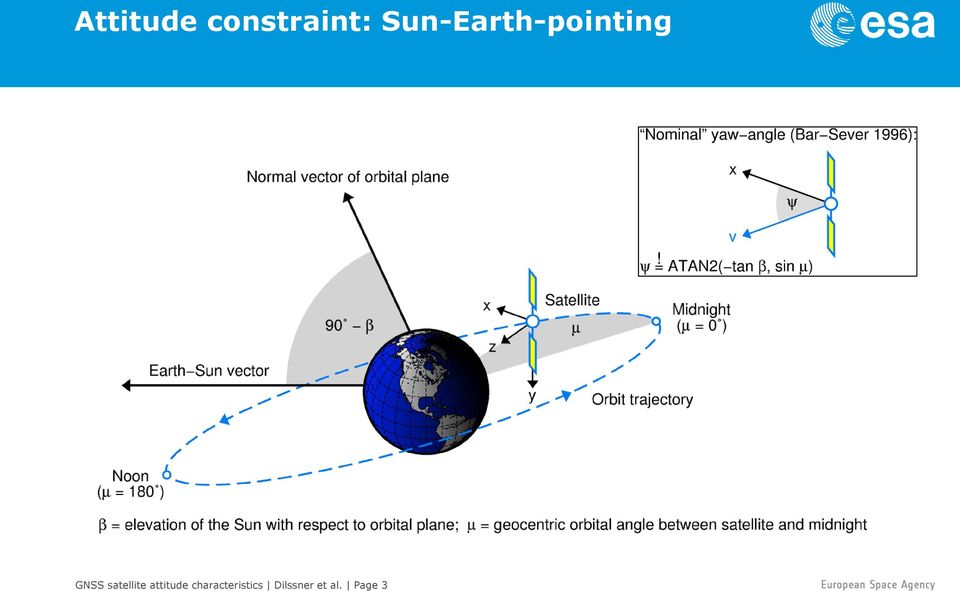
3 Attitude constraint: Sun-Earth-pointing GNSS satellite attitude characteristics Dilssner et al. Page 3
4 Reverse Precise Point Positioning (PPP) Parameter Step 1: POD solution Step 2: Reverse PPP Data undifferenced GPS/GLONASS phase and code observations Stations / Satellites 175 / / 1 Sampling rate 5 min orbit, 30 sec clock 30 sec Cut-off angle 10 deg 10 deg Orbit Earth rotation Initial positions and velocities; 3 constant plus 2 periodic RPRs; 3 along-track CPRs Daily pole coordinates and drifts, UT1 and LOD are estimated From POD solution From POD solution Coordinates Estimated per day From POD solution Troposphere 1-hourly ZPDs / daily gradients estimated From POD solution Ambiguities Resolved (GPS-only) From POD solution Station clocks Estimated per epoch From POD solution Satellite clocks Estimated per epoch Estimated per epoch Satellite PCOs Fixed to igs08.atx Estimated per epoch Antenna PCVs Fixed to igs08.atx Fixed to igs08.atx GNSS satellite attitude characteristics Dilssner et al. Page 4

5 Internal accuracy assessment (1/2) IGS tracking data from for 12 GPS satellites Processed in two independent sub-networks consisting of 175 stations each Favorable geometry; permanent visibility to any GPS S/C from at least 13 sites Comparison of yaw-angle profiles from subnet 1 against subnet 2 GNSS satellite attitude characteristics Dilssner et al. Page 5

6 Internal accuracy assessment (2/2) SVN Beta [ ] RMS [ ] GNSS satellite attitude characteristics Dilssner et al. Page 6
![5 45.0-4.3 - RMS [ ] 3.7 2.8 3.2 3.0 3.0 3.1 3.2 3.0 4.0 3.5 2.](/docs-images/42/11976165/images/page_6.jpg "5 2.8 3.2 GNSS satellite attitude characteristics Dilssner et al.")
7 External accuracy assessment: ESA vs. JPL SVN Beta [ ] RMS [ ] GNSS satellite attitude characteristics Dilssner et al. Page 7
![3 43.8-4.5 41.8 41.8 6.2 1.0-49.5 45.0-4.3 - RMS [ ] 6.7 4.6 7.7 7.](/docs-images/42/11976165/images/page_7.jpg "4 5.6 6.9 9.0 6.")
8 GPS IIA midnight-turn maneuver S/C is rotating around its z-axis with /s for up to 90 min Turn direction determined by sign of yaw bias; always positive (+0.5 ) Yaw rate reversal may occur, depending upon yaw angle at shadow exit Determination of post-shadow maneuver particular challenging GNSS satellite attitude characteristics Dilssner et al. Page 8

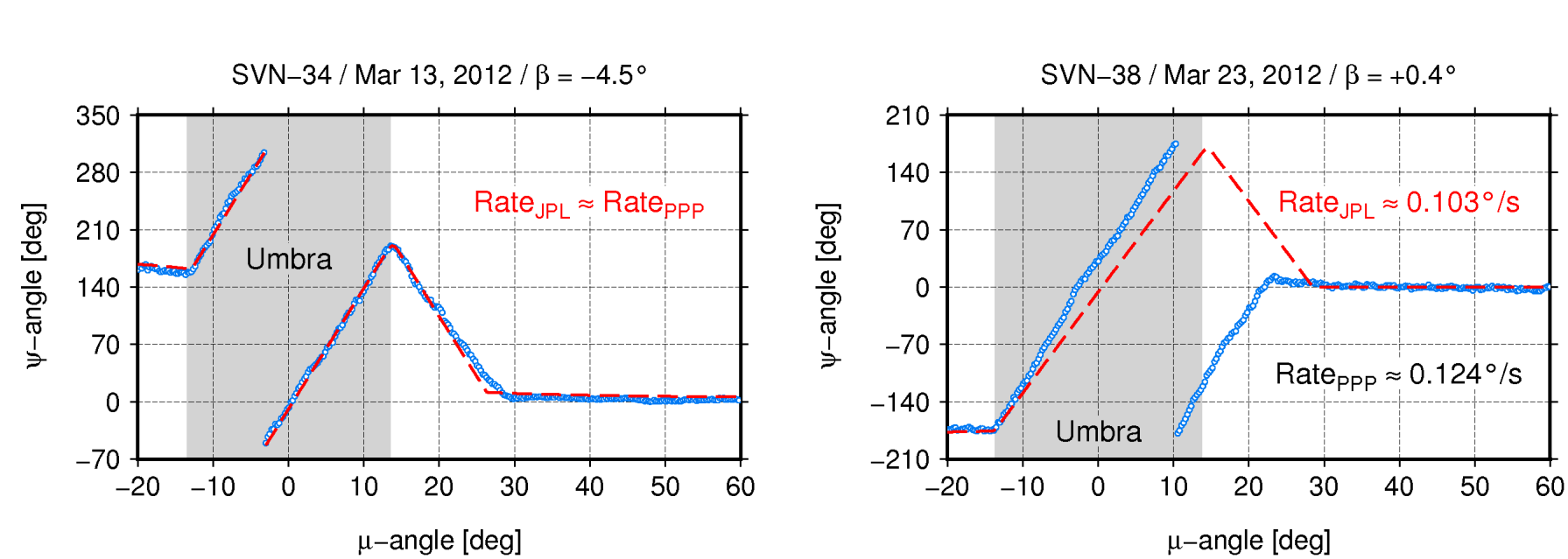
9 Evaluation of JPL s GPS IIA midnight-turn model (1/4) Comparison between reverse PPP estimates and JPL attitude model using JPL yaw rate solutions (Bar-Sever, JoG 1996) Initial results indicate good agreement (left-hand figure) Incorrectly modeled post-shadow maneuver directions in consequence of an underestimated yaw rate parameter found (right) GNSS satellite attitude characteristics Dilssner et al. Page 9

10 Evaluation of JPL s GPS IIA midnight-turn model (2/4) GNSS satellite attitude characteristics Dilssner et al. Page 10


11 Evaluation of JPL s GPS IIA midnight-turn model (3/4) GNSS satellite attitude characteristics Dilssner et al. Page 11
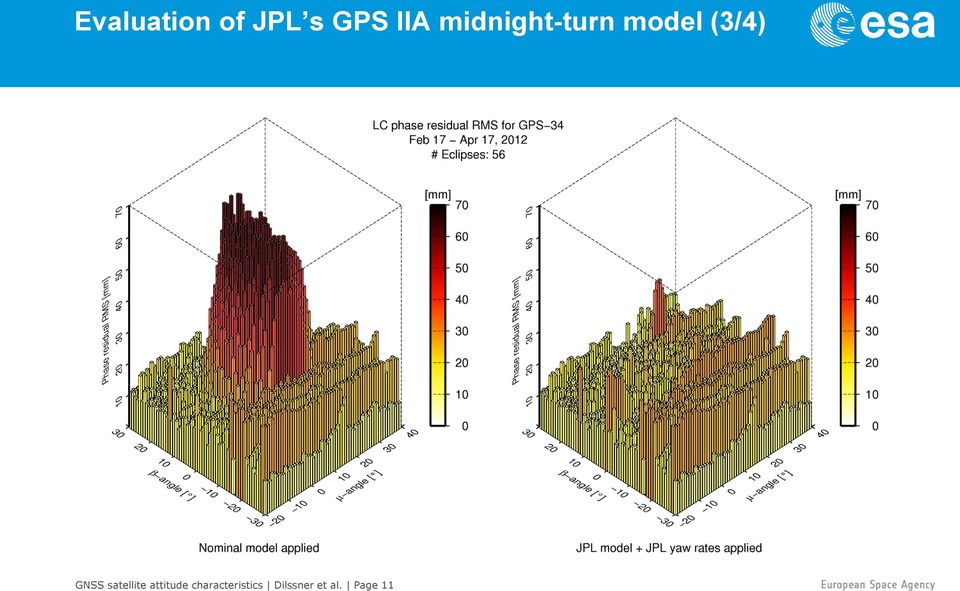
12 Evaluation of JPL s GPS IIA midnight-turn model (4/4) GNSS satellite attitude characteristics Dilssner et al. Page 12

13 IGS clock solutions for GPS IIA (1/6) Inconsistencies among IGS ACs due to different yaw attitude handling Three ACs (EMR, GFZ, JPL) solve for yaw rates and use JPL model; the others stick to nominal attitude model EMR, GFZ and JPL reject data from shadow exit until 30 min thereafter GNSS satellite attitude characteristics Dilssner et al. Page 13

14 IGS clock solutions for GPS IIA (2/6) Inconsistencies among IGS ACs due to different yaw attitude handling Three ACs (EMR, GFZ, JPL) solve for yaw rates and use JPL model; the others stick to nominal attitude model EMR, GFZ and JPL reject data from shadow exit until 30 min thereafter GNSS satellite attitude characteristics Dilssner et al. Page 14

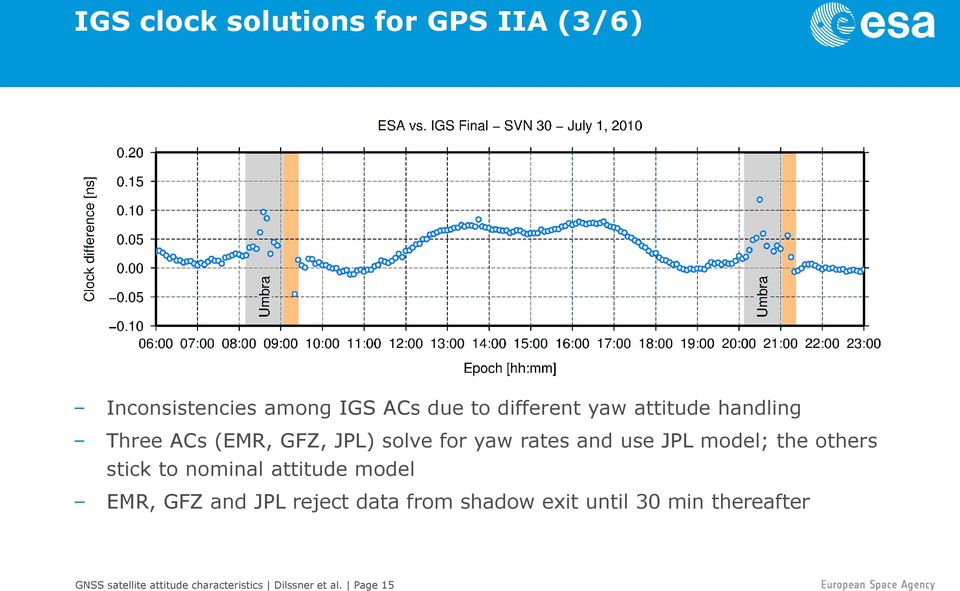
15 IGS clock solutions for GPS IIA (3/6) Inconsistencies among IGS ACs due to different yaw attitude handling Three ACs (EMR, GFZ, JPL) solve for yaw rates and use JPL model; the others stick to nominal attitude model EMR, GFZ and JPL reject data from shadow exit until 30 min thereafter GNSS satellite attitude characteristics Dilssner et al. Page 15
16 IGS clock solutions for GPS IIA (4/6) Inconsistencies among IGS ACs due to different yaw attitude handling Three ACs (EMR, GFZ, JPL) solve for yaw rates and use JPL model; the others stick to nominal attitude model EMR, GFZ and JPL reject data from shadow exit until 30 min thereafter GNSS satellite attitude characteristics Dilssner et al. Page 16

17 IGS clock solutions for GPS IIA (5/6) Inconsistencies among IGS ACs due to different yaw attitude handling Three ACs (EMR, GFZ, JPL) solve for yaw rates and use JPL model; the others stick to nominal attitude model EMR, GFZ and JPL reject data from shadow exit until 30 min thereafter GNSS satellite attitude characteristics Dilssner et al. Page 17

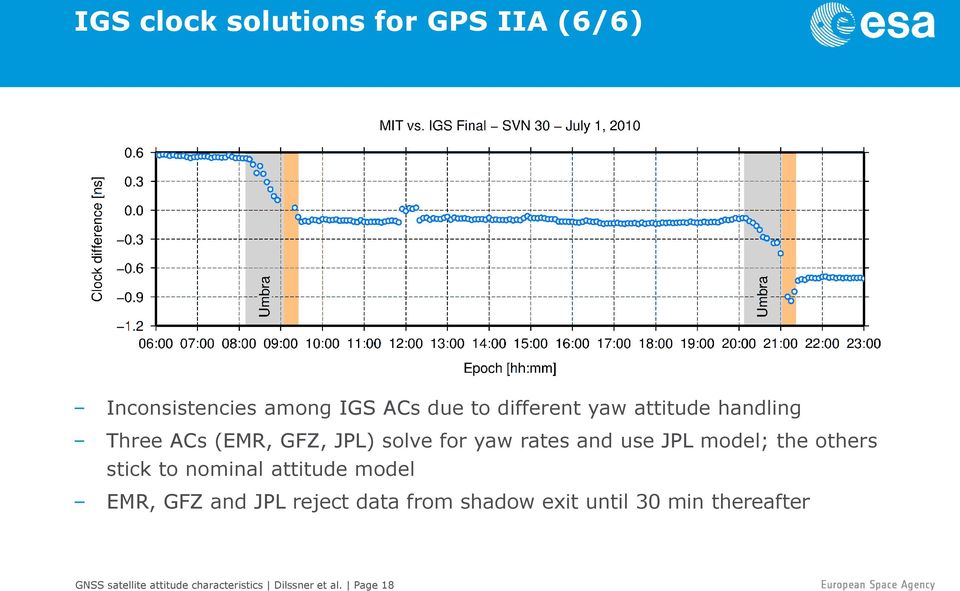
18 IGS clock solutions for GPS IIA (6/6) Inconsistencies among IGS ACs due to different yaw attitude handling Three ACs (EMR, GFZ, JPL) solve for yaw rates and use JPL model; the others stick to nominal attitude model EMR, GFZ and JPL reject data from shadow exit until 30 min thereafter GNSS satellite attitude characteristics Dilssner et al. Page 18
19 GPS IIF midnight-turn maneuver Turn direction is kept due to yaw bias which is set to have same sign as β Dynamical yaw rate parameter; can be modeled using 2 nd order polynomials Model reduces phase residual RMS from up to ±7 cm down to ±1 cm ( Dilssner et al., AGU Fall Meeting 2011) GNSS satellite attitude characteristics Dilssner et al. Page 19

20 GPS IIF noon-turn maneuver Noon-turn manoeuvre must be taken into account for ß < 4.5º Maximum yaw rate similar to GPS IIA rate (R 0.11 /s) Discontinuity at β = -0.9 ; delta of 0.01 /s between high and low rate values Model implemented into NAPEOS, but not tested thoroughly enough GNSS satellite attitude characteristics Dilssner et al. Page 20

21 GLONASS-M midnight-turn maneuver S/C starts rotating around its z-axis with maximum rate (R 0.25 /s) Turn direction equivalent to nominal rotation direction S/C switches into fixed-yaw mode at the end of required midnight-turn Model applicable to all GLONASS-M S/C except for SVN 701 and SVN 713 GNSS satellite attitude characteristics Dilssner et al. Page 21

22 GLONASS-M SVN 701 Second-oldest S/C from GLONASS-M series; launched in Dec 2003 No tracking data available from IGS network during shadow crossing L-band signal apparently turned off/on by system operators as soon as S/C enters/leaves penumbra GNSS satellite attitude characteristics Dilssner et al. Page 22
23 GLONASS-M SVN 713 Satellite keeps nominal yaw attitude in the shadow (cf. GPS IIR) Noon- and midnight-turn problem due to limited yaw rate persists ACS solar sensors are malfunctioning Orbit quality significantly worse compared to other GLONASS-M S/C GNSS satellite attitude characteristics Dilssner et al. Page 23
24 GLONASS-M noon-turn maneuver Noon-turn manoeuvre must be taken into account for ß < 2.0º S/C is rotating around its z-axis with 0.25 /s for up to 12 min Maneuver starts well before nominal yaw rate exceeds R ( GPS) ( Dilssner et al., Adv. Space Res. 2011) GNSS satellite attitude characteristics Dilssner et al. Page 24
25 Conclusions Reverse PPP has proven to be a reliable technique for characterizing the yaw attitude behaviour of GNSS satellites during eclipse season Technique takes advantage of horizontal antenna phase centre eccentricity; thus it can not be applied to GPS IIR and first-generation GLONASS S/C Evaluation of yaw-angle profiles estimated for different GPS S/C under different beta-angles indicates accuracy of ±3 deg Insights gained from studying the GPS IIA yaw attitude underline demand for a more reliable post-shadow maneuver model ( Poster Weiss et al.) Consistent yaw attitude models along with consistent model parameters (yaw rates, eclipse angle) should be used by all ACs to avoid inconsistencies in IGS clock products ( Kouba, GPS Solut 2009) GNSS satellite attitude characteristics Dilssner et al. Page 25
Dancing in the Dark: How GNSS Satellites Cross the Earth s Shadow
 Dancing in the Dark: How GNSS Satellites Cross the Earth s Shadow F. Dilssner, T. Springer, G. Gienger, R. Zandbergen European Space Operations Centre (ESOC), Darmstadt 24 January 2011 Technische Universität
On May 27, 2010, the U.S. Air. Satellite. Antenna Phase Center and Attitude Modeling
 GPS IIF-1 Satellite Antenna Phase Center and Attitude Modeling Florian Dilssner Logica/European Space Agency Calculating the distances between satellites and user equipment is a basic operation for GNSS
A simplified yaw-attitude model for eclipsing GPS satellites
 GPS Solut (2009) 13:1 12 DOI 10.1007/s10291-008-0092-1 ORIGINAL ARTICLE A simplified yaw-attitude model for eclipsing GPS satellites J. Kouba Received: 2 January 2008 / Accepted: 5 March 2008 / Published
Enabling RTK-like positioning offshore using the global VERIPOS GNSS network. Pieter Toor GNSS Technology Manager
 Enabling RTK-like positioning offshore using the global VERIPOS GNSS network Pieter Toor GNSS Technology Manager Introduction PPP/RTK Positioning Techniques PPP-AR Technology Presentation Overview PPP-AR
IGS Preparations for the Next Reprocessing and ITRF
 IGS Preparations for the Next Reprocessing and ITRF what is IG2? who will contribute? expected performance remaining issues Jake Griffiths, NOAA/National Geodetic Survey Paul Rebischung, Institut Géographique
AUTOMATED OPERATIONAL MULTI-TRACKING HIGH PRECISION ORBIT DETERMINATION FOR LEO MISSIONS
 AUTOMATED OPERATIONAL MULTI-TRACKING HIGH PRECISION ORBIT DETERMINATION FOR LEO MISSIONS J. Fernández Sánchez, F. M. Martínez Fadrique, A. Águeda Maté, D. Escobar Antón GMV S.A., Isaac Newton 11, 876 Tres
GFZ prototype for GPS-based realtime deformation monitoring
 GFZ prototype for GPS-based realtime deformation monitoring Junping Chen, Maorong Ge, Markus Vennebusch, Gerd Gendt, Markus Rothacher Department of Geodesy and Remote Sensing, GeoForschungsZentrum, Postdam
The IGS: A Multi-GNSS Service
 The IGS: A Multi-GNSS Service Chris Rizos, Urs Hugentobler, Ruth Neilan IUGG IAG Structure International Union of Geodesy and Geophysics (IUGG) 65 Member Countries (Adhering Bodies), 8 Associations International
International Global Navigation Satellite Systems Service
 International Global Navigation Satellite Systems Service IGS Multi-GNSS Experiment IGS M-GEX Call for Participation www.igs.org Response to this Call for Participation in IGS M-GEX via Web Form Submission
Orbit Modeling and Multi-GNSS in the IGS
 Orbit Modeling and Multi-GNSS in the IGS G. Beutler Astronomical Institute, University of Bern O. Montenbruck, P. Steigenberger DLR, German Space Operations Center 14 th Meeting of the National Space-Based
Analysis on the Long-term Orbital Evolution and Maintenance of KOMPSAT-2
 Analysis on the Long-term Orbital Evolution and Maintenance of KOMPSAT-2 Ok-Chul Jung 1 Korea Aerospace Research Institute (KARI), 45 Eoeun-dong, Daejeon, South Korea, 305-333 Jung-Hoon Shin 2 Korea Advanced
The Applanix SmartBase TM Software for Improved Robustness, Accuracy, and Productivity of Mobile Mapping and Positioning
 The Applanix SmartBase TM Software for Improved Robustness, Accuracy, and Productivity of Mobile Mapping and Positioning Joe Hutton and Edith Roy, Applanix Corporation Introduction Applanix, along with
Rotational Errors in IGS Orbit & ERP Products
 Rotational Errors in IGS Orbit & ERP Products Systematic rotations are a leading IGS error they affect all core products except probably clocks Sources include defects in: IERS model for 12h + 24h tidal
Laser Ranging to Nano-Satellites
 13-0222 Laser Ranging to Nano-Satellites G. Kirchner (1), Ludwig Grunwaldt (2), Reinhard Neubert (2), Franz Koidl (1), Merlin Barschke (3), Zizung Yoon (3), Hauke Fiedler (4), Christine Hollenstein (5)
GPS Precise Point Positioning as a Method to Evaluate Global TanDEM-X Digital Elevation Model
 GPS Precise Point Positioning as a Method to Evaluate Global TanDEM-X Digital Elevation Model 7 th FIG Regional Conference TS 1C Advances in GNSS Positioning and Applications I Volker Schwieger 1, Jürgen
GPS Precise Point Positioning with a Difference*
 GPS Precise Point Positioning with a Difference* Pierre Héroux and Jan Kouba Geodetic Survey Division, Geomatics Canada Natural Resources Canada 615 Booth Street Ottawa, Ontario K1A E9 [email protected]
Günter Seeber. Satellite Geodesy 2nd completely revised and extended edition
 Günter Seeber Satellite Geodesy 2nd completely revised and extended edition Walter de Gruyter Berlin New York 2003 Contents Preface Abbreviations vii xvii 1 Introduction 1 1.1 Subject of Satellite Geodesy...
Introduction into Real-Time Network Adjustment with Geo++ GNSMART
 Introduction into Real-Time Network Adjustment with Geo++ GNSMART Andreas Bagge Gerhard Wübbena, Martin Schmitz Geo++ GmbH D-30827 Garbsen, Germany www.geopp.de GeoInformation Workshop 2004, Istanbul Kultur
Status, Development and Application
 Federal Space Agency GLONASS GLONASS Status, Development and Application Sergey G. Revnivykh International Committee on Global Navigation Satellite Systems (ICG) Second Meeting, September 4-7, 2007, Bangalore,
TESTING REAL-TIME GPS ORBIT AND CLOCK PRODUCT
 TESTING REAL-TIME GPS ORBIT AND CLOCK PRODUCT J. DOUSA1 1. Introduction Within EUREF-IP project, the Federal Agency for Cartography and Geodesy, Frankfurt/Main (BKG) has started to distribute the real-time
Towards Real-time GNSS Troposphere Delay Monitoring Service for Poland
 Towards Real-time GNSS Troposphere Delay Monitoring Service for Poland Tomasz Hadas, Kaplon Jan, Bosy Jaroslaw Institute of Geodesy and Geoinformatics Wroclaw University of Environmental and Life Sciences
GNSS satellites as co-locations for a combined GNSS and SLR analysis
 GNSS satellites as co-locations for a combined GNSS and SLR analysis D. Thaller 1), K. Sośnica 1), R. Dach 1), A. Jäggi 1), M. Mareyen 2), B. Richter 2), G. Beutler 1) (1) Astronomical Institute, University
EPN Special Project Real-Time Analysis Status Report
 EPN Special Project Real-Time Analysis Status Report Wolfgang Söhne Federal Agency for Cartography and Geodesy (BKG), Germany Highlights Real-time observational data EUREF regional broadcaster Broadcaster
GNSS-PW Progress Session 5: Other GRUAN products
 GNSS-PW Progress Session 5: Other GRUAN products Markus Bradke Helmholtz-Centre Potsdam - GFZ German Research Centre for Geosciences Telegrafenberg, 14473 Potsdam, Germany Department 1: Geodesy and Remote
Online GPS processing services: an initial study
 GPS Solut (2006) 10: 12 20 DOI 10.1007/s10291-005-0147-5 ORIGINAL ARTICLE Reza Ghoddousi-Fard Peter Dare Online GPS processing services: an initial study Received: 15 September 2004 Accepted: 3 May 2005
Satellite Posi+oning. Lecture 5: Satellite Orbits. Jan Johansson [email protected] Chalmers University of Technology, 2013
 Lecture 5: Satellite Orbits Jan Johansson [email protected] Chalmers University of Technology, 2013 Geometry Satellite Plasma Posi+oning physics Antenna theory Geophysics Time and Frequency GNSS
Evaluation of EPOS-RT for Real-time Deformation Monitoring
 Journal of Global Positioning Systems (2009) Vol.8, No.1:1-5 Evaluation of EPOS-RT for Real-time Deformation Monitoring Junping Chen, Maorong Ge, Jan Dousa, Gerd Gendt Department of Geodesy and Remote
European Position Determination System. Guidelines For Cross- Border Data Exchange
 European Position Determination System Guidelines For Cross- Border Data Exchange Version 1.0 21 September 2006 Copyright: Publisher: 2007 by the International EUPOS Steering Committee Office of the International
GNSS and Heighting, Practical Considerations. A Parker National Geo-spatial Information Department of Rural Development and Land Reform
 GNSS and Heighting, Practical Considerations A Parker National Geo-spatial Information Department of Rural Development and Land Reform GNSS Global Navigation Satellite Systems (GNSS) Global Positioning
Leica AR25 White Paper
 Leica AR25 White Paper February 2009 Lennon Bedford, Neil Brown, Justin Walford Leica Geosystems AG Heerbrugg, Switzerland 2 Biography Lennon Bedford graduated from the University of Otago in 2003 with
Greg Keel P.Eng. Parallel Geo Services [email protected]
 Greg Keel P.Eng. Parallel Geo Services [email protected] Presentation Outline GNSS: Global Navigation Satellite System GPS: overview, current signals, modernization GLONASS: history (rise fall rise),
The NASA Global Differential GPS System (GDGPS) and The TDRSS Augmentation Service for Satellites (TASS)
 The Global Differential GPS System (GDGPS) and The TDRSS Augmentation Service for Satellites (TASS) Yoaz Bar-Sever, Larry Young, Frank Stocklin, Paul Heffernan and John Rush s Global Differential GPS System
Waypoint. Best-in-Class GNSS and GNSS+INS Processing Software
 Waypoint Best-in-Class GNSS and GNSS+INS Processing Software Waypoint Exceptional Post-Processing Software Enhance your GNSS Position, Velocity and Attitude Accuracy For applications requiring highly
Prospects for an Improved Lense-Thirring Test with SLR and the GRACE Gravity Mission
 Prospects for an Improved Lense-Thirring Test with SLR and the GRACE Gravity Mission J. C. Ries, R. J. Eanes, B. D. Tapley Center for Space Research The University of Texas at Austin Austin, TX G. E. Peterson
Chapter 2. Mission Analysis. 2.1 Mission Geometry
 Chapter 2 Mission Analysis As noted in Chapter 1, orbital and attitude dynamics must be considered as coupled. That is to say, the orbital motion of a spacecraft affects the attitude motion, and the attitude
Celestial Sphere. Celestial Coordinates. Lecture 3: Motions of the Sun and Moon. ecliptic (path of Sun) ecliptic (path of Sun)
 Lecture 3: Motions of the and Moon ecliptic (path of ) ecliptic (path of ) The 23.5 degree tilt of Earth s spin axis relative to its orbital axis around the causes the seasons Celestial Sphere Celestial
Integration of Inertial Measurements with GNSS -NovAtel SPAN Architecture-
 Integration of Inertial Measurements with GNSS -NovAtel SPAN Architecture- Sandy Kennedy, Jason Hamilton NovAtel Inc., Canada Edgar v. Hinueber imar GmbH, Germany Symposium Gyro Technology, Stuttgart 9/25
Development of BeiDou Navigation Satellite System
 The 7th Meeting of International Committee on GNSS Development of BeiDou Navigation Satellite System China Satellite Navigation Office November 5, 2012 Beijing, China Part Ⅰ Development Plan Part Ⅱ System
Non-parametric estimation of seasonal variations in GNSS-derived time series
 Military University of Technology, Poland ([email protected]) Seasonal variations in the frame sites can bias the frame realization. I would like to invite you to click on each of the four
Local monitoring by low cost devices and free and open sources softwares
 Local monitoring by low cost devices and free and open sources softwares Abstract Ludovico Biagi, Florin-Catalin Grec, Marco Negretti, Maria Grazia Visconti Politecnico di Milano, DICA@ComoCampus The purpose
Satellite technology
 Satellite technology Overview What is a satellite? The key elements of orbital position Satellite manufacturers and design The components of a satellite: payload and bus Digital versus analogue How do
A science class experience that is out of this world. Robert Benkoczi, PhD Optimization Research Group University of Lethbridge
 A science class experience that is out of this world Robert Benkoczi, PhD Optimization Research Group University of Lethbridge SWATCA 2015 Summary Optimization Research Group Funcube project and reception
GPS Receiver Test. Conducted by the Department of Mathematical Geodesy and Positioning Delft University of Technology
 GPS Receiver Test Conducted by the Department of Mathematical Geodesy and Positioning Delft University of Technology A. Amiri-Simkooei R. Kremers C. Tiberius May 24 Preface For the purpose of a receiver
How To Monitor Sea Level With Satellite Radar
 Satellite Altimetry Wolfgang Bosch Deutsches Geodätisches Forschungsinstitut (DGFI), München email: [email protected] Objectives You shall recognize satellite altimetry as an operational remote sensing
MobileMapper 6 White Paper
 MobileMapper 6 White Paper Meter-Level Mapping Accuracy With Post-Processing Introduction Since its introduction in February 2008, the Magellan MobileMapper 6 has been welcomed by the market as the only
Bi-Directional DGPS for Range Safety Applications
 Bi-Directional DGPS for Range Safety Applications Ranjeet Shetty 234-A, Avionics Engineering Center, Russ College of Engineering and Technology, Ohio University Advisor: Dr. Chris Bartone Outline Background
UN/UAE/US Workshop On GNSS Applications. GPS Modernization:
 UN/UAE/US Workshop On GNSS Applications Dubai, UAE Session 1: Trends in Satellite-based Navigaiton Systems GPS Modernization: On the t Road to the Future GPS IIR/IIR-M M and GPS III Michael Shaw Director,
GPS/INS Integration with the imar-fsas IMU
 Sandy KENNEDY, Canada Jason HAMILTON, Canada Hugh MARTELL, Canada Key words: GPS, INS, integrated navigation, inertial navigation SUMMARY This paper discusses NovAtel's approach to GPS/INS system architecture
REAL-TIME GPS MONITORING OF ATOMIC FREQUENCY STANDARDS IN THE CANADIAN ACTIVE CONTROL SYSTEM (CACS)
 30th Annual Pmbe Time and Time Internal (PTTI) Meeting REAL-TIME GPS MONITORING OF ATOMIC FREQUENCY STANDARDS IN THE CANADIAN ACTIVE CONTROL SYSTEM (CACS) F. Lahaye, M. Caissy, J. Popelar Geodetic Survey
Sun Earth Relationships
 1 ESCI-61 Introduction to Photovoltaic Technology Sun Earth Relationships Ridha Hamidi, Ph.D. Spring (sun aims directly at equator) Winter (northern hemisphere tilts away from sun) 23.5 2 Solar radiation
GPS Positioning Modes
 5 GPS Positioning Modes Positioning with GPS can be performed in either of two ways: point (absolute) positioning or relative positioning. Classical GPS point positioning employs one GPS receiver that
Recent Activities of the SGO Local Analysis Centre
 Recent Activities of the SGO Local Analysis Centre Tamás Jambor [email protected], Ambrus Kenyeres [email protected] Satellite Geodetic Observatory, Institute of Geodesy, Cartography and Remote Sensing
Guidelines for RTK/RTN GNSS Surveying in Canada
 Guidelines for RTK/RTN GNSS Surveying in Canada July 2013 Version 1.1 Ministry of Transportation Ministère des Transports EARTH SCIENCES SECTOR GENERAL INFORMATION PRODUCT 100-E Main Authors: Brian Donahue,
RealtimePPP using EUREF and IGS Networks
 RealtimePPP using EUREF and IGS Networks Georg Weber 1) Leos Mervart 2), Peter Neumaier 1), Andrea Stürze 1) 1) Federal Agency for Cartography and Geodesy, Frankfurt am Main, Germany 2) Technical University
Global Positioning System
 B. Hofmann-Wellenhof, H. Lichtenegger, and J. Collins Global Positioning System Theory and Practice Third, revised edition Springer-Verlag Wien New York Contents Abbreviations Numerical constants xix xxiii
Searching for space debris elements with the Pi of the Sky system
 Searching for space debris elements with the Pi of the Sky system Marcin Sokołowski [email protected] Soltan Institute for Nuclear Studies ( IPJ ) Warsaw, Poland 7th Integral / BART Workshop ( IBWS), 14-18
From Single to Formation Flying CubeSats: An Update of the Delfi Programme
 From Single to Formation Flying CubeSats: An Update of the Delfi Programme Jian Guo, Jasper Bouwmeester & Eberhard Gill 1 Outline Introduction Delfi-C 3 Mission Delfi-n3Xt Mission Lessons Learned DelFFi
GNSS integrity monitoring for the detection and mitigation of interference
 GNSS integrity monitoring for the detection and mitigation of interference Dr. Shaojun Feng Centre for Transport Studies Outline GNSS vulnerability GNSS integrity monitoring Cases study GAARDIAN ERAIM
CBERS Program Update Jacie 2011. Frederico dos Santos Liporace AMS Kepler [email protected]
 CBERS Program Update Jacie 2011 Frederico dos Santos Liporace AMS Kepler [email protected] Overview CBERS 3 and 4 characteristics Differences from previous CBERS satellites (CBERS 1/2/2B) Geometric
SURVEYING WITH GPS. GPS has become a standard surveying technique in most surveying practices
 SURVEYING WITH GPS Key Words: Static, Fast-static, Kinematic, Pseudo- Kinematic, Real-time kinematic, Receiver Initialization, On The Fly (OTF), Baselines, Redundant baselines, Base Receiver, Rover GPS
Radar interferometric techniques and data validation Terrafirma Essen, March 2011. Page 1
 Radar interferometric techniques and data validation Terrafirma Essen, March 2011 Page 1 Agenda Introduction to InSAR technology Different radarinterferometric techniques Validation of InSAR technology
Perspective of Permanent Reference Network KOPOS in Kosova
 143 Perspective of Permanent Reference Network KOPOS in Kosova Meha, M. and Çaka, M. Kosovo Cadastral Agency, Kosovo Archive Building II nd floor, P.O. 10000, Prishtina, Republic of Kosovo, E-mail: [email protected],
Apogee Series. > > Motion Compensation and Data Georeferencing. > > Smooth Workflow. Mobile Mapping. > > Precise Trajectory and Direct Georeferencing
 Ultimate accuracy MEMS Apogee Series Inertial Navigation System Motion Sensing and Georeferencing > INS > MRU > AHRS ITAR free 0,005 RMS Apogee Series High quality, high accuracy Hydrography > > Motion
INTEGRITY AND CONTINUITY ANALYSIS OCTOBER TO DECEMBER 2013 QUARTERLY REPORT FROM GPS. Integrity and Continuity Analysis 08/01/14 08/01/14 08/01/14
 INTEGRITY AND CONTINUITY ANALYSIS FROM GPS OCTOBER TO DECEMBER 2013 QUARTERLY REPORT Prepared by: M Pattinson (NSL) 08/01/14 Checked by: L Banfield (NSL) 08/01/14 Approved by: M Dumville (NSL) 08/01/14
GEOGRAPHIC INFORMATION SYSTEMS Lecture 21: The Global Positioning System
 GEOGRAPHIC INFORMATION SYSTEMS Lecture 21: The Global Positioning System The Global Positioning System - recognize that GPS is only one of several Global Navigation Satellite Systems (GNSS) - the Russian
High accuracy positioning using carrier-phases with the open source GPSTk software.
 High accuracy positioning using carrier-phases with the open source GPSTk software. Salazar, D., Hernandez-Pajares, M., Juan, J.M., Sanz, J. Grupo de Astronomia y Geomatica (gage), Universitat Politecnica
Basic Principles of Inertial Navigation. Seminar on inertial navigation systems Tampere University of Technology
 Basic Principles of Inertial Navigation Seminar on inertial navigation systems Tampere University of Technology 1 The five basic forms of navigation Pilotage, which essentially relies on recognizing landmarks
CDMA Technology : Pr. S. Flament www.greyc.fr/user/99. Pr. Dr. W. sk www.htwg-konstanz.de. On line Course on CDMA Technology
 CDMA Technology : Pr. Dr. W. sk www.htwg-konstanz.de Pr. S. Flament www.greyc.fr/user/99 On line Course on CDMA Technology CDMA Technology : CDMA / DS : Principle of operation Generation of PN Spreading
GNSS Reflectometry at GFZ: ocean altimetry and land surface monitoring
 GNSS Reflectometry at GFZ: ocean altimetry and land surface monitoring M. Semmling 1 S. Vey 1 J. Beckheinrich 1 V. Leister 1,2 J. Saynisch 1 J. Wickert 1 1 Research Centre for Geoscience GFZ, Potsdam 2
Initial Analysis of the Accuracy of Position Determination Using ASG-EUPOS NAVGEO (RTK VRS) Service
 GEOMATICS AND ENVIRONMENTAL ENGINEERING Volume 4 Number 4 2010 Marcin Uradziñski*, Adam Doskocz* Initial Analysis of the Accuracy of Position Determination Using ASG-EUPOS NAVGEO (RTK VRS) Service 1. Introduction
Online Precise Point Positioning Using the. Natural Resources Canada Canadian Spatial Reference System (CSRS-PPP)
 Online Precise Point Positioning Using the Natural Resources Canada Canadian Spatial Reference System (CSRS-PPP) Thomas Nylen and Seth White UNAVCO October 2007 I. Precise Point Positioning Precise Point
Why do we need to improve co-locations of space geodetic techniques?
 Why do we need to improve co-locations of space geodetic techniques? Zuheir Altamimi & Xavier Collilieux IGN France 1 Outline ITRF Heritage Current status of technique networks & co-locations Results from
Scheduling of VLBI observations to satellites with the Vienna VLBI Software (VieVS)
 Scheduling of VLBI observations to satellites with the Vienna VLBI Software (VieVS) A. Hellerschmied, J. Böhm, R. Haas, J. Kodet, A. Neidhardt, L. Plank Abstract The observation of satellites with VLBI
The Four Seasons. A Warm Up Exercise. A Warm Up Exercise. A Warm Up Exercise. The Moon s Phases
 The Four Seasons A Warm Up Exercise What fraction of the Moon s surface is illuminated by the Sun (except during a lunar eclipse)? a) Between zero and one-half b) The whole surface c) Always half d) Depends
Monitoring of Open Pit Mines using Combined GNSS Satellite Receivers and Robotic Total Stations
 Monitoring of Open Pit Mines using Combined GNSS Satellite Receivers and Robotic Total Stations N. Brown Leica Geosystems, Switzerland S. Kaloustian Leica Geosystems, Switzerland M. Roeckle Leica Geosystems,
GeoMax GNSS Zenith10 & Zenith20 Series
 GeoMax GNSS Zenith10 & Zenith20 Series GeoMax About Us At GeoMax we provide a comprehensive portfolio of integrated solutions by developing, manufacturing and distributing quality construction and surveying
Earth In Space Chapter 3
 Earth In Space Chapter 3 Shape of the Earth Ancient Greeks Earth casts a circular shadow on the moon during a lunar eclipse Shape of the Earth Ancient Greeks Ships were observed to disappear below the
Real-Time GNSS in Routine EPN Operations Concept
 Real-Time GNSS in Routine EPN Operations Concept EPN Real-time Working Group D. Dettmering, G. Weber, C. Bruyninx, H. v.d.marel W. Gurtner, J. Torres, A. Caporali Status: December 3, 2006 1 CONTENT 1 Introduction
Real-Time Sub-cm Differential Orbit Determination of Two Low-Earth Orbiters with GPS Bias Fixing
 Real-Time Sub-cm Differential Orbit Determination of Two Low-Earth Orbiters with GPS Bias Fixing Sien-Chong Wu, Jet Propulsion Laboratory, California Institute of Technology Yoaz E. Bar-Sever, Jet Propulsion
Rafael Lucas EUROPEAN SPACE AGENCY. [email protected]
 ESA Navigation Support Facilities Rafael Lucas EUROPEAN SPACE AGENCY [email protected] Background The ESA/ESTEC Radionavigation laboratory was created in 1989 to support the application of
OPTICAL CLOCKS IN FUTURE GLOBAL NAVIGATION SATELLITES
 OPTICAL CLOCKS IN FUTURE GLOBAL NAVIGATION SATELLITES U. Hugentobler (1), M. Plattner (2), S. Bedrich (2), M. Heinze (1), V. Klein (2), D. Voithenleitner (1) (1) Technische Universität München. Arcisstrasse
The Evolution of the Global Navigation Satellite System (GNSS) Spectrum Use
 The Evolution of the Global Navigation Satellite System (GNSS) Spectrum Use Spectrum Management 2012 National Spectrum Management Association Scott Pace (with thanks to Chris Hegerty, MITRE) Space Policy
Prof. Ludovico Biagi. Satellite Navigation and Monitoring
 Prof. Ludovico Biagi Satellite Navigation and Monitoring Navigation: trajectories control positions estimations in real time, at high frequency popular applications: low accuracy (10 m) required specific
Motions of Earth, Moon, and Sun
 Motions of Earth, Moon, and Sun Apparent Motions of Celestial Objects An apparent motion is a motion that an object appears to make. Apparent motions can be real or illusions. When you see a person spinning
Performance of a Deeply Coupled Commercial Grade GPS/INS System from KVH and NovAtel Inc.
 Performance of a Deeply Coupled Commercial Grade GPS/INS System from KVH and NovAtel Inc. Sandy Kennedy 1 and Jim Rossi 2 1 NovAtel Inc., 112 68 th Ave. N.E. Calgary, Alberta, T2E 8S5, Canada 2 KVH Industries,
Pacific Sea Level Monitoring Project
 Record 2015/04 GeoCat 82325 Pacific Sea Level Monitoring Project CGPS Coordinate Time Series Analysis Report Jia, M., Dawson, J., Twilley, B. and Hu, G. APPLYING GEOSCIENCE TO AUSTRALIA S MOST IMPORTANT
DEVELOPING A MULTI-GNSS ANALYSIS SOFTWARE FOR SCIENTIFIC PURPOSES
 DEVELOPING A MULTI-GNSS ANALYSIS SOFTWARE FOR SCIENTIFIC PURPOSES Michael Meindl (1), Rolf Dach (1), Stefan Schaer (2), Urs Hugentobler (3), Gerhard Beutler (1) (1) Astronomical Institute, University of
CELESTIAL MOTIONS. In Charlottesville we see Polaris 38 0 above the Northern horizon. Earth. Starry Vault
 CELESTIAL MOTIONS Stars appear to move counterclockwise on the surface of a huge sphere the Starry Vault, in their daily motions about Earth Polaris remains stationary. In Charlottesville we see Polaris
Error Estimation in Positioning and Orientation Systems
 Error Estimation in Positioning and Orientation Systems Peter Canter Director, Applanix Marine Systems 85 Leek Crescent Richmond Hill, Ontario L4B 3B3 Telephone 905-709-4600 [email protected] Co-Author:
Analysis of Multi-Spacecraft Magnetic Field Data
 COSPAR Capacity Building Beijing, 5 May 2004 Joachim Vogt Analysis of Multi-Spacecraft Magnetic Field Data 1 Introduction, single-spacecraft vs. multi-spacecraft 2 Single-spacecraft data, minimum variance
IP-S2 HD. High Definition 3D Mobile Mapping System
 IP-S2 HD High Definition 3D Mobile Mapping System Integrated, turnkey solution High Density, Long Range LiDAR sensor for ultimate in visual detail High Accuracy IMU and DMI Odometry for positional accuracy
Alfons-Goppel-Str. 11, D-80539 München
 Combination method of different space geodesy techniques for EOP and terrestrial reference frame determination Vojtěch Štefka Alfons-Goppel-Str. 11, D-80539 München Contents: Introduction: ICRS, ITRS and