
ABL800 FLEX operator s manual
|
|
|
- Marion Williams
- 10 years ago
- Views:
Transcription
1 ABL800 FLEX operator s manual

2

3 ABL800 FLEX operator s manual

4

5 Note to users of the ABL800 FLEX analyzers Introduction Instructions to user This note to users gathers changes from previous note to users in one document and outlines some new changes to the operator s manual of your ABL800 FLEX analyzer (from software version 6.10). Please remove the existing note to users from the binder of your manual and place this note to users in the binder instead. Brief overview of the change Interference new interference results for ClO 4 Changes/Description Limitations of use and known interfering substances: CAUTION - Known interfering substances Substance ClO 4 (drugs) Interference For ClO 4, interference on cca 2+ (1.25 mmol/l level), ccl (110 mmol/l level), and ck + (4 mmol/l level) has been detected: cca 2+ (1.25 mmol/l level): 0.27* ccl (110 mmol/l level): 4-30 ck + (4 mmol/l level): 0.3. * Depending on the ph level USB connector Instead of the CD-ROM drive, a USB connector may be available. USB connector or CD-ROM drive The USB connector can be used for storing data on an USB flash drive (memory stick) or for connecting USB devices. Can also be used for installation of software Radiometer Medical ApS. All rights reserved B.

6 Measured parameters New table for pleural liquid: Parameter Unit Measuring Range Test range ph ph scale * * If the measured values obtained lie outside the test range, Radiometer advises you to repeat the measurement by means of another method. Alternatively, national or local regulations may allow you to establish wider reportable ranges for your device. Environmental requirements Environmental ratings Clot detection Indoor use statement added according to CSA regulations: Location Indoor use only Pollution degree 2 statement added according to CSA regulations: Installation category II. Pollution degree 2. A new feature is included in software version 6.06 of the following products: ABL7xx Series (XPE) analyzers ABL800 FLEX analyzers ABL800 BASIC analyzer. The new feature enables the analyzer to detect clots caught in the measurement chamber under the ph electrode. This document describes it. When to activate the clot-detection feature It is especially beneficial to activate the clot detection feature in analyzers frequently used to analyze samples known to be prone to clotting, for example, samples drawn from umbilical cords. Once activated clot detection is active during all sample measurements. NOTICE: It is important to note that activating the feature will delay measurement results by approximately one minute, even though it only increases the measurement cycle time by five seconds. It also increases consumption of Rinse solution, but this is minimal.

7 To activate the clot-detection feature Contact a Radiometer representative and request that clot detection be enabled via the service program. Clot-detection process During calibration the measuring chamber is rinsed and the ph of the Rinse solution is measured. The value is stored in the analyzer. During a sample measurement the measuring chamber is also rinsed and the ph of the rinse solution is measured and compared with the ph value stored during the last calibration. If the difference between these values (the ph drift) exceeds a pre-determined maximum value, it could indicate the presence of a clot beneath the ph electrode. When enabled, the clot-detection feature can generate three new messages that are listed below. Analyzer messages NOTICE: Operator actions are listed in order of priority. Perform the first action in the list and the actions indicated in the "Removal condition(s) list. If the message persists, perform the next listed action and the actions indicated in the "Removal condition(s) list, and so on. No. Message Interpretation Operator action(s) 1025 Clot suspected beneath ph electrode* The difference between the ph of the rinse solution, measured during the sample measurement, and that stored after the last calibration exceeds the maximum allowable drift. This indicates the presence of a clot in the measuring chamber beneath the ph electrode. Remove the ph electrode and check the measuring chamber for clots: clean the measuring chamber with a cotton stick moistened with distilled water. Make sure no cotton fibers are left in the measuring chamber Clean ph electrode Remembrane Ref electrode Replace ph electrode Perform a 1- or 2-point calibration Removal condition(s): Acknowledge execution of the "Clot removal procedure" Successful 1- or 2-point calibration * NOTICE: This is a system message.

8 1026 Clot (ph) detection not possible 1027 Clot suspected beneath ph electrode The ph of the rinse solution - stored during the latest calibration - was invalidated when either the Rinse solution was replaced, or when maintenance was performed on an electrode. A new ph value needs to be established by performing a calibration. The difference between the ph of the rinse solution, measured during the sample measurement, and that stored after the last calibration exceeds the maximum allowable drift. This indicates the presence of a clot in the measuring chamber beneath the ph electrode. Perform a 1- or 2-point calibration. Removal condition(s): Successful 1- or 2-point calibration. Remove the ph electrode and check the measuring chamber for clots: clean the measuring chamber with a cotton stick moistened with distilled water. Make sure no cotton fibers are left in the measuring chamber Clean ph electrode Remembrane Ref electrode Replace ph electrode Perform a 1- or 2-point calibration Removal condition(s): Acknowledge execution of the "Clot removal procedure" Successful 1- or 2-point calibration Acknowledging execution of a "Clot-removal procedure" Step Action 1. Press Analyzer status > Electrodes and others. 2. Press Replace. 3. Press Clots removed. Technical documentation Data in this document will be added to the manual next time it is updated. Radiometer Medical ApS Åkandevej Brønshøj Denmark

9 Table of contents ABL800 FLEX 1. Introduction 2. What is what 3. Installation and setup 4. Sample measurements 5. Quality control 6. Calibration 7. Replacements Operator s manual 8. Disk functions 9. Data management 10. Analyzer shutdown 11. Troubleshooting 12. Sampling 13. Specifications 14. Ordering information 15. Radiometer settings Index - Date of issue

10 System performance The procedures described in this manual must be observed in order to ensure proper system performance, and to avoid hazards. Radiometer cannot provide or verify system performance characteristics if the system is not installed, used and maintained in accordance with Radiometer procedures or if accessories not meeting the specifications provided by Radiometer are used. Radiometer warrants that the data media on which the software included in the system is furnished is free from defects in material and workmanship under normal use for three (3) months from the date of delivery as evidenced by a copy of invoice or receipt. Third-party software and trademarks The ABL800 FLEX analyzers comprise the Microsoft Windows XP Embedded, VxWorks and Sybase SQL Anywhere software. By using the system, you accept the terms of the Software License Agreement(s) of the provider(s) of the above software as shown in the End User License Agreement(s) in the analyzer start up picture and to the terms of the Microsoft Windows XP Embedded End-User Agreement included in this manual. If you cannot accept the terms of the Software License Agreement(s), you should not use the system, but immediately contact your provider for a return of the system and a refund of the purchase price. Microsoft and Windows are trademarks of Microsoft Corporation. VxWorks is a registered trademark of WindRiver Systems Incorporated. Sybase SQL Anywhere is a registered trademark of Sybase Incorporated. Warranties and disclaimer Radiometer makes no warranties, express or implied, other than expressly stated. Any warranties expressly stated in this document are conditional upon the system being installed, used and maintained in accordance with Radiometer procedures, including that only accessories meeting the specifications provided by Radiometer are used. Radiometer disclaims any liability for system performance if the system is not installed, used and maintained in accordance with Radiometer procedures or if accessories not meeting the specifications provided by Radiometer are used. Further, Radiometer disclaims any liability for loss of data and direct, consequential or other damages, including loss of profit or loss of business, whether such claim for damages is based upon contract, negligence or tort (including strict liability), and even if Radiometer has knowledge of the possibility of the potential damage or loss. Confidentiality The contents of this document shall not be reproduced or communicated to any third party without the prior written consent of Radiometer. This document is subject to change without notice. Changes While every effort is made to ensure the correctness of the information provided in this document as changed from time to time, Radiometer disclaims any liability for errors and omissions. Radiometer, the Radiometer logo, ABL, AQT, TCM, RADIANCE, AQURE, PICO, CLINITUBES and QUALICHECK are trademarks of or used under license by Radiometer Medical ApS Radiometer Medical ApS. All rights reserved.

11 TEnd-User License Agreement for the ABL800 FLEX Analyzers You have acquired a device ("DEVICE") THAT INCLUDES SOFTWARE LICENSED BY Radiometer Medical ApS from Microsoft Licensing Inc. or its affiliates ("MS"). Those installed software products of MS origin, as well as associated media, printed materials and "online" or electronic documentation ("SOFTWARE") are protected by international intellectual property laws and treaties. The SOFTWARE is licensed, not sold. All rights reserved. IF YOU DO NOT AGREE TO THIS END-USER LICENSE AGREEMENT ("EULA"), DO NOT USE THE DEVICE OR COPY THE SOFTWARE. INSTEAD, PROMPTLY CONTACT THE SUPPLIER OF THE INSTRUMENT FOR INSTRUCTIONS ON RETURN OF THE UNUSED DEVICE(S) FOR A REFUND. ANY USE OF THE SOFTWARE, INCLUDING BUT NOT LIMITED TO USE ON THE DEVICE WILL CONSTITUTE YOUR AGREEMENT TO THIS EULA (OR RATIFICATION OF ANY PREVIOUS CONSENT). GRANT ON SOFTWARE LICENSE. This EULA grants you the following license: You may use the SOFTWARE only on the DEVICE. NOT FAULT TOLERANT. THE SOFTWARE IS NOT FAULT TOLERANT. RADIOMETER MEDICAL ApS HAS INDEPENDENTLY DETERMINED HOW TO USE THE SOFTWARE IN THE DEVICE, AND MS HAS RELIED UPON RADIOMETER MEDICAL ApS TO CONDUCT SUFFICIENT TESTING TO DETERMINE THAT THE SOFTWARE IS SUITABLE FOR SUCH USE. NO WARRANTIES FOR THE SOFTWARE. THE SOFTWARE is provided "AS IS" and with all faults. THE ENTIRE RISK AS TO SATISFACTORY QUALITY, PERFORMANCE, ACCURACY, AND EFFORT (INCLUDING LACK OF NEGLIGENCE) IS WITH YOU. ALSO, THERE IS NO WARRANTY AGAINST INTERFERENCE WITH YOUR ENJOYMENT OF THE SOFTWARE OR AGAINST INFRINGEMENT. IF YOU HAVE RECEIVED ANY WARRANTIES REGARDING THE DEVICE OR THE SOFTWARE, THOSE WARRANTIES DO NOT ORGINATE FROM, AND ARE NOT BINDING ON, MS. Note on Java Support. The SOFTWARE may contain support for programs written in Java. Java technology is not fault tolerant and is not designed, manufactured or intended for use or resale as online control equipment in hazardous environments requiring fail-safe performance, such as in the operation of nuclear facilities, aircraft, navigation or communication systems, air traffic control, direct life support machines or weapons systems, in which the failure of Java could lead directly to death, personal injury, or severe physical or enviromental damage. Sun Microsystems, Inc. has contractually obligated MS to make this disclaimer. No Liability for Certain Damages. EXCEPT AS PROHIBITED BY LAW, MS SHALL HAVE NO LIABILITY FOR ANY INDIRECT, SPECIAL, CONSEQUENTIAL OR INCIDENTAL DAMAGES ARISING FROM OR IN CONNECTION WITH THE USE OR PERFORMANCE OF THE SOFTWARE. THIS LIMITATION SHALL APPLY EVEN IF ANY REMEDY FAILS OF ITS ESSENTIAL PURPOSE. IN NO EVENT SHALL MS BE LIABLE FOR ANY AMOUNT IN EXCESS OF US. TWO HUNDRED FIFTY DOLLARS (US$250.00). Limitations on Reverse Engineering, Decompilation and Disassembly. You may not reverse engineering, decompile, or disassemble the SOFTWARE, except and only to the extent that such activity is expressly permitted by applicable law notwithstanding this limitation. SOFTWARE TRANSFER ALLOWED BUT WITH RESTRICTIONS. You may permanently transfer rights under this EULA only as a part of a permanent sale or transfer of the DEVICE, and only if the recipient agrees to this EULA. If the SOFTWARE is an upgrade, any transfer must also include all prior versions of the SOFTWARE. EXPORT RESTRICTIONS. You acknowledge that SOFTWARE is of US-origin. You agree to comply with all applicable international and national laws that apply to the SOFTWARE, including the US Export Administration Regulations, as well as end-user, end-use and country destination restrictions issued by US and other governments. For additional information on exporting the SOFTWARE, see

12

13 Contents This manual contains the following topics. 1. Introduction Overview Names and intended use Limitations of use and known interfering substances Warning/Caution and Notices Symbols overview What is what Overview Analyzer - front Analyzer - rear Measuring section Inlet module FLEXQ module Thermal printer Communication ports Barcode reader AutoCheck module Screen elements Menu structure Analyzer status Online aid facilities Sample counter Installation and setup Overview Installation Setup menu structure Analyzer security Analysis setup Patient reports Calibration setup Quality control setup Replacement setup

14 Contents ABL800 FLEX Operator's Manual Parameters and input setup Analyzer settings Communications Printers Disk Functions setup Corrective actions Miscellaneous setup Sample measurements Overview General information Immediately before analysis Measurements with FLEXQ Introducing a blood sample Introducing a pleura sample Introducing an expired air sample Patient identification Patient result Calculation of FShunt and cto 2 (a - V _ ) Patient result messages Quality control Overview General information Preparing a control solution Manual quality control measurement AutoCheck measurement Quality control identification Quality control result Quality control result messages Calibration Overview General information Unscheduled calibrations Interrupted, pending or expired calibrations thb calibration Calibration result Calibration result messages

15 ABL800 FLEX Operator's Manual Contents 7. Replacements Overview General information Replacing membranes or electrodes Replacing pump tubes Replacing inlet gasket unit and inlet probe Replacing waste container, fan filter, printer paper Replacing solutions and gases Refilling the AutoCheck carousel Automatic auxiliary programs Decontamination and Protein Removal programs Cleaning the analyzer List of references Disk Functions Overview General information Creating a WDC report Backing up all data Restoring all data Exporting data logs Importing/exporting archives Saving setup Loading/restoring setup Data management Overview General information Patient Results Log Patient Profiles Log Quality Control Log Calibration Log Activity Log Replacement Log Archived data logs RADIANCE browser (optional) Analyzer shutdown Overview General information

16 Contents ABL800 FLEX Operator's Manual Standby mode Full waste container Temporary Shutdown Long Term Shutdown Troubleshooting Overview General information Forced Hold causes Analyzer messages Fluid transport troubleshooting procedure Inlet probe troubleshooting procedure Inlet troubleshooting procedure Leak troubleshooting procedure Electrode troubleshooting procedures Pump troubleshooting procedure Fluid transport system description Sampling Overview Causes of errors in preanalytical phase Preparation prior to arterial/venous sampling Preparation prior to capillary sampling Sampling devices Storage and preparation prior to analysis Sampling procedures References Specifications Overview Measured parameters Input parameters Derived parameters Sample handling Calibration and maintenance programs Analyzer requirements Analyzer specifications Approvals and patents

17 ABL800 FLEX Operator's Manual Contents 14. Ordering information Overview Analyzer accessories Quality control Sampling devices Radiometer settings Overview Radiometer default settings Contents of setup settings Calibration verification Interfacing facilities Index Date of issue

18 Contents ABL800 FLEX Operator's Manual

19 1. Introduction Overview Introduction Contents The chapter briefly describes the intended use of the analyzer, lists all measured parameters and the substances known to interfere with the measurements, and explains the different notices that appear in the manual. Throughout this manual, "ABL800 FLEX analyzer" is used for all ABL8xx FLEX analyzers, i.e.: ABL837/835/830/827/825/820/817/815/810/805 and ABL810 BG only. The abbreviation "ABL8x7 FLEX analyzer" is used for the ABL837/27/17 FLEX analyzers throughout this manual. This chapter contains the following topics. Names and intended use Limitations of use and known interfering substances Warning/Caution and Notices Symbols overview

20 1. Introduction ABL800 FLEX Operator's Manual Names and intended use Names Proprietary name: ABL800 FLEX blood gas, oximetry, electrolyte and metabolite analyzer. Common name: Blood gas, oximetry, electrolyte and metabolite measuring system. Intended use The ABL800 FLEX analyzers are intended for: In Vitro testing of samples of whole blood for the parameters ph, po 2, pco 2, ck +, cna +, cca 2+, ccl, cglu, clac, ccrea, ctbil, and co-oximetry parameters (cthb, so 2, and the hemoglobin fractions FO 2 Hb, FCOHb, FMetHb, FHHb and FHbF) in vitro testing of samples of expired air for the parameters po 2 and pco 2 in vitro testing of pleura samples for the ph parameter. The following parameters can be measured on blood: Parameter group ph/blood gas: Oximetry: Electrolytes: Metabolites: Parameters ph (acidity) pco 2 (carbon dioxide tension) po 2 (oxygen tension) cthb (total hemoglobin concentration) so 2 (oxygen saturation) FO 2 Hb (fraction of oxyhemoglobin in total hemoglobin) FCOHb (fraction of carboxyhemoglobin in total hemoglobin) FHHb (fraction of deoxyhemoglobin in total hemoglobin) FMetHb (fraction of methemoglobin in total hemoglobin) FHbF (fraction of fetal hemoglobin) ck + (potassium ion concentration) cna + (sodium ion concentration) cca 2+ (calcium ion concentration) ccl (chloride ion concentration) cglu (D-glucose concentration) clac (L(+)-lactate concentration) ctbil (concentration of total bilirubin, measurement in plasma is possible, see Limitations of use later in this chapter) ccrea (concentration of creatinine, measurement on plasma and serum possible, see Limitations of use later in this chapter) 1-2
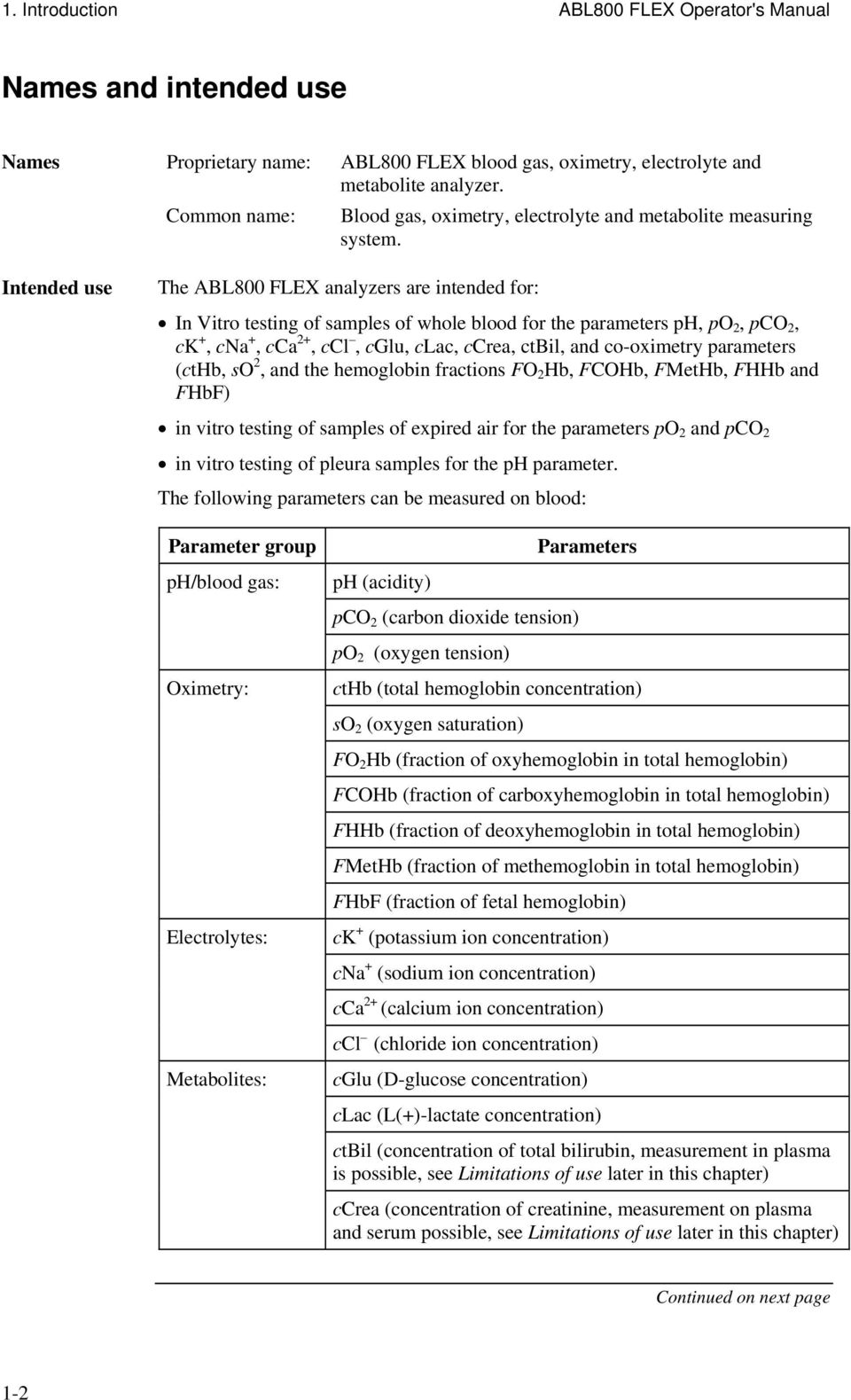
21 ABL800 FLEX Operator's Manual 1. Introduction Names and intended use, Continued Intended use (continued) The following parameters can be measured on pleura samples: Parameter group Parameters Measured value ph (acidity) The following parameters can be measured on expired air samples: Parameter group Measured values Parameters pco 2 (carbon dioxide tension) po 2 (oxygen tension) Derived parameters are listed in chapter 13: Specifications and described in detail in the Reference Manual, chapter 6. Requirement to the operator Measurements on animal blood FLEXMODE Measurements on pleural fluids Other fluids mode The analyzer should be used by personnel who have received special education and training with regard to procedures utilizing in vitro diagnostic medical devices. Animal blood has not been tested on the ABL800 FLEX analyzer. Some components in animal blood differ from those in human blood, and variations in the composition of blood from different animal species may also exist. This mode allows you to analyze a blood sample of 35 μl and higher up to the maximum volume accepted by your analyzer. Depending on the available sample volume, the FLEXMODE provides the highest number of parameters: from all available to as many as reliably possible. This mode is not available in the ABL8x7 FLEX analyzers. Pleura ph can be measured on pleural fluids. Corrections are present in the device. All parameters available on your ABL800 FLEX analyzers can be measured on fluids other than heparinized human whole blood NOTICE: Before using this mode you must establish "user-defined corrections" for each parameter used, on the fluid in question. The corrections assume a linear correlation between the measured value and the reference instrument. The data used for establishing "user-defined corrections" have to cover the desired measuring range. If no user-defined corrections are entered, you will measure in this mode as if on heparinized human whole blood. FLEXQ module The FLEXQ module can accommodate up to three samplers simultaneously. It reads a sampler's barcode, mixes the sample and transports the sampler to the inlet for aspiration and analysis without any further assistance from the operator. Results can be delivered via FLEXLINK (for information refer to the RADIANCE Installation and Setup Manual). NOTICE: The model ABL810 can also be ordered without oximetry parameters: as ABL810 BG only. 1-3
22 1. Introduction ABL800 FLEX Operator's Manual Limitations of use and known interfering substances Limitations of use The following limitations should be taken into consideration: The ABL800 FLEX analyzers are designed for measurements of adult and fetal hemoglobin with normal spectrum characteristics. Some spectra deviate from the normal characteristics, e.g. for certain hemoglobinopathies and the ABL800 FLEX analyzers do not compensate for this. CAUTION - Fulfillment of user-specific analytical needs The user should review the analyzer performance data to assure that the performance fulfills the user-specific analytical needs. WARNING Clinical decisions The validity of the test results from this instrument must be carefully examined by a clinician and related to the patient s clinical condition, before any clinical decisions are taken on the basis of the test results. CAUTION - Risk of erroneous results Always meticulously follow the sampling procedures described in chapter 12: Sampling. Failure to follow these procedures may introduce clots or air bubbles in the sample and yield erroneous results. NOTICE: Bilirubin measurements on plasma and creatinine measurements on plasma and serum need to be measured in Other fluids mode, as the other modes are intended for measurement on human whole blood only. Corrections for Creatinine can be found in the Reference Manual. FHbF measurement: The uncertainty in FHbF measurements exceeds the level required to measure normal HbF levels in the adult range (FHbF reference range is 0-1 %). CAUTION - Known interfering substances The following substances are known to affect or interfere with measurements on the ABL800 FLEX analyzers. Substance Halothane (anesthetic) Lipid therapy (treatment) Methylene Blue, HiCN (medication) Interference May give unreliable po 2 results. In OXI measurements. After measurement on blood from a patient who has received lipid therapy it may be necessary to clean the analyzer using the Cleaning program. In OXI measurements. Anions: Br,I, S 2 and Cl O 4 Erroneously high ccl - results. (drugs) 1-4
23 ABL800 FLEX Operator's Manual 1. Introduction Limitations of use and known interfering substances, Continued CAUTION - Known interfering substances (continued) Substance Anticoagulants (sampling) Thiocyanic acid (degradation product from treatment with nitroprussid. Also produced in thiosulphate treatment of cyanide poisoning) Glycolic acid (ethyleneglycol degradation product) Insufficiently stabilized blood. Caustic fluids (e.g. strong acids or bases, detergents, etc.). Fluids that precipitate. Fluids that affect the sensor enzymes. Fluids that form complexes with the analyzer solutions (calcium). High viscosity fluids. Hydrophobic fluids. Reactive fluids. Interference Anticoagulants that contain sodium salts will give erroneously high cna + results. Sodium fluoride with or without EDTA and oxalate (di Na) influence cglu results. Sodium fluoride gives erroneously high cna + and low cca 2+, cglu and clac results. Tri sodium citrate influences cna +, ck + and cglu results. Thus Radiometer recommends the exclusive use of heparin as anticoagulant. Solutions containing organic preservatives may damage the ionselective membranes of the ck + and cglu electrodes when introduced into the analyzer. Do not use EDTA, as it leads to erroneous ph, pco 2, cna +, ck + and cca 2+ results. Use of EDTA will also affect subsequent measurements on the Ca electrode and it will reduce the lifetime of this electrode. Erroneously high cglu and clac measurements. Erroneously high clac measurements. Other fluids mode allows you to measure on fluids other than heparinized human blood. Be aware that some substances, such as listed in the left column, measured in the Other fluids mode may damage the instrument or the electrodes. This can affect the subsequent measurement on human blood or quality control solutions. 1-5
24 1. Introduction ABL800 FLEX Operator's Manual Limitations of use and known interfering substances, Continued CAUTION - Known interfering substances (continued) Substance Interference Carboxymethyl cellulose (CMC) Some auto-venting arterial blood samplers contain carboxymethyl cellulose (CMC) in the porous vent. CMC can dissolve into the sample and give erroneously low cca 2+ results. Therefore we recommend Radiometer accessories together with our analyzers, e.g. the safepico arterial blood sampler which is specifically designed to minimize sample contamination with CMC. Galactose, glucosamine, maltose, mannose, xylose Erroneously high cglu measurements. For detailed information see Interference Tests in chapter 5 of the ABL800 FLEX Reference Manual. 1-6
25 ABL800 FLEX Operator's Manual 1. Introduction Warning/Caution and Notices Definitions Throughout the manual, the various procedures may contain operational cautions and warnings, which are important and should be read carefully before performing the related procedures. The manual also contains a number of NOTICES. The following table indicates the type of information given in Warnings, cautions and notes. Symbol Explanation WARNING A warning alerts the reader about a situation, which, if not avoided, could result in death or serious injury. It may also describe potential serious adverse reactions and safety hazards. The designation of a hazard alert as a "warning" is reserved for the most significant problems. The term WARNING is generally used as signal word for this type of hazard alert. CAUTION The term precaution is used for the statement of a hazard alert that warns the reader of a potentially hazardous situation which, if not avoided, may result in minor or moderate injury to the user or the patient or damage to the equipment or other property. It may also be used to alert against unsafe practices. This includes the special care necessary for the safe and effective use of the device and the care necessary to avoid damage to a device that may occur as a result of use or misuse. The word CAUTION is generally used as signal word for a precaution statement. NOTICE Notices give practical information. 1-7
26 1. Introduction ABL800 FLEX Operator's Manual Symbols overview List of symbols The symbols below are used by Radiometer. Symbol Explanation Biohazard Expiry date See instructions for use For In Vitro Diagnostic Use Lot number Sensitive to light. Store in a dark place. Code number For single use only Sterilized by ethylene oxide Sterilized by irradiation Storage temperature from 2 C to 32 C (36 F to 90 F) Waste of Electrical and Electronic Equipment (WEEE) The symbol indicates that: Radiometer Medical ApS and its distributors within the European Union (EU) and associated states have taken the necessary steps to comply with the directive, 2002/96/EC on waste electrical and electronic equipment (WEEE). The instrument, when reaching its end of life, must be collected and recycled separately from other waste according to national requirements. Please contact your local Radiometer distributor for instructions. Environmental implications: WEEE contains materials that are potentially hazardous to the environment and to human health. 1-8
27 2. What is what Overview Introduction Contents The ABL800 FLEX analyzer is a complete unit comprised of several different modules each performing a specific function and controlled by comprehensive software. The modules are collected into well-defined sections according to their related function. This chapter describes the basic parts of the ABL800 FLEX analyzer and its software. This chapter contains the following topics. Analyzer - front Analyzer - rear Measuring section Inlet module FLEXQ module Thermal printer Communication ports Barcode reader AutoCheck module Screen elements Menu structure Analyzer status Online aid facilities Sample counter
28 2. What Is what ABL800 FLEX Operator's Manual Analyzer - front Parts and functions The components of the analyzer front (with covers) is shown below. Touch screen Cover with window Thermal printer Left cover Capillary inlet Syringe inlet Right cover Waste container Cleaning Solution Rinse Solution FLEXQ module Barcode reader AutoCheck module Cal 1 solution Cal 2 solution Part Color touch screen Thermal printer Left cover Waste container Rinse Solution FLEXQ module Barcode reader AutoCheck module Cal 1 Solution Cal 2 Solution Cleaning Solution Right cover Syringe inlet flap Capillary inlet flap Cover with window Function 10.4" LCD for operation and management of the analyzer. For automatic printout of data. To access the waste container/rinse Solution. For waste collection. A sensor detects when container is full, and a message is displayed on the screen. For rinsing the liquid transport system after various analyzer activities. See FLEXQ module in this chapter. See Barcode reader in this chapter. See AutoCheck module in this chapter. For performing 1- and 2-point calibrations. For performing 2-point calibrations. For cleaning the liquid transport system of lipid deposits. To access solutions and pumps see overleaf. Lift to introduce syringe samples and quality control solutions. Lift to introduce capillary samples. See Measuring Section in this chapter. 2-2
29 ABL800 FLEX Operator's Manual 2. What Is what Analyzer - front, Continued Parts and functions (continued) The components of the analyzer front (without covers) is shown below. ph/bg module El/Met module CD-ROM drive Inlet module Met II module Oximetry module Solution pump Waste pump Magnets Part Inlet module CD-ROM drive ph/blood Gas (BG) module Electrolyte/Metabolite (El/Met) module Met II module Oximetry (Oxi) module Solution pump Waste pump Magnets Function Accepts samples from a syringe/test tube or a capillary see Inlet Module in this chapter. For storing data on a CD-RW disk or retrieving data from a CD (e.g. installation software). CAUTION Installation of correct software Install only software which is strictly intended for use with the analyzer. Installation of other types may affect analyzer performance. Measures ph, po 2, pco 2 and ccl. See measuring component detail. Measures cca 2+, ck +, cna +, cglu and clac. See measuring section detail. Measures creatinine. (Only available for the ABL8x7 FLEX analyzers) Measures cthb, so 2, FHHb, FO 2 Hb, FCOHb, FMetHb, FHbF and ctbil. See measuring component detail. Transports solutions through the liquid transport system. Transports liquid to the waste container. Hold the covers in place. 2-3
30 2. What Is what ABL800 FLEX Operator's Manual Analyzer - rear Parts and functions The parts and components of the analyzer's rear panel are shown below. Gas 1 cylinder Gas 2 cylinder Communication ports Fan Power switch Gas cylinder sockets Power socket Part Gas 1 cylinder Function Contains a gas mixture of 5.61 % CO 2, % O 2 ; balance % N 2. Gas 2 cylinder Contains a gas mixture of % CO 2, < 0.04 % O 2 ; balance > % N 2. Fan Gas cylinder socket Communication ports Power switch Power socket For cooling internal components. For mounting the gas cylinders. See section Communication Ports in this chapter. For turning the analyzer on (position I) and off (position O). For connecting the power cord. In USA: If source is 120 V, use Radiometer cord with parallel blade attachment plug. If source is 240 V, use Radiometer cord with tandem blade attachment plug. 2-4
31 ABL800 FLEX Operator's Manual 2. What Is what Measuring section Parts and functions The modules and components of the measuring section are shown below. Membrane valves Electrode module pumps El/Met module Latch Met II module Oximetry module ph/bg module Sample path Part Membrane valves Electrode module pumps Latch Function Control the flow of gas and solutions into the measuring modules. Transport solutions and gas mixtures through the measuring modules. Establishes electric contact between the electrode in the measuring chamber and the electrode amplifier. To access an electrode, push inwards on the upper portion of the latch, and lift upwards. Sample path ph/bg module Transports samples, solutions and gas mixtures. Contains the measuring chamber with the ph, reference, pco 2, po 2 and ccl electrodes. El/Met module Contains the measuring chamber with the cca 2+, ck +, cna +, cglu, and clac electrodes (a filter is installed for the cglu and clac electrodes). Met II module Oximetry module Contains the measuring chamber with the ccrea A and ccrea B electrodes (Only available for the ABL8x7 FLEX analyzers) Contains the hemolyzer with glass cuvette, spectrophotometer for measuring cthb, so 2, FHHb, FO 2 Hb, FCOHb, FMetHb, FHbF, ctbil on 128 wavelengths, and the lamp unit. 2-5
32 2. What Is what ABL800 FLEX Operator's Manual Measuring section, Continued Electrode locations The electrodes are located in the electrode modules as follows: ccl - electrode pco 2 electrode clac electrode cglu electrode po 2 electrode Reference electrode cna + electrode ck + electrode ph electrode cca 2+ electrode ccrea A electrode ccrea B electrode The table below describes each electrode. Module Electrode Type ph/bg ccl E744 pco 2 E788 po 2 E799 Reference E1001 ph E777 El/Met clac E7077 cglu E7066 cna + E755 ck + E722 cca 2+ E733 Met II ccrea A E8088 ccrea B E8089 NOTICE: An orange filter is placed in the measuring chambers for the cglu, clac, ccrea A and B electrodes. 2-6
33 ABL800 FLEX Operator's Manual 2. What Is what Inlet module Parts and functions The inlet module accepts samples from a syringe/test tube or a capillary (the syringe and capillary inlet flaps are removed on the picture). Syringe and capillary inlet flaps are interlocked so that only one may be opened at a time. Probe attachment Preheater Inlet probe Capillary inlet flap post Syringe inlet flap post Capillary inlet Inlet gasket unit Syringe inlet Part Probe attachment Preheater Inlet probe Capillary inlet flap post Syringe inlet flap post Capillary inlet Syringe inlet Inlet gasket unit Function Secures inlet probe. Open the clip to remove probe. Heats all samples and gases to 37 C. Automatically moves into the syringe to aspirate the required sample. Holds the inlet flap for capillary samples. Holds the inlet flap for syringe samples. Receives sample from a capillary. Receives sample from a syringe and test tube. Provides transfer of samples from a sampling device to the inlet probe; can be removed. 2-7
34 2. What Is what ABL800 FLEX Operator's Manual FLEXQ module Parts and functions FLEXQ module for automatic transport of samplers to the inlet is shown below. FLEXQ position before or after analysis: Barcode reader Samplers Indicator diodes Sampler tray FLEXQ position during analysis: 2-8
35 ABL800 FLEX Operator's Manual 2. What Is what FLEXQ module, Continued Parts and functions (continued) The components are as follows: Part FLEXQ sampler tray Indicator diodes Barcode reader Sampler tray cover Function FLEXQ sampler tray moves to the position for measurement by means of a step motor (not shown). The samplers used in the sampler tray should be safepico sampler with the safetipcap. Change the color from green to yellow when the optical switch detects the sampler placed in the slot. Laser barcode reader reads the sampler barcode. A short beep indicates that the barcode has been read. You can scan the Sampler ID on the analyzer s scanner and then place it in the sample tray or you can place the sampler in the sampler tray and let the FLEXQ scanner read the sampler barcode. The sampler tray cover has three slots for the samplers; the slots have optical switches for detecting the sampler. The cover can be removed (as shown) for cleaning. Mixer tray The mixer rotates and moves the ball in the sampler in order to mix the blood sample. The sample is adequately mixed after 7 seconds. The mixer tray moves into position under the sampler immediately before the measurement. 2-9
36 2. What Is what ABL800 FLEX Operator's Manual Thermal printer Parts and functions The components of the thermal printer (with the cover open) are shown below. Release lever Paper guide Drive roller Paper roll holder Cover Part Release lever Drive roller Paper guide Paper roll holder Cover Function Push the lever fully back to lift the drive roller from the printer head and paper guide in order to adjust paper alignment. Remember to return the lever to its original position (as shown) in order to print. Feeds the thermal paper through the printer. Located behind the drive roller, it is between this and the drive roller that paper is fed. Holds the paper roll in place. Open to replace the paper roll. Contains instructions on how to make a replacement. Close the cover when a new paper roll has been mounted in the printer. 2-10
37 ABL800 FLEX Operator's Manual 2. What Is what Communication ports Ports and functions The following communication ports are available: Mouse Keyboard USB ports (two) Display unit Printer port Network connector Ext. VGA monitor Fuse for printer unit Serial port (COM2) Main fuse The functions of the communication ports are as follows: Port Display unit port Mouse port Keyboard port Serial port (COM2) Network Printer port Function For connection to the analyzer s display PS/2 connector used for the connection of a standard mouse (user supplied). PS/2 connector used for connection of a keyboard (user supplied). 9-pin serial port used for HIS/LIS communication or connection of an external barcode reader. RJ45 ethernet interface connection to network. Parallel port for connection to a local printer 2-11
38 2. What Is what ABL800 FLEX Operator's Manual Communication ports, Continued Ports and functions (continued) Port External VGA monitor port USB (2 ports) Fuse for printer unit Main fuse Function 15-pin connector for external monitor (optional; is enabled by Radiometer service representative). For connecting USB devices, e.g. a removable drive. USB keyboard supported. Other USB devices need an approved XP driver (user-supplied mouse or modem, etc.). The compartment contains 1 protective fuse: 5 20 mm, 4 Amp, Slow blow (T4AL) (order code number ). The compartment contains 2 protective fuses: 5 20 mm, 4 Amp, High break (T4AH). Type Shurter No (order code number ). WARNING Risk of fire Fire hazard. Replace fuse as marked. 2-12
39 ABL800 FLEX Operator's Manual 2. What Is what Barcode reader Barcoded items The following items have barcodes that can be read into the analyzer: Item All solution containers QC ampoules thb calibration ampoules Electrodes Electrode membranes Gas cylinders Pump tubing Fan filter Inlet gasket Location of barcode Label on the container Insert in the box containing the ampoules Insert in the box containing the ampoules Label on the box containing the electrode Label on the box containing the membrane unit Label on the cylinder Label on the tubing packaging Label on the box containing the filter Label on the box containing the inlet gasket In addition to the items above, you can enable every text box on the Patient Profile, Patient ID, Patient Result, QC ID and Recording Fluid Replacement screens where it is possible to enter a barcode refer to Miscellaneous Setup in chapter 3: Installation and setup. Reading in a barcode Hold the barcode of the item you wish to read in parallel to the sensor part of the barcode reader. A short beep from the barcode reader indicates that the information has been read in successfully. Sensor part 2-13
40 2. What Is what ABL800 FLEX Operator's Manual AutoCheck module Parts and functions The AutoCheck module is shown below. AutoCheck carousel To close To open Retractable cover Part Retractable cover AutoCheck carousel Function Gives access to the carousel. You can either slide the carousel cover open or press Menu - Analyzer Status - AutoCheck - More - Open Module. Make sure that no objects prevent the cover from opening freely. Contains the AutoCheck ampoules packed according to the optimal packing list see Refilling the AutoCheck carousel in chapter 7: Replacements. 2-14
41 ABL800 FLEX Operator's Manual 2. What Is what Screen elements Ready screen Operation and management of the ABL800 FLEX analyzers is performed via a touch screen. Almost all commands to the analyzer come from the touch of a button or area on the screen. The touch screen is divided into three sections: Top section Center section Bottom section For the analyzers without the FLEXQ module, the Ready screen looks as follows: The Ready screen appears automatically if the touch screen remains idle for more than 3 minutes. The screen intensity reduces by 50 % when the analyzer is not used. Top section The status bar varies slightly, according to which screen you are in and the status of the analyzer. Example: The status describes the current task of the analyzer (e.g. calibration, measurement, etc.) or its status (e.g. ready for use, on hold, etc.). 2-15
42 2. What Is what ABL800 FLEX Operator's Manual Screen elements, Continued Top section (continued) The time bar is present only when the analyzer is performing a task; it follows the progress of the current task. For example: The Stop button is visible only when it is allowed to interrupt an activity in progress. The parameter bar lists all measured parameters available and activated on your analyzer. It allows you to judge the parameter status at a glance before you have to perform a measurement. Green parameter: Parameter status is okay; no problem is detected on the given measuring channel. Yellow parameter: Red parameter: Error associated with the given parameter during last calibration or quality control measurement. The parameter is unreliable and will have? (if requested in Corrective Actions) in front of the result. Serious error associated with the given measuring channel. Parameter cannot be used at all and will be displayed as.. ; or a parameter was repressed in the Parameter Setup program due to errors during last calibration or quality control measurement. NOTICE: A parameter disabled in the Parameter Setup program will be removed from the parameter bar see Analysis Setup Programs (Disabled versus Deselected Parameters) in chapter
43 ABL800 FLEX Operator's Manual 2. What Is what Screen elements, Continued Center section The center section is the main information and interaction area of which there are many different types. The center section of the Ready screen is described part by part, starting from the top (for the analyzers without FLEXQ module the center part contains the analyzer type and if entered in Miscellaneous Setup (see chapter 3) analyzer message). This part of the Ready screen contains the following elements: Analyzer name The messages to the operator regarding the FLEXQ activities Urgent Manual Sample request button. The button allows you to book an inlet for an urgent measurement while the analyzer performs a task. The button is grayed out when the analyzer is ready for any measurement. This part of the Ready screen contains the following elements: "Slot #": condition of each sampler tray slot (1, 2 and 3) is indicated with the arrows that reflect the indicator diodes in the sampler tray: Green Blinking green Place the sampler into the slot or remove it from the slot. Wait for the sampler to be identified. Yellow Blinking yellow Do not remove the sampler from the slot. Remove the sampler from the slot. "Sampler ID": appears when the sampler is placed in the sampler tray slot and is registered. The name of this column can be changed in the Sample Logistics Setup (see Analysis Setup in chapter 3 of this manual). "Time to Result": shows time left till a result will be ready; the clock indicates that the sample age has exceeded settings selected in Sample Logistics setup. "Status": gives information about a sampler in the slot: Slot empty Ready for processing Processing Completed A slot is ready to accept a sampler. Sampler has been registered in the slot. Patient and sampler data are being processed. Measurement is completed and the result can be viewed. 2-17
44 2. What Is what ABL800 FLEX Operator's Manual Screen elements, Continued Center section (continued) Patient data can be edited. Result can be viewed. This part of the Ready screen is reserved for the analyzer messages and is entered in the Miscellaneous Setup (see chapter 3 in this manual): Other screen types and their elements are described on the following pages. Icon and screen name identify each screen. Example: Icon Screen name The icon and title of a screen are the same as the button that gives access to that screen. 2-18
45 ABL800 FLEX Operator's Manual 2. What Is what Screen elements, Continued Center section (continued) Text boxes show a text in the form of lists, items, tables, etc. Various types of text boxes and navigation in them are given on the next page. Scroll bar Scroll keys The first line is highlighted. To highlight another line, touch it on the screen or use up and down arrow scroll keys displayed on the screen beside a relevant text box. A scroll bar scrolls a text box horizontally when the text box extends beyond the area available on the screen. A single-arrow scroll button highlights one item at a time upward or downward. A double-arrow scroll button highlights an item at the top or the bottom of the screen. The first line is highlighted. To highlight another line, use the up and down arrow buttons or touch this line in the box. Enter the data using the screen keypad or keyboard. In this text box you can select one of the predefined options. Use the up and down arrow buttons to select an item. NOTICE: If the text box already contains an entry, it will be overwritten and cannot be retrieved. Text boxes are designated in quotation marks, e.g. "Operator". The same applies to the other elements on the center section of the screen: names of the columns (e.g. "Status"), input fields (e.g. "Draw time"), etc. 2-19
46 2. What Is what ABL800 FLEX Operator's Manual Screen elements, Continued Center section (continued) Check buttons allow you to enable/disable or select/deselect an item on the screen. For example: A function is selected (e.g. acoustic signal if the inlet remains open) or activated (e.g. communication with the RADIANCE system) A function is deselected or deactivated. Parameter is selected. Parameter is deselected. Screen keypad allows the entry of numerical data on the screen. Numerical keys from 0 to 9. Decimal point. The buttons listed below have the following functions: Press to confirm a numerical entry and to highlight the next line in the text box. Press to delete a character (from right to left) or to type in the new data (the box is cleared as soon as the first character is typed). Press to display the full alphanumerical keyboard. 2-20
47 ABL800 FLEX Operator's Manual 2. What Is what Screen elements, Continued Center section (continued) Screen keyboard is used for entering both alphabetical and numerical data see the description on the next page. Activated text box The keyboard functions as a normal keyboard with alphabetical and numerical characters. The typed text appears in the activated text box. Enter Press to confirm the entry and to return to the previous screen. Backspace Press to delete characters from right to left. Press to cancel any changes made in the activated text box and to return to the previous screen Press to delete an entry in the activated text box. Shift Press to type a capital letter or symbol. Press to lock the keyboard in order to type capital letters and symbols on the numerical keys. When activated, indicator is green. Up/down/left/right arrows move the cursor in the activated text box in order to edit a text. 2-21
48 2. What Is what ABL800 FLEX Operator's Manual Screen elements, Continued Buttons Each button has an icon and a name placed on it. When pressed, it opens a screen or a menu. The buttons are designated in bold italics in this manual, e.g. Menu, Utilities, etc. The buttons displayed in full color can be activated. A button in a weaker color, i.e. grayed-out, is temporarily inactive. The buttons at the top and the bottom of the screen can be selected in the Setup program Access Profiles (in the Analyzer Security menu) together with the access profiles for each operator for detailed information see the description in chapter 3: Installation and setup. Note the functions of the following buttons: Returns you to the previous screen in the same program, e.g. in the Patient Results log, it will return you from the Patient Identification screen to the Patient Result screen. Returns you to the Ready screen. Information bar and icons The information bar is placed in the lower right corner of the screen. 2-22
49 ABL800 FLEX Operator's Manual 2. What Is what Screen elements, Continued Information bar The following icons are available on the information bar: and icons (continued) Icon Function Shows the current time in the selected format. Shows that an analyzer is connected to the RADIANCE system. Shows that an analyzer is connected to the QA Portal. Shows the time of the next scheduled calibration. The time changes when a calibration has been completed. Shows the time of the next scheduled QC measurement. The time changes when a QC measurement has been completed. Shows that the remote operator is connected. Click to make more icons visible. Click to reduce the number of visible icons to a clock. 2-23
50 2. What Is what ABL800 FLEX Operator's Manual Menu structure Menu at analyzer startup When the analyzer is taken into use, only the following limited menu is available: Press Menu. Log on Last patient result Analyzer Status Help Tutorials Calibration Progs: 1 Point Calibration 2 Point Calibration Start Progs Data Logs Auxiliary Progs: Rinse Cleaning Protein Removal Decontamination AutoCheck Programs Run High Crea Check (only the ABL8x7 analyzers) Utilities Standby Temporary Shutdown Patient Results Log Patient Profile Log QC Log Calibration Log Activity Log Allowed actions at analyzer startup The following actions are allowed at analyzer startup: To perform a measurement To perform a replacement To call a calibration To start an AutoCheck measurement To edit data in the data logs The menu above and the scope of actions are suitable for those users whose activities include performing measurements and occasional replacements. 2-24
51 ABL800 FLEX Operator's Manual 2. What Is what Menu structure, Continued Entering standard password To access the complete menu, do the following: Step Action 1. Press Menu on the Ready screen. Then click on Logon. 2. Type in the standard password: Standard password: See chapter 3: Installation and setup, Analyzer Security, in this manual for further information about the logon possibilities. Confirm with Enter. 3. Press Menu to access the complete menu see the next section. The access possibilities for each user of the analyzer and their passwords are entered in Setup program Access Profiles see chapter 3: Installation and setup in this manual. 2-25
52 2. What Is what ABL800 FLEX Operator's Manual Menu structure, Continued Complete menu Press Menu. My results* Log on Analyzer Status Last patient result Help Tutorials Calibration Progs: 1 Point Calibration 2 Point Calibration thb Calibration Auxiliary Progs: Rinse Cleaning Protein Removal Decontamination Liquid Sensor Adjust Pump Calibration Tubing Refill AutoCheck Programs Run High Crea Check (only the ABL8x7 analyzers) Start Progs Disk Functions: WDC Report Back up All Data Restore All Data Export Data Logs Import/Export Archives Save Setup Load Setup Restore Default Setup Eject CD Utilities Standby Sample Counter Temporary Shutdown Long-term Shutdown Data Logs RADIANCE Browser (optional) Patient Results Log Patient Profile Log QC Log Calibration Log Activity Log Archived Data Logs Patient Report Archive Quality Control Archive Calibration Archive Activity Archive Setup: Analysis Setup QC Setup Calibration Setup Replacement Setup General Setup Analyzer Security Print Setup * Is selected in the Setup program Access Profiles (in the Analyzer Security menu) see chapter 3. Structure of the Setup programs see chapter 3: Installation and Setup. 2-26
53 ABL800 FLEX Operator's Manual 2. What Is what Menu structure, Continued Access to analyzer menu The access to various parts/functions of the analyzer menu is determined by the rights defined in the Setup program Access Profiles (in the Analyzer Security menu). Example: You as a user can enter the following: Rinse, Patient Report and QC logs, and Standby programs. Then your menu after you have logged on will look like this: Log on Last patient result Analyzer Status Help Start Progs Data Logs Rinse Utilities Patient Report Log QC log Standby For details see the chapter 3: Installation and setup and chapter 15: Radiometer Settings. 2-27
54 2. What Is what ABL800 FLEX Operator's Manual Analyzer status Analyzer status at a glance The working condition of the analyzer is continuously monitored during its operation. To evaluate the analyzer status at a glance before a measurement, use the following facilities: parameter bar color of the traffic light on the Analyzer Status button. Analyzer Status button Red = cannot be used; Yellow = unreliable; Green = OK Analyzer Status elements To enter the Analyzer Status screen, press Menu - Analyzer Status. Traffic light color of the Analyzer Status button is determined by the traffic light colors of the following status elements: Status element Calibration Status GREEN OK. The colors indicate YELLOW error(s) in the last calibration and/or cal schedule reminders. RED error-prone parameters are repressed. 2-28
55 ABL800 FLEX Operator's Manual 2. What Is what Analyzer status, Continued Analyzer Status elements (continued) Button Quality Control GREEN OK. Status The colors indicate YELLOW error(s) in the last QC measurement and/or QC schedule reminders. RED error-prone parameters are repressed. Reagents GREEN no replacements due at the present time. Status YELLOW a replacement is due, Calibration/Cleaning solutions expire soon or Calibration/Cleaning solutions have expired. Electrode and GREEN no replacements due at the present time. others YELLOW a replacement is due. System Messages GREEN no (critical) messages. YELLOW RED non-critical messages. critical messages. The analyzer cannot calibrate or measure. AutoCheck GREEN no replacements due at the present time. Status YELLOW a replacement is due. Calibrations status The Calibrations status gives an overview of the status of the most recently performed calibration of each type and relevant messages. The following information is available on the screen: Calibration Type Lists each calibration type along with its status: OK Calibration was accepted.? Error(s) detected during calibration. Pending or overdue calibration. The last calibration was accepted. 2-29
56 2. What Is what ABL800 FLEX Operator's Manual Analyzer status, Continued Calibration status (continued) Calibration Type Last Time Next Time Interval Lists each calibration type along with its status:?+ Pending or overdue calibration. The last calibration was not accepted. The date and time the last calibration of the specified type was performed. The date and time the next calibration of the specified type is due according to the Calibration Schedule - see Calibration Schedule, chapter 3. The time interval between calibrations as set up in the Calibration Schedule. The following buttons are available: During a calibration: Result Electrode Upd. After a calibration: Press to display the result of the highlighted calibration. Press to display the electrode updatings for the ongoing calibration. Result Start Calibration Press to display the result of the highlighted calibration. Is activated for the overdue calibrations or the calibrations with "?". 2-30
57 ABL800 FLEX Operator's Manual 2. What Is what Analyzer status, Continued Quality Control status The Quality Control status provides the following information: status of the last measurement on each control solution type messages referring to quality control measurements. For the ABL8x7 FLEX analyzers, please note that Slot 11 will be automatically installed when you scan the barcode for the Cleaning Met II Solution during replacement. Element Solution Function Lists the quality control slot and its solution type along with a status symbol. Cleaning Met II Solution (for ABL8x7 FLEX analyzers only) is used for quality control of high creatinine levels. OK The last measurement was accepted.? One or more of the following occurred: error in the last calibration. analyzer error during last QC measurement. a parameter measurement is outside the defined ranges or a Westgard Rule has been violated. The next measurement is overdue, and the previous measurement, if any, was accepted.? The last quality control measurement had errors present, and the next measurement is overdue. Lot Last Time Next Time The solution lot number for the slot. Lists the time the last measurement was performed. Lists the next scheduled time to perform the measurement on the slot. See Quality Control Schedule, chapter
58 2. What Is what ABL800 FLEX Operator's Manual Analyzer status, Continued Quality Control status (continued) Buttons: Run AC ampoule Result Press to start a measurement on the highlighted AutoCheck solution. For ABL8x7 FLEX analyzers only: When Slot 11 is highlighted, this button changes to Run High Crea Check to start a measurement on the Cleaning Met II Solution. Press to display the last measurement result on the control solution. Reagents status The Reagents status shows the following: status of the solutions and gas cylinders When Calibration/Cleaning solutions are expired, the container in question is marked with a clock above it and the contents are colored orange. messages referring to solutions and gas cylinders. Buttons: Replace Adjust Level Press to enter the screen for replacements of fluids see chapter 7: Replacements. Press to enter the Solution Level Adjustment program to make adjustments see chapter 3 in this manual. Troubleshoot Press to view the error interpretation and operator actions see the description in chapter 11: Troubleshooting. Close Press to exit to the Ready screen. NOTICE: The Calibration and Cleaning Met II Solution containers are filled so that they provide up to 14-days of use in the ABL8x7 FLEX analyzer. This will be registered on the screen by percentages that are lower than 100 % (i.e. 87%, 75%, 50% for the Calibration Solution 1, Calibration Solution 2 and Cleaning Met II Solution, respectively). This has been made so that the solution warning function will not be impaired and you can select the warning values in the usual manner. 2-32
59 ABL800 FLEX Operator's Manual 2. What Is what Analyzer status, Continued Electrodes and Other status The Electrodes and Other status shows the following: replacement schedule for items replaced in the Hold mode messages referring to replacements or user activities. Buttons: Replace Log Activity Close Highlight the item and press this button to enter the screen for replacements of electrodes/membranes see Replacing membrane or electrode in chapter 7. Activate User Activities part of the screen to make this button visible. When the button is visible, press it to enter the User Activity program to edit the user activities list see chapter 3 in this manual. Press to exit to the Ready screen. System messages AutoCheck status See chapter 11: Troubleshooting. AutoCheck Status is available only if the AutoCheck module has been installed. It shows the following: status of the carousel and the measurements scheduled in the QC Schedule program (see section Quality control setup in chapter 3). Messages referring to AutoCheck. 2-33
60 2. What Is what ABL800 FLEX Operator's Manual Analyzer status, Continued AutoCheck status (continued) Element Next Scheduled Next Replacement Available Function To show the next AutoCheck solution/lot combination according to the scheduled setup. To show the date and time for refilling the carousel according to the scheduled setup. To show the presently available AutoCheck control solutions: type, lot and quantity of ampoules in the carousel. Use the up/down arrow buttons to highlight the desired solution. 2-34
61 ABL800 FLEX Operator's Manual 2. What Is what Analyzer status, Continued AutoCheck status (continued) The carousel shows the number of ampoules available in it. The black spots indicate used ampoules. Button unrolls to access the following buttons: Packing List Displays the Optimal Packing List screen. Reset Cancels any pending quality control measurements. Open Module AutoCheck Programs Interrupts ampoule conditioning in the carousel. Resets wet section programs. Opens the cover of the AutoCheck module. Displays the AutoCheck Programs screen to start an AutoCheck measurement. 2-35
62 2. What Is what ABL800 FLEX Operator's Manual Online aid facilities Online facilities Help The online aid facilities include the following: Online Help Tutorials Online troubleshooting (see chapter 11 in this manual). This function assists you in using the analyzer. Press the button in the Main menu (if not moved to the Ready screen see Access Profiles (in the Analyzer Security menu) in chapter 3) or on the Ready screen. The help text is available for practically every screen your analyzer shows during its operation. The Contents screen displays all help topics. Each topic is hyperlinked to either the next topic level or to the appropriate help text screen. Use the scroll bar or touch the text to search through the topics and access the relevant help information. Press the Previous Topic button to display the help text of a previous screen. The Index screen is an alphabetic list of subjects in the help program. Each letter at the top of the screen is a hyperlink to that section in the index. Touch the letter to display the list of entries under that letter. Each index entry is displayed in bold, purple text (a hyperlink). Simply touch the text to display the relevant help text. 2-36
63 ABL800 FLEX Operator's Manual 2. What Is what Online aid facilities, Continued Tutorials Tutorials are short video sequences of commonly used procedures. Press the button in the main menu or button next to the Troubleshooting button (when performing troubleshooting) to enter the Tutorial Playlist screen. The Preview shows the highlighted sequence animation. To start a tutorial on full screen, highlight the topic of interest from the menu, using the arrows, and press the Play button. Topic Blood Samples Quality Check Replacement Contents Videos of a capillary, syringe or expired air sample introduction by highlighting it. Videos of manual or AutoCheck quality control. Video sequences on various replacements. The buttons on the Tutorial screen during a sequence allow to do the following: 2-37
64 2. What Is what ABL800 FLEX Operator's Manual Online aid facilities, Continued Tutorials (continued) Button Function Play. Pause. Stop. Show previous picture show next picture. Switch on the sound (voice presentation of a sequence) with volume regulation. Switch off the sound. Show the list of video sequences. The "-" button puts Tutorials in the background in order to perform an action and then to return to Tutorials again. The "x" button exits Tutorials. When a button is grayed out, it is not functional. 2-38
65 ABL800 FLEX Operator's Manual 2. What Is what Sample counter Purpose Description The sample counter allows you to keep track of the measurements, calibrations and quality control. The screen elements are described below: Element Parameter Count Counters User counters last reset Function Lists the parameters and how many times each of them was measured by the analyzer. Normally the count is the same as the total number of measurements provided the parameters were not excluded from the measurement(s). Shows the number of sample measurements, calibrations and QC measurements made since the sample counter was last reset (User column). The following is registered: Activity Total Aborted User Number of... Completed sample/quality control measurements/ calibrations only. Interrupted or aborted measurements are excluded. Aborted sample/quality control measurements/ calibrations due to sample errors, wet section errors, etc. interrupted measurements excluded. All completed sample/quality control measurements/calibrations performed by all operators since the sample counter was last reset. Gives the date when the counters in the User column were last reset to zero. 2-39
66 2. What Is what ABL800 FLEX Operator's Manual Sample counter, Continued Description (continued) Element Reset Counters Function Print Close For the analyzers with no logon protection of the Setup programs, press this button to reset the counters in the User column. Press to start the printout of information in Counters and in Parameters. Press to return to the Ready screen. 2-40
67 3. Installation and setup Overview Introduction Contents After the analyzer has been installed, you can define the settings on your ABL800 FLEX analyzer according to your own needs and requirements. This chapter contains the following topics. Installation Setup menu structure Analyzer security Analysis setup Patient reports Calibration setup Quality control setup Replacement setup Parameters and input setup Analyzer settings Communications Printers Disk Functions setup Corrective actions Miscellaneous setup
68 3. Installation and setup ABL800 FLEX Operator's Manual Installation Information The ABL800 FLEX analyzers are installed and fully prepared for use by Radiometer representatives in your country. The reason for it is that due to the analyzer's modular design each user can select only those modules that cover his/her specific needs. These modules are installed and checked at the user's place. Installation of consumables and accessories are exactly the same as the procedures described in chapter 7: Replacements. 3-2
69 ABL800 FLEX Operator's Manual 3. Installation and setup Setup menu structure Accessing Setup programs To access the Setup programs, press the buttons: Setup menu structure Setup Analyzer Security: General Security Operators and Passwords Access Profiles Replacement Setup: Replacement Schedule User Activities Solution Level Forecast Solution Warning Expiration Warning AutoCheck Warning Calibration Setup: Cal Schedule Drift Tolerances Print Setup QC Setup: QC Solutions QC Schedule QC Ranges QC Input Setup QC Statistics Westgard Rules Rilibäk Ranges Analysis Setup: Capillary Modes Syringe Modes Patient Reports Reportable Ranges Reference Ranges Sample Pre-registration Sample Logistics Setup General Setup See the next page 3-3
70 3. Installation and setup ABL800 FLEX Operator's Manual Setup menu structure, Continued Setup menu structure (continued) General Setup Printers: Printer Setup Automatic Printing Communications: RADIANCE Connection LIS/HIS Connection QA Portal Automatic Data Transmission Automatic Data Request Patient Lookup Setup Remote Support Analyzer Settings: Analyzer ID Time/Date Acoustic Signal Environment Language Parameters and Input: Parameters Units User-defined Data Items User-defined Notes Disk Functions Setup: Automatic Backup Automatic Archiving Miscellaneous Setup Corrective Actions Note that the exit from a setup program returns you to the Ready screen. You will find it more convenient to place some buttons, e.g., Utilities, on the Ready screen to shortcut the entry to a desired setup program - refer to Access Profiles program (in the Analyzer Security menu) in chapter
71 ABL800 FLEX Operator's Manual 3. Installation and setup Setup menu structure, Continued Entering password To enter the Setup programs, do the following. Step Action 1. Press Menu on the Ready screen. Then click on Logon. 2. Depending on the authentication setting chosen in the General Security screen, enter or scan your user name and password, or your logon-barcode. Confirm with Enter. Print Setup This program allows you to print parts of the setup. To select the parts of the setup for printing, do the following: Step Action 1. Press Menu Utilities Setup Print Setup. 2. All setups are selected as a default. Press the relevant check buttons to deselect the setup that you do not wish to be printed out. 3. Press Print to start printout of the selected setups or press Close to return to the Ready screen. 3-5
72 3. Installation and setup ABL800 FLEX Operator's Manual Analyzer security Programs Analyzer Security programs are described in this section. General Security This program allows you to hand over the control of the operators and passwords to the RADIANCE system and to allow an anonymous use of the analyzer. To enter this program, press Menu Utilities Setup Analyzer Security General Security. To hand over the control of the operators and passwords to the RADIANCE system activate the check button in the "Centralized User Management" box. With this option enabled you can only view the operators, not add, edit or remove any of them. All users defined on the ABL are deleted and the list of users in the RADIANCE system is copied to the ABL. NOTICE: This option can only be enabled if RADIANCE communication is enabled in the RADIANCE Connection Setup program. 3-6
73 ABL800 FLEX Operator's Manual 3. Installation and setup Analyzer security, Continued General Security (continued) To define, how the user should log on, use the up/down arrow buttons in the "Authenticate" box to select the desired logon option. The following options are available: UserId/Password as primary This option allows you to enter or scan a User name and password in the Logon screen. By pressing the Log On BC button a Logon-barcode can be scanned. UserId/Password only This option allows you to enter or scan the user name and password in the Logon screen. Logon-barcode as primary This option allows you to enter or scan a Logon-barcode in the Logon screen. By pressing the Extented Log On button a user name and password can be scanned. Logon-barcode only This option allows you to enter or scan a Logon-barcode in the Logon screen. To allow an anonymous use of the analyzer, i.e. use without logon, use the up/down arrow buttons to select "Yes" in the "Anonymous use" box (default) and select the desired access profile of the anonymous operator, in the "Access profile for anonymous operator" box. The "Access profile for anonymous operator" box only appears, when "Yes" is chosen in the "Anonymous use" box. See Access Profiles further in this chapter for information on how to define the access profiles. To set the time interval to elapse, before an operator is automatically logged off, press the Logoff Time button. Select the logoff time in minutes (from 0 to 60) and seconds (from 0 to 50 in 10-second intervals). The default logoff time is three minutes. Press Back to return to the General Security screen. 3-7
74 3. Installation and setup ABL800 FLEX Operator's Manual Analyzer security, Continued Operators and Passwords This program allows you to add, edit or remove operators and to assign an access profile to each operator. NOTICE: If the Centralized User Management option is enabled in the General Security screen, you cannot add, remove or edit the operators, but only view the access profiles of the individual operators. To enter the Operators and Passwords program, press Menu Utilities Setup Analyzer Security Operators and Passwords. Shows the list of available operator profiles Shows the list of actual operators When the analyzer is taken into use, the following default operators are available: Operator Manager Radiometer Remote operator Has access to All menu items and programs (not service programs). It is recommended to remove this operator with the standard password: , and enter the actual users with their profiles and passwords. All menu items and programs (user and service) on the analyzer. Note that "Radiometer" cannot be removed from the operator list. Only if the Remote Support option key is installed. 3-8
75 ABL800 FLEX Operator's Manual 3. Installation and setup Analyzer security, Continued Operators and Passwords (continued) To add an operator to the list, do the following: Step Action 1. Press the Add Operator button to display the Add New Operator screen. 2. Type the name of the operator or operator category in the "Operator ID" box, using the screen keyboard. 3. Enter or scan the password: in the "Password" box. The password must be at least four characters long, and not more than Re-enter or re-scan the password in the "Confirm" box. 5. Enter or scan the logon barcode in the "Logon barcode:" box The logon barcode must be at least four characters long. The logon barcode and the password can be identical. 6. Re-enter or re-scan the logon barcode in the "Confirm" box. 7. Press Back. If the password is not accepted, the Add New Operator screen remains open and a message, telling you what was wrong, appears. If the password is accepted, the Operators and Passwords screen is displayed. 8. In the Operators and Passwords screen, select the desired access profile of the new operator. 3-9
76 3. Installation and setup ABL800 FLEX Operator's Manual Analyzer security, Continued Operators and Passwords (continued) To remove an operator from the list, use the up/down arrow buttons in the "Operator" box to highlight the operator and press Remove Operator. NOTICE: If the Centralized User Management option is enabled in the General Security screen you cannot add, remove or edit the operators, but only view the access profiles of the individual operators. Access Profiles This program allows you to define the permitted actions, the available menu items and button shortcuts of an access profile. To enter this program, press Menu Utilities Setup Analyzer Security Access Profiles. To define the permitted actions of an access profile, select the desired profile in the "Profile names" box and activate the desired check buttons in the "Permitted actions" box. To deactivate an action, press the check buttons once again. 3-10
77 ABL800 FLEX Operator's Manual 3. Installation and setup Analyzer security, Continued Access Profiles (continued) To define the available menu items and button shortcuts of an access profile do the following: Step Action 1. In the Access Profiles screen highlight the desired access profile in the "Profile names" box and press Menus and Buttons. Note that this button is grayed-out for the service technician profile. 2. Select the desired menu items in the "Menu Items in Quick Menu" box. Selected profile is named on the screen. A grayed-out item in the Menu & Button Configuration screen indicates that only some subitems were selected in this group. Clear checked items indicate that all subitems have been selected. The buttons allows you to do the following: Highlight menu items Open/close submenus Select/deselect a menu item. 3-11
78 3. Installation and setup ABL800 FLEX Operator's Manual Analyzer security, Continued Access Profiles (continued) Step Action 3. To create a button shortcut for a specific item, highlight the desired item in the "Menu Items in Quick Menu" box and then, in the "Button configuration" box, press the button position that you wish to give the selected item. 4. Select other five buttons in the same manner, if desired. 5. To deselect a button, press it once again. 6. Press Back to return to the Access Profiles screen. Enabling the My Results option will give the operator an easy access to all Patient Results made by that operator, by displaying the Patient Result Log, filtered on the operator name. 3-12
79 ABL800 FLEX Operator's Manual 3. Installation and setup Analysis setup Programs Analysis Setup programs are described in this section. Activate a button to enter the program. Syringe Modes and Capillary Modes Setup The Syringe Modes Setup and Capillary Modes Setup are shown below: To select a measuring mode To enable a mode The activated button will be selected as default mode when opening the inlet 3-13
80 3. Installation and setup ABL800 FLEX Operator's Manual Analysis setup, Continued Selecting a measuring program To select a measuring program, do the following: Step Action 1. Blood, pleura and expired air samples: Press the desired mode button, enable it and select the desired measuring program with the arrow buttons. Other fluids: Activate the desired mode button and enable the Other fluids check button. 2. Press Parameters to select a parameter profile for a measuring program see Selecting parameter profile below. 3. Edit, if desired, the left part of the button name for the mode by pressing Edit Name. 4. Enter corrections for the Other fluids mode by pressing Corrections see Entering corrections for Other Fluids Modes further in this section. 5. Select the report layout for a measuring program by pressing Layout see Selecting a report layout further in this section. NOTICES: You can use one of the syringe measuring modes for test tubes. Use Capillary 35 μl OXI for bilirubin analysis (cthb = 0) on plasma. Deselect all other parameters for this mode in the Parameter Profile. Alternatively, you can use the Other Fluids mode for the bilirubin measurement on plasma (this is not relevant for the ABL8x7 FLEX analyzers). In the Syringe Modes Setup and Capillary Modes Setup screens you can define up to 12 measuring programs. To get access to the last 6 mode buttons press Next Page. 3-14
81 ABL800 FLEX Operator's Manual 3. Installation and setup Analysis setup, Continued Selecting parameter profile To select parameter profile for each measuring program, do the following: Step Action 1. Select a measuring program and press Parameters on the Syringe Modes Setup or Capillary Modes Setup screen. 2. Select parameters for a given measuring mode by pressing a parameter check button (see Screen elements in chapter 2). The list of available parameters depends on your analyzer version. 3. Select the dynamic parameters option in the "Use dynamic parameters" box as follows: Parameters can be selected before a measurement. Parameters can be selected after a measurement. 4. Press the Back button to return to the Syringe Modes Setup or Capillary Modes Setup screen. Disabled versus deselected parameter A parameter is disabled, i.e. excluded from the Parameter Profile screen and the parameter bar, in General Setup Parameters and Input Parameters. A parameter deselected for the given syringe or capillary measuring program will be measured, but excluded from the displayed and printed patient report. You can further select or deselect a parameter before or after a measurement see chapter 4: Sample measurements. 3-15
82 3. Installation and setup ABL800 FLEX Operator's Manual Analysis setup, Continued Selecting HbF correction To give the user the possibility of selecting or deselecting HbF correction during a measurement, do the following: Step Action 1. Select HbF correction for all levels or for HbF levels higher than 20 % in Miscellaneous Setup (Setup General Setup Miscellaneous Setup) see the description further in this chapter. 2. Return to the Analysis Setup, choose the desired syringe or capillary program and press the Parameters button to enter the Parameter Profile screen. 3. Activate the check button in the "Use HbF correction" box (if "Disabled for all levels" has been selected in Miscellaneous Setup, the text box and the check button in it will not be visible on this screen). 4. Press the dynamic parameters check button in the Use dynamic parameters box in order to be able to exclude the HbF correction and other parameters during a sample measurement. HbF correction was disabled in Miscellaneous Setup 3-16
83 ABL800 FLEX Operator's Manual 3. Installation and setup Analysis setup, Continued Entering corrections for Other Fluids mode The Other Fluids mode allows measurement on samples other than heparinized whole human blood and, therefore, requires entering corrections (offset and slope). Step Action 1. Select the Other Fluids mode and press the Corrections button on one of the Modes Setup screens (Capillary or Syringe). 2. Highlight the parameter with the arrow buttons and press Edit. 3. Key in the slope and offset values. Confirm each entry with Enter. Please note that only values within the range programmed into the software will be accepted. 4. Press Back to confirm the entries and return to the previous screen. 5. To delete a correction, highlight it and then press the Remove button. 3-17
84 3. Installation and setup ABL800 FLEX Operator's Manual Analysis setup, Continued Selecting a report layout To select a report layout for a measuring program, do the following: Step Action 1. Select a measuring program. 2. Press the Layout button on one of the Mode Setup screens. 3. Select the layout for the measuring program from the list made in the Patient Report Setup see Patient report further in this chapter. The selected layout will be the default layout for the given measuring program. 4. Press Back to confirm the settings. 3-18
85 ABL800 FLEX Operator's Manual 3. Installation and setup Analysis setup, Continued Reference ranges and critical limits This program allows you to enter your own reference ranges and critical limits for all measured and calculated parameters. For each parameter, you can choose whether or not to differentiate between the categories of sample type, sex and age group. Viewing the reference ranges and critical limits Press the check button to activate a function; press the check button again to deactivate it. To view the reference ranges and critical limits, highlight a parameter in the "Parameter list" box using the arrow buttons. View the settings for a highlighted parameter Selecting sample type Selecting sex To select a sample type, highlight a parameter in the "Parameter" box, using the arrow buttons. Press the check button in the "Sample type" box and select a sample type, using the arrow buttons in the box. To deactivate sample type differentiation, press the check button again. To select sex, highlight a parameter. Press the check button in the "Sex" box and select sex type, using the arrow buttons in the box. To deactivate sex differentiation, press the check button again. 3-19
86 3. Installation and setup ABL800 FLEX Operator's Manual Analysis setup, Continued Setting age group limits To set the age group limits, do the following: Step Action 1. Press the Age groups button to display the following screen: 0 days-1 month, 1-5 months, 5-8 months, >8 months" 2. Use the following: left/right arrows to choose the age group limit you want to alter (indicated by a blue circle containing a white cross). up/down arrows to scroll through the list of possible age limits. As the list is scrolled the text on the age group bar changes accordingly. 3. Repeat step 2 for each limit to be changed. 4. Press Back when completed to return to the Reference Ranges and Critical Limits screen. 5. Activate the Age group check button. To deactivate age group differentiation, press the check button again. Setting reference and critical limits To set the reference and critical limits for each parameter do the following: Step Action 1. Highlight a parameter by using the up/down arrow buttons. 2. Choose the sample type, sex, age group and press the Edit button. 3-20
87 ABL800 FLEX Operator's Manual 3. Installation and setup Analysis setup, Continued Setting reference and critical limits (continued) Step Action 3. To remove all current ranges, press the Clear limits button. 4. To change the value in a range limit, touch and highlight the range. Then enter the limit, using the screen keyboard and confirm with Enter. 5. Repeat for other limits in a similar way. 6. Press Back when completed. Reportable ranges To change or enter a reportable range (must be selected smaller than or equal to the measuring range), do the following: Step Action 1. Scroll to the desired parameter, using the up/down arrows or scroll bar. Measured parameters show their measuring ranges. Derived parameters show Key in the desired lower limit and confirm with Enter on the keypad. 3. Key in the upper limit and confirm with Enter on the keypad. 4. To change the reportable range to the default (primary) setting, highlight the desired parameter and press Set Default. 3-21
88 3. Installation and setup ABL800 FLEX Operator's Manual Analysis setup, Continued Reportable ranges (continued) Step Action 5. To change all parameters to the default values, press the 1-n Set All Default button. 6. Press Continue to change all parameters reportable ranges to the default ones. Press Cancel to keep the user-defined reportable ranges and return to the previous screen. Press Close to exit the program and confirm the selected settings. See also Calibration verification in chapter 15 in this manual. Sample Preregistration setup This program allows you to select interpretation of the barcode and the patient data that can be confirmed before a sample measurement. To select the settings, do the following: Step Action 1. Use the up/down arrow buttons to select the interpretation of the barcode setting in the "Interpret barcode input as" box. Choose one of the following: Patient ID Accession Number Sampler ID. 3-22
89 ABL800 FLEX Operator's Manual 3. Installation and setup Analysis setup, Continued Sample Preregistration setup (continued) Step 1 (cont.) Action Note that choosing the Accession Number or Sampler ID will gray out its check button (Sampler ID on the screen above). Choosing the Accession Number or Sampler ID ensures that this data will be included in the "Data confirmation" box. 2. Select the barcode entry. 3. Activate the relevant check buttons in the "Included fields" box: Accession Number, Sampler ID, Patient First Name, Patient Last Name, Birth Date, Patient Sex. 4. Activate the check button in the "Data confirmation" box so that the patient data can be confirmed before the sample measurement. 5. Press Close to confirm the settings and return to the Ready screen. Sample Logistics Setup This program allows you to select the following: the batch mode (automatic sample handling), Patient Identification shown on the Ready screen and to define maximum allowed sample age for each measured parameter. Batch mode (automatic sample handling) The batch mode allows you to place your sampler in an empty slot in the FLEXQ sampler tray and leave the analyzer. The sampler will be registered, sample analyzed and the results sent to the required person. To achieve this the following is required: Analyzer has live connection to the RADIANCE system Barcode interpretation is set to Sampler ID in the Sample Pre-registration "When entering Sampler ID" in "Request patient demographics" box is selected and "From connection" must be set to RADIANCE in the Automatic Data Request setup All sample/patient information is present on the RADIANCE system 3-23
90 3. Installation and setup ABL800 FLEX Operator's Manual Analysis setup, Continued Batch mode (automatic sample handling) (continued) If the above requirements are fulfilled, activate the check button in the "FLEXQ" box. This box is not available for the analyzers without the FLEXQ module. If a live RADIANCE connection is detected, the analyzer will automatically set the connect option when activating the Enable batch mode button. Patient identification on the Ready screen To select the information in the second column on the Ready screen, use the up/down arrow buttons in the "FLEXQ" box. The choices are: Patient Last Name, Accession No. or Sampler ID. Sample age Sample age is the time within which the sample should be analyzed. It can be defined for each measured parameter individually or for all parameters. Patient Report Layout (described further in this chapter) offers the following time registration items in the Patient ID: "Draw time", i.e. when the sample was obtained from the patient; is entered by the operator on the Patient Identification screen on the analyzer or obtained from the RADIANCE system. "Sample registration", i.e. when the sample was registered by the analyzer; is automatically registrered by the analyzer. "Time before FLEXQ", i.e. sample transport time to the analyzer; is obtained if the "Draw time" has been entered; is automatically registrered by the analyzer. "Time in the FLEXQ", i.e. waiting time; is automatically registrered by the analyzer. Max. sample age (is entered on the RADIANCE system). This setting, if used, will overrule the settings selected on the analyzer. The sample age is calculated, using the following: Manual measurement FLEXQ measurement "Sample age " = "Sample registration" "Draw time". Sample age = 0 if "Draw time" is not entered. "Sample age" = "Time before FLEXQ" + "Time in FLEXQ" where: "Time before FLEXQ" = "Sample registration" "Draw time"; Time in FLEXQ" = "Time the sample aspiration begins" "Sample registration" 3-24
91 ABL800 FLEX Operator's Manual 3. Installation and setup Analysis setup, Continued Sample age (continued) To define maximum allowed sample age, do the following: Step Action 1. Activate the check button in the "Calculation of sample age" box. 2. To select the same age for all parameters, press Set all. To select the sample age for each parameter individually, highlight a parameter in the "Sample aging time per parameter" box, using the up/down arrow buttons. 3. Select sample age for the highlighted parameter, using up/down arrow buttons. 3-25
92 3. Installation and setup ABL800 FLEX Operator's Manual Patient reports Purpose This program allows you to create a number of new layouts for patient reports or to modify the existing ones. The screen accomodates two main functions: creating a layout and editing a layout. Creating a layout To create a new layout, do the following: Step Action 1. Press New to make a new blank layout with the name "New" displayed on the right side of the screen in the "Name" box. If you wish to make a copy of an existing layout and use it as a basis for a new layout, select the desired layout and press Copy. "Copy" will be added to the name in the "Name" box (i.e. "-R- default Copy"). 2. Press the keyboard icon beside the "Name" box Type in a new name for your layout. Confirm with Enter to return to the Patient Report Setup screen. The newly named layout will be added to the list of layouts. Edit your layout as described in Editing a layout further in this section. 3-26
93 ABL800 FLEX Operator's Manual 3. Installation and setup Patient reports, Continued Creating a layout (continued) To make the highlighted layout a default for your analyzer press Make Default. The default layout will be marked with ( ) in the list of layouts. To make a test printout of the highlighted layout (patient ID items and selected parameter groups with the parameters/units for each parameter group) press Preview. This test print will be labeled "Preview". To reset any user defined layout to the R- Default layout, select the desired layout and press R Default. To delete a highlighted layout, press Delete. Note that the Radiometer default layout cannot be deleted. The button is disabled if only the Radiometer default layout is available. Editing a layout To edit a layout, do the following: Step Action 1. Highlight a layout in the list by touching it on the screen. 2. Press the Edit Patient ID Layout button to edit the patient ID items see description on the next page. 3. Press the Edit Patient Results Layout button to edit the parameter groups see description further in this section. 4. If an automatic printout of the Acid-Base chart for this layout is desired, activate the Print Acid-Base Chart button. 3-27
94 3. Installation and setup ABL800 FLEX Operator's Manual Patient reports, Continued Editing patient ID layout You can customize the patient identification (Patient ID) information as follows: select the items to be included in the Patient ID. set Patient ID entries as mandatory. define default values for Patient ID. Selected patient report layout To edit a patient ID for a selected patient report layout, do the following: Step Action 1. To add a highlighted (by touching it on the screen) item in the "Available items" box, to the list of selected items, press the button. 2. To remove a highlighted (by touching it on the screen) item from the "Selected items" box, press the button. 3. To make a highlighted item in the list of selected items mandatory, press the Set as Mandatory button. The item will be indicated by a on the Patient ID screen and must be entered during a measurement before a patient result can be viewed. To remove the mandatory mark, highlight the item in the "Selected items" box and press the Set as Mandatory button again. 4. NOTICE: If you are using mandatory input fields, you are not allowed to change the report layout during measurement, unless the mandatory fields have been filled out. Press Back to exit the screen. 3-28
95 ABL800 FLEX Operator's Manual 3. Installation and setup Patient reports, Continued Entering default values To enter default values for patient identification items, do the following: Step Action 1. Use the arrow buttons on the right to highlight the desired item in the "Selected items" box. Changes to List 2. Set the default: If the item has a value, press Keyboard, enter the value and press Enter on the keyboard to confirm. If the item has a list of options, press List, highlight the option using the arrow buttons and press Enter to confirm. 3. Set or change other default values in the similar manner. 4. Press Back to exit and confirm changes. NOTICES: It is not possible to set default values for all items. The values can be changed on a result-by-result basis on the Patient Identification screen. An item placed in the Selected items list does not appear in the Available items list. To use the Patient Lookup function, Department (Pat.) should be selected for the Patient Identification screen. To use the Request function, Accession number, Sampler ID and/or Patient ID should be selected for the Patient Identification screen. 3-29
96 3. Installation and setup ABL800 FLEX Operator's Manual Patient reports, Continued Editing patient result layout You can do the following: select parameter groups and the parameters in each group, and make report layout by using layout commands. To edit a patient result layout, do the following: Step Action 1. Select the patient report layout by highlighting it on the screen and press Edit Patient Results Layout. 2. Use the arrow buttons to highlight a parameter group and press Include Exclude to include the group in the patient result. It will be shown in the "Selected items" box. 3. Select parameters for this parameter group by highlighting them one by one and pressing (Include). 4. Select another parameter group and parameters for this group in the same manner. 5. Use layout commands <New group> (items following this command are placed on the top of the next half of the screen), <New Line> (a line is inserted between items) or <New Page> (items following this command appear on next screen page) as desired and press. 3-30
97 ABL800 FLEX Operator's Manual 3. Installation and setup Patient reports, Continued Editing patient result layout (continued) Step Action 6. To exclude an item from the selected parameter list, highlight it and press 7. If you wish to display parameters with their reference ranges and have them checked against reference ranges/critical limits, do the following: Highlight a parameter. Press Show Ranges to indicate it by [xxx-xxx]. Repeat for other parameters in the same manner. If the [xxx-xxx] is not included for a parameter, checking against reference ranges/critical limits is disabled for this parameter. However, checking against the reportable ranges is always performed. NOTICE: Refer to the Reference Manual, chapter 6: Parameters, for information on parameters and their groups. 3-31
98 3. Installation and setup ABL800 FLEX Operator's Manual Calibration setup Programs Calibration Setup programs are described in this section. Activate a button to enter the program. Calibration drift tolerances This program allows you to change the default drift tolerances for the ph, pco 2, po 2, electrolyte and metabolite electrodes see Radiometer default settings in chapter 15 in this manual. NOTICE: Radiometer recommends the use of the default drift tolerances. Too narrow drift tolerances will cause electrode drift errors even for normal electrode fluctuations. If the drift tolerances are made wider, no warning will be given if the electrode should become unstable. Significant measurement errors could result. To define your own drift tolerances, do the following: Step Action 1. Highlight the desired parameter by touching it on the screen. The list of available parameters depends on your analyzer version. 2. Type in your own value and confirm with Enter. 3. Change other drift tolerances in the same manner. 4. Press Close to confirm the changes. 3-32
99 ABL800 FLEX Operator's Manual 3. Installation and setup Calibration setup, Continued Calibration schedule This program allows you to schedule automatic calibrations, manual thb calibration and automatic cleaning (the first automatic cleaning also includes quality control of the Crea A and B electrodes for high creatinine values on the ABL8x7 FLEX analyzers), and select a calibration to be performed after a sample measurement. 24-hour scale shows the time for each scheduled automatic calibration or cleaning. To edit the schedule for automatic calibrations/cleaning and thb calibration, do the following: Step Action 1. Highlight the desired calibration or cleaning on the screen. List of activities: calibrations and cleaning. 2. Press the Edit button. Activity after each measurement Use the arrow buttons to select start time for calibrations and cleaning and the intervals between each activity. 3-33
100 3. Installation and setup ABL800 FLEX Operator's Manual Calibration setup, Continued Calibration schedule (continued) Available calibration schedule options Step Action 3. Select activity after each measurement by activating the check button for the desired calibration. The following options are available. Option Interval 1 Point calibration 30 min, 1 hour, 2, or 4 hours. 2 Point calibration 1 hour, 2, 4 or 8 hours. 1 Point ph/bg calibration (for the USA only) thb calibration Start time Activity after measurement Cleaning intervals 30 min, 1 hour, 2 hours. Never, 7 days, 1 month, 2, 3, 4 or 6 months 00:00, 00:15, 00:30, 00: :45. or 12 midnight, 12:15 am, 12:30 am, 12:45 am.12 midday, 12:15 pm..11:45 pm. none, 1 Point ph/bg calibration (for the USA only), 1 Point calibration, 2 Point calibration. 8, 24 hours. 3-34
101 ABL800 FLEX Operator's Manual 3. Installation and setup Quality control setup Programs The quality control setup programs are described in this section. Activate a button to enter the program. QC solutions This program allows you to assign or change a quality control solution to a specific slot. NOTICE: Changing a control solution assigned to a slot will delete all current quality control statistics obtained on that slot. If you want a copy of the statistics for the last QC month, create a WDC Report see chapter 8: Disk Functions. NOTICE: (for the ABL8x7 FLEX analyzers only) Slot 11 is assigned to the Cleaning Met II Solution used for high Crea check. 3-35
102 3. Installation and setup ABL800 FLEX Operator's Manual Quality control setup, Continued QC solutions (continued) To assign a control solution to a slot, do the following: Step Action 1. Highlight a slot, using the arrow buttons. 2. For control solutions from Radiometer, scan the bar code or press the keypad button to enter the barcode. 3. For non-radiometer control solutions, press Add Non-R-. The warning Press Accept to continue with the installation of the control solution. Press Cancel to cancel installation of the control solution. 4. To delete a control solution, highlight the desired slot and press Delete. The warning as in step 3 above appears. Press Accept to continue with the removal of the control solution. Press Cancel to cancel. 5. To define whether an AutoCheck quality control measurement is to be run manually or automatically, press the Manual/Auto button. Useful if the AutoCheck module is out of order. The following quality control solutions can be used with the ABL800 FLEX analyzers: Quality control system QUALICHECK5+; AutoCheck5+ QUALICHECK3+; QUALICHECK5+; AutoCheck3+; AutoCheck5+ QUALICHECK5+; AutoCheck5+ AutoCheck6+, S8377 Cleaning Met II Solution Analyzer ABL805 ABL830/20/10 ABL835/25/15 ABL837/27/17 For the solution types for each quality control system, please refer to chapter 14: Ordering information in this manual. You can also use a suitable non-radiometer quality control system for your analyzer. 3-36
103 ABL800 FLEX Operator's Manual 3. Installation and setup Quality control setup, Continued QC ranges This program allows you to do the following: globally update all control ranges of a slot to a calculated lot-to-date range. individually edit parameter control ranges by entering your own ranges or updating to a calculated lot-to-date range. define a minimum allowed control range by entering a Fixed SD (standard deviation). See the Quality Control Systems Reference Manual for detailed information on statistics and its parameters. To edit data for the control solution, do the following: Step Action 1. Use Next Slot to display the desired slot. Selected control solution Press Edit. 2. Select the parameter to be edited, using Next Param. or Prev Param. Parameter 3. Press Update to change the range to the one shown in the "Lot-to-Date range (2 SD)" box - if available (i.e. the range calculated over the course of the lot, represented mathematically by: mean value ± 2 SD. This is the range within which 95 % of the measurements taken are found). 3-37
104 3. Installation and setup ABL800 FLEX Operator's Manual Quality control setup, Continued QC ranges (continued) Step Action 4. Highlight the limit by touching it on the screen and enter your own value(s), using the keypad. 5. To activate or deactivate the Fixed SD (i.e. a minimum allowed control range is defined by setting a Fixed SD), press the check button. To change the SD value, touch the SD field to highlight it and enter the value, using the keypad. Confirm the entry with Enter. 6. Repeat the procedure for other parameters in the same manner. 7. To update the control ranges for all parameters of a displayed level to the corresponding lot-to-date (2 SD) range shown, display the desired slot, using Next Slot. Press Update All. 8. Press Continue to update the control ranges for all parameters under the specified solution slot. Press Cancel to cancel updating. 3-38
105 ABL800 FLEX Operator's Manual 3. Installation and setup Quality control setup, Continued QC ranges (continued) QC input setup NOTICE: Once the Fixed SD is activated, you cannot update the control ranges to the limits that are narrower than those determined by the Fixed SD, for both singleparameter and multiple-parameter updates. This program allows you to select the following for the Quality Control Identification screen during a measurement: mandatory temperature entry by the operator the default temperature always displayed (unless altered by the operator). To select the settings, do the following: Step Action 1. Activate the Mandatory temperature check button. A will appear next to an empty temperature box on the Quality Control Identification screen during each quality control measurement and a temperature must be entered, otherwise the result cannot be retrieved. 2. Highlight the default temperature in the "Default temperature" box and enter a default temperature on the keypad; confirm with Enter. The value in C or F is automatically entered on the Quality Control Identification screen during measurement. The temperature can be altered for a particular measurement but will return to the default setting for future measurements. 3-39
106 3. Installation and setup ABL800 FLEX Operator's Manual Quality control setup, Continued QC schedule This program allows you to schedule quality control measurements for your analyzer. The screen shows the timetable for all days of the week and time during a day. Step Action 1. To select time during a day, use the and buttons. 2. To display other weekdays, use the and buttons. Symbols for manual and automatic quality control are as follows: measurement(s) on the control solution manually performed. measurement(s) on the control solution automatically performed. To add a new quality control solution to a schedule, do the following: Step Action 1. Select the desired time. 2. Press the Add button to display the screen below. Slots/quality control solutions Touch the QC slot box to activate it. 3-40
107 ABL800 FLEX Operator's Manual 3. Installation and setup Quality control setup, Continued QC schedule (continued) Step Action 3. Select the slot/quality control solution (entered in the Quality Control Solutions program), using the up/down arrow buttons in the box. Confirm with Select. 4. Highlight the "Weekdays" box using the Field down button. Activate the relevant check buttons to select the days of the week this measurement should be performed. 5. Highlight the "Start time" box. Key in the time to perform a measurement and confirm with Enter on the keypad. NOTICE: The symbols for the automatic or manual quality control (given on the previous page) will automatically appear in the schedule. 6. Highlight the "Repeat" box. Select the interval the measurement should be repeated, using the up/down arrow buttons in the box. 7. Press Back to return to the Quality Control Schedule Setup screen. If more than one quality control solution was scheduled, the schedule screen will look like this: To edit the schedule, press Edit and follow the procedure above. 3-41
108 3. Installation and setup ABL800 FLEX Operator's Manual Quality control setup, Continued QC schedule (continued) To remove a quality control measurement from the schedule do the following: Step Action 1. Highlight the desired quality control measurement and press Remove. 2. Press the desired button to remove the quality control measurement from the schedule: For this day, For all days or All entries for QC slot (number). 3. Press Back to return to the QC Schedule screen. QC Statistics This program allows you to select the following: the statistics factor the initiation of warning messages at the end of the statistical month. To select the settings, do the following: Step Action 1. Statistics factor expands the control range to the statistics range (it is a range within which quality control results must fall in order to be included in the quality control statistics). Key in the desired statistics factor (from 1.0 to 9.9) on the keypad and confirm with Enter. The default value is
109 ABL800 FLEX Operator's Manual 3. Installation and setup Quality control setup, Continued QC Statistics (continued) Step Action 2. To set up the analyzer to send reminders to print or export the monthly statistics, activate the appropriate check button (or both) for the message(s) to appear in System Messages upon occurrence. 3. Press Close to exit the program. Westgard Rules The Westgard Rules are a set of statistical rules that, when applied to the quality control results, can increase the probability of detecting an error in the sampling procedure or in the analyzer itself, or help detecting a shift or trend in your quality control results by comparing current measurement values of a control solution with previous values. This program allows you to select Westgard Rules for all slots or for specific parameters. To activate or deactivate the assigned Westgard Rules, do the following. Step 1. Action Press On/Off button to activate the assigned Westgard Rules for the slot. Slot, solution, type, lot Press On/Off again to deactivate the assigned Westgard Rules. Buttons are grayed out 3-43
110 3. Installation and setup ABL800 FLEX Operator's Manual Quality control setup, Continued Westgard Rules (continued) Step Action 2. Press Next Slot and activate/deactivate the Westgard Rules for the other slots in the same manner. 3. To activate the Westgard rules for specific parameters in a slot, display the desired slots by using Next Slot. 4. Press the Edit button. The screen shows all the Westgard Rules and their current settings for the parameter. Parameter 5. Display the desired parameter using the Next Param or Prev Param buttons. 6. Activate the desired Westgard Rule(s) by pressing the corresponding check button. Once edited, all future quality control measurements on the parameter for the given slot will be evaluated according to the selected Westgard Rule(s). 7. Select Westgard Rules for other parameters or levels in the same manner. 8. To select/deselect all six Westgard Rules for every parameter of a displayed control solution slot, select the desired slot by pressing the Next Slot button. 3-44
111 ABL800 FLEX Operator's Manual 3. Installation and setup Quality control setup, Continued Westgard Rules (continued) Step Action 9. Press Select All or Deselect All. 10. Verify information on the screen. Press Continue. Changes are made and shown in the Westgard Rules Setup. Press Cancel. No changes are made. 11. Select or deselect the Westgard Rules for other slots in the same manner. NOTICES: All future measurements taken on the slot will be evaluated with respect to the Westgard Rules if the Select All function was activated Settings will be removed under Deselect All. To have the possibility to return to the settings as they were, use the On/Off button. When a quality control measurement violates an applied Westgard Rule, a W is added to the parameter in the result. For a detailed explanation of how to interpret and evaluate results with respect to Westgard Rules, see chapter 7 of the Quality Control Reference Manual. Reference: Westgard JO, Barry PLL. Cost effective quality control: managing the quality and productivity of analytical processes. Washington: AACC Press, Rilibäk Ranges The Rilibäk Ranges program allows you to define a set of rules to control the maximum deviation of any parameter from the assigned target value. The target values are given on the QC insert. It is possible to define more than one rule for the individual parameters. 3-45
112 3. Installation and setup ABL800 FLEX Operator's Manual Quality control setup, Continued Rilibäk Ranges (continued) To activate or deactivate the Rilibäk Rules, do the following. Step 1. Action Press the On/Off button to activate/deactiviate the assigned Rilibäk rules. To add a new Rilibäk rule, do the following: Step Action 1. Press the Add button to display the screen below: 2. Select the desired parameter from the parameter list shown in the right side of the screen. 3. Press the Left arrow button until the first "Lower Limit" box is highlighted and enter the desired lower limit. 4. Highlight the next box and select "<" or "<=". 5. Highlight the first "Upper Limit" box and select "<" or "<=". 6. Highlight the next "Upper Limit" box and enter the desired upper limit. 3-46
113 ABL800 FLEX Operator's Manual 3. Installation and setup Quality control setup, Continued Rilibäk Ranges (continued) Step Action 7. To select the desired +/- range press the desired radio button. 8. Enter the desired +/- range in the "Ranges" box. 9. Press Back to return to the Rilibäk Ranges screen. The added Rilibäk rule is now shown in the screen. To edit a Rilibäk rule, do the following: Step Action 1. Select the desired rule in the Rilibäk Ranges screen and press Edit to display the screen below: 2. Use the Right or Left arrows to jump between the input boxes and edit the desired values. 3. Press Back to return to the Rilibäk Ranges screen. To remove a Rilibäk rule, do the following: Step Action 1. Highlight the desired rule in the Rilibäk Ranges screen and press Delete. NOTICE: When a quality control measurement violates an applied Rilibäk Rule, a red R is shown in front of the parameter name in the result. 3-47
114 3. Installation and setup ABL800 FLEX Operator's Manual Replacement setup Programs Replacement Setup includes the programs described in this section. Activate a button to enter the program. Replacement schedule This program allows you to schedule routine replacements along with the current scheduled date and interval for replacement. The settings selected here are then used in the Replacements on the Analyzer Status screen. To edit the schedule of replacement actions, do the following: Step Action 1. Highlight the replacement action to be scheduled and press Edit. 3-48
115 ABL800 FLEX Operator's Manual 3. Installation and setup Replacement setup, Continued Replacement schedule (continued) Step Action 2. Change the interval for the selected replacement action (displayed in the "Action" box) with the up/down arrow buttons (see recommended replacement intervals below). NOTICE: The replacement schedule reminder "Lock analyzer when 10 % overdue" (selected in Corrective Actions see further in this chapter) will work on the basis of the setting selected in the "Action" box. 3. Touch to highlight the "Next date" box and change the date using screen keypad. Confirm with Enter. 4. Press Back to return to the Replacement Setup screen. 5. Repeat steps 1-4 for each replacement action to be scheduled. Recommended replacement intervals The following replacement intervals are recommended by Radiometer. NOTICE: The replacement intervals below are guidelines only. Under no circumstances do they guarantee the lifetime of the replacement items. For analyzers with high throughput the replacement intervals should be adjusted accordingly in the Replacement schedule. For an average of 40 samples per day: Action Interval Replacing Crea A and Crea B electrode membranes Replacing metabolite membranes Replacing blood gas and electrolyte electrode membranes Replacing pump tubing Replacing inlet gasket Replacing fan filter Replacing electrodes 14 days 1 month 3 months 6 months 6 months as required as required Replacing reference electrode membranes: 40 samples per day: All analyzers, except ABL8x7 FLEX analyzers 1 month 40 samples per day: ABL8x7 FLEX analyzers only 14 days >40 samples per day: ABL8x7 FLEX analyzers only 1 week The status of solutions, waste container and gas cylinders are not scheduled and can be viewed in the Replacements on the Analyzer Status screen. 3-49
116 3. Installation and setup ABL800 FLEX Operator's Manual Replacement setup, Continued User Activities Adding a user activity This program allows you to formulate and schedule your own activities (e.g. cleaning analyzer, replacing printer paper, etc.) along with the current scheduled date and interval. The settings selected here are then used in the Replacement Status. To add the user activity, do the following: Step Action 1. Press Add to display the Edit User Activities Schedule screen. 2. To add text, press the keyboard icon and type the activity. Confirm with Enter on the keyboard. Choose the Interval with the up and down arrow keys in the "Interval" box: days or months. 3. Type the "Next date" using screen keypad. Confirm with Enter. 4. Press Back to return to the User Activities screen. 5. Repeat steps 1-4 for each activity to be scheduled. 3-50
117 ABL800 FLEX Operator's Manual 3. Installation and setup Replacement setup, Continued Editing a user activity To edit a user activity, do the following: Step Action 1. Highlight the desired user activity on the User Activities screen. Press Edit. 2. Press the keyboard icon to edit the text. Confirm the text with ENTER. Change, if desired, the interval or next date (confirm the date with Enter). 3. Press Back to return to the User Activities screen. 4. Edit other user activities in the same manner. Deleting a user activity To delete a user activity from the list, do the following: Step Action 1. Press Delete on the User Activities screen. 2. Press Continue to delete the activity. Press Cancel to return to the User Activities screen. 3-51
118 3. Installation and setup ABL800 FLEX Operator's Manual Replacement setup, Continued Solution warning This program allows you to select a solution level value in % below which a warning will be given. To select the solution level value for the warning to be activated (default value is 25 %), do the following: Step Action 1. Highlight the desired solution bottle: touch the bottle on the screen or use Next Bottle or Prev. Bottle. 2. Select the solution warning level (in %), using Increase or Decrease. 3. Select warning values for solution levels in other bottles in the same manner. 4. Press Close to confirm the settings. Reagents Expiration Warning This program allows you to set the time for the analyzer to give a warning before the calibration and cleaning solutions with additives will expire. To set the time for the warning, do the following: Step Action 1. Select time, using the up/down arrow buttons in the "Give warning before reagents expire" box. The actual bottles of the analyzer depend on the analyzer type. 2. Press Close to exit the program and confirm the settings. 3-52
119 ABL800 FLEX Operator's Manual 3. Installation and setup Replacement setup, Continued Solution Level Forecast This program allows you to change the solution level forecast so that the analyzer will predict the solution levels in the bottles more precisely. It will improve both the graphical presentation on the Replacement Status screen and the accuracy of the solution low level warning. To change solution level forecast, do the following: Step Action 1. Select the solution bottle, using the Next bottle or Prev. bottle button (the Rinse solution has been selected on the screen). 2. Select the true level (in %) with the up and down arrow buttons on the screen. The bottom of each solution bottle has markings for solution levels. Rinse Solution Other Solutions 25 % min. 25 % min. You can also remove the solution bottle to check the level, and the analyzer will not enter Hold mode. However, the Refill will be performed as soon as the bottle has been mounted back again. The selected setting will be displayed on the Analyzer Status screen. The screen below is an example. 3-53
120 3. Installation and setup ABL800 FLEX Operator's Manual Replacement setup, Continued Solution Level Forecast (continued) Step Action 3. Select solution level forecasts for other solutions in the same manner. 4. To reset all solution level forecasts to the default values: α = and β = 100.0, press the Set Default button. 5. Press Close to confirm the settings. AutoCheck Replacement Warning This program allows you to select the time for a reminder to appear in the System Messages in order to fill up the carousel. To select time for the reminder, do the following: Step Action 1. Use the up/down arrow buttons to select one of the settings: No, 1 hour, 2 hours, 4, 8, 12, 24, 48 hours. 2. Press Close to exit the program. 3-54
121 ABL800 FLEX Operator's Manual 3. Installation and setup Parameters and input setup Programs Parameters and Input Setup includes the programs described in this section. Activate a button to enter the program. Parameters This program allows you to do the following: disable or enable a parameter repress parameters if any problems are detected lock a parameter make user-defined corrections for each measured parameter make out-of-range suppression of oximetry parameters and bilirubin. To disable/enable a parameter, do the following: Step Action 1. Highlight a parameter on the screen, using the scroll facilities. 2. Press Enable/Disable to include or exclude the parameter from a parameter profile and the parameter bar. Note that ph, pco 2 and po 2 cannot be excluded. 3-55
122 3. Installation and setup ABL800 FLEX Operator's Manual Parameters and input setup, Continued Parameters (continued) Parameters can be locked/unlocked from the RADIANCE system. To lock or unlock a parameter from the analyzer, do the following: Step Action 1. Make sure the analyzer is not connected to the RADIANCE system. Highlight a parameter on the screen, using the scroll facilities Press Lock/Unlock. (This button is grayed out if the analyzer is connected to the RADIANCE system.) The locked parameter will show red on the parameter bar and will change the overall analyzer status traffic light on the Analyzer Status button to red. The parameter value will be absent from the printout. However, the locked parameter will be calibrated. To unlock a parameter, highlight it and press Lock/Unlock. The traffic light on the Analyzer Status button will change from red to a color corresponding to the analyzer s overall status. To edit the parameter setup, do the following. Step Action 1. Highlight the desired parameter and press Edit. 2. Activate (or deactivate) the following check buttons to select (or deselect) the following functions: Highlighted parameter 3-56
123 ABL800 FLEX Operator's Manual 3. Installation and setup Parameters and input setup, Continued Parameters (continued) Step 2. (cont.) Action Repression (Repress value in patient result, if the parameter is marked with a question mark, either because there is a calibration problem or QC problem). Out of range suppression for oximetry parameters or ctbil only. When activated, this function is applied to the oximetry/ctbil results (including those obtained in the past) as follows: Oximetry parameters and ctbil values inside the measuring range but lower than 0 or higher than "100 %" will be shown as 0 or "100 %", respectively. ctbil values higher than "1000 μmol/l" but inside the measuring range will be shown as "1000 μmol/l". 3. Use the keypad to enter the following for the highlighted parameter: 4. Correction offset. Confirm the entry with Enter. Correction slope. Confirm the entry with Enter. Press Back to return to the previous screen and repeat steps 1-3 for another parameter, if desired. NOTICE: User-defined corrections for blood measurements will influence the measurement results from blood and QC analyses and change the specific performance characteristics unless Apply parameter corrections to QC was disabled in Miscellaneous Setup. Units This program allows you to select the unit for each parameter or group of parameters. To select the unit for a group or for a single parameter, do the following: Step Action 1. Highlight the group (i.e. parameters which use the same unit as "pressures" = (pco 2, po 2, Baro, etc) or a parameter, using the arrow buttons. 2. Select the desired unit, using the arrow buttons. 3-57
124 3. Installation and setup ABL800 FLEX Operator's Manual Parameters and input setup, Continued Units (continued) Step Action 3. Confirm the selected unit with Select. 4. Change units for other parameters in a similar manner. 5. Press Close to return to the Ready screen. User-defined Patient Data Items This program allows you to include other patient data in the Patient ID layout than those already available there. To add a new item to the list, do the following: Step 1. Action Press Add. 2. Follow the procedure for editing an item from step 2 see the next page. 3-58
125 ABL800 FLEX Operator's Manual 3. Installation and setup Parameters and input setup, Continued User-defined Patient Data Items (continued) To edit an item in the list, do the following: Step Action 1. Highlight an item in the list and press Edit. 2. To change the name, press the keyboard icon on the keypad and type in the new name of up to 20 characters. Confirm with Enter on the keyboard. 3. Select the data type with the up/down arrow buttons and press Select. For "Text" entry proceed to step 8. For "Numerical" entry proceed to step Highlight "Unit". The keypad is now displayed. Press the keyboard icon on the keypad and type in the new name of up to 20 characters. Confirm with Enter. 5. "Decimals" is now highlighted and the box with "None", "1", "2","3" is displayed. Choose the number of decimals with the up/down arrow keys and press Select to confirm. 6. Highlight "Max. value". Type in the value and confirm with Enter on the keypad. 7. "Min. value" is now highlighted. Type in the value and confirm with Enter on the keypad. 3-59
126 3. Installation and setup ABL800 FLEX Operator's Manual Parameters and input setup, Continued User-defined Patient Data Items (continued) Step Action 8. "Use selection list" function: 9. Press the check button. To make a list, press Add, type in the item on the displayed keyboard (up to 20 characters) and confirm with Enter. Add as many items as you wish in the same manner. The check button can be activated only if the selection list contains two or more items. Press Back to return to the User-defined Patient Data Items screen. The new entry will be included in the list. To include the new items in a Patient ID Layout, press Menu - Utilities - Setup - Analysis Setup - Patient Reports - Patient Report ID and follow the procedure described under Including an Item into Patient ID in Patient reports in this chapter. 3-60
127 ABL800 FLEX Operator's Manual 3. Installation and setup Parameters and input setup, Continued User-defined Notes This program allows you to formulate and store notes. To make a Note text, do the following. Step Action 1. Activate one of the check buttons (e.g. Patient Result, Replacements, etc.). See also the remaining options by pressing Next Page. List of Notes for a selected option. 2. Press Add New and type the text for the Note, using the screen keyboard. Confirm with Enter to save the text and return to the previous screen. Your Note is now included in the list. 3. To edit a Note, highlight it in the Notes box, using the up and down arrow buttons, and press Edit. The keyboard will be displayed with the Note text on it. Edit the text and confirm with Enter. 4. To delete a Note, highlight it in the Notes box, using the up and down arrow buttons, and press Remove. 5. Make notes for other options in the same manner. 6. Press Back to exit to the Ready screen. If a list of Notes has been made for a given option, it will be marked with a pencil icon on the relevant screen(s). 3-61
128 3. Installation and setup ABL800 FLEX Operator's Manual Analyzer settings Programs The Analyzer Settings includes the programs described in this section. Activate a button to enter the program. Analyzer ID This program allows you to change the analyzer s identification. To enter analyzer ID do the following: Step Action 1. Touch and highlight the "Analyzer name" box. 2. Type in an identification name and/or number for the analyzer (up to 32 characters), using the screen keypad or keyboard. Confirm with Enter. NOTICE: Installation number cannot be changed. Quote this number in any technical inquiries you have to Radiometer. 3-62
129 ABL800 FLEX Operator's Manual 3. Installation and setup Analyzer settings, Continued Environment Setup This program allows you to enter altitude above sea level, to adjust the built-in barometer in accordance with the reference barometer in your laboratory and to enter the ambient temperature required for the Crea reagents. To enter the altitude at which your analyzer is placed (this is generally used for analyzers at particularly high altitudes), do the following: Step Action 1. Touch the "Altitude above sea level" box to activate. 2. Type in the height above sea level in meters, using the keypad. Confirm with Enter. At high altitudes, the difference between pco 2 values in blood and in the QC solutions is very small due to the high buffer capacity of blood and the QC solutions, and is considered to be negligible. However, the aqueous QC solutions have a different capacity than blood to take up oxygen, and correcting for different po 2 QC values at high altitudes is imperative as deviations from the respective values at sea level are significant. To correct for the different po 2 values, the QC control ranges are modified according to the altitude. For detailed information, please refer to the Quality Control Systems Reference Manual, chapter 4. NOTICE: To make altitude corrections operative for the installed QC solutions, re-enter the QC solutions in their slots and re-scan their barcodes. To adjust the internal barometer, do the following: Step Action 1. Touch the "Adjust to:" in the "Barometer values" box to activate. 2. Key in the desired pressure value on the keypad and confirm with Enter. The value will be shown in the "Measured adjusted" box. Maximum accepted correction is ± 19 mmhg (i.e. the difference between the "Measured unadjusted" and "Measured adjusted" settings). 3-63
130 3. Installation and setup ABL800 FLEX Operator's Manual Analyzer settings, Continued Environment Setup (continued) Step 2 (cont). Action Barometer pressure limits are mmhg, or kpa, or torr. The units are selected in the Setup program: Units. Check the barometer of the ABL800 FLEX analyzer against a known calibrated barometer at least once a month. See ranges in chapter 13 in this manual. To enter the ambient temperature, do the following: Step Action 1. Touch the "Ambient temperature" box to activate. 2. Key in the new temperature, using the keypad. Confirm with Enter. The concentrations of creatinine and creatine in calibration solutions depend on the ambient temperature. This dependency is well-known and taken into account as follows: the analyzer calculates the correct concentrations, using the equilibration constants, time and the ambient temperature entered by user in the Environment Setup (Menu > Utilities > Setup > General Setup > Analyzer settings). For ambient temperatures between 15 C and 28 C or temperatures fluctuating through the entire operating range C of the analyzer, enter 23.5 C. For ambient temperatures constantly above 28 C and up to 32 C enter 30 C. Using these settings will provide analyzer performance according to the performance characteristics specified in the ABL800 Reference manual, chapter 5. In the temperature-controlled environment with constant temperature enter the average ambient temperature in the Environment Setup in order to improve the creatinine performance. If an error in the keyed-in ambient temperature is about 5 %, the bias in the reported ccrea results will be < 0.5 % unless creatine concentration in a sample is ccrea concentration. 3-64
131 ABL800 FLEX Operator's Manual 3. Installation and setup Analyzer settings, Continued Time/Date setup This program allows you to change the current time and date setting. To reset the time and date, do the following: Step Action 1. Highlight the "Time" box by touching it on the screen. 2. Key in the time on the screen keypad. Confirm with Enter. A separator is automatically added between hours, minutes and seconds. 3. Repeat steps 1-2 to reset the Date. 4. To revert to the previous settings, press Current. Acoustic signal setup This program allows you to set up a short beep to sound after certain events. To activate the acoustic signal, do the following: Step Action 1. Activate the desired check button(s). 2. Select volume for the acoustic signal or activate the "Mute all acoustic signals" check button. 3-65
132 3. Installation and setup ABL800 FLEX Operator's Manual Analyzer settings, Continued Acoustic signal setup (continued) The following events are available: Event Value exceeds critical range Close inlet Result is ready Inlet is open too long Beep before AutoCheck opens Explanation One of the measured values exceeds the specified critical limits for that parameter. The inlet should be closed. A sample has been analyzed and the results are ready for viewing. The inlet should be closed. A beep sounds to indicate that an AutoCheck measurement is about to take place. Language This program allows you to select a language of your choice from the list of languages available on your analyzer. To change to another language do the following: Step Action 1. Select the desired language with the arrow buttons. 2. Press Set Language. Press Continue to continue or press Cancel to continue operating the analyzer with the language unchanged. 3-66
133 ABL800 FLEX Operator's Manual 3. Installation and setup Analyzer settings, Continued Language (continued) Step Action 3. If you pressed Continue: Press Continue once again to restart the analyzer right away and to use the new selected language right away or Press Cancel to continue operating the analyzer with the current language until the next restart, where the language then will be changed. 3-67
134 3. Installation and setup ABL800 FLEX Operator's Manual Communications Programs The Communications Setup programs are described in this section. Activate a button to enter the program. Refer to Chapter 2, Communication Ports for the identification and location of a serial RS232 interface connection (COM2) and a network (TCP/IP) RJ45 ethernet connection. RADIANCE Communication Setup This program allows you to connect the analyzer to the RADIANCE system. NOTICE: Connecting the analyzer to the RADIANCE system should be performed by the RADIANCE administrator in your institution. To enable communication with the RADIANCE system, do the following: Step Action 1. Touch and highlight the "Server address" box. Type in the TCP/IP address of your RADIANCE PC, using the screen keypad or keyboard. 2. Touch and highlight the "Port" box. Type in port number, using the keyboard. 3. Touch and highlight the "Password" box. Type in your RADIANCE password, using the keyboard. 3-68
135 ABL800 FLEX Operator's Manual 3. Installation and setup Communications, Continued RADIANCE Communication Setup (continued) Step Action 4. Press the check button in the "Radiance Communication" box to activate connection. The Icon in the "Connection status" box indicates the state of the RADIANCE connection. "Connected" indicates an established connection to the RADIANCE system. The icon will indicate the established connection as well. 5. The "Output queue" box shows the number of data queued up for transfer. It will be sent to the RADIANCE system. Otherwise clear the queue by activating the recycle bin icon. 6. Press Close to exit the screen. LIS/HIS Connection Setup This program allows you to select the communication protocol for a connected device. To select the communication protocol, do the following: Step Action 1. Press Add on the screen. The "Output queue" box shows the number of data queued up for transfer. It will be sent to LIS/HIS. Otherwise clear the queue by activating the recycle bin icon. 3-69
136 3. Installation and setup ABL800 FLEX Operator's Manual Communications, Continued LIS/HIS Connection Setup (continued) Step Action 2. Press Keyboard, type the name of the connection instead of the default one, and press Enter. Press Back to return to LIS/HIS Connection Setup screen. 3. Select the high-level protocol according to the requirements of the connected device. Select between: ASTM, ASTM6xx, HL7 version 2.2, HL7 version 2.5 or POCT1-A DML, using the up/down arrows in the box. 4. Select the low-level protocol as follows: Use Serial or Serial (RAW) for the serial connection. Use Network (TCP/IP) for the network connection. Use Network (TCP/IP)ASTM" for additional serial connection (not all combinations of high-level protocols and low-level protocols are possible). 3-70
137 ABL800 FLEX Operator's Manual 3. Installation and setup Communications, Continued LIS/HIS Connection setup (continued) Step Action 5. a. Connection specifications for serial low-level protocol: Press Edit to display the Connection Specifications screen below. b. Connection specifications for network low-level protocol: Press Edit to display the Connection Specifications screen below (HL 7 version 2.5 is used as an example). c. Connection specifications for POCT1-A DML low-level protocol: 3-71
138 3. Installation and setup ABL800 FLEX Operator's Manual Communications, Continued LIS/HIS Connection Setup (continued) Step 6. Action a. Connection specifications for serial low-level protocol: Use the up and down arrows in each box to select baud rate, stop bits, data bits and parity. Port number should be COM2. Box Option Baud rate 1200, 2400, 4800, 9600, 14400, 19200, 38400, Data bits 5, 6, 7, 8 Stop bits 1, 1.5, 2 Parity Even, odd, none. b. Connection specifications for network low-level protocol: Touch the screen to highlight the following boxes one after another: Server address Port number Reconnect Interval (time interval in seconds to attempt re-connection if connection failed) Retransmit max Transmit timeout. Use the keypad/keyboard to enter the relevant information. c. Connection specifications for POCT1-A DML low-level protocol: Touch the screen to highlight the following boxes one after another: Server address Port number Reconnect Interval. Use the keypad/keyboard to enter the relevant information. QA Portal This program allows you to connect the analyzer to the QA portal. If the QC Portal communication is enabled, the analyzer will automatically send QC results and Cal Verification measurements to the QA portal. To enable communication with the QA portal, do the following: Step Action 1. Touch and highlight the "Server address" box. Type in the TCP/IP address of your QA portal, using the screen keypad or keyboard. 3-72
139 ABL800 FLEX Operator's Manual 3. Installation and setup Communications, Continued QA Portal (continued) Step Action 2. Touch and highlight the "Port" box. Type in port number, using the keyboard. 3. Press the check button in the "Enable communication with QA Portal" box to activate connection. The Icon in the "Connection status" box indicates the state of the QA portal connection. "Enabled" indicates an established connection to the QA portal. 4. The icon in the information bar will indicate the established connection as well. Press Close to exit the screen. 3-73
140 3. Installation and setup ABL800 FLEX Operator's Manual Communications, Continued Automatic data request This program allows you to select the conditions for requesting patient demographics automatically from the connected the RADIANCE system or from LIS/HIS computer system when entering Patient ID, Accession Number or Sampler ID. FLEXQ: Manual measurement: The request will be made during scanning the sampler. The request will be made when the corresponding data is entered on the Patient Identification screen during or after analysis. To select the settings, do the following: Step Action 1. Select a connected device in the "From connection" box, using the up/down arrows buttons. 2. Activate the relevant check button(s) to request patient demographics from the connected RADIANCE system or LIS/HIS when: entering Patient ID entering Accession Number entering Sampler ID. 3. Press Close when completed. NOTICE: If the requested patient data (e.g. Patient Last Name) was received after exiting the Patient Identification screen, the patient report will be stored without the requested data in the Patient Report log. The requested patient data will be stored as a patient profile in the analyzer's database without, however, being attached to any patient report. 3-74
141 ABL800 FLEX Operator's Manual 3. Installation and setup Communications, Continued Automatic Data Transmission Setup This program allows you to set up automatic sending of data to a connected LIS/HIS computer system or to the RADIANCE system. To select the settings, do the following: Step Action 1. Highlight a desired connection device on the screen, using the up/down arrows (note that the "FLEXQ Sample Status" is not available if connection to the RADIANCE system has been selected). 2. Activate the relevant check button(s) to select the data to be sent to the highlighted connection. NOTICE: If the requested patient data (e.g. Patient Last Name) was received after exiting the Patient Identification screen, the patient report will be transmitted without the requested data. To prevent this, select one of the patient data items transferred from LIS/HIS as mandatory. Patient Lookup Setup This program allows you to select the data source in order to obtain the patient information on the Patient Identification screen. To select the settings, do the following: Step Action 1. Select a data source from the established connections (local database, RADIANCE or LIS/HIS). 3-75
142 3. Installation and setup ABL800 FLEX Operator's Manual Communications, Continued Patient Lookup Setup (continued) Step Action 2. Select the number of days you want each patient to be kept in the list, using the up and down arrow buttons in the box. Remote Support This program allows a remote operator, e.g. a service technician, to log onto your analyzer and monitor its functions. To select access, do the following: Step Action 1. Press the "Enable remote access" check button to allow a remote operator to log onto your analyzer. When connected (logged on), the "Remote operator" appears on the analyzer status bar. 2. Deactivate the check button to prevent a remote operator logging onto your analyzer. NOTICE: To select the access profile for the remote operator see description in General Security in Analyzer Security earlier in this chapter. 3-76
143 ABL800 FLEX Operator's Manual 3. Installation and setup Printers Programs The Printers programs are described in this section. Activate a button to enter the program. Automatic Printing This program allows you to select automatic printout of patient, QC and calibration results, activity log messages, and registration receipts. A registration receipt contains patient data and the barcode with the analyzer ID and the sampler number. Scanning the barcode will display the corresponding result. To select options available on the screen, do the following: Step Action 1. Activate the desired check buttons for the automatic printout of the patient results, QC results, calibration results, activity log messages and registration receipts for FLEXQ. The last line will not be visible on the analyzers without the FLEXQ module. 2. Select automatic printout of several copies of patient results (from 1 to 5), using the up/down arrow buttons in the "Patient results print options" box. 3-77
144 3. Installation and setup ABL800 FLEX Operator's Manual Printers, Continued Automatic Printing (continued) Step Action 3. Press "User", "Manager" or "Service" in the "Message level" box to select the level for the messages in the Activity log. Printer Setup This program allows you to set up other printers than the analyzer's printer for making printouts. To select a printer for the analyzer, do the following: Step Action 1. Highlight a printer from the list by using the arrow buttons. 2. Press Select/Deselect to select the highlighted printer for printing. You can install any number of printers, but only up to 10 printers can be selected. 3. To display the list of printers every time the Print button is pressed, activate the check button in the "Manual printing" box. If not activated, all the selected printers will make a printout every time the Print button is pressed. 4. To change the highlighted printer's name, press Edit Name to display the keyboard. Type a name and confirm the entry with Enter. 3-78
145 ABL800 FLEX Operator's Manual 3. Installation and setup Printers, Continued Printer Setup (continued) Step Action 5. To install a new printer, press the Install Printer button. This function can be used by Radiometer service engineer or a person with network knowledge. 3-79
146 3. Installation and setup ABL800 FLEX Operator's Manual Disk Functions setup Programs The Disk Functions Setup programs are described in this section. The programs are Automatic Backup and Automatic Archiving. Automatic Backup Setup This program allows you to select automatic backup of all data and system files. Do the following: Step Action 1. To select automatic backup of all data and system files, activate the check button. 2. Select time for auto backup by highlighting the "Time" box and typing the time, using the screen keypad. Confirm the entry with Enter. 3. Enter the interval between subsequent backups in the "Interval" box and type the number of days, using the screen keypad. Confirm with Enter. 3-80
147 ABL800 FLEX Operator's Manual 3. Installation and setup Disk Functions setup, Continued Automatic Backup Setup (continued) Step Action 4. Press the drive icon in the Destination box to select destination. 5. Highlight the drive or folder and press the Expand/Collapse button to open a folder in a directory or within a folder. Note that automatic backup can be selected for the internal hard disk or the network. When completed, the correct destination should appear in the upper part of the box. Automatic Archiving Setup This program allows you to select automatic archiving of the data logs by activating the relevant check button. Do the following: Step Action 1. To select automatic archiving on the analyzer's hard disk, activate the check button. 2. To select another destination, press the drive icon to select a directory as described in step 5 for Automatic Backup Setup above. 3-81
148 3. Installation and setup ABL800 FLEX Operator's Manual Disk Functions setup, Continued Automatic Archiving Setup (continued) The oldest records (500 patient reports, quality control or calibration results, or 2000 entries in the Activity log) will be automatically removed from a data log and placed into the relevant archive. The archives can be stored on the analyzer's hard disk and viewed in "Archived Data logs" or at a remote location. For detailed information on archiving the old data, please refer to chapter 8: Disk functions in this manual. 3-82
149 ABL800 FLEX Operator's Manual 3. Installation and setup Corrective actions Purpose This program allows you to do the following: to select corrective actions for the events listed in this program, to select the traffic light indication, if available, for an event, to select analyzer action for the subsequent measurements. To specify the corrective action and traffic light signal (if available) for each condition listed in the "Condition" box, do the following: Step Action 1. Highlight the desired condition using the up/down arrows in the box. 2. Select an action for this condition, using the arrow buttons in the "Corrective action(s)" box see the table below. 3. Select the desired traffic light signal (yellow or green, if available) for the specified event by pressing the traffic light in the "Traffic light signal" box see the table below. 4. Select corrective actions/traffic light signal for the other conditions in a similar way. Conditions and correction actions Conditions and corresponding corrective action choices are as follows: Condition Corrective action Traffic light Calibration error(s) present Calibration schedule reminder(s)? on specific parameters Perform AutoCheck measurement Do not run scheduled AutoCheck Message on next Patient Result Green or yellow QC error(s) present? on specific parameters 3-83
150 3. Installation and setup ABL800 FLEX Operator's Manual Corrective actions, Continued Conditions and corrective actions (continued) Condition Corrective action Traffic light QC schedule reminder(s) Replacement schedule reminder(s) System message(s) present User activity reminder(s) AutoCheck QC error(s) present AutoCheck scheduled level missing Message on next Patient Result Lock analyzer immediately when overdue Message on next Patient Result Lock analyzer when 10 % overdue Message on next Patient Result Re-run same level once Re-run same level twice Use ampoule last in schedule Green or yellow Green or yellow Green or yellow Green or yellow Green or yellow Explanation of corrective actions The explanation of the corrective actions is given below. Corrective action? on specific parameters Message on next Patient Result Lock analyzer immediately when overdue Lock analyzer when 10 % overdue Re-run same level once Explanation The affected parameter(s) will be marked with? in subsequent patient results. To mark the subsequent patient results on the Message screen If a quality control measurement is not run 1 minute after the scheduled time for it, the analyzer will be locked. As a QC takes more than 1 minute to complete, the analyzer will enter the "Locked" state during measurement. It will, however, automatically leave the "Locked" mode again, if the quality control measurement results are valid. If a scheduled replacement procedure is more than 10 % overdue compared with the scheduled time for it, the analyzer will be locked. If an error has been registered during a scheduled AutoCheck measurement, it will be re-run provided the control solution is available in the carousel. 3-84
151 ABL800 FLEX Operator's Manual 3. Installation and setup Corrective actions, Continued Explanation of corrective actions (continued) Corrective action Re-run same level twice Use ampoule last in schedule Explanation If an error has been registered during a scheduled AutoCheck measurement, it will be repeated twice provided the control solution is available in the carousel. If a control solution scheduled for AutoCheck is missing in the carousel, the measurement will be on the control solution type scheduled before this one. NOTICES: The critical system messages will always result in a red traffic light signal. If the analyzer locks due to QC or replacement schedule reminders, a critical system message will be generated and the traffic light signal will be red The specified traffic light signal and the messages will continue to appear until the condition no longer exists. 3-85
152 3. Installation and setup ABL800 FLEX Operator's Manual Miscellaneous setup Purpose This program allows you to select the following options (use the arrow buttons to display the rest of the options): List of options The options are as follows: Option Analyzer locked Use safetipcap Enable estimated derived parameters Fixed po 2 /pco 2 decimals Enable general barcode support Enable patient result approval Apply parameter corrections to QC Function Suspends all measurements on the analyzer; the other functions such as calibrations and service programs are still enabled. The analyzer can be locked via this program or via a lock command from an externally connected system, e.g. LIS or the RADIANCE system. After the syringe inlet has been opened, two Start buttons will be displayed: one for the samplers without a safetipcap and the other for samplers with a safetipcap. If the check button is disabled, only the Start button for samplers without a safetipcap will be available. Enables estimation of the derived parameters based on default values even though the measured parameters have been deselected or are not available. If enabled, these parameters will be reported with a fixed number of decimals. Enables every text box on the Patient Profile, Patient Identification, Patient Result, QC ID and Recording Fluid Replacement screens where it is possible to enter a barcode. Enables the additional buttons on the Patient Result screen used for approval of the result. For detailed information please refer to chapter 4: Sample measurements. If enabled, the user-defined corrections (slope and offset) will be applied to the quality control results. 3-86
153 ABL800 FLEX Operator's Manual 3. Installation and setup Miscellaneous setup, Continued List of options (continued) Option Log all measurement activities Auto temp. unit conversion Show screen saver Function If enabled, "Ready", "Rinse", "Aspirating" and "Measurement" will be registered in the Activity log. Otherwise these activities will not be registered in the Activity log. This option aims to avoid too many entries in the Activity log. C will be automatically changed to F if the entered temperature is over the value of 45. The screen saver will show up if the analyzer was idle for 10 minutes. Show parameter bar If disabled, the parameter bar will not be shown on the Ready screen. To activate/deactivate an option, do the following: Step Action 1. Scroll the list of options with the up/down arrow keys. 2. Highlight the option and press the check button ( ) beside it. To deactivate the option, press the check button again. 3. Press Close to confirm the settings and return to the Ready screen. Selecting HbF correction option This option disables HbF correction for all levels, or enables it for all levels or for HbF levels higher than 20 % (HbF correction will be automatically disabled if FCOHb < 0.5 % in order to decrease a false HbF detection on adult blood samples and to ensure non-biased oximetry results). The guidelines for selecting/deselecting HbF correction are as follows: For neonatal samples: Use "Enabled for all levels". It is important to enable HbF correction in order to obtain correct results for ctbil, so 2, FO 2 Hb, FMetHb, FCOHb and FHHb. For adult samples: Use "Disabled" or "Enabled for levels > 20 %". NOTICE: When an adult sample is measured with HbF correction "Enabled for all levels" or "Enabled for levels > 20 %", it will slightly affect measurement of so 2, FO 2 Hb, FMetHb, FCOHb and FHHb, and will cause a marginal number of adult samples reported with HbF present. If this is not acceptable, the HbF correction for adult samples can be turned off before a measurement see Selecting HbF Correction in the Analysis Setup in this chapter. To select the desired option, use the arrow buttons in the box. 3-87
154 3. Installation and setup ABL800 FLEX Operator's Manual Miscellaneous setup, Continued Analyzer message A message, sent from the RADIANCE system to the connected analyzer and displayed on the Ready screen, can be changed or deleted in this program as follows: Step Action 1. Press the keyboard icon to display the keyboard. 2. Type the message and confirm with Enter. To delete the current message, press Delete on the keyboard, or delete a message and type a new one if desired. NOTICE: The analyzer message can be up to 40 characters long. Confirm the change with Enter on the keyboard to return to the Miscellaneous Setup screen. Screen saver To set the time for the screen saver to appear, do the following: Step Action 1. Check that the screen saver check button is activated. 2. In the "Screen saver" box select the desired time with the arrow buttons. 3-88
155 4. Sample measurements Overview Introduction Contents This chapter describes how to perform measurements on patient samples and how to interpret the results. This chapter contains the following topics. General information Immediately before analysis Measurements with FLEXQ Introducing a blood sample Introducing an expired air sample Patient identification Patient result Calculation of FShunt and cto 2 (a-v ) Patient result messages
156 4. Sample measurements ABL800 FLEX Operator's Manual General information Measuring modes with FLEXQ With the FLEXQ module installed, it is possible to make the measuring process automatic (i.e. just place up to three samples in the sampler tray and go), or to place a single sampler in the sampler tray and perform a single measurement. The following rules apply to the batch mode: The analyzer is connected to the RADIANCE system All information is entered on the RADIANCE system via FLEXLINK Automatic data request is based on Sampler ID Measuring mode will always be the largest syringe mode, and it will be marked "Flex" Default layout is always used. The following rules apply to a single measurement: Parameter profile received from the RADIANCE system Measuring modes will be those syringe modes that can provide the requested parameter profile; these modes will be marked "Flex" Default layout is always used. Parameter profile not received from the RADIANCE system The measuring modes are those that can be selected on the analyzer (see Available modes and parameters below) The layout will be the one assigned to the selected measuring mode. Available modes and parameters The modes and the measured parameters available on the ABL800 FLEX analyzers are listed below. Analyzer Measuring modes Measured parameters 805 Syringe S165 μl ph, pco 2, po 2, ck +, cna +, cca 2+, ccl, cglu, clac Syringe S95 μl Capillary C95 μl Syringe S85 μl ph+bg Capillary C55 μl ph+bg Capillary C35 μl MET Capillary FLEXMODE Syringe Pleura ph* Other fluids (any mode) ph, pco 2, po 2, ck +, cna +, cca 2+, ccl, cglu, clac ph, pco 2, po 2 cglu, clac See below ph Expired air pco 2, po 2 Depends on the selected mode * See page
157 ABL800 FLEX Operator's Manual 4. Sample measurements General information, Continued Available modes and parameters (continued) Analyzer Measuring modes Measured parameters 805 (cont.) Ampoule QC All available 810 BG only Syringe S85 μl Capillary C55 μl Capillary FLEXMODE Syringe Pleura ph* Other fluids (any mode) ph, pco 2, po 2 See below ph Depends on the selected mode Expired air pco 2, po 2 Ampoule QC 810/20/30 Syringe S85 μl Capillary C55 μl * See page 4-5 All available ph, pco 2, po 2 and 810: cthb, so 2 820: cthb, so 2, FO 2 Hb, FCOHb, FMetHb 830: cthb, so 2, FO 2 Hb, FCOHb, FMetHb, ctbil, FHbF Capillary C35 μl OXI 810: cthb, so 2 820: cthb, so 2, FO 2 Hb, FCOHb, FMetHb 830: cthb, so 2, FO 2 Hb, FCOHb, FMetHb, ctbil, FHbF Capillary FLEXMODE Syringe Pleura ph* Other fluids (any mode) See below ph Expired air pco 2, po 2 Ampoule QC Depends on the selected mode All available 4-3
158 4. Sample measurements ABL800 FLEX Operator's Manual General information, Continued Available modes and parameters (continued) Analyzer Measuring modes Measured parameters 815/25/35 Syringe S195/95 μl Capillary C95 μl Syringe S85 μl ph+bg + OXI Capillary C55 μl ph+bg+oxi Capillary C35 μl MET ph, pco 2, po 2, ck +, cna +, cca 2+, ccl, cglu, clac and 815: cthb, so 2 825: cthb, so 2, FO 2 Hb, FCOHb, FMetHb 835: cthb, so 2, FO 2 Hb, FCOHb, FMetHb, ctbil, FHbF ph, pco 2, po 2 and 815: cthb, so 2 825: cthb, so 2, FO 2 Hb, FCOHb, FMetHb 835: cthb, so 2, FO 2 Hb, FCOHb, FMetHb, ctbil, FHbF cglu, clac * See page 4-5 Capillary C35 μl OXI 815: cthb, so 2 825: cthb, so 2, FO 2 Hb, FCOHb, FMetHb Capillary FLEXMODE Syringe Pleura ph* Other fluids (any mode) 835: cthb, so 2, FO 2 Hb, FCOHb, FMetHb, ctbil, FHbF See below ph Expired air pco 2, po 2 Ampoule QC Depends on the selected mode All available 4-4
159 ABL800 FLEX Operator's Manual 4. Sample measurements General information, Continued Available modes and parameters (continued) Analyzer Measuring modes Measured parameters 837/27/17 Syringe S250 μl Capillary C125 μl Syringe S85 μl ph + BG + OXI Capillary C55 μl ph + BG + OXI Capillary C35 μl MET ph, pco 2, po 2, ck +, cna +, cca 2+, ccl, cglu, clac, ccrea and 817: cthb, so 2 827: cthb, so 2, FO 2 Hb, FCOHb, FMetHb 837: cthb, so 2, FO 2 Hb, FCOHb, FMetHb, ctbil, FHbF ph, pco 2, po 2 and 817: cthb, so 2 827: cthb, so 2, FO 2 Hb, FCOHb, FMetHb 837: cthb, so 2, FO 2 Hb, FCOHb, FMetHb, ctbil, FHbF ph, pco 2, po 2 and 817: cthb, so 2 827: cthb, so 2, FO 2 Hb, FCOHb, FMetHb 837: cthb, so 2, FO 2 Hb, FCOHb, FMetHb, ctbil, FHbF cglu, clac Capillary C35 μl OXI 817: cthb, so 2 827: cthb, so 2, FO 2 Hb, FCOHb, FMetHb 837: cthb, so 2, FO 2 Hb, FCOHb, FMetHb, ctbil, FHbF Syringe Pleura ph* ph only Other fluids (any mode) Depends on the selected mode Expired air pco 2, po 2 Ampoule QC All available * NOTICE: The safetipcap cannot be used with pleura fluids, and as a consequence of this the Pleura ph measuring mode is not available when placing a sampler in the FLEXQ module. The safetipcap start button is also not available as an option when starting a manual pleura ph measurement NOTICE: In order to perform measurements in the 35 μl mode in accordance with performance specifications it is highly recommended to use 35 μl capillaries with mixing wire and a clot catcher. 4-5
160 4. Sample measurements ABL800 FLEX Operator's Manual General information, Continued FLEXMODE This mode allows you to analyze a blood sample of 35 μl and higher up to the maximum volume accepted by your analyzer. Depending on the available sample volume, the FLEXMODE provides the highest number of parameters: from all available to as many as reliably possible. The following parameters can be obtained depending on the available sample volume (for the ABL835): Volume Parameter profiles Message No. ** μl* ph + OXI μl* ph + OXI μl* ph + OXI + BG 871, μl* ph + OXI + BG + MET 873 > 90 μl* ph + OXI + BG + MET + EL μl ph + OXI + BG + MET + EL + ctbil No message * All volumes are approximate volumes at cthb = 15 g/dl. ** The messages will accompany the obtained result see Patient result messages at the end of this chapter. For interpretation of the messages see Troubleshooting messages in chapter 11 in this manual. CAUTION notices 1. CAUTION Presence of glucolic acid Never use analyzer for lactate measurements if there is any suspicion of presence of glycolic acid in blood as e.g. in case of ethylene glycol poisoning or xylitol infusion. Glycolic acid interferes with the lactate sensor resulting in erroneously high lactate readings 2. CAUTION Risk of incorrect result Visually inspect the measuring chambers for blockages when lifting the inlet flap prior to performing a measurement. If there is a blockage, close the flap and the analyzer will perform a rinse. If repeated visual inspection shows blockages in the measuring chamber, clean the electrodes and the measuring chamber according to step 7 in chapter 11: Troubleshooting, section "Fluid transport troubleshooting procedure" in this manual. 3. CAUTION - Risk of incorrect result Always remove air bubbles from a sample before introducing it into the analyzer. Air bubbles may result in erroneous po 2 values. 4. CAUTION - Risk of incorrect result During measurement, use the sample path view to observe the sample in the measuring chambers. If any bubbles are seen, disregard the result and repeat the measurement. 4-6
161 ABL800 FLEX Operator's Manual 4. Sample measurements General information, Continued CAUTION notices (continued) 5. CAUTION - Risk of incorrect result When measurements are flagged always conduct the operator actions required by the troubleshooting program to prevent possible clots from remaining in the sample path. Fluid path clots may cause erroneous measurement results. 6. CAUTION - Risk of erroneous results Always meticulously follow the sampling procedures described in chapter 12: Sampling. Failure to follow these procedures may introduce clots or air bubbles in the sample and yield erroneous results. When the FLEXQ is in use, the CAUTION notices 2 and 4 above do not apply. Interrupting a measurement To interrupt a measurement, press (Stop) button. Before using the FLEXQ To use the FLEXQ efficiently, the setup should be made thoroughly. Program Analysis Setup Syringe Modes Analysis Setup Sample Preregistration Analysis Setup Sample Logistics Recommendations Make the report layout for each measuring program you are going to use, including the Patient ID items and parameter profile Select the default layout for each selected measuring program. This will define the number of measuring programs to select from before each measurement. Select interpretation of the barcode entry. Select batch mode for automatic measuring process or deselect it if single measurements are to be performed Select sample age for each measured parameter 4-7
162 4. Sample measurements ABL800 FLEX Operator's Manual General information, Continued Before using the FLEXQ (continued) Program Connections Printers Automatic Printing Recommendations Select connection to the RADIANCE system, LIS/HIS Select conditions for automatic patient data request Select data to be transmitted to the RADIANCE system, LIS/HIS Select patient data source (Patient Lookup) Select printing of the registration receipt for FLEXQ measurements To make the measuring process automatic, the following is required: Batch mode selected in the Sample Logistics Setup Barcode interpretation (patient ID, Accession number, Sampler ID) selected in Sample Pre-registration and corresponds to that on the RADIANCE system Analyzer connected to the RADIANCE system Patient information entered on the RADIANCE system via FLEXLINK. Sampling See chapter 12 in this manual. 4-8
163 ABL800 FLEX Operator's Manual 4. Sample measurements Immediately before analysis Purpose It is necessary to mix a blood sample before introducing it into the system to ensure its homogeneity. If a sample is transferred from a syringe to an analyzer without being properly mixed, either the plasma phase or packed red blood cells may be analyzed, rendering the oximetry results meaningless. CAUTION - Risk of incorrect result Always remove air bubbles from a sample before introducing it into the analyzer. Air bubbles may result in erroneous po 2 values. CAUTION Risk of erroneous results Always meticulously follow the sampling procedures described in chapter 12: Sampling. Failure to follow these procedures may introduce clots or air bubbles in the sample and yield erroneous results. FLEXQ module Place a safepico sampler in the FLEXQ sampler tray. The sample will be automatically mixed before the measurement. Mixing a sample For the analyzers without FLEXQ module, mix a blood sample in a sampling device as follows: Sampling device Description Mix a capillary sample with a magnet. Then move the mixing wire to the end of the capillary opposite to that from which the blood is to be aspirated. Remove both capillary caps. safepico sampler or another syringe: Invert the syringe repeatedly and roll it between the palms of your hands. Invert the test tube repeatedly. Then remove the cap. CAUTION - Risk of incorrect result Use capillary tubes with a volume relevant for the selected measuring mode. Too small a volume will give the Insufficient sample error. Too large a volume will render the internal analyzer corrections invalid and the results inaccurate. Guidelines for handling capillary blood samples See chapter 12 in this manual. 4-9
164 4. Sample measurements ABL800 FLEX Operator's Manual Measurements with FLEXQ Single measurement from the FLEXQ sampler tray To make a single measurement, do the following: Step Action 1. Place the sampler in a slot on the tray. A short beep indicates that the barcode has been accepted. 2. The available measuring modes are shown; the selected mode is highlighted. Change a measuring mode if desired. Press Proceed. 3. Enter, if required, additional patient data or mandatory data. Press Accept to accept all the data (patient data, measuring mode, selected parameters, layout, etc.). 4. Remember to take the registration receipt printed out on the analyzer s printer. 5. Repeat steps 1-4 for another sampler. 6. The measurement starts. The patient name and the time left till the result is ready are displayed on the Ready screen. If further editing of the patient data has to be made, press the button on the Ready screen to return to the Sample Registration screen. 7. When the result is ready, it will be automatically transmitted to its destination (the RADIANCE system or LIS/HIS). Batch measurement To make a batch measurement, do the following: Step Action 1. Make sure that a slot indicator is green and ready to accept a sampler. 2. Place the sampler in an empty FLEXQ sampler tray slot. A short beep indicates that the barcode has been accepted. 3. Make sure that your sampler is ready for processing. If not, check analyzer connection to FLEXLINK. 4. Proceed with the next sampler in the same manner as described above. 4-10
165 ABL800 FLEX Operator's Manual 4. Sample measurements Measurements with FLEXQ, Continued An urgent measurement To bypass a queued measurement while the analyzer processes the samplers in the sampler tray, do the following: Step Action 1. Check that Urgent Manual Sample is active on the Ready screen and press it. 2. If the urgent measurement violates parameter lifetime of one or more queued samples, accept violation and book the inlet for manual measurement by pressing Yes or abort booking of the inlet by pressing No. 3. When allowed on the screen, open the inlet flap, insert the sampling device in the inlet and press Start see Introducing a blood sample in this chapter. Note that if the Urgent Manual Sample button is grayed out, the inlets are free and the sample can be analyzed immediately. Editing sample registration To change or add information to sample registration, do the following: Step Action 1. Locate the required sample in the "FLEXQ Status" on the Ready screen and press the button to proceed to the Sample Registration screen. Change the patient data on the Sample Registration screen. Press Accept to confirm the patient data. 4-11
166 4. Sample measurements ABL800 FLEX Operator's Manual Introducing a blood sample Syringe samples To analyze a blood or other fluid sample without the use of the FLEXQ sampler tray, do the following. Step Action 1. Check that the analyzer is in the Ready mode and scan the sample barcode. Accept or cancel the displayed patient data (selected in Sample Preregistration setup program see chapter 3 in this manual). If no sample pre-registration was selected, proceed to step 2 below. 2. Lift the syringe inlet flap. The following screen appears: If sample pre-registration was selected (see Analysis Setup in chapter 3), press Accept to accept displayed patient data or Cancel to cancel the patient data. 3. CAUTION - Risk of incorrect result Always remove air bubbles from a sample before introducing it into the analyzer. Air bubbles may result in erroneous po 2 values. Place the syringe tip firmly in the inlet as shown. SafePICO sampler: Do not remove the safetipcap. 4. Select the desired mode by pressing the appropriate button. 4-12
167 ABL800 FLEX Operator's Manual 4. Sample measurements Introducing a blood sample, Continued Syringe samples (continued) Step 5. Action Press Start with the safetipcap for safepico samplers or press Start without safetipcap for other samplers (two Start buttons will be available only if "Use safetipcap" check button is enabled in the Miscellaneous Setup. 6. Check the selection of parameters depending on their status (green, yellow, red) and your needs (if the "Dynamic Parameters" check button has been activated for the given measuring mode). Deselect any parameters or the HbF correction for this mode by pressing the parameters or the "HbF correction" check button. 7. Press Aspirate to start the measurement. 8. When prompted by the analyzer, remove the sampling device and close the inlet flap. safepico sampler: remove the sampler by holding the safetipcap. 9. Enter the information on the Patient Identification screen. Capillary samples To analyze a blood or other fluid sample from a capillary do the following: Step Action 1. Check that the analyzer is in the Ready mode and scan the sample barcode. Accept or cancel the displayed patient data (selected in Sample Preregistration setup program see chapter 3 in this manual). 2. If no sample pre-registration was selected, proceed to step 2 below. Lift the capillary inlet flap. CAUTION - Risk of incorrect result Always remove air bubbles from a sample before introducing it into the analyzer. Air bubbles may result in erroneous po 2 values. 3. Remove the capillary end caps and insert the capillary into the inlet as shown. 4. Select the desired mode by pressing the appropriate button. 5. Press the Start button See steps 6-9 for the syringe mode. NOTICE: If the capillary breaks in the inlet, do not attempt to remove it, but replace the inlet gasket as described in chapter 7: Replacements. 4-13
168 4. Sample measurements ABL800 FLEX Operator's Manual Introducing a blood sample, Continued Test tube samples To analyze a blood or other fluid sample, do the following. Step Action 1. Check that the analyzer is in the Ready mode and scan the sample barcode. Accept or cancel the displayed patient data (selected in Sample Preregistration setup program see chapter 3 in this manual). If no sample pre-registration was selected, proceed to step 2 below. 2. Lift the syringe inlet flap. CAUTION - Risk of incorrect result Always remove air bubbles from a sample before introducing it into the analyzer. Air bubbles may result in erroneous po 2 values. 3. Hold the test tube at the syrin ge inlet. 4. Select the desired mode by pressing the appropriate button. 5. Press Start. The probe will move out of the syringe inlet into the test tube See steps 6-9 for the syringe mode. CAUTION Risk of erroneous results Always meticulously follow the sampling procedures described in chapter 12: Sampling. Failure to follow these procedures may introduce clots or air bubbles in the sample and yield erroneous results. NOTICE: After measurement on blood from a patient who has received protamine sulphate it may be necessary to clean the analyzer using the Cleaning program to avoid clots. 4-14
169 ABL800 FLEX Operator's Manual 4. Sample measurements Introducing a pleura sample Procedure To analyze a pleura sample, do the following: Step Action 1. Open the syringe inlet flap and select the Pleura ph mode. NOTICE: The Pleura ph measuring program has to be selected in the Analysis Setup for syringe samples in order to obtain the button on the screen. 2. Place the syringe tip in the inlet. 3. NOTICE: Press Start. Radiometer recommends always to use heparinized samplers for pleural liquids to avoid introducing clots in the analyzer. 4. When prompted by the analyzer status, remove the syringe and close the inlet flap. 5. Enter the patient information on the Patient Identification screen. NOTICE: If pleura samples with identified bacterial infections are introduced into the analyzer, it is recommended to run a Decontamination. 4-15
170 4. Sample measurements ABL800 FLEX Operator's Manual Introducing an expired air sample Procedure To analyze an expired air sample, do the following: Step Action 1. Open the syringe inlet flap and select the Expired Air mode. NOTICE: The Expired Air measuring program has to be selected in the Analysis Setup for syringe samples in order to obtain the button on the screen. 2. Place the syringe tip in the inlet. NOTICE: The Expired Air mode is exclusively used for samples of expired air. Injection of blood or other liquid in this mode may cause damage to the analyzer. 3. Press Start. 4. Inject the sample slowly, following the volume bar on the screen. Make sure to continue injecting the expired air sample as long as the volume is higher than 0 ml. 5. When prompted by the analyzer status, remove the syringe and close the inlet flap. 6. Enter the patient information on the Patient Identification screen. 4-16
171 ABL800 FLEX Operator's Manual 4. Sample measurements Patient identification Entering information with barcode reader Entering information manually Unless the Batch mode is used, the Patient Identification screen is displayed while the sample is being aspirated. To enter information with a barcode reader (the "Enable General Barcode Support" must be activated in Miscellaneous Setup) in the item boxes, which have barcode support, do the following: Step Action 1. Scan the barcode with the barcode reader. Primarily, Operator, Accession No., Patient ID and Sampler ID are scanned. If the operator is scanned from the ID-card, and the operator is not included in the list of the analyzer's registered users, the barcode will be read directly from the ID-card. To enter patient information manually, do the following: Step Action 1. If desired, select another report layout by selecting the "Report layout" item/box on the screen and choosing the desired layout in the appearing list 2. Highlight the desired text boxes and use the keyboard to type the desired data and press Enter. Sample demographics on the basis of an entered/scanned Sampler ID, i.e. all information about the sample (measuring mode, parameters, all input values and patient demographics). Data based on the Sampler ID is transferred from the RADIANCE system. Patient demographics on the basis of an entered/scanned Accession No., Patient ID or Department (Pat.)., i.e. all information about Patient ID, Patient Last Name, Patient First Name, Sex, Date of birth, Department (Pat.), Patient Note, Birth weight and Gestational Age. Data based on Accession No., Patient ID or Department (Pat.). can be transferred from all connections Mandatory text boxes (with a next to it) must be filled in order to view the measurement results. 4-17
172 4. Sample measurements ABL800 FLEX Operator's Manual Patient identification, Continued Entering information manually (continued) NOTICES: If the requested patient data (e.g. Patient Last Name) was received after the Patient Identification screen was exited, the patient report will be stored without the requested data in the Patient Report log. The requested patient data will be stored as a patient profile in the analyzer's database without, however, being attached to any patient report. If the requested patient data (e.g. Patient Last Name) was received after the Patient Identification screen was exited, the patient report will be transmitted without the requested data. To prevent this, select one of the patient ID items transferred from LIS/HIS as mandatory. Patient Lookup The Patient Lookup function allows you to transfer the patient information from a department's specific list to the Patient Identification screen. Department (Pat.) must be included in the report layout and filled in on the Patient Identification screen. To use the Patient Lookup function, do the following: Step Action 1. Highlight and fill in the Department (Pat.) in the Patient Identification screen. Press Patient Lookup. 2. Select your patient from the list by highlighting the line on the screen. Press the Update button to update the Patient List. 3. Press Select to transfer the specific patient information to the Patient Identification screen and return to the previous screen. Press Back to return to the previous screen without updating the patient information. 4-18
173 ABL800 FLEX Operator's Manual 4. Sample measurements Patient identification, Continued Selecting a report layout To select a report layout, do the following: Step Action 1. Highlight "Report Layout" with the up/down arrows on the Patient Identification screen. 2. If "Report Layout" is included in the Patient ID, select a layout from the list displayed on the right side of the screen, using the up/down arrows. (The list of report layouts has been made in the Patient Report Setup - see chapter 3: Installation and setup in this manual.) If "Report Layout" is not included in the Patient ID, the text box is separated from the rest of the items on the Patient Identification screen. You can select another report layout by highlighting the line on the screen and selecting the desired layout. The patient report will be saved in this layout. NOTICE: If you are using mandatory input fields you are not allowed to change the report layout during measurement unless the mandatory fields have been filled. Electrode updatings It is possible to see updatings of the ph, pco 2, po 2, ck +, cna +, cca 2+, ccl, cglu, clac and ccrea electrodes (the number of electrodes depends on the type of your analyzer) during a measurement. To display the Electrode Updatings screen, press the Electrode Upd. button on the Patient Identification screen. Press Back to return to the on the Patient Identification screen. 4-19
174 4. Sample measurements ABL800 FLEX Operator's Manual Patient identification, Continued Selecting parameters after a measurement To change the parameter profile after a given measurement, do the following: Step Action 1. Press Parameters on the Patient Identification screen. 2. To exclude a parameter, deactivate the relevant button. To include a parameter, activate the relevant button. 3. Press Back to return to the Patient Identification screen and press Result to display the changed result. 4. Press Print to print out the changed patient report. NOTICE: The Selected Parameters screen displays all the parameters selected in the Parameter Profile for a given measuring mode, depending on the analyzer version. 4-20
175 ABL800 FLEX Operator's Manual 4. Sample measurements Patient result Retrieving patient result The FLEXQ module is installed: The measurement result will not be displayed automatically. You can do one of the following: Press the Ready screen button on the Scan the registration receipt Press Menu Latest Result Press Menu My Results Press Menu Data Logs Patient Results Log, highlight the desired result and press Result. The FLEXQ module is not installed: The Patient Result screen will be displayed automatically when the measurement has been completed. However, if the patient identification information took longer time to enter than the measurement, you can do one of the following: Press the Result button on the Ready screen Press Menu Latest Result Press Menu My Results Press Menu Data Logs Patient Results Log, highlight the desired result and press Result. Press Print to print out the patient report. Parameter status The absence of any markings next to a parameter indicates that the parameter was measured without any fault. The following markings may appear next to a parameter: Marking Explanation? Error in the last quality control measurement or calibration, or due to sample problems Parameter has violated the sample age. Parameter value is outside the reference range (the range within which the parameter value is considered normal, for the specific type of sample being measured), but inside the critical limits. 4-21
176 4. Sample measurements ABL800 FLEX Operator's Manual Patient result, Continued Parameter status (continued) Marking ".." instead of the value next to the value Explanation Parameter value is outside the upper or lower critical limit (the limits outside of which a parameter value is dangerously high or low, for the specific type of sample being measured), but inside the reportable range. Parameter value is outside the reportable range (userdefined and equal to or narrower than the measuring range). These markings will be printed together with the result and a verbal explanation. A parameter cannot be calculated or exceeds the numerical limit of the analyzer. Values with user-defined correction factors. Critical limit Critical limit (no marking) Low parameter value Reference Range Reportable Range High parameter value Patient result approval Result approval is possible if the "Enable Result Approval" check button has been activated ( ) in the Miscellaneous Setup program. To use this function, do the following: Step 1. Action Press Approval on the Patient Result screen. 2. The following buttons become available when you press the button: Approve Press Accept to accept the result and to send it to the connected RADIANCE system or LIS/HIS. Press the keyboard icon to write a note. Press Cancel to return to the previous screen. 4-22
177 ABL800 FLEX Operator's Manual 4. Sample measurements Patient result, Continued Patient result approval (continued) Step Action Reject Press Accept to reject the result and to send it to the connected RADIANCE system or LIS/HIS. Press the keyboard icon to write a note. Press Cancel to return to the previous screen. Rerun Press Accept to mark that the measurement should be repeated, and to send it to the connected RADIANCE system or LIS/HIS. Press the keyboard icon to write a note. Press Cancel to return to the previous screen. Note Press the keyboard icon to type a note prior to the approval or to edit a highlighted note. To delete a highlighted note, press the keyboard icon and delete the note. Once the result has been approved/rejected/rerun, the ID data can only be viewed, not changed (grayed-out input boxes). The Parameters, Patient Lookup and Request buttons will not be available either. In the Patient Report log you can filter patient reports according to the approval status. The Approval button changes to Send (if an external connection is used) after the approval of the patient result has been made. If result approval is used, data will not be transmitted to a LIS/HIS connection before the approval has been made. Acid-Base Chart Press Acid-Base Chart to view the acid-base chart for the selected patient result (the button will not be available if ph and pco 2 were deselected in the Parameter setup. The sample type should be either Arterial or Capillary ). The chart illustrates the patient result according to the Siggard-Andersen nomogram. The clinical conditions corresponding to each of the 8 zones listed to the right of the screen. 4-23
178 4. Sample measurements ABL800 FLEX Operator's Manual Patient result, Continued Acid-Base Chart (continued) Recalling patient ID Patient result audit trail The point position is determined by the ph and pco 2 values from the patient result. If the ph and pco 2 values are outside the defined limits of the acid-base chart, the message Measurement out of range will appear on the chart in red and the Print button will disappear. Available buttons: Print = to print out the displayed acid-base chart and the corresponding patient result, if available - see above. Back = to return to the Patient Result screen. NOTICE: The information provided by the acid-base chart should only be used as a guideline for interpreting the patient s condition. The patient results must always be examined carefully by a clinician before a proper diagnosis is made. To recall the Patient Identification screen, press the ID button. For detailed information, refer to the topic Patient Identification in this chapter. Any changes made to an existing result will be registered in the Audit Trail. The Messages button is substituted with the Log button to indicate that changes were made. To see the audit trail, do the following: Step Action 1. Press Log on the Patient Result screen to display the following buttons: Audit Trail and Messages. 2. Press Audit Trail. The audit trail contains information about the operator who made the change, time of change and new/old values. The changes made at the same time are indicated with in Time and User columns. 3. Use the up/down arrow buttons to scroll the list of changes. Press Back to return to the Patient Result screen. 4-24
179 ABL800 FLEX Operator's Manual 4. Sample measurements Calculation of FShunt and cto 2 (a - _ V ) Calculation of FShunt and cto 2 (a-v ) To obtain the calculated values of FShunt and cto 2 (a-v ), it is necessary to analyze a mixed-venous and an arterial (or capillary) blood sample from the patient. Do the following: Step 1. Action Make, if required, a new patient report layout (see Patient Reports in chapter 3) with the following parameters included: FShunt and/or cto 2 (a-v ) into the Patient Result po 2 (v ), so 2 (v ), FO 2 (I), RQ and T (patient temperature) into the Patient ID 2. Analyze the mixed-venous sample and record the po 2 (v ) and so 2 (v ). 3. Analyze the arterial sample. 4. On the Patient Identification screen, select the sample type as Arterial or Capillary and key in the following values: po 2 (v ) and so 2 (v ) from the mixed-venous sample (step 2 above) FO 2 (I) if it differs from the default value of 0.21 (for Fshunt) RQ if it differs from the default value of 0.86 (for Fshunt) T if it differs from the default value of 37 C (for Fshunt). p50(st) from the mixed-venous sample if so 2 (a) > 97 %. NOTICE: The FShunt value will be available as an estimated value even without the data obtained from the mixed-venous sample. 4-25
180 4. Sample measurements ABL800 FLEX Operator's Manual Patient result messages Screen messages The Patient Result Messages screen is displayed after the Messages button has been pressed. The screen gives the erroneous parameter(s) and the message(s) with number(s) referring to the message described in Troubleshooting Messages, chapter 11. Messages can be seen on the following three information levels: Level User Manager Service Explanation Messages for the user familiar with the basic daily operation of the analyzer and primarily responsible for performing measurements. Messages for the user with deeper knowledge of the analyzer functions and responsible for the analyzer's proper operation. Messages for the service technician with thorough knowledge of the operation and construction of the analyzer. Buttons and functions The following buttons are available: Result Button Function Press to return to the Patient Result screen. Troubleshoot Press to display the error description and operator actions see Troubleshooting Messages, chapter 11 for detailed information. Print Back Note Press to print the screen message(s). Press to return to the previous screen. Press to display the keyboard, type the note and confirm with Enter. If Notes for patient result were entered in the User-defined Notes program (see chapter 3: Installation and Setup), select a Note from the list with the up/down arrow buttons. To edit a note use Edit Note and type the note on the keyboard. Remember to confirm it with Enter on the keyboard. To delete a note use Delete Note and delete it. 4-26
181 5. Quality control Overview Introduction Contents Quality control is used to evaluate the performance of the analyzer to ensure the reliability, accuracy and precision of patient sample results. This chapter describes how to perform a quality control measurement and the subsequent presentation of results. This chapter contains the following topics. General information Preparing a control solution Manual quality control measurement AutoCheck measurement Quality control identification Quality control result Quality control result messages
182 5. Quality control ABL800 FLEX Operator's Manual General information Purpose Solutions Inserts Quality control frequency The purpose of quality control is to validate the analyzer s performance by evaluating accuracy and precision. Performing quality control routinely will help to ensure that results from actual patient samples are accurate. Each quality control system includes four types of control solutions in order to provide control of analyzer performance when measuring parameters at low, normal and high levels refer to the Quality control setup in chapter 3. It is possible to use non-radiometer solutions although the accuracy and validity of the results cannot be guaranteed. Control solutions are packed in ampoule boxes. Each ampoule box contains an insert with the Radiometer-determined assigned values and control limits valid for that particular lot of control solutions. The solution type, lot number, assigned value and expiration date is barcoded for easy entry. Quality control solutions are solutions with predetermined values that cover the clinically relevant ranges for the measured parameters, the objective being to simulate a patient sample. Each quality control system from Radiometer includes four levels of quality control solutions in order to cover the whole clinically significant range: low, normal and high. The number of levels should cover the analytical measuring range. Special country, state and local regulations must be complied with. Additional quality control should be run after any troubleshooting or preventive maintenance which might alter performance and whenever the technician has questions about the performance of the analyzer. An example of daily routine with the 4-level quality control system is given below: Shifts per day Quality control routine 3 One level tested at the beginning of each shift. The 4th level is tested in the 8-hour shift with the highest volume of patient samples. 2 Two levels at the beginning of each shift. 1 All levels are tested at the beginning of each shift. 5-2
183 ABL800 FLEX Operator's Manual 5. Quality control General information, Continued Glossary of terms The following terms are used in the quality control: Term Accepted result Control range Insert limits Lot-to-date range Measuring range Statistics factor Statistics range Explanation A measurement value which falls within the statistics range. The range within which a measurement should fall. Typically the control range is set to be the mean ± 2 SD (see Quality control setup in chapter 3). This range can be set using the lot-to-date range (2 SD) calculated by the analyzer, or it may be user-defined. Upper and lower control limits, established by Radiometer, printed in the insert provided with each box of control solutions. A range calculated by the analyzer from measurements taken on a lot of a particular control solution. It is represented by mean ± 2 SD. The range for each parameter the analyzer is capable of measuring. Refer to Measured parameters in chapter 13 for the analyzer measuring range for each parameter. The factor by which the control range is expanded (multiplied by) to determine the statistics range. The recommended statistics factor is 1.5. The range within which a measurement must fall in order to be included in the quality control statistics. It is determined by multiplying the control range limits by the entered statistics factor. It is typical that the statistics range is set to the mean ± 3 SD. For detailed information on terminology and principles for the quality control systems, please refer to the Quality Control Systems Reference Manual. NOTICE: In cases where the first blood sample measurement after a measurement on a QUALICHEK3+/5+ or AutoCheck3+/5+/6+ control solution is to be performed with HbF correction (either set up for all levels or for FHbF> 20 %), a rinse must be called prior to the blood measurement to ensure accurate oximetry results. 5-3
184 5. Quality control ABL800 FLEX Operator's Manual Preparing a control solution About control solutions Brief information is given below: Item Description Quantity Each QC ampoule of QUALICHECK+ contains 2 ml of QC solution. Conditioning before measurement Open ampoule stability Each QC ampoule of AutoCheck contains 0.7 ml of QC solution. Store the ampoules for five hours at C. Control solutions are sensitive to light, so always keep the ampoule box closed. In order to ensure the reliability of the measurement, each QC ampoule must be used immediately after opening, for one measurement on one analyzer only. Required materials The following materials are required to make a manual measurement on a control solution: Quality control system QUALICHECK3+ QUALICHECK5+ AutoCheck3+ AutoCheck5+ AutoCheck6+ Materials required Four levels of control solutions H700 Ampoule adapter Ampoule opener Rubber gloves Four levels of control solutions H700 Ampoule adapter H705 Ampoule holder Rubber gloves Before measurement on QUALICHECK+ control solution Do the following: Step Action 1. Holding the ampoule between two fingers as shown, shake it vigorously for at least 15 seconds. 2. Tap the top of the ampoule until all of the solution collects at the bottom. 5-4
185 ABL800 FLEX Operator's Manual 5. Quality control Preparing a control solution, Continued Before measurement on QUALICHECK+ control solution (continued) Step 3. Action 2 Place the ampoule in the ampoule opener and break off the ampoule neck Place the ampoule fully into the H700 adapter. Before manual measurement on AutoCheck control solution Do the following: Step Action 1. Place the ampoule in the H705 Ampoule holder. 2. Holding the ampoule in its holder between two fingers, shake it vigorously for at least 15 seconds. 3. Place the H700 Ampoule adapter over the ampoule and press it down to open the ampoule. 5-5
186 5. Quality control ABL800 FLEX Operator's Manual Manual quality control measurement Procedure To make a manual measurement on a QUALICHECK+ or AutoCheck control solution, do the following: Step Action 1. Open the syringe inlet flap. 2. Place the adapter tip up into the syringe inlet. 3. Press Ampoule-QC to select the measuring program. 4. Press Start. The sample is aspirated and the Quality Control Identification screen appears. Refer to the next section, for information on entering data. 5. When prompted by the analyzer, remove the adapter and close the syringe inlet flap. 6. Dispose of the used ampoules as infectious waste*. * Reference: Clinical laboratory waste management. CLSI document GP5-A2. High Crea Check S8377 Cleaning Met II Solution is used to check the analyzer performance at a high creatinine level. The check up is made automatically during the system alignment procedure. To call an unscheduled High Crea Check, do one of the following: Press Menu > Start Programs > Run High Crea Check On the Analyzer Status screen highlight the line for Slot 11 and press Run High Crea Check to start a measurement. 5-6
187 ABL800 FLEX Operator's Manual 5. Quality control AutoCheck measurement Scheduled AutoCheck measurement A scheduled AutoCheck measurement will start on time provided that no calibrations are pending. A pending calibration will be performed before the scheduled AutoCheck measurement. On the screen that appears when an AutoCheck measurement is about to run (scheduled either from QC Schedule or from the RADIANCE system), select one of the three possibilities: No action taken: the AutoCheck measurement starts after 20 seconds (see counter on the screen) Proceed pressed: the AutoCheck measurement starts immediately. Postpone pressed: the AutoCheck measurement will be delayed by five minutes. Unscheduled AutoCheck measurement To start an unscheduled AutoCheck measurement, do the following: Step Action 1. Press Analyzer Status Quality Control. 2. Highlight the solution to run an unscheduled measurement on. 3. Press Run AC Ampoule to start the measurement. The Quality Control Result is shown after the measurement is completed. NOTICE: It is only possible to choose ampoules that are packed in the carousel. If an ampoule is not available, the Run AC Ampoule button is inactive. 5-7
188 5. Quality control ABL800 FLEX Operator's Manual Quality control identification Entering information with barcode reader To enter the information with the barcode reader, do the following: Step Action 1. Scan "Operator" from your ID-card. If the name is included in the list of the analyzer's registered users, the barcode will identify the person and fill in the name automatically. Entering information manually To enter information manually, do the following: Step Action 1. Highlight the item to be edited, using the arrow buttons. Solution and Lot Are automatically detected and entered if only one quality control system is used. Otherwise highlight the desired solution from the screen and confirm with Enter. If the same type of QUALICHECK+/AutoCheck+ solution is used, then only the solution type will be identified. Choose the specific slot from the screen. 2. For manual QC measurements only: Enter the temperature (default: 25 C) on the keypad and confirm with Enter. Mandatory entry is indicated by a. 5-8
189 ABL800 FLEX Operator's Manual 5. Quality control Quality control identification, Continued Entering information manually (continued) Step Action 3. Enter "Department" on the keypad and confirm with Enter. 4. Enter "Operator" on the keypad or keyboard and confirm with Enter (filled in automatically when operator is logged on). "Scheduled: Yes" indicates that a QC is performed according to a planned QC in the Quality Control Schedule. "Scheduled: No" indicates that a QC is performed on behalf of the user. Electrode Updatings To display the electrode updatings during measurement, press the Electrode Upd. button. 5-9
190 5. Quality control ABL800 FLEX Operator's Manual Quality control result Quality Control Result screen In most cases the Quality Control Result screen will be displayed automatically when the measurement has been completed. However, if the quality control identification took longer time to enter than the measurement, you can: Press Result from on the Quality Control Identification screen; from the Menu > Analyzer status > Quality Control; from the Quality Control log. The measured values are compared with the defined control range, measuring range and statistics range, then given a status mark accordingly. NOTICE: The user-defined corrections (slope and offset) do not influence the quality control results, unless the "Apply parameter corrections to QC" function has been activated in the Miscellaneous Setup. Parameter status The absence of any markings next to a parameter indicates that the parameter was measured without any fault. The following markings may appear next to a parameter: Marking Explanation? Error in the previous calibration, or analyzer malfunction. W A violated Westgard Rule. R A violated Rilibäk Rule. Parameter value outside the control range, but inside the statistics range. Only the values within the statistics range are considered accepted and are included in the quality control statistics. Parameter value outside the statistics range and not included into statistics Parameter value outside the measuring range. Measurement is not included into statistics. 5-10
191 ABL800 FLEX Operator's Manual 5. Quality control Quality control result, Continued Parameter status (continued) Marking Explanation * Parameter values with user-defined corrections see Parameters and input, chapter 3 for details... Parameter value could not be calculated, most likely due to a system error or malfunction. These values for the most part will be accompanied with a?. To obtain a possible explanation, press the Message button. Unknown solutions Quality control on a solution identified as unknown is not compared with any previous measurements or statistics, and therefore does not receive a status marking. The parameter results for unknown levels cannot be plotted and are not included in any statistical data unless later changed to a defined slot. Temperature corrections For control solutions from Radiometer temperature corrections are made automatically by using the measured or typed-in temperature. For non-radiometer control solutions, temperature corrections must be made manually. Refer to manufacturer s literature for procedure. Reference Recalling quality control identification For a detailed explanation of the evaluation of results, refer to chapter 6 of the Quality Control Systems Reference Manual. To change data that can be edited (non-grey lettered) on the screen, press QC ID. For detailed information, refer to previous section Quality Control Identification in this chapter. NOTICES (for manual QC measurements only): Changing the temperature will initiate recalculation of the last result. It will be substituted by the recalculated result, and the statistics will also be recalculated. In case the temperature is mandatory, the result cannot be viewed until it has been entered. Exiting the QC ID screen without entering a temperature, the previous temperature will be recalled. 5-11
192 5. Quality control ABL800 FLEX Operator's Manual Quality control result, Continued High Crea Check (for the ABL8x7 FLEX analyzers only) The high Crea check result of the ABL8x7 FLEX analyzers can be retrieved as follows: Press Result on the Quality Control Identification screen from the Menu > Analyzer status > Quality Control from the Quality Control log The initial ccrea concentration in the Cleaning Met II Solution is approximately 1500 μmol/l when the container is installed in the analyzer. The exact concentration is entered from the barcode when the solution is installed in the analyzer (the value shown as ccrea on the High ccrea Check screen above). With time, creatinine in the solution transforms into creatine, the speed of this transformation depends on the ambient temperature. ccrea 1500 μmol/l Crea dif Time Expected ccrea concentration in the Cleaning Met II Solution The upper/lower drift limits for ccrea is ±225 μmol/l, i.e. if the initial ccrea is 1500 μmol/l, the corresponding control ranges will bwe μmol/l. Expected ccrea concentration in the Cleaning Met II Solution at the time of the High Crea check has been performed Measured ccrea concentration in the Cleaning Met II Solution at the time of the High Crea check has been performed 5-12
193 ABL800 FLEX Operator's Manual 5. Quality control Quality control result, Continued High Crea Check (for the ABL8x7 FLEX analyzers only) (continued) Crea diff. is the difference between the expected creatinine value in the Cleaning Met II Solution and the measured value. It is shown on the plot see page To evaluate the Crea diff. accurately, it is required to enter the expected ambient temperature for the 14-day period in the Environment Setup see Analyzer settings in chapter 3. The ambient temperature on the High Crea Check ID screen is grayed out, i.e. it can only be viewed. The ambient temperature setting can be changed in the Environment Setup. Quality control plot The Quality Control Plot screen appears once the Plot button is pressed. Parameter The following diagram shows the details of a typical plot. Slot number Solution type Control range upper limit Out-of-range symbol Measurement Lot change Date Time Measured value Control range lower limit 5-13
194 5. Quality control ABL800 FLEX Operator's Manual Quality control result, Continued Quality control plot (continued) Plot element Shaded block Control range limits Dots Out-of-range symbols Function Date, time and measured value for the highlighted measurement. Use the arrow buttons to scroll the plot and view other measurements. Show the upper and the lower limits of the control range for the highlighted measurement. Show the number of measurements for the selected parameter. To view a measurement result, highlight a dot on the screen and press Result. Measurement outside the control range and inside the statistical range. Measurement outside both the control and statistical ranges. Use the following buttons to do the following: Next Param. Prev. Param. Next Slot Result Print Back Display the quality control plots for the requested parameter. Display plots of the next control solution slot. View quality control result for the highlighted measurement of the highlighted plot. Print out the plot. Return to the previous screen. (For the ABL8x7 FLEX analyzers only): The plot for the High Crea Check of the ABL8x7 FLEX analyzers presents Crea diff. The screen is similar to the quality control solution plot, but the Next Param. and Prev Param. buttons are absent. 5-14
195 ABL800 FLEX Operator's Manual 5. Quality control Quality control result messages Quality control result messages To see the quality control result and check the messages, do the following: Step Action 1. Press Menu - Analyzer Status - Quality Control. 2. Highlight the desired quality control measurement and press Result. 3. Press Messages to see the messages in connection with the given quality control result. The erring parameter(s) and the message(s) with number(s) referring to the message are described in Troubleshooting Messages, chapter Troubleshoot, if required, by highlighting the message (the first message is already highlighted) and pressing Troubleshoot. Follow instructions on the screen to remedy the error. Use Tutorials for assistance. When it is done, press Troubleshooting completed. 5. Press Back to return to the list of messages screen. Press Print to print out the list of messages. Press Note to display the keyboard, type the note and confirm with enter. If Notes for quality control result were entered in User-defined Notes program (see chapter 3: Installation and Setup), select a Note from the list with the up/down arrow buttons. To edit a note, use Edit Note. To delete a note, use Delete Note. 6. Press Back to close the Note popup window. Press Back to return to the Quality Control Result screen. AutoCheck status See Refilling the AutoCheck carousel in chapter 7: Replacements. 5-15
196 5. Quality control ABL800 FLEX Operator's Manual 5-16
197 ABL800 FLEX Operator's Manual 6. Calibration 6. Calibration Overview Introduction Contents This chapter describes the available calibration programs and the calibration results. A short glossary of terms used in the chapter is also given. This chapter contains the following topics. General information Unscheduled calibrations Interrupted, pending or expired calibrations thb calibration Calibration result Calibration result messages
198 6. Calibration ABL800 FLEX Operator's Manual General information Purpose Calibration programs The calibration process determines and checks the accuracy with which the analyzer measures its parameters. The process is therefore important in ensuring the reliability of results. Calibrations are performed using solutions and gases of known concentration, for each of the measured parameters. The following calibrations performed on the analyzer are briefly described below. (For detailed explanation please refer to the Reference Manual, chapters 1,2,3.) Calibration Description 1 point Measures each parameter on one solution and/or gas of known composition, giving one value per parameter. Relates the measured values to the theoretical values of a solution and/or gas of the same composition. Gives the Drift 1 and status values of the electrode. 2 point Measures each parameter on two different solutions and/or gases both of known composition, giving two values per parameter. Relates the measured values to the theoretical values of solutions and/or gases of the same composition. Gives the Drift 1, Drift 2 values and the status or zero point, sensitivity of the electrodes (two sensitivity values are given for the Crea B electrode and one for the Crea A electrode of the ABL8x7 FLEX analyzers). 1 point ph/bg (the USA only) thb Measures pco 2 and po 2 on one gas mixture of known composition and ph on a known solution, giving one value per parameter Relates the measured values to the theoretical values of a mixture/solution of the same composition. Gives the Drift 1 of the electrodes. Calibrates the spectrophotometer. See thb calibration in this chapter. Calibrations performed automatically at specific intervals selected in the Calibration Schedule setup (see Calibration Setup in chapter 3) are called scheduled calibrations. All calibration results are automatically recorded in the Calibration Log from which they can be viewed and printed. Refer to chapter 9: Data Management for details. The calibration process and a detailed explanation of the terms are described in the Reference Manual. 6-2
199 ABL800 FLEX Operator's Manual 6. Calibration General information, Continued NOTICE: NOTICE: Additional 1-point calibrations are performed on the analyzers with the metabolite electrodes: after 11 measurements made one after another, no more than 10 minutes apart and 30 minutes after the last measurement was made. The additional 1-point calibration does not change the intervals selected for the scheduled calibrations. In cases when a scheduled 2-point calibration is imminent, the additional 1-point calibration will be substituted with the 2-point calibration. (for the USA only) If an unacceptable ph drift is detected during a 1 point ph/bg calibration, the ongoing calibration is aborted and a normal 1-point calibration is performed. 6-3
200 6. Calibration ABL800 FLEX Operator's Manual Unscheduled calibrations Calling an unscheduled calibration Calibrations called by the operator at any time are called unscheduled calibrations. To call an unscheduled calibration, do the following: Step Action 1. Check that the analyzer is in the Ready mode. 2. Press Menu Start Programs Calibration Programs. Call a calibration. If a button is grayed out, a calibration cannot be called (as 1-point calibration on the screen). 3. To see the electrode updatings during a calibration, go to the Analyzer Status screen and press the Electrode Upd. button. Calibrations during 24 hours after restart The 24-hour calibration period is only necessary after the replacement of electrodes and/or electrode membranes. The calibration intervals for the first 24 hours after restart are as follows: Time after restart Calibration intervals First 4 hours 1-point calibration Every 30 minutes 2-point calibration Every hour Remaining 20 hours 1-point calibration Every hour 2-point calibration Every 4 hours NOTICE: If the restart is caused by cglu/clac electrode/membrane maintenance 1-point calibrations will be performed every 30 minutes for the first 4 hours and every hour for the following 20 hours. 2-point calibrations will follow the normal schedule. NOTICE: If the calibration schedule is set up to perform calibrations at intervals less frequent than those programmed for the 24-hour calibration period, the calibration schedule is overridden. 6-4
201 ABL800 FLEX Operator's Manual 6. Calibration Interrupted, pending or expired calibrations Interrupted calibrations A calibration is interrupted when the operator presses the Stop button during the calibration process. The analyzer performs a rinse before returning to the Ready mode. If the interrupted calibration was a scheduled calibration, it will be automatically performed after the analyzer has been in the Ready mode for three minutes without any activity, i.e. measurements. The scheduled calibration becomes pending if interrupted. Pending calibrations A calibration is pending when a scheduled calibration cannot be performed at its scheduled time because the analyzer is occupied with another function, e.g. measurement. A pending calibration is indicated by a clock symbol next to it on the Analyzer Status Calibrations screen as a warning. A pending calibration will be performed three minutes after the analyzer has returned to the Ready mode without any activity. If more than one type of calibration is pending, the highest-priority calibration is performed. The calibrations are given in descending order of priority, the 2-point calibration having the highest priority. If a calibration is pending, a scheduled AutoCheck measurement will be postponed until after the calibration has been performed. Expired calibrations A full calibration means that all parameters are calibrated. Normally, a full calibration is a 2-point calibration, but in the case of glucose and lactate electrodes it is a 1-point calibration. A calibration is expired and considered to be invalid when: an electrode or electrode membrane is replaced. the time interval since the last accepted full calibration exceeds the time interval between two full calibrations plus a 1-point calibration. Under these conditions a Cal expired (parameter) message appears in the Activity and System Messages logs, and the replaced item is also recorded in the Activity log. An expired calibration can be remedied by performing a successful full calibration after a replacement. Upgraded calibrations Whenever a 2-point calibration contains an error, the next calibration will be upgraded to a 2-point calibration. If a 2-point calibration contains errors on Glu, Lac and oximetry parameters only, the errors can be remedied by a 1-point calibration. Thus the next calibration will not be updated to a 2-point calibration. A 1-point ph/bg calibration (the USA only) will, however, be updated to a 1-point calibration. 6-5
202 6. Calibration ABL800 FLEX Operator's Manual thb calibration Purpose The calibration is used to calibrate the analyzer s spectrophotometer and is performed once every three months on S7770 thb Calibrating Solution. The calibration can be included in the Calibration Schedule. Preparation It is recommended to perform the Protein Removal Program before a thb calibration in order to remove protein deposits see Decontamination and Protein Removal program, chapter 7. Check that the analyzer is in the Ready mode. Prepare an ampoule of S7770 Calibrating Solution, an H700 Ampoule adapter and an ampoule opener. Performing a thb calibration To perform a thb calibration, do the following. Step Action 1. Perform Cal 1 or Cal 2, if not done after the Protein Removal. 2. Press the Menu - Start Programs - Calibration Programs - thb Calibration. Enter the barcode from the thb Calibration Solution insert, using the barcode reader or the keyboard. To cancel the program, press Close. 3. When the barcode has been accepted, a screen with requirements appears. Requirements 1-3 should be fulfilled before you press Start. 4. Tap the top of the thb Calibration Solution ampoule to collect the liquid at the bottom and break off the ampoule neck, using the ampoule opener. 5. Put the ampoule in the H700 Ampoule adapter. 6. Open the syringe inlet flap and place the adapter tip into the inlet. 7. Press Start to aspirate the calibrating solution. 8. When prompted by the analyzer, remove the adapter and close the syringe inlet flap. Do not discard the S7770 ampoule, as it will be used for the thb Calibration verification. After the measurement a rinse is performed and then the analyzer returns to the Ready mode. 9. If the calibration results are accepted, perform the thb calibration check immediately see below. Otherwise remedy the error and perform a new thb calibration. 6-6
203 ABL800 FLEX Operator's Manual 6. Calibration thb calibration, Continued thb calibration check To verify the validity of the thb calibration, do the following. Step Action 1. Open the syringe inlet flap and place the adapter with the S7770 solution in the inlet. 2. Select the mode: Syringe S195 μl or Syringe S85 μl or Syringe S250 µl depending on the ABL800 FLEX version. 3. Press the Start button. Remove the ampoule when prompted and close the inlet. 4a. If the calibration check value* is within the insert limits, the thb calibration is accepted. 4b. If the calibration check value* is outside the insert limits, repeat the thb calibration and then the calibration check immediately after it. If the second thb calibration and the calibration check fail again, contact a service technician. * Can be cthb, or cthb and ctbil, or ctbil. NOTICE: If the thb calibration check has not been performed immediately after the thb calibration, repeat the calibration and the calibration check immediately after it. 6-7
204 6. Calibration ABL800 FLEX Operator's Manual Calibration result Viewing a calibration result The result can be viewed as soon as the calibration is completed. Results from the most recent calibrations can be viewed via the Analyzer Status Calibration screen or via the Calibration Log. To recall the result, highlight the desired calibration and press the Result button to display the Calibration Result screen. Press button: Messages Print (Send) To display the remainder of the calibration result. To display interpretation of any detected errors. To print out the result. To send the result to a connected LIS/HIS system. "Scheduled: Yes" indicates that a QC is performed according to a planned QC in the Quality Control Schedule. "Scheduled: No" indicates that a QC is performed on behalf of the user. 1- or 2-point calibration results The calibration data is grouped together by parameter: Bold characters Indicate data updated during this calibration. Grey characters Indicate data taken from the previous calibration and not included in this calibration. "?" Indicates an error or the value outside the recommended range, such as: Drift value = outside the drift tolerances see Calibration Setup in chapter 3. Status = outside the default limits. Sensitivity = outside the default limits. (Two sensitivity values are given for the Crea B electrode and one for the Crea A electrode of the ABL8x7 FLEX analyzers.) ".." Indicates the value could not be calculated, most likely due to a system error or malfunction. These values for the most part will be accompanied by a?. Press the Messages button for an explanation of the error. 6-8
205 ABL800 FLEX Operator's Manual 6. Calibration Calibration result, Continued thb calibration result An example of a successfully performed thb calibration is shown below: F CUV is a factor which expresses the ratio of the effective light path of the analyzer cuvette to that of a reference cuvette determined by Radiometer. The value should be between and have no errors, i.e. no? in it. 6-9
206 6. Calibration ABL800 FLEX Operator's Manual Calibration result messages Access to the screen Press the Messages button on the Calibration Result screen to display the Calibration Result Messages screen. The following buttons are available: Result Troubleshoot Note Print Back To return to the Calibration Result screen. To display the interpretation and operator actions see Troubleshooting Messages, chapter 11. A Note can be selected from a list of Notes (made in the User-defined Notes program), typed by pressing the keyboard icon, edited by pressing the Edit Note button, or deleted by pressing the Delete Note button. To print out the messages. To return to the previous screen. Message levels The message levels can be considered as a type of filter in which the messages displayed are based on the following: Level User Manager Service Explanation Messages for the user familiar with the basic daily operation of the analyzer and primarily responsible for performing measurements. Messages for the user with deeper understanding the analyzer functions and responsible for the analyzer's proper operation. Messages for the service technician with thorough knowledge of the operation and construction of the analyzer. 6-10
207 7. Replacements Overview Introduction Contents This chapter describes the replacement procedures that ensure proper functioning of your analyzer. Remember to perform Decontamination before replacing the parts that were in direct contact with blood. This chapter contains the following topics. General information Replacing membranes or electrodes Replacing pump tubes Replacing inlet gasket and inlet probe Replacing waste container, fan filter, printer paper Replacing solutions and gases Refilling the AutoCheck carousel Automatic auxiliary programs Decontamination and Protein Removal programs Cleaning the analyzer List of references
208 7. Replacements ABL800 FLEX Operator's Manual General information Viewing replacement requirements To view the replacements that are due, do the following: Step Action 1. Check the following on the Analyzer Status screen: Replacement schedule for the electrode membranes and the electrodes Messages referring to the membranes/electrodes or user activities Traffic light color (GREEN = No replacements are due at the present time; YELLOW = A replacement is due) 2. Highlight the item to enter the screen for replacements of electrodes/membranes see the next page. 3. Press Log Activity to enter the User Activity program to view user activities list see chapter 3 in this manual. 4. Press Close to exit to the Ready screen. Entering the Hold mode The Hold mode ensures that all wet section activities are suspended and that the proper restart sequence will follow the exit from the Hold mode. To enter the Hold mode, do one of the following: Go to Menu Analyzer Status Electrodes and Other. Press Replace. Remove the cover to the measuring modules. Open the window to the electrode module and wait for draining to complete. Remove both inlet flaps. Remove a solution container. 7-2
209 ABL800 FLEX Operator's Manual 7. Replacements General information, Continued Recording replacements in Hold mode To record replacements in the Hold mode, do the following: Step Action 1. Enter the Hold mode as described earlier. 2. Remove the component to be replaced according to the recommended procedure. 3. Preferably scan the barcode of the new item before mounting it in the analyzer. Otherwise highlight the item in the list and press Replaced in order to have it appear in Recorded replacements box on the right of the screen. 4. Repeat step 2 for another replacement in the similar manner. To remove an item from the list of recorded replacements, highlight it (with the up/down arrow buttons) and press Undo. 5. If desired, enter the operator initials and a note for the Activity Log by pressing the keyboard icon in the Operator: box (or the keyboard) in the Note: box. Select a Note from the list with the up/down arrow buttons. Edit, if desired, a highlighted Note by pressing Edit and displaying the keyboard. Remember to confirm a change with Enter. Delete, if desired, a highlighted Note by pressing Delete Note. 6. When all replacement actions are completed, mount all components and the covers, and close the inlets. 7. Press Restart to begin the proper restart sequence. For the ABL8x7 FLEX analyzers only: In case the Crea A and Crea B electrode membranes or electrodes have been replaced, pressing Restart will display the following screen (see the next page): 7-3
210 7. Replacements ABL800 FLEX Operator's Manual General information, Continued Recording replacements in Hold mode (continued) Step 7. (continued) Action (In case only the Crea electrodes were remembraned or replaced, the Confirm Membrane Replacement screen will be used.) Press Accept to start the restarting sequence or press Back to return to the previous screen. After the required action is completed, press Restart and then Accept. Entering Fluid Replacements mode The Fluid Replacements mode ensures that the proper restart sequence will follow the exit from this mode. To enter the Fluid Replacements mode, do one of the following: Press Analyzer Status Reagents Replace. Remove a solution container Recording replacements in the Fluid Replacements mode To record replacements in the Fluid Replacements mode, do the following: Step Action 1. Press Analyzer Status Reagents Replace. 2. Remove the component to be replaced according to recommended procedure. 7-4
211 ABL800 FLEX Operator's Manual 7. Replacements General information, Continued Recording replacements in the Fluid Replacements mode (continued) Step Action 3. Scan the barcode on a new component, or press the keyboard icon in the "For each item" box, type in the barcode and confirm with Enter. The replaced items appear in the Recorded replacements box as soon as the code has been scanned or typed. 4. Install a new component according to recommended procedure. 5. Repeat steps 1-4 for another replacement in a similar manner. 6. To remove an item from the recorded replacements list, highlight it with the up/down arrow buttons in the box and press Undo. If desired, enter the operator initials and a note for the Activity Log. Restart after replacements Press Restart and then Accept on the Confirm Replacement screen. If the barcode for the new Rinse, Calibration or Cleaning solution has not been entered, the analyzer will not restart and the pop-up window appears with the message to enter the solution barcode. Press Back to return to the Recording Fluid Replacements screen and to scan the barcode. Press Restart and then Accept. The analyzer performs a restart sequence, depending on the replaced item. After electrode and electrode membrane replacements, calibrations are performed more frequently during the first 24 hours see Unscheduled Calibrations in chapter 6 of this manual. 7-5
212 7. Replacements ABL800 FLEX Operator's Manual Replacing membranes or electrodes Removing an electrode from measuring chamber To remove an electrode from the measuring chamber, do the following: Step Action 1. Enter the Hold mode and record the replacement action. 2. Press the electrode connector latch, and lift the electrode connector open and lift the electrode out of the measuring chamber. Remembraning an electrode To remembrane an electrode, do the following: Step Action 1. All electrodes: Remove the electrode jacket by pressing the tabs on the sides and pulling. Further for the reference electrode: Remove the electrode jacket by pulling it off. If the O- ring remains on the electrode, remove it. If the electrode is stuck in its jacket due to salt crystals around the top of the jacket, soak it in water until the crystals dissolve. Further for the po 2 electrode: Brush the electrode tip with the supplied brush. 2. All electrodes: Rinse the electrode with tap water and shake to remove excess drops of water. Do not dry the electrode. Further for ck +, ccl, cca 2+, cna + and reference electrodes: Remove any salt deposits, using tap water. 3. All electrodes: Remove the protective foil of a sealed electrode jacket in the membrane box. Further for cglu, clac or ccrea A + ccrea B electrodes: Open a capsule of the electrolyte solution supplied and empty it into the electrode jacket. NOTICE: Always remembrane both ccrea A and ccrea B electrodes at the same time. 7-6
213 ABL800 FLEX Operator's Manual 7. Replacements Replacing membranes or electrodes, Continued Remembraning an electrode (continued) Step Action 4. All electrodes: Press the electrode firmly into the jacket until a click is heard. Further for the reference electrode: Check that the old O-ring has been removed and press the electrode through the protective film covering the electrode jacket. CAUTION Safety precautions Solution is irritating to eyes, respiratory system and skin. In case of contact with eyes, rinse immediately with plenty of water and seek medical advice. 5. All electrodes: Remove the membraned electrode from the membrane box. Further for the reference electrode: Rinse the electrode with tap water and dry with a lint-free tissue. Further for pco 2 and po 2 electrodes: Remove any air bubbles trapped between the electrode tip and the membrane by pressing the tabs on the electrode jacket and moving the electrode up and down slightly in the electrolyte until the bubble disappears. 6. All electrodes: Dry the electrode contact. 7. All electrodes: Place the electrode into the measuring chamber and close the electrode connector, pushing on its top until it clicks shut. 8. If no more replacement actions are to be made, mount all covers and parts, and press Restart. Replacing an electrode To replace an electrode, do the following: Step Action 1. All electrodes: Remove the old electrode from the measuring chamber. 2. For the new ph, pco 2 and po 2 electrodes only: 2a. Rinse the electrode under tap water. 2b. Shake it to remove excess drops of water. Do not dry the electrode. 4. All electrodes, except the ph electrode: Membrane the electrode at once. 7-7
214 7. Replacements ABL800 FLEX Operator's Manual Replacing membranes or electrodes, Continued Replacing an electrode (continued) Step Action 5. All electrodes: Dry the electrode contact and place the new electrode in the measuring chamber. 6. If no more replacement actions are to be made, mount all covers and parts, and press Restart. 7-8
215 ABL800 FLEX Operator's Manual 7. Replacements Replacing pump tubes Replacing the electrode pump tubes The following diagram identifies the parts of the electrode module pumps to aid you in performing the replacement procedure. ph/bg module El/Met module Met II module Connector Connector Fastener in fastening slot Pump rollers Fastener in fastening slot Connector To replace an electrode module pump tube, do the following: Step Action 1. Enter the Hold mode and record the replacement action. 2. Disconnect the ends of the tube from connectors. 3. Gripping one end of the tube, free the fastener from the fastening slot by pulling upward. 4. Pull upward to free the remainder of the tube from around the pump rotor and the other fastening slot. 5. Place a new pump tube around the pump rotor. 6. Secure the upper fastener of the end of the tube in the fastening slot. 7. Gripping the other fastener, wrap the tube around the pump rotor, laying the tube along the top of the rollers. Secure the fastener in the other fastening slot. 8. Press the Rotate Pumps button to turn the pump and seat the tube. This can also be done manually by turning the rotor a few rotations in the both directions. NOTICE: If seated correctly, the tube should begin to be drawn downwards onto the rollers. The tubing is correctly drawn onto the rollers by the pump rotation during restart. 9. Attach the ends of the tube to the connectors, pushing the tube onto the connector as far as possible. 10. If no more actions are to be performed, remount all covers and restart the analyzer by pressing Restart. 7-9
216 7. Replacements ABL800 FLEX Operator's Manual Replacing pump tubes, Continued Replacing the solution pump tube The solution pump tube: Fastening slots Pump clamp Connector (pump tube - short end) Pump tube - long end To replace the solution pump tube, do the following: Step Action 1. Enter the Hold mode and record the replacement action. 2. Remove the pump clamp and disconnect the ends of the old tube from the connectors. 3. Gripping the end of the tube, free the right fastener from the fastening slot by first pulling outward and then lifting upward. 4. Pull upward to free the remainder of the old tube from around the pump rotor and out of the other fastening slot. 5. Secure the fastener of the left short end of the new tube in the fastening slot. The short end of the tube is to be on the left, the long end on the right. 6. Gripping the longer fastener, wrap the new tube around the pump rotor, laying the tube along the top of the rollers. Secure the fastener in the other fastening slot. 7. Press the Rotate Pumps button to turn the pump and seat the tube. This can also be done manually by turning the rotor a few rotations in both directions. NOTICE: If seated correctly, the tube should begin to be drawn downwards onto the rollers by the pump rotation during restart. 8. Attach the ends of the tube to the connectors, pushing the tube onto the connector as far as possible. 9. Slide a new pump clamp (supplied with the pump tubes) over the right-side connector so that it is seated over the enlarged portion of the tube end, then clamp it shut. 10. If no more actions are to be performed, remount all covers and restart the analyzer by pressing Restart. 7-10
217 ABL800 FLEX Operator's Manual 7. Replacements Replacing pump tubes, Continued Replacing the waste pump tubes When replacing the waste pump tubes, use the yellow tubes with black ends. These have a greater capacity than the other pump tubes, and leakage of fluid from the inlet due to a smaller capacity tube will be avoided. Connectors - right side Connectors - left side Upper and lower tubes Fastener and fastening slot Upper and lower tubes Fastener and fastening slot To replace the waste pump tubes, do the following: Step Action 1. Enter the Hold mode and record the replacement action. 2. Gripping the left end of the upper tube, free the fastener from the fastening slot by first pulling outward, then lifting upward. Pull upward to free the remainder of the tube from around the pump rotor, sliding the right fastener out of the fastening slot. 3. Remove the lower tube in the same manner. 4. Take the short end of one of the new yellow tubes and place the fastener into the lower right-side fastening slot. Gripping the other fastener, wrap the tube around the pump rotor, laying the tube along the top of the rollers. Secure the fastener in the lower left-side fastening slot. 5. Press the Rotate Pumps button to turn the pumps and seat the tube. This can also be done manually by turning the rotor a few rotations in the counterclockwise direction. If seated correctly, the tube should begin to be drawn downwards onto the rollers by the pump rotation during restart. 6. Connect the right end of the new tube to one of the right-side connectors and the left end of the tube to one of the left-side connectors. Ensure that tube ends are pressed completely onto the connectors. 7. Repeat steps 4-6 with the other yellow tube except securing the tube fasteners in the upper fastening slots. 8. If no more replacement actions are to be performed, remount all covers and restart the analyzer by pressing Restart. 7-11
218 7. Replacements ABL800 FLEX Operator's Manual Replacing inlet gasket unit and inlet probe Replacing the inlet gasket unit To replace the inlet gasket, do the following: Inlet gasket unit Mount Step Action 1. Remove the capillary and then the syringe inlet flaps and record the action in the Hold mode. 2. Remove the old inlet gasket unit by grabbing it on either side and lifting it upward. 3. Slide the new inlet gasket unit onto the mount and press down the top of the unit to secure it in place. Mount the syringe inlet flap and then the capillary inlet flap. 4. Press Restart. Replacing the inlet probe To replace the inlet probe, do the following: Attachment and clip Tube Inlet probe Step Action 1. Remove the inlet flaps to enter the Hold mode. 2. Remove the gasket unit see Replacing the inlet gasket unit above. 3. Lift the clip to open it. 4. Lift the inlet probe out of the attachment. 7-12
219 ABL800 FLEX Operator's Manual 7. Replacements Replacing inlet gasket unit and inlet probe, Continued Replacing the inlet probe (continued) Step Action 5. Disconnect the tube from the inlet probe and the nipple on the inlet module. 6. Connect the new tube to the nipple on the inlet module and to the new probe. Then insert the inlet probe with the tube into the groove of the attachment and seat it properly. Close the clip. 7. Mount the inlet gasket unit and inlet flaps, then press Restart. 7-13
220 7. Replacements ABL800 FLEX Operator's Manual Replacing waste container, fan filter, printer paper Replacing the waste container Replacing the fan filter To replace the waste container, do the following: Step Action 1. Remove the existing container by gripping its sides and pulling it off the connector. 2. Place a new waste container onto the connector with the waste label facing upwards. Use an empty rinse solution container as waste container. Prior to use, remove the rinse label to reveal the underlying waste label. 3. Close the filled waste container with a cap immediately. To monitor the volume of fluid in the waste container: look at the waste bottle in the Analyzer Status Reagents. check the waste bottle under the analyzer s cover with the naked eye. If the waste container is critically full, the analyzer will enter the Forced Standby mode. If required by local authorities, a concentrated disinfectant can be added to the waste container before use or disposal. The final concentration of disinfectant in a filled container should be 20 % household bleach (1 % sodium hypochlorite), 10 % formalin (3.7 % formaldehyde) or 20 % glutaraldehyde[1]. NOTICE: Always handle a used waste container with care. Keep the waste container standing at all times in order to prevent any leaks from it. If the filter is noticeably dirty, replace it to avoid unnecessary heating of the analyzer. To replace the fan filter (at the rear of the analyzer), do the following: Step Action 1. Remove the existing filter from the fan compartment. 2. Place the new filter in position on top of the fan. To have this replacement recorded, replace the fan filter in the Hold mode. Replacing the printer paper NOTICE: Avoid contact of paper with direct sunlight, water, high temperature and humidity, alcoholic and organic solvents, PVC-containing materials, freshly developed diazo copy sheets, extensive pressure and scratching. For storage, use folders and cases made of polyethylene, polypropylene, polyester, etc. 7-14
221 ABL800 FLEX Operator's Manual 7. Replacements Replacing waste container, fan filter, printer paper, Continued Replacing the printer paper (continued) To prepare the new roll, tear off and discard approximately the first 25 cm of paper and cut the leading edge of the paper straight. Release lever To replace the printer paper, do the following: Step Action Printer cover (opened) 1. Move the release lever fully back to the nearly horizontal position. 2. Remove any leftover paper from the printer. 3. Move the release lever forward. 4. Make sure that the paper edge is cleanly cut. Place the new roll into position in the printer so that the paper unreels from underneath the roll. The thermal side of the paper is on the outside of the roll. 5. Aligning the leading edge of paper straight, feed it behind the drive roller. The paper will feed through the printer automatically once the internal sensor detects the edge of the paper. Check that alignment is satisfactory. Realign as required. 6. Close the printer cover, making sure the paper feeds out of the printer. To realign the paper or to remove a paper jam, do the following: Step Action 1. Place the release lever in the down position. 2. Grip the paper edges close to the printer and gently pull the paper through the printer until alignment is satisfactory. Draw enough paper through the printer so that all damaged paper is removed. 3. Place the release lever in the upright position. 4. Close the printer cover making sure the paper feeds out of the printer through the provided slot. 7-15
222 7. Replacements ABL800 FLEX Operator's Manual Replacing solutions and gases Preparing the Calibration and Cleaning Solution CAUTION Risk of allergic reaction Contains streptokinase. May cause allergic reaction. Prepare S1827 Calibration Solution 1, S1837 Calibration Solution 2 or S8375 Cleaning Solution, S8377 Cleaning Met II Solution as follows: Step Action 1. Remove the foil from the DosiCapZip and unscrew it. 2. Turn the DosiCapZip upside down and screw it onto the container again. NOTICE: If the contents of the DosiCapZip or the container have been spilt by accident, both the container and the DosiCapZip should be discarded to prevent incorrect concentrations in the solution. 3. x 20 Invert the container at least 20 times to dissolve the additive. 4. Place the container horizontally so that the solution may enter the DosiCapZip and leave it for 3 minutes. 5. x 20 Invert the container again at least 20 times to fully dissolve the additive. 6. Unscrew the lid from the new solution container. 7. Remove the used solution container by holding it on the sides and pulling. 8. Scan the barcode of the new solution, using the barcode reader. 9. Place the new solution container in position on the analyzer and push it firmly onto the connector as far as possible. 10. Press Restart and Accept to restart the analyzer. 7-16
223 ABL800 FLEX Operator's Manual 7. Replacements Replacing solutions and gases, Continued Replacing solutions To replace a solution container, do the following: Step Action 1. Remove the solution container by gripping its sides and pulling it off the connector. The Recording Fluid Replacements screen is displayed. 2. Remove the cap from the new bottle. 3. Scan the barcode on the new solution container Always scan the barcode for each new solution container to provide precise concentration of the installed solution. 4. Place the new bottle in position label upward, and push it firmly and completely onto the connector. 5. Repeat steps 1-4 for the other solutions if required. 6. For ABL8x7 FLEX analyzers only: Press Accept to confirm that the additive has been added and to start the proper restarting sequence or press Back to prepare the Calibration or Cleaning Solution properly. 7. Press Restart to start the proper restarting sequence. Replacing gas cylinders To replace a gas cylinder, do the following: Step Action 1. Press Analyzer Status Reagents Replace. The Recording Fluid Replacements screen is displayed. 2. Remove the gas cylinder by turning it counterclockwise until it becomes free. CAUTION Removal of safety valve Before discarding an empty cylinder remove the safety valve using the Valve Key (code number ). 3. Remove the cap covering the valve on the new gas cylinder. Check that the valve is clear of any debris. 7-17
224 7. Replacements ABL800 FLEX Operator's Manual Replacing solutions and gases, Continued Replacing gas cylinders (continued) Step Action 4. Scan the barcode on a new gas cylinder. 5. Place the gas cylinder valve into position on the socket of the regulator. To ease alignment, use the analyzer enclosure as a guide. 6. The replaced items appear in the Recorded replacements box as soon as the code has been scanned or typed. To remove an item from the recorded replacements list, highlight it with the up/down arrow buttons in the box and press Undo. 7. Press Restart to start the proper restarting sequence. CAUTION Risk of personal injury Pressurized container. Non-flammable compressed gas. Do not breathe gas. Gas mixtures containing less than 19.5 % oxygen may cause suffocation. Protect from sunlight and do not expose to temperatures exceeding 50 C. Store and use with adequate ventilation. Keep away from oil and grease. Do not refill. 7-18
225 ABL800 FLEX Operator's Manual 7. Replacements Refilling the AutoCheck carousel Refilling AutoCheck carousel To refill the AutoCheck carousel, do the following: Step Action 1. Open the retractable cover or go to the Analyzer Status screen and press AutoCheck - More - Open Module. 2. Remove the carousel. Dispose of the used ampoules as infectious waste*. 3. Fill the carousel with the control solutions according to the Optimal Packing List screen (the packing list is based on the selected quality control schedule). 4. Place the packed carousel in the module and check that it sits properly in the module. NOTICE: Do not refill the carousel when it sits in the AutoCheck module as the analyzer will not register the action and will not scan the carousel contents. 5. Close the cover either from the screen or on the module. * Reference: Clinical laboratory waste management. CLSI document GP5-A2. Messages after refilling AutoCheck carousel After a packed carousel has been placed in the AutoCheck module and scanned, the following messages can be observed: Message "AutoCheck Packing list confirmed" "Carousel packing not optimal" Explanation Appears for 10 seconds in the status field if the carousel has been packed according to the list. This message can, however, be overwritten in case of an activity that updates the status field. Appears at the bottom of the status field if the carousel has not been packed according to the list. If, however, you have exited the screen and, for example, started a sample measurement, no message will be displayed in the status field. 7-19
226 7. Replacements ABL800 FLEX Operator's Manual Automatic auxiliary programs Purpose The following programs might be requested: Program... Rinse Cleaning Tubing refill Liquid sensor adjustment Pump calibration Is used... To remove traces of a sample, calibrating solution or a quality control solution from the liquid transport system. To remove lipid deposits from the liquid transport system and the electrodes by using the Cleaning Solution. The program is followed by a rinse. To make the cleaning start automatically see section Calibration schedule in Calibration setup in chapter 3 for details. To fill the liquid transport system with solution (is performed automatically during restart after replacement of any solution container). To adjust the liquid sensors in the Wet Section. To calibrate the rotation of the analyzer's pumps (is performed automatically during restart after replacement of the pump tubes). Starting a program To start one of the above programs, do the following: Step Action 1. Go to the Auxiliary programs menu: Menu - Start Programs - Auxiliary Programs. 2. Press the button to start a program. Interrupting a program The following programs can be interrupted by pressing the Stop button: Cleaning Liquid sensor adjustment Tubing refill Pump calibration. The Rinse program, once started, cannot be interrupted. 7-20
227 ABL800 FLEX Operator's Manual 7. Replacements Decontamination and Protein Removal programs Decontamination program The Decontamination program disinfects the liquid transport system and items in direct contact with blood such as electrodes, pump tubing, etc. CAUTION Replacements before decontaminations Do not perform the Decontamination Program without first replacing the ccl, cglu, clac, ccrea A and ccrea B electrodes with dummy electrodes, unless the membranes are to be replaced at this time. The Hypochlorite Solution used in decontamination will damage the membranes. It is recommended to perform Decontamination program once a month. To perform Decontamination, do the following: Step Action 1. Replace the ccl, cglu, clac, ccrea A and ccrea B electrodes with dummy electrodes, code Fill a syringe with 0.5 ml of S5362 Hypochlorite Solution. 3. Press Menu Start Programs Auxiliary Programs Decontamination. (To cancel the program at this time, press Close.) 4. Open the syringe inlet flap and place the syringe tip in the inlet. 5. Press Start to start aspiration of the solution and the program to begin. 6. Remove the syringe and close the inlet flap as prompted on the screen. 7. When the program is completed, the analyzer returns to the Ready screen. 8. Replace the dummy electrodes with the cglu, clac, ccl, ccrea A and ccrea B electrodes. 9. Perform a 2-point calibration. Protein Removal program The Protein Removal program is a shorter version of the Decontamination program and is used when required to clean the ph/bg and oximetry modules, pump tubings and the inlets. Replacement of the cglu, clac, ccrea and ccl electrodes with dummy electrodes is not required. The Protein Removal program must be performed once a week in order to maintain the performance of the reference electrode membrane. To perform Protein Removal, do the following: Step Action 1. Fill a syringe with 0.5 ml of S5362 Hypochlorite Solution. 2. Press Menu Start Programs Auxiliary Programs Protein Removal. (To cancel the program at this time, press Close.) 7-21
228 7. Replacements ABL800 FLEX Operator's Manual Decontamination and Protein Removal programs, Continued Protein Removal program (continued) Step Action 3. Open the syringe inlet flap and place the syringe tip in the inlet. 4. Press Start to start aspiration of the solution and the program to begin. 5. Remove the syringe and close the inlet flap as prompted on the screen. 6. When the program is completed, the analyzer returns to the Ready screen. NOTICE: The program can be terminated at any time by pressing the STOP button. 7-22
229 ABL800 FLEX Operator's Manual 7. Replacements Cleaning the analyzer Introduction The analyzer surfaces should always be kept clean of blood and/or other liquids. Immediately clean all surfaces if they become contaminated with blood or other liquids. CAUTION Safety precautions The use of rubber gloves is recommended when cleaning the analyzer Cleaning the measuring chambers To clean the measuring chamber, do the following. Step Action 1. Lift the window to the measuring modules to enter the Hold mode automatically. 2. Remove the electrode from the measuring chamber. 3. Clean the measuring chamber using a cotton swab moistened in distilled water. Check that no cotton fibers are left in the chamber. 4. Clean the electrode contact with a dry tissue if dirty or wet. 5. Remount the electrode in the measuring chamber. 6. Remount cover and press Restart to restart the analyzer. Cleaning the inlet flaps and inlet gasket To clean the syringe or capillary inlet, do the following. Step Action 1. Remove the capillary inlet flap by sliding it off to the right. 2. Remove the syringe inlet flap by sliding it to the right. 3. The analyzer is placed in the Hold mode after draining. 4. Remove the inlet gasket by pulling it vertically upwards. 5. Clean the flaps and inlet area as required. 6. Soak the inlet gasket in Deconex TM or a similar detergent. (Deconex is used in soaking baths and ultrasonic cleaning systems for cleaning laboratory utensils and precision components to remove moderate to most resilient contamination of organic nature.) 7. Slide the inlet gasket onto the inlet mount, the syringe inlet flap onto the mounting post, followed by the capillary inlet flap. Check that the inlet probe is in the correct position. 8. Ensure that both flaps are closed and press Restart to restart the analyzer. 7-23
230 7. Replacements ABL800 FLEX Operator's Manual Cleaning the analyzer, Continued Cleaning the analyzer exterior Cleaning the analyzer touch screen When cleaning the analyzer covers and outer case, use soapy water or a mild detergent. Do not use abrasive cleansers or pads, ethanol-based substances or aggressive detergents for cleaning. Use a dry or lightly dampened soft lint-free cloth to clean the analyzer s touch screen. Wipe the screen gently to remove fingerprints and/or dirt. To avoid streaking, an approved screen cleaner is recommended. Cleaning the FLEXQ sampler tray cover Use a tissue lightly dampened in mild soapy water. If you wish to clean the sampler tray cover separately, do the following: Step Action 1. Carefully lift the empty sampler tray cover as shown. 2. Use a tissue lightly dampened in mild soapy water to clean it. 3. Remount the sampler tray cover Disinfection of outer surfaces Disinfection of outer surfaces is performed when appropriate. Disinfection frequency depends on local requirements and the use of the analyzer. Prior to disinfection always ensure that that analyzer surfaces are clean and without residues from blood and/or liquids. CAUTION Safety precautions Follow legal and local rules for safe work practices with chemicals. Use the following disinfectants: 70 % isopropyl alcohol 70 % ethanol 4 % Diversol BX Wipe the outer surfaces of the analyzer and the touch screen, using disinfectant on a paper towel or tissue. 7-24
231 ABL800 FLEX Operator's Manual 7. Replacements List of references 1. Protection of laboratory workers from occupationally acquired infections; Approved Guideline Second edition. CLSI (former NCCLS) document M29-A2. Wayne, Pa: CLSI (former NCCLS),
232 7. Replacements ABL800 FLEX Operator's Manual 7-26
233 8. Disk Functions Overview Introduction Contents This chapter describes the disk functions available on your analyzer. The Disk Functions programs are a data management tool for storing and retrieving data logs, analyzer setup configurations, and other data and system files. This chapter contains the following topics. General information Creating a WDC report Backing up all data Restoring all data Exporting data logs Importing/exporting archives Saving setup Loading/restoring setup
234 8. Disk functions ABL800 FLEX Operator's Manual General information Disk Functions programs Press the following buttons to access the Disk Functions programs: Menu - Utilities - Disk Functions. The following programs are available by pressing a corresponding button: Button WDC Report Backup All Data Restore All Data Export Data Logs Import/Export Archives Save Setup Load Setup Restore Default Setup Eject CD Function To make a Worldwide DATACHECK report. To make a backup of all data. Data is stored as a backup on a designated location. To restore a backup of all data files to the analyzer hard drive from a designated location. To export selected records from selected data logs. To export or delete archived data logs. To import externally archived data logs. To save the current setup of your analyzer. To load a previously saved setup. To restore all or only some Radiometer default settings. To eject a CD from the CD-drive. Similar buttons will be on the Source and Destination screens. 8-2
235 ABL800 FLEX Operator's Manual 8. Disk functions General information, Continued Definitions Data storage options Disk handling rules Setup data refers to information or files that configure the analyzer to operate according to settings entered through the Setup programs. All data refers to data contained in the analyzer's internal database, including but not limited to data logs, setup and system files. Information is stored on or retrieved from an internal hard disk, a network, CD- RW, CD-R/RW or a removable drive (USB mass storage device). The CD-RW, CD-R/RW and a removable drive (USB mass storage device) should be handled according to the instructions printed on the packaging. 8-3
236 8. Disk functions ABL800 FLEX Operator's Manual Creating a WDC report Purpose Storing a WDC report This function allows you to make a Worldwide DATACHECK (WDC) file for reporting monthly quality control data. For information regarding Worldwide DATACHECK reporting, refer to the Worldwide DATACHECK Manual. To make a WDC report, do the following: Step Action 1. Select the desired month in the "Select period" box, using the up/down arrows. 2. Select destination by pressing the destination icon. Highlight the desired destination (removable or CD-RW drive, or another directory) by touching it on the screen. Use the Expand/Collapse button to choose a source directory/drive. Press the Back button to return to the previous screen. 8-4
237 ABL800 FLEX Operator's Manual 8. Disk functions Creating a WDC report, Continued Storing a WDC report (continued) Step Action 3. In the File name box (the WDC Report screen), press the keyboard icon to type the file name. You can change the four characters WDC_. Confirm the entry on the keyboard and return to the WDC Report screen. 4. Send the file to the selected destination by pressing Export data. Or insert a disk and press Export data in the "Export data" box. Wait until the WDC Report screen appears and remove the disk with the WDC report. Error messages The following error messages may appear in the analyzer status: "Could not create output file" if the wrong disk type (e.g. filled or read-only) is inserted. "No statistical data found. if no data is available for the selected month. WDC data not generated" 8-5
238 8. Disk functions ABL800 FLEX Operator's Manual Backing up all data Purpose This function is intended as a protection or security against the loss of data or system files that includes, but is not limited to, the following: Patient report data Patient profile data Setup data Quality control data (i.e. results, statistics, plots) Calibration results and setup (i.e. schedule) Activity data (i.e. replacement actions, system messages) Manually performed backup: data can be stored on the internal hard disk, the network, CD-RW or removable drive. Automatic backup (can be selected see Disk Functions Setup in chapter 3): data can be stored on the internal hard disk or the network. In case of data loss or similar problem, the loss can be minimized by using the backup file and the Restore All Data function. NOTICE: Creating a backup of all data It is the user's responsibility to ensure that all valuable data is regularly backed up. During the warranty period of the ABL800 FLEX analyzers Radiometer accepts warranty responsibility for the original storage hardware and installed software only. To make a backup of all data, do the following: Step Action 1. Press Change Destination to choose the destination. 2. Select the drive/directory by touching it on the screen. If a CD-RW is used, place it in the CD-drive. If a removable drive is used, connect it to the USB port. Use the Expand/Collapse button to choose a destination directory, then press Back to return to the previous screen. 8-6
239 ABL800 FLEX Operator's Manual 8. Disk functions Backing up all data, Continued Creating a backup of all data (continued) Step Action 3. On the Backup All Data screen press Start to continue. (Or press Back to cancel and return to the Ready screen.) 4. The backup process begins. Network drive or internal hard disk drive: backup continues without any further action from the operator. CD- or removable drive: wait for the data to be prepared (see the timer in the current task field located beside the status indicator in the upper left corner of the screen) and press Start. 5. If the analyzer status shows a Backup done message, the process is complete. Press Close to return to the Ready screen. 8-7
240 8. Disk functions ABL800 FLEX Operator's Manual Restoring all data Purpose Restoring all data You can restore all data in case of loss or damage, provided the backup of all your data is available. NOTICES: When restoring all data, any existing data will be overwritten by the data obtained from the backup files. When restoring all data is complete, the analyzer will automatically and without warning shut down and restart. To restore a backup of data files, do the following: Step Action 1. Press Change Source to choose the source drive/directory. 2. Select the drive/directory by touching it on the screen. If a CD-RW is used, place it in the CD-drive. If a removable drive is used, connect it to the USB port. Use Expand/Collapse to choose a source directory, then press Back to return to the previous screen. 3. On the Restore All Data screen press Start to continue. (Or press Close to cancel and return to the Ready screen.) 4. The restore process begins. Network drive or internal hard disk drive: restoring does not require any further action. CD or removable drive: press Start. 5. Complete restoring all data. When restoring is complete, the analyzer shuts down and then restarts automatically, configured to the information obtained from the backup file. 8-8
241 ABL800 FLEX Operator's Manual 8. Disk functions Exporting data logs Purpose NOTICE: Exporting data logs You can export data from the data logs to a CD-RW, removable disk, network. The exported files are made in a form of a compressed "comma separated value (CSV)" file which can be read using a number of standard database and spreadsheet programs, e.g. Microsoft Excel, Access, Lotus 123, etc. It is important that the disk to which data is being exported is not ejected from the disk drive during the process. To export data logs, do the following: Step Action 1. Activate the check buttons beside the data logs that are to be exported. 2. Activate the calendar icon. Type the From: date; confirm with Enter. Type the To: date; confirm with Enter. Press Back to return to the Export Data Logs screen. 8-9
242 8. Disk functions ABL800 FLEX Operator's Manual Exporting data logs, Continued Exporting data logs (continued) Step Action 3. On the Export Data Logs screen press the drive icon. Activate the desired drive by touching it on the screen. Press Expand/Collapse to select the destination directory. Press Back to return to the Export Data Logs screen. 5. On the Export Data Logs screen press Start to begin the export of data to the selected destination. 6. If the dates are different for each exported data log, repeat steps 2-5 for each data log. 8-10
243 ABL800 FLEX Operator's Manual 8. Disk functions Importing/exporting archives Purpose This function allows you to do the following: 1. To export archived data logs onto any media. 2. To delete archived data logs. 3. To import externally archived data logs into the analyzer's archive directory from any location. For exporting archives For importing archives Exporting an archive To export an archive, do the following: Step Action 1. Select the desired archive type by activating one of the four archive type buttons. Select source or destination 2. Highlight the desired archive with the up/down arrow buttons. 8-11
244 8. Disk functions ABL800 FLEX Operator's Manual Importing/exporting archives, Continued Exporting an archive (continued) Step Action 3. To export the highlighted archive, select the location by pressing the icon. Touch and highlight the desired location on the Source/Destination screen. To open a folder contained in a drive or within a folder, highlight the drive or folder, then press Expand/Collapse. Press Back to return to the Import/Export Archives screen. 4. On the Import/Export Archives press the Export button. Press Refresh to update the contents of a drive or directory. Importing an archive To import an archive, follow the procedure for exporting an archive, using the right-hand section of the screen and the Import button. Deleting an archive To delete an archive from a directory, use the Delete button. 8-12
245 ABL800 FLEX Operator's Manual 8. Disk functions Saving setup Purpose Storing the setup You can copy your analyzer's current setup configuration onto a CD-RW, removable drive, hard disk or network. It can be reloaded in the event the current setup is lost or damaged or the same setup configuration should be loaded on other analyzers without performing all the Setup programs. To store the current analyzer setup, do the following: Step Action 1. Press Edit Location to select destination. 2. Select required location by touching and highlighting it on the screen. If a CD-RW is used, place a CD-RW in the CD-drive. If a removable drive is used, connect it to the USB port. Press Expand/Collapse to select the destination directory. Press Back to return to the Save Setup screen. 3. On the Save Setup screen press Start. When saving is complete, the Ready screen is displayed. 4. Remove CD-RW (use the Eject CD button) or removable drive. 8-13
246 8. Disk functions ABL800 FLEX Operator's Manual Loading/restoring setup Purpose You can re-install a saved setup quickly and easily without performing the Setup programs. If desired, only part of the setup can be loaded, e.g. operators. Loading a setup To load a setup, do the following: Step Action 1. Press Select All to include all items from the list on the screen. Or press Deselect All to exclude all items from the list. 2. To select single items, do the following: Highlight the desired item, using the up and down arrow buttons. Press the check button ( ) to include an item. 3. To open or close a group of items, highlight the group title (e.g. General) and press the ± button. 4. Press the Change Source button to select the source. If a CD-RW is used, place it in the CD-drive. If a removable disk is used, connect it to the USB port. Select required source by touching and highlighting it on the screen. Press the Expand/Collapse button to access the required folder. The chosen source appears in the Choose a directory box. 5. Press the Back button to return to the Load Setup screen. 6. Press Continue. The analyzer will shut down and then restart with reloaded setup configuration. Pressing Cancel will terminate loading the setup. Contents of Setup settings See chapter 15: Radiometer settings in this manual. 8-14
247 9. Data management Overview Introduction Contents This chapter describes the functions of the Patient Results log, Patient Profile log, Quality Control log, Calibration log and Activity log. It also describes the archiving of data logs and the optional feature: RADIANCE browser. This chapter contains the following topics. General information Patient Results Log Patient Profiles Log Quality Control Log Calibration Log Activity Log Replacement Log Archived Data Logs RADIANCE Browser (optional)
248 9. Data management ABL800 FLEX Operator's Manual General information Access to data logs To access Data Logs, press Menu - Data Logs. The following data logs are available: Log Patient Results Log Patient Profiles Log Quality Control Log Description Contains up to 2000 patient reports from which you can view patient report, edit Patient ID, print and/or send patient report, search for a patient report, and make a parameter trend for the selected patient reports. Provides a list of patient profiles containing general information about patients, from which you can find and view patient profiles, add, edit or remove a patient profile. Contains up to 1500 quality control results from which you can view a quality control result, view statistics and plots of results, print and/or send result, search for a particular result, and make a parameter trend for the selected quality control results. Calibration Log Contains up to 1000 calibration results from which you can find and view result, make a parameter trend for the selected calibrations, print and/or send result. Activity Log Contains up to 5000 records of all measurements, replacements, system messages and operator messages. From the log, you can search an activity, add an operator message, print and/or send records. 9-2
249 ABL800 FLEX Operator's Manual 9. Data management General information, Continued Archived data logs To keep the database clean and responsive, data can be archived into respective archived data logs. If a need to examine the old archived data should arise, the archived data can be reloaded. Press Menu - Data Logs - Archived Data Logs to access the archived Patient Results Log, Quality Control Log, Calibration Log and Activity Log. 9-3
250 9. Data management ABL800 FLEX Operator's Manual Patient Results Log Purpose The Patient Results Log is a historical file of patient reports automatically saved in the Patient Results Log after a measurement. Each patient report contained in the log is listed as an individual record. The reports are listed chronologically, the latest report being at the top of the screen. Each report is identified as follows: Item Sample # Time Sample type Status Patient ID Last Name Description Indicates the number of the sample. Date and time sample measurement was performed. Shows the type of blood sample specified in Patient ID. Indicates the status of the sample measurement: OK a successful measurement? an error detected or a parameter exceeded the reportable range Interrupted a measurement stopped by the operator Aborted a measurement stopped by the analyzer most likely due to insufficient sample. Patient identification number, up to 20 characters. Patient s last name, up to 50 characters. NOTICE: The columns displayed in the log and their positions can be changed. Contact a qualified service technician. 9-4
251 ABL800 FLEX Operator's Manual 9. Data management Patient Results Log, Continued Button functions The following functions are available by activating a button: Button Result Function Displays the highlighted patient report see chapter 4: Sample measurements for the detailed information. Filter Sets conditions for finding a patient report or for trend function see below. Close Trend and Print Returns to the Ready screen. Are inactive until the filter criteria are chosen and applied. Filter function To set the filter criteria in order to find a patient report or to select a number of patient reports, do the following: Step Action 1. Set the start date by using the 1-day, 7-day, 14-day or 30-day icons in the Criteria box. Or type in the date, using the keypad and confirming the entry with Enter. 2. Change if necessary the end date by highlighting it and typing date other than the current date. Confirm with Enter. 3. Use the arrow buttons to highlight the desired search criteria. Press More to display more filter criteria. Note that the right side of the screen changes to show choices for the highlighted search criterion. 4. Select the desired choice and confirm each entry with Enter. Or use the keyboard to enter the desired data and confirm each entry with Enter. 5. When all the criteria have been selected, press Apply to start the search. 9-5
252 9. Data management ABL800 FLEX Operator's Manual Patient Results Log, Continued Trend function To make a parameter trend for the selected patient reports, do the following: Step Action 1. Set up search criteria as described under Filter function and apply them. The screen of the selected patient reports will be displayed. The Trend and Print buttons are now active. 2. Press Trend to select the parameter(s). 3. Press View Trend to display the trend of the selected parameter(s) for the selected patient reports. 4. To view the selected filter criteria, press View Filter. The criteria can only be viewed, not changed. To apply new criteria, repeat the Filter function procedure described in this topic and the procedure for the Trend function. 5. Press Back to return to the previous screen. 9-6
253 ABL800 FLEX Operator's Manual 9. Data management Patient Profiles Log About a patient profile A patient profile is a record containing general information about a particular patient. It is created automatically whenever a new patient ID number is entered during measurement and recorded in the Patient Profiles log. Alternatively, a patient profile can be added to the log. The given patient data recorded in a patient profile will be automatically used as soon as patient ID number is entered on the Patient Identification screen during a measurement. NOTICE: If the analyzer is set up to request data from a LIS/HIS or the RADIANCE system, this patient information will always override that from the Patient Profiles log. Patient Profiles log The patient profiles are listed in the order they were created. The following data can be entered in a patient profile (use the left/right scroll bar to see the items): Item Patient ID Last Name First Name Sex Date of birth Department (Pat.) Patient note Birth weight Gestational age Description Lists the patient ID number Provides the patient s surname. Provides the patient s first name. Identifies the patient s sex. Identifies the patient s date of birth. Identifies the department in which the patient is located. Lists a note regarding the patient. Gives the weight at birth. Gives the duration of pregnancy. The functions available on the Patient Profiles screen are described in this section. 9-7
254 9. Data management ABL800 FLEX Operator's Manual Patient Profiles Log, Continued Editing a patient profile To edit a patient profile, do the following: Step Action 1. Highlight the patient profile and press Edit. 2. Use a barcode reader to scan the patient data supported by the barcode (the "Enable General Barcode Support" should be activated in the Miscellaneous Setup) see the procedure in Entering information with barcode reader in chapter 4, section Patient identification. Or request (if connected) the data from LIS/HIS by verifying the patient ID and pressing the Request button. 3. To edit data on the screen, highlight an item, using the arrow buttons, and type in the data, using the screen keyboard or keypad. Confirm each entry with Enter. 4. When completed, press Back to return to the previous screen. 9-8
255 ABL800 FLEX Operator's Manual 9. Data management Patient Profiles Log, Continued Adding a new patient profile To add a new patient profile, do the following: Step Action 1. Press Add New to display the screen below. 2. Use a barcode reader to scan the patient data supported by the barcode (the "Enable General Barcode Support" should be activated in the Miscellaneous Setup) see the procedure in Entering information with barcode reader in chapter 4, section Patient identification. Or request (if connected) the data from LIS/HIS by verifying the patient ID and pressing the Request button. 3. To edit data on the screen, highlight an item, using the arrow buttons and type in the data, using the screen keyboard or keypad. Confirm each entry with Enter. 4. When completed, press Back to return to the previous screen. Deleting a patient profile To delete a patient profile from the log, do the following: Step Action 1. Highlight the desired patient profile. 2. Press Remove. 9-9
256 9. Data management ABL800 FLEX Operator's Manual Patient Profiles Log, Continued Finding a patient profile To find a patient profile, do the following: Step Action 1. Press Find on the screen. 2. Using the arrow buttons, highlight the search criterion and enter the data using the screen keypad or keyboard. Or use a barcode reader to scan the Patient ID barcode. 3. Press Find. If a patient profile is found, it will be highlighted on the Patient Profile Log screen. If a patient profile is not found, "No item found that matches search criteria" message appears in analyzer status. Repeat step 2 or press Back to cancel. 9-10
257 ABL800 FLEX Operator's Manual 9. Data management Quality Control Log Purpose The Quality Control Log is a historical file of all quality control results automatically saved in the Quality Control Log after a measurement. Each quality control result is listed chronologically as an individual record. Each result is identified as follows (use the left/right scroll bar to see the items): Item Description Time QC# Slot Solution Lot Status Date and time the measurement was performed. The ID number of a quality control measurement. Control solution slot as defined in setup. Control solution type as defined in setup. Lot number of the control solution. Indicates the status of the quality control measurement: OK a successful measurement? an error detected or a measured value exceeded a control, statistical or measuring range. Interrupted a measurement stopped by the operator Aborted a measurement stopped by the analyzer most likely due to insufficient sample. NOTICE: The columns displayed in the log and their positions can be changed. Contact a qualified service technician. The functions of the buttons available on the Quality Control Log screen are described in this section. 9-11
258 9. Data management ABL800 FLEX Operator's Manual Quality Control Log, Continued Viewing a result To view a result, do the following: Step Action 1. Highlight the desired quality control result using scroll facilities. 2. Press the Result button. For details see Quality Control Result in chapter 5. Filter/trend function This function allows you to find a quality control result or to select a number of results in order to make a trend. To set the filter criteria, do the following: Step Action 1. Press the Filter button on the Quality Control Log screen. 2. Set the start date by using the 1-day, 7-day, 14-day or 30-day icons in the Criteria box. Or type in the date using the keypad and confirming the entry with Enter. Change if necessary the end date by highlighting it and typing a date other than the current date. Confirm with Enter. 3. Use the up and down arrow buttons to highlight the desired search criteria. 4. Select the desired choice and confirm each entry with Enter. Or use the keyboard to enter the desired data and confirm each entry with Enter. 9-12
259 ABL800 FLEX Operator's Manual 9. Data management Quality Control Log, Continued Filter/trend function (continued) Step Action 5. When all the criteria have been selected, press Apply to make the search. Press Trend to select the parameters. 6. Select the desired parameter(s) by activating the check buttons (e.g. ph, pco 2, po 2 ). Press View Trend. 7. The trend of the selected parameter(s) is displayed. To view the filter criteria, press the View Filter (the criteria cannot be changed, only viewed). To print the displayed trend, press Print. To return to the screen in step 5, press Back. Viewing quality control statistics Only those measurement values that fall within the statistical range are included in the statistical data. Therefore parameters outside the measuring range or with a "?" are not included. Parameter The screen shows statistics for each control solution (identified by its slot, type and lot number) for a single parameter. Press Next param.. or Prev. param.. to view other parameters. Press WDC Report to create a WDC Report see Creating a WDC Report in chapter
260 9. Data management ABL800 FLEX Operator's Manual Quality Control Log, Continued Viewing quality control statistics (continued) Month-to-date statistics are obtained from all measurements taken on the current lot of a control solution over the course of the month see QC Statistics in Quality control setup in chapter 3 for information. Lot-to-date statistics are obtained from all measurements taken over the entire course of the current lot of the control solution. The Month-to-date and Lot-to-date statistics give the following information: Item Description N Number of measurements included in statistics for the slot. Mean Calculated mean of the measurement values*. 2 SD Calculated 2 standard deviation of measurement values*. CV Coefficient of variation*. Control Range Current control range for the control solution level. * See Quality Control Systems Reference Manual for detailed information. Printing QC statistics To print QC statistics, do the following: Step Action 1. Press Print on the Quality Control Statistics screen. 2. To print QC statistics for an entire lot, activate Print lot to date button and press Print. 3. To print monthly QC statistics, activate Print for period. Select the month, using up and down buttons. Then press Print. 4. Press Back to return to the Quality Control Statistics screen. 9-14
261 ABL800 FLEX Operator's Manual 9. Data management Quality Control Log, Continued Quality control plot To view the Quality Control Plot screen press Plot on the Quality Control Log screen. Parameter The following diagram shows the details of a typical plot. Slot number Solution type Control range upper limit Out-of-range symbol Measurement Lot change Date Time Measured value Control range lower limit Plot element Shaded block Control range limits Dots Out-of-range symbols Function Date, time and measured value for the highlighted measurement. Use the arrow buttons to scroll the plot and view other measurements. Show the upper and the lower limits of the control range for the highlighted measurement. Show the number of measurements for the selected parameter. To view a measurement result, highlight a dot on the screen and press Result. Measurement outside the control range and inside the statistical range. Measurement outside both the control and statistical ranges. 9-15
262 9. Data management ABL800 FLEX Operator's Manual Quality Control Log, Continued Quality control plot (continued) Use the following buttons to do the following: Next Param. Prev. Param. Next Slot Result Print Back Display the quality control plots for the requested parameter. Display plots of the next control solution slot. View quality control result for the highlighted measurement of the highlighted plot. Print out the plot. Return to the previous screen. (For the ABL8x7 FLEX analyzers only): The plot for the High Crea Check of the ABL8x7 FLEX analyzers presents Crea diff. The screen is similar to the quality control solution plot, but the Next Param. and Prev Param. buttons are absent. 9-16
263 ABL800 FLEX Operator's Manual 9. Data management Calibration Log Purpose The Calibration Log is a historical file of calibrations automatically saved in the Calibration Log after a calibration. Each calibration report is listed as an individual record. The reports are listed chronologically, the latest report being at the top of the screen. Each report is identified as follows (use the left/right scroll bar to see the items): Time Cal # Type Status Item Description Date and time the calibration was performed. The ID number of a performed calibration. Indicates the calibration type: 1-point, 2-point or thb. Indicates the calibration status: OK a successful calibration? an error detected or a parameter exceeded the measuring range Interrupted a calibration stopped by the operator Aborted a calibration stopped by the analyzer most likely due to missing calibration solution. NOTICE: The columns displayed in the log and their positions can be changed. Contact a qualified service technician. 9-17
264 9. Data management ABL800 FLEX Operator's Manual Calibration Log, Continued Viewing a calibration result To view a calibration result, do the following: Step Action 1. Highlight the desired calibration. 2. Press Result see chapter 6 for details about calibration results. Filter function This function allows you to find a calibration or to select a number of calibrations. To set the filter criteria, do the following: Step Action 1. Press the Filter button on the Calibration Log screen. 2. Set the start date by using the 1-day, 7-day, 14-day or 30-day icons. Or type in the date using the keypad and confirm with Enter. Change if necessary the end date by highlighting it and typing the date other than the current date. Confirm with Enter or Select. 3. Select the desired calibration type and status, using the relevant arrow buttons. Confirm each entry with Enter or Select. 4. When the criteria have been selected, press Apply to start the filter. 9-18
265 ABL800 FLEX Operator's Manual 9. Data management Calibration Log, Continued Trend function This function allows you to make a parameter trend for the selected calibrations. To make a trend, do the following: Step Action 1. Set up the search criteria as described above and apply them. Press Trend to select a parameter. 2. Select a parameter (only one for calibrations) and press View Trend. 3. To view the filter criteria, press the View Filter (the criteria cannot be changed, only viewed). To print the displayed trend, press Print. To return to the screen in step 5, press Back 4. To apply the new criteria, repeat the Filter function procedure described in this topic and the procedure for the Trend function. 9-19
266 9. Data management ABL800 FLEX Operator's Manual Activity Log Purpose The Activity Log provides a historical record of all replacements, system messages and errors during operation. It also lists any operator messages and allows the entry of additional notes. Level The records are listed chronologically and can be displayed at user, manager or service level. The record is identified as follows (use the left/right scroll bar to see the items): Item Time Message Description Shows the date and time when the activity occurred. Gives a message number and an explanation of the activity. Operator note text appears as written. NOTICE: The columns displayed in the log and their positions can be changed. Contact a qualified service technician. Adding a message To add a message to the log, do the following: Step Action 1. Press Add Message on the Activity Log screen. 2. If Notes were entered in Setup program User-defined Notes (see Parameters and Input setup in chapter 3: Installation and Setup), then you can edit a highlighted message by pressing Edit Msg. to display the keyboard and make the changes. To delete a message, highlight it and press Delete Msg. 9-20
267 ABL800 FLEX Operator's Manual 9. Data management Activity Log, Continued Adding a message (continued) Step 2 (cont.). Action If Notes were not entered in Setup program User-defined Notes To key in a note, press the keyboard touch-key to display the keyboard, type a message and press Enter to confirm and return to the Activity Log screen 3. Press Back to return to the Activity Log screen Filter function This function allows you to find an activity or to select a number of activities. To set the filter criteria, do the following: Step Action 1. Press the Filter button on the Activity Log screen. 2. Set the start date by using the 1-day, 7-day, 14-day or 30-day icons. Or type in the date using the keypad and confirm with Enter. Change if necessary the end date by highlighting it and typing the date other than the current date. Confirm with Enter. 9-21
268 9. Data management ABL800 FLEX Operator's Manual Activity Log, Continued Filter function (continued) Step Action 3. Use the arrow buttons to highlight the desired search criterion or criteria. NOTICE: If you filter the Activity Log for "Replacement" only and set the message level to Manager or Service, the "Activity Log" changes to "Replacement Log". 4. When all the criteria have been selected, press Apply to start. 5. The Activity Log displays the list of selected activities. By selecting the message level, you can see messages on the user, manager or service levels. The Add Message button is available on all levels. 6. Press Filter to set other search criteria if desired. Press Close to return to the Ready screen. 9-22
269 ABL800 FLEX Operator's Manual 9. Data management Replacement Log Replacement Log The Replacement Log provides a historical record of replacements only. To get a list of all the replacements, do the following: Step Action 1. Enter the Activity Log screen. 2. Select the Manager or Service message level. 3. Press the Filter button. 4. Set the start date by using the 1-day, 7-day, 14-day or 30-day icons. Or type in the date using the keypad and confirm with Enter. 5. Highlight the criteria Replacement and press Apply. 6. The Replacement Log appears with all the replacements and an Operator and Note field. 7. Press Close to return to the Ready screen. 9-23
270 9. Data management ABL800 FLEX Operator's Manual Archived data logs Purpose You can view the old patient reports, quality control results, calibration results and activities which have been archived automatically when maximum log size (2000 patient reports, 1500 quality control results, 1000 calibration results, and 5000 activity log entries) has been reached. The archives are located on the analyzer's hard disk and can be exported to a CD- RW, removable disk, network, etc. see Importing/exporting archives in chapter 8: Disk functions. The archives are archived after date: 500 reports from each log, and 2000 entries from the Activity log. Press Menu - Data Logs - Archived Data Logs and select the log archives. Press the button on the screen to select the log archives. As the functions are similar for all archives, the Calibration Archive is used as an example. Selecting archive stored on the analyzer To select an archive saved on the analyzer, do the following: Step Action 1. Highlight the desired archive with the up/down arrow buttons (if a few archives are present). Information about analyzer type, installation number and the date this archive was generated is on the screen. 9-24
271 ABL800 FLEX Operator's Manual 9. Data management Archived data logs, Continued Selecting archive stored on the analyzer (continued) Step Action 2. Press Select Archive to obtain it for viewing. 3. Press, if desired, Filter to enter the search criteria and apply the filter. 4. Highlight the desired report by touching it on the screen and press Result to display the result. 5. Press Close to exit to the Ready screen. Moving an archive To move an archive to another media (e.g. computer) or from another media to the analyzer, do the following: Step Action 1. Press Import Archive to move it. The Import/Export Archives screen will be displayed. 2. Proceed as described in Importing/exporting archives, chapter 8: Disk functions. Converting an archive into.csv format To convert an archive into.csv format, do the following: Step Action 1. Highlight an archive and press Export Archive. 2. Press Start to start conversion. Press Back to cancel and return to the previous screen. 3. Export the converted archive to a disk as described in Importing/exporting archives, chapter 8: Disk functions. 9-25
272 9. Data management ABL800 FLEX Operator's Manual RADIANCE browser (optional) Purpose Access to the RADIANCE system This option allows you to get in touch with the RADIANCE system in order to find information on patients, quality control, calibrations, from all analyzers connected to the RADIANCE network. To get access to the RADIANCE system, do the following: Step Action 1. Make sure that a connection to the RADIANCE server is established in the RADIANCE Communication Setup program. 2. Press Menu - Utilities - RADIANCE Browser. The analyzer will exchange information with the RADIANCE system about your access profile, and the contents of the RADIANCE main page will reflect the scope of your privileges. 3. Refer to the RADIANCE Operator's Manual on how to browse on the RADIANCE system. 9-26
273 10. Analyzer shutdown Overview Introduction Contents This chapter describes the Standby mode, Temporary Shutdown, Long Term Shutdown programs and the Forced Standby mode. This chapter contains the following topics. General information Standby mode Full waste container Temporary Sutdown Long Term Sutdown
274 10. Analyzer shutdown ABL800 FLEX Operator's Manual General information Shutdown programs The following programs are available: Standby Temporary Shutdown Long Term Shutdown. To access the programs, press Menu - Utilities. Then press the desired button to enter the program. When the waste container becomes critically full, the analyzer automatically enters Forced Standby mode. 10-2
275 ABL800 FLEX Operator's Manual 10. Analyzer shutdown Standby mode Purpose The Standby mode is used for the following: to keep the analyzer ready for measurements (the electrodes conditioned and solutions thermostatted) during short-term time periods such as weekends or holidays. to prevent spillage from the waste container when it gets critically full. By placing the analyzer on standby the consumption of solutions is reduced, as the scheduled calibrations are suspended. Entering Standby To put the analyzer into Standby mode, do the following: Step Action 1. Enter date and time for the analyzer to automatically exit the Standby mode, using the arrow buttons. 2. Press Enter Standby to enter the Standby mode. The button changes to Exit Standby. 10-3
276 10. Analyzer shutdown ABL800 FLEX Operator's Manual Standby mode, Continued Exiting Standby The analyzer automatically exits the Standby mode on the selected day and time. Press Exit Standby to exit standby before the scheduled date/time. If the Exit Standby button is not shown, you have to logon to the analyzer as a user with permission to exit standby. The analyzer will return to the Ready mode upon exit from Standby, unless: all parameters are marked "Cal Expired" analyzer is looked due to "QC Expired". Analyzer is locked due to "Replacement overdue". Pending calibrations and/or QC measurements will be performed when possible. 10-4
277 ABL800 FLEX Operator's Manual 10. Analyzer shutdown Full waste container Forced Standby When the waste container gets critically full, the analyzer enters the Forced Standby mode. To return the analyzer to the Ready mode, do the following: Step Action 1. Replace the waste container. 2. Press the Exit Standby button. For users with limited access (selected in the Access Profiles program see chapter 3), this button may not be visible. Press Menu Log on and type in your password. If your access profile allows the exit from the Standby mode, the Exit Standby button will be visible. 10-5
278 10. Analyzer shutdown ABL800 FLEX Operator's Manual Temporary Shutdown Purpose Executing Temporary Shutdown program This program prepares the analyzer software for switching off power, and is used for temporary (short-term) shutdown of the analyzer. This program differs from the Long Term Shutdown used for a long-term storage of an analyzer that requires removal of system components. To switch the analyzer off for a short time, do the following: Step Action 1. Enter the program. 2. Press Confirm Shutdown to continue. Press Close to cancel. 3. Follow the instructions on the screen to complete the temporary shutdown. Restarting the analyzer To restart the analyzer after Temporary Shutdown, do the following: Step Action 1. Verify that the system requirements are met and all components are installed. 2. Place the power switch in the ON or I position. The startup procedure begins. When completed, the analyzer s Ready screen appears Depending on the length of the shutdown, the analyzer performs either a cold start or a warm start. 10-6
279 ABL800 FLEX Operator's Manual 10. Analyzer shutdown Temporary Shutdown, Continued Restarting the analyzer (continued) Start Cold Warm Is performed if... The thermostatting temperature is outside predefined limits. It lasts approximately 25 minutes and includes: Loading of software Inlet calibration (not shown in status) Leak test Initializing Liquid sensor adjustment Pump Calibration Rinse Startup (conditioning of the electrodes) 2-point calibration. The thermostatting temperature is within the predefined limits. It lasts approximately 5 minutes and includes: Loading of software Inlet calibration (not shown in status) Leak test Rinse Over the first 24 hours after the cold start, the analyzer will automatically perform a number of calibrations at specific intervals as follows: The first four hours: remaining 20 hours: 1-point calibration every 30 minutes 2-point calibration every hour 1-point calibration every hour 2-point calibration every four hours. During the startup, availabe analyzer functions are indicated by the appearance of the buttons. A greyed-out button indicates that the function is not available. NOTICE: Message 962 "Ambient temperature not specified" will be present after the ABL837/27/17 cold startup in the System messages on the Analyzer Status screen. To remedy it, enter the ambient temperature in the Environment Setup (press Menu Utilities Setup General Setup Analyzer Settings Environment). 10-7
280 10. Analyzer shutdown ABL800 FLEX Operator's Manual Long Term Shutdown Purpose Before shutdown The shutdown procedure This program gives the procedure for emptying the analyzer of solutions before transport or storage for an extended period of time. The Shutdown procedure takes approximately 15 minutes. You will need the following: Four ~50 cm long tubes with an internal diameter capable of fitting onto the solution connectors. One large glass beaker filled with distilled water Enter the Long Term Shutdown program and follow the prompts on the screen. Screen Prompts and operator actions 1 Perform Decontamination (use the button on the screen to enter the program). Press Confirm Shutdown to continue, or Close to cancel the procedure. After this point there is no opportunity to cancel the shutdown. 2 Remove the Rinse, Cal 1, Cal 2 and Cleaning Solution containers. Press Continue. 3 Wait for the fluid transport path to drain. 4 Place tubes on the Rinse, Cal 1, Cal 2 and Cleaning solution connectors and the free ends in a beaker filled with distilled water. Press Continue. 5 Wait while the fluid transport path is rinsed with distilled water. 6 Remove beaker with distilled water and disconnect the tubes. Press Continue. 7 Wait for the fluid transport path to drain. 10-8
281 ABL800 FLEX Operator's Manual 10. Analyzer shutdown Long Term Shutdown, Continued The shutdown procedure (continued) Screen Prompts and operator actions 8 Read the steps below prior to performing any actions. Remove Gas 1 and Gas 2 cylinders. Remove all electrodes and place them in their respective protective jackets. Remove waste container. Place covers on all solution connectors and gas inlets. Press Finish to power down. When the message "You can now turn off your PC" appears, turn off the power (the power switch at the back of the analyzer). Remove pump tubings. Remove paper from printer, and network and power cables from the back of the unit. Shutdown is now complete. Storing the analyzer Transporting the analyzer Radiometer recommends to place the analyzer on a trolley in its normal position, and protect it from dust using a plastic cover. To transport the analyzer from one location to another, put it back in its original packaging and seal. To transport the analyzer without its original packaging, follow the recommendations below: A minimum of two persons is recommended. Remove all solutions and gas containers; disconnect power and peripheral devices prior to lifting. The analyzer can be lifted and carried from any position along the base apart from the gas regulator. As a recommendation, see the diagram below outlining the analyzer base. Hand positions are indicated by the arrows. Back Front NOTICE: Do not lift analyzer by the gas regulator. Damage to the analyzer can occur. 10-9
282 10. Analyzer shutdown ABL800 FLEX Operator's Manual 10-10
283 11. Troubleshooting Overview Introduction Contents This chapter describes Hold causes and standard troubleshooting procedures. This chapter contains the following topics. General information Forced Hold causes Analyzer messages Fluid transport troubleshooting procedure Inlet probe troubleshooting procedure Inlet troubleshooting procedure Leak troubleshooting procedure Electrode troubleshooting procedures Pump troubleshooting procedure Fluid transport system description
284 11. Troubleshooting ABL800 FLEX Operator's Manual General information Analyzer action in case of error FLEXQ sampler messages Depending on the severity of the error the analyzer will do one of the following: continue its activity, but mark relevant parameter results with a? interrupt and abort its activity enter the Hold mode deny measurements and calibrations. If a sampler was accidentally removed from the slot, the following screen appears: Operator actions in case of error If the batch mode was selected, but the analyzer is not connected to the RADIANCE system, the message Remove sampler will appear on the screen If two samplers were placed in the sampler tray one immediately after the other so that the FLEXQ had no time to register the first sampler, the message Remove sampler will appear on the screen. To locate and remedy messages/errors, do the following: Step Action 1. Check which of the status button indicators is red or yellow on the Analyzer Status screen. 2. Press the relevant button (example: System Messages was pressed). Highlight the error (the first line is automatically highlighted). 11-2
285 ABL800 FLEX Operator's Manual 11. Troubleshooting General information, Continued Operator actions in case of error (continued) Step Action 3. Press Troubleshoot for error description and operator action. Is placed in the top right corner of the screen so that you can continue troubleshooting. Use Tutorials to assist in the troubleshooting procedure. Online Help at the bottom of the screen. Returns to the previous help topic. Press to return to the Analyzer Status screen when all messages have been remedied. Press to return to the Analyzer Status screen. 4. Remedy the error as described in the Actions on the screen. 5. Remedy other error(s) if present. 6. Press Troubleshooting completed after all errors have been remedied. (The Help button will then reappear in the top right corner of the screen). NOTICE: For description of analyzer messages and operator actions see Analyzer messages. 11-3
286 11. Troubleshooting ABL800 FLEX Operator's Manual General information, Continued Logging system messages All system messages are automatically recorded in the Activity Log at the time of their occurrence. The items in the Activity Log are listed in chronological order and form a permanent record for the user of all system messages that have taken place. Using the filter function (see description in Activity Log, chapter 9 in this manual), you can select the desired type of messages and view them at the user, manager and service levels. 11-4
287 ABL800 FLEX Operator's Manual 11. Troubleshooting Forced Hold causes Purpose Forced Hold mode suspends all the wet section activities in case certain analyzer conditions occur. Until the condition has been corrected the analyzer cannot be restarted. The causes for the Forced Hold mode are as follows: Condition Screen message Corrective action Forced Standby Replace waste container Replace the waste container. Press the Exit Standby button. Rinse error Rinse Error Replace the Rinse Solution bottle see the procedure in chapter 7: Replacements. Operator intervention required Cover to the measuring modules removed or the window opened. Both inlet flaps removed. The inlet cannot obtain proper position. Inlet calibration failed Intervention Required Cover removed or window opened Inlet flaps removed Inlet positioning error Inlet calibration error Check Analyzer Status and remedy the condition/error. Verify the cover is properly mounted and the window shut prior to restart. Verify the inlet flaps are properly mounted prior to restart. Contact service representative. Perform the procedure described on the next page. Leakage test failed Leak detected Perform the procedure described on the next page. Inlet calibration error This condition occurs when the calibration of the inlet fails, most likely caused by a problem with the inlet components. To correct the error, do the following: Step Action 1. Remove the analyzer cover and the inlet flaps. 2. Check that the inlet probe and gasket are mounted properly. 3. Remove the inlet gasket and check for wear or damage. Replace as required. 11-5
288 11. Troubleshooting ABL800 FLEX Operator's Manual Forced Hold causes, Continued Inlet calibration error (continued) Step Action 4. Check the condition of the inlet probe. If it appears bent or damaged, replace it. 5. Mount all components, then restart the analyzer by pressing Restart. If the error has been corrected, the analyzer performs an inlet calibration during restart and enters the Ready mode. If the Hold mode remains, contact a service representative. Leak Detected error This condition occurs when a leakage test has failed, indicating a leak in the fluid transport system. To correct the error, do the following: Step Action 1. Remove the analyzer covers and inspect the fluid transport system for leaks. 2. Check for poor tube connections or worn tubes. Repair as required. 3. Check the inlet gasket; change if required. 4. Ensure that electrodes are properly mounted in the measuring chamber and the electrode connector is latched shut. 5. Mount all items, restart the analyzer by pressing Restart. If the error has been corrected, the analyzer performs a restart sequence (includes a leakage test) and enters the Ready mode. If the Hold mode remains, contact a service representative. 11-6
289 ABL800 FLEX Operator's Manual 11. Troubleshooting Analyzer messages Messages at manager level The following messages will be seen at the manager levels. The messages are listed in numerical order. Operator actions are listed in order of priority. Perform the first action in the list; if unsuccessful, try the next action, etc. No. Message Interpretation Operator action 1 Inconsistent software versions. Please contact service. 83 Value above reference range 84 Value below reference range 85 Value is below the critical limit 86 Value is above the critical limit Inconsistent software versions for different modules. May appear after replacing a complete module or as a result of an incomplete software upgrade. Parameter value is above the user-defined reference range. This is only a message, not an error. Parameter value is below the user-defined reference range. This is only a message, not an error. Parameter value is below the user-defined critical limit. This is only a message, not an error. Parameter value is above the user-defined critical limit. This is only a message, not an error. Contact Radiometer service representative. Removal condition: Successful software consistency check. No action required. No action required. No action required. No action required. 11-7
290 11. Troubleshooting ABL800 FLEX Operator's Manual Analyzer messages, Continued Messages at manager level (continued) No. Message Interpretation Operator action 89 Measured QC value above the control range Measured parameter value is above the control range. - Verify procedure and repeat measurement. - Refer to Quality Control Systems Reference Manual. 90 Measured QC value below control range 93 Value above the reportable range 94 Value below the reportable range 117 LIS/HIS: Invalid connection configuration Measured parameter value is below the control range. Parameter value is above the reportable range. See chapter 13: Specifications in the Operator's Manual Parameter value below the reportable range. See chapter 13: Specifications in the Operator's Manual. The comunication configuration or the protocol definition was invalid. Crea: - Mount a new Cleaning Met II Solution. - Remembrane both Crea A and Crea B electrodes - Verify procedure and repeat measurement. - Refer to Quality Control Systems Reference Manual. Crea: - Mount a new Cleaning Met II Solution. - Remembrane both Crea A and Crea B electrodes - Check for and remedy other errors related to the result, system messages, or calibration status. - Perform QC. If the QC result is accepted, the blood sample may be suspected. - Repeat measurement on a new blood sample. - Perform the Electrode Troubleshooting procedure. Check the communication parameters specified in Communications setup. 11-8
291 ABL800 FLEX Operator's Manual 11. Troubleshooting Analyzer messages, Continued Messages at manager level (continued) No. Message Interpretation Operator action 128 LIS/HIS: Failed to open connection 129 LIS/HIS: Failed to close connection The communication hardware was busy or the remote system did not respond. Messages were queued when the communication channel was closed. Results and other messages sent by the analyzer to a remote system may be lost. - Check that the remote system is running, correctly configured and responding. - Check communication parameters, e.g. baud rate, parity, IP address, etc., as defined in Communication setup. - Reboot the analyzer. If the problem persists, check the communication hardware. The remote system may lack buffer capacity. 131 LIS/HIS: Failed to send packet 132 LIS/HIS: Failed to receive packet 133 LIS/HIS: Connection lost A communication error occured while sending a message. The message was not sent. An error occured while receiving a message. The analyzer was not able to recognize the received massage. A previously established LIS/HIS connection has been lost. - Check that the remote system is running and responding. - Check communication hardware including cables. - Repeat sending. - Check that protocol types are correctly configured on both the analyzer and the remote system. - Contact Radiometer service representative. - Check that the remote system is running and responding. - Check cables. 11-9
292 11. Troubleshooting ABL800 FLEX Operator's Manual Analyzer messages, Continued Messages at manager level (continued) No. Message Interpretation Operator action 134 LIS/HIS: Connection established 165 LIS/HIS: High level protocol could not generate high level packet 166 LIS/HIS: General communication error 167 LIS/HIS: High level protocol received packet in wrong format The connection was successfully established. An error occurred while formatting a message. An internal error occurred in the LIS/HIS communication module. An error occurred while parsing (interpreting) a message. 200 User msg: This is only a message. An operator has entered a note in the log. 201 Westgard Rule (1.2s) violation 202 Westgard Rule (1.3s) violation 203 Westgard Rule (2.2s) violation Measured parameter value is outside the mean ± 2 SD range. Measured parameter value is outside the mean ± 3 SD range. Two consecutive measurements are outside the mean ± 2 SD range on the same side of the mean. This may indicate a shift. No action required. The message is informative. - Check protocol configurations. - Contact Radiometer service representative. Contact Radiometer service representative if the problem persists. - Check protocol configurations. - Contact Radiometer service representative. No action required. - Verify procedure and repeat measurement. - Check Replacement Status for pending replacements (including elctrodes). - Refer to the Quality Control Systems Reference Manual for detailed evaluation procedure
293 ABL800 FLEX Operator's Manual 11. Troubleshooting Analyzer messages, Continued Messages at manager level (continued) No. Message Interpretation Operator action 204 Westgard Rule (R.4s) violation 205 Westgard Rule (4.1s) violation 206 Westgard Rule (10.x) violation 207 Calibration schedule reminder(s) present 208 Quality control schedule reminder(s) present 209 Replacement schedule reminder(s) present The difference between two consecutive measurements exceeds 4 SD. This may indicate an inconsistency in your procedure or an unstable analyzer. Four consecutive measurements are outside the mean ± 1 SD range on the same side of the mean. A trend or shift is indicated. Patient results should be considered unreliable until the problem is remedied. Ten consecutive measurements are on the same side of the mean. A trend or shift is indicated. Patient results should be considered unreliable until the problem is remedied. One or more scheduled calibrations are overdue. One or more scheduled QC measurements are overdue. One or more scheduled replacements are overdue. - Verify procedure and repeat measurement. - Check Replacement Status for pending electrode replacements. - Refer to the Quality Control Systems Reference Manual for detailed evaluation procedure. - Check for excesive electrode sensor calibration drift. - Check Replacement Status for pending electrode replacements. - Refer to Quality Control Systems Reference Manual for evaluation procedure. - Check the electrode drift during last calibration. - Check Replacement Status for pending electrode replacements. - Refer to Quality Control Systems Reference Manual for evaluation procedure. Check the Calibration Status and perform any pending calibrations. Check the Quality Control Status and perform the pending quality control. Check the Replacement Status and perform any pending replacement actions
294 11. Troubleshooting ABL800 FLEX Operator's Manual Analyzer messages, Continued Messages at manager level (continued) No. Message Interpretation Operator action 210 Calibration error(s) present 211 Quality control error(s) present 212 System message(s) present 213 Automatic backup failed 214 Automatic backup succeeded An error registered on one or more parameters during the last calibration. One or more errors registered during last QC measurment in one of the installed QC levels. One or more systems errors are present. An error occurred during the scheduled data backup. The scheduled automatic backup was completed successfully. 216 Printer error The printer is out of paper, paper is jammed, or some other printer problem has occurred. 217 Replacement: The message is used in the Activity Log to indicate a performed replacement. Check the Calibration Status for errors in latest calibration results for the given parameter. View calibration error messages and take required corrective action. Check the Quality Control Status for errors. View QC error messages and take required corrective action. Check the System Messages Status for errors. Take required corrective action. - Check Automatic Backup Setup. - Check network and servers used for the backup. - Contact your IT engineer. No action required. - Check printer paper. Clear any jam or mount a roll. - Power down and restart the analyzer. - Contact Radiometer Service Representative. No action required
295 ABL800 FLEX Operator's Manual 11. Troubleshooting Analyzer messages, Continued Messages at manager level (continued) No. Message Interpretation Operator action 218 Inlet positioning error 219 Conditioning error in El/Met electrode module 232 Oximetry calibration error , , , 269, , 270, Oximetry hardware error Temperature error Inlet probe was not positioned properly within required time frame. Causes the activity to abort. Rinse Solution was not detected in El/Met electrode module. The glucose and lactate results will be reported as "..." in the next measurement. Water spectrum intensity was too low or too high during absorbance calculation. OXI measurements cannot be performed. The Oxi module has a hardware error. Analyzer temperature is outside 37.0 ± 0.2 degrees Celsius. Perform the Inlet Troubleshooting Procedure Removal condition: Successful inlet calibration. - Check Rinse Solution for adequate volume, proper installation or obstructions in container opening. Replace as necessary. - Perform the Fluid transport troubleshooting procedure. Removal condition: Successful Rinse. - Perform a 2-point calibration. - Contact Radiometer Service Representative if the problem persists. Removal condition: Successful 2-point calibration. - Perform a 2-point calibration. - Contact Radiometer Service Representative if the problem persists. - Ensure the ambient temperature is between 15 and 32 degrees Celsius. - If the system has just performed a cold start, wait for error to disappear. - Replace the fan filter if dirty. - Shield analyzer from direct sunlight and other heat sources. - Contact Radiometer service representative
296 11. Troubleshooting ABL800 FLEX Operator's Manual Analyzer messages, Continued Messages at manager level (continued) No. Message Interpretation Operator action 290 Warning: SHb detected 291 SHb too high 292 Turbidity too high 293 Warning: HbF detected and compensated for 326 Empty Gas 1 cylinder 327 Empty Gas 2 cylinder FSHb detected in the range of 1-10 %. Detected FSHb is greater than 10 %. Measurement accuracy is affected. Turbidity is greater than 5 %: too high for reliable measurements. Detected FHbF is greater than 20 % of cthb. Oxi parameters are automatically corrected. Gas 1 cylinder is detected as empty. Gas 2 cylinder is detected as empty. No action required. For information only. Repeat the measurement. - Check pump tubes and inlet tube for leaks. Repair as necessary. - Hyperlipemic sample; decrease the lipemic content by, e.g. centrifuge or extraction. - Perform the measurement on a blood sample from a healthy donor. - Contact Radiometer service representative. No action required. For information only. - Enter Replacement mode via Replacement Status. - Scan the barcode of a new Gas 1 or 2 cylinder. - Replace Gas 1 cylinder. (See chapter 7: Replacements for detailed information.) Removal condition: Gas pressure in Gas 1 or 2 cylinder
297 ABL800 FLEX Operator's Manual 11. Troubleshooting Analyzer messages, Continued Messages at manager level (continued) No. Message Interpretation Operator action 328 No leading air segment in inlet's liquid sensor within time frame 329 QC expiration date exceeded 331 No sample detected during sample aspiration 332, , ph/bg module not filled Pump calibration error Air segment in front of sample is too small or missing during sample aspiration, possibly due to obstructions in inlet or problems with liquid sensors. Measurement is aborted. The quality control measurement was performed on an expired control solution. No sample detected in the ph/bg module. Measurement is aborted. Sample did not fill the ph/bg module properly during aspiration. Measurement is aborted. The pump calibration failed for one or more pumps. The previous pump calibration is used. A successful pump calibration should be attempted as soon as possible. - Check inlet for obstructions and clean as required. - Perform liquid sensor adjustment. - Perform the Fluid Transport Troubleshooting procedure. Discontinue the use of the lot and set up a valid lot for the control solution. - Ensure that adequate sample volume is used. - Check the sample for clots. - Perform the Fluid Transport Troubleshooting procedure. - Ensure that adequate sample volume is used. - Check the sample for clots. - Perform the Fluid Transport Troubleshooting procedure. - Check rinse solution for sufficient volume. Replace as necessary. - Repeat pump calibration. - Perform the Pump Troubleshooting procedure. Removal condition: Successful pump calibration
298 11. Troubleshooting ABL800 FLEX Operator's Manual Analyzer messages, Continued Messages at manager level (continued) No. Message Interpretation Operator action 369 El/Met not filled within time frame 374 Inhomogeneous sample at ph/bg module 375 Calibration status out of limits El/Met module did not fill properly with calibration solution. Calibration is aborted. ph/bg lower liquid sensor detected air bubbles in the sample; they might affect the measurement. All parameters are marked with "?". The status value is outside the range for the given parameter: ph: pco 2 : mmhg or kpa ck + : mmol/l cna + : mmol/l cca 2+ : mmol/l ccl : mmol/l - Check the solution containers. Replace as required. - Perform the Fluid transport troubleshooting procedure. Removal condition: Successful calibration. - Ensure the sample is free of air bubbles and that sufficient volume is used. - Check the condition of the inlet gasket. Replace as necessary. - Check for and remedy any System Messages. - Perform any pending electrode replacements. - Check that electrodes are properly installed. - Verify that proper solutions and gases are being used. - Perform the Electrode Troubleshooting procedure. Removal condition: Successful 1- or 2-point calibration
299 ABL800 FLEX Operator's Manual 11. Troubleshooting Analyzer messages, Continued Messages at manager level (continued) No. Message Interpretation Operator action 376 Calibration Drift 1 out of range 377 Calibration Drift 2 out of range 378 Calibration sensitivity out of range The Drift 1 value exceeds the userdefined tolerance. The Drift 2 value exceeds the userdefined tolerance. The sensitivity value is out of range for the given parameter: ph: % pco 2 : % po 2 : 5-40 pa/mmhg or pa/kpa ck + : % cna + : % cca ++ : % ccl - : % cglu: pa/mm clac: pa/mm ccrea: 5-15 pa/µm (1) ccrea: % (2) ccrea: % or pa/µm (3) Affected parameters and measurements are marked with "?". - Check for and remedy any System Messages. - Perform any pending electrode replacements. - Check that electrodes are properly installed. - Verify that proper solutions (all additives are added) and gases are used. - Perform the Electrode Troubleshooting procedure. Removal condition: Successful 1- or 2-point calibration. - Check for and remedy any System Messages. - Check that electrodes are properly installed. - Verify that proper solutions (all additives are added) and gases are used. - Perform the Electrode Troubleshooting procedure. Removal condition: Successful 1- or 2-point calibration
300 11. Troubleshooting ABL800 FLEX Operator's Manual Analyzer messages, Continued Messages at manager level (continued) No. Message Interpretation Operator action 379 Calibration unstable. (response fault) 386 Barometer out of range 408 Zero current error 443 Ca(7.4) not usable An electrode response fault occurred during calibration. Affected parameters and measurements (only creatinine) are marked with "?". The barometer reading is out of the range: mmhg or kpa. Measurement results are marked with "?". Zero current was too high during calibration. Affected parameters and measurements are marked with "?". cca++ at a ph of 7.4 is not usable as the actual ph is out of the range Check for and remedy any System Messages. - Perform any pending replacements including electrodes. - Check that electrodes are properly installed. - Verify that proper solutions and gases are used. - Perform the Electrode Troubleshooting procedure. Removal condition: Successful 1- or 2-point calibration. - Check the measured pressure in Barometer Setup program and compare it to that of an external barometer. Adjust the analyzer pressure accordingly. - Contact Radiometer service representative. - Check for and remedy System Messages. - Perform any pending replacements, including electrodes. - Perform the Electrode troubleshooting procedure. - Contact Radiometer service representative. No action required
301 ABL800 FLEX Operator's Manual 11. Troubleshooting Analyzer messages, Continued Messages at manager level (continued) No. Message Interpretation Operator action 452 Interference during measurement 467 Inhomogeneous sample at El/Met module 468 Inhomogene ous sample in Met II module 474 No sample in El/Met upper liquid sensor within time limit Interference was detected during measurement. Lower liquid sensor at El/Met module detected air bubbles. The affected parameters are marked with "?". Lower liquid sensor at Met II module detected air bubbles. The affected parameters are marked with "?". The sample did not fill the El/Met module properly. Check the patient record for medication containing possible interfering substances. - Repeat the measurement ensuring that the sample is free of air bubbles and that proper sample volume is used. - Replace Pump Tubing in ph/bg and El/Met modules and solution pump. - Contact Radiometer Service Representative. - Repeat the measurement ensuring that the sample is free of air bubbles and that proper sample volume is used. - Replace Pump Tubing in ph/bg, El/Met and Met II modules and solution pump. - Contact Radiometer Service Representative. - Check the sample for clots. - Ensure sample volume matches the selected sample mode. - Perform the Fluid Transport Troubleshooting procedure
302 11. Troubleshooting ABL800 FLEX Operator's Manual Analyzer messages, Continued Messages at manager level (continued) No. Message Interpretation Operator action 475 No sample in Oxi liquid sensor within time limit 476 Measurement unstable 478 pco 2 drifting The sample did not fill the oximetry module properly. The electrode response fault occurred during measurement. The pco 2 drift value exceeds the userdefined limits kpa during flush. 480 po 2 drifting The po 2 drift value exceeds the user defined limits kpa during flush. - Check the sample for clots. - Ensure sample volume matches the selected sample mode. - Perform the Fluid Transport Troubleshooting procedure. - Check for and remedy other errors in System Message or Calibration Status. - Repeat the measurement. - Perform any pending replacements, including electrodes. - Ensure the electrode is properly installed. - Ensure the analyzer is properly grounded. - Perform QC. If the QC result value is within the control range, the blood sample may be suspected. Continue troubleshooting. - Perform the Electrode Troubleshooting procedure. - Call 1-point calibration. - Check for and remedy any specific errors in the last calibration result, then call another 1-point calibration. - Contact Radiometer service representative
303 ABL800 FLEX Operator's Manual 11. Troubleshooting Analyzer messages, Continued Messages at manager level (continued) No. Message Interpretation Operator action Conditioning error 484 Today is last day in current statistical month remember to print QC statistics 487 A new statistical month has begun remember to export WDC data 493 Warning: Bilirubin detected and compensated for 494 Bilirubin too high Indicates a fluid transport problem of ph/bg module during Flush. After the current day, quality control statistics obtained over the month will be deleted and new statistics started. A new statistical month has begun. Detected bilirubin concentration is greater than 50 umol/l. The corresponding plasma bilirubin concentration can be calculated as follows: ctbil(blood) = (1-Hct) x ctbil(plasma). Detected bilirubin concentration, ctbil(blood), is greater than 2000umol/L. The corresponding plasma bilirubin concentration can be calculated as follows: ctbil(blood) = (1-Hct) x ctbil(plasma). Print the QC statistics if a copy is required. Make a WDC report disk. Removal condition: A WDC report disk has been made. No action required. No action required
304 11. Troubleshooting ABL800 FLEX Operator's Manual Analyzer messages, Continued Messages at manager level (continued) No. Message Interpretation Operator action 499 Sample too early in Oxi liquid sensor. 500 Rinse detected by ph/bg module when not expected 501 Rinse not aspirated into the ph/bg module within time limit 503 Unable to fill inlet with continuous rinse segment during Pump Calibration 504 No sample in El/Met lower liquid sensor within time limit The Oxi module detected liquid prematurely during sample aspiration. The activity is aborted. The ph/bg module detected liquid unexpectedly. The ph/bg module was not filled properly with Rinse Solution. Three attempts to fill the inlet probe with a continuous rinse segment have failed; the Pump Calibration program aborts. The sample did not fill El/Met module properly. The activity is aborted. - Check the sample for clots. - Repeat measurement. - Replace inlet gasket. - Perform the Fluid transport troubleshooting procedure. Perform the Fluid transport troubleshooting procedure. - Check the Rinse Solution for sufficient volume and proper mounting. Replace as necessary. - Perform the Fluid transport troubleshooting procedure. - Check Rinse Solution for sufficient volume. Replace as necessary. - Perform the Pump troubleshooting procedure. - Check the sample for clots. - Ensure that sample volume matches selected sample mode. - Perform the Fluid transport troubleshooting procedure
305 ABL800 FLEX Operator's Manual 11. Troubleshooting Analyzer messages, Continued Messages at manager level (continued) No. Message Interpretation Operator action 505 Met II upper liquid sensor did not detect Cleaning Solution 506 El/Met upper liquid sensor did not detect Cleaning Solution 507 ph/bg upper liquid sensor did not detect Cleaning solution The Met II module was not filled properly during Cleaning program. The activity is aborted. The El/Met module was not filled properly during Cleaning program. The activity is aborted. The ph/bg module was not filled properly during Cleaning program. Cleaning is aborted. 508 Rinse error Rinse Solution was not detected during Rinse program. Measurements and calibrations cannot be performed until the condition is removed. 509 ph/bg upper liquid sensor did not receive Rinse from above 510 El/Met upper liquid sensor did not receive Rinse from above The ph/bg module was not filled properly during Rinse program; automatic Refill is attempted. The El/Met module was not filled properly during Rinse program; automatic Refill is attempted. - Check the Cleaning solution for sufficient volume. Replace as required. - Perform Fluid transport troubleshooting procedure. Removal condition. Successful Cleaning. - Check the rinse solution for sufficient volume. Replace as required. - If the message "Inlet flow impeded" (765) has been reported, replace or clean inlet probe. - Perform Fluid transport troubleshooting procedure. Removal condition: Successful Rinse. - Check the Rinse Solution for sufficient volume. Replace as required. - Perform Fluid transport troubleshooting procedure. Removal condition: Successful Rinse
306 11. Troubleshooting ABL800 FLEX Operator's Manual Analyzer messages, Continued Messages at manager level (continued) No. Message Interpretation Operator action 512 Temperature error The temperature was outside the required range during measurement or calibration. All results are marked with "?". 513 No gas Measurement or calibration was performed with Gas error present. Activity is aborted. 521 Inhomogeneous sample 529, , Liquid sensor calibration error Air bubbles were detected in the sample. Results may have "?". One or more of the liquid sensors failed to calibrate. Ensure ambient temperature is between 15 and 32 C. - If the analyzer has recently performed a Cold start, wait for temperature error to disappear. - Shield analyzer from direct sunlight or heat sources. - Contact Radiometer service representative. - Check preasure in gas cylinders. Replace as required. - Verify that cylinders are properly installed. - Enter the Replacement screen (via Replacement Status) and re-scan the barcode labels of the gas cylinders. - Ensure sampler and sample volume match the selected sample mode. - Repeat measurement. - Check pump tubes and inlet for leaks. Replace tubing and inlet gasket as required. - Repeat liquid sensor calibration. - Perform Fluid transport troubleshooting procedure. - Contact Radiometer Service Representative
307 ABL800 FLEX Operator's Manual 11. Troubleshooting Analyzer messages, Continued Messages at manager level (continued) No. Message Interpretation Operator action 538 ph/bg pump error 539 El/Met pump error 540 Met II pump error 541 Solution pump error 564 No Cleaning Solution detected by Oxi liquid sensor during initializing. 567 No Cal 2 Solution detected by Oxi liquid sensor during initializing The ph/bg module pump failed to calibrate. Previous calibration is used until a successful pump calibration is performed. The El/Met module pump failed to calibrate. Previous calibration is used until a successful pump calibration is performed. The Met II module pump failed to calibrate. Previous calibration is used until a successful pump calibration is performed. The solution pump failed to calibrate. Previous calibration is used until a successful pump calibration is performed. No Cleaning Solution was detected by Oxi module during Startup. No Cal 2 Solution was detected by Oxi module during Startup. - Perform Pump troubleshooting procedure. - Contact Radiometer service representative. - Perform Pump troubleshooting procedure. - Contact Radiometer service representative. - Perform Pump troubleshooting procedure. - Contact Radiometer service representative. - Perform Pump Troubleshooting procedure. - Contact Radiometer service representative. - Check the Cleaning solution for sufficient volume. Replace as necessary. - Perform Fluid transport troubleshooting procedure. - Check the Cal 2 solution for sufficient volume. Replace as necessary. - Perform Fluid transport troubleshooting procedure
308 11. Troubleshooting ABL800 FLEX Operator's Manual Analyzer messages, Continued Messages at manager level (continued) No. Message Interpretation Operator action 569 No Cal 1 Solution detected by Oxi liquid sensor during initializing 571 No Rinse Solution detected by OXI liquid sensor during initializing 573 Oximetry hardware error 574 Oximetry calibration error Option key error 579 Oximetry hardware problem. Not possible to measure. No Cal 1 Solution was detected by the Oxi module during Startup. No Rinse Solution was detected by the OXI module during Startup. The OXI module has a hardware error. The measuring system has no calibration data. It is not possible to make a measurement. An error occurred in the analyzer protection system. The analyzer cannot be used. Parameter cannot be realiably measured because of a hardware problem. Check the Cal 1 solution for sufficient volume. Replace as necessary. - Perform Fluid transport troubleshooting procedure. - Check the Rinse solution for sufficient volume. Replace as necessary. - Perform Fluid transport troubleshooting procedure. - Perform a 2-point calibration. - Contact Radiometer Service Representative if the problem persists. - Perform a 2-point calibration. - Contact Radiometer Service Representative. Removal condition: Successful 2-point calibration. - Shut down the analyzer using the Temporary Shutdown function, then restart it. - Contact Radiometer Service Representative. Removal condition: Key installed correctly and accepted by analyzer. Perform a 2-point calibration. - Contact Radiometer service representative. Removal condition: No errors detected by oximetry hardware
309 ABL800 FLEX Operator's Manual 11. Troubleshooting Analyzer messages, Continued Messages at manager level (continued) No. Message Interpretation Operator action 580 Oximetry hardware problem. Possible to measure. 581 Oximetry measuring error 582 thb calibration outside limits 583 Measured value outside reportable range for the parameter 588 Measured QC value lower than statistical range A hardware problem exists in the OXI module. Parameter can be measured. Spectrum deviates from expected blood or QC spectrum. Measurement may be unrealiable. thb calibration failed. The parameter value is outside the defined reportable range or the analyzer measurement range. The parameter value is below the lower limit of the user-defined statistical range. Measurement is not included in statistics. - Perform a 2-point calibration. - Contact Radiometer service representative. Removal condition: No errors detected by oximetry hardware. - Check patient record for medication containing possible interfering substances. - Call a 2-point calibration. - Contact Radiometer Service Representative. Repeat thb calibration. Removal condition: Successful thb calibration. - Check for and remedy other errors in the result, and any errors in System Messages or Calibration Status. - Perform QC. If the QC result value lies within the measuring range, the blood sample may be suspected. - Perform the Electrode Troubleshooting procedure. - Verify procedure and repeat the measurement. - Refer to the Quality Control Systems Reference Manual for details on the evaluation of the results
310 11. Troubleshooting ABL800 FLEX Operator's Manual Analyzer messages, Continued Messages at manager level (continued) No. Message Interpretation Operator action 589 Measured QC value higher than statistical range 593 Insufficient sample 597 Liquid detected in ph/bg module during Gas Calibration 600 Demo option will expire soon 604 Parameter not installed The parameter value is above the upper limit of the user-defined statistical range. Measurement not included into statistics. Sample volume is too small for the selected measuring mode. Affected parameters will be marked with "?". Unexpected liquid is detected by the ph/bg module during calibration. Calibration is aborted. One or more currently installed demo options will expire and be removed within the next 7 days. Parameter was not installed or is corrupted. Parameter cannot be measured. - Verify procedure and repeat the measurement. - Refer to the Quality Control Systems Reference Manual for details on the evaluation of the results. - Make sure sample volume matches the selected measuring mode. - Repeat the measurement, ensuring sufficient sample volume. - Contact Radiometer service representative. - Repeat calibration. - Perform Fluid transport troubleshooting procedure. To have the option permanently, contact a Radiometer sales or service representative. Removal condition: Options expired or permanent options installed. Contact Radiometer service representative
311 ABL800 FLEX Operator's Manual 11. Troubleshooting Analyzer messages, Continued Messages at manager level (continued) No. Message Interpretation Operator action 605 Cal expired 606 Cal expired (ph) 608 Cal expired (pco 2 ) 609 Cal expired (po 2 ) 610 Cal expired (K) 611 Cal expired (Na) 612 Cal expired (Ca) Too long time passed since the last successful calibration of the parameter. Calibrations of the parameter are considered invalid and values reported as "...". Perform 1- or 2-point calibration. Removal condition: Successful 1- or 2-point calibration. 613 Cal expired (Cl) 614 Cal expired (Glu) 615 Cal expired (Lac) 616 Cal expired (OXI) 618 Waste detector error 619 Waste container missing The waste detector may be faulty or damaged. The waste container is missing or improperly mounted. Contact Radiometer service representative. Removal condition: Functioning waste detector installed. Mount the waste container properly. Removal condition: Waste container properly mounted
312 11. Troubleshooting ABL800 FLEX Operator's Manual Analyzer messages, Continued Messages at manager level (continued) No. Message Interpretation Operator action 620 Waste container full 621 Waste container critically full 622 Expected liquid level below Solution empty 624 Solution missing Waste container is filled to near-maximum capacity. Unless replaced soon, the analyzer will enter Standby until the container is replaced. The waste container is filled to maximum capacity. The analyzer enters Standby mode; no measurements or calibrations can be performed. One or more of the solution barcodes was entered incorrectly during replacement. The analyzer cannot monitor solution consumption. Wet section activities are suspended due to one or more empty solution containers. One or more solution containers is missing or improperly mounted. Replace waste container. Removal condition: Empty Waste container installed. Replace waste container. Removal condition: Empty Waste container installed. Check the solution containers and replace as necessary. Remember to scan barcodes. Removal condition: Solution containers correctly installed and solution barcodes correctly recorded by the analyzer. Check the solution levels and replace containers as necessary. Removal condition: Sufficient level of all solutions. Check that all solution containers are mounted properly. Removal condition: All solution containers are mounted correctly
313 ABL800 FLEX Operator's Manual 11. Troubleshooting Analyzer messages, Continued Messages at manager level (continued) No. Message Interpretation Operator action 628 No Cleaning Solution detected by Oxi liquid sensor during Refill 630 No Cal 2 Solution detected by Oxi liquid sensor during Refill 632 No Cal 1 Solution detected by Oxi liquid sensor during Refill 634 No Rinse Solution detected by Oxi liquid sensor during Refill 636 Gas 1 cylinder low pressure 637 Gas 2 cylinder low pressure OXI module was not filled correctly with Cleaning Solution. OXI module was not filled correctly with Cal 2 Solution. OXI module was not filled with Cal 1 Solution. OXI module was not filled with Rinse Solution. Low pressure level is detected in Gas 1 cylinder. Low pressure level is detected in Gas 2 cylinder. - Check Cleaning solution level in the container. Replace as necessary. - Perform Fluid transport troubleshooting procedure. - Check Cal 2 Solution level in the container. Replace as necessary. - Perform Fluid transport troubleshooting procedure. - Check Cal 1 Solution level in the container. Replace as necessary. - Perform Fluid transport troubleshooting procedure. - Check Rinse Solution level in the container. Replace as necessary. - Perform Fluid transport troubleshooting procedure. Replace the Gas 1 cylinder within a few days. Removal condition: Sufficient pressure in Gas 1 cylinder. Replace the Gas 2 cylinder within a few days. Removal condition: Sufficient pressure in Gas 2 cylinder
314 11. Troubleshooting ABL800 FLEX Operator's Manual Analyzer messages, Continued Messages at manager level (continued) No. Message Interpretation Operator action 641 ABL/DMS PC restarted 644 Missing sample at El/Met module in C95 ul mode 648 Calibration failed or not accepted 652 Oxi liquid sensor did not receive Rinse from the Fluidic module 653 Sample in ph/bg upper liquid sensor detected prematurely during aspiration The analyzer was restarted from power off. The El/Met module was not filled properly with sample. Measurement is aborted. The last calibration was aborted or not accepted. Rinse solution was not detected by the OXI module. ph/bg module was not filled correctly during sample aspiration. No action required. For information only. - Check pump tubing in El/Met module and solution pump. Replace as necessary. - Contact Radiometer service representative. - Check solution levels and replace containers as necessary. - Check for and remedy System Messages. - Repeat the calibration. Removal condition: Successful calibration. - Check Rinse Solution for sufficient volume and proper mounting. Replace as necessary. - Perform Fluid transport troubleshooting procedure. Removal condition: Successful Rinse. - Ensure sample is free of clots. - Repeat measurement. - Perform Fluid transport troubleshooting procedure
315 ABL800 FLEX Operator's Manual 11. Troubleshooting Analyzer messages, Continued Messages at manager level (continued) No. Message Interpretation Operator action 654 Sample in El/Met upper liquid sensor detected prematurely during aspiration 655 Sample in ph/bg upper liquid sensor detected prematurely during aspiration 656 Sample in OXI liquid sensor detected prematurely during aspiration 658 Inlet flaps removed 659 Cover removed or window opened 660 Inlet calibration error El/Met module was not filled correctly during sample aspiration. ph/bg module was not filled correctly during sample aspiration. OXI module was not filled correctly during sample aspriration. The analyzer entered HOLD because both inlet flaps were removed. The analyzer entered HOLD because the cover was removed or the window to the electrode modules opened. An error occurred during Inlet calibration. Analyzer entered HOLD mode. - Ensure sample is free of clots. - Repeat measurement. - Perform Fluid transport troubleshooting procedure. -Ensure sample is free of clots. - Repeat measurement. - Perform Fluid transport troubleshooting procedure. - Ensure sample is free of clots. - Repeat measurement. - Perform the Fluid Transport Troubleshooting procedure. Ensure the inlet flaps are properly mounted prior to restart. Removal condition: Inlet flaps properly mounted. Position the cover and close the window prior to restart. Removal condition: Cover in position and window closed. - Remove the inlet gasket. - Inspect the gasket and inlet probe. Replace as necessary. - Press Restart. Removal condition: Successful Inlet calibration 11-33
316 11. Troubleshooting ABL800 FLEX Operator's Manual Analyzer messages, Continued Messages at manager level (continued) No. Message Interpretation Operator action 661 Leak detected 662 Barometer out of range A leak was detected. The analyzer entered HOLD mode. Measured barometer value is outside the measuring range: kpa. 663 Leakage A leak was detected in the fluid transport system. 664 Sample problem A problem was detected during sample transport through the analyzer. - Remove the analyzer covers and inspect the fluid transport system for leaks. - Check the inlet gasket, pump tubes and ensure electrodes are mounted correctly. Repair as necessary - Restart the analyzer. During restart the analyzer performs a leak detection. Removal condition: Leak test completed without any leaks detected. Contact Radiometer service representative. Remove the analyzer covers and inspect the fluid transport system for leaks. - Check the inlet gasket, pump tubes and ensure electrodes are mounted correctly. Repair as necessary. - Restart the analyzer. During restart the analyzer performs a leak detection. Removal condition: Leak test completed without any leaks detected. - Check the sample for clots. - Ensure sample volume matches selected sample mode. - Perform the Fluid Transport Troubleshooting procedure
317 ABL800 FLEX Operator's Manual 11. Troubleshooting Analyzer messages, Continued Messages at manager level (continued) No. Message Interpretation Operator action 671 Analyzing Unit service setup nondefault An option in the service setup was changed from default setting. 677 Unreliable A measurement or calibration was attempted during "Conditioning error in El/Met electrode module". 678 Heater error One or more measuring modules are overheated. 679 Barometer error Measured parameter may be unreliable due to barometer error. Contact Radiometer service representative. Removal condition: Options restored to default values. - Check whether Conditioning error (525) was reported during the last analyzer activity. If not, repeat measurement/ calibration. - Check Rinse Solution level in the container. - Perform Rinse. Removal condition: Rinse without Conditioning error. - Ensure the ambient temperature is between 15 and 32 degrees Celsius. - Shut down the analyzer using the Temporary Shutdown function, then restart the analyzer. - Replace fan filter if dirty. - Shield analyzer from direct sunlight and other heat sources. - Contact Radiometer Service Representative. Removal condition: Analyzer temperature within required range. Contact Radiometer service representative
318 11. Troubleshooting ABL800 FLEX Operator's Manual Analyzer messages, Continued Messages at manager level (continued) No. Message Interpretation Operator action 680 ph/bg module not active 681 El/Met module not active 682 Oxi module not active 683 Inlet module not active The ph/bg module is not responding due to internal communication problem. The El/Met module is not responding due to internal communication problem, or software configuration does not match the analyzer type. The Oxi module is not responding due to internal communication problem, or software configuration does not match the analyzer type. The inlet module is not responding due to internal communication problem. - Shut down the analyzer using the Temporary Shutdown function, then restart it. - Contact Radiometer Service Representative. Removal condition: ph/bg module ready. - Shut down the analyzer using the Temporary Shutdown function, then restart it. - Contact Radiometer Service Representative. Removal condition: El/Met module ready, or software configured without El/Met module support. - Shut down the analyzer using the Temporary Shutdown function, then restart it. - Contact Radiometer Service Representative. Removal condition: OXI module ready, or software configured without OXI module support. - Shut down power using the Temporary Shutdown function, then restart the analyzer. - Contact Radiometer Service Representative. Removal condition: Inlet module ready
319 ABL800 FLEX Operator's Manual 11. Troubleshooting Analyzer messages, Continued Messages at manager level (continued) No. Message Interpretation Operator action 688 cthb/cehb too low for OXI calculation 689 Gas pressure offset voltage out of range. 692 ABL not connected to RADIANCE 693 ABL not connected to RADIANCE - incorrect password. 694 ABL connected to RADIANCE cthb < 1 mmol/l or cehb < 0.75 mmol/l. If cthb is too low FHHb, FO 2 Hb, FCOHb and FmetHb are not calculated. If cehb = chhb + co 2 Hb is too low so 2 is not calculated. The gas pressure offset voltage measured by the transducer is out of range: V. The analyzer is not connected to RADIANCE. The analyzer was refused connection to RADIANCE due to incorrect password. The analyzer is connected to RADIANCE. Informative message. No analyzer error detected. - Restart analyzer. - Contact Radiometer service representative. Removal condition: Gas pressure transducer offset within the required range. Contact your RADIANCE /IT engineer. - Check RADIANCE communication setup including TCP/IP address, port No. and password. - Check that RADIANCE is responding. - Check network connections. Removal condition: RADIANCE connection established or disabled. Enter the correct password in the analyzer's RADIANCE Communication setup. Removal condition: RADIANCE connection established or disabled. No action required
320 11. Troubleshooting ABL800 FLEX Operator's Manual Analyzer messages, Continued Messages at manager level (continued) No. Message Interpretation Operator action 695 ABL disconnected from RADIANCE 696 ABL<> RADIANCE communication error 697 Requested AutoCheck QC ampoule not present in carousel 698 Performing AutoCheck on last ampoule in schedule instead of non-present 699 AutoCheck QC measurement started due to calibration error 700 Scheduled AutoCheck not run due to errors in last calibration The analyzer was disconnected from RADIANCE. Communication error between the analyzer and RADIANCE. A scheduled QC ampoule was absent in the carousel. If the scheduled QC ampoule was absent in the carousel, the analyzer performs QC measurement on the ampoule scheduled previously. The analyzer was set up to perform AutoCheck measurements in case of 1- or 2-point calibration errors. Last calibration contained an error, and the analyzer was set up to suspend AutoCheck measurements in case of calibration errors. 703 QC expired QC measurement is overdue (corrective action "Lock analyzer" has been selected in Setup program Corrective Actions). 704 AutoCheck QC measurement is repeated The scheduled QC measurement was not accepted; the measurement was repeated as requested in Setup program Corrective Actions. No action required. Contact Radiometer service representative. Refill AutoCheck carousel according to the packing list. Refill AutoCheck carousel according to the packing list. Check Calibration Status and remedy any reported calibration errors. Check Calibration Status and remedy calibration errors. Perform a quality control measurement. Removal condition: No QC measurements are pending. No action required
321 ABL800 FLEX Operator's Manual 11. Troubleshooting Analyzer messages, Continued Messages at manager level (continued) No. Message Interpretation Operator action 705 AutoCheck QC measurement is repeated twice 707 Replacement overdue by 10 %. Analyzer locked 708 Corrective action not possible due to empty AutoCheck carousel 709 El/Met module not expected 710 OXI module not expected. 711 Warning: DysHb high The scheduled QC measurement was not accepted; the measurement was repeated twice as requested in Setup program: Corrective Actions. Replacement is overdue by 10% (corrective action "Lock analyzer" was selected in Setup program: Corrective Actions). When the analyzer is locked, scheduled calibrations are performed, but no patient samples or QC measurements are allowed. Scheduled AutoCheck measurement was requested, but the carousel was empty. Software configuration does not match analyzer type. Software configuration does not match analyzer type. Blood sample has a high level of DysHb. FCOHb + FMetHb > 5%. No action required. - Check Replacement Status and replace as required. - Unlock analyzer in Miscellaneous Setup program. Removal condition: No replacement pending. Refill AutoCheck carousel. Contact Radiometer service representative. Removal condition: Matching software and hardware configuration. Contact Radiometer service representative. Removal condition: Matching software and hardware configuration. Informative message. No analyzer error was detected
322 11. Troubleshooting ABL800 FLEX Operator's Manual Analyzer messages, Continued Messages at manager level (continued) No. Message Interpretation Operator action 712 FHbF measurement not possible 713 ctbil measurement not possible 714, AutoCheck mechanical error 715 AutoCheck communication error 716 AutoCheck cover missing 717 Carousel packing not optimal Composition of blood sample makes FHbF measurement too inaccurate, but OXI parameters are corrected for HbF. See explanation in the Reference Manual. Blood sample cthb is so high that nearly no plasma is left to measure plasma bilirubin on. cthb > 15.5mmol/L. A mechanical error occurred in one of the AutoCheck submodules. Communication error between AutoCheck submodules. The cover was removed from the AutoCheck module. The AutoCheck carousel was not packed according to the schedule. Informative message. No analyzer error was detected. Informative message. No analyzer error was detected. - Check the AutoCheck module cover. Close if opened. - If error persists, contact Radiometer service representative. - Shut down the analyzer using the Temporary Shutdown function, then restart the analyzer. - Contact Radiometer Service Representative. Mount the AutoCheck cover. Removal condition: AutoCheck cover is mounted correctly. Repack AutoCheck carousel according to the packing list. Removal condition: AutoCheck carousel packed according to Packing list
323 ABL800 FLEX Operator's Manual 11. Troubleshooting Analyzer messages, Continued Messages at manager level (continued) No. Message Interpretation Operator action 718 AutoCheck carousel will need refilling soon 719 Insufficient sample in ph/bg module 720 Insufficient sample at El/Met module 721 Insufficient sample in Met II module 722 Sample error 723 No Cleaning Solution detected by inlet during Startup 724 No Cal 2 Solution detected by inlet during Startup AutoCheck ampoule stock is low. Air bubbles were detected in the sample with possible implications on measurement accuracy. All parameters are marked with "?". Air bubbles were detected in the sample with possible implications on measurement accuracy. All affected parameters are marked with "?". Air bubbles were detected in the sample with possible implications on measurement accuracy. All affected parameters are marked with "?". Insufficient or inhomogeneous sample during measurement. ph/bg module was not filled correctly with Cleaning Solution during Startup. ph/bg module was not filled correctly with Cal 2 Solution during Startup. Refill AutoCheck carousel when convenient. Removal condition: AutoCheck refilled. - Ensure that sample is free of air bubbles. - Ensure that sample volume matches the selected sample mode. - Check inlet tube. Replace if necessary. - Repeat the measurement. - Ensure that sample is free of air bubbles. - Ensure that sample volume matches the selected sample mode. - Check inlet tube. Replace if necessary. - Repeat measurement. - Check and remedy other fluid transport errors. - Repeat the measurement. - Check Cleaning solution level. Replace container as necessary. - Perform Fluid transport troubleshooting procedure. - Check Cal 2 solution level. Replace container as necessary. - Perform Fluid transport troubleshooting procedure
324 11. Troubleshooting ABL800 FLEX Operator's Manual Analyzer messages, Continued Messages at manager level (continued) No. Message Interpretation Operator action 725 No Cal 1 Solution detected by inlet during Startup 726 No Rinse Solution detected by inlet during Startup 727 No Cleaning Solution detected by inlet during Refill 728 No Cal 2 Solution detected by inlet during Refill 729 No Cal 1 Solution detected by inlet during Refill 730 No Rinse Solution detected by inlet during Refill 731 Met II upper liquid sensor did not receive Rinse from above ph/bg module was not filled correctly with Cal 1 Solution during Startup. ph/bg module was not filled correctly with Rinse Solution during Startup. ph/bg module was not filled correctly with Cleaning Solution during Refill. ph/bg module was not filled correctly with Cal 2 Solution during Refill. ph/bg module was not filled correctly with Cal 1 Solution during Refill. ph/bg module was not filled correctly with Rinse Solution during Refill. Met II module was not filled correctly during Rinse program; automatic Refill is attempted. - Check Cal 1 solution level. Replace container as necessary. - Perform Fluid transport troubleshooting procedure. - Check Rinse solution level. Replace container as necessary. - Perform Fluid transport troubleshooting procedure. - Check Cleaning solution level. Replace container as necessary. - Perform Fluid transport troubleshooting procedure. - Check Cal 2 solution level. Replace container as necessary. - Perform Fluid transport troubleshooting procedure. - Check Cal 1 solution level. Replace container as necessary. - Perform Fluid transport troubleshooting procedure. - Check Rinse solution level. Replace container as necessary. - Perform Fluid transport troubleshooting procedure. - Check the Rinse Solution for sufficient volume. Replace as required. - Perform Fluid transport troubleshooting procedure
325 ABL800 FLEX Operator's Manual 11. Troubleshooting Analyzer messages, Continued Messages at manager level (continued) No. Message Interpretation Operator action 734 DMS not connected to Analyzing Unit 738 Ampoule(s) in AutoCheck carousel not installed 739 Solution's composition not identifiable 744 AutoCheck Laser Setup Error 745 Low hard disk space 746 Rinse Solution low warning Data management system establishes connection to the Analyzing Unit, or the connection is lost. AutoCheck carousel contains an ampoule which was not selected in Control Solutions Setup program. AutoCheck ampoule solutions do not match labeling. AutoCheck barcode reader has failed. Free hard disk space is below 100 Mb. Rinse Solution level is below the defined warning level. - Wait a few minutes for the connection to establish. - Restart the analyzer. - If the error persists, contact Radiometer service representative. Read in the barcodes for all ampoules present in AutoCheck carousel use inserts. Removal condition: Barcodes read in for all ampoules present in the AutoCheck carousel. - Repeat measurement. - Contact Radiometer service representative if the problem persists. - Restart analyzer. - If the error persists, contact Radiometer service representative. Move archive files to another storage device. Removal condition: More than 100 Mb of free hard disk space. Replace container as required. Removal condition: Solution level above warning level
326 11. Troubleshooting ABL800 FLEX Operator's Manual Analyzer messages, Continued Messages at manager level (continued) No. Message Interpretation Operator action 747 Cal 1 solution low warning 748 Cal 2 Solution low warning 749 Cleaning Solution low warning 750 Solution projection adjusted Cal 1 Solution level is below the defined warning level. Cal 2 Solution level is below the defined warning level. Cleaning Solution level is below the defined warning level. The estimated solution level was adjusted by the operator. Replace container as required. Removal condition: Solution level above warning level. Replace container as required. Removal condition: Solution level above warning level. Replace container as required. Removal condition: Solution level above warning level. No action required. 751 Message 751 is only found in the Activity Log to inform the user about activities that have taken place. The message is blank (empty) in the database, and when an activity occurs the actual status information is appended to it resulting in the logged 751-message. If the setting "Log All Measuring Activities" is enabled in Miscellaneous Setup, all wet section activities will be logged in the Activity Log as 751-messages. 753 Service Electrode Updatings enabled Logging of sensor signals was enabled. This may be due to ongoing technical service activities on the analyzer. The condition does not affect analyzer functions. Contact Radiometer service representative if logging was not enabled on purpose. Removal condition: Electrode signal logging disabled by Radiometer service representative
327 ABL800 FLEX Operator's Manual 11. Troubleshooting Analyzer messages, Continued Messages at manager level (continued) No. Message Interpretation Operator action 763 AutoCheck temperature out of required range 764 Liquid detected in ph/bg module during Expired Air sample 765 Inlet flow impeded The QC temperature was outside the range valid for the temperature correction algorithms. Liquid sample detected during aspiration in the Expired Air mode. Inlet flow is impeded by some foreign matter. - Ensure the ambient temperature is between 15 and 32 degrees Celsius. - If the system has just performed a cold start, wait for error to disappear. - Replace fan filter if dirty. - Shield analyzer from direct sunlight and other heat sources. - Contact Radiometer Service Representative. Removal condition: AutoCheck temperature within the required range. Do not use the Expired Air mode for liquid samples. - Perform Inlet troubleshooting procedure. - Perform the Protein Removal program. Removal condition: Inlet has no obstructions
328 11. Troubleshooting ABL800 FLEX Operator's Manual Analyzer messages, Continued Messages at manager level (continued) No. Message Interpretation Operator action 766 ABL not connected to RADIANCE no RADIANCE connection license 767 ABL not connected to RADIANCE ABL StatLink version too high 768 ABL not connected to RADIANCE ABL StatLink version too low 770 Failed to restore Custom Setup 771 Succeeded to restore Custom Setup 772 User Activity: 773 Remote operator logged on with user: The analyzer has been refused connection to RADIANCE because there is no connection licence available on RADIANCE. The analyzer has been refused connection to RADIANCE because the ABL StatLink version is higher than the RADIANCE StatLink version. The analyzer has been refused connection to RADIANCE because the ABL StatLink version is lower than the RADIANCE StatLink version. The setup could not be restored. Restoring of setup is completed. User activity logged by operator. A remote operator has logged on the analyzer via NetOp Contact RADIANCE /IT engineer or Radiometer service representative. Removal condition: Connection to RADIANCE established. Contact RADIANCE /IT engineer or Radiometer service representative. Removal condition: RADIANCE connection established. Contact RADIANCE /IT engineer or Radiometer service representative. Removal condition: RADIANCE connection established. - Download the setup data from another floppy disk, hard disk or network. - Contact Radiometer service representative if the error persists. No action required. No action required. No action required
329 ABL800 FLEX Operator's Manual 11. Troubleshooting Analyzer messages, Continued Messages at manager level (continued) No. Message Interpretation Operator action 774 Remote operator logged off with user 775 Failed to restore Default Setup 776 Succeeded to restore Default Setup 778 Inlet gasket should be replaced soon 779 Cleaning failed 780 RADI- ANCE communication enabled 781 RADI- ANCE communication disabled An operator, remotely logged on via NetOp, has logged off or has been logged off by a local operator. Restoring analyzer setup to default values has failed. Restoring setup to default values is completed. Inlet gasket is nearly worn out and should be replaced soon. The last Cleaning was aborted or interrupted. RADIANCE communication has been enabled as part of the RADIANCE Connection Setup. RADIANCE communication has been diabled as part of the RADIANCE Connection Setup. No action required. Contact Radiometer service representative. No action required. Replace inlet gasket. - Check solution level and replace container as necessary. - Check for and remedy System Messages. - Repeat Cleaning. Removal condition: Successful Cleaning. Informative message. No action required. Informative message. No action required
330 11. Troubleshooting ABL800 FLEX Operator's Manual Analyzer messages, Continued Messages at manager level (continued) No. Message Interpretation Operator action 782 RADI- ANCE output queue cleared 783 Automatic backup started 785 Automatic archiving started 786 Automatic archiving completed 787 Export of data logs started 788 Hypochlorite detected - remembrane Glu, Lac, Cl and both Crea electrodes The output queue was cleared in RADIANCE Connection Setup. Automatic backup (selected in Disk Functions Setup) has started. Automatic archiving (selected in Disk Functions Setup) has started. Automatic archiving (selected in Disk Functions Setup) completed successfully. Export of data logs was started by the user. Measurement on a substance resembling hypochlorite has been performed. Any installed Glu, Lac, Cl and Crea electrodes have been damaged and must be remembraned before blood measurements can be performed. As a precaution all parameters are marked with Calibration Expired. Informative message. No action required. Informative message. No action required. Informative message. No action required. Informative message. No action required. Informative message. No action required. - Remembrane any installed Glu, Lac, Cl and Crea (A and B) electrodes. - Perform a 2-point calibration. Removal condition: Successful 2-point calibration
331 ABL800 FLEX Operator's Manual 11. Troubleshooting Analyzer messages, Continued Messages at manager level (continued) No. Message Interpretation Operator action 790 Adaptive measuring mode applied 791 Parameter could not be measured 792 Liquid sensor calibration error 793 ph/bg pump asymmetry error 794 El/Met pump asymmetry error Due to insufficient or inhomogeneous sample, the analyzer has automatically chosen an adaptive sample handling in order to report as many of the desired parameters as possible. Due to insufficient or inhomogenous sample, the parameter in question could not be measured. Inlet lower liquid sensor failed to calibrate. The ph/bg module pump failed to calibrate pump asymmetry. The same calibration values will be used for both directions until a successful calibration of pump asymmetry is performed. The El/Met module pump failed to calibrate pump asymmetry. The same calibration values will be used for both directions until a successful calibration of pump asymmetry is performed. If missing parameters are needed, repeat the measurement with sufficient sample free of clots and air bubbles. If missing parameters are needed, repeat the measurement with sufficient sample free of clots and air bubbles. - Repeat liquid sensor calibration. - Perform the Fluid Transport Troubleshooting procedure. - Contact Radiometer service representative. - Perform the Pump troubleshooting procedure. - Contact Radiometer service representative. - Perform the Pump troubleshooting procedure. - Contact Radiometer service representative
332 11. Troubleshooting ABL800 FLEX Operator's Manual Analyzer messages, Continued Messages at manager level (continued) No. Message Interpretation Operator action 795 Met II pump asymmetry error 796 Solution pump asymmetry error 797 Waste pump asymmetry error 798 User logged on 799 User logged off 800 Logon attempt failed 801 Hard disk S.M.A.R.T. threshold(s) exceeded The Met II module pump failed to calibrate pump asymmetry. The same calibration values will be used for both directions until a successful calibration of pump asymmetry has been performed. The Solution module pump failed to calibrate pump asymmetry. The same calibration values will be used for both directions until a successful calibration of pump asymmetry is performed. The Waste pump in the Solution module failed to calibrate pump asymmetry. The same calibration values will be used for both directions until a successful calibration of pump asymmetry is performed. User logged on successfully. User logged off. User tried to log on but did not provide a valid password. The analyzer's hard disk drive has given a warning. This may mean imminent hard disk drive failure. - Perform the Pump troubleshooting procedure. - Contact Radiometer service representative. - Perform the Pump Troubleshooting procedure. - Contact Radiometer service representative. - Perform the Pump Troubleshooting procedure. - Contact Radiometer service representative. No action required. Informative message. Informative message. No action required. Provide a valid password to log on. Contact Radiometer service representative
333 ABL800 FLEX Operator's Manual 11. Troubleshooting Analyzer messages, Continued Messages at manager level (continued) No. Message Interpretation Operator action 805 Adaptive measuring mode applied (decay to ph/bg/met/ Oxi) 806 Adaptive measuring mode applied (decay to all micro mode) 807 Unauthorized software 808 Calibration drift not available 809 Service Electrode Updatings disabled Due to insufficient or inhomogeneous sample, the analyzer has automatically chosen an adaptive sample handling in order to report as many of the desired parameters as possible. Software option key is not installed. Analyzer cannot be used. A calibration drift value could not be calculated, since this is the first calibration result after calibration drift monitoring was started. This message may appear on the first calibration result after the analyzer has been turned on or after the parameter in question has been enabled. A drift value will be calculated for the next calibration result. The message is used in the Activity Log to indicate that Service Electrode Updatings have been disabled. - If missing parameters are needed, repeat the measurement with sufficient sample free from clots and air bubbles. Contact Radiometer service representative. No action required. The message is informative. No action required. The message is for information only
334 11. Troubleshooting ABL800 FLEX Operator's Manual Analyzer messages, Continued Messages at manager level (continued) No. Message Interpretation Operator action , , 850, 851 Parameter locked (ph, pco 2, po 2, ck +, etc.) Parameter unlocked (ph, pco 2, po 2, ck +, etc.) Parameter has been locked by a RADIANCE operator, as reflected in the Activity Log. When a parameter is locked, presumably due to problems with QC, the parameter is repressed in patient results. The message is used in the Activity Log to indicate that a previously locked parameter has been unlocked. 852 Radiance: Message from RADIANCE 853 LIS/HIS: Missing Communication Option key 854 No leading air segment in inlet's lower liquid sensor within time frame 855 Base Excess out of range No valid option key for LIS/HIS communication is installed on the analyzer. Air segment in front of sample is too small or missing during sample aspiration, possibly due to obstructions in inlet or problems with liquid sensor. Measurement is aborted. Base Excess exceeds +/- 30 mmol/l range Await corrective actions initiated by the RADIANCE operator. Removal condition: Determined by the RADIANCE operator. Informative message. No action required. Informative message. No action required. Contact Radiometer service representative. - Check inlet for obstructions and clean as required. - Perform liquid sensor adjustment. - Perform the Fluid Transport Troubleshooting procedure. Informative message. No analyzer error was detected
335 ABL800 FLEX Operator's Manual 11. Troubleshooting Analyzer messages, Continued Messages at manager level (continued) No. Message Interpretation Operator action 862 ph-only sample handling adapted to 35uL range 864 ph-only sample handling adapted to 55uL range 865 ph/bg sample handling adapted to 35uL range (decay to ph only) 867 ph/bg sample handling adapted to 55uL range 868 ph/bg/oxi sample handling adapted to 55uL range To counteract insufficient or inhomogeneous sample, the analyzer has automatically adjusted the sample handling to the sample volume. Due to insufficient or inhomogeneous sample, the analyzer has automatically chosen an adaptive measuring mode in order to report as many of the desired parameters as possible. To counteract insufficient or inhomogeneous sample, the analyzer has automatically adjusted the sample handling to the sample volume. None. If missing parameters are needed, repeat the measurement with sufficient sample free from clots and air bubbles. None
336 11. Troubleshooting ABL800 FLEX Operator's Manual Analyzer messages, Continued Messages at manager level (continued) No. Message Interpretation Operator action 869 Adaptive sample handling applied (decay to ph/oxi without Bil) 870 Adaptive sample handling applied (decay to ph/oxi) 871 Adaptive sample handling applied (decay to ph/bg/oxi) 872 Adaptive measuring mode applied (ph/bg/oxi [2]) 873 Adaptive measuring mode applied (ph/bg/ Met/Oxi) 874 Adaptive measuring mode applied (decay to all micro mode) 875 Sample aged Due to insufficient or inhomogeneous sample, the analyzer has automatically chosen an adaptive measuring mode in order to report as many of the desired parameters as possible. The specified limit for sample age has been exceeded. If missing parameters are needed, repeat the measurement with sufficient sample free from clots and air bubbles. Draw and analyze new sample
337 ABL800 FLEX Operator's Manual 11. Troubleshooting Analyzer messages, Continued Messages at manager level (continued) No. Message Interpretation Operator action 876 FLEXQ positioning warning 877 FLEXQ positioning error A problem was detected during positioning of the sampler tray A sampler in the sampler tray could not be aligned with the syringe inlet; aspiration of the sample was not possible. The message is informative and intended for service use only Removal condition: No FLEXQ positioning problems observed for 24 hours. - Remove all the samplers from the sampler tray (the sampler registration is lost). - If the sampler tray is blocking the syringe inlet or AutoCheck module, try to push it gently to its home position. - If the syringe inlet is not blocked, scan the sampler barcode, using the analyzer s barcode reader and perform a manual measurement. - To get the FLEXQ operational again, restart the analyzer, using Temporary Shutdown and power off/on. - If the error persists, contact Radiometer service representative. - Removal condition: Successful FLEXQ sampler tray calibration
338 11. Troubleshooting ABL800 FLEX Operator's Manual Analyzer messages, Continued Messages at manager level (continued) No. Message Interpretation Operator action 878 No Rinse solution during calibration 879 No Cal1 solution during calibration 880 No Cal2 solution during calibration 881 LIS/HIS: Missing CIC Communication Option Key 882 Mixer tray slip detected The analyzer was not able to retrieve Rinse solution during calibration. The analyzer was unable to retrieve Cal1 solution during calibration. The analyzer was unable to retrieve Cal2 solution during calibration. No valid Option Key for CIC communication is installed on the analyzer. A small positioning problem of the mixer tray has been detected and corrected. 883 Mixer error The sample may not have been adequately mixed. Check level in Rinse Solution bottle. Replace bottle as necessary. Check level in Cal1 solution bottle. Replace bottle as necessary. Check level in Cal2 solution bottle. Replace bottle as necessary. Contact Radiometer service representative. - Lift the sampler tray cover and check for obstructions in the mixer tray area. - Remove any foreign objects. - Remount the sampler tray cover. Removal condition: Alignment operation performed without slip. - Lift the sampler tray cover and check for obstructions in the mixer tray area. - Remove any foreign objects. - Remount the sampler tray cover
339 ABL800 FLEX Operator's Manual 11. Troubleshooting Analyzer messages, Continued Messages at manager level (continued) No. Message Interpretation Operator action 884 Sampler tray adjustment needed 885 Cyclic QC schedule reset from RADI- ANCE 887 Adaptive measuring mode disabled , 891 Pump calibration error It was not possible to position one or more samplers directly below the syringe inlet. The affected sampler tray positions in the sampler tray must be adjusted. The cyclic QC schedule has been reset and all related reminders have been removed as a result of a RADIANCE command. Due to insufficient or inhomogeneous sample, the analyzer would normally automatically have chosen an adaptive measuring mode but this option has been disabled. Measurement is aborted. The pump calibration failed for one or more pumps. The previous pump calibration is used. A successful pump calibration should be attempted as soon as possible. Contact your service engineer to perform the Sampler Tray Adjustment procedure. Removal condition: All sampler tray positions are adjusted. No action required. Informative message only. Repeat the measurement with sufficient sample free from clots and air bubbles. - Repeat Pump calibration. - Perform the Pump Troubleshooting procedure. Removal condition: Successful pump calibration
340 11. Troubleshooting ABL800 FLEX Operator's Manual Analyzer messages, Continued Messages at manager level (continued) No. Message Interpretation Operator action 890 Error measuring Inlet's liquid sensor to Oxi's liquid sensor volume 892 Inlet not filled properly during pump calibration using reagent as backup During pump calibration, measurement of internal volume part failed. Causes the Fluid Transport Control program to abort. During pump calibration measurement of internal volume part failed. Causes the Fluid Transport Control program to abort. - Check Rinse Solution for sufficient volume. Replace as necessary. - Perform Pump Calibration. - Perform the Fluid Transport Troubleshooting procedure. Removal condition: Successful pump calibration. 893 Sample in Met II's upper liquid sensor detected prematurely during aspiration Met II module was not filled correctly during sample aspiration. - Ensure sample is free of clots. - Repeat measurement. - Perform the Fluid Transport Troubleshooting procedure
341 ABL800 FLEX Operator's Manual 11. Troubleshooting Analyzer messages, Continued Messages at manager level (continued) No. Message Interpretation Operator action 894 Adaptive measuring mode applied (ph/bg/ Met/Oxi [2]) 895 Adaptive measuring mode applied (ph/bg/ Met/El/Oxi) 896 Adaptive measuring mode applied (ph/bg/ Met/El/Oxi [2]) 897 Adaptive measuring mode applied (ph/bg/ Met/El/Oxi [3]) 898 Adaptive measuring mode applied (ph/bg/ Met/El/Crea /Oxi) 899 Adaptive measuring mode applied (ph/bg/ Met/El/ Crea/Oxi [2]) Due to insufficient or inhomogeneous sample, the analyzer has automatically chosen an adaptive measuring mode in order to report as many of the desired parameters as possible. If missing parameters are needed, repeat the measurement with sufficient sample free from clots and air bubbles
342 11. Troubleshooting ABL800 FLEX Operator's Manual Analyzer messages, Continued Messages at manager level (continued) No. Message Interpretation Operator action 900 Adaptive measuring mode applied (ph/bg/ Met/El/ Crea/Oxi [3]) 901 Adaptive measuring mode applied (ph/bg/ Met/El/ Crea/Oxi [4]) 909 Met II not filled within time limit 919 Inlet not in CONE3 position before timeout prior to wash with cleaning Due to insufficient or inhomogeneous sample, the analyzer has automatically chosen an adaptive measuring mode in order to report as many of the desired parameters as possible. Due to insufficient or inhomogeneous sample, the analyzer has automatically chosen an adaptive measuring mode in order to report as many of the desired parameters as possible. Met II module did not fill properly with calibration solution. Causes the calibration program to abort. Inlet was not in proper position within required time frame. The activity is aborted. If missing parameters are needed, repeat the measurement with sufficient sample free from clots and air bubbles. If missing parameters are needed, repeat the measurement with sufficient sample free from clots and air bubbles. - Check the solution containers for adequate volume. Replace as required. - Perform the Fluid Transport Troubleshooting procedure. Removal condition: Successful calibration. - Remove the inlet gasket and inspect the condition of inlet probe and gasket. Replace as necessary. Install all parts. - Restart the analyzer. - Contact Radiometer Service Representative. Removal condition: Successful inlet calibration
343 ABL800 FLEX Operator's Manual 11. Troubleshooting Analyzer messages, Continued Messages at manager level (continued) No. Message Interpretation Operator action Module not filled within time limit in wash with cleaning 923 Inlet not refilled properly during bidirectional pump calibration 924 Inlet's liquid sensor to Oxi's liquid sensor volume could not be confirmed Inlet's liquid sensor to Oxi's liquid sensor volume could not be confirmed 2 Module did not fill properly with cleaning solution. The inlet module was not filled properly during bi-directional pump calibration. During pump calibration, measurement of internal volume part failed. Causes the Fluid Transport Control program to abort. During pump calibration, measurement of internal volume part failed. Causes the Fluid Transport Control program to abort. - Check the solution containers for adequate volume. Replace as required. - Perform the Fluid Transport Troubleshooting procedure. Removal condition: Successful Rinse - Check Rinse Solution for sufficient volume. Replace as necessary. - Perform Pump Calibration. - Perform the Fluid Transport Troubleshooting procedure. Removal condition: Successful pump calibration. - Check Rinse Solution for sufficient volume. Replace as necessary. - Perform Pump Calibration. - Perform the Fluid Transport Troubleshooting procedure. Removal condition: Successful pump calibration. - Check Rinse Solution for sufficient volume. Replace as necessary. - Perform Pump Calibration. - Perform the Fluid Transport Troubleshooting procedure Removal condition:successful pump calibration
344 11. Troubleshooting ABL800 FLEX Operator's Manual Analyzer messages, Continued Messages at manager level (continued) No. Message Interpretation Operator action 926 Inlet's liquid sensor to Oxi's liquid sensor volume could not be confirmed Inlet's liquid sensor to Oxi's liquid sensor volume could not be confirmed Unable to fill Inlet with continuous rinse during pump calibration 929 TIPCAP conflict detected TIPCAP conflict detected 2 During pump calibration, measurement of internal volume part failed. Causes the Fluid Transport Control program to abort. The detection of the TIPCAP failed. The activity is aborted. - Check Rinse Solution for sufficient volume. Replace as necessary. - Perform Pump Calibration. - Perform the Fluid Transport Troubleshooting procedure. Removal condition: Successful pump calibration. - Remove the inlet flaps and the inlet gasket. Inspect the condition of the inlet probe and gasket. Look for obstructions that may hinder probe movement. Replace as necessary. Install all parts. - Perform the Inlet Probe Troubleshooting Procedure. - Restart the analyzer. - Contact Radiometer Service Representative. Removal condition: Successful inlet calibration
345 ABL800 FLEX Operator's Manual 11. Troubleshooting Analyzer messages, Continued Messages at manager level (continued) No. Message Interpretation Operator action 931 No sample in Met II's lower liquid sensor within time limit 932 No sample in Met II's upper liquid sensor within time limit 934 Inlet not in CONE3 position before timeout prior to wash with MetCal1 935 Cal1 Solution - Crea will expire soon 936 Cal2 Solution - Crea will expire soon The sample did not fill Met II module properly. The activity is aborted. Inlet probe was not in proper position within the required time limit. The additive used in the Calibration Solution 1 to calibrate Crea will expire soon. This is a warning - the solution lifetime is 14 days. The additive used in the Calibration Solution 2 to calibrate Crea will expire soon. This is a warning - the solution lifetime is 14 days. - Check the sample for clots. - Ensure that sample volume matches selected sample mode. - Perform the Fluid Transport Troubleshooting procedure. - Remove the inlet gasket and inspect the condition of inlet probe and gasket. Replace as necessary. Install all parts. - Restart analyzer. - Contact Radiometer Service Representative. Removal condition: Successful inlet calibration. Replace the solution before the lifetime is actually exceeded. Replace the solution before the lifetime is actually exceeded
346 11. Troubleshooting ABL800 FLEX Operator's Manual Analyzer messages, Continued Messages at manager level (continued) No. Message Interpretation Operator action 937 Cleaning Solution - Crea will expire soon 938 Cal1 Solution - Crea is expired 939 Cal2 Solution - Crea is expired 940 Cleaning Solution - Crea is expired The additive used in the Cleaning Solution to measure the High Crea Check will expire soon. This is a warning - the solution lifetime is 14 days. The additive used in the Calibration Solution 1 to calibrate Crea is expired. The solution is more than 14 days old. It is no longer possible to calibrate Crea. The additive used in the Calibration Solution 2 to calibrate Crea is expired. The solution is more than 14 days old. It is no longer possible to calibrate Crea. The additive used in the Cleaning Solution to measure the High Crea Check is expired. The solution is more than 14 days old. It is no longer possible to perform the High Crea Check. Replace the solution before the lifetime is actually exceeded. Replace the Calibration Solution 1 bottle - remember to add the additive. Removal condition: Fresh bottle installed. Replace the Calibration Solution 2 bottle - remember to add the additive. Removal condition: Fresh bottle installed. Replace the Cleaning Solution bottle - remember to add the additive. Removal condition: Fresh bottle installed
347 ABL800 FLEX Operator's Manual 11. Troubleshooting Analyzer messages, Continued Messages at manager level (continued) No. Message Interpretation Operator action 941 Cal expired (Crea) 942 Cal expired (Creatine) 944 Met II module not expected 945 Met II module not active 946 Conditioning error in Met II electrode module Too long time passed since the last successful calibration of the parameter. Parameter measurement values are reported as "...". Software configuration does not match analyzer type. The Met II module is not responding due to internal communication problems, or software configuration does not match the analyzer type. Rinse Solution was not detected in Met II electrode module. The Crea results will be reported as "..." in the next measurement. Perform a 2-point calibration. Removal condition: Successful 2-point calibration. Contact Radiometer Service Representative. Removal condition: Matching software and hardware configuration. - Shut down the analyzer using the Temporary Shutdown function, then restart it. - Contact Radiometer Service Representative. Removal condition: Met II module ready, or software configured without Met II module support. - Check Rinse Solution for adequate volume, proper installation or obstructions in bottle opening. - Replace as necessary. - Perform the Fluid Transport Troubleshooting procedure. Removal condition: Succesful Rinse
348 11. Troubleshooting ABL800 FLEX Operator's Manual Analyzer messages, Continued Messages at manager level (continued) No. Message Interpretation Operator action 951 Creatine is below the reportable range 952 Creatine is above the reportable range 953 Measured QC value above the control range (Crea A) 954 Measured QC value below the control range (Crea A) Creatine is below the reportable range. See chapter 14: Specifications in the Operator's Manual. Creatine is above the reportable range. See chapter 14: Specifications in the Operator's Manual. Creatine value is above the control range. Error on the Creatine measurement is possible. Creatine value is below the control range. Error on the Creatine measurement is possible. - Check for and remedy other errors related to the result, system messages or calibration status. - Perform QC. If the QC result is accepted, the blood sample may be suspected. - Perform measurement on new blood sample. - Perform the Electrode Troubleshooting procedure. - Check for and remedy other errors related to the result, system messages or calibration status. - Perform QC. If the QC result is accepted, the blood sample may be suspected. - Perform measurement on new blood sample. - Perform the Electrode Troubleshooting procedure. - Verify procedure and repeat measurement. - Refer to Quality Control Systems Reference Manual. - Verify procedure and repeat measurement. - Refer to the Quality Control Systems Reference Manual
349 ABL800 FLEX Operator's Manual 11. Troubleshooting Analyzer messages, Continued Messages at manager level (continued) No. Message Interpretation Operator action 955 Measured QC value lower than statistical range (Crea A) 956 Measured QC value higher than statistical range (Crea A) 958 Solution lifetime exceeded The parameter value is below the lower limit of the user-defined statistical range. Measurement is not included in the statistics. The parameter value is above the upper limit of the user-defined statistical range. Measurement is not included in the statistics. A solution is more than 14 days old and cannot be used for Crea calibration or High Crea Check. Calibration Solutions: - Crea is no longer reported during measurements and is marked red on the parameter bar. Cleaning Solution: - It is no longer possible to perform a High Crea Check. - Verify procedure and repeat the measurement. - Refer to the Quality Control Systems Reference Manual for details on the evaluation of the results. - Verify procedure and repeat the measurement. - Refer to the Quality Control Systems Reference Manual for details on the evaluation of the results. Replace required solution bottle - remember to add the additive. Removal condition: Fresh bottle installed
350 11. Troubleshooting ABL800 FLEX Operator's Manual Analyzer messages, Continued Messages at manager level (continued) No. Message Interpretation Operator action 959 Crea Calibration Check failed. Possible mix-up. 960 Measurement unstable (Crea A) During a 2-point calibration, the Crea A electrode detects too high a signal in Cal 1. This situation indicates a possible mix-up of either the electrodes or the Calibration Solutions. An electrode response fault occurred during measurement on the Crea A electrode. - Check that the Crea A and Crea B electrodes are placed in the correct measuring chambers. - Check that the Calibration Solutions are placed in the correct positions on the analyzer. - Replace Calibration Solutions and perform a 2- point calibration. - Remembrane both Crea A and Crea B electrodes. Removal condition: Successful 2-point calibration. - Check for and remedy other errors in System Message or Calibration Status. - Repeat the measurement. - Perform any pending replacements, including electrodes. - Ensure the electrode is properly installed. - Ensure the analyzer is properly grounded. - Perform QC. If the QC result value is within the control range, the blood sample may be suspected. Continue troubleshooting. - Perform the Electrode Troubleshooting procedure
351 ABL800 FLEX Operator's Manual 11. Troubleshooting Analyzer messages, Continued Messages at manager level (continued) No. Message Interpretation Operator action 961 Total concentration outside measuring range 962 Ambient temperature not defined The total concentration of Crea + Creatine is above the measuring range and the analyzer is not able to measure Crea within the specifications. See chapter 14: Specifications in the Operator's Manual. Ambient temperature has not been defined by the user in Environment Setup. Until the ambient temperature has been defined, a default value of 25 C is used during High Crea Check and the internal Crea calibration calculations. - Check for and remedy other errors related to the result, system messages or calibration status. - Perform a High Crea Check. If the High Crea Check result is accepted, the blood sample may be suspected. - Perform measurement on new blood sample. - Perform the Electrode Troubleshooting procedure. Enter ambient temperature in Environment Setup - see Operator's Manual chapter 3. Removal condition: Ambient temperature entered. 963, 964 Leak currents detected 965 Cleaning Additive is expired Please maintain an ambient temperature between 18 C and 29 C Leak currents are detected during calibration and may distort the measuring results. The affected parameters are marked with "?". The Cleaning additive is too old and the Cleaning Solution cannot be used anymore. Contact Radiometer service representative. Replace Cleaning Solution bottle remember to add the additive
352 11. Troubleshooting ABL800 FLEX Operator's Manual Analyzer messages, Continued Messages at manager level (continued) No. Message Interpretation Operator action 966 Cleaning Additive will expire soon 967 Creatine high. Unable to perform Crea measurement 969 FLEXQ module not expected 970 Rilibäk violation: Value above upper limit The Cleaning additive will expire soon. The Creatine concentration is too high compared to the Crea concentration and the analyzer is not able to measure Crea within the specifications. See chapter 14: Specifications in the Operator's Manual Software configuration does not match analyzer type. Replace the solution before the lifetime is actually exceeded. - Check for and remedy other errors related to the result, system messages or calibration status. - Perform a High Crea Check. If the High Crea Check result is accepted, the blood sample may be suspected. - Perform measurement on a new blood sample. - Perform the Electrode Troubleshooting procedure Contact Radiometer Service Representative. Removal condition: Matching software and hardware configuration. 971 Rilibäk violation: Value belov lower limit 11-70
353 ABL800 FLEX Operator's Manual 11. Troubleshooting Analyzer messages, Continued Messages at manager level (continued) No. Message Interpretation Operator action 975 No Cleaning solution 977 Error reading QA Portal configuration file 978 ph of Rinse Solution outside range of ph/bg Calibration point ph/bg Calibration upgraded due to large ph drift 1010 Discrepancy between po 2 and so 2 The analyzer was unable to retrieve Cleaning solution during calibration or High Crea Check The file QAPortalSetup.xml was not found or was corrupted. The po 2 and so 2 deviates so much from the standard Oxygen Dissociation Curve that an error is assumed. Causes may be: - The po 2 electrode may have measured the po 2 of a bubble of atmospheric air. - The patient may be treated with Oxygen enriched air yet still have a low oxygenation. - Your ABL is working at high altitude (low atmospheric pressure). Check level in Cleaning solution bottle. Replace bottle as necessary. Check if the file QAPortalSetup.xml is missing in the Abl700 directory (root) and that the file is not empty or corrupted. If air buble is suspected: - Make sure, that all air is expelled from the sample prior to mixing. - This includes 'tapping' the sampler to loosen any air adhering to the walls af the sampler. - Repeat sampling and measurement. If the problem occurs repeatedly: - Contact your service technician
354 11. Troubleshooting ABL800 FLEX Operator's Manual Analyzer messages, TContinuedT Messages at manager level T(continued) No. Message Interpretation Operator action 1012 Error writing to QA Portal configuration file 1013 Volume Calibration Failed (Wet Section internal Volume Measurement) 1014 Volume measurement failed: ph/bg module to Oxi's LS 1015 Volume measurement failed: El/Met module to Oxi's LS 1016 Volume measurement failed: Met II module to Oxi's LS 1017 Volume measurement below limit: ph/bg module to Oxi's LS 11-72
355 ABL800 FLEX Operator's Manual 11. Troubleshooting Analyzer messages, Continued Messages at manager level (continued) No. Message Interpretation Operator action 1018 Volume measurement below limit: El/Met module to Oxi's LS 1019 Volume measurement below limit: Met II module to Oxi's LS 1020 Volume measurement above limit: ph/bg module to Oxi's LS 1021 Volume measurement above limit: El/Met module to Oxi's LS 1022 Volume measurement above limit: Met II module to Oxi's LS 1023 Software Upgrade Initiated 1024 Upgraded From 11-73
356 11. Troubleshooting ABL800 FLEX Operator's Manual Fluid transport troubleshooting procedure Using the troubleshooting procedure NOTICES: Fluid transport troubleshooting procedure The actions are listed in order of priority. It is recommended to perform a step in the procedure below and verify whether or not the error has been remedied. If the error persists, proceed to the next step of the procedure. For specific instructions on the replacement of components, refer to the relevant sections of chapter 7. Record all replacement actions. Use the table of solutions below to identify and correct errors in the fluid transport system. Step Action 1. Remove the analyzer cover to the solutions and call the Rinse program. Observe the flow of solution through the fluid transport system as this may help to identify the problem see Fluid transport system description for details. And check the fluid transport system for clots. 2. Remove the cover to the measuring modules and check the following: The electrodes are properly mounted in the measuring chamber and the electrode connector is latched shut. The pump tubings and connectors have no leaks or damage. The pump rotor seatings. The inlet module has no leaks or damaged parts. 3. Make any necessary repairs. 4. Mount all the parts and press Restart. 5. Call the Liquid Sensor Adjustment program (in the Auxiliary Programs). 6. Call the Pump Calibration program (in the Auxiliary Programs). 7. Clean the electrodes and the measuring chambers, using distilled water and a cotton swab. 8. Check the inlet probe and gasket unit for obstructions see the Inlet probe troubleshooting procedure further in this chapter. 9. If the error persists, contact a service representative
357 ABL800 FLEX Operator's Manual 11. Troubleshooting Inlet probe troubleshooting procedure Causes of error The following conditions are the causes of error: Condition Inlet positioning error Inlet calibration error Explanation This condition occurs when the inlet probe cannot obtain the proper position within a defined time limit. This condition occurs when the calibration of the inlet fails, most likely caused by a problem with the inlet components. Procedure To correct the error, do the following: Step Action 1. Remove the analyzer cover and the inlet flaps. 2. Check that the inlet probe and gasket are mounted properly. 3. Remove the inlet gasket and check for wear or damage. Replace as required. If the inlet probe has not retracted, move it in by pressing the probe attachment back. Note that you will feel resistance while moving the probe in. 4. Check the condition of the inlet probe. If it appears bent or damaged, replace it. 5. Mount all parts and press Restart. The inlet calibration is performed automatically during restart. The error has been corrected when the analyzer enters the Ready mode. If the error persists, the analyzer remains in the Hold mode. Contact a service representative
358 11. Troubleshooting ABL800 FLEX Operator's Manual Inlet troubleshooting procedure Indication of obstructions in the inlet The following conditions may indicate an obstruction somewhere in the inlet system. No sample flow through the fluid transport system. Solution dripping from the inlet. Excessive suction noise coming from inlet when waste pump is activated. Fluid flowing upwards in the electrode measuring modules during the wrong stage of a rinse. Erratic flow of fluid through all three modules and/or excessive air bubbles flowing through the system. Lack of fluid movement through the small canals off the waste pump tubes, just above the pump rotor. If one or more of the above conditions are present, perform the following Inlet troubleshooting procedure. Procedure To troubleshoot possible obstructions in the inlet, do the following: Step Action 1. Remove the inlet gasket unit and inspect its condition. If it appears worn or damaged, replace it. Rinse the gasket and its openings by filling a syringe with distilled water and injecting the water through both the syringe and capillary openings. 2. Remove the inlet probe and tube. 3. Fill a syringe with distilled water. Take the end of the inlet tube, press it firmly against the tip of the syringe and inject the distilled water. The water should stream freely out of the opening at the end of the probe. If not, replace the inlet probe and tube. 4. Install all parts and press Restart. For detailed instructions on removal and/or replacement of parts, refer to chapter 7: Replacements. NOTICE: The spillage of liquid from the inlet may be caused by damaged waste pump tubes, improper mounting of the inlet gasket unit, clots, etc, so all these factors should be inspected, then corrected or replaced
359 ABL800 FLEX Operator's Manual 11. Troubleshooting Leak troubleshooting procedure Leak error Procedure This condition occurs when a leak detection program has failed, possibly indicating a leak in the fluid transport system. To correct the error, do the following: Step Action 1. Remove the analyzer covers and inspect the fluid transport system for poor tube connections or worn tubes. Repair as required. 2. Ensure that electrodes are properly mounted in the measuring chamber and the electrode connector is latched shut. 3. Mount all parts and press Restart. The leak detection is performed automatically during the restart. The error is corrected when the analyzer enters the Ready mode. If the error persists, the analyzer remains in the Hold mode. Contact a service representative
360 11. Troubleshooting ABL800 FLEX Operator's Manual Electrode troubleshooting procedures Using the procedures ph, ck +, cna +, cca 2+, and ccl troubleshooting procedure Reference electrode troubleshooting procedure The actions are listed in order of priority. It is recommended to perform each action and verify whether or not the error has been remedied. If not, proceed to the next step. To troubleshoot ph, ck +, cna +, cca 2+, and ccl electrodes, do the following: Step Action 1. The ph electrode only: Clean the electrode, using a cotton swab moistened with Cleaning Solution. 2. Check the measuring chamber for clots: clean the measuring chamber with a cotton stick moistened with distilled water. Make sure that no cotton fibers are left in the measuring chamber. 3. Replace the electrode membrane (not the ph electrode). 4. Call a 2-point calibration. If the error persists, replace the electrode. If an error has occurred on two or more parameters, troubleshoot the reference electrode. To troubleshoot the reference electrode, do the following: Step Action 1. Remove the electrode and check the measuring chamber for clots: clean the measuring chamber with a cotton stick moistened with distilled water. Make sure that no cotton fibers are left in the measuring chamber. 2. Replace the electrode membrane. 3. Call a 2-point calibration. If the error persists, replace the electrode. pco 2 and po 2 To troubleshoot the pco 2 and po 2 electrodes, do the following: troubleshooting procedure Step Action 1. Remove the electrode and check for air bubble(s) trapped between the electrode tip and the membrane. If any air bubbles exist, remove them by pressing the tabs on the electrode jacket and moving the electrode slightly up and down until they dissipate. 2. Replace the electrode membrane. The po 2 electrode: brush the electrode tip with the supplied brush before remembraning the electrode. 3. Call a 2-point calibration. If the error persists, replace the electrode
361 ABL800 FLEX Operator's Manual 11. Troubleshooting Electrode troubleshooting procedures, Continued cglu and clac troubleshooting procedure To troubleshoot the cglu and clac electrodes, do the following: Step Action 1. Remove the electrode and check the measuring chamber for clots; clean the measuring chamber with a cotton stick moistened with distilled water. Make sure that no cotton fibers are left in the measuring chamber. 2. Replace the electrode membrane. 3. Call a 1-point calibration. If the error persists, replace the electrode. ccrea electrodes troubleshooting procedure To troubleshoot the ccrea-a and ccrea-b electrodes, do the following: Step Action 1. Remove the electrodes and check the measuring chamber for clots; clean the measuring chamber with a cotton stick moistened with distilled water. Make sure that no cotton fibers are left in the measuring chamber. 2. Replace the membranes of both electrodes. 3. Call a 2-point calibration. If the error persists, replace the electrodes. NOTICE: Refer to chapter 7 for specific instructions on replacing electrodes and membranes. Remember to record all replacements
362 11. Troubleshooting ABL800 FLEX Operator's Manual Pump troubleshooting procedure Procedure To troubleshoot pumps, do the following: Step Action 1. Check the Rinse Solution container for sufficient volume and proper mounting. Replace as required. 2. Inspect the pump tube(s) for leaks, wear and proper seating. Replace as required. 3. Call the Liquid Sensor Adjustment program. 4. Call the Pump Calibration program. This program is performed automatically after any replacements made in step 2 above. 5. If the error persists, contact a service representative
363 ABL800 FLEX Operator's Manual 11. Troubleshooting Fluid transport system description Diagram of fluid transport system The description of the fluid transport system and a detailed explanation of the rinse process aim to help troubleshooting. The fluid transport system of the analyzer is shown below. The available moduls depends on the analyzer version. Gas2 Gas1 ph/bg module El/Met module Met II module Oximetry module Solution valve Membrane valve Pump Liquid sensor Rinse solution Inlet probe Gas/air Capillary opening Sample path Cuvette Syringe opening Waste Rinse Cal1 Cal2 Cleaning Diagram of the fluidic module A detailed illustration of the fluidic module is given below. V8 V5 V4 V7 P1 V6 P2 V3 V2 V1 Optional Cal 1 Cal 2 Cleaning 11-81
364 11. Troubleshooting ABL800 FLEX Operator's Manual Fluid transport system description, Continued Description of the fluidic module The function of the fluidic module is to transport solutions from the containers to the measuring modules, and to transport samples from the inlet and measuring modules to the waste container. The right fluidic module consists of a transparent fluid unit including all flow lines and four solution connectors. Eight membrane valves and two pumps select the flow path and control the flow. The functions of the principal parts are given below. Part V1 V2 V3 V4 V5 V6 V7 V8 P1 P2 Function Pulled to enable supply of cleaning solution to the wet section. Pulled to enable supply of Cal 2 solution to the wet section. Pulled to enable supply of Cal 1 solution to the wet section. Not used. Not used. Pulled to enable supply of rinse solution to the wet section. Pulled to enable supply of air to the wet section. Pulled to enable flow to the waste container (used when the sample is transported into the measuring modules). Waste pump. Includes two tubes with larger inner diameter than the other pump tubes. It aspirates from the inlet and transports solutions and sample to the waste container. The pump rotation is always counterclockwise. Solution pump. Includes one tube. Transports solutions from the containers to the measuring modules, and solutions from the measuring modules to the waste container (when sample is transported into the measuring modules). Rotates in both directions. Rinse process The basic stages of the rinse process are described below. Stage Description 1 The measuring modules are drained of fluid flowing through the inlet and out to the waste container. The ph/bg, El/Met and Met II measuring chambers drain from the top down. Fluid from the Oxi module (cuvette) flows from right to left through the sample path. 2 The system is washed with alternating segments of air and rinse solution. The flow should be similar to that of Stage
365 ABL800 FLEX Operator's Manual 11. Troubleshooting Fluid transport system description, Continued Rinse process (continued) Stage Description 3 The measuring modules are filled with rinse solution flowing through the measuring chambers from the bottom up. 4 The ph/bg module is filled with gas containing CO 2. The gas is filled from the top, expelling the rinse solution from the measuring chambers. 5 The outer portion of the inlet system is filled with air drawn from the exterior (not shown). Evaluating the rinse Carefully observe the flow of fluid through the system during the rinse. Use the table below to help identify possible sources of error. Possible cause Indication Recommended action Obstruction in inlet Improper electrode installation Obstruction in the measuring chamber of a measuring module Fluid flowing upwards through ph/bg, El/Met and Met II modules during Stage 1. Erratic flow of fluid through all three modules that contains excessive air bubbles. Fluid does not move through the small canals off the waste pump tubes, just above the pump rotor. Excessive suction noise coming from inlet. Fluid and air bubbles rising up into a measuring chamber. Leakage from electrode compartment. Fluid does not flow freely through all measuring chambers of a particular measuring module. Perform inlet troubleshooting procedure. Ensure the electrodes are properly installed. Clean the measuring chambers of the measuring module
366 11. Troubleshooting ABL800 FLEX Operator's Manual 11-84
367 12. Sampling Overview Introduction Contents This chapter provides guidelines and recommendations for blood, pleura and expired air sample collection prior to analysis, i.e. the preanalytical phase, in order to avoid errors and obtain the most accurate results. For more comprehensive information regarding blood sampling, see the references at the end of this chapter. This chapter contains the following topics. Causes of errors in preanalytical phase Preparation prior to arterial/venous sampling Preparation prior to capillary sampling Sampling devices Storage and preparation prior to analysis Sampling procedures References
368 12. Sampling ABL800 FLEX Operator's Manual Causes of errors in preanalytical phase WARNING Risk of infection Introduction Causes of error Blood sampling should be performed by authorized personnel only. Always handle blood and the collection devices with care. Avoid direct contact with the sample by using certified rubber gloves. Sterile techniques are required at all times to avoid infection. The major source of errors in blood sample analysis is the preanalytical phase, i.e. sample collection and handling prior to transfer into the analyzer. In order to avoid errors, it is necessary to observe certain guidelines during: preparation prior to sampling sampling transport storage preparation prior to transfer of the sample into the analyzer The possible causes of errors during the preanalytical phase and preventative measures are given below. Cause of error Air bubbles in sample po 2 * Major affected parameters Preventative measures Remove air bubbles immediately. Clot in sample** ph Use correct pre-analytical handling Use Cleaning additive Capillaries: Use the mixing wire Use clot catcher. Sedimented samples cthb, po 2, pco 2 Mix sample prior to transfer into analyzer. Hemolysis ck +, cca 2+, ccl, cna + Sampling device construction, narrow needle diameter causes hemolysis choose a proper device for sampling. Avoid squeezing the tissue during sample collection into a capillary Avoid mixing too vigorously See section Storage and preparation prior to analysis further in this chapter 12-2
369 ABL800 FLEX Operator's Manual 12. Sampling Causes of errors in preanalytical phase, Continued Causes of error (continued) Cause of error Major affected parameters Preventative measures Dilution from liquid heparin Electrolytes and metabolites, chco 3, pco 2, cthb, Use preheparinized devices with dry heparin. Heparin interference Electrolytes, especially cca 2+ Use electrolyte-balanced heparin. Arterial blood mixed with venous blood ph, po 2, so 2 Use proper sampling technique. Instability of patient ph and blood gases Sample at least 20 minutes after ventilatory adjustment Inform patient of procedure Leakage from red blood cells Exposure to artificial light or sunlight Inappropriate amount of flush solution is discarded from the catheter Infusion solution given in the same arm ck + ctbil Electrolytes and metabolites Electrolytes and metabolites Store glass capillary samples for maximum 30 minutes in cold (0-4 C) condition. For patients receiving phototherapy, lights should be extinguished prior to drawing the sample. Discard sufficient volume from the catheter before taking a blood sample. Stop infusion for a period or use another sampling site. * CAUTION Risk of incorrect results Always remove air bubbles from a sample before introducing it into the analyzer. Air bubbles may result in erroneous po 2 values. ** CAUTION Risk of clots When measurements are flagged always conduct the operator actions required by the troubleshooting program to prevent possible clots from remaining in the sample path. Fluid path clots may cause erroneous measurement results. See also Recommended literature at the end of this chapter. 12-3
370 12. Sampling ABL800 FLEX Operator's Manual Causes of errors in preanalytical phase, Continued Selection of anticoagulant To avoid introduction of clotted blood samples into the analyzer which may give inaccurate measurement results and cause analyzer damage, Radiometer recommends the following: Exclusive use of preheparinized sampling devices Exclusive use of dry heparin, preferably of sodium or lithium Do not use liquid heparin as this causes dilution of the sample [1] Use heparin in sufficient concentration. The recommended concentration depends on the sampling device and specific blood sample please refer to documentation for specific sampling devices. Use electrolyte-balanced heparin to minimize bias from heparin on electrolyte values CAUTION Risk of erroneously high results Do not add sodium fluoride to the blood samples, as it gives erroneously high cna + and low cca 2+, cglucose and clactate results. Sodium fluoride also damages the Glucose and Lactate electrodes. Preparing the patient The respiratory condition of the patient should be stable. The patient should preferably be in a steady state of ventilation before and during the collection of blood sample The patient should be informed about the procedure in order to avoid unnecessary anxiety. If the patient hyperventilates due to anxiety, for example, ph and blood gases may be affected. 12-4
371 ABL800 FLEX Operator's Manual 12. Sampling Preparation prior to arterial/venous sampling Sample types The recommendations and considerations for the sample type are as follows: Sample type Arterial Venous Recommendations and considerations The most preferred and recommended type of blood for ph/blood gas analysis. Gives the best information about oxygen uptake in the lungs and oxygen transport Information is basically the same regardless of the sampling site Not generally recommended for blood gas analysis. Affected by peripheral circulatory efficiency and cellular metabolic needs Should not be used to evaluate oxygen status Can be used to reflect acid-base status (ph, pco 2, cbase(ecf)), cthb, FCOHb, FMetHb, FHbF and ctbil Arterial and venous sampling sites The recommendations and considerations for selecting a sampling site are as follows: Sample Site Advantages/disadvantages Arterial Arterial line Venous Radial artery Brachial artery Femoral artery Brachial vein Good collateral circulation Easy access Prior to sampling from the radial artery, perform a Modified Allen s Test to confirm adequate collateral circulation. Difficult to puncture due to location Greater risk of damage to surrounding structures Large and easy to puncture Poor collateral circulation Should be avoided on newborns and elderly Remove the flush solutions used in A-lines completely from the system to avoid dilution of the blood sample. It is recommended to withdraw a volume equal to three to six times the dead space of the catheter. Convenient site. For sampling on venous blood, use the standard procedure of your institution. 12-5
372 12. Sampling ABL800 FLEX Operator's Manual Preparation prior to arterial/venous sampling, Continued Arterial sampling guidelines The following are guidelines for sampling by arterial puncture: Sampling method Puncture A-line Guidelines Be careful not to mix venous blood with the arterial sample. This can occur if a vein is punctured before locating the artery. Arterial blood (due to the higher pressure) will generally fill faster than venous blood, and is lighter in color. It is important to expel any air bubbles immediately without prior agitation. An air bubble with a relative volume of 0.5 % or more of the blood volume in the syringe is a potential source of significant error [2, 3]. The effect of such an air bubble increases with the storage time and agitation of the sample. Mix sample thoroughly with heparin immediately after sampling by inverting the sampler several times and then rolling the sample between your palms. If aspirating the sample, do so slowly in order to avoid hemolyzation of the sample Expel any air bubbles immediately (see above) Mix the sample thoroughly with heparin immediately after sampling by inverting the sampler several times and then rolling the sample between your palms. Disposal of used sampling devices WARNING Risk of infection Discard the waste as infectious waste [4]. 12-6
373 ABL800 FLEX Operator's Manual 12. Sampling Preparation prior to capillary sampling Capillary sampling sites The following are recommended capillary sampling sites: Earlobe Fetal scalp Finger tip Heel* Big toe* * The heel and big toe should not be used on patients older than six months. NOTICE: In general, results obtained from capillary samples, particularly po 2 values, should be interpreted with caution. Capillary sampling guidelines The guidelines for capillary sampling are as follows: Arterialize the puncture site by warming it up to approximately 42 C for 5 to 10 minutes prior to actual sampling. Failure to do so will make the blood sample only representative of the local tissue, and not the general status of the patient. Make a puncture using a lancet or the like, so that blood flows freely. Do not squeeze the area. Remove the first drop of blood, since it may be diluted with tissue fluid. Take the sample from the center of the second blood drop. To prevent air from entering the capillary, take the sample from the center of the drop. Squeezing or milking the puncture site is to be avoided as this will result in an admixture of blood and tissue fluid, resulting in faulty measurements. It can also cause hemolysis of the blood sample (or part of the sample), resulting in ck + readings being too high. Mix the sample with heparin immediately after collection to prevent blood from clotting. (Clots can clog the analyzer and cause unnecessary downtime.) Use a mixing wire and magnet when mixing a capillary sample. Disposal of used sampling devices WARNING Risk of infection Discard the waste as infectious waste [4]. 12-7
374 12. Sampling ABL800 FLEX Operator's Manual Sampling devices Introduction Arterial blood samplers Radiometer has an assortment of specialized blood gas sampling devices. The PICO product line is used for puncture and A-line sampling, and CLINITUBES product line are used for capillary sampling. For ordering information on sampling devices, see chapter 14: Ordering Information or contact your local distributor of Radiometer products. The following arterial blood samplers available from Radiometer are recommended: PICO70: Self-filling arterial blood sampler for arterial puncture or A-line sampling PICO50 (2 ml): Arterial blood sampler for the aspiration of arterial blood from A-lines SafePICO: Self-filling arterial blood sampler for arterial puncture or A-line sampling (contains a ball for automatic sample mixing in the FLEXQ sampler tray) CLINITUBES The following CLINITUBES for capillary blood sampling available from Radiometer are recommended: D956G D956G D957P D941G (do not use for measuring electrolytes) D956G (G = glass; P = plastic; the last figure designates volume in L) CAUTION - Risk of erroneous results Do not use 85 L CLINITUBES sampling device with high heparin concentration in FLEXMODE. 12-8
375 ABL800 FLEX Operator's Manual 12. Sampling Storage and preparation prior to analysis Storage recommendation Radiometer recommends the following for samples obtained in plastic and glass syringes: Material Plastic syringe Glass syringe Storage recommendation Storage should be avoided whenever possible or, at least, kept to a minimum If it is not possible to analyze the sample immediately, analyze it within 30 minutes after collection [5, 6, 7, 8, 9, 10, 11] Recommended sample storage temperature: room temperature [5, 6, 8] Samples with expected high po 2 values or for special studies like shunt studies should be analyzed immediately or within 5 minutes. The use of glass syringes can also be considered [5, 7, 8] Storage should be avoided whenever possible or, at least, kept to a minimum If it is not possible to analyze the sample immediately, analyze it within 30 minutes after collection when stored at room temperature [5, 12] Alternatively, store the sample in ice-water (0-4 C ). The storage time should not exceed 1 hour [13] Samples with expected high po 2 values or for special studies like shunt studies should be analyzed immediately or within 5 minutes [13] Radiometer recommends the following for samples obtained in plastic and glass capillaries: Material Plastic capillary Glass capillary Storage recommendation Analyze the sample within 10 minutes. Note that for samples with po 2 > 80 mmhg (10.7 kpa) a positive bias from 1 to 9 % is observed. The bias depends on the po 2, ph and time. Analyze the sample within 10 minutes. If storage is unavoidable, store the sample horizontally at 0-4 o C for maximum 30 minutes. 12-9
376 12. Sampling ABL800 FLEX Operator's Manual Storage and preparation prior to analysis, Continued Pay attention to the following: Preparation prior to analysis For some samples the recommendation above does not apply and individual guidelines should be used or developed. Examples of these samples are samples with an increased leukocyte or platelet count, fetal scalp samples, samples with atypical metabolism, fast-clotting samples, etc. [9, 14]. Typical metabolic activity in blood samples causes an increase in the lactate concentration and a decrease in the glucose concentration. For samples within the typical reference range this corresponds to an average change in the lactate concentration of 0.25 mmol/l and of 0.2 mmol/l for glucose over 30 minutes at room temperature [15]. Arterial puncture and A-line samples: If there is an air bubble in a sample that has been stored, ph and blood gas values should not be reported Thoroughly mix the sample by inverting the sampler several times and rolling it between the palms of your hands. Capillary samples: Thoroughly mix the sample with heparin using a mixing wire and magnet. Capillary blood sample measurements In order to perform in accordance with the analyzer performance specifications, Radiometer highly recommends to follow the recommendations below. Capillary blood sample measurements: When performing capillary blood sample measurements, use the mixing wire in order to ensure appropriate mixing of the sample and thereby prevent clots from being introduced into the analyzer. The sample should be mixed immediately after collection, moving the mixing wire with a magnet 20 times along the full length of the capillary. This procedure should be repeated immediately before analyzing the sample. When performing capillary blood sample measurements and clots are suspected, use a clot catcher in order to prevent blockage of the measuring chamber. Do not remove the mixing wire before the sample is aspirated for measurement. Slide the mixing wire to the end of the capillary opposite to that from which the blood is to be aspirated. Remove both capillary end caps
377 ABL800 FLEX Operator's Manual 12. Sampling Storage and preparation prior to analysis, Continued Capillary blood sample measurements (continued) Capillary blood sample measurements on fetal scalp blood: When performing capillary blood sample measurements on fetal scalp blood, insert the mixing wire into the capillary tube after the sample has been collected. When performing measurements on fetal scalp blood, introduce the capillary sample into the analyzer from the cap end free from Vaseline smear. In case both capillary ends are smeared, dry one of the ends with a lint-free tissue before measurement. Due to their inherent characteristics fetal scalp blood samples are generally regarded as potentially difficult to work with. An important prerequisite for successfully analyzing fetal scalp blood samples is the sample quality and that the preanalytical precautions listed above are followed very closely
378 12. Sampling ABL800 FLEX Operator's Manual Sampling procedures NOTICE: This section describes non-radiometer sampling devices. For information on use and handling Radiometer sampling devices, please refer to the inserts supplied with the sampling devices. Sampling with a standard syringe Prepare the following together with a standard syringe (dead space 2-6 %): Anticoagulant: lithium or sodium heparin (1000 IU per ml sample) Two needles, gauge Tourniquet for venous samples Skin antiseptic, e.g. 70 % alcohol Sterile gauze sponge or cotton wool Rubber stopper or syringe end cap (stainless steel) Adhesive tape and pressure dressing Step Action 1. Mount a needle on the syringe and draw the heparin into the syringe. 2. Change the needle and flush the barrel walls, then expel air and heparin through the needle. 3. Extend the patient s arm. Apply the tourniquet for a venous puncture. 4. Locate the blood vessel with the finger tip and clean the skin area with antiseptic and a sterile gauze sponge or cotton wool. 5. Insert the needle in the vessel with the bevel upward. Withdraw the syringe plunger gently to collect blood. 6. Release the tourniquet (if used), remove the needle and immediately apply dry gauze or cotton wool over the puncture site. Maintain pressure on an arterial puncture for at least 5 minutes. 7. Apply a pressure dressing over the puncture site and elevate the site for at least 2-3 minutes, if possible. 8. Expel any air bubbles from the syringe and remove the needle according to your standard procedure. 9. Mix the sample by inverting the syringe several times and then rolling it between your palms. 10 Mix the sample immediately before analysis. Analyze the sample immediately
379 ABL800 FLEX Operator's Manual 12. Sampling Sampling procedures, Continued Sampling with a test tube Prepare the following items: A test tube and cap Anticoagulant: lithium or sodium heparin (1000 IU per ml sample) Pipette or syringe and a needle for heparin dosage One hypodermic needle, gauge Tourniquet Skin antiseptic, e.g. 70 % alcohol Sterile gauze sponge or cotton wool Adhesive tape and pressure dressing Step Action 1. Transfer the heparin to the test tube using a syringe or a pipette: 50 μl heparin per 5 ml blood. 2. Extend the patient s arm. Apply the tourniquet for a venous puncture. 3. Locate the vein with the fingertip. Clean the skin area with antiseptic and a sterile gauze sponge or cotton wool. 4. Collect the sample according to the procedure in your institution. 5. Apply dry gauze or cotton wool over the puncture site. 6. Close the test tube with a cap, then mix the contents by inverting it or rolling it between your palms about 20 times. 7. Apply a pressure dressing over the puncture site and elevate the site for at least 2-3 minutes, if possible. 8. Mix the sample immediately before analysis. Analyze the sample immediately. Pleural liquid sampling To collect a pleural liquid sample, do the following: Step Action 1. Collect the sample directly from the patient or from a drain. NOTICE: Radiometer recommends always to use heparinized samplers for pleural liquids to avoid introducing clots in the analyzer
380 12. Sampling ABL800 FLEX Operator's Manual Sampling procedures, Continued Expired air sampling To collect an expired air sample, do the following: Step Action 1. Collect the patient's expired air in the Douglas bag. 2. Connect a syringe (minimum 20 ml, with a rubber cap) to the bag. 3. Fill and empty the syringe twice, then fill it with the sample. Close the syringe with the rubber cap
381 ABL800 FLEX Operator's Manual 12. Sampling References List of references This section lists the references applicable to blood sampling and blood gas analysis associated with this chapter. 1. Avoid Errors in arterial blood sampling. Copenhagen: Radiometer Medical A/S, Code Biswas CK, Ramos JM, Agroyannis B, Kerr DNS. Blood gas analysis: effect of air bubbles in the syringe and delay estimation. B Med J 1982; 284: Mueller RG, Lang GE, Beam JM. Bubbles in samples for blood gas determinations a potential source of error. Am J Clin Pathol 1976; 65: Clinical laboratory waste management. CLSI document GP5-A2. 5. Blonshine S, Alberti R, Olesinski RL. Procedures for the collection of arterial blood specimens; approved standard Third Edition. NCCLS document H11-A3 (ISBN ). Wayne, Pa,: NCCLS, 1999: 12, Mahoney JJ, Van Kessel A. Arterial blood gas analysis. Respiratory Care 1997: Smeenk F, Janssen J, Arends B, Harff G, Bosch J, Schönberger J, Postmus P. Effects of four different methods of sampling arterial blood and storage time on gas tensions and shunt calculation in the 100% oxygen test. Eur Respir J 1996; 10: Mahoney JJ, Harvey JA, Wong RJ, Kessel VLA. Changes in oxygen measurements when whole blood is stored in iced plastic or glass syringes. Clin Chem 1991; 37: Woolley A and Hickling K. Errors in measuring blood gases in the intensive care unit: Effect of delay in estimation. Journal of Critical Care 2003; 18: Blonshine S. To ice or not to ice. AARC Times 2000: Liss P, Payne P. Stability of blood gases in ice and at room temperature. Chest 1993; 103: Burnett RW, Chatburn RL, Christiansen TF et al. Blood gas preanalytical considerations: specimen collection, calibration and controls; Approved guideline. NCCLS document C27-A (ISBN ). Villanova Pa,: 1993; 13, Burnett RW, Covington AK, Fogh-Andersen N et al. Approved IFCC recommendations on whole blood sampling, transport and storage for simultaneous determination of ph, blood gases and electrolytes. Eur J Clin Chem Clin Biochem 1995; 33:
382 12. Sampling ABL800 FLEX Operator's Manual References, Continued List of references (continued) 14. Nickelsen CN. Fetal capillary blood ph. / Wennecke G. Useful tips to avoid preanalytical errors in blood gas testing: metabolites. / Recommended literature 1. Capillary sampling. In: The whole-blood sampling handbook. Copenhagen: Radiometer Medical ApS, Code Christiansen TF. Heparin and blood sampling for ph, blood gases and direct potentiometric electrolyte analysis. Radiometer Publication AS96. Copenhagen: Radiometer Medical A/S, The blood gas handbook. Copenhagen: Radiometer Medical ApS, Code Bower LK, Barnhart SL, Betit P, Hendon B, Masi-Lynch J, Wilson BG. AARC Clinical practice guideline. Capillary blood gas sampling for neonatal and pediatric patients. Respir Care 1994; 39, 12: Moran RF, Bergkuist C, Graham GA et al. Considerations in the simultaneous measurement of blood gases, electrolytes and related analytes in whole blood. Proposed Guideline. CLSI (former NCCLS) Publication C32-P. Villanova Pa.: NCCLS, 1993; 13, Christiansen TF. Measurement of potassium in whole blood. Radiometer Publication AS92. Copenhagen: Radiometer Medical A/S, Code Wandrup JH. Clinical and analytical requirements and needs of glucose measurements on whole blood. Radiometer Publication AS122. Copenhagen: Radiometer Medical A/S, Code Wandrup JH, Tvede K, Grinsted J, Jordening H. STAT measurements of L-lactate in whole blood and cerebrospinal fluid assessed. Clin Chem 1989; 35, 8: Wu E, Barazanji K, Johnson R. Sources of error in A - ado2 calculated from blood stored in plastic and glass syringes. J Appl Phycial 1997; 82:
383 13. Specifications Overview Introduction Contents This chapter lists specifications for the ABL800 FLEX analyzers. This chapter contains the following topics. Measured parameters Input parameters Derived parameters Sample handling Calibration and maintenance programs Analyzer requirements Analyzer specifications Approvals and patents
384 13. Specifications ABL800 FLEX Operator's Manual Measured parameters Definitions Blood The measuring range for a parameter is the range within which the analyzer is physically capable of measuring. The measuring range corresponds to the "range of indication" as defined in the "International vocabulary of basic and general terms in metrology" (VIM). The test range for a parameter is the range within which accuracy and precision of a measured parameter has been specified and intended to lie within specified limits. The test range corresponds to the "measuring range" as defined in the "International vocabulary of basic and general terms in metrology" (VIM). The following measured parameters are available, independent of analyzer configuration. Parameter Unit Measuring range Test range ph ph scale ch + nmol/l pco 2 mmhg; Torr kpa po 2 mmhg; Torr kpa cthb g/dl g/l mmol/l so 2 % * fraction * 0-1 FO 2 Hb % * fraction * 0-1 FCOHb % * 0-20 fraction * FMetHb % * 0-20 fraction * FHHb % * fraction * 0-1 For (*) see explanation on the next page. 13-2
385 ABL800 FLEX Operator's Manual 13. Specifications Measured parameters, Continued Blood (continued) Parameter Unit Measuring range Test range FHbF % * 0-80 fraction * ck + mmol/l; meq/l cna + mmol/l; meq/l cca 2+ mmol/l meq/l mg/dl ccl mmol/l; meq/l cglu mmol/l mg/dl clac mmol/l; meq/l mg/dl ccrea µmol/l mg/dl ctbil µmol/l * mg/dl * mg/l 0-585* * The values are for the analyzer with the activated "Out of range suppression" function. In case this function has not been activated, the measuring ranges will be as follows: Parameter Unit Measuring range so 2, FO 2 Hb, % 2.0 % to % FCOHb, FMetHb fraction to FHbF % 15 % to 102 % fraction 0.15 to 1.02 ctbil µmol/l 20 to 1000 mg/dl 1.2 to 58.5 mg/l 12 to
386 13. Specifications ABL800 FLEX Operator's Manual Measured parameters, Continued Pleural liquid Parameter Unit Measuring Range Test range ph ph scale * * If the measured values obtained lie outside the test range, Radiometer advises you to repeat the measurement by means of another method. Alternatively, national or local regulations may allow you to establish wider reportable ranges for your device. Expired air Parameter Unit Measuring Range Test range pco 2 mmhg kpa po 2 mmhg kpa Baro Parameter Unit Measuring Range Test range p(amb) mmhg; Torr kpa Other fluids All parameters available on the analyzer. 13-4
387 ABL800 FLEX Operator's Manual 13. Specifications Input parameters List of parameters All the input parameters available on the ABL800 FLEX analyzers, independent of configuration, are listed below. Symbol Parameter Unit Input range Defaults T Patient temperature QUALICHECK+/AutoCheck+ o C o F o C ampoule temperature o F FO 2 (I) Fraction of oxygen in % dry inspired air fraction cthb Total hemoglobin concentration g/dl (if not measured) g/l mmol/l RQ Respiratory quotient ratio of carbon dioxide production and oxygen consumption po 2 (v ) Oxygen tension in mixed mmhg 0.0-xxx.x* - venous blood kpa 0.00-xx.xx* - so 2 (v ) Oxygen saturation % in mixed venous blood fraction Q t Cardiac output L/min 0.0-xxx.x* - V O 2 Total oxygen consumption ml/min 0-xxxx* - mmol/min 0.0-xxx.x* - VCO Volume of carbon monoxide ml 0.0-xxx.x* - p50(st) Half saturation tension of oxygen mmhg in blood at standard conditions kpa FCOHb (1) The fraction of COHb measured before the CO-injection % fraction FCOHb (2) The fraction of COHb measured after the CO-injection % fraction * numerical format 13-5
388 13. Specifications ABL800 FLEX Operator's Manual Derived parameters List of parameters All derived parameters of the ABL800 FLEX analyzers are listed below. Symbol ph(t) ch + (T) pco 2 (T) Input parameter required (if not determined by analyzer) chco 3 (P) - cbase(b) cbase(b,ox) T T T cthb cthb cbase(ecf) - cbase(ecf,ox) - chco 3 (P,st) cthb ctco 2 (P) - ctco 2 (B) - VCO 2 /V(dry air) ph(st) - Hct po 2 (T) cthb T po 2 (A) FO 2 (I) + RQ po 2 (A,T) FO 2 (I) + RQ + T po 2 (a)/fo 2 (I) FO 2 (I) po 2 (a,t)/fo 2 (I) FO 2 (I) + T p50 - p50(t) T p50(st) - po 2 (A-a) FO 2 (I) + RQ po 2 (A-a,T) FO 2 (I) + RQ + T po 2 (a/a) FO 2 (I) + RQ po 2 (a/a,t) FO 2 (I) + RQ + T 13-6
389 ABL800 FLEX Operator's Manual 13. Specifications Derived parameters, Continued List of parameters (continued) Symbol po 2 (x) po 2 (x,t) cto 2 (B) cto 2 (a-v ) BO 2 cto 2 (x) D O 2 Input parameter required (if not determined by analyzer) cthb, p50(st) cthb, p50(st), T cthb cthb cthb cthb, p50(st) Q t Q t V O 2 V O 2 FShunt FShunt(T) RI RI(T) Qx VO 2 /V(dry air) Q t cthb + FO 2 (I) + RQ cthb + FO 2 (I) + RQ + T FO 2 (I) + RQ FO 2 (I) + RQ + T cthb, p50(st) so 2 - FO 2 Hb - FHHb V(B) Anion Gap(K + ) Anion Gap cca 2+ (ph=7.4) mosm GFR, if non AA GFR, if AA cthb, VCO, FCOHb(1), FCOHb(2) Crea, Sex, Age Crea, Sex, Age NOTICE: All parameters are calculated in SI units. If other units are selected, the results are obtained by converting the SI units into those selected. For detailed information please refer to the Reference Manual, chapter
390 13. Specifications ABL800 FLEX Operator's Manual Sample handling ABL837/27/17 Mode Syringe S250 Other fluids S250 Ampoule - QC Syringe S85 ph + BG + OXI Sample volume Measuring time (sec)* Cycle time (sec) Samples per hour 250 µl µl Capillary C µl Capillary C55 55 µl Capillary C35 Met 35 µl Capillary C35 OXI 35 µl Syringe Pleura ph 85 µl Expired air 15 ml ABL835/25/15 Mode Syringe S195 Other fluids S195 Ampoule - QC Capillary FLEXMODE Other fluids FLEXMODE (no message) Capillary FLEXMODE Other fluids FLEXMODE (message 869 or 870) Capillary FLEXMODE Other fluids FLEXMODE (message 871 or 872) Capillary FLEXMODE Other fluids FLEXMODE (message 873) Capillary FLEXMODE Other fluids FLEXMODE (message 874) Syringe S95 Capillary C95 Sample volume Measuring time (sec)* Cycle time (sec) Samples per hour 195 µl µl µl or µl µl µl > 90 µl µl * From the moment the inlet flap is lifted until the results are displayed. 13-8
391 ABL800 FLEX Operator's Manual 13. Specifications Sample handling, Continued ABL835/25/15 (continued) Mode Sample volume Measuring time (sec)* Cycle time (sec) Samples per hour Syringe S85 85 µl Capillary C55 55 µl Capillary C35 Met 35 µl Capillary C35 Oxi 35 µl Syringe Pleura ph 85 µl Expired air 15 ml ABL830/20/10/ 10 BG only Mode Syringe S85 Other fluids S85 Ampoule - QC Capillary FLEXMODE Other fluids FLEXMODE (no message) Capillary FLEXMODE Other fluids FLEXMODE (message 869 or 870) Capillary FLEXMODE Other fluids FLEXMODE (message 871 or 872) Sample volume Measuring time (sec)* Cycle time (sec) Samples per hour 85 µl µl µl or µl µl Capillary C55 55 µl Capillary C35 Oxi (not active on the ABL810 BG only) 35 µl Syringe Pleura ph Expired air 15 ml * From the moment the inlet flap is lifted until the results are displayed. 13-9
392 13. Specifications ABL800 FLEX Operator's Manual Sample handling, Continued ABL805 Mode Syringe S165 Other fluids S165 Ampoule - QC Capillary FLEXMODE Other fluids FLEXMODE (no message) Capillary FLEXMODE Other fluids FLEXMODE (message 869 or 870) Capillary FLEXMODE Other fluids FLEXMODE (message 871 or 872) Capillary FLEXMODE Other fluids FLEXMODE (message 873) Capillary FLEXMODE Other fluids FLEXMODE (message 874) Syringe S95 Capillary C95 Sample volume Measuring time (sec)* Cycle time (sec) Samples per hour 165 µl µl µl or µl µl µl > 90 µl µl Syringe S85 85 µl Capillary C55 55 µl Capillary C35 Met 35 µl Syringe Pleura ph 85 µl Expired air 15 ml * From the moment the inlet flap is lifted until the results are displayed
393 ABL800 FLEX Operator's Manual 13. Specifications Calibration and maintenance programs Calibrations Calibr ation type Adjustable frequency (hours) Duration, min ABL837/27/17 ABL835/ 25/15 ABL830/20/10 ABL805 Cal 1 ½, 1, 2, 4 5 4¾ 3¾ 4¾ Cal 2 1, 2, 4, ½ 8 9½ 1 Point ph/bg (for the USA only) ½, 1, 2 2¼ thb Manual 2¾ 2¼ 2¼ - High Crea Check Duration: 3½ min. Auxiliary programs Program Started Duration, min Cleaning Every 8 or 24 hours, or called by operator Tubing Refill Decontamination Protein Remover Liquid Sensor Adjustment After changing all solution bottles or called by operator Called by operator Called by operator Called by operator ABL837/27/ 17 ABL835/25 /15 ABL830/20 /10 ABL ¼ 4¼ 4¼ 4¼ 4 4 4¼ 4¼ 2¾ 2¾ 2¾ 3¾ 2½ 2½ 2½ 3¼ Fortsættes på næste side 13-11
394 13. Specifications ABL800 FLEX Operator's Manual Calibration and maintenance programs, Continued Auxiliary programs (continued) Program Started Duration, min Pump Calibration Rinse Called by operator After each measurement, calibration or called by operator ABL837/27/ 17 ABL835/25 /15 ABL830/20 /10 ABL805 4¾ 4 3½ 4 1½ 80 sec 80 sec 80 sec Flush Automatically 1 50 sec 50 sec 50 sec Draining Automatically ½ 21 sec 21 sec 21 sec System alignment ABL830: approximately 21 min. ABL835/05: approximately 24 min. ABL837/27/17: Approximately 26 min
395 ABL800 FLEX Operator's Manual 13. Specifications Analyzer requirements Analyzer requirements Power Fuses Start up Gas pressure Rated voltage: V; 50/60 Hz; 270 VA. Maximum voltage fluctuations: ± 10 %. Leakage current measured at 230 V and 50 Hz: Normal condition (ground connected): < ma Single fault condition (ground disconnected): < 0.5 ma Printer unit has 1 protective fuse: 5 20 mm, 4 Amp, Slow blow (T4AL). Main fuse includes 2 protective fuses: 5 20 mm, 4 Amp, High break (T4AH). Type Shurter No WARNING Risk of fire Fire hazard. Replace fuse as marked. Cold start: typically 25 minutes Warm start: 5 minutes Operating pressure: bar Maximum pressure: 38 bar Environmental requirements Location Indoor use only Relative humidity 20 to 80 % Operating 15 C to 32 C temperature Storage temperature 20 C to 60 C Altitude correction Baro Up to 3000 meters above sea level at standard barometric pressure of 760 mmhg mmhg kpa bar Torr Environmental ratings Installation category II. Pollution degree
396 13. Specifications ABL800 FLEX Operator's Manual Analyzer specifications Specifications Thermostatting Solid state, 37.0 ± 0.15 C Spectrophometer Hemolyzer External serial ports USB ports Ethernet External printer port Keyboard/Mouse External VGA Screen Printer Barcode reader Dimensions (basic module, without accessories) Wavelength range: nm Hemolyzation: at approximately 30 khz cuvette light path: approximately 0.01 cm 1 x RS-232 (9-pin) connector. Baud rate: 1200, 2400, 4800, 9600, 14400, 19200, 38400, Pin header for two USB (Universal Serial Bus) ports 1 x RJ45 connector, 32-bit PCI bus interface, Novell NE 2000 compatible, onboard 10-Base T, fully compliant with IEEE Mbps CSMA/CD standards. Bi-directional parallel (ECP/EPP/SPP) port (25-pin) connector Keyboard/PS/2 mouse interface Connector for VGA screen Built-in thermal; paper 11 cm wide Built-in. Reading distance: contact 70 mm. Barcode length: max. 65 mm Bar width: 127 µm (5 mil) Number of characters: <62 Code types: 128, 39, I 2 of 5 Class 1 laser product Codabar barcode support Height: 548 mm (21.95 in.) with the vertical screen Width: 700 mm (27.6 in.) Depth: 476 mm (18.5 in.) Weight (kg) (with AutoCheck) ABL805: ABL830/20/10: ABL835/25/15: ABL837/27/
397 ABL800 FLEX Operator's Manual 13. Specifications Analyzer specifications, Continued AutoCheck module specifications FLEXQ module specifications Number of ampoules in the carousel 0 to 20 Positioning of ampoules in the carousel Lot change Ampoule volume, liquid Random 2 Lots of the same level at the same time possible 0.7 ml Expiration of ampoules 24 months at 25 C (including 15 days at up to 32 C) Conditioning time (from room temperature) < 15 min. with filled carousel Scanning time Manual quality control measurement possible Remote control < 60 sec with filled carousel Yes The specifications for the FLEXQ module are as follows: Number of samplers in the sampler tray up to 3 Sampler type Positioning of samplers in the sampler tray Sample mixing time Scanning time per sample Warning signal for missing sampler ID Barcode scanner reads Remote monitoring and start of measurement via the RADIANCE system. safepico with safetipcap Random 7 sec Typically <1 sec < 5 sec Code 128 between 5-10 mil
398 13. Specifications ABL800 FLEX Operator's Manual Approvals and patents Approvals CE-mark EMC emission EMC immunity Patents The equipment complies with the following standards: UL : Electrical Equipment for Measurement, Control, and Laboratory Use; Part 1: General Requirements IEC : Electrical Equipment for Laboratory Use; Particular requirements for automatic and semiautomatic laboratory equipment for analysis and other purposes IEC : Electrical Equipment for Measurement, Control, and Laboratory Use; Part 2-101: Particular requirements for in vitro diagnostic (IVD) medical equipment The equipment complies with the requirements in 98/79/EC on in vitro diagnostic medical devices The equipment complies with the emission requirements for Class A equipment in EN : Electrical equipment for measurement, control and laboratory use - EMC requirements - Part 1: General requirements. The equipment complies with the immunity requirements in EN : Electrical equipment for measurement, control and laboratory use EMC requirements - Part 2-6 Particular requirements - In vitro diagnostic (IVD) medical equipment Radiometer products may be covered by one or more patents and patent applications. See
399 14. Ordering information Overview Introduction Contents This chapter lists accessories used for the analyzer. This chapter contains the following topics. Analyzer accessories Quality control Sampling devices
400 14. Ordering information ABL800 FLEX Operator's Manual Analyzer accessories Introduction The following accessories are available on order for the ABL800 FLEX analyzer depending on analyzer configuration. Electrodes Item Code No. Type Reference Electrode E1001 ph Electrode E777 po 2 Electrode E799 pco 2 Electrode E788 K Electrode E722 Na Electrode E755 Cl Electrode E744 Ca Electrode E733 Glucose Electrode E7066 Lactate Electrode E7077 Crea A electrode E8088 Crea B electrode E8089 Dummy Electrode Membrane boxes Item Code No. Type Reference Membrane Box (4 units) D711 po 2 Membrane Box (4 units) D799 pco 2 Membrane Box (4 units) D788 K Membrane Box (4 units) D722 Na Membrane Box (4 units) D755 Cl Membrane Box (4 units) D744 Ca Membrane Box (4 units) D733 Glucose Membrane Box (4 units) D7066 Lactate Membrane Box (4 units) D7077 Membrane Box for Crea A and Crea B electrodes (2 2 units) D8088 and D
401 ABL800 FLEX Operator's Manual 14. Ordering information Analyzer accessories, Continued Solutions ABL835/830/825/820/815/810/810 BG only/805: Item Code No. Type Waste Container 600 ml D513 cthb Calibration Solution (4 ampoules) S7770 Cleaning Solution 175 ml S8375 Calibration Solution ml S1820 Calibration Solution ml S1830 Rinse Solution 600 ml S4980 ABL837/27/17: Item Code No. Type Waste Container 600 ml D513 cthb Calibration Solution (4 ampoules) S7770 Cleaning Met II Solution, 100 ml S8377 Calibration Solution 1, 175 ml S1827 Calibration Solution 2, 150 ml S1837 Rinse Solution, 600 ml S4987 Gas accessories Item Code No. Type Gas Cal 1 (10 bar) Onboard gas bottle Gas Cal 2 (10 bar) Onboard gas bottle Gas Cal 1 (34 bar) Onboard gas bottle for non-eu countries Gas Cal 2 (34 bar) Onboard gas bottle for non-eu countries Gas Cal 1 (34 bar), Onboard gas bottle for the USA and Canada Gas Cal 2 (10 bar), Onboard gas bottle for the USA and Canada Gas Cal 1 (26 bar), Onboard gas bottle for Japan Gas Cal 2 (10 bar), Onboard gas bottle for Japan Valve Key
402 14. Ordering information ABL800 FLEX Operator's Manual Analyzer accessories, Continued Power cords Item Code No. Type Line Cord 120 V, USA and Japan Line Cord 230 V, UK Line Cord 230 V, ITA Line Cord 230 V, DK Line Cord 230 V, ISR Line Cord 230 V, CHE Line Cord 230 V, other 230 V countries Line Cord 230 V, AUS and NZA Line Cord 230 V, ZAF and IND Other accessories Item Code No. Type Thermal Paper (8 rolls) Hypochlorite Solution S5362 Inlet Gasket Inlet Probe Inlet Probe Tube Inlet Syringe Handle Inlet Capillary Handle Pump Tube for electrode modules Waste Pump Tube, yellow (2 pcs.) Pump Tube for solutions Fan Filter Clot Catcher for the ABL800 FLEX analyzer, 250 units Documentation Item Code No. Type Communication Protocol Specifications, English ABL800 FLEX Operator s manual, US ABL800 FLEX Reference manual, English
403 ABL800 FLEX Operator's Manual 14. Ordering information Quality control Quality control accessories Item Code No. Type Ampoule Opener QC Adapter H700 Automatic quality control accessories Item Code No. Type Carousel Ampoule Holder H705 QUALICHECK3+ The QUALICHECK3+ quality control system contains the following solutions: Type Description Code S7330 Level 1 RED S7340 Level 2 YELLOW S7350 Level 3 BLUE S7360 Level 4 GREEN QUALICHECK5+ The QUALICHECK5+ quality control system contains the following solutions: Type Description Code S7730 Level 1 RED S7740 Level 2 YELLOW S7750 Level 3 BLUE S7760 Level 4 GREEN AutoCheck3+ The AutoCheck3+ quality control system contains the following solutions: Type Description Code S7335 Level 1 RED S7345 Level 2 YELLOW S7355 Level 3 BLUE S7365 Level 4 GREEN
404 14. Ordering information ABL800 FLEX Operator's Manual Quality control, Continued AutoCheck5+ The AutoCheck5+ quality control system contains the following solutions: Type Description Code S7735 Level 1 RED S7745 Level 2 YELLOW S7755 Level 3 BLUE S7765 Level 4 GREEN AutoCheck6+ The AutoCheck6+ quality control system contains the following solutions: Type Description Code S7835 Level 1 RED S7845 Level 2 YELLOW S7855 Level 3 BLUE S7865 Level 4 GREEN Range+ QUALICHECK The Range+ QUALICHECK quality control system contains the following items: Type Description Code S7930 Level 1, box of 30 ampoules S7940 Level 2, box of 30 ampoules S7950 Level 3, box of 30 ampoules H700 ABL700 QC Adaptor Ampoule Opener Quality Control Documentation Type Description Code Quality Control Systems Reference Manual QUALICHECK Short-form Instructions Logbook Control Binder, QUALICHECK Logbook Control Charts, Blood Gas Logbook Control Charts, Electrolytes and Metabolites Control Charts Oximetry
405 ABL800 FLEX Operator's Manual 14. Ordering information Sampling devices Arterial blood gas samplers The following sampling devices are available: Item Code no. Type PICO50, 2 ml aspirator (100 units) PICO50 PICO70 w/o needle (100 units) PICO70 PICO70 w/o needle (w/o needle cube) (100 units) PICO70 PICO70 22G 1 (100 units) PICO70 PICO70 22G 1 1/4 (100 units) PICO70 PICO70 23G 5/8 (100 units) PICO70 PICO70 23G 1 (100 units) PICO70 PICO70 23G 1 1/4 (100 units) PICO70 PICO70 23G 5/8 (w/o needle cube) (100 units) PICO70 PICO70 25G 5/8 (100 units) PICO70 PICO70 22G 1 (w/o needle cube) (100 units) PICO70 safepico70 22G 1¼" with needle shield device (100 units) safepico70 23G 5/8" with needle shield device (100 units) safepico70 22G 1" with needle shield device (100 units) PICO PICO PICO70 Capillary samplers, glass Item Code no. Type CLINITUBES with balanced heparin, 125 µl including mixing wire and capillary caps (5 50 units) CLINITUBES with balanced heparin, 100 µl including mixing wire and capillary caps (5 75 units) CLINITUBES with sodium heparin, 55 µl including mixing wire and capillary caps (5 75 units) D957G x D957G x D941G x5 14-7
406 14. Ordering information ABL800 FLEX Operator's Manual Sampling devices, Continued Capillary samplers, plastic Item Code no. Type CLINITUBES with balanced heparin, 125 µl including mixing wire and capillary caps (500 units) CLINITUBES with balanced heparin, 100 µl including mixing wire and capillary caps (1 250 units) CLINITUBES with balanced heparin, 70 µl including mixing wire and capillary caps (1 250 units) D957P x D957P x D957P-70-70x1 Sampling devices for FLEXQ The following sampling devices are available on order for the ABL800 FLEX analyzers with FLEXQ module: Item * safepico Self-fill without needle with safetipcap, ml (100 units) safepico Self-fill with safetipcap, without needle shield device, 22G x 32 mm, ml (100 units) safepico Self-fill with safetipcap, without needle shield device, 23G x 16 mm, ml (100 units) safepico Self-fill with safetipcap, without needle shield device, 22G x 25 mm, ml (100 units) * safepico Self-fill with needle shield device and safetipcap, 22G x 32 mm, ml (100 units) Code No * safepico Self-fill with needle shield device and safetipcap, 23G x 16 mm, ml (100 units) * safepico Self-fill with needle shield device and safetipcap, 23G x 25 mm, ml (100 units) * safepico Self-fill with needle shield device and safetipcap, 22G x 25 mm, ml (100 units) * safepico Aspirating without needle with safetipcap, ml (100 units) * safepico Self-fill with needle shield device and safetipcap, 25G x 16 mm, ml (100 units) * Without a needle cube
407 15. Radiometer settings Overview Introduction Contents This chapter describes Radiometer settings, contents of various Ini files and calibration verification procedure. This chapter contains the following topics. Radiometer default settings Contents of setup settings Calibration verification Interfacing facilities
408 15. Radiometer settings ABL800 FLEX Operator's Manual Radiometer default settings Radiometer default setup screen Press Menu - Utilities - Disk Functions - Restore Default Setup: You can select the parts of the Setup to be set back to Radiometer defaults. Analyzer Security Default settings for General Security are as follows: Item Default setting Enable Centralized User Management Off Authenticate operator by Logon-barcode as primary Allow anonymous use Yes Logoff Time 3 min Profile for anonymous user User 15-2
409 ABL800 FLEX Operator's Manual 15. Radiometer settings Radiometer default settings, Continued Default settings for Access Profiles are as follows: A B C D E F G H I J User X X X (X) X X Supervisor X X X X X X X X X Manager X X X X X X X X X Service techn. X X X X X X X X X X Guest X (X) Custom 1 Custom 2 Custom 3 Remote operator (X) (X) (X) X X X X X X X X X A = Perform measurement B = Perform calibration C = Perform replacements D = Perform Disk Functions E = View Data Logs F = Edit data in logs G = Enter Setup Programs H = Enter Service Programs I = Start AutoCheck J = Approve results Columns D, E, G and H are controlled via the Menu and Button Configuration screen settings, not via the check buttons on the Access Profiles screen. (X) means restricted access to data logs: User can view the logs, but there is no access to the archived data logs. Guest and Custom can view Patient Results Log and Quality Control Log. 15-3
410 15. Radiometer settings ABL800 FLEX Operator's Manual Radiometer default settings, Continued Analysis Setup defaults The following default measuring modes are available: Analyzer Modes Default button ABL837/27 /17 ABL835/25 /15 ABL830/20 /10/10 BG only Syringe Capillary Syringe: Syringe S250 L; Syringe S85 µl; Syringe Pleura ph Ampoule QC; Expired air Capillary C125 L; Capillary C55 µl; Capillary C35 L MET; Capillary C35 µl OXI Syringe S195 L; Syringe S95 L; Syringe Pleura ph Ampoule-QC Capillary: Capillary FLEXMODE; Capillary C95 L; Capillary C55 L ph+bg+oxi; Capillary C35 L MET Capillary C35 L OXI Syringe: Capillary: Syringe S85 L; Syringe Pleura ph Ampoule-QC Capillary FLEXMODE; Capillary C55 L Capillary C35 L OXI ABL805 Syringe: Syringe S165 L; Syringe S95 L; Syringe Pleura ph Ampoule-QC Capillary: Capillary FLEXMODE; Capillary C95 L; Capillary C55 L ph+bg; Capillary C35 L MET ABL800* N/A N/A * Not available at the time of the release. All user-defined modes and Other Fluids mode are deleted. All modes are set to Radiometer default layout. Reference ranges and critical limits are deleted. Parameter profile: All parameters are selected. Dynamic Parameters: Off. Sample Pre-registration settings: - Interpret barcode input as: Sampler ID - Confirm pre-registered data : On. - Included fields: All fields On. Sample Logistics Setup settings: - Batch mode: Off - Sample age: On (30 min for all parameters) - Primary patient ID field in "FLEXQ" box: Patient Last Name. 15-4
411 ABL800 FLEX Operator's Manual 15. Radiometer settings Radiometer default settings, Continued Analysis Setup defaults (continued) Available layouts: -R- Default (Default) GFR not activated by default. Patient ID layout settings included in the -R- Default Layout: - Patient ID - Patient Last Name - Patient First Name - Sample type - Temp. C Patient Result settings included in the -R- Default Layout (bold text = a new title; xxx xxx = the reference range for a parameter): Blood Gas Values ph xxx xxx pco 2 xxx xxx po 2 xxx xxx < New Line > Oximetry Values cthb xxx xxx so 2 xxx xxx FO 2 Hb xxx xxx FCOHb xxx xxx FHHb xxx xxx FMetHb xxx xxx FHbF xxx xxx < New Line > Electrolyte Values ck + xxx xxx cna + cca 2+ ccl - xxx xxx xxx xxx xxx xxx < New Line > Metabolite Values cglu xxx xxx clac xxx xxx ccrea xxx xxx ctbil xxx xxx < New Page > 15-5
412 15. Radiometer settings ABL800 FLEX Operator's Manual Radiometer default settings, Continued Analysis Setup defaults (continued) Temperature Corrected Values ph(t) pco 2 (T) po 2 (T) < New Group > Oxygen Status cto 2 p50 < New Line > Acid Base Status cbase(ecf) c HCO 3 (P, st) Calibration Setup defaults Default settings for Drift tolerances are as follows: Parameter Drift 1 Drift 2 Units ph pco mmhg po mmhg cthb 10 N/A pa ck mmol/l cna mmol/l cca mmol/l ccl mmol/l cglu 0.5 N/A mmol/l clac 0.2 N/A mmol/l ccrea mol/l 15-6
413 ABL800 FLEX Operator's Manual 15. Radiometer settings Radiometer default settings, Continued Calibration Setup defaults (continued) Default settings for Calibration Schedule are as follows: Activity 2 Point Cal 8 hours 1 Point Cal 4 hours 1 Point ph/bg calibration (for the USA only) thb Cal Cleaning Start time for 1- and 2-point calibration and cleaning Activity after measurement 2 hours 3 months 8 hours 00:00 None Default setting Quality Control Setup defaults Default settings for Quality Control Statistics are as follows: Item Default setting Statistics factor 1.5 Remind to print statistics each month No Remind to export WDC data each month No Default settings for Quality Control Mandatory Input are as follows: Item Default Setting Mandatory temperature No Default temperature 25 o C QC Schedule settings are deleted. AutoCheck Setup: replacement warning before carousel empty: No. Westgard Rules: all rules are Off and the use of Westgard Rules is disabled. Rilibäk Ranges: the use of Rilibäk rules is disabled. 15-7
414 15. Radiometer settings ABL800 FLEX Operator's Manual Radiometer default settings, Continued Replacement Setup defaults The default settings for Replacements are as follows: Item pco 2 Electrode Membrane po 2 Electrode Membrane K Electrode Membrane Na Electrode Membrane Ca Electrode Membrane Cl Electrode Membrane Glucose Electrode Membrane Lactate Electrode Membrane Crea A and Crea B Electrode Membranes Reference Electrode Membrane K Electrode Na Electrode Ca Electrode Cl Electrode Glucose Electrode Lactate Electrode Crea A Electrode Crea B Electrode Reference Electrode ph Electrode pco 2 Electrode po 2 Electrode Inlet Gasket Rubber Tube for Inlet Pump Tube, Electrode Modules Pump Tube, Waste Pump Tube, Solutions Fan Filter Never Never Never Never Never Never Never Never Never Never Never Never Never Never Never Never Never Never Never Never Never Never Never Never Never Never Never Never Default setting 15-8
415 ABL800 FLEX Operator's Manual 15. Radiometer settings Radiometer default settings, Continued Replacement Setup defaults (continued) Solution warning settings are 25 %. Reagents Expiration warning setting: 24 hours. User Activities settings are blank. AutoCheck Warning: No. General Setup defaults The default settings for Parameter Setup are as follows: Parameter Enabled/ Locked Repression ph Yes/No No Offset Slope Units Out of Range Suppression pco 2 Yes/No No mmhg po 2 Yes/No No mmhg cthb Yes/No No N/A g/dl FHHb Yes/No No N/A N/A % No FO 2 Hb Yes/No No N/A N/A % No FHbF Yes/No No % Yes so 2 Yes/No No % No FCOHb Yes/No No 0.0 N/A % No FMetHb Yes/No No 0.0 N/A % No ctbil Yes/No No mol/l Yes ck + Yes/No No mmol/l cna + Yes/No No mmol/l cca 2+ Yes/No No mmol/l ccl Yes/No No mmol/l cglu Yes/No No mmol/l CLac Yes/No No mmol/l ccrea Yes/No No mol/l 15-9
416 15. Radiometer settings ABL800 FLEX Operator's Manual Radiometer default settings, Continued General Setup defaults (continued) Default settings for Units are as follows: Parameter Unit Pressures mmhg ccrea mol/l ctbil mol/l cthb g/dl Oximetry fractions % Saturation % Gas fractions % FO 2 (I) % Sensitivity ph/ck + /cna + /cca 2+ /ccl % Hct % po 2 (a/a) % FShunt % RI % ck + /cna + /cca 2+ /ccl mmol/l cglu/clac mmol/l Temperatures o C cto 2 /ctco 2 Vol % D O 2 ml/min V O 2 ml/min Age years Weight kg Height m Altitude m Birth weight g po 2 sensitivity PA/mmHg ccrea sensitivity 1 pa/ M ccrea sensitivity 2 and 3 % 15-10
417 ABL800 FLEX Operator's Manual 15. Radiometer settings Radiometer default settings, Continued General Setup defaults (continued) Default settings for User-defined Patient Data Items are as follows: Name Type Unit Decimals Spontaneous RR Numerical b/min 1 Set RR Numerical b/min 1 Vt Numerical L 2 Ve Numerical L 2 Peak Flow Numerical L/min 1 Liter Flow Numerical L/min 1 Ti Numerical seconds 1 PEEP Numerical cmh 2 O 1 Pressure Support Numerical cmh 2 O 1 CPAP Numerical cmh 2 O 1 CMV Numerical Rate 1 SIMV Numerical Rate 1 Flow-by Numerical L/min 1 HFV Numerical Rate 1 I:E Ratio Numerical 2 Wave Numerical None ICD9 Code Numerical None Oxygen Device 1 Numerical None Oxygen Device 2 Numerical None Diagnostic Code Numerical None Default settings for User-defined Notes: No notes defined. Default settings for Language: English. Default settings for Acoustic Signals are as follows: Event Default setting Value exceeds critical limits No Close inlet Yes Result is ready Yes Inlet is open too long Yes Beep before AutoCheck opens Yes 15-11
418 15. Radiometer settings ABL800 FLEX Operator's Manual Radiometer default settings, Continued General Setup defaults (continued) Default settings for Corrective Actions are as follows: Event Default setting Traffic light Calibration error(s) present? on specific parameters Yellow Calibration schedule reminder(s) No setting Yellow QC error(s) present No setting Green QC schedule reminders No setting Yellow Replacement schedule reminders No setting Yellow System message(s) present No setting Yellow User Activity Reminder(s) No setting Yellow AutoCheck QC error(s) present No setting N/A AutoCheck scheduled level missing No setting Green Default settings for Miscellaneous Setup are as follows: Event Default setting Analyzer locked Not set Use safetipcap Yes Enable Estimated Derived Parameters No Fixed po 2 /pco 2 decimals No Enable General Barcode Support Yes Enable Patient Result Approval No Apply Parameter Corrections to QC Yes Log All Measurement Activities No Show Parameter Bar Yes Auto temp unit conversion No HbF correction "Enabled for levels > 20 %" Analyzer Message (Blank) Screen saver Yes, Minutes to wait when idle: 5 Default settings for Automatic Printing are as follows: Item Default setting Patient results On QC results Off Calibration results Off Activity log messages Off FLEXQ registration receipt Off Message level User Number of copies
419 ABL800 FLEX Operator's Manual 15. Radiometer settings Radiometer default settings, Continued General Setup defaults (continued) Default settings for Printer Setup are as follows: Installed printers Item Select printer dialogue Default setting Internal Printer (added printers are not deleted) Off Default settings for Automatic Backup are as follows: Item Default setting Auto Backup Off Default settings for Automatic Archiving are as follows: Item Default setting Patient report log On Calibration log On Quality control log On Activity log On Store archives on the analyzer On Default settings for Communication Setup are as follows: Item Default setting RADIANCE Connection Off LIS/HIS Connection None QA Portal Off Automatic Data Request "When entering sampler ID" on Automatic Data Transmission Patient Lookup Setup Remote Support Patient results, Calibration results, QC results, Activity log messages Local database Enable remote access 15-13
420 15. Radiometer settings ABL800 FLEX Operator's Manual Radiometer default settings, Continued Setups without Radiometer settings The following setups have no Radiometer settings: Environment setup time and date setup analyzer identification setup 15-14
421 ABL800 FLEX Operator's Manual 15. Radiometer settings Contents of setup settings Groups of Setup settings The setup is divided in the following groups of settings: Parameters General Schedules, etc. You can restore the Radiometer Default Setup or a setup you have customized (Customer Setup) and saved. Selecting or deselecting items in the setup see Loading/restoring Setup in chapter 8. Each setup group of settings is described in this section. Parameters The following settings (i.e. screens and their data) will be restored in the Parameters group: Item Sample Modes Parameter Units Corrections Critical Ranges Syringe Mode Capillary mode Setup (screens) Parameter Setup (Offset and slope only) Units Setup Parameter Setup (Repression and Out-of-range suppression only) Reference ranges, Critical limits Age groups 15-15
422 15. Radiometer settings ABL800 FLEX Operator's Manual Contents of setup settings, Continued General The following settings (i.e. screens and their data) will be restored in the General group: Item Analyzer Setup Ini File Ini Settings and Communications Corrective Actions Acoustic Signals Low Level Warning Selected Language Printer path Setup (screens) Reagents Expiration Warning RADIANCE Connection LIS/HIS Connection QA Portal Automatic Data Transmission Automatic Data Request Patient Lookup Setup Operators and Passwords (Logon Protection Level and Logoff Time only) Miscellaneous Setup (All, except Analyzer Locked) Automatic Printing Automatic Archiving Automatic Backup Save Setup (Destination) Load Setup (Source) Backup All Data (Destination) Export Data Logs (Destination) Function: External keyboard enabling Function: Enable remote access when operator is logged on QC Statistics Setup QC Input Setup AutoCheck Setup Westgard Rules (enable Westgard Rules) Rilibäk Ranges (enable Rilibäk rules) Printer Setup (Show list of printers) 15-16
423 ABL800 FLEX Operator's Manual 15. Radiometer settings Contents of setup settings, Continued General (continued) Item Layouts Operators Pre-def. Notes Patient Report Setup Patient ID Layout Patient Result Layout User-defined Data Items Setup (screens) The width of the following column setups: Patient Results Log; Patient Lookup; Patient Profiles Log; QC Log; Calibration Log; System Messages; Replacement Schedule General Security Operators and Passwords Access Profiles User-defined Notes Schedules, etc. The following ini files (i.e. screens and their data) will be restored in the Schedules, etc. group: Item QC Schedule Rilibäk Ranges Wetsection Setup Replacement Schedule User Activities Schedule Setup (screens) QC Schedule (QC schedule is restored for the slots with the control solutions installed in them. The schedule follows the slots, not the QC levels). Rilibäk rules are restored Calibration Schedule (minus thb Cal and the start time) Calibration Drift Tolerances Replacement Schedule User Activities Edit User Activities 15-17
424 15. Radiometer settings ABL800 FLEX Operator's Manual Calibration verification Purpose Preparatory steps Regulations in some countries require verification of the reportable ranges selected for the measured parameters, and a special feature described below is provided to assist in the collection of this data. Once the reportable ranges for the measured parameters are established, the limits may be entered in the Reportable Ranges program described in Analysis Setup, chapter 3. The procedure given below is only a suggestion to easily identify your specific layout and measuring mode. Step Action 1. Make a new report layout called, e.g. "Cal. Verification", based on the Radiometer default layout see Patient Report Setup in chapter Press Patient ID layout and deselect all items except for the Patient ID and Sample type. Set default sample type to Cal. Verification. 3. Press Edit Patient Results Layout and deselect all parameters except for the measured parameters. Deselect range checks for all parameters. 4. In the Analysis Setup - Syringe Mode Setup dedicate one unoccupied button to this specific mode (call it, e.g. Cal. Verification) using Edit name. Select desired parameters (press Parameters) and layout (press Layout) that you have made in step 1 above
425 ABL800 FLEX Operator's Manual 15. Radiometer settings Calibration verification, Continued Preparatory steps (continued) Verification procedure Step Action 5. Condition calibration verification kit see Preparing a control solution in chapter 5 of this manual. 6. Place the ampoule in the ampoule opener and break off the ampoule neck. Place the ampoule fully into the H700 Adapter. To perform a verification measurement, do the following: Step Action 1. Check that the analyzer is in the Ready mode. 2. Open the syringe inlet flap and place the adapter tip into the syringe inlet. 3. Select the Cal. verification mode on the screen and press Start. 4. Press Aspirate to start sample aspiration. 5. When prompted by the analyzer, remove the sampling device and close the inlet flap. 6. Enter the information on the Patient Identification screen. Use a dedicated identifier for each solution (e.g. Level 1) as Patient ID. 7. After all measurements on the calibration verification solutions have been completed, review the data by filtering it in the Patient Results log or transfer the data to a data analysis program see Exporting Data Logs in chapter 8: Disk Functions. 8. After the new reportable ranges have been determined, enter any changes in Setup program: Reportable Ranges. Once the first measurement in this mode has been performed, the mode is available for the next seven days. During this time you can verify your reportable ranges according to the procedure used in your institution. After seven days the mode will not be available for the next 14 days
426 15. Radiometer settings ABL800 FLEX Operator's Manual Interfacing facilities Connecting a mouse A mouse connected to the analyzer may be used to activate all the analyzer s screen functions instead of touching the screen. This mouse facility is first and foremost intended for service technicians and not for the daily use of the analyzer. A standard PS/2 port mouse is the sole item that is required for connection to the analyzer. To connect the mouse to the analyzer, do the following: Step Action 1. Switch off the analyzer. 2. Connect the mouse to the mouse port at the rear of the analyzer. 3. Switch on the analyzer. Connecting an alphanumeric keyboard An external alphanumeric keyboard may be used instead of the on-screen keyboard to enter data. However, to select individual buttons on the analyzer s screen, a mouse must be used or the operator must touch the screen. An IBM enhanced personal computer keyboard is the sole item that is required for connection to the analyzer. NOTICE: The keyboard layout must correspond to the language version used by the analyzer. The transmission format for an alphanumeric keyboard is as follows: bit 11 bit 1 5 V 0 V Stop bit Parity bit (odd) 8 data bits (ASCII) Start bit Pin designation on the cable connector are as follows: Pin 1 Clock in/out Pin 2 Data in/out Pin 3 Not connected Pin 4 Ground Pin 5 +5 V Pin 6 Not connected 15-20
427 ABL800 FLEX Operator's Manual 15. Radiometer settings Interfacing facilities, Continued Connecting an alphanumeric keyboard (continued) Connecting to a network To connect the keyboard to the analyzer, do the following: Step Action 1. Switch off the analyzer. 2. Connect the keyboard to the keyboard port at the rear of the analyzer. 3. Switch on the analyzer. Many hospitals utilize a computer-controlled information system such as the Hospital Information System (HIS) or the Laboratory Information System (LIS). Connecting the analyzer to such an information system via a network enables the user to exercise greater control over the amount of patient data circulating within the hospital. The types of information that can be communicated via a network between the central computer controlling the information system and the analyzer are: Patient results Quality control results Calibration data System messages Recommendations: 1. Use a shielded data cable with an RJ45 connector to connect the analyzer to a network. 2. The analyzer is first connected to the computer controlling the information system via one of the following two interfaces: A serial line (RS232 Interface) An Ethernet interface (TCP/IP) 3. Once the analyzer has been physically connected to the network, one of the protocols stated below is used for communication with the central computer. ASTM HL7 POCT1-A For further information refer to the Communication Protocol Specifications for Radiometer Products (code ). Radiometer recommends that a qualified service technician carries out connection of the analyzer to a network. External barcode reader An external barcode reader can be connected and used side by side with the builtin barcode reader contact your Radiometer service representative
428 15. Radiometer settings ABL800 FLEX Operator's Manual 15-22
429 ABL800 FLEX Operator s Manual Index Index 1 1- or 2-point calibration results A Access to analyzer menu Access to data logs Accessing setup programs Acid-base chart Acoustic signal setup Activity log Adding a message Filter function Adding a new patient profile Adding a user activity Adjusting low level warning Allowed actions at analyzer startup Analysis setup Analysis setup defaults Analyzer - front Analyzer - rear Analyzer ID Analyzer message , 11-7 Analyzer requirements Analyzer security Analyzer settings setup Analyzer specifications Analyzer status Analyzer status at a glance Approvals and patents Archived data logs...9-3, 9-24 Arterial blood samplers AutoCheck measurement AutoCheck module AutoCheck module specifications AutoCheck status , 5-15 AutoCheck warning program Automatic archiving setup Automatic auxiliary programs Automatic backup setup Automatic data request Automatic data transmission setup Automatic printing Auxiliary programs Interrupting a program Starting a program Available calibration schedule options Available modes and parameters B Backing up all data Barcode reader Batch measurement Batch mode (automatic sample handling)
430 Index ABL800 FLEX Operator s Manual Before measurement on AutoCheck control solution Before measurement on QUALICHECK+ control solution Before using the FLEXQ C _ Calculation of FShunt and cto 2 (a- V ) Calibration Filter function Trend function Calibration drift tolerances Calibration log Calibration programs Calibration result Calibration result messages Calibration schedule Calibration setup Calibration setup defaults Calibration status Calibrations during 24 hours after restart Calling an unscheduled calibration Capillary samples Causes of errors in preanalytical phase CE-mark Cleaning the analyzer exterior the analyzer touch screen the inlet flaps and inlet gasket the measuring chambers Cleaning the analyzer Cleaning the FLEXQ sampler tray cover CLINITUBES Communication ports Communications setup Complete menu Conditions and correction actions Connecting a mouse Connecting an alphanumeric keyboard Connecting to a network Converting an archive into.csv format Corrective actions program Creating a backup of all data Creating a layout Creating a WDC report D Data storage options Decontamination program Definition NOTE WARNING/CAUTION Deleting a patient profile Deleting a user activity Deleting an archive Description of the fluidic module Diagram of fluid transport system Diagram of the fluidic module Disabled versus deselected parameter Disk functions menu Disk functions programs Disk functions setup
431 ABL800 FLEX Operator s Manual Index Disk handling rules E Editing a layout Editing a patient profile Editing a user activity Editing patient ID layout Editing patient result layout Editing sample registration Electrode troubleshooting procedures Electrode updatings , 5-9 Electrodes and other status Entering corrections for other fluids mode Entering default values Entering information manually Entering information with barcode reader , 5-8 Entering password Entering standard password Entering standby Entering the fluid replacements mode Entering the hold mode Environment setup Evaluating the rinse Executing the temporary shutdown program Exiting standby Expired air sampling Expired calibrations Explanation of corrective actions Exporting an archive Exporting data logs External barcode reader F Finding a patient profile FLEXMODE...1-3, 4-6 FLEXQ module FLEXQ module specifications Fluid transport system description Fluid transport troubleshooting procedure Forced hold causes Forced standby Full waste container G General security General setup defaults Glucose and lactate troubleshooting trocedure Guidelines for handling capillary blood samples H Help High Crea check , 5-6 I Importing an archive Importing/exporting archives Indication of obstructions in the inlet Inlet calibration error Inlet module Inlet probe troubleshooting procedure
432 Index ABL800 FLEX Operator s Manual Inlet troubleshooting procedure Installation Intended use Interfacing facilities Interrupted calibrations Interrupting a measurement Introducing a blood sample Introducing a pleura sample K Known interfering substances L Leak detected error Leak troubleshooting procedure Limitations of use LIS/HIS connection setup Loading/restoring setup Location Long-term shutdown M Manual quality control measurement Measurement on the S8377 solution Measurements on animal blood Measurements with FLEXQ Measuring modes with FLEXQ Measuring section Menu at analyzer startup Menu structure Messages after refilling AutoCheck carousel Miscellaneous setup List of options Mixing a blood sample in a capillary in a syringe in a test tube Moving archive N Names O Online aid facilities Operators and passwords Other fluids Other fluids mode P Parameter setup Parameter status Parameters and input setup Password Patents Patient filter criteria Patient identification on the Ready screen Patient lookup Patient lookup setup Patient profile log Patient report layout
433 ABL800 FLEX Operator s Manual Index Patient reports setup Patient result Patient result approval Patient result audit trail Patient result messages Patient results log Patient trend function pco 2 and po 2 troubleshooting procedure Pending calibrations Performing a thb calibration ph, K, Na, Ca, and Cl troubleshooting procedure Pleural liquid sampling Preparation prior to arterial/venous sampling Preparation prior to capillary sampling Preparing a control solution Preparing the calibration and cleaning solution Print setup Printer setup Printing monthly QC statistics Printing QC statistics Protein removal program Pump troubleshooting procedure Q QA portal QC input setup program QC ranges program QC schedule program QC solutions program QC statistics program Quality control Entering information manually filter criteria General information Glossary of terms Quality control frequency Quality control log Quality control plot Quality control plot , 9-15 Quality control result status markings Quality control result messages Quality control setup Quality control setup defaults Quality control status R RADIANCE browser (optional) RADIANCE communication setup Reading in a barcode Ready screen Reagents status Recalling patient ID Recalling quality control identification Recommended replacement intervals Recording replacements in hold mode Recording replacements in the fluid replacements mode Reference electrode troubleshooting procedure Refilling the AutoCheck carousel Remebraning an electrode
434 Index ABL800 FLEX Operator s Manual Remote support Replacement log , 9-23 Replacement setup Replacement setup defaults Replacing an electrode Replacing gas cylinders Replacing pump tubes Replacing solutions Replacing the electrode pump tubes Replacing the fan filter Replacing the inlet gasket unit Replacing the inlet probe Replacing the printer paper Replacing the solutions pump tube Replacing the waste container Replacing the waste pump tubes Requirement to the operator Restart after replacements Restarting the analyzer Restoring all data Retrieving patient result Rinse process S Sample age Sample counter Sample logistics setup Sample pre-registration Samples Preparation prior to analysis Sampling devices , 14-7 Sampling devices for FLEXQ Sampling with a standard syringe Sampling with a test tube Saving setup Scheduled AutoCheck measurement Screen elements buttons center section check buttons information bar and icons parameter bar screen keyboard screen keypad status bar text boxes time bar top section Screen saver Selecting sex Selecting a report layout , 4-19 Selecting access to menus Selecting archive stored on the analyzer Selecting HbF correction Selecting HbF correction option Selecting options Selecting parameter profile Selecting parameters after a measurement Selecting sample type Selection of anticoagulant
435 ABL800 FLEX Operator s Manual Index Set language Setting reference and critical limits Setup menu structure Shutdown programs Single measurement from the FLEXQ sampler tray Solution level forecast program Solution warning program Specifications derived parameters input parameters measured parameters Standby mode Storage and preparation prior to analysis Storing a WDC report Storing the analyzer Storing the setup Syringe mode setup Syringe samples T Temperature corrections (QC) Temporary shutdown Test tube samples thb calibration check thb calibration result The shutdown procedure Thermal printer Time/date setup To adjust the internal barometer To enter the altitude To enter the ambient temperature Transporting the analyzer Tutorials U Units setup Unknown quality control solutions Unscheduled AutoCheck measurement Unscheduled calibrations Updated calibrations User activities User-defined data items User-defined notes V Viewing a calibration result...6-8, 9-18 Viewing quality control statistics Viewing replacement requirements Viewing the reference ranges and critical limits W Westgard rules program
436
437 ABL800 FLEX Operator's manual Date of issue Date of issue Radiometer representative: Manufacturer: If you have any questions or need assistance, please contact your local Radiometer representative. Radiometer Medical ApS Åkandevej Brønshøj Denmark ABL800 FLEX operator s manual - from software version 6.10 Publication: Edition: D Code number:
438 Date of issue ABL800 FLEX Operator's manual
System Requirements. Installation. Microsoft SQL Express 2008 R2 Installation
 Contents System Requirements... 3 Installation... 3 Microsoft SQL Express 2008 R2 Installation... 3 Microsoft.NET Framework 4.0 Installation... 7 InFocus Management Tool Installation... 8 Log In... 10
GX-2009 Data Logger Management Program Operator s Manual
 GX-2009 Data Logger Management Program Operator s Manual Part Number: 71-0163RK Revision: C Released: 3/19/12 www.rkiinstruments.com Warranty RKI Instruments, Inc. warrants gas alarm equipment sold by
BW TECHNOLOGIES GasAlertMicroClip Soft Tools Instruction Sheet
 Introduction BW TECHNOLOGIES GasAlertMicroClip Soft Tools Instruction Sheet The GasAlertMicroClip Soft Tools application is required to configure the GasAlertMicroClip detector ( the detector ). Software/Hardware
POS-X Stock Manager User s Guide
 POS-X Stock Manager User s Guide Version 1.3 Copyright 2005 POS-X Inc. All rights reserved. POS-X.com 1-800-790-8657 1 POS-X Stock Manager User s Guide Stock Manager Version 1.1.67 POS-X Inc. Telephone:
RI-215A Operator s Manual. Part Number: 71-0045RK Revision 0 Released: 10/3/05
 RI-215A Operator s Manual Part Number: 71-0045RK Revision 0 Released: 10/3/05 Warranty RKI Instruments, Inc., warrants gas alarm equipment sold by us to be free from defects in materials and workmanship,
OxySense Gen III Operations Manual
 OxySense Gen III Operations Manual OxySense GEN III 300 Series OxySense GEN III 5000 Series COMPLIES WITH ASTM 2714-08 OxySense, Inc. 13111 North Central Expressway, Suite 440 Dallas, Texas 75243 Phone
Exeba -ATS. User Guide. Escan Technologies Corporation
 Escan Technologies Corporation Exeba -ATS User Guide Escan Technologies Corp. 12140 Severn Way Riverside, CA 92503 Phone (909) 270-0043 Fax (909) 270-0920 1 ESCAN TECHNOLOGIES CORPORATION Exeba -ATS User
Dear Customer, User Memo: Please visit us on facebook or twitter! Thank you for purchasing this product.
 Owner s Manual 1 Dear Customer, Thank you for purchasing this product. For optimum performance and safety, please read these instructions carefully. User Memo: Date of purchase: Dealer name: Dealer address:
Monitoring Network DMN
 Monitoring Network DMN User Manual Table of contents Table of contents... 2 1. Product features and capabilities... 3 2. System requirements... 5 3. Getting started with the software... 5 3-1 Installation...
APPLICATION NOTE. Application Note: 4D-AN-P4012. ViSi-Genie Digital Displays. Document Date: November 19 th, 2012. Document Revision: 1.
 APPLICATION NOTE Application Note: ViSi-Genie Digital Displays Document Date: November 19 th, 2012 Document Revision: 1.0 Description This Application Note explores the possibilities provided by ViSi-Genie
User s Manual. Bluetooth Calculator Keypad. Page
 User s Manual Bluetooth Calculator Keypad Page Regulatory Compliance This device complies with Part 15 of the FCC Rules. Operation is subject to the following two conditions: (1) This device may not cause
MICROSOFT SOFTWARE LICENSE TERMS MICROSOFT WINDOWS SERVER 2003 AND MICROSOFT WINDOWS SERVER 2003 R2 PRODUCTS
 MICROSOFT SOFTWARE LICENSE TERMS MICROSOFT WINDOWS SERVER 2003 AND MICROSOFT WINDOWS SERVER 2003 R2 PRODUCTS These license terms are an agreement between you and [OEM]. Please read them. They apply to
Data Analysis Software
 TRAKPRO Data Analysis Software User s Manual November 1996 P/N 1980200 Rev. D TSI Incorporated TRAKPRO Data Analysis Software User s Manual November 1996 P/N 1980200 Rev. D SHIP TO: TSI Incorporated 500
MDM Zinc 3.0 End User License Agreement (EULA)
 MDM Zinc 3.0 End User License Agreement (EULA) THIS AGREEMENT (or "EULA") IS A LEGAL AGREEMENT BETWEEN THE PERSON, COMPANY, OR ORGANIZATION THAT HAS LICENSED THIS SOFTWARE ("YOU" OR "CUSTOMER") AND MULTIDMEDIA
Horizontal Sterilizer MU 012.B / I (09/07) Page 2/46. 1 Index... 2
 0932 Horizontal Sterilizer MU 012.B / I (09/07) Page 2/46 1 Index 1 Index... 2 2 Description of the Inputs / Outputs... 4 2.1 Inputs / Module OMRON ID201 / ID211...4 2.2 Outputs / Module OMRON OC211...5
InfoPrint 4247 Serial Matrix Printers. Remote Printer Management Utility For InfoPrint Serial Matrix Printers
 InfoPrint 4247 Serial Matrix Printers Remote Printer Management Utility For InfoPrint Serial Matrix Printers Note: Before using this information and the product it supports, read the information in Notices
User Manual. NETGEAR, Inc. 350 East Plumeria Drive San Jose, CA 95134, USA. December 2014 202-11380-01
 User Manual December 2014 202-11380-01 NETGEAR, Inc. 350 East Plumeria Drive San Jose, CA 95134, USA Support For product updates and web support, visit http://support.arlo.com. Trademarks NETGEAR, Inc.
Symantec Database Security and Audit 3100 Series Appliance. Getting Started Guide
 Symantec Database Security and Audit 3100 Series Appliance Getting Started Guide Symantec Database Security and Audit 3100 Series Getting Started Guide The software described in this book is furnished
PA500II Enterprise Mobile Computer
 PA500II Enterprise Mobile Computer - PA500II - Quick Reference Guide 400891G Version 1.0 PA500II Product Introduction & Accessory Kit After opening the box, ensure the following accessories for the PA500II
Introduction 1 The system 1 The meter 2 The display 3 The mode 3 The measurement 4 Coding the meter 4 How to obtain a drop of blood 6 Application of
 Introduction 1 The system 1 The meter 2 The display 3 The mode 3 The measurement 4 Coding the meter 4 How to obtain a drop of blood 6 Application of the blood 7 Procedure to test glucose 7 Procedure to
Temperature & Humidity SMS Alert Controller
 Temperature & Humidity SMS Alert Controller Version 7 [Windows XP/Vista/7] GSMS THR / GSMS THP Revision 110507 [Version 2.2.14A] ~ 1 ~ SMS Alarm Messenger Version 7 [Windows XP/Vista/7] SMS Pro series
User Guide. ExStik TM ph (PH100 & PH110) and ORP (RE300) Waterproof Series Pens. Patent Pending
 User Guide ExStik TM ph (PH100 & PH110) and ORP (RE300) Waterproof Series Pens Patent Pending Getting Started Remove the cap from the bottom of the ExStik TM to expose the electrode bulb and reference
IPSec VPN Client Installation Guide. Version 4
 IPSec VPN Client Installation Guide Version 4 Document version - 1.0-410003-25/10/2007 IMPORTANT NOTICE Elitecore has supplied this Information believing it to be accurate and reliable at the time of printing,
Table of Contents. 1. Overview... 3. 1.1 Materials Required. 3 1.2 System Requirements. 3 1.3 User Mode 3. 2. Installation Instructions..
 Table of Contents 1. Overview..... 3 1.1 Materials Required. 3 1.2 System Requirements. 3 1.3 User Mode 3 2. Installation Instructions.. 4 2.1 Installing the On Call Diabetes Management Software. 4 2.2
5-Bay Raid Sub-System Smart Removable 3.5" SATA Multiple Bay Data Storage Device User's Manual
 5-Bay Raid Sub-System Smart Removable 3.5" SATA Multiple Bay Data Storage Device User's Manual www.vipower.com Table of Contents 1. How the SteelVine (VPMP-75511R/VPMA-75511R) Operates... 1 1-1 SteelVine
OPTI CCA-TS Analyzer. Operator s Manual
 OPTI CCA-TS Analyzer Operator s Manual OPERATOR S MANUAL REVISION LOG (Please record any changes made to this manual) Revision Release Date Approved by Description A Sept 2004 Released per CO 040316 B
Diamante WiFi Wireless Communication User Guide. Linksys E1200
 Diamante WiFi Wireless Communication User Guide Linksys E1200 Release: February 2012; August 2011; February 2011 Patent Pending. Copyright 2012, Stenograph, L.L.C. All Rights Reserved. Printed in U.S.A.
Checking the Package Contents. Installing the Printer Software. Connecting. Unpacking the. the Printer. Printer. Attaching
 Installing the Printer Software Checking the Package Contents Connecting the Printer Unpacking the Printer Installing the Ink Cartridges Plugging in the Printer Attaching the Printer Parts 4032216-00 EUL
ExStik TM ph Waterproof Meters
 User Guide ExStik TM ph Waterproof Meters Models PH100 & PH110 Patent Pending ExStik TM Description Front Panel Controls 1. Battery compartment cap 2. LCD Display 3. MODE / HOLD button 4. CAL / RECALL
VENTIsupport Version 1
 Description and Operating Instructions VENTIsupport Version 1 Compliance and titration software Content 1. Description.............................2 1.1 Purpose............................2 1.2 Labelling............................2
XD1000 Terminal User s Guide
 XD1000 Terminal User s Guide Printer compartment Holds the printer head mechanism and large capacity paper roll. Printer cover release Press button to release the printer cover and refill the paper roll.
Designjet T2500 emultifunction Series
 Designjet T2500 emultifunction Series What is it? Your printer is a color inkjet multifunction printer designed for printing, scanning, and copying large, high-quality images. This introductory document
NETWORK PRINT MONITOR User Guide
 NETWORK PRINT MONITOR User Guide Legal Notes Unauthorized reproduction of all or part of this guide is prohibited. The information in this guide is subject to change without notice. We cannot be held liable
Time Force II Employee Guide 2008 Qqest Software Systems, Inc. All rights reserved. P.O. Box 860, Sandy UT 84091-0860 Telephone (801) 262-1611
 Employee Guide Time Force II Employee Guide 2008 Qqest Software Systems, Inc. All rights reserved. P.O. Box 860, Sandy UT 84091-0860 Telephone (801) 262-1611 Printed in the United States of America Qqest
NortechCommander Software Operating Manual MAN-00004 R6
 NortechCommander Software Operating Manual MAN-00004 R6 If the equipment described herein bears the symbol, the said equipment complies with the applicable European Union Directive and Standards mentioned
LICENSOR: Specify the total number of server licenses for which the end user is licensed under this agreement.
 (For ISV Royalty Program Only) Microsoft SQL Server 2008 R2 Standard 1 (Runtime) Server Licenses: User Client Access Licenses: Device Client Access Licenses: 2 3 4 END-USER LICENSE AGREEMENT These license
CITRIX SYSTEMS, INC. SOFTWARE LICENSE AGREEMENT
 CITRIX SYSTEMS, INC. SOFTWARE LICENSE AGREEMENT PLEASE READ THIS SOFTWARE LICENSE AGREEMENT CAREFULLY BEFORE DOWNLOADING, INSTALLING OR USING CITRIX OR CITRIX-SUPPLIED SOFTWARE. BY DOWNLOADING OR INSTALLING
Dolphin 9900 Mobile Computers
 Dolphin 9900 Mobile Computers Dolphin 9900 Dolphin 9950 Dolphin 9951 with Windows Mobile 6.1 Quick Start Guide Dolphin 9900 Series Quick Start Guide Out of the Box Verify that the box contains the following
Infinity C Reference Guide
 1 2! Infinity C Reference Guide Table of Contents Components... 1 Hardware Setup... 5 SmartDrive Configuration... 12 Startup... 15 Login... 16 System Configuration... 19 DICOM Setup... 20 Monitoring Status...
Notebook Tour User Guide
 Notebook Tour User Guide Copyright 2007 Hewlett-Packard Development Company, L.P. Microsoft and Windows are U.S. registered trademarks of Microsoft Corporation. Bluetooth is a trademark owned by its proprietor
hp embedded web server for hp LaserJet printers
 hp embedded web server for hp LaserJet printers user guide Trademark Credits Microsoft is a U.S. registered trademark of Microsoft Corporation. Netscape is a U.S. trademark of Netscape Communications Corporation.
Network ScanGear Guide
 Network ScanGear Guide Please read this guide before operating this product. After you finish reading this guide, store it in a safe place for future reference. ENG Network ScanGear Guide Contents Before
im5530 / im6030 / im7230 / im8530 For Océ and Imagistics Models
 Océ Scanning Guide im5530 / im6030 / im7230 / im8530 For Océ and Imagistics Models SOFTWARE LICENSE AGREEMENT INSTALLING OR OTHERWISE USING THIS SOFTWARE PRODUCT CONSTITUTES YOUR ACCEPTANCE OF THE FOLLOWING
Compaq Presario Desktop Products. Upgrading and Servicing Guide
 Compaq Presario Desktop Products Upgrading and Servicing Guide The information in this document is subject to change without notice. Hewlett-Packard Company makes no warranty of any kind with regard to
Waters Corporation. Waters 2690/5 USER & TROUBLESHOOTING GUIDE
 Waters Corporation Waters 2690/5 USER & TROUBLESHOOTING GUIDE Contents 2690/5 Theory Setup procedures. Troubleshooting the 2690/5 User maintenance of the 2690/5 Spare Parts 2 2690/5 Theory 2690/5 Solvent
MICROSOFT SOFTWARE LICENSE TERMS MICROSOFT SQL SERVER 2005 (CAL VERSIONS)
 MICROSOFT SOFTWARE LICENSE TERMS MICROSOFT SQL SERVER 2005 (CAL VERSIONS) These license terms are an agreement between you and [OEM]. Please read them. They apply to the software included on this server.
ASUS GX900 Gaming Mouse
 ASUS GX900 Gaming Mouse User Manual 15G06S002000 E5887 First Edition (V1) July 20 Copyright 20 ASUSTeK Computer Inc. All Rights Reserved. No part of this manual, including the products and software described
Diamante WiFi Wireless Communication User Guide. CradlePoint CTR35
 Diamante WiFi Wireless Communication User Guide CradlePoint CTR35 Release: July 2011; March 2011 Patent Pending. Copyright 2011, Stenograph, L.L.C. All Rights Reserved. Printed in U.S.A. Stenograph, L.L.C.
Centran Version 4 Getting Started Guide KABA MAS. Table Of Contents
 Page 1 Centran Version 4 Getting Started Guide KABA MAS Kaba Mas Welcome Kaba Mas, part of the world-wide Kaba group, is the world's leading manufacturer and supplier of high security, electronic safe
Keep it Simple Timing
 Keep it Simple Timing Support... 1 Introduction... 2 Turn On and Go... 3 Start Clock for Orienteering... 3 Pre Start Clock for Orienteering... 3 Real Time / Finish Clock... 3 Timer Clock... 4 Configuring
User Guide Win7Zilla
 User Guide Win7Zilla Table of contents Section 1: Installation... 3 1.1 System Requirements... 3 1.2 Software Installation... 3 1.3 Uninstalling Win7Zilla software... 3 Section 2: Navigation... 4 2.1 Main
FCC COMPLIANCE STATEMENT FOR AMERICAN USERS
 FCC COMPLIANCE STATEMENT FOR AMERICAN USERS This equipment has been tested and found to comply with the limits for a CLASS A digital device, pursuant to Part 15 of the FCC Rules. These limits are designed
SAGEM F@st TM 1201/1241 V2
 SAGEM F@st TM 1201/1241 V2 Quick Installation Guide 253156400-A_GIR 1201 V2 STD-gb.i1 1 14/10/2008 16:59:35 Contents 1 contents of the pack...2 2 connecting YOUR MODEM...3 2.1 Connecting your router...3
2-3 SAS/SATA II HDD Canister USER S MANUAL XC-23D1-SA10-0-R. Document number: MAN-00076-A
 2-3 SAS/SATA II HDD Canister XC-23D1-SA10-0-R USER S MANUAL Document number: MAN-00076-A ii Preface Important Information Warranty Our product is warranted against defects in materials and workmanship
Start Here. 3200 Series. All-in-One Printer. Print Copy Scan. Includes Information on the: ESP 3250 All-in-One Printer ESP 3260 All-in-One Printer
 Start Here All-in-One Printer 3200 Series MS SD/HC MMC Print Copy Scan Includes Information on the: ESP 3250 All-in-One Printer ESP 3260 All-in-One Printer Note: A USB 2.0 cable is required to connect
BIODEX. ATOMLAB 500/WIPE TEST COUNTER DATA MANAGER SOFTWARE Version 1.10 (and higher). OPERATION MANUAL 086-333
 ATOMLAB 500/WIPE TEST COUNTER DATA MANAGER SOFTWARE Version 1.10 (and higher). OPERATION MANUAL 086-333 BIODEX Biodex Medical Systems, Inc. 20 Ramsey Road, Shirley, New York, 11967-4704, Tel: 800-224-6339
PocketSuite Terms of Service. Last modified: November 2015
 PocketSuite Terms of Service Last modified: November 2015 These Terms of Service (these Terms ) constitute the agreement (this Agreement ) between PocketSuite, Inc. (the Company ) and the User (as defined
M O D U L E - 7 E Model CS-Caliprompter Operator s Manual
 O P E R A T I O N S A N D P R O C E D U R E S F O R C S - C A L I P R O M P T E R A N D A C C E S S O R I E S Model CS-Caliprompter Visual screen display allows easy step-by-step operation On-site programming
1. GRANT OF LICENSE. Acunetix Ltd. grants you the following rights provided that you comply with all terms and conditions of this EULA:
 Acunetix Web Vulnerability Scanner Licensed Copies: 1 END USER LICENSE AGREEMENT IMPORTANT READ CAREFULLY: This End User License Agreement ("EULA") is a legal agreement between you (either an individual
NEC Express5800 Series NEC ESMPRO AlertManager User's Guide
 NEC Express5800 Series NEC ESMPRO AlertManager User's Guide 7-2006 ONL-4152aN-COMMON-128-99-0606 PROPRIETARY NOTICE AND LIABILITY DISCLAIMER The information disclosed in this document, including all designs
Sense. 3D Scanner. User Guide. See inside for use and safety information.
 Sense 3D Scanner User Guide See inside for use and safety information. 1 CONTENTS INTRODUCTION.... 3 IMPORTANT SAFETY INFORMATION... 4 Safety Guidelines....4 SENSE 3D SCANNER FEATURES AND PROPERTIES....
Table of Contents. www.scholastic.com/bookfairs/easyscan
 Quick Start Guide Table of Contents Equipment Setup and Break-Down 1-2 Processing a Sale 3 Payment Types 3 Tax Change 3 Scanning Items 4 Price Checks 4 Voids 4 Returns 4 Reprints 4 Gift Certificates 5
2-Bay Raid Sub-System Smart Removable 3.5" SATA Multiple Bay Data Storage Device User's Manual
 2-Bay Raid Sub-System Smart Removable 3.5" SATA Multiple Bay Data Storage Device User's Manual www.vipower.com Table of Contents 1. How the SteelVine (VPMP-75211R/VPMA-75211R) Operates... 1 1-1 SteelVine
Duplex ID Card & License Scanner. User Guide
 Duplex ID Card & License Scanner User Guide CE Conformity and FCC Statement This equipment has been tested and found to comply with the limits of the European Council Directive on the approximation of
Installation and User Guide. RotatIR Automated Rotating Sample Stage Accessory
 Installation and User Guide RotatIR Automated Rotating Sample Stage Accessory The information in this publication is provided for reference only. All information contained in this publication is believed
ValveLink Mobile Software
 Quick Start Guide ValveLink Mobile Software Version 4.0 ValveLink Mobile Software ValveLink Mobile software lets you configure, calibrate, and troubleshoot FIELDVUE DVC2000, DVC6000, DVC6000f, DVC6200,
User Manual. Before you connect, start or configure your new point of sale terminal, please carefully read the User Manual
 User Manual Before you connect, start or configure your new point of sale terminal, please carefully read the User Manual Copyright This publication, including all photograhs, illustrations and software,
Getting Started with DLS 2002 Downloading Software
 Getting Started with DLS 2002 Downloading Software DLS downloading software allows the user to program, monitor, and operate all DSC panels Before installing this software, read the licensing agreement.
Spectra T50e Flash (SD) Card Installation Instructions
 Spectra T50e Flash (SD) Card Installation Instructions PN 90970021 Revision A Notices Notices Except as expressly stated herein, Spectra Logic Corporation makes available this Spectra library and associated
OPL BASIC. Dosing System for Professional Laundry machines. Contents
 OPL BASIC Dosing System for Professional Laundry machines Contents 1 Getting Started. Page 2 2 Installation. Page 4 3 Set Up & Operation. Page 8 4 Maintenance & Accessories. Page 10 5 Troubleshooting Page
Flobo Hard Disk Repair User guide
 Flobo Hard Disk Repair User guide by Flobo Recovery www.floborecovery.biz Data Recovery as Art! Legal Notices Disclaimer The information contained in this publication is subject to change without notice.
Barcode Scanning Guide
 Barcode Scanning Guide 111011 2011 Blackbaud, Inc. This publication, or any part thereof, may not be reproduced or transmitted in any form or by any means, electronic, or mechanical, including photocopying,
AR-NB2 A NETWORK EXPANSION KIT. OPERATION MANUAL (for network scanner) SCANNER FUNCTION 17 USING THE NETWORK
 MODEL AR-NB A NETWORK EXPANSION KIT OPERATION MANUAL (for network scanner) Page INTRODUCTION BEFORE USING THE NETWORK SCANNER FUNCTION USING THE NETWORK SCANNER FUNCTION 7 TROUBLESHOOTING SHARPDESK CD-ROM
Copyright. Trademarks
 Copyright 2015 Sanford, L.P. All rights reserved. No part of this document or the software may be reproduced or transmitted in any form or by any means or translated into another language without the prior
FILEMAKER PRO ADVANCED SOFTWARE LICENSE
 FILEMAKER PRO ADVANCED SOFTWARE LICENSE IMPORTANT -- READ CAREFULLY: BY INSTALLING, COPYING, DOWNLOADING, ACCESSING OR OTHERWISE USING THE SOFTWARE, YOU AGREE TO BE BOUND BY THE TERMS OF THIS LICENSE.
Quick Start Guide See Inside for Use and Safety Information
 3 rd Generation Personal 3D Printer Quick Start Guide See Inside for Use and Safety Information The USB Mass Storage Device Contains the User Guide and Quick Start Guide in other Languages Congratulations
User's Guide. Integrating Sound Level Datalogger. Model 407780. Introduction
 User's Guide 99 Washington Street Melrose, MA 02176 Phone 781-665-1400 Toll Free 1-800-517-8431 Visit us at www.testequipmentdepot.com Back to the Extech 407780 Product Page Integrating Sound Level Datalogger
Dolphin 70e Black. Quick Start Guide. with Windows Embedded Handheld 6.5. 70E-WEH-QS Rev B 6/13
 Dolphin 70e Black with Windows Embedded Handheld 6.5 Quick Start Guide 70E-WEH-QS Rev B 6/13 Out of the Box Verify that your carton contains the following items: Dolphin 70e Black mobile computer (terminal)
ITC-BTTN Cellular Bluetooth Gateway. Owner s Manual 1
 ITC-BTTN Cellular Bluetooth Gateway Owner s Manual 1 2 Table of Contents Introduction...3 Package Contents...3 XLink Connections Diagram...4 Setup...5 Pairing your Bluetooth Cell Phone to the XLink...6
GV-Keyboard. User's Manual V2.0
 GV-Keyboard User's Manual V2.0 Before attempting to connect or operate this product, please read these instructions carefully and save this manual for future use. 2007 GeoVision, Inc. All rights reserved.
USING THE MODEL IQ 1000 INTELLICLOCK
 USING THE MODEL IQ 1000 INTELLICLOCK The IQ 1000 is an advanced model of time clock with many features and benefits designed to offer you a wide range of options in how you collect your time and attendance
3M Wrist Strap and Footwear Tester 740. User s Guide
 3M Wrist Strap and Footwear Tester 740 User s Guide Table of Contents Section Page Safety Information...3 1.0 General...4 2.0 Description...4 3.0 Operation...5 4.0 Wall Mounting...5 5.0 Wrist Strap Test...6
HANDS-FREE BLUETOOTH CONTROLLER for SMART READY TABLETS AND COMPUTERS
 HANDS-FREE BLUETOOTH CONTROLLER for SMART READY TABLETS AND COMPUTERS Operating Manual 2 CONTENTS Before Turning on Your PED... 4 Power... 5 ON... 5 OFF... 5 Modes... 6 Changing the MODE... 7 Connecting
FD40 User Guide. Version 16.0 June 2015
 FD40 User Guide Version 16.0 June 2015 First Data Merchant Solutions is a trading name of First Data Europe Limited, a private limited company incorporated in England (company number 02012925) with a registered
Owner s Manual & Safety Instructions
 Owner s Manual & Safety Instructions Save This Manual Keep this manual for the safety warnings and precautions, assembly, operating, inspection, maintenance and cleaning procedures. Write the product s
SWIMMING POOL HEAT PUMP Owners Manual
 SWIMMING POOL HEAT PUMP Owners Manual This manual refers to the 17.0kw and 21.0kw models only. The heat pump unit is sold with a 1 year warranty. In addition there is a 2 year parts warranty on the compressor
Getting Started. rp5800, rp5700 and rp3000 Models
 Getting Started rp5800, rp5700 and rp3000 Models Copyright 2011 Hewlett-Packard Development Company, L.P. The information contained herein is subject to change without notice. Microsoft, Windows, and Windows
Genesi Pegasos II Setup
 Freescale Semiconductor Application Note AN2666 Rev. 0, 07/2004 Genesi Pegasos II Setup by Maurie Ommerman CPD Applications Freescale Semiconductor, Inc. Austin, TX This application note is the first in
Keysight N4877A Clock Data Recovery and Demultiplexer 1:2
 Keysight N4877A Clock Data Recovery and Demultiplexer 1:2 Getting Started Getting Started with the Keysight N4877A Clock Data Recovery and Demultiplexer 1:2 You only need a few minutes to get started
ANALYZER. User Manual
 ANALYZER User Manual by Table of Contents Quidel Corporation Worldwide Headquarters 10165 McKellar Court San Diego, CA 92121 quidel.com 858.552.1100 General Information....................4 Quidel Contact
Request For Quote. Reference Manual. Integrates with Microsoft Dynamics GP v10
 Request For Quote Reference Manual Integrates with Microsoft Dynamics GP v10 . Copyright Program Copyright 1996-2009 Integrated Software, Inc. Portions Copyright 2005-2008 Microsoft Corporation, Portions
NetBak Replicator 4.0 User Manual Version 1.0
 NetBak Replicator 4.0 User Manual Version 1.0 Copyright 2012. QNAP Systems, Inc. All Rights Reserved. 1 NetBak Replicator 1. Notice... 3 2. Install NetBak Replicator Software... 4 2.1 System Requirements...
ICMP HDD. Installation manual
 ICMP HDD Installation manual R5905769/02 17/04/2015 Barco nv Noordlaan 5, B-8520 Kuurne Phone: +32 56.36.82.11 Fax: +32 56.36.883.86 Support: www.barco.com/en/support Visit us at the web: www.barco.com
Computer Lane Monitor for Windows
 Computer Lane Monitor for Windows User Guide Supplement BRUNSWICK SERVICE PARTS & SUPPLIES MUSKEGON, MICHIGAN 1995, Brunswick Bowling and Billiards Corporation, 525 W. Laketon Avenue, P.O. Box 329, Muskegon,
How to connect your D210 using Bluetooth. How to connect your D210 using GPRS (SIM Card)
 D210 En User Guide Content 3 Introduction 3 Scope 3 Related Documentation 4 Internet Connectivity 4 Using D210 with Mobile Phone 5 Using D210 with wireless (Wi-Fi) router 6 Using D210 with GPRS (requires
ROTOR LOADER OWNER S MANUAL
 ROTOR LOADER OWNER S MANUAL ROTOR LOADER OWNER S MANUAL WARNING IMPORTANT SAFETY INSTRUCTIONS AND GUIDELINES. Misuse of paintball equipment may cause serious injury or death. QUICK SET-UP GUIDE BATTERY
Power Log PC Application Software
 Power Log PC Application Software Users Manual May 2007 Rev. 1, 5/08 2007-2008 Fluke Corporation. All rights reserved. Specifications are subject to change without notice. All product names are trademarks