
Proceedings from FOI Workshop on Computational Fluid Dynamics
|
|
|
- Augusta Freeman
- 10 years ago
- Views:
Transcription
1 FOI-R SE Mars 2002 ISSN Lägesrapport Christer Fureby, Peter Eliasson (Eds.) Proceedings from FOI Workshop on Computational Fluid Dynamics Weapons and Protection SE TUMBA
2 SWEDISH DEFENCE RESEARCH AGENCY Weapons and Protection SE Tumba Aeronautics SE Stockholm FOI-R SE Mars 2002 ISSN Lägesrapport Christer Fureby, Peter Eliasson (Eds.) Proceedings from FOI Workshop on Computational Fluid Dynamics

3 Issuing organization Report number, ISRN Report type FOI Swedish Defence Research Agency FOI-R SE Status report Weapons and Protection SE Tumba Aeronautics Research area code 987, 3 Month year Project no. SE Stockholm March 2002 I235 / I807 Customers code 5, 3 Sub area code?, 31 Author/s (editor/s) Project manager Christer Fureby Christer Fureby, Peter Eliasson Peter Eliasson Approved by (Eds.) Report title Proceedings from FOI Workshop on Computational Fluid Dynamics Scientifically and technically responsible Christer Fureby, Peter Eliasson Abstract (not more than 200 words) This report is the result of a workshop on Computational Fluid Dynamics, held at FOI Ursvik, with participation from Computational Aerodynamics at the Aeronautics Division and Computational Physics at the Weapons & Protection Division. The workshop indicates that FOI is active in a very wide range of activities within the field of Computational Fluid Dynamics, ranging from basic research on numerical methods and turbulence to real-world problem solving relevant to the Swedish defence and the Swedish defence industry. The current state-of-the-art at FOI holds strong promises for the future, and synergistic effects can be achived by collaboration in new projects utilizing the respective competences of the two groups. Keywords workshop, computational fluid dynamics, turbulrnce modelling, combustion, solid-fluid interactions, electrodynamics, aeroacoustics, IR-calculations, cavitation Further bibliographic information Language English ISSN Pages 240 p. Price acc. to pricelist Security classification 2

4 Utgivare Rapportnummer, ISRN Klassificering Totalförsvarets Forskningsinstitut - FOI FOI-R SE Lägesrapport Vapen och skydd Tumba Flygteknik Forskningsområde 987, 7 Månad, år Projektnummer Stockholm Mars 2002 I235 / I807 Verksamhetsgren 5, 3 Delområde?, 31 Författare/redaktör Projektledare Christer Fureby Christer Fureby, Peter Eliasson Peter Eliasson Godkänd av (Eds.) Tekniskt och/eller vetenskapligt ansvarig Christer Fureby, Peter Eliasson Rapportens titel (i översättning) Proceedings from FOI Workshop om numerisk strömningsmekanik Sammanfattning (högst 200 ord) Föreliggande rapport är resultatet av en workshop in numerisk strömningsmekanik som höls I Ursvik med deltagande från Beräkningsaerodynamik vid avdelningen för Flygteknik och Beräk-ningsfysik vid avdelningen för Vapen och skydd. Workshopen visade att FOI har en bred verksamhet inom området numerisk strömningsmekanik, från grundläggande forskning om numeriska metoder och turbulens till praktisk problemlösning som är relavant för Totalförsvaret och försvarsindustrin i Sverige. I dagsläget visar FOI goda framtidsutsikter och synergieffekter kan uppnås genom samverkan i nya projekt som tillvaratar gruppernas respektive kompetenser. Nyckelord Workshop, numerisk strömningsmekanik, turbulrnsmodelering, förbränning, solid-fluidinteraktioner, elektrodynamik, numerisk analys, aeroakustik, IR-beräkningar, kavitation Övriga bibliografiska uppgifter Språk engelska ISSN Antal sidor: 240 s. Distribution enligt missiv Pris: Enligt prislista Sekretess 3

5 Contents Introduction (C. Fureby & P. Eliasson) Introduction to FOI/ FFA s CFD software (P. Eliasson) Grid generation software (L. Thysell) Introduction to FOAM, FOI/ VS s CFD software (C. Fureby) Flow problems involving moving boundaries and interfaces (E. Lillberg, L. Olovsson) Turbulence modeling in RANS and LES (C. Fureby, L. Persson & U. Svennberg) Turbulence modeling (S. Wallin) Transition prediction (A. Hanifi) Optimal design and control (M. Berggren) High speed turbulent combustion (C. Fureby) Solid rocket propellant combustion and launch technology (M. Berglund) The pulse detonation engine (J. Tegnér) Ram jet robot calculations (M. Tormalm) Conceptual study of a supersonic heavy, low observable missile (J. Johansson) Numerical analysis (J. Nordström) Aeroacoustics (G. Efraimsson) The interaction between a lightning flash and an aircraft in flight (A. Larsson) IR calculations (M. Andersson) Low speed applications (S. Peng) Tip vortex cavitation modeling (N. Wikström) Underwater vehicle hydrodynamics (N. Alin) Surface ship hydrodynamics (E. Lillberg & U. Svennberg)

6 Introduction The main aim of the FOI Workshop on Computational Fluid Dynamics, held at FOI Ursvik, was to bring researchers together from Computational Aerodynamics at the Aeronautics Division in Bromma and from Computational Physics, Dept. of Warheads and Propulsion, Weapons & Protection Division at the Grindsjön Research Center. This joint initiative was an opportunity for the two groups to identify each other's current research areas as well as areas of mutual interest for the future, in order to coordinate their activities and facilitate the integration process between old FFA and old FOA. The workshop indicates that FOI is active in a very wide range of activities within the field of Computational Fluid Dynamics, ranging from basic research on numerical methods, turbulence and turbulence modeling to real-world problems relevant to the Swedish defence and the Swedish defence industry. In many of these areas the research at FOI is of high international quality which is corroborated by the large number of national and international collaborations shared by the two groups. The current state-of-the-art at FOI holds strong promises for the future, and synergistic effects can be achived by collaboration in new projects utilizing the respective competences of the two groups. These proceedings consist of a collection of slides presented at the workshop. Further information regarding specific research topics is available from the individual researchers. Christer Fureby Peter Eliasson 5

7 FOI Workshop on Computational Fluid Dynamics Beräkningsaerodynamik (Flygteknik) Beräkningsfysik (Vapen och Skydd) FOI Ursvik, Konferensrum Frej 6

8 Introduction to FOI/FFA s CFD software (P.Eliasson) Grid generation software (L.Thysell) Introduction to FOAM, FOI/VS s CFD software (C. Fureby) Aeroelastic activities ( J. Smith) Flow problems involving moving boundaries and interfaces (E.Lillberg) Turbulence modeling in RANS and LES (C.Fureby, L.Persson & U.Svennberg) Turbulence modeling (S.Wallin) Transition prediction (A.Hanifi) Optimal design and control (M.Berggren) High speed turbulent combustion (C.Fureby) The pulse detonation engine (J.Tegnér) Applied aerodynamics (O.Hamnér) Ram jet robot calculations (M.Tormalm) Conceptual study of a supersonic heavy, low observable missile (J.Johansson) Numerical analysis (J.Nordström) Aeroacoustics (G.Efraimsson) The interaction between a lightning flash and an aircraft in flight (A.Larsson) IR calculations (M.Andersson) Low speed applications (S.Peng) Tip vortex cavitation modeling (N.Wikström) Underwater vehicle hydrodynamics (N.Alin) Surface ship hydrodynamics (E.Lillberg & U.Svennberg) 7 Solid rocket propellant combustion and launch technology (M.Berglund)

9 Introduction to FOI/FFA s CFD software P. Eliasson 8

10 Euranus Euranus : European Numerical Aerodynamic Simulator, developed at FFA and VUB, developed for ESA 3D RANS compressible Navier-stokes cell centred finite-volume solver for structured multiblock grids Steady state solver/time accurate solver with/without moving grids Convergence acceleration like multigrid and implicit residual smoothing Originally designed for high-speed flows, contains thermally perfect gas models, equilibrium chemistry, chemical and thermal non-equilibrium models Several turbulence models Rotating frame of reference, block-wise Large variety of numerical models and b.c. for external/internal flows Sequential/parallel (PVM) 9

11 Turbulence models Baldwin-Lomax turbulence model (algebraic) Spalart Almaras turbulence model (one equation) k-ε turbulence model, near wall treatment by Chien (two equations) k-ω turbulence model (two equations) Wilcox standard model Wilcox low-reynolds model BSL model by Menter SST model by Menter Explicit Algebraic Reynolds Stress Models (two equations) New model by Wallin & Johansson Model by Gatski & Speziale; Shih Zhu & Lamley Linear model RANS/LES based on Spalart Almaras LES, dynamic SGS model Transition may be imposed along grid lines (by requiring P=0) 10

12 Additional options Spatial discretizations, 2nd order accurate Central discretization with artificial dissipation Upwind schemes with TVD limiters Boundary conditions Characteristic b.c., inlet and outlet b.c., spec. fields on boundary... Wall (viscous or Euler) Connectivity, periodicity, translation, rotation,... Non-matching boundary conditions Preconditioning for low Mach numbers Gas options Calorically perfect gas Thermally perfect gas Equilibrium thermo chemistry Chemical and thermo chemical non-equilibrium 11

13 Steady state solver FAS multigrid Saw-tooth, V-, or W-cycles Simplification on coarser grids Full multigrid Different transfer operators between coarse/fine grids Simplification on coarser grids N-stage explicit Runge-Kutta scheme as smoother Implicit residual smoothing Constant or variable coefficients, explicit contribution Usually gives a doubling of possible CFL number Point implicit treatment of turbulent and chemical source terms 12

14 Unsteady Solver Explicit 4th order Runge-Kutta Implicit 2nd order backward difference with explicit pseudo time iteration 1.5 ( qv ) n qv ( ) n qv t ( ) n Rq ( n + 1 ) = 0 V n + 1 dq * + R * ( q * ) = 0 R * ( q * ) d τ = 1.5V n q * Rq ( * ) t 2 ( qv ) n 0.5 qv ( ) n 1 Typically: multigrid cycles for about 3 orders of residual reduction Moving grids Grid movement from analytical expressions or perturbation grids GCL Block wise rotation/steady blocks Aeroelastic computations with linear eigenmodes as input perturbation grids Manoeuvres, e.g. acceleration + t dq * 0 q * q n + 1 dτ 13

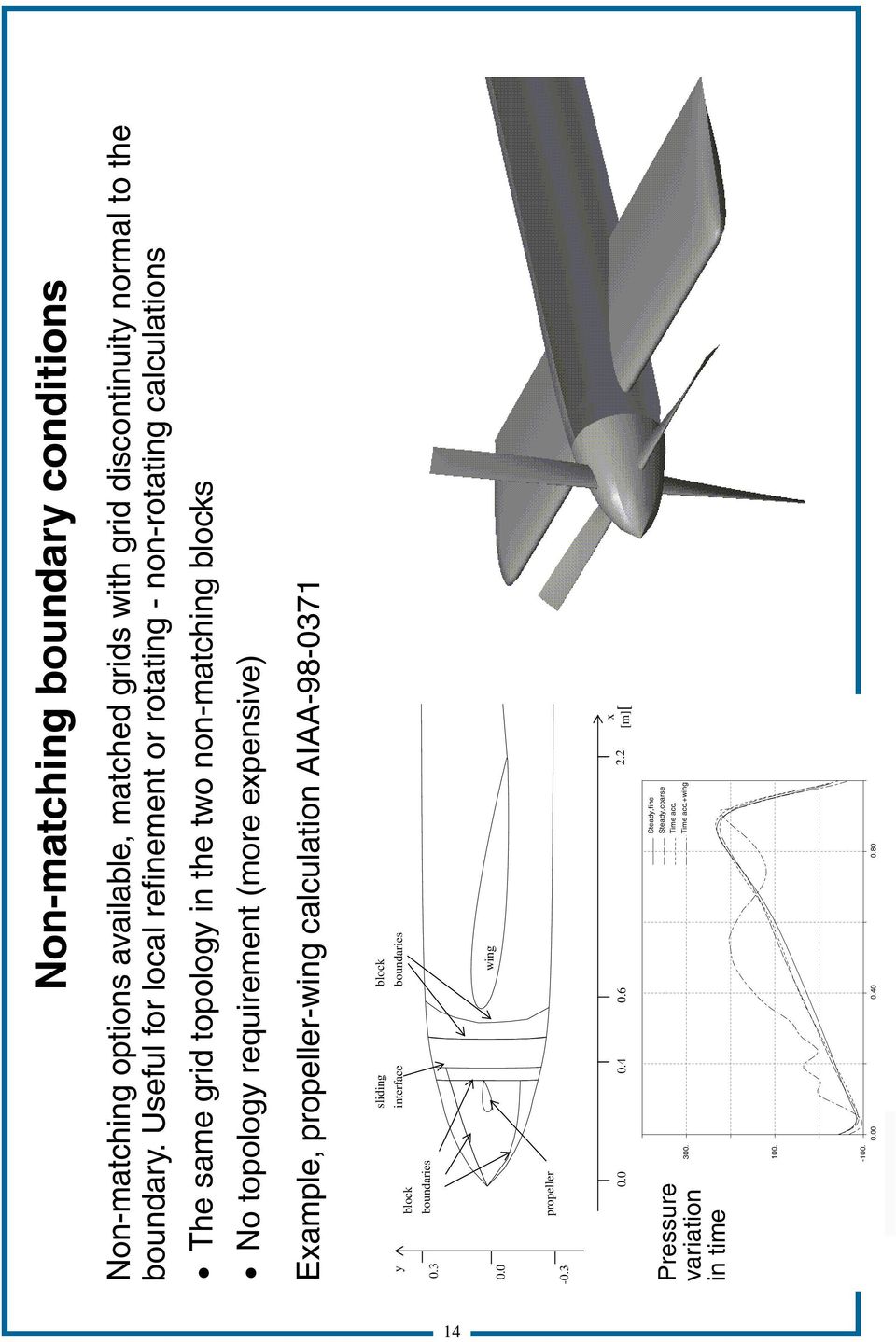
15 Non-matching boundary conditions Non-matching options available, matched grids with grid discontinuity normal to the boundary. Useful for local refinement or rotating - non-rotating calculations The same grid topology in the two non-matching blocks No topology requirement (more expensive) Example, propeller-wing calculation AIAA y 0.3 sliding interface block boundaries block boundaries 0.0 wing -0.3 propeller x 2.2 [m][ Pressure variation in time 300. Steady,fine Steady,coarse Time acc. Time acc.+wing
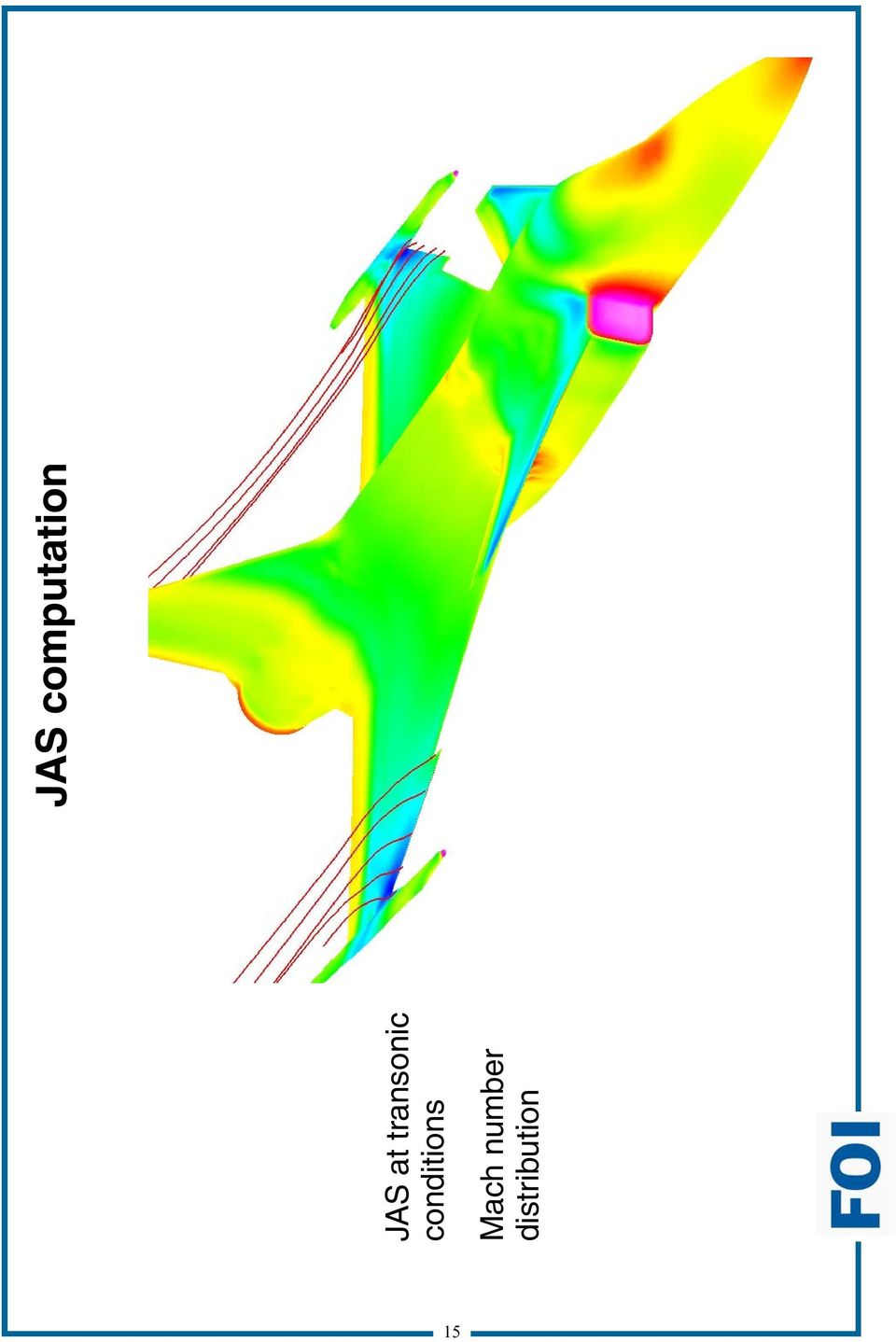
16 JAS at transonic conditions Mach number distribution JAS computation 15
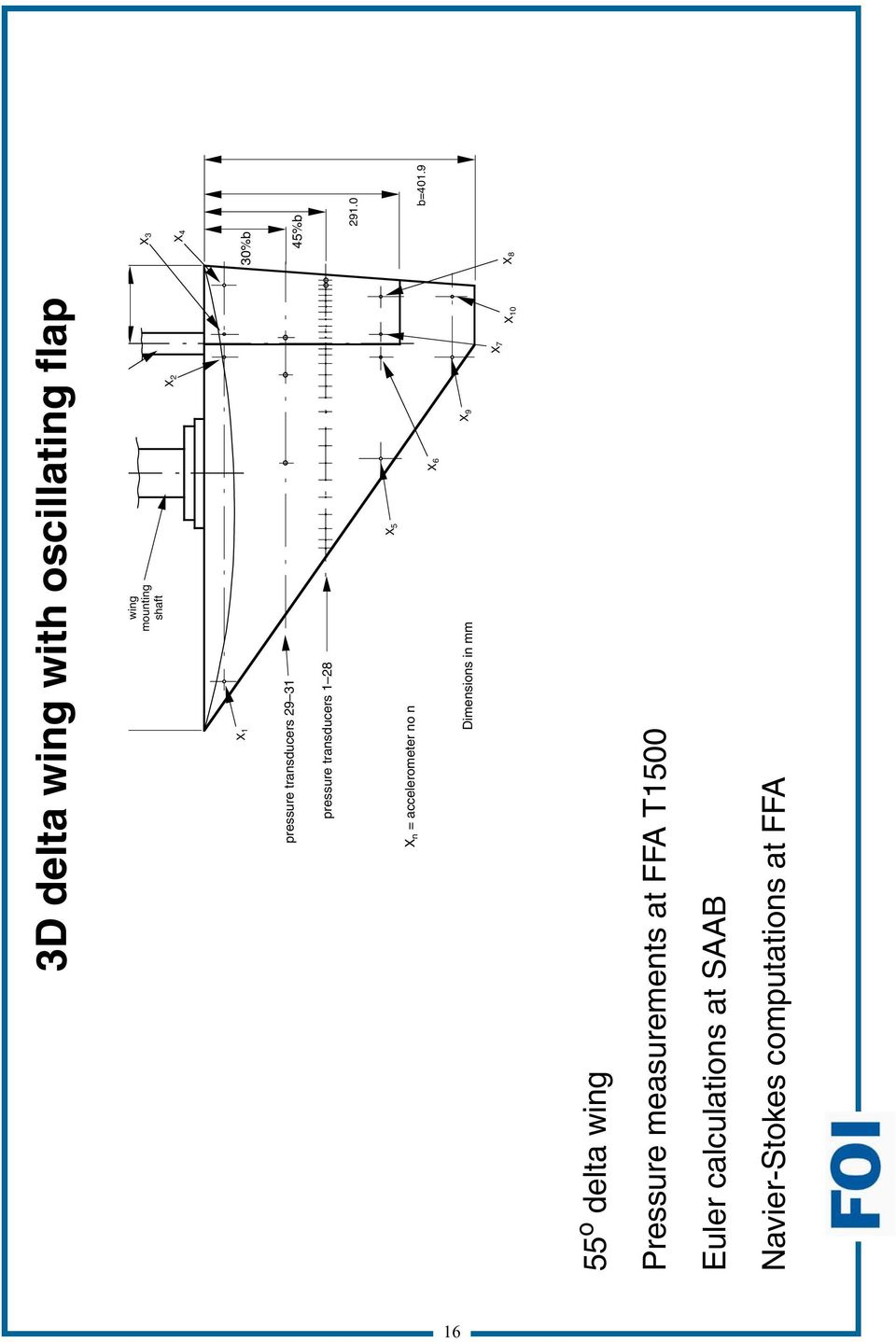
17 3D delta wing with oscillating flap wing mounting shaft X 2 X 3 X 4 X 1 30%b pressure transducers %b pressure transducers X 5 X n = accelerometer no n b=401.9 X 6 Dimensions in mm X 9 X 7 X 10 X 8 55 o delta wing Pressure measurements at FFA T1500 Euler calculations at SAAB Navier-Stokes computations at FFA 16
18 Unsteady Euler results Unsteady Cp-distribution Computations-Experiments 45.0% 45.0% M = 0.94, α = 0, δ mean = 0 f = 48 Hz Real: in-phase Imaginary: out-of-phase (damping) Re - C p Im - C p References: 45.0% 45.0% AIAA f = 75 Hz ECCOMAS 1996, pp

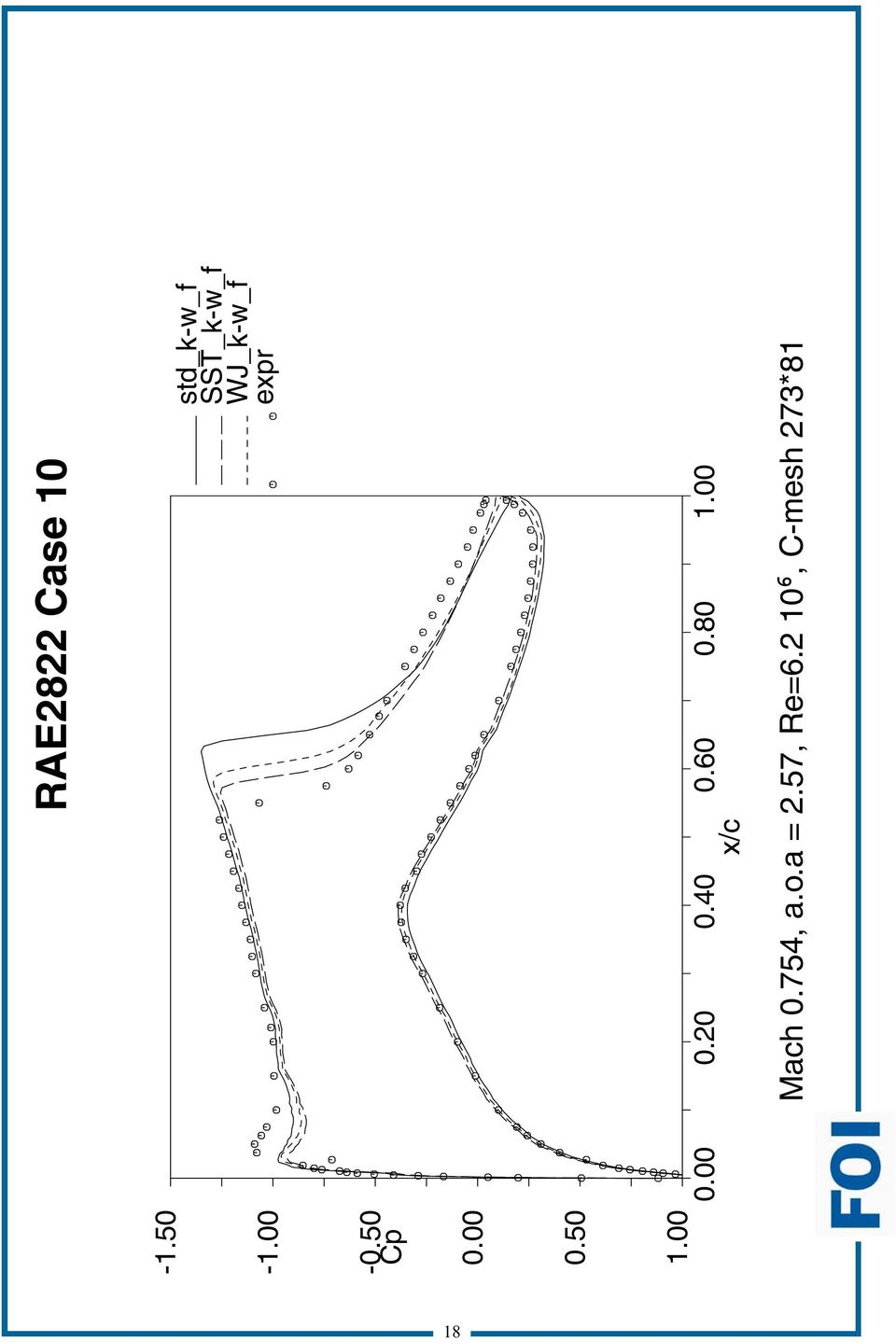
19 Cp RAE2822 Case 10 std_k-w_f SST_k-w_f WJ_k-w_f expr x/c Mach 0.754, a.o.a = 2.57, Re= , C-mesh 273*81 18
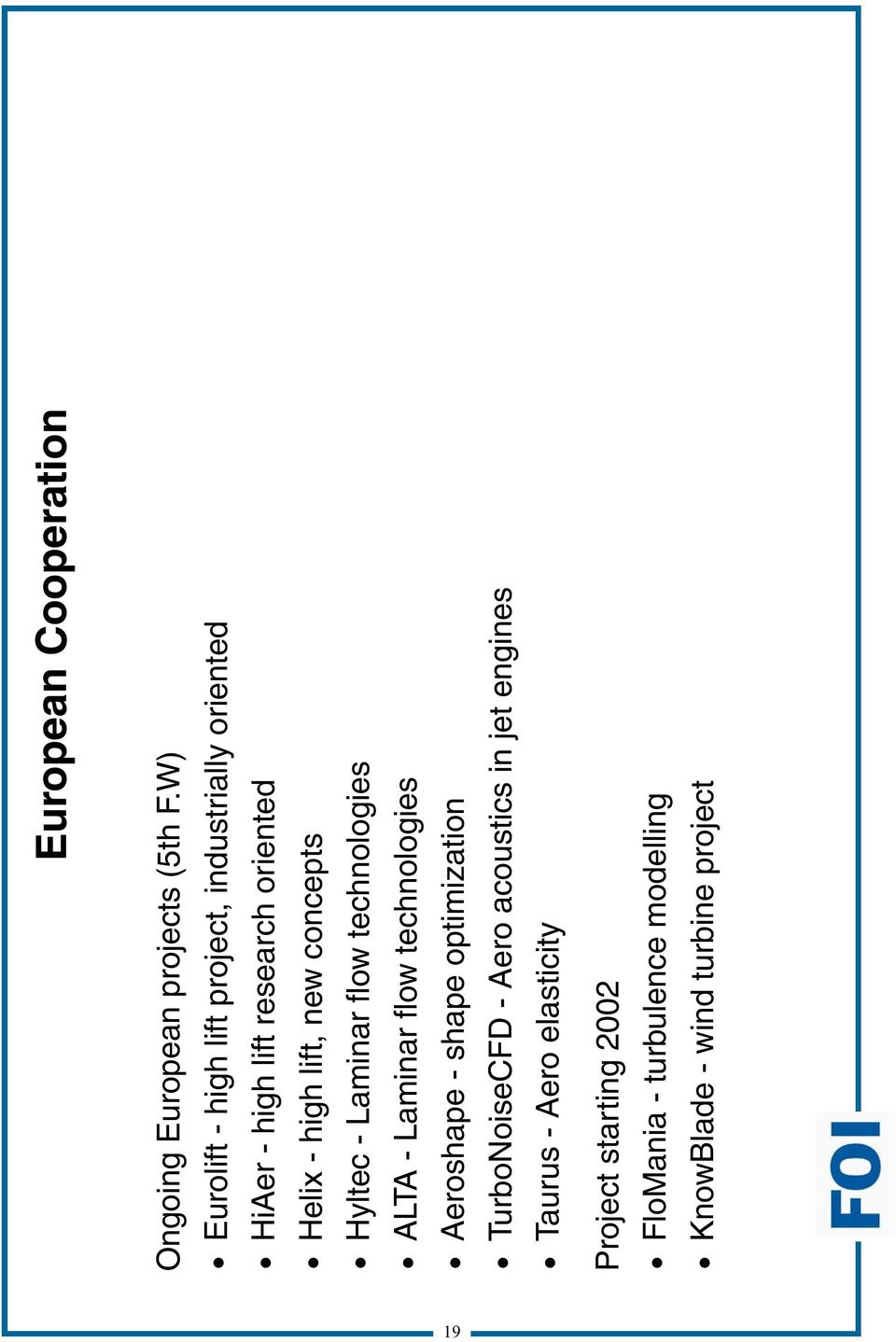
20 European Cooperation Ongoing European projects (5th F.W) Eurolift - high lift project, industrially oriented HiAer - high lift research oriented Helix - high lift, new concepts Hyltec - Laminar flow technologies ALTA - Laminar flow technologies Aeroshape - shape optimization TurboNoiseCFD - Aero acoustics in jet engines Taurus - Aero elasticity Project starting 2002 FloMania - turbulence modelling KnowBlade - wind turbine project 19
21 System for computations on unstructured grids CAD Patch Grid Solver Postproc. EDGE Ensight generator TRITET generation SPIDER Adaption TRITET 20 SPIDER - in-house program for creation of patched surface patches from IGES files TRITET - Surface and volume generator. Includes also adaption modules EDGE - Flow solver Post processing: commercial tools, programs for simpler plotting exists
22 Hybrid grid generation TRITET Generation of unstructured grids 2D - triangles and quadrilaterals 3D - prisms (varying # layers), pyramids (transitional) and tetrahedra Grid adaptation (remeshing) embedded in Tritet Grid adaption uses original surface descr. Common file format with Edge solver Ongoing development of Tritet Moving grids with retained topology Local adaptation based on h-refinement Local remeshing 21
23 Overview EDGE solver EDGE solver based on: Finite volume, node centred, hybrid grids - arbitrary elements, agglomeration multigrid Preprocessor - Generates dual grid - Agglomerates coarser grids - Blocking for parallel computations Flow solver - Reads preprocessed grid containing node and edge data - Makes the flow computation Help programs - Sets boundary condition - Lists contents of files - Exports to different file formats - Plot programs - etc... Example of different element types 2D 3D Dual and primary grids Edge info. to flow solver N 2 S N 1 22
24 EDGE flow solver code characteristics Code in FORTRAN 90 Data stored in linked list - stored data may be retrieved everywhere Dynamic memory allocation Recursion, derived types, structures... Similarities with EURANUS EURANUS uses the same data structure in Fortran 77 Same name of routine names... FFA file format General file format in common with EURANUS Strategy to extend and implement most promising options in EURANUS to EDGE 23
25 Status of Edge Included and validated features of Edge ( ) Euler and NS, laminar and RANS Explicit, steady state, residual smoothing Agglomeration multigrid Central spatial discretization with artificial viscosity, 2nd order upwind scheme Rotation in a rotating frame of reference Turbulence: Wilcox k-ω and Explicit Algebraic Reynolds stress model (EARSM) Block partitioning with message passing using MPI Unsteady dual time stepping Preconditioning for low Mach numbers (Choi & Merkle) GUI 24
26 Validation of Edge Total pressure loss, RAE2822 airfoil. M=0.5, α = structured grids, 545*97, 273*49, 137* st order slope 2nd order slope EDGE, upw., trian. EDGE, upw., quads 2.0 log(error) EDGE, central, quads. EDGE, central, triangles Structured grid, quadrilaterals and triangles by triangulation log(size) Euranus 25
27 M6-wing: Structured - unstructured 1.20 Transonic flow on M6-wing, M=0.84, α=3.06, Re=11*10 6 Cp distribution: Structured surface grid Unstructured surface grid Mpoints 0.9 Mpoints -Cp y/c=44% Cp y/c=90% -0.40
28 Grid Generation Software L. Tysell 27
29 28
30 29
31 30
32 31
33 FOAM Field Operation And Manipulation Christer Fureby Totalförsvarets Forskningsinstitut, FOI Vapen & Skydd Grindsjöns forskningscentrum 32
34 History 1989 Henry got tired of FORTRAN and started to play around with OOP and particularly C Intense development of the core of FOAM (Hrvoje & Dave) skeletal classes for field manipulation + numerics 1994 Gavin joins the group at IC and starts adding more physics 1995 Christer & Onno join the group at IC, further physics, turbulence, combustion, electromagnetics publications FOAM grows into a full-bodied CCM package (group of 5-7 people) 1999 Academic research code Commercial code? 2000 Foundation of Nabla Ltd Marketing of FOAM on LINUX PC s as a package solution to CFD Contact: Nabla Ltd. [email protected] Weller H.G., Tabor G., Jasak H. & Fureby C.; 1997, A Tensorial Approach to CFD using Object Oriented Techniques, Comp. in Physics, 12, p
35 Overall Structure foam applications run src tutorials lib make cfd cases MeshTools sgi64 financial cfdtools LINUX stress foam fields boundaryfield util matrices fvmatrix meshes ldumatrix methods fvc thermophysical fvm dimensionset Platforms: UNIX, UNICOS: SUN, IBM, CRAY, SGI, HP, DEC LINUX PC Parallelization: pvm and mpi 34
36 Discretization and Numerics The NSE can be discretized as f ( v d A) f = 0 m n+ i β i t C D n+ i n+ i i = 0 ( αi( v) P + δ V f[ Ff + Ff ] ) = βi( p) P t P C where Ff = Ffvf Ff( lvp + ( 1 l) vn D F ν d A ( v v )/ d for CD. In other words, a v = H( v) ( p) and n P P f f N P [( a ) da ]( p) = [( H( v)/ a ) da ] n P f f f F [( H( v)/ a ) ( a ) ( p) ] da n f p f P f f Equations are solved in sequence using a PISO-type loop n P f f p f f for(runtime++;!runtime.end(); runtime++) { Info << "Time = "<<runtime.curtime() nl<<endl; } fvm Ueqn ( fvm::ddt(u)+fvm::div(phi,u,scheme) -fvm::laplacian(nu,u) ); solve(ueqn == -fvc::grad(p)); // --- PISO loop for (int corr=0; corr<ncorr; corr++) { phi=interp(ueqn.h()/ueqn.a())&mesh.areas(); } P da fvm peqn ( fvm::laplacian(1.0/ueqn.a(),p)==fvc::div(phi) ); peqn.solve(); phi-=peqn.flux(); U=(Ueqn.H()-fvc::grad(p))/Ueqn.A(); U.correctBoundaryConditions(); d f N 35
37 Equation Discretization The discretized equations can be compactly expressed by [A]{x}={y} { } geometricfield<type> [A] fvmatrix<type> Basic mesh description fvmatrix<type> geometricfield<type> volfield<type> surfacefield<type> pointfield<type> fvm (implicit) fvc (explicit) geometricfield<type> volfield<type> surfacefield<type> pointfield<type> metric information fvmesh Points Faces Cells pointfield facelist celllist internal boundary Boundary patchlist Additional features syntax that closely mimics the notation of written mathematics (+, symm, pow, &) written in C++ automatic dimension checking tensor mathematics (scalar, vector, tensor, tensorthird) all trancidental functions available 36
38 Parallelization Strategies Parallelisation of FOAM is via domain decomposition i.e. the domain is split up into sub-domains, one for each processor, and a copy of the code run on each domain. processor patch decomposepar The processor patch class caters for the inter-processer information within the solver. On decomposition, internal boundaries within the complete mesh are given processor patches which know about the inter-processor topology, and which hide the interprocessor calls (pvm or SHMEM). since the interprocessor communication is at the level of the field classes, any geometric field will automatically parallelise. 37
39 High-Level Language Codes a short selection Basic CFD codes icofoam incompressible laminar flow code for Newtonian and Non-newtonian fluids potential Foam potential flow code turbfoam incompressible turbulent flow code (algebraic, 2 eqn, & Reynolds stress) Compressible Flow sonicfoam compressible transsonic/supersonic laminar gas flow code sonicturbfoam compressible transsonic/supersonic turbulent gas flow code Heat Transfer chtfoam incompressible code with conjugate heat transfer DNS and LES codes dnsfoam direct numerical simulation code oodles incompressible large eddy simulation code sonicoodles compressible large eddy simulation code Combustion Xoodles compressible turbulent combustion code using the FW-model reactingoodles compressible turbulent combustion code a range of combustion models Electromagnetics Finance Stress Analysis 38
40 Moving Boundary and Interface Methods for Computational Fluid and Solid Mechanics Eric Lillberg och Lars Olovsson The Swedish Defence Research Agency, FOI Weapons and Protection Division Eric Lillberg, Computational Physics FOI Defence Research Agency 39
41 Moving Boundary and Interface Problems in Fluid Mechanics Many physical phenomena of interest must contend with moving boundaries and interfaces, e.g. free surface flows, penetration mechanics, flow induced vibrations, bodies with relative motion. Different methods needed to solve different problems. Fluid/solid, fluid/fluid and solid/solid interactions leads to highly coupled, nonlinear systems. LES is suitable for the transient non-linear coupling between fluid and structure where time accuracy is important. Several numerical solutions have been found to such problems, and this leads one to believe that the problems are well posed. Floryan and Rasmussen, Numerical methods for viscous flows, Appl. Mech Rev vol 42, no 12, Dec 1989 Eric Lillberg, Computational Physics FOI Defence Research Agency 40
42 Interface Representations Lagragian methods (a) Maintain the interface as a discontinuity and explicitly track its evolution. The grid is configured to conform to the shape of the interface and adapts continually to it. Eulerian methods (b) Employs a fixed grid. The interface is reconstructed from the properties of appropriate field variables such as fluid fractions or a level-set Eric Lillberg, Computational Physics FOI Defence Research Agency 41
43 General methods at hand ALE - Arbitrary Lagrangian-Eulerian + Explicit tracking of the interface Transformation methods + Boundary conditions - Complex geometries - Breakups/Mergers - Large deformations Volume of Fluid + Any geometry Volume of Solid + Complex interfacial behavior Cut-Cell Techniques + Large deformations Virtual Boundary methods - Interface not explicitly defined Level-Set methods - Complex boundary conditions - Interface reconstruction Over Set Grid Methods + Multiple geometries with relative motion Eric Lillberg, Computational Physics FOI Defence Research Agency 42
44 VOF Methods for Fluid Interfaces Bubble dynamics as an example of interface capturing for large, general deformations, using a Volume of Fluid (VOF) method div v = 0 t t ( ρ v ) + div( ρ v ( α ) + div( α v ) = v ) = grad p + div S + ρ g + f 0 ρ = αρ (, µ α ) ρ 2 µ = αµ 1 + (1 α ) f = σ div(grad α / grad α ) grad α 2 Eric Lillberg, Computational Physics FOI Defence Research Agency 43
45 ALE Methods for Fluid/Structure Interaction Grid moves with the geometry while the N-S equations are solved in a fixed grid approach compensated for the mesh-motion fluxes U. Suitable for accurate fluid/structure interaction problems with limited deformations. Geometric conservation. div( t ( v v ) + U ) = div(( 0 v U ) = + v ) grad p div S Eric Lillberg, Computational Physics FOI Defence Research Agency 44
46 Några ord om penaltybaserad Euler-Lagrangekoppling Lars Olovsson The Swedish Defence Research Agency, FOI Weapons and Protection Division 45
47 Varför Euler-Lagrangekoppling? Det är ofta lämpligt att beskriva en del av en modell med en Lagrangeformulering och en del med en Eulerformulering. En kopplingsalgorithm krävs för kommunikationen mellan modellens olika komponenter. Lagrangebeskrivning Eulerbeskrivning 46
48 Penaltybaserad metod En penaltybaserad kopplingsalgoritm håller koll på relativa förskjutningen mellan fluid och struktur. Nodkrafter, proportionella mot relativa förskjutningen, tvingar fluid och struktur att följas åt. Senare Följ partikeln,, och applicera en kraft proportionell mot d. d fluidelement Kontakt detekteras Lagrangestruktur Markera en partikel i fluiden 47
49 Airbag inlet 48
50 Airbag 49
51 Airbag 50
52 TURBULENCE MODELLING IN RANS AND LES Urban Svennberg, Leif Persson & Christer Fureby Totalförsvarets Forskningsinstitut, FOI Vapen & Skydd Grindsjöns forskningscentrum 51
53 RANS, URANS,, LES, DNS and all that Reynolds Average Navier Stokes (RANS) 2D/3D stationary solution with turbulence modelling The turbulence model often dictates the resolution Does not necessarily converge to DNS Wide range of models Unsteady RANS (URANS) 2D/3D unsteady solution with turbulence modelling Large Eddy Simulations (LES) 3D unsteady solution with partial (SGS) modelling wall-resolved LES (y + <2, x + <100, z + <15) LES VLES CSC Hybrid RANS/LES wall-modelled LES MILES O(Re 3/2 ) celler SGS turbulence models physics on macro and meso scales correctly treated Direct Numerical Simulations (DNS) 3D time accurate solution O(Re 9/4 ) cells, high numerical accuracy No modelling, all scales resolved all physics correctly treated 52
54 RANS Average the NSE over time or across an ensemble of flows (ergodicity) ( v v ) = p + ( S R) + f, v = 0 where R= v v Need to close these equations by modelling R Different levels of modeling different cost and accuracy Two-equation models (R=ν t D, ν t =c µ k 2 /ε) 2 ( k v ) = 2 νt D + (( ν+ νt/ σk) k) ε ( ε v ) = P + (( ν+ ν / σ ) ε) R ε ε Non-linear two-equation models Differential stress models t T 2 ( R v ) = R D + D R+ ( νk R R) + c1 ( ε/ k) R 3 c 2 εi More complex models more physics better resolution 53
55 The Filtering Approach to LES Convolving the NSE with the filter kernel G(x, ) yields the LES equations v t ( v) + ( v v) = p + ( S B) + f+ m ; v= 0 where B ( v v v v) = ( v v v v) + ( v v+ v v ) + ( v v ) v m = [, G ]( v v+ pi S) in which [, G ] Φ= Φ Φ Need to close these equations by modelling B and m v, or B neglecting m v SGS models usually based on isotropy assumptions some physics not included (e.g. near wall effects) EVM SSM & MM DRSM B= 2ν k D B= v v v v 2ν k D T T t ( B) + ( B v) = ( LB + BL ) + M + Π + E Improvements (modifications) necessary for high Re complex flows. E.g. wall-resolved LES wall-modelled LES MILES y + <2 νbc = νbc ( τw, yp, vp ) particular numerics 54
56 Monotone Integrated LES (MILES) Alternative concept for LES introduced by Boris et al, (1992) and under rapid development: Fureby & Grinstein, (1998, 1999, 2000), Karniadakis et al (2000), Knight et al (1998, 2000). Idea MILES uses the features of particular numerical methods to construct implicit (built-in) SGS models by means of the leading order truncation error + no commutation error + improved generality no parameters +/ strong coupling with the numerics The FV, FD or FE discretization acts as an implicit low-pass filter same temporal scheme as in conventional LES same treatment of diffusive and source terms as in conventional LES Monotonicity preserving or TVD schemes for the convective terms (often using flux limiters Γ) T T 2 Modified equations B= CL + LC + χ Ld Ld, C= C( v, Γ), χ= χ( Γ) 55
57 Circular and rectangular jets Aim: SGS modelling, jet-flow physics Re D =10 4 to 10 6 Grids: 10 5 to 10 6 Free Shear Flows Spatially Developing Transitional Jet ln(e/(vrms 2 λi)) (b) Energy spectra in farfield (isotropic) region ln(kλi) 1.4 v/v Jet centerline velocity vs axial distance Vorical regions (II>0) colored by ω 0 x/d In collaboration with NRL, SBD & KTH Fureby C. & Grinstein F.F.; 1998, AIAA Paper No , AIAA.J., 37, p 544. Fureby C. & Grinstein F.F.; 2000, 8 th European Turb. Conf., Barcelona, Spain. 56
58 Wall Bounded Flows Fully Developed Turbulent Channel Flow Re τ =180, 395, 590 (DNS), 2030 (EXP) and Grids: 60 3, and 90 3 LES: SMG, DSMG, OEEVM, DSM MILES wall-resolved and wall modelled LES DNS Re=395 EXP Re=2030 OEEVM WL Re=395 OEEVM1 Re=395 OEEVM2 Re=395 OEEVM WL Re=2030 OEEVM Re=2030 OEEVM WLRe=10000 v + =κ -1 ln(y + )+B v /u τ 5 log-region v /u τ DNS Re=395 EXP Re=2030 OEEVM WL Re=395 OEEVM Re=395 OEEVM2 Re=395 OEEVM WL Re=2030 OEEVM Re=2030 OEEVM WLRe= wall-modelled OEEVM, Fureby C., Gosman A.D., Sandham N., Tabor G., Weller H.G., & Wolfstein M.; 1997, TSF 11 Fureby C. & Grinstein F.F.; 2000, AIAA Paper No , J. Comp. Phys 57
59 Supersonic Flows Base Flow at Ma=1.5 Expansion Waves Recompression Waves Ma=2.5 Free Shear Layer C L Recirculation region Trailing Wake Iso-surface of II= colored by v x, and contours of ρ Statistics v x rms vortex-rings jet v x Fureby C., Nilsson Y. & Andersson K.; 1999, AIAA Paper No
60 Concluding Remarks LES is not currently fully developed, a few pacing items remain to be solved before LES is useful for engineering calculations How do unknown inflow conditions affect transition of unresolved BL? Laminar/transitional boundary layer Separating shear layers Effects of SGS on coherent structures (and vice-versa) are not well understood. Wake SGS eddy CS How is SGS turbulence affected by rapid strain and distortion? Leading edge Turbulent boundary layer Viscous sublayer not resolved on LES grid. How can τ w be modelled? τ w v v 59
61 Turbulence Modeling S. Wallin 60
62 RANS modelling activities at Flygteknik, FFA Stefan Wallin Aeronautics Division, FFA, FOI, Sweden Contents: Overview Some theory and examples of EARSM Curvature effects Passive scalar flux Aeronautics Division, FFA FOI konferensen, oktober 2001 Stefan Wallin 61
63 Overview NASA Langley Wing tip vortices = Conf. paper = J. publication RST Scalar flux Curvature and rotation Afterbody Planforms Inlet ducts EARSM TurMMAC ETMA ESA turb AVTAC FMV (FoT) EUROLIFT HiAer FLOMANIA RST EARSM, RST Trans pred. Aeronautics Division, FFA FOI konferensen, oktober 2001 Stefan Wallin 62
64 Statistical approach Time dependent Navier-Stokes equations Reynolds decomposition ũi = t NS ( ũ ) i j ũ i ( x, t ) = U i ( x ) + u i ( x, t ) Reynolds averaged Navier-Stokes (RANS) equations ũi = NS t i ( ũ j ) Reynolds stress tensor Ui = t NS ( U ) i j ( ui u x j ) j u i u j Aeronautics Division, FFA FOI konferensen, oktober 2001 Stefan Wallin 63
65 Some definitions Reynolds stress anisotropy tensor u i u j a a ij K 2 --δ 3 ij Mean flow strain and rotation rate tensors (normalized) 1 S S ij -- K U i U j + ε x j x i 1 Ω Ω ij -- K ε U i U j x j x i Turbulent kinetic energy K u i u i Dissipation rate of turbulent kinetic energy ε Aeronautics Division, FFA FOI konferensen, oktober 2001 Stefan Wallin 64
66 Modelling approaches RST ARSM Tr( a) = f a ( S, Ω, a) 0 = f a ( S, Ω, a) EARSM a = f e ( S, Ω) Non-linear eddy-viscosity models Linear eddy-viscosity models a Boussinesq (1877) = a = f N-L ( S, Ω) 2C µ S U uv = ν t y Turbulence scales Tr( K ) = f K ( K, ε, S, a) Tr( ε) = f ε ( K, ε, S, a) 65 Aeronautics Division, FFA (this frame will not be printed) FOI konferensen, oktober 2001 Stefan Wallin
67 Aeronautics Division, FFA Rapidly sheared homogeneous flow Eddy-viscosity model W&J consistent EARSM RDT 5 EARSM, fixed P ε T FOI konferensen, oktober 2001 Stefan Wallin K 66
68 Aeronautics Division, FFA Channel flow u 2 w 2 uv v y+ FOI konferensen, oktober 2001 Stefan Wallin u u i j 67
69 Shock induced separation RAE2822, Case10 2D transonic profile LANN 3D transonic wing, 47.5% span Cp std_kw SST_kw WJ_skw WJ_kw LWJ_skw WJ_Kkw expr skw WJ_skw expr 0.00 Cp x/c x/c Aeronautics Division, FFA FOI konferensen, oktober 2001 Stefan Wallin 68
70 Aeronautics Division, FFA Inlet ducts (M2129 by SAAB) taken from Ericsson, J. 2000, Master thesis, SAAB, GDFP FOI konferensen, oktober 2001 Stefan Wallin 69
71 Curvature effects Weak-equilibrium assumption Da Dt Da = 0 Dt -> algebraic relation The advection, and consequently also the algebraic model, depend on the coordinate system representing the components. a ij Da Dt = 0 Most generic cases can be transformed so that (rotating homogeneous shear, rotating channel, vortices, rotating pipe,...) Complex flows do not have a general transformation. Streamline-based advection Da = T Dt tdtatt T a t DTt T Dt Dt tdt a Dt A ( aω ( r ) Ω ( r ) a ) Aeronautics Division, FFA FOI konferensen, oktober 2001 Stefan Wallin 70
72 Isolated wing-tip vortex Computed vortex circulation compared to field measurements (Campbell et al. 1996, 1997). Taken from Wallin & Girimaji (AIAA J. 2000). : Initial : RST (L-SSG) : EARSM (L-SSG) : EARSM (non-corrected) : EVM (e.g. std ) K ε Curvature corrected EARSM and RST very similar Basic EARSM as bad as EVM Gamma Initial RST EVM EARSM (curv) EARSM (std) r Aeronautics Division, FFA FOI konferensen, oktober 2001 Stefan Wallin 71
73 Rotating channel, Ro= U/Um uv y Fully developed channel flow, DNS Alvelius & Johansson (2000) y : WJ : CC-WJ : non-corrected CC-WJ. Aeronautics Division, FFA FOI konferensen, oktober 2001 Stefan Wallin 72
74 Scalar turbulent flux Turbulent mixing of temperature, species concentration, pollutants, etc. Usually modelled by a eddy diffusivity model (EDM) u i θ = ν t Θ Pr t xi EDM gives the flux aligned with the gradient Even in simple shear flows the flux is not aligned with the gradient (se homogeneus shear) Need for improvements The explicit algebraic model HWWJ, (Wikström, Wallin & Johansson, Phys. Fluids, 2000) K Θ u i θ = ( 1 c θ4 )B ij ( S, Ω)u j u k ε x k 73 Aeronautics Division, FFA (this frame will not be printed) FOI konferensen, oktober 2001 Stefan Wallin
75 Homogeneous shear flow Mean scalar gradient in three different directions. Proposed model (HWWJ) compared with DNS (Rogers et al. 1986) and standard eddy diffusivity model (EDM) Proposed model (HWWJ) captures the flux direction (not aligned with the gradient) Q U u i θ EDM HWWJ DNS U DNS HWWJ EDM u i θ Q U Q DNS HWWJ EDM u i θ 74 Aeronautics Division, FFA (this frame will not be printed) FOI konferensen, oktober 2001 Stefan Wallin
76 Channel flow The HWWJ model solved together with the low Reynolds number EARSM and the K ω model. Comparision of the HWWJ model with and without diffusion model (DM) model and the eddy-diffusivity model model (EDM) Θ y + HWWJ+DM HWWJ EDM symbols: DNS data (Wikström 1998) y + 75 Aeronautics Division, FFA (this frame will not be printed) FOI konferensen, oktober 2001 Stefan Wallin
77 Transition prediction 76 Ardeshir Hanifi FOI/FFA Aeronautics Division, FFA 1
78 local 3D separation boundary layer slat wake slat wake main wing wake flap separation 77 shock / boundary layer interference transition transition separation bubble transitional separation bubble separation bubble Complex flow phenomena in high lift conditions Aeronautics Division, FFA 2
79 acoustic disturbances roughness elements 78 instability waves external disturbances Aeronautics Division, FFA 3
80 Instability Theory Laminar-Turbulence transition is assumed to be caused by breakdown of small disturbances inside the boundary layer. Q(x, y, z, t) = Q(x, y, z)+q(x, y, z, t) 79 Fourier expansion qm,n(x, y)e i(nβz mωt) n= m= q(x, y, z, t) = Aeronautics Division, FFA 4
81 Governing equations Mean flow with weak streamwise-variation, WKB or Multiple scales type: qm,n(x, y) =ˆqm,n(x, y)e i x x 0 αm,n(x )dx. scale separation: 80 x = O(R 1 ), V = O(R 1 ). Collecting terms up to O(R 1 ) gives a set of nearly parabolic differential equations + C 2ˆqm,n y 2 + D ˆq m,n x = F m,n, Aˆqm,n + B ˆq m,n y Solution is obtained by marching along x direction with ˆq(x = x0) =ˆq0. Aeronautics Division, FFA 5
82 Different level of approximation: Local theory: =0 Eigenvalue problem x Linear non-local theory: 81 Fm,n =0 Linear parabolic eqs. Non-linear non-local theory: All terms are kept Non-linear parabolic eqs. Aeronautics Division, FFA 6
83 NoLoT-code (Developed at FFA and DLR) Solves Parabolized Stability Equations (PSE) Local/non-local theory 82 Linear/non-linear equations Compressible/incompressible General orthogonal curvilinear coord. Aeronautics Division, FFA 7
84 displacement body 10 0 end plate DNS Q inf PSE 10 1 flat plate 10 2 c=500 mm 10 3 Amplitude x/c Nonlinear PSE vs DNS (Högberg & Henningson). Stationary crossflow mode (0,1) and its higher harmonics (0,2)-(0,7). Aeronautics Division, FFA 8
85 x II Amplitude x I x Frequency 84 stable unstable x x I x II Schematic of neutral stability curve. Aeronautics Division, FFA 9
86 Transition prediction: e N -method N factor f 3,β 3 ) ln(a/ai ) ( ln A AI ( N = max f,β 85 f 2,β 2 ) αi dx xi = max f,β f 1,β 1 x The value of N at onset of transition is obtained by correlation of computational and experimental data. Aeronautics Division, FFA 10
87 86 Application of the e N method (flat plate, adiabatic wall). From Mack (1975), Arnal (1989). Aeronautics Division, FFA 11
88 Oblique-mode breakdown in supersonic boundary layer ,1 0,0 0, urms skin friction coefficient x A 0 =0.1% A 0 =0.01% 10 8 A 0 =0.001% R R Mach number=1.6, F =6 10 6, β/r = Aeronautics Division, FFA 12
89 Flight test Non-linear, non-local transition analysis 88 Calculations performed by S. Hein using NOLOT/PSE (DLR/FFA) code. Aeronautics Division, FFA 13
90 Strömningsstyrning och aerodynamisk optimering Martin Berggren Flygteknik, FFA Flow Control Utilize flow instabilities/sensitivities to accomplish large effects by small efforts, e.g. Vortex control Werle, 1963 Separation control Head,
91 Transition control Transonic wave drag control Alfredsson & Matsubara, 2000 Cp o o + o o + oo o o o oo o oooooooooooooooooooooooo + oooo + o o o o oo o + o +++ o + o o o oo o + oo + + o + o o + ++ o o o + o + o + o o o o oo oo o o o o o o+ oo o + o ooooo o o oo o oo o + o o/ = design +/ = initial Lorenzen, 1999 Aeronautical Applications of Flow Control Active inlets Fluidic thrust vector control Nose vortex control Active Core Exhaust (ACE) Drag reduction, increased lift (Hamstra et al, ICAS 2000) 90 2
92 FOI project: Optimal Design and Control of Fluid Flows Project leader: Dan Henningson Computational Aerodynamics: Martin Berggren, Mattias Chevalier, Ardeshir Hanifi, Jan Pralits, Olivier Amoignon Experimental Aerodynamics: Jens Österlund etc. Systems Control: Martin Hagström, Sven-Lennart Wirkander Activities in the FOI project Computational/Theoretical Algorithm development for control and optimization Methods development for automated design Supercomputer simulation of complete flow control systems (incl. sensors, actuators), currently for CF-instability control Experimental Active control of flow in S-duct diffusor 91 3
93 PhD Projects in cooperation with KTH and UU Mattias Chevalier Jan Pralits Olivier Amoignon Markus Högberg Ori Levin Astrid Herbst Optimal control of boundary layers Optimal design wrt low drag Aerodynamic shape optimization Optimal control of channel flows Flow control in boundary layers Flow control in diffusor flows FOI SSF:IVS, FOI/EU PSCI, FOI/EU VR ramprogram STEM PSCI, SAAB Optimal control/design using Navier-Stokes eq. ϕ NS optimization ϕ J ANS 92 4
94 This scheme is applied to Optimal control in boundary layers (Chevalier, Högberg) Drag minimization in Edge (Amoignon, Berggren) Design of optimal suction on wings (Hanifi, Pralits) Natural laminar flow technology (Hanifi, Pralits) The control can sometimes be expressed in terms of a pre-computed feed-back law. No iterations needed Boundary layer on a swept wing y U W x U z W 93 5
95 Cross-flow vortices on a swept wing Direct numerical simulation using the Navier-Stokes equations Slice of a periodic array of vorticies in a Falkner-Skan-Cooke boundary-layer Control of CF-vortices Direct Numerical Simulation of FSC-flow with/without control Control off Control on 94 6
96 FOI S-duct experiment Test bed for actuators and sensors (pulsed micro jets, pressure shear stress) Test bed for control concepts (system identification, optimal control) Fan for low speed operation Rock chamber for high speeds CAD geometry, under construction L = 1548 mm, H = mm, φ = 218 mm, φ = 258mm
97 HIGH SPEED TURBULENT COMBUSTION Christer Fureby, Per Walmerdahl & Marco Kupiainen Totalförsvarets Forskningsinstitut, FOI Vapen & Skydd Grindsjöns forskningscentrum 96
98 Introduction Multi-diciplinary field involving: (i) fluid dynamics, (ii) thermodynamics, (iii) chemical kinetics and (iv) thermal radiation Premixed Combustion Non-Premixed Combustion Heat release Pr δ L Radiation Re Heat release Fu Pr Radiation µ=µ(t) Baroclinic torque effects Baroclinic torque effects Ox Areas of research Premixed turbulent combustion (jet-engine afterburners, LPP combusters) Non-premixed turbulent flames (engine flames, gas turbines) Supersonic combustion (ram- and scramjets) Fire spread in confined spaces Pool fires Explosions and ignition effects 97
99 Governing Equations of Reacting Flow The governing equations for the reactive flow problem consists of t ( ρ) + ( ρv ) = 0 N N t ( ρv) + ( ρv v) = p + S+ ρf (P ij I i) (P ij I i) i=1 i=1 t ( ρh) + ( ρvh) = p + SD + h+ ρσ t( ρyi) + ( ρvyi) = ji+ wi n N θ T p= ρ RTΣi = 1[ Yi/ Mi], h= Σi= 1[ Yi( hi, f+ CP idt = µ T T D = κ 0, )], S 2 D, h N N ji= λ i Yi; Σi= 1[ Yi] = 0, Σi= 1[ ji ] = 0 n Σ i = 1 ( Pij Pij ) N P j TAj / T wi= [ Pij Pij ] wj; wj= ρ kjπ i= 1 [ Y ij α i ]; kj= AjT e complex physics (turbulence, chemical reactions, volume expansion, heat release) wide range of length & time scales hard to estimate all parameters very large system of equations to solve for practical fuels equations generally stiff Simplifications required! 98
100 Premixed Turbulent Combustion Global or simplified reaction mechanisms with Arrhenius chemistry using MILES N (P ij I i) (P ij I i) i=1 j < 4, i<10 i=1 N t ( ρ) + ( ρv ) = 0 t( ρv) + ( ρ v v) = p + ( 2 µ DD) + ρf t ( ρh) + ( ρvh) = p + SD + ( κ T) + ρσ t( ρ Y i) + ( ρvy i ) = ( λ i Y i ) + P ij w j, i=1,,5, j=1,2 If carried out with explicit filtering (LES) several additional terms needs to be modeled. Flamelet models using LES The flame is assumed to be a thin wrinkled interface t ( ρ) + ( ρv ) = 0 t( ρ ) ( ρ ) p ( µ D ) ρ v + v v = + 2 D + B + f t( ρh ) + ( ρv h ) = p + SD + ε+ ( κ T + bh) + ρσ t ( ρξ ) + ( ρ ξ v ) = b ξ ρ u S u Ξ ξ SGS models required for B, b h, b ξ and ε! Ξ and S u require modelling Ξ by a modelled transport equation S u by correlations 99
101 Non-Premixed Turbulent Combustion Global or simplified reaction mechanisms with Arrhenius chemistry using MILES N (P ij I i) (P ij I i) i=1 j < 4, i<10 i=1 N t ( ρ) + ( ρv ) = 0 t( ρv) + ( ρ v v) = p + ( 2 µ DD) + ρf t ( ρh) + ( ρvh) = p + SD + ( κ T) + ρσ t( ρ Y i) + ( ρvy i ) = ( λ i Y i ) + P ij w j, i=1,,5, j=1,2 If carried out with explicit filtering (LES) several additional terms needs to be modeled. Flamelet models using LES Introduce a mixture fraction, such that z=z(y i ). The eqns can then be expressed t ( ρ) + ( ρv ) = 0 t( ρv ) + ( ρ v v ) = p + ( 2 µ D D+ B) + ρf 1 t( ρh ) ( ρ h ) p Y ε ( κ T i= β (,) z χ Y i() z dzd χ v = + SD bh) + ρσ t ( ρz ) + ( ρv z ) = ( λ z + b z ) SGS models required for B, b h, b z and ε! Thin flame located at z=z st. 100
102 Numerical Methods in Reacting Flow Stiffness avoided by using either global schemes or flamelet models! Finite-Volume (FV) discretization Continuity and momentum equations combined to form a Poisson equation for p Convective fluxes reconstructed with 2 nd order CD For MILES a 2 nd order FCT scheme is used Diffusive/viscous fluxes represented by 2 nd order CD Crank Nicholson time integration Scheme of O( t 2, x 2 ) PISO-type loop adopted for the p-equation Segregated solution approach (Co<0.2) 101
103 Combustion in a Jet-Engine Afterburner x 2 /h x /h 2 <v 1 >/v x 2 /h x /h 2 <v 1 >/v x 2 /h x /h 2 <v 1 >/v 0 Re h =44,000 v in =17m/s, T in =288K, C 3 H 8, φ= x /h 2 v 1 rms /v x /h 2 v 1 rms /v x /h 2 v 1 rms /v0 Re h =32,000 v in =34m/s, T in =600K, C 3 H 8, φ= <T> x /h 2 3 <T> x /h <T> x /h <Y CO > <Y CO > <Y CO > Volvo Aero, Sjunnesson et al., Weller H.G., Tabor G., Gosman A.D. & Fureby C.; 1998, 27 th Int. Symp. on Comb, p 899. Fureby C., Grinstein F.F. & Kailasanath K.; 2000, AIAA Paper No Fureby C.; 2000, Comb. Sci & Tech, 161, p 213. Fureby C., Grinstein F.F., Menon S. & Weller H.G.; 2001, 2 nd Int. Conf. on Turb. Shear Flow Phen., Stockholm. 102
104 Combustion in a Jet-Engine Afterburner cont. Re h =44,000 v in =17m/s, T in =288K, C 3 H 8, φ=0.61 Re h =32,000 v in =34m/s, T in =600K, C 3 H 8, φ=
105 Scramjet Combustion x 2 /d 9 Jet penetration comparison 7 5 Schlieren (Ben-Yakhar & Hansen, 1998) x 1 /d LES with Arrhenius chemistry Scalar statistics Fureby C., Ben-Yakar A. & Hanson R.; 2000, FOA-R SE. 104
106 Concluding Remarks Simulations of reacting flows very complicated more complex physics (reactions, turbulence, radiation, ) a wider range of scales (spatial and temporal) to consider Specific treatment of different combustion regimes (non-premixed / premixed) Families of models RANS out of the question due to the strong interactions between the flame and the reactions. Much research (experimentally, theoretically & computationally) to be done! Important military applications 105
107 !" $ %" %& "' )' ' ( "' * $ "! "' 106
108 ! 107
109 !! 108
110 ! 109
111 .. & *,!# *$ & * +* $,!# & ' () $ & ' * ()* $!# /. - + * & % 110
112 * 111
113 .! /! /. / 112
114 % * +, -! " $%& () # 113
115 ! ", 114
116 !!! 115
117 !! "* %& %, # #!!! *", "* * # - 116
118 !!!!!! $%& ()!! " # 117
119 !! 118
120 ,, %, * - * Time Pressre (MPa) Preesure readings at 3 positions G8 G10 G12 119
121 %,,, * - & Mass fraction, contourplot Pressure, contourplot Mass fraction at centerline Pressure at centerline (MPa) x Mass fraction, contourplot Pressure, contourplot Mass fraction at centerline Pressure at centerline (MPa) x! 120
122 , $, *! *- 121
123 !!! 122
124 Ram Jet Robot Calculations M. Tormalm 123
125 124 AERONAUTICS DIVISION 1 (4) Att med hjälp av CFD beräkningar skapa ett aerodynamiskt simuleringsunderlag för en ramjetmotordriven robot. Målsättning: Ramjetrobotberäkningar vid FFA
126 Ramjet motorn Luftintag Brännkammare Dysa M > 0 Bränsle Flamhållare Fördelar: Nackdelar: Enkel konstruktion Kräver initial hastighet för att starta Bra bränsleekonomi vid höga Machtal Dålig bränsleekonomi vid låga Machtal Reglerbar AERONAUTICS DIVISION 2 (4) 125
127 Implementation av VAC:s motormodell i EDGE Två nya randvillkor Intagsytan utloppsytan (Massflöde, medeltryck och -temperatur) (Massflöde, tryck och -temperatur) VAC:s ramjetmotor modell 1D CET89 AERONAUTICS DIVISION 3 (4) 126
128 Status Ramjetrobotberäkningar : VAC:s motormodul implementerad i EDGE Underlag framtaget för RB73_m2 och jämfört med vindtunneldata. God överrensstämmelse! Jämförelse med VAC:s simuleringsdata ej möjlig pga olika intagsareor. Separata luftintagsräkningar med bleed genomförda i Euler. Nya beräkningar med modifierat luftintag genomförda. Jämförelse med VAC:s simuleringsdata gav stora motståndsskillnader. Simulering ej möjlig med FFA:s underlag. Undersökning av skillnader pågår. AERONAUTICS DIVISION 4 (4) 127
129 AERONAUTICS DIVISION Tvärteknikprojektet A multi-disciplinary project involving the design of a stealthy supersonic strike missile Johannes Johansson 128
130 AERONAUTICS DIVISION Agenda What is "Tvärteknikprojektet"? Design requirements Aerodynamic calculations RCS calculations Current and future work Configuration T60, Mach 1.5 Configuration U0, Mach
131 What is "Tvärteknikprojektet"? "Tvärteknikprojektet" is a multi-disciplinary project involving: Computational aerodynamics Experimental aerodynamics Structures Radar signature IR signature Flight simulations Goal is to design a stealthy supersonic strike missile capable of given design requirements AERONAUTICS DIVISION 130
132 Launch area AERONAUTICS DIVISION Design requirements Mission profile cruise at Mach 1.5 (low altitude) 400 km r < 200 m Target 131
133 d = 0.35 m AERONAUTICS DIVISION Design requirements Payload m = 500 kg L = 2.2 m Warhead from KEPD
134 Design requirements Signature Radar: Missile should have "low RCS" in given sector IR: Missile should have "low IR signature" AERONAUTICS DIVISION 133
135 AERONAUTICS DIVISION Initial design Wing planform design Developing planform using Wingbody panel method program Example shows some of the evaluated planforms. 134
136 AERONAUTICS DIVISION Aerodynamic calculations CFD Euler calculations using Edge Unstructured mesh (generated with Tritet) Example shown: Pressure coefficient at Mach 0.5, 30 angle of attack 135
137 AERONAUTICS DIVISION Aerodynamic calculations 9 different configurations 2 main Mach numbers plus sweep Angles of attack up to 50 Sideslip at low and high angles of attack About 200 different cases calculated 136
138 RCS calculations Calculations with FOPOL (using physical optics) Uses same surface mesh as CFD calculations Y [m] Y [m] Vinge med rak spetskorda X [m] Enbart kropp X [m] konfiguration F60 konfiguration KROPP 10 konfiguration F60 konfiguration KROPP KROPP F60 Example shows RCS calculations with and without wing. 10 GHz Horisontal polarisation 10 below XY-plane In XY-plane 30 above XY-plane konfiguration F60 konfiguration KROPP AERONAUTICS DIVISION 137
139 Current and future work Structures Structural design of body and wings Flutter and other aeroelastic effects AERONAUTICS DIVISION 138
140 Wind-tunnel testing Testing in S4 at FFA 14 different wing configurations 2 fin sizes Deflection of elevators, ailerons and fin Mach 1.52 (cruise), Mach 0.5 (final turn) and transition Mach numbers Small angles of attack and sideslip at Mach 1.52 Large angles of attack and sideslip at Mach 0.5 AERONAUTICS DIVISION 139
141 AERONAUTICS DIVISION Current and future work Development process Analyse of wind-tunnel test Evaluate stability and control characteristics Refine wing design Improve sizing of control surfaces Simulate to prove concept 140
142 ÆÙÑ Ö Ò ÐÝ Ô ÁÒ Ø ØÙØ ÓÒ Ò ĐÓÖ ÖĐ Ò Ò ÖÓ ÝÒ Ñ Â Ò ÆÓÖ ØÖĐÓÑ Ã ÖÐ ÓÖ Ö ÙÒ ÐÐ Ö Ñ ÓÒ ¼ Ç ØÓ Ö ¾¼¼½ 141
143 ÀĐÓ Ö ÓÖ Ò Ò Ò Ò Ø «Ö Ò Ñ ØÓ Ö ÙÐ Ö Æ Ú Ö¹ËØÓ Å ÜÛ Ðг º Æ Ë Í͵ Ò Ø ÚÓÐÝÑ Ñ ØÓ Ö ËØ Ð Ø Ø Ó ÒÓ Ö ÒÒ Øº Í͵ ËÔ ÐÐ ÔÖÓ Ð Ñ ÖØ ÐÐ Ú Ó Ø Ø Ó Ö Ò Ú ÐÐ ÓÖ ÃÌÀ ÍÆŵ ¼ Ç ØÓ Ö ¾¼¼½ 142
144 Ò Ë ÑÙÐ Ø ÓÒ Å Ø Ó Ö Ò Æ Ë Ä Ò Ð Ý Ê Ö ÒØ Ö ÅÓ ÐÐ Ò Ô ÖØÑ ÒØ Ó ÁÒ ÓÖÑ Ø ÓÒ Ì ÒÓÐÓ Ý Ë ÒØ ÓÑÔÙØ Ò ÍÔÔ Ð ÍÒ ¹ Ì À ÇÖ Ö Ò Ø «Ö Ò Å Ø Ó ÓÖ Ø ÙÐ Ö Æ Ú Ö¹ËØÓ Ò Å ÜÛ ÐÐ ÕÙ Ø ÓÒ ÆÓÖ ØÖĐÓÑ Ã ÖÐ ÓÖ Ö Å Ö Àº ÖÔ ÒØ Ö Â Ò Å ØØ ÓÒ Å ÒÙ ËÚĐ Ö ² Ê Ö Ù Ø ÓÒ Ã Ò ÂÓÙÖÒ Ð Ó ÓÑÔÙØ Ø ÓÒ Ð È Ý ÎÓÐ ½ ÆÓº ¾ ½ ÔÔº ½¹ ÂÓÙÖÒ Ð Ó ÓÑÔÙØ Ø ÓÒ Ð È Ý ÎÓÐ ½ ÆÓº ¾ ½ ÔÔº ¾½¹ ÂÓÙÖÒ Ð Ó ÓÑÔÙØ Ø ÓÒ Ð È Ý ÎÓÐ ½ ¾¼¼½ ÔÔº ½ ¹½ ÇÁ¹Ê¹¼½¾¼¹Ë Ù Ñ ØØ ¼ Ç ØÓ Ö ¾¼¼½ Ú Ö ØÝ Ô ÖØÑ ÒØ Ó ÁÒ ÓÖÑ Ø ÓÒ Ì ÒÓÐÓ Ý Ë ÒØ ÓÑÔÙØ Ò ÍÔÔ Ð ÍÒ ¹ Ì Ú Ö ØÝ Ô ÖØÑ ÒØ Ó ÁÒ ÓÖÑ Ø ÓÒ Ì ÒÓÐÓ Ý Ë ÒØ ÓÑÔÙØ Ò ÍÔÔ Ð ÍÒ ¹ Ì Ú Ö ØÝ 143
145 Ñ Ø ÓÒ Ú ÐÓÔ Ò Û Ñ Ø Ó º Ê Ð Ø Ø Ñ Ø Ñ Ø Ò ÒÙÑ Ö º ÈÖÓÓ ÓÖ ÐÐ ÒÙÑ Ö Ð Ø Ò ÕÙ ÑÔÐ Ñ ÒØ º ¼ Ç ØÓ Ö ¾¼¼½ 144
146 ½ ¼ ÙÚ Ü Ü ÙÚµ Ü ½ ÙÚµ Ü ¼ Ù Ü Úµ Í Î µ È Í Ì È Î Í Æ Î Æ Í¼Î¼ Í Î µ È ½ Ø ÓÖÝ Ë È ÙÑÑ Ø ÓÒ Ý Ô ÖØ µ ÓÔ Ö ØÓÖ ÓÒØ ÒÙÓÙ Ö Ø Ù Ú Ü µ Í È ½ ÉÍ È È Ì É É Ì ½ ¼ ¼ ½ ÈÖÓÓ ¼ Ç ØÓ Ö ¾¼¼½ Í Î µ È Í Ì ÉÎ Í Ì É Ì µî È ½ ÉÍ µ Ì ÈÎ Í Ì Î 145
147 È Ü ½ Ø ÓÖÝ Ü ÑÔÐ Ì Ë È ÓÔ Ö ØÓÖ Ò Ø ÓÒ ÓÖ Ö º ½ ¾ Ü ¼ ¾ ¾ ½ ¼ ½ ½ ¼ ½ ¾ ¾ ½ ¼ ½ ¾ ½ ¼ Ç ØÓ Ö ¾¼¼½ ½ ½ ¾ ½ 146
148 ÀÄ ¼ ½ º º º ¼ ½ ÀÊ ½ Ø ÓÖÝ Ü ÑÔÐ Ì ÒÓÖÑ Ò Ø Ò Ö Ð º È ¾ Ñ Ø ÓÖ Ö Ñ ÀÄ Àʵ Ö ÝÑÑ ØÖ Ð Ñ Ñ ÐÓ ¼ Ç ØÓ Ö ¾¼¼½ 147
149 ÍØ È ½ É Í È ½ ͼ ص صµ ¼ È Ò ÐØÝ ÓÖÑÙÐ Ø ÓÒ ÓÖ ÓÙÒ ÖÝ ÓÒ Ø ÓÒ Ì ÓÒØ ÒÙÓÙ ÔÖÓ Ð Ñ Í Ø Í Ü ¼ Ø ¼ ¼ Ü ½ Í ¼ ص ص Ì Ò Ö Ý¹Ñ Ø Ó Ý Ð Ì Ñ ¹ Ö Ø ÔÔÖÓÜ Ñ Ø ÓÒ Í ¾ Ø Øµ¾ Í ½ ص ¾ Ì Ò Ö Ý¹Ñ Ø Ó ½µ Ý Ð Í ¾ Ø Øµ¾ Í Æ Øµ ¾ ͼ ص صµ ¾ ¼ Ç ØÓ Ö ¾¼¼½ 148
150 ÁÜ Å È ½ Ý É Ýµ ßÞ Ð Ü Ý ÉÜ É Ì Ü Ü ÉÝ É Ì Ý Ý µ ¾ ÓÖÑÙÐ Ø ÓÒ ÓÒØ ÒÙÓÙ Ë Ñ ¹ Ö Ø ÁÒØ Ö Ø ÓÒ Ý Ô ÖØ È ½ Ü É Ü Å Áݵ ÍØ ßÞ Ð ÙØ Ü Ý ¼ ¼ Í Ì ÈÜ Å ÈÝÍØ Í Ì ÉÜ Å Èݵ Í Ì ÈÜ Å Éݵ ¼ Í Ì ÈÜ Å ÈÝÍØ ÜÍ µ Ì ÈÜ Å ÈÝ Í Ì Ü Å Èݵ ¼ ¼ Ç ØÓ Ö ¾¼¼½ 149
151 ÙÒ ÐÐ Ö Ñ ÓÒ Â Ò ÆÓÖ ØÖĐÓÑ ² ÙÒ ÐÐ ÃÖ Æ ÃÌÀ ÖØ Ð Ô Ø ÓÒ Ò ÙÖ Ý ÓÛÒ ØÖ Ñ Ó ËÐ ØÐÝ Î ÓÙ Ë Ó ¼ Ç ØÓ Ö ¾¼¼½ ËÁ Å ÂÓÙÖÒ Ð Ó ÆÙÑ Ö Ð Ò ÐÝ ÎÓÐ ÆÓº ¾¼¼½ ÔÔº ½ ¹½ Á ÓÒ Ö Ò Ô Ô Ö ÆÓº ¾¼¼½¹¾ ¼ Ò Ñ ÂÙÒ ¾¼¼½ 150
152 ½¼ ½ ½ ¹¹ ½ Ì Ñ ¼ Ç ØÓ Ö ¾¼¼½ ÖÖÓÖ ½¼ ¼ ½¼ ½ ½¼ ¼ ½¼ ½ ½¼ ¾ ½¼ ½¼ ½¼ ½ ÙÖ ½ ÖÖÓÖ Ò Ø ÒÙÑ Ö Ð ÓÐÙØ ÓÒ ÙÒØ ÓÒ Ó Ø Ñ º ÐÐ ÒØ Ö ØÖ ØÐÝ Ø Ð ÓÖÑÙÐ Ø ÓÒ Ú ÖÝ Ò º 151
153 ¼ Ç ØÓ Ö ¾¼¼½ ÖÖÓÖ ½¼ ¾ ½¼ ½ ½¼ ¼ ½¼ ½ ½¼ ¼ ½¼ ½ ½¼ ¾ ½¼ ½¼ ½¼ ½ ½ ¹¹ ½ Ì Ñ ÙÖ ½ ÖÖÓÖ Ò Ø ÒÙÑ Ö Ð ÓÐÙØ ÓÒ ÙÒØ ÓÒ Ó Ø Ñ º ÐÐ ÒØ Ö ÒÓØ ØÖ ØÐÝ Ø Ð ÓÖÑÙÐ Ø ÓÒ Ú ÖÝ Ò º 152
154 ¼ Ç ØÓ Ö ¾¼¼½ ÇÖ Ö Ò Ø «Ö Ò ÔÔÖÓÜ Ñ Ø ÓÒ Ó Ð ØÖÓÑ Ò Ø À ÈÖÓÔ Ø ÓÒ ÐÓ ØÓ Å Ø Ö Ð ÓÒØ ÒÙ Ø Ï Ú Ê Ö Ù Ø ÓÒ ² Â Ò ÆÓÖ ØÖĐÓÑ 153
155 ¼ Ç ØÓ Ö ¾¼¼½ ÙÖ ½ Ì Û Ú Ò Ø ÓÑ Ò ÓÖ Ôº µ Ø Û Ú ÔÖÓÔ Ø Ò ØÓ Ø Ð Ø µ Ø Û Ú ÔÖÓÔ Ø Ò ØÓ Ø Ö Ø µ Ø ØÓØ Ð Û Ú µ µ µ 154
156 Â Ò ÆÓÖ ØÖĐÓÑ Ã ÖÐ ÓÖ Ö Å ÖØ Ò ĐÓÖ ² ÖÐ Ñ ÓÒ Ì Ô ÖØÑ ÒØ Ó ÁÒ ÓÖÑ Ø ÓÒ Ì ÒÓÐÓ Ý Ë ÒØ ÓÑÔÙØ Ò ÍÔÔ Ð ÍÒ ¹ Ò Ø ÎÓÐÙÑ Å Ø Ó Ò ËØÖ Ø ËØ Ð ØÝ ÔÔÐ ÆÙÑ Ö Ð Å Ø Ñ Ø ÎÓÐ ¾¼¼½ ÔÔº ¾ ¹¾ ÇÁ¹Ê¹¼½¾½¹Ë Ù Ñ ØØ º ¼ Ç ØÓ Ö ¾¼¼½ Ú Ö ØÝ Ô ÖØÑ ÒØ Ó ÁÒ ÓÖÑ Ø ÓÒ Ì ÒÓÐÓ Ý Ë ÒØ ÓÑÔÙØ Ò ÍÔÔ Ð ÍÒ ¹ Ì Ú Ö ØÝ 155
157 Ñ Ø ÓÒ Ò ÐÝÞ Ø Ø Ð ØÝ Ò ÙÖ Ý Ó ÓÙÖ ÔÖÓ ÙØ ÓÒ Ó ËÙ Ø ÑÔÖÓÚ Ñ ÒØ º ¼ Ç ØÓ Ö ¾¼¼½ 156
158 ÍØ È ½ É Í È ½ ͼ ص صµ ¼ Ù ¼ Ù ½ Ù¾ Ù ÙÆ ¾ ÙÆ ½ ÙÆ Ù Æ Ü¼ ܽ ܾ Ü ÜÆ ÜÆ ¾ ÜÆ ½ ÜÆ ÐÐ ÒØ Ö ØÖÙØÙÖ ÔÔÖÓÜ Ñ Ø ÓÒ ÍÊ ÆÍ˵ ¼ Ç ØÓ Ö ¾¼¼½ ÅÓÚ Ò Ø ÙÑÑÝ ÔÓ ÒØ ØÓ Ø ÓÙÒ Ö Ý Ð Ø Ë È ÓÖÑÙÐ Ø ÓÒ Û Ð ØÓ ØÖ Ø Ø Ð Øݺ 157
159 º º º ½ ÖÆ ÖÆ È Ü ¼ Ö¼ ½ Ö¼ ½ Ö¼ ½ ¾ Ö¼ ½ ½ ½ ¾ ÖÆ ½ ÖÆ ¼ Ç ØÓ Ö ¾¼¼½ ½ 158
160 159
161 "! * * 7 0 D. B B7 0 6! ' 9 # HH : J= $ $@ YZ 0. B R Q - * B R Q * + R R AB A * B YZ Q Q. X V ` + - #%$& / / / /10. ',- ',+ ')( BFE A 3 /10 A 3' B 0 A 6C A/10 " #%>& = < ; $ ;: ": < $ " H > I & :$& $@ ; G $!LK $ MON S - PT AUWX MON UWV T S + AP MON ( $ ; $& 9 Bcb T a\ V M D M_N PT M_N AB M C T a\ X ` ^ \- T []\ AP []\ ^ \+ 160
162 * )( ' & # 3 * # A & * + + )=< ; : & / -, *& + ) ' %$ "! +H/ ) ' & G ) * ''$ + F A / ( ( E D BC A *$ * ( ''?> 161
163 !" # $ % & &!' # ( ) &!* # ++, ) -. / / * : 2 " ; * : 2 * : 1 < * : 1 = * : 1 2 * : >?@ AB C D EGF H C C JIC K L L M N O ICP A TU KR V TXWZY D[ \\ [DR LDC D V K] ] C _ Ka` IR Jcb 162
164 $ 2 % + 32 / 2 / + 32 % ( # D <7 6 < A C #BB <! A? 6 5 J 3 I I ( \ 3 Q!!#! X d + 3 a / a( a % a1 O "!# 3-1,.- 3-1, ,.-,.- + / ) 0 /&,.- + %*) %'& $ 66! =! 9;@ > 6!! 6!# 997! =9!!7 6< 9;: 87 6# E F - 3R NPO M 1H EGF 31Q NPO M JLK 1H EGF & 3^] 14 - XY[Z M NWV + U < /T 1 %T - + E FPT! S!# D! A =! 7 6! < #`: 6! 7# S _! Ocb Ocb X2 4 + ] gi 4 - Of 3 gh # /V 0 1 %V /e 0 1 %e 0 + d! S!# D 163
165 + * & %%$ " ( ) ( ' & %%$! * ' + ( ' ' (- )- * ), + (? 3 ; EH F ED CC ED C B?; > = <./ BL ED F EH ' Z[ /; < 1 RQ ; O G RQ = 2 8< 3 #! # *- > =2 JNM GH K E IJ I GE 3 ;21 : ] S \ =XTY R W > =2 ;W O R P /;2 : U6V <TS 3 ;3 O OP 164
166 ! " # $ % $ # $! $! # % &' () * +,.- / *) * ';: 6 5* 3 7 <+ = < * 5?> + 4A@ B +?? 2 +C 3+* + D < 3* ' 2 3? = < 39?> + 6 5* 4 )? 9 3 ' 5CAE FG $ H 165
167 C N1 N2 N3 N4 N5!#" $!#" %&(' ) * +,.- / :<; 3 98= =8?> 0> BA 0 = :9 0 ; 95 6 =8?> 166
168 " % : 9 9, % 8,% " " + # % : , " (*) & '& % "$#! / /././ < ;!! +, 87 65? > =-> "BA + 8 "$#! 8 < : =, % A "$#! 8 " " 167
169 ! # # $ 8 2 / 6 2:. / 9* / B. 2 A 9. C D D " # < %'&! %'& $ " ( $ %'& " ? > 2 ;=<. 8 6 *, *, / / 4 5,+ *8 / *,+ # D " F %'& $ E ( %'& $ *, ?.- /A ) G + / D 8 / 8.- *,+ 8 < 168
170 "! N4 N3 B N2 N1!(' & " % # $ 169
171 .2 & F B B B B B L &. 35#. 4 -),! & -.1 & 32# * -!.'/, +)# &! * )# (' &% "$#! 0@?? <>=96-0, * ), ; 12)''! & 1 0: ), -!.'/, +)#! & <>=BHG 8D(E C <>=B F 89 C <>=9 89 A <>=9 C89 <>=B C8D(E F 89 A % "$# 0, +&. ) L 1 K*# '! & ): J' -3));? 3) 2 1. &)4 ' ) 1.', &1# :. & I) & <>=9 M A <>=B 4. L 5# 1 O <>=9 F C89 <>=B F A % "$# 8DNE &) !. 9G P D(E M A <>=B F A P 9 D(E O <>=9 F A P
172 (?? J 6 5. ),* -%" $ +!!, /. '10 + (! #,' & +! )* # '%$ %& #$!" - ' %7 > <" = + ; 9:5.,'& -/. +! #% (7 8 #0 JLK A FHG@ E A2@ FHG? E 3 FHG@ A4@ FHG? A2BDC E 2@ <" = 3 2BIC +* & (#RQ +*&!% P 3 J -/. ' K + (! &5 ),* -%" $ +!!, OFHG@ 2@ N M 4@ 3 -!, ($ 0 % ::5& S($, P 3K JA XU A T UWV (%$. :,! Y%* :!5 7 ", $8 +(#, +(' & 171
173 2 )9 $1 % 3 % 2 /$%! 01 -, ( $ *!$% #!) /$% D > E R Q P O N M C D E 2 $% /!* $, D D G ^ B ] D E N ^ S _ G E 78 65! 4 - &&./ +! ( $) &' "! / 2 :$% DIX G W NTVU J = S H JLK H DIH F = > ; C ; < A = > ; < 2 / :)! Y Y) DIH? ; < ; ] < B? \ A ; ; Z < Z D ) - Mc X Nd =c >c bj ah J`_ 172
174 # ) "+* ( ' &% $ "! 173
175 / % # ,.,- "!# +* ) # (' "& " # $ "!#! 174
176 2 ), /1 /0 # ) (.- #*!) ( '$! $&% # "! 175
177 2 ), /1 /0 # ) (.- #*!) ( '$! $&% # "! 176
178 & %! (' #" #$ #" 177
179 !! * #!! # 0 Convergence against πi, x refinment max(abs(eig(d) pi*i)) Number of Nodes " / & *. " - *,+! * ( ) %'& $! " 4 & 32 0"! ) 1 0*" * 178
180 ! +! #! # 1 Convergence against 2πi, x refinment max(abs(eig(d) 2*pi*i)) Number of Nodes +./ " +-,! + ) * &(' $ % "!! ' 5 ' 43 1"! * " 0 179
181 !! * #!! 10 1 Convergence against πi, y refinment max(abs(eig(d) pi*i)) Number of nodes * -. " *,+! * ( ) %'& $! " & 180
182 !! +! #!! 10 0 Convergence against 2πi, y refinment max(abs(eig(d) 2*pi*i)) Number of nodes +./ " +-,! + ) * &(' $ % " ' 181
183 Aeroacoustics G. Efraimsson 182
184 + ( % ' * (' (' + () (.' ;: (.' 5 ()+ 7 (.' '+ 2 + <.- ( 5 * 77( '-5 %% * ( 7 ' JJKB FE B OC EIB KEJMH //(' (.- ',* ') $) * ) &' $ #!"# %.',% &. %# * ) $ +!"# 183 $ (' %. ( 5 22).+ +' ) $) * ()+ 7) ) 61.+' 9 8 $) * ()+ 7 ).+' $;1 ( $ (' 5 %. ( $) * ) /12 /*,.- - ) $ ('>= %. ( 5 5 = $* # &/%(,. & / () # %#< %2 2(' ()+ ' $!"# GH?A@ DCDE CI QR LMH NE OB CBP
185 1 2 /, (%, + ' # % * ) ' ' ' & % %% ' #) + ' # O N L H 7 I JK I H 7 CBA C D D > Y ; WX Y CC H 7IR ) ' ' ' & XC 7: S D L K I: T > 7 [ e D@ e T KO IeS H L S _mva Y EY yyzq ut q ~r txq zty w 3"$( +( * 00( % %.- "$# "$( "$(!"$# % + - 3"$# + 3!"$# # ' 54 Q8R 8$G CP7 8H 8$I@ 8 D M D: 8$L 8$I@ A8$G F : AE>?8@ ;=< : a `_ ]^ [ Y\[ ZYE F V : ;U O 7 7: > J I: B 7: T S KO 6 DG "$# + 0 # "$( "$(!"$# % cb A5j H7 h <> g I A H: L ;=< : f <> d D@e F <> 8 DLLI@ CX J DG 7L > H7: k I@ A8@ 8 ;CA O8@ HG D [ I@ O : 8$I@ HHD RT W I ]l[ Y\[ vw rx npo srst { w }t ~q rq
186 )! # (!! 0 % % 2 %! 2,-! % # 9 $A ; % + # 7! 1 % % + + ; % + H R [ZZ VU R.,- *+ &' $% "# 2 3*; : 7 ( # # 9 $% *!7 * %# 7! 8 + %! # ( ' 2 #1 0 ' / # #?>.=< ' 0 + ' > 27 # 9 2 * 7 $ A 2 7 ( # 2 K + > # %7 2 IJ H 0 # 3A 27 H *%# *GF E ' *%' * 7 * 7 $ 7 5! + *DC 0 ' B 7 K N $ M IJ > 0 2 # J 6 2 C L WX SY TSTU OQP _S ab UYR [UZ]X _R SR` \]X ^U
187 " )( &( &" -, )( $ " )( ",)2 ( ( / ( $,)2 ( ( / & / 2. / HHI@ MA CG@ ICHKF. 0% ),& ( &" )/ / ( "," " /. " * + %'&"!#" 186 &" )/ / ( "," " /. " 6% )/( %'&"!#" -54 3&. " " / &. " )7(.87 -) * &, 6 <) &" )/ / ( " " *3 & " / 0. ; )7 7 " 6. )7 :3 &! &( 9 $ EF AG =?> BABC OP JKF LC M@ A@N
188 a a "! #$ % &('*) +-,.,/ ) ;:=<>?<A@B>C +EDFDHG0I5G,/+ < D 9KJ4L 0NM 9OC +EDQPSRT7 J6@ 0U+ J 0 C<>?<A@ + <AV L +ED J C +-0 >;WYX W 97,ZD[+EDQP 187 3\-+ L^] +-,`_ 1 X G Cb@ + < +-0U+-0 9 D 9 c + < DHG0I5G,/+ < D X +ED 1 X G Cb@ + < +-0U+-0 9 D 9 c DQP*+H\ 087 9<AVeVQ:O>f: D ] 9 M + <hg D 9 +-,.,/+-0i+ <jc +-, 9 c + < k ga@4], 9<AVQ: 0 J4]] P l8monqp r r sotvuxwysqp zn{ {}~n w/ svƒ`nqp nf q{s wy}~ oǹ svẑ p ƒ
189 The interaction between a lightning flash and an aircraft in flight Anders Larsson FOI Swedish Defence Research Agency Grindsjön Research Centre Weapons and Protection Division Warheads and Propulsion 188
190 Methods and Technologies for Aircraft Safety and Protection against Electromagnetic Hazards (EM-Haz) EU-project within Key Action New Perspectives in Aeronautics P ar t ne r s Saab Avionics (S) AEA Technology (UK) Aerospatiale-Airbus (F) British Aerospace (UK) CEAT (F) DaimlerChrystler Aerospace Dornier (D) Eurocopter Deutschland (D) Eurocopter France (F) ONERA (F) Aerospatiale CCR (F) FOI, subcontractor to ONERA 189
191 190 By courtesy of Prof. Zen Kawasaki, Osaka, Japan
192 Illustration of swept stroke phenomena Direction of aerodynamic flow 191
193 Bi-leader model Zoning strategy E-field magnitude and direction Lightning current Lightning channel characteristics Inception points Sweeping model Zoning Aircraft geometry Aerodynamic flow 192
194 Typical lightning current Curre nt 15 pulses? 10 pulses 3 ms 850 A 330 A 1 A 20 ms Time 250 µs 200 ms Eo Voltage gradient of lightning channel E ri l d d I t 193
195 Example of swept stroke simulation Puncture Dielectric part 194
196 Future challenges Detailed modelling of the lightning channel - Transient currents - Turbulence and 3D dynamics Arc root phenomena - Influence of rivets, joints etc. Experimental validation 195
197 IR Calculations M. Andersson 196
198 IR CALCULATIONS Marlene Andersson and Ingmar Karlsson Radiative heat transfer Wavelengths: λ µm x-ray ultra violet infra red gamma thermal radiation micro wave wavelength λ [µm] OKT
199 Sources of IR Radiation Intensity [arb. units] Wavenumber [cm -1 ] A body with T > 0 K Hot gases (as plumes) Gives an IR signature For some military vehicle a low IR signature is important 198
200 Calculation of IR Signature Intensity given by the equation of heat transfer: s s κ η ds ' = + κ η ds ' 0 0 I e η I η (0) I b η 1 e Ray tracing: Body Plume View point 199
201 The Module Based Code SIGGE Under development Calculate the IR signature Uses the CFD solution and mesh as input data Uses ray tracing Needs a database of gas data (i.e. absorption coefficients) Extendable software design Visualisation of the result 200
202 FOI Workshop / 1 Local Preconditioning for Low-Speed Compressible and Incompressible Turbulent Flows Shia-Hui Peng FFA/FOI, SE Stockholm ( [email protected]) Computational Aerodynamics, FFA Shia-Hui Peng, Ursvik, 30 October
203 FOI Workshop / 2 Improve convergence rates for low-speed flow computations robustness of compressible codes for general configurations coupled with time-marching algorithms, where the local time step is inversely proportional to the largest eigenvalue of the equation system improve convergence for multigrid Improve convergence rates for high-speed flow computations Á Use the same code for compressible and incompressible flows Á Handle low-speed flows with local compressible effects Á Handle wall-bounded, incompressible viscous flows Computational Aerodynamics, FFA Shia-Hui Peng, Ursvik, 30 October 2001 Motivation 202
204 FOI Workshop / 3 Diminish the large disparity between the eigenvalues of the equation system Ù and ) at low Mach (Ù numbers the time derivative terms in the equation system are premultiplied by a preconditioning matrix to re-scale the eigenvalues (and brings down the condition number to the order of unity) the transient nature of the system is thus changed, but the converged steady solution should not be modified (for stationary flow computations) For time-accurate computations, the dual time stepping method is used, where a pseudo-time derivative is introduced into the system, and the solution at each physical time step is treated as being steady Computational Aerodynamics, FFA Shia-Hui Peng, Ursvik, 30 October 2001 Basic principle of local preconditioning 203
205 0 & & & & & & & & ) FOI Workshop / 4 & & & & " ". ".! " * + "/, Computational Aerodynamics, FFA Shia-Hui Peng, Ursvik, 30 October 2001 %'& & & & & ( Preconditioning methodology The governing equations 204 where! " $# %'& ( ) * +! ", %'& ( )!!-! * +!-"!, %'& ( ) The preconditioned system : or equivalently,
206 FOI Workshop / 5 Computational Aerodynamics, FFA Shia-Hui Peng, Ursvik, 30 October The preconditioning matrix,, must be positive definite not introduce time reversal into the diffusive terms maintain well-conditioned inviscid eigenvalues (based on, and ) The preconditioning-based variables are not necessary to be a conservative set. For primitive variables,, e.g. in a non-conservative system Retaining the conservative fluxes in the system, we employ a selected set of solution variables,,! #" %$ '& ( )
207 FOI Workshop / 6 Computational Aerodynamics, FFA Shia-Hui Peng, Ursvik, 30 October Transformation of preconditioning matrices based on different dependent variables Local preconditioning is essentially to precondition the spatial residuals Res using local information from the node, ( Comparing to the eigenvalues ) of the unpreconditioned system, the preconditioned "! $&%(' # ) - ' ) /. 0*1. 2 acoustic eigenvalues 3 may (9&: typically ; read ' 3! 2 < = 7..4 with * +,,
208 Local Scaling Characteristic Solution Time-accurate FOI Workshop / 7 Computational Aerodynamics, FFA Shia-Hui Peng, Ursvik, 30 October Main consequences due to local preconditioning time step based on the preconditioned eigenvalue (becomes larger) of artificial viscosity rescaled (may become smaller) based boundary conditions Riemann invariants are reformulated for the pseudo-acoustic waves updating based on the selected variable set,, and the conservative variables,, are indirectly updated computation from!
209 FOI Workshop / 8 Computational Aerodynamics, FFA Shia-Hui Peng, Ursvik, 30 October :9 ; 208 Implemented preconditioning methods Turkel s preconditioner, system low-mach number external aerodynamic flows Choi-Merkle s preconditioner, system low-mach number external flows and low-re number internal flows Hakimi s preconditioner, system low-mach number compressible flows Hakimi s preconditioner,!"# system low-re number flows and non-newtonian fluid flows Weiss-Smith preconditioner, $ system low-speed compressible and incompressible flows, available for % % & ' The gauge quantities are defined by ( *)+, -( ).,. ) /0 %,!"( 1$23 & ),45) 6)+, %
210 FOI Workshop / 9 Example Viscous flow over a RAE 2822 airfoil ¼ ¼½, o ½, Ê ½¼ Ž «Standard turbulence model, C-type mesh ¾ with nodes. Computational Aerodynamics, FFA Shia-Hui Peng, Ursvik, 30 October
211 FOI Workshop / 10 RAE 2822 airfoil: Residual convergence and preconditioning effect Unpreconditioned Turkel Choi Merkle Hakimi Hg Hakimi Eg Max. Residuals Ô Unpreconditioned Turkel Choi Merkle Hakimi Hg Hakimi Eg Work units Residual convergence Effect on pressure Computational Aerodynamics, FFA Shia-Hui Peng, Ursvik, 30 October 2001 Ü 210
212 FOI Workshop / 11 Example Incompressible flow over a backward-facing step Ž ¼ ½¾ (normalized: Ž ¼ ¼¼ ), Ê ½¼, Ê ¼¼¼ domain, low-re number model, with ¾ ½ ¾¾ nodes. Computational Aerodynamics, FFA Shia-Hui Peng, Ursvik, 30 October
213 FOI Workshop / 12 Backward-facing step flow: Residual convergence Unpreconditioned Preconditioned Max Residuals Work Units Computational Aerodynamics, FFA Shia-Hui Peng, Ursvik, 30 October
214 FOI Workshop / 13 Backward-facing step flow: Profiles at Ü ¼, ¾,, ½ (from left to right) (Compared with an incompressible code) Unprecond. Incomp code Precondition Experiment Unprecond. Incomp code Precondition Experiment U/Umax+x k/umax 2 +x Mean streamwise velocity Turbulent kinetic energy y/h y/h Computational Aerodynamics, FFA Shia-Hui Peng, Ursvik, 30 October
215 FOI Workshop / 14 It is promising to use preconditioning for both inviscid and viscous lowspeed external flows, and is very encouraging for internal viscous flows; In spite of the same (or very similar) preconditioned eigenvalue, various preconditioners enjoy different degrees of success when dealing with different type of flows; The parameter chosen in the preconditioning system plays a significant part in the convergence acceleration; Comprehensive evaluation and comparison are being made on several typical preconditioners in applications to a wide range of flows; Extensive validations and effort are on progress to implement preconditioning for time-accurate computations of incompressible flows in un- steady RANS and LES. Computational Aerodynamics, FFA Shia-Hui Peng, Ursvik, 30 October 2001 Some remarks 214
216 Utsikter för kavitationsmodellering Niklas Wikström &GöranBark 215
217 Vattenturbin & Fartygspropeller För att förstå vad som låtter. Spetsvirvelkavitation avslöjar Ubåt. Buller redan vid låg propellerbelastning. 216
218 Något om kavitation Gasblå sor skapas i lågtrycksområde, ofta invid struktur. Konvekteras till region med högre tryck där kollaps på börjas och bubblan förintas. Snabb kollaps kan skapa mycket höga tryckpulser, som i sin tur accelererar kollaps hos grannbubblor; Bubbelmoln kollapsar ofta mycket våldsamt. Vid ej våldsam kollaps - fluktuation lägre men hörbara tryckpulser. Skrovinteraktion - Taxfree-klirr. 217
219 Skiktkavitation Bildas från bladets framkant, på sugsidan. Större skikt som stundom beter sig mycket våldsamt i olika kollapsförlopp
220 ...Skiktkav. Två viktiga förlopp Hela skiktet kollapsar som en bubbla. Returstråle: Del snörps av och kollapsar. (Bild.) Ofta flera återstudsar, molnkavitation 219
221 Erosionsskada från molnkavitation 220
222 Spetsvirvelkavitation... Kraftiga virvlar rullas upp från bladspets och nav. Löst gas faller ut, och förångning av virvelkärnan. Skiktkavitet sugs in. Cylindrisk pulserande kavitet. 221
223 Numerisk simulering för förståelse Utveckla modell för kavitation i Navier-Stokeslösare. Vi siktar inte på att lösa upp kollapsförloppens oerhört korta tidsskalor. Kännedom om storskaligt förlopp kan ge ledtrådar om fortsatt utveckling. 222
224 Krångligheter Två fasproblem (minst), med skarp fasgräns. Kraftig krökning - ytspänning elak. Komplex strömning. Fasövergång som funktion av trycket. 223
225 Fri vätskeyta. Lagrange vs. Euler "Interface capturing" Level Set & VOF 224
226 Level Set: Avst ndsfunktion Level Set & Volume of Fluid φ τ + (φ U ) = S VoF: Proportionell mot fluidparametrar 225
227 Exempel på modell av fasövergå ng ( ρ U t U ) + ( ρ UU = 1 m ( ρ l ) = τ p + F 1 ) ρ v φ 1 + ( φ U ) = m t ρ l + m = C φ min( 0, p pv ) + C φ 2 226
228 Level Set, med gasfasen exkluderad? Panelmetoder är långt utvecklade för kavitation. Nästan uteslutande skiktkaviteter. Enkel topologi. Goda resultat. Tittar på dem. Randvilkor för fri vätskeyta inne i domänen. Ångtryck på bubbelranden driver expansion/ kollaps. Slipper empiriska källtermer. Hittills blott endimensionell implementering. 227
229 UNDERWATER VEHICLE HYDRODYNAMICS Niklas Alin, Urban Svennberg & Christer Fureby Totalförsvarets Forskningsinstitut, FOI Vapen & Skydd Grindsjöns forskningscentrum 228
230 Introduction and Motivation When designing submarines and UV vehicles hydrodynamic studies are needed to estimate performance characteristics examine and predict signatures (flow, pressure, noise, EM, internal waves, ) help optimize tactical behaviour study manouvering characteristics study launch and recovery of torpedo, UUV, etc. hull-propulsor coupling Potential flow, RANS and LES methods Re=O(10 6 ) O(10 10 ) resolution problems Improved turbulence and SGS models Basic research in turbulence necessary for applied research } Homogenization MILES Interest in simulations of global and detailed flow features Need to study a wide range of problems (sphere fully appended submarine) some examples will be presented 229
231 Overview of CFD methods For naval applications we utilize the incompressible NSE t ( v) + ( v v) = p + ( 2 D) + f; v= 0 ν Potential Flow Models Stationary potenial flow Reynolds Average Navier Stokes (RANS) 2D/3D stationary solution with turbulence modelling The turbulence model often dicates the resolution Does not necessarily converge to DNS Wide range of models Large Eddy Simulations (LES) 3D unsteady solution with partial (SGS) modelling O(Re 3/2 ) celler SGS turbulence models physics on macro and meso scales correctly treated Direct Numerical Simulations (DNS) 3D time accurate solution O(Re 9/4 ) cells, high numerical accuracy No modelling, all scales resolved all physics correctly treated RANS & LES useful at different stages in the ship design chain RANS first order statistics & parameter studies LES second order statistics & flow dynamics 230
232 Summary of RANS and LES RANS Time or ensemble averaged NSE ( v v ) = p + ( ν v R) Model the Reynolds stresses R= v v Two-equation models (variants of the k-ε model) Differential stress models LES Low-pass spatially filtered NSE v+ ( v v) = + ( ν v B) t p Model the subgrid scale stresses Eddy-viscosity subgrid models Wall models B= ( v v v v) B 2νkD with νk= c k k Numerics FV-discretization, CD for momentum, no additional diffusion 3pt backward differencing in time PISO-type algorithm for the pressure-velocity coupling Segregated approach with Co<
233 Flow Around a 6:1 Prolate Spheroid cont. Oil-flow Simpson et al., 1998, AIAA.J., 36, p 557 α=20 C p Static pressure coef. x/l=0.772 wall-model Legend EXP + EXP MILES OEEVM SMG Oil-flow visualizations α= φ 232
234 Flow Around a 6:1 Prolate Spheroid v v L=1.36 m u 0 =40 m/s Re= α=0 30 L=1.36 m natural transition LDV data at x/l= & OEEVM α=20 x/l=0.772 α=20 x/l=0.772 α=20 x/l=0.772 Exp. by Chesnakas, C.J. & Simpson, R.L.; 1996, J. Fluids Eng., 118, p 268. EXP OEEVM+WM Hedin, P.-O., et al.; 2001, AIAA Paper Fureby C.; 2001, Keynote Lecture, In Direct and Large Eddy Simulation IV, Kluwer. 233
235 (m) The DARPA Suboff Studies NACA0020 ϕ D=0.51 L=4.36 x/l=0.975 Re=u 0 L/ν= u 0 =43 m/s Grid 1: RANS Grid 2: DARPA AFF 8 Configuration Grid 3: LES Grid 4: y Groves, N.C. et al., Report DTRC/SHD , 1989 Huang, T.T., et al., Proc. 19th Symp. on Naval Hydrodynamics, Seoul, Korea,
236 The DARPA Suboff Studies cont. Flow Physics Hydrogen bubbles and v x contours secondary horseshoe vortex primary horseshoe vortex Oil-flow visualizations colored by τ w Animation of v x in a plane moving aft and instantaneous streamlines Alin N., Berglund M. & Fureby C.; 2000, AIAA Paper No Hedin P.-O., Alin N. & Fureby C.; 2001, The 25 th Symp. on Naval Hydrodynamics, Bulgaria. 235
237 The DARPA Suboff Studies cont. Comparison between LES and RANS LES (a) meridian plane (b) sail v x ω x LES pot RANS RNG ke RANS REAL ke exp RANS RANS rng ke LES OEEVM LES OEEVM WM exp º º º º º º x/l= v x ω x 0.4 x/l=
238 Concluding Remarks RANS is a well-established method from which v and p can be predicted LES is a more recent method that predicts not only v and p but also the dynamics of the flow Both methods are needed in the field of naval hydrodynamics Vital to study the flow around naval ships to determine their hydrodynamic and accoustic signatures 237
239 Numerical Methods Finite Volume discretization of RANS and LES equations i [ ] β δ t C, ρ n+ i V P f F f = 0 m n+ i β i t Cv, Dv, Bv, n+ i n+ i i = 0 ( αi( v) P + δ V f[ Ff + Ff + Ff ] ) βi( ) P P = p t Crank-Nicholson time-integration Linear reconstruction of convective fluxes 2 nd order central scheme Dv, F f Central difference approx. for inner derivatives in and 2 nd order central scheme Bv, F f PISO pressure-velocity decoupling algorithm 2 3 Segregated approach with Co<0.3 The modified equations ( v ) = 0 SGS term leading order truncation error t ( v) + ( v v) = p + ( νeff v) + {( d d)[ 1 8 v+ ν v] + }
240 Surface Ship HYDRODYNAMICS Urban Svennberg & Eric Lillberg Totalförsvarets Forskningsinstitut, FOI Vapen & Skydd Grindsjöns forskningscentrum 239
241 On Turbulence Modelling for Bilge Vortices: A Test of Eight Models for Three Cases S. Urban Svennberg Department of Naval Architecture and Ocean Engineering CHALMERS UNIVERSITY OF TECHNOLOGY Göteborg, Sweden,
242 Introduction 241
243 Characteristic Problems 1. High Reynolds number: Large interval of length scales Thin boundary layers Resolution problems 2. Free water surface Robust algorithms for generic free-surface representation Mesh topology and refinement issues 3. Three dimensional curved surfaces Grid generation problems Pressure gradients Vortex separation and decay 4. Moving geometries (propellers, rudders) Grid generation problems, complex geometries, moving grids and huge number of cells 242
244 Surface Grid, KVLCC2 X Z Y X Z Y 243
245 RSM model, four grids Z 0.00 Z Coarse Y Fine Z 0.00 Z Medium Y Extra Fine Y Y 244
246 Y RNG Y SST BSL Z Z 0.00 KE KO Y Z Z 0.00 Exp Z Y Y Y RSM Z 0.00 CLS Z 0.00 GS Z Velocity Field, Propeller Plane Z Y Y Y
247 Velocity Field, X= Z 0.00 Z Z GS Y Exp KO Y Y 0.00 Z 0.00 Z 0.00 Z CLS BSL Y Y Y KE Z Z Z RSM SST RNG Y Y Y
Express Introductory Training in ANSYS Fluent Lecture 1 Introduction to the CFD Methodology
 Express Introductory Training in ANSYS Fluent Lecture 1 Introduction to the CFD Methodology Dimitrios Sofialidis Technical Manager, SimTec Ltd. Mechanical Engineer, PhD PRACE Autumn School 2013 - Industry
Part IV. Conclusions
 Part IV Conclusions 189 Chapter 9 Conclusions and Future Work CFD studies of premixed laminar and turbulent combustion dynamics have been conducted. These studies were aimed at explaining physical phenomena
ME6130 An introduction to CFD 1-1
 ME6130 An introduction to CFD 1-1 What is CFD? Computational fluid dynamics (CFD) is the science of predicting fluid flow, heat and mass transfer, chemical reactions, and related phenomena by solving numerically
Aerodynamic Department Institute of Aviation. Adam Dziubiński CFD group FLUENT
 Adam Dziubiński CFD group IoA FLUENT Content Fluent CFD software 1. Short description of main features of Fluent 2. Examples of usage in CESAR Analysis of flow around an airfoil with a flap: VZLU + ILL4xx
Customer Training Material. Lecture 2. Introduction to. Methodology ANSYS FLUENT. ANSYS, Inc. Proprietary 2010 ANSYS, Inc. All rights reserved.
 Lecture 2 Introduction to CFD Methodology Introduction to ANSYS FLUENT L2-1 What is CFD? Computational Fluid Dynamics (CFD) is the science of predicting fluid flow, heat and mass transfer, chemical reactions,
NUMERICAL ANALYSIS OF THE EFFECTS OF WIND ON BUILDING STRUCTURES
 Vol. XX 2012 No. 4 28 34 J. ŠIMIČEK O. HUBOVÁ NUMERICAL ANALYSIS OF THE EFFECTS OF WIND ON BUILDING STRUCTURES Jozef ŠIMIČEK email: [email protected] Research field: Statics and Dynamics Fluids mechanics
Introduction to CFD Analysis
 Introduction to CFD Analysis 2-1 What is CFD? Computational Fluid Dynamics (CFD) is the science of predicting fluid flow, heat and mass transfer, chemical reactions, and related phenomena by solving numerically
Introduction to CFD Analysis
 Introduction to CFD Analysis Introductory FLUENT Training 2006 ANSYS, Inc. All rights reserved. 2006 ANSYS, Inc. All rights reserved. 2-2 What is CFD? Computational fluid dynamics (CFD) is the science
CFD Lab Department of Engineering The University of Liverpool
 Development of a CFD Method for Aerodynamic Analysis of Large Diameter Horizontal Axis wind turbines S. Gomez-Iradi, G.N. Barakos and X. Munduate 2007 joint meeting of IEA Annex 11 and Annex 20 Risø National
Simulation of Fluid-Structure Interactions in Aeronautical Applications
 Simulation of Fluid-Structure Interactions in Aeronautical Applications Martin Kuntz Jorge Carregal Ferreira ANSYS Germany D-83624 Otterfing [email protected] December 2003 3 rd FENET Annual Industry
TWO-DIMENSIONAL FINITE ELEMENT ANALYSIS OF FORCED CONVECTION FLOW AND HEAT TRANSFER IN A LAMINAR CHANNEL FLOW
 TWO-DIMENSIONAL FINITE ELEMENT ANALYSIS OF FORCED CONVECTION FLOW AND HEAT TRANSFER IN A LAMINAR CHANNEL FLOW Rajesh Khatri 1, 1 M.Tech Scholar, Department of Mechanical Engineering, S.A.T.I., vidisha
O.F.Wind Wind Site Assessment Simulation in complex terrain based on OpenFOAM. Darmstadt, 27.06.2012
 O.F.Wind Wind Site Assessment Simulation in complex terrain based on OpenFOAM Darmstadt, 27.06.2012 Michael Ehlen IB Fischer CFD+engineering GmbH Lipowskystr. 12 81373 München Tel. 089/74118743 Fax 089/74118749
Lecture 6 - Boundary Conditions. Applied Computational Fluid Dynamics
 Lecture 6 - Boundary Conditions Applied Computational Fluid Dynamics Instructor: André Bakker http://www.bakker.org André Bakker (2002-2006) Fluent Inc. (2002) 1 Outline Overview. Inlet and outlet boundaries.
TFAWS AUGUST 2003 VULCAN CFD CODE OVERVIEW / DEMO. Jeffery A. White. Hypersonic Airbreathing Propulsion Branch
 TFAWS AUGUST 2003 VULCAN CFD CODE OVERVIEW / DEMO Jeffery A. White Hypersonic Airbreathing Propulsion Branch VULCAN DEVELOPMENT HISTORY Evolved from the LARCK code development project (1993-1996). LARCK
Abaqus/CFD Sample Problems. Abaqus 6.10
 Abaqus/CFD Sample Problems Abaqus 6.10 Contents 1. Oscillatory Laminar Plane Poiseuille Flow 2. Flow in Shear Driven Cavities 3. Buoyancy Driven Flow in Cavities 4. Turbulent Flow in a Rectangular Channel
Differential Relations for Fluid Flow. Acceleration field of a fluid. The differential equation of mass conservation
 Differential Relations for Fluid Flow In this approach, we apply our four basic conservation laws to an infinitesimally small control volume. The differential approach provides point by point details of
CFD Analysis of Swept and Leaned Transonic Compressor Rotor
 CFD Analysis of Swept and Leaned Transonic Compressor Nivin Francis #1, J. Bruce Ralphin Rose *2 #1 Student, Department of Aeronautical Engineering& Regional Centre of Anna University Tirunelveli India
CFD Applications using CFD++ Paul Batten & Vedat Akdag
 CFD Applications using CFD++ Paul Batten & Vedat Akdag Metacomp Products available under Altair Partner Program CFD++ Introduction Accurate multi dimensional polynomial framework Robust on wide variety
CONVERGE Features, Capabilities and Applications
 CONVERGE Features, Capabilities and Applications CONVERGE CONVERGE The industry leading CFD code for complex geometries with moving boundaries. Start using CONVERGE and never make a CFD mesh again. CONVERGE
CFD Analysis of Supersonic Exhaust Diffuser System for Higher Altitude Simulation
 Page1 CFD Analysis of Supersonic Exhaust Diffuser System for Higher Altitude Simulation ABSTRACT Alan Vincent E V P G Scholar, Nehru Institute of Engineering and Technology, Coimbatore Tamil Nadu A high
CFD Simulation of the NREL Phase VI Rotor
 CFD Simulation of the NREL Phase VI Rotor Y. Song* and J. B. Perot # *Theoretical & Computational Fluid Dynamics Laboratory, Department of Mechanical & Industrial Engineering, University of Massachusetts
CFD Based Air Flow and Contamination Modeling of Subway Stations
 CFD Based Air Flow and Contamination Modeling of Subway Stations Greg Byrne Center for Nonlinear Science, Georgia Institute of Technology Fernando Camelli Center for Computational Fluid Dynamics, George
CFD analysis for road vehicles - case study
 CFD analysis for road vehicles - case study Dan BARBUT*,1, Eugen Mihai NEGRUS 1 *Corresponding author *,1 POLITEHNICA University of Bucharest, Faculty of Transport, Splaiul Independentei 313, 060042, Bucharest,
A. Hyll and V. Horák * Department of Mechanical Engineering, Faculty of Military Technology, University of Defence, Brno, Czech Republic
 AiMT Advances in Military Technology Vol. 8, No. 1, June 2013 Aerodynamic Characteristics of Multi-Element Iced Airfoil CFD Simulation A. Hyll and V. Horák * Department of Mechanical Engineering, Faculty
AN EFFECT OF GRID QUALITY ON THE RESULTS OF NUMERICAL SIMULATIONS OF THE FLUID FLOW FIELD IN AN AGITATED VESSEL
 14 th European Conference on Mixing Warszawa, 10-13 September 2012 AN EFFECT OF GRID QUALITY ON THE RESULTS OF NUMERICAL SIMULATIONS OF THE FLUID FLOW FIELD IN AN AGITATED VESSEL Joanna Karcz, Lukasz Kacperski
2013 Code_Saturne User Group Meeting. EDF R&D Chatou, France. 9 th April 2013
 2013 Code_Saturne User Group Meeting EDF R&D Chatou, France 9 th April 2013 Thermal Comfort in Train Passenger Cars Contact For further information please contact: Brian ANGEL Director RENUDA France [email protected]
Module 6 Case Studies
 Module 6 Case Studies 1 Lecture 6.1 A CFD Code for Turbomachinery Flows 2 Development of a CFD Code The lecture material in the previous Modules help the student to understand the domain knowledge required
XFlow CFD results for the 1st AIAA High Lift Prediction Workshop
 XFlow CFD results for the 1st AIAA High Lift Prediction Workshop David M. Holman, Dr. Monica Mier-Torrecilla, Ruddy Brionnaud Next Limit Technologies, Spain THEME Computational Fluid Dynamics KEYWORDS
Along-wind self-excited forces of two-dimensional cables under extreme wind speeds
 The Seventh International Colloquium on Bluff Body Aerodynamics and Applications (BBAA7) Shanghai, China; September 2-6, 2012 Along-wind self-excited forces of two-dimensional cables under extreme wind
Lecture 11 Boundary Layers and Separation. Applied Computational Fluid Dynamics
 Lecture 11 Boundary Layers and Separation Applied Computational Fluid Dynamics Instructor: André Bakker http://www.bakker.org André Bakker (2002-2006) Fluent Inc. (2002) 1 Overview Drag. The boundary-layer
MEL 807 Computational Heat Transfer (2-0-4) Dr. Prabal Talukdar Assistant Professor Department of Mechanical Engineering IIT Delhi
 MEL 807 Computational Heat Transfer (2-0-4) Dr. Prabal Talukdar Assistant Professor Department of Mechanical Engineering IIT Delhi Time and Venue Course Coordinator: Dr. Prabal Talukdar Room No: III, 357
Status and Future Challenges of CFD in a Coupled Simulation Environment for Aircraft Design
 Status and Future Challenges of CFD in a Coupled Simulation Environment for Aircraft Design F. CHALOT, T. FANION, M. MALLET, M. RAVACHOL and G. ROGE Dassault Aviation 78 quai Dassault 92214 Saint Cloud
Current Status and Challenges in CFD at the DLR Institute of Aerodynamics and Flow Technology
 Current Status and Challenges in CFD at the DLR Institute of Aerodynamics and Flow Technology N. Kroll, C.-C. Rossow DLR, Institute of Aerodynamics and Flow Technology DLR Institute of Aerodynamics and
Aeroacoustic simulation based on linearized Euler equations and stochastic sound source modelling
 Aeroacoustic simulation based on linearized Euler equations and stochastic sound source modelling H. Dechipre a, M. Hartmann a, J. W Delfs b and R. Ewert b a Volkswagen AG, Brieffach 1777, 38436 Wolfsburg,
Computational Modeling of Wind Turbines in OpenFOAM
 Computational Modeling of Wind Turbines in OpenFOAM Hamid Rahimi [email protected] ForWind - Center for Wind Energy Research Institute of Physics, University of Oldenburg, Germany Outline Computational
Computational Fluid Dynamics in Automotive Applications
 Computational Fluid Dynamics in Automotive Applications Hrvoje Jasak [email protected] Wikki Ltd, United Kingdom FSB, University of Zagreb, Croatia 1/15 Outline Objective Review the adoption of Computational
C3.8 CRM wing/body Case
 C3.8 CRM wing/body Case 1. Code description XFlow is a high-order discontinuous Galerkin (DG) finite element solver written in ANSI C, intended to be run on Linux-type platforms. Relevant supported equation
HEAT TRANSFER ANALYSIS IN A 3D SQUARE CHANNEL LAMINAR FLOW WITH USING BAFFLES 1 Vikram Bishnoi
 HEAT TRANSFER ANALYSIS IN A 3D SQUARE CHANNEL LAMINAR FLOW WITH USING BAFFLES 1 Vikram Bishnoi 2 Rajesh Dudi 1 Scholar and 2 Assistant Professor,Department of Mechanical Engineering, OITM, Hisar (Haryana)
Benchmarking COMSOL Multiphysics 3.5a CFD problems
 Presented at the COMSOL Conference 2009 Boston Benchmarking COMSOL Multiphysics 3.5a CFD problems Darrell W. Pepper Xiuling Wang* Nevada Center for Advanced Computational Methods University of Nevada Las
Lecturer, Department of Engineering, [email protected], Lecturer, Department of Mathematics, [email protected]
 39 th AIAA Fluid Dynamics Conference, San Antonio, Texas. A selective review of CFD transition models D. Di Pasquale, A. Rona *, S. J. Garrett Marie Curie EST Fellow, Engineering, [email protected] * Lecturer,
Computational Fluid Dynamics Research Projects at Cenaero (2011)
 Computational Fluid Dynamics Research Projects at Cenaero (2011) Cenaero (www.cenaero.be) is an applied research center focused on the development of advanced simulation technologies for aeronautics. Located
Graduate Certificate Program in Energy Conversion & Transport Offered by the Department of Mechanical and Aerospace Engineering
 Graduate Certificate Program in Energy Conversion & Transport Offered by the Department of Mechanical and Aerospace Engineering Intended Audience: Main Campus Students Distance (online students) Both Purpose:
Computational Aerodynamic Analysis on Store Separation from Aircraft using Pylon
 International Journal of Engineering Science Invention (IJESI) ISSN (Online): 2319 6734, ISSN (Print): 2319 6726 www.ijesi.org ǁ PP.27-31 Computational Aerodynamic Analysis on Store Separation from Aircraft
CCTech TM. ICEM-CFD & FLUENT Software Training. Course Brochure. Simulation is The Future
 . CCTech TM Simulation is The Future ICEM-CFD & FLUENT Software Training Course Brochure About. CCTech Established in 2006 by alumni of IIT Bombay. Our motive is to establish a knowledge centric organization
Simulation at Aeronautics Test Facilities A University Perspective Helen L. Reed, Ph.D., P.E. ASEB meeting, Irvine CA 15 October 2014 1500-1640
 Simulation at Aeronautics Test A University Perspective Helen L. Reed, Ph.D., P.E. ASEB meeting, Irvine CA 15 October 2014 1500-1640 Questions How has the ability to do increasingly accurate modeling and
CFD Analysis of Civil Transport Aircraft
 IJSRD - International Journal for Scientific Research & Development Vol. 3, Issue 06, 2015 ISSN (online): 2321-0613 CFD Analysis of Civil Transport Aircraft Parthsarthi A Kulkarni 1 Dr. Pravin V Honguntikar
Lecture 16 - Free Surface Flows. Applied Computational Fluid Dynamics
 Lecture 16 - Free Surface Flows Applied Computational Fluid Dynamics Instructor: André Bakker http://www.bakker.org André Bakker (2002-2006) Fluent Inc. (2002) 1 Example: spinning bowl Example: flow in
THE CFD SIMULATION OF THE FLOW AROUND THE AIRCRAFT USING OPENFOAM AND ANSA
 THE CFD SIMULATION OF THE FLOW AROUND THE AIRCRAFT USING OPENFOAM AND ANSA Adam Kosík Evektor s.r.o., Czech Republic KEYWORDS CFD simulation, mesh generation, OpenFOAM, ANSA ABSTRACT In this paper we describe
Mesh Moving Techniques for Fluid-Structure Interactions With Large Displacements
 K. Stein Department of Physics, Bethel College, St. Paul, MN 55112 T. Tezduyar Mechanical Engineering, Rice University, MS 321, Houston, TX 77005 R. Benney Natick Soldier Center, Natick, MA 01760 Mesh
Lecture 4 Classification of Flows. Applied Computational Fluid Dynamics
 Lecture 4 Classification of Flows Applied Computational Fluid Dynamics Instructor: André Bakker http://www.bakker.org André Bakker (00-006) Fluent Inc. (00) 1 Classification: fluid flow vs. granular flow
Introduction to CFD Basics
 Introduction to CFD Basics Rajesh Bhaskaran Lance Collins This is a quick-and-dirty introduction to the basic concepts underlying CFD. The concepts are illustrated by applying them to simple 1D model problems.
A subgrid-scale model for the scalar dissipation rate in nonpremixed combustion
 Center for Turbulence Research Proceedings of the Summer Program 1998 11 A subgrid-scale model for the scalar dissipation rate in nonpremixed combustion By A. W. Cook 1 AND W. K. Bushe A subgrid-scale
INTRODUCTION TO FLUID MECHANICS
 INTRODUCTION TO FLUID MECHANICS SIXTH EDITION ROBERT W. FOX Purdue University ALAN T. MCDONALD Purdue University PHILIP J. PRITCHARD Manhattan College JOHN WILEY & SONS, INC. CONTENTS CHAPTER 1 INTRODUCTION
A DEVELOPMENT AND VERIFICATION OF DENSITY BASED SOLVER USING LU-SGS ALGORITHM IN OPENFOAM
 A DEVELOPMENT AND VERIFICATION OF DENSITY BASED SOLVER USING LU-SGS ALGORITHM IN OPENFOAM Junghyun Kim*, Kyuhong Kim** *Korea Aerospace Research Institute(KARI), **Seoul National University Abstract A
The Influence of Aerodynamics on the Design of High-Performance Road Vehicles
 The Influence of Aerodynamics on the Design of High-Performance Road Vehicles Guido Buresti Department of Aerospace Engineering University of Pisa (Italy) 1 CONTENTS ELEMENTS OF AERODYNAMICS AERODYNAMICS
Investigation of the influence of turbine-to-turbine interaction on their performance using OpenFOAM
 Investigation of the influence of turbine-to-turbine interaction on their performance using OpenFOAM Dr Gavin Tabor, Mulualem Gebreslassie, Prof Mike Belmont CEMPS, University of Exeter Background: Lift/Drag
Keywords: Heat transfer enhancement; staggered arrangement; Triangular Prism, Reynolds Number. 1. Introduction
 Heat transfer augmentation in rectangular channel using four triangular prisms arrange in staggered manner Manoj Kumar 1, Sunil Dhingra 2, Gurjeet Singh 3 1 Student, 2,3 Assistant Professor 1.2 Department
Forces on the Rocket. Rocket Dynamics. Equation of Motion: F = Ma
 Rocket Dynamics orces on the Rockets - Drag Rocket Stability Rocket Equation Specific Impulse Rocket otors Thrust orces on the Rocket Equation of otion: = a orces at through the Center of ass Center of
Unsteady Pressure Measurements
 Quite often the measurements of pressures has to be conducted in unsteady conditions. Typical cases are those of -the measurement of time-varying pressure (with periodic oscillations or step changes) -the
Best Practices Workshop: Heat Transfer
 Best Practices Workshop: Heat Transfer Overview This workshop will have a mixed format: we will work through a typical CHT problem in STAR-CCM+, stopping periodically to elucidate best practices or demonstrate
Overset Grids Technology in STAR-CCM+: Methodology and Applications
 Overset Grids Technology in STAR-CCM+: Methodology and Applications Eberhard Schreck, Milovan Perić and Deryl Snyder [email protected] [email protected] [email protected]
CFD Based Reduced Order Models for T-tail flutter
 CFD Based Reduced Order Models for T-tail flutter A. Attorni, L. Cavagna, G. Quaranta Dipartimento di Ingegneria Aerospaziale Outline NAEMO-CFD software Test bench: Piaggio Avanti P180 T-Tail flutter problem
Modeling of Earth Surface Dynamics and Related Problems Using OpenFOAM
 CSDMS 2013 Meeting Modeling of Earth Surface Dynamics and Related Problems Using OpenFOAM Xiaofeng Liu, Ph.D., P.E. Assistant Professor Department of Civil and Environmental Engineering University of Texas
OpenFOAM Opensource and CFD
 OpenFOAM Opensource and CFD Andrew King Department of Mechanical Engineering Curtin University Outline What is Opensource Software OpenFOAM Overview Utilities, Libraries and Solvers Data Formats The CFD
Unsteady CFD of a Marine Current Turbine using OpenFOAM with Generalised Grid Interface
 Unsteady CFD of a Marine Current Turbine using OpenFOAM with Generalised Grid Interface Thomas P. Lloyd, Stephen R. Turnock and Victor F. Humphrey Fluid-Structure Interactions Research Group; Institute
Introductory FLUENT Training
 Chapter 10 Transient Flow Modeling Introductory FLUENT Training www.ptecgroup.ir 10-1 Motivation Nearly all flows in nature are transient! Steady-state assumption is possible if we: Ignore transient fluctuations
Contents. Microfluidics - Jens Ducrée Physics: Navier-Stokes Equation 1
 Contents 1. Introduction 2. Fluids 3. Physics of Microfluidic Systems 4. Microfabrication Technologies 5. Flow Control 6. Micropumps 7. Sensors 8. Ink-Jet Technology 9. Liquid Handling 10.Microarrays 11.Microreactors
Aeroacoustic Analogy for the Computation of Aeroacoustic Fields in Partially Closed Domains
 INSTITUT FÜR MECHANIK UND MECHATRONIK Messtechnik und Aktorik Aeroacoustic Analogy for the Computation of Aeroacoustic Fields in Partially Closed Domains A. Hüppe 1, M. Kaltenbacher 1, A. Reppenhagen 2,
HYBRID ROCKET TECHNOLOGY IN THE FRAME OF THE ITALIAN HYPROB PROGRAM
 8 th European Symposium on Aerothermodynamics for space vehicles HYBRID ROCKET TECHNOLOGY IN THE FRAME OF THE ITALIAN HYPROB PROGRAM M. Di Clemente, R. Votta, G. Ranuzzi, F. Ferrigno March 4, 2015 Outline
Aeroelastic Investigation of the Sandia 100m Blade Using Computational Fluid Dynamics
 Aeroelastic Investigation of the Sandia 100m Blade Using Computational Fluid Dynamics David Corson Altair Engineering, Inc. Todd Griffith Sandia National Laboratories Tom Ashwill (Retired) Sandia National
HPC Deployment of OpenFOAM in an Industrial Setting
 HPC Deployment of OpenFOAM in an Industrial Setting Hrvoje Jasak [email protected] Wikki Ltd, United Kingdom PRACE Seminar: Industrial Usage of HPC Stockholm, Sweden, 28-29 March 2011 HPC Deployment
Drag Analysis for an Economic Helicopter. S. Schneider, S. Mores, M. Edelmann, A. D'Alascio and D. Schimke
 Drag Analysis for an Economic Helicopter S. Schneider, S. Mores, M. Edelmann, A. D'Alascio and D. Schimke Content Numerical Simulation vs. Measurement Wind Tunnel Setup Numerical Simulation Setup Discussion
INLET AND EXAUST NOZZLES Chap. 10 AIAA AIRCRAFT ENGINE DESIGN R01-07/11/2011
 MASTER OF SCIENCE IN AEROSPACE ENGINEERING PROPULSION AND COMBUSTION INLET AND EXAUST NOZZLES Chap. 10 AIAA AIRCRAFT ENGINE DESIGN R01-07/11/2011 LECTURE NOTES AVAILABLE ON https://www.ingegneriaindustriale.unisalento.it/scheda_docente/-/people/antonio.ficarella/materiale
Aerospace Systems. Industry Spotlight
 4 Aerospace Systems Engineering simulation is an integral part of the development process for critical components and major subsystems on today s aircraft from nose to tail. By Simon Pereira Senior Application
CAMRAD II COMPREHENSIVE ANALYTICAL MODEL OF ROTORCRAFT AERODYNAMICS AND DYNAMICS
 CAMRAD II COMPREHENSIVE ANALYTICAL MODEL OF ROTORCRAFT AERODYNAMICS AND DYNAMICS 1 CAMRAD II IS AN AEROMECHANICAL ANALYSIS OF HELICOPTERS AND ROTORCRAFT INCORPORATING ADVANCED TECHNOLOGY multibody dynamics
Computational Simulation of Flow Over a High-Lift Trapezoidal Wing
 Computational Simulation of Flow Over a High-Lift Trapezoidal Wing Abhishek Khare a,1, Raashid Baig a, Rajesh Ranjan a, Stimit Shah a, S Pavithran a, Kishor Nikam a,1, Anutosh Moitra b a Computational
CFD modelling of floating body response to regular waves
 CFD modelling of floating body response to regular waves Dr Yann Delauré School of Mechanical and Manufacturing Engineering Dublin City University Ocean Energy Workshop NUI Maynooth, October 21, 2010 Table
Fluid Mechanics Prof. S. K. Som Department of Mechanical Engineering Indian Institute of Technology, Kharagpur
 Fluid Mechanics Prof. S. K. Som Department of Mechanical Engineering Indian Institute of Technology, Kharagpur Lecture - 20 Conservation Equations in Fluid Flow Part VIII Good morning. I welcome you all
GT2011 46090 ANALYSIS OF A MICROGASTURBINE FED BY NATURAL GAS AND SYNTHESIS GAS: MGT TEST BENCH AND COMBUSTOR CFD ANALYSIS
 ASME Turbo Expo 2011 June 6 10, 2011 Vancouver, Canada GT 2011 46090 ANALYSIS OF A MICROGASTURBINE FED BY NATURAL GAS AND SYNTHESIS GAS: MGT TEST BENCH AND COMBUSTOR CFD ANALYSIS M. Cadorin 1,M. Pinelli
The influence of mesh characteristics on OpenFOAM simulations of the DrivAer model
 The influence of mesh characteristics on OpenFOAM simulations of the DrivAer model Vangelis Skaperdas, Aristotelis Iordanidis, Grigoris Fotiadis BETA CAE Systems S.A. 2 nd Northern Germany OpenFOAM User
Drag Prediction of Engine Airframe Interference Effects with CFX-5
 JOURNAL OF AIRCRAFT Vol. 42, No. 6, November December 2005 Drag Prediction of Engine Airframe Interference Effects with CFX-5 R. B. Langtry, M. Kuntz, and F. R. Menter ANSYS CFX Germany, 83624 Otterfing,
Using CFD to improve the design of a circulating water channel
 2-7 December 27 Using CFD to improve the design of a circulating water channel M.G. Pullinger and J.E. Sargison School of Engineering University of Tasmania, Hobart, TAS, 71 AUSTRALIA Abstract Computational
Computational Fluid Dynamics (CFD) and Multiphase Flow Modelling. Associate Professor Britt M. Halvorsen (Dr. Ing) Amaranath S.
 Computational Fluid Dynamics (CFD) and Multiphase Flow Modelling Associate Professor Britt M. Halvorsen (Dr. Ing) Amaranath S. Kumara (PhD Student), PO. Box 203, N-3901, N Porsgrunn, Norway What is CFD?
NUMERICAL SIMULATION OF REGULAR WAVES RUN-UP OVER SLOPPING BEACH BY OPEN FOAM
 NUMERICAL SIMULATION OF REGULAR WAVES RUN-UP OVER SLOPPING BEACH BY OPEN FOAM Parviz Ghadimi 1*, Mohammad Ghandali 2, Mohammad Reza Ahmadi Balootaki 3 1*, 2, 3 Department of Marine Technology, Amirkabir
STCE. Outline. Introduction. Applications. Ongoing work. Summary. STCE RWTH-Aachen, Industrial Applications of discrete adjoint OpenFOAM, EuroAD 2014
 Industrial Applications of discrete adjoint OpenFOAM Arindam Sen Software and Tools for Computational Engineering Science RWTH Aachen University EuroAD 2014, Nice, 16-17. June 2014 Outline Introduction
Steady Flow: Laminar and Turbulent in an S-Bend
 STAR-CCM+ User Guide 6663 Steady Flow: Laminar and Turbulent in an S-Bend This tutorial demonstrates the flow of an incompressible gas through an s-bend of constant diameter (2 cm), for both laminar and
N servers. Load-Balancing. A(t) speed s. clients. αn servers. (i) speed s. N servers speed αs. (ii)
 ËÀÊ ÆÃ Ò Ï Ë ÖÚ Ö ÖÑ Å Ø Ó ÓÖ Ë Ð Ð È Ö ÓÖÑ Ò ÈÖ Ø ÓÒ Ò Å ÙÖ Ñ ÒØ ÃÓÒ Ø ÒØ ÒÓ È ÓÙÒ Ô ÖØÑ ÒØ Ó Ð ØÖ Ð Ò Ò Ö Ò Ò ÓÑÔÙØ Ö Ë Ò ÍÒ Ú Ö ØÝ Ó ËÓÙØ ÖÒ Ð ÓÖÒ Ñ Ð Ô ÓÙÒ Ù º Ù Ô ÓÒ ¼¼½¹¾½ ¹ ¼ Ö ¼ Å Ð ÒØÓ Ú º ¼ ÄÓ
Purdue University - School of Mechanical Engineering. Objective: Study and predict fluid dynamics of a bluff body stabilized flame configuration.
 Extinction Dynamics of Bluff Body Stabilized Flames Investigator: Steven Frankel Graduate Students: Travis Fisher and John Roach Sponsor: Air Force Research Laboratory and Creare, Inc. Objective: Study
Customer Training Material. Lecture 5. Solver Settings ANSYS FLUENT. ANSYS, Inc. Proprietary 2010 ANSYS, Inc. All rights reserved.
 Lecture 5 Solver Settings Introduction to ANSYS FLUENT L5-1 Solver Settings - Introduction So far we have looked at how to setup a basic flow simulation in FLUENT. However you should not assume that just
Course Outline for the Masters Programme in Computational Engineering
 Course Outline for the Masters Programme in Computational Engineering Compulsory Courses CP-501 Mathematical Methods for Computational 3 Engineering-I CP-502 Mathematical Methods for Computational 3 Engineering-II
Basic Equations, Boundary Conditions and Dimensionless Parameters
 Chapter 2 Basic Equations, Boundary Conditions and Dimensionless Parameters In the foregoing chapter, many basic concepts related to the present investigation and the associated literature survey were
Distinguished Professor George Washington University. Graw Hill
 Mechanics of Fluids Fourth Edition Irving H. Shames Distinguished Professor George Washington University Graw Hill Boston Burr Ridge, IL Dubuque, IA Madison, Wl New York San Francisco St. Louis Bangkok
High Speed Aerodynamics Prof. K. P. Sinhamahapatra Department of Aerospace Engineering Indian Institute of Technology, Kharagpur
 High Speed Aerodynamics Prof. K. P. Sinhamahapatra Department of Aerospace Engineering Indian Institute of Technology, Kharagpur Module No. # 01 Lecture No. # 06 One-dimensional Gas Dynamics (Contd.) We
Lecture 3 Fluid Dynamics and Balance Equa6ons for Reac6ng Flows
 Lecture 3 Fluid Dynamics and Balance Equa6ons for Reac6ng Flows 3.- 1 Basics: equations of continuum mechanics - balance equations for mass and momentum - balance equations for the energy and the chemical
CFD Application on Food Industry; Energy Saving on the Bread Oven
 Middle-East Journal of Scientific Research 13 (8): 1095-1100, 2013 ISSN 1990-9233 IDOSI Publications, 2013 DOI: 10.5829/idosi.mejsr.2013.13.8.548 CFD Application on Food Industry; Energy Saving on the
Turbulence Modeling in CFD Simulation of Intake Manifold for a 4 Cylinder Engine
 HEFAT2012 9 th International Conference on Heat Transfer, Fluid Mechanics and Thermodynamics 16 18 July 2012 Malta Turbulence Modeling in CFD Simulation of Intake Manifold for a 4 Cylinder Engine Dr MK
Effect of Pressure Ratio on Film Cooling of Turbine Aerofoil Using CFD
 Universal Journal of Mechanical Engineering 1(4): 122-127, 2013 DOI: 10.13189/ujme.2013.010403 http://www.hrpub.org Effect of Pressure Ratio on Film Cooling of Turbine Aerofoil Using CFD Vibhor Baghel
Comparison of Heat Transfer between a Helical and Straight Tube Heat Exchanger
 International Journal of Engineering Research and Technology. ISSN 0974-3154 Volume 6, Number 1 (2013), pp. 33-40 International Research Publication House http://www.irphouse.com Comparison of Heat Transfer