
SKF Training Solutions
|
|
|
- Chester Wilkerson
- 10 years ago
- Views:
Transcription
1 SKF Training Solutions Training Portfolio 2015 The Power of Knowledge Engineering

2

3 Table of contents Course index...2 SKF Training Solutions program overview....3 SKF Client Needs Analysis Training...5 SKF Training Solutions e-learning....6 Course syllabi Design Engineering...7 Maintenance Strategy Work Identification Motor Testing series (Fort Collins, CO) Work Control Work Execution Living Program SmartStart SKF Training Solutions team profiles How to register...55 Registration form SKF Training Solutions

4 Course index Design Engineering BSD301 Bearing System Design....7 Maintenance Strategy (MS) MS212 Proactive Reliability Maintenance for Managers and Supervisors...8 MS230 Maintenance Strategy Review (MSR) Awareness...9 MS300 Asset Reliability Improvement MS331 SKF Reliability Centered Maintenance (SRCM) MS332 Reliability Centered Maintenance (RCM). 12 Work Identification (WI) WI201 Fundamentals of Machine Condition WI205 Vibration Troubleshooting Practical Methods/Advanced Results WI210 ISO Category I Vibration Analysis Entry Level WI211 ISO Category II Vibration Analysis I WI212 ISO Category III Vibration Analysis II.. 17 WI213 ISO Category IV (Part 1) Vibration Analysis III WI220 Airborne Ultrasound Level I WI241 Machine Lubrication Technician/Analyst Level I WI252 Machine Lubrication Analyst Level II WI304 ISO Category IV (Part 2) Advanced Vibration Analysis WI305 Applied Modal and Operating Deflection Shape Analysis WI313 Time Waveform Analysis on Rotating Machinery WI321 Airborne Ultrasound Level II WICM350 Advanced Analyst and SKF Microlog Applications WI261 Introduction to Static Testing and Dynamic Motor Monitoring WI262 Level I Static Motor Testing WI263 Level I Dynamic Motor Monitoring WI364 Level II Dynamic Motor Monitoring WI365 Dynamic Motor Monitoring Advanced Data Analysis Static and Dynamic Motor Analysis User's Group Work Control (WC) WC200 Maintenance Planning and Scheduling WC230 Spare Parts Management and Inventory Control Work Execution (WE) WE201 Bearing Maintenance and Technology WE202 Bearings in Rotating Machinery Applications WE203 Lubrication of Rolling Element Bearings WE204 Root Cause Bearing Damage Analysis WE212 Bearing Reliability in Aggregate and Cement WE214 Bearing Reliability in Paper Machines WE240 Precision Shaft Alignment Laser Systems WE241 Precision Maintenance Skills Principles of Proactive Maintenance WE242 Precision Maintenance Skills Rotor Components and Power Transmission WE250 Dynamic Field Balancing WE290 Power Transmission Application, Assembly and Maintenance WE291 Aeroengine Bearing Inspection Level I Living Program LP300 SiteMentor LP331 Successfully Managing Change in Organizations SmartStart on-site product start-up training WICM233 SKF Microlog Inspector and Inspector WICM255 Introduction to SKF Microlog series analyzers and Analyst WICM264 AX Series SKF Microlog and Analyst WICM265 GX Series SKF Microlog and Analyst WICM272 IMx System and Observer WE245 TKSA Series Laser Alignment WE255 Balancing with an SKF Microlog WI235 TKTI Series SKF Thermal Camera

5 SKF Training Solutions overview Design and develop Manufacture and test Specification SKF Life Cycle Management Maintain and repair Install and commission Operate and monitor SKF Training Solutions offers a comprehensive range of training courses touching every stage of Life Cycle Management designed to help increase equipment reliability and reduce waste. Industry today is under immense pressure to provide the highest possible quality at the lowest possible cost. Achieving maximum machine reliability is critical. Our training courses have been developed with over 100 years of experience and knowledge of rotating equipment reliability that is unmatched in the world. Our close working relationships with equipment owners and designers have given us an intimate understanding of the processes and challenges specific to every major industry within the continuously evolving global community. SKF has more than 250 instructors in over 70 locations around the world working together to develop and deliver consistent high quality product and technology courses. Our complete 2015 portfolio encompasses e-learning, classroom training, hands-on workshops, onsite mentoring, instrument and software specific training and complete overall training needs analysis. Through public and onsite training options, our instructors share their knowledge and passions with you and your team and set the rhythm for you to apply new skills in real life situations. You will be encouraged to share your acquired knowledge at your facility and reap the benefits of working with the principles of best practices. 3

6 SKF Training Solutions overview SKF Training Solutions portfolio The course portfolio is designed around the SKF Asset Efficiency Optimization (AEO) concept and has been organized to match the five facets of the SKF AEO workflow process: Maintenance Strategy (MS) Courses focus on methods and technologies used in developing a technically and financially sound maintenance strategy developed to match business goals. Work Identification (WI) Courses focus on methods, technologies and instruments used in identifying maintenance work requirements and integrating the results into a maintenance management system. Work Control (WC) Courses focus on methods and technologies used in establishing standard procedures for planning and scheduling the work identified. Work Execution (WE) Courses focus on methods and technologies used in executing the work tasks and developing the skills needed to perform maintenance effectively and efficiently. Living Program (LP) Cooperative on site programs designed as an extension to the classroom environment used to evaluate maintenance practices and strategies, making maintenance a continuous improvement process. Benefits of training Achieve higher levels of personnel and machine efficiency Eliminate machinery problems and increase reliability and productivity Enhance plant safety Reduce unplanned downtime and under-utilization of equipment Develop skills of less experienced personnel to handle the loss of expert personnel Stop problems before they happen by addressing the root causes If you don t know where to start, we can help. SKF has developed programs to assess the maintenance skills of your team and identify individual strengths and weaknesses. Together we then create a program that fits your needs and gives the best return on your investment in your people. Blended learning SKF Training Solutions offers blended learning materials with selected public courses. Our established classroom training approach is now complemented with a package of pre and post self-study materials of selected on-line courses and reference materials. These materials are accessed upon course registration via The Knowledge Centre at and may include: on-line learning modules and/or technical papers and application reports. Pre-study material is made available to help prepare the student for the upcoming course. Post-study material is made available to reinforce and extend the classroom learning experience. Testing and qualification SKF Training Solutions offers qualification testing for most courses offered. Qualification testing allows the individual to be recognized for the achievement of a specific skill. Qualification is given to individuals who pass with a specific minimum grade. Participants who choose not to take the test or who do not pass will receive a certificate of attendance. Some testing is at an extra charge; please consult the individual course syllabus for qualification testing details. Vibration courses are certified by Technical Associates of Charlotte (this certification exam can take up to four hours). Lubrication courses offer an exam for International Council for Machinery Lubrication (ICML) certification. 4

7 SKF Training Solutions Client Needs Analysis Training Shifting to a fully integrated, reliability and risk based asset management strategy starts with a good initial understanding of where your staff is today and where your staff needs to be to attain optimum plant performance. Drawing on years of SKF productivity experience, we can help you identify improvement opportunities that can yield positive bottom-line results, and then suggest a strategy for implementing a program to achieve them. The SKF Client Needs Analysis (CNA) is a performance bench marking process with proven success in many industries. The SKF Client Needs Analysis program for training enables this crucial understanding, combining our experience in training and knowledge of maintenance and reliability. The goal is to prove useful and meaningful information to help you focus on improvements for plant performance The CNA training is conducted individually or as a group from any of the following work areas: maintenance, reliability, engineering and planning. The program targets eight areas of competency for improvement: Bearing and seal technology Power transmission Lubrication Oil analysis Vibration analysis RCA/RCFA Thermography Maintenance strategy The SKF CNA-Training allows us to identify improvements in specific work categories that can help you achieve optimum results. You obtain a clearer perspective of personnel competencies and skill levels. Once the analysis is complete, you will receive a comprehensive report that includes: A summary of initial set-up details A maturity summary matrix showing a macro-level assessment of your group s overall competency level. Spider charts bench marking current individual skill levels. A roadmap of recommendations for improving competency through skills training Competency and Skill Analysis Maintenance Strategy Thermography RCA/RCFA Bearing and Seal Technology The SKF CNA Training program can be used at regular intervals to re-assess the improvements made in the different work categories. This allows customers to identify new improvement opportunities, thereby closing the reassessment loop and making this part of a continuous improvement plan. Contract you local Account Manager for more information and to get started. Power Transmission Oil Analysis Lubrication Results for User Industry Average Vibration Analysis 5

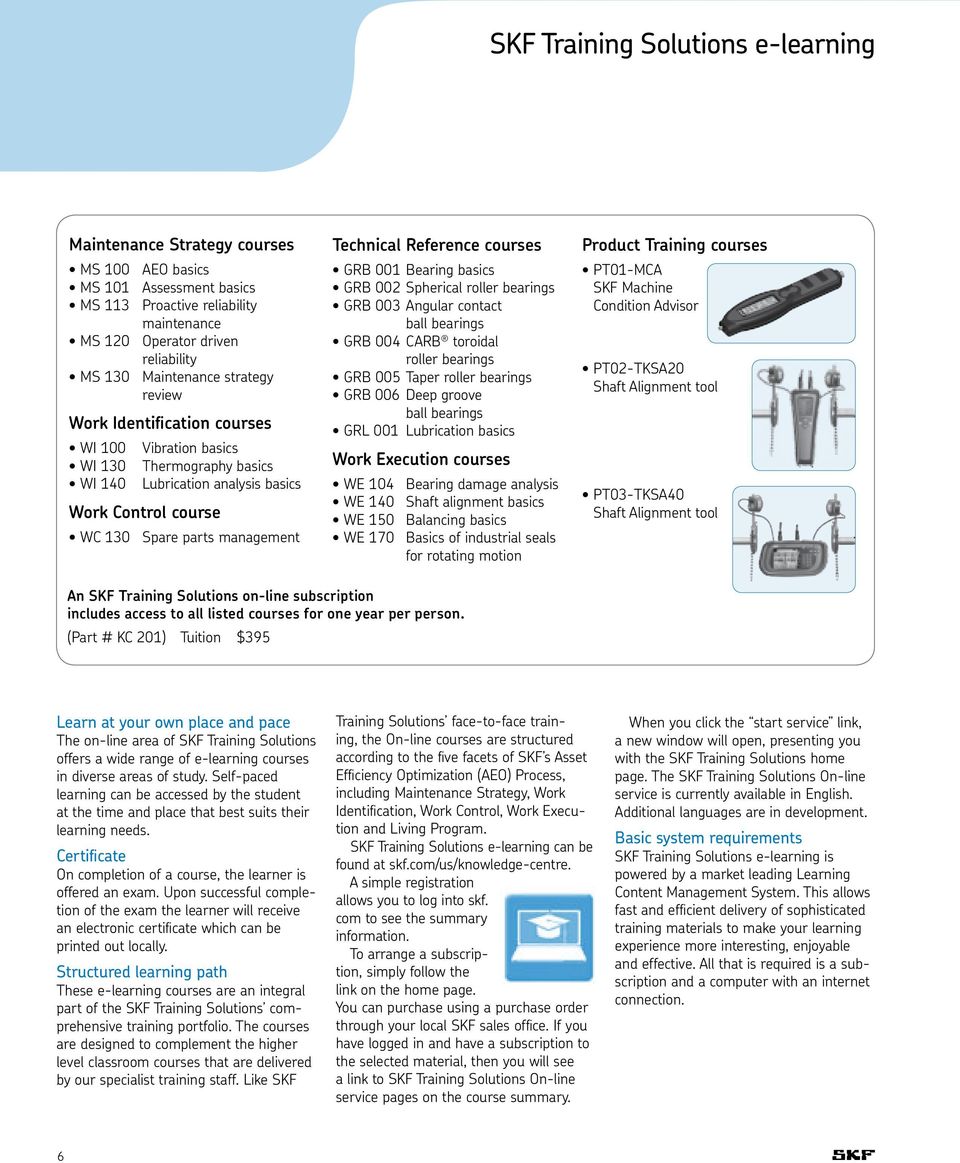
8 SKF Training Solutions e-learning Maintenance Strategy courses MS 100 AEO basics MS 101 Assessment basics MS 113 Proactive reliability maintenance MS 120 Operator driven reliability MS 130 Maintenance strategy review Work Identification courses WI 100 Vibration basics WI 130 Thermography basics WI 140 Lubrication analysis basics Work Control course WC 130 Spare parts management Technical Reference courses GRB 001 Bearing basics GRB 002 Spherical roller bearings GRB 003 Angular contact ball bearings GRB 004 CARB toroidal roller bearings GRB 005 Taper roller bearings GRB 006 Deep groove ball bearings GRL 001 Lubrication basics Work Execution courses WE 104 Bearing damage analysis WE 140 Shaft alignment basics WE 150 Balancing basics WE 170 Basics of industrial seals for rotating motion Product Training courses PT01-MCA SKF Machine Condition Advisor PT02-TKSA20 Shaft Alignment tool PT03-TKSA40 Shaft Alignment tool An SKF Training Solutions on-line subscription includes access to all listed courses for one year per person. (Part # KC 201) Tuition $395 Learn at your own place and pace The on-line area of SKF Training Solutions offers a wide range of e-learning courses in diverse areas of study. Self-paced learning can be accessed by the student at the time and place that best suits their learning needs. Certificate On completion of a course, the learner is offered an exam. Upon successful completion of the exam the learner will receive an electronic certificate which can be printed out locally. Structured learning path These e-learning courses are an integral part of the SKF Training Solutions comprehensive training portfolio. The courses are designed to complement the higher level classroom courses that are delivered by our specialist training staff. Like SKF Training Solutions face-to-face training, the On-line courses are structured according to the five facets of SKF s Asset Efficiency Optimization (AEO) Process, including Maintenance Strategy, Work Identification, Work Control, Work Execution and Living Program. SKF Training Solutions e-learning can be found at skf.com/us/knowledge-centre. A simple registration allows you to log into skf. com to see the summary information. To arrange a subscription, simply follow the link on the home page. You can purchase using a purchase order through your local SKF sales office. If you have logged in and have a subscription to the selected material, then you will see a link to SKF Training Solutions On-line service pages on the course summary. When you click the start service link, a new window will open, presenting you with the SKF Training Solutions home page. The SKF Training Solutions On-line service is currently available in English. Additional languages are in development. Basic system requirements SKF Training Solutions e-learning is powered by a market leading Learning Content Management System. This allows fast and efficient delivery of sophisticated training materials to make your learning experience more interesting, enjoyable and effective. All that is required is a subscription and a computer with an internet connection. 6
9 Design Engineering BSD301 Bearing System Design Design engineers directly responsible for rolling element bearing system design. Reliability and maintenance engineers responsible for optimizing the performance and improving the reliability of existing machinery. Students will gain a thorough understanding of bearing system designs used in typical industrial applications. Includes bearing life, lubrication life, seal life and other factors affecting performance and reliability of rotating equipment. February September November Edmonton, AB Cleveland, OH Toronto, ON Public classes $1,395 On-site per class $12,995 # people people $395 per person 3 days No examination is available for this course. Bearing system design uses a combination of lectures, open discussions and guided exercises. Specific topics include: Review of bearing history and design Selection of bearing type Available space Loads Misalignment Precision Speed Stiffness Axial displacement Mounting & dismounting Integral seals Selection of bearing size Bearing reliability system life Dynamic load ratings and life Dynamic and static bearing loads Static load ratings and capacity Calculation tools Friction, speed and vibration Friction models Reference speeds Limiting speeds Influence of vibration Bearing data Dimensions Tolerances Internal clearance Materials Cages Designations Application of bearings Bearing arrangements Radial location of bearings Axial location of bearings Designing associated components Bearing preload Sealing arrangements Lubrication of bearings Grease lubrication Relubrication Oil lubrication GRB001 Bearing basics EVOLV06_no2_p27 Using a friction model as an engineering tool EVOL01_no1_p25 The SKF formula for rolling bearing life SKF_5230 Rolling Bearings in Electrical Motors and Generators SKF_3213_E Bearings for Fans SKF100955_1 Rolling Bearings in Centrifugal Pumps skf.com/us/knowledge-centre.com 7

10 Maintenance Strategy MS212 Proactive Reliability Maintenance for Managers and Supervisors Corporate and plant management and supervision personnel responsible for plant production and maintenance performance. Plant engineering, planning and scheduling, purchasing, and reliability personnel will also benefit from this comprehensive program. Provide information and training that enables corporate and plant level management to successfully implement precision and proactive maintenance practices towards a goal of improved reliability and profitability. To schedule your personalized on-site training class, see page 55 for contact information. On-site only Tuition on request 2 days Proactive Reliability Maintenance is a trademark of SKF USA Inc. Improving the reliability of plant machinery is the key to gaining or maintaining a competitive advantage. However, many companies continue to struggle with poor reliability in spite of repeated improvement efforts. The basis for success is changing the fundamental way maintenance is performed. Few maintenance programs have addressed this important topic. Computerized Maintenance Management Systems and condition-based maintenance programs can provide significant returns, but do little to modify actual hands-on maintenance practices. Repeated premature failures can be detected with condition monitoring and scheduled in the CMMS system at considerable savings over a run-to-failure maintenance mode. A proactive and precision approach, as presented in this course, identifies and corrects the root cause of the repeated failures. Proactive and precision maintenance goes beyond root cause failure analysis. It affects the way routine maintenance is performed on all machinery, the way machines are operated, the specification and purchase of machinery and replacement parts, and the way maintenance and production are managed. This course provides a detailed look at reliability and influencing factors and presents a practical approach to improving machinery reliability in any industry. The course includes the following topics, with an emphasis on solutions over theory: Definitions of reliability based on industry and application Failure sources Beyond root cause root prevention Reliability within the traditional maintenance models Overview of condition-based maintenance and common pitfalls Implementation of reliability key steps towards positive change Conducting a maintenance practices assessment Monitoring performance and improvement key performance indicators Overview of common machinery problems, their correction, and their prevention Precision and proactive mechanical maintenance techniques MS100 Proactive reliability maintenance MB03014 Reactive maintenance MB03033 Maintaining a competitive edge GS02010 Asset efficiency optimization work management process MS120 Operator driven reliability BBONN_FWD Benchmarking for best practices in maintenance management skf.com/us/knowledge-centre.com 8

11 Maintenance Strategy MS230 Maintenance Strategy Review (MSR) Awareness Maintenance, plant/facility engineering staff, rotating equipment engineers and maintenance supervisors. Managers at industrial plants, reliability engineers and those interested in rotating equipment performance and reliability. By the end of this course students should: Know if a review of strategy is required and why Recognize the importance of data structure and content before performing any kind of strategy work Understand the importance of identifying and categorizing assets Understand that there are differing types of criticality at different levels for different purposes Understand what will likely be involved to conduct the right analysis, and what the implications are of making the strategy work Recognize the commonalities and difference in possible strategies Understand the important implications to spares Understand that certain classes of equipment require specialized approaches to strategy review (i.e., SCS > via SIL/IPF, etc.) To schedule your personalized on-site training class, see page 55 for contact information. Before we explore the technical details of strategy, we must understand each organization, what their issues are, which issues matter to whom, and how the issues can be incorporated into a plan. There must be a documented need to look at an existing maintenance strategy or create a new one for the right business reasons. Having the right maintenance, performed on the right equipment, by the right person, at the right time, for the right reasons is what we all want. Maintenance strategy is the key to asset reliability and availability, thus achieving overall organizational goals. How do you know if a review of your maintenance strategy is required and why? Data structure, content and categorization is paramount before any kind of strategy work begins. There are many different methods to determine asset criticality, at different levels for different purposes. Having good, solid data, and using the appropriate criticality techniques will allow an organization to conduct the most appropriate asset rank/prioritization analysis. Then the implications of making the maintenance strategy work can be understood. The purpose of this course is to make users aware of Maintenance Strategy Review and how they can apply it. Specific topics include: Conceptual models and business context Obtain a common understanding of terminology Standards, models, and excellence Understanding the current situation The essential link failure and strategy What is strategy? Mutual understanding and readiness Can we conduct MSR? Now we know we need to A blend of MSR types How to implement well Performance management and measurement How MSR forms the basis for PdM and Proactive Reliability Maintenance (PRM) programs MS100 AEO basics MS130 Maintenance strategy review MB03006 Maintenance Strategy Review Methods MB03011 Asset register MB03032 Managing asset integrity GS03011 Business process improvement skf.com/us/knowledge-centre.com On-site only Tuition on request 3 days A written examination is included with this course and is conducted on the afternoon of the final day of class. 9

12 Maintenance Strategy MS300 Asset Reliability Improvement Anyone responsible for managing and improving the reliability of rotating equipment, managing plant assets and/or reliability programs, as well as all reliability managers and supervisors, maintenance managers and supervisors, operation managers, purchasing managers, plant managers, reliability engineers, rotating equipment engineers, schedulers and senior maintenance staff. By the end of this course students should have the knowledge to: Understand if and when an assessment is necessary Describe what type of data is required for various analysis purposes Recognize when root cause analysis is necessary Recognize different maintenance program strategies and how they can be optimized Understand how to design a change and be ready to implement that change To schedule your personalized on-site training class, see page 55 for contact information. The arena of Asset Management encompasses a variety of maintenance approaches, techniques and technologies. This course explores Asset Management best practices and helps you select the most appropriate combination to optimize asset management in your organization. The concept of asset improvement emerged in recent years as the total organization of a physical asset s life cycle to achieve the lowest cost with maximum return. As such, it spans an entire organization, beyond maintenance or operations functions. Asset management demands continuous, prioritized improvement through design and procedural change. Success is measured by the contribution to a company s results and shareholder value. This is an advanced course for individuals who have experience in maintenance processes, tasks and results analysis. The course relates to methods, technologies and best practices used to develop, implement and sustain your optimized maintenance strategy and guides you to benefit from the living program for continuous improvement. This course explores the justification for your maintenance strategy; examines various strategies and helps you to optimize your current maintenance strategy or transition to a more appropriate strategy. Benefits of implementing the correct maintenance strategy include improved asset reliability, increased uptime and moving your organization from a reactive culture to a reliability-focused culture. This course helps you establish your road map for why specific maintenance should be done; what maintenance should be done, on what equipment and how frequently it should be performed. You can leverage this knowledge and use the information gained to refine your maintenance program and enable continuous improvement. You will learn techniques to recognize when a change is needed, charting that change and then measuring the impact of the change. MS100 Proactive reliability maintenance MS120 Operator driven reliability GS02006 Asset Management MS130 Maintenance strategy review MB03011 Asset register GS02010 Asset Efficiency Optimization Work Management Process skf.com/us/knowledge-centre.com On-site only Tuition on request 3 days A written examination is included with this course and is conducted on the afternoon of the final day of class. 10

13 Maintenance Strategy MS331 SKF Reliability Centered Maintenance (SRCM) Maintenance, plant/facility engineering staff, rotating equipment engineers, maintenance supervisors, managers at industrial plants, reliability engineers and those interested in rotating equipment performance. By the end of this course students should have the knowledge to: Describe the SRCM process flow Recognize the importance of data structure and content before performing any kind of strategy work Understand the importance of identifying and categorizing assets. Understand criticality and the Failure Modes and Effects Analysis (FMEA) approach in SRCM Develop a SRCM analysis, as well as the implications of making the strategy work Conduct a task comparison Understand methods needed for SRCM implementation Recognize what a living program is To schedule your personalized on-site training class, see page 55 for contact information. On-site only Tuition on request To provide participants the necessary knowledge of the SKF maintenance strategy review to understand the basics of SKF reliability centered maintenance (SRCM). Setting the scene for SRCM Asset Management Support Tool (AMST) module structure Conceptual models and business context Understand where SRCM came from Discuss the difference between SRCM and RCM Understand the RCM standard Discuss SRCM compliance with the RCM standard SRCM methodology Effectively discuss the SRCM process model Determine what data is required prior to SRCM Identify what is important How to select which system to analyze Determine system boundaries Understand the importance of the functional failure analysis (FFA) Define what should be done Know what dominant failure causes are How to prescribe maintenance to critical assets How to decide run-to-failure (RTF) maintenance Know when design changes are required Change the existing program Understand the importance of task comparison How to implement well What feedback is Project steps Understand typical SRCM project steps Understand what takes place during a SRCM review meeting MB03017 Methodology SRCM MS130 Maintenance strategy review MB05004 Redefining Your Maintenance Strategy Using the SRCM Process MB02029 Criticality analysis in perspective MB07005 TPM with SRCM MB03016 RCM That Works SRCM skf.com/us/knowledge-centre.co 3 days A written examination is included with this course and is conducted on the afternoon of the final day of class. 11

14 Maintenance Strategy MS332 Reliability Centered Maintenance (RCM) Maintenance, plant/facility engineering staff, rotating equipment engineers, maintenance supervisors. Managers at industrial plants, reliability engineers and those interested in rotating equipment performance. By the end of this course students should: Describe RCM process flow Understand the differences in RCM approach Recognize the importance of data structure and content before performing any kind of strategy work Understand the importance of identifying and categorizing assets Understand criticality and the FMECA approach in RCM Develop an RCM analysis and know the implications of making the strategy work Conduct a task comparison Understand what work packaging is Understand methods needed for RCM implementation Recognize what a living program is. Know the content of a RCM project plan Understand Risk Based Inspection (RBI) within the asset management support tool AMST To provide participants the necessary knowledge of the SKF maintenance strategy review reliability centered maintenance methodology. Introduction Discuss RCM terminology RCM overview and business context Understand the evolution of RCM Understand the business context of RCM Know RCM standards RCM phase what is important? Know what a criticality matrix is How to select which system to analyze Determine system boundaries Understand what failure modes, failure causes and failure effects are RCM phase what should be done? Know what important failure characteristics are Understand when Run To Failure (RTF) maintenance is appropriate Know when design changes are required How to prescribe maintenance to critical assets RCM customization and requirements Understand RCM customization Understand the use of RCM template data Determine what data is required for RCM Become aware of the Asset Management Support Tool (AMST) Implementation and improvement Understand what a job plan is Understand how to allocate tasks Understand how to implement RCM well Understand what feedback is RCM project Know the steps in a RCM project Understand the evolution of Risk Based Inspection (RBI) Understand variations of RBI Understand the requirements for RBI MB02008 Reliability centered maintenance MB02024 Using an RCM Approach for Process Hazard Analysis Revalidation MB04002 Risk based inspection NC_0520 How to Implement Reliability Centered Maintenance at Your Facility MB07005 TPM with SRCM MB05004 Redefining your maintenance strategy using the SRCM process skf.com/us/knowledge-centre.co To schedule your personalized on-site training class, see page 55 for contact information. On-site only Tuition on request 3 days A written examination is included with this course and is conducted on the afternoon of the final day of class. 12

15 Work Identification WI201 Fundamentals of Machine Condition Engineers and technicians whose responsibilities require them to be proficient in the setup and use of the SKF condition monitoring system; maintenance supervisors, predictive maintenance coordinators, reliability engineers, inspectors, shop supervisors, advanced mechanics, and millwrights who wish to become familiar with vibration monitoring and analysis. To provide a practical approach to detecting and analyzing common machinery problems using vibration monitoring and analysis. To schedule your personalized on-site training class, see page 55 for contact information. On-site only Tuition on request 3 days A written examination is included with this course and is conducted on the afternoon of the final day of class. SEE is a trademark of SKF USA Inc. Designed for maximum class participation. A combination of overhead presentations, group exercises, video tapes, and written reviews are used to peak participant interest and encourage participation and understanding. Basics of vibration Time waveform analysis Amplitude vs. frequency Vibration measurable characteristics Vibration sensors Scale factors Measurements and units Displacement probe/eddy probe Multi-parameter monitoring Resonance Detection vs. analysis Setting up the vibration measurement Physical and database considerations Selecting the machinery Sensor location and mounting methods Cable attachments Setting F max Alarm methods and setting alarms limits ISO guidelines Assessing overall vibration severity Spectral enveloping and bands Phase alarms Exception criteria Spectral analysis and phase analysis Spectral analysis techniques and pattern recognition Sidebands Harmonics Waterfall plot Understanding phase Vibration signal processing methods Enveloping SEE technology (Spectral Emitted Energy) HFD (High Frequency Detection) Analyzing typical machinery problems Imbalance and misalignment Bent shaft Mechanical looseness Cocked bearing Monitoring rolling bearings Why do bearings fail? Bearing failure stages Bearing defect frequencies Displaying fault frequencies Vibration diagnostic tables ISO 2372 Vibration Diagnostic Table WI100 Vibration basics WE140 Shaft alignment basics JM02001 Introduction Guide to Vibration Monitoring JM02007 Vibration Principles WI130 Thermography basics CM3068 Recommended initial alarm criteria for bearing condition assessment skf.com/us/knowledge-centre.co 13

16 Work Identification WI205 Vibration Troubleshooting Practical Methods/Advanced Results All maintenance and operations personnel interested in improving machinery reliability through identification, correction, and the prevention of failures. Although a basic understanding of vibration is helpful, the practical nature of the material allows all participants to gain a new understanding of their machinery and how they can positively impact reliability. To understand the cause and effect relationship between maintenance practices and the resulting vibration and reliability performance of industrial machinery utilizing sound and practical inspection and troubleshooting practices. Elevate basic condition monitoring programs beyond problem detection to provide true corrections and solutions to problems. February 3 5 April 7 9 March November 3 5 Public classes $1,195 Lake Charles, LA Cleveland, OH Edmonton, AB Salt Lake City, UT On-site per class $8,995 # people 5 6+ people $395 per person This course focuses on troubleshooting strategies that lead to the true sources of the most common maintenance-related vibration problems. Techniques aimed at the future prevention of the root causes of these problems solve not only existing machinery problems but provide a foundation for a fundamental change in maintenance practices. Relevant case histories and discussions of machinery problems that attendees are currently experiencing enhance the learning experience. Review of machinery vibration fundamentals --Cause and effect relationship sources --Vibration terminology --Relationships between time, frequency, amplitude and phase Optimizing vibration detection and analysis for routine condition monitoring route data collection --Transducer selection and placement low frequency, high frequency, and issues that affect enveloped/ demodulated readings --Data collection parameter optimization resolution, waveforms, matching readings to faults --Proper application of advanced detection methods --Practical approach to vibration alarm limits overall, spectrum, phase Identifying and solving the most common vibration problems --Resonance recognition, identification with multiple methods/technologies, correction techniques, prevention --Unbalance sources, identification, prevention, and correction --Misalignment sources, identification, correction, recognizing common assembly errors Extending the life of rolling element bearings --Most common causes of premature failure --Detection strategies --Troubleshooting and prevention --Overview of proactive installation and lubrication --Understanding and establishing practical acceptance testing limits for bearing related vibration Amplitude, spectrum, time waveform, and phase characteristics of machinery problems --Beats, sidebands, harmonics --Causes and effects of shaft motion on machine components --Understanding bent shaft, gear, electrical, and bearing symptoms and how symptoms may mask root causes WI100 Vibration basics JM03001 A Balanced Approach to Acceleration and Velocity Monitoring JM02014 Vibration monitoring of bearings MB01001 Low speed bearing monitoring MB04034 PdM and RCFA: A powerful combination MB02006 Predictive maintenance skf.com/us/knowledge-centre.co 3 days 14

17 Work Identification WI210 ISO Category I Vibration Analysis Entry Level Plant personnel requiring an introduction to vibration analysis techniques and technologies used in a condition predictive maintenance program. Including maintenance supervisors, rotating machinery engineers, predictive maintenance technicians and coordinators, reliability engineers, and multi-skilled mechanics. Introduce a novice to basic vibration analysis by using a variety of PdM instrumentation and software. To find how vibration analysis and related technologies can best be integrated to successfully implement such programs from hands-on demonstration. Teach vibration terminology and measurement conventions needed, not only by coverage of seminar text material, but also by performing button pushing demonstration to maximize the learning experience. January February 3 6 February March April 7 10 April May June 2 5 June 9 12 July 7 10 July July August September September 29 Oct 2 October October November 3 6 December 1 4 Miami, FL Dallas, TX New Orleans, LA Seattle, WA Columbus, OH St. Louis, MO Myrtle Beach, SC Denver, CO Myrtle Beach, SC Philadelphia, PA Dallas, TX Orlando, FL San Diego, CA Houston, TX The basics of performing vibration analysis to get started within a condition monitoring program. Various techniques used to understand machinery condition are introduced. Introduction to predictive maintenance and machine vibration: --Definitions of PdM and condition monitoring --How PdM compares with other maintenance systems --Goals of a PdM program --The critical role of vibration analysis in PdM Machine vibration basic theory and analysis: --Characteristics of vibration (frequency and period) --Amplitude magnitude of vibratory motion --RMS peak and peak-to-peak conversations --Frequency how often the vibration occurs --Phase how one machine component or support frame vibrates relative to another --Basics of a time waveform versus a spectrum Public classes $1,395 On-site per class $10,595 # people 5 6+ people $295 per person 3.5 days optional certification exam on day 4 A written examination is available for this course. Test fee $275 per person. Successful completion of the written exam results in ISO Category I Certification. Preparation for data collection: --Types of vibration transducers --Choosing the optimum transducer location --Effects of transducer mounting on it s performance, accuracy and repeatability --Choosing the optimum FFT data collector Introduction to data collection systems: --Setting up a PdM database (plants, trains, machines and points --Choosing the proper parameter (vibration, acceleration, velocity and/or displacement) --Selecting the proper parameters --Setting up the optimum PdM routes and schedules --Printing out the proper reports after uploading Introduction to problem recognition: --How to recognize abnormal conditions --How to identify hardware versus software faults --How to identify good versus bad data --How to detect common machine problems Basic machine maintenance skills and experience. General computer and calculating skills are helpful. Little or no previous vibrating experience required. WI100 Vibration basics JM02001 Introduction Guide to Vibration Monitoring JM02007 Vibration Principles MB02006 Predictive maintenance MB02005 SKF Condition Monitoring KBA00276 Measuring with different SKF devices skf.com/us/knowledge-centre.com 15

18 Plant personnel requiring a basic understanding of analytical methodologies used to determine machinery conditions for improvement of predictive maintenance program results; including maintenance supervisors, rotating machinery engineers, predictive maintenance coordinators, reliability engineers, and advanced mechanics and technicians. At the end of this course, participants should learn how to select appropriate sensors and techniques for diagnosing typical machinery malfunctions. Participants will be taught to read vibration signatures and evaluate machinery condition from vibration data. Participants will understand how to isolate the affected machinery components, recognize various common problems, and make recommendations for continued operation or scheduled repairs. January February March 3 6 March April April May June 9 12 June July July August 4 7 September 1 4 September October 6 9 October November 3 6 November December 8 11 Miami, FL Dallas, TX New Orleans, LA Seattle, WA Columbus, OH St. Louis, MO Myrtle Beach, SC Denver, CO Myrtle Beach, SC Philadelphia, PA Dallas, TX Orlando, FL San Diego, CA Houston, TX An introduction to performing vibration analysis within a condition monitoring program. Various techniques used to diagnose machinery condition are reviewed, including time waveforms, spectral analysis, phase measurements, and amplitude measurement methods. Applies sensor fundamentals to vibration analysis, including an overview of sensor strengths and weaknesses in applications. Common machinery malfunctions are discussed, including basic guidelines for the best detection tools for each machinery problem, and key signs to be aware of. Malfunctions and common pitfalls are demonstrated and real-world vibration analysis case histories are shared. What is vibration and how can it be used to evaluate machinery condition: --Frequency, a time waveform, phase, an FFT spectrum (signature) --Displacement, velocity, and acceleration --RMS, peak, and peak-to-peak amplitude --How to know when vibration is too high Public classes $1,595 On-site per class $11,995 # people 5 6+ people $345 per person 3.5 days optional certification exam on day 4 A written examination is available for this course. Test fee $300 per person. Successful completion of the written exam results in ISO Category II Certification. Work Identification WI211 ISO Category II Vibration Analysis I Vibration sensors and their application Vibration and detection by various instruments. Analog vs. digital methods High frequency detection (HFD) and alarm levels at various speeds Vibration analysis and how it is used to evaluate machine operating condition --Mass unbalance, eccentric rotors, bent shafts, and misalignment --Mechanical looseness, improper component fit, soft foot, and belt drive problems --Rolling bearing problem detection using vibration spectrum analysis --Gear wear problem detection --Electrical problems within induction motors --Balance resonances, detection, and effects on machinery Vibration alarms, spectral band alarms, and optimum frequency ranges Common pitfalls in making everyday vibration measurements and the effect on detection and diagnosis of machinery problems Time waveform and converting to an FFT spectrum Predictive maintenance programs Real-world case histories for problems found within the Illustrated Vibration Diagnostic Chart Up to six months full-time condition monitoring program experience; knowledge of basic sensor and monitoring instrumentation. WE150 Balancing basics MB04034 PdM and RCFA: A powerful combination JM02002 Spectrum Analysis CM5003 Vibration diagnostic guide TB02003 Integration of Vibration Signals CM3013 FAQs about enveloping skf.com/us/knowledge-centre.com 16

19 Work Identification WI212 ISO Category III Vibration Analysis II Plant personnel requiring a comprehensive understanding of vibration FFT and diagnostic techniques used to perform rotor dynamics analysis for increased performance of rotating machinery; including machinery specialists, predictive maintenance technicians, reliability engineers, and advanced mechanics. At the end of this course, participants should understand how to refine a condition monitoring program with diagnostic techniques that improve the performance of rotating machinery with rolling element or sleeve bearings. Participants will be taught to diagnose several malfunctions, from common to moderately severe, and to make recommendations for corrective action. In addition, participants will be taught to enhance condition monitoring programs with advanced measurement techniques, such as high frequency enveloping and time waveforms. March April April 28 May 1 June June August 4 7 August September 29 Oct 2 October November November December Dallas, TX Seattle, WA St. Louis, MO Myrtle Beach, SC Denver, CO Myrtle Beach, SC Orlando, FL San Diego, CA Houston, TX A comprehensive survey and in-depth study of vibration spectrum analysis and related condition monitoring techniques used to analyze rotating machinery, and to detect and correct machinery malfunctions. An overview of rotor dynamics is presented, along with the study of severe, but less common, machinery problems that frequently lead to catastrophic failure. An overview of acceleration enveloping and SEE Technology is also presented. Brief review of Vibration Analysis I course topics --Vibration instruments and sensors --Evaluating machinery condition with vibration analysis --Analog vs. digital overall vibration measurements --Spike energy, high frequency demodulation (HFD), and shock pulse techniques --Common pitfalls in vibration measurements --Time waveform and conversion to FFT spectrum Proper use of vibration severity charts Phase analysis techniques Concentrated vibration spectrum analysis for detecting 40 machinery problems Public classes $1,795 On-site per class $12,995 # people 5 6+ people $395 per person 3.5 days optional certification exam on day 4 A written examination is available for this course. Test fee $325 per person. Successful completion of the written exam results in ISO Category III Certification. SEE spectral emitted energy signal processing technology is a trademark of SKF USA Inc. --Mass unbalance, eccentric rotors, and bent shafts --Misalignment and coupling problems --Mechanical looseness --Balance resonance problems --Rotor radial rubs and sleeve bearing problems --Track rolling bearing condition using spectrum analysis --Flow-induced vibration (cavitation, surge, starvation) --Gear problems (wear, excessive backlash, eccentricity, tooth misalignment, cracked/broken teeth, hunting tooth, assembly phase problems) --Monitoring problems in AC and DC motors --Belt-drive and beat vibration problems --Soft foot and distorted frame problems Proven analysis procedure, including examples High frequency enveloping and demodulation spectral analysis. What is SEE Technology? How are these techniques used to detect problems with rolling element bearings, gears, lubrication, and contamination Real-world case histories are presented Six to 12 months full-time condition monitoring program experience; SKF course ISO Category II Vibration Analysis I (WI211) or commensurate field experience; knowledge of basic sensor and monitoring instrumentation. JM02012 Time domain analysis of vibration data CM3068 Recommended initial alarm criteria for bearing condition assessment JM03001 A balanced approach to acceleration and velocity monitoring JM02019 Vibration analysis feature extraction techniques MB01001 Low speed bearing monitoring WI130 Thermography basics skf.com/us/knowledge-centre.com 17

20 Work Identification WI213 ISO Category IV (Part 1) Vibration Analysis III Plant personnel requiring a comprehensive understanding of intensive analytical methodologies for determining the condition of machinery and to correct malfunctions (allowing them to obtain optimum performance, availability, and product and process quality); including rotating machinery specialists and consultants, advanced mechanics, engineers, and advanced technicians. At the end of this course, participants should have learned to perform effective diagnostics and make appropriate recommendations for fault corrections for many problem machines, bearings, gears, and electric motors. Participants will be taught to isolate and identify causes of excessive vibration and help predict bearing and gearbox failures for efficient scheduling of maintenance at appropriate times. In addition, participants will be taught to evaluate machinery condition for acceptance, expected level of continued operation, or overhaul maintenance. This course also covers the first half of the training requirements for ISO Category IV as per the ISO document. March May 5 8 June August October 6 9 Dallas, TX St. Louis, MO Myrtle Beach, SC An intensive study of special vibration analysis techniques used to diagnose critical machinery and problem machines. Study of how to generate meaningful narrow band spectral enveloping needed to isolate, identify, and correct a wide range of machinery problems, including those with unknown component description, variable operating speeds, and multiple harmonic frequencies. Effective monitoring techniques for electric motor problems are presented. Includes do s and don ts of meaningful enveloping, effective management reporting for success, and real-world case histories. Brief review of Vibration Analysis II topics including: --Review of Illustrated Vibration Diagnostic Chart --Overall alarm and spectral band alarm level specification --Phase measurement and analysis techniques --Signal processing parameters --Introduction to natural frequency testing How to create meaningful narrowband spectral alarm envelopes Detection of cracked or broken rotor bars on induction motors using both vibration and motor current analysis Public classes $1,895 On-site per class $13,995 # people 5 6+ people $445 per person 3.5 days optional (ASNT) certification exam on day 4 A written examination is available for this course. Test fee $350 per person. Successful completion of the written exam results in Level III Vibration Analysis Certification. SEE spectral emitted energy signal processing technology is a trademark of SKF USA Inc. DC motor and electronic control problem detection using vibration analysis High frequency enveloping and amplitude demodulation techniques Time waveform analysis and synchronous time averaging to detect a variety of mechanical and electrical problems Introduction to operating deflection shape analysis Low speed machine vibration analysis techniques and instrumentation ( rpm) How to analyze high speed machines generating frequencies of 600,000 3,600,000 cpm (10,000 60,000 Hz) How to analyze variable speed machines Presentation of a tabulated chart tracking the advancement through vibration analysis and rotor dynamic fields 36 to 48 months full-time condition monitoring program experience, ISO Category II SKF Vibration Analysis I (WI211), ISO Category III SKF Vibration Analysis II (WI212) MB09003 Multiparameter vibration analysis TB02003 Integration of vibration signals JM02014 Vibration monitoring of bearings JM02025 Low speed analysis MB03001 Investing in Reliability GS03012 Wireless condition monitoring skf.com/us/knowledge-centre.com 18

21 Work Identification WI220 Airborne Ultrasound Level I Inspectors seeking to advance their knowledge in Airborne Ultrasound inspections. Supervisors, energy auditors, and service company personnel who perform PDM, energy audits, or leak detection for their clients. Service personnel who desire to demonstrate technical and inspection proficiency to their clients. At the end of this course, participants will have a better understanding of the theory, principles, and practices of Airborne Ultrasound Technology. This course fulfills training and testing requirements of Level I Certification. January February 9 13 February March 9 13 April April April April May 4 8 May 4 8 June July July August 3 7 August September September October 5 9 October 5 9 October November December 7 11 Charleston, SC California, CA Alabama, AL Houston, TX Phoenix, AZ Saint John, NB Virginia, VA St. Louis, MO Minnesota, MN Colorado, CO Edmonton, AB New York, NY Portland, OR Philadelphia, PA Iowa, IA Ohio, OH Dallas TX Toronto, ON New Orleans, LA Atlanta, GA Nashville, TN Birmingham, AL Participants are introduced to the basics of Airborne Ultrasound, leak detection, electrical inspection, and mechanical inspection. General, specific, and practical tests are given at the end of the course. Students are expected to pass with a composite score of 80% or higher. Specific topics include: Theory of sound Basic physics of ultrasound Concepts of amplitude Wave modes Ultrasound wave transmission and effects Effectiveness of Airborne Ultrasound Technology integration Equipment/instrument overview ASTM standard test methods Leak detection --Fluids defined --Leak rates --Acoustic properties of leaks --Leak types --Leak strategies --Leak detection methods Public classes $1,495 On-site Tuition on request based on number of students 5 days A written examination is included with this course and is conducted on the afternoon of the final day of class. Electrical inspection --Safety considerations --Overview of types of electrical equipment --Voltages defined --Detection methods --Confirmation methods --Substation inspection --Low voltage inspection techniques --Inspection of motor control centers Mechanical inspection --Considerations of ultrasonic generation --Troubleshooting methods --Trending methods --Inspection methods --Monitoring and recording information General overview of Airborne Ultrasound technology Review of technology Practical experience review General, specific, and practical examination 19
22 Work Identification WI241 Machine LubricationTechnician/ Machine Lubricant Analyst Level I 20 Plant personnel involved in any aspect of machinery lubrication, including maintenance mechanics, supervisors and coordinators, reliability and rotating machinery engineers, predictive maintenance technicians and skilled mechanics. Introduce and establish the role of precision lubrication and analysis for improving machine reliability. Provide an overview of lubricant construction and the general principles involved in lubricant selection for common plant machinery. Review handling and application practices for both oils and greases. Introduce contamination control strategies as a way to improve machine performance. Provide a thorough introduction to the principles of lubricant analysis and introduce appropriate methods to collect samples as the first step in lubricant based machine condition assessment. March 9 13 April 27 May 1 May September September November 9 13 Public classes $1,295 On-site per class $12,995 # people people $445 per person 4.5 days Houston, TX Birmingham, AL Toronto, ON Edmonton, AB Cleveland, OH Philadelphia, PA Pre-test assessment I. Maintenance Strategies Why machines fail The impact of poor maintenance on company profits The role of effective lubrication in failure avoidance Lube routes and scheduling Oil analysis and technologies to assure lubrication effectiveness. Equipment tagging and identification. II. Lubrication Theory/Fundamentals Fundamentals of tribology Functions of a lubricant Hydrodynamic lubrication (sliding friction) Elasto-hydrodynamic lubrication (rolling friction) Mixed-film lubrication Base-oils Additives and their functions Oil lubricant physical, chemical and performance properties and classifications. Grease lubrication III. Lubricant Selection Viscosity selection Base-oil type selection Additive system selection Machine specific lubricant requirements Application and environment related adjustments. IV. Lubricant Application Basic calculations for determining required lubricant volume. Basic calculations to determine re-lube and change frequencies. An optional certification exam is offered on day five of the class. The exam is for Machinery Lubrication Technician Level I or Machinery Lubricant Analyst Level I certification. Only one certification exam is allowed per course.the exam and certification is offered through the International Council for Machinery Lubrication (ICML). To take the certification exam you must go to the ICML website to register and pay for the exam at least two weeks before the class. The website is When to select oil; when to select grease. Effective use of manual delivery techniques. Automatic delivery systems. V. Lube Storage and Management Lubricant receiving procedures. Proper storage and inventory management. Lube storage containers Proper storage of grease-guns and other lube application devices. Maintenance of automatic grease systems. Health and safety assurance. VI. Lube Condition Control Filtration and separation technologies. Filter rating. Filtration system design and filter selection. VII. Oil Sampling Objectives for lube oil sampling Sampling methods Managing interference VIII. Lubricant health monitoring Lubricant failure mechanisms Testing for wrong or mixed lubricants Fluid properties test methods and measurement units - applications and limitations. IX. Wear Debris Monitoring and Analysis Common machine wear mechanisms Post test GRL001 Lubrication basics WE170 Basics of Seals for Rotating Motion RB03008 Lubrication management EVOL04_no2_p26 Grease life in lubricatedfor-life deep groove ball bearings GC Principles of bearing selection and application-selecting lubricant viscosity GS02001 LubeSelect skf.com/us/knowledge-centre.com
23 Work Identification WI252 Machine Lubricant Analyst Level II Plant personnel involved in any aspect of machinery lubrication, including maintenance supervisors and coordinators, reliability and rotating machinery engineers, predictive maintenance technicians and skilled mechanics. Establish the role of lubricant analysis for improving machine reliability. Overview lubricant construction and the general principles involved in lubricant selection for typical plant machinery. Review handling, application and contamination control strategies to improve machine performance. Provide a thorough introduction to the principles of Lubricant Analysis, including a review of methods to analyze lubricant health, lubricant contamination conditions and machine wear debris. Introduce appropriate methods to collect samples as the first step in lubricant based machine condition assessment. July Public classes $1, days San Diego, CA On-site per class $12,995 # people people $445 per person This course material is compliant to ISO , Category II I. Lubricant roles and functions Base oil Additive functions Synthetic lubricants Lubrication regimes --Hydrodynamic --Elasto-hydrodynamic --Boundary II. Oil Analysis Maintenance Strategies Fundamental aspects of Reliability- Centered Maintenance (RCM) Fundamental aspects of Condition- Based Maintenance (CBM) --Predictive maintenance strategies --Proactive maintenance strategies III. Oil Sampling Objectives for lube oil sampling Equipment specific sampling Sampling methods Managing interference Sampling process management IV. Lubricant health monitoring Lubricant failure mechanisms --Oxidative degradation --Thermal degradation --Additive depletion/degradation Testing for wrong or mixed lubricants --Baselining physical and chemical properties tests --Additive discrepancies An optional certification exam is offered on day four of the class. The exam is for Machine Lubricant Analyst Level II and certification is offered through the International Council for Machinery Lubrication (ICML). To take the certification exam you must go to the ICML website toregister and pay for the exam at least two weeks before the class. The website is Fluid properties test methods and measurement units --Kinematic Viscosity (ASTM D445) --Absolute (Dynamic) Viscosit (ASTM D2983) --Viscosity Index (ASTM D2270) --Acid Number (ASTM D974 et al) --Base Number (ASTM D974 et al) --Fourier Transform Infrared (FTIR) analysis --Rotating Pressure Vessel Oxidation Test (ASTMD2272) --Atomic Emission Spectroscopy V. Lubricant contamination measurement and control Particle contamination Moisture contamination Glycol coolant contamination Soot contamination Fuel contamination (fuel dilutionin oil) Air contamination (air in oil) VI. Wear Debris Monitoring and Analysis Common wear mechanisms Detecting abnormal wear Wear debris analysis WI140 Lubrication analysis basics JM02016 Lubricant Monitoring and Analysis MB03027 Oil and water EVOL10_no3_p25 Lubrication and contamination effects on bearing life EVOL11_no1_p25 Testing grease noise in rolling bearings JM02009 An introduction to oil debris analysis skf.com/us/knowledge-centre.com 21
24 Work Identification WI304 ISO Category IV (Part 2) Advanced Vibration Analysis Mechanical, maintenance, and machinery engineers and analysts involved in design, specification, acceptance, operation, and troubleshooting of industrial process and utility machinery. Plant personnel and others who wish to become experts in diagnosing the behavior of rotating machinery of various types and classifications. Professionals whose primary responsibility is the maintenance of high level performance, reliability, and availability of critical process machinery; including rotating machinery specialists and consultants, advanced mechanics, engineers, and advanced technicians. An advanced study of machinery vibration diagnostics to identify optimum required corrective actions. Topics include time waveform analysis, multi-channel instruments, natural frequency test methods, rotor dynamics, lissajous orbit analysis, and electric motor current analysis. An introduction to experimental modal and operating deflection shape analysis is included. Covers special analytical techniques needed to evaluate complex machine trains. Covers vibration reduction techniques such as resonance correction, vibration isolation, damping treatments, design of dynamic vibration absorbers, and more. This course also covers the second half of the training requirements for ISO Category IV as per the ISO document. May Advanced vibration principles, including phase, resonance, instabilities, nonlinear systems and forced response Advanced data acquisition, including multi-channel analysis, dynamic range, signal-to-noise ratio and special test setups Specialized vibration diagnostic techniques Signal processing, including rms/peak detection, analog and digital sampling, FFT computation, overlap processing, time windows (including uniform, Hanning, flat-top, and more), anti-aliasing, bandwidth, resolution, waterfall and cascade plotting Condition monitoring program design and implementation, including vibration and alternative PdM technologies Fault detection and analysis, including time waveform analysis, synchronous time averaging applications, and nonsynchronous cross channel phase analysis, transient analysis, orbit analysis, shaft centerline analysis, enveloping, gearbox analysis and order tracking Corrective actions, including vibration isolation and damping, resonance control, flexible rotor balancing, and more Equipment testing and diagnostics, including impact natural frequency testing, transient analysis (start-up and coastdown testing, Bode and Nyquist plot Public classes $1,995 On-site per class $13,495 # people 5 6+ people $495 per person 5 days - optional certification exam on day 5 A written examination is available for this course. Test fee $350 per person. Successful completion of the written exam results in ISO Category IV certification. generation, and more), cross channel phase, coherence, operating deflection shapes, modal analysis, and torsional vibration analysis Reference vibration standards: ISO, IEC and relevant national standards Condition monitoring and diagnostic reports and documentation Fault severity determination, including spectral analysis, time waveform analysis, orbit analysis and applicable severity charts, graphs and formulas Rotor/bearing dynamics --Sleeve bearing types and applications, rotor characteristics and rotor balancing --Lissajous orbit analysis, shaft centerline analysis, etc. Diagnosing a bearing, gear, or electrical problem with unknown variables Vibration analysis of special machine types: theory, recommended approach, and real-world case histories --Horizontal centrifugal and vertical pumps and fans --High-speed centrifugal air compressors --Rotary screw air compressors --Single and multi-stage gearboxes --DC motors and induction AC motors 5 to 8 years full-time condition monitoring program experience, ISO Category II SKF Vibration Analysis I (WI211), ISO Category III SKF Vibration Analysis II (WI212), ISO Category IV (Part I) SKF Vibration Analysis III (WI213) MB04034 PdM and RCFA: A powerful combination MB02029 Criticality analysis in perspective GS02005 Reliability and life MB07004 Use of reliability, availability and maintainability DTD08002 Reliability: What do you have a right to expect? GS03001 Risk analysis skf.com/us/knowledge-centre.com 22
25 Work Identification WI305 Applied Modal and Operating Deflection Shape Analysis : Plant personnel that need a basic understanding of Modal and Operating Deflection Shape Analysis techniques on machinery and structures, as well as a practical understanding of ME scope VES modal/ods software. Professionals whose primary responsibility is the maintenance of high level performance, reliability, and availability of critical process machinery, including rotating machinery specialists and consultants, advanced mechanics, engineers, and advanced technicians. To provide students with a working knowledge of Experimental Modal Analysis and Operating Deflection Shape Analysis (ODS) from a field vibration analyst perspective. Upon completion of this course, students learn how to: Create computer models of plant machinery and structures Acquire meaningful Modal and ODS measurements Generate and import Modal and Operating Deflection Shape analysis measurements Generate meaningful machinery computer animations needed to detect and resolve noteworthy problems such as resonance, structural weakness, foot related problems, design inadequacies, sources of excessive vibration. August Class starts Monday at 8:00 AM and ends Friday at 12:00 Noon Introductory analysis lecture This portion of the course provides background information on Experimental Modal and Operating Deflection Shape (ODS) Analysis topics with extensive case histories and instructor experience. Advanced analysis without complex mathematics Understanding modes of simplified animation shapes (beams, columns, plates, and shells) How to construct meaningful computer models of machines and structures Choosing required numbers of points and directions for ODS and Modal analysis Recommended measurement setups for ODS and Modal analysis field testing How to accurately interpret computer model animations (leading to problem resolution) How to confirm what specific component is resonant on a complex machine, support frame, foundation and attached piping, ductwork, and more How to identify optimum corrective actions Presentation of numerous demonstrations and class exercises ODS and Modal real-world case studies Public classes $1,995 On-site per class $13,495 4 days # people 5 6+ people $495 per person Hands-On ME scopeves Software Training The hands-on training utilizes the ME scopeves Handbook. This is a continually updated practical step-by-step software guide and reference source that can be consulted over and over again. Complex methodologies are completely worked out for the student helping to ensure accurate analysis and repeatable results. Multiple hands-on projects that include real-world data cover all major ME scopeves software applications. Establish a project Create a computer model of a machine or structure Import data from the data acquisition instrument ODS and ODS FRF data interpretation Modal data interpretation Modal analysis curve fitting and generation of computer animations Structural dynamics modification (SDM) Students are required to bring a laptop computer with Windows XP or Vista. Vibrant Technology ME scopeves software and extensive training manuals will be provided. 5 8 years full-time vibration analysis experience. SKF Vibration Analysis III (WI213) and SKF Advanced Vibration Analysis (WI304) or commensurate field experience. Knowledge of vibration sensors and vibration instruments. JM02024 Operating deflection shape analysis MS120 Operator driven reliability PE1102 MEScope Import MS100 AEO basics MS101 Assessment basics AF04005_fan_WE Fans - Work Execution skf.com/us/knowledge-centre.com 5 days 23
26 Work Identification WI313 Time Waveform Analysis on Rotating Machinery Mechanical, maintenance, and machinery engineers and analysts involved in design, specification, acceptance, operation, and troubleshooting of industrial process and utility machinery. Plant personnel and others who wish to become experts in diagnosing the behavior of rotating machinery of various types and classifications. Professionals whose primary responsibility is the maintenance of high level performance, reliability, and availability of critical process machinery; including rotating machinery specialists and consultants, advanced mechanics, engineers, and advanced technicians. This course provides in-depth coverage of Time Waveforms and how they can be used to detect a wide variety of faults, plus how they can be used to assess the severity of such faults. While the focus of the class is on vibration time waveforms, it likewise clearly shows how a different approach should be taken when acquiring and evaluating High Frequency Envelope (HFE) waveforms versus classic vibration waveforms (including a difference in setup parameters for HFE waveforms) This course shows how to detect faults using waveform pattern recognition and provides real insight on evaluating fault severity, proves how waveforms often are a much better indicator of fault severity - particularly those caused by bearing, gear, lubrication, rotor rub and impact-type problems and includes a series of realworld case studies to clearly demonstrate how time waveforms should best be used to evaluate rotating machinery. Introductory Time Waveform Concepts Recommended Measurement Setups for Time Waveform Analysis Displacement vs. Velocity vs. Acceleration Waveforms Problems Detectable Only by Time Waveform Analysis Problems for which Time Waveform Analysis Adds Confirming Evidence to Spectral Analysis How to Detect Specific Faults using Time Waveform Analysis: Cracked or Broken Gear Teeth Worn Gear Teeth Eccentric Gears Rolling Element Bearing Faults Rolling Element Bearing Turning on a Shaft Fluid Film Bearing Wear Misalignment vs. Mechanical Looseness Rotor Rub Lubrication problems Periodic vs. Nonperiodic Time Waveforms - Why is This Important? Effect of Impacting on Time Waveforms and Spectra Crest Factor used to Assess Amount of Impacting Present in a Waveform Autocorrelation & Circular Time Waveform Diagnostics How to Detect Inadequate Lubrication Using TWA and Autocorrelation How to Specify and Interpret Time Waveforms for High Frequency Envelope (HFE) Measurements Special Time Waveforms: When to and When not to use a Special TWF for Both Normal Vibration and for HFE Measurements Synchronous Time Averaging - What is it and When Should it be Used? Real-World Time Waveform Analysis Case Studies Prerequisite Recommended Minimum Vibration Analysis Experience = 2 years. Prior Experience with Spectral Analysis of Vibration data is recommended. March October Public classes $1,395 On-site Tuition on request based on number of students 5 days 24
27 Work Identification WI321 Airborne Ultrasound Level II Inspectors seeking to advance their knowledge in Airborne Ultrasound inspections. supervisors, energy auditors, and service company personnel who perform PDM, energy audits, or leak detection for their clients. Service personnel who desire to demonstrate technical and inspection proficiency to their clients. Students successfully completing this course will be familiar with the scope and limitations of Airborne/Structure Borne Ultrasonic Inspection. They will be able to set up and calibrate equipment, interpret and evaluate results with respect to applicable codes, standards, specifications, and organize and report inspection results. Course content consists of advanced theory, data collection, inspection techniques, and reporting. This course fulfills training and testing requirements of Level II Certification. General, specific, and practical tests are given at the end of the course. Students are expected to pass with a composite score of 80% or higher. Specific topics include: Physical principles of sound Frequency, velocity, wavelength of sound, reflection, and scattering of sound waves Equipment construction, characteristics, and signal presentations Testing techniques, scanning method, contact method, and tone method Sensitivity adjustment of equipment Types of indications found in leaks Electrical and mechanical troubleshooting Properties of leaks Testing techniques considering the conditions of the test specimen Performance testing according to testing instructions Test specifications Recording test results Documentation and interpretation of test results April 27 May 1 September Charleston, SC Phoenix, AZ Public classes $1,495 On-site Tuition on request based on number of students 5 days A written examination is included with this course and is conducted on the afternoon of the final day of class. 25
28 Work Identification WICM350 Advanced Analyst and SKF Microlog Applications 26 Reliability engineers, technicians, inspectors, advanced mechanics and millwrights whose responsibilities require them to be proficient in the setup and use of the SKF Condition Analyst software and Microlog data collectors for accurate condition detection, efficient program operation, and root cause failure analysis. While the focus of this course is on the most current SKF instruments and software, users of earlier versions will also benefit. To provide real-life practical approaches to solving machinery problems utilizing the advanced features and techniques of SKF Reliability Systems products. This course teaches participants: Applications for time and frequency domains Phase analysis using a variety of techniques Bearing fault detection and analysis Time domain analysis Identify natural frequencies/resonance Alarm optimization Editing techniques to enhance database and measurements Reports and scheduled activities May 5 7 October 6 8 November Public classes $1,195 San Diego, CA Cleveland, OH Edmonton, AB On-site 3 days per class $8,995 # people 5 6+ people $445 per person SKF Microlog setup Route and non-route configurations and their influence on collection Memory and setup considerations to optimize data storage Cables and transducer configurations for route and analysis acquisition Microlog Modules Bump Test Setup considerations and correct techniques and hardware to effectively identify structural natural frequencies Run Up/Coast Down (RUCD) Module Use of the machine or external excitation to produce bode plots and waterfall diagrams to reveal structural resonances and critical speeds. FRF Module The use of artificial impact excitation and transmissibility measurements to determine modal parameters and forced response characteristics of structures. Recorder Module Proper collection and use of recorded data for investigate changes in machine behavior over time Balancing Module Considerations for proper capture of balance data and balance program setup. ARM software Transfer of data captured with Microlog Modules, advanced signal processing, linking data Analyst, and reporting. Phase collection and analysis Phase with a tachometer for route and non-route collection Cross-channel phase for machine investigations Phase from FRF transmissibility data The use of strobe lights for phase analysis and machinery troubleshooting Time waveform analysis SKF Microlog Analyst settings based rotor rotation and fault frequency content Impulses/impacting and fault frequency identification using the reciprocal relationship between frequency and period Synchronous time averaging to isolate machinery from other external vibration and nearby machines. Bearing fault detection and analysis Acceleration Enveloping optimizing spectra and time waveforms for fault detection HFD Readings advantages and precautions Ultrasonic technologies and the use of demodulation as an alternative to investigate high-speed gearboxes Spectrum and time waveform fault identification from acceleration and envelope Analyst Optimization Filters, workspaces, and editing for rapid database development and improvement Improved measurement parameters Taking full advantages of hierarchies, sharing, and storing data Effective Condition Monitoring Alarms Overall alarms manual and statistical methods for baselines and optimization Spectrum alarming techniques using envelope and band alarms Using derived points for specialized alarms and trending Report Generation Creating and scheduling reports Importing reports into MS Office and other applications One year or more of practical vibration experience and a comprehensive understanding of your current SKF software and Microlog instrument. KBA00276 Measuring with different SKF devices PE1109 Microlog Run up / Coast down Module CM5003 Vibration diagnostic guide PE1203 Setting up a Conformance test JM02002 Spectrum Analysis MB01001 Low speed bearing monitoring skf.com/us/knowledge-centre.com
29 Work Identification Electric motor testing, monitoring and analysis Motor test instrument and technology training These courses can help you optimize your predictive maintenance, motor repair, and motor rebuild efficiencies. Optimal plant operation and rebuild accuracy are common pursuits of maintenance and motor shop personnel. Electric motor theory basics and technology training courses offer more than traditional equipment training programs. These courses enable maintenance and motor shop professionals to produce results from electrical motor programs that focus on enhancing the overall knowledge of motor theory along with basic to advanced operation of equipment. A cost-effective investment Keeping your motors running effectively requires highly skilled and trained personnel. Meeting more stringent safety and environmental regulations can also affect operational costs. These factors, among others, make it important to maximize machine performance. In order to reach this goal, tools need to be employed to perform the needed tasks. Correct operation of these tools is necessary to provide personnel and equipment safeguards. With the dynamic and static testing training, personnel will develop the confidence necessary to not only reach set goals, but exceed them. Maintenance and reliability instruction These courses offer comprehensive training to help the maintenance professional develop effective predictive maintenance programs. Several levels of courses are offered, depending upon the individual s skill level, and include the theory behind electric motors and how they operate, fault and failure modes, testing parameters, and hands-on operation of the equipment. Boost productivity Learn testing techniques that improve motor reliability, increase plant efficiency, or decrease motor shop warranty work. Become proficient at troubleshooting by understanding basic motor theory and the reasons that motors fail. This increases the maintenance professionals ability to find problems quickly and return rotating equipment to service. Extend maintenance intervals Knowing motor conditions plant wide enables maintenance professionals to schedule maintenance intervals to suit process watch lists. Avoid costly downtime Motor failures cost industries hundreds of thousands of dollars each year. Obtain valuable information and learn techniques to detect motor problems prior to failure, avoiding costly downtime. Increase efficiency of critical equipment Every plant has a percentage of equipment that is critical to their processes. Ensuring the reliability of these machines is paramount to profitability of the plant. Obtain the knowledge necessary to increase critical motor reliability. Flexible programs These courses are offered throughout the year at our training facility in Fort Collins, Colorado, or can be custom built to fit your needs at your facility or ours. However you want your training, it can be done to suit your time frame and skill level. There are two, three, and four day training programs available. For customer-site and private training, please contact our training support staff to obtain a price quote. Motor reliability training agenda 8:00 am Registration (first day) or class begins (days 2 4) 11:30 am Lunch 4:00 pm Class ends daily 6:00 pm Evening events* A course workbook and other support materials will be provided. *Some days include group dinners or other activities after hours. Transportation Transportation to and from the hotel is provided each day. Unless otherwise noted, pick up time is 7:45 am each day. Please meet in the lobby of the hotel. Meals and accommodations Hotel accommodations and most meals are included in the tuition for these classes only. How to register for electric motor test training By phone: On-line: skfusa.com/electricmotortesting For registration information for all other SKF Training Solutions courses, please see page 55. Dates available Tuition Customer site (1 3 days) Upon schedule Call for quote Private-Fort Collins, CO (1 3 days) Upon schedule Call for quote WebEx (1 3 hours) Upon schedule Call for quote WebEx is a trademark of Cisco Systems, Inc. 27
30 Work Identification WI261 Introduction to Static Testing and Dynamic Motor Monitoring Develop a general understanding of AC motor theory, construction, and what static and dynamic motor monitoring involves. Understand what standards are applicable to electric motor testing. Develop a general working knowledge of instrumentation for both static and dynamic motor monitoring. April 7 10 $2,695 4 days Fort Collins, CO This introductory course will benefit the attendee by allowing them to obtain information about both technologies simultaneously. By the end of the course, the student will have a working knowledge of both static and dynamic motor testing methods, be able to collect quality data, and determine basic motor faults. Handson demonstrations are incorporated throughout the class. Basic AC motor theory Basic electromagnetic theory Basic AC motor construction Various types of motors Intro to static motor theory Insulation systems Failure mechanisms Testing methods and pass/fail criteria Recommended test voltages Test sequence overview Intro to dynamic motor monitoring Machine system overview Properly connecting the EXP4000 Obtaining quality data Power, motor, load assessments WI262 Level I Static Motor Testing Develop an in-depth understanding of the static testers and any software interfaces that are applicable to the product. Understand motor testing applications. Develop an in-depth understanding of electrical insulation theory as it pertains to high voltage motor testing. Become familiar with the hands on operation of the instrumentation and its associated hardware. March October $2,695 4 days Fort Collins, CO Fort Collins, CO Expanding the introductory course, Level I will provide an in-depth look at the technical theory and concepts of electrical insulation testing. Each static test method will be discussed, allowing students to analyze results from complex fault modes. The operation of various Baker DX and Baker AWA-IV electric motor testers, and their software will be covered in detail. Discuss methods to reduce costly downtime, perform advanced troubleshooting, and motor quality control through the integration of static testing. Hands-on testing will be included as student needs dictate. By the end of this course, students will have an in-depth working knowledge of static motor testing methods, be able to collect quality data and analyze complex motor failure modes. A final written and practical exam is required for qualification. Static high voltage motor testing theory Insulation systems Failure modes and mechanisms Test methods ANSI/IEEE/EASA/NEMA testing standards Recommended test voltages/sequences Analysis of results Software training Creating databases, motors, and test ID s Data collection parameters Establishing and understanding pass/fail criteria Data interpretation Non-three phase motor testing DC motors Synchronous motors Wound rotor motors Non-rotating equipment. Courses on this page are held by SKF USA - Fort Collins. Please refer to page 27 for registration information. 28
31 Work Identification WI263 Level I Dynamic Motor Monitoring Develop a general understanding of AC motor theory as it relates to online operation. Develop an in-depth understanding of the capabilities and limitations associated with dynamic motor monitoring. Gain a general understanding of all the parameters monitored by the EXP4000 and the relevance of these parameters to specific faults. Develop an in-depth working knowledge of the EXP4000 as it relates to hands-on operation and software functionality February July 7 10 $2,695 4 days Fort Collins, CO Fort Collins, CO Expanding upon the concepts learned in the introductory course, Level I will provide an in-depth look at the technical theory and concepts associated with dynamic motor monitoring and diagnostics. Upon completion of this course, the student will have an in-depth working knowledge of dynamic motor monitoring methods, be able to collect quality data and analyze most motor failure modes utilizing the EXP4000 hardware. The final day and a half will be dedicated to hands-on operation of the EXP4000 in a laboratory environment. A final written and practical exam is required for qualification. Dynamic motor monitoring theory Power condition parameters Motor performance/condition Energy efficiency development Torque waveform development Software training Creation and management of databases Creation and editing electrical test models Test acquisition setup Data collection Basic data interpretation and analysis Intro to DC online analysis Basic DC motor theory and concepts Ensuring proper connections Software functionality Basic DC analysis WI364 Level II Dynamic Motor Monitoring Develop an in-depth understanding of dynamic motor monitoring equipment and the software interface. Gain an extensive understanding of motor monitoring applications. Develop an in-depth understanding of electric motor theory and how it pertains to motor monitoring. Hands-on training for familiarity with instrumentation connection and operation. Enhance the ability of the user to diagnose potential problems within electric motor systems. May 5 8 September $2,695 4 days Fort Collins, CO Fort Collins, CO This course is designed to build on the knowledge obtained from previous course work and significant field experience with dynamic motor monitoring equipment. This course will provide instruction on detailed diagnosis of data through the use of case study presentations, hands-on data analysis of past problems, hands-on live motor acquisition, and analysis in a laboratory environment. A final written and practical exam is required for qualification. Dynamic motor monitoring theory Level I review, including basic DC analysis Fundamentals of waveform and spectral analysis Power condition Motor performance/condition Energy efficiency assessment Motor load assessment Torque analysis Fundamental fault frequency characteristics Software training Level I software review Advanced data collection techniques Intermediate waveform interpretation and analysis Intermediate spectrum interpretation and analysis Case studies AC case studies review and hands on analysis DC case studies review Prerequisite Level I Dynamic Motor Monitoring Courses on this page are held by SKF USA - Fort Collins. Please refer to page 27 for registration information. 29
32 Work Identification WI365 Dynamic Motor Monitoring Advanced Data Analysis Develop an advanced understanding of motor monitoring applications. Gain an advanced understanding of electrical motor and power quality theory and how it applies to motor monitoring. Develop a comprehensive understanding of the problems the instrument witnesses during operation. Hands-on training for familiarity with instrument connections and operation. Gain a general understanding of the internal workings of the EXP4000 to help diagnose data acquisition or various motor system related phenomenon. To schedule your personalized on-site training class, see page 55 for contact information. 4 days This course is by invitation only and is designed to build upon the knowledge obtained by previous course work and significant field experience with dynamic motor monitoring equipment. This course will provide instruction on advanced diagnosis of data through the use of case study presentations, handson data analysis of past problems, and hands-on live motor acquisition, and analysis in a laboratory environment. Dynamic motor monitoring theory Level I and II review, including basic DC analysis Advanced power condition Motor performance/condition Energy efficiency assessment Sources of harmonics and strategies to reduce them Advanced transient analysis Advanced waveform analysis Software training Level I and II software review Advanced data collection techniques Advanced waveform interpretation and analysis Advanced Spectrum interpretation and analysis (Including demodulation) Case studies AC case studies reviewed and hands-on analysis DC case studies review Prerequisites Levels I and II Dynamic Motor Monitoring Static and Dynamic Motor Analysis User's Group Discuss industry expectations of predictive maintenance. Create open discussions on product evolution for future specifications. Develop a relationship between our engineering staff and customers. Provide key changes in testing techniques or equipment. October $795 3 days San Diego, CA In predictive maintenance and motor reliability, it has become important to share information about testing techniques and motor performance. We want to provide a forum that allows electrical testing technology to be understood, safe and continually advancing to better prepare busy professionals with needed information about their motors This program will involve a structured concept that allows users to attend all events needed for both technologies. This course will have several accepted presentations, advanced technology training, interactive open discussions on the equipment, along with changes to existing products that will benefit every user. Case studies presented by users Software upgrades /updates Advanced diagnostics of data from work applications Safety issues for users User specific findings Testing techniques brush-up New product releases Courses on this page are held by SKF USA - Fort Collins. Please refer to page 27 for registration information. 30
33 Work Control WC200 Maintenance Planning and Scheduling Personnel from production, operations and maintenance areas. Planners and schedulers. Personnel responsible for spare parts. Other personnel involved with the planning and scheduling process. To teach the basic principles for planning and scheduling of maintenance work. The participants will understand the necessity of planned work and its effect on interest groups and on maintenance measurements. To schedule your personalized on-site training class, see page 55 for contact information. 2 days Planning and scheduling is one of the most important activities to increase the efficiency in a maintenance organization and to reach world class maintenance. Surveys show that planning increases the productivity of work performance by as much as 77%. However, during recent years, planning and scheduling have been cut and are becoming a lost competence. Now, service technicians are often responsible for both preparation and execution of their work tasks. To make it work well, service technicians need to communicate and cooperate in the right way with schedulers, work management, production, and operations. This requires a clear and well communicated work process among the personnel involved, and in addition, the knowledge and skills necessary for planning and scheduling of maintenance job plans. Specific topics include: Roles and responsibilities Work flow Error notification Prioritizing of work orders Planning --Theory --The process --Standard work --Planning and reservation of material Scheduling --Theory --The process --Handling of backlog Efficient planning and scheduling of meetings Shutdown planning Improvements Follow up and key performance indicators (KPI) Key learning outcomes after completing the course: Understand the importance and impact of planning and scheduling Learn and apply planning and scheduling principles and methodology Derive planning and scheduling work flow models Understand planning roles and relationships Understand the benefits of performance measurement Understand the components of a data driven maintenance job plan Understand when to create a maintenance job plan Demonstrate and skills necessary to write a data driven maintenance job plan WC130 Spare parts management RB02028 Spare Parts Management GS03005 Inventory Management MB04021 Calculating Wrench Time JPG_RB04012 Maintenance Planning and Scheduling Fundamentals MB03013 Planning, Scheduling, and Work Orders skf.com/us/knowledge-centre.com 31
34 Work Control WC230 Spare Parts Management and Inventory Control Engineers, supervisors and managers involved with industrial maintenance inventory control, planning, scheduling purchasing, reliability and maintenance engineering, logistic support, quality, production and warehouse management. To provide participants with a sound knowledge and understanding of spares and inventory management in the maintenance repair and operations (MRO) environment. Included are those activities in an organization that ensure the optimal and timely availability of spare parts in order to meet maintenance timely demands. In today s competitive environment, it s important that management and optimization of spare inventory is considered in the context of supporting the maintenance function to meet its operational and business goals. Simply reducing inventory is not enough. The goal must be to maintain sufficient inventory and no more, such that production is never impacted by stock-outs while keeping inventory costs to a minimum. In this way, inventory management and optimization add real value to any business. Spare parts management and inventory optimization training has been developed to support industrial end-users by improving their bottom line results. Specific topics include: Spare parts and inventory management processes and principles Basic spare part and inventory management terminology The importance and relations of spare part and inventory management with respect to business goals Identifying, structure, and classifying spare parts on their criticality, order and re-order parameters, along with other spare parts characteristics Applying basic analysis techniques to optimize the availability of spares and cost-effectively handle obsolete spares Key institutes and reference material on spare parts and inventory management The course includes the following modules: Spare parts management (SPM) Maintenance and spare parts strategy MRO inventory management --Basics --Work processes and CMMS Obsolete management Case studies The purpose of the case studies is to provide participants with an opportunity to apply and practice course knowledge. WC130 Spare parts management RB02028 Spare Parts Management GS03005 Inventory Management MB03013 Planning, scheduling and work orders RB01005 Tools management RB01004 Supply chain management skf.com/us/knowledge-centre.com To schedule your personalized on-site training class, see page 55 for contact information. 3 days 32
35 Work Execution WE201 Bearing Maintenance and Technology Service, maintenance, machine repair, or plant/facility engineering staff of an industrial plant, OEM facility, institution, public utility or commercial building which uses rolling bearings and related equipment. Managers and technicians at industrial plants and OEM facilities responsible for rolling bearing performance and reliability. Rotating equipment engineers, reliability engineers, millwrights, mechanics, and maintenance supervisors. Those interested in rolling bearing and rotating equipment performance. To teach the attendee how to improve the service life of rolling bearings, which improves the reliability of rotating equipment. February Birmingham, AL March Edmonton, AB April 7 9 Toronto, ON April 14 April 16 San Francisco, CA May 5 7 Lake Charles, LA May 5 7 Prince George, BC June 2 4 Gillete, WY June Timmins, ON August Philadelphia, PA September 29 October 1 Kingston, ON September 29 October 1 Cleveland, OH October 6 8 Calgary, AB November 3 5 Ft McMurray, AB December 1 3 Regina, SK December 8 10 Houston, TX Bearing Maintenance and Technology is a foundational course that uses a combination of hands-on training, audio visuals, lectures and discussion opportunities to deliver critical information on installing and maintaining rolling element bearings in rotating machinery. Specific topics include: Bearing basics Learn the fundamentals of rolling element bearing technology: --Differences between plain and rolling element bearings --Bearing types --Bearing components --Bearing terminology --ISO bearing nomenclature system --Bearing loads, calculated life and service life Factors effecting the performance of rolling bearings --Bearing quality --Operating environment --Installation --Maintenance practices Troubleshooting Inspection of bearing condition Public classes $1,195 On-site per class $10,495 # people people $395 per person 3 days A written examination is included with this course and is conducted on the afternoon of the final day of class. Mounting and dismounting Shaft and housing conformance: --Selection of shaft and housing fits --Shaft and housing measurement guidelines Practice proper bearing mounting and dismounting procedures: --Selecting the right tool for bearing dismounting and mounting --Consequences of careless handling, neglected maintenance and poor lubrication Participate in hands-on exercises using specialized tools to correctly mount and dismount ball and roller bearings Fundamentals of lubrication Primary function of lubrication How bearing lubrication works Oil versus grease lubrication Fundamental lubricant selection guidelines for rolling element bearings in industrial applications Learn to maximize bearing life through an improved understanding of proper lubricating principles and functions How much and how often to lubricate rolling element bearings Bearing failure causes and analysis How to diagnose bearing load zones Identify bearing damages using the ISO standard Participants should have an understanding of industrial safety. A fundamental knowledge of, and ability to use, basic hand tools is required GRB001 Bearing basics GRB006 Deep Grove Ball Bearings RB02002 Bearing Basics GS04012 Bearing Dismounting Methods RB02017 Tips for Bearing Mounting RMI03003 Proper bearing handling and storage skf.com/us/knowledge-centre.com 33
36 Work Execution WE202 Bearings in Rotating Machinery Applications Service, maintenance, machine repair, or plant/facility engineering staff of an industrial plant, OEM facility, institution, public utility or commercial building which uses rolling bearings and related equipment. Managers and technicians at industrial plants and OEM facilities responsible for rolling bearing performance and reliability. Rotating equipment engineers, reliability engineers, millwrights, mechanics, and maintenance supervisors. Those interested in rolling bearing and rotating equipment performance. To teach the attendee how to improve the service life of machinery with rotating equipment systems. March June October December 8 10 Public classes $1,195 Toronto, ON Birmingham, AL Philadelphia, PA Edmonton, AB On-site per class $10,495 # people people $395 per person 3 days A written examination is included with this course and is conducted on the afternoon of the final day of class. Bearings in Rotating Machinery Applications focuses on the four most common types of rotating equipment: motors, pans, pumps and gearboxes. Using a systems approach to machinery life extension. Familiar machinery is used as starting point to teach learn world-class techniques for installation, maintenance, troubleshooting and repair that can be carried over to all types rotating machines. Instruction is accomplished using a combination of hands-on training, audio visuals, lectures and discussion opportunities. Specific topics include: Industrial motors Learn advanced concepts related to rolling bearings: --Friction and sealed-for-life bearings Factors effecting the performance of rolling bearings --Component conformance: measuring for: - Shaft and housing fits - Installation errors Troubleshooting and preventing common motor problems: --Stray currents --Improper bearing installation --Lubrication: large and small motor lubrication discussion Motor condition monitoring: methods and practice Industrial fans Bearing mounting and dismounting procedures on tapered adapters and tapered shafts using the accurate drive-up method Locating and non-locating bearings: controlling heat expansion Lubrication of open bearings in pillow blocks and split housings Detecting and correcting unbalance Rebuilding fan applications for peak performance Industrial pumps Controlling thrust loads in applications ANSI vs. API pumps: design overview Fluid machinery: common problems and corrections --Cavitation, off-bep operation, low bearing service life --Case studies of typical failures Industrial gearboxes Coupling machinery: alignment overview Selecting the proper lubricant: oil lubricated machinery --The role of chemical additives in lubricants --Synthetic lubricants discussion Gearbox monitoring and inspection --Detecting gear problems --Oil analysis --Low and high frequency vibration monitoring --Damage verification with the Borescope Participants should have an understanding of industrial safety. A fundamental knowledge of, and ability to use, basic hand tools is recommended to participate in hands-on activities. GRB002 Spherical roller bearings GRB003 Angular contact ball bearings GRB006 Deep groove ball bearings SKF_5230 Rolling Bearings in Electrical Motors and Generators SKF_3213_E Bearings for Fans SKF100955_1 Rolling Bearings in Centrifugal Pumps skf.com/us/knowledge-centre.com 34
37 Work Execution WE203 Lubrication of Rolling Element Bearings Maintenance personnel and engineers responsible for bearing lubrication, lubricant specification and lubrication system planning and design. Upon completion, students will be able to evaluate and select appropriate lubricants for a wide variety of rolling element bearing applications. To schedule your personalized on-site training class, see page 55 for contact information. To schedule your personalized on-site training class, see page 55 for contact information. On-site only Tuition on request 3 days A written examination is included with this course and is conducted on the afternoon of the final day of class. This course covers real-world bearing lubrication in a dynamic, skills-based learning approach. Upon course completion, students will have learned the skills needed to choose, apply and maintain lubricants, and lubricating procedures in bearing applications plant wide. Case histories will be used to demonstrate concepts and stimulate discussion. Students will be guided through examples, then apply the concepts to arrive at practical solutions to their own in-plant situations. Specific topics includes: Lubrication fundamentals Functions of lubrication Basic expressions Lubricant additives and their effects Avoiding surface damage in bearings Grease lubrication Grease functions and properties Grease delivery and metering systems Selection of grease type: choosing the right grade, base, stiffness, and oil for your application Compute grease intervals and relubrication amounts for a variety of application conditions, such as contamination, high or low temperatures, and vibration Oil lubrication Choosing the right lubricant: oil and grease quality standards and testing Effects of cleanliness and contamination Using the new life theory to predict the effects of contamination on bearings Effects of water ingress Effective use of filtration and choosing the right filter Change-out intervals Bearing housing design concepts Comparison of oil delivery methods: static, wick-feed, lifting rings, circulating oil, mist, air-oil, oil spot Determining oil flow rates Applying lubricants Determining lubrication quantities and intervals Hands-on lubrication and relubrication procedures for pillow blocks, ball bearings, roller bearings, sealed and shielded bearings Electric motor relubrication Common errors/troubleshooting Over-greasing, under-greasing, and mixing greases Corrective actions Other topics covered Standstill precautions, storing spare bearings, and shelf life considerations GRL001 Lubrication basics WI140 Lubrication Analysis RB03008 Lubrication management WE170 Basics of Seals for Rotating Motion JM02016 Lubricant Monitoring and Analysis EVOL04_no2_p26 Grease life in lubricatedfor-life deep groove ball bearings skf.com/us/knowledge-centre.com 35
38 Work Execution WE204 Root Cause Bearing Damage Analysis Service, maintenance, machine repair, or plant/facility engineering staff of an industrial plant, OEM facility, institution, public utility or commercial building which uses rolling bearings and related equipment. Managers and technicians at industrial plants and OEM facilities responsible for rolling bearing performance and reliability. Rotating equipment engineers, reliability engineers, millwrights, mechanics, and maintenance supervisors. Those interested in rolling bearing and rotating equipment performance. To provide background and methodology for analyzing failed and damaged bearings (due to noise, heat, vibration, etc.) and their components. Students will learn to uncover the true root causes of bearing damage and failures, and reduced service life. February April April May 5 7 June 9 11 July August 4 6 October October November November Birmingham, AL Edmonton, AB League City, TX Cleveland, OH Toronto, ON San Diego, CA Lake Charles, LA Philadelphia PA Edmonton, AB Houston, TX Toronto, ON The Root Cause Bearing Damage Analysis course is taught to ISO Standard 15243:2004. We use audio-visuals, lectures, extensive hands-on training, and discussion opportunities during this course. Discussions include initial damage and failure causes, failure streams and visible conditions at the time of bearing removal. You will analyze complete examples of damaged bearings with a variety of distress, damage, and failure conditions. The student will be expected to use a standardized methodology to observe the visual condition of damaged bearings, organize the data, identify the primary damage types and discover and discuss potential root causes of the failure mechanisms. Specific topics include: Bearing fundamentals Review of common rolling element bearing types Bearing materials and properties Lubrication Application of bearings, including: --Location of bearings --Clearance and precision --Shaft and housing fits Public classes $1,195 On-site per class $10,495 # people people $395 per person 3 days A written examination is included with this course and is conducted on the afternoon of the final day of class. Bearing life: calculated life vs. service life Bearing function Learn how bearings support loads Mounting damage Examples of improper installation procedures Operating environment Bearing reaction to moisture, contamination, and other environmental effects on the bearing components Maintenance Results of poor maintenance practices Lubrication Effects of marginal and excessive lubrication Contamination and its effect Vibration/impact damages How to find and correct Bearing failures See examples, identify, and interpret actual bearing failures GRB001 Bearing basics WE104 Bearing Damage Analysis EVOL12_no4_p21-29 Damage mechanisms PUB 14218EN Bearing Damage and Failure Analysis EVOL11_no3_p28 Golden opportunities GS02003 Root Cause Analysis skf.com/us/knowledge-centre.com 36
39 Work Execution WE212 Bearing Reliability in Aggregate and Cement Plant engineers, maintenance managers, engineering managers, rotating equipment managers and engineers, reliability managers and engineers, maintenance supervisors, foreman and team leaders, general maintenance and mechanical foreman, lubrication engineers and technicians, plant and maintenance planners, mechanical shop managers, foreman and technicians, mechanical repair services providers, maintenance services contractors and technicians, maintenance operations coordinators, millwrights, maintenance administrators and technical maintenance trainers. Participants will learn about real solutions to real problems related to bearing reliability and maintenance in machinery used in the aggregate and cement industry. Bearing Reliability in Aggregate and Cement Machinery uses a combination of lecture, video, discussion and hands-on activities. Specific topics include: Aggregate and cement industry overview Mounted and unmounted rolling element bearings Bearings in aggregate and cement making machinery Crushers, conveyors, vibrating screens Kilns, coolers, roller presses Auxiliary equipment: pumps, gearboxes and motors Bearing installation and maintenance Mounting and dismounting of rolling element bearings Fault detection Bearing damage examples Hands on exercises Impact of safety in the industry GRB002 Spherical roller bearings GRB005 Taper roller bearings RB04001 Cement Industry RB04005 Bearing Arrangements for Cement Industry Fans RB04007 Drive Shafts for Grinding Mills RB04008 Hammer Mills and Impact Crushers skf.com/us/knowledge-centre.com To schedule your personalized on-site training class, see page 55 for contact information. On-site only Tuition on request 3 days A written examination is included with this course and is conducted on the afternoon of the final day of class. 37
40 Work Execution WE214 Bearing Reliability in Paper Machines Service, maintenance, machine repair, roll shop or plant/facility engineering staff of a paper machine. Managers and technicians of paper machines and OEM facilities responsible for rolling bearing performance and reliability. Rotating equipment engineers, reliability engineers, millwrights, mechanics, and maintenance supervisors. Those interested in rolling element bearing and rotating equipment performance in paper machines. To provide information to improve the service life of rolling element bearings in paper machines. To schedule your personalized on-site training class, see page 55 for contact information. On-site only Tuition on request 3 days A written examination is included with this course and is conducted on the afternoon of the final day of class. Hands-on training, audio-visuals, lectures and discussion opportunities. Specific topics include: Review of bearing basics Learn the specifics of rolling bearing technology, care, nomenclature, bearing components, terminology, loads and lubrication in paper machines Review the specific types of bearings typically found in paper machine applications Gain a basic understanding of why and how bearings fail in paper machines The importance of proper storage, care and handling Shaft and journal preparation Learn how to measure cylindrical and tapered shafts and journals. Participate in hands-on activities using a sine bar gauge Study the methods to determine proper shaft and housing fits in a variety of paper applications and how this effects internal radial clearances Mounting and dismounting Study proper bearing mounting and dismounting procedures including, measuring the internal radial clearance of large bore spherical roller bearings and the axial drive up method Participate in hands-on demonstrations using specialized tools and techniques to correctly mount and dismount spherical roller bearings Special housings Study the different types of housings used in the felt and dryer sections and what requirements are needed for these applications Fundamentals of lubrication See how important it is to select the proper lubricant and lubrication method for an application Learn to maximize bearing life through an improved understanding of proper lubricating principles and functions Review circulating oil systems Bearing damage causes and analysis Identify and interpret actual bearing failures from paper machines GRB002 Spherical roller bearings GRB004 CARB toroidal roller bearings EVOL03_no4_p25 High-speed bearing system for future generations of paper machines EVOL07_no4_p24 Improved lubrication in paper machines GS04004 Lubrication Practices in Pulp & Paper Mills SKF_4814 The better bearing solution for drying and yankee cylinders skf.com/us/knowledge-centre.com 38
41 Work Execution WE240 Precision Shaft Alignment Laser Systems Maintenance, engineering, technical support, and management personnel whose job functions involve alignment of rotating machinery. The scope is appropriate for those who align machines, those who detect, investigate and resolve premature machinery failure due to misalignment, as well as those who direct activities relative to alignment and machine reliability. To teach students how to align two coupled rotating machinery shafts to specified tolerances using a laser alignment system, including proper planning, rough and precision alignment processes per approved procedures. March October 7 9 December 8 10 Public classes $1,195 3 days Birmingham, AL Lake Charles, LA Philadelphia, PA On-site per class $10,495 # people people $395 per person This course focuses on the fundamental concepts and skills required to perform precision alignment with today s laser alignment systems. Proper machine inspections and preparation are essential to identify underlying machinery and foundation issues that may impact machinery operation and reliability. These pre-alignment steps ultimately ensure that the final alignment can be conducted efficiently and effectively optimum precision in a timely fashion. Solutions are provided for alignment challenges such as base-bound and bolt-bound and thermal growth. An overview of various alignment methods is provided with an emphasis on laser systems. While not required, students are encouraged to bring their own laser tools to use in hands-on sessions. The training is not instrument specific as the focus is on the alignment processes that are common to all laser alignment systems. Specific topics include: Introduction and overview Review of shaft alignment fundamentals definitions of alignment and misalignment Recognizing symptoms/indicators of misalignment history, component damage, and basic vibration symptoms Advantages, disadvantages, and sources of errors associated with various alignment methods Describing and documenting shaft offset and angular misalignment conditions as-found and final results Pre-alignment procedures inspections, preparations, road blocks Review of alignment methods with dial indicators Laser alignment systems overview Fundamental horizontal machine alignment processes Setting up the laser system Measuring and entering dimensions Soft foot checks of both machine components Obtaining measurements validity, repeatability, and challenges Interpreting results of as-found and final measurements Making moves/adjustments Alignment completion recording, documentation, future inspections Recognizing unresolved alignment problems Dealing with alignment challenges Base-bound and bolt-bound conditions Dynamic movement static deflection and vibration movement that changes the non-running alignment condition Identify general types of soft foot and how to detect and correct soft foot conditions Effects of thermal growth and corrective measures for thermal compensation WE140 Shaft alignment basics GS02011 Machinery mounting GS04007 Belt Alignment AF04005_fan_WE Fans - work execution EVOL04_no2_p21 Providing a good foundation for machines RB02008 Shaft couplings skf.com/us/knowledge-centre.com 39
42 Work Execution WE241 Precision Maintenance Skills Principles of Proactive Maintenance Maintenance personnel responsible for machinery repairs; however, all plant personnel can benefit from the information presented in this course. Managers and supervisors who oversee maintenance activities will gain an understanding of the support and tools required to become truly proactive. Provide information and training that enables plant personnel to increase productivity by improving the performance and reliability of rotating machinery. To schedule your personalized on-site training class, see page 55 for contact information. On-site only Tuition on request 3 days Profitability and meeting customer quality and delivery demands are top priorities in any company. Improvements in machinery reliability can provide significant contributions to these goals. However, countless maintenance programs and fads have largely failed to impact reliability or maintenance costs because they have not addressed the fundamental way maintenance is being performed. The best plan cannot meet expectations unless maintenance personnel have the knowledge and tools to perform truly proactive and precision maintenance. SKF has designed the Principles of Proactive Maintenance course to address this very real industry need in a practical format utilizing hands-on exercises to teach and demonstrate the relationships between precision techniques and machine performance. A seasoned millwright or an apprentice will both benefit from the back-to-basics information presented in this course. Students will learn to employ world-class practices in a cost- and time-effective manner. An introduction to machinery vibration and condition monitoring will enable mechanics to take basic readings to check their own work as well as better support current condition monitoring programs. This course covers most rotating machines in any industry but emphasizes coupled horizontally mounted machines with rolling element bearings and beltdriven machinery. On-site programs can be designed to address specific machinery or maintenance concerns. The course includes the following topics, with an emphasis on providing solutions to specific maintenance and reliability problems: Overview of proactive and precision maintenance Fundamentals of machinery vibration and condition monitoring with an emphasis on basic troubleshooting techniques Precision machine installation and shaft alignment utilizing a variety of tools. Inspection, preparation, and process optimization SKF has designed the Precision Maintenance Skills courses in a modular format which allows customized training to address immediate and long-term training needs and accommodate staffing schedules. WI100 Vibration basics WE140 Shaft alignment basics RB02008 Shaft couplings MS100 Proactive reliability maintenance GS04007 Best alignment RB02023 Roller chain drives skf.com/us/knowledge-centre.com 40
43 Work Execution WE242 Precision Maintenance Skills Rotor Components and Power Transmission Maintenance personnel responsible for machinery repairs; however, all plant personnel can benefit from the information presented in this course. Managers and supervisors who oversee maintenance activities will gain an understanding of the support and tools required to become truly proactive. Provide information and training that enables plant personnel to increase productivity by improving the performance and reliability of rotating machinery. To schedule your personalized on-site training class, see page 55 for contact information. On-site only Tuition on request 3 days SKF has designed the Rotor Components and Power Transmission course to address precision and proactive maintenance practices to provide optimum performance of the rotating systems in common machinery. As part of the SKF Precision Maintenance Skills course portfolio, the subjects covered in this course are presented in a practical format utilizing hands-on exercises to teach and demonstrate the relationships between precision techniques and machine performance. The WE242 course adheres to the format Principles of Proactive Maintenance course component /system overview, troubleshooting, problem identification, correction, precision assembly, and post-maintenance inspection. From rotor assembly to proper belt installation, students will learn to employ world-class practices in a cost- and time effective manner. Concepts of machinery vibration and condition monitoring are reinforced as tools to evaluate the condition of existing machinery and the effectiveness of repairs. This course covers most rotating machines in any industry but emphasizes coupled horizontally mounted machines with rolling element bearings and beltdriven machinery. On-site programs can be designed to address specific machinery or maintenance concerns. The course includes the following topics, with an emphasis on providing solutions to specific maintenance and reliability problems: Review of proactive and precision maintenance Improving rotor balance through specifications and precision assembly. Techniques to make any machine run more smoothly Maximizing rolling element bearing life: installation, handling, lubrication, and inspection Belt-driven machinery: assembly, alignment, tensioning to obtain maximum belt and bearing life Lip and mechanical seals: maximizing life, controlling and positioning of shafts WE150 Balancing basics WE170 Basics of Seals for Rotating Motion GS02011 Machine mounting MS100 AEO basics MS101 Assessment basics MS130 Maintenance strategy review skf.com/us/knowledge-centre.com 41
44 Work Execution WE250 Dynamic Field Balancing All condition monitoring specialists, engineers, and supervisors responsible for improving machinery performance and reliability. Those seeking strong practical skills in balancing rotating machinery to precision levels, both in the field and in the shop. To be able to successfully balance common machinery in the field. This includes proper diagnosis of unbalance, assessment of balancing requirements/ methods, data acquisition and balancing procedures, and special considerations for overhung rotors, unusual configurations, and influences of other machinery. February April 7 9 June 2 4 August October Public classes $1,095 3 days Dallas, TX Myrtle Beach, SC Denver, CO On-site per class $8,495 # people 5 6+ people $295 per person A written examination is available for this course. Test fee $225 per person. Successful completion of the written exam results in Precision Field Balancing Certification. This course emphasizes hands-on balancing exercises using tabletop rotor kits and instruments using optical, laser and strobe light accessories for phase reference. Proper vibration analysis techniques are reviewed to differentiate imbalance from other problems such as misalignment and resonance. Analysis techniques include typical unbalance signatures (FFT) with phase; bump test, run-up and coast-down tests, and time waveform. Precision balancing techniques can be applied to save balancing time in the field or in a shop-balancing machine. Case histories are presented to illustrate single plane (static), two-plane (dynamic), and the static and couple approach to balancing rotors of all types. Vibration analysis the first step in field balancing Fourteen votes that confirm unbalance Resonance, misalignment and other problems that might look like Unbalance what balancing technique will be successful? Single plane, two-plane, or static and couple approach Use amplitude and phase measurements to determine approach L/D ratio and rotor response to trial weight can confirm Amount and location of trial weight and balancing in one run Rotor response, calibration factor and lag angle Single plane (static) balancing Vector diagram solution to help understand single plane technique Balancing without phase 3 and 4 circle methods Instrument and calculator (computer) solutions Combining or splitting correction weights. Two-plane (dynamic) balancing Two-plane (dynamic) balancing Cross effect and the concept of false couple Two plane solutions, instrument and/or calculator Static and couple balancing When to use this approach How to compute calculator and vector diagram What type of rotors respond to this approach Balancing machines Hard bearing versus soft bearing Overcoming problems thrusting, windage, and gross initial unbalance Key conventions and compensating for tooling errors Balancing tolerances Navy (Mil Std), API, ANSI, ISO for low speed balancing Why specify ounce inches or gram inches rather than mils or in/sec Prove rotor balance using the traverse test Six months experience using any type of vibration/balancing instrumentation and/ or a basic vibration analysis or balancing course. Attendees are encouraged to bring their data collector/analyzer/balancer with accessories in order to participate in the extensive hands-on exercises. GRB001 Bearing basics WE150 Balancing basics MB02004 Balancing AM2005_Courtney In situ balancing GS02011 Machinery mounting WE140 Shaft alignment basics skf.com/us/knowledge-centre.com 42
45 Work Execution WE290 Power Transmission Application, Assembly and Maintenance Service, maintenance, machine repair, or plant/facility maintenance and engineering staff of an industrial plant, OEM facility, institution, public utility or commercial building which uses power transmission products and related equipment. Managers, supervisors and technicians at industrial plants and OEM facilities responsible for power transmission equipment performance and reliability. Rotating equipment engineers, reliability engineers, millwrights, mechanics, and maintenance supervisors. Managers and supervisors who oversee maintenance activities will gain an understanding of the support and tools required to become truly proactive in power transmission products and rotating equipment performance. Learn the operating principles of a range of mechanical drives and transmissions Understand techniques, tools and equipment to measure components Learn to recognize common malfunctions in mechanical drives, transmissions and their components Learn procedures for installing, checking and adjusting mechanical drives Learn preventive and proactive measures that can be undertaken to avoid recurrence of faults/failures Undertake appropriate testing and diagnoses of power transmission systems Learn basic steps to evaluate current designs to determine their suitability Course Description Power Transmission components are vital elements in a rotating machinery system. Aspects of power transmission reliability include inspection, monitoring, correct assembly, and system optimization to achieve maximum life. This course shows the way to assemble and maintain power transmission components: belts, chains, and/or couplings. Additionally, the student will learn power transmission application considerations such as speeds, operating environment, loads, etc., to confirm that the system is suited for a given application. Properly configured and assembled drives improve overall machine efficiency, component longevity, and lower the cost of operation. Undertake maintenance inspections of mechanical drives and mechanical transmission components --Understand principles of mechanical drives and mechanical power transmission components --Understand the function of the main parts of the designated mechanical drive/ transmission assembly --Appropriate maintenance principles, techniques, tools and equipment, mechanical drive/transmission components are used to check for wear, distortion, tension, alignment, fatigue, lubrication, slackness, tooth To schedule your personalized on-site training class, see page 55 for contact information. On-site only Tuition on request 3 days A written examination is included with this course and is conducted on the afternoon of the final day of class. wear, breakages and other related malfunctions or failures --Assembly requiring further diagnosis, repair or adjustment is identified and findings are documented Install and adjust mechanical drives and transmission assemblies --Determine suitable installation methods --from manufacturers instruction sheets, standard workshop manuals/ procedures or other sources --Use of appropriate maintenance principles, techniques, tools and equipment to ensure drives/transmission components are tensioned, aligned, balanced and/or adjusted to manufacturers and/ or site specifications using safe workplace practices --Check drive/transmission assembly after adjustment for correct operation and identified for further diagnosis or repair if not in compliance Diagnose faults --Visual inspection of the assembly is undertaken in operating and/or nonoperating conditions --Given manufacturers recommendations, and where applicable, diagnostic equipment, assemblies are tested using sound maintenance principles --Faults are localized at the component level and identified for repair or replacement --Fault causes are analyzed and preventive measures to avoid reoccurrence are developed and documented WE140 Shaft alignment basics RB02008 Shaft couplings WE150 Balancing basics RB02023 Roller chain drives RB02024 Clutches RB02037 Industrial brakes skf.com/us/knowledge-centre.com 43
46 Work Execution WE291 Aeroengine Bearing Inspection Level I Bearing room inspectors, bearing removal and installation personnel, and engineering staff responsible for engine reliability of commercial or military flight hardware, and land and marine engine and gearbox equipment. Rotating equipment engineers, reliability engineers, mechanics, and maintenance supervisors. Anyone interested in rotating equipment performance. To equip students with the knowledge to identify and recognize characteristics that render bearings unserviceable and/or unacceptable upon engine operation. Student will learn the basics of failure analysis identification and the probable causes of failures. Students will also be informed of the cleanliness requirements for the oil lubrication system and will be taught proper handling and installation techniques, methods, and practices to minimize the opportunity for premature bearing failures. To schedule your personalized on-site training class, see page 55 for contact information. On-site only Tuition on request Level I inspection for serviceability: Demagnetization and cleaning Visual inspection Dimensional inspection Minor repair blending/stoning of high material Marking Lubrication, preservation and packaging Bearings are among the most important components in aeroengine and land and marine engine and gearbox applications; therefore, exacting demands are made on their carrying capacity and reliability. Unfortunately, not all bearings reach their intended design life. Reasons for such premature failures will be discussed during failure analysis. Disassembly and cleaning for inspection Types of bearing damage and failure modes may include: --Wear --Indentation --Smearing --Surface distress --Corrosion --Electrical current --Flaking --Cracks --Cage damage Classroom participation in analysis Lubrication system cleanliness: Purpose of lubrication in bearings Bearing preservation Types of oils recommended for aeroengine, gearbox, and land and marine engines Lubrication checks - methods and frequencies Flushing of oil system to remove debris Bearing installation: The importance of cleanliness Mounting and installation of bearings including methods Inspecting and correcting fits and clearances Classroom participation Key learning outcomes Students will understand the importance of bearing lubrication and installation in achieving calculated bearing life Students will become confident in performing level I inspection and bearing serviceability Students will be equipped with tools to assist them in resolving complex problems and in thinking laterally to fully explore possible causes of a problem GRB001 Bearing basics GRB006 Deep groove ball bearings RB02002 Bearing Basics Evol12_No4_p21-29 Damage mechanisms EVOL11_no4_p26 Preventing surface distress EVOL12_No2_03 The benefits of remanufacturing rolling bearings skf.com/us/knowledge-centre.com 3 days A written examination is included with this course and is conducted on the afternoon of the final day of class. 44
47 Living Program LP300 SiteMentor Anyone interested in improving maintenance practices, procedures and processes through a customized one-on-one training program. Maintenance personnel who need to better understand current technologies with condition monitoring, precision maintenance skills, bearings and lubrication. If you ve taken a public classroom course and want more hands on activity directly related to your equipment, this program is for you. Training can be brought directly to you, at your site through the Site- Mentor program. A solid foundation in proactive maintenance practices is critical to achieve maximum machine reliability and performance. Site- Mentor helps you uncover problem areas and implement improvement methods. Each SiteMentor training session is custom tailored to your industry and working environment, and requires from three-to-five days on site. Designed as an extension of the typical classroom instruction offered by the SKF Training Solutions, the SiteMentor program places an SKF Training Solutions instructor and/or technical expert side-byside with your employees to train them in the specific skills they need in bearings, precision skills, condition monitoring and/ or lubrication. Class size is typically limited to no more then five participants to allow maximum hands-on participation for all students. While at your site, the SKF Training Solutions instructor will also assess maintenance skills and practices, and identify other improvement opportunities and training needs. This hands-on approach is the most practical and effective training program available. An SKF Training Solutions specialist can also work with your employees to interview key personnel, review work processes, and observe maintenance practices. An action plan can be developed to provide a detailed analysis findings report, and offer comprehensive recommendations for improvement. SKF can also provide your plant with the means to implement the recommendations provided. Sessions typically start with a short classroom review and demonstration on the topics being covered then it s off to the site to learn. Leverage your classroom training investment to reap the largest returns by putting what s taught in the classroom into practice in the field. SKF Training Solutions SiteMentor programs need to be scheduled in advance and typically require some preparation time preceding the on-site session. Arrangements can be made for the use or rental of SKF tools and equipment during the training. Skills, training and equipment assessment reports can also be developed as part of an overall precision and proactive maintenance strategy. To schedule your personalized on-site training class, see page 55 for contact information. On-site only Tuition on request 45
48 Living Program LP331 Successfully Managing Change in Organizations Anyone in a management, supervisory, engineering, reliability or other leadership position. Anyone who has a real desire or need to understand what is required to implement successful and sustainable change within their company. To provide participants with a detailed understanding and plan of what is required for successful change to take place. Participants will learn how to manage change and transfer what is learned to others in the organization so that a collective effort is the result. On-site only On-site per class $8,495 # people people $295 per person 2 days This course provides the student with a deeper understanding of what is involved and required to successfully implement and sustain change. It includes: The basic concepts and misconceptions about change management. Understanding of the difference between non-linear (change focused) thinking and project focused linear thinking. The change pyramid. Task based change is only the first level. There are two additional levels that must be addressed; the strategic aspects (the eight elements of change) and organizational culture. The Web of Change a tool used to measure change in the form of a radar or web diagram showing the interrelationships between the elements of change. The Goal Achievement Model, a tool that will help take goals and develop them into measurable activities. Understanding that simply completing the goals is not sufficient. Outcomes and impacts of what you are doing need careful consideration. Negative impacts must be reconciled. Change Root Cause Failure Analysis, or how to figure out how to improve once the areas of opportunity are identified. Measurement of success through the use of audits and re-application of the web of change survey. Key learning outcomes Understanding the true depth of organizational change, and what is required not just for immediate success but for sustainable results. Recognition that implementing tasks, without addressing the other aspects of change, will lead to either immediate or short term failure and a skeptical workforce highly reluctant to embrace the next change initiative. Being able to explain to and engage the organization in the change process in order to achieve success. MS101 Assessment basics GS04015 Change Management As a part of the course material, each student will be provided with the text: Improving Maintenance and Reliability Through Culture Change by Stephen J. Thomas skf.com/us/knowledge-centre.com 46
49 SmartStart SmartStart on-site product start-up training SmartStart is an on-site product startup training service that focuses on a specific product or system. It is designed to get that product up and running, your employees trained, and your program implemented quickly and effectively. The training takes the form of mentoring and classroom instruction, and the site instructor will offer guidance in applicable product and/or database optimization and functionality. Benefits of SmartStart training include: Small class size Individual instruction Field exercises on your plant s machinery Standardized plant-wide procedures SmartStart training is available for the following SKF products and software: Machine Inspector and SKF@ptitude Analyst Inspector AX Series Microlog and Analyst GX Series Microlog and Analyst IMX System and Observer TKSA Series Laser Shaft Alignment Balancing with an SKF Microlog TKTI Series SKF Thermal Camera Where is SmartStart training conducted? Training is conducted at your site, in your training facility, using your computers and SKF purchased hardware and/or software. SmartStart training packages are currently available in the continental U.S. and do not include holiday or overtime labor. A minimum of twenty-one days notice is required to schedule a SmartStart training program at your site to arrange instructor and travel schedules. How is SmartStart training conducted? SmartStart instructors will provide you with real world application expertise by using your actual plant applications and requirements. The training is designed to take the form of mentoring rather than traditional classroom instruction. The site instructor will offer guidance in applicable product and/or database optimization and functionality. Furthermore, the instructor will offer insightful, pragmatic information that will provide you with powerful tools for predictive maintenance requirements. What s included in SmartStart training? SmartStart training packages include a qualified SKF instructor, all travel and living expenses for the instructor, up to five training kits, and on-site consulting. SmartStart is priced to include up to five participants (there is an extra charge for more participants). What equipment do I need for this course? Clients need to provide a suitable training room with an LCD data projector, projection screen, and white board or flip chart. Clients are also required to have all course related SKF products and equipment (hardware and software) available to the participants at the time of training. Requirements for SKF Microlog series of analyzers with SKF@ptitude Analyst, and SKF Microlog Inspector system with Inspector With SKF Microlog series of analyzers and portable maintenance instruments, and Monitoring Suite software, we highly recommend that you fill out the Asset Information Pages prior to the start of training. Asset Information Pages (AIP SL) and the SKF publication on how to use Asset Information Pages (AIP-QRG SL) are included in the new SKF Microlog Kits. 47
50 SmartStart WICM233 SKF Microlog Inspector and Inspector To introduce the Microlog Inspector System data collection features and fault detection capabilities to the new user and Inspector database management, data display, and data reporting features. On-site per class $7,495 # people 5 6+ people $295 per person Course topics are organized according to the steps necessary to operate the product. Setup and utilize the Wireless Machine Condition Detector (WMCD) Installation and use of Quick Connect studs, selection of measurement locations Set up and utilize the Microlog Inspector to monitor and record machinery condition, inspections, and plant process data Use the Microlog Inspector to review data in the field Build a Microlog Inspector measurement database using Inspector software Transfer data between Inspector and the Microlog Inspector Display and generate trends and reports in Inspector SKF continues to add new Microlog Inspector hardware and software platforms. The SmartStart programs are tailored to match customer specific systems and requirements 3 days No examination available WICM255 Introduction to SKF Microlog series analyzers and Analyst 48 To introduce Analyst vibration database management and analysis software, as well as the features of the SKF Microlog series analyzers, to the new user. In addition, this course instructs the user on the basics of setting up an effective portable machinery monitoring system. March November days No examination available Cleveland, OH Houston, TX Public classes $1,195 Course topics are organized into the steps necessary to set up a portable monitoring system. Condition monitoring training topics: Condition Based Maintenance program overview Guidelines for implementing a Portable Condition Monitoring Program The advantages of various vibration signal processing techniques to isolate and detect specific machinery faults (acceleration enveloping signal processing for early detection of bearing faults) SKF product training topics: Set up default properties on the Analyst software and SKF Microlog series analyzers Learn to navigate the software using its menus, dialogs, windows, hierarchy, terminology, workspaces, etc. Create a database of vibration measurements Download and upload measurements between SKF software and SKF series Microlog series data collection device How to operate the Microlog series analyzers data collector Generate graphic plots and reports for analyzing measured machinery condition (both software and hardware) Advanced analyzer application modules, multiple channel measurements, FRF measurements, balancing, etc. WI100 Vibration basics JM02001 Introduction Guide to Vibration Monitoring PE1101 Microlog best practices MB09003 Multiparameter vibration analysis JM02007 Vibration Principles MB02005 SKF Condition Monitoring skf.com/us/knowledge-centre.com Note: For on-site classes see WICM264 and WICM265 SmartStart training on pages 49.
51 SmartStart WICM264 AX Series SKF Microlog and Analyst To introduce Analyst vibration database management and analysis software as well as the features of the AX Series - Microlog to the new user. In addition, this course instructs the user on the basics of setting up an effective portable machinery monitoring system. On-site per class $8,745 # people 5 6+ people $395 per person 3.5 days No examination available Course topics are organized into the steps necessary to set up a portable monitoring system and to operate the SKF Microlog Analyst software product. Condition monitoring training topics Condition based Maintenance Program Overview Guidelines for Implementing a Portable Condition Monitoring Program practical guidelines for implementing a portable condition monitoring program Introduction to Vibration Analysis Discuss the advantages of various vibration signal processing techniques to isolate and detect specific machinery faults (e.g., acceleration enveloping signal processing for early detection of bearing faults) SKF product training topics Set up default properties on the Analyst software Learn to navigate the software using its menus, dialogs, windows, hierarchy, terminology, workspaces, etc. How to create a database of vibration measurements Download and upload measurements between SKF software and the AX Microlog data collection device How to set up default properties in the AX Microlog How to operate the AX Microlog data collector/analyzer to collect both route and off-route measurements Generate graphic plots and reports for analyzing measured machinery condition (both software and AX Microlog) Advanced AX Microlog application modules, multiple channel measurements, FRF measurements, balancing, etc. WICM265 GX Series SKF Microlog and Analyst To introduce Analyst vibration database management and analysis software along with the features of the GX Series SKF Microlog to the new user. In addition, this course provides instruction on the basics of setting up an effective portable machinery monitoring system. On-site per class $8,745 # people 5 6+ people $395 per person 3.5 days No examination available Course topics are organized according to the steps necessary to set up a portable monitoring system and to operate the SKF Microlog GX and Analyst products. Condition monitoring training topics Condition based maintenance program overview Guidelines for setting up a portable monitoring system Introduction to vibration analysis discuss the advantages of various vibration signal processing techniques to isolate and detect specific machinery faults (i.e., acceleration enveloping signal processing for early detection of bearing faults) SKF product training topics Set up default properties on the Analyst software Learn how to get around in the software using its menus, dialogs, windows, hierarchy, terminology, workspaces, etc. Create a database of vibration measurements Download and upload measurements with the GX Microlog Set up properties in the GX Microlog Operate the GX Microlog data collector/ analyzer to collect route and off-route measurements Generate graphic plots and reports to analyze machine condition Overview of the advanced GX Microlog application modules two-channel measurements, balancing, bump test, FRF measurements and the data recorder 49
52 SmartStart WICM272 IMx System and Observer To become familiar with the Observer software and IMX hardware, condition monitoring systems. The course covers the installation, commissioning, operation and maintenance, along with how to operate the systems in the field. On-site per class $7,495 # people 5 6+ people $295 per person Course topics are organized into three sections: System overview --Provides an overview of the system components, hardware, sensors, cabling, communications, IT infrastructure and software Hardware and installation overview -- A detailed look at the hardware, the basic procedures for setting up and configuring the system. Various system configurations for optimizing reliability Software operation, configuration and capabilities --Provides detailed information using the system for basic machinery health, analysis and trending, overview to optimizing planning and scheduling by understanding asset condition 3 days No examination available WE245 TKSA Series Laser Alignment To familiarize participants with the use and application of the SKF TKSA Laser Shaft Alignment System on horizontally mounted machines. Precision shaft alignment requires much more than the use of a laser alignment tool. It is a process that begins with an inspection of the machine and its foundation and then continues through to final soft foot corrections. This course demonstrates how to use the TKSA as part of this process from installation and setup to the printout of the alignment results. Course topics are organized according to the steps necessary to operate the product. Understand the importance of precision alignment including the adverse affects of misalignment Shaft offset and angular misalignment conditions The three phases of the alignment process General types of soft foot and how to correct soft foot conditions Advantages and disadvantages of several alignment methods Basic operations and components of the TKSA Laser Shaft Alignment System Setup of the TKSA to obtain the highest quality readings How to interpret the results, make precision machinery moves, and document results TKSA 20, 40 On-site per class $5,495 # people 5 6+ people $195 per person 2 days No examination available 50 TKSA 60, 80 On-site per class $7,495 # people 5 6+ people $295 per person 3 days No examination available
53 SmartStart WE255 Balancing with an SKF Microlog To understand and practice how to successfully balance common rotating machinery in the field to precision levels using any SKF Microlog data collector/analyzer. September Houston, TX Course topics are organized according to the steps necessary to operate the product. Understand the three common types of unbalance (static, couple and dynamic) Public classes $1,195 On-site per class $7,495 # people 5 6+ people $295 per person 3 days No examination available Differentiate field and shop balancing tolerances Identify the correct approach to use based on the machine s L/D ratio, amplitude and phase readings, and response to the trial weight Perform single- and two-plane balancing Combine and split correction weights Understand lag angle and influence coefficients Appropriate real-world case histories will be used to illustrate balancing techniques for applications such as: fans, overhung and between bearings, paper rolls, flails, augers and hammermills, cooling tower fans, fin fans and turboprop, and multistage pumps. WI235 TKTI Series SKF Thermal Camera To introduce basic infrared theory as well as technical applications and provide detailed explanation of the operation of the SKF TKTI 10 Thermal Camera. Participants will also be provided with practical exercises to gain hands-on experience and start up assistance on analysis/reporting software. On-site per class $5,495 # people 5 6+ people $195 per person Introduction to basic infrared theory Provide an understanding on how emissivity, transmittance, reflected temperature, atmospheric/ambient conditions and distance and angle to target can effect temperature measurements Explanation of technical applications electrical, mechanical, refractory/insulation, building (envelope, roof moisture) Detailed explanation and hands on demonstration of SKF TKTI 10 system specifications, function and capabilities Explanation and review of the analysis/reporting software Review of available temperature limits/standards ASNT, N.E.T.A., Military, Experienced Based, ANSI, IEEE and NEMA Implementation of an Infrared Inspection Program What to inspect, frequency of inspections, follow up inspections after repair and document savings/ avoided costs Safety Importance of following NFPA 70E as well as other site specific safety procedures when performing infrared inspections 2 days No examination available 51
54 SKF Training Solutions team profiles Gary Patrick Gary is a Senior Consulting Engineer, Training and Development for the SKF Training Solutions. He develops and teaches courses on vibration analysis, precision maintenance and reliability to clients throughout North America and the world. Gary has an extensive background in training, maintenance, machinery vibration, root cause analysis and troubleshooting. Prior to SKF, Gary was the Technical Director at Update International, overseeing the technical staff and training development. Gary s background also includes experience as a Technical Product Manager for condition monitoring software at Entek. Gary has been instrumental in the development and presentation of large-scale corporate-wide training programs targeted at improved maintenance performance and reliability. Gary has extensive troubleshooting experience on a range of machinery and structural problems dating back to his work at Structural Dynamics Research Corporation. He has a BS in Mechanical Engineering from the University of Cincinnati, is certified in ASNT PdM Level III vibration analysis, has written numerous technical articles for publication in trade journals, and has presented at reliability conferences around the world. Gary is in his 15th year with SKF and teaches WE241 and WE242 Precision Maintenance Skills. He also teaches WE240 Precision Alignment Laser Systems, WI201 Fundamentals of Machine Condition, WI205 Vibration Trouble Shooting for Reliability, WI210 Vibration Analysis ISO Category I, WI211 Vibration Analysis ISO Category II and WI212 Vibration Analysis ISO Category III. Gary can be reached at [email protected] Jennifer Moritz Jennifer is currently the Training Manager for SKF Canada Limited. In this role she is responsible for the development and delivery of the SKF Training Solutions course portfolio across Canada. Previously, Jennifer worked as an Application Engineer with SKF Canada for over fourteen years. For 6 of these years, Jennifer was the Engineering Services Supervisor responsible for the development of the local Engineering Services team and the delivery of Application Engineering and Reliability Services support to Canadian customers. She has worked with a broad range of industries, including fluid power, food & beverage processing, petrochemical and nuclear facilities, medical equipment manufacturers, pulp & paper and forestry, as well as in mining and cement. Other work in the bearing industry includes manufacturing of rolling element bearings and equipment maintenance and linear bearing system application engineering. Currently, Jennifer teaches WE201 Bearing Maintenance & Technology; WE202 Bearings in Rotating Machinery Applications; WE203 Lubrication of Rolling Element Bearings; WE204 Root Cause Bearing Damage Analysis; LP200 Root Cause Analysis; BSD301 Bearing System Design. Jennifer received a Bachelor of Engineering degree from Carleton University in Ottawa and is a licensed Professional Engineer in Ontario. Jennifer can be reached at [email protected]. Joe Conyers Joe is a Senior Consulting Engineer, Training and Development for the SKF Training Solutions. He has taught bearing maintenance, installation, technology and analysis practices to thousands of maintenance personnel throughout North America for the last 13 years. His experience as a Field Sales Representative for the SKF Service Division have provided him with broad exposure to nearly every type of industrial enduser and application, including mineral extractors, food processors, petrochemical producers, and pulp and paper makers. Joe has been published by Plant Engineering Magazine and online at Joe also designs and develops courses for SKF Training Solutions on-line. Joe holds a BS in Engineering from the United States Naval Academy and has served in the U.S. Navy as an Instructor Pilot and Mission Commander in the P-3B/C Aircraft. He is in his 25th year with SKF and teaches WE201 Bearing Maintenance and Technology, WE202 Bearings in Rotating Machinery Applications,WE203 Lubrication of Rolling Element Bearings, WE204 Root Cause Bearing Damage Analysis, WE212 Bearing Reliability in Aggregate and Cement industries, WE214 Bearing Reliability in Paper Machines, WE304 Advanced Bearing Damage Analysis, Root Cause Analysis and the Electric Motor Shop Certification courses. Joe can be reached at: [email protected] 52
55 SKF Training Solutions team profiles John Erickson John is a Reliability Engineering Manager, and works with Training and Development for SKF Training Solutions. With over 26 years of vibration analysis experience, John holds a ISO Category III vibration certification. In his current role, John oversees 13 technicians throughout the Midwest. John works with a broad range of industries, including pulp and paper mills, chemical plants, refineries, tire and rubber plants, food processing, and the mining industry. In addition to vibration analysis, John also holds a level 1 thermography certification, and handles the training and development duties for new technicians and customers new to vibration analysis. John has extensive troubleshooting experience on a range of machinery and structural problems. He also has extensive field balancing experience on a wide range of equipment. Currently, John teaches the WICM255, and WICM265 SmartStart classes, as well as the WI205 Vibration Trouble Shooting for Reliability, WI210 Vibration Analysis ISO Category I, and WI211 Vibration Analysis ISO Category II. John holds a BS in Technology Education from the University of Wisconsin- Stout and has a minor in Safety. John can be reached at: [email protected] Joe Bruno Joe is the Director of Training and Development for SKF USA Inc. He has been with SKF for 30 years and has 34 years of experience in the bearing and rotating equipment industry. Joe is responsible for the portfolio of SKF Training Solutions courses and for coordinating course development and delivery in the US. Previously, Joe spent 15 years in the field for the SKF Service Division as a Sr. Account Manager, responsible for the sale and service of SKF products to industrial distributors and bearing users in the northern New England states. Joe has a well rounded experience in bearing maintenance in a variety of applications and industries. He sits on the SKF Training Solutions global Core Team which provides oversight to SKF Training Solutions programs and processes around the world. The Core Team assures training is provided consistently and at a high level to users with multiple locations around the globe. Prior to SKF, Joe spent four years as a Sales Representative for an independent bearing distributor in New Jersey and Staten Island. Joe graduated from Kean University of New Jersey with a BS in Industrial Education and currently teaches several bearing technology courses both internally and to clients throughout North America. Jim Hillen Jim is a Senior Consulting Engineer, Training and Development, for the SKF Training Solutions. With over 33 years of experience, Jim has taught bearing maintenance, installation techniques, lubrication practices, and technology and analysis procedures to thousands of maintenance personnel throughout North America. As a Senior Territory Manager with SKF for 24 years, Jim has worked with a broad range of industries, including mineral extractors, food processors, petrochemical producers, agricultural equipment OEM s, fan & blower OEM s, electric motor OEM s and rebuilders, pump OEM s and rebuilders along with pulp and paper makers. Jim also has experience with off highway equipment, and traction motor bearing applications for the railroads. Currently, Jim teaches WE201 Bearing Maintenance and Technology; Electric Motor Shop Certification courses and Pump Shop Certification courses. Jim has also managed the Reliability group for SKF, and was an Industry Specialist in the Hydro Carbon Processing Industries. Jim has performed Bearing Service Engineering work which involves installation of a wide variety of bearings in various applications and equipment. Jim holds a BS in Industrial Education from The College of New Jersey and an AS in Business Administration from Burlington County Community College. Jim has served in the U.S. Navy. Jim can be reached at: [email protected] 53
56 SKF Training Solutions team profiles Mike Johnson Mike is a Certified Manufacturing Reliability Professional, Certified Lubrication Specialist, ICML Certified Machine Lubricant Analyst Level III, and ICML Certified Machine Lubrication Technician Level II. Mike is the developer and presenter for WI241 Machine Lubrication Technician/Analyst Level I and WI252 Machine Lubricant Analyst Level II courses. Mike has 26 years of experience helping manufacturers improve machine reliability. During this time Mike has served Fortune 1000 companies in their respective interests in developing machine lubrication practices and other lubrication related concerns toward improved business performance. Mike pioneered the highly successful three day Machine Lubrication Best Practices course in 1998 that has become the industry cornerstone for preparation for ICML MLT certification. Additionally, Mike has created and delivered multiweek immersion training programs to provide quick development of lubrication technicians for several customers, and has continued to add to the three day Precision Lubrication and four day preparation courses for both Oil Analysis and Machine Lubrication Certifications. Mike has published nearly 100 combined technical articles, papers, and reference chapters and has offered instruction and presentation at 20 different symposia around the world. Mike is also an Associate Editor for the Tribology and Lubrication Technology monthly publication. Mike has an MBA and a BA, and is a standing member of the Society of Maintenance and Reliability Professionals, the Society of Tribologists and Lubrication Engineers. Matt Spurlock Mike is a Certified Manufacturing Reliability Professional, Certified Lubrication Specialist, ICML Certified Machine Lubricant Analyst Level III, and ICML Certified Machine Lubrication Technician Level II. Matt is a dynamic speaker that brings 22+ years of oil analysis experience to the training field. He served eight years in the United States Marine Corps where he utilized oil analysis for effective troubleshooting on Amphibious Assault Vehicles. Since that time, Matt has written working procedures for oil sample testing, designed and managed multiple lubrication and oil analysis programs and has consulted in the fields of lubrication and oil analysis to various industries all over the world. Matt s unique approach to training consistently results in high pass rates for the courses he teaches. Matt teaches WI241 Machine Lubrication Technician/Machine Lubricant Analyst Level I and WI252 Machine Lubrication Technician Level II courses. Reliability Systems Customer Service Mike Dougherty, Debbie Jarrell, Kathy Schuchard, Melanie McKinely (left to right, above), are the Reliability Systems Customer Service team. Their responsibilities include enrollment for all SKF Training Solutions public classes, quoting and scheduling of on-site courses and processing all related purchase orders. Mike has been with SKF for 7 years and involved with reliability services for over 20 years. He manages the Reliability Customer Service team for the U.S. Debbie has been with SKF for 17 years, and coordinates the courses held in the West and Southwestern part of the U.S. Kathy recently joined SKF with previous experience in customer service, sales and marketing. She handles the Central and Midwestern part of the U.S. Melanie has been with SKF for 16 years and is responsible for coordinating SKF Training Solutions courses held in the Northern and Southern areas of the U.S. 54
57 Registration information How to register In the USA: Simply complete the registration form and send it to the Training Solutions. By phone: Toll free a.m. 5 p.m., Monday Friday, EST By fax: hours, 7 days a week. By mail: SKF Training Solutions Attn: Training Coordinator 890 Forty Foot Road P.O. Box 352 Lansdale, PA [email protected] In Canada: By phone: By fax: hours, 7 days a week. By mail: Training Solutions Attn: Jennifer Moritz 40 Executive Court, Scarborough, Ontario M1S 4N4 [email protected] SKF USA - Fort Collins: By phone: By mail: SKF CMC - Fort Collins 4812 McMurry Avenue Fort Collins, CO On-line: skfusa.com/electricmotortesting Payment options Credit card: Complete credit card information on the registration form and forward to SKF Training Solutions. Purchase order: A copy of a purchase order is required. Send P.O. with registration form to SKF Training Solutions. Check: In the USA, company checks should be made payable to SKF USA Inc. In Canada, company checks should be made payable to SKF Canada Limited. For Electric Motor Testing Training, please contact SKF USA - Fort Collins at for payment options. Course locations and start times In the USA: SKF Training Solutions has four full-time training centers: Lansdale, PA (Philadelphia area) SKF USA Inc. Headquarters Houston, TX SKF Solution Factory Includes tour of Solution Factory Birmingham, AL SKF Solution Factory Includes tour of Solution Factory Fort Collins, CO SKF USA - Fort Collins Cleveland, OH SKF Solution Factory Includes tour of Solution Factory Classes start at 8:00 a.m. and include a continental breakfast at 7:30 a.m. unless otherwise noted. Most classes end at 5:00 p.m. but may vary with length of class. In Canada: SKF Training Solutions Canada has three training centers: Toronto, ON; Edmonton, AB and Montreal, PQ (French). Classes start at 9:00 a.m. and end at 5:00 p.m. but may be changed depending on the course participants. Lunch is included. At SKF USA - Fort Collins: Classes start at 8:00 a.m. and end at 4 p.m. Some days include group dinners or other activities after hours which usually begin at 6 p.m. Transportation to and from the hotel is provided each day. Pick up time is usually 7:45 a.m. each day. Please meet in the lobby of the hotel. Hotel accommodations and most meals are included in the tuition for Electric Motor Testing, Monitoring and Analysis Training only. See page 26 for details on Electric Motor Testing, Monitoring and Analysis Training. Why early enrollment is important Space Many classes fill quickly, so early enrollment secures your seat in the classroom. Course materials Course materials such as manuals or computers must be ordered ahead of time. Registering early assures room and adequate materials for all students. If you need to enroll on short notice Please contact SKF Training Solutions Customer Service to verify if the class you wish to attend is still open before sending in the registration form and payment. Cancellations If you cannot attend the class for which you are registered, your registration will be transferred to the next time the course is scheduled. No refunds will be issued. Disclaimer While great care was taken to assure brochure content accuracy, SKF Training Solutions is not responsible for any errors or omissions. Information listed in this catalog is subject to revision without advance notice. Class dates and locations are subject to change. For more information In the USA: View course descriptions, locations, dates, and print out a registration form. In Canada: View course descriptions, locations, dates, and print out a registration form. For SKF USA - Fort Collins skfusa.com/electricmotortesting View course descriptions, locations, dates, and print out a registration form. Passports All citizens of the United States, Canada and Mexico, are now required to present a valid passport when entering and leaving the United States, Canada and Mexico at any airport and/ or border crossing. This includes children of any age, including children of Legal Permanent Residents who are United States citizens. Travelers who have not applied for U.S. passports should plan 12 to 16 weeks for standard passport processing and three to six weeks for expedited processing. United States For information on obtaining a U.S. passport, visit the US Department of State web site at: html Canada For information on obtaining a Canadian passport, visit the Passport Canada web site at: 55
58 Course registration form SKF Training Solutions course registration form Name Company Title Address City State/Province Zip/Postal Code Telephone number (work) Fax number address Course title Date Location Course title Date Location Do not enroll me at this time, but keep me advised of new courses. Payment options: Company PO# Visa MasterCard American Express Name on Card (SKF Canada Limited only accepts Visa) Credit card number Expiration date Signature Please fill out one form per attendee 56
59 Course registration form SKF Training Solutions course registration form Name Company Title Address City State/Province Zip/Postal Code Telephone number (work) Fax number address Course title Date Location Course title Date Location Do not enroll me at this time, but keep me advised of new courses. Payment options: Company PO# Visa MasterCard American Express Name on Card (SKF Canada Limited only accepts Visa) Credit card number Expiration date Signature Please fill out one form per attendee 57
60 SKF Training Solutions Design Engineering Bearing System Design BSD301 February Edmonton, AB September Cleveland, OH November Toronto, ON Individual: $1,395 On-site: $12,995 Maintenance Strategy Proactive Reliability Maintenance for Managers and Supervisors MS212 On-site only: Tuition on request Maintenance Strategy Review (MSR) Awareness On-site only: Tuition on request Asset Reliability Improvement On-site only: Tuition on request SKF Reliability Centered Maintenance (SRCM) On-site only: Tuition on request Reliability Centered Maintenance (RCM) On-site only: Tuition on request Work Identification Fundamentals of Machine Condition MS230 MS300 MS331 MS332 WI201 On-site only: Tuition on request Vibration Troubleshooting Practical Methods/Advanced Results WI205 February 3 5 Lake Charles, LA April 7 9 Cleveland, OH March Edmonton, AB November 3 5 Salt Lake City, UT Individual: $1,195 On-site: $8,995 ISO Category I Vibration Analysis Entry Level WI210 January February 3 6 Miami, FL February Dallas, TX March New Orleans, LA April 7 10 Seattle, WA April May Columbus, OH June 2 5 St. Louis, MO June 9 12 Myrtle Beach, SC July 7 10 July Denver, CO July Myrtle Beach, SC August Philadelphia, PA September September 29 Oct 2 Dallas, TX October Orlando, FL October San Diego, CA November 3 6 December 1 4 Houston, TX Individual: $1,395 On-site: $10,595 ISO Category II Vibration Analysis I WI211 January February Miami, FL March 3 6 Dallas, TX March New Orleans, LA April Seattle, WA April May Columbus, OH June 9 12 St. Louis, MO June Myrtle Beach, SC July July Denver, CO August 4 7 Myrtle Beach, SC September 1 4 Philadelphia, PA September October 6 9 Dallas, TX October Orlando, FL November 3 6 San Diego, CA November December 8 11 Houston, TX Individual: $1,595 On-site: $11,995 ISO Category III Vibration Analysis II WI212 March Dallas, TX April Seattle, WA April 28 May 1 June St. Louis, MO June Myrtle Beach, SC August 4 7 Denver, CO August Myrtle Beach, SC September 29 Oct 2 October Orlando, FL November San Diego, CA November December Houston, TX Individual: $1,795 On-site: $12,995 ISO Category IV (Part 1) Vibration Analysis III WI213 March Dallas, TX May 5 8 June St. Louis, MO August Myrtle Beach, SC October 6 9 Individual: $1,895 On-site: $13,995 Airborne Ultrasound Level I WI220 January Charleston, SC February 9 13 California, CA February Alabama, AL March 9 13 Houston, TX April Phoenix, AZ April Saint John, NB April Virginia, VA April May 4 8 May 4 8 June July July August 3 7 August September September October 5 9 October 5 9 October November December 7 11 Individual: $1,495 St. Louis, MO Minnesota, MN Colorado, CO Edmonton, AB New York, NY Portland, OR Lansdale, PA Iowa, IA Ohio, OH Dallas TX Toronto, ON New Orleans, LA Atlanta, GA Nashville, TN Birmingham, A On-site: On request Machine Lubrication Technician/ Machine Analyst Level I WI241 March 9 13 Houston, TX April 27 May 1 Birmingham, AL May Toronto, ON September Edmonton, AB September Cleveland, OH November 9 13 Philadelphia, PA Individual: $1,295 On-site: $12,995 Machine Lubrication Analyst Level II WI252 July San Diego, CA Individual: $1,295 On-site: $12,995 ISO Category IV (Part 2) Advanced Vibration Analysis WI304 May Individual: $1,995 On-site: $13,495 Applied Modal and Operating Deflection Shape Analysis WI305 August Individual: $1,995 On-site: $13,495 Time Waveform Analysis on Rotating Machinery WI313 March October Individual: $1,395 On-site: On request Airborne Ultrasound Level II WI321 April 27 May 1 Charleston, SC September Phoenix, AZ Individual: $1,495 On-site: On request Advanced Analyst and SKF Microlog Applications WICM350 May 5 7 San Diego, CA October 6 8 Cleveland, OH November Edmonton, AB Individual: $1,195 On-site: $8,995 58
61 SKF Training Solutions Introduction to Static Testing and Dynamic Motor Monitoring WI261 April 7 10 Fort Collins, CO Individual: $2,695 Level I Static Motor Testing WI262 March Fort Collins, CO October Fort Collins, CO Individual: $2,695 Level I Dynamic Motor Monitoring WI263 February Fort Collins, CO July 7 10 Fort Collins, CO Individual: $2,695 Level II Dynamic Motor Monitoring WI364 May 5 8 Fort Collins, CO September Fort Collins, CO Individual: $2,695 Dynamic Motor Monitoring Advanced Motor Analysis WI365 On-site only: Tuition on request Static and Dynamic Motor Analysis User s Group October San Diego, CA Individual: $795 Work Control Maintenance Planning and Scheduling On-site only: Tuition on request Spare Parts Management and Inventory Control On-site only: Tuition on request WC200 WC230 Work Execution Bearing Maintenance and Technology WE201 February Birmingham, AL March Edmonton, AB April 7 9 Toronto, ON April 14 April 16 San Francisco, CA May 5 7 Lake Charles, LA May 5 7 Prince George, BC June 2 4 Gillete, WY June Timmins, ON August Philadelphia, PA September 29 October 1 Kingston, ON September 29 October 1 Cleveland, OH October 6 8 Calgary, AB November 3 5 Ft McMurray, AB December 1 3 Regina, SK December 8 10 Houston, TX Individual: $1,195 On-site: $10,495 Bearings in Rotating Machinery Applications WE202 March Toronto, ON June Birmingham, AL October Philadelphia, PA December 8 10 Edmonton, AB Individual: $1,195 On-site: $10,495 Lubrication of Rolling Element Bearings WE203 On-site only: Tuition on request Root Cause Bearing Damage Analysis WE204 February Birmingham, AL April Edmonton, AB April League City, TX May 5 7 Cleveland, OH June 9 11 Toronto, ON July San Diego, CA August 4 6 Lake Charles, LA October Philadelphia PA October Edmonton, AB November Houston, TX November Toronto, ON Individual: $1,195 On-site: $10,495 Bearing Reliability in Aggregate and Cement WE212 On-site only: Tuition on request Bearing Reliability in Paper Machines WE214 On-site only: Tuition on request Precision Shaft Alignment Laser Systems WE240 March Birmingham, AL October 7 9 Lake Charles, LA December 8 10 Philadelphia, PA Individual: $1,195 On-site: $10,495 Precision Maintenance Skills Principles of Proactive Maintenance WE241 On-site only: Tuition on request Precision Maintenance Skills Rotor Components and Power Transmission WE242 On-site only: Tuition on request Dynamic Field Balancing WE250 February Dallas, TX April 7 9 June 2 4 Myrtle Beach, SC August Denver, CO October Individual: $1,095 On-site: $8,495 Power Transmission Application, Assembly and Maintenance On-site only: Tuition on request Aeroengine Bearing Inspection Level I On-site only: Tuition on request Living Program Site Mentor On-site only: Tuition on request Successfully Managing Change in Organizations On-site only: $8,495 WE290 WE291 LP300 LP331 SmartStart on-site product start-up training SKF Microlog Inspector and SKF@ptitude Inspector WICM233 : $7,495 3 days Introduction to SKF Microlog series analyzers and WICM255 March Cleveland, OH November 3 5 Houston, TX Individual: $1,195 3 days AX Series SKF Microlog and Analyst WICM264 : $8,745 4 days GX Series SKF Microlog and Analyst WICM265 : $8,745 4 days IMx System and Observer WICM272 : $7,495 3 days TKSA Series Laser Alignment WE245 : $5,495 2 days : $7,495 3 days Balancing with an SKF Microlog WE255 September Houston, TX Individual: $1,195 On-site: $7,495 TKSA Series SKF Thermal Camera WI235 : $5,495 2 days 59
62 60
63 SKF is a registered trademark of SKF USA Inc. SKF, SKF Microlog and SKF Training Solutions are registered trademarks of SKF USA Inc. Proactive Reliability Maintenance, SmartStart, and Analyst are trademarks of SKF USA Inc. Windows and ActiveSync are registered trademarks of Microsoft Corporation. The contents of this publication are the copyright of the publisher and may not be reproduced (even extracts) unless prior written permission is granted. Every care has been taken to ensure the accuracy of the information contained in this publication but no liability can be accepted for any loss or damage whether direct, indirect or consequential arising out of the use of the information contained herein SKF USA Inc. Version 10/2014 Printed in USA PUB TRAINING SOLUTIONS CATALOG (3M/AN 10/2014) skf.com
Recommended For. Introduction to Asset Efficiency Optimisation
 E-Learning Courses Learn at your own place and pace with SKF e-learning courses. These courses cover a wide range of product and technology topics and complement the courses taught by our specialist training
SKF Training Solutions
 SKF Canada Ltd. SKF Training Solutions 2015 Training Portfolio Look for these icons for video, documents and links related to the topic. The Power of Knowledge Engineering The SKF Group is a leading global
Pump Vibration Analysis
 Pump Vibration Analysis Brian P. Graney, MISTRAS Group, Inc. Monitoring vibration a valuable tool in predictive/preventive maintenance programs The most revealing information on the condition of rotating
Vibration Analysis Services. FES Systems Inc. 1
 Vibration Analysis Services FES Systems Inc. 1 FES Systems Inc. 2 What is Vibration? Vibration is the movement of a body about its reference position. Vibration occurs because of an excitation force that
Interactive Computer Based Courses
 These SKF Self-Learning Tools (SLT) are a onestop interactive solution for students at various levels including the students of mechanical and other engineering streams. They eliminate the need to take
PdM Overview. Predictive Maintenance Services
 PdM Overview Predictive Maintenance Services Objective Assessments Maximize Uptime, Lower Costs Predictive Maintenance (PdM) solutions from Rexnord Industrial Services help manage the condition of your
Schaeffler UK Training Courses
 Schaeffler UK Training Courses Improve your skills and knowledge on rolling bearing selection, operation and maintenance to improve machinery utilisation and reliability Schaeffler (UK) Ltd Forge Lane
Predictive Maintenance in a Mission Critical Environment
 March 2009 Predictive Maintenance in a Mission Critical Environment This paper discusses the need to proactively protect mechanical and electrical support systems in data processing centers and data storage
PeakVue Analysis for Antifriction Bearing Fault Detection
 August 2011 PeakVue Analysis for Antifriction Bearing Fault Detection Peak values (PeakVue) are observed over sequential discrete time intervals, captured, and analyzed. The analyses are the (a) peak values
Maximize Your Investment! Machinery Health Training and Certification
 Machinery Health Training and Certification Educational Services Companies today rely on fewer people to do more work. That s why the need for training is more critical than ever to achieve and maintain
due to uncertainty. This, in turn, has a direct impact on equipment availability and maintenance costs. Unfortunately, due to misconceptions and
 due to uncertainty. This, in turn, has a direct impact on equipment availability and maintenance costs. Unfortunately, due to misconceptions and pressure from plant operators to get "back on line", it
Practical On-Line Vibration Monitoring for Papermachines
 Practical On-Line Vibration Monitoring for Papermachines J Michael Robichaud, P.Eng., CMRP Bretech Engineering Ltd., 49 McIlveen Drive, Saint John, NB Canada E2J 4Y6 email: [email protected] website:
Mobile field balancing reduces vibrations in energy and power plants. Published in VGB PowerTech 07/2012
 Mobile field balancing reduces vibrations in energy and power plants Published in VGB PowerTech 07/2012 Dr. Edwin Becker PRÜFTECHNIK Condition Monitoring PRÜFTECHNIK Condition Monitoring GmbH 85737 Ismaning
Ultrasound Condition Monitoring
 Ultrasound Condition Monitoring Whitepaper Alan Bandes UE Systems, Inc. Abstract: Instruments based on airborne/structure borne ultrasound technology offer many opportunities for reducing energy waste
Process Operators and Maintenance Staff Work Hand-in-hand with DCS-embedded Condition Monitoring
 Process Operators and Maintenance Staff Work Hand-in-hand with DCS-embedded Condition Monitoring Erkki Jaatinen Metso, Tampere, Finland ABSTRACT The capabilities of an on-line condition monitoring system
2015 SKF Training Handbook
 SKF 2015 SKF Training Handbook - Asia Pacific Welcome to the world of SKF Knowledge Engineering Our 2015 Training Handbook contains a wide range of courses to support you in developing a successful training
SKF Asset Management Services. Your trusted resource for life cycle support and sustainability of physical assets
 SKF Asset Management Services Your trusted resource for life cycle support and sustainability of physical assets SKF Asset Management Services People, processes and technology to optimize asset efficiency
Case Studies on Paper Machine Vibration Problems
 Case Studies on Paper Machine Vibration Problems Andrew K. Costain, B.Sc.Eng. Bretech Engineering Ltd., 70 Crown Street, Saint John, NB Canada E2L 3V6 email: [email protected] website: www.bretech.com
What to Look for in a Vibration Consultant By Alan Friedman, DLI Engineering. Introduction. The Most Basic Form of Vibration Analysis
 What to Look for in a Vibration Consultant By Alan Friedman, DLI Engineering Introduction Many corporations are currently looking to outsource their machinery condition monitoring program, others wish
A Practical Guide to Maximizing Machine Uptime
 A Practical Guide to Maximizing Machine Uptime Every day, maintenance professionals across the world face the challenge of pushing maximum machine potential while at the same time, keeping repairs at a
Online Hydro Machinery Monitoring Protection, Prediction and Performance Monitoring Solutions
 Online Hydro Machinery Monitoring Protection, Prediction and Performance Monitoring Solutions 2011, Emerson Process Management. The contents of this publication are presented for informational purposes
Vibration Monitoring: Envelope Signal Processing
 Vibration Monitoring: Envelope Signal Processing Using Envelope Signal Processing in Vibration Monitoring of Rolling Element Bearings Summary This article presents a practical discussion of the techniques
Rotating Machinery Diagnostics & Instrumentation Solutions for Maintenance That Matters www.mbesi.com
 13 Aberdeen Way Elgin, SC 29045 Cell (803) 427-0791 VFD Fundamentals & Troubleshooting 19-Feb-2010 By: Timothy S. Irwin, P.E. Sr. Engineer [email protected] Rotating Machinery Diagnostics & Instrumentation
Gating in SKF @ptitude Observer 9.1
 Application Note Gating in SKF @ptitude Observer 9.1 Introduction In some applications, it is important to collect vibration data only at a specific operating condition of the machine. This way of collecting
Machine diagnosis: Quick and easy through FFT analysis
 Machine diagnosis: Quick and easy through FFT analysis Contents Topic Page 1. Introduction... 2 2. Vibration spectra of a belt-driven exhaust fan... 4 3. Machine condition trending... 6 4. Level 1 / Level
13 common causes of motor failure
 13 common causes of motor failure Application Note What to look for and how to improve asset uptime Motors are used everywhere in industrial environments and they are becoming increasingly complex and
Predictive Maintenance
 PART ONE of a predictive maintenance series Predictive Maintenance Overview Predictive maintenance programs come in all shapes and sizes, depending on a facility s size, equipment, regulations, and productivity
Technical Training Solutions
 GE Energy Measurement & Control Solutions Technical Training Solutions GE imagination at work Introduction All GE Measurement & Control Solutions product training is conducted by our core group of customer
On-line Machine Condition Monitoring [The CMS System]
![On-line Machine Condition Monitoring [The CMS System]](/thumbs/33/16391803.jpg "On-line Machine Condition Monitoring [The CMS System]") On-line Machine Condition Monitoring [The CMS System] Strategic monitoring control your costs Avoid unplanned downtime Monitor your plant stoppers Early warning maintains profit Efficient and profitable
On-line Machine Condition Monitoring [The CMS System] Strategic monitoring control your costs Avoid unplanned downtime Monitor your plant stoppers Early warning maintains profit Efficient and profitable
Vibration analysis: what does it mean?
 Vibration analysis: what does it mean? By Chuck Yung Interpreting the vibration signature of plant equipment. Vibration analysis, properly done, allows the user to evaluate the condition of equipment and
ALERT AUTOMATED DIAGNOSTIC SOFTWARE
 ALERT AUTOMATED DIAGNOSTIC SOFTWARE AUTOMATED PORTAL ENABLED ACCURATE SEAMLESS INTEGRATION OVER 650 FAULTS 4500 DIAGNOSTIC RULES We are able to monitor the health of all of our machinery across the entire
Alarm Group in SKF @ptitude Observer 9.1
 Application Note Alarm Group in SKF @ptitude Observer 9.1 Introduction An alarm group can be created if a user wishes to collect data from other measurement points. When an alarm is raised, the measurement
Spectrum Analysis. The key features of analyzing spectra. Summary. By Jason Mais SKF USA Inc.
 Spectrum Analysis The key features of analyzing spectra By Jason Mais SKF USA Inc. Summary This guide introduces machinery maintenance workers to condition monitoring analysis methods used to detect and
Machine tool optimization
 Machine tool optimization SKF solutions for super-precision, productivity and sustainability The Power of Knowledge Engineering Run faster, longer, Machine tools: whether you are designing them or using
Online Condition Monitoring Reaps Benefits for Borealis Porvoo
 Online Condition Monitoring Reaps Benefits for Borealis Porvoo Bengt Bergman Inspection Technician Borealis Polymers Oy Petri Nohynek Sales Application Engineer Bently Nevada* Asset Condition Monitoring
APPENDIX F VIBRATION TESTING PROCEDURE
 APPENDIX F VIBRATION TESTING PROCEDURE Appendix F SPS-F-1 of 14 VIBRATION PERFORMANCE TESTING I. General Perform a vibration analysis on all motor driven equipment listed below after it is installed and
SKF 2015 User Group Meeting
 SKF 2015 User Group Meeting 1 October 12-14 San Diego, CA US Grant Hotel Registration form Please complete one registration form per person and return it to Paula Urschel at [email protected] or fax
BEARINGS, TYPES & SERVICEABILITY LIMITS, FAILURE MODES
 Training Title BEARINGS, TYPES & SERVICEABILITY LIMITS, FAILURE MODES Training Duration and Dates 5 days training Bearings, Types and Serviceability Limits, Failure Modes 5 01 05 Sep $3,750 Abu Dhabi,
Intelligent Vibration Monitoring
 Diagnostic Systems Condition Based Monitoring Diagnostic Systems Condition Based Monitoring Intelligent Vibration Monitoring efector Octavis for real-time vibration monitoring Solutions for Predictive
Information Needed for Effective Asset Management
 Emerson Reliability Consulting White Paper Information Needed for Effective Asset Management Bruce Hawkins, CMRP Director of Technical Excellence, Emerson Reliability Consulting Effective asset management
Increase System Efficiency with Condition Monitoring. Embedded Control and Monitoring Summit National Instruments
 Increase System Efficiency with Condition Monitoring Embedded Control and Monitoring Summit National Instruments Motivation of Condition Monitoring Impeller Contact with casing and diffuser vanes Bent
Services. Monitoring and vibration expertise p. 7 - On-site services p. 7 - Remote services p. 9. Fitting - dismounting of bearings p.
 Monitoring and vibration expertise p. 7 - On-site services p. 7 - Remote services p. 9 Fitting - dismounting of bearings p. 10 Shaft alignment p. 10 Bearing expertise p. 11 After-Sales Service and Guarantees
Troubleshooting accelerometer installations
 Troubleshooting accelerometer installations Accelerometer based monitoring systems can be tested to verify proper installation and operation. Testing ensures data integrity and can identify most problems.
6 Reasons Why Outsourcing Equipment Maintenance Is Your Best Hedge In A Down Economy
 6 Reasons Why Outsourcing Equipment Maintenance Is Your Best Hedge In A Down Economy The decision to outsource equipment maintenance during times of economic boom is based on the desire of a company to
SKF @ptitude. Asset Management System. Integrated technology for overall equipment effectiveness
 SKF @ptitude Asset Management System Integrated technology for overall equipment effectiveness n., quickness in learning and understanding; intelligence SKF @ptitude Asset Management System You know the
SKF @ptitude Observer
 SKF @ptitude Observer Condition monitoring software optimized to collect and analyze continuous measurement data from critical rotating machinery SKF @ptitude Observer is the on-line application in a family
Uptime for Wind Turbines. Dedicated Remote Condition Monitoring System for the Wind Power Industry
 Uptime for Wind Turbines Dedicated Remote Condition Monitoring System for the Wind Power Industry Maximize wind turbine production Wind power is a renewable energy source that makes life greener while
Appendix B Audit Forms for PdM Program Assessment
 Copyright 2008 MasteringMaintenance.com. All rights reserved. Appendix B Audit Forms for PdM Program Assessment Contents include audit forms for assessing the following elements of a PdM Program: Overall
Condition Monitoring Solutions Availability optimization for machines and plants
 Condition Monitoring Solutions Availability optimization for machines and plants Products & Services Products & Services Professional solutions for machine monitoring & machine pr Unscheduled downtime
uptimeplus.co.uk predictive maintenance strategy galileo Supported by
 uptimeplus.co.uk predictive maintenance strategy galileo Supported by Why galileo? The search for an alternative maintenance methodology is a result of general lack of visibility on asset s reliability,
ROTATING MACHINES. Alignment & Positioning of. Fast, easy and accurate alignment of rotating machines, pumps, drives, foundations, etc.
 Alignment & Positioning of ROTATING MACHINES Fast, easy and accurate alignment of rotating machines, pumps, drives, foundations, etc. To compete in today s marketplace, you have to outperform your competitors
Acuren s Vision: To be a Trusted Partner by Providing Programs that clearly reduce our client s cost to operate.
 . Acuren s Vision: To be a Trusted Partner by Providing Programs that clearly reduce our client s cost to operate. Acuren is a leader in inspection and asset evaluation with non-destructive evaluation
Testing Capabilities. Worldwide Designers & Manufacturers of Air Moving Equipment
 Testing Capabilities Twin Twin City City Fan Fan Companies, Companies, Ltd. Ltd. Worldwide Designers & Manufacturers of Air Moving Equipment TestingCapabilities Twin City Fan Companies, Ltd. In today s
Adaptive feature selection for rolling bearing condition monitoring
 Adaptive feature selection for rolling bearing condition monitoring Stefan Goreczka and Jens Strackeljan Otto-von-Guericke-Universität Magdeburg, Fakultät für Maschinenbau Institut für Mechanik, Universitätsplatz,
Machinery condition monitoring software
 VIBex Machinery condition monitoring software Optimize productivity of your facilities VIBex is a state-of-the-art system dedicated to online vibration-based condition monitoring and diagnostics of rotating
APPLICATION NOTE. Introduction. Rolling Element Bearing Frequencies
 APPLICATION NOTE Envelope Analysis for Diagnostics of Local Faults in Rolling Element Bearings By Hans Konstantin-Hansen, Brüel& Kjær, Denmark Introduction Envelope Detection or Amplitude Demodulation
Maximizing return on plant assets
 Maximizing return on plant assets Manufacturers in nearly every process industry face the need to improve their return on large asset investments. Effectively managing assets, however, requires a wealth
SWITCHING STRATEGIES: MOVING TO CONDITION- BASED MAINTENANCE. By David Stevens, Technical Manager & Trainer, AVT Reliability
 SWITCHING STRATEGIES: MOVING TO CONDITION- BASED MAINTENANCE By David Stevens, Technical Manager & Trainer, AVT Reliability Balancing cost reduction and efficiency improvement targets is a common source
Aftermarket Technical Service Solutions for Pumping Technologies
 Aftermarket Technical Service Solutions for Pumping Technologies HIGH QUALITY OEM PARTS, SERVICE, REPAIR, UPGRADES + RE-RATES: DELIVERING VALUE FOR OUR CUSTOMERS SPX - An Introduction SPX is a Fortune
AC-Synchronous Generator
 Design Description AC Generators come in two basic types synchronous and non-synchronous. Synchronous generators lock in with the fundamental line frequency and rotate at a synchronous speed related to
Condition Monitoring. Products and Services. Reduce: Unplanned downtime. Maintenance and operation cost. Financial risk.
 Condition Monitoring Products and Services Reduce: Unplanned downtime Maintenance and operation cost Financial risk Improve: Safety Equipment uptime and plant capacity Product quality Profit Products &
APPLICATIONS FOR MOTOR CURRENT SIGNATURE ANALYSIS
 APPLICATIONS FOR MOTOR CURRENT SIGNATURE ANALYSIS An ALL-TEST Pro White Paper By Howard W Penrose, Ph.D. General Manager ALL-TEST Pro A Division of BJM Corp 123 Spencer Plain Rd Old Saybrook, CT 06475
Reliability. The Essentials of Eliminating Downtime of your Electric Motor. Asset Management? Or, Maintenance Management, Re-branded?
 for maintenance reliability and asset management professionals feb/march 14 Reliability The Essentials of Eliminating Downtime of your Electric Motor Asset Management? Or, Maintenance Management, Re-branded?
Vibration Analysis Survey Report
 VIBRATION ANALYSIS SERVICE Vibration Analysis Survey Report Client: Contact: Company Name Name Report No.: 001-01-12 Survey Date: 26 TH of January 2012 Contact: Liam Taylor Donal Guinan Mobile: 087 9971908
ALIGNMENT PITFALLS - HOW TO IDENTIFY AND ELIMINATE THEM
 ALIGNMENT PITFALLS - HOW TO IDENTIFY AND ELIMINATE THEM by Robert D. Skeirik Vibration Group Marketing Manager for Computational Systems, Inc Knoxville, Tennessee ABSTRACT In theory, machine alignment
Guidance for mounting 4-20 ma vibration sensors on fans
 Guidance for mounting 4-20 m vibration sensors on fans This article provides guidance to determine the number and location of 4-20 m loop powered sensors (LPS ) which produce a reliable vibration monitoring
Active Vibration Isolation of an Unbalanced Machine Spindle
 UCRL-CONF-206108 Active Vibration Isolation of an Unbalanced Machine Spindle D. J. Hopkins, P. Geraghty August 18, 2004 American Society of Precision Engineering Annual Conference Orlando, FL, United States
Optimizing machine reliability and overall plant efficiency
 Optimizing machine reliability and overall plant efficiency SKF capabilities for the food and beverage industry The Power of Knowledge Engineering Addressing the industry drivers The Power of Knowledge
Torque motors. direct drive technology
 Torque motors direct drive technology Why Direct Drive Motors? Fast and effective Direct-drive technology in mechanical engineering is defined as the use of actuators which transfer their power directly
WHAT IS INFRARED (IR) THERMOGRAPHY
 WHAT IS INFRARED (IR) THERMOGRAPHY IR Thermography is the technique of producing pictures called from the invisible thermal radiation that objects emit. This is a non-contact means of identifying electrical
On-line PD Monitoring Makes Good Business Sense
 On-line PD Monitoring Makes Good Business Sense An essential tool for asset managers to ensure reliable operation, improve maintenance efficiency and to extend the life of their electrical assets. Executive
Coal Handling Plant Alignment Standards For Shaft To Shaft Alignment. By Makarand Joshi M.Tech
 Coal Handling Plant Alignment Standards For Shaft To Shaft Alignment By Makarand Joshi M.Tech 1.0 Abstract: - Shaft alignment is a technical skill that is not common in the construction and maintenance
Beginning Vibration Analysis. Connection Technology Center, Inc. 7939 Rae Boulevard Victor, New York 14564 www.ctconline.com
 Beginning Vibration Analysis Connection Technology Center, Inc. 7939 Rae Boulevard Victor, New York 14564 www.ctconline.com Data Collection Loop Power Output 0.6 Velocity (inches/second peak) Fault 0.5
Data Management Practices for Intelligent Asset Management in a Public Water Utility
 Data Management Practices for Intelligent Asset Management in a Public Water Utility Author: Rod van Buskirk, Ph.D. Introduction Concerned about potential failure of aging infrastructure, water and wastewater
REMOTE CONDITION MONITORING SYSTEM FOR A HYBRID WIND-DIESEL SYSTEM APPLICATION AT FERNANDO DE NORONHA ISLAND, BRAZIL
 REMOTE CONDITION MONITORING SYSTEM FOR A HYBRID WIND-DIESEL SYSTEM APPLICATION AT FERNANDO DE NORONHA ISLAND, BRAZIL Gustavo de Novaes Pires Leite 2 Brazilian Wind Energy Centre, Brazil 1 [email protected]
EXAMINER 1000 Vibration Meter Electronic Stethoscope
 MONARCH INSTRUMENT Instruction Manual EXAMINER 1000 Vibration Meter Electronic Stethoscope Printed in the U.S.A. Copyright 2008, Monarch Instrument, all rights reserved 1071-4400-114R 1008 15 Columbia
Arun Veeramani. Principal Marketing Manger. National Instruments. ni.com
 Arun Veeramani Principal Marketing Manger National Instruments New Enterprise Solution for Condition Monitoring Applications NI InsightCM Enterprise NI History of Condition Monitoring Order Analysis Toolkit
Global Services. FS-Elliott Co., LLC. www.fs-elliott.com. Represented by:
 Headquarters Export, Pennsylvania, USA Basingstoke, United Kingdom Houston, Texas, USA Jubail, Kingdom of Saudi Arabia Köngen, Germany Los Angeles, California, USA Mangalore, India Sao Paulo, Brazil Shanghai,
Condition Monitoring Solutions
 Condition Monitoring Solutions Availability optimization for machines and plants Products & Services Professional solutions Unscheduled downtime puts a dent in your productivity and operating results.
control manual Optimal maintenance decisions for asset managers by andrew k.s. jardine and neil montgomery 44 Industrial Engineer
 control manual Optimal maintenance decisions for asset managers by andrew k.s. jardine and neil montgomery 44 Industrial Engineer Most of us are familiar with the effort involved in purchasing a new car.
Why should you purchase ilearnvibration?
 Why should you purchase ilearnvibration? This document is intended for the person who must justify or authorize the purchase of the ilearnvibration product. Executive summary A training and assistance
WIRELESS ASSET MONITORING
 WIRELESS ASSET MONITORING WITH ANALYSIS AND DYNAMIC DATA TRANSLATOR SOFTWARE WAM 661 WAM 761 WAM 56U Rev. 2.11 WAM WIRELESS ASSET MONITORING SYSTEM OVERVIEW: Spectrum Instruments Ltd s WAM product line
An Analytical Approach to Solving Motor Vibration Problems
 Copyright 1999 IEEE. Reprinted from IEEE/PCIC 1999 Conference Record. This material is posted here with permission of the IEEE. Such permission of the IEEE does not in any way imply IEEE endorsement of
RecipCOM. Expertise, reciprocating compressor monitoring and protection tailored to your needs
 RecipCOM Expertise, reciprocating compressor monitoring and protection tailored to your needs Do your reciprocating compressors have sufficient protection? Due to the increasing demands on availability
Asset Management 101
 Asset Management 101 Part 1: Maintenance Strategy Overview Larry Covino Product Line Leader, Strategic Partnerships Bently Nevada Asset Condition Monitoring, GE Energy, [email protected] Michael Hanifan
ABB Process Automation Service Services that add life to your systems and processes
 ABB Process Automation Service Services that add life to your systems and processes Services that add life to your systems and processes ABB has world-class experience in specifiying, installing, maintaining,
System 1* Condition Monitoring and Diagnostic Software. Premium Package
 System 1* Condition Monitoring and Diagnostic Software Bently Nevada* Asset Condition Monitoring Premium Package The System 1 Premium Package represents GE Bently Nevada s flagship online condition monitoring
Technical Information
 Technical Information TI No. WL 80-63 E April 2001 Rolling Bearing Diagnosis with the FAG Bearing Analyser Rolling Bearings State-Of-The-Art, Condition-Related Monitoring of Plants and Machines Unforeseen
Vibration Monitoring for Predictive Maintenance in Central Energy Plants
 USACERL Technical Report FE-93/25 September 1993 Advanced Operations and Maintenance US Army CorpsADA273 548 Technologies for Central Heating Plants of Engineers FF15 Construction Engineering Research
IMPLEMENTING A RELIABILITY CENTERED MAINTENANCE PROGRAM AT NASA'S KENNEDY SPACE CENTER
 IMPLEMENTING A RELIABILITY CENTERED MAINTENANCE PROGRAM AT NASA'S KENNEDY SPACE CENTER Raymond E. Tuttle and Robert R. Pete EG&G Florida BOC-035 Kennedy Space Center FL 32899 (407) 867-5705!qq, Abstract:
PERPLEXING VARIABLE FREQUENCY DRIVE VIBRATION PROBLEMS. Brian Howes 1
 PERPLEXING VARIABLE FREQUENCY DRIVE VIBRATION PROBLEMS Brian Howes 1 1 Beta Machinery Analysis Ltd., Calgary, AB, Canada, T3C 0J7 ABSTRACT Several unusual vibration problems have been seen recently that
SNS Plummer Block Housings. 50 % increase in bearing life
 SNS Plummer Block Housings 50 % increase in bearing life Systems Expertise New: A proactive housing... This is the life! Product life in this new generation of SNS plummer block housings is so good that
Stuart Gillen. Principal Marketing Manger. National Instruments [email protected]. ni.com
 Stuart Gillen Principal Marketing Manger National Instruments stuart.gillen@ New Enterprise Solution for Condition Monitoring Applications NI InsightCM Enterprise NI History of Condition Monitoring Order
Successful Belt Maintenance. ADVANCED Maintenance Solutions
 Successful Belt Maintenance A research paper by ADVANCED Maintenance Solutions 7600 Delview Drive West Chester, OH 45069 Phone: 513-779-5880 Fax: 513-779-5881 Cell: 513-379-4574 [email protected]
Q&A Session for Advanced Ball Screws 102: Troubleshooting for Design Engineers
 Q&A Session for Advanced Ball Screws 102: Troubleshooting for Design Engineers Topic: Noise Q: Is there a way to predict/calculate noise on a ball screw? A: No, there is no way to calculate the noise of
EVANS ENTErprises, Inc.
 EVANS ENTErprises, Inc. Since 1954 THE LEADER IN ELECTRO-MECHANICAL SALES, SERVICE AND INTERGRATION Our Mission Our purpose at Evans Enterprises is to serve customers by providing increased value of product
Powerful software for enterprise-wide communications
 Analyst Powerful software for enterprise-wide communications Analyst is a core platform in a family of reliability software applications that work together as Monitoring Suite. Analyst is a comprehensive