
An Analytical Approach to Solving Motor Vibration Problems
|
|
|
- Hugh Newman
- 10 years ago
- Views:
Transcription
1 Copyright 1999 IEEE. Reprinted from IEEE/PCIC 1999 Conference Record. This material is posted here with permission of the IEEE. Such permission of the IEEE does not in any way imply IEEE endorsement of any of Siemens' products or services. Internal or personal use of this material is permitted. However, permission to reprint/republish this material for advertising or promotional purposes or for creating new collective works for resale or redistribution must be obtained from the IEEE by sending a blank message to [email protected]. By choosing to view this document, you agree to all provisions of the copyright laws protecting it. An Analytical Approach to Solving Motor Vibration Problems Copyright material IEEE Paper No. PCIC William R. Finley Mark M. Hodowanec Warren G. Holter Senior Member Member Large Motors & Pumps Industrial Products Division Industrial Products Division Siemens Energy & Automation, Inc. Siemens Energy & Automation, Inc. Siemens Energy & Automation, Inc Forest Ave Forest Ave Forest Ave. Norwood, OH Norwood, OH Norwood, OH Abstract: Vibration problems in induction motors can be extremely frustrating and may lead to greatly reduced reliability. It is imperative, in all operations and manufacturing processes that down time is avoided or minimized. If a problem does occur the source of the problem is quickly identified and corrected. With proper knowledge and diagnostic procedures, it is normally possible to quickly pinpoint the cause of the vibration. All too often erroneous conclusions are reached as a consequence of not understanding the root cause of the vibration. This may result in trying to fix an incorrectly diagnosed problem, spending a significant amount of time and money in the process. By utilizing the proper data collection and analysis techniques, the true source of the vibration can be discovered. This includes, but is not limited to: Electrical imbalance Mechanical unbalance motor, coupling, or driven equipment Mechanical effects looseness, rubbing, bearings, etc. External effects - base, driven equipment, misalignment, etc. Resonance, critical speeds, reed critical etc. Once the electrical and mechanical interactions in a motor are understood, and the influence external components have on the apparent motor vibration, identification of the offending component is usually straightforward. This paper provides an analytical approach for expeditiously understanding and solving these types of problems. Index Terms: Induction Motors, Troubleshooting Vibrations, Cause of Vibration. most critical concern. To solve a vibration problem one must differentiate between cause and effect. For this to happen, one must first understand the root cause of the vibration. In other words: where does the force come from? Is the vibratory force the cause of the high levels of vibration or is there a resonance that amplifies the vibratory response. Perhaps the support structure is just not stiff enough to minimize the displacement. In this paper the various sources of electrical and mechanical forces will be explained. Additionally, how the motor reacts or transmits this force and how this force can be amplified or minimized will be explained as well. When a vibration problem occurs it is important that one use a good systematic, analytical approach in resolving the problem. This includes performing the proper diagnostic tests. The process starts by listing all the possible causes for the particular identified frequency of vibration and any variations under different operating conditions. Then eliminate the incorrect causes one by one until all that remains is the true source of the problem, and now this can be efficiently eliminated. II. SOURCES OF VIBRATION There are many electrical and mechanical forces present in induction motors that can cause vibrations. Additionally, interaction of these various forces make identification of the root cause elusive. In subsequent sections, the major mechanisms are discussed. For a more comprehensive list of electrically and mechanically induced vibrations Table I should be referenced. I. INTRODUCTION Much has been written about vibration over the years. This includes many papers and books on vibration in general and a number of papers on vibration in induction motors in particular. This is an ongoing subject, continually extended by advances in analytical and diagnostic tools and methods. For this reason, and because this is an important and complex subject, it is worthwhile periodically to both present any new knowledge and experience as well as to review prior knowledge and concepts. Vibration problems can occur at anytime in the installation or operation of a motor. When they occur it is normally critical that one reacts quickly to solve the problem. If not solved quickly, one could either expect long term damage to the motor or immediate failure, which would result in immediate loss of production. The loss of production is oftentimes the FIG. 1. Stator and Rotor Page 1 of 16
2 Twice Line Frequency Vibration: There are many different forces and interactions as a result of the power source and the interactions between the stator and rotor as seen in Fig. 1. The power source is a sinusoidal voltage that varies from positive to negative peak voltage in each cycle. Many different problems either electrical or mechanical in nature can cause vibration at the same or similar frequencies. One must look closely to differentiate between the true sources of vibration. A power supply produces an electromagnetic attracting force between the stator and rotor which is at a maximum when the magnetizing current flowing in the stator is at a maximum either positive or negative at that instant in time. As a result there will be 2 peak forces during each cycle of the voltage or current wave reducing to zero at the point in time when the current and fundamental flux wave pass through zero as demonstrated in Fig. 2. This will result in a frequency of vibration equal to 2 times the frequency of the power source (twice line frequency vibration). This particular vibration is extremely sensitive to the motor's foot flatness, frame and base stiffness and how consistent the air gap is between the stator and rotor, around the stator bore. It is also influenced by the eccentricity of the rotor. Flux - Flux Around a Stator on a 2 Pole Motor Force - Force Between a Stator & Rotor on a 2 Pole Motor Fig. 2. One Period Flux Wave & Magnetic Force Wave Some people are inaccurately under the premise that twice line frequency vibration varies with load. This misconception comes from the belief that twice line frequency vibration excitation is due to a magnetic field generated by the current in the stator coil which varies with load and creates a magnetic force which varies with the load current squared. In reality the ampere-turns of the stator and rotor tend to balance one another except for the excitation ampere-turns. To explain this to those not familiar with motor electrical theory, the excitation ampere-turns are created by the motor no load current. This establishes the magnetic field in the motor necessary to generate a back EMF approximately equal to the applied voltage. As load is applied to the motor, both stator and rotor currents increase together and balance one another, therefore, there are no significant changes in flux. This means that the basic magnetic forces are independent of load current and are nearly the same at no load or full load. Therefore the main component of twice line frequency vibration which is created by an unbalanced magnetic pull due to air gap dissymmetry and does not change with load. On 2 pole motors, the twice line frequency vibration level will appear to modulate over time due to it s close relationship with 2 times rotational vibration. Problems in a motor such as a rub, loose parts, a bent shaft extension or elliptical bearing journals can cause vibration at 2 times rotational frequency. Due to it s closeness in frequency to twice line frequency vibration the two levels will add when they are in phase and subtract when they are out of phase and then add again when they return to being in phase. This modulation will repeat at a frequency of 2 times the slip on 2 pole motors. Even at noload, twice rotation vibration on 2 pole motors will vary from 7200 cpm (120Hz) due to slip. Since there is some slip on Induction motors, although small at no load, it may take 5 to 15 minutes to slip one rotation. For those of you not familiar with the term slip, there is a rotating field around the stator that the rotor is trying to stay in phase with, but the rotor will fall behind the stator field a certain number of revolutions per minute depending upon the load. The greater the load the greater the slip. Slip is typically 1% of rated speed at full load, and decreases to near 0 slip at no-load. Since vibration levels are not constant, to measure vibration, many times it is necessary to perform what is referred to as a modulation test. In a modulation vibration test the motor is allowed to run for a period of typically 10 or 15 minutes, and vibration is recorded continuously to allow the maximum and minimum to be established. Elliptical Stator due to Fundamental Flux: As can be seen in Fig. 3, for 2-pole motors the electromechanical force will attempt to deflect the stator into an elliptical shape. The primary resistance to movement is the strength of the core back iron and the stiffness of the housing around the stator core, which is restraining the core's movement. On 4 pole motors the distance between the nodes is only 45 mechanical degrees, ½ that seen on 2 pole motors, thereby making the 4 pole stator core much stiffer to movement resulting in much lower twice line frequency vibration. Calculations on a typical 1000 HP two pole motor at 60 Hz show 120 Hz vibration at the stator core OD of about.12 inches per second, peak, while values for a four pole motor of the same size are only about.02 to.03 inches per second, one sixth to one quarter of this value. This twice line frequency vibration is transmitted through the motor frame to the bearing brackets where it is reduced somewhat in amplitude. Fig. 3. Electromechanical Force on 2 & 4 Pole Motors Page 2 of 16
3 Non Symmetrical Air-gap: Twice line frequency vibration levels can significantly increase when the air gap is not symmetrical between the stator and rotor as shown in Fig. 4. Fig. 4. Unsymmetrical Air Gap Around Rotor This particular condition will result in the force being greater in the direction of the smaller air gap. That is, an unbalanced magnetic pull will exist in the direction of the minimum air gap. Force B 2 /d Where B= Flux density And d= distance across air gap Of interest here, not only is the stator pulled in one direction, but also the rotor is pulled in the opposite direction, to the side that has the minimum air gap. This causes higher shaft vibration, which is more detrimental to bearing life. Note that in Fig. 4 the rotor OD is concentric with the axis of rotation thereby causing the force to remain a maximum in the direction of minimum air gap. One Times Rotation Vibration - Electrical Eccentric Rotor: An eccentric rotor, which means the rotor core OD is not concentric with the bearing journals, creates a point of minimum air gap which rotates with the rotor at one times rotational frequency. Associated with this there will be a net balanced magnetic force acting at the point of minimum air gap, since the force acting at the minimum gap is greater than the force at the maximum gap, as illustrated in Figure 5. This net unbalance force will rotate at rotational frequency, with the minimum air gap, causing vibration at one time rotational frequency. The flux causing the magnetic force is the fundamental flux wave, which rotates around the stator at the synchronous speed of the motor. The rotor attempts to keep up with the rotating flux wave of the stator, but the rotor slips behind the stator field as needed to create the necessary torque for the load. When the high point of the rotor (point of minimum air gap) aligns with the high point (maximum) of the stator flux, the force will be a maximum, and then it will decrease, becoming small under a point of minimum flux. Thus, an unbalance force is created which rotates at rotational speed and changes in magnitude with slip. The end result is a one times rotational speed vibration, which modulates in amplitude with slip. This condition occurs at no load or full load. At no load, the frequency approaches synchronous speed and could have a modulation period of 5 to 15 minutes. At full load the frequency of modulation in CPM will equal the slip in rpm times the number of poles. The slip is equal to the synchronous speed minus the full load speed, typically 1% of rated rpm. For example, a 2-pole motor with a full load speed of 3564 rpm at 60 Hz will have a slip of = 36 cycles per minute (1% slip) and will result in a modulation frequency of 2*36 = 72 cycles per minute. One Times Line Frequency Vibration: Although not nearly as prevalent as twice line frequency vibration, one times line frequency vibration can exist. Unbalanced magnetic pull may result in vibration at line frequency (one times line frequency) as well as the usual twice line frequency vibration. If the rotor or stator moves from side to side, the point of minimum air gap may move from one side of the motor to the other. When the frequency of this motion corresponds to the frequency of the traveling flux wave, the unbalanced magnetic pull will shift from side to side with the point of minimum gap, resulting in vibration at line frequency. This line frequency vibration is normally very small or non-existent, but if the stator or rotor system has a resonance at, or near, line frequency, the vibration may be large. Broken Rotor Bar: Fig. 5. Eccentric Rotor If a broken rotor bar or open braze joint exists, no current will flow in the rotor bar as shown in Fig. 6. As a result the field in Page 3 of 16
4 the rotor around that particular bar will not exist. Therefore the force applied to that side of the rotor would be different from that on the other side of the rotor again creating an unbalanced magnetic force that rotates at one times rotational speed and modulates at a frequency equal to slip frequency times the number of poles. requirements normally do not require that these frequencies be included in overall vibration. Fig. 6. Rotor with Broken Rotor Bar If one of the rotor bars has a different resistivity a similar phenomenon (as in the case of a broken rotor bar) can exist. It should be noted that this is one of the few conditions that can not be seen at no-load. But there is an additional phenomenon associated with this condition that can be seen at no load after the motor is heated to full load temperature by any method that creates rotor current. These methods would include, coupled full load test, dual frequency heat run, multiple accelerations or heating by locking rotor and applying voltage. In addition, broken rotor bars or a variation in bar resistivity will cause a variation in heating around the rotor. This in turn can bow the rotor, creating an eccentric rotor, causing basic rotor unbalance and a greater unbalanced magnetic pull, thereby creating a high one times and some minimal twice line frequency vibration. Rotor Bar Passing Frequency Vibration: High frequency, load-related magnetic vibration at or near rotor slot passing frequency is generated in the motor stator when current is induced into the rotor bars under load. The magnitude of this vibration varies with load, increasing as load increases. The electrical current in the bars creates a magnetic field around the bars that applies an attracting force to the stator teeth. These radial and tangential forces which are applied to the stator teeth, as seen in Fig. 7, create vibration of the stator core and teeth. This source of vibration is at a frequency which is much greater than frequencies normally measured during normal vibration tests. Due to the extremely high frequencies, even very low displacements can cause high velocities if the frequency range under test is opened up to include these frequencies. Though these levels and frequencies can be picked up on the motor frame and bearing housings, significant levels of vibration at these higher frequencies will not be seen between shaft and bearing housing where they could be damaging. For this reason vibration specification Fig. 7. Magnetic Field around Rotor Bar and Resulting Force on Stator Teeth Since vibration at rotor bar passing frequency occurs at a high frequency, the vibration velocity level may be significant, but the effect on motor reliability is insignificant. Considering the stress that results in the motor as a consequence of the vibration makes this determination. For example, suppose a two pole motor exhibiting a vibration at 2800 Hz due to rotor bar passing frequency plus a 120 Hz side band: Velocity, (IPS) Displacement (mils) Stress in Stator Core Iron 30 psi 150 psi Stress in Stator Tooth Iron 50 psi 250 psi The typical fatigue strength of the core iron is 35,000 psi. Similar low stress levels can be calculated for all parts of the motor (including the stator windings). In addition, the typical minimum oil film thickness ranges from 1.0 mils to 1.5 mils. Since only a small displacement such as.011 to.057 mils as mentioned above could be seen, this vibration will not have an adverse affect on bearing performance. The rotor slot and side band frequencies are in the frequency range normally related to noise rather than vibration performance, and are taken into account in noise predictions during motor design. In fact, these force components are the principal sources of high frequency noise in electrical machines, which has been for some time subject to noise regulations and limits. Experience has shown that where noise has been within normal or even high ranges, there has been no associated structural damage. The significance of these high frequency vibrations is distorted by taking measurements in velocity and then applying limits based on experience with lower frequency vibration. Load Related Magnetic Force Frequencies and Mode Shapes The frequencies of the load related magnetic forces applied to the stator teeth and core equal the passing frequency of the Page 4 of 16
5 rotor bars plus side bands at + or 2f, 4f, 6f and 8f Hz, where f is the line frequency. A magnetic force is generated at the passing frequency of the rotor slot (FQR), which is motor speed in revolution per second times the number of rotor slots as shown in (3). FQR = RPM*Nr / 60, Hz (3) where Nr = number of rotor slots For the typical two pole 3570 rpm motor with 45 rotor slots in the example above, FQR = 2680 Hz. The side bands are created when the amplitude of this force is modulated at two times the frequency of the power source. On a 60 Hz system the 120 Hz modulation produces the side bands, giving excitation frequencies of FQR, FQR + 120, FQR 120, FQR + 240, FQR 240 Hz, etc. The forces applied to the stator teeth are not evenly distributed to every tooth at any instant in time; they are applied with different magnitudes at different teeth, depending upon the relative rotor- and stator-tooth location. This results in force waves over the stator circumference. The mode shape of these magnetic force waves is a result of the difference between the number of rotor and stator slots as shown in (4). M = (N s N r ) +/-KP (4) Mode Shapes and Natural Frequencies of Core Vibration: Under the applied magnetic forces the stator core is set into vibration in the same manner that a ring of steel would respond if struck. Depending upon the modal pattern and frequencies of the exciting force, as described above, the stator would vibrate in one or more of its flexural modes m of vibration, as shown in Figure 8. Each of the mode shapes has its associated natural frequency. The core may be somewhat influenced by the stator frame in actuality, but in analysis the frame is usually neglected, both due to complexity and because the effect on higher frequency modes is minimal. To understand the resonant frequency of the core at a given mode of vibration, the core can be represented as a beam, which is simply supported on both ends and flexes between the ends due to forces applied on the beam. The length of the beam is equal to the circumferential length of the mean diameter of the stator core for one-half the mode wave length (see Fig. 9) [8]. ΠD L= s 2M If the resonant frequency of the core is close to the forcing frequency, a high level of vibration will result. The lower modes of vibration may produce resonant frequencies that are close to the primary forcing frequencies. Where N s = number of stator slots N r = number of rotor slots P = number of poles K = all integers 0, 1, 2, 3, etc. Fig. 8. Mode Shapes Fig.9. a) Fourth Mode of Vibration b) Linear Representation of Core for one-half Wavelength of Force Page 5 of 16
6 point is rotating at 3564 Rpms. There is a field around this bar at a very low frequency. It is applying a force to the stator at varying magnitudes depending on the level of flux in the rotor at that instant in time. This flux pulsates each time it passes by a stator slot. Note that the force that the rotor sees is at the stator slot passing frequency and is modulating at twice the slip. This will produce vibration of the rotor bars at the stator slot passing frequency plus and minus side band frequencies in multiples of the (slip) x (poles). One Times Rotation Vibration - Unbalance Motor Unbalance: Fig. 10. Stator Tooth Forces The frequency of stator tooth resonance is also a concern. The tangential forces applied to the teeth can excite a resonant condition in the tooth. The tooth is a cantilever beam supported at the root by the core. The resonant frequency of the cantilever beam is a function of the beam length and width. A longer and narrower beam will produce a lower resonant frequency. The force applied to each tooth produces displacement of the tooth and the core. The displacement will have a greater amplification the closer the forcing frequency is to the resonant frequency of the core or tooth (5): 1 Amplification Factor = (5) 1 ( f f ) 2 Where f is the line frequency and f 0 is the natural frequency. This vibration is sometimes incorrectly associated with loose rotor bars, but there are reasons why loose rotor bars won t create rotor slot passing frequency vibration. First, on most larger motors the centrifugal forces are so great that the only time there could possibly be rotor bar movement is while the rotor is accelerating. This in itself could be a serious problem since the number one cause of rotor bar to end connector failure is rotor bar movement as a result of multiple restarts of a high inertia load. But, the only increase in vibration at speed due to loose rotor bars would be due to a shift in the rotor cage causing a one times rotational mechanical unbalance. Secondly, looking at any one rotor bar, the bar itself is never subject to a force at the rotor slot passing. The bars are rotating at rotational speed. There is an alternating field in the rotor, which has a frequency close to 0 cycles per minute at, no-load, then increases to a frequency equal to the slip frequency times the number of poles at full load. On a 2 pole motor typically 2 (poles) times 36 Rpm (typical slip) or 72 cycles per minute. To make this easier to understand consider one point or bar on the rotor of a 2 pole motor, and that this 0 Balancing is required on all types of rotating machinery, including motors, to obtain a smooth running machine. This is performed in the factory in a balance machine at a level of precision determined by the motor speed, size, and vibration requirements. The highest precision is required for two pole motors. Two pole and large four pole motors should be balanced at their operating speed in the balance machine. The assembled motors are then run in test to confirm that vibration requirements are met in operation. Although they do not usually concern the user directly, a few salient factors affecting factory balance will be discussed here. These mainly apply to two pole motors. Most medium to large motors are used for constant speed applications, although there has been a recent increase in the number and size used for variable speed applications on adjustable speed drives. Constant speed motors need only be precision balanced at one speed, their operating speed. Variable speed applications require that good rotor balance be maintained throughout the operating speed range, which typically may be from 40% to 100% of synchronous speed. Rotor balance involves the entire rotor structure which is made up of a multitude of parts, including the shaft, rotor laminations, end heads, rotor bars, end connectors, retaining rings (where required) and fans. These many items must be controlled in design and manufacture to achieve stable precision balance. Fundamental requirements for precision balance on any machine are: Parts must be precision manufactured for close concentricities and minimal unbalance individually. Looseness of parts, which can result in shifting during operation, causing a change in balance, must be avoided or minimized. Balance correction weights should be added at or near the points of unbalance. For motors, rotor punchings must be precision manufactured with close concentricities of all features and have a shrink fit on the shaft that is maintained at all operating speeds and temperatures. The punchings must be stacked square with the bore, uniformly pressed, and clamped in position when shrunk on the shaft to prevent movement with speed change. When end connectors require retaining rings, the rings are of Page 6 of 16
7 high strength material designed with proper interference fit. Rotor bars are shimmed and/or swaged so they are tight in the slots. There are other methods to assure tight rotor bars, such as heating the core and chilling the bars, but these methods are not common. End connectors should be induction brazed symmetrically to the bars, which helps eliminate variations in balance due to thermal change. The shaft and assembled rotor are precision machined and ground to concentricities well within.001 inch. The rotor is prebalanced without fans, then the fans are assembled and final balanced on the rotor. The fans are individually balanced before assembly on the rotor. For motors with a heavy external fan, two plane balance of the fan may be required. Constant speed applications are usually satisfied with either a stiff shaft design, for smaller machines, or a flexible shaft design for larger motors. A stiff shaft design is one that operates below its first lateral critical speed, while a flexible shaft design operates above the first lateral critical speed [12]. When the rotor is precision designed and manufactured as described above, a two plane balance making weight corrections at the rotor ends, will usually suffice even for flexible rotors. Occasionally, however, a flexible rotor may require a three plane balance to limit vibration as the machine passes through its critical speed during runup or coastdown. This is accomplished by also making weight corrections at the rotor center plane as well as at the two ends. Adjustable speed applications require a stiff shaft to prevent major balance changes with speed due to shaft deflection, such as may occur with a flexible shaft. In addition, however, the many other factors affecting balance in this complex structure, discussed above, must also be controlled to maintain good balance at varying speeds. In particular, any bar looseness will result in excessive change in balance with speed. This is prevented by rotor bar shimming and sometimes swaging as noted above. Shims around bars, such as used here allow the bars to be driven tightly into the slots without concern for having the laminations shear pieces of the bar off, causing bars to be loose. This design also prevents the bars from becoming loose over time in the field due to a similar phenomenon, which may occur during heating and cooling where the bars may not expand and contract at the same rate as the core. During balancing and no load testing in the shop, the shaft extension keyway is completely filled with a crowned and contoured half key held in place by a machined sleeve to avoid any unbalance from this source. Load testing is carried out with the motor mounted on a massive, rigid base, accurately aligned to a dynamometer and coupled to the dyne with a precision balanced coupling and proper key. Thermal Unbalance: Thermal unbalance is a special form of unbalance. It is caused by uneven rotor heating, or uneven bending due to rotor heating. The proper solution is to determine the reason for uneven heating affecting shaft straightness, and fix the rotor. Before such major rework is performed, the severity of the thermal situation needs to be ascertained. All rotors will have some change in vibration in transitioning from a cold state to a hot one. API 541, 3 rd edition allows 0.6 mils change in shaft vibration (at rotational frequency, 1X), and, 0.05 inches per second change in housing vibration. However, if the application is one of continuous duty, and, vibration levels are not excessive during startup (i.e. motor cold), it is permissible to allow more change cold to hot without any damage to the motor. In these situations if the lowest vibration levels are desired at operating conditions, a hot trim balancing procedure can be performed. To perform this procedure, run the motor until all conditions thermally stabilize, and quickly perform a trim balance. If necessary, run the motor again after the initial trial weights have been installed and let the motor thermally stabilize before taking additional vibration measurements for final weight correction Coupling Unbalance: The coupling unbalance limit given in API 671 of 40W/N, when applied to a typical 1000 HP 3600 rpm 2 pole motor for example, gives a value equal to about one-third of the motor unbalance limit for one end. Analysis shows this would be about the correct value to have minimal effect on motor vibration. Comparing this to AGMA coupling unbalance limits commonly used in the industry, it is comparable to a Class 11 balance which requires a balanced coupling. It is considerably better than a Class 9 balance (by a factor of 3) which is not a balanced coupling. AGMA Class 9 balance couplings are sometimes used for 2 pole motors, but do not meet API 671 and can give vibration problems with precision motors. Use of a proper key and a balanced coupling leaves the machine alignment and mounting and the driven equipment balance as the remaining major factor in system vibration. Oversize Coupling: One consideration in coupling selection is coupling size. The coupling should be large enough to handle the application, including the required service factor, but should not be exceptionally large. Potential results of oversize couplings are: Increased motor vibration due to increased coupling unbalance and/or a change in the critical speed or rotor response due to increased weight. This is particularly true for flexible shaft machines. A greatly oversize coupling can result in greatly severe shaft bending, excessive vibration, and, heavy rubbing of seals, ultimately resulting in catastrophic shaft failure. The predominant vibration frequency as a consequence of an oversized coupling would be at one times rotation, just like an unbalance condition. The concept of bigger is better does not hold true here! Driven Machine Unbalance: Under normal circumstances, the unbalance of the driven machine should not significantly affect the motor vibration. However, if the unbalance is severe, or if a rigid coupling is Page 7 of 16
8 being used, then the unbalance of the driven machine may be transmitted to the motor. have been closer to.25 mils rather than the measured 2.50 mils. Maintaining Balance in the Field: When a finely balanced high speed motor is installed in the field, its balance must be maintained when the motor is mated to the remainder of the system. In addition to using a balanced coupling, the proper key must be used. One way to achieve a proper key is to have the shaft keyway completely filled, with a full key through the hub of the coupling and the entire key outside the coupling crowned to match the shaft diameter. A second approach is to use a rectangular key of just the right length so that the part extending beyond the coupling hub toward the motor just replaced the unbalance of the extended open keyway. This length can be calculated if the coupling hub length and keyway dimensions are known. An improper key can result in a significant system unbalance, which can cause the vibration to be above acceptable limits. For example, calculations for a typical 1000 HP, 2 pole 3600 rpm motor show that an error in key length of.125 inches will give an unbalance of.7 oz.-in. This is about equal to the residual unbalance limit for each end of the rotor of 4W/N given in API 541 for motors, and exceeds by a factor of 3 the residual unbalance tolerance of a typical one-half coupling of 40W/N given in API 671 for couplings. A problem occasionally arises in the field when a flexible shaft machine with a high speed balance is sent to a service shop for repair. If the rotor is rebalanced in a slow speed balance machine at the service shop, then this usually results in unbalance at operating speed, and the machine will run rough when tested or reinstalled. The solution, of course, is to not rebalance unless absolutely required by the nature of the repair. If rebalance is absolutely required, than it should be done at the operating speed of the rotor, otherwise, a trim balance may need to be performed after the motor is reassembled. Forcing Frequency Response Vibration Weak Motor Base: If the motor is sitting on a fabricated steel base, such as a slide base, then the possibility exists that the vibration which is measured at the motor is greatly influenced by a base which itself is vibrating. Ideally the base should be stiff enough to meet the Massive Foundation criteria defined by API 541 [1]. Essentially, this requires that support vibration near the motor feet to be less than 30% of the vibration measured at the motor bearing. To test for a weak base, measure and plot horizontal vibration at ground level, at bottom, middle, and top of the base, and at the motor bearing. Plotted, this information would look like Fig. 11, for a motor sitting on a weak base. In this particular example, had the motor been on a rigid base, the vibration at the bearing would Fig. 11. Plot of Vibration (in mils) Vs. Base/Motor Position A weak motor base usually results in high 1x vibration, usually in the horizontal direction as shown in Fig. 11. However, it may also result in high 2X (twice rotational frequency) or 2f (twice line frequency) vibration, which also is a common vibration frequency in motors. To determine the nature and source of this high 2x vibration requires vibration measurements be made at the motor feet in both the vertical and horizontal direction, taking phase as well as amplitude to determine a mode shape. The rocking mode of the motor observed in a particular case is illustrated in Fig. 12. The horizontal component δ HV due to the rocking adds to the inherent δ HM of the motor alone to give a high total at the bearing housing, as shown by the equivalency below. where: δ H = δ HM + δ HV δ H = Actual motor horizontal vibration measured in the field δ HM = Horizontal vibration of motor alone measured on a massive base in shop δ HV = D VB, calculated horizontal vibration E component due to δ VB, measured vertical vibration at each motor foot in the field. The recommended repair for the weak motor base illustrated is that the support posts be tied together and heavily stiffened with the intent to meet the criteria for a massive foundation. Even where resonance of the base is not a factor, heavy stiffening of a light support structure can greatly reduce vibration. Page 8 of 16
9 reed critical data. This includes the reed critical that the motor alone would have if it were mounted on a rigid, seismic mass. In addition the motor manufacturer supplies the following information to aid in determining the system resonant frequency with the motor mounted on the user s base: Machine weight, center of gravity location, and static deflection. Bases found in typical installations are not as stiff, and correspondingly, the reed critical frequency will be lowered. If the reed critical drops into a frequency at which there is a forcing function present (most commonly the operational speed), the reed critical frequency will have to be changed. Usually, this is not difficult to do, and is most commonly accomplished by either changing the stiffness of the base, or by changing the weight of the base/motor. Where the reed critical drops below the operational speed to about 40% to 50% of running speed, this can result in subharmonic vibration at the system resonant speed in motors with sleeve guide bearings. This could be due to either oil whip effects or inadequate guide bearing oil film. Fig. 12. Rocking Mode due to Weak Base Reed Critical Base Issues: A vertical motor s reed critical frequency is a function of its mass, distribution of mass, and base geometry. The reed critical should not be confused with the motor rotor s lateral critical speed. However, in large vertical motors, the rotor lateral critical speed may be a determining factor in the reed critical frequency, particularly of the motor alone. The effect of the rotor may be determined by considering it as a separate mass and including rotor shaft flexibility in the reed frequency calculation. That is, consider the motor as a two mass, two degrees of freedom system as shown in Figure 13, rather than a single degree of freedom system as described in NEMA MG Figure 13 shows that the motor structure (a) is basically a two mass system which can be progressively simplified, first to a beam-mass structural schematic (b), then to an equivalent two mass, two spring system (c). Where the lateral critical speed of the rotor is less than the reed frequency calculated as a single degree of freedom system, the true reed frequency will be lower than calculated. It will be approximately equal to the rotor lateral critical speed. However, when mounted on a flexible base in the field, the rotor shaft effect will be less and a single degree of freedom calculation is usually adequate. Just as in the case of a lateral critical, if the motor s operating speed (or any other frequency at which a forcing function is present) coincides with the reed critical, great amplification in the vibration amplitude will occur. Motor manufacturers routinely issue W R = rotor weight W S = stator weight (motor weight WR) K R = rotor shaft and bearing stiffness (lbs./in.) K S = motor frame stiffness (lbs./in., considering bending, shear deflection, and flange bending). Fig. 13. Structural Representation of Vertical motor for Reed Critical Frequency Calculation Including Rotor Shaft Flexibility Resonant Base: If the motor s operating speed (or any other frequency at which a forcing function is present) coincides with the base resonant frequency, great amplification in the vibration amplitude will occur. The only solution to this problem is to change the resonant frequency of the base. Usually, this is not difficult to do, and is most commonly accomplished by either changing the stiffness of the base, or by changing the weight of the base/motor. Bearing Related Vibration: Bearing related vibrations are common to all types of rotating equipment, including motors, and in themselves encompass extensive fields of technology. They will be dealt with briefly here. Sleeve bearing machines may occasionally experience Oil Whirl vibration, which occurs at a frequency of approximately Page 9 of 16
10 45% of running speed. This may be quite large, particularly if there is a critical speed at or just below 45% of running speed, which is referred to as an oil whip condition. Other than basic bearing design considerations which will not be dealt with here, a common cause is high oil viscosity due to low oil temperature in flood lubricated motors operating in cold ambient conditions. Similar subharmonic vibration, but low in amplitude, may occur in ring lubricated bearings, probably due to marginal lubrication. Other causes of vibration are journal out of roundness or bearing misalignment. Anti-friction bearings have four identifiable rotational defect frequencies for which formulas for calculation or tabulations of values are given in the literature. These defect frequencies are for the inner race, outer race, ball (or roller) spin, and cage fundamental train. Much research has proven that no absolute answer can be given to allowable amplitudes at bearing defect frequencies. Therefore, the most important thing to look for indicating significant bearing wear is the presence of a number of bearing defect frequency harmonics, particularly if they are surrounded by sidebands independent of amplitude [14]. Tracking of vibration should be carried out starting at installation, observing these indicators to predict remaining bearing life. III. IDENTIFICATION OF CAUSE OF VIBRATION PROBLEM Now that the causes of vibration are understood it is time to establish a systematic approach to solve any problem that may arise. Vibration Data Gathering/Analysis: Many of the details of rotor dynamics, vibration data gathering, and analysis have not been presented in detail in this paper. For additional information references [1] and [2] can be reviewed. discrete frequencies of the vibration. To do so on an overall vibration measurement, complete knowledge of the entire spectral data is required (i.e. amplitude for each frequency band, for all the lines of resolution). Vibration Amplitude Displacement Velocity Acceleration Frequency Fig. 14. Comparison of vibration amplitudes Expressed in acceleration, velocity, and displacement Today, the most common units are displacement for shaft vibration measurement, and velocity for housing vibration measurement. The use of these units is further reflected in most current standards such as API and NEMA. Direction of Measurement: Measurements should be made in three planes (vertical, horizontal, and axial) on both bearing housings, as shown in Fig. 15. Now one must keep in mind that all of the electrical sources of vibration and the mechanical sources of vibration are not necessarily at the same phase angle or exactly the same frequency. To make matters worse, the electrical vibration may modulate, and when superimposed on the mechanically induced vibration may result in an overall vibration signature that is unsteady in amplitude and phase. Through proper data collection, testing, and analysis, it is possible to identify the root cause of the vibration. Vibration Units: Vibration can be measured in units of displacement (peak to peak, mils), units of velocity (zero to peak, inches per second), or units of acceleration (zero to peak, g s). Acceleration emphasizes high frequencies, displacement emphasizes low frequencies, and velocity gives equal emphasis to all frequencies. This relationship is better illustrated in Fig. 14. In this figure the vibration level is constant at.08 inches per second throughout the entire frequency range, with corresponding vibration levels shown in acceleration (in g s) and displacement (in mils). It is possible to convert from one unit of measurement to another at Fig. 15. Vibration Measurement Positions Shaft Vibration vs. Housing Vibration: The determination of obtaining shaft vibration data vs. housing vibration data is dependent upon the type of problem being experienced. Oftentimes it is advantageous to have both shaft and housing vibration data. If the problem originates in the rotor (unbalance or oil whirl for instance), then shaft vibration data is preferable. If the problem originates in the housings or motor frame (twice line frequency vibration for instance), then housing vibration data is preferable. Housing Page 10 of 16
11 vibration is generally obtained with magnetically mounted accelerometers. Shaft vibration can be obtained one of two ways: shaft stick or proximity probe. There is an important distinction between the two methods of obtaining shaft vibration data: the proximity probe will give vibration information of the shaft relative to the housings, whereas measurements obtained with a shaft stick yield vibration information with an absolute (i.e. inertial) reference. Housing vibration data is always obtained in terms of an absolute reference. If the motor has proximity probes then they should be used. If it does not, then proximity probes may be carefully set up with magnetic mounts. In this case it is important to have the tip of the proximity probe on a ground, uninterrupted surface. Even with this precaution taken, the electrical runout will be higher than in a motor specifically manufactured for use with proximity probes. Modulation vs. Snapshot: A snapshot refers to obtaining spectral vibration data at an instant in time. Details of amplitude vs. frequency is readily available in this format. A modulation refers to collecting vibration data for a period of time (typically ten or fifteen minutes), so that the variation in vibration as a function of time can be analyzed. Typically, the following frequencies are tracked when taking a modulation: 1/2X, 1X, 2X, and 1ƒ, 2ƒ, and overall vibration levels (i.e. unfiltered), where X corresponds to rotational frequency and f, line fequency. Additionally, the phase information should be tracked when taking the modulation, especially for the one times rotational frequency. This will make the identification and subsequent correction of various vibration problems possible. It is sometimes desired to separate twice line frequency and twice rotational frequency vibration. Different methods are required to do this at no load and full load. Under full load the difference in frequency is large enough so that the separate components can each be measured directly with most vibration analyzers. However, at no load, the frequencies are so close together that this can not be done, even using the zoom mode on a high resolution analyzer, so that an indirect method is required. This can be accomplished by measuring the 2 x RPM value at reduced voltage (25%) where the 2 x line component is negligible, and then subtracting this from the peak 2 x component in the modulation test which is the sum of 2 x line and 2 x RPM components. This is usually only possible at a motor manufacturer s facility or at a motor service shop. Troubleshooting Procedure: If a vibration problem occurs there are various tests that should be performed. But first, the following maintenance items should be checked. Maintenance Items Check for loose bolts mounting or other loose parts Keep motor clear of dirt or debris Check for proper cooling and inlet temperatures or obstructions such as rags, lint or other enclosures Check Bearing and Stator Temperatures Lubricate as recommended Check proper oil levels Check vibration periodically and record The affected frequencies and other vibration characteristics are listed in Table I. Are all bolts tight? Has soft foot been eliminated? Is hot alignment good? If it s not possible to verify hot alignment, has cold alignment been verified (with appropriate thermal compensation for cold to hot)? Is any part, box top cover, piping vibrating excessively (i.e. are any parts attached to motor in resonance)? Is the foundation or frame the motor is mounted to vibrating more than 25% of motor vibration (i.e. is the motor base weak or resonant). Is there any looseness of any parts on motor or shaft? Integrity of fans and couplings have any fan blades eroded/broken off, are any coupling bolts loose/missing, is coupling lubrication satisfactory? If all of the above items check out satisfactorily, and vibration remains high, a thorough vibration analysis shall be required. Essentially, there are only two steps in diagnosing a problem: Obtain vibration data not always clear cut because of noise, sidebands, combination of signals, modulation, etc. Determine what conditions increase, decrease, or have no effect on vibration through different test conditions to help isolate root cause. Ideally, vibration measurements should be obtained with the motor operating under the following conditions: Loaded, Coupled, Full Voltage, All Conditions Stabilized (i.e. normal operating conditions): First measurement to be obtained. Represents state of machine in actual operation. May indicate which test should be taken next. Unloaded, Coupled, Full Voltage: Removes load related vibration, while everything else remains the same. Not always possible to get to zero load, but some reduced load is usually possible. Unloaded, Uncoupled, Full Voltage: Removes all effects of coupling and driven machine. Isolates motor/base system. Unloaded, Uncoupled, Reduced Voltage (25% if possible): Effect of magnetic pullover forces minimized (most effective use is in comparison to vibration at full voltage, 25% usually only possible at motor service shop or motor manufacturers facility. If motor is a Y- connected motor, then Y connection is effectively 57% voltage as compared to connection at the same terminal voltage. A comparison of vibration under both connections will reveal voltage sensitivity of motor. Unloaded, Uncoupled, Coast Down: Will make any resonance/critical speed problem apparent for entire motor/base/driven equipment system. Page 11 of 16
12 Vibration Amplitude Observation of vibration change when the motor power is cut will give information similar to reduced voltage operation as illustrated by Figure 16. Both frequency domain and time domain data should be acquired. During coastdown a cascade (waterfall) plot will yield frequency domain data (vibration spectral data) vs. speed which can be very helpful. A Bodé plot will yield amplitude and phase vs. speed. It is understood that 25% voltage is not readily available in the field. Reduced voltage vibration measurement is one of the most powerful methods available to separate electrically induced vibration (which manifests itself at twice line frequency) from mechanically induced vibration (manifesting itself at twice rotation speed) in two pole motors. Therefore, the method was included. Vibration Limits: Vibration at Rated Voltage and 100% Full Load and Speed Mechanical Unbalance Resonant Structure Electrical Unbalance Vibration After Removing Voltage % Full Load Speed FIG. 16. Vibration After Power is Removed Many publications of vibration limits exist. Table II lists various industry vibration limits. Both current revisions, as well as older revisions of these standards are listed, as these older revisions are commonly referenced. Furthermore, these motor vibration limits are applicable to a motor mounted on a seismic mass, and either uncoupled, or coupled to a piece of equipment in such a way that any vibration influence from the driven equipment is totally eliminated. As a motor ages, the vibration levels may slowly increase. There may be a multitude of reasons of why the levels may increase over time: degradation of the bearings (sleeve bearings) loosening of rotor bars accumulation of debree in the oil guards, between rotor and stator, etc. changes in mounting conditions: deterioration of grouted base, changes in alignment/soft foot, etc Loosening of things mounted to the motor Obviously, if conditions are identified which increase the motor s vibration level, they should be corrected. If for whatever reason it is not feasible to rectify the identified condition or identify the offending condition, the level of vibration needs to be compared to what the motor can safely tolerate. The appropriate vibration limits for a particular application are dependent upon several factors such as motor speed, size, design, and lastly, criticality of the process. In the end, allowable motor vibration limits depend greatly upon what the user is willing to tolerate, tempered with knowledge of what the motor can safely tolerate. In the absence of any other information, Table III can serve as a guide for alarm limits. Trip limits can be safely set at 10% above the alarm limits TABLE III MOTOR VIBRATION ALARM LIMITS Speed Housing IPS Shaft mils The factor limiting the vibration limits at these levels is the motor bearings. Generally, sleeve bearings (as compared to anti friction bearing motors) are more restrictive in terms of vibration limits. Sleeve bearing motors can operated continually at one-half their diametrical bearing clearance, without any damage. They can operate at slightly higher levels for short periods of time as well, but these higher limits must be established with the motor manufacturers. If the motor is sitting on a weak base, higher housing vibration limits and shaft vibration limits (if measured by shaft stick, and not by a proximity probe) can be tolerated. Effectively, the vibration measured at the motor feet can be subtracted from the vibration measured at the bearing. Refer to Fig. 11, and the section on forcing frequency response vibration for further explanation. IV. CONCLUSION Vibration problems can vary from a mere nuisance to an indication of imminent motor failure. With solid knowledge of motor fundamentals and vibration analysis, it is possible to identify the root cause of the problem, and more significantly correct, or ascertain the impact of increased vibration on motor reliability and longevity. V. REFERENCES [1] API Standard 541 Third Edition, Form-Wound Squirrel Cage Motors Horsepower and Larger Washington, D.C., 1995 [2] NEMA Standards Publication No. MG Rosslyn, VA, 1996 Page 12 of 16
13 [3] Sommers, Ernest W., Vibration in Two Pole Induction Motors Related to Slip Frequency Transaction, AIEE, (April 1955), pp [4] Brozek, B., 120 HERTZ Vibrations in Induction Motors, Their Cause and Prevention, IEEE, Catalog #71C35-IGA, Paper PLI-7, 1-6 (1971). [5] Robinson, R.C., Line Frequency Magnetic Vibration of A-C Machines, Trans. AIEE, Power Apparatus and Systems, Vol. 81, pp , [6] Alger, P.L., Induction Machines, Second Edition, Gordon and Breach Science Publishers, New York, [7] Finley, W.R., and Burke, R.R., Troubleshooting Motor Problems, IAS, 1993, IEEE Transactions of Industry Applications, 1994, vol. 30, no. 5. [8] Finley, W.R., Noise in Induction Motors Causes and Treatments, IAS, 1991, IEEE Transactions of Industry Applications, 1991, Volume 27, Number 6. [9] Eis, R.O., Electric Motor Vibration Cause, Prevention, and Cure, IEEE Transactions on Industry Applications, Vol. 1A-11, No. 3, May/June [10] Baumgardner, J., Vibration in Squirrel-Cage Industion Motors, Proceedings of the 18 th Turbomachinery Symposium, College Station, TX, pp , October [11] Costello, M.J., Understanding the Vibration Forces in Induction Motors, Proceedings of the 19 th Turbomachinery Symposium, Dallas, TX, pp 67-76, September [12] Finley, W.R. and Holter, W.G., Retrofitting Pipelines with Induction Motors, IEEE Transactions on Industry Applications, Vol. 34, No. 5, September/October [13] Hodowanec, M.M., and Bezesky, D.M., Field Motor Testing: Procedures which Limit Amount of Risk Involved, IEEE IAS PCIC Conference Records, pp [14] Berry, J.E., How to Track Rolling Element Bearing Health with Vibration Signature Tracking, Sound and Vibration, pp 24-35, November, [15] Taylor, A.G., Computer-assisted Diagnosis of Instability Problems: Four Case Histories, Orbit Publication, Bentley Nevada, Vol. 8, No. 1, pp February and Mechanical Design, Product Development, Quotation and Computer Systems. He is a Senior member of IEEE and has previously published 10 technical articles. He is currently active in over 10 NEMA and IEC working groups and Sub-committees. He is Chairman of the Large Machine Group and International Standardization Group of NEMA. Mark M. Hodowanec received a B.S. and M.S. degree in mechanical engineering from the University of Akron, Akron, OH. Currently, he is the Manager of Mechanical Engineering for ANEMA induction motors built in the U.S. at Siemens Energy and Automation, Inc., Cincinnati, OH. For the past nine years he has worked in a variety of engineering positions including design, product development, order processing, shop testing, and field support. In addition to his ANEMA motor experience, Mr. Hodowanec has worked on a wide assortment of induction motors such as NEMA, submersible, and MSHA motors. He is the author of several published technical articles. Warren G. Holter received B.S. degrees in mechanical engineering and electrical engineering from the University of Minnesota, Minneapolis, MN. Prior to his retirement in 1995, he had been a Senior Product Engineer with Siemens Energy & Automation, Inc., Cincinnati, OH, where he handled the mechanical engineering for the design, quotation, order processing, shop testing and field follow up for induction motors ranging from 200 to horsepower. He is currently continuing this work as a Consultant for Siemens. His prior experience included positions as Chief Mechanical Engineer and Manager of Engineering for large induction, synchronous, and D.C. motors and generators. He is the holder of three patents, including a patent for vibration reduction in electric motors. William R. Finley received his BS Degree in Electrical Engineering from the University of Cincinnati, Cincinnati, OH. Presently, as Manager of Engineering for Siemens Energy & Automation, Bill is responsible for Above NEMA Induction Motor designs. Over the many years in the business he has worked in various Engineering design and management positions, including Electrical Page 13 of 16
14 TABLE I ELECTRIC MOTOR DIAGNOSTIC CHART CAUSE FREQUENCY OF VIBRATION PHASE ANGLE AMPLITUDE RESPONSE POWER CUT COMMENTS Misalignment: Bearing Misalignment: Coupling Rub - Seal/or bearing Rotor Looseness: Bearing (nonrotating) Rotor Core (rotating) Pedestals (non-rotating) External Fans Unbalance Rotor Unbalance of External Fan Coupling Unbalance Bent Shaft Extension Eccentric Air Gap Soft Foot Eccentric rotor. Loose stator core. Rotor Bow (Thermal Bow) Primarily 2 x Some 1 x High at DE and Axial Primarily 1 x Some 2 x High at DE and Axial 1/4x, 1/3x, 1/2x or 10-20x can be seen Primarily 2 x Some 1 x.. 1/4x, 1/3x, 1/2x, & 1x with slip freq. side bands.. 2 x 3 x may be seen 1-10x with 1, 2, & 3 predominant. 1-10x with 2 & 3 predominant & Axial 1 & 3 x & Axial OE (fan end) 1x rotor speed. 1X high at NDE (fan end). 1X Axial with high at fan end. 1 x & higher on drive end 2 x Primarily 1 x may be seen Axial Strong 120 Hz 1x Primarily Some 60 & 120 Hz 120 Hz. Axial & radial 1x Primary Some 120 Hz may be seen May have Modulators on 1X & 2X vib. - Phase angle can be erratic. Drive 180 o out Phase with NDE. Erratic. Steady. Steady. Erratic depending upon severity. Drops slowly with speed. Level drops slowly with speed. Disappears suddenly at some lower speed. 2 x can dominate during coast-down. 2 x is more prevalent with higher misalignment. Parallel causes radial forces and angular causes axial. Load dependent. Full rubs tend to be 10 to 20x higher. Bearing misalignment can give rub symptoms. Erratic. High. Severe pounding. Steady. Fluctuates Disappear at Some lower speed Can exist relative to type of looseness General core loose gives erratic symptom. Erratic, high amplitude Drops with speed. Can disappear suddenly. Steady. Fluctuates. Disappears at some lower speed. N/A Fluctuates. Drops with speed. Can disappear suddenly. NDE & DE in phase. Couple gives out of phase condition Couple DE 180 o out of phase with EO. Bearing seat looseness. Looseness at bearing split. End plates loose. Core ID loose. Steady. Level drops slowly. Rotor has unbalance - can be due to thermal problems. Steady. Level drops slowly. Steady Level drops slowly Unbalance due to coupling or key EO 180 o out of phase Steady. Level drops slowly. DE runout should give higher with DE. 2x axial at that end. Normal runout on core mil. N/A Steady Immediately drops Difference between max. and min. air gap divided by ave. should be less than 10%. Unsteady. Frame & bearing brackets in phase at 120 Hz Unsteady Modulates in amplitude with slip Immediately drops Eccentricity limit 1-2 mil. Slip beat changes with speed/load. Steady Immediately drops Look for relative motion of core with respect to housing. Changes with temperature. Time or load related. Varies at Freq. slip x poles Some drop but high level would come down with speed. Heat related. Examine rotor stack for uneven stack tightness or looseness. Shorted Rotor Iron Check bar looseness. Page 14 of 16
15 TABLE I ELECTRIC MOTOR DIAGNOSTIC CHART CAUSE FREQUENCY PHASE ANGLE AMPLITUDE OF VIBRATION POWER CUT COMMENTS Broken rotor bars Loose bars. Interphase fault Ground fault Unbalanced Line Voltages Electrical Noise Vibration 1x and modulates at slip x # poles May have high stator slot frequencies On slower speed Motors 1 x Possible balance effect with thermal sensitivity. Stator slot freq. plus ±(# Poles*Slip) 60 & 120 Hz 60 Hz & 120 Hz slot freq Hz (RPM x # of Rotor slots)/60 +/-120, 240, etc. - Dependent upon where broken bars are located x vibration will be steady 2. Stator slot freq. will modulate causing a fluctuation in phase angle on overall vibration N/A N/A N/A Due to modulation overall vibration will fluctuate STRONG BEAT POSSIBLE. - Freq. Slip x poles - Amplitude increased with load Steady Steady and possible beat. Steady and possible beat. Steady 120 Hz & Possible beat. Steady Immediately drops Stator slot freq. will immediately disappear. Imbalance effect can suddenly disappear at some lower speed. Immediately disappears. Immediately disappears. Immediately disappears. Immediately disappears Sparking in the air gap may be seen. Long term variation in stator slot frequencies can be indicator of bar problems. Broken bars cause holes in magnetic field. Large current fluctuations. Current analysis shows slip frequency side bands. Excessive looseness can cause balance problems in high speed motors. Increases with increasing load. System Resonance 1 x RPM or other forcing frequency One plane usually Horizontal Varies with load and Speed Varies Disappears rapidly. Foundation may need stiffening- may involve other factors Strain 1 x RPM Steady Caused by casing or foundation distortion from attached structure (piping). Poorly shaped Journal 2x Rotational Usual Erratic Steady May disappear at lower speed May act like a rub. Oil Film Instability (Oil Whirl) Approx. ( )*rotational Unstable Steady Anti-Friction Bearing Problems Resonant Parts Various Frequencies dependent on bearing design At forcing Frequency or Multiples Unstable Steady Four basic frequencies. N/A Steady Drops rapidly May be adjacent parts Top Cover Fit 120 Hz. N/A Steady. Disappears immediately. Magnification of 120 Hz electrical. Top cover rests on basic core support. Page 15 of 16
16 TABLE II Industry Housing Vibration Limits NEMA NEMA - Old API 541 3rd API 541 2nd Ed. IEEE 841 Ed. 2, 4, 6 Pole 2 Pole 4 Pole 6 Pole 2, 4, 6 Pole 2 Pole 4 Pole 6 Pole 2, 4, 6 Pole Unfiltered (Overall).12 IPS 1 Mil 2 Mils IPS Mils IPS Mils Mils Mils Filtered - 1X.12 IPS.1 IPS.5 1 Mil 1 Mil Mils Filtered - 2X.12 IPS.1 IPS.05 IPS Filtered - 2f.1 IPS.05 IPS Industry Shaft Vibration Limits NEMA 1993 API 541 3rd API 541 2nd Ed. Ed. 2 Pole 4 Pole 6 Pole 2, 4, 6 Pole 2 Pole 4 Pole 6 Pole Unfiltered 1.0 Mils 2.0 Mils Mils 2.0 Mils Mils (Overall) Mils Mils Filtered - 1X 1.2 Mils 1.5 Mils Mils Mils Filtered - 2X 0.5 Mils 1.0 Mils Mils Mils Filtered - 2f 0.5 Mils Page 16 of 16
Vibration Analysis Services. FES Systems Inc. 1
 Vibration Analysis Services FES Systems Inc. 1 FES Systems Inc. 2 What is Vibration? Vibration is the movement of a body about its reference position. Vibration occurs because of an excitation force that
Pump Vibration Analysis
 Pump Vibration Analysis Brian P. Graney, MISTRAS Group, Inc. Monitoring vibration a valuable tool in predictive/preventive maintenance programs The most revealing information on the condition of rotating
Field Application Note
 Field Application Note Reverse Dial Indicator Alignment RDIA Mis-alignment can be the most usual cause for unacceptable operation and high vibration levels. New facilities or new equipment installations
PeakVue Analysis for Antifriction Bearing Fault Detection
 August 2011 PeakVue Analysis for Antifriction Bearing Fault Detection Peak values (PeakVue) are observed over sequential discrete time intervals, captured, and analyzed. The analyses are the (a) peak values
Mobile field balancing reduces vibrations in energy and power plants. Published in VGB PowerTech 07/2012
 Mobile field balancing reduces vibrations in energy and power plants Published in VGB PowerTech 07/2012 Dr. Edwin Becker PRÜFTECHNIK Condition Monitoring PRÜFTECHNIK Condition Monitoring GmbH 85737 Ismaning
Active Vibration Isolation of an Unbalanced Machine Spindle
 UCRL-CONF-206108 Active Vibration Isolation of an Unbalanced Machine Spindle D. J. Hopkins, P. Geraghty August 18, 2004 American Society of Precision Engineering Annual Conference Orlando, FL, United States
GMC 2013: Piping Misalignment and Vibration Related Fatigue Failures
 GMC 2013: Piping Misalignment and Vibration Related Fatigue Failures www.betamachinery.com Authors/Presenters: Gary Maxwell, General Manager, BETA Machinery Analysis Brian Howes, Chief Engineer, BETA Machinery
due to uncertainty. This, in turn, has a direct impact on equipment availability and maintenance costs. Unfortunately, due to misconceptions and
 due to uncertainty. This, in turn, has a direct impact on equipment availability and maintenance costs. Unfortunately, due to misconceptions and pressure from plant operators to get "back on line", it
We will discuss common industrial applications with guides for the proper use of electric motors on these.
 INTRODUCTION: Baldor Electric Company has prepared this Specifiers Guide to help you cover all the bases when you are specifying electric motors. It will cover in a generic way most of the subjects which
Pump Skid Fabrication for Magnetic Coupling. Rick Soltis Chief Mechanic City of Bedford
 Pump Skid Fabrication for Magnetic Coupling Rick Soltis Chief Mechanic City of Bedford Contents Magnetic Couplings What They Are, How They Work, Where They re Used Fabrication and Manufacturing of Pump
Vibration analysis: what does it mean?
 Vibration analysis: what does it mean? By Chuck Yung Interpreting the vibration signature of plant equipment. Vibration analysis, properly done, allows the user to evaluate the condition of equipment and
Selection of Copper vs. Aluminum Rotors for Induction Motors
 Copyright 2000 IEEE. Reprinted from IEEE/PCIC 2000 Conference Record. This material is posted here with permission of the IEEE. Such permission of the IEEE does not in any way imply IEEE endorsement of
Interactive Computer Based Courses
 These SKF Self-Learning Tools (SLT) are a onestop interactive solution for students at various levels including the students of mechanical and other engineering streams. They eliminate the need to take
Case Studies on Paper Machine Vibration Problems
 Case Studies on Paper Machine Vibration Problems Andrew K. Costain, B.Sc.Eng. Bretech Engineering Ltd., 70 Crown Street, Saint John, NB Canada E2L 3V6 email: [email protected] website: www.bretech.com
Evaluating Induction Motor Rotor Bars with Electrical Signature Analysis
 Evaluating Induction Motor Rotor Bars with Electrical Signature Analysis Howard W Penrose, Ph.D., CMRP SUCCESS by DESIGN Reliability Services Hello and welcome to our presentation on Evaluating Induction
AUTOMATED, FULL LOAD MOTOR TESTING AT PRODUCTION SPEEDS
 AUTOMATED, FULL LOAD MOTOR TESTING AT PRODUCTION SPEEDS Abstract: Revolutionary test method coupled with innovative automation yields superior motor performance measurement data without sacrifice of production
DIRECT CURRENT GENERATORS
 DIRECT CURRENT GENERATORS Revision 12:50 14 Nov 05 INTRODUCTION A generator is a machine that converts mechanical energy into electrical energy by using the principle of magnetic induction. This principle
Application Information
 Moog Components Group manufactures a comprehensive line of brush-type and brushless motors, as well as brushless controllers. The purpose of this document is to provide a guide for the selection and application
Rotating Machinery Diagnostics & Instrumentation Solutions for Maintenance That Matters www.mbesi.com
 13 Aberdeen Way Elgin, SC 29045 Cell (803) 427-0791 VFD Fundamentals & Troubleshooting 19-Feb-2010 By: Timothy S. Irwin, P.E. Sr. Engineer [email protected] Rotating Machinery Diagnostics & Instrumentation
APPENDIX F VIBRATION TESTING PROCEDURE
 APPENDIX F VIBRATION TESTING PROCEDURE Appendix F SPS-F-1 of 14 VIBRATION PERFORMANCE TESTING I. General Perform a vibration analysis on all motor driven equipment listed below after it is installed and
SINGLE PHASE MOTORS. INSTALLATION AND MAINTENANCE MANUAL March 21, 2006
 SINGLE PHASE MOTORS INSTALLATION AND MAINTENANCE MANUAL March 21, 2006 Irvine, California (800) 474-0520 Indianapolis, Indiana (800) 866-7973 Hamilton, Ontario (800) 809-0330 e-mail: [email protected]
SHAFT VERSUS FOOT ALIGNMENT TOLERANCES A Critique of the Various Approaches by Alan Luedeking, Ludeca, Inc.
 SHAFT VERSUS FOOT ALIGNMENT TOLERANCES A Critique of the Various Approaches by Alan Luedeking, Ludeca, Inc. The only correct way to express shaft alignment tolerances is in terms of alignment conditions
AC Electric Motors best practice
 If you want to learn more about best practice machinery maintenance, or world class mechanical equipment maintenance and installation practices, follow the link to our Online Store and see the Training
Technical Data. 7. Bearing Fits. 7.1 Interference. 7.2 Calculation of interference F B LLLLLLLLL( A-54
 Technical Data 7. Bearing Fits 7.1 Interference For rolling s the rings are fixed on the or in the housing so that slip or movement does not occur between the mated surface during operation or under. This
Subminiature Load Cell Model 8417
 w Technical Product Information Subminiature Load Cell 1. Introduction... 2 2. Preparing for use... 2 2.1 Unpacking... 2 2.2 Using the instrument for the first time... 2 2.3 Grounding and potential connection...
Bearing Failure: Causes and Cures
 Bearing Failure: Causes and Cures bearing.ppt Page 1 Excessive loads usually cause premature fatigue. Tight fits, brinelling and improper preloading can also bring about early fatigue failure. The solution
Torque motors. direct drive technology
 Torque motors direct drive technology Why Direct Drive Motors? Fast and effective Direct-drive technology in mechanical engineering is defined as the use of actuators which transfer their power directly
ROTATING MACHINES. Alignment & Positioning of. Fast, easy and accurate alignment of rotating machines, pumps, drives, foundations, etc.
 Alignment & Positioning of ROTATING MACHINES Fast, easy and accurate alignment of rotating machines, pumps, drives, foundations, etc. To compete in today s marketplace, you have to outperform your competitors
Measurement Types in Machinery Monitoring
 February 2014 Measurement Types in Machinery Monitoring Online machinery monitoring for rotating equipment is typically divided into two categories: 1. Protection Monitoring 2. Prediction Monitoring This
PERPLEXING VARIABLE FREQUENCY DRIVE VIBRATION PROBLEMS. Brian Howes 1
 PERPLEXING VARIABLE FREQUENCY DRIVE VIBRATION PROBLEMS Brian Howes 1 1 Beta Machinery Analysis Ltd., Calgary, AB, Canada, T3C 0J7 ABSTRACT Several unusual vibration problems have been seen recently that
ALIGNMENT. Pump and Driver Alignment
 ALIGNMENT Pump and Driver Alignment Alignment Subject: Pump and Driver Alignment In the pump business alignment means that the centerline of the pump is aligned with the centerline of the driver. Although
Shaft Alignment White Paper
 Shaft Alignment White Paper Despite the best efforts to precisely align rotating machinery shafts, dynamic movement (commonly believed to be due to the thermal growth of the machine casings) has resulted
Precision Miniature Load Cell. Models 8431, 8432 with Overload Protection
 w Technical Product Information Precision Miniature Load Cell with Overload Protection 1. Introduction The load cells in the model 8431 and 8432 series are primarily designed for the measurement of force
Vehicle Design Summit Electric Hub Motor (V2) Eric Conner Harvey Tang Matthew Peddie
 Vehicle Design Summit Electric Hub Motor (V2) Eric Conner Harvey Tang Matthew Peddie Motivation The AHPV from VDS 1.0 used an expensive, NGM electric hub motor, costing roughly $8000. (picture on right)
13 common causes of motor failure
 13 common causes of motor failure Application Note What to look for and how to improve asset uptime Motors are used everywhere in industrial environments and they are becoming increasingly complex and
Belt Drives and Chain Drives. Power Train. Power Train
 Belt Drives and Chain Drives Material comes for Mott, 2002 and Kurtz, 1999 Power Train A power train transmits power from an engine or motor to the load. Some of the most common power trains include: Flexible
Alternative Linear Motion Systems. Iron Core Linear Motors
 Alternative Linear Motion Systems ME EN 7960 Precision Machine Design Topic 5 ME EN 7960 Precision Machine Design Alternative Linear Motion Systems 5-1 Iron Core Linear Motors Provide actuation forces
Disc vs Diaphragm Couplings
 A l t r a I n d u s t r i a l M o t i o n Warner Electric Boston Gear TB Wood s Formsprag Clutch Disc vs Diaphragm Couplings Wichita Clutch Marland Clutch Industrial Clutch Bauer Gear Motor Nuttall Gear
Module 5 Couplings. Version 2 ME, IIT Kharagpur
 Module 5 Couplings Lesson 1 Introduction, types and uses Instructional Objectives At the end of this lesson, the students should have the knowledge of The function of couplings in machinery. Different
ALIGNMENT PITFALLS - HOW TO IDENTIFY AND ELIMINATE THEM
 ALIGNMENT PITFALLS - HOW TO IDENTIFY AND ELIMINATE THEM by Robert D. Skeirik Vibration Group Marketing Manager for Computational Systems, Inc Knoxville, Tennessee ABSTRACT In theory, machine alignment
INSTALLATION AND MAINTENANCE INSTRUCTIONS FOR THREE PHASE INDUCTION MOTORS
 INSTALLATION AND MAINTENANCE INSTRUCTIONS FOR THREE PHASE INDUCTION MOTORS Frames 143T - 449TZ 5100 North IH 35 Round Rock, Texas 78681 Phone: 800-451-8798 512-255-4141 Fax: 512-244-5512 RECEIVING 1. Check
8 Speed control of Induction Machines
 8 Speed control of Induction Machines We have seen the speed torque characteristic of the machine. In the stable region of operation in the motoring mode, the curve is rather steep and goes from zero torque
Specifying a Variable Frequency Drive s
 Specifying a Variable Frequency Drive s Put on by Bruce Reeves and Jeremy Gonzales Dykman Electrical Covering the Western US For all of your VFD and Soft Start and Motor Needs How To Specify a Variable
CONTINUOUS AUTOMATED FLUX MONITORING FOR TURBINE GENERATOR ROTOR CONDITION ASSESSMENT
 CONTINUOUS AUTOMATED FLUX MONITORING FOR TURBINE GENERATOR ROTOR CONDITION ASSESSMENT Abstract J. Kapler, S. Campbell, M. Credland Iris Power Engineering Inc. Toronto, Canada Flux monitoring via permanently
Dually Fed Permanent Magnet Synchronous Generator Condition Monitoring Using Stator Current
 Summary Dually Fed Permanent Magnet Synchronous Generator Condition Monitoring Using Stator Current Joachim Härsjö, Massimo Bongiorno and Ola Carlson Chalmers University of Technology Energi och Miljö,
Online Hydro Machinery Monitoring Protection, Prediction and Performance Monitoring Solutions
 Online Hydro Machinery Monitoring Protection, Prediction and Performance Monitoring Solutions 2011, Emerson Process Management. The contents of this publication are presented for informational purposes
The quadrature signals and the index pulse are accessed through five 0.025 inch square pins located on 0.1 inch centers.
 Quick Assembly Two and Three Channel Optical Encoders Technical Data HEDM-550x/560x HEDS-550x/554x HEDS-560x/564x Features Two Channel Quadrature Output with Optional Index Pulse Quick and Easy Assembly
SYNCHRONOUS MACHINES
 SYNCHRONOUS MACHINES The geometry of a synchronous machine is quite similar to that of the induction machine. The stator core and windings of a three-phase synchronous machine are practically identical
Series 6000 Torque measured metal bellow coupling
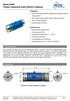 Properties Free of float metal bellow coupling with integrated torque measurement Non-contact measurement system, high robustness High torsional stiffness Limited torque of inertia Performance Measurement
Single-Phase AC Synchronous Generator
 ST Series Single-Phase AC Synchronous Generator Instructions for Operation and Maintenance English to English translation by R.G. Keen, May 2004. ST Series of Single-Phase AC Synchronous Generators Description
Geometry and dimensional tolerances of engine bearings
 Geometry and dimensional tolerances of engine bearings Dr. Dmitri Kopeliovich (Research & Development Manager.) 1. Hydrodynamic lubrication Engine bearings operate mostly in the hydrodynamic regime of
Documenting Results to Validate Energy Savings Projects: Case Study of Direct Drive Cooling Tower Installations: Before and After
 Documenting Results to Validate Energy Savings Projects: Case Study of Direct Drive Cooling Tower Installations: Before and After Roman Wajda, Baldor Electric Company ABSTRACT Documenting the actual energy
THIS paper reports some results of a research, which aims to investigate the
 FACTA UNIVERSITATIS (NIŠ) SER.: ELEC. ENERG. vol. 22, no. 2, August 2009, 227-234 Determination of Rotor Slot Number of an Induction Motor Using an External Search Coil Ozan Keysan and H. Bülent Ertan
CASE HISTORY #2. APPLICATION: Piping Movement Survey using Permalign Laser Measurement System
 CASE HISTORY #2 APPLICATION: Piping Movement Survey using Permalign Laser Measurement System EQUIPMENT: Dresser-Clark Hot Gas Expander (Turbine), 60-inch Inlet Flange HISTORY: Piping support modifications
Solving VFD-sourced Bearing Current Problems in AC Motors.
 Solving VFD-sourced Bearing Current Problems in AC Motors. The 2 main sources of motor shaft voltage are: 1. Asymmetric Motor construction The stator and rotor magnetic circuits within the motor itself
Introduction to Linear Actuators: Precision Linear Motion Accomplished Easily and Economically
 Introduction to Linear Actuators: Precision Linear Motion Accomplished Easily and Economically Part 1 of 2 When students are trained in classic mechanical engineering, they are taught to construct a system
SYNCHRONOUS MACHINE TESTING WITH MOTOR CIRCUIT ANALYSIS INSTRUMENTATION
 SYNCHRONOUS MACHINE TESTING WITH MOTOR CIRCUIT ANALYSIS INSTRUMENTATION Introduction Howard W. Penrose, Ph.D., CMRP Vice President, Engineering and Reliability Services Dreisilker Electric Motors, Inc.
Coal Handling Plant Alignment Standards For Shaft To Shaft Alignment. By Makarand Joshi M.Tech
 Coal Handling Plant Alignment Standards For Shaft To Shaft Alignment By Makarand Joshi M.Tech 1.0 Abstract: - Shaft alignment is a technical skill that is not common in the construction and maintenance
Chen. Vibration Motor. Application note
 Vibration Motor Application note Yangyi Chen April 4 th, 2013 1 Table of Contents Pages Executive Summary ---------------------------------------------------------------------------------------- 1 1. Table
Lab 14: 3-phase alternator.
 Lab 14: 3-phase alternator. Objective: to obtain the no-load saturation curve of the alternator; to determine the voltage regulation characteristic of the alternator with resistive, capacitive, and inductive
Rotary Phase Converters
 FACTS from Ronk Electrical Industries, Inc. Bulletin 11981 Rotary Phase Converters ROTOVERTER Pat. No. 3,670,238 ROTO-CON Pat. No. 4,158,225 What are the ROTO-CON and ROTOVERTER power converters? The ROTO-CON
The Basic Theory of Crowning Industrial Rollers
 The Basic Theory of Crowning Industrial Rollers Written by Matthew Menges & Javier Carreon Please visit us at www.mengesroller.com The Basic Theory of Crowning Industrial Rollers Rollers that are crowned
Differential-Hall-Effect based Sensors Series A5S
 Speed and Frequency Seite 1 von 6 Differential-Hall-Effect based Sensors Series A5S Outstanding Characteristics Speed range covering most demands: from close to zero up to 25,000 pulses/second (response
Beginning Vibration Analysis. Connection Technology Center, Inc. 7939 Rae Boulevard Victor, New York 14564 www.ctconline.com
 Beginning Vibration Analysis Connection Technology Center, Inc. 7939 Rae Boulevard Victor, New York 14564 www.ctconline.com Data Collection Loop Power Output 0.6 Velocity (inches/second peak) Fault 0.5
4 SENSORS. Example. A force of 1 N is exerted on a PZT5A disc of diameter 10 mm and thickness 1 mm. The resulting mechanical stress is:
 4 SENSORS The modern technical world demands the availability of sensors to measure and convert a variety of physical quantities into electrical signals. These signals can then be fed into data processing
Lymon C. Reese & Associates LCR&A Consulting Services Tests of Piles Under Axial Load
 Lymon C. Reese & Associates LCR&A Consulting Services Tests of Piles Under Axial Load Nature of Services The company has a long history of performance of tests of piles and pile groups under a variety
1150 hp motor design, electromagnetic and thermal analysis
 115 hp motor design, electromagnetic and thermal analysis Qasim Al Akayshee 1, and David A Staton 2 1 Mawdsley s Ltd., The Perry Centre, Davey Close, Waterwells, Gloucester GL2 4AD phone: +44 1452 888311
Technical Guide No. 100. High Performance Drives -- speed and torque regulation
 Technical Guide No. 100 High Performance Drives -- speed and torque regulation Process Regulator Speed Regulator Torque Regulator Process Technical Guide: The illustrations, charts and examples given in
Module 2 - GEARS Lecture 7 - SPUR GEAR DESIGN
 Module 2 - GEARS Lecture 7 - SPUR GEAR DESIGN Contents 7.1 Spur gear tooth force analysis 7.2 Spur gear - tooth stresses 7.3 Tooth bending stress Lewis equation 7.4 Tooth bending stress AGMA procedure
CosmosWorks Centrifugal Loads
 CosmosWorks Centrifugal Loads (Draft 4, May 28, 2006) Introduction This example will look at essentially planar objects subjected to centrifugal loads. That is, loads due to angular velocity and/or angular
Q&A Session for Advanced Ball Screws 102: Troubleshooting for Design Engineers
 Q&A Session for Advanced Ball Screws 102: Troubleshooting for Design Engineers Topic: Noise Q: Is there a way to predict/calculate noise on a ball screw? A: No, there is no way to calculate the noise of
E. K. A. ADVANCED PHYSICS LABORATORY PHYSICS 3081, 4051 NUCLEAR MAGNETIC RESONANCE
 E. K. A. ADVANCED PHYSICS LABORATORY PHYSICS 3081, 4051 NUCLEAR MAGNETIC RESONANCE References for Nuclear Magnetic Resonance 1. Slichter, Principles of Magnetic Resonance, Harper and Row, 1963. chapter
Three Channel Optical Incremental Encoder Modules Technical Data
 Three Channel Optical Incremental Encoder Modules Technical Data HEDS-9040 HEDS-9140 Features Two Channel Quadrature Output with Index Pulse Resolution Up to 2000 CPR Counts Per Revolution Low Cost Easy
Understanding Shaft Alignment: Thermal Growth. Published in Maintenance Technology 1/2003
 Understanding Shaft Alignment: Thermal Growth Published in Maintenance Technology 1/2003 Part two of a four-part series that will cover alignment fundamentals and thermal growth, and highlight the importance
BRUSHHOLDERS AND THE PERFORMANCE OF CARBON BRUSHES
 Tech Note No. 22 TECH NOTE NO. 22 Brushholders and the Performance of Carbon Brushes Reliable Solutions Today! EA SA ELECTRICAL SERVICE APPARATUS ASSOCIATION BRUSHHOLDERS AND THE PERFORMANCE OF CARBON
Selecting and Sizing Ball Screw Drives
 Selecting and Sizing Ball Screw Drives Jeff G. Johnson, Product Engineer Thomson Industries, Inc. Wood Dale, IL 540-633-3549 www.thomsonlinear.com [email protected] Fig 1: Ball screw drive is a
Basics of Electricity
 Basics of Electricity Generator Theory PJM State & Member Training Dept. PJM 2014 8/6/2013 Objectives The student will be able to: Describe the process of electromagnetic induction Identify the major components
DiscPlus DX195 and DX225 Air Disc Brakes
 Revised 11-04 Technical Bulletin Revised 1 Technical 11-04 Bulletin DiscPlus DX195 and DX225 Air Disc Brakes Inspection, Installation and Diagnostics Air Disc Brake Inspection Intervals and Procedures
METHOD OF STATEMENT FOR STATIC LOADING TEST
 Compression Test, METHOD OF STATEMENT FOR STATIC LOADING TEST Tension Test and Lateral Test According to the American Standards ASTM D1143 07, ASTM D3689 07, ASTM D3966 07 and Euro Codes EC7 Table of Contents
APPLICATIONS FOR MOTOR CURRENT SIGNATURE ANALYSIS
 APPLICATIONS FOR MOTOR CURRENT SIGNATURE ANALYSIS An ALL-TEST Pro White Paper By Howard W Penrose, Ph.D. General Manager ALL-TEST Pro A Division of BJM Corp 123 Spencer Plain Rd Old Saybrook, CT 06475
Effect of Sleeve Shrink-fit on Bearing Preload of a Machine Tool Spindle: Analysis using Finite Element Method
 Effect of Sleeve Shrink-fit on Bearing Preload of a Machine Tool Spindle: Analysis using Finite Element Method Aslam Pasha Taj 1, Chandramouli SR 2* ACE Designers Limited, Peenya Industrial Area, Bangalore-560058
A METHOD OF CALIBRATING HELMHOLTZ COILS FOR THE MEASUREMENT OF PERMANENT MAGNETS
 A METHOD OF CALIBRATING HELMHOLTZ COILS FOR THE MEASUREMENT OF PERMANENT MAGNETS Joseph J. Stupak Jr, Oersted Technology Tualatin, Oregon (reprinted from IMCSD 24th Annual Proceedings 1995) ABSTRACT The
Shaft. Application of full spectrum to rotating machinery diagnostics. Centerlines. Paul Goldman, Ph.D. and Agnes Muszynska, Ph.D.
 Shaft Centerlines Application of full spectrum to rotating machinery diagnostics Benefits of full spectrum plots Before we answer these questions, we d like to start with the following observation: The
Testing Capabilities. Worldwide Designers & Manufacturers of Air Moving Equipment
 Testing Capabilities Twin Twin City City Fan Fan Companies, Companies, Ltd. Ltd. Worldwide Designers & Manufacturers of Air Moving Equipment TestingCapabilities Twin City Fan Companies, Ltd. In today s
ENGINEERING BULLETIN No. EB 039 Product: Cooling Towers, Closed Circuit Coolers & Evaporative Condensers Date: June 2003
 For Distribution ENGINEERING BULLETIN No. EB 039 Product: Cooling Towers, Closed Circuit Coolers & Evaporative Condensers Date: June 2003 Purpose: Variable Frequency Drives The purpose of this Engineering
Encoders for Linear Motors in the Electronics Industry
 Technical Information Encoders for Linear Motors in the Electronics Industry The semiconductor industry and automation technology increasingly require more precise and faster machines in order to satisfy
Vibration Monitoring: Envelope Signal Processing
 Vibration Monitoring: Envelope Signal Processing Using Envelope Signal Processing in Vibration Monitoring of Rolling Element Bearings Summary This article presents a practical discussion of the techniques
Systematic Optimisation of Gearboxes for Hybrid and Electric Vehicles in Terms of Efficiency, NVH and Durability
 Systematic Optimisation of Gearboxes for Hybrid and Electric Vehicles in Terms of Efficiency, NVH and Durability Dr. Artur Grunwald GKN Driveline 1 Content of presentation Scope and introduction Gearbox
BSM MOTOR DRIVEN CENTRIFUGAL PUMPS
 PRINCIPLE OF OPERATION A hydraulically and dynamically balanced impeller with raised vane sections discharges liquid as a result of the centrifugal force developed in rotation. The head developed is entirely
CHAPTER 65 TAIL ROTOR DRIVE SYSTEM. Section Title Page
 CHAPTER 65 TAIL ROTOR DRIVE SYSTEM Section Title Page 65-00 Description........................................ 65.1 65-10 Tail Rotor Drive Fan Shaft.............................. 65.1 65-20 Tail Rotor
CHAPTER 4 DESIGN OF INTEGRAL SLOT AND FRACTIONAL SLOT BRUSHLESS DC MOTOR
 47 CHAPTER 4 DESIGN OF INTEGRAL SLOT AND FRACTIONAL SLOT BRUSHLESS DC MOTOR 4.1 INTRODUCTION This chapter deals with the design of 24 slots 8 poles, 48 slots 16 poles and 60 slots 16 poles brushless dc
Equipment: Power Supply, DAI, Wound rotor induction motor (8231), Electrodynamometer (8960), timing belt.
 Lab 13: Wound rotor induction motor. Objective: to examine the construction of a 3-phase wound rotor induction motor; to understand exciting current, synchronous speed and slip in this motor; to determine
Table of Contents. Overview 1. Pump Disassembly 2. Control Disassembly / Reassembly 7. Pump Reassembly 13. Adjustment Procedures DR Control 19
 Table of Contents Overview 1 Pump Disassembly 2 Control Disassembly / Reassembly 7 Pump Reassembly 13 Adjustment Procedures DR Control 19 Adjustment Procedures DRG Control 20 Adjustment Procedures DFR
Motor-CAD Software for Thermal Analysis of Electrical Motors - Links to Electromagnetic and Drive Simulation Models
 Motor-CAD Software for Thermal Analysis of Electrical Motors - Links to Electromagnetic and Drive Simulation Models Dave Staton, Douglas Hawkins and Mircea Popescu Motor Design Ltd., Ellesmere, Shropshire,
T1-40 T1-40BF T1-40V T1-38 T1-38BF T1-38V
 Transducers T1-40 T1-40BF T1-40V T1-38 T1-38BF T1-38V Velocity transducers B A L A N C I N G M A C H I N E S B A L A N C I N G M A C H I N E S Principle of operation A voltage proportional to the velocity
BRUSHLESS DC MOTORS. BLDC 22mm. BLDC Gearmotor Size 9. nuvodisc 32BF. BLDC Gearmotor Size 5
 BRUSHLESS DC MOTORS BLDC Gearmotor Size 9 BLDC 22mm nuvodisc 32BF BLDC Gearmotor Size 5 Portescap Brushless DC motors are extremely reliable and built to deliver the best performances. Their high power
Comparison of Bearings --- For the Bearing Choosing of High-speed Spindle Design. Xiaofan Xie. Dept. of Mechanical Engineering, University of Utah
 Comparison of Bearings --- For the Bearing Choosing of High-speed Spindle Design Xiaofan Xie Dept. of Mechanical Engineering, University of Utah ABSTRACT: Bearing is the most important part of my project
F HIT O E PAP S ER GRUND W ALIGNMENT GENERAL
 GRUND W F HIT O E PAP S ER ALIGNMENT by Greg Towsley W ith requirements of organizations to cut costs and manage operation and maintenance budgets better, minimizing equipment downtime has become increasingly
SECTION 4 ELECTRIC MOTORS UNIT 17: TYPES OF ELECTRIC MOTORS
 SECTION 4 ELECTRIC MOTORS UNIT 17: TYPES OF ELECTRIC MOTORS UNIT OBJECTIVES After studying this unit, the reader should be able to Describe the different types of open single-phase motors used to drive