
Gigaset N300/N300A IP Your powerful housemate
|
|
|
- Sharon Richardson
- 10 years ago
- Views:
Transcription
1 Congratulations By purchasing a Gigaset, you have chosen a brand that is fully committed to sustainability. This product s packaging is eco-friendly! To learn more, visit

2 Gigaset N300/N300A IP Your powerful housemate Gigaset N300/N300A IP Your powerful housemate... with impressive internal qualities. With a broadband-compatible Gigaset handset, you will be amazed by the perfect sound quality. Your Gigaset can do a lot more than just make calls: Connect your Gigaset to the Internet and your PC via Ethernet Telephone over the Internet. Manage your Gigaset from your PC using a web browser. Save your Gigaset configuration on your PC after you have set it up. Use your public and private directories on the Internet ( page 56). Keep the local directories of your connected Gigaset handset and your PC address book up-to-date. Upgrade your Gigaset to a cordless PABX Configure up to six VoIP connections on your Gigaset. Register up to six handsets and use your Gigaset's three answering machines. Assign each handset its own phone number. It's easy to configure your Gigaset thanks to the wizards They help you to configure the VoIP connections for your phone and to assign the receive and send connections to the registered handsets and (for the Gigaset N300A IP) to the integrated answering machine ( page 16). Go online with your Gigaset Use your phone's Info Center and have information specifically provided for the phone from the Internet shown on the display of the registered handset ( page 85). Other practical information Use the programmable display buttons ( page 120) on the registered handset to quickly access important functions on the base. Jump back 5 seconds when listening to a message on the answering machine to hear this part of the message again ( page 95). Read your e- mail messages on your telephone (without a PC). Environment Gigaset Green Home be environmentally aware when using your phone. For details of our ECO DECT products, visit For more information about your phone, visit or After purchasing your Gigaset phone, please register it at this will ensure any questions you may have or warranty services you request are dealt with even faster! Have fun using your new phone! Gigaset service contact numbers: For personal advice on our range of products and for repairs or guarantee/warranty claims call: Service Centre UK: (local call cost charge) 1
3 Functions of the button on the base Functions of the button on the base Registration/paging key Functions of the registration/paging button on the base Lights up: LAN connection active (phone is connected to router) Flashes: Data transfer to LAN connection Press briefly: Launch paging (handset search), display IP address of the base on the handset Press and hold: Set base to registration mode You can operate, set up and use all the telephone functions on your base with a Gigaset C59H, C610H, SL78H, SL400H, S79H or S810H handset, for example. 2

4 Contents Contents Gigaset N300/N300A IP Your powerful housemate Functions of the button on the base Safety precautions First steps Checking the package contents Installing the base station Connecting the base Registering the handset Setting up the phone installation wizard Date/time Proceeding Understanding the operating steps Menu overview Making calls Making an external call Ending a call Accepting a call Calling Line Identification Notes on calling line display (CLIP) VoIP telephony via Gigaset.net Gigaset HDSP telephony with brilliant sound quality Making calls using network services Configuring general settings for all calls Configuring settings for the next call Configuring settings during an external call Functions after a call Using directories Using online telephone directories Using the private net directory Using the Gigaset.net directory Making cost-effective calls Defining dialling plans Displaying the call duration Sending SMS (text messages) Writing/sending SMS Receiving an SMS SMS with vcard Receiving notifications via SMS Setting the SMS service centre/defining the send line Activating/deactivating first ringtone muting
5 Contents Activating/deactivating SMS function Troubleshooting SMS problems notifications Opening the incoming list Viewing the message header and text of an Viewing sender's address Deleting messages Info Center continuous Internet access from your phone Customising info services Starting the Info Center, selecting info services Login for personalised info services Operating the Info Center Accessing info services using quick dial Displaying information from the Internet as a screensaver Operating the Gigaset N300A IP base answering machine Operation via the handset Operating when on the move (remote operation) Using the network mailbox Activating/deactivating the network mailbox, entering numbers Configuring a answering machine for quick dial ECO DECT Connecting/using the handsets Registering handsets De-registering handsets Searching for a handset, find the phone's IP address ("Paging") Making internal calls Changing the name of an internal party Changing the internal number of an internal party Configuring the system settings Setting the date/time Quickly accessing functions Protecting the telephone from unauthorised access Your own area code setting Activating/deactivating music on hold Setting the base's IP address in LAN Configuring VoIP connections Assigning send and receive connections to internal parties Updating the phone firmware Repeater support Restarting the base Resetting the base to the default settings Checking the base MAC address

6 Contents Connecting the phone to a PABX Recall Saving an access code (outside line code) Setting pauses (fixed line) Switching temporarily to tone dialling (DTMF) Configuring the phone via the Web configurator Connecting the PC with the telephone's Web configurator Logging in to/off the Web configurator Understanding the structure of the Web configurator pages Web configurator menu Functions of the Web configurator Customer Service & Assistance Questions and answers Information on operating Gigaset VoIP telephones with routers with Network Address Translation (NAT) VoIP status codes Checking service information Authorisation Guarantee Certificate United Kingdom Environment Appendix Caring for your telephone Specifications Glossary Accessories Mounting the base on the wall Index
7 Safety precautions Safety precautions Warning Read the safety precautions and the user guide before use. Explain their content and the potential hazards associated with using the telephone to your children. $ Use only the power adapter supplied, as indicated on the underside of the base. Use only the cables supplied for fixed line and LAN connection and connect these to the intended port only. Using your telephone may affect nearby medical equipment. Be aware of the technical conditions in your particular environment, e.g., doctor's surgery. If you use a medical device (e.g., a pacemaker), please contact the device manufacturer. They will be able to advise you regarding the susceptibility of the device to external sources of high frequency energy. Please refer to the "Appendix" chapter for the specifications of this Gigaset product. Do not install the base station in bathrooms or shower rooms. The base is not splashproof. Do not use your phone in environments with a potential explosion hazard (e.g., paint shops). ƒ If you give your phone to a third party, make sure you also give them the user guide. Remove faulty bases from use or have them repaired by our Service team, as these could interfere with other wireless services. Please note u Please note that only terminals that are operated in-house (inside buildings) may be connected to the analogue TAE connection. u Not all of the functions described in this user guide are available in all countries. u The device cannot be used in the event of a power failure. It is also not possible to transmit emergency calls. 6

8 First steps First steps Checking the package contents 1 2 3a 4 5 or 3b 1 One Gigaset N300 IP or N300A IP base 2 One power cable for connecting the base to the mains power supply 3 One phone cable to connect the base to the analogue fixed line (TAE RJ11 6- pole; flattened cable) 3a or 3b, depending on the country/provider. 4 One Ethernet (LAN) cable (Cat 5 with 2 RJ45 modular jacks) for connecting the base to a router (LAN/Internet) 5 One quick guide and a CD Firmware updates This user guide describes the functions of your phone from firmware version 020 onwards. Whenever there are new or improved functions for your Gigaset, firmware updates are made available for you to download to your base ( page 129). If this results in operational changes for using your phone, a new version of this user guide or the necessary amendments will be published on the Internet at Select the product to open the relevant product page for your base, where you will find a link to the user guide. To find out what version of firmware is currently loaded, page

9 First steps Installing the base station The base is designed for use in dry rooms in a temperature range of +5 C to +45 C. Set up the base at a central point in the building. Please note Pay attention to the range of the base. This is up to 300 m in unobstructed outdoor areas and up to 50 m inside buildings. The range is reduced when Eco Mode is activated ( page 110). The phone's feet do not usually leave any marks on surfaces. However, due to the multitude of different varnishes and polishes used on today's furnishings, the occurrence of marks on the surfaces cannot be completely ruled out. Warning u Never expose the telephone to any of the following: heat sources, direct sunlight or other electrical appliances. u Protect your Gigaset from moisture, dust, corrosive liquids and fumes. 8

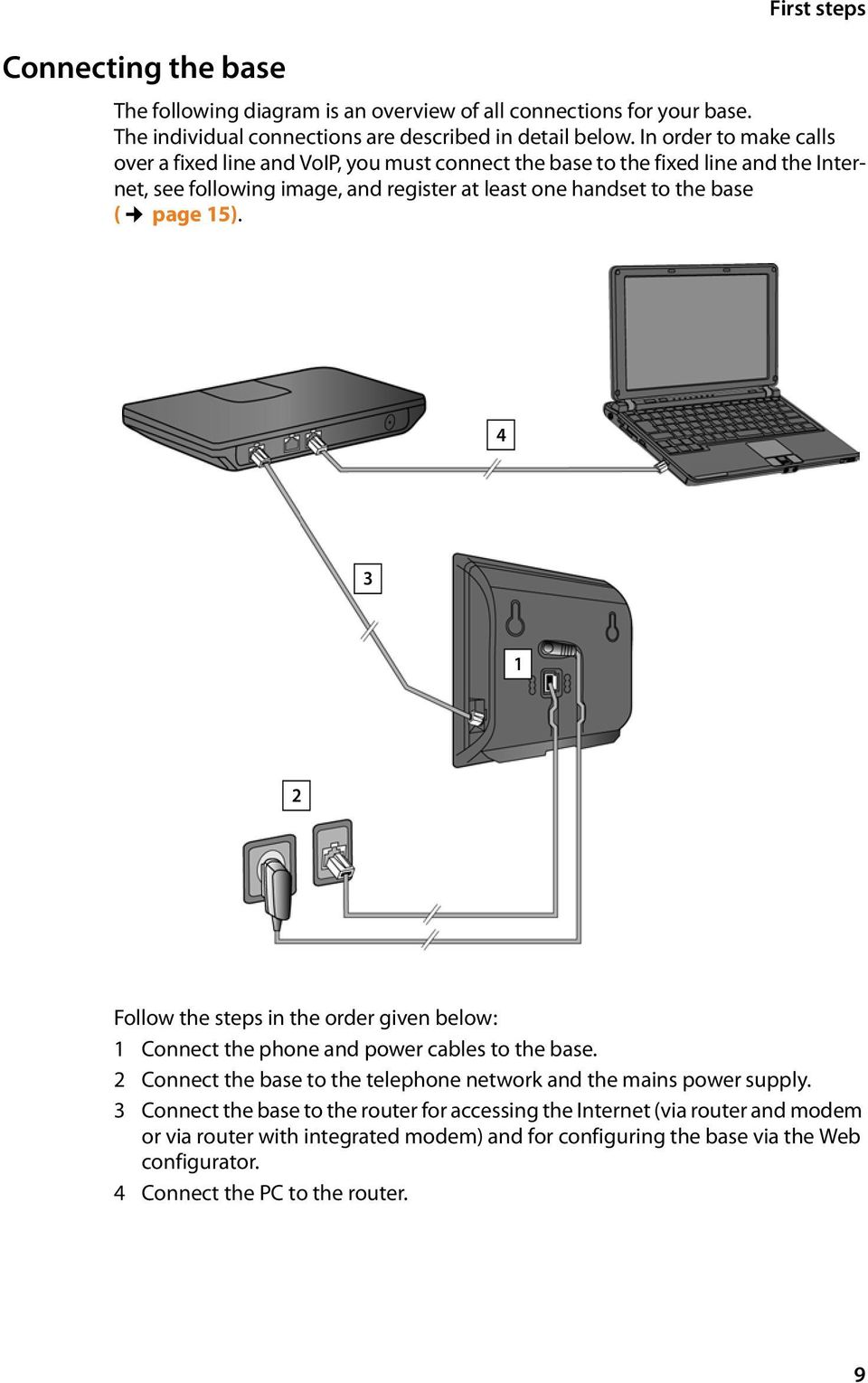
10 Connecting the base First steps The following diagram is an overview of all connections for your base. The individual connections are described in detail below. In order to make calls over a fixed line and VoIP, you must connect the base to the fixed line and the Internet, see following image, and register at least one handset to the base ( page 15) Follow the steps in the order given below: 1 Connect the phone and power cables to the base. 2 Connect the base to the telephone network and the mains power supply. 3 Connect the base to the router for accessing the Internet (via router and modem or via router with integrated modem) and for configuring the base via the Web configurator. 4 Connect the PC to the router. 9
11 First steps 1. Connecting the phone and power cables to the base 2 Back panel of the base Insert the phone cable (TAE connection cable with RJ11 plug) into the lower connection socket at the rear of the base. 2 Insert the power cable of the power adapter into the upper connection socket at the rear of the base. 3 Push both cables into the appropriate cable channels. Warning Use only the power and telephone cables supplied. Pin connections on telephone cables can vary (pin connections page 176). 10

12 2. Connecting the base to the fixed line and the mains power supply First steps Back panel 2 1 of the base 1 Insert the phone cable into the fixed line connection socket. 2 Then insert the power adapter into the mains socket. Warning Keep the power cable plugged in at all times for operation, as the phone does not work without a mains connection. As soon as a handset is registered with the base, you can make fixed line calls and you can be reached on your fixed line number! Gigaset N300A IP: An answering machine on the base is set with a pre-recorded announcement in answer and record mode ( page 95). 11

13 First steps 3. Connecting the base with a router (Internet) Data protection notice When the device is connected to the router, it automatically contacts the Gigaset support server to make it easier for you to configure the devices and to enable communication with the Internet services. For this purpose, every device sends the following device-specific information once every day: u Serial number/item number u MAC address u Private IP address for the Gigaset in the LAN/its port numbers u Device name u Software version On the support server, this information is linked to the existing device-specific information: u Gigaset.net phone number u System-related/device-specific passwords Further information about the Gigaset.net service data saved can be found at Your base features a LAN connection that you can use to connect the base to a router. Connection to a router is required for Internet telephony VoIP (Voice over Internet Protocol). You can set up and configure up to six accounts (VoIP phone numbers) from one or more VoIP provider(s) on the phone. You also need a connection to the router for the following features on your phone: u You want to be notified as soon as new software is available for your phone on the Internet. u You want the date and time on your phone to be updated by a time server on the Internet. u You want to use info services and/or online directories on your phone. You can also connect a PC to the router if you want to set your phone via its Web configurator. For Internet access you need a router connected to the Internet via a modem (this may be integrated in the router). 12

14 First steps Please note For telephony via the Internet, you need a broadband Internet connection (e.g., DSL) with flat rate (recommended) or volume rate and a router that connects your phone to the Internet. You can find a list of recommended routers on the Internet at: From here, go to the FAQ page and select your Gigaset IP telephone. Search for "Router", for example. 2 Back panel of the base 1 1 Insert a plug from the Ethernet cable supplied (Cat 5 with 2 RJ45 Western modular plugs) into the LAN connection socket at the side of the base. 2 Then insert the second Ethernet cable plug into a LAN socket on the router. As soon as the cable connecting the phone and router is plugged in and the router is switched on, the key lights up on the front of the base (paging key). As soon as a handset is registered with the base, you can create VoIP connections within Gigaset.net ( page 45). 13

15 First steps 4. Connecting the PC to the router (optional) You can change the settings on the phone's base using a PC connected to your phone via the router. PC system requirements: u Ethernet port u Web browser, such as Microsoft Internet Explorer version 7.0 or higher, or Mozilla Firefox version 3.5 or higher u DHCP must be activated (e.g. Windows XP): Click on Start Settings Network connections. Double-click on the entry for the LAN connection with which your PC is connected to the base. On the General tab, click on Properties. Select the Internet protocol (TCP/IP) and click on the Properties button. In the General tab, activate the Obtain IP address automatically and Obtain DNS server address automatically options. Click on OK or Close. B A Connect the PC Ethernet connection A to a free LAN socket on your router B. You will need an Ethernet cable Cat 5 with RJ45 modular jacks. 14

16 First steps Registering the handset You must register the handset on both the handset (a) and the base (b). a) On the handset Start the registration procedure on the handset in accordance with the handset's user guide. A message usually appears on the display stating that the handset is searching for a base that is ready for registration. b) On the base Press and hold the registration/paging key on the base (approx. 3 seconds) within 60 seconds. Once the handset has located the base, you will be asked to enter the base's system PIN. Enter the four-digit system PIN for your base on the handset (default is 0000). Once registration is complete, the handset returns to idle status. The handset's internal number is shown in the display, e.g., INT1. If not, repeat the procedure. All base connections are assigned to the handset as receive connections as soon as registration is complete (incoming calls are signalled on the handset and can be answered). The fixed line connection is assigned to the handset as a send and receive connection. 15

17 First steps Setting up the phone installation wizard The procedure below requires that your phone is automatically assigned an IP address by the router (i.e. DHCP is enabled on router and phone). In exceptional cases (e.g. if DHCP is not enabled on the router), you will have to assign a static IP address to the base for LAN access. You must enter this IP address on the handset before carrying out the following steps ( page 123). In order to be able to make calls with your telephone over the Internet, you must configure at least one VoIP connection on your telephone. You can configure VoIP connections using the following methods: u Using a web-browser on your PC to access the telephone web configurator. Instructions for configuring the first VoIP connection using the web configurator can be found in the quick guide that comes with the device. u Using your telephone's installation assistance on a connected Gigaset handset. This method is described below using the Gigaset C59H handset as an example. Configuration is the same for Gigaset C610H, SL78H, SL400H, S79H or S810H. Auto configuration: The configuration process for VoIP connections is automated for some VoIP providers. The provider creates a configuration file with all required VoIP access data (the general VoIP provider data and your personal account data). This file is placed on a configuration server on the Internet for downloading to your phone. Your provider gives you a configuration code. The installation wizard on your phone ( page 17) prompts you to enter the code at the relevant point. All the required VoIP data is then downloaded automatically onto your phone. The configuration file is only transferred via a secure connection (TLS authentication). If the TLS authentication fails, the message key f flashes. Press the message key to display the Certificate error - Please check your certificates in the Web configurator. message. Press the right display key to confirm the message. Log in to the Web configurator ( page 139). The Security ( page 150) Web page tells you why the secure connection could not be established and what you can do. If the configuration file fails to download (e.g., because the configuration server is not available), the phone keeps trying to establish a connection until the file is downloaded successfully to the phone. If no VoIP connections have been generated on the phone yet, you can start the installation wizard directly on the handset. The wizard allows you to make all necessary settings for your phone. Two individual wizards are combined to form the installation wizard. 1 IP wizard 2 Connection wizard 16
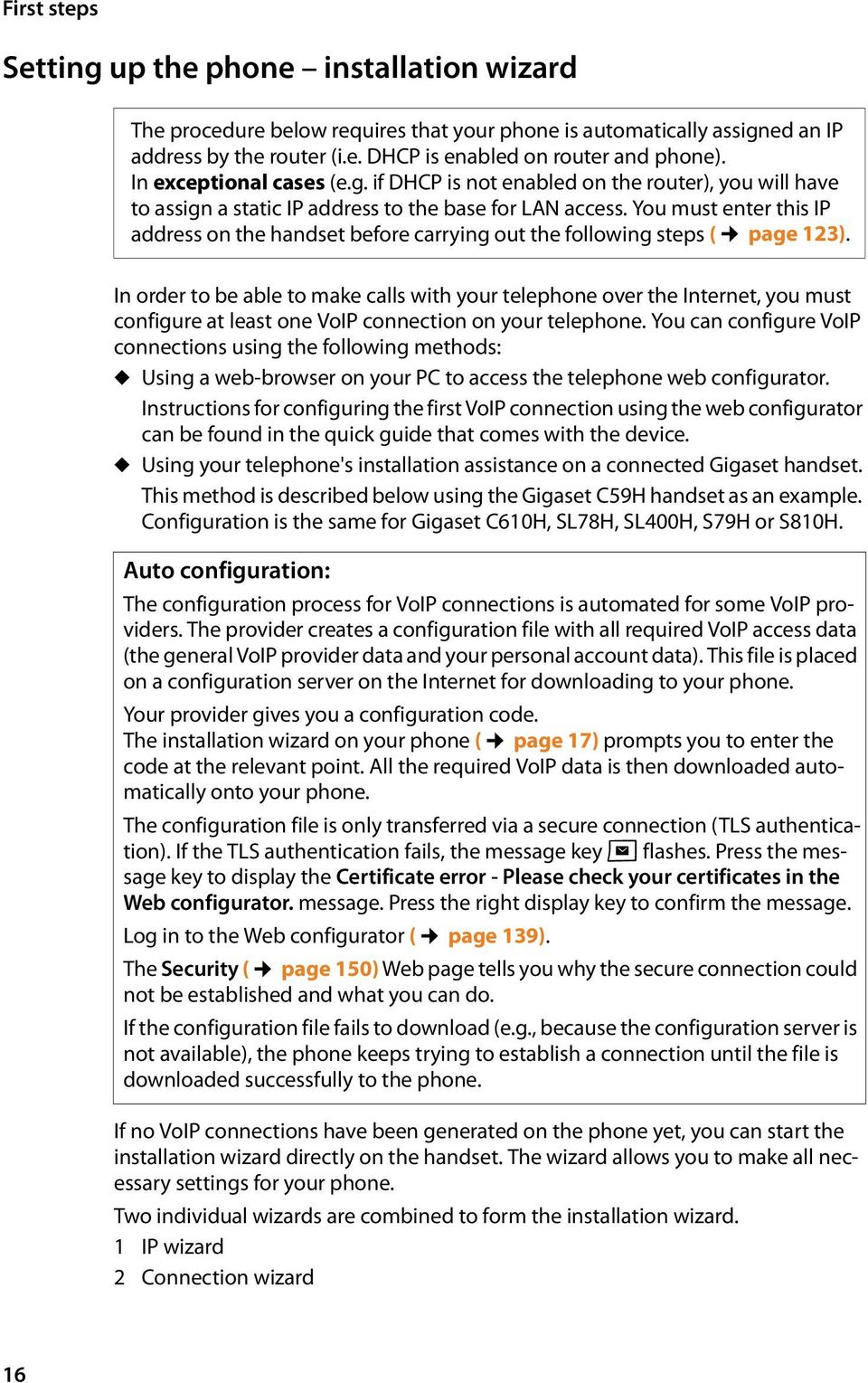
18 First steps Starting the installation wizard If the handset battery has sufficient charge, the message key f on your handset will flash. Press the message key f. 1. IP wizard: making VoIP settings You will see the following display: IP Wizard? Start IP installation wizard? No Yes Before you can use the Internet (VoIP) to phone any other numbers on the Internet, the fixed line or the mobile network, you need the services of a VoIP provider who supports the VoIP SIP standard. Prerequisite: You have registered with a VoIP provider (e.g., via your PC) and set up at least one VoIP account (IP account). To use VoIP, you now need to enter the access data for your VoIP account. You will receive all the necessary data from your VoIP provider. This will include: Either: u Your user name (if requested by the VoIP provider). This is the user name of your IP account (caller ID), frequently identical to your phone number. u Your authentication name or login ID u The (login) password registered with the VoIP provider u General settings for your VoIP provider (server addresses etc.) Or: u An auto configuration code (activation code) Your Gigaset phone's IP wizard can help you make these entries. 17

19 First steps Please note You can configure up to six VoIP connections. When you get started with the phone, you can initially only configure one VoIP connection. You can configure additional VoIP connections later with the IP wizard ( page 125) or Web configurator. Starting the IP Wizard Prerequisite: the phone is connected to the router. Your router is connected to the Internet ( page 12). Press on the centre of the control key w or on the right display key Yes to start the IP wizard. IP Wizard Ð This wizard helps you to configure an IP account and register it with your provider so you can - V OK Information about the IP wizard appears in the display. Press the bottom of the control key s to scroll down. Press the OK display key to continue. Select IP Account IP 1 IP 2 A list of all possible IP connections is shown in the display (IP 1 to IP 6). VoIP connections that are already configured are marked with ³. IP 3 IP 4 IP 5 V Back OK If necessary, press down on the control key s to select a connection. Press the OK display key to continue. 18
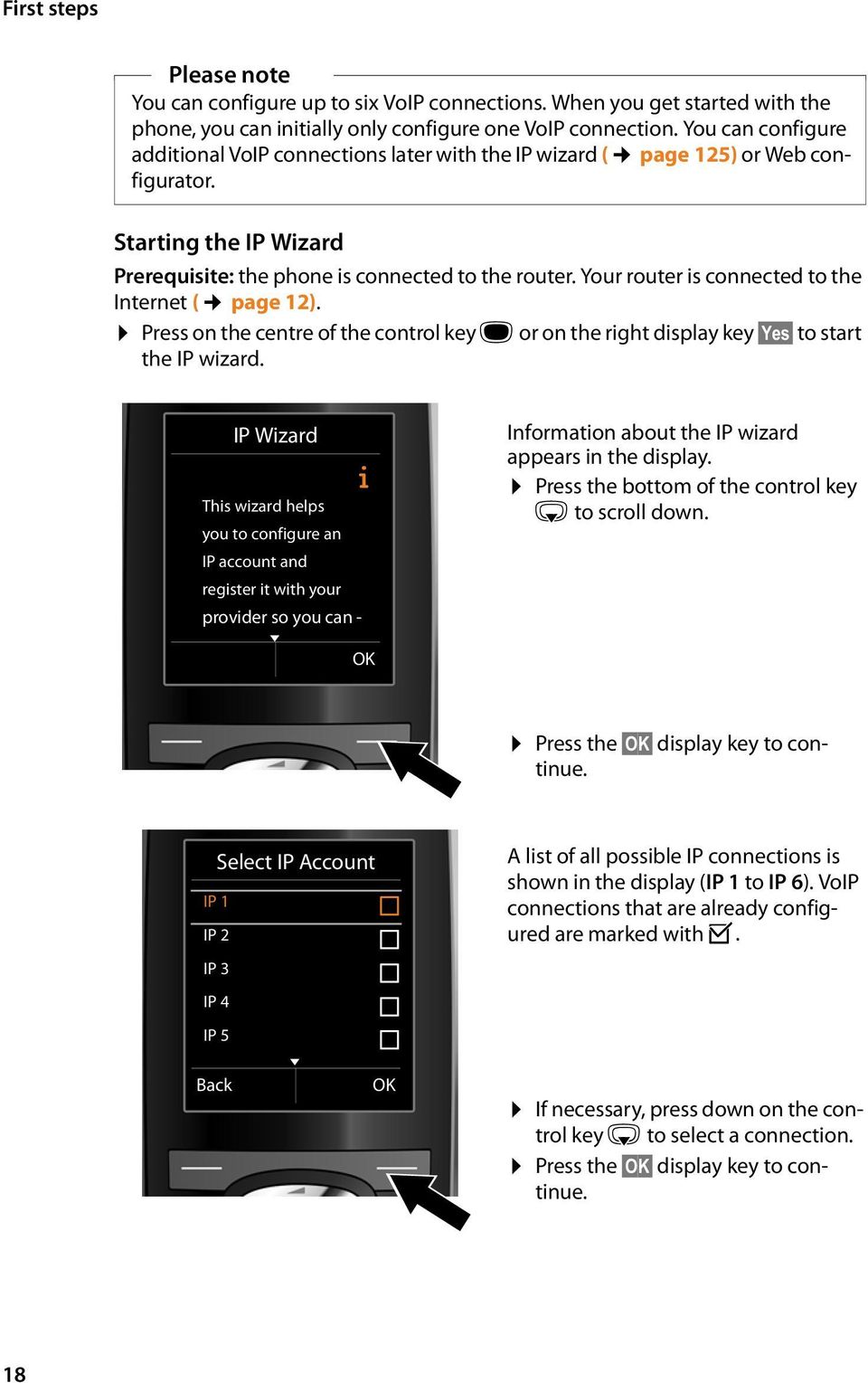
20 First steps You will see the following display: IP Wizard? Do you have a code for auto configuration? No Yes Your VoIP provider has supplied you with an authentication name/password and, where applicable, a user name: Press the key below No on the display screen. For further information, please see "Downloading VoIP provider data" page 21. You have received an auto configuration code (activation code) from your VoIP provider: Press the key below Yes on the display screen. For further information, please see "Entering the auto configuration code" page

21 First steps No Internet connection: The phone requires an Internet connection for you to register your telephone with a VoIP provider. If a connection cannot be made, one of the following messages is displayed: u If the phone cannot establish a connection to the router, the message IP address not available is displayed. Check the plug connection between the router and the base and check the settings on the router. Your phone is preconfigured for dynamic assignment of the IP address. In order for your router to "recognise" the phone, dynamic IP address assignment must also be activated on the router i.e., the router's DHCP server must be activated. If the DHCP server cannot or should not be activated, you must assign a fixed IP address to the phone ( page 123). u If the phone cannot establish a connection to the Internet, the message Internet connection not available is displayed. The IP server may be temporarily unavailable. In this case, try to make a connection again later. Otherwise: check the plug connection between the router and the modem or DSL connection and check the settings on the router. Press OK ; the IP wizard is closed. You will then need to call up the wizard later via the menu to configure the IP connection. 20
22 First steps Entering the auto configuration code IP Wizard Activation code for autoconfiguration: Using the keypad, enter the auto configuration code you received from the provider (max. 32 characters). < C OK Press the key below OK on the display screen. All data required for VoIP telephony is loaded directly from the Internet to your phone. When all the data has been successfully loaded onto your phone, Your IP account is registered with your provider. appears on the display. For further information, please see "2. Connection wizard", page 25. Downloading VoIP provider data The connection wizard establishes a connection with the Gigaset configuration server on the Internet. Various profiles with general access data for different VoIP providers can be downloaded here. After a brief period you will see the following display: Select your country Country 1 Country 2 Country 3 A list of countries is loaded. Press up or down on the control key q repeatedly until the country in which you want to use the phone is selected in the display. Country 4 Country 5 Back V OK Press the key below OK on the display screen to confirm your selection. 21
23 First steps Select a Provider Provider 1 A list of the VoIP providers for which a profile with the general access data is available on the configuration server is displayed. Provider 2 Provider 3 Provider 4 Provider 5 Back V OK Press up or down on the control key qrepeatedly until your VoIP provider is selected in the display. Press the key below OK on the display screen to confirm your selection. The general access data for your VoIP provider will be downloaded and saved on the phone. You have not been able to download your provider's data If your VoIP provider does not appear in the list, i.e., its general data is not provided for download, you must cancel the IP wizard: Briefly press the end call key a repeatedly until End wizard? appears in the display and then press the display key Yes. You can perform the subsequent steps of the installation wizard. You must then make the required VoIP provider and IP account settings using the Web configurator. You receive the general provider data from your VoIP provider. You can change the assignment of the VoIP connection as send/receive connection at a later time via the telephone menu or the Web configurator. 22
24 Entering user data for your VoIP account First steps You are now prompted to enter your personal access data for your VoIP account. The following are provider-dependent: u User ID, Password, User name Please note when entering access data, it is case sensitive. To switch between upper and lower case and digits, press the # key (several times if necessary). You can see briefly in the display whether upper case, lower case or digit input is selected. Characters entered incorrectly can be deleted using the left display key below Ñ. The character to the left of the cursor is deleted. You can navigate within the input field using the control key r (left/right). User ID IP Wizard : Abc Using the keypad, enter the authentication name that you received from your VoIP provider. < C OK Press the key under OK on the display screen. Password : IP Wizard Abc Use the keypad to enter your password. < C OK Press the key under OK on the display screen. 23
25 First steps IP Wizard User name : Using the keypad, enter the user name that you received from your VoIP provider. Abc < C OK Press the key under OK on the display screen. IP Wizard Û Registering with provider... Once you have made all the necessary entries, the IP wizard will try to register the phone with the VoIP provider. After successful registration, the message "Your IP account is registered with your provider." appears in the display. The connection wizard starts. 24
26 First steps 2. Connection wizard The connection wizard enables you to assign previously configured connections (fixed line connection, Gigaset.net and VoIP connections, page 45 and page 17) to internal parties as receive and, if applicable, as send connections. Internal parties are the registered handsets and (for Gigaset N300A IP) the base answering machine. u Receive connections are the phone numbers (connections) on which you can be called. Incoming calls are only forwarded to the internal parties (end devices) for which the relevant connection is assigned as receive connection. u Send connections are the numbers that are sent to the called party. The network provider calculates charges based on the send connections. You can assign each internal party a number or the associated connection as a send connection. u Each connection (number) of your phone can be both a send as well as a receive connection. You can assign each connection to several internal parties as send and/or receive connection. It may only be assigned to one answering machine as a receive connection. Default assignment All configured connections are assigned as receive connections to the handsets and the local answering machine 1 for the Gigaset N300A IP at registration/startup. The fixed line connection is assigned to the handsets as a send connection. Starting the connection assistant a. Connection Assist.? Assign connections to handset INT1? No Yes Press the display key Yes if you wish to change the setting for the send and receive connections of the handset with the internal name INT1. Press the display key No if you do not wish to change the setting for this handset. 25
27 First steps b. The list of receive connections currently Rec. Connections INT1 Ð assigned is displayed. Press down on the control key s to scroll through the list if necessary. receives calls for Fixed Line: IP1: Gigaset.net: 12345#9 Change OK Press the display key Change if you wish to change the receive connection setting. Press the display key OK if you do not wish to change the setting. Press OK to skip the following steps. Continue from e. Press Change to display the following: c. If no calls to the VoIP connection IP1 INT 1 are to be signalled on the handset: Press right on the control key v Receive calls for to set to No. IP1: < Yes > Receive calls for Gigaset.net: Back Save 26
28 First steps d. Press down on the control key s INT 1 to switch to the next connection. Select either Yes or No as described IP1: above. Yes Repeat the steps for each connection. Receive calls for Gigaset.net: < Yes > Back Save Press the display key Save once you have finished configuring the settings for the handset. The updated list of receive connections is displayed one more time for you to check. Press the display key OK to confirm the assignment. e. The send connection currently set for Send Connections the handset is displayed: Fixed Line. INT1 sends calls with Fixed Line: Change Ð OK Press the display key OK if you do not wish to change the setting. Skip the following step. To change the setting, press the display key Change. 27
29 First steps f. If the handset is to make calls via a different connection/phone number: INT 1 Press right on the control key v Connection for repeatedly, until the required connection is displayed (in the exam- outgoing calls: ple, IP1). < IP1 > Back Save Press the display key Save to save the settings. Instead of a connection, you can also select Sel. at each call. Each time you make a call, you can then select the connection you wish to use on this handset. If other handsets are already registered to the base, you are requested to assign send and receive connections for the handsets. The following is shown in the display: Assign connections to handset? Perform steps a. to f. for each registered handset. On the Gigaset N300A IP: Once you have assigned send and receive connections to all handsets, you are prompted to assign the receive connections for the three answering machines on the base. "Assign connections to answering machine?" is shown in the display. Perform steps a. to d. for each answering machine. Please note: Each connection may only be assigned to one of the three local answering machines as a receive connection. If you assign a receive connection to an answering machine and this connection is already assigned to another answering machine, the "old" assignment is deleted. 28
30 First steps After successfully configuring the settings, you will briefly see the following display: Connection Assist. Connection assignment complete Completing the installation The handset then returns to idle status (an example of the display in idle status): Displays i V u Reception between the base and the handset: Good to poor: Ð i Ñ Ò 07:15 No reception: ¼ (red) INT 1 14 Oct Green: Eco Mode activated AM 1+2 on u Charge status of the batteries: yy{{ (Empty to full) yflashes red: batteries almost empty Calls SMS xyx{x{ (Charging) u INT 1 Internal name of the handset Gigaset N300A IP: The answering machines of the base to which you have assigned a receive connection are activated and switched on in answer and record mode with a standard announcement ( page 95). This is shown by the AM 1+2 on message on the display, for example. Please note To protect your phone and its system settings from unauthorised access, please define a 4-digit number code (system PIN) known only to yourself. This code must be entered before you can register/de-register handsets or alter your phone's VoIP or LAN settings. The default system PIN is 0000 (4 x zero). For instructions on changing the PIN, page
31 First steps Date/time There are two methods of setting the date and time: u By default, your phone is configured so that the date and time are transferred from a time server on the Internet, provided it is connected to the Internet. You can activate/deactivate the synchronisation with a time server via the Web configurator ( page 156). u You can also set the date and time manually via the menu on one of the registered handsets ( page 119). Date and time are required to show the correct time for incoming calls, for example. 30
32 Proceeding First steps Now you have successfully set up your phone, you will certainly want to adapt it to your personal requirements. Use the following guide to quickly locate the most important subjects. Information on is located here. Making external calls and accepting calls g page 37 Storing your own area code in the telephone g page 122 Setting Eco Mode g page 110 Preparing the telephone for SMS reception g page 68 Setting the answering machine (Gigaset N300A IP) g page 95 Operating the telephone on a PABX g page 133 Registering Gigaset handsets to the base g page 112 Using online directories g page 56 Entering additional VoIP accounts g page 125 Configuring the phone via the Web configurator g page 136 If you have any questions about using your phone, please read the tips on troubleshooting ( page 163) or contact our Customer Care team ( page 163). 31
33 First steps Understanding the operating steps The operating steps have been shortened in this user guide and are based on a Gigaset C59H/C610H handset. Examples: The display: v Ï Eco Mode Eco Mode+ (³ =on) means: Press right on the control key v to open the main menu. Ë Settings Ê Press right, left, down and up on the control key p to navigate to the Settings submenu. Ì É Ç Ï Back OK Press the display key OK to confirm your selection. Settings Display Language Registration Menu View Press down on the control key s until the Eco Mode menu option is highlighted. Eco Mode Back OK Press the display key OK to confirm your selection. 32
34 First steps Eco Mode Eco Mode ³ Eco Mode+ Press down on the control key s until the Eco Mode+ menu option is highlighted. Back Change Press the display key Change to activate/deactivate the function. Eco Mode Eco Mode ³ Eco Mode+ ³ The change is effective immediately and does not need to be confirmed. Back Change Press the key below Back to skip back to the previous menu level. or Press and hold the end call key a to return to idle status. 33
35 Menu overview Menu overview You can use the base functions of your Gigaset N300 IP or N300A IP via a registered handset. For the Gigaset C59H, C610H, SL78H, SL400H, S79H or S810H handsets, the base functions are inserted into the handset menu; these functions are set out below. In place of the handset-specific functions, "..." appears in the submenus. Function names may vary between the individual handsets. For some Gigaset handsets, you can choose between standard mode and expert mode menu views. Menu options that are only available in expert mode are marked with the icon. To open the main menu: press v when the handset is in idle status. Ë Messaging SMS New SMS page 68 Incoming Draft page 72 page 69 Settings Service Centres page 77 Notification page 76 page 80 Ì Voice Mail page 95 Play Messages Net AM: Fixed Line page 106 Net AM: IP1 Net AM: IP2 : Net AM: IP6 Answer Mach. 1 page 99 Answer Mach. 2 Answer Mach. 3 Activation Answer Mach. 1 page 96 Answer Mach. 2 Answer Mach. 3 34
36 Menu overview Announcements Rec. Announcement Answer Mach. 1 to 3 page 97 Play Announcement Answer Mach. 1 to 3 Del. Announcement Answer Mach. 1 to 3 Rec. Advisory Msg. Answer Mach. 1 to 3 Play Advisory Msg. Answer Mach. 1 to 3 Del. Advisory Msg. Answer Mach. 1 to 3 Recordings page 102 Call Screening Handset page 102 Network Mailboxes Net AM: Fixed Line page 106 Net AM: IP1 Net AM: IP2 : Net AM: IP6 Set Key 1 Net AM: FixedLn. page 107 Net AM: IP1 Net AM: IP2 : Net AM: IP6 Answ. Machine Ç Select Services Nxt Call Anonymous Call Divert Internal page 49 Fixed Line page 48 IP1 IP2 : IP6 Call Waiting page 50 All Calls Anony. Transfer (ECT) page 47 page 50 Ringback Off page 55 35
37 Menu overview É Additional Features Info Center... only for Gigaset C59H/C610H handset, with the Gigaset SL78H, SL400H, S79H or S810H handsets, you will find the Info Center in the main menu. page 85 Ï Settings Date/Time page 119 Audio Settings... Music on hold page 122 Registration... De-reg. Handset page 113 Telephony... Area Codes page 122 VoIP Wizard Send Connections INT 1... INT 6 page 127 Rec. Connections INT 1... INT 6 page 128 Answer Machine 1... page 95 Answer Machine 3 Recall Access Code page 134 System... page 131 Base Reset page 131 Base Restart Repeater Mode page 130 Local Network page 123 Update Firmware page 129 System PIN page 121 Eco Mode Eco Mode page 110 Eco Mode+ page
38 Making calls Making calls You can make calls on a Gigaset handset connected to your base. Please note You can make up to three external calls at the same time via your base, depending on the quality of your DSL connection. Making an external call External calls are calls made via the public telephone network (fixed line, mobile phone network) or via the Internet (VoIP). To make an external call, you need to define one of the phone connections as a send connection. You have the following options: u Assign a connection to the handset as a send connection permanently ( page 127). You can use a "fallback" via a display key ( page 120). u Select a send connection on the handset each time you make a call. Permanently assigned send connection Prerequisite: A specific connection (fixed line or VoIP connection) is assigned to the handset as a send connection ( page 127). ~c Enter the number and press the talk key. The number is dialled. Or: c Press and hold. A list of your phone's connections will be displayed. q Select a connection. Dial /w Press the display key or the middle of the control key. ~ Enter the number. The number is dialled approximately 3.5 seconds after the last digit is entered. Instead of the talk key c, you can also press the speaker key don the handset to make a call in speaker mode. In this user guide, each of these variants is indicated by "Press the talk key c". The dialled number and the send connection used are shown in the display (e.g., via IP2). The connection name you have assigned is displayed where available. Otherwise, the standard name is used. 37
39 Making calls Please note u If a dialling plan has been defined for the dialled phone number ( page 152), then the connection specified in the dialling plan will be used to establish the connection instead of the send connection. If the phone number is blocked by a dialling plan, it will not be dialled. Not possible is displayed. u If you use VoIP to make a call to the fixed line, you may also have to dial the area code for local calls (depending on the provider). You can avoid having to dial your own area code by entering it in the configuration and activating the Predial area code for local calls via VoIP option (see Web configurator). u You have activated the Automatic Fallback to Fixed Line option with the Web configurator. If an attempt to make a call via a VoIP connection fails, the phone automatically attempts to establish the connection via the fixed line. u Gigaset.net numbers ending with the suffix #9 are automatically dialled via the Gigaset.net connection. The calls are free of charge ( page 45). Selecting a connection at each call Prerequisite: "Sel. at each call" has been assigned to the handset instead of a send connection ( page 127). ~c Enter the number and press the talk key. The list of all the phone's connections is displayed. q Select a connection. Dial /w Press the display key or the middle of the control key. If a dialling plan has been defined for the dialled phone number ( page 152), then the send connection specified in the dialling plan is used. Please note u You can cancel the dialling process with the end call key a. u You are shown the duration of the call while the call is in progress. u Dialling using the directories or the handset's call and redial lists saves you retyping numbers. u If you have multiple handsets registered to the base, you can make internal calls free of charge (page 115). 38
40 Making calls Using an alternative connection/connection list on the display key Prerequisite: You have assigned an "alternative connection" or the list with all configured connections to a display key on the handset ( page 120). Sel. Line q c/ Dial Press the display key. Select a connection. Press the talk key or display key. ~ Enter a number. The number is dialled approximately 3.5 seconds after the last digit is entered. Any dialling plan ( page 152) that has been defined for the dialled phone number is ignored. The selected send connection is always used. Calling an IP address (provider-dependent) You can also dial an IP address instead of a phone number using VoIP. Press the star key * to separate the sections of the IP address (e.g., 149*246*122*28). If necessary, press the hash #key to attach the SIP port number of the person you are calling to the IP address (e.g., 149*246*122*28#5060). If your VoIP provider does not support the dialling of IP addresses, each part of the address will be interpreted as a normal phone number. Dialling emergency numbers Dialling plans for emergency numbers (e.g., the local police emergency number) are preset on the phone for certain countries. Emergency calls are then always made via the fixed line. However, you can change the connection through which each emergency number should be called (e.g., if the phone is not connected to the fixed line). You must make sure, however, that the VoIP provider for the selected connection supports emergency numbers. If the VoIP connection is deleted from the configuration, the emergency call can no longer be made. If no dialling plans for emergency numbers are preset on your telephone, you should set dialling plans yourself. Assign them to a connection that you know supports emergency numbers. Calls to emergency numbers are always supported by fixed lines. Please note: If no dialling plans are defined for emergency numbers and you have programmed an automatic local area code, the code will also be prefixed to emergency numbers as soon as they are dialled via a VoIP connection. 39
41 Making calls Displaying the phone number you are calling (COLP) Prerequisites: u Your network provider supports COLP (Connected Line Identification Presentation). You may need to activate COLP with the provider (ask your provider about this). u The called party has not activated COLR (Connected Line Identification Restriction). For outgoing calls, the phone number of the connection on which the call is received is displayed on the handset. The displayed number may differ from the number you have dialled. Examples: u The called party has activated call divert. u The call is answered by another connection within a PABX system. If there is an entry in the directory for this phone number, the corresponding name will be displayed. Please note u The actual number of the connection you have reached (or the assigned name) is displayed instead of the called number during call swapping, conference calls and consultation calls. u When the phone number is copied to the directory and the redial list, the dialled number (not the displayed number) is copied. Ending a call a Press the end call key. 40
42 Making calls Accepting a call An incoming call is indicated on a Gigaset handset in three ways: by ringing, by a display on the screen and by the flashing speaker key d. Please note Only calls to the receive connections assigned to the handset are signalled ( page 128). The following applies in particular if VoIP connections are configured on your base: u If you have not assigned the receive connections on your phone, all incoming calls are signalled on all registered handsets. u If you have assigned connections but not assigned a connection to any handset or answering machine as the receive connection, calls on this connection will not be signalled. Gigaset N300A IP: If the number is only assigned to an answering machine, calls will not be signalled. If the answering machine is switched on, it will accept the call. u If a call cannot be assigned to any connection on the phone, this call is signalled on all handsets. You can accept the call on the handset by: Pressing the talk key c. Pressing the speaker key d. Gigaset N300A IP: If the receive connection is assigned to an answering machine and that answering machine is not busy with another call: For calls to one of your VoIP connections: Select Options Divert to AM to forward the call to the answering machine ( page 101). For calls to your fixed line connection: Press the display key Ô to forward the call to the answering machine. To deactivate the ringtone, press the Silence display key. You can accept the call as long as it is displayed on the screen. If you press the end call key a, a call to a VoIP connection is rejected. For a call to the fixed line connection, only the ringtone is deactivated as with Silence. 41
43 Making calls Calling Line Identification When you receive a call, the caller's number is displayed on the screen if the following prerequisites are met: u Your network provider supports CLIP, CLI. CLI (Calling Line Identification): The caller's number is transmitted. CLIP (Calling Line Identification Presentation): The caller's number is displayed. u You have requested CLIP from your network provider. u The caller has arranged CLI with the network provider. Call display If the caller's number is in the handset's directory, the caller's name will be shown. You can use the display to decide which receive connection the call is directed to. Example of display: Ø«Ú Gigaset C59H/C610H handset on Gigaset N300 IP for IP1 2 Accept Silence Or: Ø«Ú Gigaset C59H/C610H handset on Gigaset N300A IP for IP1 2 à Silence 1 Number or name of caller 2 Receive connection: Indicates which of your phone numbers the caller has dialled. The name you set when configuring the phone or the default name is displayed (Fixed Line or IP1 to IP6). For calls from Gigaset.net, for Gigaset.net is displayed. The following is displayed instead of the number: u External, if no number is transmitted. u Withheld, if the caller has withheld Calling Line Identification (page 47). u Unavailable, if the caller has not arranged Calling Line Identification. 42
44 Adopting the name from the online directory Making calls Instead of the phone number appearing in the call display, you can display the name under which the caller is saved in the online directory. Prerequisites: u The provider of the online directory you have set for your telephone supports this function. u You have activated the "display caller name" function via the Web configurator. u The caller has authorised Calling Line Identification and has not suppressed the function. u Your telephone is connected to the Internet. u The caller's number is not saved in the handset's local directory. 43
45 Making calls Notes on calling line display (CLIP) The number of the caller is shown in the display of your Gigaset phone handset by default. You do not have to make any other settings on your Gigaset telephone. However, if the caller's number is not displayed, this can be due to the following: u You have not requested CLIP from your provider u Your telephone is connected via a PABX or a router with an integrated PABX (gateway) that does not transmit all information. Is your telephone connected via a PABX/gateway? You can establish this by checking for an additional device connected between your telephone and home connection e.g., a PABX, gateway etc. In most cases, simply resetting this device will remedy the situation: Briefly disconnect the PABX power plug. Re-insert the plug and wait for the device to restart. If the caller number is still not displayed: Check the CLIP settings of your PABX and activate this function if necessary. In the user guide for the device, search for the term "CLIP" (or an alternative term such as "calling line identification", "phone number transmission", "caller ID" etc.). If necessary, contact the device manufacturer. If this does not resolve the problem, it is possible that your network provider does not provide the CLIP service for this number. Have you ordered the calling line display service from your network provider? Check whether your provider supports calling line display (CLIP) and that the function has been activated for you. If necessary, contact your provider. Additional information on this subject can be found on the Gigaset homepage at: 44
46 Making calls VoIP telephony via Gigaset.net You can use Gigaset.net to make free phone calls via the Internet directly to other Gigaset.net users without having to set up an account with a VoIP provider or make any further settings. You simply have to connect your phone to the power supply and the Internet connection and, if necessary, enter yourself in the Gigaset.net online directory under a name of your choice ( page 65). Gigaset.net is a VoIP service provided by Gigaset Communications GmbH to which all users of a Gigaset VoIP device can subscribe. You can call other subscribers to Gigaset.net free of charge i.e., there are no telephone charges other than the costs for your Internet connection. Connections to/ from other networks are not possible. Numbers ending with the suffix #9 are automatically dialled via the Gigaset.net connection. Please note Gigaset.net supports broadband telephony: Gigaset.net calls that you make from your phone with a different broadband-capable terminal have excellent sound quality. Every Gigaset VoIP device is assigned a Gigaset.net phone number by default ( page 171). All registered subscribers are included in the Gigaset.net directory, which you are able to access. An echo service is available for you to check your VoIP connection. The echo service is available in six languages: u 12341#9 (English) u 12342#9 (Dutch) u 12343#9 (Italian) u 12344#9 (French) u 12345#9 (German) u 12346#9 (Spanish) After an announcement, the echo service immediately sends back the voice data you have received in the form of an echo. Exclusion of liability Gigaset.net is a voluntary service provided by Gigaset Communications GmbH with no liability or guarantee for the availability of the network. This service can be terminated at any time with a notice period of three months. 45
47 Making calls Please note If you do not use your Gigaset.net connection for six months, it is automatically disabled. You cannot be reached for calls from Gigaset.net. The connection is reactivated as soon as you: u Start a search in the Gigaset.net directory u Make a call via Gigaset.net (dial a number with #9 at the end) u Activate the connection via the Web configurator Gigaset HDSP telephony with brilliant sound quality Your Gigaset telephone supports the broadband codec G.722. You can therefore use it to make calls with brilliant sound quality (High Definition Sound Performance). If you register broadband-capable handsets with your base, internal calls between these handsets will also be made via broadband. The following are prerequisites for broadband connections on your telephone: u For internal calls: The handsets involved are broadband-capable, i.e., they support codec G.722. u For external calls via VoIP: You make the call from a broadband-capable handset. You have selected codec G.722 for outgoing calls. Your VoIP provider supports broadband connections. The recipient's phone supports codec G.722 and accepts the establishment of a broadband connection. Please note The VoIP service Gigaset.net ( page 45) supports broadband connections. 46
48 Making calls using network services Making calls using network services Network services are functions that your network provider makes available to you. Please note: u Some settings cannot be made simultaneously on multiple handsets. If this is the case, you will hear a negative acknowledge tone. u Some network services may only be used if you have requested them from your fixed line provider (there may be an extra charge). If you require assistance, please contact your network provider. Below are instructions of how to use and set up the network services on your telephone, using a Gigaset C59H/C610H handset by way of example. Configuring general settings for all calls Anonymous calling withholding caller ID (CLIR) You can make anonymous calls (CLIR = Calling Line Identification Restriction). Your phone number will not be displayed when you make outgoing calls. You are calling anonymously. Prerequisites: u For anonymous calls via your fixed line connection, you need to have requested the relevant service (feature) from your network provider. u Anonymous calls are only possible via VoIP connections through providers that support the "anonymous calling" function. You may have to ask your VoIP provider to activate this function. Activating/deactivating "anonymous calling" for all calls Withholding caller ID can be permanently activated/deactivated for all your phone's connections. When this function is activated, the phone number is withheld for all fixed line calls and for all calls via VoIP connections. Withholding caller ID is activated for all registered handsets. v Ç Select Services All Calls Anony. Select and press OK (μ =on). For instructions on withholding the number temporarily for a subsequent call see page
49 Making calls using network services General call divert (CD) A distinction is made between u Diverting calls internally and u Diverting calls to an external phone number Diverting calls to an external connection With call divert the call is diverted to another external connection. Your call divert settings can be specific to a particular connection i.e., for every connection (fixed line number and VoIP connection) that is assigned to the handset as a receive connection. Prerequisite: The VoIP provider supports call divert. v Ç Select Services Call Divert A list containing the configured and activated receive connections for your phone and Internal is displayed. Select the receive connection for which you want to activate or deactivate call divert, and press OK. You can enter data in the following fields: Status Activate/deactivate call divert. Phone Number Enter the number to which the call is to be diverted. You can specify a different fixed line, VoIP or mobile number for every connection. You must specify another Gigaset.net number when diverting a call from your Gigaset.net number. When Select All Calls/When Busy/No Answer. All Calls: Calls are diverted immediately i.e., no more calls to this connection are signalled on your phone. No Answer: Calls are diverted if no one accepts the call within several rings. When Busy: Calls are diverted when your line is busy. Send Press the display key. For diverting calls from the fixed line: A connection is established to the telephone network to activate/deactivate call divert. After confirmation from the fixed line, press the end call key a. Please note Diverting calls to your phone numbers can result in additional costs. Please consult your provider. 48
50 Diverting calls internally Making calls using network services You can divert all external calls intended for a receive connection on the handset to a different handset. v Ç Select Services Call Divert Internal Select and press OK. You can enter data in the following fields: Activation Activate/deactivate call divert. To Handset Select internal party. No Handset is displayed if internal call divert has not been set previously or if the previously set handset is no longer registered. Ring Delay If you prefer to have a delay before the call is diverted, select the length of the delay at this point (None, 10 sec., 20 sec. or 30 sec.). If you select None, the call is not signalled on the handset and is diverted immediately. Save Press the display key. Internal call divert is only single-stage i.e., if calls for the handset are diverted to a different handset (e.g., MT1) on which a call divert is also active (e.g., to MT2), this second call divert is not activated. The calls are signalled on handset MT1. Please note u Any call for the handset that has been diverted is entered in the call lists. u If a call to a receive connection that is only assigned to the handset is diverted to a handset that is not available (e.g., the handset is deactivated), the call is rejected after a short time. 49
51 Making calls using network services Activating/deactivating call waiting for external calls If the function is activated, during an external call you will hear a call waiting tone to signal that another external caller is trying to get through. If you have CLIP, the number of the waiting caller or the corresponding directory entry is shown in the display. The caller will hear the ringing tone. When call waiting is deactivated, the caller will hear the busy tone if you are already making a call, you are the only party assigned to this connection and this connection is not assigned to an answering machine. Activating/deactivating call waiting Prerequisite for calls via VoIP: parallel VoIP connections are permitted on your telephone (default setting; setting can be changed via the Web configurator). v Ç Select Services Call Waiting Status Select On/Off to activate/deactivate call waiting. Press the display key Save. Call waiting is activated/deactivated for all connections to the telephone and all registered handsets. To activate/deactivate the function for the fixed line connection, the phone establishes a connection to the exchange to send the relevant code. After confirmation from the fixed line, press the end call key a. Activating/deactivating call transfer ECT (Explicit Call Transfer VoIP) If the Transfer (ECT) function is activated, you can connect two external callers on a VoIP connection with each other by pressing the end call key a ( page 53). This assumes that you are making an external call via one of your VoIP connections and start an external consultation call. You can activate/deactivate this function via your handset. v Ç Select Services Transfer (ECT) Select and press OK (³ = on). Please note You can use the Web configurator to make further settings for the call transfer on a VoIP connection ( page 155). 50
52 Making calls using network services Configuring settings for the next call Activating "anonymous calling" for the next call You can withhold your phone number for the next call (CLIR = Calling Line Identification Restriction). The setting applies to all the phone's connections. In idle status: v Ç Select Services Nxt Call Anonymous Select and press OK. ~ Enter the number or copy from the directory. Dial /c Press the display or talk key. The number is dialled. Generally, you can withhold your number for all calls, page 47. Configuring settings during an external call Please note For VoIP telephony, the services described below are only available if parallel IP connections are permitted. Initiating ringback when busy/no answer (fixed line) Please note u The function can only be used for making calls via the fixed line. u A display key/menu function for activating ringback only appears if the exchange supports this feature. If the person you are calling does not answer or their line is busy, you can initiate ringback. Ringback when busy: The ringback will take place as soon as the party in question terminates the current call. Ringback when no answer: The ringback will take place as soon as the party in question has made a call. Initiating ringback: Prerequisite: you have dialled a number and set your fixed line connection as the send connection. Options Ringback Select and press OK. If ringback has been successfully activated, an appropriate message is displayed. The call is ended. The handset returns to idle status. If ringback has not been successfully activated in the exchange, an appropriate message is displayed. a Press the end call key. 51
53 Making calls using network services Initiating ringback during an external consultation call: You wish to initiate an external consultation call during an external call. The line is busy or there is no answer. Options Ringback Select and press OK. End Press the display key to return to the party on hold. Please note u You can only activate one ringback at a time. If you activate a second ringback, the first one is automatically deleted. u The ringback is initiated on the previously used send connection. u The ringback can only be received on the handset that activated the ringback. Accepting a waiting call You are making an external call and hear the call waiting tone. Accept Press the display key. VoIP: Once you have accepted the waiting call, you can switch between the two callers ("Call swapping" page 53) or speak to both at the same time ("Conference calling (VoIP)" page 54). Please note u Without CLIP, a waiting call is only announced with a signal tone. u An internal, waiting call is shown on the display. You can neither accept the internal call nor reject it. u For instructions on accepting a waiting external call during an internal call, page 117. Rejecting a waiting call (VoIP) You can hear the call waiting tone but do not want to speak to the caller. Reject Press the display key. The caller hears the busy tone. Please note You can also press the end call key a to end the current call, and then press the talk key c again to accept the second call. 52
54 Making calls using network services Consulting an external call You can call a second external caller. The first call is placed on hold. During an external call: Ext. Call Press the display key. The previous call is placed on hold. The caller hears an announcement or music on hold. ~ Enter the second participant's telephone number. The phone number is dialled. You are connected to the second participant. If the participant does not answer, select the display key End to return to the first participant. The consultation call is established via the same send connection as the first call. Please note You can also select the second participant's phone number from the directory, redial list or a call list on the handset. Ending a consultation call Options End Active Call You are reconnected to the first call participant. You can also end a consultation call by pressing the end call key a. The connection is briefly interrupted and you will receive a recall. As soon as the receiver is lifted, you are reconnected to the first call participant. Prerequisite for VoIP connections: Transfer Call by On-Hook is not activated ( ECT" page 50 and "Configuring call transfer via VoIP" page 155). Call swapping You can speak to two callers one at a time (call swap). Prerequisite: You are conducting an external call and have called a second participant (consultation call) or have accepted a waiting call. Use q to swap between the participants. The caller you are currently speaking to is marked with the æ icon. Ending a currently active call Options End Active Call You are re-connected to the waiting caller. 53
55 Making calls using network services Conference calling (VoIP) You can speak to two participants simultaneously. Prerequisite: You are conducting an external call and have called a second participant (consultation call) or have accepted a waiting call. Press the display key Conf.. You and the other two callers (both marked by the æ icon) can hear and speak to each other simultaneously. Ending a conference Press the display key EndConf. You return to "call swap" status. You are reconnected to the caller with whom you started the conference. Or: Prerequisite: u You are making the conference call via your fixed line connection or u For VoIP connections: Transfer Call by On-Hook is not activated ("ECT" page 50; VoIP: "Configuring call transfer via VoIP" page 155). a Press the end call key to end the call with both participants. Each of the callers can end their participation in the conference call by pressing the end call key and replacing the handset. Transferring calls Transferring a call to an internal party You are making an external call and would like to transfer it to another handset. Set up an internal consultation call ( page 116). a Press the end call key (even before the other party has answered) to transfer the call. Transferring a call to an external number ECT (Explicit Call Transfer) You are making an external call via a VoIP connection and wish to transfer the call to another external party. Prerequisite: the feature is supported by the relevant network provider. If you have activated the Transfer Call by On-Hook function for VoIP using the Web configurator ("Configuring call transfer via VoIP" page 155). a Press the end call key (even before the other party has answered) to transfer the call. 54
56 Making calls using network services Functions after a call Cancelling ringback Prerequisite: ringback is activated for your fixed line connection (page 51). v Ç Select Services Ringback Off A connection is established to the exchange and a code sent. After confirmation from the telephone network, press the end call key a. Please note If the ringback was signalled before you could cancel it, you can end it using Cancel. 55
57 Using directories Using directories The options are: u (Local) directory for your handset (see handset user guide) u Public online directory and Yellow Pages ( page 56) u Gigaset.net directory ( page 62) u Private net directory Using online telephone directories You can use public online directories (online directories and classified directories e.g., "Yellow Pages") depending on your provider. You can configure the online directories you wish to use via the Web configurator. Exclusion of liability This service is country-specific. Gigaset Communications GmbH therefore assumes no guarantee or liability for the availability of this service. The service may be discontinued at any time. Opening an online directory/yellow Pages Prerequisite: The handset is in idle status. s Press and hold. This opens the list of online directories. Provider-specific names appear in the display. q Select a directory (online directory or Yellow Pages) from the list and press OK. This establishes a connection to the online directory or the Yellow Pages. If there is only one online directory available, a connection is immediately established if you press and hold down the control key s. Please note You can also establish a connection to the online directory as follows: When the handset is idle, dial 1#91 and press the talk key c. To establish a connection to the Yellow Pages, dial 2#91. To establish a connection to the Gigaset.net directory, dial 1188#9. Calls to the online directory are always free of charge. 56
58 Using directories Searching for an entry Prerequisite: You have opened the online directory/yellow Pages. You can enter data in the following fields: Surname: (online directory) or Category/Name: (Yellow Pages) Enter the name, part of a name or the category (max. 30 characters). City: Enter the name of the town/city in which the party you are searching for lives (max. 30 characters). If you have already completed a search, the last names of the towns/ cities you entered are displayed (maximum of five). You can enter a new name or select one of the city names displayed using s and confirm with OK. Or: Number: Enter the number (max. 30 characters). Press the display key Search or w to start the search. You must make an entry in Surname or Category/Name: and in City or in Number. Searching by number is only possible if supported by the online directory you have selected. Please note Instructions for entering text on your handset are set out in general in the handset user guide. A list of the towns/cities found is displayed if the search returns more than one result: q Select the town/city. If the name of a town/city is longer than one line, it is abbreviated. Select View to view the complete name. If no matching town/city is found: Press Change to change the search criteria. The entries for Category/Name and City are copied and you can change them. Search Press the display key to continue the search. A corresponding message will appear on the display if no party is found to match the search criteria. You have the following options: Press the display key New to start a new search. Or Press the display key Change to change the search criteria. The name and town/ city are copied over and you can change them. No hits are displayed if the list of hits is too large. A message to this effect is displayed. Press the display key Refine to start a refined search ( page 59). Or Depending on the provider, you can view the list if the number of hits is shown on the display. Press the display key View. 57
59 Using directories Search result (hit list) The search result is shown as a list on the display. Examples: Online Directory 1/50 Sand, Marie Elisabe Curtain Road EC5E 3AH London, 1 2 View Options 1. 1/50: Consecutive number/total number of hits (only the consecutive number is displayed if the total number of hits >99). 2. Four lines including party's name, category, telephone number and address (possibly abbreviated). If a fixed line number is not available, the mobile number (if available) is displayed. You have the following options: You can scroll through the list with q. Press the display key View. Displays the full details of the entry (name, category where applicable, address, telephone numbers). You can scroll through the entry with q. Use Options to access the following options: Refine search Refine search criteria and restrict hit list ( page 59). New search Start a new search. Copy to Directory Copy an entry to the local directory. If an entry contains several numbers, they are displayed in a selection list. A new entry is created for the selected number. The surname is transferred to the Surname field of the local directory. Copy to Private NetDir. Transfer the selected entry to the private net directory. The private directory and online directory must be provided by the same provider. Depending on your provider, you can add a nickname to the entry in your private directory. 58
60 Using directories Calling subscribers Prerequisite: A hit list is displayed. Select the entry and press the talk key c. If the entry only contains one phone number, this is the one that is dialled. A list of numbers appears if there is more than one number. Using q, select a number and press the display key Dial. Starting a refined search You can use the search options available in the refined search (first name and/or street) to limit the number of hits returned by a previous search. Prerequisite: A search result is displayed (hit list with multiple entries or a message indicating too many hits). Refine Press the display key. Or Options Refine search Select and press OK. The search criteria from the previous search are copied and entered in the corresponding fields. Surname: (online directory) or Category/Name: (Yellow Pages) If necessary, change the name/category or extend the partial name. City: Name of the city/town from the previous search is shown (cannot be changed). Street: If necessary, change the name of the street (max. 30 chars.). First Name: (only in the online directory) If necessary, enter the first name (max. 30 characters). Search Start refined search. 59
61 Using directories Using the private net directory Some providers offer users the option of creating and managing a private net directory on the Internet. The advantage of an online directory is that you can call up entries from any telephone or PC, e.g., from your VoIP phone in the office or your PC at a hotel. You can use the private net directory on your handset. Prerequisites: u Create your private net directory using your PC's Web browser. u Create and manage entries in the online directory via your PC's Web browser. u Activate the online directory on your phone using the Web configurator. You must save the username and password in particular for accessing your personal online directory on the phone. You can use the directory from every registered handset. Opening the online directory Prerequisite: The handset is in idle status. s Press and hold. This opens the list of (online) directories. The provider-specific name is displayed for the private net directory. q Select the private online directory from the list and press OK. Your private online directory is opened. Please note If there is no other online directory available apart from the private online directory: s Press briefly. The private online directory opens. s Press and hold. The handset's local directory opens. The entries in the online directory are sorted alphabetically according to the first non-space field in the entry. This is generally the nickname or surname. 60
62 Using directories Selecting, viewing and managing entries in the online directory Prerequisite: The online directory is open (see above). Scroll with s to the required entry. Or: Enter the first letter of the name and scroll with s to the required entry. Press the display key View. The detailed view with the complete entry opens. You can scroll through the entry with the control key q. The following data is shown, if available (in the sequence specific to the provider): Nickname, name, first name, phone number, mobile number, VoIP number, street, house number, post code, town/city, company name, category, date of birth, e- mail. Using other functions Options Press the display key. The following functions can be selected with q: Edit nickname You can edit or delete the nickname in an entry. Press Save to save the change. Copy to Directory Copy an entry to the local directory. Please note You can copy numbers from a public directory to your private online directory ( page 58). Calling up an entry in the online directory Prerequisite: You have opened the online directory. q Select entry (open the details view, if necessary). c Press the talk key. If the entry only contains one phone number, this is the one that is dialled. If the entry contains more than one phone number (e.g., mobile number and phone number), they are offered to you for selection. q Select the number to be dialled. OK Press the display key. The selected phone number is dialled. Transferring the local directory to the private online directory You can save entries in the local directory in vcard format as a vcf file on your PC using the Web configurator ( Web configurator on page 156). Several providers support functions on your Web pages that you can use to copy these files to the online directory. 61
63 Using directories Using the Gigaset.net directory The handset is in idle status. s Press and hold. This opens the list of online directories. Gigaset.net Select and press OK. The Gigaset.net directory opens. Please note u Calls to the Gigaset.net directory are always free of charge. u You can also open the Gigaset.net directory by dialling 1188#9 (phone number of the Gigaset.net directory) and pressing the talk key c. If a connection cannot be established with the Gigaset.net directory, an error message is sent and the handset will return to idle status. Opening the Gigaset.net directory for the first time When you open the Gigaset.net directory for the first time, you are asked to enter a nickname for your connection. You are entered in the Gigaset.net directory under this name. Own Details Your Gigaset.net nickname: Gi abc < C Save Using the keypad, enter the name that you would like to be listed under in the Gigaset.net directory. The name may contain a maximum of 25 characters. Press the right-hand display key Save. 62
64 Using directories Data protection notice If you enter a nickname at this point, it is stored on a central Gigaset server. The nickname appears in the Gigaset.net directory, and other subscribers that use the Gigaset.net service can call you using this nickname. By entering your data, you agree to having your data saved. If you do not wish this to happen, you can cancel the operation at this point. Cancel operation: Do not enter a name and press the display key Save. You can use the directory to search for other Gigaset.net subscribers and call them. However, no nickname is entered for you (your phone). Or: Press and hold the end call key a to exit the Gigaset.net directory (without performing a search). Further information about the Gigaset.net service data saved can be found at If an entry with this name already exists, the message Nickname already exists. Please change. is displayed. You are prompted to enter a name again. Searching for subscribers in the Gigaset.net directory Once the connection to the Gigaset.net directory has been established, you are asked to enter a name that you want to search for. Gigaset.net name: Enter the name or part of a name (max. 25 characters). Search Press the display key to start the search. If the search has been successful, a hit list is displayed containing all the names that begin with the specified character string. Examples: Gigaset.net 1/5 1 Saal, Frank Sailor, Ben Sailor, Anna Sand, Marie Elisabe... Sand, Otto 2 View Options 1. 1/5: Entry number/number of hits 2. Name of an entry, possibly abbreviated You can scroll through the hit list with q. 63
65 Using directories If no matching entry is found, a corresponding message is displayed. You have the following options: Press the display key New to start a new search. Or Press the Change display key to change the search criteria. The name you previously entered in the search field is used as search criterion. You can then expand or edit as required. If there are too many matching entries in the Gigaset.net directory, the message Too many entries found is displayed instead of a hit list. Press the display key Refine to start a refined search. The previously entered name is copied and you can edit/expand it. Calling subscribers qc Select the subscriber from the hit list and press the talk key. Viewing the subscriber's number q Select the subscriber from the hit list. View Press the display key. The display shows the Gigaset.net number and the subscriber's name, whereby the name may appear over a number of lines. q Display the name and number of the next/previous subscriber in the hit list. Please note u Connections to Gigaset.net are always established via the Internet. This is regardless of the send connection configured/selected on your handset. u You can open the Gigaset.net directory and establish connections, even if you have not entered yourself in the Gigaset.net directory. Using other functions Prerequisite: The hit list is displayed. q (Select entry) Options The following functions can be selected with q: Copy to Directory Copy the number to the handset directory. The number and name (abbreviated if necessary) are copied to the local directory. Edit and save the entry where necessary. The hit list is displayed again. New search Start a search with a new name ( page 63). Refine search Start a refined search. The name previously searched for is copied and you can edit/expand it. 64
66 Using directories Own Details See "Entering, editing and deleting own entry" on page 65. Please note If you select a Gigaset.net number from the local directory, the connection is automatically established via Gigaset.net (Internet). Entering, editing and deleting own entry You have the following options: u Edit the name of your entry in the Gigaset.net directory. u Delete your entry from the Gigaset.net directory. Viewing your own entry You are connected to the Gigaset.net directory and have performed a search. A hit list is displayed: Select Options Own Details and press OK. Your Gigaset.net number and, where applicable, your current name are displayed. Entering/editing a name Change Press the display key. ~ Edit the name or enter a new name (max. 25 characters) and press OK. You can delete the name with Ñ. Data protection notice If you enter a nickname at this point, it is stored on a central Gigaset server. The nickname appears in the Gigaset.net directory, and other subscribers that use the Gigaset.net service can call you using this nickname. By entering your data, you agree to having your data saved. If you do not wish this to happen, you can cancel the operation at this point. Cancel operation: Do not enter a name (or delete the name currently entered) and press the display key Save. You return to the hit list. Or: Press and hold the end call key to return to the hitlist. Further information about the Gigaset.net service data saved can be found at 65
67 Using directories If there is no existing entry with this name in the Gigaset.net directory, the name is saved. A message to this effect is displayed. The handset switches to idle status. If there is already an entry with this name, or the entered name contains impermissible characters, you are requested to enter a different name. If an entry was created successfully in the Gigaset.net directory, the message "Saved" is displayed. Please note u If you delete the name, your entry is deleted from the directory. You are no longer "visible" to other Gigaset.net subscribers. However, you can still be reached via your Gigaset.net number. For instructions on displaying the number, page 171. u You can also enter/edit your Gigaset.net name via the Web configurator. Calling a Gigaset.net subscriber You can call a Gigaset.net subscriber directly via the Gigaset.net directory (see above) or via their Gigaset. net number: ~ /s Enter the Gigaset.net number (including the #9) or select it from the local directory. c Press the talk key. Every number ending with #9 is dialled via Gigaset.net. 66
68 Making cost-effective calls Making cost-effective calls Make phone calls through a network provider who offers particularly low-cost call rates (call-by-call; fixed line only). Using the Internet (VoIP) is the preferred cost-effective way of making calls. Defining dialling plans You can also use your phone's cost control function for calls to fixed line or mobile networks. In addition to your fixed line connection, you can open accounts with various VoIP providers offering favourable rates for calls to other networks. In the phone configuration, define the best connections (account), e.g., for specific regional, national and mobile network codes, to be used when calls are made ("User-defined dialling plans specifying rules for telephony", page 152). Or define the send connection to be used when you actually dial the number (dialling via line selection, page 38). Displaying the call duration The duration of each call appears in the display for all external calls u During the conversation u Until approximately 3 seconds after replacing the receiver. Please note The actual duration of the call can vary from that shown by a few seconds. 67
69 Sending SMS (text messages) Sending SMS (text messages) You can use your telephone to send and receive SMS messages via the fixed line and VoIP. You must specify the line via which SMS are sent ( page 77). You can receive SMS messages (abbreviation: SMS) via all of your phone's connections except for Gigaset.net. Your telephone is delivered ready to send SMS messages as soon as the phone is connected to the fixed line. If you do not specify any settings the SMS messages are sent via the fixed line. Prerequisites: u Calling Line Identification is enabled for the VoIP connections/fixed line via which you wish to send/receive SMS messages. Calling Line Identification must not be withheld page 47. u Your network provider supports the SMS service (information on this is available from your network provider). u To receive SMS messages, you must be registered with your SMS service provider. This happens automatically when you send the first SMS via the provider's service centre. Writing/sending SMS Writing an SMS v Ë Messaging SMS New SMS Select and press OK. ~ Write SMS. Please note u Instructions for entering text and special characters can be found in general in the handset user guide. u An SMS can be up to 612 characters. If there are more than 160 characters, the SMS is sent as a linked SMS (up to 4 SMS messages with 153 characters each). On some handsets, the top right of the display shows how many characters are still available and the number in brackets shows which part of a linked SMS is currently being written. Example 447 (2). u Please note that linking SMS messages usually incurs higher charges. 68
70 Sending an SMS Options Send SMS s / ~ Send Press the display key. Select and press OK. Select and press OK. Sending SMS (text messages) Select number with area code (even if you are in that area) from the directory or enter directly. For sending SMS messages to an SMS mailbox: add the mailbox ID to the end of the number. Press the display key. The SMS is sent. Please note u If you are interrupted by an external call while writing an SMS, the text is automatically saved in the draft list. u If the memory is full, or if the SMS function is being used by a handset, the operation is cancelled. An appropriate message appears in the display. Delete SMS messages you no longer require or send the SMS later. Draft list You can save an SMS in the draft list and edit and send it later. Saving an SMS in the draft list You are writing an SMS ( page 68). Options Press the display key. Save Select and press OK. After saving, the SMS editor will be displayed again with your SMS. You can continue writing the text and save it again. The SMS that was saved previously will be overwritten. Opening the draft list v Ë Messaging SMS Draft The first list entry is displayed. Example display on the Gigaset C59H/C610H handset: Saved on :07 If the entry has been saved with the phone number e.g., when an SMS was saved from the incoming list, the number is displayed in the first line. 69
71 Sending SMS (text messages) Reading or deleting SMS messages Open the draft list and then: q Select SMS. Read Press the display key. The text is displayed. Scroll line by line using q. Or delete the SMS with Options Delete Entry OK. Writing/changing an SMS You are reading an SMS in the draft list. Options Open menu. You have the following options: Send Send stored SMS ( page 69). Edit Edit the text of the saved SMS and then send it ( page 69). The SMS that was saved previously remains unaltered in the draft message list Character Set (one SMS is opened for reading) Select the character set to be used to show the text ( page 73). The setting only applies to the current SMS. Deleting the draft list Open the draft list and then: Options Open menu. Delete List Select, press OK and confirm with Yes. The list is deleted. 70
72 Sending SMS (text messages) Sending SMS messages to an address If your service provider supports the SMS as feature, you can also send your SMS messages to addresses. The address must be at the beginning of the text. You must send the SMS to your SMS service centre's service. v Ë Messaging SMS New SMS / Options Insert Adr./~ Load the address from the directory or enter it directly. End the entry with a space or colon (depending on the service provider). ~ Enter the SMS text. Options Press the display key. Send Select and press OK. Select and press OK. If the number of the service is not entered ( page 77), enter the number of the service. Send Press the display key. Sending SMS messages as a fax You can also send an SMS to a fax machine. Prerequisite: Your network provider supports this feature. You are writing an SMS ( page 68). Options Send Fax s/~ Send Press the display key. Select and press OK. Select and press OK. Select number from the directory or enter it manually. Enter the number with area code (even if you are in the same area). Press the display key. 71
73 Sending SMS (text messages) Receiving an SMS All received SMS messages are saved in the incoming list. Linked SMS messages are displayed as one message. If this is too long or is not transferred completely, it is split into individual messages. Since an SMS remains in the list even after it has been read, regularly delete SMS messages from the list. The display tells you if the SMS memory is full. Delete SMS messages you no longer require ( page 73). Please note Each incoming SMS on the fixed line connection is signalled by a single ring (ringtone as for external calls). If you accept the "call", the SMS is lost. To prevent this ring, suppress the first ringtone for all external calls ( page 78). Incoming list The incoming list contains: u All received SMS messages regardless of the connection it was intended for. All received SMS messages are displayed on all registered handsets. u SMS messages that could not be sent due to an error. New SMS messages are indicated by the Ë icon in the display, the f message key flashing and an advisory tone sounding. Opening the incoming list with the f key f Press. The incoming list displays the number of entries. (Example display on the Gigaset C59H/C610H handset): SMS: (2) Bold: New entries Normal font: Old entries Open list with OK. Every entry in the list contains: u The number or name of the sender u The receive connection to which the SMS is addressed u The date of receipt Examples: for IP :07 Opening the incoming list via the SMS menu v Ë Messaging SMS Incoming 72
74 Deleting the incoming list All new and old SMS messages in the list are deleted. Open the incoming list. Options Open menu. Sending SMS (text messages) Delete List Select, press OK and confirm with Yes. The list is deleted. Reading or deleting SMS messages Open the incoming list, then: q Select SMS. Read Press the display key. The text is displayed. Scroll line by line using q. Or delete the SMS with Options Delete Entry OK. After you have read a new SMS, it is given the status "Old" (is no longer shown in bold). Changing the character set If you cannot see any text or symbols, the SMS may have been written with a different character set (Cyrillic, Greek etc.). Reading an SMS Options Press the display key. Character Set Select and press OK. s Select character set (e.g., Turkish, Greek) and press the display key Select (Ø = on). The text is shown in the selected character set. The setting only applies to the current SMS. Replying to or forwarding SMS messages Reading an SMS Options Press the display key. You have the following options: Reply Write and send a new SMS to the sender ( page 68). Edit Edit the text in the SMS and return it to the sender ( page 69). Forward Forward the SMS to another number ( page 69). 73
75 Sending SMS (text messages) Copying numbers to the directory Copying the sender's number Open the incoming list and select the SMS ( page 72). Options Copy to Directory Complete and save the entry (see handset user guide). Please note An attached mailbox identifier is added to the directory. Copying/dialling numbers from an SMS Read the SMS and scroll to the telephone number. The digits are highlighted. Ó Press the display key. Complete and save the entry in the local directory on the handset (see handset user guide). Or: c Press the talk key to dial the number. If you wish to use the number to send an SMS: Save the number with the area code (dialling code) in the handset's local directory. If an SMS contains several numbers, the next number will be highlighted if you scroll down until the first number disappears from the display. Please note u The + symbol is not transferred for international area codes. You should then enter '00' at the start of the number. u If there are no more entries available in the directory for the handset, you can only overwrite or modify an existing entry. 74
76 SMS with vcard Sending SMS (text messages) The vcard is an electronic business card. It is indicated by the Å icon in the body of the SMS. A vcard can include: u Name u Private number u Business number u Mobile number u Birthday Individual entries in a vcard can be saved to the directory for the handset one after the other. Opening the vcard Read the SMS containing the vcard. View Press the display key to open the vcard. Then: Back Press the display key to return to the SMS text. Or: q Select the number. Save Press the display key. When you save a number, the directory for the handset is opened automatically. The number and name are copied. If a birthday is entered on the vcard, the date is copied to the directory as an anniversary. If necessary, edit the entry in the directory and save it. You will return to the vcard automatically. 75
77 Sending SMS (text messages) Receiving notifications via SMS You can be notified via SMS about missed calls or, on the Gigaset N300A IP, about new answering machine messages. Prerequisite: The caller's number (CLI) must have been transmitted in the missed call. Notification is sent to your mobile phone or another phone with SMS functionality. You only need to save the telephone number to which you wish the notification to be sent. Please note Your provider will usually charge for SMS notifications. v Ë Messaging SMS Settings Notification You can enter data in the following fields: To: Enter the number (including area code) to which the SMS is to be sent. On Missed Call: Select On if you require SMS notification. Msg. on Answer M.: Select On if you require SMS notification. Save Press the display key. Warning Do not enter your own network number for the notification of missed calls. This can lead to chargeable endless looping. 76
78 Sending SMS (text messages) Setting the SMS service centre/defining the send line SMS messages are exchanged between SMS service centres operated by service providers. You must enter the SMS service centre through which you wish to send and receive SMS messages into your phone. You can receive SMS messages from every SMS service centre that is entered, provided you have registered with your service provider. This happens automatically when you send the first SMS via the relevant service centre. Your SMS messages are sent via the SMS service centre that is entered as the active send service centre. However, you can activate any other SMS centre as the active send service centre to send a current message ( page 77). If no SMS service centre is entered, the submenu SMS only consists of the entry Settings. Enter an SMS Service Centre ( page 77). Entering/changing SMS service centres Find out about the services and special functions offered by your service provider before you make a new application and/or before you delete pre-configured numbers. v Ë Messaging SMS Settings Service Centres s Select an SMS centre (e.g., Service Centr. 1) and press Edit. You can enter data in the following fields: Active Send: Select Yes if SMS should be sent via the SMS service centre. For the SMS centres 2 to 4, the setting only applies to the next SMS. SMS Service Centre no.: Enter the number of the SMS service. Service no.: Enter the number of the service. Send via: Select the fixed line or VoIP connection that you want to use to send the SMS messages. Save Press the display key. Please note u If you have selected a VoIP connection and the attempt to transmit the SMS messages fails, the SMS is stored in the incoming message list with error status. Even if you have activated the Automatic Fallback to Fixed Line option ( Web configurator), your telephone will not attempt to send the SMS via the fixed line. u If the selected send connection is deleted from the configuration, the fixed line connection in the configuration is used. 77
79 Sending SMS (text messages) Sending an SMS via another SMS service centre Select Service Centr. 2, 3 or 4 and activate it as the send service centre (set Active Send = Yes). Service Centr. 1 is automatically deactivated as the send service centre for the next SMS. Send the SMS. This setting only applies to the next SMS to be sent. After that the setting Service Centr. 1 is reinstated. Activating/deactivating first ringtone muting Every SMS addressed to your fixed line connection is indicated by a single ring. To prevent this ring, suppress the first ringtone for all external calls on your fixed line connection. v Open the main menu. *#Q5# O Press keys in sequence. Q OK Make the first ringtone audible. Or: OK Mute the first ringtone. Activating/deactivating SMS function If you deactivate the SMS function, you cannot send or receive any SMS messages with your phone. The settings you have made for sending and receiving SMS messages (e.g., the numbers of the SMS service centres) and the entries in the incoming and draft lists are saved even after deactivation. v Open the main menu. *#Q5# 2 L Enter the digits. Q OK Deactivate the SMS function. Or: OK Activate the SMS function (default setting). 78
80 Sending SMS (text messages) Troubleshooting SMS problems Error codes when sending E0 Calling Line Identification permanently restricted (CLIR) or Calling Line Identification not activated. FE Error occurred during SMS transfer. FD Connection to SMS service centre failed; see self-help. Self-help with errors The following table lists problem situations and possible causes and provides advice on troubleshooting. You cannot send messages. 1. You have not requested/enabled the Calling Line Identification Presentation (CLIP) feature. Ask your service provider to enable this service. 2. SMS transmission has been interrupted (e.g., by a call). Re-send the SMS. 3. The provider does not support this feature. 4. No number or an invalid number is entered for the SMS service centre set as the active send service centre. Enter the number ( page 77). You receive an incomplete SMS. 1. Your phone's memory is full. Delete old SMS messages ( page 70). 2. The service provider has not yet sent the rest of the SMS. You have stopped receiving SMS messages. Call divert is activated for All Calls or call divert is activated for All Calls for the network mailbox. Change the call divert settings ( page 48). The SMS is played back. 1. The "display call number" feature is not activated. Ask your service provider to enable this feature (there is a charge for this). 2. No agreement is in place between your mobile operator and your fixed line SMS service provider. Obtain information from your fixed line SMS service provider. 3. Your terminal has been recorded by your SMS provider as having no fixed line SMS functionality i.e., you are not registered with the provider. Send any SMS to automatically register your telephone to receive SMS. Messages are only received during the day. The terminal is recorded in your SMS provider's database as having no fixed line SMS functionality i.e., you are not registered with the provider. Obtain information from your fixed line SMS service provider. Send any SMS to automatically register your telephone to receive SMS. 79
81 notifications notifications Your phone will notify you when new messages have been received on your POP3 server. You can set your phone to periodically connect to your POP3 server and check whether you have new messages. Your handset display will show when a new message has been received. On the Gigaset C59H/C610H, for example, a tone will sound, the message key f will flash and the Ë symbol will be shown in the idle display. Please note u The Ë symbol is also displayed when you have new SMS messages. u If new messages have been received, pressing the message key f will display them in the list. Using the handset, you can display the sender, date/time of receipt and the subject and message text (abbreviated if necessary) for each in the incoming list ( page 81). The prerequisite for displaying the messages on the handset is that you have used the Web configurator to save the name of the POP3 server and your personal access data (account name, password) in the phone ( page 156). Please note If you have also activated the authentication of the phone with the POP3 server via a secure connection in the Web configurator and this fails, the messages are not downloaded to your phone. In this case, pressing the flashing message key fwill display the message Certificate error - Please check your certificates in the Web configurator. Press the display key OK to confirm the message. Log in to the Web configurator ( page 139). The Security ( page 150) Web page tells you why the secure connection could not be established and what you can do. 80
82 notifications Opening the incoming list Prerequisites: u You have set up an account with an ISP. u The incoming server uses the POP3 protocol. u The name of the POP3 server and your personal access data (account name, password) are stored in the phone. On the handset: v Ë Messaging Or if new messages have been received (message key f flashes): f The phone establishes a connection to the POP3 server. A list of messages that are stored there is displayed. New unread messages appear above old read messages. The most recent entry is at the head of the list. The following details are displayed for each name or address of the sender (one line, abbreviated if necessary) and date and time (date and time will only display correct values if sender and recipient are located in the same time zone). Example display on the Gigaset C59H/C610H handset: Incoming [email protected] :40 Happy Birthday 1 2 Anna Sand :38 Read Delete 1 address or name transmitted by the sender (abbreviated if necessary) Bold: New message. All messages that were not present in the incoming server when the inbox was last opened are identified as "new". All other s are not marked, regardless of whether or not they have been read. 2 Date and time of receipt of message If the inbox on the incoming server is empty, No entries will appear in the display. 81
83 notifications Please note Many providers activate spam protection measures by default. messages classified as spam are stored in a separate folder and are therefore not shown in the incoming mail list. Some providers allow you to deactivate spam protection or show spam s in the incoming mail list. Other providers may send a message to the inbox when a new spam e- mail is received. This is to inform you that a suspected spam has been received. The date and sender of this mail are repeatedly updated, so that it is always displayed as a new message. Messages when establishing a connection The following problems may occur when connecting to the POP3 server. The messages are displayed in the display for a few seconds. Server not accessible The connection to the POP3 server could not be established. This may have the following causes: Incorrect entry for the name of the POP3 server ( Web configurator, page 156). Temporary problems with the POP3 server (server is down or is not connected to the Internet). Check settings in the Web configurator. Try again later. Currently not possible The resources your phone requires to make the connection are busy, e.g.: The maximum permitted number of VoIP connections has already been reached. One of the registered handsets is currently connected to the POP3 server. Try again later. Login failed Error when logging in to the POP3 server. This may have the following cause: Incorrect entries for name of POP3 server, user name and/or password. Check settings ( Web configurator). Mailbox settings incomplete Incomplete entries for name of incoming server, user name and/or password. Check/add to settings ( Web configurator). 82
84 Viewing the message header and text of an Prerequisite: You have opened the incoming mail list ( page 81). q Read Select an entry. Press the display key. notifications The subject of the (maximum of 120 characters) and the first few characters of the text are displayed. Example display on the Gigaset C59H/C610H handset: Subject: Invitation Text: Hello Anna, I passed my test! 1 2 Back Options 1 Subject of the message. A maximum of 120 characters are displayed. 2 Text of the message (abbreviated if necessary). a Press the end call key to return to the incoming message list. Please note If the does not contain any standard text, the message can t be displayed will briefly appear. 83
85 notifications Viewing sender's address Prerequisite: You have opened the notification to read it ( page 83). Options From Select and press OK. The sender's address is displayed, over several lines if necessary (maximum 60 characters). Back Press the display key to return to the incoming message list. Example display on the Gigaset C59H/C610H handset: From: [email protected] Back Options Deleting messages Prerequisite: You have opened the incoming list ( page 81) or the header or sender's address for an is displayed ( page 83): Options Delete Select and press OK. Yes Press the display key to confirm the security prompt. The is deleted from the POP3 server. 84
86 Info Center continuous Internet access from your phone Info Center continuous Internet access from your phone Data protection notice The information services enable you to use a Gigaset telephone to call up selected information, such as weather forecasts. The inventory data corresponds to that of the VoIP service. When you use the service for the first time, a standard profile is created with configuration data for the device. You can then change and store the configuration data specific to your device, for example, the city for the weather forecast or the date of birth for the biorhythm. You can delete this configuration data again at any time. The information services use the HTTP protocol. Further information about the Gigaset.net service data saved can be found at You can use your phone to retrieve online content from the Internet i.e., request info services that are provided specifically for the telephone. The info services available are constantly updated. A default selection has already been made. Information on the gigaset.net info services is available on the Internet at: Please note You can launch the Info Center and display info services with every registered Gigaset C59H, C610H, SL78H, SL400H, S79H and S810H handset. With some of these handsets, you can launch the Info Center directly from the main menu. For others (e.g. Gigaset C59H/C610H), you will find the Info Center in the submenu É Additional Features. 85
87 Info Center continuous Internet access from your phone Customising info services You can change the default setting for the Info Center (standard profile) and add new services. Visit the Gigaset.net page on the Internet and compile your personal info services. Open the Web configurator page on the PC Settings Info Services ( page 156). Click the link gigaset.net/myaccount. You are automatically logged in with the username and password that have been assigned to your phone by default. Or: Enter the following address in the address field of your PC's Web browser: Enter your Gigaset.net user ID and password on the Gigaset.net page. You will find your user ID and password on the Web configurator page specified above. In both cases, your Gigaset.net web page is displayed, where you can customise info services for your Info Center ("Info Center" tab) and the info services for the Info Services screensaver ("Screensaver" tab). The "Info Center" tab has an icon for every info service provided by Gigaset.net (e.g., weather, horoscope), and an icon for personal applications that you want to add to your Info Center. Activating/deactivating a service An info service is displayed on your Gigaset phone if the relevant icon is orange and the option at the top right of the icon is activated. (Example): Icon of an activated info service (orange). The info service is displayed in the Info Center on your Gigaset phone. 2 Icon of a deactivated info service (grey). The info service is not displayed on your phone. 3 Option to activate or deactivate the info service. Click the option for an icon to activate/deactivate the corresponding info service (³ = activated). All activated info services are provided in the display of the registered handset when you open the Info Center. 86
88 Info Center continuous Internet access from your phone Customising info services For some info services you can customise the information that you want from your Gigaset phone yourself. Click the icon that belongs to an info service (e.g., weather). This will open another Web page where you can customise the RSS feeds. The Web pages for the individual info services describe which settings you can make. Example "weather information" Click the icon for the weather information. This will open a Web page to configure the weather information for your Info Center. The world weather is already set. You can also set up to nine other locations (worldwide) that you can request weather information for. Enter the name of the location that you want to access weather information for in the editable field. Click the magnifying glass icon. This will list the locations that start with the specified name. Click the list icon to open the list and select the required location. Right-click the arrow icon to add this location to your Info Center. The Web page lists all the locations for which the Info Center provides weather information. If a location is deleted from the list, click the trash icon after the location name. Click the disk icon at the top right of the web page to save your settings. Please note You can also configure weather information on the handset itself. Start the Info Center on your handset ( page 89). Select the entry for the weather information and press the display key OK. Select the entry "Add location" and press OK. Specify which location you want the weather information to be displayed for and press OK. This will show a list of locations with the name specified. Select the required location and press OK. Press OK again to confirm your selection. 87
89 Info Center continuous Internet access from your phone Configuring your own applications/info services In addition to the info services provided by Gigaset.net Service, you can also enter up to ten extra info services (applications, apps). You can enter URLs for info services from different providers or develop your own applications. Specifications and examples that can help you to create your own applications are available on the Gigaset.net page Click the "My applications" icon. Enter a name for the additional service in the field on the left. This name will subsequently appear on the handset. Enter the URL for the additional service or your application in the field on the right and click the icon on the right next to this field to add this info service. Repeat the procedure to add any other info services. The Web page lists all personal info services and applications that have been configured. To delete a service from the list, click the trash icon after the service. Click the disk icon at the top right of the web page to save your settings. Click the icon's option for your own applications to activate them. A separate entry for "My applications" will then appear under the Info Center on your Gigaset. Your own services and applications that you have configured will then be shown under this entry. 88
90 Info Center continuous Internet access from your phone Starting the Info Center, selecting info services e.g. on a Gigaset C59H/C610H handset: v É Additional Features Info Center e.g. on the Gigaset S79H, S810H and SL400H handsets: v Ç Info Center Your Info Center menu i.e., a list of available info services is displayed. You can navigate between the info services. s Select the info service and press OK. To access certain info services (personalised services), you have to log in with a user name and password. In this case, enter your access data as described in the "Login for personalised info services" section on page 90. Messages when loading requested information The information is loaded from the Internet. Wait a few seconds until the information is displayed. The display shows Please wait... If the information for an info service cannot be displayed, one of the following messages appears: Requested page can t be reached. Possible causes of this are: u Time limit exceeded (timeout) when loading the information u The Internet server for the info services cannot be accessed. Check your Internet connection and repeat the request at a later date. Coding error on requested page The content of the requested info service is coded in a format that the handset cannot display. Can t display requested page General error when loading the info service. Login failed. Login has failed. Possible causes of this are: u You have not entered your login data correctly. Reselect the info service and repeat the login process. Please remember that data is case sensitive. u You are not entitled to access this info service. 89
91 Info Center continuous Internet access from your phone Login for personalised info services If a special login process with user name and password is required to access an info service, the following is displayed after the service has been called up: Authent. Name Enter the user name supplied by the provider of the info service. Save Press the display key. Password Enter the password associated with this user name. Save Press the display key. If login was successful, the requested info service is displayed. If login failed, a message to this effect appears on the display Messages when loading requested information, page 89. Please note Please remember that login data is case sensitive. Instructions on how to enter text can be found in general in the handset user guide. 90
92 Operating the Info Center Info Center continuous Internet access from your phone Depending on the type of info service requested, you can perform the following operations: Scrolling within an info service You can use s to scroll downwards within an info service, and t to scroll up (back). Skipping back to the previous page Press the left display key. Skipping back to the Info Center menu Briefly press the end call key a. You want to go offline: Press and hold the end call key a, the handset returns to idle status. Selecting a hyperlink Hyperlink to further information: If the page contains a hyperlink to further information, this is indicated by the g icon. If a page with hyperlinks is opened, the first hyperlink is highlighted. Using the control keys (s and/or t) as required, you can navigate to the hyperlink that you would like to select. The hyperlink is then highlighted by bars. Press the right display key Link to open the relevant page. Hyperlink to a phone number: If a hyperlink contains a phone number, you can copy the number to the local directory or call the number directly (Click-2-Call functionality). Select the hyperlink using the s and/or t keys, as required. You can identify a hyperlink of this type by the fact that Call is shown above the right display key. Press the display key Ó to copy the phone number to the local directory on your handset. Or: Press Call to call the stored number. 91
93 Info Center continuous Internet access from your phone Depending on the provider, if you press Call, u The number is dialled directly u The number appears first in the display, in which case you must first confirm the number before it is dialled. If you press Yes, the number is dialled. Or: If you press No, the page is displayed again with the hyperlink. The number will not be dialled. Entering text If necessary, use q to navigate to the line containing the field into which you want to enter text. The cursor flashes in the text field. Enter the text using the keys on your handset. If necessary, navigate to other text fields to complete them or make a selection (see below). Press the right display key to complete the entry and send the data. Making selections If necessary, use q to navigate to the line in which you would like to make a selection. Press left or right on the control key several times to make the required selection. Useqto navigate to other selection fields and make your selection as described above. Press the left display key to complete the selection and send the data. Setting options Use q to navigate to the line containing the option. The line is highlighted. Activate or deactivate the option via the control key v (press right) or the left display key (e.g., OK ). If necessary, navigate to other options or text fields to set or complete them. Press the left display key (e.g., Send ) to complete the entry and send the data. 92
94 Accessing info services using quick dial Info Center continuous Internet access from your phone Each info service that is provided via Gigaset.net is assigned a quick dial that you can use to access the service. The table below contains examples. Info service 1 Speed dial 2 News 1#92 Weather 2#92 My ebay 3#92 Encyclopaedia 4#92 Translator 5#92 Unit converter 6#92 Horoscope 7#92 Biorhythm 8#92 My friends 9#92 Gigatweet 10#92 My applications 99#92 (personal info services/applications that you have defined) 1 The list of info services is one example. Each info service is provider-dependent. 2 The numbers 11 to 98 are reserved for additional info services/applications that you are provided with in the future via Gigaset.net. When the handset is in idle status: ~c Enter the quick dial for a service and press the talk key. The Info Center page with this service/application is loaded and shown on the display. Please note Enter the quick dial of an info service into the local directory and set this directory entry to one of the number keys on your handset. Then you only need to hold down this number key to show the corresponding page from the Info Center in the display. 93
95 Info Center continuous Internet access from your phone Displaying information from the Internet as a screensaver You can configure your handset to display one of the info services from the Info Center (e.g., weather reports, newsfeeds) in the device's idle display. To do so on a Gigaset C59H, C610H, SL78H, SL400H, S79H or S810H handset, for example, you must activate the screensaver Info Services (on some other Gigaset handsets, the screensaver Clock) and activate the info services display via the web configurator ( page 156). The text information appears on the display approximately ten seconds after the handset returns to idle status. Depending on the information feed selected, a display key appears on the right of the screensaver. Press the right display key to call up further information. Press and hold the end call key a to return to idle status. Selecting information for the screensaver The default setting for the Info Services screensaver is the weather forecast. You can change this setting: u On the PC using your account on the Gigaset.net server ( page 86) u On the handset using the Info Center (see below) When the handset is in idle status: v É Additional Features Info Center or v Ç Info Center The menu for your Info Center appears. s Select Screensaver and press OK. r Select the information service for the Info Services screensaver. sr Scroll to the next line, if necessary, and make further settings for the information service selected. Save Press the display key. 94
96 Operating the Gigaset N300A IP base answering machine Operating the Gigaset N300A IP base answering machine You can operate the answering machines that are integrated in the base via a registered handset or via remote operation (other phone/mobile phone). You can only record your own announcement message or advisory message via a handset. The base has three answering machines (AM1, AM2, AM3) that can be activated and used independently of each other. Once the phone has been set up, AM1 is activated and all base connections (lines) are assigned to it as receive connections. AM2 and AM3 are available once you have assigned at least one receive connection to them. Each answering machine only receives calls that are directed to its receive connections. Each answering machine can only be operated via the handsets to which at least one of the machine's receive connections is assigned. Assigning receive connections Prerequisite: at least two connections have been configured on your base. v Ï Settings Telephony Rec. Connections Answer Machine 1/2/3 Select and press OK. You can enter data in the following fields: An entry Receive calls for xxx (xxx = name of the connection) is displayed for each base connection. Make the following setting for every configured phone connection. Select Yes using r if the answering machine should accept calls made on the connection in question. Select No, if the receive connection should not be assigned to this answering machine. If the connection is already assigned to another answering machine as a receive connection, you cannot select Yes. You have to cancel the old assignment first. Parallel calls If a caller is connected to an answering machine and a second call comes in for this answering machine, the second caller will hear the dialling tone. The call is signalled to the handsets to which the receive connection is assigned. If the second call is not accepted, the answering machine will accept this call if: u The connection with the first caller has ended and u The set time period for the answering machine to answer a call ( page 103) has expired. 95
97 Operating the Gigaset N300A IP base answering machine Answering machine mode You can use two different modes for each of the three answering machines. u In Answer & record mode, the caller hears the announcement and can then leave a message. u In Answer only mode, the caller hears your announcement but cannot leave a message. Operation via the handset A Gigaset C59H/C610H handset is used to illustrate operation here. Operation of the Gigaset SL78H, SL400H, S79H or S810H handset is similar. The speaker activates automatically if you receive an acoustic prompt or message while operating. You can switch it off with the speaker key d. Activating/deactivating the answering machine and setting answering machine mode You can choose between Answer & record, Answer only and Alternating. By using the Alternating setting, you can activate answer and record mode for a set period of time; outside this period the caller will only hear the announcement. v Ì Activation If more than one answering machine shares a receive connection with the handset, a list of these answering machines is displayed. Activated answering machines are marked with μ. q If necessary, select answering machine. Change Press the display key. You can enter data in the following fields: Activation: Select On or Off to activate/deactivate the answering machine. Mode: Select Answer & record, Answer only or Alternating. If Alternating mode is selected: Record from: Enter hours/minutes for the start of the period in 4-digit format. (The time must be set.) Record until: Enter hours/minutes for the end of the period in 4-digit format. Save Press the display key. When you switch the answering machine on, the remaining memory time is announced. If the time has not yet been set, a corresponding announcement is made (set time page 119). 96
98 Operating the Gigaset N300A IP base answering machine A status message is shown in the handset's idle display for every answering machine that is assigned a receive connection (example): i INT 1 V 07:15 14 Oct AM 1+2 on AM 3 off Calls SMS If the message memory is full and Answer & record or Alternating mode has been selected, you will first be asked to delete old messages. The answering machine is activated as soon as you have deleted old messages. If there is no time available, the answering machine changes from Alternating mode to Answer & record mode until the time is available again. Recording announcements/ advisory messages The phone is supplied with pre-recorded announcements for answer and record mode and for answer only mode. If a personal announcement has not been recorded, the relevant pre-recorded announcement is used. You can record your own personal announcement for answer and record mode and answer only mode for each answering machine. Please note A registered handset can only manage answering machines that have at least one common receive connection with the handset. v Ì Announcements Rec. Announcement/Rec. Advisory Msg. q If several answering machines are assigned to the handset, select the answering machine and press OK. OK Press the display key to start the recording. The speaker mode is activated. You hear the ready tone (short tone). Now say your announcement (at least 3 seconds). End Press the display key to end the recording. Use a or Back to cancel recording and OK to restart the recording process. After recording, the announcement is played back for you to check. You can rerecord the announcement with New. 97
99 Operating the Gigaset N300A IP base answering machine Please note: u Recording ends automatically if the maximum recording time of 170 seconds is exceeded or there is a break in speech for more than 2 seconds. u If you cancel the recording, the default announcement is used. u The recording is not started or cancelled if the answering machine memory is full. Delete old messages and the answering machine will automatically switch back to Answer & record mode. Repeat recording if required. Listening to announcements/ advisory messages v Ì Announcements Play Announcement/Play Advisory Msg. q If several answering machines are assigned to the handset, select the answering machine and press OK. If you have not recorded a personal announcement, the relevant pre-recorded announcement is played. You can cancel playback by pressing a or Back. Record a new announcement while playing the announcement: New Press the display key. If the answering machine's memory is full, it will switch to Answer only mode. Delete old messages and the answering machine will automatically switch back to Answer & record mode. Repeat recording if required. Deleting announcements/advisory messages v Ì Announcements Del. Announcement/Del. Advisory Msg. q If several answering machines are assigned to the handset, select the answering machine and press OK. Yes Press the display key to confirm the prompt. Once you have deleted your announcement for the specified answering machine, the relevant pre-recorded announcement is used again. 98
100 Operating the Gigaset N300A IP base answering machine Playing back messages The date and time of each message is logged (provided this has been set, page 119) and displayed during the playback. If Calling Line Identification is activated, the caller's number is displayed. If the caller's number is saved in the directory, their name is displayed. For more information about the display page 42. Playing new messages New messages that have not yet been played back are indicated by the à icon in the display and by the f key flashing. The number of new messages is displayed. Examples: à 02 f Press the message key. Answer Mach. 1/Answer Mach. 2/Answer Mach. 3 Select an answering machine from the list, if necessary, and press OK. Or: v Ì Play Messages q If several answering machines are assigned to the handset, select the answering machine and press OK. Only local answering machines that share a receive connection with the handset are assigned to the handset. The speaker on the handset is activated. If there are new messages, playback then begins with the first new message. After the last new message, you will hear the end tone and an announcement stating how much recording time remains. If the message has been saved with the date and time, you will hear an appropriate announcement before playback begins. All stored messages are played back regardless of the associated receive connection. During playback, the entries in the answering machine list are shown on the display. After the entry time and date have been played back (after approx. 3 seconds), a new message assumes the status "old". Playing old messages If there are no more new messages, you can start playing older messages as described in "Playing new messages" on page
101 Operating the Gigaset N300A IP base answering machine Stopping and controlling playback During message playback: 2 / w Stop playback. Press 2/w again to resume or Options Press the display key. Select Pause to stop and Continue to continue and press OK. c Stop playback and call back a caller. t or During time stamp playback: Skip to previous message. During message playback: Skip to the start of the current message. 4 During time stamp playback: Skip to previous message. During message playback: Repeat the last five seconds of the current message. s or 3 Go to the next message. If playback is interrupted for over a minute, the answering machine returns to idle status. Marking a message as "new" A previously played back "old" message is displayed as a "new" message again. During message playback or pause: * Press the star key. Or: Options Open menu. Mark as New Select and press OK. An announcement informs you of the message's new status. Playback of the current message is cancelled. Playback of next message starts, if applicable. The f key on the handset flashes. Copying the phone number from a message to the directory During playback or pause: Options Copy to Directory Complete and save the entry (see handset user guide). 100
102 Operating the Gigaset N300A IP base answering machine Deleting messages You can either delete all old messages together or individually. Deleting all old messages During playback or pause: Options Delete Old List OK Yes Press the display key to confirm the prompt. Deleting an individual message During playback or pause: Delete /Q Press the display key or the Q digit key. You can only delete new messages once the time stamp has been played back along with the first few seconds of the message. Accepting a call from the answering machine You can pick up a call while the answering machine is recording or is being operated via remote operation: c/d/ Accept Press the talk, speaker or display key. Recording stops and you can speak to the caller. If three seconds of the message have already been recorded when you accept the call, the message is saved. The message key f on the handset flashes. You can answer the call, even if it is not signalled. Diverting an external call to the answering machine You can divert an incoming external call to the answering machine. It is only possible to divert a call, if: u The call comes in on a receive connection that is assigned to one of the answering machines u The answering machine to which the receive connection is assigned is activated and not engaged with another call u There is sufficient memory available on the answering machine Prerequisite: An external call is signalled on the handset. Ô Select display key. The answering machine starts immediately in answer & record mode and records the call. The set time for ring delay ( page 103) is ignored. 101
103 Operating the Gigaset N300A IP base answering machine Activating/deactivating two-way record You can record an external call with the answering machine. Prerequisite: You are conducting an external call: Inform the caller that the call is being recorded. Options Open menu. Two-way Record Select and press OK. Two-way record is indicated on the display by an advisory text and is added to the answering machine list as a new message. End Press the display key to stop two-way record. u If the connection used for the call is assigned to an answering machine as a receive connection, the call is recorded by this answering machine. u If the connection is not assigned to an answering machine as a receive connection, the call is recorded by Answ. Machine1. If the answering machine that is supposed to record the call is busy with another call, the message Currently not possible is displayed. You hear the end tone. The maximum recording time depends on the memory available on the answering machine. If the memory is full, you will hear an end tone, the recording is aborted, and the call recorded up to that point is listed in the answering machine list as a new message. Activating/deactivating call screening During recording of a message you can screen a call via the handset loudspeaker. Permanently activating/deactivating call screening v Ì Call Screening Handset Change Select display key to activate/deactivate the function (³=on). Call screening is activated or deactivated for all registered handsets. Deactivating call screening for the current recording You can deactivate the function during the recording. Silence /a Briefly press the display key or end call key. Answering a call d/c Press the speaker or talk key. 102
104 Operating the Gigaset N300A IP base answering machine Setting the recording parameters The answering machine has already been preset at the factory. You can configure individual settings via the handset. v Ì Recordings You can enter data in the following fields: Length: Select a maximum recording time of 1 min., 2 min., 3 min. or Maximum. Quality: Select Excellent or Long Play recording quality. If the quality is higher, the maximum recording time is reduced. Ring Delay: Select when the answering machine should accept a call: Immediately, after 10 sec., 18 sec., 30 sec. or Automatic. Save Press the display key. Information about ring delay In Automatic mode, the following applies for ring delay: u If there are no new messages, the answering machine answers a call after 18 seconds. u If new messages are present, the answering machine answers a call after 10 seconds. When operating remotely ( page 104), you can tell after approx. 15 seconds that there are no new messages (otherwise the answering machine would have already accepted your call). There are no call charges if you hang up now. Please note: You can configure your telephone so that the first ringtone is suppressed on all calls ( page 78). This means that the time set for the ring delay predetermines how long the caller must wait before the answering machine accepts the call (not how long it rings). 103
105 Operating the Gigaset N300A IP base answering machine Operating when on the move (remote operation) You can check and activate your answering machine from any other telephone (hotel, pay phone etc.). Prerequisites: u You have set a system PIN other than 0000 ( page 121). u The phone you are using for remote operation has tone dialling (DTMF) i.e., you hear different tones when you press the keys. Alternatively, you can use a code transmitter (available from retailers). u The connection via which you call is assigned to the answering machine as a receive connection. Please note Remote operation via VoIP connections is possible as long as DTMF signals are transmitted (depending on the provider) as SIP info messages, audible signals in the voice channel (inband or audio) or as special RTP data packets (pursuant to RFC2833). Calling the answering machine and playing messages ~ Dial your own number. 9 When you hear your announcement: press 9. The announcement is aborted. ~ Enter system PIN. You are informed whether any new messages have been recorded. The messages are now played back. You can now operate the answering machine with the keypad. You use the following keys: A During time stamp playback: Skip to previous message. During message playback: Skip to the start of the current message. B Stop playback. Press again to resume. After a pause of approx. 60 seconds, the connection is ended. 3 Go to the next message. D Repeat the last five seconds of the message. 0 During message playback: Delete current message. : Change the status of a previously played back message to "new". The next message starts to play. The remaining memory is announced at the end of the last message. 104
106 Operating the Gigaset N300A IP base answering machine Cancelling remote operation Press the end call key or replace the earpiece. Please note The answering machine will terminate the connection under the following circumstances: u An incorrect system PIN has been entered. u There are no messages in the answering machine. u After the remaining memory has been specified. Activating the answering machine Phone home and let the phone ring until you hear: "Please enter PIN" (approx. 50 seconds). ~ Enter system PIN. Your answering machine is activated. It tells you how much memory is left. The messages are played. The answering machine cannot be deactivated remotely. If you enter an incorrect PIN or input is taking too long (more than ten seconds), the connection is ended. The answering machine will remain deactivated. 105
107 Using the network mailbox Using the network mailbox Some providers offer answering machines on the network network mailboxes. Each network mailbox accepts incoming calls made via the corresponding line (fixed line or corresponding VoIP phone number). To record all calls, you should therefore set up network mailboxes for both the fixed line and for each of your VoIP connections. You need to have requested the network mailbox for your fixed line connection from your network provider. You can store the number of the network mailbox for the fixed line in the phone. You can activate/deactivate the network mailboxes for your VoIP connections using the handset or the Web configurator. To do this, you only require the phone number of the network mailbox. Activating/deactivating the network mailbox, entering numbers On the handset, you can manage the network mailboxes that are assigned to one of its receive connections. v Ì Voice Mail Network Mailboxes The list of connections (VoIP and fixed line) that are assigned to the handset as receive connections is displayed. Net AM: xxx is displayed, where xxx is replaced by the respective standard name of the connection (Net AM: IP1 to Net AM: IP6, Net AM: Fixed Line). s If several receive connections are assigned to the handset, select connection and press OK. You have selected a VoIP connection: You can enter data in the following fields: Status Select On to activate the network mailbox. Select Off to deactivate. Network Mailbox The number that is currently stored for the network mailbox is displayed. Enter or change the phone number for the network mailbox if necessary. With some VoIP providers your network mailbox phone number is downloaded together with the general VoIP provider data, saved to your base and displayed under Network Mailbox. Press the display key Save. 106
108 You have selected the fixed line network connection: Using the network mailbox ~ Enter or change the phone number for the network mailbox if necessary. Save Press the display key. You cannot activate/deactivate the network mailbox for the fixed line network connection via the handset. For instructions on activating/deactivating the network mailbox, see the information provided by the network provider. Configuring a answering machine for quick dial You can use quick dial to make direct calls to a network mailbox or the integrated answering machine on the phone. Assigning key 1, changing assignment Fast access settings are handset-specific. You can assign a different answering machine to key on each registered handset. No answering machine is preconfigured for quick dial in the default settings. Press and hold key. Or: v Ì Voice Mail Set Key 1 The list of VoIP connections and the fixed line connection assigned to the handset as receive connections is displayed. Net AM: xxx is displayed, where xxx is replaced by the respective standard name of the connection (Net AM: IP1 to Net AM: IP6, Net AM: Fixed Line). On the Gigaset N300A IP: This list contains the entry Answ. Machine for the phone's local answering machines. s Select entry and press Select (Ø =on). You have selected the local answering machine: Quick dial is immediately activated for the local answering machines on the phone. a Press and hold the end call key (idle status). 107
109 Using the network mailbox You have selected a network mailbox: If a number is already stored for this network mailbox, quick dial is activated immediately. a Press and hold the end call key (idle status). If no number is saved for the network mailbox, you are asked to enter the number of the network mailbox. s Jump to the Network Mailbox line. ~ Enter the number for the network mailbox. Save Press the display key. a Press and hold the end call key (idle status). Quick dial is activated. Please note You can only assign quick dial to one answering machine. You can also call the network mailbox for a handset's receive connections directly via the message key ( page 109). Calling the answering machine via quick dial Press and hold. If you have set a network mailbox for quick dial you are connected directly to this network mailbox. d If necessary, press the speaker key. You hear the network mailbox announcement. Gigaset N300A IP: If you have set quick dial for the local answering machine on the phone, message playback starts only if one answering machine is assigned a receive connection for the phone. If multiple local answering machines are assigned to the phone, then a list of answering machines will appear. q Select answering machine and press OK. Displaying new messages in the handset's idle display If a new message is present on one of the network mailboxes assigned to the handset via its receive connection, or on the local answering machine, the symbol à and the number of new messages are shown on the idle display. The f message key flashes. 108
110 Using the network mailbox Calling the network mailbox using the message key Under the message key f you will find a list for each network mailbox that fulfils the following prerequisites: u The corresponding connections are assigned to the handset as receive connections. u The network mailbox phone number is saved on the phone. You can use the list to call the network mailbox directly and listen to the messages. f Press the message key. The following will be shown (Gigaset C59H/C610H as an example): Messages & Calls Net AM: Fixed Line (1) Mailbox IP 1: (1) Mailbox IP 2: Mailbox IP 3: Mailbox IP 4: Back OK 1 Net AM: Fixed Line The network mailbox for the fixed line connection 2 If there are new messages in the network mailbox, the list entry is shown in bold. The number of new messages is shown in brackets following the list entry. 3 Mailbox IP 1:, Mailbox IP 2: and so on are the network mailboxes for the VoIP connections. "IP1", "IP2" and so on are the standard names of the corresponding VoIP connections. The standard names are always displayed regardless of which connection name you specified during configuration. 4 If there are no new messages, no number is shown after the list entry for the network mailbox. The number of messages stored in the network mailbox is not displayed. Net AM: Fixed Line / Mailbox IP 1: / Mailbox IP 2: /.../ Mailbox IP 6: Select the network mailbox entry and press OK. You are connected directly to the network mailbox and hear its announcement. Messages can generally be played back using your handset keypad (digit codes). Listen to the announcement. Please note u The network mailbox is automatically called via the corresponding connection. An automatic area code specific to your phone is not prefixed. u Network mailbox messages can generally be played back using your phone's keypad (digit codes). You need to define how the digit codes for VoIP should be converted to DTMF signals and transmitted ( page 154). Ask your VoIP provider which type of DTMF transmission it supports. 109
111 ECO DECT ECO DECT You are helping to protect the environment with your Gigaset. Reducing energy consumption Your telephone has a power-saving adapter plug and uses less power. Reducing radiation The radiation from your telephone is reduced automatically: the closer the handset is to the base, the lower the radiation. You can reduce the radiation from the handset and the base even more by using Eco Mode: Eco Mode Reduces the radiation of the base and handset by 80% whether you are making a call or not. Eco Mode reduces the range of the base by approx. 50%. Using Eco Mode always makes sense when a reduced range is sufficient. Switching off radiation u Eco Mode+ When you activate Eco Mode+, the radiation (DECT transmission power) of base and handset is switched off automatically in idle status. This is also true when multiple handsets are used, if the handsets support Eco Mode+. Eco Mode/Eco Mode+ can be activated/deactivated independently of one another and can also be used with multiple handsets. Activate/deactivate Eco Mode/Eco Mode+: v Ï Settings Eco Mode Eco Mode/Eco Mode+ Change Press the display key (³ =on). If Eco Mode/Eco Mode+ is activated/deactivated, this will normally be indicated in the display of the connected handset. 110
112 ECO DECT Status displays on a Gigaset C59H/C610H handset Display icon Ð i Ñ Ò ¼red Ð white Ð green ¼ white ¼ green Reception strength: Good to poor No reception Eco Mode deactivated Eco Mode enabled Eco Mode+ enabled (displays instead of the reception strength icon when in idle status) Eco Mode and Eco Mode+ activated Please note u When using Eco Mode+, you can ensure that the range of the base is sufficient by pressing and holding the talk key c. You hear the dial tone if the base can be reached. u When Eco Mode+ is enabled: Call setup is delayed by approx. 2 seconds. Handset standby time is reduced by approx. 50%. u Registering handsets that do not support Eco Mode+ causes the mode to be deactivated on the base and all other handsets. u Activating Eco Mode reduces the range of the base. u Eco Mode / Eco Mode+ and repeater support ( page 130) cancel each other out, i.e. if you use a repeater, you cannot use Eco Mode and Eco Mode+. 111
113 Connecting/using the handsets Connecting/using the handsets 112 You can register up to six handsets and six Gigaset repeaters to your base. Each registered device is assigned an internal number (1-6) and an internal name (INT 1 INT 6). You can change the number assignment and names. If all internal numbers have already been assigned on your base, you must deregister a handset that is no longer required before registering a new one. When you register a Gigaset handset, the base transfers entries for the following online directories to the local directory on the handset to enable you to use the online directories on your new handset as well. Prerequisite: The handset can send and receive directory entries (see handset user guide). u The online directory currently set ( page 156) with a provider-specific name. u The Yellow Pages currently set ( page 156) with a provider-specific name. u The private directory currently set with the name Prv.NetDir. u The Gigaset.net directory with the name Gigaset.net. Successful registration is therefore acknowledged with the message Data Transfer x entries received. Registering handsets You can register up to six handsets to your base. You must register the handset manually on both the handset (1) and the base (2). Once registration is complete, the handset returns to idle status. The handset's internal number is shown in the display, e.g., INT1. If not, repeat the procedure. You can register other Gigaset handsets and handsets for other devices with GAP functionality as follows: 1) On the handset Start to register the handset as described in its user guide. On a Gigaset C59H/C610H handset, for example: The handset is not registered to a base. Register Press the display key. The handset is already registered to a base: v Ï Settings Registration Register Handset If the handset is already registered to four bases: s Select base, e.g., Base 3 and press OK. ~ Enter the system PIN for the base, if required, and press OK. A message appears stating that the handset is searching for a base that is ready for registration. 2) On the base Within 60 seconds, press and hold the registration/paging key on the base ( page 2) (for approx. 3 seconds).
114 Connecting/using the handsets Please note All base connections are assigned to a handset as receive connections as soon as registration is complete. The fixed line connection is assigned to the handset as a send connection. You can change the assignment page 127. Assigning the internal number The base assigns the handset the lowest free internal number (possible numbers: 1 6). The internal number appears in the handset's display, e.g., INT 2. This means that the internal number 2 has been assigned to the handset. De-registering handsets v Ï Settings Registration De-reg. Handset s Select the internal party you wish to de-register and press OK. (The handset you are currently using is highlighted with <). ~ If the system PIN is not 0000: enter the current system PIN and press OK. Yes Press the display key. 113
115 Connecting/using the handsets Searching for a handset, find the phone's IP address ("Paging") You can locate your handset using the base. Briefly press the registration/paging key on the base ( page 2). All handsets will ring at the same time ("paging"), even if ringers are switched off. The current (local) IP address for the base appears on the handset display (e.g. on a Gigaset C59H/C610H handset). ØåÚ Paging IP: Silence Ending paging Briefly press the registration/paging key on the base ( page 2). Or: Press the talk key con the handset. Or: Press the display key Silence on the handset. Or: Do not press any key on the base or handset: After approx. 30 seconds, the paging call will end automatically. Please note u An incoming external call will not interrupt the paging process. u If there are already two internal connections between the handsets/to the answering machine (Gigaset N300A IP), then paging is not possible. u A paging call is also signalled acoustically on handsets where the ringtone is permanently deactivated. 114
116 Connecting/using the handsets Making internal calls Internal calls to other handsets registered on the same base station are free. Calling a specific handset u Initiate internal call. ~ Enter the number of the handset. Or: u s c Initiate internal call. Select handset. Press the talk key. You hear the busy tone if: u There are already two internal connections. u The handset being called is not available (deactivated, outside range). u The internal call is not accepted within three minutes. Calling all handsets ("group call") u Press briefly to initiate an internal call. * Press the star key. or u Press briefly to initiate an internal call. Call All Select c Press the talk key. or u Press and hold. All handsets are called. Ending a call a Press the end call key. 115
117 Connecting/using the handsets Transferring a call to another handset You can transfer (connect) an external call to another handset. You are conducting an external call: u Open the list of handsets. The external party hears music on hold, if activated ( page 122). s Select a handset or Call All and press OK. When the internal party answers: If necessary, announce the external call. a Press the end call key. The external call is transferred to the other handset. If the internal party does not answer or the line is busy, press the display key End to return to the external call. When transferring a call, you can also press the end call key a before the internal party answers. If the internal party does not answer or the line is busy, the call will automatically return to you. Initiating an internal consultation call/conference When you are conducting an external call, you can call an internal participant at the same time for consultation or hold a conference call between all 3 participants. You are conducting an external call: u Open the list of handsets. The external party hears music on hold, if activated ( page 122). s Select handset and press OK. You are connected to the internal participant. Either: Options End Active Call You are reconnected with the external participant. Or: Conference Press the display key. All three participants are connected with each other. If the internal participant does not answer: Press the display key End to return to the first external caller. Ending a conference call a Press the end call key. If an internal participant presses the end call key a, the other handset remains connected to the external participant. 116
118 Connecting/using the handsets External call waiting during an internal call If you receive an external call during an internal call, you will hear the call waiting tone (short tone). The caller's number appears in the display if Calling Line Identification is enabled. You have the following options: Rejecting the external call Reject Press the display key. The call waiting tone is turned off. You remain connected with the internal participant. For calls to a VoIP connection: the external caller hears the busy tone. For calls to the fixed line connection: The call continues to be signalled on the registered handsets. Accepting an external call/putting an internal party on hold Accept Press the display key. You are connected to the external caller. The internal call is placed on hold. You have the following options: u Swap between both participants: Use q to swap between the participants. u Speak to both participants at the same time: Press the display key Conf. to establish the conference call. Press the display key EndConf to return to call swap mode. Ending an internal call a Press the end call key. The external call is signalled as an incoming call. You can accept the call ( page 41). Internal call waiting during an internal/external call If an internal party attempts to call you while you are involved in an external or internal call, this call is shown on the display (internal call waiting). You can either accept or reject this call. Press any key to make this prompt disappear from the display. You must end the current call to accept the internal call. Then the internal call is signalled as per usual. You can accept the call. 117
119 Connecting/using the handsets Changing the name of an internal party The names "INT 1", "INT 2" etc. are assigned automatically on registration. You can change these names. The name must be no more than 10 characters. The changed name is displayed in every handset's list. u Open the list of handsets. Your own handset is indicated by f. s Select handset. Options Open menu. Rename ~ Enter the name. Save Press the display key. Changing the internal number of an internal party A handset is automatically assigned the lowest free internal number from 1-6 during registration. If all numbers are in use, then the number 6 is overwritten as long as this handset is in idle status. You can change the internal numbers of all registered handsets (1-6). u Open the list of handsets. Your own handset is indicated by f. Options Open menu. Assign Handset No. Select and press OK. q Select the handset, if necessary. r /~ Select or enter the internal number. qr Switch to another handset, if necessary, and select the number etc. Save Press the display key to save the entry. You will hear the error tone if an internal number has been assigned twice. Repeat the procedure with a free number. 118
120 Configuring the system settings Configuring the system settings Your Gigaset comes preconfigured. You can change the settings via the menu on a connected Gigaset handset, e.g. from a Gigaset C59H, C610H, SL78H, SL400H, S79H or S810H. The following instructions are based on a Gigaset C59H/C610H handset. Some settings can also be carried out via the phone's Web configurator ( page 136). Setting the date/time Date and time are required to show the correct time for incoming calls, for example. There are two methods of setting the date and time: u Your base receives the date and time from a time server on the Internet, providing that the base is connected to the Internet and synchronisation with a time server is enabled (default setting; page 156). u You can also change the date and time manually via the menu on one of the registered handsets. Your base accepts the new time and transfers this information to the connected handsets. Setting the date and time on the handset If the date and time have not yet been set on the handset, the Time display key appears. Time Press the display key. Or: v Ï Settings Date/Time You can enter data in the following fields: Date: Enter the day, month and year as an 8-digit number via the keypad, e.g., 4Q2Q for 14/01/2011. Time: Enter the hours and minutes in 4-digit format via the keypad, e.g., QM5 for 07:15 am. Press the display key Save to save the settings. 119
121 Configuring the system settings Quickly accessing functions Prerequisite: The handset used supports the individual assignment of display keys in idle status. Press and hold the left or right the display key. The list of possible key assignments is opened. Select a function and press OK. The following base functions can also be selected in addition to the functions provided by the handset for assigning display keys: Withhold Number (VoIP) Withhold Calling Line Identification for the next call ( page 51). Phone Assign the fixed line connection to a key. Press this display key if the fixed line connection should be used (temporarily) for the subsequent call (instead of the send connection for the handset). Opens the submenu for receiving and reading notifications ( page 81): v Ë Messaging More Functions... Select and press OK, then you can also select from the following base functions: Send Connection Assign an alternative send connection to a key. Select a connection as a (further) send connection for the handset from the list of connections and press OK. Press this display key if the alternative send connection should be used (temporarily) for the subsequent call (instead of the send connection for the handset). Line Selection Assign the list of connections for your phone to a key. Select the send connection for each call from the list ( page 39). Call Lists Assign the call lists menu to a key. v Ê Call Lists Withhold Number Withhold Calling Line Identification for the next call ( page 51). Call Divert Assign menu for setting and activating/deactivating call divert to a key ( page 48): Prerequisite: the provider supports call divert. v Ç Select Services Call Divert 120
122 Configuring the system settings Opens the submenu for receiving and reading notifications ( page 81): v Ë Messaging Info Centre Start Info Center and open the list of available information services - go online( page 89). v Additional Features Info Center The selected function is displayed in the bottom display line above the display key (abbreviated if necessary). To start the function, you then simply need to press the button. Starting a function When the handset is in idle status: Press the display key briefly. The submenu opens and the function is performed. Protecting the telephone from unauthorised access Protect the phone system settings with a system PIN known only to you. You have to enter the system PIN if you register or de-register a handset, change local network settings, perform a firmware update or reset the phone to default settings. Changing the system PIN You can change the phone's 4-digit system PIN (default setting: 0000) to a 4-digit PIN known only by you. Gigaset N300A IP: Setting a system PIN allows the answering machine to be operated remotely ( page 104). v Ï Settings System System PIN ~ If the current system PIN is not 0000: Enter the current system PIN and press OK. ~ Enter new system PIN. OK Press the display key. 121
123 Configuring the system settings Your own area code setting Your area code (international and local area code) must be saved on the phone before you can transfer phone numbers (e.g., in vcards). Some of these numbers are already preset. v Ï Settings Telephony Area Codes Check that the (pre)set area code is correct. You can enter data in the following fields: q Select/change input field. r Navigate in the input field. Ñ If necessary, delete number: press the display key. ~ Enter number. Save Press the display key. Example: Area Codes International code: Local area code: 0 - [ ] Û Save Activating/deactivating music on hold v Ï Settings Audio Settings Music on hold Press Change to activate or deactivate the music on hold (³ = on). 122
124 Configuring the system settings Setting the base's IP address in LAN Prerequisite: your base is connected to a router or a PC ( page 12). An IP address is required in order for the LAN to "recognise" your phone. The IP address can be assigned to the phone automatically (by the router) or manually. u If done dynamically, the router's DHCP server automatically assigns an IP address to the phone. The base's IP address can be changed according to router settings. u For manual/static assignment, you assign a static IP address to the phone. This may be necessary depending on your network configuration (e.g., if your phone is connected directly to a PC). Please note To assign the IP address dynamically, the DHCP server on the router must be activated. Please also read the user guide for your router. v Ï Settings System Local Network ~ If the system PIN is not 0000: enter the system PIN and press OK. You can enter data in the following fields: IP Address Type Select Static or Dynamic. For IP Address Type Dynamic: The following fields show the current settings that the phone obtained from the router. These settings cannot be changed. For IP Address Type Static: You must manually define the IP address and the subnet mask for the phone as well as the standard gateway and DNS server in the following fields. For IP Address Type Static: IP Address Enter the IP address that is to be assigned to the phone (overwriting the current settings). The default is For information on the IP address, see the glossary ( page 181). Subnet Mask Enter the subnet mask to be assigned to the phone (overwriting the current settings). The default setting is For information on the subnet mask, see the glossary ( page 184). 123
125 Configuring the system settings DNS Server Enter the IP address for the preferred DNS server. The DNS server (Domain Name System, page 178) converts the symbolic name of a server (DNS name) into the public IP address for the server when the connection is made. You can specify your router's IP address here. The router forwards phone address requests to its DNS server. The default is Default Gateway Enter the IP address for the standard gateway ( page 180) through which the local network is connected to the Internet. This is generally the local (private) IP address for your router (e.g., ). Your phone requires this information to be able to access the Internet. The default is Press Save to save the settings. Please note You can also make local network settings via the Web configurator ( page 146). 124
126 Configuring the system settings Configuring VoIP connections You can configure up to six VoIP connections on your telephone, i.e., you can assign up to six VoIP phone numbers to your phone. You need to set up an IP account (VoIP account) with a VoIP provider for each connection. You must save the access data for this IP account on your phone. The VoIP wizard will help you to do this. Starting the VoIP wizard: v ÏSettings Telephony VoIP Wizard You will see the following in the display IP Wizard? Start IP installation wizard? No Yes The remaining procedure for the IP wizard is described on page 17. Each time you run the IP wizard you can configure/reconfigure one VoIP connection (IP account). Restart the IP wizard if you wish to configure/reconfigure another VoIP connection. Please note You can also use the Web configurator to configure and manage VoIP connections ( page 148). 125
127 Configuring the system settings Automatic update for the VoIP provider settings After the first download of the VoIP provider settings, your phone will check daily whether a newer version of the file for your VoIP provider is available from the Internet on the configuration server. Auto configuration has been used to download VoIP settings ( page 16) If there is new configuration data, this is automatically downloaded to your phone (without notification). Manual VoIP configuration with the VoIP wizard If there is new provider data, the idle display on the handset displays the message New profile available. Yes Press the display key to confirm the prompt. ~ Enter the system PIN if necessary and press OK. The new data for your VoIP provider will be downloaded and saved on the phone. If you answer the prompt with No, the phone returns to idle status. Your telephone will not remind you of this new profile again. The message will only be shown again if a newer version of the provider data is available. A profile update will only be started if no other profile or firmware update is taking place at the time. 126
128 Configuring the system settings Assigning send and receive connections to internal parties If you have several connections configured for your telephone system, you can do the following for each internal party: u Assign a send connection or allow the internal party to select the line for each external call (select line). u Assign one or several receive connections. Only calls received via one of the assigned connections are signalled on the device. Assigning a send connection Prerequisite: you have configured at least one VoIP connection on your phone. v ÏSettings Telephony Send Connections A list of handsets is displayed. q Select the handset that should be assigned a new send connection and press the display key OK. r Choose Sel. at each call or a connection as the send connection. All configured connections are displayed with the names you have set. Save Press the display key to save the changes. Sel. at each call is only offered if more than one connection is configured. If you select Sel. at each call, you can select the connection you want to use for each call you make. The Gigaset.net connection is not included in the selection for the send connections. Gigaset.net numbers (suffix #9) are automatically dialled via Gigaset.net. Please note If the send connection on a handset is deleted or deactivated, the fixed line connection is assigned to it as the send connection. 127
129 Configuring the system settings Assigning receive connections Prerequisite: several connections are configured for your phone. v Ï Settings Telephony Rec. Connections A list of internal parties is displayed (handsets, local answering machines). q Select the internal parties that should be assigned new receive connections and press the display key OK. A list of all configured connections and the Gigaset.net connection is opened. You can select Yes or No for each connection. r Select Yes if you want the relevant connection to be the receive connection for the internal party. Select No if it should not be the receive connection. s Change to the next connection. Repeat these two steps for each connection. Press the display key Save to save the changes. Further information on how to assign receive connections to local answering machines for a Gigaset N300A IP can be found on page 95. Please note u If a new connection is configured, it is assigned as the receive connection to all internal parties and Answer Machine 1. u If a connection is not assigned as the receive connection to any internal party, calls on this connection will not be signalled. 128
130 Configuring the system settings Updating the phone firmware Prerequisite: the phone is connected to the Internet (i.e., connected to a router, page 12). If necessary, you can update your phone's firmware. The firmware update is downloaded directly from the Internet by default. The relevant Web page is preconfigured in your phone. Prerequisite: The phone is in idle status i.e., u No calls are being made. u There is no internal connection between the registered handsets. u The base menu is not open in any of the handsets. Starting the firmware update manually v Ï Settings System Update Firmware Select and press OK. ~ Enter the system PIN and press OK. The phone establishes a connection to the Internet. Yes Press the display key to start the firmware update. Please note u The firmware update can last up to six minutes, depending on the quality of your DSL connection. u When updating from the Internet, checks are made to ensure that no newer version of the firmware exists. If this is not the case, the operation is terminated and a message is issued to that effect. Updating firmware automatically Your phone will check daily whether a newer firmware version is available from the Internet on the configuration server. If firmware updates are available, the message New firmware available is displayed in the idle display of the handset. Yes Press the display key to confirm the prompt. The firmware is uploaded to your phone. Please note If the telephone is not connected to the Internet at the time when the check for new firmware is to be performed (e.g., because the router is deactivated), the check is performed as soon as the phone is reconnected to the Internet. You can deactivate the automatic version check via the Web configurator. 129
131 Configuring the system settings Repeater support You can increase the range and signal strength of your phone using a repeater. You will need to activate repeater mode. This will terminate any calls that are in progress at the time. Prerequisite: Eco mode(+) is deactivated. v Ï System Repeater Mode Change Yes Press the display key to activate or deactivate repeater mode (³= on). Press the display key to confirm the prompt. Please note u Repeater support and Eco Mode/Eco Mode+ ( page 110) cancel each other out, i.e., both functions cannot be used at the same time. u The default encrypted transmission setting is deactivated when repeater mode is activated. Restarting the base When the handset is in idle status: v Ï System Base Restart The firmware for the base is then rebooted. This process takes about 20 seconds. 130
132 Resetting the base to the default settings The individual settings are reset. Resetting the base station via the menu When the settings are restored: u Handsets are still registered. u The system PIN is not reset. Configuring the system settings The following settings in particular are reset to the default settings (you can make the settings marked "*" via the Web configurator): u The entered VoIP connections (are deleted) u The assignment of send and receive connections u Audio settings for VoIP connections * u DTMF settings * u Own area code u Settings for the local network u The names of the handsets u SMS settings (e.g., SMS service centres) u Eco Mode and Eco Mode+ are deactivated u PABX connection settings u Digit and display key assignments as well as the key u Settings for network services: call divert u Gigaset N300A IP: Answering machine settings and personal announcements are deleted The following lists are deleted: u SMS lists u Call lists u Answering machine lists (Gigaset N300A IP) v Ï System Base Reset ~ Enter the system PIN and press OK. Yes Press the display key. After the reset, the base is restarted. The restart takes around ten seconds. The installation wizard is launched ( page 16). 131
133 Configuring the system settings Resetting the base using a key on the base As with resetting the base via the menu, all individual settings are reset. The system PIN is also reset to "0000" and all handsets registered above and beyond the scope of delivery will be de-registered. Please note For instructions on re-registering the handsets after a reset (where applicable), page 112. Remove the cable connections from the base to the router ( page 12) and fixed line ( page 10). Remove the base power adapter from the socket ( page 10). Press and hold the registration/paging key ( page 2). Plug the power adapter back into the power socket. Press and hold the registration/paging key (at least 20 sec.). Release the registration/paging key. The base has now been reset. Checking the base MAC address Depending on your network configuration, you may have to enter your base MAC address in your router's access control list, for example. You can check the MAC address on the handset. In idle status: v Open menu. *#Q5# 2 Q Press keys in sequence. The MAC address is displayed. Back Return to idle status. 132
134 Connecting the phone to a PABX Connecting the phone to a PABX The following settings are only necessary if your PABX requires them; see the PABX user guide. Please note You cannot send or receive SMS messages on PABXs that do not support Calling Line Identification. Recall The current setting is indicated by Ø. Setting recall (fixed line) By default, your phone is set for operation on the main connection (recall 250 ms). For operation on a PABX, you may have to change this value. Please refer to the user guide for your PABX. v Ï Telephony Recall s Select recall and press Select (Ø = set value). Possible values include: 80 ms, 100 ms, 120 ms, 180 ms, 250 ms, 300 ms, 400 ms, 600 ms, 800 ms. 133
135 Connecting the phone to a PABX Saving an access code (outside line code) You can save two access codes: one for dialling via the fixed line and one for dialling via VoIP. Prerequisite: You must enter an access code for external calls using your PABX, e.g., "0". v Ï Telephony Access Code You can enter data in the following fields: Access external line with: For dialling via the fixed line: enter or change the access code, max. three digits. For: Specify when the access code should be inserted for dialling via the fixed line: Call Lists The access code is put in front of numbers dialled from one of the following lists: The SMS list The accepted calls list The missed calls list An answering machine list (Gigaset N300A IP) All Calls The access code prefixes all numbers dialled. Off The access code for the fixed line is deactivated. It does not prefix any phone number. Access external IP line with: For dialling via VoIP connections: Enter or change access code, max. 4 digits. For: Specify when the access code should also be dialled when dialling via VoIP: Call Lists For dialling from the SMS list, missed calls list, accepted calls list or an answering machine list (Gigaset N300A IP). All Calls For all numbers dialled on the handset. Off No access code should be dialled first for calls via a VoIP connection. Save Press the display key. Please note The access code never prefixes any emergency numbers or SMS service centre numbers. 134
136 Connecting the phone to a PABX Setting pauses (fixed line) Changing the pause after line seizure You can change the length of the pause that is inserted between pressing the talk key c and sending the number. v Open the main menu. *#Q5#L Press keys in sequence. ~ Enter number for the length of the pause (1 = 1 sec.; 2 =3secs; 3 =7secs) and press OK. Changing the pause after recall key You can change the length of the pause if your PABX requires this (refer to the user guide for your PABX). v Open the main menu. *#Q5#2 Press keys in sequence. ~ Enter a digit for the length of the pause (1 = 800 ms; 2 = 1600 ms; 3 = 3200 ms) and press OK. Changing a dialling pause (pause after access code) v Open the main menu. *#Q5# Press keys in sequence. ~ Enter a digit for the length of the pause (1 = 1 sec.; 2 = 2 sec.; 3 = 3 sec.; 4 = 6 sec.) and press OK. To insert a dialling pause: press and hold S for 2 seconds. A P appears in the display. Switching temporarily to tone dialling (DTMF) If your PABX still operates with pulse dialling (PD), but you need tone dialling for a connection (e.g., to listen to the network mailbox), you must switch to tone dialling for the call. Prerequisite: You are conducting a call or have already dialled an external number. * Press the star key. After the call ends, pulse dialling is automatically reactivated. 135
137 Configuring the phone via the Web configurator Configuring the phone via the Web configurator The Web configurator for your Gigaset telephone enables you to make the settings for your phone conveniently on your PC. u You can make settings that are also possible using a registered Gigaset telephone handset via the web browser on your PC as an alternative, e.g., configure VoIP connections, download firmware updates or start Eco Mode. u You can make additional settings that are not possible via a registered handset, e.g., meet particular prerequisites for connecting the phone to a company network or adjust the voice quality on VoIP connections. u On the base, you can save data that is required to access specific services on the Internet. These services include access to public and private online directories, to the POP3 server for your account and synchronising the date/time with a time server. u You can save configuration data for your telephone as files on your PC and reload these onto your telephone in the event of an error. u You can manage the telephone/address books for registered Gigaset handsets (save to PC, compare them with one another or against a directory on your PC). Below you will find a list of the Web configurator functions and the navigation paths to the Web configurator pages where the functions are available. See the Online Help for the Web configurator ( page 143) for a detailed description of the Web pages and the required entries. 136
138 Configuring the phone via the Web configurator Connecting the PC with the telephone's Web configurator Prerequisites: u A standard Web browser is installed on the PC e.g., Internet Explorer version 7.0 or higher, Firefox version 3.5 or higher or Apple Safari version 3.x. u The phone and PC are directly connected with each other via a router. The settings of any existing firewall installed on your PC allow the PC and phone to communicate with each other. There are two ways of connecting your PC to the Web configurator of the phone: u Via the phone's IP address in the local network; u Via the Gigaset configuration service, if the phone and PC are connected to the Internet ( page 138). Please note u Depending on your VoIP provider, it is possible that you will be unable to change individual settings in the Web configurator. u The phone is not blocked while you select your settings in the Web configurator. You can make calls with your phone or modify settings at the same time. u While you are connected to the Web configurator, it is blocked to other users. It cannot be accessed by more than one user at any time. Establishing a connection via the phone's IP address Determining a telephone's current IP address via one of the registered handsets: You can see the phone's current IP address in the handset display by briefly pressing the registration/paging key on the base. Your phone's IP address can change if you have activated dynamic IP address assignment ( page 123). Warning If one of the four parts of the IP address contains leading zeros (e.g., 002), these zeros must not be entered in the Web browser address field. Otherwise, the Web browser will not be able to establish a connection to the Web configurator. Example: The IP address is displayed on the phone should be entered in the address field. Launch the web browser on your PC. Enter and the telephone's current IP address (for example: ) into the address field of the Web browser. Press the return key. A connection is established to the phone's Web configurator. 137
139 Configuring the phone via the Web configurator Establishing a connection via Gigaset config Prerequisite: your PC and phone are connected to the Internet. Launch the web browser on your PC. Enter the following URL into the Web browser's address field: Press the return key. You will receive a message stating that the connection has been forwarded to your phone. If several Gigaset phones can be reached via your Internet connection, you are asked which of these phones you would like to be connected to. After successfully forwarding the connection, the Web configurator's Login page is displayed in the Web browser. Please note The connection between the PC and the Web configurator is a local connection (LAN connection). The Internet is only accessed to establish the connection. 138
140 Logging in to/off the Web configurator Configuring the phone via the Web configurator Prerequisite: your PC and phone are connected to the Internet. Logging in, setting the interface language Once you have successfully established the connection, the Login Web page is displayed in the Web browser. Figure 1 Start screen You can select the language you want the menus and Web configurator dialogues to be displayed in. The language that is currently selected is displayed in the first field on the Web page. If necessary, click V to open the list of available languages. Select the language. The Web page is reloaded in the selected language. This may take some time, as the web pages for the Web configurator for the required language are loaded onto the base from the configuration server. Enter your phone's system PIN (default setting: 0000) in the bottom field of the Web page, to access the Web configurator functions. Click OK. Once you have successfully logged in, the Home Web page opens with general information on the Web configurator. If you enter an incorrect system PIN, a corresponding message is displayed. You are prompted to re-enter the PIN. If you enter an incorrect system PIN a second time, the PIN field is blocked for a short time (greyed out). The duration of the block will double each time a PIN is subsequently entered incorrectly. 139
141 Configuring the phone via the Web configurator Please note u If the system PIN is still set as 0000 on the phone (default setting), you will be notified during login that the device is not secure and you should change the PIN. You can deactivate this security notice for subsequent logins by selecting the option "Don t show this security advice again.". Click OK to close the dialog box. u If you do not make any entries for a lengthy period (approx. 10 minutes), you are automatically logged off. The next time you try to make an entry or open a Web page, the Login Web page is displayed. Re-enter the system PIN to log back in again. u Any entries that you did not save on the phone before automatic log-off will be lost. Logging off In the menu bar ( page 141) at the top right of every Web page in the Web configurator, you will see the Log Off command. Click Log Off to log off from the Web configurator. Warning Always use the Log Off command to end the connection to the Web configurator. If, for example, you close the Web browser without logging off beforehand, it is possible that access to the Web configurator is blocked for a few minutes. 140
142 Configuring the phone via the Web configurator Understanding the structure of the Web configurator pages The Web configurator pages (Web pages) contain the UI elements shown in Figure 2 (example). Navigation area Using the working area Using the buttons Menu bar (tabs) Help Figure 2 Example of the structure of a Web configurator page Menu bar The Web configurator menus are displayed in the form of tab pages in the menu bar. The following menus are available: Home The home page opens once you have logged in to the Web configurator. It contains information on the Web configurator functions. Settings This menu allows you to make settings on your phone. If you select the Settings menu, a list containing this menu's functions is displayed in the navigation area ( page 142). Status This menu provides you with information about your phone. Log Off You will find the Log Off function to the right of the menu bar on every Web page. 141
143 Configuring the phone via the Web configurator Please note For an overview of the Web configurator menus, see page 145. Navigation area The functions of the menu ( page 141) selected in the menu bar are listed in the navigation area. If you select a function, the associated page containing information and input fields opens in the working area. The selected function is highlighted in orange. If a function is assigned subfunctions, these are listed below the function as soon as you select the function (in the example Telephony). The relevant page for the first subfunction (highlighted in orange) is displayed in the working area. Using the working area Depending on the function selected in the navigation area, information or dialogue boxes are displayed in the working area that allow you to make or change your phone settings. Making changes Make settings via input fields, lists or options. u There may be restrictions regarding the possible values for a field e.g., the maximum number of characters, entering special characters or certain value ranges. u To open a list, click the V button. You can choose between default values. u There are two kinds of options: Checkboxes: You can activate one or more options from a list. Active options are indicated by, non-active options by. You can activate an option by clicking. The status of the other options in the list does not change. You can deactivate an option by clicking. Alternative options (radio buttons). The active option in the list is indicated by., and the non-active by. You can activate an option by clicking. The previously activated option is deactivated. You can only deactivate an option by activating another option. Entering Cyrillic and Turkish characters In the following section, the specified maximum number of characters permitted in a field refers to Latin characters and digits (1 character = 1 byte), i.e., 1 character means 1 byte. Cyrillic and Turkish characters require 2 bytes each, e.g., with a field length of 16 characters, you can enter a maximum of 8 Cyrillic or Turkish characters. If you enter too many characters into a field, the entry is rejected (not saved in the phone). The "old" field content (or the default settings) is retained and displayed again when the Web page is updated. No warning/confirmation is given. 142
144 Applying changes Configuring the phone via the Web configurator As soon as you have made your change on a page, save and activate the new setting on the phone by selecting Set. If your entry does not comply with the rules for this field, an appropriate error message is displayed. You can then repeat the input. Warning Changes that have not been saved on your phone are lost if you move to another Web page or the connection to the Web configurator is lost e.g., due to exceeding the time limit ( page 140). Using the buttons Buttons are displayed in the bottom section of the working area. Depending on the current function of a Web page, various buttons are displayed. The functions of these buttons are described in the Online Help of the Web configurator. The most important buttons are: Cancel Reject changes made on the Web page and reload the settings that are currently saved in your phone to the Web page. Set Store changes made on a Web page on the phone. Help You will see a question mark at the top right of most Web pages. Click this question mark to open the Online Help for this Web page in a separate window. The Help pages are downloaded directly from the configuration server. Please note You may need to change your browser settings to display the Help pages correctly. Internet Explorer and Firefox require the following settings, for example: You must allow blocked active content for Help (right-click the information bar at the top of the browser window). Allow the pages to use their own fonts or set Arial as the standard font (general option). 143
145 Configuring the phone via the Web configurator Means of representation in Help Bold font User interface terms such as menu functions, names of input fields and options. [Bold font] Buttons. About this Help /About this Help Blue, underlined text shows hidden text. Click this link once to show the hidden text. The arrow at the end of the link rotates by 90. Click About this Help to hide the text again. Telephony Dialling Plans Navigation to a Web configurator function. Matches the illustration "Telephony Dialling Plans" in this user guide ( Opening Web pages below) Searching in Help Click inside the Help window and press the Ctrl and F keys. A search dialogue opens. Opening Web pages A brief outline of how to navigate to the individual Web configurator functions is given below. Example Defining dialling plans: Settings Telephony Dialling Plans To open the Web page, proceed as follows after registration: Select the Settings menu in the menu bar. Click the Telephony function in the navigation area. The Telephony subfunctions are displayed in the navigation tree. Select the Dialling Plans subfunction. 144
146 Configuring the phone via the Web configurator Web configurator menu Home Settings IP Configuration page 146 Telephony Connections page 147 Audio page 149 Number Assignment page 151 Call Forwarding page 154 Dialling Plans page 152 Network Mailboxes page 153 Security page 150 Advanced VoIP Settings page 154 page 156 Info Services page 156 Online Directory page 156 Phonebook Transfer page 157 Management Date & Time page 156 Miscellaneous page 159 Save & Restore page 159 Firmware Update page 160 Status Device page
147 Configuring the phone via the Web configurator Functions of the Web configurator Connecting the base to the local network (LAN/router) You can find the functions for connecting to the LAN on the Web page: Settings IP Configuration In most cases, special settings are not required to connect the phone to the router/ a local network. Your phone is preconfigured for dynamic assignment of the IP address by default (DHCP). In order for your router to "recognise" the phone, dynamic IP address assignment must also be activated on the router i.e., the router's DHCP server must be activated. If the DHCP server cannot or should not be activated, you must assign a fixed/static IP address to the phone ( page 123). A static IP address is useful, for example, if port forwarding or a DMZ is set up on the router for the phone. You can also assign a static IP address via a handset. You can also use the Web configurator to make further settings that are required if you connect your phone to a large (company-wide or organisation-wide) network, or if you want to manage the phone remotely using the Web configurator. You can: u Specify the address of a HTTP proxy server within the LAN that the phone can use to establish connections to the Internet if direct access is not allowed in the LAN. u Store VLAN Identifier/VLAN Priority for access to a tagged VLAN. u Allow PCs outside your LAN to connect to the Web configurator. Warning u Authorising access from other networks increases the risk of unauthorised access. It is therefore recommended that you disable remote access if you no longer require it. u The Web configurator can only be accessed from other networks if your router passes on the service requests from "outside" to port 80 (the default port) of the phone. Make sure you read the user manual for your router. 146
148 Configuring the phone via the Web configurator Managing base connections; activating/deactivating connections You can manage your base connections using the Web page: Settings Telephony Connections This Web page displays a list with all possible connections and your status (e.g., connected, registered): u Fixed Line Connection You do not have to configure the fixed line connection. You can make or receive calls on the fixed line connection once your phone is connected to the fixed line connection. You can change the name of the fixed line connection and the setting for the Recall by clicking the corresponding [Edit] button. The name entered is shown, e.g., for calls to your fixed line connections, in the display of the registered handsets and in the call list. The recall is set by default for operating the phone on the main connection. You must change it if necessary if you connect the phone to a PABX (see the user guide for your PABX). The flash time specifies the duration of the line interruption used to send control signals to the exchange or the telecommunications system (call transfer, setting up a consultation call etc.). u Gigaset.net The Gigaset.net connection is preconfigured in your phone. Your phone is preassigned a Gigaset.net number. You can activate and deactivate the Gigaset.net connection. If the connection is deactivated, the phone will not register with the Gigaset.net service. You are then not available via the Gigaset.net connection. Click the corresponding [Edit] button to change the name of the Gigaset.net connection and deactivate STUN. The Gigaset.net connection uses a STUN server as standard. In the sent data packets, Gigaset.net replaces the private IP address of your phone with its public IP address. If you operate your phone behind a router with symmetric NAT, STUN cannot be used. You must deactivate it. Otherwise, when making Gigaset.net calls you will not be able to hear the caller. u IP Connection You can assign up to six VoIP connections (VoIP phone numbers) to your phone. You need to set up a VoIP account with a VoIP provider for each VoIP phone number. You must save the access data for each account and for the relevant VoIP provider in the phone. A list entry is available for each VoIP connection; this is used to configure and manage the connection. To do this, click on the corresponding [Edit] button. 147
149 Configuring the phone via the Web configurator Configuring/deleting VoIP connections To configure and delete VoIP connections, open the Web page Settings Telephony Connections Click on the [Edit] button next to the list entry for the VoIP connection. This opens a Web page with the following areas: u Auto Configuration u Profile Download u Personal Provider Data u General data of your service provider u Network data for your service provider For detailed information on the areas, see the online Help for this web page. Open the online Help by clicking on the question mark (at the top right of the web page). There are various ways of configuring a VoIP connection: u Some providers support auto configuration with an auto configuration code. In this case you simply have to enter this code in the Auto Configuration area. All the required VoIP data is then downloaded into the areas specified above. The configuration is complete. u Most providers supply provider profiles with the general provider data on the configuration server. Select your provider in the Profile Download area and download the provider profile to the phone. The profile data is downloaded into the General data of your service provider and Network data for your service provider areas. You then have to enter the data for your VoIP account in the Personal Provider Data area. In exceptional cases, you also have to adjust the settings in the Network data for your service provider area to suit the settings for your router: If you cannot hear the caller on an outgoing call, you may have to switch between outbound proxy server mode and STUN use. In the sent data packets, STUN or outbound server replaces the private IP address of your phone with its public IP address. If you operate your phone behind a router with symmetric NAT, STUN cannot be used. If you are sometimes unavailable for incoming calls, you may have to adjust the value in NAT refresh time : If you have not activated port forwarding or set up a DMZ on the router for the phone, an entry in the routing table for the NAT (in the router) is required to make the phone available. The phone must confirm this entry in the routing table at certain intervals (NAT refresh time) so that the entry stays in the routing table. u There is no provider profile for your provider. If this is the case, you must make the settings in the Personal Provider Data, General data of your service provider and Network data for your service provider areas yourself. Your VoIP provider will supply you with this data. 148
150 Configuring the phone via the Web configurator Optimising voice quality for VoIP connections Functions to improve the voice quality on VoIP connections are available on the Web page: Settings Telephony Audio The voice quality for VoIP connections is mainly determined by the voice codec used for transferring the data and the available bandwidth of your DSL connection. In the case of the voice codec, the voice data is digitalised (coded/decoded) and compressed. A "better" codec (better voice quality) means more data needs to be transferred, i.e., perfect voice data transfer requires a DSL connection with a larger bandwidth. You can influence the voice quality by selecting (bearing in mind the bandwidth of your DSL connection) the voice codecs your phone is to use, and specifying the order in which the codecs are to be suggested when a VoIP connection is established. Default settings for the codecs used are stored in your phone; one setting optimised for low bandwidths and one for high bandwidths. You can generally select one of these standard settings for all VoIP connections on your phone. If your DSL connection has a low bandwidth, you can also exclude parallel VoIP connection to increase the voice quality. You can also make the settings for the voice codecs yourself by selecting the voice codecs to be used for each VoIP connection on your phone and specifying the sequence in which they should be suggested when establishing a VoIP connection. The following voice codecs are supported by your phone: G.722 Excellent voice quality. The broadband speech codec G.722 works at the same bit rate as G.711 (64 kbit/s per speech connection) but with a higher sampling rate. This allows higher frequencies to be played back. The speech tone is therefore clearer and better than for the other codecs (High Definition Sound Performance). G.711 a law / G.711 μ law Excellent voice quality (comparable with ISDN). The necessary bandwidth is 64 kbit/s per voice connection. G.726 Good voice quality (inferior to that with G.711 but better than with G.729). Your phone supports G726 with a transmission rate of 32 kbit/s per voice connection. G.729 Average voice quality. The necessary bandwidth is less than or equal to 8 kbit/s per voice connection. To save additional bandwidth and transmission capacity, on VoIP connections that use the G.729 codec you can suppress the transmission of voice packets in pauses ("Silence Suppression"). Instead of the background noises in your environment, your caller then hears a synthetic noise generated in the receiver (option: Enable Annex B for codec G.729). 149
151 Configuring the phone via the Web configurator Please note Observe the following for good voice quality: u When making calls using VoIP, avoid performing other Internet activities (e.g., surfing the Internet). u Please note that voice delays can occur depending on the codec used and the network capacity utilisation. Making security settings managing certificates for TLS authentication The phone supports the establishment of secure data connections on the Internet with the TLS security protocol (Transport Layer Security). With TLS, the client (the phone) uses certificates to identify the server. These certificates must be stored on the base. You can manage TLS certificates using the Web page: Settings Telephony Security This page contains the Server Certificates/CA Certificates lists. They contain the certificates saved in the base. The certificates have either already been saved on the base by default, or you have downloaded them to your base via the Security Web page. The Invalid Certificates list contains the certificates received from servers that have not passed the certificate check when establishing a connection, and certificates from the Server Certificates/CA Certificates lists that have become invalid (e.g., because they have expired). You can remove certificates and download new certificates to the base, and you can also accept or reject invalid certificates. If the connection to a data server on the Internet is not made because the phone does not accept the certificate received from the server (e.g., when downloading your messages from the POP3 server), you will be prompted to open the Security Web page. The Invalid Certificates list contains the certificate used to make the connection. You can display information on the certificate by marking it and clicking on the [Details] button. This information includes who issued the certificate (certification authority) and who for, as well at its validity period. You must use the information to decide whether to accept or reject the certificate. If you accept the certificate, depending on its type, it is transferred to one of the Server Certificates/CA Certificates lists (even if it has already expired). If a server responds again with this certificate, this connection is accepted immediately. If you decline the certificate, it is transferred to the Server Certificates list with the label (rejected). If a server responds again with this certificate, this connection is rejected immediately. 150
152 Assigning send and receive connections For the number assignment, open the Web page: Settings Telephony Number Assignment Configuring the phone via the Web configurator Assign send and receive connections to the registered handsets and receive connections to the answering machines for the Gigaset N300A IP base. Please note: u During registration, each handset is automatically assigned the fixed line connection as a send connection and all base connections as receive connections. u You can assign each handset either a fixed send connection or a connection selection. For connection selection, you choose the connection to be used for each call. u The Gigaset.net number is fixed as the send connection for each registered handset. Numbers that end in #9 are automatically dialled via Gigaset.net. On the Gigaset N300A IP: u Once the new entry is made, each connection is assigned to integrated answering machine 1 as a receive connection. u Answering machines 2 and 3 are only activated if you have assigned each one at least one receive connection. If an answering machine is not activated, it does not appear on the answering machine list and you cannot activate it. u Each receive connection can only be assigned to one answering machine. Please note u You can override the assignment of the send connection for certain phone numbers by defining dialling plans for these numbers. u For number assignment page 127 and page 95. Activating the fixed line connection as the fallback send connection You can activate the fixed line connection on your phone as a fallback connection. If a call attempt fails via VoIP, an attempt is automatically made (without prompting) to establish a connection via the fixed line. A fallback is used in the following situations: u Your VoIP connections are busy u The SIP server for the VoIP connection cannot be accessed u The dialled VoIP connection has not yet been configured or has not been configured correctly (e.g., incorrect password) u The phone does not have a connection to the Internet, for example, because your router is deactivated or not connected to the Internet. Exception SMS messages that are to be sent via a VoIP connection are not sent via the fallback connection. The option to activate the fallback connection is on the Web page: Settings Telephony Number Assignment 151
153 Configuring the phone via the Web configurator User-defined dialling plans specifying rules for telephony You can define your own dialling plans in the Dialling Plans area on the Web page: Settings Telephony Dialling Plans You can specify the following dialling plans: u You can define a connection (fixed line or a VoIP connection) for specific phone numbers that are always used to dial these phone numbers and therefore for billing. If you enter just a few digits (e.g., local area, national or mobile network code) any call to a number beginning with these digits will be made via the selected connection. u If you block specific phone numbers, your phone will not establish a connection to these numbers (e.g., 0190 or 0900 numbers). These dialling plans apply to all registered handsets. The send connection settings are inactive when you dial numbers that are governed by a dialling plan. You can activate and deactivate the dialling plans as required. Please note Dialling plans, with the exception of a block, are not effective if you have assigned the choice of connection to a display key on the handset and you explicitly choose a send connection from the list of available connections before dialling. Tips: u Compare the rates for long-distance calls (especially for international calls) offered by your fixed line and VoIP providers, and determine which connection should be used specifically for these countries/locations, e.g., a dialling plan for the Phone Number "0033" would apply to every call made to France. u Use dialling plans to define that numbers starting with a call-by-call number are always made via your fixed line connection. To do so, enter the call-by-call number in the Phone Number field. Please note If dialling plans overlap, the one with the greatest concordance will apply. Examples: There is a dialling plan for the number "02" and one for the number "023". If you dial " " the second plan will apply; if you dial " " the first plan will apply. Examples All calls to the mobile phone network should be made via your VoIP connection with provider B. Dialling plans: Phone Number = 017 Connection = IP3, providerb and the corresponding entries for "015" and "016". 152
154 Configuring the phone via the Web configurator Emergency numbers Dialling plans for emergency numbers (e.g., the local police emergency number) are preset for certain countries. The fixed line is set as the Connection. You should only change these dialling plans if the telephone is not connected to the fixed line. If you choose a VoIP connection, please make sure the VoIP provider supports calls to emergency numbers. If the VoIP connection is deleted from the configuration, the emergency call can no longer be made. If no emergency numbers are set by default, you should define dialling plans for emergency numbers yourself and assign them to a connection that you know supports emergency calls. Local area codes activating dialling plans for local calls using VoIP If you use VoIP to make a call to the fixed line, you may also have to dial the area code for local calls (depending on the provider). You can avoid having to enter your own local area code by entering the full area code (with the international code) for the location where you are using the phone in the phone configuration and activating the Predial area code for local calls via VoIP option. These settings are available in the Area Codes area on the Web page: Settings Telephony Dialling Plans Access codes activating dialling plans when connecting to a PABX If your phone is connected to a PABX, you may have to enter an access code for external calls (external prefixes e.g., "0"). Save one access code each for fixed line and VoIP connections and specify separately for VoIP and fixed line connections when the phone numbers should be automatically prefixed with the digits. You can choose between All, None and from Call Lists (only when dialling from the call list or an answering machine list). These settings are available in the Access Code area on the Web page: Settings Telephony Dialling Plans Entering the network mailbox, enabling/disabling the network mailbox A list of the network mailboxes for all connections on your phone is available on the Web page: Settings Telephony Network Mailboxes You can enter the phone numbers for the network mailboxes in this list. You can use this list to activate/deactivate the network mailboxes for all configured VoIP connections. 153
155 Configuring the phone via the Web configurator Making special settings for VoIP telephony Activating call forward for VoIP connections The settings for call forward are on the Web page: Settings Telephony Call Forwarding You can forward calls to your VoIP connections and to your Gigaset.net number. You can forward calls to your VoIP connections to any external number (VoIP, fixed line or mobile number). Call forwarding takes place via VoIP. You can forward calls to your Gigaset.net number within the Gigaset.net, i.e., to another Gigaset.net number. For each of your VoIP connections (VoIP accounts), you can determine if and when calls to the corresponding VoIP number should be forwarded to a different VoIP phone number. Setting DTMF signalling for VoIP You make the settings for DTMF signalling in the DTMF over VoIP connections area on the Web page: Settings Telephony Advanced VoIP Settings DTMF signalling is required, for example, for querying and controlling certain network mailboxes via digit codes or for remote operation of an answering machine. To send DTMF signals via VoIP you must first define how key codes should be converted into and sent as DTMF signals: as audible information via the speech channel or as a "SIP Info" message. Ask your VoIP provider which type of DTMF transmission it supports. You can configure your telephone in such a way that it attempts with each call to set the most suitable DTMF signalling for the current codec (Automatic). Or you can explicitly define the type of DTMF signalling: u Audio or RFC 2833 if DTMF signals are to be transmitted acoustically (in voice packets). u SIP Info if DTMF signals are to be transmitted as code. Please note u The settings for DTMF signalling apply to all VoIP connections (VoIP accounts). u DTMF signals cannot be transmitted in the audio path (Audio) on broadband connections (the G.722 codec is used). 154
156 Configuring call transfer via VoIP Configuring the phone via the Web configurator You make the settings for call transfer in the Call Transfer area on the Web page: Settings Telephony Advanced VoIP Settings You can connect an external call to one of your VoIP connections with a second external participant (depending on the provider). You do this by establishing an external consultation call to the second participant and pressing the recall key on the handset once you have registered the second participant. The call is forwarded. You can expand or change the settings for call transfer as follows: u You can activate call transfer by ending the call. The two external participants are connected with one another when you press the end call key a on the handset. Your connections with the participants are terminated. u You can activate direct call transfer. You can then transfer the call before the two participants have registered. u You can deactivate call transfer with the recall key if you want to assign a different feature to the recall key (see below "Defining recall key functions for VoIP (hook flash)"). Defining recall key functions for VoIP (hook flash) You can specify the function for the recall key on the Web page: Settings Telephony Advanced VoIP Settings Your VoIP provider may support special performance features. To make use of these features, your phone needs to send a specific signal (datapacket) to the SIP server. You can assign this "signal" as the recall function to the recall key of the handsets. Prerequisite: the recall key is not used for call divert (default setting, see above). If you press this key during a VoIP call, the signal is sent. This requires that DTMF signalling via SIP info messages is activated on the phone (see above). Defining local communication ports for VoIP The settings for the communication ports are on the Web page: Settings Telephony Advanced VoIP Settings The following communication ports are used for VoIP telephony: u SIP port The communication port via which the phone receives (SIP) signalling data. The default standard port number is set to 5060 for SIP signalling. u RTP port Two consecutive RTP ports (consecutive port numbers) are required for each VoIP connection. Voice data is received via one port and control data via the other. The default standard port number is set to 5004 for voice transmission. This setting only has to be changed if the port numbers are already being used by other subscribers in the LAN. You can then specify other fixed port numbers or port number ranges for the SIP and RTP port. 155
157 Configuring the phone via the Web configurator If several VoIP phones are operated on the same router with NAT, it makes sense to use randomly selected ports. The phones must then use different ports so that the router's NAT is only able to forward incoming calls and voice data to one (the intended) phone. Use the Web configurator to specify a port number range for the SIP and RTP port that the ports are chosen from. Making settings for access to Internet services You can use the following Internet services on your phone. u notifications In order to use the function of your base, you have to save the address of the POP3 server and your personal access data for your mailbox in the base. You can also specify the time interval at which your phone should check whether the POP3 server has received new messages, and specify whether authentication on the incoming server should be carried out via a secure connection. You make the settings on the Web page: Settings u Customising info services On the Gigaset.net server, you can arrange your personal services for your Info Center ( page 85) and for the screensaver Info Services on the handset. You can access the Gigaset.net server (URL and personal access data) on the Web page: Settings Info Services You can also activate the Info Services screensaver for your phone. u Using net directories You have to select the provider whose net directories you want to use on the registered handsets. You can set the Display of caller s name option, depending on the provider selected. This means that the name of the caller is read from the online directory for incoming calls and shown on the display (where the handset's local directory does not contain an entry for the caller's number). You make the settings on the Web page: Settings Online Directory u Managing the synchronisation of the base with a time server By default, your phone is configured so that the date/time is transferred from a time server on the Internet. Changes to the settings for the time server and activating/deactivating the synchronisation are done via the Web page: Settings Management Date & Time 156
158 Configuring the phone via the Web configurator Deleting handset directories and downloading to/from the PC You will find the functions for editing the telephone/address books (both referred to as "directories" hereafter) on the website: Settings Phonebook Transfer The Web configurator has the following options for editing the directories of the registered handsets. u Store the directories on a PC. Entries are stored in vcard format in a vcf file on the PC. You can download these files onto every registered handset. You can also copy directory entries to your PC directory. u Copy contact details from your PC address book to handset directories. Export the contacts in vcf files (vcards) and transfer them to directories for the handsets using the Web configurator. u Delete the directory on the handset. If you have edited the directory file (vcf file) on the PC and would like to load this modified directory to the handset, you can delete the current directory on the handset before the transfer. Tip: Back up the current directory on your PC before deleting it. You can then reload it if the modified directory is affected by formatting errors and some, or all, of it cannot be loaded onto the handset. Please note u You can find information on vcard format (vcf ) on the Internet e.g., at: (English) or (German) (You can set the display language at the bottom left-hand side in the navigation area of the Web page.) u If you wish to copy a directory (vcf file) with multiple entries stored on the PC to the Microsoft Outlook directory, please proceed as follows: Microsoft Outlook only ever transfers the first (directory) entry from the vcf file to its directory. Transfer rules The directory entries from a vcf file that are loaded onto the handset will be added to the directory. If an entry already exists for a name, it will either be supplemented or a new entry for the name is created. The process will not overwrite or delete any phone numbers. Please note Depending on your device type, up to three entries with the same name are created in the directory for each vcard one entry per entered number. 157
159 Configuring the phone via the Web configurator Understanding directory file content (vcf file) The following data (if available) is written into the vcf file for entry into the directory or transferred from a vcf file into the handset directory. u Name u First name u Number u Number (office) u Number (mobile) u address u Birthday (YYYY-MM-DD) and time of the reminder call (HH:MM) separated by a "T" (example: T11:00). Other information that a vcard may contain is not entered into the handset directory. Example of an entry in vcard format: BEGIN:VCARD VERSION:2.1 N:Smith;Anna TEL;HOME: TEL;WORK: TEL;CELL: [email protected] BDAY: T11:00 END:VCARD 158
160 Configuring the phone via the Web configurator Saving and restoring system settings Once you have configured your base and after each configuration change, you can save the current base settings in a file on the PC (suffix.cfg). If you change the settings accidentally or you need to reset the base due to a fault (base reset), you can reload the saved settings from the file on your PC to your phone. The contents of the.cfg file include: u The settings for the local network (IP configuration) u The data for the (VoIP) connections established u The assignment of send and receive connections u Your own local area code and access code u The network mailbox number u The Internet services settings u The ECO DECT settings. You can save and restore the system settings via the Web page: Settings Management Save & Restore Changing the base settings, registering handsets You can use the Web configurator to: u Switch the base to registration mode to register handsets to the base. This setting corresponds to pressing and holding the Registration/Paging key on the front of the base. u Activate/deactivate Eco Mode or Eco Mode+. For Eco Mode see page 110. u Change the system PIN ( page 121) for your phone. u Activate and deactivate the LED for the Registration/Paging key on the front of the base. See page 2 for the meaning of the LED. u Activate/deactivate the display of VoIP status messages on your handset. The base settings are on the Web page Settings Management Miscellaneous 159
161 Configuring the phone via the Web configurator Updating firmware for the base/restoring firmware updates, activating/deactivating automatic updates You can start firmware updates and downgrades via the Web page: Settings Management Firmware Update Regular updates to the base firmware and the provider profile for your VoIP connections (general provider data) are made available on an Internet configuration server. You can download these updates onto your base as required. The URL for this server is stored in the base. You have the following options: u Starting a firmware update If a new version of the firmware is available, this is downloaded to the base and the base is restarted. A firmware update lasts around six minutes. The duration also depends on the bandwidth of your DSL connection. u Enabling/disabling the automatic version check When the version check is enabled, the phone checks on a daily basis whether the Gigaset configuration server has a new version of the phone firmware. If the telephone is not connected to the Internet at the time when the check is to be performed (e.g., because the router is disabled), the check is performed as soon as the phone is reconnected to the Internet. If a new version is available, a message to this effect is shown on the display of the registered handsets. You can start the update of the firmware on one of the handsets. u Downgrading firmware You have the following options: You can reload the firmware version that was loaded before the last update on the base. You can reload the firmware version that was loaded by default onto the phone. The selected firmware is reloaded on the phone and the current firmware is overwritten. 160
162 Configuring the phone via the Web configurator Displaying the phone status The Status tab includes the following information about the phone: u IP and MAC address for the base u Version of the firmware currently loaded The version is shown in the following format: aabbbxxyyyzz. aa denotes the phone's product variant bbb is the version of the firmware and xx the sub-version (yyyzz are only significant for the service). Edition means that version 20 of the firmware is currently loaded on your base. u The connections for your phone and their status. u A list of the registered handsets 161
163 Customer Service & Assistance Customer Service & Assistance You have questions? As a Gigaset customer, you can take advantage of our comprehensive service offerings. You can find help quickly in the comprehensive User Manual on the supplied product CD and in the service pages of our Gigaset online portal. Please register your phone right after purchase on thus enabling us to provide you even with better service in case of questions or in case of a warranty claim. Your personal user account enables you to directly contact our customer service by . In our constantly updated online service on you can find: u Extensive information about our products u FAQ compilations u Keyword search to help find topics quickly u Compatibility database: Find out which base stations and handsets can be combined. u Product comparison: Compare the features of several products with each other. u Downloads for user manuals and current software updates u contact form for customer service Our service representatives are available on the telephone for more advanced questions or in-person consultation. Here you can get competent advice on questions regarding installation, operation and configuration: UK: (local call cost charge) Please note that if the Gigaset product is not sold by authorised dealers in the national territory the product may not be fully compatible with the national telephone network. It is clearly specified on the box near the CE mark for which country/countries the equipment has been developed. If the equipment is used in a manner inconsistent with this advice or with the instructions of the manual and on the product itself, this may have implications on the conditions for warranty or guarantee claims (repair or exchange of product). In order to make use of the warranty, the product purchaser is asked to submit a receipt which proves the date of purchase (date from which the warranty period starts) and the type of goods that have been purchased. For questions about VoIP access, please contact the respective service provider. 162
164 Customer Service & Assistance Questions and answers If you have any queries about the use of your telephone, visit our website at for assistance 24/7. The table below also lists steps for troubleshooting. The display is blank. The phone is not connected to the mains power supply. Check the mains connection ( page 11). No connection between the base and handset. 1. The handset is outside the range of the base. Move the handset closer to the base. 2. The range of the base is reduced because Eco Mode mode is activated. Deactivate Eco Mode ( page 110) or reduce the distance between the handset and the base. 3. The handset has not been registered or was deregistered due to the registration of an additional handset (more than six DECT registrations). Register the handset again ( page 112). 4. The firmware is currently being updated. Please wait until the update is complete. 5. The base is not activated. Check the base power adapter ( page 10). You cannot hear a ringtone/dialling tone from the fixed line. The supplied phone cable is not being used or the phone cable may be faulty. Replace the phone cable. When purchasing from a phone retailer, ensure the cable has the correct jack pin connections ( page 176). Some of the network services do not work as specified. Features are not activated. Query with the network provider. Error tone sounds after system PIN prompt. You have entered the wrong system PIN. Repeat input of system PIN. The other party cannot hear you. The handset may be muted. Unmute the microphone on the handset. The number of the caller is not displayed despite CLIP/CLI being activated. Calling Line Identification is not enabled. The caller should ask the network provider to enable Calling Line Identification. You hear an error tone (descending tone sequence) when keying an input. Action has failed/invalid input. Repeat the process. Watch the display and refer to the user guide if necessary. 163
165 Customer Service & Assistance No time is specified for a message in the call list. Date and time have not been set. Set date/time or Activate synchronisation with a time server on the Internet via the Web configurator. Firmware update or VoIP profile download is not carried out. 1. If Currently not possible is displayed, the VoIP connections may be busy or a download/ update is already being performed. Repeat the process at a later date. 2. If File unreadable is displayed, the firmware file may be invalid. Use only the firmware available on the preconfigured Gigaset configuration server. 3. If Server not accessible is displayed, the download server may not be accessible. The server is currently not accessible. Repeat the process at a later date. You have changed the preconfigured server address. Correct the address. If necessary, reset the base. 4. If Transmission error XXX is displayed, an error has occurred during the transmission of the file. An HTTP error code is displayed for XXX. Repeat the process. If the error occurs again, consult the Service department. 5. If Check IP settings. is displayed, your phone may not be connected to the Internet. Check the cable connections between the base and router and between the router and the Internet. Check whether the phone is connected to the LAN, i.e., it can be reached at its IP address. You cannot establish a connection to the phone with your PC's Web browser. When establishing a connection, check the phone's local IP address that has been entered. You can check the IP address on your handset (page 123). Check the connections between the PC and base. Transmit a ping command to your base, e.g., from your PC (ping <base's local IP address>). You have tried to reach the phone via a secure http ( Try again with 164
166 Customer Service & Assistance On the Gigaset N300A IP: An answering machine reports "PIN is incorrect" during remote operation. You have entered the wrong system PIN. Repeat input of system PIN. An answering machine is not recording any messages/has switched to answer only mode. Its memory is full. Delete old messages. Play back new messages and delete. An answering machine will not record a call or ends the recording. 1. An error tone sounds and the display shows Not possible. You are making the call via a broadband connection. A recording is not possible in this case. The attempt by the base to establish a non-broadband connection instead has failed. 2. The display shows AM memory full. Delete messages. The answering machine's memory is full. Delete messages and then start recording again. Or: End the call, delete old messages on the answering machine and then re-establish the connection. Exclusion of liability Some displays may contain pixels (picture elements), which remain activated or deactivated. As a pixel is made up of three sub-pixels (red, green, blue); it is possible that pixel colours may vary. This is completely normal and does not indicate a fault. 165
167 Customer Service & Assistance Information on operating Gigaset VoIP telephones with routers with Network Address Translation (NAT) In general no special telephone or router configuration is required when operating a Gigaset VoIP phone with NAT router. The configuration settings described in this section are only necessary if you encounter one of the following problems. Typical problems caused by NAT u No incoming calls are possible via VoIP. Calls to your VoIP phone number are not put through. u Outgoing calls via VoIP are not connected. u A connection is established with the other party, but you cannot hear them and/ or they cannot hear you. Possible solution 1 Change the port numbers of the communication ports (SIP and RTP ports) on your phone ( "1. Changing the port numbers for SIP and RTP on your VoIP phone"). 2 In some cases, you must also define port forwarding for the phone's communication ports on the router ( "2. Setting port forwarding on the router"). 1. Changing the port numbers for SIP and RTP on your VoIP phone On your VoIP phone, define different (local) port numbers for the SIP and RTP ports (between 1024 and 49152). u These numbers must not be used by any other application or host in the LAN. u They must be considerably higher or lower than the SIP and RTP port numbers that you usually use (and are preset on the phone). This procedure is particularly useful if additional VoIP phones are connected to the router. To change the SIP and RTP port numbers on your VoIP phone, proceed as follows: Connect your PC's browser to the Web configurator of the phone and log in. Open the Web page Settings Telephony Advanced VoIP Settings and change the settings for the SIP and RTP ports ( page 155). To help you remember the new port numbers (e.g. for router configuration), you can choose port numbers that are very similar to the standard settings, e.g. SIP port instead of 5060 RTP port to instead of 5004 to 5010 Save the changes on your phone. Wait for the active VoIP connections to be re-registered. To do so, switch to the Web page Settings Telephony Connections to see the Status of your VoIP connections. Check to see whether the problem persists. If it does, perform step
168 Customer Service & Assistance 2. Setting port forwarding on the router To ensure that your specified SIP and RTP port numbers are used on the WAN interface with the public IP address, you must define port forwarding rules for the SIP and RTP ports on the router. To define port forwarding on the router, proceed as follows: The terms used in the following can vary from router to router. To release a port, you must enter the following details (example): Protocol Public port Local port Local host (IP) UDP for SIP UDP for RTP Protocol Enter UPD as the protocol to be used. Public port Port number/port number range on the WAN interface Local port The SIP and RTP port numbers set on the phone. In the new firmware version for Gigaset VoIP telephones, you can set a RTP port range. In this case, you must also define corresponding port forwarding for this range. Local host (IP) Local IP address of your phone in the LAN. You can see the phone's current IP address in the handset display by pressing the paging key on the base. To enable the router to perform this port forwarding, the DHCP settings of the router must ensure that the phone is always assigned the same local IP address i.e. the DHCP does not change the IP address assigned to the phone during operation. Alternatively, you can assign a fixed (static) ID address to the phone. However, you must ensure that this IP address is not within the address range reserved for DHCP and is not assigned to any other LAN subscriber. 167
169 Customer Service & Assistance VoIP status codes In the following tables you will find the meaning of the most important VoIP status codes and messages. Status code 0x31 0x33 0x34 0x300 0x301 0x302 0x305 0x380 0x400 0x401 0x403 0x404 0x405 0x406 0x407 0x408 0x410 0x413 Meaning IP configuration error: IP domain not entered. IP configuration error: SIP user name (User ID) not entered. This is shown, for example, when dialling with a line suffix, if no connection is configured for the suffix on the base. IP configuration error: SIP password (Password) not entered. The called party can be reached under multiple phone numbers. If the VoIP provider supports this, a list of the phone numbers is transmitted as well as the status code. The caller can select the number to which he wants to make the connection. Permanently diverted. The called party can no longer be reached under this number. The new number is transferred to the phone together with the status code, and the phone then no longer accesses the old number but dials the new address immediately. Temporarily diverted. The phone is informed that the called party cannot be reached under the dialled number. The call is diverted for a limited period. The phone is also notified of the length of the diversion. The query is sent to a different "proxy server", e.g., to balance incoming queries. The phone will make the same query once again to another proxy server. This is not a redirection of the address per se. Other service: The query or call could not be transferred. However, the phone is notified of other options available to connect the call. Wrong call Not authorised The requested service is not supported by the VoIP provider. Wrong phone number. No connection on this number. Example: While making a local call you have not dialled the area code although your VoIP provider does not support local calls. Method not permitted. Not acceptable. The requested service cannot be provided. Proxy authentication required. The party cannot be reached (e.g., account has been deleted). The requested service is not available from the VoIP provider. Message is too long. 168
170 Customer Service & Assistance Status code 0x414 0x415 0x416 0x420 0x421 0x423 0x480 0x481 0x482 0x483 0x484 0x485 0x486 0x487 0x488 0x491 0x493 0x500 0x501 0x502 Meaning URI is too long. Query format is not supported. URI is faulty. Incorrect ending Incorrect ending The requested service is not supported by the VoIP provider. The dialled number is temporarily unavailable. The recipient is not available. Double service query Too many "jumps": The query was rejected because the service server (proxy) has decided that this query has already passed through too many service servers. The maximum number is defined beforehand by the original sender of the query. Wrong number: In most cases this response means that you have simply omitted one or more digits in the phone number. The URI dialled is not unique and cannot be processed by the VoIP provider. The called party is busy. General faults: The call was cancelled before a call was established. The status code confirms receipt of the interruption signal. The server cannot process the query because the data entered in the media description is not compatible. The server notifies that the query will be processed as soon as a previous query has been completed. The server rejects the query because the phone cannot decrypt the message. The sender has used an encryption method that either the server or the receiver phone cannot decrypt. The proxy or the receiving device has discovered a fault while executing the query. It is therefore impossible to execute the query. If this occurs, the caller or the phone displays the fault and repeats the query after a few seconds. The number of seconds after which the query can be repeated may be transmitted to the caller or phone by the receiving device. The query cannot be processed by the recipient because the recipient does not have the functionality that the caller requires. If the recipient understands the query but does not process it because the sender does not have the necessary rights or the query is not permitted in the current context, status code 405 is transmitted instead of 501. In this case, the receiving device that transmits this error code is a proxy or a gateway and has received an invalid response from its gateway via which this query is to be processed. 169
171 Customer Service & Assistance Status code 0x503 0x504 0x505 0x515 0x600 0x603 0x604 0x606 0x701 0x703 0x704 0x705 0x706 0x751 0x810 0x811 0x812 0x813 0x814 0x815 Meaning The query cannot be processed by the receiving device or the proxy at present because the server is either overloaded or is being serviced. If it is possible for the query to be repeated in the foreseeable future, the server informs the caller or the phone of this. Time limit exceeded at the gateway. The server rejects the query because the indicated version number of the SIP protocol does not concur with at least the version that is used by the server or SIP device involved in this query. The server rejects the query because the message exceeds the maximum permitted size. The called party is busy. The called party has rejected the call. The called URI does not exist. The communication settings are not acceptable. The called party has hung up. Connection cancelled because of timeout. Connection interrupted because of a SIP error. Wrong dialling tone No connection established Busy tone: No codec match between the calling and called party. General socket layer error: User is not authorised. General socket layer error: Wrong socket number General socket layer error: Socket is not connected. General socket layer error: Memory error General socket layer error: Socket not available check IP settings/connection problem/voip setting incorrect. General socket layer error: Illegal application on the socket interface. 170
172 Customer Service & Assistance Checking service information If you contact Customer Services, you may need the base's service information. Prerequisite: you have assigned an outside line (try to establish an external call, make an external call). Please note You may need to wait a few seconds before Options appears on the display Options Service Info Confirm selection with OK. You can select the following information/functions with q: 1: Serial number of the base (RFPI) 2: Not in use: : Informs the service employees of the base settings (in hex diagram), e.g., the number of registered handsets, repeater mode. 4: Variant (digits 1 to 2), Version of the phone's firmware (digits 3 to 5). 5: Gigaset.net number of your phone. A service employee can use this number to call you over the Internet without you needing to be registered with a VoIP provider. This means that the employee can test online connections and VoIP telephony regardless of the VoIP provider. 6: Device number of the base. This contains additional information for the service employee. Unlock system (only if the device has been locked by the provider) Confirm selection with OK. If necessary you can unlock a provider-specific device lock with a corresponding code. Update profile Confirm selection with OK. Your current VoIP provider profiles (general provider data for all configured VoIP connections) are automatically loaded onto your phone. The general settings for all VoIP connections for which profiles are available on the Internet are updated. Send config. Select this option only if you are requested to do so by the Service employee. 171
173 Customer Service & Assistance Authorisation This device is intended for analogue phone lines in the UK. Voice over IP telephony is possible via the LAN interface if an additonal modem has been connected. We, Gigaset Communications GmbH, declare that this device meets the essential requirements and other relevant regulations laid down in Directive 1999/5/EC. A copy of the 1999/5/EC Declaration of Conformity is available at this Internet address: 172
174 Guarantee Certificate United Kingdom Guarantee Certificate United Kingdom Without prejudice to any claim the user (customer) may have in relation to the dealer or retailer, the customer shall be granted a manufacturer's Guarantee under the conditions set out below: u In the case of new devices and their components exhibiting defects resulting from manufacturing and/or material faults within 24 months of purchase, Gigaset Communications shall, at its own option and free of charge, either replace the device with another device reflecting the current state of the art, or repair the said device. In respect of parts subject to wear and tear (including but not limited to, batteries, keypads, casing), this warranty shall be valid for six months from the date of purchase. u This Guarantee shall be invalid if the device defect is attributable to improper treatment and/or failure to comply with information contained in the user guides. u This Guarantee shall not apply to or extend to services performed by the authorised dealer or the customer themselves (e. g. installation, configuration, software downloads). User guides and any software supplied on a separate data medium shall be excluded from the Guarantee. u The purchase receipt, together with the date of purchase, shall be required as evidence for invoking the Guarantee. Claims under the Guarantee must be submitted within two months of the Guarantee default becoming evident. u Ownership of devices or components replaced by and returned to Gigaset Communications shall vest in Gigaset Communications. u This Guarantee shall apply to new devices purchased in the European Union. For Products sold in the United Kingdom the Guarantee is issued by: Gigaset Communications UK Limited, 2 White Friars, Chester, CH1 1NZ. u Any other claims resulting out of or in connection with the device shall be excluded from this Guarantee. Nothing in this Guarantee shall attempt to limit or exclude a Customers Statutory Rights, nor the manufacturer's liability for death or personal injury resulting from its negligence. u The duration of the Guarantee shall not be extended by services rendered under the terms of the Guarantee. u Insofar as no Guarantee default exists, Gigaset Communications reserves the right to charge the customer for replacement or repair. u The above provisions does not imply a change in the burden of proof to the detriment of the customer. To invoke this Guarantee, please contact the Gigaset Communications telephone service. The relevant number is to be found in the accompanying user guide. 173
175 Environment Environment Our environmental mission statement We, Gigaset Communications GmbH, bear social responsibility and are actively committed to a better world. Our ideas, technologies and actions serve people, society and the environment. The aim of our global activity is to secure sustainable life resources for humanity. We are committed to a responsibility for our products that comprises their entire life cycle. The environmental impact of products, including their manufacture, procurement, distribution, utilisation, service and disposal, are already evaluated during product and process design. Further information on environmentally friendly products and processes is available on the Internet at Environmental management system Gigaset Communications GmbH is certified pursuant to the international standards EN and ISO ISO (Environment): Certified since September 2007 by TüV SÜD Management Service GmbH. ISO 9001 (Quality): Certified since 17/02/1994 by TüV Süd Management Service GmbH. Ecological energy consumption The use of ECO DECT ( page 110) saves energy and makes an active contribution towards protecting the environment. Disposal All electrical and electronic products should be disposed of separately from the municipal waste stream via designated collection facilities appointed by the government or the local authorities. This crossed-out wheeled bin symbol on the product means the product is covered by the European Directive 2002/96/EC. The correct disposal and separate collection of your old appliance will help prevent potential negative consequences for the environment and human health. It is a precondition for reuse and recycling of used electrical and electronic equipment. For more detailed information about disposal of your old appliance, please contact your local council refuse centre or the original supplier of the product. 174
176 Appendix Appendix Caring for your telephone Wipe the base with a damp cloth (do not use solvent) or an antistatic cloth. Impairments in the high-gloss finish can be carefully removed using display polishes for mobile phones. Specifications Never use a dry cloth, this can cause static. Base power consumption In standby mode: approx. 1.2 W During a call: approx 1.3 W General specifications Interfaces Analogue fixed line, Ethernet DECT standard Supported GAP standard Supported No. of channels 60 duplex channels Radio frequency range MHz Duplex method Time multiplex, 10 ms frame length Repeat frequency of the transmission pulse 100 Hz Length of the transmission pulse 370 μs Channel grid 1728 khz Bit rate 1152 kbit/s Modulation GFSK Language code 32 kbit/s Transmission power 10 mw, average power per channel 250 mw pulse power Range up to 300 m outdoors, up to 50 m indoors Power supply 230 V ~/50 Hz Environmental conditions for operation +5 C to +45 C; 20% to 75% relative humidity Dialling mode DTMF (tone dialling)/pd (pulse dialling) Codec G.711, G.726, G.729AB with VAD/CNG, G.722 Quality of Service TOS, DiffServ Protocols SIP, RTP, DHCP, NAT Traversal (STUN), HTTP 175
177 Appendix Pin connections on the fixed line telephone jack unused 2unused 3a 4b 5unused 6unused 176
178 Glossary Glossary A ADSL Asymmetric Digital Subscriber Line Special form of DSL. ALG Application Layer Gateway NAT control mechanism of a router. Many routers with integrated NAT use ALG. ALG lets the data packets in a VoIP connection pass and adds the public IP address of the secure private network. The router's ALG should be deactivated if the VoIP provider offers a STUN server or an outbound proxy. See also: Firewall, NAT, Outbound proxy, STUN. Authentication Restriction of access to a network/service by using an ID and password to log in. Automatic ringback See Ringback when the number is busy. B Block dialling Enter the complete phone number, and correct it if necessary. Then pick up the earpiece or press the talk/speaker key to dial the phone number. Broadband Internet access See DSL. C Call divert CD Automatic diversion (CD) of a call to a different telephone number. There are three kinds of call divert: CDU, Call Divert Unconditional CDB, Call Divert Busy CDNR, Call Divert No Reply Call swapping Call swapping allows you to switch between two callers or between a conference and an individual caller without allowing the waiting caller to listen to the call. Call waiting = CW. Network provider feature. A beep during a call indicates that another caller is waiting. You can accept or reject the second call. You can activate/deactivate the feature. CD Call Forwarding See Call divert. Client Application that requests a service from a server. Codec Coder/decoder Codec is a procedure that digitalises and compresses analogue voice before it is sent via the Internet, and decodes i.e., translates into analogue voice digital data when voice packets are received. There are different codecs, with differing degrees of compression, for instance. Both parties involved in the telephone connection (caller/sender and recipient) must use the same codec. This is negotiated between the sender and the recipient when establishing a connection. The choice of codec is a compromise between voice quality, transmission speed and the necessary bandwidth. A high level of compression, for example, means that the bandwidth required for each voice connection is low. However, it also means that the time needed to compress/decompress the data is greater, which increases execution time for data in the network and thus impairs voice quality. The time required increases the delay between the sender speaking and the recipient hearing what has been said. 177
179 Glossary COLP/COLR Connected Line Identification Presentation/ Restriction Feature provided by a VoIP/ISDN connection for outgoing calls. COLP displays the phone number accepting the call on the calling party's display unit. The number of the party accepting the call is different to the dialled number, e.g., if the call is diverted or transferred. The called party can use COLR (Connected Line Identification Restriction) to prevent the number from appearing on the calling party's display. Consultation call You are on a call. With a consultation call, you interrupt the conversation briefly to establish a second connection to another participant. If you end the connection to this participant immediately, then this was a consultation call. If you switch between the first and second participant, it is called Call swapping. CW Call Waiting See Call waiting. D DHCP Dynamic Host Configuration Protocol Internet protocol that handles the automatic assignment of IP addresses to Network subscriber. The protocol is made available in the network by a server. A DHCP server can, for example, be a router. The phone contains a DHCP client. A router that contains a DHCP server can assign the IP addresses for the phone automatically from a defined address block. The dynamic assignment means that several Network subscribers can share one IP address, although they can only use it alternately and not simultaneously. With some routers you can specify that the IP address for the phone is never changed. Displayed name VoIP provider feature. You can specify any name that is to be shown to the other party during a call instead of your phone number. DMZ (Demilitarised Zone) DMZ describes a part of a network that is outside the firewall. A DMZ is set up, as it were, between a network you want to protect (e.g., a LAN) and a non-secure network (e.g., the Internet). A DMZ permits unrestricted access from the Internet to only one or a few network components, while the other network components remain secure behind the firewall. DNS Domain Name System Hierarchical system that permits the assignment of IP addresses to Domain names that are easier to memorise. This assignment has to be managed by a local DNS server in each (W)LAN. The local DNS server determines the IP address, if necessary by enquiring about superordinate DNS servers and other local DNS servers on the Internet. You can specify the IP address of the primary/secondary DNS server. See also: DynDNS. Domain name Name of one (of several) web server(s) on the Internet (e.g., Gigaset.net). The domain name is assigned to the relevant IP address by DNS. DSCP Differentiated Service Code Point See Quality of Service (QoS). DSL Digital Subscriber Line Data transfer technology that allows Internet access with e.g., 1.5 Mbps over a conventional telephone line. Prerequisites: DSL modem and the appropriate service offered by the Internet provider. 178
180 Glossary DSLAM Digital Subscriber Line Access Multiplexer The DSLAM is a switch cabinet in an exchange at which all subscriber connectors converge. DTMF Dual Tone Multi-Frequency Another description for dual tone multifrequency dialling (DTMF). Dynamic IP address A dynamic IP address is assigned to a network component automatically via DHCP. The dynamic IP address for a network component can change every time it registers or at certain time intervals. See also: Fixed IP address DynDNS Dynamic DNS Domain names and IP addresses are assigned via DNS. For Dynamic IP addresses this service is enhanced with "Dynamic DNS". This permits the use of a network component with a dynamic IP address as a Server on the Internet. DynDNS ensures that a service can always be addressed on the Internet under the same Domain name, regardless of the current IP address. E ECT Explicit Call Transfer Participant A calls participant B. The participant puts the connection on hold and calls participant C. Rather than connect everyone in a three-party conference, A now transfers participant B to C and hangs up. EEPROM Electrically Eraseable Programmable Read Only Memory Memory building block in your phone with fixed data (e.g., default and customised settings) and data saved automatically (e.g., call list entries). Ethernet network Wired LAN. F Firewall You can use a firewall to protect your network against unauthorised external access. This involves combining various measures and technologies (hardware and/or software) to control the flow of data between a private network you wish to protect and an unprotected network (e.g., the Internet). See also: NAT. Firmware Device software in which basic information is saved for the functioning of a device. To correct errors or update the device software, a new version of the firmware can be loaded into the device's memory (firmware update). Fixed IP address A fixed IP address is assigned to a network component manually during network configuration. Unlike the Dynamic IP address, a fixed IP address does not change. Flat rate Billing system for an Internet connection. The Internet provider charges a set monthly fee. There are no additional charges for the duration of the connection or number of connections. Fragmentation Data packets that are too big are split into smaller packets (fragments) before they are transferred. They are put together again when they reach the recipient (defragmented). Full duplex Data transmission mode in which data can be sent and received at the same time. 179
181 Glossary G G.711 a law, G.711 μ law Standard for a Codec. G.711 delivers a very good voice quality that corresponds to that in the ISDN network. As there is little compression, the necessary bandwidth is around 64 kbit/s per voice connection, but the delay caused by coding/ decoding is only approx ms. "a law" describes the European standard and "μ law" describes the North American/Japanese equivalent. G.722 Standard for a Codec. G.722 is a broadband language codec with a bandwidth of 50 Hz to 7 khz, a net transmission rate of 64 kbit/s per voice connection and integrated speech pause recognition and comfort noise generation (silence suppression). G.722 delivers very good voice quality. A higher sampling rate provides clearer and better voice quality than other codecs and enables a speech tone in High Definition Sound Performance (HDSP). G.726 Standard for a Codec. G.726 delivers a good voice quality. It is inferior to the quality with codec G.711 but better than with G.729. G.729A/B Standard for a Codec. The voice quality is more likely to be lower with G.729A/B. As a result of the high level of compression, the necessary bandwidth is only around 8 kbit/s per voice connection, but the delay is around 15 ms. Gateway Connects two different Networks, e.g., a router as an Internet gateway. For phone calls from VoIP to the telephone network, a gateway has to be connected to the IP network and the telephone network (gateway/voip provider). It forwards calls from VoIP to the telephone network as required. Gateway provider See SIP provider. Global IP address See IP address. GSM Global System for Mobile Communication Originally, a European standard for mobile networks. GSM can now be described as a worldwide standard. However, in the USA and Japan, national standards were previously more frequently supported. H Headset Combination of microphone and headphone. A headset enables a comfortable speaker mode. Headsets that can be connected to the base via a cable (wire-bound) or via Bluetooth (wireless) are available. HTTP Proxy Server via which the Network subscribers can process their Internet traffic. Hub Uses one Infrastructure network to connect several Network subscribers. All data sent to the hub by one network subscriber is forwarded to all network subscribers. See also: Gateway, Router. 180
182 Glossary I IEEE Institute of Electrical and Electronics Engineers International body that defines standards in electronics and electrical engineering, concerned in particular with the standardisation of LAN technology, transmission protocols, data transfer rate and wiring. Infrastructure network Network with central structure: All Network subscribers communicate via a central Router. Internet Global WAN. A series of protocols known as TCP/IP have been defined for exchanging data. Every Network subscriber is identifiable via their IP address. DNS assigns a Domain name to the IP address. Important services on the Internet include the World Wide Web (WWW), , file transfer and discussion forums. Internet Service Provider Enables access to the Internet for a fee. IP (Internet Protocol) TCP/IP protocol on the Internet. IP is responsible for addressing subscribers in a Network using IP addresses and routes data from the sender to the recipient. IP determines the paths (routing) along which the data packets travel. IP address A unique address for a network component within a network based on the TCP/IP protocols (e.g., LAN, Internet). On the Internet, domain names are usually assigned instead of IP addresses. DNS assigns the corresponding IP address to the domain name. The IP address has four parts (decimal numbers between 0 and 255) separated by full stops (e.g., ). The IP address is made up of the network number and the number of the Network subscriber (e.g., phone). Depending on the Subnet mask, the first one, two or three parts make up the network number and the rest of the IP address addresses the network component. The network number of all the components in any one network must be identical. IP addresses can be assigned automatically with DHCP (dynamic IP addresses) or manually (static IP addresses). See also: DHCP. IP pool range Range of IP addresses that the DHCP server can use to assign dynamic IP addresses. L LAN Local Area Network Network with a restricted physical range. A LAN can be wireless (WLAN) and/or wired. Local IP address The local or private IP address is the address for a network component in the local network (LAN). The network operator can assign any address he or she wants. Devices that act as a link from a local network to the Internet (gateway or router) have a public and a private IP address. See also IP address. Local SIP port See SIP port/local SIP port. M MAC address Media Access Control address Hardware address by means of which each network device (e.g., network card, switch, phone) can be uniquely identified worldwide. It consists of six parts (hexadecimal numbers) separated by "-" (e.g., A). The MAC address is assigned by the manufacturer and cannot be changed. Mbps Million bits per second Unit of the transmission speed in a network. 181
183 Glossary MRU Maximum Receive Unit Defines the maximum user data volume within a data packet. MTU Maximum Transmission Unit Defines the maximum length of a data packet that can be carried over the network at a time. Music on hold Music on hold Music that is played while you are on a Consultation call or during Call swapping. The waiting participant hears music while on hold. N NAT Network Address Translation Method for converting (private) IP addresses to one or more (public) IP addresses. NAT enables the IP addresses of Network subscribers (e.g. VoIP telephones) in a LAN to be concealed behind a shared IP address for the Routers on the Internet. VoIP telephones behind a NAT router cannot be reached by VoIP servers (on account of the private IP address). To "get around" NAT, it is possible to use either ALG in the router, STUN in the VoIP telephone, or for the VoIP provider to use an Outbound proxy. If an outbound proxy is made available, you must allow for this in the VoIP settings for your phone. Network Group of devices. Devices can be connected in either wired or wireless mode. Networks can also differ in range and structure: Range: Local networks (LAN) or widearea networks (WAN) Structure: Infrastructure network or ad-hoc network Network subscriber Devices and PCs that are connected to each other in a network e.g., servers, PCs and phones. O Outbound proxy Alternative NAT control mechanism to STUN and ALG. Outbound proxies are implemented by the VoIP provider in firewall/nat environments as an alternative to SIP proxy server. They control data traffic through the firewall. Outbound proxy and STUN servers should not be used simultaneously. See also: STUN and NAT. P Paging (handset search) Base function for locating the registered handsets. The base establishes a connection to every registered handset. The handsets start to ring. PIN Personal Identification Number Protects against unauthorised use. When the PIN is activated, a number combination has to be entered to access a protected area. You can protect your base configuration data with a system PIN (4-digit number combination). Port Data is exchanged between two applications in a Network via a port. Port forwarding The Internet gateway (e.g., your router) forwards data packets from the Internet that are directed to a certain Port to the port concerned. This allows servers in the LAN to offer services on the Internet without you needing a public IP address. 182
184 Glossary Port number Indicates a specific application of a Network subscriber. Depending on the setting in the LAN, the port number is permanently assigned or it is assigned with each access. The combination of IP address/port number uniquely identifies the recipient or sender of a data packet within a network. Pre-dialling See Block dialling. Private IP address See Public IP address. Protocol Describes the agreements for communicating within a Network. It contains rules for opening, administering and closing a connection, about data formats, time frames and possible error handling. Proxy/Proxy server Computer program that controls the exchange of data between Client and Server in computer networks. If the phone sends a query to the VoIP server, the proxy acts as a server towards the phone and as a client towards the server. A proxy is addressed via IP address/domain name and Port. Public IP address The public IP address is the address for a network component on the Internet. It is assigned by the Internet Service Provider. Devices that act as a link from a local network to the Internet (gateway, router) have a public and a local IP address. See also: IP address, NAT Q Quality of Service (QoS) Describes the quality of service in communication networks. Differentiations are made between various quality of service classes. QoS influences the flow of data packets on the Internet e.g., by prioritising data packets, reserving bandwidth and optimising data packets. In VoIP networks, QoS influences the voice quality. If the whole infrastructure (router, network server etc.) has QoS, the voice quality is better, i.e., fewer delays, less echoing, less crackling. R RAM Random Access Memory Memory in which you have reading and storage rights. Items such as melodies and logos are saved in the RAM after you have loaded them onto the phone via the Web configurator. Registrar The registrar manages the current IP addresses of the Network subscriber. When you register with your VoIP provider, your current IP address is saved on the registrar. This means you can also be reached when on the move. Ringback when the call is not answered = CCNR (Completion of calls on no reply). If a party does not reply when called, a caller can arrange an automatic ringback. As soon as the destination phone has completed a call and is free again, the caller is called back. This feature must be supported by the exchange. The ringback request is automatically cancelled after about two hours (depending on the network provider). Ringback when the number is busy = CCBS (Completion of calls to busy subscriber). If a caller hears the busy tone, he or she can activate the ringback function. As soon as the connection is free, the caller is called back. As soon as the caller lifts the earpiece, the connection is made automatically. ROM Read Only Memory A type of memory that can only be read. Router Routes data packets within a network and between different networks via the quickest route. Can connect Ethernet networks and WLAN. Can be a Gateway to the Internet. 183
185 Glossary Routing Routing is the transfer of data packets to another subscriber in your network. On their way to the recipient, the data packets are sent from one router to the next until they reach their destination. If data packets were not forwarded in this way, a network like the Internet would not be possible. Routing connects the individual networks to this global system. A router is a part of this system; it transfers data packets both within a local network and from one network to the next. Transfer of data from one network to another is performed on the basis of a common protocol. RTP Real-Time Transport Protocol Global standard for transferring audio and video data. Often used in conjunction with UDP. In this case, RTP packets are embedded in UDP packets. RTP port (Local) Port that is used to send and receive voice data packets for VoIP. S Server Provides a service to other Network subscribers (Clients). The term can indicate a computer/pc or an application. A server is addressed via IP address/domain name and Port. SIP (Session Initiation Protocol) Signalling protocol independent of voice communication. Used for establishing and ending a call. It is also possible to define parameters for voice transmission. SIP address See URI. SIP port/local SIP port (Local) Port that is used to send and receive SIP signalling data for VoIP. SIP provider See VoIP provider. SIP proxy server IP address of your VoIP provider's gateway server. Static IP address See Fixed IP address. STUN Simple Transversal of UDP over NAT NAT control mechanism. STUN is a data protocol for VoIP telephones. STUN replaces the private IP address in the VoIP telephone data packets with the public address of the secure private network. To control data transfer, a STUN server is also required on the Internet. STUN cannot be implemented with symmetric NATs. See also: ALG, Firewall, NAT, Outbound proxy. Subnet Segment of a Network. Subnet mask IP addresses consist of a fixed line number and a variable subscriber number. The network number is identical for all Network subscribers. The size of the network number part is determined in the subnet mask. In the subnet mask , for example, the first three parts of the IP address are the network number and the last part is the subscriber number. Symmetric NAT A symmetric NAT assigns different external IP addresses and port numbers to the same internal IP addresses and port numbers depending on the external target address. T TCP Transmission Control Protocol Transport protocol. Session-based transmission protocol: it sets up, monitors and terminates a connection between sender and recipient for transporting data. 184
186 Glossary TLS Transport Layer Security Protocol for encrypting data transmissions on the Internet. TLS is a superordinated Transport protocol. Transmission rate Speed at which data is transmitted in the WAN or LAN. The transmission rate is measured in data units per unit of time (Mbit/s). Transport protocol Controls data transport between two communication partners (applications). See also: UDP, TCP, TLS. U UDP User Datagram Protocol Transport protocol. Unlike TCP, UDP is a non session-based protocol. UDP does not establish a fixed connection. The data packets ("datagrams") are sent as a broadcast. The recipient is solely responsible for making sure the data is received. The sender is not notified about whether it is received or not. URI Uniform Resource Identifier Character string for identifying resources (e.g., recipient, files). On the Internet, URIs are used as a uniform identification for resources. URIs are also described as SIP addresses. URIs can be entered in the phone as a number. By dialling a URI, you can call an Internet subscriber with VoIP equipment. URL Universal Resource Locator Globally unique address of a domain on the Internet. A URL is a subtype of the URI. URLs identify a resource by its location on the Internet. For historical reasons the term is often used as a synonym for URI. User ID See User name. User name Name/number combination for access e.g., to your VoIP account or your private address directory on the Internet. V Voice codec See Codec. VoIP Voice over Internet Protocol Telephone calls are no longer placed and transmitted over the telephone network but over the Internet (or other IP networks). VoIP provider A VoIP, SIP or Gateway provider is an Internet service provider that provides a Gateway for Internet telephony. As the phone works with the SIP standard, your provider must support the SIP standard. The provider routes calls from VoIP to the telephone network (analogue, ISDN and mobile) and vice versa. W WAN Wide Area Network Wide-area network that is unrestricted in terms of area (e.g., Internet). 185
187 Accessories Accessories Gigaset handsets Upgrade your Gigaset to a cordless PABX: Gigaset SL400 handset u Genuine metal frame and keypad u High-quality keypad illumination u 1.8 TFT colour display u Bluetooth and mini USB u Directory for up to 500 vcards u Talk/standby time of up to 14 h/230 h u Large font for call lists and directory u Brilliant sound quality in speaker mode: 4 speaker settings u Caller pictures, slideshow and screensaver (analogue and digital clock) u Silent alert, download ringtone melodies u ECO DECT u Calendar with appointment scheduler u Night mode with time-controlled ringtone deactivation u No interruptions from anonymous calls u Room monitor u SMS with up to 640 characters Gigaset S79H, S810H handset u Illuminated graphic colour display (65k colours) u Illuminated keypad u Handsfree operation u Polyphonic ringtone melodies u Directory for approx. 500 entries u Picture:caller u SMS (prerequisite: CLIP must be enabled) u PC interface e.g., for managing directory entries, ringtones and screensavers u Bluetooth u Headset socket u Room monitor
188 Accessories Gigaset C59H/C610H handset u Social life management with room monitor and birthday reminders u Individual programming of ringtones with 6 VIP groups u High-quality keypad with illumination u 1.8 TFT colour display u Directory for up to 150 vcards u Talk/standby time of up to 12 h/180 h, standard batteries u Large font for call lists and directory u Brilliant sound quality in speaker mode u Screensaver (digital clock) u ECO DECT u Alarm clock u No interruptions from anonymous calls u SMS with up to 640 characters Gigaset SL78H handset u Illuminated graphic colour display (256k colours) u Illuminated keypad u Handsfree operation u Polyphonic ringtone melodies u Directory for approx. 500 entries u Picture:caller u SMS (prerequisite: CLIP must be enabled) u PC interface e.g., for managing directory entries, ringtones and screensavers u Bluetooth u Room monitor 187
189 Accessories Gigaset E49H handset u Resistant to shocks, dust and water splashes u Hardy illuminated keypad u Colour display u Directory for 150 entries u Talk/standby time of up to 12 h/250 h, standard batteries u Brilliant sound quality in speaker mode u Screensaver u ECO DECT u Alarm clock u Room monitor u SMS with up to 640 characters Gigaset repeater The Gigaset repeater can be used to increase the reception range between your Gigaset handset and the base. All accessories and batteries are available from your phone retailer. Use only original accessories. This will avoid possible health risks and personal injury, and also ensure that all the relevant regulations are complied with. Compatibility For more information on handset functions in relation to Gigaset bases, please visit: 188
190 Mounting the base on the wall Mounting the base on the wall 189
191 Index Index A Access code for a PABX Accessories Activate annex B for G Activating answering machine answering machine (remote operation) call divert muting ringtone network mailbox two-way recording withholding phone numbers ADSL ALG Announcement (answering machine) Answer only mode (answering machine) Answering machine activating/deactivating deleting messages playing back messages recording a personal announcement/ advisory message remote operation skipping back skipping forward Application Layer Gateway (ALG) Approval Arabic characters, entering Area codes setting own area code Assigning a key Assigning a number key Asymmetric Digital Subscriber Line Authentication Auto configuration Auto configuration code Automatic version check B Base connecting to PABX power consumption restoring to default settings setting up , 9, 119 system PIN updating firmware Block dialling Bluetooth setting own area code Broadband connections Broadband Internet access Broadband voice codec , 180 C Call accepting ending internal picking up from ans. machine transferring transferring (connecting) , 116 two-way recording Call charges, see Charges Call display name from online directory Call divert , 177 Call duration Call Forwarding Call forwarding, Gigaset.net , 154 Call screening during recording Call swapping , 177 Call waiting , 178 accepting/rejecting activating/deactivating external call internal call Calling anonymously entering IP address from online directory from Yellow Pages Gigaset.net , 66 internal
192 Index Calling line display, notes Calling Line Identification CD Certificate error , 80 Changing dialling mode internal names internal numbers names of internal parties pauses system PIN Character set , 73 Charges Checkboxes Checking service information Classified directory CLI, CLIP Client CLIP picture Codecs COLP , 178 COLR , 178 Conference internal Configuring the system settings Connected Line Identification Presentation/Restriction , 178 Connecting base to PABX to the Web configurator Connecting the PC to the Web configurator Connection wizard starting (getting started) Consultation call , 178 internal Consumption of electricity, see Power consumption (base) Cost control Customer Care Customer Service & Assistance CW Cyrillic characters, entering D Data packets, fragmentation Deactivating answering machine call divert muting ringtone network mailbox two-way recording withholding phone numbers Deleting announcement for answering machine message Demilitarised Zone Deregistering from Web configurator De-registering (handset) DHCP , 179 Dialling IP address Dialling mode Dialling pause Dialling plans for emergency numbers Differentiated Service Code Point Digital Subscriber Line Digital Subscriber Line Access Multiplexer Directory Gigaset.net opening saving the sender s number (SMS) searching for an entry transferring to/from PC Directory file content (vcard format) Directory transfer Display call duration/costs name from online directory number (CLI/CLIP) Display keys assigning
193 Index Display name (VoIP) Disposal DMZ DNS DNS server, preferred Domain name Domain Name System Draft list (SMS) DSCP DSL DSLAM DTMF-reminder for VoIP Dynamic DNS Dynamic Host Configuration Protocol Dynamic IP address DynDNS E Echo service of Gigaset.net ECO DECT Eco mode Eco mode ECT activating/deactivating deleting messages whilst making a connection notification settings viewing the sender's address address list Emergency numbers dialling plans for Ending a call Entering Cyrillic/Arabic characters Entering user data (VoIP) with handset Environment Ethernet network Explicit Call Transfer External call call waiting divert to ans. machine F Fast access Fax (SMS) Firewall Firmware automatic update , 160 checking version starting update updates Fixed IP address Fixed line cancelling ringback Flat rate Fragmentation of data packets Full duplex G G.711 μ law G.711 a law G , 149 G.722 broadband language codec G G Gateway Gateway provider Gigaset config , 138 Gigaset HDSP, see HDSP Gigaset.net call forwarding , 154 calling subscriber , 66 changing/deleting own name directory echo service entering name searching for subscribers Global IP address Global System for Mobile Communication Group call GSM Guarantee Certificate
194 Index H Handset changing internal number changing name de-registering , 113 locating paging registering transferring a call HDSP , 149 Headset Help High Definition Sound Performance, see HDSP HTTP Proxy Hub I Icon answering machine , 96, 103 new message new SMS IEEE Incoming list (SMS) Incoming message list ( ) opening Info center navigating Infrastructure network Input fields Installation wizard Institute of Electrical and Electronics Engineers Interface language Web configurator Internal conference consultation making calls Internal call call waiting Internet Internet access (broadband) Internet protocol Internet Service Provider IP IP address assigning automatically obtaining one dialling display on handset fixed static IP configuration IP pool range K Key 1 (quick dial) assigning L LAN Language Web configurator Linking, see SMS List notifications network mailbox SMS draft list SMS incoming list Lists Local Area Network Local communication ports Local IP address Local SIP port Locating, handset M MAC address checking Making calls accepting a call cost-effective calls external internal Maximum Receive Unit Maximum Transmission Unit Mbps Media Access Control Medical equipment Menu Web configurator overview Menu bar
195 Index Message deleting ( ) playing (network mailbox) Message key open list Message list network mailbox Messages copying the number to the directory deleting marking as "new" new message icon playing back Million bits per second MRU MTU Music on hold , 182 Muting first ring N Name displayed (VoIP) of a handset of caller from online directory NAT symmetric Navigation area Network Ethernet Network Address Translation Network mailbox activating/deactivating calling , 109 defining fast access entering number list Network MB, see Network mailbox Network services Notification incoming Notification via SMS Number copying from an SMS displaying caller's number (CLIP) Number of network mailbox number O Online directory Gigaset.net selecting Opening the incoming list Operating remotely Operation (setting up the phone) Options Outbound proxy P PABX connecting base pauses saving access code setting dialling mode switching to tone dialling Package contents Paging , 182 Pause after access code after line seizure after recall key Personal Identification Number Phone setting up , 119 PIN Pin connections Playing back announcement (answering machine) message (answering machine) Port Port forwarding Port number Power adapter Power consumption (base) Pre-dialling Preferred DNS server Private IP address Protocol Proxy Proxy-Server Public IP address Q Quality of Service Questions and answers
196 Index R R key function for VoIP Radio buttons RAM Random Access Memory Read Only Memory Reading the subject ( ) , 84 Recall Recall key Receive number display on the handset Reception booster, see Repeater Recording recording quality recording time two-way recording Registering handset with Web configurator Registrar Repeater RFC 2833 (DTMF signalling) Ring delay Ringback busy cancelling (fixed line) initiating (fixed line) no reply Ringtone muting ROM Router Routing RTP RTP port S Saving (access code) Scope of delivery Searching for subscribers on Gigaset.net Sender's address ( ) Server Services online directory Setting date online directory time Setting up base , 9 Simple Transversal of UDP over NAT SIP SIP address SIP port SIP provider SIP proxy server SMS deleting , 73 forwarding incoming list linked notification via SMS outgoing list reading , 73 receiving replying to or forwarding saving number self help with error messages send service centre sending as a fax sending to an address troubleshooting vcard writing SMS service centre changing number setting Special functions Specifications Static IP address Status codes (VoIP) codes table Structure of IP address Structure of Web page STUN Subnet Subnet mask defining Suppressing silence speech pauses (VoIP) Symmetric NAT System settings, saving
197 Index T TCP Telephone care Telephone jack pin connections Text message, see SMS Three-party conference TLS Tone dialling , 135 Transferring PC directory entries to directory Transmission Control Protocol Transmission rate Transport Layer Security Transport protocol Troubleshooting general SMS U UDP Uniform Resource Identifier Universal Resource Locator Unknown Unknown call Unknown caller URI URL User Datagram Protocol User ID User name Using the buttons Using the working area V vcard (SMS) vcard format vcf file Version check, automatic Voice over Internet Protocol VoIP configuring account (first) loading provider data show called party's number status codes (table) VoIP provider downloading data selecting VoIP status messages status codes table VoIP user data entering (connection wizard) W WAN Weather forecasts in idle display mode Web configurator connecting with PC deregistering DTMF signalling for VoIP interface language menu Web page, structure Wide Area Network Withholding number display Withholding phone number display Withholding phone numbers Writing (SMS) All rights reserved. Rights of modification reserved.
198
Gigaset C610/610A IP your perfect companion
 Congratulations By purchasing a Gigaset, you have chosen a brand that is fully committed to sustainability. This product s packaging is eco-friendly! To learn more, visit www.gigaset.com. Gigaset C610/610A
Gigaset DX800A all in one New and updated functions
 Gigaset DX800A all in one New and updated functions Gigaset DX800A all in one New and updated functions This document is a supplement to the user guide (full version) and the user guide for the Web configurator
Gigaset DX800A all in one New and updated functions
 Gigaset DX800A all in one / en / A31008-xxxx-xxxx-x-xxxx / DX800A-aio-III-ReleaseNotesIVZ.fm / 08.11.2011 Gigaset DX800A all in one New and updated functions Gigaset DX800A all in one New and updated functions
New and updated functions
 Gigaset S675 IP, S685 IP, C470 IP, C475 IP: New and updated functions This document is a supplement to the user guide for the following Gigaset VoIP phones: Gigaset C470 IP, Gigaset C475 IP, Gigaset S675
Gigaset C470 IP / C475 IP. Gigaset
 s Gigaset C470 IP / C475 IP Gigaset The handset at a glance 18 17 16 15 14 13 12 11 10 9 8 Ð ½Ã V INT 1 15.01.08 09:45 INT SMS Handset keys 1 Display in idle status (example) 2 Charge status of the batteries
Gigaset. Gigaset C470 IP / C475 IP. VoIPon www.voipon.co.uk [email protected] Tel: +44 (0)1245 808195 Fax: +44 (0)1245 808299
 s Issued by Siemens Home and Office Communication Devices GmbH & Co. KG Schlavenhorst 66 D-46395 Bocholt Gigaset C470 IP / C475 IP Siemens Home and Office Communication Devices GmbH & Co. KG 2007 All rights
General notes: To avoid problems, always use:
 Questions and answers If you have any questions about the use of your phone, you can contact us at www.gigaset.com/service at any time. For more information about combining different Gigaset devices, visit:
DX800. DX800 A all in one. A all in one GIGASET. INSPIRING CONVERSATION.
 DX800 A all in one A all in one DX800 GIGASET. INSPIRING CONVERSATION. Web configurator Setting the phone using a PC The Web configurator is the Web interface for your phone. It allows you to select the
DECT Gigaset N510 IP PRO
 DECT Gigaset N510 IP PRO SUMMARY Summary... 1 1. System Features of the DECT Gigaset N510 IP Pro... 2 Base Station Gigaset N510 IP Pro... 2 Environmental Requirements... 3 The base should be placed in
Gigaset C450 IP. Issued by Siemens Home and Office Communication Devices GmbH & Co. KG Schlavenhorst 66 D-46395 Bocholt
 s Issued by Siemens Home and Office Communication Devices GmbH & Co. KG Schlavenhorst 66 D-46395 Bocholt Siemens Home and Office Communication Devices GmbH & Co. KG 2005 All rights reserved. Subject to
GIGASET. INSPIRING CONVERSATION. A580 IP IP A580
 GIGASET. INSPIRING CONVERSATION. A580 IP IP A580 The handset at a glance 15 14 13 12 11 10 9 8 Ð INT 1 V 10.10.08 07:15 Þ Menu 1 2 3 4 5 6 7 The handset at a glance Handset keys 1 Display in idle status
Cisco SPA302D Mobility Enhanced Cordless Handset
 USER GUIDE Cisco SPA30D Mobility Enhanced Cordless Handset Contents Chapter 1: Getting Started 1 Overview 1 Understanding Your Cisco SPA30D Cisco SPA30D Display Screen 4 Turning the Handset On and Off
CPEi 800/825 Series. User Manual. * Please see the Introduction Section
 CPEi 800/825 Series User Manual * Please see the Introduction Section Contents Introduction...iii Chapter 1: CPEi 800/825 User Guide Overview... 1-1 Powerful Features in a Single Unit... 1-2 Front of the
Overview INT 1. Overview
 Contents Contents Overview..............................................................................2 Safety precautions.....................................................................4 Getting
Inter-Tel. 3000 IP Phone Quick Reference Guide
 Inter-Tel 3000 IP Phone Quick Reference Guide Introduction to your IP Phone The Inter-Tel 3000 IP Phone provides the same functionality as the Inter-Tel 3000 digital telephone sets. It can be connected
The Gigaset SX762 WLAN dsl... 7
 First steps Contents Contents The Gigaset SX762 WLAN dsl.................. 7 Do your part for the environment (ECO)................................. 8 Local area networks with Gigaset products..................................
1 VoIP/PBX Axxess Server
 - 1 1 VoIP/PBX Axxess Server The Axxess Server supports comprehensive Voice Over Internet Protocol network services, which are based on the Open Source Asterisk VoIP software. The Axxess Server VoIP telephony
Model No. KX-TGP500. Model No. KX-TGP550
 Panasonic Telephone Systems KX-TGP500/KX-TGP550 KX-TGP500, KXTGP500, TGP500, KX-TGP550, KXTGP550, TGP550 www.voicesonic.com Phone 877-289-2829 User Guide SIP Cordless Phone Model No. KX-TGP500 Model No.
UK s best selling phone brand. Quick Set-up and User Guide. BT3510 Digital Cordless Phone with Answering Machine
 UK s best selling phone brand Quick Set-up and User Guide BT3510 Digital Cordless Phone with Answering Machine 2 Important please read first Only use the line cord, power supply and rechargeable batteries
IMPORTANT NOTICE CONCERNING EMERGENCY 911 SERVICES
 IMPORTANT NOTICE CONCERNING EMERGENCY 911 SERVICES Your service provider, not the manufacturer of the equipment, is responsible for the provision of phone services through this equipment. Any services
Professional answering machine with time control, SMS service and message transfer. Retell 540 office
 Manual (UK) Professional answering machine with time control, SMS service and message transfer Retell 540 office Safety instructions Safety instructions When installing, connecting and operating the Retell
Model No. KX-TGP500. Model No. KX-TGP550
 User Guide SIP Cordless Phone Model No. KX-TGP500 Model No. KX-TGP550 Model shown is KX-TGP500. Model shown is KX-TGP550. Thank you for purchasing a Panasonic product. You can configure some of the features
IMPORTANT NOTICE CONCERNING EMERGENCY 911 SERVICES
 IMPORTANT NOTICE CONCERNING EMERGENCY 911 SERVICES Your service provider, not the manufacturer of the equipment, is responsible for the provision of phone services through this equipment. Any services
Linksys Gateway SPA2100-SU Manual
 Linksys Gateway SPA2100-SU Manual Manuel de l'utilisateur Table of Contents Looking for Basic Setup Instructions?... 3 Most Recent Version of this Manual... 3 Advanced Setup Instructions... 4 Wiring Your
Quick Start Guide. Cisco SPA232D Mobility Enhanced ATA
 Quick Start Guide Cisco SPA232D Mobility Enhanced ATA Package Contents Analog Telephone Adapter Ethernet Cable Phone Cable Power Adapter Quick Start Guide Product CD-ROM Welcome Thank you for choosing
All Rights Reserved. Copyright 2009
 IMPORTANT NOTICE CONCERNING EMERGENCY 911 SERVICES Your service provider, not the manufacturer of the equipment, is responsible for the provision of phone services through this equipment. Any services
Motorola C12A. Digital Cordless Telephone with Digital Answering Machine. For C1211A, C1212A, C1213A and C1214A
 Digital Cordless Telephone with Digital Answering Machine Motorola C12A For C1211A, C1212A, C1213A and C1214A Warning: Charge the handset for 24 hours before use. Welcome... to your new Motorola C12A Digital
Phone Adapter. with 2 Ports for Voice-over-IP. Installation and Troubleshooting Guide. Model No. PAP2 Ver. 2. Voice
 Phone Adapter with 2 Ports for Voice-over-IP Voice Installation and Troubleshooting Guide Model No. PAP2 Ver. 2 Copyright and Trademarks Specifications are subject to change without notice. Linksys is
5330 IP Phone Quick Reference User Guide
 5330 IP Phone Quick Reference User Guide Introduction to your Mitel 5330 IP Phone The Mitel 5330 IP Phone provides the similar functionality as the Mitel 3000 Feature Phone. It can be connected directly
Quick Start Guide v1.0
 Quick Start Guide v1.0 Table of contents : 01. Quick Start Guide...03 O2. Configuring your VoIPOffice appliance...14 03. Adding a VoIPtalk trunk...21 04. Configuring UADs for use with VoIPOffice...25 05.
3 Residential VoIP Service
 User Guide 3 Residential VoIP Service Content 1.0 About VoIP Service 1.1 System Requirement 1.2 Enquiry and Support 2.0 VoIP Access Device 2.1 Hardware Description 2.2 Connection Map 2.3 Connection Steps
BT Freestyle 750. User Guide
 BT Freestyle 750 User Guide Welcome to your BT Freestyle 750 Digital Cordless Telephone Answering Machine Answering machine with up to 15 minutes digital recording time and helpful voice prompts. 50 Name
SOYO G668 VOIP IP PHONE USER MANUAL
 SOYO G668 VOIP IP PHONE USER MANUAL Inglos Networks Industrial Global Solutions Teléfono: +1 (585) 217-9864, Fax: + 1 (585) 872-9627, Email: [email protected] Table of Content SAFETY INFORMATION... 1 INTRODUCTION...
Wireless VoIP Phone User s Manual
 Wireless VoIP Phone User s Manual Table of Contents Chapter 1 Overview of the WiFi phone... 5 1.1 Front Panel and Keypad...5 1.2 Removing and Installing the Battery...7 1.3 Charging the WIFI PHONE...8
Ipiphony Phone System. User Manual. 1 P a g e
 Ipiphony Phone System User Manual 1 P a g e About this Guide This guide explains how to use the basic features of your new Aastra phones. Not all features listed are available by default. Contact your
DPH-140S SIP Phone Quick User Guide
 DPH-140S SIP Phone Quick User Guide Version 1.0 TABLE OF CONTENTS 1.0 INTRODUCTION... 1 2.0 PACKAGE CONTENT... 1 3.0 LIST OF FIGURES... 2 4.0 SUMMARY OF KEY FUNCTIONS... 3 5.0 CONNECTING THE IP PHONE...
Prestige 2002 Series. VoIP Analog Telephone Adaptor. Quick Start Guide
 VoIP Analog Telephone Adaptor Quick Start Guide Version 3.60 5/2005 Overview The Prestige allows you to use an analog telephone to make phone calls over the Internet (Voice over IP or VoIP). It uses SIP
P-2302HWUDL-P1. Quick Start Guide. 802.11g Wireless VoIP Station Gateway. with Built-in DECT Base Station
 P-2302HWUDL-P1 802.11g Wireless VoIP Station Gateway with Built-in DECT Base Station Quick Start Guide Version 3.60 Edition 1 3/2007 Overview The P-2302HWUDL-P1 model is a router with IEEE 802.11g wireless
Welcome. Unleash Your Phone
 User Manual Welcome Unleash Your Phone For assistance with installation or troubleshooting common problems, please refer to this User Manual or Quick Installation Guide. Please visit www.vonage.com/vta
All Rights Reserved. Copyright 2007
 All Rights Reserved Copyright 2007 The use, disclosure, modification, transfer, or transmittal of this work for any purpose, in any form, or by any means, without the written permission of the copyright
Orbitel. Residential Digital Phone Service User s Guide
 Orbitel Residential Digital Phone Service User s Guide All Rights Reserved Copyright 2005 The use, disclosure, modification, transfer, or transmittal of this work for any purpose, in any form, or by any
P160S SIP Phone Quick User Guide
 P160S SIP Phone Quick User Guide Version 2.2 TABLE OF CONTENTS 1.0 INTRODUCTION... 1 2.0 PACKAGE CONTENT... 1 3.0 LIST OF FIGURES... 2 4.0 SUMMARY OF KEY FUNCTIONS... 3 5.0 CONNECTING THE IP PHONE... 4
s mobile Gigaset C1/C2/S1colour/SL1colour Issued by Information and Communication mobile Haidenauplatz 1 D-81667 Munich
 BA Gigaset C1_C2_S1_SL1 15.06.2004 12:47 Uhr Seite 1 s mobile Issued by Information and Communication mobile Haidenauplatz 1 D-81667 Munich Siemens AG 2004 All rights reserved. Subject to availability.
Polycom SoundPoint IP 550
 Polycom SoundPoint IP 550 User Guide For training/documentation, please visit us @ http://customertraining.verizonbusiness.com or call 1 800 662 1049 2009 Verizon. All Rights Reserved. The Verizon and
Aastra 673xi / 675xi. Telephony with SIP Phones at the Aastra 800/OpenCom 100 Communications System User Guide
 Aastra 673xi / 675xi Telephony with SIP Phones at the Aastra 800/OpenCom 100 Communications System User Guide Welcome to Aastra Thank you for choosing this Aastra product. Our product meets the strictest
Quick set-up instructions for. The Avois AV-3500 IP Phone
 Solwise Ltd. Quick set-up instructions for The Avois AV-3500 IP Phone www.solwiseforum.co.uk The Solwise Forum is designed to be the first port-of-call for technical support and sales advice for the whole
H.323 / SIP VoIP Gateway VIP GW. Quick Installation Guide
 H.323 / SIP VoIP Gateway VIP GW Quick Installation Guide Overview This quick installation guide describes the objectives; organization and basic installation of the PLANET VIP-281/VIP-480/VIP-880/VIP-1680/VIP-2480
Home Phone with Answering Machine Sonus 1500. Quick set-up and user guide
 Home Phone with Answering Machine Sonus 1500 Quick set-up and user guide 2 Important please read first Only use the line cord, power supply and rechargeable batteries supplied with your phone. Make sure
Note: these functions are available if service provider supports them.
 Key Feature New Feature Remote Maintenance: phone can be diagnosed and configured by remote. Zero Config: automated provisioning and software upgrading even through firewall/nat. Centralized Management:
VOICE OVER IP USER S MANUAL
 VOICE OVER IP USER S MANUAL Your User Name: Your Password: Your Prefix No.: Your H323 ID: Your Extension No.: PI Gatekeeper IP Address: 4.38.32.22 i. INDEX i. INDEX..............................................................
Gigaset S685 IP / S675 IP. Gigaset
 s Gigaset S685 IP / S675 IP Gigaset The handset at a glance 19 18 17 16 15 14 13 12 11 10 9 8 Ð ½òÃ V INT 1 15.01.08 09:45? SMS Handset keys 1 Display in idle status (example) 2 Charge status of the batteries
SIP-T22P User s Guide
 SIP-T22P User s Guide Thank you for choosing this T-22 Enterprise IP Phone. This phone is especially designed for active users in the office environment. It features fashionable and sleek design, and abundant
Wireless VoIP Phone. Table of Contents. User s Manual
 Wireless VoIP Phone User s Manual Table of Contents Chapter 1 Overview the WiFi Phone... 6 1.1 Front Panel and Keypad... 6 1.2 Removing and Installing the Battery... 8 1.4 Powering the WiFi Phone On and
Designed to block nuisance calls. Quick Set-up and User Guide. BT6500 Digital Cordless Phone with Answering Machine
 Designed to block nuisance calls Quick Set-up and User Guide BT6500 Digital Cordless Phone with Answering Machine 2 Important please read first Only use the line cord, power supply and rechargeable batteries
Digital Phone Installation & User Guide
 Digital Phone Installation & User Guide Telephone #1 Voicemail PIN Telephone #2 Voicemail PIN skybeam high speed internet digital phone We would like you to verify that the 911 address we have for you
English version. LW320/LW321 Sweex Wireless 300N Router. Package Contents. Terminology list
 LW320/LW321 Sweex Wireless 300N Router Do not expose the Sweex Wireless 300N Router to extreme temperatures. Do not place the device in direct sunlight or in the direct vicinity of heating elements. Do
Gigaset AS280/AS285. The handset at a glance ± V. U Scroll up/down or adjust volume. T Move cursor to left/right with. The base station at a glance
 Gigaset AS280/AS285 The handset at a glance 1 Charge status of the batteries 2 Answer machine icon (AS285 only) 3 Display keys 4 Message key Flashes: new messages received 5 Handsfree key 6 Control key
High-Speed Broadband Internet Guide
 High-Speed Broadband Internet Guide Welcome Welcome to SkyBest High-Speed Broadband Internet. SkyBest High-Speed Broadband Internet allows for rapid downloading of large files, such as music and graphics.
Features Phone Access... 1. Features Web Access... 3. emta Quick Reference Guide...14. Troubleshooting...15. Quick Reference Guide...
 Phone TABLE OF CONTENTS Features Phone Access... 1 Features Web Access... 3 emta Quick Reference Guide...14 Troubleshooting...15 Quick Reference Guide...16 Features Phone Access Caller ID Feature that
DIVERTING CALLS: EXTENSION DIVERT... 36 Diverting all calls from your extension... 36 Diverting your calls while you are at another extension (Follow
 Contents WELCOME...1 USING THIS DOCUMENT...1 BT CONTACT DETAILS...1 ABOUT YOUR BT QUANTUM TELEPHONES...2 BT QUANTUM SYSTEMPHONES...2 BT 8568 Digital Systemphone...2 BT 8528 Digital Systemphone...5 BT 5360
Polycom SoundPoint IP 650
 Polycom SoundPoint IP 650 User Guide For training/documentation, please visit us @ http://customertraining.verizonbusiness.com or call 1 800 662 1049 2009 Verizon. All Rights Reserved. The Verizon and
User manual Business Voice Digital Phone START + PRO
 User manual Business Voice Digital Phone START + PRO Version 1.1 This document and its contents are the property of upc cablecom GmbH. It may only be used within the scope of a service project carried
Quick Start Guide. RV 120W Wireless-N VPN Firewall. Cisco Small Business
 Quick Start Guide Cisco Small Business RV 120W Wireless-N VPN Firewall Package Contents Wireless-N VPN Firewall Ethernet Cable Power Adapter Quick Start Guide Documentation and Software on CD-ROM Welcome
UK s best selling phone brand. User Guide. BT Decor 2500 Corded Phone
 UK s best selling phone brand User Guide BT Decor 2500 Corded Phone 2 This User Guide provides you with all the information you need to get the most from your phone. Before you make your first call you
VoIP Handset User Manual. Digital Voice Quality Business Grade Handset Easy Plug & Play
 Digital Voice Quality Business Grade Handset Easy Plug & Play Table of Contents 1.0 Getting Started... 1 1.1 Unpacking the box... 1 1.2 Assembling the Phone... 2 2.0 Phone Button Features... 3 3.0 Phone
High-Speed Broadband Internet Guide
 High-Speed Broadband Internet Guide Welcome Welcome to SkyBest High-Speed Broadband Internet. SkyBest High-Speed Broadband Internet allows for rapid downloading of large files, such as music and graphics.
User s manual. TL86109 DECT 6.0 2-line corded/cordless telephone/ answering system with BLUETOOTH wireless technology
 User s manual TL86109 DECT 6.0 2-line corded/cordless telephone/ answering system with BLUETOOTH wireless technology Congratulations on purchasing your new AT&T product. Before using this AT&T product,
MySphere Assistant User Guide
 MySphere Assistant User Guide Release 070420 Document Version 1 TeleSphere 9237 E. Via de Ventura Blvd. 2 nd Floor Scottsdale, AZ 85258 888-MYSPHERE 480.385.7007 WWW.TELESPHERE.COM Page 1 of 44 Table of
How To Set Up A Gxp280 Ip Phone On A Cell Phone On Your Computer Or Ip Phone (Siphone) On A Sim Sim Sim Or Ipro (Cell Phone) On Your Ipro Or Ipo (Cellphone) On
 GXP280 Small Business IP Phone Quick Installation Guide Part Number: 9620001302A Document Version Number: 1.0 1 GXP280 IP Phone Quick Installation Guide WARNING: Please DO NOT power cycle the GXP280 when
your Gateway Windows network installationguide 802.11b wireless series Router model WBR-100 Configuring Installing
 your Gateway Windows network installationguide 802.11b wireless series Router model WBR-100 Installing Configuring Contents 1 Introduction...................................................... 1 Features...........................................................
OfficeConnect Internet Firewall 25 Internet Firewall DMZ. QuickStart Guide (3C16770, 3C16771)
 OfficeConnect Internet Firewall 25 Internet Firewall DMZ QuickStart Guide (3C16770, 3C16771) Checking Package Contents Getting Started Thank you for purchasing the OfficeConnect Internet Firewall. The
Chapter 3 Connecting the Router to the Internet
 Chapter 3 Connecting the Router to the Internet This chapter describes how to set up the router on your Local Area Network (LAN) and connect to the Internet. It describes how to configure your DG834GT
USER GUIDE. Cisco Small Business Pro. SPA 500 Series IP Phones Models 504G, 508G, and 509G. Provided by
 USER GUIDE Cisco Small Business Pro SPA 500 Series IP Phones Models 504G, 508G, and 509G Provided by Understanding Your Phoneʼs Lines and Buttons Use the following graphic and table to identify the parts
MAGIC TH6. System Configuration SW Version 2.000
 MAGIC TH6 System Configuration SW Version 2.000 1 Basic Settings Starting the Windows PC Software Line interface settings Operating Mode Audio lines Hold Signal Signal Processing Database Connection 2
IP Telephony. User Guide. System SPA9000. Model No. Voice
 IP Telephony System User Guide Voice Model No. SPA9000 Copyright and Trademarks Specifications are subject to change without notice. Linksys is a registered trademark or trademark of Cisco Systems, Inc.
Premium Digital Voice Solution. User Guide
 Premium Digital Voice Solution User Guide Table of Contents How to Log into Account Portal & Changing your Password 1 How to Download Toolbar 2 Utilizing Voice Mail 3 Feature Guide & How to Configure
Chapter 1 Configuring Internet Connectivity
 Chapter 1 Configuring Internet Connectivity This chapter describes the settings for your Internet connection and your wireless local area network (LAN) connection. When you perform the initial configuration
Welcome to BT Inspiration An introduction to your new BT Inspiration System and its documentation 6 Featurephone basics 7
 Contents PAGE Welcome to BT Inspiration An introduction to your new BT Inspiration System and its documentation 6 Featurephone basics 7 Your BT Inspiration Featurephone 7 Facility menus and scroll keys
USER GUIDE. Cisco Small Business. SPA 303 IP Phone for 8x8 Virtual Office
 USER GUIDE Cisco Small Business SPA 303 IP Phone for 8x8 Virtual Office May 2011 Cisco and the Cisco Logo are trademarks of Cisco Systems, Inc. and/or its affiliates in the U.S. and other countries. A
UK s best selling phone brand. User Guide. BT Decor 2200 Corded Phone
 UK s best selling phone brand User Guide BT Decor 2200 Corded Phone 2 This User Guide provides you with all the information you need to get the most from your phone. Before you make your first call you
Voice Mail User Guide
 Voice Mail User Guide IP COMMUNICATIONS PLATFORM FOR THE SMALL BUSINESS 1 Specifications subject to change without notice. Facilities described may or may not be supported by your network. Opera Flexicom
Hardware Overview. Ooma Linx devices These are installed around the office and are used to connect phones and other devices to your Ooma Office system
 Quick Start Guide Introduction Installation Overview Setting up the Ooma Office system in your business is easy. You should have your first extensions up and running in about 20 minutes. Ooma Office blends
Chapter 1 Installing the Gateway
 Chapter 1 Installing the Gateway This chapter describes how to set up the wireless voice gateway on your Local Area Network (LAN), connect to the Internet, and perform basic configuration. For information
Voice Gateway with Router
 Voice User Guide Model No. SPA3102 Copyright and Trademarks Specifications are subject to change without notice. Linksys is a registered trademark or trademark of Cisco Systems, Inc. and/or its affiliates
eircom advantage 4800 System Introduction
 eircom advantage 4800 System Introduction Specifications subject to change without notice. Facilities described may or may not be supported by your network. eircom advantage is the registered trademark
BT Paragon 550. User Guide
 BT Paragon 550 User Guide Section Welcome to your BT Paragon 550 corded digital telephone and answering machine Directory lets you store up to 100 names and numbers for easy dialling. Send and receive
DVG-2101SP VoIP Telephone Adapter
 This product can be set up using any current web browser, i.e., Internet Explorer 6 or Netscape Navigator 6.2.3. DVG-2101SP VoIP Telephone Adapter Before You Begin 1. If you purchased this VoIP Telephone
silhouette Cloud-Based Phone System Mitel IP Phone User Reference Guide Release 5.0 Final
 silhouette Cloud-Based Phone System Mitel IP Phone User Reference Guide Release 5.0 Final Contents Introduction...1 Setting your language...1 Setting your language for the web interface...1 Setting your
FortiVoice. Version 7.00 User Guide
 FortiVoice Version 7.00 User Guide FortiVoice Version 7.00 User Guide Revision 2 28 October 2011 Copyright 2011 Fortinet, Inc. All rights reserved. Contents and terms are subject to change by Fortinet
To ensure you successfully install Timico VoIP for Business you must follow the steps in sequence:
 To ensure you successfully install Timico VoIP for Business you must follow the steps in sequence: Firewall Settings - you may need to check with your technical department Step 1 Install Hardware Step
Broadband Phone Gateway BPG510 Technical Users Guide
 Broadband Phone Gateway BPG510 Technical Users Guide (Firmware version 0.14.1 and later) Revision 1.0 2006, 8x8 Inc. Table of Contents About your Broadband Phone Gateway (BPG510)... 4 Opening the BPG510's
Gigaset PRO IP DECT Phones
 The Gigaset SL610H PRO handset is used here to describe how to make calls from a DECT base station Gigaset N510 IP PRO or a Gigaset N720 DECT IP Multicell System. We also recommend the following handsets
Digital Voice Services Residential User Guide
 Digital Voice Services Residential User Guide 2 P a g e * Feature Access Codes *11 Broadworks Anywhere (pulling call to alternate phone) *62 Access Voicemail *72 Call Forwarding Always Activation *73 Call
Check Your Package Contents. CD-ROM containing Manual and Warranty
 This product can be set up using any current web browser, i.e., Internet Explorer 6 or Netscape Navigator 6.2.3. DVA-G3340S Wireless VoIP Router Before You Begin If you purchased this Router to share your
Wireless Router Setup Manual
 Wireless Router Setup Manual NETGEAR, Inc. 4500 Great America Parkway Santa Clara, CA 95054 USA 208-10082-02 2006-04 2006 by NETGEAR, Inc. All rights reserved. Trademarks NETGEAR is a trademark of Netgear,
 DO NOT RETURN THIS PRODUCT TO THE STORE! Please read the following important information For Siemens Customer Care, product operation information, or for problem resolution, call toll-free 1-888-777-0211