
FortiVoice. Version 7.00 User Guide
|
|
|
- Candice Marshall
- 9 years ago
- Views:
Transcription
1 FortiVoice Version 7.00 User Guide

2 FortiVoice Version 7.00 User Guide Revision 2 28 October 2011 Copyright 2011 Fortinet, Inc. All rights reserved. Contents and terms are subject to change by Fortinet without prior notice. Trademarks The names of actual companies and products mentioned herein may be the trademarks of their respective owners. Visit these links for more information and documentation for your Fortinet product: Technical Documentation - Fortinet Knowledge Center - Technical Support - Training Services -

3 TABLE OF CONTENTS INTRODUCTION FortiVoice usage What s in this guide? What you should know Single unit installation Networked units installation VoIP installation Connecting devices Important information Electrical shock Power and lightning surge protection Power adapter and power cord Power failure Change password frequently PBX fraud Emergency service numbers External audio source isolation Call redirection and service provider billing advisory Cleaning Finding the information you need Using the table of contents and the index Navigating with cross-references Where to go for further information Guide conventions CHAPTER 1: INSTALLATION FortiVoice package contents Recommended system specifications Unit front panel What the flashing lights mean Unit back panel Installing the FortiVoice management software Updating the firmware Initial configuration Select location for installation Connect FortiVoice to a network or a PC Ethernet connection Internet connection Connecting telephone lines Connecting phones Analog phones IP phones TABLE OF CONTENTS 3

4 2-line analog phones line analog phones Connecting other devices Modems Connecting a fax machine Option 1 Dedicated fax line Option 2 Distinctive ring Option 3 Automatic fax detection via the auto attendant Connecting to the PA (public address) jack Setting up music on hold External audio source Internal audio file Networking FortiVoice units on a LAN Connecting FortiVoice units to a LAN Ethernet switch Power up all the FortiVoice units Setting or changing the unit ID Keep track of the lines and extensions Optimizing the system for networked use Configuration settings Outgoing line hunt groups Auto attendants Voic Special considerations when connecting multiple units to a LAN Upgrading FortiVoice units Enabling licensed add-ons Verifying the connections Installing FortiVoice Click-to-Dial software CHAPTER 2: CONFIGURATION Introduction Starting the Management software About System time Current mode My system Voic messages Administration Administration System numbering plan Region selection Language Dial 0 or 9 routing Scheduling Modes Change mode Remotely Locally Scheduling System time Date & time Time zone NTP server IP Configuration System IP settings TABLE OF CONTENTS 4

5 Local proxy Public IP address Router port forwarding Configuring the router manually On-Hold/Ringback On-hold settings Deleting a music on hold file Playing music on hold on the PA system Transfer settings Service notification settings Import an list server settings Outgoing server authentication Outgoing server port numbers Incoming server authentication Incoming server port numbers Incoming mail server options Testing the server settings Managing voic messages Setting up POP3 service with Microsoft Exchange Risks of enabling POP3 service Security recommendations VoIP Configuration Setting up a multi-branch profile Activate profile Provisioning details SIP server SIP client Authentication System VoIP options VoIP Caller ID Line reservation Setting up a service provider profile Activate profile Automatic configuration Manual configuration Provisioning details Viewing registrar entries Viewing registration status Setting codec options Local Extensions/Fax Local Extensions/Fax page Extension tab Direct line access Hotline access Hunt group permissions Caller ID settings Regular extension details IP extension details Configuring IP phone keys Setting handset ID for 850i or 860i phones Counterpath or other IP phone About call cascades Setting up call handling Busy call cascade TABLE OF CONTENTS 5
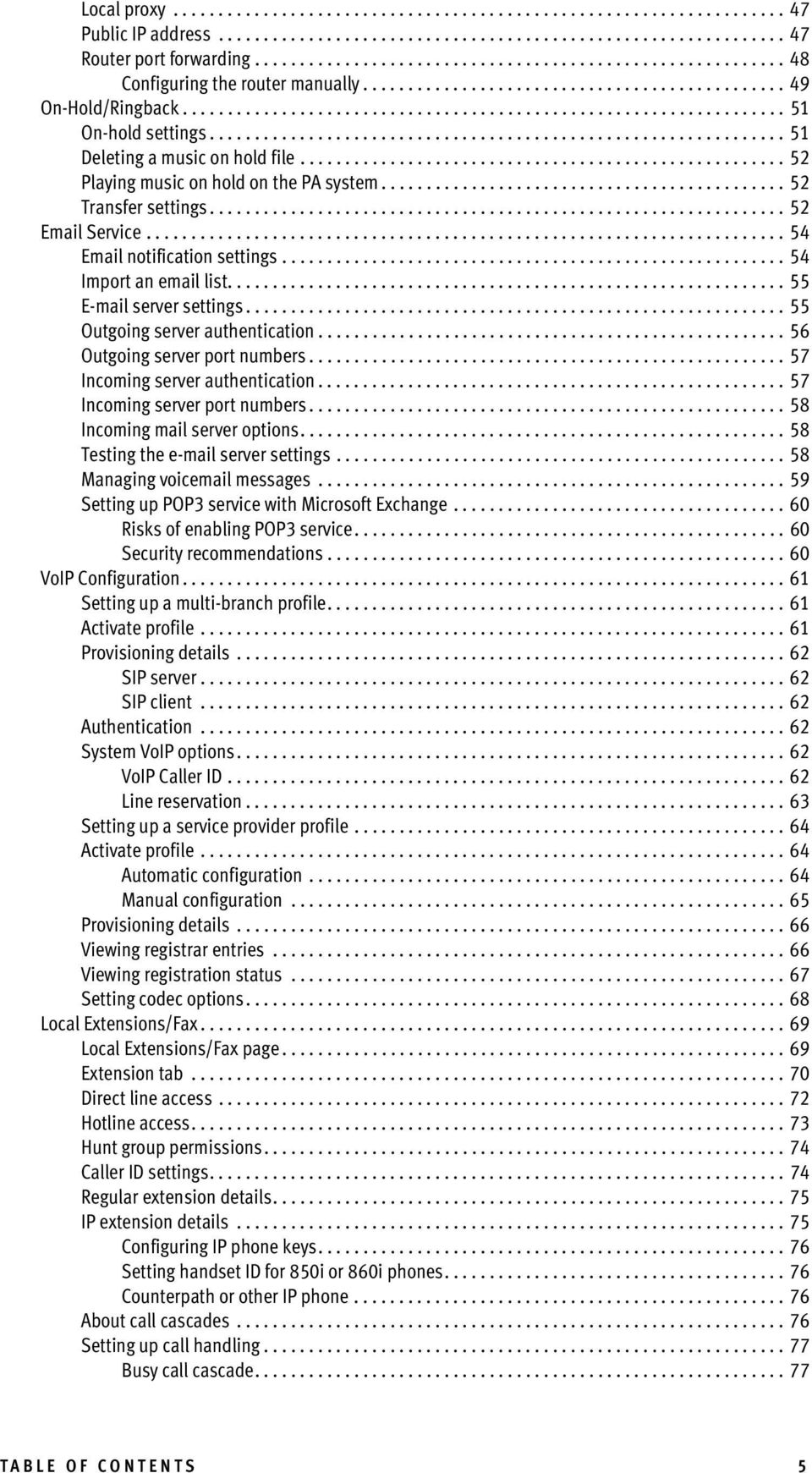
6 No answer call cascade Answered call cascade Do not disturb cascade Setting do not disturb mode Ignoring call cascades for unanswered intercom calls Ignoring call cascades for calls transferred from local extensions Voic tab Mailbox greeting Caller options Notification options Setting up notification by Setting up notification by phone Setting up notification by pager Setting up the notification options Setting up message waiting light activation Voic screening Adding IP phones Overview External IP extensions Configuring the router Configuring the router manually Adding 350i, 450i and 550i IP phones Connecting the IP phone to the network Adding the extension to the system IP extension details area About programmable function keys Programming 350i function keys Saving a key assignment template Using a key assignment template Programming 450i function keys Programming 550i function keys Programming the 350i, 450i or 550i IP phone as an external IP extension If registration does not work Adding 850i and 860i IP phones Installing the base Configuring the phone as an IP extension Configuring the 850i or 860i for use within the office IP extension details area Programming the phone as an external IP extension Using the phone with a traditional phone line Further configuration Checking and updating firmware Phone programmable key functions Adding Polycom IP Phones Adding the extension to the system IP extension details area Configuring the system for external IP extensions Connecting the Polycom phone to the network Programming the Polycom IP phone Configuring the phone to point to the firmware files Adding Grandstream IP phones Adding the extension to the system IP extension details area Configuring the system for external IP extensions Connecting the Grandstream phone to the network Programming a Grandstream IP phone TABLE OF CONTENTS 6

7 Adding Counterpath IP phones Adding the extension to the system IP extension details area Configuring the system for external IP extensions Configuring a new SIP account Updating eyebeam software Adding Other IP Phones Remote Extensions Remote Extension tab About call cascades Setting up call handling Voic tab Mailbox greeting Caller options Notification settings Remote extensions and telephone company services Ring and Page Groups About call cascades Setting up call handling Caller ID options General Voice Mailboxes Mailbox greeting Caller options Notification options Voic Preferences Global message waiting indicator Mailbox setting Mailbox access Voic management Mailbox status Unassigned messages Reset mailboxes Delete password Voic Broadcast Add Broadcast Group Permissions Activate access codes Access code configuration Adding an access code Removing an access code Extensions requiring an access code Restricting extensions Selecting all extensions Clearing restrictions System Speed Dials Activate speed dial Import system speed dial list Export system speed dial list Caller ID name tagging Telephone Lines Activate line Phone numbers Phone line services Line reversal settings Call handling Line optimization TABLE OF CONTENTS 7
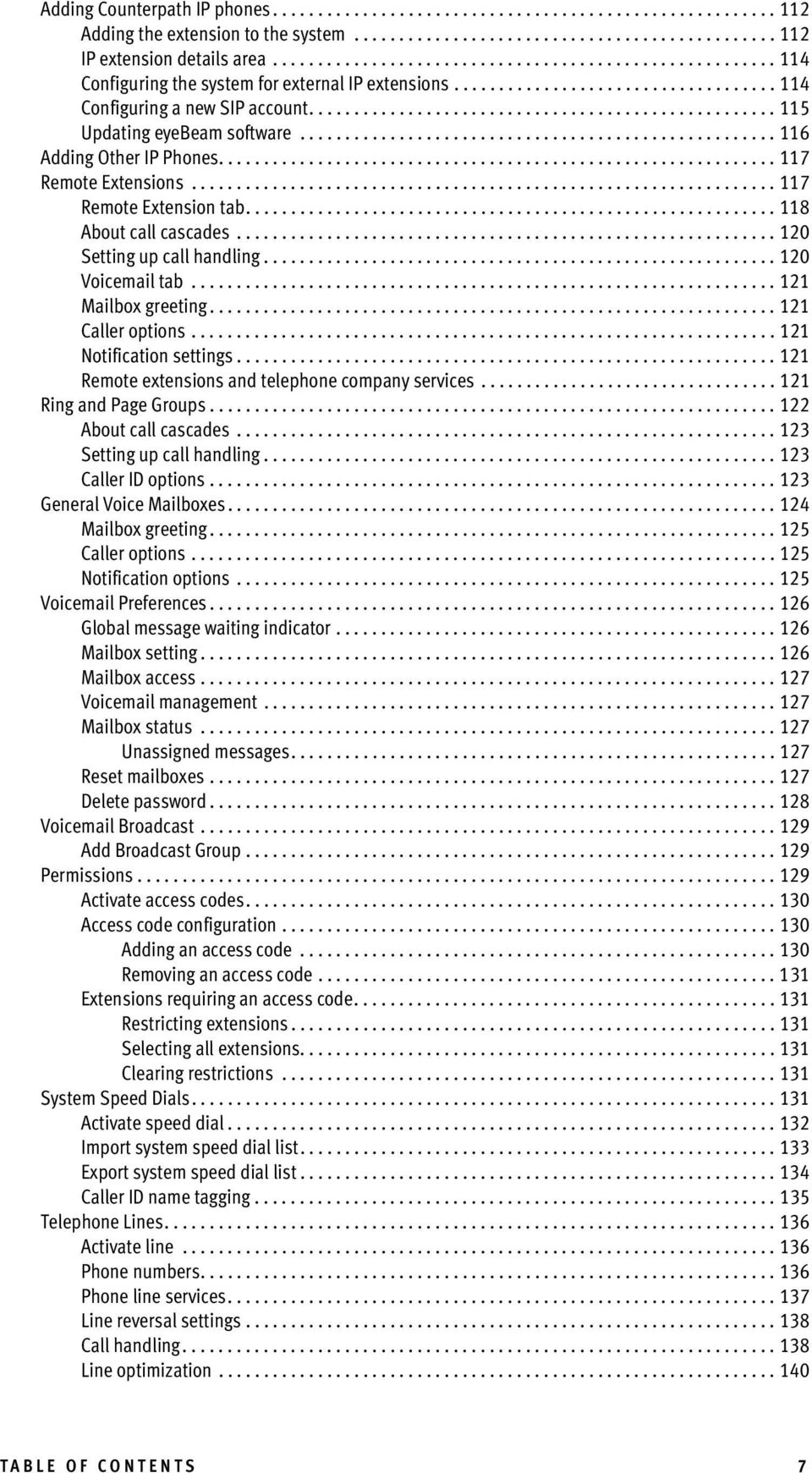
8 VoIP Numbers Activate VoIP number Phone number Multi-branch profile Service provider profile Username and password Registration status Call handling Caller ID (or CLID) Based Routing Caller ID lookup list or CLID matching list Caller ID or CLID Routing Groups Setting up caller ID routing with an extension Line Hunt Groups Activate hunt group Hunt group line assignments Hunting order for outgoing calls Hunt group busy overflow for outgoing calls Overflow tone notification Auto AttendanTS Configuring auto attendants Actions during auto attendant playback Action performed after auto attendant playback Working with auto attendant messages Recording a new message Listening to the recorded message Loading a message Erasing a message Example auto attendant Setting up the dial-by-name directory Setting the PBX extension length Auto Route Selection Introduction About automatic route selection About toll restriction About leading digits About carrier codes ARS and direct line access ARS and the 3-Way Calling/Conference service ARS and emergency service numbers Planning automatic route selection and toll restriction Setting up automatic route selection and toll restriction Activate automatic route selection Carrier code prefixes Emergency service numbers Auto route selection Restricting local extension access to specific hunt groups Allowing a local extension to bypass ARS and toll restriction Regulatory advisory notice Call Bridge (DISA) Using call bridge Activate account Hunt group access Auto Call Back Using auto call back Activate auto call back Account options TABLE OF CONTENTS 8
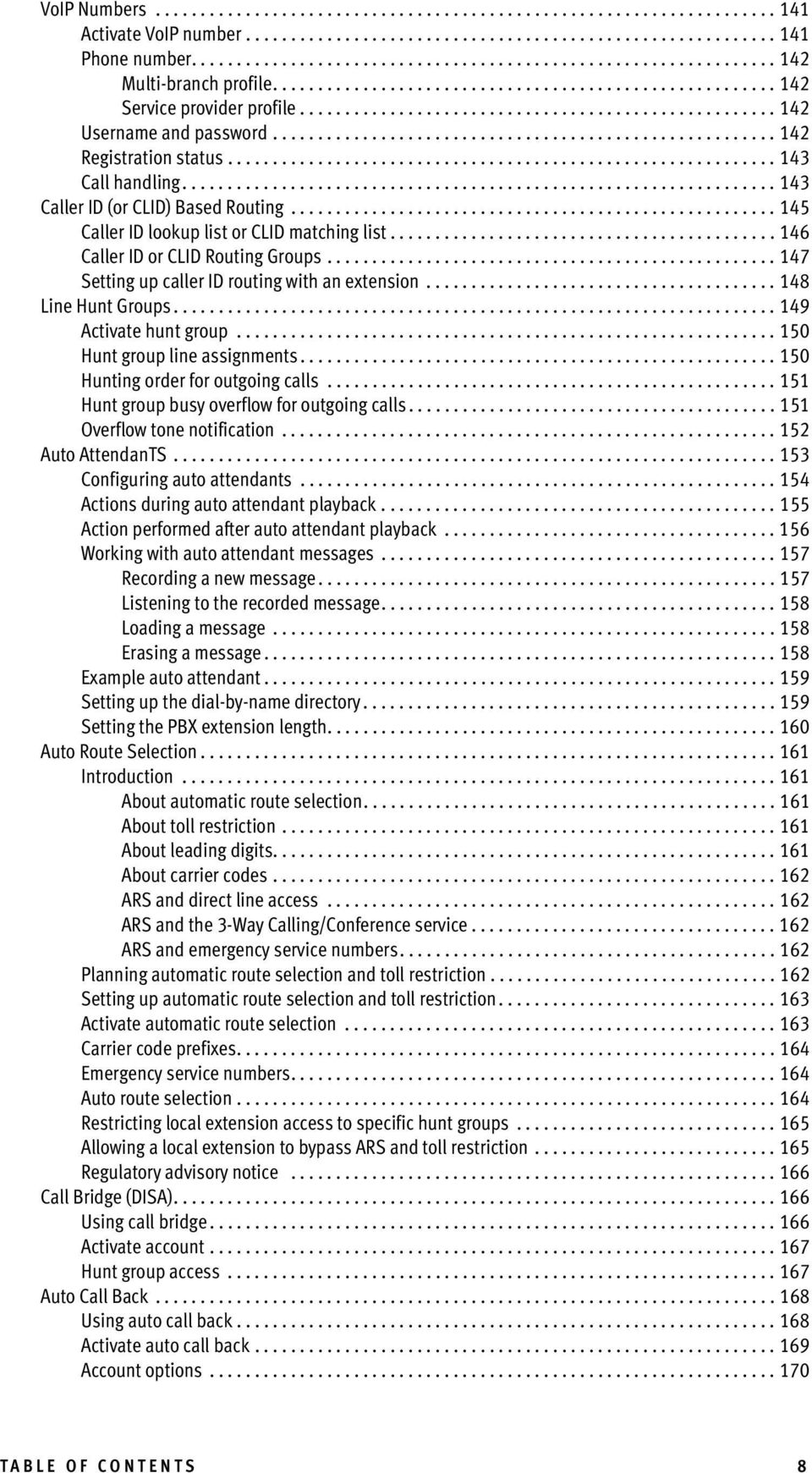
9 Recording an announced message Prompted Call Back Using prompted call back Activate prompted call back Account options Recording an announced message File menu New Template Open > Location Open > Configuration File Save Save To > File Save To > Location Retrieve Settings Close Exit Tools menu Memory Usage Voic Manager > Mailbox Status Voic Manager > Delete Mailbox Password Voic Manager > Reset Mailboxes Terminal Window (CLI) Syslog Output Call Logging Output (CDR) Defaults > Entire Configuration Defaults > Current Page Uninstall License Click-to-Dial Update Phone Update Firmware Reboot System Options menu Paging Options Overhead Paging Transfer Preferences To local extension tab To remote extension tab To ring group tab From auto attendant tab From home phone tab Call Reminders VoIP Trunking SIP server registration VoIP ports Clock Preferences Internal Calls Call Back Caller ID Dial-by-name Directory Call Park Set Date & Time Troubleshooting menu Auto Attendants Extensions > Regular Analog Extensions Extensions > IP Extensions TABLE OF CONTENTS 9
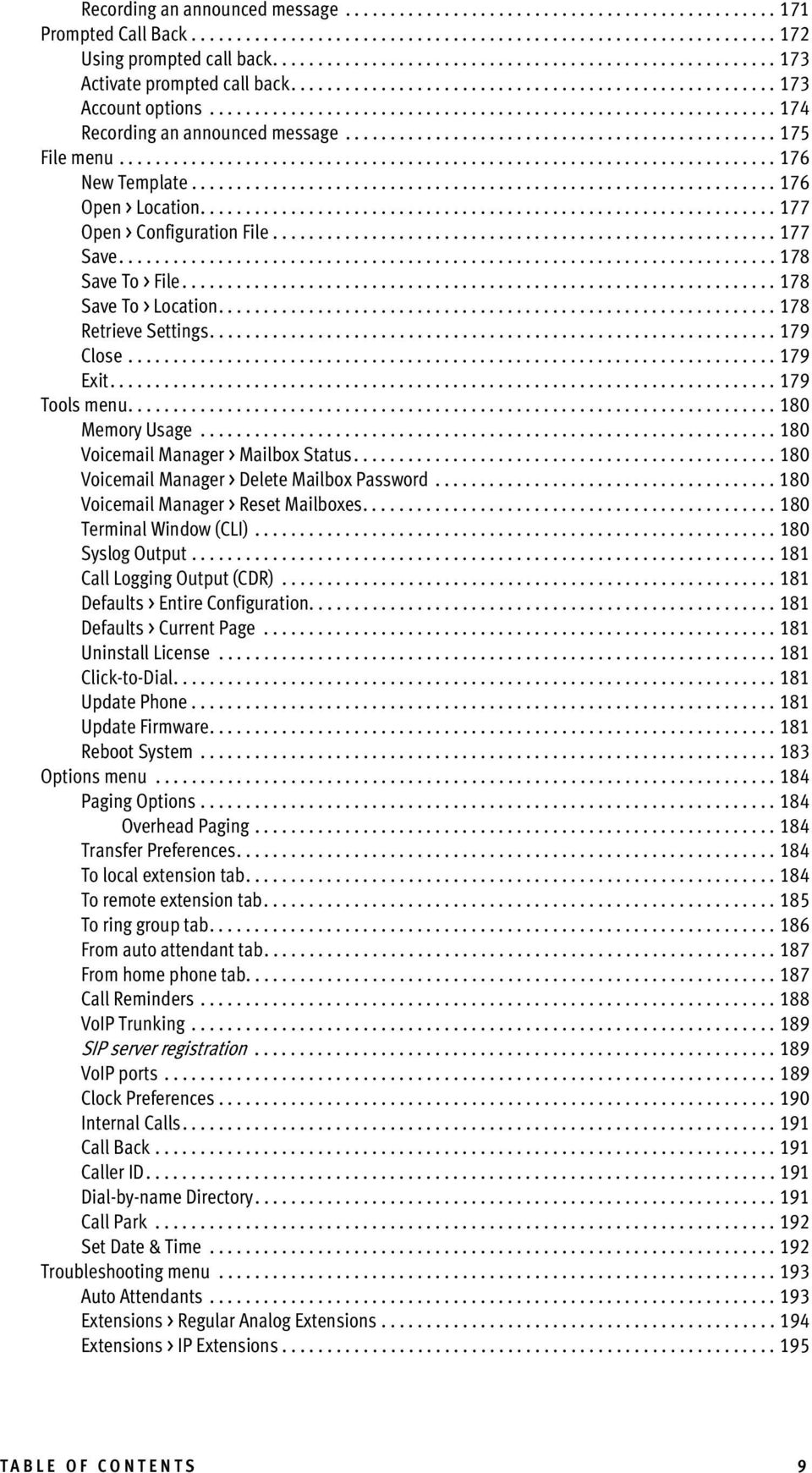
10 Fax Detection Telephone Lines > Audio Telephone Lines > Detection and Timers VoIP VoIP ports SIP Server Registration Timer UPnP View Blocked IP Addresses Firewall Test System Information and Diagnostics System Information Local Extensions VoIP Numbers Network Memory Usage Support Tools > Call Logging Options Support Tools > Software Configuration Logs CHAPTER 3: USING FORTIVOICE Receiving calls With the auto attendant Using an analog extension Making calls Placing an intercom call Overhead paging Two-way paging One-way group paging Place out-of-office calls from a local extension Click-to-Dial from Microsoft Outlook Receiving calls For your local extension For any other local extension For a specific local extension While you re on a call Placing calls on hold Transferring calls to an extension Unscreened transfer Screened transfer Transferring calls to an outside number Unscreened transfer Screened transfer Parking and retrieving calls Parking a call Retrieving a parked call Queuing and retrieving callers Queuing callers at a local extension Queuing callers at a ring group Using call waiting Conference calling Two local FortiVoice extensions and one outside caller Two outside callers and one local extension Using an IP extension Making calls Placing an intercom call Overhead paging TABLE OF CONTENTS 10

11 Two-way paging One-way group paging Place out-of-office calls from a local extension Receiving calls For your local extension For any other local extension For a specific local extension While you re on a call Placing calls on hold Transferring calls to an extension Unscreened transfer Screened transfer Transferring calls to an outside number Unscreened transfer Screened transfer Call park parking and retrieving callers Parking a caller Retrieving a parked call Queuing and retrieving callers Using call waiting Conference calling with FortiVoice Two FortiVoice local extensions and one outside caller Two outside callers and one local extension Fortifone phone programmable key functions Using VoIP Using a standard phone connected in parallel to FortiVoice Making and receiving calls Transferring calls Modems and telephone line access Forwarding calls out of the office Automatic call forwarding Manual call forwarding Conditional call forwarding Transferring calls from a remote extension Screening options for forwarded calls Using the voic system Activating voice mailboxes Retrieving messages and accessing a voice mailbox Using Voic broadcast Recording an announcement on a local extension Pager and cell phone notification Music on hold Music on hold and call forwarding to remote extensions Switching modes Switching modes manually Switching modes automatically Using call bridge and call back Using call bridge Using call back Activating call back Using prompted call back activation Using auto call back activation Accepting the call back Directly answering the call back Using the announced message option TABLE OF CONTENTS 11
12 CHAPTER 4: CALL DETAIL RECORD LOGGING Introduction Enabling call detail record logging Unit log file Retrieving call data records Call reporting Browser Analyzing the data CHAPTER 5: VOIP INFORMATION About SIP About SIP servers Selecting a location for the SIP server Connecting to a network Connecting to local and IP networks Confirming network capacity Configuring IP addresses Starting the FortiVoice Management software Setting the system IP settings Setting the public IP address Configuring the router Configuring the router manually External IP extensions Multi-branch VoIP network Setting up a multi-branch profile for the SIP server Setting up a multi-branch profile for a SIP client Configuring VoIP numbers for a multi-branch VoIP network Setting up line hunt groups Advanced VoIP configuration Saving settings to FortiVoice Verifying the multi-branch VoIP network Service provider VoIP network Setting up a service provider profile Activate profile Automatic configuration Manual configuration Provisioning details Setting codec options Configuring VoIP numbers for a service provider VoIP network Setting up line hunt groups Advanced VoIP configuration Setting up caller ID Reserving VoIP lines Saving settings to FortiVoice Verifying registration FAQ How does VoIP work? Does a VoIP call sound like an analog phone call? What happens if the power goes out or if the IP network to VoIP fails? Can a firewall prevent VoIP calls from passing through? What is SIP? What is a VPN? Can a VPN help to carry data securely over the Internet? What s the difference between a public IP address and a private IP address? TABLE OF CONTENTS 12
13 What is NAT and how does it affect VoIP? What s the difference between a static IP address and a dynamic IP address and what effect does this have on VoIP? What is a SIP server? What is dynamic DNS? What is the drawback of using dynamic DNS? How often will my public IP address change? What is a port number? Multi-branch VoIP network administration form CHAPTER 6: TROUBLESHOOTING AND SUPPORT Troubleshooting What the flashing lights mean All lights flash slowly together Line 1 and 3 flash alternately with line 2 and Line 1 and 4 flash alternately with line 2 and All lights > Data flash in a slow alternating sequence, continuously Line 1 and 2 flash alternately with line 3 and Line 2 and 3 flash Configuration I am not able to retrieve settings I am unable to configure the system using a touchtone phone Auto attendant The auto attendant does not play when calls come in The auto attendant message is broken up or very faint The auto attendant answers calls before any of the extensions ring The auto attendant is transferring calls to the wrong extension The auto attendant answers calls, but does not transfer them to the extensions Calls are going to my phone company voic instead of being answered by the system How do I access my voic remotely? Music on hold Callers hear the One moment please message and then total silence when the auto attendant transfers their call to an extension Callers hear only silence when put on hold at an extension Call routing Callers are disconnected when transferring calls from one extension to another I can t use my conference/3-way calling feature from the phone company I m unable to place intercom calls from a local extension Answering and fax machines The answering machine and/or fax machine picks up calls before they can be answered by telephone extensions Incoming faxes are not automatically detected and routed to the fax machine Local extensions I am unable to access lines with a local extension My PC (internal or external) modem cannot dial out One of the local extensions (telephones) does not ring Extension(s) ring, but there is no caller When I try to access voic , I hear a busy tone Multiple units I can t reach an extension across the LAN The configuration does not show the other unit(s) After recording an auto attendant greeting, I can t play it back Calls are not always reaching my voic TABLE OF CONTENTS 13

14 Calls across the LAN are lower in volume VoIP I hear a re-order tone when I try to dial a VoIP location Callers complain the sound is distorted or choppy When I call someone or they call me, voice is only heard in one direction Support Appendix A: Functions and Commands Functions you can enter from local extensions Functions you can enter from outside phones Functions you can enter in command mode Appendix B: Telephone Company Calling Services Caller ID Distinctive Ring Voic Call Waiting Way Calling/Conference Transfer and Clear Hunt/Rollover Other services Services using call back Services using prompted call back Services and systems using Flash Services using Ringback Tones Services using line reversals Appendix C: FortiVoice and Power Interruptions Appendix D: Specifications Appendix E: Home/Office Wiring Instructions Appendix F: Safety and Regulatory Information Appendix G: Limited Warranty GLOSSARY INDEX TABLE OF CONTENTS 14
15 INTRODUCTION Thank you for purchasing the FortiVoice phone system. Please read this section before you start installing the product. FORTIVOICE USAGE The FortiVoice unit you have purchased is designed and supplied to meet the technical standards for use in specific countries and for connection to the major telephone service providers in those countries. It is subject to regulatory certification and compliances as detailed in the appendices. WHAT S IN THIS GUIDE? The FortiVoice User Guide contains all the information you need, whether you are installing a single FortiVoice unit or multiple VoIP enabled units. It is intended to be a complete reference accompanying the FortiVoice Start Guide that ships with every FortiVoice unit. This document contains important information to help you minimize your installation effort and to get the most out of the features and the flexibility of your FortiVoice system. We strive to make your experience with installation and configuration the most rewarding possible. We would ask you to read important information concerning power interruptions and safety precautions contained in the appendices in order to ensure your FortiVoice equipment is set up in the safest way possible while avoiding equipment damage. WHAT YOU SHOULD KNOW While the FortiVoice system is customer installable, certain skills are required if you need to route cables or to configure a network. The following points will help you determine the required skills: Configuring the FortiVoice system using the FortiVoice Management software can be performed by anyone with basic computer skills once the system is physically installed with proper networking equipment configurations (if two or more units are networked on a LAN). While most buildings are wired to accommodate FortiVoice system setup, the need to route telephone and/or network cabling can occur occasionally. If your organization does not have someone with this skill set, we recommend the use of an outside telephony system technician. INTRODUCTION 15
16 You may need to connect FortiVoice to network equipment such as a router, switch or hub with a connection to the Internet, and to configure a firewall, computer and FortiVoice for networked use internally and with Internet. If your organization does not have someone with this IT skill set, we recommend the use of an outside IT technician. If you are installing a single, non-voip, FortiVoice unit, anyone with basic computer skills can use the FortiVoice Start Guide and this user guide to perform a full installation and configuration. FortiVoice system installations can be categorized into some general configurations, such as single unit installation, networked units installation, VoIP or non-voip installation, etc. This section helps you determine your best possible plan of action using this guide, according to your installation type. While not every possible installation scenario is detailed below, determine which one better fits your situation and use its guidelines as a starting point. Troubleshooting and Support on page 269 provides solutions for common problems and the index at the back is a means to quickly navigate to specific areas. Single unit installation When installing a single, non-voip FortiVoice unit, you can skip the sections marked with the Networked and VoIP icons. Networked units installation When installing networked FortiVoice units, you require the sections marked with the Networked icon. VoIP installation When installing a VoIP-enabled unit, you require the sections marked with the VoIP icon. VoIP Information on page 240 provides an additional resource. Connecting devices When connecting the computer, telephone lines, local extensions and other devices to your FortiVoice unit(s), Installation on page 19 provides the information you need. IMPORTANT INFORMATION Electrical shock Do not open the enclosure, except as instructed to install an upgrade kit. When installing an upgrade kit, disconnect the power adapter before removing the enclosure cover, and replace the cover before reconnecting the power adapter. Do not expose the FortiVoice to any liquids; that can pose a risk of electrical shock. Power and lightning surge protection Surge protection devices are recommended to protect FortiVoice in areas subject to lightning or power surges. Please consult your reseller for recommended surge protection devices. If FortiVoice has been supplied with surge protection devices to meet local regulatory requirements, these devices must be installed as described in their installation instructions. Do not connect or disconnect any telephone lines during thunderstorms. INTRODUCTION 16

17 Power adapter and power cord Use only the power adapter and power cord supplied with your FortiVoice. Check the supply voltage matches the rating on the power adapter label. If your supply voltage does not match the power adapter rating, please consult your reseller. For safe operation, the FortiVoice power adapter must be connected to a power supply socket with a third pin (ground /earth). Power failure The equipment will not operate when mains power fails. In the event of a power failure, each FortiVoice unit will connect extension E4 to phone Line 1 to permit calls (except-au models). Calls must be dialed without a hunt group. All other FortiVoice functions will not be available until power is restored. We recommend that a telephone that does not depend on mains power be available for emergency use. Change password frequently Setting and frequently changing the system password is recommended to avoid unauthorized changes to system configuration and settings. PBX fraud It is recommended that call bridge (DISA) and call back passwords are changed frequently to avoid unauthorized users making telephone calls through the FortiVoice. Emergency service numbers Ensure emergency service numbers are not blocked by the toll restriction feature. Frequently used emergency service numbers are pre-programmed to avoid blocking, but other local numbers may be used in some locations. Before routing any emergency service numbers to a VoIP service provider, check that they do handle emergency service calls and any conditions associated with this service. External audio source isolation We recommend that any external audio source be connected to the FortiVoice unit using an approved Line Isolation Unit (e.g. A-Tick ( ) approved in AU). Call redirection and service provider billing advisory Use of the automatic route selection, toll restriction and call detail recording features does not imply any guarantee whatsoever by regulatory authorities, telephone service provider(s), FortiVoice or its distributors and resellers, with regard to the accuracy of these features and that the use of such features may not be considered by a telephone company in any disputes which may arise regarding the accuracy of any subscriber's telephone account. Cleaning Use a slightly moistened cloth or an anti-static cloth to clean FortiVoice. Do not use any solvents. Never use a dry cloth; electrostatic charges could damage the electronics in the system. Ensure, however, that no moisture penetrates into FortiVoice, which can result in damage. INTRODUCTION 17
18 FINDING THE INFORMATION YOU NEED The following user guide functionality helps you find the information you need quickly and enables you to skip the information you don t need. This will make your experience with this user guide and your FortiVoice system installation and configuration much more efficient. Using the table of contents and the index The table of contents at the front of this user guide contains all of the section headings and page numbers throughout the manual. The index at the back of the user guide contains a keyword reference with page numbers. If you are using this guide online in PDF format, the headings and page numbers will contain hyperlinks, allowing you to quickly navigate to the sections you need. Navigating with cross-references Cross-references are contained throughout the user guide in order to help you access related information and illustrations quickly. As with the headings and keywords located in the table of contents and index, these cross-references contain hyperlinks, allowing you to quickly navigate to the sections you need. Where to go for further information You can find FortiVoice documents on the FortiVoice software CD, in the FortiVoice folder in the Windows Start menu once the software has been installed, and in the following web site: /docs.fortinet.com GUIDE CONVENTIONS The FortiVoice User Guide uses the following text elements and icons as visual aids, making the manual more accessible. Text elements Italic Bold Italic Italicized text highlights labels within windows, references within the document, and references to other FortiVoice documents. Bolded text highlights window names, button names, menu commands, links, telephone keys, and text you are asked to type. Italicized text in double quotes highlights FortiVoice system voice prompts you hear from a telephone. Icons The Networked icon is used to mark sections with information pertaining to a setup where two or more FortiVoice units are networked together on alan. The VoIP icon is used to mark sections with information pertaining to a setup where VoIP is being used. The IP extension icon is used to mark sections with information pertaining to the set-up and use of IP extensions. The Alert icon is used to mark sections that are important. They may contain warnings or cautions alerting the user to pay special attention. INTRODUCTION 18
19 CHAPTER 1 INSTALLATION FORTIVOICE PACKAGE CONTENTS FortiVoice units ship with everything you need to get started. A power adapter, cables, management software CD and documentation comes with every unit. Refer to the FortiVoice Start Guide included with the unit to verify you have everything you need. If any of these items are missing, please contact your FortiVoice dealer. Caution: If FortiVoice has been exposed to low temperatures prior to installation, wait until the system has reached room temperature before connecting the power cord to avoid condensation. RECOMMENDED SYSTEM SPECIFICATIONS You will need a PC to configure your FortiVoice system. It should have: Fully updated Windows 7, Windows XP, Windows Vista 32-bit or Windows Updated Java Runtime Environment (version 6 update 23 or higher). Processor: 1 GHz. RAM: Windows 7 and Vista: 1 GB; Windows XP and 2000: 512 MB. Hard Disk Space: 250MB plus 140MB per FortiVoice system memory card. Screen Resolution: 1024x768. PC must connect to the FortiVoice via a Local Area Network (LAN), or directly to the FortiVoice LAN port. There is currently no support for Mac OS or Linux operating systems. There is no support for operating systems no longer supported by Microsoft, such as Windows 98, Windows ME and Windows 95. Network equipment: You will need to connect the FortiVoice LAN port to your network (ie. Ethernet switch, router, etc.) for ease of configuration and setting up IP phones. If you plan to use VoIP or external IP phones, you will also require a broadband Internet connection. INSTALLATION 19

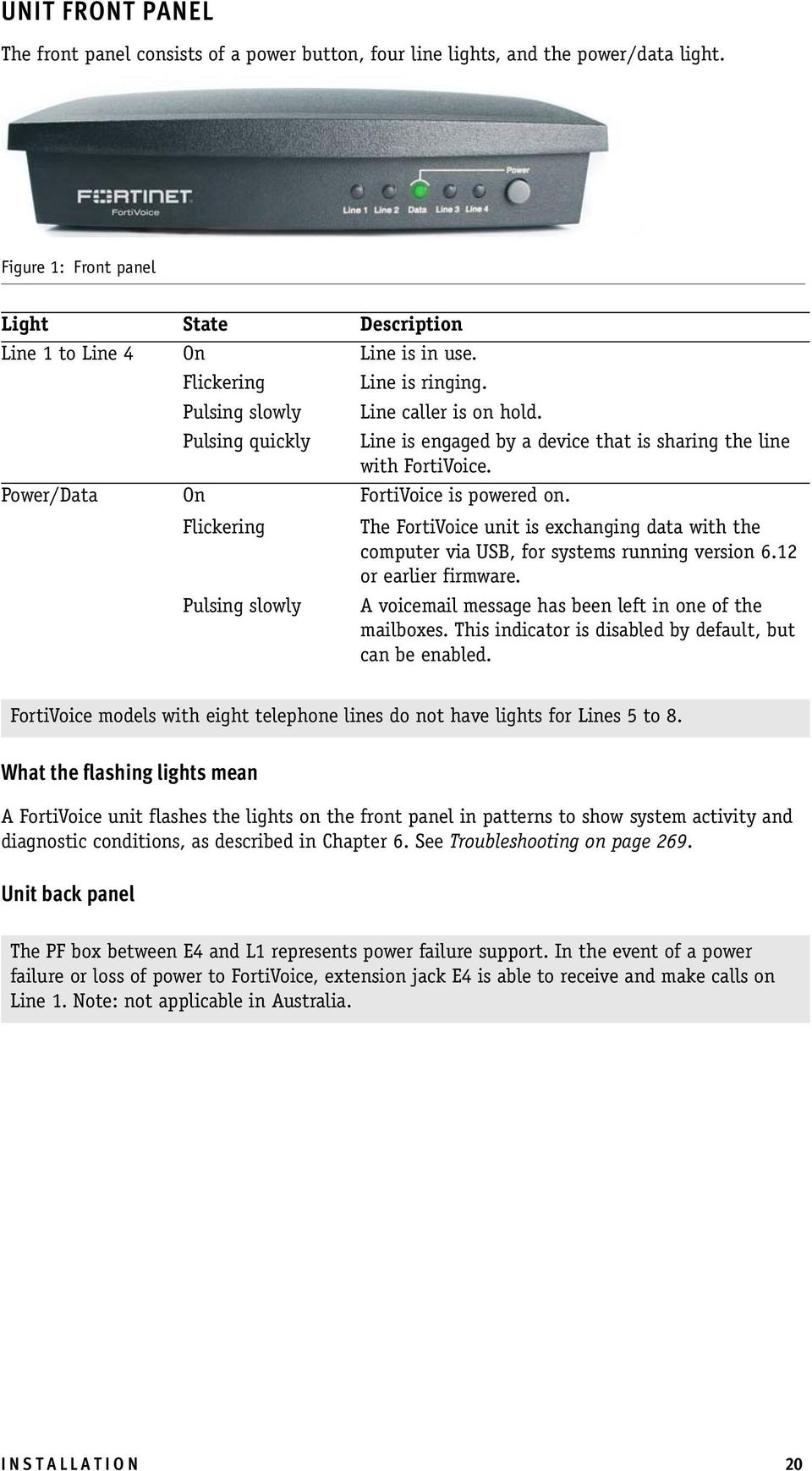
20 UNIT FRONT PANEL The front panel consists of a power button, four line lights, and the power/data light. Figure 1: Front panel Light State Description Line 1 to Line 4 On Line is in use. Flickering Line is ringing. Pulsing slowly Line caller is on hold. Pulsing quickly Line is engaged by a device that is sharing the line with FortiVoice. Power/Data On FortiVoice is powered on. Flickering The FortiVoice unit is exchanging data with the computer via USB, for systems running version 6.12 or earlier firmware. Pulsing slowly A voic message has been left in one of the mailboxes. This indicator is disabled by default, but can be enabled. FortiVoice models with eight telephone lines do not have lights for Lines 5 to 8. What the flashing lights mean A FortiVoice unit flashes the lights on the front panel in patterns to show system activity and diagnostic conditions, as described in Chapter 6. See Troubleshooting on page 269. Unit back panel The PF box between E4 and L1 represents power failure support. In the event of a power failure or loss of power to FortiVoice, extension jack E4 is able to receive and make calls on Line 1. Note: not applicable in Australia. INSTALLATION 20
21 INSTALLING THE FORTIVOICE MANAGEMENT SOFTWARE The latest version of the FortiVoice software can be downloaded from 1. If the FortiVoice unit is connected to a USB cable, disconnect the cable. The connection between a PC and FortiVoice system must be done using a LAN cable. 2. Turn on your computer and insert the FortiVoice CD into your CD drive. The install program starts automatically. 3. Click NEXT and follow the instructions. If you prefer to use Windows Explorer or if the install process does not launch automatically: 1. Double-click the My Computer icon. 2. Double-click the CD-ROM/DVD drive. 3. Double-click the Startscreen.exe icon and follow the instructions. After you click the Finish button, you will see the FortiVoice icon on your desktop. This means you have successfully installed the FortiVoice Management software. Updating the firmware Make sure your FortiVoice is connected to your PC. 1. Open the FortiVoice Management software. 2. Choose Tools > Update Firmware. The update time varies depending on the connection type, how many files are needed and how many units are updated. On average the process takes between 1 and 5 minutes. The LED lights on the FortiVoice front panel show diagnostic indicators for the update. See What the flashing lights mean on page 269. When the update is completed, you are prompted to reboot FortiVoice. In the window, click the Proceed button. Should the firmware update fail, please repeat the update process above. If the problem persists, contact your reseller or FortiVoice. Most firmware updates do not alter your system configuration. In certain circumstances, during a major system update, the configuration file may get reset to default values. When you configure a unit for the first time and every time you modify the configuration, we recommend you save your configuration file to your PC and preferably to removable media (3.5" Floppy, CD-ROM disc or Flash stick) as a back-up. This avoids having to reconfigure the entire system in case of a hardware failure. INSTALLATION 21
22 INITIAL CONFIGURATION Once your software is installed and your FortiVoice is connected directly to a PC or via a switch/ hub to the LAN, you can customize the FortiVoice system with the FortiVoice management software. Recommendation: To minimize the disruption time of your telephone lines during the system setup, we recommend you configure the unit before you connect all the local extensions and telephone lines to the FortiVoice unit. SELECT LOCATION FOR INSTALLATION Select a suitable location for installation of FortiVoice. FortiVoice can be installed on a desktop or mounted on a wall. It can be installed in a office or communications or utility room. Choose a location that meets the following requirements: Ambient temperature between 0 35 C. Away from heat sources and direct sun light. Avoid rooms with excessive humidity or dust. Within 1.5m of a power socket. Close to telephone company demarcation point for telephone lines, or sockets, and any inbuilding telephone wiring connection point. Away from any electronic devices that emit radio signals. Away from hazardous or explosive materials. When installing multiple FortiVoice units, do not stack units on top of each other. If FortiVoice has been exposed to low temperatures prior to installation, wait until the system has reached room temperature before connecting the power cord to avoid damage due to condensation. Caution: Use only the power adapter and power cord supplied with your FortiVoice. Check the supply voltage matches the rating on the power adapter label. If your supply voltage does not match the power adapter rating, please consult your reseller. For safe operation, the FortiVoice power adapter must be connected to a power supply socket with a third pin (ground/earth). Caution: Surge protection devices are recommended to protect FortiVoice in areas subject to lightning or power surges. Please consult your reseller for recommended surge protection devices. INSTALLATION 22
23 CONNECT FORTIVOICE TO A NETWORK OR A PC Connect the AC adapter provided with FortiVoice from an electrical outlet to the FortiVoice unit. Never use a power adapter other than the one that came in the FortiVoice package. To configure the FortiVoice system, the unit must be connected to a PC with FortiVoice management software installed. Use a network cable to connect the FortiVoice LAN port to a local area network (LAN) the PC has access to, or connect directly to the PC. The computer connection is only needed to change the configuration settings. It can remain disconnected at other times. If you encounter difficulties opening the FortiVoice Management software, check that all your wires and plugs are securely connected. Ethernet connection An Ethernet cable is supplied with specific unit models. This connection requires a LAN and a PC on the same switch. Any PC on the LAN can configure the unit. The top LED on the back panel beside the LAN port indicates a connection has been established with a switch or hub. A PC can connect directly to the FortiVoice LAN port using a cross-over cable equipped with RJ- 45 connectors. You can use a PC that has a wireless connection to the LAN. If the router has upnp enabled, the FortiVoice Management software can auto-discover and connect to the FortiVoice unit. If the router does not have upnp enabled, the FortiVoice Management software cannot auto-discover the FortiVoice unit. However the software can connect to the FortiVoice unit if you specify its IP address after starting the software. 1. Connect your PC to the hub or switch using an Ethernet cable. 2. Connect the FortiVoice unit to your hub or switch using the supplied Ethernet cable. Figure 2: Ethernet connection Internet connection An Ethernet cable is supplied with specific unit models. The top LED on the back panel beside the LAN port indicates a connection has been established with a switch or hub. 1. Connect the FortiVoice unit to your hub or switch using the supplied Ethernet cable. 2. To support remote management over IP, map the TCP/IP 9393, 8485, 8486 port from your firewall to FortiVoice. Please refer to the manual for your router/firewall to activate port forwarding. INSTALLATION 23
24 CONNECTING TELEPHONE LINES Advisory: In order to minimize disruption to your business, you may want to configure FortiVoice before connecting it to your telephone lines and local extensions. The FortiVoice unit will perform call handling, and will route all incoming calls to the extensions. Call handling includes call forwarding, transferring, voic , etc. Telephone lines are not directly connected to any of the local extensions. The FortiVoice configuration determines how calls are routed to local extensions. 1. Connect the FortiVoice unit to the telephone company s line sockets using the 2-wire singleline telephone cables provided, beginning with L1. Take note of which telephone line is connected to each line port. This information will be used in the configuration section. If you have two telephone lines out of one phone jack, you will require a dual-to-twosingle-line adapter or replace the two-line cord with two single-line cords. Caution: The FortiVoice line jacks are sensitive to high-voltage spikes from lightning. If you live in an area where electrical storms occur regularly, we recommend you protect FortiVoice by plugging the telephone cords coming from the FortiVoice line jacks to a surge protection device connected to the telephone lines. CONNECTING PHONES Local extensions are phones (or fax machines) connected to the FortiVoice system. You can connect analog phones and fax machines or IP phones. Analog phones Plug the phone into one of the extension jacks labeled E1 E8. IP phones Plug the IP phone into your switch/hub and configure it as described in Adding IP phones on page 90. If you are using an unsupported IP phone, refer to its user guide for configuration instructions. 2-line analog phones You can plug a 2-line phone into two extension jacks of the FortiVoice unit. You can configure different lines to ring to the two extension jacks, so that the user can see on the phone which line the call came in on. If your 2-line phone does not have separate jacks, you can use a splitter to plug it into two extension jacks. 4-line analog phones You can plug a 4-line phone into four extension jacks of the FortiVoice unit. You can configure different lines to ring to the extension jacks, so that the user can see on the phone which line the call came in on. A 4-line phone can use two splitters to plug into 4 extension jacks. INSTALLATION 24
25 CONNECTING OTHER DEVICES Modems Plug the modem s telephone cable into an extension jack. Your modem is now an extension that can access all lines and take advantage of call routing features. A modem connected to a FortiVoice unit operates at up to 28 kbps. If you don t want to change your dial-up settings for the modem, enable Direct Line Access for the extension associated to the modem. For more information, see Direct line access on page 72. UNITED KINGDOM To connect telephones with BT style plugs, it is recommended that extensions are wired through a master socket or an in-line adapter with a capacitor. This also ensures compatibility with some telephones that require 3-wire connections for the telephone to ring. Connecting a fax machine If you are connecting a fax machine to a FortiVoice unit, plug it into an extension jack. FortiVoice provides you with three options to configure your fax machine. Choose the best option for your office. Option 1 Dedicated fax line You may already have an incoming dedicated fax line. You can leave this line directly connected to your fax machine. Connect the remaining telephone lines to your unit. Telephone lines will be handled by the unit and your fax will work the way it has always worked. Figure 3: Dedicated fax line Advantages: It s easy to set up and you don t need to change the way your fax handles calls. Disadvantages: The dedicated fax line cannot be shared with the other phone devices (i.e. you cannot make an outbound voice call on your fax line). The dedicated fax line costs money, and may not be used as frequently as it could be. INSTALLATION 25
26 Option 2 Distinctive ring Distinctive ring is a service provided by your phone company. A second phone number is added to a telephone line. A call to either phone number will ring the same line, but with different ring patterns. You can use one ring pattern to indicate a fax. Figure 4: Distinctive ring Advantages: This option does not require a second physical line for faxes. More telephone lines can be added as you grow. You can keep the same fax arrangement. Disadvantages: Your phone company may charge a fee for the distinctive ring. If you choose this option, you will require the distinctive ring service from your telephone company. Option 3 Automatic fax detection via the auto attendant The auto attendant can detect incoming fax calls and route them accordingly. To enable this, an auto attendant must answer all incoming calls. It will listen for a fax tone (CNG) to determine if the call is an incoming fax. If so, the call is routed to the fax machine. You must create an auto attendant to use this method. Figure 5: Automatic fax detection via auto attendant Advantages: Calls are automatically handled for you. Distinctive ring service is not required. Any telephone line can receive a fax or a call, making better use of your resources. Disadvantages: Some older fax machines do not emit a fax tone (CNG). Therefore, the auto attendant cannot detect incoming faxes from those devices. If your auto attendant volume is set too high or if your telephone lines are noisy, the auto attendant may have difficulty detecting the incoming fax tone and therefore not route the call to the fax machine. You can solve this problem by adjusting the volume. For more information, see Telephone Lines > Audio on page 197. INSTALLATION 26
27 CONNECTING TO THE PA (PUBLIC ADDRESS) JACK The PA jack can be connected to a PA system for overhead paging, screening voic and playing music on hold. The PA jack requires a 1/8" (3.5 mm) mono phono connector. If your system has multiple FortiVoice units, use a splitter to connect each FortiVoice unit to the PA system. SETTING UP MUSIC ON HOLD Callers tend to react more positively to waits or transfers if they hear music. You can also play an advertisement or provide information about your company. External audio source The MUSIC jack is designed to support an external audio source like a CD player, tape player or PC media player. We recommend that any external audio source be connected to the FortiVoice unit using an approved Line Isolation Unit (e.g. A-Tick ( ) approved in AU). Advantages: The length of the recording is not limited by the amount of memory in the FortiVoice units. All of the FortiVoice memory is available for voic and auto attendants. Different FortiVoice units can have different music on hold. Disadvantages: Extra dedicated equipment must be connected and running constantly. A separate sound source is required for each unit. 1. Connect the audio source via its headphone output to the MUSIC jack. Use a cable with a 1/8" (3.5 mm) mono phono connector. 2. If your system has multiple FortiVoice units, either use a different audio source for each unit, or use a splitter to connect the one audio source to each unit. Internal audio file You can load an audio.wav file into the FortiVoice unit. If you have more than one unit connected by LAN, the.wav file is automatically copied to each unit. Advantages: No additional equipment is required. All units use the same file, which provides seamless music for calls transferred across the system. Disadvantage: The length of the recording is limited by the amount of memory in the FortiVoice units. Less time is available for voic and auto attendants. The recording time for internal music on hold, voic , and the auto attendants is shared on the FortiVoice unit. You can expand the built-in memory using memory cards. INSTALLATION 27
28 NETWORKING FORTIVOICE UNITS ON A LAN Up to four units can be networked together over a LAN to increase the number of telephone lines and extensions in your phone system. Connecting FortiVoice units to a LAN You can plug your unit(s) into your existing LAN or operate it on its own LAN with an Ethernet switch, router, etc.). Ensure the firmware on all units is updated before adding them to the LAN. Check for the latest updates. FortiVoice unit enclosures are not designed for stacking. We recommend wall-mounting units to maximize airflow and keep the units from overheating. Ethernet switch An Ethernet switch provides direct communication between units, thus keeping the voice-over- LAN data isolated from other data on the network. 1. Connect up to four units to an Ethernet switch. 2. Connect a computer to the Ethernet switch. 3. Power up and configure the units. 4. After configuring the units, connect the IP extensions to the Ethernet switch. It is important that you place the IP extensions on the same subnet as FortiVoice. For example, if your FortiVoice unit has the IP address , your IP extensions should use IP addresses in the range xxx that do not conflict with other IP addresses. Figure 6: Three units connected via an Ethernet switch Power up all the FortiVoice units Connect the provided AC adapters to each unit and plug the adapters into available power outlets. Turn the units on by pressing the Power button on the front of each unit. The lights on the front panels of the units will flash. This means they are powered up and connected to the LAN, but their ID numbers are not set. If you add a FortiVoice unit with older software to a system on a LAN, it can take up to 30 seconds for the newly-added system to show up in the software. INSTALLATION 28
29 Setting or changing the unit ID Units are shipped from the manufacturer with unit ID 1. If two or more units are placed on the same LAN with the same unit ID number, the newest unit will adopt the next available higher unit ID. For example, when a new unit is added to a system with unit IDs 1 and 2, the new unit automatically assumes unit ID 3. You can specify the unit ID: 1. Connect an analog phone to one of the extension jacks on the unit. 2. Press # to enter command mode. 3. Dial the system password + #. 4. Now, you have the following options: Keys Result 00 + # Responds with the unit ID number of that particular unit # Sets the unit ID to # Sets the unit ID to # Sets the unit ID to # Sets the unit ID to 4. The system will confirm the new ID is accepted. When the front panel Data light is on solid, the units are ready for network use. Keep track of the lines and extensions To keep track of the extensions and telephone lines connected to each unit, label each unit with its unit ID. It simplifies matters when you need to add or remove extensions and lines. Optimizing the system for networked use FortiVoice units have been designed to operate optimally when in a networked state. Below are a few items that have been designed for better network use. Configuration settings All units are cloned with identical settings. If a unit has disappeared off the network (adapter unplugged, LAN disconnected, LAN failure, etc.), the system can still handle the calls since it retains the configuration settings of the missing unit. If an extension or a voice mailbox cannot be reached, the caller hears a system prompt: The extension you are trying to reach is currently unavailable, please try again later. Outgoing line hunt groups When two or more units are on a LAN, the system tries placing calls out on the same unit the call originates from. This avoids using a line across the LAN on another unit, which helps to minimize the LAN traffic and optimizes the opportunity for all inbound calls to connect across the LAN if required. INSTALLATION 29
30 Auto attendants When an auto attendant is recorded on any unit, it is automatically copied to all other units on the LAN. This design minimizes LAN traffic and provides functionality back-up in case a unit or units have disappeared off the network (adapter unplugged, LAN disconnected, LAN failure, etc.). In this event, all units can still answer inbound calls with the same auto attendant messages. Voic All local extension and remote extension voic data is stored on the unit the extension is associated with. If a unit is completely filled with voic messages, it will not accept any more messages for its extensions. However the other units will accept messages for their extensions. To view the memory usage of each FortiVoice unit and each mailbox, choose Tools > Memory Usage or choose Tools > Voic Manager > Mailbox Status. Special considerations when connecting multiple units to a LAN Multiple FortiVoice units on a LAN will function as a single phone system. Some features are expanded as you add units, and other features are not. As you add more units, the number of telephone lines, local extensions, VoIP lines, remote extensions and voice mailboxes will increase. For example, combining a 248vs and a 480vs with PowerPack provides 6 telephone lines, 48 local extensions with mailboxes, 8 VoIP lines, 32 remote extensions with mailboxes, plus 20 general voice mailboxes. The following features are not affected by the number of units on the LAN, so capacity will not increase as you add units: auto attendants, ring groups and park orbits. You can add music on hold to your system by loading an internal music file. The music file is copied to each FortiVoice unit, so the music on hold will be the same for each line of each unit. Each unit has a Public Address (PA) output for connection to a public address system. The PA output for a FortiVoice unit is only accessible from extensions connected to that unit. To connect all outputs to a single amplifier, you will require an adapter. UPGRADING FORTIVOICE UNITS As your business grows, you can add capacity for telephone lines, VoIP lines and extensions to FortiVoice systems. You can add capacity in several ways: Add units to your network: Up to 4 FortiVoice units can be combined for more line and extension capacity. See Networking FortiVoice units on a LAN on page 28 for more information. Add an upgrade board: Upgrade boards are available from your reseller or directly from Fortinet, and come with installation instructions. 8plus VoIP Upgrade: Adds 8 VoIP trunks to a FortiVoice unit (some models). 240plus Upgrade: Adds capacity for 2 traditional phone lines and 4 local extensions to a FortiVoice unit (some models). INSTALLATION 30
31 ENABLING LICENSED ADD-ONS It is possible to enable the following features on your FortiVoice: Concero Console software Call Reporting software VERIFYING THE CONNECTIONS If you are having problems, they could be due to loose cables. Check the following: 1. Are your telephone cables connected to a wall jack at one end and the unit at the other? Ensure the devices you are using as extensions (telephones, faxes, etc.) are plugged into the extension jacks located on the back panel of the unit. Do not plug your extensions directly into a wall jack unless that jack is wired to a unit extension jack. 2. Check the USB or LAN connection between FortiVoice and your PC (USB connections are only applicable to version 6.12 or earlier software). 3. Ensure the unit AC adapter is plugged into a working power outlet and the unit is turned on. Make sure you are using the AC adapter supplied with your unit. This adapter cannot be substituted with any other adapter. If your adapter appears to be defective, please contact your FortiVoice dealer to order the proper replacement. If networked, ensure you have the latest firmware loaded on all units. INSTALLING FORTIVOICE CLICK-TO-DIAL SOFTWARE System users can call contacts using Microsoft Outlook. The FortiVoice Click-to-Dial utility must be installed on the computer of any user who wants to dial by clicking on contacts. Download the utility and follow the installation and configuration instructions at INSTALLATION 31
32 CHAPTER 2 CONFIGURATION INTRODUCTION This chapter contains detailed information about all the features in the Management software, with step-by-step instructions on how to customize these features to best suit your needs. STARTING THE MANAGEMENT SOFTWARE When a unit is being configured, it is locked to prevent other computers or persons using a phone from configuring changes at the same time. If you leave the software open for longer than one hour, the unit unlocks itself to allow configuration changes. 1. Press the power button to turn on your phone system. 2. Turn on your computer. 3. Start the phone system Management software. The Configuration Selection page appears, and the software attempts to detect your phone system. CONFIGURATION 32
33 4. Select your language. You can select English, Français or Español. 5. Once the software detects the system, click Configure Auto-Detected System. The software loads the configuration from the unit, and the About page appears. 6. If the software was unable to detect your system, check that all your wires and plugs are securely connected, and then click Retry Auto-Discovery. The software loads the configuration from the unit, and the About page appears. 7. If auto-detection does not work: a) Click Connect to a System Via IP. The Connect Via IP window appears. b) Enter the URL / IP address and Port of the system, and then click OK. This is the public IP address or FQDN of the system. The software loads the configuration from the system, and the About page appears. 3. To open a configuration file: a) Click Open a Configuration File or Template. The Open File or Template window appears. CONFIGURATION 33
34 b) Click Open a File. The Open window appears. c) Browse to the.tsd file, and then click Open. The software opens the configuration file. d) If the selected configuration file is not compatible with your software, you will be prompted to convert the file to a newer format. If you select OK, software will first make a backup copy with the filename suffix _old, then convert the selected file to make it compatible with your software. CONFIGURATION 34
35 ABOUT The About page displays and allows you to change system information. 1. Select the About page. The System Information area shows: The current time and date programmed into the system. The current mode. The model numbers of the units in the system. The number of new voic messages, and the total number of voic messages. The version number of the Management software. When the configuration was last saved to the system. The type of connection to the system. The region of the system. System time System time shows the current date and time programmed into the system. Clicking the System time link displays the Date and Time Properties window. It allows you to change the date, time, time zone, and NTP server programmed into the system. See System time on page 43. Current mode Current mode shows the current mode. Clicking the Current mode link displays the Change Mode window. It allows you to change the mode of the system. See Change mode on page 42. CONFIGURATION 35
36 My system My system shows the model numbers of the units in the system. Clicking the My system link displays the Discovered Network window. It shows the MAC address, IP address, model number, firmware version, and length of operation for each unit. To identify a unit, click the Identify button. The Identify button will change to a Stop button. All the lights on the front panel will start flashing. Click the Stop button to end the flashing. Voic messages Voic messages shows the number of new voic messages in the system, and the total number of voic messages in the system. Clicking the Voic messages link displays the Voic Memory Usage window. It shows message statistics for each voice mailbox. See Mailbox status on page 127. CONFIGURATION 36
37 ADMINISTRATION The Administration page allows you to set up the system name, system password, numbering plan, region, language, and how to route the call if a user dials an operator number. 1. Select the Administration page. Note: The Region Selection area is only displayed in certain regions. Depending on the region, an operator may be dialed using 9 or 0. Administration The Administration area allows you to set up the system name and system password. CAUTION: Use a system password, otherwise the system will be vulnerable to configuration changes, misuse and/or lock-out by callers or users. If the router has port 9393, 8485 or 8486 mapped to the system for remote configuration, the system will also be vulnerable to anyone on the Internet. Change the system password frequently to prevent unauthorized users from making calls or changing the configuration. 1. Optionally enter the System name. This should be the company name, or a shortened form suitable for use as caller ID during VoIP calls. If you enter a system name, you will require it when logging in through a browser for status or call detail record (CDR) information. 2. Enter the System password. It has to be a 4- to 8-digit numeric password, so you can also enter it on a touchtone phone. The system password allows access to the configuration. It is entered when you start the Management software, and when you access the configuration through a local extension or outside phone. CONFIGURATION 37
38 System numbering plan You can use a 3, 4 or 5-digit plan for extensions, ring groups, mailboxes and speed dials in your system. The default is 3 digits. To change it, click Change and select the desired number of digits. This selection is system-wide; you can t have a mix, for example, of 3 and 5-digit extension numbers. Numbers available per plan: 3-digit numbers: 100 to digit numbers: 1000 to digit numbers: to In VoIP-enabled systems, regardless of the number of digits used, a block of 50 numbers is allocated to VoIP location numbers. By default, the VoIP location numbers are 350 to 399. To change the default block of VoIP location numbers, see Setting up a multi-branch profile on page 61. Region selection The Region Selection area (displayed only in certain regions) allows you to select the country where your system will operate. Language The Language area displays the language loaded into the system, and allows you to load and remove language files. 1. To change the language files loaded into the system, click Edit. The Language File Management window appears, listing loaded language files. a) To load a language file, click Add, and then select the language file. b) To remove a language file, select the language, and then click Remove. 2. Select the default language for prompts heard by callers and users in the Default language for system prompts to callers list. Dial 0 or 9 routing The Dial 0 routing area (or Dial 9 routing area in some regions) allows you to select how the system will route the call if a user dials 0 or 9. For example, you can configure the system to connect the user to the receptionist at extension 114. CONFIGURATION 38
39 1. Select the action in the Connect to list. Choices are: perform no action Does not connect to a resource. go to voic Connects to the selected voic . go to local extension Connects to the selected local extension. go to remote extension Connects to the selected remote extension. go to ring group Connects to the selected ring group. play announcement Plays the selected announcement. go to auto attendant Connects to the selected auto attendant. queue at ring group Connects to the call queue of the selected ring group. dial-by-name directory Accesses the dial-by-name directory. go to VoIP location Connects to the selected VoIP number within the multi-branch VoIP network. 2. Select the resource. Depending on the action, resources are voice mailboxes, extensions, announcements, auto attendants, or VoIP numbers within the multi-branch VoIP network. CONFIGURATION 39
40 SCHEDULING A mode is a period of time when the system uses a particular call handling setup for incoming calls. Mode 1 is typically office hours, and Mode 2 is typically evening and weekend hours. Holiday Mode is when your office is closed for a statutory holiday or shutdown. The system can use a different call handling setup for each mode, and can automatically change mode with the time of day, day of week and on holidays. This way it can handle calls in different ways according to a schedule. The Scheduling page allows you to set up Mode 1, Mode 2 and Holiday Mode. You can also adjust the time and date, and can switch modes manually. Ensure the Management software is closed during automatic mode switching, or if an administrator is manually switching modes using a phone. In these cases the mode cannot switch while the Management software is open. Note that the mode can switch while the Management software is open, if the user is manually switching modes using the software, as described later. 1. Select the Scheduling page. Modes The Modes area allows you to enable, name and switch modes, and displays the current mode. 1. Enter the Mode 1 label and the Mode 2 label. Note that Mode 1 and Mode 2 are always available, so you cannot disable the Enable Mode 1 and Enable Mode 2 checkboxes. 2. Set up Holiday Mode to handle incoming calls differently during a holiday: a) Select the Enable holiday mode checkbox to enable Holiday Mode. The window enables the Settings button. b) Enter the Holiday Mode label. CONFIGURATION 40
41 c) Click Settings. The Holiday Settings window appears. The calendar shows the current date in green. d) Select your country in the Populate calendar with holidays observed in list, and then click Populate. The calendar will show your country s statutory holidays in grey. e) Using the calendar, select the month and then click the date of the holiday. The date is added to the Selected Dates area, and the calendar will show the date in blue. Click the date again to remove it. f) Repeat Step e) until all required holidays have been added. g) Select the mode in the Use the following Call Cascade settings for Holiday Mode. Choices are Mode 1 and Mode 2. This setting determines whether extensions will use their Mode 1 or Mode 2 call cascades during Holiday Mode. CONFIGURATION 41
42 Change mode The Modes area displays the current mode. 1. To change mode, click Change Mode. The Change Mode window appears. 2. Select the mode. The new mode immediately takes effect. You do not have to save the configuration. You can also change the mode by phone. Remotely 1. Ensure the Management software is closed. 2. Remotely call the system. 3. At the auto attendant, enter command mode by either pressing # on an analog extension phone, or *55# on an IP phone (note: other brands may use *55 Send or *55 Dial). 4. Enter the system password, followed by #. 5. Enter one of the following commands: 30 + # to hear the current mode # to enable Mode # to enable Mode # to enable Holiday Mode. 6. Press * to exit command mode. Locally 1. Ensure the Management software is closed. 2. Pick up a local extension. 3. Enter one of the following commands: ***30 + # to hear the current mode. ***31 + # to enable Mode 1. ***32 + # to enable Mode 2. ***33 + # to enable Holiday Mode. Note: a password is not required. 4. Press * to exit command mode. CONFIGURATION 42
43 Scheduling The Scheduling area allows you to specify when the system will change modes. 1. Select the Use automatic mode switching checkbox to enable the modes. The window enables the Scheduling area. 2. Select the day. 3. Select whether to use one mode or multiple modes during that day: Select Continuously run to use the selected mode the whole day. Select Switch modes depending on time to switch between Mode 1, Mode 2 and Holiday Mode during the day. The window enables the schedule controls. 4. If you selected Continuously run, select Mode 1, Mode 2 or Holiday Mode. 5. If you selected Switch modes depending on time, set when the mode should change. The default settings are: Mode 1 at 9:00 AM on Monday to Friday. Mode 2 at 5:00 PM on Monday to Friday. Mode 2 continuously on Saturday and Sunday. To change the mode switch time for more than one day, make the change to one day and click the Copy schedule to other days button. In the dialog box, check the desired days to apply the new time. System time The Scheduling area shows the date and time programmed into the system. Clicking the Adjust button displays the Date and Time Properties window. It allows you to change the date, time, time zone, and NTP server programmed into the system. NOTE: You can configure the system to get the time and date (but not the year or time zone) from caller ID. See Clock Preferences on page 190. CONFIGURATION 43
44 1. Click Adjust. You can also choose Options > Set Date & Time. The Date and Time Properties window appears. Date & time The Date & Time area allows you to set the date and time programmed into the system. 1. Select the month and date for the system. 2. Set the time for the system. Time zone The Time Zone area allows you to set the time zone for the system, and whether daylight savings time is used in your region. 1. Select the time zone for the system. 2. If your region uses daylight savings time, select the Automatically adjust clock for daylight saving changes checkbox. CONFIGURATION 44
45 NTP server The NTP Server area allows you to set the NTP (Network Time Protocol) server for the system. It provides the same time to the units and to the external IP extensions. 1. Select the NTP Server tab. 2. Enter the NTP server. CONFIGURATION 45
46 IP CONFIGURATION The IP Configuration page allows you to set up the system for Internet communications. The Internet can be used for external IP extensions, a VoIP network, a subscription to a VoIP service, and remote configuration. 1. Select the IP Configuration page. System IP settings The System IP Settings area shows IP addresses. By default, Obtain IP and DNS information automatically is selected and the area shows IP addresses from the router. 1. Change Obtain IP and DNS information automatically to Use configured IP and DNS information in order to lock in the IP addresses. 2. In some cases, the System IP Settings area may be blank because your router has not delivered the IP addresses. If so, enter the following IP addresses from your LAN administrator: a) Enter a static IP address for each unit in the Unit IP address boxes. b) Enter the Subnet mask for the LAN. This address determines the subnet the unit IP addresses belong to. c) Enter the IP address of the Default gateway on your network. A gateway is a hardware device that connects the office network to the Internet. The router may act as default gateway. d) Enter the IP address of the Preferred DNS server. DNS is a service used to resolve a domain name to an IP address. The router may act as DNS server. e) If applicable, enter the IP address of the Alternate DNS server. CONFIGURATION 46
47 Local proxy If your system has multiple units, the Local Proxy area displays and allows you to change the unit acting as local proxy. The local proxy handles Internet communications for the system. It establishes connections across the Internet, and then routes Internet data to and from each unit. The lowest numbered unit acts as local proxy by default. The router must map the SIP, TFTP and HTTP ports to the local proxy. See Router port forwarding on page If necessary, click the Change Proxy button. The Change Proxy window appears. 2. Select the unit. Public IP address The Public IP Address section allows you to set up Internet parameters so the system can communicate with other locations over the Internet. 1. Set the Type of public address. Choices are: Dynamic public IP address This is the default setting. Your ISP (Internet Service Provider) will assign different public IP addresses to your location. The system will check its public IP address every five minutes. When the public IP address changes, the system will automatically use the new one. This allows it to manage VoIP calls properly. Static public IP address A static IP address is fixed. Your ISP assigns the static IP address. If this location will have the SIP server for a multi-branch VoIP network, we recommend using a static IP address. If Static public IP address is selected, the window allows you to enter the Current public IP address, and disables the Public IP address-checker server name box. 2. If you selected Dynamic public IP address, enter the Fully qualified domain name (FQDN). Get the FQDN from your ISP. The FQDN is only required if this location is the SIP server for a multi-branch VoIP network, or has external IP extensions. A DDNS (Dynamic Domain Name Service) provider such as matches your dynamic IP addresses to your FQDN, so your multi-branch VoIP network or external IP phones will continue to work when the IP address changes. If you are using DDNS, ensure your router supports your DDNS service, and configure it to update the DNS servers. If your router does not support DDNS, download one of the applications specified on To update the DNS servers, the application needs to run on a PC connected to the same LAN as the system. 3. If you selected Static public IP address, enter the Current public IP address from your ISP. Leave the Fully qualified domain name box blank. CONFIGURATION 47
48 If the unit is not behind a router, or if a private virtual network is used, the public IP address should be set to the local IP address of the unit acting as local proxy. Note that it will take up to one minute for the new static public IP address to take effect. Router port forwarding The Router Port Forwarding area displays the type of gateway device (i.e. the type of router), the IP address of the gateway (i.e. router), and whether router configuration is required. A router is a gateway between the local area network and the Internet. Most routers have a firewall to block unwanted data from the Internet. For voice data to reach the system through the firewall, port forwarding is required. Port forwarding allows the router to map ports to the IP addresses of the units. Valid Internet data will use the ports to go through the firewall to the units. If you are setting up external IP extensions, a multi-branch VoIP network, or a VoIP service that doesn t handle port forwarding, port forwarding is required. If port forwarding is required, and your router supports upnp (Universal Plug and Play), ensure upnp is enabled. The system will use upnp to automatically set up port forwarding, and the Automatic (upnp Enabled) link will appear. No router configuration is required. If port forwarding is required but your router doesn t support upnp, or automatic port forwarding doesn t work, the Manual Port Mapping Required link will appear. You will need to configure the router as described below. 1. If required, click the Manual port mapping required link. The Manual Port Mapping window appears. It lists the packet type, port number, IP address and protocol of each required port. 2. To access the router configuration: a) Click the link containing the IP address of the gateway. The default browser starts, and prompts you for the router s user name and password. b) Enter the router s user name and password. The browser shows a setup screen. c) Navigate to the screen used to set up port forwarding. See your router documentation. CONFIGURATION 48
49 d) Set up port forwarding using the information from the Manual Port Mapping window. See your router documentation for instructions on how to map ports. For information on configuring routers and mapping ports, visit routers/port_forwarding/routerindex.htm. 3. To check the status of each port through the firewall, click Check Firewall. The Firewall Test window appears. 4. Select the services you want to check. 5. Click Test Ports. The system will check the ports of the selected services. Configuring the router manually If you cannot access the router configuration through the IP Configuration page, configure the router manually. 1. Open the router configuration and navigate to the screen used to set up port forwarding. See your router documentation. 2. Map port 5060 (Type: UDP) to the unit acting as local proxy. Port 5060 is the default port for forwarding SIP signaling data to the system (typically unit 1). If required, you can map a different port. In this case, connect to the unit using the Management software, select Troubleshooting > VoIP Settings and enter the port in the SIP signalling port field. 3. Map the following ports (Type: UDP) to the units. These RTP ports forward voice traffic to the system by default. VoIP Lines/Unit Unit 1 Unit 2 Unit 3 Unit If required, you can map different ports. In this case enter the first port in the Starting RTP port box of the VoIP Settings window. 4. If you are setting up external IP extensions, map port 69 (Type: UDP) to the unit acting as local proxy. Port 69 allows the system to configure certain external IP extensions. CONFIGURATION 49
50 5. If you are setting up IP phones as external IP extensions, map port 8484 (Type: TCP) to the unit acting as local proxy. Port 8484 allows the system to configure IP phones as external IP extensions. 6. Map ports 9393, 8485 and 8486 (Type: TCP) to the unit acting as local proxy to allow remote configuration of the system. 7. If available, enable Quality of Service (QoS) to give voice traffic priority over data. 8. Save the configuration to the router. CONFIGURATION 50
51 ON-HOLD/RINGBACK Music on hold plays when a caller is on hold, or is being transferred to an extension. The system plays a double beep tone or ringback tone by default, but you can have it play music or a recorded message instead. The system can play music on hold from an internal.wav file or from an external audio source. An external audio source is a CD player or MP3 player. It must be connected to the MUSIC jack on the back of each unit. See Setting up music on hold on page 27. The recording time for internal music on hold, voic , and the auto attendants is shared on the unit. You can expand the built-in memory using memory cards. The On-Hold/Ringback page allows you to set up music on hold. 1. Select the On-Hold/Ringback page. On-hold settings The On-hold Settings area allows you to select the sound to play while the caller is on hold. 1. Select the sound to play while the caller is on hold. Choices are: Play double beep tones Plays a beep beep sound. Play music whose source is connected to the MUSIC jack Plays music from a CD player connected to the MUSIC jack. See Setting up music on hold on page 27. Play music from file loaded on the system Plays the.wav file loaded into the system. 2. If you selected Play music from file loaded on the system: a) Obtain an 8 khz, 8 bit, Mono, u-law.wav file that contains the music or recorded message. You can also convert.mp3 and other file formats to.wav with an audio converter utility. CONFIGURATION 51
52 b) Click Load Wav file. The Select Wav File window appears. c) Click Browse to select a.wav file. Click Load to load the.wav file into the system. The file size and date loaded will be dispayed. Play and Stop buttons are also provided, if you prefer to listen to the file before loading it. d) Save the configuration to allow the music on hold to take effect. 3. Adjust the volume of music on hold. a) Check the volume by placing a test call and going on hold. b) Change the volume by setting the Playback volume for music file list. Choices are: loudest louder default quieter quietest c) Choose File > Save. You must save the configuration for the volume setting to take effect. d) Repeat Steps a) to c). Deleting a music on hold file You can delete a music on hold file. This may be required if you need more space for voic messages. In this case you can use an external audio source for music on hold, or you can upgrade the memory capacity of the units. 1. Click Delete Wav File. The system deletes the.wav file from the unit(s). Playing music on hold on the PA system You can play music on hold through the PA jack. 1. Dial *80 to play or stop playing music on hold through the PA jack. If music on hold is playing through the PA jack, and a user dials *0 to make an overhead page, the overhead page will interrupt the music on hold. However, if the PA jack is configured for voic screening, and music on hold is playing, voic screening will not interrupt the music on hold. See Paging Options on page 184. Transfer settings The Transfer Settings area allows you to select the sound to play while the caller is being transferred from an auto attendant or to another extension. CONFIGURATION 52
53 1. Select the sound to play while the caller is being transferred. Choices are: Music Plays music on hold as configured in the On-Hold Settings area. Ringback Plays the ringback tone, which is the normal sound heard when the other person s phone is ringing. CONFIGURATION 53
54 SERVICE The system can send an if a voic message has been left in a mailbox. The includes the caller ID, and can include the voic message as an attachment. The can optionally include links to delete or save the voic message. If you delete the voic message, it will be removed from the system. If you save the voic message, the system will change its status from new to saved. A voic message that is saved will no longer activate the new message indicator on the user s extension. The system can send notification to up to four addresses per mailbox. For example, if a caller leaves a message in the general mailbox for the sales group, the system can send an to four members of the sales group. An address can be assigned to multiple mailboxes. For example, the system can send e- mails to a user if callers leave messages in the user s local extension mailbox, remote extension mailbox or a general mailbox. The Service page allows you to maintain addresses, set up the server parameters, and test the server. 1. Select the Service page. notification settings The Notification Settings area allows you to add up to 255 addresses. 1. Select a slot for the address. 2. Enter the recipient s Full name. 3. Enter the recipient s address. CONFIGURATION 54
55 4. Select the Notification option. Choices include: Include voice message as attachment Attaches the voic message to the as a.wav file. The includes options to save or delete the voic from the system. notification only (Full length) Does not attach the voic message to the e- mail, but includes full details about the contents of the voic , including sender, time sent and length, along with a talley of new and saved messages. notification only (SMS length) Does not attach the voic message to the e- mail as above, and includes the same information abbreviated to under 130 characters. Import an list The Import an List area allows you to import addresses from a.csv file. Each entry in the file must be formatted as follows: name, address. For example: John Doe,john.doe@ .com Jane Doe,jane.doe@ .com 1. Click Select File. The Import an List window appears. 2. Select the.csv file, and then click Open. server settings The Server Settings area allows you to set up the server parameters, include links to delete or save the voic message, and test the system s ability to send . You will need an address to send notifications from. For best results, use an associated with an SMTP server that supports Plain authentication. Notification may not work properly if the SMTP server uses Microsoft Exchange Server, and/or certain security features are enabled. Use account information from your Internet service provider (ISP), system administrator, or alternatively, obtain one from a compatible online provider. CONFIGURATION 55
56 1. Enter an address in the Dedicated address for sending/receiving s box. When notifications arrive from the system, this address will show up in the From field. 2. Enter the name of the Outgoing mail server (SMTP). 3. To configure authentication and server port numbers, click More Settings. The Outgoing Settings window appears. See Outgoing server authentication on page 56 and Outgoing server port numbers on page To include links within the notification, select the Enable delete/save messages option checkbox. The links will allow the recipient to delete or save the voic message. The notification can only include the links if the voic message is attached. Deleting the voic message will remove it from the unit. Saving the voic message will change its status from new to saved. A voic message that is saved will no longer activate the new message indicator on the user s extension. 5. Enter the name of the Incoming mail server (POP3). The name will automatically appear in the My Outgoing Server (SMTP) Requires Authentication area. 6. To configure authentication, server port numbers and how often the system should check the POP3 server, click More Settings. The Incoming Settings window appears. See Incoming server authentication on page 57, Incoming server port numbers on page 58 and Incoming mail server options on page 58. Outgoing server authentication The My Outgoing Server (SMTP) Requires Authentication area allows you to enter account information for the outgoing server. The outgoing server is also referred to as the SMTP server. It can have its own account information, or can use the account information from the incoming server. The incoming server is also referred to as the POP3 server. 1. If the outgoing server requires authentication, select the My Outgoing Server (SMTP) Requires Authentication checkbox. 2. Choose the type of authentication used by the outgoing server: If the outgoing server uses its own logon information, and can send without first logging on to the incoming server: i) Select This server requires SMTP logon information. CONFIGURATION 56
57 ii) Enter the User name of the account from the outgoing server. iii) Enter the Password of the account from the outgoing server. If the outgoing server uses logon information from the incoming server, and must log on to the incoming server before sending i) Select This server requires logon to incoming mail server before sending mail. ii) Enter the name of the Incoming mail server (POP3). The name will automatically appear in the Enable Delete/Save Messages Option area. iii) Enter the User name of the account from the incoming server. The user name will automatically appear in the Incoming Server Authentication area. iv) Enter the Password of the account from the incoming server. The password will automatically appear in the Incoming Server Authentication area. Outgoing server port numbers The Server Port Numbers area allows you to enter a port number for the outgoing server. This is only required if the standard default port number cannot be used. 1. The default Outgoing mail server (SMTP) port is 25. If required, enter a different port number ranging from 0 to Incoming server authentication The Incoming Server Authentication area allows you to enter the user name and password of the account from the incoming server. The incoming server is also referred to as the POP3 server. 1. Enter the User name of the account from the incoming server. The user name will automatically appear in the My Outgoing Server (SMTP) Requires Authentication area. 2. Enter the Password of the account from the incoming server. The password will automatically appear in the My Outgoing Server (SMTP) Requires Authentication area. CONFIGURATION 57
58 Incoming server port numbers The Server Port Numbers area allows you to enter a port number for the incoming server. This is only required if the standard default port number cannot be used. 1. The default Incoming mail server (POP3) port is 110. If required, enter a different port number ranging from 0 to Incoming mail server options The Incoming Mail Server Options area allows you to specify how often the unit should check the incoming server for messages from users deleting and saving voic messages. The incoming server is also referred to as the POP3 server. 1. Select the request interval, ranging from 2 minutes to 30 minutes. 2. To delete messages that aren t from users (i.e. spam), select the Delete any unrecognized inbound s checkbox. Testing the server settings 1. Click Test Account Settings. CONFIGURATION 58
59 2. Click Save. The system saves the configuration, then the Test Account Settings window appears. 3. Enter an address in the Test address box, and then click Start. The following window shows a successful result, with each task completed. If a task fails, the system is not able to send messages. Adjust the server parameters accordingly: If Find outgoing mail server (SMTP) fails, check the SMTP server name in the Outgoing mail server (SMTP) box. If Log onto outgoing mail server (SMTP) fails, check the SMTP server authentication parameters in the Outgoing Settings window. 4. Ensure the address has received the test . Note that the may have been routed to a junk or spam folder. Managing voic messages If the Notification option is set to Include voice message as attachment, the recipient can play, save or delete the voic message. 1. To play the voic message, the recipient double-clicks the attachment. The default.wav player opens the voic message. 2. To save the voic message, the recipient clicks Save message. The program creates a new message with the To and Subject fields completed. The recipient sends this message. Upon receiving the message, the system will change the status of the voic message from new to saved, and the local extension will turn off the new message indicator. However the system will not delete the voic message. CONFIGURATION 59
60 Note that the system allows up to 99 voic messages per mailbox. Once a mailbox fills up, callers won t be able to leave voic messages for that user. Therefore users should delete voic messages before the mailbox fills up. 3. To delete the voic message, the recipient clicks Delete message. The program creates a new message with the To and Subject fields completed. The recipient sends this message. Upon receiving the message, the unit will delete the voic message. Setting up POP3 service with Microsoft Exchange If your system uses Microsoft Exchange, and you wish to include voic messages as attachments within the notification s, you must set up POP3 service. For instructions on how to download, install and configure POP3 service, refer to the Microsoft documentation included with your version of Exchange. See for more information. Risks of enabling POP3 service The default configuration does not use encryption when sending the username and password. Unauthorized clients can use the POP3 service. s from users for saving and deleting voic messages are not stored on the Exchange server, but are pulled through to the client (i.e. the system). Security recommendations 1. Install the system on the same LAN as the Exchange server. 2. Follow the Microsoft procedures for tightening security. 3. The POP3 service is a virtual server. You can use the following techniques to control incoming access to a virtual server. Refer to the Microsoft documentation included with your version of Exchange. Grant or deny access using IP addresses or Internet domain names. Require authentication for incoming connections. Restrict concurrent connections. Set connection time-out values. CONFIGURATION 60
61 VOIP CONFIGURATION The VoIP Configuration page allows you to set up the multi-branch VoIP profile for the SIP server or a SIP client, and up to four service provider profiles. You can also view registrar entries, view registration status, set codec options, and reserve VoIP lines for specific setups. The VoIP Configuration page is only present with a VoIP-enabled system. The layout of the page depends on whether you are configuring a multi-branch profile or a service provider profile. Setting up a multi-branch profile You can set up a multi-branch profile for the SIP server or for a SIP client. The multi-branch profile contains registration details and authentication information. The information is from the unit acting as the SIP server for a multi-branch VoIP network. Any VoIP-enabled unit can act as the SIP server. However a multi-branch VoIP network requires that one (and only one) unit be configured to act as the SIP server. Systems at other locations are configured as SIP clients. When the SIP server is enabled and SIP clients are registered with the SIP server, all VoIP calls within the multi-branch VoIP network contact the SIP server to resolve the destination location. Once the destination is resolved, the call goes directly from the source to the destination. Activate profile 1. Select the VoIP Configuration page. 2. Select Profile MB, which is for configuring the multi-branch profile. The Activate Profile area indicates the Profile name is Multi-branch. In the Start VoIP location numbers at: field, you can specify where the range of 50 VoIP location numbers begins. You will not be able to use these 50 numbers for extensions, ring groups, mailboxes or system speed dials. CONFIGURATION 61
62 Leave the Disable public IP address substitution checkbox cleared. You can specify which codecs to use by clicking the Codec Options button. See Setting codec options on page 68. Provisioning details SIP server 1. Select the This location is the Proxy/Registrar checkbox. The page enables the View Registrar Entries button. See Viewing registrar entries on page If the SIP server requires a non-default SIP server registration interval, SIP signalling port, or starting RTP port, enter the new values. See VoIP Trunking on page Ensure your router is set up to perform port forwarding for the SIP signalling and RTP ports. See Router port forwarding on page 48. SIP client 1. Leave the This location is the Proxy/Registrar checkbox cleared. The page disables the Registrar authentication list and the View Registrar Entries button. 2. Enter the Current public IP address or Fully qualified domain name (FQDN) of the SIP server into the Proxy/Registrar server name box. If the SIP server requires a non-default SIP signalling port (i.e. if the SIP server cannot use 5060 as the SIP signalling port), specify the port number after a colon at the end of the public IP address or FQDN (e.g :3456). 3. Ensure your router is set up to perform port forwarding for the SIP signalling port. See Router port forwarding on page 48. The Provisioning Details area also allows you to view the status of registered SIP devices. See Viewing registration status on page 67. Authentication The Authentication area allows you to set a username and password for the multi-branch VoIP network if you choose to permit access exclusively to authorized devices. 1. If you are configuring the SIP server location, set Registrar authentication to Yes. 2. Enter the User/account name. All SIP clients must use this name. 3. Enter the Password. All SIP clients must use this password. System VoIP options VoIP Caller ID The VoIP Caller ID area allows you to set up the source for the caller ID name for outbound VoIP calls. The same setting is used for the multi-branch profile and all service provider profiles. Extension names are used by default. CONFIGURATION 62
63 1. Set the caller ID information for outgoing VoIP calls: To use the System name from the Administration page, select Use system name in Caller ID information for all outgoing VoIP calls. To use the First name and Last name from the Local Extensions/Fax page, select Use extension names in Caller ID information for all outgoing VoIP calls. See Caller ID settings on page 74 to select the phone number that will appear on the other phone. Line reservation By default, all VoIP lines are available for external IP extensions, multi-branch VoIP network calls, and/or service provider calls on a first-come first-served basis. You can also reserve VoIP lines for a specific use. For example, you could set aside two lines for external IP extensions. Reserving VoIP lines guarantees resources for a specific network. Sharing VoIP lines uses them most efficiently. When reserving VoIP lines for a service, the choice ranges from 1 to the number of unreserved VoIP lines at this location. Shared means do not reserve any VoIP lines for this service. Only unreserved lines will be available. 1. Click Reserve VoIP Lines. The VoIP Resource Reservation window appears. 2. Select the number of VoIP lines to reserve for External IP extension calls using its pull-down menu. 3. Select the number of VoIP lines to reserve for Multi-branch VoIP network calls using its pulldown menu. 4. Select the number of VoIP lines to reserve for VoIP service provider calls for each provider using its pull-down menu. CONFIGURATION 63
64 Setting up a service provider profile A service provider profile contains the settings that allow your system to register with the provider. Service configuration guides for certified VoIP service providers are available in the Windows program folder under Service Configuration Guides. 1. Select the VoIP Configuration page. 2. Select a Profile (SP 1 to SP 4). Activate profile You can set up a service provider profile automatically or manually. Automatic configuration 1. Select the Activate Profile checkbox. 2. The Service Provider menu offers a list of certified VoIP service providers. If your service provider appears in the menu, click on the name. The name is then displayed in the Service Provider field. CONFIGURATION 64
65 3. Click the Update configuration button. The essential settings for communication with the service provider s registration server will be completed automatically. Note: For selected service providers in your region, a link may appear beside the Profile Name to permit easy access to the provider s website. 4. If you want to customize other aspects of your VoIP lines, you may do so in the System VoIP Options area. See System VoIP options on page 62. Account-specific and number-specific settings are not automatically configured. These must be entered on the VoIP Numbers page. Manual configuration 1. Select the Activate Profile checkbox. 2. Enter the Profile name. The default profile name is Service provider n (e.g. Service provider 1). 3. If your service provider requires you to register using your private IP address, select the Disable public IP address substitution checkbox. Check with your service provider. 4. Some providers require the system to register using the username or account information rather than the VoIP number(s) provided. If so, check the Register with authentication username box to have the system register with the username information provided in the VoIP numbers page. Check with your VoIP service provider if you re uncertain which method of registration is required 5. If your service provider requires keep alive messages, and if your router does not support upnp, check the Enable NAT keep alives checkbox. CONFIGURATION 65
66 a) Click Settings. The Keep Alive Settings window appears. b) Select the method used to keep ports open. Choices are: Simple ping A standard ping message that works with all SIP servers. Nortel ping A ping message that works with Nortel SIP servers (e.g. Nortel MCS 5200). c) If necessary, change the ping frequency. The default setting is 45 seconds. 6. You can specify which codecs to use by clicking the Codec options button. See Setting codec options on page 68. Provisioning details Enter the IP addresses or FQDNs, as provided by the service provider, into the following boxes. If the service provider does not specify a value, leave the box blank. Proxy/Registrar server name Registrar server name Outbound proxy Realm/domain The View All Registrations button will allow you to confirm connection to your service provider once you have completed the configuration of your VoIP numbers. See Viewing registration status on page 67. If you want to customize other aspects of your VoIP lines, you may do so in the System VoIP Options area. See System VoIP options on page 62. Viewing registrar entries If you are configuring the multi-branch profile for the SIP server, the window enables the View Registrar Entries button. Clicking the button shows the Registrar Entries window with a list of the VoIP numbers, their IP addresses and port numbers, and the number of seconds until their registrations with the SIP server will expire. CONFIGURATION 66
67 1. Click View Registrar Entries. The Registrar Entries window appears. Client lists the VoIP numbers set up within the system. Contact lists the address information used by the SIP server to contact the client. It is comprised of the VoIP number, public IP address and port number. Expires is the amount of time, in seconds, until the client has to re-register with the SIP server. Viewing registration status Clicking the View All Registrations button shows a window with a list of VoIP numbers, their registration status, and the number of seconds until their registrations with the SIP server will expire. This confirms the system is registered with a SIP server. 1. Click View All Registrations. The Registration status window appears. CONFIGURATION 67
68 2. Choose All Registrations or an active profile. Client lists the VoIP numbers set up within the system. Status is the registration status (Registered or Not registered). Expires is the amount of time, in seconds, until the client has to re-register with the SIP server. Setting codec options A codec is a method of compressing and decompressing audio signals for communication across a network. The system supports the G.729, G.726 and G.711 (µ-law or A-law) codecs for VoIP calls. If your service provider or equipment requires specific codecs for VoIP or Fax over IP calls, you can restrict thes ystem to use the required codec. The Codec Options window allows you to select the codecs your system can use, specify the preferred codec, and clear the unsupported codecs. You can specify the codecs for the multibranch profile, and for each service provider profile. External IP extensions will use the preferred codec specified in the multi-branch profile. 1. Click Codec Options. The Codec Options window appears. 2. Select the codecs your system can use, and clear the unsupported codecs. The following codecs are supported: G.729 This codec provides good quality. It requires the least bandwidth and accommodates the highest number of concurrent calls. G.726 This codec provides better quality. It requires more bandwidth and accommodates fewer concurrent calls. G.711µ This codec provides high quality and supports Fax over IP. It requires the most bandwidth and accommodates the fewest number of concurrent calls. G.711µ is used in North America and Japan. G.711A This codec provides high quality and supports Fax over IP. It requires the most bandwidth and accommodates the fewest number of concurrent calls. G.711A is used worldwide outside North America and Japan. 3. Select the Preferred codec. G.729 is the default codec, which uses the least bandwidth and accommodates the highest number of concurrent calls. 4. Set Voice activity detection (VAD). Enabling VAD reduces voice bandwidth when no speech is detected, and reduces transmission of background noise. We recommend disabling VAD to keep bandwidth available for speech. CONFIGURATION 68
69 LOCAL EXTENSIONS/FAX A local extension can either be an analog extension or an IP extension. An analog extension is a device (standard phone, cordless phone, fax machine or modem) connected to an extension jack on the unit. An IP extension is an IP phone connected through a network to a system. An internal IP extension is a phone connected on the same LAN as the system. An external IP extension is a phone connected outside the LAN. External IP extensions require a VoIP-enabled unit. See Adding IP phones on page 90 for more information. Each unit comes with support for up to 16 local extensions, expandable to 24 with a PowerPack. Either 4 or 8 local extensions can be analog or IP extensions, depending on the model of the unit. The rest must be IP extensions. The Local Extensions/Fax page allows you to set up a local extension. Local Extensions/Fax page The Local Extensions/Fax page shows the extension type, user name, make and model, prompt language, extension details, programmable keys, direct line access, voic , hotline, hunt group permissions, caller ID, and call cascade for each local extension. In the list of extensions on the left side of the page, manually configured IP extensions will be shown in bold, and unregistered or disconnected extensions will be shown in red. Before you begin, decide the number of digits you want your system to use for extensions, ring groups, mailboxes and speed dials. You can use 3, 4 or 5-digit numbers. The default is 3. If you want to use 4 or 5-digit numbers, you must change the System Numbering Plan setting on the Administration page, or your extension numbers will be rejected by the system. Numbers available per plan: 3-digit numbers: 100 to digit numbers: 1000 to digit numbers: to In VoIP-enabled systems, regardless of the number of digits used, a block of 50 numbers is allocated to VoIP location numbers. By default, the VoIP location numbers are 350 to 399. To change the default block of VoIP location numbers, see Setting up a multi-branch profile on page 61. CONFIGURATION 69
70 Extension tab 1. Select the Local Extensions/Fax page. 2. Click Add. 3. In the Add User / Extension dialog box, select the Extension type. Choices are Regular phone or fax and IP Extension. Regular phone or fax allows you to set up an analog extension. 4. In a multi-unit system, select the unit the extension will be associated with. This unit will hold the voic for the extension. For analog extensions, this must be the unit that the analog phone is plugged into. 5. Analog extensions: select the jack the analog phone is plugged into. Click Next. CONFIGURATION 70
71 6. Enter the user s First name and Last name. The names are used in the dial-by-name directory and caller ID. 7. Enter the Extension number. 8. Select the Manufacturer. We strongly recommend you only use supported IP phones. However, if you have an unsupported IP phone, you can select Other. Other IP phones that support the G.711 codec (µ-law or A-law) may work with the system, but some features may not work. As the system cannot enable special features, or customization of these IP phones, further configuration will be limited to the programmable options on the phone itself. 9. Select the phone Model. Supported models and manufacturers vary by market. 10. If you re setting up an IP phone, enter the MAC address of the phone. You can click Select to choose from addresses of phones connected to the system, or enter the MAC address manually. The MAC address is printed on the bottom of the phone and on the phone s shipping box. 11. Click Finish. The information you configured now appears in the Extension tab, and you can edit it directly there if you need to make changes. Select any extension in the menu under the Add and Remove buttons to access the configuration details. In the Extension section, you can select the language for prompts heard by the user of the extension in the System prompt language list. The Voic tab is now visible for each extension. See Voic tab on page 83. The Additional Settings window enables you to set up or customize access to lines or hunt groups for outbound calls, designate the extension as a hotline, select CallerID display options, etc. CONFIGURATION 71
72 Direct line access The Direct Line Access area allows you to select the hunt group that the local extension will use automatically. When an analog phone goes off-hook or a number is dialed on an IP phone, the system will automatically find an available line within that hunt group. Example: You have a fax machine connected to the local extension and don t want to reprogram the speed dial numbers with hunt group numbers. Enable direct line access and select the hunt group. As soon as the fax goes off-hook, it finds an available line within the line hunt group. 1. Click Additional Settings. The Additional Settings window appears. 2. Select the Direct Line Access tab. 3. Select the Use direct line access on checkbox. The window enables the list of line hunt groups. 4. Select the hunt group. Note: When using direct line access, you hear the telephone company dial tone when you pick up the handset. You do not hear the internal dial tone. The following features are only available from the internal dial tone: Intercom calls System speed dial numbers Calling the receptionist Attaching an account code Intercom paging Group paging Overhead paging Hunt groups Stutter dial tone for new voic Voic retrieval/access Entering command mode Call pickup Retrieving a parked call Do Not Disturb functions To obtain an internal dial tone on an analog extension that is set for direct line access, pick up the handset, and then press Flash or Recall. On an IP extension, press **, and then dial the number or function. CONFIGURATION 72
73 Hotline access The Hotline Access area allows you to select the resource that the extension will connect to. This restricts the extension to one special task, and you cannot use the extension for any other purpose. An analog phone, or a 350i, 450i or 550i IP phone will automatically connect to the resource when you lift the handset, or press the speaker or headset button. Other IP phones do not support hotline access. 1. Click Additional Settings. The Additional Settings window appears. 2. Select the Hotline Access tab. 3. Select the action in the Connect to the following resource list. Choices are: None Selected Does not automatically connect to a resource. go to voic Connects to the selected voic . go to local extension Connects to the selected local extension. go to remote extension Connects to the selected remote extension. go to ring group Connects to the selected ring group. go to auto attendant Connects to the selected auto attendant. go to VoIP location Connects to the selected VoIP number within the multi-branch VoIP network. 4. Select the resource. Depending on the action, resources are voice mailboxes, extensions, auto attendants, or VoIP numbers within the multi-branch VoIP network. CONFIGURATION 73
74 Hunt group permissions The Hunt Group Permissions area allows you to select the hunt groups that the extension can use. You can restrict an extension s access to specific hunt groups. Each extension has access to all hunt groups by default. 1. Click Additional Settings. The Additional Settings window appears. 2. Select the Hunt Group Permissions tab. 3. Set the checkboxes in the Hunt Group Permissions area to control access to the hunt groups. Select a checkbox to grant access to the hunt group, or clear the checkbox to remove access. 4. If 3-Way Calling/Conference is selected in the Telephone Lines page, you can select the Allow the use of Same Line Connect (Dial Hunt Group 80) checkbox. If this is selected, the user can transfer a call to a remote extension using the same telephone line that the caller is on. The user dials Flash or Recall, remote extension, and then Flash 4 or Recall 4. The telephone company puts the caller on hold, and the system uses the same telephone line to try the remote extension. Caller ID settings The Caller ID Settings area allows you to select the phone number that will appear on the other phone when the local extension is used to make a VoIP call. 1. Click Additional Settings. The Additional Settings window appears. CONFIGURATION 74
75 2. Select the Caller ID Settings tab. 3. Set the Phone number used for multi-branch VoIP Caller ID list to the phone number that should be displayed during a call on the multi-branch VoIP network. 4. Set each Caller ID used for Service Provider list to the phone number that should be displayed during a call through the VoIP service provider. Choices include Default VoIP number, and the VoIP numbers set up in the VoIP Numbers page. If Default VoIP number is selected, the phone number associated with the VoIP line is used. This selection makes the most sense if your VoIP numbers have been configured to handle all inbound calls the same way. See System VoIP options on page 62 to select the name that will appear on the other phone. Regular extension details If you set Extension type to Regular phone or fax, the Regular Extension Details area is enabled. You can edit the unit number and jack to which the extension is connected. IP extension details If you set Extension type to IP extension, the IP Extension Details area is enabled. Once you save the configuration and reboot the IP phone, the system will configure the IP phone. Status will change to Registered, and the IP address of the phone will appear. If you connected a proprietary IP phone to the LAN and used it to select an extension number, the Location and MAC address for that extension will be complete. CONFIGURATION 75
76 1. Set the Location of the phone. Choices are: Internal An internal IP extension is located within the office, and is connected to the same LAN as the unit. External An external IP extension is located outside the office, and is connected to the unit via Internet. A VoIP-enabled unit is required. Both The phone can be used as an internal or external IP extension. A VoIP-enabled unit is required. This is available for the Counterpath eyebeam softphone only. Warning: Using an external IP extension to call an emergency service number will not send the correct address to the emergency operator. We strongly recommend that you apply a warning label to any external IP extension stating: If an emergency call is made from this phone, you must provide your address to the emergency operator. 2. If you set Location to External, select the Time zone that matches the location of the IP phone. 3. Use one of the procedures below to identify the IP phone, depending on the make and model. Configuring IP phone keys 1. If the Configure Keys button is visible and active, you can click it to set up the actions of your phone s keys. See About programmable function keys on page 95 for further instructions. 2. Choose File > Save. The system will create a configuration file that the phone will download when the phone is restarted. Setting handset ID for 850i or 860i phones 1. Select the Handset ID for the extension. Use the handset name on the handset screen. 2. Choose File > Save. The system will create a configuration file that the phone will download when the phone is restarted. Counterpath or other IP phone 1. Enter the Username and Password. The default settings are user[extension number] and pass[extension number]. These are used to manage calls between systems and the IP extension and must match the username and password of the IP phone. Change only if required. About call cascades The Call Handling area allows you to set up call cascades for a local extension. A call cascade routes a call to an alternative or a series of alternatives when the target extension doesn't answer. You can set up different call cascades for Mode 1 and Mode 2. For example, if a call reaches your desk when you re away, it can be sent to another local extension. If that extension isn t answered, the call can be routed to your cell phone. If you don t answer your cell phone, the call can go to your voic . Note that the system can be configured to ignore the call cascade for an unanswered intercom call, or for an unanswered transferred call. See Transfer Preferences on page 184. CONFIGURATION 76
77 Setting up call handling Busy call cascade The busy call cascade is used when the extension is busy. 1. Select the Mode 1 tab or the Mode 2 tab. 2. Select the Busy tab. 3. Set up the first alternative. a) Select the action in the If extension is busy list. Choices are: go to voic Transfers the call to the selected voic . go to local extension Attempts to transfer the call to the selected local extension. go to remote extension Attempts to transfer the call to the selected remote extension. go to ring group Attempts to transfer the call to the selected ring group. play announcement Plays the selected announcement. invoke call waiting Notifies the user that a caller is attempting to reach them. go to auto attendant Routes the call to the selected auto attendant. queue at extension Transfers the call to the local extension s call queue. go to VoIP location Attempts to transfer the call to the selected VoIP number within the multi-branch VoIP network. play busy tone Plays a busy tone in the caller s phone. hang up Disconnects the telephone line. b) Select the resource, if applicable. c) If you selected queue at extension, the caller will hear a prompt each time the reminder timer expires. The prompt says If you wish to continue holding, please remain on the line. To leave a voic message, press 1. You can set the duration of the reminder timer, to control how often the caller hears the prompt. See Call Reminders on page 188. i) Choose Options > Call Reminders. The Call Reminder Timers window appears. ii) Set the Queue options reminder timer. CONFIGURATION 77
78 4. If permitted, set up the second alternative. a) Set the If busy or not answered after list to the number of rings to try the first alternative. Choices range from 1 to 9. b) Set the action. c) Select the resource, if applicable. 5. If permitted, set up the third alternative. a) Set the If busy or not answered list to the number of rings to try the second alternative. Choices range from 1 to 9. b) Set the action. Choices are: go to voic go to auto attendant hang up play announcement c) Select the resource, if applicable. No answer call cascade The no answer call cascade is used when the extension is not answered. 1. Select the Mode 1 tab or the Mode 2 tab. 2. Select the No Answer tab. 3. Set up the first alternative. a) Set the If this extension is not answered after list to the number of rings to try the extension. Choices range from 1 to 9. CONFIGURATION 78
79 b) Select the action. Choices are: go to voic go to local extension go to remote extension go to ring group play announcement go to auto attendant go to extended ringing go to VoIP location hang up c) Select the resource, if applicable. 4. If permitted, set up the second alternative. a) Set the If busy or not answered after list to the number of rings to try the first alternative. Choices range from 1 to 9. b) Set the action. Choices are: go to voic go to local extension go to remote extension go to ring group play announcement go to auto attendant go to VoIP location hang up c) Select the resource, if applicable. 5. If permitted, set up the third alternative. a) Set the If busy or not answered after list to the number of rings to try the second alternative. Choices range from 1 to 9. b) Set the action. Choices are: go to voic go to auto attendant hang up play announcement c) Select the resource, if applicable. CONFIGURATION 79
80 Answered call cascade The answered call cascade is used to enable call screening, typically for cell phone remote extensions. 1. Select the Mode 1 tab or the Mode 2 tab. 2. Select the Answered tab. 3. Set the When a call is answered list. Choices are: stay connected Transfers the call to the extension. This option disables the remaining controls in the tab. This is the default. play caller s name first Performs a screened transfer. The caller is prompted to say his or her name. When the user answers the phone, the system plays the caller s name, and prompts the user to accept the call. If the user accepts the call by pressing #, it gets connected. If the user rejects the call by pressing * or hanging up, the call is routed to the first alternative. 4. Set up the first alternative. a) Set the If a call is rejected from this extension action. b) Select the resource, if applicable. 5. If permitted, set up the second alternative. a) Set the If busy or not answered after list to the number of rings to try the first alternative. Choices range from 1 to 9. b) Set the action. c) Select the resource, if applicable. 6. If permitted, set up the third alternative. a) Follow the same steps as the second alternative. CONFIGURATION 80
81 Do not disturb cascade The do not disturb call cascade is used when the extension is in Do Not Disturb mode. 1. Select the Mode 1 tab or the Mode 2 tab. 2. Select the Do Not Disturb tab. 3. Set up the first alternative. a) Set the If do not disturb is on for this extension list. Choices are: go to voic go to local extension go to remote extension go to ring group play announcement go to auto attendant hang up go to VoIP location b) Select the resource, if applicable. 4. If permitted, set up the second alternative. a) Set the If busy or not answered after list to the number of rings to try the first alternative. Choices range from 1 to 9. b) Set the action. c) Select the resource, if applicable. 5. If permitted, set up the third alternative. a) Set the If busy or not answered after list to the number of rings to try the second alternative. Choices range from 1 to 9. b) Set the action. c) Select the resource, if applicable. Setting do not disturb mode The user can toggle Do Not Disturb mode by dialing *62 on their local extension. The administrator can enable or disable Do Not Disturb mode for a local extension by phone. 1. Pick up a local extension, or remotely call the system. CONFIGURATION 81
82 2. Enter command mode by pressing # on an analog extension phone, or *55# on an IP phone (other brands may use *55 Send or *55 Dial). 3. Enter the system password, followed by #. 4. Enter one of the following commands: #60 [Local extension] # to disable Do Not Disturb mode for the local extension. #61 [Local extension] # to enable Do Not Disturb mode for the local extension. 5. Press * to exit command mode. Ignoring call cascades for unanswered intercom calls An intercom call is an internal call from a local extension to another local extension, remote extension or ring group. If the call is unanswered, the call follows that extension s call cascade by default. However you can configure the system to ignore call cascades for unanswered intercom calls. See Internal Calls on page Choose Options > Internal Calls. The Intercom Calls Options window appears. 2. To have the system ignore call cascades for unanswered intercom calls, clear the Intercom calls follow cascade settings checkbox. If the extension is busy, the caller will hear a busy tone. If the extension is not answered, it will continue to ring. If a local extension has call screening enabled, the caller won t be prompted for their name. However, if a remote extension or ring group has call screening enabled, call screening will occur. If the call is rejected, the system will follow the call cascade. If a local extension has do not disturb mode enabled, it won t ring, and the caller will hear I m sorry, that extension is unavailable at this time. Do not disturb on. Please try again later. If all the local extensions in a ring group have do not disturb mode enabled, the caller will hear a busy tone. Ignoring call cascades for calls transferred from local extensions A user at a local extension can transfer a call to another local extension, remote extension or ring group. If the call is unanswered, the call follows that extension s call cascade by default. However you can configure the local extensions, remote extensions and/or ring groups to ignore their call cascades for calls that are transferred from a local extension but unanswered. In this case, the system will ring back the local extension that transferred the call, reconnecting the user with the caller they transferred. CONFIGURATION 82
83 1. Choose Options > Transfer Preferences. The Transfer Preferences window appears. 2. Select the appropriate tab. To configure call handling for calls transferred to local extensions, select the To Local Extension tab (see To local extension tab on page 184). To configure call handling for calls transferred to remote extensions, select the To Remote Extension tab (see To remote extension tab on page 185). To configure call handling for calls transferred to ring groups, select the To Ring Group tab (see To ring group tab on page 186). 3. Select the call handling setup for calls transferred from a local extension but unanswered: To have the system ring back the local extension that transferred the call, select Ring back the extension that transferred the call. To use the Busy call cascade, select Perform the Busy action. To use the No Answer call cascade, select Perform the No Answer action. Voic tab The Voic tab allows you to activate the voice mailbox or announcement, load the greeting, set the action to perform if the caller dials 0 (9 in some regions), and set up voic notification. By default, each local extension mailbox is activated. The recording time for internal music on hold, voic , and the auto attendants is shared on the unit. You can expand the built-in memory using memory cards. Note that the system allows up to 99 voic messages per mailbox. Once a mailbox fills up, callers won t be able to leave voic messages for that user. Therefore users should delete voic messages before the mailbox fills up. 1. Select the Local Extensions/Fax page. CONFIGURATION 83
84 2. Select the Voic tab. Note: Depending on the region, an operator may be dialed using 9 or If necessary, select the Activate Voice mailbox checkbox. Mailbox greeting The Mailbox Greeting area allows you to load a greeting, and configure the voice mailbox as a mailbox or announcement. Note that you can also record a greeting using a local extension connected to the unit. The greeting should tell the caller to dial 0 (9 in some regions) to perform the action selected in Caller options, if you will configure these options. 1. To record a greeting: a) Pick up a local extension connected to the unit. b) Press ** <extension number>, and then follow the prompts to record a greeting. 2. To load a greeting: a) Obtain an 8 khz, 8 bit, Mono, u-law.wav file that contains the greeting. The maximum file size is 5 minutes. b) Click Load Greeting. The Select Wav File window appears. CONFIGURATION 84
85 c) Click Browse to select a.wav file. Click Load to load the.wav file into the system. Play and Stop buttons are also provided, if you prefer to listen to the file before loading it. 3. To configure the voice mailbox as a mailbox, leave the Play announcement only checkbox cleared. The unit activates the greeting and the mailbox, and enables all the controls on the page. The caller will hear a greeting, and will be able to leave a message in the mailbox. 4. To configure the voice mailbox as an announcement, select the Play announcement only checkbox. The unit activates the greeting, disables the ability to leave a message, and disables the Notification Settings area. The caller will hear a greeting, but will not be able to leave a message. Caller options The Caller Options area sets the action to perform if the caller dials 0 (9 in some regions) during the voic greeting. You can set up different actions for Mode 1 and Mode For each mode, select the action to perform if a caller dials 0 (9 in some regions). Choices are: go to auto attendant go to local extension go to remote extension go to ring group go to voic play announcement dial-by-name directory perform no action 2. Depending on the action, enter the resource. Notification options The Notification Options area allows you to set up voic notification, which tells the user if a caller leaves a message. The system can: Notify up to four users by , with the voic message included as an attachment. Notify a user by phone and/or pager. Activate the message waiting light and stutter dial tone on one or more local extensions. Perform voic screening by routing audio to the PA jack. Setting up notification by Note that notifications might be routed to the user s junk or spam folder. Advise each user to set up their accounts to allow notifications to go to their inboxes. 1. Set up the addresses. See Service on page 54. CONFIGURATION 85
86 2. Select the Notification tab. 3. Select the Enable notification checkbox. 4. Click Edit. The Select Addresses window appears. 5. Select up to four addresses. Setting up notification by phone 1. Select the Cell/Pager Notification tab. 2. Select the Enable remote phone notification checkbox. 3. Enter the Phone number. Enter the number as you would normally dial it (i.e. without the hunt group number). You can enter digits 0 9, space, dash, comma, # and *. A comma pauses dialing for two seconds. CONFIGURATION 86
87 4. Click Notification Settings. The Notification Settings window appears. 5. Select the notification setting. Choices are: Select the first option to have the system play the notification message once, when the phone is answered. It will then consider notification to be successful. Note that if there is any answer other than a busy tone, (e.g. voic , subscriber not available message, etc.) It will consider notification to be successful. Select the second option to have the system repeat notification until the user either dials * to skip the message, or dials # to play the message. It will only consider notification to be successful once the user acknowledges notification by dialing a key. This is useful for cell phones where the telephone company plays a subscriber not available message instead of a busy tone. Setting up notification by pager 1. Select the Cell/Pager Notification tab. 2. Select the Enable pager notification checkbox. 3. Enter the Pager number. Enter the number as you would normally dial it (i.e. without the hunt group number). You can enter digits 0 9, space, dash, comma, # and *. A comma pauses dialing for two seconds. 4. Enter the Numeric message that will appear on the user s pager. Setting up the notification options 1. Click Configure Notification Options. The Notification Settings window appears. 2. Select the hunt group the system will use to phone or page the user. 3. Select the number of rings before aborting attempt, ranging from 1 ring to 9 rings. 4. Select the number of attempts the system should make, ranging from once to 10 times. CONFIGURATION 87
88 5. Select the interval between attempts, ranging from 5 minutes to 60 minutes. 6. Select the modes when the system will perform notification. Choices include Mode 1, Mode 2 and All Modes. Setting up message waiting light activation If a local extension has a new message in its voice mailbox, the system activates notification on that extension, by default. The user hears a stutter dial tone when they pick up the handset (not applicable to the 850i or 860i phone models). If the extension supports an FSK message waiting indicator (not applicable to IP phones), the message waiting light flashes. Some phone models support a message waiting counter. The display on the extension shows the number of new messages stored in the mailbox(es) associated with that extension. You can also have the system activate notification on a local extension if a message is received in any other local extension, remote extension, or general mailbox. 1. Select the Message Waiting Light tab. 2. Click the Edit button. The Message Waiting Indication window appears. 3. Select the extensions. Voic screening The system can be configured to perform voic screening in addition to overhead paging. In this case it will route audio to the PA jack when a caller leaves a voic message or a user accesses a voice mailbox. See Paging Options on page 184. NOTE: If a user has dialed *80 to route music on hold through the PA jack, voic screening will not interrupt music on hold. CONFIGURATION 88
89 1. Choose Options > Paging. The Paging Options window appears. The PA output option is set to PA Announcements by default, which allows overhead paging but not voic screening. 2. To enable voic screening, select Voic screening. The system will continue to allow overhead paging, but will also perform voic screening. CONFIGURATION 89
90 ADDING IP PHONES This section describes how to configure an IP phone as a local extension. An IP phone can be internal (located in the office) or external (located outside the office). We recommend our IP phones and supported third-party IP phones for ease of configuration. The system currently supports the following third-party IP phones: Polycom IP 301, IP 320, IP 330, IP 430, IP 501, IP 550, IP 601 and IP 650. See Adding Polycom IP Phones on page 105. Grandstream GXP2000 and GXP2020. See Adding Grandstream IP phones on page 109. Counterpath eyebeam softphone. See Adding Counterpath IP phones on page 112. OVERVIEW For each supported IP phone, this guide describes how to: Add the IP phone to the system configuration. Configure the router, if setting up an external IP extension. Connect the IP phone to the network. Check and update the IP phone firmware version, if required. Program the IP phone. Refer to Adding Other IP Phones on page 117 for configuration information of non-supported IP phones. EXTERNAL IP EXTENSIONS An external IP extension is an IP phone located outside the office that is configured as a local extension. External IP extensions can be assigned to any VoIP-equipped unit that can connect to the phone over a public or private network. See Configuring the router. For additional information see Connecting to a network in the VoIP Network Configuration Guide. All VoIP lines are shared by default. If necessary, you can reserve VoIP lines for external IP extensions. See Reserving VoIP lines in the VoIP Network Configuration Guide. External IP extensions will use the preferred codec selected for the multi-branch profile. The default preferred codec is G.729. You can select a different preferred codec for the multi-branch profile. See Setting codec options in the VoIP Network Configuration Guide. Warning: Calls to an emergency service number using an external IP extension will not send the correct address to the emergency operator. We strongly recommend that you apply a warning label to any external IP extension stating: If an emergency call is made from this phone, you must provide your address to the emergency operator. CONFIGURATION 90
91 Configuring the router If you are setting up an external IP extension, you must ensure the router is configured. There should be no adjustments required for the firewall at the remote (phone) location. The Router Port Forwarding area of the IP Configuration page displays the type of gateway device (i.e. the type of router), the IP address of the gateway (i.e. router), and whether router configuration is required. A router is a gateway between the local area network and the Internet. Most routers have a firewall to block unwanted data from the Internet. For voice data to reach the system through the firewall, port forwarding is required. Port forwarding allows the router to map ports to the IP addresses of the units. Valid Internet data will use the ports to go through the firewall to the units. If you are setting up external IP extensions, a multi-branch VoIP network, or a VoIP service that doesn t handle port forwarding, port forwarding is required. If port forwarding is required, and your router supports upnp (Universal Plug and Play), ensure upnp is enabled. The system will use upnp to automatically set up port forwarding, and the Automatic (upnp Enabled) link will appear. No router configuration is required. If port forwarding is required but your router doesn t support upnp, or automatic port forwarding doesn t work, the Manual port mapping required link will appear. You will need to configure the router as described below. 1. Select the IP Configuration page. 2. If required, click the Manual port mapping required link. The Manual Port Mapping window appears. It lists the packet type, labels to aid in port identification, port number, IP address and protocol of each required port. 3. To access the router configuration: a) Click the link containing the IP address of the gateway. The default browser starts, and prompts you for the router s user name and password. b) Enter the router s user name and password. The browser shows a setup screen. c) Navigate to the screen used to set up port forwarding. See your router documentation. CONFIGURATION 91
92 d) Set up port forwarding using the information from the Manual Port Mapping window. See your router documentation for instructions on how to map ports. For information on configuring routers and mapping ports, visit port_forwarding/routerindex.htm. 4. To check the status of each port through the firewall, click Check Firewall. The Firewall Test window appears. 5. Select the services you want to check. 6. Click Test Ports. The system will check the ports for the selected services. Configuring the router manually If you cannot access the router configuration through the IP Configuration page, configure the router manually. 1. Open the router configuration and navigate to the screen used to set up port forwarding. See your router documentation. 2. Map port 5060 (Type: UDP) to the unit acting as local proxy. Port 5060 is the default port for forwarding SIP signaling data to the system (typically unit 1). If required, you can map a different port. In this case, connect to the unit using the Management software, select Troubleshooting > VoIP and enter the port in the SIP signalling port field. 3. Map the following ports (Type: UDP) to the units. These RTP ports forward voice traffic to the system by default. VoIP Lines/Unit Unit 1 Unit 2 Unit 3 Unit If required, you can map different ports. In this case enter the first port in the Starting RTP port box of the VoIP window. 4. Map port 69 (Type: UDP) to the unit acting as local proxy. Port 69 allows the system to configure external IP extensions. CONFIGURATION 92
93 5. Map port 8484 (Type: TCP) to the unit acting as local proxy. Port 8484 allows the system to configure IP phones as external IP extensions. 6. Map ports 9393, 8485 and 8486 (Type: TCP) to the unit acting as local proxy to allow remote configuration of the system. 7. If available, enable Quality of Service (QoS) to give voice traffic priority over data. 8. Save the configuration to the router. ADDING 350i, 450i AND 550i IP PHONES Connecting the IP phone to the network 1. Connect a network cable between the LAN port on the phone (marked ) and your network (i.e. router or LAN connection). The phones also have a PC port. The PC port can be used to connect the PC to the network if only one network connection is available. 2. Connect power to the phone, either using the optional power adapter or an 802.3af Power- Over-Ethernet (POE) source. If the phone is connected to the same network as the system, and an extension has been configured with the phone s MAC address, the system will automatically register and configure the phone. When complete, the phone will display the extension name and extension number. If the phone is connected to the network and no extension has been configured with the phone s MAC address, the phone will bootup with the model number showing in the display. Adding the extension to the system 1. Launch the Management software. 2. Select the Local Extensions/Fax page. 3. Click the Add button. The Add User / Extension window appears. 4. Set the Extension type to IP Extension. 5. In a multi-unit system, select the unit the extension will be associated with. This unit will hold the voic for the extension. Click Next. CONFIGURATION 93
94 6. Enter the user s First Name and Last Name. The names are used for caller ID and the dial-byname directory. 7. Assign an Extension number. 8. If necessary, select the Manufacturer, and then select the Model. 9. Enter the MAC address of the phone: You can select the Phone MAC Address from a list of automatically-detected phones connected to your LAN. To use this method: i) Click the Select button. A MAC Selection window appears and lists IP phones of the selected type. ii) Select the MAC address of the IP phone associated to the extension, and then click Select. You can enter the Phone MAC Address manually. This is the required method if you are setting up an external IP extension. The MAC Address is a 12-digit alphanumeric string located in the barcode on the bottom of the phone and the box the phone came in. Click Finish. 10. In the Extension tab, select the language for prompts heard by the user of the extension in the System Prompt Language list. Setting the prompt language will also change the language for text displayed on the phone itself. CONFIGURATION 94
95 11. Choose File > Save. The system will create a configuration file that the phone will download when the phone is restarted. IP extension details area 1. Set the Location. Choices are: Internal The phone is an internal IP extension located within the office, and is connected to the same LAN as the unit. External The phone is an external IP extension located outside the office, and is connected to the unit over the internet. See External IP extensions on page 90. Warning: Calls to an emergency service number using an external IP extension will not send the correct address to the emergency operator. We strongly recommend that you apply a warning label to any external IP extension stating: If an emergency call is made from this phone, you must provide your address to the emergency operator. 2. If you set Location to External, select the Time Zone that matches the location of the IP phone. About programmable function keys The 350i has 6 programmable functions keys, the 450i has 10 programmable keys, and the 550i has 22 programmable keys. The keys allow the user to access features, and to monitor and engage lines, extensions and queued calls (i.e. line appearance). Note that the keys cannot be programmed if the extension has hot line access enabled. In this case, the phone will automatically connect the pre-configured resource (external number, extension etc.) Programming 350i function keys 1. Click Configure Keys. This button is enabled if the IP Extension Details area is complete. The 350i window appears. 2. For each key, select the Function and the Resource (if applicable). The function keys can be assigned for Line Appearance, Extension Appearance, Queue Appearance, Voic , Do Not Disturb (DND), Speed Dial, Park, Unpark, Call Pickup (any or specific extension), Group Page, Overhead Page, Phone Book configuration, or User Defined (phone). For further details, see Phone programmable key functions on page 103. CONFIGURATION 95
96 3. Optionally, you can apply predefined key assignments from a template file using the Open Template button. See Using a key assignment template on page 96. If necessary, use the Default button to restore the keys to their default settings. 4. Use the Print button to print a label showing the key configuration. Cut out the printed label and insert it in the phone next to the key lights. 5. Your key assignments can be saved as a template for programming additional phones. See Saving a key assignment template on page 96. Saving a key assignment template You can use the template file as a starting point for the key assignments for another extension. After setting up the key assignments: 1. Click Save Template As to save the key assignments to a template file. The Save Template As window appears. 2. Enter the filename of the template file, and then click Save. Using a key assignment template 1. To display the key assignments from a template file, click Open Template. The Open Template window appears. 2. Select the template file, and then click Open Template. Programming 450i function keys 1. Click Configure Keys. This button is enabled if the IP Extension Details area is complete. The 450i window appears. 2. Select up to 10 softkey options. For each option, select the Function and the Resource (if applicable). The function keys can be assigned for Line Appearance, Extension Appearance, Queue Appearance, Voic , Do Not Disturb (DND), Phone Book access, Speed Dial, Park, Unpark, Call Pickup (any or specific extension), Group Page, Overhead Page, or User Defined (phone). For further details, see Phone programmable key functions on page 103. CONFIGURATION 96
97 If the phone has 50e expansion modules installed, use the pull-down menu to select the number of modules installed. Select the tab associated to each module and configure the keys. 3. Optionally, you can apply predefined key assignments from a template file using the Open Template button. See Using a key assignment template on page 96. If necessary, use the Default button to restore the keys to their default settings. 4. Use the Print button to print a label showing the key configuration. Cut out the printed label and insert it in the phone next to the key lights. 5. Your key assignments can be saved as a template for programming additional phones. See Saving a key assignment template on page 96. Programming 550i function keys 1. Click Configure Keys. This button is enabled if the IP Extension Details area is complete. The 550i window appears. 2. Select up to 22 softkey options. For each option, select the Function and the Resource (if applicable). The function keys can be assigned for Line Appearance, Extension Appearance, Queue Appearance, Voic , Do Not Disturb (DND), Phone Book access, Speed Dial, Park, Unpark, Call Pickup (any or specific extension), Group Page, Overhead Page, or User Defined (phone). For further details, see Phone programmable key functions on page 103. If the phone has 50e expansion modules installed, use the pull-down menu to select the number of modules installed. Select the tab associated to each module and configure the keys. CONFIGURATION 97
98 3. Optionally, you can apply predefined key assignments from a template file using the Open Template button. See Using a key assignment template on page 96. If necessary, use the Default button to restore the keys to their default settings. 4. Use the Print button to print a label showing the key configuration. Cut out the printed label and insert it in the phone next to the key lights. 5. Your key assignments can be saved as a template for programming additional phones. See Saving a key assignment template on page 96. Programming the 350i, 450i or 550i IP phone as an external IP extension If you are setting up an external IP extension, you must ensure there is a communication path over the network between your phone and your system. See Configuring the router on page 91. Program the following settings into the phone. On the phone: 1. Press the button (350i) / button (450i, 550i). 2. Press 3 to enter the Phone Settings menu. 3. Press 7 to enter the Firmware Update menu. 4. Press 2 to enter the TFTP Server Address menu. 5. Use the keypad to enter the public IP address or FQDN of the system, and then press the OK softkey. 6. Press the button (350i) / button (450i, 550i) to exit the menu. CONFIGURATION 98
99 7. The phone will request you reboot the phone. Press the Yes softkey to initiate the reboot. It should take no more than 1 minute for boot process to finish. During this process, the phone contacts the unit, which automatically registers and configures the phone. When complete, the phone will display the extension name and extension number. The phone is now ready for use. If registration does not work If the IP phone is not successfully registered and configured, perform the following steps. On the phone: 1. Press the button (350i) / button (450i, 550i). 2. Press 6 to enter the default all settings menu. 3. Press the Yes softkey to default the settings. 4. Press the button (350i) / button (450i, 550i) to exit the menu. 5. The phone will request you reboot the phone. Press the Yes softkey to initiate the reboot. It should take no more than 1 minute for boot process to finish. 6. If setting up an external IP extension, follow the steps in Programming the IP phone as an external IP extension after the phone reboots. 7. Contact your reseller or Customer Support if registration is still unsuccessful. ADDING 850i AND 860i IP PHONES Installing the base 1. Install the 850i or 860i base according to the instructions in the phone s start guide. 2. Connect the Ethernet cable from the WAN port on the base to a LAN port on your router or Ethernet switch. The unit must be connected to the same LAN. 3. Install the handset(s) and allow them to register with the base, according to the instructions in the phone s start guide. Configuring the phone as an IP extension The phone can be located within or outside the office (i.e. as an external IP extension). Before configuring a phone, ensure that no handsets registered with the associated base are being used. If a handset is on a call, the call will be terminated when the system resets the base during configuration. Configuring the 850i or 860i for use within the office If the phone is located within the office, it connects to your system over the local area network (LAN). 1. Launch the Management software. 2. Select the Local Extensions/Fax page. CONFIGURATION 99
100 3. Click the Add button. The Add User / Extension window appears. 4. Set the Extension type to IP Extension. 5. In a multi-unit system, select the unit the extension will be associated with. This unit will hold the voic for the extension. Click Next. 6. Enter the user s First Name and Last Name. The names are used for caller ID and the dial-byname directory. 7. Assign an Extension number. 8. Select the Manufacturer, and then select the Model. CONFIGURATION 100
101 9. Enter the MAC address of the phone: You can select the Phone MAC Address from a list of automatically-detected phones connected to your LAN. To use this method: i) Click the Select button. A MAC Selection window appears and lists IP phones of the selected type. ii) Select the MAC address of the IP phone associated to the extension, and then click Select. You can enter the Phone MAC Address manually. This is the required method if you are setting up an external IP extension. The MAC Address is a 12-digit alphanumeric string located in the barcode on the bottom of the base station and the box the phone came in. Note that multiple IP extensions can share the same base. 10. Click Finish. 11. In the Extension tab, select the language for prompts heard by the user of the extension in the System Prompt Language list. Setting the prompt language will also change the language for text displayed on the phone itself. 12. Choose File > Save. The system will create a configuration file that the phone will download when the phone is restarted. CONFIGURATION 101
102 IP extension details area 1. Set the Location. Choices are: Internal The phone is an internal IP extension located within the office, and is connected to the same LAN as the unit. External The phone is an external IP extension located outside the office, and is connected to the unit over the internet. See External IP extensions on page 90. Warning: Calls to an emergency service number using an external IP extension will not send the correct address to the emergency operator. We strongly recommend that you apply a warning label to any external IP extension stating: If an emergency call is made from this phone, you must provide your address to the emergency operator. 2. If you set Location to External, select the Time Zone that matches the location of the IP phone. 3. Select the Handset ID for the extension. Use the handset name as shown on the handset screen. 4. After configuring the extensions, choose File > Save. The system will automatically configure each handset. Programming the phone as an external IP extension If you are setting up an external IP extension, you must ensure there is a communication path over the network between your phone and your system. See Configuring the router on page 91. Before configuring a phone, ensure that no handsets registered with the associated base are being used. If a handset is on a call, the call will be terminated when the system resets the base during configuration of the phone. 1. In Idle mode, press the OK key on the handset to access the Main menu. 2. Choose Settings, and then press the OK key. 3. Choose Network settings, and then press the OK key. 4. Select Provision server, and then press the OK key. 5. Enter the Public IP address or FQDN (fully qualified domain name) of the system as provided by your administrator. To enter a period: a) Press the Options softkey. b) Choose Insert symbol, and then press the OK key. c) Use the navigation keys to choose the period, and then press the OK key. 6. Press the Save softkey to accept the changes, and then press the Back key. CONFIGURATION 102
103 7. When prompted to reboot the base, select Yes. The phone will automatically download the configuration from the system. Using the phone with a traditional phone line NOTE: If you connected the telephone cable from the Line port on the base to the telephone wall socket, you can use the phone with a traditional phone line. When connected to the traditional telephone network (PSTN) or to a system as an analog extension, FLASH is engaged by pressing the R# key on the 850i and the key on the 860i. The key MUST be held for approximately 2 seconds until you connect to the other caller (call waiting) or receive dial tone to initiate a calling feature. Further configuration The steps above will configure your IP phone and will enable the programmable keys. Click the Local Extension/Fax Help icons for instructions on configuring direct line access, hunt group permissions, Caller ID settings (VoIP only), call handling, and voic . For phone-specific configuration, refer to your phone user guide. Contact your reseller or Customer Support if you require further assistance with special ports or network settings. Checking and updating firmware Occasionally, you may want to check and/or update the phone s firmware. To check the firmware version: 1. In Idle mode, press the Increase Volume button on the left side of the handset. After a brief delay the phone will display a System Status screen. 2. Press the down arrow button to show the second screen, which includes the firmware version (next to the title SW: ). NOTE: If your installation uses repeaters to extend the range of the handsets, turn the repeaters off and bring the handsets within range of the bases before updating the firmware. For instructions on obtaining firmware for your region and language, contact your reseller. For more information, refer to the Troubleshooting section in your phone user guide. PHONE PROGRAMMABLE KEY FUNCTIONS Many IP phone models offer programmable keys. The function and associated resources are assigned using Management software in the Local Extensions/Fax > IP Extension Details > Configure Keys page. Supported functions for a phone model typically include most of the items listed below. Line appearance Select a telephone line or VoIP number as the resource. The corresponding button or softkey will display the status of the line, and allow you to make calls with a single press of the button or softkey. For phones equipped with button lights, the button will light up when the line is in use, flash if the line is ringing, or be off when the line is available. CONFIGURATION 103
104 For phones with softkeys, a status icon and line ID will be displayed beside the softkey. The display will show an off-hook icon when the line is in use, show a ringing icon when the line is ringing, and show an on-hook icon when the line is available. Extension appearance Select a local extension as the resource. The corresponding button or softkey will display the status of the selected extension, and allow you to call the extension with a single press of the button or softkey. For phones equipped with button lights, the button will light up when the selected extension is in use, flash if the extension is ringing, or be off when the extension is available. For phones with softkeys, a status icon and extension call ID will be displayed beside the softkey. The display will show an off-hook icon when the selected extension is in use, show a ringing icon when the extension is ringing, and show an on-hook icon when the extension is available. The extension call ID is also be displayed. Queue appearance Select a local extension as the resource. The corresponding button or softkey will indicate whether calls are queued at the selected extension, and allow you to pick up the oldest queued call with a single press of the button or softkey. For phones equipped with button lights, the button will flash if calls are queued for the extension, or be off when there are no queued calls. For phones with softkeys, a status icon, extension number and Q will be displayed beside the softkey. The display will show a ringing icon if calls are queued for the extension, or an on-hook icon when there are no queued calls. Voic Do not select a resource. Press the button or softkey to access the voice mailbox of the local extension. Lights or icons are not used for voic keys. Note: You can also access Voic by pressing **#. DND Do not select a resource. Press the button or softkey to toggle Do Not Disturb mode on or off. Lights or icons are not used for DND keys. Note: You can also toggle DND mode by pressing *62#. Park Do not select a resource. Press the button or softkey to put the call on hold, in the next available park orbit. The system will respond with the park orbit number (500 to 509). Lights or icons are not used for Park keys. Note: You can also Park a call by pressing *510# on a 350i, or *510# on a 450i or 550i. Un-park Do not select a resource. Press the button or softkey, select the park orbit number (500 to 509), then press Unpark to retrieve the call. Softkey displays will show the parked call ID beside the orbit number. Lights or icons are not used for Unpark keys. Note: You can also Unpark a call by lifting the handset, pressing **, dialing the park orbit number, then pressing #. Pickup any Do not select a resource. Press the button or softkey to answer a call from an outside number ringing any extension. Lights or icons are not used for Pickup keys. Note: You can also pick up a call by pressing *9#. Pickup ext Do not select a resource. Press the button or softkey, dial an extension, then dial # (or softkey again) to answer a call from an outside number or extension ringing the selected extension. Lights or icons are not used for Pickup keys. Note: You can also pick up a call at a selected extension by pressing *7, dialing the extension, then pressing #. Intercom Do not select a resource. Press the button or softkey, dial an extension, then press # to page the extension in Intercom mode. The intercom page function can only page proprietary phones. Lights or icons are not used for Page keys. Note: You can also page a proprietary phone by pressing *84, dialing the extension, then pressing #, or the Dial key or softkey. CONFIGURATION 104
105 Overhead page Do not select a resource. Press the button or softkey to connect to an attached external PA system. Lights or icons are not used for Page keys. Note: You can also page the external PA system by pressing *0#. Queue (show list) Do not select a resource. Press the Queue softkey, select a queued call, then press Retrieve to connect to the selected call. This function is only available when programmed as a function key on supported phone models. Phone book Select the phone book record two-digit speed dial number as the resource. Press the button or softkey to place a call using the contact information from the associated phone book record. When the button is pressed, it will light up for the duration of the call. This function is available on the 350i, 450i and 550i models. User Defined (phone) The button or softkey function is assigned using the phone's configuration options, and is not assigned using Management software. None The button or softkey is not programmed. System speed dial Select the desired resource fromspeed dials configured on the System Speed Dials page. Press the button or softkey to call the resource. Group page Select Ring/Page group. Press the button or softkey to page the phones in the group. Not all phones can receive pages. ADDING POLYCOM IP PHONES Adding the extension to the system 1. Launch the Management software. 2. Select the Local Extension/Fax page. 3. Click the Add button. The Add User / Extension window appears. 4. Set the Extension type to IP Extension. 5. In a multi-unit system, select the unit the extension will be associated with. This unit will hold the voic for the extension. Click Next. CONFIGURATION 105
106 6. Enter the user s First Name and Last Name. The names are used for caller ID and the dial-byname directory. 7. Assign an Extension number. 8. Select the Manufacturer, and then select the Model. 9. Enter the MAC address of the phone. The MAC Address is a 12-digit alphanumeric string located in the barcode on the bottom of the phone and the box the phone came in. Click Finish. 10. In the Extension tab, select the language for prompts heard by the user of the extension in the System Prompt Language list. Setting the prompt language will also change the language for text displayed on the phone itself. 11. Choose File > Save. The system will create a configuration file that the phone will download when the phone is restarted. Click the Additional Settings button to set up: Direct line access (see Direct line access on page 72) Hunt group permissions (see Hunt group permissions on page 74) Caller ID settings (see Caller ID settings on page 74) CONFIGURATION 106
107 IP extension details area 1. Set the Location. Choices are: Internal The phone is an internal IP extension located within the office, and is connected to the same LAN as the unit. External The phone is an external IP extension located outside the office, and is connected to the unit over the internet. A VoIP-enabled unit is required. Warning: Using an external IP extension to call an emergency service number will not send the correct address to the emergency operator. We strongly recommend that you apply a warning label to any external IP extension stating: If an emergency call is made from this phone, you must provide your address to the emergency operator. 2. If you are setting up an external IP extension, select the Time Zone of the IP phone. 3. See Setting up call handling on page 77 and Voic tab on page 83 for instructions on configuring call handling and voic . 4. Choose File > Save. The system will create a configuration file that the phone will download when the phone is restarted. Configuring the system for external IP extensions If you are setting up an external IP extension: 1. Ensure your system is connected to a network. See Connecting to a network on page Ensure that you have set up a public IP address for the system. See Public IP address on page Ensure the router is configured at the location. There should be no need to make any adjustments to the firewall at the remote location. See Router port forwarding on page All VoIP lines are shared by default. You can also reserve VoIP lines for external IP extensions. See Line reservation on page External IP extensions will use the preferred codec selected for the multi-branch profile. The default preferred codec is G.729. You can select a different preferred codec for the multibranch profile. See Setting codec options on page 68. Connecting the Polycom phone to the network 1. Connect a network cable between your router and the port marked LAN on the back of the phone. The PC port on the phone can be used to connect the PC if only one LAN port is available. 2. Connect the power adapter to the phone. CONFIGURATION 107
108 Programming the Polycom IP phone The system requires the IP phone to have the latest firmware version. The system automatically configures the necessary parameters required for the proper operation of the Polycom phone. On the phone: 1. Press the Menu key and select Settings > Advanced. 2. Enter the password, and then press the Enter key. By default this is 456. When the unit configures the phone, it changes the password to (which spells admin on the telephone keypad). 3. Select Admin Settings > Network Configuration. 4. Select Server Menu and change ServerType to TrivialFTP. 5. Select Server Address and press the Edit key. Press the 1/A/a key. If you are setting up an internal IP extension, enter the IP address of the unit acting as local proxy. If you are setting up an external IP extension, enter the public IP address or FQDN of the system. Use the * key to enter decimal points. 6. Press the Exit button three times. Advanced appears at the top of the menu. 7. Select Restart Phone and confirm by selecting Yes. The phone connects to the local proxy and downloads the configuration file. If the configuration is successful, the phone will reboot and show the time, date and extension number. To ensure full functionality, dial another extension and check the audio transmission in both directions. Configuring the phone to point to the firmware files Changing the phone Server Address setting to the IP address of the PC with the TFTP program and the firmware files enables the update process. On the phone: 1. Press the Menu key and select Settings > Advanced. 2. Enter the password, and then press the Enter key. By default this is 456. When the unit configures the phone, it changes the password to (which spells admin on the telephone keypad). 3. Select Admin Settings > Network Settings. 4. Select Server Menu and change ServerType to TrivialFTP. 5. Select Server Address and press the Edit key. Press the 1/A/a key and enter the IP address of the PC running the TFTP server, using the * key to enter decimal points. 6. Press the Exit button three times. Advanced appears at the top of the menu. 7. Press 3 for Restart Phone and confirm by pressing the Yes button. 8. Once the firmware is updated, reconfigure the phone according to Programming the Polycom IP phone on page 108. Note that some errors will occur for files not found. These are expected and can be ignored. For more information, refer to the Troubleshooting section in your phone user guide. CONFIGURATION 108
109 ADDING GRANDSTREAM IP PHONES Adding the extension to the system 1. Launch the Management software. 2. Select the Local Extension/Fax page. 3. Click the Add button. The Add User / Extension window appears. 4. Set the Extension type to IP Extension. 5. In a multi-unit system, select the unit the extension will be associated with. This unit will hold the voic for the extension. Click Next. 6. Enter the user s First Name and Last Name. The names are used for caller ID and the dial-byname directory. 7. Assign an Extension number. 8. Select the Manufacturer and the Model. CONFIGURATION 109
110 9. Enter the MAC address of the phone. The MAC Address is a 12-digit alphanumeric string located in the barcode on the bottom of the phone and the box the phone came in. Click Finish. 10. In the Extension tab, select the language for prompts heard by the user of the extension in the System Prompt Language list. Setting the prompt language will also change the language for text displayed on the phone itself. 11. Choose File > Save. The system will create a configuration file that the phone will download when the phone is restarted. Click the Additional Settings button to set up: Direct line access (see Direct line access on page 72) Hunt group permissions (see Hunt group permissions on page 74) Caller ID settings (see Caller ID settings on page 74) IP extension details area 1. Set the Location. Choices are: Internal The phone is an internal IP extension located within the office, and is connected to the same LAN as the unit. External The phone is an external IP extension located outside the office, and is connected to the unit over the internet. A VoIP-enabled unit is required. Warning: Using an external IP extension to call an emergency service number will not send the correct address to the emergency operator. We strongly recommend that you apply a warning label to any external IP extension stating: If an emergency call is made from this phone, you must provide your address to the emergency operator. 2. If you are setting up an external IP extension, select the Time Zone of the IP phone. 3. See Setting up call handling on page 77 and Voic tab on page 83 for instructions on configuring call handling and voic . 4. Choose File > Save. The system will create a configuration file that the phone will download when the phone is restarted. CONFIGURATION 110
111 Configuring the system for external IP extensions If you are setting up an external IP extension: 1. Ensure your system is connected to a network. See Connecting to a network on page Ensure that you have set up a public IP address for the system. See Public IP address on page Ensure the router is configured at the system s location. There should be no need to make any adjustments to the firewall at the remote location. See Router port forwarding on page All VoIP lines are shared by default. You can also reserve VoIP lines for external IP extensions. See Line reservation on page External IP extensions will use the preferred codec selected for the multi-branch profile. The default preferred codec is G.729. You can select a different preferred codec for the multibranch profile. See Setting codec options on page 68. Connecting the Grandstream phone to the network 1. Connect a network cable between your router and the port marked LAN on the back of the phone. The PC port on the phone can be used to connect the PC if only one LAN port is available. 2. Connect the power adapter to the phone. 3. Once the phone boots up, it will attempt to obtain an IP address from a router DHCP server. Programming a Grandstream IP phone 1. Note the IP address that appears on the screen of the Grandstream phone. 2. In a web browser, enter the IP address in the Address field. 3. Enter the password. By default this is admin. When the unit configures the phone, it changes the password to (which spells admin on the telephone keypad). The Grandstream Device Configuration page appears. 4. On the Grandstream Device Configuration page, click Advanced. 5. In the section for Firmware Upgrade and Provisioning, set Upgrade Via to TFTP. 6. If you are setting up an internal IP extension, set Config Server Path to the IP address of the unit acting as local proxy. If you are setting up an external IP extension, set Config Server Path to the public IP address or FQDN of the system. 7. Scroll to the bottom of the page and click the Update button to save the settings. CONFIGURATION 111
112 8. On the following screen, click the Reboot button to apply the settings. Note: The reboot process will be completed when you see the extension number and IP address on the display of the phone. When the phone successfully registers, you will see the filled-in Ethernet icon. 9. Test to ensure the phone is configured properly by dialing another local extension. ADDING COUNTERPATH IP PHONES Adding the extension to the system 1. Launch the Management software. 2. Select the Local Extension/Fax page. 3. Click the Add button. The Add User / Extension window appears. 4. Set the Extension type to IP Extension. 5. In a multi-unit system, select the unit the extension will be associated with. This unit will hold the voic for the extension. Click Next. CONFIGURATION 112
113 6. Enter the user s First Name and Last Name. The names are used for caller ID and the dial-byname directory. 7. Assign an Extension number. 8. Select the Manufacturer and Model. Click Finish. 9. In the Extension tab, select the language for prompts heard by the user of the extension in the System Prompt Language list. Setting the prompt language will also change the language for text displayed on the phone itself. 10. Choose File > Save. The system will create a configuration file that the phone will download when the phone is restarted. Click the Additional Settings button to set up: Direct line access (see Direct line access on page 72) Hunt group permissions (see Hunt group permissions on page 74) Caller ID settings (see Caller ID settings on page 74) CONFIGURATION 113
114 IP extension details area 1. Set the Location. Choices are: Internal The phone is an internal IP extension located within the office, and is connected to the same LAN as the unit. External The phone is an external IP extension located outside the office, and is connected to the unit over the internet. A VoIP-enabled unit is required. Both The phone can be used as an internal or external IP extension. A VoIP-enabled unit is required. Warning: Using an external IP extension to call an emergency service number will not send the correct address to the emergency operator. We strongly recommend that you apply a warning label to any external IP extension stating: If an emergency call is made from this phone, you must provide your address to the emergency operator. 2. If the phone can be used as an external IP extension, select the Time Zone of the IP phone. 3. Enter the Username and Password. The default settings are user[extension number] and pass[extension number]. 4. See Setting up call handling on page 77 and Voic tab on page 83 for instructions on configuring call handling and voic . 5. Choose File > Save. The system will create a configuration file that the phone will download when the phone is restarted. Configuring the system for external IP extensions If you are setting up an external IP extension: 1. Ensure your system is connected to a network. See Connecting to a network on page Ensure that you have set up a public IP address for the system. See Public IP address on page Ensure the router is configured at the system s location. There should be no need to make any adjustments to the firewall at the remote location. See Router port forwarding on page All VoIP lines are shared by default. You can also reserve VoIP lines for external IP extensions. See Line reservation on page External IP extensions will use the preferred codec selected for the multi-branch profile. The default preferred codec is G.729. You can select a different preferred codec for the multibranch profile. See Setting codec options on page 68. CONFIGURATION 114
115 Configuring a new SIP account The following procedure describes setting up the eyebeam software to register on the network and to make itself available as a client for sending and receiving calls. 1. Install the eyebeam software. The SIP Accounts window appears. 2. Click the Add button. The Properties of Account1 window appears. 3. Enter the User Details in the Account tab. a) Set the Display Name to the name for Caller ID. b) Set the User name to the local extension number. c) Set the Password to the Password set up in step 3 of IP extension details area on page 114. d) Set the Authorization user name to the Username set up in step 3 of IP extension details area on page 114. CONFIGURATION 115
116 e) If setting up an internal IP extension, set Domain to the IP address of the unit acting as local proxy. If setting up an external IP extension, set Domain to the public IP address or FQDN (Fully Qualified Domain Name) of the system. 4. Set up the Domain Proxy area in the Account tab. a) Select the Register with domain and receive incoming calls checkbox. b) Select the target domain option. 5. Set up the Voic tab. a) Select Check for voice mail. b) Enter ** in the Number to dial for checking voic field. c) Enter *<voic number> in the Number for sending calls to voic field. 6. Click OK to save settings and close the Properties of Account1 window. 7. Click Close to close the SIP Accounts window and enable the newly configured SIP account. Once closed, the phone display will show: Discovering network Registering Ready, Your username is: [local extension number]. Updating eyebeam software The latest release of eyebeam can be found at CONFIGURATION 116
117 ADDING OTHER IP PHONES Other IP phones with the G.711 codec may work with the system but not all features may be supported. We strongly recommend you use only the supported IP phones. If you connect an unsupported IP phone, select Other as the Manufacturer. As you cannot enable features, or customizations of these phones, further configuration will be limited to the programmable options on the IP phone itself. Refer to the specific IP phone user guide s details for information on configuration. REMOTE EXTENSIONS A remote extension reaches an external phone by automatically selecting a line from a hunt group and dialing the phone number. For example, a remote extension could reach an employee s cell phone or home phone, or a phone at a branch office. A caller can connect to a remote extension through the auto attendant, or can be transferred to a remote extension by a call cascade. A user at a local extension can manually transfer a caller to a remote extension, or can dial a remote extension directly. If the remote extension is busy or unanswered, the system can route the call using the remote extension s call cascade. For example, a caller reaches the auto attendant and dials a local extension. The user is not there, so the call is unanswered. The call cascade of the local extension can be configured to transfer unanswered calls to a remote extension. The remote extension can be configured to dial the user s cellular phone. This way the user is available outside the office. There are three ways the system can transfer calls to a remote extension: If the telephone line has the Transfer and Clear service available and activated, the system can use the transfer and clear feature. When an outside caller is being routed to a remote extension, the system directs the telephone company to put the caller on hold. It then uses the same line to reach the remote extension. The telephone company connects the outside caller to the remote extension, and then frees the line. If the telephone line has the 3-Way Calling/Conference service available and activated, the system can use the same line connect feature. When an outside caller is being routed to a remote extension, the system directs the telephone company to put the caller on hold. It then uses the same line to reach the remote extension. The telephone company connects the outside caller to the remote extension, but the line to the unit remains occupied until the call is complete. If the telephone line doesn t have these services, and an outside caller is being routed to a remote extension, the system puts the caller on hold. It then uses a second line to reach the remote extension. Both lines remain occupied until the call is complete. CONFIGURATION 117
118 If two lines are used to connect an outside caller to a remote extension, the user at the remote extension can: Place the call on hold by dialing **. Retrieve the call on hold by dialing **. Transfer the call by dialing ** + the extension number. The call can be transferred to a local extension, remote extension, ring group, or VoIP number within a multi-branch VoIP network. Transfer the call to a voice mailbox by dialing *** + the voice mailbox number. The remote extensions can be configured to perform a blind transfer or a screened transfer. However a transfer to another remote extension is always a blind transfer to avoid tying up a third line. If the system is configured to perform a blind transfer, it plays Call transferred. Goodbye. and then hangs up. The call is transferred to the dialed extension and follows its call cascade if busy or unanswered. If the system is configured to perform a screened transfer, the user is connected to the other extension and asks whether they want the call. If so, the user dials ** + 4 to complete the transfer. If the other person doesn t want the call, the user dials ** + 5 to cancel the transfer and return to the caller. There are 10 remote extensions per unit (expandable to 16 with the PowerPack). The Remote Extensions page allows you to set up a remote extension. Remote extensions are designed to operate with local major telephone service providers. The feature may not function correctly with some telephone and mobile operator s networks, especially for international phone numbers and mobile phones roaming internationally. Remote Extension tab 1. Select the Remote Extensions page. CONFIGURATION 118
119 2. Click the Add button. The Add Remote Extension window appears. 3. Enter the user s First Name and Last Name. The names are used for caller ID and the dial-byname directory. 4. Assign an Extension number. 5. Enter the Remote Phone Number. Enter the number as you would normally dial it (i.e. without the hunt group number). You can enter digits 0 9, space, dash, comma, # and *. A comma pauses dialing for two seconds. 6. Select the hunt group in the Connect Using list. The unit will use a line from this hunt group to connect with the remote extension. We recommend the default Hunt Group 9 (or Hunt Group 0 in certain regions) unless you have set up a different hunt group for calling remote extensions. 7. If you have the 3-Way Calling/Conference service from the telephone company, you can select the Use same line connect checkbox. The same line connect feature will direct the telephone company to put the caller on hold, and will then use the same line to try the remote extension. Because the same line is used, the hunt group setting from Step 6 is ignored. If you do not select the Use same line connect checkbox, the unit will put the caller on hold, and then use a second line to try the remote extension. The second line will be from the hunt group selected in Step 6. If you enable the same line connect feature, the user at the remote extension will not be able to transfer the call to another extension. When the same line connect feature is in use, the caller hears silence while they are on hold. This is because the caller is on hold at the telephone company and not at the unit. If you want the caller to hear music on hold while their call is being forwarded to the remote extension, do not use the same line connect feature. The same line connect feature is not compatible with some telephone company lines. Click OK. 8. In the Remote Extension tab, select the language for prompts heard by the user of the extension in the System prompt language list. 9. Set the type of transfer performed by users at remote extensions. This affects transfers to local extensions, ring groups, and VoIP numbers within a multi-branch VoIP network. Transfers to other remote extensions are always blind transfers. See To remote extension tab on page 185. CONFIGURATION 119
120 a) Choose Options > Transfer Preferences. The Transfer Preferences window appears. b) Select the To Remote Extension tab. To allow screened transfers, select Allow screening of calls. To allow blind transfers, select Perform a blind transfer. This is the default selection. 10. If you have the Transfer and Clear service from the telephone company, you can enable the transfer and clear feature. See To remote extension tab on page 185. a) Choose Options > Transfer Preferences. The Transfer Preferences window appears. b) Select the To Remote Extension tab. c) To enable the transfer and clear feature, select the Clear telephone line after call transferred checkbox. About call cascades See About call cascades on page 76. Setting up call handling The procedure for setting up a call cascade is similar to that described in Local Extension with the differences described below. See Setting up call handling on page 77. The Remote Extensions page does not have the Do Not Disturb tab. The If Extension is busy list in the Busy tab does not have the invoke call waiting or queue at extension options. The When a call is answered list in the Answered tab has the play accept/reject prompt option, in addition to the stay connected and play caller s name first options. CONFIGURATION 120
121 If play accept/reject prompt is selected, the system will place the caller on hold and will then call the remote extension. When the user answers, the system will say: You have a forwarded call. To accept the call, press #. To reject the call, press *. If the user accepts the call, the system will route the call to the remote extension. If the user rejects the call, the system will try the next alternative in the remote extension s call cascade. When setting the number of rings to wait for a remote extension to connect, it is very important to allow enough time for the telephone network to connect to the phone. For example, a call to a cell phone or PDA may take 12 seconds (i.e. 2 rings) just to connect. In the following circumstances, the system will start by saying This is call cascade, instead of This is call forward or You have a forwarded call. An extension s call cascade uses play caller s name first or play accept/reject prompt, and The previous user answered but rejected the call, and The extension s call cascade is now attempting to transfer the call to a remote extension. This notifies the user that the call was rejected. If the user also rejects the call, it will be routed according to the other extension s call cascade. Voic tab The procedure for setting up voic is identical to that described in Local Extension/Fax. See Voic tab on page 83. Mailbox greeting The procedure for setting up the mailbox greeting is identical to that described in Local Extension/Fax. See Mailbox greeting on page 84. Caller options The procedure for setting up the caller options is identical to that described in Local Extension/ Fax. See Caller options on page 85. Notification settings The procedure for setting up the notification settings is identical to that described in Local Extension/Fax. See Notification options on page 85. Remote extensions and telephone company services See Appendix B: Telephone Company Calling Services on page 281 for information about using the 3-Way Calling/Conference, Transfer and Clear, Prompted Ring Back, and Ringback Tones services with remote extensions. CONFIGURATION 121
122 RING AND PAGE GROUPS A ring group is a group of local extensions that ring in unison. Local extensions and auto attendants can dial a ring group. A page group is a group of extensions that can be paged in unison. Page groups require telephones that support group paging. There are 10 ring/page groups available in the system. Ring/page groups have two main uses: A ring/page group can reach a group of employees. For example, ring/page group 301 can ring the sales group at extensions 111, 112, 113, and 114. When a customer calls the sales group, the first available salesperson answers for the group. A ring/page group with a different ring pattern can differentiate callers. For example, the president doesn t want to answer calls from the general public, but wants to be alerted when important colleagues are on the line. His local extension is 111, but you can configure ring/ page group 305 to ring his phone with a different ring pattern. The president tells his colleagues to reach him at extension 305, which is his private extension. He can tell by the ring pattern if the caller dialed extension 111 or 305, and can react accordingly. 1. Select the Ring/Page Groups page. CONFIGURATION 122
123 2. Click the Add button. The Add Ring/Page Group window appears. 3. Enter the Group name. 4. Assign a Group number. 5. Select a Ring pattern to indicate the call is for the ring group. Click Next. 6. Use the checkboxes to select the local extensions you want to ring in unison. Click Finish. About call cascades See About call cascades on page 76. Setting up call handling The procedure for setting up a call cascade is similar to that described in Local Extension/Fax with the differences described below. See Setting up call handling on page 77. The Ring/Page Groups page does not have the Do Not Disturb tab. The If Extension is busy list in the Busy tab does not have the invoke call waiting option. The queue at ring group option replaces queue call, and places the call in the ring group s call queue. Caller ID options The Caller ID Options area allows you to set up the system so users will know the caller is trying to contact the ring group, and not them personally. CONFIGURATION 123
124 Two options can be selected or combined: 1. The ring group number can be displayed in front of the caller ID information. For example, if John Smith is calling ring group 300, each extension in ring group 300 will display John Smith. 2. The ring group name can be displayed in place of the caller ID information. For example, if John Smith is calling ring group 300, which has the name Sales, each extension in ring group 300 will display Sales. GENERAL VOICE MAILBOXES General voic is not associated with any extension, but is for general use or for a group. There are 10 general voice mailboxes per unit. The General Voice Mailboxes page allows you to set up general voic . 1. Select the General Voice Mailboxes page. Note: In the Caller Options area, the screen may refer to when a caller presses 9 depending on the region. CONFIGURATION 124
125 2. Click the Add button. The Add General Mailbox window appears. 3. Enter a Mailbox name. 4. Assign a Number. Click Next. 5. Use the checkboxes to select the local extensions you want to receive notification of new voic in this box. Click Finish. Mailbox greeting The procedure for setting up the mailbox greeting is identical to that described in Local Extension/Fax. See Mailbox greeting on page 84. Caller options The procedure for setting up the caller options is identical to that described in Local Extension/ Fax. See Caller options on page 85. Notification options The procedure for setting up the notification settings is identical to that described in Local Extension/Fax. See Notification options on page 85. CONFIGURATION 125
126 VOIC PREFERENCES The Voic Preferences page allows you to set up the global message waiting indicator light and the voice mailbox settings. Any changes entered on this window affect all mailboxes. You can also view mailbox data, reset mailboxes, delete the password for a mailbox and disable the password requirement for internal mailbox access. 1. Select the Voic Preferences page. Global message waiting indicator The Global Message Waiting Indicator area allows you to have the Power/Data light on the unit flash when there is a voic message in any mailbox. 1. Select the Slowly pulse the Power/Data light to indicate new messages checkbox to have the Power/Data light on the unit flash when voic is present. Mailbox setting The Mailbox Setting area allows you to set up general mailbox settings. 1. Set the When listening to voic messages, always start with list to which message should be played first. Choices are Newest message or Oldest message. 2. Set the Notify the pager/remote phone after receiving list to how often the system should send notification. Choices are Every new message or Only 1st new message. 3. Set the Maximum recording length for each message list to how long a message can be. Choices range from 1 minute to 8 minutes. 4. Select the Automatically remove blank and hang up messages checkbox, if you want the system to delete blank messages. A blank message occurs when the caller hangs up upon reaching your voic . If you have the caller ID service from your telephone company and choose to keep blank messages, you will be able to check the caller s number when they leave a blank message. CONFIGURATION 126
127 5. If you selected the Automatically remove blank and hang up messages checkbox, set the Only remove messages shorter than list. The system will automatically remove messages that are shorter than the selected length. Choices range from 1 second to 5 seconds. Mailbox access Local extensions can access voic without a password if you check Disable password request here. Passwords will still be required when checking voic remotely. Voic management The Voic Management area has buttons that allow you to view Mailbox status, Reset mailboxes, and Delete password for a mailbox. Mailbox status The Voic Memory Usage window shows how much recording time is taken up by voic greetings and messages. The recording time for internal music on hold, voic , and the auto attendants is shared on the unit. You can expand the built-in memory using memory cards. Note that the system allows up to 99 voic messages per mailbox. Once a mailbox fills up, callers won t be able to leave voic messages for that user. Therefore users should delete voic messages before the mailbox fills up. 1. Click the Voic Memory Stats button. The Voic Memory Usage window appears. Alternatively, you can choose Tools > Voic Manager > Voic Memory Stats. Unassigned messages Due to deactivation of mailboxes or errors, the system may display messages currently not assigned to a mailbox. Clicking on the Unassigned link will allow you to either download these files to your PC as.wav files, or delete them. The files will be stored in a folder in the Management software program directory. Reset mailboxes When a user leaves an organization, you can reset the mailbox to return it to its default state for the next user. Resetting mailboxes deletes greetings, messages and passwords from the selected local extension, remote extension and general mailboxes. You can optionally delete the CONFIGURATION 127
128 names recorded for the dial-by-name directory from these mailboxes as well. If you need to listen to the voic messages of an extension before resetting the mailbox, you can download them from the Voic Memory Usage window (see Mailbox status on page 127), or disable the password to listen to them from an extension (see Delete password on page 128). 1. Click Reset Mailboxes. The Reset Mailboxes window appears. Alternatively, you can choose Tools > Voic Manager > Reset Mailboxes. 2. Select one or more mailboxes to delete their greetings, messages and passwords. 3. Select the Delete name from dial-by-name directory checkbox to delete the names recorded for the dial-by-name directory from these mailboxes. 4. Click OK. The greetings, messages and passwords (and optionally names for the dial-by-name directory) are deleted from the selected mailboxes. Delete password If a user has left your organization or is temporarily unavailable, you might need to listen to voic s on a password-protected voice mailbox. You can delete the password from the selected local extension, remote extension or general mailbox. Once the password is deleted, voic s can be listened to without a password. Note that anyone can listen to them, from a local extension or by calling in to the system, if they know the mailbox number. The password can be reset by following the normal procedure. See Retrieving messages and accessing a voice mailbox on page 227. You can also download messages from a mailbox without disrupting the password protection. See Mailbox status on page Click Delete Password. The Delete Password window appears. Alternatively, you can choose Tools > Voic Manager > Delete Mailbox Password. 2. Select the mailbox to delete its password. CONFIGURATION 128
129 VOIC BROADCAST Voic broadcast distributes a recorded message to a group of voice mailboxes. This feature is available on systems with a PowerPack. You can set up to ten voic broadcast groups system-wide. Add Broadcast Group 1. Open the Voic Broadcast page. 2. Click Add. 3. Enter a name for the group. 4. Assign a number for the group. Click Next. 5. Check the boxes next to the extensions you want to include in the group. 6. Click Finish. You can set a password for the broadcast group by dialing ** + the group number from a local extension and following the prompts. The extensions in the group can also be added and deleted in the same way. PERMISSIONS You can restrict calls made from local extensions. If so, it will require an access code before an outside phone number can be dialed. For example, you can configure the lobby phone to require an access code. The receptionist can provide an access code to visitors, as required. However an access code is not required to answer a call, dial an emergency service number or place an intercom call. To use an access code, pick up a local extension and dial the hunt group. If an access code is required, the system will prompt you for the access code. Enter the access code, followed by #. If the access code is accepted, the unit makes a telephone line available. Enable password protection when access codes are used. Change the system password frequently to prevent unauthorized users from making calls or changing the configuration. See Administration on page 37. The Permissions page allows you to set up access codes for up to 150 people. You can restrict local extensions, by selecting those that require an access code to make an outside call. CONFIGURATION 129
130 1. Select the Permissions page. Activate access codes The Activate Access Codes for Outgoing Calls area allows you to enable the access code feature. You can set up access codes for up to 150 people. You can also restrict local extensions, by selecting those that require an access code to make an outside call. 1. Select the Activate Access Codes for Outgoing Calls checkbox. The Permissions page allows you to enter access codes and restrict local extensions. Access code configuration The Access Code Configuration area allows you to add and remove access codes. Adding an access code 1. Select a code. 2. Enter a Code name. This is typically the name of the user, or the name of the office where the extension is located. Alternatively, you can click the Browse button to display the Browse for Extension window. It allows you to select an extension number and the associated first name and last name as the code name. If a call is made from a restricted local extension, the call detail record (CDR) will display the code name associated with the access code, and not the access code itself. CONFIGURATION 130
131 3. Enter an Access Code. This is a numeric code that can be dialed using a telephone keypad. Each access code works with all restricted extensions. Removing an access code 1. Select the access code. 2. Click Clear Code. Extensions requiring an access code The Extensions Requiring an Access Code area allows you to restrict selected extensions, select all extensions, or clear all restrictions. Restricted local extensions will require an access code to make an outgoing call. Restricting extensions 1. Select the checkboxes of the local extensions to restrict them. Selecting all extensions 1. To apply the code to all extensions, click the Select All Extensions button. Clearing restrictions 1. Click Clear All Extensions to make all local extensions unrestricted. SYSTEM SPEED DIALS System speed dials allow the user to quickly dial an outside phone number from any local extension by dialing a speed dial number. Because the speed dial numbers are maintained within the system, they don t need to be programmed into each individual phone. If a new client is added or an existing client s phone number changes, you can add or modify the speed dial number, and all users will have immediate access to the new phone number. You assign system speed dials a 3, 4 or 5-digit number, based on the numbering plan you have specified for your system. See System numbering plan on page 38 for more information. The System Speed Dials page allows you to define up to 100 speed dial numbers. Each speed dial number includes the first name, last name, phone number and hunt group. You can create a.csv file that contains speed dial numbers, and then import them into the system. You can also export the speed dial numbers to a.csv file. Caller ID name tagging can be enabled, which will substitute the caller ID name with the system speed dial name. CONFIGURATION 131
132 Activate speed dial 1. Select the System Speed Dials page. You can define up to 100 speed dial numbers. Each speed dial number includes the first name, last name, phone number and hunt group. 2. Click the Add button. The Add Speed Dial window appears. 3. Enter a First name and Last name. 4. Assign a Speed dial number. 5. Enter the Phone number. Valid characters are 0 9, -,, (pauses dialing for two seconds), w (pauses dialing until a dial tone is detected), * and #. The phone number can be up to 19 characters long. The phone number can be a regular phone number or a VoIP number from a service provider. If the phone number is a regular phone number, it can include a pause followed by an extension number. For example, the phone number is and the desired extension is 123. The phone number can be set to ,123. CONFIGURATION 132
133 NOTE: The phone number cannot include an extension number if it is a VoIP number from a service provider. If auto route selection blocks the phone number, the phone number will not be blocked if a user dials the speed dial number. 6. Select the hunt group. Choices are the active hunt groups. If auto route selection or permissions block the hunt group, the hunt group will not be blocked if a user dials the speed dial number. If all lines in the hunt group are busy, but an overflow hunt group is set up, the system will try the overflow hunt group. Click Finish. Import system speed dial list You can import a speed dial list created with a text editor like Microsoft Notepad or a spreadsheet program like Microsoft Excel. Each entry in the file requires the speed dial number, first name, last name, and phone number. If you re using a text editor, The values must be separated by commas. The file must be saved as a.csv file. If an entry has the same speed dial number as an existing speed dial number in the system, the imported entry will overwrite the existing speed dial number. If you re using a text file, it should look like this: 300,John,Doe, ,Jane,Doe, If you re using a spreadsheet program, put the speed dial number, first name, last name and phone number each in their own column. Using a * prefix You can add a * in front of speed dial numbers to differentiate them from other numbers in the system. CONFIGURATION 133
134 1. Click Select File. The System Speed Dial List (Import) window appears. 2. Select the.csv file, and then click Open. A progress bar appears. 3. Click Close. 4. Choose File > Save to save the imported speed dial list to the unit. Imported speed dial numbers will use the first available hunt group (i.e. 9, or 0 in some regions ). Export system speed dial list The Export System Speed Dial List area allows you to export the speed dial numbers to a.csv file. You can then share the.csv file as required, or print it for your users. The first line of the file is a title line, and subsequent lines contain entries. Each entry in the file has the following information: Index number, speed dial number, first name, last name, and phone number. The index entry represents the order of the list within the system. If you open the.csv file in a text editor (e.g. Microsoft Notepad), each item will be surrounded by quotes. For example: INDEX, SSD, FIRST NAME, LAST NAME, PHONE NUMBER 1, 300, John, Doe, , 301, Jane, Doe, If you open the.csv file in a spreadsheet program (e.g. Microsoft Excel), the quotes will be omitted. For example: NOTE: If the phone number has more than 15 digits and does not have any special characters (-,,, w, * or #), Microsoft Excel will convert it to scientific notation. Do not attempt to import a.csv file that contains a phone number in scientific notation. CONFIGURATION 134
135 1. Click Export. The System Speed Dial List (Export) window appears. 2. Enter the name of the.csv file, and then click Save. A progress bar appears. 3. Click Close. Caller ID name tagging The Caller ID Name Tagging area allows you to enable the substitution of the caller ID name with the name from the System Speed Dials page. Caller ID name tagging compares the phone number from the caller ID of an incoming call with the phone numbers from the System Speed Dials page. If a matching phone number is present, the system will replace the name from the caller ID with the first name and last name from the System Speed Dials page. These names will appear on the extension instead of the caller ID name. For more information, see Caller ID (or CLID) Based Routing on page To enable caller ID name tagging of the entries within the System Speed Dials page, select the Use the first and last names specified above to replace the incoming Caller ID names checkbox. 2. Select the order for the names. Choices are First name followed by last name, and Last name followed by first name. CONFIGURATION 135
136 TELEPHONE LINES The Telephone Lines page allows you to set up the telephone numbers, telephone company services, and call handling for each telephone line. You can also optimize the unit to match the telephone lines. 1. Select the Telephone Lines page. Activate line The Activate Line area allows you to activate a telephone line. All telephone lines are activated by default. Line detected at initialization: Yes appears if the telephone line was connected when you started the Management software. Line detected at initialization: No appears if the telephone line was not connected. 1. Select a telephone line. 2. If necessary, select the Activate Line checkbox. 3. In certain countries, a Service Provider menu is displayed. Use the menu to identify the company that provides service for the selected telephone lines. Phone numbers The Phone Numbers area allows you to enter the main and distinctive ring phone numbers. The Distinctive Ring service provides one or two additional phone numbers to ring the same telephone line. Each phone number has a different ring pattern. You can set up separate call handling for the main number, distinctive ring 1 number, and distinctive ring 2 number. Main number corresponds to the normal ring pattern. Distinctive ring 1 corresponds to a double ring pattern. Distinctive ring 2 corresponds to a triple ring pattern. CONFIGURATION 136
137 1. Enter the phone number of the telephone line in the Main number box. 2. If the telephone line has the Distinctive Ring service, and you want to set up different call handling for the distinctive ring numbers: a) Select the Distinctive ring 1 and Distinctive ring 2 checkboxes. b) Enter the distinctive ring numbers. 3. If the telephone line has the Distinctive Ring service, but you want the same call handling for each distinctive ring number, clear the Distinctive ring 1 and Distinctive ring 2 checkboxes. Phone line services The Phone Line Services area allows you to select the telephone company services that are active on the telephone line. See Appendix B: Telephone Company Calling Services on page 281 for a description of these services and how the unit uses them. Transfer and Clear allows the unit to release the line after transferring a call from an outside caller to a remote extension. You can enable this feature if the Transfer and Clear service will allow a call to remain in progress between the outside caller and the remote extension, after the unit hangs up. Enabling this feature without the service will result in the caller being disconnected when their call is transferred to a remote extension. To enable the feature, select the Clear telephone line after call transferred checkbox in the Transfer Preferences window. See To remote extension tab on page Way Calling/Conference allows the same line connect feature to work with the line s 3-Way Calling/Conference service for call bridge (DISA) calls, and with incoming calls that are routed to remote extensions. Hunt/Rollover/Busy Forwarding indicates the line has a hunting facility or call forward on busy service. If an incoming call reaches a busy line, it will automatically try another line. Caller ID allows the unit to forward caller ID information to the local extensions. The unit can also use the time information provided by caller ID to update its internal clock. Call Waiting sounds a tone if an incoming call reaches a busy line. Call waiting is not recommended, since the system cannot answer the second call. If your installation has more than one line consider using the telephone company s Hunt/Rollover service. The system has call waiting built-in, and does not require the Call Waiting service from the telephone company. When the Call Waiting service checkbox is enabled for an external telephone line, a user can pick up a waiting call on that line by pressing Flash or Recall then 89 on an analog phone, or Xfer/Transfer/TRNF then 89 on an IP phone. Line Reversal is used in some regions to exchange signals between the telephone company and your telephone equipment. If you select the Line Reversal checkbox, click the Line Reversal Settings button to select the reversal patterns used by your telephone company. Note that line reversal configuration is not offered in the United States or Canada. CONFIGURATION 137
138 Line reversal settings Line reversal is used in some regions to exchange signals between the telephone company and your telephone equipment. Line reversal can improve performance and lower costs on busy telephone lines. Check with your telephone company to see whether line reversal is used, and when. For example, the unit can send a signal when it: Seizes the line. The unit seizes a line when a user dials a hunt group number. Answers the line. Releases the line. The unit releases the line when the user hangs up. Note that line reversal configuration is not offered in the United States or Canada. 1. If line reversal is used, click Line Reversal Settings. The Line Reversal Settings window appears. 2. Select the reversal patterns specified by your telephone company for incoming and outgoing calls. The reversal patterns include: Ignore reversal Do not send or respond to line reversal signals. Seizure and release Send a signal when a line is seized, and again when the line is released. Seizure and answer Send a signal when a line is seized, and again when the line is answered. Answer and release Send a signal when a line is answered, and again when the line is released. Call handling The Call Handling area allows you to set up what happens when a call comes in from this line. Calls can be handled differently in each of the three modes. Calls can be sent directly to an extension, or they can ring extensions, go to an auto attendant, ring group, voice mailbox, announcement or VoIP location. For example, the system can ring the receptionist when Mode 1 is active during the day. If the receptionist doesn t answer, it can start ringing other users as well. If there is still no answer, it can play an auto attendant. The auto attendant provides the dial-by-name directory, and allows the caller to dial an extension. A voice mailbox can immediately answer the VoIP number when Mode 2 is active at night or on weekends. Another auto attendant can immediately route the call to a remote extension during Holiday Mode. 1. Select the Mode tab. Choices are Mode 1, Mode 2 and Holiday Mode. CONFIGURATION 138
139 2. Select the action you wish to apply: go to auto attendant plays the selected auto attendant. go to local extension goes to the specified extension. Busy or unanswered calls will follow the call cascade for that extension. go to remote extension goes to the specified extension. Busy or unanswered calls will follow the call cascade for that extension. go to ring group goes to the specified ring group. The call will follow the call cascade for that ring group. go to voic Accesses the selected voice mailbox. go to VoIP location Accesses the selected VoIP location. play announcement Plays the selected announcement. ring extensions Sets extensions to ring. You can set up a ring sequence. The ring sequence determines when each local extension will start ringing. The extensions will not use their call cascades during the ring sequence. The system transfers the call to the first extension that is answered. i) Click Edit. The Ring Sequence window appears. ii) Select the local extensions to ring. iii) For each selected extension, set when the local extension will start ringing. All extensions ring after the first ring by default. If you assign a different value to each extension, the extension with the lowest number of rings will ring first. The other extensions will start ringing as the number of rings goes up. For example, the system can ring the receptionist first, and then ring other users if the receptionist doesn t answer. iv) Set up call handling to route an unanswered call. Perform no action causes a generic auto attendant to answer after 15 rings to allow authorized callers to make configuration changes, access voic or dial extensions. v) Select when the system will perform call handling. CONFIGURATION 139
140 Line optimization The Line Optimization area allows you to calibrate the unit to match the telephone lines. Optimization calibrates transmission for the type of telephone line or equipment connected to the unit by setting the far end impedance. Optimization improves performance for call bridge (DISA) and call forwarding. You should calibrate the lines: after adding or changing a telephone line. after connecting a line to equipment other than a telephone company line. if poor audio performance is encountered. 1. Click Optimize Lines. The Optimize Lines window appears. 2. Select the line(s) to optimize, and then click Run Optimization. CONFIGURATION 140
141 VOIP NUMBERS A VoIP number is like a telephone number. It allows a caller to dial the system across the multibranch VoIP network or through a VoIP service provider. Each VoIP number must be unique (i.e. only used at one location). The administrator for all locations needs to assign and keep track of the VoIP numbers within the multi-branch VoIP network. You assign a 3, 4 or 5-digit VoIP location number, based on the numbering plan you have specified for your system. See System numbering plan on page 38, for more information. VoIP location numbers are reserved in a block of 50. The first number in the block can be set on the VoIP Configuration page. For more information, see VoIP Configuration on page 61. VoIP location numbers permit direct dialing from any extension, auto attendant or call cascade to any extension, auto attendant, announcement or voice mailbox in the multi-branch VoIP network. No hunt group is required. You can set up unique call handling for each VoIP number. Call handling for VoIP numbers is identical to call handling for telephone numbers. You can set up call handling for Mode 1, Mode 2 and Holiday Mode. If a VoIP number is called, it can be sent directly to one extension or a sequence of extensions, to an auto attendant, ring group, voice mailbox, announcement or VoIP location. The VoIP Numbers page allows you to set up VoIP numbers. It is only present with a VoIPenabled unit. 1. Select the VoIP Numbers page. Activate VoIP number The Activate VoIP Number area allows you to activate a VoIP number and select its profile. 1. Select a VoIP number. 2. Select the Activate VoIP Number checkbox. CONFIGURATION 141
142 3. Select the profile for the VoIP number. Choices are: Multi-branch The VoIP location number will use the multi-branch VoIP network. The Phone Number area will contain the VoIP location number box. Service provider (1 to 4) The VoIP number will use the service provider. The Phone Number area will contain the Country Code box, City or Area Code box and Number box, and the User Name and Password area will be enabled. Phone number The Phone Number area allows you to enter the VoIP location number. Multi-branch profile You assign a 3, 4 or 5-digit VoIP location number, based on the numbering plan you have specified for your system. See System numbering plan on page 38, for more information. VoIP location numbers are reserved in a block of 50. The first number in the block can be set on the VoIP Configuration page. For more information, see VoIP Configuration on page 61. VoIP location numbers permit direct dialing from any extension, auto attendant or call cascade to any extension, auto attendant, announcement or voice mailbox in the multi-branch VoIP network. 1. Enter the VoIP number into the VoIP location number box. Service provider profile If a service provider profile is used, use the country code, area code and phone number, as provided by the service provider. 1. Enter the Country Code, if required. 2. Enter the City or Area Code. 3. Enter the Number. Username and password If a service provider profile is used, the Username and Password area allows you to enter the authentication information required to access the service provider s SIP server. 1. Enter the User/Account, as provided by the service provider. 2. Enter the Password, as provided by the service provider. CONFIGURATION 142
143 Registration status See Viewing registration status on page 67. Call handling The Call Handling area allows you to set up what happens when a call comes in from this line. Calls can be handled differently in each of the three modes. Calls can be sent directly to an extension, or they can ring extensions, go to an auto attendant, ring group, voice mailbox, announcement or VoIP location. For example, the system can ring the receptionist when Mode 1 is active during the day. If the receptionist doesn t answer, it can start ringing other users as well. If there is still no answer, it can play an auto attendant. The auto attendant provides the dial-by-name directory, and allows the caller to dial an extension. A voice mailbox can immediately answer the VoIP number when Mode 2 is active at night or on weekends. Another auto attendant can immediately route the call to a remote extension during Holiday Mode. 1. Select the Mode tab. Choices are Mode 1, Mode 2 and Holiday Mode. 2. Select the action you wish to apply: go to auto attendant plays the selected auto attendant. go to local extension goes to the specified extension. Busy or unanswered calls will follow the call cascade for that extension. go to remote extension goes to the specified extension. Busy or unanswered calls will follow the call cascade for that extension. go to ring group goes to the specified ring group. The call will follow the call cascade for that ring group. go to voic Accesses the selected voice mailbox. go to VoIP location Accesses the selected VoIP location. play announcement Plays the selected announcement. ring extensions Sets extensions to ring. You can set up a ring sequence. The ring sequence determines when each local extension will start ringing. The extensions will not use their call cascades during the ring sequence. The system transfers the call to the first extension that is answered. CONFIGURATION 143
144 i) Click Edit. The Ring Sequence window appears. ii) Select the local extensions to ring. iii) For each selected extension, set when the local extension will start ringing. All extensions ring after the first ring by default. If you assign a different value to each extension, the extension with the lowest number of rings will ring first. The other extensions will start ringing as the number of rings goes up. For example, the system can ring the receptionist first, and then ring other users if the receptionist doesn t answer. iv) Set up call handling to route an unanswered call. Perform no action causes a generic auto attendant to answer after 15 rings to allow authorized callers to make configuration changes, access voic or dial extensions. v) Select when the system will perform call handling. CONFIGURATION 144
145 CALLER ID (OR CLID) BASED ROUTING Incoming calls include caller ID information. The caller ID (referred to as CLID in some regions) includes the phone number and perhaps the name of the caller. The Caller ID Based Routing page allows you to set up call handling based on the caller ID information. The system will check the caller ID of each incoming call. If the caller ID matches a caller ID entry, the system will route the call accordingly. For example, if the call is from an important client, the call can be routed directly to the president s extension. If no caller ID is present, the call can be routed to voic . You can define up to 200 caller ID entries. Each caller ID entry has an optional name, a phone number and a routing assignment. The routing assignment can use call handling set up for a group, or can display an alternate name on the user s extension, instead of the name from the caller ID. If caller ID entries have phone numbers with overlapping digits, the system will use the best (longest) match to route the call. For example, the first entry routes calls from phone numbers that start with The second entry routes calls from phone numbers that start with 555. If the incoming call is from , both entries match. However the system will use the first entry because it is a better match with a longer set of matching digits. You can set up call handling for up to ten groups for Mode 1, Mode 2 and Holiday Mode. Call handling for a group is identical to call handling for telephone numbers, except you can set the ring pattern for each group. Depending on the caller ID, an incoming call can ring selected local extensions in sequence, and then play an auto attendant or announcement, or go to a voice mailbox. Alternatively, it can immediately play an auto attendant or announcement, or go to a voice mailbox, without ringing the extensions. 1. Select the Caller ID Based Routing page. Note: Caller ID is referred to as CLID in some regions. CONFIGURATION 145
146 Caller ID lookup list or CLID matching list The Caller ID lookup list area (or CLID matching list in some regions), allows you to define up to 200 caller ID entries. Each entry has an optional name, a phone number and a routing assignment. The routing assignment can use call handling set up for a group, or can display an alternate name on the user s extension, instead of the name from the caller ID. 1. Optionally, enter the name in the Replace Caller ID name with box. The extension will display this alternate name, instead of the name from the caller ID. 2. Select the Caller ID type to match or CLID type to match. Choices are: Private/blocked Defines an entry for incoming calls that have caller ID blocked for privacy reasons. Long distance/unknown Defines an entry for incoming calls that don t have caller ID. Phone number ends with Defines an entry for an incoming call from a phone number that ends with the specified digits. For example, you can enter an important client s phone number if you want to route their calls directly to the president s extension. All incoming calls from phone numbers with ending digits that match the specified digits will be routed the same way. For example, the specified digits are The system will use the same routing if the phone number is , or Phone number starts with Defines an entry for an incoming call from a phone number that starts with the specified digits. For example, you can enter an area code if you want to route long distance calls to a particular extension for faster processing, or if you want to route telemarketers with numbers directly to voic . All incoming calls from phone numbers with starting digits that match the specified digits will be routed the same way. For example, the specified digits are The system will use the same routing if the phone number is , or NOTE: In North America, the 1 prefix is not present on PSTN lines. For PSTN in North America, use If you selected Phone number ends with or Phone number starts with, enter the digits. 4. Select the routing in the When matched, perform the following list. Choices are: use original Caller ID The caller ID will not affect call routing. replace Caller ID name The caller ID will not affect call routing, but the extension will display the alternate name, instead of the name from the caller ID. route using Group [1 10] The caller ID is used to route the call according to the specified group. The extension will display the alternate name, instead of the name from the caller ID. CONFIGURATION 146
147 Caller ID or CLID Routing Groups The Caller ID Routing Groups area (or CLID Routing Groups in some regions), allows you to set up call handling for up to 10 groups for Mode 1, Mode 2 and Holiday Mode. Call handling for a group is identical to call handling for telephone numbers, except you can set the ring pattern for each group. Depending on the caller ID, an incoming call can be sent directly to an extension, or it can ring extensions in a sequence, go to an auto attendant, ring group, voice mailbox, announcement or VoIP location. For example, when an important client calls, the system can ring the president during the day. If the president doesn t answer, the call can be routed to voic . A voice mailbox can immediately answer the call when Mode 2 is active at night or on weekends. The call can go directly to the president s remote extension during Holiday Mode. 1. Enter the Group Label to name the group. 2. Select the Mode tab. Choices are Mode 1, Mode 2 and Holiday Mode. 3. Select the action you wish to apply: go to auto attendant plays the selected auto attendant. go to local extension goes to the specified extension. Busy or unanswered calls will follow the call cascade for that extension. go to remote extension goes to the specified extension. Busy or unanswered calls will follow the call cascade for that extension. go to ring group goes to the specified ring group. The call will follow the call cascade for that ring group. go to voic Accesses the selected voice mailbox. go to VoIP location Accesses the selected VoIP location. play announcement Plays the selected announcement. ring extensions Sets up a ring sequence. The ring sequence determines when each local extension will start ringing. The extensions will not use their call cascades during the ring sequence. The system transfers the call to the first extension that is answered. i) Click Edit. The Ring Sequence window appears. CONFIGURATION 147
148 ii) Select the local extensions to ring. iii) For each selected extension, set when the local extension will start ringing. All extensions ring after the first ring by default. If you assign a different value to each extension, the extension with the lowest number of rings will ring first. The other extensions will start ringing as the number of rings goes up. For example, the system can ring the receptionist first, and then ring other users if the receptionist doesn t answer. iv) Set up call handling to route an unanswered call. Perform no action causes a generic auto attendant to answer after 15 rings to allow authorized callers to make configuration changes, access voic or dial extensions. v) Select when the system will perform call handling. Setting up caller ID routing with an extension A user can set up caller ID routing with their extension, once the call is terminated. For example, a telemarketer can be added to a group that routes calls directly to an announcement. 1. To add the caller to a group, dial *81 [group number 1 10] #. The system adds the caller ID entry to the Caller ID lookup list (or CLID matching list in some regions). Future calls will be routed according to the group. 2. To display the alternate name instead of the caller ID name, dial *810#. The system adds the caller ID entry to the Caller ID lookup list (or CLID matching list in some regions). Future calls will display the name from the Replace Caller ID name with box. 3. To delete the caller ID entry from the Caller ID lookup list (or CLID matching list in some regions), dial *81255#. The system will no longer use the caller ID to route the call or display the alternate name. CONFIGURATION 148
149 LINE HUNT GROUPS IMPORTANT: Ensure that hunt group 9 or 0 is assigned to the group of telephone lines or VoIP trunks used for calls to emergency services. A line hunt group is a set of lines that are available for making an outbound call. It can use selected telephone lines, all VoIP lines associated with the multi-branch VoIP network, or all VoIP lines associated with a service provider VoIP network. When placing an outbound call, the user first dials the hunt group number. The system selects an available line from the group. However, the user does not have to dial a hunt group before VoIP numbers : these automatically use the multi-branch VoIP network. Nor does the user have to dial a hunt group before remote extension numbers : these automatically use the hunt group configured for the remote extension. You can set the hunt order for telephone lines, but the system automatically determines the hunt order for VoIP lines. You can set up nine different hunt groups. If a VoIP-enabled unit is present, hunt group 88 uses the multi-branch VoIP network by default, and the other hunt groups use telephone lines. You can modify these default settings as required. If you are using multiple service provider VoIP networks, set up a hunt group for each service provider. A local extension can be restricted to a set of hunt groups, in order to reserve telephone lines for high-priority users, or to control access to VoIP networks. See Hunt group permissions on page 74. The unit uses a hunt group when placing a call from a local extension, to a remote extension, or with the call bridge (DISA) feature. The hunt groups do not affect incoming calls. The system has the following hunt groups by default. If default settings are used, the system will first search the higher line numbers (e.g. line 4) for outgoing calls, since the lower line numbers are more heavily used for incoming calls. You can modify the default hunt groups as required. Hunt Group 9 (0 in some regions) Selects line 4, line 3, line 2, then line 1. Hunt Group 81 Selects line 1. Hunt Group 82 Selects line 2. Hunt Group 83 Selects line 3. Hunt Group 84 Selects line 4. Hunt Group Hunt Group 88 No lines are assigned. If a VoIP-enabled unit is present, selects an available VoIP line from those associated with the multi-branch VoIP network. If no VoIP-enabled unit is present, no lines are assigned. The Line Hunt Groups page allows you to set up the name, line type, set of telephone lines, hunting order, overflow hunt group and overflow notification for each hunt group. CONFIGURATION 149
150 1. Select the Line Hunt Groups page. Note: Depending on the region, an operator may be dialed using 9 or 0. Activate hunt group The Activate Hunt Group area allows you to activate and name a hunt group. 1. Select a hunt group. 2. If necessary, select the Activate Hunt Group checkbox. All hunt groups are active by default. 3. Enter a name in the Hunt Group name box. The name will identify the hunt group elsewhere in the Management software. Hunt group line assignments The Hunt Group Line Assignments area allows you to set up a hunt group for telephone lines or VoIP lines. 1. Set the Line type. Choices are: Phone lines Allows you to select telephone lines. Multi-branch VoIP Uses the multi-branch VoIP network lines in the hunt group. SPn VoIP Service Uses the service provider VoIP lines in the hunt group. 2. If you set Line type to Phone lines: CONFIGURATION 150
151 a) Click Add/Remove Lines. The Add/Remove Telephone Lines window appears. b) Select the telephone lines for the hunt group, and then click OK. c) Change the order of the lines by selecting a line, and then clicking Move Up and Move Down. If you set Line type to Multi-branch VoIP or SPn VoIP Service, VoIP lines are selected automatically. Hunting order for outgoing calls The Hunting Order for Outgoing Calls area allows you to specify how the system will hunt for an available line within the hunt group. 1. Set the Hunt lines in the following order list. Choices are: Order specified above The system will start with the first line in the hunt group. Search lines on same unit first The system will hunt for lines on the unit that the extension is connected to, before hunting on the other units. This minimizes network traffic between units. Uniform distribution (Circular) The system will start with the line after the last hunted line in the hunt group. This way telephone lines are used more evenly for outbound calls. For example, the hunt group has lines 1, 2, 3 and 4. The last call with the hunt group used line 2. The system will first check line 3 for availability. The circular hunt mode can reduce costs if the line toll increases after utilization exceeds a threshold. For example, assume each line costs 5 per minute for the first 100 minutes, and then costs 10 per minute. The circular hunt mode makes it more likely users will finish the first 100 minutes on each line before the thresholds are exceeded and higher charges are incurred. Hunt group busy overflow for outgoing calls The Hunt Group Busy Overflow for Outgoing Calls area allows you to select overflow hunt groups. If the user dials a hunt group, but there are no lines available, the system will play a warning tone while hunting for a free line in the first overflow hunt group. If there are no lines available in the first group, the system will hunt for a free line in the second overflow group. The warning tone indicates the call may be more expensive or of different quality than expected. The user can then remain on the line, or hang up and wait for a line to become available in the original hunt group. CONFIGURATION 151
152 If the dialed hunt group and the overflow hunt group are both busy, the user will hear the busy tone. A hunt group that contains telephone lines can have overflow hunt groups that contain telephone lines or VoIP lines. Similarly, a hunt group that contains VoIP lines can have overflow hunt groups that contain telephone lines or VoIP lines. The first overflow hunt group must contain different lines than the original hunt group, and the second overflow group must contain different lines than the first overflow group but all lines must support the same dialed number structure. For example, assume the original hunt group contains telephone lines and the first overflow hunt group contains VoIP lines. If the lines within the original hunt group require you to dial 1 before the area code and phone number (e.g ), the lines within the overflow hunt group cannot require you to omit the 1 (e.g ). 1. Select the overflow hunt group in the If all lines are busy in this hunt group list. Choices are no overflow and the activated hunt groups. 2. Select the overflow hunt group in the If all lines are busy in the previous hunt group, use list. Choices are no overflow and the activated hunt groups. Overflow tone notification The Overflow Tone Notification area allows you to disable the warning tone that sounds when an overflow hunt group is being used. The warning tone sounds by default. 1. To disable the warning tone, clear the Play notification tone when overflowing to another hunt group checkbox. CONFIGURATION 152
153 AUTO ATTENDANTS An auto attendant can answer a telephone line or VoIP number, and can be included in the call cascade of a local extension, remote extension or ring group. An auto attendant can answer a call if the receptionist is away or if you don t have a receptionist. Each auto attendant has a message and up to six options. The message tells the caller what the options are. You can load a professionally pre-recorded message, or can record a message using a handset. The caller selects an option by dialing 0 (9 in some regions), 1, 2, 3, 4 or 5. The auto attendant then performs the action programmed for the option. The auto attendant can: Transfer the call to a local extension, remote extension or ring group. The call then follows the extension s call cascade. Transfer the call to the call queue of a ring group. The call is placed on hold. The system will ring the next available local extension in the ring group. Transfer the call to a voice mailbox, allowing the caller to leave a message. The call can be transferred to a local extension, remote extension or general voice mailbox. Pressing * during the greeting returns to the auto attendant. If the 0 option is programmed (9 in some regions), pressing 0 during the greeting (9 in some regions) can route the call to an extension, voice mailbox, announcement or auto attendant. An authorized caller can retrieve messages and perform other voic activities by pressing 8 during the greeting. If no digit is pressed during the greeting, the system hangs up after the caller leaves a message. Play an announcement with directions, business hours, etc. The announcement can have the 0 option programmed (9 in some regions) to route the call to an extension, voice mailbox, announcement or auto attendant. The system hangs up after the announcement if no digit is dialed. Pressing * returns to the auto attendant. Access the dial-by-name directory so the caller can find a user s extension number. The dialby-name directory prompts the caller to enter the first three letters of the user s last name. Pressing * returns to the auto attendant. See Setting up the dial-by-name directory on page 159. Route the call to another auto attendant, which allows actions to be nested into a powerful call routing system. For example, the main auto attendant can say Press one for English. Oprima dos para Español. Option 1 goes to the English auto attendant and option 2 goes to the Spanish auto attendant. In addition to the six auto attendant options, the caller can: Reach an extension by dialing an extension number. Access voic by pressing ** then the mailbox number. Access call back by dialing 6. Access call bridge/disa by dialing a hunt group number. Enter command mode by pressing #. The caller is able to dial an extension, even if the first number of the extension is the same as an auto attendant option. For example, the caller can dial 111 even though the first 1 is the same as auto attendant option 1. This is because the system waits after the caller dials a digit, before following the action for that digit. The default wait time is 1.5 seconds. To change the wait time, go to Troubleshooting > Auto Attendants. The Auto Attendants window will appear. Select the desired time from the pull-down menu Single digit fall through time. The system automatically copies the auto attendants to each unit on the network. This reduces network traffic and allows the system to continue functioning even if a unit loses power or is disconnected from the LAN. CONFIGURATION 153
154 The recording time for internal music on hold, voic , and the auto attendants is shared on the unit. You can expand the built-in memory using memory cards. Configuring auto attendants 1. Select the Auto Attendants page. Note: In the Actions During Auto Attendant Playback section, depending on the region, callers can press either 0 or 9. The Activate Auto Attendant area allows you to activate an auto attendant. All auto attendants are activated by default. 2. Select an auto attendant. 3. If necessary, select the Activate Auto Attendant checkbox. 4. Enter the Auto Attendant label. The name will identify the auto attendant elsewhere in the Management software. CONFIGURATION 154
155 Actions during auto attendant playback The Actions During Auto Attendant Playback area allows you to configure the auto attendant with up to six options, associated with the caller pressing 0 (9 in some regions), 1, 2, 3, 4 or Select the Action. Choices are: go to voic Accesses the selected voice mailbox. go to local extension Transfers the call to the selected local extension. go to remote extension Transfers the call to the selected remote extension. go to ring group Transfers the call to the selected ring group. play announcement Plays the selected announcement. go to auto attendant Routes the call to the selected auto attendant. queue at ring group Transfers the call to the call queue of the selected ring group. dial-by-name directory Accesses the dial-by-name directory. See Setting up the dial-byname directory on page 159. perform no action The option is unused. go to VoIP location Routes the call to the selected VoIP number within the multibranch VoIP network. 2. Select the Resource. Depending on the action selected in Step 1, resources are voice mailboxes, extensions, announcements, auto attendants, or VoIP numbers within the multibranch VoIP network. 3. Select the language in the Language of system prompts list. If the caller selects this option, they will hear all subsequent prompts in the selected language. 4. Select the action If a fax call is detected. The system can automatically detect a fax machine that plays a CNG tone. Choices are: go to local extension go to remote extension perform no action hang up 5. Depending on the action selected in Step 4, select the extension the fax machine is connected to. CONFIGURATION 155
156 6. If the caller dials an option that causes the auto attendant to transfer their call, the system will play the One moment please prompt by default. You can disable the prompt. See From auto attendant tab on page 187. a) Choose Options > Transfer Preferences. The Transfer Preferences window appears. b) Select the From Auto Attendant tab. c) To disable the prompt, select the Disable playing of transfer prompts checkbox. Action performed after auto attendant playback The Action Performed After Auto Attendant Playback area allows you to set up how the system will react if the user makes no selection. This can occur if the caller does not understand the prompts, does not have tone dialing on their phone, or prefers to speak with a person. 1. Select the time limit, ranging from 0 seconds to 30 seconds. 2. Select the action. Choices include: go to voic go to local extension go to remote extension go to ring group play announcement go to auto attendant queue at ring group dial-by-name directory See Setting up the dial-by-name directory on page 159. hang up 3. Depending on the action selected in Step 2, select the voice mailbox, extension, announcement, or auto attendant. CONFIGURATION 156
157 Working with auto attendant messages You can record a new message, load a professionally recorded message, or erase a message from the system. If you don t set up an auto attendant message, the system will answer without playing a message. The caller will hear silence and might assume the call did not get connected. Recording a new message You can record a new message from the Management software or from a local extension or remote phone. To record from the software: 1. Open the Auto Attendants page. Select the auto attendant that you wish to record and click the Record Greeting button in the Attendant Greeting section. 2. Select the local extension that you wish to record from and click OK. The system will call the extension. 3. Pick up the extension and follow the prompts to record the greeting. To record from a local extension or remote phone: 1. Pick up a local extension, or dial into the system from a remote phone. If you pick up a local extension, you will hear the dial tone. If you dial in from a remote phone, the auto attendant will answer. 2. Enter command mode by either pressing # on an analog extension phone, or *55# on a proprietary IP phone (note: other brands may use *55 Send or *55 Dial). 3. Enter the system password, followed by #. 4. Dial 4 [auto attendant number] # to record the message. For example, dial 41# to record the message for auto attendant Press # when you have completed saying the message. 6. Dial 5 [auto attendant number] # to listen to the message. For example, dial 51# to listen to the message for auto attendant Repeat Steps 4 to 6 to re-record the message, or hang up to keep the message. CONFIGURATION 157
158 Listening to the recorded message In the Management software: 1. Select the auto attendant that you wish to listen to and click on the Play Greeting button. 2. Choose a local extension then click OK. The system will call the extension and play the auto attendant greeting. Loading a message The Attendant Greetings area allows you to load the message for the auto attendant. You can load an 8 khz, 8 bit, Mono, u-law.wav file that contains the auto attendant message. If using a professionally recorded message, ensure it is in this format. Maximum message length is 5 minutes. 1. Select an auto attendant. 2. Click Load Greeting. The Select Wav File window appears. 3. Click Browse to select the.wav file. Click Load to load the.wav file into the system. Play and Stop buttons are also provided, if you prefer to listen to the file before loading it. Erasing a message You can erase a recorded or loaded message using a local extension or remote phone. Erase unused auto attendant messages to free up space for voic . 1. Pick up a local extension, or dial into the system from a remote phone. If you pick up a local extension, you will hear the dial tone. If you dial in from a remote phone, the auto attendant will answer. 2. Enter command mode by either pressing # on an analog extension phone, or *55# on a proprietary IP phone (note: other brands may use *55 Send or *55 Dial). 3. Enter the system password followed by #. 4. Dial 04 [auto attendant number] # to erase the message. For example, dial 041 # to erase the message for auto attendant 1. CONFIGURATION 158
159 Example auto attendant The following auto attendant answers incoming calls, and plays the following recorded message: Welcome to ABC Company. If you know your party s three-digit extension, you may dial it now. To reach the receptionist, dial 0 (9 in some regions) or stay on the line. Dial 1 to find your party s extension in our dial-by-name directory. Dial 2 to hear our business hours and directions to our location. Dial 3 to talk to the next available customer support representative, or dial 4 to leave them a message. If the caller is a fax machine that plays the CNG tone, the system will route the call to the fax machine at extension 118. If no selection is made, the call is routed to the receptionist at extension 114. Note: In the Actions During Auto Attendant Playback section, depending on the region, callers can press either 0 or 9. Setting up the dial-by-name directory The dial-by-name directory allows a caller to find a user s extension number, and connect to their local extension or remote extension. This way the caller can reach their party without speaking to the receptionist. When prompted by the auto attendant, the caller selects the dial-by-name directory, and then dials the first three letters of the user s first or last name. Alternatively, the caller can dial only one or two letters. If a matching entry is found, the system will play the user s name and extension number. The caller can then dial 1 to connect to the user s extension. If there are multiple matches, the caller can dial 2 to hear the next matching name and extension number. 1. The directory can search by last name only, first name only or first and last name. Under the Options menu, select Dial-by-name Directory to specify the search method. 2. Set up the local extensions and remote extensions. The name fields from the extensions will be used in the directory. CONFIGURATION 159
160 3. Have each user set up their voice mailbox by dialing **# and then following the prompts. They will record their names for the dial-by-name directory. Alternatively, you can set up their voice mailboxes by dialing ** + voice mailbox number + # and then following the prompts. The name must be recorded for the entry to be available. 4. Configure the telephone line or VoIP number to be answered by an auto attendant. See Call handling on page Configure the auto attendant with an action to access the dial-by-name directory. See Actions during auto attendant playback on page Record an announcement for the auto attendant that tells the caller how to access the dialby-name directory. See Working with auto attendant messages on page To make the dial-by-name directory available to users as well as callers, configure the Dial 0 Routing feature (Dial 9 in some regions), to connect with the dial-by-name directory. See Dial 0 or 9 routing on page 38. You can delete the names recorded for the dial-by-name directory by resetting the voice mailbox. See Reset mailboxes on page 127. Setting the PBX extension length You can configure a unit with an auto attendant, and then connect the unit to another PBX. This way the unit can route callers as requested. If you will connect the unit to another PBX, set the extension length used by the other PBX. See From auto attendant tab on page Choose Options > Transfer Preferences. The Transfer Preferences window appears. 2. Select the From Auto Attendant tab. 3. Set the PBX extension length to the number of digits in an extension number on the other PBX. CONFIGURATION 160
161 AUTO ROUTE SELECTION Introduction Enable password protection when ARS or toll restriction is used. Change the system password frequently to prevent unauthorized users from making calls or changing the configuration. See Administration on page 37. About automatic route selection Automatic route selection (ARS) routes outgoing calls to a certain hunt group depending on the leading digits. It can also prefix phone numbers with certain carrier codes depending on the leading digits and time of day. This way calls can use specific telephone lines, alternative carriers, or VoIP lines, for least-cost routing. For example, ARS can route international calls to a VoIP service provider; national calls to an alternative carrier offering a discounted calling plan; and calls to cellular phones on a telephone line that is connected to a fixed wireless terminal for cellular-to-cellular calling. If the user dials a hunt group number, ARS can override the selection and use a different hunt group depending on the leading digits. About toll restriction Toll restriction blocks outgoing calls based on the leading digits. For example, toll restriction can block calls to inappropriate or premium rate services (e.g numbers). About leading digits The leading digits are the first numbers dialed when placing a telephone call. The leading digits could be an international access code, country code, national code, STD code, area code, leading digits of premium rate service codes, or phone number. For example, 1900 are the leading digits of The leading digits used in each country are subject to the national numbering plan. Your telephone directory will provide information on the numbers used. Calls with leading digits that do not match the entries in the ARS table will be routed to the hunt group originally dialed by the caller. ARS and toll restriction act on the longest leading digits entry matching the dialed number. For example, an entry in the ARS table blocks numbers with leading digit 1 to prevent longdistance calls. However a second entry routes numbers with leading digits 1800 through a hunt group because they are toll-free. Because the second entry (1800) is longer than the first entry (1), the second entry has precedence. Therefore a call with leading digits 1800 is routed, even though leading digit 1 would otherwise cause it to be blocked. This technique can reduce the number of entries required in the ARS table; and can be used to restrict calls to all but specific area codes or countries. Leading digits can be 1 11 numbers in length. Leading digits can include numbers 0 9. The leading digits exclude the hunt group number dialed by the user. CONFIGURATION 161
162 About carrier codes A carrier code is prefixed to the phone number dialed by the user. It tells the telephone company to route the call to an alternative carrier. For example, the carrier code could be a calling card number and PIN number. ARS determines the carrier code based on the leading digits and the time of day. Carrier codes can be up to 1 24 characters in length. Carrier codes can include numbers 0 9, * (asterisk), # (pound),, (comma for 2-second pause), and w (for wait-for-dial-tone). A 2-second pause is automatically added after dialing a carrier code. An entry in the ARS table can have one or two carrier codes. Carrier code 1 is either used all day, or from Start time 1 until Start time 2. Carrier code 2 is used from Start time 2 until Start time 1. Use of Carrier Selection Prefix and Carrier Codes may require a subscription to a carrier s discount calling plan. This service may not be available in some countries and on some telephone companies telephone lines. Carrier Selection Prefix may not be required if a Pre- Selection service is provided by the telephone company. ARS and direct line access When Direct Line Access is enabled on a local extension, the user does not have to dial a hunt group number. Calls placed from that local extension are automatically routed to a designated hunt group. If ARS is enabled on the designated hunt group, the calls are subject to ARS and toll restriction. ARS and the 3-Way Calling/Conference service The use of the telephone company s 3-Way Calling/Conference service is not recommended on telephone lines when ARS or toll restriction are used. The system s ARS and toll restriction features do not have any control over the routing of calls through these telephone company services. ARS and emergency service numbers The telephone numbers in the Emergency Service Numbers area will not be blocked by toll restriction nor redirected by ARS. Calls to these telephone numbers will be routed through hunt group 9 (0 in some regions). Enter any other local emergency service numbers into the ARS table to ensure calls are routed to a hunt group with telephone lines that provide access to emergency services. Planning automatic route selection and toll restriction 1. Identify the leading digits of calls to be blocked by toll restriction. 2. Identify the leading digits of calls to be routed by ARS. 3. Identify which telephone lines and VoIP lines are connected to different service providers. 4. Assign telephone lines and VoIP lines to different hunt groups, in order to provide separate access to each service provider. 5. Identify carrier codes, which leading digits they work with, and when they will be used. 6. Provide local extensions with access to specific hunt groups. This controls how local extensions have calls routed by ARS or blocked by toll restriction. CONFIGURATION 162
163 Setting up automatic route selection and toll restriction The Auto Route Selection page allows you to set up automatic route selection (ARS) and toll restriction. 1. Configure the system password and hunt groups before setting up ARS and toll restriction. 2. Select the Auto Route Selection page. Activate automatic route selection The Activate Automatic Route Selection area allows you to activate automatic route selection, and list the leading digits of calls to be re-directed or blocked. 1. Select the Activate Automatic Route Selection checkbox. When activated, the dialed digits of all outgoing calls will be buffered and stored before being re-transmitted to the telephone line after detection of dial tone. This feature is useful in cases where extension users forget to wait for the telephone line dial tone (secondary dial tone) when making outgoing calls. 2. Select a free table entry to enter new leading digits, or edit an existing entry. 3. Enter the leading digits in the Leading digits box. Omit the hunt group number from the leading digits. The system will only block or redirect calls where there is a matching leading digit match and action; calls with leading digits not entered in the table will proceed without being re-directed or blocked. 4. Select the Action. Choices are: Hunt group (n) Performs ARS by routing the call to the hunt group. Block calls Performs toll restriction by blocking the call. Notes: The system selects the required action by matching the longest leading digits in the ARS table to the digits dialled by the caller. Typical leading digits to enter in the table are international and trunk call prefixes, area codes, premium service codes, and mobile service provider codes. CONFIGURATION 163
164 Carrier code prefixes The Carrier Code Prefix area allows you to set up carrier codes the system will automatically use when the leading digits are dialed. A carrier code is prefixed to the phone number dialed by the user. It tells the telephone line service provider to route the call to an alternative carrier. For example, the carrier code could be a calling card number and PIN number. ARS determines the carrier code based on the leading digits and the time of day. 1. If the route requires one carrier code for the whole day: a) Enter the carrier code in Carrier code 1. b) Clear the Carrier code 2 checkbox. 2. If the route requires two carrier codes, one for each part of the day: a) Enter the first carrier code in Carrier code 1. b) Enter Start time 1. c) Select the Carrier code 2 checkbox. d) Enter the second carrier code in Carrier code 2. e) Enter Start time 2. Emergency service numbers The Emergency Service Numbers area lists the emergency service numbers that cannot be blocked by toll restriction. Auto route selection The Auto Route Selection area allows you to set the inter-digit timeout (IDT), and to select the hunt groups that are subject to ARS. 1. Select the Inter-digit timeout (IDT). The default value is 5 seconds. Choices range from 3 seconds to 18 seconds. ARS and toll restriction are implemented on each call once the longest matching entry is found in the ARS table or after the IDT expires. If the user has dialed a number and it s a possible match for an entry in the ARS table, the system will pause until the IDT expires. To complete a dialed number before the IDT expires, the user can press #. For example, the ARS table has The user dials hunt group 88 to use the multi-branch VoIP network, and dials VoIP number This is a possible match for entry 12345, so system will pause until the IDT expires. The user can press # to complete the call. 2. Select the hunt groups that are subject to ARS and toll restriction. CONFIGURATION 164
165 a) Click ARS Hunt Groups. The ARS Hunt Groups window appears. b) Select the Hunt group checkboxes. The selected hunt groups will be subject to ARS and toll restriction. c) If 3-Way Calling/Conference is selected in the Telephone Lines page, the Hunt Group 80 is used for Same Line Connect checkbox is enabled. If the checkbox is selected, and a remote user enters hunt group 80 to activate call bridge, the same telephone line will be used to place the call (instead of a telephone line chosen by ARS). However toll restriction will still be used. Restricting local extension access to specific hunt groups By default, all local extensions have access to all hunt groups. As part of an ARS and toll restriction scheme you can restrict the hunt groups that a local extension can use. 1. Remove the local extension s access to the hunt group. See Hunt group permissions on page 74. NOTE: If the local extension does not have access to a hunt group, but the user dials leading digits that select a hunt group, the hunt group is used anyway. Allowing a local extension to bypass ARS and toll restriction You can allow a local extension to select a hunt group that bypasses ARS and toll restriction. The user will be able to dial any phone number, and no carrier codes will be prefixed to the phone number. 1. Set up a hunt group with telephone lines or VoIP lines. See Line Hunt Groups on page Provide the local extension with access to the hunt group. See Hunt group permissions on page Select the Auto Route Selection page. 4. Click ARS Hunt Groups. The ARS Hunt Groups window appears. 5. Clear the associated Hunt group checkbox. The hunt group will not be subject to ARS and toll restriction. CONFIGURATION 165
166 Regulatory advisory notice Call Redirection & Service Provider Billing Advisory Use of the automatic route selection, toll restriction and call detail recording features does not imply any guarantee whatsoever by regulatory authorities, your telephone service provider(s), Fortinet or its distributors and resellers, with regard to the accuracy of these features and that the use of such a features may not be considered by a telephone company in any disputes which may arise regarding the accuracy of any subscriber's telephone account. CALL BRIDGE (DISA) Call bridge lets a travelling user place a call through the system using your company s long-distance savings plan. This minimizes long-distance and hotel telephone costs. You can set up eight call bridge accounts for the system. The Call Bridge (DISA) page allows you to set up the name, password and hunt groups for up to eight call bridge accounts. 1. Select the Call Bridge (DISA) page. Using call bridge 1. Call the system, and let the auto attendant answer. 2. Dial a hunt group to get an outside line. 3. Enter the call bridge password + #. 4. Dial the phone number. CONFIGURATION 166
167 5. To complete the call, you can: Press #* to return to the auto attendant. Press ## to call another outside number using the same hunt group. You may incur long-distance and hotel telephone charges each time you call the system from a remote location. Activate account The Activate Account area allows you to activate and name a call bridge account. 1. Select an available call bridge account. 2. Select the Activate Account checkbox. 3. Enter an Account name. This is typically the name of the user, or the name of a department whose members will share the call bridge account. 4. To prevent unauthorized use of the system, enter a numeric Password. The user will be required to enter this password before dialing the phone number. Hunt group access The Hunt Group Access area allows you to select the hunt groups that can be used with the call bridge account. 1. Click Edit. The Hunt Group Access window appears. Note: Depending on the region, callers can access either Hunt Group 9 or Hunt Group Select the hunt groups that can be used with the call bridge account. 3. If 3-Way Calling/Conference is selected in the Telephone Lines page, the Hunt Group Access window enables the Allow the use of Same Line Connect (Dial Hunt Group 80) checkbox. Select the checkbox to enable hunt group 80. If the user activates call bridge by dialing hunt group 80, the system will use the same telephone line to call the third party. It will have the telephone company put the user on hold. It will then dial the third party s phone number, using the same telephone line. Once the third party answers, the system will connect the user and the third party. CONFIGURATION 167
168 AUTO CALL BACK Auto call back lets a travelling user gain access to the system without completing the call to the telephone line or VoIP number. This minimizes long-distance and hotel telephone costs. You can set up four auto call back accounts per unit. The Auto Call Back page allows you to set up auto call back accounts. You can set up four auto call back accounts per unit. Each auto call back account includes the name, call back number, telephone line or VoIP number that will trigger auto call back, announced message, password, dialing prefix, and hunt groups. You must ensure the auto attendant for the telephone line or VoIP number is set to answer after four rings. In order to trigger auto call back, the user must call the telephone line or VoIP number, and then hang up after two rings, but before the auto attendant answers. 1. Select the Auto Call Back page. Using auto call back 1. Call the telephone line or VoIP number, let it ring twice, and then hang up. The unit will dial the call back number configured for that line. 2. Press # to accept the call back. CONFIGURATION 168
169 3. Enter the auto call back password + # to enter the system menu. From the system menu you can: Dial an extension. After you complete the call, you will be disconnected. Check your voic by dialing ** + extension. After you check your voic , press * to return to the system menu. Call an outside number by dialing 9 (0 in some regions), or phone number. To complete the call, press #* to return to the system menu. You can also press ## to call another outside number using the same hunt group. Configure the system by dialing #, entering the system password + #, and then entering the command. When the system returns your call, it can play a default message that tells the recipient to press # to accept the auto call back. You can record and enable an announced message that will be played instead of the default message. For example, the announced message can tell the front desk at your hotel to transfer the call to your room. You can also disable the announced message to use the default message. To configure auto call back, call the telephone line or VoIP number, and let the auto attendant answer. Dial 6, and then follow the prompts. You can change the call back number, change the announced message, enable/disable the announced message, and enable/disable the auto call back account. Activate auto call back The Activate Auto Call Back area allows you to set up an auto call back account, with the name, call back number, and the telephone line or VoIP number that will trigger auto call back. 1. Select an available auto call back account. 2. Select the Activate Auto Call Back checkbox. 3. Enter the name of the auto call back account in the Label box. 4. Enter the call back number in the Number to call back box. This is the telephone number at the traveller s destination. Do not enter a hunt group number. Note that the travelling user can change the call back number. The new call back number will replace that entered into the Auto Call Back page. 5. To have the unit dial a number before the call back number, select the Use call back prefix checkbox, and then enter the prefix. The prefix can include numbers 0 9, *, #, and, (comma for 2-second pause). For example, you can enter a calling card number, a pause, a PIN number, and another pause. 6. Select the telephone line or VoIP number in the Number to trigger call back list. Each auto call back account can be associated with one telephone line or VoIP number. Calling this telephone line or VoIP number and then hanging up will trigger the call back. 7. After the unit dials an auto call back number or the prompted call back number, it will wait for a configurable number of rings for someone to answer. By default, it will wait six rings before hanging up. You can change the number of rings. See Call Back on page 191. CONFIGURATION 169
170 a) Choose Options > Call Back. The Call Back Options window appears. b) Select the number of rings the unit should wait before hanging up. Account options The Account Options area allows you to set up the announced message, password and dialing prefix. 1. To have the unit play a recorded message when the call back is answered, select the Use announced message checkbox. This is required if a receptionist will answer the phone after the unit dials the call back number. For example, the announced message can tell the hotel front desk: Please transfer this call to Bob in room 307. You can record the announced message using a local extension connected to the unit, or remotely by calling a telephone line connected to the unit. See Recording an announced message on page To prevent unauthorized use of the system, select the Use password checkbox, and then enter a numeric password. The user will be required to enter this password before configuring call back, and after answering call back. 3. To select the hunt groups the user can dial, select the Allow access to hunt groups checkbox. This way the user can accept the call back, and then place an outbound call through the system. The window enables the Edit button. 4. Click Edit. The Hunt Group Access window appears. Note: Depending on the region, callers can access either Hunt group 9 or Hunt group Select the hunt groups that can be used with the auto call back account. 6. If 3-Way Calling/Conference is selected in the Telephone Lines page, the Call Back Bridging Access window enables the Allow the use of Same Line Connect (Dial Hunt Group 80) checkbox. Select the checkbox to enable hunt group 80. If the user dials hunt group 80, the system will use the same telephone line to call the third party. It will have the telephone company put the user on hold. It will then dial the third party s phone number, using the same telephone line. Once the third party answers, the system will connect the user and the third party. CONFIGURATION 170
171 Recording an announced message This procedure describes how to record the announced message played by the unit when the call back is answered. 1. Pick up a local extension connected to the unit, or remotely call a telephone line or VoIP number connected to the unit. You must record the announced message on the same unit that has the auto call back account. 2. Enter command mode by either pressing # on an analog extension phone, or *55# on a proprietary IP phone (note: other brands may use *55 Send or *55 Dial). 3. Enter the system password, followed by #. 4. Enter the command listed below, and follow the prompts. Auto call back account number Record message Erase message Play message 1 61 # 061 # 71 # 2 62 # 062 # 72 # 3 63 # 063 # 73 # 4 64 # 064 # 74 # 5. Press * to exit command mode. You can also record, enable or disable an announced message after dialing 6 at the auto attendant. CONFIGURATION 171
172 PROMPTED CALL BACK Prompted call back lets a travelling user gain access to the system. This minimizes long-distance and hotel telephone costs. You can set up one prompted call back account for the system. The Prompted Call Back page allows you to set up prompted call back for the system, including the name, call back number, announced message, password, dialing prefix, and hunt groups. You must ensure an auto attendant will answer. In order to trigger prompted call back, the user must call the system, wait for the auto attendant to answer, dial 61, and then hang up. 1. Select the Prompted Call Back page. CONFIGURATION 172
173 Using prompted call back 1. Call the system, and let the auto attendant answer. 2. Dial 61, and then hang up. The system will dial the call back number. 3. Press # to accept the call back. 4. Enter the prompted call back password + # to enter the system menu. From the system menu you can: Dial an extension. After you complete the call, you will be disconnected. Check your voic by dialing ** + extension. After you check your voic , press * to return to the system menu. Call an outside number by dialing 9 (0 in some regions), or phone number. To complete the call, press #* to return to the system menu. You can also press ## to call another outside number using the same hunt group. Configure the system by dialing #, entering the system password + #, and then entering the command. When the system returns your call, it can play a default message that tells the recipient to press # to accept the prompted call back. You can record and enable an announced message that will be played instead of the default message. For example, the announced message can tell the front desk at your hotel to transfer the call to your room. You can also disable the announced message to use the default message. To configure prompted call back, call the system, and let the auto attendant answer. Dial 6, and then follow the prompts. You can change the call back number, change the announced message, and enable/disable the announced message. You may incur long-distance and hotel telephone charges each time you access prompted call back from a remote location. Activate prompted call back The Activate Prompted Call Back area allows you to enter the name and call back number. 1. Select the Activate Prompted Call Back checkbox. 2. Enter the call back number in the Number to call back box. This is the telephone number at the traveller s destination. Do not enter a hunt group number. Note that the travelling user can change the call back number. The new call back number will replace that entered into the Prompted Call Back page. 3. To have the unit dial a number before the call back number, select the Use call back prefix checkbox, and then enter the prefix. The prefix can include numbers 0 9, *, #, and, (comma for 2-second pause). For example, you can enter a calling card number, a pause, a PIN number, and another pause. 4. After the unit dials an auto call back number or the prompted call back number, it will wait for a configurable number of rings for someone to answer. By default, it will wait 6 rings before hanging up. You can change the number of rings. See Call Back on page 191. CONFIGURATION 173
174 a) Choose Options > Call Back. The Call Back Options window appears. b) Select the number of rings the unit should wait before hanging up. Account options The Account Options area allows you to set up the announced message, password and dialing prefix. 1. To have the unit play a recorded message when the call back is answered, select the Use announced message checkbox. This is required if a receptionist will answer the phone after the unit dials the call back number. For example, the announced message can tell the hotel front desk: Please transfer this call to Bob in room 307. You can record the announced message using a local extension connected to the unit, or remotely by calling a telephone line connected to the unit. See Recording an announced message on page To prevent unauthorized use of the system, select the Use password checkbox, and then enter a numeric password. The user will be required to enter this password before configuring call back, and after answering call back. 3. To select the hunt groups the user can dial, select the Allow access to hunt groups checkbox. This way the user can receive the call back, and then place an outbound call through the system. The window enables the Edit button. 4. Click Edit. The Hunt Group Access window appears. Note: Depending on the region, callers can access either Hunt group 9 or Hunt group Select the hunt groups that can be used with prompted call back. 6. If 3-Way Calling/Conference is selected in the Telephone Lines page, the Call Back Bridging Access window enables the Allow the use of Same Line Connect (Dial Hunt Group 80) checkbox. Select the checkbox to enable hunt group 80. If the user dials hunt group 80, the system will use the same telephone line to call the third party. It will have the telephone company put the user on hold. It will then dial the third party s phone number, using the same telephone line. Once the third party answers, the system will connect the user and the third party. CONFIGURATION 174
175 Recording an announced message This procedure describes how to record the announced message played by the unit when the call back is answered. 1. Pick up a local extension, or remotely call the system. 2. Enter command mode by either pressing # on an analog extension phone, or *55# on a proprietary IP phone (note: other brands may use *55 Send or *55 Dial). 3. Enter the system password, followed by #. 4. Enter 65# to record the message, 065# to erase the message, or 75# to play the message, and then follow the prompts. 5. Press * to exit command mode. You can also record, enable or disable an announced message after dialing 6 at the auto attendant. CONFIGURATION 175
176 FILE MENU The File menu has commands for working with configuration files. A configuration file contains parameter settings for the system and has the.tsd extension. The unit uses parameter settings to control operation. The default location for storing configuration files is C:\Program Files, in the folder for the system. The commands available within the File menu change depending upon whether a configuration is open. If no configuration is open, and the Configuration Selection page is displayed, you can: Create a new configuration file from the template, with default parameter settings for your system. This way you can set up a configuration without a unit. Open the configuration from a unit. Open an existing configuration file. If a configuration is open, you can: Save the configuration to a unit. The unit can be local or at a remote location. This is only available if you opened a configuration file. Save a new configuration file. Save a configuration to an existing configuration file, overwriting it. Retrieve the current settings of a connected system. For more information about the Configuration Selection page, see Starting the Management software on page 32. New Template The New Template command creates a configuration file from the template, with default parameter settings for your system. You can then modify the file using the Management software. 1. Choose File > New Template. The Create a new template file window appears. Alternatively, you can click the Open a Configuration File or Template button in the Configuration Selection page, and then click the Create a Template File button. 2. Select the types of units in your system. 3. Click the Browse button to select the location and name of the configuration file. 4. Click OK. The system creates the file, and opens it in the Management software. CONFIGURATION 176
177 Open > Location The Open > Location command connects to the selected phone system and retrieves the configuration. The unit can be local or at a remote location. You can then modify the file using the Management software. The command is only available when no configuration is open. 1. Choose File > Open > Location. The Connect Via IP window appears. Alternatively, you can also click the Connect to a Different System button or the Connect to a System Via IP button in the Configuration Selection page. 2. Enter the URL/IP Address of the unit, and then click OK. You can also choose the system from the address book. Open > Configuration File The Open > Configuration File command opens a saved configuration file. You can then use the Management software to modify the configuration. The command is only available when no configuration is open. 1. Choose File > Open > Configuration File. The Configuration File window appears. Alternatively, you can also click the Open a Configuration File or Template button in the Configuration Selection page, and then click the Open a File button. 2. Choose the configuration file, and then click Open. CONFIGURATION 177
178 Save The Save command saves the configuration to the open configuration file or to the connected unit. The unit can be local or at a remote location. NOTE: New settings must be saved to the unit to take effect. Save To > File The Save To > File command saves the configuration to a new configuration file, or overwrites an existing configuration file. It does not save the parameter settings to the unit. 1. Choose File > Save To > File. The Save window appears. 2. Enter the name of the configuration file, and then click Save. Save To > Location The Save To > Location command saves the configuration from the open configuration file to the selected system. The system can be local or at a remote location. The command is only available if you opened a configuration file. CONFIGURATION 178
179 1. Choose File > Save To > Location. The Location window appears. If the Management software auto-discovered your local system, the window shows the unit configured as proxy. If the unit is connected by Ethernet, the window shows its IP address. (In version 6.12 and earlier software, if the unit was connected by USB, the window showed its MAC address.) 2. To save the configuration to the auto-discovered local system, select the unit configured as proxy, and then click OK. 3. To save the configuration to a remote system: a) Click Other. The Connect Via IP window appears. b) Enter the URL/IP address of the remote system, and then click OK. You can also choose the system from the address book. Retrieve Settings The Retrieve Settings command opens the configuration from the current unit. You can then modify the configuration using the Management software. Alternatively, you can also click the Configure Auto-Detected System button or the Retry Auto Discovery button on the Configuration Selection page. Close The Close command closes the configuration, and returns to the Configuration Selection page. Exit The Exit command closes the Management software. CONFIGURATION 179
180 TOOLS MENU Memory Usage 1. Choose Tools > Memory Usage. The Memory Usage window appears. It shows the amount of time provided by the units, and the amount of time used by voic and auto attendant messages. The recording time for internal music on hold, voic , and the auto attendants is shared on the unit. You can expand the built-in memory using memory cards. Due to deactivation of mailboxes or errors, the system may display messages currently not assigned to a mailbox. Clicking on the Unassigned link will allow you to either download wav files to your PC to listen to, or delete them. Saving the files will create a folder in the program directory. Voic Manager > Mailbox Status See Mailbox status on page 127. Voic Manager > Delete Mailbox Password See Delete password on page 128. Voic Manager > Reset Mailboxes See Reset mailboxes on page 127. Terminal Window (CLI) The Terminal Window (CLI) command displays the Command Console window. Use this as directed by customer support. CONFIGURATION 180
181 Syslog Output The Syslog Output command allows you to set up logging of system status information. Use this as directed by VoIP service providers. Call Logging Output (CDR) The Call Logging Output (CDR) command allows you to set up logging of call detail records. For information about call logging, see Enabling call detail record logging on page 235. Defaults > Entire Configuration The Defaults > Entire Configuration command resets the entire configuration to default values. Defaults > Current Page The Defaults > Current Page command resets the current page of the configuration to default values. Uninstall License The Uninstall License command facilitates the removal of licensed add-ons from systems. To deactivate a licensed add-on, you will require a deactivation key from Technical Support. Technical Support will ask you for your System ID. 1. In the Uninstall License window, select the feature you wish to deactivate. 2. Enter the deactivation key from Technical Support in the bottom field. Click Deactivate. Click-to-Dial Users can dial their Microsoft Outlook contacts with a single click. The Click-to-Dial utility must be installed on the PC of the user. Get the free utility from your reseller. The utility will require an internal IP address or Wan IP address and password for configuration. This information for configuring each extension is listed in the Click-to-Dial window. Update Phone This launches the phone updater tool, which will allow you to update selected IP phones connected to your system to the latest version of phone firmware you have installed on your PC. Update Firmware The Update Firmware command shows the firmware version of the units and the latest firmware version available with the Management software. It allows you to update the units with a newer firmware version. CONFIGURATION 181
182 1. Choose Tools > Update Firmware. The System Firmware Update window appears. 2. If the Firmware detected is lower than the Firmware file: a) Set the Auto-Reboot checkbox. Select Auto-Reboot to automatically reboot the units once the firmware has been updated. This will cancel any calls in progress. Clear Auto-Reboot to prevent the units from rebooting automatically. You will have to manually reboot the units later, when there are no calls in progress. See Reboot System on page 183. b) Click the Update button. Update progress will be indicated in the software window, while the lights on the front of the unit(s) will display progress patterns. A dialog will appear to report successful completion of the update. Click OK to continue. CONFIGURATION 182
183 Reboot System The Reboot System command reboots the units at the specified time. This is required after updating the firmware, unless you selected the Auto-Reboot checkbox, and the units rebooted automatically. 1. Choose Tools > Reboot System. The Rebooting System window appears. 2. Select when the units should reboot. They can reboot immediately, when all calls are complete, once the system has been unused for a period of time, or once a certain time arrives. 3. Click Reboot. CONFIGURATION 183
184 OPTIONS MENU The Options menu has commands for configuring the system. Paging Options The Audio Output Options section allows you to set the audio from the PA jack. 1. Choose Options > Paging. The Paging Options window appears. 2. Select the audio that is output from the PA jack. Choices are: PA announcements Routes a PA announcement to the PA jack when a user dials *0. If a user has dialed *80 to route music on hold through the PA jack, and a user dials *0 to make a PA announcement, the PA announcement will interrupt the music on hold. Voic screening Routes a call to the PA jack if a caller reaches a voice mailbox, or if a user accesses a voice mailbox. In addition, the system will route a PA announcement to the PA jack if a user dials *0. NOTE: Unlike a PA announcement, voic screening will not interrupt music on hold. Demo with router Intended for demonstration purposes only. Static VoIP demo Intended for demonstration purposes only. Overhead Paging If overhead paging results in feedback, you can enable delayed paging. The page will be played over the PA after the message has been recorded. Check the box to enable delayed paging. Transfer Preferences The Transfer Preferences command allows you to set options for transferring callers. You can set options for calls transferred to local extensions, remote extensions and ring groups, and from auto attendants and home phones. 1. Choose Options > Transfer Preferences. The Transfer Preferences window appears. To local extension tab The To Local Extension tab allows you to set call handling for calls manually transferred to a local extension, if the extension is busy or unanswered. CONFIGURATION 184
185 1. Select the To Local Extension tab. 2. Select the option if the extension is busy: Ring back the extension that transferred the call If the extension is busy, transfer the call back to the source extension. Perform the Busy action If the extension is busy, perform the target extension s Busy call cascade. 3. Select the option if the extension is unanswered: Ring back the extension that transferred the call If the extension is unanswered, transfer the call back to the source extension. Perform the No Answer action If the extension is unanswered, perform the target extension s No Answer call cascade. To remote extension tab The To Remote Extension tab allows you to set call handling for calls manually transferred to a remote extension, if the extension is busy or unanswered. It also sets transfer and clear, and screened or blind transfer. 1. Select the To Remote Extension tab. CONFIGURATION 185
186 2. Select the option if the remote extension is busy: Ring back the extension that transferred the call If the remote extension is busy, transfer the call back to the source extension. Perform the Busy action If the remote extension is busy, perform the remote extension s Busy call cascade. 3. Select the option if the remote extension is unanswered: Ring back the extension that transferred the call If the remote extension is unanswered, transfer the call back to the source extension. Perform the No Answer action If the remote extension is unanswered, perform the remote extension s No Answer call cascade. 4. Select the Clear telephone line after call transferred checkbox to clear the telephone line after the call is transferred to a remote extension. The telephone line must have the Transfer and Clear service available and selected on the Telephone Lines page. See Phone line services on page Select how the system transfers calls from a remote extension to a local extension, ring group or VoIP number within a multi-branch VoIP network. Choices are: Allow screening of calls When the user at a remote extension transfers a call, allows them to determine whether the other user wants it. Perform a blind transfer When the user at a remote extension transfers a call, the system immediately connects the caller to the other user and releases the telephone line connected to the remote extension. Transferring a call from a remote extension requires telephone lines without the 3-Way Calling/Conference service or the Transfer and Clear service. When a call is transferred from one remote extension to another remote extension, it is always a blind transfer to avoid tying up a third line. To ring group tab The To Ring Group tab allows you to set call handling for calls manually transferred to a ring group, if all the extensions are busy or unanswered. 1. Select the To Ring Group tab. CONFIGURATION 186
187 2. Select the option if all the extensions are busy: Ring back the extension that transferred the call If all the extensions are busy, transfer the call back to the source extension. Perform the Busy action If all the extensions are busy, perform the ring group s Busy call cascade. 3. Select the option if all the extensions are unanswered: Ring back the extension that transferred the call If all the extensions are unanswered, transfer the call back to the source extension. Perform the No Answer action If all the extensions are unanswered, perform the ring group s No Answer call cascade. From auto attendant tab The From Auto Attendant tab allows you to set the PBX extension length and disable the transfer prompts. 1. Select the From Auto Attendant tab. 2. If the system is used as an auto attendant for another PBX, set the PBX extension length to the number of digits the PBX uses for its extensions. When the caller dials 7 followed by an extension number, the unit will capture the extension number, flash the line and then dial the extension number to complete the transfer. Choices range from not used to 7 digits. This feature only works with PBXs that use hook flash as a transfer method. Please contact your PBX manufacturer for transfer details. 3. Select the Disable playing of transfer prompts checkbox to disable the one moment please prompt when transferring a call. From home phone tab The From Home Phone tab allows you to set the transfer prefix. Dialing the transfer prefix indicates you will manually transfer a call from a phone connected in parallel to the unit, to an extension or voice mailbox within the unit. It is equivalent to pressing Flash or Recall or Link on a local extension. This is required if you have a phone connected to the same telephone line as the unit, but the phone is not connected to the unit itself (i.e. the phone and the unit are connected in parallel to the telephone line). For example, a home-based business has one telephone line. A home phone is connected to the line through a wall jack in the kitchen. The unit is connected to the same line through a wall jack in the office. Therefore the home phone is connected in parallel to the unit. CONFIGURATION 187
188 Remote extension 210 is set up to route calls to the owner s cell phone. The owner lets the unit answer the phone during the day, but answers the home phone at night and on weekends. If a family member answers the home phone at night while the owner is away, they can manually transfer a business call to the owner s cell phone. To do this, they dial the transfer prefix (** or *#), wait for the double beep, dial the remote extension number (210), and then hang up. The system then routes the call to the owner s cell phone. 1. Select the From Home Phone tab. 2. Select the transfer prefix. Choices are: ** *# Call Reminders The Call Reminders command allows you to set reminder timers. When a reminder timer expires, the phone rings indicating a caller is on hold or parked. In addition, a queued caller hears a prompt when the Queue options reminder timer expires. 1. Choose Options > Call Reminders. The Call Reminder Timers window appears. 2. Set the Hold ringback reminder timer to how often the phone should ring when a caller is on hold. 3. Set the Park ringback reminder timer to how often the phone should ring when a caller is parked. 4. Set the Queue options reminder timer to how often a queued caller should hear a prompt. CONFIGURATION 188
189 VoIP Trunking The VoIP Trunking command allows you to set the SIP server registration message interval, the SIP server port, and the starting RTP port. These settings are used if this location is the SIP server for a multi-branch VoIP network. 1. Choose Options > VoIP Trunking. The VoIP Settings window appears. SIP server registration The SIP Server Registration area allows you to set the SIP server registration interval. This setting is used if this location is the SIP server for a multi-branch VoIP network. 1. Select the amount of time between registration messages from the SIP server. Use a higher number if you have a large multi-branch VoIP network. Choices range from 2 minutes to 60 minutes. The default value is 60 minutes. VoIP ports The VoIP Ports area allows you to set the SIP server port, and the starting RTP port. These settings are used if this location is the SIP server for a multi-branch VoIP network. 1. The SIP signalling port box allows you to change the SIP server port. The default SIP server port is If required, enter a different port number ranging from 1024 to If your SIP server is at another location, and the SIP server uses a SIP server port other than 5060 (e.g. 5061), do not set SIP signalling port to that number. Instead, include the port number in the Proxy server box of the System Information > VoIP Configuration window (e.g :5061). 2. The default Base RTP port is If required, enter a different port number ranging from 1024 to CONFIGURATION 189
190 Each unit with four VoIP lines requires four RTP ports. The RTP ports are evenly numbered from the starting port as follows: unit to 6006 unit to 6016 unit to 6026 unit to 6036 Each unit with eight VoIP lines requires eight RTP ports. The RTP ports are evenly numbered from the starting port as follows: unit to 6114 unit to 6214 unit to 6314 unit to 6414 These are the RTP ports the system listens to for audio. If these are not opened correctly, users will not hear their callers. 3. Ensure your router is set up to perform port forwarding for the SIP signalling and RTP ports. See Router port forwarding on page 48. Clock Preferences The Clock Preferences command allows you to have the system get the time and date (but not the year or time zone) from caller ID. This allows the system to refresh the clock automatically. It is beneficial if your area has frequent power outages that cause the system time to become inaccurate. However it is not recommended if you have more than one telephone service (e.g. regular telephone and VoIP) because the telephone services could have conflicting times. 1. Choose Options > Clock Preferences. The Caller ID / Time Set Options window appears. 2. Select the Obtain and set system time from Caller ID checkbox to have the unit update its internal clock using the timestamp within caller ID. If it is not selected, set the time using the Date and Time Properties window. See System time on page 43. CONFIGURATION 190
191 Internal Calls The Internal Calls command allows you to set whether intercom calls use the call cascade of the dialed extension if the extension is busy, unanswered or in do not disturb mode. An intercom call is a call from a local extension to another local extension, remote extension or ring group. 1. Choose Options > Internal Calls. The Intercom Calls Options window appears. 2. Select the Intercom calls follow cascade settings checkbox to have an intercom call use the call cascade of the dialed extension. Otherwise the intercom call will ring continuously. Call Back The Call Back command allows you to set the number of rings the unit will allow before hanging up, during an auto call back or prompted call back. 1. Choose Options > Call Back. The Call Back Options window appears. 2. Select the number of rings the unit will allow during a call back before hanging up. Choices range from 1 ring to 9 rings. Caller ID You can turn off the missed calls indicators here. In offices with busy ring groups, the missed call indicators can be an annoyance. To disable missed call indication, uncheck the box and press OK. Dial-by-name Directory The Dial-by-name Directory command allows you to specify whether the dial-by-name directory search will provide results based on first, last, or both names. The dial-by-name directory is an auto attendant option. Callers can connect to an extension using their telephone dialpad to spell the name of the party they wish to speak with. CONFIGURATION 191
192 1. Choose Options > Dial-by-name Directory. The Dial-by-name Directory window appears. 2. Select the desired search option. Choices include first name, last name, or both names. Call Park When you park a call, by default the system prompt tells you Call parked at... and the number of the park orbit. Check the Disable Call Parked at prompt box to have the system prompt with the number of the orbit only. Set Date & Time The Set Date & Time command allows you to set the time, date, time zone, and NTP server. See System time on page 43. CONFIGURATION 192
193 TROUBLESHOOTING MENU The Troubleshooting menu allows access to diagnostics and advanced settings. Do not adjust these settings unless advised to do so by your local dealer or technical support centre. The default settings should provide correct operation. If your system does not appear to be functioning properly, first ensure the country where the system operates is set correctly in the Registration Selection field of the About page, then save your configuration to the system. If this does not resolve the problem, please contact your local dealer or technical support centre for assistance. Auto Attendants The Auto Attendants window allows you to set auto attendant timers. Do not adjust these settings unless directed by your local dealer or technical support centre. The default settings should provide correct operation. If your system does not appear to be functioning properly, first ensure the country where the systemh operates is set correctly in the Region Selection field of the About page, then click the Use Defaults button on this window. If this does not resolve the problem, please contact your local dealer or technical support centre for assistance. 1. Choose Troubleshooting > Auto Attendants. The Auto Attendants window appears. 2. The Single digit fall through time sets a time-out period at the auto attendant for detection of additional digits after the first digit e.g. an extension number. Once the wait time elapses, the auto attendant processes the received digits. Selecting immediately limits each entry to a single number, and prevents callers from dialing extensions directly. The other options allow callers to enter extension and ring group numbers. If the caller dials three digits, the auto attendant immediately processes the entry. CONFIGURATION 193
194 Extensions > Regular Analog Extensions The Extensions > Regular Analog Extensions window allows you to set analog extension timers and the volume level. Do not adjust these settings unless directed by your local dealer or technical support centre. The default settings should provide correct operation. If your system does not appear to be functioning properly, first ensure the country where the system operates is set correctly in the Region Selection field of the About page, then click the Use Defaults button on this window. If this does not resolve the problem, please contact your local dealer or technical support centre for assistance. 1. Choose Troubleshooting > Extensions > Regular Analog Extensions. The Regular Analog Extensions window appears. 2. The Minimum length sets the minimum accepted duration of a valid Flash/Recall signal from a local extension. If there are false ring backs after a call, try increasing the Minimum length. If the system ignores genuine Flash/Recall signals, try reducing the Minimum length. 3. The Maximum length sets the maximum accepted duration of a valid Flash/Recall signal from a local extension. If the system disconnects on genuine Flash/Recall signals, try increasing the Maximum length. If some calls are placed on hold when the user hangs up and quickly places a subsequent call, try reducing the Maximum length. 4. The Phantom Rings timer is used to ignore false Flash/Recall signals before the end of a call. If extensions experience false ring backs after users hang up, try increasing the Ignore flash/ recall signals timer. 5. The Volume heard at local extensions setting controls the inbound volume level for calls and system prompts heard on extensions. CONFIGURATION 194
195 Extensions > IP Extensions The Extensions > IP Extensions window allows you to set the amount of time between registration messages from IP extensions. You can also change the Starting SIP, Base RTP and HTTP ports. Do not change the following controls unless directed by your local dealer or technical support centre. Internal Registration Interval The interval for registration messages from IP extensions within the office. External Registration Interval The interval for registration messages from IP extensions outside the office. Line Appearance Optimization Activate this if your 350i, 450i and/or 550i phones are experiencing line appearance inconsistencies. HTTP Port The default HTTP port is If required, enter a different port number ranging from 1024 to If your system will use a proprietary IP phone as an external IP extension, ensure the router maps this port to the unit acting as local proxy. IP Extension VoIP Ports The default Starting SIP port is If required, enter a different port ranging from 1024 to The default Base RTP port is If required, enter a different port number ranging from 1024 to Transmit Levels Adjust the parameter if callers complain of low volume on calls. CONFIGURATION 195
196 Phone Configuration Click to open a browser with detailed configuration files for each IP extension. Fax Detection The Fax Detection window allows you to set up detection of Fax Over IP and CNG tones. Do not change the following controls unless directed by your local dealer or technical support centre. 1. Choose Troubleshooting > Fax Detection. The Fax Detection window appears. 2. Select the Automatically detect and switch to G.711 for fax over IP checkbox to have the unit detect fax over IP and then switch to G Set the number of CNG tones the unit must detect before the auto attendant routes the call to the fax machine. Choices are: Detect 1 tone The auto attendant will route the call to the fax machine if the unit detects one CNG tone. Select this if fax calls are not being routed to the fax machine. Detect 2 tones The auto attendant will route the call to the fax machine if the unit detects two CNG tones. Select this if regular calls are being routed to the fax machine. CONFIGURATION 196
197 Telephone Lines > Audio The Telephone Lines > Audio window allows you to automatically calibrate the unit to match the telephone lines and select the volume level on the lines. For the best call audio quality and volume levels, your system parameters must be matched to your telephone lines. The Telephone Line Audio Optimization area offers calibration to match your telephone lines. 1. Choose Troubleshooting > Telephone Lines > Audio. The Telephone Lines - Audio window appears. 2. Optimize the unit to match the far end impedance of the telephone lines. Click Optimize Lines. The Optimize Lines window appears. Click Run Optimization. CONFIGURATION 197
198 Telephone Lines > Detection and Timers The Telephone Lines > Detection and Timers window allows you to set telephone line timers, and perform the ring pattern test. Do not adjust these settings unless directed by your local dealer or technical support centre. The default settings should provide correct operation. If your system does not appear to be functioning properly, first ensure the country where the system operates is set correctly in the Region Selection field of the About page, then click the Use Defaults button on this window. If this does not resolve the problem, please contact your local dealer or technical support centre for assistance. The Line Disconnect timer controls the duration a telephone line may be disconnected before the system clears the telephone call. In some cases this may be used by the telephone network to indicate a calling party has hung up and the call has ended (also known as Disconnect Clear, K- Clear or CPC signal). Incidents of disconnected calls may indicate a faulty telephone line, or may be resolved with a longer Line disconnect time setting. To test the ring pattern for incoming calls on telephone lines: 1. Click Ring Pattern Test. The Ring Pattern Test window appears. CONFIGURATION 198
199 2. Click Test Ring Pattern. Call one of the telephone lines. After three rings the window will adjust to reflect the results of the test. The time is displayed in milliseconds. The Call waiting and other Flash/Recall Based Services timer sets the time required for a Flash/ Recall signal to activate calling features on a telephone line. If a Flash/Recall signal is not successfully engaging telephone company features, try adjusting the timer. The 3-way calling/centrex Transfer timer sets the required delay after a Flash/Recall signal before the first digit of a telephone number is dialed. This setting may need to be increased if same line connect calls are misdirected and the initial digits are not detected by the telephone company. The same line connect feature may not be compatible with some telephone companys 3-way calling features. VoIP The VoIP window permits adjustment of ports, timers and network-related settings affecting VoIP communications. Do not change the following controls unless directed by your local dealer or technical support centre. VoIP ports The SIP server port and starting RTP port can be specified for the SIP server for a multi-branch VoIP network. See VoIP ports on page 189. SIP Server Registration Timer The SIP Server Registration Timer can be specified for the SIP server for a multi-branch VoIP network. See SIP server registration on page 189. UPnP By default, the system uses Universal Plug'n Play (UPnP) to attempt to automatically open the required ports for VoIP communication through supported firewalls. By disabling this feature, the ports must be manually configured within your firewall in order for VoIP communication to operate. For information on configuring your router ports for multi-branch VoIP networks, VoIP service providers and external IP extensions, see Router port forwarding on page 48. CONFIGURATION 199
200 View Blocked IP Addresses If the system detects IP traffic that appears malicious or may impair operation of your phone system, it will block traffic from the source IP address. The View Blocked IP Addresses area provides a hyperlink to a page that displays blocked IP addresses. Firewall Test The Troubleshooting > Firewall Test window allows you to test the status of each port through the firewall. See Router port forwarding on page Choose Troubleshooting > Firewall Test. The Firewall Test window appears. 2. Select the services you want to check. 3. Click Test Ports. The system will check the ports of the selected services. CONFIGURATION 200
201 System Information and Diagnostics This window provides system information and diagnostics for the system as a whole, for local extensions, VoIP numbers, your network and memory usage. System Information The System Information tab includes general system information, MAC and IP addresses, software and firmware versions, languages and uptime. Local Extensions The Local Extensions tab includes status, type, MAC address, IP address and firmware for each extension. VoIP Numbers The VoIP Numbers tab includes service provider profile information and username, password and status for VoIP numbers. Network The Network tab includes LAN and WAN configuration details, gateway device information and port configuration details. You can run the Check Firewall test from this tab. Memory Usage The Memory Usage tab includes memory statistics by function and voic memory usage by mailbox. CONFIGURATION 201
202 Support Tools > Call Logging Options CAUTION: This feature is intended for the exclusive use of technical support personnel. Do not use this feature unless directed by your local dealer or technical support centre. The Troubleshooting > Support Tools > Call Logging Options window provides diagnostic logging tools to capture call data and phone system events. These tools are intended for the exclusive use of technical support personnel. 1. Choose Troubleshooting > Support Tools > Call Logging Options. The Logging window appears. 2. Select the SIP Trace Capturing url to open a browser interface to permit detailed logging of SIP messages for calls to IP phones and/or VoIP lines. CONFIGURATION 202
203 3. Select the CP Logging url to open a browser interface to permit detailed logging of phone system events. 4. Click OK to exit the Logging window. CONFIGURATION 203
204 Support Tools > Software Configuration Logs The Troubleshooting > Support Tools > Software Configuration Logs window allows you to automatically log files to Customer Support. Only use this feature as directed, after receiving a Case ID from Customer Support. Automatically ing log files requires Microsoft Outlook to be configured as your default e- mail client. Note that the will only include information related to your system. 1. Choose Troubleshooting > Support Tools > Software Configuration Logs. The Support window appears. 2. Select the files you would like to send to support. Click Next. 3. Enter the Case ID supplied by Technical Support. If you use a different client, or don t have one configured (e.g. you use a web-based e- mail service like Hotmail) you can manually the log files. Address the to [email protected]. Enter the Case ID in the Subject line. Attach the.zip file listed in the Support window. CONFIGURATION 204
205 CHAPTER 3 USING FORTIVOICE RECEIVING CALLS With the auto attendant If you don t have a receptionist, the auto attendant helps you handle all your inbound calls. Once an auto attendant has been configured and recorded, it will follow the instructions given in the configuration. When calls are answered by an auto attendant, callers can: Dial any local or remote extension Dial any VoIP number Dial any ring group Dial voic directly Use the dial-by-name directory Choose options 0 (9 in some regions), 1, 2, 3, 4, 5 (if configured to perform specific actions) Transmit a fax Go to a different auto attendant Remain on the line to follow an action programmed for that auto attendant FortiVoice users can access other options at the auto attendant: Call back or call bridge Retrieve voic Enter command mode to make system changes All these features can be password-protected to avoid unauthorized access. FortiVoice also provides the option of ringing specific extensions or ring groups prior to the engagement of an auto attendant. USING FORTIVOICE 205
206 USING AN ANALOG EXTENSION This section describes how to use a third party analog phone with the FortiVoice system. You can also use these procedures with some FortiFone telephones. However, these FortiFone phones have additional keys that make it easier to access the functions. Refer to the user guide supplied with your FortiFone phone. Making calls Placing an intercom call An intercom call is a call from a local extension to another local extension, remote extension or ring group. 1. Dial the extension number. If the Intercom calls follow cascade settings checkbox is selected in the configuration, an intercom call will follow the call cascade of the dialed extension. Otherwise the intercom call will ring continuously. The dialed extension rings as follows: A local extension uses two short rings to identify the intercom call. A remote extension rings normally. A ring group uses the ring pattern selected in the configuration. The ring group uses the same ring pattern for intercom calls and outside calls. Overhead paging Overhead paging is a call from a local extension through the optional PA amplifier connected to the FortiVoice unit. 1. Dial *0. Two-way paging Two-way paging is a call from a local extension to another local extension that activates the speakerphone of the dialed extension. The user at the dialed extension can reply through the speakerphone. You can perform two-way paging from a local extension to a FortiFone analog phone, or most FortiVoice IP phone models (350i, 450i or 550i). 1. Dial * Dial the extension number. One-way group paging One-way group paging is a call from a local extension to another local extension or to a ring/ page group that activates the speakerphones of the dialed extensions. The users at the dialed extensions can't reply through the speakerphone. You can perform one-way group paging from a local extension to FortiVoice analog phones and 350i, 450i and 550i IP phones running firmware or later. 1. Dial * Dial the extension or ring group number. USING FORTIVOICE 206
207 Place out-of-office calls from a local extension 1. Dial 9 (0 in some regions) or to choose a hunt group. The hunt group gives you access to an available line to dial out. 2. If your system requires permissions for outgoing calls, enter your access code. 3. Dial the phone number. Extensions can be restricted to specific hunt groups, and can block certain outbound calls. See Hunt group permissions on page 74 and Auto Route Selection on page 161. Your extension can also be configured with direct line access. When you pick up the handset, you hear the telephone company dial tone and can dial an outside number without dialing a hunt group number. See Direct line access on page 72. If direct line access is enabled for a local extension, you need to press Flash or Recall before dialing any extensions or voice mailboxes. If you dial your own extension you will be directed to your voic . If your voic is not set up, you will get a busy signal. Click-to-Dial from Microsoft Outlook Dialing directly from Outlook requires the FortiVoice Click-to-Dial utility to be installed on your computer. Visit to download and install the software. To call a contact from Outlook, follow the Outlook instructions for initiating calls. Receiving calls The steps below apply when an analog extension is ringing. If an auto attendant engages before you are able to pick up, the caller can select an option at the auto attendant. For your local extension You can answer a call that is ringing your local extension. 1. If the call went through the auto attendant and call screening is enabled: Press # to accept the call. Press * to reject and re-route the call to its extension s call cascade, and then hang up. For any other local extension You can intercept a call that is ringing another local extension. 1. Press *9. For a specific local extension You can intercept a call that is ringing a specific extension. 1. Press *7. 2. Dial the extension number. USING FORTIVOICE 207
208 While you re on a call You can intercept a call while connected to another caller. 1. Press Flash or Recall to place the first call on hold. 2. Press *9, or *7 and the extension number to intercept the second call. 3. Once you are finished with the second call or would like to return to the first caller, press Flash 5 or Recall 5. Placing calls on hold 1. Press Flash or Recall to place the call on hold. 2. Press Flash or Recall again to take the call off hold. 3. If you have multiple callers on hold or in queue at your extension, press Flash 7 or Recall 7 to retrieve callers on a first in/first out basis. If you put a caller on hold using the Hold button on some third party analog phones, you won t be able to access FortiVoice features while the caller is holding. If you have music on hold enabled, the caller will not hear music while on hold. While a call is on hold, your phone will ring once each time the reminder timer expires. See Call Reminders on page 188. Transferring calls to an extension You can initiate a transfer from a local extension to another local extension, remote extension or ring group. Unscreened transfer 1. Press Flash or Recall to put the caller on hold. 2. Dial the extension you want to transfer to, and then hang up. The caller is taken off hold when the receiving extension answers. If the extension is busy or the call not answered, the system can either perform the call cascade s Busy action or No Answer action, or can ring back the extension that transferred the call. See To local extension tab on page 184. Screened transfer 1. Press Flash or Recall to put the caller on hold. 2. Dial the extension number you want to transfer to, and wait for them to answer. If the person at the receiving extension wishes to take the call, complete the transfer by hanging up or pressing Flash 4 or Recall 4. The caller is immediately taken off hold and connected to the receiving extension. You hear an internal dial tone. If the person at the receiving extension does not wish to take the call, return to the caller by pressing Flash 5 or Recall 5. USING FORTIVOICE 208
209 If you dial an extension that is busy or not answered, you can complete the transfer by hanging up or pressing Flash 4 or Recall 4. The call will be routed according to that extension s call cascade settings. You hear an internal dial tone. If you handle many calls, you may want to complete or cancel a transfer without hanging up. Flash 4 or Recall 4 will complete the transfer and provide an internal dial tone. Flash 5 or Recall 5 cancels the transfer and connects you back to the caller. Transferring calls to an outside number You can initiate a transfer from a local extension to an outside number. If the telephone line has the 3-Way Calling/Conference service or the Transfer and Clear service, and the local extension has enabled Allow the use of same line connect (by dialing 80), the user can select hunt group 80 to dial the outside number on the same line the caller is on. Unscreened transfer 1. Press Flash or Recall to put the caller on hold. 2. Dial 9 (0 in some regions) or to choose a hunt group. 3. Dial the outside phone number. 4. Press Flash 4 or Recall 4 to complete the transfer. Do not hang up to complete the transfer, because this disconnects the call. Screened transfer Instead of completing the transfer once you have dialed the outside number, wait until the call is answered and ask the recipient if he or she wishes to take the call. If the recipient accepts the call, press Flash 4 or Recall 4 to complete the transfer. If not, press Flash 5 or Recall 5 to return to the caller. Parking and retrieving calls Call park is a feature for placing a call on hold and then retrieving it from another local extension. FortiVoice has 10 park orbits ( ). Parking a call 1. Press Flash or Recall to put the caller on hold. 2. Press *510. FortiVoice selects the first available park orbit ( ). If you use a FortiFone-80, FortiFone-200, FortiFone-400 or FortiFone-600 phone, press the Park button or softkey. You hear a confirmation indicating the caller has been parked successfully and into which park orbit. 3. Provide the park orbit to the person with the parked call (e.g. Mary, there is a call parked for you in 500 ). While a call is parked, your phone will ring once each time the reminder timer expires. See Call Reminders on page 188. USING FORTIVOICE 209
210 Retrieving a parked call 1. If direct line access is enabled at your extension, press Flash or Recall to get an internal dial tone. 2. Press ** and the appropriate park orbit. If you use FortiFone-80, FortiFone-200, FortiFone- 400 or FortiFone-600 phone, press the Un-park button or softkey and enter the park orbit. Queuing and retrieving callers Call queue is a useful feature for placing multiple callers on hold at your extension while you are on an existing call. Queuing callers at a local extension If an extension is busy and the Busy call cascade is set to queue at extension, incoming callers hear one of the prompts below, followed by music (if enabled) while they are on hold: If the call came from the auto attendant and the extension has a voice mailbox: The extension you have reached is currently busy. If you wish to continue holding, please remain on the line. To leave a voic message, press 1, and to return to the main menu, press star. If the call came from the auto attendant and the extension has no voice mailbox: The extension you have reached is currently busy. If you wish to continue holding, please remain on the line. To return to the main menu, press star. If the call was transferred from another extension and the extension has a voice mailbox, but there is no auto attendant on this line with a main menu to return to: The extension you have reached is currently busy. If you wish to continue holding, please remain on the line. To leave a voic message, press one. If the call was transferred from another extension and the extension has no voice mailbox and there is no auto attendant on this line with a main menu to return to: The extension you have reached is currently busy. If you wish to continue holding, please remain on the line. While the caller is on hold at your extension, you hear a call waiting beep every 75 seconds. If you want to rotate through queued callers, press Flash 7 or Recall 7. The caller you are speaking to is placed on hold, and the first caller in the queue is retrieved. If you have multiple callers queued, press Flash 7 or Recall 7 to retrieve callers on a first in/first out basis. If an extension is busy and the Busy call cascade is set to invoke call waiting, callers hear ringing (or music if enabled) while the local extension hears a call waiting beep and receives the caller ID for the new call. To connect to the new caller, press Flash 7 or Recall 7. To let the caller fall through to the next level of the cascade, ignore the beep. Queuing callers at a ring group If you want to queue callers at a ring group, configure this action using an auto attendant. For example, configure auto attendant 1 to queue callers to ring group 301 for technical support if they have pressed 5. When a caller presses 5 for technical support, they enter the queue immediately. Every 60 seconds (configurable) the caller hears the following prompt: Your call is important to us. Please remain on the line. To return to the previous menu, press star. Extensions that are part of the ring group and are available will start ringing within 10 seconds of hanging up the phone from a previous call. The delay allows time to make a new call or activate Do not Disturb USING FORTIVOICE 210
211 as a log out option. After 5 extension rings, available phones will ring once every 16 seconds. When you pick up, you hear a prompt that provides the option to accept the queued call by pressing # or leave the caller in the queue by pressing * and returning to the dial tone to make a new call. Using call waiting The call waiting feature is activated by setting the If extension is busy list to invoke call waiting. This control is in the Busy tab of the Local Extensions/Fax page. When the dialed local extension is busy, the caller hears ringing or music depending on the settings. If the phone supports call waiting caller ID (type II signaling), you hear a beep followed by a short blip. Depending on your phone, you may hear something similar to a modem noise. This is normal. During this notification, the caller ID information is displayed on the phone. The caller does not hear the beep. The phone mutes the other side. If the phone does not support call waiting and caller ID, you hear a beep. When the call waiting notification beep is heard, you can either press Flash 7 or Recall 7 to put the current caller on hold and answer the new call, or press Flash 5 or Recall 5 to terminate the current call and answer the new call. If you do not want to answer the new call, ignore the call waiting beeps. FortiVoice will direct the caller to the next level of the call cascade for your extension (e.g. FortiVoice will send the caller to your voice mailbox). Conference calling You can set up conference calling between three local extensions, two local extensions and one outside caller, or two outside callers and one local extension. Two local FortiVoice extensions and one outside caller You do not require access to the telephone company s 3-Way Calling/Conference service to use the FortiVoice conference calling capabilities. 1. Establish a call with an outside party. 2. Press Flash or Recall to place the outside caller on hold. 3. Dial the number of the local extension you wish to conference with. 4. When the extension is picked up, press Flash 6 or Recall 6 to establish the 3-way call. Two outside callers and one local extension There are two different methods for this type of conference call. The first method is similar to the one above, using only FortiVoice for the conference function. 1. Establish a call with an outside party. 2. Place the outside caller on hold. 3. Dial 9 (0 in some regions) or to choose a hunt group. 4. Dial the number of the other outside party. 5. When the call is answered, press Flash 6 or Recall 6 to establish the 3-way call. USING FORTIVOICE 211
212 The second method requires the same line connect feature and uses the telephone company s 3- Way Calling/Conference service. 1. Establish a call with an outside party. 2. Place the outside caller on hold. 3. Dial 80 to choose same line connect. 4. Dial the number of the other outside party. 5. When the call is answered, press Flash 6 or Recall 6 to establish the 3-way call. The conference initiator can disengage the second conferenced party at any time by pressing Flash 5 or Recall 5. USING FORTIVOICE 212
213 USING AN IP EXTENSION This section describes how to use a third party IP phone with the FortiVoice system. You can also use these procedures with the FortiFoneFortiVoice IP phones. However, these phones have additional keys that make it easier to access the functions. See Fortifone phone programmable key functions on page 219, and refer to the guide supplied with your FortiFoneFortiVoice phone. Making calls Placing an intercom call An intercom call is a call from a local extension to another local extension, remote extension or ring group. 1. Dial the extension number. If the Intercom calls follow cascade settings checkbox is selected in the configuration, an intercom call will follow the call cascade of the dialed extension. Otherwise the intercom call will ring continuously. The dialed extension rings as follows: A local extension uses two short rings to identify the intercom call. IP phones supported by FortiVoice can identify intercom calls this way. A remote extension rings normally. A ring group uses the ring pattern selected in the configuration. The ring group uses the same ring pattern for intercom calls and outside calls. Overhead paging Overhead paging is a call from a local extension through the optional PA amplifier connected to the FortiVoice unit. 1. Dial *0. Two-way paging Two-way paging is a call from a local extension to another local extension that activates the speakerphone of the dialed extension. The user at the dialed extension can reply through the speakerphone. You can perform two-way paging from a local extension to a FortiFone analog phone, or most FortiFone IP phone models (350i, 450i or 550i). 1. Dial * Dial the extension number. One-way group paging One-way group paging is a call from a local extension to another local extension or to a ring/ page group that activates the speakerphones of the dialed extensions. The users at the dialed extensions can't reply through the speakerphone. You can perform one-way group paging from a local extension to FortiFone analog phones and 350i, 450i and 550i IP phones running firmware or later. 1. Dial * Dial the extension or ring group number. USING FORTIVOICE 213
214 Place out-of-office calls from a local extension Warning: Using an external IP extension to call an emergency service number will not send the correct address to the emergency operator. We strongly recommend that you apply a warning label to any external IP extension stating: If an emergency call is made from this phone, you must provide your address to the emergency operator. 1. Dial 9 (0 in some regions) or to choose a hunt group. The hunt group gives you access to an available line to dial out. 2. If your system requires permissions for outgoing calls, enter your access code. 3. Dial the phone number. 4. Depending on your IP phone, press Dial, Send or #. Extensions can be restricted to specific hunt groups, and can block certain outbound calls. See Hunt group permissions on page 74 and Auto Route Selection on page 161. Your extension can also be configured with direct line access. When you pick up the handset, you hear the telephone company dial tone and can dial an outside number without dialing a hunt group number. See Direct line access on page 72. If direct line access is enabled for a local IP extension, you need to press ** before dialing any extensions or voice mailboxes. Receiving calls If an auto attendant engages before you are able to pick up, the caller can select an option at the auto attendant. The steps below apply when you pick up an extension that is ringing. For your local extension You can answer a call that is ringing your local extension. 1. If the call went through the auto attendant and call screening is enabled: Press #, then press Dial, Send or # to accept the call. Press *, then press Dial, Send or # to reject and re-route the call to its extension s call cascade. For any other local extension You can intercept a call that is ringing on any other local extension. 1. Press *9, then press Dial, Send or #. For a specific local extension You can answer a call that is ringing at a specific extension. 1. Press *7. 2. Dial the extension, then press Dial, Send or #. USING FORTIVOICE 214
215 While you re on a call You can intercept a call while connected to another caller. 1. Press Hold to place the first call on hold. 2. Press *9, or *7 and the extension number, then press Dial, Send or #. 3. Once you are finished with the second call or would like to return to the first caller, press Cancel. Placing calls on hold 1. Press Hold. 2. If you have multiple callers on hold or in queue at your extension, you can retrieve them on a first in/first out basis. Depending on your phone, you can either: Press the flashing line key that corresponds to the caller on hold. Press Hold and 7, then press Dial, Send or #. Transferring calls to an extension Unscreened transfer 1. Press Transfer or xfer to put the caller on hold. 2. Dial the extension number. 3. Press Transfer or xfer. If the IP phone supports the hang-up transfer feature, hang up the phone. Please check the documentation of the IP phone to see if it supports this feature. The caller is taken off hold when the receiving extension answers. If the extension is busy or the call not answered, the system can perform the call cascade s Busy action or No Answer action, or can ring back the extension that transferred the call. See Transfer Preferences on page 184. Screened transfer To initiate a screened transfer from an IP extension to another local extension, remote extension or ring group: 1. Press Transfer or xfer to put the caller on hold. 2. Dial the extension number. If the person at the receiving extension wishes to take the call, press Transfer or xfer to complete the transfer. If the IP phone supports the hang-up transfer feature, hang up the phone. Please check the documentation of the IP phone to see if it supports this feature. The caller is immediately taken off hold and connected to the receiving extension. If the person at the receiving extension does not wish to take the call and you want to return to the caller, press Cancel. If this softkey is unavailable, press the flashing line button that corresponds to the caller on hold. You can also press Hold and 7, then press Dial, Send or #. If you dial an extension that is busy or not answered, you can complete the transfer. The caller will be directed according to that extension s call cascade settings. USING FORTIVOICE 215
216 Transferring calls to an outside number You can initiate a transfer from an IP extension to an outside number. If the telephone line has the 3-Way Calling/Conference service or the Transfer and Clear service, and the local extension has enabled Allow the use of same line connect (by dialing 80), the user can select hunt group 80 to dial the outside number on the same line the caller is on. Unscreened transfer 1. Press Transfer or xfer to put the caller on hold. 2. Dial 9 (0 in some regions) or to choose a hunt group. 3. Dial the outside phone number. 4. Press Transfer or xfer to complete the transfer. Do not hang up to complete the transfer, because this disconnects the call. Screened transfer 1. Press Transfer or xfer to put the caller on hold. 2. Dial 9 (0 in some regions) or to choose a hunt group. 3. Dial the outside phone number. 4. Wait until the call is answered and ask the recipient if he or she wishes to take the call. If the recipient accepts the call, press Transfer or xfer to complete the transfer. If not, press Cancel to return to the caller. If this softkey is unavailable, press the flashing line button that corresponds to the caller on hold. Call park parking and retrieving callers Call park is a feature for placing a call on hold and then retrieving it from any other local extension. FortiVoice has 10 park orbits, Parking a caller 1. Press Transfer or xfer to put the caller on hold. 2. Press *510, then press Dial, Send or #. FortiVoice selects the first available park orbit ( ). You hear a confirmation indicating the caller has been parked successfully and into which park orbit. 3. Provide the park orbit to the person with the parked call (e.g. Mary, there is a call parked for you in 500 ). Retrieving a parked call 1. Press **, the park orbit, then press Dial, Send or #. USING FORTIVOICE 216
217 Queuing and retrieving callers This feature is used the same way on analog and IP extensions except for the slight differences outlined in the next paragraph. Some IP extensions display a notification on the screen while the caller is on hold at your extension. If you want to rotate through queued callers while you are on the phone, dial 7 and press Dial, Send or #. The caller you are speaking to is placed on hold, and the first caller in the queue is retrieved. If several callers are queued, dial 7 and press Dial, Send or # to retrieve them on a first in/first out basis. Using call waiting If the call waiting feature is activated as a Busy option in the call cascade routing for a local extension and the dialed extension is in use, the caller hears ringing or music depending on the music on hold settings. You hear the following: If the phone supports call waiting caller ID, you hear a beep followed by a short blip. If the phone does not support call waiting caller ID, you hear a beep. When the call waiting notification beep is heard, you can pick up another line and dial 7 and press Dial, Send or # to put the current caller on hold and answer the new caller. To return to the previous call, press the flashing line key that corresponds to the previous call. On most IP extensions, this will put the current call on hold and connect to the other caller. To terminate the current call and go back to the other caller on hold, hang up, then go offhook and press the button that corresponds to the flashing line of the caller on hold. If you do not want to take the new call, ignore the call waiting beeps. FortiVoice will direct the caller to the next level of the call cascade for that extension (i.e. send the caller to the associated voice mailbox). Conference calling with FortiVoice Note: If you try to initiate a conference call with a FortiFone-9112i IP phone, but there is no line available, you will not hear a busy signal. You will instead be reconnected with the other caller. Two FortiVoice local extensions and one outside caller You do not require access to the telephone company s 3-Way Calling/Conference service to use the FortiVoice conference calling capabilities. 1. Establish a call with an outside party. 2. Press Conf or Hold to place the outside caller on hold. 3. Dial the local extension you wish to conference with. 4. When the extension answers, press Conf to establish the 3-way call. Two outside callers and one local extension There are two different methods for this type of conference call. The first method is similar to the one above, using only FortiVoice for the conference function. 1. Establish a call with an outside party. 2. Press Conf or Hold to place the outside caller on hold. USING FORTIVOICE 217
218 3. Dial 9 (0 in some regions) or to choose a hunt group. 4. Dial the number of the other outside party. 5. When the call is answered, press Conf to establish the 3-way call. The second method uses the same line connect feature and the telephone company s 3-Way Calling/Conference service. 1. Establish a call with an outside party. 2. Press Hold to place the outside caller on hold. 3. Dial 80 to choose the hunt group. 4. Dial the number of the other outside party and press Dial, Send or #. 5. When the call is answered, press Transfer to establish the 3-way call. USING FORTIVOICE 218
219 FORTIFONE PHONE PROGRAMMABLE KEY FUNCTIONS Many FortiFone IP phone models offer programmable keys. The function and associated resources are assigned using FortiVoice Management software in the Local Extensions/Fax > IP Extension Details > Configure Keys page. Supported functions for a phone model typically include most of the items listed below. Line appearance Select a telephone line or VoIP number as the resource. The corresponding button or softkey will display the status of the line, and allow you to make calls with a single press of the button or softkey. For phones equipped with button lights, the button will light up when the line is in use, flash if the line is ringing, or be off when the line is available. For phones with softkeys, a status icon and line ID will be displayed beside the softkey. The display will show an off-hook icon when the line is in use, show a ringing icon when the line is ringing, and show an on-hook icon when the line is available. Extension appearance Select a local extension as the resource. The corresponding button or softkey will display the status of the selected extension, and allow you to call the extension with a single press of the button or softkey. For phones equipped with button lights, the button will light up when the selected extension is in use, flash if the extension is ringing, or be off when the extension is available. For phones with softkeys, a status icon and extension call ID will be displayed beside the softkey. The display will show an off-hook icon when the selected extension is in use, show a ringing icon when the extension is ringing, and show an on-hook icon when the extension is available. The extension call ID is also be displayed. Queue appearance Select a local extension as the resource. The corresponding button or softkey will indicate whether calls are queued at the selected extension, and allow you to pick up the oldest queued call with a single press of the button or softkey. For phones equipped with button lights, the button will flash if calls are queued for the extension, or be off when there are no queued calls. For phones with softkeys, a status icon, extension number and Q will be displayed beside the softkey. The display will show a ringing icon if calls are queued for the extension, or an on-hook icon when there are no queued calls. Voic Do not select a resource. Press the button or softkey to access the voice mailbox of the local extension. Lights or icons are not used for voic keys. Note: You can also access Voic by pressing **#. DND Do not select a resource. Press the button or softkey to toggle Do Not Disturb mode on or off. Lights or icons are not used for DND keys. Note: You can also toggle DND mode by pressing *62#. Park Do not select a resource. Press the button or softkey to put the call on hold, in the next available park orbit. The system will respond with the park orbit number (500 to 509). Lights or icons are not used for Park keys. Note: You can also Park a call by pressing *510# on a 350i, or *510# on a 450i or 550i. Un-park Do not select a resource. Press the button or softkey, select the park orbit number (500 to 509), then press Unpark to retrieve the call. Softkey displays will show the parked call ID beside the orbit number. Lights or icons are not used for Unpark keys. Note: You can also Unpark a call by lifting the handset, pressing **, dialing the park orbit number, then pressing #. Pickup any Do not select a resource. Press the button or softkey to answer a call from an outside number ringing any extension. Lights or icons are not used for Pickup keys. Note: You can also pick up a call by pressing *9#. USING FORTIVOICE 219
220 Pickup ext Do not select a resource. Press the button or softkey, dial an extension, then dial # (or softkey again) to answer a call from an outside number or extension ringing the selected extension. Lights or icons are not used for Pickup keys. Note: You can also pick up a call at a selected extension by pressing *7, dialing the extension, then pressing #. Intercom page Do not select a resource. Press the button or softkey, dial an extension, then press # to page the extension in Intercom mode. The intercom page function can only page FortiVoice phones. Lights or icons are not used for Page keys. Note: You can also page a FortiVoice phone by pressing *84, dialing the extension, then pressing #, or the Dial key or softkey. Overhead page Do not select a resource. Press the button or softkey to connect to an attached external PA system. Lights or icons are not used for Page keys. Note: You can also page the external PA system by pressing *0#. Queue (show list) Do not select a resource. Press the Queue softkey, select a queued call, then press Retrieve to connect to the selected call. This function is only available when programmed as a function key on supported phone models. Phone book access Select the phone book record two-digit speed dial number as the resource. Press the button or softkey to place a call using the contact information from the associated phone book record. When the button is pressed, it will light up for the duration of the call. This function is available on the 350i, 450i and 550i models. User Defined (phone) The button or softkey function is assigned using the phone's configuration options, and is not assigned using FortiVoice Management software. None The button or softkey is not programmed. USING FORTIVOICE 220
221 USING VOIP A multi-branch VoIP network provides inter-branch connectivity. It requires a VoIP-enabled FortiVoice unit at each location. A multi-branch VoIP network has 50 VoIP numbers ( ) that can be dialed from an extension or auto attendant. The FortiVoice unit automatically finds the VoIP lines for placing these calls. Other VoIP calls are made by dialing a hunt group. If a VoIP-enabled FortiVoice unit is present, hunt group 88 provides access to the multi-branch VoIP network by default. Refer to the VoIP Network Configuration Guide. It tells you how to set up a multi-branch profile or service provider profile, set up VoIP numbers that use the profile, and set up the hunt group. Dialing the hunt group at the internal dial tone tells the FortiVoice system to hunt for an available VoIP line. A VoIP-enabled FortiVoice unit is required for teleworkers to use external IP extensions. The external IP extensions are local extensions, and function like internal IP extensions at the office. Example: You have three branch locations (San Francisco, New York, Miami). Location 1: San Francisco Twelve VoIP numbers ( ) are assigned to four VoIP lines. Location 2: New York Four VoIP numbers ( ) are assigned to four VoIP lines. Location 3: Miami Four VoIP numbers ( ) are assigned to four VoIP lines. If someone in the San Francisco office wants to reach someone in the New York office, they can dial one of the VoIP numbers associated with New York ( ). FortiVoice automatically finds an available VoIP line and connects to the New York location. The FortiVoice unit at the New York location handles the call according to the configuration in the VoIP Numbers page. USING FORTIVOICE 221
222 USING A STANDARD PHONE CONNECTED IN PARALLEL TO FORTIVOICE A standard phone connected in parallel (not connected to FortiVoice but connected to the same line) with FortiVoice always rings at least once before FortiVoice starts ringing its extensions or the auto attendant answers the call. FortiVoice uses the first ring to identify the incoming ring pattern before passing it on to the extensions or the auto attendant (FortiVoice determines if the call is a distinctive ring and detects any caller ID information). A parallel phone can interrupt a telephone call on any of the telephone lines. Making and receiving calls Make calls on parallel-connected extensions as if FortiVoice were not sharing the telephone line with them. If you answer on a parallel-connected phone before the auto attendant engages, FortiVoice takes no further action. If a call is answered on a parallel-connected phone after the auto attendant engages, you can turn off the auto attendant message by pressing **0 at one of the FortiVoice extensions, or let it time-out on its own, in which case you will hear: Good-bye. Transferring calls Calls answered on a parallel-connected phone can be transferred to any FortiVoice extension or voice mailbox. To transfer the caller, press **. After you hear 2 beeps, dial the extension and hang up. You cannot announce a caller to the transferred extension but if you stay on the line, you are in a conference call state. You can hang up at any time. If you transfer a call from a parallel-connected phone and then hang up, the extension rings the number of times specified for that extension. If it is not answered within that number of rings, the call is handled according to that extension s call cascade actions. When a phone in parallel with FortiVoice is off-hook, you notice that the corresponding line light flickers to indicate the line is busy. FortiVoice does not allow extensions to interfere on a call that has the line in use. You can change the transfer prefix to *# if the default transfer prefix conflicts with another device or service. See From home phone tab on page 187. USING FORTIVOICE 222
223 MODEMS AND TELEPHONE LINE ACCESS If your modem is attached to FortiVoice as an extension, you can configure it to access your telephone lines in one of two ways. 1. Enable direct line access to one of your telephone lines. You don t have to dial 9 (0 in some regions) or any other hunt group to access an outside line at the extension where your modem is connected. Your modem will work the same way it always has. You don t have to change your dial-up settings for the modem. 2. If you use a telephone and modem on the same extension, do not enable direct line access. A FortiVoice extension with direct line access immediately connects to one of your telephone lines when you pick up the telephone s handset, preventing you from accessing other system features without first pressing Flash or Recall on an analog extension or ** on a IP extension. You can have your modem access a specific telephone line using a hunt group. Change your modem s dial properties to include the intended hunt group 9 (0 in some regions) or 81 88, followed by the letter w, before the dial-up networking phone number (e.g. 9w ). The letter w after your dial-out access number tells your modem to dial the access number 9, wait until it detects a dial tone, and then dial your dial-up networking number. If your modem has problems dialing out, use a comma (,) to create a 2 second pause instead of the w (wait for dial tone). Because FortiVoice units are digital systems, modem calls will only operate at a maximum speed of approximately 28 Kbps. USING FORTIVOICE 223
224 FORWARDING CALLS OUT OF THE OFFICE Automatic call forwarding The auto attendant can forward an office call to a remote extension. Use the auto attendant message to prompt callers to select your remote extension number(s). (e.g. To speak to John Smith, dial 211. ) Manual call forwarding If you have answered a call at a local extension, you can forward the call to a remote extension. 1. Put the call on hold at the local extension. 2. Dial the remote extension number (e.g. 211) to which you want the call forwarded. 3. Hang up an analog extension or press Transfer or xfer on an IP extension. The call is handled according to the call cascade options of that remote extension. Conditional call forwarding If the auto attendant answers a call and the caller selects an extension or ring group number that is busy or is not answered, the auto attendant can forward the call to a remote extension. Conditional call forwarding is configured in the FortiVoice software using the call cascade s No answer or Busy settings for each local extension, remote extension and ring group. Transferring calls from a remote extension You can forward calls from a remote extension without using Centrex or 3-way calling services. Calls can be transferred to any local or remote extension, ring group or voice mailbox. This feature also applies to VoIP numbers. 1. Press ** to place a call on hold at a remote extension anytime during a conversation. You hear the same dial tone as at a local extension and have the following three possibilities: Press ** to retrieve the call placed on hold. Dial any local extension, remote extension, voice mailbox, VoIP location or ring group. If the system is configured to perform a blind transfer, the system plays Call Transferred Goodbye. and then hangs up. If the system is configured to allow call screening, determine whether the other person wants the call, and then press **4 to complete the transfer or **5 to cancel the transfer and return to the caller. Screening options for forwarded calls The screening options for call forwarding are configured in the FortiVoice software using the Answered tab in the Remote Extensions page. Forwarding calls with screening When play accept/reject prompt is configured in the Answered call cascade option in the Remote Extensions page, FortiVoice plays a pre-recorded prompt to callers asking them to hold and then dials your call forwarding number. When you answer the forwarded call, you hear a prompt USING FORTIVOICE 224
225 saying: You have a forwarded call. To accept the call, press #. To reject the call, press *. If you reject the call, it is routed according to the call cascade option specified next to If a call is rejected from this ext. When play caller s name first is configured in the Answered call cascade option, FortiVoice plays a pre-recorded prompt to callers asking them to record their name at the sound of the tone. FortiVoice asks the caller to hold and dials the call forwarding phone number. When you answer the forwarded call, FortiVoice plays a pre-recorded prompt saying: This is call forward, you have a call from... and plays the recording of the caller s name. To accept the forwarded call, press # on your telephone keypad, re-route the call to its call screening call cascade options by pressing *. When either screening option is used, music on hold is enabled and you are not using the 3-way calling feature (Same Line Connect) to forward calls, the caller hears music while FortiVoice is waiting for the remote extension to accept the call. If a forwarded call is not answered or the line is busy, FortiVoice performs the following, based on how the call was originally forwarded: If the call was automatically forwarded, it follows the remote extension s No Answer or Busy call cascade action. If the call was manually forwarded, it follows the remote extension s No Answer or Busy call cascade action. This action can be changed to ring the extension back to the person who performed the transfer. If the call was conditionally forwarded, it follows the call cascade action in the No Answer or Busy for the original extension selected. USING FORTIVOICE 225
226 USING THE VOIC SYSTEM The recording time for internal music on hold, voic , and the auto attendants is shared on the FortiVoice unit. You can expand the built-in memory using memory cards. Note that the system allows up to 99 voic messages per mailbox. Once a mailbox fills up, callers won t be able to leave voic messages for that user. Therefore users should delete voic messages before the mailbox fills up. Activating voice mailboxes You can activate voic with a mailbox, as an announcement, or you can deactivate it. There are three types of voice mailboxes: Local extension mailboxes are associated with local extensions. All local extensions are activated with a respective mailbox by default. Remote extension mailboxes are associated with the remote extensions. If you activate a remote extension, the mailbox is activated by default. General voice mailboxes are not associated with extensions. Callers can reach voice mailboxes from a call cascade, be transferred from a local extension or have announcements played through the auto attendant. If you want incoming calls to go straight to a voice mailbox after a specified number of rings, program an auto attendant to answer the line and then route the call to voic . To leave a message from an analog extension: 1. Press * and the mailbox number. To leave a message from an IP extension: 1. Press * and the mailbox number and press Dial, Send or #. To transfer a caller directly to voic from an analog extension: 1. Press Flash or Recall *, the mailbox number and hang up. To transfer a call to a voice mailbox from an IP extension: 1. Press Transfer or xfer *. 2. Enter the mailbox number. 3. Press Transfer or xfer to complete. 4. Press Dial, Send or #. When a caller presses # after leaving a message or after 2 minutes have elapsed, FortiVoice plays a prompt asking callers if they wish to keep the message, listen to the message or re-record the message. Callers can dial 0 (9 in some regions) and the system directs the call according to the settings of that mailbox. USING FORTIVOICE 226
227 Retrieving messages and accessing a voice mailbox The first time you access your voice mailbox, you are prompted to assign a password, record a greeting and record your name for the dial-by-name directory. For the general mailboxes, there are no directory listings and you are not prompted to record a name. If you wish to have your name in the company directory, use the mailbox associated with its extension, as the directory is related to the extension s mailbox. When your mailbox has been set up, you access it through the prompt instructions. If a new message is left in a local extension mailbox, FortiVoice plays a stutter dial tone when the handset is picked up (not applicable to the 850i). If the extension supports a frequencyshift keying (FSK) message waiting indicator (not applicable to IP extensions), the light flashes. The FortiFone-80, FortiFone-200, FortiFone-400 and FortiFone-600 extensions support a message waiting counter. The display on the extension shows the number of new messages stored in the mailbox(es) associated with that extension. 1. If direct line access is enabled, be sure to press Flash or Recall before trying to access your mailbox. From a Grandstream or Polycom IP extension, press MSG or Messages button. 2. Press **# from a local extension or ** and the mailbox number at the auto attendant if you are dialing from an outside location. From an IP extension, press Dial, Send or #. 3. Dial 1 to listen to messages. By default, FortiVoice starts with newest message before it plays the older ones. While the message is playing or after the message has finished, you can dial the following: 1 to rewind 10 seconds 11 to rewind to beginning of the message 3 to skip ahead 10 seconds 33 to skip to the end of the message 5 to listen to the time and date stamp 6 to forward the message 7 to delete a message 9 to save a message * to back up one level # to skip to next message, leaving new messages as new. 4. Dial 2 to change greeting options. This allows you to record a new personal voic greeting. The default greeting is: The extension you have reached is unavailable at this time. Please leave a message after the tone. While recording your greeting or announcement, remember that callers can press * to return to the auto attendant, if the call came from the auto attendant. When they are done recording, they can press # for more options. You may want to give your callers these options for their convenience. In local extension mailbox options, 0 (9 in some regions) can be configured as an option for additional routing. USING FORTIVOICE 227
228 5. Dial 3 to change personal options. change your current password turn the auto date and time stamp on/off set up or change pager and remote phone notification By default, the auto date and time stamp is on. This information is played at the end of each message. If you have caller ID service, the phone number is displayed with the time and date. 6. Dial 4 to record your name for the dial-by-name directory. If you haven t recorded your name for the directory or if you wish to change the recording, dial 4. The dial-by-name directory is accessed at the auto attendant according to your configuration. Callers are directed to enter the first 3 letters of the employee s name. The system finds the exact or closest match and plays the recorded name with the extension number, giving callers the option to connect to that extension. You must record your name in order for the extension to be included in the dial-byname directory. 7. You can transfer a caller to voic by pressing Flash or Recall ** and entering the mailbox number. From an IP extension, press Transfer or xfer + mailbox + Dial, Send or #. Using Voic broadcast Voic broadcast distributes a recorded message to a group of voice mailboxes. You can set up to ten voic broadcast groups system-wide. Voic broadcast groups must be configured before use. See Voic Broadcast on page 129, for configuration instructions. To send a broadcast voic , dial * + the voic broadcast group number and follow the prompts. Recording an announcement on a local extension An announcement is a recorded message providing information to callers. It can be recorded using your phone as a voic message or loaded as an audio file. The system hangs up after playing an announcement. Callers have the option of pressing * during an announcement to return to the auto attendant. Callers can also dial 0 (9 in some regions) to perform other actions if this is configured in the voic options. You might include in the announcement a mention of the selections a caller may press and leave a section of silence at the end to give the caller time to make a selection. To record an announcement, access a voice mailbox and select option 2 to change greeting options as described in Retrieving messages and accessing a voice mailbox on page 227. USING FORTIVOICE 228
229 Pager and cell phone notification When a new message is left in a voice mailbox, it can notify a pager, cell phone or a remote number. You can configure the system to notify you for every new message or for only the first new message received since the last time you accessed new messages. If you use remote phone notification, you can accept or reject the notification call when you answer. Press # to listen to messages. Press * to postpone listening to messages. USING FORTIVOICE 229
230 MUSIC ON HOLD FortiVoice can play music to callers when they are on hold, parked or queued. The music played is provided by the source you have connected to the music jack or from a sound file (8 KHz, 8 bit, mono, u-law,.wav format) stored on the unit(s). When a sound file is loaded on one of the FortiVoice units, it is duplicated to all units on the LAN. Music on hold and call forwarding to remote extensions If you are using the telephone company s 3-Way Calling/Conference service with the same line connect feature to activate the FortiVoice call forwarding feature, callers do not hear music on hold while they are being forwarded to a remote extension. The caller is put on hold by the telephone company s central office switch rather than by FortiVoice, and the caller hears silence while being transferred. A system prompt indicates that callers will hear silence while the system is locating their party. This prompt explains to callers why there is silence for an extended period of time before connecting to the remote extension. This prompt cannot be disabled. If you have two or more units on a LAN, we recommend that you use a.wav file. If you use an external audio source, connect it to each FortiVoice unit. Use 1/8" audio splitters, which are available at most electronics stores. USING FORTIVOICE 230
231 SWITCHING MODES Ensure the FortiVoice Management software is closed during automatic mode switching, or if an administrator is switching modes remotely. In these cases, the mode cannot switch while the FortiVoice Management software is open. Note that the mode can switch while the FortiVoice Management software is open, if you are switching modes using the software. Switching modes manually Use telephone keypad commands at a local extension or at the auto attendant to switch modes. 1. Enter command mode by pressing # on an analog extension phone, or *55# on a FortiFone IP phone (note: other brands may use *55 Send or *55 Dial). 2. Enter the system password, followed by #. 3. Enter one of the following commands: 30# to check the current mode. 31# to activate Mode 1. 32# to activate Mode 2. 33# to activate Holiday Mode. Switching modes automatically Use the FortiVoice Management software to set up automatic mode switching. See Scheduling on page 43. If you switch modes manually, FortiVoice will automatically switch modes during the next scheduled mode change. USING FORTIVOICE 231
232 USING CALL BRIDGE AND CALL BACK Working together, call back and call bridge act as your personal long-distance operator. Whether you are across town or around the world, these two features allow you to place calls from your office telephone line. You can make a call to FortiVoice, access a telephone line connected to FortiVoice and enter the number you want to dial. This is especially useful when you are out of the office with your cell phone and need to make a long-distance call. You can avoid the long-distance cell rates by making a local call to FortiVoice and access your office savings plan through call bridge. Using call bridge 1. Dial into a telephone line. 2. When the auto attendant answers, select a hunt group 9 (0 in some regions), or Same Line Connect Enter your account password. If you are using Same Line Connect and your line supports the 3-way calling/conference service, you are prompted to enter the phone number. 4. When you have completed your call, do one of the following: a) Make another call by pressing ##. FortiVoice disconnects you from the call in progress. You can dial another number or redial the same number. b) Activate the auto attendant by pressing #*. FortiVoice ends the call bridge session and activates the auto attendant. When the auto attendant message begins to play, you have the following options: Press # to enter command mode Dial 6 to change/enter call back settings Dial a local or remote extension or a ring group. This option allows you to contact someone in your office, check your voic , etc. c) End the call bridge session by hanging up. This disconnects you from FortiVoice. To ensure FortiVoice disconnects at the end of a call bridge session, press ## before hanging up. The call bridge phone number you dial can be local, long-distance, toll free (800 and 888) or international. Enter the phone number as you would in your office. For long-distance calls, include the 1, country code and area code. Using call back The call back feature allows you to initiate FortiVoice to call you at a specified phone number. This gives you access to the following: Call bridge Local extensions, remote extensions and ring groups Voic Configuration settings USING FORTIVOICE 232
233 Using call back involves 3 steps: 1. Call your FortiVoice phone number to activate call back. 2. Answer and accept call back. FortiVoice calls you back within 30 seconds. 3. At the auto attendant you can choose to perform call bridge, dial an extension, access and retrieve voic or configure FortiVoice. Activating call back There are two ways to activate call back from your out-of-office location. Using prompted call back activation 1. Dial a FortiVoice phone number. 2. Let the line ring until the auto attendant answers. 3. To initiate call back at the current call back number, dial 61 on the telephone keypad, and then hang up. The system will call you back and then prompt you for your password. 4. To initiate call back at a new call back number, dial 62 on the telephone keypad. The system will prompt you for your password. Enter your password and the new call back number, and then hang up. The system will call you back and then prompt you for your password. For prompted call back, FortiVoice always dials the last prompted call back number entered. If you do not have the auto attendant answer a line, a generic FortiVoice auto attendant will answer after 15 rings. You can then dial 6 to access the call back settings. Using auto call back activation 1. Dial one of the call back phone numbers that has been configured for auto call back activation. 2. Let the line ring at least once but no more than three times and hang up before the call is answered. 3. Within 20 seconds, FortiVoice calls your auto call back number. It is important to remember that all call back settings must be configured to use auto call back. Please ensure the auto attendant for the line using call back does not answer before 4rings. Accepting the call back There are two ways to accept a call back from FortiVoice. Directly answering the call back 1. Answer the call and press #. If required, enter your password. This option is used when you have a direct line to your call back phone number. USING FORTIVOICE 233
234 Using the announced message option The Use announced message option allows the call back from FortiVoice to reach you when you are in a hotel or an office where calls are intercepted by a receptionist or switchboard operator. When the call back is answered, FortiVoice begins playing your pre-recorded message (e.g. Please forward this call to Bob Smith in room 312 ). The message is repeated for 2 minutes. 1. When the call is forwarded to you, press # and enter your password on the telephone keypad to accept the call back. If the call back is not accepted within the initial 2-minute period, FortiVoice disconnects the call back. When you accept the call, you hear the auto attendant. You can select to check your voic , ring an extension, use call bridge or enter command mode. USING FORTIVOICE 234
235 CHAPTER 4 CALL DETAIL RECORD LOGGING INTRODUCTION This chapter covers the setup and retrieval of call detail records (CDRs), which are records generated by calls through the phone system. The unit can store the CDRs. The system can automatically the CDRs, or you can manually retrieve them with the Call Reporting licensed add-on application or a web browser. If multiple units are networked on a LAN, the CDRs from all the units are stored on one unit. The unit stores approximately 6000 records in a circular buffer. This means that after about 6000 calls, the oldest records will be deleted and new ones created. On a very busy system, 6000 records may only cover a couple of days, but on a system with less traffic, 6000 records may cover more than a month. Note: Release 6.12 and earlier software also supported real-time streaming of CDR data via a USB port. In this mode, CDR records were not stored in memory. This feature is no longer supported. ENABLING CALL DETAIL RECORD LOGGING 1. Choose Tools > Call Logging Output (CDR). The Call Logging window appears. CALL DETAIL RECORD LOGGING 235
236 2. Select how the unit will process CDRs. Choices are: Deactivated CDRs are neither stored nor sent to the computer. Store to file on unit CDRs are stored in the unit. Selecting this enables the Unit area and the Log File area. Unit Real time to serial port Exports the CDRs to a computer via the serial port. This option will show up only on CA/CVA systems. The Unit area allows you to select the unit that will store the CDRs. It is enabled when you select Store to file on unit. 1. Select the unit that will process the CDRs. Only active units are available. log file The Log File area allows you to have the system regularly a log file containing the CDRs. It is enabled if you selected Store to file on unit. Note that if you want the system to a log file, you must configure the outgoing mail server (SMTP). See Service on page To have the system the log file, select the log file checkbox. 2. Enter the Address. 3. Select the Time to send. 4. Select the Days to send. CALL DETAIL RECORD LOGGING 236
237 RETRIEVING CALL DATA RECORDS There are two methods for retrieving CDRs: Call Reporting licensed add-on application Browser Call reporting The Call Reporting licensed add-on application automatically connects to the unit, downloads the CDRs, and builds detailed reports of call activity. The application requires the Store to file on unit setting in the Call Logging window. Browser You can connect to the unit and download the CDRs using a browser. Retrieving the CDRs using a browser requires the Store to file on unit setting in the Call Logging window. 1. Select the IP Configuration page in the Management software, and note the Unit IP Address (e.g ) where the CDR is being stored. 2. Select the Administration page in the Management software, and note the System name. You will also require the System password. 3. Enter the following into the Address field of a web browser: followed by the unit IP address, followed by :8484/ (e.g. The Log in window appears. 4. Enter the system name in the User Name field of the Log in window, and the system password in the Password field. The browser then shows the Welcome screen. 5. Click the Call Detail Record (CDR) Management link. The browser shows the Call Detail Record (CDR) Management screen. 6. Scroll down to the Download CDR section. CALL DETAIL RECORD LOGGING 237
238 7. You can either right-click the Download CDR link to save the information to your PC, or can click the link to view the current information. 8. Once the CDR file has been downloaded, scroll down to the Clear CDR section. ANALYZING THE DATA We recommend that you clear the unit immediately after downloading the CDRs. The unit will then start saving data to a new file. This allows easier viewing and analyzing of the captured information. The data can be viewed either through the web interface or downloaded into a spreadsheet (e.g. Excel) as a tab delimited text file. The log is divided into 12 columns identified by numbers: 1. Type 2. Log 3. Event 4. Date 5. Time 6. Duration 7. Connection 8. Phone Number 9. Caller ID Name 10. Line 11. Account Number 12. User Each column contains specific information related to the current state of the call. The following is a list of the columns with a description: 1. Type This column can contain the following characters: I Inbound call T Transfer state O Outbound call B Bridged call. For example, a call in on one line that is forwarded over another line. This can include calls forwarded to remote extensions. X Blocked call A Account number assigned to the call with the same log #. 2. Log This column indicates log number for the call. For the duration of the call, the log number remains the same. The event number will increment with each change of state. The first digit of the log number indicates on which unit the event originated. 3. Event This column tracks various state changes of the call. For example, when an auto attendant answers, the counter might be 1. When the caller selects an extension, the counter increments to 2, etc. 4. Date This column shows the date of the call (MM/DD/YYYY). 5. Time This column contains the time that the call entered a specific state. The time is displayed in 24-hour format (HH:MM). 6. Duration This column indicates the total time the call was in this state/event. The time is displayed in 24-hour format (HH:MM:SS). CALL DETAIL RECORD LOGGING 238
239 7. Connection This column indicates where the call was for each event. This includes auto attendants, voic , extension ringing or queuing. Ex = Connected to extension x A0x = Connected to auto attendant x (x = 01 to 20) Rx = Ringing at extension x RCO = Ringing at telephone line. Qx = Queued at extension x Hx = Call on hold at extension x Mx = Connected to voice mailbox x Cxy = Forwarded out on unit x line y. (See 10. Line below for more details). 8. Phone Number This column displays the phone number of the inbound or the outbound caller if available. 9. Caller ID Name This column displays the name of the caller if available. 10. Line This column indicates on which unit and line the call came in or out. The format of this information is unit and line number. Lines are telephone lines and are VoIP lines. Example: 101 unit 1, line unit 2, line unit 1, VoIP Account Number This column contains an account number that the user can assign after a call. This allows you to group calls together that may have been placed over time to calculate the total amount of time spent with a particular customer. The account number can be a numerical code up to 15 digits long. To assign an account number after a call has been completed, dial *88. When prompted, dial <Account Number> + #. If Direct Line Access is enabled on an extension: Analog extension press Flash or Recall, then dial *88. When prompted, dial <Account Number> + #. IP extension press **, then dial *88. When prompted, dial <Account Number> + #. 12. User If Permissions are enabled, this column shows the code name associated with the access code used to dial out. The data can be imported into any call management software or an Excel spreadsheet as a tab delimited text file. After the import, the data can be grouped and tallied based on the criteria set forth. Example: 1. Total line usage for a day 4. Average call times 2. Number of inbound calls 5. Number of calls per line 3. Wait times CALL DETAIL RECORD LOGGING 239
240 CHAPTER 5 VOIP INFORMATION ABOUT SIP VoIP-enabled FortiVoice units use the industry-standard Session Initiation Protocol (SIP) for VoIP calls. In this guide the term SIP is often used in place of VoIP. There are three ways to use VoIP. A system can use one, two or all three methods. External IP extensions Multi-branch VoIP network Service provider VoIP network About SIP servers A VoIP network requires a SIP server to manage calls across the network. The SIP server contains registration information for all SIP devices in the network. When making a VoIP call, a device will contact the SIP server to get contact information for the destination. The device will then establish a connection with the destination. The SIP server is also involved with call termination. All VoIP-enabled FortiVoice units have built-in SIP servers to manage a multi-branch VoIP network, but you must designate only one FortiVoice unit as the SIP server. FortiVoice systems at other locations are configured as SIP clients. Note: For VoIP calls made through a VoIP service provider, the service provider is the SIP server. Selecting a location for the SIP server Any VoIP-enabled FortiVoice unit on the network can be designated as the SIP server. To simplify network operation and reliability, we recommend you choose a location that has a static, rather than a dynamic, public IP address. A static public IP address does not change, providing a consistent connection address for each location to communicate with the SIP server. See Setting the public IP address on page 243. VOIP INFORMATION 240
241 CONNECTING TO A NETWORK Each location requires a high-speed connection to the Internet or private IP network that is sufficient for VoIP calls. This is required for a location using an external IP extension, multibranch VoIP network, or service provider VoIP network. Connecting to local and IP networks Set up a LAN (local area network) with an Ethernet switch, router, and modem or gateway. The Ethernet switch can be integrated into the router. Connect a computer to the LAN for configuring the FortiVoice unit and other equipment. Optional IP phones can be connected as well. Use the provided RJ-45 Ethernet cable to connect the FortiVoice unit to the LAN. To ensure reliability, all equipment should be connected to a UPS (uninterrupted power supply). Figure 7: Local and IP network setup Confirming network capacity Ensure the LAN in each location has a reliable high-speed broadband connection to the Internet or private IP network. The quality of VoIP calls, especially on mixed voice and data networks, depends on high data-transfer rates across the network. The limiting factor is the upstream bandwidth to the ISP (Internet Service Provider). Lite broadband connections (128 Kbps or less) are not suitable for simultaneous voice and data traffic. To test the VoIP call capacity based on your Internet connection speed, perform the test found at: VOIP INFORMATION 241
242 CONFIGURING IP ADDRESSES Starting the FortiVoice Management software 1. Double-click the FortiVoice Configuration 7.00 icon on your desktop. You can also select Start > Programs > FortiVoice 7.00 > FortiVoice Configuration The FortiVoice Management Software window appears, and the software attempts to detect your FortiVoice unit. 2. Select your language. You can select English, Français or Español. 3. Once the software detects your FortiVoice unit, click Configure Auto-Detected FortiVoice System. The About page appears. Setting the system IP settings Each FortiVoice unit must be configured with a local IP address. These addresses are used to direct VoIP calls to the appropriate location. 1. Select the IP Configuration page. By default, Obtain IP and DNS information automatically is selected and the area shows IP addresses from the router. 2. Change Obtain IP and DNS information automatically to Use configured IP and DNS information in order to lock in the IP addresses. 3. In some cases, the System IP Settings area may be blank because your router has not delivered the IP addresses. If so, enter the following IP addresses from your LAN administrator: a) Enter a static IP address for each FortiVoice unit in the Unit IP address boxes. b) Enter the Subnet mask for the LAN. This address determines the subnet that the unit IP addresses belong to. VOIP INFORMATION 242
243 c) Enter the IP address of the Default gateway on your network. A gateway is a hardware device that connects the office network to the Internet. The router may act as default gateway. d) Enter the IP address of the Preferred DNS server. DNS is a service that is used to resolve a domain name to an IP address. The router may act as DNS server. e) If applicable, enter the IP address of the Alternate DNS server. Setting the public IP address If you are setting up an external IP extension, or the SIP server of a multi-branch VoIP network, you must configure a public IP address for the FortiVoice system. Some service provider VoIP networks also require the FortiVoice system to have a public IP address. 1. Set the Type of public address. Choices are: Dynamic public IP address This is the default setting. Your ISP (Internet Service Provider) will assign different public IP addresses to your location. The FortiVoice system will check its public IP address every few minutes. When the public IP address changes, the FortiVoice system will automatically use the new one, in order to manage VoIP calls properly. Static public IP address A static IP address is fixed. Your Internet Service Provider assigns the static IP address. If this location will have the SIP server for a multi-branch VoIP network, we recommend using a static IP address. If Static public IP address is selected, the window allows you to enter the Current public IP address. 2. If you selected Dynamic public IP address, enter the Fully qualified domain name (FQDN). Get the FQDN from your ISP. A DDNS (Dynamic Domain Name Service) provider such as matches your dynamic IP addresses to your FQDN, so your multi-branch VoIP network or external IP phones will continue to work when the IP address changes. VOIP INFORMATION 243
244 If your router supports DDNS, ensure it supports your DDNS provider, and configure it to update the DNS servers. If your router does not support DDNS, download one of the applications specified on To update the DNS servers, the application needs to run on a PC connected to the same LAN as the FortiVoice system. 3. If you selected Static public IP address, enter the Current public IP address from your Internet Service Provider. Leave the Fully qualified domain name box blank. If the FortiVoice unit is not behind a router, or if a private virtual network is used, the public IP address is the local IP address of the FortiVoice unit acting as local proxy. Note that it will take up to one minute for the new static public IP address to take effect. 4. Record the Current public IP address or the Fully qualified domain name. If you are setting up an external IP extension, you will need the public IP address or FQDN of the FortiVoice system. If you are setting up a multi-branch VoIP network, the FortiVoice profiles of the SIP clients must be configured with the public IP address or FQDN of the SIP server. VOIP INFORMATION 244
245 CONFIGURING THE ROUTER The Router Port Forwarding area of the IP Configuration page displays the type of gateway device (i.e. the type of router), the IP address of the gateway (i.e. router), and whether router configuration is required. A router is a gateway between the local area network and the Internet. Most routers have a firewall to block unwanted data from the Internet. For voice data to reach the FortiVoice system through the firewall, port forwarding is required. Port forwarding allows the router to map ports to the IP addresses of the FortiVoice units. Valid Internet data will use the ports to go through the firewall to the FortiVoice units. If you are setting up external IP extensions, a multi-branch VoIP network, or a VoIP service that doesn t handle port forwarding, port forwarding is required. If port forwarding is required, and your router supports upnp (Universal Plug and Play), ensure upnp is enabled. The FortiVoice system will use upnp to automatically set up port forwarding, and the Automatic (upnp Enabled) link will appear. No router configuration is required. If port forwarding is required but your router doesn t support upnp, or automatic port forwarding doesn t work, the Manual Port Mapping Required link will appear. You will need to configure the router as described below. 1. Select the IP Configuration page. 2. If required, click the Manual Port Mapping Required link. The Manual Port Mapping window appears. It lists the packet type, port number, IP address and protocol of each required port. 3. To access the router configuration: a) Click the link containing the IP address of the gateway. The default browser starts, and prompts you for the router s user name and password. b) Enter the router s user name and password. The browser shows a setup screen. c) Navigate to the screen used to set up port forwarding. See your router documentation. d) Set up port forwarding using the information from the Manual Port Mapping window. See your router documentation for instructions on how to map ports. For information on configuring routers and mapping ports, visit VOIP INFORMATION 245
246 4. To check the status of each port through the firewall, click Check Firewall. The Firewall Test window appears. 5. Select the services you want to check. 6. Click Test Ports. The system will check the ports for the selected services. Configuring the router manually If you cannot access the router configuration through the IP Configuration page, configure the router manually. 1. Open the router configuration and navigate to the screen used to set up port forwarding. See your router documentation. 2. Map port 5060 (Type: UDP) to the FortiVoice unit acting as local proxy. Port 5060 is the default port for forwarding SIP signaling data to the FortiVoice system. If required, you can map a different port. In this case, enter the port in the SIP signalling port box of the VoIP Settings window. 3. Map the following ports (Type: UDP) to the FortiVoice units. These RTP ports forward voice traffic to the FortiVoice system by default. VoIP Lines/Unit Unit 1 Unit 2 Unit 3 Unit If required, you can map different ports. In this case enter the first port in the Starting RTP port box of the VoIP Settings window. 4. If you are setting up external IP extensions, map port 69 (Type: UDP) to the FortiVoice unit acting as local proxy. Port 69 allows the FortiVoice system to configure external IP extensions. 5. If you are setting up FortiVoice IP phones as external IP extensions, map port 8484 (Type: TCP) to the FortiVoice unit acting as local proxy. Port 8484 allows the FortiVoice system to configure FortiVoice IP phones as external IP extensions. 6. Map port 9393, 8485 or 8486 (Type: TCP) to the FortiVoice unit acting as local proxy. Port 9393 allows remote configuration of the FortiVoice system. VOIP INFORMATION 246
247 7. If available, enable Quality of Service (QoS) to give voice traffic priority over data. 8. Save the configuration to the router. EXTERNAL IP EXTENSIONS Warning: Using an external IP extension to call an emergency service number will not send the correct address to the emergency operator. We strongly recommend that you apply a warning label to any external IP extension stating: If an emergency call is made from this phone, you must provide your address to the emergency operator. An external IP extension is an IP phone located outside the office. It is configured as a local extension of a FortiVoice system, but connects to the system over the Internet or private data network. A user can receive or place a call with their external IP extension through the FortiVoice unit to the standard telephone network, or to a VoIP network. An external IP extension requires at least one VoIP-enabled FortiVoice unit at the office. For example, the following illustration shows external IP extension 151 at a home office, and 152 at a branch office. The external IP extensions connect to the FortiVoice unit at the main office over the Internet. In this example, a user can receive or place a call with their external IP extension through the FortiVoice unit to the standard telephone network. Figure 8: External IP extensions Before proceeding, ensure you have: Connected the FortiVoice system at each location to a network (page 241). Configured local and public IP addresses (page 242). Configured the router (page 245). To set up an external IP extension, use the following steps: 1. Add the external IP extension, as described in Adding IP phones on page 90. Procedures are available for adding FortiVoice, Polycom, Grandstream, Counterpath and selected other phones (depending on the market). VOIP INFORMATION 247
248 2. Verify operation of the external IP extension: a) Select the Local Extension/Fax page. b) Select the external IP extension. c) Confirm Extension status is Registered, and the phone s IP address appears in the IP Extension Details area. 3. Optionally, set the Time zone of the extension. 4. Optionally, perform advanced VoIP configuration: a) All VoIP lines are shared by default. You can reserve VoIP lines for the external IP extensions. See Reserving VoIP lines on page 262. b) External IP extensions will use the preferred codec selected for the multi-branch profile. The default preferred codec is G.729. You can select the Preferred codec for the FortiVoice profile. See Setting codec options on page 259. VOIP INFORMATION 248
249 MULTI-BRANCH VOIP NETWORK A multi-branch VoIP network has at least one SIP device at each location. A SIP device is a VoIPenabled FortiVoice unit, IP telephone or SIP gateway. One FortiVoice unit in the network acts as the SIP server. The other SIP devices are SIP clients. A user, auto attendant or call cascade can dial a VoIP number to reach an extension, auto attendant or voice mailbox at any location. For example, the following illustration shows a multi-branch VoIP network with two locations. Calls between the offices are routed over the Internet, and local calls are routed over the traditional telephone network. Figure 9: Multi-branch VoIP network Five VoIP numbers are assigned to San Francisco (351 to 355), and nine are assigned to New York (361 to 369). These VoIP numbers can be dialed directly from any extension, auto attendant or call cascade in the network. The FortiVoice unit in the San Francisco office has a static public IP address, so is designated as the SIP server. The FortiVoice unit in New York is a SIP client. VoIP numbers should have the number of digits specified in your numbering plan for maximum functionality (3, 4 or 5 digits). All FortiVoice units in the VoIP network should have the same dialing plan. Before proceeding, ensure you have: Connected the FortiVoice system at each location to a network (page 241). Configured local and public IP addresses (page 242). Configured the router (page 245). VOIP INFORMATION 249
250 SETTING UP A MULTI-BRANCH PROFILE FOR THE SIP SERVER The multi-branch profile for the SIP server shows registration details and contains authentication information. 1. Start the FortiVoice Management software, and connect to the FortiVoice system that will act as the SIP server. 2. Select the VoIP Configuration page. 3. Select Profile MB, which is for configuring the multi-branch profile. 4. Set the starting number for VoIP numbers range. A range of 50 numbers is reserved for VoIP numbers in the system. The range will begin with the number you put here. 5. Leave the Disable public IP address substitution checkbox cleared. 6. Select the This FortiVoice location is the proxy/registrar checkbox. 7. Set Registrar authentication to Yes (digest). This restricts access and allows only authorized devices to connect. 8. Enter a User/account name. All SIP clients must use this name. 9. Enter a Password. All SIP clients must use this password. 10. Ensure your router is set up to perform port forwarding for the SIP Signalling and RTP ports. See Configuring the router on page 245. VOIP INFORMATION 250
251 SETTING UP A MULTI-BRANCH PROFILE FOR A SIP CLIENT The Multi-branch profile for a SIP client contains registration details and authentication information. 1. Start the FortiVoice Management software, and connect to the FortiVoice system that will act as the SIP client. 2. Select the VoIP Configuration page. 3. Select Profile MB, which is for configuring the Multi-branch profile. 4. Leave the Disable public IP address substitution checkbox cleared. 5. Leave the This FortiVoice location is the Proxy/Registrar checkbox cleared. 6. Enter the Current public IP address or Fully qualified domain name (FQDN) of the SIP server into the Proxy/Registrar server name box. If the SIP server is using a non-default SIP signalling port (i.e. if the SIP server is not using 5060 as the SIP signalling port), specify the port number after a colon at the end of the public IP address or FQDN (e.g :3456). 7. Enter the User/account name from the SIP server. All SIP clients must use this name. 8. Enter the Password from the SIP server. All SIP clients must use this password. 9. Ensure your router is set up to perform port forwarding for the SIP Signalling and RTP ports. See Configuring the router on page 245. VOIP INFORMATION 251
252 CONFIGURING VOIP NUMBERS FOR A MULTI-BRANCH VOIP NETWORK A VoIP number is like a telephone number, and is used to dial a FortiVoice system at a particular location. Each VoIP number must be unique (i.e. only used at one location). VoIP numbers permit direct dialing from any extension, auto attendant or call cascade to any extension, auto attendant or voice mailbox in the multi-branch VoIP network. VoIP numbers should have the number of digits specified in your numbering plan for maximum functionality (3, 4 or 5 digits). No hunt group number is required. To assist in assigning VoIP numbers for your network, use the Multi-branch VoIP network administration form on page Select the VoIP Numbers page. 2. Select a VoIP number slot. 3. Select the Activate VoIP Number checkbox. 4. Set the VoIP profile to Multi-branch. 5. Enter the VoIP location number into the VoIP location number box. The VoIP location number box shows the range of reserved VoIP location numbers. Your VoIP location numbers should have the same number of digits as the other numbers in your dialing plan for full functionality. You can change the starting point of the range on the VoIP Configuration page. 6. Set up call handling for the VoIP number. For more information, click the Help icon ( ) in the Call Handling area. 7. Repeat steps 2 to 6 for each additional VoIP number. VOIP INFORMATION 252
253 SETTING UP LINE HUNT GROUPS IMPORTANT: Ensure that hunt group 9 or 0 is assigned to the group of telephone lines or VoIP trunks used for calls to emergency services. If a VoIP-enabled FortiVoice unit is present, hunt group 88 uses the multi-branch VoIP network by default, and the other hunt groups use telephone lines. You can modify these default settings as described on page 261. Note that the user does not have to dial the hunt group number before VoIP numbers: these automatically use the multi-branch VoIP network. If 50 VoIP numbers aren t enough for the network, you can set up longer VoIP numbers. To reach a longer VoIP number, the user will first dial a hunt group number. A local extension can be restricted to a set of hunt groups in order to control access to VoIP networks. See Hunt group permissions on page 74. ADVANCED VOIP CONFIGURATION Optionally, perform advanced VoIP configuration. 1. The default preferred codec is G.729. You can select the Preferred codec for the multi-branch profile. All locations must use the same codec. See Setting codec options on page VoIP calls use extension names for caller ID by default. You can set the source for VoIP caller ID at each location. The same setting will be used by the multi-branch profile and all service provider profiles. See Setting up caller ID on page All VoIP lines are shared by default. You can reserve VoIP lines for the multi-branch profile at each location. See Reserving VoIP lines on page 262. SAVING SETTINGS TO FORTIVOICE To transfer settings from your computer to the FortiVoice system, choose File > Save. A window appears indicating the configuration is being sent. VERIFYING THE MULTI-BRANCH VOIP NETWORK If you are configuring the multi-branch profile for the SIP server, the window enables the View Registrar Entries button. Clicking the button shows the Registrar Entries window with a list of VoIP numbers, their IP addresses and port numbers, and the number of seconds until their registrations with the SIP server will expire. 1. Select the VoIP Configuration page. VOIP INFORMATION 253
254 2. Select Profile MB, and then click View Registrar Entries. The Registrar Entries window appears. SERVICE PROVIDER VOIP NETWORK Using a service provider VoIP network requires at least one VoIP-enabled FortiVoice unit. The service provider acts as the SIP server. The service provider assigns the VoIP numbers and VoIP configuration parameters. For example, the following illustration shows a service provider VoIP network. Figure 10: Service provider VoIP network To reach an outside party, the user dials the hunt group number associated with the service provider profile, and then dials the phone number. The FortiVoice unit routes the call over the Internet to the service provider. If the outside party doesn t use the same service provider, they are connected over the standard telephone network. If the outside party does use the same service provider, they are connected over the Internet. VOIP INFORMATION 254
255 To reach a local extension, an outside party dials the VoIP number that was assigned to the FortiVoice system by the service provider. The call is routed through the telephone network to the service provider. The service provider routes the call over the Internet to the FortiVoice system, which directs the call to the local extension. Before proceeding, ensure you have: Connected the FortiVoice system at each location to a network (page 241). Configured local IP addresses (page 242), and public IP addresses if required. Configured the router (page 245). VOIP INFORMATION 255
256 SETTING UP A SERVICE PROVIDER PROFILE If you are using a Fortinet-certified VoIP service provider, visit to access the service configuration guide for your VoIP service provider. Otherwise use the procedures in this section. A service provider profile contains the registration details for connecting to the service provider s SIP server. 1. Select the VoIP Configuration page. 2. Select a Profile (SP 1 to SP 4). Activate profile You can set up a service provider profile automatically or manually. Automatic configuration 1. Select the Activate Profile checkbox. 2. The Service Provider menu offers a list of Fortinet-FortiVoicecertified VoIP service providers. If your service provider appears in the menu, click on the name. The name is then displayed in the Service Provider field. VOIP INFORMATION 256
257 3. Click the Update configuration button. The essential settings for communication with the service provider s registration server will be completed automatically. 4. If you want to customize other aspects of your VoIP lines, you may do so in the System VoIP Options area. See System VoIP options on page 62. Account-specific and number-specific settings are not automatically configured. These must be entered on the VoIP Numbers page. Manual configuration 1. Select the Activate Profile checkbox. 2. Enter the Profile name. The default profile name is Service provider n (e.g. Service provider 1). 3. If your service provider requires you to register using your private IP address, select the Disable public IP address substitution checkbox. Check with your service provider. 4. Some providers require the FortiVoice system to register using the username or account information rather than the VoIP number(s) provided. If so, check the Register with authentication username box to have FortiVoice register with the username information provided in the VoIP numbers page. Check with your VoIP service provider if you're uncertain which method of registration is required 5. If your service provider requires keep alive messages, and if your router does not support upnp, check the Enable NAT keep alives checkbox. a) Click Settings. The Keep Alive Settings window appears. VOIP INFORMATION 257
258 b) Select the method used to keep ports open. Choices are: Simple ping A standard ping message that works with all SIP servers. Nortel ping A ping message that works with Nortel SIP servers (e.g. Nortel MCS 5200). c) If necessary, change the ping frequency. The default setting is 45 seconds. 6. You can specify which codecs to use by clicking the Codec options button. See Setting codec options on page 259. Provisioning details Enter the IP addresses or FQDNs, as provided by the service provider, into the following boxes. If the service provider does not specify a value, leave the box blank. Proxy server name Registrar server name Outbound proxy Realm/domain The View All Registration button will allow you to confirm connection to your service provider once you have completed the configuration of your VoIP numbers. If you want to customize other aspects of your VoIP lines, you may do so in the System VoIP Options area. See System VoIP options on page 62. VOIP INFORMATION 258
259 SETTING CODEC OPTIONS If you are using a Fortinet-certified VoIP service provider, visit the support section at docs.fortinet.com to access the service configuration guide for your VoIP service provider. The service configuration guide lists the supported codecs. A codec is a method of compressing and decompressing audio signals for communication across a network. FortiVoice supports the G.729, G.726 and G.711 (µ-law or A-law) codecs for VoIP calls. If your service provider or equipment requires specific codecs for VoIP or Fax over IP calls, you can restrict FortiVoice to use the required codec. The Codec Options window allows you to select the codecs your system can use, specify the preferred codec, and clear the unsupported codecs. You can specify the codecs for the FortiVoice profile, and for each service provider profile. External IP extensions will use the preferred codec specified in the FortiVoice profile. 1. Select the VoIP Configuration page. 2. Click Codec Options. The Codec Options window appears. 3. Select the codecs your system can use, and clear the unsupported codecs. The following codecs are supported: G.729 This codec provides good quality. It requires the least bandwidth and accommodates the highest number of concurrent calls. G.726 This codec provides better quality. It requires more bandwidth and accommodates fewer concurrent calls. G.711µ and G.711A This codec provides high quality and supports Fax over IP. It requires the most bandwidth and accommodates the fewest number of concurrent calls. G.711µ is used in North America and Japan. G.711A is used elsewhere. 4. Select the Preferred codec. G.729 is the default codec. 5. Set Voice activity detection (VAD). Enabling VAD reduces voice bandwidth when no speech is detected, and reduces transmission of background noise. We recommend disabling VAD to keep bandwidth available for speech. VOIP INFORMATION 259
260 CONFIGURING VOIP NUMBERS FOR A SERVICE PROVIDER VOIP NETWORK If you are using a Fortinet-certified VoIP service provider,visit to access the service configuration guide for your VoIP service provider. Otherwise use the procedures in this section. Your service provider will assign you VoIP numbers. 1. Select the VoIP Numbers page. 2. Select a VoIP number slot. 3. Select the Activate VoIP Number checkbox. 4. Set the VoIP profile to the service provider (e.g. My Service Provider). 5. Enter the Country Code (if required), the City or Area Code and the Number. 6. Enter the User/account and the Password (if required) for this number. 7. Set up call handling for the VoIP number. For more information, click the Help icon ( ) in the Call Handling area. 8. Repeat steps 2 to 7 for each additional VoIP number. VOIP INFORMATION 260
261 SETTING UP LINE HUNT GROUPS IMPORTANT: Ensure that hunt group 9 or 0 is assigned to the group of telephone lines or VoIP trunks used for calls to emergency services. A line hunt group is a set of lines that are available for making an outbound call. It can use selected telephone lines, all VoIP lines associated with the multi-branch VoIP network, or all VoIP lines associated with a service provider VoIP network. The configuration has nine different hunt groups. If a VoIP-enabled FortiVoice unit is present, hunt group 88 uses the multi-branch VoIP network by default, and the other hunt groups use telephone lines. You can modify these default settings as required. If you are using multiple service provider VoIP networks, set up a hunt group for each service provider. A local extension can be restricted to a set of hunt groups in order to control access to VoIP networks. See Hunt group permissions on page Select the Line Hunt Groups page. 2. Select a hunt group slot. 3. If necessary, select Activate Hunt Group. All hunt groups are active by default. 4. Enter a Hunt Group name. 5. Set Line type to multi-branch VoIP or SPn VoIP Service. 6. Select the overflow hunt group. Choices are no overflow and the other activated hunt groups. If you select an overflow hunt group, ensure it contains different lines than the original hunt group. VOIP INFORMATION 261
262 ADVANCED VOIP CONFIGURATION Optionally, perform advanced VoIP configuration. Setting up caller ID The VoIP Caller ID area allows you to set up the source for caller ID for outbound VoIP calls. The same setting is used for the multi-branch profile and all service provider profiles. Extension names are used by default. 1. Select the VoIP Configuration page. 2. Set the caller ID for outbound VoIP calls. To use the System name from the Administration page, select Use System Name in caller ID information for all outgoing VoIP calls. To use the First name and Last name from the Local Extension/Fax page set up for each extension, select Use Extension Names in caller ID information for all outgoing VoIP calls. Reserving VoIP lines By default, all FortiVoice VoIP lines are available for external IP extensions, multi-branch VoIP network calls, and/or service provider calls on a first-come first-served basis. You can also reserve VoIP lines for a specific use. For example, you can set aside two lines for external IP extensions. Reserving VoIP lines guarantees resources for a specific network. Sharing VoIP lines uses them most efficiently. 1. Select the VoIP Configuration page. 2. Click Reserve VoIP Lines. The VoIP Resource Reservation window appears. VOIP INFORMATION 262
263 3. Select the number of VoIP lines to set aside for each service. Choices range from 1 to the number of unreserved VoIP lines at this location. Shared means no VoIP lines are reserved for this service. Only unreserved lines will be available. SAVING SETTINGS TO FORTIVOICE To transfer settings from your computer to the FortiVoice system, choose File > Save. A window appears indicating the configuration is being sent. VERIFYING REGISTRATION Clicking the View All Registrations button shows a window with a list of VoIP numbers, their registration status, and the number of seconds until their registrations with the SIP server will expire. This confirms the FortiVoice system is registered with a SIP server. 1. Select the VoIP Configuration page. 2. Click View All Registrations. The Registration status window appears. 3. Choose All Registrations or an active profile. VOIP INFORMATION 263
264 FAQ How does VoIP work? Voice over IP (VoIP) sends calls over the Internet or any Internet Protocol (IP) network by converting voice traffic into data packets. These packets are routed over the IP network the same way as other data, reassembled at the point of arrival, and then converted back to voice. Does a VoIP call sound like an analog phone call? Under the right conditions, VoIP calls sound as good or better than analog phone calls. Voice quality is affected by numerous factors, including how it is compressed and decompressed for delivery over the Internet and how packets are processed. A few steps can help ensure call quality. Use high-speed connections on both ends of the call VoIP requires a broadband connection to support simultaneous calls. Please visit to determine what your Internet connection can support. Good quality VoIP is not possible over a dial-up modem connection. Choose the right codec for your location The default codec is G.729 (8 Kbps), using approximately 25 Kbps bandwidth upstream and 25 Kbps bandwidth downstream for each call. G.729 provides very good call quality while minimizing bandwidth usage. The G.726 (32 Kbps) codec is a better quality solution compared to the G.729 codec. However, it requires more bandwidth per call. A G.726 call typically requires 50 Kbps bandwidth upstream and 50 Kbps bandwidth downstream for each call. The G.711 (64 Kbps) codec provides the best voice quality. The trade-off is the bandwidth requirement. G.711 calls typically require up to 100 Kbps bandwidth upstream and 100 Kbps bandwidth downstream. What happens if the power goes out or if the IP network to VoIP fails? To ensure a reliable network connection, all elements of the VoIP network should be connected to back-up power supplies (UPS). These elements should include LAN switches, routers, firewalls, broadband connection devices (i.e. cable modems, DSL modems), and VoIP devices. If the power goes out at the Internet Service Provider, no VoIP calls can be made. Calls can still be placed over the telephone lines. Can a firewall prevent VoIP calls from passing through? The purpose of a firewall is to control what kind of traffic enters and leaves your network. The FortiVoice unit is designed to allow VoIP calls to traverse firewalls properly. To allow VoIP calls to pass through your firewall, you may need to use the port forwarding feature on your firewall. What is SIP? The Session Initiation Protocol (SIP) is a signalling protocol used for establishing sessions in an IP network. A session could be a simple 2-way telephone call or it could be a collaborative multimedia conference session. Over the last couple of years, the Voice over IP community has adopted SIP as its protocol of choice for signalling. SIP is an RFC standard (RFC 3261) from the Internet Engineering Task Force (IETF). SIP initiates, terminates and modifies sessions. VOIP INFORMATION 264
265 What is a VPN? VPN stands for Virtual Private Network. It is a means of having the advantages of a private network on a shared public infrastructure like the Internet. Can a VPN help to carry data securely over the Internet? A VPN provides security by using encryption/decryption. Using a process called tunneling, private data is encrypted and encapsulated before being sent across the network. The packets of information are sent to their destination. Only the ones with the correct protocol information can enter a company s network. A VPN is most useful for providing employees with remote access to the company network without compromising security. Encryption can have a negative impact on the call quality because of the increased overhead on the network connection. IPSec adds approximately 10% overhead to VPN traffic. What s the difference between a public IP address and a private IP address? A public IP address is a globally unique number that identifies a device on the Internet. If you want someone on the Internet to connect to you, they must know your public address. This is also known as your real or external address. A private IP address is typically assigned to a device on a Local Area Network (LAN) and cannot be routed outside the LAN. Private IP addresses are usually in the range x.x, x.x or 10.x.x.x. These IP addresses are used where you have multiple computers all sharing the same Internet connection. To access the Internet, a computer or VoIP device must have an IP address. So what do you do if your ISP (Internet Service Provider) has provided you with only one IP address but you have more than one device that requires Internet access? The solution is to give each of the devices on the LAN a private IP address. A router makes them work by performing Network Address Translation (NAT See the next topic for details). Addresses of the form x.x, x.x or 10.x.x.x are not recognized on the Internet and can only be used for private networks. For example, if you tell someone on the Internet to connect to you using a x.x address, it will not work. Instead, you must provide your real/public IP address. What is NAT and how does it affect VoIP? Network Address Translation (NAT) allows multiple devices to share the same external IP address to access resources on the Internet. NAT is typically used to allow all the devices in a subscriber s local area network to access the Internet through a router with a single public IP address assigned by the Internet Service Provider. If a VoIP device is sitting behind a router that performs NAT, the private IP address assigned to the VoIP device is not usable for communications with the entities outside the private network. The VoIP device must substitute the private IP address information with the proper external IP address/port in the mapping chosen by the underlying NAT to communicate with a particular public peer address/port. FortiVoice can automatically check for the current public IP address and substitute the private IP address with the public address so that VoIP traffic is properly routed through NAT. VOIP INFORMATION 265
266 What s the difference between a static IP address and a dynamic IP address and what effect does this have on VoIP? A static IP address is an address that is permanently assigned to a device. Typically, a static IP address has to be assigned by the network administrator or Internet Service Provider (ISP). A dynamic IP address is an address that is temporarily assigned to devices by a DHCP or PPP server that maintains and assigns a pool of IP addresses. When deploying VoIP devices, it s best to have a static public IP address. This prevents destinations from becoming unreachable for periods of time when the IP address changes. But since this can be an expensive option, FortiVoice supports the ability to handle dynamic public IP addresses for the Internet connection. FortiVoice automatically checks for the current public IP address and substitutes the private IP address with the public address, so that VoIP traffic is properly routed through NAT. What is a SIP server? The basic IP architecture is client/server in nature. The main entities in the SIP server are the proxy, redirect server and the registrar. Every FortiVoice unit has a fully integrated SIP server for easy deployment and maintenance of your VoIP network. If you are deploying a multi-site configuration, one FortiVoice unit will act as the SIP server for the entire VoIP network. The other IP end-points will register with the SIP server and all calls will be negotiated through the SIP server. When you first set up your VoIP device (FortiVoice unit, gateway or phone), it will register itself with the SIP server so calls can be directed to your location. When you initiate a VoIP call, your VoIP device will contact the SIP server in order to obtain the contact information for the destination you are trying to reach. Once the contact information is received, the call is established directly between your location and the destination. The SIP server is no longer involved in the call. If the location of the SIP server has a dynamic IP address, you have to use the dynamic DNS since the location of the SIP server becomes unreachable as soon as the IP address changes. What is dynamic DNS? Dynamic DNS is a Domain Name Service used with dynamic IP addresses. DNS is used to allow devices to find other devices on the Internet by domain name rather than by IP address. Dynamic DNS allows you to use a Fully Qualified Domain Name (FQDN) to locate a device with a dynamic IP address. The FQDN does not change. There are companies on the Internet who can provide you with a domain name that will work even if your IP address changes. Such companies are hn.org or Please consult with them how to use their service. The basic idea is you will receive a domain name like myname.homeip.net, which will continue to point to your IP address as it changes. This is important for the location of the SIP server if the public IP address is dynamic. All other locations will point to the SIP server s domain name instead of its IP address. What is the drawback of using dynamic DNS? If the IP address of the location of the SIP server changes, but the new IP address hasn t been propagated, other devices will not be able to contact the SIP server in order to place VoIP calls. VOIP INFORMATION 266
267 When DNS records are updated, they have to be sent all over the world so everyone will be aware of the changes. Basically, one DNS server connects to another and swaps information. In many cases, the DNS servers are updated very quickly. Updates should not take longer than 15 minutes to propagate throughout the DNS system. It is possible propagation could take longer due to unforeseen traffic but it shouldn t take much more than an hour at the most. How often will my public IP address change? This depends on the policies of your Internet Service Provider (ISP, the company that provides your Internet access). It can be a matter of days, weeks or even months before your IP address changes. A power loss or reboot to your cable or DSL modem usually results in the assignment of a new IP address. FortiVoice has technology that helps keep this information up to date so the system can function properly after an IP address change has been detected and updated. What is a port number? In an IP address like :5060, the port number is 5060; it is the number after the colon. Port numbers are required so a computer or device can support multiple applications or streams of simultaneous data communication. Each stream or application uses a unique port number. You can think of it like mailing a letter to a friend in an apartment building at a specific address. You need to specify the apartment number as well as the address of the building, so the mail can reach the correct final destination. VOIP INFORMATION 267
268 MULTI-BRANCH VOIP NETWORK ADMINISTRATION FORM Use this form to keep track of VoIP numbers assigned to locations within a multi-branch VoIP network. Location of the SIP server: Equipment at the SIP server location: VoIP numbers assigned to the SIP server location: VoIP numbers assigned to locations Location name Equipment VoIP numbers VOIP INFORMATION 268
269 CHAPTER 6 TROUBLESHOOTING AND SUPPORT TROUBLESHOOTING What the flashing lights mean Configuration Auto attendant Music on hold Call routing Answering and fax machines Local extensions Multiple units VoIP Some problems might be due to physical connections such as loose cables. Before you start to analyze possible configuration issues, see Verifying the connections on page 31. What the flashing lights mean All lights flash slowly together The system is identifying itself in a response to the Identify request in the Management software About window. Line 1 and 3 flash alternately with line 2 and 4 The system needs to be rebooted. Line 1 and 4 flash alternately with line 2 and 3 The system prompts are incompatible or not loaded. Ensure you update the system firmware with the latest version available. From the Management software, choose Tools > Update Firmware. Follow the instructions to update the firmware, which includes compatible prompts. All lights > Data flash in a slow alternating sequence, continuously The unit ID is the same as another unit on the LAN. TROUBLESHOOTING AND SUPPORT 269
270 To resolve this, assign a different unit ID to each unit on your network. For more information, see Setting or changing the unit ID on page 29. Line 1 and 2 flash alternately with line 3 and 4 The system s network IP address is the same as another device on the network. If the IP address of your system was automatically assigned by a DHCP server (e.g. router) on your network, reboot the unit to allow it to obtain a new IP address. If your system was assigned a fixed IP address (i.e. not using DHCP), you will need to provide it with an available IP address. From your PC command window, send a ping command to a candidate IP address (e.g ). If the ping is responded to, the address is assigned, and therefore unavailable. If the response is a timeout, the IP address should be available. Once an available IP address is identified, you can assign it as follows: Open the Management software. Select the IP Configuration page. Enter the IP address for the unit in the appropriate Unit IP address box. For more information, see IP Configuration on page 46. Line 2 and 3 flash Indicates a system error. From the Management software, choose Tools > Reboot, or press the power button off, then on. If this pattern does not change, contact your Authorized reseller or Technical Support for further assistance. Note: when a system is powering on, it will display a variety of patterns not described here. Configuration I am not able to retrieve settings 1. Reboot the system. On the front panel, turn the power button off and back on. 2. Make sure you do not have any communications programs running at the same time you are using the Management software. These can include Palm Pilot, Hot Sync, TalkWorks, digital camera software or others. These programs tend to occupy COM ports, making them unavailable for other programs. I am unable to configure the system using a touchtone phone 1. You cannot configure the system using a phone sharing the same line in parallel. You have to configure it using one of the extensions plugged into the back panel of the system. 2. You cannot configure the system using touchtone keypad commands while the Management software is open. If the software is closed and you hear the prompt I m sorry, the system is currently being configured, reboot the system by turning the power off and on. Wait until the lights stop flashing and the Data light is on solid. 3. If you are using a local extension, check if the extension has direct line access to your telephone lines. If direct line access is enabled, press Flash or Recall on an analog extension or ** on a IP extension to receive an internal dial tone. Press # to enter command mode. Enter the correct password, if you have password protection. TROUBLESHOOTING AND SUPPORT 270
271 4. From an out-of-office phone, call into the system and wait for the auto attendant. Enter command mode by pressing # on an analog extension phone, or *55# on a proprietary IP phone (note: other brands may use *55 Send or *55 Dial). Enter the correct password, if you have password protection. Auto attendant The auto attendant does not play when calls come in 1. Check if the line light on an incoming call is flickering while the phone is ringing. If not, replace the phone cord. 2. Make sure you have an auto attendant message recorded. 3. Ensure the system is running the correct mode. Open the Management software. Select Scheduling. Check the Current mode in the Modes area. 4. Ensure the telephone line has the correct auto attendant setup. Select Telephone Lines. Ensure the right auto attendant is selected for the mode, telephone number, and telephone line. Try setting the auto attendant to answer Immediately. The auto attendant message is broken up or very faint 1. Open the Management software. Choose Troubleshooting > Telephone Lines > Audio. Adjust the Transmit levels volume setting. 2. The quality of the microphone in the telephone handset you used to record your auto attendant can affect the quality of your recording. Try recording the auto attendant from another extension/telephone. The auto attendant answers calls before any of the extensions ring If users wish to have their local extensions ring before the auto attendant picks up incoming calls, do the following: 1. Open the Management software. Select Telephone Lines. Select the telephone line, telephone number, and mode. Click Edit. Increase the number of rings. The auto attendant is transferring calls to the wrong extension 1. Check if the extension jacks of your devices (phones, faxes) are plugged into the corresponding jacks on the back panel (i.e. extension 111 is plugged into E1). The auto attendant answers calls, but does not transfer them to the extensions 1. Make sure your extensions are plugged into the extension jacks on the back panel of the system (instead of your telephone wall jacks). 2. Open the Management software. Expand Auto Attendants. In the Actions During Auto Attendant Playback area, check if the actions and resources point to the correct extensions. Calls are going to my phone company voic instead of being answered by the system This may be a result of two different situations: 1. If the line is currently busy and you do not have the hunt/rollover service from the phone company, then the call will go into voic . TROUBLESHOOTING AND SUPPORT 271
272 2. If calls are ringing, then going into voic , the system may be set to answer after a predetermined number of rings that is larger than the number of rings set for your phone company voic . To remedy this situation, decrease the number of rings before the auto attendant answers (see below) or increase the number of rings before your phone company voic answers. To decrease the number of rings before an auto attendant answers: 1. Open the Management software, select Lines and Greetings > Telephone Lines. The Telephone Lines section appears. Under the Call Handling section, set the Routing option to less than the phone company's voic number of rings, or to immediately. How do I access my voic remotely? To access your voic remotely: 1. Call into the system. The auto attendant answers. 2. Press **, followed by your extension number. This will take you into the standard voic options and allow you to listen to your messages and change voic options. NOTE: If your inbound call is answered by a local extension, they can transfer you to your voic box by transferring your call by pressing **, followed by your extension number. Music on hold Callers hear the One moment please message and then total silence when the auto attendant transfers their call to an extension 1. There is a problem with the music source. Check all connections and the power. Callers hear only silence when put on hold at an extension 1. Make sure you use the Flash or Recall or Link button on an analog extension, or the Hold button on an IP extension, to put callers on hold. If you use the Hold button on an analog extension, callers will be placed on hold at the extension itself and not through the system. 2. You have enabled the music on hold feature, but have not attached an audio device to the music jack. 3. You have enabled play the Play music from file feature but have not loaded a.wav music file. Call routing Callers are disconnected when transferring calls from one extension to another 1. If you are using the hook switch rather than the Flash or Recall button to put callers on hold, you may be holding the hook switch down too long and disconnect. I can t use my conference/3-way calling feature from the phone company 1. You need to make sure you have checked the box indicating you have 3-Way Calling/ Conference service or the Transfer and Clear service on the appropriate lines in the Telephone Lines page. TROUBLESHOOTING AND SUPPORT 272
273 I m unable to place intercom calls from a local extension 1. If the local extension has been set up for direct line access to your telephone lines, you need to press Flash or Recall on an analog extension, or ** on an IP extension, before intercom calling. Answering and fax machines The answering machine and/or fax machine picks up calls before they can be answered by telephone extensions 1. Check the ring sequence for the telephone line, telephone number and mode. Ensure the extension for your fax machine and/or answering machine is not set to answer calls at the same time as your telephone extensions. If necessary, remove the extension for the fax machine and/or answering machine from the list of extensions to ring on an incoming call. Incoming faxes are not automatically detected and routed to the fax machine 1. Ensure you selected the correct extension in the If a fax call is detected list in the Auto Attendants page. 2. Not all fax machines emit a CNG tone that the system can detect and route. Therefore, you may consider incorporating an additional method of fax routing. This could include the use of a dedicated fax line or a distinctive ring number. 3. Many fax machines/modems will time-out or disconnect after 25 seconds on average if they have not connected with another fax machine/modem. If you set up the Action Performed After Auto Attendant Playback area, the fax call may time-out before it reaches your fax extension. If you have a long auto attendant message, you may want to shorten it or use another fax routing option. 4. The level of the auto attendant is too loud and is overpowering the CNG tone, affecting the detection. Try lowering the volume level of the auto attendant. Local extensions I am unable to access lines with a local extension 1. Check your direct line access setting in the Additional Settings window of the Local Extensions/Fax page. If a local extension has not been given direct line access to your telephone lines, you must dial 9 (0 in some regions) or to access a line. 2. Check if Activate automatic route selection is enabled in the Auto Route Selection page. ARS can re-direct or block calls. My PC (internal or external) modem cannot dial out 1. If direct line access to telephone lines is not enabled on the extension where your modem is connected, you will have to include a line hunt group prefix 9 (0 in some regions) or before dialing the modem number. TROUBLESHOOTING AND SUPPORT 273
274 One of the local extensions (telephones) does not ring 1. Some telephones require more voltage in order to ring. These phones are usually the older Bell phones with mechanical ringers. These phones should not be used as extensions. 2. Make sure the telephone cord you are using between the phone and the system is working properly. 3. Ensure the ringer is turned on. Extension(s) ring, but there is no caller This can occur when a caller hangs up after the auto attendant has begun to play. In some areas, the telephone company s disconnect/clear signal is weak. The auto attendant may not be able to pick up the disconnect signal as soon as a caller hangs up. The auto attendant will not receive a response after playing its message and the call will fall through to your settings in the Action Performed After Auto Attendant Playback area in the Auto Attendants page. When I try to access voic , I hear a busy tone 1. Check your direct line access settings in the Additional Settings window of the Local Extensions/Fax page in the Management software. If a local extension has been given direct line access to your telephone lines, you must first press Flash or Recall on an analog extension, or ** on an IP extension, before dialing the mailbox. The same applies for dialing other extensions to initiate intercom calls. Multiple units I can t reach an extension across the LAN 1. Make sure the other unit is connected to the LAN and powered on. 2. Pick up a local extension belonging to the other unit. If you hear a dial tone, check your LAN connections. On the rear panel, the top LED of the three LEDs next to the LAN port should be on. If there is no dial tone, make sure the unit is powered on. The configuration does not show the other unit(s) 1. Check your LAN connections. Are you able to communicate with another extension on the other unit? 2. Check the unit ID of each unit. If the lights on one or more units are flashing, check What the flashing lights mean on page 269 to determine the cause. If there is a conflict with the unit ID numbers assigned to each unit, give each unit a unique unit ID. See Setting or changing the unit ID on page 29. After recording an auto attendant greeting, I can t play it back 1. Try again in a few minutes. After recording an auto attendant on one of the units, it will copy it to other units on the LAN. During this process, you cannot listen to that particular auto attendant. TROUBLESHOOTING AND SUPPORT 274
275 Calls are not always reaching my voic When the system is in high use, all channels across the LAN might be in use, so calls cannot be transferred to extensions or voic . If this situation happens frequently, consider optimizing the way the system uses the lines. 1. In the Line Hunt Groups page, select the For all hunt groups, hunt lines on same unit first checkbox. This arrangement keeps most of the traffic on unit 1 and any outbound calls made from any extension will go out on the same unit the extension is connected to. This also applies for inbound calls that are forwarded to remote extensions. The call will be forwarded out on a line belonging to the same unit the call came in on. The call will only be forwarded on the other unit if no telephone line on that first unit is available. 2. Ensure frequently used extensions are connected to units with enough lines out to reduce LAN traffic. Example: You have two units, six telephone lines and 12 employees. The six lines have the hunt/rollover service from the phone company. Suggested setup: Plug the four highest traffic lines into unit 1. Also, connect the eight highest phone usage employee extensions to unit 1. Connect the remaining lines and extensions to unit 2. Calls across the LAN are lower in volume 1. Check the Telephone Lines - Audio page. You may need to change the transmit level or impedance matching on one or more lines to compensate for high loss lines. If these controls are set incorrectly and your lines are problematic, you may hear an echo when calls are made across the LAN. VoIP I hear a re-order tone when I try to dial a VoIP location 1. Confirm the number dialed is actually part of the VoIP group (i.e. registered with the same proxy/registrar server as your system, IP gateway or IP extension is registered with. 2. Ensure the system has all proper settings in the IP Configuration and VoIP Configuration pages. 3. Ensure the number you are dialing is registered with your proxy registrar. Go to the VoIP Configuration page and click the View Registrar Entries button. Callers complain the sound is distorted or choppy 1. Your broadband connection may not have enough upstream bandwidth to support many simultaneous VoIP calls. In the Codec Options window, you may need to disable the G.711 and G.726 codecs and only use G You may have too much data traffic on your Internet connection at the same time you are trying to make voice calls. We suggest you use a router that supports QoS (Quality of Service) for VoIP. When I call someone or they call me, voice is only heard in one direction 1. The cause of this problem is usually a result of a router being misconfigured with respect to port mappings. Ensure all required VoIP ports are mapped to your unit. Also, ensure you use a static private IP address when connected to your router as this can also affect port mappings from the firewall/router. 2. Use a router that supports upnp. For more VoIP information, see VoIP Information on page 240. TROUBLESHOOTING AND SUPPORT 275
276 SUPPORT If you are having problems with the configuration or operation of your system: 1. Contact your authorized reseller or point of purchase. 2. Visit for Fortinet technical support contact information. TROUBLESHOOTING AND SUPPORT 276
277 APPENDIX A FUNCTIONS AND COMMANDS FUNCTIONS YOU CAN ENTER FROM LOCAL EXTENSIONS On an analog extension, press Flash or Recall. On an IP extension, press Hold. Keys Flash or Recall/Hold Flash or Recall/Hold Flash or Recall/Hold at external dial tone Function performed If you are connected to a caller, Flash or Recall/Hold puts the call on hold and you hear the internal dial tone. Pressing Flash or Recall/Hold again at the internal dial tone retrieves the most recent call on hold. When you are connected to an outside line, pressing Flash or Recall/Hold switches you to the internal dial tone. * and mailbox number Dials into a local, remote or general voice mailbox to leave a message. ** and mailbox number Accesses a local, remote or general voice mailbox. You can retrieve messages, change greetings, password, etc. ** # Accesses the mailbox associated with your extension. Flash or Recall/Hold 4 Completes a transfer and returns to the internal dial tone. On an analog extension, press Flash 4 or Recall 4. On an IP extension, press Hold 4 followed by Dial, Send or # to complete the transfer. 0 (9 in some regions) Dials the receptionist. *0 External PA access to make an announcement through the attached external PA system. * and the speed dial Dials the system speed dial number. number * and voic broadcast Dials the voic broadcast group to broadcast a message. group Flash or Recall/Hold 5 Flash or Recall/Hold * Disconnects the current caller and reconnects to the last caller on hold. A conference-call initiator can disengage the second conferenced party by pressing Flash 5 or Recall 5. Press Flash or Recall/Hold to place a call on hold and then press * to place the call in one of ten park orbits. FUNCTIONS AND COMMANDS 277
278 Flash or Recall/Hold *510 Press Flash or Recall/Hold to place a call on hold and then press *510 to place the call in the next available park orbit, starting at 500. ** Retrieves a parked call. Flash or Recall/Hold 6 Conference call for 3 parties. Press Flash or Recall to put the first caller on hold, dial another extension or external number and press Flash 6 or Recall 6. **050 Plays the music on hold *60 Disables Do Not Disturb at the current extension. *61 Enables Do Not Disturb at the current extension. *62 Toggles Do Not Disturb at the current extension. *7 and extension Call pick-up at a specific extension. Dial from dial tone to pick up a call ringing at another extension. Flash or Recall/Hold 7 Press Flash 7 or Recall 7 to cycle through queued calls on a first in/first out basis. 80 Accesses Same Line Connect when transferring an outside caller to another outside number. 9 (0 in some regions), Dial to access an outside line # FortiVoice unit will announce its IP address. On an IP extension, press Dial, Send or # after your entry for the following options: *80 Play music on hold from an internal.wav file or an external audio source through the PA jack. If music on hold is playing through the PA jack, and a user dials *0 to make an overhead page, the overhead page will interrupt the music on hold. However, if the PA jack is configured to perform voic screening, and a user or caller accesses a voice mailbox, music on hold will not be interrupted. *810# Add the last caller s ID information to the Caller ID routing table. *81 [1 10] # Route future calls from the last caller according to the specified Caller ID-based routing group. *81255# Delete the last caller from the caller ID lookup list. *84 and extension Hands-free intercom call to an extension, automatically answered in speaker mode, enabling instant hands-free 2-way communication (for supported sets). *85 and extension or ring Page a phone at an extension or the phones of a ring group. group number *88 and account code Attach account code to call detail record (CDR) for last call. *9 Call pick-up of any ringing line. # on an analog phone, or Enters command mode. *55# on a FortiFone IP phone (note: other brands may use *55 Send or *55 Dial). FUNCTIONS AND COMMANDS 278
279 FUNCTIONS YOU CAN ENTER FROM OUTSIDE PHONES Enter these keys after the auto attendant answers. Keys Function performed 0 (9 in some regions), Performs the action defined in the auto attendant configuration. 1, 2, 3, 4 and 5 Local extension Rings at the local extension (e.g. 111). Remote extension Rings at the remote extension (e.g. 211). VoIP number Rings the VoIP number (e.g. 250). There are 50 VoIP numbers in a FortiVoice VoIP network. Ring group Rings all the extensions in the ring group (e.g. 301). There are ten ring groups for the entire system. 61 Causes the system to call you back at the current prompted call back number, after you hang up. 62 Causes the system to prompt you for your password and then the new prompted call back number. After you hang up, the system calls you back. 7 and extension Transfers a caller on hold to another phone system used in conjunction with FortiVoice. As soon as the call connects to the other system, it disconnects from FortiVoice. 9 (0 in some regions) and Accesses a hunt group for call bridge and is protected with the call bridge password. 80 Accesses call bridge using Same Line Connect. Requires 3 way calling/conference on the line. * and mailbox number Dials into a local, remote or general voice mailbox to leave amessage. ** and mailbox number Accesses voic of a local, remote or general voice mailbox. You can retrieve messages, change greetings, password, etc. FUNCTIONS YOU CAN ENTER IN COMMAND MODE Enter command mode by either pressing # on an analog extension phone, or *55# on a FortiFone IP phone (note: other brands may use *55 Send or *55 Dial). When prompted, enter the system password + #. You can then enter the command. Keys Function performed 00 + # FortiVoice tell you the Unit ID of the unit you are connected to. 0 and ID number + # Assigns a Unit ID (1 to 4) # FortiVoice tells you which mode it is currently using. 3 and mode number + # Switch modes (1 = mode 1, 2 = mode 2, 3 = holiday mode). 4 and auto attendant Record auto attendant message. number + # 04 and auto attendant Erase auto attendant message. number + # 5 and auto attendant Play auto attendant message. number + # FUNCTIONS AND COMMANDS 279
280 6 and auto call back Record auto call back announced message (1 to 4). number + # 06 and auto call back Erase auto call back announced message (1 to 4). number + # 7 and auto call back Play auto call back announced message (1 to 4). number + # 65 + # Record prompted call back announced message # Erase prompted call back announced message # Play prompted call back announced message # Play IP address of unit # Play IP address of unit # Play IP address of unit # Play IP address of unit Remote extension Set a remote extension phone number. number + #* + desired external phone number 61 + Local extension number + # 60 + Local extension number + # Enable Do Not Disturb at the local extension. Disable Do Not Disturb at the local extension. FUNCTIONS AND COMMANDS 280
281 APPENDIX B Appendix B: Telephone Company Calling Services TELEPHONE COMPANY CALLING SERVICES Telephone companies offer a range of services on their telephone lines. The range of services varies by telephone company, and some services may not be available on all lines. Please consult your local telephone company for feature availability. Many of the services offered by your local telephone company are compatible with and enhanced by the system s capabilities. Use of services may require a subscription or incur service charges. CALLER ID The Caller ID service displays the phone number and name associated with an incoming call. Caller ID is also referred to as Caller Identity, Call Display, Caller Display, Calling Number Display, or IdentiCall. The FortiVoice unit can pass the caller ID to its local extensions when incoming calls are transferred by the auto attendant. If a local extension is configured to ring at least twice before the auto attendant answers, FortiVoice will pass the caller ID to that extension. If a call is transferred from one extension to another, the caller ID will also be passed on. The FortiVoice unit can use the time stamp from the caller ID to set its internal clock. Analog extension telephone sets connected to FortiVoice must support FSK type caller ID. FortiVoice is compatible with telephone company FSK, DTMF and Dual Mode caller ID. DISTINCTIVE RING The Distinctive Ring service provides multiple phone numbers on one telephone line. Each phone number causes the phone to ring with a different ring pattern. The ring patterns have one, two, or three rings in each burst. The ring pattern identifies the number that was dialed. The service allows a different phone number for a fax machine or home-based business on one telephone line. Distinctive ring is also referred to as Ident-A-Ring, Ident-A-Call, Ring Master, Teen Service, Double Number, Personal Ringing, Ring Plus, Smart Ring Service, Special Ring, or Customized Ringing. Call Sign, My Ring, Duet - Phone and Fax Multiple Number, or Smart Ring. TELEPHONE COMPANY CALLING SERVICES 281
282 The FortiVoice unit supports a main phone number and two distinctive ring phone numbers on each telephone line. It can detect the distinctive rings and use them for: Routing fax, modem and voice calls to a fax machine, modem or auto attendant. Separating home and office calls. Using auto call back. FortiVoice may not be compatible with some distinctive ring patterns. VOIC The Voic service gives callers the opportunity to leave a message when your telephone line is busy or unanswered. Voic is also referred to as Call Answer. FortiVoice can work in conjunction with your telephone company s Voic service. CALL WAITING The Call Waiting service beeps when you have another call waiting to be answered. To talk to the other caller when you hear a call waiting beep, press the Flash or Recall button twice. To return to the other caller, press the Flash or Recall button twice again. The Call Waiting service is not recommended, since FortiVoice cannot answer the second call while the first call is already being routed by the auto attendant. You may want to consider adding the Hunt/Rollover service to your lines instead. 3-WAY CALLING/CONFERENCE The 3-Way Calling/Conference service allows you to add a third party to a call already in progress. It permits the Same Line Connect feature to be used with call forwarding, call back and call bridge (DISA), whether you have one or more telephone lines. With Same Line Connect, FortiVoice can use the same telephone line to connect a second external caller. If you are having difficulties with line volume levels when you forward calls to remote extensions or when you are using call bridge, forward calls using 3-Way Calling/Conference. The 3-Way Calling/Conference service is not recommended with automatic route selection (ARS) or toll restriction. The FortiVoice unit cannot route or block calls established through 3-Way Calling/Conference. FortiVoice is compatible with a variety of 3-Way Calling/Conference services. Where multiple services are available, you can designate the service type on a per line basis. FortiVoice may not be compatible with some 3-Way Calling/Conference services. TRANSFER AND CLEAR The Transfer and Clear service allows you to add a third party to a call already in progress. Transfer and Clear is similar to 3-Way Calling/Conference, but allows the two external parties to remain in conversation after you hang up. Transfer and Clear is also known as FeatureLine or Centrex/Plexar. TELEPHONE COMPANY CALLING SERVICES 282
283 If you have the Transfer and Clear service, you must enable the Transfer and Clear feature. Select the Clear telephone line after call transferred checkbox in the To Remote Extensions tab of the Transfer Preferences window. You must also select the Transfer and clear checkbox in the Telephone Lines page. With Transfer and Clear, the FortiVoice unit can release the telephone line after transferring a call to a remote extension. Otherwise the telephone line will remain occupied while the caller is connected to the remote extension. If you don t have the service but enable the feature, the caller will be disconnected when the unit attempts to forward their call to the remote extension. The Transfer and Clear service may require the remote extension to be answered before it can transfer the call and clear the line. If so, select one of the screening options in the call cascade of the remote extension. See Remote Extensions on page 117. HUNT/ROLLOVER The Hunt/Rollover service hunts across a set of telephone lines to find a free line for an incoming call. Two or more lines are required. This allows an organization with multiple telephone lines to publish one phone number. Hunt/Rollover is also known as Hunt Group, Busy Rollover, Hunting Facility, or Call Forward On Busy. The FortiVoice unit uses hunt groups for outgoing calls. If you know the order that the telephone company hunts across telephone lines for incoming calls, reverse the order in the hunt groups to prevent congestion. OTHER SERVICES Services using call back Services which result in a call back to the FortiVoice unit are not recommended, unless careful consideration is given to how the incoming call will be handled. Services using prompted call back If you call a number and it s busy, some telephone companies offer a prompted call back service that will notify you when the number is free. The use of this service is not recommended with FortiVoice remote extensions. If the service cannot be deactivated, set the When a call is answered list to play accept/reject prompt in the Answered tab of the remote extension s call cascade. This setting allows the call to be handled correctly if the telephone company answers the call to the remote extension with a prompted call back message. Services and systems using Flash Some services and systems require a Flash signal for activation. For example, a Key telephone system, PBX or telephone company service may require a Flash signal. To generate a Flash signal for the service or system, press the Flash or Recall or Link button twice. Pressing the Flash or Recall button once will put the caller on hold, but the Flash signal will not be sent to the telephone line. This prevents the FortiVoice system from hanging up on the caller. Pressing the Flash or Recall button a second time will send a Flash signal to the telephone line. TELEPHONE COMPANY CALLING SERVICES 283
284 If your telephone does not have a Flash or Recall or Link button, you can generate a Flash signal by quickly pressing and releasing the telephone s hook switch. If you need to send a Flash signal to the telephone line, press and release the hook switch once, count to two, and then press and release the hook switch a second time. If you initiate the second Flash signal too quickly, you will disconnect your caller. Services using Ringback Tones The Ringback Tones service allows the caller to hear a tune or announcement instead of the traditional ring back tone. This service is also known as Colour-Me Tones. The use of this service is not recommended with FortiVoice remote extensions. If the service cannot be deactivated, set the When a call is answered list to play accept/reject prompt in the Answered tab of the remote extension s call cascade. This setting allows the call to be handled correctly if the telephone company plays a tune or announcement instead of a traditional ring back tone. Services using line reversals In certain regions, telephone companies may use line reversal signaling to improve call handling on busy telephone lines. FortiVoice units support various forms of line reversal, and allow perline configuration of service type. FortiVoice units are pre-set to work with the common line reversal service type for each region, where applicable. TELEPHONE COMPANY CALLING SERVICES 284
285 APPENDIX C FORTIVOICE AND POWER INTERRUPTIONS FortiVoice settings and configurations In the event of a power failure, your FortiVoice settings and configuration will not be lost. The FortiVoice configuration is stored in non-volatile memory. Non-volatile memory means your feature settings (configuration) remain in the FortiVoice memory despite interruptions in the power supply. Calling features In the event of a power failure, each FortiVoice unit will connect extension E4 to phone Line 1 to permit calls (except-au models). Calls must be dialed without a hunt group. All other FortiVoice functions will not be available until power is restored. We recommend that a telephone that does not depend on mains power be available for emergency use. Mode scheduling and power interruptions When the power supply to FortiVoice has been interrupted, FortiVoice s internal clock will continue to run for up to 12 hours. If you have enabled the automatic mode scheduling feature and it has been longer than 12 hours, FortiVoice will not function properly until the internal clock is reset via a caller ID call or with the FortiVoice Management software. When power is restored to FortiVoice, it will check the time and determine the mode it should be running according to the configuration and set itself to that mode. To check the current mode of operation: 1. Enter command mode by either pressing # on an analog extension phone, or *55# on a FortiVoice IP phone (note: other brands may use *55 Send or *55 Dial). 2. Dial the system password + #. 3. Dial 30#. FortiVoice will report the current mode. FORTIVOICE AND POWER INTERRUPTIONS 285
286 APPENDIX D Appendix F: Specifications SPECIFICATIONS Interfaces FortiVoice model 24B 48B 84B Telephone lines (FXO) Analog extensions (FXS) VoIP ports VoIP numbers Local extensions (Analog and IP) 16, expandable to 24 16, expandable to 24 16, expandable to 24 Interface Specifications LAN interface USB interface Memory Music input PA output Power source Power-failure line to extension jacks RJ-45 Ethernet (10BaseT) Standard USB Type B 2 hours internal Additional memory available in most markets. Phono jack (1/8" mono) or stored.wav file Phono jack (1/8" mono) Input: 120 Vac 60 Hz or Vac 50/60 Hz, depending on region Output: 16 Vac 60 Hz 2.0 A Extension 4 connects to Line 1. Note: Does NOT apply in AU. SPECIFICATIONS 286
287 Analog Extension Specifications Connector type RJ-11, 2-pin Trunk type Loop start Interface impedance Either 600 Ω, 900 Ω, TBR21, BT complex, AU complex or ZA complex, depending on region. Loop range Ω Flash supported Yes On-hook voltage 35 V Off-hook loop 35 V voltage source Off-hook loop current 23 ma to 40 ma Dial tone level -2.4 dbm Ringing voltage 90 V RMS Ringing frequency 20 Hz or 25 Hz (depending on region) True sine wave Total ringing load 5 REN Telephone Line Specifications Connector type RJ-11, 2-pin Trunk type Loop start Interface impedance Configurable, 600 Ω, 600 complex, 900 Ω, 900 complex Ringing impedance 3,900 Ω Ringing sensitivity 45 V 20 Hz or 25 Hz (depending on region) REN 0.7 B Longitudinal balance 69 db Signal level -10 db Distinctive ring supported Yes Caller ID support FSK, all lines Dimensions Metric (mm) 51.6 x x Imperial (inches) 2.03 x 8.0 x 8.4 Weight FortiVoice Model 24B 48B 84B Metric (kg) Imperial (lbs) SPECIFICATIONS 287
288 Regulatory Approvals ACTA TIA/EIA/IS-968A and FCC Part 68, Industry Canada CS-03 FCC Part 15B, Industry Canada ICES-003 Power adapter complies with UL and CSA Reduction of Hazardous Substances (RoHS) Directive 2002/95/EC VoIP Features (models with VoIP lines only) Embedded SIP server and user agents Integrated registrar Fax tone detection RTP G.711µ-law/A-law, G.726 (32 Kbps), G.729a G.168 echo cancellation VAD, silence suppression Adaptive jitter buffer Packet loss concealment Can use external SIP servers as required SPECIFICATIONS 288
289 APPENDIX E Appendix H: Home/Office Wiring Guide HOME/OFFICE WIRING INSTRUCTIONS This appendix describes phone wiring for North America, and is provided as reference information for other countries and regions. For users in the United Kingdom, see page 25 for wiring information. Basic residential phone wiring Looped wiring Loop wiring is common in most residential houses. The demarcation point (see next page) breaks the incoming phone lines into loops that can run the length of the entire house, but are often broken into smaller loops that serve different areas of the house. All houses have at least one telephone line, however it is also common to have two or more incoming phone lines. Whether you are wiring single, dual or multiple lines, you will still be using phone cord with four wires. How each phone jack is wired to the loops will determine if the phone jack is on Line 1 or Line 2. This document describes single- and two-line wiring configurations. Many of the processes can also be applied to multi-line wiring. Single-line wiring For a single telephone line, all phones in the building will usually be wired using the RED and GREEN wires of the phone cord. The other two wires, BLACK and YELLOW, are not used. The demarcation point connects the incoming RED and GREEN pair to various loops within the building. It is probable that the building is also wired with a BLACK and YELLOW pair, however these are not connected to any wall jacks. Two-line wiring Two incoming phone lines are denoted in pairs, usually the RED and GREEN are used as Line 1, and the BLACK and YELLOW are Line 2. All four wires are looped throughout the building so that each jack has access to Line 1 and Line 2. How each jack is connected to the RED, GREEN, BLACK, and YELLOW wires determines if it is connected to Line 1, Line 2, or both. HOME/OFFICE WIRING INSTRUCTIONS 289
290 Demarcation point The demarcation point is the point of interconnection between the telephone company facilities and your building. Location: It is usually a box located inside the building, within 15 feet of the incoming phone wiring. In newer houses, it may be located near the fuse box. Wiring: The box will contain at least four posts used to branch the incoming wiring to the internal phone wiring. The RED post should have all the RED wires attached to it, the GREEN should have all the GREEN wires attached etc. This demarcation point shows two loops. Each loop has two lines (four wires). Depending on how the jack is wired, the phone can be plugged into Line 1, Line 2, or both. Residential Building Loop 2 Incoming telephone lines Phone jack Demarcation point Loop 1 HOME/OFFICE WIRING INSTRUCTIONS 290
291 Home and home office wiring options prior to adding FortiVoice Incoming phone lines D Residential building All phones are connected together in a single loop (or in multiple loops) The phones are all wired to Line 1. If you have two or more incoming lines, the phones can be wired to Line 1, Line 2 or even both lines for two-line phones. Prior to adding a FortiVoice, all phones in the home ring in unison when a call comes in. Home phones do not have FortiVoice functionality and rely on phone company features for any enhancements. Choose a wiring method (Option 1 or Option 2 below) that best suits your needs. OPTION 1 FortiVoice phones separate from home phones Advantages Easy to set up. May not require any wiring changes when used with one incoming line. You can still use some of FortiVoice s features from the home phones. Disadvantages Your home phones and office phones are not fully integrated together. For example, calls to the office cannot be forwarded to the home phones. Home phones don t have access to voic and other FortiVoice features. All phones ring at the same time for incoming calls. LEGEND: D E HOME/OFFICE WIRING INSTRUCTIONS 291
292 Connecting to phone lines Using one telephone line single-line phone cord 2 pins Using single-line phones single-line phone cords 2 pins wall jack to FortiVoice L1 Using a two-line phone two-line phone cord 4 pins Connecting to FortiVoice rear panel If you have two lines, you will need to connect them to jack L1 and jack L2. To office extensions, phones and/or fax machines using single-line RJ-11 cabling This shows a single line from wall jack to FortiVoice L1 LEGEND: D E HOME/OFFICE WIRING INSTRUCTIONS 292
293 OPTION 2 FortiVoice controls incoming lines and phones Advantages Home phone system and office phone system are integrated together. Calls to the home can be forwarded to the office and vice versa. The home phones have all the call handling capability as the office phones including voic , call cascade, mode scheduling, call forwarding etc. Suitable for one or two incoming phones lines. Disadvantages Requires a little more wiring, and additional cabling. Re-wiring the demarcation point To house loops Incoming phone lines from telephone company 1. Loosen the screws connecting the wires to the posts. 2. Disconnect all house loops. 3. Connect a phone cable that will run to the extension block. 4. Tighten the screws connecting the wires to the posts. To FortiVoice incoming line HOME/OFFICE WIRING INSTRUCTIONS 293
294 Adding an extension block D E To FortiVoice extension To house loops 1. Add an extension block next to the demarcation point. 2. Connect the house loops and the phone cable from the demarcation point to the posts of the extension block. LEGEND: D E HOME/OFFICE WIRING INSTRUCTIONS 294
295 Connecting to FortiVoice D E To extension block, use a single-line phone cable from jack E4 Connecting to FortiVoice rear panel From demarcation point, use a single-line phone cable from the demarcation point to jack L1 To office extensions, phones and fax machines Ext 113: To fax machine (optional) from jack E3 Ext 112: To phone from jack E2 Ext 111: To phone from jack E1 RJ-11 cabling can go up to 100 feet from the FortiVoice without affecting voice quality. You may extend the lines farther although you may suffer voice quality. Cabling can be run along baseboards, moldings, threaded between walls, and hidden under carpets. Keep the cords in corners and along edges to help hide it, and avoid high traffic areas. 1. Use a single-line RJ-11 phone cord to connect the demarcation point to FortiVoice L1. 2. Use a single-line RJ-11 phone cord to connect the extension block to FortiVoice E4. 3. Use single-line RJ-11 phone cords to connect the office phones to FortiVoice E1, E2 and E3. LEGEND: D E HOME/OFFICE WIRING INSTRUCTIONS 295
296 APPENDIX F Appendix D: Safety and Regulatory Information SAFETY AND REGULATORY INFORMATION Safety Precautions Before using FortiVoice, please review and ensure the following safety instructions are adhered to: 1. Read, follow and retain instructions All safety and operating instructions should be read, followed and retained for future reference before operating the equipment. 2. Heed warnings All warnings on the equipment and in the operating instructions should be adhered to. 3. Temperature Do not operate in environments where the temperature is below 0 C or 32 F. If the product was shipped in cold weather, please let the system warm up at room temperature for at least two hours before plugging it in to a power outlet. 4. Moisture Do not place FortiVoice in a high-humidity environment. 5. Heat Never place FortiVoice near heat sources such as radiators, floor registers or in direct sunlight. Do not stack units on top of each other. 6. Power supply The equipment should only be connected to an approved power supply of the type described in the operating instructions or marked on the equipment. Use only the power adapter supplied with FortiVoice. 7. Damage requiring service Do not attempt to service the FortiVoice yourself. Unplug FortiVoice and refer servicing to a licensed technician when: The plug or power cord has been damaged. FortiVoice has been exposed to moisture. 8. Emergency services If you call an emergency service using an external IP extension, the FortiVoice system will not send the address of your location. You must provide your address to the emergency operator. SAFETY AND REGULATORY INFORMATION 296
297 External audio source isolation We recommend that any external audio source be connected to the FortiVoice unit using an approved Line Isolation Unit (e.g. A-Tick ( ) approved in AU). Call Redirection & Service Provider Billing Advisory Use of the automatic route selection, toll restriction and Call Detail Recording features does not imply any guarantee whatsoever by regulatory authorities, your telephone service provider(s), FortiVoice or its distributors and resellers, with regard to the accuracy of these features and that the use of such a features may not be considered by a telephone company in any disputes which may arise regarding the accuracy of any subscriber's telephone account. Important Notices CE Compliance The product models listed below comply with the essential requirements of the European Radio and Telecom Terminal Equipment (R&TTE) directive 1999/5/EC, and are for connection to regular telephone lines (PSTN).This equipment has been tested and found to comply with the following standards: EN55022: amendment A1: amendment A2:2003, Class B EN55024: amendment A1: amendment A2:2003 EN :2001, first edition EN :2000 EN :1995+ amendment A1:2001 CISPR22: amendment A1: amendment A2:2002 This equipment is marked with the CE symbol, indicating compliance with CE standards. FCC and IC Warnings This equipment complies with ACTA TIA/EIA/IS-968A and Part 68 of the Federal Communications Commission (FCC) rules in the United States. It also complies with regulations RSS210 and CS-03 of Industry Canada and Science Canada. This equipment also complies with Part 15 of the FCC Rules, as well as ICES003 of Industry Canada. Operation is subject to the following two conditions: (1) this device may not cause harmful interference, and (2) this device must accept any interference received, including interference that may cause undesired operation of the device. FCC Part 15 This equipment has been tested and found to comply with the limits for a CLASS B Digital Device pursuant to Part 15 of the FCC rules. These limits are designed to provide a reasonable protection against harmful interference in a residential installation. This equipment generates, uses and can radiate radio frequency energy, and if not installed and used in accordance with these instructions, may cause harmful interference to radio communications. However, there is no guarantee that interference will not occur in a particular installation. If this equipment does cause harmful interference to radio or television reception, which can be determined by turning the equipment off and on, the user is encouraged to try to correct the interference by one or more of the following measures: Reorient or relocate the receiving antenna. Increase the separation between the equipment and receiver. Connect the equipment to an outlet on a circuit different to that which the receiver is connected. SAFETY AND REGULATORY INFORMATION 297
298 Consult the dealer or an experienced Radio/TV technician for help. This CLASS B Digital apparatus meets all requirements of the Canadian interference-causing equipment regulations. Changes or modifications not expressly approved by FortiVoice could void the user s authority to operate the equipment. ACTA TIA/EIA/IS-968A, FCC Part 68 and IC CS-03 Notice: The Industry Canada label identifies certified equipment. This certification means the equipment meets telecommunications network protective, operational and safety requirements as prescribed in the appropriate Terminal Equipment Technical Requirements document(s). The department does not guarantee the equipment will operate to the user s satisfaction. Before installing this equipment, users should ensure it is permissible to be connected to the facilities of the local telecommunications company. The equipment must also be installed using an acceptable method of connection. The customer should be aware that compliance with the above conditions may not prevent degradation of service in some situations. Repairs to certified equipment should be coordinated by a representative designated by the supplier. Any repairs or alterations made by the user to this equipment, or equipment malfunctions, may give the telecommunications company cause to request the user to disconnect the equipment. Users should ensure, for their own protection, that the electrical ground connections of the power utility, telephone lines and internal metallic water pipe system, if present, are connected together. This precaution may be particularly important in rural areas. Caution: Users should not attempt to make such connections themselves, but should contact the appropriate electric inspection authority, or electrician, as appropriate. A label is located on the underside of the base unit containing both the FCC registration number and Ringer Equivalency Number (REN) or the IC registration number and Load Number. You must, upon request, provide this information to your local telephone company. The REN is used to determine the quantity of devices that may be connected to the telephone line. Excessive RENs on the telephone line may result in the devices not ringing in response to an incoming call. In most, but not all areas, the sum of RENs should not exceed five (5). To be certain of the number of devices that may be connected to a line, as determined by the total RENs, contact the local telephone company. This equipment is compatible with inductively-coupled hearing aids. If the equipment is causing harm to the telephone network, the telephone company may request that you disconnect the equipment until the problem is corrected. This equipment cannot be used on public coin telephone services provided by the telephone company. Connection to party line service is subject to state tariffs. The FCC requires that you connect your cordless telephone to the nation-wide telephone network through a modular telephone jack (USOC, RF11C, RJ11W, or RJ14). SAFETY AND REGULATORY INFORMATION 298
299 Your telephone company may discontinue your service if your equipment causes harm to the telephone network. They will notify you in advance of disconnection, if possible. During notification, you will be informed of your right to file a complaint to the FCC. Occasionally, your telephone company may make changes in its facilities, equipment, operation, or procedures that could affect the operation of your equipment. If so, you will be given advance notice of the change to give you an opportunity to maintain uninterrupted service. DOC Compliance This digital apparatus does not exceed the Class B limits for radio noise emissions for digital apparatus as set out in the Radio Interference Regulations of the Canadian Department of Communications. ICASA For all ICASA license enquiries please contact your South African authorized distributor for FortiVoice. RoHS Compliance This equipment conforms with the Reduction of Hazardous Substances (RoHS) Directive 2002/ 95/EC. The RoHS directive provides for restriction or elimination of the following substances: Lead, mercury, cadmium, hexavalent chromium, polybrominated biphenyls (PBB), and polybrominated diphenyl ether (PBDE). RoHS and related legislations are initiatives to reduce the environmental issues related to the manufacture of electronic equipment. Disposal At the end of the product s life, please ensure disposal is in compliance with local regulations for electrical and electronic waste. SAFETY AND REGULATORY INFORMATION 299
300 APPENDIX G LIMITED WARRANTY For detailed warranty information, please visit Fortinet Technical Support at: WARRANTY REPAIR SERVICES Should the FortiVoice unit fail during the warranty period: In the United States and Canada, please call for further information. Outside North America, contact your sales representative for return instructions. You will be responsible for shipping charges, if any. When you return the FortiVoice unit for warranty service, you must present proof of purchase. LIMITED WARRANTY 300
301 GLOSSARY * Star/asterisk sign The character at the bottom left of your touchtone telephone keypad. # Number/pound/hash sign The character at the bottom right of your touchtone telephone keypad. 3-way calling/conference call Connecting three parties together for one telephone conversation. FortiVoice offers its own 3- way conference feature the same as the 3-way conference service offered by telephone companies..wav format This file format is 8000 Hz, 8-bit, mono, µ-law. This is the only file format that can be imported into FortiVoice. Higher-quality formats, such as MP3, are not necessary since phone lines do not allow higher bandwidth and only support mono audio. Analog Analog devices transmit and receive sound in waves. Standard phones, cordless phones, answering machines, fax machines, modems, and the telephone lines in most homes are analog. Call back If call back is activated, it instructs FortiVoice to call you back at a preset out-of-office phone number. With call back you can access the FortiVoice long-distance plan while you are away. FortiVoice offers automatic call back and prompted call back. Call bridge Allows you to make long-distance calls from anywhere in the world over your PBX using an access number and an authorization code. Also known as DISA in some regions. Call forward Call forward is used to forward calls to one of the remote extensions. Caller ID A service provided by telephone companies, transmitting information about calls (caller s name, phone number, time of call, etc.). Call waiting Call waiting allows you to accept a second incoming call on a telephone line that is already in use. Call waiting allows you to toggle from one caller to the other. The FortiVoice system has call waiting built-in. The Call Waiting service from the telephone company is not recommended, since the FortiVoice system cannot answer the second call while the first call is being routed by the auto attendant. GLOSSARY 301
302 Centrex/Plexar Central office exchange service. The telephone company offers PBX features on a pay-perservice basis. This service may not be available from all telephone companies. Centrex/Plexar call switching happens at a local telephone company instead of your company s premises. CNG A tone emitted by most fax machines to initiate contact with another fax machine. CO Central office of a telephone company. Communications software Software to send and receive data over telephone lines via modems. Compression Reduces the data size. It saves data storage space, bandwidth and transmission time. Conference call Connecting three or more parties for one phone conversation. They can be internal or external FortiVoice parties or remote callers. Configuration The way the system is set up. The management software defines the settings of the FortiVoice system. These settings determine what each FortiVoice feature will do and when and how it will do it. Connector The end of a cable that plugs into a port or interface to connect one device to another. Digit A whole number from 0 to 9. The numbers on your telephone keypad are digits. Digital Digital devices convert analog waves to digital signals for storage and transmission. The digital signal is converted back to analog waves that you can hear, and for transmission over analog lines. DISA Direct Inward System Access. Allows you to make long-distance calls from anywhere in the world over your PBX using an access number and an authorization code. Also known as call bridge in some regions. Distinctive ring A service provided by some telephone companies to distinguish two different phone numbers using the same telephone line (i.e. fax machine). FortiVoice can detect one, two and three ring bursts per ringing cycle to provide different handling for incoming calls. Driver The software that controls a device (printer, disk drive, modem, etc.). The driver acts as a translator between the device and the programs that use it. DTMF Dual-tone Multi-frequency. It is the system used by touchtone telephones. DTMF assigns two specific frequencies (tones) to each key so that it can be identified by a microprocessor. Dual-line telephone A telephone allowing you to make and receive calls on two separate telephone lines. Extension See Local extension or Remote extension. GLOSSARY 302
303 FCC Federal Communications Commission. The FCC is the federal regulatory agency for the United States, responsible for the regulation of interstate and international communications by radio, television, wire, satellite and cable. Firmware Firmware is a combination of software and hardware. Microchips that have data or programs recorded on them are called firmware. Flash or Recall button A button on your telephone. Pressing the Flash or Recall button has the same effect as pressing the Link button or pressing and releasing the hang-up hook on a telephone. All of these actions send a signal to FortiVoice to put calls on/off hold. Hunt Hunt (Rollover) is a phone company feature that allows calls to be forwarded to another line if the first line is busy. Most businesses with two or more lines subscribe to the rollover service so that only one phone number needs to be published for customers. You should configure all FortiVoice lines that are part of the rollover group to answer in the same fashion. Icon A small picture representing a program, an action or a feature in the FortiVoice management software. When you click on an icon, the program, action or feature is activated. IETF Internet Engineering Task Force. Develops and promotes Internet standards like TCP/IP and SIP protocols. Intercom A dedicated voice service within a specified user environment. FortiVoice offers intercom capabilities between its local extensions. Interface Connects two separate entities. A user interface is the part of a program that you see on your computer screen and that connects you to the computer. IP address Internet Protocol. The standard protocol used by devices to communicate over a computer network. The IP address is a unique number or name that identifies the device. IP extension An extension that has its own IP address utilizing the Internet protocol in connection with VoIP. IP phone See IP extension. ISDN Integrated Services Digital Network. ISP Internet Service Provider. Facilitates access to the Internet for end-users. Most ISPs are telephone companies. Their services include domain name registration, web hosting, leased line access, etc. Keypad The push buttons on a telephone. Keypad commands Combinations of digits used to configure FortiVoice from a touchtone telephone. GLOSSARY 303
304 LED Light Emitting Diode. A device that lights up when electricity is passed through. FortiVoice has five LEDs on its front panel letting you know which lines are in use and three on the back panel beside the LAN port. Line 1, 2, 3, or 4 A jack or plug-in on the back panel of FortiVoice which can accept an RJ-11 plug from a telephone line or PBX system. You can plug in a single-line telephone cable into this jack and it becomes a usable FortiVoice line. Link button The Link button has the same effect as the Flash or Recall button or pressing and releasing the hang-up hook on most telephones. On some telephones, the function of the Link button is internal to the telephone and pressing it has no effect on FortiVoice. Local extension A local extension is an analog extension plugged into one of the extension jacks on the back panel of your FortiVoice, or an IP extension connected to the FortiVoice by LAN. Modem Acronym for MODulator-DEModulator. A modem is a device that converts digital information from a computer into analog signals for transmission over telephone lines and vice-versa. Modes FortiVoice supports different time and day modes of operation, providing different call management depending on the current mode of operation. Monitor (FortiVoice monitor) A feature included with the FortiVoice management software. The monitor provides a graphical representation of telephone traffic as it flows through the system. Network A group of two or more computer systems linked together. PBX Private Branch exchange. A PBX is a private telephone network used within an enterprise. The PBX controls access to telephone lines and services. It allows many users to share a smaller number of telephone lines using extensions and have access to additional call handling benefits (call hold, intercom calling, etc.). A FortiVoice unit is a small PBX. Phone load See Ringing equivalency. POP3 Version 3 of the post office protocol (POP) is a standard Internet protocol for retrieving from a remote server. Most subscribers to an Internet service provider have accounts using POP3. Prompt Recorded instructions played to a caller by FortiVoice. Prompts are also used to provide instructions when you configure FortiVoice using a telephone keypad. PSTN Public Switched Telephone Network. Your telephone line is on a PSTN. Rollover Rollover (Hunt) is a phone company feature that allows calls to be forwarded to another line if the first line is busy. Most businesses with two or more lines subscribe to the rollover service so GLOSSARY 304
305 that only one phone number needs to be published for customers. You should configure all FortiVoice lines that are part of the rollover group to answer in the same fashion Registered jacks Telephone and data plugs registered with the FCC. Remote extension A call forwarding number that can be a phone number in any location, set up as a virtual extension of the FortiVoice unit. The remote extension is assigned an extension number and has a voice mailbox. REN Ringer Equivalency Number. A number determined in accordance with the US code of federal regulations. It represents the ringer loading effect on a line. RJ-11 Registered jack 11 connects to a 2-wire telephone line. It is used with telephones, cordless phones, fax machines and modems. RJ-14 Registered jack 14 connects to a 4-wire telephone line. It is used with two-line telephones. RJ-45 Registered jack 45 connects to an 8-wire telephone line. It is generally used with networking applications. Rollover Rollover (Hunt) is a phone company feature that allows calls to be forwarded to another line if the first line is busy. Most businesses with two or more lines subscribe to the rollover service so that only one phone number needs to be published for customers. You should configure all FortiVoice lines that are part of the rollover group to answer in the same fashion. RTP Real-time Transport Protocol. It defines a format for delivering audio and video files over the Internet. Routing Determining the path that a message or call has to take over circuits. FortiVoice routes incoming calls according to the configuration. Serial communication A type of electronic communication requiring data bits to be sent one after the other, unlike parallel communication. Modems rely on serial communication to send data over telephone lines. Shortcut key A key combination that causes a specific command to be executed. Shortcut keys combine the Ctrl or Alt keys with other keys. (e.g. Ctrl and C is the shortcut key to copy selected items). SIP Session Initiation Protocol. A signaling protocol, developed by the Internet engineering task force (IETF). SIP server A server using the SIP protocol to manage calls between SIP devices. Serial port Serial ports are physical plug-ins. They allow two devices to exchange data. GLOSSARY 305
306 SMTP Simple Mail Transfer Protocol. The standard for transmission across the Internet. SMTP is a text-based protocol. Terminal adapter A device that allows analog devices to be used on digital lines (ISDN). Terminal adapters are similar to modems. TX/RX Transmit and receive data. UDP User Datagram Protocol. An Internet protocol which allows applications on a computer network to exchange short messages (datagrams). upnp Universal Plug and Play. Allows networked devices to connect seamlessly in home and corporate environments using Internet-based communication standards. USB Universal Serial Bus. Connection via USB is not supported in Release Virtual The term virtual refers to something that is not physically plugged in. Voic (call answer) A service provided by FortiVoice or telephone companies giving callers the opportunity to leave a message when your phone is busy or unanswered. VoIP Voice over IP. Sending voice over an Internet connection. VPN Virtual Private Network. A communication network used within a company or organization to communicate over a public network. VPN message traffic is carried on Internet infrastructure using standard protocols. GLOSSARY 306
307 INDEX Numerics 2-line analog phones Connecting i Programming function keys i window 95 3-Way Calling / Centrex Transfer area way calling/centrex Transfer Timer area Way Calling/Conference checkbox Way Calling/Conference service 162, i Programming softkeys i window 96 4-line analog phones Connecting 24 50e expansion module i Programming softkeys i window i and 860i IP phones Adding i or 860i Base Installing 99 A About Call cascades 76 About page 35 Access Mailbox 127 Access code Adding 130 Removing 131 Access Code box 131 Access Code Configuration area 130 Account name box 167 Account Options area 170, 174 Action list 155 Action Performed After Auto Attendant Playback area 156 Actions During Auto Attendant Playback area 155 Activate Access Codes for Outgoing Calls area 130 Activate Access Codes for Outgoing Calls checkbox 130 Activate Account area 167 Activate Account checkbox 167 INDEX 307
308 Activate Auto Attendant area 154 Activate Auto Attendant checkbox 154 Activate auto call back 169 Activate Auto Call Back area 169 Activate Auto Call Back checkbox 169 Activate Automatic Route Selection area 163 Activate Automatic Route Selection checkbox 163 Activate Hunt Group area 150 Activate Hunt Group checkbox 150 Activate Line area 136 Activate Line checkbox 136 Activate Profile area 61 Activate Profile check box 64, 65 Activate Profile checkbox 256, 257 Activate Prompted Call Back area 173 Activate Prompted Call Back checkbox 173 Activate speed dial 132 Activate Voice mailbox checkbox 84 Activate VoIP Number area 141 Activate VoIP Number checkbox 141 Add Broadcast Group 129 Add General Mailbox window 125 Add Remote Extension window 119 Add Ring/Page Group window 123 Add Speed Dial window 132 Add User / Extension window 93, 100, 105, 109, 112 Add/Remove Lines button 151 Add/Remove Telephone Lines window 151 Adding 350i, 450i and 550i IP phones i and 860i IP phones 99 Access code 130 Counterpath IP phone 112 Grandstream IP phone 109 IP phones 90 Polycom IP phones 105 Adding the extension to the system 93 Additional Settings button 72, 73, 74 Additional Settings window 72, 73, 74 Adjust button 43 Administration area 37 Advanced VoIP configuration 262 Allow access to hunt groups checkbox 170, 174 Allow screening of calls option 186 Allow the use of Same Line Connect (Dial Hunt Group 80) checkbox 74, 167, 170, 174 Alternate DNS server box 46, 243 Analog extension 69 Analog phones connecting 24 Announcements recording 228 Answered call cascade 80 Answered tab 80 Answering machine Troubleshooting 273 ARS Hunt Groups button 165 ARS Hunt Groups window 165 Attendant Greetings area 158 Audio area 194 Authentication area 62 INDEX 308
309 Auto attendant Receiving calls with 205 Troubleshooting 271 Auto Attendant label box 154 Auto attendant message Erasing 157 Listening 157 Loading 157 Recording 157 Auto Attendant Transfer Prompts area 187 Auto Attendants 153 Auto Attendants window 193 Auto call back Recording announced message 171 Auto Call Back page 168 Auto Route Selection area 164 Auto Route Selection page 163 Automatic route selection Bypassing 165 Setting up 163 Automatically adjust clock for daylight saving changes check box 44 Automatically detect and switch to G.711 for fax over IP checkbox 196 Automatically remove blank and hang up messages checkbox 126 Auto-Reboot checkbox 182 B Base RTP port box 189 Broadcast Group Add 129 Browse button 52, 85, 158 Busy call cascade 77 Busy tab 77 Bypassing Automatic route selection 165 Toll restriction 165 C Calibrating Telephone lines 140 Call Back Recording an announcement 171 Call Back Options window 170, 174, 191 Call back ring return area 191 Call Bridge (DISA) page 166 Call cascade Ignoring for calls transferred from local extensions 82 Ignoring for unanswered intercom calls 82 Call cascades About 76 Call conference 211 SIP extension 217 Call detail record (CDR) enabling 235 retrieving data 237 Call detail record (CDR) logging 235 Call forward 224 screening options 224 to remote extension (music on hold) 230 Call handling local extension 207 INDEX 309
310 Call Handling area 76, 138, 143 Call Logging Options window 202 Call Logging window 235 Call Park 192 Call queue cycling through queued calls 278 queuing and retrieving 210 to an extension ring group 210 Call Reminder Timers window 188 Call routing Troubleshooting 272 Call transfer from an analog extension 208 screened transfer 208 Troubleshooting 272 unscreened transfer 208 Call Waiting and other Flash/Recall Based Services area 199 Call Waiting checkbox 137 Caller ID 191 Caller ID / Time Set Options window 190 Caller ID Based Routing page 145 Caller ID checkbox 137 Caller ID lookup list area 146 Caller ID Name Tagging area 135 Caller ID Options area 123 Caller ID Routing Groups area 147 Caller ID Settings area 74 Caller ID type to match list 146 Caller ID used for server provider list 75 Caller Options area 85 Carrier code 1 box 164 Carrier code 2 checkbox 164 Carrier Code Prefix area 164 Carrier codes 162 Case ID box 204 Cell/Pager Notification tab 86 Change Mode button 42 Change Mode window 42 Change Proxy button 47 Change Proxy window 47 Changing mode 42 City or area code box 142 Cleaning 17 Clear All Extensions button 131 Clear Code button 131 Clear telephone line after call transferred checkbox 120, 186 Click-to-Dial 31, 181 Click-to-Dial from Microsoft Outlook 207 CLID matching list area 146 CLID Routing Groups area 147 CLID type to match list 146 Clock setting area 190 CNG tones 196 Code name box 130 Codec options Setting 68 Codec Options button 68 Codec Options window 68 Command Console window 180 Configuration File window 177 INDEX 310
311 Configuration Selection page 32 Configuration software Troubleshooting 270 Configure Auto-Detected System button 33, 179 Configure Keys button 95, 96, 97 Configure Notification Options... button 87 Configuring external IP extension 98, 102 IP extension 99 Router 245 Configuring auto attendants 154 Configuring IP addresses 242 Configuring the 850i or 860i for use within the office 99 Connect to a Different System button 177 Connect to a system via IP button 33 Connect to list 39 Connect to the following resource list 73 Connect using list 119 Connect Via IP window 33, 177, 179 Connecting 2-line analog phones 24 4-line analog phones 24 analog phones 24 fax machine 25 IP phones 24 LAN 23 Local area network 23 modems 25 Other devices 25 PA system 27 Phones 24 Telephone lines 24 Continuously run option 43 Counterpath 112 Country code box 142 Create a New Template File window 176 Create a Template File button 176 Current mode link 35 D Date & Time area 44 Date and Time Properties window 43 Days to send area 236 Dedicated address for sending/receiving s box 56 Default gateway box 46, 243 Default language for system prompts to callers list 38 Delete any unrecognized inbound s checkbox 58 Delete name from dial-by-name directory check box 128 Delete Password button 128 Delete password for mailbox list 128 Delete Password window 128 Delete Wav File button 52 Deleting Music on hold file 52 Password 128 Detect 1 tone option 196 Detect 2 tones option 196 Dial 0 routing area 38 Dial 9 routing area 38 Dial notification phone number using list 87 Dial-by-name Directory 191 INDEX 311
312 Dial-by-name directory Setting up 159 Direct line access 162 Direct Line Access area 72 Direct Line Access tab 72 Disable password request checkbox 127 Disable playing of transfer prompts to callers when redirecting from the auto attendant checkbox 187 Disable public IP address substitution check box 65 Disable public IP address substitution checkbox 257 Discovered Network window 36 Distinctive ring 1 checkbox 137 Distinctive ring 2 checkbox 137 Do not disturb cascade 81 Do not disturb mode setting 81 Do Not Disturb tab 81 E Edit button 170, 174 Electrical shock 16 Address box 236 address box 54 log file area 236 log file checkbox 236 notification 85 Notification Settings area 54 Notification tab 86 request interval list 58 server settings Testing 58 Server Settings area 55 Service page 54 Emergency service numbers 17 Emergency Service Numbers area 162, 164 Enable delete/save messages option check box 56 Enable notification checkbox 86 Enable holiday mode check box 40 Enable NAT keep alives check box 65 Enable NAT keep alives checkbox 257 Enable pager notification checkbox 87 Enable remote phone notification check box 86 Enabling licensed add-ons 31 Erasing Auto attendant message 157 Ethernet connection 23 Exchange 60 Export list 135 Export System Speed Dial List area 134 Extension ring groups queuing callers to Extensions Requiring an Access Code area 131 External audio source isolation 17 External IP extension 69 configuring 98, 102 External IP extension calls list 63 External IP extensions 90, 247 External Registration Interval area 195 INDEX 312
313 F Fax detection area 196 Fax Detection window 196 Fax machine connecting 25 Troubleshooting 273 Fax over IP area 196 File menu 176 Firewall Test window 49, 92, 200 Firewall test window 246 Firmware detected 182 Firmware file 182 First name box 71, 94, 100, 106, 109, 113, 119, 132 Flash/Recall Key Operation area 194 FortiVoice Click-to-Dial software Installing 31 FortiVoice management software Installing 21 FortiVoice unit Back panel connectors 20 Front panel 20 Setting unit ID 29 FortiVoice units Networking 28 Upgrading 30 FQDN 47 From Auto Attendant tab 187 From Home Phone tab 187 Front panel 20 Full name box 54 Fully qualified domain name box 47 Function keys 95 Programming 350i 95 Function list 95, 96, 97 G G G.711 A-law checkbox 68 G.711 u-law checkbox 68 G.726 checkbox 68 G.729 checkbox 68 General Voice Mailboxes page 124 Global Message Waiting Indicator 20 Global Message Waiting Indicator area 126 Grandstream 109 Group Label box 147 Group name box 123 Group number box 123 H Handset ID 76 Help and troubleshooting Answering and fax machines 273 Auto attendant 271 call routing/transfer/intercom 272 Configuration 270 contacting Support 276 Local area network 274 Local extensions 273 Music on hold 272 INDEX 313
314 VoIP 275 What the flashing lights mean 269 Hold ringback reminder timer list 188 Holiday Mode label box 40 Holiday Settings window 41 Hotline Access area 73 Hotline Access tab 73 HTTP Port area 195 Hunt Group 80 is used for Same Line Connect checkbox 165 Hunt Group Access area 167 Hunt Group Access window 167, 170, 174 Hunt Group Busy Overflow for Outgoing Calls area 151 Hunt group checkbox 165 Hunt Group Line Assignments area 150 Hunt group name box 150 Hunt Group Permissions area 74 Hunt lines in the following order list 151 Hunt/Rollover/Busy Forwarding checkbox 137 Hunting Order for Outgoing Calls area 151 I Identify button 36 If a call is rejected from this extension list 80 If a fax call is detected list 155 If all lines are busy in the previous hunt group,use list 152 If all lines are busy in this hunt group list 152 If busy or not answered after list 78 If Do Not Disturb is on for this ext. list 81 If extension is busy list 77 If the extension does not answer area 185, 186, 187 If the Extension is Busy area 185 If the extension is busy area 186, 187 If this extension is not answered after list 78 If used with another PBX area 187 Ignore flash signals detected if a hang-up follows the flash signal within list 194 Ignoring Call cascades for calls transferred from local extensions 82 Call cascades for unanswered intercom calls 82 Import an List area 55 Import an List window 55 Incoming Settings window 56 Incoming lines call detail record 238 using phones connected in parallel 222 Incoming mail server (POP3) box 56, 57, 58 Incoming Mail Server Options area 58 Incoming Server Authentication area 57 Installing 850i or 860i Base 99 FortiVoice Click-to-Dial software 31 FortiVoice management software 21 Intercom Troubleshooting 272 Intercom call 191 Intercom Calls area 191 Intercom calls area 191 Intercom calls follow cascade settings checkbox 191 Intercom Calls Options window 191 Inter-digit timeout (IDT) list 164 Internal IP extension 69 Internal Registration Interval area 195 INDEX 314
315 Internet connection 23 Interval between attempts list 88 IP Configuration page 46 IP extension 69 configuring 99 IP Extension Details area 75 IP Extension VoIP Ports area 195 IP phones Adding 90 connecting 24 Isolation 17 K Keep Alive Settings window 66, 257 Key assignment template Saving 96 Using 96 Keys 95 L Label box 169 LAN Connecting 23 Optimizing FortiVoice system 29 Language area 38 Language File Management window 38 Language of system prompts list 155 Last name box 71, 94, 100, 106, 109, 113, 119, 132 Leading digits 161 Leading digits box 163 Licensed add-ons enabling 31 Lights 20 Line appearance 95 Line Appearance Optimization area 195 Line Disconnect area 198 Line disconnect time list 198 Line hunt group Restricting access by local extensions 165 Line Hunt Groups page 149 Line Optimization area 140 Line Reservation area 63 Line Reversal checkbox 137 Line Reversal Settings button 138 Line Reversal Settings window 138 Line type list 150 Listening Auto attendant message 157 Load button 52, 85, 158 Load Greeting button 84, 158 Load Wav File button 52 Loading Auto attendant message 157 Local area network Connecting 23 Networking FortiVoice units 28 Optimizing FortiVoice system 29 Troubleshooting 274 Local extension Bypassing automatic route selection 165 INDEX 315
316 Bypassing toll restriction 165 Restricting access to line hunt groups 165 Local extensions Troubleshooting 272, 273 Local Extensions tab 201 Local Extensions/Fax page 69 Local Proxy area 47 Location list 76 Location window 179 M Mailbox access 127 Mailbox Greeting area 84 Mailbox name box 125 Mailbox Setting area 126 Mailbox status 127 Mailboxes Resetting 127 Main number box 137 Management software Starting 32 Manual Port Mapping window 48, 91, 245 Maximum length list 194 Maximum recording length for each message list 126 Memory usage Viewing 180 Memory Usage tab 201 Memory Usage window 180 Message length Viewing 180 Message Waiting Indication window 88 Message waiting light 88 Message Waiting Light tab 88 Messages Unassigned 127 Microsoft Exchange 60 Minimum length list 194 Mode changing 42 Mode 1 label box 40 Mode 1 tab 77, 78, 80, 81 Mode 2 label box 40 Mode 2 tab 77, 78, 80, 81 Modems connecting 25 Modes area 40, 42 More Settings button 56 Move Down button 151 Move Up button 151 Multi-branch Network Administration Form 268 Multi-branch profile setting up 61 Multi-branch VoIP network 249 Multi-branch VoIP network calls list 63 Music on hold Deleting file 52 Playing on the PA system 52 Setting up 27 Troubleshooting 272 My Outgoing Server (SMTP) Requires Authentication area 56 My Outgoing Server (SMTP) Requires Authentication check box 56 INDEX 316
317 My system link 36 N Network tab 201 Networking FortiVoice units 28 No answer call cascade 78 No Answer tab 78 Notification option list 55 Notification Options area 85 Notification Settings button 87 Notification Settings window 87 Notify the pager/remote phone after receiving list 126 NTP server box 45 NTP Server tab 45 Number box 125, 142 Number of attempts list 87 Number of rings before aborting attempts list 87 Number to call back box 169, 173 Number to trigger call back list 169 Numeric message box 87 O Obtain and set system time from Caller ID checkbox 190 On-hold Settings area 51 On-Hold/Ringback page 51 Only remove messages shorter than list 127 Open a Configuration File or Template button 33, 176, 177 Open a File button 34, 177 Open File or Template window 33 Open Template button 96 Open Template window 96 Open window 34 Optimize Lines button 140, 197 Optimizing FortiVoice system for network 29 Options menu 184 Other button 179 Other devices Connecting 25 Outbound proxy box 66, 258 Outgoing Settings window 56 Outgoing mail server (SMTP) box 56, 57 Overflow Tone Notification area 152 Overhead Paging section 184 P PA jack Voic screening 88 PA output option list 89 PA system Connecting 27 Playing music on hold 52 Pager and cell phone notification 229 Pager notification 87 Pager number box 87 Paging Options list 184 Paging Options window 89, 184 Park ringback reminder timer list 188 Password INDEX 317
318 Deleting 128 Password box 57, 62, 76, 142, 167 PBX extension length Setting 160 PBX extension length list 187 PBX fraud 17 Perform a blind transfer option 186 Perform message notification for list 88 Perform the Busy action option 185, 186, 187 Perform the No Answer action option 185, 186, 187 Permissions page 129 Phantom Rings area 194 Phone Configuration area 196 Phone Line Services area 137 Phone notification 86 Phone Number area 142 Phone number box 86, 132 Phone number used for multi-branch VoIP caller ID list 75 Phone Numbers area 136 Phone Programmable Key Functions 103 Phones Connecting 24 Play announcement only check box 85 Play Greeting button 158 Play notification tone when overflowing to another hunt group checkbox 152 Playback volume for music file list 52 Playing Music on hold on the PA system 52 Polycom 105 POP3 service with Microsoft Exchange Setting up 60 Populate calendar with holidays observed in list 41 Port box 33 Power and lightning surge protection 16 Power failure 17 Preferred codec list 68 Preferred DNS server box 46, 243 Profile name box 61, 65, 257 Programmable function keys 95 Programming 350i function keys i softkeys i softkeys 97 Prompted Call Back 172 Prompted call back Recording announced message 175 Prompted Call Back page 172 Proxy server name box 258 Proxy/Registrar server name box 66 Proxy/registrar server name box 62, 251 Public IP Address area 47 Q queue at extension 210 Queue options reminder timer area 188 Queue options reminder timer list 188 R Realm/domain box 66, 258 Reboot button 183 INDEX 318
319 Reboot System command 183 Rebooting System window 183 Recommended system specifications 19 Record Greeting button 157 Recording Auto attendant message 157 Auto call back announced message 171 Prompted call back announced message 175 Region Selection area 38 Register with authentication username 65, 257 Registrar authentication list 62 Registrar entries Viewing 66 Registrar Entries window 67 Registrar server name box 66, 258 Registration status Viewing 67 Registration Status area 143 Registration Status window 67 Regular Analog Extensions window 194 Remote Extension page 118 Remote phone number box 119 Remote Transfer area 186 Removing Access code 131 Replace Caller ID name with box 146, 148 Re-registration interval list 189, 191 Reserve VoIP Lines button 63 Reset Mailboxes button 128 Reset Mailboxes window 128 Resetting Mailboxes 127 Resource list 95, 96, 97, 155 Restricting Local extension access to line hunt groups 165 Retry Auto Discovery button 179 Retry Auto-Discovery button 33 Ring and Page Groups 122 Ring back extension that transferred the call option 186 Ring back the extension that transferred the call option 185, 186, 187 Ring Detection area 199 Ring pattern list 123 Ring Pattern Test button 198 Ring Pattern Test window 198 Ring Sequence window 139, 144, 147 Router Configuring 245 Router Port Forwarding area 48, 91, 245 S Save Template As button 96 Save Template As window 96 Save Wav File window 84 Save window 178 Saving Key assignment template 96 Scheduling area 43 Scheduling page 40 Select All Extensions button 131 Select Addresses window 86 Select File button 55, 134 INDEX 319
320 Select Wav File window 52, 158 Selected Dates area 41 Server Port Numbers area 57, 58 Service provider profile Setting up 64 Service provider VoIP network 254 Setting Codec options 68 do not disturb mode 81 PBX extension length 160 Unit ID 29 Setting up Automatic route selection 163 Dial-by-name directory 159 multi-branch profile 61 Music on hold 27 POP3 service with Microsoft Exchange 60 service provider profile 64 Toll restriction 163 Settings button 41, 66, 257 Single digit fall through time list 193 SIP server 240 SIP Server Registration area 189 SIP Server Registration Timer 199 SIP signalling port box 189 Slowly pulse the Power/Data light to indicate new messages checkbox 126 Softkeys 95 Programming 450i 96 Programming 550i 97 Speed dial number box 132 Start time 1 list 164 Start time 2 list 164 Start VoIP location numbers at field 61 Starting Management software 32 Stop button 36 Subnet mask box 46, 242 Support window 204 Surge protection 16 Switch modes depending on time option 43 System Firmware Update window 182 System Information and Diagnostics 201 System Information area 35 System Information tab 201 System IP Settings area 46 System name box 37 System password 17 System password box 37 System prompt language list 119 System specifications Recommended 19 System Speed Dial List (Export) window 135 System Speed Dial List (Import) window 134 System Speed Dials 131 System Speed Dials page 131 System time link 35 T Telephone Line Audio Optimization area 197 Telephone lines Calibrating 140 INDEX 320
321 Connecting 24 Precautions 24 Telephone Lines - Audio window 197 Telephone Lines page 136 Test Account Settings button 58 Test Account Settings window 59 Test address box 59 Test Ports button 49, 92, 200, 246 Test Ring Pattern button 199 Testing server settings 58 This location is the Proxy/Registrar checkbox 62 This server requires logon to incoming mail server before sending mail option 57 This server requires SMTP logon information option 56 Time to send box 236 Time Zone area 44 Time zone list 76 To Local Extension tab 184 To Remote Extension tab 185 To Ring Group tab 186 Toll restriction 161 Bypassing 165 Setting up 163 Transfer and Clear area 186 Transfer and Clear checkbox 137 Transfer and Clear service 186 Transfer Preferences window 184 Transfer Prefix area 187 Transfer Settings area 52 Transmit Levels area 195 Type of public address list 47 U Unassigned messages 127 Uninstall License 181 Unit area 236 Unit ID Setting 29 Unit IP address box 46, 242 Update button 182 Update configuration button 257 Update phone 181 Upgrading FortiVoice units 30 UPnP 199 URL / IP address box 33 Use announced message checkbox 170, 174 Use automatic mode switching check box 43 Use call back prefix checkbox 169, 173 Use configured IP and DNS information option 46, 242 Use direct line access on check box 72 Use extension names in caller ID information for all outgoing VoIP calls option 63 Use password checkbox 170, 174 Use same line connect checkbox 119 Use system name in caller ID information for all outgoing VoIP calls option 63 Use the first and last names specified above to replace the incoming Caller ID names checkbox 135 Use the following call cascade settings for Holiday Mode list 41 Use transfer prefix list 188 User name box 57 User/account box 142 INDEX 321
322 User/account name box 62 Username and Password area 142 Username box 76 Using Key assignment template 96 Using auto call back 168 Using the system with Telephone Company Calling Services 281 Using Voic broadcast 228 V Verifying the connections 31 View Blocked IP Addresses 200 View Registrar Entries button 67 View Registration Status button 67 Viewing memory usage 180 Message length 180 Registrar entries 66 Registration status 67 Voice activity detection (VAD) checkbox 68 Voic notification 85 Message waiting light 88 Pager notification 87 Phone notification 86 Screening 88 Voic Broadcast 129 Voic Management area 127 Voic Memory Stats button 127 Voic Memory Usage window 36, 127 Voic messages link 36 Voic Preferences page 126 Voic tab 83 VoIP Setting up a service provider profile 64 Troubleshooting 275 VoIP Caller ID area 62, 63 VoIP Configuration page 61, 64 VoIP FAQs 264 VoIP information 240 VoIP location number box 142 VoIP Numbers page 141 VoIP Numbers tab 201 VoIP ports 199 VoIP Ports area 189 VoIP Resource Reservation window 63 VoIP service provider calls for each provider list 63 VoIP Settings window 189 Volume heard at local extensions list 194 W What the flashing lights mean Troubleshooting 269 When a call is answered list 80 When listening to voic messages, always start with list 126 When matched, perform the following list 146 INDEX 322
323
TalkSwitch. User Guide Version 7.11
 TalkSwitch User Guide Version 7.11 TalkSwitch User Guide Version 7.11 25 April 2012 26-711-169058-20120425 Copyright 2012 Fortinet, Inc. All rights reserved. Fortinet, FortiGate, and FortiGuard, are registered
FortiVoice. Version 7.00 Start Guide
 FortiVoice Version 7.00 Start Guide FortiVoice Version 7.00 Start Guide Revision 2 18 October 2011 Copyright 2011 Fortinet, Inc. All rights reserved. Contents and terms are subject to change by Fortinet
How To Program A Talkswitch Phone On A Cell Phone On An Ip Phone On Your Ip Phone (For A Sim Sim) On A Pc Or Ip Phone For A Sim Phone On Iphone Or Ipro (For An Ipro) On
 TALKSWITCH DOCUMENTATION ADDING IP PHONES TO TALKSWITCH RELEASE 6.50 CT.TS005.008104 ANSWERS WITH INTELLIGENCE COPYRIGHT INFORMATION Copyright 2011 Fortinet, Inc. All rights reserved. Fortinet, FortiGate,
Centrepoint Technologies. Phone System Solutions for: Smart homes Home businesses Small offices Branch/Remote offices DESKTOP PHONE SYSTEM.
 Centrepoint Technologies DESKTOP PHONE SYSTEM Phone System Solutions for: Smart homes Home businesses Small offices Branch/Remote offices User Guide Table of Contents 1.0 Installing TalkSwitch 1.1 What's
FortiVoice. Version 7.00 VoIP Configuration Guide
 FortiVoice Version 7.00 VoIP Configuration Guide FortiVoice Version 7.00 VoIP Configuration Guide Revision 2 14 October 2011 Copyright 2011 Fortinet, Inc. All rights reserved. Contents and terms are subject
Copyright 2012 Fortinet, Inc. All rights reserved. Reproduction, adaptation or translation without prior written permission is prohibited, except as
 Copyright 2012 Fortinet, Inc. All rights reserved. Reproduction, adaptation or translation without prior written permission is prohibited, except as allowed under the copyright laws. Fortinet trademarks,
Ipiphony Phone System. User Manual. 1 P a g e
 Ipiphony Phone System User Manual 1 P a g e About this Guide This guide explains how to use the basic features of your new Aastra phones. Not all features listed are available by default. Contact your
IP PBX. SD Card Slot. FXO Ports. PBX WAN port. FXO Ports LED, RED means online
 1 IP PBX SD Card Slot FXO Ports PBX LAN port PBX WAN port FXO Ports LED, RED means online 2 Connect the IP PBX to Your LAN Internet PSTN Router Ethernet Switch FXO Ports 3 Access the PBX s WEB GUI The
Copyright 2012 Fortinet, Inc. All rights reserved. Fortinet, FortiGate, and FortiGuard, are registered trademarks of Fortinet, Inc.
 Copyright 2012 Fortinet, Inc. All rights reserved. Fortinet, FortiGate, and FortiGuard, are registered trademarks of Fortinet, Inc., and other Fortinet names herein may also be trademarks of Fortinet.
VoIP Network Configuration Guide
 The owner friendly phone system for small business VoIP Network Configuration Guide Release 7.10 Copyright 2011 Fortinet, Inc. All rights reserved. Fortinet, FortiGate, FortiGuard, FortiCare, FortiManager,
Quick Installation and Configuration Guide OX10
 Quick Installation and Configuration Guide OX10 Hybrid Office Business Telephone System with Built-In Analog Phone Ports, CO Line Ports and SIP Adaptors Table of Contents 1. INTRODUCTION... 3 2. GETTING
Hosted PBX Phone Setup & End User Training Guide
 Hosted PBX Phone Setup & End User Training Guide HOSTED PBX PHONE SETUP GUIDE REQUIRED FOR INSTALL Modem / Router Ethernet Power Supply or Switch (CAT5, CAT5e, CAT6) (if required) POLYCOM SOUNDPOINT IP
Extension Manual. User portal, Dial codes & Voice mail for 3CX Phone System Version 7.0
 Extension Manual User portal, Dial codes & Voice mail for 3CX Phone System Version 7.0 Copyright 2006-2008, 3CX ltd. http:// E-mail: [email protected] Information in this document is subject to change without
Voice Mail. Objectives. When you finish this module, you will be able to:
 Voice Mail 23 Objectives When you finish this module, you will be able to: Verify that the Embedded Voice Mail (EVM) application can record and play messages. Check the EVM health. Maintain the EVM system.
Digital Voice Services Residential User Guide
 Digital Voice Services Residential User Guide 2 P a g e * Feature Access Codes *11 Broadworks Anywhere (pulling call to alternate phone) *62 Access Voicemail *72 Call Forwarding Always Activation *73 Call
Xorcom IP-PBX Software Features
 Xorcom IP-PBX Software s Based on the Elastix Asterisk i distribution, Xorcom s entire family of IP-PBX appliances provide all the standard telephone functionality supported by Asterisk at no extra cost,
IMPORTANT NOTICE CONCERNING EMERGENCY 911 SERVICES
 IMPORTANT NOTICE CONCERNING EMERGENCY 911 SERVICES Your service provider, not the manufacturer of the equipment, is responsible for the provision of phone services through this equipment. Any services
1 VoIP/PBX Axxess Server
 - 1 1 VoIP/PBX Axxess Server The Axxess Server supports comprehensive Voice Over Internet Protocol network services, which are based on the Open Source Asterisk VoIP software. The Axxess Server VoIP telephony
RiOffice Users Manual
 RiOffice Users Manual Rio Networks 9/23/2009 Contents Available Services... 4 Core PBX Features... 4 Voicemail Features... 4 Call Center Features... 4 Call Features... 4 Using Your Phone... 5 Phone Layout...
Hosted PBX End User Training Guide For the Polycom Soundpoint IP 321, 331 and 335 Phone
 Hosted PBX End User Training Guide For the Polycom Soundpoint IP 321, 331 and 335 Phone HOSTED PBX END USER TRAINING GUIDE ACCESSING VOICEMAIL To retrieve your voicemail, press the Menu button, button
Telco Depot IP-PBX Software Features
 Telco Depot IP-PBX Software Features Based on the Elastix Asterisk distribution, Telco Depot s entire family of IP-PBX appliances provide all the standard telephone functionality supported by Asterisk
Quick Start Guide. Comwave Home Phone Adapter. iphone Connections. Home Phone Adapter. Package Contents
 Quick Start Guide Comwave Home Phone Adapter Important: This guide describes the supported configuration for Comwave Home Phone Service. When calling Comwave s Technical Support Team, your network must
SIP-T22P User s Guide
 SIP-T22P User s Guide Thank you for choosing this T-22 Enterprise IP Phone. This phone is especially designed for active users in the office environment. It features fashionable and sleek design, and abundant
61200796L1-31B February 2008. NetVanta 7100 Administrator s Guide
 61200796L1-31B February 2008 NetVanta 7100 Administrator s Guide NetVanta 7100 Administrator s Guide Conventions Notes provide additional useful information. Cautions signify information that could prevent
Extension Manual User portal, Dial codes & Voice mail for 3CX Phone System Version 6.0
 Extension Manual User portal, Dial codes & Voice mail for 3CX Phone System Version 6.0 Copyright 2006-2008, 3CX ltd. http://www.3cx.com E-mail: [email protected] Information in this document is subject to change
Hardware Overview. Ooma Linx devices These are installed around the office and are used to connect phones and other devices to your Ooma Office system
 Quick Start Guide Introduction Installation Overview Setting up the Ooma Office system in your business is easy. You should have your first extensions up and running in about 20 minutes. Ooma Office blends
Aastra 480i Broadsoft SIP VoIP Telephone User s Guide
 Aastra 480i Broadsoft SIP VoIP Telephone User s Guide Initial Start-Up/Restart The first time you plug in your phone and every time you restart your phone it automatically goes through the start-up process.
NetComm V90 VoIP Phone Quick Start Guide Draft Release 0.1
 NetComm V90 VoIP Phone Quick Start Guide Draft Release 0.1 Copyright NetComm Ltd Overview NetComm V90 SIP VoIP Phone User Guide Table of Contents Overview... 3 V90 VoIP Phone Specification...4 Shipping
Business VoIP Solution Training 04/2009
 Business VoIP Solution Training 04/2009 IP Phone Deployment Scenario 1 Company LAN All the IP Phones and PBX are within the same local area network, no firewall and NAT traversal issues IP PBX 2 IP Phone
Evolution PBX User Guide for SIP Generic Devices
 Evolution PBX User Guide for SIP Generic Devices Table of contents Introduction... 1 Voicemail... Using Voicemail... Voicemail Menu... Voicemail to Email... 3 Voicemail Web Interface... 4 Find Me Rules...
Broadband Phone Gateway BPG510 Technical Users Guide
 Broadband Phone Gateway BPG510 Technical Users Guide (Firmware version 0.14.1 and later) Revision 1.0 2006, 8x8 Inc. Table of Contents About your Broadband Phone Gateway (BPG510)... 4 Opening the BPG510's
BUSINESS PHONE USER S MANUAL
 Wire your business for success Find great business services inside. BUSINESS PHONE USER S MANUAL INSIDE: - PHONE PLANS - HOW TO ACCESS YOUR FEATURES ONLINE CLICK BUSINESS.CABLEONE.NET TODAY! BUSINESS CARE
Positron G-320 Business Phone System Setup Guide
 Positron G-320 Business Phone System Setup Guide 5101 Buchan Street, Suite 200 Montreal, Quebec H4P 2R9 Phone: (514)-345-2220 Support: (514)-664-4719 July 2011 Steps Once your Positron G-320 unit hardware
IP Office Voicemail. 40DHB0002USAV Issue 4 (12/10/2001)
 IP Office Voicemail 40DHB0002USAV Issue 4 (12/10/2001) Contents Page ii Voicemail... 3 Introduction to Voicemail... 3 Voicemail Pro... 3 Installation... 4 Voicemail Server Installation Requirements...
NBX 1102 Business Telephone NBX 2102 Business Telephone NBX 2102-IR Business Telephone NBX 2101 Basic Telephone
 NBX Telephone Guide Telephones NBX 1102 Business Telephone NBX 2102 Business Telephone NBX 2102-IR Business Telephone NBX 2101 Basic Telephone Attendant Consoles NBX 1105 Attendant Console NBX Complement
Clear Choice Communications. Digital Voice Services User Guide
 Clear Choice Communications Digital Voice Services User Guide 2 P a g e * Feature Access Codes *62 Access Voicemail *72 Call Forwarding Always Activation *73 Call Forwarding Always Deactivation *90 Call
How To Use Touchtone.Com'S Digital Phone Service Web Portal User Guide (For Ip Phones) On A Pc Or Ip Phone (For A Cell Phone) On Pc Or Mac) On Your Ip Phone On A Mac Or Ip Cell Phone On
 Digital Phone Service Web Portal User Guide TouchTone provides subscribers an easy-to-use Web-based administrator portal to help manage your IP phone s features and call routing functions. In this document
Digital Voice Services User Guide
 Digital Voice Services User Guide 2 P a g e * Feature Access Codes *11 Broadworks Anywhere (pulling call to alternate phone) *62 Access Voicemail *72 Call Forwarding Always Activation *73 Call Forwarding
EZLoop IP-PBX Enterprise SIP Server
 EZLoop IP-PBX Enterprise SIP Server Copyright 2007 Teletronics International, Inc. 2 Choke Cherry Road, Rockville, MD 20850 [email protected] www.teletronics.com CH1. Overview...4 1.1 Specifications...4
AudioCodes. MP-20x Telephone Adapter. Frequently Asked Questions (FAQs)
 AudioCodes MP-20x Telephone Adapter Frequently Asked Questions (FAQs) Page 2 AudioCodes Customer Support Table of Contents Introduction... 6 Frequently Asked Questions... 7 Web Access... 7 Q1: How must
InSciTek Microsystems 635 Cross Keys Park Fairport, NY 14450 585-421-3850. Setting up Your Phones
 InSciTek Microsystems 635 Cross Keys Park Fairport, NY 14450 585-421-3850 Setting up Your Phones Table of Contents Setting up Your Phones... 1 How to Add an Analog Handset... 2 How to Add a SIP Handset...
one Managing your PBX Administrator ACCESSING YOUR PBX ACCOUNT CHECKING ACCOUNT ACTIVITY
 one Managing your PBX Administrator ACCESSING YOUR PBX ACCOUNT Navigate to https://portal.priorityonenet.com/ and log in to the PriorityOne portal account. If you would like your web browser to keep you
Administration. Avaya Business Communications Manager Find Me/Follow Me. Introduction. Find Me/Follow Me Fundamentals
 Avaya Business Communications Manager Find Me/Follow Me Administration Introduction Find Me/Follow Me allows simultaneous ringing on up to five different external destinations. Users and administrators
Extension Manual. 3CX Assistant, MyPhone User portal, Dial codes & Voice mail for 3CX Phone System Version 8.0
 Extension Manual 3CX Assistant, MyPhone User portal, Dial codes & Voice mail for 3CX Phone System Version 8.0 Copyright 2006-2009, 3CX ltd. http:// E-mail: [email protected] Information in this document is
Orbitel. Residential Digital Phone Service User s Guide
 Orbitel Residential Digital Phone Service User s Guide All Rights Reserved Copyright 2005 The use, disclosure, modification, transfer, or transmittal of this work for any purpose, in any form, or by any
Digital telephony. Softphone Getting Started Guide. Business Edition TEL-GDA-AFF-002-0902
 Digital telephony Business Edition Softphone Getting Started Guide TEL-GDA-AFF-002-0902 Contents ABOUT THIS GUIDE 3 911 EMERGENCY SERVICES 3 DOWNLOADING THE SOFTWARE 3 CONFIGURING THE SOFTWARE 5 INITIALIZING
CISCO 7912 TELEPONE USER GUIDE
 Release 5.6.2 CISCO 7912 TELEPONE USER GUIDE WWW www.tekelec.com Tekelec, Inc. 3605 E. Plano Parkway, Suite 100 Plano, TX 75074 2005 Tekelec, Inc. All rights reserved. T100, T300, T6000, T7000, T8000,
IMPORTANT NOTICE CONCERNING EMERGENCY 911 SERVICES
 IMPORTANT NOTICE CONCERNING EMERGENCY 911 SERVICES Your service provider, not the manufacturer of the equipment, is responsible for the provision of phone services through this equipment. Any services
How To Use A Fortivoice Phone On A Cell Phone On An Ipad Or Ipad (For A Sim Sim) On A Simplon (For An Ipod) On An Iphone Or Ipod (For Ipad)
 FortiFone QuickStart Guide for FON-260i FortiFone QuickStart Guide for FON-260i Revision 3 27-400-195511-20130729 Copyright 2013 Fortinet, Inc. All rights reserved. Fortinet, FortiGate, and FortiGuard,
Table of Contents. Mitel 3000 Getting Started Guide
 Get Started Guide Table of Contents GUIDE TO SYSTEM DOCUMENTATION...1...1 Phone Quick Reference Guide...1 Administrator s Manual...1 Broadband Module Manual...1 IP Phone Quick Reference Guide...1 Documentation
SIP Trunking using the Optimum Business SIP Trunk Adaptor and the FortiVoice IP-PBX
 SIP Trunking using the Optimum Business SIP Trunk Adaptor and the FortiVoice IP-PBX 1 Table of Contents 1. Overview 3 2. Prerequisites 3 3. FortiVoice Configuration 3 3.1 Global Settings 4 3.2 SIP Registration
Corporate Telephony Toolbar User Guide
 Corporate Telephony Toolbar User Guide 1 Table of Contents 1 Introduction...6 1.1 About Corporate Telephony Toolbar... 6 1.2 About This Guide... 6 1.3 Accessing The Toolbar... 6 1.4 First Time Login...
ICE 008 IP PBX. 1. Product Information. 1.1. New Mini PBX. 1.2. Features 1.2.1. System Features
 1. Product Information 1.1. New Mini PBX ICE 008 IP PBX ICE008 is new generation office communication equipment that delivers traditional PBX (private branch exchange) functions and more with advanced
Home Phone - VoIP. Installation Guide
 Home Phone - VoIP Installation Guide Package Contents Package Contents D-link DG-102S VoIP Adapter 1 2 3 4 5 6 Serial Cable Ethernet Cable Power Adapter 1 2 3 4 5 6 Power Adapter Serial Cable Used only
Wave IP 2.0 SP1. Wave ViewPoint User Guide
 Wave IP 2.0 SP1 Wave ViewPoint User Guide 2011 by Vertical Communications, Inc. All rights reserved. Vertical Communications and the Vertical Communications logo and combinations thereof and Vertical ViewPoint
How To Use Allworx On A Pc Or Mac Or Ipod Or Ipo Or Ipode Or Ipro Or Iporode Or Mac (For A Mac) Or Ipore Or Ipos Or Ipob Or Ipocode (
 Allworx User s Guide (Release 7.2.3.x) No part of this publication may be reproduced, stored in a retrieval system, or transmitted, in any form or by any means, electronic, mechanical, photocopy, recording,
Application Notes for DuVoice with Avaya IP Office 8.1 Issue 1.1
 Avaya Solution & Interoperability Test Lab Application Notes for DuVoice with Avaya IP Office 8.1 Issue 1.1 Abstract These Application Notes describe the configuration steps required for the DuVoice hospitality
Direct IP Calls. Quick IP Call Mode
 Unicorn3112 Tips Direct IP Calls...1 Quick IP Call Mode...1 PSTN Pass Through...2 VoIP-to-PSTN Calls...2 PSTN-to-VoIP Calls...3 Route Calls to PSTN...4 Forward Calls to PSTN...4 Forward Calls to VoIP...4
Quick Start Guide v1.0
 Quick Start Guide v1.0 Table of contents : 01. Quick Start Guide...03 O2. Configuring your VoIPOffice appliance...14 03. Adding a VoIPtalk trunk...21 04. Configuring UADs for use with VoIPOffice...25 05.
Hosted Business Class VoIP Features
 Hosted Business Class VoIP s Customer Portal Web based user interface that allows users to configure their PBX, create call queues and groups, view call detail records and billing information, listen to
VOIP NETWORK CONFIGURATION GUIDE RELEASE 6.10
 TALKSWITCH DOCUMENTATION VOIP NETWORK CONFIGURATION GUIDE RELEASE 6.10 CT.TS005.002606 ANSWERS WITH INTELLIGENCE INTRODUCTION About this guide This guide will help you plan and configure a TalkSwitch system
TELEPHONE MAN OF AMERICA. Earning Your Business Every Step of the Way!
 TELEPHONE MAN OF AMERICA Earning Your Business Every Step of the Way! Specializing in Telecom Equipment of all Brands, Carrier Services, Technician Services, Maintenance Agreements & Purchasing Excess
Note: these functions are available if service provider supports them.
 Key Feature New Feature Remote Maintenance: phone can be diagnosed and configured by remote. Zero Config: automated provisioning and software upgrading even through firewall/nat. Centralized Management:
All Rights Reserved. Copyright 2009
 IMPORTANT NOTICE CONCERNING EMERGENCY 911 SERVICES Your service provider, not the manufacturer of the equipment, is responsible for the provision of phone services through this equipment. Any services
3102 Business Telephone Guide for 3Com Asterisk. Part Number 900-0469-01 Rev AB Published January 2008 http://www.3com.com/
 3102 Business Telephone Guide for 3Com Asterisk Part Number 900-0469-01 Rev AB Published January 2008 http://www.3com.com/ 3Com Corporation 350 Campus Drive Marlborough, MA 01752-3064 Copyright 2007-2008,
Feature Reference. Features: Call Forwarding Call Waiting Conference Calling Outbound Caller ID Block Last Call Return VoiceMail
 Feature Reference This document will provide you with information on and how to use the following features of your phone service with Standard Broadband. Features: Call Forwarding Call Waiting Conference
Adapter GL386. User Manual is available in other languages at
 Adapter GL386 User Manual is available in other languages at www.glipfone.com GL386 User Manual Contents: Chapter 1 Introduction ---------------------------------------------------------------- 1 Chapter
Avaya IP Office 8.1 Configuration Guide
 Avaya IP Office 8.1 Configuration Guide Performed By tekvizion PVS, Inc. Contact: 214-242-5900 www.tekvizion.com Revision: 1.1 Date: 10/14/2013 Copyright 2013 by tekvizion PVS, Inc. All Rights Reserved.
Polycom Telephones User Guide. Version 2.0
 Polycom Telephones User Guide Version 2.0 Updated 4/15/2008 Overview This guide provides instructions and helpful information for users of Evolution PBX and Polycom VoIP telephones. General Support If
1. OVERVIEW...4. 1.1 SPECIFICATIONS...4 1.2 HARDWARE OVERVIEW...6 1.2.1 Front Panel and LED Indication...6 1.2.2 Back Panel...7
 epbx-100 User s Manual V.1.1 1. OVERVIEW...4 1.1 SPECIFICATIONS...4 1.2 HARDWARE OVERVIEW...6 1.2.1 Front Panel and LED Indication...6 1.2.2 Back Panel...7 2. START TO CONFIGURE EPBX-100...8 2.1 STEP 1...8
5330 IP Phone Quick Reference User Guide
 5330 IP Phone Quick Reference User Guide Introduction to your Mitel 5330 IP Phone The Mitel 5330 IP Phone provides the similar functionality as the Mitel 3000 Feature Phone. It can be connected directly
Prestige 2002 Series. VoIP Analog Telephone Adaptor. Quick Start Guide
 VoIP Analog Telephone Adaptor Quick Start Guide Version 3.60 5/2005 Overview The Prestige allows you to use an analog telephone to make phone calls over the Internet (Voice over IP or VoIP). It uses SIP
silhouette Cloud-Based Phone System Mitel IP Phone User Reference Guide Release 5.0 Final
 silhouette Cloud-Based Phone System Mitel IP Phone User Reference Guide Release 5.0 Final Contents Introduction...1 Setting your language...1 Setting your language for the web interface...1 Setting your
P160S SIP Phone Quick User Guide
 P160S SIP Phone Quick User Guide Version 2.2 TABLE OF CONTENTS 1.0 INTRODUCTION... 1 2.0 PACKAGE CONTENT... 1 3.0 LIST OF FIGURES... 2 4.0 SUMMARY OF KEY FUNCTIONS... 3 5.0 CONNECTING THE IP PHONE... 4
VCX Telephone Guide. Telephones 3102 Business Telephone 2102 Business Telephone 3101 Basic Telephone 2101 Basic Telephone
 VCX Telephone Guide Telephones 3102 Business Telephone 2102 Business Telephone 3101 Basic Telephone 2101 Basic Telephone Attendant Consoles 3105 Attendant Console VCX Complement Attendant Software VCX
Cisco Linksys SPA 2102
 Cisco Linksys SPA 2102 Phone adapter with Router for your Internet calling 1 www.joip.com Home Phone Adapter 1. Introduction... 3 2. Signup... 4 3. Using the Linksys Phone Adapter as an ATA... 6 3. Using
Release Date Version Supersedes Description. June 2006 Initial Release Initial Release
 45p SLT User Guide Record of Revision Release Date Version Supersedes Description June 2006 Initial Release Initial Release Copyright XBLUE Networks, LLC 2006 XBLUE Networks reserves the right to make
Configuration Notes 0217
 PBX Remote Line Extension using Mediatrix 1104 and 1204 Introduction... 2 Application Scenario... 2 Running the Unit Manager Network (UMN) Software... 3 Configuring the Mediatrix 1104... 6 Configuring
Contents 1. Setting up your Phone Phone Setup Phone Usage 2. User Portal 3. Softphone for your computer 4. Faxing
 User Guide 1 Contents 1. Setting up your Phone Phone Setup Phone setup instructions Recording Voicemail Greeting and Voicemail Menu Testing tools Phone Usage Call Transfer, Call Forwarding and Do Not Disturb
IP Telephony. User Guide. System SPA9000. Model No. Voice
 IP Telephony System User Guide Voice Model No. SPA9000 Copyright and Trademarks Specifications are subject to change without notice. Linksys is a registered trademark or trademark of Cisco Systems, Inc.
How To Set Up A Gxp280 Ip Phone On A Cell Phone On Your Computer Or Ip Phone (Siphone) On A Sim Sim Sim Or Ipro (Cell Phone) On Your Ipro Or Ipo (Cellphone) On
 GXP280 Small Business IP Phone Quick Installation Guide Part Number: 9620001302A Document Version Number: 1.0 1 GXP280 IP Phone Quick Installation Guide WARNING: Please DO NOT power cycle the GXP280 when
Business Telephone User Guide
 Business Telephone User Guide 1 Proud to provide Conway s Electric, Water, Cable, Internet and Telephone services. Welcome to Conway Corporation Business Telephone Service We take pride in providing superior
Welltel IP PBX features. Our Handy a-z guide
 Welltel IP PBX features Our Handy a-z guide IP PBX FEATURES our handy A - Z Guide Analogue Support Supports analogue gateways to connect fax machines or credit card machines. ANI Routing Routes calls to
Cisco Unified Communications 500 Series
 Cisco Unified Communications 500 Series IP PBX Provisioning Guide Version 1.0 Last Update: 02/14/2011 Page 1 DISCLAIMER The attached document is provided as a basic guideline for setup and configuration
Hosted VoIP Phone System. Admin Portal User Guide for. Call Center Administration
 Hosted VoIP Phone System Admin Portal User Guide for Call Center Administration Contents 1 About this Guide... 4 2 Accessing the Hosted VoIP Phone System Administration Portal... 5 3 Hosted VoIP Phone
Xorcom CompletePBX Overview
 Xorcom CompletePBX Overview CompletePBX is a comprehensive, business-grade VoIP telephony system. It is a single product line of varying hardware configurations that are optimized to support the communications
IP Office 7.0 and BCM 6.0 SIP Interoperability Configuration Notes
 IP Office 7.0 and BCM 6.0 SIP Interoperability Configuration Notes Abstract: This document provides information on how to configure a network solution with IP Office 7.0 and BCM 6.0 using SIP trunks. 2011
Configuring CyberData Devices for Intermedia Hosted PBX
 The IP Endpoint Company Configuring CyberData Devices for Intermedia Hosted PBX This procedure was written by: CyberData Corporation 3 Justin Court Monterey, CA 93940 T:831-373-2601 F: 831-373-4193 www.cyberdata.net
How To Configure A Linksys Pap2T With Virtualbpx On A Cell Phone On A Pc Or Ipad Or Ipa (For Ipa) On A Ipa Or Ip2T On A Sim Sim (For Sim Sims
 Linksys PAP2T Configuration with VirtualPBX The Linksys PAP2T is an inexpensive ATA device that connects to the internet and registers with your Virtual PBX extension, allowing you to use any analog phone
GW400 VoIP Gateway. User s Guide
 GW400 VoIP Gateway User s Guide P/N: 956YD30001 Copyright 2006. All Rights Reserved. Document Version: 1.0 All trademarks and trade names are the properties of their respective owners. i Table of Contents
OfficeSuite Cloud-Based Phone System Mitel IP Phone User Reference Guide Release 5.0 Final
 OfficeSuite Cloud-Based Phone System Mitel IP Phone User Reference Guide Release 5.0 Final Note: The information contained in this document is the property of Broadview Networks Inc. and is disclosed to
Verizon Collaboration Plug-In for Microsoft Outlook User Guide
 Verizon Collaboration Plug-In for Microsoft Outlook User Guide Version 4.11 Last Updated: July 2011 2011 Verizon. All Rights Reserved. The Verizon and Verizon Business names and logos and all other names,
3COM 35 SERIES IP PHONES QUICK REFERENCE-6W100
 3COM 35 SERIES IP PHONES QUICK REFERENCE-6W100 Your 3Com IP Phone must be configured to work in an IP network. Typically, your administrator assigns IP parameters, including an IP address, phone extension
IP Office Essential Edition IP Office Essential Edition - Quick Version Phone Based Administration
 - Quick Version Phone Based Administration - Issue 3d - (31 May 2011) 2011 AVAYA All Rights Reserved. Notices While reasonable efforts have been made to ensure that the information in this document is
Cisco SPA302D Mobility Enhanced Cordless Handset
 USER GUIDE Cisco SPA30D Mobility Enhanced Cordless Handset Contents Chapter 1: Getting Started 1 Overview 1 Understanding Your Cisco SPA30D Cisco SPA30D Display Screen 4 Turning the Handset On and Off
SIP Proxy Server. Administrator Installation and Configuration Guide. V2.31b. 09SIPXM.SY2.31b.EN3
 SIP Proxy Server Administrator Installation and Configuration Guide V2.31b 09SIPXM.SY2.31b.EN3 DSG, DSG logo, InterPBX, InterServer, Blaze Series, VG5000, VG7000, IP590, IP580, IP500, IP510, InterConsole,
Auto Attendants. Call Management
 Auto Attendants Customer Portal Top Level Auto Attendant (Always On) Multiple Top Level Auto Attendants (Always on) Top Level Auto Attendant (Time Based) Sub-Level Auto Attendants Web based user interface
OfficeSuite Mitel IP Phone User Reference Guide Release 4.1
 OfficeSuite Mitel IP Phone User Reference Guide Release 4.1 2004-2009 Broadview Networks & Natural Convergence Inc. All rights reserved. Table of Contents TABLE OF CONTENTS...I INTRODUCTION...4 WHAT'S
MAX Communication Server Release 7.5
 MAX Communication Server Release 7.5 Polycom IP Phone Configuration Guide Intended audience: AltiGen Authorized Partners September 30, 2014 Contents Introduction... 3 Prerequisites... 3 Supported Polycom
Anonymous Call Rejection
 Contents Anonymous Call Rejection 4 Call Block 5 Call Forward 6-7 Call Return 8 Call Waiting 9 Caller ID 10-11 Do Not Disturb 12 Find Me 13 Selective Call Forwarding 14 Speed Dial 15 Three-Way Calling