
Urban infrastructure systems such as water and electric power networks
|
|
|
- Vivian Caldwell
- 10 years ago
- Views:
Transcription
1 Assessing the Role of Lifeline Systems in Community Disaster Resilience by Stephanie E. Chang and Christopher Chamberlin Research Objectives The objective of this research is to advance the state-of-the-art of disaster loss modeling, with particular emphasis on understanding how mitigating lifeline infrastructure systems can improve the disaster resilience of a community. A model will be developed that focuses on direct social and economic losses. It will be applied to the Los Angeles Department of Water and Power (LADWP). Key advances in this model will include evaluating lifeline-related losses within the broader context of the disaster, and developing a socio-economic loss model that is agent-based. Urban infrastructure systems such as water and electric power networks provide critical services to all sectors of a community. Evaluation of alternative seismic upgrading strategies for these systems should therefore take into account not just the utility provider s own costs and benefits, but the potential impacts on the community as a whole. In this context, MCEER researchers have proposed the concept of community disaster resilience as a framework for evaluating and comparing loss reduction strategies (Bruneau et al., 2003). This paper addresses a central question in the resilience framework: how to evaluate the benefits of lifeline mitigations for disaster resilience of the entire community. This effort builds on research in previous years that focused on the water and electric powers systems serving Memphis, Tennessee. Prior research developed integrated engineering-economic loss estimation models (Chang et al., 2002; Shinozuka et al., 1998), explored the relationship between loss estimation and resilience modeling, and applied the resilience approach to an analysis of alternative seismic upgrading strategies for the Memphis Light, Gas and Water Division (Chang and Shinozuka, 2004). Currently, the Memphis model is being transferred with major enhancements to a case study of the Los Angeles Department of Water and Power s (LADWP s) systems. As described in the current paper, a key enhancement is the setting of lifeline outage impacts in the context of other earthquake damage (e.g., to buildings), which provides a more realistic and accurate assessment than modeling lifeline outages in isolation. Another important modification consists of the shift from an area-based to an agent-based model Sponsors National Science Foundation, Earthquake Engineering Research Centers Program Research Team Stephanie E. Chang, Assistant Professor, School of Community and Regional Planning, University of British Columbia; formerly of the Department of Geography, University of Washington, and Christopher Chamberlin and Enru Wang, Graduate Students, Department of Geography, University of Washington Other MCEER Team Members Rachel Davidson and Thomas D. O Rourke, School of Civil and Environmental Engineering, Cornell University Adam Rose, Department of Geography, Pennsylvania State University Masanobu Shinozuka, Department of Civil and Environmental Engineering, University of California, Irvine Kathleen Tierney, Natural Hazards Research and Applications Information Center, University of Colorado, Boulder 87

2 Previous Summaries : Chang et al., publications/resaccom/9900/ Chapter1.pdf structure. Economic impacts are now evaluated at the level of the business, rather than the census tract. This approach affords modeling advantages in terms of scalability, ease of simulation, validation capability, and consistency with underlying empirical data. This paper describes progress to date on the Los Angeles resilience model. The principal areas of progress are development of a multi-source economic loss model, derivation of a business sample for simulation, and software implementation. Multi-Source Economic Loss Model Figure 1 provides a schematic diagram of the community resilience model (blue box) and its relationship to the overall MCEER study of LADWP systems. For a given scenario earthquake, the community resilience model evaluates economic impacts, social impacts, and resilience outcomes. Key inputs from MCEER engineering investigators include the availability of water and electric power for spatial units (e.g., census tracts, electric power service areas) at various points in time following the earthquake. The status of buildings is assessed using the Federal Emergency Management Agency s (FEMA s) HAZUS loss estimation software. The simultaneous evaluation of economic disruption from loss of building, water, and electric power is an important advance. It avoids the potential inflation of losses attributable to any of these sources individually. For example, a business may be unable to operate if it loses either water or electric power. Suppose it loses both in an earthquake. Evaluating water and electric power impacts simultaneously, rather than separately (as is the case with most current models), ensures that this business s losses will not be counted twice. This enables a more accurate assessment of potential losses, as well as potential benefits of lifeline mitigations. Data to develop and calibrate the multi-source economic loss model were obtained from two large business surveys conducted by K. Tierney and colleagues at the Disaster Research Center of the University of Delaware following the 1989 Loma Prieta and 1994 Northridge earthquakes. Together, these surveys include over 2,000 businesses in the Santa Cruz and Los Angeles areas. Here, we used data from survey questions on sources of disruption (e.g., whether the business lost electric power), the associated levels of disruptiveness The primary users of this research are intended to be utilities, as well as local emergency managers and planners. This research addresses the questions of how utility losses in earthquakes will affect the community as a whole, and how seismic mitigation of utility infrastructure would improve the community s resilience to future disasters. 88 Seismic Evaluation and Retrofit of Lifeline Systems

3 economic data earthquake scenario Models of damage, disruption, and restoration buildings status performance objectives economic model economic impacts elec. power status resilience model resilience outcomes Figure 1. Schematic of Community Resilience Model (e.g., very ), whether the business closed temporarily, for how long, and the major reasons for this closure. Based on these data, a three-step model was developed in which losses are evaluated for each business in the simulation. The first step involves determining the degree of building damage, water loss, and electric power outage suffered, primarily on the basis of the business s location in the study area. The second step translates these physical losses into disruptiveness to the business s activities. Disruptiveness is measured according to the qualitative scale used in the Loma Prieta and Northridge surveys. Table 1 shows the probabilistic model that relates water outage to business disruption. As shown in the table, outage is more likely to be disruptive for businesses in some industries, such as health services, than for others. For a particular business, a deterministic disruptiveness state is assigned using Table 1 and a random number generator. Similar tables (not shown) were also developed for building and electric power loss. social model social impacts water status social data MODEL OF COMMUNITY RESILIENCE Table 1. Probability of Disruptiveness Level due to Water Outage Industry Not at all Disruptiveness Level Not very Disruptive Very Agriculture 8 % 15 % 42 % 35 % Mining, construction, transportation, communications, utilities 8 % 31 % 37 % 24 % Manufacturing 0 % 35 % 26 % 39 % Wholesale and retail trade 10 % 23 % 26 % 41 % Finance, insurance, real estate 5 % 24 % 29 % 43 % Health services 2 % 6 % 22 % 70 % All other services 7 % 29 % 24 % 41 % ALL INDUSTRIES 7 % 25 % 27 % 42 % Note: Row sums may not add to 100% due to rounding error. Assessing the Role of Lifeline Systems in Community Disaster Resilience 89

4 Table 2. Probability of Business Closure Case Number of sources in each disruptiveness category Not at all Not very Disruptive Very The third step translates business disruption into economic loss. For each business, the disruptiveness levels from buildings, water, and power are tallied and related to a probability of temporary business closure, as shown in Table 2. For example, a business that experienced very electric power and water outage, as well as not very building damage, would be considered Case A in the table and assigned a 90% probability of closure. The closure probabilities are translated into deterministic closure states using a random number generator. Note that this economic disruption model is evaluated at multiple timesteps (e.g., at weekly intervals) until the business reopens. Initial results of the economic impact model include the duration of closure (if any) for each business in the simulation. These results are then scaled up to the industry level for the entire study area and translated into dollar losses. For this purpose, it is assumed that a business produces no output while it is temporarily closed, and normal output when it is open. Note that this evaluation is currently limited to only direct business disruption loss. Probability of closure A 2+ 90% B % C % D % E % F % Table 3. Businesses and Employment in Los Angeles County Industry Group Number of Employees Number of Businesses Percent Small Businesses (1) Agriculture 20,263 3,564 94% Mining, construction, transportation, communications, utilities 341,594 33,358 91% Manufacturing 500,045 23,860 79% Wholesale and retail trade 821, ,046 92% Finance, insurance, real estate 237,697 32,280 93% Health services 259,578 24,608 94% All other services 1,222, ,675 93% TOTAL 3,403, ,391 92% Note: (1) less than 20 employees Dun & Bradstreet database (December 2003) Business Sample As noted above, economic impacts are simulated at the business level and aggregated to the entire study area. Data from Dun & Bradstreet (D&B) indicate that there are some 372,000 businesses in Los Angeles County, accounting for about 3.4 million jobs. Table 3 shows the distribution by the industry classification used in the model. Note that the vast majority of businesses in all industries are small (i.e., with less than 20 employees). Information on individual businesses is available from Dun & Bradstreet; however, this database is prohibitively expensive. Instead, we obtained an aggregated database with information for each census tract in the county. Data include the number 90 Seismic Evaluation and Retrofit of Lifeline Systems

5 of jobs and businesses by industry and size class. From this database, we created a pseudo-sample of 3,724 businesses, or 1% of the total population of businesses in Los Angeles County. The Dun and Bradstreet (D&B) database was aggregated from 4-digit Standard Industrial Classification (SIC) codes to the 7- industry grouping shown in Table 2. Each of the 3,724 business objects corresponds to a hypothetical business. Each was assigned to an industry such that the sample would have the same industry distribution as the population as a whole. Assigning numbers of employees to the businesses was more complicated since the D&B database only contained aggregate data by business size class. A lognormal curve of business size distribution was therefore generated for each industry, such that it matched the benchmark size class subtotals in the D&B database. Each business object was then assigned a number of employees using the appropriate lognormal curve and a random number generator. Further, for each business subtype, the spatial distribution across census tracts was calculated. Each business object was then assigned a census tract location using the appropriate spatial distribution and a random number generator. Based on this procedure, a stratified 1% business sample was developed that reflects the total business population in terms of industry, size, and spatial distributions. Figure 2 shows the approximate locations of businesses in the 1% sample, in relation to LADWP s electric power service areas. As noted earlier, the model evaluates Canoga Northridge Legend Tarzana Olympic Pacific Ocean Figure 2. Business Sample and LADWP Service Zones earthquake losses for each business, then scales up to the entire study area. Currently, the study area is LADWP s service territory, which constitutes the majority of Los Angeles County. Software Implementation Rinaldi Van Nuys LADWP service zone Business km The simulator for the model is implemented in the object-oriented programming language C++. (The earlier loss model of the Memphis water system had been implemented in Fortran.) Each key component of the model has a corresponding object (C++ class) in the simulation software. An objectoriented environment is useful for San Gabriel Mountains Toluca Scattergood/Air. North Hollywood Valley Hollywood Fairfax Century Halldale Glendale Atwater River St. John Velasco Wilmington Harbor Assessing the Role of Lifeline Systems in Community Disaster Resilience 91

6 Collaborative Partners Los Angeles Department of Water and Power Industry Business BusinessSimulation Results this type of model implementation because it enables clearly defined relationships between the various components, and protects data that should be static from modification. Further, the C++ inheritance mechanism makes it straightforward to add modified or improved components of the model without affecting the rest of the code. For example, the current model for outage and recovery of water and electric lifelines is very simple. Better empirical data or a more sophisticated model, when available, can be implemented in a class derived from the existing one, which defines the interface to the object used by the rest of the system. Further, it would be possible to mix several implementations of a given component, with different functionality, together in one simulation. The object interfaces make these implementation details invisible to the rest of the simulation. ResiliencySimulator Zone WaterArea Figure 3. Object Model Overview for Economic Resilience Simulation Key: ElectricArea Contains many Refers to one The overview in Figure 3 shows the major components of the system. Some minor utility classes and the derived implementations described above are not shown. The major components are as follows: ResiliencySimulator This is a unique object that contains the rest of the objects for the simulation. The top-level loops for the simulation are here. Because the ResiliencySimulator is unable to change the scenario data, these are protected from accidental modification. Business This is a basic class that holds data about one business. It holds the business employment size and pointers to the industry and zone the business is in. Results from simulation are stored in BusinessSimulation, not here. Zone This corresponds to a section of the study area, usually a census tract. It has an ID value and pointers to the lifeline service areas that this zone is contained within. It also contains building damage rates. WaterArea/ ElectricArea Currently, these objects are identical, but derived classes could implement different models. These objects are capable of returning the lifeline status (available or unavailable) at any given time step. Industry This contains data about a given industry group, including the susceptibility to closure due to building or lifeline damage. BusinessSimulation This contains the results of simulation for 92 Seismic Evaluation and Retrofit of Lifeline Systems

7 one Business object, particularly the closure status at given time steps. Results This is the top level results object. It contains all of the BusinessSimulation objects. After they are computed, code in this object aggregates them and saves the results to disk. The Results objects can be deleted after a run s results are saved without affecting the rest of the data structures, so the simulation is very efficient to reset for another run because the bulk of the data does not need to be recreated. Thus, the multiple runs which are required of this nondeterministic simulator can be executed relatively quickly. The model uses two types of input data. Model calibration data is integral to the calibration of the entire model. Changes here would represent actual changes to the model itself. For example, the Industry objects are calibrated for the probability of closure due to building damage, based on empirical surveys. Second, scenario data will vary depending on the earthquake scenario being used, such as building and lifeline damage. However, scenario data are static once the simulator starts, because they are part of the unchanging input data for each simulation run. In the simulator, these data are found in classes such as Business, Zone, and the lifeline areas. To date, the simulation model has been partially tested for one scenario earthquake, a M7.0 Malibu Coast fault event. This scenario is one (#43) of 47 Los Angeles area events that together have been proposed for probabilistic scenario-based analysis (Chang et al., 2000). Full testing of the model will be conducted when results are available from engineering collaborators on lifeline outages and restoration. Conclusions and Future Research Substantial progress has been made in the development of a community resilience model and simulation software. In contrast to an earlier lifeline loss estimation model on which it is based, the resilience model accounts for multiple sources of loss, simulates impacts at the business level, and is implemented in an object-oriented programming language. Efforts to date have focused on assessing economic resilience. Future research will aim to complete development of the community resilience model. Linkages will be made to other MCEER research on the LADWP case, including indirect economic losses, water and electric power outage, and lifeline restoration. The resilience model will be expanded to address social impacts such as displaced households and disruption to hospitals. Major efforts will also be made to refine the specification of performance objectives which play a central role in resilience analysis through stakeholder participation. Links to Current Research This effort focuses on the modeling and assessment of earthquake resilience at the community level, with emphasis on economic and social dimensions of resilience. The community resilience model is developed in coordination with other MCEER research on lifeline damage, outage, and restoration (by Shinozuka, O Rourke, Grigoriu, and Davidson). Assessing the Role of Lifeline Systems in Community Disaster Resilience 93

8 Acknowledgements This research was primarily supported by the Earthquake Engineering Research Centers Program of the National Science Foundation, under award number EEC to the Multidisciplinary Center for Earthquake Engineering Research. This support is gratefully acknowledged. References Bruneau, M., Chang, S.E., Eguchi, R.T., Lee, G.C., O Rourke, T.D., Reinhorn, A.M., Shinozuka, M., Tierney, K., Wallace, W.A. and von Winterfeldt, D., (2003), A Framework to Quantitatively Assess and Enhance the Seismic Resilience of Communities, Earthquake Spectra, Vol. 19, No.4, pp Chang, S.E. and Shinozuka, M., (2004), Measuring Improvements in the Disaster Resilience of Communities, Earthquake Spectra (in press). Chang, S.E., Shinozuka, M. and Moore II, J.E., (2000), Probabilistic Earthquake Scenarios: Extending Risk Analysis Methodologies to Spatially Distributed Systems, Earthquake Spectra, Vol. 16, No. 3, pp Chang, S.E., Svekla, W.D. and Shinozuka, M., (2002), Linking Infrastructure and Urban Economy: Simulation of Water Disruption Impacts in Earthquakes, Environment and Planning B, Vol. 29, No. 2, pp Shinozuka, M., Rose, A. and Eguchi, R.T., eds., (1998), Engineering and Socioeconomic Impacts of Earthquakes: An Analysis of Electricity Lifeline Disruptions in the New Madrid Area, Monograph No. 2, MCEER-98-MN02, Multidisciplinary Center for Earthquake Engineering Research, University at Buffalo. 94 Seismic Evaluation and Retrofit of Lifeline Systems

Earthquakes have caused significant damage to electric power and
 Restoration Modeling of Lifeline Systems by Rachel A. Davidson and Zehra Çagnan Research Objectives The main objective of this research is to develop improved models of the post-earthquake restoration
Modeling earthquake impact on urban lifeline systems: advances and integration in loss estimation
 Modeling earthquake impact on urban lifeline systems: advances and integration in loss estimation S. E. Chang University of Washington A. Z. Rose Pennsylvania State University M. Shinozuka University of
Characterizing Disaster Resistance and Recovery using Outlier Detection
 Characterizing Disaster Resistance and Recovery using Outlier Detection Christopher W. Zobel Virginia Tech [email protected] Stanley E. Griffis [email protected] Steven A. Melnyk [email protected] John R. Macdonald
Advanced GIS for Loss Estimation and Rapid Post-Earthquake Assessment of Building Damage
 Advanced GIS for Loss Estimation and Rapid Post-Earthquake Assessment of Building Damage Thomas D. O Rourke and Sang-Soo Jeon, Cornell University and Ronald T. Eguchi and Charles K. Huyck, Image Cat, Inc.
Cornell University LADWP SHORT COURSE & WORKSHOP
 CASE STUDY: LIFELINE RESILIENCE- LOS ANGELES DEPARTMENT OF WATER & POWER Tom O Rourke Cornell University 1200 km2 Los Angeles N 200 km 40 km Los Angeles Department of Water and Power (LADWP) Serves 4.0
Assessment of Interdependent Lifeline Networks Performance in Earthquake Disaster Management
 Performance in Earthquake Disaster Management Hüseyin Can Ünen Istanbul Technical University, Turkey [email protected] Muhammed Şahin Istanbul Technical University, Turkey [email protected] Amr S. Elnashai
RESTORING THE LOS ANGELES WATER SUPPLY SYSTEM FOLLOWING AN EARTHQUAKE
 RESTORING THE LOS ANGELES WATER SUPPLY SYSTEM FOLLOWING AN EARTHQUAKE T.H.P. Tabucchi 1, R.A. Davidson 2, and S. Brink 3 1 Catastrophe Risk Analyst, Risk Management Solutions, Inc., Newark, CA, USA 2 Associate
Using Cost-Benefit Analysis to Evaluate Mitigation for Lifeline Systems Research Objectives Howard Kunreuther, Chris Cyr Patricia Grossi Wendy Tao
 Using Cost-Benefit Analysis to Evaluate Mitigation for Lifeline Systems by Howard Kunreuther (coordinating author), Chris Cyr, Patricia Grossi and Wendy Tao Research Objectives The purpose of this research
MCEER RESEARCH TASK STATEMENT
 MCEER RESEARCH TASK STATEMENT User Networks Budget: Yr 8 Assigned Project Number: 8.4.2 Task Title: Networking of Computational, Experimental and Educational Facilities: Complementary Subtasks from Main
Urban Disaster Recovery: A Framework and Simulation Model
 ISSN 1520-295X Urban Disaster Recovery: A Framework and Simulation Model by Scott B. Miles and Stephanie E. Chang University of Washington Department of Geography Seattle, WA 98195-3550 Technical Report
FOUNDATIONS FOR MODELING COMMUNITY RECOVERY FROM EARTHQUAKE DISASTERS
 13 th World Conference on Earthquake Engineering Vancouver, B.C., Canada August 1-6, 2004 Paper No. 567 FOUNDATIONS FOR MODELING COMMUNITY RECOVERY FROM EARTHQUAKE DISASTERS Scott B. MILES 1 and Stephanie
GIS Characterization of the Los Angeles Water Supply, Earthquake Effects, and Pipeline Damage
 GIS Characterization of the Los Angeles Water Supply, Earthquake Effects, and Pipeline Damage by Thomas D. O Rourke, Selcuk Toprak and Sang-Soo Jeon, Cornell University Research Objectives The objectives
Modeling Business Interruption Losses for Insurance Portfolios
 Modeling Business Interruption Losses for Insurance Portfolios Vineet Kumar Jain 1 and Jayanta Guin 2 1 Principal Engineer, PhD, AIR Worldwide Corporation, Boston, USA, [email protected] 2 Senior
Response, Recovery, and Resilience
 Response, Recovery, and Resilience KATHLEEN TIERNEY ATURAL HAZARDS CENTER NIVERSITY OF COLORADO RESILIENCE THE ABILITYOF PHYSICAL SYSTEMS AND SOCIAL UNITS TO: Mitigate Hazards Contain the Effects of Disasters
Seismic Practices to Improve Water System Resilience
 Seismic Practices to Improve Water System Resilience C.A. Davis 1 1 Geotechnical Engineering Manager, Department of Water and Power, Los Angeles, California. Email: [email protected] ABSTRACT : The
Initiating the CCSF Lifelines Council. Interdependency Study
 LAURIE JOHNSON CONSULTING Initiating the CCSF Lifelines Council Urban Planning Risk Management Disaster Recovery Interdependency Study Lifelines Council Meeting #7 November 17, 2011 (Source: JIIRC-UBC)
February 28 Earthquake: We got off easy
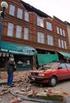 February 28 Earthquake: We got off easy State Geologist John Beaulieu Lucky may not be the first word that comes to mind after an earthquake that injured more than 200 and caused more than $1 billion damage,
Enhancing Business Resilience under Power Shortage: Effective Allocation of Scarce Electricity Based on Power System Failure and CGE Models
 Enhancing Business Resilience under Power Shortage: Effective Allocation of Scarce Electricity Based on Power System Failure and CGE Models Yoshio Kajitani *1, Kazuyoshi Nakano 2 and Ayumi Yuyama 1 1Civil
A New Paradigm in Urban Road Network Seismic Vulnerability: From a Link-by-link Structural Approach to an Integrated Functional Assessment
 A New Paradigm in Urban Road Network Seismic Vulnerability: From a Link-by-link Structural Approach to an Integrated Functional Assessment Gonçalo Caiado [email protected] Rosário Macário [email protected]
Disaster resiliency measurement frameworks. State of the art
 Disaster resiliency measurement frameworks State of the art Leila Irajifar 1, Tooran Alizadeh 2, Neil Sipe 3 Abstract Since adoption of the Hyogo Framework for Action 2005-2015 Building the resilience
The Economic Benefits of Oil and Natural Gas Production: An Analysis of Effects on the United States and Major Energy Producing States
 August 2014 The Economic Benefits of Oil and Natural Gas Production: An Analysis of Effects on the United States and Major Energy Producing States THE PERRYMAN GROUP 510 N. Valley Mills Dr. Suite 300 Waco,
Peace of mind that no earthquake can shake.
 California Earthquake Authority Your Guide to Earthquake Insurance Peace of mind that no earthquake can shake. Policy information for owners of Homes and Mobilehomes. Five reasons to buy a CEA policy.
Using GIS for Assessing Earthquake Hazards of San Francisco Bay, California, USA
 Using GIS for Assessing Earthquake Hazards of San Francisco Bay, California, USA Marzieh Zeinali Department of Resource Analysis, Saint Mary s University of Minnesota, Minneapolis, MN 55404 Keywords: San
MODELING POST-EARTHQUAKE RESTORATION OF THE LOS ANGELES WATER SUPPLY SYSTEM. A Thesis. Presented to the Faculty of the Graduate School
 MODELING POST-EARTHQUAKE RESTORATION OF THE LOS ANGELES WATER SUPPLY SYSTEM A Thesis Presented to the Faculty of the Graduate School of Cornell University In Partial Fulfillment of the Requirements for
 Testimony of Mr. Robert J. Fenton, Jr. Assistant Administrator for Response, Office of Response and Recovery Federal Emergency Management Agency U.S. Department of Homeland Security Before House Committee
Contents. Specific and total risk. Definition of risk. How to express risk? Multi-hazard Risk Assessment. Risk types
 Contents Multi-hazard Risk Assessment Cees van Westen United Nations University ITC School for Disaster Geo- Information Management International Institute for Geo-Information Science and Earth Observation
HISTORICAL FLOODS: 1861 1862
 USGS Mission The USGS serves the Nation by providing reliable scientific information to describe and understand the Earth; minimize loss of life and property from natural disasters; manage water, biological,
DECISION PROCESS AND OPTIMIZATION RULES FOR SEISMIC RETROFIT PROGRAMS. T. Zikas 1 and F. Gehbauer 2
 International Symposium on Strong Vrancea Earthquakes and Risk Mitigation Oct. 4-6, 2007, Bucharest, Romania DECISION PROCESS AND OPTIMIZATION RULES FOR SEISMIC RETROFIT PROGRAMS T. Zikas 1 and F. Gehbauer
Increasing Energy Reliability & Resiliency NGA Policy Institute for Governors' Energy Advisors Denver Colorado, September 11, 2013
 + Increasing Energy Reliability & Resiliency NGA Policy Institute for Governors' Energy Advisors Denver Colorado, September 11, 2013 Jeffrey R. Pillon, Director, Energy Assurance Programs National Association
The Economic Impacts of Reducing. Natural Gas and Electricity Use in Ontario
 The Economic Impacts of Reducing Natural Gas and Electricity Use in Ontario Prepared for Blue Green Canada July 2013 Table of Contents Executive Summary... i Key Findings... i Introduction...1 Secondary
The Economic Impact of Fire Damage on Wyoming s Economy from a Business Perspective
 The Economic Impact of Fire Damage on Wyoming s Economy from a Business Perspective A Regional Economic Models, Inc. (REMI) Policy Insight Analysis Prepared by Amy Bittner and Justin Ballard August 18,
ACUTE CARE HOSPITAL RESOURCE ALLOCATION PROBLEM UNDER SEISMICALLY DAMAGED TRANSPORTATION SYSTEMS
 13 th World Conference on Earthquake Engineering Vancouver, B.C., Canada August 1-6, 2004 Paper No. 1124 ACUTE CARE HOSPITAL RESOURCE ALLOCATION PROBLEM UNDER SEISMICALLY DAMAGED TRANSPORTATION SYSTEMS
TELECOMMUNICATION SYSTEM HAZARD MITIGATION STRATEGIC PLANNING
 TELECOMMUNICATION SYSTEM HAZARD MITIGATION STRATEGIC PLANNING A.K. Tang 1 1 President, L&T Engineering and Project Management Consultant, Mississauga. Canada Email: [email protected] ABSTRACT: Telecommunication
Economic Impacts of the ShakeOut Scenario
 CREATE Research Archive Published Articles & Papers 5-2011 Economic Impacts of the ShakeOut Scenario Adam Z. Rose University of Southern California, [email protected] Dan Wei University of Southern California
Toma Danila Dragos. National Institute for Earth Physics Romania
 Toma Danila Dragos National Institute for Earth Physics Romania Before: evaluate the hazard and risk, be prepared for worst case scenario Natural or antropic disaster After: quickly evaluate the situation
Natural Disaster Impact on Business and Communities in Taiwan. Dr. Chung-Sheng Lee. NCDR Chinese Taipei
 Natural Disaster Impact on Business and Communities in Taiwan Dr. Chung-Sheng Lee NCDR Chinese Taipei 1 Brief Introduction of NCDR 2 Organizational Chart of NCDR NDPPC: National Disaster Preparation and
AFAD DEPREM DAİRESİ BAŞKANLIĞI TÜRKİYE KUVVETLİ YER HAREKETİ ve ÖN HASAR TAHMİN SİSTEMLERİ ÇALIŞMA GRUBU. (Rapid Estimation Damage)
 (Rapid Estimation Damage) AFAD-RED SYSTEM The technological advances in seismic instrumentation and telecommunication permit the development of rapid estimation of earthquake losses in order to enhance
Mitigation Works. 0 Earthquakes move mountains. But so do imagination and ingenuity when matched with implementation.
 0 Earthquakes move mountains. But so do imagination and ingenuity when matched with implementation. 0 Earthquakes have long been feared as one of nature s most damaging hazards. Earthquakes continue to
Disaster Risk Assessment:
 Disaster Risk Assessment: Disaster Risk Modeling Dr. Jianping Yan Disaster Risk Assessment Specialist Session Outline Overview of Risk Modeling For insurance For public policy Conceptual Model Modeling
Flood damage assessment and estimation of flood resilience indexes
 Flood damage assessment and estimation of flood resilience indexes Barcelona case study Marc Velasco CETaqua Workshop CORFU Barcelona Flood resilience in urban areas the CORFU project Cornellà de Llobregat,
Six Tips for Building an Earthquake Scenario: Lessons Learned from coordinating the economic consequences of the Southern California ShakeOut Scenario
 Six Tips for Building an Earthquake Scenario: Lessons Learned from coordinating the economic consequences of the Southern California ShakeOut Scenario Anne Wein Western Geographic Science Center USGS June
Would These Keywords Help Your Business? divorce lawyer 90254 90254 divorce lawyer divorce lawyer hermosa beach divorce lawyer hermosa beach ca
 divorce lawyer 90254 90254 divorce lawyer divorce lawyer hermosa beach divorce lawyer hermosa beach ca divorce lawyer hermosa beach california divorce lawyer in hermosa beach divorce lawyer in hermosa
Dollars, deaths, and downtime: understand your building's seismic risk and how to evaluate it
 Dollars, deaths, and downtime: understand your building's seismic risk and how to evaluate it SEAOSC Strengthening Our Cities Summit 5 Nov 2015, Los Angeles, CA Keith Porter, PE PhD University of Colorado
PPRD SOUTH ASSESSMENT TOOLS REGIONAL RISK ATLAS. Aim of the Atlas is to build a common risk assessment and
 PPRD SOUTH ASSESSMENT TOOLS REGIONAL RISK ATLAS Aim of the Atlas is to build a common risk assessment and mapping methodology among the Partner Countries in view to stimulate discussion on shared approaches
Structural Retrofitting For Earthquake Resistance
 Structural Retrofitting For Earthquake Resistance Ruben Boroschek WHO Disaster Mitigation in Health Facilities University of Chile [email protected] www.hospitalseguro.cl The following paper is part
Susan A. Brink. Summary
 [email protected] Susan A. Brink Summary Hertzstraße 16 76187 Karlsruhe Civil engineer with a PhD and research experience in computer modeling and assessment of risk, disaster response and recovery and significant
Effective Federal Income Tax Rates Faced By Small Businesses in the United States
 Effective Federal Income Tax Rates Faced By Small Businesses in the United States by Quantria Strategies, LLC Cheverly, MD 20785 for Under contract number SBAHQ-07-Q-0012 Release Date: April 2009 This
Building a Spatial Database for Earthquake Risk Assessment and Management in the Caribbean
 Building a Spatial Database for Earthquake Risk Assessment and Management in the Caribbean Jacob Opadeyi and Rehanna Jadoo Department of Geomatics Engineering and Land Management, The University of the
Strategic Plan. National Earthquake Hazards Reduction Program
 Strategic Plan for the National Earthquake Hazards Reduction Program Fiscal Years 2009 2013* October 2008 *Plan remains in effect and will be updated in accordance with future NEHRP Reauthorization This
(310) 543-9900 (310) 379-3620, (310) 370-5902, (213) 745-6434, (213) 222-1237, (562) 388-7652 [email protected]
 Los Angeles Violence Prevention Resource Directory Domestic Violence Victim/Prevention Services 1736 Family Crisis Center South Bay Office 21707 Hawthorne Blvd., Suite 300 Torrance, CA 90503 (310) 543-9900
Federal Emergency Management Agency (FEMA) Preliminary Flood Insurance Rate Maps (FIRMs) and Preliminary Flood Insurance Study (FIS) for New York City
 March 10, 2014 Submitted electronically via http://www.nyc.gov Mayor s Office of Long Term Planning and Sustainability c/o Flood Map Comments 253 Broadway, 10th Floor New York, NY 10007 Federal Emergency
APPLICATION OF EARTHQUAKE ENGINEERING INFORMATION IN HOSPITAL EMERGENCY RESPONSE AND RECOVERY
 APPLICATION OF EARTHQUAKE ENGINEERING INFORMATION IN HOSPITAL EMERGENCY RESPONSE AND RECOVERY Robert Reitherman 1 1. Consortium of Universities for Research in Earthquake Engineering 1301 South 46 th Street,
Business Continuity Roadmap -One Port s Approach. - Rich Baratta, ARM, ABCP Director, Risk Management Port of Long Beach
 Business Continuity Roadmap -One Port s Approach - Rich Baratta, ARM, ABCP Director, Risk Management Port of Long Beach The San Pedro Bay Port Complex DHS DIRECTIVE ON RECOVERY MARITIME INFRASTRUCTURE
How To Plan For Post Disaster Recovery
 Pre-Disaster Planning for Post-Disaster Recovery NAS Disaster Roundtable October 17, 2007 Laurie A. Johnson, AICP Dr. Robert Olshansky, AICP Agenda California s Experience APA PAS Report and Model Recovery
Minnesota State Plan Review Level 2 Hazus-MH 2.1 County Model for Flooding Dakota County Evaluation
 Overview Minnesota State Plan Review Level 2 Hazus-MH 2.1 County Model for Flooding Dakota County Evaluation Minnesota Homeland Security and Emergency Management (HSEM) is responsible for supporting activities
Flickr: Randy Pertiet. Baltimore s Inner Harbor: Economic Impact, Importance, and Opportunities for Investment October 31, 2013
 Flickr: Randy Pertiet Baltimore s Inner Harbor: Economic Impact, Importance, and Opportunities for Investment October 31, 2013 Executive Summary: Baltimore s Inner Harbor drives substantial economic and
Nova Scotia EMO. Hazard Risk Vulnerability Assessment (HRVA) Model. Guidelines for Use. October, 2010
 Nova Scotia EMO Hazard Risk Vulnerability Assessment (HRVA) Model Guidelines for Use October, 2010 EMO NS Hazard Risk Vulnerability Assessment Model Page 1 of 10 Table of Contents 1. Background 2. Definitions
INTERMEDIATE SMALL BANK
 O INTERMEDIATE SMALL BANK Comptroller of the Currency Administrator of National Banks Washington, DC 20219 PUBLIC DISCLOSURE April 23, 2008 COMMUNITY REINVESTMENT ACT PERFORMANCE EVALUATION Bay Cities
District Disaster Risk Management Planning
 District Disaster Risk Management Planning GUIDELINES JULY 2007 National Disaster Management Authority 1. Introduction Notifications for establishment of the District Disaster Management Authorities (DDMAs)
CONTINUITY OF OPERATIONS PLANNING
 University of North Carolina Wilmington CONTINUITY OF OPERATIONS PLANNING November 9, 2010 Lumina Theater, Fisher Student Center Development of Continuity Planning University of North Carolina Wilmington
Hospital Emergency Operations Plan
 Hospital Emergency Operations Plan I-1 Emergency Management Plan I PURPOSE The mission of University Hospital of Brooklyn (UHB) is to improve the health of the people of Kings County by providing cost-effective,
An Introduction to ISBDC Small Business Resources
 An Introduction to ISBDC Small Business Resources ESRI Reports Find new customers Evaluate competitors Reveal untapped markets Analyze trade areas Identify locations to grow Search by radius, drive time,
A Framework for Post-Disaster Facility Restoration Management: Needs and Requirements for the Use of Hybrid Simulation
 1269 A Framework for Post-Disaster Facility Restoration Management: Needs and Requirements for the Use of Hybrid Simulation Moonseo PARK 1 ; SangHyun LEE 2 ; Hyun-Soo LEE 3 ; Minji CHOI 4 ; Sungjoo HWANG
Rafi Ahmad & Parris Lyew-Ayee
 Challenges with Spatial Information in the Caribbean Rafi Ahmad & Parris Lyew-Ayee Mona GeoInformatics Institute The University of the West Indies at Mona, Jamaica Challenges associated with: Data availability
ARkStorm: California s Other Big One!
 ARkStorm: California s Other Big One! Understanding the Impacts of Massive Winter Storms Mark Jackson Meteorologist in Charge NOAA/National Weather Service Los Angeles/Oxnard What is ARkStorm? Emergency-preparedness
APPLICATION OF EARTHQUAKE ENGINEERING INFORMATION IN HOSPITAL EMERGENCY RESPONSE AND RECOVERY
 Workshop on Seismic Design and Retrofitting of Hospitals in Seismic Areas, October 21-22, 1999. APPLICATION OF EARTHQUAKE ENGINEERING INFORMATION IN HOSPITAL EMERGENCY RESPONSE AND RECOVERY Robert Reitherman
WSDOT s Approach to Seismic Retrofit of Highway Structures
 WSDOT s Approach to Seismic Retrofit of Highway Structures Role of the Lifeline Route in Reducing Network Risk Lynn Peterson Secretary of Transportation Patrick Morin, PE Capital Program Development &