
INSTRUCTIONAL MATERIALS ADOPTION Score Sheet I. Generic Evaluation Criteria II. Instructional Content Analysis III. Specific Science Criteria
|
|
|
- Ginger Black
- 9 years ago
- Views:
Transcription
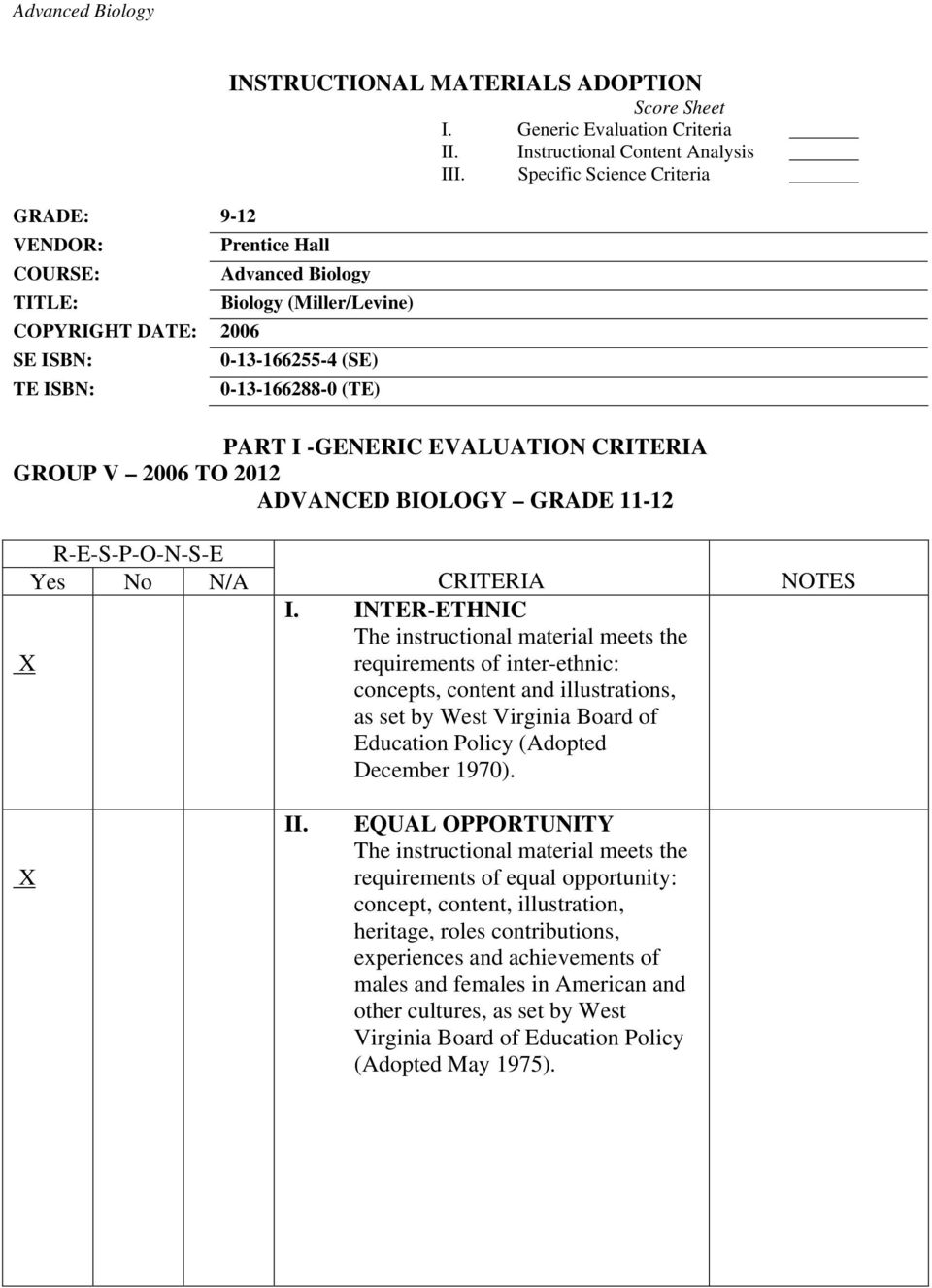
1 GRADE: 9-12 VENDOR: Prentice Hall COURSE: Advanced Biology TITLE: Biology (Miller/Levine) COPYRIGHT DATE: 2006 SE ISBN: (SE) TE ISBN: (TE) INSTRUCTIONAL MATERIALS ADOPTION Score Sheet I. Generic Evaluation Criteria II. Instructional Content Analysis III. Specific Science Criteria PART I -GENERIC EVALUATION CRITERIA GROUP V 2006 TO 2012 ADVANCED BIOLOGY GRADE R-E-S-P-O-N-S-E Yes No N/A CRITERIA NOTES I. INTER-ETHNIC The instructional material meets the X requirements of inter-ethnic: concepts, content and illustrations, as set by West Virginia Board of Education Policy (Adopted December 1970). X II. EQUAL OPPORTUNITY The instructional material meets the requirements of equal opportunity: concept, content, illustration, heritage, roles contributions, experiences and achievements of males and females in American and other cultures, as set by West Virginia Board of Education Policy (Adopted May 1975).
2 PART II - ADVANCED BIOLOGY GRADE Instructional Content Analysis (Vendor/Publisher) SPECIFIC LOCATION OF CONTENT WITHIN PRODUCT I=In-depth 80% A=Adequate 80% (IMR Committee) Responses M=Minimal 60% N=Nonexistent Less than 60% I A M N The instructional materials program presents information and opportunities in a manner that enables the student to: 9, 32, 55, 129, 133, 161, 194, 215, , 411, 491, 508, 543, 601, 627, 676, 739, 782, 790, 883, All of the 40 Inquiry Labs listed on p. xiii 8, 30, 49, 129, 157, 190, 208, 327, 404, 485, 506, 537, 599, 622, 669, 734, 783, 878, 985 PRINT: Section 1-2; 2-4; 5-3; 6-4; 7-4; 8-3; 13-3; 16-3; 20-1; 20-3; 21-3; 23-5; 24-3; 26-3; 28-4; 30-3; 34-2; 38-3; Lab 17, Issue 4; concept 5,7, lab 14, 15; 1. History and the Nature of Science a. formulate scientific explanations based on the student's observational and experimental evidence, accounting for variability in experimental results (AB.1.1)

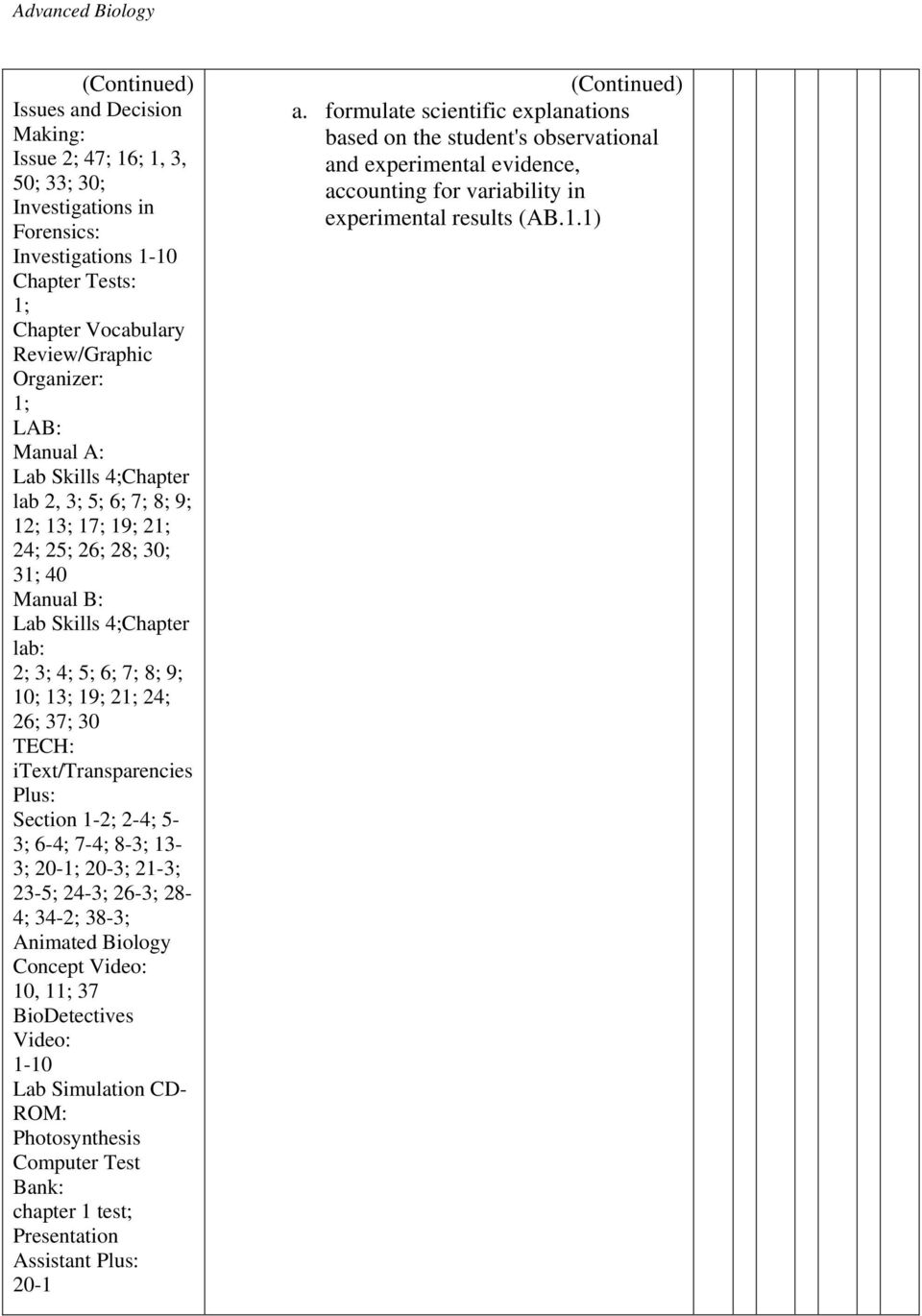
3 Issue 2; 47; 16; 1, 3, 50; 33; 30; Investigations in Forensics: Investigations 1-10 Chapter Tests: 1; Chapter Vocabulary Review/Graphic Organizer: 1; Lab Skills 4;Chapter lab 2, 3; 5; 6; 7; 8; 9; 12; 13; 17; 19; 21; 24; 25; 26; 28; 30; 31; 40 Lab Skills 4;Chapter lab: 2; 3; 4; 5; 6; 7; 8; 9; 10; 13; 19; 21; 24; 26; 37; 30 Section 1-2; 2-4; 5-3; 6-4; 7-4; 8-3; 13-3; 20-1; 20-3; 21-3; 23-5; 24-3; 26-3; 28-4; 34-2; 38-3; 10, 11; 37 BioDetectives Video: 1-10 Lab Simulation CD- ROM: Photosynthesis Computer Test Bank: chapter 1 test; Presentation Assistant 20-1 a. formulate scientific explanations based on the student's observational and experimental evidence, accounting for variability in experimental results (AB.1.1)
4 14, 23, 128, 233, 253, 330, 354, 403, 410, 456, 484, 617, 647, 668, 877, 932,700, 853, , 16, 124, 250, 267, 327, 349, 397, 404, 451, 478, 609, 643, 664, 871, 926, 1043 PRINT 1-2; 1-3; 5-2; 10-3; 11-2; 13-3; 14-2; 16-2; 16-3; 18-2; 19-2; 24-1; 25-3; 26-2; 34-1; 36-2; 40-3 Concept 5,7, Lab 14, 15; Issue 2; 48; 7; 16; Investigations in Forensics: 3; 7; 1-2; 1-3; 5-2; 10-3; 11-2; 13-3; 14-2; 16-2; 16-3; 18-2; 19-2; 24-1; 25-3; 26-2; 34-1; 36-2; ; 31; 34; 39; BioDetectives Video: Skin Cancer: Deadly Cells; b. communicate that science has practical and theoretical limitations (AB.1.2)

5 Coming Home: A Nation s Pledge; Influenza: Tracking a Deadly Virus; 4-6, 8-15, 55, 65, 133, , 215, 376, 377, 386, 389, , 410, 411, 413, 414, 441, 483, 491, 676, , 840 All Inquiry Activities, Design an Experiments and Real-World Labs 3, 8, 49, 63, 129,190, 208, 373, 404, 435, 478, 485, 669, 782; 833 PRINT 1-1; 1-2; 2-4; 3-1; 5-3; 8-3; 15-2; 16-3; 17-4; 19-2; 19-3; 26-3; 30-3; 32-3 Chapter lab: 2; 3; 5; 6; 7; 8; 9; 12; 13; 17; 19; 21; 24; 25; 26; 28; 30; 31; 40 Chapter lab: 2; 3; 4; 5; 6; 7; 8; 9; 10; 13; 19; 21; 24; 26; 37; 30 b. communicate that science has practical and theoretical limitations (AB.1.2) c. recognize that science is based on a set of observations in a testable framework that demonstrate basic laws that are consistent (AB.1.3)

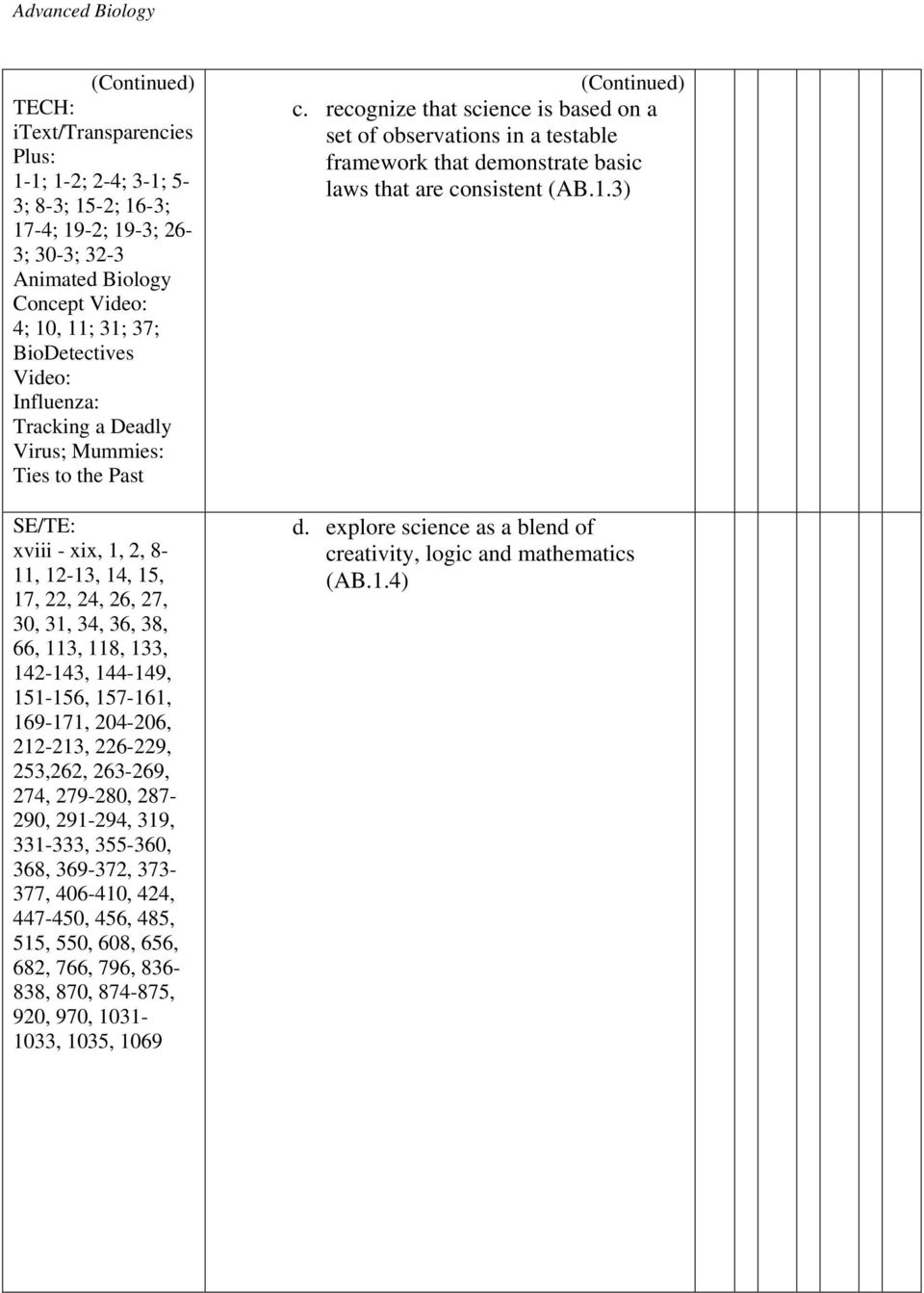
6 1-1; 1-2; 2-4; 3-1; 5-3; 8-3; 15-2; 16-3; 17-4; 19-2; 19-3; 26-3; 30-3; ; 10, 11; 31; 37; BioDetectives Video: Influenza: Tracking a Deadly Virus; Mummies: Ties to the Past xviii - xix, 1, 2, 8-11, 12-13, 14, 15, 17, 22, 24, 26, 27, 30, 31, 34, 36, 38, 66, 113, 118, 133, , , , , , , , , 253,262, , 274, , , , 319, , , 368, , , , 424, , 456, 485, 515, 550, 608, 656, 682, 766, 796, , 870, , 920, 970, , 1035, 1069 c. recognize that science is based on a set of observations in a testable framework that demonstrate basic laws that are consistent (AB.1.3) d. explore science as a blend of creativity, logic and mathematics (AB.1.4)
7 8, 16, 24, 30, 35, 63, 106, 119, 139, 144, 150, 157, 169, 204, 208, 226, 250, 263, 267, 279, 287, 319, 327, 355, 369, 373, 404, 423, 447, 485, 510, 551, 609, 657, 683, 767, 797, 833, 871, 921, 1031All Writing in Science, list p ; 1-3; 1-4; 2-1; 3-1; 4-4; 5-1; 6-1; 6-2; 6-3; 6-4; 7-1; 8-2; 8-3; 9-2; 10-3; 11-1; 26-1; 27-1; 30-1; 31-1; 32-3; 34-1; 36-1;40-1 Lab 17, Issue 4; lab 2; lab 4, 5, 6; concept 5, 7, lab 14, 15; concept 2, 3, 46, lab 2, 11, 12; lab 16 Issue 2; 29; 21, 23, 27, 31; 22, 25, 26, 30, 32, 34, 36; 1, 3, 50; 9, 10, 11, 12; 16; 34; 15, 17; 38; Investigations in Forensics: 1; 3; 5; 7; d. explore science as a blend of creativity, logic and mathematics (AB.1.4)

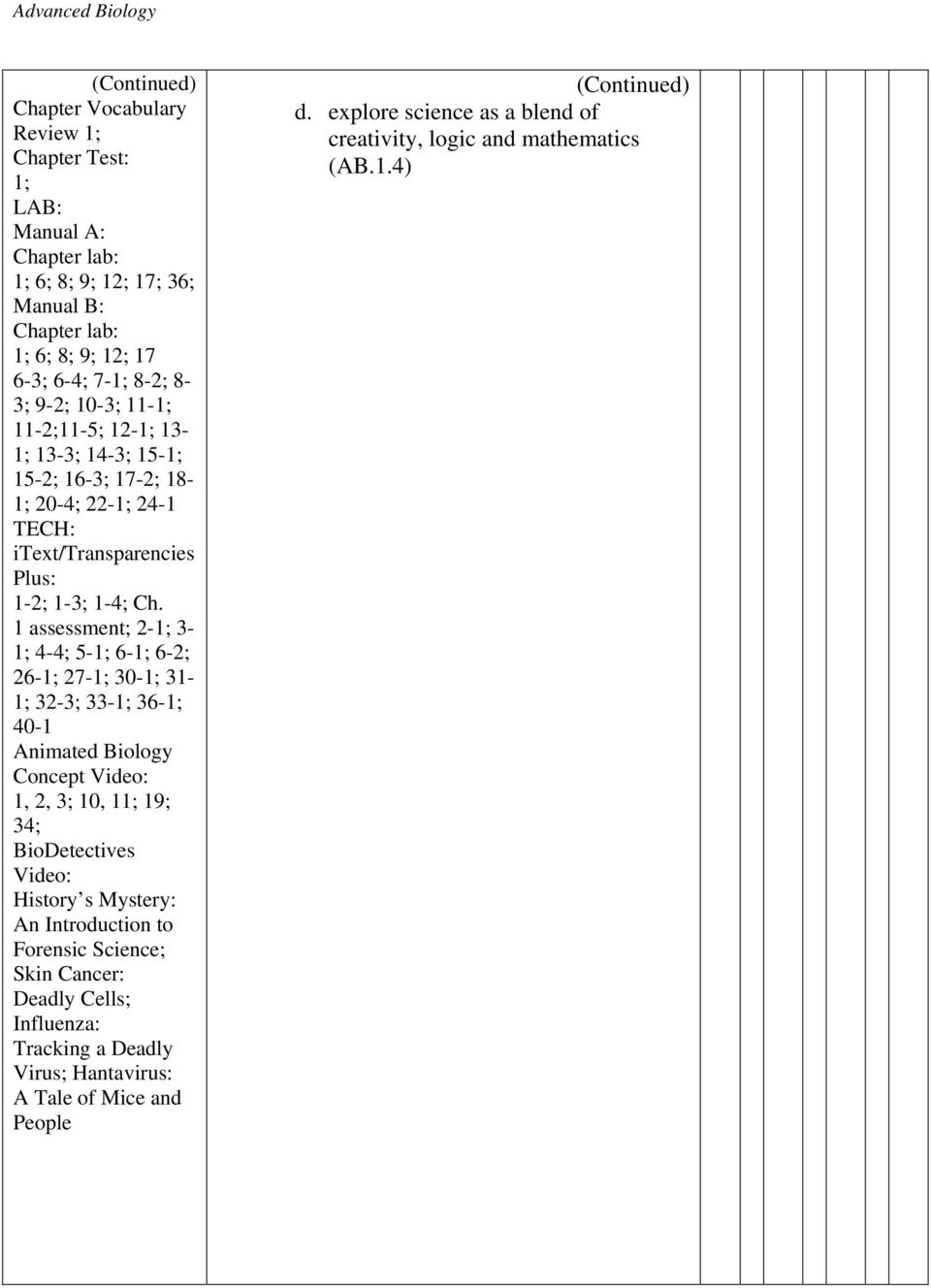
8 Chapter Vocabulary Review 1; Chapter Test: 1; Chapter lab: 1; 6; 8; 9; 12; 17; 36; Chapter lab: 1; 6; 8; 9; 12; ; 6-4; 7-1; 8-2; 8-3; 9-2; 10-3; 11-1; 11-2;11-5; 12-1; 13-1; 13-3; 14-3; 15-1; 15-2; 16-3; 17-2; 18-1; 20-4; 22-1; ; 1-3; 1-4; Ch. 1 assessment; 2-1; 3-1; 4-4; 5-1; 6-1; 6-2; 26-1; 27-1; 30-1; 31-1; 32-3; 33-1; 36-1; , 2, 3; 10, 11; 19; 34; BioDetectives Video: History s Mystery: An Introduction to Forensic Science; Skin Cancer: Deadly Cells; Influenza: Tracking a Deadly Virus; Hantavirus: A Tale of Mice and People d. explore science as a blend of creativity, logic and mathematics (AB.1.4)
9 Lab Simulation CD- ROM: Mendelian Inheritance; DNA Structure and Replication; Computer Test Bank: Ch 1 test; Investigations in Forensics: 8 Chapter lab 12; 15; 37 Chapter lab: 12; 15; ; 6-3; 7-1; 8-1; 12-1; 15-1; 15-3; 24-3; 28-3; 32-3; 37-1; 8; 43 BioDetectives Video: Mummies: Ties to the Past; Lab Simulation CD- ROM: DNA Structure and Replication; Cardiovascular 1 d. explore science as a blend of creativity, logic and mathematics (AB.1.4) e. trace the development of key historical concepts and principles describing their impact on modern thought and life by identifying the scientist s contributions (AB.1.5)
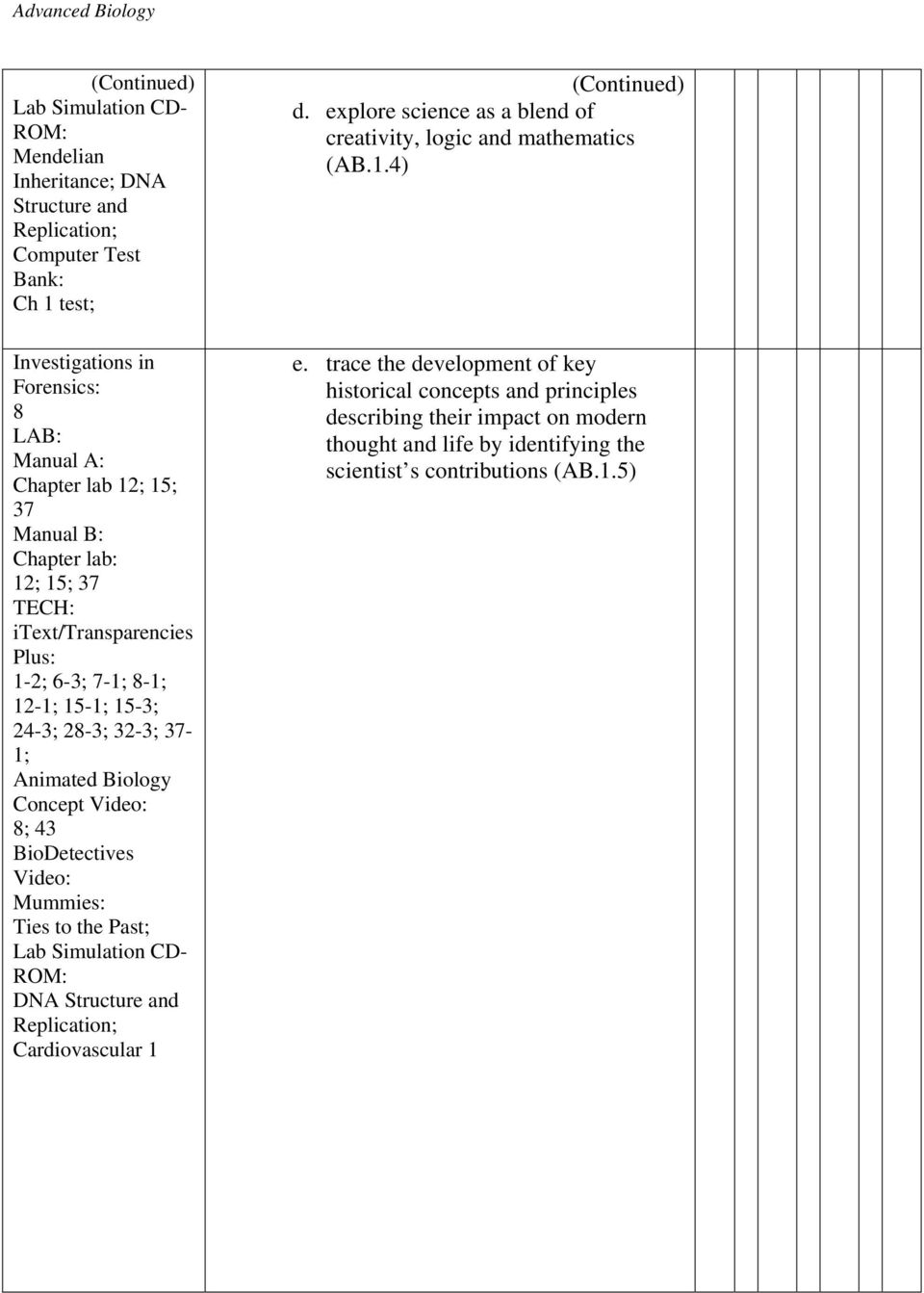
10 12-13, , , , , , , , , , 150, 169, 201, 287, 373, 622, 726, 833, 943 PRINT 1-2; 6-3; 7-1; 8-1; 12-1; 15-2; 24-3; 28-3; 32-3; , 5, 6; Issue 2; 22, 25, 26, 30, 32, 34, 36; 15, 17; Investigations in Forensics: 8 12; ; 6-3; 7-1; 8-1; Chapter lab 12; 37 Chapter lab: 12-1; 15-2; 24-3; 28-3; 32-3; ; 34 BioDetectives Video: Mummies: Ties to the Past; f. integrate the history of science with cultural history to demonstrate that scientists work within their historical surroundings and are affected by them (AB.1.6)
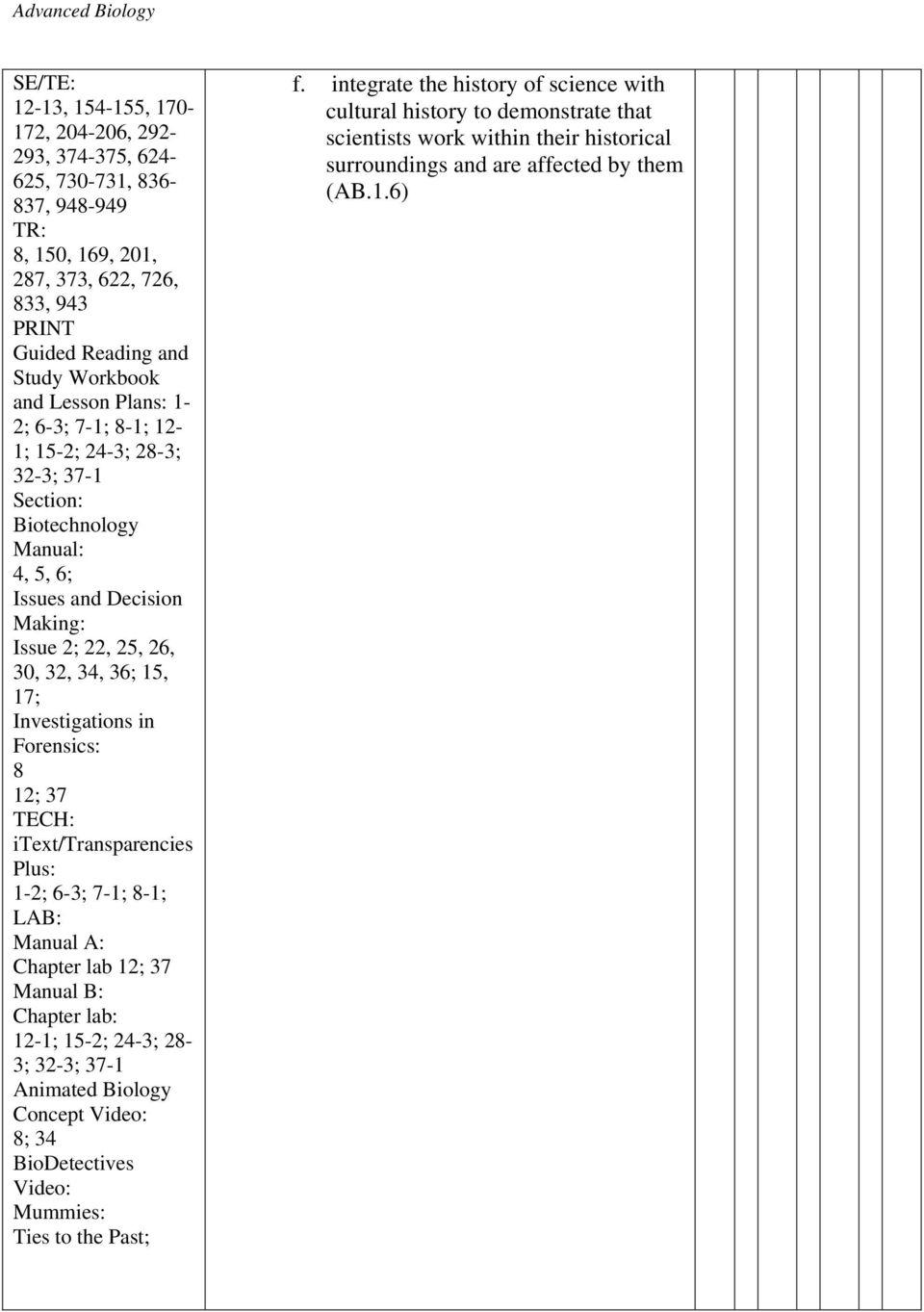
11 Insect Clues; Lab Simulation CD- ROM: DNA Structure and Replication; Cardiovascular 1 2, 8-15, 23, 34, 54, 62, 86, 118, 128, 138, , 168, 200, 215, 220, 224, 230, 233, 235, 240, 255, 262, 271, 281, 286, 318, 330, 334, 335, 340, 354, 368, 392, 416, 446, 470, 496, 521, 526, 550, 553, 578, 608, 627, 632, 656, 677, 682, 709, 714, 739, 744, 750, 759, 766, 791, 796, 799, 820, 848, 870, 883, 890, 920, 937, 942, 964, 970, 990, 996,977, 1008, 1030, 1055, , , 8, 16, 35, 63, 87, 119, 124, 139, 157, 169, 201, 208, 221, 226, 241, 250, 263, 267, 279, 287, 319, 327, 331, 341, 349, 369, 393, 417, 447, 471, 497, 516, 527, 551, 579, 609, 622, 633, 657, 669, 683, 701, 715, 734, 745, 767, 782, 797, 821, 849, 871, 878, 891, 921, 933, 943, 956, 971, 985, 997, 1003, 1031, 1049 f. integrate the history of science with cultural history to demonstrate that scientists work within their historical surroundings and are affected by them (AB.1.6) 2. Science as Inquiry Objectives a. develop the skills, attitudes and/or values of scientific inquiry (e.g., curiosity, logic, objectivity, openness, skepticism, appreciation, diligence, integrity, ethical practice, fairness, creativity) (AB.2.1)
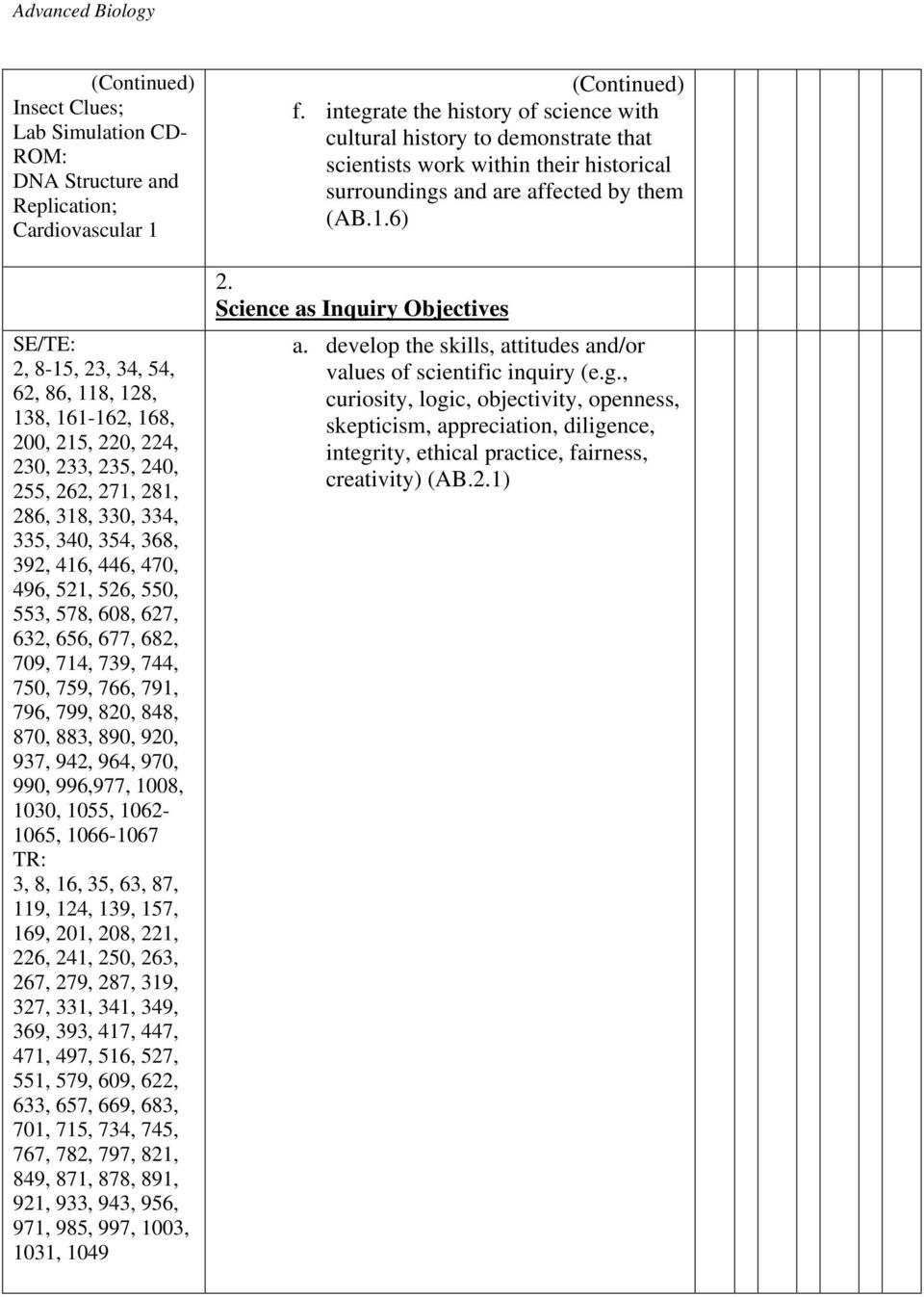
12 PRINT Section 1-1; 1-2; 1-3; 2-1; 3-1; 4-1; 5-1; 5-2; 6-1; 6-4; 8-1; 8-3; 9-1; 9-2; 10-1; 10-3; 11-1; 11-2; 11-5; 12-1; 13-1; 13-3; 13-4; 14-1; 14-2; 15-1; 16-1; 17-1; 18-1; 19-1; 20-1; 20-5; 21-1; 22-1; 23-1; 24-1; 24-3; 26-1; 26-3; 27-1; 27-4; 28-1; 28-4; 29-1; 30-1; 30-3; 31-1; 32-1; 33-1; 34-1; 34-2; 35-1; 36-1; 36-3; 37-1; 37-3; 38-1; 38-3; 39-1; 39-2; 40-1; 40-4 concept 1; concept 8; lab 17, issue 4; lab 1; lab 2; lab 4, 5, 6; concept 5, 7, lab 14, 15; issue 2, 3, lab 10; concept 7; lab 16; lab 13; Issue 2; 48; 29; 1, 3, 50; 18; 7; 14; 30; 33; 34; 4; 38; 41; 5, 35, 39, 49; 40; 43; Investigations in Forensics: 3; 5; 7; 9 Chapter lab 6; 9; 12; 14; 16; 17; 19; 20; 25; 26; 30; 36; 37; 38; a. develop the skills, attitudes and/or values of scientific inquiry (e.g., curiosity, logic, objectivity, openness, skepticism, appreciation, diligence, integrity, ethical practice, fairness, creativity) (AB.2.1)

13 Chapter lab: 6; 9; 12; 14; 16; 17; 19; 20; 25; 26; 30; 36; 37; 38; 1-1; 1-2; 1-3; 2-1; 3-1; 4-1; 5-1; 5-2; 6-1; 6-4; 7-1; 8-1; 8-3; 9-1; 9-2; 10-1; 10-3; 11-1; 11-2; 11-5; 12-1; 13-1; 13-3; 13-4; 14-1; 14-2; 15-1; 16-1; 17-1; 18-1; 19-1; 20-1; 20-5; 21-1; 22-1; 23-1; 24-1; 24-3; 25-1; 26-1; 26-3; 27-1; 27-4; 28-1; 28-4; 29-1; 30-1; 30-3; 31-1; 32-1; 33-1; 34-1; 34-2; 35-1; 36-1; 36-3; 37-1; 37-3; 38-1; 38-3; 39-1; 39-2; 40-1; 40-4; 1, 2, 3; 8; 10, 11; 13; 23; 24; 34; 37; 43; 42; 41; 47; BioDetectives Video: History s Mystery: An Introduction to Forensic Science; Skin Cancer: Deadly Cells; Mummies: Ties to the Past; Coming Home: A Nation s Pledge; Lab Simulation CD- ROM: 21; a. develop the skills, attitudes and/or values of scientific inquiry (e.g., curiosity, logic, objectivity, openness, skepticism, appreciation, diligence, integrity, ethical practice, fairness, creativity) (AB.2.1)
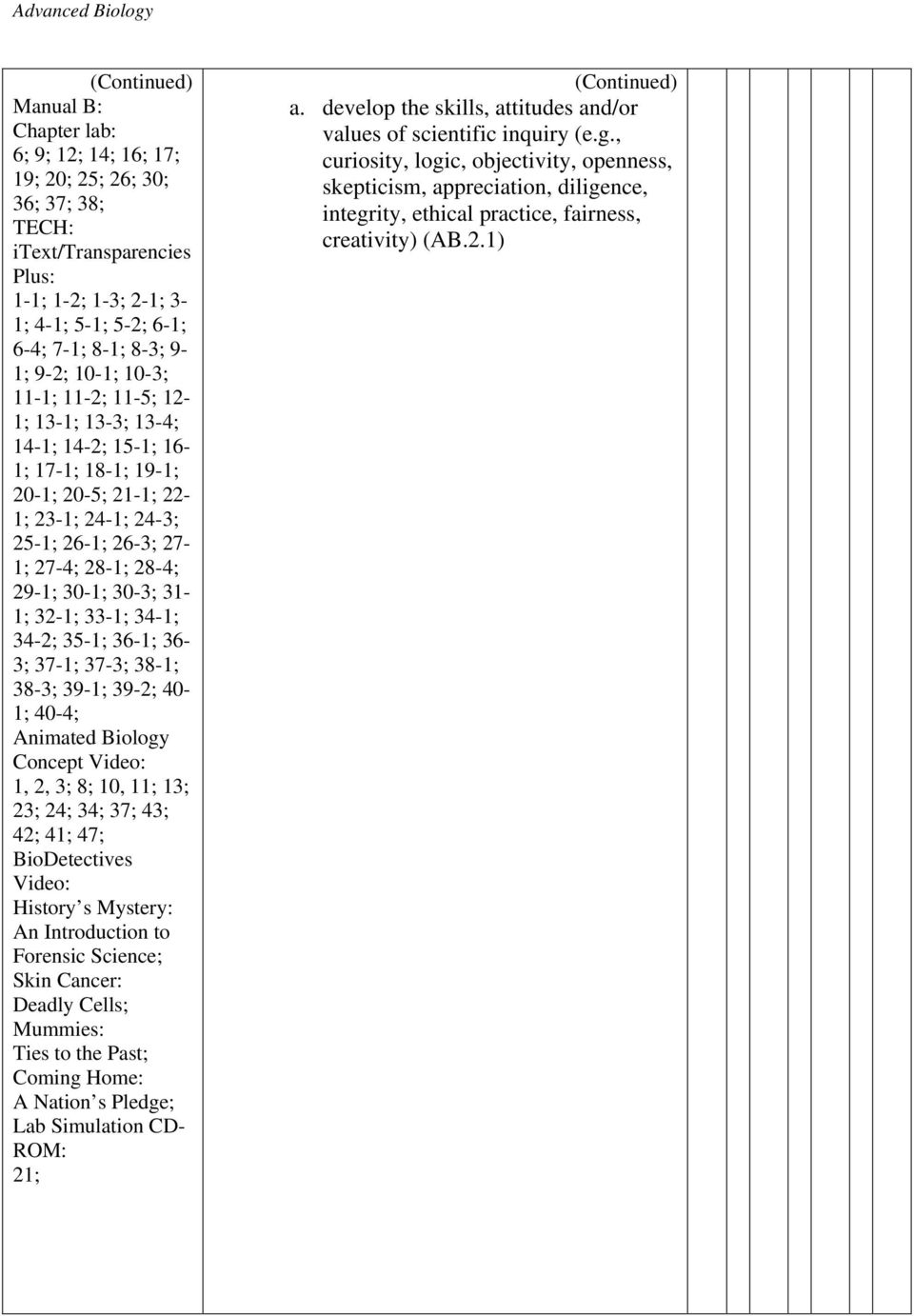
14 Cell Respiration; DNA Structure and Replication; Cardiovascular 1; Presentation: Assistant ch. Assistant a. develop the skills, attitudes and/or values of scientific inquiry (e.g., curiosity, logic, objectivity, openness, skepticism, appreciation, diligence, integrity, ethical practice, fairness, creativity) (AB.2.1) (Vendor/Publisher) SPECIFIC LOCATION OF CONTENT WITHIN PRODUCT I=In-depth 80% A=Adequate 80% (IMR Committee) Responses M=Minimal 60% N=Nonexistent Less than 60% I A M N 3-7, 8-10, , , 8 1-1; 1-2 concept 1; Issue 2 1-1; , , , , , , , , , 932, , , 1048 b. discuss ethical practices for science (e.g., established research protocol, accurate record keeping, replication of results and peer review) (AB.2.2)
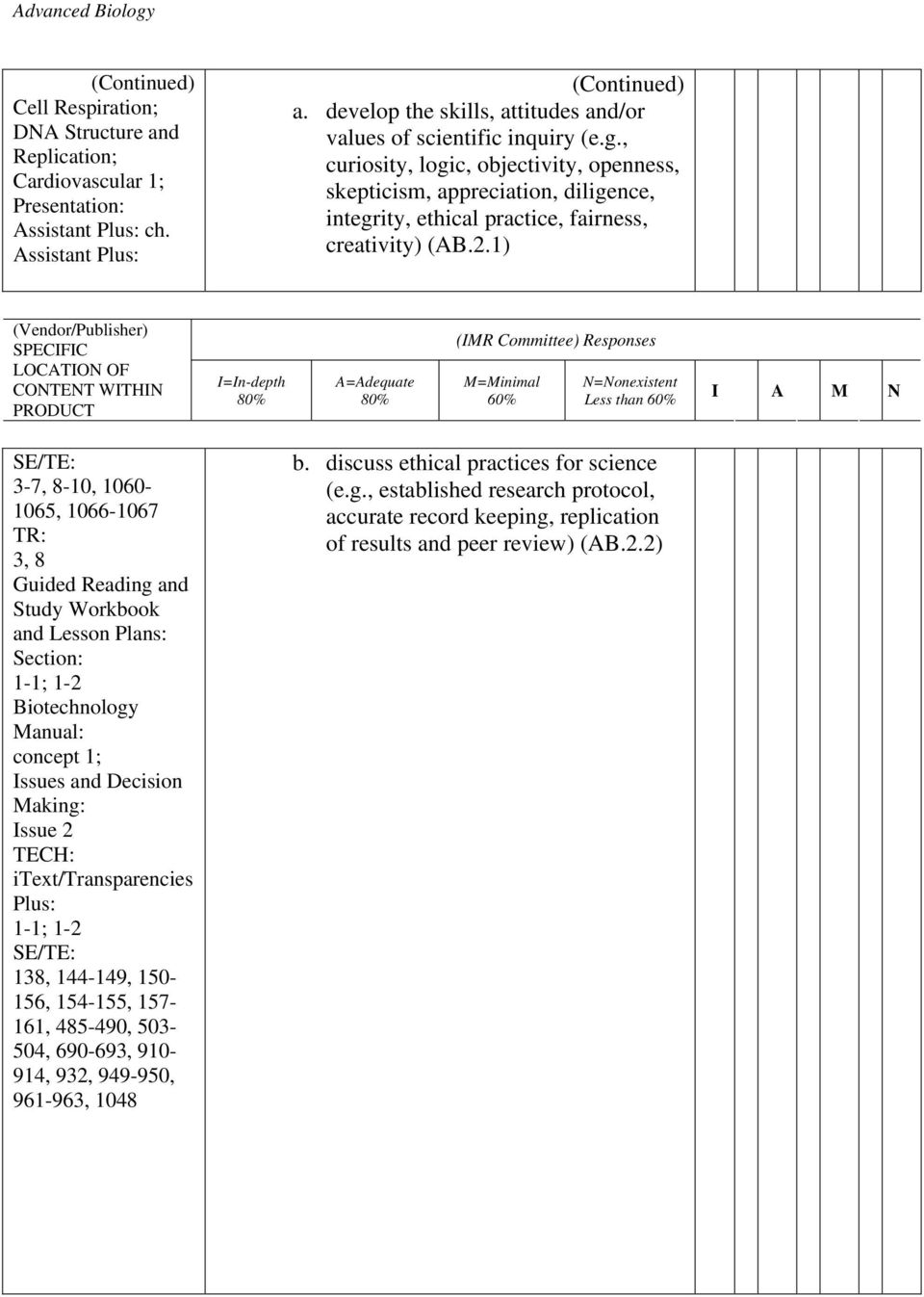
15 139, 144, 150, 157, 485, 499, 689, 910, 926, 943, 951, ; 6-2; 6-3; 6-4; 19-3; 20-2; 27-2; 35-5; 36-2; 37-1; 37-2; 40-3 lab 16 Issue 29; 21, 23, 27, 31; 22, 25, 26, 30, 32, 34, 36; 1, 3, 50; 8, 41, 42 Investigations in Forensics: 6; 10 Chapter lab 6; 19; 20; 37 Chapter lab: 6; 19; 20; ; 6-2; 6-3; 6-4; 19-3; 20-2; 27-2; 35-5; 36-2; 37-1; BioDetectives Video: investgation 1; 2; 3; 4; 5; 6; 7; 8; 9; 10 Lab Simulation CD- ROM: Cardiovascular 1 Presentation Assistant ch. 37 c. apply scientific approaches to seek solutions for personal and societal issues (AB.2.3)

16 25, 54-55, 161, , 521, 543, 677, 739, 883, , All Inquiry Activities, Quick Labs, Real-World Labs, Design An Experiment Labs and Explorations, Lab Manual A 7-12 and all labs, Lab Manual B 7-13 and all labs 24, 49, 157,331, 516, 537, 669, 734, 878, Lab Manual A and B T5-T7 1-4; 2-4; 6-4; 13-4; 20-5; 21-3; 26-3; 28-4; 34-2 Issue 1, 3, 50; 18; 30; Investigations in Forensics: 1 Chapter lab 1; Chapter lab: 1; Section 1-4; 2-4; 6-4; 13-4; 20-5; 21-3; 26-3; 28-4; ; a. properly and safety manipulate equipment, materials, chemicals, organisms and models (AB.2.4)
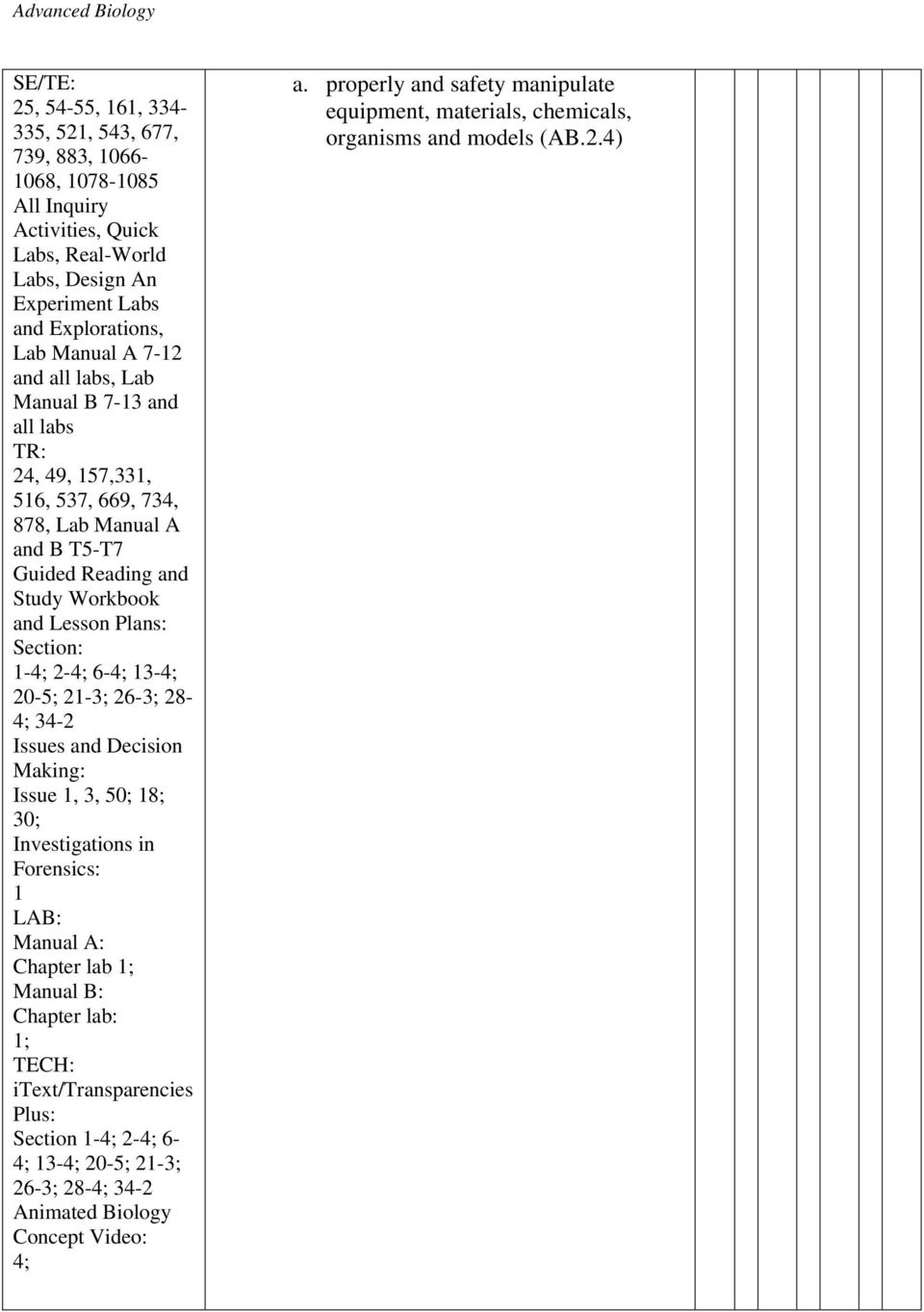
17 23, 66, 128, 233, 330, 354, 403, 484, 647, 700, 853, 1048, , 63, 124, 226, 327, 349, 397, 478, 643, 694, 849, ; 3-1; 5-2; 9-2; 13-3; 14-2; 16-2; 19-2; 25-3; 27-3; 33-1; 40-3 concept 5, 7, lab 14, 15; Issue 48; 7; 28 Chapter lab 9; Chapter lab: 9; Section 1-3; 3-1; 5-2; 9-2; 13-3; 16-2; 19-2; 25-3; 27-3; 33-1; , 54-55, 66, 128, 161, 233, 234, 254, 330, 354, 403, 484, 603, 647, 676, 700, , 853, , 49, 63, 124, 157, 226, 250, 327, 349, 397, 478, 599, 643 b. explore a variety of environments (e.g., laboratories, museums, libraries, parks and other outdoors locations) (AB.2.5) c. use computers and other electronic technologies in an investigative context (AB.2.6)

18 669, 694, 782, 849, 1043 Section 1-3; 2-4; 3-1; 5-2; 6-4; 9-2; 10-3; 13-3; 14-2; 16-2; 19-2; 23-5; 25-3; 26-3; 27-3; 30-3; 33-1; 40-3 concept 5-7, lab 14, 15; Issue 48; 1, 3, 50; 7; 28; 33; Investigations in Forensics: 3; Section 1-3; 2-4; 3-1; 5-2; 6-4; 9-2; 10-3; 13-3; 14-2; 16-2; 19-2; 23-5; 25-3; 26-3; 27-3; 30-3; 33-1; ; 12, 14, 15; 24; 32, 33; 37; BioDetectives Video: Skin Cancer: Deadly Cells; Coming Home: A Nation s Pledge; Lab Simulation CD- ROM: Cellular Respiration; c use computers and other electronic technologies in an investigative context (AB.2.6)

19 29, 51, 79, 91, 111, 158, 161, 180, , 206, 213, , 249, 249, 255,268, 271, 274, 303, 313, , 341, 343, 379, 387, 392, 408, 411, 446, 462, 463, 526, 541, 550, 553, 573, 578, 592, 613, 620, 627, 632, 648, 649, 667, 676, 677, 707, 714, 724, 744, 750, 753, 759, 766, , 796, 799, 811, 815, 843, 855, 865, 879, 905, 920, 930, 935, 936, 954, 970, 977, 982, 991, 1025, , 49, 74, 90, 106, 157, 190, 204, 208, 221, 226, 241, 244, 267, 295, 300, 309, 331, 341, 378, 393, 404, 457, 527, 537, 551, 569, 579, 589, 609, 618, 622, 633, 643, 664, 669, 701, 715, 720, 745, 751, 767, 782, 797, 806, 833, 854, 857, 878, 901, 921, 926, 933, 951, , 985, 1016, ; 29-2; 30-1; 30-3; 31-1; 31-2; 32-3; 33-2; 33-3; 34-2; 35-3; 36-1; 36-2; 36-3; 37-2; 38-1; 38-2; 38-3; 39-4; 40-3 d. engage in scientific problem solving and critical thinking (AB.2.7)
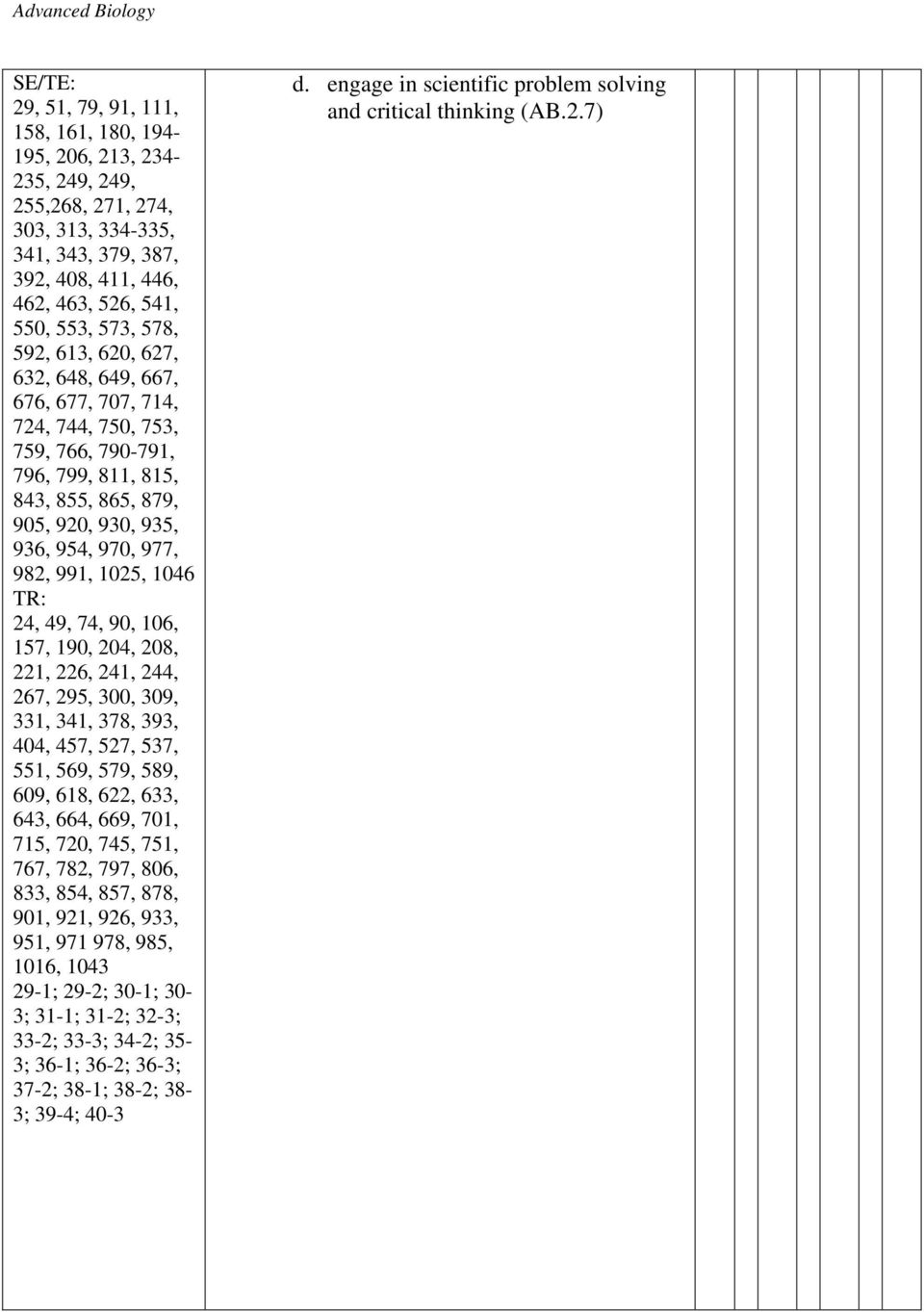
20 issue 4; lab 17, issue 4; lab 1; lab 3; lab 13; concept 7 Issue 1, 3, 50; 18; Section 1-4; 2-4; 3-3; 4-2; 4-4; 6-4; 7-4; 8-2; 8-3; 9-1; 9-2; 10-1; 10-2; 11-2; 12-2; 12-3; 12-5; 13-4; 14-7; 15-3; 16-1; 16-3; 18-3; 21-1; 21-3; 22-1; 22-5; 23-1; 23-3; 24-1; 24-2; 24-3; 25-1; 25-3; 26-2; 26-3; 27-4; 28-1; 28-2;16; 33; 34; 13; 44; 38; 5, 35, 39, 49; 40; 6, 45 Investigations in Forensics: 1; 7; 10 Presentation Assistant: 37-2 Chapter lab 1; 3; 4; 6; 7; 8; 9; 10; 14; 15; 16; 18; 23; 24; 25; 26; 27; 30; 35; 36 Chapter lab: 1; 3; 4; 6; 7; 8; 9; 10; 14; 15; 16; 18; 23; 24; 25; 26; 27; 30; 35; 36 d. engage in scientific problem solving and critical thinking (AB.2.7)
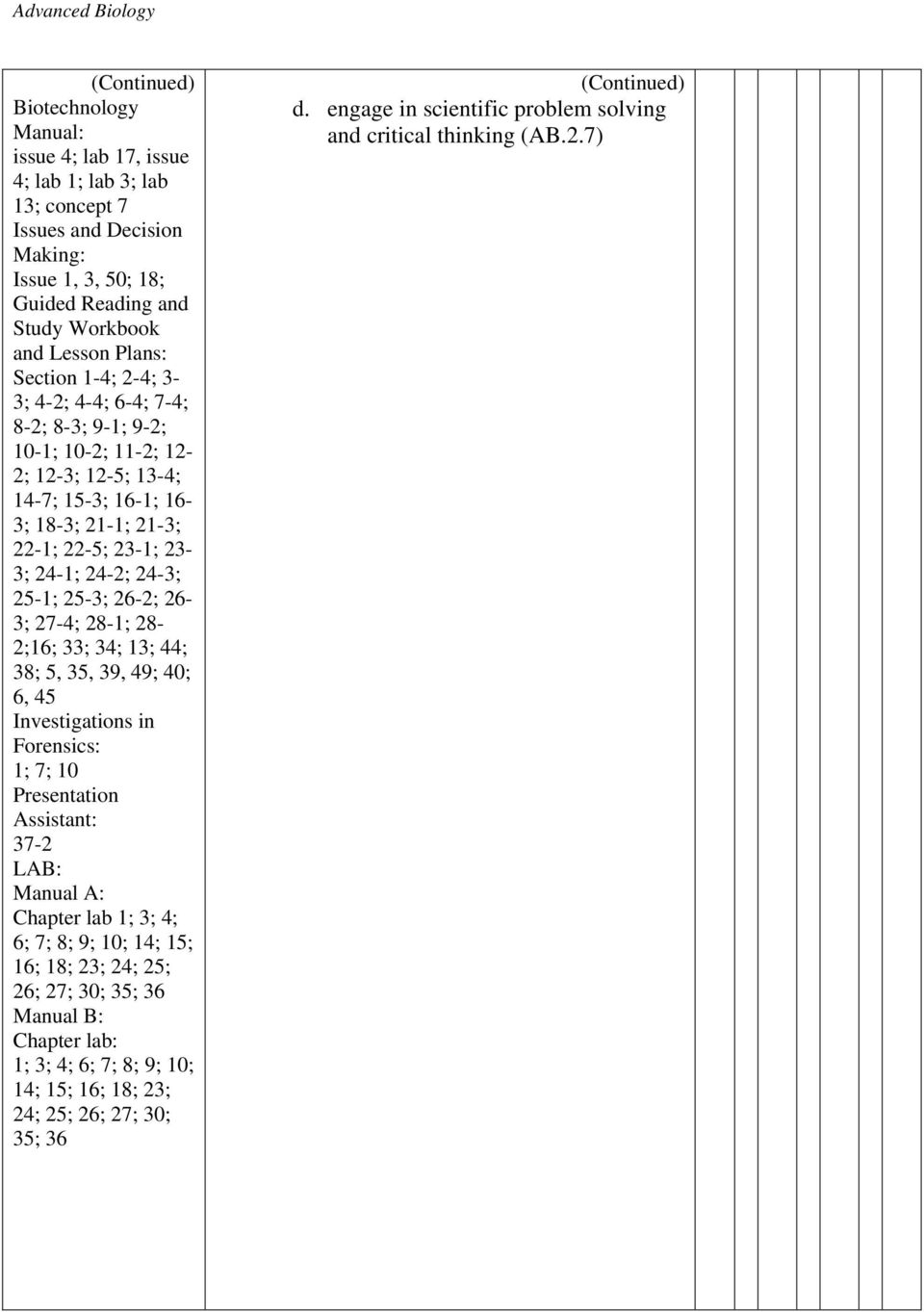
21 Section 1-4; 2-4; 3-3; 4-2; 4-4; 6-4; 7-4; 8-2; 8-3; 9-1; 9-2; 10-1; 10-2; 11-2; 12-2; 12-3; 12-5; 13-4; 14-7; 15-3; 16-1; 16-3; 18-3; 21-1; 21-3; 22-1; 22-5; 23-1; 23-3; 24-1; 24-2; 24-3; 25-1; 25-3; 26-2; 26-3; 27-4; 28-1; 28-2; 29-1; 29-2; 30-1; 30-3; 31-1; 31-2; 32-3; 33-2; 33-3; 34-2; 35-3; 36-1; 36-2; 36-3; 38-1; 38-2; 38-3; 39-4; ; 10, 11; 13; 16; 21; 25, 26; 30; 23; 34; 35; 36; 37; 40; 41 BioDetectives Video: Pfisteria: A Killer in the Water; Mummies: Ties to the Past; Lab Simulation CD- ROM: Cell Respiration; Mitosis; DNA Structure and Replication; Roots, Stem, Leaves d. engage in scientific problem solving and critical thinking (AB.2.7)
22 54, 81; 161, 215, 234; 334, 361; 462; 521, 543; 627, 648; 739, 759, 842; 883, 915; 937, 964, 990, , 74; 157, 208, 226; 331, 355; 457; 516, 537; 622, 643; 751, 833; 878, 910; 933, 956; 985, ; 3-3; 6-4; 8-3; 9-2; 13-4; 14-3; 18-3; 20-5; 21-3; 24-3; 25-3; 29-2; 32-3; 34-2; 35-5; 36-3; 37-3; 38-3; 40-4; lab 17, issue 4; lab 13; issue 4; lab 2, 11, 12, concept 2, 3, 4, 6; Issue 1, 3, 50; 18; 15, 17; 8, 41, 42; 40; 41 Chapter lab 9; 13; 17; 21; 25; 28; 31; 40 Section 2-4; 3-6; 6-4; 9-2; 13-4; 14-3; 18-3; 20-5; 21-3; 24-3; 25-3; 29-2; 32-3; 34-2; 35-5; 37-3; 38-3; ; 10, 11; 30; 42; 41; e. design, conduct, evaluate and revise experiments (AB.2.8)
23 6, 76, 87-88, 139, , 161, , , 215, , 335, 602, 739, 759, 883, 891, , 897, 903, 933, , , 997, , 74, 87, 139, 144, 157, 201, 208, 226, 331, 599, 734, 751, 878, 891, 897, 901, 933, 956, 971, 985, 1031 Section 1-1; 3-3; 4-1; 6-1; 6-2; 6-4; 8-1; 8-3; 9-2; 13-4; 23-5; 28-4; 29-2; 34-2; 35-1; 35-2; 35-3; 36-3; 37-3; 38-1; 38-3; 40-1 concept 1; concept 8; lab 17, issue 4; lab 16 Issue 29; 21, 23, 27, 31; 1, 3, 50; 18; 30; 4; 44; 41; 5, 35, 39, 49; 40 Chapter lab 3; 9; 35 Chapter lab: 6; 9; Unifying Themes Objectives a. relate biological or technical systems to the natural and designed world (AB.3.1)
24 Section 1-1; 3-3; 4-1; 6-1; 6-2; 6-4; 8-1; 8-3; 9-2; 13-4; 23-5; 28-4; 29-2; 34-2; 35-1; 35-2; 35-3; 36-3; 37-3; 38-1; 38-3; ; 10, 11; 32, 33; 38; 48, 49; 42; , 38, 40-41, 42, 45, 47, 48, 52-53, 153, 187, 242, 254, 255, 286, 313, 326, 340, 351, 361, 387, 441, 482, 606, 640, 662, , 794, 799, 811, 866, 905, 915, 937, 965, ,40, 44, 49, 150, 182, 241, 250, 287, 309, 322, 341, 349, 355, 378, 435, 478, 604, 639, 657, 782, 792, 797, 806, 866, 901, 910, 933, ; 2-2; 2-3; 2-4; 6-3; 7-3; 10-1; 10-3; 12-1; 12-5; 13-2; 14-1; 14-2; 14-3; 15-3; 17-4; 19-2; 25-2; 26-1; 30-3; 31-1; 31-2; 35-3; 35-5; 36-3; 37-3 a. relate biological or technical systems to the natural and designed world (AB.3.1) b. use models to make predictions about interactions and changes in systems (AB.3.2)
25 lab 4, 5, 6; lab 13; issue 1, lab 8, 9, 12; lab 1; concept 9, 10, 11, 12. Lab 2, 11, 12; 33 Issue 22, 25, 26, 30, 32, 34, 36; 24; 7; 9, 10, 11, 12; 13; 34; 13; 44; 8, 41, 42 Investigations in Forensics: 3; 4 Chapter Vocabulary Review: 23; 30; 33 Chapter Test: 23; 30, 33 Chapter lab 2; 7; 12; 13; 14; 15; 25; 30; 35 Chapter lab: 2; 12; 13; 14; 15; 25; 30; 35 Section 2-1; 2-2; 2-3; 2-4; 6-3; 7-3; 10-1; 10-3; 12-1; 12-5; 13-2; 14-1; 14-2; 15-3; 17-4; 19-2; 25-2; 26-1; 30-3; 31-1; 31-2; 35-3; 35-5; 36-3; 37-3; chapter assessment: 23; 30; 33 b. use models to make predictions about interactions and changes in systems (AB.3.2)
26 1, 2, 3; 4; 5, 6, 7; 23; 24; 31; 37; 42 BioDetectives Video: History s Mystery: An Introduction to Forensic Science; Skin Cancer: Deadly Cells; Coming Home: A Nation s Pledge; Influenza: Tracking A Deadly Virus Lab Simulation CD- ROM: Properties of Biomolecules; Biomembranes 1; DNA Structure and Replication Computer Test Bank: Ch. 23 test; ch. 30 test; ch. 33 test; 25, 27, 50, 51, 55, 58, 59, 84, 113, 118, 126, 137, 158, 164, 188, 199, 213, 235, 239, 296, 339, 364, 368, 415, 429, 438, 444, 445, 495, 508, 525, 546, 577, 606, 620, 637, 674, 681, 707, 742, 847, 855, 877, 887, 913, 918, 941, 993, 1059, 1063 b. use models to make predictions about interactions and changes in systems (AB.3.2) c. use graphs and equations relating changes in systems to rate, scale, patterns, trends and cycles (AB.3.3)
27 24, 49, 56, 82, 106, 124, 134, 157, 162, 182, 196, 208, 236, 295, 336, 362, 412, 436, 442, 492, 506, 522, 544, 574, 604, 618, 633, 669,678, 701, 740, 844, 916,938, ; 2-4; 4-4; 6-4; 7-3; 8-3; 12-2; 17-4; 20-3; 24-2; 25-1; 26-3; 27-4 lab 17, issue 4; concept 7 Issue 1, 3, 50; 13 Investigations in Forensics: 1; 2-4 Chapter Assessment: 2; 3; 7; 9; 16; 17; 21; 23; 28; 35; 38 Standardized Test Prep 59; 117; 135; 165;199, 239; 339; 364; 415; 445; 495; 525; 577; 681; 847; 887; 941 Sills Lab 8; Chapter lab 7; 24; 28;32;37; Skills lab 8; Chapter lab: 24; c. use graphs and equations relating changes in systems to rate, scale, patterns, trends and cycles (AB.3.3)
28 4; 2-4; 4-4; 6-4; 7-3; 8-3; 12-2; 17-4; 20-3; 24-2; 25-1; 26-3; 27-4 Chapter Assessment: 2; 3; 5; 6; 7; 9; 16; 17; 21; 23; 28; 35; 38 4; 5, 6, 7; 10, 11; 21 Lab Simulation CD- ROM: Photosynthesis; Biomembranes 1 Computer Test Bank 2; 3; 5; 6; 9; 13; 16; 17; 21; 23; 28; Sills Lab 8; Chapter lab 7; 24; 28;32;37; Skills lab 8; Chapter lab: 24; c. use graphs and equations relating changes in systems to rate, scale, patterns, trends and cycles (AB.3.3) 17-19, 25, 27, 55, 79, 80-81, 118, , , , 158, 186, 190, 235, 368, 420, 475, , 24, 49, 74, 106, 119, 124, 129, 157, 182, 190, 226, 369, 417, 471, 933 d. cite examples of different characteristics, properties or relationships within a system that might change as its dimensions change (AB.3.4)
29 issue 4; 47 Issue 48; 1, 3, 50; ; 1-4; 2-4; 3-3; 4-4; 5-1; 5-2; 5-3; 6-4; 7-3; 7-4; 9-2; 15-1; 17-1; 19-1; 36-3 Investigations in Forensics: 1 Chapter lab 1; 3; 6; 7; 9; 17; 19 Chapter lab: 1; 3; 6; 7; 9; 17; ;1-4; 2-4; 3-3; 4-4; 5-1; 5-3; 6-4; 7-3; 7-4; 9-2; 15-1; 17-1; 19-1; 36-3; 5, 6, 7; 12, 14, 15 BioDetectives Video: Mummies: Ties to the Past; Lab Simulation CD- ROM: Biomembranes 1; Cell Respiration d. cite examples of different characteristics, properties or relationships within a system that might change as its dimensions change (AB.3.4)
30 25-27, 66, , , , , 484, 486, 668, 877, , 915, 932, , 954, , , 63, 250, 322, 327, 349, 478, 485, 664, 871, 910, 926, 943, ; 3-1; 10-3; 13-2; 13-3; 14-2; 19-2; 19-3; 26-2; 34-1; 35-5; 36-2; 37-1; 40-3 issue 1, lab 1, 8, 9, 12; concept 5, 7, lab 14, 15; lab 16 Issue 24; 7; 8, 41, 42 Investigations in Forensics: 1; 3; 4; 6 Chapter lab 1; 13; 16; 37 Chapter lab: 1; 13; 16; Scientific Design and Application Objectives a. summarize technological advances in the biological sciences (AB.5.1)
31 Section 1-4; 3-1; 10-3; 13-2; 13-3; 14-2; 19-2; 19-3; 26-2; 34-1; 35-5; 36-2; 37-1; ; 31; 43 BioDetectives Video: Skin Cancer: Deadly Cells; Coming Home: A Nation s Pledge; Influenza: Tracking A Deadly Virus; Lab Simulation; CD- ROM: Cardiovascular 1; (Vendor/Publisher) SPECIFIC LOCATION OF CONTENT WITHIN PRODUCT a. summarize technological advances in the biological sciences (AB.5.1) (IMR Committee) Responses I=In-depth 80% A=Adequate 80% M=Minimal 60% N=Nonexistent Less than 60% I A M N issue 1, lab 8, 9, 12; concept 5, 7, lab 14, 15; lab 16; lab 13 Issue 1, 3, 50; 24; 7; 6, 41, 42; 41 Investigations in Forensics: 4; 6 b. analyze the interdependence of science and technology (AB.5.2)
32 Chapter lab 6; 13; 19; 24; 37 Chapter lab 6; 13; 19; 24; 37 Section 3-1; 6-4; 13-1; 13-2; 13-3; 14-2; 19-3; ; 27-2; 35-5; 36-2; 37-1; 37-3; ; 39; 43; 42 BioDetectives Video: Coming Home: A Nation s Pledge; Lab Simulation CD- ROM: Cardiovascular 1 Presentation Assistant 20; Section Outline 20 Concept Map 20 b. analyze the interdependence of science and technology (AB.5.2)
33 66, , , , 330, , , , , , , , 932, , , , 157, 319, 322, 327, 349, 485, 497, 618, 689, 910, 926, 943, 956, ; 6-4; 13-1; 13-2; 13-3; 14-2; 19-3; 20-1; 24-2; 27-2; 35-5; 36-2; 37-1; 37-3; 40-4 Issue 24, lab 8, 9, 12; concept 5, 7, lab 14, 15; lab 16; lab 13; lab 13 Issue 1, 3, 50; 24; 7; 8, 41, 42 Investigations in Forensics: 4; 6; 1; 2; 3; 5; 7; 8; 9; 10 Chapter lab 6; 19; 24 Chapter lab: 6; 19; 24 b. relate how scientific skills and technological tools are used to design solutions that address personal and societal needs (AB.5.3)
34 Section 3-1; 6-4; 13-1; 13-2; 13-3; 14-2; 19-3; 20-1; 24-2; 27-2; 35-5; 36-2; 37-1; 37-3; ; 39; 43; 42 BioDetectives Video: Coming Home; A Nation s Pledge; History s Mystery: An Introduction to Forensic Science; Pfisteria: A Killer in the Water; Skin Cancer: deadly Cells; Mummies: Ties to the Past; Hantavirus: A Tale of Mice and People; Insect Clues: The Smallest Witnesses; Wrongly Accused: Science and Justice; Influenza: Tracking a Virus Lab Simulation CD- ROM: Cardiovascular 1; 12-13, 66, , , , 253, , , 617, , 668, , , 877, 932, c. relate how scientific skills and technological tools are used to design solutions that address personal and societal needs (AB.5.3) d. describe the scientific concepts underlying technological innovations (AB.5.4)
35 8, 63, 150, 169, 201, 250, 287, 373, 451, 609, 622, 664, 726, 833, 871, 926, ; 3-1; 6-3; 7-1; 8-1; 10-3; 12-1; 15-2; 18-2; 24-1; 24-3; 26-2; 28-3; 32-3; 34-1; 36-2; 37-1 lab 4, 5, 6; Issue 2; 22, 25, 26, 30, 32, 34, 15, 17; 36; Investigations in Forensics: 3; 7; 8 Chapter lab 12; Chapter lab: 12; Section 1-2; 3-1; 6-3; 7-1; 8-1; 10-3; 12-1; 15-2; 18-2; 24-1; 24-3; 26-2; 28-3; 32-3; 34-1; 36-2; 37-1 d. describe the scientific concepts underlying technological innovations (AB.5.4)
36 8; 34; 39; 43 BioDetectives Video: Insect Clues: The Smallest Witnesses; Mummies: Ties to the Past; Lab Simulation CD- ROM: DNA Structure and Replication; Cardiovascular 1 xiii, 23, 25-26, 29, 61, 128, 167, , 194; 233, 234, 254, 260, 330, 354, 367, 403, 484, 548, 603, 647, 655, 676, 700, 765, 790, 853, 889, 1048, , 24; 63, 124, 169, 226, 263, 327, 349, 369, 397, 478, 643, 657, 694, 767, 849, 891, ; 1-4; 3-1; 5-2; 7-1; 9-2; 11-1; 13-3; 14-2; 15-1; 16-2; 19-2; 25-3; 26-1; 27-3; 30-1; 33-1; 35-1; 40-4 d. describe the scientific concepts underlying technological innovations (AB.5.4) e. integrate appropriate technology solutions to promote scientific inquiry (AB.5.5)
37 Concept 5, 7, lab 14, 15; lab 13 Issue 48; 28; 4 Investigations in Forensics: 1; 3; 7;10 Skills lab 5; 6; 7; Chapter lab1; 9; 13; 20 Skills lab 5; 6; 7;Chapter lab1; 9; 13; ; 1-4; 3-1; 5-2; 7-1; 9-2; 11-1; 13-3; 14-2; 15-1; 16-2; 19-2; 25-3; 26-1; 27-3; 30-1; 33-1; 35-1; ; BioDetectives Video: 1-10, All Titles e. integrate appropriate technology solutions to promote scientific inquiry (AB.5.5)
38 62, 63-65, 66, 66, 79, 81, 86, 90, 91, 111, 118, 123, 125, 128, , 157, 158, 161, 215, 318, 334, 438, 456, 508, 573, 617, 668, 674, 787, 877, 935, 1053, , 74, 90, 119, 124, 139, 150, 157, 208, 319, 331, 435, 451, 506, 569, 609, 664, 669, 782, 871, 933, ; 3-3; 4-2; 5-1; 5-2; 6-1; 6-3; 6-4; 8-3; 13-1; 13-4; 17-4; 18-2; 20-3; 22-5; 24-1; 26-2; 26-3; 30-3; 34-1; 36-3; 40-4 Issue 4; lab 17 Issue 48; 29; 22, 25, 26, 30, 32, 36; 1, 3, 50; 18; 13; 33 Investigations in Forensics: 7 5. Science in Personal and Social Perspectives a. promotes the research of current environmental issues (AB.6.1)
39 Chapter lab 3; 4; 6; 26; 30; Chapter lab 3; 4; 6; 26; 30 Section 3-0; 3-3; 4-2; 5-1; 5-2; 6-1; 6-3; 6-4; 8-3; 13-1; 13-4; 17-4; 18-2; 20-3; 22-5; 24-1; 26-2; 26-3; 30-3; 34-1; 36-3; , 11; 34; 37; 13 xiii, 61, 66, 167, 253, 260, 367, 456, 548, 617, 655, 668, 765, 877, , 169, 250, 263, 369, 451, 551, 609, 657, 664, 767, 871, 891, ; 7-1; 10-3; 11-1; 15-1; 18-2; 22-1; 24-1; 26-1; 26-2; 30-1; 34-1; 35-1; 36-2 Issue 4 Investigations in Forensics: 3; 7 a. promotes the research of current environmental issues (AB.6.1) b. describe the impact of cultural, technological and economic influences on the evolving nature of scientific thought and knowledge (AB.6.2)
40 Chapter lab 4; 7; 19; 33 Chapter lab 4; 7; 19; 33 Section 3-1; 7-1; 10-3; 11-1; 15-1; 18-2; 22-1; 24-1; 26-1; 26-2; 30-1; 34-1; 35-1; ; 39 BioDetectives Video: Skin Cancer: Deadly Cells; 37, 95, 192, 359, 433, 487, 571, 691, 863, , 90, 190, 355, 429, 485, 569, 689, 857, ; 4-2; 7-4; 14-3; 17-3; 19-3; 22-5; 27-2; 33-3; 37-3 Concepts 2, 3, 4, 6, lab 2, 11, 12; lab 16 Issue 9, 10, 11, 12; Investigations in Forensics: 7 b. describe the impact of cultural, technological and economic influences on the evolving nature of scientific thought and knowledge (AB.6.2) c. describe occupational opportunities in science and technology (AB.6.5)
41 Chapter lab 4; 7; 19; 33 Chapter lab 4; 7; 19; ; 4-2; 7-2; 14-3; 17-3; 19-3; 22-5; 27-2; 33-3; , 2, 3; 38; 42 BioDetectives Video: History s Mystery: An Introduction to Forensic Science; Concept 5, 7, lab 14, 15; lab 13 Issue 48; 7; 28; 39 Investigations in Forensics: 3; 7 Chapter lab 9; 16; 18; Chapter lab 9; 16; 18; c. describe occupational opportunities in science and technology (AB.6.5) d. provides decision-making activities to resolve science-technology-society issues (AB.6.6)
42 Section 1-3; 3-1; 5-2; 9-2; 14-2; 16-2; 18-3; 19-2; 24-1; 25-3; 26-3; 27-3; 33-1; 34-1; 36-2; 40-3; , 14, 15; 24; 31; 34 BioDetectives Video: Skin Cancer: Deadly Cells; Coming Home: A Nation s Pledge; Influenza: Tracking A Virus; Lab Simulation CD- ROM: Cell Respiration; d. provides decision-making activities to resolve science-technology-society issues (AB.6.6)
43 PART III - SPECIFIC CRITERIA ADVANCED BIOLOGY GRADE An advanced level course designed for students who have completed Coordinated and Thematic Science Ten (CATS 10) and desire a broader, in-depth study of the content found in many biological fields of endeavor. This course is designed to build upon and extend the Biology concepts, skills and knowledge from the CATS 7-10 program. Students will engage in active inquiries, investigations and hands-on activities for a minimum of 50% of the instructional time to develop conceptual understanding and research/laboratory skills. (Vendor/Publisher) SPECIFIC LOCATION OF CONTENT WITHIN PRODUCT I=In-depth 80% A=Adequate 80% (IMR Committee) Responses M=Minimal 60% N=Nonexistent Less than 60% I A M N 1. Science in Personal and Social 66, 87, , , 152, , , , , 87, 139, 144, 150, 157, 331 PRINT 3-1; 4-1; 6-1; 6-2; 6-3; 6-4; 13-4 concept 8; Issue 29; 21, 23, 27, 31; 22, 25, 26, 30, 32, 34, 36; 1, 3, 50; 18 Perspectives a. investigate and discuss the impact that humans may have on the quality of the biosphere (AB.6.1)
44 Section 3-1; 4-1; 8-1; 6-2; 6-3; 6-4; 13-4 Chapter lab 6 Chapter lab: , 90-97, , 90, ; 4-2; 4-4 concept 8 Section 4-1; 4-2; 4-4 Chapter lab 4 Chapter lab: 4 23, 86, 111, 128, 138, , , 188, 334, 401, 456, 668, 700, 853, , 87, 106, 124, 139, 150, 157, 182, 331, 397, 451, 664, 694, 849, 933 a. investigate and discuss the impact that humans may have on the quality of the biosphere (AB.6.1) b. investigate the effects of natural phenomena on the environment (AB.6.2) c. promotes research of current environmental issues (AB.6.3)
45 PRINT 1-3; 4-1; 4-4; 5-2; 6-1; 6-3;6-4; 7-3; 13-4; 16-2; 18-2; 26-2; 27-3; 33-1; 36-3 concept 8; Issue 48; 29; 22, 25, 26, 30, 34, 36; 1, 3, 50; 18; 28 Investigations in Forensics: Biomembranes 1; Chapter lab 6 Chapter lab: 6 Section 1-3; 4-1; 4-4; 5-2; 6-1; 6-3; 6-4; 7-3; 13-4; 16-2; 18-2; 26-2; 27-3; 33-1; , 6, 7; Lab Simulation CD- ROM: Biomembranes 1; d. promotes research of current environmental issues (AB.6.3)
46 12, 23, 66, 128, 154, 170, 204, 233, 253, 292, 330, 354, 374, 403, 456, 484, 617, 624, 647, 730, 836, 877, 932, 948 8, 16, 63, 124, 150, 169, 201, 226, 250, 287, 327, 349, 373, 397, 451, 478, 609, 643, 726, 833, 871, 926, ; 1-3; 3-1; 5-2; 6-3; 7-1; 8-1; 9-2; 10-3; 12-1; 13-3; 14-2; 15-2;16-2; 18-2; 19-2; 24-1;25-3; 28-3; 32-3; 34-1; 36-2; lab 4, 5, 6; concept 5, 7, lab 14, 15; Issue 2; 48 22, 25, 26, 30, 32, 34, 36; 7; 15, 17 Investigations in Forensics: 3; 7; 8 Chapter lab 9; 12; 37 Chapter lab: 9; 12; ; 32-3; e. describe the impact of cultural, technological and economic influences on the evolving nature of scientific thought and knowledge (AB.6.4)
47 1-2; 1-3; 3-1; 5-2; 6-3; 7-1; 8-1; 9-2; 10-3; 12-1; 13-3; 14-2; 15-2; 16-2; 18-2; 24-1; 25-3; 34-1; 36-2; ; 24; 31; 34; 38; 43 BioDetectives Video: Skin Cancer: Deadly Cells; Coming Home: A Nation s Pledge; Influenza: Tracking A Deadly Virus; Insect Clues; Mummies: Ties to the Past; Lab Simulation CD- ROM: DNA Structure and Replication; Cardiovascular 1 37, 66, 95, 192, 253, 359, 433, 456, 487, 571, 617, 668, 691, 863,877, 932, , 63, 90, 190, 250, 355, 429, 451, 485, 569, 609, 664, 689, 857, 871, 926, ;3-1; 4-2; 7-4; 10-3; 14-3; 17-3; 18-2;19-3; 22-5; 24-1; 26-2; 27-2; 33-3; 34-1; 36-2; 37-3; e. describe the impact of cultural, technological and economic influences on the evolving nature of scientific thought and knowledge (AB.6.4) f. describe occupational opportunities in science and technology (AB.6.5)
48 lab 2, 11, 12, concept 2, 3, 4, 6; lab 16 Issue 9, 10, 11, 12; 41 Investigations in Forensics: all investigations 1-10 section 2-1; 3-1; 4-2; 10-3; 14-3; 17-3; 18-2; 19-3; 22-5; 24-1; 26-2; 27-2; 33-3; 34-1; 36-2; , 2, 3; 30; 31; 34; 38; 39; 42 BioDetectives Video: all videos, 1-10 f. describe occupational opportunities in science and technology (AB.6.5) 35-39, 40-43, 44-48, 49-55, , 206, , , , , , , , 424, 898, 900, , , 958, , , 985, , 40, 44, 49, 182, 204, 208, 221, 226, 287, 295, 331, 341, 423, 897, 926, 951, 971, 978, 985, 997 g. make decisions to resolve sciencetechnology-society issues (AB.6.6)
49 2-1; 2-3; 2-3; 2-4; 7-3; 8-2; 8-3; 9-1; 9-2; 12-1; 12-2; 13-4; 14-1; 17-2; 35-2; 36-2; 37-2; 38-1; 38-2; 38-3; 39-1 lab 17, issue 4; lab 1; lab 4, 5, 6; Issue 18; 5, 35, 39, 49; 40; Investigations in Forensics: All investigations 1-10 Chapter lab 6 2-1; 2-3; 2-3;2-4; 7-3; 8-2; 8-3; 9-1; 9-2; 12-1; 12-2;13-4; 14-1; 17-2; 35-2; 36-2; 37-2; 38-2; 38-3; , 2, 3; 4; 5, 6, 7; 10, 11; 13; 21; 28; 48, 49; 39; 40; 41; BioDetectives Video All videos 1-10 Lab Simulation CD- ROM: Properties of Biomolecules; Biomembranes 1; Cell Respiration; DNA Structure and Replication; g. make decisions to resolve sciencetechnology-society issues (AB.6.6)
50 35-39, 40-43, 44-48, 49-55, , , 206, , , , , , , , 424, 898, 900, , , 958, , , 985, , 40, 44, 49, 182, 201, 204, 208, 221, 226, 287, 300, 331, 341, 423, 897, 926, 951, 956, 971, 978, 985, ; 2-2; 2-3; 2-4; 7-3; 8-1; 8-2; 8-3; 9-1; 9-2; 12-1; 12-3; 13-4; 14-1; 17-2; 35-2; 36-2; 37-2; 37-3; 38-2; 38-3; 39-1 lab 17, lab 1,issue 4; lab 4, 5, 6; lab 1 Issue 18; 41; 5, 35, 39, 49; 40 Investigations in Forensics: 10 Chapter lab 2; 8; 9; 12; 14; 17; 38 Chapter lab: 2; 8; 9; 12; 14; Chemical Foundations a. review foundational chemical concepts and investigate the molecules of life and their function in the living systems (AB.4.1, 4.2)
51 section 2-1; 2-2; 2-3; 2-4; 7-3; 8-1; 8-2; 8-3; 9-1; 9-2; 12-1; 12-3; 13-4; 14-1; 17-2; 35-2; 36-2; 37-2; 37-3; 38-2; , 2, 3; 4; 5, 6, 7; 8; 10, 11; 13; 12, 14, 15; 25, 26; 23; 48, 49; 39; 42; 40; 41 BioDetectives Video: History s Mystery: An Introduction to Forensic Science; Coming Home: A Nation s Pledge Lab Simulation CD- ROM: Properties of Biomolecules; Cell Respiration; DNA Structure and Replication a. review foundational chemical concepts and investigate the molecules of life and their function in the living systems (AB.4.1, 4.2)
52 3. Cell Function and Genetics 17, 21, , , , , , 206, , , , , , , 602, , 718, 748, , , ; 36-3 Lab 17, issue 4; lab 1 16, 169, 174, 182, 190, 204, 208, 221, 241, 250, 584, 595, 657, 715, 745, 921, 926, ; 7-1; 7-2; 7-3; 7-4; 8-2; 8-3; 9-1; 10-3; 23-2; 23-4; 26-1; 28-1; 29-1; 36-1; 36- Issue 38 Investigations in Forensics: 3 LAB Chapter lab 7; 8; 36 Chapter lab: 7; 8 a. identify the structure, functions, and interactions of eukaryotic cell organelles and their products and research the diversity/uniqueness of cell types (AB.4.3 & 4.5)
53 Section 1-3;7-1; 7-2; 7-3; 7-4; 8-2; 8-3; 9-1; 10-3; 23-2; 23-4; 26-1; 28-1; 29-1; 36-1; 36-2; , 6, 7; 10, 11; 13; 39 BioDetectives Video: Skin Cancer: Deadly Cells; Lab Simulation CD- ROM: Properties of Biomolecules; Cell Respiration; Roots, Stems and Leaves a. identify the structure, functions, and interactions of eukaryotic cell organelles and their products and research the diversity/uniqueness of cell types (AB.4.3 & 4.5) (Vendor/Publisher) SPECIFIC LOCATION OF CONTENT WITHIN PRODUCT I=In-depth 80% A=Adequate 80% (IMR Committee) Responses M=Minimal 60% N=Nonexistent Less than 60% I A M N , , 899, 182, ; 35-2 Chapter lab 7 Chapter lab: 7 b. analyze the chemistry and structure of the cell membrane as it relates to import and export of molecules necessary for life (AB.4.4)
54 Section 7-3; , 6, 7; 48, 49 Lab Simulation CD- ROM: Biomembranes 1; 18, 68, 77, , , , , , , 474, , 515, 552, ,667, 956, , 67, 74, 201, 204, 208, 216, 221, 226, 236, 471, 499, 510, 551, 595, 664, 956, ; 3-3; 8-1; 8-2; 8-3; 9-1; 9-2; 19-1; 20-2; 20-4; 22-1; 23-4; 26-2; 37-3; 39-2 issue 4; lab 17, issue 4; lab 1; Issue 41; 43 Chapter Test: 2; 8; 9; Laboratory Assessment: 1; Chapter review: b. analyze the chemistry and structure of the cell membrane as it relates to import and export of molecules necessary for life (AB.4.4) c. explore photosynthesis and cellular respiration (AB.4.6)
55 Chapter lab 3; 8; 9; 19; 20; Chapter lab: 3; 8; 9; 19; 20; Section 1-3; 3-3; 8-1; 8-2; 8-3; 9-1; 9-2; 19-1; 20-2; 20-4; 22-1; 23-4; 26-2; 37-3; 39-2; 8; 9; 10, 11; 12;, 14, 15; 13; 42; 47; BioDetectives Video: Pfisteria: A Killer in the water; Lab Simulation CD- ROM: Cell Respiration; Photosynthesis; Roots, Stems, Leaves; Computer Test Bank: Ch. 2; 8; 9;assessment , , 250, , , 281, 308, , , 395, 581, 667, 758, 1010, , 244, 250, 275,279, 307, 309, 349, 579, 664, 751, 1009 c. explore photosynthesis and cellular respiration (AB.4.6) d. describe mitotic and meiotic cell cycles as well as prokaryotic cell cycles (AB.4.8, 4.9)
56 10-1; 10-2; 10-3; 11-4; 11-5; 12-4; 12-5; 14-2; 23-1; 26-2; 29-2; 39-3 lab 3; lab 2; lab 13 Issue Investigations in Forensics: 3 Chapter lab 10; 39 Chapter lab: 10; ; 10-2; 10-3; 11-4; 11-5; 12-4; 12-5; 14-2; 23-1; 26-2; 29-2; ; 17, 18, 22; 27, 28, 29; 24 BioDetectives Video: Skin Cancer: Deadly Cells; Coming Home; A Nation s Pledge Lab Simulation CD- ROM: Mitosis; Meiosis d. describe mitotic and meiotic cell cycles as well as prokaryotic cell cycles (AB.4.8, 4.9)
57 150, 175, 181, 241, 243, , , , 301, 306, , , , , 342, , 355, , 370, , 425, , 483, , 174, 241, 244, 287, 295, 300, 322, 327, 331, 341, 349, 355, 369, 393, 423, 451, 478, ; 7-2; 10-1; 10-2; 12-1; 12-2; 12-3; 13-2; 13-4; 14-1; 14-2; 14-3; 15-1; 16-1; 17-2; 18-2; 19-2; 40-4 lab 4, 5, 6; issue 1, lab 8, 9, 12; concept 5, 7, lab 14, 15; lab 2, 11, 12;concept 2, 3, 4, 6; lab 13 Issue 22, 25, 26, 30, 32, 34, 36; 24; 18; 7; 9, 10, 11, 12 Investigations in Forensics: 4 Chapter lab 10; 12; 13; 14; 16; 17 Chapter lab: 10; 12; 13; 14 e. investigate DNA, gene expression, regulation and mutations and their effects on the diversity of life (AB.4.10, 4.11, 4.17, 4.18 & 4.20)
58 Section 6-3; 7-2; 10-1; 10-2; 12-1; 12-2; 12-3; 13-2; 13-3; 13-4; 14-1; 14-2; 14-3; 15-1;16-1; 17-2; 18-2; 19-2; ; 21; 25, 26; 23; 24; 30; 31BioDetectives Video: Coming Home: A Nation s Pledge; Influenza: Tracking A deadly Virus Lab Simulation CD- ROM: Mitosis; DNA Structure and Replication 17, 395, , 409, , 476, 497, 498, , 530, 531, 532, 533, , 672, 673, 686, 696, 704, 757, 758, 826, 827, 864, 16, 393, 404, 423, 471, 497, 516, 530, 622, 664, 669, 683, 694, 701, 751, 821, ; 16-1; 16-3; 17-2; 19-1; 20-1; 20-5; 21-2; 24-3; 26-2; 26-3; 27-1; 27-3; 27-4; 29-2; 32-1; 33-3 e. investigate DNA, gene expression, regulation and mutations and their effects on the diversity of life (AB.4.10, 4.11, 4.17, 4.18 & 4.20) f. provide for the student evaluation of the advantages of asexual and sexual reproduction (AB.4.12)
59 lab 7 Issue 16; 24;20 Investigations in Forensics: 9 Presentation Assistant: ch. 20 Section outline: ch Concept Map Ch. 20 LAB Chapter lab 16; 17; 19; 20; 21; 26; 27; 29; 33 Chapter lab: 21; 26; 27; 29; 33 Section 1-3; 16-1; 16-3; 17-2; 19-1; 20-1; 20-5; 21-2; 24-3; 26-2; 26-3; 27-1; 27-3; 27-4; 29-2; 32-1; 33-3; 35; 38 f. provide for the student evaluation of the advantages of asexual and sexual reproduction (AB.4.12)
60 18, 47, 150, , , , , , , , , , , , , , , , 404, 409, 410, 454, 573, 872, , 44, 150, 263, 267, 275, 279, 307, 309, 331, 341, 349, 393, 397, 404, 451, 569, 871, ; 2-3; 6-3; 11-1; 11-2; 11-4; 11-5; 12-4; 12-5; 13-4; 14-1; 14-2; 16-1; 16-2;16-3; 18-2; 22-5; 34-1; 39-1 lab 2; lab 13; lab 1 Issue 22, 25, 26, 30, 32, 34, 36; 18; 7; 16 Chapter lab 2; 14; 16; Chapter lab: 2; 14; ; 2-3; 6-3; 11-1; 11-2; 11-4; 11-5; 12-4; 12-5; 13-4; 14-1; 14-2; 16-1; 16-2; 16-3; 18-2; 22-5; 34-1; 39-1 g. explore the principles of genetics including: Mendel s laws, incomplete dominance, gene interaction, codominance, multi-alleles, crossing over, genetic recombination; influences of environment, development, sex and age ( AB.4.13, 4.14)
61 19; 17, 18, 22; 27, 28, 29; 23; 24; BioDetectives Video: Coming Home: A Nation s Pledge; Lab Simulation CD- ROM: Properties of Biomolecules; Mendelian Inheritance; Meiosis; 243, 245, , , , 295, 300, 393 PRINT: 10-1; 12-1; 12-3; 16-1; Chapter lab 16 Chapter lab 16 Section 10-1; 12-1; 12-3; ; 25, 26 Lab Simulation CD- ROM:DNA Structure and Replication; g. explore the principles of genetics including: Mendel s laws, incomplete dominance, gene interaction, codominance, multi-alleles, crossing over, genetic recombination; influences of environment, development, sex and age ( AB.4.13, 4.14) h. describe DNA replication and protein synthesis (AB.4.15, 4.16)
62 61; , , 330, , 338, 354, 355, , 327, 331, 349, 355 PRINT: 13-2; 13-3; 13-4; 14-2; 14-3; Concept 5, 7; lab 14, 15; concept 2, 3, 4, 6 Issue 18; 7; 9, 10, 11, 12; Investigations in Forensics: 4 Section 13-2; 13-3; 13-4; 14-2; ; 30 BioDetectives Video: Coming Home: A Nation s Pledge i. introduce DNA technologies and the social issues they raise (AB.4.19)
63 20, 180, , ; , , , , , , , 425, , , , , , 668, 716, , , , , , 807, 832, , , , 856, 16, 175, 369, 373, 378, 393, 397, 404, 417,429, 560, 622, 657, 664, 715, 745, 771, 782, 707, 806, 828, 833, 849, 857 PRINT: 1-3; 7-2; 15-1; 15-2; 15-3; 16-1; 16-2; 16-3; 17-1; 17-2; 17-3; 22-3; 24-3; 26-1; 26-2; 28-1; 29-1; 30-2; 30-3; 31-1; 31-2; 32-2; 32-3; 33-1; 33-3 Issue 16; 14; 37; 34; 13; 32; 15, 17; Chapter lab 15; 16; 17; 30; 33 Chapter lab15; 17; 30; Evolution a. explain natural selection, speciation and evolution including historical and current ideas (AB.4.21, 4.23)
64 Section 1-3; 7-2; 15-1;15-2; 15-3; 16-2; 16-3; 17-1; 17-2; 17-3; 22-3; 24-3; 26-1; 26-2; 28-1;29-1; 30-2; 30-3; 31-1; 31-2; 32-2; 32-3; 33-1; ; 38 BioDetectives Video: Mummies: Ties to the Past; 404, ,739, , , , 404, 669; 734, 871, 878 PRINT: 16-3; 26-3; 28-4; 34-1; 34-2 Issue 16; 30 Chapter lab 26 Chapter lab 26 Section 16-3; 26-3; 28-4, 34-1; 34-2 a. explain natural selection, speciation and evolution including historical and current ideas (AB.4.21, 4.23) b. investigate causes and effects of animal behavior (AB.4.22)
65 446-50, , , , 554, , , 564, , ,660, , , , , , , 747, 768, , , , 807, , ; 834, 849, 850, 852, , , 556, 560, 564, 569, 657, 683, 694, 701, 720, 734, 745, 767, 797, 806, 828, 833, 849 PRINT: 18-1; 18-2; 18-3; 22-3; 22-4; 22-5; 26-1; 27-1; 27-3; 27-4; 28-2; 28-4; 29-1; 30-1; 31-1; 32-2; 32-3; 33-1; Issue 28; 30; 34; 13; 32; 15; 17 Investigations in Forensics: 5 Chapter lab 18; 27 Chapter lab: 18; Classification of Organisms a. compare traditional and modern taxonomy and systematics (AB.4.24, 4.25)
66 Section 18-1; 18-2; 18-3; 22-3; 22-4; 22-5; 26-1; 27-1; 27-3; 27-4; 28-2; 28-4; 29-1; 30-1; 31-1; 32-2; 32-3; 33-1; 35; 36 BioDetectives Video: Mummies: Ties to the Past a. compare traditional and modern taxonomy and systematics (AB.4.24, 4.25) (Vendor/Publisher) SPECIFIC LOCATION OF CONTENT WITHIN PRODUCT I=In-depth 80% A=Adequate 80% (IMR Committee) Responses M=Minimal 60% N=Nonexistent Less than 60% I A M N , , , , , , , , , , , , , , 968,-969, , 978,-984, , , , , , , , , , Environment and Ecosystems a. explore the various systems of the human organism and their interactions (AB.4.26)
67 891, 897, 901, 906, 910, 921, 926, 933, 943, 951, 956, 971, 978, 985, 996-7, 1003, 1009, 1016, 1031, 1036, 1043 PRINT: 35-1; 35-2; 35-3; 35-4; 35-5; 36-1; 36-2; 36-3; 37-1; 37-3; 38-1; 38-2; 38-3; 39-1; 39-2; 39-3; 39-4; 40-1; 40-3 Lab 16; Issue 4; 44; 8, 41, 42; 38; 41;5, 35, 38, 49; 40; 43; 6, 45; Chapter lab 35; 36; 37; 38; 39; 40; Chapter lab: 35; 36; 37;38; 39; 40; Section 35-1; 35-2; 35-3; 35-4;35-5; 36-1; 36-2; 36-3; 37-1; 37-3; 38-1; 38-2; 38-3; 39-1; 39-2; 39-4; 40-1; 40-2; 40-3 a. explore the various systems of the human organism and their interactions (AB.4.26)
68 39; 43; 40; 41; 47; 44, 45, 46; Lab Simulation CD- ROM: Cardiovascular 1; 19, , 659, 666, 671, 685, 690, 696, 704, 718, 727, 756, 759, 777, 787, 801, 811, 825, 862, , 898, , 1039, 16, 639, 657, 664, 671, 683, 694, 701, 715, 726, 751, 771, 782, 797, 806, 821, 857, 871, 897, 1036 PRINT: 1-3; 25-2; 26-1; 27-1; 27-3; 27-4; 28-1; 28-3; 29-2; 30-2; 30-3; 31-3; 31-2; 32-1; 33-2; 34-1; 35-2; 40-2 Lab 7 Issue 28; 37; 33; 34; 13; a. explore the various systems of the human organism and their interactions (AB.4.26) b. investigate responses of organisms to internal and environmental stimuli (AB.4.7, 4.27)
69 Investigations in Forensics: 8; 9; Chapter lab 27; 28; 29; 30; 31; 33; 34; Chapter lab: 25; 27; 28; 31;29;30;33; 34; 40 Section 1-3; 25-2; 26-1; 27-1; 27-3; 27-4; 28-1; 28-3; 29-2; 30-2; 30-3; 31-1; 31-2; 32-1; 33-3; 34-1; 35-2; 40-2; 35; 38; 48, 49; 44, 45, 46 BioDetectives Video: Insect Clues; 21, 63-66, 67-73, 74-81, 90-91, 92-93, 94-97, , , , , 232, , , 431, 432,435, 503, , , , 568, , , 667, 675, 699, 708, , 728, 738, 781, 783, 789, 799, , 805, , 814, , , 701, 720, 734, 771, 782, 797, 806, 833 b. investigate responses of organisms to internal and environmental stimuli (AB.4.7, 4.27) c. investigate ecology including: energy flow, limiting factors, biotic and abiotic environment, extinction and adaptation (AB.4.28, 4.31)
70 20, 67, 87, 90, 106, 124, 129, 139, 144, 150, 226, 378, 397, 429, 435, 497, 564, 589, 618, 643, 664, PRINT: 1-3; 3-1; 3-2; 4-1; 4-2; 4-3; 4-4; 5-2; 5-3; 6-1; 6-2; 6-3;9-2; 15-3; 16-2; 17-3; 17-4; 20-1; 22-4; 23-3; 24-2; 25-3; 26-2; 26-3; 27-4; 28-2; 28-4; 30-2; 30-3; 31-1; 31-2; 32-3 Concept 8; Issue 46; 48; 47; 29; 21, 23, 27, 31; 22, 25, 26, 30, 32, 34, 36; 13; 30; 37; 13; 15, 17 Investigations in Forensics: 2 Chapter lab 4; 5; chapter 6 test; lab 9; 15; 16; 23; 24; 26; 27; 30; 31; 32 Chapter lab: 4; 5; 9; 15; 24; 26; 27; 30; 31; 32 c. investigate ecology including: energy flow, limiting factors, biotic and abiotic environment, extinction and adaptation (AB.4.28, 4.31)
71 Section 1-3; 3-1; 3-2; 4-1; 4-2; 4-3; 4-4; 5-2; 5-3; 6-1; 6-2; 6-3; 9-2; 15-3; 16-2; 17-3; 17-4; 20-1; 22-4; 23-3; 24-2; 25-3; 26-2; 26-3; 27-4; 28-2; 28-4; 30-2; 30-3; 31-1; 31-2; , 14, 15; 35; 37; 36 BioDetectives Video: Mummies: Ties to the Past Lab Simulation CD- ROM: Cell Respiration; Roots, Stems and Leaves; Presentation Assistant ch. 20; c. investigate ecology including: energy flow, limiting factors, biotic and abiotic environment, extinction and adaptation (AB.4.28, 4.31)
A Correlation of Miller & Levine Biology 2014
 A Correlation of Miller & Levine Biology To Ohio s New Learning Standards for Science, 2011 Biology, High School Science Inquiry and Application Course Content A Correlation of, to Introduction This document
BIOLOGY 101 COURSE SYLLABUS FOR FALL 2015
 BIOLOGY 101 COURSE SYLLABUS FOR FALL 2015 Course Description Instructor Biology 101 is the first of a two-semester introductory course sequence designed primarily for science majors. It covers some central
A CONTENT STANDARD IS NOT MET UNLESS APPLICABLE CHARACTERISTICS OF SCIENCE ARE ALSO ADDRESSED AT THE SAME TIME.
 Biology Curriculum The Georgia Performance Standards are designed to provide students with the knowledge and skills for proficiency in science. The Project 2061 s Benchmarks for Science Literacy is used
Biology: Foundation Edition Miller/Levine 2010
 A Correlation of Biology: Foundation Edition Miller/Levine 2010 to the IDAHO CONTENT STANDARDS Science - Biology Grades 9-10 INTRODUCTION This document demonstrates how Prentice Hall s Biology: Foundation
COURSE SYLLABUS BIOL 1010 Introduction to Biology I (4)
 COURSE SYLLABUS BIOL 1010 Introduction to Biology I (4) COURSE DESCRIPTION: An introduction to the biological sciences with an emphasis on basic concepts of the building blocks of life at the molecular
A Correlation of Pearson Miller & Levine Biology 2014 To the Utah Core State Standards for Biology Grades 9-12
 A Correlation of Pearson To the Utah Core State Standards Resource Title: Publisher: Pearson Education publishing as Prentice Hall ISBN (10 or 13 digit unique identifier is required): SE: 9780133242003
Phone: (318) 670-6423 Phone: (318) 670-6251. Classroom: (218) Classroom: (222) Office: Rm. 11/239 Office: Rm. 9/236 MISSION STATEMENT
 SOUTHERN UNIVERSITY SHREVEPORT, LA Fall 2010 Course Syllabus BIOLOGY 104 - Lecture: Louis Collier Hall Lecture: 3 Credit Hours Separate Laboratory: 1 Credit Hour Biology Department Office Hours (posted
South Texas College Biology Department Section Outline
 Essential minimum information required by STC South Texas College Biology Department Section Outline Biology 1406.P15 (majors) (Face-to-face Web-enhanced class) General Biology I Spring 2015 Instructor
Unit I: Introduction To Scientific Processes
 Unit I: Introduction To Scientific Processes This unit is an introduction to the scientific process. This unit consists of a laboratory exercise where students go through the QPOE2 process step by step
Student Text and E-Book ISBN: 0-8053-6624-5
 Course Syllabus Advanced Biology A Syllabus Required Student Text: Campbell Biology (6 th edition) Student Text and E-Book ISBN: 0-8053-6624-5 Developer: Judith S. Nuno Email: [email protected] Course
Johnson State College External Degree Program. BIO-1210-JY01 Introduction to Biology Syllabus Spring 2015
 Instructor: Barbara Pratt [email protected] Dates: Jan 19 to May 10 (no class Apr 6 to 12) Johnson State College External Degree Program BIO-1210-JY01 Introduction to Biology Syllabus Spring 2015 Location:
Understanding by Design. Title: BIOLOGY/LAB. Established Goal(s) / Content Standard(s): Essential Question(s) Understanding(s):
 Understanding by Design Title: BIOLOGY/LAB Standard: EVOLUTION and BIODIVERSITY Grade(s):9/10/11/12 Established Goal(s) / Content Standard(s): 5. Evolution and Biodiversity Central Concepts: Evolution
Essentials of Human Anatomy & Physiology 11 th Edition, 2015 Marieb
 A Correlation of Essentials of Human Anatomy Marieb To the Next Generation Science Standards Life A Correlation of, HS-LS1 From Molecules to Organisms: Structures and Processes HS-LS1-1. Construct an explanation
Mississippi SATP Biology I Student Review Guide
 Mississippi Student Review Guide Author: Cecilia L. Boles Published by Enrichment Plus, LLC PO Box 2755 Acworth, GA 30102 Toll Free: 1-800-745-4706 Fax 678-445-6702 Web site: www.enrichmentplus.com Mississippi
AP Biology Essential Knowledge Student Diagnostic
 AP Biology Essential Knowledge Student Diagnostic Background The Essential Knowledge statements provided in the AP Biology Curriculum Framework are scientific claims describing phenomenon occurring in
AP Biology Syllabus 2012-2013
 n AP Biology, an emphasis is on students making connections between the big ideas within the AP Biology Curriculum Framework. he two main goals of AP Biology are to help students develop a conceptual framework
Kindergarten to Grade 4 Manitoba Foundations for Scientific Literacy
 Kindergarten to Grade 4 Manitoba Foundations for Scientific Literacy The Five Foundations Manitoba Foundations for Scientific Literacy To develop scientifically literate students, science learning experiences
Prentice Hall Biology (Miller/Levine) 2008 Correlated to: Colorado Science Standards and Benchmarks (Grades 9-12)
 1. ask questions and state hypotheses using prior scientific knowledge to help design and guide their development and implementation of a scientific investigation STANDARD 1: Students apply the processes
Study Partner/Essential Study Partner (ESP): http://highered.mcgraw-hill.com/sites/0073211877/student_view0/study_partner.html
 Course: Anatomy and Physiology Honors Course Number: 2000360 Title: Hole s Human Anatomy and Physiology, 10 th Edition Authors: Shier, Butler, Lewis Publisher: Glencoe/McGraw-Hill Copyright: 2004 Online
(D) 181-183, 186-187, 190-193 TFYI 187 TPK 190
 NEVADA Life Science Content Standards for Grade 8 Life s Structure and Function A From Bacteria to Plants B Animal Diversity C Human Body Systems D OBJECTIVES Content Standard 6.0: Structure and Function
MCAS Biology. Review Packet
 MCAS Biology Review Packet 1 Name Class Date 1. Define organic. THE CHEMISTRY OF LIFE 2. All living things are made up of 6 essential elements: SPONCH. Name the six elements of life. S N P C O H 3. Elements
STATE UNIVERSITY OF NEW YORK COLLEGE OF TECHNOLOGY CANTON, NEW YORK COURSE OUTLINE. BIOL 101 Introduction to Biology
 STATE UNIVERSITY OF NEW YORK COLLEGE OF TECHNOLOGY CANTON, NEW YORK COURSE OUTLINE BIOL 101 Introduction to Biology Prepared By: W. David Barnes SCHOOL OF SCIENCE, HEALTH & PROFESSIONAL STUDIES SCIENCE
COURSE DESCRIPTION. Course Number: NM: 17994100 RISD: 13109A, 13109B. Successful completion of Forensics I (C or better)
 COURSE DESCRIPTION Date: February 2011 COURSE TITLE: STARS Course Title: Forensic Science II Life and Physical Sciences Course Number: NM: 17994100 RISD: 13109A, 13109B Open to Grades: 12 Prerequisites:
Central High School DC Angelo State University BIO 1481 Principles of Biology I Spring 2016
 Central High School DC Angelo State University BIO 1481 Principles of Biology I Spring 2016 INSTRUCTOR CONTACT INFORMATION: Shamone Minzenmayer Office: Tucker 117 Email: [email protected] Phone: 325-659-3400
SCIENCE. Introducing updated Cambridge International AS & A Level syllabuses for. Biology 9700 Chemistry 9701 Physics 9702
 Introducing updated Cambridge International AS & A Level syllabuses for SCIENCE Biology 9700 Chemistry 9701 Physics 9702 The revised Cambridge International AS & A Level Biology, Chemistry and Physics
High School Science Course Correlations between Ohio s 2010 Course Syllabi and the First Draft of the High School NGSS
 High School Science Course Correlations between Ohio s 2010 Course Syllabi and the First Draft of the High School NGSS This document correlates the content in Ohio s course syllabi with the performance
Diablo Valley College Catalog 2014-2015
 Biological science BIOSC Diablo Valley College is approved by the California Board of Registered Nurses for continuing education credits. Biological Science courses which can be used are BIOSC-119, 120,
Instructor Information. Instructor: Email: Table of Contents. Course Description (Catalog) Table of Contents. Course Scope
 School: Science and Technology Course Number: BIOL133 Course Name: General Biology I Credit Hours: 4 Length of Course: 16 Weeks Prerequisite: MATH 110/125 Instructor Information Course Description Course
BIO 1408 (4:3:3) General Biology I (Non-Majors) Department of Biology. Division of Arts and Sciences. Levelland Campus SOUTH PLAINS COLLEGE.
 BIO 1408 (4:3:3) General Biology I (Non-Majors) Department of Biology Division of Arts and Sciences Levelland Campus SOUTH PLAINS COLLEGE Fall 2013 Kristin Bingham Instructor in Biology Instructor: Kristin
Given these characteristics of life, which of the following objects is considered a living organism? W. X. Y. Z.
 Cell Structure and Organization 1. All living things must possess certain characteristics. They are all composed of one or more cells. They can grow, reproduce, and pass their genes on to their offspring.
Academic Standards for Science and Technology and Engineering Education
 Academic Standards for Science and Technology and Engineering Education January 29, 2010 -- FINAL DRAFT Secondary Standards (Biology, Chemistry, and Physics) Pennsylvania Department of Education These
CURRICULUM MAP (Revised 6.15.07)
 (Revised 6.15.07) Below is an outline of the Living Environment course that uses the Glencoe NY State Living Environment textbook. Please note that there is more depth in the book than is needed for the
BERKELEY CITY COLLEGE COLLEGE OF ALAMEDA LANEY COLLEGE MERRITT COLLEGE
 Biology and Programs Biology Program The Associate of Science Degree for Transfer (AST) in Biology is designed for students who plan to transfer to CSU as biology majors. In this program, they gain exposure
General Biology. Course Description and Philosophy
 General Biology Course Description and Philosophy Biology is the study of life on the planet Earth. This is a standard college preparatory life science course. Among the concepts covered in the course
SCIENCE. The Wayzata School District requires students to take 8 credits in science.
 Course offerings are designed to appeal to a wide range of interests and skills. All courses involve laboratory work. Some courses require advanced reading and math skills; these usually have a challenge
Fair Lawn. Public Schools. Biology CP & Academic. Science Department. Fair Lawn, NJ. August. Biology Ac & CP 1
 1 Fair Lawn Public Schools Fair Lawn, NJ Biology CP & Academic August 2015 Updated August 2015 Developed July 2011 is a high school science class developed by the Fair Lawn Schools high school science
Biology. EL indicates a goal that supports the Maryland Environmental Literacy Standards.
 Biology Students must pass the High School Assessment in Biology to earn a high school diploma in Maryland. The HCPSS curriculum in Biology is aligned to the Maryland State Curriculum in Biology. Special
Next Generation Science Standards
 The Next Generation Science Standards and the Life Sciences The important features of life science standards for elementary, middle, and high school levels Rodger W. Bybee Publication of the Next Generation
BIO.Q 111/111L CONTEMPORARY BIOLOGY AND LAB Perspectives-Enduring Questions Course Online -- Summer B 2015
 BIO.Q 111/111L CONTEMPORARY BIOLOGY AND LAB Perspectives-Enduring Questions Course Online -- Summer B 2015 How Does Biology Impact Our Daily Lives? INSTRUCTOR: Dr. Stephanie Zamule EMAIL: [email protected]
AP Biology. The four big ideas are:
 AP Biology Course Overview: This course is an intensive study in biological concepts that emphasizes inquiry based learning. It is structured around the four Big Ideas and the Enduring Understandings that
AP Biology Syllabus 2016-17
 AP Biology Syllabus 2016-17 Instructor: Vincent Benitez Textbook: Biology (eighth Edition) by Campbell and Reece College Board Course Overview: The Advanced Placement Biology curriculum is equivalent to
SCIENCE CLASSES AT HAYS HIGH
 SCIENCE CLASSES AT HAYS HIGH REQUIRED CORE CLASSES PHYSICS I HONORS PHYSICS I BIOLOGY HONORS BIOLOGY CHEMISTRY HONORS CHEMISTRY I ELECTIVES PROJECT SCIENCE ENVIRONMENTAL SCIENCE ADVANCED FIELD BIOLOGY
GRADE 6 SCIENCE. Demonstrate a respect for all forms of life and a growing appreciation for the beauty and diversity of God s world.
 GRADE 6 SCIENCE STRAND A Value and Attitudes Catholic Schools exist so that curriculum may be taught in the light of Gospel teachings. Teachers must reinforce Gospel truths and values so that students
MASTER OF SCIENCE IN BIOLOGY
 MASTER OF SCIENCE IN BIOLOGY The Master of Science in Biology program is designed to provide a strong foundation in concepts and principles of the life sciences, to develop appropriate skills and to inculcate
Biology AP Edition - Campbell & Reece (8th Edition)
 AP biology syllabus ~ 2016-2017 Instructor s Information Course: Advance Placement Biology (A/B) Instructor: Mrs. R. R. Wingerden Phone: (805) 937-2051 x2121 E-mail: [email protected] Website: http://www.rwingerden.com/apbio/
A CONTENT STANDARD IS NOT MET UNLESS APPLICABLE CHARACTERISTICS OF SCIENCE ARE ALSO ADDRESSED AT THE SAME TIME.
 Environmental Science Curriculum The Georgia Performance Standards are designed to provide students with the knowledge and skills for proficiency in science. The Project 2061 s Benchmarks for Science Literacy
TEACHING POSITIONS AVAILABLE IN BIOLOGY UNIVERSITY OF SAN FRANCISCO SPRING 2014
 TEACHING POSITIONS AVAILABLE IN BIOLOGY UNIVERSITY OF SAN FRANCISCO SPRING 2014 Positions available (course descriptions and class times attached) Laboratory Instructors: PhDs and graduate students at
Utah State Office of Education Elementary STEM Endorsement Course Framework Nature of Science and Engineering
 Course Description: Utah State Office of Education Elementary STEM Endorsement Course Framework Nature of Science and Engineering In this course participants will experience introductory explorations of
14.3 Studying the Human Genome
 14.3 Studying the Human Genome Lesson Objectives Summarize the methods of DNA analysis. State the goals of the Human Genome Project and explain what we have learned so far. Lesson Summary Manipulating
College Biology Course Syllabus
 College Biology Course Syllabus Mrs. Boghos-Frangie Room Textbook: Campbell Biology 7 th Edition www.myteacherpages.com/webpages/pboghos [email protected] Welcome to College Biology! This is a hard but
Science Standards of Learning for Virginia Public Schools Correlation with National Science Standards
 Standards of Learning for Virginia Public Schools Correlation with National Standards Key P = Pre-activity E = Extension activity C = Core activity S = Supplemental activity Standard Strands Finding Common
CTY Genetics Syllabus
 CTY Genetics Syllabus Week 1: Review and Mendelian Genetics What (DUE DATE) 1 Introduction and Review Morning Classroom Policies/ Ice Breaker Game/Introductions Syllabus Distribute Syllabus, Discuss Course
INTEGRATING APPLIED ETHICS INTO A COLLEGE-LEVEL NON-MAJORS BIOLOGY COURSE
 INTEGRATING APPLIED ETHICS INTO A COLLEGE-LEVEL NON-MAJORS BIOLOGY COURSE Jean Stutz Arizona State University INTRODUCTION The 21st century has been labeled by some as the century of biology most likely
Chapter 13: Meiosis and Sexual Life Cycles
 Name Period Concept 13.1 Offspring acquire genes from parents by inheriting chromosomes 1. Let s begin with a review of several terms that you may already know. Define: gene locus gamete male gamete female
Common Core Standards for Literacy in Science and Technical Subjects
 A Correlation of Miller & Levine Biology To the Common Core Standards for Literacy in Science and Technical Subjects INTRODUCTION This document demonstrates how meets the Common Core Standards for Literacy
Genetics. Biology Spring 2014
 Genetics Biology 2296 Spring 2014 Lecture Times Class Location Course Coordinators Lab Coordinator M, W, F 12:00-12:50pm Gladfelterr Hall 0L013 Dr. Darius Balciunass Dr. Jorune Balciuniene Dr. Jennifer
School of Pure and Applied Sciences
 School of Pure and Applied Sciences PROFESSOR: Dr. Robert L. Furler PHONE NUMBER: 239.489.9432 OFFICE LOCATION: H-240, Lab AA-161A E-MAIL: [email protected] OFFICE HOURS: M: 10:00AM-11:50AM T: 10:35AM-1:20PM
Bob Jesberg. Boston, MA April 3, 2014
 DNA, Replication and Transcription Bob Jesberg NSTA Conference Boston, MA April 3, 2014 1 Workshop Agenda Looking at DNA and Forensics The DNA, Replication i and Transcription i Set DNA Ladder The Double
General Education Courses
 H. Councill Trenholm State Technical College 185 Courses Statement forms the foundation for lifelong learning. Although H. Councill Trenholm State Technical College s General Education courses do not comprise
Biology 360 Genetics Lecture Syllabus and Schedule, Fall 2012 Tentative
 Biology 360 Genetics Lecture Syllabus and Schedule, Fall 2012 Tentative Dr. David Keller Office: Holt 318 Lab: Holt 301 Office Hrs:10-11 am Ph: 898-5040 Dr. Jeff Bell Office: Holt 205 Ph: 898-5356 Prerequisites:
This Performance Standards include four major components. They are
 Seventh Grade Science Curriculum Approved July 13, 2006 The Georgia Performance Standards are designed to provide students with the knowledge and skills for proficiency in science at the seventh grade
Bio EOC Topics for Cell Reproduction: Bio EOC Questions for Cell Reproduction:
 Bio EOC Topics for Cell Reproduction: Asexual vs. sexual reproduction Mitosis steps, diagrams, purpose o Interphase, Prophase, Metaphase, Anaphase, Telophase, Cytokinesis Meiosis steps, diagrams, purpose
FORENSIC SCIENCE COURSE DESCRIPTION
 FORENSIC SCIENCE COURSE DESCRIPTION This course is an overview of how science is applied to solving crimes. Topics include history of forensic sciences, collecting of evidence, analyzing results and hands-on
BIO-156 General Biology for Allied Health
 BIO-156 General Biology for Allied Health INSTRUCTOR: TASNEEM ASHRAF http://skywalker.cochise.edu/ashraft/web/index.html CLASS HOURS: Lecture / laboratory / Time: Tuesday @ 9:15 noon CONTACT: 515 5340
Hi h School Standard: 1
 Forensic Science Content Standards and Objectives Forensic Science is an advanced level course that is an elective designed to provide students with hands-on experience in various aspects of a criminal
Biology Major and Minor (from the 2007-2008 College Catalog)
 Biology Major and Minor (from the 2007-2008 College Catalog) Biology (BI) Science and Mathematics Bachelor of Science R. Scot Duncan, Andrew Gannon, Megan Gibbons, Pamela Hanson, Leo Pezzementi, Gretchen
Honors Biology Course Summary Department: Science
 Honors Biology Course Summary Department: Science Semester 1 Learning Objective #1 - Ecology Students will understand how organisms interact with each other and the environment. Target(s) to Meet Learning
the!sun!to!sugars.!this!is!called!! photosynthesis.!the!byproduct!of!those! Nucleus! sugars!is!our!oxygen.!
 Cytoplasm ANIMAL CELL Vacuoles Mitochondria Chromosomes GolgiApparatus Chloroplast+ TheChloroplastiswhatmakesthefood inthecell.they reonlyfoundinplant cellsandsomeprotists.everygreen plantyouseeisconvertingenergyfrom
For additional information on the program, see the current university catalog.
 For information call: Tel: (818) 77-81 Fax: (818) 77-08 E-mail: [email protected] Website: http://www.csun.edu/chemistry Or write: Department of Chemistry and Biochemistry California State University,
Chapter 13: Meiosis and Sexual Life Cycles
 Name Period Chapter 13: Meiosis and Sexual Life Cycles Concept 13.1 Offspring acquire genes from parents by inheriting chromosomes 1. Let s begin with a review of several terms that you may already know.
BI122 Introduction to Human Genetics, Fall 2014
 BI122 Introduction to Human Genetics, Fall 2014 Course Overview We will explore 1) the genetic and molecular basis of heredity and inherited traits, 2) how genetics & genomics reveals an understanding
Answer Key. Vocabulary Practice
 Answer Key Vocabulary Practice Copyright by McDougal Littell, a division of Houghton Mifflin Company A. Categorize Words 1. organism, L; cell, L; species, L; transgenic, B; biotechnology, T; molecular
The Science of Biology
 Chapter 1 The Science of Biology Section 1 1 What Is Science? (pages 3 7) This section explains what the goal of science is and describes a scientific view of the world. What Science Is and Is Not (page
Environmental Science Overview
 Overview The standards establish the scientific inquiry skills and core content for all courses in DoDEA schools. The course of study provides students with a basic knowledge of the natural world that
Willmar Public Schools Curriculum Map
 Subject Area Science Senior High Course Name Forensics Date June 2010 Timeline Content Standards Addressed Skills/Benchmarks Essential Questions Assessments 1-2 Introduction History and Development of
TExMaT Master Science Teacher 8 12 (092) Test at a Glance
 TExMaT Master Science Teacher 8 12 (092) Test at a Glance See the test preparation manual for complete information about the test along with sample questions, study tips and preparation resources. Test
Campbell Biology in Focus Correlation for AP Biology Curriculum Framework
 Campbell Biology in Focus Correlation for AP Biology Curriculum Framework Chapters/ Graphical analysis of allele frequencies in a population 5 Application of the Hardy-Weinberg equilibrium equation 1,
List, describe, diagram, and identify the stages of meiosis.
 Meiosis and Sexual Life Cycles In this topic we will examine a second type of cell division used by eukaryotic cells: meiosis. In addition, we will see how the 2 types of eukaryotic cell division, mitosis
Miller & Levine Biology
 A Correlation of Miller & Levine Biology Alabama Content Standards for Biology INTRODUCTION This document demonstrates how meets the Alabama Content Standards for Biology, grades 9-12. Correlation page
Student Text and E-Book ISBN: 0-8053-6624-5
 Course Syllabus Advanced Biology B Syllabus Required Student Text: Campbell Biology (6 th edition) Student Text and E-Book ISBN: 0-8053-6624-5 Developer: Judith S. Nuno Email: [email protected] Course
Interactive Science Grade 5 2012
 A Correlation of Interactive Science Grade 5 2012 To the New Jersey Science Standards Grade 5 Introduction This document demonstrates the close alignment between Interactive Science, 2012, and the for
Georgia Department of Education
 Epidemiology Curriculum The Georgia Performance Standards are designed to provide students with the knowledge and skills for proficiency in science. The Project 2061 s Benchmarks for Science Literacy is
Quick Hit Activity Using UIL Science Contests For Formative and Summative Assessments of Pre-AP and AP Biology Students
 Quick Hit Activity Using UIL Science Contests For Formative and Summative Assessments of Pre-AP and AP Biology Students Activity Title: Quick Hit Goal of Activity: To perform formative and summative assessments
CHEMICAL SCIENCES REQUIREMENTS [61-71 UNITS]
![CHEMICAL SCIENCES REQUIREMENTS [61-71 UNITS]](/thumbs/39/18644108.jpg "CHEMICAL SCIENCES REQUIREMENTS [61-71 UNITS]") Chemical Sciences Major Chemistry is often known as the central science because of the key position it occupies in modern science and engineering. Most phenomena in the biological and Earth sciences can
Chemical Sciences Major Chemistry is often known as the central science because of the key position it occupies in modern science and engineering. Most phenomena in the biological and Earth sciences can
Cell Growth and Reproduction Module B, Anchor 1
 Cell Growth and Reproduction Module B, Anchor 1 Key Concepts: - The larger a cell becomes, the more demands the cell places on its DNA. In addition, a larger cell is less efficient in moving nutrients
Biology 274: Genetics Syllabus
 Biology 274: Genetics Syllabus Description: An examination of the basic principles of genetics in eukaryotes and prokaryotes at the level of molecules, cells, and multicelluar organisms, including humans.
1. When new cells are formed through the process of mitosis, the number of chromosomes in the new cells
 Cell Growth and Reproduction 1. When new cells are formed through the process of mitosis, the number of chromosomes in the new cells A. is half of that of the parent cell. B. remains the same as in the
Biology 1406 Exam 4 Notes Cell Division and Genetics Ch. 8, 9
 Biology 1406 Exam 4 Notes Cell Division and Genetics Ch. 8, 9 Ch. 8 Cell Division Cells divide to produce new cells must pass genetic information to new cells - What process of DNA allows this? Two types
Next Generation Science Standards
 Pearson Biology Miller & Levine 2014 To the Next Generation Science Standards Life Science Standards Earth and Space Science Standards Engineering Standards May 2013 Dear Educator, Pearson is committed
PLANT AND ANIMAL CELL ORGANELLES
 reflect The heart is an example of an organ. Think for a minute about your body. It s organized into parts that perform specific functions. For example, your heart functions to help transport materials
How do we build and refine models that describe and explain the natural and designed world?
 Strand: A. Understand Scientific Explanations : Students understand core concepts and principles of science and use measurement and observation tools to assist in categorizing, representing, and interpreting
MIDLAND ISD ADVANCED PLACEMENT CURRICULUM STANDARDS AP ENVIRONMENTAL SCIENCE
 Science Practices Standard SP.1: Scientific Questions and Predictions Asking scientific questions that can be tested empirically and structuring these questions in the form of testable predictions SP.1.1
BioBoot Camp Genetics
 BioBoot Camp Genetics BIO.B.1.2.1 Describe how the process of DNA replication results in the transmission and/or conservation of genetic information DNA Replication is the process of DNA being copied before
SUN PRAIRIE AREA SCHOOL DISTRICT COURSE POWER STANDARDS. Curriculum Area: Science Course Length: Semester
 SUN PRAIRIE AREA SCHOOL DISTRICT COURSE POWER STANDARDS Course Title: Forensic Science Curriculum Area: Science Course Length: Semester Credit Status: ½ Physical Science Credit Date submitted: 7/09 Expected
NEBRASKA SCIENCE STANDARDS
 301 Centennial Mall South Lincoln, Nebraska 68509-4987 NEBRASKA SCIENCE STANDARDS Grades K-12 Adopted by the Nebraska State Board of Education October 6, 2010 SC K-12.1 Comprehensive Science Standard Inquiry,
Brunswick School Department: Grades 11-12. Essential Understandings
 Understandings Questions Knowledge Vocabulary Skills Bones provide invaluable structure and support for the body. There are a variety of bone shapes. Joints connect bones. The skeletal system is divided
13.4 Gene Regulation and Expression
 13.4 Gene Regulation and Expression Lesson Objectives Describe gene regulation in prokaryotes. Explain how most eukaryotic genes are regulated. Relate gene regulation to development in multicellular organisms.