
Guide to Graduate Programs. Master of Arts Degrees Certificates of Graduate Study
|
|
|
- Lucas Griffin
- 10 years ago
- Views:
Transcription
1 Guide to Graduate Programs Master of Arts Degrees Certificates of Graduate Study

2 The Institute of World Politics is a graduate school of national security and international affairs, dedicated to developing leaders with a sound understanding of international realities and the ethical conduct of statecraft, based on knowledge and appreciation of the founding principles of the American political economy and the Western moral tradition.

3 A Message from the President Welcome to The Institute ofworld Politics, a graduate school founded to fill a major national need: to supply professional education in statecraft, national security, and international affairs offered nowhere else. By teaching all the arts of statecraft and how they are integrated into national strategy, we emphasize the development of a capacity to think strategically.we believe that when governments resort to force, it is often a sign of the failure to use the many non-military instruments of power effectively. Here, the study of statecraft rests on a foundational curriculum of selected liberal arts that, today, are seldom mastered sufficiently for purposes of successful professional work in the most dangerous and sensitive functions of government. A key element of our philosophy is our concern with character development: specifically, the cultivation of those personal and civic virtues that are optimally suited to producing the moral and ethical conduct of our nation s highest public policy priority national security. It is a cornerstone of our curriculum that one cannot effectively defend a country and civilization that one neither fully understands nor appreciates. In a nation where all who are responsible for the defense of our country must take an oath to defend the Constitution of the United States, patriotism is an absolute requirement for the profession. The question, then, is whether that patriotism is to be primitive and tenuous or well informed and morally ordered. The Institute of World Politics is dedicated to the education and formation of the next generation of leaders who understand the harsh realities of the world and who are fully intellectually and morally equipped to defend our country and civilization men and women committed to a cause greater than themselves. John Lenczowski is founder and president of The Institute of World Politics. From 1981 to 1983 Dr. Lenczowski served in the State Department in the Bureau of European Affairs and as Special Advisor to the Under Secretary for Political Affairs. From 1983 to 1987 he was Director of European and Soviet Affairs at the National Security Council. Dr. Lenczowski received his M.A. and Ph.D. from the Johns Hopkins University School of Advanced International Studies. He is the author of Soviet Perceptions of U.S. Foreign Policy (1982), The Sources of Soviet Perestroika (1990), Full-Spectrum Diplomacy and Grand Strategy (2010), and numerous other writings on U.S. foreign policy, public diplomacy, cultural diplomacy, counter-propaganda, political warfare, Soviet/Russian affairs, comparative ideologies, intelligence, strategic deception, counterintelligence, and integrated strategy. ABOUT THE INSTITUTE OF WORLD POLITICS 1

4 About The Institute of World Politics A Unique Educational Experience The Institute of World Politics (IWP) is unique among graduate schools, filling several educational needs with a curriculum offered by no other academic institution in America, and perhaps the world. This curriculum is designed to prepare students to be effective leaders in statecraft, national security, and foreign policy. It includes the study of all the instruments of power and how these instruments are integrated at the level of grand strategy. These include: diplomacy; military strategy; opinion formation and public diplomacy; intelligence and counterintelligence; psychological strategy; political action and political warfare; economic strategy; moral suasion and other forms of soft power; and effective leadership. The Institute s curriculum exposes students to the full spectrum of international realities, including history, political culture, the practices of foreign powers (including those that exceed traditional diplomatic norms), current and potential threats, and the strategic role of ideas, values, and belief systems in world politics. In doing so, the Institute s courses examine subjects that the academy, the official foreign policy and national security culture, and its training centers, rarely do on a systematic basis. The Institute has some of the best instructors in the world in their respective fields. These include ambassadors, senior intelligence officials, military officers, presidential advisers, and senior congressional staff members. Almost all are scholar-practitioners with both academic credentials and high-level governmental and nongovernmental experience in the subjects they teach. Each course is taught by a principal professor. Many courses have occasional guest lecturers, many of whom are prominent figures in government and the broader policy community. Several of the faculty occupy senior positions in government, but continue to teach at the Institute as well. The Institute s student body includes recent graduates of colleges and universities from the United States and around the world and a mix of mid-career professionals from government, the armed forces, industry, and foreign embassies and governments, whose various perspectives enrich the classroom experience. IWP has special relationships with several U.S. government agencies and the U.S. Armed Forces, which send their personnel to the Institute for study in degree programs, certificate programs, fellowships, and internships. Historically, the U.S. Naval War College has approved almost all of the Institute s courses as eligible electives for its students. The U.S. Army has qualified IWP as one of seventeen academic institutions eligible to host colonel-ranked officers as Senior War College Fellows, where a tour at IWP substitutes for attending the Army War College. 2 ABOUT THE INSTITUTE OF WORLD POLITICS
5 Finally, the educational philosophy of the Institute, based on a recognition of the need to cultivate civic virtue and responsibility in the exercise of power, distinguishes itself from the widespread utilitarianism, relativism, and moral neutrality present in our culture. All these factors unite to create the unique purpose, curriculum, philosophy, and method of instruction that are to be found at The Institute of World Politics. Education in the Fundamentals of Statecraft The Institute offers Master s degree, certificate, and continuing education programs with a professional curriculum covering the various elements of statecraft. Its curriculum also includes an interdisciplinary foundational course of study of the relevant elements of comparative political culture, Western moral precepts, practical political economics, and political and diplomatic history. The Institute s curriculum has six major components: 1. The study of all of the elements of statecraft, including: the arts of war, peacemaking, and diplomacy; public diplomacy and cultural diplomacy; psychological strategy and political action; economic strategy; intelligence and counterintelligence; the exercise of intangible instruments of power such as moral leadership, will-power, courage, rhetoric, etc.; and the integration of such elements into overall national strategy. 2. The study of diplomatic history, salient elements of comparative political culture, ideology and religion, the practices of foreign powers, and developments that affect the security interests of the United States. This component focuses on the often-neglected role and consequences of ideas in international politics. It also includes the study of unpleasant realities of international affairs, such as: treaty violations; massive violations of human rights; terrorism; disinformation, strategic deception, and psychological warfare; economic warfare; espionage; and other instruments employed by authoritarian regimes, terrorist groups, and transnational movements that the United States is likely to encounter in the world. 3. The review of fundamental principles of American political philosophy, including: democratic republicanism, limited government, individual rights, private property, the rule of law, and morally-ordered political/economic liberty. 4. The study of the Western moral tradition and the application of ethics to policymaking and the use of power. 5. The study of economics, including economic statecraft and the salient elements of economic theory and history necessary for those working in the defense, intelligence, and foreign affairs communities. 6. Character-building education that encourages those who pursue public service to cultivate those qualities necessary for statesmanship and moral leadership. ABOUT THE INSTITUTE OF WORLD POLITICS 3
6 Benefits of Studying at IWP Students at the Institute attend small, seminar-style classes, where the student/faculty ratio is 12:1. They learn from a distinguished faculty of scholarpractitioners with significant, high-level experience in policymaking. Many classes also feature guest lecturers, many of whom are current and former senior government officials who impart their practical knowledge. Discussion and lectures are enriched by insightful anecdotes and lessons learned by participants in recent historical events. Because of its location in Washington, D.C., students are offered direct access to the heart of the U.S. foreign policy community and interaction with many of its leaders. Speakers at the Institute, whether faculty, guest lecturers, or speakers at extracurricular functions to which students are invited, are drawn from the highest ranks of the U.S. government, as well as from embassies, other governments, and domestic and international organizations specializing in national security affairs. The Institute s unique courses offer specialized professional education not available elsewhere. All courses enhance students capacity to understand and address major current issues. Students frequently learn from their classmates, some of whom are officials in agencies of the U.S. and foreign governments. They often receive career advice from, and establish valuable contacts with, fellow students, their professors, and the guest faculty. Finally, the Institute s career services program helps place students in professional positions in government service, government contracting companies (many of which perform work that used to be done within government but is now outsourced), and other relevant private or international organizations. IWP students enjoy consistent success in competing for selective jobs in all these various institutions. 4 ABOUT THE INSTITUTE OF WORLD POLITICS

7 Master of Arts Degree Programs IWP s Master of Arts degrees are professional degrees designed for students who intend to pursue a career in the intelligence, national security, or international affairs fields. Students may be enrolled full-time (9 or more credit hours per semester) or part-time (less than 9 credit hours per semester), but must complete their degree in five calendar years or less. Three of IWP s M.A. degrees (Statecraft and International Affairs, Statecraft and National Security Affairs, and Strategic Intelligence Studies) require 52 credit hours of coursework. After successful completion of all coursework, each student will be required to pass a one-hour oral examination and a three-hour written comprehensive examination. IWP s final two Master s degree programs (the Master of Arts in Strategic and International Studies [Professional] and the Executive Master of Arts in National Security Affairs) are designed for mid-career professionals with varying levels of experience in relevant fields, and require 36 and 28 graduate-level credits respectively. I know what The Institute of World Politics is all about. I know the principles that have animated it. I know the values that have become part of you because of your formation here. It s your embracing of these values that motivated me to be here, and honors me by your including someone like myself in your circle. Lt Gen Michael V. Hayden USAF Ret, former Director of the CIA and NSA, addressing IWP s Class of 2009 MASTER OF ARTS DEGREE PROGRAMS 5
8 M.A. in Statecraft and International Affairs This 52 credit hour/two year degree program is designed for students currently in the foreign affairs or national security communities, or for those who wish to enter one of these broader career fields. It provides a comprehensive study of the theory and practice of foreign policy, process, and implementation, both in historical and contemporary perspectives. Significant attention is directed toward understanding the current world order, international relations, and the role of political culture, ideas, and values in influencing the behavior of states and nonstate actors. It involves study of the entire spectrum of instruments of power, how they are integrated strategically, and the ethical issues inherent in their use. Successful recipients of this degree are prepared for many careers in diplomacy, defense strategy, intelligence, counterintelligence, public diplomacy, political warfare, and homeland security, whether in government, the private sector, research, journalism, or a variety of other options. Candidates for this degree must demonstrate a proficiency in a strategicallyimportant foreign language. Recognized languages include Arabic, Chinese, Dari, Farsi, French, German, Hindi, Italian, Japanese, Portuguese, Russian, Spanish, Turkish, and Urdu. The Institute currently offers Arabic, Chinese, and Russian classes at its campus. An M.A. in Statecraft and International Affairs will not be awarded until the candidate passes an exam at a proficient level (at least a 3+ on the Interagency Language Roundtable scale). Non-native speakers of English who are admitted to the M.A. program are exempt from this requirement and are not required to pass a language proficiency exam. Core Curriculum (36 credits required; all courses are four credits unless noted otherwise) Foundational Courses (all of the following are required) IWP 642 Economics for Foreign Policy Makers (2 credits) IWP 634 Geography and Strategy (2 credits) IWP 627 International Relations, Statecraft and Integrated Strategy IWP 620 Twentieth Century Politics and Diplomacy IWP 615 Western Moral Tradition and World Politics Course in Political Philosophy (one of the following is required) IWP 608 American Founding Principles and Foreign Policy IWP 606 Ideas and Values in International Politics Courses in Statecraft (four of the following are required) IWP 636 The Art of Diplomacy IWP 609 Economic Statecraft and Conflict 6 MASTER OF ARTS DEGREE PROGRAMS
9 IWP 631 Foreign Propaganda, Perceptions and Policy OR IWP 637 Public Diplomacy and Political Warfare IWP 605 Intelligence and Policy IWP 648 Military Strategy: An Overview of the Theorists of Warfare IWP 601 National Security Policy Process IWP 625 Peace, Strategy and Conflict Resolution In addition to the Core Curriculum, students in this degree program must also select one of the following five specializations. Specialization in American Foreign Policy (16 credits needed; all courses are four credits) Required Courses IWP 608 American Founding Principles and Foreign Policy If this course was taken for the Political Philosophy requirement, a second elective may be taken. IWP 635 History of American Foreign Policy IWP 638 U.S. Foreign Policy: Current and Future Challenges Elective Courses (Choose one) IWP 670 Counterterrorism through Cultural Engagement and Development IWP 672 Crisis Management and Decisionmaking IWP 609 Economic Statecraft and Conflict IWP 673 Human Rights and Counter-Radicalization IWP 611 Immigration and National Security IWP 649 Mass Murder Prevention in Failed and Failing States IWP 637 Public Diplomacy and Political Warfare IWP 632 U.S. Intelligence in the Cold War and Beyond An area-study course: IWP 630 Chinese Grand Strategy: Foreign and Military Policy IWP 677 Chinese Military Thought and History IWP 653 The Contemporary Balkans IWP 658 The Geopolitics of the Iranian Plateau and South Asia IWP 604 Islam and Geopolitics in Eurasia IWP 645 Islam in Contemporary Global Politics IWP 603 Russian Politics and Foreign Policy IWP 639 U.S. African Relations IWP 671 The U.S. China Strategic Relationship IWP 623 U.S. Latin American Relations: Threats and Opportunities East Central Europe (under development) The European Union (under development MASTER OF ARTS DEGREE PROGRAMS 7

10 Specialization in Comparative Political Culture (16 credits needed; all courses are four credits) Required Courses IWP 640 Cultural Intelligence for Strategy and Analysis OR IWP 614 Diplomacy Toward Comparative Regimes IWP 606 Ideas and Values in International Politics One or two area-study courses: IWP 630 Chinese Grand Strategy: Foreign and Military Policy IWP 677 Chinese Military Thought and History IWP 653 The Contemporary Balkans IWP 658 The Geopolitics of the Iranian Plateau and South Asia IWP 604 Islam and Geopolitics in Eurasia IWP 645 Islam in Contemporary Global Politics IWP 603 Russian Politics and Foreign Policy IWP 639 U.S. African Relations IWP 671 The U.S. China Strategic Relationship IWP 623 U.S. Latin American Relations: Threats and Opportunities East Central Europe (under development) The European Union (under development) Elective Courses (Choose one, unless you have chosen wo area-study courses) IWP 626 Foundations of Political and Economic Freedom IWP 613 History of International Relations IWP 673 Human Rights and Counter-Radicalization IWP 649 Mass Murder Prevention in Failed and Failing States IWP 621 Stabilization and Nation-Building: History and Policy Specialization in Conflict Prevention (16 credits needed; all courses are four credits) Required Courses IWP 649 Mass Murder Prevention in Failed and Failing States IWP 625 Peace, Strategy and Conflict Resolution Elective Courses (Choose two) IWP 669 Counterterrorism and the Democracies IWP 670 Counterterrorism through Cultural Engagement and Development IWP 673 Human Rights and Counter-Radicalization IWP 637 Public Diplomacy and Political Warfare 8 MASTER OF ARTS DEGREE PROGRAMS

11 IWP 621 Stabilization and Nation-Building: History and Policy IWP 607 U.S. Nonproliferation and Nuclear Policy Specialization in International Politics (16 credits needed; all courses are four credits) Required Courses IWP 613 History of International Relations An area-study course: IWP 630 Chinese Grand Strategy: Foreign and Military Policy IWP 677 Chinese Military Thought and History IWP 653 The Contemporary Balkans IWP 658 The Geopolitics of the Iranian Plateau and South Asia IWP 604 Islam and Geopolitics in Eurasia IWP 645 Islam in Contemporary Global Politics IWP 603 Russian Politics and Foreign Policy IWP 639 U.S. African Relations IWP 671 The U.S. China Strategic Relationship IWP 623 U.S. Latin American Relations: Threats and Opportunities East Central Europe (under development) The European Union (under development) Elective Courses (Choose two) IWP 639 The Art of Diplomacy IWP 606 Ideas and Values in International Politics IWP 619 Mass Media and World Politics IWP 649 Mass Murder Prevention in Failed and Failing States IWP 625 Peace, Strategy and Conflict Resolution Specialization in Peace Building, Stabilization, and Humanitarian Affairs (16 credits needed; all courses are four credits) Required Courses IWP 670 Counterterrorism through Cultural Engagement and Development IWP 621 Stabilization and Nation-Building: History and Policy Elective Courses (Choose two) IWP 608 American Founding Principles and Foreign Policy IWP 626 Foundations of Political and Economic Freedom MASTER OF ARTS DEGREE PROGRAMS 9

12 IWP 649 Mass Murder Prevention in Failed and Failing States An area-study course: IWP 630 Chinese Grand Strategy: Foreign and Military Policy IWP 677 Chinese Military Thought and History IWP 653 The Contemporary Balkans IWP 658 The Geopolitics of the Iranian Plateau and South Asia IWP 604 Islam and Geopolitics in Eurasia IWP 645 Islam in Contemporary Global Politics IWP 603 Russian Politics and Foreign Policy IWP 639 U.S. African Relations IWP 671 The U.S. China Strategic Relationship IWP 623 U.S. Latin American Relations: Threats and Opportunities East Central Europe (under development) The European Union (under development) M.A. in Statecraft and National Security Affairs This 52 credit hour/two year degree is designed for students currently in the intelligence or national security communities or for those who wish to enter one of these career fields. It provides a comprehensive study of the theory and practice of intelligence and national security policy, process, strategy, and implementation, both in historical and contemporary perspectives. Significant attention is directed toward vital current policy issues as well as understanding foreign cultures and the practices of foreign powers. Candidates for this degree are not required to pass a language proficiency examination, but may elect to do so in order to add an important skill to their academic credentials and marketability. Students are strongly encouraged to take advantage of the same language training opportunities made available to candidates in the Statecraft and International Affairs degree program. Core Curriculum (36 credits required; all courses are four credits unless noted otherwise) Foundational Courses (all required) IWP 642 Economics for Foreign Policy Makers (2 credits) IWP 634 Geography and Strategy (2 credits) IWP 627 International Relations, Statecraft and Integrated Strategy IWP 620 Twentieth Century Politics and Diplomacy IWP 615 Western Moral Tradition and World Politics 10 MASTER OF ARTS DEGREE PROGRAMS
13 Course in Political Philosophy (one of the following is required) IWP 608 American Founding Principles and Foreign Policy IWP 606 Ideas and Values in International Politics Courses in Statecraft (IWP 601 and three additional courses in statecraft are required) IWP 601 National Security Policy Process (Required) IWP 636 The Art of Diplomacy IWP 609 Economic Statecraft and Conflict IWP 631 Foreign Propaganda, Perceptions and Policy OR IWP 637 Public Diplomacy and Political Warfare IWP 635 History of American Foreign Policy IWP 605 Intelligence and Policy IWP 628 Military Strategy: An Overview of the Theorists of Warfare IWP 625 Peace, Strategy and Conflict Resolution In addition to the Core Curriculum, students in this degree program must also select one of the following four specializations: Specialization in Homeland Security (16 credits needed; all courses are four credits) Required Course IWP 664 Foundations of Homeland Security Elective Courses (Choose three) IWP 612 American Intelligence and Protective Security: An Advanced Seminar IWP 669 Counterterrorism and the Democracies IWP 610 Counterintelligence in a Democratic Society IWP 663 Cyber Statecraft IWP 611 Immigration and National Security IWP 601 National Security Policy Process OR IWP 616 U.S. National Security Strategy and Emerging Threats Specialization in Intelligence (16 credits needed; all courses are four credits) Required Courses IWP 605 Intelligence and Policy If this course is taken as one of the four required courses in Statecraft, then two Intelligence electives may be chosen. IWP 610 Counterintelligence in a Democratic Society IWP 631 Foreign Propaganda, Perceptions and Policy MASTER OF ARTS DEGREE PROGRAMS 11

14 Elective Courses (Choose one) IWP 612 American Intelligence and Protective Security: An Advanced Seminar IWP 647 Case Studies in Counterintelligence Operations IWP 622 Comparative Intelligence Systems: Foreign Intelligence & Security Cultures IWP 676 A Counterintelligence Challenge: The Enigmas and Benefits of Defectors IWP 640 Cultural Intelligence for Strategy and Analysis IWP 663 Cyber Statecraft IWP 659 Enemy Threat Doctrine of Global Jihadism IWP 652 Estimative Intelligence Analysis and Epistemology IWP 667 Forecasting and Political Risk Analysis IWP 654 History of FBI Counterintelligence IWP 618 Information Operations and Information Warfare IWP 656 Intelligence Collection IWP 648 Military Intelligence and Modern Warfare IWP 641 Political Warfare: Past, Present, and Future OR IWP 637 Public Diplomacy and Political Warfare IWP 668 The Role and Importance of Human Intelligence IWP 644 Spies, Subversion, Terrorism, and Influence Operations IWP 662 Surprise, Warning and Deception IWP 655 Technology, Intelligence, Security and Statecraft IWP 632 U.S. Intelligence in the Cold War and Beyond Specialization in National Security and Defense Studies (16 credits needed; all courses are four credits) Required Courses IWP 601 National Security Policy Process IWP 616 U.S. National Security Strategy and Emerging Threats An area-study course (Choose one) IWP 630 Chinese Grand Strategy: Foreign and Military Policy IWP 677 Chinese Military Thought and History IWP 653 The Contemporary Balkans IWP 658 The Geopolitics of the Iranian Plateau and South Asia IWP 604 Islam and Geopolitics in Eurasia IWP 645 Islam in Contemporary Global Politics IWP 603 Russian Politics and Foreign Policy IWP 639 U.S. African Relations IWP 671 The U.S. China Strategic Relationship IWP 623 U.S. Latin American Relations: Threats and Opportunities East Central Europe (under development) The European Union (under development) 12 MASTER OF ARTS DEGREE PROGRAMS
15 Elective Courses (Choose one) IWP 669 Counterterrorism and the Democracies IWP 670 Counterterrorism through Cultural Engagement and Development IWP 672 Crisis Management and Decisionmaking IWP 663 Cyber Statecraft IWP 609 Economic Statecraft and Conflict IWP 659 Enemy Threat Doctrine of Global Jihadism IWP 631 Foreign Propaganda, Perceptions, and Policy IWP 664 Foundations of Homeland Security IWP 611 Immigration and National Security IWP 618 Information Operations and Information Warfare IWP 605 Intelligence and Policy IWP 648 Military Intelligence and Modern Warfare IWP 628 Military Strategy: An Overview of the Theorists of War IWP 641 Political Warfare: Past, Present, and Future OR IWP 637 Public Diplomacy and Political Warfare IWP 633 Terrorism IWP 657 U.S. Approaches to Irregular Warfare IWP 607 U.S. Nonproliferation and Nuclear Policy Specialization in Public Diplomacy and Political Warfare (16 credits needed; all courses are four credits) Required Courses IWP 631 Foreign Propaganda, Perceptions and Policy IWP 637 Public Diplomacy and Political Warfare An area-study course (Choose one) IWP 630 Chinese Grand Strategy: Foreign and Military Policy IWP 677 Chinese Military Thought and History IWP 653 The Contemporary Balkans IWP 658 The Geopolitics of the Iranian Plateau and South Asia IWP 604 Islam and Geopolitics in Eurasia IWP 645 Islam in Contemporary Global Politics IWP 603 Russian Politics and Foreign Policy IWP 639 U.S. African Relations IWP 671 The U.S. China Strategic Relationship IWP 623 U.S. Latin American Relations: Threats and Opportunities East Central Europe (under development) The European Union (under development) MASTER OF ARTS DEGREE PROGRAMS 13
16 Elective Courses (Choose one) IWP 670 Counterterrorism through Cultural Engagement and Development IWP 640 Cultural Intelligence for Strategy and Analysis IWP 673 Human Rights and Counter-Radicalization (under development) IWP 606 Ideas and Values in International Politics IWP 618 Information Operations and Information Warfare IWP 619 Mass Media and World Politics IWP 641 Political Warfare: Past, Present, and Future IWP 629 Problems of Promoting Regime Change and Democracy IWP 621 Stabilization and Nation-Building: History and Policy IWP 901/902 Directed Study in Public Diplomacy or in Political Warfare M.A. in Strategic Intelligence Studies This 52 credit hour/two year degree program is designed for students who seek careers in the intelligence field, as well as professionals whose agencies or clientele are charged with the acquisition and interpretation of intelligence. It features courses in fundamental intelligence disciplines, such as analysis and epistemology, intelligence collection, and deception. The program equips the student with all of the requisite tools and knowledge, required and anticipated, that are necessary for professional success in the field. Candidates for this degree are not required to pass a language proficiency examination. However, foreign language training is highly encouraged. Core Curriculum Foundational Courses (all required) IWP 642 Economics for Foreign Policy Makers (Two credits) IWP 634 Geography and Strategy (Two credits) IWP 608 American Founding Principles and Foreign Policy IWP 627 International Relations, Statecraft and Integrated Strategy IWP 615 Western Moral Tradition and World Politics Courses in Intelligence and Statecraft (all required) IWP 610 Counterintelligence in a Democratic Society IWP 652 Estimative Intelligence Analysis and Epistemology IWP 631 Foreign Propaganda, Perceptions and Policy IWP 605 Intelligence and Policy IWP 656 Intelligence Collection OR IWP 668 The Role and Importance of Human Intelligence OR IWP 632 U.S. Intelligence in the Cold War and Beyond 14 MASTER OF ARTS DEGREE PROGRAMS

17 Note: For the following two specializations, students must take a total of four courses, including at least one course in each specialization. The Art of Intelligence IWP 612 American Intelligence and Protective Security: An Advanced Seminar IWP 676 A Counterintelligence Challenge: The Enigmas and Benefits of Defectors IWP 640 Cultural Intelligence for Strategy and Analysis IWP 667 Forecasting and Political Risk Analysis IWP 664 Foundations of Homeland Security IWP 648 Military Intelligence in Modern Warfare IWP 662 Surprise, Warning and Deception IWP 655 Technology, Intelligence, Security, and Statecraft IWP 607 U.S. Nonproliferation and Nuclear Policy Counterintelligence and Foreign Intelligence IWP 647 Case Studies in Counterintelligence Operations IWP 622 Comparative Intelligence Systems: Foreign Intelligence and Security Cultures IWP 669 Counterterrorism and the Democracies IWP 663 Cyber Statecraft IWP 659 Enemy Threat Doctrine of Global Jihadism IWP 664 Foundations of Homeland Security IWP 654 History of FBI Counterintelligence IWP 644 Spies, Subversion, Terrorism, and Influence Operations IWP 633 Terrorism MASTER OF ARTS DEGREE PROGRAMS 15
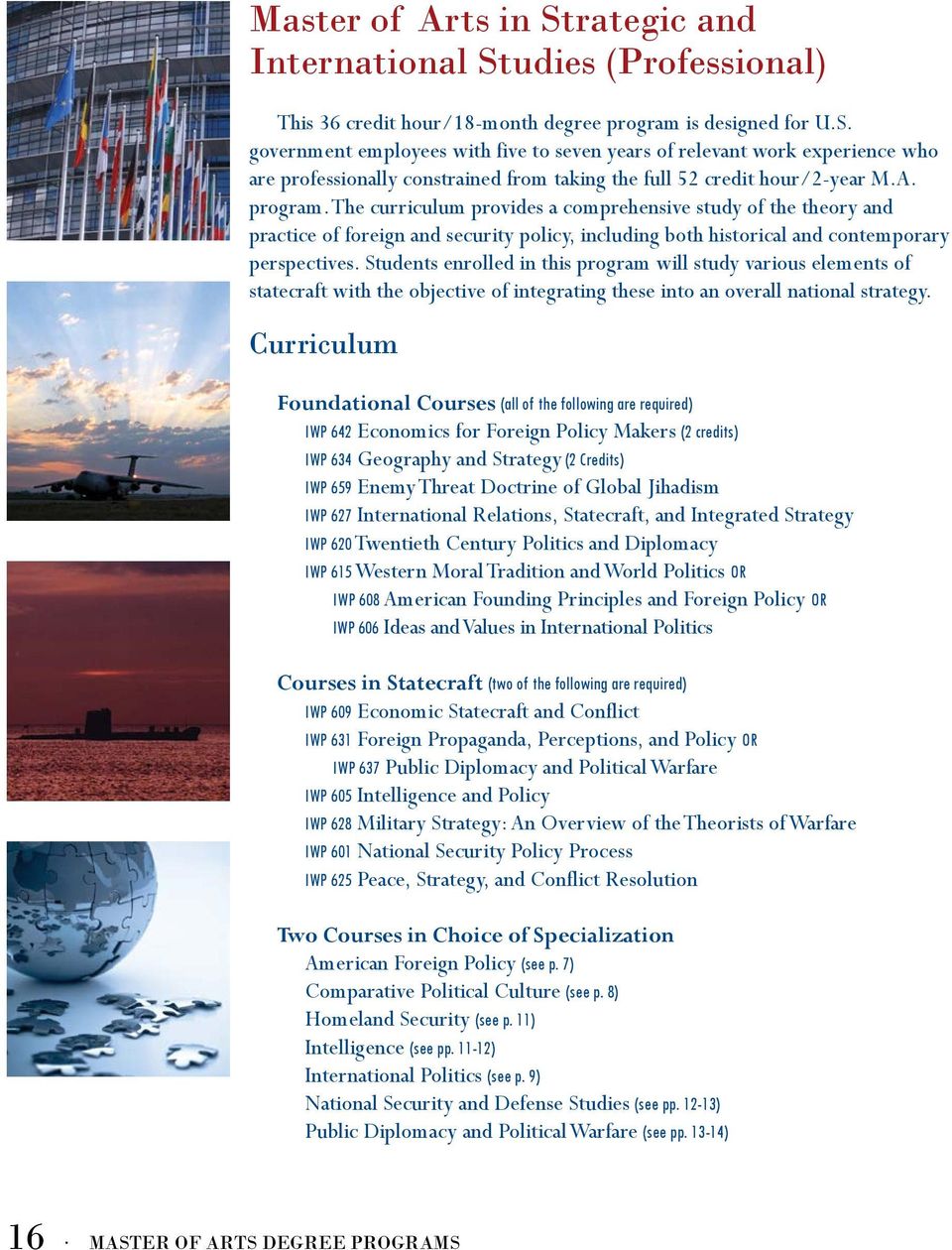
18 Master of Arts in Strategic and International Studies (Professional) This 36 credit hour/18-month degree program is designed for U.S. government employees with five to seven years of relevant work experience who are professionally constrained from taking the full 52 credit hour/2-year M.A. program. The curriculum provides a comprehensive study of the theory and practice of foreign and security policy, including both historical and contemporary perspectives. Students enrolled in this program will study various elements of statecraft with the objective of integrating these into an overall national strategy. Curriculum Foundational Courses (all of the following are required) IWP 642 Economics for Foreign Policy Makers (2 credits) IWP 634 Geography and Strategy (2 Credits) IWP 659 Enemy Threat Doctrine of Global Jihadism IWP 627 International Relations, Statecraft, and Integrated Strategy IWP 620 Twentieth Century Politics and Diplomacy IWP 615 Western Moral Tradition and World Politics OR IWP 608 American Founding Principles and Foreign Policy OR IWP 606 Ideas and Values in International Politics Courses in Statecraft (two of the following are required) IWP 609 Economic Statecraft and Conflict IWP 631 Foreign Propaganda, Perceptions, and Policy OR IWP 637 Public Diplomacy and Political Warfare IWP 605 Intelligence and Policy IWP 628 Military Strategy: An Overview of the Theorists of Warfare IWP 601 National Security Policy Process IWP 625 Peace, Strategy, and Conflict Resolution Two Courses in Choice of Specialization American Foreign Policy (see p. 7) Comparative Political Culture (see p. 8) Homeland Security (see p. 11) Intelligence (see pp ) International Politics (see p. 9) National Security and Defense Studies (see pp ) Public Diplomacy and Political Warfare (see pp ) 16 MASTER OF ARTS DEGREE PROGRAMS
19 Executive Master of Arts in National Security Affairs This 28 credit hour/12-month degree program is designed for U.S. government employees with a minimum of seven to ten years of relevant work experience. The curriculum provides a comprehensive study of the development and implementation of national security policy and integrated strategy. Curriculum (All courses required; all courses 4 credit hours each unless otherwise noted) IWP 642 Economics for Foreign Policy Makers (2 credits) IWP 634 Geography and Strategy (2 credits) IWP 674 National Security Policy Directed Study (2 credits) IWP 675 Political and Moral Philosophy (2 credits) (under development) IWP 659 Enemy Threat Doctrine of Global Jihadism OR IWP 630 Chinese Grand Strategy: Foreign and Military Policy OR IWP 603 Russian Politics and Foreign Policy IWP 613 History of International Relations IWP 627 International Relations, Statecraft, and Integrated Strategy IWP 637 Public Diplomacy & Political Warfare OR IWP 641 Political Warfare: Past, Present and Future IWP 616 U.S. National Security Strategy and Emerging Threats MASTER OF ARTS DEGREE PROGRAMS 17

20
21 Certificates of Graduate Study IWP s graduate certificate programs are designed for mid-career professionals and other advanced students who wish to pursue studies in national security, international affairs, and related fields, but who do not desire a degree. The certificates are intended to encourage students continuing professional and academic growth, and are immediately applicable to practitioners of a wide variety of disciplines in the U.S. intelligence community, the foreign policy community, the defense community, nongovernmental organizations, and the private sector. Each of the Institute s graduate certificates consists of five four-credit-hour graduate-level courses. No distinction in the classroom is made between certificate students and students in other IWP programs; all students share access to IWP s distinguished faculty members and perform the same research and other assignments. Nearly all of IWP s courses are offered in the evening hours (generally 6:30-9:30 pm), making the program ideal for professional students. This schedule makes it possible for even part-time students to complete an IWP certificate of graduate study in one calendar year. As the only professional graduate school in the United States and perhaps the world dedicated to teaching all the instruments of statecraft and their strategic integration, The Institute of World Politics provides its students with unequalled opportunities for professional growth and advancement. The Institute s certificate program provides an avenue to professional students to further their careers by studying a distinct area of statecraft. Engaging in advanced academic study of one of IWP s certificate topics ensures that professional students have an understanding of current issues in fields immediately relevant to them. Students and alumni of IWP are employed throughout Washington, D.C. and the world, in every member agency of the U.S. intelligence community; in the departments of State, Defense, Treasury, Commerce, Energy, and Homeland Security; scores of nongovernmental organizations; and the private sector. CERTIFICATES OF GRADUATE STUDY 19
22 American Foreign Policy The American Foreign Policy certificate provides an understanding of U.S. foreign policy and the history of its conduct since America became a world power. Students may choose the study of selected arts of statecraft and American relations in key areas of the world. This program prepares students for careers in diplomacy, policymaking, and non-governmental organization work. Required Courses IWP 608 American Founding Principles and Foreign Policy IWP 635 History of American Foreign Policy IWP 638 U.S. Foreign Policy: Current and Future Challenges An area-study course: IWP 630 Chinese Grand Strategy: Foreign and Military Policy IWP 677 Chinese Military Thought and History IWP 653 The Contemporary Balkans IWP 658 The Geopolitics of the Iranian Plateau and South Asia IWP 604 Islam and Geopolitics in Eurasia IWP 645 Islam in Contemporary Global Politics IWP 603 Russian Politics and Foreign Policy IWP 639 U.S. African Relations IWP 671 The U.S. China Strategic Relationship IWP 623 U.S. Latin American Relations: Threats and Opportunities East Central Europe (under development) The European Union (under development) Elective Courses (Choose one) IWP 672 Crisis Management and Decisionmaking IWP 609 Economic Statecraft and Conflict IWP 673 Human Rights and Counter-Radicalization IWP 611 Immigration and National Security IWP 637 Public Diplomacy and Political Warfare IWP 632 U.S. Intelligence in the Cold War and Beyond IWP 615 Western Moral Tradition and World Politics Comparative Political Culture The Comparative Political Culture certificate is designed for students seeking an understanding of many of the political, ideological, religious, and cultural influences on the behavior of states around the world. This program will also provide background in the behavior of terrorist organizations and other non- 20 CERTIFICATES OF GRADUATE STUDY
23 state actors. Students will be prepared for careers in diplomacy and policymaking, and as analysts. Required Courses IWP 640 Cultural Intelligence for Strategy and Analysis IWP 606 Ideas and Values in International Politics Two area-study courses: IWP 630 Chinese Grand Strategy: Foreign and Military Policy IWP 677 Chinese Military Thought and History IWP 653 The Contemporary Balkans IWP 658 The Geopolitics of the Iranian Plateau and South Asia IWP 604 Islam and Geopolitics in Eurasia IWP 645 Islam in Contemporary Global Politics IWP 603 Russian Politics and Foreign Policy IWP 639 U.S. African Relations IWP 671 The U.S. China Strategic Relationship IWP 623 U.S. Latin American Relations: Threats and Opportunities East Central Europe (under development) The European Union (under development) Elective Courses (Choose one) IWP 614 Diplomacy Toward Comparative Regimes IWP 613 History of International Relations IWP 649 Mass Murder Prevention in Failed and Failing States IWP 621 Stabilization and Nation-Building: History and Policy IWP 615 Western Moral Tradition and World Politics Conflict Prevention This program examines various methods of detecting, preventing, and mitigating various types of international, inter-tribal, and other civil conflicts which may have international sources and implications. Its curriculum explores both theory and practice: the most useful and effective understandings of the nature of peace, and how it is based on proper concepts of building human community and political order; how to handle the strategic environment in failed and failing states as well as those with regions torn by civil conflict; how to conduct various forms of strategic engagement through public diplomacy, foreign assistance, the development of relationships of trust; how to navigate the ideological and religious terrain in ways that can prevent or mitigate radicalization; and the role and record of exporting democratic ideas and institutions to prevent and mitigate conflict. CERTIFICATES OF GRADUATE STUDY 21
24 Required Courses IWP 649 Mass Murder Prevention in Failed and Failing States IWP 625 Peace, Strategy and Conflict Resolution Elective Courses (Choose three) IWP 669 Counterterrorism and the Democracies IWP 673 Human Rights and Counter-Radicalization IWP 670 Counterterrorism through Cultural Engagement and Development IWP 637 Public Diplomacy and Political Warfare IWP 621 Stabilization and Nation-Building: History and Policy IWP 607 U.S. Nonproliferation and Nuclear Policy Corporate Statecraft The Corporate Statecraft certificate provides an introduction to the political challenges corporations face abroad: the problems of dealing with and influencing different types of regimes; forecasting and coping with political instability; calculating political risks; protecting intellectual property and national security secrets from foreign intelligence threats; and how U.S. government agencies address foreign commercial issues in the context of their larger diplomatic, intelligence, and military missions. It also explains the national security and foreign policy processes in the Executive Branch, the role of Congress, and the roles of government agencies involved in the financial and regulatory realms; and how to optimize public-private partnerships in ways that maximize both vital national interests and corporate interests. Required Course IWP 665 Corporate Statecraft Elective Courses (Choose four) IWP 608 American Founding Principles and Foreign Policy IWP 610 Counterintelligence in a Democratic Society IWP 672 Crisis Management and Decisionmaking IWP 663 Cyber Statecraft IWP 614 Diplomacy Toward Comparative Regimes IWP 609 Economic Statecraft and Conflict IWP 667 Forecasting and Political Risk Analysis IWP 601 National Security Policy Process 22 CERTIFICATES OF GRADUATE STUDY
25 Counterintelligence The Counterintelligence certificate concerns the threats from foreign intelligence and influence operations facing the United States in the post 9/11 world. Students will take a case-study approach in learning the strategy, operational tradecraft, and tactics of adversaries. This program prepares students for careers in counterintelligence, homeland security, counterpropaganda, and law enforcement. Required Courses IWP 610 Counterintelligence in a Democratic Society IWP 605 Intelligence and Policy Elective Courses (Choose three) IWP 647 Case Studies in Counterintelligence Operations IWP 622 Comparative Intelligence Systems: Foreign Intelligence and Security Cultures IWP 676 A Counterintelligence Challenge: The Enigmas and Benefits of Defectors IWP 669 Counterterrorism and the Democracies IWP 659 Enemy Threat Doctrine of Global Jihadism IWP 631 Foreign Propaganda, Perceptions, and Policy IWP 654 History of FBI Counterintelligence IWP 644 Spies, Subversion, Terrorism, and Influence Operations IWP 662 Surprise, Warning, and Deception IWP 633 Terrorism Counterterrorism The Counterterrorism certificate examines American counterterrorism policy at home and abroad, including intelligence policy, enemy threat doctrine, and national security strategy in a historical and cultural context. Students who complete it are prepared for careers in intelligence, homeland security, law enforcement, and the military. Required Courses IWP 610 Counterintelligence in a Democratic Society IWP 669 Counterterrorism and the Democracies IWP 659 Enemy Threat Doctrine of Global Jihadism IWP 633 Terrorism CERTIFICATES OF GRADUATE STUDY 23
26 Elective Courses (Choose one) IWP 670 Counterterrorism through Cultural Engagement and Development IWP 640 Cultural Intelligence for Strategy and Analysis IWP 664 Foundations of Homeland Security IWP 673 Human Rights and Counter-Radicalization IWP 641 Political Warfare: Past, Present, and Future IWP 637 Public Diplomacy and Political Warfare IWP 644 Spies, Subversion, Terrorism and Influence Operations IWP 632 U.S. Intelligence in the Cold War and Beyond IWP 616 U.S. National Security Strategy and Emerging Threats Cyber Statecraft The Cyber Statecraft certificate reflects the increasing importance of the cyber domain to U.S. national security strategy. Case studies of cyber operations are presented in the overall national strategic context so that students can appreciate the challenges of bringing theories into practice. Students will be prepared for careers in intelligence, counterintelligence, homeland security, and policymaking. This certificate requires four courses, as listed below, as well as one free elective for a total of 20 credits. IWP 610 Counterintelligence in a Democratic Society IWP 663 Cyber Statecraft IWP 628 Military Strategy: An Overview of the Theorists of Warfare OR IWP 618 Information Operations and Information Warfare IWP 601 National Security Policy Process OR IWP 605 Intelligence and Policy One elective Economic Statecraft The Economic Statecraft certificate provides a strong foundation in the relationship between political and economic freedom, traditional international economic subjects such as trade and development aid, as well as less studied fields such as technology security, financial security, sanctions, and other elements of economic warfare. These elements of economic power are presented in a strategic context. This program equips students for careers in economic policymaking, diplomacy, and non-governmental organizations providing humanitarian assistance. IWP 642 Economics for Foreign Policy Makers (2 credits) 24 CERTIFICATES OF GRADUATE STUDY
27 IWP 634 Geography and Strategy (2 credits) IWP 670 Counterterrorism through Cultural Engagement and Development IWP 609 Economic Statecraft and Conflict IWP 627 International Relations, Statecraft and Integrated Strategy OR IWP 626 Foundations of Political and Economic Freedom OR IWP 665 Corporate Statecraft IWP 601 National Security Policy Process Homeland Security The purpose of this certificate is to provide both the strategic context for homeland security and its institutional framework, including current laws and legislative history, organization, definitions, historical background, bureaucracy, and domestic intelligence. An introduction to Homeland Defense will be provided, along with an overview of specific threats, notably terrorism, human trafficking, narcotics, gangs, and other illicit activities. This certificate prepares students for a wide variety of careers in homeland security, intelligence, and law enforcement. Required Course IWP 664 Foundations of Homeland Security Elective Courses (Choose four) IWP 612 American Intelligence and Protective Security: An Advanced Seminar IWP 610 Counterintelligence in a Democratic Society IWP 669 Counterterrorism and the Democracies IWP 663 Cyber Statecraft IWP 611 Immigration and National Security IWP 616 U.S. National Security Strategy and Emerging Threats OR IWP 601 National Security Policy Process Intelligence The Intelligence certificate provides a comprehensive study of the various issues of intelligence policy, process, epistemology, analysis, and history. Students in the program learn how American political and cultural values affect the role and practice of intelligence in the United States and how intelligence fits into the national strategic context. Elements of this program also address the problem of understanding foreign cultures and the practices of foreign powers. The program prepares students for careers in intelligence, counterintelligence, homeland security, law enforcement, and the military. CERTIFICATES OF GRADUATE STUDY 25
28 Required Courses IWP 610 Counterintelligence in a Democratic Society IWP 631 Foreign Propaganda, Perceptions and Policy IWP 605 Intelligence and Policy Elective Courses (Choose two) IWP 612 American Intelligence and Protective Security: An Advanced Seminar IWP 647 Case Studies in Counterintelligence Operations IWP 622 Comparative Intelligence Systems: Foreign Intelligence and Security Cultures IWP 676 A Counterintelligence Challenge: The Enigmas and Benefits of Defectors IWP 640 Cultural Intelligence for Strategy and Analysis IWP 652 Estimative Intelligence Analysis and Epistemology IWP 667 Forecasting and Political Risk Analysis IWP 654 History of FBI Counterintelligence IWP 618 Information Operations and Information Warfare IWP 656 Intelligence Collection IWP 648 Military Intelligence and Modern Warfare IWP 641 Political Warfare: Past, Present, and Future OR IWP 637 Public Diplomacy and Political Warfare IWP 668 The Role and Importance of Human Intelligence IWP 644 Spies, Subversion, Terrorism, and Influence Operations IWP 662 Surprise, Warning, and Deception IWP 655 Technology, Intelligence, Security, and Statecraft IWP 632 U.S. Intelligence in the Cold War and Beyond International Politics The International Politics certificate provides an understanding of the history of international relations, the current world order, its dominant trends, and its likely evolution. It also addresses selected international policy issues that may be studied according to a student s interests or professional requirements. Students examine the issues of war, peace, and sovereignty, and their relation to the international system. It prepares graduates for careers in diplomacy, intelligence, and policymaking. Required Courses IWP 613 History of International Relations IWP 627 International Relations, Statecraft, and Integrated Strategy One area-study course: IWP 630 Chinese Grand Strategy: Foreign and Military Policy IWP 677 Chinese Military Thought and History IWP 653 The Contemporary Balkans 26 CERTIFICATES OF GRADUATE STUDY
29 IWP 658 The Geopolitics of the Iranian Plateau and South Asia IWP 604 Islam and Geopolitics in Eurasia IWP 645 Islam in Contemporary Global Politics IWP 603 Russian Politics and Foreign Policy IWP 639 U.S. African Relations IWP 671 The U.S. China Strategic Relationship IWP 623 U.S. Latin American Relations: Threats and Opportunities East Central Europe (under development) The European Union (under development) Elective Courses (Choose two) IWP 614 Diplomacy Toward Comparative Regimes IWP 673 Human Rights and Counter-Radicalization IWP 606 Ideas and Values in International Politics IWP 619 Mass Media and World Politics IWP 649 Mass Murder Prevention in Failed and Failing States IWP 625 Peace, Strategy and Conflict Resolution IWP 620 Twentieth Century Politics and Diplomacy: Case Studies in War and Peace National Security Affairs This certificate provides an understanding of the elements of the theory and practice of national security policy, process, and implementation, both at the level of grand strategy as well as on the tactical level. Significant parts of this certificate program address a number of vital current policy issues. Graduates are prepared for careers as analysts and strategists throughout the U.S. government s national security apparatus and in the private sector. Required Courses IWP 601 National Security Policy Process IWP 616 U.S. National Security Strategy and Emerging Threats One area-study course: IWP 630 Chinese Grand Strategy: Foreign and Military Policy IWP 677 Chinese Military Thought and History IWP 653 The Contemporary Balkans IWP 658 The Geopolitics of the Iranian Plateau and South Asia IWP 604 Islam and Geopolitics in Eurasia IWP 645 Islam in Contemporary Global Politics IWP 603 Russian Politics and Foreign Policy IWP 639 U.S. African Relations IWP 671 The U.S. China Strategic Relationship CERTIFICATES OF GRADUATE STUDY 27
30 IWP 623 U.S. Latin American Relations: Threats and Opportunities East Central Europe (under development) The European Union (under development) Elective Courses (Choose two) IWP 669 Counterterrorism and the Democracies IWP 670 Counterterrorism through Cultural Engagement and Development IWP 672 Crisis Management and Decisionmaking IWP 663 Cyber Statecraft IWP 609 Economic Statecraft and Conflict IWP 659 Enemy Threat Doctrine of Global Jihadism IWP 667 Forecasting and Political Risk Analysis IWP 631 Foreign Propaganda, Perceptions and Policy IWP 673 Human Rights and Counter-Radicalization IWP 611 Immigration and National Security IWP 618 Information Warfare and Information Operations IWP 605 Intelligence and Policy IWP 648 Military Intelligence and Modern Warfare IWP 628 Military Strategy: An Overview of the Theorists of Warfare IWP 641 Political Warfare: Past, Present, and Future OR IWP 637 Public Diplomacy and Political Warfare IWP 633 Terrorism IWP 657 U.S. Approaches to Irregular Warfare IWP 607 U.S. Nonproliferation and Nuclear Policy Nonviolent Conflict This certificate teaches the use of non-violent tools of statecraft in conflicts, based on an appreciation of how to manage diverse and often conflicting interests within and among nations. It is specifically designed to maximize the non-military instruments of power so as to minimize the necessity of using force. Graduates of this program are prepared for careers in diplomacy, conflict resolution, public diplomacy, and work with nongovernmental organizations. Required Courses IWP 609 Economic Statecraft and Conflict IWP 631 Foreign Propaganda, Perceptions and Policy OR IWP 637 Public Diplomacy and Political Warfare IWP 670 Counterterrorism through Cultural Engagement and Development 28 CERTIFICATES OF GRADUATE STUDY
31 Elective Courses (Choose two) IWP 640 Cultural Intelligence for Strategy and Analysis IWP 673 Human Rights and Counter-Radicalization IWP 618 Information Operations and Information Warfare IWP 625 Peace, Strategy and Conflict Resolution IWP 621 Stabilization and Nation-Building: History and Policy IWP 657 U.S. Approaches to Irregular Warfare IWP 616 U.S. National Security Strategy and Emerging Threats OR IWP 659 Enemy Threat Doctrine of Global Jihadism Peace Building, Stabilization, and Humanitarian Affairs This certificate is designed to provide an understanding of the principles required for establishing stable and effective states, whose institutions seek to promote freedom, human rights, justice, the rule of law, and economic growth in the context of American foreign policy and ongoing global challenges. This certificate requires a total of 22 credits, as detailed below. IWP 608 American Founding Principles and Foreign Policy OR IWP 626 Foundations of Political and Economic Freedom IWP 670 Counterterrorism through Cultural Engagement and Development IWP 642 Economics for Foreign Policy Makers (2 credits) IWP 649 Mass Murder Prevention in Failed and Failing States IWP 625 Peace, Strategy and Conflict Resolution IWP 621 Stabilization and Nation-Building: History and Policy OR IWP 640 Cultural Intelligence for Strategy and Analysis Public Diplomacy and Political Warfare This certificate examines the many forms of relations with, and influence, over, foreign publics and opinion leaders. It covers the spectrum of instruments cultural diplomacy, exchanges, humanitarian aid, information policy and strategic communications, psychological strategy, counter-propaganda, political action, and political warfare. Graduates equipped with this certificate are preared for careers in many areas of diplomacy, foreign assistance, strategic communications, information support operations, and covert political action. CERTIFICATES OF GRADUATE STUDY 29
32 Required Courses IWP 670 Counterterrorism through Cultural Engagement and Development IWP 631 Foreign Propaganda, Perceptions and Policy IWP 637 Public Diplomacy and Political Warfare Elective Courses (Choose two) IWP 640 Cultural Intelligence for Strategy and Analysis IWP 673 Human Rights and Counter-Radicalization IWP 606 Ideas and Values in International Politics IWP 618 Information Operations and Information Warfare IWP 619 Mass Media and World Politics IWP 641 Political Warfare: Past, Present and Future IWP 901/902 Directed Study in Public Diplomacy or in Political Warfare Strategic Communication The purpose of this certificate is to promote an understanding of an often misunderstood and misnamed tool of statecraft, which is sometimes confused with public diplomacy or public affairs and which even is used as a euphemism for advertisement and propaganda.the coursework is designed to provide the practitioner with an appreciation for the need to integrate policy with all instruments of statecraft, while focusing on specific targets and effective messaging. Students are prepared for careers in public diplomacy, information support operations, and strategic communications, and public affairs. IWP 631 Foreign Propaganda, Perceptions and Policy IWP 619 Mass Media and World Politics OR IWP 640 Cultural Intelligence for Strategy and Analysis IWP 641 Political Warfare: Past, Present and Future OR IWP 618 Information Operations and Information Warfare IWP 637 Public Diplomacy and Political Warfare IWP 616 U.S. National Security Strategy and Emerging Threats OR IWP 659 Enemy Threat Doctrine of Global Jihadism 30 CERTIFICATES OF GRADUATE STUDY
33 Strategic Soft Power The purpose of this certificate is to promote a strategic understanding of the non-coercive tools of foreign policy and national security, and how they are and should be integrated for effective strategy. They include public diplomacy, counterpropaganda, counter-influence operations, humanitarian and economic assistance, political warfare, and the intelligence needed for such tools of statecraft. Graduates of this program are prepared for careers in diplomacy, foreign assistance, information support, intelligence, and counterintelligence.. IWP 670 Counterterrorism through Cultural Engagement and Development IWP 631 Foreign Propaganda, Perceptions and Policy OR IWP 640 Cultural Intelligence for Strategy and Analysis IWP 606 Ideas and Values in International Politics OR IWP 673 Human Rights and Counter-Radicalization IWP 637 Public Diplomacy and Political Warfare IWP 621 Stabilization and Nation-Building: History and Policy CERTIFICATES OF GRADUATE STUDY 31
34
35 Course Directory Advanced Arabic I IWP 944 Advanced Chinese I IWP 949 Advanced Russian I/II IWP 954/955 Advanced Writing and Research Seminar IWP 643 American Founding Principles and Foreign Policy IWP 608 American Intelligence and Protective Security: An Advanced Seminar IWP 612 Art of Diplomacy, The IWP 636 Beginning Arabic I/II IWP 940/941 Beginning Chinese I/II IWP 945/946 Beginning Russian I/II IWP 950/951 Case Studies in Counterintelligence Operations IWP 647 Chinese Grand Strategy: Foreign and Military Policy IWP 630 Chinese Military Thought and History IWP 677 Comparative Intelligence Systems: Foreign Intelligence and Security Cultures IWP 622 Contemporary Balkans, The IWP 653 Corporate Statecraft IWP 665 Counterintelligence Challenge, A: The Enigmas and Benefits of Defectors IWP 676 Counterintelligence in a Democratic Society IWP 610 Counterterrorism and the Democracies IWP 669 Counterterrorism through Cultural Engagement and Development IWP 670 Crisis Management and Decisionmaking IWP 672 Cultural Intelligence for Strategy and Analysis IWP 640 Cyber Statecraft IWP 663 Diplomacy Toward Comparative Regimes IWP 614 Economic Statecraft and Conflict IWP 609 Economics for Foreign Policy Makers IWP 642 Enemy Threat Doctrine of Global Jihadism IWP 659 Estimative Intelligence Analysis and Epistemology IWP 652 Forecasting and Political Risk Analysis IWP 667 Foreign Propaganda, Perceptions and Policy IWP 631 Foundations of Homeland Security IWP 664 Foundations of Political and Economic Freedom IWP 626 Geography and Strategy IWP 634 Geopolitics of the Iranian Plateau and South Asia, The IWP 658 History of American Foreign Policy IWP 635 History of FBI Counterintelligence IWP 654 History of International Relations IWP 613 Human Rights and Counter-Radicalization IWP 673 Ideas and Values in International Politics IWP 606 COURSE DIRECTORY 33
36 Immigration and National Security IWP 611 Information Operations and Information Warfare IWP 618 Intelligence and Policy IWP 605 Intelligence Collection IWP 656 Intermediate Arabic I/II IWP 942/943 Intermediate Chinese I/II IWP 947/948 Intermediate Russian I/II IWP 952/953 International Relations, Statecraft and Integrated Strategy IWP 627 Islam and Geopolitics in Eurasia IWP 604 Islam in Contemporary Global Politics IWP 645 Mass Media and World Politics IWP 619 Mass Murder Prevention in Failed and Failing States IWP 649 Military Intelligence and Modern Warfare IWP 648 Military Strategy: An Overview of the Theorists of Warfare IWP 628 National Security Policy Process IWP 601 Peace, Strategy and Conflict Resolution IWP 625 Political Warfare: Past, Present and Future IWP 641 Public Diplomacy and Political Warfare IWP 637 Role and Importance of Human Intelligence, The IWP 668 Russian Politics and Foreign Policy IWP 603 Spies, Subversion, Terrorism and Influence Operations IWP 644 Stabilization and Nation-Building: History and Policy IWP 621 Surprise, Warning, and Deception: An Introduction IWP 662 Technology, Intelligence, Security, and Statecraft IWP 655 Terrorism IWP 633 Twentieth Century Politics and Diplomacy: Case Studies in War and Peace IWP 620 U.S.-African Relations IWP 639 U.S. Approaches to Irregular Warfare IWP 657 U.S.-China Strategic Relationship, The IWP 671 U.S. Foreign Policy: Current and Future Challenges IWP 638 U.S. Intelligence in the Cold War and Beyond IWP 632 U.S.-Latin American Relations: Threats and Opportunities IWP 623 U.S. National Security Strategy and Emerging Threats IWP 616 U.S. Nonproliferation and Nuclear Policy IWP 607 Western Moral Tradition and World Politics IWP 615 Writing for National Security Professionals IWP 650 East Central Europe European Union, The Directed Study IWP 901/902 IWP-Oxford Study Abroad Program IWP 660 Honors Thesis IWP 930/931 Selected Topics IWP 920/921 IWP 601 National Security Policy Process 4 credits Prof. S. John Tsagronis Introduction to the institutions and processes through which U.S. national security policies are made within the government. IWP 603 Russian Politics and Foreign Policy 4 credits Dr. Marek Jan Chodakiewicz and Dr. John Lenczowski A survey of Russian history from the Kievan Rus to the post-soviet sphere, exploring continuities and discontinuities in Russian politics, armed forces, intelligence, foreign policy, and economy. IWP 604 Islam and Geopolitics in Eurasia 4 credits Prof. Paul Goble A survey course of the role of Islam in the geopolitics of the post-soviet states, including the foreign policy challenges they pose for the West. IWP 605 Intelligence and Policy 4 credits Dr. David L. Thomas Study of the elements and purpose of intelligence, requirements of suc- 34 COURSE DIRECTORY
37 cessful intelligence analysis, the intelligence process, counterintelligence and security, the relationship between intelligence and policy, and how American political and cultural values affect the role of intelligence in America. IWP 606 Ideas and Values in International Politics 4 credits Dr. Joshua Muravchik Study of ideas, values, and information as both targets and instruments of foreign policy and how different political cultures and methods of statecraft are the consequence of certain ideas and belief systems. IWP 607 U.S. Nonproliferation and Nuclear Policy 4 credits Prof. Henry D. Sokolski Historical, technical, and analytical examination of the problems of preventing the proliferation of nuclear weapons and associated technologies. IWP 608 American Founding Principles and Foreign Policy 4 credits Prof. Joseph R. Wood Examination of the ways in which the American political order and its philosophical foundations in ancient, medieval, and modern Western political thought affect U.S. foreign policymaking. IWP 609 Economic Statecraft and Conflict 4 credits Dr. David Glancy Exploring the dimension of economics concerning national security policy, with special emphasis on economic, technological, and financial security issues; economic strategy as an instrument of statecraft; and the uses of and defenses against various tools of economic warfare. IWP 610 Counterintelligence in a Democratic Society 4 credits Dr. David L. Thomas Study of the role of counterintelligence as an element of U.S. national security strategy and the importance of counterintelligence in international relations. IWP 611 Immigration and National Security 4 credits Prof. David Burgess The history and impact of immigration policies from economic, demographic, environmental, cultural, and national security perspectives. COURSE DIRECTORY 35
38 IWP 612 American Intelligence and Protective Security: An Advanced Seminar 4 credits Professor to be announced Capstone seminar addressing fundamental questions about the need, purpose, mission, organization, size, structure, and doctrines of the U.S. intelligence and protective security communities in the post-cold War, post-9/11 era. Through the classes I took and the lectures I attended at The Institute of World Politics, I have enriched my knowledge of international affairs, learned how to utilize the tools of statecraft to elaborate an integrated strategy, as well as grasped the moral values and ethics that are the foundations of Western civilization. -Charlotte Bouchot, IWP Class of 2012 IWP 613 History of International Relations 4 credits Dr. John J. Tierney, Jr. Analysis of the basic premises of world politics and searches through history and culture to discover the lasting realities behind peace and war, examining the historic, cultural, and strategic foundations behind such contemporary expressions as new world order and multiculturalism. IWP 614 Diplomacy Toward Comparative Regimes 4 credits Professor to be announced Comparative examination of selected historical and contemporary political systems, and how to conduct diplomacy toward them. IWP 615 Western Moral Tradition and World Politics 4 credits Dr. Alberto M. Piedra Prof. Joseph R. Wood Survey of the historical development of Western moral philosophy and an analysis of the role of ethics in the conduct of foreign policy. IWP 616 U.S. National Security Strategy and Emerging Threats 4 credits Prof. S. John Tsagronis Examination of U.S. security principles, policies, and processes focused on the U.S. historical experience in countering severe security threats. IWP 618 Information Operations and Information Warfare 4 credits Professor to be announced Exploration of the evolving concepts of information operations (e.g., information superiority, information warfare, and information assurance) as elements of national security. IWP 619 Mass Media and World Politics 4 credits Professor to be announced Examination of constructive and destructive roles of the media in international affairs, such as a free press as a check on government policies, the importance of foreign media reporting as a complement to intelligence, and the effects of state censorship. 36 COURSE DIRECTORY
39 IWP 620 Twentieth Century Politics and Diplomacy: Case Studies in War and Peace 4 credits Dr. John J. Tierney, Jr. Dr. Marek Jan Chodakiewicz Examination of the most significant developments making the 20th century the most violent, revolutionary era in world history, with emphasis on the structure of the international system and the role of geopolitical and ideological movements. IWP 621 Stabilization and Nation-Building: History and Policy 4 credits Professor to be announced Exploration the relationship between promoting a strong civil society and democratic governance abroad, especially in light of extremist developments emerging in many Islamic societies. IWP 622 IWP 623 Comparative Intelligence Systems: Foreign Intelligence and Security Cultures 4 credits Dr. Robert W. Stephan Giving a comprehensive understanding of the intelligence and counterintelligence systems of selected foreign states, as contrasted with the intelligence and counterintelligence traditions of the United States. U.S.-Latin American Relations: Threats and Opportunities 4 credits Dr. Roger Fontaine Examination of the changes, positive and negative, underway in Latin America, the role of political culture in shaping the region s politics and economics, and major security issues affecting the United States. IWP 625 Peace, Strategy and Conflict Resolution 4 credits Dr. John J. Tierney, Jr. Study of the larger dimensions surrounding the issues of peace, war, and conflict resolution such as the transcendent nature of peace, the relationship between peace and a just moral order, and the diverse approaches to conflict resolution in history. IWP 626 Foundations of Political and Economic Freedom 4 credits Dr. Alberto M. Piedra Examination of the political and economic principles underlying a free society as developed in the West beginning with the concepts of human nature and human freedom that result in an open, liberal democracy and their applicability to non-democratic cultures. COURSE DIRECTORY 37
40 IWP 627 International Relations, Statecraft, and Integrated Strategy 4 credits Dr. John Lenczowski and Dr. Roger W. Fontaine International relations theory for the policy practitioner and an introduction to the instruments of power and their integrated strategic employment. IWP 628 Military Strategy: An Overview of the Theorists of Warfare 4 credits Dr. Mackubin Thomas Owens Introduction to the classic statements of, and commentaries on, Western military strategic thought. An examination of how various military concepts are integrated into grand strategy and their role in history, statecraft, and war. IWP 630 Chinese Grand Strategy: Foreign and Military Policy 4 credits Prof. Ross H. Munro Study of traditional Chinese strategic culture and statecraft and the emergence of a new Chinese grand strategy in the post Mao, post Soviet era via an analysis of Chinese foreign and military policy. IWP 631 Foreign Propaganda, Perceptions and Policy 4 credits Dr. David Glancy Preparation to recognize foreign propaganda, analyze it, and employ countermeasures, by studying the history, theory, and methodology of foreign propaganda and disinformation in modern statecraft. IWP 632 U.S. Intelligence in the Cold War and Beyond 4 credits Dr. David L. Thomas A history of secret intelligence the missing dimension of Cold War history and the U.S. intelligence community s overall role in that struggle. IWP 633 Terrorism 4 credits Prof. Aaron A. Danis Study of the sources and objectives of various terrorist groups; their operations (including strategies, tactics, weaponry, financing, and state sponsorship); and various countermeasures for combating terrorism. IWP 634 Geography and Strategy 2 credits Dr. Marek Jan Chodakiewicz Study of the interrelationship between geography and strategy at all levels, including the military, economic, and political. 38 COURSE DIRECTORY
41 IWP 635 History of American Foreign Policy 4 credits Dr. John J. Tierney, Jr. Survey of American foreign policy from 1776 to the present day, discussing the thematic features characterizing foreign policy and its service to national interests. IWP 636 The Art of Diplomacy 4 credits Prof. G. Philip Hughes Examination of the development of the traditional art of diplomacy over time and how technology, communications, and ideology have affected the diplomatic process and its evolution. IWP 637 Public Diplomacy and Political Warfare 4 credits Dr. David Glancy The history, and methods of the many arts that are dedicated to relations with, and influence over, foreign publics, and how they are integrated with traditional diplomacy to intelligence collection and covert operations. IWP 638 U.S. Foreign Policy: Current and Future Challenges 4 credits Dr. John J. Tierney, Jr. Examination of U.S. foreign policy in the contemporary international system, and how it uses the three levels of the national interest the vital, important, and marginal to identify threats and opportunities for U.S. policymakers. IWP 639 U.S.-African Relations 4 credits Prof. Charles Snyder Study of developments in Africa including the transition from colonial rule to independence, the impact of the Cold War on Africa, and current political relations with the West. IWP 640 Cultural Intelligence for Strategy and Analysis 4 credits Professor to be announced Exploration of why and how culture matters in intelligence analysis and political decisionmaking, what types of cultural factors affect political life, and how their relative effect can be evaluated. My experience at IWP was phenomenal. The classes opened up my strategic understanding to the use of other elements of national power than hard power. At IWP, I was exposed to the numerous advantages of the employment of soft power." MAJ Brian Platt, USA IWP Class of 2012 IWP 641 Political Warfare: Past, Present, and Future 4 credits Dr. David Glancy An examination of political warfare as an instrument of leadership and statecraft from antiquity to the present, using original texts. COURSE DIRECTORY 39
42 IWP 642 Economics for Foreign Policy Makers 2 credits Dr. Norman Bailey Dr. Anne Rathbone Bradley Economic history, theory, and practice applicable to careers in national security, intelligence, and international affairs. IWP 643 Advanced Writing and Research Seminar 4 credits Dr. Marek Jan Chodakiewicz An introduction to the art of research and writing: familiarization with the acquisition, analysis, and communication of information. Attending IWP has been the most significant and transformative personal and professional experience I have had to date. Kemal Okudo, Former banking and telecommunications executive, IWP Class of 2009 IWP 644 Spies, Subversion, Terrorism and Influence Operations 4 credits Dr. Robert Stephan This course exposes students to some of the forms of statecraft that are used by foreign powers. It does so through an in-depth examination of the seventy-year Soviet intelligence and counterintelligence operation in the West. IWP 645 Islam in Contemporary Global Politics 4 credits Dr. Douglas E. Streusand Political theory and practice in the Islamic world throughout its history, relationships between politics and religion in the contemporary Islamic world, and the activities of the totalitarian Islamic network. IWP 647 Case Studies in Counterintelligence Operations 4 credits Prof. John Quattrocki Examination of case studies of the careers of the most damaging spies since the end of the Second World War. IWP 648 Military Intelligence in Modern Warfare 4 credits Dr. David L. Thomas Studies the role and importance of military intelligence in modern warfare and the key sources, components, and methods of modern military intelligence in the U.S. and elsewhere. IWP 649 Mass Murder Prevention in Failed and Failing States 4 credits Dr. Marek Jan Chodakiewicz Seminar concentrating on genocide and genocide prevention in the 20th and 21st centuries, examining legal and cultural definitions of genocide and numerous historical examples, to identify ideological and political reasons for those crimes, and detect early warning signs for genocide prevention. 40 COURSE DIRECTORY
43 IWP 650 Writing for National Security Professionals 4 credits Dr. Marek Jan Chodakiewicz Presentation and analysis of the different types of writing, the mastery of which is necessary for success in the national security and foreign affairs professions. IWP 652 Estimative Intelligence Analysis and Epistemology 4 credits Dr. H. A. Ford Studies the methods, validity, and scope of knowledge derived from secret intelligence and counterintelligence. The course addresses many issues affecting the quality and relevance of estimative analysis to statecraft. IWP 653 The Contemporary Balkans 4 credits Professor to be announced Study of contemporary politics and the historical context of the Balkans, including an evaluation of the political direction of each country. IWP 654 History of FBI Counterintelligence 4 credits Dr. Raymond Batvinis A comprehensive history of the major personalities, laws, policies, issues, attitudes, and events that accelerated the growth of a robust FBI counterintelligence structure. IWP 655 Technology, Intelligence, Security, and Statecraft 4 credits Prof. Eugene Poteat Study of how the march of technology has affected intelligence, security, and the other tools of statecraft. IWP 656 Intelligence Collection 4 credits Dr. David Thomas and Dr. Robert W. Stephan Examination of the nature, organization, activities, and key issues surrounding the methods of intelligence and counterintelligence collection. IWP 657 U.S. Approaches to Irregular Warfare 4 credits Prof. S. John Tsagronis This course examines counterinsurgency as a core challenge for U.S. statecraft, including military perspectives, the theories and practices of political development and sources of rebellion, and the U.S. approach to nation-building. COURSE DIRECTORY 41
44 IWP 658 The Geopolitics of the Iranian Plateau and South Asia 4 credits Dr. Douglas E. Streusand This course analyzes three states that pose major policy challenges for the United States: Iran, Afghanistan, and Pakistan, and one rising power that will have a central role in world affairs for the next century and beyond, India. IWP 659 Enemy Threat Doctrine of Global Jihadism 4 credits Dr. Sebastian Gorka Studies the worldview of the Salafi Jihadists typified by Osama bin Laden and al Qaeda, leading to an understanding of their violent, non-violent and indirect strategies. This course is designed to help students formulate appropriate responses to the current irregular threat environment. IWP 660 IWP Oxford Study Abroad Program 4 credits Prof. S. John Tsagronis, advisor This program consists of tutorials led by University of Oxford scholars on both historical and contemporary issues. It is the curricular equivalent of a Directed Study. IWP 662 Surprise, Warning, and Deception: An Introduction 4 credits Dr. David L. Thomas This course assesses the problems of surprise, warning, and deception with respect to their potential and actual impact on U.S. intelligence and national security strategy and policy. It approaches the interrelated issues of warning, surprise, and deception from historical, operational, analytical, cognitive, and national-strategic perspectives. IWP 663 Cyber Statecraft 4 credits Prof. S. John Tsagronis This course examines the history and evolution of the technologies, laws, and policies that today shape the cyber environment, as well as the many threats current and emerging that affect the security of the United States. IWP 664 Foundations of Homeland Security 4 credits Dr. James Jay Carafano Provides students with an intellectual foundation for understanding the concepts underpinning homeland security, as well as an overview of the U.S. national homeland security framework, including organization and policies. IWP 665 Corporate Statecraft 4 credits Prof. S. John Tsagronis This course introduces a ground-breaking field of study: the symbiotic 42 COURSE DIRECTORY
45 relationship between the U.S. government and industry the public private partnership which has become the cornerstone of U.S. national security in the 21st century. IWP 667 Forecasting and Political Risk Analysis 4 credits Dr. David Glancy Students in this course will gain a solid understanding of contemporary political risks that challenge governments and businesses. They will also practice applying various analytic methods to contemporary political risk issues in their written assignments and classroom discussions. IWP 668 The Role and Importance of Human Intelligence 4 credits Prof. Luis Rueda Prof. Gary Blankenship The course is an introduction to all aspects of human intelligence, from its basic operational tradecraft to its place in modern national security policy. IWP 669 Counterterrorism and the Democracies 4 credits Prof. Aaron A. Danis Study of the tools including international law, diplomacy, public diplomacy and strategic communications, economic statecraft, intelligence, law enforcement, and unusual uses of military force vital for shaping a grand strategy against international terrorism. IWP 670 Counterterrorism through Cultural Engagement and Development 4 credits Prof. Albert Santoli Introduces, compares, and contrasts different modes of building alliances necessary to negate the influence of increasingly diversified extremist groups through community-based and non-violent means. IWP 671 The U.S. China Strategic Relationship 4 credits Prof. Joseph R. DeTrani Study of Chinese history from the late Ming dynasty to the present and how it influences China s interaction with the international community. Also examines national security issues that either enhanced or challenged the U.S. China bilateral relationship, and the roles of the Chinese Communist Party, the People s Liberation Army and the Ministry of State Security. IWP realizes, at long last, the goal that George Washington always envisioned for a national university, as a home in the capital for youths from throughout the country, who would acquire a liberal education, love of all their countrymen, and understanding of the just role of the United States in the world. William B. Allen, Professor of Political Science and former Dean, James Madison College of Michigan State University; former Chairman, EEOC. IWP 672 Crisis Management and Decisionmaking 4 credits Prof. S. John Tsagronis Examination of the literature relevant to the study of crises and of complex, diverse case studies of crisis (both historical and contemporary COURSE DIRECTORY 43
46 IWP's curriculum provided a very solid basis for understanding intelligence, counterintelligence, and policy, among many other things. In a post-9/11 world, anyone who wishes to work in the national security field must have a strong understanding of these broad concepts. The education that I received at IWP provided me with a sophisticated national security context in which I could better understand my own professional experiences. Steve Baker, Senior law enforcement and security professional, IWP Class of 2004 in nature), as well as of the methodological problems of studying crisis decision-making. IWP 673 Human Rights and Counter-Radicalization 4 credits Prof. Matthew Daniels This course introduces the morally, legally, and politically strategic terrain of human rights in the context of both international relations and national security. The course addresses issues of both human rights theory and practice. It is designed to give students an understanding of those questions of theory that have a direct bearing on the ability of policy practitioners to accomplish their mission. IWP 674 National Security Policy Directed Study 2 credits Under development. IWP 675 Political and Moral Philosophy 2 credits Under development. IWP 676 A Counterintelligence Challenge: The Enigmas and Benefits of Defectors 4 credits Prof. Alan Messer Study of historical and contemporary defections, with attention to the strategic intelligence value provided and the tactical challenges presented to the host nation. IWP 677 Chinese Military Thought and History 4 credits Dr. Christopher R. Lew This course explores Chinese military thought from both a historical and philosophical perspective to provide a greater understanding of Chinese military decision making processes at the strategic and operational levels. IWP 678 Covert Action and National Security 2 credits Prof. John R. Sano Falling between overt diplomatic initiatives and direct military intervention, covert action is often referred to as the third option when addressing foreign policy issues that impact on U.S. national security interests. This course will address the many facets of CA through selected case studies and the parameters that have evolved over the years to manage its myriad aspects IWP 679 Defense Strategy, Planning and Budgeting 2 credits Dr. Wayne Schroeder This course will expose students to one of the critical elements of national 44 COURSE DIRECTORY
47 security and defense policy national security and resource planning underscoring the synergistic relationship between policy, strategy, and resources. East Central Europe Under development. The European Union Under development IWP 901/2 Directed Study 4 credits Depending on the availability of the appropriate professor, di rected studies may cover a range of selected topics. Direct ed Study requires permission from the Academic Dean and professor. IWP 920/1 Selected Topics 4 credits Title and focus of each topic will be determined by relevant instructors in consultation with the Academic Dean and the Faculty Chairman. IWP 930/1 Honors Thesis 4 credits An Honors Thesis option is available to select students with suf ficiently high grade point averages (at least a 3.80 GPA). For students in the M.A. in Statecraft and National Security Affairs and M.A. in Statecraft and International Affairs degrees, the thesis may substitute as an elective in the student s specialization. For students pursuing the M.A. in Strategic Intelligence Studies, the thesis will substitute for one of the four courses in the two specializations. Students must approach a faculty member to supervise the thesis. IWP 940/1 Beginning Arabic I & II 2 credits each IWP 942/3 Intermediate Arabic I & II 2 credits each IWP 944 Advanced Arabic I 2 credits Prof. Hashem Mekki IWP 945/6 Beginning Chinese I & II 2 credits each IWP 947/8 Intermediate Chinese I & II 2 credits each IWP 949 Advanced Chinese I 2 credits Prof. Janice Jewell IWP 950/1 Beginning Russian I & II IWP 952/3 Intermediate Russian I & II IWP 954/5 Advanced Russian I & II Dr. Basil Bessonoff 2 credits each 2 credits each 2 credits each COURSE DIRECTORY 45
48
49 Faculty Information Norman A. Bailey, Ph.D., Columbia University, Formerly Senior Director of International Economic Affairs, National Security Council (NSC) and Senior Director of National Security Planning, NSC; Strategic Intelligence and Joint Operational Planning, U.S. Army. Author, Latin America in World Politics and Operational Conflict Analysis. Raymond J. Batvinis, Ph.D., Catholic University of America, Consultant/Investigator, RJB Associates. Formerly Supervisory Special Agent, FBI ( ). Author, The Origins of FBI Counterintelligence. Basil Bessonoff, Ph.D., University of London. Adjunct Language Professor, IWP; Fellow, Chartered Royal Institute of Linguists (UK). Gary Blankenship, M.A., Tulane University. Operations Manager, Omnis, Inc. Formerly U.S. Army Latin America foreign area officer; military analyst and clandestine service officer, Central Intelligence Agency. Anne Rathbone Bradley, Ph.D., George Mason University, Vice President of Economic Initiatives at the Institute for Faith, Work, and Economics. Visiting professor at Georgetown University. Visiting scholar at the Bernard Center for Women, Politics, and Public Policy. Formerly Associate Director for the Program in Economics, Politics, and the Law, James M. Buchanan Center, George Mason University. David Burgess, J.D. and M.S.F.S., Georgetown University, Chief of Operations, EMA Region, U.S. Peace Corps. Formerly international democracy and development consultant; Director, Office of Planning and Policy Analysis, Peace Corps; Director, Office of Policy, Programs, Legislation and Public Diplomacy, Bureau of Human Rights and Humanitarian Affairs, U.S. Department of State; U.S. Air Force officer. James Jay Carafano, Ph.D., Georgetown University. Vice President, Foreign and Defense Policy Studies; E. W. Richardson Fellow; and Director, The Kathryn and Shelby Cullom Davis Institute for International Studies, The Heritage Foundation. Lieutenant Colonel, U.S. Army (retired). Author, Wiki at War: Conflict in a Socially Networked World; Private Sector/Public Wars: Contracting in Combat Iraq, Afghanistan and Future Conflicts. Co-author, Homeland Security and Winning the Long War: Lessons from the Cold War for Defeating Terrorism and Preserving Freedom. FACULTY INFORMATION 47
50 Marek Jan Chodakiewicz, Ph.D., Columbia University, Kosciuszko Professor of Polish Studies, IWP. Author, Between Nazis and Soviets: Occupation Politics in Poland, ; The Massacre in Jedwabne, July 10, 1941: Before, During, After; Spanish Carlism and Polish Nationalism: The Borderlands of Europe in the 19th and 20th Centuries, and Intermarium: The Land Between the Black and Baltic Seas. The challenge of statesmanship is to have the vision to dream of a better, safer world and the courage, persistence, and patience to turn that dream into reality. Ronald Reagan Matthew Daniels, Ph.D., Brandeis University; M.P.A. and J.D., University of Pennsylvania. Founder, Good of All; founder and co-director, Center for Law and Digital Culture, Brunel Law School, London; adjunct professor, Handong International Law School, Pohang, South Korea. Aaron A. Danis, M.A. Formerly U.S. Army intelligence officer. Formerly served in the Naval Criminal Investigative Service, the U.S. Coast Guard, the Treasury Department, the U.S. Nuclear Regulatory Commission, and the Office of the Director of National Intelligence. Joseph R. DeTrani, New York University School of Law. President, Intelligence and National Security Alliance; adjunct professor, Missouri State University, Department of Defense and Strategic Studies. Formerly Senior Advisor to the Director of National Intelligence; Special Envoy for Six Party Talks with North Korea, with the rank of Ambassador, U.S. Department of State. Roger Fontaine, Ph.D., Johns Hopkins SAIS, Washington-based writer. Formerly Director of Latin American Affairs, NSC; Director of Latin American Studies, Center for Strategic and International Studies; author, Terrorism: The Cuban Connection and Sante Fe III: Making Democracy Work in the Americas. H. A. Ford, Ph.D., Senior analyst, Middle East and Near East affairs, U.S. Department of Defense. David Glancy, Ph.D., Fletcher School, Tufts University. Associate, Booz Allen Hamilton. Formerly Assistant Professor, College of National Security Affairs, National Defense University; Senior Advisor for Political-Military Affairs, U.S. Department of State; Director, Global War on Terrorism Communications Group, U.S. Department of Defense; policy analyst and advisor with the Office of the Secretary of Defense. Paul A. Goble, M.A., University of Chicago,1973. Former professor, University of Tartu (Estonia.) Formerly Special Advisor to the Director, International Broadcasting Bureau; Senior Advisor to the Director, Voice of America; Special Advisor on Soviet Nationality Problems, U.S. Department of State; analyst, Central Intelligence Agency. 48 FACULTY INFORMATION
51 Sebastian Gorka, Ph.D., Corvinus University (Budapest). Associate Professor of Irregular Warfare, National Defense University. Guest Professor, U.S. Joint Special Operations University (2005-Present); Adjunct Professor for Terrorism and Security Studies, George C. Marshall Center for European Security Studies (2004-Present). Co-author, Toward a Grand Strategy Against Terrorism and author of numerous articles, book chapters, and monographs. G. Philip Hughes, M.A., Tufts University; M.P.A., Harvard University. Senior Director, White House Writers Group. Formerly U.S. Ambassador to Barbados and the Eastern Caribbean; formerly senior official, National Security Council. Janice Jewell, University of Hong Kong. Adjunct Language Professor, IWP. Linguist, U.S. Department of Energy. John Lenczowski, Ph.D., Johns Hopkins SAIS, Founder, President, & Professor, IWP. Formerly Director of European & Soviet Affairs, NSC; Special Advisor to the Under Secretary for Political Affairs, Department of State. Author, Soviet Perceptions of U.S. Foreign Policy and Full Spectrum Diplomacy and Grand Strategy. Christopher R. Lew, Ph.D., University of Pennsylvania. President and cofounder, Water Dragons Consulting; Senior China Policy Analyst, SAIC; Adjunct Assistant Professor, University of Maryland University College: Major, U.S. Army Reserve. Author, The Third Chinese Revolutionary Civil War: An Analysis of Communist Strategy and Leadership and the second edition of the Historical Dictionary of the Chinese Civil War.... for I have sworn upon the altar of God, eternal hostility against every form of tyranny over the mind of man. Thomas Jefferson Hashem Mekki, City College of New York. Adjunct Language Professor, IWP. Arabic language instructor, National Nuclear Security Administration. Alan Messer, M.A., Johns Hopkins SAIS; M.A., UCLA. Formerly analyst and operations officer, Central Intelligence Agency. Ross H. Munro, B.A., University of British Columbia, Vice President and Director of Asian Studies, Center for Security Studies; consultant to the Department of Defense. Formerly Resident Scholar and Director of the Asia Program, Foreign Policy Research Institute; Bangkok, New Delhi, and Hong Kong bureau chief, Time magazine; and Beijing bureau chief, Globe and Mail. Coauthor, The Coming Conflict with China. Joshua Muravchik, Ph.D., Georgetown University, Fellow, Foreign Policy Institute, Johns Hopkins University SAIS. Formerly Resident Scholar, American FACULTY INFORMATION 49
52 Enterprise Institute. Author of numerous articles and books, including The Next Founders: Voices of Democracy in the Middle East; The Future of the United Nations; Heaven on Earth: The Rise and Fall of Socialism; and Exporting Democracy: Fulfilling America s Destiny. Mackubin Thomas Owens, Ph.D., University of Dallas. Senior Fellow, Foreign Policy Research Institute; editor, Orbis. Formerly Professor of National Security Affairs, U.S. Naval War College. Author, Abraham Lincoln: Leadership and Democratic Statesmanship in Wartime and U.S. Civil-Military Relations after 9/11: Renegotiating the Civil-Military Bargain; coauthor, U.S. Foreign and Defense Policy: The Rise of an Incidental Superpower. Retired colonel, U.S. Marine Corps. The best laws cannot make a constitution work in spite of morals; morals can turn the worst laws to advantage. Alexis de Toqueville Alberto M. Piedra, Doctor in Law, University of Havana, 1951; Ph.D., University of Madrid, 1957; Ph.D., Georgetown University, Donald E. Bently Professor of Political Economy, IWP. Formerly senior advisor to U.S. Mission to the United Nations and U.S. Ambassador to Guatemala. Author, Natural Law: The Foundation of an Orderly Economic System. Eugene Poteat, M.A., IWP, President, Association of Former Intelligence Officers; Formerly Director, Strategic Research Group, Electronic Warfare Association; former senior official, Central Intelligence Agency (retired). John J. Quattrocki, Northern Illinois University. Vice President, National Solutions Group, CACI. Formerly senior official, National Security Council. Luis Rueda, B.A., Fordham University; Federal Executive Fellowship Program, Brookings Institution. Formerly Senior Intelligence Officer with 28 years of experience in the Central Intelligence Agency s Clandestine Service. Recipient of numerous awards from the CIA, including the Distinguished Intelligence Medal, four Exceptional Performance Awards, a Special Achievement Award, and a Directorate of Operations Manager of the Year Award. Albert Santoli, Naropa University (Colorado). President and founder, Asia America Initiative. Awarded the Order of the Golden Heart (Orden ng Gintong Puso) by the Philippine government. Formerly foreign policy and national security advisor, U.S. House of Representatives. Author, Everything We Had: An Oral History of the Vietnam War. Lifetime Member, Disabled American Veterans. Wayne A. Schroeder, Ph.D., University of Southern California. Senior official, Lockheed Martin. Formerly Deputy Under Secretary of Defense (Resource Planning/Management) and senior staff member, Defense Appropriations Subcommittee, United States Senate. 50 FACULTY INFORMATION
53 John R. Sano, M.A., St. John s University (New York). Formerly Deputy Director, National Clandestine Service, Central Intelligence Agency. Adjunct professor, George Washington University. Charles Snyder, M.B.A., American University. Formerly Acting Assistant Secretary of State for African Affairs and senior advisor, U.S. State Department. Former National Intelligence Officer for Africa; retired U.S. Army officer. Henry D. Sokolski, M.A., University of Chicago, Executive Director, Nonproliferation Policy Education Center. Formerly member, U.S. Commission to Assess the Organization of the Federal Government to Combat the Proliferation of Weapons of Mass Destruction; Senior Advisory Panel, CIA. Author, Best of Intentions: America s Campaign Against Strategic Weapons Proliferation, Robert W. Stephan, Ph.D., George Washington University, Senior official, Central Intelligence Agency (retired). Formerly adjunct professor, Defense Intelligence College; counterintelligence analyst, Defense Intelligence Agency; Soviet military analyst, Library of Congress. Author, Stalin s Secret War: Soviet Counterintelligence Against the Nazis, Douglas E. Streusand, Ph.D., University of Chicago, Professor of International Relations, Marine Corps Command and Staff College. Formerly Senior Fellow, The Investigative Project of the Middle East; Senior Fellow & Director of Greater Middle East Program and the Global Strategy Discussion Program, U.S. Global Strategy Council. Author, The Formation of the Mughal Empire and Islamic Gunpowder Empires: Ottomans, Safavids, and Mughals. David L. Thomas, D-Phil., Oxford University, Formerly Senior Analyst, Directorate for Security and Counterintelligence, Defense Intelligence Agency (DIA); analyst, Soviet/Warsaw Pact Division, Foreign Intelligence Directorate, DIA; adjunct professor, National Security Studies Program, Georgetown University; and lecturer at the National War College, the National Defense University, the Joint Military Intelligence College, and CIA. I have but one lamp by which my feet are guided, and that is the lamp of experience. I know no way of judging of the future but by the past. Patrick Henry John J. Tierney, Jr., Ph.D., University of Pennsylvania, Walter Kohler Professor of International Relations, IWP. Formerly Professor of International Relations, University of Virginia and The Johns Hopkins University; Professor and Chairman, Politics Department, The Catholic University of America; and Chief of the International Relations Division, Arms Control and Disarmament Agency. Author, The Politics of Peace: What s Behind the Anti-War Movement; FACULTY INFORMATION 51
54 Chasing Ghosts: Unconventional Warfare in American History; and Conceived in Liberty, The American Worldview: Theory and Practice (forthcoming). The Institute of World Politics roots itself in American values: of democracy, of free markets, of traditional Judeo- Christian concepts about the just use of force. The world will not always run in accord with American interests and ideals. All the more reason for a school of statecraft that does. S. John Tsagronis, B.S., Bates College; H.B. Earhart Scholar, The Fletcher School of Law and Diplomacy, Tufts University. Professor of Statecraft and National Security Affairs, The Institute of World Politics. Senior Adviser, Special Operations Integration Group, U.S. Special Operations Command/National Capital Region. Formerly Vice President, Science Applications International Corporation (SAIC); Senior Director for Policy Implementation, National Security Council; Deputy Assistant Administrator, Office of Foreign Assistance, U.S. Department of State. Joseph R. Wood, M.A., Kennedy School of Government, Harvard University. Professor, The Institute of World Politics. Formerly Senior Fellow, German Marshall Fund of the United States; Deputy National Security Advisor to the Vice President; Colonel, U.S. Air Force (retired). The Wall Street Journal 52 FACULTY INFORMATION
55 How to Apply To apply or seek further information, please call IWP s Recruitment Office, download an application, or apply online. Ask about our next Open House and other upcoming events that can help you learn more about the Institute. Any wellqualified applicant with a baccalaureate degree from an appropriately accredited or recognized college or university may apply for admission to the Institute for the spring, summer, or fall semesters KNOW-IWP Disclaimer: The Institute of World Politics reserves the right to change, delete, or add information in this publication without prior notice. Additional policies or modifications of existing policies may occur. The Institute s website ( should be consulted for notices concerning such changes or additions. Copyright 2015 The Institute of World Politics. All rights reserved. Third printing January 2015 Edited and designed by Charles Van Someren
56 The Institute s superb curriculum and fine faculty, with excellent backgrounds in both government and the academic world, create a well-integrated program that produces professionals well-grounded in the real world of security and foreign affairs, and in the underlying history, principles, and ethical issues of statecraft. R. James Woolsey, Former Director of Central Intelligence THE INSTITUTE OF WORLD POLITICS th St NW WASHINGTON, D.C
M a s t e r o f A r t s i n. Strategic Intelligence Studies
 M a s t e r o f A r t s i n Strategic Intelligence Studies 2 a b o u t i w p A n I n t r o d u c t i o n t o The Institute of World Politics The Institute of World Politics is a graduate school of national
How To Study Political Science At Pcj.Edu
 Political Science Courses-1 American Politics POL 110/American Government Examines the strengths and weaknesses, problems and promise of representative democracy in the United States. Surveys the relationships
How To Learn About Politics At Sacred Heart University
 SACRED HEART UNIVERSITY UNDERGRADUATE CATALOG 2012-2013 POLITICAL SCIENCE The Political Science major seeks to awaken in students an appreciation and an understanding of politics and government in the
Political Science. 222 2014-2016 Haigazian University
 Political Science Coordinator: Maximilian Felsch, Ph.D. The Faculty of Social and Behavioral Sciences offers the Bachelor of Arts (B.A.) degree in Political Science. On completion of the degree in Political
Full Time JD/MA Int l Studies Recommended Degree Plan
 Full Time JD/MA Int l Studies Recommended Degree Plan 1st Year 2nd Year 3rd Year 4th Year Fall Semester (JD) Spring Semester (JD) Fall Quarter Winter Quarter Spring Quarter Fall Qtr/Fall Sem Winter Qtr/
Espionage and Intelligence. Debra A. Miller, Book Editor
 Espionage and Intelligence Debra A. Miller, Book Editor Intelligence... has always been used by the United States to support U.S. military operations, but much of what forms today s intelligence system
POLITICAL SCIENCE POLITICAL SCIENCE (POSCI)
 190 P O L I T I C A L S C I E N C E POLITICAL SCIENCE (POSCI) Politics rules over everything you do as a human being and gives you an understanding that enables you to have more control over your own life.
m a s t e r o f s c i e n c e i n
 m a s t e r o f s c i e n c e i n Global affairs The M.S. in Global Affairs is the flagship graduate program of the Center for Global Affairs (CGA), ranked by the Foreign Policy Association in 2010 and
SCHOOL OF POLITICS AND INTERNATIONAL RELATIONS QUAID-I-AZAM UNIVERSITY
 SCHOOL OF POLITICS AND INTERNATIONAL RELATIONS QUAID-I-AZAM UNIVERSITY INTRODUCTION The School of Politics and International Relations (SPIR) at Quaid-i-Azam University is Pakistan s premier institution
Political Science. Political Science
 Brigham Young University Idaho 2015-201 Department of Foreign Affairs Emphasis The Foreign Affairs emphasis is available to students who wish to concentrate on comparative and international politics. This
Double Master s Degree Program in International Relations between The University of Haifa and The University of Warsaw
 Double Master s Degree Program in International Relations between The University of Haifa and The University of Warsaw Beginning in October 2015, students at the University of Haifa will have an opportunity
NEW YORK UNIVERSITY SCHOOL OF CONTINUING AND PROFESSIONAL STUDIES MASTER OF SCIENCE IN GLOBAL AFFAIRS CENTER FOR GLOBAL AFFAIRS
 NEW YORK UNIVERSITY SCHOOL OF CONTINUING AND PROFESSIONAL STUDIES MASTER OF SCIENCE IN GLOBAL AFFAIRS CENTER FOR GLOBAL AFFAIRS MASTER OF SCIENCE IN GLOBAL AFFAIRS NYU s Master of Science in Global Affairs
When students complete the Master of Arts in Political Science program, they should have:
 Political Science (M.A.) Political Science Admission Criteria and Degree Requirements The JMU graduate school requires that prospective students submit official transcripts of all undergraduate and graduate
THE DEPARTMENT OF SOCIAL AND BEHAVIORAL SCIENCES POLITICAL SCIENCE PROGRAM HANDBOOK
 THE DEPARTMENT OF SOCIAL AND BEHAVIORAL SCIENCES POLITICAL SCIENCE PROGRAM HANDBOOK MAY 2015 Political Science Objectives 1. To study the structure and functions of government. 2. To understand political
POLITICAL SCIENCE Chair: Kevin S. Freeman
 Political Science 243 POLITICAL SCIENCE Chair: Kevin S. Freeman Nicholas A. Giannatasio Carole Graham Emily A. Neff-Sharum Elizabeth L. Normandy Martin Slann Junfeng Wang Political Science is the systematic
Master of Arts in International Affairs
 Master of Arts in International Affairs Introduction The Master of Arts in International Affairs program at NGCSU is designed to provide an advanced understanding of the international system along with
Appendix A: Gap Analysis Spreadsheet. Competency and Skill List. Critical Thinking
 Appendix A: Gap Analysis Spreadsheet Competency and Skill List Competency Critical Thinking Data Collection & Examination Communication & Collaboration Technical Exploitation Information Security Computing
M a s t e r o f A r t s i n Statecraft and International Affairs
 M a s t e r o f A r t s i n Statecraft and International Affairs 2 a b o u t i w p A n I n t r o d u c t i o n t o The Institute of World Politics The Institute of World Politics is a graduate school of
Ph.D. in International Studies University of Washington Seattle
 February 2012 Ph.D. in International Studies University of Washington Seattle Introduction University of Washington (UW) proposes to offer a Ph.D. in International Studies degree beginning Fall 2012. This
Political Science. Brigham Young University Idaho 2012-2013. Department of Political Science
 Department of Sean Cannon, Department Chair Duane Adamson, Jerry Hansen, Bob Inama, Jeremy Lamoreoux, Trent Rose MarcAnna Gohr, Secretary (208) 4-4220 http://www.byui.edu/polisci Introduction The goal
MA Student Handbook Program in International Relations New York University
 MA Student Handbook Program in International Relations New York University Fifth Floor 19 University Place New York, New York 10003 [email protected] 1 NYU Program in International Relations Student Handbook,
INTERNATIONAL RELATIONS MASTER S DEGREE PROGRAM
 D1. General Information about Program INTERNATIONAL RELATIONS MASTER S DEGREE PROGRAM Approved by the Higher Education Council in 1992, our department was established in 1994. It was established with the
COURSE DESCRIPTION FOR THE BACHELOR DEGREE IN INTERNATIONAL RELATIONS
 COURSE DESCRIPTION FOR THE BACHELOR DEGREE IN INTERNATIONAL RELATIONS Course Code 2507205 Course Name International Relations of the Middle East In this course the student will learn an historical and
SCHOOL OF GLOBAL STUDIES DEPARTMENT OF INTERNATIONAL RELATIONS. Taught Masters programmes
 SCHOOL OF GLOBAL STUDIES DEPARTMENT OF INTERNATIONAL RELATIONS Taught Masters programmes What s special about studying in the Department of International Relations at Sussex? With a history that spans
FAST TRACK YOUR CAREER MA INTERNATIONAL RELATIONS
 MA INTERNATIONAL RELATIONS FAST TRACK YOUR CAREER 4 CONTINENTS 9 COUNTRIES 61 CITIES 1 UNIVERSITY Webster University founded in 1915 with its home campus based in St. Louis, Missouri, USA, is the only
Department of Political Science
 California State University, San Bernardino 1 Department of Political Science Department of Political Science Social and Behavioral Sciences Building, Room 112 (909) 537-5535 Department of Political Science
know school PubliC affairs
 know school PubliC affairs = our mission at the school PubliC affairs is to prepare leaders to analyze issues and tackle complex challenges in public service. We aspire not only to transmit knowledge to
MA PROGRAM IN MILITARY STRATEGIC STUDIES INTRODUCTION
 MA PROGRAM IN MILITARY STRATEGIC STUDIES INTRODUCTION WHAT IS MSS The interdisciplinary Military Strategic Studies program is concerned with understanding, analyzing and explaining the military dimension
While interagency education and training have long been staples of the intelligence and
 Navigating Interagency Education and Training Courses by John Dyson While interagency education and training have long been staples of the intelligence and law enforcement communities, such efforts are
Online Bachelor s Degree Completion Program. A Degree Completion Program for Working Adults. Log in to a Distinguished Tradition. Since 1819.
 Online Bachelor s Degree Completion Program A Degree Completion Program for Working Adults Log in to a Distinguished Tradition. Since 1819. Proudly serving those who serve Norwich University has a proud
MA in International Development
 MA in International Development Overview International development is an exciting field of study at the forefront of international affairs exploring questions of poverty, inequality, social orders and
Graduate Tax Program University of San Diego School of law
 Graduate Tax Program University of San Diego School of law The School of Law The University of San Diego School of Law is one of only 81 law schools in the country to have a chapter of the Order of the
DIABLO VALLEY COLLEGE CATALOG 2015-2016
 HISTORY HIST Obed Vazquez, Dean Social Sciences Division Faculty Office Building, Room 136 Possible career opportunities The study of history contributes to cultural literacy, developing critical thinking
MA NATIONAL AND INTERNATIONAL SECURITY (TAUGHT IN BULGARIAN)
 MA NATIONAL AND INTERNATIONAL SECURITY (TAUGHT IN BULGARIAN) Brief presentation of the program: The training covers specialized courses in sciences for risk, geopolitics and security, environmental and
POLITICAL SCIENCE, BACHELOR OF ARTS (B.A.) WITH A CONCENTRATION IN INTERNATIONAL RELATIONS
 VCU 1 POLITICAL SCIENCE, BACHELOR OF ARTS (B.A.) WITH A CONCENTRATION IN INTERNATIONAL RELATIONS The political science program offers a Bachelor of Arts in Political Science as well as elective courses
Academic Program Assessment Plan Certificate: Homeland Security Studies
 Academic Program Assessment Plan Certificate: Homeland Security Studies Department of History and Political Science College of Humanities and Social Sciences Colorado State University-Pueblo Plan appended
www.civitas.edu.pl/english
 www.civitas.edu.pl/english Admissions Office address: Palace of Culture and Science, 12th floor Plac Defilad 1 00-901 Warsaw, Poland tel: (48) (22) 656 71 89 fax: (48) (22) 656 71 75 e-mail: [email protected]
Ambassador Deborah A. McCarthy
 Ambassador Deborah A. McCarthy Deborah A. McCarthy is the current U.S. Ambassador to Lithuania, appointed by President Obama and sworn into office on February 5, 2013. Ms. McCarthy joined the U.S. Diplomatic
2016 Study of the United States Institutes (SUSI) CALL FOR NOMINATIONS
 2016 Study of the United States Institutes (SUSI) CALL FOR NOMINATIONS I. PROGRAM OVERVIEW Study of the U.S. Institutes for Scholars are intensive post-graduate level academic programs with integrated
Study Program Handbook International Relations: Politics and History
 Study Program Handbook International Relations: Politics and History Bachelor of Arts Jacobs University Undergraduate Handbook IRPH - Matriculation Fall 2015 Page: ii Contents 1 The International Relations:
The Bachelor's Degree in International Relations is awarded to the graduates who have successfully completed all courses in the curriculum
 General Description / International Relations Qualification Awarded The Bachelor's Degree in International Relations is awarded to the graduates who have successfully completed all courses in the curriculum
Bachelor's Degree in Political Science
 Description for all courses in Political Sciences for Bachelor's Degree in Political Sciences. Bachelor's Degree in Political Science Department s Compulsory & Elective Requirements Course Descriptions
FACULTY OF SOCIAL AND POLITICAL SCIENCES
 The Faculty of Social and Political Sciences is one of Indonesia s leading faculties in social subjects constituting of 7 Departments: Communication Studies, Criminology, International Relations, Political
Major in Political Science, Field I: United States National Politics Major in Political Science, Field II: International Relations
 FACULTY: Angela Bos, Chair Kent Kille Matthew Krain Jeffrey Lantis Michele Leiby Eric Moskowitz Boubacar N Diaye Bas van Doorn (on leave Spring 2016) Mark Weaver POLITICAL SCIENCE Political Science is
Overview THE COLLEGE OF INTERNATIONAL SECURITY AFFAIRS. South and. Security Studies Program: Overview for the Board of Visitors
 THE COLLEGE OF INTERNATIONAL SECURITY AFFAIRS South and Central Curriculum Asia Overview Security Studies Program: Overview for the Board of Visitors NATIONAL DEFENSE UNIVERSITY 21 May 2013 Dr. Michael
Institute for Law, Justice and Society
 Institute for Law, Justice and Society 232 Lipscomb University 2014-15 Law, Justice and Society Randy Spivey, Assistant Professor and Academic Director Charla Long, Associate Professor The Institute for
BA in Political Science and International Affairs
 College of Social Sciences and Humanities 517 RESIDENCY REQUIREMENT Students must earn a minimum of 64 Northeastern University semester hours in order to receive a bachelor s degree. UNIVERSITY-WIDE REQUIREMENTS
THE UNION PhD Program Description Approved by the Faculty on January 30 th, 2015
 THE UNION PhD Program Description Approved by the Faculty on January 30 th, 2015 The following provides a brief description of the PhD Program. A complete description of program policies and procedures
Faculty. Programs Offered
 Political Science Department Office Stevenson Hall 2070 (707) 664-2179 www.sonoma.edu/polisci Department Chair Robert McNamara Administrative Staff Julie Wood, Jill Martin Faculty *Anthony Apolloni Ruben
2015-2016 Academic Catalog
 2015-2016 Academic Catalog International Relations Director: Fukuoka Committee on International Relations Major: Baglione(POL), Balasubramaniam (ECN), Carter(HIS), Chakars(HIS), Fukuoka(POL), Pardo(ECN),
How To Get A Degree From The Brussels School Of International Relations
 The UK s European university BRUSSELS SCHOOL OF INTERNATIONAL STUDIES Graduate study BRUSSELS: THE CAPITAL OF EUROPE Home to the main institutions of the European Union and numerous European and international
Department of Political Science
 Colorado State University 1 Department of Political Science Office in Clark Building, Room C346 (970) 491-5156 polisci.colostate.edu (http://polisci.colostate.edu) Professor Michele Betsill, Chair Undergraduate
master of business administration APPALACHIAN STATE UNIVERSITY
 master of business administration APPALACHIAN STATE UNIVERSITY Master of Business Administration Master of Business Administration The mission of the MBA is to provide educational experiences to prepare
JMU Department of Political Science
 JMU Department of Political Science Political Science International Affairs Public Policy and Administration Charles Blake Department Chair Scott Hammond Assistant Department Chair Why study in our department?
DEPARTMENT OF HISTORY & PHILOSOPHY HISTORY MAJOR
 DEPARTMENT OF HISTORY & PHILOSOPHY HISTORY MAJOR History encompasses the study of human experiences and institutions from ancient times to the present. By studying the development in time of politics,
International Relations / International Studies / European Studies
 International Relations / International Studies / European Studies Degree Courses BA International Relations and Politics 166 BA International Relations and Modern History 167 BA International Studies
Masters in Middle East, Caucasus and Central Asian Security Studies
 International Relations - MECCASS - MLitt & MPhil - 2015/6 - November 2015 Masters in Middle East, Caucasus and Central Asian Security Studies Also Postgraduate Diploma and MPhil Taught Element, and PG
MASTER OF ARTS WITH A MAJOR IN COMMUNICATION
 MASTER OF ARTS WITH A MAJOR IN COMMUNICATION The Master of Arts with a major in Communication requires 32 semester hours of graduate credit. What You Can Do with this Degree The Master of Arts degree with
International Relations
 International Relations The major in international relations is administered by the International Relations Committee: Professors Ferraro (politics), Hashmi (international relations), Jones (Russian and
Kansas Board of Regents Precollege Curriculum Courses Approved for University Admissions
 Kansas Board of Regents Precollege Curriculum Courses Approved for University Admissions Original Publication April 6, 2011 Revision Dates June 13, 2011 May 23, 2012 Kansas Board of Regents Precollege
May 2009 syllabus. Syllabus revised October 2009. For first examinations in May 2011
 This is an edited version of the subject guide, for use with extended essay candidates. Assessment details for the subject are not included: please refer to the assessment criteria in the Extended Essay
Coordinators. Dual Degree Program. About Arcadia s Partner in France. About Arcadia s Dual Degree Program. Arcadia University Graduate Catalog 2015-16
 Master of International Peace and Conflict Resolution/International Relations and Diplomacy At Arcadia University and the American Graduate School in Paris Coordinators Amy Cox, Ph.D. Assistant Professor
2015-2016 Transfer Student Academic Advising Guide
 2015-2016 Transfer Student Academic Advising Guide 1 2015-2016 Transfer Student Academic Guide The Center for Academic Success and Advising (CASA) What to expect at orientation At orientation you will:
Political Science and Public Administration
 245 POLITICAL SCIENCE AND PUBLIC ADMINISTRATION Chair: Kevin S. Freeman William G. Albrecht Daniel G. Barbee Kirill Bumin Nicholas A. Giannatasio Carole Graham Michael R. Hawthorne Kenneth D. Kitts 1 Mark
FACULTY OF HUMANITIES AND SOCIAL SCIENCES PROFESSIONAL DEGREES
 FACULTY OF HUMANITIES AND SOCIAL SCIENCES PROFESSIONAL DEGREES PROFESSIONAL DEGREES Degrees for an increasingly dynamic, competitive and multi-faceted workplace. The Professional Degree offerings are an
Earn a Bachelor or Master of Science Degree (BS/MS) in Intelligence Management at Henley-Putnam, a Leader in Intelligence Studies Education
 Student and Faculty Login The University Request Information Sitemap Read Our Expert Guide To: Potential for obtaining intelligence jobs is enhanced by focus in intelligence studies Earn a Bachelor or
A PROFESSIONAL MASTER S DEGREE IN INTERNATIONAL LAW, DIPLOMACY AND INTERNATIONAL RELATIONS
 A PROFESSIONAL MASTER S DEGREE IN INTERNATIONAL LAW, DIPLOMACY AND INTERNATIONAL RELATIONS TABLE OF CONTENTS EXCEPTIONAL MASTER S DEGREE FOR INTERNATIONAL CAREERS 1 THE LAW FACULTY OF THE PARIS-DESCARTES
Institute for Global Studies
 Institute for Global Studies Student Handbook Transitional Handbook: August October 2006 Institute for Global Studies 214 Social Sciences 267 19 th Ave South, Minneapolis, MN 55455 Main Office: 612-624-9007
How To Improve The Political Science Program
 Institutional Effectiveness Report Academic Year 2013-14 Political Science Program Dr. Jonathan M. Acuff IE Coordinator and Assistant Professor of Political Science Dr. David R. White Chair, Department
History. Bachelor of Arts Major in History. Objectives. Degree Offered. Major Offered. Minor Offered. International Studies.
 History 123 History Thomas W. Taylor, PhD, Chair Objectives Defying classification as either humanity or social science, history functions as both. It focuses on the values, as well as the ideas, personalities,
MA in European Public Policy
 MA in European Public Policy Overview Brussels is the centre of European decision-making. It is estimated that some 60% of national legislation of EU Member States originates, in some form, in Brussels.
Degree Title Master of Arts in International Security Studies. University University of Reading
 ISA Master s Degrees in International Relations & Political Science Degree Title Master of Arts in International Security Studies University University of Reading University Overview Ranked in the top
REGULATIONS FOR THE DEGREE OF MASTER OF INTERNATIONAL AND PUBLIC AFFAIRS (MIPA)
 REGULATIONS FOR THE DEGREE OF MASTER OF INTERNATIONAL AND PUBLIC AFFAIRS (MIPA) (See also General Regulations) Any publication based on work approved for a higher degree should contain a reference to the
BOARD OF HIGHER EDUCATION REQUEST FOR COMMITTEE AND BOARD ACTION
 BOARD OF HIGHER EDUCATION REQUEST FOR COMMITTEE AND BOARD ACTION COMMITTEE: Academic Affairs NO.: AAC 13-05 COMMITTEE DATE: October 9, 2012 BOARD DATE: October 16, 2012 APPLICATION OF UNIVERSITY OF MASSACHUSETTS
MANAGEMENT AND SYSTEMS
 NEW YORK UNIVERSITY SCHOOL OF CONTINUING AND PROFESSIONAL STUDIES MASTER OF SCIENCE IN MANAGEMENT AND SYSTEMS DIVISION OF PROGRAMS IN BUSINESS MASTER OF SCIENCE IN MANAGEMENT AND SYSTEMS To lead successfully
REFERENCE POINTS FOR THE DESIGN AND DELIVERY OF DEGREE PROGRAMMES IN INTERNATIONAL RELATIONS
 REFERENCE POINTS FOR THE DESIGN AND DELIVERY OF DEGREE PROGRAMMES IN INTERNATIONAL RELATIONS Definition of the subject area International relations is an interdisciplinary science which focuses on the
2015-2016 Articulation Manual
 2015-2016 Articulation Manual Ringling College of Art and Design For more information please visit: www.ringling.edu Mission Ringling College of Art and Design recognizes that artists and designers play
FOREIGN LANGUAGE, BACHELOR OF ARTS (B.A.) WITH A CONCENTRATION IN SPANISH
 VCU 1 FOREIGN LANGUAGE, BACHELOR OF ARTS (B.A.) WITH A CONCENTRATION IN SPANISH Mar Góngora Associate professor and program coordinator, Spanish worldstudies.vcu.edu/spanish (http://worldstudies.vcu.edu/spanish)
How To Get A Masters Degree In Intelligence Analysis
 MASTER OF SCIENCE IN INTELLIGENCE ANALYSIS Director: Erick Barnes Office: Briggs Building 135 McNichols Campus Telephone: (313) 578-0363 Fax: (313) 993-1166 E-mail: [email protected] Website: http://liberalarts.udmercy.edu/intelanalysis/
SECURITY AND RESILIENCE STUDIES
 MASTER OF SCIENCE SECURITY AND RESILIENCE STUDIES Networked for Success. Networked for Industry. Networked for Life. College of Social Sciences and Humanities The number of job postings requiring graduate-level
STUDY PLAN Master in Political Science (None Thesis Track)
 Plan Number 2014 A- General Rules and Conditions: STUDY PLAN Master in Political Science (None Thesis Track) 1. This plan conforms to the valid regulations of the programs of graduate studies. 2. Areas
Department of Urban Affairs, Social Science, and Social Work
 BA in Security Studies Curriculum Proposal Submitted by: Administration of Justice Program Department of Urban Affairs, Social Science, and Social Work A. The type of review requested 1. New program B.
Intelligence, Statecraft and Multi-dimensional Security in the Caribbean
 Module 5 Intelligence, Statecraft and Multi-dimensional Security in the Caribbean September 8 12, 2014 Trinidad & Tobago Website http://sta.uwi.edu/iir/academy.asp Telephone: (868) 662-2002 ext. 83237
Doctoral Program in International Politics(DPIP)
 Doctoral Program in International Politics(DPIP) School of International Relations and Public Affairs Fudan University, Shanghai, China 1. Introduction of SIRPA Fudan University is a comprehensive university
Foreign Affairs and National Security
 Foreign Affairs and National Security Objectives: TLW understand and explain the following questions as it relates to the Foreign affairs of the American Government What is foreign policy? What is the
Three- Year Dual Degree LBJ School and UT School of Law FAQs
 1 Three- Year Dual Degree LBJ School and UT School of Law FAQs Q. For whom are the dual degree programs in law and policy well- suited? A. Students who are interested in working in positions at the intersection
LEGON CENTRE FOR INTERNATIONAL AFFAIRS & DIPLOMACY (LECIAD)
 LEGON CENTRE FOR INTERNATIONAL AFFAIRS & DIPLOMACY (LECIAD) Introduction: PHD PROGRAMME The PhD programme in International Affairs aims to offer students firm grasp of the classical and contemporary theories
HISTORY. History A.A. for Transfer Degree
 Area: Behavioral & Social Sciences Dean: Carlos Reyes Phone: (916) 484-8283 Counseling: (916) 484-8572 Degree: A.A. for Transfer - History The study of history equips the student with cultural literacy
COLLEGE OF ARTS AND SCIENCES THE HUMANITIES
 COLLEGE OF ARTS AND SCIENCES THE HUMANITIES About the College of Arts and Sciences With 50-plus majors in sciences and mathematics, humanities, and social sciences, the College of Arts and Sciences is
How To Get A Security Degree In Australia
 Security and intelligence postgraduate 2015 INNOVATIVE AND CUTTING-EDGE PROFESSIONAL DEGREES THAT COMBINE THEORY WITH POLICY AND PRACTICE IN COUNTER TERRORISM, INTELLIGENCE, SECURITY AND STRATEGIC POLICING.