
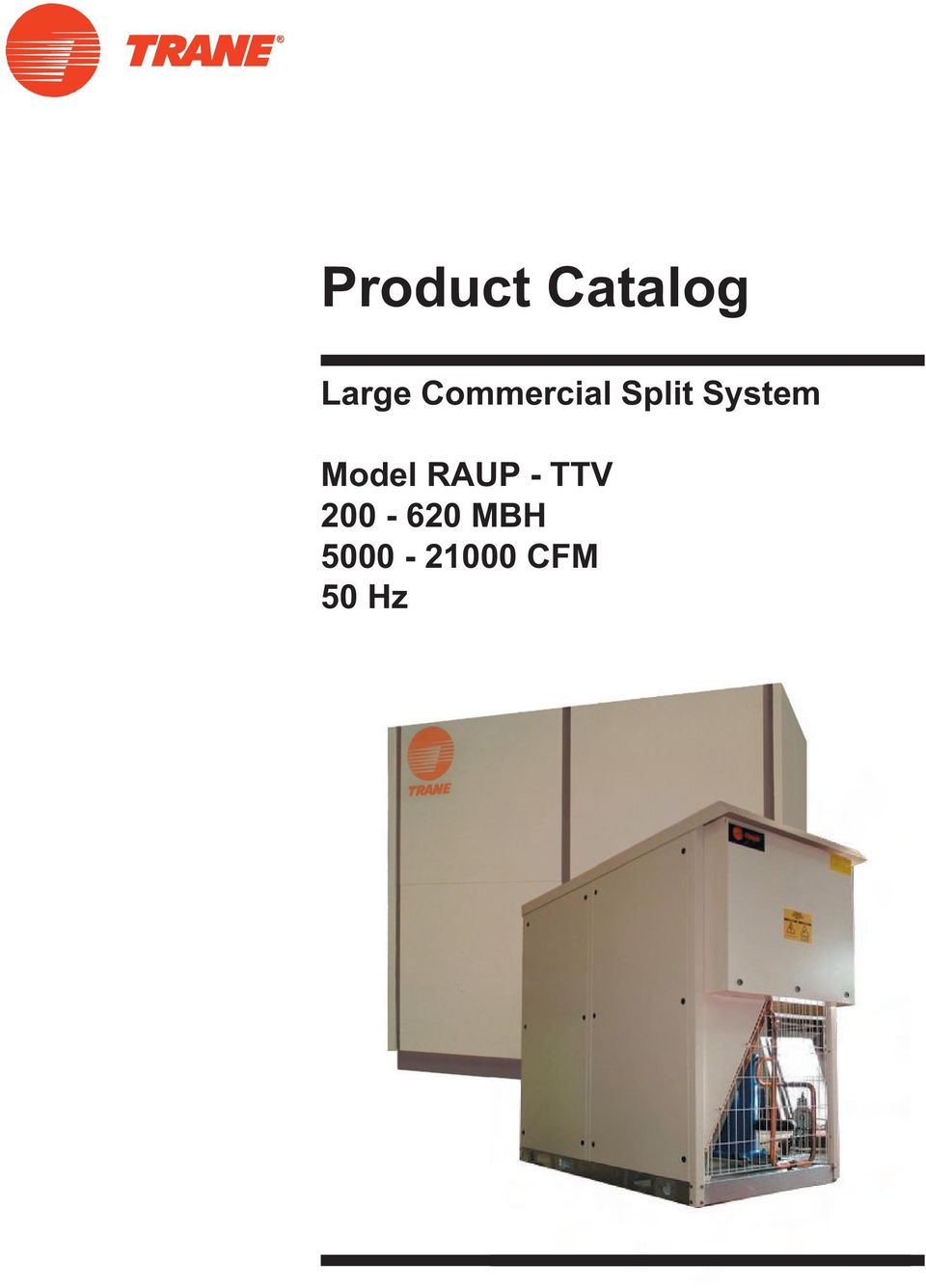
Product Catalog. Large Commercial Split System. Model RAUP - TTV MBH CFM 50 Hz
|
|
|
- Robert O’Connor’
- 10 years ago
- Views:
Transcription
1 Product Catalog Large Commercial Split System Model RAUP - TTV MBH CFM 50 Hz
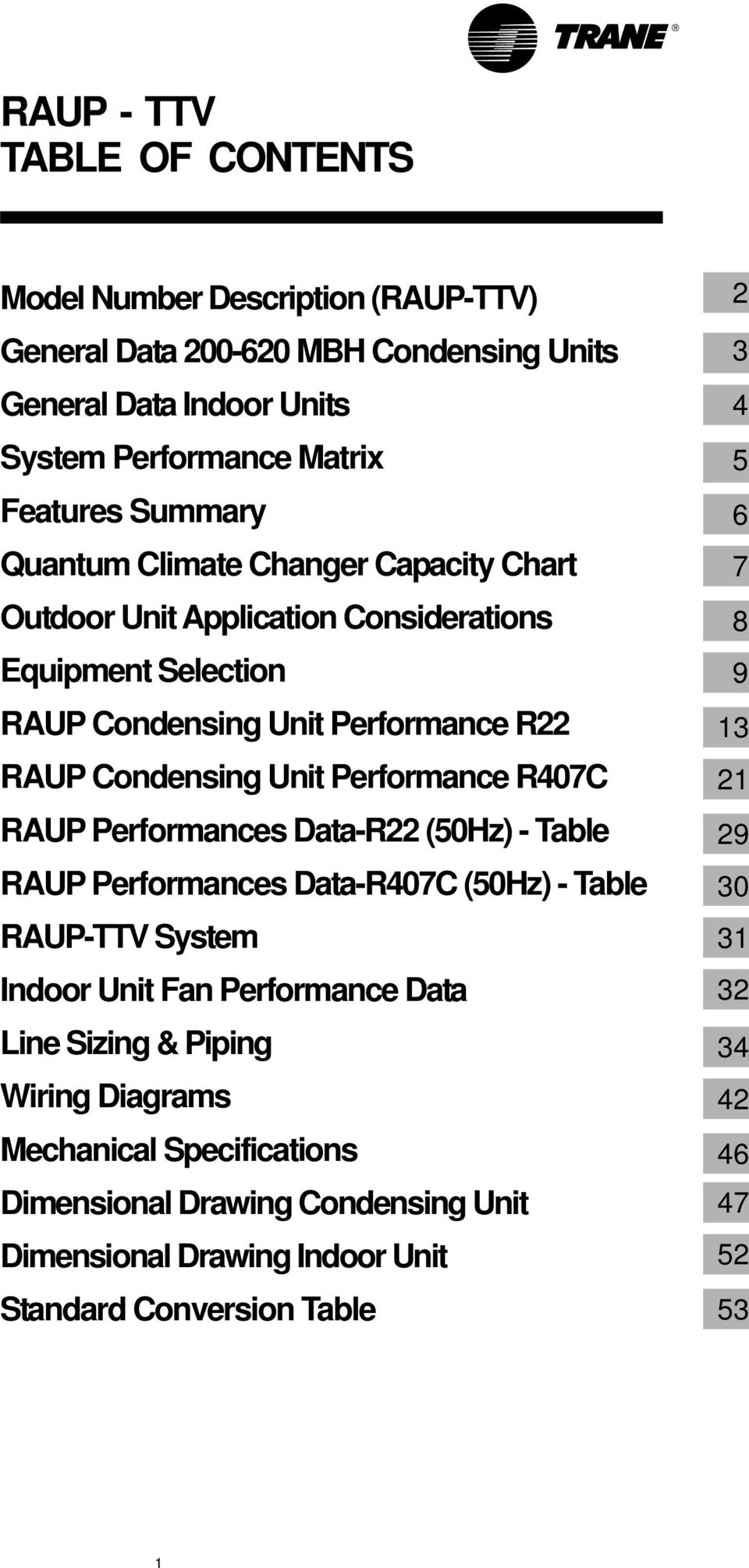
2 RAUP - TTV TABLE OF CONTENTS Model Number Description (RAUP-TTV) General Data MBH Condensing Units General Data Indoor Units System Performance Matrix Features Summary Quantum Climate Changer Capacity Chart Outdoor Unit Application Considerations Equipment Selection RAUP Condensing Unit Performance R22 RAUP Condensing Unit Performance R407C RAUP Performances Data-R22 (50Hz) - Table RAUP Performances Data-R407C (50Hz) - Table RAUP-TTV System Indoor Unit Fan Performance Data Line Sizing & Piping Wiring Diagrams Mechanical Specifications Dimensional Drawing Condensing Unit Dimensional Drawing Indoor Unit Standard Conversion Table
3 Model Number Description (Raup - TTV) Unit Model Number Description The product is identified by a multiple-character model number that precisely identifies a particular type of unit. An explanation is shown below it will enable the owner or Service Engineer to define operation, components and applicable accessories for a specific unit. Standard Product Model Nomenclature RAUP2 5 0 D 1 C X A S 0 E T T V Q D 1 D A C DIGIT 1,2,3 Remote Condensing Unit / Air-Cooled / Up- Flow DIGIT 4 Development Sequence DIGIT 1,2 DIGIT 3 Indoor Unit / Cooling Only Air Flow Configuration V = Vertical Discharge DIGIT 5,6,7 Nominal Cooling Capacity [MBH] 250 = = = = = 500 DIGIT 8 Electrical Rating / Utilization Range D = V / 3Phase / 50Hz DIGIT 9 Factory Mounted Control 1 = DOL Starter with UC2c / UC4c. 4 = DOL Starter with UC2c / UC4c c/w Low Ambient Controls. DIGIT 10 Minor Design Sequence C = Modular RAUP Design DIGIT 11 Factory Installed Options X= None 1 = Corrosion Resistant Coated Fin DIGIT 12 Refrigerant Type A =R22 B = R407C DIGIT 13 Operating Ambient S= Standard Ambient H= High Ambient Option DIGIT 14 Future Use DIGIT 15 Service Indicator E = Introduction of Fuji Starter DIGIT 4,5,6 DIGIT 7 DIGIT 8 DIGIT 9 DIGIT 10 DIGIT 11 DIGIT 12 DIGIT 13 DIGIT 14 DIGIT 15 Nominal Cooling Capacity [MBH] 250 = = = = = 500 Development Sequence Electrical Rating / Utilization Range D = V / 3Phase / 50Hz Factory Mounted Control 1 = DOL Starter (less Controls) Installed Motor kw TTV Models Mtr, kw TTV 250 I = 3.7 TTV 300 / 400 K = 5.5 TTV 500 L = 7.5 TTV 600 M = 11 Future Use Future Use Future Use Minor Design Sequence Service Indicator 2

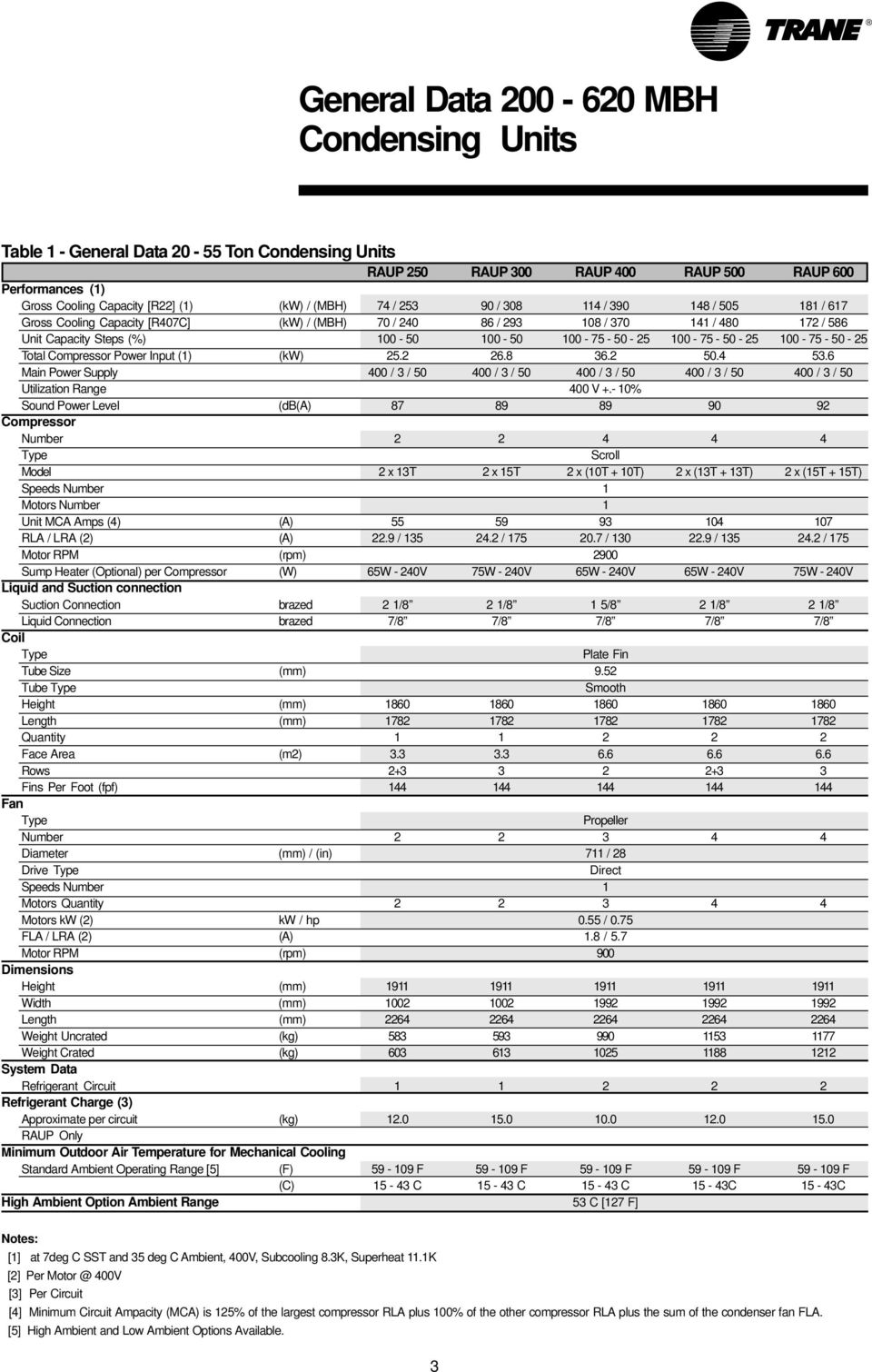
4 General Data MBH Condensing Units Table 1 - General Data Ton Condensing Units RAUP 250 RAUP 300 RAUP 400 RAUP 500 RAUP 600 Performances (1) Gross Cooling Capacity [R22] (1) (kw) / (MBH) 74 / / / / / 617 Gross Cooling Capacity [R407C] (kw) / (MBH) 70 / / / / / 586 Unit Capacity Steps (%) Total Compressor Power Input (1) (kw) Main Power Supply 400 / 3 / / 3 / / 3 / / 3 / / 3 / 50 Utilization Range 400 V % Sound Power Level (db(a) Compressor Number Type Scroll Model 2 x 13T 2 x 15T 2 x (10T + 10T) 2 x (13T + 13T) 2 x (15T + 15T) Speeds Number 1 Motors Number 1 Unit MCA Amps (4) (A) RLA / LRA (2) (A) 22.9 / / / / / 175 Motor RPM (rpm) 2900 Sump Heater (Optional) per Compressor (W) 65W - 240V 75W - 240V 65W - 240V 65W - 240V 75W - 240V Liquid and Suction connection Suction Connection brazed 2 1/8 2 1/8 1 5/8 2 1/8 2 1/8 Liquid Connection brazed 7/8 7/8 7/8 7/8 7/8 Coil Type Plate Fin Tube Size (mm) 9.52 Tube Type Smooth Height (mm) Length (mm) Quantity Face Area (m2) Rows Fins Per Foot (fpf) Fan Type Propeller Number Diameter (mm) / (in) 711 / 28 Drive Type Direct Speeds Number 1 Motors Quantity Motors kw (2) kw / hp 0.55 / 0.75 FLA / LRA (2) (A) 1.8 / 5.7 Motor RPM (rpm) 900 Dimensions Height (mm) Width (mm) Length (mm) Weight Uncrated (kg) Weight Crated (kg) System Data Refrigerant Circuit Refrigerant Charge (3) Approximate per circuit (kg) RAUP Only Minimum Outdoor Air Temperature for Mechanical Cooling Standard Ambient Operating Range [5] (F) F F F F F (C) C C C 15-43C 15-43C High Ambient Option Ambient Range 53 C [127 F] Notes: [1] at 7deg C SST and 35 deg C Ambient, 400V, Subcooling 8.3K, Superheat 11.1K [2] Per 400V [3] Per Circuit [4] Minimum Circuit Ampacity (MCA) is 125% of the largest compressor RLA plus 100% of the other compressor RLA plus the sum of the condenser fan FLA. [5] High Ambient and Low Ambient Options Available. 3
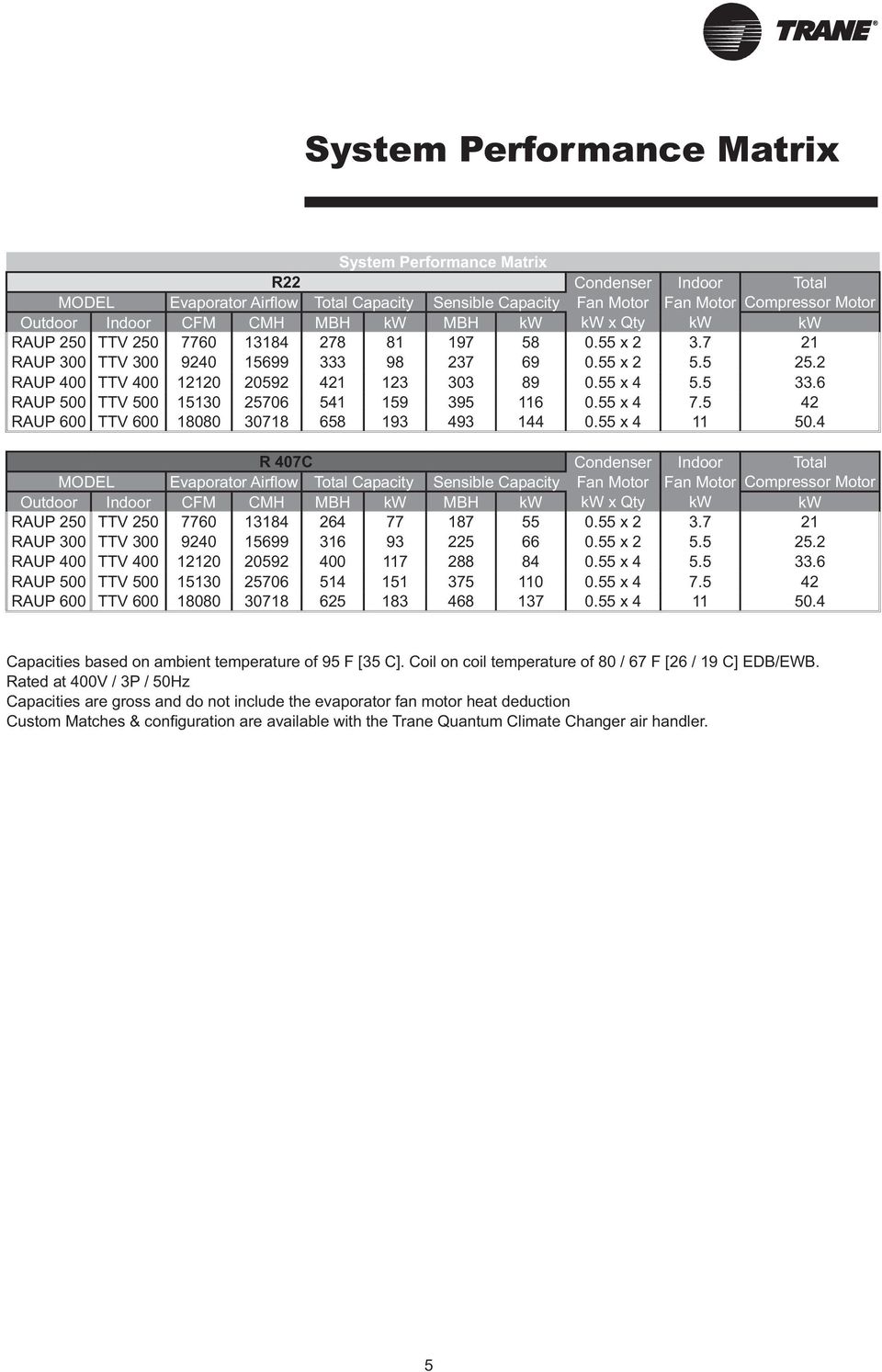
5 System Performance Matrix System Performance Matrix R22 Condenser Indoor Total MODEL Evaporator Airflow Total Capacity Sensible Capacity Fan Motor Fan Motor Compressor Motor Outdoor Indoor CFM CMH MBH kw MBH kw kw x Qty kw kw RAUP 250 TTV x RAUP 300 TTV x RAUP 400 TTV x RAUP 500 TTV x RAUP 600 TTV x R 407C Condenser Indoor Total MODEL Evaporator Airflow Total Capacity Sensible Capacity Fan Motor Fan Motor Compressor Motor Outdoor Indoor CFM CMH MBH kw MBH kw kw x Qty kw kw RAUP 250 TTV x RAUP 300 TTV x RAUP 400 TTV x RAUP 500 TTV x RAUP 600 TTV x Capacities based on ambient temperature of 95 F [35 C]. Coil on coil temperature of 80 / 67 F [26 / 19 C] EDB/EWB. Rated at 400V / 3P / 50Hz Capacities are gross and do not include the evaporator fan motor heat deduction Custom Matches & configuration are available with the Trane Quantum Climate Changer air handler. 5
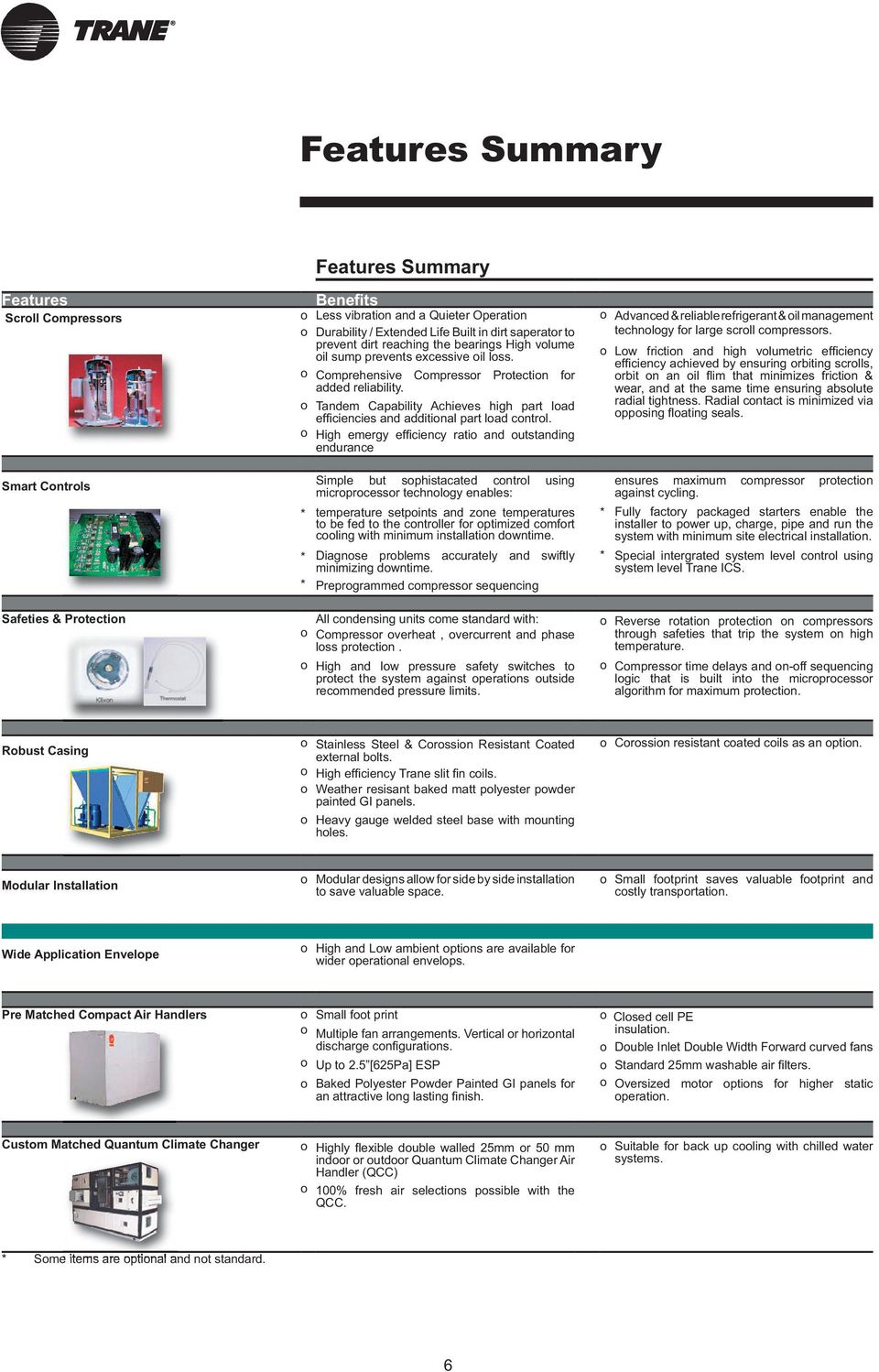
6 Features Summary Features Summary Features Benefits Scroll Compressors o Less vibration and a Quieter Operation o Advanced & reliable refrigerant & oil management o Durability / Extended Life Built in dirt saperator to prevent dirt reaching the bearings High volume oil sump prevents excessive oil loss. technology for large scroll compressors. o Comprehensive Compressor Protection for added reliability. o Tandem Capability Achieves high part load effi ciencies and additional part load control. o High emergy effi ciency ratio and outstanding endurance o Low friction and high volumetric effi ciency effi ciency achieved by ensuring orbiting scrolls, orbit on an oil fl im that minimizes friction & wear, and at the same time ensuring absolute radial tightness. Radial contact is minimized via opposing fl oating seals. Smart Controls Simple but sophistacated control using microprocessor technology enables: * temperature setpoints and zone temperatures to be fed to the controller for optimized comfort cooling with minimum installation downtime. * Diagnose problems accurately and swiftly minimizing downtime. * Preprogrammed compressor sequencing ensures maximum compressor protection against cycling. * Fully factory packaged starters enable the installer to power up, charge, pipe and run the system with minimum site electrical installation. * Special intergrated system level control using system level Trane ICS. Safeties & Protection All condensing units come standard with: o Reverse rotation protection on compressors o Compressor overheat, overcurrent and phase through safeties that trip the system on high loss protection. temperature. o High and low pressure safety switches to protect the system against operations outside recommended pressure limits. o Compressor time delays and on-off sequencing logic that is built into the microprocessor algorithm for maximum protection. Robust Casing o Stainless Steel & Corossion Resistant Coated external bolts. o High effi ciency Trane slit fi n coils. o Weather resisant baked matt polyester powder painted GI panels. o Heavy gauge welded steel base with mounting holes. o Corossion resistant coated coils as an option. Modular Installation o Modular designs allow for side by side installation to save valuable space. o Small footprint saves valuable footprint and costly transportation. Wide Application Envelope o High and Low ambient options are available for wider operational envelops. Pre Matched Compact Air Handlers o Small foot print o Closed cell PE o Multiple fan arrangements. Vertical or horizontal insulation. discharge confi gurations. o Double Inlet Double Width Forward curved fans o Up to 2.5 [625Pa] ESP o Standard 25mm washable air fi lters. o Baked Polyester Powder Painted GI panels for an attractive long lasting fi nish. o Oversized motor options for higher static operation. Custom Matched Quantum Climate Changer o Highly fl exible double walled 25mm or 50 mm indoor or outdoor Quantum Climate Changer Air Handler (QCC) o 100% fresh air selections possible with the QCC. o Suitable for back up cooling with chilled water systems. * Some items are optional and not standard. 6
7 Quantum Climate Changer Capacity Chart Quantum Climate Changer Capacity Chart Model Size Coil Face Area Airflow At 2.5m/s Face Velocity Cooling Capacity R22 Cooling Capacity R407C Total Sensible Total Sensible External Static Pressure Motor Installed Power m2 m3/s kw kw kw kw Pa kw Note: 1 Cooling capacities are based on EDB 26.7 C /EWB 19.4 C and 7 deg C SST, 51.7 dec C Condensing Temp. 2 Cooling capacities reflected above are not based on a system match. 3 For actual custom system capacity with Trane condensing units, please refer to your local Trane representative. 4 Please refer to the dimensional chart belro for standard Trane Quantum Climate Changer dimensionsall dimennsions. 7

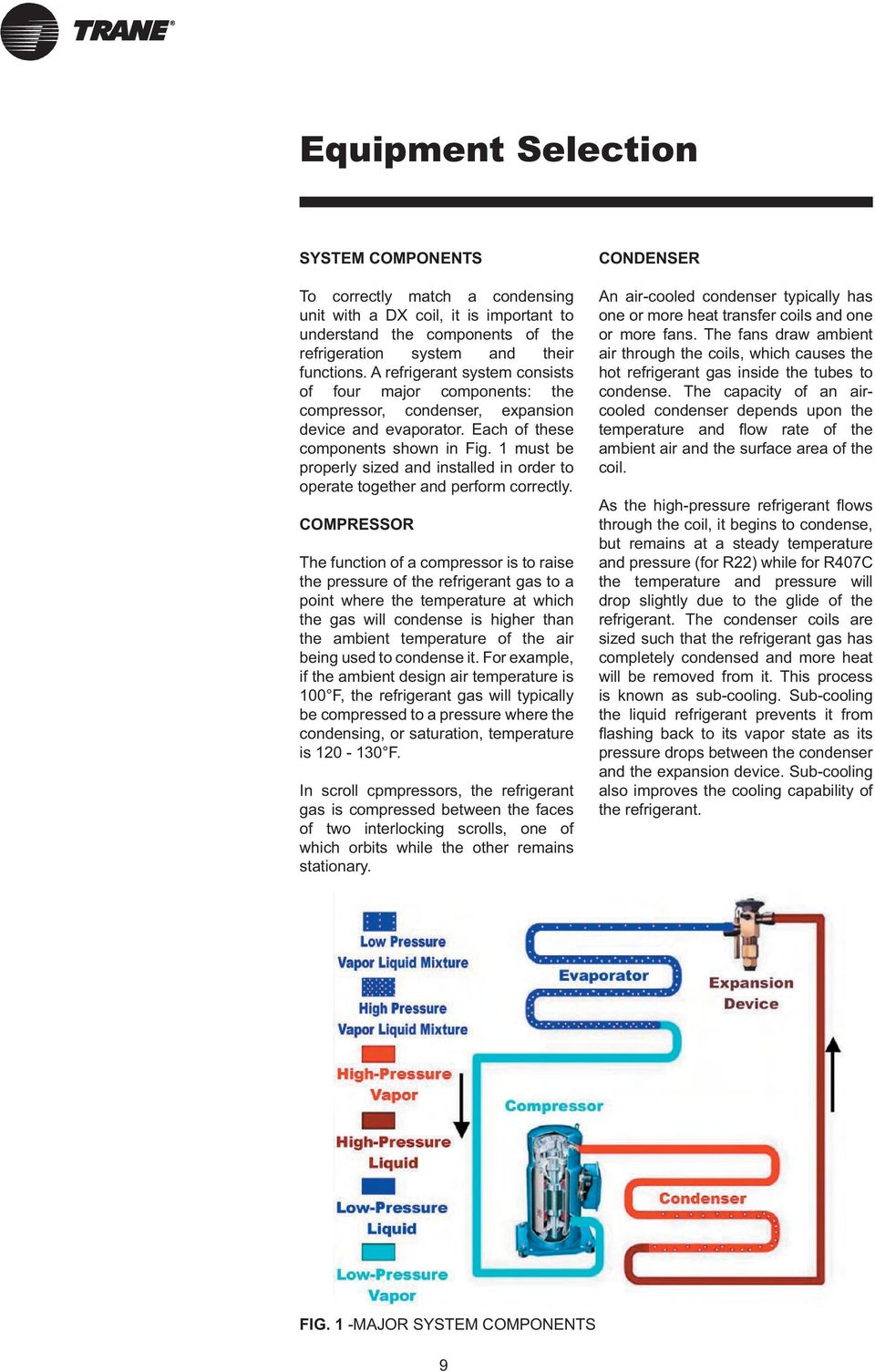
8 Outdoor Unit Application Considerations Certain application constraints should be considered when sizing, selecting and installing Trane air-cooled condensing units. Unit reliability is dependent upon these considerations. Where your application varies from the guidelines presented, it should be reviewed with the local Trane sales engineer. Unit Sizing Intentionally oversizing a unit to assure adequate capacity is not recommended. Erratic system operation and excessive compressor cycling are often a direct result of an oversized condensing unit. In addition, oversized units are usually more expensive to purchase, install and operate. If oversizing is desired, consider using two units. Unit Placement A base or foundation is not required if the selected unit location is level and strong enough to support the unit s operating weight. Isolation and Sound Emission The most effective form of isolation is to locate the unit away from any sound sensitive area. Structurally transmitted sound can be reduced by using spring or rubber isolators. The isolators are effective in reducing the low frequency sound generated by compressors and, therefore are recommended for sound sensitive installations. An acoustical engineer should always be consulted on critical applications. For maximum isolation effect, the refrigeration lines and electrical conduct should also be isolated. Use flexible electrical conduit. State and local codes on sound emissions should always be considered. Since the environment in which a sound source is located affects sound pressure, unit placement must be carefully evaluated. Unit Location Unobstructed flow of condenser air is essential for maintaining condensing unit capacity and operating efficiency. When determining unit placement, careful consideration must be given to assure proper air flow across the condenser heat transfer surface. Failure to heed these considerations will result in warm air recirculation and coil air flow starvation, resulting in a high pressure compressor cutoff. Warm air recirculation occurs when discharge air from the condenser fans is recycled back at the condenser coil inlet. Coil starvation occurs when free air flow to the condenser is restricted. Both warm air recirculation and coil starvation causes reductions in unit efficiency and capacity. In addition, in more severe cases, nuisance unit shutdowns will result from excessive head pressures. Accurate estimates of the degree of efficiency and capacity reduction are not possible due to the unpredictable effect of varying winds, temperatures and coil conditions. In addition, wind tends to further reduce head pressure. Therefore, it is advisable to protect the air-cooled condensing unit from continuous direct winds exceeding 10 miles per hour. Debris, trash, supplies, etc., should not be allowed to accumulate in the vicinity of the air-cooled condensing unit. Supply air movement may draw debris between coil fins and cause coil starvation. Special consideration should be given to units operating in low ambient temperatures. Condenser coils and fan discharge must be kept free of snow and other obstructions to permit adequate air flow for satisfactory unit operation. Effect of Altitude On Capacity Condensing unit capacities given in the performance data tables. At elevations substantially above sea level, the decreased air density will decrease condenser capacity and efficiency. The adjustment factors in Page 26 can be applied directly to the catalog performance data to determine the unit s adjusted performance. Ambient Considerations Start up and operation at lower ambients requires sufficient head pressure be maintained for proper expansion valve operation. At higher ambients, excessive head pressure may result. Standard operating ambients are C. With a low ambient kit comprising crank case heaters and frequency inverters, operation below 15 C is achievable. Minimum ambient condition are based on still conditions. Refrigerant Piping Special consideration must always be given to oil return. Minimum suction gas velocities must always be maintained for proper oil return. Utilize appropriate piping tools lines sizing such as the CDS refrigerant piping program. 8
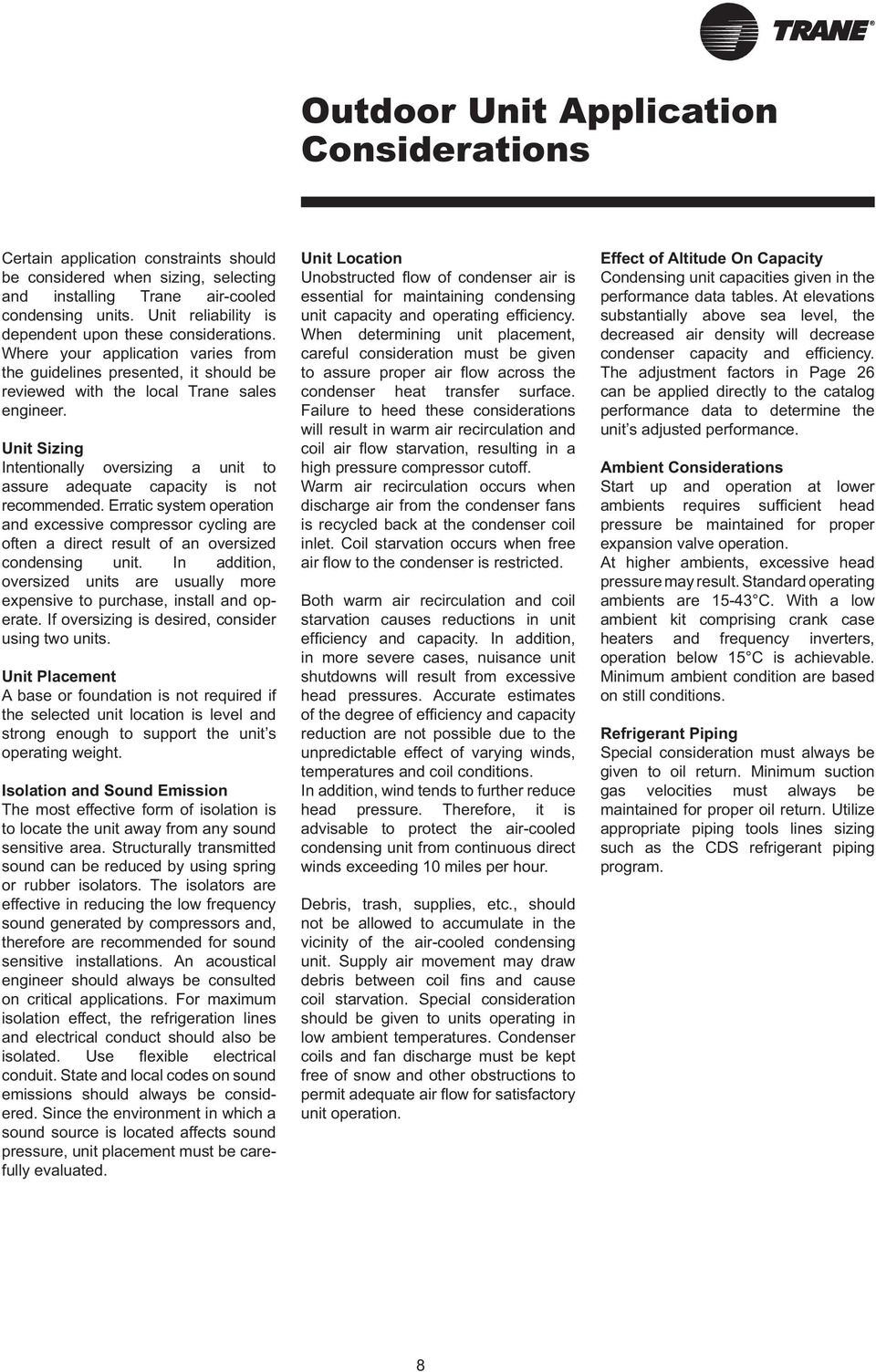
9 Equipment Selection SYSTEM COMPONENTS To correctly match a condensing unit with a DX coil, it is important to understand the components of the refrigeration system and their functions. A refrigerant system consists of four major components: the compressor, condenser, expansion device and evaporator. Each of these components shown in Fig. 1 must be properly sized and installed in order to operate together and perform correctly. COMPRESSOR The function of a compressor is to raise the pressure of the refrigerant gas to a point where the temperature at which the gas will condense is higher than the ambient temperature of the air being used to condense it. For example, if the ambient design air temperature is 100 F, the refrigerant gas will typically be compressed to a pressure where the condensing, or saturation, temperature is F. In scroll cpmpressors, the refrigerant gas is compressed between the faces of two interlocking scrolls, one of which orbits while the other remains stationary. CONDENSER An air-cooled condenser typically has one or more heat transfer coils and one or more fans. The fans draw ambient air through the coils, which causes the hot refrigerant gas inside the tubes to condense. The capacity of an aircooled condenser depends upon the temperature and flow rate of the ambient air and the surface area of the coil. As the high-pressure refrigerant flows through the coil, it begins to condense, but remains at a steady temperature and pressure (for R22) while for R407C the temperature and pressure will drop slightly due to the glide of the refrigerant. The condenser coils are sized such that the refrigerant gas has completely condensed and more heat will be removed from it. This process is known as sub-cooling. Sub-cooling the liquid refrigerant prevents it from flashing back to its vapor state as its pressure drops between the condenser and the expansion device. Sub-cooling also improves the cooling capability of the refrigerant. FIG. 1 -MAJOR SYSTEM COMPONENTS 9
10 Equipment Selection Horizontal Verticle Intertwined Split Coils Split Coils Coils FIG. 2 -EVAPORATOR COIL TYPES EVAPORATOR The evaporator coil removes heat from the supply air-stream, cooling the supply air in the process. The evaporator coil generally consists of several rows of copper tubing mechanically bonded to aluminum (or copper) heat transfer fins. Depending on the size and capacity of the coil it may consist of one, or several refrigerant circuits (see Fig. 2). A refrigerant distributor on each DX evaporator coil circuit feeds low pressure, low temperature liquid refrigerant to the coil tubes. It is critical that all the distributor tubes are the same length so the pressure drop across them will be equal and the refrigerant will be evenly distributed to the coil tubes. As the liquid refrigerant passes through the coil tubes, heat is tranferred from the supply air stream to the refrigerant. As heat is added to the liquid refrigerant, it begins to evaporate much like water boiling on a stove. The liquid-vapor mixture remains at a constant temperature and pressure until it completely vaporizes (for R22), while for R407C the temperature and pressure will drop slightly due to the glide of the refrigerant. The coil capacity is determined by the type and amount of refrigerant used, the temperature difference between the air and the liquid refrigerant, and the amount of air passing over the coil. Once the refrigerant has completely evaporated, its ability to cool the air decrease dramatically. If too little refrigerant is fed to the coil, it will evaporate quickly and the air will not be adequately cooled. If too much refrigerant is fed to the coil it will not evaporate at all and liquid refrigerant will return to the compressor. Direct expansion (DX) evaporator coils are designed to evaporate all refrigerant in the coil and then superheat the refrigerant gas in the last row or two of the coil tubes. The refrigerant gas is superheated to ensure it does not condense back to its liquid state in the suction line. Superheat is also used to control the expansion device. EXPANSION DEVICE The expansion device controls the flow of liquid refrigerrant to the evaporator coil. Trane uses temperature controlled, (thermostatic) expansion valves (TXVs) as shown in Fig. 3. The TXV has two primary components: the valve body and the sensing bulb. The valve regulates the flow of refrigerant to the evaporator coil. As refrigerant passes through the valve it is adiabatically expanded (that is, without the addition of energy). This causes the pressure and temperature of the liquid refrigerant to drop, making it suitable for cooling the air. The amount of refrigerant fed to the coil is based on the cooling load of the supply air and the resultant amount Diaphragm 105ºF 210 psig Liquid Line Valve Body Superheat Spring Superheat Adjustment Screw (Set to 34 psig) 63ºF 108 psig Distributor 46ºF 78 psig 59ºF, 74 psig Superheated Equalizer Line Evap. Coil 44ºF, 74 psig Capillary Tube Sensing Bulb 59ºF, 100 psig FIG. 3 -THERMAL REXPANSION VALVE (TXV) COMPONENTS 10

11 Equipment Selection of superheat created. As the cooling load increases, the liquid refrigerant absorbs more heat and evaporates more quickly. This means that more of the evaporator coil is available to superheat the refrigerant vapor and it leaves the coil at a higher temperature. Conversely as the cooling load decreases, the liquid refrigerant does not evaporate as quickly so less superheating occurs and the refrigerant leaves the coil at a lower temperature. The sensing bulb attached to the valve is charged with a mix of liquid and vapor refrigerant. This refrigerant must be the same type as that in the system. The refrigerant vapor in the sensing bulb exerts pressure on a diaphragm in the valve body, which causes the valve to open or close. As the temperature of the superheated suction gas leaving the evaporator rises due to an increase in the cooling load, refrigerant in the sensing bulb evaporates increasing the pressure on the valve diaphragm. The increased pressure causes the valve to open and allows more refrigerant to flow into the coil to meet the higher cooling demand. When the temperature of the suction gas drops due to a decrease in the cooling load, the gas in the sensing bulb condenses reducing its pressure on the valve diaphragm. This allows the valve to restrict the flow of refrigerant into the coil until the lower cooling demand is adequately met. The valve body contains a superheat spring that keeps everything in balance. By turning a screw in the bottom of the valve the spring can be set for a certain amount of superheat. For example, if the superheat spring is set for 15 F of superheat it will exert a pressure on the valve equal to the pressure the vaporized gas in the sensing bulb will exert on the valve diaphragm when the suction gas is superheated by 15 F. The equalizer line is used to prevent the pressure drop that occurs across the distributor and DX coil from affecting the operation of the expansion valve. APPLICATION DESIGN CONDITIONS Before selecting equipment, you must first establish these basic working parameters: The design cooling load The design outdoor air temperature The refrigerant saturated suction temperature The design-cooling load is typically found on the job schedule. The design outdoor air temperature may also be listed on the job schedule. If the saturared suction temperature (SST) is not known, assume it is in the range of 40 F to 45 F. This represents the standard industry approach. RAUP Condensing Unit Performance Information When using a pre-engineered condensing unit, you can use ratings such as those shown in Fig. (RAUP R22, R407C Performance Data) to determine which condensing unit size will satisfy the cooling capacity of the system. Evaporator Coil TXV Size Capacity (Tons) 4 to to to to to to Choose a TXV that matches the tonnage of the evaporator coil it serves It is recommended to provide and install one TXV per distributor. For larger coil capacities, refer to the quantity of circuits in the AHU and total AHU tonnage to determine the number and tonnage & quantity of the TXV TXV Size TXV Qty. RAUP (20) 2 (1) RAUP (30) 2 (1) RAUP RAUP RAUP TXV Qty. listed here is based on the assemption that the Evaporator has similar circuits to the RAUP TXV Selection when matched with an AHU, should be based primarily on the final system capacity Correction Factor Altitude Correction Multiplier For Capacity Altitude (Ft.) 2,000 4,000 6,000 8,000 10,000 Condensing Unit Only Condensing Unit / Air Handling Unit Combination Condensing Unit With Evaporator Cooling Capacity Correction Factor for CFM/CMH, other than standard %CFM.CHM Variation From Rated Rated Total Cooling Capacity Multiplier Sensible Heat Multaiplier Note: Calculate total and sensible capacities in MBH and multiply by above factors to determine revised capacities 11

12 Equipment Selection Figure 1. Effect of coil face area on cooling capacity (6-row coil, 500 fpm face velocity) Figure 2. Effect of ambient conditions and load on an air handler and condensing unit DX Coil Performance Information The direct expansion (DX) evaporator coil can be selected using the CLCP DX TOPSS program. To select the DX coil, you enter the cooling capacity or the leaving air temperature, and the saturated suction temperature (SST). SSTs up to 50 F may be acceptable for certain applications, but humidity control becomes difficult at these higher SSTs. Likewise, design SSTs below 34 F can result in ice building up on the evaporator during periods of reduced load and should be avoided unless provisions are made for periodic coil defrost. BALANCE POINT CROSS PLOT ILLUSTRATION A precise system balance point can be obtained by plotting the capacity of the DX coil versus the capacity of the condensing unit at various saturated temperatures. The point at which the two capacity lines intersect is the system balance point. The initial balance point of the system occurs where the saturated temperature of the evaporator, intersects with the condensing unit s capacity. Thus, the condensing unit SST and the DX coil SST are equal at this initial balance point without any consideration for suction line penalty. Missized air handler. It s common practice to base the selection of the air handler for a split DX system is at a coil face velocity of 500 fpm and then to match coil capacity (with face area now 12 limited by the size of the air-handler cabinet) with the required load. With the trend towards applications that require less airflow per cooling ton, this sizing method leads to the selection of smaller air handlers. Providing the required cooling capacity with a smaller air handler demands colder suction temperature (Figure 1). As the cooling load decreases and/or the ambient temperature drops, the capacities of the compressor and evaporator balance at ever lower suction pressures and temperatures. At such conditions, system operation can become unstable and may eventually result in coil frosting and compressor flooding (Figure 2). When choosing a DX air handler, it s critical to first determine a coil size that allows the evaporator and compressor capacities to balance at an appropriate suction temperature and pressure. You can then pick an air handler that fits the coil. This approach may appear to result in an oversized air handler, but it achieves a match of indoor and outdoor DX components that can operate more reliably at part-load conditions. By contrast, when choosing an air handler for a chilled water system, the initial objective is to pick the smallest possible air handler that won t cause water carryover. Table 1 demonstrates an outcome of these sizing strategies: For comparable systems, the chilled-water air handler usually is smaller and therefore less costly than the DX air handler.

13 330 RAUP 250 Condensing Unit Performance (50Hz), R Net Capacity (MBH) Saturated Suction Temp. (F) RAUP 250 Condensing Unit Performance (50Hz), R22 77 o F Ambient 86 o F Ambient 95 o F Ambient 104 o F Ambient 115 o F Ambient

14 RAUP 300 Condensing Unit Performance (50 Hz), R Net Capacity (MBH) Sat. Suct. Temp. (F) RAUP 300 Condensing Unit Performance (50Hz), R22 77 o F Ambient 86 o F Ambient 95 o F Ambient 104 o F Ambient 115 o F Ambient

15 RAUP 400 Condensing Unit Performance (50Hz), R Net Capacity (MBH) Saturated Suction Temp. (F) RAUP 400 Condensing Unit Performance (50Hz), R22 77 o F Ambient 86 o F Ambient 95 o F Ambient 104 o F Ambient 115 o F Ambient
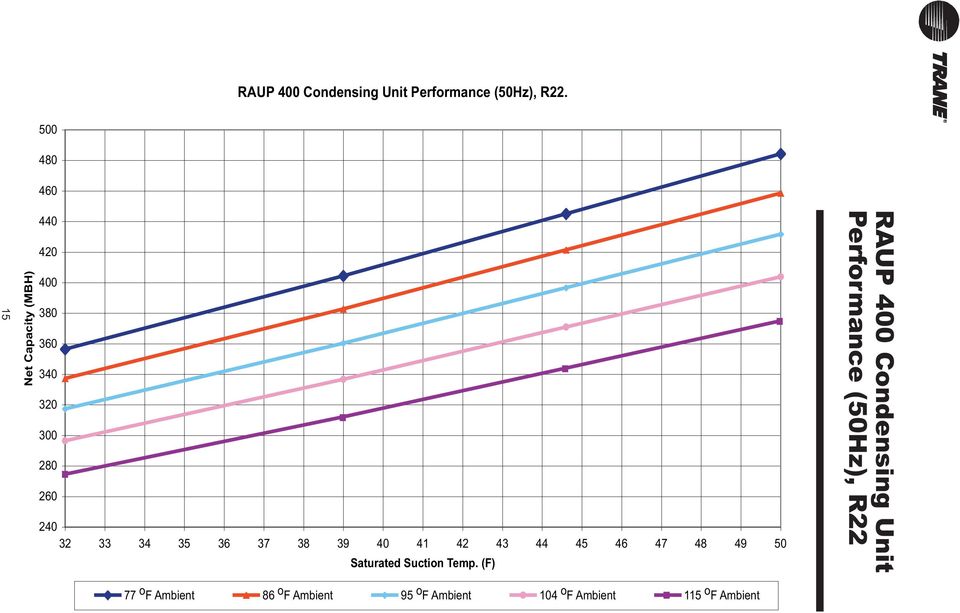
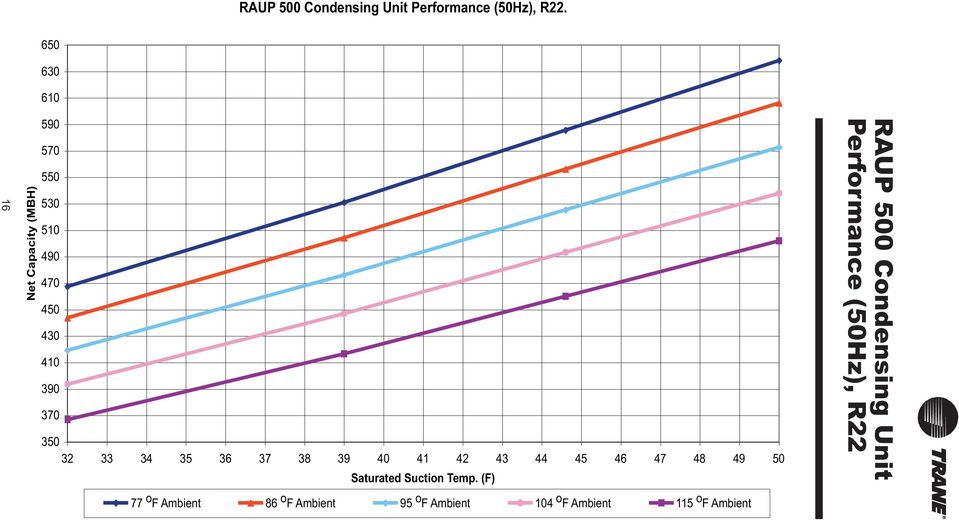
16 RAUP 500 Condensing Unit Performance (50Hz), R Net Capacity (MBH) Saturated Suction Temp. (F) RAUP 500 Condensing Unit Performance (50Hz), R22 77 o F Ambient 86 o F Ambient 95 o F Ambient 104 o F Ambient 115 o F Ambient
17 RAUP 600 Condensing Unit Performance (50Hz) R Net Capacity (MBH) Saturated Suct. Temp. (F) RAUP 600 Condensing Unit Performance (50Hz), R22 77 o F Ambient 86 o F Ambient 95 o F Ambient 104 o F Ambient 115 o F Ambient

18 18 Net Capacity, (MBH) RAUP 400 x 2 Condensing Unit Performance (50Hz) Saturated Suction Temperature (F) RAUP 400 x 2 Condensing Unit Performance (50Hz) 77 o F Ambient 86 o F Ambient 95 o F Ambient 104 o F Ambient 115 o F Ambient

19 RAUP 500 x 2 Condensing Unit Performance (50Hz) RAUP 500 x 2 Condensing Unit Performance (50Hz) 77 o F Ambient 86 o F Ambient 95 o F Ambient 104 o F Ambient 115 o F Ambient

20 1550 RAUP 600 x 2 Condensing Unit Performance (50Hz) Net Capacity, (MBH) Saturated Suction Temperature (F) RAUP 600 x 2 Condensing Unit Performance (50Hz) 77 o F Ambient 86 o F Ambient 95 o F Ambient 104 o F Ambient 115 o F Ambient

21 310 RAUP 250 Condensing Unit Performance R407C (50Hz) Net Capacity (MBH) Saturated Suction Temp. (F) RAUP 250 Condensing Unit Performance R407C (50Hz) 77 o F Ambient 86 o F Ambient 95 o F Ambient 104 o F Ambient 115 o F Ambient
22 RAUP 300 Condensing Unit Performance R407C (50 Hz) Net Capacity (MBH) Sat. Suct. Temp. (F) RAUP 300 Condensing Unit Performance R407C (50Hz) 77 o F Ambient 86 o F Ambient 95 o F Ambient 104 o F Ambient 115 o F Ambient
23 RAUP 400 Condensing Unit Performance R407C (50Hz) Net Capacity (MBH) Saturated Suction Temp. (F) RAUP 400 Condensing Unit Performance R407C (50Hz) 77 o F Ambient 86 o F Ambient 95 o F Ambient 104 o F Ambient 115 o F Ambient
24 RAUP 500 Condensing Unit Performance R407C (50Hz) Net Capacity (MBH) Saturated Suction Temp. (F) RAUP 500 Condensing Unit Performance R407C (50Hz) 77 o F Ambient 86 o F Ambient 95 o F Ambient 104 o F Ambient 115 o F Ambient
25 RAUP 600 Condensing Unit Performance R407C (50Hz) 25 Net Capacity (MBH) Saturated Suct. Temp. (F) RAUP 600 Condensing Unit Performance R407C (50Hz) 77 o F Ambient 86 o F Ambient 95 o F Ambient 104 o F Ambient 115 o F Ambient
26 26 Net Capacity, (MBH) RAUP 400 x 2 Condensing Unit Performance R407C (50Hz) Saturated Suction Temperature (F) 77 o F Ambient 86 o F Ambient 95 o F Ambient 104 o F Ambient 115 o F Ambient RAUP 400 x 2 Condensing Unit Performance R407C (50Hz)
27 RAUP 500 x 2 Condensing Unit Performance R407C (50Hz) Net Capacity, (MBH) Saturated Suction Temperature (F) 77 o F Ambient 86 o F Ambient 95 o F Ambient 104 o F Ambient 115 o F Ambient RAUP 500 x 2 Condensing Unit Performance R407C (50Hz)
28 1550 RAUP 600 x 2 Condensing Unit Performance R407C (50Hz) Net Capacity, (MBH) Saturated Suction Temperature (F) 77 o F Ambient 86 o F Ambient 95 o F Ambient 104 o F Ambient 115 o F Ambient RAUP 600 x 2 Condensing Unit Performance R407C (50Hz)
29 RAUP Performance Data - R22 (50Hz) Gross Cooling Capacities - RAUP 250 R22 Refrigerant 46 C (115 F) Outdoor Ambient Temperature Saturated Suction 25 C (77 F) 30 C (86 F) 35 C (95 F) 40 C (104 F) 45 C (113 F) Temperature Capacity P.I. HP LP Capacity P.I. HP LP Capacity P.I. HP LP Capacity P.I. HP LP Capacity P.I. HP LP C F (kw) (MBH) (kw) (bar) (Psig) (bar) (Psig) (kw) (MBH) (kw) (bar) (Psig) (bar) (Psig) (kw) (MBH) (kw) (bar) (Psig) (bar) (Psig) (kw) (MBH) (kw) (bar) (Psig) (bar) (Psig) (kw) (MBH) (kw) (bar) (Psig) (bar) (Psig) C SST/35C Amb Gross Cooling Capacities - RAUP 300 R22 Refrigerant 46 C (115 F) Outdoor Ambient Temperature Saturated Suction 25 C (77 F) 30 C (86 F) 35 C (95 F) 40 C (104 F) 45 C (113 F) Temperature Capacity P.I. HP LP Capacity P.I. HP LP Capacity P.I. HP LP Capacity P.I. HP LP Capacity P.I. HP LP C F (kw) (MBH) (kw) (bar) (Psig) (bar) (Psig) (kw) (MBH) (kw) (bar) (Psig) (bar) (Psig) (kw) (MBH) (kw) (bar) (Psig) (bar) (Psig) (kw) (MBH) (kw) (bar) (Psig) (bar) (Psig) (kw) (MBH) (kw) (bar) (Psig) (bar) (Psig) C SST/35C Amb Gross Cooling Capacities - RAUP 400 R22 Refrigerant 46 C (115 F) Outdoor Ambient Temperature Saturated Suction 25 C (77 F) 30 C (86 F) 35 C (95 F) 40 C (104 F) 45 C (113 F) Temperature Capacity P.I. HP LP Capacity P.I. HP LP Capacity P.I. HP LP Capacity P.I. HP LP Capacity P.I. HP LP C F (kw) (MBH) (kw) (bar) (Psig) (bar) (Psig) (kw) (MBH) (kw) (bar) (Psig) (bar) (Psig) (kw) (MBH) (kw) (bar) (Psig) (bar) (Psig) (kw) (MBH) (kw) (bar) (Psig) (bar) (Psig) (kw) (MBH) (kw) (bar) (Psig) (bar) (Psig) C SST/35C Amb Gross Cooling Capacities - RAUP 500 R22 Refrigerant 46 C (115 F) Outdoor Ambient Temperature Saturated Suction 25 C (77 F) 30 C (86 F) 35 C (95 F) 40 C (104 F) 45 C (113 F) Temperature Capacity P.I. HP LP Capacity P.I. HP LP Capacity P.I. HP LP Capacity P.I. HP LP Capacity P.I. HP LP C F (kw) (MBH) (kw) (bar) (Psig) (bar) (Psig) (kw) (MBH) (kw) (bar) (Psig) (bar) (Psig) (kw) (MBH) (kw) (bar) (Psig) (bar) (Psig) (kw) (MBH) (kw) (bar) (Psig) (bar) (Psig) (kw) (MBH) (kw) (bar) (Psig) (bar) (Psig) C SST/35C Amb Gross Cooling Capacities - RAUP 600 R22 Refrigerant 46 C (115 F) Outdoor Ambient Temperature Saturated Suction 25 C (77 F) 30 C (86 F) 35 C (95 F) 40 C (104 F) 45 C (113 F) Temperature Capacity P.I. HP LP Capacity P.I. HP LP Capacity P.I. HP LP Capacity P.I. HP LP Capacity P.I. HP LP C F (kw) (MBH) (kw) (bar) (Psig) (bar) (Psig) (kw) (MBH) (kw) (bar) (Psig) (bar) (Psig) (kw) (MBH) (kw) (bar) (Psig) (bar) (Psig) (kw) (MBH) (kw) (bar) (Psig) (bar) (Psig) (kw) (MBH) (kw) (bar) (Psig) (bar) (Psig) RAUP Performance Data - R22 (50Hz) Capacity =Gross Total Capacity 7C SST/35C Amb P.I. =Compressor Power Input rated at 400V/50Hz HP =High Pressure Gauge LP =Low Pressure Gauge Pressures and power output here are calculated and subject to variation depending on site conditions.
30 RAUP Performance Data - R407C (50Hz) Gross Cooling Capacities - RAUP 250 R407C Refrigerant 46 C (115 F) Outdoor Ambient Temperature Saturated Suction 25 C (77 F) 30 C (86 F) 35 C (95 F) 40 C (104 F) 45 C (113 F) Temperature Capacity P.I. HP LP Capacity P.I. HP LP Capacity P.I. HP LP Capacity P.I. HP LP Capacity P.I. HP LP C F (kw) (MBH) (kw) (bar) (Psig) (bar) (Psig) (kw) (MBH) (kw) (bar) (Psig) (bar) (Psig) (kw) (MBH) (kw) (bar) (Psig) (bar) (Psig) (kw) (MBH) (kw) (bar) (Psig) (bar) (Psig) (kw) (MBH) (kw) (bar) (Psig) (bar) (Psig) C SST/35C Amb Gross Cooling Capacities - RAUP 300 R407C Refrigerant 46 C (115 F) Outdoor Ambient Temperature Saturated Suction 25 C (77 F) 30 C (86 F) 35 C (95 F) 40 C (104 F) 45 C (113 F) Temperature Capacity P.I. HP LP Capacity P.I. HP LP Capacity P.I. HP LP Capacity P.I. HP LP Capacity P.I. HP LP C F (kw) (MBH) (kw) (bar) (Psig) (bar) (Psig) (kw) (MBH) (kw) (bar) (Psig) (bar) (Psig) (kw) (MBH) (kw) (bar) (Psig) (bar) (Psig) (kw) (MBH) (kw) (bar) (Psig) (bar) (Psig) (kw) (MBH) (kw) (bar) (Psig) (bar) (Psig) C SST/35C Amb Gross Cooling Capacities - RAUP 400 R407C Refrigerant 46 C (115 F) Outdoor Ambient Temperature Saturated Suction 25 C (77 F) 30 C (86 F) 35 C (95 F) 40 C (104 F) 45 C (113 F) Temperature Capacity P.I. HP LP Capacity P.I. HP LP Capacity P.I. HP LP Capacity P.I. HP LP Capacity P.I. HP LP C F (kw) (MBH) (kw) (bar) (Psig) (bar) (Psig) (kw) (MBH) (kw) (bar) (Psig) (bar) (Psig) (kw) (MBH) (kw) (bar) (Psig) (bar) (Psig) (kw) (MBH) (kw) (bar) (Psig) (bar) (Psig) (kw) (MBH) (kw) (bar) (Psig) (bar) (Psig) C SST/35C Amb Gross Cooling Capacities - RAUP 500 R407C Refrigerant 46 C (115 F) Outdoor Ambient Temperature Saturated Suction 25 C (77 F) 30 C (86 F) 35 C (95 F) 40 C (104 F) 45 C (113 F) Temperature Capacity P.I. HP LP Capacity P.I. HP LP Capacity P.I. HP LP Capacity P.I. HP LP Capacity P.I. HP LP C F (kw) (MBH) (kw) (bar) (Psig) (bar) (Psig) (kw) (MBH) (kw) (bar) (Psig) (bar) (Psig) (kw) (MBH) (kw) (bar) (Psig) (bar) (Psig) (kw) (MBH) (kw) (bar) (Psig) (bar) (Psig) (kw) (MBH) (kw) (bar) (Psig) (bar) (Psig) C SST/35C Amb Gross Cooling Capacities - RAUP 600 R407C Refrigerant 46 C (115 F) Outdoor Ambient Temperature Saturated Suction 25 C (77 F) 30 C (86 F) 35 C (95 F) 40 C (104 F) 45 C (113 F) Temperature Capacity P.I. HP LP Capacity P.I. HP LP Capacity P.I. HP LP Capacity P.I. HP LP Capacity P.I. HP LP C F (kw) (MBH) (kw) (bar) (Psig) (bar) (Psig) (kw) (MBH) (kw) (bar) (Psig) (bar) (Psig) (kw) (MBH) (kw) (bar) (Psig) (bar) (Psig) (kw) (MBH) (kw) (bar) (Psig) (bar) (Psig) (kw) (MBH) (kw) (bar) (Psig) (bar) (Psig) RAUP Performance Data - R407C (50Hz) Capacity =Gross Total Capacity 7C SST/35C Amb P.I. =Compressor Power Input rated at 400V/50Hz HP =High Pressure Gauge LP =Low Pressure Gauge Pressures and power output here are calculated and subject to variation depending on site conditions.
31 31 SYSTEM PERFORMANCE DATA R22 Outdoor Ambient F (C) Outdoor Indoor Indoor Unit Evap. On Coil Temp. 75 (24) 86 (30) 95 (35) 104 (40) Unit Unit CFM EDB EWB TC SCH PI TC SCH PI TC SCH PI TC SCH PI CMS F C F C MBH kw MBH kw kw MBH kw MBH kw kw MBH kw MBH kw kw MBH kw MBH kw kw RAUP 250 TTV RAUP 300 TTV RAUP 400 TTV RAUP 500 TTV RAUP 600 TTV SYSTEM PERFORMANCE DATA R407C Outdoor Ambient F (C) Outdoor Indoor Indoor Unit Evap. On Coil Temp. 75 (24) 86 (30) 95 (35) 104 (40) Unit Unit CFM EDB EWB TC SCH PI TC SCH PI TC SCH PI TC SCH PI CMS F C F C MBH kw MBH kw kw MBH kw MBH kw kw MBH kw MBH kw kw MBH kw MBH kw kw RAUP 250 TTV RAUP 300 TTV RAUP 400 TTV RAUP 500 TTV RAUP 600 TTV Notes TC Gross Total Capacity All Capacities are gross and do not include a deduction for evaporator fan motor heat.. SC Sensible Capacity Interpolation is allowed. Do not extrapolate. PI Power Imput, kw Compressors For ease of selection, 5 pre selected systems with indoor units TTV are available as in the following performance table. RAUP-TTV System
32 Indoor Unit Fan Performance Data Evaporator For Performance - TTV 250 English Unit External Static Pressure (in. wg) CFM RPM BHP RPM BHP RPM BHP RPM BHP RPM BHP RPM BHP RPM BHP RPM BHP RPM BHP SI Unit External Static Pressure (Pa) CMS RPM kw RPM kw RPM kw RPM kw RPM kw RPM kw RPM kw RPM kw RPM kw Std. Motor is 5hp (3.7kW). High Static Option is 10hp (7.5kW) Evaporator For Performance - TTV 300 English Unit External Static Pressure (in. wg) CFM RPM BHP RPM BHP RPM BHP RPM BHP RPM BHP RPM BHP RPM BHP RPM BHP RPM BHP SI Unit External Static Pressure (Pa) CMS RPM kw RPM kw RPM kw RPM kw RPM kw RPM kw RPM kw RPM kw RPM kw Std. Motor is 7.5hp (5.5kW). High Static Option is 15hp (11kW) Evaporator For Performance - TTV 400 English Unit External Static Pressure (in. wg) CFM RPM BHP RPM BHP RPM BHP RPM BHP RPM BHP RPM BHP RPM BHP RPM BHP RPM BHP SI Unit External Static Pressure (Pa) CMS RPM kw RPM kw RPM kw RPM kw RPM kw RPM kw RPM kw RPM kw RPM kw Std. Motor is 7.5hp (5.5kW). High Static Option is 15hp (11kW) 32
33 Indoor Unit Fan Performance Data Evaporator For Performance - TTV 500 English Unit External Static Pressure (in. wg) CFM RPM BHP RPM BHP RPM BHP RPM BHP RPM BHP RPM BHP RPM BHP RPM BHP RPM BHP RPM BHP RPM BHP RPM BHP SI Unit External Static Pressure (Pa) CMS RPM kw RPM kw RPM kw RPM kw RPM kw RPM kw RPM kw RPM kw RPM kw RPM kw RPM kw RPM kw Std. Motor is 10hp (7.5kW). High Static Option is 20hp (15kW) Evaporator For Performance - TTV 600 English Unit External Static Pressure (in. wg) CFM RPM BHP RPM BHP RPM BHP RPM BHP RPM BHP RPM BHP RPM BHP RPM BHP RPM BHP RPM BHP RPM BHP RPM BHP SI Unit External Static Pressure (Pa) CMS RPM kw RPM kw RPM kw RPM kw RPM kw RPM kw RPM kw RPM kw RPM kw RPM kw RPM kw RPM kw Std. Motor is 15hp (11kW). High Static Option is 20hp (15kW) Notes To determine power of the motor to be installed, the following correction factors have to be applied to the fan Shaft Absorbed hp. Fan Motor hp = Absorbed Fan Shaft hp x Correction Factor Correction Factor = 1.2 for absorbed Fan Shaft < 10kW (13.4hp) Correction Factor = 1.15 for absorbed Fan Shaft > 10kW (13.4hp) Fan Motor Heat (MBH) = 2.55 x BH Data Includes pressure drop due to filters and wet coil. 33
34 Line Sizing, Routing, and Component Selection Figure 2. Liquid-Line Riser Limitations for RAUP Condensing Units Riser height limitations defined in this chart assume that the liquid line contains 10 elbows. The effect of additional elbows varies based on the specific characteristics of each installation. Note: Preselected liquid-line diameters Insulation are independent of line length or rise, The liquid line is generally warmer within the permissible guidelines, for than the surrounding air, so it does not properly charged RAUP units in normal require insulation. In fact, heat loss air-conditioning applications. from the liquid line improves system capacity because it provides additional Routing. Install the liquid line with a subcooling. slight slope in the direction of flow so that it can be routed with the suction Components line. Liquid-line refrigerant components necessary for a successful job include A height limitation exists for liquid lines a filter drier, access port, moistureindicating sight glass, expansion that include a liquid riser because of the loss of subcooling that valve(s), and ball shutoff valves. accompanies the pressure loss in the height of the liquid column, Figure 2 depicts the permissible rise in the liquid line (that is,without excessive loss of subcooling). Again, system designs outside the application envelope of the RAUP unit require Trane review. 34
35 Line Sizing, Routing, and Component Selection These Components need to be installed as close to the evaporator as possible. Filter drier. There is no substitute for cleanliness during system installation. The filter drier prevents residual contaminants, introduced during installation, from entering the expansion valve and solenoid valve. Access port. The access port allows the unit to be charged with liquid refrigerant and is used to determine subcooling. This port is usually a Schraeder valve with a core. Moisture-indicating sight glass. Be sure to install one moisture-indicating sight glass in the main liquid line. The sole value of the sight glass is its moisture indication ability. Use actual measurements of temperature and pressure not the sight glass to determine subcooling and whether the system is properly charged. Expansion valve. The expansion valve is the throttling device that meters the refrigerant into the evaporator coil. Metering too much refrigerant floods the compressor; metering too little elevates the compressor temperature. Choosing the correct size and type of expansion valve is critical to assure that it will correctly meter refrigerant into the evaporator coil throughout the entire operating envelope of the system. Correct refrigerant distribution into the coil requires an expansion valve for each distributor. For improved modulation, choose expansion valves with balanced port construction and external equalization. Ball shutoff valves. Adding manual, ball-type shutoff valves upstream and downstream of the filter simplifies replacement of the filter core. 35
36 Line Sizing, Routing, and Component Selection Total length of the suction line, including a maximum rise of 50 feet, must not exceed 150 feet. Suction Lines Line sizing. Proper suction-line sizing is required to guarantee that the oil returns to the compressor throughout the system s operating envelope. At the same time, the line must be sized so that the pressure drop does not excessively affect capacity or efficiency. To accomplish both objectives, it may be necessary to use two different line diameters: one for the horizontal run and for vertical drops, and another for the vertical lifts. Routing. To prevent residual or condensed refrigerant from freeflowing toward the compressor, install the suction line so that it slopes slightly that is, by ¼ inch to 1 inch per 10 feet of run [1 cm per 3 m] toward the evaporator. When the application includes a suction riser, oil must be forced to travel the height of the riser. Riser traps and double risers are unnecessary in the suction line. All RAUP units unload such that a single line size, standard preselected, provides sufficient lift to push entrained oil up the permissible riser height. To assure proper oil movement, the permissible unit separationis 150 ft [45.7 m], including a maximum vertical rise of 50 ft [15 m]. System designs outside this application envelope require Trane review. Note: If a suction riser is properly sized, oil will return to the compressor regardless of whether a trap is present. If a suction riser is oversized, adding a trap will not restore proper oil movement. Avoid putting refrigerant lines underground. Refrigerant condensation or installation debris inside the line, service access, and abrasion/corrosion can quickly impair reliability. Insulation. Any heat that transfers from the surrounding air to the cooler suction lines increases the load on the condenser (reducing the system s airconditioning capacity) and promotes condensate formation (adversely affecting indoor air quality). After operating the system and testing all fittings and joints to verify that the system is leak-free, insulate the suction lines to prevent heat gain and unwanted condensation. Access port. The access port is used to determine suction pressure. This port is usually a Schraeder valve with a core. 36
37 Note: SVL (Solenoid valves) are only applicable to condensing units with relevant controls. The RAUP does not support SVL control.
38 Note: SVL (Solenoid valves) are only applicable to condensing units with relevant controls. The RAUP does not support SVL
39 Note: SVL (Solenoid valves) are only applicable to condensing units with relevant controls. The RAUP does not support SVL
40 Note: SVL (Solenoid valves) are only applicable to condensing units with relevant controls. The RAUP does not support SVL
41 Note: SVL (Solenoid valves) are only applicable to condensing units with relevant controls. The RAUP does not support SVL
42
43
44
45
46 Mechanical Specifications Mechanical Specifications Air Cooled Condensing Unit The contractor shall furnish and install a split air cooled condensing unit of size and capacity scheduled at the required working condition. The unit shall operate with either a R22 or R407C refrigerant. The unit shall be fully wired with starters and controller at the factory. All units shall be furnished with hermetic scroll compressors, air cooled condenser and microprocessor control panel. Unit shall be able to operate down to 15 C as standard and lower with a low ambeint control option.. Unit shall be able to operate up to 43 C as standard and up to 53 ºC with a high ambient option. The airflow through the condenser shall be handled by multiple direct drive fans. Each fan shall be statically and dynamically balanced. Fan motors shall be with permanently lubricated ball bearings, protected by thermal overloads. Units shall be designed and manufactured in accordance with the quality insurance ISO Unit Construction The unit shall be designed for outdoor application and rust protected with polyester powder paint. The unit base, shall be manufactured with GI steel. Unit panels shall be removable to facilitate easy service with Allen Key locks. Compressor, air intake sections shall be protected with intake grilles as standard. Each unit shall be modular in design to facilate a modular installation to minimize installed space. Condenser Coils Air cooled condenser coils shall be smooth bore with 3/8 copper tubes mechanically bonded to configured alluminium W3BS slit fins as standard. Coils shall be factory leak tested up to 450psig. Higher corrosion resistant fins shall be available as an option. Refrigerant Circuit All units shall have 1 or 2 refrigeration circuits with a minimum of 2 manifolded compressors on each circuit for staging control. The manifolding piping shall be designed to ensure relable oil return management. Each circuit shall be provided with factory set high and low pressure switches. Electrical Electrical panels shall be fully mounted and wired in the factory with full opening access panel. The starting mechanism of the fans and compressors shall be provide by the factory. A DOL starting mechanism shall be provided and installed by the factory. Control System Units shall be completely factory wired with microprocessor based controls, starters and terminal block for power wiring. Control wiring shall be 230V. Compressor overheat, overcurrent and phase loss protection shall be provided. High and low pressure safety switches to protect the system against operations outside recommended pressure limits. Reverse rotation protection on compressors through safeties that trip the system on high temperature. Compressor time delays and on-off sequencing logic that is built into the microprocessor algorythm for maximum protection. A dry contact shall be available for remote signalling of general faults. Segment LED Display shall provide draguostios for troubleshooting and setpoint temperatures as well as actual size temperatures. A multi stage with zone sensors temperature control shall be standard factory installed. Unit Casing The unit framework shall be constructed of GI steel. Exterior panels shall be fabricated from galvanized steel sheets, cleaned and coated with a baked polyester powder paint. All panels in contact with the air stream shall be insulated with closed cell PE insulation All panels shall be removable to ensure proper access for servicing and maintainence. Removable panels shall be secured with bolts. Cooling Coil The evaporator coil shall be 1/2 or 3/8 OD seamless copper tubes, mechanically expanded into alluminium fins. Coils shall have at least 2 independent circuits for good part load capability (watched with RAUP ). Coils shall be leak and proof tested up to 375psig. Expansion devices shall be thermal expansion valves. Indoor Unit Air Handler 46 Drain pans shall be fabricated of GI, insulated with PE and corossion resistant coated with a corossion resistant coating. Fans Supply fans shall be double width double inlet forward curve centrifugal fans, statically and dynamically balanced. The drive components shall be fixed pitch drives with multiple V belts. The supply fan motor shall be of a TEFC type, with built in thermal overloads. DOL Fan motor starters shall be provided as standard.
47 Dimension Drawing Condensing Unit RAUP 250/300 47
48 RAUP400 DIMENSIONS MODEL A B C D RAUP Dimension Drawing Condensing Unit FRONT VIE
49 Dimension Drawing Condensing Unit RAUP 500 / 600 FRONT VIEW DIMENSIONS MODEL A B C D RAUP RAUP
50 Dimension Drawing Indoor (Evaporating) Unit TTV
51 Dimension Drawing Indoor (Evaporating) Unit TTV 300 TTV
52 Dimension Drawing Indoor (Evaporating) Unit TTV 500 TTV
53 To Convert From: To Multiply By: Length Feet (ft) meters (m) Inches (In) millimeters (mm) 25.4 Area Square Feet (ft 2 ) square meters (m 2 ).093 Square Inches (ln 2 ) square millimeters (mm 2 ) Cubic Feet (ft 3 ) Cubic Meters (m 3 ).0283 Cubic Inches (In 3 ) Cubic mm (mm 3 ) Gallons (gal) litres (l) Gallons (gal) Cubic meters (m 3 ) Flow Cubic feet/min (cfm) cubic meters/second (m 3 /s) Cubic feet/min (cfm) cubic meters/hr (m 3 /hr) Gallons/minute (GPM) cubic meters/hr (m 3 /hr).2271 Gallons/minute (GPM) litres/second (l/s) Velocity Feet per minute (ft/m) meters per second (m/s) Feet per second (ft/s) meters per second (m/s).3048 Energy and Power and Capacity British Thermal Units (Btu/h) Kilowatt (kw) British Thermal Units (Btu/h) Kcalorie (Kcal).252 Tons (refrig. effect) Kilowatt (refrig. effect) Tons (refrig. effect) Kilocalories-per hour (Kcal/hr) 3024 Horsepower Kilowatt (kw).7457 Pressure Feet of water (fth 2 O) Pascals (PA) 2990 Inches of water (inh 2 O) Pascals (PA) 249 Pounds per square inch (PSI*) Pascals (PA) 6895 PSI* Bar or KG/CM *PSIG Standard Conversion Table To determine superheat, use Dew (Vapor) Point values. To determine subcooling, use Bubble (Liquid) Point values. Note: 3-phase amps or KVA can be used in single-phase formulas by multiplying average phase leg current times 3 or Example: KVA = V x A x KW = Real Power; KVA = Apparent Power KW = KVA x Power Factor = Motor KW = HP x.746; Motor KVA = HP x.746 Efficiency Eff. x Power Factor Motor HP = KW x Eff. =.746 Pump HP = HP = Temperature: = 5 Refrig. Tons = Btu/h = V x A x Power Factor 1000 KVA x Power Factor x Eff..746 GPM x Total Heat (Ft. Water) Pump Eff. x 3960 Torque (lb.-ft.) x RPM 5250 O C O F-32 9 GPM x 24 t 53
54 Standard Conversion Table Temp o F Pressure Temperature R22 Pressure psia R123 Pressure psia R134a Pressure psia *PSIG = PSIA-14.7 Pressure Temperature R407C R410A Pressure Temp o F Temp Psia F Bubble Dew Bubble Dew
55 Literature Order Number MUL-PRC004-E4 (August 2008) File Number Trane For more information, contact your local district office Supersedes MUL-PRC004-E4 (August 2007) Stocking Location Penang, Malaysia TRANE has a policy of continuous product data and product improvement and reserves the right to change design and specifications without notice.
MAC-120HE-01 Air-Cooled Chiller
 MAC-120HE-01 Air-Cooled Chiller 10 Ton / 120,000 BTUH Air-Cooled Chiller 208/230-1-50/60 1 HVAC Guide Specifications Air-Cooled Liquid Chiller Nominal Size: 10 Tons Multiaqua Model Number: MAC-120HE-01
Air-Cooled Condensers
 Air-Cooled Condensers 20 to 120 Tons April 2001 Introduction Air-Cooled Condensers Built for Every Need Trane has the right condenser...if you are designing a new system or replacing an existing air-cooled
Characteristics of Evaporators
 Characteristics of Evaporators Roger D. Holder, CM, MSME 10-28-2003 Heat or Energy In this paper, we will discuss the characteristics of an evaporator coil. The variance of the operational condenses of
Refrigeration Basics 101. By: Eric Nelson
 Refrigeration Basics 101 By: Eric Nelson Basics Refrigeration is the removal of heat from a material or space, so that it s temperature is lower than that of it s surroundings. When refrigerant absorbs
M SERIES REFRIGERANT COIL MODULE REFRIGERANT COILS for R-22, R-407C, R-410A
 Bulletin 20-20.2 / July 2012 M SERIES REFRIGERANT COIL MODULE REFRIGERANT COILS for R-22, R-407C, R-410A ➀ ➁ ➂ Model Number Key M 2430 C L 1 - A - ➀ Unit Type M=Modular Nominal Capacity 2430=24000 to 30000
Contents and Nomenclature
 DX Coils Contents and Nomenclature Nomenclature... 1 Evaporator Coil Types EN... 2 EF... 2 ER... 2 EJ... 3 EK... 3 Evaporator Construction Connections... 4 Tubing... 4 Headers... 5 Tube Supports... 5 Coil
Why and How we Use Capacity Control
 Why and How we Use Capacity Control On refrigeration and air conditioning applications where the load may vary over a wide range, due to lighting, occupancy, product loading, ambient weather variations,
How To Understand Evaporator
 SECTION 5 COMMERCIAL REFRIGERATION UNIT 21 EVAPORATORS AND THE REFRIGERATION SYSTEM UNIT OBJECTIVES After studying this unit, the reader should be able to Define high-, medium-, and low-temperature refrigeration.
TWE+TTA TWE+TWA 6.25-20 T.R.
 TWE+TTA TWE+TWA 6.25-20 T.R. Main features : TWE indoor unit : Convertible cabinet, vertical or horizontal. Adjustable speed pulley-belt drive centrifugal fan motor. Aluminium fin coil with copper-tubes.
Geothermal Alliance of Illinois. TXVs Theory and Fundamentals John Haug Senior Application Engineer Emerson Climate Technologies - Flow Controls
 Geothermal Alliance of Illinois TXVs Theory and Fundamentals John Haug Senior Application Engineer Emerson Climate Technologies - Flow Controls Thermal Expansion Valve Topics Anatomy Operation Terms &
technical data air conditioning systems RXS20-25-35E (single phase) FBQ-B8V1-B8V3B Split Heat Pump Condensing Units Split Sky Air
 technical data RXS20-25-35E FBQ-B8V-B8V3B (single phase) Split Heat Pump Condensing Units air conditioning systems Split Sky Air Outdoor Units R-40A RXS-E2VB Split Sky Air Outdoor Units Features O u t
ROOFTOP - HEAT PUMP UNIT. This document applies when installing into an air handler or as part of an air handling system.
 ROOFTOP - HEAT PUMP UNIT Technical data Applies to Model YNRA R410A This document applies when installing into an air handler or as part of an air handling system. CONTENTS 1. General description... 2
SECTION 15750 PACKAGED ROOFTOP AIR CONDITIONING UNITS
 SECTION 15750 PART 1 - GENERAL 1.01 DESCRIPTION A. Section includes requirements for roof mounted, self-contained units, with electric cooling, and electric or reverse refrigeration cycle (heat pump) heating
Split System Cooling Product Data
 Split System Cooling Product XL16i 1½ 5 Tons PUB. NO. 22-1890-01 Features and Benefits Climatuff compressor Efficiency up to 16.0 SEER and 9.0 HSPF All aluminum Spine Fin coil WeatherGuard fasteners Quick-Sess
ASHRAE Boston Chapter Meeting Designing AC Refrigeration Systems Lessons Learned February 11, 2014
 ASHRAE Boston Chapter Meeting Designing AC Refrigeration Systems Lessons Learned February 11, 2014 Explanation of the refrigeration cycle. Compressors. Benefits and operating characteristics. -Reciprocating
COMMERCIAL HVAC CHILLER EQUIPMENT. Air-Cooled Chillers
 COMMERCIAL HVAC CHILLER EQUIPMENT Air-Cooled Chillers Technical Development Programs (TDP) are modules of technical training on HVAC theory, system design, equipment selection and application topics. They
ECOCIAT. Domestic hot water heat recovery unit
 Heat recovery unit Domestic hot water High energy efficiency with R410A Compact and quiet Scroll compressors Brazed-plate heat exchangers Heating Heat recovery ENVIRONMENTALLY HFC R410A PROTECTION DE FRIENDLY
Aluminum Cased Cooling Coils 2-5 Ton 4CXC PUB. NO. 22-1839-03
 Aluminum Cased Cooling Coils 2-5 Ton 4CXC PUB. NO. 22-1839-03 Aluminum Cooling Coil Nomenclature 4 C X C B 0 3 6 C C 3 C U A A Refrigerant Type 4 - R410A Product Family T-Premium (Heat Pump or Convertible
HP switch LP switch Discharge thermo Comp. Surface thermo
 1 Specifications Zubadan Model Name PUHZ-SHW80VHA PUHZ-SHW11VHA PUHZ-SHW11YHA Power supply (phase, cycle, voltage) 1φ, V, Hz 1φ, V, Hz 3φ, 0V, Hz Max. current A 9.5 35.0 13.0 Breaker size A 3 16 Outer
catalog Single Package Vertical Air Conditioners and Heat Pumps
 catalog Single Package Vertical Air Conditioners and Heat Pumps Catalog: SK145.00-EG1 (1008) TABLE OF CONTENTS Single Package Vertical Units Introduction...............................................................................
Split System Heat Pump Product Data
 Split System Heat Pump Product Silver 14 4A6H4 1 1 /2-5 Tons PUB. NO. 12-1175-07 Contents Features and Benefits 2 Model Nomenclature 3 General 4 Product Specifications 4 A-weighted Sound Power Level [db(a)]
Glossary of Heating, Ventilation and Air Conditioning Terms
 Glossary of Heating, Ventilation and Air Conditioning Terms Air Change: Unlike re-circulated air, this is the total air required to completely replace the air in a room or building. Air Conditioner: Equipment
It will be available soon as an 8.5 X 11 paperback. For easier navigation through the e book, use the table of contents.
 The System Evaluation Manual and Chiller Evaluation Manual have been revised and combined into this new book; the Air Conditioning and Refrigeration System Evaluation Guide. It will be available soon as
Air Conditioners Technical Data
 Air Conditioners Technical Data O u t d o o r U n i t E E D E N 2-0 0 RX-JV Outdoor Unit RX-JV TABLE OF CONTENTS RX-JV Features............................................................. 2 2 Specifications.......................................................
CRAC Precision climate control units for data centres
 CRAC Precision climate control units for data centres 2 Rittal Computer Room Air Conditioner The whole is more than the sum of its parts The same is true of Rittal The System. With this in mind, we have
SECTION 5 COMMERCIAL REFRIGERATION UNIT 22 CONDENSERS
 SECTION 5 COMMERCIAL REFRIGERATION UNIT 22 CONDENSERS UNIT OBJECTIVES After studying this unit, the reader should be able to explain the purpose of the condenser in a refrigeration system. describe differences
Troubleshooting an Air Conditioning system. R D Holder Eng. Roger D Holder MSME
 Troubleshooting an Air Conditioning system R D Holder Eng. Roger D Holder MSME Troubleshooting of an air conditioning system is a step by step procedure. I have found that a 4 step procedure is the best
AIR-COOLED CONDENSERS Technical Guide
 BN-ACCTB0306 March, 2006 AIR-COOLED CONDENSERS Technical Guide Monarch and Ambassador Series TABLE OF CONTENTS Overview... 2, 3 Features & Options... 3, 4 Three Solutions...5 Nomenclature...6 Condenser
Split System Cooling Product Data
 Split System Cooling Product Data XR17 4TTR7 2, 3, 4 & 5 Tons PUB. NO. 22-1884-01 Features and Benefits CLIMATUFF 2-stage scroll compressor Efficiency up to 18.0 SEER All Aluminum SPINE FIN coil DURATUFF
AIR-COOLED CHILLERS APPLIED SYSTEMS. www.daikin.eu EUWA*5-24KAZW - EUWY*5-24KAZW -
 AIR-COOLED CHILLERS APPLIED SYSTEMS www.daikin.eu Cooling Only Heat pump EUWA*5-24KAZW - EUWY*5-24KAZW - Environmental Awareness Daikin and the Environment In recent years, motivated by a global awareness
SECTION 23 81 03 - PACKAGED ROOFTOP AIR CONDITIONING UNITS NON-CUSTOM
 SECTION 23 81 03 - PACKAGED ROOFTOP AIR CONDITIONING UNITS NON-CUSTOM PART 1 - GENERAL 1.1 SUMMARY A. Section Includes: 1. Packaged rooftop air conditioning unit (5 tons and smaller). 2. Roof curb. 1.2
VertiCool Space Saver 2 to 15 tons Water-Cooled and Chilled Water
 2 to 15 tons Water-Cooled and Chilled Water Unique Solutions for Challenging HVAC Projects Your Choice for Limited Space Applications Water-Cooled Chilled Water The VertiCool Space Saver allows installation
ARMSTRONG AIR HEAT PUMPS www.armstrongair.com
 INDEX ELECTRIC FURNACE MODULAR AIR SYSTEM EFC/EFV... 5-10 electric Heat Kits... 5-11 evaporator coils EC1P / EM1P UPFLOW / COUNTERFLOW APPLICATIONS and upflow / horizontal applications (CASED)... 5-6 5-7
ENGINEERING GUIDE. Water-Cooled Self-Contained Units C-Series, Vertical
 ENGINEERING GUIDE Water-Cooled Self-Contained Units C-Series, Vertical TABLE OF CONTENTS Introduction...2 Product Overview...3 Nomenclature...4 General Data...5 Cooling Performance Data....6 Evaporator
Table V. Troubleshooting Checklist for Refrigeration Systems. Air or non-condensable gas in system. Inlet water warm.
 Table V Troubleshooting Checklist for Refrigeration Systems TROUBLE POSSIBLE CAUSE CORRECTIVE MEASURE High condensing pressure. Low condensing pressure. Air or non-condensable gas in system. Inlet water
RPV - RP - RA air handling units
 APPLICATIONS Heating, ventilation, cooling >> FACTORIES >> WAREHOUSES >> HALLS >> DISTRIBUTION CENTRES >> COMMERCIAL PREMISES >> PLACES OF WORSHIP RPV - RP - RA air handling units www.reznor.eu RPV - RP
Rusty Walker, Corporate Trainer Hill PHOENIX
 Refrigeration 101 Rusty Walker, Corporate Trainer Hill PHOENIX Compressor Basic Refrigeration Cycle Evaporator Condenser / Receiver Expansion Device Vapor Compression Cycle Cooling by the removal of heat
How To Design A Refrigeration System
 AIRAH Refrigeration (in HVAC) Back to Basics For the First Time Terms of Reference What this session is NOT about Detailed Refrigeration Design Detailed analysis of various Refrigants properties Comparison
Product Data. Split System Cooling 22-1904-1F-EN. March 2015
 Product Data Split System Cooling 4TTR4018L1000A 4TTR4024L1000A 4TTR4025L1000A 4TTR4030L1000A 4TTR4031L1000A 4TTR4036L1000A 4TTR4037L1000A 4TTR4042L1000A 4TTR4043L1000A 4TTR4048L1000A 4TTR4060L1000A Note:
Local Dealer: www.cebrands.com
 Local Dealer: C.E. LLC - Miami, FL USA www.cebrands.com Res2012-Rev2 QUALITY YOU CAN FEEL Residential Product Line >TCA7,9 Tempstar SmartComfort TXT + Air Conditioner Featuring The Observer Communication
hore PRODUCT CATALOGUE nd Offsh arine an ms for Ma & Refrig AUTONOMOUS AIR CONDITIONERS HV VAC &
 hore nd Offsh arine an ms for Ma geration System & Refrig HV VAC & PRODUCT CATALOGUE AUTONOMOUS AIR CONDITIONERS O ! "# $ % & " ' (! ) * +,+( -../01..2 PRODUCT CATALOGUE 72-17 AUTONOMOUS AIR CONDITIONERS
New Deluxe Wall Mounted Heat Pump Series EXTERIOS
 New Deluxe Wall Mounted Heat Pump Series EXTERIOS May 2013 New Deluxe Wall Mounted Heat Pump Series Panasonic Adding New Air Conditioner Lineup Setting Another Mile Stone in the US Ductless Split History
TECHNICAL DATA & SERVICE MANUAL SPLIT SYSTEM AIR CONDITIONER INDOOR UNIT: AW52AL AW64AL AW52AL 387030095 AW64AL 0.8180.463.0 07/05
 TECHNICAL DATA & SERVICE MANUAL INDOOR UNIT: AW52AL AW64AL SPLIT SYSTEM AIR CONDITIONER Model No. Product Code No. AW52AL 387030095 AW64AL 387030096 0.8180.463.0 07/05 IMPORTANT! Please read before installation
york air-conditioning products Residential & VRF News 2015
 york air-conditioning products Residential & VRF News 2015 york air-conditioning products Catalogue Content Split Systems Pag. High wall High Efficiency Inverter YWHJZH 09 to 24 K 6 High wall Inverter
Split System Heat Pump Product Data
 Split System Heat Pump Product Data XL20i 4TWZ0024, 036, 048 & 060 with ComfortLink II and Charge Assist 2, 3, 4 & 5 Tons PUB. NO. 22-1826-01 Features and Benefits Two Climatuff compressors Efficiency
Split System Cooling Product Data
 Split System Cooling Product Data 4TTB3018-060 1½ 5 Tons PUB. NO. 22-1843-14 Features and Benefits Efficiency up to 13.25 SEER All aluminum Spine Fin coil WeatherGuard fasteners Quick-Sess cabinet, easy
Table Z. Troubleshooting Chart for Air Conditioners. Cause
 Troubleshooting Chart for Air Conditioners Type of Unit Complaint Cause With open-type compressor Electric motor will not start Power failure Check circuit for power source Compressor stuck Locate cause
MAXIMUM HEAT LOAD TEMPERATURE TESTING ( Differential Temperature Testing )
 MAXIMUM HEAT LOAD TEMPERATURE TESTING ( Differential Temperature Testing ) The Concept Maximum Heat Load Temperature Testing is a powerful air-conditioning diagnostic and evaluation technique. It is also
D A T A S H E E T. TX6 Thermo Expansion Valves. Alco Controls TX6. Features. Introduction. Construction
 ALCO s series of Thermo -Expansion Valves are designed for air conditioning, chillers, rooftops, close control, A/C transportation, heat pumps, industrial cooling process and refrigeration applications.
Defining Quality. Building Comfort. Heating and Cooling Coils
 Defining Quality. Building Comfort. Heating and Cooling Coils Heating and Cooling Coils Heating and Cooling Coils For over 20 years, AAON has supplied the coil needs of industrial and commercial HVAC customers.
Thermostatic expansion valves type TR6 REFRIGERATION AND AIR CONDITIONING. Technical leaflet
 Thermostatic expansion valves type REFRIGERATION AND AIR CONDITIONING Technical leaflet Thermostatic expansion valves, type Contents Page Introduction........................................................................................3
DESIGN STANDARDS SECTION 23 60 00
 PART 1 - GENERAL 1.01 Work included: A. Piping, tubing and fittings. B. Piping specialties. C. Special duty valves. D. Refrigerants. E. Chillers. F. Refrigerant monitors. 1.02 General requirements: A.
Testing methods applicable to refrigeration components and systems
 Testing methods applicable to refrigeration components and systems Sylvain Quoilin (1)*, Cristian Cuevas (2), Vladut Teodorese (1), Vincent Lemort (1), Jules Hannay (1) and Jean Lebrun (1) (1) University
Chapter 3.4: HVAC & Refrigeration System
 Chapter 3.4: HVAC & Refrigeration System Part I: Objective type questions and answers 1. One ton of refrigeration (TR) is equal to. a) Kcal/h b) 3.51 kw c) 120oo BTU/h d) all 2. The driving force for refrigeration
INSTALLATION INSTRUCTIONS HOT GAS BYPASS SYSTEM DESIGN MANUAL
 INSTALLATION INSTRUCTIONS HOT GAS BYPASS SYSTEM DESIGN MANUAL MODELS: WA/WL44H WA/WLH WA/WL70*H NOTE: Electrical data presented in this manual supersedes any other data f the above listed models. Bard
DATA CENTER SOLUTIONS. For More Information: (866) 787-3271 [email protected]. Technical Data
 DATA CENTER SOLUTIONS For More Information: (866) 787-3271 [email protected] Technical Data Contents Overview................................................ 1 Scalable Solution for Critical Environments...................
Nordic Heat Pump Product Guide
 Nordic Heat Pump Product Guide About Maritime Geothermal Maritime Geothermal is a privately owned, Canadian based manufacturer of geothermal heat pumps. We began manufacturing the Nordic line of heat pumps
CLOSE CONTROL SYSTEM. PFD series provide you with highly reliable computer room cooling system. High Reliability
 PFD-P250VM-E PUHY-P250YJM-A(-BS) PUHY-P500YSJM-A(-BS) PQHY-P250YHM-A CLOSE CONTROL SYSTEM MITSUBISHI ELECTRIC s Close Control System (PFD series) is specifically designed for computer rooms, laboratories
News in Data Center Cooling
 News in Data Center Cooling Wednesday, 8th May 2013, 16:00h Benjamin Petschke, Director Export - Products Stulz GmbH News in Data Center Cooling Almost any News in Data Center Cooling is about increase
Installation Manual. Rental Services. Air Handling Units CHS-SVN01A-EN. July 2008
 Installation Manual Rental Services Air Handling Units July 2008 CHS-SVN01A-EN Copyright 2008 Trane All rights reserved This document and the information in it are the property of Trane and may not be
PLUG and PLAY VRV Connection
 PLUG and PLAY VRV Connection All seasons Perfect c mfort Heating Air Conditioning Applied Systems Refrigeration Pricelist 2010 Air Handling Units for > VRV Indoor units and Air Handling Units on single
LH and GH/GL Series UNIT COOLERS. Technical Bulletin: LHGH_001_071015. Products that provide lasting solutions.
 LH and GH/GL Series UNIT COOLERS Technical Bulletin: LHGH_001_07101 Products that provide lasting solutions. LH Series Unit Coolers Dual Discharge Low Hite Series At 9 1/ maximum height, the LH Series
AIR CONDITIONING TECHNOLOGY
 AIR CONDITIONING TECHNOLOGY PART 9 Water Cooled Condensers & Cooling Towers IN LAST month s article we looked at how Air Cooled Condensers are used to transfer the total heat of rejection from the air
Dehumidification Frequently Asked Questions
 Dehumidification Basics Why do you want to keep indoor Rh between 30-60%? ASHRAE recommends keeping the relative humidity in a home between 30-60% to limit the effects of many unwanted conditions and harmful
SERVICE MANUAL MUZ-GE09NA MUZ-GE12NA MUZ-GE15NA MUZ-GE18NA MUZ-GE24NA MUY-GE09NA MUY-GE12NA MUY-GE15NA MUY-GE18NA MUY-GE24NA OUTDOOR UNIT
 SPLIT-TYPE AIR CONDITIONERS Revision B: Descriptions regarding the outdoor fan motor have been corrected. Please void OBH549 REVISED EDITION-A. OUTDOOR UNIT SERVICE MANUAL HFC utilized R410A. OBH549 REVISED
Commissioning - Construction Documents (Page 1 of 6)
 Commissioning - Construction Documents (Page 1 of 6) A. General Information Climate Zone: Building Type: Conditioned Area (sf): Reviewer's Name: Reviewer's Agency: Note: Design Review for each system/subsystem
Cold Room & Refrigeration System (Casserole Assembly) No of units: 1
 Technical Specifications Cold Room & Refrigeration System (Casserole Assembly) No of units: 1 For chiller storage of all sorts of items Chiller storage temperature: 2-5 C Provides excellent thermal efficiency
LOBOY 16 AIR CONDITIONERS
 INSTRUCTION MANUAL FOR: LOBOY 16 AIR CONDITIONERS McLean Midwest Corp. dba: McLean Cooling Technology 11611 Business Park Blvd. N Champlin, MN 55316 Tel: 763-323-8200 Fax: 763-576-3200 www.mcleancoolingtech.com
COIL INPUT SCREENS. ITEM NUMBER: Always use a 1 through? In this field you might also use a dash and place quantity of coils here.
 COIL INPUT SCREENS Example of a Water Coil Input Screen: (*please see the appendix for an example of an Evaporator, Steam or Condenser Coil input screen) PHYSICAL DATA ITEM NUMBER: Always use a 1 through?
Air Conditioning 101. STN Presentation AC101
 Air Conditioning 101 What is Refrigeration? Refrigeration is Cooling by the Removal of Heat Heat is Measured In BTU s A BTU is a British Thermal Unit It is the Amount of Heat to Raise One Pound of Water,
ice 3 FLUID TO FLUID HEAT PUMP
 ice 3 FLUID TO FLUID HEAT PUMP SUBMITTAL DATA (888) 530-7713 P O Box 5, Wentworth, H 03282 Rev.3 (5-30-14) ice 3, IC-2040 Fluid-to-Fluid R-410a Heat Pump Engineering Guide Specifications General otes:
Water Fired Chiller/Chiller-Heater. WFC-S Series: 10, 20 and 30 RT Cooling
 Water Fired Chiller/Chiller-Heater WFC-S Series: 1, 2 and 3 RT Cooling W E A R E F R I E N D L Y T O T H E E A R T H Water Fired SINGLE-EFFECT Chiller or Chiller-Heater Absorption Principle Cooling Cycle
SPLIT-SYSTEM CONDENSING UNITS. 10.00 SEER HRA018 thru 060 (1.5 thru 5 Nominal Tons) DESCRIPTION FEATURES
 550.46 -TG1Y (196) SPLIT-SYSTEM CONDENSING S 0 SEER HRA018 thru 060 (1.5 thru 5 Nominal Tons) DESCRIPTION The HRA Series condensing unit is the outdoor part of a versatile system of air conditioning. It
SWIMMING POOL AIR-HANDLING UNITS KU-DB Series
 SWIMMING POOL AIR-HANDLING UNITS KU-DB Series ME20 proklima 2 SWIMMING POOL AIR-HANDLING UNITS - KU-DB Series proklima 3 TABLE OF CONTENTS 1 Introduction page 3 2 Features page 4 SWIMMING POOL AREA t =
UR...3 URX CF...7 URHE CF...11. Heat recovery unit. Heat recovery unit with refrigerant circuit(442-1947 cfm)
 UR...3 Heat recovery unit URX CF...7 Heat recovery unit with refrigerant circuit(442-1947 cfm) URHE CF...11 High efficiency heat recovery unit with refrigeration circuit(588-1942 cfm) UR Heat recovery
marine/bespoke split applications
 split applications marine/bespoke evaporators, condensers and split air conditioning systems suitable for a multitude of applications such as coastal, extreme high and low ambients, harsh dusty environments
DESCRIPTION FEATURES HORIZONTAL DUCT HD. ISO 9001 Certified Quality Management System
 TECHNICAL GUIDE ADD - ON COILS FOR USE WITH SPLIT-SYSTEM COOLING & HEAT PUMPS MODELS: MC, PC, FC, HD, UC 600-2000 CFM 1.5-5 TON COILS UPFLOW/DOWNFLOW FULL CASED FC UPFLOW PARTIAL CASED PC UPFLOW UNCASED
Appendix - Controllers 179
 Version: 200703 Appendix - Controllers 179 -3- -4- -5- -6- -7- -8- 2. Specifications 2.1 Specifications for inverter units item Model AB182ACERA Function cooling heating Capacity kw 5.01.8--5.8 5.22.0---6.2
XV80 UPFLOW/HORIZONTAL 2-STAGE, VARIABLE SPEED GAS-FIRED FURNACE
 UPF/HORIZONTAL 2-, VARIABLE SPEED GAS-FIRED FURNACE XV80 MODELS TUD2B060A9V3VB, TUD2B080A9V3VB TUD2C080A9V4VB, TUD2C080B9V4VB TUD2B00A9V3VB, TUD2C00A9V5VB TUD2C00B9V5VB, TUD2DA9V5VB TUD2DB9V5VB, TUD2DA9V5VB
LSA LSE, LSR & LST LPA LPE, LPG & LPH LAA LAE, LAG & LAH COMMERCIAL WALK-IN COOLERS AND FREEZERS
 FOR COOLERS ABOVE +34ºF Low silhouette, draw through, high velocity units Capacity from 4,500 to 39,000 BTU/HR./10ºF TD LSA LSE, LSR & LST FOR COOLERS AND FREEZERS FROM -20ºF TO +34ºF Low silhouette, draw
Split System Heat Pump Product Data
 Split System Heat Pump Product Data XR 13 4TWR3018-060 1½ 5 Tons PUB. NO. 22-1795-12 Features and Benefits Climatuff compressor All aluminum Spine Fin coil Quick-Sess cabinet, service access and refrigerant
Explosion-Proof Electric Unit Heaters
 Type FX4 FX4 Explosion-Proof Electric Air Heaters FX4 heaters are UL listed and/or CSA certified for use in hazardous locations. They are designed for dry indoor industrial applications such as oil refineries,
Failure code manual. content
 Failure code manual content 一 wall split AC series 2 二 floor standing AC series. 4 三 portable AC series.. 5 四 dehumidifer 6 五 DC inverter single split series...7 六 DC inverter multi-split series 10 1 一
New Trends in the Field of Automobile Air Conditioning
 New Trends in the Field of Automobile Air Conditioning E. Janotkova and M. Pavelek Department of Thermomechanics and Environmental Engineering Brno University of Technology, 61669 Brno, Czech Republic
Installation Manual CLIFC Fan & Coil Variable Speed
 Installation Manual CLIFC Fan & Coil Variable Speed General Description GENERAL DESCRIPTION FANS EQUIPMENT Totally Factory assembled within the unit all piping, wiring, and required controls for operation
SECTION 15732 AIR CONDITIONING UNIT
 SECTION 15732 AIR CONDITIONING UNIT PART 1 GENERAL 1.01 SUMMARY A. Section includes: 1. Packaged, split system air conditioning unit No. 1. 1.02 REFERENCES A. Air-Conditioning, Heating, and Refrigeration
SECTION 11 78 13 MORTUARY REFRIGERATORS
 PART 1 - GENERAL 1.1 DESCRIPTION SECTION 11 78 13 MORTUARY REFRIGERATORS SPEC WRITER NOTE: Delete between //---// if not applicable to project. Also delete any other item or paragraph not applicable in
Service Facts. WARNING: HAZARDOUS VOLTAGE - DISCONNECT POWER and DISCHARGE 4TTM3-SF-1. Split System Cooling 4TTM3018-4TTM3060
 4TTM3-SF-1 Service Facts Split System Cooling 4TTM3018-4TTM3060! CAUTION UNIT CONTAINS R-410A REFRIGERANT! R-410A OPERATING PRESSURE EXCEEDS THE LIMIT OF R-22. PROPER SERVICE EQUIPMENT IS REQUIRED. FAILURE
Air Conditioning Clinic
 Air Conditioning Clinic Introduction to HVAC Systems One of the Systems Series February 2012 TRG-TRC018-EN Introduction to HVAC Systems One of the Systems Series A publication of Trane Preface Introduction
Troubleshooting HVAC/R systems using refrigerant superheat and subcooling
 Troubleshooting HVAC/R systems using refrigerant superheat and subcooling Application Note Troubleshooting and servicing refrigeration and air conditioning systems can be a challenging process for both
Cooling Capacity CFM range @.5 in. w.c. (125 Pa)
 N8MXL Product Specifications 80% ECM Single Stage Heating Furnace EASIER TO SELL 80% AFUE Flame roll out sensors standard Category I venting Blocked vent switch 24 VAC humidifier terminal Electronic air
FULL DC INVERTER SYSTEMS
 FULL DC INVERTER SYSTEMS INDIDUAL AND MODULAR DESIGN & FLEXIBLE COMBINATION commercial air conditioners SDV4 2011/2012 AIR CONDITIONING 1 WELCOME TO THE WORLD of SINCLAIR AIR CONDITIONERS Company operation
D A T A S H E E T. TX3 Thermo Expansion Valves. Alco Controls TX3. Features. Introduction. Description of bulb charges
 ALCO s TX3 series of Thermo -Expansion Valves are designed for air conditioning, heat pumps and commercial refrigeration applications. The TX3 is ideal for those applications requiring hermetic / compact
SERVICE MANUAL OUTDOOR UNIT MUZ-A09NA,- 1,- U1,- U2 MUZ-A12NA,- U1 MUZ-A15NA,- U1 MUZ-A17NA,- U1 MUY-A15NA MUY-A17NA MUY-A24NA,- 1,- U1,- U2
 SPLIT-TYPE AIR CONDITIONERS Revision E: MUZ-GA24NA and MUY-GA24NA have been added. Please void OB451 REVISED EDITION-D. OUTDOOR UNIT SERVICE MANUAL HFC utilized R410A. OB451 REVISED EDITION-E Models MUZ-A09NA,-
TECHNICAL & SERVICE MANUAL SPLIT SYSTEM AIR CONDITIONER + SAP C181MA + SAP C181GA + SAP C181BA + SAP C241MA + SAP C241BA FILE NO.
 TECHNICAL & SERVICE MANUAL SAP K161GJA SAP K181GJA SAP K181MBA SAP K241GJA SAP K241MBA + SAP C161GA + SAP C161JA + SAP C181GA + SAP C181JA + SAP C181MA + SAP C181BA + SAP C241GA + SAP C241JA + SAP C241MA
EasiCool. 6-64kW DX AIR. www.airedale.com. Precision Air Conditioning
 Precision Air Conditioning DX / CW EasiCool 6-64kW ENHANCED EASICOOL RANGE: + Up to 37% increase in EER + Up to 8% more cooling kw/m 2 Compared with our previous generation EasiCool units HFC R410A HFC
How and Why Mission- Critical Cooling Systems Differ From Common Air Conditioners
 How and Why Mission- Critical Cooling Systems Differ From Common Air Conditioners White Paper #56 Revision 2 Executive Summary Today's technology rooms require precise, stable environments in order for
Total Heat Versus Sensible Heat Evaporator Selection Methods & Application
 Total Heat Versus Sensible Heat Evaporator Selection Methods & Application Scope The purpose of this paper is to provide specifying engineers, purchasers and users of evaporators in industrial refrigeration
INDUSTRIAL DIRECT DRIVEN PISTON COMPRESSORS CL - CH - CK
 INDUSTRIAL DIRECT DRIVEN PISTON COMPRESSORS CL - CH - CK CL - CH - CK Direct driven solution for industry Proven technology, solid construction The CL - CH - CK units are directly driven air-cooled, single
Condensing unit type EPSILON-ECHOS LE Technical information manual
 Condensing unit type EPSILON-ECHOS LE Technical information manual 2 > EPSILON ECHOS Water chiller > EPSILON ECHOS /HP Reversible heat pump > EPSILON ECHOS /ST Water chiller with storage tank and pumps