
NetIQ Cloud Manager 2.4 Procedures Guide
|
|
|
- Osborn Spencer
- 10 years ago
- Views:
Transcription
1 NetIQ Cloud Manager 2.4 Procedures Guide March

2 Legal Notice THIS DOCUMENT AND THE SOFTWARE DESCRIBED IN THIS DOCUMENT ARE FURNISHED UNDER AND ARE SUBJECT TO THE TERMS OF A LICENSE AGREEMENT OR A NON-DISCLOSURE AGREEMENT. EXCEPT AS EXPRESSLY SET FORTH IN SUCH LICENSE AGREEMENT OR NON-DISCLOSURE AGREEMENT, NETIQ CORPORATION PROVIDES THIS DOCUMENT AND THE SOFTWARE DESCRIBED IN THIS DOCUMENT "AS IS" WITHOUT WARRANTY OF ANY KIND, EITHER EXPRESS OR IMPLIED, INCLUDING, BUT NOT LIMITED TO, THE IMPLIED WARRANTIES OF MERCHANTABILITY OR FITNESS FOR A PARTICULAR PURPOSE. SOME STATES DO NOT ALLOW DISCLAIMERS OF EXPRESS OR IMPLIED WARRANTIES IN CERTAIN TRANSACTIONS; THEREFORE, THIS STATEMENT MAY NOT APPLY TO YOU. For purposes of clarity, any module, adapter or other similar material ("Module") is licensed under the terms and conditions of the End User License Agreement for the applicable version of the NetIQ product or software to which it relates or interoperates with, and by accessing, copying or using a Module you agree to be bound by such terms. If you do not agree to the terms of the End User License Agreement you are not authorized to use, access or copy a Module and you must destroy all copies of the Module and contact NetIQ for further instructions. This document and the software described in this document may not be lent, sold, or given away without the prior written permission of NetIQ Corporation, except as otherwise permitted by law. Except as expressly set forth in such license agreement or non-disclosure agreement, no part of this document or the software described in this document may be reproduced, stored in a retrieval system, or transmitted in any form or by any means, electronic, mechanical, or otherwise, without the prior written consent of NetIQ Corporation. Some companies, names, and data in this document are used for illustration purposes and may not represent real companies, individuals, or data. This document could include technical inaccuracies or typographical errors. Changes are periodically made to the information herein. These changes may be incorporated in new editions of this document. NetIQ Corporation may make improvements in or changes to the software described in this document at any time. U.S. Government Restricted Rights: If the software and documentation are being acquired by or on behalf of the U.S. Government or by a U.S. Government prime contractor or subcontractor (at any tier), in accordance with 48 C.F.R (for Department of Defense (DOD) acquisitions) and 48 C.F.R and (for non-dod acquisitions), the government s rights in the software and documentation, including its rights to use, modify, reproduce, release, perform, display or disclose the software or documentation, will be subject in all respects to the commercial license rights and restrictions provided in the license agreement NetIQ Corporation. All Rights Reserved. For information about NetIQ trademarks, see

3 Contents About NetIQ Corporation 9 About This Book and the Library 11 Part I Administering the Cloud Manager Orchestration Server and Agent 13 1 Understanding Basic Orchestration Functions Observing Discovery Jobs Deploying a Sample Job Creating a User Account Opening the Users Monitor Automatically Registering a User Manually Registering a User Logging In a User for Manual Registration Directory Service Authentication (Optional) Running a Sample Job Looking at the Job After It Has Run Verification at the Command Line Verification at the Jobs Monitor Using the zosadmin Command to Gather Information Stopping and Starting Orchestration Components Stopping and Starting the Orchestration Server Stopping and Starting the Orchestration Agent Starting and Stopping the Orchestration Server Console Configuring the Orchestration Server for LDAP or ADS Authentication Viewing Orchestration Server Data in the Sentinel Event Source Server Orchestration Server Log Levels Mapped to Sentinel Log Levels Determining the Version of an Orchestration Component 33 3 Changing Orchestration Server Default Parameters and Values 35 4 Changing Orchestration Agent Default Parameters and Values 37 5 Caching Computed Facts in a Grid with Large Numbers of Resources Walkthrough: Scheduling a System Job Deploying a Sample System Job Creating a New Schedule for the Job Defining the New Schedule Activating the New Schedule Running the New Schedule Immediately Managing Virtual Machine Hosts Discovering VM Hosts and Repositories Discovering VM Images Resynchronizing the VM Host s State Contents 3

4 6.4 Shutting Down VM Hosts Restarting VM Hosts Understanding VM Host Failover Managing Virtual Machines Provisioning a Virtual Machine Provisioning Actions and History What are Provisioning Actions? How Actions Are Displayed in the Orchestration Console Prioritized Provisioning Actions Managing a Running Virtual Machine Using the Right-Click Menu for Provisioning Actions Releasing a Virtual Machine from Usage Managing Virtual Machine Templates Managed Virtual Machine Actions Resynchronizing the State of All VMs Resynchronizing the State of All VMs of a Specific VM Host Shutting Down Multiple VMs Destroying and Deleting a Virtual Machine Managing VM Repositories Provisioning a VM from a Local Repository The Datagrid Repository Provisioning a VM from a NAS Repository The SAN Repository Part II Administering the Cloud Manager Application Server and Console 69 9 Setting Up the Cloud Environment Creating a Zone Creating a Zone Associated to a Cloud Manager Orchestration Server Creating a Zone Associated to an OpenStack Instance Creating a Zone Associated to an Amazon EC2 Web Service Account Creating Resource Groups Within the Zone Resource Group Requirements Shared and Dedicated Resource Groups Creating a Resource Group Creating Service Levels for Resource Groups Creating an Organization Creating an Organization s Business Groups Creating Users and Groups Manually Creating Users Manually Creating User Groups Importing Users from LDAP Importing User Groups from LDAP Configuring the Cloud Manager System Managing Zones Creating Zones Disabling Zones Enabling Zones NetIQ Cloud Manager Procedures Guide

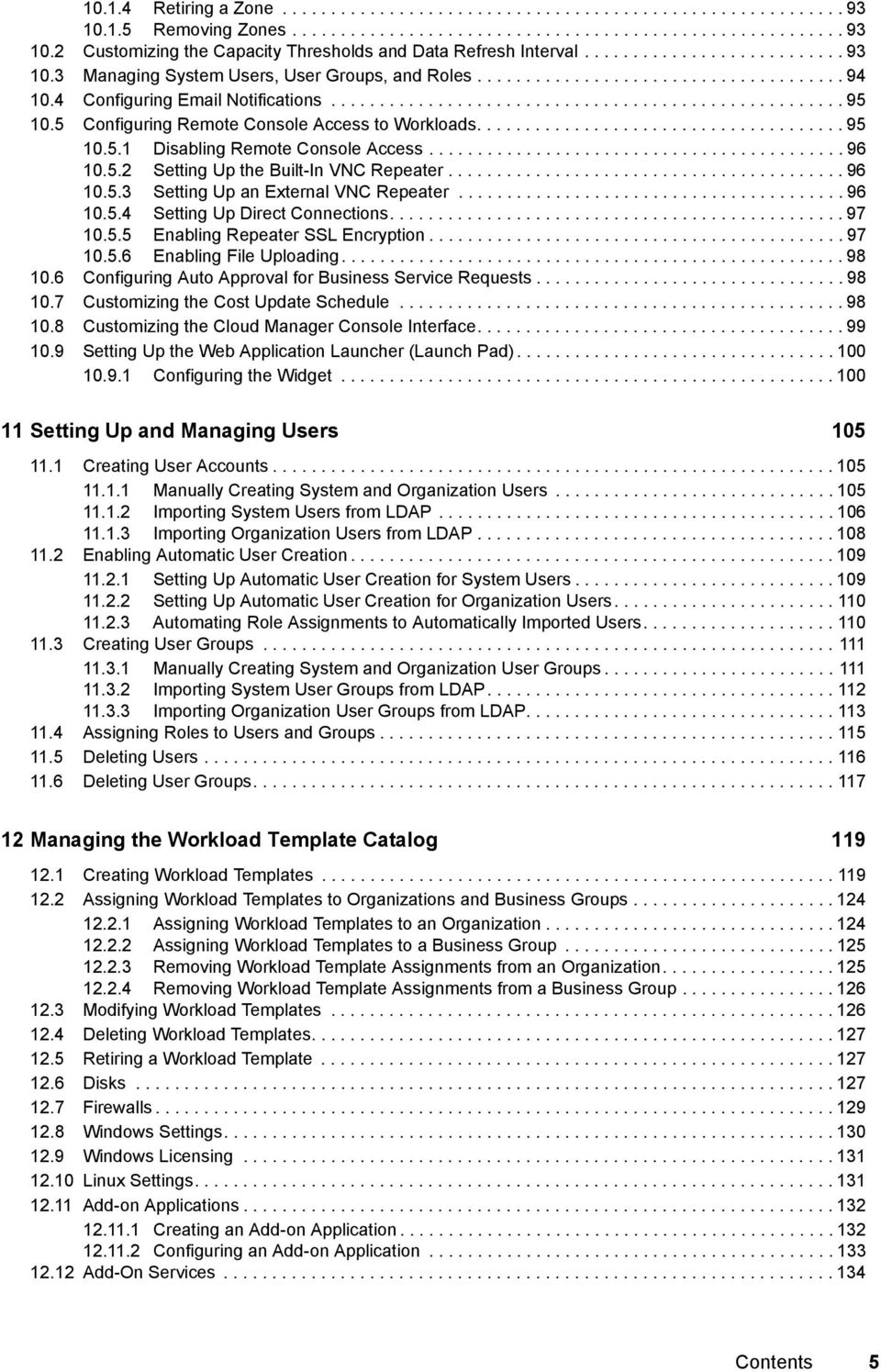
5 Retiring a Zone Removing Zones Customizing the Capacity Thresholds and Data Refresh Interval Managing System Users, User Groups, and Roles Configuring Notifications Configuring Remote Console Access to Workloads Disabling Remote Console Access Setting Up the Built-In VNC Repeater Setting Up an External VNC Repeater Setting Up Direct Connections Enabling Repeater SSL Encryption Enabling File Uploading Configuring Auto Approval for Business Service Requests Customizing the Cost Update Schedule Customizing the Cloud Manager Console Interface Setting Up the Web Application Launcher (Launch Pad) Configuring the Widget Setting Up and Managing Users Creating User Accounts Manually Creating System and Organization Users Importing System Users from LDAP Importing Organization Users from LDAP Enabling Automatic User Creation Setting Up Automatic User Creation for System Users Setting Up Automatic User Creation for Organization Users Automating Role Assignments to Automatically Imported Users Creating User Groups Manually Creating System and Organization User Groups Importing System User Groups from LDAP Importing Organization User Groups from LDAP Assigning Roles to Users and Groups Deleting Users Deleting User Groups Managing the Workload Template Catalog Creating Workload Templates Assigning Workload Templates to Organizations and Business Groups Assigning Workload Templates to an Organization Assigning Workload Templates to a Business Group Removing Workload Template Assignments from an Organization Removing Workload Template Assignments from a Business Group Modifying Workload Templates Deleting Workload Templates Retiring a Workload Template Disks Firewalls Windows Settings Windows Licensing Linux Settings Add-on Applications Creating an Add-on Application Configuring an Add-on Application Add-On Services Contents 5
6 Creating an Add-on Service Configuring an Add-on Service Legal Agreements Creating a Legal Agreement Editing a Legal Agreement Resource Pricing Packages Creating a Resource Pricing Package Syncing the Pricing Packages for OpenStack or EC2 Zones Configuring a Resource Pricing Package Hiding the Run Once Option Managing Organizations Creating Organizations Customizing Organization Configuration Settings Creating Business Groups Assigning Resource Groups to Organizations and Business Groups Assigning Resource Groups to an Organization Assigning Resource Groups to a Business Group Removing Resource Group Assignments from an Organization Removing Resource Group Assignments from a Business Group Managing Organization Users, User Groups, and Roles Configuring Password Strength for a Business Group Assigning Line Item Discounts for a Business Group Managing Resources Creating, Modifying, and Deleting Resource Groups Creating Resource Groups Modifying Resource Groups Deleting Resource Groups Creating, Modifying, and Deleting Service Levels Creating Service Levels Modifying Service Levels Retiring Service Levels Deleting Service Levels Creating Service Level Objectives Modifying Service Level Objectives Deleting Service Level Objectives Assigning Service Levels to Resource Groups Assigning Service Levels Removing Service Levels Editing Network Configurations Editing the General Network Configuration Editing Network Associations Editing a Network s IP Pool Monitoring Resource Capacity Accessing the Capacity View Understanding the Capacity View Updating the Capacity Data Debugging Capacity Collection Issues Managing Business Services Requesting Business Services Managing Business Service Requests Submitting a Request NetIQ Cloud Manager Procedures Guide

7 Editing a Request Withdrawing a Request Deleting a Request Importing a Single Virtual Machine into an Existing or a New Business Service Importing Multiple Virtual Machines into Cloud Manager Business Services Bulk Importing Multiple Virtual Machines About the Bulk Import Spreadsheet Completing Pre-Build Configuration Tasks Completing Post-Build Configuration Tasks Managing Deployed Business Services Starting, Suspending, or Shutting Down a Workload Opening a Workload Console Adding Files to a Workload Delegating Ownership of a Business Service Changing Deployed Business Services Changing a Business Service s Details Reassigning a Business Service to a Different Business Group Adding a Workload Modifying a Workload Removing a Workload Extending Business Service Expiration Dates Displaying or Hiding Business Service Costs Configuring an Organization s Costs Setting Configuring a Business Group s Costs Setting Configuring a User s Costs Setting Understanding Business Service Contracts Restrictions Resulting from an Active Contract Contract Change Period Contract Renewals Viewing Business Service Events Managing Tasks in the Business Service Workflow Displaying Administrator or Sponsor Tasks Claiming Tasks Approving and Denying Requests Completing Configuration Tasks Completing Pre-Build Configuration Tasks Completing Post-Build Configuration Tasks Completing Trigger Tasks Completing Reboot Trigger Tasks Generating Cloud Manager Reports Report Descriptions Generating Reports Changing Application Server Default Parameters and Values Increasing the Java Heap Space on the Application Server A Setting Up Cloud Manager to Log to a Sentinel Collector 211 B Integrating Cloud Manager with the Nixu IP Address Management System 213 B.1 Configuring Nixu NameSurfer for Cloud Manager Integration Contents 7

8 B.2 Configuring Cloud Manager for Nixu NameSurfer Integration B.3 (Optional) Removing the Native IPAM Module C Using REST APIs to Customize Cloud Manager Behavior 219 C.1 Cloud Manager REST API Overview C.2 Using the REST APIs to Modify the Cloud Manager Workflow C.2.1 Workflow Callout Registration Concepts C.2.2 Skipping the PreConfig Approval Stage by Invoking REST Callouts C.2.3 REST URLs for Configuring and Registering Custom Callouts C.2.4 Overriding the Default Task Order NetIQ Cloud Manager Procedures Guide

9 About NetIQ Corporation We are a global, enterprise software company, with a focus on the three persistent challenges in your environment: Change, complexity and risk and how we can help you control them. Our Viewpoint Adapting to change and managing complexity and risk are nothing new In fact, of all the challenges you face, these are perhaps the most prominent variables that deny you the control you need to securely measure, monitor, and manage your physical, virtual, and cloud computing environments. Enabling critical business services, better and faster We believe that providing as much control as possible to IT organizations is the only way to enable timelier and cost effective delivery of services. Persistent pressures like change and complexity will only continue to increase as organizations continue to change and the technologies needed to manage them become inherently more complex. Our Philosophy Selling intelligent solutions, not just software In order to provide reliable control, we first ensure that we understand the real-world scenarios in which IT organizations like yours operate day in and day out. That's the only way we can develop practical, intelligent IT solutions that successfully yield proven, measurable results. And that's so much more rewarding than simply selling software. Driving your success is our passion We place your success at the heart of how we do business. From product inception to deployment, we understand that you need IT solutions that work well and integrate seamlessly with your existing investments; you need ongoing support and training post-deployment; and you need someone that is truly easy to work with for a change. Ultimately, when you succeed, we all succeed. Our Solutions Identity & Access Governance Access Management Security Management Systems & Application Management Workload Management Service Management About NetIQ Corporation 9

10 Contacting Sales Support For questions about products, pricing, and capabilities, contact your local partner. If you cannot contact your partner, contact our Sales Support team. Worldwide: United States and Canada: Website: Contacting Technical Support For specific product issues, please contact our Technical Support team. Worldwide: North and South America: Europe, Middle East, and Africa: +353 (0) Website: To learn more about the services and procedures of NetIQ Technical Support, see the Technical Support Guide ( Contacting Documentation Support Our goal is to provide documentation that meets your needs. The documentation for this product is available on the NetIQ Cloud Manager Documentation ( website in HTML and PDF formats. If you have suggestions for documentation improvements, click comment on this topic at the bottom of any page in the HTML version of the documentation. You can also Documentation- We value your input and look forward to hearing from you. Contacting the Online User Community NetIQ Communities, the NetIQ online community, is a collaborative network connecting you to your peers and NetIQ experts. By providing more immediate information, useful links to helpful resources, and access to NetIQ experts, NetIQ Communities helps ensure you are mastering the knowledge you need to realize the full potential of IT investments upon which you rely. For more information, visit 10 NetIQ Cloud Manager Procedures Guide
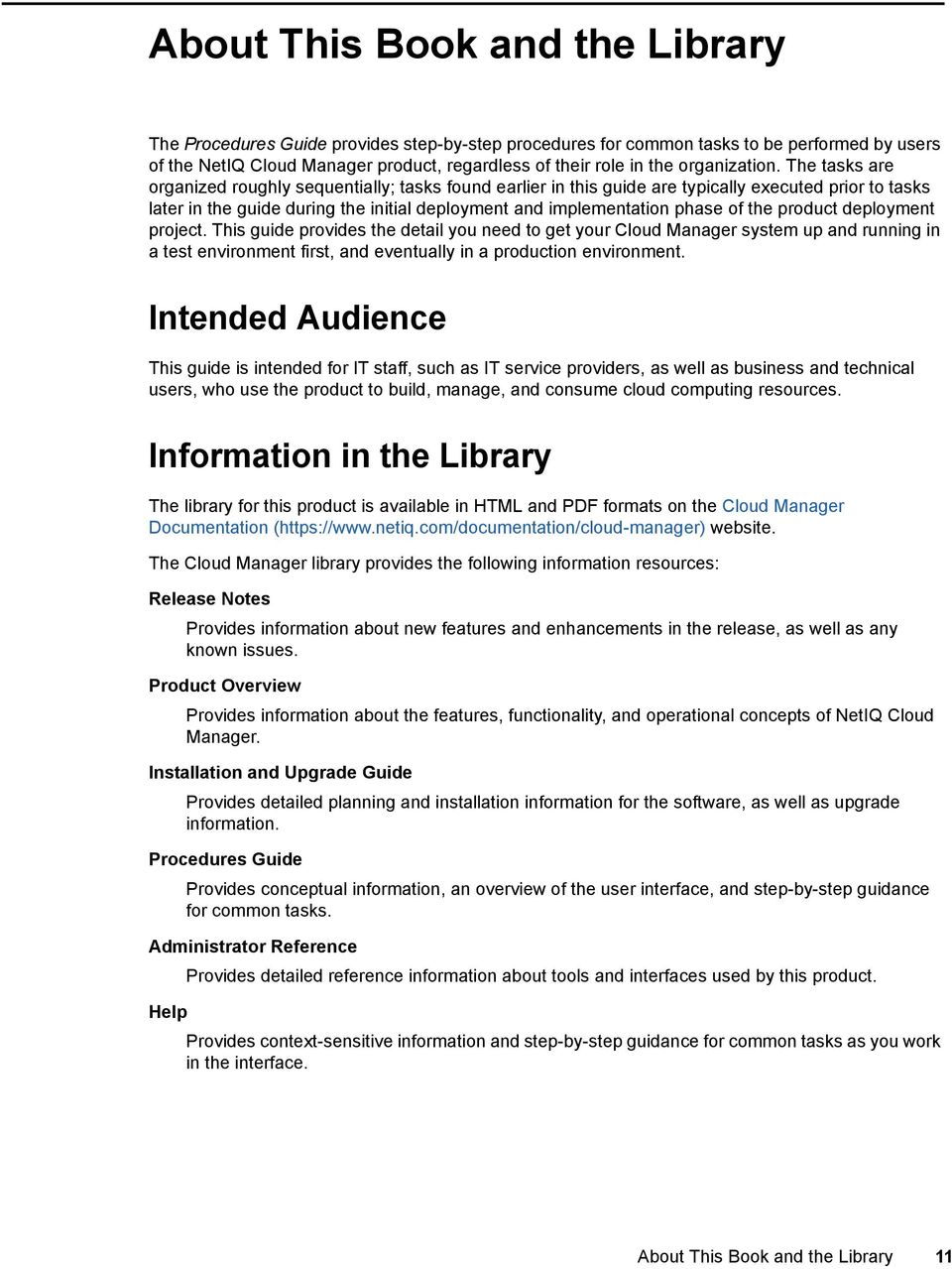
11 About This Book and the Library The Procedures Guide provides step-by-step procedures for common tasks to be performed by users of the NetIQ Cloud Manager product, regardless of their role in the organization. The tasks are organized roughly sequentially; tasks found earlier in this guide are typically executed prior to tasks later in the guide during the initial deployment and implementation phase of the product deployment project. This guide provides the detail you need to get your Cloud Manager system up and running in a test environment first, and eventually in a production environment. Intended Audience This guide is intended for IT staff, such as IT service providers, as well as business and technical users, who use the product to build, manage, and consume cloud computing resources. Information in the Library The library for this product is available in HTML and PDF formats on the Cloud Manager Documentation ( website. The Cloud Manager library provides the following information resources: Release Notes Provides information about new features and enhancements in the release, as well as any known issues. Product Overview Provides information about the features, functionality, and operational concepts of NetIQ Cloud Manager. Installation and Upgrade Guide Provides detailed planning and installation information for the software, as well as upgrade information. Procedures Guide Provides conceptual information, an overview of the user interface, and step-by-step guidance for common tasks. Administrator Reference Provides detailed reference information about tools and interfaces used by this product. Help Provides context-sensitive information and step-by-step guidance for common tasks as you work in the interface. About This Book and the Library 11
12 Additional Resources We encourage you to use the following additional resources online: Cloud Manager Forum ( A webbased community of product users where you can discuss product functionality and advice with other product users. Cloud Manager Product page ( A web-based product brochure that provides information about features, how to buy, technical specifications, frequently asked questions, and a variety of resources such as videos and white papers. NetIQ User Community ( A web-based community with a variety of discussion topics. NetIQ Support Knowledgebase ( A collection of in-depth technical articles. NetIQ Support Forums ( A web location where product users can discuss NetIQ product functionality and advice with other product users. MyNetIQ ( A website offering product information and services, such as access to premium white papers, webcast registrations, and product trial downloads. 12 NetIQ Cloud Manager Procedures Guide
13 I IAdministering the Cloud Manager Orchestration Server and Agent This section includes information you will need to know as you administer the Cloud Manager Orchestration Server. Chapter 1, Understanding Basic Orchestration Functions, on page 15 Chapter 2, Determining the Version of an Orchestration Component, on page 33 Chapter 3, Changing Orchestration Server Default Parameters and Values, on page 35 Chapter 4, Changing Orchestration Agent Default Parameters and Values, on page 37 Chapter 5, Caching Computed Facts in a Grid with Large Numbers of Resources, on page 39 Chapter 6, Managing Virtual Machine Hosts, on page 47 Chapter 7, Managing Virtual Machines, on page 53 Chapter 8, Managing VM Repositories, on page 67 Administering the Cloud Manager Orchestration Server and Agent 13

14 14 NetIQ Cloud Manager Procedures Guide

15 1 1Understanding Basic Orchestration Functions After you install and configure the basic components of the NetIQ Cloud Manager Orchestration components, (that is, the Orchestration Server, the Orchestration Agent, and the Orchestration Clients, including the Orchestration Console), you will want to see them at work. The information in this section is organized sequentially (that is, in a walkthrough scenario) so that you can follow the process an administrator might use to begin applying Cloud Manager Orchestration capabilities in a production environment. Section 1.1, Observing Discovery Jobs, on page 15 Section 1.2, Deploying a Sample Job, on page 17 Section 1.3, Creating a User Account, on page 19 Section 1.4, Running a Sample Job, on page 23 Section 1.5, Looking at the Job After It Has Run, on page 24 Section 1.6, Using the zosadmin Command to Gather Information, on page 26 Section 1.7, Stopping and Starting Orchestration Components, on page 27 Section 1.8, Configuring the Orchestration Server for LDAP or ADS Authentication, on page 29 Section 1.9, Viewing Orchestration Server Data in the Sentinel Event Source Server, on page 29 Section 1.10, Orchestration Server Log Levels Mapped to Sentinel Log Levels, on page 31 The first three subsections listed above are basic tasks you need to perform to make the Orchestration system perform at a basic level. The other sections include information to help you understand how Cloud Manager Orchestration can work in your production environment. 1.1 Observing Discovery Jobs When you created a resource account for the first time, you might have noticed the status window of the Resource object change colors (see Step 2 in Automatically Registering a Resource in the NetIQ Cloud Manager Installation and Upgrade Guide) from blue to green. You might also notice new Understanding Basic Orchestration Functions 15

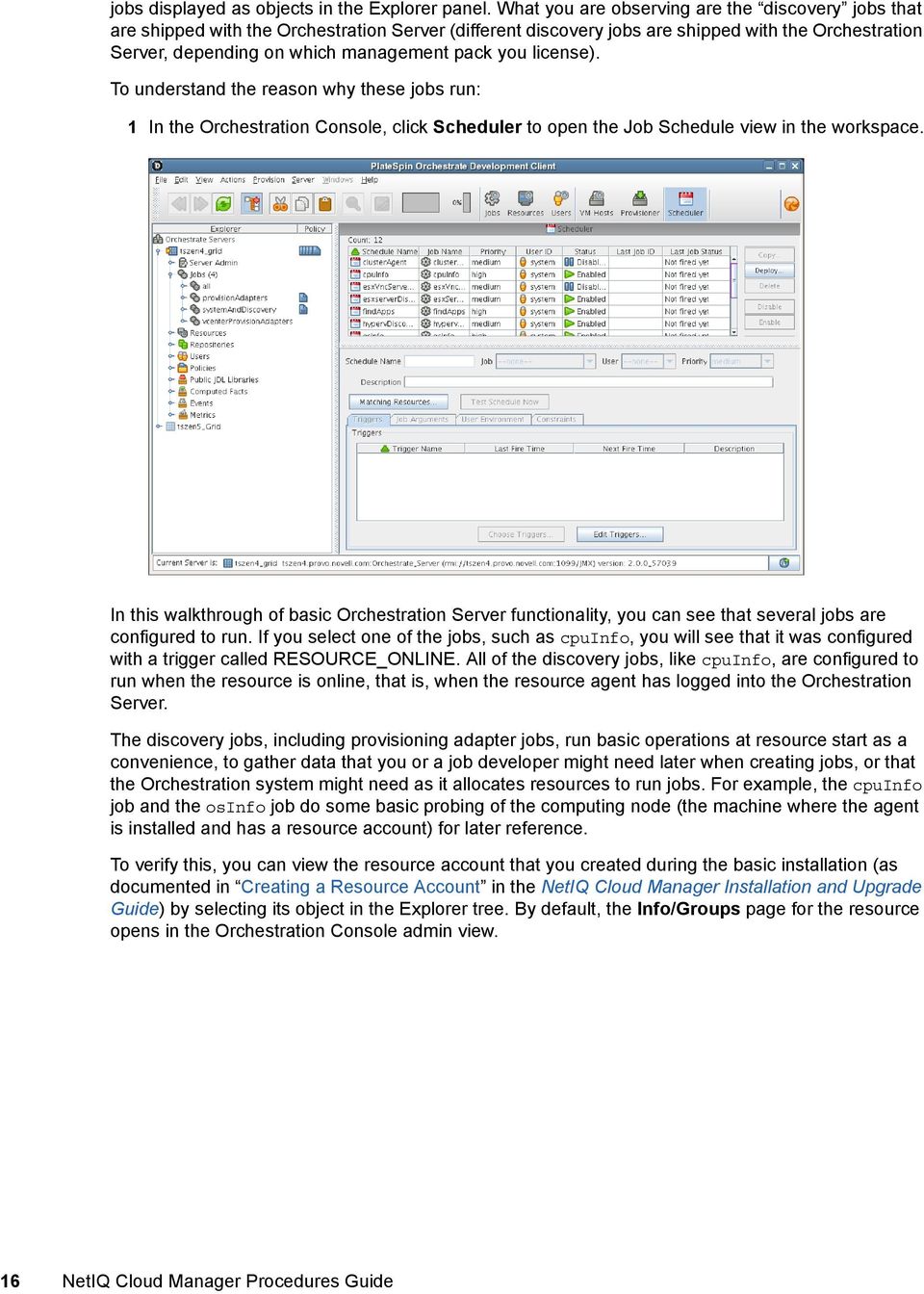
16 jobs displayed as objects in the Explorer panel. What you are observing are the discovery jobs that are shipped with the Orchestration Server (different discovery jobs are shipped with the Orchestration Server, depending on which management pack you license). To understand the reason why these jobs run: 1 In the Orchestration Console, click Scheduler to open the Job Schedule view in the workspace. In this walkthrough of basic Orchestration Server functionality, you can see that several jobs are configured to run. If you select one of the jobs, such as cpuinfo, you will see that it was configured with a trigger called RESOURCE_ONLINE. All of the discovery jobs, like cpuinfo, are configured to run when the resource is online, that is, when the resource agent has logged into the Orchestration Server. The discovery jobs, including provisioning adapter jobs, run basic operations at resource start as a convenience, to gather data that you or a job developer might need later when creating jobs, or that the Orchestration system might need as it allocates resources to run jobs. For example, the cpuinfo job and the osinfo job do some basic probing of the computing node (the machine where the agent is installed and has a resource account) for later reference. To verify this, you can view the resource account that you created during the basic installation (as documented in Creating a Resource Account in the NetIQ Cloud Manager Installation and Upgrade Guide) by selecting its object in the Explorer tree. By default, the Info/Groups page for the resource opens in the Orchestration Console admin view. 16 NetIQ Cloud Manager Procedures Guide
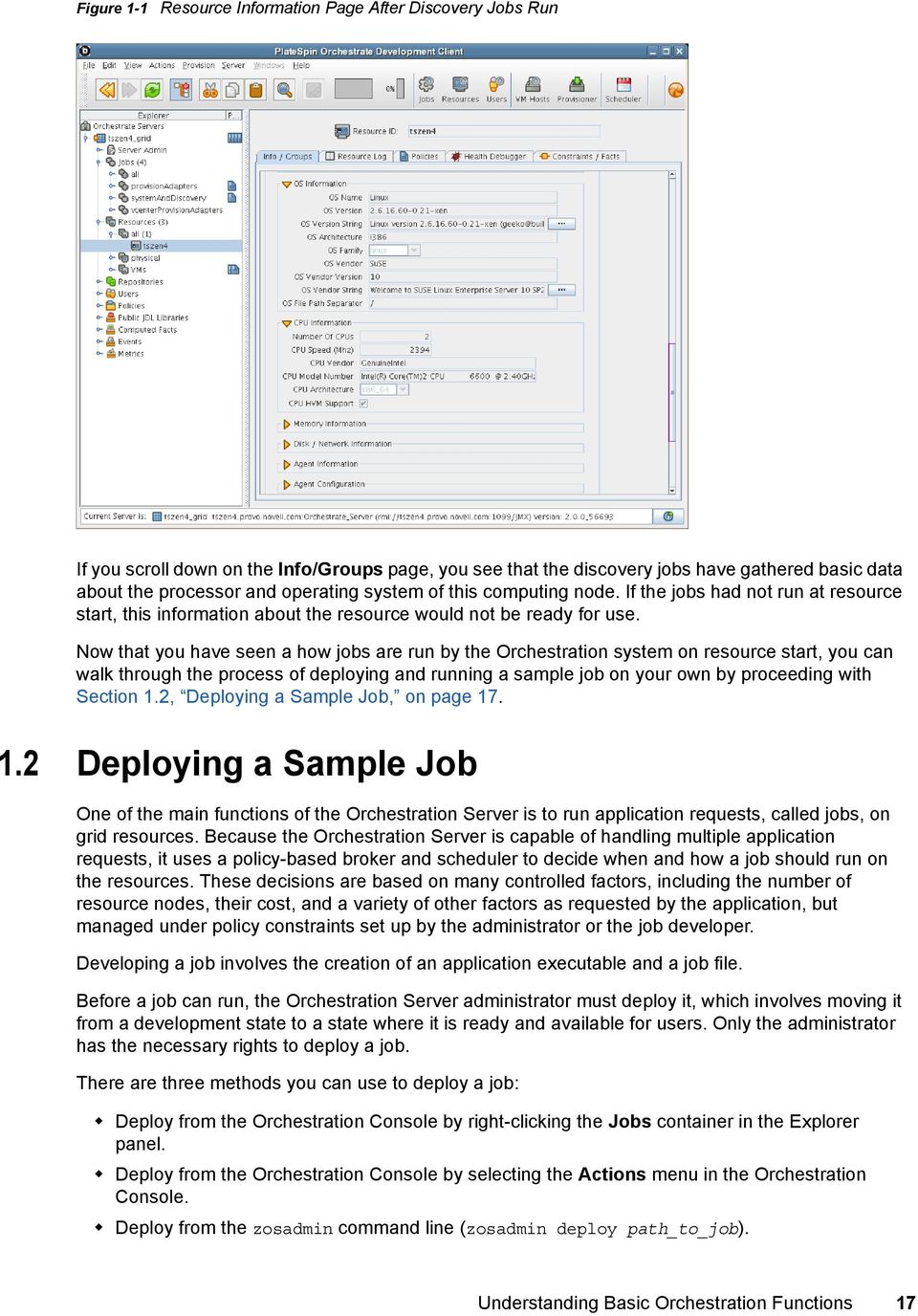
17 Figure 1-1 Resource Information Page After Discovery Jobs Run If you scroll down on the Info/Groups page, you see that the discovery jobs have gathered basic data about the processor and operating system of this computing node. If the jobs had not run at resource start, this information about the resource would not be ready for use. Now that you have seen a how jobs are run by the Orchestration system on resource start, you can walk through the process of deploying and running a sample job on your own by proceeding with Section 1.2, Deploying a Sample Job, on page Deploying a Sample Job One of the main functions of the Orchestration Server is to run application requests, called jobs, on grid resources. Because the Orchestration Server is capable of handling multiple application requests, it uses a policy-based broker and scheduler to decide when and how a job should run on the resources. These decisions are based on many controlled factors, including the number of resource nodes, their cost, and a variety of other factors as requested by the application, but managed under policy constraints set up by the administrator or the job developer. Developing a job involves the creation of an application executable and a job file. Before a job can run, the Orchestration Server administrator must deploy it, which involves moving it from a development state to a state where it is ready and available for users. Only the administrator has the necessary rights to deploy a job. There are three methods you can use to deploy a job: Deploy from the Orchestration Console by right-clicking the Jobs container in the Explorer panel. Deploy from the Orchestration Console by selecting the Actions menu in the Orchestration Console. Deploy from the zosadmin command line (zosadmin deploy path_to_job). Understanding Basic Orchestration Functions 17
18 For this walkthrough, we will deploy a simple job developed for Orchestration Server customers to demonstrate how jobs are deployed and run. Although the walkthrough shows only the first method for deploying, the other methods are relatively simple, so no further explanation is provided. 1 In the Explorer panel of the Orchestration Console, right-click the Jobs object, then click Deploy Job to open the Select the Component File to Deploy dialog. 2 Open the Look In drop-down list, then navigate to the location of the job you want to deploy. Although a job developer can store Orchestration Server jobs at any location on the network, the sample jobs shipped with the Orchestration Server are limited to the directories where the product is installed. For this walkthrough, navigate to the /opt/novell/zenworks/zos/server/ examples directory on the Orchestration Server. If the Orchestration Console is installed on a Windows machine, the default location is c:\program Files\Novell\zos\clients\examples. 3 Select whoami.job, then click OK to deploy the job to the Jobs container. The whoami job appears in the all container and in the examples container in the tree. When deployed, the job is sent over the wire to the Orchestration Server with which it is associated. It is persisted there until undeployed. 18 NetIQ Cloud Manager Procedures Guide

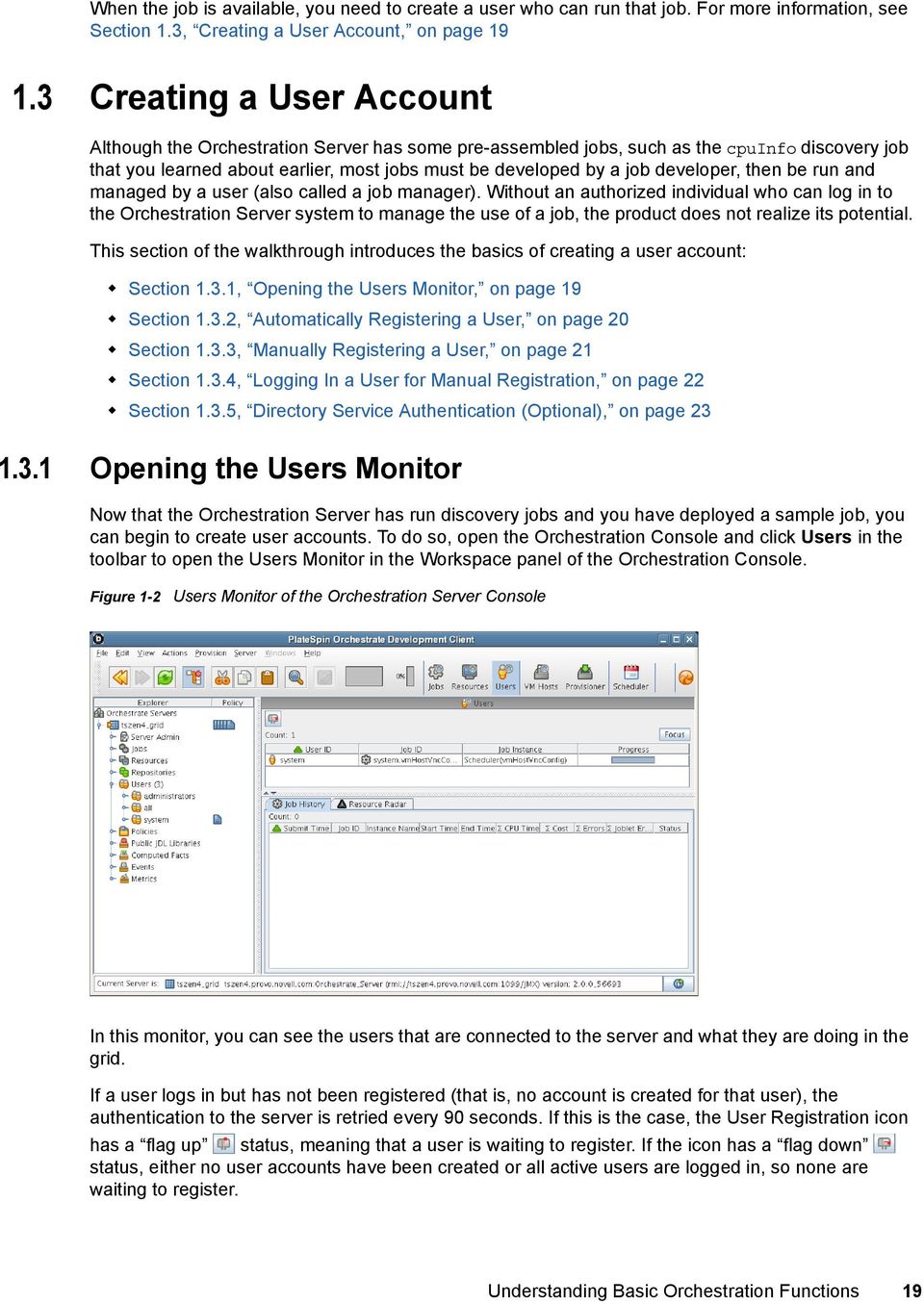
19 When the job is available, you need to create a user who can run that job. For more information, see Section 1.3, Creating a User Account, on page Creating a User Account Although the Orchestration Server has some pre-assembled jobs, such as the cpuinfo discovery job that you learned about earlier, most jobs must be developed by a job developer, then be run and managed by a user (also called a job manager). Without an authorized individual who can log in to the Orchestration Server system to manage the use of a job, the product does not realize its potential. This section of the walkthrough introduces the basics of creating a user account: Section 1.3.1, Opening the Users Monitor, on page 19 Section 1.3.2, Automatically Registering a User, on page 20 Section 1.3.3, Manually Registering a User, on page 21 Section 1.3.4, Logging In a User for Manual Registration, on page 22 Section 1.3.5, Directory Service Authentication (Optional), on page Opening the Users Monitor Now that the Orchestration Server has run discovery jobs and you have deployed a sample job, you can begin to create user accounts. To do so, open the Orchestration Console and click Users in the toolbar to open the Users Monitor in the Workspace panel of the Orchestration Console. Figure 1-2 Users Monitor of the Orchestration Server Console In this monitor, you can see the users that are connected to the server and what they are doing in the grid. If a user logs in but has not been registered (that is, no account is created for that user), the authentication to the server is retried every 90 seconds. If this is the case, the User Registration icon has a flag up status, meaning that a user is waiting to register. If the icon has a flag down status, either no user accounts have been created or all active users are logged in, so none are waiting to register. Understanding Basic Orchestration Functions 19
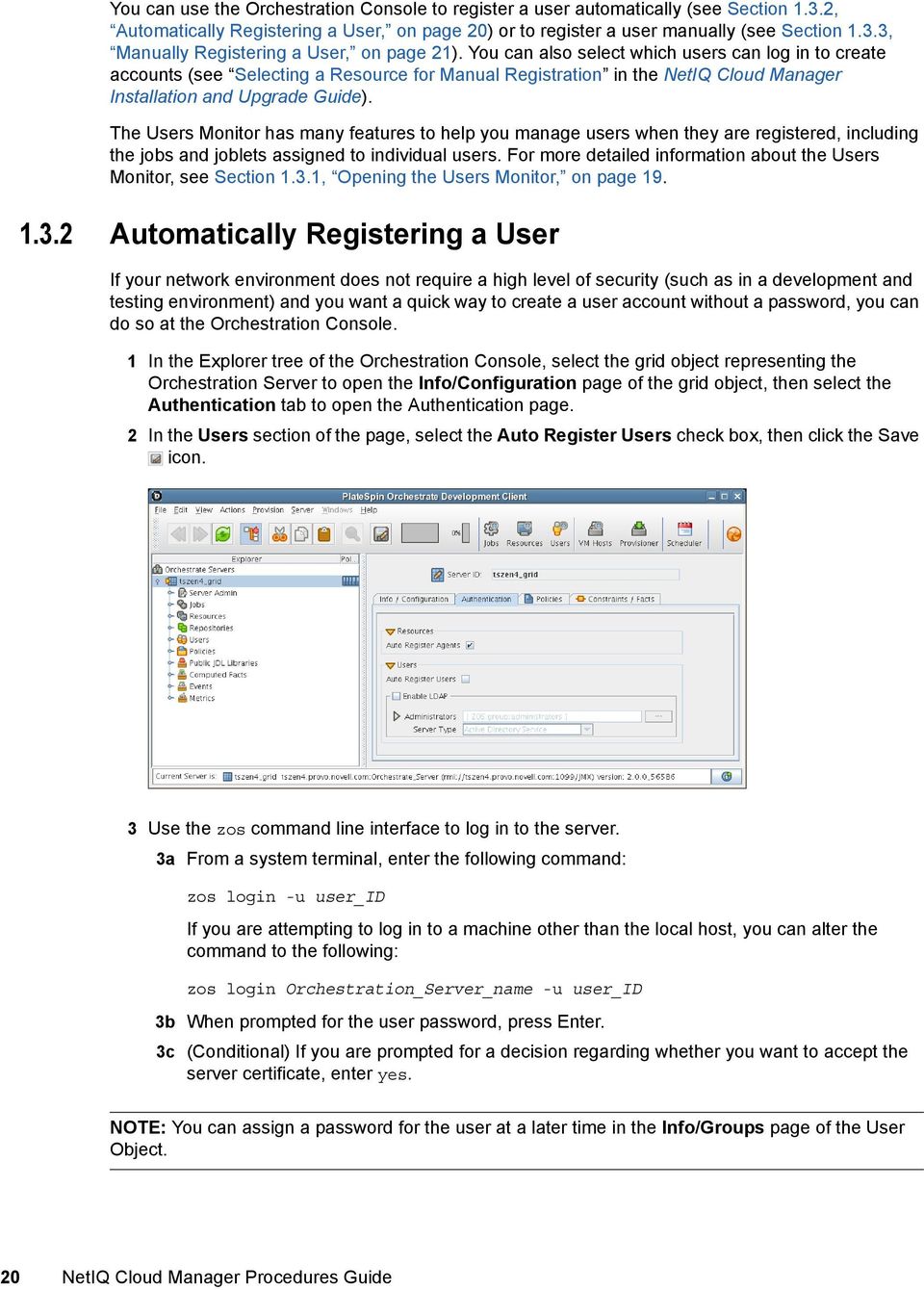
20 You can use the Orchestration Console to register a user automatically (see Section 1.3.2, Automatically Registering a User, on page 20) or to register a user manually (see Section 1.3.3, Manually Registering a User, on page 21). You can also select which users can log in to create accounts (see Selecting a Resource for Manual Registration in the NetIQ Cloud Manager Installation and Upgrade Guide). The Users Monitor has many features to help you manage users when they are registered, including the jobs and joblets assigned to individual users. For more detailed information about the Users Monitor, see Section 1.3.1, Opening the Users Monitor, on page Automatically Registering a User If your network environment does not require a high level of security (such as in a development and testing environment) and you want a quick way to create a user account without a password, you can do so at the Orchestration Console. 1 In the Explorer tree of the Orchestration Console, select the grid object representing the Orchestration Server to open the Info/Configuration page of the grid object, then select the Authentication tab to open the Authentication page. 2 In the Users section of the page, select the Auto Register Users check box, then click the Save icon. 3 Use the zos command line interface to log in to the server. 3a From a system terminal, enter the following command: zos login -u user_id If you are attempting to log in to a machine other than the local host, you can alter the command to the following: zos login Orchestration_Server_name -u user_id 3b When prompted for the user password, press Enter. 3c (Conditional) If you are prompted for a decision regarding whether you want to accept the server certificate, enter yes. NOTE: You can assign a password for the user at a later time in the Info/Groups page of the User Object. 20 NetIQ Cloud Manager Procedures Guide
21 When a user logs out, the User object icon each User group to which it belongs. is dimmed in the Explorer tree or in the admin view of Manually Registering a User If you want a higher level of security for authorized users, you can manually create a user account in the Orchestration Console before the user logs in. When a user is created in the Orchestration Server Console, that user is ready to run jobs. To create a new user in the Orchestration Console Explorer tree: 1 In the Explorer tree of the Orchestration Console, right-click Users > click New User to display the Create a New User dialog. 2 Specify the name of the new user you want to create in the New User Name field, then click OK. The user account is created, but is not currently running jobs, as indicated by its object icon the Explorer tree or in the admin view of each User group to which it belongs. in To create a new user through the Actions menu: 1 In the Orchestration Console, click Actions > Create User to display an expanded version of the Create a New User dialog. This dialog includes a method for designating the user as a member of the administrators user group. In this walkthrough, we will create the user as a member of the all group, which does not place the user in the administrators group. 2 Specify the new username in the New User Name field, click Create, then click Close. Understanding Basic Orchestration Functions 21
22 3 Define the user password. 3a In the Explorer tree of the Orchestration Console, select the new User in the Users object all group to open its Info/Groups page. 3b In the Info/Groups page, select the collapse/expand icon in the Personal Information section to open the fields of that section. 3c In the Password field, change the default password, then click the Save the Password Confirmation dialog. icon to display 3d In the Confirm New Password field, enter the password you defined previously, click OK, then click the Save icon to save the password. When a user logs out, the User object icon each User group to which it belongs. is dimmed in the Explorer tree or in the admin view of Logging In a User for Manual Registration If you do not select the Auto Register Users check box on the grid object s Info/Configuration page, you have the option of explicitly accepting or denying the login attempts of a user, thus preventing that user from creating an account. 1 Make sure that the Auto Register Users check box on the grid object s Authentication page is not selected (see Step 2 in Automatically Registering a Resource in the NetIQ Cloud Manager Installation and Upgrade Guide) and that you have created a new user. 2 Use the zos command line interface to log in to the server. 2a From a system terminal or from an Orchestration Server login in Windows, enter the following command: zos login --user=user If you are attempting to log in to a machine other than the local host, you can alter the command to the following: zos login Orchestration_Server_name --user=user 2b Enter the password for the user credentials. For this walkthrough, you can simply press Enter to enter an empty password. 22 NetIQ Cloud Manager Procedures Guide
23 2c When prompted for a decision regarding whether you want to accept the server certificate, enter yes. An error message is generated: ERROR: login failed: user name or password 'incorrect' 3 In the Users Monitor, click the User Registration icon to open the User Registration Monitor dialog. This dialog lets you preview the users who are trying to log in to the server. The top row of radio buttons is a mass selector for all listed users, allowing you the choice to accept, deny, or ignore automatic registration for all listed agents. If you want to choose the users that can be allowed to auto register, you can identify the user by name and select how you want to handle that agent s request for registration the next time it tries to log in. 4 For this example, select the Accept radio button adjacent to the user you want to register, then click OK. The user account is created, but is not currently running jobs, as indicated by its object icon the Explorer panel, or in the Information view of each User group to which it belongs. in Directory Service Authentication (Optional) There are some configuration steps you need to follow in the Orchestration Console if you want to immediately configure the authentication of both users and resources to the Orchestration Server using a directory service like ADS or LDAP. For more information, see Authentication Page in the NetIQ Cloud Manager Administrator Reference. 1.4 Running a Sample Job Deployed jobs can be run from the Scheduler utility inside of the Orchestration Server Console or from the zos command line. For the purpose of this walkthrough, we will run a sample job from the command line after logging in as a user. 1 From a system terminal, enter the following command: zos run whoami Understanding Basic Orchestration Functions 23
24 If you have more than one resource connected, you might want to run the job on one resource in particular. If you want do run the job this way, you can do so by adding an argument to the command line: zos run whoami resource=name_of_resource Now that you have run the sample job, you need to use some of the Orchestration Server tools to verify that it has run. For more information, see Section 1.5, Looking at the Job After It Has Run, on page Looking at the Job After It Has Run After you have run the job, there are several ways to verify that it has run. This section explains those methods. Section 1.5.1, Verification at the Command Line, on page 24 Section 1.5.2, Verification at the Jobs Monitor, on page Verification at the Command Line The following sections explain some of the zos commands that you can use to verify that a job has run and monitor some of the results of the job: zos jobs on page 24 zos jobinfo job_name on page 24 zos status --detail on page 25 zos log job_id --verbose on page 25 zos jobs You can use the zos jobs command to list all of the jobs that have run while you have been logged in as a user. Running this command yields an output like this: Job JobID User Started Elapsed State whoami usera.whoami.60 usera 12/24/ :35:38 0:00:00 Completed zos jobinfo job_name You can use the zos jobinfo -e job_name command to display information for a named job the last time it was run. Running this command yields an output like this: Jobname/Parameters Attributes whoami Desc: This is a demo example of enhanced exec numjoblets resource Desc: The number of joblets to schedule Type: Integer Default: 1 Desc: The resource id to run on Type: String Default:.* 24 NetIQ Cloud Manager Procedures Guide
25 zos status --detail You can use the zos status --detail command to display the status of the most recently run job. Running this command yields an output like this: Job Status for usera.whoami State: Completed Resource Count: 0 Percent Complete: 100% Queue Pos: n/a Child Job Count: 0 Joblet Counts: 1 (0) (0 this job) (0 this job) (1 (0/0/1/0/0) this job) Instance Name: whoami Job Type: whoami Memo: Priority: medium Arguments: resource=tszen4_agent Submit Time: 12/24/ :35:38 Delayed Start: n/a Start Time: 12/24/ :35:38 End Time: 12/24/ :35:39 Elapsed Time: 0:00:00 Queue Time: 0:00:00 Pause Time: 0:00:00 Total CPU Time: 0:00:00 Total GCycles: 0:00:00 Total Cost: $ Burn Rate: $0.8982/hr (0:00:00 this job) (0:00:00 this job) ($ this job) ($0.8982/hr this job) Termination Type: n/a Job Error: <none> Joblet Error Count: 0 Node Error Count: 0 Excluded Nodes: 0 Bad Provision Count: 0 Excluded Provisions: 0 (0 this job) (0 this job) (0 this job) (0 this job) (0 this job) zos log job_id --verbose If you know the Job ID for a particular job that has run, you can use the zos log job_id --verbose command to display its detailed job log. Running this command yields an output like this: Agent connected with ID: user_usera_64 (comms ok), Session ID: 52 Launching 1 joblets for user 'usera' [tszen4_agent] cmd=whoami [tszen4_agent] root [tszen4_agent] result=0 Agent ID: null logged out Verification at the Jobs Monitor If you want to use the Orchestration Server Console to verify that the job has run, you can open the Jobs Monitor to look at the Job Log and see the result of the job being run. 1 In the Orchestration Console, click Jobs in the main toolbar to open the Jobs Monitor view. 2 In the Jobs Monitor view, click the Job Log tab to open the Jobs page in the workspace panel. Understanding Basic Orchestration Functions 25
26 3 In the Username drop-down list box, select the user who ran the whoami job. Although there is much more you can learn about a job in the Jobs Monitor view, you can see by displaying a recent job that the Orchestration Console picks up the job activity and makes it available at the console. 1.6 Using the zosadmin Command to Gather Information You can use the zosadmin command line to learn what users or nodes are defined in your Orchestration Server. Follow these steps to learn about the users and nodes in your system. 1 Log in to the Orchestration Server by using the following command: zosadmin login You can also use the server s host name as an argument when you log in. If you use the grid= parameter, you can specify the grid name you want to log into. If other Orchestration Servers are installed on the local host, the system cannot log in to any of them unless you use this parameter. For more information, see The zosadmin Command Line Tool in the NetIQ Cloud Manager Administrator Reference. 2 Enter the administrator s user name and password. If the login was successful, the command line tool returns a message like this: Logged into tszen4_grid on server 'tszen4.provo.company.com' 3 Enter the following command to list the active users on your Orchestration Server: zosadmin users You can add the --help option at the command line to determine the run options for this command. 4 Enter the following command to list the active nodes on your Orchestration Server: 26 NetIQ Cloud Manager Procedures Guide
27 zosadmin nodes You can add the --help option at the command line to determine the run options for this command. With the completion of this part of the walkthrough, you have a good understanding of the parts of Orchestration Server and how they work. 1.7 Stopping and Starting Orchestration Components Use the following methods for stopping and starting Cloud Manager Orchestration components. Section 1.7.1, Stopping and Starting the Orchestration Server, on page 27 Section 1.7.2, Stopping and Starting the Orchestration Agent, on page 28 Section 1.7.3, Starting and Stopping the Orchestration Server Console, on page Stopping and Starting the Orchestration Server You can use the following methods for stopping and starting the Orchestration Server. Stopping the Server on page 27 Starting the Server on page 27 Stopping the Server You need to shut down the Orchestration Server before you power off the computer where it is running. This routine prevents possible data corruption.you must be logged in to an Orchestration Server in order to stop it. There are two methods to stop the current server: If you are in the Orchestration Console, click Server > click Shutdown ZOS. If you are at the command line, enter the following command: /etc/init.d/novell-zosserver stop Starting the Server The Cloud Manager Orchestration components installation and configuration automatically starts the Orchestration Server. The Orchestration Server must be stopped before you can start it. You must be logged in to an Orchestration Server to start it. There are two methods you can use to start the current server: If you are at the command line, enter the following command: /etc/init.d/novell-zosserver start To restart the Orchestration Server from the command line, enter the following command: /etc/init.d/novell-zosserver restart This command stops the server before restarting it. Understanding Basic Orchestration Functions 27
28 1.7.2 Stopping and Starting the Orchestration Agent You can use the following methods for stopping and starting the Cloud Manager Orchestration Agent. Stopping the Agent on page 28 Starting the Agent on page 28 Stopping the Agent There are several methods you can use to stop the agent: If you are in the Orchestration Server Console, select the Resources Monitor, select a resource, then click the red icon in the work area to shut down that agent. If you are running the agent on a Windows machine, click Start > Programs > Novell > ZOS > Agent > Shutdown ZOS Agent. If you are at the Linux bash prompt, enter the following command: /etc/init.d/novell-zosagent stop Starting the Agent To start the Orchestration Agent from a Windows machine, double-click the ZOS Agent shortcut on your desktop or click Start > Programs > Novell > ZOS > Agent > Start ZOS Agent. If you are at the Linux bash prompt, enter the following command: /etc/init.d/novell-zosagent start Starting and Stopping the Orchestration Server Console You can use the following methods for stopping and starting the Cloud Manager Orchestration Console. Stopping the Orchestration Console on page 28 Starting the Orchestration Console on page 28 Stopping the Orchestration Console To stop the Orchestration Server Console at the console itself, click File > Exit, or click the shutdown icon on the console window. Starting the Orchestration Console To start the Orchestration Console from a Linux machine: enter./zoc. On a SLES 11 machine, if you have installed the Orchestration Server along with the Orchestration Console, change to /opt/novell/zenworks/zos/server/bin and enter the following command./zoc On a SLES 11 machine, if you have installed the Orchestration Console alone, change to /opt/ novell/zenworks/zos/clients/bin and enter the following command./zoc 28 NetIQ Cloud Manager Procedures Guide
29 To start the Orchestration Console on a Windows machine, double-click the ZOS Clients shortcut on your desktop or click Start > Programs > Novell > ZOS > Clients > Orchestration Console. 1.8 Configuring the Orchestration Server for LDAP or ADS Authentication There are some configuration steps you need to follow in the Orchestration Console if you want to immediately configure the authentication of both users and resources to the Orchestration Server through a directory service like ADS or LDAP. The Cloud Manager Orchestration Server uses only one attribute of a given LDAP user: its group membership. For example, if the following settings were already configured in the Orchestration Server, BaseDN 'dc=domain,dc=novell,dc=com' UserAttribute 'uid' UserPrefix 'ou=users' you could further configure the Orchestration Server to identify users belonging to an LDAP group using the setting LDAP:groupnocase:administrators. You would do this by specifying a filter in the Orchestration Server using these settings: GroupFilter 'memberuid=${user_name}' GroupPrefix 'ou=groups' GroupAttribute 'cn' Applying these settings would let authenticated users belonging to the administrators LDAP group be added to the administrators user group in the Orchestration Server (and so allow them to log in to the Orchestration Console, for example). For information on configuring these settings in the Orchestration Server, see Orchestration Server Authentication Page in the NetIQ Cloud Manager Administrator Reference. NOTE: Depending upon your selection at the Server Type drop down list on the Enable LDAP subpanel of the Authentication page of the Orchestration Console the configuration fields change to reflect the relevant settings. (One server type is Active Directory Service, the other is Generic LDAP Directory Service.) 1.9 Viewing Orchestration Server Data in the Sentinel Event Source Server The Sentinel Event Source Server displays data from the Orchestration Server. For each logging event, the Orchestration Server passes a free form text log message and log event metadata to the Sentinel Event Source Server. The following table shows how the data are mapped: Understanding Basic Orchestration Functions 29
30 Table 1-1 Orchestration Server Logged Data Mapped to Sentinel Event Source Server Fields Sentinel Event Field Name Message TargetServiceName ReporterIP TargetServiceComp EventName ProductName InitUserName InitUserID Orchestration Server Data Represented A free-form text log message. The Orchestration Server grid name. The IP address of the Orchestration Server. The originating facility of the Orchestration Server event. A name formatted as gridname: taxonomy_key. For more information, see Event Classification and Taxonomy Keys in the NetIQ Cloud Manager Installation and Upgrade Guide. The product is always Cloud Manager Orchestration for convenient event filtering. The name of the Orchestration Server user. Used for user-oriented events. For some events, the Orchestration Server Sentinel Collector passes some structured data related to the log event. When available, this data appears in the ExtendedInformation Sentinel Event field, which is a list of key/value pairs delimited by semicolons. Some keys are always present in ExtendedInformation, but others appear only when relevant. The following table lists these keys: Table 1-2 Orchestration Server Key/Value Pairs Displayed in the Sentinel Event Source Server Key Displayed Value loglevel always The original Orchestration Server log level, for example, NOTICE, or INFO. eventclass always A symbolic identifier for this class of event, e.g. admin_login, policy_association. This also serves as the taxonomy key. The value is unclassified if the event does not contain any additional structured data. group when relevant The Grid object group related to this log event. job when relevant The job related to this log event. jobinstance when relevant The job instance ID related to this log event. member when relevant The Grid object group member related to this log event. policy when relevant The policy related to this log event. repository when relevant The repository related to this log event. resource when relevant The resource related to this log event. schedule when relevant The schedule related to this log event. trigger when relevant The trigger related to this log event. type when relevant The Grid object type related to this log event. user when relevant The name of the user related to this log event. This key also appears in the InitUserName and InitUserID fields. vbridge when relevant The Vbridge related to this log event. 30 NetIQ Cloud Manager Procedures Guide
31 Key Displayed Value vdisk when relevant The Vdisk related to this log event. vm when relevant The VM related to this log event. vmhost when relevant The VM host server related to this log event. vnic when relevant The VNIC related to this log event. target when relevant The name of the Grid object related to this log event. action when relevant The action related to this log event Orchestration Server Log Levels Mapped to Sentinel Log Levels The information in the following table shows the correlation between the Orchestration Server logging levels and those you are likely to see in Novell Sentinel. Table 1-3 Orchestration Server Log Levels Mapped to Sentinel Log Levels Orchestration Server Log Level (alpha) Sentinel Collector Log Level (numeric) Comments Usage Examples EMERGENCY 5 Urgent conditions that require immediate attention. Indicates that the system is no longer functioning. ALERT 5 Conditions that should be corrected immediately. CRITICAL 5 Critical conditions. ERROR 4 Errors that have been correctly handled. Unsuccessful job runs and provisioner/vm actions that have been correctly handled but might require manual attention. WARNING 3 Warning messages. Unexpected but recoverable events indicating degraded operational status, fsuch as grid objects becoming unhealthy. NOTICE 2 Conditions that are not error conditions, but should possibly be handled specially. Events expected occasionally as part of usual business operations, such as password changes, failed authentications and authorizations, grid objects returning to good health, server shutdown. Understanding Basic Orchestration Functions 31
32 Orchestration Server Log Level (alpha) Sentinel Collector Log Level (numeric) Comments Usage Examples STATUS 1 Conditions that report on changes in operational conditions. Events expected frequently as part of usual business operations, such as successful authentications (logins and logouts), deletion of grid objects, changes in group membership, deployment of jobs/policies/ schedules/triggers, policy association. INFO 1 Informational messages. Non-security-sensitive events expected very frequently as part of usual business operations, such as successful job runs and provisioner/ VM actions, resources going online/ offline, session expiration/timeout. 32 NetIQ Cloud Manager Procedures Guide
33 2 2Determining the Version of an Orchestration Component Cloud Manager Orchestration is made up of many components, which you choose whether to install when you first install the product. If you are new to Cloud Manager Orchestration, if you need to determine component compatibility, or if you need to confer with NetIQ Support, it is useful to know how to obtain the version numbers of the different components. One way to determine which version of the Cloud Manager RPM packages you have installed is to use the following command on the machine where a Cloud Manager Orchestration component is installed: rpm -qa grep novell The table below provides additional methods you can use to determine the version number for Orchestration components. Table 2-1 Determining the Version Number for Cloud Manager Orchestration Components Component Orchestration Server How to Determine Version Number At the Orchestration Console Explorer view, select the grid object, then open the Info/Configuration page of the workspace panel. The version number is listed in the Server Version field. Advanced Orchestration Server users can also find the version value in the matrix.version fact. Orchestration Agent After the agent is registered at the Orchestration Console Explorer view, select its resource object listed under Resources, then open the Info/ Groups page of the workspace panel. On the Info/Groups page, select Agent Information. The version number is listed in the Agent Version field. Advanced Orchestration Server users can also find the version value in the resources.agent.version fact. Orchestration Console At the console, click Help > About Cloud Manager Orchestration Console. The console version number and license expiration date is listed on the About Cloud Manager Orchestration Console dialog. Command Line Tools (zos, zosadmin) Cloud Manager Monitoring Server No method is currently available. On the command line of the machine where the Monitoring Server is running, enter (at /opt/novell/zenworks/monitor/sbin) the following command: gmetad -V gmetad -- version Determining the Version of an Orchestration Component 33
34 Component How to Determine Version Number Cloud Manager Monitoring Agent On the command line of the machine where the agent is running, enter (at / opt/novell/zenworks/monitor/sbin) the following command: gmond -V gmond -- version 34 NetIQ Cloud Manager Procedures Guide
35 3 3Changing Orchestration Server Default Parameters and Values The following table provides the current default values for some key performance parameters of the Cloud Manager Orchestration Server. Although the server is fine-tuned by default for optimal performance at normal loads, if you want to perform hundreds of provisioning actions simultaneously you can change some of the default settings for increased server performance in such a scenario. Table 3-1 Default Parameters of the Cloud Manager Orchestration Server Parameter Name Shipping Default Value Changing or Displaying the Parameter Configuration File Descriptors Limit 2048 (Optional) You can change the value as shown below: /etc/init.d/novell-zosserver: ulimit -n <new_limit> Java Heap Space 2048 MB Create a file of the following name: /opt/novell/ zenworks/zos/server/conf/ cmosadmin.properties Add the following line to the newly created file: default.jvmargs=-xmx2560m PermGen Space 512 MB Create a file of the following name: /opt/novell/ zenworks/zos/server/conf/ cmosadmin.properties Add the following line to the newly created file: default.jvmargs=- XX:MaxPermSize=1536m Audit Queue Size Max 200 Increase the value of this parameter by using the following command: zosadmin set -- mbean="local:facility=aud it" --attr=queuesizemax - -type=integer -- value=1000 Changing Orchestration Server Default Parameters and Values 35
36 Parameter Name Shipping Default Value Changing or Displaying the Parameter Configuration MaxRunJobWaitTimeout You can change the value of this parameter as shown below: zosadmin set -- mbean="local:facility=bro ker" -- attr=maxrunjobwaittimeout --type=integer -- value=<time_in_millisecon ds> MatchingResourcesCheckinterval Increase the value of this parameter by using the following command: zosadmin set -- mbean="local:facility=bro ker" -- attr=matchingresourcesche ckinterval --type=integer --value= Kernel ARP Threshold Values thresh1 = 128 thresh2 = 512 thresh3 = 1024 Set these values higher than the default. For example: cat /proc/sys/net/ipv4/ neigh/default/gc_thresh1 = 256 Job Limits: Soft Top Level Job Limit Max Queued Jobs Absolute Max Active Jobs matrix.maxtopjobs = 200 matrix.maxqueued = 300 matrix.maxactive = 400 cat /proc/sys/net/ipv4/ neigh/default/gc_thresh2 = 1024 cat /proc/sys/net/ipv4/ neigh/default/gc_thresh3 = 2048 Change the Grid Object default values in the Orchestration Console as follows: matrix.maxtopjobs = 600 matrix.maxqueued = 700 matrix.maxactive = NetIQ Cloud Manager Procedures Guide
37 4 4Changing Orchestration Agent Default Parameters and Values If you notice a high incidence of joblet failures on a vsphere discovery job, the cause might be a result of a lack of available resources on the Orchestration Agent. You need to increase the Orchestration Agent heap size beyond the default, which is 512 MB. To address this issue for an Orchestration Agent running on a Windows computer, create the C:\Program Files (x86)\novell\zos\agent\bin\zosagent.vmoptions file with the following content: -XX:+HeapDumpOnOutOfMemoryError -Dfile.encoding=UTF-8 -Xmx512m -Xms512m -XX:MaxPermSize=128m This same content also exists in the /opt/novell/zenworks/zos/agent/bin/node file for an Orchestrate Agent running Linux. You can adjust the values in these files as needed: The -XMx parameter sets the maximum heap size. The -XMs parameter sets the initial and minimum heap size. The -XX:MaxPermSize parameter sets the PermGen memory size. After you create the zosagent.vmoptions file for the Windows agent, make configuration changes and save it, you need to restart the Windows agent. For a Linux agent, look for the JVMARGS= section of the /opt/novell/zenworks/zos/agent/bin/ node file. Normally, you change values of the -XMx or the -XX:MaxPermSize parameters in the file. After you make such changes, you need to save the file and restart the Linux agent. NOTE: If the agent is running low on PermGen memory, we suggest that you conservatively increase it by 128 MB increments until no errors occur. Changing Orchestration Agent Default Parameters and Values 37
38 38 NetIQ Cloud Manager Procedures Guide
39 5 5Caching Computed Facts in a Grid with Large Numbers of Resources If your Orchestration grid includes a large number of resources with associated Computed Facts, it is likely that these computed facts are evaluated with each Ready for Work message received by the broker from the Orchestration Agent. These evaluations can cause an excessive load on the Orchestration Server, causing a decrease in performance. You might see warnings in the server log similar to the following: :27:54: Broker,WARNING: Long scheduler cycle time detected :27:54: Broker,WARNING: Total:3204ms, JDL thrds:8, TooLong:false :27:54: Broker,WARNING: Allocate:0ms [P1:0,P2:0,P3:0], Big: :27:54: Broker,WARNING: Provision:4ms [P1:0,P2:0,P3:0], Big: :27:54: Broker,WARNING: Msgs:3204ms [50 msg, max: 3056ms (3:RFW)] :27:54: Broker,WARNING: Workflow:[Timeout:0ms, Stop:0ms] :27:54: Broker,WARNING: Line:0ms, Preemption:0ms, (Big: 3), Mem:0ms :27:54: Broker,WARNING: Jobs:15/0/16, Contracts:10, AvailNodes: :27:54: Broker,WARNING: PermGen: Usage [214Mb] Max [2048Mb] Peak [543Mb] :27:54: Broker,WARNING: Memory: free [1555Mb] max [3640Mb] :27:54: Broker,WARNING: Msgs:483/50000 (recv:128692,sent:14202), More:true :27:54: Broker,WARNING: To work around this issue, we recommend that you cache the Computed Facts. 1 In the Explorer tree of the Orchestration Console, expand the Computed Facts object, then select vmbuilderpxeboot. The vmbuilderpxeboot fact does not change, so setting the cache here is safe from any automatic modifications. 2 In the Computed Facts admin view, select the Attributes tab to open the Attributes page. 3 In the Attributes page, select the Cache Result for check box, then in the newly active field, enter 10 minutes (remember to change the drop-down list to indicate Minutes). This value must be greater than the default of 30 seconds. 4 Click the Save icon to save the new configuration. NOTE: If necessary, you can also cache other computed facts to improve server performance. 5.1 Walkthrough: Scheduling a System Job This section demonstrates how you can use the Orchestration Console to deploy and schedule an existing system job named auditcleaner.job. This example job is included in the examples directory of your Orchestration Server installation. This section includes the following information: Section 5.1.1, Deploying a Sample System Job, on page 40 Section 5.1.2, Creating a New Schedule for the Job, on page 41 Section 5.1.3, Defining the New Schedule, on page 42 Caching Computed Facts in a Grid with Large Numbers of Resources 39
40 Section 5.1.4, Activating the New Schedule, on page 46 Section 5.1.5, Running the New Schedule Immediately, on page Deploying a Sample System Job Before a job can run, the Orchestration Server administrator must deploy it, which involves moving it from a developed package state to a state where it is ready and available for users. Only the administrator has the necessary rights to deploy a job. There are four methods you can use to deploy a job: Deploy it from the Orchestration Console by right-clicking the Jobs container in the Explorer panel. Deploy it from the Orchestration Console by selecting the Actions menu in the console. Deploy it from the zosadmin command line (zosadmin deploy path_to_job). Copy the deployable component to the hot deployment directory under the Orchestration Server instance directory. Typically, this directory is located at /var/opt/novell/zenworks/ zos/server/deploy. Using this method, deployment proceeds within a few seconds. The server monitors this directory. A runnable job can also be scheduled, which means that the schedule for running the job and the trigger or triggers that initiate or fire the schedule (or both) are configured and packaged with the job. For this walkthrough, you deploy one of several system jobs (auditcleaner.job) developed for Cloud Manager Orchestration Server administrators to demonstrate how system jobs are deployed and run. This job package, which is actually a.jar archive, includes only a.policy component and a.jdl component. It does not have a.sched component. You can use the Job Scheduler in the Orchestration Console to add the.sched component separately. NOTE: A job developer can create and package jobs that include a.jdl file, a.policy file, a.trig file (trigger), and a.sched file (schedule). The presence of the.sched file in the job package is also typical of the predeployed discovery jobs installed with the Orchestration Server, which run without intervention when the criteria for firing the schedule are satisfied. Such jobs are visible in the Job Scheduler because they already include the.sched components. Although this walkthrough demonstrates only the first method listed above for deploying, the other methods are relatively simple, so no further examples are provided to illustrate them. 1 In the Explorer panel of the Orchestration Console, right-click the Jobs container, then click Deploy Job to open the Select the Component File to Deploy dialog. 40 NetIQ Cloud Manager Procedures Guide
41 2 Open the Look In drop-down list, then navigate to the location of the job you want to deploy. Although a job developer can store jobs at any location on the network, the sample jobs shipped with the Orchestration Server are limited to the directories where the product is installed. For this walkthrough, navigate to the /opt/novell/zenworks/zos/server/components/systemjobs directory. 3 Select auditcleaner.job, then click OK to deploy the job to the Jobs container. The job appears in the all container and in the examples container in the tree Creating a New Schedule for the Job When a job has been deployed, you can create a schedule to specify when you want it to run. In this walkthrough, you create a schedule for the auditcleaner job by using the Scheduler tool in the Orchestration Console. 1 In the toolbar in the Orchestration Console, click the Job Scheduler button to open the Job Scheduler view. 2 In the Job Scheduler view, click New to open the Enter Unique Schedule Name dialog. 3 Specify a name for the schedule you want to create for this job. For this walkthrough, specify the name cleaner in the Schedule Name field, then click OK to return to the Job Scheduler view. Caching Computed Facts in a Grid with Large Numbers of Resources 41
42 The new schedule is highlighted in the Job Schedules Table and is flagged with a pencil icon, signifying that the schedule has not been committed yet. Continue with Section 5.1.3, Defining the New Schedule, on page 42 to define this new schedule by adding the specific information you want Defining the New Schedule Defining a new job schedule consists of selecting its general properties, its specific properties, and the triggers you want to be associated with it. Choosing General Properties for a New Schedule on page 42 Creating and Assigning a Time Trigger for the New Schedule on page 43 Adding Specific Parameters to the New Schedule on page 44 Choosing General Properties for a New Schedule After you have created a new job schedule, its name cannot be changed, but you can add properties to it that help to identify and classify it in a general way. Use the following steps to add these properties: 1 In the Job Schedule Editor panel of the Scheduler view, select the Job drop-down list. 2 From the list of available jobs, select auditcleaner as the job to which this schedule applies. 3 In the Job Schedule Editor, select the User drop-down list. 4 From the list of available users, select zossystem as the user who runs this job. The zos user is the built-in user that is always present. It is commonly used for routine jobs like this example. 5 In the Job Schedule Editor, select the Priority drop-down list. 6 From the list of available priorities, select high as the priority for this job schedule. The maximum selectable priority is dependent on an attribute associated with the selected user. 7 Click the Save button on the toolbar of the Orchestration Console to save the general properties you have selected for the new schedule. The schedule is now committed, and the attribute columns in the Job Schedules Table are populated with the name of the job that the schedule will run, the user it will run as, the priority at which it will run, and its current status. Because the schedule has not been activated yet, it remains in a Disabled state. 42 NetIQ Cloud Manager Procedures Guide
43 When you have chosen the general properties of the new schedule, you can either continue with Adding Specific Parameters to the New Schedule on page 44 or proceed directly to Creating and Assigning a Time Trigger for the New Schedule on page 43. Creating and Assigning a Time Trigger for the New Schedule A job already defined in a schedule can be triggered with two main themes: the occurrence of an event or the arrival of a point in time. In this walkthrough, you define a time trigger for the cleaner schedule. In this example, there are no defined time triggers in the Job Scheduler, so you use the following steps to define a time trigger. 1 In the Job Schedule view, click Edit Triggers to display the Triggers dialog. Time triggers are shareable across schedules. After a time trigger is defined, it is added to a list of triggers in this dialog. You can select a predefined trigger from this list when you create a new schedule, or you can create a new time trigger, as the next steps demonstrate. 2 In the Triggers dialog, click New to clear and activate the fields in the dialog for the creation of a unique time trigger. 3 In the Enter Unique Trigger Name dialog, specify 24 hour as the unique name of this time trigger, then click OK. 4 In the Description field, specify Runs every 24 hours at noon as the description for this time trigger. 5 Click Fire Using CRON Expression to activate the fields for defining a cron expression. 6 Click the drop-down list of sample cron expressions, then select the default cron expression, * *?, which is listed first. The sample expressions in the drop-down list show cron strings with accompanying descriptions to remind you how a cron string is constructed. The examples are selectable and editable and can be used in the schedule, just as you have done in this step. NOTE: For detailed information about cron syntax, see Understanding Cron Syntax in the Job Scheduler in the NetIQ Cloud Manager Administrator Reference. 7 Click Save to save the trigger you just created, then click Close to return to the Job Scheduler view. 8 From the Job Scheduler view, make sure that the cleaner schedule is selected, then click Choose Triggers to display the Choose Triggers dialog. 9 In the Choose Triggers dialog, select 24 hour (the name of the trigger you created), click Add to move the trigger definition to the Scheduled Job Triggers list, then click OK to return to the Job Scheduler view. NOTE: You can select and combine as many time triggers as you want to apply to a given schedule. You can also combine time triggers with event triggers on a given schedule. In the Triggers list of the Job Scheduler view, the 24 hour trigger is now associated with the new schedule. Caching Computed Facts in a Grid with Large Numbers of Resources 43
44 10 Click the Save button to update the Orchestration Server with the new schedule/trigger association. Adding Specific Parameters to the New Schedule If necessary, you can now add specific parameters to the schedule to edit its job arguments, to choose whether you want to pass the user environment variables to the schedule, or to specify policy constraints to further focus the purpose of this schedule when it fires. For the purpose of this walkthrough, none of these specific parameters is modified, although a general overview of how to do so is explained. The following specific parameters can be managed in the Job Scheduler Editor: Job Arguments on page 44 User Environment on page 45 Constraints on page 45 Job Arguments As explained in Creating or Modifying a Job Schedule in the NetIQ Cloud Manager Administrator Reference, a job argument defines the values that can be passed in to the process when a job is invoked. These values let you statically define and control job behavior. The job arguments that appear in the Job Arguments tab of the Schedule Editor depend on the job. The job might have no arguments. By default, the auditcleaner job lists only one job argument, jobargs.days. Figure 5-1 The Job Arguments Tab of the Job Schedule Editor According to the tooltip text, this argument is the number of days of job history to keep, so this job cleans up the history of the job in the Orchestration Server audit database after the job reaches the age of 60 days. Data older than 60 days is to be deleted. If you want to, you can change this parameter, or any other parameter in a job argument. If the default value for a job argument parameter is missing, the job might fail, so you should inspect these parameters carefully. 44 NetIQ Cloud Manager Procedures Guide
45 User Environment As explained in Creating or Modifying a Job Schedule in the NetIQ Cloud Manager Administrator Reference, a user s environment variables are available in the Job Scheduler only if that user utilizes the zos command line tool and elects to pass those environment variables to the server at login time or when he or she runs a job (running the job creates the environment variables as facts in the job). The zos run command passes the environment for that particular job run only. In this walkthrough, the zossystem user shows no user environment variables. Figure 5-2 The User Environment Tab of the Job Scheduler Editor, No User Environment Variables Available Because there are no environment variables listed, there are none to pass to the schedule, so it is not necessary to select the Pass User Environment check box. By default, this check box is not selected, even if environment variables are present for a user specified to run the job. Sometimes a job is written to work from a user s environment variables. In this case, if a user has not logged in or has not run the job from the zos command line using the necessary environment option, the schedule must pass those variables to the job when it is invoked. If you associate a user who has user environment variables with this schedule, you would see a list of those environment variables as they would be passed to the job. Figure 5-3 The User Environment Tab of the Job Schedule Editor, User Environment Variables Available Selecting the Pass User Environment check box in this scenario would create these variables as facts used for this job invocation. Constraints As explained in Creating or Modifying a Job Schedule in the NetIQ Cloud Manager Administrator Reference, the Constraints tab displays a constraint editor that you can use to create additional constraints for the job being scheduled. Any other constraints associated with the context of this job invocation (including but not limited to this job), with the user you selected, with that user s group, with the jobs group, with the resources that the job uses, or with the resource groups that the job uses, run in spite of the policy that you define here. These additional constraints usually restrict or refine what the job does when this schedule fires. Caching Computed Facts in a Grid with Large Numbers of Resources 45
46 These constraints are passed to the job only when this schedule is invoked. For example, you could add a start constraint to delay the start of a job, a resource constraint to run on only one of three named machines, or a continue constraint to automatically time out the job if it takes too long to run. Anything you can do with a regular job policy constraint, you can add as a special constraint here for this particular schedule invocation. Click the Save button to update the Orchestration Server with the new schedule Activating the New Schedule When the new schedule has been created and its triggers defined, you need to take it from the disabled state to an active state where it is ready to run. 1 In the Job Scheduler view, select the newly created job. The job shows that it is in a Disabled state. 2 Click Enable to enable the schedule. The schedule is now enabled, but has not run yet Running the New Schedule Immediately You can trigger the schedule immediately, rather than waiting for the triggers to fire. 1 In the Job Schedules Table of the Job Scheduler view, select cleaner (the name of the schedule you want to run), click Run Now, then click the job monitor button on the toolbar (Jobs) to open the Job Monitor view. The joblet icon shows that the job is running. 2 Click the Job Scheduler button on the toolbar to open the Job Scheduler view. The cleaner schedule is listed as an active job. This indicates that the schedule has started the job as anticipated. If you click the Refresh button, you can see that the job now has a Job ID. If the job invocation fails, as in this example, a red exclamation icon is also displayed. 46 NetIQ Cloud Manager Procedures Guide
47 6 6Managing Virtual Machine Hosts After you install the Cloud Manager Orchestration Agent on a vcenter Server, you need to associate the vsphere_client policy to a vsphere resource before the Discover VM hosts job can work. Section 6.1, Discovering VM Hosts and Repositories, on page 47 Section 6.2, Discovering VM Images, on page 48 Section 6.3, Resynchronizing the VM Host s State, on page 49 Section 6.4, Shutting Down VM Hosts, on page 49 Section 6.5, Restarting VM Hosts, on page 50 Section 6.6, Understanding VM Host Failover, on page Discovering VM Hosts and Repositories 1 Ensure that the policies appropriate to the VM technology are configured. For more information, see Orchestration Provisioning Adapters in the NetIQ Cloud Manager Administrator Reference. For vsphere, the default number of slots is 4. We recommend that you increase this number to 10, depending on the hardware and available computing resources (RAM/CPU) of the server where the agent is running (this is also the server associated with the vsphere_client policy). Each joblet slot causes a separate Java instance on this resource. Each Java instance uses MB of RAM and is quite CPU-intensive. For more information on the policies, see Orchestration Provisioning Adapters in the NetIQ Cloud Manager Administrator Reference. 2 Ensure that you have set the correct number of joblet slots for the VM hosts in the policies appropriate to the VM technology. For more information, see Joblet Slots in the NetIQ Cloud Manager Administrator Reference. 3 In the Orchestration Console, click Provision > Discover VM Hosts and Repositories. The Discover VM Hosts and Repositories dialog is displayed. 4 Select your provisioning adapter from the drop-down list. 5 Click OK. 6 Click Jobs to view the Jobs section in the Orchestration Console and verify that the job has started. After your VM host machines are discovered, you can refresh your tree view or wait for the automatic tree refresh to see the VM host machine listed under the provisioning adapter, although no VMs are listed. Managing Virtual Machine Hosts 47
48 This also discovers: Local repositories for all types of hypervisors. SAN and NAS repositories for vsphere. To view the discovered repositories, click Repositories, then click sex. For a list of the supported guest operating systems supported by both Cloud Manager and vsphere, see Requirements and Cloud Manager Support for the Virtual Environment in the NetIQ Cloud Manager Installation and Upgrade Guide. 6.2 Discovering VM Images To discover the VM images on a specific repository: 1 In the Orchestration Console, click Provision > Discover VM Images. The Discover VM Images dialog is displayed. 2 In the Provisioning Adapter drop-down list, select the provisioning adapter for which you want to discover the VM images. The source repositories for the selected provisioning adapter are displayed. For information on provisioning adapters, see Section 7.1, Provisioning a Virtual Machine, on page Select the source repositories, then click Add. The selected repositories are added to the Target Repositories pane. 4 Click OK. The VM images are discovered: a separate job is launched for each repository that the user selected. After all jobs are complete, you can refresh the Explorer tree in the Orchestration Console to see the discovered VMs. 48 NetIQ Cloud Manager Procedures Guide
49 6.3 Resynchronizing the VM Host s State To manually verify and ensure that the state of a VM host displayed in the Orchestration Console is accurate: 1 In the Orchestration Console, right-click the VM host, then click Discover. To manually verify and ensure that the state of multiple VM hosts displayed in the Orchestration Console is accurate: 1 In the Orchestration Console, click Provision > Resync VM Host s State. The Resync VM Host s State dialog is displayed. 2 In the Source VM Hosts pane, select the VM hosts to be resynchronized, then click Add. The selected VM hosts are added to the Target VM Hosts pane. 3 Click OK. 6.4 Shutting Down VM Hosts To shut down a single VM host: 1 In the Orchestration Console, right-click the VM host you want to shut down, then click Shutdown. To shut down multiple VM hosts: 1 In the Orchestration Console, click Provision > Shutdown Hosts. The Shut Down VM Hosts dialog is displayed. Managing Virtual Machine Hosts 49
50 2 Choose when to shut down the VM hosts. You can choose to shut down the VM hosts after the Orchestration Agent becomes idle or to immediately shut down the VM hosts. By default, the Wait for Agent to become Idle option is selected. 3 In the Source VM Hosts pane, select the VM hosts you want to shut down, then click Add. The selected VM hosts are added to the Target VM Hosts pane. 4 Click OK. The VMs running on the host are automatically shut down and the VM host is moved to the Shutting Down state, where will not accept any Provisioning actions. 6.5 Restarting VM Hosts To restart a single VM host: 1 In the Orchestration Console, right-click the VM host you want to start, then click Start. To restart multiple VM hosts: 1 In the Orchestration Console, click Provision > Start VM Hosts. The Start VM Hosts dialog is displayed. 2 In the Source VM Hosts pane, select the VM hosts you want to restart, then click Add. 50 NetIQ Cloud Manager Procedures Guide
51 The selected VM hosts are added to the Target VM Hosts pane. 3 Click OK. 6.6 Understanding VM Host Failover When the Orchestration Server comes back online after being offline, it rediscovers the state of all resources, including VM hosts and the VMs running on those hosts. This section provides more information about how the Orchestration Server behaves when the VM Host loses its agent connection. There are two possible scenarios that can occur when a VM Host fails while running VMs. The failover behavior depends on where the VM image is stored and whether the VM has the agent installed. The following table shows possible failover scenarios with the VM Host and the expected server behavior when it occurs. Table 6-1 Orchestration Server Behavior when the VM Host Loses Its Agent Connection Scenario Scenario 1: The VM image is: Stored on a non-local repository (for example, the zos repository) Accessible by other VM hosts Successfully provisioned Situation: The VM host fails. Failover Behavior The VMs that had been running on the failed VM host are reprovisioned to other available VM hosts. If the VM was provisioned from a template, there is now another instance of the VM. For example, if the template name is sles10template, the original VM provisioned from the template is then named sles10template-1. If the host running sles10template-1 goes down, or if it loses its agent connection, a new instance of the template named sles10template-2 is reprovisioned to an available host. If the original VM was a standalone VM, it is reprovisioned to an available host. Scenario 2: The VM image is stored on a local repository. Situation: The VM host loses its agent connection. Because the VM image is stored locally, it cannot be reprovisioned to another VM host. When the VM host comes back online, it is reprovisioned to the host where it is stored. In either of these scenarios, if the Orchestration Agent is installed on the VM and if the VM host loses its agent connection but the VMs retain their agent connection (for example, if someone kills the agent process on the VM host), no reprovisioning occurs. If the VM host loses its agent connection, and if the Orchestration Agent is not installed on the running VMs, the VMs can continue running indefinitely. However, if the location of the VM image warrants it, the VMs are reprovisioned to other available hosts. When there are two (or more) of the same VM instance running on different VM hosts, the Orchestration Server is aware only of the VMs running on a VM host with an active agent connection, so the administrator must stop the VMs on the host that has lost its agent connection. Managing Virtual Machine Hosts 51
52 NOTE: If you are interested in failover in a high availability environment, see Preparing the Cloud Manager Orchestration Server for SUSE High Availability Support in the NetIQ Cloud Manager Installation and Upgrade Guide 52 NetIQ Cloud Manager Procedures Guide
53 7 7Managing Virtual Machines Review the following sections for specific information about the VM management functions in Cloud Manager Orchestration: Section 7.1, Provisioning a Virtual Machine, on page 53 Section 7.2, Provisioning Actions and History, on page 54 Section 7.3, Managing a Running Virtual Machine, on page 57 Section 7.4, Resynchronizing the State of All VMs, on page 63 Section 7.5, Resynchronizing the State of All VMs of a Specific VM Host, on page 63 Section 7.6, Shutting Down Multiple VMs, on page 64 Section 7.7, Destroying and Deleting a Virtual Machine, on page Provisioning a Virtual Machine Provisioning is the first step in a VM s life cycle. The Orchestration Server determines the best VM host machine for running the VM, unless you select a specific host server, datastore, or network to run the VM. By default, you can run eight VMs at one time on a VM host. If you want to provision additional VMs, you must proportionately increase the vmhost.maxvmslots fact value for a particular VM host in the Orchestration Console. Provisioning VMs that have only an NPIV disk is not supported. You can provision a VM that has a hard disk and an NPIV disk (that is, a SAN repository). The OS image of the VM is stored on the local hard disk and the data resides in the SAN repository. The Orchestration Server uses provisioning adapters to perform life cycle functions. Provisioning adapters are programs that control (start, stop, snapshot, migrate, or pause) a VM. They run as regular jobs on the Orchestration Server. The system can discover SAN repositories for vsphere hosts. The constraints used to determine a suitable VM host evaluate the following criteria to provide heterogeneous VM management: Machine architectures CPU Bit width Available virtual memory Other administrator-configured constraints, such as the number of virtual machine slots For procedures and more information on provisioning VMs, see Section 7.3, Managing a Running Virtual Machine, on page 57. Managing Virtual Machines 53
54 7.2 Provisioning Actions and History The following information is included in this section: Section 7.2.1, What are Provisioning Actions?, on page 54 Section 7.2.2, How Actions Are Displayed in the Orchestration Console, on page 54 Section 7.2.3, Prioritized Provisioning Actions, on page What are Provisioning Actions? The provisioning operations you perform in Cloud Manager Orchestration are recorded as actions. For example, in the Orchestration Console main menu: A VM Host Discovery action is initiated if you select Provision > Discover VM Hosts and Repositories and then you select a provisioning adapter in the Discover VM Hosts and Repositories dialog. A VM Discovery action is initiated if you select Provision > Discover VM Images and then you select a provisioning adapter in the Discover VM Images dialog. An action is specified for each Repository you specify. A Migrate action is initiated when you perform the migration of a Virtual Machine (VM). For a comprehensive list of the provisioning operations supported by each Cloud Manager Orchestration provisioning adapter, see Orchestration Provisioning Adapters in the NetIQ Cloud Manager Administrator Reference How Actions Are Displayed in the Orchestration Console Depending on the Grid object you select, an Action History tab is displayed in several views of the Orchestration Console. Action History in Monitor Views of the Orchestration Console on page 54 Action History in Admin Views of the Orchestration Console on page 55 Action History in Monitor Views of the Orchestration Console You can see the Action History tab in the VM Hosts monitor view if you select a migrating VM: 54 NetIQ Cloud Manager Procedures Guide
55 Figure 7-1 VM Hosts Actions Two action-specific menu selections are available if you right-click an action in the action history table: Show Log opens the provision log for the VM Cancel Action cancels the selected active action The action history table is updated at the same time the polling view is updated. NOTE: The format of action history table is similar in the Provisioner monitor view and in the Users monitor view. If the Include Audit Database check box is selected in this view, the action status is not polled. Click the refresh icon to fetch and display fresh data. NOTE: The Orchestration Server must be connected to an audit database for the Include Audit Database check box to be available. This behavior is the same in the Job monitor view. Action History in Admin Views of the Orchestration Console Action history is displayed in other Grid object admin views of the Orchestration Console: User object Resource object Repository object The following illustration shows an example of action history in the Repository admin view: Managing Virtual Machines 55
56 Figure 7-2 Repository Action History The table below defines some of the column names and the values that can populate those columns in the action history table: Table 7-1 Action History Table Columns Column Name Action ID Parent Action ID Action Name Target ID Status Purpose A unique integer value used to identify the action. If a value is displayed, the action is a child of this parent, identified with a unique integer value. Specific to the action being invoked. The identifying string of the object where the action is to occur. Displays the status of this action (specific to the action being invoked). Possible values in this column include: Started In Progress Success Failed Canceled 56 NetIQ Cloud Manager Procedures Guide
57 7.2.3 Prioritized Provisioning Actions Because the Orchestration Server must efficiently manage many resources and jobs while providing acceptable response times, short-running, user-facing jobs, such as stopping a running VM instance are prioritized above long-running background tasks such as building a VM image. The Orchestration Server increases the priority for the Start, Stop, Pause, Suspend, > Check Status and Resume provisioning actions so that they are run before the Clone, Build, or Save Config provisioning actions. These prioritized provisioning actions run as privileged provisioning actions, which means that they can run in a resource s extra system joblet slots. This is done so that customer-initiated provisioning actions can be run immediately, even when resource joblet slots are filled by lower priority actions, congesting the grid. NOTE: A prioritized provisioning action runs with a new mediumlow priority in the Orchestration Console rather than the traditional low priority. For more information about adding joblet slots, see Joblet Slots in the The Resource Object section of the NetIQ Cloud Manager Administrator Reference. 7.3 Managing a Running Virtual Machine There are many ways you can control a VM after it has been deployed. All actions from provisioning to shutting down the VM can be managed directly from the Orchestration Console, through provisioning adapter jobs, and through custom jobs written by the user. Review the following sections for ways to manage running VMs: Section 7.3.1, Using the Right-Click Menu for Provisioning Actions, on page 57 Section 7.3.2, Releasing a Virtual Machine from Usage, on page 61 Section 7.3.3, Managing Virtual Machine Templates, on page 61 Section 7.3.4, Managed Virtual Machine Actions, on page Using the Right-Click Menu for Provisioning Actions You can perform provisioning actions by right-clicking a VM in the Explorer tree of the Orchestration Console. For information on provisioning adapters, see Section 7.1, Provisioning a Virtual Machine, on page 53. Managing Virtual Machines 57
58 The provisioning actions available from the right-click menu are as follows: Table 7-2 Right-Click VM Commands Action Provision Description Starts a VM to a running state. The Orchestration Server automatically looks for the best VM host machine to run the VM on, unless you have specifically designated another server to run the VM. If a VM has snapshots, you cannot start the VM on a different host. If a VM that has snapshots is on a shared repository, you can register the VM to a different host and start the VM if the host is also connected to the shared repository. Pause Resume Suspend Stops the current state of a VM and prevents it from gaining access to the processor of the host machine, although it is still resident in the memory of the host machine. Effectively, this releases the RAM and CPU resources currently being used by the VM. The current state of the VM is not saved when you pause a virtual machine Allows a paused VM to access the processor of the host machine again. Takes a snapshot of the VM s disk and memory status, saving its current state. In the suspended state, a VM can be moved or migrated to another host machine. NOTE: A suspended VM must be provisioned to make it active again. The Resume action does not perform this function. Shutdown Restart Migrate Stops a VM from running, just like shutting down a physical machine. The operating system stops and acts as if it is shut down. Shuts down and restarts a running VM. vsphere: Migrates the VM from one host machine to another only if both the source and destination host machines have VMotion enabled. VM migrations can be of the following types: A warm migrate is the migration of a suspended VM to another host. From a user s perspective, if a VM is suspended, it is effectively down. This function requires shared storage. A hot migrate (also called a live migrate ) is the migration of a running VM to another host and starting it there with minimal resulting downtime (measured in milliseconds). This function requires shared storage. For more information, see the VMware VMotion documentation ( Resync State Rediscover VM Save Config Ensures that the state of the VM displayed in the Orchestration Console is accurate. Not supported on VMs managed by vsphere. Requests that the runtime VM configuration be persisted on the VM image for future use. NOTE: If you add a vnic or a vdisk to a VM, you must initiate the Save Config action. Clicking the Save icon on the Orchestration Console toolbar does not save the change. 58 NetIQ Cloud Manager Procedures Guide
59 Action Apply Config Create Template (VM only) Clone (VM template only) Delete/Destroy Resource Description Updates the VM transient configuration. The VM must be running. Creates a new template object based on the VM. Other versions of the VM can be cloned from this template. This menu item is replaced by the Clone menu item when you right-click a template VM. Creates a standalone VM instance from the template but does not power on that instance. This action is unlike the Provision action from a template, which performs a Clone action, powers on the instance, then destroys the VM instance when it is powered off. Removes a VM from the Resources list in the Orchestration Console. If you want to delete the VM from the host machine, select the Destroy VM Instance option. NOTE: If you previously added a vdisk to the VM, it is not deleted with the VM unless the vdisk is marked moveable. Move Disk Images A move is the relocation of VM disk images between two storage devices when the VM is in a not running state (including VMs that are suspended with a checkpoint file). This function does not require shared storage; the move is between separate repositories. Select the storage location from the drop-down menu. You can also move a VM from one VM host machine to another. This is a cold migration. VMware Server VMs must be migrated in this manner. If you want to move a VM of considerable size, appropriately increase the timeout fact value in the VM policy. The default value is For more information on editing the policy, see Orchestration Provisioning Adapters in the NetIQ Cloud Manager Administrator Reference. If a VM has snapshots, you cannot move the VM but you can register it to a different host if the VM and the host are connected to a shared repository. Checkpoint Creates a named snapshot of a VM image. This image is stored on the disk of the repository machine. All the snapshots of a VM are chronologically listed in the resource.vm.snapshots fact, and the latest snapshot is listed in the resource.vm.current_snapshot fact. If the vsphere VM already has snapshots taken through other management consoles, the snapshots are synchronized with the latest snapshot taken through the Orchestration Console, and are listed in the resource.vm.snapshots fact. Restore Starts a Checkpoint VM (that is, resumes the operations of a VM made into a stored checkpoint from the moment of storage). If the vsphere VM already has snapshots taken through other management consoles, the snapshots are synchronized with the latest snapshot taken through the Orchestration Console, and are listed in the resource.vm.snapshots fact. Remove Template Dependency Install Agent Changes a cloned instance of a VM into a VM instance. Not supported on VMs managed by vsphere. Managing Virtual Machines 59
60 Action Personalize Description Allows you to customize the VM. This includes changing elements like the DNS server. The changes are made to a VM that is shut down. This action relates to all guest OS-level changes, not hardware changes. With vsphere, guest customization occurs the next time the VM is powered on. The vsphere administrator must have properly configured the vcenter server to handle sysprep and the VMware tools must be installed to the VM. IMPORTANT: If you stop or cancel a running Personalize job, the VM is locked and you cannot provision the VM. The VM is automatically released after a period of time. Shutdown Agent Create Virtual NIC Shuts down the Orchestration Agent and makes the VM unavailable as a resource. Manually creates a vnic on the VM to configure its network interface configuration by way of a vbridge connection. For more information, see Creating or Deleting a vnic in the Orchestration Console in the NetIQ Cloud Manager Administrator Reference. NOTE: You can manually delete the new vnic after it is created by rightclicking the vnic object in the Explorer tree, then selecting Delete. Create Virtual Disk Manually creates a vdisk image of a specified size (measured in Mb) to associate to the VM. For more information, see Creating or Deleting a vdisk in the Orchestration Console in the NetIQ Cloud Manager Administrator Reference. NOTE: You can manually delete the new vdisk after it is created by rightclicking the vdisk object in the Explorer tree, then selecting Delete. Cancel Action Check Host Assignment Launch Remote Desktop Stops an action that has been requested. Opens a window so you can compare the VM hosts capable of hosting the VM. Launches a VNC terminal in which you can view and control the VM. Specify the credentials configured for the Web service in the appropriate VM policy. Some provisioning adapters require additional setup before you can launch a remote desktop. For more information about this setup for the vsphere provisioning adapter, see Setting Up Orchestration VNC for a VM Managed by vsphere in the NetIQ Cloud Manager Installation and Upgrade Guide. 60 NetIQ Cloud Manager Procedures Guide
61 Authorization Constraint Messages Are Not Readily Visible in the Orchestration Console If you unsuccessfully attempt to provision a VM whose Host/Repository selection has been designated as Automatic, it is possible that a policy with an authorization constraint has been associated to that VM. In this scenario, no message explaining the restriction is displayed. To confirm that the provisioning has an authorization constraint: 1 In the Explorer tree of the Orchestration Console, select the VM that you want to provision. 2 In the Orchestration Console toolbar, select Provisioner to open the provisioning monitor view for that VM. 3 Select the Show Log tab to open the provisioning log. Scan the log to find errors indicating that the VM could not be provisioned because of authorization constraints in its policy Releasing a Virtual Machine from Usage When the demand and load on your data center decreases, the Orchestration Server analyzes the remaining resources and releases the most appropriate resource. If a VM meets the requirements of the remaining job demands better than a physical machine, the physical machine is released before the VM is released. This dynamic analysis allows you to make sure that the needs of your data center are met Managing Virtual Machine Templates A VM template is a special kind of VM that is not deployed separately. Review the following tasks to manage VM templates: Making a Virtual Machine Instance into a Template on page 61 Changing a Virtual Machine Template Clone to an Instance on page 62 Making a Virtual Machine Instance into a Template 1 In the Orchestration Console, right-click the VM. 2 Select Create Template. 3 Name the template. 4 Specify a repository. 5 Specify a visible VM host. 6 Select a recommended host for the VMs to be launched on, if any are present. 7 Click OK. When the instance of the template VM is provisioned, it appears as a sub-branch of the template s location in the resources tree. This clone functions as an instance of a VM and runs as though it were its own version with its own MAC address and other unique identifiers. The UUID is the only new information that is automatically generated for the clone. All the rest of the new information comes from autoprep, including the MAC Managing Virtual Machines 61
62 address if an asterisk (*) is placed in the Mac Address field in the Autoprep Network Adapter section of the Info/Groups tab for the template (the default is a blank field, meaning no MAC address is created), and if the Use Autoprep check box is enabled in the Create VM from Template dialog. Changing a Virtual Machine Template Clone to an Instance 1 If you decide to keep a clone VM, go to the Cloud Manager Orchestration Console, right-click it, and select Remove Template Dependency. The Remove Template Dependency dialog is displayed. 2 Click OK. NOTE: This procedure works only when a VM instance has been cloned from a template. It does not work when a VM instance is provisioned from a template Managed Virtual Machine Actions You can perform many actions on the VM through the Orchestration Console, from Cloud Manager itself, or you can write jobs to have actions performed on the VMs in your data center. The following table lists the managed VM actions that you can perform or use in a written job. Table 7-3 Managed VM Actions Action Provision Clone Cold Migrate Shutdown Description Starts a VM. This action clones and start a cloned VM template. Creates a new, unique instance of a VM template. Moves the storage location of the configuration and first disk files to another physical storage host. This might allow the VM to start faster. Stops an active VM instance (including a started template VM). NOTE: If you manually shut down a running VM (either by logging in to the VM and shutting it down manually or by using any hypervisor-specific tool to shut down the VM), that VM is still displayed in the Orchestration Console as running. If you then choose the Shutdown action rather than the Resync State action for that VM, the Orchestration Server job log shows that the shutdown job fails. This condition always exists unless a Resync operation occurs on the VM or when an Orchestration Agent on the VM relays its current state to the Orchestration Server. Delete/Destroy Suspend Pause Resume Create Template Removes a VM from the Resources list in the Orchestration Console. If you want to delete the VM from the host machine, select the Destroy VM Instance option. Takes a snapshot of an active VM to save its current state to facilitate moving it to another VM host. Prevents the VM from obtaining CPU cycles, but it stays resident. Allows a paused VM to access the CPU again. Creates a VM template from a VM instance. 62 NetIQ Cloud Manager Procedures Guide
63 Action Hot Migrate Checkpoint Restore Install Orchestrator Agent Make Standalone Check Status Personalize Save Config Description Changes the association of the VM, which is residing in a shared storage location, from one host machine to another. Create a named snapshot of a moment that can later be accessed to restart from the same point Resumes a VM at a previously stored checkpoint. Opens a VM image and installs the Orchestration Agent. Removes the association of a template and makes the active VM into its own instance. Checks the current state of the VM to verify if the VM is provisioned or shut down. Modifies the Orchestration Agent properties and disk image that are currently part of a clone. Transfers changes made to a VM to its permanent image storage. 7.4 Resynchronizing the State of All VMs To manually verify and ensure that the state of the VMs of all VM hosts displayed in the Orchestration Console is accurate: 1 In the Orchestration Console, click Provision > Resync VM s State. The Resync VMs State dialog is displayed. 2 In the Source VMs pane, select the VMs to be resynchronized, then click Add. The selected VMs are added to the Target VMs pane. 3 Click OK. 7.5 Resynchronizing the State of All VMs of a Specific VM Host To manually verify and ensure that the state of the VMs of a specific VM host displayed in the Orchestration Console is accurate: 1 In the Orchestration Console, click Provision > Reset State of All VMs. Managing Virtual Machines 63
64 The Reset State of All VMs dialog is displayed. 2 Select the VM host whose VMs you want to resynchronize. 3 Click OK. 7.6 Shutting Down Multiple VMs 1 In the Orchestration Console, click Provision > Shutdown VMs. The Shutdown VMs dialog is displayed. 2 You can choose to shut down the VMs after the Orchestration Agent becomes idle or to immediately shut down the VMs. By default, the Wait for Agent to become Idle option is selected. 3 In the Source VMs pane, select the VMs you want to shut down, then click Add. The selected VMs are added to the Target VMs pane. 4 Click OK. 7.7 Destroying and Deleting a Virtual Machine 1 In the Orchestration Console, right-click the VM in the tree and select Delete/Destroy Resource. The Delete Resource dialog is displayed. 2 (Optional) To delete a VM from the VM host, select the Destroy VM Instance option. 64 NetIQ Cloud Manager Procedures Guide
65 This completely deletes the VM and all its versions from your data center. You cannot restore any version of the VM after you delete it. If you do not choose this option, the VM is removed from the resource list. However, the actual image of the VM is still stored in its directory. 3 Click OK. If you choose only to delete a VM from your resource tree, you can rediscover the VM by running a discovery job (click Provision > Discover VM Images). Managing Virtual Machines 65
66 66 NetIQ Cloud Manager Procedures Guide
67 8 8Managing VM Repositories The Cloud Manager Orchestration Server uses the Repository object to represent where VMs are stored. VMs can be stored on local disks, the datagrid, a network attached storage (NAS), or a storage area network (SAN, Fibre Channel, or iscsi). Before VMs can be used by Cloud Manager Orchestration, you must create or discover Repository objects and then discover the VM images within the Repository: Section 8.1, Provisioning a VM from a Local Repository, on page 67 Section 8.2, The Datagrid Repository, on page 68 Section 8.3, Provisioning a VM from a NAS Repository, on page 68 Section 8.4, The SAN Repository, on page Provisioning a VM from a Local Repository By default, the vsphere provisioning adapter creates a local Repository object for local VM images (or datastores) on a VM host when the Orchestration Server performs the Discover VM Hosts action. NOTE: For vsphere, the Orchestration Server models all repositories the Virtual Center server is aware of. There is not necessarily a local repository for each ESX host, although that is the default. A local repository represents VMs residing in a VM Host s local storage where the VMs are only visible to the VM Host. VMs are searched for in the default paths for each adapter. IMPORTANT: Do not use local repositories for shared directories visible to more than one VM Host. Instead, create a new NAS or SAN repository. For information on SAN storage, see The SAN Repository on page 68. When discovering VM Images, the adapters use the location, searchpath and preferredpath facts for searching. The repository.location is usually the root path, such as /. When the Discover VM Images action is run, the provisioning adapter follows these steps: Concatenates the repository.location and every element of repository.searchpath and searches for VMs in those directories. Concatenates the repository.location and repository.preferredpath and searches for VMs in that directory. These steps are also followed when searching in NAS and SAN repositories when representing automounted file systems, and when the location, search path, and preferred path are set. Managing VM Repositories 67
68 8.2 The Datagrid Repository By default, a datagrid repository named zos is automatically created when the Orchestration Server is initialized. The datagrid repository represents VMs residing in the Orchestration datagrid, which is a storage area on the Orchestration Server. The zos datagrid repository has a location of grid:///vms, which points to an area in the datagrid reserved for VM archival storage. The datagrid repository storage is archival because VMs cannot be run from the datagrid repository. You must move VMs out of the datagrid to a VM Host in order to run them. 8.3 Provisioning a VM from a NAS Repository The Network Attached Storage (NAS) repository represents VMs stored on a NAS. This is a storage area where VMs are visible to multiple VM hosts, so they can be run by any one of the connected hosts. For vsphere, you attach the NAS datastore to the host using the vcenter Client, then discover hosts and repositories to bring it into the Cloud Manager Orchestrate Server. 8.4 The SAN Repository The Storage Area Network (SAN) repository is a single storage server that can be accessed by multiple machines. The Cloud Manager Orchestration Server does not support booting a VM from a SAN repository. SAN repositories can only be used as data disks for VMs. 68 NetIQ Cloud Manager Procedures Guide
69 II IIAdministering the Cloud Manager Application Server and Console This section includes information that can help you as the Cloud Administrator to administer and set up the Cloud Manager Application Server through its console. It also includes advanced information that you might want to use in special situations. Chapter 9, Setting Up the Cloud Environment, on page 71 Chapter 10, Configuring the Cloud Manager System, on page 91 Chapter 11, Setting Up and Managing Users, on page 105 Chapter 12, Managing the Workload Template Catalog, on page 119 Chapter 13, Managing Organizations, on page 145 Chapter 14, Managing Resources, on page 155 Chapter 15, Managing Business Services, on page 175 Chapter 16, Managing Tasks in the Business Service Workflow, on page 201 Chapter 17, Generating Cloud Manager Reports, on page 207 Chapter 18, Changing Application Server Default Parameters and Values, on page 209 Appendix A, Setting Up Cloud Manager to Log to a Sentinel Collector, on page 211 Appendix B, Integrating Cloud Manager with the Nixu IP Address Management System, on page 213 Appendix C, Using REST APIs to Customize Cloud Manager Behavior, on page 219 Administering the Cloud Manager Application Server and Console 69
70 70 NetIQ Cloud Manager Procedures Guide
71 9 9Setting Up the Cloud Environment The following sections provide information to help you set up your Cloud environment. The sections follow the same process and include the same information as the Getting Started view in the Cloud Manager console: Section 9.1, Creating a Zone, on page 71 Section 9.2, Creating a Zone Associated to a Cloud Manager Orchestration Server, on page 72 Section 9.3, Creating a Zone Associated to an OpenStack Instance, on page 73 Section 9.4, Creating a Zone Associated to an Amazon EC2 Web Service Account, on page 74 Section 9.5, Creating Resource Groups Within the Zone, on page 75 Section 9.6, Creating Service Levels for Resource Groups, on page 77 Section 9.7, Creating an Organization, on page 78 Section 9.8, Creating an Organization s Business Groups, on page 80 Section 9.9, Creating Users and Groups, on page Creating a Zone A Cloud Manager zone is a single Cloud Manager Orchestration Server and its managed resources (VM hosts, storage repositories, networks, and so forth). You create a zone by defining a connection from the Cloud Manager Application Server to the Cloud Manager Orchestration Server. After you create the zone, its resources become part of the Cloud environment that you can use to service your customers. 1 On the main navigation bar, click Getting Started, then click Create Zones (in the Set Up Your Cloud Environment list). or On the main navigation bar, click Resources, click the Zones tab, then click Create. 2 Provide the following information: Name: Provide a unique name for the zone. You can use letters, numbers, and the following special characters: space, hyphen, underscore, apostrophe, percent, ampersand, and period. The maximum length is 110 characters. Description: If desired, add more information to further identify the zone. The description is displayed in the Cloud Manager console to all users. Enabled: Do not change this setting. The zone should be enabled. Server Address: Specify the DNS name or IP address of the Orchestration Server. Server Port: Specify the port used by the Orchestration Server Web Service. Username: Specify the Administrator user name that enables login to the Orchestration Server. Password: Specify and confirm the password for the Administrator username. Setting Up the Cloud Environment 71
72 Secure Connection: Select this option if the Cloud Manager Application Server is configured for an SSL connection to the Orchestration Server. 3 Click OK to create the zone and add it to the list. For more information about zones, see Chapter 10.1, Managing Zones, on page Creating a Zone Associated to a Cloud Manager Orchestration Server In Cloud Manager, a zone is a collection of virtual or cloud resources (such as RAM, disk space, computing power, networks, and so forth), that your Cloud Service Provider customers can employ as they provision Business Services through the Cloud Manager Console. As the Cloud Administrator, you create a zone by defining a connection from the Cloud Manager Application Server to an internal (Cloud Manager Orchestration Server or OpenStack Server) cloud, or to an external (AWS) cloud. Each of these cloud environments is referred to as a zone provider. To create a Cloud Manager Orchestration Server zone: 1 Specify the following information: Name: Provide a name for the zone. This name is displayed in Cloud Manager to both administrators and users. Description: If desired, add details to further identify the zone. The description is displayed in Cloud Manager to administrators only. Enabled: Deselect this option to disable the zone. The primary purpose for disabling a zone is to perform maintenance tasks on the Orchestration Server without receiving error messages and exceptions in the Cloud Manager console because the server is down. While the zone is disabled, the following occurs: Any objects (hosts, VM templates, and so forth) provided by the zone s Orchestration Server are no longer displayed in Cloud Manager. However, Cloud Manager objects (resource groups, service levels, workload templates, and so forth) are still displayed. A user receives a Zone Disabled error when adding, editing, or deleting any Cloud Manager object that includes an Orchestration Server object. Any workloads deployed in the zone continue in their current state (unless an issue with the zone causes them to be stopped). The workload s state displays as Unknown and the owner cannot cycle the workload. NOTE: Although you can configure the zone in a disabled state, it needs to be accessible to the Cloud Manager Application Server at creation time so that Cloud Manager can discover various resources in the zone. Retired: Select this option to retire the zone. Retired zones retain their configuration and workloads. You can import existing workloads or make change requests for them. However, you cannot provision new workloads for the zone. You can select this option when you create a zone in order to hide it from being used at this time. Server URL: Using the https format, enter the DNS name or IP address of the Orchestration Server along with the port used by the Orchestration Server Web Service. Username: Specify the Administrator user name that enables login to the Orchestration Server. Password: Specify and confirm the password for the user name you supplied. 2 Click OK to add the zone to the Zones list. 72 NetIQ Cloud Manager Procedures Guide
73 NOTE: No associations of Cloud Manager objects are made with this zone until the connection to the Orchestration Server is established. 9.3 Creating a Zone Associated to an OpenStack Instance In Cloud Manager, a zone is a collection of virtual or cloud resources (such as RAM, disk space, computing power, networks, and so forth), that your Cloud Service Provider customers can employ as they provision Business Services through the Cloud Manager Console. As the Cloud Administrator, you create a zone by defining a connection from the Cloud Manager Application Server to an internal (Cloud Manager Orchestration Server or OpenStack Server) cloud, or to an external (AWS) cloud. Each of these cloud environments is referred to as a zone provider. To create an OpenStack zone: 1 Specify the following information: Name: Provide a name for the zone. This name is displayed in Cloud Manager to both administrators and users. Description: If desired, add details to further identify the zone. The description is displayed in Cloud Manager to administrators only. Enabled: Deselect this option to disable the zone. The primary purpose for disabling a zone is to perform maintenance tasks on the OpenStack Server without receiving error messages and exceptions in the Cloud Manager console because the server is down. While the zone is disabled, the following occurs: A user receives a Zone Disabled error when adding, editing, or deleting any Cloud Manager object that includes an OpenStack Server object. Any workloads deployed in the zone continue in their current state (unless an issue with the zone causes them to be stopped). The workload s state displays as Unknown and the owner cannot cycle the workload. NOTE: Although you can configure the zone in a disabled state, it needs to be accessible to the Cloud Manager Application Server at creation time so that Cloud Manager can discover various resources in the zone. Retired: Select this option to retire the zone. Retired zones retain their configuration and workloads. You can import existing workloads or make change requests for them. However, you cannot provision new workloads for the zone. You can select this option when you create a zone in order to hide it from being used at this time. Server URL: Using the http format, enter the DNS name or IP address of the OpenStack Server along with the port used by the OpenStack Server Web Service. Username: Specify the Administrator user name that enables login to the OpenStack Server. Password: Specify and confirm the password for the user name you supplied. Region: Specify the OpenStack region where this Cloud Manager zone is located. Tenant: Specify the name of the OpenStack tenant that this Cloud Manager zone will use. 2 Click OK to add the zone to the list. Setting Up the Cloud Environment 73
74 NOTE: No associations of Cloud Manager objects are made with this zone until the connection to the OpenStack Server is established. Resource Pricing Packages are created for the OpenStack flavors that are discovered. 9.4 Creating a Zone Associated to an Amazon EC2 Web Service Account In Cloud Manager, a zone is a collection of virtual or cloud resources (such as RAM, disk space, computing power, networks, and so forth), that your Cloud Service Provider customers can employ as they provision Business Services through the Cloud Manager Console. As the Cloud Administrator, you create a zone by defining a connection from the Cloud Manager Application Server to an internal (Cloud Manager Orchestration Server or OpenStack Server) cloud, or to an external (AWS) cloud. Each of these cloud environments is referred to as a zone provider. To create an Amazon EC2 zone: 1 Specify the following information: Name: Provide a name for the zone. This name is displayed in Cloud Manager to both administrators and users. Description: If desired, add details to further identify the zone. The description is displayed in Cloud Manager to administrators only. Enabled: Deselect this option to disable the zone. The primary purpose for disabling a zone is to perform maintenance tasks on the EC2 region connection without receiving error messages and exceptions in the Cloud Manager console because the connection is down. While the zone is disabled, the following occurs: A user receives a Zone Disabled error when adding, editing, or deleting any Cloud Manager object that includes an EC2 region object. Any workloads deployed in the zone continue in their current state (unless an issue with the zone causes them to be stopped). The workload s state displays as Unknown and the owner cannot cycle the workload. NOTE: Although you can configure the zone in a disabled state, it needs to be accessible to the Cloud Manager Application Server at creation time so that Cloud Manager can discover various resources in the zone. Retired: Select this option to retire the zone. Retired zones retain their configuration and workloads. You can import existing workloads or make change requests for them. However, you cannot provision new workloads for the zone. You can select this option when you create a zone in order to hide it from being used at this time. Account Number: Specify the AWS account ID number to be used by this zone. Region: Specify the EC2 region code to be used by this zone. For example, us-west-1 or euwest-1. For more information about region codes, see Amazon EC2 documentation ( docs.aws.amazon.com/general/latest/gr/rande.html#ec2_region). Access Key ID: Specify the AWS access key ID to be used by the zone when connecting to AWS. Secret Access Key: Specify the AWS secret access key to be used by the zone when connecting to AWS. 2 Click OK to add the zone to the list. 74 NetIQ Cloud Manager Procedures Guide
75 NOTE: No associations of Cloud Manager objects are made with this zone until the connection to the EC2 Region is established. Resource Pricing Packages are created for the EC2 Regions that are discovered. 9.5 Creating Resource Groups Within the Zone A resource group defines a set of VM hosts that an organization can use for its business services. In addition to the VM hosts, the resource group includes one or more service levels that define the cost of the host resources (vcpus, memory, storage, and networks) and the service objectives (availability, support response time, and so forth). Section 9.5.1, Resource Group Requirements, on page 75 Section 9.5.2, Shared and Dedicated Resource Groups, on page 75 Section 9.5.3, Creating a Resource Group, on page Resource Group Requirements All VM hosts that you include in a resource group must reside in the same Cloud Manager zone. Additionally, the hosts should be identical in terms of hypervisor technology, operating system version, network configuration, storage repository configuration, and hardware capabilities. This ensures a consistent environment for business services regardless of the host. It also ensures that the resource group s service levels apply to all hosts. As an example, you might create a Business Critical resource group that consists of highperformance hosts intended for mission-critical applications and services. You assign the resource group a Platinum service level with costs that reflect the more expensive hardware and service contract. Any business service that is provisioned to the resource group also inherits the resource and service costs. Or, you might create a Lab resource group that consists of standard-performance hosts intended for software testing. You assign the resource group a Bronze service level with costs that reflect the less expensive hardware and service contract Shared and Dedicated Resource Groups A resource group can be shared among multiple organizations, which means that each organization s business services utilize the same resources, or a resource group can be assigned to only one organization, in which case only that organization s business services consume the resources Creating a Resource Group 1 On the main navigation bar, click Getting Started, then click Create Resource Groups (in the Set Up Your Cloud Environment list). or On the main navigation bar, click Create. Resources, click the Resource Groups tab, then click 2 If your Cloud Manager system has multiple zones, the Select Zone dialog is displayed. Select the zone that contains the resources you are grouping, then click OK to display the Create Resource Group dialog. Setting Up the Cloud Environment 75
76 3 In the General fields, provide the following information for the resource group: Name: Specify a unique name for the group. You can use letters, numbers, and the following special characters: space, hyphen, underscore, apostrophe, percent, ampersand, and period. The maximum length is 110 characters. Zone: Displays the zone whose hosts you can add to the group. You cannot change this setting. Hypervisor: Select the hypervisor technology for the group s hosts. You can add only those hosts that meet the hypervisor criteria. Workload Repository: The Default setting causes a provisioned workload to be stored in the same repository as the VM template used to create it. If you want workloads provisioned to this resource group to be stored in a different shared repository, you must add hosts to the group (see Step 4), then come back and select the shared repository for the workloads. The Workload Repository list is populated only after you add hosts to the resource group. Group Type: This applies only if VMware vsphere is the selected hypervisor. Select Host if you want the resource group to use hosts and host clusters. Select Resource Pool if you want the resource group to use a resource pool. Resource Pool: If you specified Resource Pool as the group type, select the resource pool to include in the group. Description: Provide any additional information for the resource group. 4 If the group type is Host, add hosts to the group: 4a Under Associations, click the Hosts tab. 4b Click Add to display the Add Hosts dialog. The list displays all available hosts and host clusters in the zone that meet the selected hypervisor criteria. Hosts that are already assigned to another resource group are not displayed. 4c Select the hosts. You can Shift-click and Ctrl-click to select multiple hosts. 4d Click OK to add the selected hosts to the Hosts list. 5 Ignore the Service Levels tab. At this point, there are no service levels to assign to the resource group. The next task is to create service levels (see Chapter 9.6, Creating Service Levels for Resource Groups, on page 77). You assign service levels to resource groups at that time. 6 Ignore the Networks tab. The Networks tab shows the networks associated with the hosts you added to the group. The list is view-only so you can t make any changes. However, the list is not generated until you save the resource group. If you want to see the networks at this time, click Save, double-click the resource group to open it again, then click the Networks tab. 7 Ignore the Organizations tab. At this point, there are no organizations to assign the resource group to. You create organizations and assign resource groups to them later (see Chapter 9.7, Creating an Organization, on page 78). 8 Click Save to add the resource group to the list. For more information about resource groups, see.chapter 14, Managing Resources, on page NetIQ Cloud Manager Procedures Guide
77 9.6 Creating Service Levels for Resource Groups A resource group has no costs associated with it until you create a service level and assign it to the resource group. The service level defines the cost of the host resources (vcpus, memory, storage, and networks) and the cost of the service objectives (availability, support response time, and so forth). You can use the same service level for multiple resource groups. For example, you might have two identical resource groups that require the same service level. You can also assign multiple service levels to a single resource group. For example, you might create two service levels with the same resource costs but with different service support levels the first with 24x7x365 support and the second with 12x5x365 support. The user, when requesting a business service, could select the desired service level. 1 On the main navigation bar, click Getting Started, then click Create Service Levels (in the Set Up Your Cloud Environment list). or On the main navigation bar, click Resources, click Service Levels, then click Create. 2 In the General section, provide the following details for the service level: Name: Specify a unique name for the service level. This name is displayed in business service workloads. You can use letters, numbers, and the following special characters: space, hyphen, underscore, apostrophe, percent, ampersand, and period. The maximum length is 110 characters. Creation Date: Displays the current date. Description: Provide any additional information for the service level. 3 In the Monthly Resource Costs fields, define the cost (per month) to use the host resources: vcpu: Specify the cost per virtual CPU. Memory: Specify the cost per megabyte (MB) of memory. Disk: Specify the cost per gigabyte (GB) of disk space. Network: Specify the cost per network interface card. 4 Assign the service level to the appropriate resource groups: 4a Under Associations, click the Resource Groups tab. 4b Click Add to display the Add Resource Groups dialog. 4c Select the groups to add. You can Shift-click and Ctrl-click to select multiple groups. 4d Click OK. 5 If you don t want to add service level objectives, click Save, then continue with the next task, Creating Workload Templates on page 119. or If you want to add service level objectives, you must create them first. Click Save to save the service level, then do the following: 5a Click the Service Level Objectives link. 5b Click Create to display the Create Service Level Objective dialog. 5c Provide the following information: Setting Up the Cloud Environment 77
78 Name: Specify a name for the objective. This name is displayed in all business service workloads. You can use letters, numbers, and the following special characters: space, hyphen, underscore, apostrophe, percent, ampersand, and period. The maximum length is 110 characters. Monthly Cost: Specify the cost associated with the objective. If the objective does not have a cost, leave the field empty. Description: Provide optional text to further identify the service level objective. Creation Date: Displays the current date. Objective Type: If this objective represents workload availability, select Availability. Otherwise, select General. Value: If the objective type is Availability, specify the target availability as a percentage (for example, 99.9). If the objective type is General, specify an appropriate objective value. 5d Click Save. 6 Add objectives to the service level: 6a Click the Service Levels link, select the service level, then click Edit. 6b Under Associations, click the Service Level Objectives tab. 6c Click Add to display the Add Service Level Objectives dialog. 6d Select the objectives to add. You can Shift-click and Ctrl-click to select multiple objectives. 6e Click OK to add the selected objectives to the Service Level Objectives list. 6f Click Save. You can include the same objective in more than one service level. 9.7 Creating an Organization An organization represents a tenant to which you are offering Cloud services. Through the organization, you make resource group assignments that dictate the hosts, service levels, repositories, and networks available to the organization, and make workload template assignments that determine the types of business service workloads available to the organization. After you create an organization, you can define the organization s membership and assign roles such as Business Group Viewer, Business Service Owner, Business Group Sponsor, Sales Manager, and Organization Manager to those members. Membership and role assignments are covered in the next task, Creating Users and Groups on page On the main navigation bar, click Getting Started, then click Create Organizations (in the Set Up Your Cloud Environment list). or On the main navigation bar, click Create. Organizations, click the Organizations tab, then click 2 Provide the following details to define the organization: Name: Specify a unique name for the organization. You can use letters, numbers, and the following special characters: space, hyphen, underscore, apostrophe, percent, ampersand, and period. The maximum length is 110 characters. Description: Provide any additional information to identify the organization. 78 NetIQ Cloud Manager Procedures Guide
79 Domains: If you want to automatically create users in this organization, specify the domains associated with the organization. Automatic user creation occurs when a valid LDAP user who does not have a Cloud Manager account first logs in. The user s domain is compared to the domains defined for the organization. If it matches one of the domains, the user is added to organization s Members list. You can associate one or more domains with the organization. To specify multiple domains, separate the names with commas (for example, netiq.com,novell.com,attachmate.com). Discount %: If you want a discount applied to all business services created by members of this organization, specify the discount percentage. Auto Approval: When a user creates a business service request, the request goes through an approval workflow that includes both a Sponsor and an Administrator. The Sponsor is a member of the organization who provides the financial approval for the business service. The Administrator is a System user (such as yourself, another Cloud Administrator, or a Zone Administrator) who provides the resource capacity approval for the business service. You can use Auto Approval to bypass one or both of the approvals. The organization inherits the Auto Approval settings from the Cloud Manager system settings (accessed through Configuration on the main navigation bar). To change the settings for the organization, click Override, then configure the settings as desired. Logo: You can upload a logo file for the organization. Three formats are supported: PNG, JPG, and GIF. Any size is acceptable. Cloud Manager resizes the logo to a maximum of 216x216 pixels, maintaining the width-to-height proportions. For example, a 432x200 image would be resized to 216x100. The logo file is stored on the Cloud Manager Application Server. To upload a file, mouse over No Image, then click Upload New Image. Browse for and select the image, then click OK to upload it to the Cloud Manager Application Server. 3 Add the resource groups that you want the organization to have access to: 3a Under Membership and Access, click the Resource Groups tab. 3b Click Add to display the Add Resource Groups dialog. 3c Select the resource groups you want to add. You can Shift-click and Ctrl-click to select multiple groups. 3d Click OK to add the selected resource groups to the Resource Groups list. 4 Add the workload templates that you want the organization to have access to: 4a Under Membership and Access, click the Workload Templates tab. 4b Click Add to display the Add Workload Templates dialog. 4c Select the workload templates. You can Shift-click and Ctrl-click to select multiple workload templates. 4d Click OK to add the selected workload templates to the Workload Templates list. 5 Add the networks that you want the organization to have access to. The available networks are determined by the VM hosts included in the resources group. However, to enable you to provide isolated networks for organizations that share the same resource group, the networks from a resource group are not automatically assigned to an organization when you add the resource group. Instead, you must separately add the networks you want assigned to the organization. 5a Under Membership and Access, click the Networks tab. 5b Click Add to display the Add Networks dialog. Setting Up the Cloud Environment 79
80 5c Select the networks. You can Shift-click and Ctrl-click to select multiple workload templates. 5d Click OK to add the selected networks to the Networks list. 6 Ignore the Users tab and the Business Groups tab at this time. The Users tab lets you add members to the organization and assign them roles within the organization. The Business Groups tab lets you view the sub-units that have been created for the organization. Creating business groups is covered in the next task, Creating an Organization s Business Groups on page 80. Creating users is covered in Chapter 9.9, Creating Users and Groups, on page Click Save to create the organization and add it to the list. For more information about organizations, see Chapter 13, Managing Organizations, on page Creating an Organization s Business Groups An organization includes one or more business groups. A business group represents a unit within the organization, such as a department or cost center, for which business services can be deployed. A business group can be assigned access to all of an organization s resources or only some of the resources. When a business service is created for a business group, it uses only the assigned resources. Multiple business groups can be assigned the same resources, which means that the resources become shared resources. 1 On the main navigation bar, click Getting Started, then click Create Business Groups (in the Set Up Your Cloud Environment list). or On the main navigation bar, click Create. Organizations, click the Business Groups tab, then click 2 Provide the following details to define the business group: Name: Specify a unique name for the group. You can use letters, numbers, and the following special characters: space, hyphen, underscore, apostrophe, percent, ampersand, and period. The maximum length is 110 characters. Organization: Select the organization where you want to add the business group. Description: Provide any additional information to identify the business group. Auto Approval: Business service requests require approval from both the group s Sponsor and an administrator. The Auto Approval settings let you bypass one or both of the approvers. The business group inherits the Auto Approval settings from its organization. To change the settings for the business group, click Override, then configure the settings as desired. Costs: The business group inherits the Costs setting from its organization. To change the setting for the business group, click Override, then configure the setting as desired. The Show setting allows group members to see cost information for workloads. The Hide setting prevents group members from seeing cost information. 3 Add the resource groups that you want the business group to have access to: 3a Under Membership and Access, click the Resource Groups tab. 3b Click Add to display the Add Resource Groups dialog. The list displays the organization s resource groups. A business group is limited to the resource groups assigned to its organization. 80 NetIQ Cloud Manager Procedures Guide
81 3c Select the resource groups you want to add. You can Shift-click and Ctrl-click to select multiple groups. 3d Click OK to add the selected resource groups to the Resource Groups list. 4 Add the workload templates that you want the business group to have access to: 4a Under Membership and Access, click the Workload Templates tab. 4b Click Add to display the Add Workload Templates dialog. The list displays the organization s workload templates. A business group is limited to the workload templates assigned to its organization. 4c Select the workload templates. You can Shift-click and Ctrl-click to select multiple workload templates. 4d Click OK to add the selected workload templates to the Workload Templates list. 5 Add the networks that you want the business group to have access to. The available networks are determined by the VM hosts included in the resources groups you added in Step 3. However, to enable you to provide isolated networks for business groups that share the same resource group, the networks from a resource group are not automatically assigned to a business group when you add the resource group. Instead, you must separately add the networks you want assigned to the business group. 5a Under Membership and Access, click the Networks tab. 5b Click Add to display the Add Networks dialog. The list displays the organization s networks. A business group is limited to the networks assigned to its organization. 5c Select the networks. You can Shift-click and Ctrl-click to select multiple networks. 5d Click OK to add the selected networks to the Networks list. 6 Ignore the Users tab and the Business Services tab at this time. The Users tab lets you add members to the business group and assign them roles within the business group. The Business Services tab lets you view the business services that are currently deployed for the business unit. Creating users for the business group is covered in the next task, Creating Users and Groups on page Click Save to create the business group and add it to the list. For more information about business groups, see Chapter 13, Managing Organizations, on page Creating Users and Groups Access to Cloud Manager requires a Cloud Manager user account. Through the account, a user receives rights to perform various roles in the Cloud Manager system, in an organization, or in both. Rights can also be assigned to user groups to enable all members of the group to perform specific roles. You can create users and groups by manually entering information or by importing information from your LDAP authentication source. Section 9.9.1, Manually Creating Users, on page 82 Section 9.9.2, Manually Creating User Groups, on page 83 Setting Up the Cloud Environment 81
82 Section 9.9.3, Importing Users from LDAP, on page 85 Section 9.9.4, Importing User Groups from LDAP, on page Manually Creating Users 1 On the main navigation bar, click Getting Started, then click Create Users and Groups (in the Set Up Your Cloud Environment list). or On the main navigation bar, click Users, then click the Users tab. 2 On the Users tab, click Create to display the Create User dialog. 3 Provide the following details to define the user: Full Name: Specify the user s full name as you want it to appear in NetIQ Cloud Manager. Address: Specify the user s address as defined in their LDAP authentication account. If necessary, you can specify more than one address; use commas to separate addresses. The address enables the Cloud Manager system to send messages (tasks, notifications, and so forth) to the user as needed. Phone Number: This field is optional. Specify a contact number if desired. 4 Select the user s scope: Organization: An organization scope enables the user to perform roles within a specific organization. The roles are Approver, Build Administrator, Business Group Viewer, Business Service Owner, Organization Manager, Sales Manager, and Sponsor. To give the user an organization scope, select Organization, then select the organization in which to place the user. System: A system scope enables the user to administer the Cloud Manager system. The roles are Approver, Build Administrator, Catalog Manager, Cloud Administrator, and System View. In addition, a System user can be given any of the organization roles. NOTE: System scope also implies the Zone Administrator role, though it is not explicitly listed. Instead, specific zones are associated to these users, making the Zone Administrator role implicit. 5 (Organization user only) Specify whether to apply the Cost Visibility setting for the Organization and Business Group to the user, or to allow or deny the visibility individually for the user. A business group s Costs setting can be set to Show or Hide. By default, the setting applies to all users in the business group. You can set the visibility for an individual user to override the setting. No selection: Deselect both options to apply the Cost Visibility setting for the user s Organization and Business Group for the user. Always show costs: Select this option to ensure that business service costs are always visible to the user even if the business group Costs setting is set to Hide. For example, you might want to select this option for users who are Organization sponsors or Business Group sponsors. This ensures that sponsors can always see costs even if the organization or business group is set to hide costs. Never show costs: Select this option to ensure that business service costs are never visible to the user even if the business group Costs setting is set to Show. 6 (System user only) Assign system-level roles to the user. 82 NetIQ Cloud Manager Procedures Guide
83 The system-level roles are Approver, Build Administrator, Catalog Manager, Cloud Administrator, and System View. These roles can be assigned only to System users. NOTE: System scope also implies the Zone Administrator role, though it is not explicitly listed. Instead, specific zones are associated to these users, making the Zone Administrator role implicit. 6a To assign the Approver, Build Administrator, Catalog Manager, or Cloud Administrator role, click the System tab, click Add, select the desired roles, then click OK. 6b To assign the Zone Administrator role, click the Zone tab, click Add, select the desired zone, then click OK. 7 Assign organization-level roles to the user. The organization-level roles are Approver, Build Administrator, Business Group Viewer, Business Service Owner, Organization Manager, Sales Manager, and Sponsor. The Approver, System View, and Build Administrator roles can be assigned only to System users. The Sales Manager role can be assigned only to Organization users. The other roles can be assigned to both System users and Organization users. Several of the roles can be assigned at the organization, business group, or business service level. For example, you can make a user a Sponsor for a business group, in which case the user can approve requests for business services from that business group only. Or, you can make the user a Sponsor for the organization, in which case the user can approve requests for all business services in the organization. 7a Click the Organization tab to add a role at the organization level, click the Business Group tab to add a role at the business group level, or click the Business Service tab to add a role at the business service level. 7b Click the role that you want to assign For example, if you selected the Business Group tab and you want to enable the user to create business services for the business group, click Business Service Owner. 7c Click Add, select the object (organization, business group, or business service) to which you want the role to apply, then click OK to add it to the list. 8 Ignore the Membership tab at this time. The Membership tab lets you add users to groups. You must create the groups first. This task is discussed in Manually Creating User Groups on page 83 and Importing User Groups from LDAP on page 87 9 When you have finished assigning roles to the user, click Save. For more information about users and roles, see Chapter 11, Setting Up and Managing Users, on page Manually Creating User Groups Rather than assign roles to individual users, you can create user groups and assign roles to the user groups. Users (and other user groups) that are added to a group inherit the group s roles. User group roles are cumulative. If you add a user to a group, the user retains its directly assigned roles and also gains the roles inherited from the group. 1 On the main navigation bar, click Getting Started, then click Create Users and Groups (in the Set Up Your Cloud Environment list). or Setting Up the Cloud Environment 83
84 On the main navigation bar, click Users. 2 Click the User Groups tab, then click Create to display the Create User Group dialog. 3 Provide the following details to define the user group: Full Name: Specify the group s full name as you want it to appear in NetIQ Cloud Manager. Address: This field is optional. If you enter an address, any messages generated for the group s roles are sent to the address. If you don t enter an address, the messages are sent to the group members addresses. 4 Select the group s scope: Organization: An organization scope enables the group to be assigned roles within a specific organization. The roles are Business Group Viewer, Business Service Owner, Organization Manager, Sales Manager, and Sponsor. To give the group an organization scope, select Organization, then select the organization in which to place the group. System: A system scope enables the group to be assigned roles for the Cloud Manager system. The roles are Approver, Build Administrator, Catalog Manager, Cloud Administrator, and System View. In addition, a System group can be given any of the organization roles. NOTE: System scope also implies the Zone Administrator role, though it is not explicitly listed. Instead, specific zones are associated to these users, making the Zone Administrator role implicit. 5 (System user groups only) Assign system-level roles to the group. The system-level roles are Approver, Build Administrator, Catalog Manager, Cloud Administrator, and System View. These roles can be assigned only to System user groups. 5a To assign the Approver, Build Administrator, Catalog Manager, or Cloud Administrator role, click the System tab, click Add, select the desired roles, then click OK. 5b To assign the Zone Administrator role, click the Zone tab, click Add, select the desired zone, then click OK. 6 Assign organization-level roles to the group. The organization-level roles are Approver, Build Administrator, Business Group Viewer, Business Service Owner, Organization Manager, Sales Manager, and Sponsor. The Approver and Build Administrator roles can be assigned only to System user groups. The other roles can be assigned to both System and Organization user groups. Several of the roles can be assigned at the organization, business group, or business service level. For example, you can make a user group a Sponsor for a business group, in which case the group members can approve requests for business services from that business group only. Or, you can make the user group a Sponsor for the organization, in which case the group members can approve requests for all business services in the organization. 6a Click the Organization tab to add a role at the organization level, click the Business Group tab to add a role at the business group level, or click the Business Service tab to add a role at the business service level. 6b Click the role that you want to assign. For example, if you selected the Business Group tab and you want to enable the user group to create business services for the business group, click Business Service Owner. 6c Click Add, select the object (organization, business group, or business service) to which you want the role to apply, then click OK to add it to the list. 84 NetIQ Cloud Manager Procedures Guide
85 7 Add members to the group: 7a Click the Membership tab. 7b Click Members, then click Add to display the Add Members dialog. 7c Select the users and user groups you want to add to the group. You can Shift-click and Ctrl-click to select multiple users and groups. 7d Click OK to add the users and user groups to the Members list. 8 When you have finished assigning roles and adding members, click Save. For more information about user groups and roles, see Chapter 11, Setting Up and Managing Users, on page Importing Users from LDAP You can create users by importing information from your LDAP authentication source. You can import users as System or Organization users. After you import a user, you can assign roles to the user. 1 On the main navigation bar, click Getting Started, then click Create Users and Groups (in the Set Up Your Cloud Environment list). or On the main navigation bar, click Organizations. 2 If you want to import Organization users, click the Organizations tab, select the target organization for the import, click Edit to display the Edit Organization dialog, then click Import (located above the Members list on the Users tab). or If you want to import System users, click Configuration (on the main navigation bar) to display the System Configuration dialog, click System Users, click the Members tab, then click Import. 3 Authenticate to the LDAP directory: 3a Click the LDAP tab. 3b In the LDAP Location section, fill in the following fields: Host: Specify the FQDN (fully qualified domain name) or IP address of the host machine running the LDAP server. For example, ldap.mycompany.com or Port: Specify the TCP port (on the host machine) where the LDAP server is listening for LDAP connections. The standard port for non-ssl connections is 389. The standard port for SSL connections is 636. Use SSL: If the Cloud Manager Application Server is configured for an SSL connection to the LDAP server, select this option to enable the secure connection. 3c In the Search Bind Account section, fill in the following fields: DN: Specify an account that has search rights to the directory location from which you want to import users. For example, cn=administrator,cn=users,dc=mycompany,dc=com Password: Specify the password for the account. Password Confirm: Confirm the password for the account. 3d Click Test Connection. If the connection is successful, the Test Status is displayed as Passed. If the connection is not successful, validate the connection information and try again. Setting Up the Cloud Environment 85
86 4 Import users: 4a Click the Import tab. 4b Click Add. When you click Add, an new import entry is added to the list. You use the fields below the list to define the entry. 4c In the DN field, use standard LDAP notation (ou=provo,dc=netiq,dc=com) to specify the distinguished name for the target container or object, then click Validate. If you specify a container, all users located within the container are imported. If you only want to import one user, specify the DN of the user object. 4d If you specified a container for import, select Users. 4e If you specified a container for import, select Scan Tree if you want to import users located in its subcontainers. 4f Click Import. The imported users are added to the Members list. Users are identified by the 5 When you have finished importing users, click OK or Save to close the dialog. 6 Assign roles to the users: icon. 6a On the main navigation bar, click Users. 6b Click the Users tab, select the user to whom you want to assign roles, then click Edit. 6c (System user only) Assign system-level roles. The system-level roles are Approver, Build Administrator, Catalog Manager, Cloud Administrator, and System View. These roles can be assigned only to System users. NOTE: System scope also implies the Zone Administrator role, though it is not explicitly listed. Instead, specific zones are associated to these users, making the Zone Administrator role implicit. 6c1 To assign the Approver, Build Administrator, Catalog Manager, Cloud Administrator, or System View role, click the System tab, click Add, select the desired roles, then click OK. 6c2 To assign the Zone Administrator role, click the Zone tab, click Add, select the desired zone, then click OK. 6d Assign organization-level roles. The organization-level roles are Approver, Build Administrator, Business Group Viewer, Business Service Owner, Organization Manager, Sales Manager, and Sponsor. The Approver and Build Administrator roles can be assigned only to System users. The Sales Manager role can be assigned only to Organization users. The other roles can be assigned to both System users and Organization users. Several of the roles can be assigned at the organization, business group, or business service level. For example, you can make a user a Sponsor for a business group, in which case the user can approve requests for business services from that business group only. Or, you can make the user a Sponsor for the organization, in which case the user can approve requests for all business services in the organization. 6d1 Click the Organization tab to add a role at the organization level, click the Business Group tab to add a role at the business group level, or click the Business Service tab to add a role at the business service level. 6d2 Click the role that you want to assign 86 NetIQ Cloud Manager Procedures Guide
87 For example, if you selected the Business Group tab and you want to enable the user to create business services for the business group, click Business Service Owner. 6d3 Click Add, select the object (organization, business group, or business service) to which you want the role to apply, then click OK to add it to the list. 6e When you have finished assigning roles to the user, click Save. For more information about users and roles, see Chapter 11, Setting Up and Managing Users, on page Importing User Groups from LDAP You can create user groups by importing them from your LDAP authentication source. After you import a group, you can assign roles to the group. An imported user group s membership is maintained in the LDAP authentication source. Any users who are members of the user group in the LDAP source receive the roles that are assigned to the user group in Cloud Manager. An imported user group s members are not imported and do not display in the group s Members list. In addition, you cannot manually add users or user groups to an imported group. 1 On the main navigation bar, click Getting Started, then click Create Users and Groups (in the Set Up Your Cloud Environment list). or On the main navigation bar, click Organizations. 2 If you want to import Organization user groups, click the Organizations tab, select the target organization for the import, click Edit to display the Edit Organization dialog, then click Import (located above the Members list on the Users tab). or If you want to import System user groups, click Configuration (on the main navigation bar) to display the System Configuration dialog, click System Users, click the Members tab, then click Import. 3 Authenticate to the LDAP directory: 3a Click the LDAP tab. 3b In the LDAP Location section, fill in the following fields: Host: Specify the FQDN (fully qualified domain name) or IP address of the host machine running the LDAP server. For example, ldap.mycompany.com or Port: Specify the TCP port (on the host machine) where the LDAP server is listening for LDAP connections. The standard port for non-ssl connections is 389. The standard port for SSL connections is 636. Use SSL: If the Cloud Manager Application Server is configured for an SSL connection to the LDAP server, select this option to enable the secure connection. 3c In the Search Bind Account section, fill in the following fields: User DN: Specify an account that has read rights to the directory location from which you want to import users. For example, cn=administrator,cn=users,dc=mycompany,dc=com Password: Specify the password for the account. Password Confirm: Confirm the password for the account. Setting Up the Cloud Environment 87
88 3d Click Test Connection. If the connection is successful, the Test Status is displayed as Passed. If the connection is not successful, validate the connection information try again. 4 Import user groups: 4a Click the Import tab. 4b Click Add. When you click Add, an new import entry is added to the list. You use the fields below the list to define the entry. 4c In the DN field, use standard LDAP notation (ou=provo,dc=netiq,dc=com) to specify the distinguished name for the target container or object, then click Validate. If you specify a container, all user groups located within the container are imported. If you only want to import one user group, specify the DN of the user group object. 4d If you specified a container for import, select Groups. 4e If you specified a container for import, select Scan Tree if you want to import user groups located in its subcontainers. 4f Click Import. The imported user groups are added to the Members list. User groups are identified by the icon. 5 When you have finished importing user groups, click OK or Save to close the dialog. 6 Assign roles to the groups: 6a On the main navigation bar, click Users. 6b Click the User Groups tab, select the user group to which you want to assign roles, then click Edit. 6c (System user groups only) Assign system-level roles. The system-level roles are Approver, Build Administrator, Catalog Manager, Cloud Administrator, and System View. These roles can be assigned only to System user groups. NOTE: System scope also implies the Zone Administrator role, though it is not explicitly listed. Instead, specific zones are associated to these user groups, making the Zone Administrator role implicit. 6c1 To assign the Approver, Build Administrator, Catalog Manager, System View, or Cloud Administrator role, click the System tab, click Add, select the desired roles, then click OK. 6c2 To assign the Zone Administrator role, click the Zone tab, click Add, select the desired zone, then click OK. 6d Assign organization-level roles. The organization-level roles are Approver, Build Administrator, Business Group Viewer, Business Service Owner, Organization Manager, Sales Manager, and Sponsor. The Sales Manager can be assigned only to Organization user groups. The Approver and Build Administrator roles can be assigned only to System user groups. The other roles can be assigned to both System and Organization user groups. Several of the roles can be assigned at the organization, business group, or business service level. For example, you can make a user group a Sponsor for a business group, in which case the group members can approve requests for business services from that 88 NetIQ Cloud Manager Procedures Guide
89 business group only. Or, you can make the user group a Sponsor for the organization, in which case the group members can approve requests for all business services in the organization. 6d1 Click the Organization tab to add a role at the organization level, click the Business Group tab to add a role at the business group level, or click the Business Service tab to add a role at the business service level. 6d2 Click the role that you want to assign For example, if you selected the Business Group tab and you want to enable the user group to create business services for the business group, click Business Service Owner. 6d3 Click Add, select the object (organization, business group, or business service) to which you want the role to apply, then click OK to add it to the list. 6e When you have finished assigning roles to the user group, click Save. For more information about user groups and roles, see Chapter 11, Setting Up and Managing Users, on page 105. Setting Up the Cloud Environment 89
90 90 NetIQ Cloud Manager Procedures Guide
91 10 10Configuring the Cloud Manager System The following sections provide information to help configure and manage your Cloud Manager system: Section 10.1, Managing Zones, on page 91 Section 10.2, Customizing the Capacity Thresholds and Data Refresh Interval, on page 93 Section 10.3, Managing System Users, User Groups, and Roles, on page 94 Section 10.4, Configuring Notifications, on page 95 Section 10.5, Configuring Remote Console Access to Workloads, on page 95 Section 10.6, Configuring Auto Approval for Business Service Requests, on page 98 Section 10.7, Customizing the Cost Update Schedule, on page 98 Section 10.8, Customizing the Cloud Manager Console Interface, on page 99 Section 10.9, Setting Up the Web Application Launcher (Launch Pad), on page Managing Zones The following sections provide instructions to help you manage Cloud Manager zones: Section , Creating Zones, on page 91 Section , Disabling Zones, on page 92 Section , Enabling Zones, on page 92 Section , Retiring a Zone, on page 93 Section , Removing Zones, on page Creating Zones Roles that Can Perform This Task: Cloud Administrator In NetIQ Cloud Manager, a zone is a collection of virtual or cloud resources (such as RAM, disk space, computing power, networks, and so forth), that your Cloud Service Provider customers can employ as they provision Business Services through the Cloud Manager Console. As the Cloud Administrator, you create a zone by defining a connection from the Cloud Manager Application Server to an internal (Orchestration Server or OpenStack) cloud, or to an external (AWS) cloud. 1 On the main navigation bar, click Configuration, click the Zones tab, then click Create. 2 Provide the following information: Name: Provide a unique name for the zone. You can use letters, numbers, and the following special characters: space, hyphen, underscore, apostrophe, percent, ampersand, and period. The maximum length is 110 characters. Configuring the Cloud Manager System 91
92 Description: If desired, add more information to further identify the zone. The description is displayed in Cloud Manager to administrators only. Enabled: Leave this setting selected. Server Address: Specify the DNS name or IP address of the Orchestration Server. Server Port: Specify the port used by the Orchestration Server Web Service. Username: Specify the Administrator user name that enables login to the Orchestration Server. Password: Specify and confirm the password for the user name you supplied. Secure Connection: Select this option if the Cloud Manager Application Server is configured for an SSL connection to the Orchestration Server. 3 Click OK to create the zone and add it to the list. 4 When you have finished creating zones, click OK to close the System Configuration dialog Disabling Zones Roles that Can Perform This Task: Cloud Administrator The primary purpose for disabling a zone is to perform maintenance tasks on the Cloud Manager Orchestration Server without receiving error messages and exceptions in the Cloud Manager console because the server is down. While the zone is disabled, the following occurs: Any objects (hosts, VM templates, and so forth) provided by the zone s Orchestration Server are no longer displayed in the Cloud Manager console. However, Cloud Manager objects (resource groups, service levels, workload templates, and so forth) are still displayed. A user receives a Zone Disabled error when adding, editing, or deleting any Cloud Manager object that includes an Orchestration Server object. Any workloads deployed in the zone continue in their current state (unless an issue with the zone causes them to be stopped). In the Cloud Manager console, a workload s state displays as Unknown and the owner cannot cycle the workload. To disable a zone: 1 On the main navigation bar, click Configuration, then click the Zones tab. 2 Select the zone to disable, then click Edit. 3 Deselect the Enabled check box. 4 Click OK to disable the zone Enabling Zones Roles that Can Perform This Task: Cloud Administrator To enable a zone: 1 On the main navigation bar, click Configuration, then click the Zones tab. 2 Select the zone to enable, then click Edit. 3 Select the Enabled check box. 92 NetIQ Cloud Manager Procedures Guide
93 4 Provide the Administration password for the Cloud Manager Orchestration Server. 5 Click OK to enable the zone Retiring a Zone Roles that Can Perform This Task: Cloud Administrator You can retire a zone to make it unavailable when you create new workloads. Retired zones retain their configuration and workloads. You can import existing workloads or make change requests for them. However, you cannot provision new workloads for the zone. You can select this option when you create a zone in order to hide it from being used at this time. 1 Select Resources, then click Zones. 2 Select the zone, then click Edit. or Double-click the zone. 3 On the Edit Zone dialog under General, click Retired. 4 Click OK to confirm the change Removing Zones Roles that Can Perform This Task: Cloud Administrator You cannot remove a zone that has 1) business service workloads running in the zone, 2) business service requests in process, or 3) resource groups, service levels, and workload templates associated with the zone. To remove a zone: 1 On the main navigation bar, click Resources, then click the Zones tab. or On the main navigation bar, click Users, then click either the Users or User Groups tab. 2 Select the zone to remove, then click Remove. If the Remove action is not available, the zone has workload templates or resource groups associated with it. 3 Click Yes to confirm removal of the zone Customizing the Capacity Thresholds and Data Refresh Interval Roles that Can Perform This Task: Cloud Administrator Configuring the Cloud Manager System 93
94 The Capacity view provides resource capacity and usage information for the organizations and zones in your system. The Capacity view has two settings you can customize: Thresholds and Data Refresh Interval. Thresholds lets you set the Warning threshold and Problem threshold for used resource capacity. Data Refresh Interval lets you determine how often capacity data is collected. 1 On the main navigation bar, click Configuration, then click Capacity. 2 Under Thresholds, select the Warning and Problem thresholds you want for each resource (Memory, CPU, and Storage). The Capacity view displays resource usage as a percentage of the total capacity. Visually, this is displayed as a horizontal bar ranging from 0 percent to 100 percent. The Warning and Problem thresholds help you quickly see when resource usage is approaching your resource capacity. Up to the Warning threshold, usage is displayed as a green bar. When the Warning threshold is reached, usage is displayed as a yellow bar. When the Problem threshold is reached, usage is displayed as a red bar. 3 Under Data Refresh Interval, specify a frequency for collecting capacity data from your system. 3a (Optional) Select No Refresh if you choose not to periodically refresh the data. This option keeps the original capacity data for display on the Capacity dashboard. 3b (Optional) Select Interval to specify how frequently you want to initiate capacity data collection. Keep in mind that data collection can be an intensive process. The frequency of data collection and the duration of data collection (which is dependent on the size of your system) could affect your system s performance. You should specify an interval that balances the need for up-to-date information against the potential impact to system performance while the Capacity engine is running. The system must update the capacity data at least once before you can accurately estimate the interval. You can base your estimate on the data displayed in the Capacity Update dialog when you select Update in the Capacity view. 3c (Optional) Select Daily Time to specify the time each day (based on the Cloud Manager Application Server s clock and time zone) when you want Cloud Manager to collect capacity data. 4 Click OK to save your change Managing System Users, User Groups, and Roles Roles that Can Perform This Task: Cloud Administrator You can add users and user groups to the system and then assign roles to the users and groups so that they can perform specific functions within the system or within organizations. Users, user groups, and roles are covered in Chapter 11, Setting Up and Managing Users, on page NetIQ Cloud Manager Procedures Guide
95 10.4 Configuring Notifications Roles that Can Perform This Task: Cloud Administrator Cloud Manager can send messages to remind task owners about tasks that need to be completed and to notify Business Service Owners of business services that are about to expire or that have expired. For Cloud Manager to do this, you must provide the connection information for an SMTP server to route the messages. You can also customize the schedule for the message notifications. 1 On the main navigation bar, click Configuration, then click Configuration. 2 Configure the SMTP server connection: Host: Specify the IP address or DNS name of the host running the SMTP server. Server Port: Specify the port on which the SMTP server listens for incoming messages. From Address: Specify the no-reply address you want to use as the sender of the messages. 3 (Conditional) If the SMTP server requires an authentication user name and password, select this option, then specify the user name and password. 4 Click OK Configuring Remote Console Access to Workloads The Cloud Manager console provides remote console access to business service workloads via an embedded Flash VNC application. The application can connect to workloads either directly or through a VNC repeater (proxy). By default, the Cloud Manager console is configured to use the VNC repeater included with the Cloud Manager Application Server. Alternately, you can set up an external VNC repeater or configure the VNC application to connect directly to workloads. Each solution has advantages and disadvantages Solution Advantages Disadvantages Built-In Repeater External Repeater Minimal setup Supports NAT and firewalls If used with NAT or a firewall, use can be limited to Cloud Manager users Supports NAT and firewalls Offloads VNC traffic from the Cloud Manager Application Server Scalable by clustering the repeater VNC traffic flows through Cloud Manager Application Server, increasing workload on a single server Increased setup VNC requests are not authenticated through Cloud Manager Direct Connection Most scalable Each workload must include a VNC server No support for NAT or firewalls VNC requests are not authenticated through Cloud Manager Configuring the Cloud Manager System 95
96 The following sections provide instructions for configuring each of the remote console access solutions: Section , Disabling Remote Console Access, on page 96 Section , Setting Up the Built-In VNC Repeater, on page 96 Section , Setting Up an External VNC Repeater, on page 96 Section , Setting Up Direct Connections, on page 97 Section , Enabling Repeater SSL Encryption, on page 97 Section , Enabling File Uploading, on page Disabling Remote Console Access Roles that Can Perform This Task: Cloud Administrator If you don t want users to be able to access workloads through the Cloud Manager console, you can disable remote console access. This disables remote console access to all workloads through the Cloud Manager console only. It does not disable VNC on the host or the workload. 1 On the main navigation bar, click Configuration, then click Remote Console. 2 In the Connection field, select Disable. 3 Click OK Setting Up the Built-In VNC Repeater Roles that Can Perform This Task: Cloud Administrator To have the Cloud Manager console use the built-in VNC repeater: 1 On the main navigation bar, click Configuration, then click Remote Console. 2 In the Connection field, select Use built-in VNC repeater. 3 If the VNC repeater requires a static port for reasons such as firewall support, specify the port in the Repeater Port field. Otherwise, leave the field blank so that the VNC repeater dynamically selects an available port when it starts. 4 Click OK Setting Up an External VNC Repeater Roles that Can Perform This Task: Cloud Administrator To have the Cloud Manager console use an external VNC repeater: 1 Install the VNC repeater by using the product s documentation. 2 Configure the repeater to respond to both Flash policy requests and VNC proxy requests. 96 NetIQ Cloud Manager Procedures Guide
97 3 In the Cloud Manager console, configure the remote console to use the external repeater: 3a On the main navigation bar, click Configuration, then click Remote Console. 3b In the Connection field, select Use external VNC repeater. 3c In the Repeater Address field, specify the DNS or IP address of the VNC repeater s server. 3d In the Repeater Port field, specify the port assigned to the repeater. 3e Click OK Setting Up Direct Connections Roles that Can Perform This Task: Cloud Administrator To have the Cloud Manager console connect directly to workloads: 1 Make sure that each VM host or VM is configured with a VNC Server. Depending on the hypervisor, the VM host might handle the VNC requests for the VM or the VM might handle the requests. Refer to your hypervisor documentation for information about how your hypervisor handles VNC requests to VMs. 2 Configure the VNC Server to respond to Flash policy requests. 3 In the Cloud Manager console, configure the remote console to use a direct connection: 3a On the main navigation bar, click 3b In the Connection field, select Connect directly. 3c Click OK Enabling Repeater SSL Encryption Configuration, then click Remote Console. Roles that Can Perform This Task: Cloud Administrator To enable SSL encryption of VNC traffic between your browser and the VNC repeater (making it difficult for an outside entity to intercept and analyze activity between your browser and the repeater): 1 On the main navigation bar, click Configuration, then click Remote Console. 2 Select the Enable Repeater SSL Encryption check box. 3 In the Repeater Keystore field, enter the path to a Java keystore where the SSL key to the VNC Repeater is stored. By default, this field is populated from the original Cloud Manager SSL configuration (if that option was chosen). 4 In the Keystore Password field, enter the password to the Java keystore where the SSL key to the VNC Repeater is stored. By default, this field is populated from the original Cloud Manager SSL configuration (if that option was chosen). 5 (Conditional) If you select the built-in repeater, specify the path to the repeater keystore and passwords. The first password (required) opens the keystore file. The second password (optional) retrieves the private key within the file. The need for the second password depends on the settings you used when you generated the keystore. Configuring the Cloud Manager System 97
98 NOTE: The fields on this page validate the keystore and passwords as you make changes: if you enter an incorrect password, the field displays a red asterisk. 6 Click OK Enabling File Uploading Roles that Can Perform This Task: Cloud Administrator Cloud Manager users can upload files to their workloads while attached by using the Remote Console window. Uploaded files appear as a mounted CD-ROM from within the virtual machine. This feature is only available for workloads that have a CD-ROM device defined. 1 On the main navigation bar, click Configuration, then click Remote Console. 2 Select the Enable File Uploads check box. 3 Click OK Configuring Auto Approval for Business Service Requests Roles that Can Perform This Task: Cloud Administrator When a business service request is submitted, the request goes through an approval workflow that requires both a Sponsor approval and an Administrator approval. The Sponsor approval is intended to be a financial check and the Administrator approval is intended to be a resource capacity check. You can enable automatic Sponsor approval, Administrator approval, or both for your system. This eliminates the need to assign users as Sponsors and Approvers for organizations or business group. If you don t want the system settings to apply to an organization or a business group, you can override the settings at the organization or business group. To configure the system Auto Approval settings: 1 On the main navigation bar, click Configuration, then click Tasks. 2 Select Sponsor to enable automatic Sponsor approval. 3 Select Administrator to enable automatic Administrator approval. 4 Click OK to save the changes Customizing the Cost Update Schedule Roles that Can Perform This Task: Cloud Administrator When a business service is deployed, Cloud Manager takes a snapshot of the business service s workloads. This snapshot maintains a record of the service levels, resource allocations, and costs associated with the workloads at deployment time. 98 NetIQ Cloud Manager Procedures Guide
99 For business services with an expiration date, the snapshot is updated only if the business service is changed and redeployed. At that time, Cloud Manager takes a new snapshot that reflects any changes to the service levels, resource allocations, and costs associated with the workloads. For example, if the cost of the resources has increased since the first deployment, the second deployment reflects the cost increase. For business services without an expiration date, you can determine when workload snapshots are updated so that non-expiring business services accurately reflect changes in the service levels, resource allocations, and costs associated with their workloads. You can update workloads either weekly or monthly. The update occurs on the last day of the selected period. You can also force an immediate update. 1 On the main navigation bar, click Configuration, then click Cost Updates. 2 Select Weekly or Monthly for the update frequency. 3 If you want to force an update immediately, click Update Now. 4 Click OK Customizing the Cloud Manager Console Interface Roles that Can Perform This Task: Cloud Administrator The Cloud Manager console has two interface settings that you can customize: Currency and Workload Dialog. Currency determines the display symbol that is used in Cloud Manager currency fields. Workload Dialog determines which tabs (Windows Settings, Windows Licensing, Linux Settings, and Networks) are displayed when creating and managing business service workloads. 1 On the main navigation bar, click Configuration, then click User Interface. 2 Under Currency, select the currency symbol you want to use. This setting affects only the display symbol. It does not affect the format of the currency fields. All fields are formatted as regardless of the currency symbol. In addition, changing the currency symbol does not perform any currency conversion on existing costs (workloads, workload templates, resources, and so on). For example, if you change from United States Dollar (USD) to Euro (EUR), $50.00 simply becomes Any users who log in after the change see the new currency symbol. For you to see the change, you must log out and then log in again. 3 Under Workload Dialog, select the workload tabs you want hidden. A workload contains Windows Settings, > Windows Licensing, Linux Settings, and Networks tabs that must be configured when requesting a business service. By default, these are displayed so that the user can fill in the required information. If you don t want to require the user to provide this information, you can hide any or all of the tabs. The Build Administrator or a Cloud Administrator must then provide the information during the pre-build configuration task for the requested business service. All organizations inherit this setting; however, you can override the inherited setting at each organization. 4 Under Workload Dialog, specify whether the entering the virtual machine name is to be mandatory for pre-configuration. 5 Click OK to save your change. Configuring the Cloud Manager System 99
100 10.9 Setting Up the Web Application Launcher (Launch Pad) Roles that Can Perform This Task: Cloud Administrator Cloud Manager makes it easy for you to add links in its Web Console that point to external Web applications or internal corporate pages. Some customers use the widget to make data center management applications (such as firewall configuration, incident reporting, network monitoring, and so on) more readily available. The default name for this widget is Launch Pad, although you can rename it as you like for display in the interface. Some of the features of the widget include: Items you add to Launch Pad are displayed without the need to close and reopen Cloud Manager. There is no limit to the number or size of Launch Pad items you can define: the drop-down autoscales accordingly. You can define Launch Pad items for use by the individuals who log on to Cloud Manager: system users, organization users, or both. Launch pad items can be embedded for launch inside the Cloud Manager user interface or launched in an external browser window. The Launch Pad window size is configurable. You can use hover tooltips for each Launch Pad item to provide information to end users about that item. The figure below shows a sample Launch Pad configured with items that, when selected, launch a window that exposes either an application or a web page: Configuring the Widget When you launch the Cloud Manager Application Server Console the first time following installation, Cloud Manager creates the Launch Pad configuration file at <NCM-writable_location>/ cloudmanager/plugins/cloudmanager/launchpad/launchpad.xml. NOTE: This path name is case-sensitive. 100 NetIQ Cloud Manager Procedures Guide
101 By configuring this file, you can control whether the Launch Pad is visible in the interface, what it is to be called, the Web links and images that appear in the interface, and the type, size, and position of the window that is displayed for each item you configure for the interface. If you choose not configure the file, the widget is not implemented in the console. A sample of the configurable section of the file is included below: <LaunchPad> <LaunchPadTitle></LaunchPadTitle> <LaunchPadItems> <LaunchPadItem> <profile></profile> <title></title> <description></description> <link></link> <image></image> <image_url></image_url> <show_external></show_external> <size></size> <position></position> <show_scrollbars></show_scrollbars> </LaunchPadItem> </LaunchPadItems> </LaunchPad> The following table provides a description of each of the configurable properties. Property <LaunchPadTitle> <profile> <title> <description> <link> <image> Description or Effect If you provide no value for this property, the widget displays Launch Pad as the default access link on the console toolbar. This default name is fully localized. You can define Launch Pad items to display for organization users (user), as system (admin) users, or both (admin, user). The title of a LaunchPadItem displayed below its icon. There is no character limit. As the mouse hovers over an item, this description displays in tooltip format. Provide an accessible URL as a hyperlink to the application or web page. Provide the URL to the image or icon file that you want to use as a representation of this item. You can use any size image; Cloud Manager scales the image in the widget to a predefined size. We recommend you use an image with width and height approximately the same a minimum of 45 pixels in each dimension. You can also provide an image the using <image_url> property, discussed below. f you specify both properties, Cloud Manager defaults to <image_url>. <image_url> Provide the path to image or icon file that you want to use as a representation of this item. You can use any size image; Cloud Manager scales the image in the widget to a predefined size. Use the <size> property if you want to define the size yourself. We recommend you use an image with width and height approximately the same a minimum of 45 pixels in each dimension. You can also provide an image the using <image> property, discussed above. f you specify both properties, Cloud Manager defaults to <image_url>. Configuring the Cloud Manager System 101
102 Property <show_external> Description or Effect Use this property to determine the type of window opened when you click the image for the Launch Pad item: Specifying the false value for this property displays a popup-like, Cloud Manager-embedded window that can be sized, moved, and maximized as needed. The window floats over the console interface, even on top of new Cloud Manager dialogs that open after it. Embedded windows do not prevent access to other Cloud Manager user interface items. In conjunction with <size> and <position>, you could use this type of window as a kind of monitor for business services. Embedded windows are not persistent. When you close the Cloud Manager console, the embedded window is also closed. Specifying the true value for this property displays an external window that is actually another browser instance and is less integrated with Cloud Manager. The Cloud Manager Help system uses this type of window. This window can be sized and moved as needed. If you do not specify a value for this property, this external window is the default. If the URL of a Launch Pad item points to a secure web page, that page may issue a certificate challenge to the browser. While an external window allows the user to accept the certificate, embedded windows do not. Make sure you point embedded Launch Pad items only to pages that do not issue a certificate challenge. <size> The parameters of the window size property are <size>width, height</ size>: For embedded windows, the dimensions can be specified in both pixels and percents. Examples: 200 or 200px or 20%. For external windows, the dimensions must be specified in pixels. Examples: 200 or 200px. The parameters can be separated by a comma or by a space HTML browsers restrict the minimum size of a window. Every browser has different size restrictions. For example, Internet Explorer limits windows to a minimum of 200 x 200 pixels. <position> The parameters of the window position property are relative to a static definition of the window placement: <position>left, top</size>. For embedded windows, the values are relative to the top-left of the Cloud Manager Web UI (below the browser s toolbars). You can specify the values as pixels or percents. Examples:100 or 100px or 80%. NOTE: For positions specified using percentage, be careful not to position an item off the edge of the screen For external windows, the values are relative to the top-left of the Cloud Manager browser window (above all tool and menu bars) and are absolute pixel coordinates relative to that window. Examples: 100 or 100px. The parameters can be separated by a comma or by a space If you do not provide values for this property, the window is centered in the display. 102 NetIQ Cloud Manager Procedures Guide
103 Property <show_scrollbars> Description or Effect You can specify a true or a false value for this property. True is the default. Activating this property more fully integrates Launch Pad items into the Cloud Manager Web UI: an item properly sized and positioned, with scroll bars removed, appears to be part of the Cloud Manager interface. NOTE: Not all scrollbars can be removed. When an embedded window contains content from a different origin (that is, a server domain other than the Cloud Manager server's domain), Cloud Manager is not granted access to hide the scroll bars. If the contents force a larger width than that specified for the embedded window, scroll bars still appear. If an exception occurs while parsing launchpad.xml, the Launch Pad widget is not activated. You can examine the Cloud Manager Application Server log to determine if there are problems with reading the file. We recommend you load the file into an XML validator, such as the Firefox browser (or many other online validators), to ensure that the file contents are properly formed. Configuring the Cloud Manager System 103
104 104 NetIQ Cloud Manager Procedures Guide
105 11 11Setting Up and Managing Users The following sections provide information to help you manage the users and user groups in your Cloud environment: Section 11.1, Creating User Accounts, on page 105 Section 11.2, Enabling Automatic User Creation, on page 109 Section 11.3, Creating User Groups, on page 111 Section 11.4, Assigning Roles to Users and Groups, on page 115 Section 11.5, Deleting Users, on page 116 Section 11.6, Deleting User Groups, on page Creating User Accounts Access to Cloud Manager requires a Cloud Manager user account. Through the account, a user receives rights to perform various roles in the Cloud Manager system, in an organization, or in both. There are two types of user accounts: System and Organization. A System account enables a user to be assigned system-level roles (Approver, Build Administrator, Catalog Manager, Cloud Administrator, and Zone Administrator) and organization-level roles (Business Group Viewer, Business Service Owner, Organization Manager, and Sponsor). You can also create accounts for Organization users. Organization users can be assigned organization-level roles only. You can create users by manually entering information or by importing information from your LDAP authentication source. Section , Manually Creating System and Organization Users, on page 105 Section , Importing System Users from LDAP, on page 106 Section , Importing Organization Users from LDAP, on page Manually Creating System and Organization Users Roles that Can Perform This Task: Cloud Administrator, Organization Manager (Organization users only) The following steps explain how to create users by manually entering their information. For information about creating users by importing their information from your LDAP authentication source, see Importing System Users from LDAP on page 106 and Section , Importing Organization Users from LDAP, on page On the main navigation bar, click Users. 2 Click the Users tab, then click Create to display the Create User dialog. 3 Provide the following details to define the user: Full Name: Specify the user s full name as you want it to appear in Cloud Manager. Setting Up and Managing Users 105
106 Address: Specify the user s address as defined in their LDAP authentication account. If necessary, you can specify more than one address; use commas to separate addresses. The address enables the Cloud Manager system to send messages (tasks, notifications, and so forth) to the user as needed. If LDAP is being used for authentication (without Access Manager or Cloud Security Services), the address is also used for login. Phone Number: This field is optional. Specify a contact number if desired. 4 Select the user s scope: Organization: An organization scope enables the user to perform roles within a specific organization. The roles are Business Group Viewer, Business Service Owner, Organization Manager, and Sponsor. To give the user an organization scope, select Organization, then select the organization in which to place the user. System: A system scope enables the user to administer the Cloud Manager system. The roles are Approver, Build Administrator, Catalog Manager, Cloud Administrator, and Zone Administrator. In addition, a System user can be given any of the organization roles. 5 (Organization user only) Specify whether to apply the Cost Visibility setting for the Organization and Business Group to the user, or to allow or deny the visibility individually for the user. A business group s Costs setting can be set to Show or Hide. By default, the setting applies to all users in the business group. You can set the visibility for an individual user to override the setting. No selection: Deselect both options to apply the Cost Visibility setting for the user s Organization and Business Group for the user. Always show costs: Select this option to ensure that business service costs are always visible to the user even if the business group Costs setting is set to Hide. For example, you might want to select this option for users who are Organization sponsors or Business Group sponsors. This ensures that sponsors can always see costs even if the organization or business group is set to hide costs. Never show costs: Select this option to ensure that business service costs are never visible to the user even if the business group Costs setting is set to Show. 6 Add the user to user groups. When you add a user to a group, the user inherits the roles assigned to the group. 6a Click the Membership tab. 6b Click Add, select the desired user groups, then click OK. You can Shift-click and Ctrl-click to select multiple groups. 7 Click Save to add the user to the Users list. 8 To assign roles to the user, see Assigning Roles to Users and Groups Importing System Users from LDAP Roles that Can Perform This Task: Cloud Administrator 106 NetIQ Cloud Manager Procedures Guide
107 The following steps explain how to create System users by importing information from your LDAP authentication source. For information about creating System users by manually entering information, see Manually Creating System and Organization Users on page On the main navigation bar, click Configuration. 2 Click System Users, click Members, then click Import. 3 Authenticate to the LDAP directory: 3a Click the LDAP tab. 3b In the LDAP Location section, fill in the following fields: Host: Specify the FQDN (fully qualified domain name) or IP address of the host machine running the LDAP server. For example, ldap.mycompany.com or Port: Specify the TCP port (on the host machine) where the LDAP server is listening for LDAP connections. The standard port for non-ssl connections is 389. The standard port for SSL connections is 636. Use SSL: If the Cloud Manager Application Server is configured for an SSL connection to the LDAP server, select this option to enable the secure connection. 3c In the Search Bind Account section, fill in the following fields: DN: Specify the distinguished name of an account that has search rights to the directory location from which you want to import users. For example, cn=administrator,cn=users,dc=mycompany,dc=com Password: Specify the password for the account. Confirm Password: Confirm the password for the account. 3d Click Test Connection. If the connection is successful, the Test Status is displayed as Passed. If the connection is not successful, validate the connection information and try again. 4 Import users: 4a Click the Import tab. 4b Click Add. When you click Add, a new import entry is added to the list. You use the fields below the list to define the entry. 4c In the DN field, use standard LDAP notation (ou=provo,dc=netiq,dc=com) to specify the distinguished name for the target container or object, then click Validate. If you specify a container, all users located within the container are imported. If you only want to import one user, specify the DN of the user object. 4d If you specified a container for import, select Users. 4e If you specified a container for import, select Scan Tree if you want to import users located in its subcontainers. 4f Click Import. The imported users are added to the Members list. Users are identified by the 5 Click OK to close the System Configuration dialog. 6 To assign roles to a user, see Assigning Roles to Users and Groups. icon. Setting Up and Managing Users 107
108 Importing Organization Users from LDAP Roles that Can Perform This Task: Cloud Administrator, Organization Manager The following steps explain how to create Organization users by importing information from your LDAP authentication source. For information about creating Organization users by manually entering information, see Manually Creating System and Organization Users on page On the main navigation bar, click Organizations. 2 Click the Organizations tab, select the target organization for the import, click Edit to display the Edit Organization dialog. 3 On the Users tab, click Members, then click Import. 4 Authenticate to the LDAP directory: 4a Click the LDAP tab. 4b In the LDAP Location section, fill in the following fields: Host: Specify the FQDN (fully qualified domain name) or IP address of the host machine running the LDAP server. For example, ldap.mycompany.com or Port: Specify the TCP port (on the host machine) where the LDAP server is listening for LDAP connections. The standard port for non-ssl connections is 389. The standard port for SSL connections is 636. Use SSL: If the Cloud Manager Application Server is configured for an SSL connection to the LDAP server, select this option to enable the secure connection. 4c In the Search Bind Account section, fill in the following fields: DN: Specify the distinguished name of an account that has search rights to the directory location from which you want to import users. For example, cn=administrator,cn=users,dc=mycompany,dc=com Password: Specify the password for the account. Confirm Password: Confirm the password for the account. 4d Click Test Connection. If the connection is successful, the Test Status is displayed as Passed. If the connection is not successful, validate the connection information and try again. 5 Import users: 5a Click the Import tab. 5b Click Add. When you click Add, a new import entry is added to the list. You use the fields below the list to define the entry. 5c In the DN field, use standard LDAP notation (ou=provo,dc=netiq,dc=com) to specify the distinguished name for the target container or object, then click Validate. If you specify a container, all users located within the container are imported. If you only want to import one user, specify the DN of the user object. 5d If you specified a container for import, select Users. 5e If you specified a container for import, select Scan Tree if you want to import users located in its subcontainers. 108 NetIQ Cloud Manager Procedures Guide
109 5f Click Import. The imported users are added to the Members list. Users are identified by the 6 Assign roles to a user. An Organization user can be assigned roles at the organization level, business group level, or business service level. If you want to assign an imported user a role at the organization level, continue with the following steps. If you want to assign roles at the other two levels, exit the dialog and see Assigning Roles to Users and Groups. Users must be given roles in order to do anything in the organization. There are six roles that apply at the organization level: Approver, Build Administrator, Business Group Viewer, Business Service Owner, Organization Manager, and Sponsor. Role assignments at the organization level are inherited by the organization s business groups. For example, if you give a user the Business Service Owner role for an organization, the user can create business services for any business group in the organization. If you want to limit the user to a role in specific business group, you must make the role assignment in the business group. 6a Click the role (Approver, Build Administrator, Business Group Viewer, Business Service Owner, > Organization Manager, or Sponsor) that you want to assign to a user. icon. 6b Click Add. Depending on the role that you are adding, the selection dialog can contain two lists: Members and System Users. The Members list includes all members of the organization and the System Users list includes all Cloud Manager System users. 6c Select the users you want to add, then click OK. You can Shift-click and Ctrl-click to select multiple users. 7 Click Save to close the Edit Organization dialog Enabling Automatic User Creation You can enable user accounts to be created automatically the first time valid LDAP users log in to the Cloud Manager Application Console. This process requires you to associate users domain names with the Cloud Manager system (for importing System users) or with organizations (for importing Organization users). For example, if you associated the netiq.com domain name with your system, any user who logged in with netiq.com in their address would be made a System user. The following sections explain how to set up automatic user creation and how to automate role assignments for automatically imported users: Section , Setting Up Automatic User Creation for System Users, on page 109 Section , Setting Up Automatic User Creation for Organization Users, on page 110 Section , Automating Role Assignments to Automatically Imported Users, on page Setting Up Automatic User Creation for System Users Roles that Can Perform This Task: Cloud Administrator 1 On the main navigation bar, click Configuration. 2 Click System Users. Setting Up and Managing Users 109
110 3 In the Domains field, specify the domains that you to be imported into to the system. For example, if you want all users who log in with addresses that include the netiq.com or novell.com domain names, specify netiq.com,novell.com. Use a comma to separate domain names. 4 Click OK to save your changes Setting Up Automatic User Creation for Organization Users Roles that Can Perform This Task: Cloud Administrator 1 On the main navigation bar, click Organizations. 2 On the Organizations tab, select the organization for which you want to import users, then click Edit. 3 In the Domains field, specify the domains that you want imported into the organization. For example, if you want all users who log in with addresses that include the suse.com domain name, specify suse.com. If you specify multiple domains, use a comma to separate domain names. 4 Click OK to save your changes Automating Role Assignments to Automatically Imported Users Roles that Can Perform This Task: Cloud Administrator When a user is automatically imported, his or her user account is created without any role assignments. You can manually assign roles to the user after the account is created, but this negates much of the administrative benefit gained by enabling the automatic import. To receive the maximum benefit of automatic user creation, you can assign roles to users through the use of LDAP user groups. By assigning roles to LDAP user groups, you can ensure that LDAP users who are members of those groups automatically inherit those roles when they are imported. To automate role assignments for automatically imported users: 1 In your LDAP source, create the LDAP user groups you want. For example, in the LDAP directory used for authenticating System users, you could create an LDAP user group for Cloud Administrators, another for Zone Administrators, and another for Build Administrators. In the LDAP directory used for authenticating an organization s users, you could create LDAP user groups for Organization Managers and Business Service Owners. 2 Add the appropriate LDAP users to each LDAP user group. For example, if you created a Business Service Owners group, add the users who are Business Service Owners for the organization. 110 NetIQ Cloud Manager Procedures Guide
111 3 Add the LDAP user groups to Cloud Manager using one of the following methods: Import the user group information from LDAP. For instructions, see Importing System User Groups from LDAP on page 112 and Importing Organization User Groups from LDAP on page 113. Create the user groups by manually adding group information, including the distinguished name of the user group in LDAP. For instructions, see Manually Creating System and Organization User Groups on page Assign roles to the user groups. For instructions, see Assigning Roles to Users and Groups on page Creating User Groups Rather than assign roles to individual users, you can create user groups and assign roles to the user groups. Users who are added to a group inherit the group s roles. User group roles are cumulative. If you add a user to a group, the user retains its directly assigned roles and also gains the roles inherited from the group. As with users, there are two types of user groups: System and Organization. A System group can be assigned system-level roles (Approver, Build Administrator, Catalog Manager, Cloud Administrator, and Zone Administrator) and organization-level roles (Business Group Viewer, Business Service Owner, Organization Manager, and Sponsor). An Organization user group can be assigned organization-level roles only. You can create user groups by manually entering information or by importing information from your LDAP authentication source. Section , Manually Creating System and Organization User Groups, on page 111 Section , Importing System User Groups from LDAP, on page 112 Section , Importing Organization User Groups from LDAP, on page Manually Creating System and Organization User Groups Roles that Can Perform This Task: Cloud Administrator, Organization Manager (Organization users only) The following steps explain how to create user groups by manually entering information. For information about creating user groups by importing information from your LDAP authentication source, see Importing System User Groups from LDAP on page 112 and Section , Importing Organization Users from LDAP, on page On the main navigation bar, click Users. 2 Click the User Groups tab, then click Create to display the Create User Group dialog. 3 Provide the following details to define the user group: Full Name: Specify the group s full name as you want it to appear in Cloud Manager. Address: This field is optional. If you enter an address, any messages generated for the group s roles are sent to the address. If you don t enter an address, the messages are sent to the group members addresses. 4 In the Scope field, select System. Setting Up and Managing Users 111
112 5 In the Type field, select the group s type: LDAP DN: Select this option to specify an LDAP group. The group s membership is maintained in the LDAP source. You cannot add users to the group in Cloud Manager. Use standard LDAP notation to specify the distinguished name of the user group in the LDAP source (for example, cn=orgmanagers,dc=provo,dc=netiq,dc=com). Cloud Manager: Select this option to create a user group that exists only in Cloud Manager. You maintain the group membership in Cloud Manager. The group can include both users and other groups (including LDAP user groups). 6 Add members to the group: 6a Click the Membership tab. 6b Click Members, then click Add to display the Add Members dialog. 6c Select the users and user groups you want to add to the group. You can Shift-click and Ctrl-click to select multiple users and groups. 6d Click OK to add the users and user groups to the Members list. 7 Click Save. 8 To assign roles to the user, see Assigning Roles to Users and Groups Importing System User Groups from LDAP Roles that Can Perform This Task: Cloud Administrator The following steps explain how to create System user groups by importing information from your LDAP authentication source. For information about creating Organization user groups by manually entering information, see Manually Creating System and Organization User Groups on page 111. An imported user group s membership is maintained in the LDAP authentication source. Any users who are members of the user group in the LDAP source receive the roles that are assigned to the user group in Cloud Manager. An LDAP user group s members are not imported to Cloud Manager and do not display in the group s Members list. In addition, you cannot manually add users or user groups to an imported group. 1 On the main navigation bar, click Configuration. 2 Click System Users, click the Members tab, then click Import. 3 Authenticate to the LDAP directory: 3a In the Import from Directory dialog, click the LDAP tab. 3b In the LDAP Location section, fill in the following fields: Host: Specify the FQDN (fully qualified domain name) or IP address of the host machine running the LDAP server. For example, ldap.mycompany.com or Port: Specify the TCP port (on the host machine) where the LDAP server is listening for LDAP connections. The standard port for non-ssl connections is 389. The standard port for SSL connections is 636. Use SSL: If the Cloud Manager Application Server is configured for an SSL connection to the LDAP server, select this option to enable the secure connection. 3c In the Search Bind Account section, fill in the following fields: 112 NetIQ Cloud Manager Procedures Guide
113 User DN: Specify an account that has read rights to the directory location from which you want to import users. For example, cn=administrator,cn=users,dc=mycompany,dc=com Password: Specify the password for the account. Password Confirm: Confirm the password for the account. 3d Click Test Connection. If the connection is successful, the Test Status is displayed as Passed. If the connection is not successful, validate the connection information and try again. 4 Import user groups: 4a Click the Import tab. 4b Click Add. When you click Add, a new import entry is added to the list. You use the fields below the list to define the entry. 4c In the DN field, use standard LDAP notation (ou=provo,dc=netiq,dc=com) to specify the distinguished name for the target container or object, then click Validate. If you specify a container, all user groups located within the container are imported. If you only want to import one user group, specify the DN of the user group object. 4d If you specified a container for import, select Groups. 4e If you specified a container for import, select Scan Tree if you want to import user groups located in its subcontainers. 4f Click Import. The imported user groups are added to the Members list. User groups are identified by the icon. 5 Click Save to close the System Configuration dialog. 6 To assign roles to a user group, see Assigning Roles to Users and Groups Importing Organization User Groups from LDAP Roles that Can Perform This Task: Cloud Administrator, Organization Manager The following steps explain how to create Organization user groups by importing information from your LDAP authentication source. For information about creating Organization user groups by manually entering information, see Manually Creating System and Organization Users on page 105. An imported user group s membership is maintained in the LDAP authentication source. Any users who are members of the user group in the LDAP source receive the roles that are assigned to the user group in Cloud Manager. An LDAP user group s members are not imported to Cloud Manager and do not display in the group s Members list. In addition, you cannot manually add users or user groups to an imported group. 1 On the main navigation bar, click Organizations. 2 Click the Organizations tab, select the target organization for the import, click Edit to display the Edit Organization dialog. 3 On the Users tab, click Members, then click Import. Setting Up and Managing Users 113
114 4 Authenticate to the LDAP directory: 4a In the Import from Directory dialog, click the LDAP tab. 4b In the LDAP Location section, fill in the following fields: Host: Specify the FQDN (fully qualified domain name) or IP address of the host machine running the LDAP server. For example, ldap.mycompany.com or Port: Specify the TCP port (on the host machine) where the LDAP server is listening for LDAP connections. The standard port for non-ssl connections is 389. The standard port for SSL connections is 636. Use SSL: If the Cloud Manager Application Server is configured for an SSL connection to the LDAP server, select this option to enable the secure connection. 4c In the Search Bind Account section, fill in the following fields: DN: Specify the distinguished name of an account that has search rights to the directory location from which you want to import users. For example, cn=administrator,cn=users,dc=mycompany,dc=com Password: Specify the password for the account. Confirm Password: Confirm the password for the account. 4d Click Test Connection. If the connection is successful, the Test Status is displayed as Passed. If the connection is not successful, validate the connection information and try again. 5 Import user groups: 5a Click the Import tab. 5b Click Add. When you click Add, an new import entry is added to the list. You use the fields below the list to define the entry. 5c In the DN field, use standard LDAP notation (ou=provo,dc=netiq,dc=com) to specify the distinguished name for the target container or object, then click Validate. If you specify a container, all user groups located within the container are imported. If you only want to import one user group, specify the DN of the user group object. 5d If you specified a container for import, select Groups. 5e If you specified a container for import, select Scan Tree if you want to import users located in its subcontainers. 5f Click Import. The imported user groups are added to the Members list. User groups are identified by the icon. 6 Assign roles to a user group. An Organization user group can be assigned roles at the organization level, business group level, or business service level. If you want to assign an imported user group a role at the organization level, continue with the following steps. If you want to assign roles at the other two levels, exit the dialog and see Assigning Roles to Users and Groups. User groups must be given roles in order for group members to do anything in the organization. There are six roles that apply at the organization level: Approver, Build Administrator, Business Group Viewer, Business Service Owner, Organization Manager, and Sponsor. 114 NetIQ Cloud Manager Procedures Guide
115 Role assignments at the organization level are inherited by the organization s business groups. For example, if you give a group the Business Service Owner role for an organization, the group members can create business services for any business group in the organization. If you want to limit the user group to a role in specific business group, you must make the role assignment in the business group. 6a Click the role (Approver, Build Administrator, Business Group Viewer, Business Service Owner, > Organization Manager, or Sponsor) that you want to assign to a user group. 6b Click Add. Depending on the role that you are adding, the selection dialog can contain two lists: Members and System Users. The Members list includes all members of the organization and the System Users list includes all Cloud Manager System users. 6c Select the user groups you want to add, then click OK. You can Shift-click and Ctrl-click to select multiple groups. 7 Click Save to close the Edit Organization dialog Assigning Roles to Users and Groups Roles that Can Perform This Task: Cloud Administrator, Organization Manager (Organization users only) System users and user groups can be assigned both system-level roles (Approver, Build Administrator, Catalog Manager, Cloud Administrator, System View, and Zone Administrator) and organization-level roles (Business Group Viewer, Business Service Owner, Organization Manager, Sales Manager, and Sponsor). Organization users can be assigned organization-level roles only. For role descriptions, see Cloud Manager Roles in the NetIQ Cloud Manager Product Overview. 1 On the main navigation bar, click Users. 2 To assign a role to a user, click the Users tab, select the user, then click Edit to display the Edit User dialog. or To assign a role to a user group, click the User Groups tab, select the user group, then click Edit to display the Edit User Group dialog. 3 (System user or group only) Assign system-level roles. The system-level roles are Approver, Build Administrator, Catalog Manager, Cloud Administrator, and System View. These roles can be assigned only to System users or groups. NOTE: System scope also implies the Zone Administrator role, though it is not explicitly listed. Instead, specific zones are associated to these users or user groups, making the Zone Administrator role implicit. 3a To assign the Approver, Build Administrator, Catalog Manager, or Cloud Administrator role, click the System tab, click Add, select the desired roles, then click OK. 3b To assign the Zone Administrator role, click the Zone tab, click Add, select the desired zone, then click OK. 4 Assign organization-level roles. Setting Up and Managing Users 115
116 The organization-level roles are Approver, Build Administrator, Business Group Viewer, Business Service Owner, Organization Manager, Sales Manager, and Sponsor. The Approver and Build Administrator roles can be assigned only to System users and groups. The Sales Manager role can be assigned only to Organization users and groups. The other roles can be assigned to both System and Organization users and groups. Several of the roles can be assigned at the organization, business group, or business service level. For example, you can make a user a Sponsor for a business group, in which case the user can approve requests for business services from that business group only. Or, you can make the user a Sponsor for the organization, in which case the user can approve requests for all business services in the organization. 4a Click the Organization tab to add a role at the organization level, click the Business Group tab to add a role at the business group level, or click the Business Service tab to add a role at the business service level. 4b Click the role that you want to assign. For example, if you selected the Business Group tab and you want to enable the user or group to create business services for the business group, click Business Service Owner. 4c Click Add, select the object (organization, business group, or business service) to which you want the role to apply, then click OK to add it to the list. 5 When you have finished assigning roles, click Save to save the role changes Deleting Users Roles that Can Perform This Task: Cloud Administrator, Organization Manager (Organization users only) When you delete a user, be aware of the following: The user s deployed business services remain deployed. Other users (Cloud Administrators, Business Service Owners, and so forth) who had access to the business services continue to have access. If the user was the sole owner of a business service, you can assign other users as owners of the business service, either before or after the user is deleted. The user s business service requests remain in progress. As with deployed business services, other users (Cloud Administrators, Business Service Owners, and so forth) who had access to the requests continue to have access. If the user was the sole owner of a business service request, you can assign other users as owners of the business service, either before or after the user is deleted. The user s claimed tasks must be released (unclaimed) or claimed by another user, either a Cloud Administrator or another user who has the same role as the deleted user. The tasks can be claimed before or after the user is deleted. To delete a user: 1 On the main navigation bar, click Users. 2 Click the Users tab, select the user to delete, then click Delete. 3 Click Yes to confirm the deletion. 116 NetIQ Cloud Manager Procedures Guide
117 11.6 Deleting User Groups Roles that Can Perform This Task: Cloud Administrator, Organization Manager (Organization user groups only) When you delete a user group, the group members are not deleted, but they lose any roles that they inherited through membership in the group. 1 On the main navigation bar, click Users. 2 Click the User Groups tab, select the user group to delete, then click Delete. 3 Click Yes to confirm the deletion. Setting Up and Managing Users 117
118 118 NetIQ Cloud Manager Procedures Guide
119 12 12Managing the Workload Template Catalog The following sections provide information to help you manage the catalog of workload templates in your Cloud environment: Section 12.1, Creating Workload Templates, on page 119 Section 12.2, Assigning Workload Templates to Organizations and Business Groups, on page 124 Section 12.3, Modifying Workload Templates, on page 126 Section 12.4, Deleting Workload Templates, on page 127 Section 12.5, Retiring a Workload Template, on page 127 Section 12.6, Disks, on page 127 Section 12.7, Firewalls, on page 129 Section 12.8, Windows Settings, on page 130 Section 12.9, Windows Licensing, on page 131 Section 12.10, Linux Settings, on page 131 Section 12.11, Add-on Applications, on page 132 Section 12.12, Add-On Services, on page 134 Section 12.13, Legal Agreements, on page 137 Section 12.14, Resource Pricing Packages, on page 140 Section 12.15, Hiding the Run Once Option, on page Creating Workload Templates Business service workloads are created from workload templates. Each workload template identifies a VM template and the customizations (such as increased CPUs or decreased memory) that you want applied when you create a workload from the template. The VM templates you can use come from your Cloud Manager zones, Amazon EC2 zones, and OpenStack zones. A single VM template can be used in multiple workload templates. 1 On the main navigation bar, click Getting Started, then click Create Workload Templates (in the Set Up Your Cloud Environment list). or On the main navigation bar, click Create. Catalog, click the Workload Templates tab, then click 2 If your Cloud Manager system has multiple zones, the Select Zone dialog is displayed. Select the zone that contains the VM template you want, then click Select to display the Create Workload Template dialog. 3 On the General tab, provide the following information for the workload template: Managing the Workload Template Catalog 119
120 General: Name: Specify a unique name for the workload template. Users see this name (along with the description, zone, and operating system) when selecting the workload template they use to create their business service workload. You can use letters, numbers, and the following special characters: space, hyphen, underscore, apostrophe, percent, ampersand, and period. The maximum length is 110 characters. Use VM Template: Select this check box to verify that you want to associate the workload template with an existing VM template from Cloud Manager Orchestrate. Deselect this check box to deactivate the association between a VM template and an existing workload template. Deactivating initiates the following: Removes any disks associated with the VM template. Removes the workload template as an option when you create a new workload. Requires manual configuration of the hypervisor and the operating system. Displays the workload template as having No Template in its VM Template status. You must select the VM template from a list again to activate the workload template. NOTE: If the check box displays a dimmed selection, this indicates that the VM template association cannot be cleared because the workload template is currently involved in a business service transaction. VM Template: Select a VM template. After you select a VM template, the template s operating system, hypervisor, and primary disk information is displayed. You cannot change these settings. OS Type: Displays the workload s operating system. You cannot change this setting. Hypervisor: Displays the hypervisor running the workload. You cannot change this setting. Zone: Displays the zone you selected for the workload template. You cannot change this setting. Creation Date: Displays the current date. You cannot change this setting. Image: You can upload an image file for the organization. Three formats are supported: PNG, JPG, and GIF. Any size is acceptable. Cloud Manager resizes the image to a maximum of 192x192 pixels (for dialogs), and to a minimum of 72x72 pixels (for display in organization lists), maintaining the width-to-height proportions. For example, a 432x225 image would be resized to 192x100. The image file is stored on the Cloud Manager Server. Description: Provide any additional information to identify the workload template. Users see this description (along with the name, zone, and operating system) when selecting the workload template from which to create business service workload. Tags: Specify a list (comma-delimited) of one or more keywords or categories that business service requestors can later choose as keyword filters when searching the catalog. You can create any tag you want, and as many as you want, but to be useful, the tag should be descriptive of the template in some way. To upload a file, mouse over No Image, then click Upload New Image. Browse for and select the image, then click OK to upload it to the Cloud Manager Application Server. Costs: Setup Cost: Specify the cost associated with setting up the workload. This is a one-time fee. 120 NetIQ Cloud Manager Procedures Guide
121 License Cost: Specify the license costs associated with the workload s software. This cost is per month. Retirement: Select the Retire this workload template option when you create a workload template in order to hide it from being used at this time. You can import retired workload templates or make change requests for them. However, the template is no longer available for creating new workloads. New workloads based on retired templates will fail to provision. Resources: The VM Template s resource information (CPUs, memory, network interface cards, and total storage) is displayed. You can customize the following settings to increase or decrease the workload resources. Specify the minimum, default, and maximum values allowed for workloads that are created from this template. Number of CPUs: Select the number of CPUs for a workload. The maximum allowed vcpus cannot exceed the number supported by the hypervisor. Each resource group includes a vcpus per Host setting that defines the number of available vcpus per host in the group. You should makes sure the number you select here does not exceed the per host number for any resource group that might service the workload. Otherwise, the workload will not be able to run. Memory: Select the megabytes (MB) of RAM to allocate to a workload. Number of NICs: Select the number of network interface cards (NICs) to allocate to the workload. Total Storage: Displays the maximum amount of total disk storage available for this template. You can add disks and define their storage minimums and defaults on the Disks page. The disk information is then displayed in these fields. 4 Click Disks if you want to add disks to the workload template, or if you want to specify whether or not the current disks should be included when calculating the cost of the workload. You can also modify the setting for maximum total storage if needed. The template can include up to 10 additional disks. The disk information is automatically updated in the Total Storage option on the General tab as you allocate space to disks. As you add new disks, keep in mind the actual amount space available in the hypervisor environment for this future VM and the amount of cost-able space you want to allocate. Click Add to add a disk to the list, select the new disk, then complete the following settings: Name: Specify the name you want to use for this new disk. Size: Specify the size in GB, up to the maximum allowed space for the template. or Leave the size set to 0 to make the disk optional. The maximum size per disk is 1024 GB (1 TB). If you specify the size when adding a disk, the disk becomes mandatory. Users cannot remove or change a mandatory disk. If you add a disk with the size set to 0, the disk becomes optional. Users can leave the size at 0, in which case the disk is not created with the workload, or they can specify a size and create the disk. Cost: Select the check box if you want to charge money for the new disk. If you don t enable the Cost option, the disk becomes a free disk and is not included when calculating the cost of a business service. Managing the Workload Template Catalog 121
122 Source: The Source field is read-only. It is populated with data from the Orchestration Server after the workload template is cloned and the virtual disk is actually created in a repository. Allow users to change disk size: Select this option if you want to enable users to change the size of the disk when they configure a workload to create a business service. Select any disk in the list, then modify its settings. Next to Total Storage, use Maximum to set the maximum about of storage allowed for the workload template. 5 (Conditional; available only for EC2 or OpenStack zones) Click Firewalls if you want to add or remove firewall bundles to a workload, then complete the following tasks as appropriate: Add: Click Add, select one or more Firewall Rule Bundles, then click OK. Remove: Click Remove, select one or more Firewall Rule Bundles then click OK. View Firewall Rules: Select the Firewall Rule Bundles, then view the ingress/egress, port, and protocol settings in the Firewall Rules panel. 6 Click Windows Settings if the template is a Windows-based template and you want to prepopulate some of the Windows settings, then complete the following steps. You might not want to pre-populate some settings, such as Computer Name, if the template will be used to create multiple workloads. Any settings that you do not pre-populate must be filled in when the user requests a new business service or when an administrator performs the pre-build configuration. CMOS zone: Complete the following settings: Domain Settings: Computer Name: Specify the computer name for the virtual machine. Domain or Workgroup: Select Domain or Workgroup, then specify the name of the domain or workgroup to which you want the virtual machine added. Domain Administrator User ID: This applies only if you are adding the virtual machine to a domain. Specify a domain administrator user ID that can be used to add the virtual machine to the domain specified in the Domain field. Domain Administrator Password: This applies only if you are adding the virtual machine to a domain. Specify the password for the domain administrator user ID. Installation Settings: Run Once Commands: Specify any Windows Run Once commands that you want run during the first log in to the virtual machine. For information about Windows Run Once commands, see the Microsoft Windows documentation. If the administrator user adds a run once command for a workload template, only administrator users can view and modify the option, and the Installation Settings section is hidden from organization users. If the administrator leaves the field empty, organization users can view and use the field. EC2 zone: Complete the Installation Settings: Cloud-init Configuration: Specify the appropriate settings. OpenStack zone: Complete the Installation Settings: Cloud-init Configuration: Specify the appropriate settings. 7 Click Windows Licensing if the template is a Windows-based template and you want to prepopulate some of the Windows licensing information, then complete the following settings: Windows Product Key: Specify the product key for the workload s Windows operating system. 122 NetIQ Cloud Manager Procedures Guide
123 If you pre-populate this field in the template, the data is masked from users and cannot be copied. Registered to Name: Specify an individual, department, company or so forth to whom the Windows operating system software is registered. You might not want to pre-populate some settings, such as Windows Product Key, if the template will be used to create multiple workloads and the key does not cover multiple installations. Any settings that you do not pre-populate must be filled in when a user requests a new business service or when an administrator performs the pre-build configuration. 8 Click Linux Settings if the template is a Linux-based template and you want to pre-populate some of the Linux settings, then complete the following settings. You might not want to pre-populate some settings, such as Hostname, if the template will be used to create multiple workloads. Any settings that you do not pre-populate must be filled in when a user requests a new business service or when an administrator performs the pre-build configuration. CMOS zone: Complete the Domain Settings: Hostname: Specify the host name to assign to the virtual machine. Domain Name: Specify the domain for the virtual machine (for example, netiq.com or provo.netiq.com). Root Password: Specify the Linux Root password to assign to the virtual machine. EC2 zone: Complete the Installation Settings: Cloud-init Configuration: Specify the appropriate settings. OpenStack zone: Complete the Installation Settings: Cloud-init Configuration: Specify the appropriate settings. 9 If you have already created organizations and business groups that support workload templates, you can associate the workload template with them as appropriate, but their resource groups must support the type of hypervisor (and VM template) compatible with the workload template. 9a Click Associations, then select either the Organizations tab or the Business Groups tab to open a list. 9b Select (that is, click) the organization or business group you want to associate with this workload template, then click OK. or Select (that is, Ctrl+click) the organizations or business groups you want to associate with this workload template, then click OK. NOTE: The Workload Templates list displays only the workload templates from the organization where your business group resides. You must assign workload templates at the organization level before they become available for selection at the business group level. 10 Click Add-ons if you want to add applications or services to the workloads based on this template, then complete the following steps: 10a Click either the Applications tab or the Services tab. The process of adding either an application or a service is the same. Build administrators provide these applications or services during the post-configuration phase of the request workflow, then Business Service Owners can select from the listed add-ons when they request new services or edit existing services. 10b Click Add to add an application or a service to the list. Managing the Workload Template Catalog 123
124 10c (Optional) Select the application or service in the list, then click Lock if you want to define this application or service as required for the template. You can multi-select items in the list for locking. 10d Click OK to save the association of the application or service to the template. There are other things you can do as you edit add-ons in the template: If you want to remove the association of the legal agreement from the workload template, select the legal agreement from the list (you can also multi-select) then click Remove. If you want to see the configuration of a legal agreement, select it from the list, then click View. 11 Click Packages if you want to associate a resource pricing package to a workload template, select the workload template you want to use, then follow these steps: 11a On the Resource Pricing Packages page, click Add to display a list of the available packages. 11b From the list, select one or more packages, then click OK to transfer your selections to the Resource Pricing Packages page. Warning text is displayed with any resource pricing package that is not compatible with the workload template. 12 Click the Legal Agreements if you want to add legal agreement to a workload template, select the workload template you want to use, then follow these steps: 12a Click Add to add a legal agreement to the list. 12b Select the legal agreement in the list, then click OK. 13 Click OK on the Create Workload Template dialog to save the workload template Assigning Workload Templates to Organizations and Business Groups The workload template catalog is not directly available to organizations. Any workload templates you want available to an organization must be assigned to the organization. After a workload template is assigned to an organization, you can then make it available for use in all or some of the organization s business groups. Section , Assigning Workload Templates to an Organization, on page 124 Section , Assigning Workload Templates to a Business Group, on page 125 Section , Removing Workload Template Assignments from an Organization, on page 125 Section , Removing Workload Template Assignments from a Business Group, on page Assigning Workload Templates to an Organization Roles that Can Perform This Task: Cloud Administrator 1 On the main navigation bar, click Organizations. 2 In the Organizations list, select the target organization, then click Edit. 3 Click the Workload Templates tab. 124 NetIQ Cloud Manager Procedures Guide
125 4 Click Add to display the Add Workload Templates dialog, select the workload templates to be added, then click OK. You can Shift-click or Ctrl-click to select multiple workload templates. 5 When you have finished adding templates, click Save to save the changes to the organization Assigning Workload Templates to a Business Group Roles that Can Perform This Task: Cloud Administrator, Organization Manager A business group does not automatically inherit the workload templates assigned to its organization. Any of the organization s workload templates that you want available to the business group must be assigned to it. 1 On the main navigation bar, click Organizations, then click the Business Groups tab. 2 In the Business Groups list, select the target business group, then click Edit. 3 Click the Workload Templates tab. 4 Click Add to display the Add Workload Templates dialog, select the workload templates to be added, then click OK. You can Shift-click or Ctrl-click to select multiple workload templates. 5 When you have finished adding templates, click Save to save the changes to the business group Removing Workload Template Assignments from an Organization Roles that Can Perform This Task: Cloud Administrator You can remove a workload template from an organization unless it is currently being used to build a workload for one of the organization s business groups. As soon as the workload is built and deployed, you can remove the workload template. Removing a workload template assignment from an organization also removes any assignments from its business groups. 1 On the main navigation bar, click Organizations. 2 In the Organizations list, select the organization from which you want to remove the workload template assignment, then click Edit. 3 Click the Workload Templates tab. 4 Select the workload template to be removed, click Remove, then click Yes to confirm the template removal. You can Shift-click or Ctrl-click to select multiple workload templates. 5 When you have finished removing templates, click Save to save the changes to the organization. Managing the Workload Template Catalog 125
126 Removing Workload Template Assignments from a Business Group Roles that Can Perform This Task: Cloud Administrator, Organization Manager You can remove a workload template from a business group unless it is currently being used to build a workload for the business group. As soon as the workload is built and deployed, you can remove the workload template. 1 On the main navigation bar, click Organizations. 2 Click the Business Groups tab, select the business group from which you want to remove the workload template assignment, then click Edit. 3 Click the Workload Templates tab. 4 Select the workload template to be removed, click Remove, then click Yes to confirm the template removal. You can Shift-click or Ctrl-click to select multiple workload templates. 5 When you have finished removing templates, click Save to save the changes to the business group Modifying Workload Templates Roles that Can Perform This Task: Cloud Administrator, Catalog Manager You can change workload template settings at any time, even if the template has been used to create workloads. The only restriction is that you cannot specify a different VM template if the workload template is in use by a requested or deployed business service. Changing a workload template has no immediate effect on deployed workloads. However, if a change is requested for a deployed workload, the workload settings are validated against the new workload template settings. This might require the Business Service Owner to change settings that he or she did not plan to change. For example, suppose that you create a workload template that allocates 4 CPUs. A Business Service Owner creates a workload (with 4 CPUs) from the workload template. You then change the workload template s CPU allocation from 4 to 2. After the change, the Business Service Owner requests a change to the workload s number of disks. When creating the change request, the Business Service Owner is also required to change the CPUs from 4 to 2 because 4 CPUs are no longer supported by the new workload template. 1 On the main navigation bar, click Catalog. 2 On the Workload Templates tab, select the template to modify, then click Edit. 3 Make the desired changes to the template, then click OK to save the changes. For a description of the workload template settings, see Creating Workload Templates on page 119 or click the icon in the Edit Workload Template dialog. 126 NetIQ Cloud Manager Procedures Guide
127 12.4 Deleting Workload Templates Roles that Can Perform This Task: Cloud Administrator, Catalog Manager You can delete a workload template unless it is currently being used to build a workload. As soon as the workload is built and deployed, you can delete the workload template. Deleting a workload template has no effect on deployed workloads, even if the Business Service Owner of one of the workloads requests a change to it. 1 On the main navigation bar, click Catalog. 2 On the Workload Templates tab, select the template to delete, then click Delete. 3 Confirm the deletion Retiring a Workload Template Roles that Can Perform This Task: Cloud Administrator You can import retired workload templates or make change requests for them. However, the template is no longer available for creating new workloads. New workloads based on retired templates will fail to provision. You can select this option when you create a workload template in order to hide it from being used at this time Disks 1 Select Catalog. 2 On the Workload Templates tab, select the workload template, then click Edit. or Double-click the template. 3 On the Edit Workload Template dialog, select Retire this workload template. 4 Click OK to confirm the change. The Disks page of the workload template allows you to add disks to the workload template. You can specify whether or not the current disks should be included when calculating the cost of the workload. You can also modify the setting for maximum total storage if needed. The template can include up to 10 additional disks. The disk information is automatically updated in the Total Storage option on the General tab as you allocate space to disks. As you add new disks, keep in mind the actual amount space available in the hypervisor environment for this future VM and the amount of cost-able space you want to allocate. To add a disk: 1 On the main navigation bar, click Catalog. 2 On the Workload Templates tab, select the workload template, then click Edit. or Managing the Workload Template Catalog 127
128 Double-click the template. 3 Select the Disks tab. 4 Click Add. 5 Select the new disk, then complete the following settings: Name: Specify the name you want to use for this new disk. Size: Specify the size in GB, up to the maximum allowed space for the template. or Leave the size set to 0 to make the disk optional. The maximum size per disk is 1024 GB (1 TB). If you specify the size when adding a disk, the disk becomes mandatory. Users cannot remove or change a mandatory disk. If you add a disk with the size set to 0, the disk becomes optional. Users can leave the size at 0, in which case the disk is not created with the workload, or they can specify a size and create the disk. Cost: Select the check box if you want to charge money for the new disk. If you don t enable the Cost option, the disk becomes a free disk and is not included when calculating the cost of a business service. Source: The Source field is read-only. It is populated with data from the Orchestration Server after the workload template is cloned and the virtual disk is actually created in a repository. Allow users to change disk size: Select this option if you want to enable users to change the size of the disk when they configure a workload to create a business service. 6 Click OK. To modify a disk: 1 On the main navigation bar, click Catalog. 2 On the Workload Templates tab, select the workload template, then click Edit. or Double-click the template. 3 Select the Disks tab. 4 Select a disk to view or modify its settings. 5 Click OK. To modify the total storage: 1 On the main navigation bar, click Catalog. 2 On the Workload Templates tab, select the workload template, then click Edit. or Double-click the template. 3 Select the Disks tab. 4 Next to Total Storage, use Maximum to set the maximum about of storage allowed for the workload template. 5 Click OK. 128 NetIQ Cloud Manager Procedures Guide
129 12.7 Firewalls For workload templates in an EC2 zone or OpenStack zone, the Firewalls page of the workload template allows you to add or remove firewall bundles that you have configured on the target EC2 account or OpenStack account. You can view the firewall rules for each bundle, including its ingress/ egress, port, and protocol settings. To add firewall bundles for the workload template in EC2 or OpenStack zones: 1 On the main navigation bar, click Catalog. 2 On the Workload Templates tab, select the workload template, then click Edit. or Double-click the template. 3 Select the Firewalls tab. 4 Click Add. 5 In the list of available firewall bundles, select one or more bundles that you want to add to the workload template. 6 Click OK. 7 Select a firewall bundle to view the ingress/egress, port, and protocol settings in the Firewall Rules panel. To remove firewall bundles from the workload template: 1 On the main navigation bar, click Catalog. 2 On the Workload Templates tab, select the workload template, then click Edit. or Double-click the template. 3 Select the Firewalls tab. 4 In the list of available firewall bundles, select one or more bundles that you want to add to the workload template. 5 Click OK. 6 Select a firewall bundle to view the ingress/egress, port, and protocol settings in the Firewall Rules panel. To view firewall bundles associated with the workload template: 1 On the main navigation bar, click Catalog. 2 On the Workload Templates tab, select the workload template, then click Edit. or Double-click the template. 3 Select the Firewalls tab. 4 Select a firewall bundle to view the ingress/egress, port, and protocol settings in the Firewall Rules panel. Managing the Workload Template Catalog 129
130 12.8 Windows Settings The Windows Settings tab is available for workload templates that use a Windows operating system. The fields that you complete depend on the zone type (Cloud Manager Orchestration Server (CMOS), Amazon EC2 (EC2), or OpenStack). The Edit dialog lets you view settings and change settings if necessary. Any settings you cannot change are disabled. To edit the Windows settings for a workload template: 1 On the main navigation bar, click Catalog. 2 On the Workload Templates tab, select the workload template, then click Edit. or Double-click the template. 3 On the Windows Settings tab, personalize the Windows settings for the workload based on the zone type: CMOS zone: Specify the following settings: Domain Settings: Computer Name: Specify the computer name for the virtual machine. Domain or Workgroup: Select Domain or Workgroup, then specify the name of the domain or workgroup to which you want the virtual machine added. Domain Administrator User ID: This applies only if you are adding the virtual machine to a domain. Specify a domain administrator user ID that can be used to add the virtual machine to the domain specified in the Domain field. Domain Administrator Password: This applies only if you are adding the virtual machine to a domain. Specify the password for the domain administrator user ID. Installation Settings: Run Once Commands: Specify any Windows Run Once commands that you want run during the first log in to the virtual machine. For information about Windows Run Once commands, see the Microsoft Windows documentation. If the administrator user adds a run once command for a workload template, only administrator users can view and modify the option, and the Installation Settings section is hidden from organization users. If the administrator leaves the field empty, organization users can view and use the field. EC2 zone: Specify the Installation Settings: Cloud-init Configuration: Specify the appropriate settings. OpenStack zone: Specify the Installation Settings: Cloud-init Configuration: Specify the appropriate settings. 4 Click OK. 130 NetIQ Cloud Manager Procedures Guide
131 12.9 Windows Licensing The Windows Licensing tab is available for workload templates in CMOS zones that use a Windows operating system. The Edit dialog lets you view settings and change settings if necessary. Any settings you cannot change are disabled. To modify the Windows licensing for a workload template: 1 On the main navigation bar, click Catalog. 2 On the Workload Templates tab, select the workload template, then click Edit. or Double-click the template. 3 On the Windows Licensing tab (if it is displayed), personalize the Windows license information for the workload template: Windows Product Key: Specify the product key for the workload s Windows operating system. Registered to Name: Specify an individual, department, company or so forth to whom the Windows operating system software is registered. 4 Click OK Linux Settings The Linux Settings tab is available for workload templates that use a Linux operating system. The fields that you can modify depend on the zone type (Cloud Manager Orchestration Server (CMOS), Amazon EC2 (EC2), or OpenStack). The Edit dialog lets you view settings and change settings if necessary. Any settings you cannot change are disabled. To modify the Linux settings for a workload template: 1 On the main navigation bar, click Catalog. 2 On the Workload Templates tab, select the workload template, then click Edit. or Double-click the template. 3 On the Linux Settings tab (if it is displayed), personalize the Linux settings for the workload template based on the zone type: CMOS zone: Modify the Domain Settings: Hostname: Specify the host name to assign to the virtual machine. Domain Name: Specify the domain for the virtual machine (for example, netiq.com or provo.netiq.com). EC2 zone: Modify the Installation Settings: Cloud-init Configuration: Specify the appropriate settings. OpenStack zone: Modify the Installation Settings: Cloud-init Configuration: Specify the appropriate settings. 4 Click OK. Managing the Workload Template Catalog 131
132 12.11 Add-on Applications You can make licensed or proprietary applications available to organization users who might find that such applications add value to the business services they request. You can create a selection of such applications in the Cloud Manager catalog, and then associate one or more of these applications to a workload template. You can define the initial setup costs and the ongoing monthly cost for each application. For example, you might define the setup cost of the application at $25 and its monthly operating costs at $10. An add-on application can be associated to multiple workload templates. For example, two similar workload templates might offer the same application. Multiple add-on applications can also be associated to a single workload template. The user, when requesting a business service, could select a workload template with the desired application. This section includes the following information: Section , Creating an Add-on Application, on page 132 Section , Configuring an Add-on Application, on page Creating an Add-on Application Roles that Can Perform This Task: Cloud Administrator, Catalog Manager When you associate an add-on application with a workload template, the setup costs and monthly operating costs are applied to any business service workloads deployed to the resource group s hosts. For example, you might define the setup cost of the application at $25 and its monthly operating costs at $10, making the initial month s cost $35 and $25 monthly thereafter. An add-on application can be associated to multiple workload templates. For example, two similar workload templates might offer the same application. 1 On the main navigation bar, click Catalog. 2 On the Add-ons tab, click Applications, then click Create to open a Create Add-on Application dialog. 3 In the General section of the dialog, provide the following details for the add-on application: Name: Specify a name for the application. The name should be different from any other application name. Monthly Cost: Define the ongoing cost (per month) for using the workload templates associated with the application. Setup Cost: Specify the one-time fee associated with the licensing, installation, and configuration of the application. Creation Date: Displays the current date. Description: Provide any additional information to further identify the application. Configuration Instructions: Enter text asking the user of the application how the application should be configured. If you enter text here, the business service owners must provide a reply in order to add the application to a workload. 4 Click Create to display the Create Add-On Application dialog 132 NetIQ Cloud Manager Procedures Guide
133 5 Associate the application with workload templates: 5a Under Associations, click the Workload Templates tab. 5b Click Add to display the Add Workload Templates dialog 5c Select the workload templates to add. You can Shift-click and Ctrl-click to select multiple objectives. 5d Click OK to add the selected objectives to the Service Level Objectives list. 6 Associate the service level with resource groups: 6a Under Associations, click the Resource Groups tab. 6b Click Add to display the Add Resource Groups dialog. 6c Select the groups to add. You can Shift-click and Ctrl-click to select multiple workload templates. 6d Click OK Configuring an Add-on Application Roles that Can Perform This Task: Cloud Administrator, Catalog Manager You can configure an add-on application to change its setup and monthly costs or to edit the text that asks the user for specific configuration information for the application. Changing a application might impact the cost of business services currently using the application. For more information, see Chapter 15.10, Displaying or Hiding Business Service Costs, on page On the main navigation bar, click Catalog. 2 On the Add-ons tab, click Applications, select an application from the list, then click Edit to open a Configure Add-on Application dialog. The following table lists the tasks and actions that you might want to perform as you configure an add-on application in Cloud Manager. Task Change the name or description Steps 1. In the General section, modify the following details: Name: Specify a name for the application. The name should be different from any other application name. Description: Provide any additional information to further identify the application. Change the one-time setup cost or the monthly operating cost Change the application configuration instructions 1. In the Monthly Cost field, define the cost (per month) to use the application associated with the workload template. 2. In the Setup Cost field, define the one-time cost to install and configure this application associated with the workload template. Change the text you provide to the user that instructs him or her to provide configuration instructions to the build administrator. The user cannot add the application to a workload if he or she does not provide this information. If you leave the field blank, the user is not required to provide any information. Managing the Workload Template Catalog 133
134 Task Associate the application to workload templates Associate the application to legal agreements View an add-on application associated to a workload template View a legal agreement associated to a workload template Lock the application to a workload templates, making it required Remove the application from workload templates Steps 1. In the Workload Templates list, click Add to display the Add Workload Templates dialog. 2. Select the workload templates to add. You can Shift-click and Ctrl-click to select multiple workload templates. 3. Click OK. 1. In the Legal Agreements list, click Add to display the Add Legal Agreement dialog. 2. Select the legal agreements to add. You can Shift-click and Ctrl-click to select multiple legal agreements. 3. Click OK. 1. In the Workload Templates list, select a workload template you want to view. 2. When you are finished viewing the workload template, click Close. 1. In the Legal Agreements list, select a legal agreement you want to view. 2. When you are finished viewing the legal agreement, click Close. 1. In the Workload Templates list, select a workload template you want to lock. 2. Click Lock to lock the application to the workload template. This makes the application required for this template. 1. In the Workload Templates list, select the workload templates you want to unassociate from the application. You can Shift-click and Ctrl-click to select multiple templates. 2. Click Remove. Remove the application from legal agreements 1. In the Legal Agreements list, select the legal agreements you want to unassociate from the application. You can Shift-click and Ctrl-click to select multiple agreements. 2. Click Remove Add-On Services As a Cloud Administrator or a Catalog Manager, you can make services available to organization users who might find that such services add value to the business services they request. You can create a selection of such services in the Cloud Manager catalog, and then associate one or more of these services to a workload template. You can define the initial setup costs and the ongoing monthly cost for each service. For example, you might define the setup cost of the service at $25 and its monthly operating costs at $10. An add-on service can be associated to multiple workload templates. For example, two similar workload templates might offer the same service. 134 NetIQ Cloud Manager Procedures Guide
135 Multiple add-on services can also be associated to a single workload template. The user, when requesting a business service, could select a workload template with the desired service. Section , Creating an Add-on Service, on page 135 Section , Configuring an Add-on Service, on page Creating an Add-on Service Roles that Can Perform This Task: Cloud Administrator, Catalog Manager When you associate an add-on service with a workload template, the setup costs and monthly operating costs are applied to any business service workloads deployed to the resource group s hosts. For example, you might define the setup cost of the service at $25 and its monthly operating costs at $10, making the initial month s cost $35 and $25 monthly thereafter. An add-on service can be associated to multiple workload templates. For example, two similar workload templates might offer the same service. 1 On the main navigation bar, click Catalog. 2 On the Add-ons tab, click Services, then click Create to open a Create Add-on Service dialog. 3 In the General section of the dialog, provide the following details for the add-on service: Name: Specify a name for the service. The name should be different from any other service name. Monthly Cost: Define the ongoing cost (per month) for using the workload templates associated with the service. Setup Cost: Specify the one-time fee associated with the licensing, installation, and configuration of the service. Creation Date: Displays the current date. Description: Provide any additional information to further identify the service. Configuration Instructions: Enter text asking the user of the service how the service should be configured. If you enter text here, the business service owner must provide a reply in order to add the service to a workload. 4 Click Create to display the Create Add-On Service dialog 5 Associate the service with workload templates: 5a Under Associations, click the Workload Templates tab. 5b Click Add to display the Add Workload Templates dialog 5c Select the workload templates to add. You can Shift-click and Ctrl-click to select multiple objectives. 5d Click OK to add the selected objectives to the Service Level Objectives list. 6 Associate the service level with resource groups: 6a Under Associations, click the Resource Groups tab. 6b Click Add to display the Add Resource Groups dialog. 6c Select the groups to add. Managing the Workload Template Catalog 135
136 You can Shift-click and Ctrl-click to select multiple workload templates. 6d Click OK Configuring an Add-on Service Roles that Can Perform This Task: Cloud Administrator, Catalog Manager You can configure an add-on service to change its setup and monthly costs or to edit the text that asks the user for specific configuration information for the service. Changing a service might impact the cost of business services currently using the service. For more information, see Chapter 15.10, Displaying or Hiding Business Service Costs, on page On the main navigation bar, click Catalog. 2 On the Add-ons tab, click Services, select a service from the list, then click Edit to open a Configure Add-on Service dialog. The following table lists the tasks and actions that you might want to perform as you configure an add-on service in Cloud Manager. Task Change the name or description Steps 1. In the General section, modify the following details: Name: Specify a name for the service. The name should be different from any other service name. Description: Provide any additional information to further identify the service. Change the one-time setup cost or the monthly operating cost Change the add-on service configuration instructions 1. In the Monthly Cost field, define the cost (per month) to use the service associated with the workload template. 2. In the Setup Cost field, define the one-time cost to install and configure this service associated with the workload template. Change the text you provide to the user that instructs him or her to provide configuration instructions to the build administrator. The user cannot add the service to a workload if he or she does not provide this information. If you leave the field blank, the user is not required to provide any information. Associate the service to workload templates View an add-on service associated to a workload template Lock the service to a workload templates 1. In the Workload Templates list, click Add to display the Add Workload Templates dialog. 2. Select the workload templates to add. You can Shift-click and Ctrl-click to select multiple workload templates. 3. Click OK. 1. In the Workload Templates list, select a workload template you want to view. 2. When you are finished viewing the workload template, click Close. 1. In the Workload Templates list, select a workload template you want to lock. 2. Click Lock to lock the service to the workload template. This makes the service required for this template. 136 NetIQ Cloud Manager Procedures Guide
137 Task Remove the service from workload templates Steps 1. In the Workload Templates list, select the workload templates you want to unassociate from the service. You can Shift-click and Ctrl-click to select multiple templates. 2. Click Remove Legal Agreements As a Cloud Administrator or a Catalog Manager, you can create (or copy and paste) legal agreement text that you can associate with add-on applications or services or to workload templates that use such add-ons. When created, these legal agreements are listed in the Cloud Manager catalog. From the catalog, you can edit a legal agreement that has not yet been accepted by a user as part of a workload or you can view it to check its associations. A legal agreement cannot be edited or deleted after it has been accepted by a user. The Legal Agreements page lists all of the agreements that have been identified in the Cloud Manager system. Section , Creating a Legal Agreement, on page 137 Section , Editing a Legal Agreement, on page Creating a Legal Agreement Roles that Can Perform This Task: Cloud Administrator, Catalog Manager As a Cloud Administrator or a Catalog Manager, you can create (or copy and paste) legal agreement text that you can associate with add-on applications or services or to workload templates that use such add-ons. When created, these legal agreements are listed in the Cloud Manager catalog. From the catalog, you can edit a legal agreement that has not yet been accepted by a user as part of a workload or you can view it to check its associations. A legal agreement cannot be edited or deleted after it has been accepted by a user. An add-on service can be associated to multiple workload templates. For example, two similar workload templates might offer the same service. 1 On the main navigation bar, click Catalog. 2 Click Legal Agreements, then click Create to open a Create Legal Agreement dialog. 3 In the General section of the dialog, provide the following details for the legal agreement: Name: Specify a name for the legal agreement. The same legal agreement can be associated to one or more workload templates, add-on applications or add-on services. Version: Define a version of the legal agreement. This helps you track the changes in legal agreements from the software vendor, or from you as a service provider. Agreement Text: Enter (or copy and paste) text that describes the terms, conditions, or legal agreements that must be accepted by a business service sponsor or the requestor of the add-on application or service. These terms must be accepted prior to adding a workload to a business service request. You can use HTML markup in this field, perhaps copied from an HTML editor or existing HTML file. Plain text, HTML elements, and JavaScript are supported. CSS is not currently supported. Managing the Workload Template Catalog 137
138 You can preview the result of your markup inside a Business Service Request when you edit a workload and view its Legal Agreement. Creation Date: Displays the current date. 4 (Optional) You can associate the legal agreement with one or more workload templates: 4a Under Associations, click the Workload Templates tab. 4b Click Add to display the Add Workload Templates dialog 4c Select the workload templates to add. You can Shift-click and Ctrl-click to select multiple workload templates. 4d Click OK to add the selected workload templates to the Workload Templates list. 5 (Optional) You can associate the legal agreement with an add-on service or an add-on application. 5a Under Associations, click the Add-Ons tab. 5b Choose either Applications or Services, then click Add to display the list of available applications or services that you can choose to associate to this legal agreement. 5c On the Applications or Services dialog, choose one or more applications or services to which you want to associate this legal agreement, click OK, then click Save Editing a Legal Agreement Roles that Can Perform This Task: Cloud Administrator, Catalog Manager To edit a legal agreement in the catalog: 1 On the main navigation bar, click Catalog. 2 On the Legal Agreements tab, select an unaccepted legal agreement from the list, then click Edit to open a Configure Legal Agreement dialog. The following table lists the tasks and actions that you might want to perform as you configure a legal agreement in the Cloud Manager catalog. 138 NetIQ Cloud Manager Procedures Guide
139 Task Change the legal agreement details Steps 1. In the General section, modify the following legal agreement details: Name: Specify a name for the legal agreement. The same legal agreement can be associated to one or more workload templates, addon applications or add-on services. Version: Define a version of the legal agreement. This helps you track the changes in legal agreements from the software vendor, or from you as a service provider. Agreement Text: Enter (or copy and paste) text that describes the terms, conditions, or legal agreements that must be accepted by a business service sponsor or the requestor of the add-on application or service. These terms must be accepted prior to adding a workload to a business service request. You can use HTML markup in this field, perhaps copied from an HTML editor or existing HTML file. Plain text, HTML elements, and JavaScript are supported. CSS is not currently supported. You can preview the result of your markup inside a Business Service Request when you edit a workload and view its Legal Agreement. Creation Date: Displays the date the legal agreement was created. You cannot change this setting. Change how add-on applications or services are associated You can change the association of the legal agreement with one or more workload templates: 1. Under Associations, click the Workload Templates tab. 2. Click Add to display the Add Workload Templates dialog. 3. Select the workload templates to add. You can Shift-click and Ctrl-click to select multiple workload templates. 4. Click OK. You can change the association of the legal agreement with an add-on service or an add-on application. 1. Under Associations, click the Add-Ons tab. 2. Choose either Applications or Services, then click Add to display the list of available applications or services that you can choose to associate to this legal agreement. 3. On the Applications or Services dialog, choose one or more applications or services to which you want to associate this legal agreement, click OK, then click Save. Managing the Workload Template Catalog 139
140 12.14 Resource Pricing Packages As a Cloud Administrator or Catalog Manager, you can create and edit a variety of resource packages (that is, the resources you configure and assign to a VM) with a different price points, applied discounts, and contract lengths. You can even assign a minimum contract length that must be fulfilled to receive special pricing. Section , Creating a Resource Pricing Package, on page 140 Section , Syncing the Pricing Packages for OpenStack or EC2 Zones, on page 141 Section , Configuring a Resource Pricing Package, on page 141 For more information about business contracts, see Chapter 15.11, Understanding Business Service Contracts, on page Creating a Resource Pricing Package Roles that Can Perform This Task: Cloud Administrator, Catalog Manager You can create resource pricing packages to apply special pricing and discounts for customers who agree to use customized workload resources for a specific contract period.when created, these packages are listed in the Cloud Manager catalog. From the catalog, you can edit a package that has not yet been accepted by a user as part of a workload, or you can view it to check its associations. A single resource pricing package can be associated to multiple workload templates. For example, two similar workload templates might offer the same package. You can also associate a resource pricing package with all of the workload templates in a zone. 1 On the main navigation bar, click Catalog. 2 Click Resource Pricing Packages, then click Create to open a Create Resource Pricing Package dialog. 3 In the General section of the dialog, provide the following details for the resource pricing package: Description: Specify a description of the pricing package that can provide more information about the nature of the pricing package. Name: Specify a name for the resource pricing package. The same package can be associated to one or more workload templates. Minimum Contract: Choose a minimum contract length from the drop-down list. The user must agree to this contract length. Renewal Contract: Choose a duration period for a renewable contract for the resource pricing package. The user is notified about the expiration of the contract in time for renewal. 4 In the Virtual Machine Resources section: 1. Customize the following settings to increase or decrease the workload resources. Number of CPUs: Select the minimum and maximum number of CPUs for a workload. The maximum allowed vcpus cannot exceed the number supported by the hypervisor. You can also apply a discount to this resource, to give the customer an incentive to purchase the package. Memory: Select the minimum and maximum number megabytes (MB) of RAM to allocate to a workload. 140 NetIQ Cloud Manager Procedures Guide
141 You can also apply a discount to this resource, to give the customer an incentive to purchase the package. Number of NICs: Select the number of network interface cards (NICs) to allocate to the workload. You can also apply a discount to this resource, to give the customer an incentive to purchase the package. Total Storage: Displays the amount of virtual storage (in GB) that you can designate as the minimum and maximum allowed for this resource pricing package. You can also apply a discount to this resource, to give the customer an incentive to purchase the package. 2. (Optional) Select Try these values to open a worksheet dialog where you can experiment with different discount percentages and apply them to each resource. The list shows the effect of the discounts applied to each service level. You can click Apply to bring your tested values forward as the actual configured resource values. 5 (Optional) You can associate the resource pricing package with one or more workload templates: 5a Under Associations, click the Workload Templates tab. 5b Click Add to display the Add Workload Templates dialog 5c Select the workload templates to add. You can Shift-click and Ctrl-click to select multiple workload templates. If you want to associate the resource pricing package with all workload templates in the catalog, select Assign to all Workload Templates. 5d Click Save to add the selected workload templates to the Workload Templates list. NOTE: If any resource pricing packages are associated with a workload template, the business service owner is required to pick a package when configuring a workload. If you want to provide a way for the business service owner to opt out of picking a package, you need to create a package without restrictions or discounts. For example, you could create a package called No Package with no restrictions and no discounts Syncing the Pricing Packages for OpenStack or EC2 Zones The Sync Pricing Packages option creates Resource Pricing Packages from any OpenStack flavors or EC2 instance types (that is, types of available hardware configuration for a server) that do not already exist in the system. If you have new flavors or instance types that do not show up in the list, use Sync Pricing Packages to create them. 1 Select Resources, then click the Zones tab. 2 Select an OpenStack or EC2 zone, then click Sync Pricing Packages Configuring a Resource Pricing Package Roles that Can Perform This Task: Cloud Administrator, Catalog Manager Managing the Workload Template Catalog 141
142 To configure a resource pricing package in the catalog: 1 On the main navigation bar, click Catalog. 2 On the Legal Agreements tab, select a resource pricing package from the list, then click Edit to open an Edit Resource Pricing Package dialog. The following table lists the tasks and actions that you might want to perform as you configure a resource pricing package in the Cloud Manager catalog. Task Change the resource pricing package details Steps 1. In the General section, modify the following resource pricing package details: Name: Specify a name for the resource pricing package. The same package can be associated to one or more workload templates. Description: Specify a description of the pricing package that can provide more information about the nature of the pricing package. Minimum Contract: Choose a minimum contract length from the dropdown list. The user must agree to this contract length. Renewal Contract: Choose a duration period for a renewable contract for the resource pricing package. The user is notified about the expiration of the contract in time for renewal. 2. In the Virtual Machine Resources section: a. Customize the following settings to increase or decrease the workload resources. Number of CPUs: Select the minimum and maximum number of CPUs for a workload. The maximum allowed vcpus cannot exceed the number supported by the hypervisor. You can also apply a discount to this resource, to give the customer an incentive to purchase the package. Memory: Select the minimum and maximum number megabytes (MB) of RAM to allocate to a workload. You can also apply a discount to this resource, to give the customer an incentive to purchase the package. Number of NICs: Select the number of network interface cards (NICs) to allocate to the workload. You can also apply a discount to this resource, to give the customer an incentive to purchase the package. Total Storage: Displays the amount of virtual storage (in GB) that you can designate as the minimum and maximum allowed for this resource pricing package. You can also apply a discount to this resource, to give the customer an incentive to purchase the package. b. (Optional) Select Try these values to open a worksheet dialog where you can experiment with different discount percentages and apply them to each resource. The list shows the effect of the discounts applied to each service level. You can click Apply to bring your tested values forward as the actual configured resource values. 142 NetIQ Cloud Manager Procedures Guide
143 Task Change how resource pricing packages are associated Steps You can associate the resource pricing package with one or more workload templates: 1. Under Associations, click the Workload Templates tab. 2. Click Add to display the Add Workload Templates dialog. 3. Select the workload templates to add. You can Shift-click and Ctrl-click to select multiple workload templates. 4. Click Save. If you want to associate the resource pricing package with all workload templates in the catalog, select Assign to all Workload Templates. NOTE: If any resource pricing packages are associated with a workload template, the business service owner is required to pick a package when configuring a workload. If you want to provide a way for the business service owner to opt out of picking a package, you need to create a package without restrictions or discounts. For example, you could create a package called No Package with no restrictions and no discounts Hiding the Run Once Option If the administrator user adds a run once command for a workload template, only administrator users can view and modify the option, and the Installation Settings section is hidden from organization users. If the administrator leaves the field empty, organization users can view and use the field. To hide the run once commands: 1 Select Catalog. 2 On the Workload Templates page, select the workload template, then click Edit. or Double-click the workload template. 3 In the Edit Workload Template dialog, select Windows Settings. 4 Under Installation Settings > Run Once Commands, specify any Windows Run Once commands that you want run during the first log in to the virtual machine. For information about Windows Run Once commands, see the Microsoft Windows documentation. 5 Click OK to confirm the change. Managing the Workload Template Catalog 143
144 144 NetIQ Cloud Manager Procedures Guide
145 13 13Managing Organizations The following sections provide information to help you manage the organizations in your Cloud environment: Section 13.1, Creating Organizations, on page 145 Section 13.2, Customizing Organization Configuration Settings, on page 147 Section 13.3, Creating Business Groups, on page 148 Section 13.4, Assigning Resource Groups to Organizations and Business Groups, on page 150 Section 13.5, Managing Organization Users, User Groups, and Roles, on page 152 Section 13.6, Configuring Password Strength for a Business Group, on page 153 Section 13.7, Assigning Line Item Discounts for a Business Group, on page Creating Organizations Roles that Can Perform This Task: Cloud Administrator An organization represents a tenant to which you are offering Cloud services. Through the organization, you make resource group assignments that dictate the hosts, service levels, repositories, and networks available to the organization, and make workload template assignments that determine the types of business service workloads available to the organization. After you create an organization, you (or an Organization Manager) can define the organization s membership and assign roles such as Business Service Owner, Business Group Sponsor, and Organization Manager to those members. Membership and role assignments are covered in the next task, Create Users and Groups. 1 On the main navigation bar, click Organizations, click the Organizations tab, then click Create. 2 Provide the following details to define the organization: Name: Specify a unique name for the organization. You can use letters, numbers, and the following special characters: space, hyphen, underscore, apostrophe, percent, ampersand, and period. The maximum length is 110 characters. Description: Provide any additional information to identify the organization. Domains: If you want to enable users to self-register in this organization, specify the domains associated with the organization. Self-registration occurs when a valid LDAP user who does not have a Cloud Manager account first logs in. The user s domain is compared to the domains defined for the organization. If it matches one of the domains, the user is added to organization s Members list. You can associate one or more domains with the organization. To specify multiple domains, separate the names with commas (for example, netiq.com,novell.com,attachmate.com). Managing Organizations 145
146 Discount %: If you want a discount applied to all business services created by members of this organization, specify the discount percentage. Auto Approval: When a user creates a business service request, the request goes through an approval workflow that includes both a Sponsor and an Administrator. The Sponsor is a member of the organization who provides the financial approval for the business service. The Administrator is a System user (such as yourself, another Cloud Administrator, or a Zone Administrator) who provides the resource capacity approval for the business service. You can use Auto Approval to bypass one or both of the approvals. The organization inherits the Auto Approval settings from the Cloud Manager system settings (accessed through Configuration on the main navigation bar). To change the settings for the organization, click Override, then configure the settings as desired. Logo: You can upload a logo file for the organization. Three formats are supported: PNG, JPG, and GIF. Any size is acceptable. Cloud Manager resizes the logo to a maximum of 216x216 pixels, maintaining the width-to-height proportions. For example, a 432x200 image would be resized to 216x100. The logo file is stored on the Cloud Manager Application Server. To upload a file, mouse over No Image, then click Upload New Image. Browse for and select the image, then click OK to upload it to the Cloud Manager Application Server. 3 Add the workload templates that you want the organization to have access to. You do not need to assign workload templates to the organization at this time. If you want to do it later, see Section , Assigning Workload Templates to an Organization, on page 124 when you are ready. 3a Under Membership and Access, click the Workload Templates tab. 3b Click Add to display the Add Workload Templates dialog. 3c Select the workload templates. You can Shift-click and Ctrl-click to select multiple workload templates. 3d Click OK to add the selected workload templates to the Workload Templates list. 4 Add the resource groups that you want the organization to have access to. You do not need to assign resource groups to the organization at this time. If you want to do it later, see Assigning Resource Groups to Organizations and Business Groups on page 150 when you are ready. 4a Under Membership and Access, click the Resource Groups tab. 4b Click Add to display the Add Resource Groups dialog. 4c Select the resource groups you want to add. You can Shift-click and Ctrl-click to select multiple groups. 4d Click OK to add the selected resource groups to the Resource Groups list. 5 Add the networks that you want the organization to have access to. The available networks are determined by the VM hosts included in the resources groups. However, to enable you to provide isolated networks for two or more organizations that share the same resource group, the networks from a resource group are not automatically assigned to an organization when you add the resource group. Instead, you must separately add the networks you want assigned to the organization. 5a Under Membership and Access, click the Networks tab. 5b Click Add to display the Add Networks dialog. 5c Select the networks. You can Shift-click and Ctrl-click to select multiple networks. 5d Click OK to add the selected networks to the Networks list. 146 NetIQ Cloud Manager Procedures Guide
147 6 Add organization members. 6a Click Save to create the organization. You can only add users after the organization has been saved. 6b Refer to Manually Creating System and Organization Users on page 105 for details about creating users and adding them to an organization. Or refer to Importing Organization Users from LDAP on page 108 for details about importing users from an LDAP source into the organization. 7 Assign roles for the organization. Users must be given roles in order to do anything in the organization. There are six roles that apply to an organization: Approver, Build Administrator, Business Group Viewer, Business Service Owner, Organization Manager, and Sponsor. Role assignments at the organization level are inherited by the organization s business groups. For example, if you give a user the Business Service Owner role for an organization, the user can create business services for any business group in the organization. If you want to limit the user to a role in specific business group, you must make the role assignment in the business group. 7a Click the Users tab, then click the role (Approver, Build Administrator, Business Group Viewer, Business Service Owner, > Organization Manager, or Sponsor) that you want to assign to a user. 7b Click Add. Depending on the role that you are adding, the selection dialog can contain two lists: Members and System Users. The Members list includes all members of the organization and the System Users list includes all Cloud Manager System users. 7c Select the users you want to add, then click OK. You can Shift-click and Ctrl-click to select multiple users. 8 Click Save to add the organization to the Organizations list Customizing Organization Configuration Settings Roles that Can Perform This Task: Cloud Administrator, Organization Manager The Organization Configuration settings determine if organization members can see all workload costs and settings when creating and managing business services. To customize the settings: 1 On the main navigation bar, click Organizations. 2 On the Organizations tab, select the target organization, then click Edit. 3 In the upper-right corner of the dialog, click the icon to display the Organization Configuration dialog. 4 Configure the following settings: Organization Costs: Select whether the organization s business service costs are hidden from or shown to the organization s members. This applies to all Organization members regardless of their assigned roles. Managing Organizations 147
148 You can override this setting on a business group. For example, if you show business service costs for the organization, you can hide costs for a specific business groups. Organization users can see the costs associated with all of the organization s business services with the exception of business services created by the one business group. In some cases, you might want to hide costs from some users but not from others. To achieve this, you can hide the costs at the organization or business group level, but then enable the Always show costs option on the individual user accounts. Workload Dialog: A workload contains Windows Settings, Windows Licensing, Linux Settings, and Networks tabs that must be configured when requesting a business service. These tabs can be hidden, in which case a Build Administrator or Cloud Administrator must provide the information during the pre-build configuration tasks for the business service. The organization inherits the Workload Dialog settings configured at the system level. If you want to override the system settings to apply different settings for the organization, select Override System Setting, then enable or disable the tabs as desired. To revert the settings to the system settings, deselect Override System Setting. 5 Click OK Creating Business Groups Roles that Can Perform This Task: Cloud Administrator, Organization Manager A business group represents a unit within an organization, such as a department or cost center, with which business services are associated. An organization can have one or more business groups. A business group can be assigned all of an organization s resources or only some of the resources. When a business service is created for a business group, it uses only the assigned resources. Multiple business groups can be assigned the same resources, which means that the resources become shared resources. 1 On the main navigation bar, click Organizations. 2 Click the Business Groups tab, then click Create. 3 Provide the following details to define the business group: Name: Specify a name for the group. The name should be different than any other business group name. Organization: Select the organization for the business group. The organization assignment cannot be changed after the business group is created. Description: Provide any additional information to identify the business group. Auto Approval: Business service requests require both a Sponsor approval and an Administrator approval. The Sponsor approval is a financial check, while the Administrator approval is a resource capacity check. You can use Auto Approval to bypass one or both of the approvals. Sponsor is selected by default. If you don t want automatic Sponsor approval, you must add sponsors to the group (see Step 4). Select Administrator to automatically grant Administrator approval for the group s business services. 148 NetIQ Cloud Manager Procedures Guide
149 Costs: The business group inherits the Costs setting from its organization. To change the setting for the business group, click Override, then configure the setting as desired. Show allows group members to see cost information for workloads. Hide to prevent group members from seeing cost information. 4 Assign roles for the business group. There are three roles that apply to a business group: Business Group Viewer, Business Service Owner, and Sponsor. By default, users assigned these roles at the organization also have these same roles in the business group. 4a Click the Users tab, then click the role (Business Group Viewer, Business Service Owner, or Sponsor) that you want to assign to a user. 4b Click Add. Depending on the role that you are adding, the selection dialog can contain two lists: Members and System Users. The Members list includes all members of the organization and the System Users list includes all Cloud Manager System users. 4c Select the users you want to add, then click OK. You can Shift-click and Ctrl-click to select multiple users. 5 Add the workload templates that you want the business group to have access to. You do not need to assign workload templates to the business group at this time. If you want to do it later, see Section , Assigning Workload Templates to a Business Group, on page 125 when you are ready. 5a Under Membership and Access, click the Workload Templates tab. 5b Click Add to display the Add Workload Templates dialog. The list displays the organization s workload templates. A business group is limited to the workload templates assigned to its organization. 5c Select the workload templates. You can Shift-click and Ctrl-click to select multiple workload templates. 5d Click OK to add the selected workload templates to the Workload Templates list. 6 Add the resource groups you want the business group to have access to. You do not need to assign resource groups to the organization at this time. If you want to do it later, see Assigning Resource Groups to Organizations and Business Groups on page 150 when you are ready. 6a Under Membership and Access, click the Resource Groups tab. 6b Click Add to display the Add Resource Groups dialog. The list displays the organization s resource groups. A business group is limited to the resource groups assigned to its organization. 6c Select the resource groups you want to add. You can Shift-click and Ctrl-click to select multiple resource groups. 6d Click OK to add the selected resource groups to the Resource Groups list. 7 Add the networks that you want the business group to have access to. Managing Organizations 149
150 The available networks are determined by the VM hosts included in the resource groups. However, to enable you to provide isolated networks for business groups that share the same resource group, the networks from a resource group are not automatically assigned to a business group when you add the resource group. Instead, you must separately add the networks you want assigned to the business group. 7a Under Membership and Access, click the Networks tab. 7b Click Add to display the Add Networks dialog. 7c Select the networks. You can Shift-click and Ctrl-click to select multiple networks. 7d Click OK to add the selected networks to the Networks list. 8 Click Save Assigning Resource Groups to Organizations and Business Groups Resource groups must be assigned to an organization in order for the organization s business services to use those resources. After you assign resource groups to an organization, you or the Organization Manager can make them available to business groups within the organization. The following steps assume that the resource groups you want to assign already exist. If they do not, see Creating, Modifying, and Deleting Resource Groups on page 155. Section , Assigning Resource Groups to an Organization, on page 150 Section , Assigning Resource Groups to a Business Group, on page 151 Section , Removing Resource Group Assignments from an Organization, on page 152 Section , Removing Resource Group Assignments from a Business Group, on page Assigning Resource Groups to an Organization Roles that Can Perform This Task: Cloud Administrator 1 On the main navigation bar, click Organizations. 2 On the Organizations tab, select the target organization, then click Edit. 3 Add the resource groups you want the organization to have access to: 3a Under Membership and Access, click the Resource Groups tab. 3b Click Add to display the Add Resource Groups dialog. 3c Select the resource groups to add. You can Shift-click and Ctrl-click to select multiple groups. 3d Click OK to add the selected resource groups to the Resource Groups list. 4 Add the networks that you want the organization to have access to. 150 NetIQ Cloud Manager Procedures Guide
151 The resource group s networks are determined by its VM hosts. To enable you to provide isolated networks for organizations that share the same resource group, the networks are not automatically added when you add the resource group. You must explicitly add the networks you want assigned to the organization. 4a Under Membership and Access, click the Networks tab. 4b Click Add to display the Add Networks dialog. 4c Select the networks to add. You can Shift-click and Ctrl-click to select multiple networks. 4d Click OK to add the selected networks to the Networks list. 5 When you have finished adding resource groups, click Save to save the changes Assigning Resource Groups to a Business Group Roles that Can Perform This Task: Cloud Administrator, Organization Manager A business group does not automatically inherit the resource groups assigned to its organization. Any of the organization s resource groups that you want to be available to the business group must be assigned to it. 1 On the main navigation bar, click Organizations, then click the Business Groups tab. 2 In the Business Groups list, select the target business group, then click Edit. 3 Add the resource groups you want the business group to have access to: 3a Under Membership and Access, click the Resource Groups tab. 3b Click Add to display the Add Resource Groups dialog. 3c Select the resource groups to add. You can Shift-click and Ctrl-click to select multiple groups. 3d Click OK to add the selected resource groups to the Resource Groups list. 4 Add the networks that you want the business group to have access to. The resource group s networks are determined by its VM hosts. To enable you to provide isolated networks for business groups that share the same resource group, the networks are not automatically added when you add the resource group. You must explicitly add the networks you want assigned to the business group. 4a Under Membership and Access, click the Networks tab. 4b Click Add to display the Add Networks dialog. 4c Select the networks to add. You can Shift-click and Ctrl-click to select multiple networks. 4d Click OK to add the selected networks to the Networks list. 5 When you have finished adding resource groups, click Save to save the changes to the business group. Managing Organizations 151
152 Removing Resource Group Assignments from an Organization Roles that Can Perform This Task: Cloud Administrator You can remove a resource group from an organization only if the resource group is not hosting any deployed business services from the organization s business groups. Removing a resource group assignment from an organization also removes any assignments from its business groups. 1 On the main navigation bar, click Organizations. 2 In the Organizations list, select the organization from which you want to remove the resource group assignment, then click Edit. 3 Click the Resource Groups tab. 4 Select the resource group to be removed, click Remove, then click Yes to confirm the removal. You can Shift-click or Ctrl-click to select multiple resource groups. 5 When you have finished removing resource groups, click Save to save the changes to the organization Removing Resource Group Assignments from a Business Group Roles that Can Perform This Task: Cloud Administrator, Organization Manager You can remove a resource group from a business group only if the resource group is not hosting any of the business group s deployed business services. 1 On the main navigation bar, click Organizations. 2 Click the Business Groups tab, select the business group from which you want to remove the resource group assignment, then click Edit. 3 Click the Resource Groups tab. 4 Select the resource group to be removed, click Remove, then click Yes to confirm the removal. You can Shift-click or Ctrl-click to select multiple resource groups. 5 When you have finished removing resource groups, click Save to save the changes to the business group Managing Organization Users, User Groups, and Roles Roles that Can Perform This Task: Cloud Administrator, Organization Manager 152 NetIQ Cloud Manager Procedures Guide
153 You can add users and user groups to an organization and then assign roles to the users and groups so that they can perform specific functions within the organization. Users, user groups, and roles are covered in Chapter 11, Setting Up and Managing Users, on page Configuring Password Strength for a Business Group Roles that Can Perform This Task: Cloud Administrator You can set the validation parameters that should be applied to password parameters that you set for this Business Group. The password strength requirements apply to the following: VNC Password for the workload in the Console Access tab. Windows Administrator Password for the workload in the Linux Settings tab. Linux root password for the workload in the Windows Settings tab. The password rules apply the next time you change the password. The new password must satisfy all of the requirements. Otherwise, an asterisk (*) is displayed next to the field. Click the asterisk for a tip about the rules that are not yet satisfied. NOTE: The rules do not consider any network level password requirements. Password strength settings set elsewhere are independent of this function. To specify password strength requirements: 1 Select Organizations, then click Business Groups. 2 Select a Business Group from the list. 3 In the Edit Business Group dialog, select the Configuration icon. 4 In the Business Group Configuration dialog, click Password Strength. 5 Specify the password strength requirements: Minimum password length: Specify the minimum number of characters allowed for passwords. If you leave the field blank, a value of 0 is set as the minimum allowed length. Must contain at least one number: Select this option to require one or more numeric characters (0 through 9) in the password. Must contain at least one special character: Select this option to require one or more special characters in the password. Special characters include!@#$%^*+-= characters. Special characters exclude ampersand (&) and question mark (?). 6 Click OK Assigning Line Item Discounts for a Business Group Roles that Can Perform This Task: Cloud Administrator Managing Organizations 153
154 Assign a discount by line item to the business services created for the Business Group. Specify the discount as a percentage (for example, 5, 12, or 20). Discounts can range from 0 for no discount to 100 for a full discount. Discounts apply to the line items in the workload details for the Business Group s workloads. The discounts apply until you manually modify or remove them on the Discounts page. NOTE: The workload details and reports for the Business Group display only the costs for line items. The Business Group s discount settings appear only on the Discounts page. To configure discounts for a Business Group: 1 Select Organizations, then click Business Groups. 2 Select a Business Group from the list. 3 In the Edit Business Group dialog, select the Configuration icon. 4 In the Business Group Configuration dialog, click Discounts. 5 Assign a discount value to be applied separately to any of the items: vcpu Discounts %: The discount percentage applied to the monthly cost of the CPUs used to run the workload. RAM Discount %: The discount percentage applied to the monthly cost of the RAM used to run the workload. Storage Discount %: The discount percentage applied to the monthly cost of the disk space used to store the workload files. NIC Discount %: The discount percentage applied to the monthly cost of operating the network interface cards for the workload. Monthly License Cost Discount %: The discount percentage applied to the monthly cost of licensing the workload. The license cost might include software license costs or other fixed costs. Add-on Services and Applications Discount %: The discount percentage applied to the monthly operating cost and the initial setup cost for licensing, configuring, and using add-on services and applications associated with the workload. Service Level Objectives Discount %: The discount percentage applied to the monthly cost of the service level provided for the workload. Initial Setup Cost Discount %: The discount percentage applied for costs related to the installation, configuration, and deployment of add-on applications or services associated with the workload. 6 Click OK. Discounts apply automatically to newly created workloads and workloads still in a request state. 7 Update the workload costs to apply the updates to existing workloads that are imported or deployed. 7a Select Configuration > Cost Updates, specify the Frequency of Update as Weekly or Monthly, and then click Update Now. 7b Click Close, then click OK to exit the Configuration window. The existing workloads apply the changes on the last day of the selected period. Updates apply only to services that have no end date. 154 NetIQ Cloud Manager Procedures Guide
155 14 14Managing Resources The following sections provide information to help you manage the resources in your Cloud environment: Section 14.1, Creating, Modifying, and Deleting Resource Groups, on page 155 Section 14.2, Creating, Modifying, and Deleting Service Levels, on page 158 Section 14.3, Assigning Service Levels to Resource Groups, on page 162 Section 14.4, Editing Network Configurations, on page 163 Section 14.5, Monitoring Resource Capacity, on page Creating, Modifying, and Deleting Resource Groups A resource group defines a set of VM hosts that an organization can use for its business services. In addition to the VM hosts, the resource group includes one or more service levels that define the cost of the host resources (vcpus, memory, storage, and networks) and the service objectives (availability, support response time, and so forth). Section , Creating Resource Groups, on page 155 Section , Modifying Resource Groups, on page 157 Section , Deleting Resource Groups, on page Creating Resource Groups Roles that Can Perform This Task: Cloud Administrator, Zone Administrator (create resource groups and add hosts only; cannot add service levels or assign resource groups to organizations) 1 On the main navigation bar, click Resources. 2 Click the Resource Groups tab, then click Create. 3 If you are the Zone Administrator for multiple zones, the Select Zone dialog is displayed. Select the zone that contains the resources you are grouping, then click OK to display the Create Resource Group dialog. 4 In the General fields, provide the following information for the resource group: Name: Specify a unique name for the group. You can use letters, numbers, and the following special characters: space, hyphen, underscore, apostrophe, percent, ampersand, and period. The maximum length is 110 characters. Zone: Displays the zone whose hosts you can add to the group. You cannot change this setting. Hypervisor: Select the hypervisor technology for the group s hosts. You can add only those hosts that meet the hypervisor criteria. Managing Resources 155
156 Workload Repository: The Default setting causes a provisioned workload to be stored in the same repository as the VM template used to create it. If you want workloads provisioned to this resource group to be stored in a different shared repository, you must add hosts to the group (see Step 5), then come back and select the shared repository for the workloads. The Workload Repository list is populated only after you add hosts to the resource group. Group Type: This applies only if VMware vsphere is the selected hypervisor. Select Host if you want the resource group to use hosts and host clusters. Select Resource Pool if you want the resource group to use a resource pool. Resource Pool: If you specified Resource Pool as the group type, select the resource pool to include in the group. Description: Provide any additional information for the resource group. 5 If the group type is Host, add hosts to the group: 5a Under Associations, click the Hosts tab. 5b Click Add to display the Add Hosts dialog. The list displays all available hosts and host clusters in the zone that meet the selected hypervisor criteria. Hosts that are already assigned to another resource group are not displayed. 5c Select the hosts. You can Shift-click and Ctrl-click to select multiple hosts. 5d Click OK to add the selected hosts to the Hosts list. 6 Add service levels to the group: 6a Under Associations, click the Service Level tab. 6b Click Add to display the Add Service Levels dialog. 6c Select the service levels. You can Shift-click and Ctrl-click to select multiple service levels. 6d Click OK to add the selected service levels to the Service Levels list. 7 Ignore the Networks tab. The Networks tab shows the networks associated with the hosts you added to the group. The list is view-only so you can t make any changes. However, the list is not generated until you save the resource group. If you want to see the networks at this time, click Save, double-click the resource group to open it again, then click the Networks tab. 8 Specify the organizations that can use the resource group: 8a Under Associations, click the Organizations tab. 8b Click Add to display the Add Organizations dialog. 8c Select the organizations to which you want to assign the resource group. You can Shift-click and Ctrl-click to select multiple hosts. 8d Click OK to add the selected organizations to the Organizations list. IMPORTANT: The resource group is added to the organization, but its networks are not made available to the organization. To make the networks available, edit the organization and add the resource group s networks to the Networks list. 9 Click Save. 156 NetIQ Cloud Manager Procedures Guide
157 Modifying Resource Groups Roles that Can Perform This Task: Cloud Administrator, Zone Administrator (add and remove hosts only) You can modify a resource group to add or remove hosts, to add or remove service levels, and to change the organization assignments. Be aware of the following when you remove hosts and service levels from a resource group and a resource group from an organization: You can remove a host at any time. Any business service workloads running on the host continue to run until they are cycled (stopped, then started) in the Cloud Manager console. At that point, they are moved to another host in the resource group. You cannot remove a service level if it is associated with a business service that is deployed to the resource group. You cannot remove a resource group assignment from an organization if the organization has business services deployed to the resource group. In addition, removing a resource group assignment from an organization also removes any assignments from its business groups. To modify a resource group: 1 On the main navigation bar, click Resources. 2 Click the Resource Groups tab, select the resource group you want to modify, then click Edit. 3 Make the desired changes to the resource group, then click OK to save the changes. For a description of the resource group settings, see Creating, Modifying, and Deleting Resource Groups on page 155 or click the icon in the Edit Resource Group dialog Deleting Resource Groups Roles that Can Perform This Task: Cloud Administrator, Zone Administrator You can delete a resource group only if the resource group is not hosting any deployed business services. 1 On the main navigation bar, click Resources. 2 On the Resource Groups tab, select the resource group to delete, then click Delete. If the Delete action is not available, the resource group is hosting deployed business services and cannot be deleted. 3 Click Yes to confirm the deletion. Managing Resources 157
158 14.2 Creating, Modifying, and Deleting Service Levels A service level defines the monthly cost for each type of host resource (vcpus, memory, storage, and networks). For example, you might set the cost of one vcpu at $25 per month. If a workload requires two vcpus, $50 is added to the monthly cost of the workload. A service level can also include service objectives. Objectives typically define measurable behaviors such as host availability (uptime) or support response time and have a cost associated with them. Any service objective costs are added to the monthly cost of a workload that is deployed in the resource group. The following sections provide instructions for managing service levels and service level objectives: Section , Creating Service Levels, on page 158 Section , Modifying Service Levels, on page 159 Section , Retiring Service Levels, on page 160 Section , Deleting Service Levels, on page 160 Section , Creating Service Level Objectives, on page 161 Section , Modifying Service Level Objectives, on page 161 Section , Deleting Service Level Objectives, on page Creating Service Levels Roles that Can Perform This Task: Cloud Administrator 1 On the main navigation bar, click Resources. 2 Click the Service Levels tab, then click Create. 3 In the General section, provide the following details for the service level: Name: Specify a unique name for the service level. This name is displayed in business service workloads. You can use letters, numbers, and the following special characters: space, hyphen, underscore, apostrophe, percent, ampersand, and period. The maximum length is 110 characters. Creation Date: Displays the current date. Description: Provide any additional information for the service level. 4 In the Monthly Resource Costs fields, define the cost (per month) to use the host resources: vcpu: Specify the cost per virtual CPU. Memory: Specify the cost per megabyte (MB) of memory. Disk: Specify the cost per gigabyte (GB) of disk space. Network: Specify the cost per network interface card. 5 (Optional) Add objectives to the service level. 5a Under Associations, click the Service Level Objectives tab. 5b Click Add to display the Add Service Level Objectives dialog. 5c Select the objectives to add. You can Shift-click and Ctrl-click to select multiple objectives. 158 NetIQ Cloud Manager Procedures Guide
159 If you have not yet created the objectives you want, see Creating Service Level Objectives on page 161 5d Click OK to add the selected objectives to the Service Level Objectives list. 6 Assign the service level to the appropriate resource groups: 6a Under Associations, click the Resource Groups tab. 6b Click Add to display the Add Resource Groups dialog. 6c Select the groups to add. You can Shift-click and Ctrl-click to select multiple groups. 6d Click OK. 7 Click Save Modifying Service Levels Roles that Can Perform This Task: Cloud Administrator You can modify a service level to change the resource costs and objectives. Changing a service level can impact the cost of business services currently using the service level. 1 On the main navigation bar, click Resources, then click the Service Levels tab. 2 Select the service level you want to modify, then click Edit. 3 In the General section, modify the details for the service level: Name: Specify a unique name for the service level. This name is displayed in business service workloads. You can use letters, numbers, and the following special characters: space, hyphen, underscore, apostrophe, percent, ampersand, and period. The maximum length is 110 characters. Creation Date: Displays the current date. Description: Provide any additional information for the service level. 4 In the Monthly Resource Costs fields, define the cost (per month) to use the host resources: vcpu: Specify the cost per virtual CPU. Memory: Specify the cost per megabyte (MB) of memory. Disk: Specify the cost per gigabyte (GB) of disk space. Network: Specify the cost per network interface card. 5 Add objectives to the service level: 5a Under Associations, click the Service Level Objectives tab. 5b Click Add to display the Add Service Level Objectives dialog. 5c Select the objectives to add. You can Shift-click and Ctrl-click to select multiple objectives. If you have not yet created the objectives you want, see Creating Service Level Objectives on page 161 5d Click OK to add the selected objectives to the Service Level Objectives list. Managing Resources 159
160 6 Remove objectives from the service level: 6a Under Associations, click the Service Level Objectives tab. 6b In the Service Level Objectives list, select the objectives you want to remove. You can Shift-click and Ctrl-click to select multiple objectives. 6c Click Remove. 7 Assign the service level to resource groups: 7a Under Associations, click the Resource Groups tab. 7b Click Add to display the Add Resource Groups dialog. 7c Select the groups to add. You can Shift-click and Ctrl-click to select multiple groups. 7d Click OK. 8 Remove the service level from resource groups: 8a Under Associations, click the Resource Groups tab. 8b Select the resource groups from which to remove the service level. You can Shift-click and Ctrl-click to select multiple groups. 8c Click Remove. 9 Click Save to save your changes to the service level Retiring Service Levels Roles that Can Perform This Task: Cloud Administrator You can retire a service level to prevent it from being used in the future by any organization that is not using it when it is retired. A retired service level cannot be used by a new workload unless the service level is already used by any other workload in the organization. This allows you to grandfather existing SLAs for customers, while implementing new ones. A retired service level cannot be used by organizations where it is not in use at the time of the retirement. You can select this option when you create a service level in order to hide it from being used at this time. 1 Click Resources, then click Service Level to display the Service Level list. 2 Select the service level, then click Edit. 3 Select Retired. 4 Click OK to confirm the change Deleting Service Levels Roles that Can Perform This Task: Cloud Administrator If a service level is associated with a business service, you cannot delete the service level. 1 On the main navigation bar, click Resources, then click the Service Levels tab. 2 Select the service level you want to delete, then click Delete. 160 NetIQ Cloud Manager Procedures Guide
161 3 Click Yes to confirm the deletion. If the service level is associated with a workload, you receive a message informing you that the service level cannot be deleted Creating Service Level Objectives Roles that Can Perform This Task: Cloud Administrator Service level objectives define measurable characteristics such as availability, throughput, frequency, response time, and quality. Each of these characteristics typically has multiple objectives that identify a different level of service. For example, you might define three availability objectives (97%, 98%, and 99%) and associate them with different service levels (Silver, Gold, and Platinum). By associating different costs with the objectives, you can establish the desired cost structure for your service levels. 1 On the main navigation bar, click Resources. 2 Click the Service Levels tab, click Service Level Objectives, then click Create to display the Create Service Level Objective dialog. 3 Provide the following details: Name: Specify a name for the service level objective. The name should be different than any other objective name.this name not only appears to administrators but also to business service requestors when they configure workloads with service levels that include the objective. Monthly Cost: Specify the cost associated with the objective. If the objective does not have a cost, leave the field empty. Description: Provide optional text to further identify the service level objective. Creation Date: Displays the current date. Objective Type: If this objective represents workload availability, select Availability. Otherwise, select General. Value: If the objective type is Availability, specify the target availability as a percentage (for example, 99.9). If the objective type is General, specify an appropriate objective value. 4 Click Save Modifying Service Level Objectives Roles that Can Perform This Task: Cloud Administrator 1 On the main navigation bar, click Resources. 2 Click the Service Levels tab, then click Service Level Objectives. 3 Select the objective you want to modify, then click Edit. 4 Modify the following details: Name: Specify a name for the service level objective. The name should be different than any other objective name.this name not only appears to administrators but also to business service requestors when they configure workloads with service levels that include the objective. Managing Resources 161
162 Monthly Cost: Specify the cost associated with the objective. If the objective does not have a cost, leave the field empty. Description: Provide optional text to further identify the service level objective. Creation Date: Displays the current date. Objective Type: If this objective represents workload availability, select Availability. Otherwise, select General. Value: If the objective type is Availability, specify the target availability as a percentage (for example, 99.9). If the objective type is General, specify an appropriate objective value. 5 Click Save Deleting Service Level Objectives Roles that Can Perform This Task: Cloud Administrator You cannot delete a service level objective that is associated with a service level. Remove the objective from any service levels before deleting it. 1 On the main navigation bar, click Resources. 2 Click the Service Levels tab, then click Service Level Objectives. 3 Select the service level you want to delete, then click Delete. 4 Click Yes to confirm the deletion. If the objective is associated with a service level, you receive a message informing you of the association Assigning Service Levels to Resource Groups A resource group identifies a collection of VM hosts to which workloads can be deployed. However, a resource group does not includes any costs associated with running workloads on the hosts. A resource group also does not include any service objectives for the workloads (such as host availability or support response time). The resource costs and service objectives are applied to resource groups through the assignment of service levels. Section , Assigning Service Levels, on page 162 Section , Removing Service Levels, on page Assigning Service Levels Roles that Can Perform This Task: Cloud Administrator 1 On the main navigation bar, click Resources. 2 Click the Resource Groups tab, select the resource group to which you want to assign a service level, then click Edit. 3 Under Associations, click the Service Level tab. 4 Click Add to display the Add Service Levels dialog. 162 NetIQ Cloud Manager Procedures Guide
163 5 Select the service level. You can Shift-click and Ctrl-click to select multiple service levels. 6 Click OK to add the selected service level to the Service Levels list. 7 Click Save to save the changes to the resource group Removing Service Levels Roles that Can Perform This Task: Cloud Administrator You cannot remove service levels that are associated with business services deployed in the resource group. 1 On the main navigation bar, click Resources. 2 Click the Resource Groups tab, select the resource group from which you want to remove the service level, then click Edit. 3 Under Associations, click the Service Level tab. 4 Select the service level to remove. You can Shift-click and Ctrl-click to select multiple service levels. 5 Click Remove to remove the selected service level from the Service Levels list. 6 Click Save to save the changes to the resource group. If the service level is associated with a business service that is deployed in the resource group, you receive a message stating that the service level cannot be removed Editing Network Configurations The Networks list shows the networks (that is, the virtual LANs) in your Cloud Manager zones. For each network in the list, the following information is provided: Name: The network name. This is not configurable. Zone: The Cloud Manager zone where the network resides. Configured By: The role assigned to configure the network. This can be a Business Service Requestor, who can assign a static or DHCP-designated IP address, or a Cloud Provider, who can manually assign a static IP address or a DHCP-designated address, or who can delegate automatic IP address assignment through IPAM (IP address management). Description: The description of the network, as defined by the Cloud Administrator. In addition to summarizing the network information, the list lets you select a network to view and edit its details. This section includes information about editing networks already discovered in your Cloud Manager zones. Section , Editing the General Network Configuration, on page 164 Section , Editing Network Associations, on page 165 Section , Editing a Network s IP Pool, on page 166 Managing Resources 163
164 Editing the General Network Configuration Roles that Can Perform This Task: Cloud Administrator 1 On the main navigation bar, click Resources. 2 Click the Networks tab. 3 Select the network you want to modify, then click Edit. 4 On the Edit Network dialog, select the General tab. 5 In the Network area of the dialog, only the Description field is editable. Provide any additional information about the network, then click Save if you have no other changes to make to the network configuration. 6 In the Network Assignment Method fields, provide the following information for the network: Network Configured By: You can specify how a NIC placed on the network is to be configured. It can be configured exclusively by you (the Cloud Provider), by a Business Service Requestor, or by using the network configuration defaults (defined in the System Configuration menu). If you specify that the network is to be configured according to system defaults (Use System Defaults), the network uses the settings defined in the Configuration > Networks menu). If you specify that the network can be configured by a business service requestor, Cloud Manager locks the field to allow a configuration setting where the requestor can assign a static IP or DHCP-generated IP address to a workload in a business service. If you specify that the network must be configured exclusively by the cloud provider, this field provides some configuration options: Static (Manual): By default, you must configure the NIC with a static IP address. DHCP (Manual): This setting allows the automatic assignment of a DHCP address from the network to the network interface. IPAM system (Automatic): This setting allows the NICs on the network to be automatically configured with an IP address assigned by an IP address management system (IPAM). For information about integrating the Nixu IPAM service with Cloud Manager, see Appendix B, Integrating Cloud Manager with the Nixu IP Address Management System, on page 213. For information about setting up Cloud Manager native IPAM, see Section , Editing a Network s IP Pool, on page 166. The option to request a public address allows the user another, secondary address in addition to the primary NIC address. This secondary address is not provided by Cloud Manager. If the check box is selected when the pre-build stage of the workflow occurs, an administrator must either enter the configured public IP address in the adjacent field, or override the request by deselecting the check box. NOTE If you use an IPAM system on your network, ensure that IPAM assigns the hostname and IP configuration to the workload prior to the pre-build configuration step of the workflow. 164 NetIQ Cloud Manager Procedures Guide
165 Changes made to NICs assigned to IPAM-managed networks during the pre-build configuration phase are properly assigned to the workload but are not reflected in the IP address pool. If you change the network to an IPAM-managed network during a pre-build configuration task, that workload does not receive an IP address. 7 If you chose either the Static or the IPAM options as a Cloud Provider, in the Network Default fields, you can provide the NetMask, Gateway, DNS Servers, and Search Domains values for this network. NOTE Cloud Manager allows only one default gateway, even on VMs with multiple NICs. If multiple NICs are present, only the default gateway is independent. Although you can add a unique gateway address for each NIC on a VM that is included in a business service, only the first gateway address is accepted when you synch the VM (that is, the other gateways use the same address as the first). Similarly, if you import an existing VM with multiple NICs, and only the first has a gateway address, that address is propagated to the other NICs Editing Network Associations Roles that Can Perform This Task: Cloud Administrator 1 On the main navigation bar, click Resources. 2 Click the Networks tab. 3 Select the network you want to modify, then click Edit. 4 On the Edit Network dialog, click the Associations tab. 5 (Optional) Enable organizations to use the network. 5a Click the Organizations tab. 5b Click Add to display the Add Organizations dialog. 5c Select the organizations to which you want to assign the NIC. You can Shift-click and Ctrl-click to select multiple NICs. 5d Click OK to add the selected organizations to the Organizations list. NOTE: You can select Associate with all Organizations and Business Groups if you want to associate this NIC with all business groups and all organizations that exist in the Cloud Manager environment. Only those NICs associated directly to a workload will be available for that workload. 6 (Optional) Remove an organization s access to the network. 6a Click the Organizations tab. 6b In the Organizations list, select the organization to remove. You can Shift-click and Ctrl-click to select multiple organizations. 6c Click Remove. Managing Resources 165
166 7 (Optional) Enable business groups to use the network. 7a Click the Business Groups tab. 7b Click Add to display the Add Business Groups dialog. 7c Select the business groups to which you want to assign the NIC. You can Shift-click and Ctrl-click to select multiple NICs. 7d Click OK to add the selected business groups to the Business Groups list. 8 Remove a business group s access to the network. 8a Click the Business Groups tab. 8b In the Business Groups list, select the business group to remove. You can Shift-click and Ctrl-click to select multiple business groups. 8c Click Remove Editing a Network s IP Pool If the network is to be configured by you, the cloud provider, and you plan to use Cloud Manager s native IP address management system, you can specify values for the NetMask and Gateway network defaults on the General tab. This pre-populates the network with a pool of IP addresses that the system can assign to specific NICs on the network. NOTE: You still need to specify the domain settings of the network, even if network defaults prepopulate this IP pool. See Step 5b below for more information. If, however, the network defaults are not specified, and the Network Assignment Method is set to be configured by the Cloud Provider and the source as IPAM, you can still manually define a range for a pool of IP addresses, along with an assigned hostname of your choosing, and, if Linux, the domain name. When a range of IP addresses is defined and listed as a pool, you can reserve one or more of those addresses so that they are not assigned to a NIC by the IPAM system. The following steps describe how to edit a network IP pool: 1 On the main navigation bar, click Resources. 2 Click the Networks tab. 3 Select the network you want to modify, then click Edit. 4 On the Edit Network dialog, click the Network tab. 5 (Optional) Specify an IP Range for use by the network. 5a Specify the IP Range: Start: Specify the IP address you want to use for the first (starting) address of the pool range. The first usable address usually begins with xxx.xxx.xxx.1 End: Specify the IP address you want to use for the last (ending) address of the pool range. The last usable address is determined by the gateway prefix, if available. 5b Specify the Domain Settings: Hostname Pattern: Specify a hostname that can help to identify the VM assigned to the IP. Windows VMs can have a hostname with a maximum of 15 characters. Linux VMs can have a hostname with a maximum of 63 characters. 166 NetIQ Cloud Manager Procedures Guide
167 By default, the field is populated with a optional, tokenized string value. Using a token is optional. The tokens substitute known values that can help you identify VMs in the pool according to a corresponding Cloud Manager object. For information about these tokens, see Hostname Assignment in Cloud Manager IPAM (page 167). Domain Name: Specify the default domain name to be used by Linux VMs on this network. This should be an easily recognizable and memorizable name. 6 (Optional) Reserve an IP address or range of addresses for use by the network. 6a Select the available IP address or addresses you want reserved in the IP pool. You can Shift-click and Ctrl-click to select multiple addresses. 6b Click Reserve to reserve the formerly available addresses to the IP pool. NOTE: It is possible to include the IP Addresses of newly discovered VMs in a Cloud Manager Orchestration zone in the IP address pool. See Hostname Assignment in Cloud Manager IPAM on page 167. Hostname Assignment in Cloud Manager IPAM For IP pools, Cloud Manager requires you to create host names within the following parameters: Only valid characters can be included in the name: numbers, letters, and the dash (that is, the hyphen [-]) character. Windows VMs can have a hostname with a maximum of 15 characters. Linux VMs can have a hostname with a maximum of 63 characters. In the Host Name field, you can specify tokenized strings that Cloud Manager later substitutes with information from its system: Token %Short_IP% %Long_IP% %Org_Name% %BG_Name% %BS_Name% %WL_Name% %Org_ID% Notes In an IP address of the format a.b.c.d, the short IP is the last part of the address, which is d In an IP address of the format a.b.c.d, the long IP is the last two parts of the address, separated by a dash: c-d All lowercase token is %org_name% All uppercase token is %ORG_NAME% All lowercase token is %bg_name% All uppercase token is %BG_NAME% All lowercase token is %bs_name% All uppercase token is %BS_NAME% All lowercase token is %wl_name% All uppercase token is %WL_NAME% The value of the %Org_ID% token might collide with the IP value (see %Short_IP% or %Long_IP% above). Because Cloud Manager truncates the hostname after token replacement, keeping the wrong instance of the number is possible. Managing Resources 167
168 Token %BG_ID% %BS_ID% %WL_ID% Notes The value of the %BG_ID% token might collide with the IP value (see %Short_IP% or %Long_IP% above). Because Cloud Manager truncates the hostname after token replacement, keeping the wrong instance of the number is possible. The value of the %BS_ID% token might collide with the IP value (see %Short_IP% or %Long_IP% above). Because Cloud Manager truncates the hostname after token replacement, keeping the wrong instance of the number is possible. The value of the %WL_ID% token might collide with the IP value (see %Short_IP% or %Long_IP% above). Because Cloud Manager truncates the hostname after token replacement, keeping the wrong instance of the number is possible. Cloud Manager analyzes either a token (or a combination of tokens) or a string you have specified and then truncates that string or substituted token value to fit the character length limitation of the hostname. In this truncation process, Cloud Manager follows hierarchical rules as it brings the name into character-length compliance. That is, if the conditions of the first rule are satisfied, it executes the next rule, and so on, until compliance is reached. IMPORTANT: Cloud Manager considers the IP address forms a critical part of hostname, so if you specify one of the IP address forms in a token, Cloud Manager identifies it as a string to keep in the truncated name:, so the %Short_IP% value or the %Long_IP% value is a string to keep. Any other strings or tokens surrounding the string to keep are considered either a prefix or a suffix to this string: PrefixStringToKeepSuffix If you specify both the Short_IP and Long_IP tokens in the field, the Long_IP token is retained and the Short_IP token is available for truncation. Rules for Hostname Truncation 1. Delete any invalid characters (including spaces) from the strings. Valid characters include the following only: numbers letters (upper or lowercase) the dash (that is, the hyphen [-]) character 2. The string does not contain an IP token value ( stringtokeep ). Perform a simple truncate. That is, delete all trailing characters beyond the 15/63 limit. 3. The string contain an IP token value ( stringtokeep ). Truncate the suffix in the string until the hostname value is in compliance. 4. The suffix has been fully truncated and the hostname length is still not in compliance. Truncate the prefix until the hostname value is in compliance, then replace the last character in the prefix with a dash. 168 NetIQ Cloud Manager Procedures Guide
169 Hostname Token Substitution and Truncation Examples The following table shows the result of Cloud Manager retaining the string to keep and truncating to a normal, compliant hostname length. Token %BS_Name%-%Short_IP% %Org_Name%-%Long_IP% Token Substitution and Normalization LAMP-127 Linux: DigitalAirlines Windows: DigitalA Monitoring Resource Capacity Roles that Can Perform This Task: Cloud Administrator, Zone Administrator (zone only), Approver (organization only) The Capacity view provides information about used, reserved, and allocated resource capacity for organizations and zones. Section , Accessing the Capacity View, on page 169 Section , Understanding the Capacity View, on page 169 Section , Updating the Capacity Data, on page 172 Section , Debugging Capacity Collection Issues, on page Accessing the Capacity View To open the Capacity view: 1 On the main navigation bar, click Capacity Understanding the Capacity View The Capacity view includes three main sections: Capacity Summary Bar on page 169 Organizations or Zones List on page 170 Organizations or Zones Details on page 171 Capacity Summary Bar The Capacity Summary bar provides a summary for the total resources within your management scope. Managing Resources 169
170 For example, if you are a Cloud Administrator, you see a summary for all of the resources in your Cloud. If you are a Zone Administrator, you see a summary of all of the resources in the zones you manage. If you are an Approver, you see a summary of all of the resources in your assigned organizations and zones. Each resource (Memory, CPU, and Storage) has its own capacity indicator. The indicator displays the used and reserved capacity as a percentage of the total available capacity. The color of the indicator is determined by the Warning and Problem thresholds set for the Cloud environment. Green indicates that no thresholds have been reached, yellow indicates that the Warning threshold has been reached, and red indicates that the Problem threshold has been reached. The Issues section of the Capacity Summary bar shows the following: No resource issues. The number of resources that have reached the Warning threshold. The number of resources that have reached the Problem threshold. Organizations or Zones List The Organizations or Zones list displays the organizations or zones for which you can view resource capacity. Depending on your role, you might be able to see either organizations or zones but not both. The icon next to each organization or zone indicates the current status of the resources for that item. The statuses correspond to the statuses that can be listed in the Capacity Summary bar: No resource issues. One or more resources for the organization or zone have reached the Warning threshold. One or more resources for the organization or zone have reached the Problem threshold. 170 NetIQ Cloud Manager Procedures Guide
171 Organizations or Zones Details The Organizations or Zones Details panel displays the resource capacity information for the organization or zone that is selected in the list. The Overall Allocation section provides a summary of the used, reserved, and available capacity for the entire organization or zone. The Resource Groups section shows the same type of information for the each resource group in the organization or zone. Memory: The memory (RAM) resources. vcpus: The host and cluster virtual CPU resources, represented in number of CPUs. This resource is displayed only if a resource group contains hosts or clusters. Pooled MHz: The resource pool CPU resources, represented in MHz of CPU. This resource is displayed only if a resource group contains vsphere resource pools. Storage: The shared storage resources. This includes SAN (Storage Area Network) and NAS (Network-attached Storage). Local storage is not included. For each resource, the following information is displayed: Used: The amount of the resource that is actually being consumed by deployed workloads. For example, a workload might be allocated 4 GB of memory but only be using 2 GB. Reserved: The amount of the resource that is reserved for deployed workloads. For example, if a workload is allocated 4 GB of memory, all 4 GB are reserved. Capacity: The total amount of the resource that is available for deployed workloads. For memory from hosts and clusters, the Capacity field reflects the total physical memory of the hosts, not just the memory that is available for workloads. For example, a host s physical memory might be MB, with the actual memory available for workloads being MB. Managing Resources 171
172 Because the Capacity field uses the physical memory amount (16252 MB), you might not have as much memory capacity as appears. For memory from resource pools, the Capacity field reflects the actual memory pool size. The Resource Groups sections provide capacity details for each resource group assigned to the organization or zone. The status of each resource group is also displayed. The Last Updated field displays the last time the capacity data was updated. The Update button lets you update the data Updating the Capacity Data The Capacity engine collects capacity data on a regular interval specified in System Configuration. The collected data is cached on the Cloud Manager Application Server. The Capacity data is static, meaning that the Capacity view displays the same data until you update from the cached data on the Cloud Manager Application Server. To update the data: 1 Click Update. If the cached data is newer than the current data, the Capacity view is updated with the cached data. 2 Click Yes to confirm that you to continue with the manual update. The Capacity engine collects the new data from the system. As soon as the data is collected, the Capacity view automatically updates to the new data Debugging Capacity Collection Issues As a Cloud Manager administrator, you might occasionally encounter capacity collection issues in the Cloud Manager system. You can enable the debugging for capacity collection logging on your production level Cloud Manager Application Server to help you or NetIQ Support troubleshoot these issues. The Cloud Manager Application Server uses a custom properties file, /etc/ cmplanner.logging.properties, to enable logging. Its contents, including the DEBUG setting, look like this: 172 NetIQ Cloud Manager Procedures Guide
173 # Set root logger level to DEBUG and its only appender to A1. log4j.rootlogger=warn, CMFILE, CMOUT # Planner is set to be a ConsoleAppender. log4j.appender.cmout=org.apache.log4j.consoleappender log4j.appender.cmout.layout=org.apache.log4j.patternlayout log4j.appender.cmout.layout.conversionpattern=%-4r [%t] %-5p %c %x - %m%n # File appender log4j.appender.cmfile=org.apache.log4j.rollingfileappender log4j.appender.cmfile.layout=org.apache.log4j.patternlayout log4j.appender.cmfilet.layout.conversionpattern=[%d{dd MMM yyyy HH:MM:ss}] %-5.5p %-16.16t %-32.32c{1} %X{bundle.id} - %X{bundle.name} - %X{bundle.version} %m%n log4j.appender.cmfile.file=${karaf.base}/logs/cloudmanager_server.log log4j.appender.cmfile.append=true log4j.appender.cmfile.maxfilesize=10mb log4j.appender.cmfile.maxbackupindex=10 # Logging category modifications for novell-esb log4j.logger.org.quartz=debug log4j.logger.com.netiq.rest.planner.cmplanner=debug log4j.logger.com.netiq.service.planner.capacitybot.capacitybot=debug To enable debug logging, 1 Edit the properties file, changing any WARN value to a DEBUG value (see example, above). 2 In the Karaf console, run an update on the AppServices bundle. The update process requires that you enter a module ID. You can find this ID using a list command and then browsing the list of modules and their accompanying IDs. Managing Resources 173
174 174 NetIQ Cloud Manager Procedures Guide
175 15 15Managing Business Services The following sections provide information to help you deploy business services, manage deployed business services, and change deployed business services: Section 15.1, Requesting Business Services, on page 175 Section 15.2, Managing Business Service Requests, on page 179 Section 15.3, Importing a Single Virtual Machine into an Existing or a New Business Service, on page 180 Section 15.4, Importing Multiple Virtual Machines into Cloud Manager Business Services, on page 182 Section 15.5, Completing Pre-Build Configuration Tasks, on page 190 Section 15.6, Completing Post-Build Configuration Tasks, on page 191 Section 15.7, Managing Deployed Business Services, on page 191 Section 15.8, Changing Deployed Business Services, on page 194 Section 15.9, Extending Business Service Expiration Dates, on page 197 Section 15.10, Displaying or Hiding Business Service Costs, on page 198 Section 15.11, Understanding Business Service Contracts, on page 199 Section 15.12, Viewing Business Service Events, on page Requesting Business Services Roles that Can Perform This Task: Cloud Administrator, Organization Manager, Business Service Owner A deployed business service starts as a request. The request defines the business service, including its name, contract period, and workloads. As soon as you submit the request, it goes through an approval and build process that you can track until the business service is deployed. Cloud Manager logs the identity of the user who initiates the action for a Change Request. The requester's name is reported in the Events dialog as well as in the notification for the request (if notification is enabled). 1 On the main navigation bar, click Business Services, then click the Requests tab. 2 Click Create to display the Create Business Service Request dialog. 3 Provide the following details for the business service: Service Name: Specify a name that is different than any other business service names for the business group. You can use letters, numbers, and the following special characters: space, hyphen, underscore, apostrophe, percent, ampersand, and period. The name must begin with a letter or number and have a maximum length of 110 characters. Start Date: Click to select the date you want the business service to be available. Expiration Date: Click to select the date you want the business service to no longer be available. If you don t want the business service to expire, delete the date from the field. Managing Business Services 175
176 Contract Length: If an expiration date is selected, this field displays the total number of months for the contract. Organization: Select the organization for which you are creating the business service. You can select the business group before the organization, in which case the correct organization is automatically selected. Business Group: Select the business group for which you are creating the business service. Creator: Displays your user name. Business Purpose: Provide details that explain the purpose or justification for the business service. This information is visible to the business service s approvers during the request approval process. 4 Add a workload to the business service: 4a Click Add to display the Select Workload Template dialog. The dialog displays a list of workload templates. A template provides the base settings and costs for the workload. 4b Select the workload template from which to create the workload, then click OK to display the Configure Workload dialog. 4c On the Resources tab, configure the workload. 4c1 Under Workload, specify a name for the workload. 4c2 Select a Service Level to use for this workload. NOTE: You must specify a Service Level in order to activate settings on the Windows Settings or Linux Settings tabs. If the workload template you have chosen for this workload has an associated resource pricing package that is compatible with the service level you choose, the Resources field becomes active and a list of available resource pricing packages is available for selection. You cannot customize the resources for the selected Service Level if they are locked. For additional information about the Resources settings, click the button. 4c3 Select a resource pricing package from the list. For each resource, the range (that is, the intersection of the values of the resource pricing package and the workload template) of its resources is listed, along with the potential cost savings for the user if the resource pricing package is chosen. The minimum savings (that is from ) reflects the cost of the workload if you use all of the minimum resource values of this package. The maximum (that is "save up to") reflects the maximum savings if the workload is configured with the maximum resource values for this package. 4c4 (Optional) If the Resources settings are unlocked, customize the resources allocated to the workload. 4d Click the Disks tab to configure the workload s disks. The workload s mandatory disks are listed. The mandatory disks are created with the workload and cannot be customized. If the Add action, located above the list, is available, there are optional disks you can create for the workload. Click Add, then specify the size for the disk. For additional information about the Disks settings, click the button. 4e Click the Networks tab (if it is displayed), select a network interface card, then assign the network and configure the network address and name servers. 176 NetIQ Cloud Manager Procedures Guide
177 For additional information about the Networks settings, click the button. 4f (Optional) Click the Windows Settings tab (if it is displayed), then provide the following information, depending on the type of zone. CMOS zone: Complete the following settings: Domain Settings: Computer Name: Specify the computer name for the virtual machine. Domain or Workgroup: Select Domain or Workgroup, then specify the name of the domain or workgroup to which you want the virtual machine added. Domain Administrator User ID: This applies only if you are adding the virtual machine to a domain. Specify a domain administrator user ID that can be used to add the virtual machine to the domain specified in the Domain field. Domain Administrator Password: This applies only if you are adding the virtual machine to a domain. Specify the password for the domain administrator user ID. Installation Settings: Run Once Commands: Specify any Windows Run Once commands that you want run during the first log in to the virtual machine. For information about Windows Run Once commands, see the Microsoft Windows documentation. If the administrator user adds a run once command for a workload template, only administrator users can view and modify the option, and the Installation Settings section is hidden from organization users. If the administrator leaves the field empty, organization users can view and use the field. EC2 zone: Complete the Installation Settings: Cloud-init Configuration: Specify the appropriate settings. OpenStack zone: Complete the Installation Settings: Cloud-init Configuration: Specify the appropriate settings. If you do not provide this information at this time, a Build Administrator or Cloud Administrator must provide it during pre-build configuration of the workloads. For additional information about the Windows Settings settings, click the button. 4g (Optional) Click the Windows Licensing tab (if it is displayed), then provide a Windows product key, and registration name. If the Cloud Administrator has pre-populated the Windows Product Key field, the data is masked. You cannot copy this data. If you do not provide this information at this time, a Build Administrator or Cloud Administrator must provide during pre-build configuration of the workloads. For additional information about the Windows Licensing settings, click the button. 4h (Optional) Click the Linux Settings tab (if it is displayed), then provide the following information, depending on the type of zone. CMOS zone: Complete the Domain Settings: Hostname: Specify the host name to assign to the virtual machine. Domain Name: Specify the domain for the virtual machine (for example, netiq.com or provo.netiq.com). Root Password: Specify the Linux Root password to assign to the virtual machine. EC2 zone: Complete the Installation Settings: Cloud-init Configuration: Specify the appropriate settings. Managing Business Services 177
178 OpenStack zone: Complete the Installation Settings: Cloud-init Configuration: Specify the appropriate settings. If you do not provide this information at this time, a Build Administrator or Cloud Administrator must provide it during pre-build configuration of the workloads. For additional information about the Linux Settings settings, click the button. 4i (Optional) Click the Console Access tab, then set the password for VNC access to the workload. If you do not provide this information at this time, a Build Administrator or Cloud Administrator must provide it during pre-build configuration of the workloads. For additional information about the Console Access settings, click the button. 4j Click OK to save the workload and add it to the Workloads list. 5 Add any additional workloads to the business service. You can add additional workloads by repeating Step 4 or by copying an existing workload and then modifying it as necessary. To copy a workload: 5a Select the workload to copy, then click Copy. 5b Select the number of copies to create, and provide a unique name for each copy. 5c Click OK. The new workloads are added to the Workloads list. 5d Edit each new workload to provide any missing information. Each new workload contains as much of the original information as possible, but information such as network addresses, Windows computer names, and Linux host names are not copied because they need to be unique for each workload. 6 (Optional) Give other users ownership rights to the business service. The Users list lets you see any users who have been explicitly assigned ownership rights to the business service. It does not show users who inherit ownership rights to the business service through their roles. 6a Click the Users tab, then click Add. 6b Select users from the two lists. The Members list displays all users who are members of the business service s organization. The System Users list displays users who are not members of the organization. You can Shift-click and Ctrl-click to select multiple users (or user groups). 6c Click OK. The users are added to the list. 7 Click Save to add the request to the Requested Services list without submitting it. or Click Submit to add the request and submit it for approval. 178 NetIQ Cloud Manager Procedures Guide
179 15.2 Managing Business Service Requests After you request a business service, a business service request is added to your Requests list. You can complete any of the following tasks to manage the request. Cloud Manager logs the identity of the user who initiates the action for a Change Request. The requester's name is reported in the Events dialog as well as in the notification for the request (if notification is enabled). Section , Submitting a Request, on page 179 Section , Editing a Request, on page 179 Section , Withdrawing a Request, on page 180 Section , Deleting a Request, on page Submitting a Request Roles that Can Perform This Task: Cloud Administrator, Organization Manager, Business Service Owner The following steps assume that you have a saved business service request that you want to submit. If you have not yet created the request, see Requesting Business Services. 1 On the main navigation bar, click Business Services, then click Requests. 2 Select the request, then click Submit Editing a Request Roles that Can Perform This Task: Cloud Administrator, Organization Manager, Business Service Owner You can edit only unsubmitted requests. If you want to change a submitted request, you must withdraw it, change it, and then resubmit it. For information about withdrawing a request, see Withdrawing a Request. 1 On the main navigation bar, click Business Services, then click the Requests tab. 2 Select the request, then click Edit. or Double-click the request. 3 Modify the request as desired. For a description of the settings, click the button. 4 Click Save to save your changes without submitting the request. or Click Submit to save your changes and submit the request. Managing Business Services 179
180 Withdrawing a Request Roles that Can Perform This Task: Cloud Administrator, Organization Manager, Business Service Owner Withdrawing a request stops the provisioning process. You can withdraw a submitted request until it reaches a certain phase in the Building process. At that point, the Withdraw action is no longer available. After you withdraw a request, you can make changes to it and resubmit it, or you can delete it. 1 On the main navigation bar, click Business Services, then click the Requests tab. 2 Select the request, then click Withdraw Deleting a Request Roles that Can Perform This Task: Cloud Administrator, Organization Manager, Business Service Owner You can delete non-submitted requests. To delete a submitted request, you must first withdraw it so that it becomes a non-submitted request. For information about withdrawing a request, see Withdrawing a Request. 1 On the main navigation bar, click Business Services, then click the Requests tab. 2 Select the request, then click Delete. 3 Click Yes to confirm the deletion Importing a Single Virtual Machine into an Existing or a New Business Service Roles that Can Perform This Task: Cloud Administrator If you have an existing virtual machine that is not part of the Cloud Manager system, you can import it as new business service or you can import it into a deployed business service. Because the virtual machine is already provisioned, the request and provisioning processes are skipped and the virtual machine is imported directly as a deployed workload. In order to import a virtual machine, it must reside on a host associated with a resource group. The virtual machine can be running, shut down, or suspended. The following steps explain how to import a virtual machine to become a workload inside a Cloud Manager business service. To import multiple virtual machines, see Section 15.4, Importing Multiple Virtual Machines into Cloud Manager Business Services, on page On the main navigation bar, click Business Services, then click Virtual Machines. 2 Click Import to display the Import Business Service dialog. 3 Provide the following details for the business service: 180 NetIQ Cloud Manager Procedures Guide
181 Service Name: Specify a name for the business service. The name should be unique among other business services you have created. Creator: Displays your name. You cannot change the creator. Created Date: Defaults to the current date. You cannot change the creation date. Expiration Date: Click to select the date you want the business service to no longer be available. If you don t want the business service to expire, leave the field empty. If you select an expiration date, be aware that the business service is then considered under contract until the expiration date is reached. A business service under contract will not change price during the contract. In addition, you cannot make certain changes to business services that are under contract. For more information, see Section 15.11, Understanding Business Service Contracts, on page 199. Organization: Select the organization for which you are importing the business service. Business Group: Select the business group for which you are importing the business service. Business Purpose: Provide details that explain the purpose or justification for the business service. 4 Import and configure a virtual machine: 4a On the Workloads tab, click Import to display the Select Virtual Machine dialog. The dialog displays a list of virtual machines that can be individually imported into the Cloud Manager environment and associated to selected business group. 4b Select the virtual machine to import, then click OK to display the Configure Imported Workload dialog. 4c Configure the workload you intend to import: 4c1 On the Resources tab, configure the following: Workload Name: By default, the workload inherits the virtual machine name, but the name is editable. Make sure the name is different from other workloads included in the business service. Workload Template Name: By default, the workload template is derived from the virtual machine template name in the Orchestration Server. Open the drop-down and select the VM template name from the list. If there are no options listed, no VM template was created for it in the Orchestration Server prior to the import. License Costs: If available (usually because no workload template is associated with the workload), specify the monthly cost for licenses associated with the workload. Service Level: Select the default service level for the business service. Package: If available (usually because the workload is associated to a workload template), select a resource pricing package for the business service. 4c2 (Optional) On the Disks tab, select a disk, then enable the Cost check box to include the disk s cost in the business service cost or disable the check box to exclude the disk from the business service cost. NOTE: Because the virtual machine was previously configured in the hypervisor environment where it was created, no other settings on any other tabs are configurable. You can change the settings of the VM when it is imported to become a workload inside Cloud Manager. 4c3 Click OK to save the configuration and add the workload to the business service. 5 Click Import to add the business service to the list of deployed business services. Managing Business Services 181
182 After the import, you can change the workload s resources if necessary. This is a change to the business service and requires a change request to go through the approval process and the imported workload to be rebuilt. See Chapter 15.8, Changing Deployed Business Services, on page Importing Multiple Virtual Machines into Cloud Manager Business Services Roles that Can Perform This Task: Cloud Administrator The following methods explain how to import multiple virtual machines to become workloads inside a number of Cloud Manager business services. Section , Bulk Importing Multiple Virtual Machines, on page 182 Section , About the Bulk Import Spreadsheet, on page 184 To import a single virtual machine, see Section 15.3, Importing a Single Virtual Machine into an Existing or a New Business Service, on page Bulk Importing Multiple Virtual Machines Because your data center environment probably has one or more hypervisors where many existing virtual machines are already configured and running, you should take full advantage of Cloud Manager s Orchestration components to discover these machines and list them as unassigned virtual machines. These unassigned VMs have the potential of being fully imported into the Cloud Manager environment, where they can be assigned as workloads and associated to Cloud Manager business services, business groups, and organizations. Use these steps to import multiple, unassigned VMs discovered by the Cloud Manager Orchestration components: 1 On the Cloud Manager Web Console main navigation bar, click Business Services, then click Virtual Machines to display the Unassigned Virtual Machines list. 2 From the list, select the virtual machines that you want to import (press and hold the Ctrl key to multi-select). 3 Click Export to move the existing virtual machine configuration data to a Microsoft Excel (.xls) spreadsheet. 4 Open the exported spreadsheet with a compatible spreadsheet application, then for each VM (that is, each row in the spreadsheet), enter additional data. At a minimum, you must enter information into the gray-shaded columns; these are required. For more information about the export VM spreadsheet, see About the Bulk Import Spreadsheet on page Validate the virtual machine configurations: 5a On the Virtual Machines tab, click Bulk Import to display the Bulk Import dialog. 5b Browse to and download the bulk import spreadsheet file you exported and edited in Step 3 and Step 4. 5c Click Validate to upload the data to the Application Server, where it is processed and evaluated for validity. 182 NetIQ Cloud Manager Procedures Guide
183 5d Check the validation results either in the Bulk Import dialog or in the spreadsheet, then correct the errors in the spreadsheet and save it again. 5e Repeat all of the steps Step 5b through Step 5d until every row in the spreadsheet is valid. 6 Click Import to add the virtual machines to the Cloud Manager environment (that is, as workloads associated to business services, business groups, and organizations). TIP: If you have incorporated NetIQ Access Manager authentication into your Cloud Manager environment, a two minute HTTP timeout is enforced on your browser (that is, the Cloud Manager Web console where you observe the import). When the limit is reached, the Bulk Import dialog displays a Ready to Import message, which you can ignore: the process actually continues on the Application Server until completion. Close the Bulk Import dialog instead. (In this scenario, if you click Get Results instead of closing the dialog, the server returns inaccurate import data. If you click Import, the server generates specious import errors.) After you close the dialog, wait for a server-generated message with an attached.pdf file. The signals the end of the import process and the.pdf details its results. If you want to change the Access Manager HTTP timeout, specify a different value for Data Read Timeout field, as explained in the Configuring TCP Listen Options for Clients section of the NetIQ Access Manager 3.2 SP2 Access Gateway Guide. 7 Click Close to close the Bulk Import dialog. At this point, you can change the imported workload s resources if necessary. Making such changes constitutes a change to the business service(s), and so this requires one or more change requests to go through the approval process and the imported workload(s) to be rebuilt. See Chapter 15.8, Changing Deployed Business Services, on page 194. Using the Get Results Function After you browse to and perform an initial validation of the bulk import spreadsheet, the Get Results function becomes available on the Bulk Import dialog. This function can be accessed at any time. It also creates an.xls spreadsheet: one that provides more exact results of the current state of the VM import process, including: The deletion of superfluous rows (that is, either blank or containing information that is not used in the validation) More verbose results of the validation status. Workload IDs assigned to the VMs after an initial import. Get Results is useful if you experienced a successful import process and you want to keep a detailed record of that event. Ongoing Bulk Import Issues When an administrator performs a bulk import of VMs, one column in the bulk import spreadsheet allows the inclusion of an add-on service with the VM, giving the impression that information for the add-on service will be put through to the workload after import. Although a VM be imported successfully with this designated add-on service, Cloud Manager does not recognize its add-on configuration and throws an error: Additional Information is needed. Managing Business Services 183
184 This indicates that no AOS information was actually included during the import. You will need to edit the imported workload and add text for the user that instructs him or her to provide configuration instructions to the build administrator. For more information, see Section 12.12, Add-On Services, on page About the Bulk Import Spreadsheet Many large data centers keep detailed spreadsheet or.csv records of their virtual machines and the details of the respective VM configurations. If your enterprise keeps such records, you or someone on your staff can map that VM data to the Cloud Manager VM export spreadsheet. Cloud Manager uses this specially formatted.xls spreadsheet as the principal mapping tool to import unassigned VMs to the Cloud Manager environment, where they are configured by the Cloud Manager Application Server to become Cloud Manager workloads. If you want to perform such a mapping, perhaps from.csv format to.xls format, we suggest that you initially choose one VM from the Unassigned Virtual Machines list, create an export file (see Step 3 above), perform the mapping based on your analysis of the Cloud Manager spreadsheet, then delete the populated data for the single VM before you import your mapped.csv file with data from all the VMs you want to import. If auto-generating a.csv file destined to be converted into a.xls file, many of the column headings are examined to verify the spreadsheet s structure. Be sure to match column headings exactly to ensure a successful import into Cloud Manager. You can also choose to export many or all of the Cloud Manager unassigned VMs to the spreadsheet and then manually adjust the configuration of each virtual machine according to the requirements for import. When first launched, many of the columns of the spreadsheet are prepopulated with data discovered by the Orchestration Server and available in the respective VM details. Do not change the column order or the prepopulated columns. The column names are helpful for you to remember the purpose of the respective VM data. Other things you should know about the spreadsheet include the following: Many of the column heads include associated comments that help you understand the purpose of the data in the column and whether it is required as part of the mapping process. You can identify those columns by the small red rectangle in the upper right-hand corner of the cell and by its gray shading. Hover over a column to display the comment. Look for the word required in the comment header. When you complete your changes (which can be accomplished manually or through automatic merging of other spreadsheet data) to the individual columns, use the Validate function to upload the data to the Application Server. The server validates the contents, adds missing details, and provides validation messages inside the spreadsheet. You can keep the spreadsheet open and make changes while using the Validate function repeatedly. The bulk import spreadsheet is also a worksheet. The Validation Status column of the spreadsheet provides a list of reasons preventing the VM from being imported. Use this information to adjust the configuration for the VMs that show errors, then click Get Results to revalidate until all errors are corrected. If you don t know database IDs, provide the name, you might want names for other people looking at the spreadsheet IDs are fast lookup vs. names provide IDs ahead of time if you can / providing both is good for both human and machine (lookup) 184 NetIQ Cloud Manager Procedures Guide
185 Required Columns in the Spreadsheet The bulk import spreadsheet includes many columns, only a few of which are required. The data you provide in the required columns is passed to the Application Server, where the actual VM to workload configuration and conversion takes place. The information you provide in the non-required columns is informational only, and although passed to the workload, it is not essential to its configuration. NOTE: The exception to the non-essential data is column 3: Validation Status. Although the information in this column is not required for configuring the workload, it is provided by the Application Server, and is essential for your guidance during the validation process as you adjust the column information for each row (that is, VM) listed in the spreadsheet. The following table provides more details about the columns of a typical bulk import spreadsheet: Column Name Represents Required Details About the Cell VM Name or VM ID Virtual Machine name Yes If you use the VM Export tool to create the spreadsheet, Cloud Manager populates the cell for you. If you create your own spreadsheet, you must enter the name exactly as it appears in the Orchestration Server zone. The lookup function of the import process is case sensitive. Validation Status Bulk Import validation status Provided by the Cloud Manager Application Server Provides the list of reasons preventing the current virtual machine from being importable. To see the validation status, use the Get Results button on the bulk import dialog. Zone Name or Zone ID Name of the Cloud Manager Orchestration Zone containing the VM Yes Case sensitive. Enter the name of the CMOS zone containing the VM. Provided when exporting VMs from Cloud Manager. Org Name or Org ID Cloud Manager Organization Name No (Conditional) - Case sensitive. - This field is required. However, it can be derived from the provided pre-existing Business Service or Business Group. If it can be derived from these other objects, you do not need to enter the value here. BG Name or BG ID Cloud Manager Business Group Name No (Conditional) - Case sensitive. - This field is required. However, it can be derived from the provided pre-existing Business Service. In that case, it is not required. Managing Business Services 185
186 Column Name Represents Required Details About the Cell BS Name or Cloud Manager Business Service Name Yes - Case sensitive if used to find a pre-existing Business Service. Not case sensitive if used to create a new Business Service. BS ID - If creating a new Business Service, the first spreadsheet row referencing the BS will create the Business Service object. Subsequent rows referencing the same BS will import into the previously created BS. BS Purpose Cloud Manager Business Service Purpose No no comment License Cost Cost to License the Workload No no comment BS Expire Date Cloud Manager Business Service Expiration Date No Date FormatDate must be entered in m/d/yyyy format BS Custom 1 (1) Custom Field Added to the Cloud Manager Business Service No no comment WL Name Cloud Manager Workload Name Yes - Enter the desired name of the created Workload object. - Default to the VM Name when exporting VMs from Cloud Manager WL ID Cloud Manager Workload ID Provided Provided after import. The created workload ID will be written to the results spreadsheet when successfully imported. If providing the Get Results spreadsheet as the input to a subsequent Import, any rows with an existing, valid Workload ID will be skipped without errors. WLT Name or WLT ID Cloud Manager Workload Template Name No - Case sensitive. - Must match VM details (os type, hypervisor, & resource ranges). - If multiple RPPs are associated with the WLT, the RPP column is then required. 186 NetIQ Cloud Manager Procedures Guide
187 Column Name Represents Required Details About the Cell RG Name or RG ID Cloud Manager Resource Group Name No (Conditional) - Case sensitive. - Specified RG must be available to Business Group. - RG s hypervisor must match virtual machine s hypervisor - Required if multiple resource groups match the VM s details. - If not provided, Cloud Manager will attempt to discover the matching Resource Group, and will succeed if only 1 match is found. RPP Name or RPP ID Cloud Manager Resource Pricing Package Name No (Conditional) - Case sensitive. - Must be available to the Workload Template identified in the WLT columns - Must match the resource ranges of the WLT and the actual resource allocations of the VM. SL Name or SL ID Name of the Cloud Manager Service Level to Be Associated to this Workload Yes - Case sensitive. - Must be available to the Resource Group identified in the RG columns - Required if multiple Service Levels match the Resource Group. - If not provided, Cloud Manager will attempt to discover the matching Service Level, and will succeed if only 1 match is found. VNC Password Password used to gain remote access to this VM s VNC Console No - Case sensitive - Passwords are never written to the spreadsheet when exported. - Providing a password during import may cause the VM to be restarted (Confirm with Norm) Computer Name Computer Name for Windows systems No - For Windows VMs, provide the computer name.- For Linux VMs, provide the hostname Hostname for Linux systems Domain Name Windows Domain Name No (Conditional) - Recommended for Linux VMs - Required for domain-based Windows VMs- For workgroup-based Windows VMs, leave blank and enter workgroup name in next column Win Workgroup Windows Workgroup Name No (Conditional) - Required for workgroup-based Windows VMs - Ignored for Linux systems Managing Business Services 187
188 Column Name Represents Required Details About the Cell Win Admin Password Windows Administrator Password No - Case sensitive. - Ignored for Linux systems Win Domain User ID Windows Domain Administrator User ID No - get from help system - Ignored for Linux systems Win Domain Password Windows Domain Administrator password No - get from help system - Ignored for Linux systems Win Product Key Windows Product Key No - get from help system - Ignored for Linux systems Win RegisteredTo Name Windows Registered To Name No - get from help system - Ignored for Linux systems Run Once Commands Windows Run Once Commands No - get from help system - Ignored for Linux systems NIC1 IP DHCP (2) Use DHCP for IP Address on NIC 1 No - Boolean value must be either TRUE or FALSE - If not provided in the spreadsheet during import, puts the IP DHCP setting for this NIC into an indeterminate state. Later, when changing network settings during a change request, users will be required to specify the IP DHCP setting. - Create additional NIC# sections as appropriate. NIC1 IP (2) IP Address for NIC 1 No - Enter the IP Address for this NIC - Provided when exporting VMs from Cloud Manager NIC1 MAC (2) MAC Address for NIC 1 No (Conditional) - Enter the MAC Address for this NIC - Required if providing NIC details during import - Provided when exporting VMs from Cloud Manager NIC1 Network Name (2) or Network associated with NIC 1 No - Case sensitive - Must match a network in the specified CMOS Zone NIC1 Network ID - Provided when exporting VMs from Cloud Manager NIC1 Mask (2) Subnet Mask for NIC 1 No - Provided when exporting VMs from Cloud Manager 188 NetIQ Cloud Manager Procedures Guide
189 Column Name Represents Required Details About the Cell NIC1 DNS DHCP (2) Use DHCP for DNS Servers and Suffixes for NIC 1 No - Boolean value must be either TRUE or FALSE - If not provided in the spreadsheet during import, puts the DNS DHCP setting for this NIC into an indeterminate state. Later, when changing network settings during a change request, users will be required to specify the DNS DHCP setting. NIC1 DNS Servers (2) Domain Name Servers for NIC 1 No - Enter the IP address of one or more DNS servers - Place the IP Address of each DNS Server on a separate line within the cell - Provided when exporting VMs from Cloud Manager NIC1 DNS DNS Suffixes for NIC 1 No - Enter one or more DNS suffixes Suffixes (2) - Place each suffix on a separate line within the cell - Provided when exporting VMs from Cloud Manager NIC1 Gateways (2) Gateways for NIC 1 No - Enter the IP Address of one or more gateways - Place each address on a separate line within the cell - Provided when exporting VMs from Cloud Manager AddOn1 Name (3) or AddOn1 ID Add-on Application or Service No - Case sensitive - Enter the name or ID of an Add-on Application or Service to be associated to this Workload in Cloud Manager - Must be available to the Workload Template specified in the WLT columns - Note that locked Add-ons are automatically associated and do not need to be specified here. - Create additional AddOn# sections as appropriate. (1): You can add customized fields to every Cloud Manager business service. The fields can contain any information you want. You can add only three custom fields to the business service The first custom field is designated as BS Custom 1, the second as BS Custom 2, and the third as BS Custom 3. (2): A workload can have multiple network cards, each of which has a unique network configuration. The first network card is designated as NIC1, the second as NIC2, and so on. The spreadsheet must provide a complete set of 10 NIC columns for each NIC. For convenience, these are color coded Managing Business Services 189
190 during the export process. Enough NIC sections must be defined for the greatest number of NICs in the importing list of VMs. The first NIC is designated as NIC1, the second as NIC2, and so on. Ensure column headings are labelled correctly. (3): A workload can have multiple add-on applications or add-on services associated with it. Each can have a unique name and ID. Enough AddOn sections must be defined for the greatest number of AddOns in the importing VMs. The first add-on is designated as AddOn1, the second as AddOn2, and so on. Ensure column headings are labelled correctly Completing Pre-Build Configuration Tasks After a business service request receives both Administrator and Sponsor approval, a Pre-build configuration task is sent to you and any other Build Administrators assigned to the business service s organization or business group. Cloud Administrators also receive the task. The task pauses the provisioning workflow to give you an opportunity to perform any pre-build configuration tasks for the workloads. This might be a task that you complete in the Cloud Manager console, such as configuring the Windows settings (Administrator account password, computer name, product license key, and registered name) or remote console password for one of the workloads. Or, it might be a task that you need to perform at the Cloud Manager Orchestration Server or in your hypervisor tools. 1 On the main navigation bar, click Tasks, then click the Unclaimed tab. 2 Select the task (the subject is Pre-build configuration of a new Business Service) If there are configuration tasks that must be completed for the business service in the Cloud Manager console, the Complete action is not available and an asterisk (*) appears next to it. You can mouse over the asterisk to view the remaining tasks. 3 If you want to claim the task so that others cannot work on it, click Claim. Claimed tasks are moved to your My Tasks list. 4 Complete any pre-build configuration tasks required for the workloads: Cloud Manager console tasks: Select the configuration task, then click the Review action to display the task. Select a workload that needs to be configured, then click Edit. Configure the required settings and save the workload. External tasks: Complete the tasks. 5 Mark the task as complete: If you claimed the task, it is in your My Tasks list. Select the task, then click Complete. If you did not claim the task, it is in the Unclaimed list. Select the task, then click Complete. 190 NetIQ Cloud Manager Procedures Guide
191 15.6 Completing Post-Build Configuration Tasks After a business service is successfully built, a Post-build configuration task is sent to you and any other Build Administrators assigned to the business service s organization or business group. The task is also sent to Cloud Administrators. The task pauses the provisioning workflow to give you an opportunity to perform any post-build configuration tasks for the workloads. You must complete the configuration (if any) and then mark the task as complete to continue the provisioning workflow. 1 On the main navigation bar, click Tasks, then click the Unclaimed tab. 2 If you want to claim the task so that no others can work on it, select the task, then click Claim. Claimed tasks are moved to your My Tasks list. 3 If you want to review the business service request, select the task (the subject is Post-build configuration of a new Business Service), then click Review. 4 Complete any post-build configuration tasks required for the workloads. 5 Mark the task as complete: If you claimed the task, it is in your My Tasks list. Select the task, then click Complete. If you did not claim the task, it is in the Unclaimed list. Select the task, then click Complete Managing Deployed Business Services You can cycle (start, suspend, stop) a deployed business service s workloads, open a remote console to a workload, and give other users access to the business service. Section , Starting, Suspending, or Shutting Down a Workload, on page 191 Section , Opening a Workload Console, on page 192 Section , Adding Files to a Workload, on page 192 Section , Delegating Ownership of a Business Service, on page Starting, Suspending, or Shutting Down a Workload Roles that Can Perform This Task: Cloud Administrator, Organization Manager, Business Service Owner 1 On the main navigation bar, click Business Services, then click Deployed. 2 Select the business service with the workload you want to cycle, then click Manage. 3 In the Workloads list, select the workload. 4 Click one of the following controls: Start the workload. Suspend the workload. This action takes a snapshot of the workload s disk and memory status, saving its current state. In the suspended state, a workload can be moved or migrated to another host machine. Shut down the workload. 5 Click Close. Managing Business Services 191
192 Opening a Workload Console Roles that Can Perform This Task: Cloud Administrator, Organization Manager, Business Service Owner Cloud Manager provides remote access to workloads via a VNC console. 1 On the main navigation bar, click Business Services, then click Deployed. 2 Select the business service with the workload you want to access, then click Manage. You can also access the workload from the Workloads tab. 3 In the Workloads list, select the workload, then click Console. The Console action opens a new browser window that provides VNC access to the selected workload's desktop. The action is enabled even when a workload is shut down, which lets you enter a VNC password before the virtual machine begins to boot. You can therefore interact with the boot sequence very early in the process, potentially loading resources from a PXE server or similar network service. If the VNC session does not require a password, you can press Enter. If you enter a password incorrectly when the VNC session is established, you can enter the password again. The action is not enabled for workloads that have not yet been configured for VNC access. This is common for imported workloads. 4 Specify the console password to log in. After you log in, Cloud Manager opens a remote console session to the workload. Most functions of the remote console work the same as the local console. However, if you need to use special key sequences such as Ctrl+Alt+Del, you must select them from the Send Special Key Sequence menu located at the top of the console. NOTE: The VNC console is rendered using HTML 5. If you use Internet Explorer 9 as the browser to view the Cloud Manager Web Console, you need to make sure that either the Adobe (Shockwave) Flash add-on is enabled or that the Google Chrome Frame add-on is enabled. Both of these add-ons are available for free download. You can toggle the console display between full-screen mode and windowed mode by using the F11 key. 5 When you have finished, close the browser window to end the session Adding Files to a Workload Roles that Can Perform This Task: Cloud Administrator, Organization Manager, Business Service Owner Cloud Manager provides file uploads to workloads via a VNC console. 1 On the main navigation bar, click Business Services, then click Deployed > Workloads. 2 Select the business service with the workload you want to access, then click Manage. 192 NetIQ Cloud Manager Procedures Guide
193 3 In the Workloads list, select the workload, then click Console. The Console action opens a new browser window that provides VNC access to the selected workload's desktop. The action is enabled even when a workload is shut down, which lets you enter a VNC password before the virtual machine begins to boot. You can therefore interact with the boot sequence very early in the process, potentially loading resources from a PXE server or similar network service. If the VNC session does not require a password, you can press Enter. If you enter a password incorrectly when the VNC session is established, you can enter the password again. The action is not enabled for workloads that have not yet been configured for VNC access. This is a common situation for imported workloads. 4 Specify the console password to log in. After you log in, Cloud Manager opens a remote console session to the workload. You can toggle the console display between full-screen mode and windowed mode by using the F11 key. 5 From your local file system, select (or multi-select) the files you want to copy, then drag the selection to the browser window with the remote console session. The file or group of files mounts on the workload via the CD-ROM configured on the workload. Use the file manager on the workload to further copy the file or files from the CD-ROM drive to the location where you want them. Eject the CD using the icon at the top of the Remote Console window when you have finished managing the files. 6 When you have finished with the upload, close the browser window to end the session. IMPORTANT: A user with access to the vsphere environment could eject the mounted CD while you are performing a file upload in Cloud Manager. If this should happen, click Eject on the VNC console of the workload where you are uploading. For more details about how the file upload feature works, its limitations, and how to troubleshoot a file upload failure, see The File Upload Feature in the NetIQ Cloud Manager Administrator Reference File Upload Icons The table below lists the icons that display on the workload console during the file upload procedure. Icon Description Remote console communications are secure. Remote console communications are not secure. The CD ROM is ready and working. Click this icon to eject the CD when you no longer need the files. The file upload is in process. Click this icon to stop the process. Click this icon for more information about the workload console. Managing Business Services 193
194 Delegating Ownership of a Business Service Roles that Can Perform This Task: Cloud Administrator, Organization Manager, Business Service Owner By default, the following users have ownership rights to a business service: The creator of the business service All Business Service Owners for the business group that the business service belongs to All Business Service Owners for the organization All Organization Managers If necessary, you can delegate ownership to other users. When you do so, the user receives rights to view, manage, and change the business service. 1 On the main navigation bar, click Business Services, then click Deployed. 2 Select the business service to which you want to give another user access, then click Manage. 3 Click the Users tab to display the Business Service Owner list. 4 Click Add, select the users or user groups you want to give access to the business service, then click OK. You can Shift-click and Ctrl-click to select multiple users and user groups. If the Add action is not available, you do not have rights to give access to other users Changing Deployed Business Services You can change a business service s details (expiration date and business purpose) and workloads. Any change (including changing the expiration date and business purpose) generates a change request that must be approved before the changed business service can be redeployed. Section , Changing a Business Service s Details, on page 194 Section , Reassigning a Business Service to a Different Business Group, on page 195 Section , Adding a Workload, on page 195 Section , Modifying a Workload, on page 196 Section , Removing a Workload, on page Changing a Business Service s Details Roles that Can Perform This Task: Cloud Administrator, Organization Manager, Business Service Owner 1 On the main navigation bar, click Business Services, then click Deployed. 2 Select the business service, then click Change. 3 Modify the details for the business service: Expiration Date: Specify the date you want the business service to no longer be available. Business Purpose: Provide details that explain the purpose or justification for the change to the business service. 194 NetIQ Cloud Manager Procedures Guide
195 4 Click Submit to submit your business service change request. or If you don t want to submit the change request at this time, click Save to save the change request. A change icon is added next to the business service name in the Deployed list to indicate that a change request has been generated and added to the Requests list. If you saved the change request rather than submitting it, you must go to the Requests list to edit the request or submit it Reassigning a Business Service to a Different Business Group Roles that Can Perform This Task: Cloud Administrator, Organization Manager, Business Service Owner You can reassign a business service to a different business group if 1) you have rights to the other business group and 2) the business group s resources (hypervisor, service levels, and so forth) support the business service s workloads. 1 On the main navigation bar, click Business Services, then click Deployed. 2 Select the business service, then click Change. 3 In the Business Group list, select the target business group. 4 Click Submit to submit your business service change request. or If you don t want to submit the change request at this time, click Save to save the change request. A change icon is added next to the business service name in the Deployed list to indicate that a change request has been generated and added to the Requests list. If you saved the change request rather than submitting it, you must go to the Requests list to edit the request or submit it Adding a Workload Roles that Can Perform This Task: Cloud Administrator, Organization Manager, Business Service Owner For information about completing the information for the workload, see the related step in Section 12.1, Creating Workload Templates, on page On the main navigation bar, click Business Services, then click Deployed. 2 Select the business service to which you want to add a workload, then click Change. 3 On the Workloads tab, click Add to display the Select Workload Template dialog. The dialog displays a list of workload templates. A template is the basis for a workload, providing basic workload settings and costs. 4 Select the workload template from which to create the workload, then click OK to display the Configure Workload dialog. Managing Business Services 195
196 5 On the Resources tab, specify a name for the workload, select a service level, and customize the resources allocated to the workload. If the resources are locked, you cannot customize them. 6 Click the Disks tab to configure the workload s disks. The workload s mandatory disks are listed. The mandatory disks are created with the workload and cannot be customized. If the Add action, located above the list, is available, there are optional disks you can create for the workload. Click Add, then specify the size for the disk 7 Click the Networks tab (if it is displayed), select a network interface card, then assign the network and configure the network address and name servers. 8 Click the Windows Settings tab (if it is displayed), then provide the information, depending on the zone type. If you do not provide this information at this time, a Build Administrator or Cloud Administrator must provide it during pre-build configuration of the workloads. 9 Click the Windows Licensing tab (if it is displayed), then provide the Windows product key and registration information. If you do not provide this information at this time, a Build Administrator or Cloud Administrator must provide it during pre-build configuration of the workloads. If the Cloud Administrator has pre-populated the Windows Product Key field, the data is masked. You cannot copy this data. 10 Click the Linux Settings tab (if it is displayed), then provide the following information, depending on the zone type. If you do not provide this information at this time, a Build Administrator or Cloud Administrator must provide it during pre-build configuration of the workloads. 11 (Optional) Click the Console Access tab, then set the password for VNC access to the workload. If you do not provide this information at this time, a Build Administrator or Cloud Administrator must provide it during pre-build configuration of the workloads. 12 Click OK to save the workload and add it to the Workloads list. 13 Click Submit to submit your business service change request. or If you don t want to submit the change request at this time, click Save to save the change request. A change icon is added next to the business service name in the Deployed list to indicate that a change request has been generated and added to the Requests list. If you saved the change request rather than submitting it, you must go to the Requests list to edit the request or submit it Modifying a Workload Roles that Can Perform This Task: Cloud Administrator, Organization Manager, Business Service Owner 1 On the main navigation bar, click Business Services, then click Deployed. 2 Select the business service with the workload you want to modify, then click Change. 196 NetIQ Cloud Manager Procedures Guide
197 3 On the Workloads tab, select the workload to modify, then click Edit. 4 Modify the workload settings as desired. NOTE: The Linux Root Password is not editable on a change request. For information about the workload settings, see the related step in Section 12.1, Creating Workload Templates, on page 119. IMPORTANT: The Service Level field and Resource Group field (if it is available) determine which resource group hosts the workload. If you use either of these fields to change the workload s resource group, you need to stop and then start the workload after it is rebuilt. The workload is not moved to the new resource group until it is manually restarted. 5 Click OK to save the workload changes. 6 Click Submit to submit your business service change request. or If you don t want to submit the change request at this time, click Save to save the change request Removing a Workload Roles that Can Perform This Task: Cloud Administrator, Organization Manager, Business Service Owner 1 On the main navigation bar, click Business Services, then click Deployed. 2 Select the business service with the workload you want to remove, then click Change. 3 On the Workloads tab, select the workload, then click Remove. 4 Click Yes to confirm the action. 5 Click Submit to submit your business service change request. or If you don t want to submit the change request at this time, click Save to save the change request Extending Business Service Expiration Dates Roles that Can Perform This Task: Cloud Manager, Organization Manager, Business Service Owner To extend the expiration date for a business service, you must submit a business service change request. The request goes through the standard approval and configuration workflow for a business service. 1 On the main navigation bar, click Business Services, then click Deployed. 2 Select the business service, then click Change. 3 Change the expiration date to the desired date. 4 Click Submit to submit your business service change request. Managing Business Services 197
198 or If you don t want to submit the change request at this time, click Save to save the change request. A change icon is added next to the business service name in the Deployed list to indicate that a change request has been generated and added to the Requests list. If you saved the change request rather than submitting it, you must go to the Requests list to edit the request or submit it Displaying or Hiding Business Service Costs The Cloud Manager console displays business service costs in places such as the business service lists, the individual business service dialogues, and business service cost reports. System users always see the business service costs. However, you can choose whether or not to display costs to Organization members. There are three levels at which you can configure the Costs setting: Organization: This setting applies to all Organization members. For example, if the Costs setting is set to Hide, no Organization members can see business service costs. Business Group: This setting overrides the organization setting for the business group. For example, if the organization Costs setting is set to Hide, but the business group Costs setting is set to Show, Organization members can see the costs for that business group s business services. User: Each user account has an Always show costs setting that overrides the organization and business group Costs setting Configuring an Organization s Costs Setting Roles that Can Perform This Task: Cloud Administrator, Organization Manager 1 On the main navigation bar, click Organizations. 2 On the Organizations tab, select the target organization, then click Edit. 3 In the upper-right corner of the dialog, click the icon to display the Organization Configuration dialog. 4 Under Organizations Costs, select Show or Hide. The setting applies to all Organization members unless it is overridden for a business group or individual user. 5 Click OK to save your changes Configuring a Business Group s Costs Setting Roles that Can Perform This Task: Cloud Administrator, Organization Manager 1 On the main navigation bar, click Organizations. 2 Click the Business Groups tab, select the target business group, then click Edit. 198 NetIQ Cloud Manager Procedures Guide
199 3 In the Costs field, select Override to override the setting inherited from the organization, then select Show or Hide. The setting applies to all business services created for the business group. If the costs are hidden, no Organization members can see the costs unless you enable the Always show costs setting for individual users. 4 Click Save to save your changes Configuring a User s Costs Setting Roles that Can Perform This Task: Cloud Administrator, Organization Manager 1 On the main navigation bar, click Users. 2 Click the Users tab, select the target user, then click Edit. 3 (Organization user only) Specify whether to apply the Cost Visibility setting for the Organization and Business Group to the user, or to allow or deny the visibility individually for the user. A business group s Costs setting can be set to Show or Hide. By default, the setting applies to all users in the business group. You can set the visibility for an individual user to override the setting. No selection: Deselect both options to apply the Cost Visibility setting for the user s Organization and Business Group for the user. Always show costs: Select this option to ensure that business service costs are always visible to the user even if the business group Costs setting is set to Hide. For example, you might want to select this option for users who are Organization sponsors or Business Group sponsors. This ensures that sponsors can always see costs even if the organization or business group is set to hide costs. Never show costs: Select this option to ensure that business service costs are never visible to the user even if the business group Costs setting is set to Show. The Cost Visibility setting is disabled for System users. System users can always see business service costs. 4 Click Save to save your changes Understanding Business Service Contracts Business services with an expiration date are considered under contract until the expiration date is reached. A business service under contract will not change price during the contract. In addition, you cannot make certain changes to business services that are under contract Restrictions Resulting from an Active Contract Changes to a business service are restricted if the business service is under contract. The following restrictions apply when the business service is under contract: You can change the resources on the business service (that is, the number of CPUs, the amount of RAM, the number of NICs, and the total costable storage) only within the minimum/maximum limits defined on the associated package. Managing Business Services 199
200 You can change the associated resource pricing package only if it is an upgrade, that is, the new package must require the minimum resources and/or contract length to be the same or greater value. A package downgrade, that is, changing the settings to the minimum resources and/or contract length, is not allowed. You can only upgrade the service level of the business service to the same price or more expensive price. A downgrade of the service level is not allowed. You cannot reduce or delete an expiration date on a business service. You cannot delete a workload from the business service. You cannot delete a contracted business service Contract Change Period When the business service nears its expiration date, you will receive an notifying you that changes to the business service are no longer restricted. During this change period you can make any change, including deleting the business service Contract Renewals Some resource pricing packages have minimum contract lengths. When you choose one of these packages for a workload, the business service must have a contract that is at least as long as the workload s minimum contract length. Some packages also include a contract renewal length. If a business service contains a workload with a contract renewal length, the business service s contract renews for the specified length when it reaches the expiration date. In other words, when the business service s expiration date is reached, the expiration date is extended by the renewal length. You can expect the following behaviors for contract renewals: If a business service has several workloads, the contract renewal length for the entire business service is derived from the workload with the longest contract renewal length. If a business service has no number of days for contract renewal, the business service expires. If a business service contract is renewed, the expiration date is extended. No cost changes occur. If a business service undergoes a change request during the change period, the expiration date is extended. If a business service change request is pending during a contract change period, its contract is not renewed until the change request is reviewed and approved Viewing Business Service Events The Business Service Events window displays all events related to creating, submitting, approving, or status of the workflow for the business service request. The Events list refreshes every 30 seconds. You can leave the Business Service Events window open while you navigate elsewhere in the Cloud Manager console. The Events list continues to refresh until you log out of the Cloud Manager console. 200 NetIQ Cloud Manager Procedures Guide
201 16 16Managing Tasks in the Business Service Workflow The following sections provide information to help you manage the tasks that are created when requesting, changing, or deleting a business service: Section 16.1, Displaying Administrator or Sponsor Tasks, on page 201 Section 16.2, Claiming Tasks, on page 201 Section 16.3, Approving and Denying Requests, on page 202 Section 16.4, Completing Configuration Tasks, on page 202 Section 16.5, Completing Trigger Tasks, on page 204 For information about manually manipulating the task workflow, see Appendix C, Using REST APIs to Customize Cloud Manager Behavior, on page Displaying Administrator or Sponsor Tasks Roles that Can Perform This Task: Cloud Administrator, Sponsor In the Unclaimed Tasks list and the All Tasks list, tasks are categorized as Administrator tasks or Sponsor tasks. The Administrator tasks are the two configuration tasks (pre-build configuration and post-build configuration) and the Administrator approval task. The Sponsor task is the Sponsor approval task. You can filter the two lists to show only Administrator tasks, only Sponsor tasks, or all tasks. 1 On the main navigation bar, click Tasks. 2 Click the list you want (Unclaimed or All Tasks). 3 In the select box at the top of the list, select the tasks you want to display (All Tasks, Administrator Tasks, or Sponsor Tasks) Claiming Tasks Roles that Can Perform This Task: Cloud Administrator, Approver (Administrator approval tasks only), Sponsor (Sponsor approval tasks only), Build Administrator (configuration tasks only) You can claim an unclaimed task or a task that is owned by another user. When you claim a task, you become the task owner. No one else can work on the task unless you release (unclaim) the task or the other user claims it from you. Managing Tasks in the Business Service Workflow 201
202 You cannot assign a task to another user. The task must be claimed by the other user. 1 On the main navigation bar, click Tasks. 2 To claim an unclaimed task, click the Unclaimed tab. or To claim a task owned by another user, click the All Tasks tab. 3 Select the task to claim, then click Claim. The task is added to your My Tasks list. It also remains in the All Tasks list but you are added as the task owner Approving and Denying Requests Roles that Can Perform This Task: Cloud Administrator, Approver (Administrator approval tasks only), Sponsor (Sponsor approval tasks only) As a Cloud Administrator, you can complete both Administrator approval tasks and Sponsor approval tasks. 1 On the main navigation bar, click Tasks, then click the Unclaimed tab. 2 Select the task for the business service request, then click one of the following options: Review: Lets you review the business service before approving or denying the request. Approve: Approves the request. Deny: Denies the request. You must specify the reason for the denial. The user receives an with the reason and can modify the business service and resubmit the request. Claim: Assigns the task to you and moves it to your My Tasks list. No other user can access the task. This is useful if you want to make sure that you own the task but want to complete it at a later time. 3 If you clicked Review, review or change the business service details, including the workload details. When you are finished, select one of the following: Approve: Approves the request. Deny: Denies the request. You must specify the reason for the denial. The user receives an with the reason and can modify the business service and resubmit the request. Claim: Assigns the task to you and moves it to your My Tasks list. Close: Closes the task without approving or denying it Completing Configuration Tasks As a Cloud Administrator, you can complete both pre-build configuration and post-build configuration tasks. Section , Completing Pre-Build Configuration Tasks, on page 203 Section , Completing Post-Build Configuration Tasks, on page NetIQ Cloud Manager Procedures Guide
203 Completing Pre-Build Configuration Tasks Roles that Can Perform This Task: Cloud Administrator, Build Administrator The pre-build configuration task pauses the workflow process to give you an opportunity to perform any configuration required before the business service workloads are built. This might be configuration that you complete in the Cloud Manager console, such as configuring the Windows settings (Administrator account password, computer name, product license key, and registered name) or remote console password for one of the workloads. Or, it might be a task that you need to perform at the Cloud Manager Orchestration Server or in your hypervisor tools. 1 On the main navigation bar, click Tasks, then click the Unclaimed tab. 2 Select the task (the subject is Pre-build configuration of a new Business Service or Prebuild configuration of a changed Business Service). If there is configuration that must be completed for the business service in the Cloud Manager console, the Complete action is not available and an asterisk (*) appears next to it. You can mouse over the asterisk to view the remaining configuration requirements. 3 If you want to claim the task so that others cannot work on it, click Claim. Claimed tasks are moved to your My Tasks list. 4 Complete any configuration required for the workloads: Cloud Manager console tasks: Select the configuration task, then click the Review action to display the task. Select a workload that needs to be configured, then click Edit. Configure the required settings and save the workload. External tasks: Complete the tasks. 5 Mark the task as complete: If you claimed the task, it is your My Tasks list. Select the task, then click Complete. If you did not claim the task, it is in the Unclaimed list. Select the task, then click Complete Completing Post-Build Configuration Tasks Roles that Can Perform This Task: Cloud Administrator, Build Administrator The post-build configuration task pauses the provisioning workflow to give you an opportunity to perform any post-build configuration for the business service workloads. You must complete the configuration (if any) and then mark the task as completed to continue the workflow process. 1 On the main navigation bar, click Tasks, then click the Unclaimed tab. 2 If you want to claim the task so that no others can work on it, select the task, then click Claim. Claimed tasks are moved to your My Tasks list. 3 If you want to review the business service request, select the task (the subject is Post-build configuration of a new Business Service or Post-build configuration of a changed Business Service), then click Review. 4 Complete any configuration required for the workloads. Managing Tasks in the Business Service Workflow 203
204 5 Mark the task as complete: If you claimed the task, it is your My Tasks list. Select the task, then click Complete. If you did not claim the task, it is in the Unclaimed list. Select the task, then click Complete Completing Trigger Tasks As a Cloud Administrator, you can complete or schedule a reboot trigger task. Section , Completing Reboot Trigger Tasks, on page Completing Reboot Trigger Tasks Roles that Can Perform This Task: Business Service Owner, Cloud Administrator, Build Administrator As a Cloud Administrator, you can complete any workload reboot trigger task. The trigger task pauses the provisioning change request workflow between the pre-build configuration task and before the changes are applied tot he workloads in the system build. This gives you an opportunity to immediately reboot or to schedule the reboot of a business service workload at a later time. The reboot trigger task stops progress of the workflow, pending user interaction. The task blocks an unintentional reboot of a workload from occurring at an inopportune time. The Reboot Now feature in the task lets you decide when the system is in a state to accommodate a reboot, and then to take the appropriate action to reboot immediately. The reboot scheduling feature accommodates situations when you want the workload to change significantly and these changes will result in the service being taken offline for a significant amount of time. Scheduling an off-hours, weekend, or vacation reboot can make the downtime less impactful to your business. 1 On the main navigation bar, click Tasks, then click the Unclaimed tab. 2 Select the task for the business service change request (it should be tagged with a needs reboot message), then click one of the following options: Review: Lets you review the business service change request before immediately rebooting or scheduling a reboot of the workload. Reboot Now: Reboots the workload when the option is selected. Schedule Reboot: Lets you specify the date and time when you want the workload reboot to occur. Claim: Assigns the task to you and moves it to your My Tasks list. No other user can access the task. This is useful if you want to make sure that you own the task but want to complete it at a later time. Unclaim: Releases the task and returns it to the Unclaimed list. 3 If you clicked Review, you can review or change the business service details, including the workload details using one of these options: Add: Opens a list of workload templates where you can select an additional template to add and configure for the business service request. Edit: Lets you edit the configuration details of the selected workload. 204 NetIQ Cloud Manager Procedures Guide
205 Remove: Deletes the selected workload from the business service change request. Copy: Lets you create copies of the selected workload. You can also select Claim, Reboot Now, or Schedule Reboot from this Review Task dialog, as explained in Step 2. Managing Tasks in the Business Service Workflow 205
206 206 NetIQ Cloud Manager Procedures Guide
207 17 17Generating Cloud Manager Reports The following sections provide information to help you generate reports: Section 17.1, Report Descriptions, on page 207 Section 17.2, Generating Reports, on page Report Descriptions Cloud Manager provides nine reports that provide information about business service costs, resource usage, organizations, and zones. As a Cloud Administrator, you can generate all nine reports with an unlimited scope (all organizations, zones, business services, and so forth). Other roles can generate specific reports, as indicated in the following table, with a limited scope as determined by their roles. For example, you can generate a Business Service Cost Details report for any organization, while an Organization Manager can generate the same report but only for his or her organization. Report Name Business Service Cost Details Description The cost details for each business service in an organization, organized by business group. Can be generated by: Cloud Administrator, Organization Manager, Sponsor, Business Service Owner, Business Group Viewer Business Service Cost History The history of all cost changes for each business service in an organization, organized by business group. Can be generated by: Cloud Administrator, Organization Manager, Sponsor, Business Service Owner, Business Group Viewer Business Service Cost Summary A summary of the setup, monthly, annual, and contract costs for all business services in an organization, organized by business group. Can be generated by: Cloud Administrator, Organization Manager, Sponsor, Business Service Owner, Business Group Viewer Cloud Business Service Cost Details The cost details for each business service in every organization, organized by organization and then business group. Can be generated by: Cloud Administrator Organization Overview A summary of the number of users, business groups, resource groups, business services, and workloads in the organization, along with the monthly and annual business service costs. Can be generated by: Cloud Administrator Resource Group Details A summary of the resource groups in a zone. Can be generated by: Cloud Administrator, Zone Administrator Generating Cloud Manager Reports 207
208 Report Name Shared Storage Details Description The details (such as capacity, used and free space, and stored VMs and templates) for all shared storage devices in a zone. Can be generated by: Cloud Administrator, Zone Administrator Shared Storage Summary A summary of the shared storage devices in a zone. Can be generated by: Cloud Administrator, Zone Administrator Zone Overview A summary of the number of resource groups, hosts, clusters, workloads, workload templates, networks, and storage devices in a zone. Can be generated by: Cloud Administrator, Zone Administrator 17.2 Generating Reports Roles that Can Perform This Task: Cloud Administrator, Zone Administrator, Organization Manager, Sponsor, Business Service Owner, Business Group Viewer You can generate reports in PDF, CSV, and XLS format. Generated reports are saved in your My Reports list until you delete them. For descriptions of the reports, see Chapter 17.1, Report Descriptions, on page 207. To generate a report: 1 On the main navigation bar, click Reports. 2 Click Generate to display the Reports dialog. 3 In the Report Templates list, select the report you want to generate and the format you want, then click Next. 4 In the Report Parameters dialog, select the organization or zone for which to generate the report, then click Generate. A report window appears. Depending on the amount of data to be collected, the report might be completed quickly or it might take a while. As soon as the report is completed, it is displayed in the report window, saved to your computer, opened in an associated application, or you are prompted about which action you want to take (depending on your browser configuration). If the report is taking a while, you can close the report window and the report continues to generate. If you close the report, its status is shown in the My Reports list. As soon as it is complete, you can view it. 208 NetIQ Cloud Manager Procedures Guide
209 18 18Changing Application Server Default Parameters and Values This section includes information you can use if you want to change the default parameters and values on your NetIQ Cloud Manager Application Server. Section 18.1, Increasing the Java Heap Space on the Application Server, on page Increasing the Java Heap Space on the Application Server Follow these steps if you want to increase the Java heap space on the NetIQ Cloud Manager Application Server. 1 At the Application server, open /opt/netiq/cloudmanager/bin/setenv, 2 Edit the file to change the heap space value: 2a Find the following line: #export JAVA_MAX_MEM # Maximum memory for the JVM 2b Change the line to look like this: export JAVA_MAX_MEM=4092M # Maximum memory for the JVM 3 Save and close the file. 4 Restart the Application server with this command: rcnetiq-cloudmanager restart Changing Application Server Default Parameters and Values 209
210 210 NetIQ Cloud Manager Procedures Guide
211 A ASetting Up Cloud Manager to Log to a Sentinel Collector NetIQ has created a Sentinel Collector to provide data capture capabilities for NetIQ Cloud Manager Application Server. Sentinel must be installed and operational before attempting to use this Collector. The Collector parses, normalizes, and enhances records received from a data source (known as an Observer). Other Event Source Management (ESM) components like Connectors and Collector Managers perform functions such as remote protocol connections and data mapping. To learn more about Sentinel and its components, see the NetIQ Sentinel product page ( products/sentinel/index.asp) or the NetIQ Sentinel product documentation ( documentation/sentinel70/). You can download a custom-built Sentinel Collector plug-in for Cloud Manager at the Sentinel Plugins website ( The site also has a link to download documentation for the Cloud Manager Collector. If you choose to use this Collector, you need to configure Cloud Manager to send its syslog information to the Collector. Use the following steps to set up Cloud Manager. 1 At the Cloud Manager Application Server, modify the file: /opt/netiq/cloudmanager/etc/ cmauditlogger.properties. 1a In the properties file, change the following line log4j.appender.cmsyslog.layout.conversionpattern=%m\n to look like this: log4j.appender.cmsyslog.layout.conversionpattern=nq_cloudmanager: %m\n 1b In the properties file, change the current audit location line log4j.category.com.novell.cm.audit.api.impl.auditlogger=info, CMFILE to look like this: log4j.category.com.novell.cm.audit.api.impl.auditlogger=info, CMFILE, CMSYSLOG 1c (Optional) If you don t want the local audit file, change the current audit location line log4j.category.com.novell.cm.audit.api.impl.auditlogger=info, CMFILE to look like this: og4j.category.com.novell.cm.audit.api.impl.auditlogger=info, CMSYSLOG 1d Save the properties file and restart the Application Server. 2 At the Cloud Manager Application Server, configure syslog to receive messages from the Application Server and then send it to the Sentinel server. To do this, modify the file: /etc/ syslog-ng/syslog-ng.conf. 2a In the syslog file, add a new source. For example: source r_src { udp(ip("localhost") port(514)); }; Setting Up Cloud Manager to Log to a Sentinel Collector 211
212 2b (Conditional) If other services are already logging locally over UDP, you can add a filter line in the syslog file. For example: filter f_ncm { facility(syslog) and match('nq_cloudmanager:'); }; NOTE: The syslog value shown for the facility in the line above should match the value for the facility specified in the cmauditlogger.properties file. The default is syslog. 2c In the syslog file, create a destination and log entry for syslog. For example: destination sentinel { tcp("###.###.###.##" port(1468)); }; log { source(r_src); filter(f_ncm); destination(sentinel); }; NOTE: The port number shown in the first line above must match the port for the Syslog TCP listener on the Sentinel server. 2d Save the file and restart syslog on the Application Server. On SUSE Linux Enterprise Server 11, the syslog restart command looks like this: /etc/init.d/syslog-ng restart 3 Ensure that the Sentinel Collector for NetIQ Cloud Manager Collector is added to Sentinel and that the Syslog TCP connector in Sentinel is configured and running. 212 NetIQ Cloud Manager Procedures Guide
213 B BIntegrating Cloud Manager with the Nixu IP Address Management System NetIQ Cloud Manager supports the integration of the Nixu NameSurfer Suite (version or later), an IP Address Management (IPAM) system that can simplify planning, monitoring, and managing the IP addresses in a network, including the addresses of various network interface cards on provisioned workloads. NOTE: The information in this section is intended for IT service providers, as well as business and technical users, who are familiar with the Nixu NameSurfer environment. For information about using the Nixu NameSurfer Suite, see your vendor documentation at products/namesurfer-software-defined-ipam. Cloud Manager deploys its integration as an OSGI bundle with an accompanying configuration file. Use the steps in the following sections to enable Cloud Manager integration with an installed Nixu NameSurfer Suite. Section B.1, Configuring Nixu NameSurfer for Cloud Manager Integration, on page 213 Section B.2, Configuring Cloud Manager for Nixu NameSurfer Integration, on page 215 Section B.3, (Optional) Removing the Native IPAM Module, on page 217 B.1 Configuring Nixu NameSurfer for Cloud Manager Integration In the Nixu NameSurfer environment, you must create values to match specific Cloud Manager networking settings. This enables the IPAM option at the network level. To configure Nixu NameSurfer for integration with Cloud Manager: 1 Create an NSAPI key to enable Nixu to communicate with the Cloud Manager Web Service. 1a From the NameSurfer Configuration menu, click Keys > Add NSAPI key to open the New NSAPI key view. 1b Specify a Key name, then save the Key secret part value for use later when you configure Cloud Manager for the IPAM integration. 1c (Optional) You can select the Restrict access rights with groups check box to restrict access rights associated with a defined Nixu user group. 2 Create a forward lookup zone to contain your IP address block. 2a From the NameSurfer DNS menu, click Forward zones > Create zone. 2b Configure the zone as required. Integrating Cloud Manager with the Nixu IP Address Management System 213
214 3 Add an IP address block (or identify an existing unused one) to associate with each Cloud Manager network you will be using: Add a new IP address block: From the NameSurfer IP Address menu, click Add block, then configure the new block as required. or Select an existing unused IP address block: From the NameSurfer IP Address menu, click Root Blocks to open the list of blocks, then select an unused block. 4 Configure the block with required DNS information for Cloud Manager integration: 4a From the Blocks list, select the block you want to configure, then select the DNS tab for this block. 4b Specify the DNS zone information. This is the name you gave to the forward lookup zone in Step 2. 4c (Optional) If you want Nixu to automatically generate a host name for the block, follow the pattern listed in the interface and enter the Host name pattern. NOTE: This value is co-dependent with a value in the Cloud Manager configuration file. See autohostname below, for more information. 5 From the Block Details page, select the Information tab, then select the Add information menu option to open an Information dialog. 6 Create the following name/value pair in the Information dialog for this block: Name: NCMNetworkID This is the Cloud Manager network ID, as displayed in the upper left-hand corner of the Edit Network dialog of the Cloud Manager Application Server Web console. Note that Cloud Manager configures this name without a period (.) in the string. Value: (example) 362:Network:digitalAirlines-Prod This value is co-dependent with a value in the Cloud Manager configuration file. If you have set value of the NCMNetworkIDValueIsName property to TRUE in the configuration file, you need to provide only the Cloud Manager network name (for example, DigitalAirlines- Prod) instead of the Cloud Manager network ID. 7 Continue configuring the block to return the values that, if matched, are used to configure a corresponding Cloud Manager vnic. Open and complete information for each of the following name/value pairs: Name: NCM.DNSServers Value: (example) What you specify for this value depends on your individual network setup. More than one value can be listed, with each value separated by a space. Name: NCM.DNSSuffixes Value: (example) acme.com test.com da.com What you specify for this value depends on your individual network setup. More than one value can be listed, with each value separated by a space. Name: NCM.Gateways Value: (example) What you specify for this value depends on your individual network setup. More than one value can be listed, with each value separated by a space. Name: NCM.NetMask 214 NetIQ Cloud Manager Procedures Guide
215 Value: (example) What you specify for this value depends on your individual network setup. B.2 Configuring Cloud Manager for Nixu NameSurfer Integration 1 From the Cloud Manager Application Server, open /opt/netiq/cloudmanager/etc/ cloudmanager-ipam-nixu.cfg 2 Edit the configuration file: 2a Edit the properties that specify the Nixu Server connection information: Configuration Property and Default Value url=<server:port>/soap secureconnection=true keyname=<keyname> keyvalue=<keyvalue> Value Detail Specify the Nixu Server URL. Do not include the or connection protocol in the URL. Specify whether the connection is secure. If it is http (not secure), specify false. If it is https (secure), specify true. This is the name of the NSAPI key configured in the Nixu NameSurfer console. It is needed for Web Service API access. This is the value of the NSAPI key specified in the "keyname" property, as configured in the Nixu NameSurfer console. It is needed for Web Service API access. Example url=mynixuserver.mydom ain.com:8443/soap/ secureconnection=true keyname=engkey keyvalue=krqcchysczwif fshsmfrpocesy3ip8nh90e gtrmoutg= Integrating Cloud Manager with the Nixu IP Address Management System 215
216 2b Edit the properties that specify the Cloud Manager options: Configuration Property and Default Value autohostname=true addtodns=false defaulttodhcp=false Value Detail Specifies whether Nixu NameSurfer should auto-create a hostname for the requested address. Hostname auto-generation follows the rules specified on the Address Block in the Nixu NameSurfer console. Specifies whether Nixu NameSurfer should auto-register the hostname with Nixu NameSurfer's DNS service. If you are not using Nixu NameSurfer for your DNS server, set this to FALSE. Specifies behavior in the case of a Nixu NameSurfer integration failure. Failures can occur because of inability to connect to the server, inability to find a Nixu Address Block that is correctly configured to provide an address for a specified Cloud Manager Zone, etc. In case of a failure, if this value is TRUE, the Cloud Manager workload is configured to obtain its network information from DHCP. NCMNetworkIDValueIsName=FALSE Specifies whether to use the full Cloud Manager Network ID or the simple Network Name as the match string in Nixu NameSurfer Address Blocks. Using the full Cloud Manager Network ID is preferable, because it provides a greater probability of uniqueness. NOTE: This property is codependent with a Nixu IP Address block setting. See NCMNetworkID, above, for more information. Do not set this value to TRUE unless you are sure that all network interfaces have unique names. defaultvmnamefromhostname=false Specifies whether to set the workload's PreferredVMName from the hostname provided by Nixu NameSurfer. We recommend that you set this value to FALSE, because the VM's name is now attached to a network name or IP address, which could change in the future if the Cloud Manager Network is deleted or modified. If TRUE, the PreferredVMName that will be set (the filename and display name of the VM) follows the pattern: <hostname>.<workloadid> NOTE: The PreferredVMName does not change in change requests, even if the hostname changes as a result of an altered NIC configuration. 216 NetIQ Cloud Manager Procedures Guide
217 Configuration Property and Default Value failbusinessservicerequestonipamfai lure=true Value Detail Specifies what Cloud Manager should do in the case of a failure to obtain a valid NIC configuration from the IPAM system. the case of such a failure. If the value is set to TRUE, the business service is placed in a BUILD_FAILED state and the administrator can reconfigure the NIC and resubmit the business service. If the value is set to FALSE, the business service advances to the pre-build configuration phase. The administrator can then override the network type and specify a different NIC configuration. nixuintegrationenabled=false Leave the value at FALSE until you finish setting all of the properties above. Setting the value to TRUE enables Cloud Manager to detect the Nixu IPAM integration and to display it as a network option. 3 Restart the Cloud Manager Application Server to refresh the configuration settings and enable IPAM integration. B.3 (Optional) Removing the Native IPAM Module You can enable the native IPAM module (cloudmanager-ipam-native-integration-plugin) along with Nixu NameSurfer without causing conflicts for Cloud Manager. However, if you prefer, you can remove the Cloud Manager IPAM module when you use Nixu NameSurfer. To remove the native IPAM module: 1 From the karaf command line, enter feature:uninstall cloudmanager-ipam-native-integration-plugin To prevent the native IPAM module from being installed when Cloud Manager is reloaded: 1 Open the /opt/netiq/cloudmanager/etc/org.apache.karaf.features.cfg file in a text editor. 2 Remove cloudmanager-ipam-native-integration-plugin from the list of features in the featuresboot property. 3 Save the file. Integrating Cloud Manager with the Nixu IP Address Management System 217
218 218 NetIQ Cloud Manager Procedures Guide
219 C CUsing REST APIs to Customize Cloud Manager Behavior This section includes the following information: Section C.1, Cloud Manager REST API Overview, on page 219 Section C.2, Using the REST APIs to Modify the Cloud Manager Workflow, on page 219 C.1 Cloud Manager REST API Overview NOTE: This section is not intended to explain REST concepts. It assumes that the reader has a prior understanding of REST concepts. NetIQ Cloud Manager provides a complete set of REST APIs that are available for scripting or customizing the product. The APIs support both application/xml and application/json values for the Accept and Content-type request and response headers. You can use the GET, PUT, POST, and DELETE methods in the Cloud Manager REST calls as appropriate You can visit for a full reference of the REST API, including the contents of the API packets include on return or should include on input. C.2 Using the REST APIs to Modify the Cloud Manager Workflow A Cloud Manager user can create, change, or delete a business service. Cloud Manager processes each of these three requests in its own unique workflow process: a series of steps occurring in the build and provisioning process. During the workflow process, actions are taken sequentially as needed so that the process flows correctly. In general, the workflow proceeds in the order listed in the following table: Using REST APIs to Customize Cloud Manager Behavior 219
220 Table C-1 Cloud Manager Workflow Phases Workflow Phase (Action Type) Operation Type Default, TaskBased Callout Customizeable by Using Callouts 1. Submit n/a no no 2. Approval Approval yes yes 3. Pre-build configuration (also known as PreConfig ) Configuration yes yes 4. Mid approval Approval yes yes 5. VM/workload build n/a no no 6. Post-build configuration (also known as PostConfig ) Configuration yes yes 7. Post-build approval (also known as PostApproval ) Approval yes yes 8. Pre-deploy (or PreDeploy ) Notification no yes At the appropriate time in the workflow, the Cloud Manager Application Server invokes a uniquely registered and configured external process to execute each individual, categorized step. After the process (also known as a callout ) performs its function in order, it reports its status to the Application Server, so that the server can invoke the next process. For Approval type operations, the completion status is either Approved or Denied. For Configuration type operations, the completion status is either Success or Failure. For Notify type operations, the callout is invoked asynchronously, so the server does not need to wait for confirmation. Without waiting for confirmation, the server signals this callout that it is time to execute its functions. The default callout registered for each of these phases (except for PreDeploy) is handled by a task system (a TaskBasedCallout). One or more tasks are created for each phase and assigned, based on a set of rules. In the TaskBasedCallout system, each callout is configured with predefined tasks. For each business service request, the callout detects the tasks that must be created and to which Cloud Manager user (based on assigned roles and rights) the tasks should be assigned. The workflow configuration can be specified at the system, organization, or business group layer. with the lowermost level dominating. As a Cloud Administrator, you can skip any of the phases of the workflow and you can change or override default tasks by altering the permission assignment or the order. As the Cloud Administrator, you can customize the workflow to invoke alternative callouts in place of Cloud Manager s default task-based callouts. This might be useful if you want to integrate the Cloud Manager workflow with other existing approval processes or scripted configuration procedures. This section explains how to use REST calls to customize the callouts you need to integrate Cloud Manager s workflow with the workflow of a 3rd party system. This section includes the following information: Section C.2.1, Workflow Callout Registration Concepts, on page 221 Section C.2.2, Skipping the PreConfig Approval Stage by Invoking REST Callouts, on page 221 Section C.2.3, REST URLs for Configuring and Registering Custom Callouts, on page 222 Section C.2.4, Overriding the Default Task Order, on page NetIQ Cloud Manager Procedures Guide
221 C.2.1 Workflow Callout Registration Concepts (header of customizing callouts section) After you have created a custom callout (separate doc) you can invoke a REST API call to actually register a callout in Cloud Manager. The registration defines a combination of conditions that, when satisfied, trigger Cloud Manager to invoke that callout. The conditions include the following: The domain level where the operation should happen, such as the entire Cloud Manager system, one of the organizations in the system, or one of the business groups in an organization. When you register a callout, you do so at a domain level (system, organization, or business group). The registration levels are hierarchical. That is, if you do not register the callout at the organization level, it inherits the registration from its parent. You can register only one callout per operation, per domain level. The intended behavioral differences for the callout when applied to different business service request types: Create a new business service (NEW) Change an existing business service (CHANGE) Delete an existing business service (DELETE) The intended action of step of the callout in the workflow, which would be one of the following: Approval PreConfig PostConfig PostApproval PreDeploy C.2.2 Skipping the PreConfig Approval Stage by Invoking REST Callouts If you want to bypass (that is, skip ) PreConfig approval of a workload that you customize for a user, it is not possible to do so using the Application Server Console, but you can invoke REST callouts that let you modify the skip flag in that stage of the workflow for new or changed business service requests. The following skip flags are supported in Cloud Manager: skipnewworkflowapproval skipnewworkflowpreconfig skipnewworkflowpostconfig skipnewworkflowpostapproval skipchgreqworkflowapproval skipchgreqworkflowpreconfig skipchgreqworkflowmidapproval skipchgreqworkflowpostconfig skipchgreqworkflowpostapproval skipdelworkflowapproval skipdelworkflowpreconfig Using REST APIs to Customize Cloud Manager Behavior 221
222 The following instructions for modifying PreConfig workflow REST callouts assume that you want to invoke the change for the entire Cloud Manager system. The instructions also assume that you are using the application/json payload type, although Cloud Manager also supports the application/xml payload type. 1 Invoke a REST GET call at the following URL: The call returns the current settings. For example: { "skipchgreqworkflowpostapproval": true, "skipdelworkflowpreconfig": true, "skipnewworkflowpostapproval": true, "sourceobjid": 1, "sourceobjname": "System", "sourceobjtype": "SYSTEM", "url": " } The skip flags are tri-state: true, false, or empty. The empty state implies that it is inherited from the parent (if there is one). The true and false states imply an override of the parent setting, if there is one. 2 In the callout, add the skip flag for the PreConfig stage of the workflow when business services are created or changed: { "skipchgreqworkflowpostapproval": true, "skipdelworkflowpreconfig": true, "skipnewworkflowpostapproval": true, "skipnewworkflowpreconfig": true, "skipchgreqworkflowpreconfig": true, "sourceobjid": 1 } In this example, the URL and the source object information are removed from the callout packet because they are not necessary for the PUT. 3 Invoke a REST PUT call at the same URL, making sure that the payload type is correct, then save the PUT. 4 Confirm that the PUT was correctly completed by invoking a GET at the same URL and checking the packet structure, shown in Step 2. NOTE: If you want to make this modification for a single system, you replace the <server>:<port>/8183/cloudmanager-api/system/integrationconfigs URL with <server>:<port>/8183/cloudmanager-api/organizations/<orgid>/integrationconfigs. C.2.3 REST URLs for Configuring and Registering Custom Callouts You can configure Cloud Manager by using different REST API calls on the Cloud Manager Application Server. The REST Client plugin for Firefox, or the Advanced Rest Client plugin for the Google Chrome browser have been tested for such calls. You can visit for a full reference of the REST API, including the contents of the API packets include on return or should include on input. 222 NetIQ Cloud Manager Procedures Guide
223 The tables below show the REST endpoints you can use to view the current Cloud Manager callouts. The URLs in the tables contain variables (that is, address elements surrounded by brackets < >) that imply specific information that you must provide: /<domid>/ implies that you substitute one of the following: /system/ /organizations/<orgid>/ /businessgroups/<bgid>/ Table C-2 REST Calls for installed or available callouts URL Suffix Metho d Purpose of the Command / The Resulting Payload /callouts GET Purpose: Represents the list of services mentioned in Section C.2, Using the REST APIs to Modify the Cloud Manager Workflow, on page 219. Payload: {"count":"4", "items":[ { "bundlename":"com.taskbasedcallouts", "canonicalclassname":"org.eclipse.servicereferenceimp l", "implementedinterface":"interface com.approvalcalloutifc", "provides":"approval", "registrationname":"taskbasedapproval", "simpleclassname":"servicereferenceimpl", "url":" TaskBasedApproval" }, ] } /callouts/ {name} GET Purpose: Gets the specified callout available in the OSGI system. {name}=registrationname NOTE: Everything in this payload is defined by the OSGI bundle, nothing is configurable, so no PUT operation is used. Payload: { "bundlename":"com.taskbasedcallouts", "canonicalclassname":"org.eclipse.servicereferenceimp l", "implementedinterface":"interface com.approvalcalloutifc", "provides":"approval", "registrationname":"taskbasedapproval", "simpleclassname":"servicereferenceimpl", "url":" TaskBasedApproval" } Using REST APIs to Customize Cloud Manager Behavior 223
224 Table C-3 REST Calls for integration configuration flags URL Suffix Method Purpose of the Command / The Resulting Payload /<domid>/ integrationconfigs /<domid>/ integrationconfigs /<domid>/ integrationcalloutitem s GET PUT GET Purpose: Gets the domain object s integration configuration flags. Payload: { "skipchgreqworkflowapproval":false, "skipchgreqworkflowpostapproval":true, "skipchgreqworkflowpostconfig":false, "skipchgreqworkflowpreconfig":false, "skipdelworkflowapproval":false, "skipdelworkflowpreconfig":true, "skipnewworkflowapproval":false, "skipnewworkflowpostapproval":false, "skipnewworkflowpostconfig":false, "skipnewworkflowpreconfig":false, "sourceobjid":1, "sourceobjname":"system", "sourceobjtype":"system", "url":" system/integrationconfigs" } Purpose: Sets the domain object s integration configuration skip flags. Payload: Same payload as specified above. Skip flags have a tristate: True, False, or empty. An empty value implies inheritance from the domain object s parent. Purpose: Lists all callout registrations for the specified domain object. Payload: { "count":10, "items":[ { "key":"new_business_service_request:post_config ", "sourceobjid":1, "sourceobjname":"system", "sourceobjtype":"system", "value":"taskbasedpostconfig", "url": integrationcalloutitems/<key> }, ] } 224 NetIQ Cloud Manager Procedures Guide
225 URL Suffix Method Purpose of the Command / The Resulting Payload /<domid>/ integrationcalloutitem s/{key} /<domid>/ integrationcalloutitem s /<domid>/ integrationconfigitems GET PUT GET Purpose: Gets the specified callout registration. Payload: The payload in the example below indicates that at the system level, the TaskBasedPostConfig callout is used for PostConfig phase of new business service requests. { "key":"new_business_service_request:post_config ", "sourceobjid":1, "sourceobjname":"system", "sourceobjtype":"system", "value":"taskbasedpostconfig", "url": integrationcalloutitems/<key> } Purpose: Creates or modifies the registration for the specified domain object. Payload: { "key":"new_business_service_request:post_config ", "value":"taskbasedpostconfig", } Purpose: Gets the callout-specific configurations for the specified domain object. The value tag of the payload is specific to the callout. Payload: The payload in this example indicates that when the TaskBasedPostConfig callout is invoked for new business service requests. The callout creates a single task and assigns it to the TASK_COMPLETE_CONFIG_BS role. { "count":13, "items":[ { "key":"taskbasedpostconfig:new_business_service _REQUEST", "sourceobjid":1, "sourceobjname":"system", "sourceobjtype":"system", "value":"1=task_complete_config_bs", "url": integrationconfigitems/key } ] } Using REST APIs to Customize Cloud Manager Behavior 225
226 URL Suffix Method Purpose of the Command / The Resulting Payload /<domid>/ integrationconfigitems /{key} /<domid>/ integrationconfigitems /{key} GET PUT Purpose: Gets the callout-specific configuration for the specified key and domain object. The value tag of the payload is specific to the callout. Payload: { "key":"taskbasedpostconfig:new_business_service _REQUEST", "sourceobjid":1, "sourceobjname":"system", "sourceobjtype":"system", "value":"1=task_complete_config_bs", "url": integrationconfigitems/key } Purpose: Sets or modifies the callout-specific configuration for the specified key and domain object. The value tag of the payload is specific to the callout. Payload: { "key":"taskbasedpostconfig:new_business_service _REQUEST", "value":"1=task_complete_config_bs", "url": integrationconfigitems/key } C.2.4 Overriding the Default Task Order The following is an example of how to use the REST API to get the current configuration: method: GET URL: TaskBasedApproval:NEW_BUSINESS_SERVICE_REQUEST Return packet: { "key": "TaskBasedApproval:NEW_BUSINESS_SERVICE_REQUEST", "sourceobjid": 1, "sourceobjname": "System", "sourceobjtype": "SYSTEM", "value": "2=TASK_SPONSOR_BS@!@1=TASK_ADMIN_APPROVE_BS", "url": " TaskBasedApproval:NEW_BUSINESS_SERVICE_REQUEST" } This GET call returns the current configuration for the specified configuration item. In this case, the specified item called for is the TaskBasedApproval step in new business services requested throughout the Cloud Manager system. NOTE: You could replace the /system/ component of the URL with /organizations/<orgid>/ if you wanted to work with the configuration for a specific organization. 226 NetIQ Cloud Manager Procedures Guide
227 If a configuration doesn't exist at /organizations/<orgid>/, it inherits that configuration from the system level. To change the current configuration, execute a PUT call with an appropriate packet. In the example to follow, assume a new custom permission, MY_CUSTOM_PERMISSION, has been created in the system and that specific users have been given this permission. If you want to change the approval task order so that it is routed first to administrator approval permission and then to the new custom permission, you would use the following procedure: Method: PUT URL: TaskBasedApproval:NEW_BUSINESS_SERVICE_REQUEST Input Packet: { "key": "TaskBasedApproval:NEW_BUSINESS_SERVICE_REQUEST", "sourceobjid": 1, "value": "2=MY_CUSTOM_PERMISSION@!@1=TASK_ADMIN_APPROVE_BS" } In both of these sample REST calls, the PUT and the GET methods both use the cloudmanager-api configuration URL. The value property in the packet is defined by the specific callout. Task callouts expect an order of permissions, but custom callouts define their own value format. To accomplish the same GET and PUT that we did above, but in a Task callout-specific way, use the following procedure, with the GET call first: Method: GET URL: TaskBasedApproval:NEW_BUSINESS_SERVICE_REQUEST Return Packet: { "calloutname": "TaskBasedApproval", "configitem": { "key": "TaskBasedApproval:NEW_BUSINESS_SERVICE_REQUEST", "sourceobjid": 1, "sourceobjname": "System", "sourceobjtype": "SYSTEM", "value": "2=TASK_SPONSOR_BS@!@1=TASK_ADMIN_APPROVE_BS" }, "key": "TaskBasedApproval:NEW_BUSINESS_SERVICE_REQUEST", "optype": "NEW_BUSINESS_SERVICE_REQUEST", "option": "", "taskassignmentorder": [ { "name": "TASK_ADMIN_APPROVE_BS" }, { "name": "TASK_SPONSOR_BS" } ], "url": " TaskBasedApproval:NEW_BUSINESS_SERVICE_REQUEST" } The GET call results in more information, and makes sense of the value property in a way that the Task Callout understands it. Using REST APIs to Customize Cloud Manager Behavior 227
228 The PUT call would look like this: Method: PUT URL: TaskBasedApproval:NEW_BUSINESS_SERVICE_REQUEST Input Packet: { } "key": "TaskBasedApproval:NEW_BUSINESS_SERVICE_REQUEST", "taskassignmentorder": [ { "name": "TASK_ADMIN_APPROVE_BS" }, { "name": "MY_CUSTOM_PERMISSION" } ] 228 NetIQ Cloud Manager Procedures Guide
NetIQ AppManager for Self Monitoring UNIX and Linux Servers (AMHealthUNIX) Management Guide
 NetIQ AppManager for Self Monitoring UNIX and Linux Servers (AMHealthUNIX) Management Guide September 2014 Legal Notice THIS DOCUMENT AND THE SOFTWARE DESCRIBED IN THIS DOCUMENT ARE FURNISHED UNDER AND
Identity as a Service Powered by NetIQ Privileged Account Manager Service Installation and Configuration Guide
 Identity as a Service Powered by NetIQ Privileged Account Manager Service Installation and Configuration Guide July 2015 www.netiq.com/documentation Legal Notice THIS DOCUMENT AND THE SOFTWARE DESCRIBED
Identity as a Service Powered by NetIQ Solution Overview Guide
 Identity as a Powered by NetIQ Solution Overview Guide July 2015 www.netiq.com/documentation Legal Notice THIS DOCUMENT AND THE SOFTWARE DESCRIBED IN THIS DOCUMENT ARE FURNISHED UNDER AND ARE SUBJECT TO
NetIQ Directory and Resource Administrator NetIQ Exchange Administrator. Installation Guide
 NetIQ Directory and Resource Administrator NetIQ Exchange Administrator Installation Guide August 2013 Legal Notice NetIQ Directory and Resource Administrator is protected by United States Patent No(s):
Common Driver Administration Guide. Identity Manager 4.0.2
 Common Driver Administration Guide Identity Manager 4.0.2 July 2014 Legal Notice THIS DOCUMENT AND THE SOFTWARE DESCRIBED IN THIS DOCUMENT ARE FURNISHED UNDER AND ARE SUBJECT TO THE TERMS OF A LICENSE
NetIQ Identity Manager
 NetIQ Identity Manager Security Guide December 2014 Legal Notice THIS DOCUMENT AND THE SOFTWARE DESCRIBED IN THIS DOCUMENT ARE FURNISHED UNDER AND ARE SUBJECT TO THE TERMS OF A LICENSE AGREEMENT OR A NON
NetIQ AppManager for Self Monitoring (AM Health) Management Guide
 NetIQ AppManager for Self Monitoring (AM Health) Management Guide September 2015 www.netiq.com/documentation Legal Notice THIS DOCUMENT AND THE SOFTWARE DESCRIBED IN THIS DOCUMENT ARE FURNISHED UNDER AND
NetIQ Identity Manager
 NetIQ Identity Manager E-Mail Notification Guide December 2014 Legal Notice THIS DOCUMENT AND THE SOFTWARE DESCRIBED IN THIS DOCUMENT ARE FURNISHED UNDER AND ARE SUBJECT TO THE TERMS OF A LICENSE AGREEMENT
User Guide Secure Configuration Manager
 User Guide Secure Configuration Manager January 2015 www.netiq.com/documentation Legal Notice NetIQ Secure Configuration Manager is protected by United States Patent No(s): 5829001, 7707183. THIS DOCUMENT
Installation Guide NetIQ AppManager
 Installation Guide NetIQ AppManager April 2016 www.netiq.com/documentation Legal Notice NetIQ AppManager is covered by United States Patent No(s): 05829001, 05986653, 05999178, 06078324, 06397359, 06408335.
NetIQ Identity Manager Identity Reporting Module Guide
 NetIQ Identity Manager Identity Reporting Module Guide December 2014 www.netiq.com/documentation Legal Notice THIS DOCUMENT AND THE SOFTWARE DESCRIBED IN THIS DOCUMENT ARE FURNISHED UNDER AND ARE SUBJECT
Reporting Guide NetIQ Reporting Center
 Reporting Guide NetIQ Reporting Center October 2015 www.netiq.com/documentation Legal Notice THIS DOCUMENT AND THE SOFTWARE DESCRIBED IN THIS DOCUMENT ARE FURNISHED UNDER AND ARE SUBJECT TO THE TERMS OF
Driver for NetIQ Privileged User Manager Implementation Guide. Identity Manager 4.0.2
 Driver for NetIQ Privileged User Manager Implementation Guide Identity Manager 4.0.2 May 2014 Legal Notice THIS DOCUMENT AND THE SOFTWARE DESCRIBED IN THIS DOCUMENT ARE FURNISHED UNDER AND ARE SUBJECT
NetIQ Identity Manager
 NetIQ Identity Manager Management Guide October 2014 Legal Notice THIS DOCUMENT AND THE SOFTWARE DESCRIBED IN THIS DOCUMENT ARE FURNISHED UNDER AND ARE SUBJECT TO THE TERMS OF A LICENSE AGREEMENT OR A
NetIQ AppManager for Microsoft Cluster Server. Management Guide
 NetIQ AppManager for Microsoft Cluster Server Management Guide October 2013 Legal Notice THIS DOCUMENT AND THE SOFTWARE DESCRIBED IN THIS DOCUMENT ARE FURNISHED UNDER AND ARE SUBJECT TO THE TERMS OF A
NetIQ Aegis Adapter for Databases
 Contents NetIQ Aegis Adapter for Databases Configuration Guide May 2011 Overview... 1 Product Requirements... 1 Implementation Overview... 1 Installing the Database Adapter... 2 Configuring a Database
NetIQ Aegis Adapter for VMware vcenter Server
 Contents NetIQ Aegis Adapter for VMware vcenter Server Configuration Guide May 2011 Overview... 1 Product Requirements... 1 Supported Configurations... 2 Implementation Overview... 2 Ensuring Minimum Rights
NetIQ Group Policy Administrator User Guide
 NetIQ Group Policy Administrator User Guide October 2014 www.netiq.com/documentation Legal Notice THIS DOCUMENT AND THE SOFTWARE DESCRIBED IN THIS DOCUMENT ARE FURNISHED UNDER AND ARE SUBJECT TO THE TERMS
How To Monitor An Exchange Server With Netiqmc On A Windows 7.X.X (Windows 7) On A Microsoft Powerbook 2.X862 (Windows) On An Ubuntu 7.5 (Windows 8) On Windows
 NetIQ AppManager for Microsoft Exchange Server 2007, 2010, and 2013 Management Guide September 2015 www.netiq.com/documentation Legal Notice THIS DOCUMENT AND THE SOFTWARE DESCRIBED IN THIS DOCUMENT ARE
PlateSpin Forge 4. Rebuilding Forge 4 Appliance 2. June 14, 2014
 PlateSpin Forge 4 Rebuilding Forge 4 Appliance 2 June 14, 2014 Legal Notice THIS DOCUMENT AND THE SOFTWARE DESCRIBED IN THIS DOCUMENT ARE FURNISHED UNDER AND ARE SUBJECT TO THE TERMS OF A LICENSE AGREEMENT
Identity as a Service Powered by NetIQ Services Director Installation Guide
 Identity as a Service Powered by NetIQ Services Director Installation Guide July 2015 www.netiq.com/documentation Legal Notice THIS DOCUMENT AND THE SOFTWARE DESCRIBED IN THIS DOCUMENT ARE FURNISHED UNDER
Setup Guide Access Manager 3.2 SP3
 Setup Guide Access Manager 3.2 SP3 August 2014 www.netiq.com/documentation Legal Notice THIS DOCUMENT AND THE SOFTWARE DESCRIBED IN THIS DOCUMENT ARE FURNISHED UNDER AND ARE SUBJECT TO THE TERMS OF A LICENSE
NetIQ Identity Manager
 NetIQ Identity Manager Driver for ID Provider Implementation Guide October 2014 Legal Notice THIS DOCUMENT AND THE SOFTWARE DESCRIBED IN THIS DOCUMENT ARE FURNISHED UNDER AND ARE SUBJECT TO THE TERMS OF
How To Use Netiq Access Manager 4.0.1.1 (Netiq) On A Pc Or Mac Or Macbook Or Macode (For Pc Or Ipad) On Your Computer Or Ipa (For Mac) On An Ip
 Setup Guide Access Manager 4.0 SP1 May 2014 www.netiq.com/documentation Legal Notice THIS DOCUMENT AND THE SOFTWARE DESCRIBED IN THIS DOCUMENT ARE FURNISHED UNDER AND ARE SUBJECT TO THE TERMS OF A LICENSE
NetIQ SecureLogin 8.0.1 includes new features, improves usability, and resolves several previous issues.
 NetIQ SecureLogin 8.0 SP1 Readme May 2014 NetIQ SecureLogin 8.0.1 includes new features, improves usability, and resolves several previous issues. Many of these improvements were made in direct response
NetIQ Privileged User Manager
 NetIQ Privileged User Manager Performance and Sizing Guidelines March 2014 Legal Notice THIS DOCUMENT AND THE SOFTWARE DESCRIBED IN THIS DOCUMENT ARE FURNISHED UNDER AND ARE SUBJECT TO THE TERMS OF A LICENSE
Using NetIQ's Implementation of NetFlow to Solve Customer's Problems Lecture Manual
 ATT9290 Lecture Using NetIQ's Implementation of NetFlow to Solve Customer's Problems Using NetIQ's Implementation of NetFlow to Solve Customer's Problems Lecture Manual ATT9290 NetIQ Training Services
NetIQ Identity Manager
 NetIQ Identity Manager User Application: User Guide December 2014 Legal Notice THIS DOCUMENT AND THE SOFTWARE DESCRIBED IN THIS DOCUMENT ARE FURNISHED UNDER AND ARE SUBJECT TO THE TERMS OF A LICENSE AGREEMENT
NetIQ Identity Manager Setup Guide
 NetIQ Identity Manager Setup Guide July 2015 www.netiq.com/documentation Legal Notice THIS DOCUMENT AND THE SOFTWARE DESCRIBED IN THIS DOCUMENT ARE FURNISHED UNDER AND ARE SUBJECT TO THE TERMS OF A LICENSE
Identity as a Service Powered by NetIQ IdentityAccess Service Configuration and Administration Guide
 Identity as a Service Powered by NetIQ IdentityAccess Service Configuration and Administration Guide December 2015 www.netiq.com/documentation Legal Notice For information about NetIQ legal notices, disclaimers,
Service Level Agreement Guide. Operations Center 5.0
 Service Level Agreement Guide Operations Center 5.0 November 6, 2013 Legal Notices THIS DOCUMENT AND THE SOFTWARE DESCRIBED IN THIS DOCUMENT ARE FURNISHED UNDER AND ARE SUBJECT TO THE TERMS OF A LICENSE
Administration Guide. SecureLogin 8.0. October, 2013
 Administration Guide SecureLogin 8.0 October, 2013 Legal Notice NetIQ Product Name is protected by United States Patent No(s): nnnnnnnn, nnnnnnnn, nnnnnnnn. THIS DOCUMENT AND THE SOFTWARE DESCRIBED IN
Administration Guide NetIQ Privileged Account Manager 3.0.1
 Administration Guide NetIQ Privileged Account Manager 3.0.1 December 2015 www.netiq.com/documentation Legal Notice For information about NetIQ legal notices, disclaimers, warranties, export and other use
WebTrends 7 Backup and Restore for MySQL Databases
 WebTrends 7 Backup and Restore for MySQL Databases May 2004 Edition 2004 NetIQ Corporation Disclaimer This document and the software described in this document are furnished under and are subject to the
NetIQ AppManager for Cisco Interactive Voice Response. Management Guide
 NetIQ AppManager for Cisco Interactive Voice Response Management Guide February 2009 Legal Notice THIS DOCUMENT AND THE SOFTWARE DESCRIBED IN THIS DOCUMENT ARE FURNISHED UNDER AND ARE SUBJECT TO THE TERMS
Administration Guide NetIQ Sentinel
 Administration Guide NetIQ Sentinel February 2015 www.netiq.com/documentation Legal Notice NetIQ Sentinel is protected by United States Patent No(s): 05829001. THIS DOCUMENT AND THE SOFTWARE DESCRIBED
Integration With Third Party SIEM Solutions
 Integration With Third Party SIEM Solutions Secure Configuration Manager February 2015 www.netiq.com Legal Notice NetIQ Secure Configuration Manager is protected by United States Patent No(s): 5829001,
NetIQ AppManager for BlackBerry Enterprise Server. Management Guide
 NetIQ AppManager for BlackBerry Enterprise Server Management Guide April 2014 Legal Notice THIS DOCUMENT AND THE SOFTWARE DESCRIBED IN THIS DOCUMENT ARE FURNISHED UNDER AND ARE SUBJECT TO THE TERMS OF
PlateSpin Migrate 11.1 Installation and Upgrade Guide
 PlateSpin Migrate 11.1 Installation and Upgrade Guide September 22, 2014 www.netiq.com/documentation Legal Notice THIS DOCUMENT AND THE SOFTWARE DESCRIBED IN THIS DOCUMENT ARE FURNISHED UNDER AND ARE SUBJECT
Samsung KNOX EMM Authentication Services. SDK Quick Start Guide
 Samsung KNOX EMM Authentication Services SDK Quick Start Guide June 2014 Legal notice This document and the software described in this document are furnished under and are subject to the terms of a license
Novell PlateSpin Orchestrate
 AUTHORIZED DOCUMENTATION Virtual Machine Management Guide Novell PlateSpin Orchestrate 2.6 March 29, 2011 www.novell.com Legal Notices Novell, Inc., makes no representations or warranties with respect
Installation and Configuration Guide. NetIQ Security Manager UNIX Agent
 Installation and Configuration Guide NetIQ Security Manager UNIX Agent March 2014 Legal Notice THIS DOCUMENT AND THE SOFTWARE DESCRIBED IN THIS DOCUMENT ARE FURNISHED UNDER AND ARE SUBJECT TO THE TERMS
HP Intelligent Management Center v7.1 Virtualization Monitor Administrator Guide
 HP Intelligent Management Center v7.1 Virtualization Monitor Administrator Guide Abstract This guide describes the Virtualization Monitor (vmon), an add-on service module of the HP Intelligent Management
MailMarshal SMTP in a Load Balanced Array of Servers Technical White Paper September 29, 2003
 Contents Introduction... 1 Network Load Balancing... 2 Example Environment... 5 Microsoft Network Load Balancing (Configuration)... 6 Validating your NLB configuration... 13 MailMarshal Specific Configuration...
Synchronization Agent Configuration Guide
 SafeNet Authentication Service Synchronization Agent Configuration Guide 1 Document Information Document Part Number 007-012476-001, Revision A Release Date July 2014 Trademarks All intellectual property
Driver for Sentinel. Implementation Guide. June 2013
 Driver for Sentinel Implementation Guide June 2013 Legal Notice NetIQ Corporation, and its affiliates, have intellectual property rights relating to technology embodied in the product that is described
Driver for Oracle E-Business Suite (User Management, HR, and TCA) Implementation Guide
 Driver for Oracle E-Business Suite (User Management, HR, and TCA) Implementation Guide February 2014 www.netiq.com/documentation Legal Notice THIS DOCUMENT AND THE SOFTWARE DESCRIBED IN THIS DOCUMENT ARE
Installation Guide Advanced Authentication - Linux PAM Client. Version 5.3
 Installation Guide Advanced Authentication - Linux PAM Client Version 5.3 Legal Notices For information about legal notices, trademarks, disclaimers, warranties, export and other use restrictions, U.S.
Oracle Enterprise Manager
 Oracle Enterprise Manager System Monitoring Plug-in Installation Guide for Microsoft Active Directory Release 12.1.0.1.0 E28548-04 February 2014 Microsoft Active Directory, which is included with Microsoft
NetIQ AppManager for NetBackup UNIX
 NetIQ AppManager for NetBackup UNIX Management Guide January 2008 Legal Notice NetIQ AppManager is covered by United States Patent No(s): 05829001, 05986653, 05999178, 06078324, 06397359, 06408335. THIS
ZENworks Adaptive Agent Reference
 www.novell.com/documentation ZENworks Adaptive Agent Reference ZENworks 11 Support Pack 2 March 2013 Legal Notices Novell, Inc., makes no representations or warranties with respect to the contents or use
PlateSpin Protect 11.0.1 Installation and Upgrade Guide
 PlateSpin Protect 11.0.1 Installation and Upgrade Guide February 2015 www.netiq.com/documentation Legal Notice THIS DOCUMENT AND THE SOFTWARE DESCRIBED IN THIS DOCUMENT ARE FURNISHED UNDER AND ARE SUBJECT
Centrify Mobile Authentication Services
 Centrify Mobile Authentication Services SDK Quick Start Guide 7 November 2013 Centrify Corporation Legal notice This document and the software described in this document are furnished under and are subject
Access Gateway Guide Access Manager 4.0 SP1
 Access Gateway Guide Access Manager 4.0 SP1 May 2014 www.netiq.com/documentation Legal Notice THIS DOCUMENT AND THE SOFTWARE DESCRIBED IN THIS DOCUMENT ARE FURNISHED UNDER AND ARE SUBJECT TO THE TERMS
Audit Management Reference
 www.novell.com/documentation Audit Management Reference ZENworks 11 Support Pack 3 February 2014 Legal Notices Novell, Inc., makes no representations or warranties with respect to the contents or use of
Data Integrator Guide
 Data Integrator Guide Operations Center 5.0 March 3, 2014 Legal Notices THIS DOCUMENT AND THE SOFTWARE DESCRIBED IN THIS DOCUMENT ARE FURNISHED UNDER AND ARE SUBJECT TO THE TERMS OF A LICENSE AGREEMENT
Driver for Active Directory Implementation Guide. Identity Manager 4.0.2
 Driver for Active Directory Implementation Guide Identity Manager 4.0.2 February 2014 Legal Notice THIS DOCUMENT AND THE SOFTWARE DESCRIBED IN THIS DOCUMENT ARE FURNISHED UNDER AND ARE SUBJECT TO THE TERMS
Centrify Mobile Authentication Services for Samsung KNOX
 Centrify Mobile Authentication Services for Samsung KNOX SDK Quick Start Guide 3 October 2013 Centrify Corporation Legal notice This document and the software described in this document are furnished under
User Manual. Onsight Management Suite Version 5.1. Another Innovation by Librestream
 User Manual Onsight Management Suite Version 5.1 Another Innovation by Librestream Doc #: 400075-06 May 2012 Information in this document is subject to change without notice. Reproduction in any manner
Using the Message Releasing Features of MailMarshal SMTP Technical White Paper October 15, 2003
 Contents Introduction... 1 Automatic Message Releasing Concepts...2 Server Configuration...3 Policy components...5 Array Support...7 Summary...8. Using the Message Releasing Features of MailMarshal SMTP
NetIQ AppManager for Microsoft SharePoint Server. Management Guide
 NetIQ AppManager for Microsoft SharePoint Server Management Guide December 2013 Legal Notice THIS DOCUMENT AND THE SOFTWARE DESCRIBED IN THIS DOCUMENT ARE FURNISHED UNDER AND ARE SUBJECT TO THE TERMS OF
StarWind Virtual SAN Installation and Configuration of Hyper-Converged 2 Nodes with Hyper-V Cluster
 #1 HyperConverged Appliance for SMB and ROBO StarWind Virtual SAN Installation and Configuration of Hyper-Converged 2 Nodes with MARCH 2015 TECHNICAL PAPER Trademarks StarWind, StarWind Software and the
NetIQ AppManager for Microsoft SQL Server. Management Guide
 NetIQ AppManager for Microsoft SQL Server Management Guide January 2013 Legal Notice THIS DOCUMENT AND THE SOFTWARE DESCRIBED IN THIS DOCUMENT ARE FURNISHED UNDER AND ARE SUBJECT TO THE TERMS OF A LICENSE
NetIQ AppManager for IBM WebSphere Application Server UNIX Management Guide
 NetIQ AppManager for IBM WebSphere Application Server UNIX Management Guide March 2015 www.netiq.com/documentation Legal Notice THIS DOCUMENT AND THE SOFTWARE DESCRIBED IN THIS DOCUMENT ARE FURNISHED UNDER
Administration Guide. NetIQ Sentinel 7.1. June 2013
 Administration Guide NetIQ Sentinel 7.1 June 2013 Legal Notice NetIQ Sentinel is protected by United States Patent No(s): 05829001. THIS DOCUMENT AND THE SOFTWARE DESCRIBED IN THIS DOCUMENT ARE FURNISHED
NetIQ Certificate Server 8.8 SP8. Administration Guide
 NetIQ Certificate Server 8.8 SP8 Administration Guide September 2013 Legal Notice THIS DOCUMENT AND THE SOFTWARE DESCRIBED IN THIS DOCUMENT ARE FURNISHED UNDER AND ARE SUBJECT TO THE TERMS OF A LICENSE
NETWRIX USER ACTIVITY VIDEO REPORTER
 NETWRIX USER ACTIVITY VIDEO REPORTER ADMINISTRATOR S GUIDE Product Version: 1.0 January 2013. Legal Notice The information in this publication is furnished for information use only, and does not constitute
Setup Guide Access Manager Appliance 3.2 SP3
 Setup Guide Access Manager Appliance 3.2 SP3 August 2014 www.netiq.com/documentation Legal Notice THIS DOCUMENT AND THE SOFTWARE DESCRIBED IN THIS DOCUMENT ARE FURNISHED UNDER AND ARE SUBJECT TO THE TERMS
Upgrading to MailMarshal Version 6.0 SMTP Technical Reference
 Upgrading to MailMarshal Version 6.0 SMTP Technical Reference April 19, 2005 Contents Introduction... 3 Case 1: Standalone MailMarshal SMTP Server... 3 Case 2: Array of MailMarshal SMTP Servers... 14 Additional
Driver for Delimited Text Implementation Guide. Identity Manager 4.0.2
 Driver for Delimited Text Implementation Guide Identity Manager 4.0.2 February 2014 Legal Notice THIS DOCUMENT AND THE SOFTWARE DESCRIBED IN THIS DOCUMENT ARE FURNISHED UNDER AND ARE SUBJECT TO THE TERMS
CA Spectrum and CA Service Desk
 CA Spectrum and CA Service Desk Integration Guide CA Spectrum 9.4 / CA Service Desk r12 and later This Documentation, which includes embedded help systems and electronically distributed materials, (hereinafter
Citrix XenServer Workload Balancing 6.5.0 Quick Start. Published February 2015 1.0 Edition
 Citrix XenServer Workload Balancing 6.5.0 Quick Start Published February 2015 1.0 Edition Citrix XenServer Workload Balancing 6.5.0 Quick Start Copyright 2015 Citrix Systems. Inc. All Rights Reserved.
NETWRIX EVENT LOG MANAGER
 NETWRIX EVENT LOG MANAGER ADMINISTRATOR S GUIDE Product Version: 4.0 July/2012. Legal Notice The information in this publication is furnished for information use only, and does not constitute a commitment
VMware/Hyper-V Backup Plug-in User Guide
 VMware/Hyper-V Backup Plug-in User Guide COPYRIGHT No part of this publication may be reproduced, stored in a retrieval system, or transmitted in any form or by any means, electronic, mechanical, photocopying,
Oracle Enterprise Manager
 Oracle Enterprise Manager System Monitoring Plug-in Installation Guide for Microsoft Internet Information Services Release 12.1.0.2.0 E28547-05 February 2014 This document provides a brief description
Administration Quick Start
 www.novell.com/documentation Administration Quick Start ZENworks 11 Support Pack 3 February 2014 Legal Notices Novell, Inc., makes no representations or warranties with respect to the contents or use of
NetIQ AppManager for WebLogic Server UNIX. Management Guide
 NetIQ AppManager for UNIX Management Guide May 2013 Legal Notice THIS DOCUMENT AND THE SOFTWARE DESCRIBED IN THIS DOCUMENT ARE FURNISHED UNDER AND ARE SUBJECT TO THE TERMS OF A LICENSE AGREEMENT OR A NON
Scheduling in SAS 9.4 Second Edition
 Scheduling in SAS 9.4 Second Edition SAS Documentation The correct bibliographic citation for this manual is as follows: SAS Institute Inc. 2015. Scheduling in SAS 9.4, Second Edition. Cary, NC: SAS Institute
NetIQ AppManager for Apache Server UNIX Management Guide
 NetIQ AppManager for Apache Server UNIX Management Guide November 2015 www.netiq.com/documentation Legal Notice For information about NetIQ legal notices, disclaimers, warranties, export and other use
User Guide. Version R91. English
 AuthAnvil User Guide Version R91 English August 25, 2015 Agreement The purchase and use of all Software and Services is subject to the Agreement as defined in Kaseya s Click-Accept EULATOS as updated from
Installing and Configuring vcloud Connector
 Installing and Configuring vcloud Connector vcloud Connector 2.7.0 This document supports the version of each product listed and supports all subsequent versions until the document is replaced by a new
Dell SupportAssist Version 2.0 for Dell OpenManage Essentials Quick Start Guide
 Dell SupportAssist Version 2.0 for Dell OpenManage Essentials Quick Start Guide Notes, Cautions, and Warnings NOTE: A NOTE indicates important information that helps you make better use of your computer.
vrealize Operations Manager Customization and Administration Guide
 vrealize Operations Manager Customization and Administration Guide vrealize Operations Manager 6.0.1 This document supports the version of each product listed and supports all subsequent versions until
Backup Assistant. User Guide. NEC NEC Unified Solutions, Inc. March 2008 NDA-30282, Revision 6
 Backup Assistant User Guide NEC NEC Unified Solutions, Inc. March 2008 NDA-30282, Revision 6 Liability Disclaimer NEC Unified Solutions, Inc. reserves the right to change the specifications, functions,
Novell ZENworks 10 Configuration Management SP3
 AUTHORIZED DOCUMENTATION Software Distribution Reference Novell ZENworks 10 Configuration Management SP3 10.3 November 17, 2011 www.novell.com Legal Notices Novell, Inc., makes no representations or warranties
Citrix Systems, Inc.
 Citrix Password Manager Quick Deployment Guide Install and Use Password Manager on Presentation Server in Under Two Hours Citrix Systems, Inc. Notice The information in this publication is subject to change
Installing and Configuring DB2 10, WebSphere Application Server v8 & Maximo Asset Management
 IBM Tivoli Software Maximo Asset Management Installing and Configuring DB2 10, WebSphere Application Server v8 & Maximo Asset Management Document version 1.0 Rick McGovern Staff Software Engineer IBM Maximo
Installation and Configuration Guide. NetIQ Security and Compliance Dashboard
 Installation and Configuration Guide NetIQ Security and Compliance Dashboard June 2011 Legal Notice NetIQ Secure Configuration Manager is covered by United States Patent No(s): 5829001, 7093251. THIS DOCUMENT
StarWind iscsi SAN & NAS: Configuring HA Storage for Hyper-V October 2012
 StarWind iscsi SAN & NAS: Configuring HA Storage for Hyper-V October 2012 TRADEMARKS StarWind, StarWind Software and the StarWind and the StarWind Software logos are trademarks of StarWind Software which
Oracle Enterprise Manager. Description. Versions Supported
 Oracle Enterprise Manager System Monitoring Plug-in Installation Guide for Microsoft Active Directory 10g Release 2 (10.2.0.2) B28044-02 June 2006 This document provides a brief description about the Oracle
Studio 5.0 User s Guide
 Studio 5.0 User s Guide wls-ug-administrator-20060728-05 Revised 8/8/06 ii Copyright 2006 by Wavelink Corporation All rights reserved. Wavelink Corporation 6985 South Union Park Avenue, Suite 335 Midvale,
Asset Inventory Reference
 www.novell.com/documentation Asset Inventory Reference ZENworks 11 Support Pack 3 July 2014 Legal Notices Novell, Inc., makes no representations or warranties with respect to the contents or use of this
CA Performance Center
 CA Performance Center Single Sign-On User Guide 2.4 This Documentation, which includes embedded help systems and electronically distributed materials, (hereinafter referred to as the Documentation ) is
CA ARCserve Backup for Windows
 CA ARCserve Backup for Windows Agent for Microsoft SharePoint Server Guide r15 This documentation and any related computer software help programs (hereinafter referred to as the "Documentation") are for
Introduction to Hyper-V High- Availability with Failover Clustering
 Introduction to Hyper-V High- Availability with Failover Clustering Lab Guide This lab is for anyone who wants to learn about Windows Server 2012 R2 Failover Clustering, focusing on configuration for Hyper-V
NetIQ Sentinel 7.0.1 Quick Start Guide
 NetIQ Sentinel 7.0.1 Quick Start Guide April 2012 Getting Started Use the following information to get Sentinel installed and running quickly. Meeting System Requirements on page 1 Installing Sentinel