
Administration Guide. SecureLogin 8.0. October, 2013
|
|
|
- Jeffry Clarke
- 10 years ago
- Views:
Transcription
1 Administration Guide SecureLogin 8.0 October, 2013

2 Legal Notice NetIQ Product Name is protected by United States Patent No(s): nnnnnnnn, nnnnnnnn, nnnnnnnn. THIS DOCUMENT AND THE SOFTWARE DESCRIBED IN THIS DOCUMENT ARE FURNISHED UNDER AND ARE SUBJECT TO THE TERMS OF A LICENSE AGREEMENT OR A NON-DISCLOSURE AGREEMENT. EXCEPT AS EXPRESSLY SET FORTH IN SUCH LICENSE AGREEMENT OR NON-DISCLOSURE AGREEMENT, NETIQ CORPORATION PROVIDES THIS DOCUMENT AND THE SOFTWARE DESCRIBED IN THIS DOCUMENT "AS IS" WITHOUT WARRANTY OF ANY KIND, EITHER EXPRESS OR IMPLIED, INCLUDING, BUT NOT LIMITED TO, THE IMPLIED WARRANTIES OF MERCHANTABILITY OR FITNESS FOR A PARTICULAR PURPOSE. SOME STATES DO NOT ALLOW DISCLAIMERS OF EXPRESS OR IMPLIED WARRANTIES IN CERTAIN TRANSACTIONS; THEREFORE, THIS STATEMENT MAY NOT APPLY TO YOU. For purposes of clarity, any module, adapter or other similar material ("Module") is licensed under the terms and conditions of the End User License Agreement for the applicable version of the NetIQ product or software to which it relates or interoperates with, and by accessing, copying or using a Module you agree to be bound by such terms. If you do not agree to the terms of the End User License Agreement you are not authorized to use, access or copy a Module and you must destroy all copies of the Module and contact NetIQ for further instructions. This document and the software described in this document may not be lent, sold, or given away without the prior written permission of NetIQ Corporation, except as otherwise permitted by law. Except as expressly set forth in such license agreement or non-disclosure agreement, no part of this document or the software described in this document may be reproduced, stored in a retrieval system, or transmitted in any form or by any means, electronic, mechanical, or otherwise, without the prior written consent of NetIQ Corporation. Some companies, names, and data in this document are used for illustration purposes and may not represent real companies, individuals, or data. This document could include technical inaccuracies or typographical errors. Changes are periodically made to the information herein. These changes may be incorporated in new editions of this document. NetIQ Corporation may make improvements in or changes to the software described in this document at any time. U.S. Government Restricted Rights: If the software and documentation are being acquired by or on behalf of the U.S. Government or by a U.S. Government prime contractor or subcontractor (at any tier), in accordance with 48 C.F.R (for Department of Defense (DOD) acquisitions) and 48 C.F.R and (for non-dod acquisitions), the government s rights in the software and documentation, including its rights to use, modify, reproduce, release, perform, display or disclose the software or documentation, will be subject in all respects to the commercial license rights and restrictions provided in the license agreement NetIQ Corporation and its affiliates. All Rights Reserved. For information about NetIQ trademarks, see

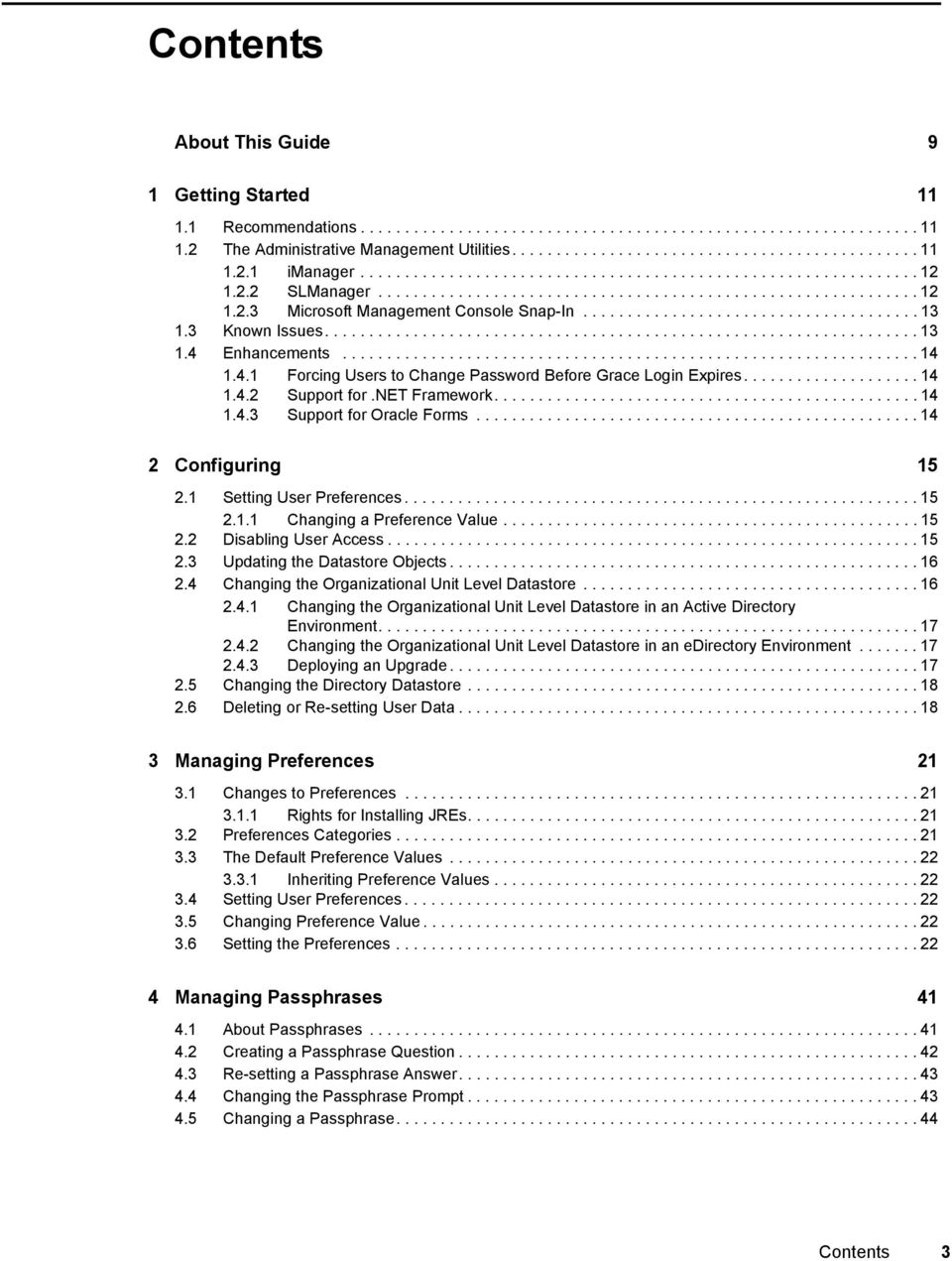
3 Contents About This Guide 9 1 Getting Started Recommendations The Administrative Management Utilities imanager SLManager Microsoft Management Console Snap-In Known Issues Enhancements Forcing Users to Change Password Before Grace Login Expires Support for.net Framework Support for Oracle Forms Configuring Setting User Preferences Changing a Preference Value Disabling User Access Updating the Datastore Objects Changing the Organizational Unit Level Datastore Changing the Organizational Unit Level Datastore in an Active Directory Environment Changing the Organizational Unit Level Datastore in an edirectory Environment Deploying an Upgrade Changing the Directory Datastore Deleting or Re-setting User Data Managing Preferences Changes to Preferences Rights for Installing JREs Preferences Categories The Default Preference Values Inheriting Preference Values Setting User Preferences Changing Preference Value Setting the Preferences Managing Passphrases About Passphrases Creating a Passphrase Question Re-setting a Passphrase Answer Changing the Passphrase Prompt Changing a Passphrase Contents 3
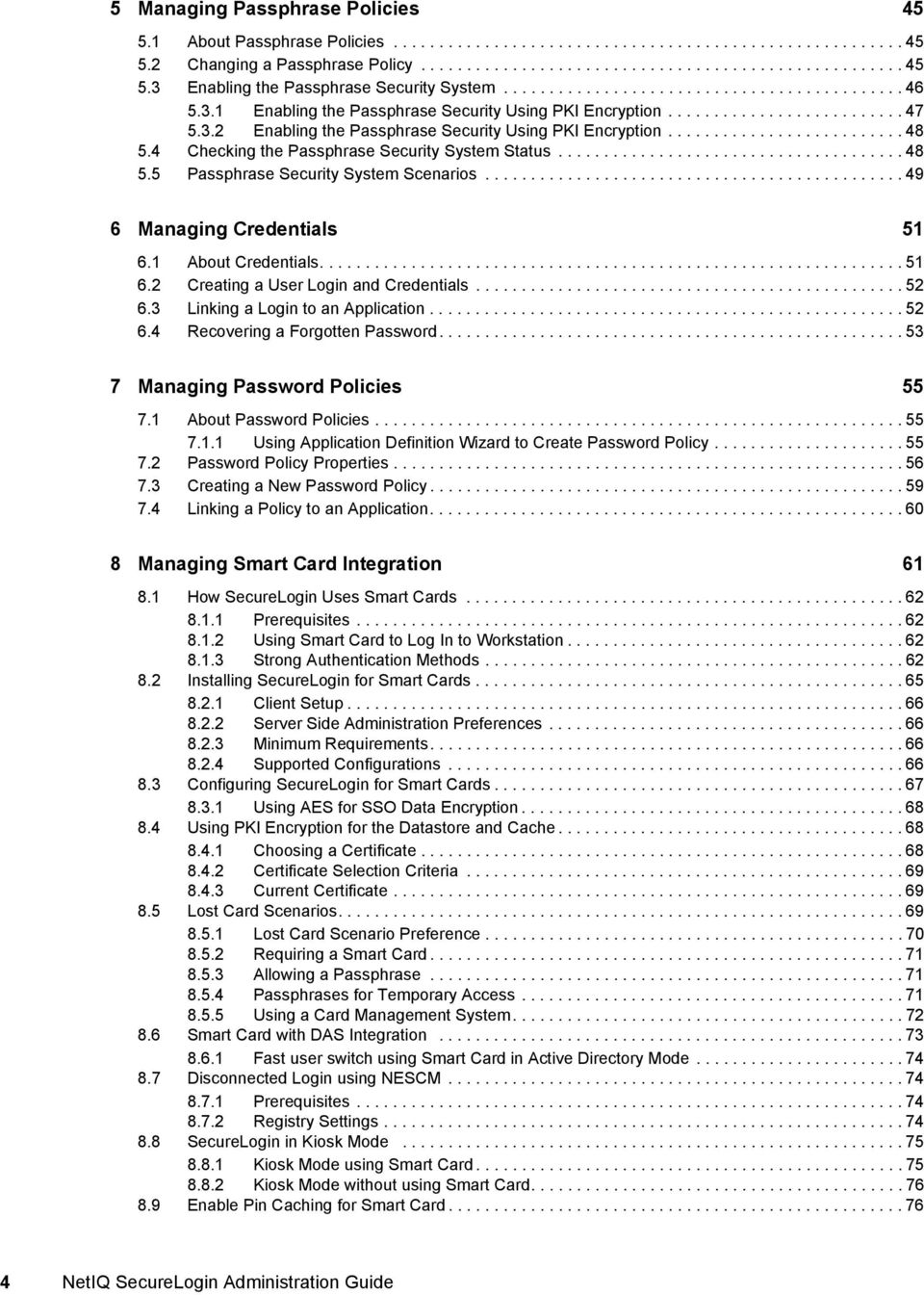
4 5 Managing Passphrase Policies About Passphrase Policies Changing a Passphrase Policy Enabling the Passphrase Security System Enabling the Passphrase Security Using PKI Encryption Enabling the Passphrase Security Using PKI Encryption Checking the Passphrase Security System Status Passphrase Security System Scenarios Managing Credentials About Credentials Creating a User Login and Credentials Linking a Login to an Application Recovering a Forgotten Password Managing Password Policies About Password Policies Using Application Definition Wizard to Create Password Policy Password Policy Properties Creating a New Password Policy Linking a Policy to an Application Managing Smart Card Integration How SecureLogin Uses Smart Cards Prerequisites Using Smart Card to Log In to Workstation Strong Authentication Methods Installing SecureLogin for Smart Cards Client Setup Server Side Administration Preferences Minimum Requirements Supported Configurations Configuring SecureLogin for Smart Cards Using AES for SSO Data Encryption Using PKI Encryption for the Datastore and Cache Choosing a Certificate Certificate Selection Criteria Current Certificate Lost Card Scenarios Lost Card Scenario Preference Requiring a Smart Card Allowing a Passphrase Passphrases for Temporary Access Using a Card Management System Smart Card with DAS Integration Fast user switch using Smart Card in Active Directory Mode Disconnected Login using NESCM Prerequisites Registry Settings SecureLogin in Kiosk Mode Kiosk Mode using Smart Card Kiosk Mode without using Smart Card Enable Pin Caching for Smart Card NetIQ SecureLogin Administration Guide
5 8.10 Changing Smart Card Login Password on Expiry Enabling Terminal Emulator Applications Enabling Terminal Emulator Applications Creating and Saving a Terminal Emulator Session File Building a Terminal Emulator Application Definition Running a Terminal Launcher Creating a Terminal Emulator Desktop Shortcut Setting Terminal Launcher Command Line Parameters Support for the MEDITECH Predefined Application Reauthenticating Applications Using the Administrative Management Utility to Reauthenticate Applications Using the Application Definition Wizard to Reauthenticate Applications Using the AAVerify Command to Reauthenticate Applications Managing Application Definitions Responding to Application Messages Responding to Login Notifications Adding Support for Password Changes Responding to Change Password Notification Adding Multiple Logins Distributing Configurations About Distributing Configurations Distributing Configurations Within Directory Domains Setting Corporate Redirection Setting Corporate Redirection with edirectory Configuring Groups Within edirectory Copying a Configuration Across Organizational Units Creating an Active Directory Group Policy Group Policy Object Support Group Policy Management Console Support Definition of a Group Policy Object Adding or Editing a Group Policy Object Installing the GPMC Plug-In Retrieving a Policy Applied to the User Object in GPMC Retrieving a Policy Applied to the User Object in SLManager Exporting and Importing Configurations Exporting XML Settings Importing XML Settings Exporting Single Sign-On Data in Encrypted XML Files Importing Single Sign-On Data in Encrypted XML Files Creating a Signing Key for Secure Distribution Locally Installing a Digital Signing Key Contents 5

6 15 Using Emergency Access Prerequisites Installing Dependant Components Installing.NET Framework Installing Client Login Extension Installing the Emergency Access Feature Verifying Emergency Access Installation Configuring Emergency Access Using the Emergency Access Feature Using The slap Tool About The slap Tool The slap Syntax Using The slmigrationhelper Tool for Datastore Migration Supported Datastores Process of Datastore Migration Managing the Workstation Cache About the Workstation Cache Creating a Backup File Deleting the Workstation Cache Restoring the Local Cache Backup File Auditing About Auditing Tools Sending SNMP Alerts Scripting for SNMP Auditing Prerequisites About Windows Event Log Alerts Creating a Windows Event Log Alert Audit Configuration for Sentinel Windows Event Log: An Overview WMS Connector Configuring Auditing Monitoring a System in a Domain Environment Monitoring a System in a Non-Domain Environment Logging Events from LDAP and Secure Workstation Configuring Secure Workstation Events Introduction Understanding Secure Workstation Policies Local Policy Network Policy Effective Policy Configuring the Local Policy Configuring an Inactivity Timeout Event Configuring a Device Removal Event NetIQ SecureLogin Administration Guide

7 Configuring a Network Logout Event Configuring the Manual Lock Event Using the Advanced Option Configuring the Network Policy The Quick Login and Logout Interface Administering Desktop Automation Services Actions and Descriptions Using the DAS Editor to Configure Actions Creating a New Configuration File Example of an Action File LDAP SSL Server Certificate Verification About LDAP SSL Server Certificate Verification Validating an LDAP SSL Server Certificate Enabling LDAP SSL Certificate Verification Security Considerations SecureLogin Security Role Configuration for Active Directory Directory Attributes Directory Permissions Assignment Assigning Permissions for SecureLogin Administrators Assigning Permissions for SecureLogin Help Desk Assigning SecureLogin Client Settings for Administrators and Help Desk Groups Creating the Group Policy Testing your configuration Limiting Concurrent Connections Setting Up the Environment for Limiting Concurrent Connections Registry Entry Schema Extension Setting the Attribute Values Support for NetIQ Advanced Authentication Framework (NAAF) Integrating SecureLogin with NAAF NAAF Plugin Registry Settings Troubleshooting Unable to See Password Using?syspassword If the User is Authenticated Using Smart Card PIN A Error Messages 193 B Schema Updates 225 B.1 Schema Attributes B.2 Active Directory Environments Contents 7

8 B.2.1 Protocom-SSO-Auth-Data B.2.2 Protocom-SSO-Entries B.2.3 Protocom-SSO-Entries-Checksum B.2.4 Protocom-SSO-Profile B.2.5 Protocom-SSO-Security-Prefs B.2.6 Protocom-SSO-Security-Prefs-Checksum B.3 LDAP Environments B.3.1 Protocom-SSO-Auth-Data B.3.2 Protocom-SSO-Entries B.3.3 Protocom-SSO-Entries-Checksum B.3.4 Protocom-SSO-Profile B.3.5 Protocom-SSO-Security-Prefs B.3.6 Protocom-SSO-Security-Prefs-Checksum B.3.7 Protocom-SSO-Connections B.3.8 Protocom-SSO-ConnectionLimit B.3.9 Protocom-SSO-ConnectionTimeToLive B.4 Security Rights Assignments B.4.1 User-Based Attributes B.4.2 Container-Based Attributes NetIQ SecureLogin Administration Guide

9 About This Guide This manual provides you information about administering SecureLogin. This manual contains the following sections. Chapter 1, Getting Started, on page 11 Chapter 2, Configuring, on page 15 Chapter 3, Managing Preferences, on page 21 Chapter 4, Managing Passphrases, on page 41 Chapter 5, Managing Passphrase Policies, on page 45 Chapter 6, Managing Credentials, on page 51 Chapter 7, Managing Password Policies, on page 55 Chapter 8, Managing Smart Card Integration, on page 61 Chapter 9, Enabling Terminal Emulator Applications, on page 77 Chapter 10, Reauthenticating Applications, on page 85 Chapter 11, Managing Application Definitions, on page 87 Chapter 12, Adding Multiple Logins, on page 89 Chapter 13, Distributing Configurations, on page 91 Chapter 14, Exporting and Importing Configurations, on page 101 Chapter 15, Using Emergency Access, on page 107 Chapter 16, Using The slap Tool, on page 113 Chapter 17, Using The slmigrationhelper Tool for Datastore Migration, on page 119 Chapter 18, Managing the Workstation Cache, on page 123 Chapter 19, Auditing, on page 127 Chapter 20, Audit Configuration for Sentinel, on page 131 Chapter 21, Configuring Secure Workstation Events, on page 137 Chapter 22, Administering Desktop Automation Services, on page 145 Chapter 23, LDAP SSL Server Certificate Verification, on page 171 Chapter 24, Security Considerations, on page 175 Chapter 25, SecureLogin Security Role Configuration for Active Directory, on page 177 Chapter 26, Limiting Concurrent Connections, on page 187 Chapter 27, Support for NetIQ Advanced Authentication Framework (NAAF), on page 189 Chapter 28, Troubleshooting, on page 191 Appendix A, Error Messages, on page 193 Appendix B, Schema Updates, on page 225 About This Guide 9

10 Additional Documentation For the latest version of SecureLogin guides, see ( securelogin80/) Contacting Sales Support For questions about products, pricing, and capabilities, contact your local partner. If you cannot contact your partner, contact our Sales Support team. Worldwide: United States and Canada: Web Site: Contacting Technical Support For specific product issues, contact our Technical Support team. Worldwide: North and South America: Europe, Middle East, and Africa: +353 (0) Web Site: Contacting Documentation Support Our goal is to provide documentation that meets your needs. If you have suggestions for improvements, click Add Comment at the bottom of any page in the HTML versions of the documentation posted at You can also Documentation- We value your input and look forward to hearing from you. Contacting the Online User Community Qmunity, the NetIQ online community, is a collaborative network connecting you to your peers and NetIQ experts. By providing more immediate information, useful links to helpful resources, and access to NetIQ experts, Qmunity helps ensure you are mastering the knowledge you need to realize the full potential of IT investments upon which you rely. For more information, visit community.netiq.com. 10 NetIQ SecureLogin Administration Guide

11 1 1Getting Started NetIQ SecureLogin is an enterprise single sign-on product. It provides authentication solutions to Web, Windows, host, and legacy application-based single sign-on. NetIQ SecureLogin functions as an identity overseer for all the systems that users access. It is a credential management tool developed to increase an organization s network security, while lowering support costs. NetIQ SecureLogin securely manages and encrypts the authentication information in a directory. It stores usernames and passwords and automatically retrieves them for users, when required. Section 1.1, Recommendations, on page 11 Section 1.2, The Administrative Management Utilities, on page 11 Section 1.3, Known Issues, on page 13 Section 1.4, Enhancements, on page Recommendations Before you begin configuring and administering NetIQ SecureLogin, it is recommended that you have a strong working knowledge of the following: Microsoft Active Directory Microsoft Management Console (MMC) Microsoft Group Policy Object Management Console (GPMC) Microsoft Windows operating systems Lightweight Directory Access Protocol (LDAP) 1.2 The Administrative Management Utilities NetIQ SecureLogin consists of the following Administrative Management utilities and plug-in. The utilities are: Section 1.2.1, imanager, on page 12 Section 1.2.2, SLManager, on page 12 Section 1.2.3, Microsoft Management Console Snap-In, on page 13 Getting Started 11

12 1.2.1 imanager imanager is a state-of-the-art Web-based administration console that provides customized secure access to network administration utilities and content from any location in the world. With a global view of your network from one browser-based tool, you can proactively assess and respond to changing network demands. It is recommended to use imanager to administer NetIQ SecureLogin in Novell edirectory environments. IMPORTANT: Throughout this document, we refer to imanager as the Administrative Management Utility to explain the various administration procedures. The graphics also represent an edirectory configuration. Starting imanager Accessing imanager varies based on the imanager version (server-based or workstation) and the platform on which imanager is running. For more information on accessing imanager refer the imanager documentation ( bouqst6.html) Accessing Server-Based imanager 1 Enter one of the following in the Address (URL) field of a supported Web browser: Default URL on non-oes 2 platforms: ip address>:8443/nps/ imanager.html On platforms other than Novell Open Enterprise Server 2 (OES 2), you must specify the Tomcat port as part of the imanager URL because imanager 2.7 uses only Tomcat 5 for its Web server requirements. Default URL for OES 2 platforms: ip address>/nps/imanager.html Although slightly different, imanager URLs might work on some platforms. NetIQ recommends using these URLs for consistency. 2 Log in by using your username, password, and the tree name. Accessing imanager on a Workstation 1 Browse to the imanager set up on your workstation. 2 Execute imanager\bin\imanager.bat. 3 Log in by using your username, password, and tree name SLManager You can use SecureLogin Manager (SLManager) for any LDAP installations such as AD and edirectory. There is no difference in the features and components of imanager and SLManager. The menu options in both the utilities are similar. Only the user interfaces are different. 12 NetIQ SecureLogin Administration Guide

13 Starting SLManager 1 On the Start menu, select Programs > NetIQ SecureLogin > SecureLogin Manager. The Administrative Management utility is displayed. NOTE: To use SLManager, Administrative Tools must be installed. Select the Administrative Tools option from the custom setup screen during the installation process. If Administrative Tools is not installed, use the Modify option from the installer to install it and start SLManager. 2 In the Object field, specify your object name, then press the Enter key. You must press the Enter key to submit the entry typed in the Object field. Clicking OK closes the dialog box but does not accept the entry you typed. The object name should be in the LDAP convention (username, objectname) if you are using LDAP mode and in the edirectory convention (username. objectname), if you are using the edirectory mode Microsoft Management Console Snap-In Use the Microsoft Management Console (MMC) snap-in for Active Directory deployments. Starting MMC 1 On the Windows Start menu, select Programs > Administrative Tools > Active Directory Users and Computers. The Microsoft Management Console is displayed. 1.3 Known Issues Note the following issue before you begin configuring and administering NetIQ SecureLogin. Applications, Preferences, and Policies Added at the Group Level The applications and policies added at the group level through imanager are not reflected on the client. Every time a new group is created, you must re-assign the rights. You must manually assign read permissions for the correct functioning of the configured group. Do the following on imanager for the applications, preferences, policies, and others added at the level to be reflected on the client: 1 Log in to imanager. 2 Select Rights > Modify Trustees. 3 Specify the object name. 4 Click Add Trustee. Browse and locate more objects. Selection of multiple trustees is allowed. 5 Select Assigned Rights > Add Properties. Add the following attributes: Proto:SSO Entry Proto:SSO Entry Checksum Proto:SSO Security Prefs Proto:SSO Security Prefs Checksum Getting Started 13

14 6 Click OK. 7 Click Done to save the changes and exit. 1.4 Enhancements This section provides information on the enhancements made to SecureLogin 7.0 post-release, through the various hotfixes. Section 1.4.1, Forcing Users to Change Password Before Grace Login Expires, on page 14 Section 1.4.2, Support for.net Framework, on page 14 Section 1.4.3, Support for Oracle Forms, on page Forcing Users to Change Password Before Grace Login Expires SecureLogin has introduced an enhancement in SecureLogin 7.0 hotfix 1 where an administrators can force users to change their password before the grace login expires. Scenario: SecureLogin is installed in LDAP mode with edirectory. When the password expires, the authentication process consumes the all grace logins and users cannot log in. To avoid this, create the following registry keys. GraceDaysBeforePasswordExpire registry of DWORD value. This displays a warning message to the users about the number of days remaining for password expiry. DaysForcePasswordChange of DWORD value. This forces the users to change their password. Although the grace login available, this forces the users to change their password before the grace login expires. For example, if the password policy is set to change every 90 days, the GraceDaysBeforePasswordExpire can be set to 5 and DaysForcePasswordChange can be set to 3. On the day 85 when users logs in, a message indicating the number of days left before password expiry appears. The users can choose to change the password immediately or change it later. Similarly, when a users logs in on day 87 another message appears that forces the users to change the password. They cannot continue without changing the password Support for.net Framework SecureLogin 7.0 SP1 supports.net Framework 3.5 SP1 or above, which should be already available in the system Support for Oracle Forms SecureLogin 7.0 SP1 uses the pre-installed Oracle JInitiator or JRE to support Web enabled Oracle form applications. If any of these Java components is added in the machine after installing (or upgrading to) SecureLogin 7.0 SP1, you need to enable SecureLogin to use the newly added Java component. To enable support to the new Java component, run the repair option of the SecureLogin installer. 14 NetIQ SecureLogin Administration Guide

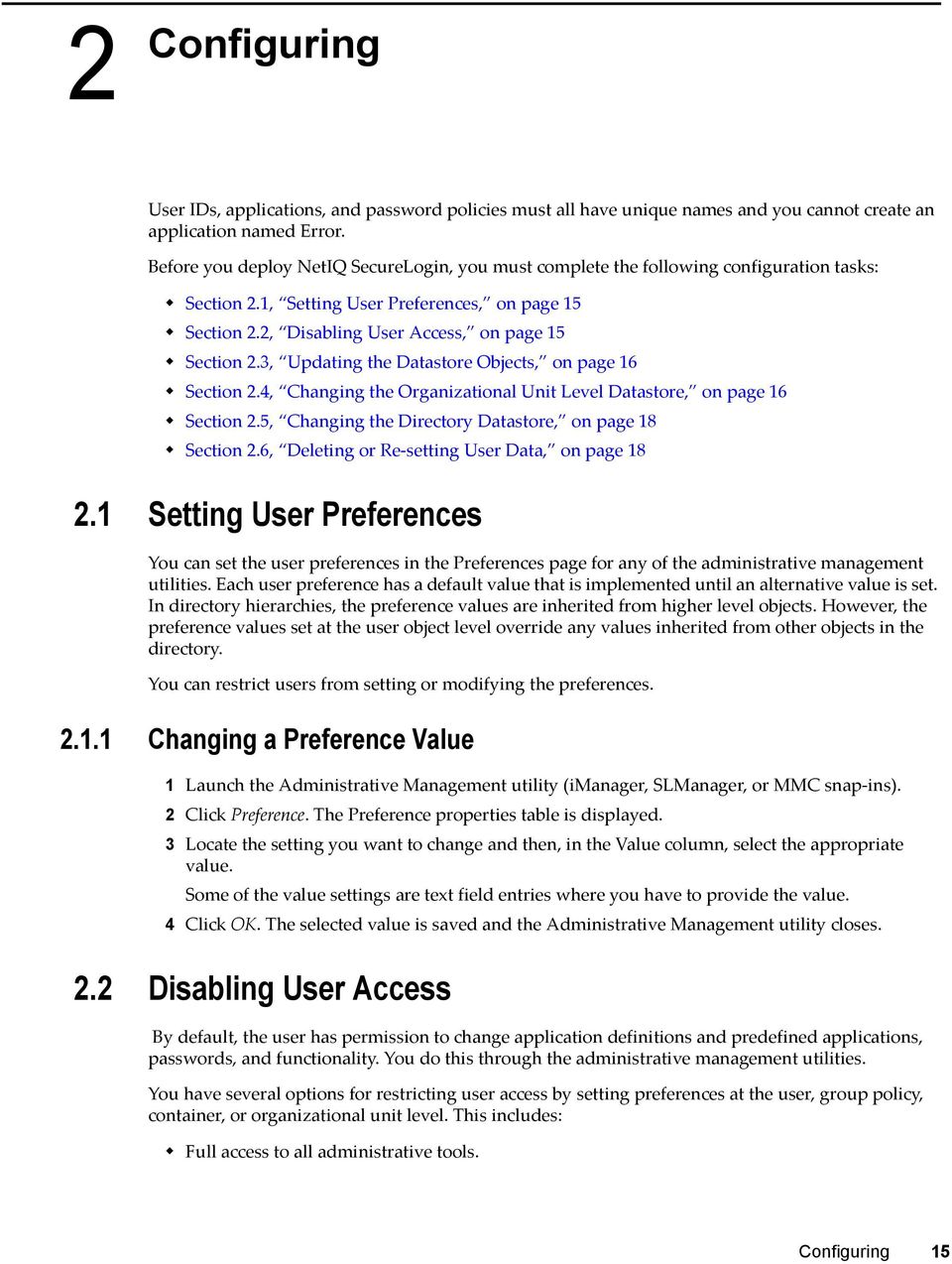
15 2 2Configuring User IDs, applications, and password policies must all have unique names and you cannot create an application named Error. Before you deploy NetIQ SecureLogin, you must complete the following configuration tasks: Section 2.1, Setting User Preferences, on page 15 Section 2.2, Disabling User Access, on page 15 Section 2.3, Updating the Datastore Objects, on page 16 Section 2.4, Changing the Organizational Unit Level Datastore, on page 16 Section 2.5, Changing the Directory Datastore, on page 18 Section 2.6, Deleting or Re-setting User Data, on page Setting User Preferences You can set the user preferences in the Preferences page for any of the administrative management utilities. Each user preference has a default value that is implemented until an alternative value is set. In directory hierarchies, the preference values are inherited from higher level objects. However, the preference values set at the user object level override any values inherited from other objects in the directory. You can restrict users from setting or modifying the preferences Changing a Preference Value 1 Launch the Administrative Management utility (imanager, SLManager, or MMC snap-ins). 2 Click Preference. The Preference properties table is displayed. 3 Locate the setting you want to change and then, in the Value column, select the appropriate value. Some of the value settings are text field entries where you have to provide the value. 4 Click OK. The selected value is saved and the Administrative Management utility closes. 2.2 Disabling User Access By default, the user has permission to change application definitions and predefined applications, passwords, and functionality. You do this through the administrative management utilities. You have several options for restricting user access by setting preferences at the user, group policy, container, or organizational unit level. This includes: Full access to all administrative tools. Configuring 15
16 Access to selected administrative tools. Hiding the SecureLogin icon on the notification area (system tray). Hiding and password protecting the SecureLogin icon in the notification area (system tray). If the SecureLogin icon is password protected, anyone attempting to access the NetIQ SecureLogin Client Utility through the SecureLogin icon is prompted to provide the network password. This prevents non-authorized users from viewing SecureLogin data. However, an authorized user can use the administration tools to modify SecureLogin. 2.3 Updating the Datastore Objects SecureLogin 6.0 introduced a range of security features, including storing the single sign-on credentials on the user s smart card, encrypting the datastore by using the Public Key Infrastructure (PKI)-based credentials and the Advanced Encryption Standard (AES) encryption algorithm support. To support the new features, you must change the SecureLogin 6.0 datastore format. The SecureLogin 6.0 client can read data created by all the previous versions of SecureLogin. However, the older versions cannot read the data created by version 6.0 and later. In case of a mixed corporate environment where some workstations are running SecureLogin 6.0, 6.1, or 7.0, and other workstations are running previous versions, data compatibility issues arise when a user moves between different versions of SecureLogin on different workstations. This is particularly problematic in Citrix environments or in large enterprise deployments. If SecureLogin 3.5 is present when you install SecureLogin 7.0, it detects that version 3.5 data is in use and continues to function correctly. In this mode, version 3.5 functions are available. However, any new function that relies on version 7.0 data, is not available. If you require the new functions, complete the following processes: 1. Choose a section of the tree to upgrade. For example: Container Group Organization User 2. Make sure that all user workstations in that section of the tree are upgraded with the SecureLogin 7.0 client. The next time the users log in, their data is converted to version 7.0 format and the new functions are available. 2.4 Changing the Organizational Unit Level Datastore Section 2.4.1, Changing the Organizational Unit Level Datastore in an Active Directory Environment, on page 17 Section 2.4.2, Changing the Organizational Unit Level Datastore in an edirectory Environment, on page 17 Section 2.4.3, Deploying an Upgrade, on page NetIQ SecureLogin Administration Guide

17 2.4.1 Changing the Organizational Unit Level Datastore in an Active Directory Environment Perform the following to set the directory datastore version at the organizational unit level in an Active Directory environment: 1 On Microsoft Windows Vista: On the Windows Start icon, select All Programs > Control Panel > System Maintenance > Administrative Tools. On Microsoft Windows XP: On the Windows Start menu, select Programs > Administrative Tools > Active Directory Users and Computers. The Microsoft Management Console is displayed. 2 Right click the required group policy, container, or OU, then click Properties. The properties dialog box is displayed. 3 Click the SecureLogin tab. The SecureLogin page is displayed. 4 Click Manage. The Advanced Settings page of the administrative management (SecureLogin Manager) utility is displayed 5 On the left pane, click Advanced Settings. The Advanced Settings page is displayed. 6 Click the Datastore tab. 7 From the Select version drop-down list, select the required version. A warning is displayed. The warning message refers to 3.0 clients that were used by some users who later upgraded the datastore mode to version 7.0. When a user s directory data version is upgraded, the datastore information displayed in the SecureLogin About box is not updated. To update this information, the user must activate Refresh Cache from the Advanced menu of the SecureLogin icon on the notification area (system tray) Changing the Organizational Unit Level Datastore in an edirectory Environment 1 Log in to imanager. 2 Click on SecureLogin SSO under roles and tasks. 3 Specify the organizational unit object. 4 Click OK. 5 Click Advanced Settings. The Advanced Settings page is displayed. 6 From the Select version under the Datastore section, select the required version. A warning is displayed. 7 Click OK to save the changes Deploying an Upgrade When you are deploying an upgrade across a series of workstations, follow the procedure explained in Section 2.5, Changing the Directory Datastore, on page 18. The next time the directory server and the workstation caches are synchronized and SecureLogin operates in the new version mode. Configuring 17

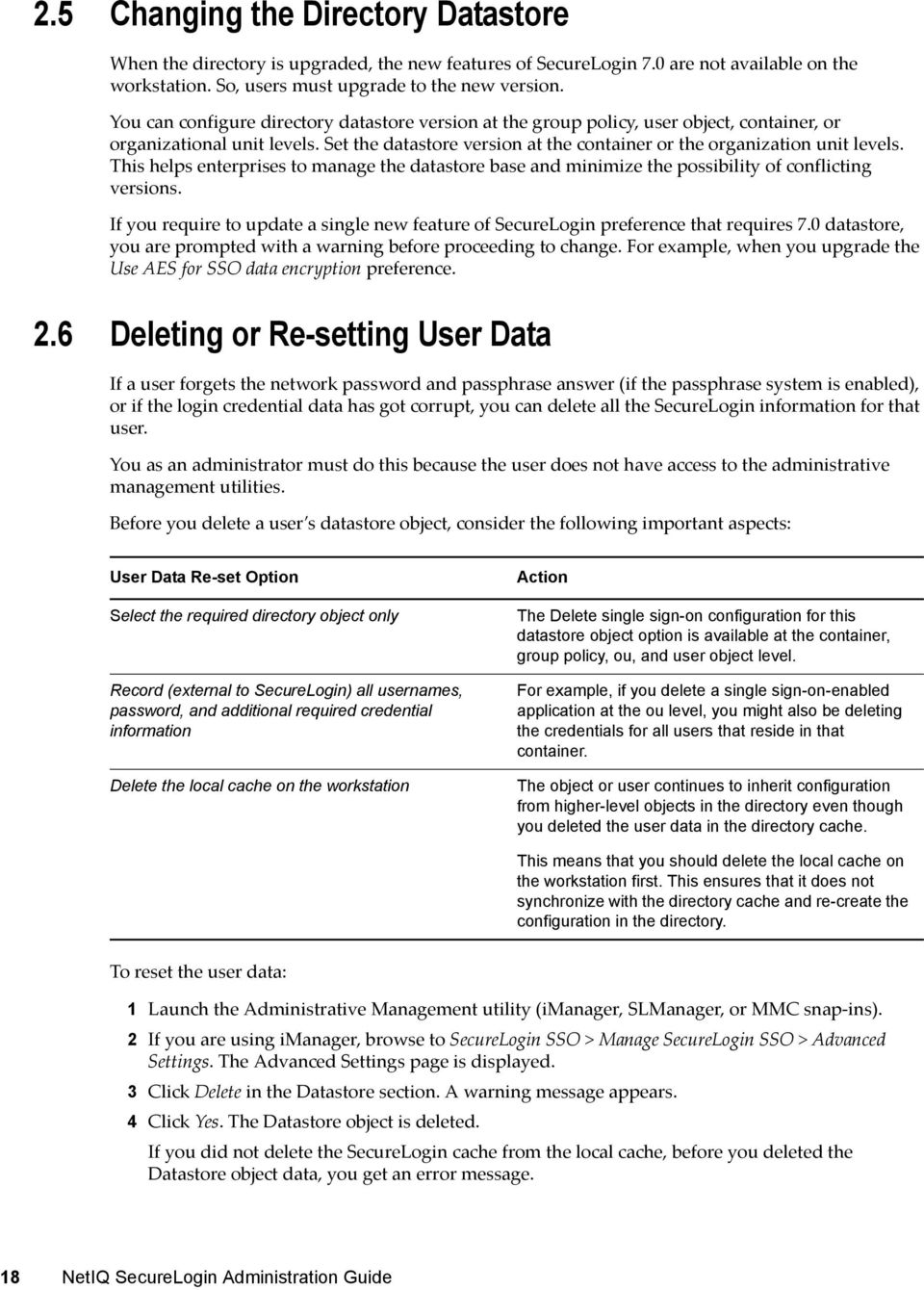
18 2.5 Changing the Directory Datastore When the directory is upgraded, the new features of SecureLogin 7.0 are not available on the workstation. So, users must upgrade to the new version. You can configure directory datastore version at the group policy, user object, container, or organizational unit levels. Set the datastore version at the container or the organization unit levels. This helps enterprises to manage the datastore base and minimize the possibility of conflicting versions. If you require to update a single new feature of SecureLogin preference that requires 7.0 datastore, you are prompted with a warning before proceeding to change. For example, when you upgrade the Use AES for SSO data encryption preference. 2.6 Deleting or Re-setting User Data If a user forgets the network password and passphrase answer (if the passphrase system is enabled), or if the login credential data has got corrupt, you can delete all the SecureLogin information for that user. You as an administrator must do this because the user does not have access to the administrative management utilities. Before you delete a user s datastore object, consider the following important aspects: User Data Re-set Option Select the required directory object only Record (external to SecureLogin) all usernames, password, and additional required credential information Delete the local cache on the workstation Action The Delete single sign-on configuration for this datastore object option is available at the container, group policy, ou, and user object level. For example, if you delete a single sign-on-enabled application at the ou level, you might also be deleting the credentials for all users that reside in that container. The object or user continues to inherit configuration from higher-level objects in the directory even though you deleted the user data in the directory cache. This means that you should delete the local cache on the workstation first. This ensures that it does not synchronize with the directory cache and re-create the configuration in the directory. To reset the user data: 1 Launch the Administrative Management utility (imanager, SLManager, or MMC snap-ins). 2 If you are using imanager, browse to SecureLogin SSO > Manage SecureLogin SSO > Advanced Settings. The Advanced Settings page is displayed. 3 Click Delete in the Datastore section. A warning message appears. 4 Click Yes. The Datastore object is deleted. If you did not delete the SecureLogin cache from the local cache, before you deleted the Datastore object data, you get an error message. 18 NetIQ SecureLogin Administration Guide
19 NOTE: When SecureLogin is installed in the SecretStore environment, the data will not be deleted from the SecretStore datastore. In a SecretStore environment, use the SecretStore imanager plugin to clear the credentials instead of the SecureLogin plugin. 5 Click Yes. When you do this, you delete the complete data of the user, including: Credentials, including usernames and passwords Application definitions Predefined applications Password policies Preferences Passphrase questions and answers WARNING: The deleted data cannot be retrieved. The next time the user logs in, the user is asked to set up a new passphrase question and response and re-enter the credentials for each application enabled for single sign-on. NetIQ SecureLogin supports setting a cache expiry by using the following registry entry on the client: HKEY_LOCAL_MACHINE/SOFTWARE/Protocom/SecureLogin DWORD Value CacheExpiryDays The value data is the number of days. Do not provide zero (o) because the cache would expire immediately on refresh. The cache expiry period is updated at each cache or directory synchronization, or each time SecureLogin loads in an online mode. NOTE: No warning is provided at cache expiry. If a cache is expired, the users cannot access SecureLogin in an offline mode until they log in, and create the cache again in an online session. Configuring 19

20 20 NetIQ SecureLogin Administration Guide

21 3 3Managing Preferences NetIQ SecureLogin preferences are tools, options, and parameters used by the enterprise administrators to configure the user s SecureLogin corporate environment. You can restrict a user s access to his or her SecureLogin preferences through the administrative management utilities. The preferences also include applications that are permitted to be enabled for single sign-on and the tools to enable users to access their own SecureLogin management and administration functions. You can configure user preferences from the Preference properties table in the administrative management utilities. This section provides information on the following: Section 3.1, Changes to Preferences, on page 21 Section 3.2, Preferences Categories, on page 21 Section 3.3, The Default Preference Values, on page 22 Section 3.4, Setting User Preferences, on page 22 Section 3.5, Changing Preference Value, on page 22 Section 3.6, Setting the Preferences, on page Changes to Preferences Section 3.1.1, Rights for Installing JREs, on page Rights for Installing JREs SecureLogin now checks for new JREs installed on the client when SecureLogin is launched. If new JREs are detected and they are allowed by user s permissions, the new JREs are enabled for singlesign on automatically, without any user prompts or intervention. The JRE update process requires local administrative rights on the client. If the user is not logged in with administrative rights, the update fails without displaying any notification to the user. The JREs are updated the next time the user logs in with administrative rights and launches SecureLogin on the workstation. 3.2 Preferences Categories The SecureLogin preferences are divided into the following categories: General Java Security Managing Preferences 21
22 Web Windows 3.3 The Default Preference Values Each preference value has a default value that is implemented during installation or deployment. You can configure alternative values Inheriting Preference Values In corporate directory hierarchies, preference values are inherited from higher-level objects, while some lower-level objects can override preferences set at higher-levels. Therefore, the preference values set at the user object-level override all higher-level object values. 3.4 Setting User Preferences You can set the SecureLogin user preferences in the Preferences Properties table in the Administrative Management utilities (imanager, SecureLogin Manager, Microsoft Management Console). Each SecureLogin preference has a default value that is implemented until an alternative value is manually configured. In directory hierarchies, preference values are inherited from a higher-level object, while some lower-level objects can override preference set at higher level. For example, preference values set at the user object level override all higher level object values. NOTE: This can be controlled for users by restricting their ability to set preferences. For more information about inheriting configuration settings, see Chapter 13, Distributing Configurations, on page Changing Preference Value 1 Launch the Administrative Management utility (imanager, SLManager, or MMC snap-ins). 2 Click Preference. The Preference properties table is displayed. 3 Locate the setting you want to change and then, in the Value column, select the appropriate value. NOTE: Some of the value settings are text field entries where you have to provide the value. 4 Click OK. The selected value is saved. 3.6 Setting the Preferences You set preferences for managing SecureLogin in the Administration Management utility: 1 Log in to imanager. 2 Click NetIQ SecureLogin > Manage SecureLogin > Preferences. The list of preferences is displayed. 22 NetIQ SecureLogin Administration Guide
23 3 Make the changes you want, then click OK. Use the information in the following tables to assist you in making the changes: Table 3-1, The General Preferences, on page 23 Table 3-2, The Security Preferences Properties Table, on page 34 Table 3-3, The Java Preferences Properties Table, on page 37 Table 3-4, The Web Preferences Properties Table, on page 38 Table 3-5, The Windows Preferences Properties Table, on page 40 Table 3-1 The General Preferences Preference Possible Values Description Default Value Allow "Close" option via system tray Yes/No/Default This preference controls whether users can access the Close option from SecureLogin icon on the notification area (system tray). The default value is Yes. If the option is set to No, the Close option is shown as disabled in the SecureLogin notification area (system tray) icon. If this option is set to Yes or Default, the Close option is displayed and accessible in the SecureLogin notification area (system tray) icon. NOTE: This preference requires SecureLogin 6.0 datastore if the value is changed. This preference is available through the administrative management utilities (imanager, SLManager, and MMC snap-ins). Managing Preferences 23
24 Preference Possible Values Description Default Value Allow "Refresh Cache" option via system tray Yes/No/Default This preference controls whether users can refresh cache using the Advanced > Refresh Cache option from the SecureLogin icon on the notification area (system tray). The default value is No. If this option is set to Yes, the Refresh Cache option is displayed and accessible in the notification area (system tray) icon. If this option is set to No or Default, the Refresh Cache option is not displayed in the notification area (system tray) icon. NOTE: This preference requires SecureLogin 6.0 datastore if the value is changed. This preference is available through the administrative management utilities (imanager, SLManager, and MMC snap-ins). Allow "Log Off" option via system tray Yes/No/Default This preference controls if users can log out from a session using Log Off User option from the SecureLogin icon on the notification area (system tray). The default value is Yes. If this option is set to No, the Log Off User option is not displayed and accessible in the SecureLogin notification area (system tray) icon. If this option is set to Yes or Default, the Log Off User option is displayed and accessible in the SecureLogin notification area (system tray) icon. This preference is available through the administrative management utilities (imanager, SLManager, and MMC snap-ins). Allow "Work Offline" option via system tray Yes/No/Default This preference controls whether users can work in offline cache mode using the Advanced > Work Offline option. The default value is Yes. If this option is set to Yes or Default, the Work Offline option is displayed in the notification area (system tray) icon. If this option is set to No, the Work Offline option is not displayed in the notification area (system tray) icon. This preference is available through the administrative management utilities (imanager, SLManager, and MMC snap-ins). 24 NetIQ SecureLogin Administration Guide
25 Preference Possible Values Description Default Value Allow application definition to be modified by users Yes/No/Default This preference controls whether users can modify application definitions using the Definitions tabs in the Applications pane of SecureLogin client. The default option is Yes. If this option is set to Yes or Default, the end user can view and modify their application definitions. If this option is set to No, the end user cannot change their application definitions. NOTE: If the Allow application definition to be viewed by users is set to No, then this option is cannot be edited. Disabling this preference does not disable the users from creating new applications through the wizards. This preference requires SecureLogin 6.0 datastore if the value is changed. This preference is available through the administrative management utilities (imanager, SLManager, and MMC snap-ins). Allow application definition to be viewed by users Yes/No/Default This preference controls whether users can view application definitions using the Definitions tabs in the Applications pane of SecureLogin client. The default value is Yes. If this option is set to Yes or Default, users can view the application definition. If this option is set to No, users cannot view the application definition. This preference is available through the administrative management utilities (imanager, SLManager, and MMC snap-ins). Allow credentials to be deleted by users through the GUI Yes/No/Default This preference controls whether users can delete their credentials using SecureLogin client available from Manage Logins from the SecureLogin icon in the notification area (system tray). The default value is Yes. NOTE: If Allow credentials to be modified by users through the GUI is set to No, then this option is automatically set to No and not editable. This preference requires SecureLogin 6.0 datastore if the value is changed. If this option is set to Yes or Default, users can delete their credentials through the GUI. If this option is set to No, users cannot delete their credentials. This preference is available through the administrative management utilities (imanager, SLManager, and MMC snap-ins). Managing Preferences 25
26 Preference Possible Values Description Default Value Allow credentials to be modified by users through the GUI Yes/No/Default This preference controls whether users can modify their credentials using SecureLogin client available from Manage Logins from the SecureLogin icon in the notification area (system tray). The default value is Yes. If this option is set to Yes or Default, users can modify their credentials through the GUI. If this option is set to No, users cannot modify their credentials through the GUI. They can only view the credentials. This preference is available through the administrative management utilities (imanager, SLManager, and MMC snap-ins). Allow users to (de) activate SSO via system tray Yes/No/Default This preference controls whether users can activate or deactivate SecureLogin through the SecureLogin icon in the notification area (system tray). The default value is Yes. If this option is set to Yes or Default, users can switch between active and inactive modes of SecureLogin. If this option is set to No, users cannot switch between active and inactive modes. If SecureLogin status was active when this preference was applied, it remains as active and the user cannot de-activate SecureLogin. If SecureLogin status was inactive when this preference was applied, it remains as inactive and the user cannot change SecureLogin status to Active. This preference requires SecureLogin 6.0 datastore if the value is changed. This preference is available through the administrative management utilities (imanager, SLManager, and MMC snap-ins). Allow users to backup/restore Yes/No/Default This preference controls whether users can backup and restore their information from the Advanced menu of the SecureLogin icon on the notification area (system tray). The default value is Yes. If this option is set to Yes or Default, users can back up and restore their single sign-on information. If this option is set to No, users cannot back up and restore their single sign-on configuration. This preference is available through the administrative management utilities (imanager, SLManager, and MMC snap-ins). 26 NetIQ SecureLogin Administration Guide
27 Preference Possible Values Description Default Value Allow users to change passphrase Yes/No/Default This preference controls whether users can change their passphrase question and answer. The Change Passphrase option is available from the Advanced menu of the SecureLogin icon on the notification area (system tray). The default value is Yes. If this option is set to Yes or Default, users can change their passphrase through the notification area (system tray) icon. If this option is set to No, users cannot change their passphrase through the notification area (system tray) icon. This preference is available through the administrative management utilities (imanager, SLManager, and MMC snap-ins). Allow users to modify names of Applications and Logins Yes/No/Default This preference controls whether users can edit the names of their Application login credentials using the Details tab > Edit function in SecureLogin client. The default value is Yes. If this option is set to Yes or Default, the user can edit the names of their credentials (either by rightclicking on the credential and selecting Rename, or by a slow double-click on the credential name). If this option is set to No, the use cannot edit the names of the credentials. This preference is available through the administrative management utilities (imanager, SLManager, and MMC snap-ins). Allow user to set Obscure Show Password Yes/No/Default This preference controls whether the user can modify the Obscure Show Password option. If this option is set to Yes or Default, users can modify the Obscure Show Password option and change the duration of time a password is visible. The default value is Yes. If this option is set to No, users cannot modify the Obscure Show Password option. Managing Preferences 27
28 Preference Possible Values Description Default Value Allow users to view and change Preferences Yes/No/Default This preference controls whether users can view and update their preferences. If this option is set to Yes or Default, users can view and change their preferences. The default value is Yes. If this option is set to No, users cannot view and change their preferences. NOTE: Create a separate ou for administrators to ensure that they are not adversely affected by the general user configuration preferences at the ou level. This preference is available through the administrative management utilities (imanager, SLManager, and MMC snap-ins). Allow users to view and modify API preferences Yes/No/Default This preference controls whether users can view and modify API options using the Preferences pane of SecureLogin client. The default value is Yes. The API preference defines the following options for users to: Enter an API license key(s). Provide API access. If this option is set to Yes or Default users can view and modify the API preference. If this option is set to No, users cannot view and modify the API preference. NOTE: This preference affects what is displayed in SecureLogin client using Change Preferences from the Advanced menu. This preference is available through the administrative management utilities (imanager, SLManager, and MMC snap-ins). 28 NetIQ SecureLogin Administration Guide
29 Preference Possible Values Description Default Value Allow users to view passwords Yes/Yes, per application/no/ Default This preference controls whether users can view their passwords using Show Passwords in the Application pane > Details of NetIQ SecureLogin client. The default value is Yes. If this option is set to Yes or Default, users can view their passwords. If this option is set to No, users cannot view their passwords. NOTE: Allowing users to view their passwords gives them an opportunity to view and record passwords if they need to reset the SecureLogin configuration. This preference is available through the administrative management utilities (imanager, SLManager, and MMC snap-ins). Change the cache refresh interval (in minutes) 5 This preference defines the time in minutes the synchronization of user data and directory on the local workstation. This preference is available in both SecureLogin client and the administrative management utilities (imanager, SLManager, and MMC snap-ins). The default value is set to 5 minutes. Detect incorrect passwords Yes/No/Default Predefined applications generally include commands to respond to incorrect password dialogs. This preference enables SecureLogin to respond to incorrect passwords for web applications. The default value is Yes. If this option is set to Yes or Default, incorrect passwords for Web applications are detected. If this option is set to No, incorrect passwords for Web applications are not detected. This preference is available in both SecureLogin client and the administrative management utilities (imanager, SLManager, and MMC snap-ins). Disable single sign-on Yes/No/Default This preference controls the users access to running SecureLogin. The default value is No. If this option is set to Yes, access to SecureLogin is disabled and it will not start when run either automatically at startup or when run manually. If this option is set to No or Default, access to SecureLogin is enabled and will start normally. This preference is available through the administrative management utilities (imanager, SLManager, and MMC snap-ins). Managing Preferences 29
30 Preference Possible Values Description Default Value Display splash screen on startup Yes/No/Default This preference controls the display of the SecureLogin splash screen during startup. The default value is Yes. If this option is set to Yes or Default, the splash screen appears when SecureLogin starts up. If this option is set to No, the splash screen is hidden and users cannot see the splash screen when SecureLogin starts up. NOTE: This preference requires SecureLogin 6.0 datastore if the value is changed. This preference is available through the administrative management utilities (imanager, SLManager, and MMC snap-ins). Display the system tray icon Yes/No/Default This preference controls the display of SecureLogin icon in the notification area (system tray). The default value is Yes. If this option is set to Yes or Default, the SecureLogin icon appears on the notification area (system tray). If this option is set to No, the SecureLogin icon does not appear on the notification area (system tray). NOTE: When the SecureLogin icon is visible, users can double-click the icon on the notification area (system tray) to launch SecureLogin client. When the SecureLogin is not visible, users can start SecureLogin client through Start > Programs > NetIQ SecureLogin > NetIQSecureLogin This preference is available through the administrative management utilities (imanager, SLManager, and MMC snap-ins). Display user name on mouse over tray icon Yes/No/Default This preference allows SecureLogin to display the current user name, when you mouse over the SecureLogin tray icon. The default value is No. When the user logs in to SecureLogin in the offline mode, the full qualified distinguished name (FQDN) is displayed when you mouse over the SecureLogin tray icon. In the online mode, the current user s full name is displayed. 30 NetIQ SecureLogin Administration Guide
31 Preference Possible Values Description Default Value Enable cache file Yes/No/Default This preference controls creating and updating of a SecureLogin cache file on the local workstation. The cache file stores all user configuration data; local and inherited. The default value is Yes. Set this option to Yes or Default, the cache file is saved on the local workstation in the directory that was specified during install. Users with roaming profiles should always have this setting as Yes. Set this option to No if you cannot store cache files locally or if this causes conflicts with your organizational security policy. This preference is available in both SecureLogin client and the administrative management utilities (imanager, SLManager, and MMC snap-ins). Enable logging to Windows Event log Yes/No/Default This preference controls sending the log events to Windows Event Log. This includes the entire user configuration, both local and inherited. The default value is Yes. If set to Yes or Default, log events are sent automatically to Windows Event Log. If set to No, the log events are not sent to Windows Event Log. Only the following events are logged: SSO client started SSO client exited SSO client activated by user SSO client deactivated by user Password provided to an application by a script Password changed by the user in response to a change password command Password changed automatically in response to a change password command. NOTE: This preference requires SecureLogin 6.0 datastore if the value is changed. This preference is available through the administrative management utilities (imanager, SLManager, and MMC snap-ins). Managing Preferences 31
32 Preference Possible Values Description Default Value Enable the New Login Wizard on the system tray icon Yes/No/Default This preference controls whether users can create multiple logins on the same application using the New Login > Add New Login option from the NetIQ SecureLogin icon on the notification area (system tray). The default value is Yes. If this option is set to Yes or Default, the New Login menu option is enabled and users can create multiple logins. If this option is set to No, New Login menu option is disabled and users cannot create multiple logins. This preference is available through the administrative management utilities (imanager, SLManager, and MMC snap-ins). Enforce passphrase use Yes/No/Default This preference forces users to set up a passphrase question and answer when SecureLogin is launched by a user for the first time. If this option is set to Yes, users must complete setting up their passphrase before they proceed with any other activity on the workstation. If this option is set to No or Default, users can postpone setting up the passphrase. If the users clicks Cancel or closes the dialog, then SecureLogin does not start. This preference is available through the administrative management utilities (imanager, SLManager, and MMC snap-ins). The default value is No. Enter API license key(s) Specify API license key(s) Specify the API license key(s) provided by SecureLogin to activate the API functionality for an application. Specify the API license key You can add more than one API license key. This preference is available through the administrative management utilities (imanager, SLManager, and MMC snap-ins). Obscure Show Password (seconds) Integer value in seconds Restricts the password display time when you click the Show Password button in the local interface. The default value is NetIQ SecureLogin Administration Guide
33 Preference Possible Values Description Default Value Password protect the system tray icon Yes/No/Default This preference restricts the users from accessing the NetIQ SecureLogin icon menu option (from the notification area (system tray) without their network login password. The default value is No. If this option is set to Yes, the NetIQ SecureLogin icon on the notification area (system tray) is password protected. If this option is set to No or Default, the NetIQ SecureLogin icon on the notification area (system tray) is not password protected. This preference is available in both SecureLogin client and the administrative management utilities (imanager, SLManager, and MMC snap-ins). NOTE: Always check the Synchronize NDS password with Universal Password option when NMAS is used. Provide API Access Yes/No/Default This preference controls the API functionality use. If this option is set to Yes, the API access is enabled. The default value is No. If this option is set to No or Default, the API access is disabled. This preference is available in both SecureLogin client and the administrative management utilities (imanager, SLManager, and MMC snap-ins). Stop walking here Yes/No/Default This preference controls the inheritance of settings from higher level containers or organizational units. If this option is set to Yes, the inheritance of settings from higher level containers or organizational units is disabled. Set the option to Yes during phased upgrades when higher levels might have a different version of SecureLogin implemented. If this option is set to No or Default, the inheritance of settings from higher level containers or organizational units is enabled. This preference does not apply when SecureLogin is installed in edirectory environment. The Corporate redirection functionality; that is, the inheritance settings from higher level container or organizational units is bypassed in an edirectory environment. This preference is available through the administrative management utilities (imanager, SLManager, and MMC snap-ins). The default value is No. Managing Preferences 33
34 Preference Possible Values Description Default Value Wizard mode Administrator/ User/Disabled This preference controls that access to the application definition wizard. The default value is Administrator. If this option is set to Administrator, it gives users complete access to the application definition wizard. Users can create their own application definitions. If this option is set to User, users are only allowed to create new login credential sets for new applications using the auto-detection settings. If this option is set to Disabled, the application definition wizard is not launched. NOTE: This preference requires SecureLogin 6.0 datastore if the value is changed. This preference is available through the administrative management utilities (imanager, SLManager, and MMC snap-ins). Table 3-2 The Security Preferences Properties Table Preference Possible Values Description Default Value Certificate selection criteria Specify text to identify your certificate This preference allows you to specify a text to uniquely identify a certificate (within searchable field only). Not applicable Current certificate No certificate selected This preference allows you to select a certificate from the multiple certificates available for a smartcard user. Not applicable 34 NetIQ SecureLogin Administration Guide
35 Preference Possible Values Description Default Value Enable passphrase security system Yes/No/Hidden This passphrase is an additional mechanism for unlocking a user s single sign-on data if the primary key (network password, smartcard, or PIN) used to encrypt the single sign-on data is lost or forgotten. The default value is Yes. It also prevents unauthorized access to a user s single sign-on data in the event their primary key is deliberately changed by a third party. In this case even if the unauthorized person is able to bypass a user s primary key, he or she must answer the passphrase answer to access the user s single sign-on data. If this option is set to Yes or Default, the correct passphrase answer is prompted in situations where the user cannot provide the primary key (network password, smart card, or PIN). If the correct passphrase answer is not provided, SSO data will not be available to the user. If you change the preference from Hidden to Yes after the user has set up a passphrase, users must answer the passphrase questions to use SecureLogin. Typically, users not prompted to create a passphrase after the first login. If this option is set to Hidden, the user is not requested to answer a passphrase question. It is automatically generated by SecureLogin according to the user s parameters. This process is then automatically used in the configuration where a passphrase is required. If this option is set to No, the passphrase system is not enabled and cannot be used. If the primary key is lost or forgotten, users single sign-on data cannot be accessed. You can set this preference to No if the preference for Use smart card to encrypt SSO data is also set to PKI Credentials. NOTE: The Enable passphrase security system preference is supported only with the datastore version 6.0. The Disable passphrase security system preference applicable for datastore version 3.5 is removed and is no longer supported. If you are using this preference with datastore version 3.5, you must upgrade the datastore version 6.0 to use the Enable passphrase security system preference. Managing Preferences 35
36 Preference Possible Values Description Default Value Lost card scenario Allow passphrase/ Require smart card This preference determines how SecureLogin handles a user forgetting, losing or damaging his or her smart card. The default value is Allow passphrase. The Lost card option can only be used if the Enable passphrase security system option is set to Yes or Hidden and Use smart card to encrypt single sign-on data is set to one of the smart card values. If this option is set to Allow passphrase or Default, the passphrase functions as a secondary key. If the smart card is not available, the passphrase is required in online mode to retrieve credentials from the directory. If this option is set to Require smart card, then the users single sign-on data is not accessible if the users smartcard is not available.. NOTE: This preference is not available to users who have not upgraded their datastore to version 6.0. Use AES for SSO data encryption Yes/No This option is defined to change the data encryption mode. This option is not available prior to version 6.0 of SecureLogin. The default value is No. If the preference is set to Yes or Default, AES encryption is used for encrypting single sign-on data. If the preference is set to No, Triple DES is used for encrypting single sign-on data. Use enhanced protection by default Yes/No/Default This setting is only relevant in a NetIQ environment; it relates to using SecretStore protection. The default value is Yes. If this option is set to Yes or Default, then a password protection is added. If this option is set to No, a password protection is not added. This preference is not available to users who have not upgraded their datastore to version NetIQ SecureLogin Administration Guide
37 Preference Possible Values Description Default Value Use smart card to encrypt SSO data No/PKI credentials/key generated on smart card Allows PKI credentials or a self-generated key to be created as the encryption source to encrypt the single sign-on data in the directory. If this preference is set to No or Default, all other smart card options are dimmed. The default preference is No. If this preference is set to PKI credentials, single sign-on data is encrypted using the user's PKI credentials. Single sign-on data stored in the Directory and in the offline cache (if enabled) is encrypted using the public key from the selected certificate and the private key (stored on a PINprotected smart card) is used for decryption. If this preference is set to Key generated on smart card, single sign-on data is encrypted using a randomly generated symmetric key that is stored on the user's smart card. This key is used to encrypt and decrypt single sign-on data stored in the Directory and in the offline cache (if enabled). edirectory network authentication using Public Key / Password Public Key of NDS password in e-directory Mode is used to encrypt SecureLogin data. Public Key Password allows SecureLogin to use the user's password (NDS or Universal) to encrypt SecureLogin data. Table 3-3 The Java Preferences Properties Table Preference Possible Values Description Default Value Add application prompts for Java applications Yes/No/Default This preference controls whether SecureLogin detects Java application. If the preference is set to Yes or Default, SecureLogin prompts to create a script when a Java application login page is loaded. The default value is Yes. If this option is set to No, then SecureLogin will not prompt when Java application login page is loaded. This preference is available in both SecureLogin client and all the administrative management utilities (imanager, SLManager, and MMC snapins). Managing Preferences 37
38 Preference Possible Values Description Default Value Allow single sign-on to Java applications Yes/No/Default This preference controls whether SecureLogin allows single sign-on for Java applications. The default value is Yes. If the preference is set to Yes or Default, SecureLogin prompts the user to enter credentials (if none already exist), or submits existing credentials on the Java application login page. If this option is set to No, Java applications are not enabled for single sign-on. This preference is available in both SecureLogin client and all the administrative management utilities (imanager, SLManager, and MMC snapins). Table 3-4 The Web Preferences Properties Table Preference Possible Values Description Default Value Add application prompts for Internet Explorer Yes/No/Default This preference controls the display of the Web login detection wizard and confirmation dialog box when a Web application is detected and recognized by Internet Explorer. The default value is Yes. If you select Yes or Default, the user is initially prompted to enable the application and enter the credentials for the application (if not done previously). NOTE: Setting the preference to Yes when displayed to users depends on the settings of the Wizard mode preference. On subsequent runs of the application, the user is not prompted for credentials and single sign-on occurs seamlessly. If you select No, SecureLogin skips enabling the application for single sign-on, the user is never be prompted to enable the application. This preference is available in both SecureLogin client and all the administrative management utilities (imanager, SLManager, and MMC snapins). 38 NetIQ SecureLogin Administration Guide
39 Preference Possible Values Description Default Value Add application prompts for Mozilla Firefox Yes/No/Default This preference controls the display of Web login detection wizard and confirmation dialog box when a Web application is detected and recognized by Mozilla Firefox. The default value is Yes. NOTE: Setting the preference to Yes when displayed to users depends on the settings of the Wizard mode preference. If you select Yes or Default, the user is initially prompted to enable the application and enter the credentials for the application (if not done previously). On subsequent runs of the application, the user is not prompted for credentials and single sign-on occurs seamlessly. If you select No, SecureLogin skips enabling the application for single sign-on on this instance. You are prompted to enable the application when you launch it the next time. This preference is available in both SecureLogin client and all the administrative management utilities (imanager, SLManager, and MMC snapins). Allow single sign-on to Internet Explorer Yes/No/Default This preference defines single sign-on access to Web application using Internet Explorer. The default value is Yes. If you select Yes or Default the specified credentials are saved and the application is enabled for single sign-on. If you select No, SecureLogin does not prompt for credentials (if none exist or are incorrect) and does not submit credentials into the application. This preference is available in both SecureLogin client and all the administrative management utilities (imanager, SLManager, and MMC snapins). Allow single sign-on Mozilla Firefox Yes/No/Default This preference defines single sign-on access to Web application using Mozilla Firefox. The default value is Yes. If you select Yes or Default the specified credentials are saved and the application is enabled for single sign-on. If you select No, SecureLogin does not prompt for credentials (if none exist or are incorrect) and does not submit credentials into the application. This preference is available in both SecureLogin client and all the administrative management utilities (imanager, SLManager, and MMC snapins). Managing Preferences 39
40 Table 3-5 The Windows Preferences Properties Table Preference Possible Values Description Default Value Add application prompts for Windows applications Yes/No/Default This preference controls the display of a Windows login detection and confirmation message when a Windows application is detected and recognized. If you select Yes or Default, the user prompted to enable the application and to enter the credentials for the application (if not done previously). The default value is Yes. On subsequent runs of the application, the user is not prompted for credentials and single sign-on occurs seamlessly. This preference is available in both SecureLogin client and all the administrative management utilities (imanager, SLManager, and MMC snapins). Allow single sign-on to Windows applications Yes/No/Default This preference defines single sign-on access to Windows applications. If you select Yes or Default the specified credentials are saved and the application is enabled for single sign-on. The default value is Yes. If you select No, SecureLogin will not prompt for credentials (if none exist or are incorrect) and will not submit credentials into the application. This preference is available in both SecureLogin client and all the administrative management utilities (imanager, SLManager, and MMC snapins). 40 NetIQ SecureLogin Administration Guide
41 4 4Managing Passphrases This section provides information on the following: Section 4.1, About Passphrases, on page 41 Section 4.2, Creating a Passphrase Question, on page 42 Section 4.3, Re-setting a Passphrase Answer, on page 43 Section 4.4, Changing the Passphrase Prompt, on page 43 Section 4.5, Changing a Passphrase, on page About Passphrases Passphrases are an important security component in the implementation of SecureLogin. Passphrases are unique question and answer combinations created to verify and authenticate the identity of a user. In a directory environment, you can create passphrase questions for users. Users can select one of these questions and provide an answer for it. You can also permit users to provide a question of their choice and the answer for it. Passphrases protect user credentials from unauthorized use. For example, in an Microsoft Active Directory environment, an administrator can reset the users network password and then log in as that user and gain access to the users information.. However, this cannot happen when you are using SecureLogin. If someone other than the actual users tries to reset the network password, SecureLogin triggers the passphrase question. The user must provide the correct answer before successfully logging in. Even an administrator cannot access the user s single sign-on-enabled applications without knowing the user s passphrase answer. When SecureLogin is launched for the first time on a user s workstation, the Passphrase Setup dialog box is displayed. NOTE In a Microsoft Windows Vista or higher environment, when you log in to SecureLogin in an offline mode with an incorrect password, you are prompted to provide the passphrase answer. If an incorrect passphrase answer is specified, you are prompted to retry the authentication. However, if you again provide a wrong password, instead of seeing a prompt for the passphrase answer, you are prompted to specify the password (that is, instead of the passphrase dialog box, the password dialog box is displayed). Close and relaunch SecureLogin to be prompted for the password first, then prompted for the passphrase answer if the incorrect password is specified Managing Passphrases 41
42 SecureLogin using the Novell Client does not support non-password-based NMAS logins if the passphrase options are disabled. This is not supported because SecureLogin either fails to open the local cache or opens the local cache file without any password. Also, Offline authentication does not work if you do a non-password-based NMAS authentication with the Passphrase Security System disabled. This is because SecureLogin in offline mode accepts only passphrases for non-password-based NMAS authentication. This scenario occurs only if SecureLogin is installed in Novell Client mode. Passphrase Authentication Passphrases are used to authenticate when: A user is working either remotely or offline in an edirectory or non-microsoft Active Directory LDAP environment. Someone other than the actual user resets the network password. Benefits of Passphrases Some of the benefits of using passphrase include: An individual cannot access a user s credentials by resetting the network password. Passphrases can be used in conjunction with SecureLogin Self-Service Password Reset, which enables users to reset their network password after answering the passphrase question. You can use this functionality to disable access to user credentials if the computer is stolen. NOTE: You can disable the passphrase security system, but it also removes the features mentioned in the preceding section. 4.2 Creating a Passphrase Question As an administrator, you can: Create one or more passphrase questions for users to select. Enable users to create their own passphrase question and answer. Set up a combination of both. To create a passphrase question: 1 Launch the Administrative Management utility (imanager, SLManager, or MMC snap-ins). 2 Click Advanced Setting. The advanced setting options are deployed. By default, User-defined passphrase questions is selected. Deselect this option if you do not want users to create their own passphrase question and answer. 3 Click New. 4 In the Enter a new passphrase question dialog box, provide your passphrase question. 5 Click OK. The question you provided is displayed in the Corporate passphrase questions field. This passphrase question is displayed to all users associated with the selected object. 6 Repeat the Steps 3 to Step 5 to create additional passphrases. 42 NetIQ SecureLogin Administration Guide
43 IMPORTANT: Make sure you click OK after you have created the passphrase question to save the changes and exit the page. The passphrase answer is specified by the user when he or she sets up the passphrase question and answer. Ideally, passphrase answers must contain a minimum of six characters. However, you can change the policy to suit your security requirement. For more information, see Section 5.2, Changing a Passphrase Policy, on page 45. We recommend that you do not apply strict policies to passphrase answers as it make them harder to remember. Instead, we recommend you to use a multivalue question, such as What is you driving license number plus Your Mother s name? and set a passphrase policy based on that. 4.3 Re-setting a Passphrase Answer If a user forgets the passphrase answer, you must reset the user s SecureLogin configuration to ensure that the user s data is secure. This deletes all user-specific information, including usernames and passwords. For more information on re-setting user data, see Section 2.6, Deleting or Re-setting User Data, on page 18. IMPORTANT: When you set up a user s passphrase question and answer policies, we recommend that you keep them simple so that the user can easily remember the answer. 4.4 Changing the Passphrase Prompt You can change the passphrase prompt that users see in the Passphrase Setup dialog box the first time they log in. 1 Launch the Administrative Management utility (imanager, SLManager, or MMC snap-ins). 2 Click Advanced Settings. The Advanced Settings options are displayed. 3 Under Customized Passphrase Prompt, select the Modify the passphrase prompt window text check box. The Custom prompt is now active. Managing Passphrases 43
44 4 Specify the new prompt. 5 Click OK to save the changes and close the Administrative Management utility. Log in as a new user to view the customized prompt. 4.5 Changing a Passphrase Users can change their passphrase answer depending on how you configure SecureLogin. 1 Right-click in the notification area (system tray), then select Advanced > Change Passphrase. The Passphrase dialog box is displayed. 2 Specify the passphrase answer in the field. 3 Click OK. The Passphrase Setup dialog box is displayed. 4 In the Enter a question field, select or specify a passphrase question. 5 In the Enter the answer field, specify the new passphrase answer. 6 In the Confirm the answer field, retype the new passphrase answer. 7 Click OK. NOTE: Users who do not have access to the SecureLogin icon cannot change their passphrases. You can temporarily enable access to the icon to allow the user to change the passphrase with the Display the system tray icon preference setting. 44 NetIQ SecureLogin Administration Guide
45 5 5Managing Passphrase Policies Section 5.1, About Passphrase Policies, on page 45 Section 5.2, Changing a Passphrase Policy, on page 45 Section 5.3, Enabling the Passphrase Security System, on page 46 Section 5.4, Checking the Passphrase Security System Status, on page 48 Section 5.5, Passphrase Security System Scenarios, on page About Passphrase Policies A passphrase is an integral part of the security architecture of SecureLogin. It can be used to secure single sign-on data when a user authenticates to applications. A policy is used to restrict the format and content of passphrase answers, including length, whether numeric characters are required, and whether passphrases must be uppercase or lowercase. For example, you could set Begin with an uppercase character to Yes and Maximum uppercase characters to 1, and Prohibit characters to Disallow spaces. You could also require all passphrase answers to start with uppercase and have the rest of the characters as lowercase. You can set passphrase policies using any of the supported administrative management tools (imanager,mms or slmanager). 5.2 Changing a Passphrase Policy The passphrase policy now applies to all users inheriting configuration from the selected object. You can change or disable it at any time. 1 Launch the Administrative Management utility (imanager, SLManager, or MMC snap-ins). 2 Click Advanced Settings. The Advanced Settings options are displayed. 3 Select the Use a passphrase policy check box. 4 Click Edit Policy. The Passphrase Policy settings page is displayed. 5 In the Setting Description column, click the policy rule you want to edit, then in the Value column, specify the required value. For example, if you think that users might find it easier to remember basic rules for all passphrases instead of remembering exactly how they typed a passphrase when they created it, you could require all passphrases to contain a minimum of 6 characters and a maximum of 12 characters. Set Minimum length to 6 and set Maximum length to 12. By default, passphrase responses are required to contain a minimum of six characters. For security reasons, any passphrase policy you implement must also contain a minimum of six characters. 6 When you have finished setting the values in the table, click OK. The new values are added to the Value column. Managing Passphrase Policies 45
46 5.3 Enabling the Passphrase Security System This section contains information on the following: Section 5.3.1, Enabling the Passphrase Security Using PKI Encryption, on page 47 Section 5.3.2, Enabling the Passphrase Security Using PKI Encryption, on page 48 The Enable Passphrase Security System option determines if users can use a passphrase to decrypt single sign-on data. If the passphrase system is not used, this exposes the users single sign-on data if a third party can to reset the users network password. It is strongly recommended you enforce passphrase system on users environment. To view or modify this preference: 1 Launch the Administrative Management utility (imanager, SLManager, or MMC snap-ins). 2 Click Preferences. The Preferences page is displayed. 3 Select Security > Enable passphrase security system and from the drop-down list, select either Yes or Hidden. 4 Click Apply. 5 Click OK. You can set the Enable Passphrase Security System preference to Yes or Hidden depending on the enterprise security requirements. If the Enable Passphrase Security System is set to Yes, (which is the default preference) the user is prompted to set the passphrase question and answer when SecureLogin is launched for the first time. If the Enable Passphrase Security System is set to Hidden, the user is not prompted to set the passphrase question and answer when SecureLogin is launched for the first time. WARNING: If you change the preference from Hidden to Yes, users must answer the passphrase questions to use SecureLogin. Typically, users not prompted to create a passphrase after the first login. Without any message indicating the change in the preference, users are prompted for the passphrase answer. So, avoid changing the preference. You have two options, depending on what you specified. Users can create both the passphrase question and answer. You predefine a list of questions and answers, and the user selects from the list. When users have set a passphrase, the application generates a random key, and a one-way hash of the passphrase answer encrypts this key. Later, the application key encrypts the new key. This key protects users SecureLogin credentials and passwords so that even someone with Supervisor rights to the network and access to Microsoft Management Console (MMC) is unable to view a user's passwords to applications. After the passphrase is set, every time a user logs in to the network, SecureLogin loads seamlessly. 46 NetIQ SecureLogin Administration Guide
47 Typically, the prompt to create a passphrase is never seen after the first login. However, if an administrator resets the user's directory or network, the next time SecureLogin launches, users must answer the passphrase question before SecureLogin continues. This prevents other users from changing the user's directory password, logging on as the user, obtaining access to the SecureLogin data, and using it to run applications Enabling the Passphrase Security Using PKI Encryption You cannot toggle the Enable Passphrase Security System setting when the users forget their smart card unless they had previously set a passphrase or had it randomly generated using the Hidden option. If users are required to authenticate to the network by using passwords, Enable Passphrase Security System must be set either to Yes or Hidden. 1 Launch the Administrative Management utility (imanager, SLManager, or MMC snap-ins). 2 Click Preferences. The Preferences page is displayed. 3 Under Security, select either Yes or Hidden in the Enable passphrase security passphrase drop-down list. 4 Click Apply. 5 Click OK. If you select Yes, users must select a passphrase question and answer when they log in to SecureLogin for the first time. When the passphrase system is enabled, users are prompted to answer their passphrase question if their password has been reset by the administrator. NOTE: With the Use smart card to encrypt SSO data option selected (either PKI credentials or Key generated on smart card), you can use the passphrase to decrypt single sign-on data if the user s smart card is damaged or lost. This setting must be used in conjunction with the Lost card scenario preference set to Allow passphrase and Store credentials on the smart card preference set to No. You can toggle these preferences if the user s smart card is forgotten providing the user s passphrase has already been set. The user is prompted to answer the passphrase question before SecureLogin loads. For more information, see Section 8.5, Lost Card Scenarios, on page 69. If the Hidden preference is selected, users are not prompted to set a user-defined passphrase. A user key is generated automatically with any input from the user. The Enable Passphrase Security System cannot be set to No unless Use smart card to encrypt SSO data is set to PKI credentials. If users are required to authenticate to the network by using passwords, the Enable passphrase security system option must be set to Yes or No or Hidden. IMPORTANT: With the passphrase security system set to Hidden, a directory administrator can reset a user s directory password, log in as the user, and access the user s single sign-on data because they are not prompted to answer a passphrase question. Managing Passphrase Policies 47
48 5.3.2 Enabling the Passphrase Security Using PKI Encryption If the Use smart card to encrypt SSO data is set to PKI credentials, the user s single sign-on data is encrypted by using the public key from the selected certificate and the private key and stored on a PIN-protected container on the user s smart card. Both, the user s directory datastore and the local cache are now protected by the PKI credentials. The single sign-on data can be encrypted by using the private key that is PIN-protected and stored on the user s smart card for added security. Only the user who has the physical possession of the smart card and knowledge of the PIN can decrypt the single sign-on data. To set the Use smart card to encrypt SSO data preference: 1 Launch the Administrative Management utility (imanager, SLManager, or MMC snap-ins). 2 Click Preferences. The Preferences page is displayed. 3 Select Security > Use smart card to encrypt SSO data and from the drop-down list, select either PKI credentials or Key Generated On Smart Card or No. 4 Click Apply. 5 Click OK. If the Use smart card to encrypt SSO data is set to PKI credentials, the Enable passphrase security system can be optionally set to No. If the Use smart card to encrypt SSO data is set to No, the user s passphrases are completely disabled and the user s smart card is always required to decrypt the single sign-on data. IMPORTANT: If your enterprise chooses to disable the passphrase security system: You can still access a user s credentials by resetting the network password. The functions of using the passphrases in conjunction with SecureLogin Self Service Password Reset (SLSSPR) is disabled. The SecureLogin Self Service Password Reset enables a user to reset his or her network passwords after answering the passphrase questions. The supported directory modes for disabling the passphrase security system are: Active Directory LDAP-compatible edirectory (if SecretStore is used) For detailed information on the likely scenarios that a user might experience in environments where the Enable passphrase security system option is set to No, see Section 5.5, Passphrase Security System Scenarios, on page Checking the Passphrase Security System Status 1 On the notification area (system tray), right-click the NetIQ SecureLogin icon > About. The About dialog box is displayed. The status appears next to the Database Mode and is listed as either PP Enabled or PP Disabled. 48 NetIQ SecureLogin Administration Guide
49 5.5 Passphrase Security System Scenarios The information provided in this section describes the user experience in environments where the passphrase security system has been enabled and disabled. Scenario 1: The passphrase security system is disabled in a previously enabled environment When the passphrase security system is disabled in an environment where it was previously enabled, the following message appears to users the next time they log in. If the user clicks OK, the disabling of the passphrase security system is approved and the user is prompted for the current password. The approval is complete when the user provides the password. If the user click Cancel, the passphrase security system disabling is delayed and the user is prompted with the message until he or she clicks OK to approve the change. NOTE: Users must answer the passphrase answer to prevent the administrators to toggle this preference and allow an unauthorized user access SecureLogin. Scenario 2: The passphrase security system is re-enabled in a previously disabled environment If the passphrase security system is re-enabled, the Passphrase Setup dialog box is displayed (similar to when a user logs in for the first time after installing SecureLogin.) If the user clicks OK, the user resets the passphrase question and answer. If the user clicks Cancel, there is a delay in enabling the passphrases for the user s workstation. The user is prompted at subsequent log ins until he or she specifies a passphrase question and answer. Scenario 3: The passphrase security system is disabled and the user has changed his or her passwords (restrictions for moving user objects) If you reset the user s password when the passphrase security system is disabled: In an LDAP-compatible and edirectory (with SecretStore) modes, you cannot move the user object to another organizational unit until that user has logged in to SecureLogin on his or her workstation. You must move the object back to its previous location to enable the user to run SecureLogin. In an Active Directory mode, you can move the user object within the directory. If the user object is moved, you must move the object back to its previous location to enable the user to run SecureLogin. Scenario 4: Forgotten Passphrase If a user forgets SecureLogin data, including his or her passphrase or passphrase answer, you must delete the user s existing SecureLogin datastore. After the datastore is deleted, the user s corporate applications, credentials, preferences, and user policies are permanently removed. You must then reset the user s corporate password before he or she can log in and reconfigure the applications by using SecureLogin. Managing Passphrase Policies 49
50 The next time SecureLogin starts, he or she must manually log in. SecureLogin then detects that a passphrase is not set and prompts the user to set up the passphrase before continuing. You can create a list of predefined list of passphrases questions. After the user has set a new passphrase, he or she must re-enter the application usernames and passwords. If it is not done, an unauthorized could breach security by clearing the passphrase, entering a new passphrase, and accessing the actual user s credentials. You might need to reset the user s application passwords as they might have forgotten them. 50 NetIQ SecureLogin Administration Guide
51 6 6Managing Credentials This section provides information on the following: Section 6.1, About Credentials, on page 51 Section 6.2, Creating a User Login and Credentials, on page 52 Section 6.3, Linking a Login to an Application, on page 52 Section 6.4, Recovering a Forgotten Password, on page About Credentials The first time a user logs in after creating an application definition and activating it for single sign-on, the user is prompted to provide credentials in a SecureLogin dialog box. SecureLogin then stores and associates these credentials with the application definition and uses it in subsequent logins. Because individual application requirements determine the credentials that users must enter when manually logging in, only those credentials are stored and remembered by SecureLogin. For example, if users have an application that only requires username and password, SecureLogin encrypts and stores the username and password for subsequent logins. Alternatively, some applications require the user to enter domain and database names, IP addresses, and select various options on Web pages. SecureLogin can handle all these on behalf of the user. You can display and manage these credentials in the Logins page of the Administrative Management utility and the My Logins pane of the SecureLogin Client Utility. Credentials stored in a directory environment apply to all associated objects. For example, if users access an application located on a specific domain, and they are required to manually select or provide the domain address, then the domain must be configured as a credential in the Logins pane at the organizational unit level. Thereby, users need not manually provide the domain location when they log in. You can then change the domain at any time without notifying users. Application credentials such as , finance system, human resource system, and travel system are typically stored for user objects and apply only to (and can be used by) the particular user. For example, John s application credentials are encrypted and stored against John s user object and only available to him. When he starts an application, SecureLogin retrieves, decrypts, and enters the credentials on behalf of John. Managing Credentials 51
52 6.2 Creating a User Login and Credentials Logins and credentials are typically created automatically as part of the application definition, but you can manually create and edit them, if required. To create logins and credentials: 1 On the notification area (system tray), double-click the SecureLogin icon. The SecureLogin Client Utility is displayed. 2 Click My Logins. The existing Logins are displayed. 3 Click New. The Create Login dialog box is displayed. 4 In the Name/Id field, specify a Name/ID for the login. 5 Click OK. The Login name/id is added to the My Logins pane. 6 From the My Logins on the left pane, select the login you have created. 7 Click New. The Create Credential dialog box is displayed. 8 In the Name field, specify a name for the new credential. 9 Click OK. The new credential is added to the Login details. 10 In the Value column, specify a value for the credential. 11 Click Apply. The new credential variable and its value are displayed. 6.3 Linking a Login to an Application You can link a login to an application in the appropriate Login pane. For example, if users are logging in to Microsoft Outlook using a set of credentials and they are also logging in to Outlook Web Access, then they can share or link the credentials to the Web login application definition. To link a login to an application: 1 In the notification area (system tray), double-click the SecureLogin icon. The SecureLogin Client Utility is displayed. 2 Click My Login and the login that you want to an application. 3 Click Link icon. The Applications List dialog box displays the list of enabled predefined applications and application definitions. 52 NetIQ SecureLogin Administration Guide
53 4 Select the application that you want to link. 5 Click OK. The linked application is added. 6 Click OK to save changes and close the SecureLogin Client Utility. 6.4 Recovering a Forgotten Password The Client Login Extension 3.7 provides password recovery support for applications that are accessed through SecureLogin 7.0 SP1. The password recovery support is available for graphical authentication interfaces such as GINA/Credential Provider for LDAP clients, Novell Client, and Microsoft clients. Clients in the Windows 7 and Windows Vista operating systems support Credential Provider model of graphical authentication interface. Clients in other operating systems support GINA/Credential Provider model of graphical authentication interface. NOTE: To enable the Client Login Extension support for Novell Client in a SecureLogin setup, install Novell Client before installing the Client Login Extension tool. The password recovery support through Client Login Extension tool is also available for locked workstations and for workstations in which user operations are controlled by Desktop Automation Services (DAS). To know more about using Client Login Extension tool for recovering forgotten passwords, see the Client Login Extension Guide ( bg4sw5i.html). Managing Credentials 53
54 54 NetIQ SecureLogin Administration Guide
55 7 7Managing Password Policies SecureLogin provides the password policy functionality to enable you to efficiently and effectively manage user passwords, in order to comply with your organization's security policies. This section provides information on the following: Section 7.1, About Password Policies, on page 55 Section 7.2, Password Policy Properties, on page 56 Section 7.3, Creating a New Password Policy, on page 59 Section 7.4, Linking a Policy to an Application, on page About Password Policies You can create password policies at a container, OU, Group Policy, and user object level. Policies set at the container or organizational unit level are inherited by all associated directory objects. Password policies set at the user object level override all higher-level policies. Password policies are linked to application definitions through scripting and are not applied to directory objects. You can do this by creating a password policy in the Password Policies pane, then linking the policy to the application definition by editing the application script and adding the RestrictVariable command. For more information on linking a password policy see Section 7.4, Linking a Policy to an Application, on page 60. Password policies are comprised of one or more password rules applicable to one or more single sign-on enabled applications and to specific directory objects. You can configure password policies in the Password Policy Properties tables of the Administrative Management utilities. SecureLogin remembers the passwords and handles password changes after they expire on the backend application. For example, after 30 days or when users decide to change their password. The SecureLogin password management functionality includes the capability to set password expiry duration and generate passwords that comply with specified password policies. Password policies are typically created to match existing password policies. You should consult application owners before changing an existing password policy. To determine the requirements and parameters of the password policy and the applications the password policy applies to, test complex policies on a test user account to ensure that they are viable Using Application Definition Wizard to Create Password Policy You can create password policies through the application definition wizard while enabling application for single sign-on. For details on using the application definition wizard, refer to the NetIQ SecureLogin Application Definition Wizard Administration Guide. However, you cannot use the wizard to edit or delete password policies. Managing Password Policies 55
56 7.2 Password Policy Properties Organizations and applications often have rules about the content of passwords, including the required number and type of characters. The Password Policy Properties table helps you to create and enforce these password rules through a password policy, and apply this policy to one or more applications. Table 7-1 The Password Policy Properties Table Policy Value To Be provided Description Minimum length Whole number Defines the required minimum number of characters. Maximum length Whole number Defines the required maximum number of characters. Minimum punctuation characters Punctuation characters Defines the minimum number of punctuation characters allowed in a password. Maximum punctuation characters Punctuation characters Defines the maximum number of punctuation characters allowed in a password. Minimum uppercase characters Whole number Defines the minimum number of uppercase characters allowed in a password. Maximum uppercase characters Whole number Defines the maximum number of uppercase characters allowed in a password. Minimum lowercase characters Whole number Defines the minimum number of lowercase characters allowed in a password. Maximum lowercase characters Whole number Defines the maximum number of lowercase characters allowed in a password. Minimum numeric characters Whole number Defines the minimum number of numeric characters allowed in a password. Maximum numeric characters Whole number Defines the maximum number of numeric characters allowed in a password. Disallow repeat characters No/Yes/Yes, case insensitive Disallows the use of repeated characters, or the use of the same successive characters. If this option is set to No, characters can be repeated. This is the default value. If this option is set to Yes, same alphabetic characters in a different case are considered as different characters. For example, A and a are different. If this option is set to Yes, case insensitive, the successive use of the same alphabetic characters in a different case is not allowed. 56 NetIQ SecureLogin Administration Guide
57 Policy Value To Be provided Description Disallow duplicate characters Disallow sequential characters No/Yes/Yes, case insensitive No/Yes/Yes, case insensitive Disallows the use of the same nonsuccessive characters. If this option is set to No, duplicate characters are allowed. This is the default value. If this option is set to Yes, the same alphabetic characters in a different case are considered as different characters. For example, A (uppercase) and a (lowercase) are different. If this option is set to Yes, case insensitive, duplication of the same alphabetic characters in a different case is not allowed. Disallows the use of successive characters in an alphabetical order. If this option is set to No, sequential characters are allowed. This is the default value. If this option is set to Yes, sequential characters in a different case are considered as non-sequential. For example, a and b and non-sequential. If this option is set to Yes, case insensitive, sequential characters in different cases is disallowed. Begin with an uppercase character No/Yes This parameter requires a password to start with an uppercase character. The default value is No. If this option is set to Yes, all other policies that indicate that a password must begin with a particular character or in a specific manner are disabled. IMPORTANT: Only one type of character can be designated as the first value of a password. End with an uppercase character No/Yes Enforces the use of an uppercase letter at the end of a password. The default value is No. If this option is set to Yes, all other policies that indicate that a password must end with a particular character or in a specific manner are disabled. Prohibited characters Keyboard characters Defines a list of characters that cannot be used in a password. NOTE: There is no need of a separator in the list of prohibited characters. For Managing Password Policies 57
58 Policy Value To Be provided Description Begin with any Alpha character No/Yes This parameter requires a password to start with an alphabetical letter that is, [a-z] or [A- Z]. The default value is No. If this option is set to Yes, it automatically disables all other policies that specify what the first character of the password should be. Begin with any number No/Yes Enforces the use of a numeric character as the first character of the password. The default value is No. If this option is set to Yes, it automatically disables all other policies that specify what the first character of the password should be. Begin with any symbol No/Yes This parameter requires a password to start with a symbol. These characters are: ~!@#$%^&*()_+ -=\\{}[]:\\";'<>?/,.` The default value is No. If this option is set to Yes, it automatically disables all other policies that specify what the first character of the password should be. End with any Alpha character No/Yes Enforces the use of an alphabetic character as the last character of the password. The default value is No. If this option is set to Yes, it automatically disables all other policies that specify what the password should end with. End with any number No/Yes Enforces the use of a numeric character as the last character of the password. The default value is No. If this option is set to Yes, it automatically disables all other policies that specify what the password should end with. End with any symbol No/Yes This parameter requires a password to end with a symbol. These characters are: ~!@#$%^&*()_+ -=\\{}[]:\\";'<>?/,.` The default value is No. If this option is set to Yes, it automatically disables all other policies that specify what the password should end with. 58 NetIQ SecureLogin Administration Guide
59 7.3 Creating a New Password Policy To create a new password policy: 1 Access the Administration Management Utility. For information on accessing the Administrative Management utility, see Accessing imanager in the NetIQ SecureLogin Installation Guide and, or, imanager Plug-In. 2 Click Password Policies. The Password Policies page is displayed. 3 Click New. The New Password Policy dialog box is displayed. It is important to use a unique name for all logins, applications, and password policies. Password policies cannot have the same name as any other SecureLogin attribute. Typically, organizations employ the naming convention ApplicationNamePwdPolicy, for example, LotusNotesPwdPolicy. 4 In the Enter a name for the new password policy field, specify a name for the policy. The new policy is added under the Password Policies. 5 Click OK. The new password policy is added. 6 Click the new password policy. The Password policy properties table is displayed. The table contains Description and Value columns. Most policy rules are not enforced and do not have a default value. Values are either Yes, No, or a whole number. 7 In the Description column, locate the policy you want to change, then either select the appropriate value from the drop-down list or enter the required text field values in the adjacent Value column. 8 Click Apply to save changes. 9 Click OK to close the Administrative Management utility. IMPORTANT: Password policies are linked to applications by using the SecureLogin application definition command RestrictVariable. You can use this command to apply password policies to one or more applications. Managing Password Policies 59
60 7.4 Linking a Policy to an Application You can set or select a password policy, while enabling applications for single sign-on using the application definition wizard. You can also link the password policies to applications by using the SecureLogin application definition command RestrictVariable. With this command, you can apply the password policies to one or more applications, as in the example below. The following definition restricts the $Password variable to the Finance password policy. The user s password must match the policy when he or she saves the credentials. When the password requires changing, the application generates a new password based on the policy randomly because Random is included in the definition at ChangePassword. # Set the Password to use the Finance Password Policy RestrictVariable $Password FinancePwdPolicy # Login Dialog Box Dialog Class #32770 Title Login EndDialog Type $Username #1001 Type $Password #1002 # Change Password Dialog Box Dialog Class #32770 Title Change Password EndDialog Type $Username #1015 Type $Password #1004 ChangePassword $Password Random Type $Password #1005 Type $Password #1006 Click #1 The following example uses an application definition to restrict the?newpwd variable to the Finance password policy. The user s current password ($Password) is saved and used when the application starts for the first time and prompts the user to enter the credentials. When the password expires, the password policy is enforced on any new password. # Set the Password to use the Finance Password Policy RestrictVariable?NewPwd FinancePwdPolicy # Log on Dialog Box Dialog Class #32770 Title "Log on" EndDialog Type $Username #1001 Type $Password #1002 Click #1 # Change Password Dialog Box Dialog Class #32770 Title "Change Password" EndDialog Type $Username #1015 Type $Password #1004 ChangePassword?NewPwd Random Type?NewPwd #1005 Type?NewPwd #1006 Set $Password?NewPwd Click #1 60 NetIQ SecureLogin Administration Guide
61 8 8Managing Smart Card Integration Network authentication is the verification of a user's login credentials before granting access to a network or operating system. Users typically authenticate to a network using one of the following methods: Password Biometric device (fingerprint or iris scan) Smart card and PIN Token When a user authenticates successfully and the operating system loads, SecureLogin starts and manages the login credentials to the user's single sign-on-enabled applications. If you want to enforce biometric, smart card, or token authentication at the application (or transaction) level, AAVerify can be used with SecureLogin to prompt the user to re-authenticate before SecureLogin retrieves their credentials and logs in to single sign-on enabled applications. You can also integrate network authentication methods such as ActivIdentity s SCPL with SecureLogin to manage user s Windows login credentials (user name, password, and network selection). SCPL provides secure and convenient network log in by allowing a user to simply insert the smart card and enter the PIN to gain network access. SCPL retrieves the user's Windows username and password from the smartcard and automatically enters these into the Windows Graphical Identification and Authorization (GINA)/Credential Provider interface after a user enters his or her PIN. The use of a smart card with SecureLogin is based on the enterprise preference to have users utilize a smart card to log on and store their single sign-on data or to encrypt their directory data using a Public Key Infrastructure (PKI). To continue working with SecureLogin, you must manually add the entry and set the value to File. The secondary store entry under HKLM/Protocom/SecureLogin/Security is deleted when the installer is modified to remove smart card support. To continue working with SecureLogin, you must manually add the entry and set the value to File. If you are using smart card authentication for the Citrix login prompt, enter the smart card PIN manually, because the PIN is not cached for the Citrix server authentication. This section provides information on the following: Section 8.1, How SecureLogin Uses Smart Cards, on page 62 Section 8.2, Installing SecureLogin for Smart Cards, on page 65 Section 8.3, Configuring SecureLogin for Smart Cards, on page 67 Section 8.4, Using PKI Encryption for the Datastore and Cache, on page 68 Section 8.5, Lost Card Scenarios, on page 69 Section 8.6, Smart Card with DAS Integration, on page 73 Managing Smart Card Integration 61
62 Section 8.7, Disconnected Login using NESCM, on page 74 Section 8.8, SecureLogin in Kiosk Mode, on page 75 Section 8.9, Enable Pin Caching for Smart Card, on page 76 Section 8.10, Changing Smart Card Login Password on Expiry, on page How SecureLogin Uses Smart Cards This section provides information on the following: Section 8.1.1, Prerequisites, on page 62 Section 8.1.2, Using Smart Card to Log In to Workstation, on page 62 Section 8.1.3, Strong Authentication Methods, on page Prerequisites SecureLogin supports ActivClient, Gemalto (formerly Axalto), AET SafeSign, Athena, and Fujitsu mpollux DigiSign smart card middleware only. ActiveClient 6.2 is supported on 32-bit and 64-bit system on all platforms. To enable smart card support with SecureLogin, the Use smart card option must be selected during installation, regardless of the administrator s intended preferences for setting the SecureLogin security preference Require smart card is present for SSO and administration operations. IMPORTANT: Contact NetIQ Support for information on other cryptographic service providers. If you are using Novell Enhanced Smart Card Method (NESCM) as NMAS Client Method, NESCM is supported on Microsoft Windows XP SP3 and Microsoft Windows 2003 Server only. Refer Section 8.2, Installing SecureLogin for Smart Cards, on page 65 in the NetIQ SecureLogin Installation Guide for more information on enabling smart card support during installation and deployment. NOTE When you use edirectory to create a certificate for a smart card user, ensure that the key usage options Digital Signature and Key Encipherment are checked Using Smart Card to Log In to Workstation SecureLogin allows a user to alternate their log in method by using smart card. However, a user can only log in by using a smart card to access the SecureLogin credentials only if the smart card option is selected during installation. If the smart card option is not selected during installation, a user attempting to access SecureLogin on the workstation is forced to log in with his or her username and network password Strong Authentication Methods The following sections explain the strong authentication methods used in SecureLogin. 62 NetIQ SecureLogin Administration Guide
63 Advanced Authentication SecureLogin uses the AAVerify script command to enforce strong security for applications that cannot provide such a mechanism natively. AAVerify can also be implemented to provide user authentication to applications that have no existing authentication interface. Use this command in conjunction with NetIQ Advanced Authentication Framework or NetIQ Modular Authentication Services (NMAS) to force users to log in to the configured application with a smartcard. For details of the AAVerify application definition command, see the NetIQ SecureLogin Application Definition Guide. New Functionality in the AAVerify Command on page 63 The New?IsPin Variable on page 63 Recommended Configuration on page 64 Example Application Definition on page 64 Reauthenticating a Predefined Web Application on page 65 New Functionality in the AAVerify Command The existing version of the AAVerify command relies on NetIQ Modular Authentication Services (NMAS). Any NMAS supported method like smartcard, can be deployed at the backend to process any re-authentication requests. In Active Directory environments similar support is provided by NetIQ Advanced Authentication Framework. The new AAVerify command was developed to specifically provide a secure method to reauthenticate a user. Thus proving the users identity before injecting the SecureLogin credentials into sensitive applications. In an enterprise or corporate environment, a sensitive application is one where a SecureLogin application definition is applied that calls for re-authentication. To process the reauthentication request, the new AAVerify command now takes into account the method by which users are currently logged in, as well as their directory connectivity status. If users have logged in with a username and password, they are prompted to reauthenticate by using the password, regardless of whether they are offline or online. If users have logged in with a smart card, they are prompted to reauthenticate by using the original smart card PIN, regardless of whether they are offline or online. The new AAVerify command is independent of NMAS and can be used to enforce strong userfriendly re-authentication by using a smart card and PIN or password without installing NMAS. The new AAVerify command caters to a mixed environment where either of the following conditions exists: A user might log in to a number of workstations by using a combination of both s art card or password authentication A scenario where several users might log in to one workstation by either smart card or password authentication. The New?IsPin Variable?IsPin is a new SecureLogin variable available in Microsoft Active Directory mode only. The?IsPin variable is automatically generated when a user logs in and stores information based on whether the user has logged in to the workstation by using a smart card and PIN, or has logged in by using a password. Managing Smart Card Integration 63
64 When the?ispin variable is called from an application definition it indicates the following: If the returned value is true, it means that the user has logged in by using a smart card and only the PIN value is passed through to the SecureLogin. If the returned value is false, it means that the user has logged with a password. NOTE: The?IsPin variable is updated only at a login and is not updated at a screen unlock. Recommended Configuration The Use smart card option option is normally based on your preference to have the SecureLogin users utilize a smart card to store the single sign-on data or to encrypt their user s directory data by using a Public Key Infrastructure (PKI). If you decide to allow users to log in to their workstations by using a smart card and reauthenticate against their smart card, then the Use smart card option option must be selected during the installation regardless of the option set for Require smart card is present for SSO and administration operations. NOTE: We recommend that you use a smart card configuration policy to lock the screen on card removal to ensure that the smart card belongs to the currently logged-in user. Example Application Definition The following application definition shows how to call the AAVerify command based on the login method. It uses the Notepad application. After the Notepad application is started, the AAVerify command is invoked to prompt the user to reauthenticate, using the login method for the workstation. Dialog Class Notepad EndDialog OnException AAVerifyFailed Call AAVerifyFailed OnException AAVerifyCancelled Call AAVerifyCancelled If?isPin Eq true AAVerify -method "smartcard"?result Else AAVerify -method "password"?result EndIf ClearException AAVerifyFailed ClearException AAVerifyCancelled Type $username Type \n Type $password Type \n Sub AAVerifyFailed MessageBox "Reauthentication failed." EndScript EndSub Sub AAVerifyCancelled MessageBox "Reauthentication cancelled." EndScript EndSub ## EndSection: "Login Window" 64 NetIQ SecureLogin Administration Guide
65 Reauthenticating a Predefined Web Application If the new AAVerify command is used to reauthenticate a Web browser-based application or if the Prompt for device authentication for this device option is enabled for Web applications, then the predefined application definition for the Web browser must be applied for that particular user to avoid confusion when prompting for reauthentication. One Time Password The use of multiple passwords places high maintenance overheads on large enterprises. This results in significant cost where users use and manage multiple logins. The calls to helpdesk to reset forgotten password, providing all password when a new employee joins, or deleting the logins when an employee quits can be high in cost. A one time password (OTP) reduces the cost, particularly with regard to calls to the help desk to reset a forgotten password, or to ensure that all passwords are provisioned when a new user starts, or deleted when existing user leaves the organization. SecureLogin integrates with ActivIdentity s one time password authentication functionality and provides you access to the GenerateOTP application definition command, which can be used to generate synchronous authentication and asynchronous authentication soft token support for smart card user authentication. Smart Card Password Login ActivIdentity s Smart Card Password Login (SCPL) provides smart card-based Windows login that is not PKI-based. SCPL, when used in conjunction with SecureLogin, stores and manages a user s Windows login and SecureLogin credentials. It provides efficient network login by allowing a user to simply insert their smart card and enter their PIN. Smartcard Application Reauthentication You can configure SecureLogin to reauthenticate an application using the SecureLogin Administrative Management Utility or application definition wizard. To use this, enable Prompt for device re-authentication for this application and configure the Re-authentication method. For more details refer Chapter 10, Reauthenticating Applications, on page Installing SecureLogin for Smart Cards Section 8.2.1, Client Setup, on page 66 Section 8.2.2, Server Side Administration Preferences, on page 66 Section 8.2.3, Minimum Requirements, on page 66 Section 8.2.4, Supported Configurations, on page 66 Managing Smart Card Integration 65
66 8.2.1 Client Setup During the installation of SecureLogin the smart card option can be selected by the administrator to enable a SecureLogin user to utilize a smart card to encrypt their directory data using a Public Key Infrastructure (PKI) token. Existing ActivClient smart card settings are used by SecureLogin if they are detected unless the administrator chooses otherwise. The administrator can optionally select an alternative cryptographic service provider (Microsoft Crypto API) from a drop-down list. SecureLogin supports ActivClient, Gemalto (formerly Axalto), AET SafeSign, Athena, and Fujitsu mpollux DigiSign smart card middleware. Contact NetIQ Support if your organization uses any other cryptographic service provider Server Side Administration Preferences SecureLogin is a highly configurable and flexible product, with numerous preferences and options, that allow the system administrator to implement and enforce corporate directory policy across an enterprise. Corporate policies may include, but are not limited to, enabling strong application security, how SSO data is encrypted and stored, how password and passphrase policies are implemented and enforced, and setting of management procedures for lost smart card scenarios. In the case of strong security requirements, administrators should be fully aware of the implications of linking the use of SecureLogin to a smart card and disabling the passphrase functionality. Various combinations and permutations of configuring SecureLogin for use with smart cards are covered in following sections Minimum Requirements For general information about the minimum requirements for using smart cards with SecureLogin, see the NetIQ SecureLogin Installation Guidefor your directory environment Supported Configurations SecureLogin supports the following smart card middleware: ActivClient version 6.2 or later. Gemalto (formerly Axalto) 5.3 hotfix 11 AET SafeSign Athena Middleware v5.22 Fujitsu mpollux DigiSign v3.1.9 NOTE: SecureLogin might work with other smart card vendor middleware but these are untested and are not supported. While installing SecureLogin with smart card option selected, select the appropriate cryptographic service provider and PKCS#11 dynamic link library file path. If the appropriate version of PKCS#11 library file is not present during installation, SecureLogin installs without smart card support. However, if a required library file is missing errors can occur. 66 NetIQ SecureLogin Administration Guide
67 For example, if the PKCS#11 wrapper library file aetpksse.dll is missing, the error message Access to smart card failed is shown when the Access Manager attempts to access the smart card. To avoid this error, ensure that the aetpksse.dll file is available at C:\WINDOWS\system32\. PKCS 11 Library Path Smart Card Middleware ActivClient 6.2 ActivClient versions previous to 6.2 Gemalto AET SafeSign Athena Middleware PKCS 11 Library path C:\Program Files\ActivIdentity\ActivClient\acpkcs21 1.dll C:\Windows\Sytem32\acpkcs211.dll C:\Program Files\Gemalto\DotNet PKCS11\gtop11dotnet.dll C:\Windows\System32\aetpksse.dll C:\Windows\System32\asepkcs.dll Fujitsu mpollux DigiSign C:\Program Files\Fujitsu Services\Fujitsu mpollux DigiSign Client\Cryptoki.dll If smart card middleware is installed after SecureLogin is installed, the registry key settings for cryptographic service provider and PKCS#11 dynamic link library file path must be changed manually; to activate smart the card support, uninstall or re-install SecureLogin. NOTE: Manually configuring a third party smart card PKCS #11 link library assumes a high level of understanding of the crypto-graphic service provider s product. System administrators are encouraged to use the ActivClient smart card support with SecureLogin whenever possible. For detailed instructions about installing SecureLogin for use with smart cards and cryptographic tokens, see the NetIQ SecureLogin Installation Guidefor your directory environment. 8.3 Configuring SecureLogin for Smart Cards No two organizations have the same environment and requirements, SecureLogin includes a number of options that determine SecureLogin's behavior, such as how single sign-on data is encrypted (that is, using the smart card or a passphrase question and answer) and how to handle scenarios such as lost cards. To configure the preferences, use the imanager in edirectory environments, MMC plug-in for Active Directory environments, and SecureLogin Manager in LDAP v3-compliant directories such as Sun, Oracle, and IBM. 1 Launch the Administrative Management utility (imanager, SLManager, or MMC snap-ins). 2 Click Preferences. The Preferences Properties table is displayed. 3 In the Setting Description column, go to Security and select the appropriate preferences. 4 Click Apply. 5 Click OK. Managing Smart Card Integration 67
68 The following sections explain the various security preferences: Using AES for SSO Data Encryption This option determines the level and standard of encryption used to encrypt single sign-on data stored on the smart card by allowing the use of AES instead of triple DES. If you select No, a 168-bit key used with triple DES (EDE) in Cipher-Block Chaining (CBC) mode is used to encrypt the user's single sign-on credentials. NOTE: The input key for DES is 64 bits long and includes 8 parity bits. These 8 parity bits are not used during the encryption process, resulting in a DES encryption key length of 56 bits. Therefore, the key strength for Triple DES is actually 168 bits. If you select Yes, then a 256-bit key used with AES (EDE) in CBC mode is used to encrypt the user's credentials. If a previous version of SecureLogin has been implemented with passphrases enabled and if this option is set to Yes, users must answer with a passphrase before data can be decrypted and reencrypted by using AES. 8.4 Using PKI Encryption for the Datastore and Cache If PKI credentials are used to encrypt SecureLogin data with the passphrase security system off (set to No), you should consider implementing a key archive/backup and recovery. If key archive/backup and recovery is not implemented and the passphrases security system is not enabled, the users can never decrypt their SecureLogin data if they lose their smart card because the private key is stored on the lost smart card. Without private key recovery, you have to clear the user's SecureLogin data store before they can use SecureLogin again. This is a high security solution but is inconvenient to end users as they cannot access SecureLogin without the smart card. Section 8.4.1, Choosing a Certificate, on page 68 Section 8.4.2, Certificate Selection Criteria, on page 69 Section 8.4.3, Current Certificate, on page Choosing a Certificate When a smart card is configured to use PKI credentials to encrypt single sign-on data, SecureLogin retrieves the serial number of the current certificate and locates the certificate in the certificate store as specified in the relevant SecureLogin preferences. SecureLogin then loads the associated private key and attempts to decrypt the user key with the private key. If the decryption fails or the certificate is not located, a smart card is present, and a certificate that matches the selection criteria is not located, then SecureLogin assumes that a recovered smart card is in use. It then attempts to decrypt the user key with each key pair stored on the card. IMPORTANT: If you are using PKI encryption and the certificate selection criteria depends on the certificate's friendly name, you will need to disable Microsoft certificate propagation. Because the windows certificate propogation method does not propagate the certificate friendly name, you cannot successfully start SecureLogin. 68 NetIQ SecureLogin Administration Guide
69 To disable the Microsoft certificate propogation, set the registry key value to On the Windows Start menu, click Start > Run to display the Run dialog box. 2. Type regedit then click OK to open the Registry Editor. 3. Browse to the HKEY_LOCAL_MACHINE\SOFTWARE\Microsoft\Windows NT\CurrentVersion\Winlogon\Notify\ScCertProp 4. Create a DWORD Value named Enabled. 5. Set the value of the DWORD to Exit the Registry Editor Certificate Selection Criteria The Certificate Selection Criteria preference allows you to select an encryption or authentication certificate to encrypt the user's single sign-on information in the directory. The certificate selection criteria determines which certificate to select if multiple certificates are in use (for example, if an enterprise has configured an Entrust certificate for single sign-on encryption and a Microsoft certificate for login and or, authentication). If only one certificate is used, the field is blank and the certificate is detected automatically and set to User Certificate. When entering certificate selection criteria, no special formatting is required and the search string is not case sensitive. Wildcards are not used and a search matches if the search text is a substring of the certificate subject field. SecureLogin attempts to match against certificate subject, issuer, and friendly name in the following order: 1. Certificate Subject 2. Certificate Issuer 3. Friendly Name For example if the subject is CN=Writer,OU=Users,OU=Accounts,OU=APAC,DC=Novell,DC=Int Then Writer is a valid search value, as are Accounts, APAC, and Int. The prefixes CN=, OU=, or DC= are not required. Similarly, if the Certificate Issuer is CN=IssuingCA1,OU=AD,DC=undiscovered,DC=com Then IssuingCA1 is a valid search value, as are AD, undiscovered, and com Current Certificate This preference displays the certificate that is currently being used by SecureLogin to encrypt a user's single sign-on data. 8.5 Lost Card Scenarios Section 8.5.1, Lost Card Scenario Preference, on page 70 Section 8.5.2, Requiring a Smart Card, on page 71 Section 8.5.3, Allowing a Passphrase, on page 71 Managing Smart Card Integration 69
70 Section 8.5.4, Passphrases for Temporary Access, on page 71 Section 8.5.5, Using a Card Management System, on page Lost Card Scenario Preference The Lost Card Scenario preference determines how SecureLogin handles a user forgetting, losing, or damaging a smart card. The Lost Card scenario preference can only be used if, the Enable passphrase security system preference is also enabled (set to either Yes or Hidden). NOTE: For users upgrading from SecureLogin version 5.5, setting Enable passphrase security system to Hidden is equivalent to setting the old Disable passphrase security system to Off. If a smart card is used to encrypt single sign-on data and the card is lost, stolen, or damaged. Also, if the key archive/backup and recovery is not used, the user will not have access to their single sign-on data unless the Enable passphrase security system preference is set to Yes or Hidden. If Enable passphrase security system is set to Yes, the user has previously set a passphrase, and Lost card scenario is set to Allow Passphrase, then the user is prompted to answer with his or her passphrase before SecureLogin is available. If Enable passphrase security system is set to Hidden, the user is not prompted for the answer and SecureLogin loads seamlessly. Allow Passphrase This preference allows the user to start SecureLogin using their passphrase if their smart card is not available. The Enable passphrase security system preference must be set to Yes or Hidden for this to work. Hidden replaces a user-generated passphrase with a system-generated passphrase, effectively removing the need for the user to remember the passphrase answer. IMPORTANT: For the user to decrypt data using their passphrase, the passphrase must already have been set. Administrators cannot simply toggle the Enable passphrase security system preference on the day the user forgets their smart card unless the user has previously set a passphrase (or had it randomly generated using Hidden). NOTE: Administrators can manually disable inheritance of higher level preferences by selecting the Yes option for Stop walking here in the SecureLogin Administrative Management Utility, Preferences General options. 70 NetIQ SecureLogin Administration Guide
71 Default The default preference is to allow the user to start SecureLogin using their passphrase, unless it inherits a Lost card scenario preference from a higher-level container Requiring a Smart Card The Require smart card preference prevents a user from starting single sign-on without his or her smart card. This option is for high security implementations where organizations want to tie the use of a user's single sign-on credentials to the user's smart card. This means that the user cannot access single sign-on with any other method; that is, they cannot use a username and password without the smart card. IMPORTANT: If the Require smart card option is changed while the user is logged in, refreshing the cache using the Advanced > Refresh Cache option from the taskbar does not refresh the Lost card scenario option. The user must log out and log in again (or restart SecureLogin) for the new option to take effect Allowing a Passphrase The Allow passphrase preference must be used in conjunction with the Enable passphrase security system option. It allows the user to start SecureLogin by using a passphrase if the smart card is not available. The passphrase security system must be set to Yes or Hidden for this setting to apply. The Hidden option replaces a user-generated passphrase with a system-generated passphrase, effectively removing the need for the user to remember the passphrase answer. IMPORTANT: For the user to decrypt data using a passphrase, the passphrase must already be set. You cannot simply toggle the Enable passphrase security system setting to on the day the user forgets a smart card unless the user has previously set a passphrase (or had it randomly generated by using the Hidden option). The Default option allows the user to start SecureLogin by using a passphrase if the smart card is not available through the Allow Passphrase preference. Alternatively, this option inherits the Lost Card scenario preference set by the higher-level container. You can manually disable inheritance of higher-level options by selecting the Yes option for Stop walking here (SecureLogin Administrative Management utility > Preferences > General options.) Passphrases for Temporary Access There is another option available that permit access if a user loses or forgets his or her smart card. For example, If a user loses or forgets his or her smart card and the Lost card scenario option is set to Require smart card, you can grant temporary access to systems by resetting the user's password. The user is then required to log in and enter the passphrase. This option is possible only if the Enable passphrase security system is turned on. However, the user should not expect easy or automatic access to the system. Users should understand that, a strong and secure solution has been implemented and that they have the responsibility of looking after their own smart cards. Managing Smart Card Integration 71
72 8.5.5 Using a Card Management System Enterprise server or web-based card management system (CMS) software enables corporations to implement and easily manage smart card-based identity management, provisioning, and authentication devices and enforce policy across geographically-dispersed locations. These systems provide a complete and flexible solution to manage the issuance, administration, and configuration required for the successful and seamless smart card integration. NetIQ CMS provides a complete and flexible solution to manage the issuance, administration and configuration required for a successful and seamless smart card integration with SecureLogin and Smart Card Password Login (SCPL). It can be configured to perform key escrow, archive and recovery as described throughout this document. Restoring a Smart Card Using Card Management System on page 72 Accessing Without a Card Management System on page 72 PKI Credentials on page 73 Key Generated on Smart Card on page 73 Restoring a Smart Card Using Card Management System The use of a CMS is crucial if an enterprise opts to deploy corporate smart cards with a very high level of security. This would include disabling the Enable passphrase security system preference combined with Store credentials on smart card (set to Yes) and Use smart card to encrypt SSO data (set to PKI credentials or Key generated on smart card). In the event of a lost or damaged smart card, the user can never decrypt their single sign-on data because the key stored on the smart card is not recoverable. You must then reset the user's corporate passwords and issue a new smart card (with a new key pair) before the user can log in and reconfigure the single sign-on applications using SecureLogin again. The user must manually enter all application credentials into SecureLogin the first time he or she logs in after the data was cleared from the directory. Enterprises should consider implementing key escrow, archiving, or backup through a suitable CMS to allow a user's encryption key to be recovered in the event of a lost or damaged smart card. It is recommended that you extensively test the CMS and smart card restoration techniques before selecting the high security options described above. The procedure to reset a user s data store is described in Section 2.6, Deleting or Re-setting User Data, on page 18. Accessing Without a Card Management System If an enterprise opts to deploy corporate smart cards without a suitable card management system (CMS), you can still create a very high level of security by setting Enable passphrase security system to No and then selecting the Use smart card to encrypt SSO data preference to PKI credentials or Key generated on smart card. However, in the event of a lost or damaged smart card the user can never decrypt the single sign-on data because the key stored on the smart card is not recoverable. WARNING: Deleting the user's single sign-on datastore permanently deletes the users data in the directory. This would include any local applications, credentials, preferences, and password policies that are not being inherited from some other object in the directory. 72 NetIQ SecureLogin Administration Guide
73 If you still decide to delete the user's existing single sign-on configuration data store, delete it from the Advanced Setting > Datastore tab of the user object in the directory management tool. The administrator must then reset the user's corporate password and issue a new smart card (with a new key pair) before the user can log on and reconfigure their single sign-on enabled applications. The user will have to re-enter all their application credentials into SecureLogin the first time it is used after having them deleted from the directory. PKI Credentials If the Use smart card to encrypt SSO data preference is set to PKI credentials and Enable passphrase security system is set to No, then in the event of a lost or damaged smart card the user will never be able to decrypt the single sign-on data because the key stored on the smart card is the only key that can be used for decryption. This key is not recoverable unless key archiving and recovery was implemented. If a CMS-based key archive is used, then the encryption key needs to be recovered to the new smart card, the single sign-on data unencrypted, and an administrator needs to chose a new certificate to encrypt the user s data. If you are using the enterprise CMS-based recovery system, you must issue the user a replacement smart card based on a CMS backup of the user's original key. Key Generated on Smart Card Similarly, if the Use smart card to encrypt SSO data preference is set to use Key generated on smart card, then in the event of a lost or damaged smart card the user can never decrypt the single sign-on data because the key stored on the smart card is not recoverable. You should consider setting the Enable passphrase security system option to Yes when the Key generated on smart card option is used to provide an alternative mechanism for decrypting single sign-on data if the smart card is lost/stolen/damaged. Using the enterprise CMS-based recovery system, the administrator must issue the user a replacement smart card based on a CMS backup of the user's original key. The replacement card includes the recovered private key and a new key pair so data can be decrypted using the old key and re-encrypted using the new key. 8.6 Smart Card with DAS Integration In the earlier versions of SecureLogin, Active Directory authentication of the workstation was used to log in to SecureLogin.With SecureLogin 7.0 SP1 Hotfix 2 and later, you can enable users to log in to SecureLogin separately by using the smart card credentials. With SecureLogin 7.0 SP2, you can enable users to log in to SecureLogin separately by using the smart card credentials To enable this behaviour: 1 On the Windows desktop, click start > Run to display the Run dialog box. 2 Enter regedit, then click OK to open the Registry Editor. 3 Browse to the HKEY_LOCAL_MACHINE\SOFTWARE\Protocom\SecureLogin\NSLADAuth. 4 Create DWORD NSLADAuth and set the value of NSLADAuth to 1. Managing Smart Card Integration 73
74 5 Exit the Registry Editor. 6 Log out from the workstation and log in again. 7 Launch the SecureLogin. This feature can be effectively used for Desktop sharing using DAS. To enable smart card with DAS you have to use on-cardmon and card-insert elements. This feature enable users to log in by using the Smart Card credentials in Desktop Automation Services, the on-cardmon element is modified. The card-insert and LoginAction attributes are added to the on-cardmon element. For more information on these new attributes, see on-cardmon on page 151 in Administering Desktop Automation Services Fast user switch using Smart Card in Active Directory Mode The changes in smart card and Desktop Automation Services allow for switching of users using a smart card in Active Directory mode. 1 Log in to the workstation where you want to launch SecureLogin. 2 Configure actions.xml to hide and unhide the desktop using the smart card fast user switch. 3 Insert the smart card. The SecureLogin PinPrompt dialog box is displayed prompting you to enter a valid PIN. 4 Enter the valid PIN. SecureLogin is launched successfully for the smart card user. 8.7 Disconnected Login using NESCM With this feature enabled, LDAPAuth will encrypt and store the Windows workstation or the AD domain user password locally and retrieve it when required, hence the user need not re-enter the workstation password from the next login onwards. With NESCM as the login method, this feature is supported in the LDAP Gina or Credential Provider mode with edirectory. When logging in with NESCM in either online or offline mode, just entering the PIN is sufficient Prerequisites ActivClient version 6.2 or later / Gemalto PKCS11 for.net V2+ NICI v2.7.6 NMAS v3.5.0 NESCM v3.0.8 NOTE: Disconnected Login Using NESCM is not supported on Windows server 2003 and Windows server Registry Settings To enable Disconnected Login using NESCM, create the following registry settings: 74 NetIQ SecureLogin Administration Guide
75 Registry Path Registry Type Registry Name Registry Value HKEY_LOCAL_MACHINE\ SOFTWARE\Novell\Log in\ldap DWORD DisconnectedRequire d 1 DWORD LDAPAuthNMASSelecte d 1 DWORD UsePasswordFieldfor NMAS 1 String LDAPAuthNMASSequenc e Enhanced Smart Card DWORD DoNotShutdownNSL 1 HKEY_LOCAL_MACHINE\ SOFTWARE\Protocom\S ecurelogin DWORD TryRegCredInOffline SecureLogin in Kiosk Mode In Active Directory mode, by default SecureLogin uses the workstation logged in session to login to SecureLogin. User can also login to SecureLogin using different credentials by updating the registry setting: 1 On the Windows desktop, click start > Run to display the Run dialog box. 2 Enter regedit, then click OK to open the Registry Editor. 3 Browse to the HKEY_LOCAL_MACHINE\SOFTWARE\Protocom\SecureLogin\NSLADAuth. 4 Create DWORD NSLADAuth and set the value of NSLADAuth to 1. 5 Exit the Registry Editor. 6 Log out from the workstation and log in again. 7 Launch the SecureLogin. This feature can be effectively used for desktop sharing using DAS. To enable smart card with DAS you have to use on-cardmon and card-insert elements. For more information on these new attributes, see on-cardmon on page 151 in Administering Desktop Automation Services. NOTE: This feature is not supported with SecureLogin installed in ADAM mode Kiosk Mode using Smart Card The changes in smart card and Desktop Automation Services allows switching of users using smart card in Active Directory mode. 1 Log in to the workstation where you want to launch SecureLogin. 2 Insert the smart card and Launch SecureLogin. The NSL PinPrompt dialog box is displayed prompting you to enter a valid PIN. 3 Enter the valid PIN. The SecureLogin is launched successfully for the smart card user. Managing Smart Card Integration 75
76 8.8.2 Kiosk Mode without using Smart Card If the user's smart card is invalid or not present, then they can login to SecureLogin with a different credential. 1 Log in to the workstation and launch the SecureLogin. 2 The NSL Login dialog box is displayed prompting you to enter a valid username and password. 3 Enter the valid credentials The SecureLogin client is launched successfully. NOTE: If the Active Directory user password is expired, user has to change the password through the Windows settings before logging in to Novel SecureLogin. In this case, SecureLogin will not prompt the user to change an expired password. 8.9 Enable Pin Caching for Smart Card To enable pin caching for smart card, update the registry settings: 1 Browse to HKEY_LOCAL_MACHINE\Software\Protocom\SecureLogin. 2 Create a new DWORD value EnableSmartCardPinCache. 3 Set this value to Changing Smart Card Login Password on Expiry In edirectory mode when the user logs in using NESCM (Novell Enhanced Smart Card Method) and the user password is expired, SecureLogin detects the expired password and changes automatically on behalf of the logged in user. To enable this, update the registry settings: 1 Browse to HKEY_LOCAL_MACHINE\Software\Protocom\SecureLogin. 2 Create a new DWORD value ChangePasswordOnExpiry. 3 Set this value to 1. NOTE: This feature is supported only with SecureLogin installed in edirectory Novell Client mode without selecting Novell SecretStore Client. The ChangePasswordOnExpiry feature does not work with complex edirectory password policy settings in SecureLogin. 76 NetIQ SecureLogin Administration Guide
77 9 9Enabling Terminal Emulator Applications This section provides information on enabling applications for single sign-on, enabling terminal emulator applications, and single sign-on support for MEDITECH applications. It consists of the following sections: Section 9.1, Enabling Terminal Emulator Applications, on page 77 Section 9.2, Support for the MEDITECH Predefined Application, on page 83 For detailed explanation on enabling single sign-on for Windows, Web, and Java applications, refer the NetIQ SecureLogin Application Definition Wizard Administration Guide. 9.1 Enabling Terminal Emulator Applications You can configure terminal emulators for single sign-on in the application definition editor in the Administrative Management utility, in the SecureLogin Client Utility, and the Terminal Launcher tool. To enable a terminal emulator for single sign-on, you must run the terminal launcher application (tlaunch.exe), and link the emulator definition to the terminal emulator application definition. Terminal Launcher allows you to configure emulator definitions for use with SecureLogin. The following sections document these procedures: Section 9.1.1, Creating and Saving a Terminal Emulator Session File, on page 77 Section 9.1.2, Building a Terminal Emulator Application Definition, on page 78 Section 9.1.3, Running a Terminal Launcher, on page 79 Section 9.1.4, Creating a Terminal Emulator Desktop Shortcut, on page 80 Section 9.1.5, Setting Terminal Launcher Command Line Parameters, on page 81 NOTE: Contact NetIQ Support for information on using a ViewNow terminal emulator. In the following sections, we use Eicon Aviva. Although these procedures apply to most terminal emulators, the application definition and other configuration information might differ for each emulator application. Contact Support for help Creating and Saving a Terminal Emulator Session File Prior to enabling any terminal emulator for single sign-on, you will need to include or create a session file that provides all the required settings for the server connection and any other parameters required for deployment to users. Terminal Launcher should be configured to run this session file Enabling Terminal Emulator Applications 77
78 when launching the emulator. Any modifications to the session must be saved to this file. The session file can be saved locally or on the server. In most environments, the session file already exists and you only need to configure Terminal Launcher to point to the relevant file. 1 Start the terminal emulator application. 2 Connect to the required host. 3 Change the terminal emulator settings as required. 4 Save the session. The default directory is usually the application s installation directory. 5 On the Connection menu, click Disconnect.The session file remains loaded, but you have disconnected from the host. 6 On the File menu, click Save [session name] to save changes to the session file. 7 Exit the terminal emulator application Building a Terminal Emulator Application Definition 1 Open the SecureLogin Client Utility of SecureLogin by double-clicking, or by selecting Start > Programs > NetIQ SecureLogin > NetIQ SecureLogin. 2 Select File > New > Application. The New Application dialog box is displayed. 3 Select New Application Definition. 4 In the Type drop-down list, click Terminal Emulator. 5 In the Name field, specify a name for the application definition (in this example, Eicon Aviva), then click OK. The new application definition is added to the Applications pane. 6 Select the new application definition. The Details tab is displayed. 7 Click the Definition tab. The application definition editor is displayed. 8 Delete the default text displayed in the text box: # place your application definition here 9 In this example for Attachmate, type the following in the text box: WaitForText "WELCOME TO ATTACHMATE" WaitForText "ENTER USERID -" Type $Username WaitForText "Password ===>" Type $Password WaitForText " Welcome to Attachmate" WaitForText "***" Delay 1000 You must type the screen syntax accurately in the application definition editor; otherwise it will fail to operate. Wherever possible, cut and paste the text directly from the emulator screen into the editor. 10 Click the Details tab. 11 Ensure that the Enabled check box is selected. 12 Click OK. 78 NetIQ SecureLogin Administration Guide
79 9.1.3 Running a Terminal Launcher Terminal applications are invoked by the terminal launcher when configured properly. After you create the application definition in the management utility, you must use Terminal launcher to link it with the appropriate emulator definition. By setting tlaunch to point to the new application and the emulator definition you can click on the Create Shortcut button to create a shortcut that links everything together. When clicking on the shortcut tlaunch will launch the emulator with the configured session file. Once tlaunch can successfully communicate with the emulator it will then invoke the application definition to interact with the host session.. IMPORTANT: For successfully using Terminal Launcher on Windows XP SP3, the screen resolution must be 1024 by 768 pixels. 1 Select Start > Programs > NetIQ SecureLogin > Terminal Launcher. The Terminal Launcher dialog box is displayed. This release of NetIQ SecureLogin provides two Terminal Launcher shortcuts : one each for 32- bit and 64-bit. To launch Terminal Launcher 32 or Terminal Launcher 64, click Start > All Programs > NetIQ SecureLogin > Terminal Launcher 32 or Terminal Launcher 64. Use Terminal Emulator 32 to interact with 32-bit emulators. Use Terminal Emulator 64 to interact with 64-bit emulators. 2 In the Available applications list, click the required application definition (in this example, Eicon Aviva). 3 Click Add to move the selected application to the Login to list. 4 Click Edit Available Emulators. The Available Emulators dialog box is displayed. If you launch Terminal Launcher as a normal user on Microsoft Windows Vista or higher, the Edit Available Emulator button is dimmed. You must have administrator rights to edit the TLaunch.ini file. To edit the TLaunch.ini file: 4a Click Start > All Programs > NetIQ SecureLogin, select Terminal Emulator 32 or Terminal Launcher 64. 4b Right-click on Terminal Launcher 32 or Terminal Launcher 64, then select Run as administrator. 5 In the Available Emulators list, click on your emulator definition. In this example we clicked on Eicon Aviva. 6 Click Edit. The HLLAPI Emulator Configuration dialog box is displayed. 7 In the Emulator Path field, specify the emulator executable s location. 8 In the Home Directory field, specify the emulator s home directory. 9 In the HLLAPI DLL field, specify the file name and path. 10 In the Session Files field, select and delete the current session files. 11 Click Add. The Emulator Session File dialog box is displayed. 12 Browse and select the configured session file. 13 Click OK to close the Emulator Session File dialog box. 14 Click OK to close the HLLAPI Emulator Configuration dialog box. 15 Click Done to close the Available Emulators dialog box. 16 In the Terminal Launcher dialog box, ensure that Eicon Aviva is selected in the Emulator dropdown list. 17 Save the changes and click Launch. Enabling Terminal Emulator Applications 79
80 You can choose to start emulator applications from within Terminal Launcher; however, users might not have access to Terminal Launcher or you might need to create multiple definitions for different hosts or sessions. To simplify this process for users, a desktop shortcut can be created by clicking on the Create Shortcut button. It is important to understand that for SecureLogin to interact with the emulator, the emulator itself must be invoked by tlaunch. It is tlaunch that will launch the emulator and then invoke the NSL script to interact with the terminal session. If a user were to launch the emulator directly then tlaunch would not be running and no interaction would occur Creating a Terminal Emulator Desktop Shortcut Do the following to create a shortcut for an application or a server: 1 Select Start > Programs > NetIQ SecureLogin > Terminal Launcher. The Terminal Launcher dialog box is displayed. 2 Click Create Shortcut. The Terminal Launcher Shortcut Options dialog box is displayed. 3 Select Location > Desktop. 4 Select the appropriate options from Options. NOTE: Quiet mode and Suppress errors are the default options. 5 In the Command Line field, ensure that the following parameters are included (in this example, / auto /e"attachmate" /pattachmate /q /s): Parameter /auto Description Indicates to Terminal Launcher that the following is a parameter requesting the execution of a terminal emulator application that is configured for single sign-on. This parameter is mandatory. /e[application name] /p[terminal Launcher config name] Initiates the execution of the terminal emulator. Initiates execution of the application created in Terminal Launcher. /q Quiet mode (no Cancel dialog box). /s Suppress errors. 6 Add additional parameters as required. For more information see, Section 9.1.5, Setting Terminal Launcher Command Line Parameters, on page 81 7 Click Create. The shortcut is created on the desktop and you can deploy it to users in the preferred mode for your organization. 8 Click Close to close the Terminal Launcher dialog box. 9 Double-click the short cut. The terminal emulator application is executed with Terminal Launcher and the Enter your credentials dialog box is displayed. 10 In the Enter login credentials fields, specify your username and password. 11 Click OK. 80 NetIQ SecureLogin Administration Guide
81 SecureLogin stores the user's login credentials and uses them to log on to the host through the emulator session. Subsequently, double-clicking the desktop shortcut logs the user directly on to the host without any further user interaction Setting Terminal Launcher Command Line Parameters To run the required terminal emulator, Terminal Launcher command line parameters are included in the desktop shortcut command. For more information, see Section 9.1.4, Creating a Terminal Emulator Desktop Shortcut, on page 80. The following table lists all of the available tlaunch parameters (also referred to as switches). Table 9-1 Terminal Launcher Command Line Parameters Parameter /auto Description Indicates to Terminal Launcher that the following is a parameter requesting the execution of a terminal emulator application that is configured for single sign-on. For example: C:\<...>\TLaunch.exe /auto /papplication1 NOTE: This parameter is mandatory. /p[platform/application/ Application Definition name] Initiates the execution of the terminal emulator as listed in the Terminal Launcher Login to field. To run multiple applications from the same command, add /p[tl application/application Definition name] You can run up to fifteen applications simultaneously from the shortcut command line. For example: C:\<...>\TLaunch.exe /auto /eattachmate / papplication1 /papplication2 NOTE: You must type the emulator name exactly as it appears in the Terminal Launcher Available Emulators drop-down list. /b Specifies the background authentication mode. /e[emulator name] The parameter /e[terminal Launcher config name] initiates the execution of the terminal emulator as listed in the Terminal Launcher Available Emulators drop-down list. NOTE: You must type the emulator name exactly as it appears in the Terminal Launcher Available Emulators drop-down list. /h[hllapi short name] /k[executable name] Commands TLaunch.exe to connect to the specified HLLAPI session. Quits (kills) the specified executable prior to launching the terminal emulator. /m Enables multiple concurrent connections to specified sessions. This parameter is required for background authentication. Enabling Terminal Emulator Applications 81
82 Parameter Description /n Starts the selected terminal emulator without executing a SecureLogin application definition. For example: C:\<...>\TLaunch.exe /auto /n NOTE: This parameter does not function with VBA emulators. It overrides /p option. /n[number 1-15] Starts the specified number of terminal emulator sessions without executing SecureLogin application definition. For example: C:\<...>\TLaunch.exe /auto /n3 NOTE: This parameter does not function with VBA emulators. It overrides /p option. /q Quiet Mode (no Cancel dialog bsox). /s Suppress errors. For example: C:\<...>\TLaunch.exe /auto /q /t Unlimited timeout during connection. For example: C:\<...>\TLaunch.exe /auto /eattachmate / pbackground /b /t /m /ha /s /q /x [Shared Access Rights] Setting EHLLAPI shared access for read and write permission between multiple EHLLAPI sessions. For example: C:\<...>\TLaunch.exe /auto /eattachmate / pbackground /b /t /m /ha/s /q /xsuper_write /c Allows the application to close iin case of any errors. For example: C:\<...>\TLaunch.exe /auto /c /Application Application refers to the terminal emulator application configured for single sign-on. /hwnd Use this parameter to pass an application handle to the terminal launcher. This parameter indicates the application window the terminal launcher should interact with. For example: This is an application definition script that uses GetHandle command to get the handle and passes it to TLaunch.exe using the /hwnd parameter. GetReg "HKLM\Software\Microsoft\Windows\CurrentVersion\App Paths\SLProto.exe\Path"?SLLocation If?SLLocation eq "<NOTSET>" EndScript EndIf GetHandle?PuttyHWND Strcat?TLaunch?SLLocation "tlaunch.exe" Strcat?TLaunchHWND "/hwnd"?puttyhwnd Run?TLaunch "/auto" "/eputty" "/l" "/pputty - Detection and Login" "/t" "/q" "/s"?tlaunchhwnd 82 NetIQ SecureLogin Administration Guide
83 Table 9-2 List of session options for EHLLAPI shared access support Parameter /xwrite_write Description By default the application has write access and allows only supervisory application to concurrently connect to its presentation space (WRITE_SUPER). Using WRITE_WRITE parameter allows other applications with predictable behavior to share the presentation space. For example: C:\<...>\auto /e"attachmate" / Tlaunch_script /q /s /xwrite_write /xsuper_write /xwrite_super /xwrite_read /xwrite_none /xread_write Allows other applications to have write access permissions, while the originating application may only perform supervisory functions. Allows other applications to perform supervisory functions, while the originating application has complete control of the session. Allows other applications that perform read-only functions to share their session, while the originating application has complete control of the session. Does not allow any other applications to share the presentation space. Allows other applications to write to the session, while the originating application has read-only access. For more information, see Emulator Programming. 9.2 Support for the MEDITECH Predefined Application SecureLogin supports MEDITECH 3.x and 4.x. It is dependant on the mandatory presence of the MEDITECH mrwscript.dll. The.dll file is provided by MEDITECH and must be installed during the installation of the MEDITECH application on the workstation. NOTE: If you are an existing customer of Meditech, you can obtain the mrwscript.dll as part of your MEDITECH support agreement. During the installation of the predefined MEDITECH application, SecureLogin detects the presence of the application and immediately warns, if the file cannot be located. Enabling Terminal Emulator Applications 83
84 84 NetIQ SecureLogin Administration Guide
85 10 10Reauthenticating Applications With SecureLogin, when a user runs an application, SecureLogin seamlessly retrieves the user s application credentials and authenticates in the background so that the user is not prompted to specify the password. You can also configure SecureLogin to prompt the user for stronger authentication to all or specific applications. Individual applications can be re-authenticated against any advanced device where SecureLogin is used. For example: NMAS infrastructure. You can configure SecureLogin to request application reauthentication by using one of the following methods: Section 10.1, Using the Administrative Management Utility to Reauthenticate Applications, on page 85 Section 10.2, Using the Application Definition Wizard to Reauthenticate Applications, on page 86 Section 10.3, Using the AAVerify Command to Reauthenticate Applications, on page 86 NOTE: For environments that use the NMAS infrastructure, you can add the NMAS method in the Reauthentication Method (in the wizard login form definition screen) value by providing a free text string Using the Administrative Management Utility to Reauthenticate Applications If you are using NMAS as the re-authentication component: 1 Launch SLManager. 2 Click Applications. The Application pane is displayed. 3 Double-click the application that you want to use for reauthentication. 4 Click the Settings tab. The Settings Properties table is displayed. 5 Set the value for Prompt for device reauthentication for this application to Yes. 6 From the Reauthentication Method drop-down list, select the device that you will use for reauthentication. Click Any if you want the user to choose from any of the available methods. NOTE: This option is not available through the imanager SSO plug-in Reauthenticating Applications 85
86 10.2 Using the Application Definition Wizard to Reauthenticate Applications When creating an application definition to handle an application login screen through the application definition wizard, you can configure the definition to re-authenticate the user. Refer the NetIQ SecureLogin Application Definition Wizard Administration Guide for detailed information Using the AAVerify Command to Reauthenticate Applications For applications that cannot enforce user authentication natively, use the AAVerify command to enforce stronger application-based reauthentication such as biometric, token, or smartcard authentication. It is recommended that the AAVerify command be placed in the application script just prior to the normal login section. This way the AAVerify command requests the pre-configured strong reauthentication method before SecureLogin retrieves and enters the username and password for the application. For more information on the AAVerify command, read AAVerify in the NetIQ SecureLogin Application Definition Guide. 86 NetIQ SecureLogin Administration Guide
87 11 11Managing Application Definitions This section provides information on the following: Section 11.1, Responding to Application Messages, on page 87 Section 11.2, Responding to Login Notifications, on page 87 Section 11.3, Adding Support for Password Changes, on page 87 Section 11.4, Responding to Change Password Notification, on page Responding to Application Messages When building an application definition for an application using the wizard, it is very important to respond appropriately to any message that the wizard displays. You must include actions for each of these messages in the application definition for SecureLogin to function correctly Responding to Login Notifications A login notification is a message that the application displays after a user login has submitted. This message is meant to notify you of the status of the login request. For example, the login notification might indicate that you have successfully logged in or that you have specified a wrong password. You can define how SecureLogin must handle login notifications in your application definition. Refer the for information on configuring SecureLogin to handle login notifications Adding Support for Password Changes Depending on your organization's policies regarding password expiration, users might be required to change their passwords on a regular basis. Each time a user's password is changed for an application that is enabled for single sign-on, SecureLogin must update the stored credential information so that the next time the application is launched SecureLogin can provide the new password information. To ensure that user password changes are updated in SecureLogin, it is important to configure SecureLogin to respond to the Change Password dialog box. You can configure SecureLogin to automatically generate a new password (according to password policy, if required) whenever the Change Password dialog box is displayed. A randomly generated password is safer than a user-defined, reusable password. Managing Application Definitions 87
88 11.4 Responding to Change Password Notification A change password notification is a message that the application displays after a user has submitted a new password. This might be either a confirmation or error message. This notification is important to SecureLogin because it provides the information necessary for SecureLogin to determine if it needs to update the stored credentials of the application. If a password change notification is not defined SecureLogin prompts the user to define the notification, after changing the password. 88 NetIQ SecureLogin Administration Guide
89 12 12Adding Multiple Logins SecureLogin allows you to enable multiple logins for single sign-on to the same application. Before enabling your additional logins for single sign-on, make a list, including usernames and passwords, with a name to uniquely identify the login. The following is an example list: Table 12-1 List of Additional Logins Name User Name Password The default Application credential (typically the name of the application) Administrator admin Support help abcdef User test1 xyz123 When the list is completed, use it to provide information as you complete the following procedure: 1 Enable the first account for single sign-on. 2 In the notification area (system tray), right-click the NetIQ SecureLogin icon, then select New Login. The Add New Login Wizard Welcome page is displayed. 3 Select the application for which you want to add another login. Let us consider, Gmail. 4 Click Next. 5 In the Description field, specify a descriptive name for the login. For example, Administrator. 6 Click Finish. 7 Start the application. The [application] login selection dialog box is displayed. 8 Select the required login credential set, then click OK. SecureLogin enters the credentials, and you are automatically logged on to the application. 9 The password value is left unassigned and the user will be prompted for the password when they select this login after executing the application. Adding Multiple Logins 89
90 90 NetIQ SecureLogin Administration Guide
91 13 13Distributing Configurations This section provides information on the following: Section 13.1, About Distributing Configurations, on page 91 Section 13.2, Distributing Configurations Within Directory Domains, on page 91 Section 13.3, Setting Corporate Redirection, on page 92 Section 13.4, Setting Corporate Redirection with edirectory, on page 93 Section 13.5, Configuring Groups Within edirectory, on page 94 Section 13.6, Copying a Configuration Across Organizational Units, on page 94 Section 13.7, Creating an Active Directory Group Policy, on page About Distributing Configurations SecureLogin preferences, application definitions, password rules, and credentials are collectively the SecureLogin configured user environment. You can deploy and maintain this environment at all object levels, including import/export by file, copy to another object, etc. SecureLogin data can be added to users, containers, groups and even through Group Policy Objects in Active Directory environments. A single sign-on environment that is configured at the container, organizational unit, or Group Policy level is inherited by all associated directory objects in the hierarchy. First, enable applications for single sign-on with one user, then copy the applications to the container, OU or Group Policy level for mass deployment. This applies to all SecureLogin configurations, including password policies and preferences. Lower-level settings that you manually configure always override higher-level settings. Therefore, configuration at the user object level overrides all higher level configuration settings. You can manually disable inheritance from objects higher in directory by selecting Yes next to Stop walking here in the Preferences of the desired object. For example you can set this value at the partition boundaries to keep users from needing to walking across WAN links to locate inherited values for SecureLogin Distributing Configurations Within Directory Domains There are two options for distributing the single sign-on-configured environment: Corporate Redirection: Specifies the object from which the selected object will inherit its SecureLogin configuration settings. Copy SecureLogin Configuration: Replicates and stores the SecureLogin environment from one directory object to another. Choose the appropriate option based on the additional information in the following table: Distributing Configurations 91
92 Table 13-1 SecureLogin Configuration Options If Then Multiple containers or organizational units require the same SecureLogin environment, and you want to manage configuration from one directory object. Inheritance, from a higher level object in the directory is not required. The container or OUs are on the same directory tree. Click Corporate redirection. Do not use Corporate redirection across a slower WAN link. You want to distribute configurations within the same directory across a slower WAN link. You want to quickly replicate a complete SecureLogin configuration environment from one object to another in the directory. You do not want to use XML files to distribute SecureLogin configuration data. Click Copy SecureLogin configuration Setting Corporate Redirection The Corporate Redirection policy distributes SecureLogin settings of a specified object, which can be a container or an organizational unit, to another directory. When this policy is enabled, the receipient directory ignores the SecureLogin settings of its parent directory and inherits the SecureLogin settings of the specified object. The inherited SecureLogin configurations can include enabled applications, password rules, or any other settings. The Corporate Redirection functionality bypasses the Microsoft Active Directory, NetIQ edirectory inheritance by specifying the source object from which the current object inherits its single sign-on configuration. Although inheritance is redirected to a specific object, such as a container or organizational unit, local user object settings continue to override the inherited settings. Before you set corporate redirection, the Administrative Management utility must be active. Corporate redirection cannot be applied to a group object because they are not part of the hierarchy but linked to it. Consider the following example: 1 Create two directory containers (OU's) under O=novell: ou_apps ou_users 2 Create a user (user1) in ou_users (user1.ou_user.novell). 3 Create SecureLogin applications and, or define settings on the ou_apps.novell container. 4 Set corporate redirection on ou_users.novell to point to ou_apps.novell. The following is seen: user1 has applications and settings defined at ou_apps.novell. user1 also has its own applications and settings. 92 NetIQ SecureLogin Administration Guide
93 You can configure the Corporate redirection preference only to be redirected to a specific organizational unit or container. When set to a user, the user does not inherit any SecureLogin preferences from their nominal hierarchy but from the other organizational unit or container. When applied to an organizational unit or container, any user in that object does not inherit SecureLogin preferences from its container settings. It inherits from the other organizational unit or container. To get the correct inheritance, users must be granted the correct rights to inherit from other object. The inheritance process stops at the redirected container. There is no inheritance from the redirected object s hierarchy. In the following example, the Finance organizational unit is redirected to inherit the SecureLogin configuration from the Development organizational unit. 1 Launch the Administrative Management utility (imanager, SLManager, or MMC snap-ins). 2 Click Advanced Settings. The Advanced Settings pane is displayed. 3 Specify the full distinguished name of the object in the Corporate redirection field. NOTE: The full distinguished name is required to uniquely identify the container or organizational unit. In this example, the Development organizationa unit (ou=development,dc=training7,dc=com) 4 Click Apply. 5 Click OK. Click Applications to view the application definitions inherited from the object. Click Preferences to view the inherited preferences. In this example, the preferences inherited from the Development ou. Ensure that you do not overwrite administrator settings when distributing SecureLogin configuration environments. For example, if you set the preference Allow users to view and change settings to No and then copy this to the container or organizational unit as part of a SecureLogin environment, including the Administrator user object, the administrator cannot view or change SecureLogin settings because they reside in that organizational unit. To prevent this from happening, all administrator user objects should be located in a separate organizational unit, and administrator preferences should be manually configured Setting Corporate Redirection with edirectory IMPORTANT: This is required if you wish to use group management after upgrading to SecureLogin 6.1, 6.1 SP1, or later. To use the edirectory group membership feature, you must run the new ndsschema tool to correctly set the group, user, and container assignments before upgrading to SecureLogin 8.0. You can resolve this in one of the following ways: Run the ndsschema tool to assign the necessary rights and attributes or schema assignments to the group objects. Manage through imanager by running the SecureLogin 8.0 plug-in.. Distributing Configurations 93
94 13.5 Configuring Groups Within edirectory With the introduction of the edirectory group membership feature in the SecureLogin 6.1 release, you must make additional attribute assignments to the group objects. This is primarily required when users are using different administrative management utilities such as NWAdmin, ConsoleOne, or imanager. 1 Launch the Administrative Management utility (imanager, or SLManager). 2 Specify the distinguished name of the container object you want to modify. NOTE: SecureLogin only supports configuring group memberships within a container object. 3 Select Advanced Settings > Configured Groups. The Group Configuration dialog box is displayed. 4 Click Add. The Adding a group dialog is displayed. The list shows the group objects configured in the current object. 5 Provide the distinguished name of the group object. 6 Click OK to add the new group object. The Group Configuration dialog is displayed. Use the Up and Down options to promote or demote the order in which the group policies are applied. NOTE: Within the Group Configuration, the higher group takes precedence. Configured groups can only be set against containers like O and OU and not set against a user object. In such a case, contrary to the earlier statement, the higher container takes the lower precedence. After you have configured single sign-on settings for a Group, the configuration is not reflected in imanager when looking at the SecureLogin information for any of the assigned group members. For example, the group "Everyone" might contain a single application called "innerweb". When looking at the defined SecureLogin applications from within the properties of a group member, you will not see the "innerweb" application listed. However, the configured application will be available in the client when SecureLogin is launched at the workstation." 13.6 Copying a Configuration Across Organizational Units You can copy an object s SecureLogin configuration to another object from the Distribution pane in the Administrative Management utility. This functionality replicates the SecureLogin configuration internally in the same directory tree. NOTE: In the following example, the Development organizational unit SecureLogin environment is copied to the Finance organizational unit. 1 Launch the Administrative Management utility (imanager, SLManager or MMC). 2 Click Distribution. The Distribution pane is displayed. 3 Click Copy. The Copy dialog box is displayed. 4 Under Select SecureLogin Configuration, select or clear the appropriate check boxes. 94 NetIQ SecureLogin Administration Guide
95 Configuration Applications Credentials Password Policies Preferences Active Passphrase Question Function Copies, exports, or imports all configured application definitions, as displayed in the Applications pane. Copies, exports, or imports all credentials as displayed in the Logins pane, excluding passwords. Copies, exports, or imports password policies as displayed in the Password Policies Properties table Copies, exports, or imports all preferences manually set in the Preferences pane. Provides users with a selection of passphrase questions. This option copies, exports, or imports only the passphrase question the user has responded to. 5 In the Destination Object drop-down list, click the name of the object or type the full distinguished name in the box. 6 Click Copy. If a predefined application or an application definition currently exists in the destination object, a confirmation message appears. It confirms or rejects the overwriting of the imported data. 7 Click Yes or No as required. The selected SecureLogin configuration is copied across to the destination user object, organizational unit or container. A confirmation message appears, advising what information has been loaded to the destination object. 8 Click OK Creating an Active Directory Group Policy Section , Group Policy Object Support, on page 95 Section , Group Policy Management Console Support, on page 96 Section , Definition of a Group Policy Object, on page 97 Section , Adding or Editing a Group Policy Object, on page 97 Section , Installing the GPMC Plug-In, on page 97 Section , Retrieving a Policy Applied to the User Object in GPMC, on page 98 Section , Retrieving a Policy Applied to the User Object in SLManager, on page Group Policy Object Support Prerequisites: SecureLogin is installed with support for group policies. The Active Directory Users and Computers snap-in or Group Policy Management Console is open Using Group Policy object support, you can manage SecureLogin users in Active Directory users at the container, OU, and user object levels. Distributing Configurations 95
96 Group Policy object support is useful for organizations with flat directory structures where a more granular approach is required when applying settings, policies, and application definitions for users. For example, applying a group policy for a global marketing group in a worldwide organization. Several group policies can be defined and applied to any user, group, or container at the directory level. These different policies are then applied to a specific user object or container or organizational unit through the inheritance process. To limit network traffic during the Group Policy object synchronization, SecureLogin leverages an existing Microsoft Windows feature to specify policy settings that are updated when the group policy object changes. Edit the WinLogon/GPextensions in the Windows Registry, and set the NoGPOListChanges key to 1. HKEY_LOCAL_MACHINE\SOFTWARE\Microsoft\Windows NT\CurrentVersion\Winlogon\GPExtensions\{ c d e018f97d4d For more information on Microsoft Windows Group Policy configuration, see the Microsoft Web site. ( For information on the Registry NoGPOListChanges setting, see the Microsoft Web site. ( Group Policy Management Console Support In SecureLogin 6.1, you can see the resultant set of single sign-on policy settings that apply to a particular user object when multiple SecureLogin group policies and organizational unit or user object setting are applied through the Microsoft s Group Policy Management Console (GPMC), which now includes support for Resultant Set of Policy (RSOP). NOTE: The GPMC must be installed on the administrative workstation where you want to see the resultant set of policies. Resultant Set of Policy Settings The Resultant Set of Policy (RSOP) is a feature of a group policy that makes the implementation, troubleshooting, and planning of group policies easier and allows you to plan how the group policy changes might affect a targeted user or computer or remotely verify the policies under effect on a specific computer. When multiple group policy objects are applied to a given user or computer, the policy can often contain conflicting policy settings. For most policy settings, the final value of the setting is set only by the highest precedent Group Policy object that contains that setting. RSOP assists directory administrators to understand and identify the final set of policies that are applied as well as settings that did not apply as a result of policy inheritance. In this version of SecureLogin, you can see the final SecureLogin settings that apply to a user when he or she starts SecureLogin. You have the ability to do the following: Retrieve the policy applied to the user object in the Microsoft Management Console. Retrieve the policy applied to the user object in the SLManager. Define from which policy the setting is inherited. 96 NetIQ SecureLogin Administration Guide
97 Definition of a Group Policy Object IMPORTANT: Group policy functionality is enabled only if it was selected during the installation of SecureLogin in Microsoft Active Directory mode. For more information, see the Installing and Configuring in Active Directory Environment. For more information about Group Policy Objects (GPOs), go to the Microsoft Web site. ( technet.microsoft.com/en-us/windowsserver/grouppolicy/default.aspx) Policy settings are stored in Group Policy Objects (GPOs). Settings for each GPO can be edited using the GPO Editor from within Microsoft s Group Policy Management Console (GPMC). When an administrator defines a SecureLogin GPO, they can now use the GPMC to add this group policy or edit and configure the SecureLogin settings Adding or Editing a Group Policy Object Policy settings are stored in Group Policy object settings for each Group Policy object and can be edited using the Group Policy object editor from Microsoft (GPMC).. The group policy functionality is enabled during the installation of SecureLogin in Microsoft Active Directory mode. For more information see, Installing and Configuring in Active Directory Environment in the NetIQ SecureLogin Installation Guide. When you define a SecureLogin Group Policy Object, administrative users can use the GPMC tool to add this group policy or edit and configure the SecureLogin settings Installing the GPMC Plug-In With the Microsoft s GPMC plug-in, you can manage core aspects of Group Policy object across enterprises. For Microsoft Vista (or higher) customers, the GPMC snap-in is already integrated in to the operating system. Existing Windows XP and Server customers can download the gpmc.msi installer package at the Microsoft Web site ( the Microsoft GPMC plug-in simply involves running the gpmc.msi installer package. NOTE: After installation, the Group Policy tab that previously appeared on the Property pages of sites, domains, and organizational units in the Active Directory plug-in is updated to provide a direct link to GPMC. The functionality that previously existed on the original Group Policy tab is no longer available because all functionality for managing a Group Policy is available through the GPMC plugin. Managing Group Policy Objects through the GPMC Use any of the following methods to open the GPMC plug-in directly: Click Start > Programs > Administrative Tools > Active Directory Users and Computers. The Active Directory Users and Computers page is displayed. In the navigation tree, right-click the appropriate organizational unit, then click Properties. The selected organizational unit page is displayed. Distributing Configurations 97
98 Click Group Policy, then click Open. Click Start > Programs > Administrative Tools > Group Policy Management. Click Start > Run. The Run page is displayed. 1 At Open, type mmc. 2 Click OK. The Management Console is displayed. 3 Click File. 4 Click Add/Remove Snap-in. The Add/Remove page is displayed. 5 Click Add. The Add Standalone Snap-in page is displayed. 6 Select Group Policy Management and then, click Add. 7 Click Close. The Add Standalone Snap-in page is displayed. 8 Click OK. The Group Policy Management page is displayed. NOTE: When you launch the GPMC for the first time, it loads the forest and domain containing the user object logged in to the computer. You can then specify the forest and domain to be displayed. When you close the GPMC, it automatically saves the last view and returns that view the next a user opens the console Retrieving a Policy Applied to the User Object in GPMC The definition of the Group Policy Objects are defined by the administrator at the directory level, so changes can now be seen immediately at the OU, container or user object level, depending on the level where the group policies have been applied and the SecureLogin preferences applied. These settings must follow the rules already defined of inheritance and precedence: The Stop walking here preference The Corporate Redirection setting The Group Policy object settings and their priorities The directory hierarchy settings The precedence rules are respected and follow the rules already defined: The deepest object in the tree has the precedence over any other higher-level object The group policies have the lower precedence than all OUs and User objects. As a consequence of all these processes, the administrator can now see the resultant set of the policies in the user object either through MMC interface or administrative management utilities. The resultant set of policies are displayed in the bottom left hand corner of the SecureLogin Administration Management utility. They show from which Group Policy the current setting has been inherited. NOTE: The retrieval of all SecureLogin configuration information is subject to both SecureLogin and native Directory access controls. In the unlikely circumstance that the user has rights to read a Group Policy object but the administrator does not, this system displays incorrect effective configuration information. This is because the administrator simply cannot access the same information as the user, and any mechanism for allowing this would introduce a security problem. 98 NetIQ SecureLogin Administration Guide
99 In this specific configuration, if SecureLogin has no way to retrieve the exact policy applied to the user object, then a message is displayed indicating that the information displayed does not correspond to the resultant set of policies applied to this user object. The message RSOP not available is displayed in the bottom left side of the Administration Management console Retrieving a Policy Applied to the User Object in SLManager Because the definition of the Group Policy objects are performed by you at the directory level, any changes are now seen immediately at the OU, container, or the user object level.. Distributing Configurations 99
100 100 NetIQ SecureLogin Administration Guide
101 14 14Exporting and Importing Configurations You can use SecureLogin to export or import unencrypted and encrypted XML files. The export functionality of SecureLogin creates an XML file that is external to the directory. You can import the SecureLogin information from this XML file to different directory types, servers, domains, containers, group policies, organizational objects, and user objects.. Section 14.1, Exporting XML Settings, on page 101 Section 14.2, Importing XML Settings, on page 102 Section 14.3, Exporting Single Sign-On Data in Encrypted XML Files, on page 103 Section 14.4, Importing Single Sign-On Data in Encrypted XML Files, on page 103 Section 14.5, Creating a Signing Key for Secure Distribution, on page 104 Section 14.6, Locally Installing a Digital Signing Key, on page 105 NOTE: You cannot export through imanager and import using SLManager or vice versa. In imanager if you try importing a configuration file exported through SLManager, a Java warning message indicating, java.lang.nullpointerexception : null is displayed. Some of the features explained in this section are available only in SLManager. Such features are explicitly indicated. Otherwise, all the features are available in both the administrative management utilities Exporting XML Settings To export XML settings: 1 Log in to imanager. 2 Select NetIQ SecureLogin > Manage SecureLogin SSO. The Manage SecureLogin page is displayed. 3 In the object field, specify your object name, then click OK. 4 Click Distribution. The distribution details are displayed. 5 Click Save. The Configuration for Export dialog box is displayed. 6 Under Select SecureLogin Configuration, select the configuration(s) you want to export. Configuration Application Credentials Function Exports all configured application definitions as displayed in the Application pane. Exports all credentials as displayed in the Logins pane, excluding passwords. Exporting and Importing Configurations 101
102 Configuration Password Policies Preferences Function Exports password policies as displayed in the Password Policies Properties table. Exports preferences manually set in the Preferences Properties tables. 7 Click Export. The Select the Applications for Backup page is displayed. 8 Select the applications you want to backup. 9 Click OK. The Save File As dialog box is displayed. 10 Provide a name to the file, select the file location, and click Save Importing XML Settings 1 Log in to imanager. 2 Select NetIQ SecureLogin > Manage SecureLogin SSO. The Manage SecureLogin page is displayed. 3 In the object field, specify your object name, then click OK. 4 Click Distribution. The Distribution details are displayed. 5 Click Load. The Select SecureLogin Configuration dialog box is displayed. 6 Under Select SecureLogin Configuration, select the configuration(s) you want to import. Configuration Application Credentials Password Policies Preferences Function Imports all configured application definitions as displayed in the Application pane. Imports all credentials as displayed in the Logins pane, excluding passwords. Imports password policies as displayed in the Password Policies Properties table. Imports preferences manually set in the Preferences Properties tables. 7 Browse to and select the exported XML file. 8 Click Open to select the file. The selected SecureLogin configuration is imported into the receiving directory object If predefined applications and application definitions currently exist in the receiving object, a confirmation message is displayed to confirm or reject overwrite with the imported data. 9 Click Import to confirm or click Cancel to reject overwriting with the imported data. A SecureLogin message is displayed to confirm SecureLogin data is loaded. 102 NetIQ SecureLogin Administration Guide
103 14.3 Exporting Single Sign-On Data in Encrypted XML Files Using SecureLogin Manager (SLManager) you can encrypt and password-protect or digitally sign the exported files to ensure the information is secure. Alternatively, an unencrypted file can also be created for unrestricted distribution. This option is available only through SecureLogin Manager (SLManager). 1 Launch SecureLogin Manager. 2 In the object field, specify your object name, then click OK. 3 Click Distribution. The Distribution details are displayed. 4 Click Save. The save dialog box is displayed. 5 Select the appropriate options. The following table describes the options: Configuration Application Credentials Password Policies Preferences Passphrase Question Function Exports all configured application definitions as displayed in the Application pane. Exports all credentials as displayed in the Logins pane, including passwords. Exports password policies as displayed in the Password Policies Properties table. Exports preferences manually set in the Preferences Properties tables. Provides users with a selection of passphrase questions. This option copies, exports, and imports only those passphrase questions to which the user has responded. 6 From Select File Protection, select Password protected and encrypted. 7 Specify the password in the Password field. 8 Re-specify the password in the Verify field. 9 Click OK. The select application to export dialog box is displayed. 10 Select the applications to be exported, then click OK. 11 Select a location to save the file. 12 Specify a name for the file. 13 Click Save. The selected SecureLogin configuration is saved and a confirmation message appears indicating the information that is saved. 14 Click OK Importing Single Sign-On Data in Encrypted XML Files 1 Launch SecureLogin Manager. 2 In the object field, specify your object name, then click OK. 3 Click Distribution. The Distribution details are displayed. 4 Click Load. The load dialog box appears. 5 Select the required options. The following table helps you choose. Exporting and Importing Configurations 103
104 Configuration Application Credentials Password Policies Preferences Passphrase Question Function Imports all configured application definitions as displayed in the Application pane. Imports all credentials as displayed in the Logins pane, including passwords.. Imports password policies as displayed in the Password Policies Properties table. Imports preferences manually set in the Preferences Properties tables. Provides users with a selection of passphrase questions. This option copies, exports, and imports only those passphrase questions to which the user has responded. 6 Click OK. The open dialog box is displayed. 7 Select the exported encrypted file. 8 Click Open. The password dialog box is displayed. 9 Specify the password, then click OK. If a predefined application or an application definition currently exists in the destination object, you get a confirmation message appears for the applications. Click Yes if you are sure that the imported application definition is preferred over the application definition currently stored on the destination object. Click No to retain the application definition currently stored on the destination object.. 10 If you click Yes, the configuration is copied across to the user object, organizational unit, or container. A confirmation message appears indicating that the information is copied to the destination object. 11 Click OK Creating a Signing Key for Secure Distribution After you have configured and tested SecureLogin in an user environment, you can create a digital signing key that is embedded in the.exe file. You can distribute the file through a Web download or to the users. When users receive the file, they need to double-click the file to load to the local workstation. This updates the following: Preferences Application definitions Password rules Credentials This is collectively known as the SecureLogin configured user environment and, is particularly designed for users who use SecureLogin in standalone mode (such as mobile users) and those who do not frequently connect to the corporate network. When a digital signing key is created, the key pair is randomly generated by the SecureLogin to increase security. To create a digital signing key: 104 NetIQ SecureLogin Administration Guide
105 IMPORTANT: This feature is available only through SecureLogin Manager. 1 Launch SecureLogin Manager. 2 In the object field, specify your object name, then click OK. 3 Click Distribution. The Distribution details are displayed. 4 Click Save. The save dialog box is displayed. 5 Select the required options. 6 Under Select File Protection, select Digitally signed and encrypted. 7 (Optional) Select Administrative data will overwrite user s data without notification. If this option is selected, the users are prompted before overwriting any data with the configuration settings saved in the.msi file. IMPORTANT: Selecting this option results in the user data being overwritten with the configuration setting in the.msi file for any items that are present in both the user s local configuration and the administrative configuration (.exe file). For example, if a user have an application definition configured locally, and a predefined application definition is supplied in the.exe file, the.exe file application definition overwrites the user s application definition without notification. However, for example, if a user has configured a Hotmail application definition locally, and a predefined application is not supplied in the.msi file, the user s Hotmail application definition is not changed. 8 Click Manage Keys. The Manage signing keys for secure file distribution dialog box is displayed. 9 Specify a name for the key in the Generate Digital Signing Key field. 10 Click Create. 11 From the Key List, select the newly created key. 12 Under Install, click Install Package. The Load Settings dialog box is displayed. 13 Browse to locate the distribution file (.msi file) in which you want to embed the key. 14 Click Open. A confirmation message that the key is embedded in the.msi file is displayed. 15 Click OK. You can now distribute and install the.msi file on the user s machine. This allows them to import signs that are signed and encrypted. After the keys are created, they must not be deleted because they are randomly generated. They key used must correspond to the key that is been previously packaged and with the distributed installer Locally Installing a Digital Signing Key The Manage signing keys for secure file distribution dialog box provides a tool to install a digital signing key locally, enabling loading of XML files generated using this key 1 Log in to imanager. 2 Select NetIQ SecureLogin > Manage SecureLogin SSO. The Manage SecureLogin page is displayed. 3 In the object field, specify your object name, then click OK. 4 Click Distribution. The Distribution details are displayed. 5 Click Manage Keys. The Manage signing keys for secure file distribution dialog box is displayed. Exporting and Importing Configurations 105
106 6 Specify a name in the Generate Digital Signing Key field. 7 Click Create. 8 From the Key List, select a new key. 9 Under Install, select Install Locally. A confirmation message appears. 10 Click OK. 106 NetIQ SecureLogin Administration Guide
107 15 15Using Emergency Access The Emergency Access feature helps a user who has forgotten the directory password to access the system. It uses the challenge-response information from NetIQ SSPR (Self Service Password Reset) to validate the user and grant access. To use the Emergency Access feature, SecureLogin must be installed in ActiveDirectory mode and the user should be part of an ActiveDirectory domain. When the user clicks the Forgotten Password link, the Credential Provider checks the SSPR server availability. If the SSPR server is reachable, a Restricted Browser is displayed. If the SSPR server is not reachable, a set of challenge-response questions are displayed. When all the questions are answered, the user can login to the workstation for a specific time. For more information, see Self Service Password Reset 3.0 documentation ( documentation/sspr3/index.html). Section 15.1, Prerequisites, on page 107 Section 15.2, Installing Dependant Components, on page 108 Section 15.3, Installing the Emergency Access Feature, on page 109 Section 15.4, Verifying Emergency Access Installation, on page 111 Section 15.5, Configuring Emergency Access, on page 111 Section 15.6, Using the Emergency Access Feature, on page Prerequisites Ensure that SecureLogin is installed in Microsoft Active Directory mode and the user is part of Active Directory domain. (Conditional)VC++ Redistributable - Install this component if you are on Windows 8 or Windows 2012 server, install. To download, go to Microsoft Download Center ( While downloading, select the executable based on your platform. For instance, for a 64-bit platform select to download vcredist_x64.exe. NOTE: vcredist_arm.exe is not supported on SecureLogin..NET Framework version To download, go to Microsoft Download Center ( For instructions on installing.net Framework version 3.5, see Section , Installing.NET Framework 3.5, on page 108 Client Login Extension (CLE)- The setup utility is placed in <CD_ROOT>/ ClientLoginExtension folder. Here CD_ROOT refers to the location where the SecureLogin files are extracted. The.NET Framework 3.5 is required to proceed with the CLE installation. For instructions on installing the.net Framework version 3.5, see Section , Installing Client Login Extension 3.7.2, on page 108 Using Emergency Access 107
108 Ensure that SSPR is installed and the challenge-response information is setup for the user. For information on configuring challenge-response information, see Configuring Challenge Response Authentication ( b14go6pf.html) The user must log in to the online mode at least once before attempting to connect by using the Emergency Access feature. Logging in the online mode ensures that any changes to the challenge-response questions are updated in the local cache Installing Dependant Components Section , Installing.NET Framework 3.5, on page 108 Section , Installing Client Login Extension 3.7.2, on page Installing.NET Framework 3.5 (Conditional) Execute this procedure if you are on a Windows 8 or Windows 2012 server. For other versions of Windows, you can download and install the.net Framework without executing any additional steps. 1 Execute the following command: Dism /online /enable-feature /featurename:netfx3 /All /LimitAccess / Source:<drive>:\sources\sxs Replace <drive> with the location of the Windows Installation media. For example, if your Windows Installation media is in drive D, the command is: Dism /online /enable-feature /featurename:netfx3 /All /Source:D:\sources\sxs / LimitAccess Installing Client Login Extension Go to <CD_ROOT >/ ClientLoginExtension folder. Here CD_ROOT refers to the location where the SecureLogin files are extracted. Select the executable for your platform. For instance, if you are on a 64-bit platform select the executable inside the win64 folder. 2 Run ClientLoginExtensionConfigurationUtilitySetup.exe as an administrator. Follow the prompts to complete the installation. 3 ClientLoginExtension by default installs the IdentityManagerClientLoginExtension_en.msi in the MyDocuments folder. All the libraries are copied to System32 folder. The files copied to a Windows 2012/ Windows 7/ Windows 8 workstations are: CLECredentialProvider.dll CLECredentialProviderFilter.dll RestrictedBroswer.dll RestrictedBrowser.exe The files copied to a Windows XP workstation are: MSGinaExtension.dll NCLoginExtension.dll 108 NetIQ SecureLogin Administration Guide
109 RestrictedBrowser.dll RestrictedBrowser.exe The installation process creates two shortcuts to ClientLoginExtensionConfigurationUtility.exe, one for the desktop and one for the Programs menu. The process installs the following folders and files in the installation folder: ClientLoginExtensionConfigurationUtility.exe Interop.WindowsInstaller.dll license.rtf Installer/ IdentityManagerClientLoginExtension_en.msi (English--default) IdentityManagerClientLoginExtension_de.msi (German) IdentityManagerClientLoginExtension_es.msi (Spanish) IdentityManagerClientLoginExtension_fr.msi (French) IdentityManagerClientLoginExtension_it.msi (Italian) IdentityManagerClientLoginExtension_ja.msi (Japanese) IdentityManagerClientLoginExtension_zh_CN.msi (Chinese Mandarin) IdentityManagerClientLoginExtension_zh_TW.msi (Chinese Traditional) NOTE: Folders with an _ (underscore) in the name indicate a localized ClientLoginExtension file. 4 After ClientLoginExtension is installed, a shortcut is placed on your desktop. Double-click the shortcut icon to open the Client Login Extension Configuration Utility dialog. 5 In the Link URL field, specify the URL of the SSPR Server. This is the server where the challenge-response questions are configured. Leave all other values unchanged. 6 Click Configure Installer to complete the installation Installing the Emergency Access Feature 1 In the Custom Setup screen, select Emergency Access and specify how to install it. Using Emergency Access 109
110 2 Specify the following details in the Client and Server configuration screen: 2a Maximum Retry Attempts: A numerical value that indicates the maximum number of attempts a user is allowed for answering the challenge-response questions, before getting locked out. After the maximum number of attempts are exhausted, the Emergency Access feature is not accessible. The default number of attempts are 3. If you have configured a higher number of challenge-response questions for the user, specify a higher number for the retry attempts. This helps in a situation where the user forgets some of the answers to the challenge-response questions. 2b Session Time Allowed: A numerical value that indicates the number of minutes the user is allowed to use the system in the Emergency Access mode. The time allocated for the session should be configured to ensure that the user does not use the system in the emergency access mode for extended durations. The default time allowed is 30 minutes. When lockout is imminent, a warning is displayed on the system tray. After the session time is exhausted, the user is automatically locked out of the system. 2c SSPR Server URL: Indicates the URL of the SSPR server. The typical format is <ip address of sspr server>:<http port number of sspr webserver>/sspr/ public/rest/. 2d SSPR Request Timeout: A numerical value in seconds that indicates the maximum time emergency access service should wait for fetching the challenge-response information of the logged in user. The challenge information is fetched on every successful login. Specify a value based on the network speed and average amount of challenge information that might be present for the users. The default timeout value is 300 seconds. 110 NetIQ SecureLogin Administration Guide
111 15.4 Verifying Emergency Access Installation After successful installation, a new registry entry is created at HKEY_LOCAL_MACHINE/SOFTWARE/ Novell/SecureLogin/EmergencyAccess and is updated with the details specified during installation. The keys included are: AccessMethod : Verify that the value of this key is SSPR. SSPRURL: Verify that the entry matches the URL specified while configuring Emergency Access. LockTimeout: Verify that the value of this field indicates the Session Time Allowed value specified during installation. WarnTimeout: This is optional field. By default the WarnTimeout is 30seconds. Configure a value less than the Session Time Allowed value. LogFilePath: This is optional field. Specify a path to indicate where Emergency Access logs should be placed Configuring Emergency Access 1 Login to the SSPR server using the domain username and password. NOTE: Ensure that the URL of the SSPR server matches the URL specified while installing Emergency Access. Using Emergency Access 111
112 2 Select Setup Password Responses from Main Menu. 3 Specify the challenge questions. 4 Save the password responses Using the Emergency Access Feature 1 Click Forgotten Password on the Windows logon page. The Credential Provider checks the availability of the SSPR server. If the SSPR server is reachable, a Restricted Browser window is launched. If the SSPR server is not reachable, the challenge-response dialog is displayed. 2 If the challenge questions are answered, the user can log in using Emergency Access feature for a specified time. After expiry of the specified duration, the user is logged out automatically. 112 NetIQ SecureLogin Administration Guide
113 16 16Using The slap Tool This section provides information on the following: Section 16.1, About The slap Tool, on page 113 Section 16.2, The slap Syntax, on page About The slap Tool The SecureLogin Attribute Provisioning (slap) tool uses command line options to allow SecureLogin to leverage user data from an organization s provisioning system. Using the slap tool, you can import data, in XML format from third-party applications into the SecureLogin user s datastore as well as export information (except passphrase answers). Data that can be manipulated includes: User variables Application definitions Organizational settings Password Password policies Logins Passphrase questions The slap tool command operates as a provisioning tool between SecureLogin data in a directory and in an XML file. The XML schema used is the same as the Copy Settings GUI importer/exporter. In addition to copying settings, the slap tool can extract usernames. For example, an organization with 10,000 users in a SAP system, implementing SecureLogin can speed deployment significantly by automating the initial user login. To do this, use a file containing multiple users username and password combinations from SAP, and use the slap tool to import the file into the SecureLogin datastore as a bulk process. The slap tool removes the requirement for each user to enter credentials on the first log in to SecureLogin. If the slap tool is used to import data into SecureLogin from either an encrypted or an unencrypted file, and any preferences are set that require the SecureLogin version 6 data store format, then the datastore version must be specified in the file. Preferences that require the version 6 format are: EncryptionType NRKeySource StoreDataOnSmartCard UseEnhancedProtectionByDefault The datastore version is set as: Using The slap Tool 113
114 <preference> <name>appliedssodatastoreversion</name> <value>600000</value> <isdatastore/> </preference> If the value of this preference is not set to 6, 6.0 or then an error message is returned from the slap tool: Cannot import version 6 datastore preferences into a lower versioned datastore. When the slap tool is used for initial provisioning of SecureLogin user accounts, before any SecureLogin data has been stored for users, the XML file must include a passphrase question and response. This question/response can be the same for each user and can be changed by the user after deployment. NOTE: SecureLogin does not need to be running to use the slap tool The slap Syntax slaptool [-hlaspcpef] -r object_name_file -o "object" [file...] The following table describes the command options. Command Description -h Displays a help message and exits (all other options are ignored). -l Excludes user IDs. -v Excludes variables. -a Excludes applications. -s Excludes settings. -S Include passwords. Only applies to export operations which include symbols and must be used in conjunction with -E for security. -p Excludes password policies. -E password Specifies that the generated XML should be encrypted or decrypted using the supplied password. Password must be at least 8 characters long. -f Use the current user, for export allow inclusion of password credentials. (cannot be used with -r or -o). -c Excludes credsets. 114 NetIQ SecureLogin Administration Guide
115 Command Description -d Performs delete rather than import. For example: To delete logins: slaptool -d -o "cn=abc,dc=123" -l To delete applications: slaptool -d -o "cn=abc,dc=123" -a To delete password policy: slaptool -d -o "cn=abc,dc=123" -p NOTE: You can also use -f, to perform delete operation for the current user. For example, slaptool -d -f -l. -e Performs an export rather than an import. -r object_name_file Specifies a file containing line-delimited object names on which to perform the operation. -o object Specifies a particular object on which to operate. [file] Specifies one or more.xml files from which to read data (or to write to for exporting). No file specification. It reads and writes data from and to the stdin and stdout. For example:./slaptool.exe -o "cn=bernie, cn=netiq, dc=testdomain, dc=com" initial_setup.xml This reads userids, applications, settings and password policies from the file initial_setup.xml and writes them out to the object: cn=bernie, cn=netiq, dc=testdomain, dc=com -P Exclude Passphrase. -k [password] Enables the creation of a passphrase answer for individual users in LDAP and Microsoft Active Directory environments. It is mandatory for users to save a passphrase answer on first log in to SecureLogin. The slap tool requires password authorization to save user data. The -k switch provides the user password, enabling automated creation of the passphrase answer. This answer can be manually changed by users after provisioning. For example, the following command is used to import user data and a passphrase question and answer combination: slaptool.exe -k password -o context filename.xml This reads userids, applications, settings, and password policies from the file initial_setup.xml file and writes them out to the object: cn=writer, cn=netiq, dc=testdomain, dc=com Using The slap Tool 115
116 NOTE If the -P switch was not used during the export operation, then you must use either -P or -k switch during the import operation. If -P switch was used during export operation, then -P or -k switch is not required during the import operation. When using the slap tool in an edirectory mode and when Novell Client is installed, use the following syntax: slaptool <command option> -o <user DN in NDS format> -a For example: slaptool -d -o "abc.mytestou.novell" -a slap Tool Example The following Perl application definition, created for the example organization discussed previously, assumes that usernames and passwords are stored in a text file named listofnames.txt. There is one space between each username and password pair per line. A XML file, such as the XML File Example on page 117 is required to run this application definition, containing the data for import. Where the data is customized on a per user name basis, the string to be substituted is replaced with *usernamegoeshere*. For example: ****************************************************** open FILE,"listofnames.txt"; foreach (<FILE>) { chomp; # Clean = split(/\n/); # Split up string for each $l (@lines) = split(/\s/); $name = $fields[0]; $pass = $fields[1]; open DATAFILE,"source.xml"; open OUTFILE,">data.xml"; foreach (<DATAFILE>) { # Write up a file specific to this user s/\*usernamegoeshere\*/$name/; s/\*passwordgoeshere\*/$pass/; # Any other variable substitution can be done here too... print OUTFILE "$_"; } close DATAFILE; close OUTFILE; system "slaptool.exe -k \"$pass\" -o \"CN=$name.O=myorg.T=OURCOMPANY\" data.xml"; } } close FILE; unlink 'data.xml'; **************************************************** Using an XML file called source.xml, run the application definition with the data that is to be imported. For example, you can manually export data from a single user setup with the value for the username replaced with the string "*usernamegoeshere*". NOTE: The example application definition does not include error handling. 116 NetIQ SecureLogin Administration Guide
117 XML File Example <?xml version="1.0"?> <SecureLogin> <passphrasequestions> <question>please enter a passphrase for SLAP testing.</question> </passphrasequestions> <passphrase> <activequestion>please enter a passphrase for SLAP testing.</activequestion> <answer>passphrase</answer> </passphrase> <logins> <login> <name>fnord</name> <symbol> <name>username</name> <value>bob</value> </symbol> <symbol> <name>password</name> <value>test</value> </symbol> </login> <login> <name>notepad.exe</name> <symbol> <name>username</name> <value>asdf</value> </symbol> <symbol> <name>password</name> <value>test</value> </symbol> </login> <login> <name>testlogin</name> <symbol> <name>username</name> <value>novell</value> </symbol> <symbol> <name>password</name> <value>test</value> </symbol> </login> </logins> </SecureLogin> Using The slap Tool 117
118 118 NetIQ SecureLogin Administration Guide
119 17 17Using The slmigrationhelper Tool for Datastore Migration This release of NSL introduces the slmigrationhelper tool to migrate data from an existing datastore to a new datastore. This tool is an enhanced version of the existing SLAP tool and helps in seamless migration with minimal disruption of service. The data migrated during the migration process includes: User variables Application definitions Organizational settings Password policies Logins Passphrase questions and answers The benefits are: You do not have to install NSL in a new mode. You only need to export the data from an existing installation and then import the data to configure NSL with the new datastore. Single restart With this tool, you restart your workstation only once to complete the datastore migration. This is an improvement over the earlier migration process where multiple workstation restarts are required. Seamless Migration The entire process of exporting the data, reconfiguring NSL to the new datastore, and importing data is seamless and requires minimal manual intervention. No uninstallation required during migration You can continue the migration process without having to uninstall the existing NSL installation. This causes minimal disruption of service Supported Datastores Datastore migration is supported for the following directories : Active Directory Windows 2003/Windows 2008/Windows 2012 edirectory 887 OpenLDAP ADAM 17.2 Process of Datastore Migration 1. Access the tool from the SecureLogin\Tools\Administration\slMigrationHelper folder. Using The slmigrationhelper Tool for Datastore Migration 119
120 2. Run the tool with the option to export all the data and specify the new datastore option. The data is exported to an XML file. 3. Run the tool again with the option to import all the data. Restart NSL to load it in the new datastore mode. The valid options for the slmigrationhelper tool are: Option Description -m Use this option to modify an existing NSL installation. This option is used in combination with option -u to specify the new datastore. For example: If you are already on edirectory, run the slmigrationhelper tool with option -m to specify that the existing installation has to be modified to run with a new datastore. slmigrationhelper.exe -m [Datastore options] You can also specify additional options during the modify process. For example: slmigrationhelper.exe -m ADDLOCAL=SeamlessLDAPGina -u <path to the installation program> Use this option to upgrade NSL from an old version to a newer version and change the datastore. To upgrade and change the datastore, use this option in combination with option -t to specify the new datastore. For example: slmigrationhelper.exe u <path to the 8.0 installer file> - t [datastore] You can also choose to upgrade to a newer version without changing the datastore. For example : slmigrationhelper.exe u <path to the 8.0 installer file> You can also specify additional option during the upgrade or modify process. For example: slmigrationhelper.exe -u<path to the 8.0 installer file> ADDLOCAL=SeamlessLDAPGina 120 NetIQ SecureLogin Administration Guide
121 Option Description -t <datastore> Use this option to specify the datastore you want to migrate to. This option is used in combination with option -m. The valid datastore's are: MAD LDAP LDAPSecretstore NDS Secretstore For example: To switch to LDAP mode and install in GINA/Credential Provider mode, the command is: slmigrationhelper.exe -u C:\NetIQSecureLogin.exe -t LDAP ADDLOCAL=SeamlessLDAPGina To switch to LDAP mode and install in Credential Manager mode, the command is: slmigrationhelper.exe -u C:\NetIQSecureLogin.exe -t LDAP -q ADDLOCAL=SeamlessLDAPCred To switch to LDAP mode and also specify an LDAP server address, the command is: slmigrationhelper.exe -m -t LDAP LDAPSERVERADDRESS= You can also specify features to be installed using the APPENDLOCAL property. slmigrationhelper.exe -m -t LDAP LDAPSERVERADDRESS= APPENDLOCAL=DAS IMPORTANT: Installing in any LDAP or LDAPv3 mode requires NICI to be installed. If you are modifying the datastore from an existing one to LDAP and NICI is not installed on your workstation, use the -u option to specify the path to SecureLogin installer. For example: slmigrationhelper.exe -u C:\NetIQSecureLogin.exe -t LDAP -q This switches the datastore to LDAP and installs NICI in the quiet mode. Using The slmigrationhelper Tool for Datastore Migration 121
122 Option Description -f <path for the XML file> Use this option to specify path to the file that will contain all the exported data. All the data is stored in an XML format. For example: slmigrationhelper.exe f <path to the file> -i <path to the XML file> Use this option to import previously exported data. For example: slmigrationhelper.exe i -E Use this option to encrypt the exported data. If you do not specify a password, the default password changeit is used for encryption. For example: slmigrationhelper.exe E <password> -P Use this option to exclude import/export of passphrase information. If you have excluded passphrase import and export, during installation the user has to configure the passphrase information. For example: slmigrationhelper.exe -m -f <path to the XML file> -P -r Use this option to invoke importing of user data from the XML file. When you use this option, HKEY_LOCAL_MACHINE\Software\Microsoft\Window s\currentversion\runonce is updated. For example: slmigrationhelper.exe -r -q Use this option to run the installer in quiet mode. By default all the installation program screens are displayed during the migration process. For example: slmigrationhelper.exe -q -h Use this option to display help for the slmigrationhelper tool. 122 NetIQ SecureLogin Administration Guide
123 18 18Managing the Workstation Cache This section provides information on the following: Section 18.1, About the Workstation Cache, on page 123 Section 18.2, Creating a Backup File, on page 124 Section 18.3, Deleting the Workstation Cache, on page 124 Section 18.4, Restoring the Local Cache Backup File, on page About the Workstation Cache The SecureLogin cache is an encrypted local copy of SecureLogin data. It allows users who are not connected to the network (or working offline using a laptop) to continue to use SecureLogin even if the directory becomes unavailable. User data includes credentials, preferences, policies, and SecureLogin application definitions, except when you use a smart card for storing credentials. By default, a cache file is created on the workstation as part of SecureLogin installation. The cache file stores user data locally and is synchronized regularly with the user s data in the directory. You can set the synchronization period in the Administrative Management utility. You can also disable the offline cache, forcing all SecureLogin data to be stored in the directory. Depending on the type of installation, the cache is stored: In the users profile directory. For example %APPDATA%\SecureLogin\Cache On Microsoft Windows Vista and higher: %APPDATA% represents C:\Users\<Username>\Appdata\Roaming\ On XP systems: %APPDATA represents C:\Documents and Settings\<Username>\Application Data\ or In the %ProgramFiles%. For example: C:\Program Files\NetIQ\SecureLogin\Cache Directory and workstation caches are synchronized regularly, by default every five minutes, and whenever the user logs off or on to the workstation. When changes are made, either by the user on the workstation or the administrator in the directory, single sign-on user data is compared and updated during synchronization. Any settings configured by the user through the Credentials Management tool on the local workstation take precedence over those made in the directory. Managing the Workstation Cache 123
124 If you require full administrative control of a user s SecureLogin environment, you can disable the user's access to administration tools through the settings in the Preferences Properties table. This prohibits users from overriding your changes while configuring changes on the workstation. NOTE: The SecureLogin cache refresh interval is by default five minutes. You can change the default in the Preferences Properties table. Because SecureLogin data is stored in the directory, existing directory backups also back up SecureLogin data. In addition, the local cache synchronizes with the directory for further redundancy of data. Backing up or restoring by using the SecureLogin menu options is typically performed by users who have been disconnected from the network for long periods of time, such as weeks or months. Using workstation backup and restore, users can securely back up their SecureLogin cache in standalone or directory deployments. All user data, including passwords and passphrases, is saved in a password-protected, encrypted XML file Creating a Backup File 1 In the notification area (system tray), right-click the NetIQ SecureLogin icon, then select Advanced > Backup User Information. The Save Settings dialog box is displayed. 2 Select a folder to store the backup file. The file can be stored in any location. 3 In the File name field, specify a name for the backup file. 4 Click Save. The Password dialog box is displayed. 5 In the Password field, specify a password. SecureLogin verifies if the password entered is at least 8 characters long. If the password does not meet this requirement then the user is prompted to re-enter the password with the required length. 6 Click OK. The encrypted and password-protected backup file is saved, and a confirmation message appears. 7 Click OK Deleting the Workstation Cache IMPORTANT: Before restoring the backup file, you must delete the cache file on the workstation. In directory environments, you must also delete the user object data in the directory. 1 Right-click the Windows Start button, then click Explore. Ensure that you have selected Show hidden files and folders in the Windows Folder Options dialog box. 2 Depending on the type of installation, browse to C:\Program Files\SecureLogin\Cache or %APPDATA%\SecureLogin\Cache On Microsoft Windows Vista, browse to C:\Users\<Username>\Appdata\Roaming\SecureLogin\Cache 124 NetIQ SecureLogin Administration Guide
125 3 Delete the cache directory. 4 Close Windows Explorer Restoring the Local Cache Backup File 1 In the notification area (system tray), right-click the SecureLogin icon, then select Advanced > Restore User Information. The Load Settings dialog box is displayed. 2 Select the backup file. 3 Click Open. The Password dialog box is displayed. 4 In the Password field, specify the password. If the specified password is correct, SecureLogin processes the file to restore the user's data. If one or more application are already defined, a series of messages asking the user whether to overwrite the existing workstation file, appears. 5 Select Yes to overwrite the file and continue restoring the local cache backup file. 6 After the completion of the restoration process, a confirmation message appears confirming that the cache is successfully loaded to the local workstation cache. NOTE: If password policies already exist, ignore the wrong error message 0 password policy that is shown when restoring user data. Managing the Workstation Cache 125
126 126 NetIQ SecureLogin Administration Guide
127 19 19Auditing This section contains the following information: Section 19.1, About Auditing Tools, on page 127 Section 19.2, Sending SNMP Alerts, on page 127 Section 19.3, Scripting for SNMP Auditing, on page 128 Section 19.4, About Windows Event Log Alerts, on page 128 Section 19.5, Creating a Windows Event Log Alert, on page About Auditing Tools SecureLogin provides monitoring functionality with Simple Network Management Protocol (SNMP) trapping and Windows event logging. SecureLogin s support for both of these auditing tools allows you to choose a preferred auditing application and to integrate event monitoring into your current SNMP functionality. Event alerts are activated through SecureLogin application definitions. An understanding of application definition is useful to enable event monitoring Sending SNMP Alerts You can send SNMP alerts from a client workstation to a specified console. This requires an SNMP console application on the receiving console, and the following SecureLogin files: slsnmp.exe libsnmp.dll SecureLogin.mib The slsnmp.exe and libsnmp.dll files are provided in the SecureLogin CD at SecureLogin\Tools\Unsupported\SNMP. Copy the files to the following location on the client workstation: <local drive>\program Files\novell\SecureLogin\ The SecureLogin.mib file should be copied to the SNMP management console workstation and imported to decode the SNMP traps sent by SecureLogin. Alerts are enabled in the SecureLogin application definition for the application. Through the SecureLogin application definition Run command, the alert is sent to the specified workstation IP address as well as the SNMP application active on this computer. Auditing 127
128 19.3 Scripting for SNMP Auditing The following examples use the Windows Notepad application. Although Notepad does not require you to log in, you can create an application definition to respond to the execution of almost any application and to elicit additional information, such as the machine name, as a SNMP alert Prerequisites Identify the IP address of the receiving computer. Ensure that the SNMP console is active. Steps to script for SNMP alert: To send the alert to the SNMP console perfom the following steps: 1 Close the SecureLogin Client Utility if it is open. 2 Start Notepad. 3 In the notification area (system tray), right-click the SecureLogin icon, then click Add Application. The Add Application Wizard is displayed. 4 Follow the prompts to enable the application. 5 In the notification area (system tray), double-click the SecureLogin icon to open the SecureLogin Client Utility. 6 Click Applications. 7 Double-click the application description. In this example, it is Untitled - Notepad.The Application pane is displayed. 8 The application details tab will show the current application type as a Generic Wizard. Click the Definition tab. Click Convert to application definition to view the script for this application definition. The following example command sends an SNMP alert to the computer running the SNMP console application, advising that Notepad has been activated. You can set alerts for any event that SecureLogin responds to, including Change Password dialog boxes and error messages. 9 After the EndDialog command, type the following: Run "C:\Program Files\novell\SecureLogin\slsnmp.exe" public <IP address> "Notepad has started" 10 Click OK to save the command and to close the SecureLogin Client Utility. 11 Start Notepad. The alert is sent to the SNMP console About Windows Event Log Alerts Windows event log alerts are activated by following the same procedure as SNMP alerts. The Logevent.exe application is activated through the Run command in an application definition. Windows event logging from SecureLogin requires that the Windows Event Log system is active on the computer receiving the alerts, along with the executable Logevent.exe on each audited client workstation, to generate the alerts. 128 NetIQ SecureLogin Administration Guide
129 NOTE: Logevent.exe is included in the Windows 2000 Resource Kit. Microsoft licensing regulations apply. For details, visit the Microsoft Support Web site. ( Creating a Windows Event Log Alert The following procedure uses the Windows Notepad application as an example. 1 In the notification area (system tray), double-click to open the SecureLogin Client Utility. 2 Click Applications. 3 In the right pane, double-click the application description (in this example, Untitled-Notepad). The Application Pane is displayed. 4 Click the Definition tab. The application definition editor is displayed. 5 The command syntax to execute LogEvent.exe is: logevent -m \\computername-s severity-c categorynumber-r source-e eventidtimeout"event text" For definitions of the command parameters and see, Microsoft Support Website ( support.microsoft.com/kb/315410) 6 After EndDialog, specify the LogEvent command for the required alert. For example: Run C:\Program Files\Resource Kit\LogEvent.exe m SecureLogin s e 99 Notepad has started This command requests an alert to be sent to the console with a security level of W warning and event ID number Click OK. 8 Start Notepad. The alert is sent to the Windows Event Log system. Auditing 129
130 130 NetIQ SecureLogin Administration Guide
131 20 20Audit Configuration for Sentinel SecureLogin integrates with NetIQ Sentinel for auditing. The events are logged to Windows Event Log from which the auditing server such as NetIQ Sentinel can fetch the event logs. In the previous releases the connection to the auditing server was outbound. That is, the Platform Agents sent the event logs to the Novell Audit. In SecureLogin 8.0, the connection to the auditing server is inbound. The events are logged to Windows Events Log from where the auditing server fetches the event logs. In the following sections, we describe the configuration to enable auditing through Sentinel. This section consists of: Section 20.1, Windows Event Log: An Overview, on page 131 Section 20.2, WMS Connector, on page 131 Section 20.3, Configuring Auditing, on page 132 Section 20.4, Logging Events from LDAP and Secure Workstation, on page Windows Event Log: An Overview Windows event logging is a system service used by the Windows operating system to record the occurrence of system events. Events range from resource tracking of failing device drivers to security-related actions such as attempts to access files, directories, printers, or other system objects that are under audit control. The Windows security event log monitors events generated by system security and auditing processes. By default, Windows Security Event Auditing is turned off. The Windows Event Viewer is the primary tool for viewing the event logs found on Windows systems WMS Connector The Windows Monitoring Service (WMS) connector facilitates integration between Sentinel Collectors with Microsoft Windows event sources. For SecureLogin, we use the SecureLogin Collector. The collector is available at Sentinel Connector and Collector Web site. ( support.novell.com/products/sentinel/secure/sentinelplugins.html) For detailed description on connectors, refer Understanding Event Source Management ( data/) in Sentinel User Guide. ( documentation/sentinel61/s61_user/data/) Audit Configuration for Sentinel 131
132 20.3 Configuring Auditing The configuration of auditing, with the SecureLogin Collector, differs for workstations in Active Directory environments and non-active Directory environments. The configuration involves enabling audit for the target system and configuration of the appropriate accounts to access the Windows Event Logs remotely by Sentinel. The following are the high level configuration procedures for both scenarios: Section , Monitoring a System in a Domain Environment, on page 132 Section , Monitoring a System in a Non-Domain Environment, on page 134 For detailed information, see the WMS Connector document at the Sentinel Connector and Collector Web site. ( Monitoring a System in a Domain Environment In a domain environment, a domain account must be created that has the policy rights to access the Windows Security Event logs on the remote Event Sources. This domain user account must be recognized by the Event Sources either as a user within the domain, or a user within one of the groups referenced on the server. Configuring Events Logged by Windows Event Log on page 132 Configuring Users to Collect Windows Event Log Remotely on page 132 Setting up the Windows Management Instrumentation Service on page 133 Configuring Domain Account User COM/DCOM on page 133 Configuring Events Logged by Windows Event Log Use the following procedure to enable basic Windows event logging for use with Windows Collectors. To collect data from a different application that writes to the Windows Event Log, refer to the documentation for the associated Collector. For details, see the Sentinel Connector and Collector Web site. ( To configure the Sensor to report Events to Security Log: 1 Log on to Windows with an account that has Administrative rights. 2 Click Start > Settings > Control Panel. 3 In Control Panel window, double-click Administrative Tools. 4 Double-click Local Security Policy; expand Local Policies, then double-click Audit Policy. A list of policies displays. 5 Double-click a specific audit policy to edit the security settings. 6 In Local Security Setting window, select Success/Failure check boxes. 7 Click OK. Configuring Users to Collect Windows Event Log Remotely 1 From the Event Source, click Start > Settings > Control Panel. 2 In the Control Panel window, select Administrative Tools > Local Security Policy > Local Policies > User Rights Assignment > Manage auditing and security log. 3 Click Add. 132 NetIQ SecureLogin Administration Guide
133 4 From the Select Users/Groups window, click the Look in field, then select the domain with the account to be used for collecting the security event log information. 5 Double-click the account to be used, then click OK. 6 In the Local Security Policy Settings window, click OK. The new policy setting takes effect after you restart the sysem. NOTE: If domain-level policy settings are defined, they override local policy settings. Setting up the Windows Management Instrumentation Service 1 Log on to the remote computer; from the Task bar, click Start > Settings > Control Panel. 2 In the Control Panel window, double-click Administrative Tools > Computer Management. 3 In the Computer Management window, on the Tree tab expand Services and Applications; rightclick WMI Control, then select Properties. 4 In WMI Control Properties window, select the Security tab. 5 Select the Root folder, then click Security to open the Security for Root dialog. If the User or Group that needs the remote WMI access does not appear in the list, click Add. 6 From the Select Users, Computers, or Groups window, select the user or group that needs remote WMI access, then click Add. 7 After you finish selecting users or groups, click OK. 8 Select the newly added user or group and ensure that they have at least the following permissions depending on what type of Event log you want to access: Execute Methods Provider Write Enable Account Remote Enable 9 With the user or group still highlighted, click Advanced to open the Access Control Settings for Root window. 10 Select the group, then click View/Edit, to open the Permission Entry for Root dialog. 11 From the Apply onto list, select This namespace and sub namespaces. 12 Click OK on each dialog until you return to the Computer Management window. 13 Restart the WMI service. For more information on starting the WMI service refer Starting and Stopping the WMI Service ( Configuring Domain Account User COM/DCOM The procedure to configure domain account user COM/DCOM differs from based on the platform on the SecureLogin workstation. Refer the WMS Connector document at the Sentinel Connector and Collector Web site. ( for detailed configuration information. Audit Configuration for Sentinel 133
134 Monitoring a System in a Non-Domain Environment In a non-domain environment, local accounts must be created on both the Collector Manager system and on the Event Source. These accounts must have the same username and password. Configuring Events Logged by Windows Event Log on page 134 Configuring Users to Collect Windows Event Log Remotely on page 134 Setting up the Windows Management Instrumentation Service on page 134 Configuring Domain Account User COM/DCOM on page 134 Configuring Events Logged by Windows Event Log Refer Configuring Events Logged by Windows Event Log on page 132 in Section , Monitoring a System in a Domain Environment, on page 132. Configuring Users to Collect Windows Event Log Remotely In a non-active Directory environment you must create a user account on each event source, that is, each workstation running SecureLogin. This same username and password must also be configured on the Collector Manager machine. On Collector Manager machine this user must be part of Administrator group. Refer Configuring Users to Collect Windows Event Log Remotely on page 132 in Section , Monitoring a System in a Domain Environment, on page 132. Setting up the Windows Management Instrumentation Service Refer Setting up the Windows Management Instrumentation Service on page 133 in Section , Monitoring a System in a Domain Environment, on page 132. Configuring Domain Account User COM/DCOM Refer Configuring Domain Account User COM/DCOM on page 133 in Section , Monitoring a System in a Domain Environment, on page Logging Events from LDAP and Secure Workstation You must configure the registry to enable logging from LDAP and secure workstation. To log events from SecureLogin LDAP authentication module: 1 Create a registry value at HKEY_LOCAL_MACHINE\Software\Novell\Login\Ldap The following events are logged: Event ID 1 Informational: NSL user login Event ID 2 Informational: LDAP user password change Event ID 3 Warning: Workstation unlocked by different User 2 Open the nslevtsvc.ini file in a text editor, and add the following section about the new information source: 134 NetIQ SecureLogin Administration Guide
135 [wmi] event_source=ldapauth The following events are logged: Event ID 1 Informational: NSL user login Event ID 2 Informational: LDAP user password change Event ID 3 Warning: Workstation unlocked by different User To log events from Secure Workstation: 1 Create a registry of DWORD value called SWAudit at HKEY_LOCAL_MACHINE\Software\Novell\ NMAS\MethodData\Secure Workstation. 2 Set the DWORD value to 1. 3 Open the nslevtsvc.ini file in a text editor, and add the following section about the new information source: [wmi] event_source=secureworkstation Following events are logged: Event ID 4 Informational: Inactivity Timeout Event ID 5 Informational: Device Removal Event ID 6 Informational: Manual Lock event Audit Configuration for Sentinel 135
136 136 NetIQ SecureLogin Administration Guide
137 21 21Configuring Secure Workstation Events This section contains the following information: Section 21.1, Introduction, on page 137 Section 21.2, Understanding Secure Workstation Policies, on page 138 Section 21.3, Configuring the Local Policy, on page 139 Section 21.4, Configuring the Network Policy, on page 144 Section 21.5, The Quick Login and Logout Interface, on page Introduction Secure Workstation is an NMAS post-login method that provides a mechanism to lock a workstation on events such as, when an authentication device is removed or after a period of user inactivity. You can configure secure workstation to lock the workstation, log out a user from Windows, log out a user from the network, or close a set of administrator-specified programs. Secure workstation functions around these three factors: Triggers Inactivity Timeout Network log in and log out Device Removal Manual Lock Actions Locking a workstation Logging out from a workstation Logging out from a network Executing post-policy commands Issuing warnings Closing programs Policy Editors Secure workstation uses two policies: Local Policy: Local policy is used for workstations where the policy is stored in the registry. Configuring Secure Workstation Events 137
138 Network Policy: Network policy is used for workstations where the policy is stored in the server. Effective Policy: The effective policy is a combination of the local policy and the network policy. The secure workstation policy editor is a GUI feature, which you can use to edit the local policy and view the effective policy. Secure workstation is integrated with SecureLogin. It registers itself with LDAPAuth for various events. When an event occurs, the SWEvent handles the event and passes it on to the service. NOTE: On Windows machines, the exe files that are set to run automatically cannot have administrator privileges. So, the secure workstation policy editor session that requires administrator privileges does not run automatically. To run the session as a standard user on Windows 7, find the secure workstation session management process file (wsaccsmp.exe) and manually start this service. On Windows Vista, select to run the session from the notification message, which informs that the session is blocked Understanding Secure Workstation Policies Secure workstation has three policies: Section , Local Policy, on page 138 Section , Network Policy, on page 138 Section , Effective Policy, on page 139 IMPORTANT: When upgrading or uninstalling SecureLogin, ensure that the Secure Workstation policies are configured in such a manner that they do not terminate the SecureLogin installation Local Policy The Local policy is stored under an ACL-protected registry key on the workstation. Secure Workstation reads the Local policy each time a user logs in to Windows. As long as the Secure Workstation Service is running, the Local policy will be in effect during each user's Windows session. If a user logs in to Windows but does not use the post-login method, the service creates the Effective policy by making a copy of the Local policy Network Policy The Network policy is stored in edirectory and delivered to the workstation using the NMAS Post- Login Method. When a user logs in to the network using the Secure Workstation Post-Login Method for NMAS, the post-login method sends the Network policy to the Secure Workstation Service 138 NetIQ SecureLogin Administration Guide
139 Effective Policy The Effective policy is created by combining the Local policy with the Network policy. Secure Workstation always enforces the Effective policy. The service reads the Local policy and combines it with the Network policy to create the Effective policy. The Effective policy consists of the most secure settings from the Local policy and the Network policy. To see details about the policy that Secure Workstation is currently enforcing, click View Effective Policy, in the Secure Workstation s main dialog box. If you have already started the Secure Workstation service, it might not have an effective policy yet. If so, you get an error message when you click View Effective Policy. The service creates an Effective policy only when the you log in to Windows, or when you log in by using the Post-Login Method for NMAS. The priority between the Local Policy and Network Policy depends on the action executed in the policy. For example, if the Local Policy is set to Close All Programs and the Network Policy is set to Log Out of the Network, the Effective Policy considers both these events and enforces the most secure settings of the Local and Network policy. If a user logs in to Windows but does not use the post-login method, the service creates the Effective policy by making a copy of the Local policy Configuring the Local Policy You can configure and edit the local policy by using the Local Policy Editor. It provides an easy way to edit the local policy. To access the Local Policy Editor, click Start > Programs > NetIQ SecureWorkstation. The Local policy is inactive in offline mode even if you select Activate Local Workstation Policy. In online mode, after you have selected Activate Local Workstation Policy, the Events list is active. The events are: Inactivity Timeout Device Removal Network Logout Manual Lock NOTE: Secure Workstation ignores the event unless the Active check box is selected. By configuring these events, you can specify events that secure workstation must watch for and execute an action when an event occurs. You can edit settings for a specific event by selecting the event in the list box and clicking Edit Event. A dialog box is displayed with settings for the event you select. NOTE: If you are running the Local Policy Editor on a Terminal Server, the policy editor shows the Effective policy for the session that it is running in. Through the local policy editor, you can configure the following events: Section , Configuring an Inactivity Timeout Event, on page 140 Section , Configuring a Device Removal Event, on page 140 Section , Configuring a Network Logout Event, on page 141 Configuring Secure Workstation Events 139
140 Section , Configuring the Manual Lock Event, on page 142 Section , Using the Advanced Option, on page Configuring an Inactivity Timeout Event You can use the inactivity timeout event to specify the inactivity timeout and configure a warning that is displayed just before the inactivity timeout is reached. You can configure a.wav file to be played when the warning is shown. You can also specify a.avi file to be played for the warning. To configure these features: 1 Click Start > Programs > NetIQ SecureLogin > NetIQ SecureWorkstation. The local policy editor opens. 2 Select Activate Local Policy. 3 Under the Events list, select Inactivity Timeout. 4 Click Edit Event. By default, Activate Inactivity Timeout is selected. 5 Select Warn User Before Inactivity Timeout > Customize. 6 Select an option. 7 Browse to select a.avi or.wav file. This action plays the file that you have selected as a warning before the inactivity timeout. The warning dialog box is displayed for the last few seconds of the inactivity timeout. You can specify the number of seconds that the warning dialog box is displayed. For example, if you set an inactivity timeout of thirty seconds and configure the warning dialog box to display for ten seconds, Secure Workstation displays the warning dialog box after twenty seconds of inactivity. 8 Click OK. The changes are saved Configuring a Device Removal Event You can use the device removal event to enables specify the devices to be included in the policy. If a device is included in the policy, it must be present during the user's session. If a device in the list is not present, Secure Workstation executes the lock action. 1 Click Start > Programs > NetIQ SecureLogin > NetIQ SecureWorkstation. The local policy editor opens. 2 Select Activate Local Policy. 3 Under the Events list, select Device Removal. 4 Click Edit Event. By default, Activate Device Removal is selected. 5 Select Activate Device Removal. 6 Select the lock actions. 7 Select the devices to be monitor: Select All Registered Devices if you want to monitor all the devices that are registered. Select Selected Devices in Device List if you want to monitor specific devices, then select the devices you want to monitor. The Devices to Monitor for Removal section contains a list of devices that are registered with the Secure Workstation. 140 NetIQ SecureLogin Administration Guide
141 For SecureLogin, pcprox method for NMAS can report device removal events to Secure Workstation Other NMAS partners have also implemented devices that can report device removal events to Secure Workstation. If you want to use a device that does not show up in the list, make sure that you have installed the NMAS Login Client Method for the device. If the device still does not show up, check with the vendor of the device to ensure that it will work with Secure Workstation 8 Click OK Configuring a Network Logout Event A Network Logout event is triggered when a user logs out of the network. This event could be triggered by either Client32 or the LDAP Authentication Client, depending on which client is present. One of the intended uses of the Network Logout event is to close programs that the user might have used for single sign-on through SecureLogin. This event might also be used to display a login dialog box or run a script when the user logs out. 1 Click Start > Programs > NetIQ SecureLogin > NetIQSecureWorkstation. The local policy editor opens. 2 Select Activate Local Workstation Policy. 3 Under the Events list, select Network Logout. 4 Click Edit Event. By default, Activate Network Logout is selected. This event has a different set of lock actions than the other events. The Default Action list contains the following actions: Log Out of the Workstation Close All programs Only Execute the Post-Policy Command The Action for Terminal Services Clients list contains the following actions: Log Out of the Workstation Close All Programs Disconnect the Session Only Execute the Post-Policy Command The Default Action list does not include the following actions: Lock the Workstation: This action has been omitted because of the behavior of the GINA/ Credential Provider. If a network connection is not present when the workstation is locked, the Client32 GINA/Credential Provider won t allow the workstation to be unlocked with an edirectory authentication. Log Out of the Network: This action has been omitted because it does not make sense to log out of the network in response to a network logout event. The Network Logout event is the only event that includes the Only Execute the Post-Policy Command action. This action is actually a substitute for the Log Out of the Network action available with other events. If you want to execute a Post-Policy command on network logout, but not do anything else, use this action. You can use the Post-Policy command to display a login dialog box or run a script. 5 Click OK. Configuring Secure Workstation Events 141
142 Changes In Network Logout Action Previous Behavior: In SecureLogin 6.1, if a network logout policy action was triggered Secure Workstation disconnected Novell Client network connection and SecureLogin went to offline mode, seamlessly. It was then available to the same edirectory users and could enable applications for single sign-on. Current Behavior: In the same scenario, although SecureLogin goes to a seamless mode, the single sign-on functionality is not available. SecureLogin is available only when the edirectory user logs in through Novell Client Configuring the Manual Lock Event Use the Manual Lock event option to manually trigger Secure Workstation. You can manually trigger Secure Workstation either by clicking the Logoff button on the Quick Logon/Logoff Interface or by executing SWLock.exe in the System32 directory. To configure manual lock: 1 Click Start > Programs > NetIQ SecureLogin > NetIQ SecureWorkstation. The local policy editor opens. 2 Select Activate Local Policy. 3 Under the Events list, select Manual Lock. 4 Click Edit Event. By default, Activate Manual Lock is selected. 5 Select the lock actions. 6 Click OK Using the Advanced Option You can use the Advanced option to terminate applications and execute the post-policy command. To use the Advanced option: 1 Click Start > Programs > NetIQ SecureLogin > NetIQ SecureWorkstation. The local policy editor opens. 2 Select Activate Local Policy. 3 Click Advanced. The Secure Workstation Advanced Settings dialog box appears. Here you have two options: Force Termination of Non-Responding Applications When Logging Out of Windows: Selecting this option affects the way programs are shut down when Secure Workstation logs a user out of Windows. If this option is selected, Windows terminates programs that do not respond to a Close message in a timely manner. This setting logs the user out of Windows more quickly, but some programs might not get an opportunity to save their data before being terminated. Wait Before Starting to Terminate Applications When Closing All Programs: Selecting this option controls the behavior of the Close All Programs action. When Secure Workstation closes programs, it always sends a Close message to each program to tell it to shut down. If the Wait Before Starting to Terminate Applications When Closing All Programs check box is not selected, Secure Workstation does nothing else to close the programs. The result is that some programs might not shut down. 142 NetIQ SecureLogin Administration Guide
143 For example, if Microsoft Word has an unsaved document, Secure Workstation might display a Save As dialog box. On the other hand, if the Wait Before Starting to Terminate Applications When Closing All Programs is selected, Secure Workstation checks to see if the programs are still running after the specified timeout. Any programs that are still running at this point are terminated and might not have a chance to save their data. 4 Click Program List to specify which programs should be closed when Secure Workstation executes a Close All Programs action. If you select Close Only the Programs Specified in the Program List, Secure Workstation closes only the programs listed. If you select Close All Programs Except Those Specified in the Program List, Secure Workstation closes all programs except those specifically listed. NOTE: If you select Close All Programs Except Those Specified in the Program List, SecureLogin closes every program in the user s sessions except those listed. This closing includes explorer.exe, the process associated with the user s desktop. Secure Workstation closes only the programs that the currently logged in Windows user has sufficient rights to close on his or her own. Programs that the user does not have rights to (such as a service running as the LocalSystem account) are not closed. When Secure Workstation is running on a Terminal Server, only the programs in the current user's session are closed. Programs running in other users' sessions are not affected. 4a To add new programs to the list, click Add. You do not need to specify the full path and name of each program in the program list. For example, instead of adding c:\winnt\system32\notepad.exe to the list, you could just add Notepad.exe. However, if you do not specify the full path, the entry affects to all programs with that name, regardless of the path. For instance, listing Notepad.exe in the list without the path would match both c:\winnt\system32\notepad.exe, and c:\documents and settings\user\notepad.exe. You can also use environment variables in the program list. For example, you could specify %systemroot%\system32\notepad.exe instead of c:\winnt\system32\notepad.exe. 4b If you want to delete a program from the list, select the program and click Delete. 5 The Post-Policy command is a command that is executed after Secure Workstation executes the lock action. This feature was designed to display a login dialog box after a Close All Programs or Log Out of the Network action has been executed. However, you can use this feature to run any program or script. You must provide the full path and name of the program to run. To display the login dialog box, use loginw32.exe for Client32. Use nldaplgn.exe for the LDAP Authentication Client. One of the programs is located in the system32 directory, depending on the mode of installation. If you have configured the Network Logout event, Secure Workstation restarts the program specified in the Post-Policy command if it terminates before a user is logged in. This allows the login dialog box to be displayed again if a user clicks Cancel. For more information on configuring events for Secure Workstation, Novell Technical Information Document ( search.do?cmd=displaykc&doctype=kc&externalid= &sliceid=sal_public&dialogid= &stateId=0%200% ) Configuring Secure Workstation Events 143
144 21.4 Configuring the Network Policy To configure a network policy: 1 Log in to imanager. 2 Select NMAS > NMAS Login Sequences. The NMAS Login Sequences page is displayed. 3 Click New and create a new login sequence. 3a Specify a name for the login sequence. 3b Select the sequence type from the Sequence Type drop-down list. 3c Specify the login methods. The post-login method is Secure Workstation. 3d Click Finish. The login sequence is created successfully. 4 Select Novell Secure Workstation > Select Sequence. The Select Login Sequence page is displayed. 5 Select the login sequence you created. 6 Select Activate Secure Workstation. 7 Deselect Use default settings. 8 Click Configure. The Secure Workstation page with the network policy configuring options is displayed. 9 Proceed to configure your network policy. The procedures to configure the InActivity Timeout, Device Removal, Network Logout, Manual Lock, Application Termination, and Post-Policy Command are the same as explained in the following sections, earlier in this document. Refer the following sections: Section , Configuring an Inactivity Timeout Event, on page 140 Section , Configuring a Device Removal Event, on page 140 Section , Configuring a Network Logout Event, on page 141 Section , Configuring the Manual Lock Event, on page 142 Section , Using the Advanced Option, on page The Quick Login and Logout Interface When Secure Workstation is upgraded from SecureLogin 3.51 or 6.0 to SecureLogin 6.1 or 7.0, the Quick Login and Logout interface is installed even if this component was not installed with SecureLogin 3.51 or 6.0. This is because SecureLogin versions 6.1 and 7.0 use a.msi based installer, and prior versions use a.exe based installer. A.msi installer cannot detect sub-components laid down by a.exe installer. If you do not require the Quick Login and Logout interface, you can remove it from the Startup programs menu. To do this, delete the NSWQLL entry from the registry at HLKM\Software\Microsoft\Windows\Current Version\Run. NOTE: Removing this entry does not impact the functioning of SecureLogin or Secure Workstation. 144 NetIQ SecureLogin Administration Guide
145 22 22Administering Desktop Automation Services The module ARS.exe is the primary component of Desktop Automation Services. Configuration of the service is performed through the use of an XML file. The XML document can be obtained either locally on the workstation or through directory services. The XML document is called the action file and the file is named actions.xml. See an example file in Section 22.3, Example of an Action File, on page 169 Each action is a set of configurable user-level operations such as mapping a drive, testing for an authenticated connection to a directory, and even running/ shutting down an application. The flexibility of the code to test for conditions and have the action triggers such as hot keys, provide tremendous flexibility to change the behavior of the workstation to fit your needs. The ARSControl.exe runs as a Windows service. The ARSControl.exe then parses the actions.xml file and stores the configuration in memory. All actions performed by ARS.exe and ARSControl.exe are recorded in a DASlog.txt log file at different configurable levels of details. After you have configured the ARS.exe application, it s actions are available individually or in combination with the scripting interface that is available on Windows. For example, VBScript, JavaScript, login scripts, SecureLogin scripts and batch files. Section 22.1, Actions and Descriptions, on page 145 Section 22.2, Using the DAS Editor to Configure Actions, on page 168 Section 22.3, Example of an Action File, on page Actions and Descriptions Each instance of Desktop Automation Services is configured by an XML document that defines events and desired actions. The following table describes the elements that might be used to compose a Desktop Automation Services XML input document. Unless otherwise specified, all XML attributes listed for a given element are required for that element. Administering Desktop Automation Services 145
146 Table 22-1 Desktop Automation Services XML Description XML Tags applicationrunner-script Description This is the parent element for an Desktop Automation Services input document. application-runner-script has no attributes. application-runner-script can contain any number of action elements. For Example: <?xml version="1.0"?><!doctype application-runner-script SYSTEM "ARS_1.0.dtd"> <application-runner-script> <action name="sample-action"> <run-application application= "notepad.exe" interval="500" serial="true" parameters="" /> </action> <action-triggers> <on-inactivity-timer interval1="100" messagebox="your " interval2="8" action-name="sample-action"/> </action-triggers> </application-runner-script> action-triggers This element is a parent (container) for action-trigger elements such as on-ndslogin, or on-hot-key. action-triggers enables Desktop Automation Services executables to respond to workstation events by triggering specified actions as defined in the input document. action-triggers has no attributes. action-triggers can contain any of the following child elements: on-pcprox-removal on-inactivity-timer on-nds-login on-ldap-login on-hot-key on-screen-saver on-cardmon on-ad-login test-ad-logged-in ad-logout For Example: <action-triggers> <on-nds-login action-name="logininaction" tree="nccd_tree_1"/> </action-triggers> 146 NetIQ SecureLogin Administration Guide
147 XML Tags on-pcproxremoval Description on-pcprox-removal has one required and one optional attribute action-name: The name of an action defined in the input document that is executed when the PCProx card removal or tap is detected. monitor-type: This optional attribute specifies the trigger that will invoke this action. Possible values for monitor-type are Removal or Tap. If this attribute is omitted, then the trigger defaults to Removal. This element provides information to Desktop Automation Services on the action to be performed when the monitor-type is set to Tap or Removal. If the pcprox card removal trigger is configured with the monitor-type set to Removal, the pcprox card always stays on the card reader. The HandleDeviceRemoval action as shown in the example is invoked when the card is removed from the reader. For Example: <action-triggers> <on-pcprox-removal monitor-type="removal" actionname="handledeviceremoval"/> </action-triggers> If the pcprox card removal trigger is configured with the monitor-type set to Tap, pcprox card is tapped on and taken out from the reader.the HandleDeviceTap action as shown in the example is invoked when the card is tapped on to the reader. For example: <action-triggers> <on-pcprox-removal monitor-type="tap" actionname="handledevicetap"/> </action-triggers> If monitor-type is not present in the pcprox card removal trigger, the pcprox card removal trigger is configured to monitor for removal of the pcprox card. For example: <action-triggers> <on-pcprox-removal action-name="handledeviceremoval"/> </action-triggers> Administering Desktop Automation Services 147
148 XML Tags on-inactivitytimer Description on-inactivity-timer has four attributes: interval1: is the time of executing an action interval2: is the time after which warning dialog will be displayed. messagebox: contains the message to be displayed in the warning. This command element provides information to Desktop Automation Services on the action to be performed if the workstation is inactive for more than the specified period of time. At the end of the countdown period, a specified action such as Close all programs or Lock the Workstation can be invoked. If a mouse or keyboard action is detected, the countdown timer stops and resets until the next inactivity is detected. For Example: <?xml version="1.0"?><!doctype application-runner-script SYSTEM "ARS_1.0.dtd"> <application-runner-script> <action name="sample-action"> <run-application application="notepad.exe" interval="500" serial="true" parameters="" /> </action> <action-triggers> <on-inactivity-timer interval1="100" message box="your" interval2="8" action-name="sample-action"/> </action-triggers> </application-runner-script> interval1 is the time of executing an action. interval2 is the time after which warning dialog will be displayed. messagebox contains the message to be displayed in the warning. action-name is the name of the action to be executed. Specify the inactivity timer in seconds. For example, 10 seconds. NOTE: You must specify only numbers for interval values in the syntax. If you use special characters in the action.xml file, it does not behave as expected. The on-inactivity-timer is implemented to work with positive numbers. If a negative number or special character is specified, it will behave erroneously. The on-inactivity-timer functions only if the network login is present. 148 NetIQ SecureLogin Administration Guide
149 XML Tags on-nds-login Description This element defines an action trigger that is activated when a user logs in to edirectory through the Novell Client GINA/Credential Provider. If a user logs in to the tree, an action trigger invokes Desktop Automation Services. It tests the primary connection to see if the current tree matches the configuration. If it matches, Desktop Automation Services executes the configured action identified by the action name attribute value. on-nds-login element must be contained within an action-triggers parent element. on-nds-login has two attributes: action-name: The name of an action defined in the input document that is executed when a user logs in to the tree named by the tree attribute. The actionname must be contained in double quotes. tree: Connections are tested periodically to see if they are linked to the tree named by this network name. The tree name must be contained in double quotes. For example: <action-triggers> <on-nds-login action-name="logininaction" tree="nccd_tree_1"/> </action-triggers> on-ldap-login This element defines an action trigger that is activated when a user logs in to edirectory through SecureLogin's LDAP client. Desktop Automation Services tests the primary connection to check whether the current server matches the server attribute specified in the configuration. If the current server matches the configuration, Desktop Automation Services executes the configured action identified by the action-name attribute value. on-ldap-login must be contained by an action-triggers parent element. on-ldap-login has two attributes: server: The connections are tested periodically to test if the user is connected to a server matching this element name. action-name: The name of an action defined in the input document that is executed when a user logs in to the tree named by the tree attribute. For Example: <action-triggers> <on-ldap-login action-name="logininaction" server=" "/> </action-triggers> NOTE: Ensure that the server address matches the LDAP Server address provided during installation.. Administering Desktop Automation Services 149
150 XML Tags on-hot-key Description This element defines an action trigger to respond to the user typing the specified hot key sequence.this causes Desktop Automation Services to execute the matching action as defined in the input document. The on-hot-key elements must be contained within an action-trigger parent element. on-hot-key has three attributes: virtual-key: The hex value of the key based on the virtual key map. This element specifies that it is the second component of the hot key sequence. modifiers: The modifiers indicate the keys that are pressed in together with the virtual key to cause the hot-key event. The hex value might be a combination of one or more of the following, separated by a plus sign (+): alt indicates the Alt key ctrl indicates the Ctrl key shift indicates the Shift key win indicates the Windows key This element specifies that it is the first component of the hot key sequence. action-name: The name of an action defined in the input document that is executed when the hot-key sequence is detected. For Example: <action-triggers> <on-hot-key virtual-key="h" modifiers="ctrl+shift" actionname="hkeyaction"/> </action-triggers> A virtual-key value of h and a modifiers value of ctrl+shift produces a Control-Shift-H HotKey sequence. 150 NetIQ SecureLogin Administration Guide
151 XML Tags on-screen-saver Description This element causes an action to be called when the workstation enters the screensaver mode. on-screen-saver elements must be contained by an actiontrigger parent element. on-screen-saver has the following attributes: action-name: The name of the action defined in the input document that is executed when the workstation has entered the screensaver mode and the specified interval has elapsed. interval: The amount of time in milliseconds that the ARSControl waits before running the specified action after a screensaver event is triggered. NOTE: To activate this trigger, you must have a Windows system screen saver selected. Set the screen saver wait time to the desired time interval before the workstation activates the screen saver. If you are using DAS to activate the screen saver through the on-inactivity-timer action trigger, set the wait time to a longer timer interval than what you set for the on-inactivity-timer action trigger. For example, you can set the on-inactivity-timer interval to 60 minutes. The screen saver is triggered from DAS on the shared workstation. For Example: <action-triggers> <on-screen-saver action-name="logoff" interval="60000"/> </action-triggers> This results in the logoff action being executed 60 seconds after the Windows screen saver is activated. on-cardmon The on-cardmon element specifies the action to be performed when a smart card is inserted, removed or when it is used for the login to the directory. If a user is logged in through a smart card and logs out because of a security reason, a specific action like a system lock must be performed to ensure that the workstation security is not at risk. The on-cardmon element must be contained within an action-trigger parent element. on-cardmon has the following attributes: action-name: The name of the action defined in the input document that is executed when the card is removed from the reader. card-insert: The name of the action defined in the input document that is executed when the card is inserted to the reader. Login The name of the action defined in the input document that is executed when the user successfully logs into the Directory. If the login action fails card-insert action is repeated again. For example: <action-triggers> <on-cardmon action-name="removal" card-insert="insertion" LoginAction = "unhideme"/> </action-triggers> Administering Desktop Automation Services 151
152 XML Tags on-ad-login Description This element defines an action trigger to poll for a user logging in to a workstation,in the Active Directory domain. This support is for SecureLogin installed in the Active Directory mode. If a user logs in to Active Directory, an action trigger invokes Desktop Automation Services which in turn executes the configured action identified by the action-name. on-ad-login element must be contained within the parent element, action-triggers. For example: <action-triggers> <on-ad-login action-name="loginaction"/> </action-triggers> test-ad-loggedin The test-ad-logged-in command element provides information that enables Desktop Automation Services to test whether a user is logged into the Active Directory test-ad-logged-in contains no attributes. It contains either one or both of the following child elements: if-true: This element contains the command operations to perform if the test returns a true value. if-false: This element contains the command operations to perform if the test returns a false value For Example: <action name="test"> <test-ad-logged-in> <if-true> <message-box caption="user are logged in" /> </if-true> <if-false> <message-box caption="user are not logged in" /> </if-false> </test-ad-logged-in> </action> ad-logout This test command element provides information that enables Desktop Automation Services to log out of the SecureLogin in the Active Directory mode. ad-logout does not have any attributes or child attributes. For Example: <application-runner-script> <action name="sample-action"> <AD-logout/> </action> </application-runner-script> 152 NetIQ SecureLogin Administration Guide
153 XML Tags action Description This is the parent element for all the commands that constitute an action. action has two attributes: name: The name can be any arbitrary string value. The character case in the name used by a caller to invoke an action must match the case used where the action is defined. The action-name must be contained in double quotes. multi-delay: This command element specifies the interval in executing the same action, twice. For Example: <?xml version="1.0"?><!doctype application-runner-script SYSTEM "ARS_1.0.dtd"> <application-runner-script> <action name="sample-action"> <action name="ctrl+l" multi-delay="4000"> </action> </application-runner-script> action can contain any number of the following child elements: Hide-Desktop and Unhide-Desktop run-application test-app-running kill-app kill-all-apps map-drive map-home-drive map-location-drive test-logged-in test-ldap-logged-in nds-logout ldap-logout screen-saver-on For example: <?xml version="1.0"?><!doctype application-runner-script SYSTEM "ARS_1.0.dtd"> <application-runner-script> <action name="sample-action"> <map-drive drive-letter="o:" remotename="\\ \sys"/> </action> </application-runner-script> Hide-Desktop and Unhide-Desktop The Hide-Desktop and Unhide-Desktop actions will hide or show the items on the user s desktop. These commands can be used with the on-login element to disable the users desktop prior to login and then to enable the desktop when the user login has been completed. NOTE: These actions are primarily for a kiosk approach without role-based access or for workstation policies managed through ZENworks syntax. If you specify special characters in the action.xml file, it does not behave as expected. Administering Desktop Automation Services 153
154 XML Tags run-application Description This command element provides information that enables Desktop Automation Services to run an application and respond when the application is closed. There are four required attributes and one optional attribute.following are the required attributes: application: The name of the application to launch, such as notepad.exe. For applications that the operating system cannot find through the configured path environment variable, specify the complete application path and file extension. parameters: Lists the required parameters to be passed to the application. This attribute should have text values enclosed within double quotes ( ). serial: This attribute defines the application to run in synchronous or asynchronous mode. The attribute value can be either true or false. When this attribute is set to true (in synchronous mode), then the execution of the parent action does not continue until the application is closed or the interval timeout has expired. interval: The timeout interval is used only used when the serial attibute is set to true (synchronous mode). If the application has not returned by the specified timeout, Desktop Automation Services stops waiting for a return and executes the next action. Following is an optional attribute: on-exit-action: When the application started by this element is closed, the specified action is called. run-application cannot have any child elements. For example: <?xml version="1.0"?><!doctype application-runner-script SYSTEM "ARS_1.0.dtd"> <application-runner-script> <action name="sample-action"> <run-application application="c:\program Files\Mozilla Firefox\firefox.exe" parameters="" on-exitaction= launchsomethingelseaction serial="true" interval="500"/ > </action> </application-runner-script> 154 NetIQ SecureLogin Administration Guide
155 XML Tags test-app-running Description The test-app-running command element provides information that enables Desktop Automation Services to test whether an application is running or not.. test-app-running can have only one attribute: application: The name of the application as it is found in the process list. Because test-app-running is a test command, it can contain either one or both of the following child elements: if-true: An element containing the command operations to perform if the test returns a true value. if-false: An element containing the command operations to perform if the test returns a false value. For example: <?xml version="1.0"?><!doctype application-runner-script SYSTEM "ARS_1.0.dtd"> <application-runner-script> <action name="sample-action"> <test-app-running application="notepad.exe"> <if-true> <kill-app application="xmlspy.exe"/> <kill-all-apps excludeapps="notepad.exe:xmlspy.exe"/> <map-drive drive-letter="f:" remotename="\\ \sys"/> </if-true> <if-false> <map-drive drive-letter="g:" remotename="\\ \sys"/> </if-false> </test-app-running> </action> </application-runner-script> kill-app The kill-app command element provides information that enables Desktop Automation Services to close an application. kill-app has one required attribute and one optional attribute. Following is the required attribute: application: The name of the application to close, as found in the process list. Following is the optional attribute: interval: The amount of time in milliseconds that Desktop Automation Services waits after sending a close command to the application before killing the process. The default interval value is kill-app cannot contain any child element. For Example: <?xml version="1.0"?><!doctype application-runner-script SYSTEM "ARS_1.0.dtd"> <application-runner-script> <action name="sample-action"> <kill-app application="xmlspy.exe"/> </action> </application-runner-script> Administering Desktop Automation Services 155
156 XML Tags kill-all-apps Description This command element provides information that enables Desktop Automation Services to kill all the running applications except those specified in exclude-apps. kill-all-apps has one required attribute and one optional attribute. Following is the required attribute: exclude-apps: The names of the applications that must not be killed. The application names are separated by a colon (:) character. The name of an application listed in this attribute must match the name of the application listed in the Processes tab of the Task Manager. Following is the optional attribute: interval: The amount of time in milliseconds that Desktop Automation Services waits after sending a close command to an application before killing the process. Because each process is closed in a sequential order, a large interval significantly increases the amount of time the command takes to execute. The default value is 0. kill-all-apps cannot have any child elements. For Example: <?xml version="1.0"?><!doctype application-runner-script SYSTEM "ARS_1.0.dtd"> <application-runner-script> <action name="sample-action"> <kill-all-apps exclude-apps="notepad.exe:xmlspy.exe"/> </action> </application-runner-script> map-drive This command element enables Desktop Automation Services to perform a drive mapping. map-drive has two required attributes: drive-letter: Specifies the drive letter to assign to the new mapped drive. remote-name: Specifies the path in UNC format for a remote volume to be mapped. map-drive cannot contain child elements. For example: <?xml version="1.0"?><!doctype application-runner-script SYSTEM "ARS_1.0.dtd"> <application-runner-script> <action name="sample-action"> <map-drive drive-letter="g:" remotename="\\ \sys"/> </action> </application-runner-script> 156 NetIQ SecureLogin Administration Guide
157 XML Tags map-home-drive Description This command element enables Desktop Automation Services to map a drive to a home directory as defined by the homedrive attribute in the user s directory object. map-home-drive has two required attributes: drive-letter: Specifies the drive letter to assign to the new mapped drive. This value should be a letter representing the drive pointer, followed by a colon (:) character enclosed within double quotes. tree: Specifies the tree containing the object with the home directory information. map-home-drive cannot contain any child elements. For Example: <?xml version="1.0"?><!doctype application-runner-script SYSTEM "ARS_1.0.dtd"> <application-runner-script> <action name="sample-action"> <map-home-drive drive-letter="i:" tree="testtree"/> </action> </application-runner-script> map-locationdrive This command element enables Desktop Automation Services to map a drive based on a properties file. The properties file is an acscii based text file that contains the necessary mapping information for one or more drives. map-location-drive has four required attributes: drive-letter: Specifies the drive letter to assign to the new mapped drive. This value should be a letter representing the drive pointer followed by a colon (:) character enclosed within double quotes. tree: Specifies the tree containing the object with the location information. attribute: Specifies the key to be used to obtain a value from the properties file. file-name: Specifies the file system path to a properties file containing information for the map-location-drive operation. This file contains property information in the form of key or value pairs. The property key is located on the left of the equals symbol (=) and the value is on the right side. For example: here=\\ \share2 there=\\ \share3 map-location-drive cannot contain any child elements. For Example: <?xml version="1.0"?><!doctype application-runner-script SYSTEM "ARS_1.0.dtd"> <application-runner-script> <action name="sample-action"> <map-location-drive drive-letter="t:" tree="testtree2" file-name="c:\yourfile.c" attribute="yourattribute"/> </action> </application-runner-script> Administering Desktop Automation Services 157
158 XML Tags test-logged-in Description This command element provides information that enables Desktop Automation Services to test whether the user is logged in to a particular edirectory server or not. test-logged-in has one required attribute: tree: The name of the tree for which the logged in state has to be tested. Because the test-logged-in is a test command, it can contain either one or both of the following child elements: if-true: An element containing the command operations to perform if the test returns a true value. if-false: An element containing the command operations to perform if the test returns a false value. For Example: <?xml version="1.0"?><!doctype application-runner-script SYSTEM "ARS_1.0.dtd"> <application-runner-script> <action name="sample-action"> <test-logged-in tree="testtree"> <if-true> <run-application application="explorer.exe" parameters="" serial="false" interval="1000"/> <map-home-drive drive-letter="i:" tree="testtree"/> </if-true> <if-false> <map-location-drive drive-letter="j:" tree="testtree" file-name="c:\myfile.c" attribute="myattribute"/> </if-false> </test-logged-in> </action> </application-runner-script> 158 NetIQ SecureLogin Administration Guide
159 XML Tags test-ldaplogged-in Description This command element provides information that enables Desktop Automation Services to test whether the user is logged in to a particular LDAP server or not. This command must only be used when using the LDAP GINA/Credential Provider for authentication. test-ldap-logged-in has one required attribute: server: The name of the server for which the logged-in state must be tested. Because test-ldap-logged-in is a test command, it can contain either or both of the following child elements: if-true: An element containing the command operations to perform if the test returns a true value. if-false: An element containing the command operations to perform if the test returns a false value. For example: <?xml version="1.0"?><!doctype application-runner-script SYSTEM "ARS_1.0.dtd"> <application-runner-script> <action name="sample-action"> <test-ldap-logged-in server=" "> <if-true> <run-application application="explorer.exe" parameters="" serial="false" interval="1000"/> </if-true> <if-false> <run-application application="iexplore.exe" parameters="" serial="false" interval="1000"/> </if-false> </test-logged-in> </action> </application-runner-script> nds-logout This test command element provides information that enables Desktop Automation Services to log out of the primary NDS connection. nds-logout has no attributes. nds-logout has no child attributes. For example: <?xml version="1.0"?><!doctype application-runner-script SYSTEM "ARS_1.0.dtd"> <application-runner-script> <action name="sample-action"> <nds-logout/> </action> </application-runner-script> Administering Desktop Automation Services 159
160 XML Tags ldap-logout Description This test command element provides information that enables Desktop Automation Services to log out of SecureLogin. ldap-logout can have one optional attribute: gina: Can have either true or false values. If the value is true, the login dialog box for SecureLogin is displayed after logging out of SecureLogin. If the value is false, no action is taken. The default value is true. ldap-logout cannot have any child elements. For example: <action name="logoff"> <pause interval="100"/> <kill-all-apps excludeapps="slbroker.exe:slwinsso.exe:slproto.exe:explorer.exe:"/> <ldap-logout gina="true"/> </action> 160 NetIQ SecureLogin Administration Guide
161 XML Tags screen-saver-on Description This action tag invokes the Windows screen saver, which triggers the on-screensaver action. When this action is triggered, the Windows screen saver is started and the DAS on-screen-saver is invoked with timer. This action locks the workstation and triggers the screen saver, which covers up any icons and browsers. screen-saver-on elements must be contained by an actiontriggers parent element. Use Case: A user is away from the workstation. A pcprox sonar device triggers an event to start the Windows screen saver program. After the defined time interval of inactivity, the user is logged out. If an activity occurs, the screen saver closes; the user is not logged out. The user returns to the workstation, which is in an undisturbed state. The screen-saver-on action ensures that the icons and browsers are covered. screen-saver-on has one optional attribute: lock: If lock is set to true, the workstation is locked after the screen saver is activated. The user must enter the password to unlock the workstation and the screen saver. If lock is set to false, the workstation lock is not activated. Any mouse movement or keystroke deactivates the screen saver. For Example: <action name="act1"> <screen-saver-on/> </action> <action name="act2"> <screen-saver-on lock="true"/> </action> <action name="act3"> <screen-saver-on lock="false"/> </action> <action-triggers> <on-hot-key virtual-key="l" modifiers="ctrl" actionname="act1"/> <on-hot-key virtual-key="m" modifiers="ctrl" actionname="act2"/> <on-hot-key virtual-key="n" modifiers="ctrl" actionname="act3"/> </action-triggers> Administering Desktop Automation Services 161
162 XML Tags test-nds-attrval Description This test command element provides information that enables Desktop Automation Services to test whether or not the currently logged in users NDS account contains a particular directory attribute with a particular value. test-nds-attr-val has four required attributes: tree: The name or IP address of the tree containing the user account to be searched for the attribute value. attr-name: The name of the attribute to be tested in the NDS account. attr-syntax: The syntax of the attribute to be tested in the NDS account. The acceptable attr-syntaxes are: string integer boolean attr-val: The value to be searched in the target attribute in the NDS account. The values for the Boolean syntax attribute must be either true or false. NOTE: If the attribute syntax is string, then the comparison between the value retrieved from the edirectory and the value of the attr-val is case sensitive. Because the test-nds-attr-val is a test command, it can contain either or both of the following child elements: if-true: An element containing the command operations to perform if the test returns a true value. if-false: An element containing the command operations to perform if the test returns a false value. For Example: <?xml version="1.0"?><!doctype application-runner-script SYSTEM "ARS_1.0.dtd"> <application-runner-script> <action name="sample-action1"> <test-nds-attr-val tree="testtree" attr-name="cn" attrsyntax="string" attr-val="larry"> <if-true> <kill-app application="george.exe"/> <run-application application="fred.exe" parameters="" serial="true" interval="250"/> </if-true> <if-false> <map-drive drive-letter="s:" remotename="\\ \sys"/> </if-false> </test-nds-attr-val </action> <action name="sample-action2"> <test-nds-attr-val tree="testtree" attr-name="password Minimum Length" attr-syntax="integer" attr-val="5"> <if-true> <!â any commands may be inserted here--> </if-true> <if-false> <!â any commands may be inserted here--> </if-false> </test-nds-attr-val> </action> <action name="sample-action3"> <test-nds-attr-val tree="testtree" attr-name="password Required" attr-syntax="boolean" attr-val="true"> <if-true> 162 NetIQ SecureLogin Administration Guide <!â any commands may be inserted here--> </if-true> <if-false> <!â any commands may be inserted here-->
163 XML Tags test-ip-subnet Description This test command is useful for enabling an action to determine if the workstation resides on a particular network or not. This can be critical if the action is deciding whether to launch a particular application that is available or effective in a given network. When invoked, the test-ip-subnet command executes the child commands if the current subnet of the workstation and the command s addr attribute value are the same. test-ip-subnet has two required attributes: addr: An IP subnet to compare with the local IP addresses of the machine. subnet: The subnet mask (in the form of ) is applied to the addr attribute and the local IP addresses, which are then compared. If the network portion matches, the test returns a true value. Because the test-ip-subnet is a test command, it can contain either one or both of the following child elements: if-true: An element containing the command operations to perform if the test returns a true value. if-false: An element containing the command operations to perform if the test returns a false value. For Example: <?xml version="1.0"?><!doctype application-runner-script SYSTEM "ARS_1.0.dtd"> <application-runner-script> <action name="sample-action"> <test-ip-subnet addr=" " subnet=" "> <if-true> <run-application application="write" parameters="" serial="true" interval="500"/> </if-true> <if-false> <run-application application="notepad" parameters="" serial="true" interval="500"/> </if-false> </test-ip-subnet> </action> </application-runner-script> Administering Desktop Automation Services 163
164 XML Tags test-envvariable Description This test command element enables Desktop Automation Services to test whether an environment variable matches a specific value or not. test-env-variable has two required attributes: var-name: The case-sensitive environment variable name. If the variable does not exist, the test returns a false value. var-value: The value used for case-insensitive comparison with the actual variable value. Because test-env-variable is a test command, it can contain either one or both of the following child elements: if-true: An element containing the command operations to perform if the test returns a true value. if-false: An element containing the command operations to perform if the test returns a false value. For Example: <?xml version="1.0"?><!doctype application-runner-script SYSTEM "ARS_1.0.dtd"> <application-runner-script> <action name="sample-action"> <test-env-variable var-name="testvar" varvalue="testvalue"> <if-true> <run-application application="write" parameters="" serial="true" interval="500"/> </if-true> <if-false> <run-application application="notepad" parameters="" serial="true" interval="500"/> </if-false> </test-env-variable> </action> </application-runner-script> message-box This command element provides information that enables Desktop Automation Services to display a message box. message-box has two required attributes: caption: The text to be displayed in the dialog box. window-name: The title for the dialog box window. message-box does not have any child elements. For Example: <?xml version="1.0"?><!doctype application-runner-script SYSTEM "ARS_1.0.dtd"> <application-runner-script> <action name="sample-action"> <message-box caption="hotkey Control+H was pressed." window-name="hotkey Event"/> </action> </application-runner-script> 164 NetIQ SecureLogin Administration Guide
165 XML Tags execute-useraction Description The value of this attribute can be set using imanager or other equivalent edirectory management tool. To edit the value of this attribute with imanager, open the properties of the user object and then navigate to the other tab. Find the attribute ARSUserConfiguration and edit the value. The value must be formatted in XML syntax as used by the Desktop Automation Services. NOTE: The XML information stored in the user object can contain only actions. Triggers are not supported. execute-user-action has one required attribute: action-name: The name of the configured action read from the user object. Example value for the ARSUserConfiguration attribute: <?xml version="1.0"?><!doctype application-runner-script SYSTEM "ARS_1.0.dtd"> <application-runner-script> <action name="useraction"> <!--.. Any actions may be inserted here.. --> </action> </application-runner-script> execute-user-action Example: <?xml version="1.0"?><!doctype application-runner-script SYSTEM "ARS_1.0.dtd"> <application-runner-script> <action name="sample-action"> <execute-user-action action-name="useraction"/> </action> </application-runner-script> Administering Desktop Automation Services 165
166 XML Tags if-true Description This is one of the two allowed types of child elements for a test type of command. The other element is if-false on page 167. if-true contains the result of all the test commands that return a true value. So, iftrue can be a parent element for all the commands that constitute an action. if-true does not have any attribute values. if-true can contain any number of the following child elements: run-application test-app-running kill-app kill-all-apps map-drive map-home-drive map-location-drive test-logged-in test-ldap-logged-in test-nds-attr-val test-ip-subnet test-env-variable message-box nds-logout ldap-logout execute-user-action For Example: <?xml version="1.0"?><!doctype application-runner-script SYSTEM "ARS_1.0.dtd"> <application-runner-script> <action name="sample-action"> <test-env-variable var-name="testvar" varvalue="testvalue"> <if-true> <run-application application="write" parameters="" serial="true" interval="500"/> </if-true> <if-false> <run-application application="notepad" parameters="" serial="true" interval="500"/> </if-false> </test-env-variable> </action> </application-runner-script> 166 NetIQ SecureLogin Administration Guide
167 XML Tags if-false Description This is one of the two allowed types of child elements for a test type of command. The other element is if-true on page 166. if-false contains the result of all the test commands that return a false value. So, if-false can be a parent element for all the commands that constitute an action. if-false does not have attribute value. if-false can contain any number of the following child elements: run-application test-app-running kill-app kill-all-apps map-drive map-home-drive map-location-drive test-logged-in test-ldap-logged-in test-nds-attr-val test-ip-subnet test-env-variable message-box nds-logout ldap-logout execute-user-action For example: <?xml version="1.0"?><!doctype application-runner-script SYSTEM "ARS_1.0.dtd"> <application-runner-script> <action name="sample-action"> <test-env-variable var-name="testvar" varvalue="testvalue"> <if-true> <run-application application="write" parameters="" serial="true" interval="500"/> </if-true> <if-false> <run-application application="notepad" parameters="" serial="true" interval="500"/> </if-false> </test-env-variable> </action> </application-runner-script> Administering Desktop Automation Services 167
168 22.2 Using the DAS Editor to Configure Actions Each instance of DAS is driven by an XML document describing the actions that are available. This release of SecureLogin introduces a DAS Editor that helps you in composing an action. The wizard tool is available in \SecureLogin\Tools\ DAS Editor folder on the SecureLogin CD image. The DAS Wizard provides an ability to create and modify a configuration file. The wizard helps you create the configuration with the correct XML format. If you are using the DAS Wizard to create configuration file for DAS 2.0, select the actions and triggers applicable for DAS 2.0. The tool does not differentiate between DAS 2.0 or DAS integrated with this version of SecureLogin. The DTD file must be stored in the same location as the XML file. The DTD file validates the XML file. Section , Creating a New Configuration File, on page Creating a New Configuration File 1 Run the DASWizard.exe available in the \SecureLogin\Tools\DAS Editor folder of the SecureLogin executables. The wizard is launched. 2 Right-click on the action header, and select Insert Action. 3 Specify a name for the action and press Enter. For example, WSAction. 4 Define a child element for the action that was created. Right-click the action you added, click Insert Element, and select the child element. For example, map-drive. Note that the Editor will only list the DAS actions that are valid for child elements. NOTE: The Editor lists only the DAS actions that are valid for child elements. 5 Specify the attributes for the child element you defined in Step 4. Note that not all of the child elements have attributes. For example, nds-logout or show-desktop do not have any required attributes. For example, if you selected map-drive in Step 4, then specify the drive letter and the UNC path to be mapped. 6 To add a trigger to the action you have created, right-click on the header trigger, followed by selecting Insert trigger. The Editor will display a list of valid triggers that can be selected. Select the desired trigger. 7 Specify the attributes for the trigger you selected. 8 The configuration specified is saved to a new text file in the required XML format. 168 NetIQ SecureLogin Administration Guide
169 The DTD file must be copied to the same location as the xml file that you want to edit. If you create a new configuration file by following the previous steps and require to open the file for further editing, then you need to copy the DTD file to the same location. Creating a new configuration file uses the DTD file from the DAS Editor folder for validation of the XML syntax. If the DTD file is not located the following error message is displayed: Error Loading XML Error 0x800c0006 on line x, position x Reason: The system cannot locate the object specified. Error processing resource 'ARS_1.0.dtd' Example of an Action File This example XML file contains examples of most of the XML elements that can be used to compose action sequences in Desktop Automation Services. <?xml version="1.0"?> <!DOCTYPE application-runner-script SYSTEM "ARS_1.0.dtd"> <application-runner-script> <action name="worksuite"> <!-- KILL THE GAMES --> <kill-app application="freecell.exe"/> <kill-app application="winmine.exe"/> <kill-app application="sol.exe"/> <!-- LOAD THE WORK APPS --> <test-app-running application="notepad.exe"> <if-true> </if-true> <if-false> <run-application application="notepad.exe" on-exit-action="gamesuite" parameters="" serial="true" interval="500"/> </if-false> </test-app-running> <test-app-running application="calc.exe"> <if-true> </if-true> <if-false> <run-application application="calc.exe" on-exit-action="gamesuite" parameters="" serial="true" interval="500"/> </if-false> </test-app-running> <test-app-running application="mspaint.exe"> <if-true> </if-true> <if-false> <run-application application="mspaint.exe" on-exit-action="gamesuite" parameters="" serial="true" interval="500"/> </if-false> </test-app-running> </action> <action name="gamesuite"> <!-- KILL THE WORK APPS --> <kill-app application="notepad.exe"/> <kill-app application="calc.exe"/> <kill-app application="mspaint.exe"/> <!-- LOAD THE GAMES --> <test-app-running application="freecell.exe"> <if-true> </if-true> <if-false> <run-application application="freecell.exe" on-exit-action="worksuite" Administering Desktop Automation Services 169
170 parameters="" serial="true" interval="500"/> </if-false> </test-app-running> <test-app-running application="winmine.exe"> <if-true> </if-true> <if-false> <run-application application="winmine.exe" on-exit-action="worksuite" parameters="" serial="true" interval="500"/> </if-false> </test-app-running> <test-app-running application="sol.exe"> <if-true> </if-true> <if-false> <run-application application="sol.exe" on-exit-action="worksuite" parameters="" serial="true" interval="500"/> </if-false> </test-app-running> </action> </application-runner-script> NOTE: Additional action file examples can be found at SecureLogin\Tools\DAS Editor\Script Samples\XML on the SecureLogin CD image. 170 NetIQ SecureLogin Administration Guide
171 23 23LDAP SSL Server Certificate Verification This section contains the following information: Section 23.1, About LDAP SSL Server Certificate Verification, on page 171 Section 23.2, Validating an LDAP SSL Server Certificate, on page 171 Section 23.3, Enabling LDAP SSL Certificate Verification, on page About LDAP SSL Server Certificate Verification The LDAP SSL server certificate verification is a security feature that was introduced in the SecureLogin 6.0 SP1 release. This feature allows the client to verify the trustworthiness of the server, using a process similar to the certificate verification process carried out by browsers like Microsoft Internet Explorer and Mozilla Firefox. Certificate verification of the server is important to prevent potential security risks. It is essential that the client verify the server certificate during the LDAP SSL connection to the server. If the client cannot verify the server certificate, it is possible that an intruder on the same subnet can decrypt the communication between the client and access user credentials. By default, edirectory is configured for self-signed certificates. Although self-signed certificate works, it does not pass all the validation checks carried out during the verification process. So, users are prompted to validate the certificate at the first time they attempt to access the server. To prevent this, you can obtain a signed certificate from a known certificate authority such as VeriSign and replace the existing certificate Validating an LDAP SSL Server Certificate During the establishment of an LDAP SSL connection, client receives the root certificate from the server so that the client can verify the trustworthiness of the server. The client uses the following process to validate the certificate: It compares the current certificate with any of the previously stored certificate. If the certificates match, the client does not perform further checks, and adds the certificate to the local store. If the certificates do not match, the client continues the validation process. It checks whether the certificate is trusted. This ensures that a known authority is issuing the certificate. It checks whether the date on the certificate is valid with reference to the current date. It checks whether the host name on the certificate matches the date on the server. If the certificate passes these preceding tests, the client adds the certificate to local store so it can be used for future verification. If the certificate does not pass the verification process, the application prompts you to either continue the connection or terminate the connection. LDAP SSL Server Certificate Verification 171
172 Figure 23-1 Certificate Verification To continue the connection, click Yes. The certificate is added to the local store so it can be used for future verification, and the authentication process continues. To terminate the connection, click No. To get details about the certificate, click View Certificate to display the Certificate Information dialog box shown in the proceeding figure. If you decide that the certificate is valid, you can click Install Certificate to permanently install the certificate. NOTE: The Windows workstation local store is different from the SecureLogin LDAPAuth clients certificate store. 172 NetIQ SecureLogin Administration Guide
173 Figure 23-2 Certificate Information 23.3 Enabling LDAP SSL Certificate Verification By default, the certificate verification feature is disabled. You can enable this feature by adding the following registry value: 1 On a Windows workstation, click Start > Run to display the Run dialog box. 2 Type regedit then click OK to open the Registry Editor. 3 Browse to the HKEY_LOCAL_MACHINE\SOFTWARE\Novell\Login\LDAP registry hive. 4 Create a new DWORD Value named VerifySSLCert and set it to 1. 5 Exit the Registry Editor. LDAP SSL Server Certificate Verification 173
174 174 NetIQ SecureLogin Administration Guide
175 24 24Security Considerations Consider the following to help ensure security for SecureLogin: It is not recommended to use pcprox alone for authentication. Use pcprox in conjunction with other NMAS authentication methods for more security. Use the AES (Advanced encryption standard) or Triple DES (Data Encryption Standard) for the encryption of SecureLogin data. Back up SecureLogin data and directory data by using encryption and password protection. Use AAVerify to provide additional advanced authentication to single sign-on applications with NMAS methods or other AA methods such as NetIQ Advanced Authentication Framework. Implement smart cards, storing application credentials on cards and the encryption of the data store using PKI credentials. Protect the SecureLogin desktop shortcut with a password so that others cannot view SecureLogin data. Prevent certain SecureLogin settings and options from being visible or modifiable by others. Use a universal password for increased security by providing additional layers of policies. Require SecureLDAP when using LDAP to authenticate to SecureLogin. Use Novell SecretStore to provide additional security to SecureLogin data stored on edirectory. Use AA methods such as OTP and NMAS to provide advanced authentication, such as pcprox, fingerprint, and token-based authentication. Store SecureLogin credentials in a PIN-protected smart card, which provides a secure, portable, and efficient single sign-on solution. Keep the local cache files in a user profile directory so that only the corresponding Windows user can access them. Enable a passphrase to provide additional security to SecureLogin user data. Ensure strict password policies for SecureLogin users and for all single sign-on logins. Randomization of passwords and hiding them from end users is also essential. Use auditing features such as NetIQ Sentinel, SNMP alerts and Windows event logs to capture SecureLogin activity wherever applicable. When you are using LDAP with NMAS, the SecureLogin universal password must be enabled. Security Considerations 175
176 176 NetIQ SecureLogin Administration Guide
177 25 25SecureLogin Security Role Configuration for Active Directory For a user to administer SecureLogin in an Active Directory environment, the user must have both sufficient permissions to the SecureLogin attributes and the SecureLogin settings to allow the users proper access. Section 25.1, Directory Attributes, on page 177 Section 25.2, Directory Permissions Assignment, on page 178 Section 25.3, Assigning Permissions for SecureLogin Administrators, on page 178 Section 25.4, Assigning Permissions for SecureLogin Help Desk, on page 183 Section 25.5, Assigning SecureLogin Client Settings for Administrators and Help Desk Groups, on page Directory Attributes The protocom attributes hold user or container data that is used by SecureLogin to provide Single Sign-On functionality. These attributes are named as follows: protocom-sso-auth-data protocom-sso-entries protocom-sso-entries-checksum protocom-sso-profile protocom-sso-security-prefs protocom-sso-security-prefs-checksum The function for each of these attributes is as follows: protocom-sso-auth-data: This attribute is only for a User object. It is an octet-string type. It contains all user-specific authentication data, such as the passphrase. protocom-sso-entries: This attribute is for User, Container, and Organizational Unit objects. It is an octet-string type. This attribute contains the following: All the user's login user IDs and passwords Specific preferences and application definitions at the User object Corporate application definitions and preferences at the Container and Organizational Unit objects SecureLogin Security Role Configuration for Active Directory 177
178 protocom-sso-entries-checksum: This attribute optimizes the loading of data from the Directory. Whenever data changes in the protocom-sso-entries attributes, the Checksum attribute is updated. When SecureLogin loads, it reads the checksum and compares it to the checksum in memory. If the checksums are different, SecureLogin reloads the Entries attribute from the directory. NOTE: This attribute is used only when the database mode is set to 6.0 or higher. protocom-sso-profile: This attribute is used to instruct SecureLogin to read the settings and preferences from another container. protocom-sso-security-prefs: This attribute stores data required for SecureLogin to operate before loading the users datastore. This data can include Administrator-set Passphrase questions, Passphrase help information, settings, and similar things. protocom-sso-security-prefs-checksum: This attribute functions with the protocom-sso-security-prefs attribute much like the protocom-sso-entries-checksum functions with the protocom-sso-entries attribute. NOTE: This attribute is used only when the database mode is set to 6.0 or higher Directory Permissions Assignment Based upon the above attribute descriptions and functions, specific roles might be granted the following permissions: Complete SecureLogin Management: protocom-sso-auth-data = Read and Write protocom-sso-entries = Read and Write protocom-sso-entries-checksum = Read and Write protocom-sso-security-prefs = Read and Write protocom-sso-security-prefs-checksum = Read and Write Script, Credentials, and Clear Object Data administration: protocom-sso-auth-data = Read and Write protocom-sso-entries = Read and Write protocom-sso-entries-checksum = Read and Write Depending on the needs of your organization, these permissions can be assigned to specific users or groups at an organizational unit level. The following discussion demonstrates the creation of a SecureLogin Administration group and the delegation of permissions to an organizational unit that is one level below the top level organizational units in the Directory hierarchy Assigning Permissions for SecureLogin Administrators 1 Login to the Active Directory domain as an administrative level user. 178 NetIQ SecureLogin Administration Guide
179 2 On a workstation or server, open Active Directory User and Computers (dsa.msc), and browse to the OU where you would like to create the group that will manage SecureLogin for the selected container and its children. 3 Click the create group button 4 Give the group a descriptive name, such as Service1-SecureLogin-Admins. 5 Add the appropriate users to the group. SecureLogin Security Role Configuration for Active Directory 179
180 6 Delegate the permissions to the SecureLogin attributes at the container where the users are. 7 Add the group you want to delegate control, then click Next. 180 NetIQ SecureLogin Administration Guide
181 8 Select create a custom task to delegate, then click Next. 9 Select This folder, existing objects in this folder, and creation of new objects in this folder, then click Next. SecureLogin Security Role Configuration for Active Directory 181
182 10 Since these are administrator level users they will be granted permissions to manage all aspects of the container and its subordinate objects. Select the General, Property-specific check boxes. Select the Read, Write, Read All Properties, and Write All Properties permissions. Verify that you have all Protocom permissions with Read and Write. Click Next to continue. 182 NetIQ SecureLogin Administration Guide
183 11 You are now finished with the delegate control wizard for the Service1-SecureLogin-Admins group. Click Finish Assigning Permissions for SecureLogin Help Desk 1 Login to the Active Directory domain as a administrative level user. 2 On a workstation or server open Active Directory User and Computers, and browse to the OU where you would like to create the group that will hold the Help Desk users who will work with SecureLogin for the selected container and its children. 3 Click the create group button 4 Give the group a descriptive name, such as Service1-SecureLogin-Help Desk. SecureLogin Security Role Configuration for Active Directory 183
184 5 Add the appropriate users to the group. 6 Delegate the permissions to the SecureLogin attributes at the container where the users are. 7 Add the group you want to delegate control to, then click Next. 8 Select create a custom task to delegate, then click Next. 9 Select the Only the following objects in the folder, then scroll down to user objects and select it. Click Next. 10 Since these are SecureLogin Help desk level users they will only be granted permissions to manage the SecureLogin attributes. Select the General and Property-Specific checkboxes. Then scroll down and select both the read and write permissions for all protocom- attributes. 11 You are now finished with the delegate control wizard for the Service1-SecureLogin-Admins group. Click Finish Assigning SecureLogin Client Settings for Administrators and Help Desk Groups Now that you have assigned the correct Directory permissions to allow members of the administrators and help desk groups to read and write the protocom attributes, you need to assign the SecureLogin client settings (SecureLogin preferences) to allow them to see what they have permissions to access. This is required to override the more restrictive settings the user will inherit from their parent container. To accomplish this, you can either directly modify the users individual settings. A viable approach if you have a few users who will be granted the elevated permissions. This said, many customers still choose the direct assignment approach, as it can reduce the steps when troubleshooting where someone is getting a specific client setting from. Alternatively, you might utilize SecureLogin s support for group policies. In either case, please see step 8 in this section of the document for the recommended settings. 184 NetIQ SecureLogin Administration Guide
185 For the sake of this document, it will be assumed you know how to assign individual user s settings, and thus this document will focus on the use of group policies (assuming the feature was enabled during the product installation). As stated previously, both methods have their merits and should be evaluated before deciding on an approach Creating the Group Policy 1 Login to the Active Directory domain as a administrative level user. 2 On a workstation or server open Active Directory User and Computers, and browse to the OU that contains the groups that you created earlier. Right click it, select Properties. 3 In the properties dialog that opens up, select the Group Policy Tab. NOTE: In this example the Group Policy Management snap-in has been installed. It can be downloaded from Microsoft ( details.aspx?familyid=0a6d4c24-8cbd-4b dd3cbfc81887&displaylang=en) 4 Click the Open button, the Group Policy Management (GPM) interface will open. Select the Group Policy Objects container and right click it. Select New. 5 Enter a name for the GPO. 6 Right click the new GPO and select Edit. 7 Browse to the User Configuration > Software Settings. In the right hand pane, double click SecureLogin. The SecureLogin management interface will open up. 8 In the SecureLogin management interface, select the Preferences tab. Set each setting in accordance with what you want the users to do. NOTE: The users referred in this document are administrators and help desk staff. They have full access to the SecureLogin client. Your configuration might differ slightly. The preferences highlighted are the ones that are critical to ensure users are able to mange SecureLogin. Ensure that they are set as shown in the following figure. 9 Click Ok on the SecureLogin management interface. This might take a minute to save. SecureLogin Security Role Configuration for Active Directory 185
186 10 Close the GPO editor. 11 In the GPM, select the new GPO you created, remove the Authenticated Users group, and add the admin and help desk groups you created in the previous two sections. 12 Link this policy to the OU where the users are located. Right click and select Link to an existing GPO. 13 Select the GPO you created, click OK. 14 Close the GPM. Click OK on the group policy tab. 15 Close Active Directory Users and Computers Testing your configuration If you chose to use individual assignment or GPO assignment, proceed with the following tests to confirm your updated configuration 1 On a workstation with SecureLogin and the Active Directory Admin Pak, login as a user who is a member of one of the groups you have configured as SecureLogin administrators or help desk. 2 If your GPO refresh has not occurred, you can manually force the update by going to a command line and issuing the gpupdate /force command (Windows XP). You should see results similar to the following: 3 Launch Active Directory Users and Computers. Navigate to the container where you delegated control. As a member of the Admins group you should be able to manage the OU s, and subordinate objects, applications and preferences. As a member of the Help Desk group you should be able to only make changes to the users in the OU. It might appear that as a help desk user you can save changes to the OU, but that is not the case. And if you close the Single Sign-On properties and then open it back up, you will see the changes were not saved. 186 NetIQ SecureLogin Administration Guide
187 26 26Limiting Concurrent Connections SecureLogin when installed in the LDAP mode, can restrict the number of concurrent user connections to edirectory. According to the limit set for a user at the directory level, SecureLogin decides whether to allow user authentication or deny it. The connection log of all the user accounts is maintained and managed by SecureLogin.The validity of any entry will be decided based on the timestamp and the pre-defined time to live parameter Setting Up the Environment for Limiting Concurrent Connections Section , Registry Entry, on page 187 Section , Schema Extension, on page 187 Section , Setting the Attribute Values, on page Registry Entry Modify the EnforceConcurrentConnections value under HKLM\Software\Novell\Login\LDAP. This should be a DWORD type and the value should be set to 1. To disable this feature, set the value to Schema Extension In order to facilitate this feature, the schema has to be extended and the attribute rights have to be set using the included.sch and.ldif files, which are found at SecureLogin\Tools\Schema\LDAP. The Concurrent_schema_extn.sch file is used to add the attributes to the schema, and the concurrent-rights.ldif file is used to extend the rights. These files can be extended as mentioned in the following options: The Concurrent_schema_extn.sch file can be used to extend the edirectory schema with one of the following options: ndssch (edirectory schema extension utility): This is a Windows/ Linux executable. Type the following in the command shell: ndssch <AdminDN> Concurrent_schema_extn.sch For more information, see ndssch Utility. ICE Tool (version or later): Execute the following command: ice -S SCH -f Concurrent_schema_extn.sch -D LDAP -d <AdminDN> -w <password> -L <ServerCertificate> For more information, see imanager ICE Plug-ins. Limiting Concurrent Connections 187
188 The concurrent-rights.ldif file can be extended by using either of the following options: ICE Tool (version or later): Execute the following command in edirectory: ice -S LDIF -f concurrent-rights.ldif -D LDAP -d <AdminDN> -w <password> -L <ServerCertificate> For more information, see imanager ICE Plug-ins. LDAP Modify tool: Execute the following command in edirectory: ldapmodify -x -h <host ip address> -p 389 -D cn=admin,o=context -w password -f concurrent-rights.ldif After the schema is extended, three new attributes are added to the list of attributes: Protocom-SSO-Connections: This attribute stores the connection information, that is the IP address along with the timestamp. Protocom-SSO-ConnectionLimit: This attribute stores the configuration parameter, indicating the number of concurrent connections that are allowed for the user. Protocom-SSO-ConnectionTTL: This attribute stores the configuration parameter that indicates how long the connection information will be stored. NOTE: LDIF and SCH files are not integrated with the ldapschema.exe file, but are bundled as separate files in SecureLogin\Tools\Schema\LDAP Setting the Attribute Values To set the attribute values by using imanager, you should assign the Protocom-SSO- ConnectionLimit attribute and the Protocom-SSO-ConnectionTimeToLive attribute to the user and then set the attribute values. 1 In the imanager console, click Roles and Tasks > Directory Administration > Modify Object. 2 Select the user, then click OK. 3 Click General > Other. 4 Select the attribute from the list under Unvalued Attributes, then click. 5 In the Add Attribute window, set the attribute value, then click OK. Example: The attributes are set to the following values: Protocom-SSO-ConcurrentConnectionLimit: 2 Protocom-SSO-ConcurrentConnectionTTL: 1440 (in minutes) When UserA logs in from workstation 1 with IP , a new entry is added to the Protocom-SSO- Connections attribute in the IP@timestamp format, that is, @ (2011 June AM). Similarly, when UserA logs in from workstation 2 with IP , another entry is added to the Protocom-SSO-Connections attribute in the IP@timestamp format, that is, @ (2011 June AM). If UserA then tries to log in from workstation 3, SecureLogin will deny the authentication because the connection limit is exceeded. 188 NetIQ SecureLogin Administration Guide
189 27 27Support for NetIQ Advanced Authentication Framework (NAAF) SecureLogin uses the advanced authentication infrastructure provided by NetIQ Advanced Authentication Framework (NAAF), for authentication in an Active Directory environment. For more information, see NetIQ Advanced Authentication Framework ( documentation/netiq-advanced-authentication-framework/) The authentication mechanisms supported are: Biometric authentication using fingerprint Authentication using Smart Card In a system with NAAF installed, SecureLogin supports the following features: Authentication: NAAF provides the GINA or Credential Provider in the system where it is installed. When the user logs in using this GINA or Credential Provider, SecureLogin will also launch seamlessly in an Active Directory Environment. Re-authentication: SecureLogin leverages this functionality by making NAAF available during re-authentication. This module can be configured from the wizard or a script. An appropriate authenticator can be selected for re-authentication when configuring this module. Kiosk Mode: SecureLogin uses NAAF as an external authenticator in Active Directory deployments in kiosk mode.. DAS Support: DAS on Active Directory supports the NAAF and SecureLogin integrated environment. This feature can effectively be used for desktop sharing using DAS Integrating SecureLogin with NAAF Section , NAAF Plugin, on page 189 Section , Registry Settings, on page NAAF Plugin NAAF provides a customized module (plugin) which is utilized by SecureLogin to deliver the functionality of authentication and re-authentication using NAAF. This plugin (developed by our partner Authasas) can be downloaded from the NAAF Download Site Registry Settings To enable kiosk mode, create the following registry: Support for NetIQ Advanced Authentication Framework (NAAF) 189
190 Registry Path Registry Type Registry Name Registry Value HKEY_LOCAL_MACHINE\ SOFTWARE\Protocom\S ecurelogin DWORD NSLADAUTH For authentication set NSLADAUTH to 1 but for re-authentication set to either 0 or 1. Setting NSLADAUTH to zero is the default behavior. Can also be used for re-authentication action in a definition. Set NSLADAUTH to 1 for authentication at NSL startup.can also be used for re-authentication action in a definition. NOTE: To integrate SecureLogin with NAAF, create the following registry: Registry Path Registry Type Registry Name Registry Value HKEY_LOCAL_MACHINE\ SOFTWARE\Protocom\S ecurelogin STRING ExtAuthModule <Absolute path>\asasauth.dll where, <Absolute path> is the location where you have saved ASASAuth.dll. 190 NetIQ SecureLogin Administration Guide
191 28 28Troubleshooting 28.1 Unable to See Password Using?syspassword If the User is Authenticated Using Smart Card PIN In imanager, execute one of the following steps: Workaround 1: In Universal Password > Configuration Options, select Allow admin to retrieve passwords. Workaround 2: In Universal Password > Configuration Options, select Allow the following to retrieve passwords. Specify the FDN of the user allowed to retrieve the password. Troubleshooting 191
192 192 NetIQ SecureLogin Administration Guide
193 A AError Messages SecureLogin error messages display a number code that generally includes a text description of the error. SecureLogin error numbers currently range between -101 and Following is a list of these error message, their cause, and the appropriate action to take. Some of the codes displayed in SecureLogin error messages are not native SecureLogin codes. Refer to the relevant application s Help for assistance with the following: NetIQ edirectory: Numbers between -1 and -813 Microsoft Active Directory; Error codes such as, 0x For more information about Active Directory error codes, go to the Microsoft Web site ( msdn.microsoft.com) The Secure Workstation post-login method failed, error: NMAS sequence with SecureWorkstation post-login method is created and not configured using imanager plugin for SecureWorkstation. SecureLogin displays this error if any NMAS sequence with SecureWorkstation post-login method is used without activation. Before using any sequence with SecureWorkstation post-login method, configure and activate the sequence using Secureworkstation imanager plugin. -102: BROKER_NO_SUCH_ENTRY You tried to load an application definition or variable that does not exist. For example, you set up Terminal Launcher to run from a shortcut or to run a particular application definition, but the application definition does not exist. Check that the name of the application definition is actually defined in SecureLogin. Verify that the name is the same as the name specified in the application definition. -103: BROKER_INVALID_CLASS_CREATED Data has become corrupted, or you are running an earlier version. SecureLogin is trying to create a new version of the application definition data format that was stored in ANDS. Upgrade the older SecureLogin client to the new client. Install the latest SecureLogin software. Error Messages 193
194 -104: BROKER_CREATE_CLASS_FAILED The SecureLogin client has run out of memory. Free up some memory. Try again later. -105: BROKER_REMOVE_ENTRY_FAILED Data has become corrupted, or the software is not working as intended. Contact NetIQ Support. -106: BROKER_UPDATE_GET_ENTRY_FAILED Data has become corrupted, or the software is not working as intended. Contact NetIQ Support. -107: BROKER_ENTRY_NOT_FOUND An attempt to load an application definition or variable that does not exist. Check that the name of the application definition is actually defined in SecureLogin. Verify that the name is the same as the name specified in the application definition editor. -109: BROKER_SCRIPT_BUFFER_ALLOC_FAILED The SecureLogin client has run out of memory. Free up some memory. Try again later. -110: BROKER_NO_MORE_PLATFORMS Data is corrupted, or the software is not working as intended. Contact NetIQ Support. -111: BROKER_NO_MORE_VARIABLES Data is corrupted or the software is not working as intended. Contact NetIQ Support. -112: BROKER_NO_SUCH_VARIABLE You are trying to use an undefined variable. Because SecureLogin is not prompting you for the variable, data has become corrupted, or some other situation is preventing the software from working as expected. Contact NetIQ Support. 194 NetIQ SecureLogin Administration Guide
195 -114: BROKER_PRIMARY_NOT_AVAILABLE You are not logged on to the directory. You are using the offline cache. Therefore, you cannot perform some directory functions. For example, you cannot change your passphrase. Log in to the directory. -116: BROKER_HEADER_DATA_CORRUPT Data is corrupted. You might have a customized build for your site, but have installed a standard version of SecureLogin, or have gone from a standard version to a customized build for your site. Delete the local cache file and try again. If unsuccessful, contact NetIQ Support. -120: BROKER_INVALID_PREF_DATA_TYPE Data is corrupted or the software is not working as intended. Contact NetIQ Support. -121: BROKER_PREFERENCE_DATA_CORRUPT Data has become corrupted or the software is not working as intended. Contact NetIQ Support. -122: BROKER_TARGET_ENTRY_LIST_NOT_LOADED Data has become corrupted or the software is not working as intended. Contact NetIQ Support. -123: BROKER_CACHE_PASSWORD_INCORRECT You have tried to log on from offline mode, but the password you entered does not match the expected password from the local cache. Typically, the offline password is the passphrase answer. Enter the correct passphrase answer or directory password. -129: BROKER_ENTRY_LIST_NOT_NULL Data has become corrupted or the software is not working as intended. Delete the local cache file and try again. If unsuccessful, contact NetIQ Support. -130: BROKER_ENTRY_LIST_NULL Data has become corrupted or the software is not working as intended. Delete the local cache file and try again. If unsuccessful, contact NetIQ Support. Error Messages 195
196 -131: BROKER_YSM_LIST_NOT_NULL Memory is not handled as expected. Contact NetIQ Support. -132: BROKER_SYM_LIST_NULL Data has become corrupted or the software is not working as intended. Contact NetIQ Support. -138: BROKER_SYMBOL_DATA_CORRUPT Data has become corrupted in the local cache file or in the directory. Delete the local cache file and try again. If unsuccessful, contact NetIQ Support. -140: BROKER_SCRIPT_DATA_CORRUPT Data has become corrupted in application definitions. Delete the local cache file and try again. -141: BROKER_PREF_INVALID Data has become corrupted or the software is not working as intended. Contact NetIQ Support. -142: BROKER_SET_PREF_INVALID Data has become corrupted or the software is not working as intended. Contact NetIQ Support. -145: BROKER_SECURITY_ALERT Unable to locate security keys (AuthData), but security data appears to exist. It is possible that someone has attempted to gain access to your security data. Contact your system administrator. -166: BROKER_INVALID_DES_KEY Hex strings are invalid. The DES_KEY variable requires hexadecimal (0-9, A-F) numbers. Make sure that the DES_KEY variable contains only hexadecimal numbers. -167: BROKER_INVALID_DES_OFFSET Hex strings are invalid. The DES_OFFSET variable requires hexadecimal (0-9, A- F) numbers. Make sure the DES_OFFSET variable contains only hexadecimal numbers. 196 NetIQ SecureLogin Administration Guide
197 -168: BROKER_DESKEY_NOT_FOUND You tried to generate a one-time password for a platform. However, you have not defined the DES_KEY variable. Create the DES_KEY variable. -169: BROKER_DESOFFSET_NOT_FOUND You tried to generate a one-time password for a platform. However, you have not defined the DES_OFFSET variable. Create the DES_OFFSET variable. -171: BROKER_CACHE_FILE_OPEN_FAIL SecureLogin tried to read or write to the offline cache. However, SecureLogin is unable to open the cache file. Assign rights so that the specified user object has rights to the cache directory. -173: BROKER_NO_MORE_CACHE_FILE_DATA Data has become corrupted, or the software is not working as intended. Contact NetIQ Support. -174: BROKER_CACHE_SAVE_FAILED SecureLogin is unable to save data to the offline cache. Assign rights so that the specified user object has rights to the cache directory. -175: BROKER_CACHE_SECRETS_INCORRECT The offline cache password is incorrect for either of the following reasons: The key used to decrypt the cache file is not the key that the cache file was encrypted with. If you log on as a user to a workstation and create a cache file, and then you go to another workstation, reset your passphrase and log on, then when you return to the original workstation this error message appears. Delete the cache file. -176: BROKER_PUBLIC_KEY_READ_FAILED SecureLogin is unable to read the public key from Active Directory System. Troubleshoot Microsoft Active Directory System and Microsoft ADAM. -177: BROKER_PUBLIC_KEY_HAS_CHANGED Data has become corrupted, or the software is not working as intended. Contact NetIQ Support. Error Messages 197
198 -179: BROKER_RTVALUE_DOES_NOT_EXIST You tried to read a runtime variable that is not defined. Check the application definition. Make sure that the variable is set before it is read or used as a command. -180: BROKER_DS_VARIABLE_NOT_READ You used one of the % variables to read a directory attribute, but SecureLogin cannot read the variable. Make sure that you have spelled the attribute name correctly. Troubleshoot Microsoft Active Directory System or Microsoft ADAM. -181: BROKER_WRONG_PASS_PHRASE The passphrase or password is incorrect. The reason could be: You entered the wrong passphrase. You tried to change your passphrase, but entered it incorrectly. You password protected the SecureLogin notification area (system tray) icon and entered the incorrect password. Enter the passphrase or password correctly. -190: BROKER_NO_AUTH_DATA_FOUND Although the SecureLogin Entry attribute has data, the SecureLogin Auth attribute was blank. Someone deleted the SecureLogin Auth attribute. Delete the Prot:SSO Entry attribute. SecureLogin creates these attributes the next time you run SecureLogin. -192: BROKER_UNABLE_TO_INSTANTIATE A module, for example, WinSSO, is unable to connect to the Combroker. If you are using Windows 95, make sure that you have the latest DCOM update, or reinstall Internet Explorer. For other platforms, reinstall SecureLogin. -195: BROKER_FILE_TRAITS_OP_NOT_IMPLEMENTED Data has become corrupted or the software is not working as intended. Contact NetIQ Support. -196: BROKER_DUMMY_OP_NOT_IMPLEMENTED Data has become corrupted or the software is not working as intended. Contact NetIQ Support. 198 NetIQ SecureLogin Administration Guide
199 -199: BROKER_ERROR_COMMAND_NOT_HANDLED An application definition parser encountered an unrecognizable command. Make sure that: The command is spelled correctly. The If/EndIf blocks match. -200: BROKER_END_OF_SCRIPT Data has become corrupted or the software is not working as intended. Contact NetIQ Support. -201: BROKER_UNEXPECTED_END_OF_SCRIPT If/EndIf or Repeat/EndRepeat blocks do not match. SecureLogin reached the end of the application definition without finding an expected EndIf or EndRepeat command. Check the application definition. Make sure that the If/EndIg and Repeat/ EndRepeat blocks match. -206: BROKER_BREAK_BLOCK Data has become corrupted or the software is not working as intended. Contact NetIQ Support. -207: BROKER_END_SCRIPT_NOW Data has become corrupted or the software is not working as intended. Contact NetIQ Support. -210: BROKER_CORPORATE_MOD_ABORTED Data has become corrupted or the software is not working as intended. Contact NetIQ Support. -211: BROKER_ENTRY_ALREADY_ON_LIST You tried to add an application definition or variable, but an application definition or variable with that name already exists. Do one of the following Use a different name for the application definition or variable. Rename the existing application definition or variable in the application definition editor. -213: BROKER_NDS_OP_NOT_IMPLEMENTED Data has become corrupted or the software is not working as intended. Error Messages 199
200 Contact NetIQ Support. -214: BROKER_UNABLE_TO_GET_CURRENT_OU Data has become corrupted or the software is not working as intended. Contact NetIQ Support. -217: BROKER_ARG_NUM In application definition language, each command expects a certain number of arguments. You have used either too few or too many arguments for a given command. Make sure you are passing the correct number of arguments to the command. -219: BROKER_NOT_A_NUMBER The application definition language was expecting a decimal number, but characters other the 0-9 appeared. Remove incorrect characters. -220: BROKER_HLLAPI_FUNCTION_NOT_FOUND In the Terminal Launcher configuration, you specified a HLLAPI.DLL and the name of the function in the DLL. The name of the function cannot be found in the DLL. Check you have specified the correct terminal emulator type. Make sure that you entered the HLLAPI function correctly. -221: BROKER_HLLAPI_OBJECT_UNINITIALISED Data has become corrupted, or the software is not working as intended. Contact NetIQ Support. -222: BROKER_HLLAPI_DLL_LOAD_FAILED Terminal Launcher was unable to load the HLLAPI.DLL that you specified. The HLLAPI.DLL for that emulator is looking for other DLL files that do not exist or are not installed for that emulator. Make sure that the path and file that you are entered for the DLL are correct. Check the vendor s documentation for information about that emulator. -223: BROKER_HLLAPI_OBJECT_ALREADY_INITIALISED Data has become corrupted, or the software is not working as intended. Contact NetIQ Support. 200 NetIQ SecureLogin Administration Guide
201 -224: BROKER_ERROR_DURING_WINHLLAPICLEANUP Terminal Launcher has called the WinHLLAPI cleanup function for a WinHLLAPI emulator. Check the vendor s documentation for information about that emulator. -225: BROKER_CANNOT_FIND_WINHLLAPISTARTUP_FUNCTION_IN_DLL In the Terminal Launcher configuration, you incorrectly specified that the emulator is a WinHLLAPI emulator. Make sure that you have specified the correct emulator type. -226: BROKER_ERROR_DURING_WINHLLAPISTARTUP Possible Causes: The reason can be the following: The terminal emulator does not support the right version of HLLAPI (requires at least V.1.1). The attempt to reset a connection to a HLLAPI terminal emulator failed. Check the vendor s documentation for information about that emulator. -227: BROKER_CANNOT_FINDWINHLLAPICLEANUP_FUNCTION_IN_DLL In the Terminal Launcher configuration, you incorrectly specified that the emulator is a WinHLLAPI emulator. Make sure you have specified the correct emulator type. See the NetIQ Web site for information about configuring specific terminal emulators. -228: BROKER_BUTTON_NOT_FOUND For a Windows single sign-on application, no button exists for the control ID you specified. For example, if you specified Click #3, no button exists for control ID #3. Specify the correct emulator type. -230: BROKER_SETPLAT_FAILED The regular expression that you supplied in the SetPlat command is invalid. Check the syntax of the regular expression that you provided. -231: BROKER_AUTH_CANCEL Data has become corrupted, or the software is not working as intended. Contact NetIQ Support. -232: BROKER_UNABLE_TO_START_PROGRAM The Run command was unable to find and start the requested program. Error Messages 201
202 Make sure that the executable program exists and that the path is correct. -234: BROKER_FREE_PLATFORM_SCRIPT_NULL_PTR Data has become corrupted, or the software is not working as intended. Contact NetIQ Support. -235: BROKER_VBA_LOGIN_INTERFACE_NOT_IMPLEMENTED Data has become corrupted, or the software is not working as intended. Contact NetIQ Support. -236: BROKER_CHANGEPASSWORD_INVALID_VARIABLE_SYNTAX One of the parameters that you pass to the ChangePassword command must be a variable. The parameter that you provided is not a variable. Specify a variable. -237: BROKER_MAD_COMMAND_SET_INVALID_VARIABLE_SYNTAX The first parameter that you pass to the Set command must be a variable. The parameter that you provided is not a variable. Specify a variable. -239: BROKER_POLICY_SCRIPT_ARG_NUM One of the commands in a password policy script has too few or too many arguments. Include the correct number of arguments. -240: BROKER_VALID_CHARS_OUTNUMBERED A password is unable to satisfy a password policy. This is because the maximum number of allowable characters is less than the minimum number of allowable characters. Set the maximum number of a particular class of characters to a greater number than the minimum number of specified allowable characters. -241: BROKER_PASSWORD_LOGIC_ERROR You have incorrectly set up a password policy. No password can satisfy all the settings. Work through each restriction in the password policy, and make sure that one restriction does not contradict another restriction in the policy. -242: BROKER_EXECEPTION_CHARACHER_FOUND You entered a password that contains a character that is not allowed. 202 NetIQ SecureLogin Administration Guide
203 Use allowable characters in your password. -243: BROKER_PASSWORD_TOO_SHORT You entered a password that does not have enough characters. Provide enough characters in your password. -244: BROKER_PASSWORD_TOO_LONG You entered a password that has too many characters. Enter the correct number of characters. -245: BROKER_INSUFFICIENT_UPPERCASE_CHARS You entered a password that has too few uppercase characters. Use the specified number of uppercase characters in your password. -246: BROKER_TOO_MANY_UPPERCASE_CHARS You entered a password that has too many uppercase characters. Use the specified number of uppercase characters in your password. -247: BROKER_INSUFFICIENT_LOWERCASE_CHARS You entered a password that has too few lowercase characters. Use the specified number of lowercase characters in your password. -248: BROKER_TOO_MANY_LOWERCASE_CHARS You entered a password that has too many lowercase characters. Use the specified number of lowercase characters in your password. -249: BROKER_INSUFFICIENT_PUNCTUATION_CHARS You entered a password that has too few punctuation characters. Use the specified number of punctuation characters in your password. -250: BROKER_TOO_MANY_PUNCTUATION_CHARS You entered a password that has too many punctuation characters. Use the specified number of punctuation characters in your password. -251: BROKER_INSUFFICIENT_NUMERALS You entered a password that has too few numerals. Use the specified number of numerals in your password. Error Messages 203
204 -252: BROKER_TOO_MANY_NUMERALS You entered a password that has too many numerals. Use the specified number of numerals in your password. -253: BROKER_NT_FILE_TRAITS_OP_NOT_IMPLEMENTED Data has become corrupted, or the software is not working as intended. Contact NetIQ Support. -256: BROKER_UNABLE_TO_GET_NT_CHACE_DIR You are using Windows NT 4 Domains mode, but you have not defined or mapped a Home drive. Log in as the user to determine whether the Home drive and Home path variables are set. If the variables are not set, use the Windows NT domain administrative tools to set them. NOTE: Version 3.6 and above do not support Windows NT. -257: BROKER_UNABLE_TO_CREATE_NT_CACHE_DIR The user object did not have rights to create a directory on the user s local drive. Grant the user object rights to the directory. -259: BROKER_MUST_BEGIN_WITH_UPPERCASE You entered a password that did not begin with an uppercase character. Enter an uppercase character at the beginning of the password. -260: BROKER_NO_DATA_STORES_LOADED Data has become corrupted, or the software is not working as intended. Contact NetIQ Support. -261: BROKER_ENTRY_SRC_OBJECT_MISMATCH You are using a platform other than NDS or edirectory and have moved an object. The directory object that you are reading entries from is not the directory object that the entries were saved to. Manually copy and paste the scripts between the objects. -262: BROKER_CACHE_FILE_INCORRECT_VERSION The cache file that you are trying to load was created by a later version of SecureLogin. Use the version of SecureLogin that created the cache file. Install the latest version of SecureLogin. 204 NetIQ SecureLogin Administration Guide
205 -263: BROKER_DDE_LOGIN_INTERFACE_NOT_IMPLEMENTED Data has become corrupted, or the software is not working as intended. Contact NetIQ Support. -264: BROKER_DDE_CONNECT_FAILED Terminal Launcher could not connect to a specified DDE emulator. Make sure that the emulator launched correctly and the emulator s DDE support is turned on. -265: BROKER_DDE_DISCONNECT_FAILED Failed attempt to disconnect from a DDE-supporting terminal emulator. See the vendor s documentation. -266: BROKER_NT_FILE SAVE_FAILED The user object was unable to save to the equivalent of a cache file in the Home directory using Windows NT 4 Domains. Grant the user object rights so that the user can write files to the Home directory. NOTE: Version 3.6 and above do not support Windows NT. -269: BROKER_NOT_A_PASSWORD_POLICY_COMMMAND An invalid command was used in a password policy. Make sure that the command is spelled correctly. -271: BROKER_PASSWORD_UNACCEPTABLE The password did not meet the requirements as specified in password policies. Enter the password correctly. -273: BROKER_MSTELNET_OPERATION_NOT_SUPPORTED The generic emulator cannot support a particular operation, for example, SetCursor. Do not use the command for generic emulators. -279: BROKER_EMULATOR_LAUNCH_FAILED In Terminal Launcher, you can configure the path to the executable that will run. However, the specified executable is unable to run. Make sure the path to the emulator is correct. Error Messages 205
206 -280: BROKER_UNABLE_TO_CREATE_EMULATOR You have specified an invalid terminal type in TLAUNCH.INI (or the Terminal Launcher configuration). Specify the correct terminal type. -281: BROKER_INVALID_CHARACTER_FOUND_IN_PASTE_ID_LIST A comma does not separate decimal numbers for copy IDs. For generic emulators, you must specify a set of copy control IDs. Use a comma to separate decimal numbers. -282: BROKER_INVALID_CHARACTER_FOUND_IN_COPY_ID_LIST A comma does not separate decimal numbers for copy IDs. For generic emulators, you must specify a set of copy control IDs. Use a comma to separate decimal numbers. -283: BROKER_UNABLE_TO_READ_TLAUCH_INI SecureLogin is unable to read the TLAUNCH.INI file because the file has been deleted. Do one of the following: Create a blank TLAUNCH.INI file. Return to the default TLAUNCH.INI file by reinstalling SecureLogin. -284: BROKER_NO_TERMINAL_TYPE_DEFINED The TLAUNCH.INI file contains an error. The terminal type for the emulator is not defined. Use Terminal Launcher to specify a terminal type for the emulator. -285: BROKER_EMULATOR_INFO_NOT_FOUND Data has become corrupted, or the software is not working as intended. Contact NetIQ Support. -286: BROKER_RELOAD_NOT_ENABLED Data has become corrupted, or the software is not working as intended. Contact NetIQ Support. -287: BROKER_TERMINAL-CONNECT-TRY-AGAIN Data has become corrupted, or the software is not working as intended. Contact NetIQ Support. 206 NetIQ SecureLogin Administration Guide
207 -289: BROKER_WRONG_OBJECT_TYPE Data has become corrupted, or the software is not working as intended. Contact NetIQ Support. -290: BROKER_FILE_LOAD_FAILED You do not have enough rights to convert an earlier TLAUNCH.INI file to a later format. Do one of the following: Read an earlier TLAUNCH.INI file. Create a new TLAUNCH.INI file. NOTE: Ask the administrator to assign you necessary rights. -292: BROKER_DLL_NOT_INITIALISED Data has become corrupted, or the software is not working as intended. Contact NetIQ Support. -294: BROKER_SETPLAT_VARIABLE_MUST_BE_RUN_TIME The first argument to a SetPlat argument can be a variable. The variable used is not a runtime variable. Make the first argument a runtime variable. -295: BROKER_ERROR_CONDITIONAL_COMMAND_NOT_HANDLED SecureLogin does not handle text in the second part of an If command. Make sure that the command is the one listed and documented correctly. -297: BROKER_PARSER_ELSE_STATEMENT_FOUND Data has become corrupted, or the software is not working as intended. Contact NetIQ Support. -298: BROKER_RAW_MODE_MUST_BE_SECOND_ARG For the Click command, you have placed the X and Y arguments before Raw. If you use Raw, place it as the first argument. -299: BROKER_DISALLOWED_REPEATS_EXIT You have tried to use repeated characters in a Password Policy that does not allow them. Avoid repeated characters. Error Messages 207
208 -300: BROKER_DISALLOWED_SEQUENTIALS_EXIST You have tried to use sequential characters in a password, but a Password policy does not allow them. Avoid sequential characters. -301: BROKER_DISALLOWED_KEYBOARD_ADJACENTS_EXIST You entered a password that has an unacceptable sequence of characters. Enter an approved sequence of characters. -303: BROKER_CHARACTER-NOT-IN-REQUIRED-POSITION You entered a password that does not have a character in a required position. Enter the password correctly. -308: BROKER_BAD_POSITION_ARGUMENT While calling a SetCursor command, you tried to move the cursor to an invalid position. For example, out of the terminal session s boundary. Specify a valid position. -309: BROKER_ERROR_CONVERTING_POSITION The conversion from X and Y coordinates for the SetCursor command has failed. Specify the X and Y coordinates for one offset from the top left-hand corner of the screen. -310: BROKER_NOT_A_WRITABLE_VARIABLE You tried to save a new value to a type of variable that cannot be written to. Use a runtime or normal variable. -311: BROKER_RUN_SCRIPT_AGAIN Data has become corrupted, or the software is not working as intended. Contact NetIQ Support. -312: BROKER_NO_OU_PERIOD_FOUND Data has become corrupted, or the software is not working as intended. Contact NetIQ Support. 208 NetIQ SecureLogin Administration Guide
209 -314: BROKER_COPY_BACKUP_FAILED When SecureLogin begins to update the cache file, SecureLogin first copies the current cache file to a file with the same name, but uses the extension.good. SecureLogin was unable to copy the file. The.GOOD file is already open because another process is using it. You do not have rights to create files in the directory. Ask the administrator to assign you rights to the directory. -315: BROKER_GOTO_LABEL_ALREADY_DEFINED You have used a GoTo command, but the label that you directed it to has already been used. Remove the second label command. -316: BROKER_GOTO_LABEL_NOT_DEFINED You have used a GoTo command, but the label that you directed it to has not been defined. Define the label. -317: BROKER_INCORRECT_DATABASE_VERSION The version of SecureLogin that you are using does not handle the version of SecureLogin that is stored in the directory. Upgrade to the latest version of SecureLogin. -318: BROKER_DIRECTORY_CRC_DOES_NOT_MATCH Whenever SecureLogin stores an entry in Microsoft Active Directory, SecureLogin employs a redundancy check. If the redundancy check does not match when SecureLogin reloads the entry, then the data in Microsoft Active Directory has been corrupted. Troubleshoot Microsoft Active Directory or Microsoft ADAM. -319: BROKER_DISALLOWED_DUPLICATE_EXIST You entered a password that has unacceptable duplicate characters. Enter the password correctly. -320: BROKER_GOTO_LIST_ASSERTION Data has become corrupted, or the software is not working as intended. Contact NetIQ Support. -321: BROKER_SUBROUTINE_NOT_DEFINED A Call command is calling a subroutine that has not yet been defined. Error Messages 209
210 Define the subroutine. -322: BROKER_UNABLE_TO_FIND_PASSWORD_FIELD Data has become corrupted, or the software is not working as intended. Contact NetIQ Support. -323: BROKER_PASSWORD_FIELD_STYLE_NOT_SET Data has become corrupted, or the software is not working as intended. Contact NetIQ Support. -324: BROKER_WEB_ACTION_NOT_SUPPORTED Data has become corrupted, or the software is not working as intended. Contact NetIQ Support. -325: BROKER_ENTRY_MUST_HAVE_NON_NULL_KEY You tried to add an application definition or variable that is a blank string. Provide a name for the application definition or variable. -326: BROKER_VARIABLE_REQUIRED Some commands, for example, ReadText, require a variable to copy the data that they are returning to. The argument must be a variable. Change the argument to a variable. -327: BROKER_OBJECT_NOT_FOUND Microsoft Active Directory/ADAM library was unable to allocate memory. Troubleshoot Microsoft Active Directory or Microsoft ADAM. -328: BROKER_ADS_MEMORY_FAILURE The Microsoft Active Directory/ADAM library was unable to allocate memory. Close one or more applications and try again. -329: BROKER_ADS_ERROR_GETTING_ATTRIBUTE Although data exists in Microsoft Active Directory/ADAM, SecureLogin is unable to read the data. Troubleshoot Microsoft Active Directory or Microsoft ADAM. 210 NetIQ SecureLogin Administration Guide
211 -330: BROKER_ADS_INSUFFICIENT_RIGHTS_TO_DELETE When you removed an application definition, SecureLogin tried to delete part of an attribute from Microsoft Active Directory/ADAM. However, you are unable to delete the attribute because you do not have sufficient rights. The administrator must assign sufficient directory rights for each user object so that the user can modify SecureLogin attributes. -331: BROKER_ADS_ERROR_DELETING_VALUE Microsoft Active Directory/ADAM was unable to delete a value. Troubleshoot Microsoft Active Directory or Microsoft ADAM. -332: BROKER_NO_PASSWORD_FIELD_VARIABLE_IN_SCRIPT A Web application definition must have at least one Type command that has password as the second argument. The following lines illustrate a typical application definition: Type $Username Type $Password Password However, the application definition has no Type command followed by the Password attribute. Add a Type command followed by the Password attribute. -333: BROKER_REGEX_GET_REPLACE_STRING_FAILED On the RegSplit command, the string that you are running through the regular expression did not match. Change the regular expression. -335: BROKER_REGEX_COMPILE_FAILED The syntax of the regular expression was incorrect. Revise the syntax of the regular expression. -336: BROKER_DIRECTORY_AUTH_DATA_CORRUPT The SecureLogin:SSOAuth data attribute has become corrupt. Contact NetIQ Support. -337: BROKER_DES_KEY_NOT_SET Data has become corrupted, or the software is not working as intended. Contact NetIQ Support. Error Messages 211
212 -338: BROKER_DES_INVALID_BLOCK_LEN Data has become corrupted, or the software is not working as intended. Contact NetIQ Support. -339: BROKER_INVALID_ENCRYPTION_TYPE Data has become corrupted, or the software is not working as intended. Contact NetIQ Support. -340: BROKER_UNKNOWN_DATABASE_VERSION You are using an earlier version of SecureLogin. Upgrade to the latest version of SecureLogin. -341: BROKER_USER_KEY_NOT_SET Data has become corrupted, or the software is not working as intended. Contact NetIQ Support. -343: BROKER_PRIMARY_KEY-DECRYPT_FAILED Data has become corrupted, or the software is not working as intended. Contact NetIQ Support. -344: BROKER_SECONDARY_KEY_DECRYPT_FAILED Data has become corrupted, or the software is not working as intended. Contact NetIQ Support. -345: BROKER_MERGE_WRONG_ENTRY_TYPE Data has become corrupted, or the software is not working as intended. Contact NetIQ Support. -348: BROKER_PASSWORD_RESET_DETECTED Data has become corrupted, or the software is not working as intended. Contact NetIQ Support. -349: BROKER_UNABLE_TO_FIND_SESSION_FILE Terminal Launcher could not find a session file for an emulator. Configure Terminal Launcher with the correct path to the file for the emulator session. 212 NetIQ SecureLogin Administration Guide
213 -352: BROKER_AUTH_DATA_INCORRECT Data has become corrupted, or the software is not working as intended. Contact NetIQ Support. -353: BROKER_RECURSIVE_SCRIPT_INCLUDE_DETECTED While using the Include command, you included an application definition twice. Only include an application definition once. -354: BROKER_NETWORK_PASSWORD_INCORRECT You have turned on the option to prompt the user for the network password before the user can access options on the taskbar, and the user entered an incorrect password. Enter the correct password. -355: BROKER_USER_ABORTED_LOAD_PROCESS Data has become corrupted, or the software is not working as intended. Contact NetIQ Support. -356: BROKER_INVALID_CHARACTER_FOUND_IN_STARTUP_ID_LIST For generic emulators, you specify the startup control ID. A comma must separate a list of numbers. You have used a character other than a comma. Remove unacceptable characters. -357: BROKER_ERRO_REG_CACHE_NO_DETAILS Data has become corrupted, or the software is not working as intended. Contact NetIQ Support. -358: BROKER_ERROR_REG_CHACE_SAVE_FAILED Data has become corrupted, or the software is not working as intended. Contact NetIQ Support. -359: BROKER_ERROR_REG_CACHE_SPLIT Data has become corrupted, or the software is not working as intended. Contact NetIQ Support. -360: BROKER_PASSWORD_VARIABLE_NOT_ALLOWED Data has become corrupted, or the software is not working as intended. Error Messages 213
214 Contact NetIQ Support. -361: BROKER_NMAS_DLL_NOT_AVAILABLE SecureLogin cannot pad the DLL file for NMAS for use with the AAVerify command. To use features for AAVerify, install NMAS. -362: BROKER_NMAS_LEGACY_RELOGIN_NOT_FOUND SecureLogin could not find the NMAS relogin function in the DLL for NMAS. Install the latest version of NMAS. -363: BROKER_STANDARD_VARIABLE_REQURED A? variable has been used and this command requires a $ variable. Provide a $ variable. -364: BROKER_LDAP_LOGIN_CANCELLED Data has become corrupted, or the software is not working as intended. Contact NetIQ Support. -365: BROKER_LDAP_INIT_FAILED The initialization of the LDAP SSL layer failed. Contact NetIQ Support. -367: BROKER_REG_AUTH_CACHE_MISMATCH Data has become corrupted, or the software is not working as intended. Contact NetIQ Support. -368: BROKER_LDAP_TOKEN_DELETED Data has become corrupted, or the software is not working as intended. Contact NetIQ Support. -369: BROKER_CRED_LIST_NOT_NULL Data has become corrupted, or the software is not working as intended. Contact NetIQ Support. -370: BROKER_CRED_LIST_NULL Data has become corrupted, or the software is not working as intended. Contact NetIQ Support. 214 NetIQ SecureLogin Administration Guide
215 -371: BROKER_NO_MORE_CRED_SETS Data has become corrupted, or the software is not working as intended. Contact NetIQ Support. -372: BROKER_ACCESS_IS_DENIED For LDAP, you do not have rights to the area of the directory that you are trying to access. Grant user objects the correct rights. -373: BROKER_HLLAPI-CONNECT_FAILED Terminal Launcher was unable to connect to the emulator. Make sure that the emulator has HLLAPI enabled. -374: BROKER_DUPLICATE_ENTRIES_EXIST Data has become corrupted, or the software is not working as intended. Contact NetIQ Support. -375: BROKER_NOT_RUNNING_NT Although you are not running Windows NT, you tried to use a feature that is available only through Windows NT. Do not use that feature unless you are running Windows NT. -376: BROKER_WINNT_CACHE_AUTH_REG_FAILED Data has become corrupted, or the software is not working as intended. Contact NetIQ Support. -377: BROKER_WINNT_CACHE_AUTH_REG_WRONG_USER Data has become corrupted, or the software is not working as intended. Contact NetIQ Support. -378: BROKER_INVALID_PIPE_STRING_FOUND Data has become corrupted, or the software is not working as intended. Contact NetIQ Support. -379: BROKER_HEX_LENGTH_INCORRECT Data has become corrupted, or the software is not working as intended. Contact NetIQ Support. Error Messages 215
216 -380: BROKER_HLLAPI_NOT_CONNECTED_TO_PS Terminal Launcher tried to use a HLLAPI function. However, the HLLAPI DLL is not connected to the emulator presentation space. Make sure that Terminal Launcher is set up correctly with the emulator. -381: BROKER_HLLAPI_SPECIFYING_PARAMETERS_ERROR Incorrect parameters were given to a command that uses a HLLAPI function. Contact NetIQ Support. -382: BROKER_HLLAPI_INVALID_PS_POSITION An attempt was made to move the cursor or read text from an invalid (out of bounds) position on the emulator presentation space. Correct the positioning parameter in the application definition. -383: BROKER_HLLAPI_SYSTEM_ERROR Terminal Launcher is not configured correctly for the emulator. Make sure that Terminal Launcher is set up correctly with the emulator and that the emulator correctly supports HLLAPI. -384: BROKER_HLLAPI_PS_BUSY_ERROR A HLLAPI function is being called while the emulator presentation space is unavailable. Make sure that the emulator is not being used by another HLLAPI application. -385: BROKER_HLLAPI_INPUT_REJECTED The emulator rejected an attempt to input data into the emulator presentation space. Make sure that the emulator presentation space is not locked. -386: BROKER_HLLAPI_ERROR_QUERYING_SESSIONS SecureLogin is unable to query available HLLAPI sessions. Make sure that the Terminal Launcher is set up correctly with the emulator. -387: BROKER_LAST_NDS_USER_NOT_FOUND The last NDS or edirectory user object, as stored in the registry, could not be read for use in an NMAS login. Make sure the last NDS or edirectory user object is stored correctly in the registry. 216 NetIQ SecureLogin Administration Guide
217 -388: BROKER_LAST_NDS_USER_UNWORTHY The last NDS or edirectory user object, as stored in the registry, was not in the correct format. An NMAS login was unable to use the format. Make sure the last NDS or edirectory user object is stored correctly in the registry. -389: BROKER_NMAS_DISCONNECTED_LOGIN_NOT_FOUND NMAS disconnected login function not found in NMAS.DLL. Make sure that the correct NMAS.DLL is installed. -390: BROKER_LDAP_SSL_INIT_FAILED SecureLogin could not initialize the LDAP SSL libraries. Contact NetIQ Support. -391: BROKER_LDAP_SSL_ADD_CERT_FAILED SecureLogin could not open the certificate you supplied for LDAP over SSL. Either the file does not exist or it is in the incorrect format. If the certificate file specified ends in.der, then SecureLogin uses Distinguished Encoding Rule (DER) format. Otherwise SecureLogin uses B64 format. Make sure that the path to the certificate is correct and that it is in DER format. -392: BROKER_BUILTIN_VARIABLE_NOT_FOUND A built-in variable such as?sysversion was not found. Check that the format of the variable name is?sysversion(system). -393: BROKER_SCRIPT_NOT_PURELY_INDEXED While working with Web modules, you mix indexed and nonindexed commands. For example, you entered the following: Type $Username #1 Type $Password Make sure that all commands use indexes, or remove all indexes. -394: BROKER_LDAP_PASSWORD_INCORRECT The password supplied to log in to LDAP was incorrect. Check the password. -395: BROKER_LDAP_USER_NON_EXISTANT The user name that you used to log on to LDAP does not exist. Error Messages 217
218 Make sure that the user name exists in the directory and that the LDAP context is correct. -396: BROKER_LDAP_SERVER_DETAILS_INCORRECT One or more of the LDAP server parameters supplied was incorrect. Check the LDAP server address and port number. Make sure that the LDAP server you are connected to is running. -398: BROKER_WIZ_CP_WRONG_SCRIPT_TYPE Data has become corrupted, or the software is not working as intended. Contact NetIQ Support. -399: BROKER_DIVIDE_BY_ZERO_IS_BAD Using the Divide command, you attempted division by zero. Do not attempt division by zero. -400: BROKER_WRONG_SECTION_NAME You manually edited a wizard-generated application definition. When editing an application definition, do not edit the specially generated comments. Only edit the actual commands. If this error occurs, you will no longer be able to use the wizard for that application definition. -401: BROKER_INVALID_GLOBAL_WIZARD_CONFIG You manually edited a wizard-generated application definition. Do not edit the specially generated comments in an application definition. Only edit the actual commands. If this error occurs, you will no longer be able to use the wizard for that application definition. -402: BROKER_LDAP_ATTRIBUTE_DOES_NOT_EXIST_IN_SCHEMA Either of the following: You are running LDAP on edirectory, but have not correctly mapped the LDAP attributes. You are running LDAP on a platform other than edirectory. However, the schema is not extended for that platform. Check your LDAP attribute mappings. Extend the LDAP schema. -403: BROKER_AAVERIFY_DLL_NOT_AVAILABLE SecureLogin was unable to load SL_AAVERIFY.DLL. Make sure that you have the correct DLLs installed for AAVERIFY. 218 NetIQ SecureLogin Administration Guide
219 -404: BROKER_AAVERIFY_FUNCTION_NOT_FOUND You are using the incorrect version of SL_AAVERIFY.DLL. Check the version of SL_AAVERIFY.DLL. -405: BROKER_AAVERIFY_CONSISTENCY_FAILURE You are using the incorrect version of SL_AAVERIFY.DLL. Check the version of SL_AAVERIFY.DLL. -406: BROKER_AAVERIFY_ERROR You are using the incorrect version of SL_AAVERIFY.DLL. Check the version of SL_AAVERIFY.DLL. -408: BROKER_DES_KEY_DATA_CORRUPT Data has become corrupted, or the software is not working as intended. Contact NetIQ Support. -409: BROKER_OPERATION_ABORTED_BY_USER Data has become corrupted, or the software is not working as intended. Contact NetIQ Support. -410: BROKER_NOT_A_STRING_ATTRIBUTE You are using % variables, but the attribute you are reading is not a plain string attribute (SYN_CE_STRING or SYN_CI_STRING on edirectory). Check the schema definition of the attribute to confirm that the syntax is SYN_CE_STRING or SYN_CI_STRING. -411: BROKER_LDAP_INVALID_DN_SYNTAX The format of your LDAP user name was invalid. Check the format of the user name that you entered. -412: BROKER_INVALID_OPTION_COMBINATION An invalid combination of options was passed to an application definition command. For example, you passed Right and Raw to the Click command. See the appropriate application definition command. -413: BROKER_AAVERIFY_SLOGIN_DOES_NOT_EXIST SL_AAVERIFY.DLL generates these errors. There is a problem connecting to the SecureLogin server. Error Messages 219
220 Troubleshoot service location problems by reviewing documentation on SecureLogin Advanced Authentication. -414: BROKER_AAVERIFY_ERR_SLOGIN_NOT_RUNNING SL_AAVERIFY.DLL generates these errors. There is a problem connecting to the SecureLogin server. Troubleshoot service location problems by reviewing documentation on SecureLogin Advanced Authentication. -415: BROKER_AAVERIFY_ERR_LOAD_LIB_SLPAM SL_AAVERIFY.DLL generates these errors. There is a problem connecting to the SecureLogin server. Troubleshoot service location problems by reviewing documentation on SecureLogin Advanced Authentication. -416: BROKER_WI_GETEXENAME_ERR The wizard was unable to retrieve the executable name for the window you selected. Do not use the wizard for this application. -417: BROKER_ADS_PUT_OCTET_INSUFFICIENT_RIGHTS You do not have sufficient rights to Microsoft Active Directory/ADAM to perform the current operation. Ask the directory administrator to assign you additional Microsoft Active Directory/ADAM system rights. -418: BROKER_ADS_CLR_OCTET_INSUFFICIENT_RIGHTS You do not have sufficient rights to Microsoft Active Directory/ADAM to perform the current operation. Ask the directory administrator to assign you additional Microsoft Active Directory/ADAM system rights. -420: BROKER-_SLAASSO_ERR_CRYPTO_KEY_NOT_SET Data has become corrupted, or the software is not working as intended. Contact NetIQ Support. -421: BROKER_SLASSO_ERR_UNKNOWN_DATA Data has become corrupted, or the software is not working as intended. Contact NetIQ Support. 220 NetIQ SecureLogin Administration Guide
221 -422: BROKER_SLASSO_OUT_OF_MEMORY Data has become corrupted, or the software is not working as intended. Contact NetIQ Support. -423: BROKER_ERROR_INITIALISING_DATA_STORES SecureLogin was unable to initialize either the primary or secondary datastore. Contact NetIQ Support. -424: BROKER_UNABLE_TO_LOAD_SLOTP_DLL SLOTP.DLL could not be loaded. This DLL is required for synchronizing onetime password to LDAP directories. Review documentation for one-time passwords. -425: BROKER_LDAP_NO_SUCH_ATTRIBUTE You have used a % variable on LDAP. However, the requested attribute does not exist. Check the spelling of the attribute name against the LDAP schema. -426: BROKER_SYS_VARIABLE_NOT_AVAILABLE A system variable, for example,?syspassword, was requested but was not available. SLINA.DLL, SLNMAS.DLL or SLCREDMAN.DLL must be correctly installed for these variables to function. Make sure that either SLINA.DLL, SLNMAS.DLL or SLCREDMAN.DLL is installed. -427: BROKER_USERNAME_UNSUITABLE_FOR_READING_SLINA_CREDS Data has become corrupted, or the software is not working as intended. Contact NetIQ Support. -428: BROKER_NO_EXCEPTION_HANDLER_DEFINED Data has become corrupted, or the software is not working as intended. Contact NetIQ Support. -429: BROKER_EXCEPTOPN_RAISED Data has become corrupted, or the software is not working as intended. Contact NetIQ Support. -430: BROKER_MUST_BE_CALL_OR_GOTO When using the OnException command, the second parameter must be Call or GoTo. Error Messages 221
222 -442: BROKER_CHAR_UCASE_NOT_IN_REQUIRED_POSITION There is not an uppercase character in a position where one is required. Check the password for compliance with the Password Policy. -443: BROKER_CHAR_LCASE_NOT_IN_REQURED_POSITION Raised by the Password Policy code if there is not a lower case character in a position where one is required. Check the password for compliance with Password Policy. -444: BROKER_PUNCTUATION_NOT_IN_REQUIRED_POSITION There is not a punctuation character in a position where one is required. Check password for compliance with Password Policy. -477: BROKER_UNABLE_TO_GET_REGISTRY_DATA The SecureLogin application definition GetReg command could not read the required registry information. Contact NetIQ Support. -478: BROKER_ERROR_PARSING_PARAMETER The registry entry name passed to the SecureLogin application definition GetReg command was incorrect. Make sure that the name begins {HKCR, HKCC, HKCU, HKLM, or HKU} and corresponds to one of the Windows registry hives. Also, it must contain the path to the desired registry entry within the node. -481: BROKER_AUTH_QUERY_ON_WRONG_OBJECT_TYPE SecureLogin has attempted to load data from a directory object of an incorrect type. Contact NetIQ Support. -482: BROKER_VERSION_NO_ROLL_BACK The SecureLogin datastore version cannot be returned to an older datastore version after it has been set to version 6.0. Contact NetIQ Support. -483: BROKER_SECURE_CONNECTION_REQUIRED SecureLogin cannot load sensitive data from the server over insecure connections. 222 NetIQ SecureLogin Administration Guide
223 Contact NetIQ Support. -500: BROKER_ERROR-ACCOUNT-EXPIRED SecureLogin was unable to authenticate your Active Directory account because your user account has expired. Contact your system administrator. -501: BROKER_ERROR_ACCOUNT_DISABLED SecureLogin was unable to authenticate your Active Directory account because your user account has been disabled. Contact your system administrator. -502: BROKER_ERROR_ACCOUNT_LOCKED SecureLogin was unable to authenticate your Active Directory account because your user account has been locked. Contact your system administrator. -503: BROKER_ERROR_PASSWORD_EXPIRED SecureLogin was unable to authenticate your Active Directory account because your password has expired. Change your Active Directory password or contact your system administrator. -600: BROKER_NONFIR_INVALID_TARGET A non-directory datastore is unable to load the local rule that contains the required data for an object. This could be because of the following: Insufficient user permissions. File failed to download. File has been deleted. Contact your system administrator : Error opening specified object Microsoft Active Directory code error message (value 0x ): There is no such object on the server. You have entered an incorrect object or container definition when assigning user rights. Reenter the correct object or container definition. Error Messages 223
224 224 NetIQ SecureLogin Administration Guide
225 B BSchema Updates This section provides information on the following: Section B.1, Schema Attributes, on page 225 Section B.2, Active Directory Environments, on page 225 Section B.3, LDAP Environments, on page 228 Section B.4, Security Rights Assignments, on page 230 B.1 Schema Attributes SecureLogin adds six schema attributes to the directory. The attributes are added during installation using the appropriate schema extension tool, depending on your choice of directory for SecureLogin data storage. In Active Directory and Active Directory with LDAP environments, adsschema.exe is used. For Novell NDS or edirectory environments, ldapschema.exe and ndsschema.exe is used. These attributes are required for the encryption and storage of SecureLogin data against directory objects such as user objects and organizational units. The following descriptions include the type of data stored for each attribute and the security rights required to permit the data to be saved for the SecureLogin client. Before installing SecureLogin, you need to extend the directory schema. For information on extending the schema, see Extending the edirectory Schema in the NetIQ SecureLogin Installation Guide. The schema tool should run when upgrading to a newer version of SecureLogin to ensure that not only the schema is extended properly but also the appropriate rights are set for objects accessed by SecureLogin. B.2 Active Directory Environments In Active Directory environments, adsschema.exe is used. Section B.2.1, Protocom-SSO-Auth-Data, on page 226 Section B.2.2, Protocom-SSO-Entries, on page 226 Section B.2.3, Protocom-SSO-Entries-Checksum, on page 226 Section B.2.4, Protocom-SSO-Profile, on page 227 Section B.2.5, Protocom-SSO-Security-Prefs, on page 227 Section B.2.6, Protocom-SSO-Security-Prefs-Checksum, on page 227 Schema Updates 225
226 B.2.1 Protocom-SSO-Auth-Data This attribute contains all user-specific authentication data, such as the passphrase. Attribute Name Classes assigned to Syntax Optional Flags Protocom-SSO-Auth-Data User Octet String Synchronize X.500 OID B.2.2 Protocom-SSO-Entries This attribute contains the following: All the user's login credentials, including passwords. Specific preferences and application definitions at the user object. Corporate application definitions and preferences at the container and organizational unit objects. Attribute Name Classes assigned to Protocom-SSO-Entries Container Organizational Unit User Syntax Optional Flags Octet String Synchronize X.500 OID B.2.3 Protocom-SSO-Entries-Checksum This attribute stores a checksum so that the single sign-on client can easily determine whether a complete reload of single sign-on adapter information is required. Attribute Name Classes assigned to Protocom-SSO-Entries Checksum Container Organizational Unit User Syntax Optional Flags Octet String Synchronize X.500 OID NetIQ SecureLogin Administration Guide
227 B.2.4 Protocom-SSO-Profile This attribute stores the address of the organizational unit to be redirected to. Attribute Name Classes assigned to Protocom-SSO-Profile Container Organizational Unit User Syntax Optional Flags Distinguished Name Synchronize X.500 OID B.2.5 Protocom-SSO-Security-Prefs This attribute stores the data required for advanced passphrase policies, including administrator set passphrase questions and passphrase help information and settings. Attribute Name Classes assigned to Protocom-SSO-Security-Prefs Container Organizational Unit User Syntax Optional Flags Octet String Synchronize X.500 OID B.2.6 Protocom-SSO-Security-Prefs-Checksum A checksum used to optimize reading of the Security Preference attribute. Attribute Name Classes assigned to Protocom-SSO-Security-Prefs-Checksum Container Organizational Unit User Syntax Optional Flags Octet String Synchronize X.500 OID Schema Updates 227
228 B.3 LDAP Environments In LDAP environments, ldapschema.exe is used. Section B.3.1, Protocom-SSO-Auth-Data, on page 228 Section B.3.2, Protocom-SSO-Entries, on page 228 Section B.3.3, Protocom-SSO-Entries-Checksum, on page 228 Section B.3.4, Protocom-SSO-Profile, on page 229 Section B.3.5, Protocom-SSO-Security-Prefs, on page 229 Section B.3.6, Protocom-SSO-Security-Prefs-Checksum, on page 229 Section B.3.7, Protocom-SSO-Connections, on page 229 Section B.3.8, Protocom-SSO-ConnectionLimit, on page 230 Section B.3.9, Protocom-SSO-ConnectionTimeToLive, on page 230 B.3.1 Protocom-SSO-Auth-Data This attribute contains all user-specific authentication data, such as the passphrase. Attribute Name Classes assigned to Protocom-SSO-Auth-Data User OID B.3.2 Protocom-SSO-Entries This attribute contains the following: All the user's login credentials, including passwords. Specific preferences and application definitions at the user object. Corporate application definitions and preferences at the container and organizational unit objects. Attribute Name Classes assigned to Protocom-SSO-Entries Container Organizational Unit User OID B.3.3 Protocom-SSO-Entries-Checksum This attribute stores a checksum so that the single sign-on client can easily determine whether a complete reload of single sign-on adapter information is required. Attribute Name Protocom-SSO-Entries Checksum 228 NetIQ SecureLogin Administration Guide
229 Classes assigned to Container Organizational Unit User OID B.3.4 Protocom-SSO-Profile This attribute stores the address of the organizational unit to be redirected to. Attribute Name Classes assigned to Protocom-SSO-Profile Container Organizational Unit User OID B.3.5 Protocom-SSO-Security-Prefs This attribute stores the data required for advanced passphrase policies including administrator set passphrase questions and passphrase help information and settings. Attribute Name Classes assigned to Protocom-SSO-Security-Prefs Container Organizational Unit User OID B.3.6 Protocom-SSO-Security-Prefs-Checksum A checksum used to optimize reading of the Security Preference attribute. Attribute Name Classes assigned to Protocom-SSO-Security-Prefs-Checksum Container Organizational Unit User OID B.3.7 Protocom-SSO-Connections This attribute stores the connection information, ie., the ip address along with the timestamp. Schema Updates 229
230 Attribute Name Classes assigned to Protocom-SSO-Connections User OID B.3.8 Protocom-SSO-ConnectionLimit This attribute stores the configuration parameter indicating the number of concurrent connections that are allowed for the user. The value of this parameter can be set between 0 and 32. The default value is 0, where 0 indicates that unlimited connections are allowed and the feature is disabled for the user. Attribute Name Classes assigned to Protocom-SSO-ConnectionLimit User OID B.3.9 Protocom-SSO-ConnectionTimeToLive This attribute stores the configuration parameter that indicates how long the connection information will be stored. The value is stored in minutes. The value of this parameter can be set between 0 and (Slightly more than 45 days). The default value is This indicates that any entry in the Protocom-SSO-Connections attribute that is older than 45 days is considered outdated and hence will be removed. Attribute Name Classes assigned to Protocom-SSO-ConnectionTimeToLive User OID B.4 Security Rights Assignments This section contains information on the following: Section B.4.1, User-Based Attributes, on page 230 Section B.4.2, Container-Based Attributes, on page 231 B.4.1 User-Based Attributes The directory user objects for people using the SecureLogin requires the following attribute rights against their own objects. Attribute Name Protocom-SSO-Auth-Data Entry Rights Required Read/Write 230 NetIQ SecureLogin Administration Guide
231 Attribute Name Protocom-SSO-Entries Protocom-SSO-Entries-Checksum Protocom-SSO-Profile Protocom-SSO-Security-Prefs Protocom-SSO-Security-Prefs-Checksum Protocom-SSO-Connections Protocom-SSO-ConcurrentConnectionLimit Protocom-SSO-ConcurrentConnectionTimeToLive Entry Rights Required Read/Write Read/Write Read/Write Read/Write Read/Write Write/Public Read Public Read Public Read B.4.2 Container-Based Attributes In addition, users require the following directory attribute rights against all container objects. Attribute Name Protocom-SSO-Entries Protocom-SSO-Entries-Checksum Protocom-SSO-Profile Protocom-SSO-Security-Prefs Protocom-SSO-Security-Prefs-Checksum Entry Rights Required Read Read Read Read Read Schema Updates 231
232 232 NetIQ SecureLogin Administration Guide
NetIQ Identity Manager Setup Guide
 NetIQ Identity Manager Setup Guide July 2015 www.netiq.com/documentation Legal Notice THIS DOCUMENT AND THE SOFTWARE DESCRIBED IN THIS DOCUMENT ARE FURNISHED UNDER AND ARE SUBJECT TO THE TERMS OF A LICENSE
Installation Guide SecureLogin 8.1
 Installation Guide SecureLogin 8.1 November, 2015 www.netiq.com/documentation Legal Notice For information about NetIQ legal notices, disclaimers, warranties, export and other use restrictions, U.S. Government
NetIQ SecureLogin 8.0.1 includes new features, improves usability, and resolves several previous issues.
 NetIQ SecureLogin 8.0 SP1 Readme May 2014 NetIQ SecureLogin 8.0.1 includes new features, improves usability, and resolves several previous issues. Many of these improvements were made in direct response
Citrix and Terminal Services Guide SecureLogin 8.1
 Citrix and Terminal Services Guide SecureLogin 8.1 September, 2015 www.netiq.com/documentation Legal Notice NetIQ Product Name is protected by United States Patent No(s): nnnnnnnn, nnnnnnnn, nnnnnnnn.
NetIQ Identity Manager
 NetIQ Identity Manager Security Guide December 2014 Legal Notice THIS DOCUMENT AND THE SOFTWARE DESCRIBED IN THIS DOCUMENT ARE FURNISHED UNDER AND ARE SUBJECT TO THE TERMS OF A LICENSE AGREEMENT OR A NON
NetIQ AppManager for Self Monitoring UNIX and Linux Servers (AMHealthUNIX) Management Guide
 NetIQ AppManager for Self Monitoring UNIX and Linux Servers (AMHealthUNIX) Management Guide September 2014 Legal Notice THIS DOCUMENT AND THE SOFTWARE DESCRIBED IN THIS DOCUMENT ARE FURNISHED UNDER AND
Using NetIQ's Implementation of NetFlow to Solve Customer's Problems Lecture Manual
 ATT9290 Lecture Using NetIQ's Implementation of NetFlow to Solve Customer's Problems Using NetIQ's Implementation of NetFlow to Solve Customer's Problems Lecture Manual ATT9290 NetIQ Training Services
NetIQ Directory and Resource Administrator NetIQ Exchange Administrator. Installation Guide
 NetIQ Directory and Resource Administrator NetIQ Exchange Administrator Installation Guide August 2013 Legal Notice NetIQ Directory and Resource Administrator is protected by United States Patent No(s):
Setup Guide Access Manager 3.2 SP3
 Setup Guide Access Manager 3.2 SP3 August 2014 www.netiq.com/documentation Legal Notice THIS DOCUMENT AND THE SOFTWARE DESCRIBED IN THIS DOCUMENT ARE FURNISHED UNDER AND ARE SUBJECT TO THE TERMS OF A LICENSE
Common Driver Administration Guide. Identity Manager 4.0.2
 Common Driver Administration Guide Identity Manager 4.0.2 July 2014 Legal Notice THIS DOCUMENT AND THE SOFTWARE DESCRIBED IN THIS DOCUMENT ARE FURNISHED UNDER AND ARE SUBJECT TO THE TERMS OF A LICENSE
NetIQ Aegis Adapter for Databases
 Contents NetIQ Aegis Adapter for Databases Configuration Guide May 2011 Overview... 1 Product Requirements... 1 Implementation Overview... 1 Installing the Database Adapter... 2 Configuring a Database
Integration With Third Party SIEM Solutions
 Integration With Third Party SIEM Solutions Secure Configuration Manager February 2015 www.netiq.com Legal Notice NetIQ Secure Configuration Manager is protected by United States Patent No(s): 5829001,
SSL VPN Server Guide. Access Manager 3.2 SP2. June 2013
 SSL VPN Server Guide Access Manager 3.2 SP2 June 2013 Legal Notice THIS DOCUMENT AND THE SOFTWARE DESCRIBED IN THIS DOCUMENT ARE FURNISHED UNDER AND ARE SUBJECT TO THE TERMS OF A LICENSE AGREEMENT OR A
Identity as a Service Powered by NetIQ Privileged Account Manager Service Installation and Configuration Guide
 Identity as a Service Powered by NetIQ Privileged Account Manager Service Installation and Configuration Guide July 2015 www.netiq.com/documentation Legal Notice THIS DOCUMENT AND THE SOFTWARE DESCRIBED
NetIQ Aegis Adapter for VMware vcenter Server
 Contents NetIQ Aegis Adapter for VMware vcenter Server Configuration Guide May 2011 Overview... 1 Product Requirements... 1 Supported Configurations... 2 Implementation Overview... 2 Ensuring Minimum Rights
Identity as a Service Powered by NetIQ Solution Overview Guide
 Identity as a Powered by NetIQ Solution Overview Guide July 2015 www.netiq.com/documentation Legal Notice THIS DOCUMENT AND THE SOFTWARE DESCRIBED IN THIS DOCUMENT ARE FURNISHED UNDER AND ARE SUBJECT TO
NetIQ Identity Manager
 NetIQ Identity Manager E-Mail Notification Guide December 2014 Legal Notice THIS DOCUMENT AND THE SOFTWARE DESCRIBED IN THIS DOCUMENT ARE FURNISHED UNDER AND ARE SUBJECT TO THE TERMS OF A LICENSE AGREEMENT
Setup Guide Access Manager Appliance 3.2 SP3
 Setup Guide Access Manager Appliance 3.2 SP3 August 2014 www.netiq.com/documentation Legal Notice THIS DOCUMENT AND THE SOFTWARE DESCRIBED IN THIS DOCUMENT ARE FURNISHED UNDER AND ARE SUBJECT TO THE TERMS
PlateSpin Migrate 11.1 Installation and Upgrade Guide
 PlateSpin Migrate 11.1 Installation and Upgrade Guide September 22, 2014 www.netiq.com/documentation Legal Notice THIS DOCUMENT AND THE SOFTWARE DESCRIBED IN THIS DOCUMENT ARE FURNISHED UNDER AND ARE SUBJECT
NetIQ Group Policy Administrator User Guide
 NetIQ Group Policy Administrator User Guide October 2014 www.netiq.com/documentation Legal Notice THIS DOCUMENT AND THE SOFTWARE DESCRIBED IN THIS DOCUMENT ARE FURNISHED UNDER AND ARE SUBJECT TO THE TERMS
NetIQ Client Login Extension Administration Guide
 NetIQ Client Login Extension Administration Guide July 2015 www.netiq.com/documentation Legal Notice THIS DOCUMENT AND THE SOFTWARE DESCRIBED IN THIS DOCUMENT ARE FURNISHED UNDER AND ARE SUBJECT TO THE
How To Use Netiq Access Manager 4.0.1.1 (Netiq) On A Pc Or Mac Or Macbook Or Macode (For Pc Or Ipad) On Your Computer Or Ipa (For Mac) On An Ip
 Setup Guide Access Manager 4.0 SP1 May 2014 www.netiq.com/documentation Legal Notice THIS DOCUMENT AND THE SOFTWARE DESCRIBED IN THIS DOCUMENT ARE FURNISHED UNDER AND ARE SUBJECT TO THE TERMS OF A LICENSE
Driver for NetIQ Privileged User Manager Implementation Guide. Identity Manager 4.0.2
 Driver for NetIQ Privileged User Manager Implementation Guide Identity Manager 4.0.2 May 2014 Legal Notice THIS DOCUMENT AND THE SOFTWARE DESCRIBED IN THIS DOCUMENT ARE FURNISHED UNDER AND ARE SUBJECT
Driver for Sentinel. Implementation Guide. June 2013
 Driver for Sentinel Implementation Guide June 2013 Legal Notice NetIQ Corporation, and its affiliates, have intellectual property rights relating to technology embodied in the product that is described
User Guide Secure Configuration Manager
 User Guide Secure Configuration Manager January 2015 www.netiq.com/documentation Legal Notice NetIQ Secure Configuration Manager is protected by United States Patent No(s): 5829001, 7707183. THIS DOCUMENT
NetIQ Identity Manager
 NetIQ Identity Manager Management Guide October 2014 Legal Notice THIS DOCUMENT AND THE SOFTWARE DESCRIBED IN THIS DOCUMENT ARE FURNISHED UNDER AND ARE SUBJECT TO THE TERMS OF A LICENSE AGREEMENT OR A
User Source and Authentication Reference
 User Source and Authentication Reference ZENworks 11 www.novell.com/documentation Legal Notices Novell, Inc., makes no representations or warranties with respect to the contents or use of this documentation,
Installation Guide. Novell Storage Manager 3.1.1 for Active Directory. Novell Storage Manager 3.1.1 for Active Directory Installation Guide
 Novell Storage Manager 3.1.1 for Active Directory Installation Guide www.novell.com/documentation Installation Guide Novell Storage Manager 3.1.1 for Active Directory October 17, 2013 Legal Notices Condrey
NetIQ Identity Manager Identity Reporting Module Guide
 NetIQ Identity Manager Identity Reporting Module Guide December 2014 www.netiq.com/documentation Legal Notice THIS DOCUMENT AND THE SOFTWARE DESCRIBED IN THIS DOCUMENT ARE FURNISHED UNDER AND ARE SUBJECT
CA Nimsoft Service Desk
 CA Nimsoft Service Desk Single Sign-On Configuration Guide 6.2.6 This Documentation, which includes embedded help systems and electronically distributed materials, (hereinafter referred to as the Documentation
Administration Quick Start
 www.novell.com/documentation Administration Quick Start ZENworks 11 Support Pack 3 February 2014 Legal Notices Novell, Inc., makes no representations or warranties with respect to the contents or use of
PlateSpin Protect 11.0.1 Installation and Upgrade Guide
 PlateSpin Protect 11.0.1 Installation and Upgrade Guide February 2015 www.netiq.com/documentation Legal Notice THIS DOCUMENT AND THE SOFTWARE DESCRIBED IN THIS DOCUMENT ARE FURNISHED UNDER AND ARE SUBJECT
Installing Management Applications on VNX for File
 EMC VNX Series Release 8.1 Installing Management Applications on VNX for File P/N 300-015-111 Rev 01 EMC Corporation Corporate Headquarters: Hopkinton, MA 01748-9103 1-508-435-1000 www.emc.com Copyright
Digipass Plug-In for IAS. IAS Plug-In IAS. Microsoft's Internet Authentication Service. Installation Guide
 Digipass Plug-In for IAS IAS Plug-In IAS Microsoft's Internet Authentication Service Installation Guide Disclaimer of Warranties and Limitations of Liabilities Disclaimer of Warranties and Limitations
Novell ZENworks 10 Configuration Management SP3
 AUTHORIZED DOCUMENTATION Software Distribution Reference Novell ZENworks 10 Configuration Management SP3 10.3 November 17, 2011 www.novell.com Legal Notices Novell, Inc., makes no representations or warranties
SSL VPN Server Guide. Access Manager 4.0. November 2013
 SSL VPN Server Guide Access Manager 4.0 November 2013 Legal Notice THIS DOCUMENT AND THE SOFTWARE DESCRIBED IN THIS DOCUMENT ARE FURNISHED UNDER AND ARE SUBJECT TO THE TERMS OF A LICENSE AGREEMENT OR A
Oracle Enterprise Single Sign-on Provisioning Gateway. Administrator Guide Release 10.1.4.1.0 E12613-01
 Oracle Enterprise Single Sign-on Provisioning Gateway Administrator Guide Release 10.1.4.1.0 E12613-01 March 2009 Oracle Enterprise Single Sign-on Provisioning Gateway, Administrator Guide, Release 10.1.4.1.0
Samsung KNOX EMM Authentication Services. SDK Quick Start Guide
 Samsung KNOX EMM Authentication Services SDK Quick Start Guide June 2014 Legal notice This document and the software described in this document are furnished under and are subject to the terms of a license
How To Manage Storage With Novell Storage Manager 3.X For Active Directory
 www.novell.com/documentation Installation Guide Novell Storage Manager 4.1 for Active Directory September 10, 2015 Legal Notices Condrey Corporation makes no representations or warranties with respect
NetIQ Identity Manager
 NetIQ Identity Manager User Application: User Guide December 2014 Legal Notice THIS DOCUMENT AND THE SOFTWARE DESCRIBED IN THIS DOCUMENT ARE FURNISHED UNDER AND ARE SUBJECT TO THE TERMS OF A LICENSE AGREEMENT
SolarWinds Migrating SolarWinds NPM Technical Reference
 SolarWinds Migrating SolarWinds NPM Technical Reference Copyright 1995-2015 SolarWinds Worldwide, LLC. All rights reserved worldwide. No part of this document may be reproduced by any means nor modified,
NetIQ Privileged User Manager
 NetIQ Privileged User Manager Performance and Sizing Guidelines March 2014 Legal Notice THIS DOCUMENT AND THE SOFTWARE DESCRIBED IN THIS DOCUMENT ARE FURNISHED UNDER AND ARE SUBJECT TO THE TERMS OF A LICENSE
Centrify Mobile Authentication Services for Samsung KNOX
 Centrify Mobile Authentication Services for Samsung KNOX SDK Quick Start Guide 3 October 2013 Centrify Corporation Legal notice This document and the software described in this document are furnished under
CA Performance Center
 CA Performance Center Single Sign-On User Guide 2.4 This Documentation, which includes embedded help systems and electronically distributed materials, (hereinafter referred to as the Documentation ) is
Oracle Enterprise Single Sign-on Logon Manager. Installation and Setup Guide Release 11.1.1.2.0 E15720-02
 Oracle Enterprise Single Sign-on Logon Manager Installation and Setup Guide Release 11.1.1.2.0 E15720-02 November 2010 Oracle Enterprise Single Sign-on Logon Manager, Installation and Setup Guide, Release
NetIQ AppManager for Self Monitoring (AM Health) Management Guide
 NetIQ AppManager for Self Monitoring (AM Health) Management Guide September 2015 www.netiq.com/documentation Legal Notice THIS DOCUMENT AND THE SOFTWARE DESCRIBED IN THIS DOCUMENT ARE FURNISHED UNDER AND
NetIQ Certificate Server 8.8 SP8. Administration Guide
 NetIQ Certificate Server 8.8 SP8 Administration Guide September 2013 Legal Notice THIS DOCUMENT AND THE SOFTWARE DESCRIBED IN THIS DOCUMENT ARE FURNISHED UNDER AND ARE SUBJECT TO THE TERMS OF A LICENSE
Installation and Configuration Guide. NetIQ Security and Compliance Dashboard
 Installation and Configuration Guide NetIQ Security and Compliance Dashboard June 2011 Legal Notice NetIQ Secure Configuration Manager is covered by United States Patent No(s): 5829001, 7093251. THIS DOCUMENT
Centrify Mobile Authentication Services
 Centrify Mobile Authentication Services SDK Quick Start Guide 7 November 2013 Centrify Corporation Legal notice This document and the software described in this document are furnished under and are subject
ATT8367-Novell GroupWise 2014 and the Directory Labs
 ATT8367-Novell GroupWise 2014 and the Directory Labs ATT8367 Novell Training Services AUTHORIZED COURSEWARE www.novell.com Legal Notices Novell, Inc., makes no representations or warranties with respect
www.novell.com/documentation Administration Guide Modular Authentication Services (NMAS) 3.3.4 April 2013
 www.novell.com/documentation Administration Guide Modular Authentication Services (NMAS) 3.3.4 April 2013 Legal Notices Novell, Inc., makes no representations or warranties with respect to the contents
www.novell.com/documentation SSL VPN Server Guide Access Manager 3.1 SP5 January 2013
 www.novell.com/documentation SSL VPN Server Guide Access Manager 3.1 SP5 January 2013 Legal Notices Novell, Inc., makes no representations or warranties with respect to the contents or use of this documentation,
NetIQ imanager 2.7.7. Administration Guide. September 2013
 NetIQ imanager 2.7.7 Administration Guide September 2013 Legal Notice THIS DOCUMENT AND THE SOFTWARE DESCRIBED IN THIS DOCUMENT ARE FURNISHED UNDER AND ARE SUBJECT TO THE TERMS OF A LICENSE AGREEMENT OR
Citrix Systems, Inc.
 Citrix Password Manager Quick Deployment Guide Install and Use Password Manager on Presentation Server in Under Two Hours Citrix Systems, Inc. Notice The information in this publication is subject to change
Full Disk Encryption Agent Reference
 www.novell.com/documentation Full Disk Encryption Agent Reference ZENworks 11 Support Pack 3 May 2014 Legal Notices Novell, Inc., makes no representations or warranties with respect to the contents or
Upgrading to MailMarshal Version 6.0 SMTP Technical Reference
 Upgrading to MailMarshal Version 6.0 SMTP Technical Reference April 19, 2005 Contents Introduction... 3 Case 1: Standalone MailMarshal SMTP Server... 3 Case 2: Array of MailMarshal SMTP Servers... 14 Additional
PlateSpin Forge 4. Rebuilding Forge 4 Appliance 2. June 14, 2014
 PlateSpin Forge 4 Rebuilding Forge 4 Appliance 2 June 14, 2014 Legal Notice THIS DOCUMENT AND THE SOFTWARE DESCRIBED IN THIS DOCUMENT ARE FURNISHED UNDER AND ARE SUBJECT TO THE TERMS OF A LICENSE AGREEMENT
Reporting Guide NetIQ Reporting Center
 Reporting Guide NetIQ Reporting Center October 2015 www.netiq.com/documentation Legal Notice THIS DOCUMENT AND THE SOFTWARE DESCRIBED IN THIS DOCUMENT ARE FURNISHED UNDER AND ARE SUBJECT TO THE TERMS OF
Audit Management Reference
 www.novell.com/documentation Audit Management Reference ZENworks 11 Support Pack 3 February 2014 Legal Notices Novell, Inc., makes no representations or warranties with respect to the contents or use of
LifeSize Control Installation Guide
 LifeSize Control Installation Guide April 2005 Part Number 132-00001-001, Version 1.0 Copyright Notice Copyright 2005 LifeSize Communications. All rights reserved. LifeSize Communications has made every
ZENworks 11 Support Pack 4 Full Disk Encryption Agent Reference. May 2016
 ZENworks 11 Support Pack 4 Full Disk Encryption Agent Reference May 2016 Legal Notice For information about legal notices, trademarks, disclaimers, warranties, export and other use restrictions, U.S. Government
WebTrends 7 Backup and Restore for MySQL Databases
 WebTrends 7 Backup and Restore for MySQL Databases May 2004 Edition 2004 NetIQ Corporation Disclaimer This document and the software described in this document are furnished under and are subject to the
Pcounter Web Report 3.x Installation Guide - v2014-11-30. Pcounter Web Report Installation Guide Version 3.4
 Pcounter Web Report 3.x Installation Guide - v2014-11-30 Pcounter Web Report Installation Guide Version 3.4 Table of Contents Table of Contents... 2 Installation Overview... 3 Installation Prerequisites
HELP DOCUMENTATION E-SSOM DEPLOYMENT GUIDE
 HELP DOCUMENTATION E-SSOM DEPLOYMENT GUIDE Copyright 1998-2013 Tools4ever B.V. All rights reserved. No part of the contents of this user guide may be reproduced or transmitted in any form or by any means
Veritas Cluster Server Database Agent for Microsoft SQL Configuration Guide
 Veritas Cluster Server Database Agent for Microsoft SQL Configuration Guide Windows 2000, Windows Server 2003 5.0 11293743 Veritas Cluster Server Database Agent for Microsoft SQL Configuration Guide Copyright
XyLoc Security Server w/ AD Integration (XSS-AD 5.x.x) Administrator's Guide
 XyLoc Security Server w/ AD Integration (XSS-AD 5.x.x) Administrator's Guide Contacting Ensure Technologies Email: [email protected] Phone: (734) 547-1600 Home Office: Ensure Technologies 135 S Prospect
SSL VPN User Guide. Access Manager 4.0. November 2013
 SSL VPN User Guide Access Manager 4.0 November 2013 Legal Notice THIS DOCUMENT AND THE SOFTWARE DESCRIBED IN THIS DOCUMENT ARE FURNISHED UNDER AND ARE SUBJECT TO THE TERMS OF A LICENSE AGREEMENT OR A NON-DISCLOSURE
Access Gateway Guide Access Manager 4.0 SP1
 Access Gateway Guide Access Manager 4.0 SP1 May 2014 www.netiq.com/documentation Legal Notice THIS DOCUMENT AND THE SOFTWARE DESCRIBED IN THIS DOCUMENT ARE FURNISHED UNDER AND ARE SUBJECT TO THE TERMS
RSA Authentication Manager 7.1 Basic Exercises
 RSA Authentication Manager 7.1 Basic Exercises Contact Information Go to the RSA corporate web site for regional Customer Support telephone and fax numbers: www.rsa.com Trademarks RSA and the RSA logo
CaseWare Time. CaseWare Cloud Integration Guide. For Time 2015 and CaseWare Cloud
 CaseWare Time CaseWare Cloud Integration Guide For Time 2015 and CaseWare Cloud Copyright and Trademark Notice Copyright. 2015 CaseWare International Inc. ( CWI ). All Rights Reserved. Use, duplication,
MailMarshal SMTP in a Load Balanced Array of Servers Technical White Paper September 29, 2003
 Contents Introduction... 1 Network Load Balancing... 2 Example Environment... 5 Microsoft Network Load Balancing (Configuration)... 6 Validating your NLB configuration... 13 MailMarshal Specific Configuration...
NovaBACKUP. Storage Server. NovaStor / May 2011
 NovaBACKUP Storage Server NovaStor / May 2011 2011 NovaStor, all rights reserved. All trademarks are the property of their respective owners. Features and specifications are subject to change without notice.
Synchronization Agent Configuration Guide
 SafeNet Authentication Service Synchronization Agent Configuration Guide 1 Document Information Document Part Number 007-012476-001, Revision A Release Date July 2014 Trademarks All intellectual property
CA Clarity Project & Portfolio Manager
 CA Clarity Project & Portfolio Manager Using CA Clarity PPM with Open Workbench and Microsoft Project v12.1.0 This documentation and any related computer software help programs (hereinafter referred to
Software Distribution Reference
 www.novell.com/documentation Software Distribution Reference ZENworks 11 Support Pack 3 July 2014 Legal Notices Novell, Inc., makes no representations or warranties with respect to the contents or use
Groove Management Server
 Groove Management Server Version 3.1 Domain Administrator s Guide Copyright Copyright 2001-2005, Groove Networks, Inc. All rights reserved. You may not reproduce or distribute any part of this document
safend a w a v e s y s t e m s c o m p a n y
 safend a w a v e s y s t e m s c o m p a n y SAFEND Data Protection Suite Installation Guide Version 3.4.5 Important Notice This guide is delivered subject to the following conditions and restrictions:
Step-by-Step Guide for Microsoft Advanced Group Policy Management 4.0
 Step-by-Step Guide for Microsoft Advanced Group Policy Management 4.0 Microsoft Corporation Published: September 2009 Abstract This step-by-step guide describes a sample scenario for installing Microsoft
TIBCO Spotfire Automation Services 6.5. Installation and Deployment Manual
 TIBCO Spotfire Automation Services 6.5 Installation and Deployment Manual Revision date: 17 April 2014 Important Information SOME TIBCO SOFTWARE EMBEDS OR BUNDLES OTHER TIBCO SOFTWARE. USE OF SUCH EMBEDDED
Installation and Configuration Guide
 Entrust Managed Services PKI Auto-enrollment Server 7.0 Installation and Configuration Guide Document issue: 1.0 Date of Issue: July 2009 Copyright 2009 Entrust. All rights reserved. Entrust is a trademark
ALTIRIS Software Delivery Solution for Windows 6.1 SP3 Product Guide
 ALTIRIS Software Delivery Solution for Windows 6.1 SP3 Product Guide Notice Altiris Software Delivery Solution for Windows 6.1 SP3 Product Guide 2007 Altiris, Inc. All rights reserved. Document Date: February
NetWrix Password Manager. Quick Start Guide
 NetWrix Password Manager Quick Start Guide Contents Overview... 3 Setup... 3 Deploying the Core Components... 3 System Requirements... 3 Installation... 4 Windows Server 2008 Notes... 4 Upgrade Path...
WebSpy Vantage Ultimate 2.2 Web Module Administrators Guide
 WebSpy Vantage Ultimate 2.2 Web Module Administrators Guide This document is intended to help you get started using WebSpy Vantage Ultimate and the Web Module. For more detailed information, please see
Administering Group Policy with Group Policy Management Console
 Administering Group Policy with Group Policy Management Console By Jim Lundy Microsoft Corporation Published: April 2003 Abstract In conjunction with Windows Server 2003, Microsoft has released a new Group
Administration Guide ActivClient for Windows 6.2
 Administration Guide ActivClient for Windows 6.2 ActivClient for Windows Administration Guide P 2 Table of Contents Chapter 1: Introduction....................................................................12
Administrators Help Manual
 Administrators Help Manual Lepide Active Directory Self Service Lepide Software Private Limited Page 1 Administrators Help Manual for Active Directory Self-Service Lepide Active Directory Self Service
ZENworks Adaptive Agent Reference
 www.novell.com/documentation ZENworks Adaptive Agent Reference ZENworks 11 Support Pack 2 March 2013 Legal Notices Novell, Inc., makes no representations or warranties with respect to the contents or use
Administration Guide. Novell Storage Manager 3.1.1 for Active Directory. Novell Storage Manager 3.1.1 for Active Directory Administration Guide
 Novell Storage Manager 3.1.1 for Active Directory Administration Guide www.novell.com/documentation Administration Guide Novell Storage Manager 3.1.1 for Active Directory October 17, 2013 Legal Notices
Troubleshooting File and Printer Sharing in Microsoft Windows XP
 Operating System Troubleshooting File and Printer Sharing in Microsoft Windows XP Microsoft Corporation Published: November 2003 Updated: August 2004 Abstract File and printer sharing for Microsoft Windows
Omniquad Exchange Archiving
 Omniquad Exchange Archiving Deployment and Administrator Guide Manual version 3.1.2 Revision Date: 20 May 2013 Copyright 2012 Omniquad Ltd. All rights reserved. Omniquad Ltd Crown House 72 Hammersmith
Portions of this product were created using LEADTOOLS 1991-2009 LEAD Technologies, Inc. ALL RIGHTS RESERVED.
 Installation Guide Lenel OnGuard 2009 Installation Guide, product version 6.3. This guide is item number DOC-110, revision 1.038, May 2009 Copyright 1992-2009 Lenel Systems International, Inc. Information
Driver for Active Directory Implementation Guide. Identity Manager 4.0.2
 Driver for Active Directory Implementation Guide Identity Manager 4.0.2 February 2014 Legal Notice THIS DOCUMENT AND THE SOFTWARE DESCRIBED IN THIS DOCUMENT ARE FURNISHED UNDER AND ARE SUBJECT TO THE TERMS
SSL Management Reference
 www.novell.com/documentation SSL Management Reference ZENworks 11 Support Pack 4 July 2015 Legal Notices Novell, Inc., makes no representations or warranties with respect to the contents or use of this
IBM Client Security Solutions. Client Security User's Guide
 IBM Client Security Solutions Client Security User's Guide December 1999 1 Before using this information and the product it supports, be sure to read Appendix B - Notices and Trademarks, on page 22. First
Cluster Guide. Version: 9.0 Released: March 2015. Companion Guides:
 Cluster Guide Version: 9.0 Released: March 2015 Companion Guides: UniPrint Infinity Companion Guides can be found online for your convenience and are intended to assist Administrators with the operation
MicrosoftDynam ics GP 2015. TenantServices Installation and Adm inistration Guide
 MicrosoftDynam ics GP 2015 TenantServices Installation and Adm inistration Guide Copyright Copyright 2014 Microsoft Corporation. All rights reserved. Limitation of liability This document is provided as-is.
TECHNICAL DOCUMENTATION SPECOPS DEPLOY / APP 4.7 DOCUMENTATION
 TECHNICAL DOCUMENTATION SPECOPS DEPLOY / APP 4.7 DOCUMENTATION Contents 1. Getting Started... 4 1.1 Specops Deploy Supported Configurations... 4 2. Specops Deploy and Active Directory...5 3. Specops Deploy
TIBCO Spotfire Web Player 6.0. Installation and Configuration Manual
 TIBCO Spotfire Web Player 6.0 Installation and Configuration Manual Revision date: 12 November 2013 Important Information SOME TIBCO SOFTWARE EMBEDS OR BUNDLES OTHER TIBCO SOFTWARE. USE OF SUCH EMBEDDED