
Identity as a Service Powered by NetIQ IdentityAccess Service Configuration and Administration Guide
|
|
|
- Baldric Washington
- 9 years ago
- Views:
Transcription
1 Identity as a Service Powered by NetIQ IdentityAccess Service Configuration and Administration Guide December

2 Legal Notice For information about NetIQ legal notices, disclaimers, warranties, export and other use restrictions, U.S. Government restricted rights, patent policy, and FIPS compliance, see Copyright 2015 NetIQ Corporation. All Rights Reserved. For information about NetIQ trademarks, see All third-party trademarks are the property of their respective owners.
3 About this Book and the Library The Identity as a Service Powered by NetIQ IdentityAccess Service Configuration and Administration Guide provides detailed configuration and administration information for the IdentityAccess Service appliance. Intended Audience This book provides information for providers and tenants installing and administering the IdentityAccess Service appliance. Other Information in the Library The library provides the following information resources: Identity as a Service Powered by NetIQ Solution Overview Guide Provides overview and architectural information about the services included in the Identity as a Service Powered by NetIQ solution. Identity as a Service Powered by NetIQ Services Director Installation Guide Provides detailed planning and installation information for the Services Director. Identity as a Service Powered by NetIQ Provider Administration Guide Provides step-by-step guidance for the many tasks a provider performs for tenants. The guide also contains information on how to manage and maintain your Services Director. Identity as a Service Powered by NetIQ Tenant Administration Guide Provides step-by-step guidance for the tasks a tenant performs. Identity as a Service Powered by NetIQ IdentityAccess Service Installation Guide Provides detailed installation information for the IdentityAccess Service appliance. Identity as a Service Powered by NetIQ IdentityAccess Service Connectors Guide Provides detailed installation and configuration information for the connectors that you use with the IdentityAccess Service appliance. Identity as a Service Powered by NetIQ IdentityAccess Service Mobile Users QuickStart Contains basic steps for the users to configure and use the MobileAccess service that is part of the IdentityAccess Service. Identity as a Service Powered by NetIQ Account Management Service Guide Provides detailed installation and configuration information for the Account Management Service appliance. Identity as a Service Powered by NetIQ Privileged Account Manager Service Guide Provides installation and configuration information on how to make NetIQ Privileged Account Manager a service that the Services Director hosts. About this Book and the Library 3

4 Identity as a Service Powered by NetIQ Technical References Provide more detailed information about different features of the Identity as a Service Powered by NetIQ solution. Help Provides context-sensitive information and step-by-step guidance for common tasks. 4 Identity as a Service Powered by NetIQ IdentityAccess Service Configuration and Administration Guide

5 About NetIQ Corporation We are a global, enterprise software company, with a focus on the three persistent challenges in your environment: Change, complexity and risk and how we can help you control them. Our Viewpoint Adapting to change and managing complexity and risk are nothing new In fact, of all the challenges you face, these are perhaps the most prominent variables that deny you the control you need to securely measure, monitor, and manage your physical, virtual, and cloud computing environments. Enabling critical business services, better and faster We believe that providing as much control as possible to IT organizations is the only way to enable timelier and cost effective delivery of services. Persistent pressures like change and complexity will only continue to increase as organizations continue to change and the technologies needed to manage them become inherently more complex. Our Philosophy Selling intelligent solutions, not just software In order to provide reliable control, we first make sure we understand the real-world scenarios in which IT organizations like yours operate day in and day out. That's the only way we can develop practical, intelligent IT solutions that successfully yield proven, measurable results. And that's so much more rewarding than simply selling software. Driving your success is our passion We place your success at the heart of how we do business. From product inception to deployment, we understand that you need IT solutions that work well and integrate seamlessly with your existing investments; you need ongoing support and training post-deployment; and you need someone that is truly easy to work with for a change. Ultimately, when you succeed, we all succeed. Our Solutions Identity & Access Governance Access Management Security Management Systems & Application Management Workload Management Service Management About NetIQ Corporation 5

6 Contacting Sales Support For questions about products, pricing, and capabilities, contact your local partner. If you cannot contact your partner, contact our Sales Support team. Worldwide: United States and Canada: Website: Contacting Technical Support For specific product issues, contact our Technical Support team. Worldwide: North and South America: Europe, Middle East, and Africa: +353 (0) Website: Contacting Documentation Support Our goal is to provide documentation that meets your needs. The documentation for this product is available on the NetIQ website in HTML and PDF formats on a page that does not require you to log in. If you have suggestions for documentation improvements, click comment on this topic at the bottom of any page in the HTML version of the documentation posted at documentation. You can also [email protected]. We value your input and look forward to hearing from you. Contacting the Online User Community NetIQ Communities, the NetIQ online community, is a collaborative network connecting you to your peers and NetIQ experts. By providing more immediate information, useful links to helpful resources, and access to NetIQ experts, NetIQ Communities helps ensure you are mastering the knowledge you need to realize the full potential of IT investments upon which you rely. For more information, visit 6 Identity as a Service Powered by NetIQ IdentityAccess Service Configuration and Administration Guide

7 Contents About this Book and the Library 3 About NetIQ Corporation 5 1 Getting Started Logging In to the Tenant Console Accessing the IdentityAccess Service Appliance Administration Console Registering the Appliance Understanding the Status Icons Viewing Recommended Actions Configuring Roles Management Defining the Role Types Assigning Roles to Users Configuring Identity Sources Verifying the Identity Source User Information Configuring Self-Service Registration and Password Management Enabling a Self-Service User Store for a Tenant Using SSUS as an Authentication Source for an Application Using the Self-Service User Registration and Password Management Services Providing Helpdesk Services for Self-Registered Users Configuring Federated SAML 2.0 Inbound Identity Sources Configuring the Account Management Service as an Identity Source Changing the Default Behavior of the Connectors for LDAP Identity Sources Customizing Import Options Customizing Attribute Mappings Understanding the Relaxed User Matching Option Configuring Additional Identity Sources Creating a Additional Identity Source Changing an Identity Source Configuration Configuring Authentication Methods Configuring Integrated Windows Authentication with Kerberos Configuring the Kerberos User in Active Directory Configuring the Appliance to Use Integrated Windows Authentication with Kerberos Configuring End User Browsers Configuring Google recaptcha Requirements for Google recaptcha Configuring a Google recaptcha Account Configuring the recaptcha Tool Configuring the Time-Based One-Time Password (TOTP) Tool for Two-Factor Authentication Using Google Authenticator Configuring the TOTP Tool Registering a Mobile Device with the TOTP Tool for OTP Generation Using Two-Factor Authentication at Login Resetting a Device (Deregistering a Device) Contents 7

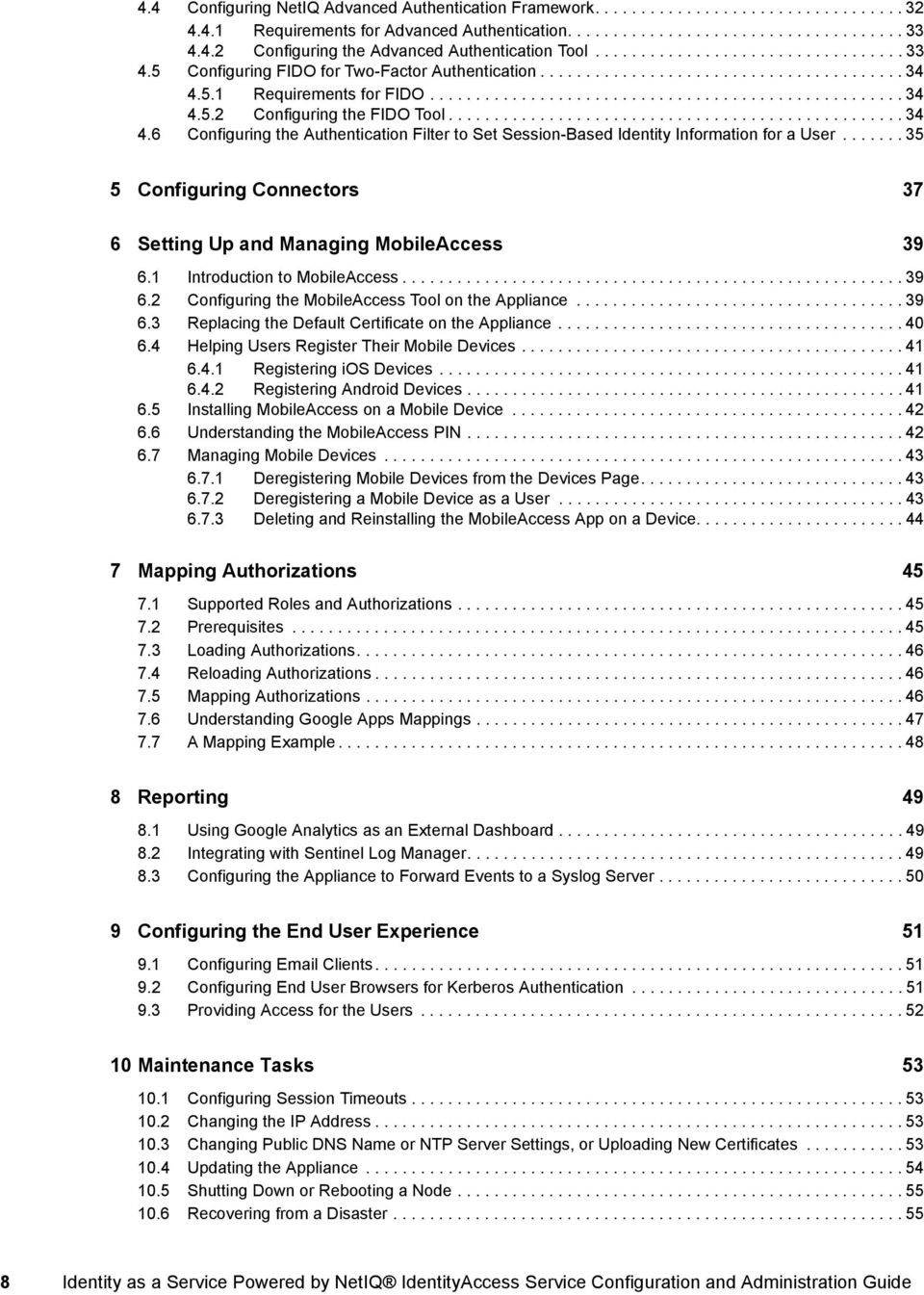
8 4.4 Configuring NetIQ Advanced Authentication Framework Requirements for Advanced Authentication Configuring the Advanced Authentication Tool Configuring FIDO for Two-Factor Authentication Requirements for FIDO Configuring the FIDO Tool Configuring the Authentication Filter to Set Session-Based Identity Information for a User Configuring Connectors 37 6 Setting Up and Managing MobileAccess Introduction to MobileAccess Configuring the MobileAccess Tool on the Appliance Replacing the Default Certificate on the Appliance Helping Users Register Their Mobile Devices Registering ios Devices Registering Android Devices Installing MobileAccess on a Mobile Device Understanding the MobileAccess PIN Managing Mobile Devices Deregistering Mobile Devices from the Devices Page Deregistering a Mobile Device as a User Deleting and Reinstalling the MobileAccess App on a Device Mapping Authorizations Supported Roles and Authorizations Prerequisites Loading Authorizations Reloading Authorizations Mapping Authorizations Understanding Google Apps Mappings A Mapping Example Reporting Using Google Analytics as an External Dashboard Integrating with Sentinel Log Manager Configuring the Appliance to Forward Events to a Syslog Server Configuring the End User Experience Configuring Clients Configuring End User Browsers for Kerberos Authentication Providing Access for the Users Maintenance Tasks Configuring Session Timeouts Changing the IP Address Changing Public DNS Name or NTP Server Settings, or Uploading New Certificates Updating the Appliance Shutting Down or Rebooting a Node Recovering from a Disaster Identity as a Service Powered by NetIQ IdentityAccess Service Configuration and Administration Guide
9 11 Troubleshooting Troubleshooting the Appliance Initialization Displaying Health Using Troubleshooting Tools Troubleshooting Different States Master Node Health Front Panel of the Node Top of the Node Identity Source Applications Tools Troubleshooting Networking Issues Troubleshooting Provisioning Issues Capturing Logs for Provisioning Issues Understanding the Result of Actions Performed on Users and Groups Users No Longer See Private Appmarks Active Directory LDAP Search Treats Extended Characters and Normal Characters the Same Cannot Set Search Context to Root of Active Directory Troubleshooting Policy Mapping Issues Troubleshooting MobileAccess Issues Device Registration Issues Users to Fail to Authenticate to MobileAccess when Appmarks Are Launched with the Chrome Browser Troubleshooting IdentityAccess Service Login Failures Troubleshooting Authentications or Single Sign-On Issues Troubleshooting Connector Issues Troubleshooting JDBC Identity Sources Contents 9

10 10 Identity as a Service Powered by NetIQ IdentityAccess Service Configuration and Administration Guide

11 1 1Getting Started After you have deployed the IdentityAccess Service appliance, you must configure the appliance to allow single sign-on authentication to resources for your tenant s users. All of the procedures must be performed on each deployment of IdentityAccess Service. Ensure that you have completed the deployment of the IdentityAccess Service appliance before continuing with the configuration. For more information, see Identity as a Service Powered by NetIQ IdentityAccess Service Installation Guide. The Services Director contains a management console for tenants called the tenant console. The tenant console allows tenants to access the administration console for any services provided to the tenant. For example, tenants access the IdentityAccess Service administration console through the tenant console. 1.1 Logging In to the Tenant Console To log in to the tenant console: 1 From a browser on a client computer, enter the URL the provider gave you. 2 Specify the following credentials to log in: Name: Specify the address that you gave to the provider administrator to create your user account. Password: Specify the password for the account. The default value is the address you specified for the name. 3 (Conditional) If this is your first login, follow the prompts to change your password. The password must contain at least one number. For more information about the tenant console, see Identity as a Service Powered by NetIQ Services Director Framework Installation Guide. 1.2 Accessing the IdentityAccess Service Appliance Administration Console To access the IdentityAccess Service appliance administration console: 1 Log in to the tenant console as a tenant administrator. 2 In the Security Services panel, next to IdentityAccess Service, click the Launch administrative console icon. Getting Started 11

12 1.3 Registering the Appliance IdentityAccess Service provides a 90-day trial period. If you do not register the appliance within 90 days after installation, the appliance stops working. The Bomb icon on the Admin page displays how many days are left in the trial period. For the purpose of meeting licensing requirements, when you register a single appliance, the cluster as a whole is considered to be registered. However, to use the Customer Center update channel to download and install software updates, you must register each node in the cluster separately. The Bomb icon remains on the Admin page if there are nodes in the cluster that have not yet been registered for channel updates. For more information about the update channel, see Section 10.4, Updating the Appliance, on page 54. To register your appliance: 1 Obtain the registration code from you NetIQ contact. You use the same registration code for all tenants. 2 Access the Admin page of the appliance. 2a Log in to the tenant console as a tenant administrator. 2b In the Security Services panel, next to IdentityAccess Service, click the Launch administrative console icon. 3 On the Admin page, click the appliance, then click Register appliance. 4 Enter a valid address. The address is for notifications that updates are available. 5 Paste the registration code in the field. 6 Click Register. 7 Repeat Step 3 through Step 6 for each appliance in the cluster. 8 Repeat Step 1 through Step 7 for each tenant deployment of IdentityAccess Service. When you have successfully registered all nodes in the cluster, the Bomb icon disappears. 1.4 Understanding the Status Icons The Services Director contains an embedded health system throughout the tenant console. In the different panels for the different components, there are colored status icons that have the following meanings: Green icons with a check mark indicate that the component is configured correctly and running as designed. Flashing green icons indicate that the component is working through its initialization process. In time, most flashing green icons change to a green icon. However, if an error occurs, the flashing green icon can change to a yellow or red icon. Red icons with an x indicate that a component is not functioning correctly. This can be because the component has not been configured, it is not communicating with the system, or it has been disabled. Gray icons indicate no components currently meet that state. For example, if you do not have any components in a Not Operational state, the Not Operational icon is gray. Blue icons with an i indicate informational alerts and messages. 12 Identity as a Service Powered by NetIQ IdentityAccess Service Configuration and Administration Guide

13 Yellow icons with an exclamation mark indicate warning items that probably need your attention. Red icons indicate conditions that need your attention because a component is not functioning correctly. 1.5 Viewing Recommended Actions The tenant console provides you with a list of recommended actions to maintain the health and functionality of your services. To view recommended actions: 1 Log in to the tenant console as a tenant administrator. 2 In the System panel, click the link for the recommended action. The Recommended Actions panel displays the current actions that need to be performed. When you are first configuring your system, this panel displays the next configuration actions that need to be performed. If multiple actions appear, they can be performed in any order. After you have performed the recommended action or actions, new actions might appear. Getting Started 13

14 14 Identity as a Service Powered by NetIQ IdentityAccess Service Configuration and Administration Guide

15 2 2Configuring Roles Management IdentityAccess Service provides the ability to assign different roles to administrative users in your identity sources. The roles allow administrators to perform certain tasks and deny them access to other tasks. 2.1 Defining the Role Types IdentityAccess Service includes the following types of roles: Appliance Administrator: The appliance administrator has full rights to all appliance administration pages and role assignments. You assign the first appliance administrator during the initialization of the appliance. Application Owner: The application owner controls access to the SaaS applications. IdentityAccess Service automatically assigns this role to the user who creates the SaaS application on the Admin page. The application owner can access the Policy page and they can map authorizations between the identity source and the SaaS application. Compliance Auditor: The compliance auditor can access the Reports page and generate, view, and download the reports for the appliance. Users assigned to the appliance administrator role have access to the Reports page automatically. Device Administrator: The device administrator can view and delete other users registered mobile devices on the Devices page. A user who has the appliance administrator role automatically has the device administrator role (though the reverse is not the case). Helpdesk: The helpdesk administrator manages the Self-Service User Store users. The helpdesk user can delete users, and reset passwords. In addition to the default role assignments, you can assign each role to additional users. However, the Roles page never allows you to remove the last appliance administrator role. 2.2 Assigning Roles to Users To assign roles to users: 1 Access the Admin page of the appliance. 1a Log in to the tenant console as a tenant administrator. 1b In the Security Services panel, next to IdentityAccess Service, click the Launch administrative console icon. 2 Click Roles on the toolbar. 3 Type the name of a user in the search bar, then click Search. Matching users appear in the left column. Configuring Roles Management 15

16 NOTE: If you use wildcards such as an asterisk (*) or question mark (?) in the search filter field, IdentityAccess does not correctly filter results. Filters must be full regular expressions. If you want to use wildcards, they must be regular expression wildcards. If the filter does not start with '^' and '.*', then '.*' is added to the filter. If the filter does not end with '$' and '.*', then '.*' is added to the filter. Thus, a filter for "test" would end up as the regular expression ".*test.*". 4 Drag and drop the user to the role you want to assign to that user, then click OK to confirm the assignment. The Roles page displays only the application owner roles of configured connectors. 16 Identity as a Service Powered by NetIQ IdentityAccess Service Configuration and Administration Guide

17 3 3Configuring Identity Sources During the initialization of the IdentityAccess Service appliance, you must configure one identity source. The appliance supports more than one identity source and there are additional identity sources you can add to the appliance that are not available during the initialization process. IMPORTANT: You can add as many additional identity sources as you want. However, all of the user IDs across the different identity sources must be unique. Use the information in the follow sections to configure additional identity sources and verify that the user account information in the existing identity source contains the proper information to synchronize the accounts. 3.1 Verifying the Identity Source User Information The appliance supports the use of one or more identity sources to authenticate users and for provisioning accounts to the Software as a Service (SaaS) applications. The initialization process configures the first identity source and adds the identity source to the Admin page. To successfully provision users to the SaaS applications, you must ensure that each user account contains specific information for the appliance to provision the users. If you are using an LDAP identity source, there are specific attributes that must be populated on the user accounts. If you are using a JDBC database, there are certain columns of information that must be populated. The information for each identity source is different. For more information, see Identity Source Requirements in the Identity as a Service Powered by NetIQ IdentityAccess Service Installation Guide. For security reasons, by default the appliance does not allow you to add a user with a user name that is the same as a previously added user. If you attempt to do so, the appliance displays the user as not activated. For more information, see Section 11.6, Troubleshooting Provisioning Issues, on page Configuring Self-Service Registration and Password Management The Self-Service User Store (SSUS) is an identity source that you can add only after you initialize the appliance. A Self-Service User Store provides self-service registration and password management services. You can enable and activate one Self-Service User Store for a tenant. After you enable the service, the users can immediately begin to self-register on the tenant s login page. Policies are required to allow the self-registered users to applications. Configuring Identity Sources 17

18 3.2.1 Enabling a Self-Service User Store for a Tenant By default, SSUS requires new users to have a valid account to create an SSUS account. Users must be able to receive and respond to a verification . You can also configure which service options to support for your SSUS users. The services include a helpdesk, new user, change password, and forgotten password. Use the following steps to enable the SSUS service for a tenant. You must repeat this process for each tenant where you want to enable the SSUS service. To enable the SSUS service: 1 Access the Admin page of the appliance. 1a Log in to the tenant console as a tenant administrator. 1b In the Security Services panel next to IdentityAccess Service, click the Launch administrative console icon. 2 In Identity Sources palette, drag the Self-Service User Store icon to the Identity Sources panel. 3 In the Identity Sources panel, click the new identity source, then click Configure. 4 In the Configuration tab, decide what options you want presented to your users and help desk administrators. 5 Click OK to enable the service. 6 In the System Configuration panel of the administration console, click Apply to activate and start SSUS as a service. 7 Wait for the SSUS service to be activated and started across all nodes in the cluster. In the Appliances panel, the icon on each node of the cluster spins until the service is ready on the node. Do not apply additional changes until this action is complete on all nodes. To allow the tenant s self-registered users to access to a private application that is enabled for SSUS, continue with Section 3.2.2, Using SSUS as an Authentication Source for an Application, on page Using SSUS as an Authentication Source for an Application The applications are not available for SSUS users until you configure policies that authorize SSUS to be an authentication source for them. All SSUS users receive rights to an application when you assign a policy to the SSUS identity source. An application can have one or more authorizations for its resources. Each authorization can have one or more appmarks associated with it. You grant access to a private application by mapping one or more of its authorizations to the SSUS role. Users can access all of the appmarks associated with an authorization. You cannot control access at the appmark level. NOTE: You should map authorizations for SSUS roles (groups) only to single sign-on applications. Do not map them to the SaaS applications with account provisioning (Google Apps, Office 365 or Salesforce). You must create a policy for SSUS users to map authorizations to applications. You must use the Other Identity Sources option when creating the policy. For more information, see Chapter 7, Mapping Authorizations, on page Identity as a Service Powered by NetIQ IdentityAccess Service Configuration and Administration Guide

19 The SSUS identity store automatically enables the Lock Account After Detection option in Self- Service Password Reset. It allows seven incorrect login attempts before lockout. The lockout period is 30 minutes. To log in before the lockout is reset, the user can contact the SSUS Helpdesk and ask the administrator to reset the password Using the Self-Service User Registration and Password Management Services The tenant s users can now self-register for accounts and manage their own credentials. Selfregistered users can log in to the landing page for the appliance to access applications. If you enabled the options during the SSUS configuration, users now see links on the appliance login page to create a new account or a link to reset their password if they have forgotten the password. After you enable the Self-Service User Store, the Self-Service User Store login page is available for users. On this page, the users can create accounts, change their password, or reset their passwords Providing Helpdesk Services for Self-Registered Users The Self-Service User Store provides a helpdesk service for the tenant. If a password expires or a self-registered user is locked out of an account, the password can be reset by an authorized helpdesk user. The helpdesk user sets a temporary randomized password for the account, and the user is notified of the temporary password by . This allows the user to log in to the account and reset the temporary password to use a custom password. You must assign a user to the tenant s SSUS Helpdesk role to provide helpdesk services for the related self-registered users. For more information, see Section 2.2, Assigning Roles to Users, on page 15. The helpdesk user accesses the helpdesk tools through the landing page. The helpdesk user logs in and clicks the Helpdesk icon on the landing page. A tenant s authorized helpdesk user can use the SSUS Helpdesk service to reset the password for a self-registered user account. Typically, the user needs helpdesk assistance because the account is locked. If the account is not locked, the user can alternatively reset the password by using the Forgotten Password option on the Self-Service Registration login page. To reset the password for an SSUS account as the tenant s authorized helpdesk user: 1 Log in to the tenant s SSUS Helpdesk as an authorized helpdesk user. 2 In the Helpdesk page, search for an SSUS user account, then click the self-registered user s name. 3 In the Password Policy page, view the password policy settings for the user account, then click Change Password. 4 In the Account Information page, confirm the user s information, then click Change Password. 5 In the Random Passwords window, select a password from the list of randomly generated passwords that satisfies the password policy for this account. You can click More to choose from additional random passwords. 6 View the confirmation message with the new password, then click OK. 7 After the self-registered user receives the temporary password, the user is prompted to reset the password at their next login. Configuring Identity Sources 19

20 A tenant s authorized helpdesk user can use the SSUS Helpdesk service to delete the SSUS account for a self-registered user. 3.3 Configuring Federated SAML 2.0 Inbound Identity Sources To create a federated SAML 2.0 connection between the IdentityAccess Service an any identity provider, can be configured only after you initialize the appliance. To allow the appliance to be a SAML 2.0 service provider, you can create a SAML 2.0 Inbound connector using the Access Connector Toolkit. SAML2 Inbound as an identity source is not available during initialization of the appliance. However, after you export the connector and import it in the appliance, the SAML2 In connector appears as an identity source. You configure an instance of the identity source with information about an appropriate identity provider to enable the service provider functionality of the appliance, and to allow the identity provider to send a SAML token to the appliance using the SAML 2.0 POST profile. After you configure the SAML2 In identity source connector, the appliance login page provides a link to the login page of the SAML 2.0 identity provider, located to the left of the user name and password login options. The SAML 2.0 users log in through the identity provider to gain access to the appliance landing page. For more information, see Creating a SAML 2.0 Inbound Connector Template in the Identity as a Service Powered by NetIQ IdentityAccess Service Connectors Guide. 3.4 Configuring the Account Management Service as an Identity Source You can use Account Management Service as an identity source for IdentityAccess Service. The Account Management Service is a separate service that helps you automat the creates of user accounts. For more information, see the Identity as a Service Powered by NetIQ Account Management Service Installation and Administration Guide. This identity source can be configured only after you have initialized the appliance. To add the Account Management Service as an identity source: 1 Deploy and configure an Account Management Service appliance. For more information, see Identity as a Service Powered by NetIQ Account Management Service Installation and Administration Guide. 2 Access the Admin page of the appliance. 2a Log in to the tenant console as a tenant administrator. 2b In the Security Services panel, next to IdentityAccess Service, click the Launch administrative console icon. 3 In the Identity Sources palette, drag the Account Management Service identity source icon to the Identity Sources panel. 4 Use the following information to configure the Account Management Service identity source: Account Management Service: Specify the IP address or DNS name of the Account Management Service appliance. Username and Password: Specify the tenant name and password of the Account Management Service appliance. 20 Identity as a Service Powered by NetIQ IdentityAccess Service Configuration and Administration Guide

21 5 Click OK to save the configuration information. 6 Click Apply to commit the changes to the appliance. You must repeat this procedure for each of your tenants that you want to use the Account Management Service appliance as the identity source. 3.5 Changing the Default Behavior of the Connectors for LDAP Identity Sources The connector for Active Directory and the connector for edirectory contain predefined behaviors for importing, matching, and provisioning users. IdentityAccess Service provides a way to override the default behavior of the connectors for LDAP identity sources through the Advanced Options on the connectors. The advanced options allow you to customize which users and groups IdentityAccess Service imports to provision to the connected systems. By default, IdentityAccess Service uses an internal unique attribute to match users and to provision users to the connected systems. For more information about provisioning, see Section 11.6, Troubleshooting Provisioning Issues, on page 64. Use the information in the following sections to change the default behavior of the connectors for LDAP identity sources Customizing Import Options IdentityAccess Service allows you to change the default options when you are importing users. If you have a large number of users or groups and you want to import only a subset of those users and groups, you can use the Advanced Options to filter them to a set of users and groups you want imported. To customize the import options: 1 Access the Admin page of the appliance. 1a Log in to the tenant console as a tenant administrator. 1b On the Security Services panel, next to IdentityAccess Service, click the Launch administrative console icon. 2 Click the appropriate connector for the LDAP identity source, then click Configure. 3 Expand Advanced Options, then use the following information to customize the import of users and groups in to IdentityAccess Service. Identity source search polling rate every: Select how often you want the connector for the LDAP directory to poll the LDAP identity source for changes. By default, the rate is every minute. Filter extension: Specify a filter for the object class and attribute you want to use to import users. If users do not meet the criteria defined in the filter, IdentityAccess Service does not import those users. For example, (&(objectclass=user)(samaccountname=abc*))imports only users that start with the samaccountname of abc*. NOTE: The connectors for the LDAP identity sources change all of the keys and values in the filter to lowercase. It is best to use a case-ignore attribute. Configuring Identity Sources 21
22 Identity source LDAP attribute to use for imported accounts: Specify the LDAP attribute that the connector uses as the naming attribute (login name) when importing accounts from the identity source. Allow unmapped users to authenticate: Select whether to allow users to authenticate that have not been imported in to IdentityAccess Service, because they have been excluded by the filter extension. The unmapped users must use an address to log in. These users can still log in to the User portal page, but will see only public appmarks. Override default group filter: Select whether to override the default group filter so you can limit which groups the connector for the LDAP identity source imports to IdentityAccess Service. If you select this option, you must specify a correct filter. For example, (&(objectclass=group)(cn=custom*)) allows only groups with a CN that start with custom*. NOTE: The connectors for the LDAP identity sources change all of the keys and values in the filter to lowercase. It is best to use a case-ignore attribute. 4 Click OK, then click Apply to save the changes. NOTE: When you configure a filter extension for an edirectory identity source, user objects in the external edirectory identity store that do not match the filter are not imported into IdentityAccess Service, as expected. If you also enable the option Allow unmapped users to authenticate, unmapped users can use Basic SSO type connectors, but although they are prompted to save their credentials, they cannot store or play back their credentials for single sign-on later because their user objects do not actually exist in IdentityAccess Service Customizing Attribute Mappings IdentityAccess Service automatically maps the attributes between the identity sources and the connected systems. If you want to use custom attributes for the identity sources, use the advanced configuration options on the identity source connectors. The Admin page displays the default attribute mappings between the LDAP identity source and IdentityAccess Service. To view the default attribute mapping: 1 Access the Admin page of the appliance. 1a Log in to the tenant console as a tenant administrator. 1b On the Security Services panel, next to IdentityAccess Service, click the Launch administrative console icon. 2 Click the appropriate connector for the LDAP identity source, then click Configure. 3 Expand Advanced Options. 4 Under the Attribute Mapping heading, click Default to expand and view the default attribute mappings. The attributes on the left are the attributes for IdentityAccess Service. The attributes on the right are for the LDAP directory. Above the default attributes, you can map five attributes to five custom attributes in IdentityAccess Service. To map the LDAP directory attribute, specify the attribute name in the field next to the custom attribute, then click OK and Apply to save the changes. 22 Identity as a Service Powered by NetIQ IdentityAccess Service Configuration and Administration Guide
23 3.5.3 Understanding the Relaxed User Matching Option The Relaxed user matching option changes how IdentityAccess Service matches users. By default, IdentityAccess Service matches users using an internal unique ID. This option changes the appliance to match users by the CN or samaccountname attributes. Use this option when you want to recreate previously deleted users so IdentityAccess Service can manage the users again. However, you must ensure that you do not create different users with the same CN or samaccountname as previously deleted users. Otherwise, those users will have access to the previously deleted users cloud application data. 3.6 Configuring Additional Identity Sources The IdentityAccess Service appliance supports multiple types of identity sources. You can have one or more of each type of identity source configured in your appliance. You can configure as many identity sources as you need. The only restriction is that every user account across the different identity sources must be unique. For a list of the supported identity sources, see Identity Source Requirements in the Identity as a Service Powered by NetIQ IdentityAccess Service Installation Guide Creating a Additional Identity Source You can create additional identity sources after you initialize the appliance. However, the appliance does not prevent you from configuring multiple identity sources that point to the same external identity source. For the appliance to behave as expected and present accurate data, each identity source in the appliance must point to a unique external identity source. To add another identity source: 1 Access the Admin page of the appliance. 1a Log in to the tenant console as a tenant administrator. 1b In the Security Services panel, next to IdentityAccess Service, click the Launch administrative console icon. 2 In the Identity Sources palette, drag an identity source icon to the Identity Sources panel. 3 Fill in the fields to configure the new identity source, then click OK to save the configuration information. 4 Click Apply to commit the changes to the appliance Changing an Identity Source Configuration You can change your identity source configuration information after you have created the identity source. To change the identity source configuration information: 1 Access the Admin page of the appliance. 1a Log in to the tenant console as a tenant administrator. 1b In the Security Services panel, next to IdentityAccess Service, click the Launch administrative console icon. Configuring Identity Sources 23
24 2 In the Identity Sources panel, click the icon of the identity source that you want to modify, then click Configure. 3 Modify the settings as needed, then click OK to save the configuration information. 4 Click Apply to commit the changes to the appliance. NOTE: Although the appliance allows you to modify an existing edirectory or Active Directory identity source to point to a different tree, NetIQ does not recommend this approach because it can result in inconsistent display of user and group data. If you want to point an identity source to a different tree, delete the existing identity source and create a new identity source that points to the correct tree. 24 Identity as a Service Powered by NetIQ IdentityAccess Service Configuration and Administration Guide
25 4 4Configuring Authentication Methods The IdentityAccess Service appliance allows you to configure one or more authentication methods for the users. Some of the different authentication methods are additive. For example, you can use Google recaptcha with Integrated Windows Authentication. Use the information in the following sections to configure the different authentication methods for the appliance. 4.1 Configuring Integrated Windows Authentication with Kerberos IdentityAccess Service allows user authentication with either name and password or Integrated Windows Authentication with Kerberos if your identity source is Active Directory. If you choose to use Integrated Windows Authentication, you must configure Kerberos. IdentityAccess Service supports the use of only one Kerberos realm. If there are multiple Active Directory domains used as the identity source, all of the domains must use the same realm. Use the information in the following sections to enable Kerberos authentication between Active Directory and IdentityAccess Service Configuring the Kerberos User in Active Directory To configure Kerberos on your Active Directory domain: 1 As an Administrator in Active Directory, use MMC to create a new user within the search context specified during the initialization of the appliance. Name the new user according to the Host and DNS name of the appliance. For example, if the public DNS of the appliance is serv1.mycompany.com and the context that has been enabled for cloud is ou=acme corporation,dc=mycompany,dc=com, use the following information to create the user: First name: serv1 User login name: HTTP/serv1.mycompany.com Pre-windows logon name: serv1 Set password: Specify the appropriate password. For example: Passw0rd Password never expires: Select this option. 2 Associate the new user with the service principal name. Any domain or realm references must be uppercase. 2a In the Active Directory server, open a cmd shell. 2b At the command prompt, enter the following: setspn -A HTTP/[email protected] newusershortname For example: setspn -A HTTP/[email protected] serv1 2c Verify setspn by entering setspn -L shortusername For example: setspn -L serv1 Configuring Authentication Methods 25
26 3 Generate the keytab file using the ktpass utility. Any domain or realm references must be uppercase. 3a At the command prompt, enter the following: ktpass /out filename /princ serviceprincipalname /mapuser userprincipalname /pass userpassword For example: ktpass /out nidp.keytab /princ HTTP/ /mapuser /pass Passw0rd 3b Ignore the message Warning: ptype and account type do not match. 4 Copy the nidp.keytab file created in Step 3 to the browser of the client computer that you are using for administration Configuring the Appliance to Use Integrated Windows Authentication with Kerberos The following steps enable the appliance to use Integrated Windows Authentication (IWA) with Kerberos, if your identity source is Active Directory. To configure the appliance to use IWA with Kerberos: 1 Access the Admin page of the appliance. 1a Log in to the tenant console as a tenant administrator. 1b In the Security Services panel, next to IdentityAccess Service, click the Launch administrative console icon. 2 Click the Active Directory icon in the Identity Sources palette, then click Configure. (Do not drag the icon as you would when you configure the connector for Active Directory itself. These IWA configuration options are global for all connectors for Active Directory.) 3 Select Integrated Windows Authentication. 4 Next to the Keytab field click Browse, then browse to and select the nidp.keytab file generated in Configuring the Kerberos User in Active Directory on page Click OK to save the changes. 6 Click Apply to apply the changes to the appliance Configuring End User Browsers To complete the Kerberos configuration for Active Directory, configure the end user browser. For more information, see Section 9.2, Configuring End User Browsers for Kerberos Authentication, on page Configuring Google recaptcha Using recaptcha helps prevent automated Denial of Service (DoS) attacks that can impact the performance of the appliance and the identity source. The tool uses the remote Google recaptcha service to provide the images and verify the responses. If a response succeeds, the appliance verifies the user s authentication credentials against the identity source. If a response fails, the appliance fails the login attempt without processing the credentials, and re-displays the login page. Thus, the automated login attempts fail and cannot consume the processing resources of the appliance and identity source. 26 Identity as a Service Powered by NetIQ IdentityAccess Service Configuration and Administration Guide
27 4.2.1 Requirements for Google recaptcha Ensure that your system meets the following requirements before you configure the Google recaptcha tool: One or more supported identity sources, with the connectors enabled and configured. The recaptcha tool supports users from Active Directory, edirectory, and Self-Service User Store (SSUS) identity sources. It does not support users from other types of identity sources, such as users imported from Microsoft SQL Server or Oracle Database type identity sources that use the JDBC identity source connector. Each identity source should be configured with an intrusion detection policy. Active Directory: For more information, see the Account Lockout Policy ( technet.microsoft.com/en-us/library/hh994563%28v=ws.10%29.aspx) in the Microsoft TechNet Library. ( edirectory: If you do not configure intruder detection, for your edirectory identity source, Google recaptcha will not work. For more information, see Setting Up Intruder Detection for All Users in a Container ( afxkmdi.html#a3p5g0i) in the edirectory 8.8 SP 7 Administration Guide. Self-Service User Store: The SSUS identity store automatically enables the Lock Account After Detection option in Self-Service Password Reset. It allows seven incorrect login attempts before lockout. The lockout period is 30 minutes. To log in before the lockout is reset, the user can contact the SSUS Helpdesk and ask the administrator to reset the password. A Google recaptcha account, configured on the Google recaptcha website. For more information, see Section 4.2.2, Configuring a Google recaptcha Account, on page Configuring a Google recaptcha Account Before you configure the Google recaptcha tool, you must configure an account to use for your domain at Google recaptcha, and create a public and private key. To configure a Google recaptcha account to use for your appliance s domain: 1 Access the Google recaptcha ( website. 2 Click Get recaptcha > Sign up Now. 3 Log in using one of your Google accounts. For example, if you use your Gmail account, the recaptcha account is associated with the Gmail account. 4 (Conditional) If this is not your first site, click Add a New Site. Otherwise, skip to the next step. 5 Specify a domain. Read the Tips for more information. 6 Click Create to add the domain. 7 Copy the Public Key and Private Key that the interface displays to use when you configure the identity source. 8 Continue with Section 4.2.3, Configuring the recaptcha Tool, on page 28. Configuring Authentication Methods 27
28 4.2.3 Configuring the recaptcha Tool To configure Google recaptcha: 1 Verify that your identity sources have intruder detection enabled. For more information, see Section 4.2.1, Requirements for Google recaptcha, on page 27 2 Verify that you have configured your Google recaptcha account. For more information, see Section 4.2.2, Configuring a Google recaptcha Account, on page Access the Admin page of the appliance. 3a Log in to the tenant console as a tenant administrator. 3b In the Security Services panel, next to IdentityAccess Service, click the Launch administrative console icon. 4 Verify that you configured an identity source for Active Directory or edirectory. 5 In the Tools palette, drag the Google recaptcha tool to the Tools panel. 6 Click the Google recaptcha tool, then click Configure. 7 Configure the Google recaptcha feature as follows: Start Google recaptcha at: Specify how many failed login attempts can occur before users must use Google recaptcha. Public Key: Paste the Public Key value from the Google recaptcha configuration. Private Key: Paste the Private Key value from the Google recaptcha configuration. 8 Click OK, then click Apply to save the configuration. If a user fails to log in to Active Directory or edirectory more than the specified number of failed login attempts, the login screen displays the Google recaptcha feature. 4.3 Configuring the Time-Based One-Time Password (TOTP) Tool for Two-Factor Authentication Using Google Authenticator The Time-Based One-Time Password (TOTP) tool in IdentityAccess Service supports the use of onetime passwords (OTPs) for two-factor authentication of users as they access applications through IdentityAccess Service. With two-factor authentication, users must provide two categories of authentication factors before they can access the applications. The authentication factors used by the TOTP tool are: Something the user knows: The first authentication factor requires something the user knows, such as the password for the user s single-sign-on user name. Something the user has: The second authentication factor requires something the user has, such as a mobile device running Google Authenticator to generate time-based one-time passwords. Google Authenticator is a free software-token app that users deploy on their mobile devices. Authenticator generates time-based OTPs for authentication, without requiring an Internet connection or cellular service. 28 Identity as a Service Powered by NetIQ IdentityAccess Service Configuration and Administration Guide
29 4.3.1 Configuring the TOTP Tool You can enable the Time-Based One-Time Password tool to require users to use two-factor authentication when logging in through IdentityAccess Service. To configure the TOTP service: 1 Access the Admin page of the appliance. 1a Log in to the tenant console as a tenant administrator. 1b In the Security Services panel, next to IdentityAccess Service, click the Launch administrative console icon. 2 In the Tools palette, drag the TOTP Tool icon to the Tools panel. 3 Click the TOTP icon on the Tools panel, then click Configure. 4 (Optional) Specify the Validity Time. Specify an integer value from 2 to 10. The default value is 5. Shorter validity times are considered more secure. 5 Click the Applications tab, then select the check box next to one or more applications to enable them for TOTP. By default, no applications are enabled for TOTP. When a user registers an authentication device, the device and authentication codes apply to all TOTP-enabled applications. 6 Click OK to save the setting and enable the TOTP tool. 7 Click Apply to activate the TOTP configuration. 8 Wait while the service is activated across all nodes in the cluster. Do not attempt other configuration actions until the activation completes successfully Registering a Mobile Device with the TOTP Tool for OTP Generation After you enable the TOTP tool, users are prompted to register a device to use for the additional verification the next time they sign in to IdentityAccess Service. Each user must register a mobile device for generating the user s one-time passwords. For the initial setup, the user should use a web browser on a computer other than the mobile device where the one-time passwords will be generated. The One-Time Authentication code page displays a QR code and its equivalent secret key. The user deploys the Google Authenticator app on a mobile device, and sets up an account for IdentityAccess Service by using the shared key. The user can scan the QR code or manually enter the key. When the app runs, it generates a new one-time password every 30 seconds. Before registering a device, the following setup is required: The user must be an authorized user of IdentityAccess Service with a valid user name and password. The user must have access to a computer running a supported web browser. For a list of supported web browsers, see Browsers in the Identity as a Service Powered by NetIQ IdentityAccess Service Installation Guide. The user must use a supported mobile device. Configuring Authentication Methods 29
30 For a list of supported web browsers, see Mobile Devices in the Identity as a Service Powered by NetIQ IdentityAccess Service Installation Guide. The user must install the Google Authenticator app on the mobile device. To register a mobile device for use with the TOTP tool: 1 (Conditional) If the Google Authenticator mobile app is not already installed on the mobile device, download and install it. 1a Visit the app store for your mobile device. 1b Search for Google Authenticator. 1c Download and install the app. 2 From a computer that will not be used as the OTP device, access IdentityAccess Service either directly or through a SAML2 redirect. 3 In the IdentityAccess Service login page, enter your network user name and password (your normal identity source login credentials). A message displays a QR code (and its equivalent secret key) to use for the TOTP registration. If you are not prepared to register your mobile device at this time, you can cancel the registration process by closing the tab or your browser. On your next login, IdentityAccess Service generates a new secret key, and prompts you to register a device with a new key. 4 On your mobile device, use the Google Authenticator app to scan the displayed QR code, and register the device with IdentityAccess Service. You can alternatively type the secret key. 4a On your mobile device, open the Google Authenticator app. 4b Select Settings > Add an account. 4c Use either of the following methods to configure the account: Scan a barcode: 1. Select Scan a barcode. 2. Use your device s camera to scan the QR code that appears on the IdentityAccess Service One-Time Authentication Code page. Enter provided key: 1. Select Time Based. 2. Select Enter provided key. 3. Type the 16-character secret key that appears on the IdentityAccess Service One- Time Authentication Code page. The key is case sensitive. Do not add spaces or stray characters. 4d Specify a unique name for the account. 4e Tap Done. 5 On the mobile device, view the 6-character code that Google Authenticator displays for IdentityAccess Service. This is your OTP. 6 On the computer on the One-Time Authentication Code page, type the OTP, then click Sign In. IdentityAccess Service confirms that the mobile device is registered, and the login is successful. If the code is not validated, the registration page is redisplayed with the current secret key. You can generate a new code, and try again. The code might not be validated if you enter an expired code, you do not enter a code, you mistype the code, or you make an error when setting up the secret key for the account in Google Authenticator. 30 Identity as a Service Powered by NetIQ IdentityAccess Service Configuration and Administration Guide
31 7 To log in to your account from the mobile device, log in to IdentityAccess Service as described in Section 4.3.3, Using Two-Factor Authentication at Login, on page 31. On successful authentication, you can access the apps icons for the authorized services and resources associated with your user identity. Access is granted only for the duration of that session. To deregister a mobile device: 1 Access IdentityAccess Service either directly or through a SAML2 redirect. 2 Log in and authenticate as described in Section 4.3.3, Using Two-Factor Authentication at Login, on page Click the My Devices icon. 4 In the Registered Devices list, select the mobile device. 5 Click the Delete icon for the device. 6 In the Unregister Device window, click OK to confirm. At your next login, IdentityAccess Service prompts you to register a device before you can access applications that require two-factor authentication Using Two-Factor Authentication at Login When two-factor authentication is enabled for IdentityAccess Service, a user must provide login credentials and a one-time authentication code to gain access to TOTP-enabled applications. The code is a 6-digit number generated for IdentityAccess Service by the Google Authenticator app that is running on the user s mobile device. The user must have already registered the mobile device with IdentityAccess Service, as described in Section 4.4.2, Configuring the Advanced Authentication Tool, on page 33. The user should enter the newly generated code as soon as possible after it appears in the Google Authenticator app. Each OTP is intended for use by only one user, is valid for 30 seconds, and becomes invalid after the user successfully logs in. Access is granted only for the duration of that session. To log in to IdentityAccess Service using two-factor authentication: 1 Access IdentityAccess Service either directly or through a SAML2 redirect. 2 In the login page, enter your network user name and password (your normal identity source login credentials). IdentityAccess Service verifies the credentials against a defined identity source. If all applications require two-factor authentication, the One-Time Authentication Code page appears and prompts you to enter the code. Otherwise, IdentityAccess Service displays the page when you first click any one of the applications that require it. 3 Use Google Authenticator to generate a new one-time password, and enter the code on the IdentityAccess Service One-Time Authentication Code page. If you enter the password incorrectly, you can try again with the same password until it times out. Google Authenticator generates a new OTP every 30 seconds. On successful authentication, you can access the apps icons for the authorized services and resources associated with your user identity. Each session requires only a single successful authentication. Configuring Authentication Methods 31
32 4.3.4 Resetting a Device (Deregistering a Device) Each user can register a single device to use for generating one-time passwords. Resetting a device for a user s account deregisters the user s current device. The next time the user logs in, the TOTP tool creates a new secret key for the account. An administrator can reset a device for a user account: To allow the user to register a different device To revoke access for a registered device that is lost or stolen If the Time-Based One-Time Password tool is disabled, IdentityAccess Service no longer prompts the users for an OTP at login. The OTPs generated for the user s IdentityAccess Service account by the Google Authenticator app are no longer needed at login. After a device is deregistered, the OTPs generated for the user s IdentityAccess Service account by the Google Authenticator app are no longer valid. At the user s next login, the TOTP tool generates a new secret key for the user, and the user must register a device to work with it. To reset (deregister) a device for a user account as an administrator user: 1 Access the Admin page of the appliance. 1a Log in to the tenant console as a tenant administrator. 1b In the Security Services panel, next to IdentityAccess Service, click the Launch administrative console icon. 2 Click the Devices to open the Devices page. 3 In the User field, type a few characters of the user name, and then scroll in the window to select the user identity. 4 Under One-Time Password, click Reset. 4.4 Configuring NetIQ Advanced Authentication Framework The Advanced Authentication tool supports the use of one-time passwords (OTPs) for two-factor authentication of users as they access applications through IdentityAccess Service. The tool works with the NetIQ Advanced Authentication Framework appliance. With two-factor authentication, users must provide two categories of authentication factors before they can access the applications: Something the user knows: The first authentication factor requires something the user knows, such as the password for the user s single-sign-on user name. Something the user has: The second authentication factor requires something the user has, such as a device to uniquely generate or receive one-time passwords or authentication requests that can be used only for that access moment. Two-factor authentication provides an additional layer of security that helps verify the identity of a user and reduce the risk of unauthorized access to your applications. Users still enjoy the convenience of single sign-on, but the access is more secure. The Advanced Authentication tool supports multiple types of authentication providers for OTP in the NetIQ Advanced Authentication Framework: 32 Identity as a Service Powered by NetIQ IdentityAccess Service Configuration and Administration Guide
33 You configure a separate instance of the tool for each authentication provider type that you want users to use. For each authentication provider type, you can enable one or more applications, but they must be mutually exclusive of the applications that you enable in other instances. The applications must also be mutually exclusive of applications configured to use the Time-Based One- Time Password tool with Google Authenticator. At a user s next login, the tool prompts the user for additional authentication, according to the authentication provider type enabled for the application. If you enable a single authentication provider type for all applications, the prompt occurs immediately after IdentityAccess Service validates the user s credentials. Otherwise, the prompt occurs when the user first selects any one of the applications enabled for Advanced Authentication. The authentication automatically applies to all applications for that session that were also enabled for the same type of authentication provider. For more information about using the NetIQ Advanced Authentication Framework and the supported authentication providers, see the NetIQ Advanced Authentication Framework ( documentation/netiq-advanced-authentication-framework/) documentation website Requirements for Advanced Authentication Ensure that your system meets the following requirements before you configure Advanced Authentication as an authentication method: An IdentityAccess Service appliance, installed and configured. A NetIQ Advanced Authentication Framework 5.x or above appliance installed and configured. The Advanced Authentication tool supports many of the authentication providers available in Advanced Authentication Framework. Before you configure the Advanced Authentication tool, ensure that you install and configure the authentication providers that you want to use on the NetIQ Advanced Authentication Framework appliance. For more information, see the specific Authentication Provider guide on the NetIQ Advanced Authentication Framework ( documentation website. For SMS and Voice Call, the user's telephone number that will be used for authentication should be specified in the user s properties in Active Directory. The users must use the NetIQ Advanced Authentication Framework client or web user interface to enroll or re-enroll for the authenticator providers that you want them to use. Identify the type of authentication provider that you want to use for each of your destination applications. NOTE: You can use the NetIQ Advanced Authentication Framework for applications on desktop browsers, but this does not work with MobileAccess. When users access an application from MobileAccess, they are automatically logged in, ignoring any advanced authentication rules that you configure in IdentityAccess Service. MobileAccess supports only OAuth by design Configuring the Advanced Authentication Tool Before you configure the Advanced Authentication tool, ensure that your setup meets the requirements described in Section 4.4.1, Requirements for Advanced Authentication, on page 33. Configuring Authentication Methods 33
34 To configure the Advanced Authentication tool: 1 Access the Admin page of the appliance. 1a Log in to the tenant console as a tenant administrator. 1b In the Security Services panel next to IdentityAccess Service, click the Launch administrative console icon. 2 In the Tools palette, drag the Advanced Authentication tool to the Tools panel. 3 Configure the Advanced Authentication feature: Authentication type: Select the type of authentication provider that you want to enable for the specified server running the NetIQ Advanced Authentication Framework. For more information, see Section 4.4.1, Requirements for Advanced Authentication, on page 33. NAAF hostname/port: Specify the host name of the appliance running NetIQ Advanced Authentication Framework. The default port number is Click the Applications tab, then select the check box next to one or more applications that require the specified authentication provider. You can enable one or more applications for the specified type of authentication provider. However, you must assign each application to only one type of authentication provider. 5 Click OK to save the settings and enable the tool. 6 Click Apply to activate the configuration. 7 Wait while the service is activated across all nodes in the cluster. Do not attempt other configuration actions until the activation completes successfully. 8 Repeat the steps for each tenant. 4.5 Configuring FIDO for Two-Factor Authentication IdentityAccess service support FIDO (Fast IDentity Online) for two-factor authentication. FIDO requires that users enter their user name and password. The second factor authentication is a dongle the users must touch to authenticate. For more information, seethe FIDO Alliance ( fidoalliance.org/) website Requirements for FIDO Ensure that your system meets the following requirements before you configure FIDO as an authentication method: An IdentityAccess Service appliance, installed and configured. A FIDO supported dongle for each user Configuring the FIDO Tool Before you configure the FIDO tool, ensure that your setup meets the requirements described in Section 4.5.1, Requirements for FIDO, on page Identity as a Service Powered by NetIQ IdentityAccess Service Configuration and Administration Guide
35 To configure the FIDO tool: 1 Access the Admin page of the appliance. 1a Log in to the tenant console as a tenant administrator. 1b In the Security Services panel next to IdentityAccess Service, click the Launch administrative console icon. 2 In the Tools palette, drag the FIDO tool to the Tools panel. 3 Read the message that there is no configuration required. 4 Click the Applications tab, then select the check box next to one or more applications that require the specified authentication provider. You can enable one or more applications for the specified type of authentication provider. However, you must assign each application to only one type of authentication provider. 5 Click OK to save the settings and enable the tool. 6 Click Apply to activate the configuration. 7 Wait while the service is activated across all nodes in the cluster. Do not attempt other configuration actions until the activation completes successfully. 8 Repeat Step 1 through Step 7 for each tenant. 4.6 Configuring the Authentication Filter to Set Session-Based Identity Information for a User The IdentityAccess Service single sign-on login is designed to authenticate a user against an identity source and to share this authentication with other protected applications. If you want to extend the functionality of the authentication process, IdentityAccess Service provides an Authentication Filter tool that allows you to add, remove, or manage a user s identity information for the session. For more information, see the Technical Reference: Authentication Filter for NetIQ IdentityAccess Service. Configuring Authentication Methods 35
36 36 Identity as a Service Powered by NetIQ IdentityAccess Service Configuration and Administration Guide
37 5 5Configuring Connectors The appliance uses connectors to allow the users to authenticate to the web services with single signon. For information on how to install and configure the connectors, see the Identity as a Service Powered by NetIQ IdentityAccess Service Connectors Guide. Configuring Connectors 37
38 38 Identity as a Service Powered by NetIQ IdentityAccess Service Configuration and Administration Guide
39 6 6Setting Up and Managing MobileAccess Administrators can enable user access to single sign-on, proxy, and SaaS applications from supported mobile devices. For more information about supported mobile devices, see Mobile Devices in the Identity as a Service Powered by NetIQ IdentityAccess Service Installation Guide. 6.1 Introduction to MobileAccess MobileAccess features are available for all application connectors that IdentityAccess Service supports. Configurable options in MobileAccess include the following: Which applications users should be able to access. Whether users can access an application through a desktop browser or a mobile device, or both. The preferred viewer for the application on the mobile device. Whether users are required to provide a PIN to use the MobileAccess app on their mobile device, and if so, whether they are required to re-enter the PIN after a period of inactivity. The MobileAccess app that end users install on their mobile devices enables them to access corporate and SaaS applications from those devices. Administrators can also make the MobileAccess app available to users in a private corporate store. After users have installed the app and registered their device, they can access assigned applications using their corporate user name and password. Administrators can deregister user mobile devices in the Devices page. So, if a registered mobile device is lost or stolen, or an employee leaves the company, you can ensure that unauthorized users cannot access corporate resources. Users can also deregister their own mobile devices if necessary, either from their device or from the landing page. 6.2 Configuring the MobileAccess Tool on the Appliance After you have installed and configured the appliance, you can configure the MobileAccess tool. To configure the MobileAccess tool: 1 Access the Admin page of the appliance. 1a Log in to the tenant console as a tenant administrator. 1b In the Security Services panel, next to IdentityAccess Service, click the Launch administrative console icon. 2 In the Tools palette, drag the MobileAccess icon to the Tools panel. 3 Click the MobileAccess icon on the Tools panel and then click Configure. 4 In the Display name field on the Mobile Application Access window, type your company name. This name appears in the bar at the top of the MobileAccess app window on users mobile devices. Setting Up and Managing MobileAccess 39
40 5 In the Prompt for Password Re-authentication in x Days field, specify how long users can continue to use an authenticated password on mobile devices before re-authentication is required. 6 (Optional) In the PIN Required bar, specify whether users must set a PIN for the MobileAccess app on their mobile devices, and whether they must re-enter the PIN after a period of inactivity. You can change this requirement at any time. For more information, see Section 6.6, Understanding the MobileAccess PIN, on page Click OK. 8 Click the Apply button on the Admin page. 9 Wait for the apply operation to finish. (The gear stops spinning on the appliance when the operation has finished.) 10 Continue with Section 6.3, Replacing the Default Certificate on the Appliance, on page Replacing the Default Certificate on the Appliance You must change the default certificate that comes with the appliance before you can successfully register mobile devices. For security reasons that are well-documented, as well as for administrator and user convenience, NetIQ highly recommends that you change the default certificate on the appliance to a well-known Certificate Authority signed certificate. Before you change the certificate on the appliance, ensure that your environment meets the following requirements: The appliance must be installed and running with a DNS entry that points to it. The certificate must be at least 2k key size (4k preferably) using SHA256. The certificate must be signed by a Certificate Authority, preferably a well-known Certificate Authority. If you choose to use a self-signed certificate, it must be flagged as a certificate authority. If you use a self-signed or non-public CA-signed certificate, users must also install the certificate on their mobile devices. You can run the Java 7 keytool on a computer other than the appliance to generate the certificate. To generate a self-signed certificate: 1 Using the Java 7 keytool, use the following commands replacing name and appliance_name: keytool -genkeypair -keystore name.p12 -storepass changeit -sigalg SHA256withRSA -keyalg RSA -keysize dname "CN=appliance_name" -validity 365 -storetype pkcs12 -ext bc=ca:true name can be anything you want, as long as it is the same between the two commands, and you can find it when you want to upload it. appliance_name must be the DNS name of the appliance. The output of this command is a.p12 format file. You can use this file to replace the default certificate on the appliance. (Use the password of changeit when the administration console prompts for it.) For more information, see Changing the Certificates on the Appliance in the Identity as a Service Powered by NetIQ IdentityAccess Service Installation Guide. 2 To get the public certificate from that keyfile use the following command, replacing name with the same value from above: 40 Identity as a Service Powered by NetIQ IdentityAccess Service Configuration and Administration Guide
41 keytool -export -keystore name.p12 -storetype pkcs12 -alias mykey -file name.cer -storepass changeit The output of this command is a name.cer file that you can use later. 6.4 Helping Users Register Their Mobile Devices Users can install the NetIQ MobileAccess app on a mobile device to use MobileAccess with IdentityAccess Service. A user can register a device with multiple providers by setting up separate accounts for each one. If a user registers a device with multiple providers, the user must select the account to use for a session from the providers list on the device. By default, the app connects the user to the first provider in the list. Users must register their mobile devices to use MobileAccess with IdentityAccess Service. As an administrator you can provide two different ways for users to register a mobile device with IdentityAccess Service Registering ios Devices There are two different ways you can provide to users to register an ios mobile device: Manual URL Entry: Send your users an with the URL containing the DNS name of the appliance including the correct port number. To enter the URL in the MobileAccess app, users tap the menu in the upper left corner of the app, then tap Accounts > + and enter the URL of the appliance in the Providers field. The URL is: For example: Embedded Link in Send your users the following link. When users click the link, the link launches the MobileAccess app and the Sign In page appears. Users sign in using their corporate credentials to access the appmarks available in the MobileAccess app. The link is: comnetiqauth://x-callback-url/register?providerurl= appliance_dns_name:port/ For example: comnetiqauth://x-callback-url/register?providerurl= NOTE: clients can prevent embedded links from working Registering Android Devices There are two different ways you can provide to users to register an Android device: Manual URL Entry: Send your users an with the URL containing the DNS name of the appliance including the correct port number. To enter the URL in the MobileAccess app,users tap the menu in the upper right corner of the app, then tap Manage Accounts > + and enter the URL of the appliance in the Provider field. The URL is: For example: Setting Up and Managing MobileAccess 41
42 HTML Page with Anchor Link: Create an HTML page that contains an anchor link that users click on to have the Provider field populated for them. The format of the anchor link is: <html> <body><a href="intent://x-callback-url/register?providerurl= appliance_dns_name:port#intent;scheme=comnetiqauth;package=com.netiq.mobileacc essforandroid;end;">register</a></body> </html> For example: <html> <body><a href="intent://x-callback-url/register?providerurl= ias.acme.com:8443#intent;scheme=comnetiqauth;package=com.netiq.mobileaccessfor android;end;">register</a></body> </html> 6.5 Installing MobileAccess on a Mobile Device After you have enabled and configured the MobileAccess tool on the Admin page, users must install the MobileAccess app on supported mobile devices before they can access SaaS, SSO, or proxy applications that have been configured for mobile access. For instructions, see the NetIQ IdentityAccess Service Mobile Users QuickStart. 6.6 Understanding the MobileAccess PIN MobileAccess administrators can require users to set a PIN on their mobile devices as a security measure to prevent unauthorized users from accessing protected resources through the MobileAccess app. Administrators can also specify whether users must re-enter the PIN after a period of inactivity on the device. Users must install the MobileAccess app on the mobile device before they can set the PIN. If a PIN is required, the MobileAccess app prompts users to set the PIN the first time they open the app. Otherwise, users can set, change, or remove the PIN any time by accessing the Settings page from the MobileAccess app. NOTE: The MobileAccess PIN is unrelated to the built-in device passcode, which is designed to protect other resources on the mobile device. Even if the administrator does not require users to set a PIN, users can optionally set a PIN on their device. The PIN can be different for each mobile device the user registers. The PIN is not stored anywhere other than on the device itself. Administrators can change the PIN Required setting any time on the Admin page. If the administrator specifies that a PIN is required after a mobile device has already been registered, the next time the user launches the MobileAccess app on the mobile device, MobileAccess prompts the user to set a PIN. The app then prompts the user for that PIN each subsequent time the user accesses the app. If the administrator initially requires users to set a PIN and then changes that requirement, users can remove the PIN from their device. However, MobileAccess does not notify users if a PIN is no longer required. 42 Identity as a Service Powered by NetIQ IdentityAccess Service Configuration and Administration Guide
43 Whether the MobileAccess administrator requires users to set a PIN or a user chooses to set a PIN, by default users can enter their PIN incorrectly five times. On the fifth attempt, the application deregisters the mobile device and removes the current PIN. The user must then reregister the device and reset the PIN. For more information, see Registering Your ios Devices with Your Company in the NetIQ IdentityAccess Service Mobile Users QuickStart. 6.7 Managing Mobile Devices Administrators who have the Device Administrator role can manage and deregister user devices in the administration console on the Devices page. So, if a registered mobile device is lost or stolen, or an employee leaves the company, you can ensure that unauthorized users cannot access corporate resources. Users can also deregister their own mobile devices, either from their device or from the landing page after they log in to the appliance. A mobile device that has previously been deregistered can be reregistered by the same user. However, for a different user to use the deregistered mobile device, the user must delete and reinstall the MobileAccess app on the device before reregistering the device. Use the information in the following sections to help you manage mobile devices: Deregistering Mobile Devices from the Devices Page If you are logged in with an account that has the Device Administrator role assigned, you have the option to search for and deregister devices that are registered to other users. Users manage their own devices from the landing page after they log into the appliance. To deregister mobile devices from the Devices page as a Device Administrator user: 1 Access the Admin page of the appliance. 1a Log in to the tenant console as a tenant administrator. 1b In the Security Services panel, next to IdentityAccess Service, click the Launch administrative console icon. 2 Click Devices at the top of the page. 3 (Conditional) If you want to search for the devices belonging to a particular user, enter the user name in the User field. 4 Click the Delete icon next to the device you want to deregister, then click OK on the confirmation message. After a mobile device has been deregistered, the device can be registered to a new user. However, the MobileAccess app on the device must first be deleted and reinstalled. For more information, see Section 6.7.3, Deleting and Reinstalling the MobileAccess App on a Device, on page Deregistering a Mobile Device as a User Users who have previously registered a mobile device can deregister the device if necessary. for more information, see Deregistering Your Device in the NetIQ IdentityAccess Service Mobile Users QuickStart. Setting Up and Managing MobileAccess 43
44 NOTE: Users can uninstall the MobileAccess app on a mobile device after the device has been deregistered. However, if the MobileAccess app is uninstalled without the device first being deregistered, the device continues to appear on the Devices page. The administrator or user can delete the device from the Devices page Deleting and Reinstalling the MobileAccess App on a Device After a mobile device has been deregistered, the MobileAccess app on the device must be deleted and reinstalled before a different user can reregister the device. To delete and reinstall the MobileAccess app on a device: 1 Follow the instructions to uninstall the MobileAccess app: ios: ( Android: ( 2 Reinstall the MobileAccess app. For more information, see Installing the MobileAccess App in the NetIQ IdentityAccess Service Mobile Users QuickStart. 44 Identity as a Service Powered by NetIQ IdentityAccess Service Configuration and Administration Guide
45 7 7Mapping Authorizations Most companies define their business policies through authorization assignments. Examples of authorizations are groups, roles, and profiles. These authorizations are different depending on each SaaS application. For more information, see Section 7.1, Supported Roles and Authorizations, on page 45. Authorizations give users access to resources. IdentityAccess Service provides a simple solution that allows you to map your identity source roles (groups) to the SaaS application authorizations. Authorization categories are available for the connector types that provision users (Office 365 and Salesforce). If you use connector types that provide only authentication and they require mapped authorizations for entitlements instead of Public access, their authorizations are available in the Other Applications category. By default, Public access is disabled for all connectors, except for the connectors for Basic SSO. The Policy Mapping page maps the authorizations from the SaaS applications to the roles (groups) in the identity sources. 7.1 Supported Roles and Authorizations Each identity source can contain different roles that appear on the Policy Mapping page. Active Directory: groups, local groups, and global groups edirectory: group Other Identity Sources: JDBC and SSUS identity sources roles Each SaaS application contains different authorizations that appear on the Policy Mapping page. Google Apps: user and groups Office 365: account, groups, and licenses Salesforce: groups, roles, and profiles (account types) Other Applications: appmarks for Bookmarks, Simple Proxy, or other applications that require mapped authorizations for entitlements instead of Public access. Provisioning applications support mapped authorizations only for users in Active Directory, edirectory, and JDBC identity sources. 7.2 Prerequisites Verify that you meet the following prerequisites before mapping SaaS application authorizations to the identity source groups: Configure the appropriate connectors for your environment. For more information, see Chapter 5, Configuring Connectors, on page 37. Ensure that roles (groups) in the identity source exist. Mapping Authorizations 45
46 Populate the required attributes on the users in the identity source. For more information, see Section 3.1, Verifying the Identity Source User Information, on page Loading Authorizations To map an authorization, you must load the authorization into the Policy Mapping page. To load authorizations into the Policy Mapping page: 1 Verify that you have configured the SaaS application connectors that provision users. For more information, see Chapter 5, Configuring Connectors, on page Access the Admin page of the appliance. 2a Log in to the tenant console as a tenant administrator. 2b In the Security Services panel, next to IdentityAccess Service, click the Launch administrative console icon. 3 Click Policy to open the Policy Mapping page. 4 In the right pane, click the down arrow next to the connector, then select your SaaS application connector. For more information, see Section 11.7, Troubleshooting Policy Mapping Issues, on page 67. Successfully completing these steps populates the Policy Mapping page with the SaaS application s authorizations. 7.4 Reloading Authorizations When you perform a switch master with the cluster nodes, or if authorizations change in the SaaS applications, or you add new roles in the identity sources, you must reload the authorizations on the Policy Mapping page. To reload authorizations: 1 To reload roles (groups) from the identity sources, click the Reload table icon at the end of the Identity Source table. 2 To reload authorizations from the SaaS applications, click the Reload table icon at the end of the Authorizations table. 7.5 Mapping Authorizations After the authorizations load, map the SaaS application authorizations to the identity source roles (groups). To map authorizations: 1 Access the Admin page of the appliance. 1a Log in to the tenant console as a tenant administrator. 1b In the Security Services panel, next to IdentityAccess Service, click the Launch administrative console icon. 2 Click Policy at the top of the page. 46 Identity as a Service Powered by NetIQ IdentityAccess Service Configuration and Administration Guide
47 3 In the right pane of the Policy Mapping page, click the down arrow, then select the appropriate SaaS connector or select Other Applications and select the application. 4 In the Role Name column on the left, select the role (group) from the identity source you want to map to an authorization from the selected SaaS connector. NOTE: If you use wildcards such as an asterisk (*) or question mark (?) in the search filter field, IdentityAccess does not correctly filter results. Filters must be full regular expressions. If you want to use wildcards, they must be regular expression wildcards. If the filter does not start with '^' and '.*', then '.*' is added to the filter. If the filter does not end with '$' and '.*', then '.*' is added to the filter. Thus, a filter for "test" would end up as the regular expression ".*test.*". 5 In the right pane, drag and drop the appropriate authorization from the SaaS connector to the left mapping pane. or In the left pane, drag and drop the appropriate group from the identity source to the right mapping pane. 6 Click OK to map the SaaS authorization to the identity source group. The mapping grants access for users that are members of the identity source roles to the SaaS application authorization. When you add new users to the role (group) that is mapped to a SaaS account authorization, the users will see the associated appmark on the landing page or the appliance application page. If Prompt Before Provisioning is not enabled, the accounts are provisioned automatically. If Prompt Before Provisioning is enabled, users are prompted to create a new SaaS account or to claim an existing account the first time they click or tap the appmark. 7.6 Understanding Google Apps Mappings Mapped placement of newly provisioned users to a sub-organization overrides the default placement in the top-level organization. On the Policy page, you can map the User Account authorization and a User Placement authorization value to the same identity source group. After users are added to the appropriate identity source group, which triggers user account provisioning to Google Apps, new users are placed in the organization that you mapped to the identity source group in Policy Mapping. IMPORTANT: Pay careful attention when mapping User Placement authorization values to identity source groups on the Policy page to ensure that users are placed in the intended Google Apps organizations. Google Apps allows each user to be placed in only one organization at a time. If you grant a User Placement authorization to a user, and then grant another User Placement authorization to the same user, the first value is overwritten when the user is moved in the Google Apps organizational unit structure. In addition, if you revoke a User Placement authorization for a user, even if that user has multiple User Placement authorizations, that user is moved to the default organization specified in the Google Apps connector configuration. (Because Google Apps allows a user to be placed into only one organization at a time, when a User Placement authorization value is overwritten, there is only one value that is removed, which moves the user back to the default placement.) If you want to move that user from the default location back into a new Google Apps sub-organization, you must add the user back to the appropriate identity source group and perform policy mappings again. If you revoke a User Account authorization for a user after the user has been provisioned into Google Apps and one or more User Placement authorizations have been granted to the user, that user is placed in suspended mode in Google Apps. No placement activity takes place as long as the user account is suspended; the user simply remains in the Google Apps organization that they were in before the suspension. When you re-grant the User Account authorization, the account is moved to Mapping Authorizations 47
48 the active user state. If you performed a User Placement authorization change while the user account was suspended, the user is moved to the appropriate organization after the account is reactivated. 7.7 A Mapping Example Use the following example steps to understand how mapping works. To perform policy mapping: 1 In Active Directory: 1a Create a group named SalesforceUsers. 1b Add users to the SalesforceUsers group. 2 In Salesforce, create a Salesforce Sales group. 3 In the appliance, configure the connector for Salesforce. 4 On the Policy Mapping page: 4a Load the authorizations for the connector for Salesforce. 4b In the Role Name column, select the connector for Active Directory. 4c In the right pane, select the connector for Salesforce. 4d Drag and drop the Salesforce Account into the left pane, over the SalesforceUsers group. 4e Click OK. The appliance automatically provisions all users in the SalesforceUsers group to the Salesforce Sales group. Note that if the Prompt Before Provisioning option is enabled in the connector for Salesforce configuration, users are prompted to either create an account or specify an existing account the first time they log in. 5 In Active Directory, create a new user, then add the user to the SaleforceUsers group. The user is automatically added to the Salesforce Sales group and has access to Salesforce. 48 Identity as a Service Powered by NetIQ IdentityAccess Service Configuration and Administration Guide
49 8 8Reporting The IdentityAccess Service appliance provides reports of users activity through the appliance. You can run, download, and save various reports on the Reports page in the administration console. The appliance also provides the option to use Google Analytics as an external dashboard, or to forward events to Sentinel Log Manager or a syslog server. 8.1 Using Google Analytics as an External Dashboard The appliance enables administrators to use Google Analytics as an external dashboard to monitor and analyze usage. After you have completed the free Google Analytics registration process for the appliance, data is available for analysis within a few hours. You can also do your own data mining with the API that Google provides. For more information, see the Google Analytics website ( To set up Google Analytics for the appliance: 1 (Conditional) If you do not already have a Google account, set one up on the Google website. 2 Sign in to your Google account and select the option to register for Google Analytics. 3 Select the option to monitor a website and provide the base URL for the appliance. Google Analytics tracks both user and admin logins. For example, 4 Specify an account name. This account name is only for managing Google Analytics and does not affect anything in the appliance. You can share this account name as needed. 5 Access the Admin page of the appliance. 5a Log in to the tenant console as a tenant administrator. 5b In the Security Services panel, next to IdentityAccess Service, click the Launch administrative console icon. 6 In the Tools palette, drag the Google Analytics icon to the Tools panel. 7 Enter the Tracking ID (not the tracking code) that Google provided during the registration process and click OK. 8 Click Apply and wait for the appliance to update. NOTE: If you have any issues with configuring the Google Analytics tool on the Admin page, such as the tool being invisible on the Tools palette, verify that you do not have any adblockers running in your browser that might be interfering with administration tasks. You should be able to disable any adblockers on the web page itself. 8.2 Integrating with Sentinel Log Manager The appliance can forward events to Sentinel Log Manager 1.2.x if you want more detailed reports. To integrate the appliance with Sentinel Log Manager: 1 Configure Sentinel Link in Sentinel Log Manager. Reporting 49
50 For more information, see the Sentinel Link Overview Guide ( documentation/sentinel70/sentinel_link_overview/data/bookinfo.html). 2 Open TCP port 1290 on the Sentinel Log Manager server. 2a To change the port, ssh in to the Sentinel Log Manager server as root. 2b At the command prompt, enter yast firewall. 2c Select Advanced > Allowed Services, then manually add port 1290 to the list of TCP ports. 3 Access the Admin page of the appliance. 3a Log in to the tenant console as a tenant administrator. 3b In the Security Services panel, next to IdentityAccess Service, click the Launch administrative console icon. 4 In the Tools palette, drag the Sentinel icon to the Tools panel. 5 Click the Sentinel icon, then click Configure. 6 Specify the IP address and port of the Sentinel Link server. 7 Click OK and Apply to save the changes. The appliance appears as another event source in Sentinel Log Manager. 8.3 Configuring the Appliance to Forward Events to a Syslog Server You can configure the appliance to forward various events to a syslog server. Event types that are forwarded include Login, Logout, Register Device, Un-register Device, and Failed Login. To configure the appliance to forward events to a syslog server: 1 Access the Admin page of the appliance. 1a Log in to the tenant console as a tenant administrator. 1b In the Security Services panel, next to IdentityAccess Service, click the Launch administrative console icon. 2 In the Tools palette, drag the Syslog tool to the Tools panel. 3 Click the Syslog icon, then click Configure. 4 Use the following information to configure the Syslog tool 4a Specify the IP address and the port of the syslog server. 4b Select the type of protocol to use: UDP, TCP, or TLS. 5 Click OK, then click Apply to save the changes. 50 Identity as a Service Powered by NetIQ IdentityAccess Service Configuration and Administration Guide
51 9 9Configuring the End User Experience IdentityAccess Service allows you to configure the end user s client or mobile devices to use the single sign-on authentication to access the SaaS applications. This increases the security of your company s information stored in the SaaS applications because users authenticate with their corporate credentials, but these credentials are never stored in the SaaS applications. Configure each user s client or mobile device to point to the appliance. The appliance acts as a proxy, so when users access the SaaS applications, the appliance automatically logs users in to the SaaS application. 9.1 Configuring Clients You can configure any supported client to point to the appliance. The clients allow you to receive from multiple sources in one location. For a list of supported clients, see Clients in the Identity as a Service Powered by NetIQ IdentityAccess Service Installation Guide. NOTE: The following procedure lists typical ports for clients, but ports might vary depending on your environment. To configure clients: 1 Access your client. 2 Create a new account using the following information to configure the appliance as your source: Incoming server (IMAP/POP): Specify the IP address or hostname of your appliance. Incoming server username: Specify your identity source logon name for the account name. Incoming server password: Specify your identity source password. If your password changes, you must change the password in the account. Outgoing server (SMTP): Specify the IP address or hostname of your appliance. SSL: You must select SSL for IMAP (port 993), POP (port 995), and SMTP (port 25). The SMTP server requires authentication. For more information, see the appropriate documentation for the client you are using. 9.2 Configuring End User Browsers for Kerberos Authentication If you are using Windows Integrated Authentication for Kerberos authentication to the appliance, each end user browser must be configured to use Kerberos authentication. Configuring the End User Experience 51
52 To configure end user browsers for Kerberos authentications: 1 Add the user computers to the Active Directory domain. For instructions, see your Active Directory documentation. 2 Log in to the Active Directory domain, rather than the computer. 3 (Conditional) If you are using Internet Explorer, configure the browser to trust the appliance: 3a Click Tools > Internet Options > Security > Local intranet > Sites > Advanced. 3b In the Add this website to the zone field, enter the Base URL for the appliance, then click Add. In the configuration example, this URL is serv1.mycompany.com. 3c Click Close, then click OK. 3d Click Tools > Internet Options > Advanced. 3e Verify in the Security section that Enable Integrated Windows Authentication is selected, then click OK. 3f Restart the browser. 4 (Conditional) If you are using Firefox, configure the browser to trust the appliance: 4a In the URL field, specify about:config. 4b In the Filter field, specify network.n. 4c Double-click network.negotiate-auth.trusted-uris. This preference lists the sites that are permitted to engage in SPNEGO Authentication with the browser. Specify a comma-delimited list of trusted domains or URLs. For this example configuration, add serv1.mycompany.com to the list. 4d Click OK, then restart your browser. 9.3 Providing Access for the Users The IdentityAccess Service appliance provides a portal page for the users that consists of a login page and a landing page. The portal page exposes many of the features of the appliance for the users. For example, SSUS and Google recaptcha. The URL for the portal page is the public DNS name of the appliance. Provide this URL to your users to access the resources provided through the IdentityAccess Service appliance. 52 Identity as a Service Powered by NetIQ IdentityAccess Service Configuration and Administration Guide
53 10 10Maintenance Tasks IdentityAccess Service allows you to change various appliance configuration settings as needed. For example, moving your appliance from a staging configuration to a production environment requires changes to the networking components Configuring Session Timeouts The admin session timeout is set to 5 minutes and is not configurable. The user session timeout is set to 10 minutes by default and is configurable. To change the user session timeout: 1 Access the Admin page of the appliance. 1a Log in to the tenant console as a tenant administrator. 1b In the Security Services panel, next to IdentityAccess Service, click the Launch administrative console icon. 2 On the Admin page, click the Cluster icon at the bottom of the page, then click Configure. 3 Adjust the setting in the User session timeout field as needed, then click OK Changing the IP Address You can change whether a node uses DHCP or a static IP address on the Admin page. To change the IP address: 1 Access the Admin page of the appliance. 1a Log in to the tenant console as a tenant administrator. 1b In the Security Services panel, next to IdentityAccess Service, click the Launch administrative console icon. 2 Click the Node icon, then click Configure. 3 Select whether the appliance uses DHCP or a static IP address. If you select to use a static IP address, you can change the required values for the subnet mask, default gateway, and the DNS server. 4 Click OK to save the changes, then click Apply to apply the changes to the appliance Changing Public DNS Name or NTP Server Settings, or Uploading New Certificates The appliance contains self-generated certificates. You can upload custom certificates through this interface. You can also change the public DNS name or NTP server if necessary. Maintenance Tasks 53
54 To change the appliance settings: 1 Access the Admin page of the appliance. 1a Log in to the tenant console as a tenant administrator. 1b In the Security Services panel, next to IdentityAccess Service, click the Launch administrative console icon. 2 Click the Cluster icon under Appliances, then click Configure. 3 Change the key pairs, NTP server, or public DNS name, then click OK. 4 Click Apply to apply the changes to the appliance. Expired key pair certificates prohibit changes from being made to this page and make the key pair field red Updating the Appliance IdentityAccess Service provides an update channel for keeping your tenant s appliances current with the latest security fixes, bug fixes, and feature updates. Updates work only if you have registered each node in the cluster. For more information, see Section 1.3, Registering the Appliance, on page 12. Updates are different from upgrades. Updates are for changes between minor versions. For example, updates are for changes from 2.0 to 2.1. Updates do not work for major version changes from 2.1 to 3.0. For more information about upgrades, see Upgrading the Appliance in the Identity as a Service Powered by NetIQ IdentityAccess Service Installation Guide. When an update is available for one or more nodes in the cluster, the IdentityAccess Service Admin page displays a flag icon in the upper right corner of the window. You can also configure the appliance to send an notification when an update is available. When you click the flag icon, you can see the version of the pending update, instructions on how to apply the update, and the Release Notes associated with the update patch. The flag icon for the update channel appears only if you are logged in to the Admin page with an administrator account. Other consoles do not display the flag icon. IdentityAccess Service automatically checks the NCC channel for updates once daily at 11:23:23 p.m. and downloads any available update. You can also manually check for updates any time by clicking Tools > Check for updates on the Admin page. You can download and install an update as soon as the flag appears on the Admin page, or you can wait for IdentityAccess Service to download the update that night, to minimize network impact due to possible size of an update. WARNING: If you download and update in the same step and the download is interrupted or incomplete, the update fails. The appliance might become unresponsive or seem to be in a restart loop. If this occurs, download the update, then go back to the snapshot and try again to apply the update. NetIQ recommends always keeping your appliance up to date. However, updates are cumulative, so if you miss an update you can just install the next one when it is available. IMPORTANT: If you apply an update to one node, you must apply the update to all the other nodes in the cluster. Update one node at a time. Ensure that the update was successful and the node is still working properly before you begin updating the next node. Do not perform any other administrative tasks requiring an Apply command, and do not switch the master node, until all nodes have been successfully updated to the same version of IdentityAccess Service. 54 Identity as a Service Powered by NetIQ IdentityAccess Service Configuration and Administration Guide
55 This process allows you to run in a mixed environment while updating each node. after you have applied all available channel updates, the flag icon goes away. To apply an update: 1 Take a snapshot of each node in the cluster to create a backup. 2 Click the appropriate node, then click Apply update. IdentityAccess Service displays status messages during the installation of the update and the rebooting of the node. 3 After the update completes and the node restarts, click About on the node to verify the updated version. 4 Verify the health of the updated node and all of the nodes in the cluster. Ensure that all icons are green. For more information, see Section 11.2, Displaying Health, on page Repeat Step 2 through Step 4 for each node in the cluster. 6 When you are sure that all of the nodes in the cluster are working as expected, delete the snapshot Shutting Down or Rebooting a Node You can shut down or reboot a node in the cluster if necessary. NOTE: If you shut down the node in a single node cluster, the administration console becomes inaccessible. You must then use vsphere to power on the node. Similarly, if you reboot the node in a single node cluster, the administration console is inaccessible until the reboot is complete. To shut down or reboot a node: 1 Access the Admin page of the appliance. 1a Log in to the tenant console as a tenant administrator. 1b In the Security Services panel, next to IdentityAccess Service, click the Launch administrative console icon. 2 Click the node that you want to shut down or reboot, then click Shutdown/Reboot on the menu. 3 In the confirmation window, click Shutdown or Reboot. 4 (Conditional) Wait for the node to reboot, or use vsphere to power the node back on Recovering from a Disaster Use snapshots of the nodes to recover from a disaster. It is important to take snapshots of each node in the cluster regularly so you do not lose information. To recover from a disaster: 1 On a regular basis, take snapshots of the nodes in the cluster. 1a Power off the working node, then take a snapshot. NetIQ recommends this method, but it requires that you shut down and restart the node to take the snapshot. or Maintenance Tasks 55
56 Take a snapshot of the running node, ensuring that you include the virtual machine s memory. Including the memory in the snapshot requires more time and space to store the snapshot, but taking a snapshot of a running node without the memory can result in corruption. 1b Repeat Step 1a for each node in the cluster, within a short time. 2 When a failure happens, restore the master node snapshot first. 3 Restore the other nodes in the cluster. Use these steps only for disaster recovery. Never restore one snapshot. The appliance contains a database that is time-sensitive. Restoring one node only and not the others causes corruption in the appliance. 56 Identity as a Service Powered by NetIQ IdentityAccess Service Configuration and Administration Guide
57 11 11Troubleshooting Use the information in the following sections to troubleshoot any issues you might encounter Troubleshooting the Appliance Initialization If the initialization fails, the initialization page displays a link for log files. Click the link to download the log files that provide information about the failure. If you call technical support for help, they will need these log files to troubleshoot your problem Displaying Health The appliance displays health status information for each node and for the cluster on the Admin page. Hover the mouse over each node to display the health status of the node. If you want more details, click the node, then click Show Health. The appliance refreshes health status information every five minutes. When you click Show Health, the appliance displays the status for each component of the appliance. If the status is anything other than green (healthy), use the troubleshooting tools to determine what is wrong Using Troubleshooting Tools The appliance provides troubleshooting tools to help you resolve problems. To access the troubleshooting tools: 1 Access the Admin page of the appliance. 1a Log in to the tenant console as a tenant administrator. 1b In the Security Services panel, next to IdentityAccess Service, click the Launch administrative console icon. 2 Under Appliances, click the Node icon, then click Enter troubleshooting mode. 3 Click the Node icon again, then click Troubleshooting tools. 4 Select one or more of the troubleshooting scenarios listed. 5 Duplicate the error or condition. 6 Click Download IdentityAccess Log Files to download the logs. After you obtain the logs, turn off troubleshooting mode by clicking the Node icon again and then clicking Exit troubleshooting mode. Leaving the logs running affects the performance of your appliance. All of the log files in Table 11-1 are included in the download, no matter what scenario you select. The scenario you select determines the amount of data displayed in the log files. Search the appropriate log file for errors while troubleshooting issues. Troubleshooting 57
58 Table 11-1 Troubleshooting Log Files Feature Initialization or commands Logs ConfigurationReplicator.log ConfigurationReplicator_RL.log messages boot* packageoperations.log dserv.log firewall Admin.html UI Registration Updates adminui.log register.log zypper.log downloadupdate.log afterupdate.log beforeupdate.log rpmsafterupdate.log rpmsbeforeupdate.log rpmsupdatediff.log 300_appliance_SnapshotUconPackages.sh.log Identity Source Provisioning bis_ad_<xxxxx>.log bis_ad_<xxxxx>_rl.log ConnectorLogs.txt bis_edir_h2q3p.log bis_edir_h2q3p_rl.log Provisioning to the SaaS Applications connectors_sforce_<xxxxx>_rl.log connectors_googleapps_<xxxxx>.log connectors_googleapps_<xxxxx>_rl.log ConnectorLogs.txt Mapping RolesandResourceServiceDriver.log UserApplicationDriver.log Reporting ManagedSystemGatewayDriver.log DataCollectionServiceDriver.log 58 Identity as a Service Powered by NetIQ IdentityAccess Service Configuration and Administration Guide
59 Feature Mobile Devices Logs mail mail.err mail.info End User Authentication catalina.out 11.4 Troubleshooting Different States The appliance displays indicators for the current state of the different appliance components. The display refreshes every five minutes, though the appliance might not immediately display the change. The following sections list the different components, the possible states, and troubleshooting steps you can take when the state changes Master Node Health The master node is responsible for all administration functions in IdentityAccess Service. If the master node is not running, the following functions do not work: provisioning or deleting user accounts, mapping authorizations, system roles, and reporting. Other nodes in the cluster continue to capture and cache events, but do not send those events to the master node until it is running again. Similarly, event forwarding to Sentinel does not work as long as the master node is down Front Panel of the Node The indicator on the front panel of the node displays the health state of the node. Figure 11-1 Front Panel The states are: Green: The node is healthy. Yellow: The node cannot communicate with the other nodes within the five minute refresh. Red: The node cannot communicate with the other nodes within two of the five minute refresh cycles. Clear: The node is initializing or the state of the node is unknown. Perform the following troubleshooting steps in the order listed if the state is anything but green. 1. Wait at least five minutes for the display to refresh and display the current state. 2. Click the node, then select Show health. Show Health displays which part of the appliance is having issues. Troubleshooting 59
60 3. If Show Health displays a problem, use the troubleshooting tools to gather logs. For more information, see Section 11.3, Using Troubleshooting Tools, on page Restart the appliance, then wait at least another five minute cycle for all nodes to display the current state Top of the Node The indicator on the top of the node shows whether the Apply commands completed successfully. Figure 11-2 Top of the Node The states are: Green: All Apply commands completed successfully. Red: The Apply commands did not complete successfully. Perform the following troubleshooting steps in the order listed if the state is red: 1. Mouse over the top of the node to see the status of the last Apply command made on the node. 2. If there is not enough information in the summary, click Enter troubleshooting mode on the node, then mouse over the node again. The troubleshooting mode displays a detailed summary of the last Apply command made on the node. 3. Restart the appliance, then wait at least another five minute cycle for all nodes to display the current state Identity Source The health indicator for the identity source is the small icon in the lower left corner. Figure 11-3 Identity Source Health Indicator The states are: Green: The connector to the identity source is healthy. Yellow: The connector has communication problems with the identity source. Red: The connector to the identity source is unhealthy or contains errors. 60 Identity as a Service Powered by NetIQ IdentityAccess Service Configuration and Administration Guide
61 Clear: The state of the connector to the identity source is unknown. Perform the following troubleshooting steps in the order listed: 1. If the connector is green, but the appliance interface is not displaying users, verify that the identity source servers are running and communicating properly. 2. Use the troubleshooting tools to gather logs, then look at the identity source provisioning logs listed in Table 11-1 on page 58 for errors. The ConnectorLogs.txt file maps the display name of the connector with the log name of the connector, if there is more than one identity source connector. 3. Click Show health on the master node, then expand Operational. If these items are yellow or red, the interface displays helpful information to help troubleshoot the issue. 4. If you are using LDAPS to communicate with the identity source, verify that the LDAP certificates are not expired. You refresh the certificates as follows: a. On Admin page, click Configure on the identity source. b. Click the Refresh icon next to the identity source server Applications The health indicator for an application connector is the small icon in the lower left corner. Figure 11-4 Connector Health Indicator The states are: Green: The connector to the application is healthy. Yellow: The connector to the application contains warnings. Red: The connector to the application contains errors or cannot communicate with the application. Clear: The connector to the application is in an unknown state. Perform the following troubleshooting steps in the order listed: 1. Click Show health on the master node, then expand Operational, and check the status of Provisioning. If Provisioning is yellow or red, the appliance displays helpful information to help troubleshoot the issue. 2. Use the troubleshooting tools to gather logs, then look at the provisioning logs listed in Table 11-1 on page 58 for errors. 3. Make a cosmetic change to the application connector configuration, then click Apply. By forcing an Apply, the appliance refreshes the application connector state and this can resolve the issue. Troubleshooting 61
62 Tools The health indicator for a tool is the small icon in the lower left corner. Only tools that report health have an indicator. The following tools do not have a health indicator: Google Analytics, Mobile, and Time-Based One-Time Password (TOTP). Figure 11-5 Tool Indicator For all tools, the Question Mark icon indicates that the tool is in an unconfigured state. Advanced Authentication: The states for the Advanced Authentication tool are as follows: Green circle: The connection to the NetIQ Advanced Authentication Framework is healthy, and only Active Directory identity sources exist in the configuration. Yellow triangle: The connection to the NetIQ Advanced Authentication Framework is healthy. The triangle indicator serves as a warning that identity source types other than Active Directory exist in the configuration and are not supported with the Advanced Authentication Framework authentication providers. Red circle: The connection to the NetIQ Advanced Authentication Framework is not working. The Advanced Authentication Framework server is unreachable. Authentication Filter: The states for the Authentication Filter tool are as follows: Green circle: The connection to the destination ExtAPI script is healthy. Yellow triangle: The connection to the destination ExtAPI script uses HTTP. The traffic is not secure. Red circle: The connection to the destination ExtAPI script is not working. The ExtAPI script is unreachable. Forward Proxy: The states for the Forward Proxy tool are as follows: Yellow triangle: The connection to or through the proxy is healthy. The triangle indicator serves as a warning that use of Forward Proxy is intended for test environments only. Red circle: The connection to or through the proxy is not working. The proxy device is unreachable. Google recaptcha: The states for the Google recaptcha tool are as follows: Green circle: All of the configured identity sources are valid for use with recaptcha. Yellow triangle: One or more of the configured identity sources are not valid for use with recaptcha. For more a list of supported identity sources, see Section 4.2, Configuring Google recaptcha, on page 26. Red circle: None of the configured identity sources are valid for use with recaptcha. Sentinel and Syslog: The states for the Sentinel and Syslog tools are as follows: Green circle: The connection to the specified address:port is healthy. 62 Identity as a Service Powered by NetIQ IdentityAccess Service Configuration and Administration Guide
63 Red circle: The connection to the specified address:port is not working Troubleshooting Networking Issues As an appliance administrator or network administrator, you might need to troubleshoot some basic networking issues before you can successfully initialize the appliance. For example, if your appliance boots onto the network and gets the wrong IP address or falls back to the default IP address, you can use a basic set of commands in the network troubleshooting console to help you resolve these issues. The console is in a chroot jail environment that gives you temporary connectivity to the appliance. You can use the cat command to check files such as /etc/resolv.conf and /etc/hosts, which exist in memory in the chroot environment. When you run the initialization process, the real files are updated on the system. Similarly, actions such as updating the IP address or route are not persistent and are reset if you reboot the appliance. You must run through the initialization process to set them permanently. NOTE: As long as you have not yet completed the initialization process on the appliance, you automatically have console access without login credentials. Logins to the troubleshooting console are no longer available after you have completed the initialization process. However, you can change network settings after this point using the Init screens. To troubleshoot network issues: 1 Using the vsphere client console or a similar tool, access the troubleshooting console. 2 (Optional) Press the Tab key twice to see all available commands. Some commonly used and supported commands are listed below. 3 (Conditional) Use the following steps if you need to change appliance network settings: 3a Delete the default route: route del default 3b Create an alias with the IP address that you want to use: ifconfig eth0:0 IP_address netmask subnet 3c Enter ifconfig again to verify that the address is now available. 3d Add a route: route add default gw gateway_ip eth0:0 3e Check connectivity to various resources: for example, ping gateway_ip or ping 3f (Conditional) If DNS name resolution is not functioning correctly, add an entry to the /etc/ resolve.conf file as follows: echo "nameserver " > /etc/resolv.conf At this point, you should have connectivity to the appliance. You can run through the initialization process and configure the appropriate settings permanently. 3g In a browser, enter replacing IP_address with the IP address that you used for your alias. 3h At the certificate warning prompt, add an exception. 3i In Step 1 - Network of the initialization process, replace the default network values with your preferred IP address and other network settings and click Next. 3j After the appliance validates your entries, click OK to apply the new settings. The appliance applies the settings permanently and restarts services as needed. Troubleshooting 63
64 If you return to the troubleshooting console, it now displays your preferred IP address. You can use the ifconfig command to verify that the new settings are working correctly. 3k Continue with the remaining initialization steps. Supported commands include the following: arp bash cat date echo ifconfig ip mkdir netcat nslookup ping pwd rm route sntp traceroute The following table provides examples of some common actions and commands. Table 11-2 Examples Action Set the IP address of the appliance. Delete the default route. Set the default route (or gateway). Update the time. Command ifconfig eth0 static_ip netmask netmask up route del default route add default gw gw_ip eth0 sntp -P no -v -r pool.ntp.org Check networking. ping traceroute Verify that DNS is working. nslookup Troubleshooting Provisioning Issues Use the information in the following sections to troubleshoot provisioning issues. 64 Identity as a Service Powered by NetIQ IdentityAccess Service Configuration and Administration Guide
65 Capturing Logs for Provisioning Issues By default, when you provision users, the appliance does not log any information about the provisioning process. Enabling logging causes performance issues so you should never leave the logging running all of the time. However, if you have provisioned users and select accounts are not showing up in the SaaS applications, you will need to enable logging to capture the cause. To capture logs of provisioning issues: 1 Determine which account or account were not provisioned. 2 Remove that account from the group that grants access to the SaaS application. 3 Turn on logging. 3a Access the Admin page of the appliance. 3a1 Log in to the tenant console as a tenant administrator. 3a2 In the Security Services panel, next to IdentityAccess Service, click the Launch administrative console icon. 3b Under Appliances, click the Node icon, then click Enter troubleshooting mode. 3c Click the Node icon again, then click Troubleshooting tools. 3d Select Provisioning, then click Apply and OK. 4 Add the user to the group or initiate the provisioning action. 5 Access the troubleshooting tools again. 6 Click Download IdentityAccess Log Files to download the logs. 7 Unselect Provisioning, then turn off troubleshooting mode. 8 Review the logs to find the error when provisioning occurs. Ensure that you have turned off troubleshooting mode, otherwise it will cause performance problems with the appliance Understanding the Result of Actions Performed on Users and Groups Actions that are taken on users and groups in the identity source might not be reflected in the SaaS applications (Salesforce and Office 365). The following table lists the actions in the identity sources and the corresponding actions in the SaaS applications. Table 11-3 Provisioning Actions Identity Sources Delete a user. SaaS Applications Disables the SaaS account. NOTE: In the MobileAccess app, on a mobile device, the user continues to have access to the SaaS account until the in-progress user session times out. Remove a user from the authorized group. Disables the SaaS account. Troubleshooting 65
66 Identity Sources Create a user. SaaS Applications Creates an account for the user in the SaaS application, if the user is a member of a group with mapped SaaS authorizations. or Users are prompted to validate their information when they log in the first time. Move a user from out of the search context into the search context. Move a user out of the search context. Creates an account for the user in the SaaS application, if the user is a member of a group with mapped SaaS authorizations. Disables the SaaS account. By default, the appliance establishes identity based on an internal unique ID in the identity source, not based on the user name, and does not support recreating users with the same name unless they also have the same internal unique ID. After a user has been mapped and provisioned, if you delete the user from the identity source and then recreate that user with the same name, you will not be able to cache and activate the user in the appliance or provision the user to SaaS applications. When the appliance is unable to cache users properly, the Cached User Status indicates this status with a lower number of active users than cached users. IMPORTANT: The appliance does provide a Relaxed user matching option under Advanced Options on the configuration window for the identity source. If you select this option, the appliance matches users based on CN or samaccountname instead of the internal unique ID. This option enables you to recreate previously deleted users so the appliance can manage them again, but you must ensure that you do not create different users with the same CN or samaccountname as previously deleted users. Otherwise, those users will have access to the previously deleted users cloud application data Users No Longer See Private Appmarks Issue: Users were previously able to see and access private appmarks, but they are no longer able to do so. The only change in the environment is that you are now using the filters for the connector for an LDAP identity source to reduce the search scope for importing users. Solution: The product is working as designed. IdentityAccess Service imports users only based on the original CN of the user. By using the filters, you are changing the search scope for the users. If users are no longer in the search scope (as defined by the search filter), but those users see only public appmarks when they authenticate internally in IdentityAccess Service, those users see only public appmarks when they authenticate. The reason is that you allow unmapped users to authenticate, but when users are outside of the search scope, IdentityAccess Service removes the entitlements for the private appmarks. 66 Identity as a Service Powered by NetIQ IdentityAccess Service Configuration and Administration Guide
67 Active Directory LDAP Search Treats Extended Characters and Normal Characters the Same Issue: In the customized import options of the Active Directory identity source, you create a filter for Active Directory users or groups that contain special characters. The filter returns all users and groups regardless if the objects contain special characters or not. For example, if the filter searches for groüp and you have groüp and group, IdentityAccess Service matches on both group objects. This happens whether it is group or user objects. Workaround: The filter search option in IdentityAccess Service uses an ldapsearch against Active Directory. Active Directory ignores the special characters during an ldapsearch. The workaround is to create filters that do not rely on special characters. This same filter search works against edirectory Cannot Set Search Context to Root of Active Directory Issue: If you set the search context on a connector for Active Directory to the root of your AD identity source, IdentityAccess Service displays an exception error and does not import all users. Workaround: Do not set the search context for the connector for Active Directory to the root of your identity source Troubleshooting Policy Mapping Issues Issue: No connectors appear on the Policy Mapping page. Solutions: There are two possible solutions: Verify that the connectors are configured properly and enabled. For more information, see the appropriate sections for configuring connectors in the NetIQ IdentityAccess Service Connectors Guide. Click the Refresh List icon in the upper-right corner of the Policy Mapping page Troubleshooting MobileAccess Issues Use the following information to troubleshoot MobileAccess issues Device Registration Issues The user might not be able to register a mobile device if the device is connected to a network that uses HTTP proxy. The user receives the following error message: Unable to pars metadata. To work around this issue, the user can register the device from a different network that does not use HTTP proxy. Troubleshooting 67
68 Users to Fail to Authenticate to MobileAccess when Appmarks Are Launched with the Chrome Browser Issue: If a user sets up a Chrome profile and then tries to use a Google Apps resource configured to use Chrome on MobileAccess, the login fails because Chrome passes the saved profile user name and password to the resource instead of passing the user name and password from MobileAccess. This issue occurs for any Google Apps resource (for example, Gmail or Google Drive) on ios and Android mobile devices. (Bug ) Solution: Users can remove their Chrome profile to avoid this issue, or you can configure the appropriate Google Apps appmarks in IdentityAccess Service so the resources open with Firefox, an internal viewer, or a user-selectable option, instead of Chrome Troubleshooting IdentityAccess Service Login Failures When a user is unable to log in to the IdentityAccess Service appliance, the login page displays the message Login failed, please try again. Some causes of a login failure might not be obvious to either a user or an IdentityAccess Service administrator, such as when multiple users have the same address. To help administrators determine the cause of the failure, the error message provides mouseover text containing an ID. You can download the /var/log/tomcat7/catalina.out log file and then search the log file for the ID provided in the error message. For more information about downloading log files, see Section 11.3, Using Troubleshooting Tools, on page Troubleshooting Authentications or Single Sign- On Issues There can be multiple reasons why authentications to the SaaS applications (Salesforce and Office 365) fail. Time Synchronization: The appliance depends on timestamps to function correctly. Synchronize time between the VMware host, the appliance, and the workstations. Download the authentication or single sign-on logs. In the catalina.out file, search for the error clock skew. SAML Authentications: Firefox contains a SAML debug add-on you can use to view the SAML authentication between the appliance and the SaaS applications. Download the add-on SAML tracer ( to view the SAML request. Master Node Down: If the master node is not running, users who already have accounts can log in to SaaS applications, but the appliance cannot provision new users. So, if new users attempt to log in to SaaS applications and receive an error indicating they should contact their system administrator, verify that the master node is running Troubleshooting Connector Issues For troubleshooting information about the connectors, see Troubleshooting Connectors in the Identity as a Service Powered by NetIQ IdentityAccess Service Connectors Guide. 68 Identity as a Service Powered by NetIQ IdentityAccess Service Configuration and Administration Guide
69 11.12 Troubleshooting JDBC Identity Sources If you are having problems with your JDBC identity source, use the following information. Question: I have copied all of my users into the indirect.usr table, the user count on my appliance Admin page has increased, but my users cannot log in. The user count never reconciles to the same number. I also see the follow messages in the catalina.out file, mssqljdbc count: 20, or oraclejdbc count: 20. Answer: The connector for JDBC uses triggered publications, meaning the connector will only cache the users in the indirect.usr table only if some event (insert, update, delete) has occurred on the indirect.usr table entry, so that the built-in triggers will add the rows to the indirect.indirect_process table for the connector to consume and process. To trigger a synchronization of the existing users in the indirect.usr table, you must perform a trigger action. For example, run an SQL query that would touch the records and trigger an update. UPDATE indirect.usr SET disabled = disabled WHERE idu IS NOT NULL Question: I have groups defined in my indirect.grp table, but the users are not being imported in to my appliance. Answer: The connector for JDBC uses triggered publications, meaning the connector will only cache the users and groups in the indirect.usr or indirect.grp table if some event (insert, update, delete) has occurred on the table entry, so that the built-in triggers will add the rows to the indirect.indirect_process table for the connector to consume and process. To trigger a synchronization of the existing users in the indirect.usr table, you must perform a trigger action. For example, run an SQL query that would touch the records and trigger an update. For example: UPDATE indirect.usr SET disabled = disabled WHERE idu IS NOT NULL For groups, a query similar to the one below will trigger group events: UPDATE indirect.grp SET group_name = group_name Question: I cannot seem to use a user from my real user database tables as an appliance administrator when I run the initialization process for the appliance. The administrator user name keeps coming back invalid and turning red, even though the user exists in my database login table. Answer: The connector for JDBC only connects directly to the indirect tables. The issue is that the administrative user who you wish to use during the initialization process, has not been copied from the real user database tables to the indirect.usr table. Copy/select into the appropriate administrative user to the indirect.usr table. Question: I have changed the indirec.proc_authuser stored procedure to use my appropriate tables for authentication, but I am still getting a login failure. Answer: There are two separate ways that the stored procedure verifies the user name and password parameters passed to the proc_authuser stored procedure. Oracle: The password parameter is hashed and then compared to the existing password has with the default settings. MSSQL: The stored procedure uses the PWDCOMPARE built-in function with the default settings. Troubleshooting 69
70 In some cases, when customizing the stored procedure, the password might not be encrypted. In cases like this, the password= clause in the stored procedure might also need to be altered. 70 Identity as a Service Powered by NetIQ IdentityAccess Service Configuration and Administration Guide
Identity as a Service Powered by NetIQ Solution Overview Guide
 Identity as a Powered by NetIQ Solution Overview Guide July 2015 www.netiq.com/documentation Legal Notice THIS DOCUMENT AND THE SOFTWARE DESCRIBED IN THIS DOCUMENT ARE FURNISHED UNDER AND ARE SUBJECT TO
Identity as a Service Powered by NetIQ Privileged Account Manager Service Installation and Configuration Guide
 Identity as a Service Powered by NetIQ Privileged Account Manager Service Installation and Configuration Guide July 2015 www.netiq.com/documentation Legal Notice THIS DOCUMENT AND THE SOFTWARE DESCRIBED
NetIQ Identity Manager
 NetIQ Identity Manager Security Guide December 2014 Legal Notice THIS DOCUMENT AND THE SOFTWARE DESCRIBED IN THIS DOCUMENT ARE FURNISHED UNDER AND ARE SUBJECT TO THE TERMS OF A LICENSE AGREEMENT OR A NON
Identity as a Service Powered by NetIQ Account Management Service Installation and Administration Guide
 Identity as a Service Powered by NetIQ Account Management Service Installation and Administration Guide July 2015 www.netiq.com/documentation Legal Notice THIS DOCUMENT AND THE SOFTWARE DESCRIBED IN THIS
Administration Guide NetIQ Privileged Account Manager 3.0.1
 Administration Guide NetIQ Privileged Account Manager 3.0.1 December 2015 www.netiq.com/documentation Legal Notice For information about NetIQ legal notices, disclaimers, warranties, export and other use
NetIQ AppManager for Self Monitoring UNIX and Linux Servers (AMHealthUNIX) Management Guide
 NetIQ AppManager for Self Monitoring UNIX and Linux Servers (AMHealthUNIX) Management Guide September 2014 Legal Notice THIS DOCUMENT AND THE SOFTWARE DESCRIBED IN THIS DOCUMENT ARE FURNISHED UNDER AND
NetIQ Identity Manager
 NetIQ Identity Manager Management Guide October 2014 Legal Notice THIS DOCUMENT AND THE SOFTWARE DESCRIBED IN THIS DOCUMENT ARE FURNISHED UNDER AND ARE SUBJECT TO THE TERMS OF A LICENSE AGREEMENT OR A
Common Driver Administration Guide. Identity Manager 4.0.2
 Common Driver Administration Guide Identity Manager 4.0.2 July 2014 Legal Notice THIS DOCUMENT AND THE SOFTWARE DESCRIBED IN THIS DOCUMENT ARE FURNISHED UNDER AND ARE SUBJECT TO THE TERMS OF A LICENSE
NetIQ Directory and Resource Administrator NetIQ Exchange Administrator. Installation Guide
 NetIQ Directory and Resource Administrator NetIQ Exchange Administrator Installation Guide August 2013 Legal Notice NetIQ Directory and Resource Administrator is protected by United States Patent No(s):
NetIQ Identity Manager
 NetIQ Identity Manager E-Mail Notification Guide December 2014 Legal Notice THIS DOCUMENT AND THE SOFTWARE DESCRIBED IN THIS DOCUMENT ARE FURNISHED UNDER AND ARE SUBJECT TO THE TERMS OF A LICENSE AGREEMENT
Identity as a Service Powered by NetIQ Services Director Installation Guide
 Identity as a Service Powered by NetIQ Services Director Installation Guide July 2015 www.netiq.com/documentation Legal Notice THIS DOCUMENT AND THE SOFTWARE DESCRIBED IN THIS DOCUMENT ARE FURNISHED UNDER
NetIQ Identity Manager Identity Reporting Module Guide
 NetIQ Identity Manager Identity Reporting Module Guide December 2014 www.netiq.com/documentation Legal Notice THIS DOCUMENT AND THE SOFTWARE DESCRIBED IN THIS DOCUMENT ARE FURNISHED UNDER AND ARE SUBJECT
How To Use Netiq Access Manager 4.0.1.1 (Netiq) On A Pc Or Mac Or Macbook Or Macode (For Pc Or Ipad) On Your Computer Or Ipa (For Mac) On An Ip
 Setup Guide Access Manager 4.0 SP1 May 2014 www.netiq.com/documentation Legal Notice THIS DOCUMENT AND THE SOFTWARE DESCRIBED IN THIS DOCUMENT ARE FURNISHED UNDER AND ARE SUBJECT TO THE TERMS OF A LICENSE
Installation Guide Advanced Authentication - Linux PAM Client. Version 5.3
 Installation Guide Advanced Authentication - Linux PAM Client Version 5.3 Legal Notices For information about legal notices, trademarks, disclaimers, warranties, export and other use restrictions, U.S.
Sharepoint server SSO
 Configuring g on-premise Sharepoint server SSO Chapter 99 You can now provide single sign-on to your on-premise Sharepoint server applications. This section includes the following topics: "An overview
Reporting Guide NetIQ Reporting Center
 Reporting Guide NetIQ Reporting Center October 2015 www.netiq.com/documentation Legal Notice THIS DOCUMENT AND THE SOFTWARE DESCRIBED IN THIS DOCUMENT ARE FURNISHED UNDER AND ARE SUBJECT TO THE TERMS OF
McAfee Cloud Single Sign On
 Setup Guide Revision B McAfee Cloud Single Sign On COPYRIGHT Copyright 2013 McAfee, Inc. Do not copy without permission. TRADEMARK ATTRIBUTIONS McAfee, the McAfee logo, McAfee Active Protection, McAfee
NetIQ Advanced Authentication Framework
 NetIQ Advanced Authentication Framework Security Officer Guide Version 5.2.0 1 Table of Contents 1 Table of Contents 2 Introduction 3 About This Document 3 Authenticators Management 4 Card 8 Email OTP
How To Install Ctera Agent On A Pc Or Macbook With Acedo (Windows) On A Macbook Or Macintosh (Windows Xp) On An Ubuntu 7.5.2 (Windows 7) On Pc Or Ipad
 Deploying CTERA Agent via Microsoft Active Directory and Single Sign On Cloud Attached Storage September 2015 Version 5.0 Copyright 2009-2015 CTERA Networks Ltd. All rights reserved. No part of this document
VMware Identity Manager Administration
 VMware Identity Manager Administration VMware Identity Manager 2.4 This document supports the version of each product listed and supports all subsequent versions until the document is replaced by a new
AVG Business SSO Partner Getting Started Guide
 AVG Business SSO Partner Getting Started Guide Table of Contents Overview... 2 Getting Started... 3 Web and OS requirements... 3 Supported web and device browsers... 3 Initial Login... 4 Navigation in
TRITON Unified Security Center Help
 TRITON Unified Security Center Help Websense TRITON Unified Security Center v7.7 2011-2012, Websense Inc. All rights reserved. 10240 Sorrento Valley Rd., San Diego, CA 92121, USA Published 2012 Printed
Table 1 shows the LDAP server configuration required for configuring the federated repositories in the Tivoli Integrated Portal server.
 Configuring IBM Tivoli Integrated Portal server for single sign-on using Simple and Protected GSSAPI Negotiation Mechanism, and Microsoft Active Directory services Document version 1.0 Copyright International
McAfee Directory Services Connector extension
 Getting Started Guide Revision A McAfee Directory Services Connector extension For use with epolicy Orchestrator 4.6.1 through 5.0 COPYRIGHT Copyright 2013 McAfee, Inc. Do not copy without permission.
Managing policies. Chapter 7
 Chapter 7 Managing policies You use the Policies tab in Admin Portal to create policy sets for roles. A policy set lets you configure the following categories of policies: Mobile Device Policies Use to
RSA Authentication Manager 7.1 Basic Exercises
 RSA Authentication Manager 7.1 Basic Exercises Contact Information Go to the RSA corporate web site for regional Customer Support telephone and fax numbers: www.rsa.com Trademarks RSA and the RSA logo
VMware Identity Manager Connector Installation and Configuration
 VMware Identity Manager Connector Installation and Configuration VMware Identity Manager This document supports the version of each product listed and supports all subsequent versions until the document
Access Gateway Guide Access Manager 4.0 SP1
 Access Gateway Guide Access Manager 4.0 SP1 May 2014 www.netiq.com/documentation Legal Notice THIS DOCUMENT AND THE SOFTWARE DESCRIBED IN THIS DOCUMENT ARE FURNISHED UNDER AND ARE SUBJECT TO THE TERMS
User Guide Secure Configuration Manager
 User Guide Secure Configuration Manager January 2015 www.netiq.com/documentation Legal Notice NetIQ Secure Configuration Manager is protected by United States Patent No(s): 5829001, 7707183. THIS DOCUMENT
Only LDAP-synchronized users can access SAML SSO-enabled web applications. Local end users and applications users cannot access them.
 This chapter provides information about the Security Assertion Markup Language (SAML) Single Sign-On feature, which allows administrative users to access certain Cisco Unified Communications Manager and
Password Management Guide
 www.novell.com/documentation Management Guide Identity Manager 4.0.2 June 2012 Legal Notices Novell, Inc. makes no representations or warranties with respect to the contents or use of this documentation,
AT&T Business Messaging Account Management
 AT&T Business Messaging Account Management Admin User Guide December 2015 1 Copyright 2015 AT&T Intellectual Property. All rights reserved. AT&T, the AT&T logo and all other AT&T marks contained herein
User-ID Configuration
 User-ID Configuration How to configure Active Directory for User-ID based internet access. Nick Pearce 5/11/2015 1 Install and configure the User-ID agent. Download the.zip file from https://dl.sgcyp.org.uk/pan/user-id.zip
PingFederate. IWA Integration Kit. User Guide. Version 3.0
 PingFederate IWA Integration Kit Version 3.0 User Guide 2012 Ping Identity Corporation. All rights reserved. PingFederate IWA Integration Kit User Guide Version 3.0 April, 2012 Ping Identity Corporation
SAP NetWeaver Fiori. For more information, see "Creating and enabling a trusted provider for Centrify" on page 108-10.
 Chapter 108 Configuring SAP NetWeaver Fiori The following is an overview of the steps required to configure the SAP NetWeaver Fiori Web application for single sign-on (SSO) via SAML. SAP NetWeaver Fiori
RSA Authentication Manager 8.1 Help Desk Administrator s Guide
 RSA Authentication Manager 8.1 Help Desk Administrator s Guide Contact Information Go to the RSA corporate website for regional Customer Support telephone and fax numbers: www.emc.com/domains/rsa/index.htm
NetIQ CloudAccess and MobileAccess Installation and Configuration Guide
 NetIQ CloudAccess and MobileAccess Installation and Configuration Guide September 2014 www.netiq.com/documentation Legal Notice THIS DOCUMENT AND THE SOFTWARE DESCRIBED IN THIS DOCUMENT ARE FURNISHED UNDER
Sophos Mobile Control SaaS startup guide. Product version: 6
 Sophos Mobile Control SaaS startup guide Product version: 6 Document date: January 2016 Contents 1 About this guide...4 2 About Sophos Mobile Control...5 3 What are the key steps?...7 4 Change your password...8
Cloud Authentication. Getting Started Guide. Version 2.1.0.06
 Cloud Authentication Getting Started Guide Version 2.1.0.06 ii Copyright 2011 SafeNet, Inc. All rights reserved. All attempts have been made to make the information in this document complete and accurate.
CA Performance Center
 CA Performance Center Single Sign-On User Guide 2.4 This Documentation, which includes embedded help systems and electronically distributed materials, (hereinafter referred to as the Documentation ) is
SP-initiated SSO for Smartsheet is automatically enabled when the SAML feature is activated.
 Chapter 87 Configuring Smartsheet The following is an overview of the steps required to configure the Smartsheet Web application for single sign-on (SSO) via SAML. Smartsheet offers both IdP-initiated
Connected Data. Connected Data requirements for SSO
 Chapter 40 Configuring Connected Data The following is an overview of the steps required to configure the Connected Data Web application for single sign-on (SSO) via SAML. Connected Data offers both IdP-initiated
HOTPin Integration Guide: Google Apps with Active Directory Federated Services
 HOTPin Integration Guide: Google Apps with Active Directory Federated Services Disclaimer Disclaimer of Warranties and Limitation of Liabilities All information contained in this document is provided 'as
NetIQ Identity Manager
 NetIQ Identity Manager User Application: User Guide December 2014 Legal Notice THIS DOCUMENT AND THE SOFTWARE DESCRIBED IN THIS DOCUMENT ARE FURNISHED UNDER AND ARE SUBJECT TO THE TERMS OF A LICENSE AGREEMENT
User Management Guide
 AlienVault Unified Security Management (USM) 4.x-5.x User Management Guide USM v4.x-5.x User Management Guide, rev 1 Copyright 2015 AlienVault, Inc. All rights reserved. The AlienVault Logo, AlienVault,
Managing users. Account sources. Chapter 1
 Chapter 1 Managing users The Users page in Cloud Manager lists all of the user accounts in the Centrify identity platform. This includes all of the users you create in the Centrify for Mobile user service
Configuring. SugarCRM. Chapter 121
 Chapter 121 Configuring SugarCRM The following is an overview of the steps required to configure the SugarCRM Web application for single sign-on (SSO) via SAML. SugarCRM offers both IdP-initiated SAML
Administration Guide. BlackBerry Enterprise Service 12. Version 12.0
 Administration Guide BlackBerry Enterprise Service 12 Version 12.0 Published: 2015-01-16 SWD-20150116150104141 Contents Introduction... 9 About this guide...10 What is BES12?...11 Key features of BES12...
Sophos Mobile Control Super administrator guide. Product version: 3
 Sophos Mobile Control Super administrator guide Product version: 3 Document date: January 2013 Contents 1 About Sophos Mobile Control...3 2 Super administrator accounts...4 3 The super administrator customer...5
VMware Identity Manager Administration
 VMware Identity Manager Administration VMware Identity Manager 2.6 This document supports the version of each product listed and supports all subsequent versions until the document is replaced by a new
Administering Jive for Outlook
 Administering Jive for Outlook TOC 2 Contents Administering Jive for Outlook...3 System Requirements...3 Installing the Plugin... 3 Installing the Plugin... 3 Client Installation... 4 Resetting the Binaries...4
NetIQ Advanced Authentication Framework - Smartphone Applications
 NetIQ Advanced Authentication Framework - Smartphone Applications User Guide Version 3.0 1 Table of Contents 1 Table of Contents 2 Introduction 3 About This Document 3 System Requirements 4 Install Smartphone
Administration Guide. SecureLogin 8.0. October, 2013
 Administration Guide SecureLogin 8.0 October, 2013 Legal Notice NetIQ Product Name is protected by United States Patent No(s): nnnnnnnn, nnnnnnnn, nnnnnnnn. THIS DOCUMENT AND THE SOFTWARE DESCRIBED IN
Architecture and Data Flow Overview. BlackBerry Enterprise Service 10 721-08877-123 Version: 10.2. Quick Reference
 Architecture and Data Flow Overview BlackBerry Enterprise Service 10 721-08877-123 Version: Quick Reference Published: 2013-11-28 SWD-20131128130321045 Contents Key components of BlackBerry Enterprise
Administration Guide NetIQ Sentinel
 Administration Guide NetIQ Sentinel February 2015 www.netiq.com/documentation Legal Notice NetIQ Sentinel is protected by United States Patent No(s): 05829001. THIS DOCUMENT AND THE SOFTWARE DESCRIBED
RSA Authentication Manager 8.1 Help Desk Administrator s Guide. Revision 1
 RSA Authentication Manager 8.1 Help Desk Administrator s Guide Revision 1 Contact Information Go to the RSA corporate website for regional Customer Support telephone and fax numbers: www.emc.com/domains/rsa/index.htm
User Guide. Version R91. English
 AuthAnvil User Guide Version R91 English August 25, 2015 Agreement The purchase and use of all Software and Services is subject to the Agreement as defined in Kaseya s Click-Accept EULATOS as updated from
Identity Server Guide Access Manager 4.0
 Identity Server Guide Access Manager 4.0 June 2014 www.netiq.com/documentation Legal Notice THIS DOCUMENT AND THE SOFTWARE DESCRIBED IN THIS DOCUMENT ARE FURNISHED UNDER AND ARE SUBJECT TO THE TERMS OF
Configuring. Moodle. Chapter 82
 Chapter 82 Configuring Moodle The following is an overview of the steps required to configure the Moodle Web application for single sign-on (SSO) via SAML. Moodle offers SP-initiated SAML SSO only. 1 Prepare
WatchDox Administrator's Guide. Application Version 3.7.5
 Application Version 3.7.5 Confidentiality This document contains confidential material that is proprietary WatchDox. The information and ideas herein may not be disclosed to any unauthorized individuals
Configuring Salesforce
 Chapter 94 Configuring Salesforce The following is an overview of how to configure the Salesforce.com application for singlesign on: 1 Prepare Salesforce for single sign-on: This involves the following:
SAM Context-Based Authentication Using Juniper SA Integration Guide
 SAM Context-Based Authentication Using Juniper SA Integration Guide Revision A Copyright 2012 SafeNet, Inc. All rights reserved. All attempts have been made to make the information in this document complete
Installing and Configuring vcloud Connector
 Installing and Configuring vcloud Connector vcloud Connector 2.7.0 This document supports the version of each product listed and supports all subsequent versions until the document is replaced by a new
Integrating VMware Horizon Workspace and VMware Horizon View TECHNICAL WHITE PAPER
 Integrating VMware Horizon Workspace and VMware Horizon View TECHNICAL WHITE PAPER Table of Contents Introduction.... 3 Requirements.... 3 Horizon Workspace Components.... 3 SAML 2.0 Standard.... 3 Authentication
Configuring on-premise Sharepoint server SSO
 Chapter 112 Configuring on-premise Sharepoint server SSO You can now provide single sign-on to your on-premise Sharepoint server applications. This section includes the following topics: "An overview of
AWS Directory Service. Simple AD Administration Guide Version 1.0
 AWS Directory Service Simple AD Administration Guide AWS Directory Service: Simple AD Administration Guide Copyright 2015 Amazon Web Services, Inc. and/or its affiliates. All rights reserved. Amazon's
HOTPin Integration Guide: DirectAccess
 1 HOTPin Integration Guide: DirectAccess Disclaimer Disclaimer of Warranties and Limitation of Liabilities All information contained in this document is provided 'as is'; Celestix assumes no responsibility
Flexible Identity Federation
 Flexible Identity Federation Administration guide version 1.0.1 Publication history Date Description Revision 2015.09.24 initial release 1.0.0 2015.12.11 minor updates 1.0.1 Copyright Orange Business Services
ZENworks 11 Support Pack 4 Full Disk Encryption Agent Reference. May 2016
 ZENworks 11 Support Pack 4 Full Disk Encryption Agent Reference May 2016 Legal Notice For information about legal notices, trademarks, disclaimers, warranties, export and other use restrictions, U.S. Government
An overview of configuring Intacct for single sign-on. To configure the Intacct application for single-sign on (an overview)
 Chapter 94 Intacct This section contains the following topics: "An overview of configuring Intacct for single sign-on" on page 94-710 "Configuring Intacct for SSO" on page 94-711 "Configuring Intacct in
www.novell.com/documentation Administration Guide Novell Filr 1.0.1 May 2014
 www.novell.com/documentation Administration Guide Novell Filr 1.0.1 May 2014 Legal Notices Novell, Inc., makes no representations or warranties with respect to the contents or use of this documentation,
Security Provider Integration RADIUS Server
 Security Provider Integration RADIUS Server 2015 Bomgar Corporation. All rights reserved worldwide. BOMGAR and the BOMGAR logo are trademarks of Bomgar Corporation; other trademarks shown are the property
Driver for NetIQ Privileged User Manager Implementation Guide. Identity Manager 4.0.2
 Driver for NetIQ Privileged User Manager Implementation Guide Identity Manager 4.0.2 May 2014 Legal Notice THIS DOCUMENT AND THE SOFTWARE DESCRIBED IN THIS DOCUMENT ARE FURNISHED UNDER AND ARE SUBJECT
AD Self-Service Suite for Active Directory
 The Dot Net Factory AD Self-Service Suite for Active Directory Version 3.6 The Dot Net Factory, LLC. 2005-2011. All rights reserved. This guide contains proprietary information, which is protected by copyright.
For details about using automatic user provisioning with Salesforce, see Configuring user provisioning for Salesforce.
 Chapter 41 Configuring Salesforce The following is an overview of how to configure the Salesforce.com application for singlesign on: 1 Prepare Salesforce for single sign-on: This involves the following:
Setting Up Resources in VMware Identity Manager
 Setting Up Resources in VMware Identity Manager VMware Identity Manager 2.4 This document supports the version of each product listed and supports all subsequent versions until the document is replaced
Microsoft Office 365 Using SAML Integration Guide
 Microsoft Office 365 Using SAML Integration Guide Revision A Copyright 2013 SafeNet, Inc. All rights reserved. All attempts have been made to make the information in this document complete and accurate.
NetIQ AppManager for Self Monitoring (AM Health) Management Guide
 NetIQ AppManager for Self Monitoring (AM Health) Management Guide September 2015 www.netiq.com/documentation Legal Notice THIS DOCUMENT AND THE SOFTWARE DESCRIBED IN THIS DOCUMENT ARE FURNISHED UNDER AND
Authentication in XenMobile 8.6 with a Focus on Client Certificate Authentication
 Authentication in XenMobile 8.6 with a Focus on Client Certificate Authentication Authentication is about security and user experience and balancing the two goals. This document describes the authentication
Configuring SuccessFactors
 Chapter 117 Configuring SuccessFactors The following is an overview of the steps required to configure the SuccessFactors Enterprise Edition Web application for single sign-on (SSO) via SAML. SuccessFactors
PingFederate. IWA Integration Kit. User Guide. Version 2.6
 PingFederate IWA Integration Kit Version 2.6 User Guide 2012 Ping Identity Corporation. All rights reserved. PingFederate IWA Integration Kit User Guide Version 2.6 March, 2012 Ping Identity Corporation
PowerSchool Parent Portal User Guide. PowerSchool 7.x Student Information System
 PowerSchool 7.x Student Information System Released December 2011 Document Owner: Documentation Services This edition applies to Release 7.1 of the [product name] software and to all subsequent releases
Copyright 2012 Trend Micro Incorporated. All rights reserved.
 Trend Micro Incorporated reserves the right to make changes to this document and to the products described herein without notice. Before installing and using the software, please review the readme files,
How To Connect A Gemalto To A Germanto Server To A Joniper Ssl Vpn On A Pb.Net 2.Net 3.5.1 (Net 2) On A Gmaalto.Com Web Server
 Application Note: Integrate Juniper SSL VPN with Gemalto SA Server [email protected] October 2007 www.gemalto.com Table of contents Table of contents... 2 Overview... 3 Architecture... 5 Configure
INTEGRATION GUIDE. DIGIPASS Authentication for VMware Horizon Workspace
 INTEGRATION GUIDE DIGIPASS Authentication for VMware Horizon Workspace Disclaimer Disclaimer of Warranties and Limitation of Liabilities All information contained in this document is provided 'as is';
Setup Guide Access Manager 3.2 SP3
 Setup Guide Access Manager 3.2 SP3 August 2014 www.netiq.com/documentation Legal Notice THIS DOCUMENT AND THE SOFTWARE DESCRIBED IN THIS DOCUMENT ARE FURNISHED UNDER AND ARE SUBJECT TO THE TERMS OF A LICENSE
Configuring HP Integrated Lights-Out 3 with Microsoft Active Directory
 Configuring HP Integrated Lights-Out 3 with Microsoft Active Directory HOWTO, 2 nd edition Introduction... 2 Integration using the Lights-Out Migration Utility... 2 Integration using the ilo web interface...
NetIQ Identity Manager Setup Guide
 NetIQ Identity Manager Setup Guide July 2015 www.netiq.com/documentation Legal Notice THIS DOCUMENT AND THE SOFTWARE DESCRIBED IN THIS DOCUMENT ARE FURNISHED UNDER AND ARE SUBJECT TO THE TERMS OF A LICENSE
NetIQ Group Policy Administrator User Guide
 NetIQ Group Policy Administrator User Guide October 2014 www.netiq.com/documentation Legal Notice THIS DOCUMENT AND THE SOFTWARE DESCRIBED IN THIS DOCUMENT ARE FURNISHED UNDER AND ARE SUBJECT TO THE TERMS
BlackBerry Enterprise Service 10. Universal Device Service Version: 10.2. Administration Guide
 BlackBerry Enterprise Service 10 Universal Service Version: 10.2 Administration Guide Published: 2015-02-24 SWD-20150223125016631 Contents 1 Introduction...9 About this guide...10 What is BlackBerry
How To Take Advantage Of Active Directory Support In Groupwise 2014
 White Paper Collaboration Taking Advantage of Active Directory Support in GroupWise 2014 Flexibility and interoperability have always been hallmarks for Novell. That s why it should be no surprise that
Novell Identity Manager
 Password Management Guide AUTHORIZED DOCUMENTATION Novell Identity Manager 3.6.1 June 05, 2009 www.novell.com Identity Manager 3.6.1 Password Management Guide Legal Notices Novell, Inc. makes no representations
http://www.trendmicro.com/download
 Trend Micro Incorporated reserves the right to make changes to this document and to the products described herein without notice. Before installing and using the software, please review the readme files,
Delegated Administration Quick Start
 Delegated Administration Quick Start Topic 50200 Delegated Administration Quick Start Updated 22-Oct-2013 Applies to: Web Filter, Web Security, Web Security Gateway, and Web Security Gateway Anywhere,
RSA Authentication Agent 7.2 for Microsoft Windows Installation and Administration Guide
 RSA Authentication Agent 7.2 for Microsoft Windows Installation and Administration Guide Contact Information Go to the RSA corporate web site for regional Customer Support telephone and fax numbers: www.rsa.com
Configuration Guide. BES12 Cloud
 Configuration Guide BES12 Cloud Published: 2016-04-08 SWD-20160408113328879 Contents About this guide... 6 Getting started... 7 Configuring BES12 for the first time...7 Administrator permissions you need
System Administration Training Guide. S100 Installation and Site Management
 System Administration Training Guide S100 Installation and Site Management Table of contents System Requirements for Acumatica ERP 4.2... 5 Learning Objects:... 5 Web Browser... 5 Server Software... 5
NETWRIX ACCOUNT LOCKOUT EXAMINER
 NETWRIX ACCOUNT LOCKOUT EXAMINER ADMINISTRATOR S GUIDE Product Version: 4.1 July 2014. Legal Notice The information in this publication is furnished for information use only, and does not constitute a
WebSpy Vantage Ultimate 2.2 Web Module Administrators Guide
 WebSpy Vantage Ultimate 2.2 Web Module Administrators Guide This document is intended to help you get started using WebSpy Vantage Ultimate and the Web Module. For more detailed information, please see