
Chapter 9. Two-Sample Tests. Effect Sizes and Power Paired t Test Calculation
|
|
|
- Wendy Griffith
- 10 years ago
- Views:
Transcription
1 Chapter 9 Two-Sample Tests Paired t Test (Correlated Groups t Test) Effect Sizes and Power Paired t Test Calculation Summary Independent t Test Chapter 9 Homework Power and Two-Sample Tests: Paired Versus Independent Designs I f you have any interest in knowing how to statistically demonstrate that there is a significant difference between your control group and your experimental group, or in the before and after effects of your educational program, then this chapter should help. In fact, the statistical tests you are about to learn are (arguably) the most common tests reported in professional journals! In the last chapter, you learned how to evaluate hypotheses for tests when you had one sample and known population parameters. While those tests are powerful, population parameters can be difficult to obtain. Here we introduce the two-sample tests, where you will compare two samples that came from the same population, rather than comparing a single sample to a population. The samples may be completely independent from one another (between-groups design) or related in some way (within-groups design). Independent or between-groups designs are those in which subjects are randomly selected from a population and are randomly assigned to either the control or experimental conditions. Subjects only serve in one condition. 145
2 146 Part II Introduction to Hypothesis Testing Dependent or within-groups designs are those in which subjects are randomly selected from a population and serve in more than one condition (such as before vs. after some treatment) or subjects are matched into pairs and one subject in each pair serves in each condition. Because either the same subjects or subjects that are similar to one another in some significant way serve in the within-groups design experiments, the amount of variation due to nuisance factors is minimized in these designs. When the variability that is not of interest to the researchers is minimized, the power of the experiment is increased. Remember from Chapter 7 that power is the (highly desirable) property that measures the likelihood that a given experimental design will be able to detect a real effect if a real effect exists. Thus, within-groups designs are more powerful than between-groups designs, and we will introduce the test to analyze those designs first. We provide examples for each statistical test, so you learn how to calculate the tests, as well as how to interpret the results, what they look like in computer software output, and how you present the results for professional publications. Next, we return to the concepts of power and effect size, which are topics that are critical for interpretation of your results and are often required for publication. Notice that with each chapter, we are now logically building the flowchart for choosing the appropriate test. The order of the chapters is meant to provide a logical extension to your statistical knowledge and to allow you to make sense of the myriad tests used to analyze data. Paired t Test (Correlated Groups t Test) The paired t test (also called the correlated groups t test) is used when you have two samples and a within-groups design. This design is also called a dependent or repeated-groups design. Both the name of the statistical test and the name of the research design can vary a great deal from book to book and between different statistical software packages. You can navigate this confusion by having a conceptual understanding of what the test is doing. This statistical test requires that you have met one of the following experimental design conditions: 1. You have two measures on the same subjects ( before and after measures are common). See the example in Table 9.1. or 2. You have two separate samples but the subjects in each are individually matched so that there are similar subjects in each group (but not the same subjects in each group). For example, you might match

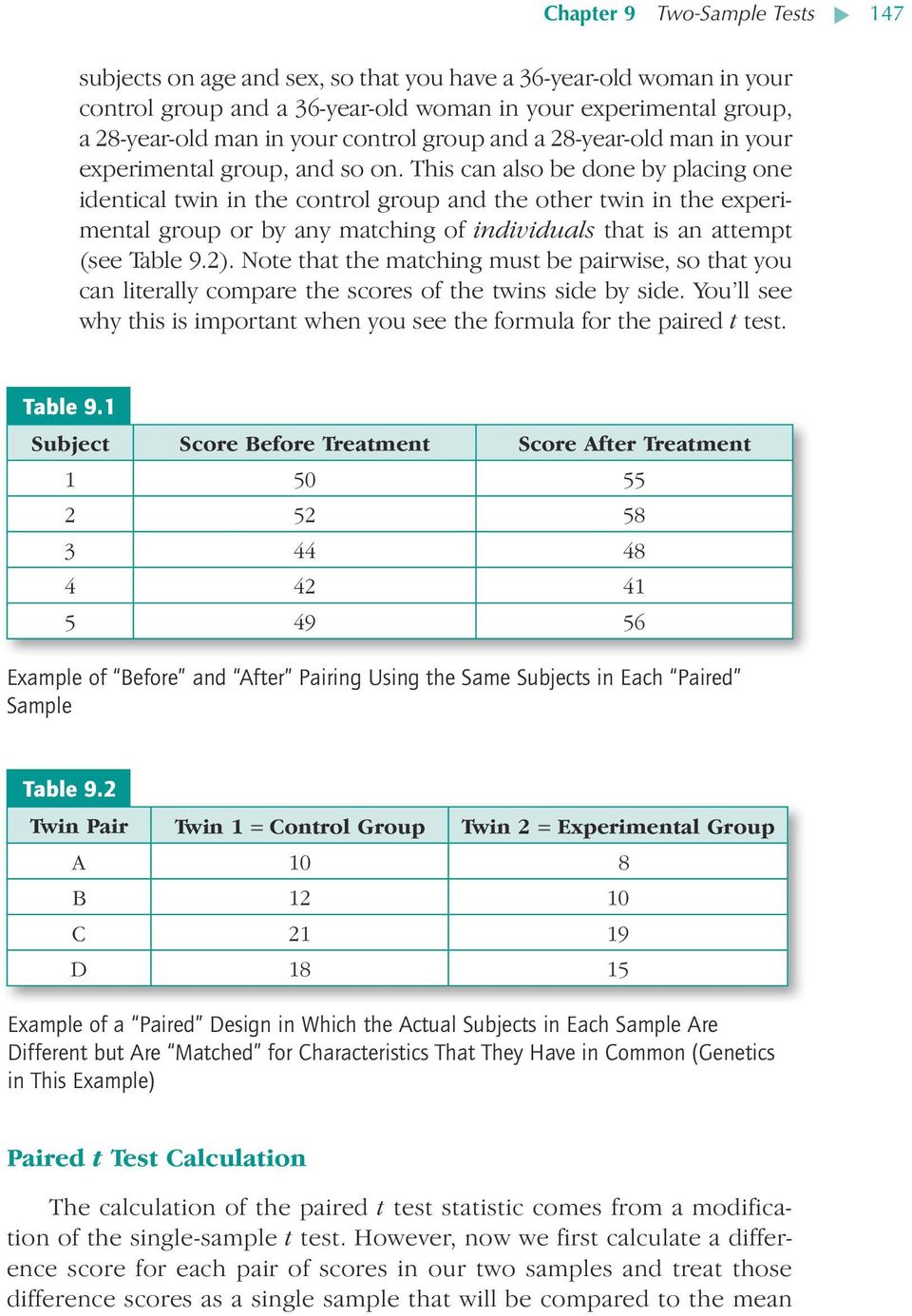
3 Chapter 9 Two-Sample Tests 147 subjects on age and sex, so that you have a 36-year-old woman in your control group and a 36-year-old woman in your experimental group, a 28-year-old man in your control group and a 28-year-old man in your experimental group, and so on. This can also be done by placing one identical twin in the control group and the other twin in the experimental group or by any matching of individuals that is an attempt (see Table 9.2). Note that the matching must be pairwise, so that you can literally compare the scores of the twins side by side. You ll see why this is important when you see the formula for the paired t test. Table 9.1 Subject Score Before Treatment Score After Treatment Example of Before and After Pairing Using the Same Subjects in Each Paired Sample Table 9.2 Twin Pair Twin 1 = Control Group Twin 2 = Experimental Group A 10 8 B C D Example of a Paired Design in Which the Actual Subjects in Each Sample Are Different but Are Matched for Characteristics That They Have in Common (Genetics in This Example) Paired t Test Calculation The calculation of the paired t test statistic comes from a modification of the single-sample t test. However, now we first calculate a difference score for each pair of scores in our two samples and treat those difference scores as a single sample that will be compared to the mean
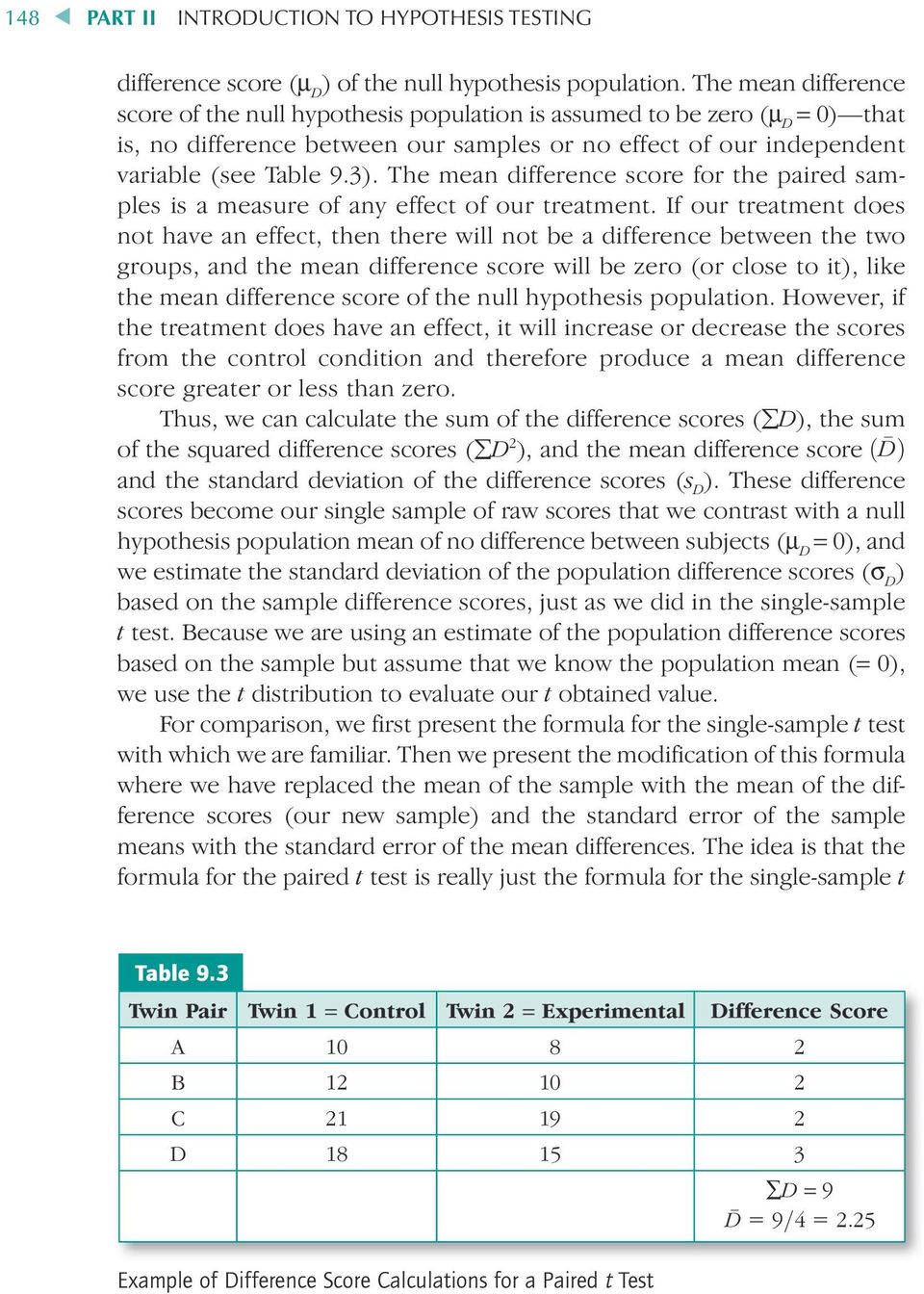
4 148 Part II Introduction to Hypothesis Testing difference score (m D ) of the null hypothesis population. The mean difference score of the null hypothesis population is assumed to be zero (m D = 0) that is, no difference between our samples or no effect of our independent variable (see Table 9.3). The mean difference score for the paired samples is a measure of any effect of our treatment. If our treatment does not have an effect, then there will not be a difference between the two groups, and the mean difference score will be zero (or close to it), like the mean difference score of the null hypothesis population. However, if the treatment does have an effect, it will increase or decrease the scores from the control condition and therefore produce a mean difference score greater or less than zero. Thus, we can calculate the sum of the difference scores ( D), the sum of the squared difference scores ( D 2 ), and the mean difference score ðd Þ and the standard deviation of the difference scores (s D ). These difference scores become our single sample of raw scores that we contrast with a null hypothesis population mean of no difference between subjects (m D = 0), and we estimate the standard deviation of the population difference scores (s D ) based on the sample difference scores, just as we did in the single-sample t test. Because we are using an estimate of the population difference scores based on the sample but assume that we know the population mean (= 0), we use the t distribution to evaluate our t obtained value. For comparison, we first present the formula for the single-sample t test with which we are familiar. Then we present the modification of this formula where we have replaced the mean of the sample with the mean of the difference scores (our new sample) and the standard error of the sample means with the standard error of the mean differences. The idea is that the formula for the paired t test is really just the formula for the single-sample t Table 9.3 Twin Pair Twin 1 = Control Twin 2 = Experimental Difference Score A B C D D = 9 D 5 9=4 5 2:25 Example of Difference Score Calculations for a Paired t Test
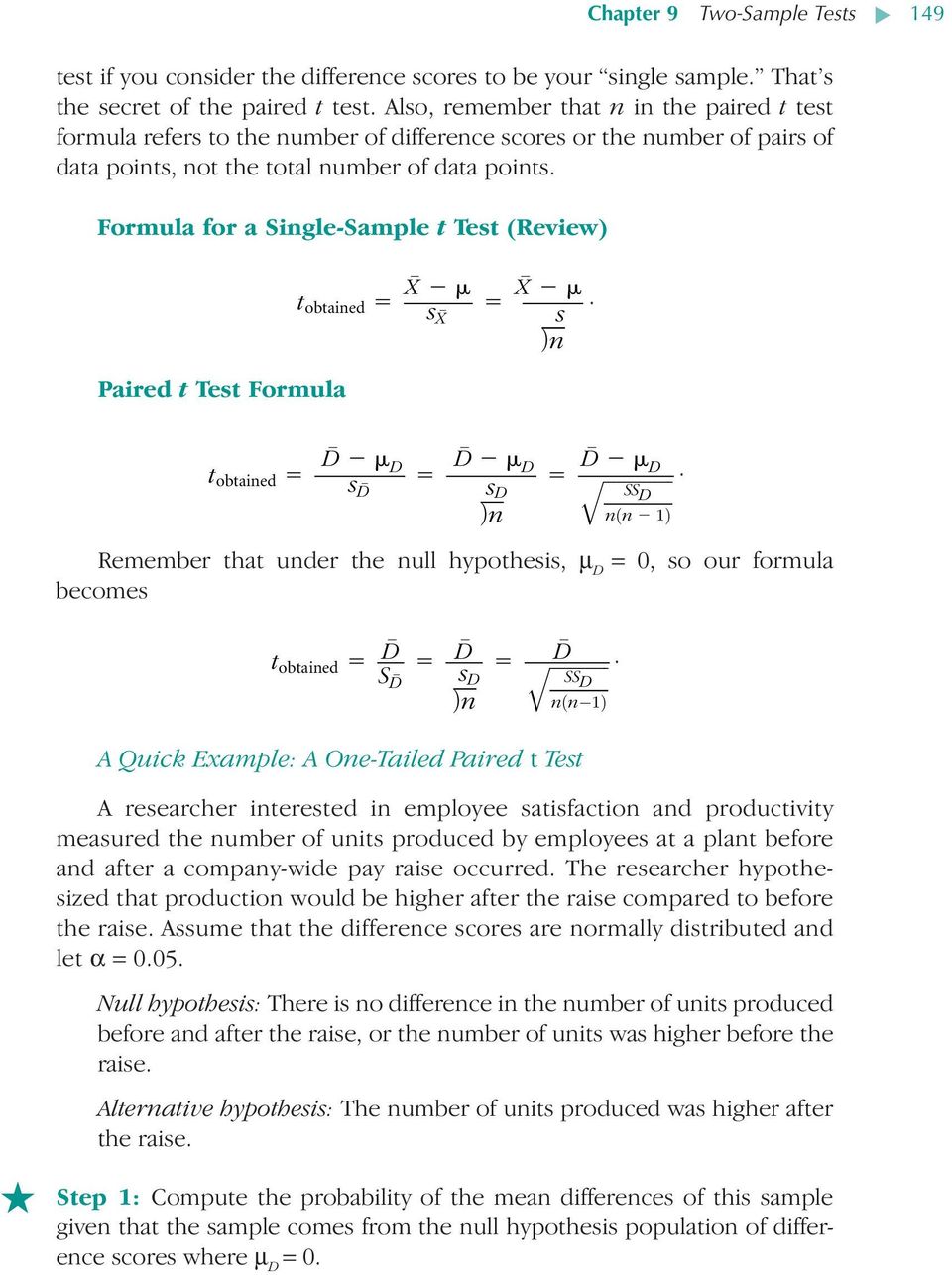
5 Chapter 9 Two-Sample Tests 149 test if you consider the difference scores to be your single sample. That s the secret of the paired t test. Also, remember that n in the paired t test formula refers to the number of difference scores or the number of pairs of data points, not the total number of data points. Formula for a Single-Sample t Test (Review) t obtained 5 X 2 m s X X 5 2 m. s Þn Paired t Test Formula t obtained 5 D 2 m D s D D 5 2 m D D s 5 2 m q ffiffiffiffiffiffiffiffiffiffiffiffiffiffi D. D SS D Þn nðn 2 1Þ Remember that under the null hypothesis, m D = 0, so our formula becomes t obtained 5 D S D 5 D s D 5 Þn q ffiffiffiffiffiffiffiffiffiffiffiffi D. SS D nðn1þ A Quick Example: A One-Tailed Paired t Test A researcher interested in employee satisfaction and productivity measured the number of units produced by employees at a plant before and after a company-wide pay raise occurred. The researcher hypothesized that production would be higher after the raise compared to before the raise. Assume that the difference scores are normally distributed and let a = Null hypothesis: There is no difference in the number of units produced before and after the raise, or the number of units was higher before the raise. Alternative hypothesis: The number of units produced was higher after the raise. Step 1: Compute the probability of the mean differences of this sample given that the sample comes from the null hypothesis population of difference scores where m D = 0.
6 150 Part II Introduction to Hypothesis Testing Calculate the difference scores and the intermediate numbers for the SS formula: Participants Before After Difference Score D D = -2 n = 9 D 5 2=9 520: D 2 = 4 Calculate the standard deviation of the sample: SS D 5 +D 2 2 +D 2 n ð22þ : : rffiffiffiffiffiffiffiffiffiffiffiffiffiffiffiffi rffiffiffiffiffiffiffiffiffiffiffiffiffiffi SS s D 5 D 3:5555 p 5 5 ffiffiffiffiffiffiffiffiffiffiffiffiffiffiffiffiffiffiffiffiffi 0: : ðn 1Þ Apply the formula to our example: t 5 D 2 m D. s D Þn t 5 20: : pffiffi :2222 0: : Step 2: Evaluate the probability of obtaining this score due to chance. Evaluate the t-obtained value based on alpha (a) = 0.05 and a one-tailed hypothesis. To evaluate your t-obtained value, you must use the t distribution (Table B in the Appendix) as you did in the last chapter. To determine your t-critical value, you need to know your alpha level (0.05), the number

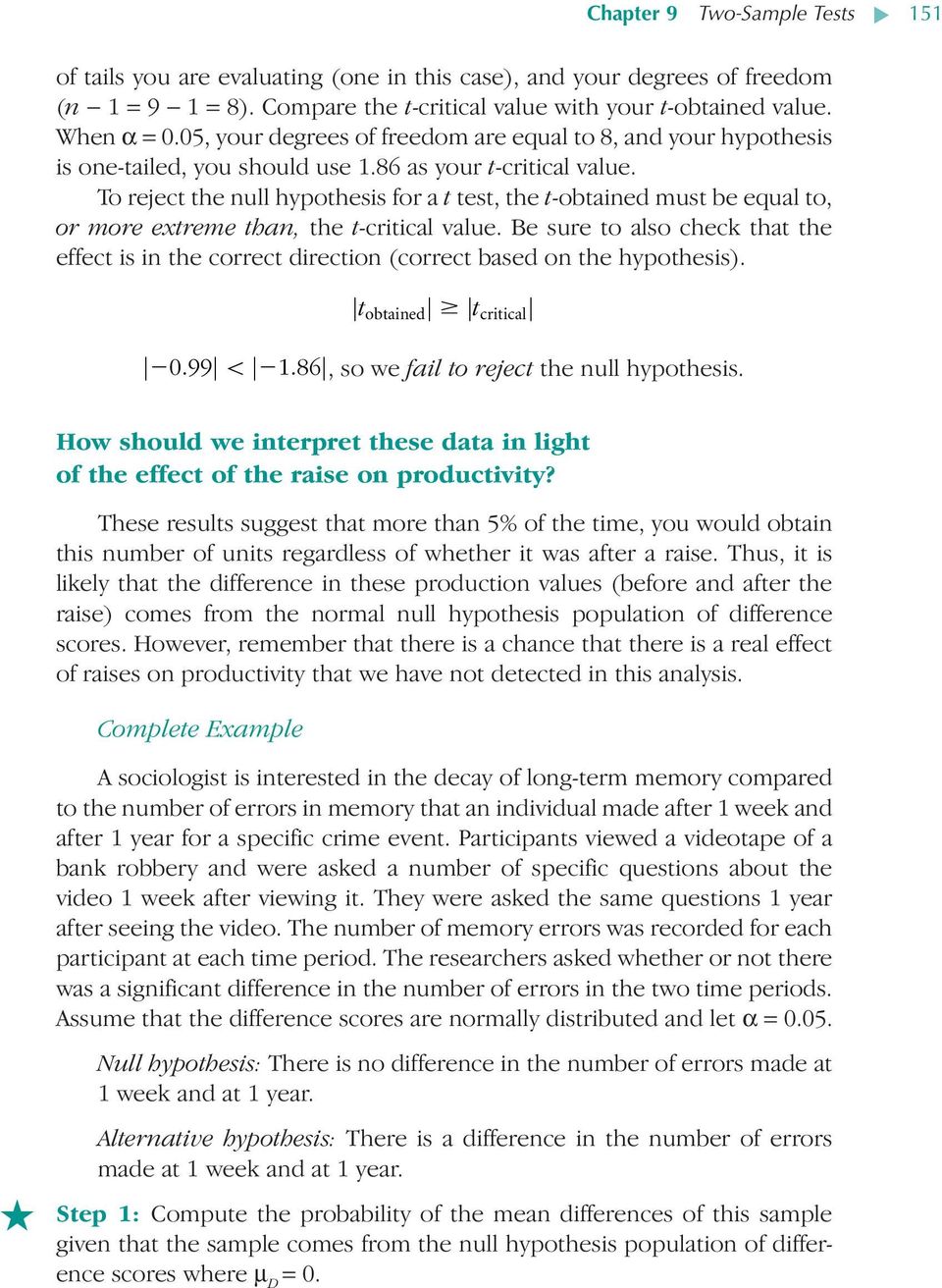
7 Chapter 9 Two-Sample Tests 151 of tails you are evaluating (one in this case), and your degrees of freedom (n - 1 = 9-1 = 8). Compare the t-critical value with your t-obtained value. When a = 0.05, your degrees of freedom are equal to 8, and your hypothesis is one-tailed, you should use 1.86 as your t-critical value. To reject the null hypothesis for a t test, the t-obtained must be equal to, or more extreme than, the t-critical value. Be sure to also check that the effect is in the correct direction (correct based on the hypothesis). jt obtained j $ jt critical j j20:99j \ j21:86j, so we fail to reject the null hypothesis. How should we interpret these data in light of the effect of the raise on productivity? These results suggest that more than 5% of the time, you would obtain this number of units regardless of whether it was after a raise. Thus, it is likely that the difference in these production values (before and after the raise) comes from the normal null hypothesis population of difference scores. However, remember that there is a chance that there is a real effect of raises on productivity that we have not detected in this analysis. Complete Example A sociologist is interested in the decay of long-term memory compared to the number of errors in memory that an individual made after 1 week and after 1 year for a specific crime event. Participants viewed a videotape of a bank robbery and were asked a number of specific questions about the video 1 week after viewing it. They were asked the same questions 1 year after seeing the video. The number of memory errors was recorded for each participant at each time period. The researchers asked whether or not there was a significant difference in the number of errors in the two time periods. Assume that the difference scores are normally distributed and let a = Null hypothesis: There is no difference in the number of errors made at 1 week and at 1 year. Alternative hypothesis: There is a difference in the number of errors made at 1 week and at 1 year. Step 1: Compute the probability of the mean differences of this sample given that the sample comes from the null hypothesis population of difference scores where m D = 0.
8 152 Part II Introduction to Hypothesis Testing Calculate the difference scores and the intermediate numbers for the SS formula: Subject One Week One Year Difference Score D D = -8 n = 9 D 528=9 520:8888 D 2 = 18 Calculate the standard deviation of the sample: SS D 5 +D 2 2 +D 2 n ð28þ : : rffiffiffiffiffiffiffiffiffiffiffiffiffiffiffiffi rffiffiffiffiffiffiffiffiffiffiffiffiffiffiffiffi SS S D 5 D 5 10:8888 p 5 ffiffiffiffiffiffiffiffiffiffiffiffiffiffiffiffi 1: : ðn 1Þ Apply the formula to our example: t 5 20: :16666 pffiffi 9 D t 5 2 m D. s D Þn 5 20:8888 0: :2855. Step 2: Evaluate the probability of obtaining this score due to chance. Evaluate the t-obtained value based on alpha (a) = 0.05 and a two-tailed hypothesis. To evaluate your t-obtained value, you must use the t distribution (Table B) as you did in Chapter 8. To determine your t-critical value, you need to know your alpha level (0.05), the number of tails you are evaluating

9 Chapter 9 Two-Sample Tests 153 (two in this case), and your degrees of freedom (n - 1 = 9-1 = 8). Compare the t-critical value with your t-obtained value. When a = 0.05, your degrees of freedom are equal to 8, and your hypothesis is two-tailed, you should use as your t-critical value. To reject the null hypothesis for a two-tailed test, the absolute value of t obtained must be equal to, or more extreme than, the t-critical value. jt obtained j $ jt critical j j22:2855j # j2:306j, so we fail to reject the null hypothesis. How should we interpret these data in light of the effect of time on the number of memory errors? These results suggest that more than 5% of the time, you would obtain this number of memory errors regardless of whether it was after 1 week or 1 year. Thus, it is likely that these memory error differences come from the normal null hypothesis population of difference scores. However, remember that there is a chance that there is a real effect of time on memory errors that we have not detected in this analysis. Results if you use Microsoft Excel to calculate the t test: One Week One Year Mean Variance Observations 9 9 Pearson Correlation Hypothesized Mean Difference 0 Df 8 t Stat P(T<=t) one-tail t Critical one-tail P(T<=t) two-tail t Critical two-tail t-test: Paired Two Sample for Means
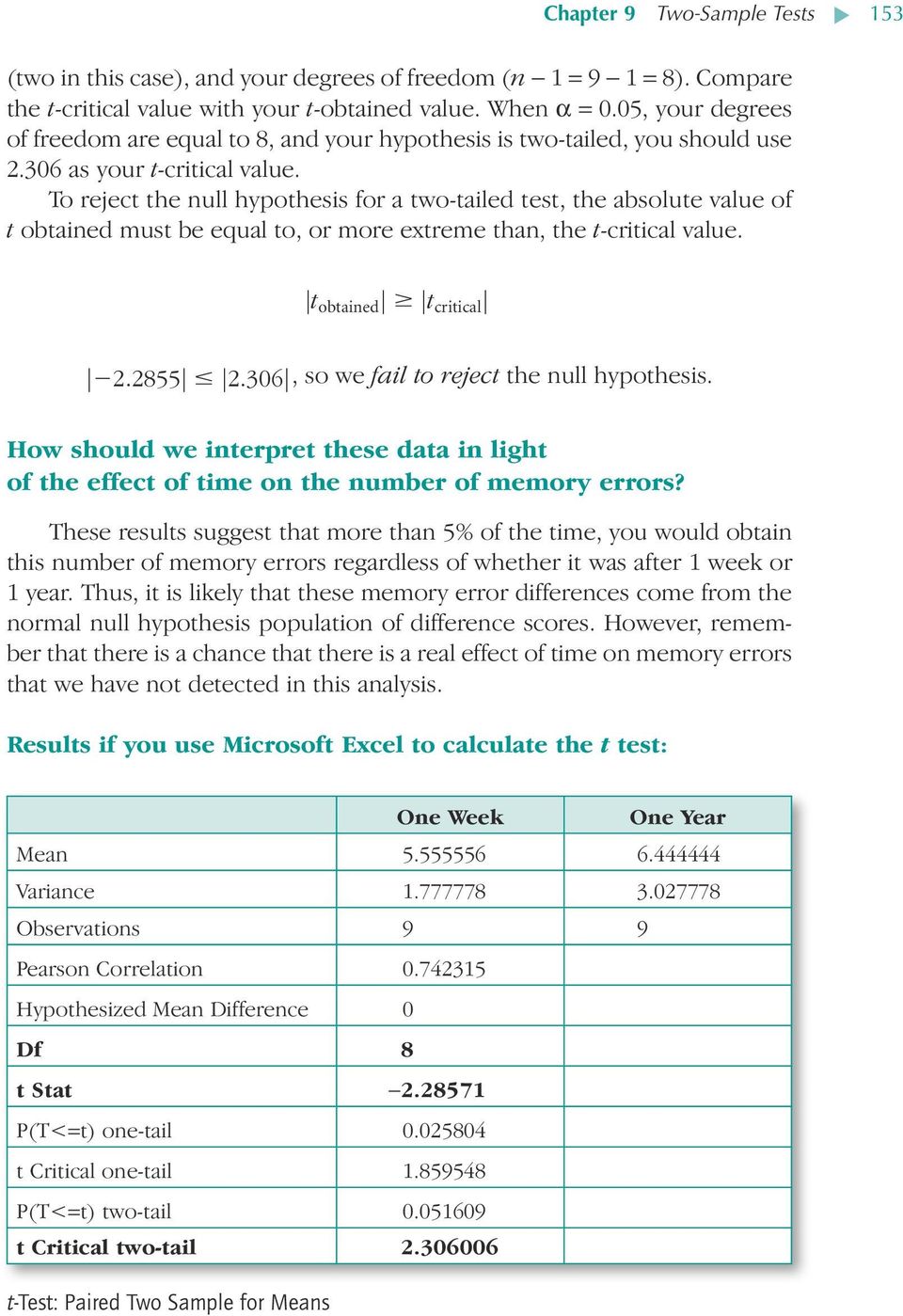
10 154 Part II Introduction to Hypothesis Testing This is the output that you get from Excel when you type in these data for 1 week and 1 year. Note that Excel calls this test t-test: Paired Two Sample for Means. This wording is slightly different from what we have been using, but it is describing the same analysis. We have bolded the numbers that are comparable to the numbers we just manually calculated or looked up in the table. Note that the t-obtained value (Excel calls it t Stat ) is identical to ours, except they have carried more digits ( ). The t Critical two-tail is also the same ( ), but again they have carried more digits. The degrees of freedom are the same (8). But they have also provided you with the estimated probability of obtaining a t value (t Stat) of , which is Since > 0.05, we clearly cannot reject our null hypothesis. Thus, we fail to reject the null hypothesis. These results suggest that % of the time you would obtain this number of memory errors regardless of whether it was after 1 week or 1 year. Knowing the estimated probability for each and every t-obtained value (not just the t-critical values) is one of the major advantages of using a computer to calculate your analyses. Knowing the calculated probability in this case (p =.052) raises another issue:.052 is pretty close to our critical probability of.050. Our results suggest that there is a 5.16% chance that any differences were due to chance, as opposed to our critical level of 5.00%. Many researchers would present these results as significant even though the probability technically exceeds the critical level. The point is that there is nothing magical about the critical alpha value of 0.05, 0.01, or whatever value is chosen: Nothing special happens between p =.052 and p =.049. We have to use some common sense and knowledge of the system being studied to decide whether we are convinced that a real effect was demonstrated. This is an important point in critical thinking about statistics. Results if you use SPSS to calculate the t test: Paired Differences t df Sig. (2-tailed) Mean Std. Deviation Std. Error Mean 95% Confidence Interval of the Difference Pair 1 ONEWEEK ONEYEAR Lower Upper E Paired Samples Test

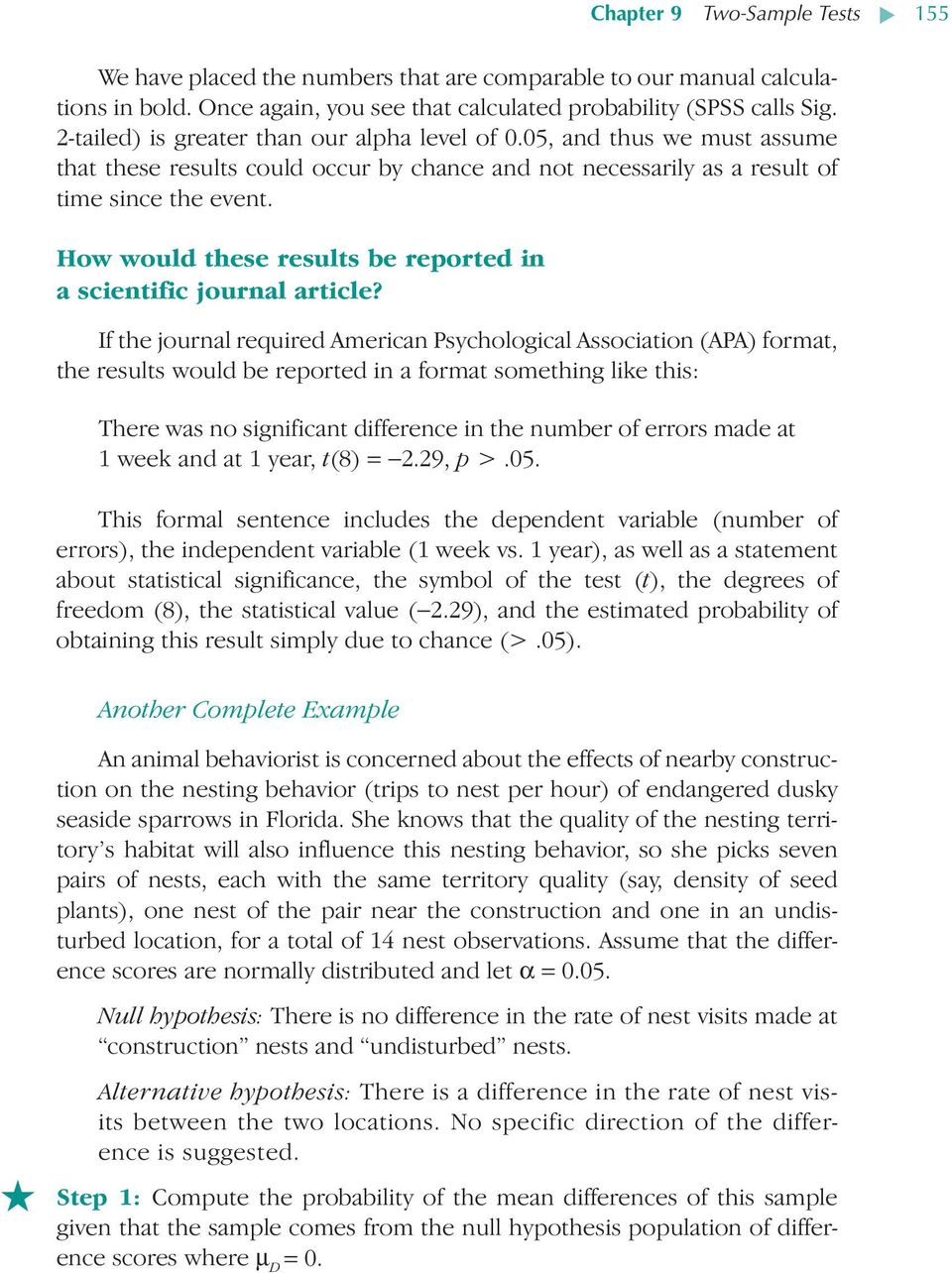
11 Chapter 9 Two-Sample Tests 155 We have placed the numbers that are comparable to our manual calculations in bold. Once again, you see that calculated probability (SPSS calls Sig. 2-tailed) is greater than our alpha level of 0.05, and thus we must assume that these results could occur by chance and not necessarily as a result of time since the event. How would these results be reported in a scientific journal article? If the journal required American Psychological Association (APA) format, the results would be reported in a format something like this: There was no significant difference in the number of errors made at 1 week and at 1 year, t(8) = -2.29, p >.05. This formal sentence includes the dependent variable (number of errors), the independent variable (1 week vs. 1 year), as well as a statement about statistical significance, the symbol of the test (t), the degrees of freedom (8), the statistical value (-2.29), and the estimated probability of obtaining this result simply due to chance (>.05). Another Complete Example An animal behaviorist is concerned about the effects of nearby construction on the nesting behavior (trips to nest per hour) of endangered dusky seaside sparrows in Florida. She knows that the quality of the nesting territory s habitat will also influence this nesting behavior, so she picks seven pairs of nests, each with the same territory quality (say, density of seed plants), one nest of the pair near the construction and one in an undisturbed location, for a total of 14 nest observations. Assume that the difference scores are normally distributed and let a = Null hypothesis: There is no difference in the rate of nest visits made at construction nests and undisturbed nests. Alternative hypothesis: There is a difference in the rate of nest visits between the two locations. No specific direction of the difference is suggested. Step 1: Compute the probability of the mean differences of this sample given that the sample comes from the null hypothesis population of difference scores where m D = 0.
12 156 Part II Introduction to Hypothesis Testing Calculate the difference scores and the intermediate numbers for the SS formula: Matched Pair Undisturbed Construction Difference Score D Rate of Nest Visits Per Hour D = 8.4 n = 7 D 5 8:4=7 5 1:2 D 2 = Calculate the standard deviation of the sample: SS D 5 +D 2 2 +D 2 n 5 17:02 2 ð8:4þ : :08 5 6:94. rffiffiffiffiffiffiffiffiffiffiffiffiffiffiffiffi rffiffiffiffiffiffiffiffiffiffiffiffi SS S D 5 D 5 6:94 p 5 ffiffiffiffiffiffiffiffiffiffiffiffiffiffiffiffi 1: : ðn 1Þ Apply the formula to our example: D t 5 2 m D s D. pffiffi n t 5 1: :2 1:07548 pffiffi 0: : Step 2: Evaluate the probability of obtaining this score due to chance. Evaluate the t-obtained value based on alpha (a) = 0.05 and a two-tailed hypothesis. To evaluate your t-obtained value, you must use the t distribution (Table B) as you did in Chapter 8. To determine your t-critical value, you need to know your alpha level (0.05), the number of tails you are evaluating

13 Chapter 9 Two-Sample Tests 157 (two in this case), and your degrees of freedom (n - 1 = 7-1 = 6). Compare the t-critical value with your t-obtained value. When a = 0.05, your degrees of freedom are equal to 6, and your hypothesis is two-tailed, you should use ±2.447 as your t-critical value. To reject the null hypothesis for a two-tailed test, the absolute value of t obtained must be equal to, or more extreme than, the t-critical value. jt obtained j $ jt critical j j2:952j $ j2:447j, so we reject the null hypothesis. How should we interpret these data in light of the effect of construction on the rate of nest visits? These results suggest that less than 5% of the time, you would obtain this rate of nest visits regardless of whether it was near or not near to the construction site. Thus, it is likely that the rate of nest visits near the construction site does not come from the same underlying population of scores as the nest site visits away from the construction site, and therefore, the difference scores in this example do not represent a null hypothesis population of difference scores. However, remember that there is a chance (however small) that there is, in reality, no real effect of the construction on nest site visits, and our conclusion is in error. Results if you use Microsoft Excel to calculate the t test: Undisturbed Construction Mean Variance Observations 7 7 Pearson Correlation Hypothesized Mean Difference 0 Df 6 t Stat P(T<=t) one-tail t Critical one-tail P(T<=t) two-tail t Critical two-tail t-test: Paired Two Sample for Means
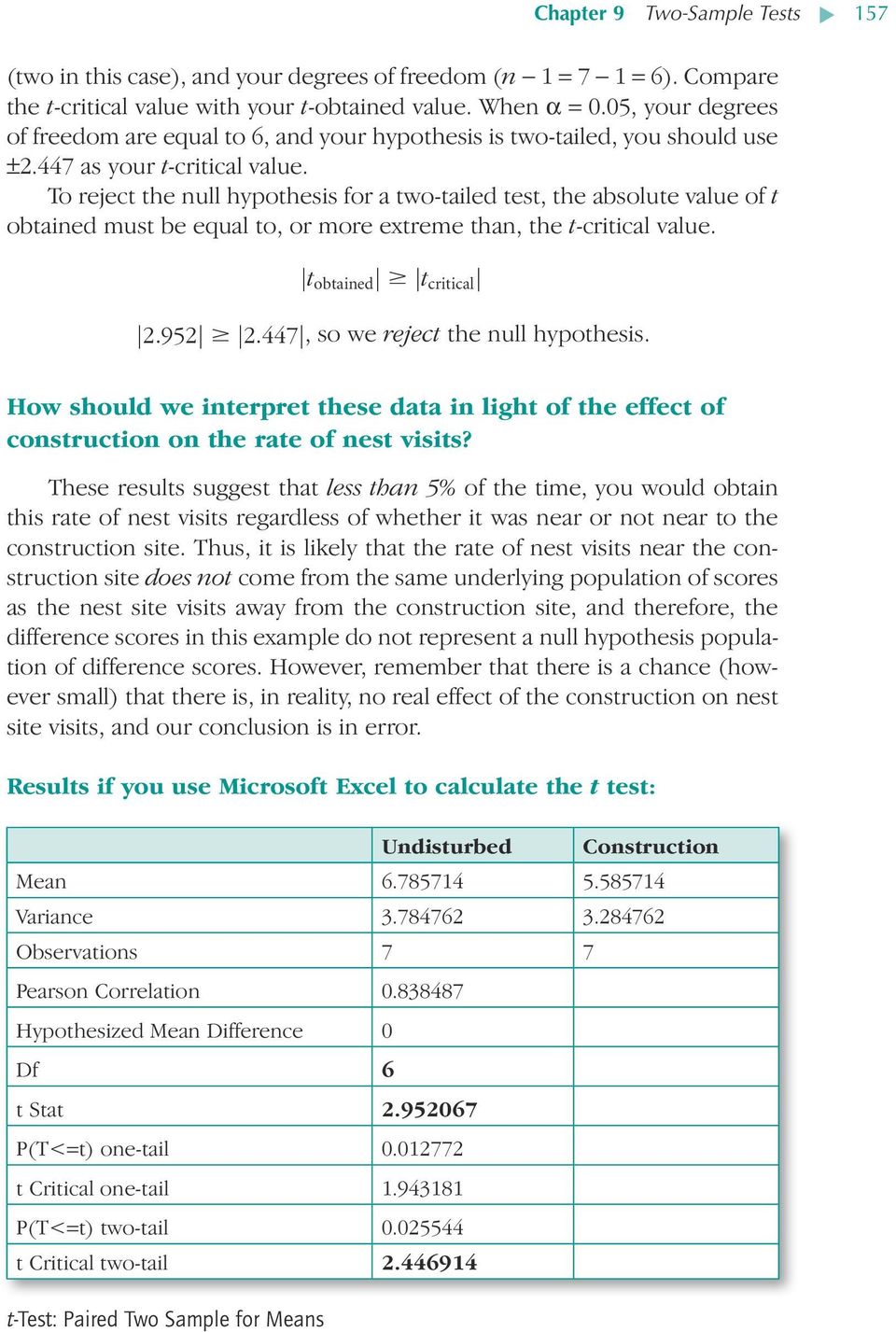
14 158 Part II Introduction to Hypothesis Testing This is the output that you get from Excel when you type in these data for undisturbed and construction sites. Once again, we have bolded the numbers that are comparable to the numbers we just manually calculated or looked up in the table. Note again that the t-obtained value is identical to ours, except they have carried more digits. The t Critical two-tail is also the same, but again they have carried more digits. The degrees of freedom are the same (6). But they have also provided the calculated probability of obtaining a t value (t Stat) of , which is Since < 0.05, we can reject our null hypothesis. Thus, we reject the null hypothesis. These results suggest that % of the time, you would be making a mistake in concluding that there was a real effect of the construction on nest site visits. Traditionally, we are willing to accept a 5% probability of making such a mistake. Again, knowing the calculated probability for each t-obtained value (not just the t-critical values) is one of the major advantages of using a computer to calculate your analyses. Results if you use SPSS to calculate the t test: Paired Differences t df Sig. (2-tailed) Mean Std. Deviation Std. Error Mean 95% Confidence Interval of the Difference Lower Upper Pair 1 UNDISTUR CONSTRUC Paired Samples Test Once again, we have placed the numbers that are comparable to our manual calculations in bold. And once again, you see that calculated probability (.026: SPSS calls it Sig. 2-tailed ) is less than our alpha level of 0.05, and thus we must assume that these results are unlikely due to chance and thus are more likely a result of time since the event. How would these results be reported in a scientific journal article? If the journal required APA format, the results would be reported in a format something like this:

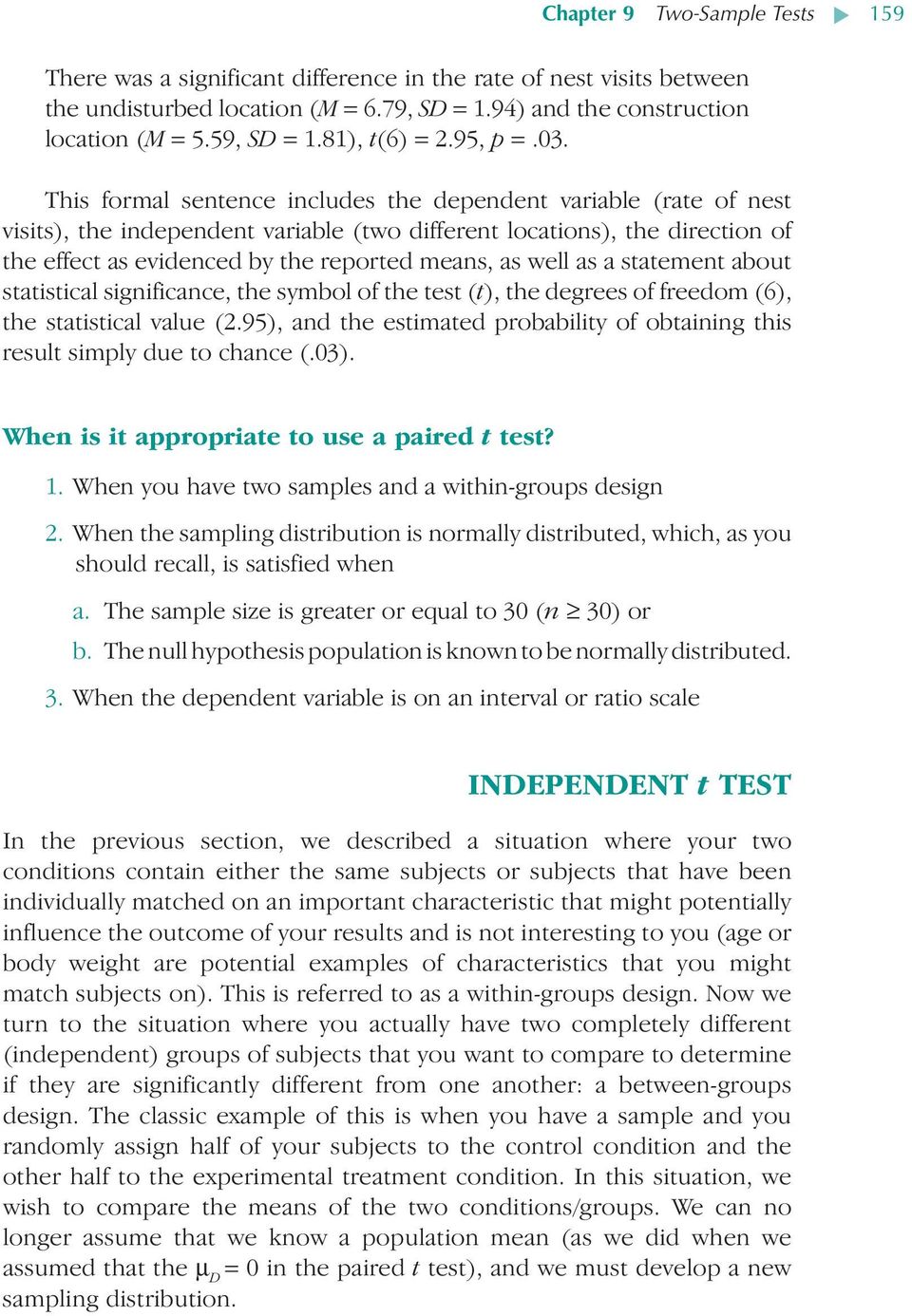
15 Chapter 9 Two-Sample Tests 159 There was a significant difference in the rate of nest visits between the undisturbed location (M = 6.79, SD = 1.94) and the construction location (M = 5.59, SD = 1.81), t(6) = 2.95, p =.03. This formal sentence includes the dependent variable (rate of nest visits), the independent variable (two different locations), the direction of the effect as evidenced by the reported means, as well as a statement about statistical significance, the symbol of the test (t), the degrees of freedom (6), the statistical value (2.95), and the estimated probability of obtaining this result simply due to chance (.03). When is it appropriate to use a paired t test? 1. When you have two samples and a within-groups design 2. When the sampling distribution is normally distributed, which, as you should recall, is satisfied when a. The sample size is greater or equal to 30 (n 30) or b. The null hypothesis population is known to be normally distributed. 3. When the dependent variable is on an interval or ratio scale Independent t Test In the previous section, we described a situation where your two conditions contain either the same subjects or subjects that have been individually matched on an important characteristic that might potentially influence the outcome of your results and is not interesting to you (age or body weight are potential examples of characteristics that you might match subjects on). This is referred to as a within-groups design. Now we turn to the situation where you actually have two completely different (independent) groups of subjects that you want to compare to determine if they are significantly different from one another: a between-groups design. The classic example of this is when you have a sample and you randomly assign half of your subjects to the control condition and the other half to the experimental treatment condition. In this situation, we wish to compare the means of the two conditions/groups. We can no longer assume that we know a population mean (as we did when we assumed that the m D = 0 in the paired t test), and we must develop a new sampling distribution.
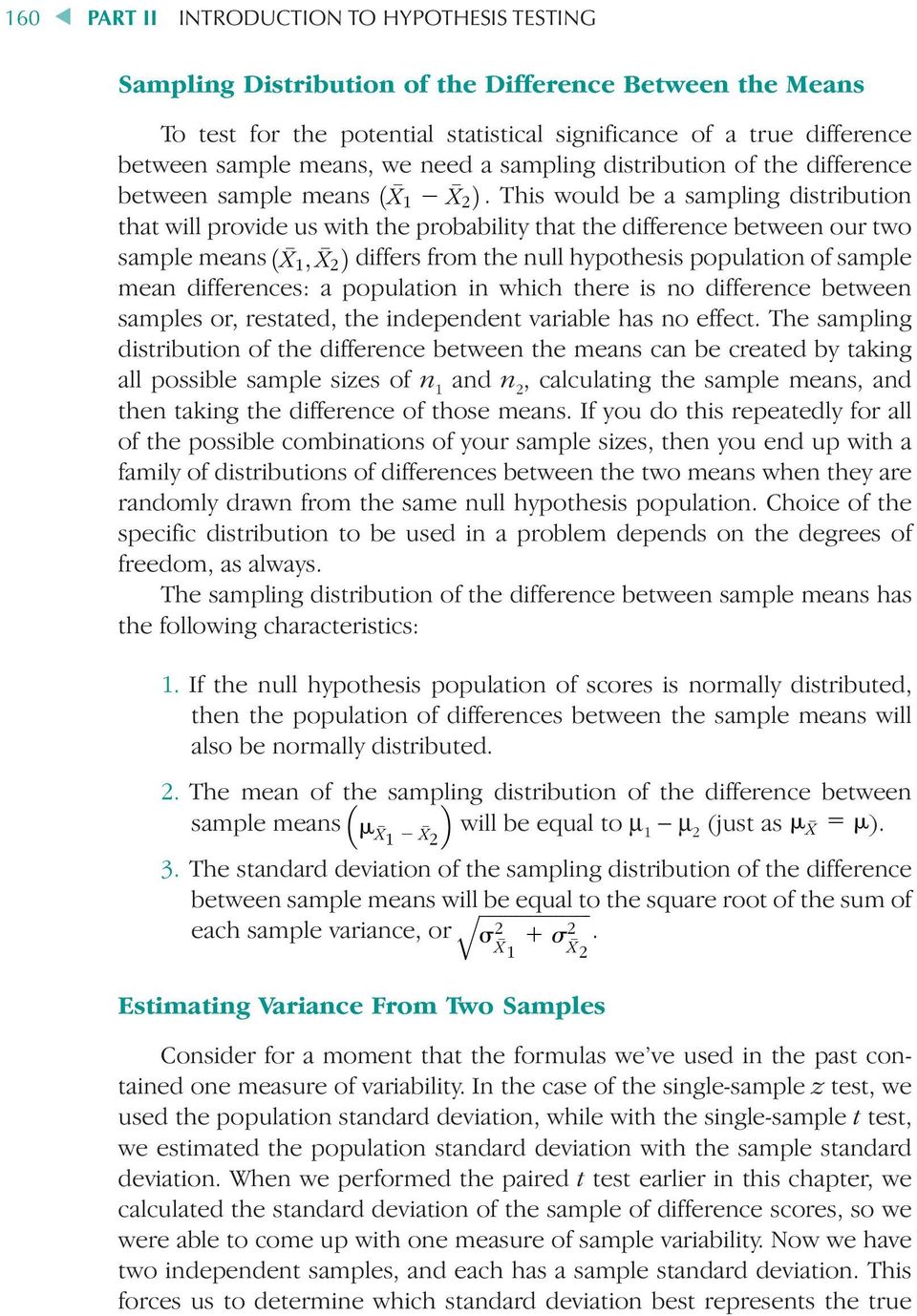
16 160 Part II Introduction to Hypothesis Testing Sampling Distribution of the Difference Between the Means To test for the potential statistical significance of a true difference between sample means, we need a sampling distribution of the difference between sample means ðx 1 2 X 2 Þ. This would be a sampling distribution that will provide us with the probability that the difference between our two sample means ðx 1 ; X 2 Þ differs from the null hypothesis population of sample mean differences: a population in which there is no difference between samples or, restated, the independent variable has no effect. The sampling distribution of the difference between the means can be created by taking all possible sample sizes of n 1 and n 2, calculating the sample means, and then taking the difference of those means. If you do this repeatedly for all of the possible combinations of your sample sizes, then you end up with a family of distributions of differences between the two means when they are randomly drawn from the same null hypothesis population. Choice of the specific distribution to be used in a problem depends on the degrees of freedom, as always. The sampling distribution of the difference between sample means has the following characteristics: 1. If the null hypothesis population of scores is normally distributed, then the population of differences between the sample means will also be normally distributed. 2. The mean of the sampling distribution of the difference between sample means mx 1 2 X will be equal to m1 - m 2 2 (just as mx 5 m). 3. The standard deviation of the sampling distribution of the difference between sample means will qffiffiffiffiffiffiffiffiffiffiffiffiffiffiffiffiffiffiffiffiffiffi be equal to the square root of the sum of each sample variance, or s 2 1 s X 2. 1 X 2 Estimating Variance From Two Samples Consider for a moment that the formulas we ve used in the past contained one measure of variability. In the case of the single-sample z test, we used the population standard deviation, while with the single-sample t test, we estimated the population standard deviation with the sample standard deviation. When we performed the paired t test earlier in this chapter, we calculated the standard deviation of the sample of difference scores, so we were able to come up with one measure of sample variability. Now we have two independent samples, and each has a sample standard deviation. This forces us to determine which standard deviation best represents the true
17 Chapter 9 Two-Sample Tests 161 variability. In fact, what we do is to estimate the true population variability (or variance, s 2 ) by taking the average variance (s 2 ) of our samples but weighted by their respective sample sizes. Remember, as we learned in earlier chapters, sample size or degrees of freedom affects the accuracy of our variance estimates, so an estimate from a sample with a large sample size would be more accurate than an estimated variance from a smaller sample. So we need to weight our average variance by the respective sample sizes of each sample. In using this approach, we are going to make a new assumption that the sample variances are estimating the same underlying population variance, the variance of the null hypothesis population. Later in this chapter, we will have to make sure that our two sample variances are the same, within the bounds of random sampling error. This is referred to as the homogeneity of variance assumption. Formula for Weighted Variance: s 2 w 5 df 1s df 2s 2 2 df 1 1 df 2. Substituting the equation for degrees of freedom and for variance: 5 ðn 1 2 1ÞðSS 1 =n 1 2 1Þ 1 ðn 2 2 1ÞðSS 2 =n 2 2 1Þ :. ðn 1 2 1Þ 1 ðn 2 2 1Þ Rearranging to simplify: 5 SS 1 1 SS 2 n 1 1 n 2 22 :. We have shown the formula in three different ways. The first way is the most intuitive way to present the average variance of the two samples when it is weighted by the sample size or, more specifically, by the appropriate degrees of freedom for each sample. The degrees of freedom are used because we are estimating the population variation from a sample, and thus one degree of freedom is lost each time we do that (one for each sample). The second formula actually plugs in the appropriate formulas for variance and degrees of freedom into the first formula, and the last formula is created by algebraic rearrangement into a simplified version. The first formula may be the best one to use if you are obtaining each sample variance from your calculator directly from these raw data or if you are given either variance or standard deviation of each sample in a problem. The last formula would be best if you have already calculated the sums of squares (SS) for each group.

18 162 Part II Introduction to Hypothesis Testing Derivation of the Independent t Test Formula From the Single- Sample t Test Formula Formula for a single-sample t test (for review): X t obtained 5 2 m. Conceptual formula for an independent t test: t obtained 5 ð X 1 2 X 2 Þ 2 mx 1 2 X rffiffiffiffiffiffiffiffiffiffiffiffiffiffiffiffiffi 2 5 ð X 1 2 X 2 Þ 2 mx 1 2 X p ffiffiffiffiffiffiffiffiffiffiffiffiffiffiffiffiffiffiffiffiffiffiffiffiffiffiffiffiffiffiffiffiffiffiffi 2. : s 2 ð1=n 1 1 1=n 2 Þ s 2 1 n 1 1 s2 2 n 2 p s ffiffi n Calculation (practical) formula to use for an independent t test: t obtained 5 X 1 2 X p ffiffiffiffiffiffiffiffiffiffiffiffiffiffiffiffiffiffiffiffiffiffiffiffiffiffiffiffiffiffiffiffiffiffi 2. s 2 w ð1=n 1 1 1=n 2 Þ The formula for an independent t test is derived by assuming the mean of the sampling distribution or differences between means is zero for the null hypothesis population and by using the average variance divided by each sample size. The square root in the denominator of the independent t test formula is there not only to take the square root of the sample size (as you did when you calculated a single-sample t test) but also because you are working in squared units (variance), and we must take the square root of the variance to get back to the standard deviation. Variations of the Independent t Test Formula All-purpose formulas: t obtained 5 X 1 2 X ffiffiffiffiffiffiffiffiffiffiffiffiffiffiffiffiffiffiffiffiffiffiffiffiffiffiffiffiffiffiffiffiffiffi 2 X p s 2 w ð1=n X rffiffiffiffiffiffiffiffiffiffiffiffiffiffiffiffiffiffiffiffiffiffiffiffiffi =n 2 Þ ð1=n 1 1 1=n 2 Þ SS 1 1 SS 2 n 1 1 n To create the second variation of the formula, we simply substituted the formula for s 2 directly into the independent t test formula. w Formula to be used only when n 1 = n 2 : t obtained 5 r X 1 2 X ffiffiffiffiffiffiffiffiffiffiffiffiffiffiffiffiffiffiffiffiffi 2. SS 1 1 SS 2 nðn 2 1Þ

19 A Quick One-Tailed Example of an Independent t Test Chapter 9 Two-Sample Tests 163 A researcher breeds rats for nine generations but only breeds the rats that perform very well in a maze (few errors) to each other (called mazebright rats) and also breeds rats that perform very poorly in a maze (many errors) to one another ( maze-dull rats). After nine generations, is there a significant decrease in the number of errors of the maze-bright rats? Null hypothesis: There is no difference in the number of errors made by the maze-bright and the maze-dull rats or there are more errors in the maze-bright rats. Alternative hypothesis: There is a significant decrease in the number of errors of the maze-bright rats. Step 1: Compute the probability that each of the sample means comes from the null hypothesis population of differences between means. Calculate the means and the intermediate numbers for the SS formula: Maze-Bright Rats Maze-Dull Rats X BRIGHT X DULL X BRIGHT Þ X DULL Þ X 2 BRIGHT X2 DULL X BRIGHT X DULL :8 Number of Errors in a Maze by Ninth-Generation Rats Calculate the SS of each sample: SS BRIGHT 5 +X 2 2 +X 2 n ð18þ
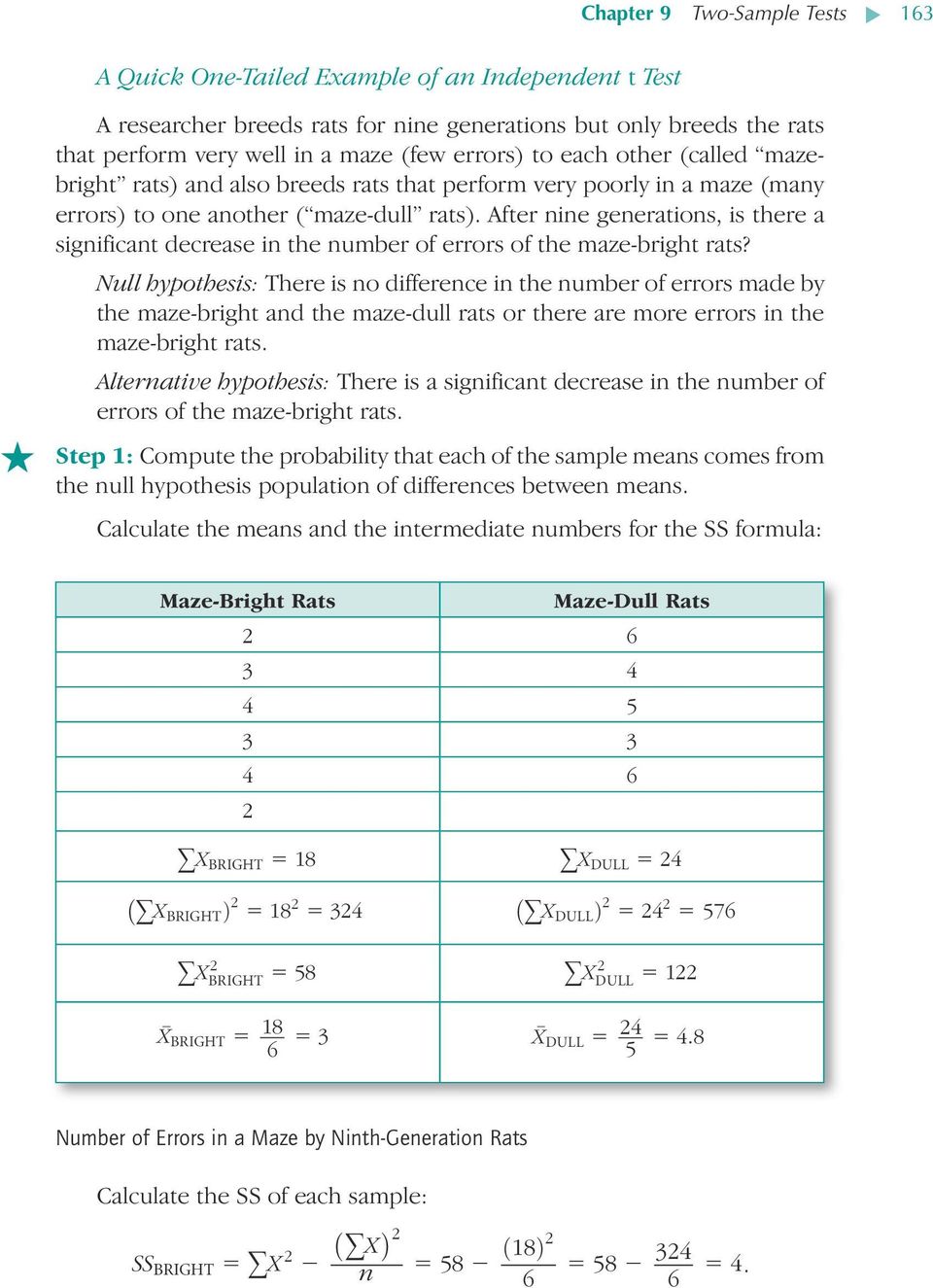
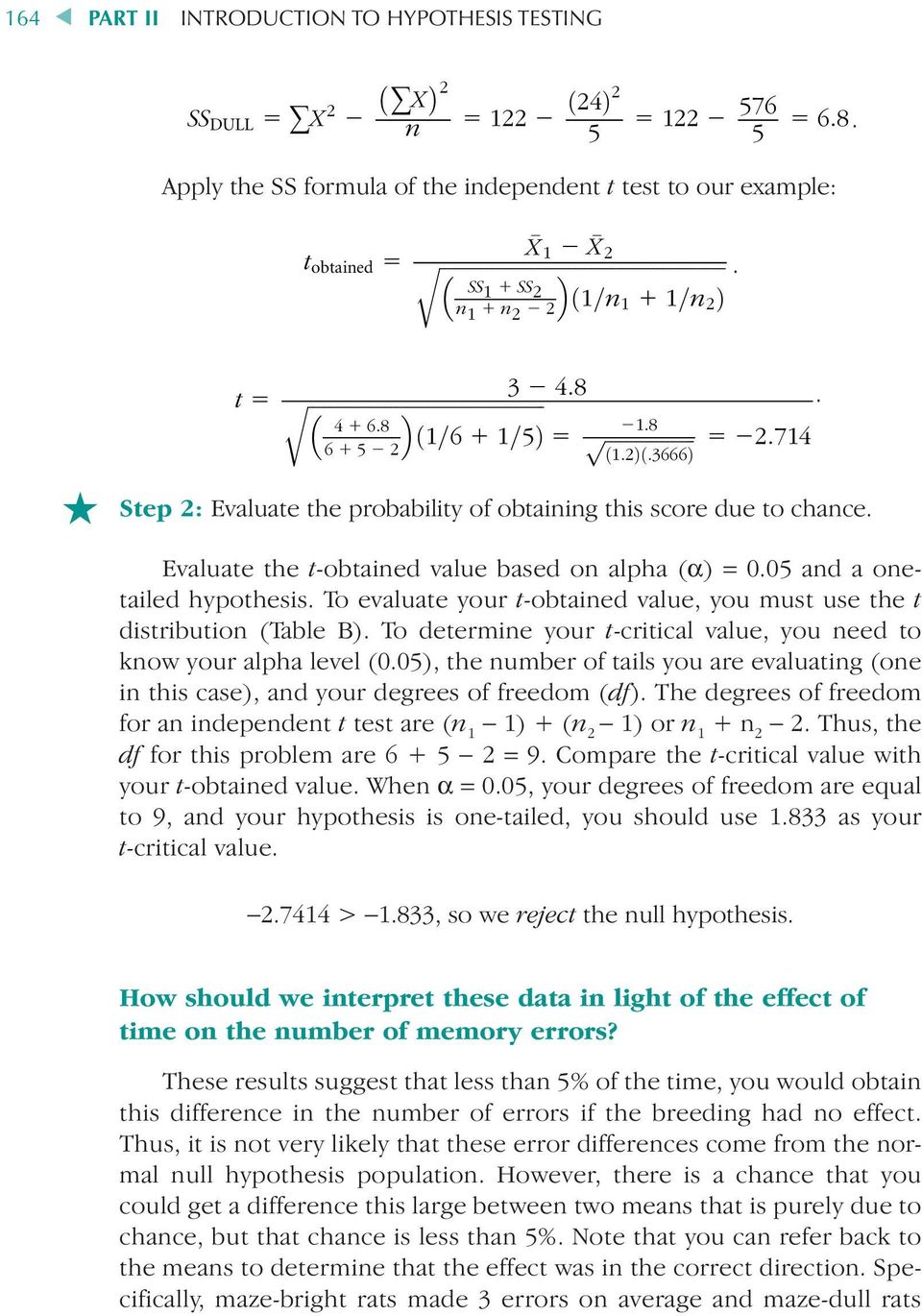
20 164 Part II Introduction to Hypothesis Testing SS DULL 5 +X 2 2 +X 2 n ð24þ :8. Apply the SS formula of the independent t test to our example: t obtained 5 r X 1 2 X ffiffiffiffiffiffiffiffiffiffiffiffiffiffiffiffiffiffiffiffiffiffiffiffiffiffiffiffiffiffiffiffiffiffiffiffiffiffiffiffiffiffiffiffiffiffiffiffiffiffiffiffiffiffiffi 2. ð1=n 1 1 1=n 2 Þ SS 1 1 SS 2 n 1 1 n t :8 rffiffiffiffiffiffiffiffiffiffiffiffiffiffiffiffiffiffiffiffiffiffiffiffiffiffiffiffiffiffiffiffiffiffiffiffiffiffiffiffiffiffiffiffiffiffi :8 21:8 ð1=6 1 1=5Þ 5 pffiffiffiffiffiffiffiffiffiffiffiffiffiffiffiffiffi 522: ð1:2þð:3666þ Step 2: Evaluate the probability of obtaining this score due to chance. Evaluate the t-obtained value based on alpha (a) = 0.05 and a onetailed hypothesis. To evaluate your t-obtained value, you must use the t distribution (Table B). To determine your t-critical value, you need to know your alpha level (0.05), the number of tails you are evaluating (one in this case), and your degrees of freedom (df). The degrees of freedom for an independent t test are (n 1-1) + (n 2-1) or n 1 + n 2-2. Thus, the df for this problem are = 9. Compare the t-critical value with your t-obtained value. When a = 0.05, your degrees of freedom are equal to 9, and your hypothesis is one-tailed, you should use as your t-critical value > , so we reject the null hypothesis. How should we interpret these data in light of the effect of time on the number of memory errors? These results suggest that less than 5% of the time, you would obtain this difference in the number of errors if the breeding had no effect. Thus, it is not very likely that these error differences come from the normal null hypothesis population. However, there is a chance that you could get a difference this large between two means that is purely due to chance, but that chance is less than 5%. Note that you can refer back to the means to determine that the effect was in the correct direction. Specifically, maze-bright rats made 3 errors on average and maze-dull rats
21 Chapter 9 Two-Sample Tests 165 made 4.8 errors on average. Not only is the t-obtained value more extreme than the t-critical value, but the direction of the effect is as the researcher predicted. Complete Example A researcher breeds rats for nine generations but only breeds the rats that perform very well in a maze (few errors) to each other (maze-bright rats) and also breeds rats that perform very poorly in a maze (many errors) to one another (maze-dull rats). After nine generations, is there a significant difference in the number of errors in the two groups of rats? Null hypothesis: There is no difference in the number of errors made by the maze-bright and the maze-dull rats or the differences are due to chance. Alternative hypothesis: There is a difference in the number of errors made by each group. Evaluate the t-obtained value based on alpha (a) = 0.05 and a twotailed hypothesis. To evaluate your t-obtained value, you must use the t distribution (Table B). To determine your t-critical value, you need to know your alpha level (0.05), the number of tails you are evaluating (two in this case), and your degrees of freedom (df). The degrees of freedom for an independent t test are (n 1-1) + (n 2-1) or n 1 + n 2-2. Thus, the df for this problem are = 9. Compare the t-critical value with your t-obtained value. When a = 0.05, your degrees of freedom are equal to 9, and your hypothesis is two-tailed, you should use as your t-critical value. j22:714j $ j2:262j, so we reject the null hypothesis. How should we interpret these data in light of the effect of time on the number of memory errors? These results suggest that less than 5% of the time, you would obtain this difference in the number of errors if the breeding had no effect. Thus, it is not very likely that these error differences come from the normal null hypothesis population. However, there is a chance that you could get a difference this large between two means that is purely due to chance, but that chance is less than 5%.
22 166 Part II Introduction to Hypothesis Testing Results if you use Microsoft Excel to calculate the t test: Bright Dull Mean Variance Observations 6 5 Pooled Variance 1.2 Hypothesized Mean Difference 0 Df 9 t Stat P(T<=t) one-tail t Critical one-tail P(T<=t) two-tail t Critical two-tail t-test: Two-Sample Assuming Equal Variances This is the output you get from Excel when you type in these data for maze-bright and maze-dull rats. Note that Excel calls this test t-test: Two- Sample Assuming Equal Variances. This wording is slightly different from what we have been using, but it is describing the same analysis, and that will be even clearer after we have discussed the assumptions of the independent t test. We have bolded the numbers that are comparable to the numbers we just manually calculated or looked up in the table. Note that the t-obtained value (Excel calls it t Stat ) is identical to ours, except they have carried more digits ( ). The t Critical two-tail is also the same ( ), but again they have carried more digits. The degrees of freedom are the same (9). In addition, they have provided the calculated probability of obtaining a t value (t Stat) of , which is Since < 0.05, we clearly reject our null hypothesis. These results suggest that % of the time, you would obtain this difference by chance if breeding had no effect. Again, knowing the calculated probability for each and every t-obtained value (not just the t-critical values) is one of the major advantages of using a computer to calculate your analyses.
23 Chapter 9 Two-Sample Tests 167 Results if you use SPSS to calculate the t test: ERRORS Equal variances assumed Equal variances not assumed Independent Samples Test Levene s Test for Equality of Variances t-test for Equality of Means F Sig. t df Sig. (2-tailed) We have placed the numbers that are comparable to our manual calculations in bold. Once again, you see that calculated probability (SPSS calls it Sig. 2-tailed) is less than our alpha level of 0.05, and thus we must assume that these results would be unlikely simply due to chance. How would these results be reported in a scientific journal article? Mean Difference If the journal required APA format, the results would be reported in a format something like this: There was a significant difference in the number of errors made by maze-dull (M = 4.8, SD = 1.30) and maze-bright rats (M = 3.0, SD = 0.89), t(9) = -2.71, p =.02. Std. Error Difference This formal sentence includes the dependent variable (number of errors), the independent variable (two groups of rats), as well as a statement about statistical significance, the direction of the effect as evidence by the means, the symbol of the test (t), the degrees of freedom (9), the statistical value (-2.71), and the estimated probability of obtaining this result simply due to chance (.02). 95% Confidence Interval of the Difference Lower Upper
24 168 Part II Introduction to Hypothesis Testing Another Complete Example Psychology experiments frequently need to be very careful about the effects of past experience on the outcome of their studies. One common population for psychology research is college students enrolled in psychology courses. But it is traditional to use only freshmen or sophomores who are enrolled in introductory courses so that the researcher avoids the possibility of a student anticipating the study s goals after having had more advanced psychology courses. But does classroom experience in psychology really affect the outcome of the experiment? A researcher develops a simple assessment for response to visual stimuli, and the number of correct (matching) results is scored for a group of five sophomore introductory psychology course students and six psychology seniors. Is there a significant difference in the scores of the two groups of students? Null hypothesis: There is no difference in the scores of introductory and advanced psychology students or the differences are due to chance. Alternative hypothesis: There is a difference in the scores of each group. Step 1: Compute the probability that each of the sample means comes from the null hypothesis population of differences between means. Calculate the means and the intermediate numbers for the SS formula: Introductory Advanced X Intro X Adv X Intro Þ X Adv Þ X 2 Intro X2 Adv X Intro :80 X Adv :33 Scores for Introductory and Advanced Students
25 Chapter 9 Two-Sample Tests 169 Calculate the SS of each sample: SS Intro 5 +X 2 2 +X 2 n SS Adv 5 +X 2 2 +X 2 n ð39þ ð50þ : :33. Apply the SS formula of the independent t test to our example: t obtained 5 r X 1 2 X ffiffiffiffiffiffiffiffiffiffiffiffiffiffiffiffiffiffiffiffiffiffiffiffiffiffiffiffiffiffiffiffiffiffiffiffiffiffiffiffiffiffiffiffiffiffiffiffiffiffiffiffiffiffiffi 2. ð1=n 1 1 1=n 2 Þ SS 1 1 SS 2 n 1 1 n t 5 r 7:8028:33 ffiffiffiffiffiffiffiffiffiffiffiffiffiffiffiffiffiffiffiffiffiffiffiffiffiffiffiffiffiffiffiffiffiffiffiffiffiffiffiffiffiffiffiffiffiffiffiffi 5 ð1=5 1 1=6Þ 6:80 1 9: :53 pffiffiffiffiffiffiffiffiffiffiffiffiffiffiffiffiffiffiffiffiffiffiffiffiffiffiffiffiffiffiffiffiffiffiffiffiffi 520:6538. ð1:79222þð:36667þ Step 2: Evaluate the probability of obtaining this score due to chance. Evaluate the t-obtained value based on alpha (a) = 0.05 and a twotailed hypothesis. To evaluate your t-obtained value, you must use the t distribution (Table B). To determine your t-critical value, you need to know your alpha level (0.05), the number of tails you are evaluating (two in this case), and your degrees of freedom (df). The degrees of freedom for an independent t test are (n 1-1) + (n 2-1) or n 1 + n 2-2. Thus, the df for this problem are = 9. Compare the t-critical value with your t-obtained value. When a = 0.05, your degrees of freedom are equal to 9, and your hypothesis is two-tailed, you should use as your t-critical value. j20:6538j \ j2:262j, so we fail to reject the null hypothesis. How should we interpret these data in light of the effect of experience on scores? These results suggest that greater than 5% of the time, you would obtain this difference in the scores if experience level had no effect. Thus, it
26 170 Part II Introduction to Hypothesis Testing is likely that these differences come from the normal null hypothesis population. In terms of our experiment, freshmen and seniors react the same way: Classroom experience does not have an effect on this response to visual stimuli. However, there is always a chance that there is a significant real effect that you did not detect. Results if you use Microsoft Excel to calculate the t test: Introductory Advanced Mean Variance Observations 5 6 Pooled Variance Hypothesized Mean Difference 0 Df 9 t Stat P(T<=t) one-tail t Critical one-tail P(T<=t) two-tail t Critical two-tail t-test: Two-Sample Assuming Equal Variances This is the output you get from Excel when you type in these data for introductory and advanced psychology students. We have again bolded the numbers that are comparable to the numbers we just manually calculated or looked up in the table. Note again that the t-obtained value is identical to ours, except they have carried more digits. The t Critical two-tail is also similar to the table except for differences due to rounding ( ), and the same as in the first example since the degrees of freedom are the same (9). In addition, they have provided the calculated probability of obtaining a t value (t Stat) of , which is Since > 0.05, we clearly fail to reject our null hypothesis. These results suggest that % of the time, you would obtain this difference in errors if psychology experience had no effect.
27 Chapter 9 Two-Sample Tests 171 Results if you use SPSS to calculate the t test: DATA Equal variances assumed Equal variances not assumed Levene s Test for Equality of Variances Independent Samples Test t-test for Equality of Means F Sig. t Df Sig. (2-tailed) Mean Difference Std. Error Difference 95% Confidence Interval of the Difference Lower Upper We have placed the numbers that are comparable to our manual calculations in bold. Once again, you see that that calculated probability (SPSS calls it Sig. 2-tailed) is greater than (much greater than) our alpha level of 0.05, and thus we must assume that these results would be likely simply due to chance. How would these results be reported in a scientific journal article? If the journal required APA format, the results would be reported in a format something like this: There is no significant difference between the scores of introductory and advanced psychology students, t(9) = -.66, p =.53. This formal sentence includes the dependent variable (scores), the independent variable (introductory vs. advanced psychology students), as well as a statement about statistical significance, the symbol of the test (t), the degrees of freedom (9), the statistical value (-.66), and the probability of obtaining this result simply due to chance (.53).
28 172 Part II Introduction to Hypothesis Testing When is it appropriate to use an independent t test? 1. When you have two samples and a between-groups design 2. When the sampling distribution is normally distributed. Again, this is satisfied when a. The sample size is greater or equal to 30 (N 30) or b. The null hypothesis population is known to be normally distributed. 3. When the dependent variable is on an interval or ratio scale 4. When the variances of the two groups are the same or are homogeneous. The homogeneity of variance assumption (HOV) requires that the variances of the underlying populations are equal or, in practical terms, not significantly different from one another. We can test this assumption by examining the sample variances. For now, we will use a simple rule of thumb to decide whether the variances are similar larger larger variance enough to be considered homogeneous: If the smaller smaller variance # 4, then the HOV assumption is met (okay) and you can proceed with the independent t test. Note that there are more formal ways to test this assumption besides this rule of thumb. Interested students should explore information on Levene s test for more information. However, if the assumption is not met, you cannot proceed with the independent t test without some corrections or alterations. One possible solution is to run an unequal variances test rather than an independent t test. For example, Welch s t test is an adaptation of Student s t test intended for use with two samples having possibly unequal variances. Power and Two-Sample Tests: Paired Versus Independent Designs Because high sample variability decreases power, and more variability would be expected from between-groups designs where different individuals are in each condition or group, the independent t test is less powerful than the paired t test. The paired t test gains power by controlling nuisance factors such as the age and temperament of a subject since the subjects are either the same in both conditions or match on characteristics that might influence the outcome of the study but are not of interest to the researcher. Thus, the researcher is more likely to control variability in the within-groups design. There are several major drawbacks to the within-groups (or paired) design. One occurs when subjects drop out of the experiment prior to experiencing all of the conditions. This creates a situation where the researcher has one data
29 Chapter 9 Two-Sample Tests 173 point for the subject but lacks the other data point and thus cannot calculate a difference score for the subject. There are two options in this situation. The first option is to drop those subjects with missing data from your analysis, but this reduces your power significantly if you have a large number of missing data points relative to your sample size. The second option is to treat the two samples as independent and calculate an independent t test, and thus equal ns are not required and difference scores are not the basis for the test. A second major drawback of the within-groups design is what generally is called experience effects: any research design in which novelty or experience with the assessment tool would bias the results. For example, any study in which the participants must be naive to the assessment to be able to provide a meaningful response would preclude the use of the within-groups design. You would require that both your control or pretest group and your treatment group be different individuals who had never before experienced the assessment itself. Effect Sizes and Power Effect size is a standardized measure of the difference between two (or more) group means; it is the difference in means divided by the shared standard deviation of two or more groups. If testing a sample with no known population parameters, you can estimate the effect size by using Hedges s g: Hedges s g = X 1 2 X 2 :. S p rffiffiffiffiffiffiffiffiffiffiffiffiffiffiffi s Where S p (when sample sizes are equal) = 2 x 1 s2 y :. 2 Where S p (when sample sizes are unequal) = sffiffiffiffiffiffiffiffiffiffiffiffiffiffiffiffiffiffiffiffiffiffiffiffiffiffiffiffiffiffiffiffiffiffiffiffiffiffiffiffiffiffiffiffiffiffiffiffiffiffi ðn x 2 1Þs 2 x 1 ðn y 2 1Þs 2 y ðn x 2 1Þ 1 ðn y 2 1Þ. Once you have calculated your effect size, you can use a free program to calculate the power of your test. One that we have often recommended to students is G*Power, which can be downloaded at The program can be used a priori to predict adequate sample size, based on desired effect size and desired power, or post hoc to calculate power based on calculated effect size and standard error. A priori, after typing in the desired effect size (based on previous research or current hypotheses) and desired power (usually 0.8 or your research won t be funded), total sample size, along with t crit and actual power, appears in the middle and bottom of the screen.
30 174 Part II Introduction to Hypothesis Testing Post hoc power is determined by inputting effect size and sample size and hitting Calculate. This process is especially useful after you have completed a preliminary study and are proposing a full study. Given the effect size of your pilot study, you can predict how many subjects are necessary to obtain significant results with a specific likelihood (e.g., 80%). Other Resources for Calculating Power If you have an experimental design that does not fit with the options for calculating power with G*Power, you can use the following website to find more free resources on the Internet for calculating statistics, including power: Notice that the flowchart (see page 175) does not yet tell you what to do if you do not meet the assumptions of your statistical tests. In fact, there are some options when you have two samples, but you do not meet the assumptions for parametric tests. The paired t test can be replaced with a nonparametric test called the Wilcoxon signed ranks test, while the independent t test can be replaced with a nonparametric test called the Mann-Whitney U test. We will discuss these nonparametric options in greater detail in Chapter 14. Another option is to perform a log transformation on your data to determine if the mathematical transformation will result in a normal distribution. Summary In this chapter, you have covered statistical tests for designs in which you have two samples and lack information about the underlying population. Because we rarely know population parameters such as the mean and standard deviation (m and s), the two-sample tests tend to be used more often than the one-sample tests. Two-sample tests are less powerful because we are forced to estimate characteristics of the population, whereas one-sample tests rely on known measures of the population. In the next chapter, we will extend the concept of an independent t test or two-sample between-groups design to a situation where we have three samples and a between-groups design. Excel Step-by-Step: Step-by-Step Instructions for Using Microsoft Excel 2003 or 2007 to Run t Tests 1. Your first step will be to open Microsoft Excel and type the raw data into a spreadsheet (data listed on page 176). It is helpful to type the column headers so that your output will be labeled later. Note that the participants who received caffeine in the first treatment are different
31 Measurement Scale? Interval or better Experimental Design? Single sample 2 conditions or 2 samples Individual score (not a sample) Relation between samples? Normal population? Know population mean (µ)? z-score Independent groups Within groups Yes Normal population? Homogeneity of Variance 4 Normal population? Know population standard deviation (σ)? Yes No Yes Yes Paired t-test Independent t-test Single Sample t-test Single Sample z-test Chapter 1. Within Groups a. subjects matched married, partners, twins, etc., or individually matched for a reason that might affect the I.V. b. before vs. after conditions with the same subjects, measured both times 2. Independent Groups a. In one group/condition, NOT allowed in the other, subjects randomly assigned to be in the experiment in one group OR the other b. Sample sizes can be unequal (IF unequal, definitely independent t-test, but if equal, make decision based on experimental design info) 3. Power a. Single z > Single t, Paired > Independent Overview of Single-Sample and Two-Sample Tests: Expanded Flowchart 175
32 176 Part II Introduction to Hypothesis Testing from the participants who received caffeine in the second treatment (between-groups design). Caffeine First Times Caffeine Second Times Once your data are entered, you will need to calculate an independent t test. For Excel 2003: To find the t test you will need, you can go to the built-in data analysis function. You ll find the option under the Tools menu, and at the bottom of the list that pops up, you should see Data Analysis. If you do not see the Data Analysis option under the Tools menu, select Add Ins under the Tool menu. Check the box next to Analysis TookPak and click OK. Follow any further instructions that the computer gives you. For Excel 2007: To get to the data analysis option, click on the DATA tab and the Data Analysis tool will be in the Analysis section to the far right of the screen. Once you find the Data Analysis tool, the rest of the instructions are the same. 3. After you click on Data Analysis, a list of possible statistical tests will pop up. Page down the list until you find the appropriate test. We want to do an independent t test, which Excel calls t-test: Two Sample Assuming Equal Variances. After you have selected the appropriate test, the program will take you through the steps to complete the test. Note that Excel also has an unequal variances test. You can use this test if you meet the assumptions of normality but do not meet the variance assumption. Here is example output from an independent t test: Control Group Alcohol Group Mean Variance Observations Pooled Variance Hypothesized Mean Difference 0
33 Chapter 9 Two-Sample Tests 177 Control Group df 18 t Stat P(T<=t) one-tail t Critical one-tail P(T<=t) two-tail t Critical two-tail Alcohol Group t-test: Two-Sample Assuming Equal Variances SPSS Step-by-Step: Step-by-Step Instructions for Using SPSS to Run an Independent t Test 1. Your first step will be to open SPSS and select the option that allows you to type in new data. 2. This will open a page called Variable View. To confirm that, look at the tab at the bottom left of the page. There should be two tabs, and one will say Variable View (the one you are in now) and the other will say Data View. 3. Now you need to establish your variables for SPSS. Make a variable that codes for your independent groups by typing in the word group in the first box of row 1. Now name your dependent variable and call it dv and type that into box 1 in row 2. By default, SPSS will consider each of these variables to be numeric, and for these purposes, all of the default codes will work perfectly. However, keep in mind that this is where you can change some of your options to allow for alphabetical data, define coding in your variables, and so on. For example, you could define your group coding to be 1 for the control group and 2 for the experimental treatment group. 4. Click on the Data View tab now. You should see that the variable names you entered in Variable View have now appeared at the top of this spreadsheet. Now you can enter your raw data: Group Dv (Continued)
34 178 Part II Introduction to Hypothesis Testing (Continued) Group Dv From the SPSS menu, you should now select Analyze, then Compare means, and finally Independent t-test. This will open up a new pop-up window with your variables listed on the left-hand side. Select your dependent variable and use the arrow in the middle of the pop-up to move it to the right-hand side of the pop-up box as your test variable. Now move your group variable the same way over to the group variable box. 6. Now you will need to define the groups for your grouping variable. Click this option and type 1 for Group 1 and 2 for Group Once your groups are defined and you are back to the independent t test pop-up box, you can just hit OK to run the test. 8. You should get output for an independent t test assuming equal variances and for an independent t test where you do not need to assume equal variances. SPSS will also include Levene s test, which tells you whether or not your variances are homogeneous. If they are homogeneous, you should report the independent t test assuming equal variances. If your variables are not homogeneous and are heterogeneous, then you report the unequal variances t test. In addition to the t value and significance level (p value), the output will also include descriptive statistics such as the difference between your means, standard error of the means, your degrees of freedom, and the confidence interval.
35 Chapter 9 Two-Sample Tests 179 Chapter 9 Homework Provide a short answer for the following questions. 1. Why are paired (or correlated) designs more powerful than independent designs? 2. What are the assumptions for the paired t test? 3. What are the assumptions for the independent t test? 4. List three ways that you can meet the assumption of normality. 5. Why does the independent t test require the assumption of homogeneity of variance but the paired t test does not require this assumption? 6. How should you handle a situation where you have paired design and two conditions but there are some missing data for one of your two conditions? 7. What do you do if you do not meet the assumptions of the paired t test or the independent t test? 8. A researcher records the number of positive early childhood memories that can be recalled by five individuals who grew up in military families to the number of memories of individuals who grew up in nonmilitary families. The number of memories is normally distributed in each group. Using a = 0.05 (two-tailed), what do you conclude? Military family Nonmilitary family A sociologist is interested in whether or not race affects the likelihood that the average person will shoot a potential criminal in a computer simulation. Participants are required to make quick decisions about whether to shoot or not, and they are shown a variety of images of people. Some of the images are of people with a weapon and some of them are people holding nonviolent objects. Eight participants are randomly sampled for the study. The psychologist records the number of errors (shooting someone holding a nonviolent object) the participants made based on race (African American or Caucasian). The number of errors is normally distributed. The following data are recorded. Participant African American Caucasian Using a = 0.05 (two-tailed), what do you conclude?
36 180 Part II Introduction to Hypothesis Testing 10. Professor Jones is intensely curious about differences in testing situations and wondered if students tended to make better scores on her tests depending on whether the test was taken on a Monday morning or a Friday morning. Her exams have always been normally distributed. From a group of 19 similarly talented students, she randomly selected some to take a test on Friday and others to take it on Monday. The scores by groups were as follows: Monday Friday Using a = 0.05 (two-tailed), what do you conclude? For Questions 11 to 12, you should choose the most appropriate and powerful test. Support your answers and list assumptions you are making. Do not try to perform the calculations. 11. Extensive research has been done on the subject of birth order. Data on this research show that first-born children develop different characteristics than later-born children. For example, first-born children tend to be more responsible and self-disciplined than later-born children. A researcher is interested in finding out if first-born children tend to be more confident and have higher self-esteem than later-born siblings. A random sample of 31 first-born children and 35 later-born children were given a self-esteem test. The standard deviation for the first-born children is 1.34, and the standard deviation for the later-born children is Test whether birth order affects self-esteem. 12. A researcher tested a new medicine to see if it would be effective in lowering blood pressure. Two samples of participants from a normally distributed population were matched for medical history and initial blood pressure readings. Fifteen randomly selected participants were run through the
37 Chapter 9 Two-Sample Tests 181 experimental condition in which they received the new drug. The other 15 randomly selected individuals participated in the control group and received a placebo. Participants receiving the drug showed a lower blood pressure. Test whether the drug had a statistically significant effect on blood pressure. Variances are homogeneous. Answer Questions 13 to 19 using the following story problem. A marketer is interested in how an antismoking campaign affects the smoking habits of teenagers. The researcher samples 50 students from a local area high school and asks them how many cigarettes they smoked. After the antismoking campaign has run for a year, the researcher polls the same 50 students and records the exact number of cigarettes smoked after the campaign. 13. State the null hypothesis for this study. 14. State the alternative hypothesis for this study. 15. Is this a directional or nondirectional hypothesis? 16. Is this research an independent groups (between subjects) or a repeated measures/paired design (within subjects)? Why? 17. What are the independent and dependent variables? 18. Which type of measurement scale do the data from this study represent (e.g., nominal, ordinal, interval, or ratio)? Why? 19. What kind of statistical test should be used to test the hypothesis (hint: think of what we have been doing in class lately)? 20. Which of the following are assumptions underlying the use of the paired t test? A. The variance of the population is known B. The sampling distribution is normal C. Data are interval or ratio D. All of the above E. A and B F. B and C G. A and C 21. A drug and alcohol researcher is interested in studying the effects of alcohol on learning ability of college seniors. She randomly assigns 10 students to an alcohol group and another 10 students to a control group. The students in
38 182 Part II Introduction to Hypothesis Testing the alcohol group all receive 8 oz of alcohol prior to being tested. Then all of the students are run through a learning assessment and the number of errors is recorded. Assume the data below are normally distributed. Control Group Alcohol Group 4 +x x x x Mean = Mean = s n 1 = s n 1 = Perform the statistical test and state whether or not you can reject the null hypothesis. The following homework questions should be answered with the online data set provided for this chapter via the textbook s website. 22. Produce a table of descriptive statistics using Microsoft Excel or SPSS. 23. Interpret the descriptive statistics produced by Excel. Do you meet the assumption of normality? 24. Do you meet the assumption of homogeneity of variance? 25. Analyze the data set using an independent t test and indicate if you have a statistically significant result. Explain how you evaluated the output.
INTERPRETING THE ONE-WAY ANALYSIS OF VARIANCE (ANOVA)
 INTERPRETING THE ONE-WAY ANALYSIS OF VARIANCE (ANOVA) As with other parametric statistics, we begin the one-way ANOVA with a test of the underlying assumptions. Our first assumption is the assumption of
One-Way Analysis of Variance
 One-Way Analysis of Variance Note: Much of the math here is tedious but straightforward. We ll skim over it in class but you should be sure to ask questions if you don t understand it. I. Overview A. We
Independent t- Test (Comparing Two Means)
 Independent t- Test (Comparing Two Means) The objectives of this lesson are to learn: the definition/purpose of independent t-test when to use the independent t-test the use of SPSS to complete an independent
UNDERSTANDING THE DEPENDENT-SAMPLES t TEST
 UNDERSTANDING THE DEPENDENT-SAMPLES t TEST A dependent-samples t test (a.k.a. matched or paired-samples, matched-pairs, samples, or subjects, simple repeated-measures or within-groups, or correlated groups)
Introduction to. Hypothesis Testing CHAPTER LEARNING OBJECTIVES. 1 Identify the four steps of hypothesis testing.
 Introduction to Hypothesis Testing CHAPTER 8 LEARNING OBJECTIVES After reading this chapter, you should be able to: 1 Identify the four steps of hypothesis testing. 2 Define null hypothesis, alternative
Descriptive Statistics
 Descriptive Statistics Primer Descriptive statistics Central tendency Variation Relative position Relationships Calculating descriptive statistics Descriptive Statistics Purpose to describe or summarize
t Tests in Excel The Excel Statistical Master By Mark Harmon Copyright 2011 Mark Harmon
 t-tests in Excel By Mark Harmon Copyright 2011 Mark Harmon No part of this publication may be reproduced or distributed without the express permission of the author. [email protected] www.excelmasterseries.com
UNDERSTANDING THE INDEPENDENT-SAMPLES t TEST
 UNDERSTANDING The independent-samples t test evaluates the difference between the means of two independent or unrelated groups. That is, we evaluate whether the means for two independent groups are significantly
Chapter 2 Probability Topics SPSS T tests
 Chapter 2 Probability Topics SPSS T tests Data file used: gss.sav In the lecture about chapter 2, only the One-Sample T test has been explained. In this handout, we also give the SPSS methods to perform
Study Guide for the Final Exam
 Study Guide for the Final Exam When studying, remember that the computational portion of the exam will only involve new material (covered after the second midterm), that material from Exam 1 will make
1.5 Oneway Analysis of Variance
 Statistics: Rosie Cornish. 200. 1.5 Oneway Analysis of Variance 1 Introduction Oneway analysis of variance (ANOVA) is used to compare several means. This method is often used in scientific or medical experiments
Two Related Samples t Test
 Two Related Samples t Test In this example 1 students saw five pictures of attractive people and five pictures of unattractive people. For each picture, the students rated the friendliness of the person
Lesson 1: Comparison of Population Means Part c: Comparison of Two- Means
 Lesson : Comparison of Population Means Part c: Comparison of Two- Means Welcome to lesson c. This third lesson of lesson will discuss hypothesis testing for two independent means. Steps in Hypothesis
Introduction to Analysis of Variance (ANOVA) Limitations of the t-test
 Introduction to Analysis of Variance (ANOVA) The Structural Model, The Summary Table, and the One- Way ANOVA Limitations of the t-test Although the t-test is commonly used, it has limitations Can only
Chapter 5 Analysis of variance SPSS Analysis of variance
 Chapter 5 Analysis of variance SPSS Analysis of variance Data file used: gss.sav How to get there: Analyze Compare Means One-way ANOVA To test the null hypothesis that several population means are equal,
Statistics Review PSY379
 Statistics Review PSY379 Basic concepts Measurement scales Populations vs. samples Continuous vs. discrete variable Independent vs. dependent variable Descriptive vs. inferential stats Common analyses
Two-sample hypothesis testing, II 9.07 3/16/2004
 Two-sample hypothesis testing, II 9.07 3/16/004 Small sample tests for the difference between two independent means For two-sample tests of the difference in mean, things get a little confusing, here,
In the past, the increase in the price of gasoline could be attributed to major national or global
 Chapter 7 Testing Hypotheses Chapter Learning Objectives Understanding the assumptions of statistical hypothesis testing Defining and applying the components in hypothesis testing: the research and null
Chapter 7 Section 7.1: Inference for the Mean of a Population
 Chapter 7 Section 7.1: Inference for the Mean of a Population Now let s look at a similar situation Take an SRS of size n Normal Population : N(, ). Both and are unknown parameters. Unlike what we used
EXCEL Analysis TookPak [Statistical Analysis] 1. First of all, check to make sure that the Analysis ToolPak is installed. Here is how you do it:
![EXCEL Analysis TookPak [Statistical Analysis] 1. First of all, check to make sure that the Analysis ToolPak is installed. Here is how you do it:](/thumbs/30/14272010.jpg "EXCEL Analysis TookPak [Statistical Analysis] 1. First of all, check to make sure that the Analysis ToolPak is installed. Here is how you do it:") EXCEL Analysis TookPak [Statistical Analysis] 1 First of all, check to make sure that the Analysis ToolPak is installed. Here is how you do it: a. From the Tools menu, choose Add-Ins b. Make sure Analysis
EXCEL Analysis TookPak [Statistical Analysis] 1 First of all, check to make sure that the Analysis ToolPak is installed. Here is how you do it: a. From the Tools menu, choose Add-Ins b. Make sure Analysis
Two-sample t-tests. - Independent samples - Pooled standard devation - The equal variance assumption
 Two-sample t-tests. - Independent samples - Pooled standard devation - The equal variance assumption Last time, we used the mean of one sample to test against the hypothesis that the true mean was a particular
Outline. Definitions Descriptive vs. Inferential Statistics The t-test - One-sample t-test
 The t-test Outline Definitions Descriptive vs. Inferential Statistics The t-test - One-sample t-test - Dependent (related) groups t-test - Independent (unrelated) groups t-test Comparing means Correlation
Regression Analysis: A Complete Example
 Regression Analysis: A Complete Example This section works out an example that includes all the topics we have discussed so far in this chapter. A complete example of regression analysis. PhotoDisc, Inc./Getty
Recall this chart that showed how most of our course would be organized:
 Chapter 4 One-Way ANOVA Recall this chart that showed how most of our course would be organized: Explanatory Variable(s) Response Variable Methods Categorical Categorical Contingency Tables Categorical
Unit 31 A Hypothesis Test about Correlation and Slope in a Simple Linear Regression
 Unit 31 A Hypothesis Test about Correlation and Slope in a Simple Linear Regression Objectives: To perform a hypothesis test concerning the slope of a least squares line To recognize that testing for a
" Y. Notation and Equations for Regression Lecture 11/4. Notation:
 Notation: Notation and Equations for Regression Lecture 11/4 m: The number of predictor variables in a regression Xi: One of multiple predictor variables. The subscript i represents any number from 1 through
LAB 4 INSTRUCTIONS CONFIDENCE INTERVALS AND HYPOTHESIS TESTING
 LAB 4 INSTRUCTIONS CONFIDENCE INTERVALS AND HYPOTHESIS TESTING In this lab you will explore the concept of a confidence interval and hypothesis testing through a simulation problem in engineering setting.
Chapter 7. One-way ANOVA
 Chapter 7 One-way ANOVA One-way ANOVA examines equality of population means for a quantitative outcome and a single categorical explanatory variable with any number of levels. The t-test of Chapter 6 looks
ANOVA ANOVA. Two-Way ANOVA. One-Way ANOVA. When to use ANOVA ANOVA. Analysis of Variance. Chapter 16. A procedure for comparing more than two groups
 ANOVA ANOVA Analysis of Variance Chapter 6 A procedure for comparing more than two groups independent variable: smoking status non-smoking one pack a day > two packs a day dependent variable: number of
Testing Group Differences using T-tests, ANOVA, and Nonparametric Measures
 Testing Group Differences using T-tests, ANOVA, and Nonparametric Measures Jamie DeCoster Department of Psychology University of Alabama 348 Gordon Palmer Hall Box 870348 Tuscaloosa, AL 35487-0348 Phone:
DDBA 8438: The t Test for Independent Samples Video Podcast Transcript
 DDBA 8438: The t Test for Independent Samples Video Podcast Transcript JENNIFER ANN MORROW: Welcome to The t Test for Independent Samples. My name is Dr. Jennifer Ann Morrow. In today's demonstration,
How To Check For Differences In The One Way Anova
 MINITAB ASSISTANT WHITE PAPER This paper explains the research conducted by Minitab statisticians to develop the methods and data checks used in the Assistant in Minitab 17 Statistical Software. One-Way
An Introduction to Statistics Course (ECOE 1302) Spring Semester 2011 Chapter 10- TWO-SAMPLE TESTS
 The Islamic University of Gaza Faculty of Commerce Department of Economics and Political Sciences An Introduction to Statistics Course (ECOE 130) Spring Semester 011 Chapter 10- TWO-SAMPLE TESTS Practice
KSTAT MINI-MANUAL. Decision Sciences 434 Kellogg Graduate School of Management
 KSTAT MINI-MANUAL Decision Sciences 434 Kellogg Graduate School of Management Kstat is a set of macros added to Excel and it will enable you to do the statistics required for this course very easily. To
A POPULATION MEAN, CONFIDENCE INTERVALS AND HYPOTHESIS TESTING
 CHAPTER 5. A POPULATION MEAN, CONFIDENCE INTERVALS AND HYPOTHESIS TESTING 5.1 Concepts When a number of animals or plots are exposed to a certain treatment, we usually estimate the effect of the treatment
WISE Power Tutorial All Exercises
 ame Date Class WISE Power Tutorial All Exercises Power: The B.E.A.. Mnemonic Four interrelated features of power can be summarized using BEA B Beta Error (Power = 1 Beta Error): Beta error (or Type II
Chapter 7. Comparing Means in SPSS (t-tests) Compare Means analyses. Specifically, we demonstrate procedures for running Dependent-Sample (or
 1 Chapter 7 Comparing Means in SPSS (t-tests) This section covers procedures for testing the differences between two means using the SPSS Compare Means analyses. Specifically, we demonstrate procedures
Data Mining Techniques Chapter 5: The Lure of Statistics: Data Mining Using Familiar Tools
 Data Mining Techniques Chapter 5: The Lure of Statistics: Data Mining Using Familiar Tools Occam s razor.......................................................... 2 A look at data I.........................................................
Reporting Statistics in Psychology
 This document contains general guidelines for the reporting of statistics in psychology research. The details of statistical reporting vary slightly among different areas of science and also among different
1. What is the critical value for this 95% confidence interval? CV = z.025 = invnorm(0.025) = 1.96
 1 Final Review 2 Review 2.1 CI 1-propZint Scenario 1 A TV manufacturer claims in its warranty brochure that in the past not more than 10 percent of its TV sets needed any repair during the first two years
THE FIRST SET OF EXAMPLES USE SUMMARY DATA... EXAMPLE 7.2, PAGE 227 DESCRIBES A PROBLEM AND A HYPOTHESIS TEST IS PERFORMED IN EXAMPLE 7.
 THERE ARE TWO WAYS TO DO HYPOTHESIS TESTING WITH STATCRUNCH: WITH SUMMARY DATA (AS IN EXAMPLE 7.17, PAGE 236, IN ROSNER); WITH THE ORIGINAL DATA (AS IN EXAMPLE 8.5, PAGE 301 IN ROSNER THAT USES DATA FROM
Simple Regression Theory II 2010 Samuel L. Baker
 SIMPLE REGRESSION THEORY II 1 Simple Regression Theory II 2010 Samuel L. Baker Assessing how good the regression equation is likely to be Assignment 1A gets into drawing inferences about how close the
CHAPTER 13. Experimental Design and Analysis of Variance
 CHAPTER 13 Experimental Design and Analysis of Variance CONTENTS STATISTICS IN PRACTICE: BURKE MARKETING SERVICES, INC. 13.1 AN INTRODUCTION TO EXPERIMENTAL DESIGN AND ANALYSIS OF VARIANCE Data Collection
An analysis method for a quantitative outcome and two categorical explanatory variables.
 Chapter 11 Two-Way ANOVA An analysis method for a quantitative outcome and two categorical explanatory variables. If an experiment has a quantitative outcome and two categorical explanatory variables that
Randomized Block Analysis of Variance
 Chapter 565 Randomized Block Analysis of Variance Introduction This module analyzes a randomized block analysis of variance with up to two treatment factors and their interaction. It provides tables of
Data Analysis Tools. Tools for Summarizing Data
 Data Analysis Tools This section of the notes is meant to introduce you to many of the tools that are provided by Excel under the Tools/Data Analysis menu item. If your computer does not have that tool
Hypothesis testing - Steps
 Hypothesis testing - Steps Steps to do a two-tailed test of the hypothesis that β 1 0: 1. Set up the hypotheses: H 0 : β 1 = 0 H a : β 1 0. 2. Compute the test statistic: t = b 1 0 Std. error of b 1 =
Analysis of Data. Organizing Data Files in SPSS. Descriptive Statistics
 Analysis of Data Claudia J. Stanny PSY 67 Research Design Organizing Data Files in SPSS All data for one subject entered on the same line Identification data Between-subjects manipulations: variable to
7. Comparing Means Using t-tests.
 7. Comparing Means Using t-tests. Objectives Calculate one sample t-tests Calculate paired samples t-tests Calculate independent samples t-tests Graphically represent mean differences In this chapter,
Tutorial 5: Hypothesis Testing
 Tutorial 5: Hypothesis Testing Rob Nicholls [email protected] MRC LMB Statistics Course 2014 Contents 1 Introduction................................ 1 2 Testing distributional assumptions....................
individualdifferences
 1 Simple ANalysis Of Variance (ANOVA) Oftentimes we have more than two groups that we want to compare. The purpose of ANOVA is to allow us to compare group means from several independent samples. In general,
Analysis of Variance ANOVA
 Analysis of Variance ANOVA Overview We ve used the t -test to compare the means from two independent groups. Now we ve come to the final topic of the course: how to compare means from more than two populations.
Case Study in Data Analysis Does a drug prevent cardiomegaly in heart failure?
 Case Study in Data Analysis Does a drug prevent cardiomegaly in heart failure? Harvey Motulsky [email protected] This is the first case in what I expect will be a series of case studies. While I mention
One-Way ANOVA using SPSS 11.0. SPSS ANOVA procedures found in the Compare Means analyses. Specifically, we demonstrate
 1 One-Way ANOVA using SPSS 11.0 This section covers steps for testing the difference between three or more group means using the SPSS ANOVA procedures found in the Compare Means analyses. Specifically,
Experimental Designs (revisited)
 Introduction to ANOVA Copyright 2000, 2011, J. Toby Mordkoff Probably, the best way to start thinking about ANOVA is in terms of factors with levels. (I say this because this is how they are described
The F distribution and the basic principle behind ANOVAs. Situating ANOVAs in the world of statistical tests
 Tutorial The F distribution and the basic principle behind ANOVAs Bodo Winter 1 Updates: September 21, 2011; January 23, 2014; April 24, 2014; March 2, 2015 This tutorial focuses on understanding rather
Class 19: Two Way Tables, Conditional Distributions, Chi-Square (Text: Sections 2.5; 9.1)
 Spring 204 Class 9: Two Way Tables, Conditional Distributions, Chi-Square (Text: Sections 2.5; 9.) Big Picture: More than Two Samples In Chapter 7: We looked at quantitative variables and compared the
12: Analysis of Variance. Introduction
 1: Analysis of Variance Introduction EDA Hypothesis Test Introduction In Chapter 8 and again in Chapter 11 we compared means from two independent groups. In this chapter we extend the procedure to consider
Business Statistics. Successful completion of Introductory and/or Intermediate Algebra courses is recommended before taking Business Statistics.
 Business Course Text Bowerman, Bruce L., Richard T. O'Connell, J. B. Orris, and Dawn C. Porter. Essentials of Business, 2nd edition, McGraw-Hill/Irwin, 2008, ISBN: 978-0-07-331988-9. Required Computing
Having a coin come up heads or tails is a variable on a nominal scale. Heads is a different category from tails.
 Chi-square Goodness of Fit Test The chi-square test is designed to test differences whether one frequency is different from another frequency. The chi-square test is designed for use with data on a nominal
PSYCHOLOGY 320L Problem Set #3: One-Way ANOVA and Analytical Comparisons
 PSYCHOLOGY 30L Problem Set #3: One-Way ANOVA and Analytical Comparisons Name: Score:. You and Dr. Exercise have decided to conduct a study on exercise and its effects on mood ratings. Many studies (Babyak
Section 13, Part 1 ANOVA. Analysis Of Variance
 Section 13, Part 1 ANOVA Analysis Of Variance Course Overview So far in this course we ve covered: Descriptive statistics Summary statistics Tables and Graphs Probability Probability Rules Probability
When to use Excel. When NOT to use Excel 9/24/2014
 Analyzing Quantitative Assessment Data with Excel October 2, 2014 Jeremy Penn, Ph.D. Director When to use Excel You want to quickly summarize or analyze your assessment data You want to create basic visual
Chapter 13 Introduction to Linear Regression and Correlation Analysis
 Chapter 3 Student Lecture Notes 3- Chapter 3 Introduction to Linear Regression and Correlation Analsis Fall 2006 Fundamentals of Business Statistics Chapter Goals To understand the methods for displaing
Independent samples t-test. Dr. Tom Pierce Radford University
 Independent samples t-test Dr. Tom Pierce Radford University The logic behind drawing causal conclusions from experiments The sampling distribution of the difference between means The standard error of
SCHOOL OF HEALTH AND HUMAN SCIENCES DON T FORGET TO RECODE YOUR MISSING VALUES
 SCHOOL OF HEALTH AND HUMAN SCIENCES Using SPSS Topics addressed today: 1. Differences between groups 2. Graphing Use the s4data.sav file for the first part of this session. DON T FORGET TO RECODE YOUR
A Basic Guide to Analyzing Individual Scores Data with SPSS
 A Basic Guide to Analyzing Individual Scores Data with SPSS Step 1. Clean the data file Open the Excel file with your data. You may get the following message: If you get this message, click yes. Delete
This chapter discusses some of the basic concepts in inferential statistics.
 Research Skills for Psychology Majors: Everything You Need to Know to Get Started Inferential Statistics: Basic Concepts This chapter discusses some of the basic concepts in inferential statistics. Details
11. Analysis of Case-control Studies Logistic Regression
 Research methods II 113 11. Analysis of Case-control Studies Logistic Regression This chapter builds upon and further develops the concepts and strategies described in Ch.6 of Mother and Child Health:
Appendix 2 Statistical Hypothesis Testing 1
 BIL 151 Data Analysis, Statistics, and Probability By Dana Krempels, Ph.D. and Steven Green, Ph.D. Most biological measurements vary among members of a study population. These variations may occur for
COMPARISONS OF CUSTOMER LOYALTY: PUBLIC & PRIVATE INSURANCE COMPANIES.
 277 CHAPTER VI COMPARISONS OF CUSTOMER LOYALTY: PUBLIC & PRIVATE INSURANCE COMPANIES. This chapter contains a full discussion of customer loyalty comparisons between private and public insurance companies
Difference of Means and ANOVA Problems
 Difference of Means and Problems Dr. Tom Ilvento FREC 408 Accounting Firm Study An accounting firm specializes in auditing the financial records of large firm It is interested in evaluating its fee structure,particularly
How To Run Statistical Tests in Excel
 How To Run Statistical Tests in Excel Microsoft Excel is your best tool for storing and manipulating data, calculating basic descriptive statistics such as means and standard deviations, and conducting
SPSS Guide: Regression Analysis
 SPSS Guide: Regression Analysis I put this together to give you a step-by-step guide for replicating what we did in the computer lab. It should help you run the tests we covered. The best way to get familiar
General Method: Difference of Means. 3. Calculate df: either Welch-Satterthwaite formula or simpler df = min(n 1, n 2 ) 1.
 General Method: Difference of Means 1. Calculate x 1, x 2, SE 1, SE 2. 2. Combined SE = SE1 2 + SE2 2. ASSUMES INDEPENDENT SAMPLES. 3. Calculate df: either Welch-Satterthwaite formula or simpler df = min(n
UNDERSTANDING ANALYSIS OF COVARIANCE (ANCOVA)
 UNDERSTANDING ANALYSIS OF COVARIANCE () In general, research is conducted for the purpose of explaining the effects of the independent variable on the dependent variable, and the purpose of research design
Indices of Model Fit STRUCTURAL EQUATION MODELING 2013
 Indices of Model Fit STRUCTURAL EQUATION MODELING 2013 Indices of Model Fit A recommended minimal set of fit indices that should be reported and interpreted when reporting the results of SEM analyses:
Testing Research and Statistical Hypotheses
 Testing Research and Statistical Hypotheses Introduction In the last lab we analyzed metric artifact attributes such as thickness or width/thickness ratio. Those were continuous variables, which as you
Point Biserial Correlation Tests
 Chapter 807 Point Biserial Correlation Tests Introduction The point biserial correlation coefficient (ρ in this chapter) is the product-moment correlation calculated between a continuous random variable
One-Way Analysis of Variance (ANOVA) Example Problem
 One-Way Analysis of Variance (ANOVA) Example Problem Introduction Analysis of Variance (ANOVA) is a hypothesis-testing technique used to test the equality of two or more population (or treatment) means
research/scientific includes the following: statistical hypotheses: you have a null and alternative you accept one and reject the other
 1 Hypothesis Testing Richard S. Balkin, Ph.D., LPC-S, NCC 2 Overview When we have questions about the effect of a treatment or intervention or wish to compare groups, we use hypothesis testing Parametric
SIMPLE LINEAR CORRELATION. r can range from -1 to 1, and is independent of units of measurement. Correlation can be done on two dependent variables.
 SIMPLE LINEAR CORRELATION Simple linear correlation is a measure of the degree to which two variables vary together, or a measure of the intensity of the association between two variables. Correlation
THE KRUSKAL WALLLIS TEST
 THE KRUSKAL WALLLIS TEST TEODORA H. MEHOTCHEVA Wednesday, 23 rd April 08 THE KRUSKAL-WALLIS TEST: The non-parametric alternative to ANOVA: testing for difference between several independent groups 2 NON
Course Text. Required Computing Software. Course Description. Course Objectives. StraighterLine. Business Statistics
 Course Text Business Statistics Lind, Douglas A., Marchal, William A. and Samuel A. Wathen. Basic Statistics for Business and Economics, 7th edition, McGraw-Hill/Irwin, 2010, ISBN: 9780077384470 [This
Chapter 7: Simple linear regression Learning Objectives
 Chapter 7: Simple linear regression Learning Objectives Reading: Section 7.1 of OpenIntro Statistics Video: Correlation vs. causation, YouTube (2:19) Video: Intro to Linear Regression, YouTube (5:18) -
Chapter 14: Repeated Measures Analysis of Variance (ANOVA)
 Chapter 14: Repeated Measures Analysis of Variance (ANOVA) First of all, you need to recognize the difference between a repeated measures (or dependent groups) design and the between groups (or independent
Introduction to Hypothesis Testing. Hypothesis Testing. Step 1: State the Hypotheses
 Introduction to Hypothesis Testing 1 Hypothesis Testing A hypothesis test is a statistical procedure that uses sample data to evaluate a hypothesis about a population Hypothesis is stated in terms of the
Testing for differences I exercises with SPSS
 Testing for differences I exercises with SPSS Introduction The exercises presented here are all about the t-test and its non-parametric equivalents in their various forms. In SPSS, all these tests can
2 Sample t-test (unequal sample sizes and unequal variances)
 Variations of the t-test: Sample tail Sample t-test (unequal sample sizes and unequal variances) Like the last example, below we have ceramic sherd thickness measurements (in cm) of two samples representing
Biostatistics: DESCRIPTIVE STATISTICS: 2, VARIABILITY
 Biostatistics: DESCRIPTIVE STATISTICS: 2, VARIABILITY 1. Introduction Besides arriving at an appropriate expression of an average or consensus value for observations of a population, it is important to
Two-sample inference: Continuous data
 Two-sample inference: Continuous data Patrick Breheny April 5 Patrick Breheny STA 580: Biostatistics I 1/32 Introduction Our next two lectures will deal with two-sample inference for continuous data As
THE UNIVERSITY OF TEXAS AT TYLER COLLEGE OF NURSING COURSE SYLLABUS NURS 5317 STATISTICS FOR HEALTH PROVIDERS. Fall 2013
 THE UNIVERSITY OF TEXAS AT TYLER COLLEGE OF NURSING 1 COURSE SYLLABUS NURS 5317 STATISTICS FOR HEALTH PROVIDERS Fall 2013 & Danice B. Greer, Ph.D., RN, BC [email protected] Office BRB 1115 (903) 565-5766
Regression step-by-step using Microsoft Excel
 Step 1: Regression step-by-step using Microsoft Excel Notes prepared by Pamela Peterson Drake, James Madison University Type the data into the spreadsheet The example used throughout this How to is a regression
CHANCE ENCOUNTERS. Making Sense of Hypothesis Tests. Howard Fincher. Learning Development Tutor. Upgrade Study Advice Service
 CHANCE ENCOUNTERS Making Sense of Hypothesis Tests Howard Fincher Learning Development Tutor Upgrade Study Advice Service Oxford Brookes University Howard Fincher 2008 PREFACE This guide has a restricted
Calculating, Interpreting, and Reporting Estimates of Effect Size (Magnitude of an Effect or the Strength of a Relationship)
 1 Calculating, Interpreting, and Reporting Estimates of Effect Size (Magnitude of an Effect or the Strength of a Relationship) I. Authors should report effect sizes in the manuscript and tables when reporting
Unit 31: One-Way ANOVA
 Unit 31: One-Way ANOVA Summary of Video A vase filled with coins takes center stage as the video begins. Students will be taking part in an experiment organized by psychology professor John Kelly in which
NCSS Statistical Software
 Chapter 06 Introduction This procedure provides several reports for the comparison of two distributions, including confidence intervals for the difference in means, two-sample t-tests, the z-test, the
Comparing Means in Two Populations
 Comparing Means in Two Populations Overview The previous section discussed hypothesis testing when sampling from a single population (either a single mean or two means from the same population). Now we