
APPENDICES A. GLOSSARY B. PROPOSED COMMENTS ON THE CALIFORNIA STATE GENERAL PLAN GUIDELINES
|
|
|
- Erik Cobb
- 10 years ago
- Views:
Transcription
1 APPENDICES A. GLOSSARY B. PROPOSED COMMENTS ON THE CALIFORNIA STATE GENERAL PLAN GUIDELINES C. PROPOSED CALIFORNIA FLOODPLAIN MANAGEMENT EXECUTIVE ORDER REVISION D. PROPOSED CHANGES TO THE CALIFORNIA ENVIRONMENTAL QUALITY ACT APPENDIX G - HYDRAULICS AND WATER QUALITY SECTION E. STAFF AND CONSULTANTS F. B IBLIOGRAPHY 48

2 49

3 APPENDIX A - GLOSSARY Adjacent landowner protections An overarching term that applies to permits, regulations, and voluntary programs that preclude actions of one landowner from inducing flooding to a neighboring landowner. Agriculture wildlife habitat Practices to promote working landscapes that are profitable for agriculture and beneficial for wildlife. Agua Caliente tribe The Agua Caliente Band of Cahuilla Indians is a federally recognized Indian tribe. It is a sovereign tribal government that maintains government-to-government relations with other governments, such as the government of the State of California. Alluvial fan A gently sloping, fan-shaped landform created over time by deposition of eroded sediment. They are common at the base of mountain ranges in arid and semiarid regions, such as the American West (Taken from National Academy Press, Alluvial Fan Flooding, 1996). Alluvial fan flooding Flooding occurring on the surface of an alluvial fan or similar landform, which originates at the apex and is characterized by high-velocity flows, active processes of erosion, sediment transport, deposition, and unpredictable flow paths. Assembly Bill No Governor Davis signed AB 1147 in This bill authorizes twelve flood control projects, modifies the State local cost-sharing formula for participation in federal flood protection projects, significantly increases the State s oversight on federal flood control projects and recommends establishment of a Floodplain Management Task Force. Association of California Water Agencies (ACWA) ACWA is a statewide association whose more than 435 public water agency members are responsible for 90 percent of the water delivered in California. Association of State Floodplain Managers The Association of State Floodplain Managers (ASFPM) is an organization of professionals, including members of all levels of government, scientists, engineers, and members of the insurance industry, involved in floodplain management, flood hazard mitigation, the National Flood Insurance Program, and flood preparedness, warning and recovery. By fostering communication, providing technical advice and encouraging research, education, and training, the Association mission is to reduce loss of human life and property damage resulting from flooding, preserve the natural and cultural values of floodplains, and avoid actions that exacerbate flooding. Awareness Floodplain Mapping Program DWR s Awareness Floodplain Mapping Program uses approximate hydrologic and hydraulic modeling methods. Typically, this program provides communities maps showing previously unmapped flood hazard areas more quickly and economically than NFIP Flood Insurance Rate Maps. Base Flood Elevation (BFE) The base flood elevation is the height of the base flood, usually in feet, in relation to the National Geodetic Vertical Datum of 1929, the North American Vertical Datum of 1988, or other datum referenced in the Flood National Research Council. The base flood is defined as a flood event that has a one percent or greater chance of occurrence in any given year. California Association of REALTORS The California Association of Realtors is a statewide trade association of more than 110,000 members dedicated to the advancement of professionalism in real estate. The Association develops and promotes programs and services that will 50

4 enhance the members freedom and ability to conduct their individual businesses successfully with integrity and competency and, through collective action, promotes the preservation of real property rights. California Association of Resource Conservation Districts A statewide organization serving 103 Resource Conservation Districts (RCD) covering 85 percent of California s land. The Association develops and promotes progress and services of local RCDs who provide services to local landowners and uses who implement conservation measures using the voluntary approach to resource management. California Building Industry Association The California Building Industry Association (CBIA) is a statewide trade association representing nearly 6,000 businesses - homebuilders, remodelers, subcontractors, architects, engineers, designers, and other industry professionals before the State Legislature and regulatory agencies. By advocating legislative and administrative reforms needed to ensure that there is quality, affordable housing for all Californians, CBIA is working to remove barriers to housing construction that have resulted in a significant housing shortfall throughout California. California Business Properties Association The California Business Properties Association (CBPA) serves property owners, tenants, developers, retailers, contractors, lawyers, brokers, and other professionals in the industry by representing their interests at the State Capitol and in Washington, D.C., as well as responding to regulatory actions of dozens of state and federal agencies. CBPA is the designated legislative advocate for the International Council of Shopping Centers, the California chapters of the National Association of Industrial and Office Properties, the International Mass Retail Association, the Associated Builders & Contractors of California, the Institute of Real Estate Management, and Commercial Real Estate Women. California Central Valley Flood Control Association The California Central Valley Flood Control Association represents reclamation and levee districts, cities, and counties within the Central Valley and Sacramento/San Joaquin River Delta of California in promoting their common interest of constructing and maintaining effective flood control systems for protection of life, property, and environmental values. The Association s purposes include, the promotion of positive public and governmental attitudes toward the flood control activities of its member agencies, to promote the distribution and interchange of ideas and information among member agencies and the public, and to advocate on behalf of flood control interests before the State and federal legislatures, state and federal agencies, and others to promote effective flood control systems. California Department of Food and Agriculture The California Department of Food and Agriculture (CDFA) protects and promotes California agriculture and consumers through programs and outreach activities including animal health and food safety; services; plant health and pest prevention services; inspection services; measurement standards; fairs and expositions; marketing services; and agricultural export enhancement. An example of specific activities includes providing information on disaster preparedness for animal owners through the California Animal Response Emergency System (CARES) Plan. California Department of Water Resources The California Department of Water Resources is a State agency with the responsibility to manage the water resources of California in cooperation 51

5 with other agencies, to benefit the State s people, and to protect, restore, and enhance the natural and human environments. Specific responsibilities of the California Department of Water Resources are to prepare and update the California Water Plan; plan, design, construct, operate, and maintain the State Water Resources Development System; protect and restore the Sacramento-San Joaquin Delta; regulate dams, provide flood protection, and assist in emergency management; educate the public about the importance of water and its proper use; and serve local water needs. California State Association of Counties The primary purpose of California State Association of Counties (CSAC) is to represent county government before the California Legislature, administrative agencies, and the federal government. CSAC places a strong emphasis on educating the public about the value and need for county programs and services. California State University Center for Collaborative Policy The California State University Center for Collaborative Policy (formerly known as the California Center for Public Dispute Resolution) is a joint program of California State University, Sacramento, McGeorge School of Law, and University of the Pacific. The Center offers services to parties seeking collaborative solutions for public decisions and disputes at the federal, state, regional, and local levels. The Center offers its clients services such as mediation, facilitation, conflict assessment, training in consensus building, and dispute resolution systems design. Coastal Floodplain A coastal floodplain is any coastal land area susceptible to high velocity wave action from storms or seismic sources or to being inundated by floodwaters from another source. Committee on Restoration of Aquatic Ecosystems The Committee on Restoration of Aquatic Ecosystems was appointed by the National Research Council in 1989 to conduct an evaluation of both successful and failed attempts to restore aquatic environments. The committee published their findings in Restoration of Aquatic Ecosystems: Science, Technology, and Public Policy in 1992, which outlines a national strategy for aquatic restoration, with recommendations, and case studies of aquatic restoration activities throughout the nation. Critical infrastructure Public facilities that are critical to the health and welfare of a population and to disaster response to a hazard event. Critical infrastructure should be presumed to include facilities that, if rendered unserviceable, would impose significant hardship on the public, or that if flooded would pose a threat to public health and public safety. Critical Infrastructure includes but is not limited to emergency response facilities (such as OES, fire and police), hospitals, water purification facilities, sewer treatment facilities, and could include transportation, energy, communication, and power facilities. Department of Food and Agriculture California Department of Food and Agriculture protects California agriculture through public outreach programs and communication and programs and services such as the Agricultural Export Program, animal health and food safety services, fairs and expositions, inspection services, marketing services, measurement standards, and plant health and pest prevention services. They also produce guides on disaster preparedness for animal owners through the California Animal Response Emergency System (CARES) Plan. 52
6 Department of Housing and Community Development The Department of Housing and Community Development is California s principal housing agency. The mission of the Department of Housing and Community Development is to provide leadership, policies and programs to expand and preserve safe and affordable housing opportunities and promote strong communities for all Californians. It accomplishes its mission by advocating and supporting housing development; developing, administering and enforcing building codes, manufactured housing standards and mobile home park regulations; and administering State and federal housing, and community development. Development Development is any man-made change to improved or unimproved real estate, including but not limited to buildings or other structures. Ecosystem Ecosystem is a geographic area including all the living organisms, their physical surroundings, and the natural cycles to sustain them. Executive Order B Executive Order B-39-77, California s Floodplain Management Executive Order, was signed in November 1977 and does not reflect changes in federal law and FEMA regulations, policy, and terminology, which have taken place in the 25-year time interval. The Governor s Executive Order on floodplain management is necessary to meet the NFIP regulations which requires state agencies that have programs which may impinge on the floodplain to comply with the same federal regulations as is required by local communities. Federal Emergency Management Agency (FEMA) The Federal Emergency Management Agency is an independent agency reporting to the President that is tasked with responding to, planning for, recovering from, and mitigating against disaster. FEMA advises on building codes and floodplain management, teaches people how to get through a disaster, helps equip local and state agencies for emergency preparedness, coordinates the federal response to a disaster, makes disaster assistance available to states, communities, businesses and individuals, trains emergency managers, supports the nation s fire service, and administers the national flood and crime insurance programs. Federal Interagency Floodplain Management Task Force The Federal Interagency Floodplain Management Task Force was established in 1975 to carry out the responsibility of the President to prepare for Congress a Unified National Program for Floodplain Management. Member agencies include the Department of Agriculture, Department of Army, Environmental Protection Agency, Federal Emergency, Management Agency, Department of Interior, and the Tennessee Valley Authority. Flood A general and temporary condition of partial or complete inundation of normally dry land areas from the overflow of inland and/or tidal waters, and/or the unusual and rapid accumulation or runoff of surface waters from any source, or flooding from any other source. Flood-compatible Flood-compatible uses allow the continuation of hydrological and biological processes. Areas such as parks and recreational areas are far less likely to suffer permanent or expensive damage in floods than expensive buildings, businesses, or developments. Use of these areas is more easily avoided during a flood. Parks Recreation Open Spaces Agriculture 53
7 Wildlife Habitat Parking Lots Flood Insurance Rate Map (FIRM) The official Federal Emergency Management Agency (FEMA) map of a community on which the Flood Insurance and Mitigation Administrator (FIMA) has delineated both the special hazard areas and the risk premium zones applicable to the community. Flood Management Flood management is the overarching term that encompasses both floodwater management and floodplain management. Floodplain A floodplain is any land area susceptible to being inundated by waters from any source, and often bears geophysical evidence of previous flood events. The term is sometimes loosely used as an equivalent to the regulated floodplain. Floodplain Management Floodplain management includes actions to the floodplain to reduce losses to human resources within the floodplain and/or protect benefits to natural resources associated with floodplains and flooding. For example: Minimizing impacts of flows (e.g. floodproofing, insurance) Maintaining or restoring natural floodplain processes (e.g. natural community succession, meander corridors) Removing obstacles within the floodplain voluntarily or with just compensation (e.g. relocating at- risk structures) Keeping obstacles out of the floodplain (e.g. planning, mapping, and zoning land use decisions) Educating and emergency preparedness planning (e.g. emergency response plans, data collection, outreach, insurance requirements) Ensuring that operations of floodwater management systems are not compromised by activities that interfere with, or are damaged by, design floods of these systems. Floodplain Management measures interrelate and frequently overlap with floodwater management measures to reduce losses within the floodplain. For example: Emergency response activities Realigning levees Reconnecting historical floodplains Reoperation of reservoirs Floodplain Management Association The Floodplain Management Association is a nonprofit educational association. It was established in 1990 to promote the reduction of flood losses and to encourage the protection and enhancement of natural floodplain values. Members include representatives of federal, state and local government agencies as well as private firms. Floodplain Mapping Floodplain mapping programs identify and map areas that are susceptible to flooding. A typical NFIP floodplain map delineates the area that can be expected to flood, at a one percent annual risk, but floodplain maps can be used to delineate any probable flooding event. Floodplain maps generally show the location of the normal channel of a watercourse, surrounding features or developments, ground elevation contours, flood levels and floodplain limits. Floodproofing Floodproofing is a combination of structural and nonstructural additions, changes, or adjustments to structures, which reduce or eliminate risk of flood damage to real estate or improved real property, water and sanitation facilities, or structures with their contents. 54

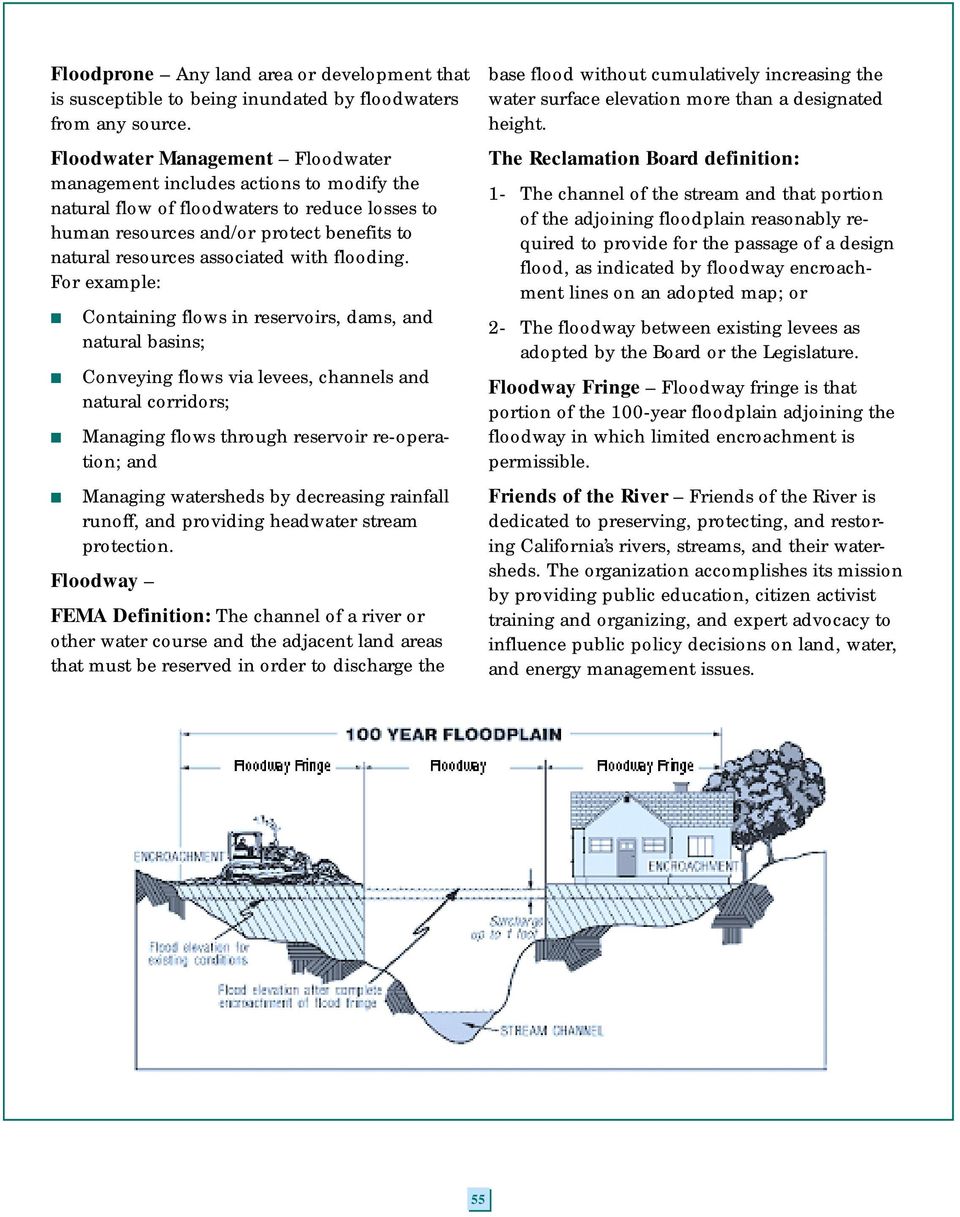
8 Floodprone Any land area or development that is susceptible to being inundated by floodwaters from any source. Floodwater Management Floodwater management includes actions to modify the natural flow of floodwaters to reduce losses to human resources and/or protect benefits to natural resources associated with flooding. For example: Containing flows in reservoirs, dams, and natural basins; Conveying flows via levees, channels and natural corridors; Managing flows through reservoir re-operation; and Managing watersheds by decreasing rainfall runoff, and providing headwater stream protection. Floodway FEMA Definition: The channel of a river or other water course and the adjacent land areas that must be reserved in order to discharge the base flood without cumulatively increasing the water surface elevation more than a designated height. The Reclamation Board definition: 1- The channel of the stream and that portion of the adjoining floodplain reasonably required to provide for the passage of a design flood, as indicated by floodway encroachment lines on an adopted map; or 2- The floodway between existing levees as adopted by the Board or the Legislature. Floodway Fringe Floodway fringe is that portion of the 100-year floodplain adjoining the floodway in which limited encroachment is permissible. Friends of the River Friends of the River is dedicated to preserving, protecting, and restoring California s rivers, streams, and their watersheds. The organization accomplishes its mission by providing public education, citizen activist training and organizing, and expert advocacy to influence public policy decisions on land, water, and energy management issues. 55
9 General Plan Guidelines An advisory document prepared by the Governor s Office of Planning and Research (OPR) to assist cities and counties in the preparation of local general plans. Hazard Mitigation Grant Program Authorized by the Federal Emergency Management Agency (FEMA), this program provides grants, to States and local governments, to implement cost-effective, long-term hazard mitigation measures, which will reduce or eliminate damage to lives or property, after a major disaster. Hydraulic Modeling Hydraulic modeling is a numerical or physical simulation of natural riverine conditions. Hydrologic Modeling Hydrologic modeling is a mathematical analysis of the flow of water and its components on some part of a surface or subsurface area. Hydrologic modeling using transposition Hydrologic modeling using transposition is a process that uses hydrologic data from adjacent or similar-characteristics watersheds for other watersheds that lack the data necessary for hydrologic modeling. League of California Cities The League of California Cities is an association of California city officials who work together to enhance their knowledge and skills, exchange information, and combine resources so that they may influence policy decisions that affect cities. Lower San Joaquin Levee District The Lower San Joaquin Levee District was created by the State Legislature in 1955, for the purpose of ensuring that the benefits of the Lower San Joaquin River Flood Control Project, paid for by the taxpayers, would not be lost and to provide protection to the people and the property for whom this project was designed. The project was designed and constructed by the State Department of Water Resources between 1959 and The project s purpose is to provide flood protection along the San Joaquin River and tributaries in Merced, Madera, and Fresno Counties. The plan covers 108 river miles, contains 195 miles of levees, and protects over 300,000 acres. The project is a series of bypasses built to collect San Joaquin flood flows, as well as floodwater from the Kings River system. The bypasses divert flows around stretches of the San Joaquin where constrictions impaired its capacity. The Levee District, in accordance with its agreement with the State Reclamation Board, is obligated to maintain not only the bypasses, but also the channel of the San Joaquin River within the project, in a condition where the channel will carry flood flows in accordance with the maximum benefits for flood protection. Lowest Floor Elevation The measured distance of a building s lowest floor above the National Geodetic Vertical Datum (NGVD) or other datum specified on the FIRM for that location. Map Modernization Program Established in 1997 to modernize FEMA s flood mapping program. The program intent is to reduce the average age of flood maps nationwide to six years (current average age is over a decade), produce digital mapping products for high priority areas, and reduce the number of unmapped communities by 50 percent. Mapping Needs Update Support System (MNUSS) The MNUSS program was developed by FEMA to inventory and evaluate local community mapping needs and is a tool that can be used to prioritize floodplain mapping needs. MNUSS is a software application that stores all 56
10 identified needs nationally, performs a benefit cost analysis, and ranks the identified Map Maintenance Needs and Flood Data Update Needs for each community. National Academy of Engineering The National Academy of Engineering (NAE) mission is to promote the technological welfare of the nation by marshaling the knowledge and insights of members of the engineering profession. National Flood Insurance Program (NFIP) The National Flood Insurance Act of 1968 provides relief from the impacts of flood damages and established The National Flood Insurance Program (NFIP). The NFIP provides federally subsidized flood insurance to participating communities, contingent on flood loss reduction measures taken by local floodplain management regulations. The NFIP is designed to reduce future flood losses through state and local floodplain management efforts and to transfer the costs of residual flood losses from the general taxpayer to the floodplain occupant. National Research Council The National Research Council was organized by the National Academy of Sciences in 1916 to associate the broad community of science and technology with the Academy s purposes of further knowledge and advising the federal government. The National Research Council has become the principal operating agency of both the National Academy of Sciences and the National Academy of Engineering in providing services to the government, the public, and the scientific and engineering communities. National Wildlife Federation (NWF) The National Wildlife Federation is the nation s largest member-supported conservation group, uniting individuals, organizations, businesses and government to protect wildlife, wild places, and the environment. The Nature Conservancy The Nature Conservancy was established in 1951 with the mission to preserve the plants, animals, and natural communities that represent the diversity of life on Earth by protecting the lands and waters they need to survive. The Nature Conservancy has protected more than 92 million acres worldwide. Natural Corridor A passageway of land and waters, which provides a refuge that will fulfill the needs of fish, wildlife, and plants that are native to ecosystems. Natural Resources Defense Council (NRDC) The Natural Resources Defense Council (NRDC) uses law, science, and the support of more than 500,000 members nationwide to protect the planet s wildlife and wild places and to ensure a safe and healthy environment for all living things. Nonstructural approaches Nonstructural methods include the use of regulations to prevent buildings from being constructed so they will not be subject to or damaged by flooding, as well as the removal of existing flood-prone buildings and the protection of open space along watercourses. Regulations are also used to limit new construction in floodplains and to prevent additional damage to existing developed floodprone areas. One Hundred (100-Year) Flood A 100-year flood is a flood event that has a one percent chance of being equaled or exceeded in any given year. Also known as base flood. One percent (one percent flood) See One Hundred Year Flood. Paleo-flood records Flood magnitude estimates developed from geophysical evidence rather than from stream gauge records or historic accounts. Holocene (post Ice Age) climate records are usually the most relevant records to 57
11 use in judging the significance of paleo-flood records to potential flood magnitudes that might be seen in the remaining several thousand years of this interglacial climate period. Reasonably Foreseeable Flood A reasonably foreseeable flood is a flood event that is realistically probable for a particular area. In many cases, this event could exceed a predicted 100-year flood. It is important to note that the determination of a reasonably foreseeable flood can vary depending on its use and application for any given area. Sources of information on reasonably foreseeable floods may include historic floods, paleo-floods, hydrologic modeling using transposition, historical flood damage data, and hydrologic models. Communities such as Sacramento, West Sacramento, Yuba City, Marysville, Los Angeles, and Orange County are all working toward protection against floods that exceed the 100-year floods. It is up to each community to consider this information in making land use and flood management decisions. The Reclamation Board The Reclamation Board was established to control flooding along the Sacramento and San Joaquin Rivers and their tributaries in cooperation with the U.S. Army Corps of Engineers, cooperate with various agencies of the federal, State and local governments in establishing, planning, constructing, operating, and maintaining flood control works and maintain the integrity of the existing flood control system and designated floodways through the Board s regulatory authority by issuing permits for encroachments. Repetitive Losses Repetitive losses are two or more losses that occur within ten years and each with a cost greater than $1,000. Reservoir Reservoir is a place where water is stored as an artificial lake where water is collected and kept in quantity for use. The Resources Agency of California The California Resources Agency is responsible for the conservation, enhancement, and management of California s natural and cultural resources. The Resource Agency is composed of departments, boards, conservancies, commissions, and programs. Riparian Riparian is relating to, located on, or living/growing on the bank of a natural watercourse such as a river, lake or tidewater. River Basin The geographical area drained by a river and its tributaries. Riverine flooding A general and temporary condition of partial or complete inundation of normally dry land areas from the overflow of inland rivers. The Sacramento Area Flood Control Agency A coordination group of regional flood control projects and legislation. This particular agency consists of the City of Sacramento, the Counties of Sutter and Sacramento, Reclamation District 1000, and the American River Flood Control District. Sacramento-San Joaquin River Basins Comprehensive Study A description of preferred flood management approaches to be locally or regionally implemented as a master plan for flood damage reduction and ecosystem restoration in California s Central Valley. Sacramento-San Joaquin River Delta The Sacramento and San Joaquin River Delta is located at the confluence of the Sacramento and San Joaquin Rivers. The Delta covers over 700,000 acres and is a major collection point for California waterways. The Delta receives runoff from 40 percent of California s land area and is the major water source for almost two-thirds of California s population. Much of the Delta s land is located 20 feet below sea level and is protected by an extensive levee system. 58
12 Safe Harbor Policy Safe Harbor agreements are voluntary arrangements between the U.S. Fish and Wildlife Service or National Marine Fisheries Service and cooperating non-federal landowners. The agreements benefit endangered and threatened species while giving the landowners assurances from additional restrictions. After the development of the agreement, the U.S. Fish and Wildlife Service will issue an enhancement of survival permit, to authorize any necessary future incidental take to provide participating landowners with assurances that no additional restrictions will be imposed as a result of their conservation actions. Southern California Associated Governments The designated Metropolitan Planning Organization (for six counties: Los Angeles, Orange, San Bernardino, Riverside, Ventura and Imperial), is mandated by the federal government to research and draw up plans for transportation, growth management, hazardous waste management, and air quality. Special Flood Hazard Area A FEMA NFIP term for the land in the floodplain within a community subject to a one percent or greater chance of flooding in any given year. Special flood hazard area maps may not accurately describe lands that are prone to flooding. Stakeholder Policy Committee The Stakeholder Policy Committee conferred with the Comprehensive Study team to identify potential barriers and recommendations for implementing the Sacramento and San Joaquin River Basins Comprehensive Study s Comprehensive Plan. The Stakeholder Policy Committee submitted recommendations to the Reclamation Board in Reforming Existing Flood Management Institutional Policies for Public Safety and Ecosystem Restoration. The recommendations were developed during a series of bi-weekly meetings in Structural Approaches Structural methods include construction of floodwalls and levees, and techniques to make structures more resistant to water penetration and pressure. Substantial Damage An NFIP term referring to damage of any origin sustained by a structure whereby the cost of restoring the structure to its before damaged condition would equal or exceed 50 percent of the market value of the structure before the damage occurred. In NFIP communities, if substantially damaged structures are rebuilt, the new structure must comply with NFIP design or location standards. Subventions Program The State Legislature established a policy of financial assistance to local agencies cooperating in the construction of federal flood control projects. State reimbursement ranges from a minimum of 50 percent to a maximum of 70 percent depending on the project s multipurpose features. United States Army Corps of Engineers (USACE) The United States Army Corps of Engineers (USACE) is made up of civilian engineers, scientists and other specialists who work with leaders in engineering and environmental matters. The USACE includes approximately 34,600 civilians and 650 military men and women. United States Environmental Protection Agency (USEPA) The United States Environmental Protection Agency (USEPA) is a federal agency that provides leadership in the nation s environmental science, research, education, and assessment efforts. USEPA works closely with other federal agencies, state and local governments, and Indian tribes to develop and enforce regulations under existing environmental laws. United States Water Resources Council The Water Resources Planning Act established the United States Water Resources Council in

13 The U.S. Water Resources Council includes the Secretaries of Interior, Agriculture, Army, Health, Education and Welfare, and the Chairman of the Federal Power Commission, with the heads of other agencies participating on matters affecting their responsibilities are to be considered by the Council. The Act required the Council to establish principles, standards, and procedures for federal participants in the preparation of comprehensive regional or river basin plans and for the formulation and evaluation of Federal water and related land resources projects. Watershed A watershed is a region or area bounded peripherally by a divide and draining ultimately to a particular watercourse or body of water. Watershed Management Watershed management is a process of decision-making regarding uses and modifications of lands and waters within a watershed. This process provides a chance for stakeholders to balance diverse goals and uses for environmental resources, and to consider how their cumulative actions may affect long-term sustainability of these resources. As a form of ecosystem management, watershed management encompasses the entire watershed system, from uplands and headwaters, to floodplain wetlands and river channels Western Governors Association (WGA) The Western Governors Association (WGA) serves the governors of 21 Western States and US-Flag Pacific Islands. WGA develops policy and carries out programs in the areas of natural resources, the environment, human services, economic development, international relations, and state management. WGA helps Governors to develop strategies for long- and short-term issues and to develop and advocate policies that reflect regional interests and consensus. Wetlands Areas in which water saturation determines the nature of soil development and the types of plant and animal communities living in the soil. Wildlife friendly agriculture Management practices used by farmers and ranchers to support wildlife. Examples include planting or maintaining riparian vegetation, insectivory hedgerows, native grass plantings around field edges, cover crops, installing owl nest boxes and bat roost structures, and winter flooding of harvested fields. 60

14 APPENDIX B PROPOSED COMMENTS ON THE CALIFORNIA STATE GENERAL PLAN GUIDELINES The following are proposed revisions to the text on page 127 of the 2002 preliminary draft General Plan Guidelines. All new text is underlined. FLOODPLAIN MANAGEMENT Introduction Flood Management Flood management is defined as the overarching term that encompasses both floodwater management and floodplain management. Flood Water Management Floodwater management includes actions to modify the natural flow of floodwaters to reduce losses to human resources and/or protect benefits to natural resources associated with flooding. For example: containing flows in reservoirs, dams, and natural basins; conveying flows via levees, channels and natural corridors; managing flows through reservoir re-operation; and managing watersheds by decreasing rainfall runoff, and providing headwater stream protection. Floodplain Management Floodplain management includes actions to the floodplain to reduce losses to human resources within the floodplain and/or protect benefits to natural resources associated with floodplains and flooding. For example: minimizing impacts of flows (e.g. flood-proofing, insurance); maintaining or restoring Natural Floodplain Processes (e.g. riparian restoration, meander corridors); removing obstacles within the floodplain voluntarily or with just compensation (e.g. relocating at- risk structures); keeping obstacles out of the floodplain (e.g. planning, mapping, and zoning land use decisions); educating and emergency preparedness planning (e.g. emergency response plans, data collection, outreach, insurance requirements); ensuring that operations of floodwater management systems are not compromised by activities that interfere with, or are damaged by, design floods of these systems. Floodplain management measures interrelate and occasionally overlap with floodwater management measures to reduce losses within the floodplain. For example: emergency response activities; realigning levees; reconnecting historical floodplains; and reoperation of reservoirs. Multi-hazard Mitigation Approach Federal law directs states to develop a multi-hazard mitigation program (administered by the Governor s Office of Emergency Services) to implement effective hazard mitigation measures that reduce the potential damage from natural disasters to reduce the loss of life and property, human suffering, economic disruption and disaster assistance costs resulting from natural disasters. While the State directs local governments through existing law to deal with fire and earthquakes in their local planning, the State does not play a major role with land use issues associated with flooding 61

15 (Fulton). The general plan law calls for the consideration of flood hazards, flooding, and floodplains in the land use, open-space, conservation, and safety elements. Local jurisdictions may benefit by doing a multi-hazard planning approach to meet multiple federal and state requirements. Flood management also may be approached as a stand alone program or as one component of the broader notion of watershed planning, which also includes objectives such as improved water quality, erosion control, system-wide flood management and habitat conservation and enhancement. Where possible, a community should take a broader watershed approach to flood management, which would result in a coordinated regional approach to land use planning and flood loss reductions. When incorporated into the general plan, either as an optional element or as a section in the land use, open-space, conservation, or safety element, flood management principles will be reflected as long-term development policies. Floodplain Functions Flooding is a natural function of every river, alluvial fan and coastal area. In the riverine systems, floodwaters enrich bottomlands and provide spawning habitats for native fish. There are ecological benefits of maintaining connections between the river and its floodplain. Land use decisions directly influence the function of floodplains and may either reduce or increase ecosystem health and potential flood hazards. The functions of floodplains include, but are not limited to, water supply, improved water quality, flood and erosion control, and fish and wildlife habitat. Development within floodplains may not only expose people and property to floods, but also increase the potential for flooding elsewhere and may negatively impact floodplain ecosystems. Land use regulations such as zoning and subdivision ordinances are the primary means of implementing general plan policies established to minimize flood hazards. In addition to including floodplain management policies in the general plan, making related changes to zoning and subdivision ordinances is crucial to the success of a floodplain management program. The following flood management element guidelines will discuss flood management at both the individual community level and the regional level. They are equally useful in situations where a city or county has unilaterally included flood management in its general plan, or where an individual jurisdiction s flood management element is part of a larger regional strategy to be implemented by more than one agency. Guidelines for Flood Management Programs Relationship to the General Plan Flood management may be addressed in an optional element pursuant to of the Government Code. Once adopted, the flood management element becomes an integral part of and carries the same weight as the other elements of the general plan. Its objectives, policies, plan proposals, and implementation measures must be consistent with the entire general plan ( ). The objectives and policies, which are adopted as part of the flood management element must not conflict with the general plan as a whole, or with any individual element. A floodplain management element should provide direction and specific policies correlated with the land use, housing, conservation, safety, 62
16 and open-space elements. For example, policies limiting development within the floodplain to compatible agricultural uses must also be reflected in the and internally consistent with land use, housing, open-space, and conservation elements. Policies regarding levee and channel maintenance might be reflected in the safety element. Many of the provisions under flood management will affect other elements of the general plan, and they should be cross-referenced as necessary. Where a regional approach is being taken, the policies of a city or county s flood management element should also correlate to the regional flood management plan. That plan should be specific enough to recognize the differing characteristics of each of the involved cities and counties and identify the respective roles of each and obligations of each within all elements of the General Plan. The regional plan may stipulate that participating cities and counties self-certify the consistency of their flood management elements with the regional plan. Relationship to CEQA The adoption or amendment of a floodplain management element is subject to the requirements of CEQA (described in Chapter 4). The element may have direct physical consequences on residential development, wildlife habitat, anadromous fish migration, agricultural resources, vector control, water quality, and other environmental resources common to rivers and their floodplains. The hydrologic and hydraulic characteristics of the rivers and associated floodplains and ecosystems, of each river basin or hydrologic unit represent a complete and interconnected system. Changes to one part of the system may change other parts of the system. Floodwater and floodplain approaches must consider these factors. There may be flood management benefits from a watershed perspective for assessing potential impacts and opportunities for mitigation measures. Flood Insurance The most common means of planning to avoid or at least mitigate flood damage is participation in the federal flood insurance program. The Federal Emergency Management Agency (FEMA) administers the National Flood Insurance Program (NFIP), which makes flood insurance available to those communities, which have enacted local ordinances restricting development within the 100-year floodplain. The local floodplain ordinances must meet or exceed FEMA s regulations. As part of its program, FEMA prepares a Flood Insurance Rate Map (FIRM) delineating the theoretical boundaries of the 100-year floodplain (the area within which the statistical frequency of flooding is believed to be 1 in 100 in any given year). These maps form the basis for regulating floodplain development and the rating of flood insurance policies. The responsibilities of cities and counties participating in the NFIP include requiring that all new construction have its lowest floor elevated to or above the base flood elevation (this is calculated in conjunction with the 100-year floodplain delineation) and keeping records of development occurring within the designated floodplain. Under federal law, flood insurance must be purchased when obtaining a federally backed loan for a home within the FIRM 100-year floodplain. The availability of other federal funds also may be affected by participation in the NFIP program. The city or county must submit a biennial report to FEMA describing any changes in the community s flood hazard area, development activities which have taken place within the floodplain, and the number of flood- 63

17 plain residents and structures. As of April 1998, all but 20 of the cities and 1 of the counties in California participate in the NFIP. Participating in the NFIP is no guarantee that a community will escape flood damage, or that floods will not occur outside the boundaries of mapped floodplains. The program has a number of recognized shortcomings: FEMA maps tend to underestimate the extent of the floodplain. For example, existing FIRM maps do not take into account the effects of future development when estimating flood potential. FIRM maps are not updated frequently enough, with or without future conditions, to reflect changes in the watershed or floodplain. New FEMA regulations allow FIRM maps to provide for consideration of future conditions including build-out and changes to weather patterns associated with climate changes for either upstream or downstream areas, which may affect local flood levels. If these maps are to be used as a planning tool, they should be updated using locally collected data to identify existing and future flood levels. The Department of Water Resources (DWR) is currently working to update many of these maps, in cooperation with FEMA. Residents and decision-makers are not always aware of the actual level of flood risk. The 100-year floodplain is a theoretical construct in many cases there is simply insufficient historical flood data to accurately judge flood frequency. In addition, the 100-year floodplain designation is commonly misunderstood by the public it is simply a frequency and intensity probability, meaning that in reality, severe flooding may occur even more than once in any year, and any number of years in over a 100 year span. The NFIP and related floodplain mapping is a program for a community to seek flood insurance and should be viewed as the foundation on which to build comprehensive flood management policies. The general plan may augment this program by providing long-range guidance to avoid and reduce flood hazards. Flood Management on a Regional Basis Rivers, creeks, and other potential sources of flooding often cross-jurisdictional boundaries and thus a regional, watershed-based approach may be the effective means of flood management. The broader scope offers the advantage of involving local governments, other public agencies, interest groups, landowners, and the general public throughout the watershed in a comprehensive, multi-jurisdictional program for reducing flood risk and potential damages and restoring and enhancing floodplain functions. The larger area may offer a wider range of potential projects, policy and regulatory options than would be available in a single jurisdiction. Nonetheless, regional flood management is also more politically and logistically difficult than management undertaken within a single jurisdiction. As a component of watershed management, flood management reduces downstream flood stages and flood damages with benefits for water quality, water supply, agriculture and ecosystems. The watershed-based approach maintains the floodplain functions of sedimentation, deposition, water filtering, and floodwater absorption. See page for additional discussion on watershed planning. No two situations are alike, and the dynamics of regional flood management are very situationspecific. For that reason, the following discussion of regional approaches is limited to generalities. For additional advice, see the reference sources listed in the Technical Assistance section. 64

18 Successfully developing a regional flood management plan that includes floodplain strategies depends on the existence of several basic prerequisites. There must be: General recognition that there is a regional flooding problem that requires a solution; Some impetus for the involvement of critical agencies and interest groups in the search for a solution; A willingness among the involved agencies and interest groups to work toward a consensus solution; At least one person, group, or agency that will sponsor or champion the process; A range of feasible and practical solutions available; A reasonable possibility that funding exists to pay for the necessary planning, as well as followup funding to implement the accepted plan; and Specific criteria to measure the effectiveness of plan implementation. Few of the regional flood management efforts currently being implemented around the state, including watershed management programs, are directly linked to city and county general plans. In fact, city and county land use planning agencies are often conspicuously low on the list of participants. When possible, city and county planners should take an active lead role part in any regional flood management planning process. The local general plans, as well as zoning and subdivision ordinances, can play an important part in a comprehensive, multi-jurisdictional program for flood management. Cities and counties should amend their general plans and revise their zoning and subdivision ordinances when agreed to as part of a regional effort. Methodology The process of adopting a flood management element is essentially the same as any other element of the general plan and must follow the procedures set forth by and of the Government Code. Under state law, the planning agency must provide opportunities for involvement by residents, public agencies, public utility companies, and other community groups through public hearings and any other means found to be necessary or desirable. The planning agency should include in its process affected cities and counties, FEMA, the U.S. Army Corps of Engineers, the California Department of Water Resources (DWR), The Reclamation District, levee districts, resource conservation districts, and interest groups including environmentalists, farmers, builders, as well as any non-governmental organization (i.e. land trust, local or other conservancy, etc.) which might have an interest in floodplains. Establishing a steering committee may be useful. The committee can help identify floodplain issues and community objectives, develop policies, and draft the element. Members of the committee should be selected from among representatives of interested groups, agencies, organizations, and residents. Alternatively, a separate technical advisory group may also be established from among agency representatives. See Chapter 2 for a discussion of advisory committees. 65

19 The general plan may be adopted in any format deemed necessary or appropriate. A well-written general plan will serve as a constant reference for decisions regarding the physical development of the community including its floodplains. Floodplain management is interrelated with most, if not all, of the other required elements. The Office of Planning and Research recommends taking particular care to correlate floodplain management objectives and policies with those of the land use, openspace, conservation, and safety elements. Relevant Issues When a flood management element is being prepared, the issues covered should be limited to those, which are relevant to the community, the floodplain, and the watershed. Clearly, the subjects covered by the flood management element will depend upon the community s location in relation to rivers and streams, alluvial fans or the coast past or future potential for flood events, and the potential to be affected by upstream or to impact downstream land use decisions and flood potential. Following are a variety of issues, not all of which will be relevant in every jurisdiction. These are simply some common ideas; they are not intended to be an all-inclusive list. OES Multi-hazard Mitigation Plan The reasonably foreseeable flood area FEMA NFIP program and community rating system (to reduce flood insurance rates) DWR Awareness Mapping and other historical flooding resources Repetitive losses Land use designation and flood hazard overlay designations Flood control facilities (e.g., structural approaches to flood management such as dams, levees, etc.) Floodplain management approaches (nonstructural including elevation, floodproofing, floodplain storage) Conformity with federal, state, and local regulations Regulatory relationships, including permitting Multi-jurisdictional coordination and watershed planning Downstream impacts as consequences of land use decisions Downstream land use planning considerations (flood hazards and infrastructure) as consequences of upstream actions Alternative non-structural allowable floodplain land uses Multi-objective floodplain management planning with regional share housing needs, existing land uses, conservation of agricultural land, parks and open space, habitat protection and restoration, and flood management mitigation measures. Funding of management activities 66

20 Ideas for Data and Analysis In the process of preparing a flood management element, the city or county will have to collect a substantial amount of information concerning its floodplains and its watershed. There are a variety of sources for this information. FEMA maps are available for most communities. The U.S. Army Corps of Engineers will do floodplain delineation on a cost-sharing basis and has information on floodplains and project levees. DWR also has floodplain information and a floodplain management program, as does the State Reclamation Board in the Central Valley. The Office of Emergency Services and DWR have information on past flooding and flood levels based on awareness mapping. Local levee districts and Resource Conservation Districts may also have information to share. The following are ideas for data and analysis to support the development of objectives, policies, and implementation measures for this element. Comprehensively define the floodplain (FEMA v. Army Corps of Engineers v. State Reclamation Board v. local agency definition) Extent and depth of historic flooding (maps) Historical flooding data Frequency Intensity Duration Paleoflood Hydrologic modeling using transposition or meteorological models Alluvial Fan Floodplain data Reasonably foreseeable flood apex flow paths Flood flow path depths and velocities Debris and scour Inventory land and land uses with the floodplain(s) Open-space Habitat Wildlife migration corridors Agricultural Flood control Developed (i.e., residential, commercial, industrial 67
21 Identify existing and future problems and opportunities Development within hazard areas Undeveloped land suitable for bypass construction Loss of productive farmland and opportunities for conjunctive farming and floodplain management activities Community apathy or support Funding shortfalls Boundaries of floodplains (FEMA v. U.S. Army Corps of Engineers v. DWR v. local agency) Inventory flood control structures and areas managed for flood control, and their controlling agencies Levees Flood walls Bypasses Dams/reservoirs Inventory pertinent regulations of federal, state, and local agencies Regulatory authority Existing land use and zoning restrictions Inventory ongoing floodplain or watershed management and planning activities Local/regional, including those of non-governmental organizations State Federal Inventory past, and planned management activities Local agencies Reclamation Districts State and federal agencies Identify sources of funding for planning efforts, as well as for potential implementation activities Benefit/cost analysis of alternative floodplain management strategies Ideas for Flood Management Development Policies A flood management element should conform to the pertinent policies, objectives, plans, and proposals central to the land use, conservation, open-space, and safety elements. Policies should 68
22 recognize existing floodplain management programs as well as existing regulations. As always, policies must conform to constitutional prohibitions on regulatory takings. Further, the policies selected should be physically and economically feasible to implement. Following are ideas for the general types of policies, which may be incorporated into the flood management element. Specify allowable uses within the floodway fringe and floodplains Specify limits on and construction standards for development and encroachment within mapped floodplains and floodway fringe (land use density, intensity, elevations, location), including areas of shallow flooding Establish policies, plan proposals, and standards for dealing with constraints and minimizing land use and floodplain conflict Retain and preserve floodplains for open-space and recreation Encourage compatible agricultural uses and practices with habitat banking where compatible with floodplains Mitigate for impacts such as loss of agricultural land, loss of native habitat, or changes in flood characteristics Cooperate with the programs of other agencies and non-governmental organizations, where applicable Establish consultation procedures with other affected agencies and jurisdictions Identify criteria for public agency acquisition of development rights in floodprone areas Encourage cooperation with non-governmental organizations to acquire development rights Establish policies, guidelines, standards and building criteria to ensure that new development will not be damaged by special risks associated with alluvial floods. Encourage multi-jurisdictional flood management cooperation when watersheds cross-jurisdictional boundaries Develop flood hazard mitigation measures within identified reasonably foreseeable flood hazard areas where appropriate Encourage coordination between flood management and multi-hazard management planning and mitigation Retain and preserve connectivity between rivers or streams and their floodplains to preserve floodplain function and natural processes. Ideas for Implementation Local agencies should select a combination of implementation measures or strategies that best address the unique characteristics of the specific community and establish an effective long-term 69
23 approach to floodplain management. The following examples illustrate the kinds of actions local governments may take to implement the floodplain management element. Adopt flood hazard zoning Enact floodplain management standards as part of any zoning or land use ordinance Consider new and substantially-improved buildings to exceed minimum federal flood insurance requirements Adopt transfer of development rights programs Adopt other land use development regulations Reconnect the river and its floodplain through public land acquisition and structural modification of existing flood control devices Include nonstructural floodplain management approaches to help conserve beneficial uses and functions of the floodplain Identify capacity of floodplain to recharge groundwater Access technical assistance from DWR for identifying existing local and/or FEMA floodways Develop a program for preventative maintenance of active floodplains, control structures, river banks, and channels to balance the need to ensure continued flood capacity and stability compatible with the needs of established native habitat Identify and utilize floodplain management grants and assistance to develop and implement floodplain management plans and programs Develop public outreach programs and information Incorporate watershed and floodplain mapping, from several sources if available, into the city or county Geographic Information System (GIS) Regularly review floodplain maps, and update with future conditions when new information becomes available Participate in and provide assistance to stream gauges as appropriate Develop reasonably foreseeable alluvial fan floodplain maps Public development and redevelopment policies Cooperate with OES and DWR to identify repetitive losses if any Prepare and update emergency preparedness plans Direct local emergency services offices to develop and implement flood warning systems Establish resources and provide funding for public acquisition of private lands and structures within the floodplain and subject to flood hazards. 70
24 Institute a planning mechanism and institutional framework to coordinate flood management programs with opportunities for agricultural conservation and ecosystem protection and restoration control and environmental management activities with local, state, federal agencies, and other stakeholders Promote multi-objective management approach in flood management projects Initiate actions to avoid inadequate or unclear responsibilities between agencies Enter cooperative agreements (JPA, MOU) with other entities specifying relative roles Facilitate the coordination of responsibilities and activities among agencies and the public for floodplain management Develop aquatic and terrestrial habitat restoration plans consistent with floodplain and river channel use guidelines Develop information and coordination plans with other agencies to educate the public and all planning agencies about floodplain management objectives Refer to FEMA DMA 2000 Multi-hazard mitigation Plan Criteria (source). Develop Awareness Mapping 71
25 Technical and Funding Assistance The following governmental and nongovernmental organizations can provide information or assistance for the preparation of the safety element: add: Department of Water Resources, Flood Division for Awareness Mapping, Community Rating Systems program, and Floodplain Management, Governor s Office of Emergency Services, FEMA; Association of State Floodplain Managers, and American Planning Association. [See 1998 Guidelines for original section]. Floodplain Management Association P.O. Box Sparks, NV United States Army Corps of Engineers Floodplain Management Services South Pacific Division 630 Sansome Street, Room 720 San Francisco, CA (415) Funding Mechanisms: Congressionally Authorized Civil Works Projects, Floodplain Management Services, Small Flood Control Projects, Snagging and Clearing for Flood Control, Streambank and Shoreline Protection for Public Facilities Federal Emergency Management Agency (FEMA) 1111 Broadway, Suite 1200 Oakland, CA (510) Funding mechanisms: Hazard Mitigation Grant Program, Public Assistance Section 406, National Flood Insurance Program, Performance Partnership Program, Community Assistance Program-State Support Services Element, Individual and Family Grant Program, Disaster Housing Assistance Program Governor s Office of Emergency Services Planning and Technological Assistance Branch P.O. Box Rancho Cordova, CA (916) or Disaster Assistance Programs Branch Hazard Mitigation Section P.O. Box Rancho Cordova, CA Funding Mechanisms: Hazard Mitigation Grant Program 72
26 California Department of Water Resources Floodplain Management Branch P.O. Box Sacramento, CA (916) United States Environmental Protection Agency 75 Hawthorne Street San Francisco, CA Funding under the Clean Water Act: 104(b)(3) State Wetland Protection Development Grant; 104(b)(3) NPDES demonstration projects United States Department of Agriculture Natural Resource Conservation Service 430 G. Street, #4164 Davis, California Bibliography A Multi-Objective Planning Process for Mitigating Natural Hazards, Federal Emergency Management Agency, Denver, CO, 1994 (a step-by-step method for organizing a week-long session to develop local natural hazards mitigation plans) Multi-Objective Flood Mitigation Plan, Vermillion River Basin, South Dakota, Federal Emergency Management Agency, Denver, CO, 1994 Watershed Protections: A Statewide Approach, U.S. Environmental Protection Agency, San Francisco, CA, 1995 Managing Floodplain Development In Approximate Zone A Areas, Federal Emergency Management Agency, Denver, CO, 1995 Cost Effectiveness Analysis For Environmental Planning: Nine Easy Steps, U.S. Army Corps of Engineers, Alexandria VA, 1994 Community Flood Mitigation Planning Guidebook, Wisconsin Department of Natural Resources, Madison WI, 1995 Investing In A Safer Future: Proceedings Of The Second Annual Congress On Natural Disaster Loss Reduction, Insurance Institute For Property Loss Reduction, Boston MA, 1995 Subdivision Design in Flood Hazard Areas, PAS Report 473, Marya Morris, American Planning Association, Chicago IL,
27 APPENDIX C EXECUTIVE ORDER OPTIONS Proposed California Floodplain Management Executive Order Revision Please Note: Exceeds NFIP minimum standards more protective language underlined applies only to NOW THEREFORE portion, not WHEREAS portion Executive Department State of California EXECUTIVE ORDER D (Replaces Executive Order B-39-77) Revised WHEREAS, throughout the State repetitive floods continue to jeopardize those who live in floodplains, and cause devastating losses, major risks and increase costs to California s people, property, environmental, social and economic interests, and; WHEREAS, past and future floodplain management decisions will be an increasingly important consideration as the State s population and development continues to outpace the construction and maintenance of physical floodwater management facilities used to reduce flood damage to floodplain developments; and WHEREAS, a more determined implementation of floodplain management would mitigate the traditional and costly cycle of allowing inappropriate uses in floodplains which in turn creates the justification for additional physical floodwater management facilities; and WHEREAS, adherence to floodplain management also protects natural resources such as wetland and riparian habitat which have been significantly reduced and require protection; and WHEREAS, prudent floodplain management values agricultural land, water resources and floodplain functions that are essential to the existing environment and necessary for our State s floodplains continued ability to provide a safe, healthy and affordable food supply, which is vital for our national security and public welfare; and WHEREAS, appropriate pre-flood floodplain management effort will reduce post-flood displacement, disruption, and federal and State financial disaster assistance; and WHEREAS, the State should provide leadership by example to decision-makers to develop and support prudent floodplain management policies; and WHEREAS, the State has programs for the construction, operation, or permitting of facilities and surplus State lands conveyance which can directly or indirectly affect land use planning and development in floodplains; and WHEREAS, the National Flood Insurance Act of 1968 as amended provides that State or local governments that do not adopt floodplain management regulations consistent with at least the minimum standards of the National Flood Insurance Program cannot participate in the National 74
28 Flood Insurance Program and will not be eligible for any federal financial assistance, including federal disaster assistance and USDA and HUD funding, for buildings located in FEMA s regulatory floodplains in that community; and WHEREAS, the availability of federal financing for buildings and their contents, flood insurance and disaster assistance is of importance to the residents of California. WHEREAS, the purchase of flood insurance is a condition of any federal financial assistance for any State or local government in the construction, or acquisition of buildings in identified floodplains; and WHEREAS, the United States Code at 42 U.S.C (a) specifically prohibits Federal officers and agencies from providing financial assistance for acquisition or construction purposes for use in the floodplains of a State, local government, or other specified public entity that is not participating in the National Flood Insurance Program; and WHEREAS, laws have been enacted since the original 1977 version of this Order including the Robert T. Stafford Disaster Relief and Emergency Assistance Act of 1988, as amended, the Housing and Community Development Act of 1992, the Reigle Community Development and Regulatory Improvement Act of 1994, and others, and the State desires to provide leadership in multi-objective management of floodplains and the protection, restoration and enhancement of other natural and beneficial functions of the floodplain; and WHEREAS the Legislature has declared in Water Code section 8325 that a large portion of the land resources of the state is subject to recurrent flooding causing loss of life and property, and there is a recognized public need in the state for flood insurance; and WHEREAS the Legislature has declared in Water Code section 8325 that the public interest will be served by state cooperation under the National Flood Insurance Program; and NOW THEREFORE, I, Gray Davis, Governor of the State of California, by virtue of the power and authority vested in me by the Constitution and statutes of the State of California, do hereby issue this Executive Order to supercede Executive Order B-39-77, effectively immediately. 1. Policies and priorities identified in this order further the State of California s cooperation with the National Flood Insurance Program, and hence promote the public interest, consistent with the Legislature s declarations in Water Code section The policies and priorities identified in this Order are not intended to amend the effect of, or to qualify the operation of existing laws and regulations. 2. Consistent with its legal authority, if a State agency has determined to, or proposes to, conduct, support, or allow development, as defined by the State s Executive Order, Note 4, to be located in the floodplain and which is not subject to local floodplain management requirements, the State agency should be encouraged to consider alternatives that avoid or minimize adverse effects and incompatible development in the floodplain. 75
29 3. With respect to State lands and State structures, State agency officials shall provide leadership and shall make decisions consistent with long- and short-term flood risk in order to avoid or minimize the social disruption, environmental, and economic losses associated with the use of floodplains. These agency officials shall take particular care to avoid nonconforming or hazardous use of floodplains in connection with all activities under their authority. Note 1: In this Executive Order the term floodplain means Special Flood Hazard Area which includes both Zone A (Riverine/Alluvial) and Zone V (Coastal) flooding as shown on FEMA s Flood Hazard Boundary Maps (FHBM) and Flood Insurance Rate Maps (FIRM) or The Reclamation Board s Designated Floodways as shown on The Reclamation Board maps. The term floodplain includes both traditional floodplains and floodways. Note 2: There are certain areas not mapped for regulatory purposes by the NFIP or The Reclamation Board, which may be flood-prone areas. These include unmapped floodplains, whose existence is demonstrated by historic flooding or credible hydrological and hydraulic data, and floodplains indicated by Awareness Maps, or other relevant studies, including reasonably foreseeable flood mapping. All obligations in this Executive Order related to floodplains also include consideration of these flood-prone areas. Reasonably foreseeable flooding, as used in this order, is an estimate of the range of foreseeable flood magnitudes developed for floodplain and flood management purposes, which utilizes all available sources of flood related information, including but not limited to, historic floods, hydrologic modeling using transposition, hydraulic models, meteorological models, and evaluation of the 1 percent frequency flood design standards. Note 3: In this Executive Order, state structure means new or substantially improved buildings or improvements that are not subject to local government floodplain management requirements and that the state constructs, substantially improves, or owns. Note 4: In this Executive Order the term development, as defined by NFIP, means any human-made change to improved or unimproved real estate, including but not limited to buildings, or other structures, mining, dredging, filling, grading, paving, excavation or drilling operations, or storage of equipment or materials where the State constructs, improves, or owns and the activity is not subject to local floodplain management requirements. Note 5: Critical Infrastructure means public facilities that are critical to the health and welfare of a population and to disaster response to a hazard event. Critical infrastructure should be presumed to include facilities that if rendered unserviceable, would impose significant hardship on the public, or that if flooded would pose a threat to public health and public safety. Critical Infrastructure includes but is not limited to emergency response facilities (such as OES, fire and police), hospitals, water purification facilities, sewer treatment facilities, and could include transportation, energy, communication, and power facilities. These obligations should be implemented as follows: a. All State agencies responsible for development other than issuing State permits for financing, planning, designing or constructing of non-state development, shall evaluate flood hazards 76
30 when planning the location of these developments. The evaluation shall consist of a determination of whether the proposed site lies in a floodplain, and, if so, that the precautions identified in this Executive Order will be taken to minimize the hazard. If the development does not have to be in the floodplain to meet its goals and objectives, feasible alternative locations for siting outside of the floodplain shall be given priority consideration unless the location in the floodplain is necessary because it is substantially more cost-effective, practical, or appropriate for the proposed use of the development or the benefits of floodplain functions. If development occurs in the floodplain, floodproofing should be considered and implemented, if appropriate. b. All new development by State agencies proposed in floodplains must at a minimum be constructed and maintained in accordance with federal and State regulations and local floodplain management ordinances, which include, but are not limited to, the National Flood Insurance Program design and floodplain standards set forth in the Code of Federal Regulations (44 CFR, Parts 60.3, 60.4 and 60.5); and amendments thereof after the date of this Executive Order; the Appendix (Chapter 31) of the 1997 (or later) edition of the Uniform Building Code (or equivalent provision as adopted by reference in the California Building Code, and the regulations of The Reclamation Board (Title 23). Where there are established differences among federal, state and local floodplain regulations, State agencies, at their option, shall abide by either this Executive Order or more protective local regulations enacted to protect the public health, safety, and welfare. In the siting, design, and construction of State structures in floodplains, state agencies generally should strive to exceed NFIP design standards in accordance with a complete flood risk analysis of a site and preserve natural floodplain functions and benefits to the extent feasible. To emphasize the importance of adhering to floodplain management regulations, which will reduce future flood risk and damage, State agencies shall follow this Executive Order in the development and promulgation of guidelines and regulations. c. All State agencies with existing State-owned, or State-operated developments in floodplains that suffer significant or repetitive flood damage, shall at a minimum carry out or require reconstruction, rehabilitation, or additions in accordance with federal ordinances, including the National Flood Insurance Program s design and floodplain standards set forth in the Code of Federal Regulations, and this Executive Order, or not perform reconstruction, rehabilitation, or additions if that work is not cost-effective, practical or appropriate for that development. Whenever cost-effective, practical and appropriate, floodproofing and flood protection measures shall be applied to existing developments in floodplain areas which have not suffered significant or repetitive flood damage. Where there are established differences among federal, state and local floodplain regulations, State agencies, at their option, shall abide by either this Executive Order or more protective local regulations. In undertaking these actions, state agencies generally should strive to exceed NFIP design standards in accordance with a complete flood risk analysis of a site, including reasonably foreseeable floods, and preserve natural floodplain functions and benefits to the extent feasible. 77
31 d. All State agencies responsible for the lease and other conveyance of surplus State property shall identify on the title that the property is in the floodplain or floodway; and disclose all flood hazards when such land is leased or otherwise conveyed of. e. State agencies developing or assisting with the development of critical infrastructure should avoid approving such development within a floodplain unless it is clearly demonstrated that it is necessary to achieve the purposes of the critical infrastructure and will be operable and not create a hazard to public safety during a major flood event. 4. Each State agency shall prepare a written statement on how it will comply with this Executive Order. 5. The Department of Water Resources shall designate a State Coordinator for Floodplain Management (for NFIP and CRS programs) to coordinate statewide floodplain management efforts including, but not limited to, such activities as: a. Provide informational assistance to State agencies, as floodplain management procedures are prepared and before final adoption by each agency to promote adequacy, consistency, and compliance with applicable floodplain regulations, including identification of critical infrastructure. b. Encourage and assist State agencies in complying with this Executive Order, including facilitating resolution of situations between or among State agencies, which may have programs with conflicting goals for the floodplain. 6. State Constitutional Officers, the University of California, the California State University, the California Community Colleges, the State Board of Education, State Lands Commission, Trustee Agencies pursuant to Resources Code 21000, and other State agencies, departments, boards, and commissions not directly under the authority of the Executive Branch are encouraged to comply with this Executive Order and the NFIP in a manner consistent with their legal authority. State agencies and other constitutional entities not covered under the Executive Order are encouraged to consider alternatives that avoid or minimize adverse effects and incompatible development in the floodplain, consistent with their legal authority. Note 6: Nothing herein is intended to create a new cause of action against the State. IN WITNESS WHEREOF, I have hereunto set my hand and caused the great seal of the State of California to be affixed this th day of, two thousand and three. /s/ Gray Davis (Great Seal of California) Governor of California /s/ ATTEST: Secretary of State 78
32 79
33 APPENDIX D PROPOSED COMMENTS ON THE CEQA APPENDIX G ENVIRONMENTAL CHECKLIST 80
34 Please Note: Task Force added comments italicized 1. Project title: 2. Lead agency name and address: 3. Contact person and phone number: 4. Project location: 5. Project sponsor s name and address: 6. General plan designation: 7. Zoning: 8. Description of project: (Describe the whole action involved, including but not limited to later phases of the project, and any secondary, support, or off-site features necessary for its implementation. Attach additional sheets if necessary.) 9. Surrounding land uses and setting: Briefly describe the project s surroundings: 10. Other public agencies whose approval is required (e.g., permits, financing approval, or participation agreement.) ENVIRONMENTAL FACTORS POTENTIALLY AFFECTED: The environmental factors checked below would be potentially affected by this project, involving at least one impact that is a Potentially Significant Impact as indicated by the checklist on the following pages. Aesthetics Agriculture Resources Air Quality Biological Resources Cultural Resources Geology /Soils Hazards & Hydrology/Hydraulics/ Land Use Planning Hazardous Materials Water Quality Mineral Resources Noise Population / Housing Public Services Recreation Transportation/Traffic Utilities / Service Systems Mandatory Findings of Significance 81
35 DETERMINATION: (To be completed by the Lead Agency) On the basis of this initial evaluation: I find that the proposed project COULD NOT have a significant effect on the environment, and a NEGATIVE DECLARATION will be prepared. I find that although the proposed project could have a significant effect on the environment, there will not be a significant effect in this case because revisions in the project have been made by or agreed to by the applicant. A MITIGATED NEGATIVE DECLARATION will be prepared. I find that the proposed project MAY have a significant effect on the environment, and an ENVIRONMENTAL IMPACT REPORT is required. I find that the proposed project MAY have a potentially significant impact or potentially significant unless mitigated on the environment, but at least one effect 1) has been adequately analyzed in an earlier document pursuant to applicable legal standards, and 2) has been addressed by mitigation measures based on the earlier analysis as described on attached sheets. An ENVIRONMENTAL IMPACT REPORT is required, but it must analyze only the effects that remain to be addressed. I find that although the proposed project could have a significant effect on the environment, because all potentially significant effects (a) have been analyzed adequately in an earlier EIR pursuant to applicable standards, and (b) have been avoided or mitigated pursuant to that earlier, including revisions or mitigation measures that are imposed upon the proposed project, nothing further is required. Signature Printed name Date For 82
36 EVALUATION OF ENVIRONMENTAL IMPACTS: 1) A brief explanation is required for all answers except No Impact answers that are adequately supported by the information sources a lead agency cites in the parentheses following each question. A No Impact answer is adequately supported if the referenced information sources show that the impact simply does not apply to projects like the one involved (e.g., the project falls outside a fault rupture zone). A No Impact answer should be explained where it is based on project-specific factors as well as general standards (e.g., the project will not expose sensitive receptors to pollutants, based on a project-specific screening analysis). 83
37 2) All answers must take account of the whole action involved, including off-site as well arson-site, cumulative as well as project-level, indirect as well as direct, and construction as wells operational impacts. 3) Potentially Significant Impact is appropriate if there is substantial evidence that an effect may be significant. If there are one or more Potentially Significant Impact entries when the determination is made, an EIR is required. 4) Negative Declaration: Potentially Significant Unless Mitigation Incorporated applies where the incorporation of mitigation measures has reduced an effect from Potentially Significant Impact to a Less Significant Impact. The lead agency must describe the mitigation measures, and briefly explain how they reduce the effect to a less than significant level (mitigation measures from Section XVII, Earlier Analyses, may be cross-referenced). 5) Earlier analyses may be used where, pursuant to the tiering, program EIR, or other CEQA process, an effect has been adequately analyzed in an earlier EIR or negative declaration. Section 15063(c)(3)(D). Earlier analyses are discussed in Section XVII at the end of the checklist. 6) Lead agencies are encouraged to incorporate into the checklist references to information sources for potential impacts (e.g., general plans, zoning ordinances). Reference to previously prepared or outside document should, where appropriate, include a reference tithe page or pages where the statement is substantiated. 7) Supporting Information Sources: A source list should be attached, and other sources used or individuals contacted should be cited in the discussion. 8) This is only a suggested form, and lead agencies are free to use different ones. 9) The analysis of each issue should identify: a) the significance criteria or threshold used to evaluate each question; and) the mitigation measure identified, if any, to reduce the impact too less than significance. 84
38 SAMPLE QUESTION Issues: Potentially Less Than Less Than No Impact Significant Significant Significant Impact With Impact Mitigation Incorporation I. AESTHETICS Would the project: a) Have a substantial adverse effect on a scenic vista? b) Damage scenic resources, including, but not limited to, trees, rock outcroppings, and historic buildings within state scenic highway? c) Substantially degrade the existing visual character or quality of the site and its surroundings? d) Create a new source of substantial light or glare, which would adversely affect day or nighttime views in the area? II. AGRICULTURE RESOURCES: In determining whether impacts to agricultural resources are significant environmental effects, lead agencies may refer to the California Agricultural Land Evaluation and Site Assessment Model prepared by the California Dept. of Conservation as an optional model to use in assessing impacts on agriculture and farmland. Would the project: a) Convert Prime Farmland, Unique Farmland, or Farmland of Statewide Importance (Farmland) to non-agricultural use? (The Farmland Mapping and Monitoring Programming the California Resources Agency, Department of Conservation, maintains detailed maps of these categories of farmland.) b) Conflict with existing zoning for agricultural use, or a Williamson Act contract? c) Involve other changes in the existing environment, which, due to their location or nature, could individually or cumulatively result in loss of Farmland, to non-agricultural use? III. AIR QUALITY Where available, the significance criteria established by the applicable air quality management or air pollution control district may be relied upon to make the following determinations. Would the project: 85
39 a) Conflict with or obstruct implementation of the applicable Air Quality Attainment Plan or Congestion Management Plan? b) Violate any stationary source air quality standard or contribute to an existing or projected air quality violation? c) Result in a net increase of any criteria pollutant for which the project region is non-attainment under an applicable federal or state ambient air quality standard (including releasing emissions which exceed quantitative thresholds for ozone precursors)? d) Create or contribute to a non-stationary source hotspot (primarily carbon monoxide)? e) Expose sensitive receptors to substantial pollutant concentrations? f) Create objectionable odors affecting a substantial number of people? III. BIOLOGICAL RESOURCES Would the project: a) Adversely impact, either directly or through habitat modifications, any endangered, rare, or threatened species, as listed in Title 14 of the California Code of Regulations (sections or 670.5) or in Title 50, Code of Federal Regulations (sections or 17.12)? b) Have a substantial adverse impact, either directly or through habitat modifications, on any species identified as a candidate, sensitive, or special status species in local or regional plans, policies, or regulations, or by the California Department of Fish and Game or U.S. Fish and Wildlife Service? c) Have a substantial adverse impact on any riparian habitat or other sensitive natural community identified in local or regional plans, policies, and regulations or by the California Department of Fish and Game or US Fish and Wildlife Service? d) Adversely impact federally protected wetlands (including, but not limited to, marsh, vernal pool, coastal, etc.) either individually or in combination with the known or probable impacts of other activities through direct removal, filling, hydrological interruption, or other means? e) Interfere substantially with the movement of any resident or migratory fish or wildlife species or with established resident or migratory wildlife corridors, or impede the use of wildlife nursery sites? f) Conflict with any local policies or ordinances protecting biological resources, such as a tree preservation policy or ordinance? g) Conflict with the provisions of an adopted Habitat Conservation Plan, Natural Conservation Community Plan, or other approved local, regional, or state habitat conservation plan? IV. CULTURAL RESOURCES Would the project: a) Cause a substantial adverse change in the significance of a historical resource, which is either listed or eligible for listing on the National Register of Historic Places, the California Register of Historic Resources, or a local register of historic resources? 86
40 b) Cause a substantial adverse change in the significance of a unique archaeological resources (i.e., an artifact, object, or site about which it can be clearly demonstrated that, without merely adding to the current body of knowledge, there is a high probability that it contains information needed to answer important scientific research questions, has a special and particular quality such as being the oldest or best available example of its type, or is directly associated with a scientifically recognized important prehistoric or historic event or person)? c) Disturb or destroy a unique paleontological resource or site? d) Disturb any human remains, including those interred outside of formal cemeteries? V. GEOLOGY AND SOILS Would the project: a) Expose people or structures to potential substantial adverse effects, including the risk of loss, injury, or death involving: i. Rupture of a known earthquake fault, as delineated on the most recent Alquist-Priolo Earthquake Fault Zoning Map issued by the State Geologist for the area or based on other substantial evidence of a known fault? ii. Strong seismic ground shaking? iii. Seismic-related ground failure, including liquefaction? iv. Inundation by seiche, tsunami, or mudflow? v. Landslides? vi. Flooding, including flooding as a result of the failure of a levee or dam? vii. Wild land fires, including where wild lands area adjacent to urbanized areas and where residences are intermixed with wild lands? a) Would the project result in substantial soil erosion or the loss of tops oil? b) Would the project result in the loss of a unique geologic feature? c) Is the project located on strata or soil that is unstable, or that would become unstable as a result of the project, and potentially result in on- or off-site landslide, lateral spreading, subsidence, liquefaction or collapse? d) Is the project located on expansive soil creating substantial risks to life or property? e) Where sewers are not available for the disposal of wastewater is the soil capable of supporting the use of septic tanks or alternative wastewater disposal systems? 87
41 VII. HAZARDS AND HAZARDOUS MATERIALS Would the project: a) Create a significant hazard to the public or the environment through the routine transport, use, or disposal of hazardous materials? b) Create a significant hazard to the public or the environment through reasonably foreseeable upset and accident conditions involving the likely release of hazardous materials into the environment? c) Reasonably be anticipated to emit hazardous emissions or handle hazardous or acutely hazardous materials, substances, or waste within one-quarter mile of an existing or proposed school? d) Is the project located on a site, which is included on a list of hazardous materials sites, compiled pursuant to Government Code Section and, as a result, would it create a significant hazard to the public or the environment? e) For a project located within an airport land use plan or, where such a plan has not been adopted, within two miles of a public airport or public use airport, would the project result in a safety hazard for people residing or working in the project area? f) For a project within the vicinity of a private airstrip, would the project result in a safety hazard for people residing or working in the project area? g) Impair implementation of or physically interfere with an adopted emergency response plan or emergency evacuation plan? h) Expose people or structures to the risk of loss, injury or death involving wild land fires, including where wild lands are adjacent to urbanized areas or where residences are inter mixed with wild lands? 88
42 VIII. HYDROLOGY, HYDRAULICS, AND WATER QUALITY Would the project: a) Violate Regional Water Quality Control Board water quality standards or waste discharge requirements? b) Substantially deplete groundwater supplies or interfere substantially with groundwater recharge such that there would be a net deficit in aquifer volume or a lowering of the local groundwater table level (i.e., the production rate of pre-existing nearby wells would drop to a level which would not support existing land uses or planned uses for which permits have been granted)? c) Substantially alter the existing drainage pattern of the site or area, including through the alteration of the course of a stream or river, or alluvial fan apex flow, in a manner, which would result in substantial erosion or siltation on- or off-site? d) Substantially alter the existing drainage pattern of the site or area, including through the alteration of the course of a stream or river, or alluvial fan apex flow or substantially increase the rate or amount of surface runoff in a manner, which would result in flooding on- or off-site? e) Create or contribute runoff water, which would exceed the capacity of existing or planned stormwater drainage systems to control? f) Place housing within a 100-year floodplain, as mapped on a federal Flood Hazard Boundary or Flood Insurance Rate Map or other hazard delineation map? g) Place within a 100-year floodplain or locally adopted floodplain, structures which would impede or redirect flood flows or alluvial fan apex flow path? h) Expose people or structures to a significant risk of loss, injury or death involving flooding, including flooding as a result of alluvial fan apex flow or the failure of a levee or dam? i) Expose people or structures to a significant risk of loss, injury or death involving flooding, including flooding as a result of inundation by seiche, tsunami, mudflow, or alluvial fan apex flow? j) Place structures on alluvial fans and expose other parts of the fan to hazards associated with the relocation of flow paths? k) Place structures in areas subject to other hazards such as seismic activity and fire that would cause significant rapid changes to the hydrology and hydraulics of the watershed and increase the risk of flooding? l) Place critical infrastructure within an area subject to flooding? [THERE ARE NO SUGGESTED CHANGES FOR THE REST OF THE CHECKLIST] 89
43 APPENDIX E - STAFF AND CONSULTANTS Sergio Guillen, Task Force Executive Officer Maria Lorenzo-Lee, Task Force Coordinator Elizabeth Mansfield, Task Force Advisor Elizabeth Patterson, Task Force Advisor DWR, Executive Division DWR, Division of Flood Management DWR, Division of Flood Management DWR, Division of Flood Management Dan Yamanaka James Bailey Lisa Beutler, Lead Facilitator Ken McGhee, Facilitator Judy Talbot Massoud Rezakhani Karl Mohr David Ruark Muawieh Radaideh Michael Smirnov Angela Carmi Douglas Hamilton Eric Simmons DWR, Division of Flood Management DWR, Division of Flood Management California Center for Collaborative Policy California Center for Collaborative Policy California Center for Collaborative Policy URS Corporation URS Corporation URS Corporation URS Corporation URS Corporation URS Corporation Exponent Dewberry & Davis Special recognition to the Department of Water Resources, Division of Flood Management. Stein Buer Division Chief Steve Yaeger Floodplain Management and Planning Branch Ricardo Puneda Floodplain Management Office 90
44 APPENDIX F - BIBLIOGRAPHY Association of State Floodplain Managers, Inc. National Flood Programs in Review Available: percent20files/2000-fpm.pdf Association of State Floodplain Managers and Federal Emergency Management Agency. Mitigation Success Stories, Edition 4. January Available: Bayley, Peter B. Understanding Large River-Floodplain Ecosystems. Bioscience. Vol. 45 No. 3: March Available: California State Library Article Number A Bolton, Susan M., Jeff Shellberg, University of Washington, Center for Streamside Studies. Ecological Issues in Floodplains and Riparian Corridors. Final White Paper. July Available: California Department of Conservation, Division of Land Resource Protection. Farmland Conversion Data Available: California Department of Water Resources, Division of Flood Management, Floodplain Management Task Force Staff. Organized List of Suggested Issues for Consideration by the FPM Task Force. May-June 2002 and FPM Task Force Recommendations Based on Discussions from ASFPM. July Available: actual notes can be obtained by contacting the Department of Water Resources, Division of Flood Management in Sacramento, California California Resource Agency. Final Report of the Flood Emergency Action Team. May Available: Department of Water Resources Office. Bulletins and Reports Committee on Alluvial Fan Flooding, National Research Council. Alluvial Fan Flooding Available: Committee on American River Flood Frequencies, National Research Council. Improving American River Flood Frequency Analyses Available: Committee on Coastal Erosion Zone Management, Water Science and Technology Board, Marine Board, National Research Council. Managing Coastal Erosion Available: Committee on Flood Control Alternatives in the American River Basin, National Research Council. Flood Risk Management and the American River Basin: An Evaluation Available: 91
45 Committee on Restoration of Aquatic Ecosystems: Science, Technology, and Public Policy, National Research Council. Restoration of Aquatic Ecosystems: Science, Technology, and Public Policy Available: Federal Emergency Management Agency. Flood Hazard Mapping: What does the 100-year flood mean? Available: Federal Emergency Management Agency. Report to the Floodplain Management Forum. June Available: Federal Interagency Floodplain Management Task Force. Floodplain Management in the United States: An Assessment Report. FIA-18. Washington, D.C.: Federal Emergency Management Agency Federal Interagency Floodplain Management Review Committee. Proceedings of the Scientific Assessment and Strategy Team Workshop on Hydrology, Ecology, and Hydraulics. Volume 5 of Science for Floodplain Management into the 21st Century. Washington, D.C.: Federal Emergency Management Agency Available: California State Library call number: I 19.2:SCI 2/V.5 Federal Interagency Floodplain Management Review Committee. Selected Studies on Natural and Human Factors Related to Flood Management in the Upper Mississippi River Basin. Volume 4 of Science for Floodplain Management into the 21st Century. Washington, D.C.: Federal Emergency Management Agency.1994 Available: California State Library call number: I 19.2:SCI 2/V.4 Federal Interagency Floodplain Management Review Committee. Sharing the Challenge Floodplain Management into the 21st Century. Washington, D.C.: Federal Emergency Management Agency.1994 Available: California State Library call numbers: PrEx1.2 F65/exec.sum, PrEx1.2 F65/pt.1-4, and PrEx1.2 F65/pt.5 Federal Interagency Floodplain Management Task Force. A Unified National Program for Floodplain Management. FEMA-248. Washington, D.C.: Federal Emergency Management Agency. June Floodplain Management Task Force. Proceedings for Plenary Meeting #2. June Available: actual notes can be obtained by contacting the Department of Water Resources, Division of Flood Management in Sacramento, California. Floodplain Management Task Force Staff. Issues Survey Overview. May-June Available: actual notes can be obtained by contacting the Department of Water Resources, Division of Flood Management in Sacramento, California. 92
46 Friends of the River. Beyond Flood Control Flood Management and River Restoration. Sacramento, CA. May Available: Goodridge, James D., Department of Water Resources. Historic Rainstorms in California: A Study of 1000-year Storms Available: J.D. Goodridge, P.O.Box 970 Mendocino, CA Haeuber, Richard A. & William K. Michener. Natural Flood Control. Science and Technology. Vol. 15: p. 74. Fall Available: Sacramento, California Library Article Number A Haeuber, Richard A. & William K. Michener. Policy Implications of Recent Natural and Managed Floods (Flooding: Natural and Managed Disturbances). Bioscience. Vol. 48 No. 9: p September Available: Sacramento, California Library Article Number A Hinch, Nathan B., David J. Mullan, & John R. Sheaffer. Encouraging Wise Use of Floodplains with Market-Based Incentives. Environment. Vol. 44 No. 1: January/February Available: Sacramento, California Library call numbers: Mag.Coll.: 109L0288, Article A Howe, Joe & Iain White. Flooding: Are We Ignoring the Real Problem and Solution. Regional Studies. Vol. 35: p June Available: Sacramento, California Library Article Number A Kusler, Jon & Larry Larson. Beyond the Ark: A New Approach to U.S. Floodplain Management. Environment. Vole. 35 No. 5: p June Available: Sacramento, California Library call number: Mag.Coll.: 69J0065, Article A Legislative Analyst s Office Cal Facts: California s Economy. December Available: Mileti, Dennis. Disasters by Design: A Reassessment of Natural Hazards in the United States. Joseph Henry Press Mount, Jeffrey F. California Rivers and Streams: The Conflict Between Fluvial Process and Land Use. University of California Press National Wildlife Federation. Higher Ground, A Report on Voluntary Property Buyouts in the Nation s Floodplains, A Common Ground Solution Serving People at Risk, Taxpayers, and the Environment. July Available: 93
47 Nelson, John C., Richard E. Sparks & Yao Yin. Naturalization of the Flood Regime in Regulated Rivers. Bioscience. Vol. 48 No.9: p September Available: Sacramento, California Library Article Number A New Mexico Floodplain Managers Association. Floodplain Management in New Mexico: A Call for Action. April Available: New Mexico Floodplain Managers Association, P.O.Box 531, High Rolls, NM 88325, phone: ; [email protected]; Web site: Pacific Marine Fisheries Council, Regulation Strategies Available: Sacramento Area Flood Control Agency. History of Sacramento Flooding Available: Schulze, Peter. Editor, National Academy of Engineering. Engineering within Ecological Constraints Available: Sparks, Richard E. Need for Ecosystem Management of Large Rivers and Their Floodplains. Bioscience. Vol. 45 No. 3: p March Available: Sacramento, California Library Article Number A Sparks, Richard E. & Ruth Sparks. After Floods: Restoring Ecosystems Special Section: America Under Water. USA Today Magazine. Vol. 123 No. 2590: p July Available: Sacramento, California Library Mag.Coll.: 74H0965 Article Number A Stakeholder Policy Committee Recommendations to the Reclamation Board. Reforming Existing Flood Management Institutional Policies For Public Safety and Ecosystem Restoration, Staff Working Report. April Available: California Department of Water Resources Stakeholder Policy Committee Recommendations to the Reclamation Board. Stakeholder Detailed Suggestions Matrix. June Available: California Department of Water Resources State of California Governor s Office of Emergency Services. State of California Flood Hazard Mitigation Plan In Response to the Winter and Late Winter Storms of FEMA-DR-1044 and FEMA-DR November State of California Governor s Office of Planning and Research. State of California General Plan Guidelines. January Available: 94
48 United States Army Corps of Engineers. Floodplain Management Assessment of the Upper Mississippi and Lower Missouri Rivers and Their Tributaries. Main Report. June United States Water Resources Council. Economic and Environmental Principles and Guidelines for Water and Related Land Resources for Implementation Studies. Washington, D.C.: the WRC Available: California State Library call number: Y3.W29 8Ec7 University of Colorado, Cooperative Institute For Research in Environmental Sciences Available: Water Education Foundation, Layperson s Guide to Floodplain Management Available: Western Governors Association. An Action Plan for Reducing Flood Risk in the West. December Available: Wildlife Conservation Board, The. Inland Wetlands and Riparian Habitat Conservation Programs, Inland Wetlands Conservation Program Available: 95
49 ABBREVIATIONS AND ACRONYMS BMPs CALFED CEQA CRS CWA DFG DWR ESA FEAT FEMA FIRM FPM GIS MOM NEPA NFIP NRCS OES OPR SAFCA SFHA USEPA USGS Best Management Practices The Consortium of State and Federal Agencies with responsibilities in the San Francisco Bay-Sacramento/San Joaquin Delta Bay-Delta Estuary California Environmental Quality Act Community Rating System Clean Water Act Department of Fish and Game Department of Water Resources Federal Endangered Species Act Federal Emergency Action Team Federal Emergency Management Agency Flood Insurance Rate Map Floodplain Management Geographic Information System Multi-Objective Management National Environmental Policy Act National Flood Insurance Program National Resources Conservation Service Office of Emergency Services Office of Planning and Research Sacramento Area Flood Control Agency Special Flood Hazard Areas United States Environmental Protection Agency United States Geological Survey 96
50 NOTES 97
Post-Flood Assessment
 Page 1 of 7 Post-Flood Assessment CHAPTER 4 AGENCY COORDINATION Agency coordination is an essential element for the operation of the flood management systems in the Central Valley. Due to the nature of
A. Flood Management in Nevada
 Nevada Division of Water Planning A. Flood Management in Nevada Introduction Flooding has been a concern for Nevada communities since the first settlers moved to the territory in the mid-1800 s. Fourteen
Flood Risk Management
 Flood Risk Management Value of Flood Risk Management Every year floods sweep through communities across the United States taking lives, destroying property, shutting down businesses, harming the environment
Flood Risk Management
 Flood Risk Management Value of Flood Risk Management Value to Individuals and Communities Every year floods sweep through communities across the United States taking lives, destroying property, shutting
The answers to some of the following questions are separated into two major categories:
 Following the recent flooding events for Front Range communities in Colorado, property owners, communities, and the National Flood Insurance Program are being presented with some new challenges in the
Lower Raritan Watershed Management Area Stormwater & Flooding Subcommittee Strategy Worksheet LRSW-S3C1
 Strategy Name: Reduce Existing Potential for Flood Damages LRSW-S3C1. Develop and implement a program to: Minimize flood damages through the use of structural measures. Minimize flood damages through the
PREVENTION. City of Orem FLOOD DAMAGE PREVENTION 10-1-1
 City of Orem FLOOD DAMAGE PREVENTION 10-1-1 CHAPTER 10. Article 10-1. Article 10-2. Article 10-3. Article 10-4. Article 10-5. FLOOD DAMAGE PREVENTION Purposes Definitions General Provisions Administration
COMMUNITY CERTIFICATIONS
 National Flood Insurance Program Community Rating System COMMUNITY CERTIFICATIONS Public reporting burden for this form is estimated to average 4 hours for annual recertification, per response. The burden
Develop hazard mitigation policies and programs designed to reduce the impact of natural and human-caused hazards on people and property.
 6.0 Mitigation Strategy Introduction A mitigation strategy provides participating counties and municipalities in the H-GAC planning area with the basis for action. Based on the findings of the Risk Assessment
RE: Docket # COE 2010 0035; ZRIN 0710 ZA05 Submitted via email to [email protected] and Rulemaking Portal at www.regulations.gov.
 April 18, 2011 U.S. Army Corps of Engineers Attn: CECW CO R 441 G Street, N.W. Washington, DC 20314 1000 RE: Docket # COE 2010 0035; ZRIN 0710 ZA05 Submitted via email to [email protected] and Rulemaking
rescue and relief efforts in the aftermath of flooding, (iii) repair of flood damaged public facilities and utilities, and
 1. Purpose (1) It is the purpose of this Ordinance to protect human life, health, and property from flood conditions, to preserve the ability of floodplains to carry and discharge a base flood, and to
3. The submittal shall include a proposed scope of work to confirm the provided project description;
 QIN Shoreline Master Program Project Summary The Shoreline Master Program (SMP) development process for the Quinault Indian Nation (QIN) includes the completion of inventory and analysis report with corresponding
Floodplain Development Land Use Review
 COMMUNITY DEVELOPMENT DEPARTMENT Planning Division P.O. Box 490 333 Broadalbin Street SW Albany, OR 97321 Phone 541-917-7550 Fax 541-791-0150 www.cityofalbany.net Floodplain Development Land Use Review
GLOSSARY OF TERMS CHAPTER 11 WORD DEFINITION SOURCE. Leopold
 CHAPTER 11 GLOSSARY OF TERMS Active Channel The channel that contains the discharge Leopold where channel maintenance is most effective, sediment are actively transported and deposited, and that are capable
CASS COUNTY COMMISSION POLICY MANUAL 38.07 ADOPTED DATE: FEBRUARY 2, 1998 PAGE 1 OF 9
 CASS COUNTY COMMISSION POLICY MANUAL 38.07 SUBJECT: ORDINANCE #1998-2 (FLOOD DAMAGE PREVENTION) ADOPTED DATE: FEBRUARY 2, 1998 PAGE 1 OF 9 NORTH DAKOTA COUNTY OF CASS ORDINANCE #1998-2 Be it ordained and
United States Army Corps of Engineers, Civil Works
 United States Army Corps of Engineers, Civil Works Fiscal Year 2013 Federal Program Inventory May 2013 Table of Contents Introduction... 2 Program Inventory... 3 1. Navigation... 3 2. Flood Risk Management...
SECTION 1.0 STATUTORY AUTHORIZATION AND PURPOSE
 A local law for Flood Damage Prevention as authorized by the New York State Constitution, Article IX, Section 2, and Environmental Conservation Law, Article 36 1.1 FINDINGS SECTION 1.0 STATUTORY AUTHORIZATION
Appendix F Benefit-Cost Analysis of Flood Protection Measures
 Appendix F Benefit-Cost Analysis of Flood Protection Measures Acronyms used in Appendix F: AA B AA C AA D BC BFE EAD FEMA NED O&M PV RED USACE Average Annual Benefits Average Annual Cost Average Annual
AN INITIATIVE TO IMPROVE
 L OW E R C A R M E L R I V E R A N D L AG O O N F L O O D P L A I N R E S TO R AT I O N A N D E N H A N C E M E N T P R O J E C T AN INITIATIVE TO IMPROVE FLOOD PROTECTION RESTORE AND PROTECT RIPARIAN
NYSDEC Optional Additional Language Model Local Law for Flood Damage Prevention Optional Additional Language
 NYSDEC General Comments. The contains language that complies with the floodplain management requirements of the National Flood Insurance Program (NFIP) contained in federal regulations 44 CFR 60.3 through
FLOOD DAMAGE PREVENTION ORDINANCE
 FLOOD DAMAGE PREVENTION ORDINANCE SECTION 1.0 STATUTORY AUTHORIZATION, FINDINGS FO FACT, PURPOSE, AND OBJECTIVES 1.1 STATUTORY AUTHORIZATION The Legislature of the State of Washington has in RCW delegated
Chehalis River Basin Flood Damage Reduction 2013-2015 Capital Budget Approved by Legislature in June 2013
 Chehalis River Basin Flood Damage Reduction 2013-2015 Capital Budget Approved by Legislature in June 2013 1. Design alternatives for large capital flood projects (basinlevel water retention and Interstate
5.0 OVERVIEW OF FLOOD DAMAGE REDUCTION MEASURES
 5.0 OVERVIEW OF FLOOD DAMAGE REDUCTION MEASURES Flood damage reduction consists of two basic techniques structural and non-structural. Structural methods modify the flood and take the flood away from people
FLOOD PROTECTION AND ECOSYSTEM SERVICES IN THE CHEHALIS RIVER BASIN. May 2010. Prepared by. for the. 2010 by Earth Economics
 FLOOD PROTECTION AND ECOSYSTEM SERVICES IN THE CHEHALIS RIVER BASIN May 2010 Prepared by for the Execubve Summary The Chehalis Basin experienced catastrophic flooding in 2007 and 2009. In response, the
Town of Chatham Department of Community Development
 Town of Chatham Department of Community Development TOWN ANNEX 261 GEORGE RYDER ROAD 02633 CHATHAM, MA TELEPHONE (508) 945-5168 FAX (508) 945-5163 FEMA FLOOD MAP UPDATE & PROPOSED ZONING BYLAW AMENDMENT
Protecting Floodplain. While Reducing Flood Losses
 Protecting Floodplain Natural and Beneficial i Functions While Reducing Flood Losses Jon Kusler Association of State Wetland Managers 518 872 1804; [email protected] Report available at: http://aswm.org/pdf_lib/nbf.pdf
ALTERNATIVE SOURCES OF FUNDING FOR
 November 2015 ALTERNATIVE SOURCES OF FUNDING FOR Flood-Related General Water Management Water Supply Projects The following inventory contains information about a variety of funding programs offered by
FLOOD PROTECTION BENEFITS
 IV. (340 points) Flood Protection Benefits A. Existing and potential urban development in the floodplain (50) 1. Describe the existing and potential urban development at the site and the nature of the
Upper Des Plaines River & Tributaries, IL & WI Feasibility Study
 Upper Des Plaines River & Tributaries, IL & WI Feasibility Study Jeffrey Zuercher Project Manager Chicago District February 19, 2014 Study Partnership: US Army Corps of Engineers Agenda Background Study
DRAFT SOUTH FORK SKYKOMISH RIVER
 DRAFT SOUTH FORK SKYKOMISH RIVER 9 levees and revetments / Approximately 1.1 miles of river bank are armored Revetments provide limited, localized erosion protection, but impact habitat Frequent and costly
MITIGATION STRATEGY OVERVIEW
 ALL-HAZARDS MITIGATION PLAN MITIGATION STRATEGY Code of Federal Regulations (CFR) Requirement 44 CFR Part 201.6(c)(3)(i): The mitigation strategy shall include a description of mitigation goals to reduce
The North State: Implementing the California Water Action Plan February 24, 2014
 The North State: Implementing the California Water Action Plan February 24, 2014 The North State Water Alliance applauds Governor Brown s California Water Action Plan (Action Plan) and his call for comprehensive
INVENTORY OF FLOOD CONTROL AGENCIES
 Go to the Table of Contents INVENTORY OF FLOOD CONTROL AGENCIES Prepared By: Performance Review Unit California Department Of Finance November 1997 PREFACE During late December 1996 and early January 1997,
King County, Washington Policies and Practice for the Use of Eminent Domain For Flood Risk Reduction
 King County, Washington Policies and Practice for the Use of Eminent Domain For Flood Risk Reduction Introduction Eminent domain refers to the power possessed by the state over all property within the
Federal Emergency Management Agency (FEMA) Preliminary Flood Insurance Rate Maps (FIRMs) and Preliminary Flood Insurance Study (FIS) for New York City
 March 10, 2014 Submitted electronically via http://www.nyc.gov Mayor s Office of Long Term Planning and Sustainability c/o Flood Map Comments 253 Broadway, 10th Floor New York, NY 10007 Federal Emergency
1.7.0 Floodplain Modification Criteria
 1.7.0 Floodplain Modification Criteria 1.7.1 Introduction These guidelines set out standards for evaluating and processing proposed modifications of the 100- year floodplain with the following objectives:
The Basics of Chapter 105 Waterways and Wetlands Permitting in PA
 The Basics of Chapter 105 Waterways and Wetlands Permitting in PA April 17, 2013 Goal To develop a basic understanding of PA Department of Environmental Protection (DEP) and US Army Corps of Engineers
Resolving complex issues with large scale river restoration; a case study: the San Joaquin River in California
 IWA Publishing 2011 Water Practice & Technology Vol 6 No 4 doi:10.2166/wpt.2011.074 Resolving complex issues with large scale river restoration; a case study: the San Joaquin River in California William
4.2 Buena Vista Creek Watershed
 Buena Vista Creek Watershed 4.2 Buena Vista Creek Watershed Watershed Overview The Buena Vista Creek Watershed is the fourth-largest system within the Carlsbad Hydrologic Unit. The watershed extends approximately
 Testimony of Mr. Robert J. Fenton, Jr. Assistant Administrator for Response, Office of Response and Recovery Federal Emergency Management Agency U.S. Department of Homeland Security Before House Committee
Appendix J Online Questionnaire
 Appendix J Online Questionnaire In accordance with the Paperwork Reduction Act, this questionnaire was approved by the Office of Management and Budget (OMB). The OMB control number and expiration date
Saving Constituents Money on Flood Insurance Under FEMA s Community Rating System (CRS)
 Saving Constituents Money on Flood Insurance Under FEMA s Community Rating System (CRS) Today s Discussion 1. FEMA s Flood Insurance Program: A Brief Overview 2. Flood Insurance Rates: Are they rising?
ECONOMIC ANALYSIS FLOOD DAMAGE REDUCTION. Lower Carmel River Floodplain Restoration and Enhancement Project
 ECONOMIC ANALYSIS FLOOD DAMAGE REDUCTION Lower Carmel River Floodplain Restoration and Enhancement Project I. Description of the Project and its Relationship to Other Projects in the Proposal The Lower
Flood System Repair Project
 GUIDELINES Flood System Repair Project Authorized Under the Disaster Preparedness and Flood Prevention Bond Act of 2006 (Proposition 1E), and the Flood Control, River and Coastal Protection Bond Act of
Chapter 6: Mitigation Strategies
 Chapter 6: Mitigation Strategies This section of the Plan describes the most challenging part of any such planning effort the development of a Mitigation Strategy. It is a process of: 1. Setting mitigation
5.14 Floodplains and Drainage/Hydrology
 I-70 East Final EIS 5.14 Floodplains and Drainage/Hydrology 5.14 Floodplains and Drainage/Hydrology This section discusses floodplain and drainage/hydrology resources and explains why they are important
Why does Kittitas County want to form a Flood Control Zone District?
 KITTITAS COUNTY DEPARTMENT OF PUBLIC WORKS Kirk Holmes, Director What is a Flood Control Zone District (FCZD)? A Kittitas County Flood Control Zone District (FCZD) would be a special-purpose government
1. GENERAL ADVISORY BASE FLOOD ELEVATION (ABFE) QUESTIONS
 INTRODUCTION As communities begin to recover from the devastating effects of Hurricane Sandy, it is important to recognize lessons learned and to employ mitigation actions that ensure structures are rebuilt
Environmental Case Study Decatur, Georgia, DeKalb County A Suburban Creek Resists Channelization
 Introduction A visual examination of Doolittle Creek in a highly developed suburban county in Georgia yielded telltale signs of a creek whose original streambed had been altered. Examination of official
Presentation Program Outline
 Presentation Program Outline IRWM Program Background San Diego IRWM Planning 2013 IRWM Update Integrated Flood Management Flood Management Planning Study IRWM Program Background What is IRWM? Collaborative
SARASOTA COUNTY Dedicated to Quality Service
 SARASOTA COUNTY Dedicated to Quality Service Florida Flood Map Updates and the National Flood Insurance Program Joy Duperault, CFM State of Florida NFIP Coordinator Desiree (Des) Companion, CFM CRS Coordinator
General Permit for Activities Promoting Waterway - Floodplain Connectivity [working title]
![General Permit for Activities Promoting Waterway - Floodplain Connectivity [working title]](/thumbs/39/18645965.jpg "General Permit for Activities Promoting Waterway - Floodplain Connectivity [working title]") General Permit for Activities Promoting Waterway - Floodplain Connectivity [working title] Purpose These rules set forth the conditions under which a person may, without an individual removal-fill permit
General Permit for Activities Promoting Waterway - Floodplain Connectivity [working title] Purpose These rules set forth the conditions under which a person may, without an individual removal-fill permit
Elevator Installation for Buildings Located in Special Flood Hazard Areas in accordance with the National Flood Insurance Program
 Elevator Installation for Buildings Located in Special Flood Hazard Areas in accordance with the National Flood Insurance Program FEDERAL EMERGENCY MANAGEMENT AGENCY FEDERAL INSURANCE ADMINISTRATION FIA-TB-4
Swannanoa River Flood Risk Management Study
 Swannanoa River Flood Risk Management Study Measures Evaluated to Reduce Future Flood Damages City of Asheville U.S. Army Corps of Engineers Flooding History Part of the 132 square mile Swannanoa River
Risk Analysis, GIS and Arc Schematics: California Delta Levees
 Page 1 of 7 Author: David T. Hansen Risk Analysis, GIS and Arc Schematics: California Delta Levees Presented by David T. Hansen at the ESRI User Conference, 2008, San Diego California, August 6, 2008 Abstract
Flooding and Flood Threats on Trenton Island
 Mitigation Success Trenton Island, Pierce County, Wisconsin Background: Trenton Island is located in the unincorporated area of Trenton Township, Pierce County, in northwestern Wisconsin. Often called
FLOOD DAMAGE PREVENTION ORDINANCE ARTICLE I STATUTORY AUTHORIZATION, FINDINGS OF FACT, PURPOSE AND METHODS
 % ' ' 60.3(a) FLOOD DAMAGE PREVENTION ORDINANCE ARTICLE I STATUTORY AUTHORIZATION, FINDINGS OF FACT, PURPOSE AND METHODS SECTION A. STATUTORY AUTHORIZATION The Legislature of the State of Texas has in
Section 4 General Strategies and Tools
 Section 4 General Strategies and Tools Key planning issues for WRIA 35 have been identified in Sections 5 and 6 in the areas of water supply, instream flow, water quality, and aquatic habitat. General
March 2008. Prepared by: Irvine Ranch Water District. 15600 Sand Canyon Avenue. Irvine, CA 92618. Contact: Natalie Likens (949) 453-5633
 ADDENDUM TO THE MICHELSON WATER RECLAMATION PLANT PHASE 2 & 3 CAPACITY EXPANSION PROJECT FEBRUARY 2006 FINAL ENVIRONMENTAL IMPACT REPORT AND THE SAN JOAQUIN FRESHWATER MARSH ENHANCEMENT PLAN REVISED SEPTEMBER
Why should communities invest in resiliency? What are the steps communities can take to become more resilient?
 Community Preparedness for Flood Resiliency Nina Peek, AICP New York Planning Federation Board of Directors Senior Technical Director AKRF, Inc. Focus of Today s Presentation Why should communities invest
Restoring Anadromous Fish Habitat in Big Canyon Creek Watershed. Summary Report 2002
 Restoring Anadromous Fish Habitat in Big Canyon Creek Watershed Summary Report 2002 DOE/BP-00005268-5 November 2002 This Document should be cited as follows: "Restoring Anadromous Fish Habitat in Big Canyon
Clean Water Services. Ecosystems Services Case Study: Tualatin River, Washington
 Viewed broadly, the concept of ecosystem services describes the many resources and services provided by nature. Typically, traditional planning and development practices do not adequately represent the
Public Law 84-99 and Non-Structural Alternatives to Levee Repairs
 Public Law 84-99 and Non-Structural Alternatives to Levee Repairs Presented by: Mr. Jerry A. Skalak, CFM U.S. Army Corps of Engineers Rock Island District and Mr. Tom Oswald Iowa Homeland Security and
Rhode Island NRCS received approximately $2.4 million in ARRA funds to implement four floodplain easement projects.
 American Recovery and Reinvestment Act (ARRA) Emergency Watershed Protection Program Floodplain Easements Rhode Island Natural Resources Conservation Service Rhode Island NRCS received approximately $2.4
Connecting Science and Management for Virginia s Tidal Wetlands. In this issue...
 In this issue... We review the relationship between science and the management of tidal wetlands in Virginia. The program has evolved over the past four decades to address: E the public benefits provided
CHAPTER 3 page 69 LOCAL FLOODPLAIN REGULATIONS AND NFIP STANDARDS
 CHAPTER 3 page 69 LOCAL FLOODPLAIN REGULATIONS AND NFIP STANDARDS LOCAL FLOODPLAIN REGULATIONS AND NFIP STANDARDS, page 69 THE PARTICIPATION OF A COMMUNITY IN THE NFIP IS MADE POSSIBLE BY ITS ADOPTION
US Army Corps of Engineers Authorities and Programs
 US Army Corps of Engineers Authorities and Programs Section 206; Flood Plain Management Services Program Section 22; Planning assistance to States General Investigations (large-scale flood risk reduction)
Iowa Smart Planning. Legislative Guide March 2011
 Iowa Smart Planning Legislative Guide March 2011 Rebuild Iowa Office Wallace State Office Building 529 East 9 th St Des Moines, IA 50319 515-242-5004 www.rio.iowa.gov Iowa Smart Planning Legislation The
Gold Ray Dam Interagency Technical Team Meeting
 Gold Ray Dam Interagency Technical Team Meeting Agenda Public Outreach, Funding, Monitoring EA/BA/Permit Updates Deconstruction Plans Fish Passage & Salvage Plan Hydraulic Modeling Next Steps Public Outreach,
Appendix H Dredging and Stream Channel Restoration
 Appendix H Dredging and Stream Channel Restoration Mankind s intrusion into the natural environment in West Virginia began in earnest following the Civil War when extractive industries and settlement all
Objective 4: Enhanced community education, flood awareness and preparedness
 Objective 4: Enhanced community education, flood awareness and preparedness Understanding the extent and full impacts of flooding is essential for planning for potential future pressures on the drainage
Kentucky Model Flood Damage Prevention Ordinance. 2015 KAMM Annual Conference Carey Johnson Kentucky Division of Water
 Kentucky Model Flood Damage Prevention Ordinance 2015 KAMM Annual Conference Carey Johnson Kentucky Division of Water Flood Damage Prevention Ordinance Also referred to as Floodplain Management Ordinance
How To Manage Water Resources In The Yakima Basin
 Yakima Basin Integrated Water Resource Management Plan October 23, 2014 Presented by Derek Sandison, Director Office of Columbia River Photo Courtesy of Tom Ring Basin size: 6,155 sq. miles Population:
DOÑA ANA COUNTY DESIGN STORM CRITERIA GUIDELINES FOR COMMERCIAL AND RESIDENTIAL SITES. Run-off Analysis Methods
 DOÑA ANA COUNTY DESIGN STORM CRITERIA GUIDELINES FOR COMMERCIAL AND RESIDENTIAL SITES Run-off Analysis Methods This document sets forth the minimum design, technical criteria and specifications for the
Guidelines for Coordinating Flood Emergency Operations
 Guidelines for Coordinating Flood Emergency Operations Completed in compliance with the Flood Emergency Action Team (FEAT): Initiative Number 1 Governor s Executive Order W-156-97 Approved by the Standardized
OKANOGAN COUNTY OFFICE OF PLANNING AND DEVELOPMENT FLOODPLAIN DEVELOPMENT PERMIT APPLICATION
 OKANOGAN COUNTY OFFICE OF PLANNING AND DEVELOPMENT FLOODPLAIN DEVELOPMENT PERMIT APPLICATION Okanogan County Code, OCC 15.08, Floodplain Management The State of Washington has authorized county governments
Proposed General Plan Update Goals, Policies, and Implementation Actions
 Proposed General Plan Update Goals, Policies, and Implementation Actions The construction and maintenance of infrastructure is necessary to support existing and planned land uses and to achieve Environmental
Oregon. Climate Change Adaptation Framework
 Oregon Climate Change Adaptation Framework Oregon Environmental Quality Commission Climate Change Adaptation Framework Presentation at a glance: Purposes of the framework Participating agencies Climate
COMPREHENSIVE PLAN SECTION B, ELEMENT 4 WATER RESOURCES. April 20, 2010 EXHIBIT 1
 COMPREHENSIVE PLAN SECTION B, ELEMENT 4 WATER RESOURCES April 20, 2010 EXHIBIT 1 ELEMENT 4 WATER RESOURCES TABLE OF CONTENTS 4.1 INTRODUCTION 4.2 GOALS AND POLICIES 4.2.A General Goals and Policies 1 4.2.B
Floodplain 8-Step Process in accordance with Executive Order 11988: Floodplain Management. New Jersey Department of Environmental Protection
 Floodplain 8-Step Process in accordance with Executive Order 11988: Floodplain Management New Jersey Department of Environmental Protection U.S. Department of Housing and Urban Development Community Development
Appendix A. Lists of Accomplishments and Project Costs. UMRWD 10 Year Plan Update. Appendix A UPPER MINNESOTA RIVER WATERSHED DISTRICT
 UPPER MINNESOTA RIVER WATERSHED DISTRICT Lists of Accomplishments and Project Costs 10 Year Plan Update UMRWD 10 Year Plan Update Page A 1 UMRWD LIST OF ACCOMPLISHMENTS Since its inception in 1967, the
NAPA COUNTY WATERSHED SYMPOSIUM
 Planning, Building, and Environmental Services NAPA VALLEY GROWTH NAPA COUNTY WATERSHED SYMPOSIUM Plunging Forward May 15, 2015 1 YOU CAN T CROSS THE SEA MERELY BY STANDING AND STARING AT THE WATER. Rabindranath
UTILITIZATION OF ECOHYDROLOGIC MODELS IN FLOODPLAIN FISH PASSAGE AND HABITAT RESTORATION EVALUATION
 UTILITIZATION OF ECOHYDROLOGIC MODELS IN FLOODPLAIN FISH PASSAGE AND HABITAT RESTORATION EVALUATION Joshua A. Israel, Fish Biologist, U.S Bureau of Reclamation, Sacramento, CA. [email protected]; Paul
Table of Contents ESF-3-1 034-00-13
 Table of Contents Primary Coordinating Agency... 2 Local Supporting Agencies... 2 State, Regional, and Federal Agencies and Organizations... 3 Purpose... 3 Situations and Assumptions... 4 Direction and
SECTION 15 FLOODPLAIN MANAGEMENT
 SECTION 15 15.1 Purpose Certain areas of the City of Gardiner, Maine, are subject to periodic flooding, causing serious damages to properties within these areas. Relief is available in the form of flood
What We Do: Wetlands, Wildlife Habitat & Flood Hazards in the Root River Watershed
 What We Do: Wetlands, Wildlife Habitat & Flood Hazards in the Root River Watershed presented by Ceil Strauss, State Floodplain Manager DNR Ecological & Water Resources 1 EWR Roles In Floodplains Regulatory:
Structural Damage Due to Floods
 Structural Damage Due to Floods By Craig D. Rogers, P.E. The Federal Emergency Management Agency (FEMA) reports that each year approximately 90 percent of all disaster-related property damage results from
EXISTING STRUCTURES 1) FAIR MARKET VALUE OF STRUCTURE(s) BEFORE IMPROVEMENT: 2) COST OF IMPROVEMENTS:
 Date Received: Received By: Project/Permit Number: Fee: (To be Completed by MOA) FLOOD HAZARD PERMIT APPLICATION (Please fill out application completely; Indicate NA if necessary. Property information