
EXISTING STRUCTURES 1) FAIR MARKET VALUE OF STRUCTURE(s) BEFORE IMPROVEMENT: 2) COST OF IMPROVEMENTS:
|
|
|
- Phoebe Lawrence
- 9 years ago
- Views:
Transcription
1 Date Received: Received By: Project/Permit Number: Fee: (To be Completed by MOA) FLOOD HAZARD PERMIT APPLICATION (Please fill out application completely; Indicate NA if necessary. Property information can be found at or ) PART I APPLICANT INFORMATION APPLICANT: MAILING ADDRESS: CITY: STATE: ZIP: PHONE: FAX: OWNER (If Different): MAILING ADDRESS: CITY: STATE: ZIP: PHONE: FAX: PART II - LOCATION OF PROPOSED PROJECT TAX PARCEL ID(s): SUDIVISION: LOT(s): BLOCK: ADDRESS/OTHER LOCATION INFORMATION: PART III PROJECT DESCRIPTION: PROPOSED WORK CHECK ALL THAT APPLY STRUCTURE MOBILE HOME WATERCOURSE ALTERATION RESIDENTIAL PRIVATE LOT BRIDGE/CULVERT (Please Circle) COMMERCIAL MOBILE HOME PARK UTILITY NEW CONSTRUCTION GRADE/EXCAVATION/FILL MAINLINE ALTERATION ROAD CONSTRUCTION SERVICE CONNECT ADDITION NEW SUBDIVISION OTHER - 1 -

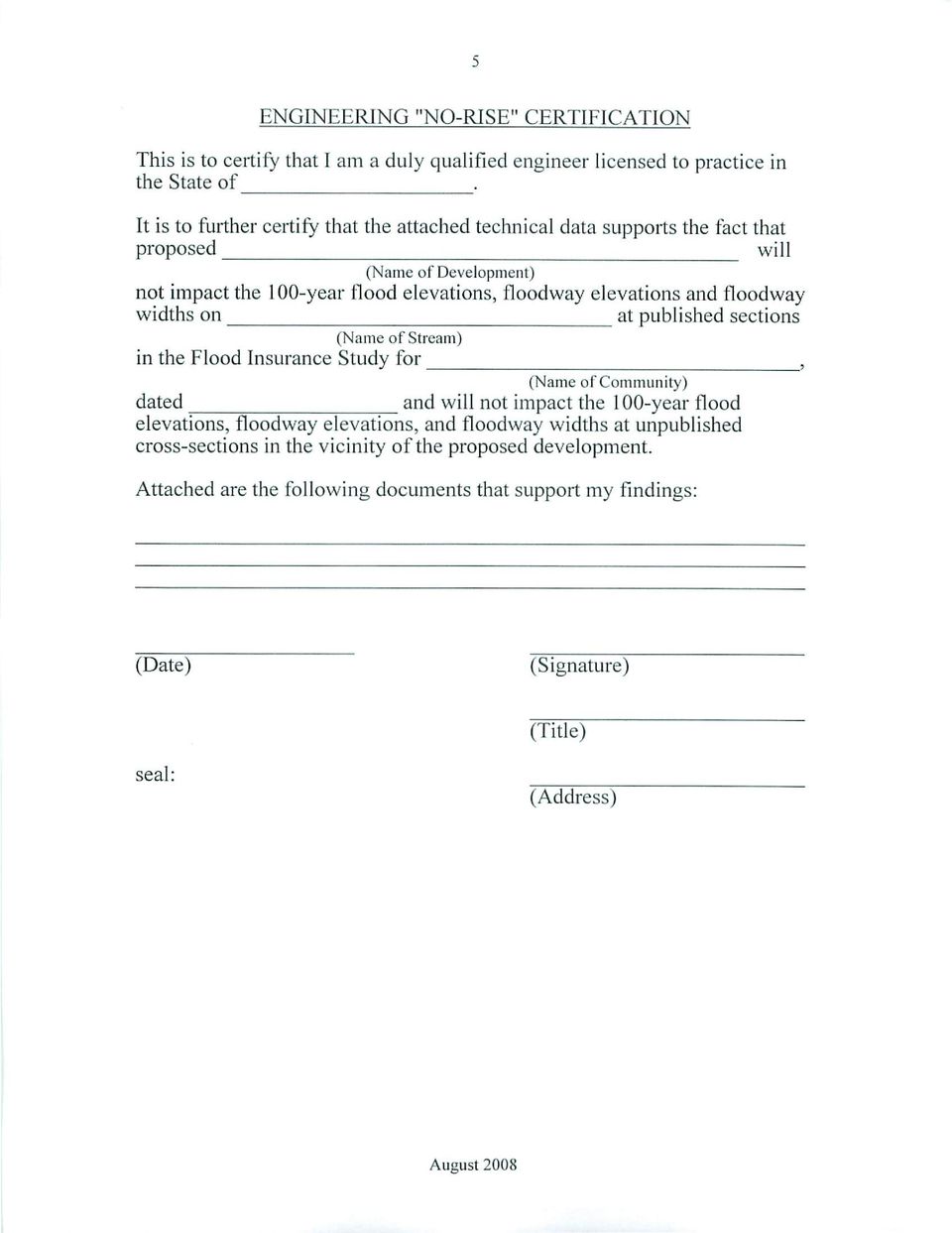
2 EXISTING STRUCTURES 1) FAIR MARKET VALUE OF STRUCTURE(s) BEFORE IMPROVEMENT: 2) COST OF IMPROVEMENTS: ADDITIONAL IMPERVIOUS AREA TO BE ADDED TO THE FLOODPLAIN (ROOF, PAVEMENT, ETC) SQ. FT. DETAILED PROJECT NARRATIVE (Attach additional documentation if necessary) PART IV SUBMITTAL REQUIREMENTS Check box to indicate information has been provided. All applications require the submittal of a site plan. SITE PLAN SHOWING THE NATURE, LOCATION, DIMENSIONS, AND ELEVATION (NGS 1972) OF THE PROPERTY LOCATED WITHIN THE FLOODPLAIN, EXISTING OR PROPOSED STRUCTURES, LOCATION OF PROPOSED FILL, LOCATION OF STORAGE OF MATERIALS INCLUDING FUEL, AND LOCATION OF DRAINAGE FACILITIES. (Refer to Appendix A for clarification) PROPOSED ELEVATION (NGS 1972) OF THE LOWEST FLOOR, INCLUDING BASEMENTS/CRAWLSPACES OF ALL STRUCTURES. PROPOSED ELEVATION (NGS 1972) OF ALL MACHINERY SERVING THE STRUCTURE INCLUDING FURNACES, HOTWATER HEATERS, AIR CONDITIONING, DUCTWORK, AND UTILITY METERS FOR NON-RESIDENTIAL CONSTRUCTION ONLY, ELEVATION AND CERTIFICATION BY A REGISTERED ENGINEER OR ARCHITECT THAT FLOOD-PROOFING METHODS FOR ANY NON-RESIDENTIAL STRUCTURES MEET THE FLOOD-PROOFING CRITERIA OF THE MUNICIPAL FLOOD ORDINANCE. BASE FLOOD ELEVATIONS FOR NEW SUBDIVISONS OR DEVELOPMENT WRITTEN DESCRIPTION, IF APPLICABLE, DESCRIBING THE EXTENT WHICH A WATERCOURSE WILL BE ALTERED OR RELOCATED AS A RESULT OF THE PROPOSED DEVELOPMENT NO-RISE CERTIFICATION PREPARED BY A REGISTERED PROFESSIONAL ENGINEER FOR ALL PROJECTS LOCATED IN THE FLOODWAY, AND FOR ALL HYDRAULIC STRUCTURES, DRAINAGE FACILITIES, AND FILL IN FLOOD AREAS WITH BASE FLOOD ELEVATIONS WHERE NO FLOODWAYS HAVE BEEN IDENTIFIED. (Refer to Appendix C) - 2 -

3 ASSOCIATED PERMITS MUNICIPAL PERMITS RESIDENTIAL/COMMERCIAL BUILDING OR LAND USE PERMIT FILL AND GRADE STORM WATER POLLUTION PREVENTION PLAN (SWPPP) PLANNING PLAT OR SITE PLAN REVIEW PERMIT/CASE NUMBER NA STATE AND FEDERAL PERMITS (Attach Documentation) ARMY CORPS OF ENGINEERS 404 WETLAND PERMIT FISH HABITAT PERMIT COASTAL PROJECT REVIEW OTHER STATUS ADDITIONAL REQUIREMENTS IF A PERMIT CAN BE ISSUED FOR A PROPOSED STRUCTURE, IT WILL BE THE RESPONSIBILITY OF THE APPLICANT TO PROVIDE AN FINAL AS-BUILT DRAWING AND ELEVATION CERTIFICATE PREPARED BY A REGISTERED PROFESSIONAL LAND SURVEYOR. A FINAL CERTIFICATE OF OCCUPANCY WILL NOT BE ISSUED UNTIL THESE DOCUMENTS HAVE BEEN SUBMITTED. In signing this application, the landowner(s) or agent hereby grants the Municipality of Anchorage the right to enter the above described location to inspect the work proposed, in progress, or work completed. I hereby affirm and certify that I am one of the owners or am under contract with the owners, and I believe that the above information and/or statements are true in all respects to the best of my knowledge. SIGNATURE (Check One) Owner Applicant Date Signed - 3 -

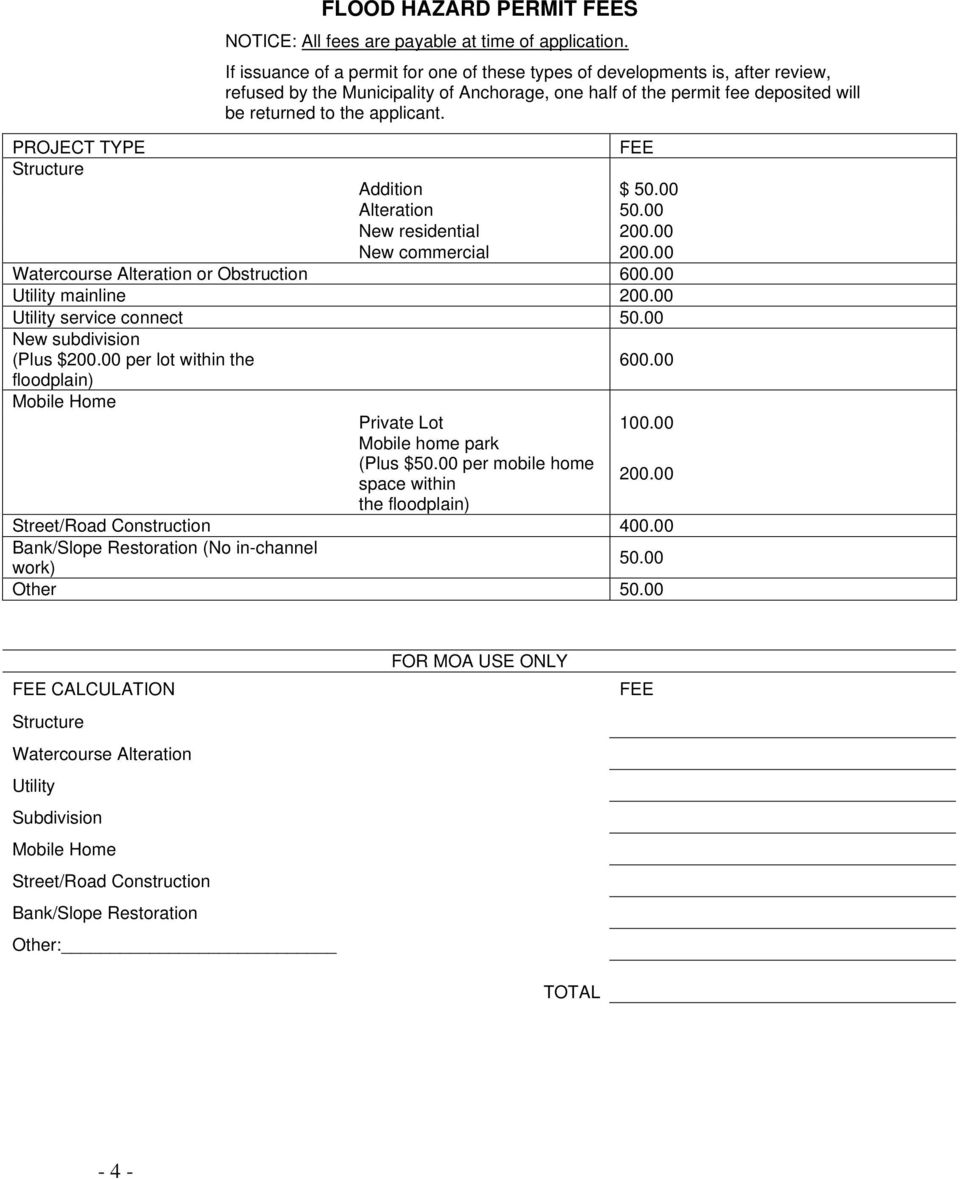
4 FLOOD HAZARD PERMIT FEES NOTICE: All fees are payable at time of application. If issuance of a permit for one of these types of developments is, after review, refused by the Municipality of Anchorage, one half of the permit fee deposited will be returned to the applicant. PROJECT TYPE FEE Structure Addition $ Alteration New residential New commercial Watercourse Alteration or Obstruction Utility mainline Utility service connect New subdivision (Plus $ per lot within the floodplain) Mobile Home Private Lot Mobile home park (Plus $50.00 per mobile home space within the floodplain) Street/Road Construction Bank/Slope Restoration (No in-channel work) Other FEE CALCULATION Structure Watercourse Alteration Utility Subdivision Mobile Home Street/Road Construction Bank/Slope Restoration Other: FOR MOA USE ONLY FEE TOTAL - 4 -
5 APPENDIX A SITE PLAN REQUIREMENTS A SITE PLAN IS AN ACCURATE AND DETAILED MAP OF YOUR PROPERTY: It shows the size, shape, and special features of your property; and the size and location of any buildings or other improvements to the property. Site plans show what currently exists on your property, and any changes or improvements you are proposing to make. A SITE PLAN MUST CONTAIN THE FOLLOWING INFORMATION: 1. Legal description of parcel, north arrow, and scale 2. All property lines, easements and their dimensions. 3. Names of adjacent roads, location of driveways. 4. Location of streams, or lakes with setbacks indicated 5. Location, size, and shape of all buildings, existing and proposed, with elevation of lowest floor indicated 6. Location and dimensions of existing or proposed sewage systems. 7. Location of all propane tanks, fuel tanks, and generators 8. Dimensions and depth of any fill on site.. 9. A survey showing the existing ground elevations at 4 corners of the building 10. Proposed ground elevations at 4 corners of the building, it applicable 11. Location of any proposed temporary construction fencing, buildings, fuel storage, and erosion control structures. ELEVATION NOTE: The Municipality of Anchorage requires all VERTICAL datum to be based on 1972 NGS datum. Assumed datum will not be accepted unless the property is located in areas where 1972 NGS datum has not been established. For structures proposed in the flood plain, the lowest floor elevation must be one foot above the base flood elevation. Crawlspace grade is also considered floor elevation for the purpose of this requirement. For those areas where 1972 NGS datum does not exist, a plot plan with contours, lot corner elevations using assumed datum, high-water mark and existing water levels of creeks, lakes, or streams, and proposed lowest living floor elevations, is required. i

6 APPENDIX B- FLOODPLAIN CONSTRUCTION STANDARDS USE OF FLOOD RESISTANT MATERIALS The Federal Emergency Management Agency (FEMA) guidelines for flood resistant materials are contained in Technical Bulletin This publication is available for review or reproduction upon request. This publication is also available on the Web. Portions of buildings below the base flood elevation (BFE) are often constructed entirely out of concrete, which is considered a flood resistant material. It is also a common building practice to frame up from a concrete stem wall with wood construction to create a garage/storage space below the elevated first floor. Since garage spaces typically utilize sheetrock to achieve the necessary fire separation, construction of this type results in the use of materials subject to flood damage. In order to comply with FEMA's guidelines for flood resistant materials as listed in Technical Bulletin 2-93, the use of untreated wood and sheetrock to cover wall members below the BFE is prohibited. The preferred design alternative (other than concrete walls) will be the use of pressure treated heavy timber construction (6"x10" horizontal, 8"x8" vertical) and pressure treated frame members. The ceiling can be protected with sheetrock if the first floor above the protected ceiling is one foot above the BFE and the sheetrock is less than one foot below that elevation. Cement board may be used as a substitute for sheetrock. Siding below the BFE shall utilize the acceptable materials listed in Technical Bulletin The area of a building below the BFE may only used for building access, parking and storage. No living space is permitted below the BFE. REQUIRED ELEVATION All construction below the BFE is susceptible to flooding and must consist of floodresistant materials. The BFE will be established by this department and conveyed to the applicant for incorporation into the building plans. In order to adequately determine if flood-resistant materials are required, applicants proposing construction in flood prone areas shall provide a survey of existing ground elevations of the four corners of the proposed development and the proposed ground elevations of the proposed development. The BFE shall be shown on the elevation drawings for the proposed structure. The BFE will be established by this department and conveyed to the applicant for incorporation into the building plans. BASEMENTS The Municipal Flood Ordinance requires that the lowest floor, including basement, be elevated one foot above the BFE. The National Flood Insurance Program defines a basement as "any area of the building having its floor subgrade (below ground level) on all sides." ii

7 Applicants proposing construction in flood prone areas will need to be aware of final interior and exterior grade levels of the proposed structure. Subgrade basements and crawlspaces can incur significant flood insurance penalties. OPENINGS TO EQUALIZE HYDROSTATIC FLOOD FORCES The Municipal Flood Ordinance requires that all fully enclosed areas below the lowest floor that are usable solely for parking, building access, or storage in an area other than a basement or crawl space shall have a minimum of two openings having a total net area of not less than one square inch for every square foot of enclosed area according to FEMA specifications. The bottom of all openings shall be no higher than one foot above grade. Openings may be equipped with screens, louvers or other coverings or devices provided that they permit the automatic entry and exit of floodwaters. The vents should be placed on opposing walls to allow the entry and exit of floodwaters. Detailed information about FEMA s flood venting requirement may be found in Technical Bulletin 1. This publication is available for review or reproduction upon request. This publication is also available on the Web. ELECTRICAL GEAR AND EQUIPMENT All electrical, heating, ventilation, plumbing and air conditioning equipment that is permanently affixed to a structure and which may be subject to floodwater damage shall be elevated a minimum of one foot above the BFE or higher unless otherwise constructed to prohibit the entry of flood waters. FEMA has published a document titled Protecting Building Utilities from Flood Damage that gives specific guidance on proper construction technique. This publication is available for review or reproduction upon request. This publication is also available on the Web. FILL/ENCROACHMENT GUIDELINES Proposed developments cumulatively may not increase base flood heights more that one-foot anywhere in the identified floodplain. (Applies only to floodplains with BFEs but without identified floodways.) All watercourse alterations or modifications must not reduce the carrying capacity of the stream or increase BFEs. Watercourse alterations or modifications must not reduce the carrying capacity of the stream or increase BFEs. The applicant must submit an analysis that compares existing channel capacity with proposed capacity. Alteration or modification must maintain carrying capacity of the watercourse. Floodway regulations apply for alterations within a designated floodway (Appendix C). If fill is to be placed within the floodplain areas the applicant must include with the application the volume, height, and sideslope of the fill perimeter within the floodplain. The applicant must also indicate the method used to protect the fill from erosion. The placement must not interfere with any existing utilities or easements. Fill must not unreasonably obstruct or divert the flow of surface water to the detriment of adjacent or hydraulically affected property owners. iii

8 SPECIFIC FLOODPLAIN CONSTRUCTION STANDARDS Residential Structures: Residential structures must have the lowest floor including basement elevated at least to or above the BFE. This elevation requirement can be accomplished by any of the following three (3) methods: 2. Fill: A poured slab placed over compacted fill can also be used to elevate the lowest floor of a structure to one foot above the BFE. Please note that when a building site is filled, it is still in the floodplain and no basements are permitted. 1. Foundation Stem Walls: The crawlspace must not be below grade. It must have as a minimum two permanent openings no more than one foot above grade. The total area of the openings must be no less than 1 square inch for every square foot of enclosed space. This helps to relieve hydrostatic pressure on the foundation during a flood. Any covers placed over the openings must be able to open automatically during flood flows without human intervention. Screens are acceptable if they permit entry and exit of floodwater. iv 3. Piers, Piles and Posts: This method is commonly used to avoid large fills and when flood heights are extreme. The supporting members must be designed to resist hydrostatic and hydrodynamic forces. Fully enclosed areas below the BFE can only be used for parking, access and limited storage. In addition, the following conditions must be met for any enclosed area below the BFE: a) Service equipment (e.g., furnaces, water heaters, washers/dryers, etc.) are NOT

9 permitted below the BFE. b) All walls, floors, and ceiling materials located below the BFE must be unfinished and constructed of materials resistant to flood damage. c) The walls of any enclosed area below the BFE must be designed by a registered professional engineer or architect in a manner to prevent lateral movement, collapse or flotation of the structure. There must be at least two openings on each wall and the bottom of all openings must be no higher than one foot above grade. Non-residential Structures Must have the lowest floor including basement elevated to or above the BFE, or floodproofed at least one foot above BFE. If floodproofed, structures must be dryfloodproofed, which means keeping the water out. Non-residential (commercial) structures, together with attendant utility and sanitary facilities, are designed so that the structure is watertight below the base flood level. The walls are impermeable to the passage of water and with structural components having the capability of resisting hydrostatic and hydrodynamic loads and effects of buoyancy. Additionally, the structure must be designed to: prevent seepage, collapse or cracking of basement walls prevent buckling of basement floors prevent back-up of water from sewer lines have all openings located one foot above BFE all protective features must operate automatically without human intervention Note: Dry floodproofing measures must be certified by a licensed engineer and only apply to non-residential structures. v

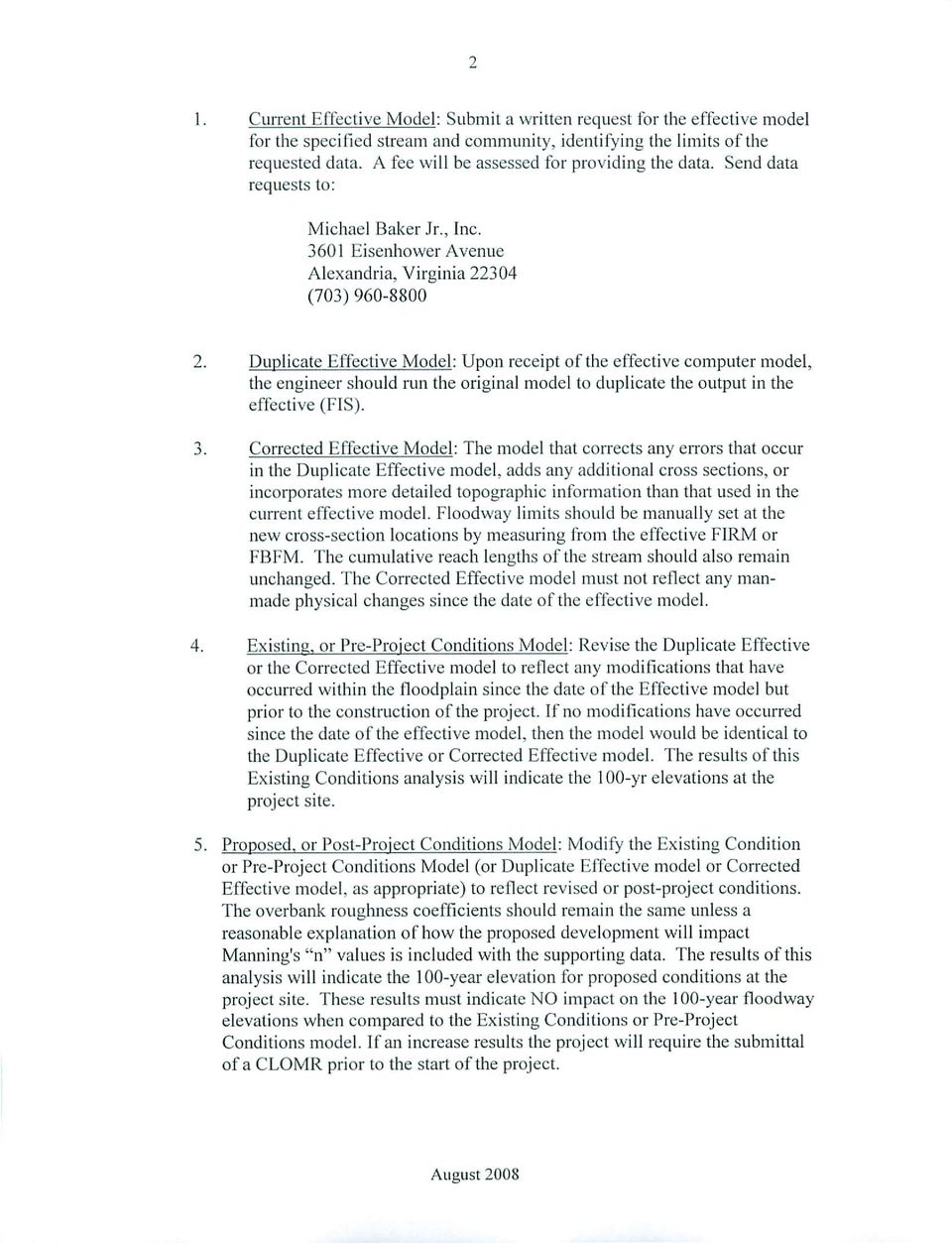
10 APPENDIX C NO-RISE ANAYLSIS PROCEDURES Section 60.3(d)(3) of the National Flood Insurance Program (NFIP) requires that the Municipality to prohibit encroachments, including fill, new construction, substantial improvements, and other development within the adopted regulatory floodway unless it has been demonstrated through hydrologic and hydraulic analyses performed in accordance with standard engineering practice that the proposed encroachment would not result in any increase in flood levels within the city during the occurrence of the base (100-year) flood discharge. In most cases, the No-Rise Certificate must be supported by technical data based upon the standard step-backwater computer model utilized to develop the 100-year floodway shown on the Anchorage s effective Flood Insurance Rate Map (FIRM) or Flood Boundary and Floodway Map (FBFM) and the results tabulated on the Flood Insurance Study (FIS) for Anchorage. The analysis procedure is outlined in the attached document from the Federal Emergency Management Agency. While the attached guidelines specifically address floodway development the same procedure can be used to determine the impact of projects in flood zones without BFEs has that have the potential to increase flood elevations. vi

11

12
13

14

15
SECTION 15 FLOODPLAIN MANAGEMENT
 SECTION 15 15.1 Purpose Certain areas of the City of Gardiner, Maine, are subject to periodic flooding, causing serious damages to properties within these areas. Relief is available in the form of flood
DEPARTMENT OF PLANNING AND DEVELOPMENT
 DEPARTMENT OF PLANNING AND DEVELOPMENT FLOODPLAIN DEVELOPMENT PERMIT APPLICATION FOR NON-RESIDENTIAL DEVELOPMENT Property Owner Telephone Street/P.O. Box City State ZIP Agent (if any) Relationship to Property
FLOOD DAMAGE PREVENTION ORDINANCE
 FLOOD DAMAGE PREVENTION ORDINANCE SECTION 1.0 STATUTORY AUTHORIZATION, FINDINGS FO FACT, PURPOSE, AND OBJECTIVES 1.1 STATUTORY AUTHORIZATION The Legislature of the State of Washington has in RCW delegated
Control filling, grading, dredging, and other development which may increase erosion or flood damage; and
 ARTICLE 16. FLOOD DAMAGE PREVENTION Section 16-1: Findings of Fact The flood hazard areas of the Town of Lillington are subject to periodic inundation which results in loss of life and property, health
ARTICLE 12 FLOOD DAMAGE PREVENTION
 ARTICLE 12 FLOOD DAMAGE PREVENTION SECTION 12.1 AUTHORIZATION 12.1.1 General The Legislature of the State of North Carolina has in Part 6, Article 21 of Chapter 143; Parts 3 and 4 of Article 18 of Chapter
Permit Application No. Development Address. Legal Description. A. Flood Plain and Floodway Information and Sources: (To be completed with Staff)
 FLOOD PLAIN DEVELOPMENT PERMIT APPLICATION of Olathe, Department of Public Works 1385 S. Robinson Drive P.O. Box 768 Olathe, Kansas 66051-0768 (913) 971-9045 FAX (913) 971-9099 Olathe, Kansas, Community
PREVENTION. City of Orem FLOOD DAMAGE PREVENTION 10-1-1
 City of Orem FLOOD DAMAGE PREVENTION 10-1-1 CHAPTER 10. Article 10-1. Article 10-2. Article 10-3. Article 10-4. Article 10-5. FLOOD DAMAGE PREVENTION Purposes Definitions General Provisions Administration
OKANOGAN COUNTY OFFICE OF PLANNING AND DEVELOPMENT FLOODPLAIN DEVELOPMENT PERMIT APPLICATION
 OKANOGAN COUNTY OFFICE OF PLANNING AND DEVELOPMENT FLOODPLAIN DEVELOPMENT PERMIT APPLICATION Okanogan County Code, OCC 15.08, Floodplain Management The State of Washington has authorized county governments
Elevating Your House. Introduction CHAPTER 5
 CHAPTER 5 Elevating Your House Introduction One of the most common retrofitting methods is elevating a house to a required or desired Flood Protection Elevation (FPE). When a house is properly elevated,
Kanawha County Floodplain Regulations Quick Guide & Overview
 Kanawha County Floodplain Regulations Quick Guide & Overview CHUCK GRISHABER, CFM KANAWHA COUNTY FLOOD PLAIN MANAGER Office: 304.357.0570 Mobile: 304-356.0979 Fax: 304.357.0572 [email protected]
CITY OF PITTSBURGH Department of City Planning 200 Ross Street, Pittsburgh, PA 15219 412-255-2241 412-255-2561(fax)
 CITY OF PITTSBURGH Department of City Planning 200 Ross Street, Pittsburgh, PA 15219 412-255-2241 412-255-2561(fax) APPLICATION Construction and Development In the Flood Plain Overlay District This is
Flood Damage Prevention
 City of Talent Flood Damage Prevention General Ordinances, Title 8, Chapter 5 Adopted by Ordinance No. 752 on 4 February 2004 SECTION 1.0: STATUTORY AUTHORIZATION, FINDINGS OF FACT, PURPOSE, AND OBJECTIVES
Sample Flood Damage Prevention Ordinance
 Sample Flood Damage Prevention Ordinance COUNTY OF RABUN STATE OF GEORGIA ORDINANCE AN ORDINANCE ADOPTING FLOOD DAMAGE PREVENTION REGULATIONS OF THE CITY OF CLAYTON, GEORGIA WHEREAS; The Mayor and City
http://library1.municode.com/default/docview/10251/1/101/103
 Page 1 of 8 ARTICLE II. FLOOD DAMAGE PREVENTION* *Cross references: Buildings and building regulations, ch. 67; floor elevation standards, 67-32; flood damage prevention for utility systems, 67-34; drainage
17.19. Chapter 17.19 FLOOD DAMAGE PREVENTION
 17.19 Chapter 17.19 FLOOD DAMAGE PREVENTION Sections: 17.19.010: Authorization, Findings of Fact, Purpose, and Objectives 17.19.020: Definitions 17.19.030: General Provisions 17.19.040: Administration
Frequently-Asked Questions about Floodplains and Flood Insurance FLOOD INSURANCE
 Frequently-Asked Questions about Floodplains and Flood Insurance What is a floodplain? The floodplain is any area covered by water during normal water flows, and which could be inundated as a result of
Administrative Procedures Regarding the Application of Flood Damage Prevention
 Administrative Procedures Regarding the Application of Flood Damage Prevention A floodplain development permit, conforming to the provisions of the Flood Damage Prevention Ordinance ( the Ordinance, shall
rescue and relief efforts in the aftermath of flooding, (iii) repair of flood damaged public facilities and utilities, and
 1. Purpose (1) It is the purpose of this Ordinance to protect human life, health, and property from flood conditions, to preserve the ability of floodplains to carry and discharge a base flood, and to
CHAPTER XXII FLOOD DAMAGE PREVENTION
 CHAPTER XXII FLOOD DAMAGE PREVENTION 22-1 PURPOSE AND POLICY. It is hereby found that the flood hazard areas of the Township are subject to periodic inundation which results in loss of life, property,
Floodplain Development Land Use Review
 COMMUNITY DEVELOPMENT DEPARTMENT Planning Division P.O. Box 490 333 Broadalbin Street SW Albany, OR 97321 Phone 541-917-7550 Fax 541-791-0150 www.cityofalbany.net Floodplain Development Land Use Review
CHAPTER 3 page 69 LOCAL FLOODPLAIN REGULATIONS AND NFIP STANDARDS
 CHAPTER 3 page 69 LOCAL FLOODPLAIN REGULATIONS AND NFIP STANDARDS LOCAL FLOODPLAIN REGULATIONS AND NFIP STANDARDS, page 69 THE PARTICIPATION OF A COMMUNITY IN THE NFIP IS MADE POSSIBLE BY ITS ADOPTION
How To Build A Floodproofed Basement
 General Basement Exception Guidelines National Flood Insurance Program (NFIP) floodplain management criteria at 44 CFR 60.6 (c) provide for the granting of exceptions to permit construction of floodproofed
Openings in Foundation Walls for Buildings Located in Special Flood Hazard Areas
 Openings in Foundation Walls for Buildings Located in Special Flood Hazard Areas in accordance with the National Flood Insurance Program FEDERAL EMERGENCY MANAGEMENT AGENCY FEDERAL INSURANCE ADMINISTRATION
LOWEST FLOOR GUIDE I. LOWEST FLOOR DETERMINATION
 LOWEST FLOOR GUIDE This section is to be used as a guide for identifying the lowest floor for rating buildings being considered for coverage under the National Flood Insurance Program (NFIP). I. LOWEST
CHAPTER 151: FLOOD DAMAGE PREVENTION
 CHAPTER 151: FLOOD DAMAGE PREVENTION Section General Provisions 151.01 Statutory authorization 151.02 Findings of fact 151.03 Statement of purpose 151.04 Methods of reducing flood losses 151.05 Definitions
Table of Contents. Comments on the Technical Bulletins should be directed to:
 Openings in Foundation Walls and Walls of Enclosures Below Elevated Buildings in Special Flood Hazard Areas in accordance with the National Flood Insurance Program Technical Bulletin 1 / August 2008 Table
Chapter 87 FLOOD DAMAGE PREVENTION. ARTICLE II Definitions
 Chapter 87 FLOOD DAMAGE PREVENTION ARTICLE I Authorization and Purpose 87-1. Statutory authorization. 87-2. Findings of fact. 87-3. Statement of purpose. 87-4. Methods of reducing flood losses. 87-5. Word
Elmore County Flood Damage Prevention Ordinance. (Non-Coastal Communities)
 Elmore County Flood Damage Prevention Ordinance (Non-Coastal Communities) Adopted: April 20, 2006 Amended: July 11, 2011 FLOOD DAMAGE PREVENTION ORDINANCE Non-Coastal Communities ARTICLE 1. SECTION A.
LOWEST FLOOR GUIDE I. LOWEST FLOOR DETERMINATION. Previous Section Table of Contents
 Previous Section Table of Contents Next Section This section is to be used as a guide for identifying the lowest floor for rating buildings being considered for coverage under the National Flood Insurance
How To Manage A Flood
 Chapter 15.36 FLOOD DAMAGE PREVENTION* Sections: ARTICLE I. STATUTORY AUTHORIZATION, FINDINGS OF FACT, PURPOSE AND METHODS 15.36.010 Statutory authorization. 15.36.020 Findings of fact. 15.36.030 Statement
Agenda. Presenter. The Current Form. Adobe Fillable Form. Elevation Certificates FEMA Form 81-31. Elevation Certificates Training 11/14/2013
 NORFMA Floodplain Conference November 14, 2013 Boise, Idaho Agenda Introductions & Housekeeping Overview Basics of FEMA Form 81-31 Building Diagrams Exercise Common Errors Using ECs in Floodplain Development
SECTION 19 RESIDENTIAL CONSTRUCTION IN FLOODZONES
 SECTION 19 RESIDENTIAL CONSTRUCTION IN FLOODZONES The purpose of the following information and documents are to clarify procedures used by the Sonoma County Permit & Resource Management Department to enforce
Teller County, Colorado Floodplain Development Permit Application
 Teller County, Colorado Floodplain Development Permit Application This is an application packet for a Floodplain Development Permit (FDP). Certain sections are to be completed by the Applicant, and certain
LOWEST FLOOR GUIDE I. LOWEST FLOOR DETERMINATION
 Previous Section Main Menu Table of Contents Next Section This section is to be used as a guide for identifying the lowest floor for rating buildings being considered for coverage under the National Flood
DIVISION 11. [FLOOD DAMAGE PREVENTION]*
![DIVISION 11. [FLOOD DAMAGE PREVENTION]*](/thumbs/24/3469080.jpg "DIVISION 11. [FLOOD DAMAGE PREVENTION]*") Page 1 of 17 San Diego County Code of Regulatory Ordinances DIVISION 11. [FLOOD DAMAGE PREVENTION]* ---------- *Note--Added by Ord. No. 7534 (N.S.), effective 10-27-88, operative 9-27-88; chapters 1 through
Page 1 of 17 San Diego County Code of Regulatory Ordinances DIVISION 11. [FLOOD DAMAGE PREVENTION]* ---------- *Note--Added by Ord. No. 7534 (N.S.), effective 10-27-88, operative 9-27-88; chapters 1 through
CASS COUNTY COMMISSION POLICY MANUAL 38.07 ADOPTED DATE: FEBRUARY 2, 1998 PAGE 1 OF 9
 CASS COUNTY COMMISSION POLICY MANUAL 38.07 SUBJECT: ORDINANCE #1998-2 (FLOOD DAMAGE PREVENTION) ADOPTED DATE: FEBRUARY 2, 1998 PAGE 1 OF 9 NORTH DAKOTA COUNTY OF CASS ORDINANCE #1998-2 Be it ordained and
April 2, 2009. Write Your Own (WYO) Company Principal Coordinators and NFIP Servicing Agent
 U.S. Department of Homeland Security 500 C Street SW Washington, DC 20472 W-09020 April 2, 2009 MEMORANDUM TO: Write Your Own (WYO) Company Principal Coordinators and NFIP Servicing Agent FROM: SUBJECT:
LOWEST FLOOR GUIDE I. LOWEST FLOOR DETERMINATION
 This section is to be used as a guide for identifying the lowest floor for rating buildings being considered for coverage under the National Flood Insurance Program. I. LOWEST FLOOR DETERMINATION The following
Lincoln County Floodplain Development Permit Application
 Lincoln County Floodplain Development Permit Application Application # FP Use Permit Variance Appeal Date SECTION I: GENERAL PROVISIONS (APPLICANT to read and sign) 1. No work of any kind may start until
SECTION 1.0 STATUTORY AUTHORIZATION AND PURPOSE
 A local law for Flood Damage Prevention as authorized by the New York State Constitution, Article IX, Section 2, and Environmental Conservation Law, Article 36 1.1 FINDINGS SECTION 1.0 STATUTORY AUTHORIZATION
FLOOD DAMAGE PREVENTION ORDINANCE CITY OF NEW HAVEN, CONNECTICUT
 FLOOD DAMAGE PREVENTION ORDINANCE CITY OF NEW HAVEN, CONNECTICUT SECTION 1 - STATUTORY AUTHORIZATION, FINDING OF FACT, PURPOSE AND OBJECTIVES 1.1 Statutory Authorization In Section 7-148(c)(7) of the General
SPECIAL PURPOSE FLOOD DAMAGE REDUCTION RESOLUTION BELMONT COUNTY, OHIO
 SECTION 1.0: GENERAL PROVISIONS SPECIAL PURPOSE FLOOD DAMAGE REDUCTION RESOLUTION BELMONT COUNTY, OHIO 1.1 Statutory Authorization This resolution is adopted pursuant to authorization contained in Sections
Chapter 1350 FLOOD DAMAGE REDUCTION ORDINANCE
 Chapter 1350 FLOOD DAMAGE REDUCTION ORDINANCE Section 1350.1.0 Flood Damage Reduction Ordinance 1 Section 1350.1.1 Statutory Authorization 1 Section 1350.1.2 Purpose.1 Section 1350.1.3 Applicability...1
Floodproof Construction Requirements
 Floodproof Construction Requirements CITY OF FARGO BUILDING INSPECTION DIVISION Updated April 2015 The State of North Dakota requires that you call 1-800-795-0555 at least two business days before you
FLOOD DAMAGE PREVENTION ORDINANCE CITY OF NEW HAVEN, CONNECTICUT
 FLOOD DAMAGE PREVENTION ORDINANCE CITY OF NEW HAVEN, CONNECTICUT SECTION 1 - STATUTORY AUTHORIZATION, FINDING OF FACT, PURPOSE AND OBJECTIVES 1.1 Statutory Authorization In Section 7-148(c)(7) of the General
Elevations Certificates: Update 2009 Presented by Wendy Lathrop, PLS, CFM
 Elevations Certificates: Update 2009 Presented by Wendy Lathrop, PLS, CFM The objectives of the National Flood Insurance Program (NFIP): Reduce the exposure to flood damages through the use of minimum
TITLE 8 FLOOD DAMAGE PREVENTION
 Henry County Development Code Flood Damage Prevention TITLE 8 FLOOD DAMAGE PREVENTION SECTION 1.0 FLOOD DAMAGE PREVENTION: STATUTORY AUTHORIZATION The Indiana Legislature granted the power to local units
National Flood Insurance Program Insurance Agent s Lowest Floor Guide
 National Flood Insurance Program Insurance Agent s Lowest Floor Guide Insurance Agent s Lowest Floor Guide PUTTING IT INTO PERSPECTIVE Sections A and C of the 2009 Elevation Certificate provide fields
ARTICLE VII COUNTY FLOOD DAMAGE PREVENTION OVERLAY DISTRICT
 AMENDED IN ITS ENTIRETY ON OCTOBER 9, 2006 BY RESOLUTION NO. 06/10/94 AMENDED ON MARCH 16, 2009 BY RESOLUTION NO. 09/03/160 AMENDED IN ITS ENTIRETY ON DECEMBER 15, 2014 BY RESOLUTION NO. 14/12/300 ARTICLE
FLOOD DAMAGE PREVENTION ORDINANCE NORTH CAROLINA MODEL
 FLOOD DAMAGE PREVENTION ORDINANCE NORTH CAROLINA MODEL Non-Coastal Regular Phase ARTICLE 1. STATUTORY AUTHORIZATION, FINDINGS OF FACT, PURPOSE AND OBJECTIVES...1 Section A. Statutory Authorization...1
780 CMR 120.G FLOOD-RESISTANT CONSTRUCTION AND CONSTRUCTION IN COASTAL DUNES Note that this Appendix is unique to Massachusetts
 780 CMR 120.G FLOOD-RESISTANT CONSTRUCTION AND CONSTRUCTION IN COASTAL DUNES Note that this Appendix is unique to Massachusetts 120.G.101.1 General: All buildings and structures erected in areas prone
Updated Federal Emergency Management Agency Flood Insurance Rate Maps and Zoning Ordinance Update. July 16, 2015 Policy Committee
 Updated Federal Emergency Management Agency Flood Insurance Rate Maps and Zoning Ordinance Update July 16, 2015 Policy Committee FEMA Map Update Costal Analysis and mapping study by FEMA in 2009 Changes