
AN INITIATIVE TO IMPROVE
|
|
|
- Elijah Shelton
- 10 years ago
- Views:
Transcription
1 L OW E R C A R M E L R I V E R A N D L AG O O N F L O O D P L A I N R E S TO R AT I O N A N D E N H A N C E M E N T P R O J E C T AN INITIATIVE TO IMPROVE FLOOD PROTECTION RESTORE AND PROTECT RIPARIAN HABITATS AND WILDLIFE AND PROVIDE PUBLIC ACCESS AND RECREATION,

2 THE CARMEL RIVER A Signature River of California: What s at Stake? The Carmel River watershed, located on California s central coast in Monterey County, is nestled between two prominent coastal ranges the Sierra de Salinas and the Santa Lucia Range. The region is home to a landscape of unique biodiversity and breathtaking beauty and is intimately tied to Monterey County s leading local industries, tourism and agriculture. The Carmel River flows west approximately 36 miles from its headwaters in the Santa Lucia Mountains and empties into Carmel Bay, a state designated Area of Special Biological Significance located within the federally protected Monterey Bay National Marine Sanctuary. Carmel River State Beach, including its adjacent lagoon area and wetlands, serves as an important refuge for sensitive aquatic species and is a dynamic interface between marine and freshwater river systems. The focus of this initiative is the Carmel River s lowest reach consisting of the lower three miles of the river, from Rancho San Carlos Road west to the Carmel River Lagoon and river mouth. This area is characterized by white sand beaches, floodplains, wetlands, riparian habitats and agriculture, as well as residential neighborhoods, golf courses and commercial centers. Where Highway One crosses the river, it also serves as a gateway between the urbanized cities of the Monterey Peninsula and the wild, rugged terrain of Big Sur s coast and mountain ranges where millions travel annually. Though some of the surrounding land has been preserved in perpetuity, human development in the form of water diversions, gravel mining, roads, levees, bridges, and buildings has dramatically altered the river, diminished and redirected flows, reduced floodplain acreage and threatened associated ecosystems. Human development in the form of water diversions, gravel mining, roads, levees, bridges, and buildings has dramatically altered the river, diminished and redirected flows, reduced floodplain acreage and threatened associated ecosystems. The Carmel River supports declining California native aquatic species including the southernmost population of the federally protected South Central Coast steelhead trout (Oncorhynchus mykiss), the federal and state protected California redlegged frog (Rana aurora draytonii ) and the state listed Western pond turtle (Clemmys marmorata). The floodplain area adjacent to the river supports some of the highest densities of migratory songbirds in California. To address this critical situation, local agency managers, nonprofit partners and private entities have come together and identified several key interrelated projects that, if implemented, would provide a comprehensive solution to long standing floodplain loss and flood management problems that plague the lower Carmel River watershed. Such a program is now ripe for state bond funding and other funding through a collaborative, multi agency effort.

3 Projects Focus on Providing River Wide Benefits Two projects have now been identified that could effectively address long standing flood issues and habitat restoration needs for the lower Carmel River and lagoon. These projects focus on improving habitat and management of the seasonal lagoon west of Highway One and on restoring the floodplain east of Highway One. LOWER CARMEL RIVER AND LAGOON FLOODPLAIN RESTORATION AND ENHANCEMENT PROJECT CARMEL, CALIFORNIA
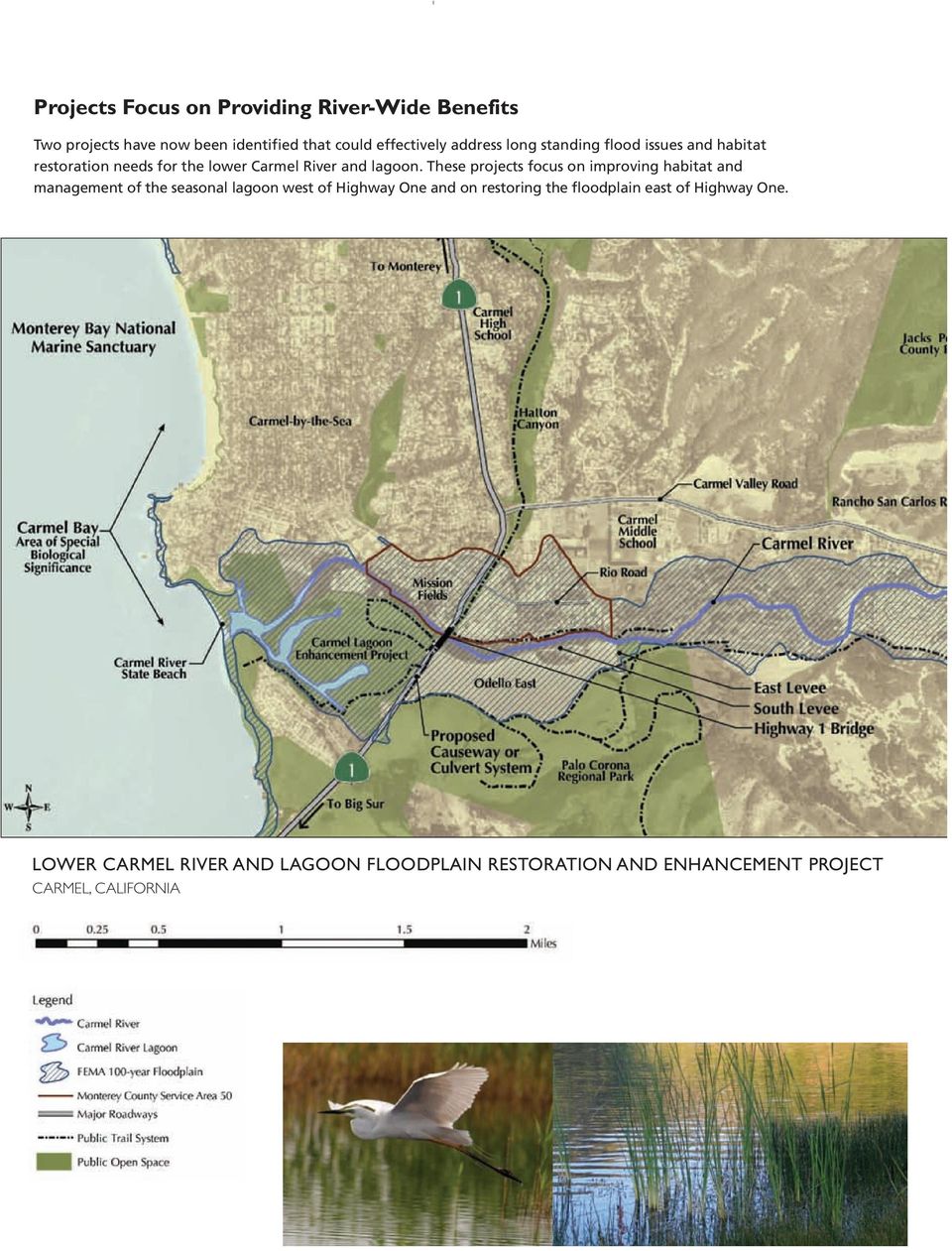
4 FLOOD CONFLICTS WHERE THE RIVER MEETS THE OCEAN: AN ADAPTIVE MANAGEMENT APPROACH Carmel River State Beach is located where the Carmel River delivers sediment via river flows and where the river and dynamic Pacific Ocean meet. Carmel River State Beach and surrounding bluffs have been developed with homes, roads and recreational infrastructure within the 100 year floodplain, and below Ordinary High Water elevations of the Carmel River Lagoon. In the summer and the fall, wind and waves build the beach into a natural barrier to the river s winter rainy season flows causing the lagoon to fill to a level that threatens adjoining residential areas with flooding. Consequently, this area has been the focus of intense management activities to reduce flood elevations in the lagoon. In many winters since the early 20th century, private property owners, the State or the County have excavated an outflow channel across the beach to lower lagoon water surface elevations to prevent flooding of agricultural fields or developed properties. Importantly, this breaching of the beach through winter and spring seasons to reduce the flooding hazard (until flows have nearly ceased in late spring or early summer) compromises the quantity, quality and function of the lagoon an ecosystem crucial to the survival of threatened fish and wildlife species most notably steelhead trout and California red legged frogs. LETTING THE RIVER USE ITS FLOODPLAIN The hydrologic and floodplain modeling done thus far has demonstrated that multiple actions within the lower Carmel River floodplain on the east side of State Highway One known locally as the Odello East area would need to be implemented in order to gain positive outcomes for flood protection, restoration and recreation. A project involving the following actions is currently under design by local agencies and nonprofit partners: Removing portions of the east and south levees to let flood flows access the floodplain Restoring the natural floodplain on 70 acres of land on Odello East Installing a causeway or series of culverts which would allow for flood flows to access the flood plain on the west side of Highway One. The existing roadway south of the Carmel River Bridge currently creates a barrier to river flow during large storm events and needs to be addressed if significant flood benefits are to be realized. Current flood flow modeling indicates that a major benefit would be realized by elevating the road with a causeway which would reduce water surface elevations by up to three feet during a 100 year flood, would reduce flow within the main channel and would lower the water surface in and adjacent to the Mission Fields area. This would effectively remove the 100 year flood hazard in this area. The option of installing culverts would only be marginally beneficial in terms of flood control benefits. This complex situation has prompted a comprehensive effort by affected federal, state and local public agencies to analyze and devise a viable long term beach and lagoon management program to protect against floods as well as safeguard the threatened fish and other species that use the lagoon as habitat. Funds in the amount of $850,000 are now being sought to support needed technical studies and engineering investigations of adaptive management solutions for creating a sustainable natural lagoon ecosystem. The flood control and restoration benefits associated with these projects makes them ideal candidates for funding through recent State bonds, specifically Propositions 50, 84 and 1E. It is estimated that implementation would cost between million dollars for the actions described.

5 A HISTORY OF FLOODING: The Local Economy and Public Safety Compromised The Carmel River has experienced numerous floods throughout history. Floods in 1995 and 1998 caused millions of dollars in damage and destroyed the State Highway One Bridge accessing the Big Sur coast, causing a temporary closure of the highway at that location, and stranding many people in the area. Visitors to and residents of the Big Sur coast were forced to use a onelane Bailey bridge for six months during emergency work to rebuild a permanent bridge. The area is one of the highest repetitive loss areas in California in the federal flood protection program. During the last ten years, no significant flood protection projects have been implemented in the area due to funding constraints. The recent history of flooding in the lower area of the river and its minimal flood protection level clearly necessitate a comprehensive approach to floodplain planning by local agencies and the community. Without such an effort local and state governments, as well as the Monterey Peninsula and Big Sur communities, will continue to bear the consequences of future flooding including property damage, economic loss and public safety impacts. A COMPREHENSIVE APPROACH: WHAT S BEING DONE Fortunately in recent years the State has begun to invest some funds to help restore key landscapes in the lower Carmel River to protect residential areas from flooding and to provide for vital habitat for fish and wildlife. With $4 million in State funds from the California Coastal Conservancy, the California Department of Parks and Recreation (State Parks) implemented the Carmel River Lagoon Enhancement Project to expand the lagoon by restoring an agricultural parcel adjacent to it. The project included excavation of a remnant south arm of the lagoon on the west side of Highway One to expand aquatic habitat for steelhead and riparian associated wildlife. With funding from the State s Integrated Regional Water Management Grant Program, the Big Sur Land Trust (BSLT) has completed the first phase of a floodplain modeling study of the lower Carmel River floodplain on the east side of State Highway One ( just across from the State Parks project) to identify various floodplain restoration alternatives and improve habitat. BSLT is pursuing a multi objec tive project that provides accessible floodplain for flood waters, restoration of riparian habitat, as well as recreational access via an integrated and compatible trail system along the lower Carmel River and mouth of Carmel Valley. Through creative partnerships with local and State agencies and nonprofits, including The Nature Conservancy, State Parks, the Monterey Peninsula Regional Park District, the Transportation Agency of Monterey County, and Monterey County Public Works, BSLT is working on creating an extensive network of open space and trails along the Lower Carmel River. Six miles of public trails are planned for the area allowing access to thousands of acres of public lands. The Carmel River is also under study and design for the removal of the San Clemente Dam in the upper watershed. This project is currently under environmental review and has support of both federal and State resource agencies. This is yet another reason to work towards holistic restoration of the Carmel River floodplain and riparian habitat.

6 Partners Entities and interests working collectively to implement this broad vision include the Big Sur Land Trust, Monterey Peninsula Water Management District, Monterey County Service Area 50, California State Parks, California Coastal Conservancy, NOAA Fisheries, Transportation Agency of Monterey County, Monterey County Department of Public Works, California Department of Transportation, Monterey County Water Resources Agency, Carmel River Steelhead Association, Carmel River Watershed Conservancy, Monterey Peninsula Regional Park District, Carmel Development Corporation, California American Water, California State University at Monterey Bay, Carmel Area Wastewater District, Carmel River Lagoon Coalition, California Coastal Commission, California Department of Fish and Game, U.S. Army Corps of Engineers, and U.S. Fish and Wildlife Service. FOR MORE INFORMATION, CONTACT: Big Sur Land Trust 126 Clock Tower Place, Suite 101, Carmel, CA Printed on recycled paper

ECONOMIC ANALYSIS FLOOD DAMAGE REDUCTION. Lower Carmel River Floodplain Restoration and Enhancement Project
 ECONOMIC ANALYSIS FLOOD DAMAGE REDUCTION Lower Carmel River Floodplain Restoration and Enhancement Project I. Description of the Project and its Relationship to Other Projects in the Proposal The Lower
Steelhead Recovery in San Juan and Trabuco Creeks Watershed
 Steelhead Recovery in San Juan and Trabuco Creeks Watershed Are there fish now? Overview Final San Juan and Trabuco Creeks Watershed Management Plan Fish & Game Implementation NOAA Steelhead Recovery and
4.2 Buena Vista Creek Watershed
 Buena Vista Creek Watershed 4.2 Buena Vista Creek Watershed Watershed Overview The Buena Vista Creek Watershed is the fourth-largest system within the Carlsbad Hydrologic Unit. The watershed extends approximately
Flood Risk Management
 Flood Risk Management Value of Flood Risk Management Every year floods sweep through communities across the United States taking lives, destroying property, shutting down businesses, harming the environment
Flood Risk Management
 Flood Risk Management Value of Flood Risk Management Value to Individuals and Communities Every year floods sweep through communities across the United States taking lives, destroying property, shutting
RESTORATION AND ENHANCEMENT OF SOUTHERN CALIFORNIA LAGOONS
 RESTORATION AND ENHANCEMENT OF SOUTHERN CALIFORNIA LAGOONS by Hany Elwany, Ph.D. Scripps Institution of Oceanography Headwaters to Oceans Conference 25 October 2003 CE Ref #03-22 San Diego County Lagoons
The Everglades & Northern Estuaries; St. Lucie River Estuary, Indian River Lagoon & Caloosahatchee Estuary. Water Flows & Current Issues
 The Everglades & Northern Estuaries; St. Lucie River Estuary, Indian River Lagoon & Caloosahatchee Estuary Water Flows & Current Issues Florida Governor Rick Scott August 20, 2013 Upper Chain of Lakes
Rhode Island NRCS received approximately $2.4 million in ARRA funds to implement four floodplain easement projects.
 American Recovery and Reinvestment Act (ARRA) Emergency Watershed Protection Program Floodplain Easements Rhode Island Natural Resources Conservation Service Rhode Island NRCS received approximately $2.4
PUBLIC NOTICE Application for Permit
 PUBLIC NOTICE Application for Permit 30-Day Notice Issue Date: June 20, 2016 Expiration Date: July 20, 2016 US Army Corps of Engineers No: NWP-2010-535 Oregon Department of State Lands No: 58311-RF Interested
Background Information: The Mamquam River Floodplain Restoration Project
 Background Information: The Mamquam River Floodplain Restoration Project The Mamquam River Floodplain Restoration project is being undertaken in partnership with the Squamish River Watershed Society, Fisheries
Environmental Compliance Questionnaire for National Oceanic and Atmospheric Administration Federal Financial Assistance Applicants
 OMB Approval No.: 0648-0538 Environmental Compliance Questionnaire for National Oceanic and Atmospheric Administration Federal Financial Assistance Applicants Instructions The National Environmental Policy
How To Manage Water Resources In The Yakima Basin
 Yakima Basin Integrated Water Resource Management Plan October 23, 2014 Presented by Derek Sandison, Director Office of Columbia River Photo Courtesy of Tom Ring Basin size: 6,155 sq. miles Population:
Arkansas River Corridor Vision & Master Plan
 A r k a n s a s R I v e r C o r r I d o r P l a n Arkansas River Corridor Vision & Master Plan July 2005 Indian Nations Council of Governments A r k a n s a s R I v e r C o r r I d o r P l a n Partnership
SANTA BARBARA COUNTY COMPREHENSIVE PLAN LOMPOC AREA
 SANTA BARBARA COUNTY COMPREHENSIVE PLAN LOMPOC AREA A. LAND USE ELEMENT INTERPRETIVE GUIDELINES B. COMMUNITY BENEFITS C. COUNTY ACTION ITEMS Adopted by the Board of Supervisors November 9, 1999 A. Santa
Lower Crooked Creek Watershed Conservation Plan EXECUTIVE SUMMARY
 EXECUTIVE SUMMARY Project Background Located in southwestern Pennsylvania, Crooked Creek is a major tributary of the Allegheny River, entering near Ford City in Armstrong County. It is rich in natural
TABLE OF CONTENTS. INTRODUCTION...1 Purpose of a Comprehensive Plan...1 McKenzie County Comprehensive Plan...1 Definitions...2 Goal...2 Vision...
 MCKENZIE COUNTY COMPREHENSIVE PLAN TABLE OF CONTENTS INTRODUCTION...1 Purpose of a Comprehensive Plan...1 McKenzie County Comprehensive Plan...1 Definitions...2 Goal....2 Vision...3 ECONOMIC DEVELOPMENT...4
4. Priority Areas of Conservation
 4. Priority Areas of Conservation A. SIGNIFICANT RESOURCE AREAS This Open Space and Farmland Plan identifies the key issues facing open space and agricultural resources in the Town, highlights the location
COMPREHENSIVE PLAN SECTION B, ELEMENT 4 WATER RESOURCES. April 20, 2010 EXHIBIT 1
 COMPREHENSIVE PLAN SECTION B, ELEMENT 4 WATER RESOURCES April 20, 2010 EXHIBIT 1 ELEMENT 4 WATER RESOURCES TABLE OF CONTENTS 4.1 INTRODUCTION 4.2 GOALS AND POLICIES 4.2.A General Goals and Policies 1 4.2.B
San Francisco Bay Area Wetlands Restoration Program Design Review Group. Project Summary Outline
 San Francisco Bay Area Wetlands Restoration Program Design Review Group Project Summary Outline The project proponent desiring to have a project considered by the Design Review Group (DRG) shall provide
Appendix A. Lists of Accomplishments and Project Costs. UMRWD 10 Year Plan Update. Appendix A UPPER MINNESOTA RIVER WATERSHED DISTRICT
 UPPER MINNESOTA RIVER WATERSHED DISTRICT Lists of Accomplishments and Project Costs 10 Year Plan Update UMRWD 10 Year Plan Update Page A 1 UMRWD LIST OF ACCOMPLISHMENTS Since its inception in 1967, the
STREAMFLOW RESTORATION PRIORITY AREAS
 STREAMFLOW RESTORATION PRIORITY AREAS Synopsis The Water Resources Department and the Department of Fish and Wildlife jointly identified priority areas for streamflow restoration in basins throughout the
The North State: Implementing the California Water Action Plan February 24, 2014
 The North State: Implementing the California Water Action Plan February 24, 2014 The North State Water Alliance applauds Governor Brown s California Water Action Plan (Action Plan) and his call for comprehensive
Community Workshop 5. Overarching Goals for Machado Lake Ecosystem and Wilmington Drain Multi-Use Projects
 City of Los Angeles Department of Public Works Bureau of Engineering Machado Lake Ecosystem Rehabilitation Project & Wilmington Drain Multi-Use Project Community Workshop 5 February 24, 2009 In association
Sustainability Brief: Water Quality and Watershed Integrity
 Sustainability Brief: and Watershed Integrity New Jersey depends on water resources for the health of our people, the strength of our economy, and the vitality of our ecosystems. The quality of our water
Addendum D. Nomination of Moody Wash ACEC
 Addendum D Nomination of Moody Wash ACEC Moody Wash ACEC is hereby nominated by Citizens for Dixie s Future to: BLM St. George Field Office 345 East Riverside Drive St. George, UT 84790 Moody Wash is a
One Major Six Concentrations. Department of Environmental Conservation University of Massachusetts Amherst
 One Major Six Concentrations Natural Resources Conservation Undergraduate Major Department of Environmental Conservation University of Massachusetts Amherst Conserving Earth s biological diversity and
DRAFT SOUTH FORK SKYKOMISH RIVER
 DRAFT SOUTH FORK SKYKOMISH RIVER 9 levees and revetments / Approximately 1.1 miles of river bank are armored Revetments provide limited, localized erosion protection, but impact habitat Frequent and costly
March 2008. Prepared by: Irvine Ranch Water District. 15600 Sand Canyon Avenue. Irvine, CA 92618. Contact: Natalie Likens (949) 453-5633
 ADDENDUM TO THE MICHELSON WATER RECLAMATION PLANT PHASE 2 & 3 CAPACITY EXPANSION PROJECT FEBRUARY 2006 FINAL ENVIRONMENTAL IMPACT REPORT AND THE SAN JOAQUIN FRESHWATER MARSH ENHANCEMENT PLAN REVISED SEPTEMBER
COMMUNITY CERTIFICATIONS
 National Flood Insurance Program Community Rating System COMMUNITY CERTIFICATIONS Public reporting burden for this form is estimated to average 4 hours for annual recertification, per response. The burden
Appendix J Online Questionnaire
 Appendix J Online Questionnaire In accordance with the Paperwork Reduction Act, this questionnaire was approved by the Office of Management and Budget (OMB). The OMB control number and expiration date
GLOSSARY OF TERMS CHAPTER 11 WORD DEFINITION SOURCE. Leopold
 CHAPTER 11 GLOSSARY OF TERMS Active Channel The channel that contains the discharge Leopold where channel maintenance is most effective, sediment are actively transported and deposited, and that are capable
LEAGUE NOTES ON APPROVED COMMUNITY WATER SUPPLY PLAN
 1 AUGUST 2011 LEAGUE NOTES ON APPROVED COMMUNITY WATER SUPPLY PLAN KEY ELEMENTS OF THE PLAN: 1. Replace the existing unsafe Ragged Mountain dam with a new dam and raise the reservoir pool level initially
APPENDIX G. California Coastal Commission & Conservancy Accessibility Standards
 APPENDIX G California Coastal Commission & Conservancy Accessibility Standards STANDARDS AND RECOMMENDATIONS FOR ACCESSWAY LOCATION AND DEVELOPMENT These standards provide guidelines for the location,
CHAD R. GOURLEY SPECIALTY EMPLOYMENT
 CHAD R. GOURLEY P.O. Box 919 Verdi, Nevada 89439 phone 775.345.9960 cell 775.250.8140 chad_gourley at att.net SPECIALTY Restoration of riverine, spring, and wetland ecosystems, specializing in a process
Protecting Floodplain. While Reducing Flood Losses
 Protecting Floodplain Natural and Beneficial i Functions While Reducing Flood Losses Jon Kusler Association of State Wetland Managers 518 872 1804; [email protected] Report available at: http://aswm.org/pdf_lib/nbf.pdf
The Basics of Chapter 105 Waterways and Wetlands Permitting in PA
 The Basics of Chapter 105 Waterways and Wetlands Permitting in PA April 17, 2013 Goal To develop a basic understanding of PA Department of Environmental Protection (DEP) and US Army Corps of Engineers
The Muddy River: A Century of Change
 The Muddy River: A Century of Change Tom Brady, Brookline Conservation Administrator, Tree Warden, Town Arborist 617-730-2088 or [email protected] Muddy River Flood Damage Reduction and Environmental
Flood Plain Reclamation to Enhance Resiliency Conserving Land in Urban New Jersey
 Flood Plain Reclamation to Enhance Resiliency Conserving Land in Urban New Jersey Rutgers Cooperative Extension Water Resources Program Christopher C. Obropta, Ph.D., P.E. Email: [email protected]
Coastal Monitoring Program for Salmon and Steelhead
 California California Department of Fish and Wildlife NOAA Fisheries Coastal Monitoring Program for Salmon and Steelhead California Department of Fish and Wildlife Fisheries Branch 830 S Street Sacramento,
Climate Change. Lauma M. Jurkevics - DWR, Southern Region Senior Environmental Scientist
 Climate Change A n o t h e r F a c t o r i n M a n a g i n g S o u t h e r n C a l i f o r n i a s W a t e r R e s o u r c e s Lauma M. Jurkevics - DWR, Southern Region Senior Environmental Scientist USEPA-Region
Agua Hedionda Creek Flood Plain Information; Department of Army, Los Angeles District,
 Bibliography Agua Hedionda Creek Flood Plain Information; Department of Army, Los Angeles District, California and Maps. US Army Corps of Engineers July 1973 pg. 24 Aqua Hedionda Lagoon Foundation Framework
Michigan Wetlands. Department of Environmental Quality
 Department of Environmental Quality Wetlands are a significant component of Michigan s landscape, covering roughly 5.5 million acres, or 15 percent of the land area of the state. This represents about
Chehalis River Basin Flood Damage Reduction 2013-2015 Capital Budget Approved by Legislature in June 2013
 Chehalis River Basin Flood Damage Reduction 2013-2015 Capital Budget Approved by Legislature in June 2013 1. Design alternatives for large capital flood projects (basinlevel water retention and Interstate
Dawn Reis Ecological Studies. www.ecologicalstudies.com
 Dawn Reis Ecological Studies www.ecologicalstudies.com Laguna Salada Sharp Park s Federal & State Protected San Francisco Garter Snake (Thamnophis sirtalis tetrataenia) and California Red-legged Frog (Rana
Building Resilient Infrastructure for the 21 st Century
 Building Resilient Infrastructure for the 21 st Century 1 Maria Mehranian Cordoba Corporation & Los Angeles Regional Water Quality Control Board October 19, 2014 24 th Annual Lake Arrowhead Symposium:
FLOOD PROTECTION AND ECOSYSTEM SERVICES IN THE CHEHALIS RIVER BASIN. May 2010. Prepared by. for the. 2010 by Earth Economics
 FLOOD PROTECTION AND ECOSYSTEM SERVICES IN THE CHEHALIS RIVER BASIN May 2010 Prepared by for the Execubve Summary The Chehalis Basin experienced catastrophic flooding in 2007 and 2009. In response, the
A Functional Classification System for Marine Protected Areas in the United States
 A Functional Classification System for Marine Protected Areas in the United States The U.S. Classification System: An Objective Approach for Understanding the Purpose and Effects of MPAs as an Ecosystem
Briefing Paper on Lower Galveston Bay and Bayou Watersheds Lower Bay I: Armand Bayou to Moses Lake and Adjacent Bay Waters
 Briefing Paper on Lower Galveston Bay and Bayou Watersheds Lower Bay I: Armand Bayou to Moses Lake and Adjacent Bay Waters Jim Lester, PhD. and Lisa Gonzalez Houston Advanced Research Center Galveston
Risk Analysis, GIS and Arc Schematics: California Delta Levees
 Page 1 of 7 Author: David T. Hansen Risk Analysis, GIS and Arc Schematics: California Delta Levees Presented by David T. Hansen at the ESRI User Conference, 2008, San Diego California, August 6, 2008 Abstract
Lower Dungeness River Estuarine & Floodplain Restoration
 PARTNERS: Clallam County; Jamestown S Klallam Tribe; WA Department of Fish & Wildlife; US Army Corps of Engineers; US Fish & Wildlife Service; WA Department of Transportation; WA Department of Ecology;
Ecosystem Services in the Greater Houston Region. A case study analysis and recommendations for policy initiatives
 Ecosystem Services in the Greater Houston Region A case study analysis and recommendations for policy initiatives Ecosystem Services Ecosystems provide services through their natural processes that we
Urban Stream Restoration Defining the Full Benefits of a Project. Warren C. High MACTEC Engineering and Consulting
 Urban Stream Restoration Defining the Full Benefits of a Project Warren C. High MACTEC Engineering and Consulting Economics in the Decision Process Return on Investment Willingness to Pay Municipal Growth
APPENDIX E SOUTH ORANGE COUNTY IRWM PLAN LETTERS OF SUPPORT FROM NON-AGENCY ORGANIZATIONS, COMMUNITY GROUPS, AND OTHERS
 APPENDIX E SOUTH ORANGE COUNTY IRWM PLAN LETTERS OF SUPPORT FROM NON-AGENCY ORGANIZATIONS, COMMUNITY GROUPS, AND OTHERS Organizations, community groups and others have provided Letters of Support in coordination,
How To Plan A Buffer Zone
 Backyard Buffers Protecting Habitat and Water Quality What is a buffer? A buffer (also called a riparian buffer area or zone) is the strip of natural vegetation along the bank of a stream, lake or other
Why should communities invest in resiliency? What are the steps communities can take to become more resilient?
 Community Preparedness for Flood Resiliency Nina Peek, AICP New York Planning Federation Board of Directors Senior Technical Director AKRF, Inc. Focus of Today s Presentation Why should communities invest
APPENDIX C LIST OF EA RECIPIENTS
 APPENDIX C APPENDIX C LIST OF RECIPIENTS C.1 Federal Agencies Advisory Council on Historic Preservation, Office of Cultural Resources Preservation U.S. Army Corps of Engineers, District Engineer, Regulatory
ROSE CREEK WATERSHED HYDROLOGIC, HYDRAULIC, SEDIMENT TRANSPORT, AND GEOMORPHIC ANALYSES TASK 1 EXISTING DATA AND INFORMATION SUMMARY REPORT BACKGROUND
 ROSE CREEK WATERSHED HYDROLOGIC, HYDRAULIC, SEDIMENT TRANSPORT, AND GEOMORPHIC ANALYSES TASK 1 EXISTING DATA AND INFORMATION SUMMARY REPORT BACKGROUND The Rose Creek Watershed (RCW) consists of three planning
Untreated (left) and treated (right) Sierra Nevada forests in Amador County, CA. Photos: Sierra Nevada Conservancy
 Case Study Mokelumne Watershed, CA and Santa Fe, NM Avoided Costs: The Economics of Watershed Restoration Forested headwaters are the source of much of the West s drinking water. Protecting and restoring
Reference: CA Urban Streams Partnership s White Paper on Funding Urban Watershed Projects Recommendations for a 2014 Water Bond
 California Urban Streams Partnership A project of the Earth Island Institute 2150 Allston Way, Suite 460, Berkeley, CA 94704 510 859 9197, [email protected] January 30, 2014 Reference: CA Urban Streams
3.4 DRAINAGE PLAN. 3.4.1 Characteristics of Existing Drainages. 3.4.2 Master Drainage System. Section 3: Development Plan BUTTERFIELD SPECIFIC PLAN
 3.4 DRAINAGE PLAN This section describes the existing onsite drainage characteristics and improvements proposed within this Specific Plan. Following this description, drainage plan development standards
4. Environmental Impacts Assessment and Remediation Targets
 4. Environmental Impacts Assessment and Remediation Targets 4.1 Environmental Impacts Significant additional development in the Alder Creek watershed is not anticipated at this time; however, there are
SKAGIT COUNTY HABITAT IMPROVEMENT PLAN
 SKAGIT COUNTY HABITAT IMPROVEMENT PLAN Public Works Department Natural Resources Division August 2012 Mission To create and advance restoration strategies that support Skagit County goals for promoting
 Coldwater Heritage Partnership Implementation Grant Final Report Morrison Run Watershed Restoration Project Western Pennsylvania Conservancy Project Summary The goal of the Morrison Run Watershed Restoration
Post-Flood Assessment
 Page 1 of 7 Post-Flood Assessment CHAPTER 4 AGENCY COORDINATION Agency coordination is an essential element for the operation of the flood management systems in the Central Valley. Due to the nature of
HCP Team Meeting. November 18, 2015. icfi.com
 HCP Team Meeting November 18, 2015 icfi.com 1 Welcome and Introductions Where are we in the HCP process Hydrology modeling update Native fish survey Fish translocation Finalize covered activities Next
OVERVIEW MIDDLE CREEK FLOOD DAMAGE REDUCTION AND ECOSYSTEM RESTORATION PROJECT October 3, 2012 INTRODUCTION
 OVERVIEW MIDDLE CREEK FLOOD DAMAGE REDUCTION AND ECOSYSTEM RESTORATION PROJECT October 3, 2012 INTRODUCTION The Middle Creek Flood Damage Reduction and Ecosystem Restoration Project (Project) will eliminate
Adopted 9/23/98 CHATTAHOOCHEE CORRIDOR PLAN. The goals of the Chattahoochee Corridor Plan (hereinafter also referred to as the Plan ) are:
 CHATTAHOOCHEE CORRIDOR PLAN Adopted 9/23/98 PART 1: GOALS. POLICY. COVERAGE. A. Goals The goals of the Chattahoochee Corridor Plan (hereinafter also referred to as the Plan ) are: 1. Preservation and protection
UTILITIZATION OF ECOHYDROLOGIC MODELS IN FLOODPLAIN FISH PASSAGE AND HABITAT RESTORATION EVALUATION
 UTILITIZATION OF ECOHYDROLOGIC MODELS IN FLOODPLAIN FISH PASSAGE AND HABITAT RESTORATION EVALUATION Joshua A. Israel, Fish Biologist, U.S Bureau of Reclamation, Sacramento, CA. [email protected]; Paul
COMPLIANCE REPORT MUDDY HOLLOW CULVERT REMOVAL FILE NUMBER 25358N
 COMPLIANCE REPORT MUDDY HOLLOW CULVERT REMOVAL FILE NUMBER 25358N Submitted by the National Park Service Point Reyes National Seashore Point Reyes Station, California, 94956 Project Description: Muddy
Lower Raritan Watershed Management Area Stormwater & Flooding Subcommittee Strategy Worksheet LRSW-S3C1
 Strategy Name: Reduce Existing Potential for Flood Damages LRSW-S3C1. Develop and implement a program to: Minimize flood damages through the use of structural measures. Minimize flood damages through the
Final Report. Dixie Creek Restoration Project. Funded by Plumas Watershed Forum
 Final Report Dixie Creek Restoration Project Funded by Plumas Watershed Forum Plumas Corporation January 2009 1 Background FR-CRM staff presented this project to the Dixie Valley Landowners Association
Greater Los Angeles County Region
 Attachment 6 Greater Los Angeles County Region IRWM Implementation Grant Proposal Monitoring, Assessment, and Attachment 6 consists of the following items: Monitoring, Assessment, and. The purpose of this
CLACKAMAS COUNTY ZONING AND DEVELOPMENT ORDINANCE
 1008 STORM DRAINAGE (3/24/05) 1008.01 PURPOSE To minimize the amount of stormwater runoff resulting from development utilizing nonstructural controls where possible, maintain and improve water quality,
PHOTO: Jon Waterman THE COLORADO RIVER DELTA, CIRCA NOW OPEN BOOKLET TO SEE CHANGE
 PHOTO: Jon Waterman THE COLORADO RIVER DELTA, CIRCA NOW OPEN BOOKLET TO SEE CHANGE 1 OUR VISION RAISE THE RIVER IS AN ENGAGEMENT CAMPAIGN LED BY LIKE-MINDED VISIONARIES Raisetheriver.org sees a day when
Gold Ray Dam Interagency Technical Team Meeting
 Gold Ray Dam Interagency Technical Team Meeting Agenda Public Outreach, Funding, Monitoring EA/BA/Permit Updates Deconstruction Plans Fish Passage & Salvage Plan Hydraulic Modeling Next Steps Public Outreach,
EPA Trends for wastewater Treatment in California - 2011
 EPA S TECHNOLOGY NEEDS FOR THE WATER AND WASTEWATER INDUSTRY Nancy Stoner Acting Assistant Administrator U.S. EPA Office of Water International Emerging Technology Symposium Arlington, VA April 23rd, 2014
Public Law 84-99 and Non-Structural Alternatives to Levee Repairs
 Public Law 84-99 and Non-Structural Alternatives to Levee Repairs Presented by: Mr. Jerry A. Skalak, CFM U.S. Army Corps of Engineers Rock Island District and Mr. Tom Oswald Iowa Homeland Security and
FOUR RIVERS RESTORATION PROJECT
 MLTM Republic of Korea Making Every Drop Count International Workshop on Integrated Urban Water Management WATER & GREEN GROWTH FOUR RIVERS RESTORATION PROJECT Office of National River Restoration, Korea
Los Angeles Union Station, CA Sustainable Neighborhood Assessment. April 22-23, 2014
 Los Angeles Union Station, CA Sustainable Neighborhood Assessment April 22-23, 2014 Sustainable Neighborhood Assessment Through the Sustainable Neighborhood Assessment Tool developed by Global future development
WATER RESOURCES ENGINEERING DESIGN LANDSCAPE ECOLOGY AND RIVER RESTORATION. www.sindlar.eu
 Geomorphological processes of watercourse development, system of typology and application of the results in practice Part 01 Analysis of geomorphological processes in watercourses Part 02 Applications
Policy & Management Applications of Blue Carbon. fact SHEET
 Policy & Management Applications of Blue Carbon fact SHEET Policy & Management Applications of Blue Carbon Coastal Blue Carbon - An Important Wetland Ecosystem Service Coastal Blue Carbon refers to the
RE: Docket # COE 2010 0035; ZRIN 0710 ZA05 Submitted via email to [email protected] and Rulemaking Portal at www.regulations.gov.
 April 18, 2011 U.S. Army Corps of Engineers Attn: CECW CO R 441 G Street, N.W. Washington, DC 20314 1000 RE: Docket # COE 2010 0035; ZRIN 0710 ZA05 Submitted via email to [email protected] and Rulemaking
MITIGATION STRATEGY OVERVIEW
 ALL-HAZARDS MITIGATION PLAN MITIGATION STRATEGY Code of Federal Regulations (CFR) Requirement 44 CFR Part 201.6(c)(3)(i): The mitigation strategy shall include a description of mitigation goals to reduce
Southern California Steelhead Recovery Plan Summary
 Southern California Steelhead Recovery Plan Summary A recovery plan serves as a road map for species recovery it lays out where we need to go and how best to get there. Adult female anadromous O. mykiss
USDA Forest Service Proposed Soil and Water Restoration Categorical Exclusions Frequently Asked Questions 2013-09-05 Table of Contents
 USDA Forest Service Proposed Soil and Water Restoration Categorical Exclusions Frequently Asked Questions 2013-09-05 Table of Contents What is the Final Rule implemented by the Forest Service?... 2 Why