
ACEN 2013 STANDARDS AND CRITERIA CLINICAL DOCTORATE
|
|
|
- Gerald Tate
- 10 years ago
- Views:
Transcription
1
2

3 CLINICAL DOCTORATE STANDARD 1 Mission and Administrative Capacity The mission of the nursing education unit reflects the governing organization s core values and is congruent with its mission/goals. The governing organization and program have administrative capacity resulting in effective delivery of the nursing program and achievement of identified program 1.1 The mission/philosophy and program outcomes of the nursing education unit are congruent with the core values and mission/goals of the governing organization. 1.2 The governing organization and nursing education unit ensure representation of the nurse administrator and nursing faculty in governance activities; opportunities exist for student representation in governance activities. 1.3 Communities of interest have input into program processes and decisionmaking. 1.4 Partnerships that exist promote excellence in nursing education, enhance the profession, and benefit the community. 1.5 The nursing education unit is administered by a nurse who holds a graduate degree with a major in nursing and is doctorally prepared. 1.6 The nurse administrator is experientially qualified, meets governing organization and state requirements, and is oriented and mentored to the role. 1.7 When present, nursing faculty who coordinate or lead program options/tracks are academically and experientially qualified. 1.8 The nurse administrator has authority and responsibility for the development and administration of the program and has adequate time and resources to fulfill the role responsibilities. 1.9 The nurse administrator has the authority to prepare and administer the program budget with faculty input Policies for nursing faculty and staff are comprehensive, provide for the welfare of faculty and staff, and are consistent with those of the governing organization; differences are justified by the goals and outcomes of the nursing education unit Distance education, when utilized, is congruent with the mission of the governing organization and the mission/philosophy of the nursing education unit. Clinical Doctorate - 1

4 CLINICAL DOCTORATE STANDARD 2 Faculty and Staff Qualified and credentialed faculty are sufficient in number to ensure the achievement of the student learning outcomes and program Sufficient qualified staff are available to support the nursing education unit. 2.1 Full-time faculty hold a graduate degree with a major in nursing; a minimum of 75% of the full-time faculty hold earned doctorates. Full- and part-time faculty include those individuals teaching and/or evaluating students in classroom, clinical, or laboratory settings. 2.2 Part-time faculty hold a minimum of a graduate degree with a major in nursing; a minimum of 75% of the part-time faculty hold earned doctorates or are currently enrolled in doctoral study. 2.3 Faculty (full- and part-time) credentials reflect expertise in their area(s) of teaching and advanced practice certifications when required. 2.4 Preceptors, when utilized, are academically and experientially qualified, oriented, mentored, and monitored, and have clearly documented roles and responsibility. 2.5 The number of full-time faculty is sufficient to ensure that the student learning outcomes and program outcomes are achieved. 2.6 Faculty (full- and part-time) maintain expertise in their areas of responsibility, and their performance reflects scholarship and evidence-based teaching and clinical practices. 2.7 The number, utilization, and credentials of staff and non-nurse faculty within the nursing education unit are sufficient to achieve the program goals and 2.8 Faculty (full- and part-time) are oriented and mentored in their areas of responsibilities. 2.9 Systematic assessment of faculty (full- and part-time) performance demonstrates competencies that are consistent with program goals and 2.10 Faculty (full- and part-time) engage in ongoing development and receive support for instructional and distance technologies. Clinical Doctorate - 2
5 CLINICAL DOCTORATE STANDARD 3 Students Student policies and services support the achievement of the student learning outcomes and program outcomes of the nursing education unit. 3.1 Policies for nursing students are congruent with those of the governing organization, publicly accessible, non-discriminatory, and consistently applied; differences are justified by the student learning outcomes and program 3.2 Public information is accurate, clear, consistent, and accessible, including the program s accreditation status and the ACEN contact information. 3.3 Changes in policies, procedures, and program information are clearly and consistently communicated to students in a timely manner. 3.4 Student services are commensurate with the needs of nursing students, including those receiving instruction using alternative methods of delivery. 3.5 Student educational records are in compliance with the policies of the governing organization and state and federal guidelines. 3.6 Compliance with the Higher Education Reauthorization Act Title IV eligibility and certification requirements is maintained, including default rates and the results of financial or compliance audits. 3.7 Records reflect that program complaints and grievances receive due process and include evidence of resolution. 3.8 Orientation to technology is provided, and technological support is available to students. 3.9 Information related to technology requirements and policies specific to distance education are accurate, clear, consistent, and accessible. Clinical Doctorate - 3
6 CLINICAL DOCTORATE STANDARD 4 Curriculum The curriculum supports the achievement of the identified student learning outcomes and program outcomes of the nursing education unit consistent with safe practice in contemporary healthcare environments. 4.1 The curriculum is congruent with established standards for clinical doctorate programs including appropriate advanced nursing practice competencies, rolespecific professional standards and guidelines, and certification requirements, and has clearly articulated student learning outcomes and program outcomes consistent with contemporary practice. 4.2 The student learning outcomes are used to organize the curriculum, guide the delivery of instruction, direct learning activities, and evaluate student progress. 4.3 The curriculum is developed by the faculty and regularly reviewed to ensure integrity, rigor, and currency. 4.4 The curriculum is designed to prepare graduates to practice from an evidencebased perspective in their role through effective use and collaborative production of clinically-based scholarship. 4.5 The curriculum is designed so that graduates of the program are able to practice in a culturally and ethnically diverse global society. 4.6 The curriculum and instructional processes reflect educational theory, interprofessional collaboration, research, and current standards of practice. 4.7 Evaluation methodologies are varied, reflect established professional and practice competencies, and measure the achievement of the student learning 4.8 Program length is congruent with the attainment of identified student learning outcomes and program outcomes and consistent with the policies of the governing organization, state and national standards, and best practices. 4.9 Practice learning environments support the achievement of student learning outcomes and program 4.10 Students participate in clinical experiences that are evidence-based and reflect contemporary practice and nationally established patient health and safety goals Written agreements for clinical practice agencies are current, specify expectations for all parties, and ensure the protection of students Learning activities, instructional materials, and evaluation methods are appropriate for all delivery formats and consistent with the student learning Clinical Doctorate - 4
7 CLINICAL DOCTORATE STANDARD 5 Resources Fiscal, physical, and learning resources are sustainable and sufficient to ensure the achievement of the student learning outcomes and program outcomes of the nursing education unit. 5.1 Fiscal resources are sustainable, sufficient to ensure the achievement of the student learning outcomes and program outcomes, and commensurate with the resources of the governing organization. 5.2 Physical resources are sufficient to ensure the achievement of the nursing education unit outcomes, and meet the needs of the faculty, staff, and students. 5.3 Learning resources and technology are selected with faculty input and are comprehensive, current, and accessible to faculty and students. 5.4 Fiscal, physical, technological, and learning resources are sufficient to meet the needs of the faculty and students engaged in alternative methods of delivery. Clinical Doctorate - 5

8 CLINICAL DOCTORATE STANDARD 6 Outcomes Program evaluation demonstrates that students and graduates have achieved the student learning outcomes, program outcomes, and role-specific graduate competencies of the nursing education unit. 6.1 The systematic plan for evaluation of the nursing education unit emphasizes the ongoing assessment and evaluation of each of the following: Student learning outcomes; Program outcomes; Role-specific professional competencies; and The ACEN Standards. The systematic plan of evaluation contains specific, measurable expected levels of achievement; frequency of assessment; appropriate assessment methods; and a minimum of three years of data for each component within the plan. ** 6.2 Evaluation findings are aggregated and trended by program option, location, and date of completion and are sufficient to inform program decision-making for the maintenance and improvement of the student learning outcomes and the program 6.3 Evaluation findings are shared with communities of interest. 6.4 The program demonstrates evidence of achievement in meeting the program outcomes: Performance on certification exams Program completion Graduate program satisfaction Employer program satisfaction Professional job placement/role-related positions ** Newly-established programs are required to have data from the time of the program s inception. Clinical Doctorate - 6

9 MASTER S and POST-MASTER S CERTIFICATE STANDARD 1 Mission and Administrative Capacity The mission of the nursing education unit reflects the governing organization s core values and is congruent with its mission/goals. The governing organization and program have administrative capacity resulting in effective delivery of the nursing program and achievement of identified program 1.1 The mission/philosophy and program outcomes of the nursing education unit are congruent with the core values and mission/goals of the governing organization. 1.2 The governing organization and nursing education unit ensure representation of the nurse administrator and nursing faculty in governance activities; opportunities exist for student representation in governance activities. 1.3 Communities of interest have input into program processes and decisionmaking. 1.4 Partnerships that exist promote excellence in nursing education, enhance the profession, and benefit the community. 1.5 The nursing education unit is administered by a nurse who holds a graduate degree with a major in nursing and is doctorally prepared. 1.6 The nurse administrator is experientially qualified, meets governing organization and state requirements, and is oriented and mentored to the role. 1.7 When present, nursing faculty who coordinate or lead program options/tracks are academically and experientially qualified. 1.8 The nurse administrator has authority and responsibility for the development and administration of the program and has adequate time and resources to fulfill the role responsibilities. 1.9 The nurse administrator has the authority to prepare and administer the program budget with faculty input Policies for nursing faculty and staff are comprehensive, provide for the welfare of faculty and staff, and are consistent with those of the governing organization; differences are justified by the goals and outcomes of the nursing education unit Distance education, when utilized, is congruent with the mission of the governing organization and the mission/philosophy of the nursing education unit. Master s/post-master s Certificate - 1
10 MASTER S and POST-MASTER S CERTIFICATE STANDARD 2 Faculty and Staff Qualified and credentialed faculty are sufficient in number to ensure the achievement of the student learning outcomes and program Sufficient qualified staff are available to support the nursing education unit. 2.1 Full-time faculty hold a minimum of a graduate degree with a major in nursing; a minimum of 50% of the full-time faculty hold earned doctorates or are currently enrolled in doctoral study. Full- and part-time faculty include those individuals teaching and/or evaluating students in classroom, clinical, or laboratory settings. 2.2 Part-time faculty hold a minimum of a graduate degree with a major in nursing; a minimum of 50% of the part-time faculty hold earned doctorates or are currently enrolled in doctoral study. 2.3 Faculty (full- and part-time) credentials reflect expertise in their area(s) of teaching and advanced practice certifications when required. 2.4 Preceptors, when utilized, are academically and experientially qualified, oriented, mentored, and monitored, and have clearly documented roles and responsibilities. 2.5 The number of full-time faculty is sufficient to ensure that the student learning outcomes and program outcomes are achieved. 2.6 Faculty (full- and part-time) maintain expertise in their areas of responsibility, and their performance reflects scholarship and evidence-based teaching and clinical practices. 2.7 The number, utilization, and credentials of staff and non-nurse faculty within the nursing education unit are sufficient to achieve the program goals and 2.8 Faculty (full- and part-time) are oriented and mentored in their areas of responsibility. 2.9 Systematic assessment of faculty (full- and part-time) performance demonstrates competencies that are consistent with program goals and 2.10 Faculty (full- and part-time) engage in ongoing development and receive support for instructional and distance technologies. Master s/post-master s Certificate - 2

11 MASTER S and POST-MASTER S CERTIFICATE STANDARD 3 Students Student policies and services support the achievement of the student learning outcomes and program outcomes of the nursing education unit. 3.1 Policies for nursing students are congruent with those of the governing organization, publicly accessible, non-discriminatory, and consistently applied; differences are justified by the student learning outcomes and program 3.2 Public information is accurate, clear, consistent, and accessible, including the program s accreditation status and the ACEN contact information. 3.3 Changes in policies, procedures, and program information are clearly and consistently communicated to students in a timely manner. 3.4 Student services are commensurate with the needs of nursing students, including those receiving instruction using alternative methods of delivery. 3.5 Student educational records are in compliance with the policies of the governing organization and state and federal guidelines. 3.6 Compliance with the Higher Education Reauthorization Act Title IV eligibility and certification requirements is maintained, including default rates and the results of financial or compliance audits A written, comprehensive student loan repayment program addressing student loan information, counseling, monitoring, and cooperation with lenders is available Students are informed of their ethical responsibilities regarding financial assistance Financial aid records are maintained in compliance with the policies of the governing organization, state, and federal guidelines. 3.7 Records reflect that program complaints and grievances receive due process and include evidence of resolution. 3.8 Orientation to technology is provided, and technological support is available to students. 3.9 Information related to technology requirements and policies specific to distance education are accurate, clear, consistent, and accessible. Master s/post-master s Certificate - 3

12 STANDARD 4 * Curriculum ACEN 2013 STANDARDS AND CRITERIA MASTER S and POST-MASTER S CERTIFICATE The curriculum supports the achievement of the identified student learning outcomes and program outcomes of the nursing education unit consistent with safe practice in contemporary healthcare environments. 4.1 The curriculum is congruent with established standards for master's/postmaster's programs, including appropriate advanced nursing practice competencies, role-specific professional standards and guidelines, and certification requirements, and has clearly articulated student learning outcomes and program outcomes consistent with contemporary practice. 4.2 The student learning outcomes are used to organize the curriculum, guide the delivery of instruction, direct learning activities, and evaluate student progress. 4.3 The curriculum is developed by the faculty and regularly reviewed to ensure integrity, rigor, and currency. 4.4 The curriculum is designed to prepare graduates to be information literate and to practice from an evidence-based approach in their direct and indirect advanced nursing roles. 4.5 The curriculum is designed so that graduates of the program are able to practice in a culturally and ethnically diverse global society. 4.6 The curriculum and instructional processes reflect educational theory, interprofessional collaboration, research, and current standards of practice. 4.7 Evaluation methodologies are varied, reflect established professional and practice competencies, and measure the achievement of the student learning 4.8 Program length is congruent with the attainment of identified student learning outcomes and program outcomes and consistent with the policies of the governing organization, state and national standards, and best practices. 4.9 Practice learning environments support the achievement of student learning outcomes and program 4.10 Students participate in clinical experiences that are evidence-based and reflect contemporary practice and nationally established patient health and safety goals Written agreements for clinical practice agencies are current, specify expectations for all parties, and ensure the protection of students Learning activities, instructional materials, and evaluation methods are appropriate for all delivery formats and consistent with the student learning *For nursing education units offering the post-master's certificate, all criteria apply. Master s/post-master s Certificate - 4
13 MASTER S and POST-MASTER S CERTIFICATE STANDARD 5 Resources Fiscal, physical, and learning resources are sustainable and sufficient to ensure the achievement of the student learning outcomes and program outcomes of the nursing education unit. 5.1 Fiscal resources are sustainable, sufficient to ensure the achievement of the student learning outcomes and program outcomes, and commensurate with the resources of the governing organization. 5.2 Physical resources are sufficient to ensure the achievement of the nursing education unit outcomes, and meet the needs of the faculty, staff, and students. 5.3 Learning resources and technology are selected with faculty input and are comprehensive, current, and accessible to faculty and students. 5.4 Fiscal, physical, technological, and learning resources are sufficient to meet the needs of the faculty and students engaged in alternative methods of delivery. Master s/post-master s Certificate - 5
14 MASTER S and POST-MASTER S CERTIFICATE STANDARD 6 Outcomes Program evaluation demonstrates that students and graduates have achieved the student learning outcomes, program outcomes, and role-specific graduate competencies of the nursing education unit. 6.1 The systematic plan for evaluation of the nursing education unit emphasizes the ongoing assessment and evaluation of each of the following: Student learning outcomes; Program outcomes; Role-specific professional competencies; and The ACEN Standards. The systematic plan of evaluation contains specific, measurable expected levels of achievement; frequency of assessment; appropriate assessment methods; and a minimum of three years of data for each component within the plan. ** 6.2 Evaluation findings are aggregated and trended by program option, location, and date of completion and are sufficient to inform program decision-making for the maintenance and improvement of the student learning outcomes and the program 6.3 Evaluation findings are shared with communities of interest. 6.4 The program demonstrates evidence of achievement in meeting the program Performance on licensure and/or certification exams: For entry-level master s programs, the program's three-year mean for the licensure exam pass rate will be at or above the national mean for the same three-year period. The certification exam pass rates for first-time candidates will be at or above the national mean Program completion: Expected levels of achievement for program completion are determined by the faculty and reflect student demographics and program options Graduate program satisfaction: Qualitative and quantitative measures address graduates six to twelve months post-graduation Employer program satisfaction: Qualitative and quantitative measures address employer satisfaction with graduate preparation for entry-level positions six to twelve months post-graduation Job placement rates: Expected levels of achievement are determined by the faculty and are addressed through quantified measures six to twelve months post-graduation. ** Newly-established programs are required to have data from the time of the program s inception. Master s/post-master s Certificate - 6
15 BACCALAUREATE STANDARD 1 Mission and Administrative Capacity The mission of the nursing education unit reflects the governing organization s core values and is congruent with its mission/goals. The governing organization and program have administrative capacity resulting in effective delivery of the nursing program and achievement of identified program 1.1 The mission/philosophy and program outcomes of the nursing education unit are congruent with the core values and mission/goals of the governing organization. 1.2 The governing organization and nursing education unit ensure representation of the nurse administrator and nursing faculty in governance activities; opportunities exist for student representation in governance activities. 1.3 Communities of interest have input into program processes and decisionmaking. 1.4 Partnerships that exist promote excellence in nursing education, enhance the profession, and benefit the community. 1.5 The nursing education unit is administered by a nurse who holds a graduate degree with a major in nursing and is doctorally prepared. 1.6 The nurse administrator is experientially qualified, meets governing organization and state requirements, and is oriented and mentored to the role. 1.7 When present, nursing program coordinators and/or faculty who assist with program administration are academically and experientially qualified. 1.8 The nurse administrator has authority and responsibility for the development and administration of the program and has adequate time and resources to fulfill the role responsibilities. 1.9 The nurse administrator has the authority to prepare and administer the program budget with faculty input Policies for nursing faculty and staff are comprehensive, provide for the welfare of faculty and staff, and are consistent with those of the governing organization; differences are justified by the goals and outcomes of the nursing education unit Distance education, when utilized, is congruent with the mission of the governing organization and the mission/philosophy of the nursing education unit. Baccalaureate - 1
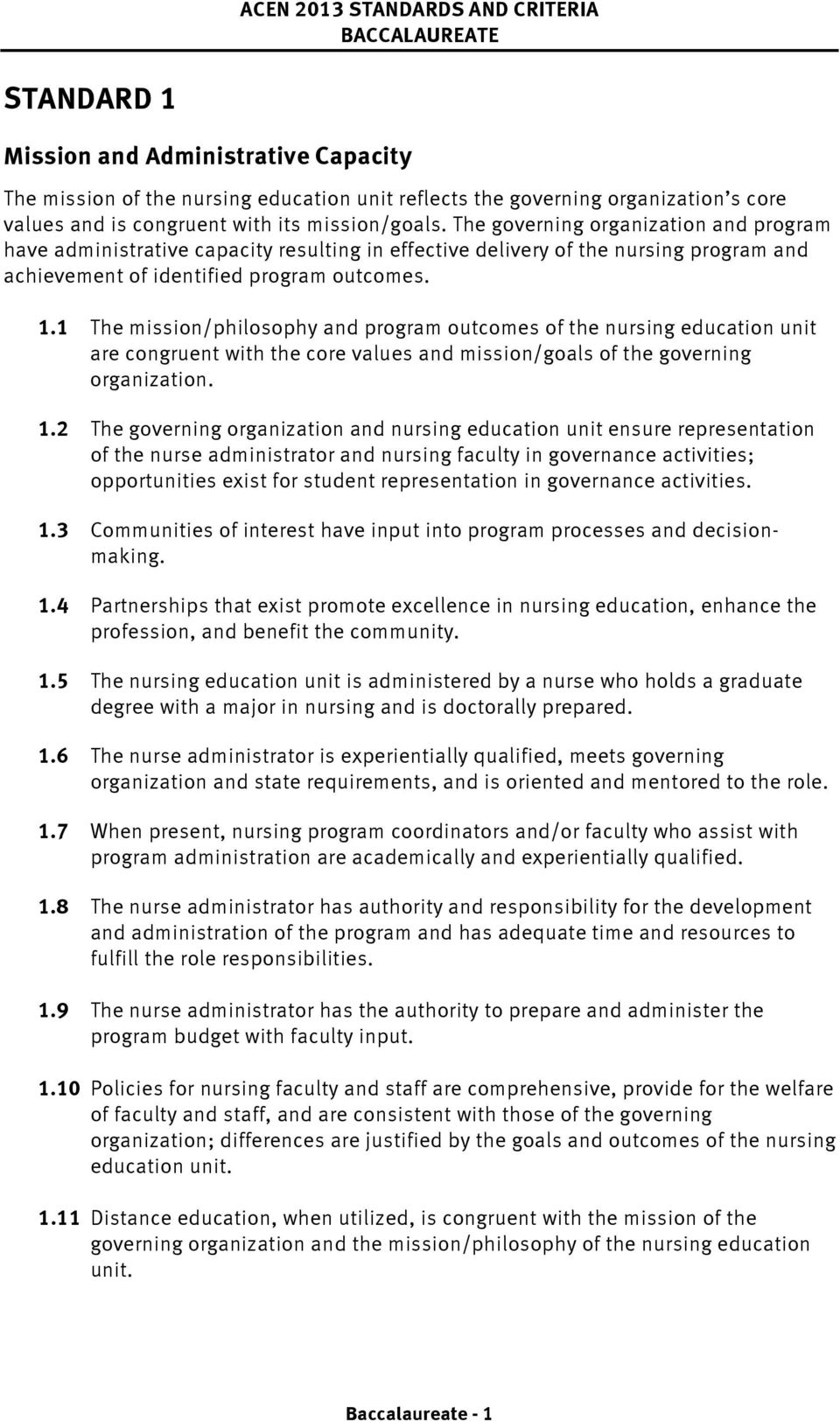
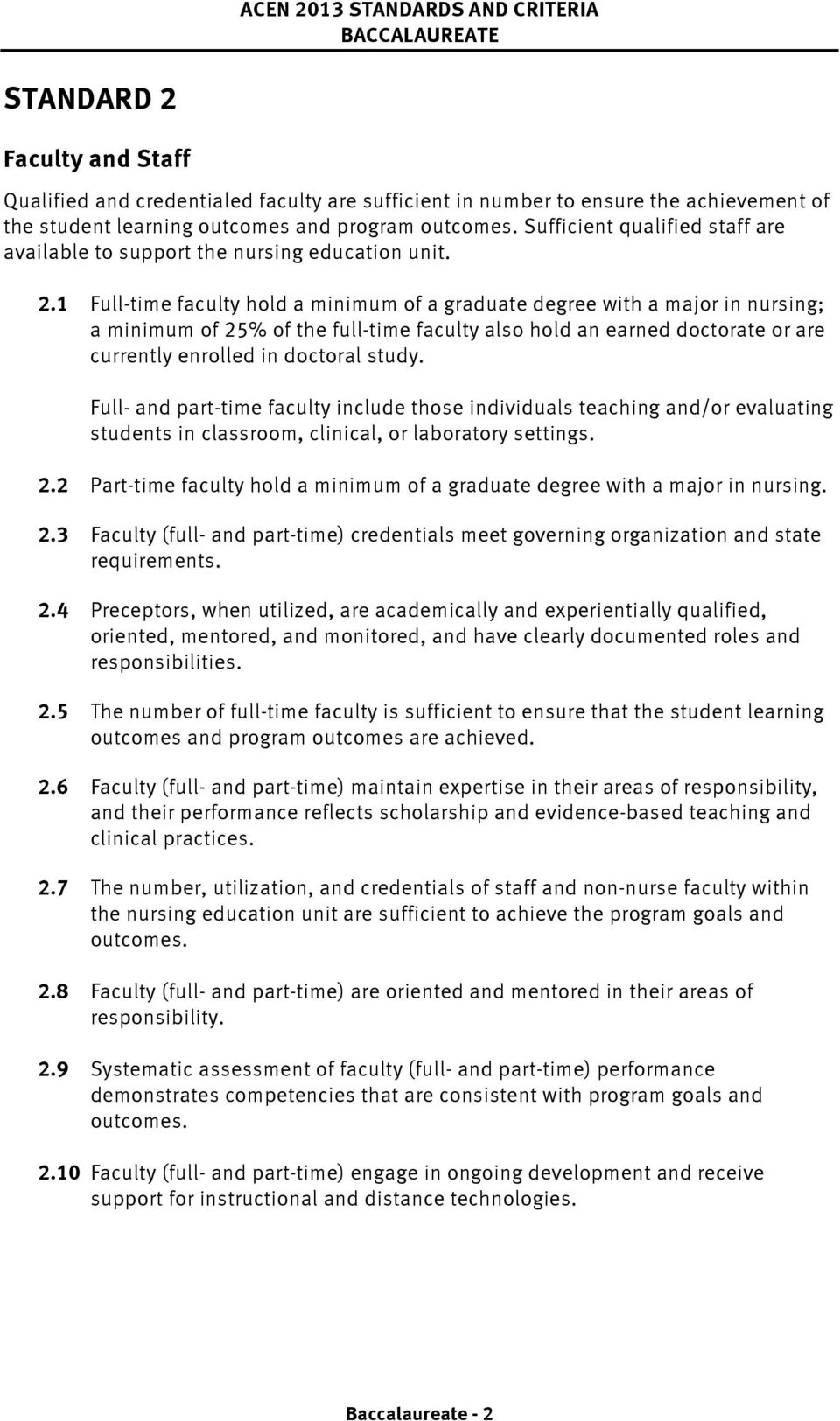
16 BACCALAUREATE STANDARD 2 Faculty and Staff Qualified and credentialed faculty are sufficient in number to ensure the achievement of the student learning outcomes and program Sufficient qualified staff are available to support the nursing education unit. 2.1 Full-time faculty hold a minimum of a graduate degree with a major in nursing; a minimum of 25% of the full-time faculty also hold an earned doctorate or are currently enrolled in doctoral study. Full- and part-time faculty include those individuals teaching and/or evaluating students in classroom, clinical, or laboratory settings. 2.2 Part-time faculty hold a minimum of a graduate degree with a major in nursing. 2.3 Faculty (full- and part-time) credentials meet governing organization and state requirements. 2.4 Preceptors, when utilized, are academically and experientially qualified, oriented, mentored, and monitored, and have clearly documented roles and responsibilities. 2.5 The number of full-time faculty is sufficient to ensure that the student learning outcomes and program outcomes are achieved. 2.6 Faculty (full- and part-time) maintain expertise in their areas of responsibility, and their performance reflects scholarship and evidence-based teaching and clinical practices. 2.7 The number, utilization, and credentials of staff and non-nurse faculty within the nursing education unit are sufficient to achieve the program goals and 2.8 Faculty (full- and part-time) are oriented and mentored in their areas of responsibility. 2.9 Systematic assessment of faculty (full- and part-time) performance demonstrates competencies that are consistent with program goals and 2.10 Faculty (full- and part-time) engage in ongoing development and receive support for instructional and distance technologies. Baccalaureate - 2
17 BACCALAUREATE STANDARD 3 Students Student policies and services support the achievement of the student learning outcomes and program outcomes of the nursing education unit. 3.1 Policies for nursing students are congruent with those of the governing organization, publicly accessible, non-discriminatory, and consistently applied; differences are justified by the student learning outcomes and program 3.2 Public information is accurate, clear, consistent, and accessible, including the program s accreditation status and the ACEN contact information. 3.3 Changes in policies, procedures, and program information are clearly and consistently communicated to students in a timely manner. 3.4 Student services are commensurate with the needs of nursing students, including those receiving instruction using alternative methods of delivery. 3.5 Student educational records are in compliance with the policies of the governing organization and state and federal guidelines. 3.6 Compliance with the Higher Education Reauthorization Act Title IV eligibility and certification requirements is maintained, including default rates and the results of financial or compliance audits A written, comprehensive student loan repayment program addressing student loan information, counseling, monitoring, and cooperation with lenders is available Students are informed of their ethical responsibilities regarding financial assistance Financial aid records are maintained in compliance with the policies of the governing organization, state, and federal guidelines. 3.7 Records reflect that program complaints and grievances receive due process and include evidence of resolution. 3.8 Orientation to technology is provided, and technological support is available to students. 3.9 Information related to technology requirements and policies specific to distance education are accurate, clear, consistent, and accessible. Baccalaureate - 3

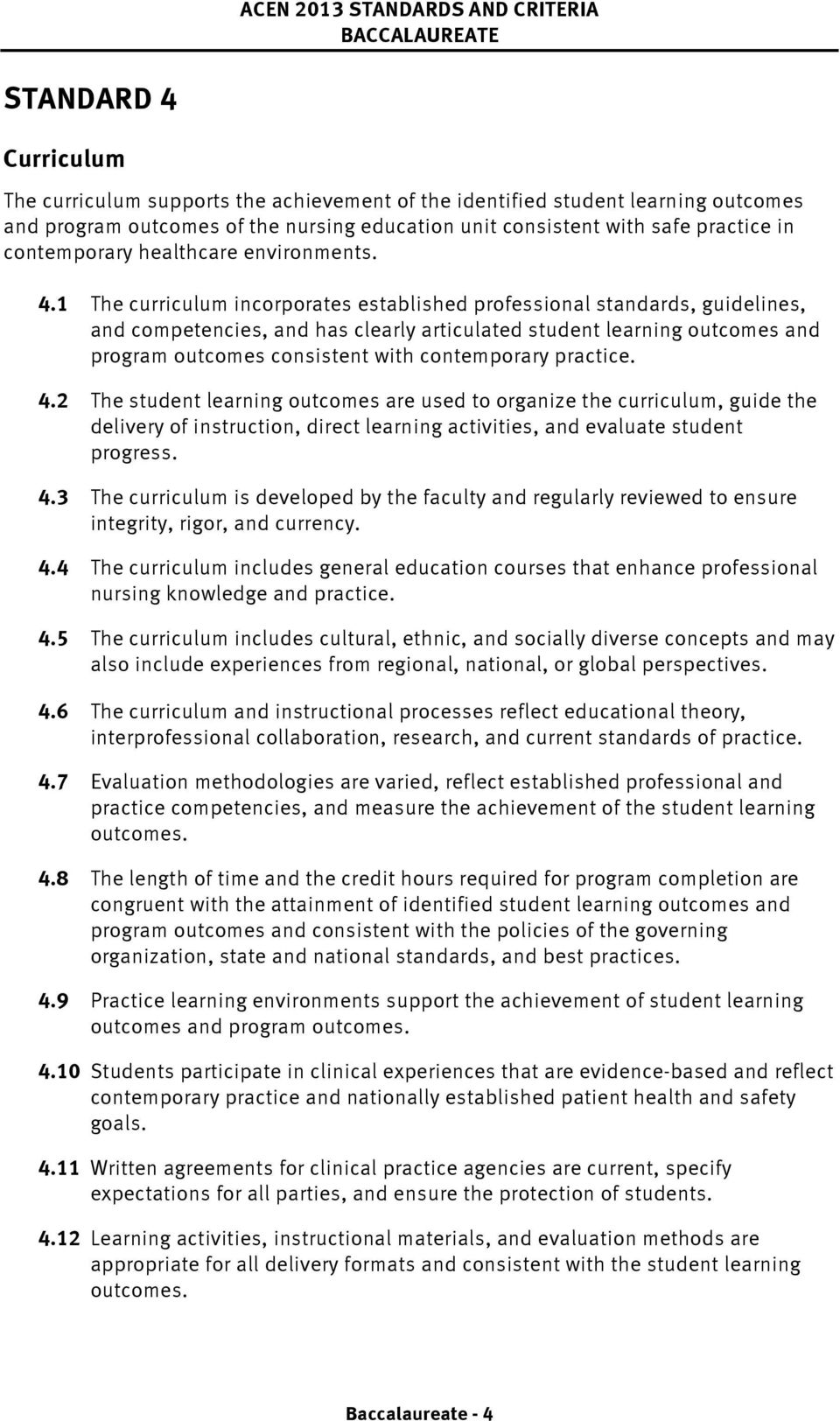
18 BACCALAUREATE STANDARD 4 Curriculum The curriculum supports the achievement of the identified student learning outcomes and program outcomes of the nursing education unit consistent with safe practice in contemporary healthcare environments. 4.1 The curriculum incorporates established professional standards, guidelines, and competencies, and has clearly articulated student learning outcomes and program outcomes consistent with contemporary practice. 4.2 The student learning outcomes are used to organize the curriculum, guide the delivery of instruction, direct learning activities, and evaluate student progress. 4.3 The curriculum is developed by the faculty and regularly reviewed to ensure integrity, rigor, and currency. 4.4 The curriculum includes general education courses that enhance professional nursing knowledge and practice. 4.5 The curriculum includes cultural, ethnic, and socially diverse concepts and may also include experiences from regional, national, or global perspectives. 4.6 The curriculum and instructional processes reflect educational theory, interprofessional collaboration, research, and current standards of practice. 4.7 Evaluation methodologies are varied, reflect established professional and practice competencies, and measure the achievement of the student learning 4.8 The length of time and the credit hours required for program completion are congruent with the attainment of identified student learning outcomes and program outcomes and consistent with the policies of the governing organization, state and national standards, and best practices. 4.9 Practice learning environments support the achievement of student learning outcomes and program 4.10 Students participate in clinical experiences that are evidence-based and reflect contemporary practice and nationally established patient health and safety goals Written agreements for clinical practice agencies are current, specify expectations for all parties, and ensure the protection of students Learning activities, instructional materials, and evaluation methods are appropriate for all delivery formats and consistent with the student learning Baccalaureate - 4
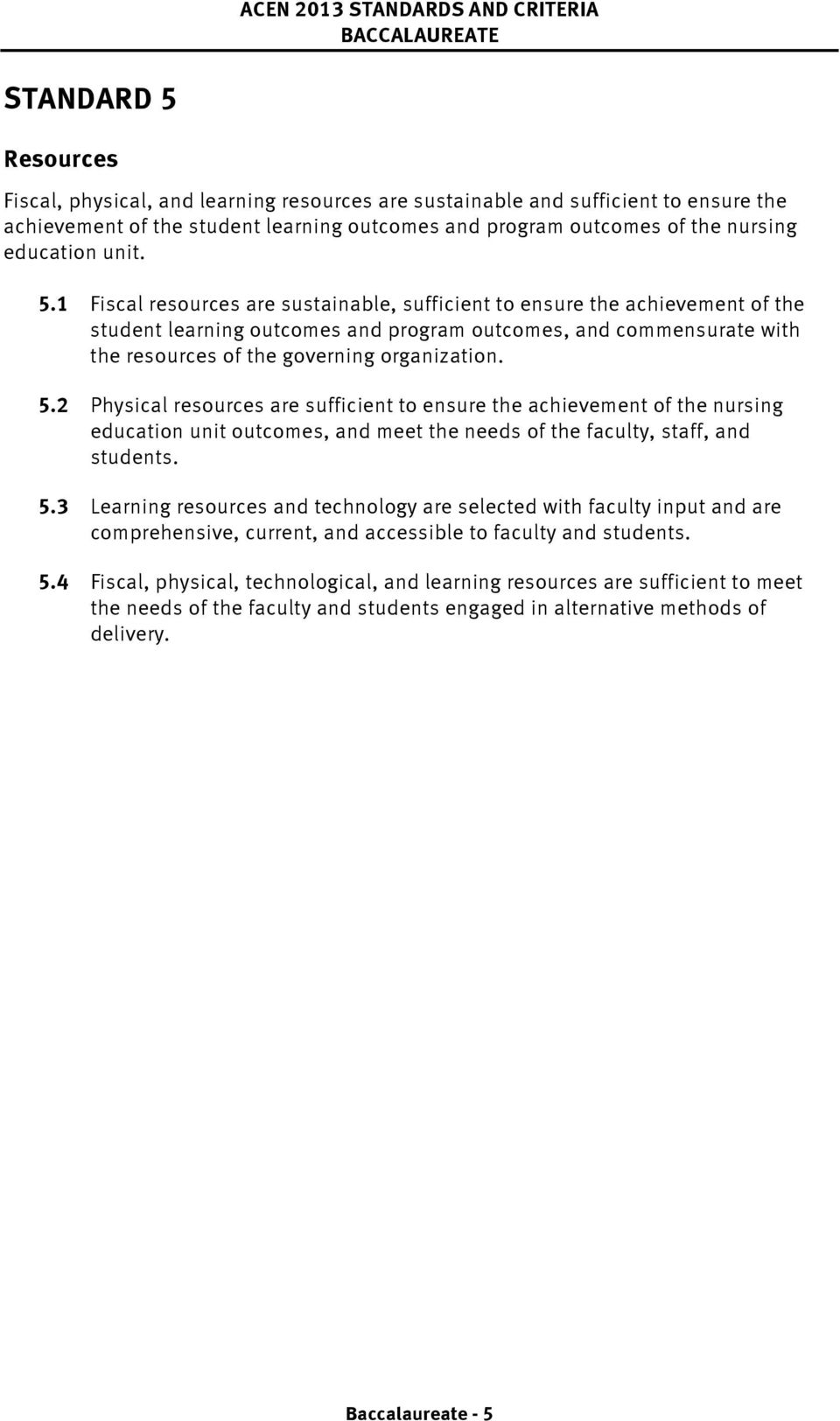
19 BACCALAUREATE STANDARD 5 Resources Fiscal, physical, and learning resources are sustainable and sufficient to ensure the achievement of the student learning outcomes and program outcomes of the nursing education unit. 5.1 Fiscal resources are sustainable, sufficient to ensure the achievement of the student learning outcomes and program outcomes, and commensurate with the resources of the governing organization. 5.2 Physical resources are sufficient to ensure the achievement of the nursing education unit outcomes, and meet the needs of the faculty, staff, and students. 5.3 Learning resources and technology are selected with faculty input and are comprehensive, current, and accessible to faculty and students. 5.4 Fiscal, physical, technological, and learning resources are sufficient to meet the needs of the faculty and students engaged in alternative methods of delivery. Baccalaureate - 5
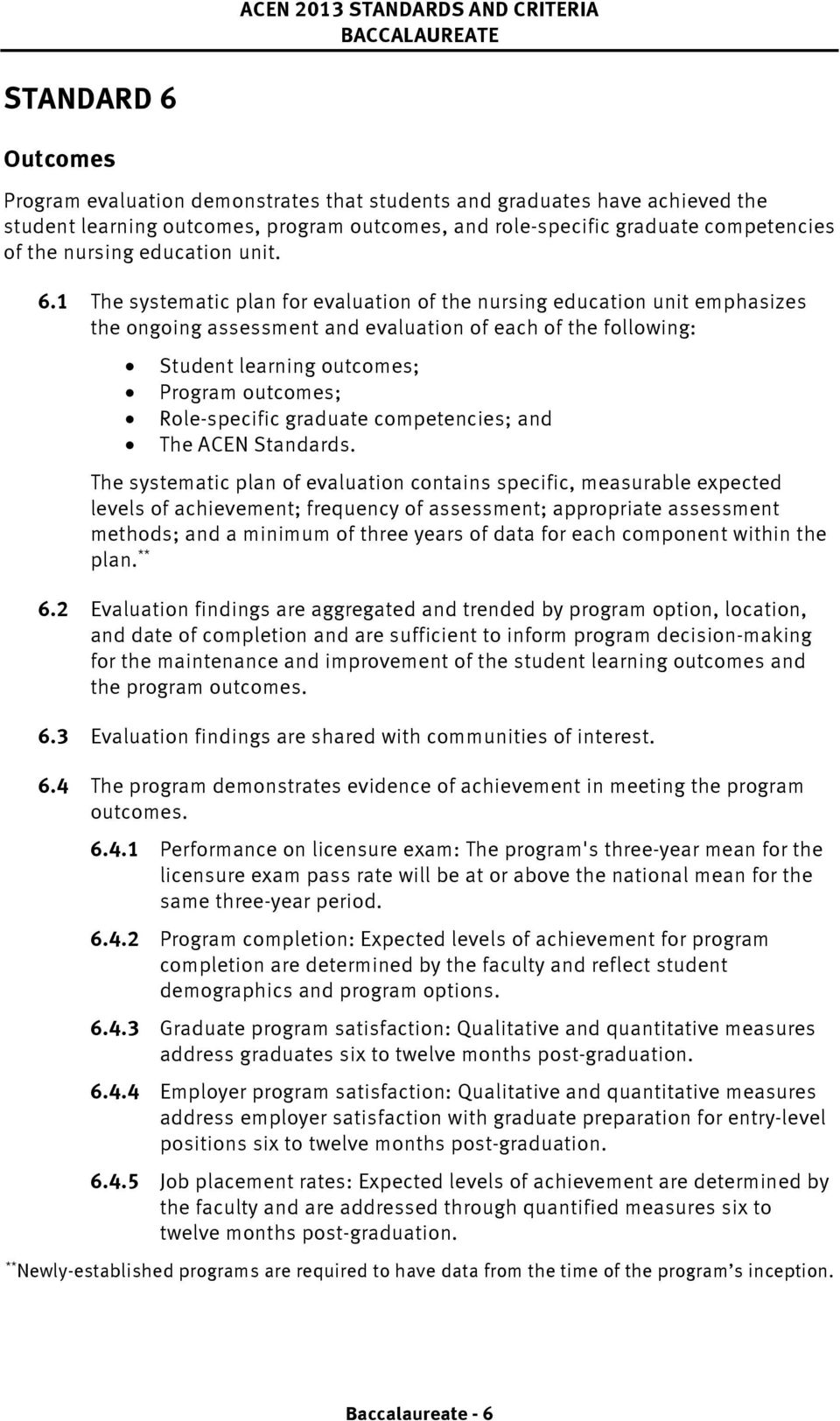
20 BACCALAUREATE STANDARD 6 Outcomes Program evaluation demonstrates that students and graduates have achieved the student learning outcomes, program outcomes, and role-specific graduate competencies of the nursing education unit. 6.1 The systematic plan for evaluation of the nursing education unit emphasizes the ongoing assessment and evaluation of each of the following: Student learning outcomes; Program outcomes; Role-specific graduate competencies; and The ACEN Standards. The systematic plan of evaluation contains specific, measurable expected levels of achievement; frequency of assessment; appropriate assessment methods; and a minimum of three years of data for each component within the plan. ** 6.2 Evaluation findings are aggregated and trended by program option, location, and date of completion and are sufficient to inform program decision-making for the maintenance and improvement of the student learning outcomes and the program 6.3 Evaluation findings are shared with communities of interest. 6.4 The program demonstrates evidence of achievement in meeting the program Performance on licensure exam: The program's three-year mean for the licensure exam pass rate will be at or above the national mean for the same three-year period Program completion: Expected levels of achievement for program completion are determined by the faculty and reflect student demographics and program options Graduate program satisfaction: Qualitative and quantitative measures address graduates six to twelve months post-graduation Employer program satisfaction: Qualitative and quantitative measures address employer satisfaction with graduate preparation for entry-level positions six to twelve months post-graduation Job placement rates: Expected levels of achievement are determined by the faculty and are addressed through quantified measures six to twelve months post-graduation. ** Newly-established programs are required to have data from the time of the program s inception. Baccalaureate - 6
21 ASSOCIATE STANDARD 1 Mission and Administrative Capacity The mission of the nursing education unit reflects the governing organization s core values and is congruent with its mission/goals. The governing organization and program have administrative capacity resulting in effective delivery of the nursing program and achievement of identified program 1.1 The mission/philosophy and program outcomes of the nursing education unit are congruent with the core values and mission/goals of the governing organization. 1.2 The governing organization and nursing education unit ensure representation of the nurse administrator and nursing faculty in governance activities; opportunities exist for student representation in governance activities. 1.3 Communities of interest have input into program processes and decisionmaking. 1.4 Partnerships that exist promote excellence in nursing education, enhance the profession, and benefit the community. 1.5 The nursing education unit is administered by a nurse who holds a graduate degree with a major in nursing. 1.6 The nurse administrator is experientially qualified, meets governing organization and state requirements, and is oriented and mentored to the role. 1.7 When present, nursing program coordinators and/or faculty who assist with program administration are academically and experientially qualified. 1.8 The nurse administrator has authority and responsibility for the development and administration of the program and has adequate time and resources to fulfill the role responsibilities. 1.9 The nurse administrator has the authority to prepare and administer the program budget with faculty input Policies for nursing faculty and staff are comprehensive, provide for the welfare of faculty and staff, and are consistent with those of the governing organization; differences are justified by the goals and outcomes of the nursing education unit Distance education, when utilized, is congruent with the mission of the governing organization and the mission/philosophy of the nursing education unit. Associate - 1
22 ASSOCIATE STANDARD 2 Faculty and Staff Qualified and credentialed faculty are sufficient in number to ensure the achievement of the student learning outcomes and program Sufficient qualified staff are available to support the nursing education unit. 2.1 Full-time faculty hold a minimum of a graduate degree with a major in nursing. Full- and part-time faculty include those individuals teaching and/or evaluating students in classroom, clinical, or laboratory settings. 2.2 Part-time faculty hold a minimum of a baccalaureate degree with a major in nursing; a minimum of 50% of the part-time faculty also hold a graduate degree with a major in nursing. 2.3 Faculty (full- and part-time) credentials meet governing organization and state requirements. 2.4 Preceptors, when utilized, are academically and experientially qualified, oriented, mentored, and monitored, and have clearly documented roles and responsibilities. 2.5 The number of full-time faculty is sufficient to ensure that the student learning outcomes and program outcomes are achieved. 2.6 Faculty (full- and part-time) maintain expertise in their areas of responsibility, and their performance reflects scholarship and evidence-based teaching and clinical practices. 2.7 The number, utilization, and credentials of staff and non-nurse faculty within the nursing education unit are sufficient to achieve the program goals and 2.8 Faculty (full- and part-time) are oriented and mentored in their areas of responsibility. 2.9 Systematic assessment of faculty (full- and part-time) performance demonstrates competencies that are consistent with program goals and 2.10 Faculty (full- and part-time) engage in ongoing development and receive support for instructional and distance technologies. Associate - 2
23 ASSOCIATE STANDARD 3 Students Student policies and services support the achievement of the student learning outcomes and program outcomes of the nursing education unit. 3.1 Policies for nursing students are congruent with those of the governing organization, publicly accessible, non-discriminatory, and consistently applied; differences are justified by the student learning outcomes and program 3.2 Public information is accurate, clear, consistent, and accessible, including the program s accreditation status and the ACEN contact information. 3.3 Changes in policies, procedures, and program information are clearly and consistently communicated to students in a timely manner. 3.4 Student services are commensurate with the needs of nursing students, including those receiving instruction using alternative methods of delivery. 3.5 Student educational records are in compliance with the policies of the governing organization and state and federal guidelines. 3.6 Compliance with the Higher Education Reauthorization Act Title IV eligibility and certification requirements is maintained, including default rates and the results of financial or compliance audits A written, comprehensive student loan repayment program addressing student loan information, counseling, monitoring, and cooperation with lenders is available Students are informed of their ethical responsibilities regarding financial assistance Financial aid records are maintained in compliance with the policies of the governing organization, state, and federal guidelines. 3.7 Records reflect that program complaints and grievances receive due process and include evidence of resolution. 3.8 Orientation to technology is provided, and technological support is available to students. 3.9 Information related to technology requirements and policies specific to distance education are accurate, clear, consistent, and accessible. Associate - 3
24 ASSOCIATE STANDARD 4 Curriculum The curriculum supports the achievement of the identified student learning outcomes and program outcomes of the nursing education unit consistent with safe practice in contemporary healthcare environments. 4.1 The curriculum incorporates established professional standards, guidelines, and competencies, and has clearly articulated student learning outcomes and program outcomes consistent with contemporary practice. 4.2 The student learning outcomes are used to organize the curriculum, guide the delivery of instruction, direct learning activities, and evaluate student progress. 4.3 The curriculum is developed by the faculty and regularly reviewed to ensure integrity, rigor, and currency. 4.4 The curriculum includes general education courses that enhance professional nursing knowledge and practice. 4.5 The curriculum includes cultural, ethnic, and socially diverse concepts and may also include experiences from regional, national, or global perspectives. 4.6 The curriculum and instructional processes reflect educational theory, interprofessional collaboration, research, and current standards of practice. 4.7 Evaluation methodologies are varied, reflect established professional and practice competencies, and measure the achievement of the student learning 4.8 The length of time and the credit hours required for program completion are congruent with the attainment of identified student learning outcomes and program outcomes and consistent with the policies of the governing organization, state and national standards, and best practices. 4.9 Practice learning environments support the achievement of student learning outcomes and program 4.10 Students participate in clinical experiences that are evidence-based and reflect contemporary practice and nationally established patient health and safety goals Written agreements for clinical practice agencies are current, specify expectations for all parties, and ensure the protection of students Learning activities, instructional materials, and evaluation methods are appropriate for all delivery formats and consistent with the student learning Associate - 4
25 ASSOCIATE STANDARD 5 Resources Fiscal, physical, and learning resources are sustainable and sufficient to ensure the achievement of the student learning outcomes and program outcomes of the nursing education unit. 5.1 Fiscal resources are sustainable, sufficient to ensure the achievement of the student learning outcomes and program outcomes, and commensurate with the resources of the governing organization. 5.2 Physical resources are sufficient to ensure the achievement of the nursing education unit outcomes, and meet the needs of the faculty, staff, and students. 5.3 Learning resources and technology are selected with faculty input and are comprehensive, current, and accessible to faculty and students. 5.4 Fiscal, physical, technological, and learning resources are sufficient to meet the needs of the faculty and students engaged in alternative methods of delivery. Associate - 5
26 ASSOCIATE STANDARD 6 Outcomes Program evaluation demonstrates that students and graduates have achieved the student learning outcomes, program outcomes, and role-specific graduate competencies of the nursing education unit. 6.1 The systematic plan for evaluation of the nursing education unit emphasizes the ongoing assessment and evaluation of each of the following: Student learning outcomes; Program outcomes; Role-specific graduate competencies; and The ACEN Standards. The systematic plan of evaluation contains specific, measurable expected levels of achievement; frequency of assessment; appropriate assessment methods; and a minimum of three years of data for each component within the plan. ** 6.2 Evaluation findings are aggregated and trended by program option, location, and date of completion and are sufficient to inform program decision-making for the maintenance and improvement of the student learning outcomes and the program 6.3 Evaluation findings are shared with communities of interest. 6.4 The program demonstrates evidence of achievement in meeting the program Performance on licensure exam: The program's three-year mean for the licensure exam pass rate will be at or above the national mean for the same three-year period Program completion: Expected levels of achievement for program completion are determined by the faculty and reflect student demographics and program options Graduate program satisfaction: Qualitative and quantitative measures address graduates six to twelve months post-graduation Employer program satisfaction: Qualitative and quantitative measures address employer satisfaction with graduate preparation for entry-level positions six to twelve months post-graduation Job placement rates: Expected levels of achievement are determined by the faculty and are addressed through quantified measures six to twelve months post-graduation. ** Newly-established programs are required to have data from the time of the program s inception. Associate - 6
27 DIPLOMA STANDARD 1 Mission and Administrative Capacity The mission of the nursing education unit reflects the governing organization s core values and is congruent with its mission/goals. The governing organization and program have administrative capacity resulting in effective delivery of the nursing program and achievement of identified program 1.1 The mission/philosophy and program outcomes of the nursing education unit are congruent with the core values and mission/goals of the governing organization. 1.2 The governing organization and nursing education unit ensure representation of the nurse administrator and nursing faculty in governance activities; opportunities exist for student representation in governance activities. 1.3 Communities of interest have input into program processes and decisionmaking. 1.4 Partnerships that exist promote excellence in nursing education, enhance the profession, and benefit the community. 1.5 The nursing education unit is administered by a nurse who holds a graduate degree with a major in nursing. 1.6 The nurse administrator is experientially qualified, meets governing organization and state requirements, and is oriented and mentored to the role. 1.7 When present, nursing program coordinators and/or faculty who assist with program administration are academically and experientially qualified. 1.8 The nurse administrator has authority and responsibility for the development and administration of the program and has adequate time and resources to fulfill the role responsibilities. 1.9 The nurse administrator has the authority to prepare and administer the program budget with faculty input Policies for nursing faculty and staff are comprehensive, provide for the welfare of faculty and staff, and are consistent with those of the governing organization; differences are justified by the goals and outcomes of the nursing education unit Distance education, when utilized, is congruent with the mission of the governing organization and the mission/philosophy of the nursing education unit. Diploma - 1
28 DIPLOMA STANDARD 2 Faculty and Staff Qualified and credentialed faculty are sufficient in number to ensure the achievement of the student learning outcomes and program Sufficient qualified staff are available to support the nursing education unit. 2.1 Full-time faculty hold a minimum of a graduate degree with a major in nursing. Full- and part-time faculty include those individuals teaching and/or evaluating students in classroom, clinical, or laboratory settings. 2.2 Part-time faculty hold a minimum of a baccalaureate degree with a major in nursing; a minimum of 50% of the part-time faculty also hold a graduate degree with a major in nursing. 2.3 Faculty (full- and part-time) credentials meet governing organization and state requirements. 2.4 Preceptors, when utilized, are academically and experientially qualified, oriented, mentored, and monitored, and have clearly documented roles and responsibilities. 2.5 The number of full-time faculty is sufficient to ensure that the student learning outcomes and program outcomes are achieved. 2.6 Faculty (full- and part-time) maintain expertise in their areas of responsibility, and their performance reflects scholarship and evidence-based teaching and clinical practices. 2.7 The number, utilization, and credentials of staff and non-nurse faculty within the nursing education unit are sufficient to achieve the program goals and 2.8 Faculty (full- and part-time) are oriented and mentored in their areas of responsibility. 2.9 Systematic assessment of faculty (full- and part-time) performance demonstrates competencies that are consistent with program goals and 2.10 Faculty (full- and part-time) engage in ongoing development and receive support for instructional and distance technologies. Diploma - 2
29 DIPLOMA STANDARD 3 Students Student policies and services support the achievement of the student learning outcomes and program outcomes of the nursing education unit. 3.1 Policies for nursing students are congruent with those of the governing organization, publicly accessible, non-discriminatory, and consistently applied; differences are justified by the student learning outcomes and program 3.2 Public information is accurate, clear, consistent, and accessible, including the program s accreditation status and the ACEN contact information. 3.3 Changes in policies, procedures, and program information are clearly and consistently communicated to students in a timely manner. 3.4 Student services are commensurate with the needs of nursing students, including those receiving instruction using alternative methods of delivery. 3.5 Student educational records are in compliance with the policies of the governing organization and state and federal guidelines. 3.6 Compliance with the Higher Education Reauthorization Act Title IV eligibility and certification requirements is maintained, including default rates and the results of financial or compliance audits A written, comprehensive student loan repayment program addressing student loan information, counseling, monitoring, and cooperation with lenders is available Students are informed of their ethical responsibilities regarding financial assistance Financial aid records are maintained in compliance with the policies of the governing organization, state, and federal guidelines. 3.7 Records reflect that program complaints and grievances receive due process and include evidence of resolution. 3.8 Orientation to technology is provided, and technological support is available to students. 3.9 Information related to technology requirements and policies specific to distance education are accurate, clear, consistent, and accessible. Diploma - 3
30 DIPLOMA STANDARD 4 Curriculum The curriculum supports the achievement of the identified student learning outcomes and program outcomes of the nursing education unit consistent with safe practice in contemporary healthcare environments. 4.1 The curriculum incorporates established professional standards, guidelines, and competencies, and has clearly articulated student learning outcomes and program outcomes consistent with contemporary practice. 4.2 The student learning outcomes are used to organize the curriculum, guide the delivery of instruction, direct learning activities, and evaluate student progress. 4.3 The curriculum is developed by the faculty and regularly reviewed to ensure integrity, rigor, and currency. 4.4 The curriculum includes general education courses that enhance professional nursing knowledge and practice. 4.5 The curriculum includes cultural, ethnic, and socially diverse concepts and may also include experiences from regional, national, or global perspectives. 4.6 The curriculum and instructional processes reflect educational theory, interprofessional collaboration, research, and current standards of practice. 4.7 Evaluation methodologies are varied, reflect established professional and practice competencies, and measure the achievement of the student learning 4.8 The length of time and the credit hours required for program completion are congruent with the attainment of identified student learning outcomes and program outcomes and consistent with the policies of the governing organization, state and national standards, and best practices. 4.9 Practice learning environments support the achievement of student learning outcomes and program 4.10 Students participate in clinical experiences that are evidence-based and reflect contemporary practice and nationally established patient health and safety goals Written agreements for clinical practice agencies are current, specify expectations for all parties, and ensure the protection of students Learning activities, instructional materials, and evaluation methods are appropriate for all delivery formats and consistent with the student learning Diploma - 4
31 DIPLOMA STANDARD 5 Resources Fiscal, physical, and learning resources are sustainable and sufficient to ensure the achievement of the student learning outcomes and program outcomes of the nursing education unit. 5.1 Fiscal resources are sustainable, sufficient to ensure the achievement of the student learning outcomes and program outcomes, and commensurate with the resources of the governing organization. 5.2 Physical resources are sufficient to ensure the achievement of the nursing education unit outcomes, and meet the needs of the faculty, staff, and students. 5.3 Learning resources and technology are selected with faculty input and are comprehensive, current, and accessible to faculty and students. 5.4 Fiscal, physical, technological, and learning resources are sufficient to meet the needs of the faculty and students engaged in alternative methods of delivery. Diploma - 5
32 DIPLOMA STANDARD 6 Outcomes Program evaluation demonstrates that students and graduates have achieved the student learning outcomes, program outcomes, and role-specific graduate competencies of the nursing education unit. 6.1 The systematic plan for evaluation of the nursing education unit emphasizes the ongoing assessment and evaluation of each of the following: Student learning outcomes; Program outcomes; Role-specific graduate competencies; and The ACEN Standards. The systematic plan of evaluation contains specific, measurable expected levels of achievement; frequency of assessment; appropriate assessment methods; and a minimum of three years of data for each component within the plan. ** 6.2 Evaluation findings are aggregated and trended by program option, location, and date of completion and are sufficient to inform program decision-making for the maintenance and improvement of the student learning outcomes and the program 6.3 Evaluation findings are shared with communities of interest. 6.4 The program demonstrates evidence of achievement in meeting the program Performance on licensure exam: The program's three-year mean for the licensure exam pass rate will be at or above the national mean for the same three-year period Program completion: Expected levels of achievement for program completion are determined by the faculty and reflect student demographics and program options Graduate program satisfaction: Qualitative and quantitative measures address graduates six to twelve months post-graduation Employer program satisfaction: Qualitative and quantitative measures address employer satisfaction with graduate preparation for entry-level positions six to twelve months post-graduation Job placement rates: Expected levels of achievement are determined by the faculty and are addressed through quantified measures six to twelve months post-graduation. ** Newly-established programs are required to have data from the time of the program s inception. Diploma - 6
33 PRACTICAL STANDARD 1 Mission and Administrative Capacity The mission of the nursing education unit reflects the governing organization s core values and is congruent with its mission/goals. The governing organization and program have administrative capacity resulting in effective delivery of the nursing program and achievement of identified program 1.1 The mission/philosophy and program outcomes of the nursing education unit are congruent with the core values and mission/goals of the governing organization. 1.2 The governing organization and nursing education unit ensure representation of the nurse administrator and nursing faculty in governance activities; opportunities exist for student representation in governance activities. 1.3 Communities of interest have input into program processes and decisionmaking. 1.4 Partnerships that exist promote excellence in nursing education, enhance the profession, and benefit the community. 1.5 The nursing education unit is administered by a nurse who holds a graduate degree with a major in nursing. 1.6 The nurse administrator is experientially qualified, meets governing organization and state requirements, and is oriented and mentored to the role. 1.7 When present, nursing program coordinators and/or faculty who assist with program administration are academically and experientially qualified. 1.8 The nurse administrator has authority and responsibility for the development and administration of the program and has adequate time and resources to fulfill the role responsibilities. 1.9 The nurse administrator has the authority to prepare and administer the program budget with faculty input Policies for nursing faculty and staff are comprehensive, provide for the welfare of faculty and staff, and are consistent with those of the governing organization; differences are justified by the goals and outcomes of the nursing education unit Distance education, when utilized, is congruent with the mission of the governing organization and the mission/philosophy of the nursing education unit. Practical - 1
34 PRACTICAL STANDARD 2 Faculty and Staff Qualified and credentialed faculty are sufficient in number to ensure the achievement of the student learning outcomes and program Sufficient qualified staff are available to support the nursing education unit. 2.1 A minimum of 50% of the full-time faculty hold a graduate degree with a major in nursing; the remaining full-time faculty hold a minimum of a baccalaureate degree with a major in nursing. Full- and part-time faculty include those individuals teaching and/or evaluating students in classroom, clinical, or laboratory settings. 2.2 Part-time faculty hold a minimum of a baccalaureate degree with a major in nursing. 2.3 Faculty (full- and part-time) credentials meet governing organization and state requirements. 2.4 Preceptors, when utilized, are academically and experientially qualified, oriented, mentored, and monitored, and have clearly documented roles and responsibilities. 2.5 The number of full-time faculty is sufficient to ensure that the student learning outcomes and program outcomes are achieved. 2.6 Faculty (full- and part-time) maintain expertise in their areas of responsibility, and their performance reflects scholarship and evidence-based teaching and clinical practices. 2.7 The number, utilization, and credentials of staff and non-nurse faculty within the nursing education unit are sufficient to achieve the program goals and 2.8 Faculty (full- and part-time) are oriented and mentored in their areas of responsibility. 2.9 Systematic assessment of faculty (full- and part-time) performance demonstrates competencies that are consistent with program goals and 2.10 Faculty (full- and part-time) engage in ongoing development and receive support for instructional and distance technologies. Practical - 2
35 PRACTICAL STANDARD 3 Students Student policies and services support the achievement of the student learning outcomes and program outcomes of the nursing education unit. 3.1 Policies for nursing students are congruent with those of the governing organization, publicly accessible, non-discriminatory, and consistently applied; differences are justified by the student learning outcomes and program 3.2 Public information is accurate, clear, consistent, and accessible, including the program s accreditation status and the ACEN contact information. 3.3 Changes in policies, procedures, and program information are clearly and consistently communicated to students in a timely manner. 3.4 Student services are commensurate with the needs of nursing students, including those receiving instruction using alternative methods of delivery. 3.5 Student educational records are in compliance with the policies of the governing organization and state and federal guidelines. 3.6 Compliance with the Higher Education Reauthorization Act Title IV eligibility and certification requirements is maintained, including default rates and the results of financial or compliance audits A written, comprehensive student loan repayment program addressing student loan information, counseling, monitoring, and cooperation with lenders is available Students are informed of their ethical responsibilities regarding financial assistance Financial aid records are maintained in compliance with the policies of the governing organization, state, and federal guidelines. 3.7 Records reflect that program complaints and grievances receive due process and include evidence of resolution. 3.8 Orientation to technology is provided, and technological support is available to students. 3.9 Information related to technology requirements and policies specific to distance education are accurate, clear, consistent, and accessible. Practical - 3
36 PRACTICAL STANDARD 4 Curriculum The curriculum supports the achievement of the identified student learning outcomes and program outcomes of the nursing education unit consistent with safe practice in contemporary healthcare environments. 4.1 The curriculum incorporates established professional standards, guidelines, and competencies, and has clearly articulated student learning outcomes and program outcomes consistent with contemporary practice. 4.2 The student learning outcomes are used to organize the curriculum, guide the delivery of instruction, direct learning activities, and evaluate student progress. 4.3 The curriculum is developed by the faculty and regularly reviewed to ensure integrity, rigor, and currency. 4.4 General education courses/competencies enhance professional nursing knowledge and practice if included in the program of study. 4.5 The curriculum includes cultural, ethnic, and socially diverse concepts and may also include experiences from regional, national, or global perspectives. 4.6 The curriculum and instructional processes reflect educational theory, interprofessional collaboration, research, and current standards of practice. 4.7 Evaluation methodologies are varied, reflect established professional and practice competencies, and measure the achievement of the student learning 4.8 The length of time and the credit hours required for program completion are congruent with the attainment of identified student learning outcomes and program outcomes and consistent with the policies of the governing organization, state and national standards, and best practices. 4.9 Practice learning environments support the achievement of student learning outcomes and program 4.10 Students participate in clinical experiences that are evidence-based and reflect contemporary practice and nationally established patient health and safety goals Written agreements for clinical practice agencies are current, specify expectations for all parties, and ensure the protection of students Learning activities, instructional materials, and evaluation methods are appropriate for all delivery formats and consistent with the student learning Practical - 4
37 PRACTICAL STANDARD 5 Resources Fiscal, physical, and learning resources are sustainable and sufficient to ensure the achievement of the student learning outcomes and program outcomes of the nursing education unit. 5.1 Fiscal resources are sustainable, sufficient to ensure the achievement of the student learning outcomes and program outcomes, and commensurate with the resources of the governing organization. 5.2 Physical resources are sufficient to ensure the achievement of the nursing education unit outcomes, and meet the needs of the faculty, staff, and students. 5.3 Learning resources and technology are selected with faculty input and are comprehensive, current, and accessible to faculty and students. 5.4 Fiscal, physical, technological, and learning resources are sufficient to meet the needs of the faculty and students engaged in alternative methods of delivery. Practical - 5
38 PRACTICAL STANDARD 6 Outcomes Program evaluation demonstrates that students and graduates have achieved the student learning outcomes, program outcomes, and role-specific graduate competencies of the nursing education unit. 6.1 The systematic plan for evaluation of the nursing education unit emphasizes the ongoing assessment and evaluation of each of the following: Student learning outcomes; Program outcomes; Role-specific graduate competencies; and The ACEN Standards. The systematic plan of evaluation contains specific, measurable expected levels of achievement; frequency of assessment; appropriate assessment methods; and a minimum of three years of data for each component within the plan. ** 6.2 Evaluation findings are aggregated and trended by program option, location, and date of completion and are sufficient to inform program decision-making for the maintenance and improvement of the student learning outcomes and the program 6.3 Evaluation findings are shared with communities of interest. 6.4 The program demonstrates evidence of achievement in meeting the program Performance on licensure exam: The program's three-year mean for the licensure exam pass rate will be at or above the national mean for the same three-year period Program completion: Expected levels of achievement for program completion are determined by the faculty and reflect student demographics and program options Graduate program satisfaction: Qualitative and quantitative measures address graduates six to twelve months post-graduation Employer program satisfaction: Qualitative and quantitative measures address employer satisfaction with graduate preparation for entry-level positions six to twelve months post-graduation Job placement rates: Expected levels of achievement are determined by the faculty and are addressed through quantified measures six to twelve months post-graduation. **Newly-established programs are required to have data from the time of the program s inception. Practical - 6
39 ACEN Accreditation Manual Glossary GLOSSARY Additional Location An alternate site for the delivery of the nursing program other than the original/main location. Administrative Capacity Administrative services available to the governing organization and nursing education unit that directly support the functions of the governing organization and the nursing education unit in the achievement of the desired Advanced Practice Registered Nurse (APRN) A clinical nurse specialist, nurse practitioner, certified registered nurse anesthetist, or certified nurse midwife. Alternative Methods of Delivery The way in which a nursing course, track, or program is shared with students including non-traditional means of student-faculty interaction, length required for the program of study, and/or varying intervals of class and/or clinical schedules. Examples include but are not limited to: accelerated or condensed formats, ITV, videotape/dvd learning packages, and online delivery. Chief Executive Officer The official who has the primary responsibility of carrying out the administrative policies and functions of the governing organization. Clinical Experiences Planned instructional activities with patients across the lifespan that are sufficient to achieve the student learning outcomes and graduate competencies and are supervised by qualified faculty who provide feedback in support of learning. Communities of Interest Persons, groups, agencies, and/or organizations that influence the mission, services, and outcomes of the nursing education unit. Examples include: students, graduates, healthcare employers, governing organizations, state regulatory agencies, and the public. Complaints and Grievances A formal allegation against a party or program usually expressed in a written, signed statement. A grievance is a wrong or hardship suffered which is the grounds for a complaint; the formal expression of a grievance is a complaint. The record of student complaints must include all complaints filed during the time period since the last accreditation review. Core Values Those beliefs or ideals which form the foundation for the work of a governing organization and/or nursing program. Credentialing Accreditation A voluntary, non-governmental process that uses peer review to determine if academic programs meet public confidence. Institutional accreditation evaluates an entire institution as a whole. Specialized accreditation evaluates a particular educational unit or program(s) within a governing organization. Glossary - 1
40 ACEN Accreditation Manual Glossary Approval The term generally referred to by most state boards of nursing to describe authorization of nursing education programs meeting minimal standards as defined in the Nurse Practice Act or State Rules and Regulations. Certification The process by which an organization, association, voluntary agency, or state regulatory agency grants recognition that an individual possesses predetermined knowledge and/or skills specified for practice in an area of specialization. Licensure The process by which a governmental agency gives affirmation to the public that the individuals engaged in an occupation or profession have minimal education, qualifications, and competence necessary to practice in a safe manner. Criteria Statements that identify the variables that need to be examined in evaluation of a standard. Currently Enrolled Enrolled as a graduate student in good standing and successfully completing a minimum of six to nine semester credits per year until the graduate degree is earned. Curriculum Integrity Demonstration of the soundness of the program of study that progresses from the mission/philosophy in an organized manner across a sequence of courses whose learning outcomes address the concepts derived from the mission/philosophy. The learning outcomes direct instruction and learning activities and lead in a logical progression to the achievement of the graduate competencies. Default Rate The rate of student borrowers who fail to remain current on their loans. Distance Education An educational process in which the majority of the instruction occurs when a student and instructor are not in the same place. Instruction may be synchronous or asynchronous. Distance Technology Instructional methods that may include one-way or two-way transmissions, audio, video, the Internet, and/or computer technologies. Diversity Concepts Knowledge about persons, communities, regions, countries, cultures, and ethnicities other than one s own. Due Process A decision-making procedure that is disciplined and analytical in which relevant standards are applied by a properly constituted and authorized body using a method that is based on published rules of procedure and is free of improper influence. Evidence-Based Actions, processes, or methodologies that are grounded in and flow from the translation of substantive and current research. Expected Level of Achievement A measurable index that reflects a desired outcome. Glossary - 2
41 ACEN Accreditation Manual Glossary Faculty, Non-Nursing Non-nurses who are academically qualified and teach a nursing course such as a dietician, pharmacologist, or physiologist. Faculty, Nursing Nurses who teach and evaluate nursing students, are academically qualified, and have experience in the content areas in which they teach. Full-time Persons who teach and/or evaluate students and have full-time faculty employment status as defined by the governing organization and the nursing education unit. Part-time Persons who teach and/or evaluate students and whose appointment is less than full-time as defined by the governing organization and the nursing education unit. Faculty Development Activities that facilitate faculty maintenance or enhancement of expertise including certification, continuing education, formal advanced education, clinical practice, research, publications, and other scholarly activities. Faculty Workload Percentages of time that reflect the manner in which the governing organization or nursing education unit characterizes, structures, and documents the nature of faculty responsibilities. Categories frequently used are teaching, advisement, administration, committee activity, research and other scholarship activity, and service/practice. Gatekeeper A person or agency that is responsible to monitor compliance with the Higher Education Reauthorization Act Title IV. Governing Organization The institution with overall responsibility and authority for the nursing education unit (e.g., college, university, hospital, career center). Graduate Competencies, Role Specific Expected measurable levels of graduate performance that integrate knowledge, skills, and abilities. Competencies may include specific knowledge areas, clinical judgments, and behaviors based upon the role and/or scope of practice of the graduate. Graduate Degree A master s degree and/or earned doctorate. Information Literacy The ability to know what information is needed and to access, evaluate, and use all forms of information for a specific purpose. Interprofessional Sharing of information among two or more health professionals working together as a team with a common purpose and mutual respect. Job Placement Rate Number of graduates, one year after graduation, employed in a position for which the program prepared them. Glossary - 3
42 ACEN Accreditation Manual Glossary Laboratory Personnel Non-faculty persons with specified expertise who may support and/or facilitate learning experiences in a practice setting typically designed to simulate the clinical environment. Mission/Philosophy The governing organization and/or nursing education unit statement that designates fundamental beliefs and characteristics and provides guidance and direction for the program(s) and services offered. Nurse Administrator The individual with responsibility and authority for the administrative and instructional activities of the nursing education unit within the governing organization (e.g., dean, chairperson, director). Nursing Education Unit A nursing education unit may offer one or more program types; all programs within the nursing education unit must be administered by a single individual with the responsibility and authority for all programs. Nursing Program A nursing program is identified as a single entity (program) when it can be demonstrated that all of the following criteria are met: 1. The program is within one governing organization that holds an appropriate institutional accreditation from an agency recognized by the ACEN. 2. The program is within the jurisdiction of one State Board of Nursing and/or other identified regulatory body exclusive of clinical learning experiences. 3. There is one set of student learning outcomes for the program offered. 4. There is one nurse administrator who has responsibility and authority for the program which may include: the hiring and evaluation of faculty; the development or revision of the curriculum; the assignment/approval of faculty responsibilities; the establishment of program specific admission/progression criteria; and development and administration of the program budget. 5. The faculty can demonstrate that they function as a faculty of the whole within a set of established faculty policies through their organization and decisionmaking processes, and methods of input into the curriculum development, delivery, and evaluation. 6. There is a systematic evaluation plan that addresses the student learning outcomes, program outcomes, and the ACEN Standards. 7. A single degree, certificate, or diploma is offered to students successfully completing the program. 8. All students are governed by a single set of policies. Outcome A statement that reflects the achievement of identified goals. Program Outcomes Indicators that reflect the extent to which the purposes of the nursing education unit are achieved and by which program effectiveness is documented. Program outcomes are measurable, consumer-oriented indexes designed to evaluate the degree to which the program is achieving its mission and goals. Examples include but are not limited to: program completion rates, job placement rates, licensure/certification exam pass rates, graduate satisfaction, and employer satisfaction. Glossary - 4
43 ACEN Accreditation Manual Glossary Student Learning Outcomes Statements of expectations written in measurable terms that express what a student will know, do, or think at the end of a learning experience; characteristics of the student at the completion of a course and/or program. Learning outcomes are measurable, learner-oriented abilities that are consistent with standards of professional practice. Partnership An agreement (formal relationship) between a nursing education unit/governing organization and an outside agent/agency to accomplish specific objectives and goals over a period of time. This does not include clinical agreements for student learning experiences required by the nursing program. Pass Rates Certification Exam Pass Rates Performance on the certification examination for first-time writers. Licensure Exam Pass Rates Performance on the licensure examination for first-time writers. Post-Master s Certificate (PMC) A select series of courses that are specific to one area of practice (e.g., certificates in nursing administration, certificates in nursing education). Preceptor An academically and experientially qualified nurse who has received formal training to function as a resource and role model for nursing students. Prerequisite Course A course that is required prior to the taking of another course. The first course provides a foundation for the subsequent course(s). A prerequisite course is included in the total credits of the program of study if the majority of the students take the course. Professional Standards/Guidelines for Nursing Practice A set of guidelines* approved by a nationally recognized nursing organization for use in the development and evaluation of a nursing curriculum including, but not limited to: Consensus Model for APRN Regulation (APRN Consensus Work Group & the National Council of State Boards of Nursing APRN Advisory Group) Core Competencies for Interprofessional Collaborative Practice (Interprofessional Education Collaborative) Criteria for Evaluation of Nurse Practitioner Programs (National Task Force on Quality Nurse Practitioner Education) Essentials of Baccalaureate, Master's, and Doctoral Education (American Association of Colleges of Nursing) Health Professions Education: A Bridge to Quality (Institute of Medicine) NLN Competencies for Graduates of Nursing Education Programs (National League for Nursing) Nurse Practice Standards for the Licensed Practical/Vocational Nurse (National Federation of Licensed Practical Nurses) Nursing: Scope and Standards of Practice (American Nurses Association) Glossary - 5
44 ACEN Accreditation Manual Glossary Standards of Practice and Educational Competencies of Graduates of Practical/Vocational Nursing Programs (National Association for Practical Nurse Education and Services) Statement on Clinical Nurse Specialist Practice and Education (National Association of Clinical Nurse Specialists) Quality and Safety Education for Nurses (QSEN) * The most recent version/edition of the Standards and/or Guidelines must be used. Program Completion Rate Number of students who graduate within a defined period of time. Definition used by the ACEN for the program completion rate is the number of students who complete the program within 150% of the stated program length beginning with enrollment in the first nursing course. Program Length Total time required to complete the defined program of study stated in academic semesters/terms inclusive of all prerequisites and the total number of credits required. Program Locations Sites where the program is delivered, including the original/main location. Program Option Format used for program delivery including, but not limited to, generic, traditional, pre-licensure, post-licensure/mobility, accelerated programs, and specialized tracks. Program Satisfaction Perceptions of the graduates and employers as to the graduates' achievement of the learning outcomes/competencies and the adequacy and effectiveness of the program. Program Type A nursing education program that offers a recognized degree, diploma, or certificate. The ACEN accredits a variety of nursing program types including: clinical doctorate, post-master s certificate, master s, baccalaureate, associate, diploma, and practical. Public Any individual or group with an interest in but not directly responsible for the development or delivery of the nursing program (e.g., clients/patients, non-nursing students, non-nursing faculty, healthcare providers, and community residents). Published Document(s) All forms of communication including paper and electronic sources intended to inform the public about the program or governing organization. Qualified, Academically Documented, current, or recent direct engagement in a significant manner in teaching and/or research in nursing; faculty members must hold the required educational credentials. Qualified, Experientially Documented, current, or recent direct engagement in a significant manner in clinical nursing experiences for those whose role includes teaching; for those engaged in administration, documented, current, or recent direct engagement in a significant manner in administrative functions in nursing education. Glossary - 6
45 ACEN Accreditation Manual Glossary Resources, Fiscal The financial support required for securing the personnel, supplies, materials, equipment, and services necessary to ensure the achievement of the program Resources, Learning The materials, activities, and technologies that facilitate the development of student knowledge and skills. Resources, Physical Classrooms, laboratories, offices, and other common spaces that are used by the program. Scholarship Activities that facilitate the enhancement of expertise and achievement of the goals and outcomes of the nursing education unit. This may include, but are not limited to: application of knowledge, teaching, service, practice, and research. Staff Non-faculty personnel who facilitate the attainment of the goals and outcomes of the nursing education unit including clerical and other support persons. Standard Agreed-upon rules to measure quantity, extent, value, and quality. Sustainability of Resources The financial capacity to support, maintain, or continue resources at their current level. Systematic Plan for Evaluation A written document emphasizing the ongoing, comprehensive assessment of the student learning outcomes, program outcomes, rolespecific graduate competencies, and the ACEN Standards. This includes specific, measurable expected levels of achievement; frequency of assessment; appropriate assessment methods; and a minimum of three (3) years of data for each component within the plan. Newly established programs are required to have data from the time of the program's inception. Welfare of Faculty and Staff Policies affecting faculty and staff promulgated by the governing organization and nursing education unit including, but not limited to: nondiscrimination, appointment, rank, grievance, promotion, rights and responsibilities, salaries/benefits, and workload. Glossary - 7
ACEN 2013 STANDARDS AND CRITERIA MASTER S and POST-MASTER S CERTIFICATE
 STANDARD 1 Mission and Administrative Capacity The mission of the nursing education unit reflects the governing organization s core values and is congruent with its mission/goals. The governing organization
ACEN 2013 STANDARDS AND CRITERIA ASSOCIATE
 STANDARD 1 Mission and Administrative Capacity The mission of the nursing education unit reflects the governing organization s core values and is congruent with its mission/goals. The governing organization
ACEN 2013 STANDARDS AND CRITERIA CLINICAL DOCTORATE
 STANDARD 1 Mission and Administrative Capacity The mission of the nursing education unit reflects the governing organization s core values and is congruent with its mission/goals. The governing organization
Last Review: Outcome: Next Review:
 SITE VISIT REPORT , Program Type: Purpose of Visit: Date of Visit: Master's I. GENERAL INFORMATION Nursing Education Unit
1.1 The mission/philosophy and outcomes of the nursing education unit are congruent with those of the governing organization.
 STANDARD 1 Mission and Administrative Capacity The nursing education unit s mission reflects the governing organization s core values and is congruent with its strategic goals and objectives. The governing
Mississippi Nursing Degree Programs Accreditation Standards Effective June 1, 2015
 Mississippi Nursing Degree Programs Accreditation Standards Effective June 1, 2015 Office of Academic and Student Affairs 3825 Ridgewood Road Jackson, Mississippi 39211 662.432.6501 http://www.mississippi.edu/nursing/
NLNAC STANDARDS AND CRITERIA BACCALAUREATE DEGREE PROGRAMS
 NLNAC STANDARDS AND CRITERIA BACCALAUREATE DEGREE PROGRAMS I. Mission and Governance There are clear and publicly stated mission and/or philosophy and purposes appropriate to postsecondary or higher education
College of DuPage Associate Degree Nursing Program Systematic Evaluation Plan
 College of DuPage Associate Degree Program Systematic Evaluation Standard 1. Mission and Administrative Capacity: The mission of the nursing education unit reflects the governing organization s core values
How To Manage Nursing Education
 NLNAC STANDARDS AND CRITERIA ASSOCIATE DEGREE PROGRAMS I. Mission and Governance There are clear and publicly stated mission and/or philosophy and purposes appropriate to postsecondary or higher education
Additional Location See Branch Campus/Off-Campus Instructional Site.
 GLOSSARY Additional Location See Branch Campus/Off-Campus Instructional Site. Administrative Capacity Administrative services available to the governing organization and nursing education unit that directly
ACCREDITATION STANDARDS AND CRITERIA FOR ACADEMIC QUALITY OF POST-SECONDARY AND HIGHER DEGREE PROGRAMS IN NURSING
 III. ACCREDITATION STANDARDS AND CRITERIA FOR ACADEMIC QUALITY OF POST-SECONDARY AND HIGHER DEGREE PROGRAMS IN NURSING A. NLNAC Definition of Quality The core values of accreditation emphasize learning,
GUIDELINES FOR THE PREPARATION OF THE SELF-STUDY REPORT UTILIZING THE 2013 ACEN STANDARDS AND CRITERIA
 GUIDELINES FOR THE PREPARATION OF THE SELF-STUDY REPORT UTILIZING THE 2013 ACEN STANDARDS AND CRITERIA PURPOSE This guide provides the program with a review of the Standards and Criteria offering explanations
Cerritos College Associate Degree Nursing Program
 Cerritos College Associate Degree Nursing Program The California Board of Registered Nursing 2010-2011 Annual School Report reflected that 61% of nursing programs in California are Associate Degree programs.
Frequency of Assessment. Every three years and at any time of change of mission/philo sophy of the parent institution or the program.
 BSN PROGRAM CCNE Standard I: The mission, philosophy, and expected outcomes of the program are congruent with those of the parent institution, reflect professional nursing standards and guidelines, and
CHAPTER 6 STANDARDS FOR NURSING EDUCATION PROGRAMS
 CHAPTER 6 STANDARDS FOR NURSING EDUCATION PROGRAMS Section 1: Statement of Purpose. (a) To foster the safe and effective practice of nursing by graduates of nursing education programs by setting standards
244 CMR: BOARD OF REGISTRATION IN NURSING 244 CMR 6.00: APPROVAL OF NURSING EDUCATION PROGRAMS AND THE GENERAL CONDUCT THEREOF
 244 CMR 6.00: APPROVAL OF NURSING EDUCATION PROGRAMS AND THE GENERAL CONDUCT THEREOF Section 6.01: Definitions 6.02: Public Notice of Nursing Education Program Approval Status 6.03: Nursing Education Programs
CHAPTER 6 STANDARDS FOR NURSING EDUCATION PROGRAMS
 Section 1. Statement of Purpose. CHAPTER 6 STANDARDS FOR NURSING EDUCATION PROGRAMS (a) To foster the safe and effective practice of nursing by graduates of nursing education programs by setting standards
III. Standards for Accreditation of Graduate Education Programs in Audiology and Speech-Language Pathology
 III. Standards for Accreditation of Graduate Education Programs in Audiology and Speech-Language Pathology Effective January 1, 2008 Introduction The Council on Academic Accreditation in Audiology and
Accreditation Council for Occupational Therapy Education (ACOTE ) Guide to Compliance with the 2006 Master s-level OT Standards
 Accreditation Council for Occupational Therapy Education (ACOTE ) Guide to Compliance with the 2006 Master s-level OT Standards PREAMBLE: The rapidly changing and dynamic nature of contemporary health
ABHE Commission on Accreditation Manual
 2012 ABHE Commission on Accreditation Manual 2012, Ed.1 EXCERPT All rights reserved, no part of the Manual may be reproduced in any form or by any electronic or mechanical means, including information
Doctor of Nursing Practice (DNP)
 2014-2015 Creighton University Catalog 1 Doctor of Nursing Practice (DNP) Creighton University College of Nursing offers a program of study in nursing leading to the degree of Doctor of Nursing Practice
Master of Science in Nursing. Learning Outcomes
 Master of Science in Nursing Director: Katherine Willock Program Accreditation: Commission on Collegiate Nursing Education Program Mission: The curriculum of the MSN is designed to prepare professional
Johns Hopkins University (JHU) School of Nursing (SON) Master Evaluation Plan (MEP)
 Johns Hopkins University (JHU) School of Nursing (SON) Master Evaluation Plan (MEP) The SON MEP focuses on congruence between SON and JHU goals, and between SON academic s and professional nursing standards;
3343 Peachtree Road NE, Suite 850 Atlanta, GA 30326 (404) 975-5000 www.acenursing.org
 3343 Peachtree Road NE, Suite 850 Atlanta, GA 30326 (404) 975-5000 www.acenursing.org ABOUT THE ACEN MISSION The Accreditation Commission for Education in Nursing (ACEN) supports the interests of nursing
This standard is 100% met for the baccalaureate program. This standard is 100% met for the master s program.
 STANDARD 6 - Outcomes Evaluation of student learning demonstrates that graduates have achieved identified competencies consistent with the institutional mission and professional standards and that the
Accreditation Standards and Rules and Regulations for Mississippi Nursing Degree Programs
 Accreditation Standards and Rules and Regulations for Mississippi Nursing Degree Programs Revised July 1, 1992 Revised July 1, 1993 Amended April 1995 Amended June 1998 Amended July 1999 Revised November
Standards for Accreditation of. Baccalaureate and. Nursing Programs
 Standards for Accreditation of Baccalaureate and Graduate Degree Nursing Programs Amended April 2009 Standards for Accreditation of Baccalaureate and Graduate Degree Nursing Programs Amended April 2009
STANDARDS FOR ACCREDITATION OF BACCALAUREATE AND GRADUATE NURSING PROGRAMS SUPPLEMENTAL RESOURCE AUGUST 2015
 STANDARDS FOR ACCREDITATION OF BACCALAUREATE AND GRADUATE NURSING PROGRAMS SUPPLEMENTAL RESOURCE AUGUST 2015 NOTE ABOUT THIS RESOURCE The CCNE Standards for Accreditation of Baccalaureate and Graduate
DRAFT. NLN CNEA Accreditation: A Mark of Quality and Excellence in Nursing Education
 NLN CNEA Accreditation: A Mark of Quality and Excellence in Nursing Education The National League for Nursing (NLN) has a long and distinguished history of championing quality nursing education to prepare
HIM 2012. Baccalaureate Degree. Standards and Interpretations for Accreditation of Baccalaureate Degree Programs in Health Information Management
 HIM 2012 Baccalaureate Degree Standards and Interpretations for Accreditation of Baccalaureate Degree Programs in Health Information Management Who We Are The Commission on Accreditation for Health Informatics
S TANDARDS R EQUIREMENTS. for Accreditation. of Affiliation. and. Middle States Commission on Higher Education THIRTEENTH EDITION
 S TANDARDS for Accreditation and R EQUIREMENTS of Affiliation THIRTEENTH EDITION Middle States Commission on Higher Education StandardS for accreditation and requirements of affiliation thirteenth edition
Lake- Sumter State College. Associate Degree Nursing Program. Self-Study Report. For the. Accreditation Commission for Education in Nursing
 Lake- Sumter State College Associate Degree Nursing Program Self-Study Report For the Accreditation Commission for Education in Nursing Presented by the Faculty January, 2015 Page 1 SECTION ONE: Executive
Standards for the Credentialing of School Psychologists
 Standards for the Credentialing of School Psychologists 2010 INTRODUCTION The mission of the National Association of School Psychologists (NASP) is to represent school psychology and support school psychologists
TEAC principles and standards for educational leadership programs
 Teacher Education Accreditation Council TEAC principles and standards for educational leadership programs 1.0 QUALITY PRINCIPLE I: Evidence of candidate learning Programs must provide sufficient evidence
Appendix A. Educational Policy and Accreditation Standards
 Appendix A Educational Policy and Accreditation Standards A new Educational Policy and Accreditation Standards has been approved by the CSWE Board of Directors in April 2008. Preamble Social work practice
Victoria College ASSOCIATE DEGREE NURSING SYSTEMATIC PLAN OF EVALUATION Mission & Administrative Capacity
 Victoria College ASSOCIATE DEGREE NURSING SYSTEMATIC PLAN OF EVALUATION Mission & Administrative Capacity Standard 1: The nursing education unit s mission reflects the governing organization s core values
2. Educational Policy and Accreditation Standards
 2. Educational Policy and Accreditation Standards Preamble Social work practice promotes human well-being by strengthening opportunities, resources, and capacities of people in their environments and by
Educational Policy and Accreditation Standards
 Educational Policy and Accreditation Standards Copyright 2001, Council on Social Work Education, Inc. All rights reserved. Sections renumbered December 2001, released April 2002, corrected May 2002, July
Preface STANDARDS FOR NURSING EDUCATION. POST-REGISTRATION: Advanced/Specialist Diploma, Degree and Master Degree (Nursing)
 Preface The Nurses and Midwives Act (Chapter 209) [May 2000] empowers Singapore Nursing Board (SNB) to make regulations for matters relating to the accreditation of educational programmes in nursing and
Guidelines for Massachusetts Early Educator Preparation Programs Participating in the Early Childhood Educator Scholarships Program.
 Guidelines for Massachusetts Early Educator Preparation Programs Participating in the Early Childhood Educator Scholarships Program Background The Departments of Higher Education and Early Education and
4. Appendices - supplemental information that supports the documentation related to the standards provided in the report.
 Oklahoma Board of Nursing 2915 North Classen Boulevard, Suite 524 Oklahoma City, OK 73106 (405) 962-1800 GUIDELINES FOR SURVEY VISITS OF NURSING EDUCATION PROGRAMS Preparing for the Survey Visit Each nursing
Nursing Education Program Approval Board Standards for Alberta Nursing Education Programs Leading to Initial Entry to Practice as a Registered Nurse
 NEPAB Nursing Education Program Approval Board Standards for Alberta Nursing Education Programs Leading to Initial Entry to Practice as a Registered Nurse January 2013 Approved by the College and Association
CHAPTER SIX STANDARDS FOR NURSING EDUCATION PROGRAMS
 Agency #067.00 CHAPTER SIX STANDARDS FOR NURSING EDUCATION PROGRAMS SECTION I APPROVAL OF PROGRAMS This chapter presents the Standards established by the Arkansas State Board of Nursing for nursing education
School of Nursing. National League for Nursing Accrediting Commission
 School of Nursing National League for Nursing Accrediting Commission Self-Study October 2011 TABLE OF CONTENTS Executive Summary General Information...2 Introduction...3 Summary of Standards...6 Analysis
School of Nursing Program
 School of Nursing Program 18 School of Nursing Program The Duke University School of Nursing Program Mission The mission of the Duke University School of Nursing is to create a center of excellence for
ABHE Programmatic Accreditation Standards. Conditions of Eligibility
 www.abhe.org ABHE Programmatic Accreditation Standards Adopted by the ABHE Delegate Assembly February 20, 2015 Conditions of Eligibility To be considered for programmatic accreditation, an institution
Wittenberg Nursing Program Evaluation Committee Meeting Minutes January 13, 2016 Participants
 Wittenberg Nursing Meeting Minutes 1.13.16 ES 1 Wittenberg Nursing Meeting Minutes January 13, 2016 Participants Susan Moeller, RN; Wittenberg RN-BSN Student (by phone) Manager, Case Management, Springfield
Process Documentation Located Who Has Responsibility Time/
 MASTER PLAN FOR PROGRAM EVALUATION 2013-2014 Standard I: PROGRAM QUALITY: MISSION AND GOVERNANCE Mission, goals, and expected outcomes of the program are congruent with those of the parent institution,
Nursing Education Program Requirements in Arkansas
 CHAPTER SIX STANDARDS FOR NURSING EDUCATION PROGRAMS SECTION I APPROVAL OF PROGRAMS This chapter presents the Standards established by the Arkansas State Board of Nursing for nursing education programs
Accreditation Standards
 Introduction 1 ACCREDITING COMMISSION FOR COMMUNITY AND JUNIOR COLLEGES Western Association of Schools and Colleges Accreditation Standards (Adopted June 2014) The primary purpose of an ACCJC accredited
Doctor of Nursing Practice (DNP)
 REQUEST FOR NEW PROGRAM APPROVAL Catalog Copy for New Program Doctor of Nursing Practice (DNP) The doctor of nursing practice (DNP) degree prepares nurses with a blend of clinical, organizational, economic,
Standards for an Accredited Educational Program in Radiologic Sciences
 Standards for an Accredited Educational Program in Radiologic Sciences EFFECTIVE JANUARY 1, 2002 Adopted by: The Joint Review Committee on Education in Radiologic Technology: January 1996; Revised 2001
16.12.3.3 STATUTORY AUTHORITY: Nursing Practice Act, Section 61-3-26 NMSA 1978 Comp. [1-1-98; 16.12.3.3 NMAC - Rn, 16 NMAC 12.3.
 TITLE 16 CHAPTER 12 PART 3 OCCUPATIONAL AND PROFESSIONAL LICENSING NURSING AND HEALTH CARE RELATED PROVIDERS NURSING EDUCATIONAL PROGRAMS 16.12.3.1 ISSUING AGENCY: New Mexico Board of Nursing. [1-1-98;
Standard 2: The program shall have an explicit philosophical statement and clearly defined knowledge base.
 Council for Standards in Human Service Education National Standards MASTER S DEGREE IN HUMAN SERVICES http://www.cshse.org 2013 (2010, 2009) I. GENERALPROGRAM CHARACTERISTICS A. Institutional Requirements
Associate of Science in Nursing Program (Thomasville Campus)
 Program Mission: Program Description: The Associate of Science in Nursing (A.S.N.) program supports Southern Regional Technical College s commitment to serve the citizens of the surrounding counties, the
Draft Policy on Graduate Education
 Draft Policy on Graduate Education Preface/Introduction Over the past two decades, the number and types of graduate programs have increased dramatically. In particular, the development of clinical master
Policy Changes Adopted on Second Reading
 Assumed Practices Policy Changes Adopted on Second Reading The Board of Trustees adopted these policies on second reading at its meeting on June 26, 2015. Background Adjustments to the Criteria for Accreditation
School of Nursing Program
 School of Nursing Program 18 Admisssion and Progression The Duke University School of Nursing Program MISSION The mission of the Duke University School of Nursing is to create a center of excellence for
IAC 7/2/08 Nursing Board[655] Ch 2, p.1. CHAPTER 2 NURSING EDUCATION PROGRAMS [Prior to 8/26/87, Nursing Board[590] Ch 2]
![IAC 7/2/08 Nursing Board[655] Ch 2, p.1. CHAPTER 2 NURSING EDUCATION PROGRAMS [Prior to 8/26/87, Nursing Board[590] Ch 2]](/thumbs/26/9126685.jpg "IAC 7/2/08 Nursing Board[655] Ch 2, p.1. CHAPTER 2 NURSING EDUCATION PROGRAMS [Prior to 8/26/87, Nursing Board[590] Ch 2]") IAC 7/2/08 Nursing Board[655] Ch 2, p.1 CHAPTER 2 NURSING EDUCATION PROGRAMS [Prior to 8/26/87, Nursing Board[590] Ch 2] 655 2.1(152) Definitions. Approval means recognition status given to nursing education
IAC 7/2/08 Nursing Board[655] Ch 2, p.1 CHAPTER 2 NURSING EDUCATION PROGRAMS [Prior to 8/26/87, Nursing Board[590] Ch 2] 655 2.1(152) Definitions. Approval means recognition status given to nursing education
How To Write A Nursing Degree
 SOUTH DAKOTA BOARD OF NURSING SOUTH DAKOTA DEPARTMENT OF HEALTH 4305 S. Louise Avenue Suite 201 Sioux Falls, SD 57106-3115 (605) 362-2760 FAX: 362-2768 www.state.sd.us/doh/nursing PROCEDURE MANUAL FOR
Commission on Peer Review and Accreditation
 Commission on Peer Review and Accreditation Network of Schools of Public Policy, Affairs, and Administration ACCREDITATION STANDARDS For Master s degree programs Adopted October 16, 2009 at the NASPAA
Assumed Practices. Policy Changes Proposed on First Reading
 Assumed Practices Policy Changes Proposed on First Reading Background Adjustments to the Criteria for Accreditation or Assumed Practices are considered by the Board annually, usually with first reading
How To Become A Diabetic Nurse
 School of Nursing Doctor of Nursing Practice DNP Program Coordinator: R. Morgan The Doctor of Nursing Practice (DNP) degree at King is designed for nurses seeking a terminal degree in nursing practice.
WWCC NURSING STUDENT HANDBOOK 2015-16 ADDENDUM: SECOND-YEAR STUDENTS DURING 2015-16 ACADEMIC YEAR ONLY (Revised 9.16.15) PROGRAM OF LEARNING
 WWCC NURSING STUDENT HANDBOOK 2015-16 ADDENDUM: SECOND-YEAR STUDENTS DURING 2015-16 ACADEMIC YEAR ONLY (Revised 9.16.15) Second-year nursing students during the 2015-16 academic year will be completing
Wittenberg Nursing Curriculum Committee Meeting Minutes January 13, 2016 Participants
 Wittenberg Nursing Curriculum Meeting Minutes 1.14.16 ES 1 Wittenberg Nursing Curriculum Meeting Minutes January 13, 2016 Participants Susan Moeller, RN; Wittenberg RN-BSN Student (by phone) Manager, Case
Indiana State University. Message from the Faculty:
 Indiana State University Message from the Faculty: Thank you for your interest in Indiana State University s Doctorate of Health Sciences (D.H.Sc.) program. Graduates of our program will be well equipped
Crosswalk - 2013 CCNE Standards & 2012 NTF Criteria
 CROSSWALK TABLE Commission on Collegiate Nursing Education s (CCNE) Standards for Accreditation of Baccalaureate and Graduate Nursing Programs (2013) & National Task Force on Quality Nurse Practitioner
Center for Medicine, Nursing and Health Sciences North Haven Campus
 School of Nursing School and Program Information..................................................168 Mission Statement.............................................................. 169 Values.........................................................................
TABLE OF CONTENTS Licensure and Accreditation of Institutions and Programs of Higher Learning ARTICLE ONE Policies and Procedures
 Board of Governors for Higher Education Sec. 10a-34 page 1 (12-96) TABLE OF CONTENTS Licensure and Accreditation of Institutions and Programs of Higher Learning ARTICLE ONE Policies and Procedures Introduction....
STANDARDS FOR ACCREDITATION
 STANDARDS FOR ACCREDITATION OF POST-GRADUATE CRNA FELLOWSHIPS January 2014 Copyright 2014 by the Council on Accreditation of Nurse Anesthesia Educational Programs 222 S. Prospect Avenue, Park Ridge, Illinois,
COLLEGE OF HEALTH & HUMAN SERVICES
 COLLEGE OF HEALTH AND HUMAN SERVICES 159 COLLEGE OF HEALTH & HUMAN SERVICES Degree Program Dothan Campus Montgomery Campus The College of Health and Human Services provides quality education for professional
TEAC principles and standards for teacher education programs
 Teacher Education Accreditation Council TEAC principles and standards for teacher education programs 1.0 QUALITY PRINCIPLE I: Evidence of candidate learning Programs must provide sufficient evidence that
TEAC Quality Principles for Educational Leadership
 TEAC Quality Principles for Educational Leadership Faculty members seeking TEAC accreditation for their programs in educational leadership must affirm that their goal is to prepare competent, caring, and
STANDARDS FOR NURSING EDUCATION PROGRAMS. (a) The purpose of the board in adopting rules and regulations in this Chapter
 CHAPTER VI STANDARDS FOR NURSING EDUCATION PROGRAMS Section 1. Statement of Purpose. is: (a) The purpose of the board in adopting rules and regulations in this Chapter programs. (i) To serve as a guide
Chapter 4. Organization and Resources
 Chapter 4. Organization and Resources Introduction This chapter provides information on the infrastructure of a physical therapist education program, necessary both to place the curriculum in context and
Criteria for Accrediting Engineering Programs Effective for Evaluations during the 2011-2012 Accreditation Cycle
 Criteria for Accrediting Engineering Programs Effective for Evaluations during the 2011-2012 Accreditation Cycle Definitions While ABET recognizes and supports the prerogative of institutions to adopt
CHAPTER TWO General Institutional Requirements
 CHAPTER 2 GIRs CHAPTER TWO General Institutional Requirements Chapter 2 General Institutional Requirements A. MISSION 1) It has a mission statement, formally adopted by the governing board and made public,
THE SEARCH POSITION DESCRIPTION
 An Invitation to Apply: San Francisco State University School of Nursing College Of Health And Human Services Assistant, Associate or Full Professor in Nursing / Tenure Track Area of Specialization: Leadership/Management,
Regulations for Licensure and Accreditation of Institutions and Programs of Higher Learning
 Note: These regulations are in effect while being revised to comply with Public Act 13-118. All references to the Board of Governors for Higher Education, Department of Higher Education and Commissioner
DEPARTMENT OF NURSING C.W.POST CAMPUS LONG ISLAND UNIVERSITY GRADUATE STUDENT HANDBOOK
 DEPARTMENT OF NURSING C.W.POST CAMPUS LONG ISLAND UNIVERSITY GRADUATE STUDENT HANDBOOK C.W. POST CAMPUS DEPARTMENT OF NURSING GRADUATE STUDENT HANDBOOK TABLE OF CONTENTS PAGE MISSION STATEMENT FOR C.W.
An Invitation to Apply: Quinnipiac University School of Nursing Director, Nurse Anesthesia Program
 An Invitation to Apply: Quinnipiac University School of Nursing Director, Nurse Anesthesia Program THE SEARCH The Quinnipiac University School of Nursing invites applications and nominations/recommendations
WISCONSIN BOARD OF NURSING GUIDELINES FOR NURSING SCHOOL APPROVAL AND REFRESHER COURSE APPROVAL
 Mail To: P.O. Box 8366 1400 E. Washington Avenue Madison, WI 53708-8366 Madison, WI 53703 FAX #: (608) 266-2602 E-Mail: [email protected] Phone #: (608) 266-2112 Website: http://dsps.wi.gov WISCONSIN BOARD
Winona State University - Rochester 859 30th Avenue SE, Rochester, MN 55904 507.285.7473 or 800.366.5418 x7473 GRADUATE PROGRAMS IN NURSING
 Winona State University - Rochester 859 30th Avenue SE, Rochester, MN 55904 507.285.7473 or 800.366.5418 x7473 GRADUATE PROGRAMS IN NURSING THANK YOU for your interest in Winona State University s Graduate
W. Cary Edwards School of Nursing
 W. Cary Edwards School of Nursing ThomaS EdiSoN STaTE CollEgE Self-Study Report for Continuing Accreditation Prepared for National league for Nursing accrediting Commission February 7-9, 2012 THOMAS EDISON
UNIVERSITY OF WEST GEORGIA SCHOOL OF NURSING. Excellence in a Caring Environment TOTAL PLAN FOR EVALUATION
 1 UNIVERSITY OF WEST GEORGIA SCHOOL OF NURSING Excellence in a Caring Environment TOTAL PLAN FOR EVALUATION The Total Plan for Evaluation has been developed by the School of Nursing to assess the quality
C. Responsibilities of Sponsor The Sponsor must ensure that the provisions of these Standards and Guidelines are met.
 NOTE: This document contains the changes that the 2015 Standards includes. There are some minor wording changes that have not been included, but the focus is on the change in requirements. Please see the
Supreme Education Council Higher Education Institute. Licensing and Accreditation Standards for Higher Education Institutions in Qatar
 Supreme Education Council Higher Education Institute Licensing and Accreditation Standards for Higher Education Institutions in Qatar Doha April 2011 0 Standards for Licensing and Accreditation of Higher
02 DEPARTMENT OF PROFESSIONAL AND FINANCIAL REGULATION STANDARDS FOR EDUCATIONAL PROGRAMS IN NURSING TABLE OF CONTENTS INTRODUCTION...
 02 DEPARTMENT OF PROFESSIONAL AND FINANCIAL REGULATION 380 STATE BOARD OF NURSING Chapter 7: STANDARDS FOR EDUCATIONAL PROGRAMS IN NURSING TABLE OF CONTENTS Page INTRODUCTION... 1 1. PHILOSOPHY OF THE
SECTION.0300 - APPROVAL OF NURSING PROGRAMS
 (d) A licensee shall retain supporting documentation to provide proof of completion of the option chosen in Paragraph (b) of this Rule throughout the renewal cycle. (e) Effective July 1, 2008, at the time
ACCREDITATION CRITERIA
 ACCREDITATION CRITERIA STANDALONE BACCALAUREATE PROGRAMS ADOPTED JUNE 2013 AMENDED JUNE 2014 Council on Education for Public Health 1010 Wayne Avenue, Suite 220 Silver Spring, MD 20910 Phone: (202) 789-1050
Nursing Education Program Approval Board Standards for Alberta Nursing Education Programs Leading to Re-Entry to Practice as a Registered Nurse
 NEPAB Nursing Education Program Approval Board Standards for Alberta Nursing Education Programs Leading to Re-Entry to Practice as a Registered Nurse September 2014 Ratified by the College and Association