
Victoria College ASSOCIATE DEGREE NURSING SYSTEMATIC PLAN OF EVALUATION Mission & Administrative Capacity
|
|
|
- Rebecca Matthews
- 10 years ago
- Views:
Transcription
1 Victoria College ASSOCIATE DEGREE NURSING SYSTEMATIC PLAN OF EVALUATION Mission & Administrative Capacity Standard 1: The nursing education unit s mission reflects the governing organization s core values and is congruent with its strategic goals and objectives. The governing organization and program have administrative capacity resulting in effective delivery of the nursing program and achievement of identified outcomes. COMPONENT / INDICATOR PLAN IMPLEMENTATION OF PLAN REVIEW OF PLAN EXPECTED LEVEL FREQUENCY/ ASSESSMENT RESULTS OF DATA ACTIONS FOR FOLLOW-UP / OF ACHIEVEMENT DATE ASSESSED/ METHODS COLLECTION & ANALYSIS PROGRAM EVALUATION NAME OF (including actual level DEVELOPMENT, (if needed) ASSESOR of achievement) MAINTENANCE OR REVISION 1.1 The mission/philosophy and outcomes of the nursing education unit are congruent with those of the governing organization (old plan: 1a) There is 100% congruency between the mission/philosophy and outcomes of the Victoria College Associate Degree Nursing Program and the Victoria College Every 2 years (even years) in September or upon revision of the college or the nursing program s mission/philosophy. February 6, 2012 Janet Ley Include but not limited ~Review VC mission statement & values with ADN program philosophy ~Review ADN program outcomes to ensure that they can be accomplished with the current VC mission statement & values & the ADN program philosophy. There is 100% congruency between the mission / philosophy and outcomes of the Victoria College Associated Degree Nursing Program and the Victoria College. ~The Victoria College mission statement & values were reviewed and compared with the ADN program philosophy. The mission statement of the Victoria College pledges to provide educational opportunities and services for the students and the community and the surrounding communities it services. ~The Victoria College will revise their mission statements and philosophy in February, so follow up evaluation should be planned for May May 2012 ~This standard will be reevaluated again in September with the New Evaluation schedule. The revisions that were made to the Victoria College mission statement in February were minor word changes. MSN, RN ~Evaluation Committee Chair September 2012 ~The ADN philosophy states that the ADN program is in accord with the mission, philosophy, purpose and values of the Victoria College. The purpose and philosophy of the ADN program reflects a commitment to the success of a culturally diverse population of ADN students and graduates of the nursing program as well as a commitment to meet the nursing care needs of the community and surrounding

2 communities. ~ADN Program outcomes reflect a 92% rate of success in the graduate nurses who receive passing NCLEX test scores. The community benefits from having graduate nurses that are well prepared to meet the nursing needs of the community. 1.2 The governing organization and nursing education unit ensure representation of students, faculty, and administrators in ongoing governance activities (old plan: 2a,b) 100% of the time there is representation of students, faculty, and administrators in ongoing governance activities at Victoria College and the Associate Degree Nursing Program Annually in September February 6, 2012 Faith Darilek ~Review faculty committee assignments for campus-wide committees & ADN program committees ~Review representation on Faculty Senate ~Review of advisory council, studentfaculty liaison & curriculum committee minutes for student participation ~ Review student participation in Student Government Association ~Review student participation at program level 100% of the time there is representation of students, faculty, and administrators in ongoing governance activities at Victoria College and the Associate Degree Nursing Program ~Four ADN faculty members serve on faculty senate, two serving as officers. Senators participate in Luncheon with the President. ~Ten members (71%) of the nursing faculty are elected members of college committees (forum, special faculty, advisory and hearing, and administrative) ~100% of ADN full-time faculty are assigned to at least one department committee (faculty, curriculum, Selection & retention, studentfaculty Liaison, advisory council, faculty pinning, evaluation, clinical performance review, courtesy, peer review, and SNA) ~No actions needed September 2012 ~SNA President participates in Student Government Association. Faculty members are requested to nominate students for Luncheon with the President each semester. ~All full time faculty members are members of the faculty committee. Part-time and adjunct instructors are encouraged to attend.

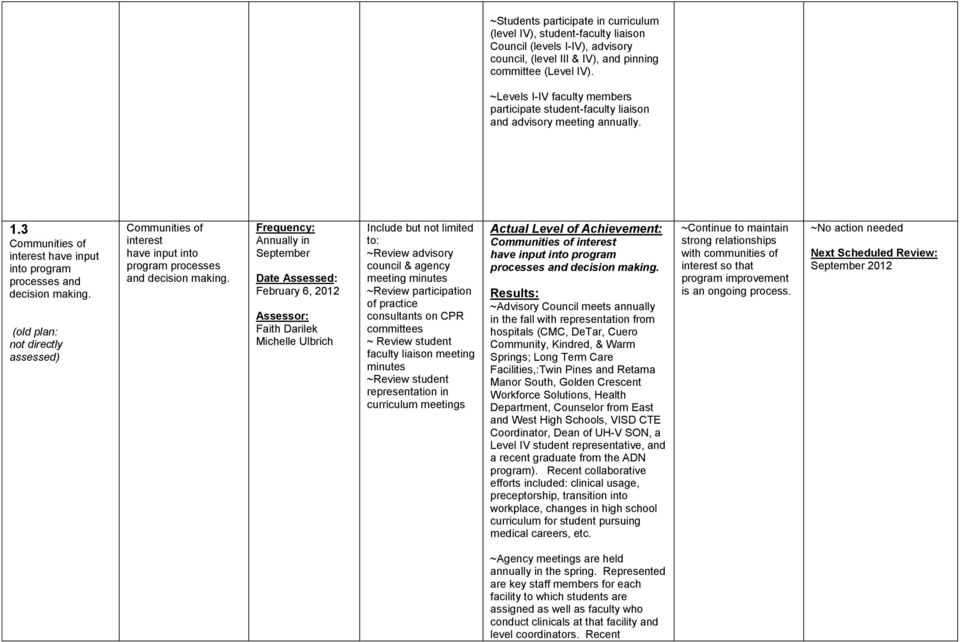
3 ~Students participate in curriculum (level IV), student-faculty liaison Council (levels I-IV), advisory council, (level III & IV), and pinning committee (Level IV). ~Levels I-IV faculty members participate student-faculty liaison and advisory meeting annually. 1.3 Communities of interest have input into program processes and decision making. (old plan: not directly assessed) Communities of interest have input into program processes and decision making. Annually in September February 6, 2012 Faith Darilek ~Review advisory council & agency meeting minutes ~Review participation of practice consultants on CPR committees ~ Review student faculty liaison meeting minutes ~Review student representation in curriculum meetings Communities of interest have input into program processes and decision making. ~Advisory Council meets annually in the fall with representation from hospitals (CMC, DeTar, Cuero Community, Kindred, & Warm Springs; Long Term Care Facilities,:Twin Pines and Retama Manor South, Golden Crescent Workforce Solutions, Health Department, Counselor from East and West High Schools, VISD CTE Coordinator, Dean of UH-V SON, a Level IV student representative, and a recent graduate from the ADN program). Recent collaborative efforts included: clinical usage, preceptorship, transition into workplace, changes in high school curriculum for student pursuing medical careers, etc. ~Continue to maintain strong relationships with communities of interest so that program improvement is an ongoing process. ~No action needed September 2012 ~Agency meetings are held annually in the spring. Represented are key staff members for each facility to which students are assigned as well as faculty who conduct clinicals at that facility and level coordinators. Recent
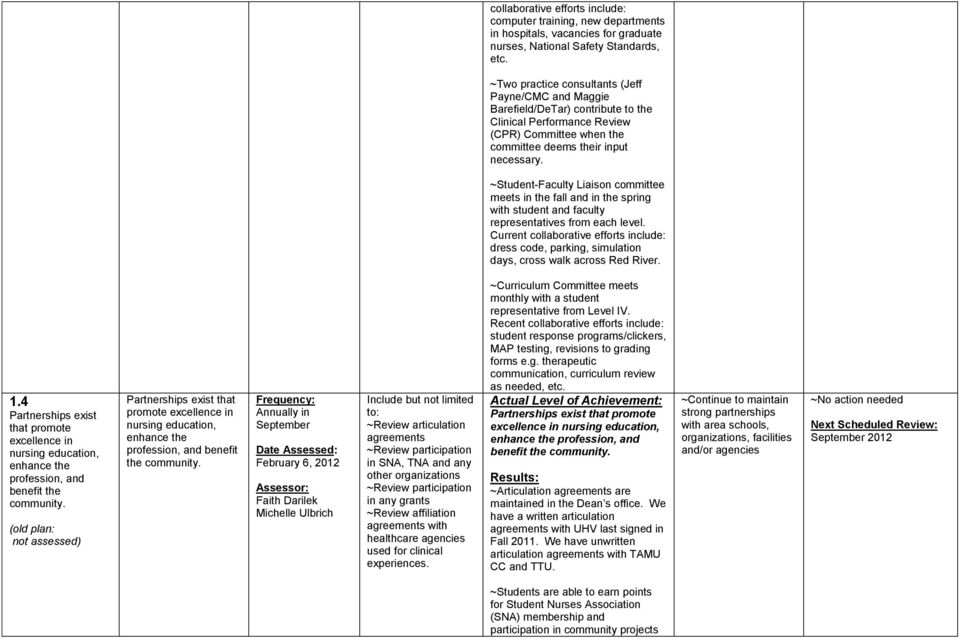
4 collaborative efforts include: computer training, new departments in hospitals, vacancies for graduate nurses, National Safety Standards, etc. ~Two practice consultants (Jeff Payne/CMC and Maggie Barefield/DeTar) contribute to the Clinical Performance Review (CPR) Committee when the committee deems their input necessary. ~Student-Faculty Liaison committee meets in the fall and in the spring with student and faculty representatives from each level. Current collaborative efforts include: dress code, parking, simulation days, cross walk across Red River. 1.4 Partnerships exist that promote excellence in nursing education, enhance the profession, and benefit the community. (old plan: not assessed) Partnerships exist that promote excellence in nursing education, enhance the profession, and benefit the community. Annually in September February 6, 2012 Faith Darilek ~Review articulation agreements ~Review participation in SNA, TNA and any other organizations ~Review participation in any grants ~Review affiliation agreements with healthcare agencies used for clinical experiences. ~Curriculum Committee meets monthly with a student representative from Level IV. Recent collaborative efforts include: student response programs/clickers, MAP testing, revisions to grading forms e.g. therapeutic communication, curriculum review as needed, etc. Partnerships exist that promote excellence in nursing education, enhance the profession, and benefit the community. ~Articulation agreements are maintained in the Dean s office. We have a written articulation agreements with UHV last signed in Fall We have unwritten articulation agreements with TAMU CC and TTU. ~Continue to maintain strong partnerships with area schools, organizations, facilities and/or agencies ~No action needed September 2012 ~Students are able to earn points for Student Nurses Association (SNA) membership and participation in community projects
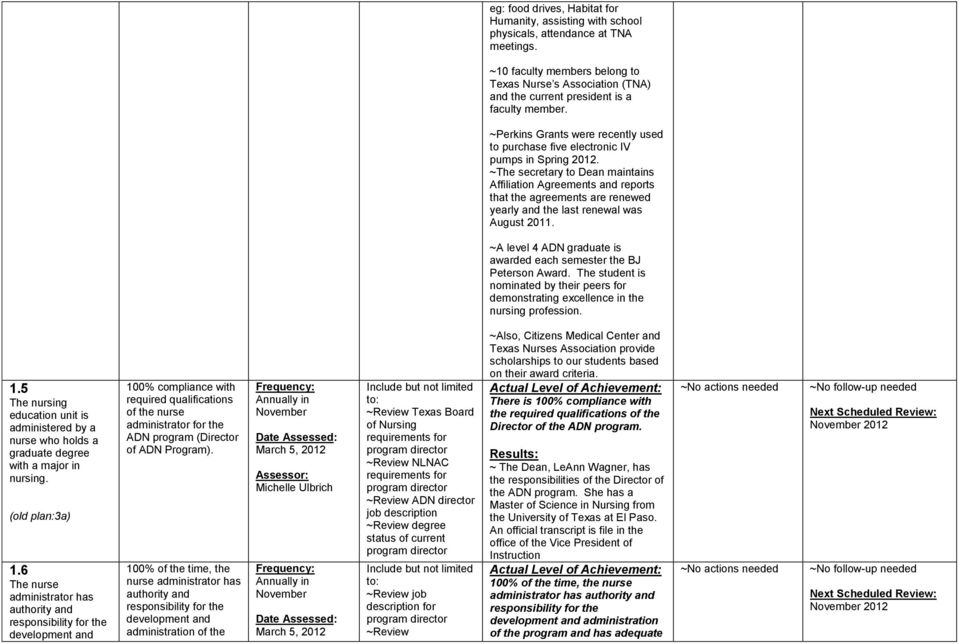
5 eg: food drives, Habitat for Humanity, assisting with school physicals, attendance at TNA meetings. ~10 faculty members belong to Texas Nurse s Association (TNA) and the current president is a faculty member. ~Perkins Grants were recently used to purchase five electronic IV pumps in Spring ~The secretary to Dean maintains Affiliation Agreements and reports that the agreements are renewed yearly and the last renewal was August ~A level 4 ADN graduate is awarded each semester the BJ Peterson Award. The student is nominated by their peers for demonstrating excellence in the nursing profession. 1.5 The nursing education unit is administered by a nurse who holds a graduate degree with a major in nursing. (old plan:3a) 1.6 The nurse administrator has authority and responsibility for the development and 100% compliance with required qualifications of the nurse administrator for the ADN program (Director of ADN Program). 100% of the time, the nurse administrator has authority and responsibility for the development and administration of the Annually in November March 5, 2012 Annually in November March 5, 2012 ~Review Texas Board of Nursing requirements for program director ~Review NLNAC requirements for program director ~Review ADN director job description ~Review degree status of current program director ~Review job description for program director ~Review ~Also, Citizens Medical Center and Texas Nurses Association provide scholarships to our students based on their award criteria. There is 100% compliance with the required qualifications of the Director of the ADN program. ~ The Dean, LeAnn Wagner, has the responsibilities of the Director of the ADN program. She has a Master of Science in Nursing from the University of Texas at El Paso. An official transcript is file in the office of the Vice President of Instruction 100% of the time, the nurse administrator has authority and responsibility for the development and administration of the program and has adequate ~No actions needed ~No actions needed November 2012 November 2012
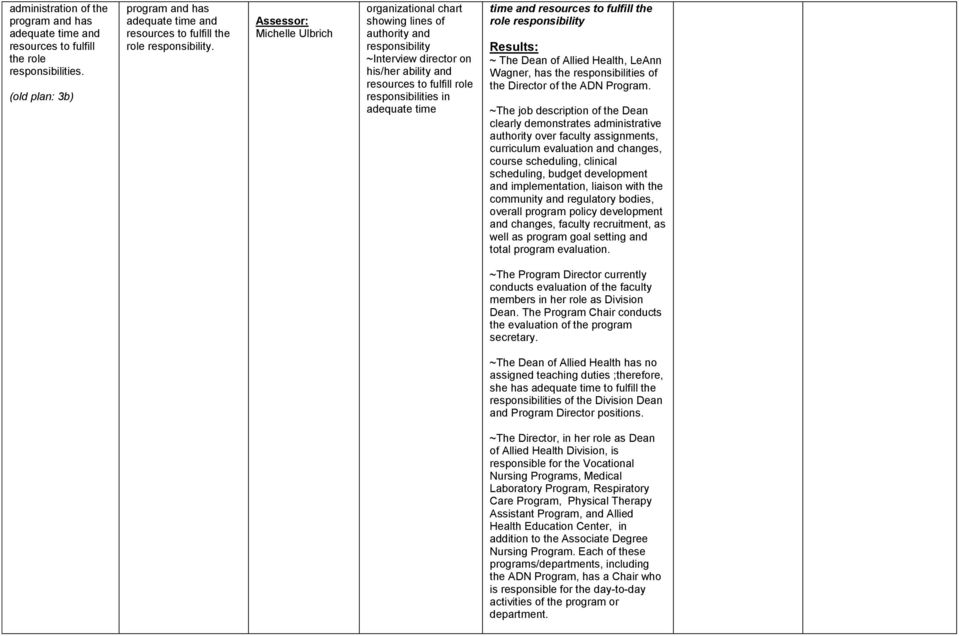
6 administration of the program and has adequate time and resources to fulfill the role responsibilities. (old plan: 3b) program and has adequate time and resources to fulfill the role responsibility. organizational chart showing lines of authority and responsibility ~Interview director on his/her ability and resources to fulfill role responsibilities in adequate time time and resources to fulfill the role responsibility ~ The Dean of Allied Health, LeAnn Wagner, has the responsibilities of the Director of the ADN Program. ~The job description of the Dean clearly demonstrates administrative authority over faculty assignments, curriculum evaluation and changes, course scheduling, clinical scheduling, budget development and implementation, liaison with the community and regulatory bodies, overall program policy development and changes, faculty recruitment, as well as program goal setting and total program evaluation. ~The Program Director currently conducts evaluation of the faculty members in her role as Division Dean. The Program Chair conducts the evaluation of the program secretary. ~The Dean of Allied Health has no assigned teaching duties ;therefore, she has adequate time to fulfill the responsibilities of the Division Dean and Program Director positions. ~The Director, in her role as Dean of Allied Health Division, is responsible for the Vocational Nursing Programs, Medical Laboratory Program, Respiratory Care Program, Physical Therapy Assistant Program, and Allied Health Education Center, in addition to the Associate Degree Nursing Program. Each of these programs/departments, including the ADN Program, has a Chair who is responsible for the day-to-day activities of the program or department.
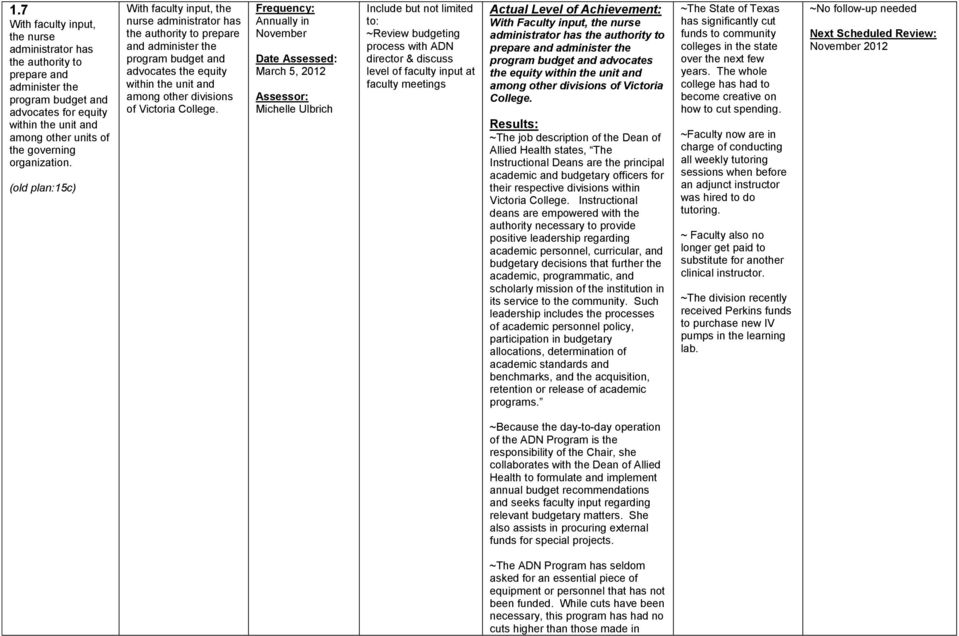
7 1.7 With faculty input, the nurse administrator has the authority to prepare and administer the program budget and advocates for equity within the unit and among other units of the governing organization. (old plan:15c) With faculty input, the nurse administrator has the authority to prepare and administer the program budget and advocates the equity within the unit and among other divisions of Victoria College. Annually in November March 5, 2012 ~Review budgeting process with ADN director & discuss level of faculty input at faculty meetings With Faculty input, the nurse administrator has the authority to prepare and administer the program budget and advocates the equity within the unit and among other divisions of Victoria College. ~The job description of the Dean of Allied Health states, The Instructional Deans are the principal academic and budgetary officers for their respective divisions within Victoria College. Instructional deans are empowered with the authority necessary to provide positive leadership regarding academic personnel, curricular, and budgetary decisions that further the academic, programmatic, and scholarly mission of the institution in its service to the community. Such leadership includes the processes of academic personnel policy, participation in budgetary allocations, determination of academic standards and benchmarks, and the acquisition, retention or release of academic programs. ~The State of Texas has significantly cut funds to community colleges in the state over the next few years. The whole college has had to become creative on how to cut spending. ~Faculty now are in charge of conducting all weekly tutoring sessions when before an adjunct instructor was hired to do tutoring. ~ Faculty also no longer get paid to substitute for another clinical instructor. ~The division recently received Perkins funds to purchase new IV pumps in the learning lab. November 2012 ~Because the day-to-day operation of the ADN Program is the responsibility of the Chair, she collaborates with the Dean of Allied Health to formulate and implement annual budget recommendations and seeks faculty input regarding relevant budgetary matters. She also assists in procuring external funds for special projects. ~The ADN Program has seldom asked for an essential piece of equipment or personnel that has not been funded. While cuts have been necessary, this program has had no cuts higher than those made in
8 1.8 Policies of the nursing education unit are comprehensive, provide for the welfare of faculty and staff, and are consistent with those of the governing organization; differences are justified by the goals and outcomes of the nursing education unit. (old plan:4a-j) 100% of policies of Victoria College Associate Degree Nursing Program are comprehensive, provide for the welfare of faculty and staff, and are consistent with those of Victoria College; differences are justified by the goals and outcomes of the nursing program. Annually in October March 5, 2012 Tami Hurley ~Comparative analysis of the policies in the Victoria College Employee Handbook, and ADN Faculty Handbook ~Policies to be reviewed include: 1. Non-discrimination 2. Faculty appointment 3. Academic rank 4. Grievance procedures 5. Promotion 6. Salary & benefits 7. Tenure 8. Rights & responsibilities 9. Termination 10. Workload ~Discuss market scarcity policy & workload policy. ~Any difference s are justified other programs. In fact, the ADN Program has the highest budget of the programs at Victoria College because of the enrollment and need for laboratory and technical supplies. 100% of policies of Victoria College Associate Degree Nursing Program are comprehensive, provide for the welfare of faculty and staff, and are consistent with those of Victoria College; differences are justified by the goals and outcomes of the nursing program.-this expected level of achievement cannot be determined until approval of Victoria College Employee Handbook ~The Victoria College Employee Handbook was completely reviewed and taken to the Board of Trustees in February 2012 for approval. Official notice of approval of the employee handbook is still pending. ~The ADN faculty handbook was last revised summer ~The Victoria College Mission statement was reviewed after changes and approved by the Board. Changes to the college mission statement were minor wording changes. ~Continue to review handbook yearly to ensure cohesiveness between Victoria College and the ADN program. May % of policies of Victoria College Associate Degree Nursing Program are comprehensive, provide for the welfare of faculty and staff, and are consistent with those of Victoria College; differences are justified by the goals and outcomes of the nursing program. -Expected level of achievement met ~Upon review of the newly adopted Victoria College Employee Handbook, the policies found in the VC employee handbook and the ADN faculty handbook were congruent and supported the overall mission of the college. MSN, RN ~Evaluation Committee Chair October 2012 ~Full-time ADN faculty receive a market scarcity stipend to supplement faculty income and make the ADN faculty position more marketable.

9 1.9 Records reflect that program complaints and grievances receive due process and include evidence of resolution. (old plan: 20 a,b,c) Program complaints and grievances will receive due process according to the Victoria College process published in the catalog and handbook. Annually in October March 5, 2012 Tami Hurley ~Compare VC Student Handbook, ADN Student Handbook, & VC & ADN website for accurate and consistent information on grievance procedure ~Interview Allied Health Dean/ADN director/chair on any process and any complaints about program ~Explain Clinical performance Review Committee Program complaints and grievances receive due process according to the Victoria College process published in the catalog and handbook. ~When the students progress is being reviewed, the faculty offers the student the opportunity for rebuttal comments to be given. This allows the student to voice any concerns they may have or questions. ~A copy of the Victoria College organizational chart is provided to the students in their student handbook. Using the appropriate chain of command is encouraged to all students at the beginning of every semester is any problems of conflicts arise. ~Continue to remind students each semester of the chain of command. Remind students that the appeal process is located in their student handbook and the purpose of the Clinical Performance Review (CPR) committee. October 2012 ~The Victoria College Student Handbook contains student rights related to procedures for academic appeals. The ADN Program utilizes these rules for student concerns. nthandbook ~The process outlines specific time lines for the faculty and, as needed, administration to review and make decisions regarding the student s appeal. The appeals process is explained to a student when the situation is necessary. Students also always have access to that process via the student handbook. ~The ADN program has a clinical performance review (CPR) committee that is composed of ADN faculty members. The committee is utilized 1. Assess students clinical

10 evaluation and anecdotal records for objective teaching evaluation of students ability to meet clinical objectives. 2. Validate accuracy of the clinical performance assessment. 3. Act as a support system to the clinical instructor by offering positive reinforcement when accuracy of clinical performance assessment has been validated and student failure has been determined. 4. Assist clinical instructor in devising alternative methods for evaluating performance when the student is in Jeopardy of failing (example: Having another instructor Observe and evaluate student). ~The resolution to most student concerns can be found in the student s file Distance Education: Distance education, as defined by the nursing education unit, is congruent with the mission of the governing organization and the mission/philosophy of the nursing education unit. (old plan:1d) The definition of distance education as defined by the Victoria College Associate Degree Nursing Program is congruent with the mission of Victoria College and the philosophy of the Victoria College Associate Degree Nursing Department. Every 2 years in September (even years) or upon revision of the college or the nursing program s mission/philosophy or a revision in the definition of distance education from the Southern Association of Colleges and ~ Review VC mission statement & values with ADN program philosophy ~Review SACS definition of distance education: : The institution s use of technology enhances student learning and is appropriate for The definition of distance education as defined by the Victoria College Associate Degree Nursing Program is congruent with the mission of Victoria College and the philosophy of the Victoria College Associate Degree Nursing Department. Distance Education at Victoria College is defined as: The institution s use of ~The Victoria College will revise their mission statements and philosophy in February, so follow up evaluation should be planned for May May 2012 ~This standard will be reevaluated again in September with the New Evaluation schedule. The revisions that were made to the Victoria College mission statement in February were minor word changes. MSN, RN ~Evaluation Committee Chair September 2012
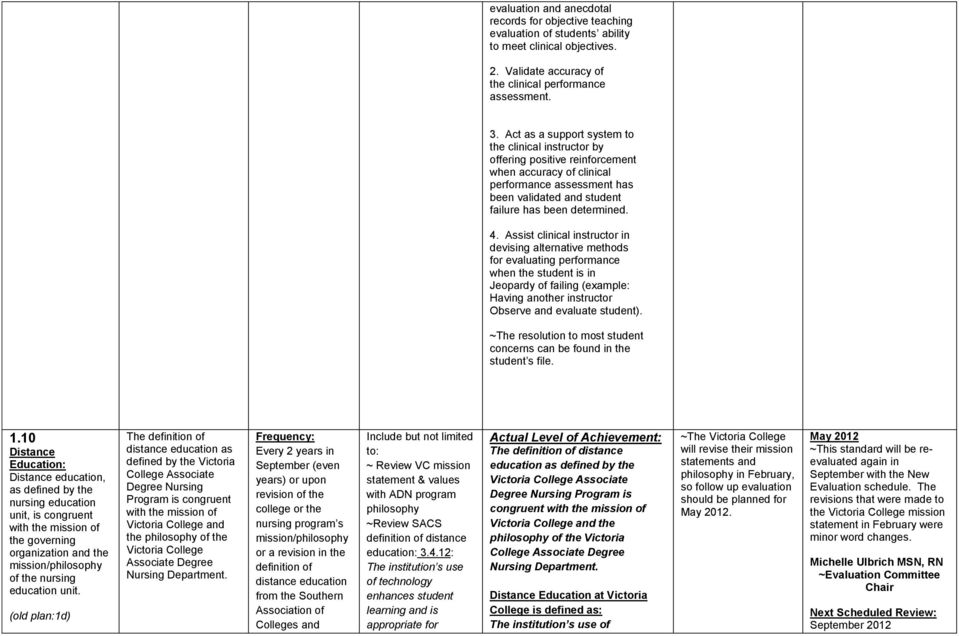
11 Schools (SACS) February 6, 2012 Debbie Pena meeting the objectives of its programs. Students have access to and training in the use of technology. ~Review how the RN- LVN transition program curriculum is presented to students technology enhances student learning and is appropriate for meeting the objectives of its programs. Students have access to and training in the use of technology. ~The VC ADN program is congruent with the mission of Victoria College, the philosophy of the Victoria College Associate Degree Nursing Department, and Southeran Association of Colleges and School (SACS). ~Online course evaluations are completed at the conclusion of each online course. They are compared with face-to-face evaluations for significant discrepancies and are reported with the level evaluation summaries yearly. Summer 2010 RNSG 1327, 25 online students, 24 retained, 1 W for a 96% retention rate Fall 2010 RNSG 2514, 10 online students, 10 retained Spring 2011 RNSG 2535, 17 online students, 17 retained ~The ADN-LVN curriculum is posted on the VC website and faculty discuss program specifics with interested students.

12 Victoria College ASSOCIATE DEGREE NURSING SYSTEMATIC PLAN OF EVALUATION Faculty and Staff Standard 2: Qualified faculty and staff provide leadership and support necessary to attain the goals and outcomes of the nursing education unit. COMPONENT / INDICATOR PLAN IMPLEMENTATION OF PLAN REVIEW OF PLAN FREQUENCY/ ASSESSMENT RESULTS OF DATA COLLECTION & FOLLOW-UP / DATEASSESED/ METHODS ANALYSIS (including actual level EVALUATION ASSESOR of achievement) (if needed) EXPECTED LEVEL OF ACHIEVEMENT ACTIONS FOR PROGRAM DEVELOPMENT, MAINTENANCE OR REVISION 2.1 Fulltime faculty are credentialed with a minimum of a master s degree in nursing and maintain expertise in their areas of responsibility. (old plan:5a,b,c) The majority of parttime faculty are credentialed with a minimum of a master s degree with a major in nursing; the remaining part-time faculty hold a minimum of a baccalaureate degree with a major in nursing. (old plan:5a) Rationale is provided for utilization of faculty who do not meet the minimum credential. (old plan:5a) % of full- time faculty are credentialed with a minimum of a master s degree with a major in nursing or 6 graduate nursing hours in accordance with the Texas Board of Nursing requirements (Texas BON Rule c) and maintain expertise in their areas of responsibility by maintaining a minimum of 20 CEU s in accordance with the BON licensure requirements (Texas BON rule 2.16.a,b) Part time faculty, adjunct faculty, are credentialed with a minimum of a master s degree with a major in nursing or 6 graduate nursing hours in accordance with the Board of Nursing requirements; Teaching assistants can hold a Bachelor s degree in Nursing Annually in November April 2, 2012 Faith Darilek Include but not limited ~Interview ADN Chair on credentials of fulltime faculty & get rationale for any faculty member without the minimum credentials ~Review faculty profiles that should include continuing education activities and any activities that demonstrate maintenance of expertise in area. ~Interview ADN Chair regarding credentials for part-time faculty & get rationale for any faculty member without the minimum credentials. ~Review Texas Board of Nursing requirements As of Spring 2012, 100% of full- time faculty are credentialed with a minimum of a master s degree with a major in nursing or 6 graduate nursing hours in accordance with the Texas Board of Nursing requirements (Texas BON Rule c) and maintain expertise in their areas of responsibility by maintaining a minimum of 20 CEU s in accordance with the BON licensure requirements (Texas BON rule 2.16.a,b) Most adjunct faculty, are credentialed with a minimum of a master s degree with a major in nursing or 6 graduate nursing hours in accordance with the Board of Nursing requirements; Teaching assistants hold a Bachelor s degree in Nursing 100% of faculty that do not meet above Board of Nursing qualifications are approved to work under a waiver in accordance with Board of Nursing requirements (Texas BON Rule d) ~Alison Hewig, ADN Chair, has copies of all current faculty profiles.. ~With a number of full-time faculty members retiring in the next year, the number of qualified instructors available to teach in the ADN program in the Victoria area is limited. This is a future concern for the program with no clear solution to the problem. As of Spring 2012, we have enough instructors needed to teach the number of students in the program. November 2012

13 % of faculty that do not meet above Board of Nursing qualifications are approved to work under a waiver in accordance with Board of Nursing requirements (Texas BON Rule d) She reports: ~ All Full-time faculty meet minimum credentials of a master s degree with a major in nursing. ~All Adjunct faculty (part time) either hold a master s degree with a major in nursing or 6 graduate nursing hours or have received a waiver from the Texas Board of Nursing to work as an adjunct instructor ~All teaching assistants (part time) hold a Bachelor s degree in Nursing. ~ Full-time and part time faculty maintain expertise in their areas of responsibility by maintaining a minimum of 20 CEUs ~TX BON site (accessed ion/faq_faculty.html) states: A faculty member in a professional nursing education program should: be licensed as a registered nurse or have privilege to practice in the State of Texas have teaching experience have current knowledge and clinical expertise in subject area of teaching responsibility hold a master s degree or doctorate, preferably in nursing Spring 2012 ~14 Full Time faculty members all have Master s Degree in nursing or a Master s degree with 6 graduate hours
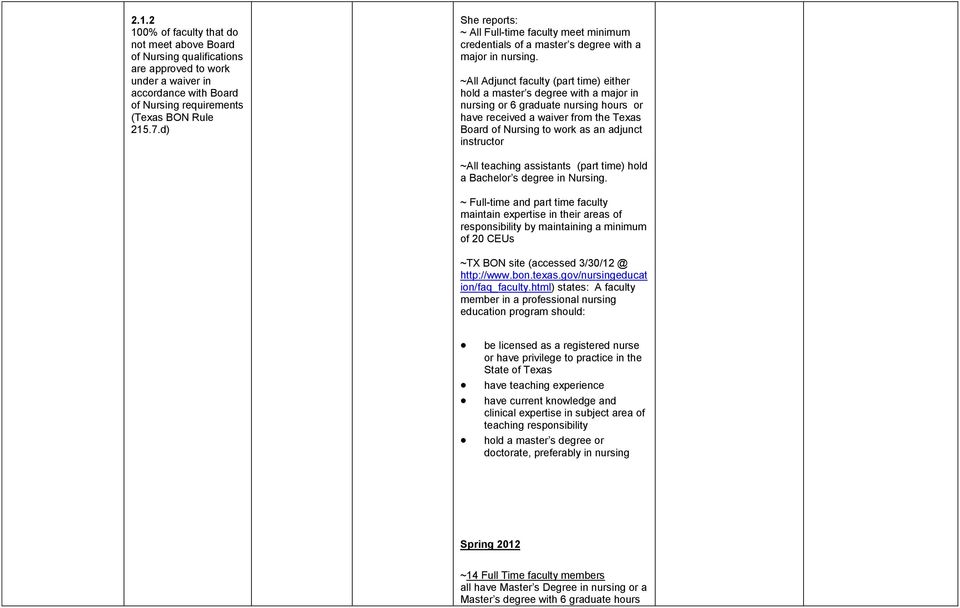
14 in nursing ~3 adjunct faculty members 2 hold a Master s Degree in Nursing and 1 adjunct holds a Bachelor s Degree in Nursing and is currently pursuing a Master s Degree in Nursing. She plans to graduate within the next year. She has received a waiver from the Texas Board of Nursing. ~1 Teaching assistant She holds a Bachelor s Degree in Nursing 2.2 Faculty (full and part time) credentials meet governing organization and state requirements. (old plan: 5a 100% of the full and part time faculty will be licensed in the State of Texas to practice nursing and will meet the 3 year full time equated work experience or related field in the area they are teaching (Texas BON Rule c) Annually in November April 2, 2012 Faith Darilek Include but not limited ~Interview ADN Chair to get credentials of all faculty members ~Review job description to see if faculty meet minimum qualifications ~Review Texas BON requirements 100% of the full and part time faculty are licensed in the State of Texas to practice nursing and meet the 3 year full time equated work experience or related field in the area they are teaching (Texas BON Rule c) ~All full-time faculty are licensed with the State of Texas and meet the 3-year full time equated work experience or related field in the area rule. ~Melissa Salinas (telephone communication on 3/30/12, Human Resources) stated that the job descriptions are in the Human Resources Department. ~No actions needed November Credentials of practice laboratory personnel are commensurate with their level of responsibilities. (old plan: 100% of full and part time practice laboratory personnel are commensurate with their level of responsibilities in the practice lab and have appropriate credentials Annually in November April 2, 2012 Include but not limited ~Review number of lab personnel, job description of lab personnel & highest degree attained 100% of full and part time practice laboratory personnel are commensurate with their level of responsibilities in the practice lab and have appropriate credentials ~No actions needed November 2012

15 not assessed) Janet Ley ~Interview lab personnel to confirm their level of responsibility ~The laboratory has two full time personnel. ~One of the lab persons, Mary Kitchens LVN, primary responsibilities is to set up manikins in the lab and to make sure that the lab has adequate supplies for student practice. That person is an LVN with a current Texas license. She has experienced teaching in the nursing assistant program and her nursing knowledge and experience allows her to anticipate the needs of the students and prepare the lab with the supplies needed to facilitate their learning. ~The other lab person, Monica Hamilton BSN, RN, is responsible for creating and assisting with simulation experiences. She holds a current Texas license and RN and has a Bachelor Degree in Nursing and is working on her Master of Science in Nursing Degree. 2.4 The number of utilization of faculty (full and part time) ensures that program outcomes are achieved (old plan:6a) Program outcomes are achieved with the number of full time faculty, adjunct faculty, teaching assistants, and lab personnel Annually in November April 2, 2012 Janet Ley Include but not limited ~Interview ADN chair on current number of full and part time faculty and any available openings ~Discuss in faculty meeting if current number of faculty allow the program to achieve program outcomes. ~Review Texas BON requirement of faculty to student ratios in the clinical setting and confirm compliance ~Both individuals are classified as support staff and do not hold a faculty position. Program outcomes are achieved with the number of full time faculty, adjunct faculty, teaching assistants, and lab personnel ~Victoria College AND program follows the Texas BON which mandates that clinical groups have no more than 10 students per faculty member or 15 students with a faculty member and a teaching assistant. ~Most full time faculty are responsible for only one clinical group and also have teaching responsibilities in theory. ~The ADN program also uses adjuncts in the clinical setting who have a BSN and completed a minimum of 50% of coursework at the Master s Degree ~With a number of full-time faculty members retiring in the next year, the number of qualified instructors available to teach in the ADN program in the Victoria area is limited. This is a future concern for the program with no clear solution to the problem. As of Spring 2012, we have enough instructors needed to teach the number of students in the program. Getting instructors to teach has always been a challenge; however, the program chair has always found enough qualified instructors. Hopefully, this concern will be minimal. November 2012

16 (Texas BON Rule g,i) Level. A waiver must be granted from the Texas BON to utilize these instructors ~ Teaching assistants must have a BSN as well as experience in the areas they are overseeing in clinical. The number and utilization of full and part time faculty is sufficient to meet the needs of the ADN program at this time. Spring 2012 Level 1: 4 clinical groups 2 full time faculty (MSN) with each instructor having 10 students 1 adjunct instructor (BSN with a waiver) with 10 students 1 full time faculty (MSN) with a Teaching assistant and 15 students Level 2: 4 clinical groups 4 full time faculty (MSN) with each instructor having 9-10 students Level 3: 5 clinical groups 1 full time faculty (MSN) with 10 students. 1 full time faculty (MA in Psych Nursing) had 2 groups of 10 students by choice 2 adjunct faculty (MSN) with 10 students each Level 4: 6 clinical groups 4 full time faculty (MSN) with 10 students 1 full time faculty (MSN) with 2 clinical groups with 10 students in each group ~The Victoria College ADN program continues to maintain a high NCLEX
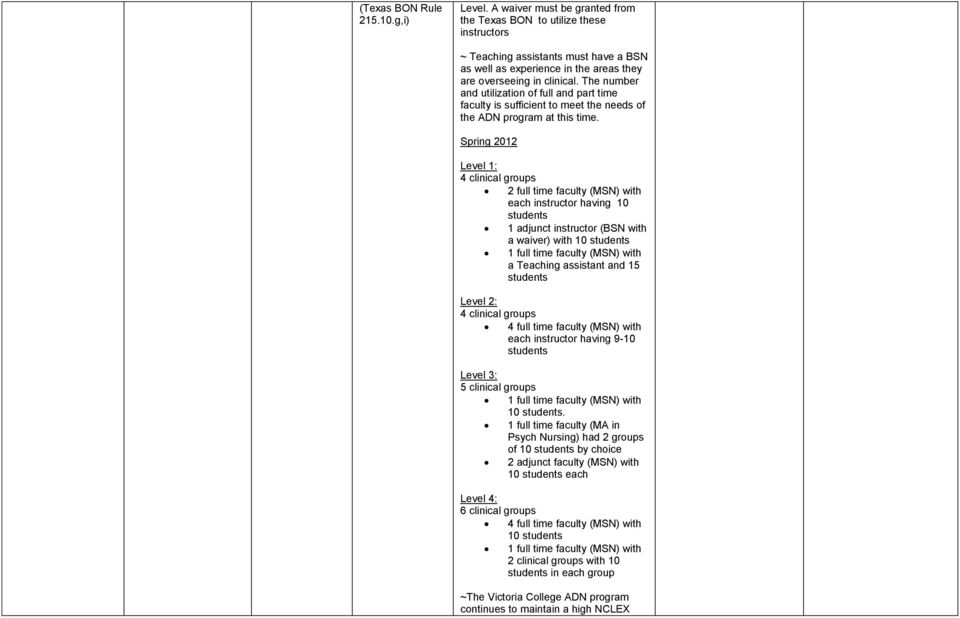
17 first time pass rate which demonstrates that program outcomes are being achieved. 2.5 Faculty (full and part time) performance reflects scholarship and evidence based teaching and clinical practices. (old plan:5c, 7a, 8a) 2.6 The number, utilization, and credentials of nonnurse faculty and staff are sufficient to achieve the program goals and outcomes. (old plan:16a) 100% of full and parttime faculty will participate in continuing education and reflect participation in diversity of scholarship through teaching, application, integration, and discovery as it relates to educational effectiveness in nursing education. The number and utilization of non nurse faculty and staff are sufficient to meet the needs of the nursing program and will meet the minimum requirements as defined in the job description Annually in September February 6, 2012 Janet Ley Annually in September February 6, 2012 Janet Ley Include but not limited ~Review ADN program s definition of scholarship by Ernest Boyer ~Have faculty submit faculty profiles which need to contain accomplishments & certifications & demonstrate scholarship ~Discuss with faculty regarding how evidence based practice is incorporated in the classroom & clinical (give examples) Include but not limited ~Discuss faculty perceptions of clerical support at faculty meetings and ability to achieve program outcomes with current support 100% of full and part time faculty participate in continuing education and reflect participation in diversity of scholarship through teaching, application, integration, and discovery as it relates to educational effectiveness in nursing education. ~Faculty profiles reflect that 100% of ADN faculty participates in continuing education. Faculty profiles also demonstrate participation in diversity of scholarship as defined by Ernest Boyer through teaching, application and integration of evidence based practice into the classroom and a diversity of clinical experience that enriches the nursing education experience. ~See Systematic Plan of Evaluation binder for standard 2.5 list that identifies ways that faculty use evidence based practice as to enhance teaching The number and utilization of staff are sufficient to meet the needs of the nursing program and meet the minimum requirements as defined in the job description. The program does not currently employee nonnurse faculty. ~Faculty perceptions of recent additions to staff are positive and the stated opinions expressed by faculty were that currently staff support is sufficient to achieve the program goals and outcomes. ~Recommendation was made to change the wording on the concept care map to evidence based nursing rationale to correspond with the current terminology. ~No actions needed September 2012 September 2012 ~In November, a new ADN secretary was hired. She is doing well in her new role but obviously there will be a learning curve with her new position.

18 2.7 Faculty (full and part time) are oriented and mentored in their areas of responsibilities. (old plan: not assessed) 100% of full and parttime faculty are oriented according to the Victoria College Associate Degree Nursing Program orientation policy. Annually in October March 5, 2012 Janet Ley Include but not limited ~Review ADN faculty handbooks for orientation policy for new full time faculty and adjunct faculty ~Interview ADN Chair to assess if the orientation process is working ~Interview new faculty members on their perception of their orientation experience and their new role. ~Discuss with faculty regarding any changes that are needed to the orientation policy ~Also, a student worker will be hired for the Spring semester. 100% of full and part time faculty are oriented according to the Victoria College Associate Degree Nursing Program orientation policy. ~The full and part time faculty orientation and mentoring is carried out in accordance with the policy guidelines of the Associated Degree Nursing Program. Full time faculty are guided through a structured orientation process and assigned a mentor, which is usually the Course Coordinator, to facilitate the transition into their new position. ~New faculty interviewed reported mentors were very accessible, patient and knowledgeable during the mentoring phase of the orientation. ~Adjunct faculty are also put through a similar process and are then assigned a mentor who reviews their responsibilities. ~No actions needed October 2012 ~The policy for the ADN orientation process can be found in the ADN faculty handbook and ADN adjunct handbook. 2.8 Systematic assessment of faculty (full and part time) performance demonstrates competencies that are consistent with program goals and outcomes. (old plan: 7a) 100% of full and parttime faculty are systematically assessed and performance will demonstrate competencies that are consistent with program goals and outcomes. Annually in October March 5, 2012 Janet Ley Include but not limited ~Interview Allied Health Dean regarding number and timeliness of evaluations done and discuss his/her perceptions of competency expectations and consistency with 100% of full and part time faculty are systematically assessed and their performance will demonstrates competencies that are consistent with program goals and outcomes. Results ~Faculty and adjunct faculty are evaluated each semester by students and the results of the evaluations are reviewed by the dean. ~No actions needed October 2012

19 program goals and outcomes. ~Review VC employee handbook & ADN faculty handbook for evaluation process and consistency ~Tenured faculty are evaluated every semester but only meet with the Division Dean every 2 years or as needed according to VC policy. ~ Non tenured and tenure track faculty are evaluated every semester and required to meet with the Dean every semester to discuss their results. ~Those faculty members seeking tenure meet yearly with a committee that oversees the tenure process. If major concerns arise, they are reviewed by the Division Dean and plans for improvement in problem areas are discussed or discussions about continued employment are considered. ~The ADN Chair also visits the classroom and/or clinical setting to evaluate faculty members. 2.9 Non-nurse faculty and staff performance is regularly reviewed in accordance with the policies of the governing organization. (old plan: not assessed directly -mentioned in 16) 2.10 Distance Education: 100% of non nurse faculty and staff are systematically reviewed in accordance with the policies of Victoria College. 100% of faculty that teach distance Annually in October March 5, 2012 Janet Ley Annually in April Include but not limited ~Review in VC employee handbook, policy on evaluation of non-nurse faculty and staff ~Interview with ADN Chair on evaluation process of nonnurse staff and timeliness of evaluations ~Include but not limited ~The policy for evaluation of nontenured and tenured faculty members is available in the Victoria College employee handbook Actual level of Achievement: 100% of non-nurse staff are systematically reviewed in accordance with the policies of Victoria College. ~The ADN program has no non nurse faculty. The ADN secretary is reviewed in accordance with the college policy. Faculty has informal input into the performance of secretarial staff as part of the evaluation plan. ~ Evaluations are done each spring semester. The evaluation includes the staff member s self- assessment, the assessment of the supervisor and a discussion of the evaluation between the two. Actual Level of Achievement 100% of faculty that teach distance ~No actions needed ~Continue to encourage faculty to seek ongoing October 2012

20 Faculty (full time and part time) engage in ongoing development for distance education (old plan: not directly assessed -mentioned in 17a) education engage in ongoing development of distance education. faculty meeting April 2, 2012 Debbie Pena ~Faculty will provide documentation of ongoing development in distance education such as but not limited to blackboard training, Panopto training, computer courses, ITV, etc. education engage in ongoing development of distance education. Results ~All faculty that teach online courses are to receive training in Blackboard by Helen Dvorak and training in Panopto and ITV by Jeremy Gould. At the beginning of each semester, updates are given as needed by computer technology staff the week of convocation. development for distance education. April 2013 ~The following instructors taught the following online courses: Summer 2010 RNSG 1327 was taught online by Marty Horecka, MSN, RN Fall 2010 RNSG 2514 was taught by ITV by Level 3 faculty Spring 2011 RNSG 2535 was taught online by Level 4 faculty Summer 2011 RNSG 1327 was taught online by Julie Cordova, BSN, RN (33 graduate hours) Fall 2011 RNSG 2514 was taught online by Level 3 faculty Spring 2012 RNSG 2535 was taught online by Level 4 faculty ~The computer technology staff are very accessible when an issue arises. The computer help desk also is helpful if it is after hours. Their hours are: php?option=com_content&task=vie w&id=353 Helpdesk Office Hours Fall and Spring Semester Monday - Thursday 8 a.m. - 4:30 p.m. Friday 8 a.m. - 4 p.m.

21 Fall and Spring On-Call Hours Friday 6 p.m p.m. Saturday - Sunday 6 a.m p.m. Summer Sessions Monday - Thursday 8 a.m. - 7:00 p.m. Friday Closed Summer Sessions On-Call Hours Friday 6 p.m p.m. Saturday - Sunday 6 a.m p.m. *You will receive a response within 4 hours of your message Technology Services Helpdesk at [email protected]
22 Victoria College ASSOCIATE DEGREE NURSING SYSTEMATIC PLAN OF EVALUATION Students Standard 3: Student policies, development, and services support the goals and outcomes of the nursing education unit. COMPONENT / INDICATOR PLAN IMPLEMENTATION OF PLAN REVIEW OF PLAN FREQUENCY/ ASSESSMENT RESULTS OF DATA COLLECTION & FOLLOW-UP / EVALUATION DATE ASSESSED/ METHODS ANALYSIS (including actual level of (if needed) ASSESSOR achievement) EXPECTED LEVEL OF ACHIEVEMENT ACTIONS FOR PROGRAM DEVELOPMENT, MAINTENANCE OR REVISION 3.1 Student policies of the nursing education unit are congruent with those of the governing organization, publicly accessible, nondiscriminatory, and consistently applied; differences are justified by the goals and outcomes of the nursing education unit. (old SPE: 9a-m) 100% of student policies of the Victoria College ADN Program are congruent with those of Victoria College, publicly accessible, and consistently applied; differences will be justified 100% of the time. Annually in October March 6, 2012 Debbie Pena ~Comparative analysis of VC Student handbook with the Victoria College Nursing Programs Student handbook ~Review and compare website for accessibility of student policies ~Any differences are discussed Review the following student policies: 1. Non-discrimination 2. Selection and admission 3. Academic progression 4. Student evaluation and Grading 5. Retention 6. Withdrawal/ dismissal 7. Graduation requirements 8. Financial aid 9. Transfer of credit 10. Recruitment 11. Health requirements 100% of student policies of the Victoria College ADN Program are congruent with those of Victoria College, publicly accessible, and consistently applied; differences will be justified 100% of the time. ~100% of nursing student policies addressing items 1-13 is congruent with those of the college. ~The college student handbook is accessible at ndbook ~The revised college student handbook is accessible at s/pubs/handbook_addendum_2011.pdf ~The Victoria College Nursing Programs Student Handbook is given to the student in printed form at the beginning of Level 1. Any revisions to the VC ADN handbook is given to the student throughout the program. The student is given an acknowledgement form to sign stating that they received the addition or change to the handbook. ~For a detailed chart of comparisons of ~Continue to review annually as new editions to handbooks are released. October 2012
23 12. Validation of prior Learning 13. Grievance/ handbook policies see the Systematic Plan of Evaluation binder where that comparison is made. 3.2 Student services are commensurate with the needs of students pursuing or completing the associate program, including those receiving instruction using alternative methods of delivery. (old SPE: 10a) Student evaluations reflect that student needs are commensurate with the needs of the students pursuing or completing the ADN program including those students with distance education. Annually in February February 6, 2012 Tami Hurley complaints/appeals ~ Review Support services that are provided to students through Victoria College and through the ADN program ~Review support services for distance education students Student evaluations reflect that student needs are commensurate with the needs of the students pursuing or completing the ADN program. However, student services for students using distance education as their mode of delivery is difficult to assess since evaluations the last few years have not been conducted separately except in the summer. ~During Fall 2010 and Spring 2011 the results for all four Levels were greater than 98% for the course evaluation questions #14,15 & 16 about library resources, AV resources and the bookstore. Course evaluations regarding services such as Library, Bookstore and Computer services resulted in a mean score of 4.63, 4.63, 4.64 respectively out of 5. ~ During Summer 2010 (online course for transition students), 100% of students rated library resources, AV resources, computer services and the bookstore as average, food or very good. This resulted in scores of 4.67, 4.50, 4.67, and 4.58 respectively out of 5. ~College support services contact information is updated for all students each semester and provided in their syllabus (now learning resource packet). ~New systems of Banner, Panopto and turning point clicker technology have all been implemented since Fall 2010 into various levels. ~The last few semesters, student evaluations have not been conducted separately in the Fall for the online transition students in level III, and the Spring for the online transition students in level IV. The online and face to face evaluations have not been separated so a comparison could not be made between the two groups. The overall ratings from these levels have been good; however, it is difficult to evaluate between the two different modes of delivery. ~Fall 2010 there was no online course offered. There was an ITV course offered instead. However, the evaluations from the ITV students were not conducted separately. The ITV students did voice their comments on the evaluations that were conducted. Many negative comments were received about ITV. As a result of the dissatisfied students, the online mode of delivery was put back in place. May 2012 ~Student evaluations for the transition online students were conducted this semester so the online and face to face students can be evaluated separately when that data becomes available. MSN, RN ~Evaluation Committee Chair February 2013 ~Additionally, administration is currently ~The summer
24 pursuing more safety measures to ensure safety of students and faculty including Emergency alert system enhancements and policy changes. * Data for Fall 2011 not yet reported transition students do conduct their evaluations separately as noted and have been pleased with the student services they have received. 3.3 Student educational and financial records are in compliance with the policies of the governing organization and state and federal guidelines. (old plan: 11a) 100% of student educational records are in compliance with the policies of Victoria College and state and federal guidelines. Annually in March March 6, 2012 Faith Darilek ~Communicate with the Director of Financial Aid and College Registrar regarding compliance with the policies of VC and state and federal guidelines. ~FERPA compliance reports 100% of student educational records are in compliance with the policies of Victoria College and state and federal guidelines. ~Kim Obsta, director of financial aid, (phone conversation 3/2/12) stated that 100% of student education records are in compliance with the policies of the governing organization and state and federal guidelines. (e.g. records are confidentially maintained and kept within a secure location). ~The course coordinators have been notified of the problems with not conducting online evaluations separately. They will take an active role in making sure that these evaluations are conducted separately in the future. ~No actions needed March 2013 ~Records of students enrolled or seeking enrollment in the ADN program are maintained in secured file cabinets in the nursing office. ~Missy Klimitchek, Registrar, stated that VC is in 100% compliance with FERPA regulations. All employees are required to attend FERPA training. 3.4 Compliance with the Higher Education % Compliance with the Higher Annually in March ~Communicate with ~All students are required to sign a FERPA release form. 100% Compliance with the Higher Education Reauthorization Act Title IV ~No actions needed
25 Reauthorization Act Title IV eligibility and certification requirements are maintained A written, comprehensive student loan repayment program addressing student loan information, counseling, monitoring, and cooperation with lenders is available Students are informed of their ethical responsibilities regarding financial assistance. (old SPE: 21b) Education Reauthorization Act Title IV eligibility and certification requirements are maintained % of students that have loans receive a written, comprehensive student loan repayment program addressing student loan information, counseling, monitoring, and cooperation with lenders is available Students are informed of their ethical responsibilities regarding financial assistance. March 6, 2012 Faith Darilek the Director of Financial Aid regarding eligibility and certification requirements of Victoria College ~Communicate with the Director of Financial Aid regarding loan repayment program addressing loan information, default rate, counseling, monitoring and cooperation with lenders. ~Communicate with Director of Financial Aid regarding ethical responsibilities regarding financial assistance. eligibility and certification requirements are maintained. 100% of students that have loans receive a written, comprehensive student loan repayment program addressing student loan information, counseling, monitoring, and cooperation with lenders is available. Students are informed of their ethical responsibilities regarding financial assistance. ~Kim Obsta, Director of Financial Aid, reports compliance with standards. ~Policies are in the Financial Aid office, VC catalog, and VC student s handbook. Students receive a handout when applying for a loan that speaks about their responsibilities for repayment. Face-to-face entrance counseling is conducted. Entrance and exit counseling is required. ~Students apply for financial aid by submitting a FAFSA form. Award letter informing them of grants and scholarship are sent to the students. March 2013 ~Default rate: 2004= = = = = = =14.5 (draft) ~The emphasis on completion may be a contributing factor to the increasing default rate. 3.5 Integrity and consistency exist for all information intended to inform the 100% of information intended to inform the public, including the program s accreditation status Annually in October March 6, 2012 ~Compare content of VC Student Handbook, VC 100% of information intended to inform the public, including the program s accreditation status and the NLNAC contact information, ~No actions needed October 2012
26 public, including the program s accreditation status and the NLNAC contact information. (old SPE: 19a,b,c) and the NLNAC contact information, demonstrate integrity and consistency Faith Darilek Catalog, ADN Student Handbook and online versions of each for integrity and consistency of all information intended to inform public including information on program that is published in catalog and website. ~Verify that NLNAC contact information is available in appropriate publications demonstrate integrity and consistency ~The VC Website contains several links to the ADN Program: Allied Health ADN program content&task=view&id=652 Degree plan ursing_associatedegree_techprepplan_aas.pdf. The Department website is available only through the portal. ~Available through the VC website are ADN applications, clinical requirements, and student handbooks handbooks are posted with 10/18/11 addendum. The handbooks are archived through Also available on the site are student forms e.g. instructions complaint, student complaint, etc. ~VC publications are available in many sites around campus, including the HSC building. ~VC student handbook and catalog are also available online. 3.6 Changes in policies, procedures, and program information are clearly and consistently communicated to students in a timely manner 100% of changes in policies, procedures, and program information are clear and consistent. These changes are communicated to students in a timely manner. Annually in April April 2, 2012 Tami Hurley ~Interview Program Chair on how students are informed of changes to policies, procedures and program information. ~VC nursing handbooks are distributed to Level I students and updated as necessary through program of study. Students sign an acknowledgement form upon receipt of the VC nursing handbook and program secretary and course coordinators monitor that all students have completed form. 100% of changes in policies, procedures, and program information are clear and consistent. These changes are communicated to students in a timely manner. ~Documents about the program are accurate, clear, and consistent. ~No actions needed April 2013
27 (old SPE: 9a-m) ~The website contains valid and sufficient information for the public about the ADN program to ensure accountability and consumer choice. ~The student handbook is reviewed regularly. The students receive copies of changes and sign acknowledgments of changes. ~Also, changes to entrance requirements for students beginning Level 1 after 9/12, are being given to students during their advising appointments with nursing faculty and letters are being sent to all applicants on new admission requirements. 3.7 Orientation to technology is provided and technological support is available to students, including those receiving instruction using alternative methods of delivery. (old plan: not assessed) Orientation to technology is provided and technological support is available to students, including those receiving instruction using alternative methods of delivery. Annually in April April 2, 2012 Debbie Pena ~Interview Distance Education Coordinator about availability of student orientation to technology such as Blackboard ~Interview Information technology department regarding availability of technical support to students and hours available and if or where those hours are published. Orientation to technology is provided and technological support is available to students, including those receiving instruction using alternative methods of delivery. ~All students must complete the Blackboard orientation session. For the students taking Pharmacology, the instructor will not open the course to them until it is completed. This is an assurance that every nursing student completes the orientation since Pharmacology is a requirement for the ADN program and the first online class in the program. ~For students to access the orientation session, they must log into the Pirate Portal, click on the My Courses tab and go ~No actions needed April 2013
28 to the Blackboard Orientation Reservations channel. Browser Compatibility with Office 2007 Firefox, a web browser from Mozilla, available as a free download from Browser Check The Browser Check will verify the configuration of your browser for interaction with Blackboard. Distance Education Resources Student DE Resources ~Students also have access to the helpdesk. Helpdesk is available for technical assistance not course content. Computer Help Desk Hours Fall & Spring Semesters Monday - Thursday, 8 am-4:30 pm Friday, 8 am - 4 pm Fall & Spring On-Call Hours Friday - Sunday, 6 p.m p.m. Summer Semesters Monday - Thursday, 8 am - 5 pm Closed on Fridays Summer Sessions On-Call Hours Friday - Sunday, 6 p.m. 10 p.m. ~All computer requirements are provided in the syllabus and all VC courses are required to have a Blackboard
29 shell. 3.8 Distance Education: Information related to technology requirements and policies specific to distance education is clear, consistent, and accessible. (old plan: not assessed) Information regarding technology requirements and policies specific to distance education is clear, consistent and accessible. Annually in April April 2, 2012 Debbie Pena ~Interview Distance Education Coordinator on technology requirements needed for distance education students Information regarding technology requirements and policies specific to distance education is clear, consistent and accessible. ~All computer requirements are provided in the syllabus and all VC courses are required to have a Blackboard shell. ~No action needed April 2013 ~Browser Compatibility with Office 2007 Firefox, a web browser from Mozilla, available as a free download from ~Browser Check The Browser Check will verify the configuration of your browser for interaction with Blackboard. ~Distance Education Resources Faculty DE Resources
30 Victoria College ASSOCIATE DEGREE NURSING SYSTEMATIC PLAN OF EVALUATION Curriculum Standard 4: The curriculum prepares students to achieve the outcomes of the nursing education unit, including safe practice in contemporary health care environments. PLAN IMPLEMENTATION OF PLAN REVIEW OF PLAN COMPONENT / INDICATOR EXPECTED LEVEL OF ACHIEVEMENT FREQUENCY/ DATE ASSESSED/ ASSESSOR ASSESSMENT METHODS RESULTS OF DATA COLLECTION & ANALYSIS (including actual level of achievement) ACTIONS FOR PROGRAM DEVELOPMENT, MAINTENANCE OR REVISION FOLLOW-UP / EVALUATION (if needed) 4.1 The curriculum incorporates established professional standards, guidelines and competencies, and has clearly articulated student learning and program outcomes. (old plan: 12a) 100% of the curriculum incorporates established professional standards, guidelines and competencies, and has clearly articulated student learning and program outcomes. Annually in October February 20, 2012 Konnie Prince Include but not limited ~Review the integration of Gordon s Functional Health Patterns within the curriculum ~Evaluate the integration of threads into curriculum ~Review incorporation of Differentiated Essential Competencies (DEC s) into the curriculum ~Review changes to the requirements/ standards of the Texas Higher Education Coordinating Board (THECB) and NLNAC 100% of the curriculum incorporates established professional standards, guidelines and competencies, and has clearly articulated student learning and program outcomes. ~Curriculum continues to be organized according to Gordon s Functional Health Patterns. ~Curriculum content was reviewed within the context of Gordon s Functional Health Patterns in Fall 2009 and will be done again in Fall ~All syllabi are designed around Gordon s Functional Health Patterns. ~The clinical student learning outcomes are the Differentiated DEC report was sent to The Texas Board of Nursing February February 2012 ~DEC report was approved February 2012 by the Texas Board of Nursing. Changes have been implemented in all syllabi and on new weekly clinical evaluations form. It is in use in all levels. MSN, RN ~Evaluation Committee Chair October 2012
31 Essential Competencies (DEC s) which are mandated by the Texas Board of Nursing. The DEC s were implemented into the ADN program Spring The implementation techniques used will be sent to the Texas Board of Nursing. The weekly clinical evaluations are used to evaluate those competencies. ~The course student learning outcomes will be the Texas Higher Education Coordinating Board outcomes for each course starting in the Fall These course outcomes can be found in the Workforce Education Course Manual (WECM). There will be minor changes in WECM course descriptions in Fall 2012 and those will be addressed at that time. 4.2 The curriculum is developed by the faculty and regularly reviewed for rigor The curriculum is developed by the faculty and reviewed every 3 years or as needed for rigor and currency. Annually in November April 16, 2012 ~Review with curriculum chair when the last integrated content review by ~The program outcomes are evaluated yearly in the systematic plan of evaluation and include: 85% of graduates will pass the NCLEX-RN on their first attempt 85% of students will graduate within 6 semesters of entering level 1 85% of graduates will rate job competency as average or better 85% of employers will rate overall job performance as average or better. 85% of licensed graduates will be employed as RN s within one year of graduation The curriculum is developed by the faculty and reviewed every 3 years or as needed for rigor and currency. Recommendations: ~Secure a test Writing and Analysis workshop for all faculty members ~MAP Committee should April 30, 2012 ~In April 30, 2012 faculty meeting, the faculty approved that the Medication Administration Practicum (MAP) be changed to the Medication
32 and currency. (old plan: 12i) Jo Ann Ferguson faculty was completed. ~Interview ADN chair on when last ADN- LVN articulation meeting was held ~Review general education courses and then link to NCLEX test plan ~Review different entry and exit options of the ADN program ~Discuss when required drug list, level matrix and Medication Administration Practicum was last reviewed ~Discuss different ways rigor is evaluated (ie.exams, statistical analysis of exams, clinical performance, standardized testing, NLCLEX-RN results) ~All levels review for currency when syllabus is developed at the end of each semester and prior to each unit taught. Books and page numbers are updated as needed. ~Last review for integrated content was done Fall of 2009 and is scheduled again for Fall ~April 2011 reviewed and/or Revised: Simulations Remediation Tutoring Math Competency Test Plan Medication Administration Test (MAT) including changing name to MAP (Medication Administration Practicum) (goal was to make uniform across the levels) Incorporate concept of Patient Rights 5+3 continue to discuss unifying the content across the levels and consequences of not passing the first and second attempts ~Continue to monitor Administration Competency (MAC). ~The MAC will allow the student to take the competency 3 times. If the student is not successful after the 3 rd attempt, they will be dismissed from the program. MSN, RN ~Evaluation Committee Chair November 2012 ~RN/LVN Task Force last met 10/31/11 to assess articulation between RN-LVN programs. ~General Education Courses i.e. English 1302 changed to a Humanities course, listed in Fall 12/13 Catalogue See Table 16 for diagram of Entry/Exit Options from ADN Program reviewed at Curriculum Meeting 4/16/12 ~Required drug list, level matrix and Medication Administration Practicum were all reviewed and/or revised Fall 2011 and other revisions still being considered ~Each test given during the semester is reviewed and elated to
33 level of Bloom s taxonomy. 4.3 The student learning outcomes are used to organize the curriculum, guide the delivery of instruction, direct learning activities, and evaluate student progress. (old plan: not directly assessed -mentioned in 12i,c) The student learning outcomes (Differentiated Essential Competencies (DEC s)) are used to organize the curriculum, guide the delivery of instruction, direct learning activities and evaluate student progress. Annually in March March 19, 2012 Nadine VanBeveren ~Results of program outcomes are discussed at faculty & curriculum meetings. ~Documentation of changes in the program is made, if necessary, from the student results of the program outcomes. ~review curriculum content every 3 years; including NCLEX mapping ~Test difficulty progresses through levels and is based on a plan of increasing difficulty but variables such as presentation of new material vs. reviewed material as part of an integrated program does result in variations in levels of taxonomy. The student learning outcomes (Differentiated Essential Competencies (DEC s)) are used to organize the curriculum, guide the delivery of instruction, direct learning activities and evaluate student progress. Results ~The Differentiated Essential Competencies (DEC s) were revised according to the Texas Board of Nursing. The ADN program implemented the new DEC s Spring The Weekly/Final Clinical Evaluation form was revised accordingly and helps assess the student learning outcomes. ~Beginning Fall 2012, the student learning outcomes for clinical will be the DEC s and the student learning outcomes for theory will be the Texas Higher Education Coordinating Board outcomes for each course. These can be found in the Workforce Education Course Manual (WECM) ~Continue to Monitor March 2013 ~Program outcomes are monitored by the Evaluation Committee and will be presented at the April 2, 2012 Faculty meeting. 4.4 The curriculum includes cultural, ethnic, and socially diverse concepts and may also include experiences from regional, national, or global perspectives. The curriculum includes cultural, ethnic, and socially diverse concepts and may also include experience from regional, national or global perspectives. Annually In November April 16, 2012 Stacy Barth ~Review thread inclusion in curriculum ~Review program pre-requisites for inclusion of diverse concepts (ex. Sociology 1301) ~Review that clinical evaluation tools provide validation of ~Content review is due to be evaluated in the Fall 2012 The curriculum includes cultural, ethnic, and socially diverse concepts and may also include experience from regional, national or global perspectives. Results ~Sociology 1301 is a required general education course. This course analyzes culture and change to social groups. ~Continue to monitor November 2012
34 (old plan: not directly assessed -mentioned in 12a) exposure to patients of different ethnicities for clinical assignments. ~Discuss at curriculum meetings how each level includes diverse concepts into their curriculum. ~Cultural and ethnic aspects are included in each level of the nursing program. Level 1-discusses the origin of cultural behavior, cultural and ethnic groups, beliefs and practices, and these beliefs on nursing care Level 2-incorporates a unit on values clarification, which includes not only selfevaluation but also techniques to assist clients with clarifying values. This level also includes cultural, social and ethnic influences on attitudes towards death and dying. Level 3-teaches about socio-cultural theories related to domestic violence; discusses cultural aspects of mental illness, adolescent pregnancy, abortion, and fetal demise; and includes cultural aspects of the teaching process. Level 4-increases cultural awareness by elaborating on ways to assess cultural aspects of a client or group and applies psychosocial aspects of care for patients with burns, liver disease, renal disease, organ and tissue transplantation, chronic pain assessment and management, substance abuse, and end of life issues. ~The cultural competence of the
35 4.5 Evaluation methodologies are varied, reflect established professional and practice competencies, and measure the achievement of student learning and program outcomes. (old plan: 12g) Evaluation methodologies are varied, reflect established professional and practice competencies, and measure the achievement of student learning and program outcomes. Annually in February February 20, 2012 Jo Ann Ferguson Evaluation methodologies are varied, reflecting established professional and practice competencies, and measure the achievement of student learning and program outcomes. Methodologies reflect all styles of learning: visual, auditory, and kinesthetic. The following methodologies are used in all or some of the four program levels. 1. Unit exams 2. Skills check-offs 3. Standardized exams 4. Group presentations 5. Written work 6. Simulations 7. Clinical Performance evaluations in both clinical laboratory settings 8. Math exams 9 Medication Administration Practicum 10. Test analysis 11. Inter-rater reliability student is assessed as the student care for patients from a variety of cultures, ethnicities, and socioeconomic backgrounds during the clinical rotation. Feedback is provided through the weekly clinical evaluation form. Evaluation methodologies are varied, reflect established professional and practice competencies, and measure the achievement of student learning and program outcomes. Results ~Evaluation methodologies continue to offer a wide range of variety throughout all levels of the ADN program. They include but are not limited Unit exams Skills check-offs Standardized exams Group presentations Written work Simulations Clinical Performance evaluations in both clinical laboratory Settings Math exams Medication Administration Practicum Test analysis Inter-rater reliability Test Question Analysis by using Bloom s Taxonomy Clinical labs Clinical experiences ~The Medication Administration Practicum continues to be revised to ensure consistency across all levels of the program. ~ Starting in the Fall 2012, The Medication Administration Practicum will be changed to Medication Administration Competency. Students will have 3 attempts to be successful in each level on the Competency. If the student is not successful after the 3 rd attempt, the student will be dismissed from the program. February 2013
36 4.6 The curriculum and instructional processes reflect educational theory, interdisciplinary collaboration, research, and best practice standards while allowing for innovation, flexibility, and technological advances. (old plan: 12b,c,e) The curriculum and instructional processes reflect educational theory, interdisciplinary collaboration, research, and best practice standards while allowing for innovation, flexibility, and technological advances. Annually In February February 20, 2012 Nadine VanBeveren ~Review the occurrence of interdisciplinary learning activities among the allied health programs. ~Review that curriculum is still guided by Gordon s functional health pattern ~Review student access in clinical to computerized charting, medication dispensing & scanning during clinical ~Review the curriculum for the inclusion of simulations in clinical ~Discuss in meeting different ways faculty deliver content in the classroom and ensure that they are teaching the most up to date information ~Review Bloom s Taxonomy Program Plan The curriculum and instructional processes reflect educational theory, interdisciplinary collaboration, research, and best practice standards while allowing for innovation, flexibility, and technological advances. Results ~Each levels include interdisciplinary learning activities: Level 1 Denise Aflerbach - wound care, Level 2 Chris Kallus - respiratory, Denise Aflerbach- wound care, Dr. Gordon Barth- laboratory values; Level 3 Marianna Measom, David Maddux, Janet Hilsabeck- neonatal nurse practitioners, Larry Dunn laboratory tests specific to liver disease and auto immune disease; Level 4 burns, Chris Kallus - ventilator ~Curriculum is reviewed according to Gordon s functional health patterns every three years, last reviewed Fall 2009 and will be reviewed again starting Fall 2012 ~Students receive computerized charting training at facilities at the beginning of Level I or as needed at the beginning of each semester and have access to computers to chart accordingly. Students have access to medication dispensing and scanning during medication administration during clinical. ~Continue to provide a curriculum that reflects educational theory, interdisciplinary collaboration, best practices. February 2013 ~Each level incorporates simulation into the clinical experience: Level 1-adult/newborn assessment, cardiac, oxygenation & soft skills. Level 2 -OB/NB, cardiac, diabetes care (all sims include pediatric
37 aspect) Level 3 OB/NB, cardiac, fluid & electrolytes/trach care (all sims include pediatric aspect). Level 4 cardiac (adult, infant, pedi, OB) Adult, pedi, infant burns ~Content delivery in classroom includes: lecture, discussion, AV materials, printed materials, CAI programs, role modeling, role playing, demonstration 4.7 Program length is congruent with the attainment of identified outcomes and consistent with the policies of the governing organization, state and national standards and best practices. (old plan: 12a,13c) Program length is congruent with the attainment of identified outcomes and consistent with the policies of the governing organization, state and national standards and best practices. Annually in March April 2, 2012 JoAnne Settles ~Review student curriculum for both generic students and transition students and the distribution of required courses. Total credits should provide a balanced distribution of credits with no more than 60% allocated to nursing courses and total credits in the program are within credits. ~NCLEX pass rates verify the attainment of program outcomes ~Bloom s Taxonomy is being utilized and each level is reviewing each theory test and categorizing each question. A flow sheet has been created to trend exam questions per level. Program length is congruent with the attainment of identified outcomes and consistent with the policies of the governing organization, state and national standards and best practices. Results ~Total credits fall within the defined parameters: Generic ADN program: 72 total hours-37 hrs (51.4%) of general education courses and 35 hrs (48.6%) in nursing courses ~New course descriptions were included in all syllabi to reflect the new wording from WECM ~All syllabi also included the BON new defined entry competencies, Differentiated Essential Competencies (DEC s) as course outcomes by levels by the task force on DEC s ~Requirements from the state of Texas have made necessary a change in the selection of general education courses: ENGL 1302 has been changed for next year s incoming class to a Humanities choice off of the VC Core Curriculum. ~Current students will complete the program as stated in their entering catalogs. ~Incoming Fall 2012 syllabi will use the newly stated WECM student outcomes for learning in the theory courses and will continue with the DEC s wording for the clinical syllabi. March 2013 ~Master Syllabi for each course have been developed, presented,
38 and approved by the VC Curriculum and Instruction Committee (CIC) ~Results of the Program Analysis of outcomes is ready for the CIC hearing and comment period. 4.8 Practice learning environments are appropriate for student learning and support the achievement of student learning and program outcomes; current written agreements specify expectations for all parties and ensure the protection of students. (old plan: 14a,b,c) Student clinical experiences reflect current best practices and nationally established patient health and safety goals. (old plan: not directly assessed) 4.8 Practice learning environments are appropriate for student learning and support the achievement of student learning and program outcomes; current written agreements specify expectations for all parties and ensure the protection of students Student clinical experiences reflect current best practices and nationally established patient health and safety goals. Annually in October March 19, 2012 Stacy Barth ~Review of clinical agency affiliation agreements maintained by Allied Health Division Dean ~Discussion by faculty at curriculum meeting ~Verify with faculty that students are assigned to patients who best meet the learning outcomes of the clinical course for that level. ~Faculty review best practice and new goals and implement them into the curriculum. ~Clinical facilities are accredited by nationally recognized agencies. ~Curriculum and clinical experiences reflect best practices and nationally established patient health and safety goals. ~Review minutes from faculty-agency meetings ~NCLEX pass rates continue to be high-last testing group was 91% passing on the 1 st attempt; the 2 previous groups were 93% and 94% Practice learning environments are appropriate for student learning and support the achievement of student learning and program outcomes; current written agreements specify expectations for all parties and ensure the protection of students. Student clinical experiences reflect current best practices and nationally established patient health and safety goals. Results ~A written clinical affiliation agreement exists between Victoria College and all agencies used for clinical experiences for Victoria College Allied Health students. All agreements are signed by the college president and a designee of the agency annually. The dean of the Allied Health Division initiates and maintains all clinical affiliation agreements for the college Allied Health programs. New agencies are added at the request of an instructor or because a new facility has been opened. All agreements provide faculty members with the control and freedom to select appropriate learning experiences for students. ~No action needed October 2012
39 ~When in the clinical setting, students are assigned to patients who best meet the learning outcomes for the clinical course for that level. Faculty review current best practices for specific types of patients each semester prior to presenting the information to the students in theory. Hence, the current practice is expected during clinical performance. Also, each agency is accredited and, therefore, is practicing according to current standards. National patient safety goals are included in every level of the curriculum. In addition, the Chief Nursing officers and nurse managers of facilities meet with faculty annually at agency meetings. ~The following best practices are being utilized in clinical facilities: 4.9 Distance Education Learning activities, instructional materials, and evaluation methods are appropriate for the delivery format and consistent with student learning Learning activities, instructional materials, and evaluation methods are appropriate for the delivery format and consistent with student learning outcomes. Annually in April N/A N/A ~ Monthly curriculum meetings ~Review delivery formats, learning activities and instructional materials used and verify with faculty that outcomes are being met using them. ~Review how online program communicates and Automated medication administration systems. Hand Hygiene standards. Protective devices for sharps. Insulin Flex pens. Hourly Rounding. Critical Pathways. Current annual Hospital National Patient Safety Goals. ~Standard 4.9 was not assessed as planned due to a mistake on the newly constructed systematic plan of evaluation. ~The standard was not designated as distance education so the assessment that took place was invalid. ~The appropriate corrections have been made to the systematic plan of evaluation. Standard 4.9 will be evaluated in September 2012 Next Scheduled Evaluation: September 2012
40 outcomes. (old plan: not directly assessed) delivers curriculum ~Review how online students are tested & their lab and simulation experiences compared to face to face students. Discussion at faculty meetings
41 Victoria College ASSOCIATE DEGREE NURSING SYSTEMATIC PLAN OF EVALUATION Resources Standard 5: Fiscal, physical, and learning resources promote the achievement of the goals and outcomes of the nursing education unit. COMPONENT / INDICATOR PLAN IMPLEMENTATION OF PLAN REVIEW OF PLAN FREQUENCY/ ASSESSMENT RESULTS OF DATA COLLECTION & FOLLOW-UP / DATE ASSESSED/ METHODS ANALYSIS (including actual level EVALUATION ASSESSOR of achievement) (if needed) EXPECTED LEVEL OF ACHIEVEMENT ACTIONS FOR PROGRAM DEVELOPMENT, MAINTENANCE OR REVISION 5.1 Fiscal resources are sufficient to ensure the achievement of the nursing education unit outcomes and commensurate with the resources of the governing organization. (old plan:15a,b,c) Fiscal resources are sufficient to ensure the achievement of the nursing education unit outcomes and commensurate with the resources of the governing organization Annually in February February 6, 2012 Tami Hurley Include but not limited ~Interview ADN Chair if fiscal allocations of the nursing education unit are sufficient to achieve program outcomes and if they are commensurate with the resources of the governing organization. ~Discuss at faculty meeting perception of faculty on adequacy of fiscal allocations ~Discuss any changes in funding Fiscal resources are sufficient to ensure the achievement of the nursing education unit outcomes and commensurate with the resources of the governing organization. ~Victoria College administration has been a great financial supporter for the Associate Degree Nursing Program. The ADN program consistently has the largest instructional program budget at the college. ~Most of the funds are from the general college funds, but also the program receives funds from federal, state and private foundation grants. Local hospitals also periodically provide additional funds for faculty salaries, professional development and other program endeavors. ~No actions needed Next Scheduled Review: February 2013 ~In the biennium, state funding was significantly reduced. Victoria College had a 3.6 million dollar reduction in state funding over the 2 years. ~Over the past 8 years, the number of full-
42 time ADN faculty members has been reduced from 17 to 14. This reduction has required more adjunct positions to be filled. ~The counseling department has been restructured so the majority of the advising is done with the faculty members as a part of their regular workload. 5.2 Physical resources (classrooms, laboratories, offices, etc) are sufficient to ensure the achievement of the nursing education unit outcomes and meet the needs of faculty, staff, and students (old plan: 18a) Physical resources (classrooms, laboratories, offices, etc) are sufficient to ensure the achievement of the nursing education unit outcomes and meet the needs of faculty, staff, and students Annually in February February 6, 2012 Tami Hurley Include but not limited ~Discuss faculty perceptions about physical facilities regarding size and adequacy to support teaching strategies ~Analyze student evaluations of physical resources. Theory-# 11,12 & 13 Clinical #8 ~Compare ADN faculty input into student evaluations. ~NCLEX pass rates continue to be high despite the challenges with the decrease in state funding. Physical resources (classrooms, laboratories, offices, etc.) are sufficient to ensure the achievement of the nursing education unit outcomes and meet the needs of faculty, staff, and students ~The Health Science Center (HSC) is approximately 130, 000 square feet of which 40,000 square feet is used by nursing programs. All fulltime faculty have a private office and adjunct faculty share an office. All faculty have access to a printer, fax machine and scanner. ~There are 4 lecture rooms which have state of the art technology to assist faculty during lecture. There are 3 computer labs that are available to students in the HSC with a total of 97 computers between the 3 labs. ~Continue to utilize Meeting Room Manager and review in coordinators meetings as needed to anticipate concerns or overlaps of physical facilities to ensure learning remains at a high level. Next Scheduled Review: February 2013 ~The HSC also has 2 large learning labs and one small learning lab. There are also 4 simulation rooms with SIM Man s and recording capability. There are 2 classrooms attached to the large learning labs. ~Since Fall 2009, our student evaluation scores on topics related to classrooms, lab spaces, and clinical sites have scored greater than 4.35 (out of a high score of 5) with the most recent data from Spring 2011 showing a score of ~With the increase in ADN students and the addition of the PTA program, the use of
43 space for classroom instruction and clinical sites forced the faculty to look diligently at schedules for flexibility and teamwork to facilitate learning for all users of the Health Science Center and other sites. 5.3 Learning resources and technology are comprehensive, current, and accessible to faculty and students, including those engaged in alternative methods of delivery (old plan: 17a,b,c) Learning resources and technology are comprehensive, current, and accessible to faculty and students, including those engaged in alternative methods of delivery Annually in February February 6, 2012 Include but not limited ~Compare faculty input to VC technology plan and analyze. Assess adequacy of plan to meet current and projected needs. ~Analyze student evaluations Theory #9,10,14,16, 17,18,19 Clinical # 10,11,12 ~Discuss technology available in lab and classroom ~Discuss technology available at Gonzales Center ~Faculty use Meeting Room Manager to book classrooms, labs, and clinical sites. The faculty have to be flexible with other faculty and programs since the number of students is large. Learning resources and technology are comprehensive, current, and accessible to faculty and students, including those engaged in alternative methods of delivery ~Students at Victoria College have access to the Victoria College/University of Houston Victoria Library. The library has a website that can be accessed from any computer with internet access; It provides an online catalog, databases and interlibrary loan requests. This is very convenient for distance education students. The library has a distance education librarian to help off campus students retrieve materials. ~Students continue to be pleased with library services. On a scale of 1-5 with 5 being the best, students rated library services the following: Spring *Summer Fall Spring *Online course ~Learning Resources available to ADN students are state of the art. The new Health Science Center (HSC) is available to all students and provides Vital Sim mannequins, Sim Man s, essential lab equipment and simulation rooms. Students have access to this equipment during lab times, by setting up appointments with the learning lab coordinator or attending open ~Conducting separate course evaluations for distance education students continues to be a challenge. The Summer class (RNSG 1327) that is held is with the LVN/ADN students and there are no other students with them. The theory is all online. Therefore, the summer classes are not an issue. In the Fall, the transition students join level 3 (RNSG 2514) with the generic ADN students and in the Spring are in level 4 (RNSG 2535). The Fall and Spring continue to be a challenge for conducting separate evaluations for distance education students. May 2012 ~In May 2012, separate evaluations were conducted for the distance education students in level 4. ~Continue to remind course coordinators that separate evaluations are needed. ~Recommend to Faculty Committee in Fall 2012 that Standards 5.3 and 5.4 be combined in the Systematic Plan of Evaluation because very similar information is requested. ~ Evaluation Committee Chair Next Scheduled Review: February 2013
44 lab times that are scheduled throughout the week. ~The Gonzales Center is also available to students and is utilized by many distance education students. The Center has a nursing lab with 10 beds, 6 mannequins, and 2 Sim Man s. It also has computer labs that can be utilized by students. ~Computer labs are situated throughout the Health Science Center and there are 97 computers available to students within the HSC. There are also other computer labs available across campus. These computers are available during the times that the buildings are open unless it is reserved for a class. A computer help desk is also available to students, faculty and staff for technical support. ~ Panopto software is used in many classrooms which provides students access to audio, PowerPoint and a video of the instructor during class time. This has become very useful for the distance education students. Other available technology available in the classroom includes: internet access, PowerPoint, DVD/VCR, microphone, document camera, projectors ~Even though separate evaluations have not been conducted lately, the results of the combined evaluations demonstrate that students are pleased with the learning resources and technology available to them. ~The course coordinators for Level 3 and 4 have decided to take on the responsibility of making sure separate evaluations occur. This will hopefully solve the problem. ~ Students continue to be pleased with technology services. On a scale of 1-5 with 5 being the best, students rated library services the following: Computer Resources Spring *Summer Fall Spring *Online course Supplemented computer-assisted instruction Spring *Summer Fall Spring
45 *Online course Technology Assistance Spring *Summer Fall Spring *Online course 5.4 Distance Education Fiscal, physical, technological, and learning resources are sufficient to meet the needs of faculty and students and ensure that students achieve learning outcomes. (old plan: 17a,18 ) Fiscal, physical, technological, and learning resources are sufficient to meet the needs of faculty and students and ensure that students achieve learning outcomes. Annually in February February 6, 2012 Debbie Pena/ Include but not limited ~Analyze student evaluations for generic and distance education students Theory # 9,10,11,12,13,16 added# 7,11,14,17-20 Clinical # 8,10,11,12 added # 5, 7 ~Discuss availability to generic and distance education students on library resources, tech support, and physical and learning resources including Gonzales Center AV Resources Spring *Summer Fall Spring *Online course Fiscal, physical, technological, and learning resources are sufficient to meet the needs of faculty and students and ensure that students achieve learning outcomes. ~Students at Victoria College have access to the Victoria College/University of Houston Victoria Library. The library has a website that can be accessed from any computer with internet access; It provides an online catalog, databases and interlibrary loan requests. This is very convenient for distance education students. The library has a distance education librarian to help off campus students retrieve materials. ~Students continue to be pleased with library services. On a scale of 1-5 with 5 being the best, students rated library services the following: Spring *Summer Fall Spring *Online course ~Learning Resources available to ADN students are state of the art. The new Health Science Center (HSC) is available to ~Conducting separate course evaluations for distance education students continues to be a challenge. The Summer class (RNSG 1327) that is held is with the LVN/ADN students and there are no other students with them. The theory is all online. Therefore, the summer classes are not an issue. In the Fall, the LVN/ADN students join level 3 (RNSG 2514) with the generic ADN students and in the Spring are in level 4 (RNSG 2535). The Fall and Spring continue to be a challenge for conducting separate evaluations for May 2012 ~In May 2012, separate evaluations were conducted for the distance education students in level 4. ~Continue to remind course coordinators that separate evaluations are needed. ~Recommend to Faculty Committee in Fall 2012 that Standards 5.3 and 5.4 be combined in the Systematic Plan of Evaluation because very similar information is requested. ~ Evaluation Committee Chair Next Scheduled Review: February 2013
46 all students and provides Vital Sim mannequins, Sim Man s, essential lab equipment and simulation rooms. Students have access to this equipment during lab times, by setting up appointments with the learning lab coordinator or attending open lab times that are scheduled throughout the week. ~The Gonzales Center is also available to students and is utilized by many distance education students. The Center has a nursing lab with 10 beds, 6 mannequins, and 2 Sim Man s. It also has computer labs that can be utilized by students. ~Computer labs are situated throughout the Health Science Center and there are 97 computers available to students within the HSC. There are also other computer labs available across campus. These computers are available during the times that the buildings are open unless it is reserved for a class. A computer help desk is also available to students, faculty and staff for technical support. ~ Panopto software is used in many classrooms which provides the student access to audio, PowerPoint and a video of the instructor during class time. This has become very useful for the distance education students. Other available technology available in the classroom includes: internet access, PowerPoint, DVD/VCR, microphone, document camera, projectors distance education students. ~Even though separate evaluations have not been conducted lately, the results of the combined evaluations demonstrate that students are pleased with the learning resources and technology available to them. ~The course coordinators for Level 3 and 4 have decided to take on the responsibility of making sure separate evaluations occur. This will hopefully solve the problem ~ Students continue to be pleased with technology services. On a scale of 1-5 with 5 being the best, students rated library services the following: Computer Resources Spring *Summer Fall Spring *Online course Supplemented computer-assisted
47 instruction Spring *Summer Fall Spring *Online course Technology Assistance Spring *Summer Fall Spring *Online course AV Resources Spring *Summer Fall Spring *Online course ~Total Program Cost to the students for the academic year was as follows: ADN (In-County) $5,001 ADN (Out-of-County $6,740 LVN/ADN (In-County) $3,580 LVN/ADN (Out-of-County) $4,693 ~The program cost is reasonable and financial aid is available for students that need assistance. ~NCLEX 1 st time pass rates continue to validate that fiscal, physical, technological, and learning resources are sufficient to meet the needs of faculty and students. ~While the program s retention rate is not ideal, many factors contribute to that number including: lack of available faculty to accept more students, leaving many students that have not been successful in the program unable to graduate within 6 semesters. However, with the implementation of faculty advising and faculty tutoring and academic status reports, there has been a slight
48 improvement in that number. Victoria College ASSOCIATE DEGREE NURSING SYSTEMATIC PLAN OF EVALUATION Outcomes Standard 6: Evaluation of student learning demonstrates that graduates have achieved identified competencies consistent with the institutional mission and professional standards and that the outcomes of the nursing education unit have been achieved. COMPONENT / INDICATOR PLAN IMPLEMENTATION OF PLAN REVIEW OF PLAN EXPECTED LEVEL OF FREQUENCY/ ASSESSMENT RESULTS OF DATA COLLECTION & ACTIONS FOR FOLLOW-UP / ACHIEVEMENT DATE METHODS ANALYSIS (including actual level PROGRAM EVALUATION ASSESSED/ of achievement) DEVELOPMENT, (if needed) ASSESSOR MAINTENANCE OR REVISION 6.1 The Systematic Plan of Evaluation emphasizes the ongoing assessment and evaluation of the student learning and program outcomes of the nursing education unit and NLNAC standards. (old plan: 22a,b) The Systematic Plan of Evaluation emphasizes the ongoing assessment and evaluation of the student learning and program outcomes of the nursing education unit and NLNAC standards. Every 2 years (even years) in February February 6, 2012 ~Review and compare current NLNAC standards with ADN evaluation plan. ~Ensure that the NLNAC standards are evaluated according to the Systematic Plan of Evaluation master schedule and as needed The Systematic Plan of Evaluation emphasizes the ongoing assessment and evaluation of the student learning and program outcomes of the nursing education unit and NLNAC standards. ~December 2011, faculty approved the new Systematic Plan of Evaluation (SPE) which incorporates the 2008 NLNAC Standards. The old SPE was based on the NLNAC 2004 standards. The new SPE will be implemented for use Spring The SPE is written so that all standards are evaluated a minimum of every 2 years. Most of the standards are evaluated yearly. ~It was decided that the Curriculum Committee will evaluate Standard 4 during the monthly meetings and give a brief report on the implementation and actions decided. ~It was decided to add an additional standard (Standard 6.5.5) which will evaluate the Student Learning Outcomes which are the Differentiated Essential Competencies (DEC s). This standard will be evaluated yearly or as needed. Standard will not be evaluated until September 2012 because the information needed to evaluate this standard will not be available till the end of the Spring 2012 semester. May 2012 ~Recommend to Faculty Committee in Fall 2012 that Standards 5.3 and 5.4 be combined in the Systematic Plan of Evaluation because very similar information is requested. ~Standard 4.9 will need to be evaluated Fall 2012 since it was not evaluated in Spring 2012 due to an error in the new systematic plan of evaluation. ~ MSN, RN Evaluation Committee Chair ~During the Spring 2012 semester, the entire SPE will be evaluated. In the Next Review: September 2012
49 Fall 2012, the SPE will be evaluated on a rotating schedule. ~The program outcomes are evaluated yearly or as needed. Next Scheduled Review: February Aggregated evaluation findings inform program decision making and are used to maintain or improve student learning outcomes. (old plan:22c,d) Aggregated evaluation findings inform program decision making and are used to maintain or improve student learning outcomes Annually in March March 5, 2012 Tami Hurley ~Summarize program improvement decisions made as a result of the evaluation process ~Review evaluation findings for evidence of aggregation, trending, and analysis of data during plan implementation. Aggregated evaluation findings inform program decision making and are used to maintain or improve student learning outcomes ~Each month, the evaluation and curriculum committee reviews and analyzes data and brings recommendations to the faculty meetings. ~Faculty review multiple data items such as NCLEX-RN pass rates, graduation rates, employer and graduate survey results as these results are reported in a variety of meetings. ~Continue to gather data and make changes as information dictates to ensure excellence in our program. April 30, 2012 ~It was decided in the faculty meeting to institute that for every level in the ADN program, students should be given 3 attempts to pass the MAC. If the student is unsuccessful after the 3 rd attempt, the student will be dismissed from the program. ~ MSN, RN Evaluation Committee Chair ~Results of the data drive changes to curriculum in theory and clinical, and many other aspects of the ADN program. Next Scheduled Review: March 2013 Examples of recent changes that have been made as a result of the evaluation process include: Instituted an adjunct faculty orientation to increase consistency with adjunct and full-time instructors Instituted mandatory meeting with ADN Chair with elected student representative for the Curriculum Committee to help the student understand their important voice in the meetings Instituted tracking of Bloom s taxonomy to insure increase
50 in complexity Instituted a task force to help review and implement the new Differentiated Essential Competencies (DEC s) required by the Texas Board of Nursing Instituted Medication Administration Competency (MAC) Task Force/Committee to help standardize the medication administration competency test across all levels. 6.3 Evaluation findings are shared with communities of interest (old plan: don t directly assess) Evaluation findings are shared with communities of interest Annually in February February 6, 2012 Debbie Pena ~Review advisory council, agency meetings and studentfaculty liaison meeting minutes Evaluation findings are shared with communities of interest ~NCLEX pass rates, the number of student applicants, the number of graduates, and graduate surveys are shared annually with affiliated agencies at Advisory Council meetings, Agency meetings, and Student-Faculty Liaison meetings. ~No actions needed ~No follow-up needed Next Scheduled Review: February Graduates demonstrate achievement of competencies appropriate to role preparation. (old plan: 23b,d) Graduates demonstrate achievement of competencies appropriate to role preparation. Annually in April April 2, 2012 Tami Hurley ~measured by NCLEX pass rates ~graduate surveys ~employer surveys ~Annually, each level reviews course evaluations and reports to the faculty during faculty meetings and scrutinizes and analyzes the results of the evaluations. The level seeks approval for any changes the level deems necessary as a result of the course evaluations. Graduates demonstrate achievement of competencies appropriate to role preparation. ~First time pass rates are consistently greater than 85% and greater than 96% for second time pass rate since Fall With one exception (Spring 2010) As results from Spring 2011 surveys are available, review for student preparation to ensure our students continue to meet the needs of our employers and public. Spring 2012 Agency Meetings ~The topic of job accountability was brought up at the Spring 2012 agency meetings. Agencies felt that no significant intervention was needed at this time. ~
51 ~Our employer surveys show satisfaction at the average or higher ratings. The Spring 2010 survey resulted in a 84.6% average or better satisfaction rate; however, the survey had a low return rate. ~There were concerns of low performance related to accountability and teaching plans. These are areas that are assessed with every student each semester. MSN, RN Evaluation Committee Chair Next Scheduled Review: April The licensure pass rates will be at or above the national mean (old plan: 23a,b,c,d) Program Outcome 85% of all graduates will pass NCLEX-RN on the first attempt Annually in April April 2, 2012 ~Review NCLEX-RN reports for academic year (Fall through Summer) ~Compare online students to traditional students and note significant differences ~Evaluate standardized testing (ATI) as a predictor of student success on NCLEX-RN ~Review from graduate surveys (# 4) number that took an NCLEX review course ~Discussion at faculty meetings on ways to increase pass rates if needed ~Review licensure pass rates for both generic and transition students separately ~Analyze success of students according to content areas of NCLEX-RN and note trends ~To facilitate an increased return of employer surveys, we have changed our process for student permission of employer feedback. We are awaiting our Spring 2011 surveys to evaluate results for needed interventions. 85% of all graduates pass NCLEX- RN on the first attempt when looking at rates for an academic year. ~Licensure pass rates continue to be at or above the national mean for 1 st time NCLEX test takers. The academic year total 1 st time pass rates over the last 4 years has been above 89%. ~When comparing online and face to face graduates, the 1 st time NCLEX pass rates over the past 4 years are very comparable to each other validating that students are comprehending the material regardless of the delivery method. In Spring 2012, the online students actually did better than the face to face students. ~See the systematic plan of evaluation binder, standard 6.5.1, for a detailed chart of NCLEX pass rates and distance education and face to face students. ~Continue to encourage students to take a review course prior to taking the NCLEX. ~Continue to encourage students to purchase NCLEX review books starting in Level 1 or 2. ~Monitor the NCLEX pass rate comparison to ensure that both delivery methods continue to be comparable with the 1 st time pass rates. May 2012 ~After reviewing the NCLEX pass rates that were presented at the April 2, 2012 faculty meeting, I discovered that some of the first time NCLEX pass rate numbers were incorrect. For the Fall 2008, the first time pass rate was 70%. For the Fall 2009, the first time pass rate was 90%. For the Fall 2010 the first time pass rate was 84%. For the Fall 2011, the first time pass rate is 95%. ~The first time pass rate was down in 2008 due to the change in the NCLEX test plan. After this dip in scores, the faculty instilled in graduating students ways to better prepare for NCLEX and the importance of a review course. The past few
52 semesters, our graduates have scored higher than the national average. ~An accurate chart of the NCLEX pass rates can be found in the NLNAC self study. ~ MSN, RN Evaluation Committee Chair Next Scheduled Review: April Expected levels of achievement for program completion are determined by the faculty and reflect program demographics, academic progression, and program history (old plan: 23b) Program Outcome 85% of students will graduate within 6 semesters of entering level 1 (correlates with the Texas board of nursing criteria) 85% of transition students will graduate within 5 semesters of entering the program Annually in March April 2, 2012 ~Review completion rate report ~Review reasons for students not completing the program within 3 years ~Review completion rates for generic and transition rates separately ~Discuss at faculty meetings ways to improve completion rate if needed The goal of having 85% of students graduating within 6 semesters of entering level 1 (correlates with the Texas board of nursing criteria) has not been met consistently in the past 3 years. The goal of 85% of transition students graduating within 5 semesters of entering the program has been met the last 2 years but still is inconsistent. ~Theory and clinical failures are the biggest contributor for students not able to complete in the expected time. Being able to re-admit these students in a timely manner is a challenge since our number of faculty do not allow many extra students. ~Continue to provide tutoring and academic progress reports to increase completion rates. ~No follow-up needed Next Scheduled Review: April 2013 ~Faculty have instituted tutoring and academic progress reports to help increase student success. Students have the opportunity to attend group tutoring that is set at a specific time each week. The course coordinators
53 meet with students that are struggling after each exam to help them develop good study habits and discuss what may be hindering their success. ~Online students have shown a higher completion rate. This may be due to more experience since they already have a license Program satisfaction measures (qualitative and quantitative) address graduates and their employers (old plan: 23a) Program Outcome 85% of graduates will rate job competency as average or better 85% of employers will rate overall job performance as average or better. Annually in March April 2, 2012 ~Review employer satisfaction survey results (#31) ~Review graduate survey results (# 15) ~Discuss at faculty meetings ways to improve if needed ~Discuss at advisory meetings if any suggestions for improvement ~See the systematic plan of evaluation binder, standard 6.5.2, for a detailed chart. 85% of graduates rate job competency as average or better 85% of employers rate overall job performance as average or better ~The AD Nursing Program surveys graduates 6 months after graduation. Survey results are reviewed and return rates are improving, but still are at less than 40% for students. Employer survey returns are about half that of the student rate. ~Continue to encourage students and employers to send back the surveys. ~Offering an incentive to mail them back was mentioned to increase validity. ~Agency meetings are held every Spring and continue to provide us with valuable feedback ~No follow-up needed Next Scheduled Review: March 2013 ~The overall results, based on this limited sampling, indicate both employer and student satisfaction with the program. In addition to this formal survey process, faculty interact with employers during clinical times. Feedback from the nurse managers as well as administration indicates general satisfaction with graduates. This satisfaction is also reflected in comments received at the annual Advisory Meeting. Employer Surveys Spring % satisfied Fall % satisfied Spring satisfied Fall % satisfied
54 Return Rates for Employer Surveys Spring /65 Fall /35 Spring /65 Fall /26 Graduate Surveys Spring % satisfied Fall % satisfied Spring % satisfied Fall % satisfied Return Rates for Graduate Surveys Spring /65 Fall /35 Spring /65 Fall / Job placement rates are addressed through quantified measures that reflect program demographics and history (old plan: 23a) Program Outcome: 85% of licensed graduates will be employed as RN s within one year of graduation Annually in March April 2, 2012 ~Review student satisfaction survey results (# 8) ~See the systematic plan of evaluation binder, standard 6.5.3, for a detailed chart. 85% of licensed graduates are employed as RN s within one year of graduation ~Students have indicated that they are able to find employment in nursing when they want to work. ~Of those who returned surveys in the last 4 years, all except three students were working in nursing or pursuing education. Of those three, two were not working by choice and the third was employed outside of nursing. There was no elaboration about why that one student was not employed in nursing. Employed in Nursing Spring graduates Fall graduates Spring graduates Fall graduates ~The small number of graduate and employer surveys that have been received has actually improved over the last few years because of interventions by faculty. ~During the last semester of the program faculty and the Program Chair speak to the students about the importance of the survey data and encourage them to return them when they are mailed in 6 months. Each student is also asked to sign permission for the Next Scheduled Review: April 2013
55 Return Rates for Graduate Surveys Spring /65 Fall /35 Spring /65 Fall /26 ~Low return rates for graduate surveys continue to be a problem, but have improved over the past few years. ~See the systematic plan of evaluation binder, standard for a detailed chart. program to ask employers about their work after they leave the program. ~Previously, these permission forms were a part of the survey packet sent to students and the program was limited by the number of permits returned with the surveys. Now, the program has permission to survey employers without having to wait for the students to respond to their survey letters Student learning outcomes are assessed regularly and expected levels of achievement are obtained 6.6 Distance Education: The systematic plan for evaluation encompasses students enrolled in distance education and includes evidence that student learning and program outcomes are comparable for all students. Student Learning Outcome: 85% of students will achieve the Differentiated Essential Competencies (DECs) in all nursing courses (Theory & clinical) *Theory- the student must make a C or better *Clinical-the student must make a S The systematic plan for evaluation encompasses students enrolled in distance education and includes evidence that student learning Annually in September Annually in March March 5, 2012 Debbie Pena ~number of students that passed each level theory course with a C or better ~number of students that passed each level clinical course with a C or better ~gather information on factors that contributed to students that were unsuccessful Include but not limited ~The plan includes data for online students and they are compared to traditional students when applicable. The results of the two groups will be ~Will be evaluated in September 2012 ~Standard was added to the SPE in February Data needed for evaluation of this standard could not be gathered before our last meeting of the Spring 2012 semester. The systematic plan for evaluation encompasses students enrolled in distance education and includes evidence that student learning and program outcomes are comparable for all students. Not applicable ~Review Summer 2011, Fall 2011, & Spring 2012 retention rates as soon as data is ready. ~May also review student course evaluations when Not applicable ~In May 2012, separate evaluations were conducted for the distance education students in level 4. ~Continue to remind course coordinators that separate
56 (old plan: didn t assess) and program outcomes are comparable for all students. comparable ~The systematic plan of evaluation encompasses distance education in almost every standard. NCLEX pass rates are comparable between face to face students and online students as mentioned in ~Retention rates seem to be higher with the online students than the face to face students. ~Online course evaluations are to be completed at the conclusion of each online course. They are compared with face-to-face evaluations for significant discrepancies and are reported with the level evaluation summaries yearly. However, the past few years the conducting of separate evaluations for online and face to face students have been a challenge. ~Online Cohort : Summer 2010 RNSG 1327, 25 online students, 24 retained, 1 W for a 96% retention rate Fall 2010 RNSG 2514, 10 distance learning students, 10 retained; 100% Fall 2010 RNSG 2514, 65 face-to-face students, 65 retained; 100% Spring 2011 RNSG 2535, 17 online students, 17 passed with A, B, or C; 100% Spring 2011 RNSG 2535, 57 face-toface students, 49 passed with A, B, or C; 86% available. ~Conducting separate course evaluations for distance education students continues to be a challenge. The Summer class (RNSG 1327) that is held is with the LVN, ADN students and there are no other students with them and the theory is all online. Therefore, the summer classes are not an issue. ~ In the Fall, the LVN, ADN students join level 3 (RNSG 2514) with the generic ADN students and in the Spring are in level 4 (RNSG 2535). The Fall and Spring continue to be a challenge for conducting separate evaluations for distance education students. evaluations are needed. Next Scheduled Review: March 2013 Resource: ~High retention rates prove that student learning and program outcomes are comparable for online and face-to-face students. (See 6.5.1)
NLNAC STANDARDS AND CRITERIA BACCALAUREATE DEGREE PROGRAMS
 NLNAC STANDARDS AND CRITERIA BACCALAUREATE DEGREE PROGRAMS I. Mission and Governance There are clear and publicly stated mission and/or philosophy and purposes appropriate to postsecondary or higher education
How To Manage Nursing Education
 NLNAC STANDARDS AND CRITERIA ASSOCIATE DEGREE PROGRAMS I. Mission and Governance There are clear and publicly stated mission and/or philosophy and purposes appropriate to postsecondary or higher education
Frequency of Assessment. Every three years and at any time of change of mission/philo sophy of the parent institution or the program.
 BSN PROGRAM CCNE Standard I: The mission, philosophy, and expected outcomes of the program are congruent with those of the parent institution, reflect professional nursing standards and guidelines, and
ACEN 2013 STANDARDS AND CRITERIA ASSOCIATE
 STANDARD 1 Mission and Administrative Capacity The mission of the nursing education unit reflects the governing organization s core values and is congruent with its mission/goals. The governing organization
ACEN 2013 STANDARDS AND CRITERIA CLINICAL DOCTORATE
 CLINICAL DOCTORATE STANDARD 1 Mission and Administrative Capacity The mission of the nursing education unit reflects the governing organization s core values and is congruent with its mission/goals. The
ACEN 2013 STANDARDS AND CRITERIA MASTER S and POST-MASTER S CERTIFICATE
 STANDARD 1 Mission and Administrative Capacity The mission of the nursing education unit reflects the governing organization s core values and is congruent with its mission/goals. The governing organization
College of DuPage Associate Degree Nursing Program Systematic Evaluation Plan
 College of DuPage Associate Degree Program Systematic Evaluation Standard 1. Mission and Administrative Capacity: The mission of the nursing education unit reflects the governing organization s core values
Accreditation Standards and Rules and Regulations for Mississippi Nursing Degree Programs
 Accreditation Standards and Rules and Regulations for Mississippi Nursing Degree Programs Revised July 1, 1992 Revised July 1, 1993 Amended April 1995 Amended June 1998 Amended July 1999 Revised November
THE VICTORIA COLLEGE ASSOCIATE DEGREE NURSING PROGRAM
 THE VICTORIA COLLEGE ASSOCIATE DEGREE NURSING PROGRAM SELF-STUDY REPORT for THE NATIONAL LEAGUE FOR NURSING ACCREDITING COMMISSION October 2012 VICTORIA COLLEGE ASSOCIATE DEGREE NURSING PROGRAM VICTORIA,
UNIVERSITY OF WEST GEORGIA SCHOOL OF NURSING. Excellence in a Caring Environment TOTAL PLAN FOR EVALUATION
 1 UNIVERSITY OF WEST GEORGIA SCHOOL OF NURSING Excellence in a Caring Environment TOTAL PLAN FOR EVALUATION The Total Plan for Evaluation has been developed by the School of Nursing to assess the quality
Cerritos College Associate Degree Nursing Program
 Cerritos College Associate Degree Nursing Program The California Board of Registered Nursing 2010-2011 Annual School Report reflected that 61% of nursing programs in California are Associate Degree programs.
Mississippi Nursing Degree Programs Accreditation Standards Effective June 1, 2015
 Mississippi Nursing Degree Programs Accreditation Standards Effective June 1, 2015 Office of Academic and Student Affairs 3825 Ridgewood Road Jackson, Mississippi 39211 662.432.6501 http://www.mississippi.edu/nursing/
Master of Science in Nursing. Learning Outcomes
 Master of Science in Nursing Director: Katherine Willock Program Accreditation: Commission on Collegiate Nursing Education Program Mission: The curriculum of the MSN is designed to prepare professional
Last Review: Outcome: Next Review:
 SITE VISIT REPORT , Program Type: Purpose of Visit: Date of Visit: Master's I. GENERAL INFORMATION Nursing Education Unit
1.1 The mission/philosophy and outcomes of the nursing education unit are congruent with those of the governing organization.
 STANDARD 1 Mission and Administrative Capacity The nursing education unit s mission reflects the governing organization s core values and is congruent with its strategic goals and objectives. The governing
ACEN 2013 STANDARDS AND CRITERIA CLINICAL DOCTORATE
 STANDARD 1 Mission and Administrative Capacity The mission of the nursing education unit reflects the governing organization s core values and is congruent with its mission/goals. The governing organization
4. Appendices - supplemental information that supports the documentation related to the standards provided in the report.
 Oklahoma Board of Nursing 2915 North Classen Boulevard, Suite 524 Oklahoma City, OK 73106 (405) 962-1800 GUIDELINES FOR SURVEY VISITS OF NURSING EDUCATION PROGRAMS Preparing for the Survey Visit Each nursing
TARLETON STATE UNIVERSITY COLLEGE OF GRADUATE STUDIES GRADUATE COUNCIL
 TARLETON STATE UNIVERSITY COLLEGE OF GRADUATE STUDIES GRADUATE COUNCIL Purpose: To consider all matters relating to graduate programs at Tarleton State University and to recommend practices and procedures
Ttuhsc el paso Gayle Greve Hunt school of nursing FACULTY GOVERNANCE
 Ttuhsc el paso Gayle Greve Hunt school of nursing FACULTY GOVERNANCE GGHSON FACULTY assembly The purpose of the Faculty Assembly shall be to: Facilitate involvement of the faculty in communication and
CHAPTER 6 STANDARDS FOR NURSING EDUCATION PROGRAMS
 CHAPTER 6 STANDARDS FOR NURSING EDUCATION PROGRAMS Section 1: Statement of Purpose. (a) To foster the safe and effective practice of nursing by graduates of nursing education programs by setting standards
244 CMR: BOARD OF REGISTRATION IN NURSING 244 CMR 6.00: APPROVAL OF NURSING EDUCATION PROGRAMS AND THE GENERAL CONDUCT THEREOF
 244 CMR 6.00: APPROVAL OF NURSING EDUCATION PROGRAMS AND THE GENERAL CONDUCT THEREOF Section 6.01: Definitions 6.02: Public Notice of Nursing Education Program Approval Status 6.03: Nursing Education Programs
100 Graduate Faculty Handbook
 100 Graduate Faculty Handbook 101 Introduction Graduate education is an integral component of Armstrong Atlantic State University (herein Armstrong). Armstrong s graduate programs provide graduate education
CON Academic and Student Affairs FY15/16 Core Functions by PCF. Assistant Dean
 Associate departmental correspondence and internal activities & Meeting Support Coordinate distance learning classroom scheduling Create/maintain teaching assignments database and spread sheets Administer
The Johns Hopkins University School of Nursing FACULTY BYLAWS
 The Johns Hopkins University School of Nursing FACULTY BYLAWS Article I. Preamble The Bylaws of the Faculty of the Johns Hopkins University School of Nursing shall be utilized to facilitate the governance
GUIDELINES FOR THE PREPARATION OF THE SELF-STUDY REPORT UTILIZING THE 2013 ACEN STANDARDS AND CRITERIA
 GUIDELINES FOR THE PREPARATION OF THE SELF-STUDY REPORT UTILIZING THE 2013 ACEN STANDARDS AND CRITERIA PURPOSE This guide provides the program with a review of the Standards and Criteria offering explanations
Agenda Item: 3.2.5.b. Prepared by: B. Skloss/V. Ayars Board Meeting: July 2014
 Report of a Routine Survey Visit Wharton County Junior College, Wharton, Texas Associate Degree Nursing Education Program Agenda Item: 3.2.5.b. Prepared by: B. Skloss/V. Ayars Board Meeting: July 2014
Proposed UNTHSC School of Public Health. Faculty Bylaws. May 4, 2012
 Proposed UNTHSC School of Public Health Faculty Bylaws May 4, 2012 Preamble: The School of Public Health at the University of North Texas Health Science Center (UNTHSC) shall function under the Board of
02 DEPARTMENT OF PROFESSIONAL AND FINANCIAL REGULATION STANDARDS FOR EDUCATIONAL PROGRAMS IN NURSING TABLE OF CONTENTS INTRODUCTION...
 02 DEPARTMENT OF PROFESSIONAL AND FINANCIAL REGULATION 380 STATE BOARD OF NURSING Chapter 7: STANDARDS FOR EDUCATIONAL PROGRAMS IN NURSING TABLE OF CONTENTS Page INTRODUCTION... 1 1. PHILOSOPHY OF THE
Guidelines for Massachusetts Early Educator Preparation Programs Participating in the Early Childhood Educator Scholarships Program.
 Guidelines for Massachusetts Early Educator Preparation Programs Participating in the Early Childhood Educator Scholarships Program Background The Departments of Higher Education and Early Education and
III. Standards for Accreditation of Graduate Education Programs in Audiology and Speech-Language Pathology
 III. Standards for Accreditation of Graduate Education Programs in Audiology and Speech-Language Pathology Effective January 1, 2008 Introduction The Council on Academic Accreditation in Audiology and
National Standards. Council for Standards in Human Service Education. http://www.cshse.org 2013 (2010, 1980, 2005, 2009)
 Council for Standards in Human Service Education National Standards ASSOCIATE DEGREE IN HUMAN SERVICES http://www.cshse.org 2013 (2010, 1980, 2005, 2009) I. GENERAL PROGRAM CHARACTERISTICS A. Institutional
CHAPTER 6 STANDARDS FOR NURSING EDUCATION PROGRAMS
 Section 1. Statement of Purpose. CHAPTER 6 STANDARDS FOR NURSING EDUCATION PROGRAMS (a) To foster the safe and effective practice of nursing by graduates of nursing education programs by setting standards
Office of the President
 Office of the President Dr. Belle Wheelan, President, Commission on Colleges Southern Association of Colleges and Schools 1866 Southern Lane, Decatur, GA 30033 December 13, 2010 In keeping with the Southern
Johns Hopkins University (JHU) School of Nursing (SON) Master Evaluation Plan (MEP)
 Johns Hopkins University (JHU) School of Nursing (SON) Master Evaluation Plan (MEP) The SON MEP focuses on congruence between SON and JHU goals, and between SON academic s and professional nursing standards;
EFFECTIVE NEBRASKA HEALTH AND HUMAN SERVICES 172 NAC 97 12/9/06 REGULATION AND LICENSURE
 TITLE 172 CHAPTER 97 PROFESSIONAL AND OCCUPATIONAL LICENSURE APPROVAL OF BASIC NURSING PROGRAMS IN NEBRASKA TABLE OF CONTENTS SUBJECT SECTION PAGE Accreditation of Controlling Institution 004 4 Administration
Process Documentation Located Who Has Responsibility Time/
 MASTER PLAN FOR PROGRAM EVALUATION 2013-2014 Standard I: PROGRAM QUALITY: MISSION AND GOVERNANCE Mission, goals, and expected outcomes of the program are congruent with those of the parent institution,
STANDARDS FOR NURSING EDUCATION PROGRAMS. (a) The purpose of the board in adopting rules and regulations in this Chapter
 CHAPTER VI STANDARDS FOR NURSING EDUCATION PROGRAMS Section 1. Statement of Purpose. is: (a) The purpose of the board in adopting rules and regulations in this Chapter programs. (i) To serve as a guide
16.12.3.3 STATUTORY AUTHORITY: Nursing Practice Act, Section 61-3-26 NMSA 1978 Comp. [1-1-98; 16.12.3.3 NMAC - Rn, 16 NMAC 12.3.
 TITLE 16 CHAPTER 12 PART 3 OCCUPATIONAL AND PROFESSIONAL LICENSING NURSING AND HEALTH CARE RELATED PROVIDERS NURSING EDUCATIONAL PROGRAMS 16.12.3.1 ISSUING AGENCY: New Mexico Board of Nursing. [1-1-98;
How To Set Up A Nursing Education Program In Wyoming
 CHAPTER VI6 STANDARDS FOR NURSING EDUCATION PROGRAMS Section 1. Statement of Purpose. (a) The purpose of the bboardthese Board Rules are in adoptinged to rules and regulations in this Chapter is to implement
SELF STUDY TEMPLATE Standards for Accreditation of Baccalaureate and Graduate Degree Nursing Programs
 SELF STUDY TEMPLATE Standards for Accreditation of Baccalaureate and Graduate Degree Nursing Programs STANDARD I PROGRAM QUALITY: MISSION AND GOVERNANCE The mission, goals, and expected aggregate student
Appointment, Evaluation, and Promotion of Instructors AddRan College of Liberal Arts
 Appointment, Evaluation, and Promotion of Instructors AddRan College of Liberal Arts This document defines the general duties, rights, privileges of Instructors in the AddRan College of Liberal Arts and
The University of New Mexico College of Nursing. University of New Mexico College of Nursing Doctor of Philosophy Admission Advisement Guide
 The University of New Mexico College of Nursing University of New Mexico College of Nursing Doctor of Philosophy Admission Advisement Guide Summer 2016 Application Cycle- Updated 9/11/15 July 30- November
National Standards. Council for Standards in Human Service Education. http://www.cshse.org 2013 (2010, 1980, 2005, 2009)
 Council for Standards in Human Service Education National Standards BACCALAUREATE DEGREE IN HUMAN SERVICES http://www.cshse.org 2013 (2010, 1980, 2005, 2009) I. GENERAL PROGRAM CHARACTERISTICS A. Institutional
2. Educational Policy and Accreditation Standards
 2. Educational Policy and Accreditation Standards Preamble Social work practice promotes human well-being by strengthening opportunities, resources, and capacities of people in their environments and by
How To Get A Dual Credit At North Central Texas College
 Dual Credit Partnership Memorandum of Understanding Academic Years 2015-16 & 2016-17 This Memorandum of Understanding (MOU) establishes the requirements under which high school students from «ISD» may
Evaluation of Undergraduate Academic Programs. Self-Study Guidelines
 Evaluation of Undergraduate Academic Programs Self-Study Guidelines Office of the Provost Fall 2009 Purpose This guide is designed to support academic unit efforts to evaluate undergraduate academic programs
An Invitation to Apply:
 An Invitation to Apply: The University of Tampa College of Natural and Health Sciences: Department of Nursing Tenure Track Nurse Practitioner Faculty Member With Concentration In Care of Older Adults THE
Standard 2: The program shall have an explicit philosophical statement and clearly defined knowledge base.
 Council for Standards in Human Service Education National Standards MASTER S DEGREE IN HUMAN SERVICES http://www.cshse.org 2013 (2010, 2009) I. GENERALPROGRAM CHARACTERISTICS A. Institutional Requirements
KECK SCHOOL OF MEDICINE GOVERNANCE DOCUMENT June 20, 2011
 I. EXECUTIVE AUTHORITY KECK SCHOOL OF MEDICINE GOVERNANCE DOCUMENT June 20, 2011 As a non-profit public benefit corporation, the University of Southern California (USC) is governed by the Board of Trustees.
UNIVERSITY OF NEVADA, LAS VEGAS SCHOOL OF NURSING GRADUATE PROGRAMS MSN PROGRAM OUTCOMES NURSE PRACTITIONER TRACKS
 1 UNIVERSITY OF NEVADA, LAS VEGAS SCHOOL OF NURSING GRADUATE PROGRAMS MSN PROGRAM OUTCOMES NURSE PRACTITIONER TRACKS Program Outcomes Measurement Report Date 1. Evaluate the principles, personal values,
BYLAWS OF THE FACULTY College of Arts and Sciences Georgia State University
 BYLAWS OF THE FACULTY College of Arts and Sciences Georgia State University 1 2 3 4 5 6 7 8 9 10 11 12 13 14 15 16 17 18 19 20 21 22 23 24 25 26 27 28 29 30 31 32 33 34 35 ARTICLE I. PURPOSES Section 1.
Appendix A. Educational Policy and Accreditation Standards
 Appendix A Educational Policy and Accreditation Standards A new Educational Policy and Accreditation Standards has been approved by the CSWE Board of Directors in April 2008. Preamble Social work practice
Nursing Education Program Approval Board Standards for Alberta Nursing Education Programs Leading to Re-Entry to Practice as a Registered Nurse
 NEPAB Nursing Education Program Approval Board Standards for Alberta Nursing Education Programs Leading to Re-Entry to Practice as a Registered Nurse September 2014 Ratified by the College and Association
BYLAWS OF THE DEPARTMENT OF INTERIOR DESIGN COLLEGE OF VISUAL ARTS, THEATRE AND DANCE THE FLORIDA STATE UNIVERSITY
 BYLAWS OF THE DEPARTMENT OF INTERIOR DESIGN COLLEGE OF VISUAL ARTS, THEATRE AND DANCE THE FLORIDA STATE UNIVERSITY Approved by a majority of the faculty, January 11, 2013 ARTICLE I. Purpose, Parameters,
ASSOCIATE DEAN OF NURSING, BYRDINE F. LEWIS CHAIR (Salary Range $130,000 to $160,000)
 ASSOCIATE DEAN OF NURSING, BYRDINE F. LEWIS CHAIR (Salary Range $130,000 to $160,000) Job Description: The Associate Dean is the program administrator of the School of Nursing appointed by the Dean of
9. ACADEMIC QUALITY PLANNING PROCESS AND OUTCOME ASSESSMENT
 Page 1 of 32 STANDARDS AND CRITERIA FOR ACCREDITATION OF POSTSECONDARY CONSTRUCTION EDUCATION DEGREE PROGRAMS TABLE OF CONTENTS 1. INTRODUCTION 2. GOVERNANCE AND ADMINISTRATION 3. CURRICULUM 4. FACULTY
GRADUATE PROGRAM REVIEW POLICY. Texas Southern University
 GRADUATE PROGRAM REVIEW POLICY Texas Southern University The Purposes of Graduate Program Review Graduate program review at Texas Southern University exists to ensure that programs are functioning at the
Educational Policy and Accreditation Standards
 Educational Policy and Accreditation Standards Copyright 2001, Council on Social Work Education, Inc. All rights reserved. Sections renumbered December 2001, released April 2002, corrected May 2002, July
Substantive Change Proposal
 Substantive Change Proposal Addition of New Programs: Certificates of Achievement in Project Management and Public Management Folsom Lake College 10 College Parkway Folsom, CA 95630 Los Rios Community
APPOINTMENT TO AND PROMOTION OF ACADEMIC STAFF
 This policy applies to Faculty only. Appointment Types APPOINTMENT TO AND PROMOTION OF ACADEMIC STAFF In policies, practices, and procedures related to faculty appointments, the University shall not engage
ABHE Commission on Accreditation Manual
 2012 ABHE Commission on Accreditation Manual 2012, Ed.1 EXCERPT All rights reserved, no part of the Manual may be reproduced in any form or by any electronic or mechanical means, including information
The University of Texas System Online Consortium Kinesiology Online Master s Degree Program Handbook of Operating Procedures
 The University of Texas System Online Consortium Kinesiology Online Master s Degree Program Handbook of Operating Procedures Revised October 2009 TABLE OF CONTENTS 1. SECTION 1: INTRODUCTION AND DEFINITION
BEAUFORT COUNTY COMMUNITY COLLEGE ~ALLIED HEALTH DIVISION~ A45100 Associate Degree Nursing Program Review: July, 2012
 BEAUFORT COUNTY COMMUNITY COLLEGE ~ALLIED HEALTH DIVISION~ A45100 Associate Degree Nursing Program Review: July, 2012 l. Description/Purpose Associate in Applied Science Programs The Associate Degree Nursing
Arkansas State Board of Nursing Approval Survey for Nursing Education Programs
 Arkansas State Board of Nursing Approval Survey for Nursing Education Programs ME OF NURSING PROGRAM: ASU-BEEBE DATE OF SURVEY: 02-28-11 New Minimum Standards A. ADMINISTRATION AND ORGANIZATION 1. Institutional
Site Visit: March 2014 Report: August 2014
 Attachment 5 Review of the Bachelor s of Science in Information Science and Technology Academic Program and Curriculum Committee Committee: Dave Clark, Associate Professor of English (Chair) Tian Zhao,
Karen L. Hays 428 Capstan Court Arnold, MD 21012 Office: (410-777-2332) Cell: (410-404-6345) E-mail: [email protected]
 428 Capstan Court Arnold, MD 21012 Office: (410-777-2332) Cell: (410-404-6345) E-mail: [email protected] ADMINISTRATIVE EXPERIENCE Vice President for Learning Anne Arundel Community College, Arnold, MD June
2011 Outcomes Assessment Accreditation Handbook
 2011 Outcomes Assessment Accreditation Handbook Associate Degree Programs Baccalaureate Degree Programs Master Degree Programs Accreditation Policies can be found in a separate document on the ATMAE website
Chapter Three: Challenges and Opportunities
 Chapter Three: Challenges and Opportunities The preparation of Orange County Community College s Periodic Review Report occurs at a time when the College and New York State are experiencing an economic
Distance Learning Guidelines
 Distance Learning Guidelines Introduction Florida Gateway College strives to offer the highest quality educational learning experience to all of its students, whether it is in a traditional classroom setting
CASE WESTERN RESERVE UNIVERSITY FRANCES PAYNE BOLTON SCHOOL OF NURSING BYLAWS OF THE FACULTY ARTICLE I PURPOSE OF THE BYLAWS
 1978 79 1979 80 1980 81 1981 82 1982 83 1985 86 amended 5/92 approved by faculty senate 5/92 amended 1/95 approved by faculty senate 4/95 corrections to the 11/02 amendments 12/12/02 approved by faculty
2. SUPPORT SERVICES, ACADEMIC ACCOMMODATIONS, AND SPECIAL CLASS INSTRUCTION
 LOS ANGELES COMMUNITY COLLEGES OFFICE OF THE CHANCELLOR ADMINISTRATIVE REGULATIONS REFERENCE: Title 5, Sections 56000, 56002, 56004, 56005, 56006, 56010, 56026, 56027, 56028, 56029 ISSUE DATE: October
Graduate Programs Manual Shawnee State University
 Graduate Programs Manual Shawnee State University INTRODUCTION The following is a guide to graduate programs at Shawnee State University (SSU). SSU retains the right to change its course offerings, academic
Salt Lake Community College ASSOCIATE DEAN (AD) MODEL PROCEDURES
 PURPOSE: Salt Lake Community College values and endorses strong and effective academic leadership, and first tier academic leadership, Associate Deans (ADs), are the foundation for strong and effective
TABLE OF CONTENTS Licensure and Accreditation of Institutions and Programs of Higher Learning ARTICLE ONE Policies and Procedures
 Board of Governors for Higher Education Sec. 10a-34 page 1 (12-96) TABLE OF CONTENTS Licensure and Accreditation of Institutions and Programs of Higher Learning ARTICLE ONE Policies and Procedures Introduction....
GLOSSARY OF DEFINITIONS AND ACRONYMS USED IN ACCREDITATION
 GLOSSARY OF DEFINITIONS AND ACRONYMS USED IN ACCREDITATION AABC: American Association of Bible Colleges. AACRAO: American Association of Collegiate Registrars and Admissions Officers. Academic Credit:
How To Write A Nursing Degree
 SOUTH DAKOTA BOARD OF NURSING SOUTH DAKOTA DEPARTMENT OF HEALTH 4305 S. Louise Avenue Suite 201 Sioux Falls, SD 57106-3115 (605) 362-2760 FAX: 362-2768 www.state.sd.us/doh/nursing PROCEDURE MANUAL FOR
ST. JOHNS RIVER STATE COLLEGE ADMINISTRATIVE SALARY SCHEDULE 2015-2016
 ADMINISTRATIVE SALARY SCHEDULE ADMINISTRATIVE - 12 MONTH CONTRACT Twelve (12) month administrative salaries are determined by formal education, teaching or administrative experience, job responsibilities,
POLICIES CONCERNING ADJUNCT FACULTY
 APPENDIX 2.A POLICIES CONCERNING ADJUNCT FACULTY The University recognizes the benefit both to the University and to students of instruction by adjunct faculty. The university also recognizes that it cannot
How To Run An Nhshl Graduate Group
 Graduate Group in Nursing Science & Health-Care Leadership Bylaws Administrative Home: Betty Irene Moore School of Nursing Approved by Graduate Council: May 6, 2009 ARTICLE I. OBJECTIVE The Nursing Science
SELF-STUDY FORMAT FOR REVIEW OF EXISTING DEGREE PROGRAMS
 SELF-STUDY FORMAT FOR REVIEW OF EXISTING DEGREE PROGRAMS Although programs engage in continual self-assessment and review of their work, periodic program reviews are designed to provide a broader view
SCHOOL OF MASS COMMUNICATIONS STATEMENT ON GOVERNANCE
 SCHOOL OF MASS COMMUNICATIONS STATEMENT ON GOVERNANCE Preamble This document is guided principally by a common belief in shared governance at all levels, intent on creating trust and collegiality and aimed
Winston-Salem State University RSA Scholars Program
 Winston-Salem State University RSA Scholars Program School of Education and Human Performance Department of Educational Leadership, Counseling, and Professional Studies Rehabilitation Counseling Program
Policy Changes Adopted on Second Reading
 Assumed Practices Policy Changes Adopted on Second Reading The Board of Trustees adopted these policies on second reading at its meeting on June 26, 2015. Background Adjustments to the Criteria for Accreditation
Thank you for your interest! Program Completion Requirements. Statistics Prerequisite Requirements. RN-BS Completion Track Overview
 RN-BS Completion Track Overview Thank you for your interest! The School of Nursing at Boise State supports RNs in completing their bachelor s degree through a rewarding and enriching online RN- BS Completion
Department of Environmental Science, Policy, and Geography Bylaws. Article I. The Department of Environmental Science, Policy and Geography
 Department of Environmental Science, Policy, and Geography Bylaws Passed: 1 December 2006 Revised: February, 2007; February, 2008; April, 2008; August, 2008; October 8th, 2009; The Department of Environmental
An Invitation to Apply: College of Nursing Associate Dean for Undergraduate Affairs Associate/Full Professor
 An Invitation to Apply: College of Nursing Associate Dean for Undergraduate Affairs Associate/Full Professor The mission of the UCF College of Nursing is to offer high-quality undergraduate and graduate
CHAPTER SIX STANDARDS FOR NURSING EDUCATION PROGRAMS
 Agency #067.00 CHAPTER SIX STANDARDS FOR NURSING EDUCATION PROGRAMS SECTION I APPROVAL OF PROGRAMS This chapter presents the Standards established by the Arkansas State Board of Nursing for nursing education
Job Description JOB INFORMATION JOB SUMMARY JOB RESPONSIBILITIES
 Job Description JOB INFORMATION JOB TITLE: Program Director OFFICE: Graduate Nurse Anesthesia LOCATION: SGPP Minneapolis JOB GRADE: JOB CATEGORY: Professional FLSA: Exempt REPORTS TO: School or Academic
ADMISSION REQUIREMENTS BY PROGRAM
 ADMISSION REQUIREMENTS BY PROGRAM MASTER OF ARTS IN COUNSELING Candidates for admission to the Master of Arts in Counseling program must meet the following criteria: 1. Have earned an undergraduate degree
PROCEDURES AND GUIDELINES FOR FACULTY AND DEPARTMENTS The Graduate School of NMSU 575 646-5745 Revised on March 19, 2013
 PROCEDURES AND GUIDELINES FOR FACULTY AND DEPARTMENTS The Graduate School of NMSU 575 646-5745 Revised on March 19, 2013 Guidelines are provided on developing proposals for the following: Guidelines on
ACFEF Secondary Certification Standards for Secondary Culinary Arts Programs
 ACFEF Secondary Certification Standards for Secondary Culinary Arts Programs Effective January 2014 ACFEF 180 Center Place Way, Saint Augustine, FL 32095 (800) 624-9458 Fax (904) 825-4758 www.acfchefs.org
Traditional courses are taught primarily face to face.
 REACH Distance Learning Program Center Handbook Introduction Distance learning is an educational delivery method where students work on their own and communicate with faculty and other students through