
School of Nursing. National League for Nursing Accrediting Commission
|
|
|
- Natalie Gilmore
- 10 years ago
- Views:
Transcription
1 School of Nursing National League for Nursing Accrediting Commission Self-Study October 2011

2 TABLE OF CONTENTS Executive Summary General Information...2 Introduction...3 Summary of Standards...6 Analysis and Summary of Strengths and Areas Needing Development...11 Mission and Administrative Capacity Standard I: Criterion 1.1 Criterion 1.2: Criterion 1.3: Criterion 1.4: Criterion 1.5: Criterion 1.6: Criterion 1.7: The nursing education unit s mission reflects the governing organization s core values and is congruent with its strategic goals and objectives. The governing organization and program have administrative capacity resulting in effective delivery of the nursing program and achievement of identified outcomes The mission/philosophy and the outcome of the nursing education unit are congruent with those of governing organization The governing organization and nursing education unit ensure representation of students, faculty, and administrators in ongoing governance activities Communities of interest have input into program processes and decision making...20 Partnerships exist that promote excellence in nursing education, enhance the profession, and benefit the community The nursing education unit is administered by a nurse who holds a graduate degree with a major in nursing...23 The nurse administrator has authority and responsibility for the development and administration of the program and has adequate time and resources to fulfill the role responsibilities With faculty input, the nurse administrator has the authority to prepare and administer the program budget and advocates for equity within the unit and among other units of the governing organization....25

3 Criterion 1.8: Criterion 1.9: Criterion 1.10: Policies of the nursing education unit are comprehensive, provide for the welfare of faculty and staff, and are consistent with those of the governing organization; differences are justified by the goals and outcomes of the nursing education unit Records reflect that program complaints and grievances receive due process and include evidence of resolution Distance education, as defined by the nursing education unit, is congruent with the mission of the governing organization and the mission/philosophy of the nursing education unit Faculty and Staff Standard II: Criterion 2.1: Qualified faculty and staff provide leadership and support necessary to attain the goals and the outcomes of the nursing education unit Full time faculty is credentialed with a minimum of a master s degree with a major in nursing and maintains expertise in their area of responsibility : The majority of part-time faculty are credentialed with a minimum of a master s degree with a major in nursing; the remaining part-time faculty holds a minimum of a baccalaureate degree with a major in nursing : Rationale is provided for faculty who do not meet the minimum credential Criterion 2.2: Criterion 2.3: Criterion 2.4: Criterion 2.5: Criterion 2.6: Criterion 2.7: Faculty (full- and part-time credentials) meets governing organization and state requirements Credentials of practice laboratory personnel are commensurate with their level of responsibilities The number and utilization of faculty (full- and part-time) ensure that program outcomes are achieved Faculty (full- and part-time) performance reflect scholarship and evidencedbased teaching and clinical practices The number, utilization, and credentials of non-nurse faculty and staff are sufficient to achieve the program goals and outcomes Faculty (full- and part-time) are oriented and mentored in their areas of responsibilities....35

4 Criterion 2.8: Criterion 2.9: Criterion 2.10: Systematic assessment of faculty performance (full- and part-time) demonstrates competencies that are consistent with program goals and outcomes Non-nurse faculty and staff performance is regularly reviewed in accordance with the policies of the governing organization Faculty (full- and part-time) engage in ongoing development and receive support in distance education modalities including instructional methods and evaluation Students Standard III: Criterion 3.1: Criterion 3.2: Criterion 3.3: Criterion 3.4: Student policies, development, and services support the goals and outcomes of the nursing education unit Student policies of the nursing education unit are congruent with those of the governing organization, publicly accessible, non-discriminatory, and consistently applied; differences are justified by the goals and outcomes of the nursing education unit Student services are commensurate with the needs of students pursuing or completing the associate program, including those receiving instruction using alternative methods of delivery Student educational and financial records are in compliance with the policies of the governing organization and state and federal guidelines Compliance with the Higher Education Reauthorization Act Title IV eligibility and certification requirements is maintained : A written, comprehensive student loan repayment program addressing student loan information, counseling, monitoring, and cooperation with lenders is available : Students are informed of their ethical responsibilities regarding financial assistance...59 Criterion 3.5: Criterion 3.6: Integrity and consistency exist for all information intended to inform the public, including the program s accreditation status and NLNAC contact information Changes in policies, procedures, and program information are clearly and consistently communicated to students in a timely manner...60
5 Criterion 3.7: Criterion 3.8: Orientation to technology is provided and technological support is available to students, including those receiving instructions using alternative methods of delivery Information related to technology requirement and policies specific to distance education is clear, accurate, consistent, and accessible Curriculum Standard IV: Criterion 4.1: Criterion 4.2: Criterion 4.3: Criterion 4.4: Criterion 4.5: Criterion 4.6: Criterion 4.7: Criterion 4.8: The curriculum prepares students to achieve the outcomes of the nursing education unit, including safe practice in contemporary health care environments The curriculum incorporates established professional standards, guidelines and competencies, and has clearly articulated student learning and program outcomes The curriculum is developed by the faculty and regularly reviewed for rigor and currency...71 The student learning outcomes are used to organize the curriculum, guide the delivery on instruction, direct learning activities, and evaluate student progress The curriculum includes cultural, ethnic, and socially diverse concepts and may also include experiences from regional, national, or global perspectives..74 Evaluation methodologies are varied, reflect established professional and practice competencies, and measure the achievement of student learning and program outcomes The curriculum and instructional process reflect educational theory, interdisciplinary collaboration, research, and best practice standards while allowing for innovation, flexibility, and technological advances Program length is congruent with the attainment of identified outcomes and consistent with the policies of the governing organization, state and national standards, and best practices Practice learning environments are appropriate for students learning and support the achievement of student learning and program outcomes; current written agreements specify expectations of all parties and ensure the protection of students....87
6 4.8.1: Students clinical experiences reflect current best practices and nationally established patient health and safety goals Criterion 4.9: Learning activities, instructional materials, and evaluation methods are appropriate for the delivery format and consistent with student learning outcomes Resources Standard V: Criterion 5.1: Criterion 5.2: Criterion 5.3: Criterion 5.4: Fiscal, physical, and learning resources promote the achievement of the goals and outcomes of the nursing education unit Fiscal resources are sufficient to ensure the achievement of nursing education unit outcomes and commensurate with the resources of the governing organization...92 Physical resources (classrooms, laboratories, offices, etc.) are sufficient to ensure the achievement of the nursing education unit outcomes and meet the needs of faculty, staff, and students Learning resources and technology are selected by the faculty and are comprehensive, current, and accessible to faculty and students, including those engaged in alternative methods of delivery Fiscal, physical, technological, and learning resources are sufficient to meet the needs of faculty and students and ensure that students achieve learning outcomes Outcomes Standard VI: Criterion 6.1: Criterion 6.2: Evaluation of student learning demonstrates that graduates have achieved identified competencies consistent with the institutional mission and professional standards and that outcomes of the nursing education unit have been achieved The systematic plan for evaluation emphasizes the ongoing assessment and evaluation of the student learning and program outcomes of the nursing education unit and NLNAC standards Aggregated evaluation findings inform program decision making and are used to maintain or improve student learning outcomes Criterion 6.3: Evaluation findings are shared with communities of interest Criterion 6.4: Graduates demonstrate achievement of competencies appropriate to role preparation

7 Criterion 6.5: The program demonstrates evidence of achievement in meeting the following program outcomes: performance on licensure exam, program completion, program satisfaction, and job placement : The licensure exam pass rates will be at or above the national mean : Expected levels of achievement for program completion are determined by the faculty and reflect program demographics, academic progression, and program history : Program satisfaction measures (qualitative and quantitative) address graduates and their employers : Job placement rates are addressed through quantified measures that reflect program demographics and history Criterion 6.6: The systematic plan for evaluation encompasses students enrolled in distance education and includes evidence that student learning and program outcomes are comparable for all students References...117

8 LIST OF TABLES Table 3.0. Student Demographics, Table Location of Published Student Policies and Content in Each Policy...42 Table Support Services Available to Students and Location...49 Table Description of Electronic Platforms...51 Table Technical Assistance Hours of Operation...57 Table Loan Repayment Default Rate...60 Table Curriculum Grid...64 Table Course Summaries...65 Table Healthcare Trends and Curriculum Response...72 Table Nursing Education Trends and Curriculum Response...73 Table Examples of Courses and Objectives Meeting and Supporting Cultural, Ethnic, and Socially Diverse Concepts and Experiences...75 Table Comprehensive Predictor Exam Results, Table Competency Testing Results, Table Student Evaluation of Courses, Table School of Nursing Budget...92 Table SUNY Delhi Tuition...92 Table Budget: Nursing, Veterinary Science, College Comparison...95 Table Library Expenditures for 2005-present Table Communities of Interest Table Graduate Survey Results Table Employer Survey Results...113
9 Table NCLEX-PN Pass Rates Table NCLEX-RN Pass Rates Table Retention Table Graduates and Graduation Rate Table Job Placement...116

10 APPENDICES Appendix A: Comparison of SUNY Delhi Institutional Goals, Professional Standards, Program Outcomes, and ADN Student Learning Outcomes Appendix B: Associate Dean s Curriculum Vitae Appendix C: Faculty Profile Appendix D: Faculty Continuing Education Appendix E: Faculty Scholarship Appendix F: Nursing Policy that Differs from Governing Organization Appendix G: Professional Standards and Student Learning Outcomes Linked to Examples of Course Objectives, Learning Activities, and Evaluation Methods Appendix H: Examples of Course Revisions and Relationship to Student Learning Outcomes Appendix I: Agency Contracts Appendix J: Systematic Plan for Program Evaluation...164
11 EXECUTIVE SUMMARY 1

12 2 GENERAL INFORMATION Program Type Associate degree nursing program Purpose Re-accreditation visit, October 2011 Name and Address of Governing Organization State University of New York at Delhi 2 Main Street Delhi, New York, Phone: (607) Name, Credentials, and Title of Chief Executive Officer Candace Vancko, PhD President Regional Accreditors and Status Middles States Commission on Higher Education Re-accreditation October 2001; pending re-accreditation site visit spring 2012 Nursing Education Unit School of Nursing State University of New York at Delhi 2 Main Street Delhi, New York Name and Title of Nurse Administrator Mary Pat Lewis, PhD, RN Associate Dean Phone: (607) Fax: (607) [email protected] State Board of Nursing Status New York State Education Department, 2003 NLNAC Accreditation Standards 2008 Associate standards and criteria
13 3 INTRODUCTION The State University of New York, including SUNY Delhi, consists of sixty-four campuses, thirty-four of which are state supported. The campuses are located throughout the state and within commuting distance of all New York citizens. It comprises the nation's largest centrally managed system of public higher education. The state-wide enrollment exceeds 467,800 students and offers over 7,300 academic programs at the associate, bachelor, graduate, and certificate levels The mission of the state university system is "to provide to the people of New York educational services of the highest quality, with the broadest possible access, fully representative of all segments of the population in a complete range of academic, professional and vocational postsecondary programs including such additional activities in pursuit of these objectives as are necessary or customary" (SUNY, 2011). These services and activities are offered through a geographically distributed comprehensive system of diverse campuses; each have differentiated and designated missions designed to provide a comprehensive program of higher education, to meet the needs of both traditional and non-traditional students and to address local, regional, and state needs and goals. Founded in 1913 as an agricultural education institution, SUNY Delhi has experienced tremendous growth over the past decade, reaching a record enrollment exceeding 3,100 students. Delhi is carving a unique niche in higher education by offering seamless, technology-based education that includes specialized certificates, more than 40 associate degree programs and 13 distinctive baccalaureate programs. Several academic programs have earned state and national reputations for excellence, and in 2011, U.S. News and World Report Guide to America's Best Colleges (U.S. News and World Report, 2011) ranked SUNY Delhi among the Top 40 regional colleges in the north. The 625-acre campus located in the foothills of the Catskill Mountains, consisting of 625 acres with 44 buildings, including 6 residence halls; is approximately 3.5 hours from
14 4 New York City and less than 2 hours from the state capital of Albany. The College also owns and maintains an 18-hole golf course. The Mid-Hudson region is the fastest growing segment of the student body and nearly 25 percent of students come from Metropolitan New York and Long Island. Delhi's student body also reflects the diversity of New York State's population with students from a variety of racial and ethnic backgrounds accounting for nearly 25% of total enrollment. The demographics of the student body at SUNY Delhi consist of 59% Male, 41% Female, 12% African American, 7.5% Hispanic, 67.5% White, 13% Other and Unknown. Annual costs for in state tuition include $4,970; room, board, and fees are set at $11,650. With a ratio of 19.5 students for every faculty member, learning takes place in an environment focused on the needs and aspirations of individual students. The Division of Student Life provides a wide range of services that foster a rich and engaging living and learning environment, facilitate the overall development of each student, and enhance the sense of campus community. Delhi students can choose from over 50 Clubs and 20 Intercollegiate Sports. Approximately 65% of students choose to live on campus with many living in one of the four living and learning environments specially designed to support student success. The College is accredited by the Middle States Commission on Higher Education, Board of Regents of the University of the State of New York, National Institute for Automotive Service Excellence, National League for Nursing Accrediting Commission, American Council for Construction Education, and Committee on Veterinary Technician Education. SUNY Delhi is recognized as a nursing education leader and has a long history of providing nursing education since 1968 to serve local and state-wide health care needs. In 1983, the New York State Education Department and SUNY systems approved the establishment of an Associate Degree in Nursing at Delhi. State registration status has been continuous since that time, and National League for Nursing Accrediting Commission (NLNAC) accreditation was granted in Our online RN-to-BSN program was registered with the State Education Department in 2007, and received NLNAC initial accreditation in 2010.
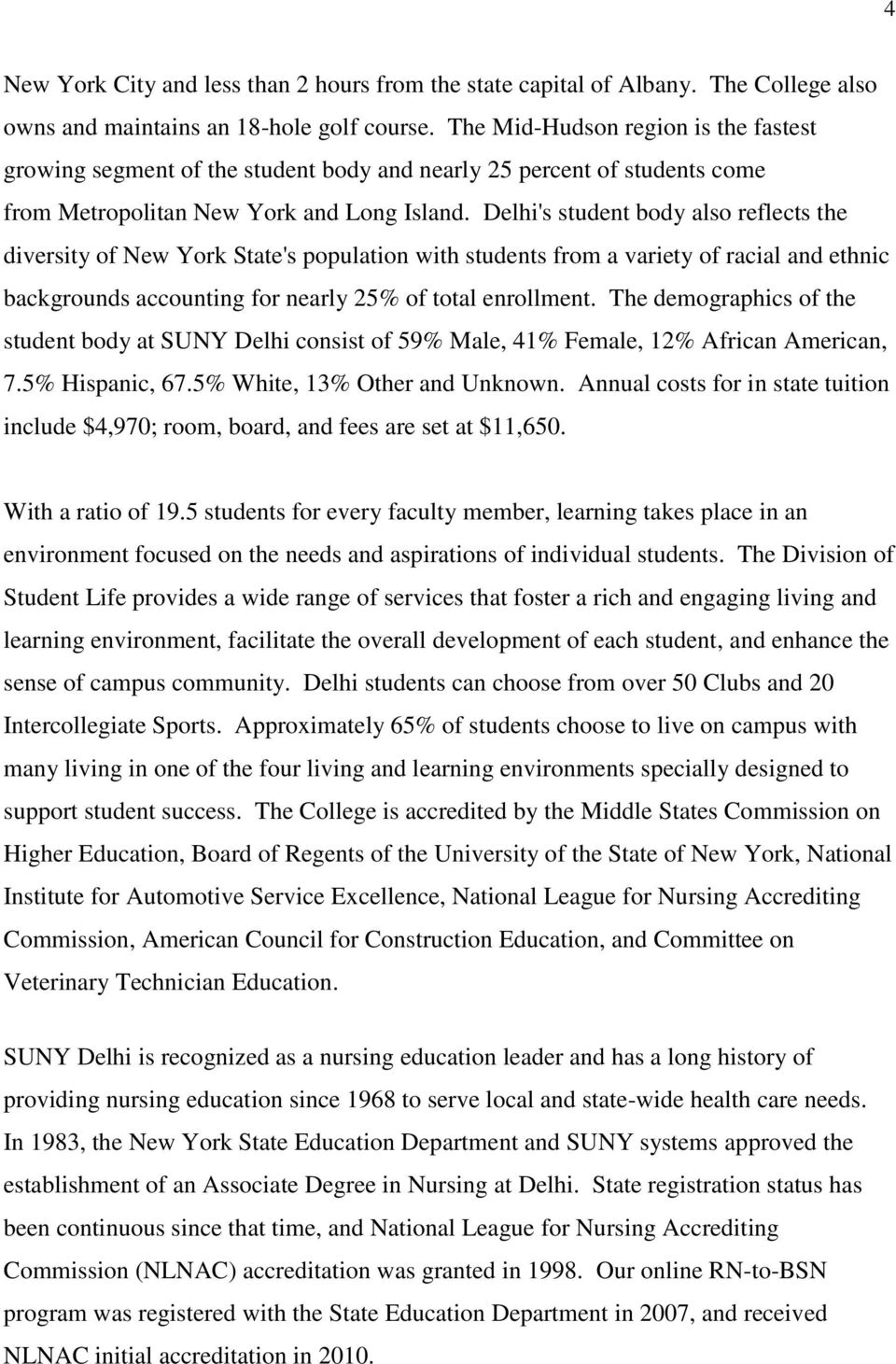
15 5 The College offers a 1-plus-1 program where students complete their licensed practical nurse certificate (year 1) and Associate in Applied Sciences degree in nursing (year 2), followed by an online RN to BSN program. Students have the opportunity to experience a programmatic seamless transition that will allow them to: (a) obtain their certificate and/or ADN, (b) apply lower division credits toward attainment of the BSN, and (c) seamlessly matriculate into the upper division RN-to-BSN program. The LPN, ADN, and BSN degrees provide New York State and beyond with qualified graduates who are eligible for entry level and expanded job opportunities, management, and teaching, and enables them to pursue advanced degrees and faculty appointments at institutions of higher education. In combination with SUNY Delhi's longstanding relationships with regional health care leaders, the nursing programs contribute significantly to economic development within the region and beyond, providing the healthcare industry with the educated professionals it demands. Student Population (as of September 1, 2011) Program Full-time Part-time Total ADN BSN Faculty Cohort (as of September 1, 2011) Program Full-time Part-time Total ADN BSN HISTORY OF THE NURSING EDUCATION UNIT The College has been educating nurses since The federal Manpower Act subsidized education for practical nurse education in underserved areas. When the funds dissipated, the College absorbed the nursing education unit that had been established and placed it in the Vocational Division. Educational opportunities for LPNs in the area to complete an RN were limited due to the inaccessibility of programs. In 1983, the New York State Education Department and SUNY systems approved the establishment of an Associate Degree in Nursing at Delhi. The first AD class entered in fall of 1984, using a
16 6 career ladder approach to education. State registration status has been continuous since that time, and NLNAC accreditation was granted in SUNY Delhi is the only associate degree nursing program in a 50-mile radius, and the only 1+1 program in the central region of New York State. In the spring of 2008, our online RN to BSN program was launched. High needs funding from SUNY Systems were obtained in 2007 and 2008 to support this program. The overwhelming majority of program coursework takes place on-line, making this an affordable, learner- and professional-centered program ideal for nurses who are currently employed, place-bound and geographically limited to living and working in all areas of New York State and beyond. The program allows graduates to improve their credentials and pursue career ladder enhancement opportunities that include management, education, and advanced practice positions and settings. NLNAC initial accreditation was granted in SUMMARY OF STANDARDS Standard 1: Mission and Administrative Capacity The mission, philosophy, and student learning outcomes of the nursing education unit are consistent with those of SUNY Delhi. These are clearly stated and accessible through the SUNY Delhi School of Nursing's website. The School of Nursing s policies are congruent with those of the governing institutions. A rationale is provided for those policies that vary with the College's. Faculty, students, and staff participate in the governance of the organization in well-defined and continuously evolving ways. Our educational partner agencies participate in the program evaluation processes. Contractual agreements with agencies in the geographical area are in place for student clinical placement. The Associate Dean is highly qualified, has ultimate responsibility and authority for the nursing unit, and participates in the budget process. Standard 2: Faculty and Staff The majority of faculty are both academically and experientially qualified, and teach the appropriate course(s) based upon their expertise and education. Facing the critical
17 7 national shortage of adequately credentialed nursing faculty, particularly in rural areas of New York State, the School of Nursing has adopted a grow one s own philosophy. The School has expanded faculty capacity by hiring previous graduates; providing a strong educational, mentoring, and evaluation program; and providing support as they transition into baccalaureate and graduate education. Full-time faculty performance is regularly evaluated to ensure competency and professional development. The faculty participates in scholarly activities including presentations and nursing education development. Faculty governance is a significant strength; through traditional faculty meeting forums and through the use of electronic communication (e.g., , Confluence) there is smooth and effective communication among faculty. Performance evaluation of part-time faculty is completed; however, a more structured process is necessary to ensure evaluations are conducted each semester. Institutionally, the technical, library, and tutoring staff, registrar, and enrollment services staff are available to support our faculty. Senior faculty provides professional development and mentoring support for all junior and part-time nursing faculty (National League for Nursing [NLN], 2006). Through the development of our mentoring program, junior and part-time faculty are partnered with senior faculty who provide course oversight and faculty support, as well as identify the needs of new faculty and the resources required to meet those needs. Our mentorship program for new faculty aims at reducing the frustrations that accompany transitioning into the faculty role and at improving retention. Our goal is to cultivate a workplace that is perceived by faculty as positive, productive, enriching, and satisfying so that they desire continued employment at SUNY Delhi. Our faculty is very supportive of one another's needs and goals for success, and there is a high degree of camaraderie and collegiality that contributes to a high rate of satisfaction. Standard 3: Students The majority of the student policies of the nursing education unit are congruent with those of SUNY Delhi; the rationale for those that vary will be addressed under Standard
18 8 3. Policies are located electronically within a site on our learning management system that all students are required to subscribe to; changes to policies are communicated to students via . Inquiries, applications, transcript evaluations, financial aid, and initial registration are managed by the Enrollment Services and Registrar staff. Students obtain supplies and textbooks via the online ordering process or the Campus Store on the SUNY Delhi campus. Student educational and financial records are in compliance with College policies, and compliance with Title IV is maintained. Once students are accepted into the program, they are required to attend a Nursing Orientation Day the spring prior to fall matriculation. The orientation consists of an introduction to SUNY Delhi, the School of Nursing, resources, technical requirements, policies (progression, health requirements), and an advisement session. Each student is assigned a nursing faculty advisor who assists the student with a variety of different services. The role of the advisor is one of student advocate, resource for curriculum planning, counseling and referrals as necessary, and career planning. With the support and guidance of their advisor, the student electronically self-schedules through the BroncoWeb system. Some course assignments entail the use of journal articles. Students are able to search for articles via the library's electronic databases. Students receive assistance from onsite librarians or from a national consortium that provides 24/7 assistance with this process, as well as faculty support and advice in searching for relevant literature. In-house technical support is available to the students 6 days a week. Standard 4: Curriculum The program s educational philosophy is guided by constructivist theory (Legg, Adelman, Mueller, & Levitt, 2009; Brandon & All, 2010) and is grounded in evidencebased practice paradigms. The curriculum flows from the mission and philosophy through an organizing conceptual framework. The curriculum plan illustrates a logical progression of course and level of objectives, learning activities, and competencies

19 9 designed for the achievement of student learning and program outcomes. The varied learning environments and experiences are selected and monitored by faculty in order to meet student and curricular needs. The curriculum incorporates established professional standards and competencies. Student learning outcomes (National Association for Practical Nurse Education and Service, 2007; National League for Nursing, 2000) are clearly articulated on our website and course syllabi, and are used to organize the curriculum and guide the delivery of instruction. Curriculum review is conducted on a regular basis to ensure content and method of instruction remains current. SUNY Delhi students are continually challenged to search for, understand, and analyze critical new information in the form of research findings, so they update and incorporate new research knowledgeably into their practice. Students are introduced to the barriers within health care facilities that interrupt or may prevent the use of evidencebased findings, thus their education is reality-based. The staff nurse is a critical link in bringing evidence-based changes into clinical practice. Learning activities are consistent with learning outcomes. Evaluation methodologies that indicate achievement of learning outcomes are varied and include activities such as exams, journaling, case studies, writing assignments, and presentations. Students experience a variety of clinical settings that include skilled nursing facilities, public health departments, school-based health centers, and acute care facilities; SUNY Delhi is affiliated for clinical placement with Bassett Hospital in Cooperstown, a Magnet Hospital. Standard 5: Resources The fiscal, physical, and learning resources are sufficient to accomplish the nursing education unit purposes. The budget is comparable to similar departments at SUNY Delhi and sufficient to support the School s operations; annual unit plans are developed by the Associate Dean and faculty to identify fiscal goals. Space for instruction and

20 10 faculty offices meets the needs of the unit. It is acknowledged that although South Hall, the location of our nursing laboratories, was rebuilt since the last self-study, it has inherent structural challenges. As part of the master plan, the College has planned extensive renovation to Sanford Hall in 2012, which will be named the future home of the School of Nursing. Laboratory, storage, and student space will be significantly expanded; nursing faculty and staff will be centralized in one office suite. While the library collection is adequate, the faculty has helped facilitate a transition to acquiring additional electronic journals and streaming online videos. Therefore, of importance to our students is timely access to library and technical support personnel. Library staff is available onsite, by phone, , and instant messaging. The number of electronic journals available to our students is adequate but continuously expanding. The use of and our learning management system, Vancko Hall, are important components of our program as a method of communication, and to post information, files, and class exercises. Technical support is available 6 days a week by phone, , instant messaging and an electronic ticketing process where the student submits an electronic form that describes the problem. Depending on the issue (e.g., access to classroom, ), the problem is delegated to technical staff who has responsibility and are trained in that area. Students are continuously updated on the status of their "ticket." Standard 6: Outcomes The program continues to be evaluated through such mechanisms as monitoring enrollment, retention, student satisfaction, evaluation of instruction, graduate and employer surveys, job placement, and NCLEX pass rates. The faculty meets weekly to discuss programmatic issues, course design, student issues, advisement, technological support, student governance, and support services. A systematic evaluation plan has been developed to implement ongoing program assessment (Appendix J). Students are achieving course objectives and learning outcomes as measured by their assignments, evaluations, coursework, and outcome assessment data. Evidence is included in Standard IV and VI.
21 11 ANALYSIS AND SUMMARY OF STRENGTHS AND AREAS NEEDING DEVELOPMENT Areas of Strengths The program has a clear mission and philosophy appropriate to higher education. The program mission, philosophy, and student learning outcomes are consistent with the governing organization. The commitment and support from the governing organization to facilitate the attainment of goals and objectives. Faculty orientation, mentorship, and governance. A program with a student-centered approach with a strong advisement model. A faculty and student governance model. A quality, consistent curricular design that is evidence-based and incorporates professional standards. Affiliation with a magnet hospital. Students have access to state of the art technology. Maintaining a safe faculty to student ratio in the clinical setting. Academic, fiscal, material, and technological resources and services available and accessible to faculty, students, and staff to promote success at achieving program objectives and learning outcomes. A comprehensive systematic program evaluation plan to guide evidenced-based decision-making for program development and continuous improvement. Areas of Development Continue to recruit and develop junior faculty to meet credentialing standards. Continue to develop consistent performance evaluation procedure of all part-time faculty. Need for collection of valid employment and employer evaluation data. Implement a revised progression and readmission policy fall 2011 that results in decreasing excess credits to completion of the program, a stable graduation rate, and increase in NCLEX pass rates above the New York State average.
22 12 Continue to evaluate data from newly implemented Assessment Technologies Institute (ATI) testing and remediation program to improve curriculum alignment and program outcomes. Improve physical resources through relocation of laboratories and School of Nursing to renovated Sanford Hall. Develop simulation program through the incorporation of course-based scenarios. Transition to 2010 NLN competencies following academic year.
23 13 STANDARD I MISSION & ADMINISTRATIVE CAPACITY The nursing education unit s mission reflects the governing organization s core values and is congruent with its strategic goals and objectives. The governing organization and program have administrative capacity resulting in effective delivery of the nursing program and achievement of identified outcomes.
24 The mission/philosophy and outcomes of the nursing education unit are congruent with those of the governing organization. Philosophy The SUNY Delhi School of Nursing was created to provide a foundation for generalist professional practice commensurate with associate degree preparation. Our educational philosophy is guided by constructivist theory and grounded in evidence-based nursing practice paradigms. Our educational approach toward our ADN nursing students is prescriptive such that students follow carefully designed courses and programming steps, however, the role of constructivism in our program is one where the learner is treated as an adult; the student is able to make decisions about his or her individual educational program and be an active participant in that educational process. Constructivism as a programmatic educational theory allows and encourages the student to be an active part of the learning process and not simply have knowledge delivered passively (Legg, Adelman, Mueller, & Levitt, 2009). The nursing faculty have identified competencies for year one to define the range of capabilities and responsibilities for the scope and content of our program. These competencies are as follows (NAPNES, 2007): Professional Behaviors Communication Assessment/data collection Planning Caring Interventions Managing care Educational competencies for our associate degree program have been adapted from the National League for Nursing (NLN, 2000): Professional Behaviors Communication Assessment
25 15 Clinical Decision Making Caring Interventions Teaching and Learning Collaboration Managing Care Furthermore, liberal arts education (English, psychology, biology, etc.) is an integral part of our program in order to provide our students with the ability to integrate and apply behavioral, biological, and social concepts into their practice. The conceptual framework of the School of Nursing at SUNY Delhi drives our curriculum and student learning outcomes, and reflects the faculty s beliefs that each client is a unique individual with unity of body, mind, and spirit. Furthermore, we believe that each client has a hierarchy of needs (Maslow, 1970) which must be met to enable the individual to maintain function at an optimal level. The nursing metaparadigm of the four concepts of nursing (i.e., client [individual, family, and community], environment, health, and nursing) operate in dynamic interaction reflecting the faculty's belief about the context of the nursing profession; nursing practice is built upon nursing knowledge, theory, and research. These concepts are defined as follows: Client: The faculty views every individual, family, and/or community as unique and dynamic, having aspects which are physical, social, cultural, psychological, developmental, and spiritual in nature. The client is ultimately responsible for his or her own growth, health, values, and search for fulfillment and has the right to exercise freedom of choice in determining and attaining his or her individual goals. Nursing's role is to consider the interconnected components in assessing, planning, implementing, and evaluating the health status of individuals, families, and communities, and this is guided by evidence at all steps of the process. Environment: The concept of environment extends from the physical environment to include external elements such as living conditions, sanitation, and air and water quality (Nightingale, 1992). Internal environmental factors that affect health include personal psychological processes, religious beliefs, ethnicity,
26 16 culture, and personality. All clients affect, and are affected by, their internal and external environments. Responding to internal and external environmental factors may result in either wellness or alterations of well-being in the area of human needs, thus influencing the individual's requirements for nursing care. Nursing's role is to foster or stabilize the client through environmental intervention. Cultural and ethnic diversity exert a major influence on the client, health care beliefs, health care practices, and receptivity to new information which may affect health-seeking behaviors. Therefore, to provide comprehensive health care, nursing seeks to understand and influence the interaction between the internal and external environments, as well as health values, perceptions, and beliefs. In order to maximize health, a concerted effort to encourage health-promoting activities must take place simultaneously with the elimination of identifiable stressors that interfere with the attainment of human needs. Health: Health is a complex phenomenon characterized by dynamic interaction between the internal and external environments and the client's physical, psychological, social, cultural, developmental, and spiritual balance. The client, whether the individual, family, or community, experiences health and illness on a continuum from high-level wellness to very serious illness and death. We believe that health should be maintained at an optimal level for each individual, family, or community. We associate optimal health with a harmonious balance among all aspects of the client and with successful adaptation to the stressors of an everchanging environment. Optimal health involves a mutual commitment to growth and learning that is based upon collaboration between the client and the health care team. We acknowledge that health is a continuum and is defined by the client, the starting point for the nurse in planning appropriate nursing care. Nursing: Nursing is an art and a science propelled by humanistic values. Nursing as a science is grounded in theoretical knowledge, scientific inquiry, and research. Nursing, as an art seeks to synthesize scientific knowledge, aesthetic knowledge, and self-knowledge to provide direct care; promote, maintain and restore health; and prevent illness. The purpose of nursing is to assist individuals, families, and communities to achieve an optimal level of health through therapeutically
27 17 exploring the impact of these experiences. The nurse/client relationship is the essence of nursing practice. The nurse brings to this relationship, through knowledge of arts and sciences and an understanding of self, the ability to therapeutically interact with each human system in a holistic way. Nurses promote social justice, influence public policy, and help meet the needs of society to improve health and health care delivery. Mission of the College The mission of SUNY Delhi is to provide its students with academic opportunities that yield clear thinkers and productive citizens who are prepared for service, leadership, and successful careers. Institutional Goals SUNY Delhi is a charter member of both the State University of New York and the University Colleges of Technology. As a residential college, SUNY Delhi seeks to create an environment in which living and learning flourish together. Bestowing certificates as well as associate and baccalaureate degrees, Delhi combines historic strengths in modern technology with dynamic curricula in the arts, sciences, and selected professions. To this end, Delhi's faculty and staff strive to: provide high-quality education in professional, technological, and liberal arts programs that provide students the opportunity to enter the workforce or continue their education; emphasize hands-on, experiential, and applied teaching and learning in small classes; create a student-centered campus community in which all individuals are valued and encouraged to excel; inspire a lifelong passion for learning so that students may understand themselves and their changing world; provide opportunities for students to realize their potential in personal, professional, and intellectual life; and
28 18 define rigorous academic and professional standards of learning and ascertain the extent to which programs and students meet or exceed these standards. Organizational Values The faculty and staff of SUNY Delhi believe that the student is the most important person both on- and off-campus. As a college with over 64 academic programs, SUNY Delhi serves New York State and its communities, as well as communities in other states and countries, by ensuring that its students are afforded every opportunity to define, pursue, and achieve their diverse educational goals. SUNY Delhi aggressively seeks to link its mission as an educational institution with programs that enhance the intellectual, emotional, and social development of its students. SUNY Delhi strives to create a culture of assessment that promises continuous selfevaluation and improvement. Programs, services, students, and staff aspire to make the learning and living experience one that advances knowledge and enhances skills. Appendix A describes the NLN Core Competencies, SUNY Delhi Institutional Goals, and SUNY Delhi Nursing Student Learning and Program Outcomes. Mission of the SUNY Delhi School of Nursing To provide quality nursing education that prepares students as licensed practical and registered nurses with civic responsibility, who will contribute toward employment demands in the health care community. The mission and philosophy of the SUNY Delhi School of Nursing, congruent with the mission of SUNY Delhi, support associate degree nursing education and foster academic excellence for a diverse student population. The School of Nursing s mission, philosophy, and student learning outcomes are reviewed annually.
29 The governing organization and nursing education unit ensure representation of students, faculty, and administrators in ongoing governance activities. SUNY Delhi strives to include students, faculty, staff, and administrators in governance of the College and the School of Nursing. Members of the SUNY Delhi nursing faculty are active participants in the governing structure across campus and within the program. The SUNY Delhi nursing faculty participates in the following committees and activities (see Appendix E) for which committee and activity apply to specific faculty): College Senate Curriculum Committee Scholastic Standing Committee Institutional Review Board Middle States Steering Committee and Workgroups Disabilities Advisory Team Scholarship Committees Honors Program Advisory Committee Technology Advisory Group Online Instruction Committee Student Health Advisory Committee Consultant for SUNY Delhi Child Care Center Search Committees: o o o o o o o Nursing faculty, full-time and adjunct Psychology faculty Online Enrollment Counselor Assistant Online Education Coordinator Dean of Liberal Arts and Sciences Faculty Interviews of Provost candidates Chief Information Officer The School of Nursing utilizes student, faculty, and administrator representation through several different levels and means to ensure representation in governing the program. These include:
30 20 Students: o o o o Meet annually with the SUNY Delhi Nursing Advisory Board to provide feedback on the program. Complete course evaluations that address their satisfaction with the courses, instructor, support services, and ability to meet course objectives. Graduates complete a program evaluation that addresses each student learning outcome as well as other programmatic items. Participate in the School of Nursing Student Board that includes eight student representatives, two full-time faculty, and the Associate Dean. This forum meets an average of once a month. Student representatives develop the agenda based on fellow student feedback and/or concerns. Communication between students and representatives is conducted in person or by ; minutes are shared in class and are posted in South Hall. Faculty and Associate Dean: o o o o o Full-time faculty meet weekly Adjunct clinical faculty meet twice a semester, either on campus or at clinical agencies Rotate membership on Student Board Annual systematic evaluation plan Deans Council (Associate Dean) 1.3 Communities of interest have input into program processes and decision making. SUNY Delhi and the School of Nursing have taken steps to ensure that all stakeholders and communities of interest have input into program processes and decision making. Major communities of interest include local health care organizations, our External Advisory Council, our students, employers of our graduates, and agencies that provide clinical experiences for our students.
31 21 The SUNY Delhi School of Nursing provides graduates to local and regional health care organizations such as Bassett Healthcare in Cooperstown, New York, an organization that has achieved Magnet Hospital Recognition, and A. O. Fox Hospital in Oneonta, New York. Regional employers welcome our program because access to other ADN programs pose geographic constraints and travel requirements, which are barriers that prevent prospective students from enrolling. An External Advisory Council for the SUNY Delhi School of Nursing provides guidance to all three nursing programs (i.e., PN, ADN, and RN-to-BSN). The Council meets yearly to discuss programmatic outcomes and opportunities to improve our programs. Members of the Council are representatives from acute- and community-based health care agencies in the area, educators, and SUNY Delhi alumni. For example, Chyrise Taylor, an alumna from both our ADN and RN-to-BSN program, has been nominated to serve on this Council. A list of the members of our External Advisory Council and meeting minutes are available in the Document Reading Room. Student input takes many forms and is carefully reviewed every time any data or communication is received. This input takes the form of Student Board meetings, s and phone calls, course evaluations, program evaluations by graduates, and members from the External Advisory Council. Student input is moved up the chain from the faculty to the administrative level to ensure that attention to the student s concern is received. Students evaluate every course each semester. Annually, the data is reviewed to determine direction for program improvement. As a result of this feedback from our students, freshman lab has incorporated increased skill practice hours, and senior seminar has increased the content on prioritization and delegation. The outcome of these improvements has brought favorable subsequent evaluations by students. A copy of the course and instruction evaluation tools and the data from course evaluations is available in the Document Reading Room.
32 22 Other stakeholders include our alumni and their employers. The alumni and their employers are asked to submit a program evaluation, providing us with information regarding our graduates and their experiences in the program. Both evaluation tools have a direct relationship with our student learning objectives. The evaluation tools and the data from graduating classes and their employers are located in the Document Reading Room. The feedback from both groups has been favorable. There exists a significant challenge in collecting data from our graduate s employers. Response rates were somewhat improved for 2010 graduates, however, the faculty believes there is opportunity for improvement. Beginning with our 2011 graduates, we will collect student contact and job placement information prior to graduation in May. The faculty believes this approach will allow us to collect the most current contact information of our graduates and their plans for employment. Input from clinical agencies is sought every semester for both the 1 st and 2 nd year of the program. The faculty seeks formative and summative evaluation from the clinical agencies. In addition, meetings are held between faculty and agency personnel at A.O Fox and Bassett Hospital at the beginning and end of each semester. The minutes from these meetings are available in the document meeting room. 1.4 Partnerships exist that promote excellence in nursing education, enhance the profession, and benefit the community. The SUNY Delhi School of Nursing utilizes local clinical agencies that enable students to meet course objectives. Therefore, contractual agreements are developed and maintained with several agencies in Delaware and Otsego County. Guest lecturers collaborate with faculty to ensure that the latest innovations in the care of clients are shared with students. Examples of topics provided by guest lecturers are included in Standard IV. Agency feedback consistently contributes toward improvement in our program. A list of agencies contracted with SUNY Delhi is available in the Document Reading Room. We have of a history of a partnership with A. O. Fox Hospital in Oneonta, New York; the A.O. Fox Hospital collective bargaining agreement mandated that all LPNs employed at
33 23 their facility enroll in an RN program and graduate within a year. In 2009, SUNY Delhi contracted with Fox Hospital to enroll 13 LPNs into the 2 nd year of the program. A.O. Fox Hospital provided full tuition assistance for these students. Likewise, our partnership with Bassett Hospital enables LPN students to receive full tuition support for year 2 in exchange for 1 year of employment post-graduation. Community collaboration has resulted in our faculty and students participation in the local American Cancer Society s fund-raiser, Relay for Life. Our students are actively involved in the planning of this local event, staffing the first-aid tent, and have raised a significant amount of funding for this most worthwhile organization. Our students and faculty also have established a therapeutic presence at the local Senior Citizen s Residential Center. Events such as blood pressure screening, promotion of healthy meals, and general communication and connection with our local senior citizens have been activities in which senior citizens, faculty, and students have learned from one another. We also provide the use of our laboratory to the Delaware County Health Department s nursing staff to practice new skills. Lastly, the students provide an annual workshop for the Campus Child Care Center; nursing students present developmentally appropriate skits that teach children various aspects of safety, first aid, nutrition, and hygiene. 1.5 The nursing education unit is administered by a nurse who holds a graduate degree with a major in nursing. Dr. Mary Pat Lewis, the Associate Dean, is responsible for the LPN, ADN, and RN-to- BSN program, and supervision of all faculty and staff. Dr. Lewis is a tenured faculty member who holds the rank of full professor and has 10 years experience in associate, baccalaureate, and graduate education. She holds a Bachelor of Science degree in nursing from SUNY Plattsburgh, a Master of Science degree in nursing from the University of Connecticut, and a PhD in nursing from the University of Pittsburgh. Dr. Lewis curriculum vitae is located in Appendix B. Dr. Lewis is involved in regional, state, and national organizations and was awarded the Chancellor's Award for Excellence in Faculty Service.
34 The nurse administrator has authority and responsibility for the development and administration of the program and has adequate time and resources to fulfill the role responsibilities. Dr. Lewis, Associate Dean, has authority and responsibility for the development and administration of all the nursing programs at SUNY Delhi. The Associate Dean is the chief academic and administrative officer of the department and is responsible and accountable for the teaching, research, and service mission of the department. She is charged with leadership of the department in all personnel, program, fiscal, and operational matters reporting to the Dean of Liberal Arts and Sciences. The Associate Dean has the authority for administering and organizing the School of Nursing including: Providing effective leadership for strengthening the program and curriculum, participates on Dean s Council; Evaluating courses; Reviewing all evaluations; Attending all faculty meetings; Being the active administrative representative for all programs; Preparing proposals on new courses, programs, and curriculum; Supervising reports, assessments, and program evaluation reports and surveys for the College, National League for Nursing, New York State Board of Nursing, and the National League for Nursing Accrediting Commission; Providing oversight of recruitment of new qualified faculty; Participating in applicant interviews and active involvement in the hiring process; Controlling and providing School of Nursing operating budgets with input from faculty, staff, and students; Evaluating nursing faculty and staff; Facilitating faculty and student development; Allocating teaching assignments and academic loads; Managing student and faculty issues; Developing and maintaining relationships with university, community, and professional groups;
35 25 Representing the School of Nursing at local, state, and national meetings; and Coordinating nursing and liberal arts and science courses with the Dean of Liberal Arts and Sciences. 1.7 With faculty input, the nurse administrator has the authority to prepare and administer the program budget and advocates for equity among the units of the governing organization. Dr. Lewis prepares a yearly unit plan for the School of Nursing that includes overall goals for the School of Nursing and budget requests. Dr. Lewis works with the nursing faculty, the Budget and Planning Committee, the Chief Financial Officer, and the Dean of Liberal Arts and Sciences to prepare and revise the budget so it is consistent with overall college business plan. She works closely with the Dean of Liberal Arts and Sciences and other department heads to plan for replacement equipment. Program budget information is included in Standard 5. The School of Nursing s unit plan is located in the Document Reading Room. 1.8 Policies of the nursing education unit are comprehensive, provide for the welfare of faculty and staff, and are consistent with those of the governing organization; differences are justified by the goals and outcomes of the nursing education unit. The policies of the School of Nursing are comprehensive. They provide for the welfare of the faculty and staff and match those of the governing organization in the following areas: academic policies and procedures, the SUNY Delhi Faculty Handbook, and United University Professionals union contract (UUP). The School of Nursing policies are consistent with the policies of SUNY Delhi. Each faculty member has access to the SUNY Delhi Faculty Handbook with updates available through the SUNY Delhi Web-site. The Faculty Handbook is a collection of selected information, policies, and procedures primarily related to employment and is located at
36 _WEB.pdf Policies regarding salary, tenure, benefits, rights, responsibilities, and termination are negotiated through union contracts with UUP, our bargaining unit. The faculty workload is fully supported by UUP with 18 hours/semester being the average number of contact hours for full-time faculty. The only difference for SUNY Delhi nursing faculty from other SUNY Delhi faculty is that our nursing faculty must hold active nursing licenses in New York State. Policies are developed in response to needs and changes in the academic and economic world. Faculty governance is seen through faculty input into polices through the College Senate and departmental dialogue. Faculty members have an active role in developing and implementing new policies. New policies are approved by the faculty body and posted to the Web site. The College Senate at SUNY Delhi is responsible for university policy relating to courses and curriculum, faculty welfare and promotion, changes in faculty organization, and other matters. Ultimate authority for university policy rests with the State University of New York, State Board of Higher Education, and the New York State Legislature, but a wide variety of decisions are made on campus by the College Senate. Faculty members can bring issues to College Senate by notifying the College Senate president of the issue to be placed on the agenda. 1.9 Records reflect that program complaints and grievances receive due process and include evidence of resolution. The SUNY Delhi School of Nursing defines a complaint or grievance as a written statement provided to the School of Nursing Associate Dean that alleges mistreatment of the student by an employee of the School of Nursing and/or its agents (e.g., faculty or staff). All program complaints and grievances are taken very seriously, and receive due process following SUNY Delhi s policy and procedure. The Associate Dean maintains a
37 27 folder for all student complaints; however, there have been no such complaints submitted to the Department. The college policy is published online at When student issues arise, the student is encouraged to bring a complaint directly to the instructor as a first step in the process of resolution. If the student cannot bring the complaint to the instructor for a particular reason or if the student does and the matter is not resolved satisfactorily, the student may request an audience with the Associate Dean or request the Associate Dean to act as an intermediary to assist in solving the problem. If the student does not accept the decision of the Associate Dean, the student may appeal to the Dean of Liberal Arts and Sciences and then to the Provost. The Provost renders the final decision in writing to the student Distance education, as defined by the nursing education unit, is congruent with the mission of the governing organization and the mission/philosophy of the nursing education unit. SUNY Delhi does not offer the curriculum through distance education. Courses may be housed on Vancko Hall for the purpose of posting course-specific information such as files, and announcements.
38 28 STANDARD II FACULTY & STAFF Qualified faculty and staff provide leadership and support necessary to attain the goals and the outcomes of the nursing education unit.
39 Faculty are credentialed with a minimum of a master's degree with a major in nursing and maintain expertise in their areas of responsibility The majority of part-time faculty are credentialed with a minimum of a master s degree with a major in nursing; the remaining part-time faculty holds a minimum of a baccalaureate degree with a major in nursing Rationale is provided for utilization of faculty who do not meet the minimum credential. 2.2 Faculty (full- and part-time) credentials meet governing organization and state requirements. Credentials The School of Nursing employs eight full-time (including the Associate Dean) and nine adjunct (part-time) faculty members. Full-time faculty are credentialed with a minimum of a master s degree in nursing or are matriculated in a master s program; the Associate Dean holds a doctoral degree. Appendix C displays faculty who teach in the nursing program, their employment status, rank, academic degrees, areas of clinical specialty, and academic teaching/other responsibilities. All faculty maintain expertise in their areas of responsibility through continuing education, formal coursework, clinical practice, or community service. Opportunities to develop and maintain faculty expertise are also provided by the School of Nursing. Appendix E displays the faculty scholarship of practice and application. The majority of the adjunct (part-time) faculty hold a baccalaureate degree in nursing; with the exception of one ADN-prepared instructor who is co-assigned with a masters prepared faculty member in the clinical setting. All full-time faculty meet the requirements of the College and the New York State Education Department. Faculty members must be licensed and currently registered as professional nurses in New York State and hold at least a master s degree in nursing, or
40 30 actively pursuing graduate study in nursing; one faculty member holds an earned doctorate. Position descriptions are located in the Document Reading Room. Complete faculty vitae, copies of nursing licenses, and official transcripts are maintained in the Human Resource Department, and are located in the Document Reading Room. Recruitment and Retention Faculty recruitment and hiring processes are designed to ensure that the most qualified candidates are selected. The School of Nursing was faced with five faculty retirements in the past 3 years which accounted for 50% of the existing faculty. Factors such as retirement of an already existing aging faculty population are a dominant theme in the literature (Allen, 2008; AACN, 2011; Ganley & Sheets, 2009) and impact the ability of many schools nationally to maintain enrollment. SUNY Delhi has been confronted with this challenge and has used strategies to approach this problem in the most creative ways possible. The faculty work closely with the Human Resources Department to develop an aggressive recruitment campaign to fill a faculty vacancy. A search committee is formed that includes representatives from nursing and liberal arts and sciences. Advertisements are placed on the SUNY Delhi website, the Chronicle of Higher Education, and local print news media. In addition, faculty share the employment opportunity with our NYS Associate Degree Nursing and Dean s Council membership, local and regional health care agencies, and regional graduate nursing programs. Candidates submit materials to the Human Resources Department; the search committee chair contacts candidates for an interview and a class presentation. The search committee selects the most qualified candidate and makes a recommendation to the Associate Dean and the Provost. We acknowledge that the minimum acceptable academic credential is a master s in nursing degree for full-time faculty, and a baccalaureate degree for part-time faculty. However, considering the rural geographic location of the College and the significant challenge of recruiting qualified full- and part-time faculty, faculty enrolled in a BSN or MSN program have been hired to teach in the classroom and supervise students in
41 31 clinical areas. One clinical instructor is ADN prepared; however, she is mentored by an MSN-prepared faculty member. All part-time faculty are trained, precepted, supervised, and evaluated by a masters and BSN-prepared faculty members. Employee Satisfaction For the second year in a row, SUNY Delhi has been recognized as one of the top ten colleges to work for in our category in the U.S. by the Chronicle of Higher Education. Survey results indicate a high level of satisfaction related to job satisfaction and support (74%), professional development (82%), compensation and benefits (78%), facilities (79%), pride (85%), and respect and appreciation (76%) (Chronicle of Higher Education, 2010). 2.3 Credentials of practice laboratory personnel are commensurate with their level of responsibilities. The practice laboratory personnel are registered nurses who hold the position of Instructional Support Technician (IST). This position is a non-teaching position responsible for assisting faculty and maintaining the operations of the learning lab. They assist faculty with the preparation of materials needed for laboratory instruction. Under the supervision of full-time faculty, these personnel assist students in the development of skills and techniques; hence, the qualifications are appropriate for the area of responsibility. Our instructional support staff are graduates from our ADN program and are currently matriculated in our BSN program. 2.4 The number and utilization of faculty (full- and part-time) ensure that program outcomes are achieved. Qualified faculty and staff provide the leadership and support necessary to attain the goals and outcomes of the nursing education unit. The nursing program has seven fulltime nursing faculty, nine adjunct (part-time) nursing faculty, and the administrator (Associate Dean). The number of full and part-time faculty is sufficient to ensure that all program outcomes are achieved with a ratio of no more than 8-10 students to 1 faculty member in the clinical learning environment, and 30 students to 1 faculty member and 1
42 32 IST in the learning lab. In the clinical setting, Clinical Coordinators are selected for both first and second years of the program and report directly to the Associate Dean. These full-time faculty coordinate student assignments and evaluation, supervise adjunct faculty, and assist faculty in managing the student s clinical experience. The position description is located in the Document Reading Room. Utilization of full-time and part-time faculty is consistent with the mission of SUNY Delhi and the purposes of the School of Nursing. Teaching is the primary responsibility of the faculty, and all the full-time and part-time faculty instruct in their areas of expertise, whether by academic preparation or experience. The faculty are experienced at teaching a wide variety of courses within the curriculum (Appendix C). The workload of full-time faculty is no more than 18 hours per semester; part-time faculty workload is 12 hours (clinical) per semester. In the School of Nursing, full-time faculty carry an advisement load of approximately 25 nursing students. In addition to teaching and advisement, full-time faculty serve on SUNY Delhi College committees. 2.5 Faculty (full- and part-time) performance reflects scholarship and evidencebased practice. The School of Nursing accepts the definition of scholarship used by NLNAC in the Accreditation Manual (NLNAC, 2008). The definition of scholarship is also based on Boyer's definition in Scholarship Reconsidered (1990). In this context, scholarship is reflected through teaching, application, integration, and discovery of knowledge. Boyer's dimensions of scholarship nicely reflect those of the NLNAC: Scholarship of teaching is the ability of faculty to facilitate the student learning in the science and art of nursing. Innovative teaching strategies and program development and evaluation are important aspects of the scholarship of teaching. Examples include accreditation or other comprehensive reports, application of technology to teaching and learning, peer assessments of innovative teaching strategies, and presentations related to teaching and learning. Scholarship of discovery encompasses nursing s view of health, health promotion, restoration, rehabilitation, comfort, and caring. The scholarship of discovery
43 33 where new knowledge is discovered through research and inquiry. Examples include peer-reviewed publications, presentation of research, mentorship of junior colleagues in research or scholarship, and recognition as a scholar in an identified area. Scholarship of integration, where Boyer stresses the combination of ideas, believes that new knowledge should be used to bring new insight by its use across disciplines and in differing situations. Examples include peer-reviewed publications of research and case studies, and participation in inter-disciplinary programs. Scholarship of practice and application involves all aspects of clinical practice that impacts the delivery of care, development of clinical knowledge, professional development and application of skills, and volunteerism and community service. Examples include presentations or attendance at conferences and seminars related to clinical practice, mentoring new faculty and students relative to the clinical specialty, and peer-reviewed publications of research. The School of Nursing has experienced faculty, but also faculty new to the academic role at SUNY Delhi, who are mentored in areas of scholarship by faculty and the Associate Dean. The faculty maintain academic and scholarly expertise by participation in seminars, workshops, professional organizations, and continuing education programs. Examples of these activities are located in Appendix D and in faculty curricula vitae. Faculty members travel to regional and national seminars related to their clinical expertise, nursing education issues, and evidence-based practice. Scholarly activities include submitting manuscripts for publication, manuscript reviews for journals, and participation in the School s Journal Club. Peer-reviewed articles that have been presented and discussed centered on topics such as associate degree in nursing education, the 2010 Institute of Medicine Report, the use of scenarios and simulation in nursing education, transition from service to education, and student s ability at multi-tasking. The faculty have presented completed or proposed research at the annual Bassett Hospital Research Evening in May Examples of abstracts included the influence of
44 34 personality characteristics on the adherence to antiretroviral therapy in HIV-positive clients, factors associated with staff nurse burn-out in the emergency department, and parental perceived barriers to vaccine administration in their children. The abstracts and posters are on display in the Document Reading Room. Appendix E presents the faculty s activities contributing to the levels of scholarship. The faculty consistently review courses to ensure the content is evidence-based. In addition, the School of Nursing is a member of the Leatherstocking Alliance for Research in Nursing. This regional organization is one of several alliances in the state in which the purpose is to elevate nursing research activities and the application of evidence-based practice to improve health outcomes. SUNY Delhi hosted a LEARN forum in January 2008 (forum locations are rotated among alliance members throughout the year). Dr. Mary Pat Lewis, Associate Dean of the School of Nursing, presented her research on adherence to antiretroviral therapy in HIV-positive women. She also will be partnering with the University of Pittsburgh spring 2012 on a research project focusing adherence to therapy in HIV-positive women. Travel and professional development are encouraged and supported financially by SUNY Delhi administration. A summary of faculty participation in continuing education is found in Appendix D. Service consists of administration, advising, committee work, public service, recruitment, and service organizations. The majority of faculty time is dedicated to teaching and student advisement. As reflected in SUNY Delhi s mission statement, to provide its students with academic opportunities and campus programs that yield clear thinkers and productive citizens who are prepared for service, leadership, and successful careers, the Nursing faculty value and support community service activities. Examples of these activities include: Relay for Life Health promotion activities at the Delhi Senior Community Center Safety educational programs for the Campus Child Care Center Student Health Center Immunization Clinics
45 35 A.O. Fox Hospital Annual Childbirth Fair Food and clothing drives Hosting Delaware County Health Department Skill Program Take Son-Daughters to Work Program 2.6 The number, utilization, and credentials of non-nurse faculty and staff are sufficient to achieve the program goals and outcomes. SUNY Delhi s School of Nursing does not employ non-nurse faculty. Qualified nonnurse staff provide the support necessary to attain the goals and outcomes of the nursing education unit. The staff assistant provides clerical support for the ADN program. Her responsibilities include accurately maintaining records and files; acting as the conduit for information between departments, students, and faculty; and effectively communicating and disseminating information with the Associate Dean and among department faculty and staff. The position description is located in the Document Reading Room. 2.7 Faculty (full- and part-time) are oriented and mentored in their areas of responsibilities. The School of Nursing recognizes that the retention of new qualified faculty is directly related to a comprehensive orientation and smooth transition to the College and School. Faculty participate in a one-day College orientation where they are introduced to representatives from other departments at SUNY Delhi, receive advice and tips about working on the Delhi campus, payroll and benefits, communication and technology, and what to expect in the classroom. Following this program, newly hired full- and part-time faculty are required to complete our Nursing Faculty Orientation. To facilitate transition into the School, a nursing faculty preceptor is partnered with new faculty who provides guidance in College and School of Nursing procedures, and with curriculum and coursespecific instruction. The preceptor and new faculty member develop goals and meet weekly to evaluate progress toward meeting these goals. Orientation to the School of Nursing includes topics such as program overview, requirements, policies, technology, Vancko Hall (the online learning platform), s,
46 36 accessing other academic electronic sites, and the role of the faculty. Furthermore, the new faculty member becomes familiar with the library electronic databases. New faculty also complete an agency-specific orientation at the clinical site they are assigned to. An example of the College and Nursing Faculty Orientation is displayed in the Document Reading Room. Following the Nursing Orientation, new faculty and their preceptor meet weekly to review progress toward goals, to provide support and advice on specific issues. The Associate Dean evaluates classroom instruction approximately 6 months following the new faculty s start date; the clinical coordinator and preceptor provide feedback to new faculty in the clinical setting. In addition to the orientation of new faculty, part-time clinical faculty are mentored by full-time faculty, and provided guidance on the instruction and evaluation of students in the clinical setting and in the implementation of policies. 2.8 Systematic assessment of faculty (full- and part-time) performance demonstrates competencies that are consistent with program goals and outcomes. The Faculty Annual Report and Performance Program (FARPP) is an instrument which a full-time faculty member at SUNY Delhi uses to establish an annual program of academic and professional contribution, growth, and development. The program consists of three major categories: instructional improvement, academic achievement, and university service. The program provides each faculty member the opportunity to develop an individualized growth program within the context of his or her strengths and the goals of the College and School of Nursing. The program is completed in conjunction with the Associate Dean. The document is used for academic planning and as a primary source of information for the improvement of teaching and assessment of performance. Each program is also reviewed by the Provost. In addition, classroom visits by the Associate Dean or designee (peer) are conducted annually depending upon faculty rank and appointment. The Delhi Continuing and Term Appointment Committee annually review faculty records to determine continuing appointment and tenure. The format for the evaluation and procedure is based on the policies of SUNY and United University Professions (UUP). A consistent procedure is being developed to ensure all adjunct (part-time) faculty are evaluated in the clinical setting by the clinical coordinator
47 37 each semester. The evaluation tool will be moved to Survey Monkey so that data may be aggregated and trended. Completion of evaluations and performance will be tracked by the Associate Dean. Students evaluate the courses and instructors in a course evaluation link at the end of every semester. Results of student evaluations are returned to the individual faculty member for use in improvement of instruction. Each course/instruction evaluation tool is course-specific in which students are requested to rate the achievement of each course objective. The evaluation tools and the data are available in the Document Reading Room. 2.9 Non-nurse faculty and staff performance is regularly reviewed in accordance with the policies of the governing organization. SUNY Delhi School of Nursing does not employ non-nurse faculty. Staff performance is evaluated annually in accordance with SUNY policy. Our Staff Assistant is ranked as a UUP employee. All UUP employees have their performance evaluated under a system established by agreements with the collective-bargaining unit. A performance plan is created following 2 weeks of employment. Once a year, the Associate Dean prepares a written performance evaluation and an overall rating of satisfactory or unsatisfactory based on work performance Faculty (full- and part-time) engage in ongoing development and receive support in distance education modalities including instructional methods and evaluation. Although the School of Nursing does not offer online courses, Delhi Online Education, a business unit within Campus Information Systems, offers services for all faculty and staff related to web-enhanced, hybrid, and fully online courses. This includes administration and support of Vancko Hall (Moodle), our learning management system/virtual-learning environment. Delhi Online Education, led by Clark Shah-Nelson, Online Instruction Coordinator, provides services for web-enhanced, hybrid, and asynchronous online courses. These services include training, support, and technical services related to the
48 38 virtual-learning environment. The Nursing faculty does utilize Vancko Hall to post communication and house course-related documents such as the course syllabus and class learning documents.
49 39 STANDARD III STUDENTS Student policies, development, and services support the goals and outcomes of the nursing education unit.
50 40 The students who make up the SUNY Delhi nursing program are a combination of traditional and non-traditional learners. The majority of our students reside locally and within the NYS region. A list of matriculated students for 2009, 2010, and 2011 is also available in the Document Reading Room. Table 3.0. Student Demographics, 2011 Enrollment Fall 2011 Gender Age Range Ethnicity 155 Male 20 Female years Asian Pacific 2 American Indian 2 Black, Non-Hispanic 25 Hispanic 11 White, Non-Hispanic 112 Unknown Student policies of the nursing education unit are congruent with those of the governing organization, publicly accessible, non-discriminatory, and consistently applied; differences are justified by the goals and outcomes of the nursing education unit. College student information and policies are located in the College Catalogue, located at the Student Handbook (Document Reading Room), and the Academic Policy and Procedure Manual ( All student information is accessible via the website at The content of this site ranges from academic policies to records and registration, student support, and technical services. A student handbook is also available electronically and in hard copy to students with similar information, located at Links to both the student and handbook sites are posted on Vancko Hall, along with program specific policies. Academic policies of the College and the School of Nursing are congruent and support the achievement of the mission, goals, and student outcomes. The ADN Resource and Communication Site on Vancko Hall houses nursing-specific policies and procedures. If a change to an existing Nursing program policy is proposed, it is presented
51 41 to and voted on by full faculty. Table lists program and college policies, location, and content at each location.
52 Table Location of Published Student Policies and Content in Each Policy Policy Student Website dents/ Student Handbook hi.edu/campus _life/pdfs/plan ner.pdf College Catalogue atalog_11/index. php School of Nursing Website academics/academic_ divisions/liberal_arts/ nursing/index.php Vancko Hall ADN Nursing Student Resource and Communication Forum (secure site) Nondiscrimination X p. 3 and 35 X Curriculum and program X X Selection and admission X X Student Records and registration X p. 16 X Student evaluation/grading X p. 9 X X X Graduation requirements X p. 17 X X X Redress of student's complaints Academic resources/services including disability services Withdrawal/ Dismissal X p. 14 X X p X X X p X X Academic progression X p. 17 X X X Technical standards X X 42
53 Academic integrity X p X X X Health services and requirements Technology services and internet policies X p X X X X p. 23 X X X Financial aid X p. 22 X Student code of conduct X p X Academic advisement p. 10 X 43
54 44 Rationale for policies that differ from governing organization policies Nursing students are subject to policies governing the student body as well as policies specific to the School of Nursing. Nursing policies differing from the College's general policies were developed to ensure academic quality and support the School's mission, philosophy, and educational objectives. The differences are summarized in Appendix F. The School of Nursing has developed policies specific to: Selection, admission, and orientation Academic progression Petition for readmission Health requirements Technical standards Selection, admission, and orientation In addition to meeting the College's admission requirements, applicants seeking entry to the Nursing program must meet admission requirements outlined on the Nursing website and in the College catalogue. Admission requirements include: High school graduate with a minimum overall average of 80; for transfers a minimum cumulative grade point average of 3.0. Laboratory-based biology, Math A or algebra or geometry, and English (high school or collegiate level) with a minimum grade of 80 or better on the Regents Exam. High school chemistry is strongly recommended. Students requesting to transfer from another school of nursing must provide a letter of recommendation from the director. Transcripts are evaluated on an individual basis. Prospective students communicate in person, by phone, or by with an Enrollment Services counselor regarding admission requirements, the application process, and transcript evaluation. Accepted students are required to attend a Nursing Orientation offered a minimum of four times during the spring/summer prior to fall entry. This program is distinctly
55 45 different from the College s generic Accepted Student Day to meet the informational needs and assist with the preparation of the new freshman nursing student. During orientation, an advisement session is also conducted privately with each student. An example of the orientation packet given to incoming nursing students is available in the Document Reading Room. Faculty participates in presenting the following material: Philosophy Curriculum overview Policies Dress code Health requirements and CPR certification Strategies for Success: class preparation, advisement, open lab, student health and counseling center, Resnick Learning Center (tutoring) National Student Nurses Association Introduction to technology: SUNY Delhi , Vancko Hall and ADN site, BroncoWeb Introduction to South Hall learning lab Math review Advisement, FERPA, progression and readmission policy Academic progression The School of Nursing has specific policies regarding academic progression and readmission for nursing students. Previously, academic qualifications for program progression included: 1) a C+ or "Pass" in each nursing course, 2) Pass in ALHT 105, Clinical Calculations, and 3) C in all other required courses. Based on an assessment of retention and credit to completion data, the faculty developed a program-specific progression and readmission policy to be implemented in fall The policy is as follows: Academic qualifications for program progression include: 1) a C+ or "Pass" in each nursing course, 2) Pass in ALHT 105, Clinical Calculations, and 3) C in all other required courses. The State Education Department requires that minimum
56 46 academic standards be achieved. The faculty believes the minimum standard is a C+ in nursing. A student who withdraws or receives a grade less than a "C+" or "pass" in any required nursing course, or less than a "pass" or "C" in any ALHT course, will not progress to the next semester, and must apply internally for readmission to the nursing program. A student who is unsuccessful in two nursing and/or ALHT courses throughout the program is disqualified from eligibility for readmission. If a student is unsuccessful in more than one nursing and/or ALHT course at the same time, that student is ineligible for readmission. A student will not be permitted to repeat a support course (LA&S) more than once. Student reentry is not guaranteed and is based on selective readmission criteria. A petition for a change of major to undeclared in the Liberal Arts and Science Division will be processed for the student until a decision has been made regarding their application for readmission. Due to the nature of the profession, this level of academic achievement is required in order to master the program outcomes and is consistent with other Nursing programs. Petition for readmission Student reentry is not guaranteed and is based on selective readmission criteria. The internal application form (Document Reading Room) for readmission includes: Student name and ID number. The course(s) and semester that student failed or withdrew from. An explanation as to why the student failed or withdrew. Student s detailed plan of academic readiness to reenter the nursing program. The plan of academic readiness must address, in detail, how the student plans to be successful if readmitted to the nursing program. The plan must be submitted to and signed by the advisor; the advisor will present the application to full faculty. If accepted, this document becomes a contract that the student will follow
57 47 throughout the remainder of the nursing program. The readmission request will not be considered if student doesn t submit a detailed plan of academic readiness. The applicant pool will be ranked according to selective readmission criteria: 1) seat availability, 2) GPA, 3) performance in support courses, 4) student plan, and 5) faculty recommendation. Students withdrawing from the Nursing program, withdrawing from a course, or unsuccessful in completing a nursing or ALHT course may be readmitted to the program a maximum of one time. All students sign a form (Document Reading Room) upon enrollment to the program that indicates acknowledgement and an understanding of this policy. A copy of this signed form is given to the student, and one copy is retained in the student s advisement folder. Health requirements Additional health requirements exist for nursing students due to Federal, State, and clinical site mandates for health care providers. All students participating in clinical rotations must have all health records and information sent to Counseling and Health Services prior to June 1 st ; a complete physical and immunization record, release of information request, and assessment form (2 nd year students) are required. If there are questions related to these requirements, the student is advised to call Counseling and Health Services. Examples of all forms are available in the Document Reading Room. Technical standards Technical standards describe the non-academic qualifications required for entrance to, continuation in, and graduation with an LPN certificate or an Associate in Applied Science (AAS) degree in nursing from SUNY College of Technology at Delhi. Candidates must be able to meet these minimum standards with or without reasonable accommodation for successful completion of certificate/degree requirements. Candidates must have abilities and skills in five areas: 1) observation; 2) communication; 3) motor; 4) intellectual-conceptual, integrative and quantitative; and 5) behavioral, emotional, and interpersonal abilities.
58 48 Graduates are expected to have a broad competence in the basic skills underlying the general practice of nursing. All graduates must be able to conduct an assessment and synthesize the findings into a plan of care, including intervention and evaluation. This must be accomplished independently without aid of an intermediary. Nursing students must possess the capabilities to accomplish these requirements in a reliable manner and become competent and safe practitioners. Thus, our students must have the capability to undertake all our curricular requirements to the satisfaction of our supervising faculty. 3.2 Student services are commensurate with the needs of students pursuing or completing the associate program, including those receiving instruction using alternative methods of delivery. SUNY Delhi offers multiple support services to nursing students. All support services are described in the student handbook located at Table lists the program and college support services, key personnel, and location of the information.
59 Table Support Services Available to Nursing Students and Location Support Services Key Personnel Access/Website Enrollment Services Advisement and Retention Robert W. Mazzei, MSEd, Middle Management in Education; Director Nursing faculty and staff Jeffery Stedman, MA, Community and Public Affairs; Director, Academic Advisement/Early Warning Financial Aid Nancy B. Hughes, BA, Psychology; Director Records and Registration Nancy L. Smith, MSEd, Higher Education Administration; Registrar Student Accounts Cynthia Healey, BS Accounting; Bursar Services for Students with Disabilities Linda Weinberg, MS, Special Education; Coordinator of Services for Students with Disabilities How to apply Student Handbook Student Handbook Student Handbook Student Handbook Course syllabi Student Handbook 49
60 Campus Bookstore Counseling and Health Services Technology: Helpdesk, Online Coordinator Resnick Learning Center (tutoring) Library, 24/7 Consortium Patti Timoney, BA, Philosophy; Manager Lori Osterhoudt, MS, Counseling, Director Jonathon Brennan, BS, Computer Networks and Systems; Chief Information Officer Clark Shah-Nelson, MA, Instructional Technology; Coordinator of Online Education Michele DeFreece, MEd, Developmental Higher Education; Director Resnick Learning Center Pamela Peters, MS, Library Science; Director 1&storeId=49051&langId=-1&level=1 Student Handbook Student Handbook Course syllabi Vancko Hall home page Student Handbook Centralized computer stations located in Resnick Library Student Handbook Student Handbook Child Care Center Karen Wallace, MS, Elementary Education; Director Student Handbook: 50
61 51 Enrollment Services Our enrollment services counselors respond by telephone to program inquiries, review and process applications, and complete transcript evaluations. Once the student is accepted into the program, an acceptance letter is sent requesting a deposit within 30 days along with a series of communications related to financial aid, housing, meal plans, etc. Advisement and Retention Once the student is accepted into the program, the student is assigned a Nursing academic advisor, whose responsibility is to counsel the student concerning his/her academic program, refer him/her to support services as needed, and to provide overall support to the student who is enrolled in an academically rigorous program. The School of Nursing s advisement philosophy is one that is student-centered and is based on a constructivist approach in which the student has an active role in the development of their curriculum plan (Legg, Adelman, Mueller, & Levitt, 2009). BroncoWeb and Banner are electronic platforms that house secure student, course, and advisement information. See Table for a description of electronic platforms. All advisement documentation is located in an advisement folder in a locked file in the faculty advisors office. The advisor maintains a folder with an advisement worksheet that tracks student progression through the program, advisement notes, and transcript evaluations. Table Description of Electronic Platforms Platform Banner (password protected) BroncoWeb (password protected) Group access/function Faculty: student registration, course history Students: registration; view schedule, transcript, CAPP (degree evaluation) Faculty: view rosters, schedules, transcript, CAPP, input grades New faculty are not assigned advisees until year 2 of their appointment. During their
62 52 initial year, they shadow senior faculty in advising students and participate in a Nursing Orientation partnered with experienced faculty. The Nursing faculty average 25 advisees. Faculty introduce themselves to their new advisees during an advisement session the Saturday prior to the start of the fall semester. Additional advisement training with faculty is conducted by the Office of Academic Advisement, regarding advisor s role and responsibilities, and retention strategies. In addition, faculty development workshops are held in January and June. Topics covered in advisement training are: 1) familiarity with all graduation requirements, 2) CAPP (degree audit tool in BroncoWeb), 3) transfer courses and their application to degree requirements, 4) registration procedures, 5) communicating with advisees, 6) add/drop, withdrawals, 7) early warnings, and 8) academic policies. Graduation requirements are reviewed by the advisor to be certain that all requirements are satisfied. Students are required to meet with their advisor during advisement sessions in preparation for the course registration for the upcoming semester. Students discuss academic performance and course selection with their advisors and self-schedule via the BroncoWeb system. Academic performance which falls below accepted standards in the classroom will place a student in academic jeopardy. The instructor completes the Early Warning on-line notice to notify the student, advisor, the Associate Dean, and the Office of Advisement and Retention. The instructor also includes a recommendation for remediation, which may include that the student meets with his or her advisor to seek assistance with addressing the performance issue. Student attrition is also tracked from the program. This data is periodically reviewed as part of our systematic program evaluation. Students withdraw due to academic, health, personal, and financial issues; many of our students are non-traditional who have competing priorities of family and finances. This outcome data and analyses are presented in Standard 6.
63 53 Financial Aid SUNY Delhi offers many types of financial assistance in the form of loans, grants, and scholarships. Accepted students who are enrolled for 12 credits per semester are usually eligible for financial aid. The financial aid department is available to assist students in the completion of Free Application for Federal Student Aid (FAFSA), Tuition Assistance Program (TAP), and Stafford loans. Nursing scholarships supported by the O'Connor Foundation are available to students who reside in Delaware, Sullivan, Ulster, Greene, Schoharie, Otsego, and Broome Counties of New York State. Information related to scholarship opportunities is available at Students may access their personal financial aid information via BroncoWeb. Records and Registration The Office of Records and Registration is responsible for maintaining all student academic records. This includes coordination of the college schedule for classes, student schedule changes (add or drop of individual courses), processing changes of academic majors, production of academic transcripts, and verification of degrees awarded. Student Accounts The Student Accounts Office is responsible for all billing and collection of student tuition, fees, and other costs associated with taking classes at SUNY Delhi. The office is also responsible for the distribution of all student financial aid and any associated refund checks, as well as any tuition refunds. The Student Accounts staff can answer questions regarding billing, including payments and charges, holds on an account, and refunds. A student's bill is accessible online through the student BroncoWeb application. Students receive an notification that their bill is currently available online, and they should log into BroncoWeb to view, print, and pay their bill. Resnick Learning Center The Learning Center coordinates with the academic departments to offer a variety of courses, programs, and services to prepare students for entry into college-level courses, to
64 54 assist students already enrolled in meeting course objectives, and to prepare students for transfer and career selection. The services in the Center include Services for Students with Disabilities, Educational Opportunity Program (EOP), Tutorial Services, Academic Advising, Nonmatriculated Student Advisement and Registration, English Language Learner (ELL), and Career, Transfer and Veterans Services. Professional and peer tutors are available to help students by providing scheduled and walk-in tutoring for many courses offered at SUNY Delhi. Professional tutors create a student-centered environment for writing assistance with all types of work, including essays, research papers, outlines, resumes, applications, cover letters, fiction, and poetry. Services include everything from precise grammar instruction to global revision suggestions to citation formatting tips. Guidance for understanding reading assignments is also offered. Furthermore, providing support for English Language Learner students is an integral part of the center. The Resnick Learning Center provides an alternative testing service for students who may need a distraction-free environment, extended time (up to double time), use of adaptive equipment, a private room, use of a computer to read exams, scribes, oral exams or enlarged printing. All students must be approved for alternative testing services. Career and transfer services include resume writing, interview preparation, career exploration, and transfer planning assistance. Services for veterans and dependents include guiding students through the Veterans Educational Benefits registration process and certification. SUNY Delhi is committed to complying with Section 504 of the Rehabilitation Act of 1973 and the Americans with Disabilities Act (ADA). The following support services are available to students with documented physical, emotional, and learning disabilities: Accommodated test-taking Adapted equipment Assistive technology
65 55 Reading assistance Note-taking services Interpreting services Accessible parking, elevators Accessibility information Referral information Advocacy service Further information on disability services is located at Additionally, this office acts as a resource for faculty/staff in answering questions, offering suggestions, and providing information about serving the needs of students with disabilities. The Office of Services for Students with Disabilities has been designated a Voter Registration location for the campus. Assistance will be available to students to complete the Voter Registration Application. The Disabilities Advisory Team educates the campus community concerning the mandated requirements for meeting the increasing needs of students with disabilities. In order to accomplish this, the team must seek out the best practices garnered from research and other institutions' experiences, and then provide the campus community with this knowledge in order to promote the overall success of our students. The College Disability Advisory Team members can assist with any ADA questions and concerns. Campus Bookstore Students are advised to order textbooks online by using the online textbook order service provided by our Campus Store. Bundling textbooks through a specific vendor is a costeffective approach and is considered by faculty when selecting textbooks. Students are advised to order selected new editions (as opposed to used) of select textbooks, as some courses require the electronic resources available with these textbooks and, once opened and used, these resources cannot be transferred to another student for use. The campus
66 56 store management and staff are also available by phone to assist students with placing their textbook order. Course syllabi are updated every semester to reflect the newest edition available for all textbooks. Our program textbooks are on display in the Document Reading Room. Counseling and Health Services The Health Service at SUNY Delhi is the on-campus source for meeting student s primary health needs. Health Services is a fully operational medical clinic staffed by registered nurses and nurse practitioners. In addition, part-time physicians are available by appointment at regularly scheduled clinics throughout the week. Counseling Services is part of the joint "Counseling & Health Services" department, whose mission is to provide students with counseling, medical and health education services that enrich their personal and academic growth. These services are complemented by a strong training and consultative role that promotes overall health, wellness and safety on our campus. Technology Services The technology helpdesk is available to students who are experiencing issues related to accessing , BroncoWeb, and Vancko Hall. In addition, support is provided regarding appropriate hardware and software. Vancko Hall is SUNY Delhi s learning management system to host online classes; the Nursing program does not deliver online classes, however, the Nursing faculty utilizes Vancko Hall to post syllabi, communication, and information related to class content. Live help, located at is available via instant messenger ( or the student may submit an online "ticket" that is completed and sent electronically to the helpdesk staff as a course-specific issue ( or general request. Walk-in assistance is also available for our students. A "Search for the Solution" link ( is another resource available to students with a list of frequently asked questions. Additional information for students is located at
67 57 and addresses course schedules, computer information, tips for online learning, and other student services. Table lists the hours of operation for technical assistance. Table Technical Assistance Hours of Operation Assistance Hours of Operation How to access this information Online education M-W, F 8 AM - 9 PM; Sat 2-9 PM Helpdesk M-Th 7:30 AM - 10 PM; F 7:30 AM - 4:30 PM; Sun 2-10 PM Walk-in support M-W 1-9 PM; F-Sat 2-9 PM (607) Wireless network is available throughout the residence halls, campus, and the Library and Learning Center. Over 60 desktop computers with Internet, MS Office and other specialized software, plus laptop loaner program are centralized in the Library; color scanning, printing and photocopying (for a fee) is also available. Library The Resnick Library is an important resource to the Nursing program. Writing assignments and research projects require students to use and cite peer-reviewed and evidence-based resources. Therefore, the electronic databases/journals and library staff are an important learning strategy of our program. Electronic journals are accessible 24 hours a day. Should students require assistance, they have the option of contacting the library staff directly by instant messenger, phone, or . In addition, SUNY Delhi is a member of a national library consortium that provides student support 24/7 via instant messaging. Tutorials on selecting scholarly and peer-reviewed articles, using the library's electronic databases, and APA citation guides are also available via the library's website, and in all the courses in Vancko Hall. Additional information regarding library services will be displayed under Standard 5: Resources.
68 58 Campus Child Care Center (DC-4) DC-4, accredited by the National Association for the Education of Young Children since 1995, is the first and only early-childhood program in Delaware or Otsego County to be accredited. The Center is licensed to serve 55 children ranging in age from infancy through school age. SUNY students are given priority enrollment. Through the SUNY Block Grant, child care tuition funding for income eligible students may be available. Tuition fees are set for each age group, and a sliding fee scale is available through a grant from United Way for those who pay in advance. The Center provides breakfast, lunch and an afternoon snack for all children. Meals are prepared on-site in accordance with CACFP (Child and Adult Care Food Program) nutritional requirements and are served family style. United Way partially supports DC4 s Health, Safety and Nutrition Program. A new Center is being built on the lower campus; it is anticipated the Center will be relocated in the summer of Student educational and financial records are in compliance with the policies of the governing organization and state and federal guidelines. SUNY Delhi complies with the federal law, the Family Educational Rights and Privacy Act (FERPA), in the maintenance of educational records. Under FERPA, students have access to their educational records, affording the students the opportunity to amend their records, and providing students some control over the disclosure of information from their records. The faculty advisor maintains academic records that include unofficial transcripts and transcript evaluations. All official student educational and financial records are located in the Office of Records and Registration. Students may view an unofficial transcript and course history on BroncoWeb (student information system).
69 Compliance with the Higher Education Reauthorization Act Title IV eligibility and certification requirements is maintained A written, comprehensive student loan repayment program addressing student loan information, counseling, monitoring, and cooperation with lenders is available Students are informed of their ethical responsibilities regarding financial assistance. SUNY Delhi is in compliance with Title IV eligibility and certification requirements. The approved eligibility and certification Approval Report (ECAR) and the Program Participation Agreement (PPA) are retained in the Financial Aid Office at the College. A written, comprehensive student loan repayment program addressing individual student loan information, counseling, monitoring, and cooperation with lenders are available in the financial aid office. Students attending SUNY Delhi seeking financial aid must complete a Free Application for Federal Student Aid (FAFSA) annually. Applications are available via the internet at Financial aid at SUNY Delhi is awarded based on student financial need and available funds. Information related to financial aid is outlined in the College Catalogue, the Student Handbook, and at The Financial Aid Office provides the student with information about available grant, loan, and Federal work-study programs and determines eligibility for such programs. Online Entrance Counseling is located at Student s rights and ethical responsibilities as student loan borrowers are posted on the website at and are also available at
70 60 Table Loan Repayment Default Rate (draft) Default rate 7% 8.9% 9.5% 8.9% No. in Default No. in Repay Enrollment figures Integrity and consistency exist for all information intended to inform the public, including the program's accreditation status and NLNAC contact information. The SUNY Delhi School of Nursing places great importance on providing current, clear, and accurate information to the public and prospective students and their families. All program information is maintained on the website including our mission, philosophy, student learning outcomes, admission requirements, policies, and photos that give a flavor of SUNY Delhi and the Nursing program. The public also has access to general information such as admissions, financial aid, the College Catalogue, and campus life. NLNAC accreditation and contact information is also clearly displayed on the website. 3.6 Changes in policies, procedures, and program information are clearly and consistently communicated to students in a timely manner. Notification of changes in policy, procedure, and program information is posted via the ADN Student Resource and Communication Forum in Vancko Hall, the School of Nursing website, and as class announcements. Posting an announcement to students in the ADN site in Vancko Hall automatically generates a personal to all nursing students regarding any change. Examples of postings include the procedure for program certification and licensure, advisement and class registration schedule, scholarship opportunities, and course and program evaluations. 3.7 Orientation to technology is provided, and technological support is available to students, including those receiving instruction using alternative methods of delivery. All incoming students receive an introduction to technology during Nursing Orientation (see criteria 3.1, Selection, admission, and orientation). In addition, faculty reviews access and expectations with students in individual classes. Please see above for
71 61 information related to technical support. Freshman students receive basic orientation to the library and information management skills needed to navigate professional nursing resources, including online journal databases, research strategies, online book search tools, interlibrary loan system and APA citation format. Senior nursing students receive a refresher course each fall with a focus on research journals, citation and updates to new research tools and strategies. The online learning system, Vancko Hall, maintains a sophisticated Library "course" with links to all the library resources available on the regular web site. Librarians are available to interact with students and faculty through the online courses and discussions forums as needed. 3.8 Information related to technology requirements and policies specific to distance education is clear, accurate, consistent, and accessible The SUNY Delhi School of Nursing does not offer distance learning classes. However, technical requirements and policies are clear and consistent and accessible on Vancko Hall and in every course syllabi.
72 62 STANDARD IV CURRICULUM The Curriculum prepares students to achieve the outcomes of the nursing education unit, including safe practice in contemporary health care environments.
73 The curriculum incorporates established professional standards, guidelines, and competencies, and has clearly articulated student learning and program outcomes. Overview The nursing academic program is 2 years in length leading to an associate in applied science degree. The program fully integrates theoretical learning with clinical experiences; the nursing courses include correlation of theory with direct care provided to clients supervised by faculty with expertise in a particular practice area. The general education component complements the nursing sequence of courses enhancing the students intellectual, cognitive, psychomotor, and affective domains. The curriculum flows from the program philosophy through an organizing framework into a logical progression of course outcomes and learning activities to achieve the desired program outcomes. The curriculum is designed to progress from basic nursing practice to increasingly complex advanced applications of the nursing process, critical thinking, therapeutic communication, clinical decision-making, and delegation. As stated in Standard 1, the conceptual framework of the nursing program at SUNY Delhi reflects the faculty s beliefs that each client is a unique individual with unity of body, mind, and spirit. Furthermore, we believe that each client has a hierarchy of needs which must be met to enable the individual to maintain function at an optimal level. The nursing metaparadigm of the four concepts of nursing (i.e., client [individual, family, and community], environment, health, and nursing) operate in dynamic interaction reflecting the faculty's belief about the context of the nursing profession; that nursing practice is built upon nursing knowledge, theory, and research. A diagram of our conceptual framework is displayed in the Document Reading Room. Curriculum The required nursing curriculum includes a total of nine theory and four clinical courses. Four of the theory courses include a corresponding three-hour lab/seminar that supplements theory content with skill proficiency, assessment, application of the nursing process, pharmacology, delegation/prioritization, professional issues, and research. Liberal arts and science courses ensure an appropriate balance enhancing student s intellectual skills and knowledge. The curriculum grid is displayed in table
74 64 Table Curriculum Grid YEAR 1 Semester 1 Course ALHT 105: Clinical Calculations 1 BIOL 220: Human Anatomy & Physiology I 4 ENGL 100: Freshman Composition 3 NURS 101: Introduction to Nursing and Mental Health 3 NURS 110: Fundamentals of Nursing 4 NURS 120: Nursing Clinical I 4 TOTAL CREDITS: 19 Semester 2 Course BIOL 225: Human Anatomy & Physiology II 4 PSYC 100: Introduction to Psychology 3 NURS 102: Introduction to Maternal Child Nursing 3 NURS 115: Medical-Surgical Nursing I 4 NURS 125: Nursing Clinical II 4 TOTAL CREDITS: 18 YEAR 2 Semester 1 Course BIOL 230: General Microbiology 4 NURS 200: Medical-Surgical Nursing II 4 NURS 220: Psychiatric/Mental Health Nursing 3 OR NURS 255: Maternal/Child Health Nursing 3 NURS 230: Nursing Clinical III 4 TOTAL CREDITS: 15 Semester 2 Course English or Literature Elective 3 Liberal Arts & Sciences Elective 3 NURS 210: Medical-Surgical Nursing III 4 NURS 240: Nursing Clinical IV 4 NURS 220: Psychiatric/Mental Health Nursing 3 OR NURS 255: Maternal/Child Health Nursing 3 TOTAL CREDITS: 17 Credit Summary Major (nursing) 45 LA&S 24 Total 69
75 Table is a list of the summaries for required courses in the Nursing program. The program framework which is modeled through the concepts of client, environment, health, and nursing is incorporated into all courses. Table Course Summaries Course Number and Title ALHT 105: Clinical Calculations NURS 101: Introduction to Nursing and Mental Health (previously ALHT 100 Introduction to Healthcare) NURS 110: Fundamentals of Nursing NURS 110: Fundamentals of Nursing Lab Course Summaries Year 1 Prepares students to develop and perform skills in solving medication dosage problems using the computational method of dimensional analysis, desired over have, or ratio-proportion. Students will apply and analyze computational problems using memorized rules as a guide to reduce the potential for medication errors. Various theorists are studied and their relationship to health care across the lifespan. Current health care trends are explored including ethical and legal issues. The impact of culture, spiritual, ethnic and social diversity in health care is explored. Therapeutic communication principles are emphasized. Concepts of mental health and illness are taught through the basic application of the nursing process. Health promotion concepts universal to health care are discussed, incorporating the wellness/illness continuum, and using Maslow's Hierarchy of Needs. These concepts will incorporate an introduction to a holistic approach of care based on evidence based practice. Focuses on principles and techniques used in meeting the basic physical and psychosocial needs of the adult and geriatric population while recognizing the role of the nurse. Nursing process is introduced as the foundation of nursing practice throughout the course. Collection of data regarding client needs and care are related to Maslow's Hierarchy of Needs and assist the client to progress from illness to wellness. Evidence based therapeutic interventions designed to promote, maintain, and restore basic physical and psychosocial health are introduced. Safety, prevention, and recognition of alterations in normal functioning of these processes are key concepts. Introduces basic theoretical concepts, builds on knowledge obtained in concurrent nursing and allied health courses, and incorporates relevant clinical skills. The focus is on principles, procedures, and techniques used to provide basic physical and psychosocial care for the adult and geriatric population. Data collection and recognition of alterations in normal physiological processes will be integrated. Safety, prevention, and technical skills are key concepts. 65
76 NURS 120: Nursing Clinical I NURS 102: Introduction to Maternal Child Nursing (previously NURS 102, Nursing Through the Lifespan) NURS 115: Medical-Surgical Nursing I NURS 115: Medical-Surgical Nursing I Lab NURS 125: Nursing Clinical II This course focuses on principles, procedures, and techniques used in meeting the basic physical and psychosocial needs of the adult and geriatric population while recognizing the role of the nurse. The student begins to recognize and explore the impact of internal and external environments on clients and initiate the use of Maslow's Hierarchy of Needs and the Nursing Process. The student utilizes basic observation, data collection, communication, techniques and procedures of nursing care, based upon knowledge concurrently acquired in the classroom and nursing lab. Introduces the student to nursing care concepts focusing on maternity, newborn and pediatric clients and the family unit. The impact of how ethnic and cultural diversity affects the delivery of health care will be explored. A major focus is on growth and development of the newborn and pediatric client as well as the child bearing family. Common health care concerns and health promotion will be incorporated utilizing evidence based practice. Incorporates basic acquired knowledge and skills in fundamentals to assist the adult/geriatric client who has impaired body structure or function at various levels on the health/illness continuum. Emphasis is on nursing process, therapeutic communication, critical thinking, and the health team s role in providing for care for patients with common illnesses and conditions of human systems. Assessment/data collection of client s needs and care as related to Maslow s Hierarchy of Needs assists the client to progress, maintain or promote optimal care in the wellness/illness continuum. Focus is on expanding skills used to provide physical and psychosocial care for the adult and geriatric client. Assessment/data collection utilizing Maslow's Hierarchy of Needs and nursing process will be applied to increasingly complex client situations. This course focuses on principles, procedures, and techniques used in meeting the basic physical and psychosocial needs of the increasingly complex client while recognizing the role of the nurse. The student will recognize and explore the impact of internal and external environments on clients and apply Maslow's Hierarchy of Needs and the Nursing Process. The student utilizes basic observation, data collection, communication, techniques and procedures of nursing care, based upon knowledge concurrently acquired in the classroom and nursing lab. 66
77 NURS 200: Medical-Surgical Nursing II NURS 200: Medical-Surgical Nursing II Seminar NURS 220: Psychiatric/Mental Health Nursing NURS 230: Nursing Clinical III Year 2 Expands upon holistic concepts of health care and information learned from previous courses utilizing Maslow's Hierarchy of Needs and the nursing process. Evidenced-based practice provides the foundation for this course. Health promotion and teaching in the primary, secondary, and tertiary levels to restore optimum levels of functioning for the complex adult client are emphasized. This course will address nursing care issues from a physiological, pathophysiological, psychosocial, spiritual and cultural context. This seminar course combines theoretical concepts with clinical skills. Assessment skills, nursing process/concept mapping, professional issues, and health promotion/teaching will be integral components of this course. The various roles of the professional nurse will be emphasized. Discussions include case studies and clinical experiences using the nursing process/concept mapping to enhance correlation of nursing knowledge and critical thinking. Prepares the generalist nurse to develop a psychiatric theoretical background for the understanding of human coping with stress and crisis in individuals, families and communities within the professional role. Evidenced based therapeutic interventions designed to promote, maintain and restore mental health are presented. Legal and ethical issues that relate to mental health and the healthcare delivery system are explored. Cultural, ethnic and social diversity is explored in the care of clients. The belief that mental health nursing is an integral part of all nursing is emphasized. Provides students the opportunity to expand upon evidence-based concepts learned in the classroom and previous clinical experiences. The student will begin to integrate the professional role into their clinical practice. Using the nursing process and Maslow's Hierarchy of Needs, the student will prioritize physical and psychosocial client care. This course will continue to emphasize the importance of demonstrating caring behaviors, appropriate therapeutic communication techniques and advanced assessment techniques to provide holistic care for diverse, complex clients. 67
78 NURS 210: Medical-Surgical Nursing III NURS 210: Medical-Surgical Nursing III Seminar NURS 240: Nursing Clinical IV NURS 255: Maternal/Child Health Nursing Expands upon holistic concepts of the program framework which is modeled through the concepts of client, environment, health, and nursing. It provides an understanding of the nurse s role in health and illness within evolving practice environments. Health promotion and teaching with evidenced based practice as the foundation is used to restore clients to optimum levels of health. Critical thinking is emphasized in the nursing care of complex, diverse clients from a physiological, pathophysiological, psychosocial and cultural context. Provides opportunities for introspection and self-reflection to enhance problem-solving and decision-making skills and assist students to recognize their professional growth. Issues inherent to the nursing profession will be incorporated to assist the transition into professional practice. Evidence based research and its application to practice will be explored. Provides advanced opportunity to expand upon evidence-based concepts learned in the classroom and previous clinical experiences. The course will utilize advanced concepts of assessment and communication skills incorporating Maslow s Hierarchy and nursing process in planning and implementing nursing care. Emphasis is placed on the professional scope of practice including prioritization, delegation, and critical thinking in the management of multiple, complex clients. The student will move toward a competent, skilled, and caring professional role. This course builds on the basic maternal and pediatric studies learned in first year courses. Using Maslow's Hierarchy of Needs, emphasis will be placed on utilizing the nursing process as a critical thinking tool to assist the new family in achieving optimum levels of health during child bearing and child rearing years. Evidenced based therapeutic interventions designed to promote, maintain and restore health for the newborn, pediatric, and pregnant client are presented. 68
79 69 Liberal Arts and Sciences The faculty believes that nursing principles are derived from the natural and social sciences. The courses in the sciences and humanities provide support for the Nursing curriculum. Information and experiences from these courses guide students in understanding themselves, making decisions, developing attitudes and global and societal views of the world, enhancing communication, and provides a knowledge base to enhance success in the Nursing program. Year One Human Anatomy and Physiology I and II (BIOL 220 & BIOL 225) provide the student a thorough study of the human body. Through lecture and laboratory components, the normal organization, support, movement, and control systems of the human body are studied. This includes discussions of clinical applications illustrating the disruption of homeostasis. The knowledge gained from these courses provides a supportive foundation of information germane to the first and second year nursing student. Introductory to Psychology (PSYC 100) discusses scientific approaches to the study of humans and other organisms, including background theories, biological basis of development, perception, motivation, learning, emotion, personality, and adjustment. These theories have direct application to humans and human responses to wellness, illness and health concepts. These theories directly or indirectly relate to all Nursing courses within the program curriculum. Freshman Composition (ENGL 100) is a requirement for SUNY Delhi students. The emphasis is on expressing oneself using the written word. The faculty believes that this course is an important foundation for the nursing student for writing in nursing theory and clinical coursework. This course helps students to attain professional communication and documentation skills for use in the professional environment. Year 2 General Microbiology provides the student with knowledge of the characteristics, transmission, and control of micro-organisms. Identification and incubation of microbes as well as predictable actions within the human host are discussed. This course allows the nursing student to
80 70 synthesize and enhance his or her concepts of asepsis, infection and infection control that were taught in the first year of the Nursing program. Infectious organisms and prevention of transmission are concepts that are emphasized within the Fundamentals of Nursing courses as well as all the Medical-Surgical Nursing and Clinical courses. Treatment modalities for infectious clients are also discussed within the second-year nursing theory and Clinical courses. A second English or literature course is also required for completion of an Associate Degree in Nursing. Many students choose a higher level English course such as Introduction to Literature or Introduction to Fiction. Lastly, a final liberal arts elective is required of students in year 2. The student is encouraged to take either statistics, or a course in a general education area they have not yet taken (history, art, language, literature). This approach positions the student to maximize exposure to general education courses in preparation for baccalaureate education. Standards and Competencies The curriculum and course objectives incorporate established standards based on the Standards of Practice and Education Competencies of Graduates of Practical/Vocational Nursing Programs (2007), and the Educational Competencies for Graduates of Associate Degree Nursing Programs (2000). The faculty will review and consider the new outcomes and competencies published by the NLN (2010) following the academic year. In addition, the Quality and Safety Education for Nurses competencies (Pre-licensure KSAs) (Cronenwett et al., 2007) will be reviewed for incorporation. Appendix G illustrates how established professional standards and competencies are incorporated into the curriculum, and clearly articulated student learning and program outcomes. Advanced Placement An advanced placement option is available to LPNs prepared at non-collegiate level technical schools, allowing for matriculation in the second year of the program. Advanced placement applicants must meet the minimum admission criteria as well as additional eligibility requirements. Students are required to complete Freshman Composition, Introduction to Psychology, and Anatomy and Physiology I and II with a grade of C or higher. In addition, they
81 71 must pass a challenge exam that is a cumulative, comprehensive exam of all first-year nursing courses and objectives. This option is consistent with SUNY Delhi academic policy. 4.2 The curriculum is developed by the faculty and regularly reviewed for rigor and currency. Learning resources are comprehensive, current, developed with nursing faculty input, and accessible to faculty and students. The faculty reviews the curriculum for rigor and currency as evidenced by faculty meeting minutes, student evaluations of course, and the systematic evaluation plan. Faculty meetings that focus on curriculum review are conducted to ensure congruency with the philosophy, mission, conceptual model, competencies, student learning outcomes, and course objectives. Comprehensive curriculum review meetings are held each June to coincide with the systematic evaluation; or more often with individual course revisions. Minutes from faculty meetings are available online via Confluence (secure site). Substantive recommendations for course revisions are brought to the faculty for discussion and vote. Once the faculty approves a revision, the proposal is brought to the College Curriculum Committee for presentation. Upon approval by Curriculum Committee, the vote proceeds to the College Senate and then for signoff by the College President. The faculty remain current on multiple influences shaping nursing education such as revisions in health care issues, legislative and policy issues, economic shifts, technology, competencies, and the NCSBN test plan. Currency is also addressed by reviewing the literature, textbook options, electronic resources, participation in Journal Club, and consulting our librarians for additions to the collection and electronic journals. We maintain close contact with our textbook representatives for the latest editions or new publications on a topic. Textbook representatives may attend faculty meetings to review products of interest. The faculty consistently introduce or add an evidence-based topic to course content such that students are regularly exposed to current literature, that nurse scholars are publishing, and recognizing the utility or application of findings to practice.
82 72 Table Healthcare Trends and Curriculum Response Trend Curriculum Response Academic Year Technology NURS 120, 230: all students trained on electronic medical record NURS 120: 2009-present NURS 200: present Evidencebased Collaboration Healthcare policy NURS 120, 125, 230, 240: all courses incorporated computerized nursing documentation, medication administration, IV management, and testing equipment into clinical learning experience. NURS 230, 240: web-based patient education and standards of care All courses include evidence-based content into courses. Senior faculty participate in bi-annual meetings with Bassett Medical Center to receive updates or revisions in practice (NURS 230, 240) NURS 120, 125, 230, 240: Emphasize in clinical courses, utilize guest speakers NURS 210 Seminar: Reviewed current NYS legislative activity, added NYSNA Lobby Day NURS 210: NYS capital visit followed by NYSNA briefing session on legislative activity 2003-present 2008-present 2008-present 2008-present Bioterrorism and disaster preparedness Outpatient and community health nursing NURS 210 Seminar: Added additional content NURS 230: Guest speaker on hospital preparedness NURS 120: Added psychiatric outpatient rotation NURS 230 and 240: Community health rotation, looking at additional opportunities for developmentally disabled children and other outpatient pediatric clinics 2010-present present
83 73 Table Nursing Education Trends and Curriculum Response Trend Curriculum Response Academic Year Use of instructional Utilizing Vancko Hall to post course 2008-present technology content on all courses Implemented ATI testing and resources NURS 101 and 200 seminar: Library workshop to access electronic resources Teaching and Simulations evaluation strategies Concept mapping that are evidence-based Journaling Case studies Student presentations Practice NCLEX questions Competency testing Curriculum alignment Total curriculum review by 100% faculty and staff Revisions considered by total faculty as revision in one course has implications for next, to reduce/eliminate duplication Faculty teaching assignments revised: one faculty will teach both 1 st and 2 nd year psych course, and another 1 st and 2 nd year maternal/child course 2009-present 2005-present 2009-present 2009-present 2007-present 2005-present 2005-present 2005-present 2005-present 2008-present 2008-present The student learning outcomes are used to organize the curriculum, guide the delivery of instruction, direct learning activities, and evaluate student progress. Assessment of student learning outcomes occurs at the program and course level. Faculty develop student learning outcomes to guide instruction and student evaluation at the course level. Student learning outcomes are based on existing program and educational objectives, and Middle States Characteristics of Excellence in Higher Education (Middle States Commission on Higher Education, 2006). An ongoing systematic evaluation and assessment of student learning is conducted by the faculty continuously throughout the program, and continuously throughout each course, to assure student learning outcomes are being met. This is accomplished through student learning activities and through the evaluation of these learning activities.
84 74 Evaluation includes both the learner and the instructor through the Vancko Hall gradebook (if utilized), and phone communication, exam and written assignment reviews, tutoring with the instructor, early warnings, safe practice policy, and course evaluations. Engaging the learner in this process is part of the Nursing program philosophy where the student is able to make decisions about his or her educational needs and be an active participant in the educational process. The program outcomes are outlined in Standard The curriculum includes cultural, ethnic, and socially diverse concepts and may also include experiences from regional, national, or global perspectives. The Nursing curriculum flows from the program philosophy through an organized framework into a logical progression of course objectives and learning experiences that include cultural, ethnic, and socially diverse concepts of the client and regional, national, and global perspectives of the environment. An example of how our student learning outcomes include culture, ethnicity, and social diversity can be seen in several objectives that address diverse populations. These relationships are shown in Table where the concepts and experiences are compared to examples of course objectives that match these concepts and experience. An elective learning opportunity that is afforded to the student, is a one week health care mission sponsored by the International Latin American Concern (ILAC) in the Dominican Republic. The students have varied experiences in assessment, planning, and implementing nursing care to a large number of culturally diverse individuals. This course was offered in three sequential years ( ); low course enrollment prevented the course from being offered in spring Developing cultural competence is a professional expectation for our students.
85 75 Table Examples of Courses and Objectives Meeting and Supporting Cultural, Ethnic, and Socially Diverse Concepts and Experiences. Course NURS 101, Introduction to Nursing and Mental Health NURS 102, Intro to Maternal Child Nursing NURS 110, Fundamentals of Nursing (theory) Course Objectives Meeting Supporting Concepts Apply principles of therapeutic communication to various ages and illnesses. Recognize the impact of culture, ethnic and social diversity on health beliefs, health behaviors and health teaching. Understand ethical and legal issues related to health care and psychiatric care of clients. Identify basic nursing principles and techniques related to meeting the physical, emotional, psychosocial, and cultural needs of the maternity, newborn, and pediatric client. Discuss current cultural issues that relate to maternity, newborn, and pediatric clients and the family unit in the healthcare delivery system. Identify measures to promote and protect clients and health care personnel from health and environmental hazards. NURS 120, Clinical I Recognizes alterations from the normal physical, social, spiritual, and cultural needs of the adult and geriatric client. NURS 115, Medical- Surgical Nursing I (theory) NURS 200, Medical- Surgical Nursing II NURS 210, Medical- Surgical Nursing III NURS 220, Psych/Mental Health Nursing Apply the nursing process to guide the delivery of psychosocial, spiritual, cultural, and physical care for the client. Incorporate holistic concepts related to diverse client populations. Integrate evidenced-based holistic concepts into the nursing care for diverse patients with acute or chronic illness utilizing the nursing process. Incorporate psychosocial and cultural needs of the client to the observed behaviors. NURS 230, Clinical III Integrate individual plans of care using the nursing process and Maslow s Hierarchy to holistically care for diverse, complex clients.
86 Evaluation methodologies are varied, reflect established professional and practice competencies, and measure the achievement of student learning and program outcomes. The Nursing program uses well established educational theory in evaluating students, courses, and the program. Because our program is grounded in constructivist education, evaluation of students, courses, and programs is a fundamental way to ensure that learners are achieving the student learning outcomes, course objectives, and program outcomes (Legg, Adelman, Mueller, & Levitt, 2009). Formative and summative evaluation methods are used to ensure on-going and end-of-course or -program objectives and outcomes are achieved. The passing theory grade is 75% for nursing courses, a pass for allied health, and 70% for general education courses; students must also demonstrate satisfactory performance (pass) for each clinical course. Formative Evaluation Formative evaluation tools and methods are consistent with the course objectives and student learning and program outcomes and competencies of the didactic and clinical components of the nursing program. Formative evaluation allows for on-the-spot, ongoing evaluation of and improvement to courses and the program. Regular, consistent, and timely written feedback is provided to students with timely indicators of student progress and academic standing. Achievement of course objectives is evaluated in both theory and clinical practice. Evaluation takes the form of: Exam grades (course and ATI), clinical paperwork (following set rubric) and descriptive feedback, presentations, and course assignments. In accordance with New York State Education regulations, ATI standardized exams count for no more than 10% of the course final grade. Competency (skills) evaluations. Clinical: Documentation of clinical performance issues via occurrence and/or awareness forms. Students unprepared for clinical or having demonstrated a performance issue, must complete a Clinical Occurrence Form that serves as a means for students to selfidentify potential consequences of their actions. In collaboration with faculty, a plan for remediation is developed. Students showing consistent difficulty are formally notified with an Awareness Form. Faculty and the student develop a plan to address the behaviors to achieve success. The Associate Dean becomes involved in this process
87 77 depending on degree of violation or issue. These forms are available in the Document Reading Room. Students receive verbal feedback in post-conference and a written clinical evaluation every 5 weeks in a 15 week semester, and a final evaluation. The clinical evaluation process will transition to a weekly self-evaluation initiated by the student for fall This approach is more consistent with our constructivism educational philosophy. Theory/lab/seminar: Early Warning notices are generated by faculty when a student achieves a failing grade and/or is in jeopardy of not meeting course objectives. The electronic form generates a checklist of possible options that range from tardiness to lack of participation and plagiarism for faculty to choose from when identifying issues that may result in a student failing a course. The form is sent to the student, course faculty, the student s advisor, and the Associate Dean alerting all to an identified student need and allowing the advisor, student, and faculty to work together to resolve the issue. Meetings between student and faculty as needed when issues are identified in a course. Communication and meetings between faculty, student, advisor, and Associate Dean when larger issues affecting progression are identified. Summative Evaluation Summative evaluations done by nursing faculty demonstrate faculty accountability and ownership for the quality of the education we provide to our nursing students. Summative evaluation occurs on several levels: by analysis of individual student and aggregate course exam and ATI proficiency at the end of the course and program, student evaluations of course and instructor, graduate program evaluations, and employer evaluations. Examples of course or curriculum revisions based on summative evaluation is displayed in Appendix H. Care plans have been a challenge for faculty and students regarding learning outcomes. Despite workshops and significant remediation, many students have difficulty grasping the concepts of the nursing process, particularly in the areas of organizing thoughts and prioritization; thus, some students have difficulty meeting objectives. After significant research and a pilot in spring 2011, the faculty will introduce nursing process with a more systematic approach using concept mapping (Schuster, 2008) such that student documentation and patient care will correlate based
88 78 on holistic concepts. The faculty anticipate this change will result in students meeting course objectives, decrease remediation, and increase student satisfaction. We will evaluate this new approach summer Comprehensive ATI predictor exams are administered to both first and second-year students. The group results have been comparable to the national mean for the past three years. The faculty has established the benchmark that 80% of students will achieve a predictability score of 80% or greater of passing the NCLEX exam, and subgroups of major category scores that average approximately 65% or less will be reviewed by faculty. In addition, Topics for Review that score less than 65% are also addressed depending on the number of test questions that are administered within these topics. Several topics average less than 65% but only include 1 test item. The exam results are reviewed on an individual basis with each student to identify areas of strengths and weaknesses, and to outline a remediation plan. Again, to comply with State Education Department regulations, ATI predictor exams are not used to determine which students are eligible to take the licensure exams. The results of the LPN and RN predictor exams are displayed in the table below.
89 Table Comprehensive Predictor Exam Results, Program Score/ Nat Mean (%) Subscales Less than 60% Action Score/ Nat Mean (%) Subscale less than 60% Action Score/ Nat Mean (%) Subscale less than 60% LPN 65.6/63.6 Basic care and comfort Assistive devices and elimination to be emphasized and evaluated in theory 67.6/67.8 None Continue to monitor 71.1/67.9 None Action Continue to monitor RN 72.5/72.1 None Topics to review: collaboration, QI, restraints, substance related disorders Continue to monitor Topics to review: collaboration, QI, restraints, mobility, pharm adverse effects 71.2/71.0 None Continue to monitor Topics to review: collaboration, QI, security plan, substance related disorders 72.8/68.7 None Added case study modules that will address collaboration Continue to monitor Topics to review: prioritization, legal aspects, case management, pharmacology Delegation and legal: added case studies and journal article to NURS Topics to review: health promotion, emergency response plan, Add diagnostic test and health promotion learning strategy and Topics to review: EKG, transmission communicable diseases, crisis management, Expand and emphasize content in theory courses, midconference 79
90 200/210 theory and seminar; clinical conferences on case management; added ATI pharm modules to NURS 200 theory course diagnostic tests evaluation to senior seminar (NURS 200) Add additional content to NURS 210 seminar on emergency preparedness blood and blood product, assistive devices, personality disorders clinical rotations. 80
91 81 Competency (skill) testing results are analyzed on an annual basis. In , the pass rate on the 1 st attempt averaged 58.7%. Given the 3 attempts, students were not prepared to execute the skill on the 1 st attempt. Therefore, the number of attempts to pass a skill was decreased in 2008 from 3 to 2 attempts. Pass rates have steadily increased with a 1st attempt average pass rate of 90.08% in The increased pass rate is attributed to more competitive admission criteria, students are better prepared for testing after reducing the number of attempts, the testing criteria was clarified on the skill evaluation checklist for the student and faculty, adding practice time to lab, and videos were made available on Vancko Hall. First-attempt pass rates are displayed in the table below. Additional data is available in the Document Reading Room. Table Competency Testing Results Year First Attempt Pass Rate % % % Electronic student evaluations of courses are done at the end of every course. The course evaluations are analyzed by the faculty and Associate Dean. The data is discussed by the nursing faculty and used to make decisions about the curriculum and course content. The course evaluation survey contains Likert-type and open-ended response items related to two distinct dimensions: course content, and instruction. Evaluations are specific to each course and include items that address each course objective; students are asked whether they believe they have achieved each course objective. A summary of the analyses is displayed in the table below. Items that address the correlation of nursing and non-nursing courses appear to be problematic. It is possible that students at the entry level of the first year of the program have difficulty answering this question because of their strong focus on the rigors of nursing courses, and therefore, do not have the ability to recognize they are applying concurrent or previous content. Second-year students, however, rate these items slightly higher. The faculty will address these items fall 2011 and consider revisions. Additional data and evaluation tools are available in the Document Reading Room.
92 82 Table Student Evaluation of Courses, (% satisfaction agree to strongly agree) Item/Satisfaction Fall Spring Fall Spring Fall Spring Achieve objectives Critical thinking Communication Cultural diversity Facilities on campus Textbooks Exams Correlation of concurrent or previous nursing courses Correlation of concurrent or previous nonnursing courses Technology orientation Overall satisfaction with course Overall satisfaction with instruction Overall average Academic Integrity Issues of academic integrity are of concern to all educators. The Nursing program has addressed this concern in various ways. All course syllabi contain a section that reads: ACADEMIC INTEGRITY POLICY: If a faculty member discovers that a student has committed an academic integrity violation that warrants a sanction beyond a verbal warning, such as cheating or plagiarizing, the procedures outlined in the Academic Integrity Policy of the School of Nursing, located a and the
93 83 College policy, located at will be followed. SUNY Delhi Nursing students are introduced to concepts of academic integrity and plagiarism in NURS 120; concepts are reinforced at the senior level during their clinical orientation. In addition, students are required to complete a plagiarism module, Plagiarism and Citations 101, on Vancko Hall and submit a certificate of completion to the faculty. All faculty reinforce the need for academic integrity in each course they teach. Faculty evaluate the level and development of student writing through the course and become familiar with student writing styles and voice in clinical paperwork and other written assignments. When questions arise, various means of examining student work are used. Examples include using Google to check on phrases that do not match student writing styles and voice, checking student reference list entries in the Resnick library or other databases, and collaborating with other faculty to identify plagiarism on different assignments. Turnitin, an internet-based plagiarism detector, has been adopted by the College for fall Faculty also document any plagiarism issues on an Early Warning that is also sent to the Office of Academic Advisement; this Office centralizes plagiarism violations such that the College policy can be implemented. Completion of an online plagiarism module is required by all students; faculty will require students to repeat this module if a plagiarism violation has occurred. General Education Evaluation The evaluation process for liberal arts and science courses is facilitated by the Dean and faculty of the Division of Liberal Arts and Sciences. The assessment of student learning outcomes in the SUNY General Education Requirement includes assessment of ten learning outcome areas (mathematics, natural sciences, social sciences, American history, western civilization, other world civilizations, foreign languages, the arts, humanities and basic communication) along with competencies (critical thinking and information management) that are infused throughout the curriculum. Student learning outcomes are assessed with externally approved measures. Although the GE requirement does not apply to the Associate and Applied Science (AAS) degree, it is worth reporting that the results of the GE assessment program have yielded
94 84 convincing evidence that students are generally achieving key learning outcomes and have led to improvements in the GE curriculum and the assessment tools used. 4.6 The curriculum and instructional processes reflect educational theory, interdisciplinary collaboration, research, and best practice standards while allowing for innovation, flexibility, and technological advances. As discussed in Criterion 1.1, the SUNY Delhi Nursing program was created to provide a foundation for generalist professional practice commensurate with ADN preparation and to enable nurses to continue their education into the baccalaureate level. Our program is guided by constructivist theory and grounded in evidence-based nursing practice paradigms. Constructivism is used to ground the acquisition of knowledge and define the learning process (Dantonio & Beisenherz, 2001), because we believe that the ADN level of nursing education prepares generalists who learn to critically think and bring experiential background to their educational pursuit. Constructivism is a programmatic educational theory that allows and encourages the learner to be an active part of the learning process and not simply have knowledge delivered to the learner passively (Legg, Adelman, Mueller, & Levitt, 2009). Formal education delivers knowledge in an objectivist manner, with the expert delivering the knowledge to the novice. With the acknowledgement that there are different ways of knowing, a paradigm shift occurred in the late 1990s, where the learner s view of reality, knowledge, and need-to-know were considered paramount in the learning process. This view of education fit well with the mission and philosophy of the SUNY Delhi Nursing program and was adopted as a guide for planning and delivering the program courses and how faculty interact with our nursing students. There are seven key principles that are used to guide the constructivist educator and ground our program curriculum and instructional processes (Legg, Adelman, Mueller, & Levitt, 2009). The principles and how they are used in the SUNY Delhi Nursing program are: 1. Transforming social fact into practice and solving problems: Either through the use of real-world case studies or use of the nursing student s professional experiences,
95 85 theoretical concepts are given meaning in a social, ethnic, and culturally meaningful manner. Our nursing students learn to solve these real life issues by grounding them in theory and evidence-based research. Such courses as NURS 200, 210, and 255 are prime examples of courses where students apply real-world situations to course content to seek answers to practice dilemmas. 2. Developing critical thinking through active participation in learning: Our students actively participate in acquiring their education and knowledge through various means. This is achieved most notably through concept mapping in all clinical courses, scenarios in NURS 110 and 115 lab, and NURS 200 and 210 seminar, and case studies utilized throughout the curriculum. 3. Reflection on learned knowledge through course assignments: NURS 210 seminar utilizes journal assignments to facilitate reflection on practice. NURS 110 lab utilizes debriefing following the participation in scenarios. NURS 110 and NURS 230 will incorporate a reflective self-evaluation in fall 2011 as part of formative evaluation in clinical performance. Clinical post-conferences are also key activities that require students to reflect on the care they provided to their client. 4. Meaningful social dialogue (i.e., authentic communication): The dialogue, through group presentations in NURS 115 lab and NURS 200 and 210 seminar, PowerPoint presentations, clinical pre- and post-conferences, role playing, supervised patient teaching in the clinical setting, and discussion of ethical and legal dilemmas in NURS 210 Seminar, becomes the focus and greater depth can be achieved in authentic communication. 5. Evidence-based discourse: All courses in the SUNY Delhi Nursing program are grounded in evidence. Examples include safety, infection control, IV therapy, mobility, and pharmacology. This is reflected by the inclusion of research articles in units of instruction, and the requirement of citations in theory and clinical assignments. Nursing faculty present themselves as role models in using evidence-based nursing, nursing
96 86 theory, and nursing research in their instruction. Faculty provide feedback in how to use the literature to support opinion, critical thinking, and decision making. The faculty participate in a monthly Journal Club, whereby a research article is presented by faculty along with implications for education and practice. 6. Building knowledge throughout the curriculum: In all courses in the SUNY Delhi Nursing program, each course builds upon the prior courses so that knowledge builds upon itself. For example, in NURS 110 theory and lab, the foundations of nursing and normal are studied; this knowledge is expanded on in NURS 115 theory and lab where abnormals and disease processes are studied. The student is introduced to basic principles of pharmacology and select medications in NURS 115 lab; in NURS 200, the student is required to gain a broader more in-depth knowledge of specific drugs and drug classifications. Students are introduced to basic psychiatric, maternal, and pediatric concepts in NURS 101 and 102 in the first year, followed by more complex material in the second year in NURS 220 and Using Socratic questioning in a meaningful manner: Seeking depth on a topic, asking students to further explain what they have written, and helping the student improve quality of writing. Questions used in this program by the nursing faculty help students refocus..., clarify..., verify..., and lend support (p. 68) to what they write. Examples include journal writing in NURS 210 seminar and in clinical writing assignments. The SUNY Delhi Nursing program is also flexible and innovative in its approach to student learning. Faculty understand that life events occur at often inopportune times and believe in working with nursing students to find creative ways to meet program outcomes, student learning outcomes, and course objectives. Examples of this innovation and flexibility include allowing later deadlines when necessary (e.g., because of a death in the family), changing course assignments to reflect student needs (e.g., with clinical absence requiring student to complete case study attendance at childbirth fair), and offering incompletes with extenuating circumstances.
97 Program length is congruent with the attainment of identified outcomes and consistent with the policies of the governing organization, state and national standards, and best practices. The SUNY Delhi Nursing program length is 69 credit hours, with New York State Education Department requirements that 30% of the credit hours come from LA&S courses. Students are able to complete the program in 2 years; however, some students complete the program at a slower pace in an average of 3.5. Progress through the curriculum may be delayed by withdrawing or failure to meet the pre-requisites for progressing from one academic semester to the next (see Standard III for Progression and Re-admission Policy). Such nursing students must adhere to the procedures outlined in the Progression Policy to be eligible to continue in the program. Full or part time schedules are planned individually for students with academic advisors. The length of the program is consistent with national standards and best practices. 4.8 Practice learning environments are appropriate for student learning and support the achievement of student learning and program outcomes; current written agreements specify expectations for all parties and ensure the protection of students Student clinical experiences reflect current best practices and nationally established patient health and safety goals. Clinical agencies are selected based upon factors such as location, type of facility, availability of appropriate clients, and quality of the clinical experience. The program enjoys positive working relationships with our affiliating organizations. The agency resources support sufficient student numbers and a variety of experiences. Our standard contract is shared with the agency representative for approval. Once approval is obtained, SUNY issues a certificate of liability to the agency. An example of our agency contract, a list of agency contracts, and actual contracts are available in the Document Reading Room. Evaluation of clinical facilities is obtained through written evaluation by students, faculty evaluation (meeting minutes), and end-of-the-semester meetings between faculty and clinical agencies. Evaluation data are the basis for decisions regarding continued use of the facility. For example, in fall 2009, Countryside Care Center, despite its close proximity to campus, was eliminated from our sites for freshman clinical. The financial challenges experienced by the
98 88 facility translated into deficiencies in care provided to the residents, such that our freshman student experiences were compromised. In addition, students evaluated their experience poorly, and commented that they did not feel welcomed by the staff. Given the rural location of SUNY Delhi and its surrounding communities, the Nursing program is most fortunate to have established contractual arrangements with a variety of sites. A list of agencies we have contractual arrangements is located in Appendix I. Consistent with our curriculum that builds in complexity, freshman students begin clinical rotations during their first semester primarily at skilled nursing facilities with a brief transition to acute care. The second semester of the freshman year includes acute care, and OB/peds experiences at A.O. Fox (Oneonta), O Connor (Delhi), and Delaware Valley Hospitals (Walton). Students will begin a new psychiatric rotation at Creekside Social Club in Walton NY in fall This experience will offer students an opportunity to observe and interact with various stabilized mentally ill clients in the community setting. Freshman students are scheduled for two 6-hour clinical days the fall semester, and one 12-hour clinical day the spring semester. Senior students are placed at Bassett Medical Center in Cooperstown, New York, for all clinical experiences with the exception of community rotations, which are completed at the Delaware County Public Health Department, Delhi, NY, and At-Home Care in Oneonta, NY. Bassett Medical Center is a 180-bed acute care teaching hospital that offers 24-hour emergency and trauma care, comprehensive cancer and heart care, dialysis, medical and surgical specialties, obstetrics, pediatrics, and psychiatry. Senior students are scheduled for one 12-hour clinical day for both fall and spring semester. The clinical nursing courses are designed and planned to promote student success in meeting course objectives. Pre- and post-conferences are a component of each clinical experience, which allow faculty to assess student performance, and stimulate the students to engage and participate in a professional, problem-solving dialogue among their peers. Additional learning experiences include specialty rotations such as the OR, cardiac catheterization lab, crisis center and ECT, and dialysis. Other experiences include pairing
99 89 students with a professional in a variety of areas such as wound care, IV and respiratory therapy. Faculty also arrange for guest speakers to present to students on topics such as case management, nutrition, pastoral care, relationship-based care, and infection control. Other conference topics include nursing process workshops, strategies to strengthen decision-making, delegation, and prioritization abilities. One of the cornerstones of our program is awareness of national patient safety trends, as identified and defined by The Joint Commission in their National Patient Safety Goals, updated in 2011 ( The language of safety goals is embedded throughout the curriculum; goals are referred to in units of instruction and are covered in each course. We also stress to students that these goals are revised annually based on new evidence. Examples of courses where this content is addressed include: Preventing infection is introduced in: o NURS 110 theory/lab with lecture content that includes proper hand hygiene and asepsis throughout skill evaluations. o Reinforced in NURS 120 and 125 in evaluating the students for maintenance of these standards. o Infection prevention, again is threaded throughout NURS 200, 210, 230, and 240. Identifying clients at risk is a focus at the second year level that is incorporated into clinical and the clinical paperwork. In NURS 125, students are required to address at least one of the safety goals in weekly clinical paperwork in which they discuss how they maintained this standard. SBAR (situation-background-assessment-recommendation) is emphasized in NURS 125 to develop communication skills. SBAR communication is heavily emphasized in the NURS 230 and 240 (clinical courses) and is part of the student evaluation. Medication administration begins in NURS 110 and then is threaded throughout the clinical courses. Emphasis is place on safe medication administration, five rights, and the importance of properly identifying client. Safety goals are threaded throughout NURS 200, 210, 230, and 240. Clinical expectations at the second year level mandate patients are identified prior to every
100 90 medication administration as well as identifying potential and actual medication side effects. Suicide risk is addressed in NURS 101 and 220. For nursing education units engaged in distance education, the additional criterion is applicable: 4.9 Learning activities, instructional materials, and evaluation methods are appropriate for the delivery format and consistent with student learning outcomes. The SUNY Delhi Nursing program does not offer the curriculum through distance learning. The faculty does utilize Vancko Hall to house course content and post announcements. SUNY Delhi uses Moodle as its learning management program. Moodle is an Open Source Course Management System (CMS), also known as a Learning Management System (LMS) or a Virtual Learning Environment (VLE). SUNY Delhi houses Vancko Hall, our name for our Moodle program, at Moodlerooms.com, which provides a secure encrypted environment with 24/7 technical support for over 60 gigabytes of server space. Moodlerooms.com also provides Fully maintained installation, Load-balanced infrastructure, Fail-safe data backup, and Moodle expertise to resolve issues. Moodle not only provides space for course content but also for community forums and communication such as the ADN Student Communication and Resource Site. Coupled with e- mail, Moodle can be utilized as an additional vehicle for communications for SUNY Delhi Nursing students and faculty.
101 91 STANDARD V RESOURCES Fiscal, physical, and learning resources promote the achievement of the goals and outcomes of the nursing education unit.
102 Fiscal resources are sufficient to ensure the achievement of the nursing education unit outcomes and commensurate with the resources of the governing organization. Fiscal Allocations The governing organization has demonstrated commitment to ongoing support of all nursing programs at SUNY Delhi. Fiscal allocations from institutional funds, not including grants, gifts, and other restricted resources, are comparable with other departments. Criteria for budget allocation to the School of Nursing are consistent with the criteria utilized for other programs. SUNY Delhi s main source of funding comes from the State (25%), and student tuition (75%). The total institutional budget is on file in the Business and Finance Office. Additional detailed budget information is available in the Document Reading Room. The budget was reduced by 1.0 FTE because of State and SUNY budget constraints, however, the faculty have been able to manage this by making more efficient use of our ISTs in lab. Fiscal resources have been sufficient to support the Nursing program. The budget for the School of Nursing is as follows: Table School of Nursing Budget Category Budget Budget Budget Enrollment Personnel $739,445 $743, ,356 Operating $3,015 $3,015 3,015 Total $742,460 $746, ,371 A fee structure has been developed by the SUNY Delhi Office of Business and Finance that is simple and easily understandable for students, faculty, and staff. This tuition and fee structure is summarized below: Table SUNY Delhi Tuition Academic Year Tuition (in-state residents) $ Room Rent (standard double room) $ Meal Plan $ Student Fees $ Total Estimated Annual Costs $16,620.00
103 93 The Comprehensive Student Fee is charged to all students and consists of the following: College fee - (mandatory) Fee required by all State operated campuses. Athletic Fee - (mandatory) Supports all athletic programs, facilities and equipment and is open to all students. Health Services Fee - (mandatory) Fee that covers the cost of the Health Center. Students are able to use the health center services for minor illnesses and counseling services. Technology Fee - (mandatory) Supports the computer center and facilitates the continued improvement of computer systems and services such as , classroom technology, technical help, and wireless connections. Student Activity Fee - (mandatory) Supports a wide range of cultural and educational programs as well as student entertainment including weekend movies, comedians, bands, and more. Transcript Fee - (mandatory) Covers the cost of all transcript requests present and future. Transportation Fee - (mandatory) Supports costs for transportation both on and off-campus including the Bronco Bus and academic vans. Alumni Fee - (optional) Charged to full-time students only (12 credits or more per semester). Donation to the alumni association. Provides students with a lifetime membership into the Alumni Association which includes invitations to reunions and class trips, a free subscription to Delhi s official magazine, Delhi Horizons, lifetime use of the Resnick Library, as well as other benefits. Fitness Fee - (optional) Provides unlimited use of the campus fitness center. Print Fee - (optional) Allows students access to print to campus owned public printers from campus owned computers and student owned computers managed through each student's campus ID card. In addition, nursing students are charged a fee that supports the cost of the ATI testing and remediation program, and the NLCEX-RN live review. The cost of this program is $650 per year; in some cases, financial aid will support this expense.
104 94 Faculty numbers have decreased from 8 to 7 full-time lines; one line was eliminated due to SUNY and State budget cuts. A half-time staff assistant supports the clerical responsibilities for both the ADN and RN-to-BSN program. Nurse Administration Involvement, Responsibility, and Authority in Budget Preparation The Chief Financial Officer is responsible for coordinating and planning the budget based on projected budgetary changes from the Cabinet. The Cabinet sets the annual goals and objectives for the College that becomes the basis for the annual operational plan. The Provost works with Budget and Planning Committee, and the Departments to develop the instructional budget. Budget preparation runs from June until September at the departmental level. Final budget approval is given by the College President. Throughout the academic year, the Associate Dean, in consultation with the Chief Financial Officer and the Provost, will make necessary budget revisions. Equipment and supplies are purchased through the School of Nursing s budget and through the capital expenditure allocation for equipment and other support resources over $500. Requests from the faculty and Associate Dean are submitted in writing to the Dean of Liberal Arts and Sciences. In accordance with the procedures for budget and planning, the Associate Dean prepares an annual unit plan and submits this report to the Budget and Planning Committee. This Committee is a broadly representative group that provides annual budgeting and planning recommendations to the Cabinet each year. The Committee's recommendations are driven by input from every campus unit through their annual unit plans. The Committee, which reports to the College Senate, is an outgrowth from the 2001 Middle States Self- Study recommendation for broader, campus-based budgeting and planning. Copies of the unit plans are available in the Document Reading Room.
105 95 The School of Nursing and Veterinary Science programs are flagship programs at SUNY Delhi. Therefore, given the comparable enrollment, funding and budgeting these programs receive, the budgets are compared in Table Table Budget: Nursing, Veterinary Science, College Comparison Category Nursing Veterinary Science College % Nursing/ Veterinary Science % Nursing/ College Enrollment % 5% Personnel $743,564 $926,762 $18,198,500 80% 4% Operating $3,015 $42,171 $3,993,670 7% <1% Total $746,579 $968,933 $22,192,170 77% 3% School of Nursing Salaries Nursing faculty salaries are competitive to other SUNY faculty. Nursing and Veterinary Science faculty salaries according to rank are comparable. This comparison is available in the Document Reading Room. At the beginning of employment, faculty members are evaluated for salaries according to credentials and rank. Once the initial salary is determined, the union negotiates for salary increases; the President and Provost grant discretionary increases. All adjunct faculty at the College have the same salary plan. The current pay for adjunct faculty is $2202 per 3 credit course. The number of adjunct (part-time) faculty varies from semester to semester depending on the number of students in each clinical section. Benefits are distributed equally to all full-time and parttime (6 credits workload per semester) employees and are outlined on the SUNY Human Resources website Adequate Resources to Support Faculty Development and Instruction Resources are adequate to support faculty development and instruction. Each faculty member is responsible for participating in professional activities such as continuing education in-services, workshops, and conferences, as schedules allow. All faculty members at SUNY Delhi are encouraged to pursue activities that will enhance their
106 96 professional development and the College's educational programs. The College provides, whenever possible, a broad range of faculty development programs for permanent and adjunct faculty members. Delhi faculty and staff development workshops are traditionally offered in January and May/June of each year. Administrative and Clerical Services Administrative, clerical, and other support services are available as needed. The School of Nursing has one full-time nursing administrator and one half-time staff assistant (ADN support). The number of administrative positions is adequate, however clerical support is limited. Other support services on campus include security personnel, campus maintenance personnel, and janitorial personnel. 5.2 Physical resources (classrooms, laboratories, offices, etc.) are sufficient to ensure the achievement of the nursing education unit outcomes and meet the needs of faculty, staff, and students. The physical resources on the SUNY Delhi campus are adequate to ensure the achievement of the nursing education unit outcomes. The School of Nursing administrative offices are located in Sanford Hall on the southern corner of SUNY Delhi campus. The physical space is adequate for the Associate Dean and the Staff Assistant. The Associate Dean and Staff Assistant each have a private office. Each office is adequate in size and is equipped with desks, telephone, networked computers, conference tables, files and bookshelves. There is adequate space and security for records, files, and equipment. Files containing student information are located in the faculty/advisor s offices, and are locked when not in use or when offices are closed. Access to student files is limited to the advisor, the Associate Dean, and Staff Assistant. The full-time faculty offices are located in Sanford Hall and Evenden Tower; adjunct faculty function off-site from clinical locations. Faculty offices are equipped with desks, chairs, locked file cabinets, shelves, and furnished with desktop or laptop computer. Classrooms, equipped with smart technology, are located primarily in Evenden Tower, Sanford Hall, and South Hall. With the exception of South Hall, where
107 97 the Nursing program laboratories reside, the campus community shares in the use of all other classrooms. Recognizing the significant space constraints, the nursing laboratories were moved from Sanford to a renovated South Hall in This renovation was a significant investment on the part of the College, and more than doubled the IST office, storage, and laboratory space for the Nursing program. The two labs, also smart classrooms, each account for 1300 square feet and include a total of 10 hospital beds. The floor plans are displayed in the Document Reading Room. In 2005, a Foundation of the National Student Nurses Association Inc. grant totaling $24,000, funded the purchase of 10 Laerdal manikins, a pulse oximeter, oxygen regulators, and other replacement equipment. Additional purchases have been funded through replacement equipment and Perkins funding. Examples of recent items that have been purchased include the NLN Simulation in Nursing Education Scenarios with onsite training, infant manikin simulation package, medication carts, special needs infant, injection simulator models, VitalSim control units, and 10 hospital beds. An inventory of equipment is located in the Document Reading Room. South Hall is staffed by one full-time and one part-time IST. Open lab hours are dependent on the semester class schedule; however, students have open lab access a range of 4-8 hours per day. While South Hall was a significant improvement in space requirements, the building is dated and its maintenance is no longer a wise fiscal investment on the part of the College. Consequently, as part of the College s master plan, Sanford Hall will undergo extensive renovation in the summer of 2012 to accommodate the School of Nursing on the 2 nd floor of this building. The floor plans are displayed in the Document Reading Room. The key features of this renovation include the following: Bed capacity will increase from 10 to 13 beds Lab square footage to increase from 2600 to 3400 A dedicated student locker and study area
108 98 Centralization of the School of Nursing administrative and faculty offices Separate conference room Storage expansion Classroom double the size of the current space Dedicated IST office space 5.3 Learning resources and technology are selected by the faculty and are comprehensive, current, and accessible to faculty and students, including those engaged in alternative methods of delivery. Technology The Moodle LMS, branded as "Vancko Hall" at SUNY Delhi, enables faculty to utilize the platform to post files, announcements, and videos to enhance their teaching strategies. Moodle is currently the second most popular deployment within the U.S behind Blackboard. Campuses using Moodle and hosting via Moodlerooms include large institutions such as the California State University System, the University of South Dakota System and Louisiana State University as well as campuses that more closely resemble SUNY Delhi, City College of San Francisco, San Mateo Community College, with a total user base of over 700,000 faculty and students. Both Moodlerooms and SUNY Delhi's Computer Information Systems provide systems and performance monitoring for accessibility (is the LMS up and running), availability (is the LMS features functioning as expected) and performance (the response time of LMS). Through systems monitoring by technical support staff, end-users are notified if the LMS performs below service expectations. Likewise, local systems such as BroncoWeb, Banner, Confluence, and are also monitored by the computer information staff for performance indicators. The Online Education Coordinator regularly analyzes performance reports with Moodlerooms to maintain optimal functioning. These platforms are sufficient to ensure the achievement of the nursing education unit outcomes and meet the needs of faculty, staff, and students.
109 99 Confluence is a hypertext document collection that allows the SUNY Delhi community to add content that can be edited by other users. Confluence is selected by the nursing faculty as the secure method of documenting student s clinical performance, sharing project work, and compiling information for the School of Nursing. BroncoWeb is used by faculty for obtaining course rosters, student information, advisee lists; entering grades; and ing class participants. Students use BroncoWeb to register for courses and to view transcripts, records, and schedules. When upgrades are needed to software, the IT staff consults with the campus to determine appropriate need and timing. Students and faculty have access to a technical help desk 6 days a week. A detailed description of technical support services and training opportunities for faculty and students was included in Standards II and III. Training opportunities for students include a basic introduction during Orientation and in class. The SUNY Delhi technical support staff provides leadership in assessing and evaluating the use of new technology applications in the effective delivery of content via the LMS. This service promotes the efficient and effective use of resources. SUNY Delhi takes pride in providing quality educational programs that incorporate the most recent technologies to meet the changing needs of the students. Instructional technology support resources are available to students and faculty; these resources include but are not limited to: usage of all supported desktop and host-based software usage of administrative application systems guidance and interpretation of College computing policies assistance with development of web-enhanced/web-based courses, multimedia presentations, and instructional technology tools placement of network connections selection of communication equipment and telecommunication services to assist faculty with all meetings and communication
110 100 Other learning resources selected by faculty Many of the textbooks chosen for courses include interactive CD-ROMs and videos with learning information. Electronic versions of videos were purchased to stream on Vancko Hall to allow for repeated viewing by students. Online case studies and electronic textbook resources with interactive learning exercises, ATI electronic resources and practice exams, and NCLEX practice questions are available. There are also learning platforms that are compatible with PDAs and other mobile devices. Library Overview of Library, Staffing, Budget, Physical and Online presence Built in 1974 and designed as a traditional two-floor library above the campus s administrative offices in Bush Hall, the library now shares the original 28,000 sq. feet with the Resnick Learning Center and the Library Café. In 2011, the academic computing lab was absorbed into the library to create an Information Commons, and a technology help desk was added to the main floor. This arrangement gives students access to library resources, study space, computers, research and technology assistance, along with tutoring services, college and career advisement all in one place. The Cafe, located just inside the Library entrance, offers up coffee, bagels and other pastries, as well as soups, salads, and sandwiches for lunch. The Library shares the 3rd floor with the Campus Information Systems staff, including the Callas Teaching and Learning Center (established spring 2011). In addition, through a local foundation grant, the School of Nursing Reading Room was added in 2003 to house circulating books, videos, and multimedia workstations for nursing students. The funds also provided for ongoing enhancement of the collection, which the library staff has allocated over several years to continually update books and obtain new electronic journals. The Library and Information Commons is open 7 days, 80+ hours a week during the semester, and weekdays during the summer. 24x7 access to research tools is available through the Library's website, and within the college s
111 101 online learning system, Moodle, aka Vancko Hall at (secure login required). From the web, students and faculty can search Delhi's web-based library catalog, retrieve articles from electronic research databases, search other library catalogs, take advantage of the many Internet research sites selected by Delhi librarians, and consult with a librarian via or online chat. Delhi also participates in the national library reference consortium, AskUs 24/7, which provides students 24x7 access to a professional librarian from other member colleges across the country. Resnick Library Staff Pamela J Peters (Director), MLS, Columbia University, Librarian Amanda Mitchell, MS, Syracuse University, Librarian Steve Dixon, MLS, University of Arizona, Librarian Dunstan McNutt, MA, MLS, Indiana University, Librarian Maria Wesley, MPH, University of Michigan, Library Information Resources Assistant Anna Reed, Access Services Manager Denise Holcomb, Access Services Assistant Nursing Materials Budget Through a combination of private foundation and campus funding, the library resources for nursing students and faculty have been maintained and updated regularly. Since 2005/06, all nursing acquisitions except for nursing journals have been supported by the O'Connor Foundation grant (Olive Price Collections Room). In addition, laptops for nursing students to use in the library have been purchased through these private funds. In FY2007/08, the online BSN program received additional "high needs" funds to acquire electronic nursing journals. Those funds have been added to the library acquisitions budget. All nursing students now have access to a richer online journal collection as a result of the BSN program.
112 102 Table Library Expenditures for 2005-Present Year O Connor Foundation Campus Contribution Grant $12, 751 $1, $6,076 $1, $4,472 $6, $8,086 $10, $5,420 $7, $2,001 $11,667 Nursing Resources at Resnick Library A variety of nursing resources are available to students on-ground and on-line: journals, ejournals, reference handbooks, test reviews, videos and other texts. Students and faculty have worked closely with library staff to keep materials current. At student's request multiple copies of high-use items (eg Care Plans) are available on-site and for short-term loans. Access to all journals is available through the library web site search tools such as CINAHL Plus/Full Text, ScienceDirect, Medline and Academic Search Complete. Books and articles not available from Resnick Library can be obtained through Resnick Library interlibrary lending network. As the usage statistics indicate, students are taking advantage of the materials available at Resnick Library. Holdings are as follows: Books, videos and reference books on site: 1,020 Journals online (print journals cancelled in 2010): 304 The usage that includes the number of nursing materials used from the on-site collection (books, videos, etc.) through are as follows: Average annual loans: 1,030 Average annual number of unique titles: 363
113 103 The number of nursing journal articles retrieved through library databases (CINAHL, ScienceDirect, OVID, Sage, AMA) are as follows: Most recent five years, 2006/ /11: 150,926 articles retrieved, 74,000/per year Previous three years, 2006/07 through 2008/0: 800/per year Instruction Program and Research Assistance for Nursing Students Instruction is provided to all nursing freshmen in the fall semester through the required ALHT100/NURS 101 course. Students receive basic orientation to the library and information management skills needed to navigate professional nursing resources, including online journal databases, research strategies, online book search tools, interlibrary loan system and APA citation format. In the fall 2009 semester, librarians provided 4 sessions for ALHT 100, reaching a total of 68 students. Librarians collected a sample of 44 student bibliographies to assess the extent to which students cited quality sources, including books and journals in print or digital formats. Librarians also took note of cited materials that were inappropriate for college-level research. The assessment of student bibliographies provided the following findings: 40 students received a grade of an 80 or better 40 students cited some combination of books and articles (print or digital) 24 students cited at least one journal article (print or digital) While many students cited at least one website, it is heartening to see that the vast majority were utilizing library resources appropriate to their topic, and to the level of research. In the fall 2010 semester, librarians provided 7 sessions for ALHT 100, reaching a total of 66 students. Librarians again collected a sample of 44 student bibliographies, and added to the assessment an analysis of the quality of students' citations. The assessment provided the following findings:
114 students received a grade of an 80 or better 44 students cited some combination of books and articles (print or digital) 44 students cited at least one journal article (print or digital) 22 students consistently cited their sources correctly, with an additional 10 students citing some of their sources correctly Though fewer students cited web sites in fall 2010, there was an increase in sources that were inappropriate for the assignment, suggesting a need to focus more on source evaluation in the future. Regardless, it is impressive to find 100% of students effectively locating library resources for their research. Senior nursing students receive a refresher course each fall with a focus on research journals, citation and updates to new research tools and strategies. In the fall 2009 semester, librarians provided 5 sessions, reaching 60 students. In the fall 2010 semester, librarians provided 3 sessions for seniors in the program, reaching 45 students. The online learning system, Vancko Hall, maintains a sophisticated Library "course" with links to all the library resources available on the regular web site. Librarians are available to interact with students and faculty through the online courses and discussions forums as needed. Students have access to Library 101 that orients students to library resources such as journal databases and citation style guides. Written handouts and narrated tutorials are available online through Vancko Hall. Beyond the personal research assistance available on site, online chat service is available for all students and faculty through instant messenger service when the library is open and after hours through the AskUs 24/7, a national consortium staffed by professional librarians 24/7.
115 Fiscal, physical, technological, and learning resources are sufficient to meet the needs of faculty and students and ensure that students achieve learning outcomes. Adequate fiscal, physical, technological, and learning resources are allocated for the Delhi nursing program to meet the needs of faculty and students. These resources ensure that students achieve the learning outcomes of the program. Fiscal resources for the School of Nursing are discussed in detail above. The budget adequately meets the student needs in supplying sufficient nursing faculty, support staff, and technological support. These fiscal resources include funding of $10,000 (RN-to-BSN budget) annually to support purchase and/or renewal of license to electronic journals for the library. The physical resources required by the program that include faculty office space, the administrative office, laboratory space, storage, and classrooms are sufficient for the nursing program. The funding of the capital project renovation of Sanford Hall will provide current structural and expanded centralized space for the Nursing program. Technological resources provided for faculty and students are the most current and sophisticated available, as discussed above. The technology is monitored and maintained by the Department of Computer Information Systems, who also provide technical assistance to faculty and students. Technological support is discussed above and in Standards 2 and 3. The learning resources, as discussed above, stay current to the profession of nursing and are easily accessible by students and faculty. All these resources ensure that the outcomes of the nursing program are met.
116 106 STANDARD VI OUTCOMES Evaluation of student learning demonstrates that graduates have achieved identified competencies consistent with the institutional mission and professional standards and that the outcomes of the nursing education unit have been achieved.
117 107 The systematic plan for evaluation (SPE) for the SUNY Delhi Nursing program is dynamic and multi-faceted. Grounded in the mission, philosophy and conceptual framework of the program and individualized to the needs of the students, faculty and program (Hamner & Bentley, 2003), it presents a format for examining how student learning outcomes and program outcomes are achieved and evaluated, and then how these data are used for programmatic maintenance and improvements. It is a comprehensive plan that is evaluated and updated regularly. Components include student learning outcomes, program outcomes, support systems, and addressing the NLNAC standards for accreditation. The mission of the SUNY Delhi School of Nursing is to provide quality nursing education that prepares students as licensed practical and registered nurses with civic responsibility, who will contribute toward employment demands in the health care community. The SPE of our program provides an organized method for monitoring the development of our students both in terms of their progress within the program and following their completion of the degree program. The mission, philosophy, and conceptual framework of the SUNY Delhi School of Nursing guide decision making in the education of professional nurses who will hold positions at various levels in health care. The mission of the SUNY Delhi School of Nursing is congruent with that of the governing organization (see Standard 1.1) and reflects generalist educational goals (NLN, 2000). The conceptual framework incorporates the metaparadigm of client, environment, health, and nursing, and is integrated in all courses as the foundation for nursing knowledge, decisions, and practice. Described in Standard 1.1, the conceptual framework is integrated throughout program content and assignments. Nurses provide care for all members of society, and thus this generalist-based conceptual framework enables preparation of nurses who provide culturally sensitive care that is grounded in standards for safe practice, theory, evidence, and critical thought processes. The conceptual model is combined with the NAPNES (2007) and NLN core competencies (2000) consisting of professional behaviors, communication, assessment, clinical decision making, caring interventions, teaching and learning, collaboration, and managing care. These core
118 108 competencies are reflected in the course content throughout the program, as explicated. The faculty will transition to the 2010 NLN standards following the academic year. Our students acquire a liberal arts and sciences education as part of the curriculum that meets the New York State Education Department requirements (30%). The liberal arts and sciences component incorporates knowledge and basic skills in the sciences and humanities. In addition, students are educated to use current evidence and ethical practice as the basis for their professional decisions and behaviors. An effective SPE answers the following questions: How do we know it? Why do we know it? Why should we measure it? How should we measure it? (Gard & Flannigan, 2004). These four questions form the basis for our SPE and these questions guide us to revise this plan on a regular and as needed basis. We believe an evaluation plan must be dynamic and subject to change to meet the needs of a program committed to continuous improvement. The plan must look at student learning and program outcomes, and the structure which supports and enables students to learn. Our goal is successful learning through the program and achievement of outcomes, thus we examine both formative and summative processes to achieve those goals. 6.1 The systematic plan for evaluation emphasizes the ongoing assessment and evaluation of the student learning and program outcomes of the nursing education unit and NLNAC standards. 6.2 Aggregated evaluation findings inform program decision making and are used to maintain or improve student learning outcomes. The SPE builds upon the mission, philosophy and conceptual framework discussed in Standard 1 using the student learning outcomes as the guide for ongoing program development. This includes curriculum development, student learning processes and outcomes, program outcomes, and adherence to accreditation standards. The SPE guides what we want to accomplish in the nursing program, provides the evidence, is a method for evaluation, and a timeline in which to accomplish it. Data are collected, analyzed,
119 109 and used for program maintenance and improvement. The systematic plan is used by all faculty and guided by the Associate Dean. Our systematic plan for evaluation is located in Appendix J and in the Document Reading Room. The SPE for years and are located in the Document Reading Room. The total program evaluation of all six NLNAC standards is completed the summer following completion of the academic year. This process is an ambitious endeavor but one that the faculty believes provides not only an evaluation method, but an approach to ensure curriculum alignment. The faculty are involved in using this plan by assessing, evaluating, and being involved in the decisions for change when needed. Adjunct faculty attend faculty meetings twice a semester and provide useful feedback while teaching their clinical courses. They are an integral part of the SPE since it is their daily contributions through teaching, communicating with students and their peers, and participation in program operations that generate some of the data and analysis. Our students are why we are here. The faculty and staff of the SUNY Delhi School of Nursing are fully committed to preparing excellent associate degree prepared nurses using a student-centered, constructivist guided and evidence-based curriculum. We have worked to create a program that is very individualized and we care deeply about each student, and promote their successful completion as guided by the standards and competencies of the program. Our program is student friendly, challenging, supportive, and prepares students for future baccalaureate education. 6.3 Evaluation findings are shared with communities of interest. SUNY Delhi and the Nursing program have taken steps to ensure that all stakeholders and communities of interest have input into our program processes and decision-making. Major communities of interest include external regulatory and non-regulatory agencies, the community, our External Advisory Council (minutes are located in the Document Reading Room), and health care agencies.
120 110 Table Communities of Interest Communities of Interest Evaluation Findings Results shared Timeframe Regulatory agency: State Education Department Applications, enrollment, retention, demographics graduations Annual report Annually Regulatory agency: Middle States Characteristics of Excellence Self-study preparation in process for 2012 site visit 10 years Community: press releases, website Facilities and Resources: Olive Price Reading Room, renovation of South Hall Funding: NSNA award State of the art equipment: purchase Laerdal manikins for learning lab Faculty awards: Chancellor awards Enrollment: expansion and adult learners Delhi Horizons Delaware County Times Oneonta Daily Star Walton Reporter Ongoing, publication of newsworthy events External Advisory Committee Curriculum, program and student learning outcomes, course and program evaluations by students, enrollment, retention, demographics, graduations, issues identified through systematic evaluation plan Annual meeting Annually and as needed Center for Health Workforce Studies, University of Albany School of Public Health Source of information for key stakeholders: healthcare policy makers and providers, nurse educators, and consumers: applications/acceptance, enrollment, retention, demographics, graduations Annual report Annually ADN and BSN Councils of New York State Salaries, progression policies, graduation rates, curriculum, faculty workload, seamless transition from ADN to BSN Data collection and sharing of findings among members and Bi-annual meeting
121 111 schools regarding operational aspects of program, NYS Articulation Model Scholarly Work "History of the Future: Trailblazing Innovations in Nursing Education" at "SUNY and the Promise of Public Higher Education in America: A Scholarly Conference SUNY Delhi's proactive response to meet the needs of associate degree and diploma prepared nurses with an affordable, quality, completely viable on-line RN-to-BSN program Bassett Research Evening Poster presentations by Mary Pat Lewis, Jennifer Lusins, and Melissa Ackerly Paper presentation, Mary Pat Lewis March 2009 May Graduates demonstrate achievement of competencies appropriate to role preparation. The survey results from our graduates are positive with the exception of overall satisfaction for 2010 graduates. The response rate improved from 75% in 2010 to 100% in 2011 because faculty emphasized to students the importance of their feedback to improve our program. The analysis of data revealed that the dissatisfaction was related to the instruction of a major 2 nd year course. This course was reassigned to another faculty member in the fall of Our graduates indicate that their student learning outcomes have been met. Clinical paperwork continues to be a challenge and source of frustration for students; the faculty are in the process of completing a transition to concept mapping. Feedback from students has been positive about this learning strategy. The faculty believes this approach will facilitate critical thinking and holistic care of the client.
122 112 Table Graduate Survey Results Evaluation Component 2009 * Professional behaviors 99% 98% 98% Communication 98% 97% Assessment 99% 100% Clinical decisionmaking 97% 99% Caring interventions 98% 97% 99% Teaching and learning 98% 97% Collaboration 99% 95% Managing care 97% 95% 97% Overall satisfaction 85% 74%** 85% *Revised survey 2010 Spring 2011 Comments: Over all I thank this program for developing me into the nurse I am. I feel confident and secure in my practice. I am tech at a hospital near home and I work closely with other nursing students and the expectations this program has is way above other schools and I can t thank you enough now that I am finally done! This program though hard, truly makes in my opinion confident strong nurses, there is not a student I am graduating with that I feel isn't going to make a great nurse. I feel that SUNY Delhi has prepared me to be a great nurse. I found the program to be a thoroughly enriching life experience, and I am proud to be a part of it. I hope that, in the future, the faculty can be increased so that there are more support staff available to students, specifically in the areas of tutoring, NCLEX question breakdown, and clinical skill development. Instructors were/are very knowledgeable of the teaching they were completing, and were willing to help students. I feel the programs implementation of the new paperwork was a phenomenal idea, I learned so much more than I ever did in the first three semesters. It allowed me to really prioritize my care and think through the disease process in regards to the whole patient. It also took way less time. Overall, the program did a great thing in making me self-sufficient in my learning so that when concepts are confusing I am much better at figuring them out myself and being independent.
123 113 Employer Survey Data A link to our survey was ed to employers followed by a direct mail with a postage paid envelope and a phone call from the Associate Dean. Our response rate has been historically low; therefore, we have implemented a new procedure such that contact information is collected on each graduate before they leave campus. The response rate has improved dramatically such that our 2011 return is at approximately 65%. Personal addresses, mailing address, and employment information is collected and entered into a database. Table Employer Survey Results (agree to strongly agree) Evaluation Component (in progress) Professional behaviors 95% 100% 100% Communication 90% 85% 100% Assessment 85% 90% 100% Clinical decisionmaking 88% 85% 100% Caring interventions 95% 93% 100% Teaching and learning 87% 85% 100% Collaboration 87% 85% 100% Managing care 92% 94% 100% Overall satisfaction 90% 80% 100% Comments: I think your students have a good base of knowledge and work experience only increases that knowledge. Overall I feel the Graduates of Delhi program are doing a great job. The students I have gained from SUNY Delhi have been strong clinically and very patient oriented. 6.5 The program demonstrates evidence of achievement in meeting the following program outcomes: Performance on licensure exam Program completion
124 114 Program satisfaction: course and program evaluation Job placement: collected by program evaluation The licensure exam pass rates will be at or above the national mean. Graduate s performance on the NCLEX exam is monitored annually. While the graduate s percentage of scores on the PN licensure exams for 2008 was greater than the NYS and national mean, there was a significant decline in pass rates in In addition, NCLEX-RN pass rates deteriorated in As a result, in collaboration with the College administration, the Associate Dean s teaching responsibilities were eliminated to allow her to focus on administering the program and monitoring outcomes. The ATI program (web-based and print resources) was also added to the curriculum. Since that time, NCLEX-PN and RN pass rates have increased. Although all students following completion of year 1 are certified, approximately 50% of our 1 st year students elect to take NCLEX-LPN exam. Table NCLEX-PN Success Rates Year 1st attempt Attempt/Pass NYS Mean National Mean % 39/ % 82.62% % 30/ % 85.73% % 35/ % % Table NCLEX-RN Success Rates Year 1st attempt Attempt/Pass NYS Mean National Mean % 39/ % 86.2 % % 39/ % 87.6 % % 39/ % 86.5 % The program uses multiple resources and strategies to prepare graduates for the NCLEX- PN and RN examination. In addition to ATI, preparation strategies include print resources available in the learning lab and the library for student use, NCLEX test item reviews in all courses, and a live NCLEX-RN review session the week following graduation.
125 Expected levels of achievement for program completion are determined by the faculty and reflect program demographics, academic progression, and program history. Our retention rate for significantly increased following an implementation of the ATI program and more competitive admission criteria for both internal and external applicants. Graduation rates within a defined period of time are interpreted as the number and percentage of students who complete the Nursing program within 3.5 years or in 150% of the normal time of completion. Our graduation rate has remained relatively stable around 60%, however, an increased number of student repeating courses secondary to failure or withdrawal for fall 2011 has necessitated the implementation of a revised progression policy. Retention and graduation rates are consistent with our SPE standards and are displayed in the tables below. Table Retention % 67% 76% Table Graduates and Graduation Rate Graduates Graduation Rate Graduates Graduation Rate Graduates Graduation Rate 42 63% 35 60% 36 62% Program satisfaction measures (qualitative and quantitative) address graduates and their employers. Program satisfaction measures address student learning outcomes and overall satisfaction with the program or graduate. Please see 6.4 for graduate and employer program satisfaction data Job placement rates are addressed through quantified measures that reflect program demographics and history. NURS 210 Seminar includes objectives that address preparation for employment such as interviewing skills, as well as resume and portfolio development. A new employment
126 116 disclosure form for 2011 graduates is completed by the student which allows the program to track job placement, and any plans for matriculating in a baccalaureate program. Job placement rates are displayed in the table below. Table Job Placement % 100% 95% For nursing education units engaged in distance education, the additional criterion is applicable: 6.6 The systematic plan for evaluation encompasses students enrolled in distance education and includes evidence that student learning and program outcomes are comparable for all students. SUNY Delhi School of Nursing does not offer the curriculum through distance learning. Course content may be posted on Vancko Hall (Moodle) our learning management system. Students are expected to use the SUNY Delhi as the primary route of communication. Monitoring the performance of the learning management system and , also addressed in Standard 5, includes the following: Are the systems up and running? Accessibility: Can users get to the system? The system might be up and running normally, but not available to users due to a service failure of another piece of software or hardware. So for example, while the Moodle software may be running, perhaps the database has crashed and no course materials can display, or the network is down so no user traffic can find Moodle Performance: Tests are run to determine how well the system is responding. Even though the system is up and running and available, it may be slow or errors in how content and functionality appears. This monitoring is done through direct and automated systems monitoring. Our Service Level Agreement for all systems is a 3 second threshold. This means that each page request (Moodle, ) has three seconds to post (appear), or we are below service performance.
127 REFERENCES 117
128 118 Allen, L. (2008). The nursing shortage continues as faculty shortage grows. Nursing Economics, 26(1), American Association of Colleges of Nursing. (2011). Nursing faculty shortage, retrieved from Brandon, A. F. & All, A. C. (2010). Constructivism theory analysis and application to curricula. Nursing Education Perspectives, 31(2), Boyer, E. L. (1990). Scholarship Reconsidered: Priorities of the Professoriate. Princeton, NJ: Carnegie Foundation for the Advancement of Teaching. Chronicle of Higher Education. (2010). Great colleges to work for, Retrieved from Cronenwett, L., Sherwood, G., Barnsteiner, J., Disch, J., Johnson, J., Mitchell, P., Sullivan, D., Warren, J. (2007). Quality and safety education for nurses. Nursing Outlook, 55(3), Dantonio, M., & Beisenherz, P. C. (2001). Learning to question, questioning to learn: Developing effective teacher questioning practices. Boston, MA: Allyn & Bacon. Ganley, B. J., & Sheets, I. (2009). A strategy to address the nursing faculty shortage. Journal of Nursing Education, 48(7), Gard, C.L., & Flannigan, P. N. (2004). Program evaluation: An ongoing systematic process. Nursing Education Perspectives, 25(4), Hamner, J. B., & Bentley, R. W. (2003). A systematic evaluation plan that works. Nurse Educator, 28(4), Institute of Medicine (2011). The Future of Nursing: Leading Change, Advancing Health. Washington, DC: The National Academies Press. The Joint Commission. (2011). National patient safety goals. Retrieved from Legg, T. J., Adelman, D. S., Mueller, D., & Levitt, C. (2009). Constructivist strategies in online distance education in nursing. Journal of Nursing Education, 48(2), Maslow, Abraham H, Motivation and Personality, 2nd. ed., New York, Harper & Row, Middle States Commission on Higher Education (2006). Characteristics of excellence in higher education. Philadelphia, PA: Author.
129 119 National Association for Practical Nurse Education and Service, Inc. (2007). Standards of Practice and Educational Competencies of Graduates of Practical/Vocational Nursing Programs. Retrieved from National League for Nursing. (2000). Educational Competencies for Graduates of Associate Degree Nursing Programs. New York, NY: Author. National League for Nursing. (2010). Outcomes and Competencies for Graduates of Practical/Vocational, Diploma, Associate Degree, Baccalaureate, Master s, Practice Doctorate, and Research Doctorate Programs in Nursing. New York, NY: Author. National League for Nursing Accrediting Commission, Inc. (2008). NLNAC accreditation manual. New York: Author. National League for Nursing. (2006). Position statement: Mentoring of nursing faculty. New York: Author. National Councils of State Boards of Nursing. (2010). NCLEX-PN, Test Plan for the National Council Licensure Examination for Licensed Practical/Vocational Nurses. Chicago, IL: Author. National Councils of State Boards of Nursing. (2009). NCLEX-RN, Test Plan for the National Council Licensure Examination for Registered Nurses. Chicago, IL: Author. Schuster, P. (2008). Concept mapping: A critical thinking approach to care planning (2 nd ed.). Philadelphia, PA: Davis. State University of New York. (2011). Mission statement. Retrieved from U.S. News and World Report. (2011). Regional university rankings. Retrieved from
130 120 APPENDIX A Comparison SUNY Delhi Institutional Goals, Professional Standards, Program Outcomes, and ADN Student Learning Outcomes
131 SUNY Delhi Institutional Goals Competencies Program Outcomes ADN Student Learning Outcomes Provide high quality education in professional, technological, and liberal arts programs that provide students the opportunity to enter the workforce or continue their education Emphasize hand-on, experiential, and applied teaching and learning in small classes Create a student-centered campus community in which all individuals are valued and encouraged to excel Inspire a lifelong passion for learning so that students may understand themselves and their changing world Provide opportunities-in classrooms, residence halls, and campus activities-for students to realize their potential in personal, professional, and intellectual life Define rigorous academic and professional standards of learning and ascertain the extent to which programs and students meet or exceed these standards Professional behaviors Communication Assessment Clinical decisionmaking Caring interventions Teaching and learning Collaboration Managing care Performance on licensure exam Program completion Program satisfaction o Graduate o Employer Job placement Adheres to evidence-base standards of professional practice, is accountable for her/his own actions and behaviors, and practices nursing within legal, ethical, and regulatory frameworks. Applies effective communication directed toward promoting positive outcomes and establishing a trusting relationship with diverse populations. Collects, integrates and critiques information from a variety of sources, to establish a foundation for provision of nursing care with diverse populations. Utilizes effective decision making that results in devising and prioritizing solutions, individualizing care to diverse populations, and assuring the delivery of competent, safe care. Integrates caring behaviors and actions which facilitate individuals, families, and diverse populations in achieving their health care goals. Designs and evaluates health education to promote and facilitate informed decision making, achieve positive outcomes, and support self-care activities with diverse populations. Communicates effectively as advocate, liaison, coordinator, and colleague within the health care team to meet the needs of the individual, family, and diverse populations, as well as organizational outcomes. Constructs and coordinates care including human, physical, financial, and technological resources in collaboration with the health care team to support client and organizational outcomes. 121
132 122 APPENDIX B Associate Dean s Curriculum Vitae
133 123 CURRICULUM VITAE Name: Mary Patricia Lewis (formerly Mellors) Home Address: 550 County Hwy. 18, Delhi, New York, Home Telephone: (607) Address: Education: Date Degree Institution Specialty 1999 PhD University of Pittsburgh Nursing School of Nursing Pittsburgh, PA 1987 MS University of Connecticut Nursing administration School of Nursing Adult, critical care Storrs, CT 1977 BSN State University of NY Nursing School of Nursing Plattsburgh, NY Professional Experience: Date Title Institution/Agency 08/04 - present Associate Dean State University of New York, Delhi and Professor 2 Main Street Delhi, New York /02-07/04 Assistant Professor University of Pittsburgh 3500 Victoria St. Pittsburgh, PA /98-02/02 Project Director University of Pittsburgh and Research 3500 Victoria St. Associate Pittsburgh, PA /94-05/98 Graduate Student University of Pittsburgh Researcher 3500 Victoria St. Pittsburgh, PA /91-05/94 Director of Nursing Mercy Hospital Research, 1400 Locust St. Education, and Pittsburgh, PA Systems 05/90 05/91 Consultant Whitney Center 200 Leeder Hill Drive Hamden, CT 06517
134 124 05/89-05/90 Nursing Special Yale New Haven Hospital Projects 20 York St. Coordinator New Haven, CT /87-05/89 Nurse Manager Yale New Haven Hospital Diagnostic Imaging 20 York St. New Haven, CT /82-02/86 Nurse Manager Yale New Haven Hospital Adult Medicine 20 York St. New Haven, CT /77-08/82 Staff Nurse Yale New Haven Hospital Coronary Care Unit 20 York St. New Haven, CT Professional Memberships: 1996-present: 1994-present: 1994-present: 2004-present: Sigma Theta Tau Nursing Honor Society Eastern Nursing Research Society Association of Nurses in AIDS Care -Research Committee: Member -Abstract Reviewer National League for Nursing (agency member) Honors and Awards: 1981 RN#1, Yale-New Haven Hospital, New Haven, CT Federal Traineeship, University of Connecticut, Storrs, CT 1987 Phi Kappa Phi Honor Society, University of Connecticut, Storrs, CT 1996 Sigma Theta Tau International Honor Society of Nursing 1997 Recipient of Ruth Perkins Kuehn Doctoral Student Award, Sigma Theta Tau, Eta Chapter 2000 Recipient of the 2000 Journal of the Association of Nurses in AIDS Care Outstanding Clinical Article-of the Year Award. Erlen, J. A. & Mellors, M. P. (1999). Adherence to Combination Therapy in Persons Living with HIV: Balancing the Hardships and the Blessings, Journal of the Association of Nurses in AIDS Care, 10(4), Recipient of Ruth Perkins Kuehn Research Award, University of Pittsburgh School of Nursing 2009 Chancellor s Award for Excellence in Faculty Service Licensure and Certification: 1977-present New York RN License present Connecticut RN License R present Pennsylvania RN License RN314391L Community Service: Shepherd Wellness Community volunteer (AIDS service organization) Breachmenders Ministries, School to Career Program
135 Delaware Academy Alumni Scholarship Committee Catskill Hudson Area Health Education Center, Board of Directors 2005-present Catskill Hudson Area Health Education Nursing Workforce Workgroup Delaware County Rural Healthcare Alliance, Board of Directors Delaware County Rural Healthcare Alliance Health Education and Wellness Committee 2008-present Planned Parenthood Board of Directors Scholarly Works: Erlen J. A., & Mellors, M. P. (1995). Managed care and the nurse s ethical obligation to patients. Orthopaedic Nursing, 14(6), Erlen, J. A., Mellors, M. P., & Koren, A. (1996). Ethics and the new staff mix. Orthopaedic Nursing, 15(2), Erlen, J. A., & Mellors, M. P. (1996). Ethical obligations to patients in a managed-care world. Post Anesthesia and Ambulatory Surgery Nursing Update, 4(2), 30. Mellors, M. P., Riley, T. A., & Erlen, J. A. (1997). HIV, self-transcendence, and quality of life. Journal of the Association of Nurses in AIDS Care, 8(2), Erlen, J. A. & Mellors, M. P. (1999). Adherence to combination therapy in persons living with HIV: Balancing the hardships and the blessings. Journal of the Association of Nurses in AIDS Care, 10(4), Erlen, J. A., Sauder, R. J., & Mellors, M. P. (1999). Incentives in research: Ethical issues. Orthopaedic Nursing, 18(2), Mellors. M. P., Erlen, J. A., Coontz, P. D., & Lucke, K. (2001). Transcending the suffering of AIDS. Journal of Community Health Nursing, 18(4), Erlen, J. A., Mellors, M. P., Sereika, S. M., & Cook, C. (2001). The use of life review to enhance quality of life of people living with AIDS: A preliminary study. Quality of Life Research, 10(5), Erlen, J. A. & Mellors, M. P. (2002). Strategies to enable patient adherence and trial success: Alleviating subject s concerns about trial participation. Clinical Researcher, 2(7), Erlen, J. A., Mellors, M. P., & Lehman-Trzynka, E. S. (2004). AIDS and HIV: Adherence to medications in persons with HIV infection. In N. B. Anderson (Editor in Chief). Encyclopedia of Health & Behavior, Vol. 1 (pp ). Thousand Oaks, CA: Sage. Lewis, M. P., Erlen, J. A., Devito-Dabbs, A., Breneman, K., & Cook, C. (2006). The Utility of the Purpose-in-Life Test Among Persons with AIDS. Journal of the Association of AIDS Care, 17(1),
136 126 Lewis, M.P., Colbert, A., Erlen, J. A., & Meyers, M. (2006). 100% adherers on antiretroviral therapy: Successful medication management. AIDS Patient Care, 18(2), Riley, T. A., Weems, B. M., Lewis M. P., & Fava, J. (2008). Low income HIV-Positive Women and the Process of Engaging in Healthy Behavior. Journal of the Association of Nurses in AIDS Care, 9(1), Erlen, J. A., Stilley, C. S., Bender, A., Lewis, M. P., Garand, L., Kim, Y., Pilkonis, P. A., Kitutu, J., Sereika, S. M., & Shaler, C. E. (in press). Personality traits and chronic illness: A comparison of individuals with psychiatric, hyperlipidemia, cardiothoracic transplant, and HIV/AIDS diagnosis. Journal of Applied Nursing Research. Presentations: Mellors, M. P. & Riley, T. A. (1996, March). The relationship between selftranscendence and quality of life in persons with HIV. Eastern Nursing Research Society, Pittsburgh, PA. Mellors, M. P., Riley, T. A., & Erlen, J. A. (1997, April). Psychometric Properties of the Self-Transcendence Scale in Persons with Human Immunodeficiency Syndrome. Eastern Nursing Research Society, Philadelphia, PA. Erlen, J. A., Mellors, M. P., & Sereika, S. M. (1998, March). AIDS, Life Review, and Quality of Life: A Preliminary Study. Eastern Nursing Research Society, Rochester, NY. Mellors, M. P., Erlen, J. A., Coontz, P. D., & Lucke, K. (1998, March). Transcending the Suffering of AIDS: A Preliminary Qualitative Study. Eastern Nursing Research Society, Rochester, NY. Mellors, M. P. & Erlen, J. A. (2000, November). Caring for Self: Strategies for Adherence to Antiretroviral Therapy. In Chasing a Changing Tide, 13 th Annual Conference, Association of Nurses in AIDS Care, San Juan, Puerto Rico. Mellors, M. P., Erlen, M. P., & Ptachcinski, R. J. (2001, June). The Relationship Between Personality and Adherence in PLWHIV. Greater Pittsburgh Thirteenth Annual Research Conference, Pittsburgh, PA. Breneman, K., Mellors, M. P., & Erlen, J. A. (2001, June). Adherence to Antiretroviral Therapy in Persons Living in Rural Communities. HIV/AIDS in Rural Communities- Meeting the Challenge, Penn State University, State College, PA. Mellors, M. P., Erlen, J. A., Sereika, S. M., & Ptachcinski, R. (2001, November). Personality Traits and Adherence to Antiretroviral Therapy. In Lighting the Future of HIV/AIDS Nursing, 14 th Annual Conference, Association of Nurses in AIDS Care, Minneapolis, Minnesota. Mellors, M. P., Erlen, J. A., & Coontz, P. D. (2004, April). Contextual Experiences and Adherence to Antiretroviral Therapy in HIV-Positive Women. In Partnerships: Advancing the Research agenda for Quality Care, 16 th Annual Scientific Sessions Eastern Nursing Research Society, Quincy, Massachusetts
137 127 Lewis, M. P. (2006, April). Nutrition in Persons with HIV. Nursing Education Day, SUNY Delhi. Lewis, M. P. (2008, March). 100% Adherence to Antiretroviral Therapy. Leatherstocking Alliance for Research in Nursing, SUNY Delhi. Lewis, M. P., Adelman, D. S., & Levitt, C. (2009, April). History of the future: Trailblazing innovations in nursing education. Presentation. SUNY 60 th Anniversary Scholarly Conference. Albany, NY. Erlen, J. A., Stilley, C. S., Bender, A., Lewis, M. P., Garand, L., Kim, Y., Pilkonis, P. A., Kitutu, J., Sereika, S. M., & Shaler, C. E. (2011, May). Personality traits and chronic illness: A comparison of individuals with psychiatric, hyperlipidemia, cardiothoracic transplant, and HIV/AIDS diagnosis. Bassett Hospital Research Evening, Cooperstown, NY. Research Endeavors: Riley, T. A. & Mellors, M. P. (1995). Assessing Quality of Life in Persons with HIV, Sigma Theta Tau, Eta Chapter, Pittsburgh, PA. Role: Co-principal investigator, $750. Mellors, M. P. (1997). AIDS, Self-Transcendence, and Quality of Life, Sigma Theta Tau International. Role: Principal investigator, $2000 Lewis, M. P. (1999). AIDS, Self-Transcendence, and Quality of Life (Doctoral dissertation, University of Pittsburgh, Pittsburgh, PA, 1999). Dissertation Abstracts International-B, 60, Mellors, M. P. (1999). Co-morbidity, HIV-Related Complications, Adherence, and Quality of Life in PWHIV, Sigma Theta Tau, Eta Chapter, Pittsburgh, PA. Role: Principal investigator, $1000. Riley, T. A. (October 2001). The Transtheoretical Model, Health Promoting Behaviors, and Impoverished HIV-Positive Women, University of Pittsburgh School of Nursing. Role: Consultant, $10,000. Mellors, M. P. (2002). Adherence to Antiretroviral Therapy in HIV-Positive Women, University of Pittsburgh School of Nursing, Ruth Perkins Kuehn Award. Role: Principal investigator, $12,500. Erlen, J. A. ( ). Understanding the Medication-Taking Process in Persons with Alzheimer s Disease, Alzheimer s Association. Role: Co-investigator, $183,227. Erlen, J. A. ( ). Improving Adherence to Antiretroviral Therapy, National Institute of Nursing Research. Role: Co-investigator, $2,931,206. Lewis, M. P. (2005). Promise of Nursing for New York State School Grant, National Student Nurses Association, $24,403. Ludden, C., Rossi, C., & Lewis, M. P. (in process). Centralized Advisement Model in Online Programs.
138 128 APPENDIX C Faculty Profile
139 Full-Time Faculty Faculty Name Brigid Finn- Maguire Jodi Krzyston Mary Pat Lewis Jennifer Lusins Landa Palmer FT/ PT Date of Initial Appt. Rank Associate and Baccalaureate Degree, Name of Institution FT 8/97 Professor BSN, Utica College of Syracuse University FT 8/28/08 Instructor ADN, SUNY Delhi FT 9/04 Professor and Associate Dean BSN, State University of New York at Plattsburgh FT 1/07 Instructor BSN, Hartwick College FT 9/10 Instructor BSN, Keuka College Master s Degree and Name of Institution MSN, SUNY Binghamton MSN, Walden University MS in Nursing, University of Connecticut MSN, Excelsior College, in progress MSN, SUNY Institute of Technology, in progress Doctorate Degree and Name of Institution PhD, Nursing, University of Pittsburgh Areas of Clinical Expertise Maternal child nursing Maternal child nursing Critical care, med-surg, AIDS/HIV, research, leadership/ management Med-surg, emergency nursing Critical care, emergency nursing, public health, Hospice & palliative care Academic Teaching (T) and Other (O) Areas of Responsibility T: NURS 102 Intro to Mat/child nursing, NURS 255 Maternal Child Nursing, NURS 230 Clinical III, NURS 240 Clinical IV, NURS200 Medsurg II seminar, NURS 210 Med-surg III seminar O: Clinical Coordinator NURS 230/240 Clinical III/IV T: NURS 110 Fundamentals theory/lab, NURS 115 Med-surg I theory/lab, NURS 120 Clinical I, NURS 125 Clinical II O: Clinical Coordinator NURS 115 Clinical I, NURS 120 Clinical II T: Guest lecturer: NURS 115 Med-surg I, NURS 200 Medsurg II theory and seminar; NURS 210 Med-surg III theory and seminar O: Associate Dean T: NURS 110 Fundamentals theory/lab, NURS 115 Med-surg I theory/lab, NURS 120 Clinical I, NURS 125 Clinical II, NURS 230 Clinical III, NURS 240 Clinical IV, NURS 200 Medsurg II theory, NURS 210 Medsurg III theory T: NURS 101 Intro to Nursing and Mental Health, NURS102 Into to Mat/child, NURS 120 Clinical I, NURS125 Clinical II, NURS 110 Fundamental Lab, NURS 115 Med/surg Lab 129
140 Douglas Sivers Rosemary Spring FT 9/10 Instructor BSN, Mansfield University FT 9/96 Professor BSN, SUNY Institute of Technology Lisa Wehner FT 1/91 Professor BSN, Syracuse University Lab Staff and Clinical Adjunct Faculty Faculty Name Melissa Ackerly FT/ PT Date of Initial Appt. Rank Associate and Baccalaureate Degree, Name of Institution FT IST ADN, SUNY Delhi BSN, SUNY Delhi, in progress MSN, SUNY Institute of Technology, in progress MSN FNP, Stony Brook University MSN, Syracuse University Post Master's Certification FNP, Stony Brook, University Master s Degree and Name of Institution Northcentral University, PhD, education, in progress Doctorate Degree and Name of Institution Emergency nursing, critical care Psychiatric mental health, leadership, med-surg Critical care, emergency nursing, surgical Areas of Clinical Expertise T: NURS 110 Fundamentals theory and lab, NURS 115 Medsurg I theory and lab, NURS 120 Clinical I, NURS 125 Clinical II T: NURS 220 Psych mental health nursing, NURS 230 Clinical III, NURS 240 Clinical IV, NURS 101 Intro to Nursing and Mental Health, NURS 200 Med-surg II seminar, NURS 210 Med-surg III seminar O: Clinical Coordinator, NURS 230 Clinical III, NURS 240 Clinical IV T: ALHT 105 Clinical calculations, NURS 230 Clinical III, NURS 240 Clinical IV, NURS 200 Med-surg II seminars, NURS 210 Med-surg III seminar Academic Teaching (T) and Other (O) Areas of Responsibility T: Support faculty in nursing lab classes O: Assist students in skill practice during open lab, provide remediation of skills as directed by clinical instructor, ordering supplies, inventory, and maintaining South Hall Jessica Gaske PT 3//09 IST, clinical instructor ADN, SUNY Delhi BSN, SUNY Med-surg, mental retardation/ development disabled T: NURS 120 Clinical I, NURS 125 Clinical II, support faculty in nursing lab classes O: Assist students in skill practice during open lab, provide 130
141 Linda Gilmore Jennifer Hojohn Maja Krzyston PT 9/10 Clinical instructor PT 9/09 Clinical instructor PT 1/11 Clinical instructor Eileen Miller PT 10/01 Clinical instructor Laura Palada PT 8/06 Clinical instructor Julie Parish PT 8/07 Clinical instructor Sarah Scobie PT 8/10 Clinical instructor Jeanne Shaw PT 8/09 Clinical instructor Delhi, in progress Psychology, College of Saint Rose BSN, St. Joseph s BSN, Hartwick College BSN, SUNY Delhi BSN, SUNY Delhi BSN, Hartwick College MSN SUNY Institute of Technology, in progress MSN, SUNY Institute of Technology, in progress populations Psych, mental health Med-surg Med-surg, cardiac, gerontology Adult/adoles sexual assault nurse examiner, forensics, medsurg, gerontology Quality and patient safety, psych mental health, gerontology remediation of skills as directed by clinical instructor, ordering supplies, inventory, and maintaining South Hall T: NURS 230 Clinical III T: NURS 230 Clinical III, NURS 240 Clinical IV T: NURS 120 Clinical I, NURS 125 Clinical II T: NURS 120 Clinical I, NURS 125 Clinical II T: NURS 120 Clinical I, NURS 125 Clinical II BSN, SUNY Delhi Maternal child T: NURS 120 Clinical I, NURS 125 Clinical II ADN, SUNY T: NURS 120 Clinical I, NURS Delhi 125 Clinical II BSN, SUNY Delhi, in progress ADN, SUNY Delhi Geriatrics, medsurg, wound care Public health, med-surg, gerontology T: NURS 120 Clinical I, NURS 125 Clinical II (mentored by Jodi Krzyston) 131
142 132 APPENDIX D Faculty Continuing Education 132
143 FT Faculty/Staff Continuing Education Program/Location/Date Melissa Ackerly Laerdal Scenario Development Training, Wappingers Falls, NY, 2/08 Clinical Simulations, Conception to Integration, Albany, NY, 2009 Application of HIV Testing Guidelines in Clinical Practice Reviewed, Medscape CME, 1/10 Dealing with Horizontal Violence, Albany, NY, 4/10 Treatment of Children With Head Lice in the School Setting Reviewed, Medscape CME, 8/10 Improving Patient Safety and Quality- Capital District Nursing Research Alliance 7th annual Conference, Albany, NY, 4/27/11 Nursing Research Evening, Celebrating Florence Nightingale, poster presenter, Bassett Hospital, Cooperstown, NY, 5/5/11 Laerdal Teaching With Scenarios Training, Vital Sim, SUNY Delhi, Delhi, NY, 5/13/11 Brigid Finn-Maguire Critical care Issues, Bassett Hospital, Cooperstown, NY, 2009 Organ Donation, Bassett Hospital, Cooperstown, NY, Spring 2009 Step Up To Real Success, Countryside Care Center, Delhi, NY, 9/11/09 Nursing Leadership in the Acute Care Setting, Bassett Hospital, Cooperstown, NY, 11/09 SPAM: New York State Nurses Association Support Program for Chemically Dependent Nurses, SUNY Delhi, Delhi, NY, 3/10 Elder Abuse in the Community, SUNY Delhi, Delhi, NY, 2/10 Emergency Response of the Healthcare Team in Acute Care, Bassett Hospital, Cooperstown, NY, 3/10 Dealing with Horizontal Violence, Albany, NY, 4/10 Disaster Nursing Care in the Community, SUNY Delhi, Delhi, NY, 4/10 Teaching Approaches that Maximize Learning, Hartwick College, Oneonta, NY, 10/14/10 Post-Partum Hemorrhage Management- Mock Drill, Bassett Hospital Cooperstown, NY, 11/10 Spiritual Care of the Patient, Bassett Hospital, Cooperstown, NY, 4/20/11 Laerdal Teaching With Scenarios Training, SUNY Delhi, Delhi, NY, 5/13/11 NYSNA Faculty Camp: Beyond survival, Albany NY, 6/6/11 NYS Infection Control, Delaware Valley Hospital, Walton, NY, 6/11 Jessica Gaske Dealing with Horizontal Violence, Albany, NY 4/10 Step Up to Real Success, Countryside Care Center, Delhi, NY, 9/11/09 Blood/Blood Product Administration, Bassett Hospital, Cooperstown, NY, 6/10 Alzheimer's Association, Dementia vs. Alzheimer's, SUNY Delhi, Delhi, NY, 9/10 Chemotherapy Administration, Bassett Hospital, Cooperstown, NY, 10/10 Improving Patient Safety and Quality, Capital District Nursing Research Alliance 7th annual Conference, Albany, NY, 133
144 4/27/11 Nursing Research Evening, Celebrating Florence Nightingale, Bassett Hospital, Cooperstown, NY, 5/5/11 Laerdal Teaching With Scenarios Training, Vital Sim, SUNY Delhi, Delhi, NY, 5/13/2011 CAPD Certification, Bassett Hospital, Cooperstown, NY, 5/11 Jodi Krzyston Postpartum Maternal Complications, on-line NCC self-study module, 6/08 Newborn Respiratory Problems, on-line NCC self-study module, 6/08 Pharmacology in the Fetus and Newborn, on-line NCC self-study module, 6/08 Fetal and Neonatal Thermal Regulation, on-line NCC self-study module, 6/08 Normal Newborn- Processes of Adaptation, on-line NCC self-study module, 6/08 Intrapartum Complications, on-line NCC self-study module, 6/08 Current Advances in Management of Diabetes and Metabolic Syndrome, on-line NCC self-study module, 6/08 NLNAC Self-Study Forum, Chicago, Ill., 3/10 Developing Valid & Reliable Exams to Assess Critical Thinking: The Ultimate Test, Albany, NY, 6/10 New York State Mandated Infection Control Training, online self-study module, 10/10 Birth Procedures, on-line NCC self-study module, 3/11 Laerdal Teaching With Scenarios Training, Vital Sim, SUNY Delhi, Delhi, NY, 5/13/2011 Mary Pat Lewis Eastern Nursing Research Society, Philadelphia, PA, 4/08 Leatherstocking Research Conference, SUNY Delhi, Delhi, NY, 4/08 Online Education, Ken Udas, Executive Director of Penn State World Campus, SUNY Delhi, Delhi, NY, 5/08 Moodle training, SUNY Delhi, Delhi, NY, 12/08 Supporting Online Learners From Managing Stress to Crisis, SUNY Delhi, Delhi, NY, 1/09 Council for Associate Degree Nursing in New York State, 11th Annual Faculty Development Conference, Albany, NY, 04/09 SUNY 60th Anniversary Conference, SUNY Albany, Albany, NY, 04/09 SUNY Leadership and Management Conference, Hamilton, NY, 06/09 The Art of Adherence, ANAC, webinar,10/10 Changes and Challenges in Nursing Education, AACN, webinar, 10/10 Program Assessment Workshop, SUNY Delhi, 10/10 Optimizing Health and Quality of Life for Women at Risk for HIV/AIDS, Robert Wood Johnson Medical School, webinar, 11/10 IOM Future of Nursing Awareness, NYSNA, Albany, NY, 11/10 Accreditation Standards for Online Education, Smarthinking, webinar, 12/10 The Invisible Epidemic: Women with HIV in the US, ANAC, webinar, 1/5/11 Cultural Competence: Strengthening the Clinician s Role in Delivering Quality HIV Care, AETC-National Multicultural Center Webcast, 3/24/11 Laerdal Teaching With Scenarios Training, Vital Sim, SUNY Delhi, Delhi, NY, 5/13/
145 Jennifer Lusins Assessment Challenges in a Multicultural Environment, Bassett Hospital, Cooperstown, NY, 3/09 Blood/Blood Product Administration, Bassett Hospital, Cooperstown, NY, 3/09 NLNAC Self-Study Forum, Chicago, Il, 3/10 Dealing With Horizontal Violence, Bassett Hospital, Cooperstown, NY, 4/10 IV Management Changes, Bassett Hospital, Cooperstown, NY, 5/10 Moderate Sedation for Nurses, Bassett Hospital, Cooperstown, NY, 6/10 Critical Thinking: The Ultimate Test: The NCLEX Regional Workshop for Nurse Educators, Albany, NY, 4/11 Parkinson's Disease Across the Lifespan: A Roadmap For Nurses, online, 4/11 Improving Patient Safety and Quality- Capital District Nursing Research Alliance 7th annual Conference, Albany, NY, 4/27/11 Nursing Research Evening Celebrating Florence Nightingale, poster presenter, Bassett Hospital, Cooperstown, NY, 5/5/11 Laerdal Teaching with Scenarios Training Vital Sim, SUNY Delhi, Delhi, NY, 5/13/11 New York State Mandated Infection Control Training, NYSNA, online, 6/11 Landa Palmer What is new for Hospice: HIPAA/COPS/QAPI, Albany, NY, 2/09 Giving Performance Feedback So People Get It, online webconference provided by National Hospice and Palliative Care Org. (NHPCO), 10/08 MVI Clinical Leadership Program and Certification, Albany, NY, 2/09 Oncologic Emergencies and Urgencies, Albany, NY, 4/09 Hospice and Palliative Care New York State Annual Conference, Saratoga, NY, 5/09 Bassett Healthcare Critical Conference: Honoring Life and Respecting Death; presented, "Conversations about End of Life Choices, Cooperstown, NY, 10/09 Building Effective Teams, Preconference for American Hospice and Palliative Care Meeting (AHPC) Boston, MA, 3/10 Challenging Medication Management Issues in End of Life Care, Preconference for American Hospice and Palliative Care Meeting (AHPC),Boston, MA, 3/10 American Hospice and Palliative Care Conference, Boston, MA, 3/10 Critical Thinking: The Ultimate Test: The NCLEX Regional Workshop for Nurse Educators, Albany, NY, 4/11 Nursing Research Evening Celebrating Florence Nightingale, Bassett Hospital, Cooperstown, NY, 5/11 Laerdal Teaching with Scenarios Training, Vital Sim, SUNY Delhi, Delhi, NY, 5/11 NYSNA Faculty Camp: Beyond survival-all day presentation, Albany, NY, 6/6/11 National Institute of Health Office of Extramural Research certification course " Protecting Human Research Participants", online, 7/3/2011 Douglas Sivers Blood and Blood Product Administration, Bassett Hospital, Cooperstown, NY, 2/14/09 NCE: IV Management Changes, Healthstream Online, 5/14/09 Trauma Nurse Core Course, Bassett Hospital, Cooperstown, NY, 8/09 AHA Pediatric Advanced Life Support, Bassett Hospital, Cooperstown, NY, 9/4/09 135
146 AHA Advanced Cardiac Life Support, Bassett Hospital, Cooperstown, NY, 11/17/09 Non-violent Crisis Intervention, Bassett Hospital, Cooperstown, NY, 3/3/10 AHA BLS Instructor Course Bassett Hospital, Cooperstown, NY, 4/13/10 Moderate Sedation, Healthstream Online, 5/25/10 Stroke Basics, Healthstream Online, 6/17/10 Emergency Nursing Pediatric Course, Bassett Hospital, Cooperstown, NY, 8/10 Developmentally Appropriate Care of the Adult Patient, Healthstream Online, 9/17/10 Developmentally Appropriate Care of the Pediatric Patient, Healthstream Online, 9/17/10 Laerdal Teaching with Scenarios, Vital Sim, SUNY Delhi, Delhi, NY, 5/11 Functioning Effectively within Your Institution, online, ATI Academy, 6/11 Rosemary Spring Occupational Hazard for Nurses, 3/09 Bassett Hospital Educational Updates, Bassett Hospital, Cooperstown, NY, 8/09 Navigating Conflict and Aggression, 10/09 Leadership Seminar, 10/09 Nursing Leadership in the Acute Care Setting, Bassett Hospital, Cooperstown, NY, 11/2009 Elder Abuse in the Community, SUNY Delhi, Delhi, NY, 2/10 The New York State Nurses Association Support Program for Chemically Dependent Nurses, SUNY Delhi, Delhi, NY, 3/10 Personality Disorders, 4/10 Bassett Hospital Educational Updates, Bassett Hospital, Cooperstown, NY, 8/10 Laerdal Teaching With Scenarios Training, Vital Sim, SUNY Delhi, Delhi, NY, 5/11 NYSNA Faculty Camp, Latham, NY, 6/11 Lisa Wehner Bare Bones Moodle, SUNY Delhi, Delhi, NY, 6/4/08 Making Sense of Student Evaluations, SUNY Delhi, Delhi, NY, 6/4/08 National League of Nursing Conference, Philadelphia, NY, 9/23/09-9/26/09 Retention RT training spring, SUNY Delhi, Delhi, NY, 2009 Step Up to Real Success, Countryside Care Center, Delhi, NY, 9/11/09 Transitioning from face-to face to Online Instruction, Wimba, 11/17/09 Web Access Training, SUNY Delhi, Delhi, NY, 1/7/10 Confluence Training, SUNY Delhi, Delhi, NY, 1/14/10 Stroke Basics, Bassett Hospital, Cooperstown, NY, 3/22/10 Changes and Challenges in Nursing Education, Hartwick College, Oneonta, NY, 10/10 Teaching Approaches that Maximize Learning, Hartwick College, Oneonta, NY, 10/10 Nurses Research Evening, Bassett Hospital, Cooperstown, NY, 5/11 Online Faculty Orientation, Vancko Hall, SUNY Delhi, Delhi, NT, 5/11 Laerdal Teaching With Scenarios Training, Vital Sim, SUNY Delhi, Delhi, NY, 5/13/
147 Part-Time Clinical Continuing Education Program/Location/Date Faculty Linda Gilmore ADHD Throughout the Lifespan, Bassett Hospital, Cooperstown, NY, 5/9/09 Psychiatric Nursing Current Trends, Bassett Hospital, Cooperstown, NY, 5/9/09 DM Essential for Nursing, Bassett Hospital, Cooperstown, NY, 5/9/09 Pain Management Principles, Bassett Hospital, Cooperstown, NY, 5/9/09 MRSA A Healthcare and Community Issue, Bassett Hospital, Cooperstown, NY, 6/20/10 Management and Leadership in Nursing, Bassett Hospital, Cooperstown, NY, 6/20/10 Death, Dying and Bereavement, Bassett Hospital, Cooperstown, NY, 3/27/10 Maja Krzyston Glucose Monitoring: A Case for Improved Outcomes, Online Education, 2009 Age-Specific Considerations in Patient Care, Online Education, 2009 Acute Coronary Syndrome: A Spectrum of Conditions and Emerging Therapies, Online Education, 2009 Blast Injuries: The Wounds of War, Online Education, 2009 Challenges and Complexity and Cardiac Care, Albany, NY, 2010 Basic 12 Lead ECG Acquisition & Interpretation, Binghamton, NY, 2010 Violence in Work place, Binghamton, NY, 2010 Communication Strategies to Enhance Patient Safety, Albany, NY, 2010 Annual Stroke Prevention Conference, Binghamton, NY, 2010 Focused Physical Exam for the Acute Care Settings, Online Education, 2010 Homecare Services & Tele Health Program, Delhi, NY, 2010 Heart Failure Insider, Online Education, 2010 Organ Donation, Walton, 2010 Providing Patient Education to Meet JCAHO Standards, Self Study, Walton, NY, 2010 Pharmaceutical Waste Training Walton, NY, 2010 QI Profiles Nursing Staff, Online Education, 2010 MRSA: It's Staph! Online Education, 2010 Smoking Cessation Counseling, Online Education, 2010 MRSA: It's Staph! Online Education, 2010 Jennifer Hojohn What's New with Bugs & Drugs, Bassett Hospital, Cooperstown, NY, 1/09 Nursing Research Evening: Prevalence of Horizontal Violence in Practice, Bassett Hospital, Cooperstown, NY, 5/09 ECG Interpretation Course, Albany, NY, 6/09 and 7/09 Critical Care Core (Cardiac 1-3), Bassett Hospital, Cooperstown, NY, 6/09 and 7/09 Critical Care Essentials (Phase 1: Respiratory, Cardiac), Schenectady, NY, 7/09 Critical Care Core (Renal), Bassett Hospital, Cooperstown, NY, 8/09 Teaching Interpretive Thinking: Creating Learning Spaces Using Narrative Pedagogy, Oneonta, 3/10 137
148 Assessment & Management of Lower Extremity Wounds, Bassett Hospital, Cooperstown, 10/10 Teaching Adult Learners, SUNY Delhi Center for Business & Community Services 6/27/11 Eileen Miller End Stage Diseases: Care when there is no cure, Albany, NY, 10/09 SANE: Sexual Assault & Community Response, Online Education, 2/11 SANE: Assessment & Evaluation, Online Education, 2/11 SANE: Forensic Evidence Collection, Online Education, 2/11 SANE: Post-Exposure Prophylaxis for STIs and HIV, Online Education, 3/11 SANE: Tips from a SANE Expert about Legal Issues, Online Education, 3/11 Adult/ Adolescent Forensic Nurse Examiner Training, Troy, NY, 3/11 Laura Palada NY Association for Healthcare Quality: Patient Safety: Standards and Strategies for 2009, Rochester, NY, 5/09 MLMIC Medication Safety Across the Continuum of Care, Fox Hospital, 5/29/09 Iroquois Healthcare Quality and Patient Safety Education Forum, Utica, NY, 11/10 NYSDOH and Institute for Disaster Mental Health: Train the Trainer, 1/11 NICHE program Geriatric Resource Nurse Core Curriculum, NY University College of Nursing, online. 4/4/ NICHE Program Conference, Las Vegas, NV, 4/11 Understanding Infant Adoption Training Curriculum, Fox Hospital, Oneonta, NY, 4/14/11 NYSDOH and Institute for Disaster Mental Health: Assisting People Exposed to Radiation, HANYS, Rensselaer, 4/28/11 NYSDOH and Institute for Disaster Mental Health: Assisting individuals with Mental Illness, 4/28/11 NYSDOH and Institute for Disaster Mental Health: Assisting Children and Families, 4/28/11 Sarah Scobie Certified Nursing Home Peritoneal Dialysis Instructor, Bassett Hospital, Cooperstown, NY, 6/08 Alzheimer's Association Coping Keys For Communication, CCC, 7/07 & 8/08 PESI Wound Care Challenges, Liverpool NY, 1/09 Infection Control NYS 3/7/09 ACLS, St. Peters Albany, NY, 4/09 & O Connor Hospital, Delhi, NY 5/11 Beta-Blocker education O Connor Hospital, Delhi, NY, 5/10 Maintenance of Pressure Ulcers, Online Course, 8/2010 Critical Care and EKG Interpretation, Bassett Hospital, Cooperstown, NY, 10/10 NICHE Survey Completion, Online, 2/11 Communication in the Workplace, O Connor Hospital, Delhi, NY, 4/11 Jeanne Shaw NYS Public Health Preparedness and Response, Delhi, NY, 7/08 Abuse Reporting, Delhi, NY, 7/ 08 Cultural Diversity, Albany, NY, 7/08 Confidentiality HIV and Disclosure of Personal Health Related Information, Delhi, NY, 7/08 MSDS Delhi, NY, 7/08 Standards of Conduct and Compliance, Delhi, NY, 7/08 138
149 Psychological First Aid in Practice: Helping People Cope During Disasters and Public Health Emergencies, Delhi, NY, 8/08 Certification, Service Coordination; NYSDOH Bureau of Early Intervention, Goshen, NY, 10/08 Incident Command System; National Training Curriculum, Oneonta, NY, 1/09 Preconception Health Promotion; A Focus for Women's Wellness, White Plains, NY, 1/09 Understanding and Supporting Students with Autism Spectrum Disorders, Oneonta, NY, 2/09 Understanding Dynamics of Reactive Attachment Disorder; Delhi, NY, 4/09 Individualized Family Service Plan; NYSDOH Bureau of Early Intervention, Delhi, NY, 4/09 Overview of Evaluation and Eligibility; NYSDOH Bureau of Early Intervention, Vestal, NY, 4/09 Infection Control, Online Elite CME, Inc., 2/11 139
150 140 APPENDIX E Faculty Scholarship
151 Full-Time Faculty Melissa Ackerly Jessica Gaske Brigid Finn-Maguire Jodi Krzyston Activities Contributing to Levels of Scholarship Scholarship of teaching: Reinforce nursing skills during laboratory classes and open lab under the instruction of FT faculty; provide individual remediation of nursing skills using scenarios Scholarship of discovery: Provided guidance regarding lab to new faculty; matriculated in RN-BSN nursing program; presented poster at Bassett Healthcare Network annual nursing research evening, participate in Faculty Journal Club Scholarship of integration: Partnering with SUNY Delhi Student Health Services to assure completion of nursing students health requirements; member of the Student Health Advisory Committee; President of the BSN student board; coordinated BSN student mentoring program Scholarship of practice and application: Participate in educational and research conferences; member of the New York State Laboratory Resource Coordinators (NYSLRC) Committee/Task Force: Student Health Advisory Committee, 2010-present; Nursing Recognition Ceremony Committee, present Scholarship of teaching: Reinforce nursing skills during laboratory classes and open lab under the supervision of FT faculty; provide individual remediation of nursing skills Scholarship of discovery: Matriculated in RN-BSN program; served as a mentor to new clinical instructor; participate in Faculty Journal Club Scholarship of integration: Co-advisor for SUNY Delhi chapter of NSNA Scholarship of practice and application: Supervision of students in LT and acute care; board member of the Arc Otsego Guardianship Committee; per diem at Bassett Medical Center, Medicine Unit; participate in end of year faculty meetings and curriculum review Committee/Task Force: National Student Nurses Association, 2009-present; Nursing Faculty Search Committee, Spring 2010; Nursing Recognition Ceremony Committee, 2009-present Scholarship of teaching: Implemented case studies, explorative questions, internet resources on such topics as assessment techniques, role of the nurse community disasters, standards of care, nurse practice acts, application of research to practice Scholarship of discovery: Presented at Faculty Journal Club; mentor to faculty members, subscribe to an on-line nursing resources, review updates regarding nursing /health care research Scholarship of integration: Collaborate with health care team, professionals present at clinical mid-conference (spiritual care, nutrition, management, infection control, IV therapy, speech therapy) Scholarship of practice and application: Maternity and pediatric instruction 14 years, participated in educational opportunities at Bassett Hospital (in-services, poster displays, research articles); attend educational programs located outside of the hospital setting Committee/Task Force: Health care consultant for Delhi College Child Care Center, 2005 to present; Assessment Committee, Fall 2010; Graduation committee, ; Nursing Faculty Search Committee, Fall 2010 & Spring 2010; Provost Search committee, Spring 2009 Scholarship of teaching: Use of simulation in freshman curriculum, presented a simulation scenario to faculty; utilizing Glogs (electronic posters) as a presentation method for teaching theory Scholarship of discovery: Mentor to new faculty, led the transition to electronic submission and grading of clinical paperwork; 141
152 Mary Pat Lewis Jennifer Lusins Landa Palmer Member of Walden University International Honor Society Scholarship of integration: Worked with the Vet-Science program to assist with creating online skill videos; Middles States work group; networked with Cornell Cooperative Extension Healthy Steps walking program for the employees Scholarship of practice and application: Supervision of students in LT care and maternity; OB certification; attend teaching conferences to develop and improve innovative teaching strategies; attend year end meetings with clinical facilities to work collaboratively to improve clinical outcomes Committee/Task Force: Middle States Working Group Member, 2010-present; Disability Advisory Team, 2009-present; Nursing Faculty search committee, Fall 2010 Scholarship of teaching: Guest lectures in area of HIV, critical care, nursing research, professional issues, use case studies, journal articles, web-based resources Scholarship of discovery: Research in the area of adherence to antiretroviral therapy and quality of life in persons with HIV/AIDS; publications in peer reviewed journals, member, Sigma Theta Tau Nursing Honor Society, Eastern Nursing Research Society, Association of Nurses in AIDS Care (Research Committee, journal reviewer) Scholarship of integration: Member, Catskill Hudson Area Health Education Nursing Workforce Workgroup, Board of Directors Planned Parenthood, Bassett Hospital Magnet Status application, Partnership Program with Bassett Hospital, SUNY Delhi Committee work (see below) Scholarship of practice and application: Volunteer nurse scholar for Bassett Healthcare to facilitate evidence based practice by staff nurses, review numerous scholarly clinical and research journals related to the care of HIV-infected clients; leadership & management: member ADN and BSN Councils of NYS Committee/Task Force: SUNY Strategic Plan Group of 200, 2010; Chief Information Officer Search Committee, 2010; Institutional Review Board, 2007-present; Online Instruction Committee, 2007-present; Middle States Steering Committee and Working Group Member, 2010-present; 100th Anniversary Planning Committee, 2010-present Scholarship of teaching: Developed & integrated materials for theory including case studies & independent learning modules for teaching the principles of pharmacology; introduced concept mapping to students as a strategy for understanding, organizing, and developing a plan of care for acutely ill client Scholarship of discovery: Presented at Faculty Journal Club; mentor for new faculty in freshman year; matriculated in MSN program; member, Sigma Theta Tau Nursing Honor Society; poster presenter at Bassett Research Evening Scholarship of integration: Committee and task force work at SUNY Delhi (see below) Scholarship of practice and application: Supervision of students on acute care; attendance at teaching seminars as well as test preparation seminar; attend year end faculty meetings to participate in curriculum revision and alignment; per diem emergency department; certifications ENPC, TNCC, ACLS, PALS Committee/Task Force: National Student Nurses Association, 2010-present; Honors Program Advisory Committee, 2010-present; Middle States Working Group Member, 2010-present; Dennis Callas Part-Time Teaching Award Committee, present; Nursing Recognition Ceremony Committee, 2011 Scholarship of teaching: Incorporated evidenced based literature, use of videos, and writing assignments for freshman students; use of case scenario's and breakout groups for discussion Scholarship of discovery: Presented at Faculty Journal club; use of journals as teaching strategy; matriculated in MSN program 142
153 Douglas Sivers Rosemary Spring Lisa Wehner Scholarship of integration: Facilitate clinical conferences on respiratory, IV, infection control, etc.; SUNY Delhi committees Scholarship of practice and application: Supervision of students in LT and acute care; present childhood immunization program to the Delaware County Day Care Providers, consulting with Catskill Area Hospice on facilitating focus groups and developing a professional staff development program; homecare assessments for Long Term Solutions; certification Hospice and palliative care Committee/Task Force: Staff Development Committee; Student Nursing Board, Spring 2011 Scholarship of teaching: Develop & integrate materials for theory including case studies & independent student project for teaching the principles of pharmacology, pathophysiology, and client education; introduced concept mapping to students as a strategy for understanding, organizing, and developing a plan of care for acutely ill client Scholarship of discovery: Presented at Faculty Journal Club on future role of ADN programs as the nursing profession takes active measures to establish BSN as the professional standard; read, incorporate, and share recent research studies related to nursing care Scholarship of integration: SUNY Delhi College Senate Scholarship of practice and application: Supervision of students in LT and acute care; certified instructor for PALS, TNCC, and ENPC; attend scenario teaching programs; Emergency Nurses Association (ENA); Mission work in Jamaica to provide assistance to local school and health care clinic Committee/Task Force: College Senate, 2011 Scholarship of teaching: Use of interactive education, engaging the student in active learning and growth is paramount to retaining and incorporating theory into practice; use of open communication where students share from personal/family experiences related to topics discussed; use of technology is integrated (Vancko Hall, confluence, survey monkey); use of short internet clips; use of humor as common theme in class Scholarship of discovery: Sigma Theta Tau Nursing Honor Society Scholarship of integration: Curriculum committee; clinical conferences integrates several disciplines (nutritional, spiritual, case management, respiratory etc.) Scholarship of practice and application: Supervision of students on in-patient psychiatric unit; mentoring new faculty; expertise in student-faculty relationship and "red flags" of student concern; SPAN facilitator (NYSNA sponsored program for nurses with addictions); group therapy leader in clinic setting; review of research related to psychiatric practice Committee/Task Force: Curriculum Committee, ; Student Nursing Board, 2011; Dean LAS Search Committee, 2010; Chair, Nursing Faculty search committee, Spring 2010; Provost Search Committee, Spring 2009; Nursing Recognition Ceremony Committee, Scholarship of teaching: Senior level nursing clinical; freshman lab and senior seminar courses; clinical calculations; use web-based resources Scholarship of discovery: Mentorship of colleague for Master's capstone project; matriculation in a PhD in Education degree program in E-Technology and Learning Scholarship of integration: SUNY Delhi committee work (see below) Scholarship of practice and application: Supervision of students in acute care; CCRN certification; National League for Nursing (agency member); Sigma Theta Tau Nursing Honor Society; American Association of Critical Care Nurses Committee/Task Force: Middle States Working Group Member, 2010-present; Scholastic Standing 2007-present 143
154 Part-Time Faculty Linda Gilmore Jennifer Hojohn Maja Krzyston Eileen Miller Laura Palada Activities Contributing Levels of Scholarship Scholarship of teaching: Utilize various teaching techniques with students including group therapy and integrating students in the experience; one to one meetings with students to give appropriate feedback and review performance evaluations Scholarship of discovery: Unit based research: quality control of specimen collections resulted in change of procedure Scholarship of integration: Unit Practice Chair past 3 years, Nursing Practice Steering Committee past 2 years Scholarship of practice and application: Supervision of students on in-patient psychiatric unit; employed on in- and out-patient psychiatric unit; RN-BC psychiatry; review of upstate NY (30) hospitals to obtain information on Comfort Rooms for de-escalation as an alternative to restraints, abbreviated version was implemented; mentoring new staff on psychiatric unit, working to integrate nursing students. Scholarship of teaching: "Teaching Adult Learners" certificate completed; preceptor/mentor on SCU, Bassett Medical Center Scholarship of discovery: Member, Sigma Theta Tau Nursing Honor Society Scholarship of integration: Evidence Based Practice Committee member, Bassett Medical Center (Patient Ed Sub-committee) Scholarship of practice and application: Supervision of students on SCU and ICU; per diem on SCU; attendance at Bassett's Institute of Learning Nursing Education Programs (available throughout the year on various nursing topics) Scholarship of teaching: Clinical instructor at Delaware Valley Hospital for first year nursing students; preceptor for new nurses at Delaware Valley Hospital; Patient Educator for diabetics and cardiac rehabilitation patients Scholarship of discovery: Procedural review IV protocols at Delaware Valley Hospital; Study of Effective Communication for Improvement of Patient Care Scholarship of integration: Program-specific: Policy and Procedure; Hospital: Policy review for Evidence based practices; Cyboxin review, institutional recommendations for IV protocols, internal communication policies Scholarship of practice and application: Supervision of students in acute care; Cardiac rehabilitation clinic nurse at Delaware Valley Hospital; International Nursing Volunteer and Educator, Resource & Policy Exchange, Inc. Scholarship of teaching: Clinical instructor for freshman nursing students in long term care and acute care settings Scholarship of discovery: Unit based research involving improvements in hand off communications; matriculated in MSN program Scholarship of integration: Completion of NYSNA SANE program; member, NSNA Scholarship of practice and application: Supervision of students in LT and acute care; per diem employment in med/surg and sexual assault programs Scholarship of teaching: Incorporated principles of patient safety and quality management into IT training for freshman nursing students, and holistic care principles into clinical instruction of freshman nursing students in long term care and acute care settings Scholarship of discovery: Collection of, analyzing, and presentation of quality and patient safety trends and data to Board Quality Review Committee on a monthly basis Scholarship of integration: An active member of Nurse Practice Committee, Hospitalist team, evidenced based practice, Quality Review Committee at Fox Hospital; Leader of Patient Safety Team, a multidisciplinary team dedicated to promoting and improving patient safety in our organization Scholarship of practice and application: Patient Safety Coordinator at Fox Hospital; NICHE certification as Geriatric Resource Nurse; Mental Health liaison in the hospital; community: participate in blood pressure screenings, health screenings at the senior citizen group; monthly presentations to Board Quality Review Committee on patient safety 144
155 Julie Parish Sarah Scobie Jeanne Shaw Scholarship of teaching: Provide clinical instruction for freshmen at A O Fox Hospital and for seniors at Bassett Hospital in maternal/child health emphasizing holistic, family-centered care Scholarship of discovery: Completed BSN through SUNY Delhi; utilize evidence-based practice in clinical setting Scholarship of integration: Orient and mentor new nursing staff on maternity at A O Fox hospital; train nursing staff in external fetal monitor interpretation and intervention strategies Scholarship of practice and application: Supervision of students in OB/peds; employed on maternity unit; certified in inpatient obstetrics and external fetal monitoring Scholarship of teaching: Provide freshman clinical student instruction of holistic and patient-centered care on medical unit at O'Connor hospital: including wound care instruction, utilize instruction of actual patient scenario to devise overall plan of care Scholarship of discovery: Matriculated in RN-BSN program; wound care nurse at O'Connor hospital, mentor and orient staff at O'Connor Hospital Scholarship of integration: Member of Nursing Excellence Committee at O'Connor Hospital based on overall patient satisfaction to better improve quality of patient-centered care Scholarship of practice and application: Supervision of students on acute care; completion of NICHE program for geriatric based nursing, wound care nurse responsibilities of staff/student instruction, complete several in-services/conferences through Bassett and O'Connor Hospitals Scholarship of teaching: Provide freshmen clinical instruction to students in the Long Term Care setting specializing in Geriatrics and debilitating diseases; integrating diagnoses, care planning, medication administration evaluation and instruction, and activities of daily living Scholarship of discovery: Intravenous administration education; orientation to long term care and to AO Fox Hospital Scholarship of integration: Continuing Education in areas of geriatrics, public health nursing and early childhood intervention Scholarship of practice and application: Supervision of students in LTC; wound care and instruction for students/staff 145
156 146 APPENDIX F Nursing Policy that Differs from Governing Organization
157 Policy Criteria Delhi Policy Nursing Policy Rationale Selection and admission An official transcript verifying graduation or General Equivalency scores. Satisfactory completion of the prerequisite course recommendations established for the respective programs of the college. Satisfactory completion of such admissions tests and specific program requirements of the State University and SUNY Delhi (exams, interviews, portfolios, etc.). In addition to the Delhi Admission Requirements, the Nursing Candidates must have: High school graduate with a minimum overall average of 80 or for transfers, a minimum cumulative grade point average of 3.0. Laboratory-based biology, Math A or algebra or geometry, and English (high school or collegiate level) with a minimum grade of 80 or better on the Regents Exam. High school chemistry is strongly recommended. Students requesting to transfer from another school of nursing must provide a letter of recommendation from the director. Transcripts are required for verification of data. Minimum of C+ from previous nursing coursework is consistent with accepted standards of other programs and is the same as the minimum required for students within the nursing program. Admission requirements are standard for admission into nursing programs and reflect a basic math and science background that will be enhanced with further collegiate level courses. Academic progression College policy states students are required to meet the standard of a GPA of 2.0 and a minimum of 120 credit hours to graduate. General education requirements include 10 categories of Liberal Arts & Sciences In addition to the College policies for graduation, Nursing courses require a 75 or C+ passing average. Allied health courses and liberal arts courses require a 70 or C for passing. A student who withdraws or receives a grade less than a "C+" or "pass" in any required nursing course, or less than a "pass" or "C" in any ALHT course, will not progress to the next semester, and must apply internally for readmission to the nursing program. A student who is unsuccessful in two nursing and/or ALHT courses throughout the program, disqualifies the student from eligibility for readmission. If a student is unsuccessful in more than one nursing The State Education Department requires that minimum academic standards be achieved. The faculty believes the minimum standard is a C+ in nursing Due to the nature of the profession, this level of academic achievement is required in order to master the program outcomes and is consistent with other Nursing programs. 147
158 and/or ALHT course at the same time, that student is ineligible for readmission. A student will not be permitted to repeat a support course (LA&S) greater than one time. Petition for readmission Students dismissed for academic reasons will not be matriculated into the College for a period of one semester. During this time it is required that the student successfully complete at least 6 college credit hours with a grade of C or better in each course. Student internal reentry is not guaranteed and is based on selective readmission criteria. The applicant pool will be ranked according to selective readmission criteria: 1) seat availability, 2) GPA, 3) performance in support courses, 4) student plan, and 5) faculty recommendation. Students withdrawing from the Nursing program, withdrawing from a course, or unsuccessful in completing a nursing or ALHT course may be readmitted to the program a maximum of one time. Due to the nature of the profession, this level of academic achievement is required in order to master the program outcomes and is consistent with other Nursing programs. Maintains acceptable level of credits to completion of degree and completion of program within 2-4 (part-time) years Health requirements All students, residential and commuter, taking 6 or more credit hours, must submit the following: Health form and tuberculosis, and consent of Parent or Guardian for Medical or Emergency Treatment Form (for students under the age of 18) Additional health requirements exist for nursing student. All students participating in clinical rotations must have all health records and information sent to Counseling and Health Services prior to June 1 st ; a complete physical and immunization record, release of information request, and assessment form (2 nd year students) are required. Additional health requirements exist for nursing students due to Federal, State, and clinical site mandates for health care providers. Technical requirements SUNY Delhi requires programs to establish technical standards that pertain to the program. A general statement regarding this expectation will be drafted fall Technical standards describe the non-academic qualifications required for entrance to, continuation in, and graduation with an LPN certificate or an Associate in Applied Science (AAS) degree in nursing from SUNY College of Technology at Delhi. Candidates must be able to meet these minimum standards with or without reasonable accommodation for successful completion of Graduates are expected to have a broad competence in the basic skills underlying the general practice of nursing. All graduates must be able to conduct an assessment and synthesize the findings into a plan of care including intervention and evaluation. This must be accomplished independently without aid of an intermediary. 148
159 certificate/degree requirements. Candidates must have abilities and skills in five areas: 1) observation; 2) communication; 3) motor; 4) intellectual-conceptual, integrative and quantitative; and 5) behavioral, emotional, and interpersonal abilities. Nursing students must possess the capabilities to accomplish these requirements in a reliable manner and become competent and safe practitioners. Thus, our students must have the capability to undertake all our curricular requirements to the satisfaction of our supervising faculty. 149
160 150 APPENDIX G Professional Standards and Student Learning Outcomes Linked to Examples of Course Objectives, Learning Activities, and Evaluation Methods
161 Standard/ Competency LPN/RN: Professional behaviors Managing care Student Learning Outcomes LPN: Adhere to evidence-based standards of professional practice, demonstrates accountability, and practices nursing within the legal, ethical, and regulatory frameworks with diverse populations RN: Adheres to evidence-base standards of professional practice, is accountable for her/his own actions and behaviors, and practices nursing within legal, ethical, and regulatory frameworks Course Objectives Learning Activities Evaluation Methods NURS 101: Understand ethical and legal issues related to health care and psychiatric care of clients NURS 125: Adheres to legal, ethical, and professional standards and behaviors ALHT 105: The student will accurately perform calculation of drug dosage amounts for oral, parenteral, and intravenous medications NURS 210: Integrate evidencedbased holistic concepts into the nursing care for diverse patients with acute or chronic illness utilizing the nursing process NURS 220: Integrate current legal and ethical issues that impact care of the mentally ill Case studies, lecture, discussion, reading assignments, ATI Supervised group practice, preand post- conferences, simulation, scenarios, supervised client care Case studies, lecture, discussion, reading assignments, ATI Case studies, lecture, discussion, reading assignments web-based videos, ATI Case studies, lecture, discussion, reading assignments, ATI Exams, quizzes, ATI exam Rubric for performance and written assignments Exam, quizzes Exams, ATI Exams, ATI LPN/RN: Communication Managing care RN: Teaching and learning LPN: Understand and utilize communication directed toward promoting positive outcomes and establishing trusting relationships with diverse populations NURS 230: Adhere to legal, ethical, and professional standards and behaviors NURS 102: Apply appropriate therapeutic communication techniques NURS 125: Effectively communicates relevant data from multiple sources to appropriate members of the health care team Mid-conference presentations, preand post- conferences, supervised client care Lecture, discussion, case studies, reading assignments, ATI Supervised group practice, preand post- conferences, simulation, scenarios, supervised client 5 & 10 week evaluations; final evaluation, clinical paperwork, rubric Exams, quizzes, ATI exam, writing assignment Rubric for performance and written assignments RN: Applies effective NURS 210: Integrate therapeutic Lecture, discussion, case studies, Exams, ATI 151
162 LPN/RN: Assessment Clinical decisionmaking communication directed toward promoting positive outcomes and establishing a trusting relationship with diverse populations LPN: Collect and communicate assessment data from multiple sources, communicate the data to appropriate health care providers, and evaluate client responses to interventions RN: Collects, integrates and critiques information from a variety of sources, to establish a foundation for provision of nursing care with diverse populations communication for client care NURS 240: Articulate advanced techniques in therapeutic communication and caring behaviors NURS 255: Demonstrate knowledge of therapeutic communication principles essential to interacting with and providing care for clients and family members NURS 101: Apply the nursing process including data collection and pharmacological interventions for the psychiatric client NURS 115: Apply the nursing process to guide the delivery of psychosocial, spiritual, cultural, and physical care for the client NURS 200: Integrate the nursing process in the care of acute or chronic problems of the complex adult client NURS 220: Integrate an eclectic and holistic approach to mental health nursing at various stages of the life cycle based on evidence-based practice reading assignments, web-based videos, ATI Mid-conference presentations, preand post- conferences, supervised client care Lecture, discussion, case studies, reading assignments, ATI Lecture, discussion, case studies, reading assignments, ATI Lecture, discussion case studies, audio-visuals, reading assignments, ATI Lecture, discussion, case studies, reading assignments, web-based videos, ATI Lecture, discussion, case studies, reading assignments, ATI 5 & 10 week evaluations; final evaluation, clinical paperwork, rubric Exams, ATI Exams, quizzes, ATI Exams, presentation rubric, ATI Exams, ATI Exams, ATI NURS 230: Safely performs nursing procedures, principles, and techniques based on evidence-based practice while caring for diverse, complex clients Mid-conference presentations, preand post- conferences, supervised client care 5 & 10 week evaluations; final evaluation, clinical paperwork, rubric 152
163 LPN: Managing care RN: Clinical decisionmaking LPN/RN: Caring interventions LPN: Collaborate with the registered nurse or other members of the health care team to organize and incorporate assessment data to plan/revise patient care and actions based on established nursing diagnoses and nursing protocols RN: Utilizes effective decision making that results in devising and prioritizing solutions, individualizing care to diverse populations, and assuring the delivery of competent, safe care LPN: Demonstrate caring behaviors and actions that assist individuals, families, and diverse populations in meeting their health care goals RN: Integrates caring behaviors and actions which facilitate NURS 255: Apply the nursing process utilizing Maslow s hierarchy of needs in caring for childbearing individuals/ families, newborns, and pediatric clients who are experiencing acute or chronic alterations in health NURS 102: Apply Maslow s Hierarchy of Needs and Erickson s psychosocial theories to the growth and development of the newborn, pediatric and maternity client NURS 110: Integrate basic physical and psychosocial data collection techniques that result in recognition of alterations in normal processes NURS 210: Implement strategies of critical thinking, decision making, delegation, and prioritization to assure the delivery of safe standards of care NURS 230: Demonstrate decision making, prioritization, delegation and critical thinking in the care of diverse, complex clients NURS 102: Describe the role of the nurse in meeting the health needs of the newborn, pediatric, and maternity client NURS 120: Utilize beginning level therapeutic communication skills and caring behaviors in meeting client needs NURS 230: Demonstrate growth in Lecture, discussion, case studies, reading assignments, ATI Case Studies, lecture, discussion, reading assignments, child development project Facilitated discussion, simulation, audio/visuals, skill demonstrations, online skill modules Case studies, lecture, ATI, reading assignments, web-based resources Mid-conference presentations, preand post- conferences, supervised client care Lecture, discussion, case studies, reading assignments Supervised group practice, preand post- conferences, simulation, scenarios, supervised client care Mid-conference presentations, pre- Exams, ATI Exams, ATI, written assignment rubric Skill proficiency evaluations Exams, ATI 5 & 10 week evaluations; final evaluation, clinical paperwork, rubric Exams, ATI Rubric for performance and written assignments 5 & 10 week evaluations; 153
164 LPN: Assessment Managing Care RN: Teaching and learning RN/LPN: Professional behaviors Communication Collaboration individuals, families, and diverse populations in achieving their health care goals LPN: Identify needed health education to promote and facilitate informed decision making, achieve positive outcomes, and support self-care activities with diverse populations RN: Designs and evaluates health education to promote and facilitate informed decision-making, achieve positive outcomes, and support self-care activities with diverse populations LPN: Identify the role of the nurse as advocate, liaison, coordinator, and colleague within the health care team to meet needs of the individuals', family, and diverse populations, as well as organizational outcomes RN: Communicates effectively as therapeutic communication and caring behaviors in meeting the needs of the client NURS 101: Recognize the impact of culture, ethnic and social diversity on health beliefs, health behaviors and health teaching NURS 110: Identify measures to promote and protect clients and from health and environmental hazards NURS 200: Demonstrate teaching for selected patient situations NURS 230: Integrate the principles of client education NURS 101: Describe the concept of health and current trends in the healthcare delivery system NURS 125: Effectively communicates relevant data from multiple sources to appropriate members of the health care team NURS 210: Integrate the role of the nurse as advocate, liaison, coordinator, and colleague within the health care team NURS 240: Demonstrate the role of and post- conferences, supervised client care Lecture, discussion, case studies, reading assignments, ATI Lecture, discussion, case studies, reading assignments Lecture, discussion, case studies, web-based videos, reading assignments Mid-conference presentations, preand post- conferences, supervised client care Lecture, discussion, case studies, reading assignment Supervised group practice, preand post- conferences, simulation, scenarios, supervised client care Lecture, discussion, case studies, ATI, reading assignments, webbased videos Mid-conference presentations, pre- final evaluation, clinical paperwork, rubric Exams, ATI Exams Teaching presentation, rubric 5 & 10 week evaluations; final evaluation, clinical paperwork, rubric Exams Rubric for performance and written assignments Exams, ATI 5 & 10 week evaluations; 154
165 LPN: Planning LPN/RN: Clinical decisionmaking Collaboration Managing care advocate, liaison, coordinator, and colleague within the health care team to meet the needs of the individual, family, diverse populations, and organization LPN: Recognize, implement, and refer care management including human, physical, financial, and technological resources in collaboration with the health care team RN: Constructs and coordinates care including human, physical, financial, and technological resources in collaboration with the health care team to support client and organizational outcomes the nurse within the health care team NURS 102: Identify basic nursing principles and techniques related to meeting the physical, emotional, psychosocial, and cultural needs of the maternity, newborn, and pediatric client NURS 125: Implement strategies of decision-making, delegation, and prioritization to assure the delivery of competent safe care NURS 240: Design, evaluate, and revise individualized plans of care for multiple, complex clients using the nursing process and post- conferences, supervised client care Lecture, discussion, case studies, ATI, reading assignments Supervised group practice, pre-and post- conferences, simulation, scenarios, supervised client care Mid-conference presentations, preand post- conferences, supervised client care final evaluation, clinical paperwork, rubric Exams, ATI Rubric for performance and written assignments Mid-conference presentations, pre- and post- conferences, supervised client care 155
166 156 APPENDIX H Examples of Course Revisions and Relationship to Student Learning Outcomes
167 Year 1 Course Student Learning Outcome ALHT 105: Clinical Calculations NURS 110: Fundamentals in Nursing Adhere to evidence-based standards of professional practice, demonstrates accountability, and practices nursing within the legal, ethical, and regulatory frameworks with diverse populations. Adhere to evidence-based standards of professional practice, demonstrates accountability, and practices nursing within the legal, ethical, and regulatory frameworks with diverse populations. Collect and communicate assessment data from multiple sources, communicate the data to appropriate health care providers, and evaluate client responses to interventions. I: Students continue to be challenged with medication calculation, request additional practice time with problems in class. R: Adopted new text that includes additional practice problems using dimensional analysis. O: Pass rate 80%, students request optional approaches to solving problems other than dimensional analysis. I: Students challenged with attaining competent level of performance on higher level skills, decreased competency pass rates; students having issues with skill DVD format working with their personal equipment. R: Higher level skills moved forward to spring semester; med competency combined PO & injectable skill for testing; skill DVDs placed online. O: Performance on competency evaluations improved on higher level skills; access to videos improved & overall performance on skills improved. I: Pass rate on quizzes continue to be low. R: Implemented use of interactive ATI clinical calculation modules used for practice and weekly assignments. O: Pass rate improved to 90%. I: Difficulty testing all students in lab setting on skills due to volume of students; PN NCLEX pass rates decreased; continuity of care, abuse and violence scored low on PN comprehensive predictor, content lacking in courses when course alignment was evaluated. R: Competency evaluations moved to clinical I where adjunct faculty could be utilized; ATI implemented with to improve PN NCLEX pass rates; added lecture on continuity of care & content on abuse and violence along with restraints lecture. O: Pass rates on competencies increased; I: Students continue to emphasize need for in class support and practice problems. R: Implemented group process approach to learning to facilitate increased independence and ownership with learning (constructivism). O: 100% pass rate on final exam. I: Student evaluations dissatisfaction with insufficient practice time in lab. R: Skills re-evaluated for competency testing, vital signs and isolation transitioned to practice sessions; lecture time in lab decreased to allow more practice time. O: All students tested in a timely manner, consistency in evaluation maintained with FT faculty, skill performance improved with group practice, students displayed improved retention in clinical setting, student evaluations showed significant increased satisfaction; PN NCLEX pass rates increased from 76.7% to 80.0 %. 157
168 NURS 125: Nursing Clinical II Demonstrate caring behaviors and actions that assist individuals, families, and diverse populations in meeting their health care goals. Identify needed health education to promote and facilitate informed decision making, achieve positive outcomes, and support selfcare activities with diverse populations. Identify the role of the nurse as advocate, liaison, coordinator, and colleague within the health care team to meet needs of the individuals', family, and diverse populations, as well as organizational outcomes. Recognize, implement, and refer care management including human, physical, financial, and technological resources in collaboration with the health care team. *Issue (I), Revision (R); Outcome (O) I: Students requesting less long term care (LTC), growth in learning limited with all fall semester in LTC; students reported on lack of timely feedback on written assignments to assist in improvement before next assignments were due; students challenged with care plans; during course alignment final clinical evaluation tools different than senior level and lack of correlation to course objectives. R: Add additional acute care experiences with DVH and O Connor; transitioned to electronic submission and grading of written assignments; final evaluation tool revised to align with senior level tool and to reflect course objectives. O: Lab referrals decreased; Students stated great satisfaction at O'Connor and DVH; timely feedback on paperwork increased; final clinical evaluation consistent throughout curriculum. scores in area of continuity of care increased on predictor. I: Senior faculty report performance at senior level is improving students still challenged with medication administration; care plans (evaluation, rationales). R: Increased acute care clinical experiences, medication administration, multiple patient assignments in LTC; rationale and evaluation of interventions emphasized in nursing process assignment. O: Students demonstrated acceptable proficiency on medication administration and improvement nursing process/ care plans but still continue to struggle with this concept. I: Increase in lab referrals senior students for IV therapy fall semester; nursing process continues to be a challenge despite course content and alterations made to written paperwork assignments R: Increased exposure to IV therapy in all clinical settings; revised fall freshman paperwork to give more foundational understanding that increases in complexity. O: Evaluate senior level lab referrals for IV therapy fall 2011; transitioned to spring acute care improved student performance due to fall acute care rotation; students expressed satisfaction with acute care experiences especially in acute care and addiction treatment program; add Creekside psych rotation for spring
169 Year 2 Course Student Learning Outcome NURS 200: Medical- Surgical Nursing II NURS 240: Nursing Clinical IV Collects, integrates and critiques information from a variety of sources, to establish a foundation for provision of nursing care with diverse populations. Utilizes effective decision making that results in devising and prioritizing solutions, individualizing care to diverse populations, and assuring the delivery of competent, safe care. Constructs and coordinates care including human, physical, financial, and technological resources in collaboration with the health care team to support client and organizational outcomes. Adheres to evidence-base standards of professional practice, is accountable for her/his own actions and behaviors, and practices nursing within legal, ethical, and regulatory frameworks. Applies effective communication directed toward promoting positive I: Difficulty with grasping pathophysiologic concepts related to fluid and electrolytes as evidenced by test scores; also difficulty with comprehension of HIV at the cellular level and breast cancer gene. R: Implemented in-class analysis of case studies, and small group tutoring sessions; added web-based videos on HIV transmission and breast cancer. O: Final exam F&E, HIV, breast cancer test items showed significant improvement in performance. I: Students and faculty expressed need for summative evaluation process at specific intervals during the semester. R: In addition to final performance evaluation, 5 and 10 week evaluations initiated. O: Feedback provided to students validated performance in writing along with remediation program for improvement. I: Performance on pharmacology exam and test items unsatisfactory. R: Added additional focused content to lecture materials and incorporated into additional case studies. O: Scoring on pharmacology test items improved significantly; to consider adding ATI module for fall I: Students continue to be challenged with labor and time intensive care plan assignments. Goals and rationales are areas requiring attention by faculty. R: Content of paperwork reduced for spring 2010 but students continue to express dissatisfaction with workload. O: Faculty identify I: Student dissatisfaction with amount of material covered on each exam as well dissatisfaction with previous pharmacology instruction. R: Added ATI pharmacology modules; will break exams into smaller test modules. O: Student performance on ATI pharmacology exam demonstrated positive learning and good grasp on material. Mean scores improved significantly. I: Issue continues with time intensive care plan assignments and challenges with nursing process instruction. R: After extensive literature review, pilot, and consulting the NYS Associate Degree Council, implemented concept mapping spring semester. O: Significant improvement in grasping concepts of nursing process and increase in student 159
170 NURS 255: Maternal Child Nursing outcomes and establishing a trusting relationship with diverse populations. Designs and evaluates health education to promote and facilitate informed decision making, achieve positive outcomes, and support selfcare activities with diverse populations. Communicates effectively as advocate, liaison, coordinator, and colleague within the health care team to meet the needs of the individual, family, and diverse populations, as well as organizational outcomes. Adheres to evidence-base standards of professional practice, is accountable for her/his own actions and behaviors, and practices nursing within legal, ethical, and regulatory frameworks. Utilizes effective decision making that results in devising and prioritizing solutions, individualizing care to diverse populations, and assuring the delivery of competent, safe care. Designs and evaluates health I: Student test results indicate lack of comprehension indepth assessment of the newborn. R: The infant mannequin and crib set up was brought into the classroom setting for demonstrations of assessment maturity rating scale and pamphlet describing the newborn screening test. O: Exam results of newborn assessment improved significantly. redundancy in care plan document and will explore concept map approach for next academic year. I: Students testing results decreased on ATI comprehensive exam regarding patient education. R: Teaching plans incorporated into case study discussions, added NCLEX questions. O: ATI comprehensive testing results demonstrated improvement regarding the topic of patient education. satisfaction. Holistic approach with concept mapping correlates significantly with faculty expectations for care, continue with implementation fall I: Student results on testing from previous year showed some difficulty understanding essential concepts of nursing care regarding epidural pain management for the laboring patient. R: Implemented group work, utilized adult manikins, students performed on the manikins the assessments and procedure discussed. O: Students verbally expressed a satisfaction with this group interactive teaching strategy, student performance on exams improved. 160
171 education to promote and facilitate informed decision making, achieve positive outcomes, and support selfcare activities with diverse populations. *Issue (I), Revision (R); Outcome (O) 161
172 162 APPENDIX I Agency Contracts 162
173 163 School of Nursing Contractual Agreements with Other Institutions Official Name of Agency and Address Year Clinical Experience Provided At Home Care, Inc. 2 nd Community Oneonta, NY Bassett Heathcare, O Connor division 1 st Acute care, outpatient Delhi, NY Bassett Healthcare Cooperstown, NY 2 nd Acute care, psych, OB, peds, outpatient Creekside Social Club 1 st Psych Walton, NY Delaware County Public Health Department 2 nd Community Delhi, NY Delaware Valley Hospital 1 st Acute care Walton, NY FoxCare Network Oneonta, NY 1 st Acute care, OB, peds outpatient, SNF Oneonta Nursing Home 1 st SNF Oneonta, NY Robinson Terrace Stanford, NY 1st SNF 163
174 164 APPENDIX J Systematic Plan for Program Evaluation 164
175 SUNY Delhi ADN Systematic Evaluation: STANDARD I MISSION & ADMINISTRATIVE CAPACITY M: Maintenance, D: Development, R: Revision 1.1 Mission/philosophy and outcomes of the Nursing education unit are congruent with those of the governing organization. PLAN IMPLEMENTATION Component Expected Level of Achievement Assessment Methods SUNY Delhi Mission of SUNY Delhi Institutional goals Organizational values Nursing Program Philosophy Mission Student learning outcomes Program outcomes The mission, philosophy, and outcomes of the nursing program are 100% congruent with SUNY Delhi 100% of the faculty agree that the nursing education unit is congruent with those of the governing organization Frequency of Assessment Annually and as needed Compare philosophy/ mission of program as stated in nursing website & Nursing Student Handbook with the mission/purpose of the college as stated on the SUNY Delhi website Evaluate nursing program s outcomes for congruency with program s mission/ philosophy statement Examine philosophy, mission, and outcomes of nursing program for relevance to current trends in nursing practice, health care delivery, and education as evidenced in policy statements issued by: NYS Education Department, National League for Nursing, National League for Nursing Accrediting Commission Results of Data Collection & Analysis Including Actual Levels of Achievement Philosophy and mission congruency with mission of SUNY Delhi Action for Program Development, Maintenance, or Revisions Continue to monitor (M) 165
176 1.2 The governing organization and nursing education unit ensure representation of students, faculty, and administrators in ongoing governance activities. PLAN IMPLEMENTATION Component Expected Level of Achievement Assessment Methods Results of Data Collection & Analysis Including actual levels of achievement Students Participation on Student Board Course evaluations Vancko Hall ADN Student Resource and Communication Forum NSNA Nursing Recognition Committee Faculty and Associate Dean Participation in faculty meetings Participation on nursing committees Participation on College, SUNY Committees and/or Task Forces Representation on Student Board: rotation among faculty Students Student Board meetings held monthly 75% of Student Board Representatives will attend & participate in meetings Course evaluations obtained for all courses each session Student are enrolled in the ADN Vancko Hall Resource Site NSNA meetings held bi-weekly; attendance to exceed 10 students Faculty and Associate Dean 90% of the faculty will participate in faculty meetings 75 % of full and part time faculty participate in full faculty meetings Frequency of Assessment Annually Students Student Board minutes VH activity logs NSNA minutes Recognition Committee documents Faculty and Administrators Faculty meeting minutes Faculty annual reports Committee minutes Student Board minutes Students Freshman and senior students both represented at Student Board meetings Minutes reflect participation in problem-solving, planning, and decision-making NSNA participation ranged from students Vancko Hall site regularly visited by over 90 % of students Faculty and Associate Dean 90% of faculty participate in faculty meetings 75 % of full and part time faculty participate in full faculty meetings 100% of the faculty participate on College committees and/or task forces o Senate, Curriculum, ADA, Child Care Center, Assessment, 100 anniversary, IRB, Scholastic Standing, Student Health Advisory Committee Action for Program Development, Maintenance Or Revisions Students NSNA recruitment plan for fall, added recognition of senior members at pinning ceremony, current member speak to freshman class, added to orientation agenda Faculty and Associate Dean 90% of faculty participate on College committees New faculty will seek out opportunities for membership on College committees 166
177 100% of the full time faculty will participate on College Committees and/or task forces Student Board representation will be Associate Dean and freshman and senior faculty representation 1.3 Communities of interest have input into program processes and decision making. PLAN Component Expected Level of Assessment Achievement Methods External Advisory Council Clinical agencies Employers External Advisory Council offers guidance regarding program development External Advisory Council members and clinical agencies indicate graduates are prepared to enter the workplace as an entry level registered nurse. 75% completion of graduate survey 75% completion of employer survey Frequency of Assessment Annually and as required External Advisory Council meeting minutes End of semester agency meetings and meeting minutes Employer survey Results of Data Collection & Analysis Including actual levels of achievement External Advisory unable to meet because of lack of availability by members. Attempted conference call, technical issues prevented the meeting from taking place Increased to 100% response rate for graduate survey because of creative incentives Implementation Action for Program Development, Maintenance or Revisions Employer survey: implemented employment/education disclosure form to capture contact and employment information from student (D) Faculty alerted agencies of upcoming employer survey summer 2011(D) Plan External Advisory meeting spring 2012 (D) Facebook page for alumni to maximize communication with graduates (M) 167
178 1.4 Partnerships exist that promote excellence in nursing education, enhance the professions and benefit the community. PLAN IMPLEMENTATION Component Expected Level of Achievement Assessment Methods Agency contracts Agency contracts maintained and initiated to allow students to meet clinical objectives Partnership Program for Nursing Opportunities implemented between Bassett Hospital and SUNY Delhi, transition LPNs to RN Frequency of Assessment Annual or as required. Agency contracts Clinical agency meeting minutes Department meeting minutes Contractual documentation between Bassett Hospital and SUNY Delhi Review of contractual agreements Results of Data Collection & Analysis Including actual levels of achievement Agency contracts are enabling students to meet clinical and course objectives Springbook rotation not necessary for , but will be explored for upcoming academic year Action for Program Development, Maintenance or Revisions Continue to monitor (M) Explore Springbrook and pediatric clinics as pediatric rotation options (D) Explore OSS for additional specialty rotations for seniors (D) Explore O Connor and DVH as additional clinical sites for seniors (D) Explore psychiatric sites (Creekside, DVH) for freshman and students (D) 168
179 1.5 The nursing education unit is administered by a nurse who holds a graduate degree with a major in nursing. 1.6 The nurse administrator has authority and responsibility for the development and administration of the program and has adequate time and resources to fulfill the role responsibilities. PLAN IMPLEMENTATION Component Associate Dean credentials Expected Level of Achievement Academic credentials of the nursing Associate Dean are a graduate degree with a major in nursing The nursing Associate Dean has knowledge of the nursing program as reflected in his/her experience in nursing education The Associate Dean s position description indicates authority and the administrative responsibilities necessary to administer the program The Associate Dean is evaluated annually The Associate Dean has adequate time to fulfill the responsibilities of the role Frequency of Assessment Annually Assessment Methods CV and personnel folder of the Associate Dean Faculty annual report Unit plan Results of Data Collection & Analysis Including actual levels of achievement The Associate Dean holds a PhD in Nursing The position description, annual plan, and unit plan indicate authority and responsibility to fulfill responsibilities Teaching responsibilities removed from Associate Dean and delegated to current faculty Action for Program Development, Maintenance or Revisions Continue to monitor (M) 169
180 1.7 With faculty input, the nurse administrator has the authority to prepare and administer the program budget and advocates for equity within the unit and among other units of the governing organization. PLAN IMPLEMENTATION Component Expected Level of Achievement Assessment Methods Program budget Capital budget Program budget is prepared and administered by Associate Dean Nursing Department makes capital budget requests to advocate for equity and maximize support for the program Frequency of Assessment Annual and on-going. Annual report Unit plan Faculty meeting minutes OTPS reports IFR, foundation accounts Replacement equipment requests Business plan Perkins funding Results of Data Collection & Analysis Including actual levels of achievement Program budget and capital requests are prepared by Associate Dean Perkins funding supported purchase of scenarios and training Additional manikins purchased from IFR account Action for Program Development, Maintenance or Revisions Continue to monitor (M) 170
181 1.8 Policies of the nursing education are comprehensive, provide for welfare of faculty and staff, and are consistent with those of governing organization; differences are justified by the goals, and outcomes of the nursing education unit. PLAN IMPLEMENTATION Component Expected Level of Achievement Assessment Methods Nursing program policies Nursing policies are consistent with the policies of the college and where there is a difference, justification is noted Frequency of Assessment Annually Examination of documents SUNY Delhi Faculty and Staff Handbook Agreement United University Professions Results of Data Collection & Analysis Including actual levels of achievement Faculty policies dealing with following are congruent between those of College and nursing department Nondiscrimination Faculty appointment/hiring Academic rank Grievance Promotion Salary and benefits Tenure Rights and responsibilities 1.9 Records reflect that program complaints and grievances receive due process and include evidence of resolution. PLAN IMPLEMENTATION Component Expected Level of Achievement Assessment Methods Student complaints and/or grievances. 100% of alleged violations, and complaints are investigated and/or reported to a higher administrative authority and/or are addressed Frequency of Assessment Annually and as needed Formal student complaints Complaints are documented indicating number, type, and resolution Academic Policy and Procedure Manual Student Handbook Results of Data Collection & Analysis Including actual levels of achievement No complaints were filed Action for Program Development, Maintenance or Revisions Continue to monitor (M) Action for Program Development, Maintenance or Revisions Continue to monitor and review all complaints (M) 171
182 STANDARD II FACULTY & STAFF SYSTEMATIC EVALUATION 2.1 Faculty members (full and part-time) at SUNY DELHI are academically and experientially qualified, and maintain expertise in their areas of responsibility The majority of part-time faculty are credentialed with a minimum of a master s degree with a major in nursing; the remaining part-time faculty hold a minimum of a baccalaureate degree with a major in nursing Rationale is provided for utilization of faculty who do not meet the minimum credential. 2.2 Faculty (full- and part-time) credentials meet governing organization and state requirements. 2.3 Credentials of practice laboratory personnel are commensurate with their level of responsibility PLAN IMPLEMENTATION Component Faculty and lab personnel credentials Expected Level of Achievement Full time nursing faculty are credentialed with a minimum of a master s degree or are matriculated in a master s program with a major in nursing, and are registered in NYS as a Registered Professional nurse. Rationale for acceptance of other than the minimum of a master s degree with a major in nursing is documented Academic and experiential preparation and variety of faculty backgrounds (full- and part-time) are appropriate for responsibilities of the nursing education unit Expertise of non-nurse faculty is appropriate to the area of responsibility Maintenance of faculty expertise in their areas of responsibility, such as: teaching, service, clinical practice, and/or scholarship Laboratory personnel are Frequency of Assessment Prior to appointment, during search and interview process, annually and as needed Assessment Methods Examination of personnel files Faculty data forms Faculty annual report Faculty licensing Review of credentials of nonnursing faculty as needed via college catalogs IST annual performance program Results of Data Collection & Analysis Including actual levels of achievement Given the nursing faculty shortage and the rural location of the College, Masters and Baccalaureate preparation is a challenge particularly for clinical adjuncts FT faculty are Masters prepared or matriculated in an MSN program The majority of PT faculty are prepared at the BSN level or matriculated in a BSN program, however one ADN-prepared clinical instructor is co-assigned with MSN-prepared clinical coordinator for over sight Faculty without MSN or BSN credentials are Action for Program Development, Maintenance or Revisions Continue to monitor (M) Continue with mentorship program and extensive orientation program for faculty (M) Continue with scheduling of teaching responsibilities to accommodate faculty school schedule (M) 172
183 credentialed with a minimum of an associate degree or are matriculated in a bachelor s program with a major in nursing, with a minimum of 2 years experience, and are registered in NYS as an RN Laboratory personnel function under the supervision of full-time faculty assigned FT faculty mentors Lab personnel (ISTs) are matriculated in a BSN program Lab personnel are supervised by FT faculty 2.4 The number and utilization of faculty (full and part-time) ensure that program outcomes are achieved. PLAN Component Expected Level of Assessment Achievement Methods Faculty utilization Faculty/student ratios Full/part time ratio Faculty/student ratios in the classroom and supervised clinical practice are sufficient to insure adequate teaching, supervision, and evaluation Utilization of full-time and part-time faculty is consistent with the mission/philosophy of the governing institution and purposes of the nursing education unit (teaching, scholarship, service, practice, administration) Number and type of faculty are adequate to carry out the purposes and objectives of the program FT faculty workload is 18 credit hours per semester PT faculty average 12 (clinical) hours per semester Student-faculty ratios in the classroom will average students Clinical 1:8 acute care, 1:10 SNF 1:4 psychiatry 1:6 peds/ob Ratio of FT vs PT faculty averages 1:1 Frequency of Assessment Each Semester Faculty contracts and review master schedule Academic Policy and Procedures Manual College Faculty Handbook Personnel folders Faculty Workload Annual Program Evaluation completed by faculty IMPLEMENTATION Results of Data Collection & Analysis Including actual levels of achievement FT faculty workload 18 hours/semester; faculty contracted for extra service for additional course assignments PT faculty numbers sufficient; workload averages 12 semester Class, lab, clinical enrollment adheres to faculty/student ratio FT versus PT faculty is currently 4:3 Part-time faculty stable Action for Program Development, Maintenance or Revisions Continue to monitor workload and classroom ratios through registrar reports (M) 173
184 2.5 Faculty (full- and part-time) performance reflects scholarship and evidence-based teaching and clinical practices. PLAN IMPLEMENTATION Component Expected Level of Achievement Assessment Methods Faculty scholarship and evidencedbased practice All faculty will demonstrate evidence of enhancement of expertise and achievement of program goals which include application of knowledge, teaching, service, practice, and research Faculty demonstrate actions, processes, or methodologies that are grounded in and flow from the translation of substantive and current research Frequency of Assessment Annually Faculty annual reports Academic faculty data forms Annual classroom evaluations Faculty meeting minutes Part-time clinical faculty evaluation Results of Data Collection & Analysis Including actual levels of achievement FT faculty annual reports reflect scholarly activities (e.g., publications, presentations, engaged in excellence in teaching activities, community service, and professional development) Faculty meeting and end of year meeting minutes reflect evidence of currency of course content Continue Journal Club, faculty present journal article for discussion among faculty Part-time clinical faculty evaluation tool lacks item to address evidenced-based teaching Action for Program Development, Maintenance or Revisions Faculty expertise and scholarship by monitoring assessment methods (M) Evidencedbased practice by monitoring assessment methods (M) Revise PT evaluation tool (R) 174
185 2.6 The number, utilization, and credentials of non-nurse faculty and staff are sufficient to achieve the program goals and outcomes. PLAN IMPLEMENTATION Component Expected Level of Achievement Assessment Methods Non-nurse faculty utilization and credentials The Staff Assistant is able to manage the clerical responsibilities of the ADN and BSN program Frequency of Assessment Ongoing Enrollment reports for both ADN and BSN program BSN faculty growth BSN preceptor program growth Results of Data Collection & Analysis Including actual levels of achievement Staff Assistant responsibilities are growing with increased BSN enrollment (anticipate over 400 students fall 2011); this position is a half-time position NLNAC site visit 2003 and 2010 advised FT position Action for Program Development, Maintenance or Revisions Request for FT secretary position has been requested. Request is reflected in the BSN business plan and in unit plan (R) Anticipate additional ½ time Staff Assistant to support BSN program (D) 175
186 2.7 Faculty (full and part-time) are oriented and mentored in their areas of responsibilities. PLAN Component Expected Level of Assessment Achievement Methods Faculty (full and part-time) orientation and mentoring All new faculty (fulland part-time) are oriented to College, curriculum, electronic systems, course, are mentored by full time senior faculty All new clinical adjunct faculty members participate in orientation, and are assigned senior faculty member as mentor in clinical setting. Student evaluations and performance evaluation confirm adjunct instructor is functioning at highest level in clinical setting New faculty feedback express satisfaction with preparation High satisfaction with orientation evaluation by new faculty Frequency of Assessment Ongoing as new faculty are hired and prior to the start of fall semester New faculty participate in Human Resources orientation Documentation that new faculty have participated and completed orientation, and have been partnered with a mentor End of semester adjunct faculty meetings Documentation that adjunct clinical faculty have participated in orientation and have been partnered with a mentor Student evaluations Evaluation of orientation by new faculty Faculty meeting minutes Results of Data Collection & Analysis Including actual levels of achievement All faculty (full and part-time) receive orientation and mentorship FT faculty member was released from clinical instruction to provide mentorship to new faculty Faculty feedback identify inadequacies with technology, role, and communication Student evaluations indicate high level of satisfaction with instruction IMPLEMENTATION Action for Program Development, Maintenance or Revisions All new faculty will be participated and evaluated orientation (M) Evaluation of orientation: material was compressed into few days; overwhelming content, emphasize technological requirements, teaching assignments, orientation to facility, requesting a technology orientation from CIS (R) o Orientation to be revised that addresses the key issues new faculty need to know to begin instruction (R) o Consider structuring orientation according to theory, lab, and clinical including paperwork (R) Documentation placed in personnel files (M) Faculty education regarding mentor role, establishing goals, and meeting schedule (M) 176
187 2.8 Systematic assessment of faculty (full and part-time) performance demonstrates competencies that are consistent with program goals and outcomes. PLAN IMPLEMENTATION Component Expected Level of Achievement Assessment Methods Frequency of Assessment Results of Data Collection & Analysis Including actual levels of achievement Action for Program Development, Maintenance or Revisions Faculty: competence that includes measurable behaviors, knowledge, actions, and skills There is a process in place for faculty performance evaluation Annual faculty evaluations demonstrate competent teaching abilities in the classroom and clinical setting Evaluation of faculty is in keeping with the mission/philosophy of the nursing education unit and includes areas such as: teaching, scholarship, service, and practice Annually and as needed Faculty are evaluated based upon guidelines published in the Academic Policy and Procedure Book, are consistent with UUP policies Student evaluations of course completed at the end of semester in each course. Results are analyzed by faculty Annual faculty academic information forms reflect that all faculty members demonstrate effectiveness and/or growth in teaching, scholarship, service, and practice FT faculty annual report, continuing appointment, renewals, and promotion portfolios Classroom evaluations Faculty minutes All FT faculty develop annual report and receive evaluation from Associate Dean Faculty records include classroom evaluation and annual report Classroom evaluations completed Course evaluation by students indicate satisfaction with instruction Procedure for PT faculty evaluations by coordinator needs to be developed such that all faculty have an evaluation each semester Continue to monitor (M) Associate Dean has completed 100% of FT faculty classroom evaluations. Continue to monitor (M) Clinical coordinator conducted clinical site visits (M), however, documentation is lacking, documentation to be completed in faculty meeting minutes (R) Develop schedule of PT faculty performance evaluations; to be tracked by coordinator and Associate Dean 177
188 2.9 All Non-nursing faculty and staff performance is regularly reviewed in accordance with the policies of the governing organization. PLAN IMPLEMENTATION Component Expected Level of Achievement Assessment Methods/* Non-nurse faculty and staff evaluations All non-nurse full time faculty and staff are regularly reviewed annually in accordance with the contractual agreement of the college Frequency of Assessment Annually Staff Assistant: in accordance with classified service employee criteria Results of Data Collection & Analysis Including actual levels of achievement Department secretary position (CSEA) moved to Staff Assistant (UUP) Action for Program Development, Maintenance or Revisions Annual evaluation process to be converted to UUP Continue to monitor (M) 2.10 Faculty (full and part-time) engages in ongoing development and receives support in distance education modalities including instructional methods and evaluation. PLAN IMPLEMENTATION Component Expected Level of Achievement Assessment Methods Department of SUNY Delhi online education Faculty Education and Development Frequency of Assessment Faculty who use Vancko Hall for communication or posting of class material will participate in Moodle training session through CIS and/or faculty Results of Data Collection & Analysis Including actual levels of achievement Annually Faculty annual reports, renewal and continuing appointment, promotion portfolios Action for Program Development, Maintenance or Revisions All full and part time faculty have met the level of achievement Continue to monitor (M) 178
189 STANDARD III STUDENTS SYSTEMATIC EVALUATION 3.1 Student policies of the nursing education unit are congruent with those of the governing organization, publicly accessible, non-discriminatory, and consistently applied; differences are justified by the goals and outcomes of the nursing education unit. PLAN IMPLEMENTATION Component Expected Level of Achievement Assessment Methods Students: SUNY Delhi academic policies Nursing program policies 80% of the RN-to-BSN program s policies are congruent with those of SUNY Delhi, are made accessible to students, are non-discriminatory, and are consistently applied Differences in polices (selection, progression, general education requirements) are justified Frequency of Assessment Annually and as needed Nursing program website SUNY Delhi website SUNY Delhi Student Handbook Course syllabi Academic policy and procedure manual Vancko Hall ADN Site Program evaluation Results of Data Collection & Analysis Including actual levels of achievement Policies and procedures are available and accessible via the SUNY Delhi website Nursing specific policies are available via the Vancko Hall ADN Communication site All course syllabi display progression policy Differences in polices are justified based on progression and the ability to master student learning outcomes Action for Program Development, Maintenance or Revisions Associate Dean, faculty will continue to monitor and evaluate policies (M) Removed progression policy from course syllabi, policy is accessible in policies on the ADN Vancko Hall site (R) 179
190 3.2 Student services are commensurate with the needs of students pursuing or completing the associate program, including those receiving instruction using alternative methods of delivery. PLAN IMPLEMENTATION Component Expected Level of Achievement Assessment Methods Student support services Enrollment services Advisement and retention Financial aid Records and registration Services for students with disabilities Campus bookstore Technology services Learning Center Library Academic/experiential qualifications of individuals for student services 75% or more of students will indicate that student support services are adequate Student Board meeting minutes indicate that tutoring services are sufficient Credentials of staff in student health, counseling, career services, and financial aid office as found in the College Catalog reflect academic and experiential qualification necessary to provide said services Frequency of Assessment By semester and annually Course evaluation Advisor feedback documented in faculty meeting minutes Results of Data Collection & Analysis Including actual levels of achievement Data analysis of satisfaction revealed: Although 90% of students indicated that services on campus were adequate to meet their educational needs, comments addressed lack of tutors Bassett Partnership students commented that on-campus resources were not accessible Student Board meeting minutes indicate that tutors available in the Learning Center are insufficient Action for Program Development, Maintenance or Revisions All courses centralized on campus to include campus and Bassett students to improve accessibility of student support services (M) Lack of tutors for nursing students addressed with administration and Director of LC; faculty are available for tutoring needs of students at specific times during office hours (D and M) 180
191 3.3 Student educational and financial records are in compliance with the policies of the governing organization and state and federal guidelines. PLAN IMPLEMENTATION Component Expected Level of Achievement Assessment Methods Financial Aid Office Registrar s Office Student record maintained by advisor Educational and financial records are in accordance with state and federal guidelines Frequency of Assessment Annually Publicly accessible policies and procedures are available which address the maintenance of educational records College Student Handbook Academic Policy/Procedure manual Registrar s office Results of Data Collection & Analysis Including actual levels of achievement All financial records are maintained and reviewed by the Financial Aid office All student educational files are reviewed and maintained by the advisor Action for Program Development, Maintenance or Revisions Continue to monitor (M) 3.4 Compliance with the Higher Education Reauthorization Act Title IV eligibility and certification requirements is maintained A written, comprehensive student loan repayment program addressing student loan information, counseling monitoring, and cooperation with lenders is available Students are informed of their ethical responsibilities regarding financial assistance. PLAN IMPLEMENTATION Component Communication regarding loan information, counseling, monitoring, and ethical responsibility Expected Level of Achievement Students receiving Title IV assistance compliance with Higher Ed Reauthorization Act, and are informed of their responsibility regarding financial assistance Frequency of Assessment Annually Assessment Methods Review of the students financial aid records Review published electronic (website) materials Results of Data Collection & Analysis Including actual levels of achievement Compliance is achieved, reviewed with Director of Financial Aid Financial aid information is current and posted on the SUNY Delhi website Action for Program Development, Maintenance or Revisions Continue to monitor (M) 181
192 3.5 Integrity and consistency exist for all information intended to inform the public, including the program s accreditation status and NLNAC contact information. PLAN IMPLEMENTATION Component Expected Level of Achievement Assessment Methods Integrity and consistency of public information All information is of integrity and consistent, and available to the public, including the program s accreditation status and NLNAC contact information Frequency of Assessment Annually and as needed SUNY Delhi Nursing program website Results of Data Collection & Analysis Including actual levels of achievement Program information on website update and reviewed, ongoing revisions Accreditation status Program highlights Admission criteria Mission, philosophy, SLO Contact information Action for Program Development, Maintenance Or Revisions Continue to monitor (M) 3.6 Changes in policies, procedures, and program information are clearly and consistently communicated to students in a timely manner. PLAN IMPLEMENTATION Component Expected Level of Achievement Assessment Methods Communication of revised policies and procedures Nursing policies/procedures posted on VH Communication Site All students enrolled in site Announcement posted on site if any change in policy/procedure Each student automatically receives when announcement posted Revision in College policy communicate to students via Webmail Frequency of Assessment Annually and as needed View participant list in ADN Vancko Hall Site Nursing website Student Board minutes Faculty meeting minutes Advisement records Results of Data Collection & Analysis Including actual levels of achievement All revised policies and procedures (including new lab policies) communicated to students in a timely manner Action for Program Development, Maintenance or Revisions Continue to monitor (M) 182
193 3.7 Orientation of technology is provided and technological support is available to students, including those receiving instruction using alternative methods of delivery. PLAN ORIENTATION Component Expected Level of Achievement Frequency of Assessment Assessment Methods Results of Data Collection & Analysis Including actual levels of achievement Action for Program Development, Maintenance or Revisions Orientation: VH, SUNY Delhi Webmail, BroncoWeb, Technical support availability 100% of students are oriented to Vancko Hall, Delhi WebMail, and BroncoWeb Annually and each session Accepted Student Day, Nursing Orientation Student Board minutes Faculty meeting minutes Student evaluation of course Helpdesk hours expanded to 6 days/week Students indicate they have received sufficient orientation as evidenced by faculty query Vancko Hall activity logs indicate students are accessing course and activities Students participate in Vancko Hall orientation 100% enrolled in NURS 100 and NURS 230 participation in library workshop Evaluation by student indicate 93.2% satisfaction rate with technology orientation (item added fall 2010) Continue to monitor (M) 183
194 STANDARD IV CURRICULUM & INSTRUCTION SYSTEMATIC EVALUATION Curriculum: The curriculum prepares students to achieve the outcomes of the nursing education unit, including safe practice in contemporary health care environments. 4.1 The curriculum incorporates established professional standards, guidelines, competencies, and has clearly articulated students learning and program outcomes. 4.2 The curriculum is developed by faculty and regularly reviewed for rigor and currency 4.3 The student learning outcomes are used to organize the curriculum, guide the delivery of instruction, direct learning activities, and evaluate student progress. Component Curriculum Mission Philosophy Course objectives Student learning outcomes Program outcomes Learning activities Expected Level of Achievement Faculty agree standards, student learning outcomes are clearly stated The Nursing faculty participates in curriculum development to review and revise the philosophy, mission, student learning outcomes, course progression of objectives Nursing education program objectives are derived from the nursing education unit s mission/philosophy Faculty agree student learning outcomes are used to organize curriculum There is regular review of the rigor, currency, and cohesiveness of nursing courses by Frequency of Assessment Annually and as needed Assessment Methods Faculty meeting minutes External Advisory Committee minutes Mission, philosophy, SLOs, program outcomes Course objectives & learning activities Systematic review Course evaluations Graduate and employer surveys VH Communication site Nursing website NLN ADN competencies NSBN test plan Exit exams Results of Data Collection & Analysis Including actual levels of achievement Faculty agrees in integrity of curriculum congruence in philosophy, organizing framework, program objectives, curriculum design, course progression, and outcome measures Faculty agrees logical, sequential curriculum plan where course content increases in difficulty and complexity Review course objectives with revisions Predictor data indicate a need for more emphasis on: o o Freshman: physiological adaptation, nutrition, assistive devices, collaboration Seniors: blood products, surgical complications, crisis interventions and mental health Action for Program Development, Maintenance or Revisions SLO and course objectives reviewed to include measurable terms (M) Revised course objectives guided by Bloom s taxonomy; curriculum alignment that demonstrates increasing complexity (R) Mission, philosophy, SLOs consistent with NLN ADN competencies and outcomes. All are congruent (M) Constructivist framework as part of philosophy (M) Course syllabi includes table that represents 184
195 faculty Assess integration of NLN ADN competencies into course manuals/syllabi Each nursing course has stated program objectives and student learning outcomes Each stated nursing course objective and student learning outcome is derived from the nursing education unit s program objectives A logical, sequential curriculum plan where course content increases in difficulty and complexity LPN and RN predictor exam: 80% of students will achieve a predictability score of 80% or greater LPN and RN predictor exam: subgroups of major category scores that average 65% or less will be reviewed by faculty Curriculum reflects all component of NSBN test plan 2010 Courses in liberal arts and sciences provide a foundation for the curriculum concepts, emergency response relationship between SLOs and course objectives (M) Will collect employer evaluation data this summer (D) Test plan components incorporated Deficiencies in performance on predictor exams reviewed and changes made as necessary (R) 185
196 4.4 The curriculum includes cultural, ethnic, and socially diverse concepts and may also include experiences from regional, national, or global perspectives. PLAN IMPLEMENTATION Component Expected Level of Achievement Assessment Methods Student learning outcomes Course objectives Learning activities The SUNY Delhi nursing curriculum flows from the philosophy through an organized framework into a logical progression of course objectives and learning experiences that include cultural, ethnic, and socially diverse concepts of the client 85% of graduates and employers indicate students have met the student learning outcomes Frequency of Assessment Annually Course syllabi: examine relationship between objectives and student learning outcome; examine relationships where the concepts and experiences are compared to examples of cultural objectives Graduate and employer survey Course evaluations Results of Data Collection & Analysis Including actual levels of achievement Graduate surveys and employers indicate that graduates have met student learning outcome Evaluation of course objectives and learning assignments indicate curriculum is meeting this standard Action for Program Development, Maintenance or Revisions Continue to monitor (M) 186
197 4.5 Evaluation methodologies are varied, reflect established professional and practice competencies, and measure the achievement of student learning and program outcomes. PLAN IMPLEMENTATION Component Expected Level of Achievement Assessment Methods Results of Data Collection & Analysis Including actual levels of achievement Use of education theory in evaluating students, courses, and program Formative and summative evaluation Academic integrity Program grounded in constructivism; evaluation of students, courses, and programs a fundamental way to ensure learners are achieving SLO, course objectives, and program outcomes Formative and summative evaluation yield satisfaction with learning activities, satisfactory analysis of exams (item analysis) and written assignments 85% of graduates and employers are satisfied with program and graduate performance Frequency of Assessment Annually and as needed Faculty meeting minutes Course evaluations and item analysis Written assignments Graduate and employer surveys Formative evaluation s between student and faculty as needed for issues identified in courses Communication between faculty, student, and advisor when issues affecting progression Grading comments made on exams, course assignments (grading rubric for each assignment/course), clinical paperwork (grading rubric), clinical performance Early Warning Notices: student performance is below a passing grade Reviewed exit exam results, main categories and subtopics less than 60 % accuracy to be emphasized and reinforced in curriculum (clinical, theory, and lab/seminar) Introduced simulations, presentations, journals as varied types of evaluation Skill competency pass rate Summative evaluation Analysis of exams, assignments, and clinical evaluation for student at end of course meet SLO Aggregate student course eval of satisfaction Graduate surveys show SLO met and satisfaction with program Employer surveys show SLO met and satisfaction with performance 83% of students agreed exams were consistent with what was presented in class Action for Program Development, Maintenance or Revisions Continue to monitor (M) 187
198 4.6 The curriculum and instructional process reflect educational theory, interdisciplinary collaboration, research, and best practice standards while allowing for innovation, flexibility, and technological advances. PLAN IMPLEMENTATION Component Expected Level of Achievement Assessment Methods Constructivist theory Evidenced based nursing practice paradigm Collaboration Research Best practice standards Evidence that learner is pivotal in taking control of learning Constructivism is utilized as programmatic educational theory that allows and encourages the learner to be an active part of the learning process and not simply have knowledge passively delivered to the learner Students learn to solve real life issues in the classroom by grounding them in theory and evidence-based research Students actively participate in acquiring their education and knowledge through various means Reflection on learned knowledge through course assignments All courses assignments grounded in EBR All courses build upon the prior weeks so that knowledge builds upon itself; building on knowledge is also seen on a larger scale in this program with direct ties from course-to-course Evidence of collaboration with library and experts in clinical areas to collaborate in instruction of students Frequency of Assessment Annually and as needed Course syllabi Learning assignments Evaluate constructivist concepts within and between courses, and for assignments grounded in evidence Guest lectures and evaluation of learning on exams Results of Data Collection & Analysis Including actual levels of achievement Constructivist concepts present within and between all courses Assignments reflect real life issues and grounded in EBR (e.g., NURS 210) Active participation by student in acquiring knowledge, (e.g. NURS 110, NURS 200) Students demonstrate ability to reflect on learned knowledge and apply to subsequent assignments, e.g. NURS 101, NURS 210 seminar, NURS 255 Courses build upon knowledge from week-to-week (e.g., NURS 110, NURS 115), course-tocourse, (e.g., NURS 200-NURS 210) Faculty-developed scenarios introduced NURS 115 lab and NURS 210 seminar Action for Program Development, Maintenance or Revisions Continue to monitor (M) Vital-Sim scenario package and training purchased through Perkins funding (D); to be integrated into curriculum as learning activity and evaluation component 188
199 4.7 Program length is congruent with the attainment of identified outcomes and consistent with the policies of the governing organizations, state and national standards, and best practice. PLAN IMPLEMENTATION Component Expected Level of Achievement Assessment Methods Program objectives Student learning outcomes SUNY NYS Dept of Ed NYS Board for Nursing Students can achieve the objectives in the established and published program length Total credits provide a balanced distribution of credits with no more than 70% (SED) of the total credits allocated to nursing courses Total credits in the curriculum are within the generally accepted limits of semester credits Student will complete program in 3-4 years Frequency of Assessment Annually College website Nursing website SED regulations Graduation rate Results of Data Collection & Analysis Including actual levels of achievement Program length (credits) adheres to regulatory requirements Review of curriculum design reflects subjective evaluation tools (course evaluations) and objective evaluation tools (clinical evaluations and examinations) Review of curriculum plan demonstrates 64% of total credits are in nursing Increased number (10%) of students exceed 3.5 year program completion requirement due to course withdrawal and failing grade. Action for Program Development, Maintenance or Revisions Continue to monitor (M) Revised progression and readmission policy to meet our graduation rate standard (Standard 6) 189
200 4.8 Practice learning environments are appropriate for student learning and support the achievement of student learning and program outcomes; current written agreements specify expectations from all parties and ensure the protection of students Student clinical experiences reflect current best practices and nationally established patient health and safety goals. PLAN IMPLEMENTATION Component Course Objectives Agency contacts Student learning outcomes Expected Level of Achievement 100% of the clinical contracts are current 90% of the faculty and student evaluations of clinical agencies reveal the clinical agency provides adequate learning opportunities. When combined in total, the clinical agencies provide a wide breadth of experiences appropriate to the associate degree nursing student Frequency of Assessment Annually Assessment Methods Faculty meeting minutes Agency contracts Agency meeting minutes Full faculty end of year meeting minutes Student evaluations of clinical course Results of Data Collection & Analysis Including actual levels of achievement Clinical contracts on file in the Chief Financial Officer s office are current and updated on an annual basis Clinical contracts display evidence outlying the expectations of the university and clinical agency Review of meeting minutes and student evaluations reveals that facilities utilized for clinical experiences are adequate to meet the course objectives and SLOs Action for Program Development, Maintenance or Revisions Continue to monitor (M) 190
201 STANDARD V RESOURCES SYSTEMATIC EVALUATION 5.1 Fiscal resources are sufficient to ensure the achievement of the nursing education unit outcomes and commensurate with the resources of the governing organization PLAN IMPLEMENTATION Component Expected Level of Achievement Assessment Methods Fiscal resources Involvement, responsibility, and authority of the Associate Dean in budget preparation 100% of the nursing program s fiscal needs are met by the college budget allocation. The Associate Dean shall be included in the budget process The program s fiscal needs are met by the college budget allocation and system funding Professional development funds have been used by faculty to support individual development Frequency of Assessment Annually and as needed SUNY Delhi Budget VP for Budget and Finance s office SUNY Delhi Nursing Department Budget VP for Budget and Finance Results of Data Collection & Analysis Including actual levels of achievement Faculty development has involved workshops offered at SUNY Delhi, however, funds are available through the budget and Professional Development Funds for external programs Associate Dean is involved in budget development and implementation (annual unit and business plan) Salaries/budgets are comparable to other departments within College Action for Program Development, Maintenance or Revisions Continue to monitor (M) 191
202 5.2 Physical resources (classrooms, laboratories, offices, etc.) are sufficient to ensure the achievement of the nursing education unit outcomes and meet the needs of the faculty, staff, and students. PLAN IMPLEMENTATION Component Expected Level of Achievement Assessment Methods Physical resources 90% of the student and faculty evaluations indicate physical resources are adequate Frequency of Assessment Annually and as needed Analysis of nursing department meeting minutes Physical visits to classrooms, labs, and offices Student Board meeting minutes Results of Data Collection & Analysis Including actual levels of achievement The current physical space is adequate to meet the needs of the program, however South Hall is dated with mechanical issues Faculty office locations are decentralized throughout campus Student Board representatives indicated lab chairs were significant source of discomfort Action for Program Development, Maintenance or Revisions Continue to monitor (M) Plans to renovate Sanford Hall, 2 nd floor beginning summer 2012 with move of nursing labs from South to Sanford Hall 2013 (D) Faculty office space to be centralized 2 nd floor Sanford Hall (D) Additional chairs moved into the lab (D) 192
203 5.3 Learning resources and technology are selected by the faculty and are comprehensive, current, and accessible to faculty and students, including those engaged in alternative methods of delivery 5.4 Fiscal, physical, technological, and learning resources are sufficient to meet the needs of faculty and students and ensure that students achieve learning outcomes PLAN IMPLEMENTATION Component Learning management system: Moodle Individual course resources: electronic, textbooks Library resources Confluence Technical support Expected Level of Achievement Faculty agree that learning resources and technology are sufficient Performance measures of Vancko Hall are satisfactory as measured by IT staff Satisfactory technical support as evidenced by course evaluations Confluence: has sufficient functionality as evidenced by faculty meeting minutes Technical support is satisfactory as evidenced by course evaluations and faculty meeting minutes Satisfactory library resources as evidenced by course evaluations Frequency of Assessment Annually and as needed Assessment Methods Information technology performance measures Course evaluations Library resources Faculty meeting minutes Results of Data Collection & Analysis Including actual levels of achievement Performance measures: service has continued to fall within the service level agreement specifications for 99.75% accessibility or better and 3.0 second page load or better Faculty are involved in selecting additional library resources See Standard 4 and 6 for analysis of student satisfaction with technology Vancko Hall hosts clinical requirements, videos, links to resources, announcements Helpdesk is available to help students and faculty with technical issues Computer labs centralized in library; student satisfaction low, comments relate to lack of available stations Decrease in library hours and non-nursing students occupying Olive Price Reading Room a source of student dissatisfaction Action for Program Development, Maintenance or Revisions Continue to monitor (M) Library and computer lab issues: student satisfaction data will be shared with administration (D) 193
204 STANDARD VI OUTCOMES SYSTEMATIC EVALUATION 6.1 The systemic plan for evaluation emphasizes the ongoing assessment and evaluation of the student learning and program outcomes of the nursing education unit and NLNAC standards. PLAN IMPLEMENTATION Component Expected Level of Achievement Assessment Methods Results of Data Collection & Analysis Including actual levels of achievement Systematic evaluation plan All faculty participate in the review process All standards and criteria are addressed in the plan Maintenance, development, and revision of nursing program policies are based on the assessment results of the nursing program using the systematic review process Frequency of Assessment Annually Faculty meeting minutes NYSED annual report NLNAC annual report Program evaluation of the nursing education unit, as defined by the governing organization and the unit, demonstrates how and to what extent the program is attaining all NLNAC standards and criteria The systematic program evaluation contains minimally expected levels of achievement, time frames, and assessment methods Data and information are collected, analyzed, aggregated, and trended Evaluation findings are used for decision making for program improvement Strategies are taken or will be taken to address the area(s) identified as needing improvement Action for Program Development, Maintenance or Revisions Continue to monitor (M) 194
205 6.2 Aggregated evaluation findings inform program decision making and are used to maintain or improve student learning outcomes. PLAN IMPLEMENTATION Component Expected Level of Achievement Assessment Methods Results of Data Collection & Analysis Including actual levels of achievement Data collection and analysis Faculty will utilize course evaluations findings, program exit exam, clinical agency feedback, and employer evaluations to maintain or improve student learning outcomes Measurement of student evaluations that course objectives were met Program evaluations indicate 85% of students have met the SLOs and are satisfied with the program Clinical agencies indicate satisfaction with program Clinical agency representatives indicate students are meeting clinical objectives Predictor exams demonstrate 80% of students will achieve a predictability score of 80% or greater Measurement by employers that graduates are meeting professional practice standards Frequency of Assessment Annually Course evaluations: instruction, instructor, support services Graduate survey Employer survey Item analysis Analyze response rate for evaluations Minutes from clinical agency meetings Exit exam reports both individual student and aggregate NCLEX pass rates All data collected analyzed, findings make a contribution toward program decision making Student evaluation response rate improved significantly 85 % of students indicated satisfaction (excellent, good) with the program Response rate on program evaluation 100%, an increase of 11% in satisfaction from fall 2010 Senior students indicate satisfaction with change to concept mapping, however, timing of change (pilot) from care plans to concept mapping for spring was a source of dissatisfaction Significant exam burden with finals and ATI exams at end of semester 81% achieved a predictor score of 85 % on the predictor exam Adding ATI pharm module resulted in improved performance on pharmacology ATI exam Increased acute care experiences for freshman improved transition/performance to acute care in spring semester, increased student satisfaction with diversity of experiences Action for Program Development, Maintenance or Revisions Continue to coordinate exam schedule (course and ATI) to decrease exam burden at end of semester (R) Employer survey summer 2011 (D) Complete transition to concept mapping (D) 195
206 6.3 Evaluation findings are shared with communities of interest. PLAN Component Expected Frequency Level of of Achievement Assessment Communities of Interest: Regulatory agencies External advisory council Healthcare agencies Community Center for Health Workforce Studies, U Albany School of PH ADN/BSN Councils of NYS NLN Faculty participates in sharing evaluation findings with communities of interest Annually Assessment Methods Annual reports External Advisory Board Meeting Minutes Press releases Funding proposals and annual reports NYS Associate Council of Degree Nursing Meetings Paper presentations NLNAC annual report SED annual report Minutes from clinical agency meetings Nursing faculty minutes Results of Data Collection & Analysis Including actual levels of achievement Outcome evaluation findings are shared with communities of interest including NLNAC, SED, clinical agencies, External Advisory External Advisory unable to meet this academic year because of scheduling and technical issues IMPLEMENTATION Action for Program Development, Maintenance or Revisions External Advisory Council is priority for meeting spring
207 6.4 Graduates demonstrate achievement of competencies appropriate to role preparation. PLAN Component Expected Level Frequency Assessment Results of Data Collection & of of Methods Analysis Including actual levels Achievement Assessment of achievement Student learning outcomes 90% of graduates agree they have achieved student learning outcomes 90% of graduates indicate program satisfaction 90% of employers will indicate graduates demonstrate achievement of competencies appropriate to role preparation Annually Graduate Survey Employer Surveys Graduate survey results are positive. Our graduates indicate that their student learning outcomes have been met Program satisfaction 85% o Qualitative data from program evaluations indicate inconsistencies in grading and nonadherence to course syllabi Employer evaluation for 2010 indicates % on competencies, but 80% overall satisfaction IMPLEMENTATION Action for Program Development, Maintenance or Revisions Graduate survey SLO results (M) Program satisfaction: faculty address the importance of the contractual nature of the course syllabus (D) Employer survey to be completed summer 2011 (D); sample size has been low, will implement a new data collection form from graduate to collect employment data at a later date (D) Facebook page added for alumni to facilitate collection of program data (M) 197
208 Criteria 6.5: The program demonstrates evidence of achievement in meeting the following program outcomes: performance on licensure exam, program completion, program satisfaction, job placement. Criteria 6.5.1: The licensure exam pass rates will be at or above the national mean. Criteria 6.5.2: Expected levels of achievement for program completion are determined by the faculty and reflect program demographics, academic progression, and program history. Criteria 6.5.3: Program satisfaction measures (qualitative and quantitative) address graduates and their employers. Criteria 6.5.4: Job placement rates are addressed through quantified measures that reflect program demographics and history PLAN IMPLEMENTATION Component Retention rate and program completion Program Satisfaction Employer satisfaction Job placement Expected Level of Achievement Retention rate 50% Graduation rate - 45%. NCLEX-RN pass rate exceeds or equivalent to NYS rate for Associate Degree Nursing Programs. Job placement rate 90% Program Satisfaction rate: 85% Employer satisfaction: 85% Frequency of Assessment Assessment Methods Annually NYSED NCLEX-RN Quarterly Reports Employer Surveys Graduate Surveys Student Progression Data Results of Data Collection & Analysis Including actual levels of achievement Retention rate is averaging 76% Graduation rate 62% NCLEX-RN pass rate 84.6%, NYS 84.3, national 86.5 NCLEX-PN pass rate 80%, NYS 82.38, national Job placement 95% Program satisfaction: 85% Employer satisfaction: survey this summer 2011 Action for Program Development, Maintenance or Revisions Continue to monitor (M) Employer survey (D) NCLEX pass rate: Implemented more competitive admission criteria (R) o Implement scenario-based learning strategies (D) o Continue to use ATI Assessment and Testing Program (M) o Implement electronic casestudies (D) o Implement PN ATI skills modules (D) Continue to offer NCLEX-RN live review spring 2012 (M) 198
ACEN 2013 STANDARDS AND CRITERIA ASSOCIATE
 STANDARD 1 Mission and Administrative Capacity The mission of the nursing education unit reflects the governing organization s core values and is congruent with its mission/goals. The governing organization
NLNAC STANDARDS AND CRITERIA BACCALAUREATE DEGREE PROGRAMS
 NLNAC STANDARDS AND CRITERIA BACCALAUREATE DEGREE PROGRAMS I. Mission and Governance There are clear and publicly stated mission and/or philosophy and purposes appropriate to postsecondary or higher education
ACEN 2013 STANDARDS AND CRITERIA CLINICAL DOCTORATE
 CLINICAL DOCTORATE STANDARD 1 Mission and Administrative Capacity The mission of the nursing education unit reflects the governing organization s core values and is congruent with its mission/goals. The
ACEN 2013 STANDARDS AND CRITERIA MASTER S and POST-MASTER S CERTIFICATE
 STANDARD 1 Mission and Administrative Capacity The mission of the nursing education unit reflects the governing organization s core values and is congruent with its mission/goals. The governing organization
How To Manage Nursing Education
 NLNAC STANDARDS AND CRITERIA ASSOCIATE DEGREE PROGRAMS I. Mission and Governance There are clear and publicly stated mission and/or philosophy and purposes appropriate to postsecondary or higher education
1.1 The mission/philosophy and outcomes of the nursing education unit are congruent with those of the governing organization.
 STANDARD 1 Mission and Administrative Capacity The nursing education unit s mission reflects the governing organization s core values and is congruent with its strategic goals and objectives. The governing
Frequency of Assessment. Every three years and at any time of change of mission/philo sophy of the parent institution or the program.
 BSN PROGRAM CCNE Standard I: The mission, philosophy, and expected outcomes of the program are congruent with those of the parent institution, reflect professional nursing standards and guidelines, and
Cerritos College Associate Degree Nursing Program
 Cerritos College Associate Degree Nursing Program The California Board of Registered Nursing 2010-2011 Annual School Report reflected that 61% of nursing programs in California are Associate Degree programs.
College of DuPage Associate Degree Nursing Program Systematic Evaluation Plan
 College of DuPage Associate Degree Program Systematic Evaluation Standard 1. Mission and Administrative Capacity: The mission of the nursing education unit reflects the governing organization s core values
ACEN 2013 STANDARDS AND CRITERIA CLINICAL DOCTORATE
 STANDARD 1 Mission and Administrative Capacity The mission of the nursing education unit reflects the governing organization s core values and is congruent with its mission/goals. The governing organization
Mississippi Nursing Degree Programs Accreditation Standards Effective June 1, 2015
 Mississippi Nursing Degree Programs Accreditation Standards Effective June 1, 2015 Office of Academic and Student Affairs 3825 Ridgewood Road Jackson, Mississippi 39211 662.432.6501 http://www.mississippi.edu/nursing/
Last Review: Outcome: Next Review:
 SITE VISIT REPORT , Program Type: Purpose of Visit: Date of Visit: Master's I. GENERAL INFORMATION Nursing Education Unit
Guidelines for Massachusetts Early Educator Preparation Programs Participating in the Early Childhood Educator Scholarships Program.
 Guidelines for Massachusetts Early Educator Preparation Programs Participating in the Early Childhood Educator Scholarships Program Background The Departments of Higher Education and Early Education and
ABHE Commission on Accreditation Manual
 2012 ABHE Commission on Accreditation Manual 2012, Ed.1 EXCERPT All rights reserved, no part of the Manual may be reproduced in any form or by any electronic or mechanical means, including information
Appendix A. Educational Policy and Accreditation Standards
 Appendix A Educational Policy and Accreditation Standards A new Educational Policy and Accreditation Standards has been approved by the CSWE Board of Directors in April 2008. Preamble Social work practice
Annual Program Evaluation Practical Nursing Program St. Charles Community College. 2008/2009 Academic Year Math-Science-Health Chris Breitmeyer, Dean
 Annual Program Evaluation Practical Nursing Program St. Charles Community College 2008/2009 Academic Year Math-Science-Health Chris Breitmeyer, Dean Written by: Bernadette C. Moody, MSN, RN Director of
2. Educational Policy and Accreditation Standards
 2. Educational Policy and Accreditation Standards Preamble Social work practice promotes human well-being by strengthening opportunities, resources, and capacities of people in their environments and by
WASHBURN UNIVERSITY SCHOOL OF NURSING. Program Comparisons: Prelicensure BSN and RN-BSN Undergraduate Degrees
 WASHBURN UNIVERSITY SCHOOL OF NURSING Program Comparisons: Prelicensure BSN and RN-BSN Undergraduate Degrees Introduction The Washburn University School of Nursing offers two tracks for the Bachelor of
Educational Policy and Accreditation Standards
 Educational Policy and Accreditation Standards Copyright 2001, Council on Social Work Education, Inc. All rights reserved. Sections renumbered December 2001, released April 2002, corrected May 2002, July
CHAPTER 6 STANDARDS FOR NURSING EDUCATION PROGRAMS
 CHAPTER 6 STANDARDS FOR NURSING EDUCATION PROGRAMS Section 1: Statement of Purpose. (a) To foster the safe and effective practice of nursing by graduates of nursing education programs by setting standards
FY 2009 Master s Degrees Programs at Predominantly Black Institutions Abstracts
 FY 2009 Master s Degrees Programs at Predominantly Black Institutions Abstracts PR Award Number P382D090001 Long Island University Director's Name: Dr. Edward Donahue New York Phone Number: (718) 488-1664
An Invitation to Apply:
 An Invitation to Apply: The University of Tampa College of Natural and Health Sciences: Department of Nursing Tenure Track Nurse Practitioner Faculty Member With Concentration In Care of Older Adults THE
This standard is 100% met for the baccalaureate program. This standard is 100% met for the master s program.
 STANDARD 6 - Outcomes Evaluation of student learning demonstrates that graduates have achieved identified competencies consistent with the institutional mission and professional standards and that the
ACCREDITATION STANDARDS AND CRITERIA FOR ACADEMIC QUALITY OF POST-SECONDARY AND HIGHER DEGREE PROGRAMS IN NURSING
 III. ACCREDITATION STANDARDS AND CRITERIA FOR ACADEMIC QUALITY OF POST-SECONDARY AND HIGHER DEGREE PROGRAMS IN NURSING A. NLNAC Definition of Quality The core values of accreditation emphasize learning,
244 CMR: BOARD OF REGISTRATION IN NURSING 244 CMR 6.00: APPROVAL OF NURSING EDUCATION PROGRAMS AND THE GENERAL CONDUCT THEREOF
 244 CMR 6.00: APPROVAL OF NURSING EDUCATION PROGRAMS AND THE GENERAL CONDUCT THEREOF Section 6.01: Definitions 6.02: Public Notice of Nursing Education Program Approval Status 6.03: Nursing Education Programs
Commission on Peer Review and Accreditation
 Commission on Peer Review and Accreditation Network of Schools of Public Policy, Affairs, and Administration ACCREDITATION STANDARDS For Master s degree programs Adopted October 16, 2009 at the NASPAA
Draft Policy on Graduate Education
 Draft Policy on Graduate Education Preface/Introduction Over the past two decades, the number and types of graduate programs have increased dramatically. In particular, the development of clinical master
An Invitation to Apply: Quinnipiac University School of Nursing Director, Nurse Anesthesia Program
 An Invitation to Apply: Quinnipiac University School of Nursing Director, Nurse Anesthesia Program THE SEARCH The Quinnipiac University School of Nursing invites applications and nominations/recommendations
GUIDELINES FOR THE PREPARATION OF THE SELF-STUDY REPORT UTILIZING THE 2013 ACEN STANDARDS AND CRITERIA
 GUIDELINES FOR THE PREPARATION OF THE SELF-STUDY REPORT UTILIZING THE 2013 ACEN STANDARDS AND CRITERIA PURPOSE This guide provides the program with a review of the Standards and Criteria offering explanations
Preceptor Orientation 1. Department of Nursing & Allied Health RN to BSN Program. Preceptor Orientation Program
 Preceptor Orientation 1 Department of Nursing & Allied Health RN to BSN Program Preceptor Orientation Program Revised January 2011 Preceptor Orientation 2 The faculty and staff of SUNY Delhi s RN to BSN
4. Appendices - supplemental information that supports the documentation related to the standards provided in the report.
 Oklahoma Board of Nursing 2915 North Classen Boulevard, Suite 524 Oklahoma City, OK 73106 (405) 962-1800 GUIDELINES FOR SURVEY VISITS OF NURSING EDUCATION PROGRAMS Preparing for the Survey Visit Each nursing
National Standards. Council for Standards in Human Service Education. http://www.cshse.org 2013 (2010, 1980, 2005, 2009)
 Council for Standards in Human Service Education National Standards BACCALAUREATE DEGREE IN HUMAN SERVICES http://www.cshse.org 2013 (2010, 1980, 2005, 2009) I. GENERAL PROGRAM CHARACTERISTICS A. Institutional
S TANDARDS R EQUIREMENTS. for Accreditation. of Affiliation. and. Middle States Commission on Higher Education THIRTEENTH EDITION
 S TANDARDS for Accreditation and R EQUIREMENTS of Affiliation THIRTEENTH EDITION Middle States Commission on Higher Education StandardS for accreditation and requirements of affiliation thirteenth edition
Master of Science in Nursing. Learning Outcomes
 Master of Science in Nursing Director: Katherine Willock Program Accreditation: Commission on Collegiate Nursing Education Program Mission: The curriculum of the MSN is designed to prepare professional
ESSENTIAL DUTIES AND RESPONSIBILITIES. Program Duties and Responsibilities:
 An Invitation to Apply: Simmons College School of Nursing and Health Sciences: Department of Nursing Director of the Doctor of Nursing Practice (DNP) Program THE SEARCH Simmons College School of Nursing
Strategic Nursing Plan 2011-2015
 UNIVERSITY OF MAINE AT FORT KENT DIVISION OF NURSING Strategic Nursing Plan 2011-2015 Prepared by the members of the Division of Nursing Jacqueline Devoe, FNP, MSN, RN, Assistant Professor of Nursing Diane
UNIVERSITY OF NEVADA, LAS VEGAS SCHOOL OF NURSING GRADUATE PROGRAMS MSN PROGRAM OUTCOMES NURSE PRACTITIONER TRACKS
 1 UNIVERSITY OF NEVADA, LAS VEGAS SCHOOL OF NURSING GRADUATE PROGRAMS MSN PROGRAM OUTCOMES NURSE PRACTITIONER TRACKS Program Outcomes Measurement Report Date 1. Evaluate the principles, personal values,
Maintaining Excellence in Nursing Education
 Maintaining Excellence in Nursing Education STANDARD COLLEGE HISTORICAL BACKGROUND Standard Healthcare Services Inc. is a privately owned institution located in Falls Church, Virginia. The institution
Accreditation Standards
 Introduction 1 ACCREDITING COMMISSION FOR COMMUNITY AND JUNIOR COLLEGES Western Association of Schools and Colleges Accreditation Standards (Adopted June 2014) The primary purpose of an ACCJC accredited
SCHOOL OF BUSINESS STATE UNIVERSITY OF NEW YORK AT NEW PALTZ
 SCHOOL OF BUSINESS STATE UNIVERSITY OF NEW YORK AT NEW PALTZ Five-Year Strategic Plan Revised June 1, 2008 by Chih-Yang Tsai, Associate Dean This strategic plan for the School of Business is the result
National Standards. Council for Standards in Human Service Education. http://www.cshse.org 2013 (2010, 1980, 2005, 2009)
 Council for Standards in Human Service Education National Standards ASSOCIATE DEGREE IN HUMAN SERVICES http://www.cshse.org 2013 (2010, 1980, 2005, 2009) I. GENERAL PROGRAM CHARACTERISTICS A. Institutional
ABHE Programmatic Accreditation Standards. Conditions of Eligibility
 www.abhe.org ABHE Programmatic Accreditation Standards Adopted by the ABHE Delegate Assembly February 20, 2015 Conditions of Eligibility To be considered for programmatic accreditation, an institution
A Master Plan for Nursing Education In Washington State
 A Master Plan for Nursing Education In Washington State Implementation Recommendations Washington Center for Nursing www.wacenterfornursing.org December 2009 This work was funded by Grant N14191 from the
CHAPTER 6 STANDARDS FOR NURSING EDUCATION PROGRAMS
 Section 1. Statement of Purpose. CHAPTER 6 STANDARDS FOR NURSING EDUCATION PROGRAMS (a) To foster the safe and effective practice of nursing by graduates of nursing education programs by setting standards
02 DEPARTMENT OF PROFESSIONAL AND FINANCIAL REGULATION STANDARDS FOR EDUCATIONAL PROGRAMS IN NURSING TABLE OF CONTENTS INTRODUCTION...
 02 DEPARTMENT OF PROFESSIONAL AND FINANCIAL REGULATION 380 STATE BOARD OF NURSING Chapter 7: STANDARDS FOR EDUCATIONAL PROGRAMS IN NURSING TABLE OF CONTENTS Page INTRODUCTION... 1 1. PHILOSOPHY OF THE
Intent to Plan for Master of Science in Nursing
 Shepherd University Board of Governors October 12, 2006 Agenda Item No. 6 Intent to Plan for Master of Science in Nursing Board of Governors approval is sought to plan a Master of Science in Nursing (MSN)
Council on Social Work Education. Curriculum Policy Statement for Baccalaureate Degree Programs in Social Work Education
 Council on Social Work Education Curriculum Policy Statement for Baccalaureate Degree Programs in Social Work Education B1.0 SCOPE AND INTENT OF THE CURRICULUM POLICY STATEMENT B1.1 This document sets
Learning Outcomes Data for the Senate Committee on Instructional Program Priorities
 Learning Outcomes Data for the Senate Committee on Instructional Program Priorities Program: Baccalaureate of Science in Nursing Registered Nurse to Baccalaureate of Science in Nursing (RN to BSN) Program
SCHOOL OF NURSING Baccalaureate Study in Nursing Goals and Assessment of Student Learning Outcomes
 SCHOOL OF NURSING Baccalaureate Study in Nursing Goals and Assessment of Student Learning Outcomes The baccalaureate program prepares students for beginning professional nursing practice. The School of
Standards for Accreditation of Master s Programs in Library and Information Studies. Introduction
 Standards for Accreditation of Master s Programs in Library and Information Studies Adopted by approval of the Council of the American Library Association, February 2, 2015 Purpose of Accreditation Introduction
An Invitation to Apply: East Tennessee State University College of Nursing Director of Undergraduate Programs
 An Invitation to Apply: East Tennessee State University College of Nursing Director of Undergraduate Programs THE SEARCH The East Tennessee State University (ETSU) College of Nursing invites applications,
CALIFORNIA PRELIMINARY ADMINISTRATIVE CREDENTIAL EXAMINATION (CPACE)
 Education Code section 44270.5 allows an examination alternative to the Administrative Services preparation program as long as the examination is aligned with the current Administrative Services Program
Accreditation Standards and Rules and Regulations for Mississippi Nursing Degree Programs
 Accreditation Standards and Rules and Regulations for Mississippi Nursing Degree Programs Revised July 1, 1992 Revised July 1, 1993 Amended April 1995 Amended June 1998 Amended July 1999 Revised November
Graduate Program Goals Statements School of Social Work College of Education and Human Development
 Graduate Program Goals Statements School of Social Work College of Education and Human Development December 12, 2014 Program Youth Development Leadership (MEd) Master of Social Work (MSW) Doctorate in
Assessment of the Associate Degree Nursing Program St. Charles Community College 2010-2011 Academic Year
 Assessment of the Associate Degree Nursing Program St. Charles Community College 2010-2011 Academic Year By Patti Williams MSN, RN Director of Nursing Programs St. Charles Community College March 2012
UNIVERSITY OF WEST GEORGIA SCHOOL OF NURSING. Excellence in a Caring Environment TOTAL PLAN FOR EVALUATION
 1 UNIVERSITY OF WEST GEORGIA SCHOOL OF NURSING Excellence in a Caring Environment TOTAL PLAN FOR EVALUATION The Total Plan for Evaluation has been developed by the School of Nursing to assess the quality
Process Documentation Located Who Has Responsibility Time/
 MASTER PLAN FOR PROGRAM EVALUATION 2013-2014 Standard I: PROGRAM QUALITY: MISSION AND GOVERNANCE Mission, goals, and expected outcomes of the program are congruent with those of the parent institution,
Review of the Master of Social Work (M.S.W.) 44.0701
 Review of the Master of Social Work (M.S.W.) 44.0701 Context and overview. The Master of Social Work (M.S.W.) program is housed in the School of Social Work within the College of Arts and Sciences. The
CPME 120 STANDARDS AND REQUIREMENTS FOR ACCREDITING COLLEGES OF PODIATRIC MEDICINE
 CPME 120 STANDARDS AND REQUIREMENTS FOR ACCREDITING COLLEGES OF PODIATRIC MEDICINE COUNCIL ON PODIATRIC MEDICAL EDUCATION This document is concerned with ensuring the quality and improvement of colleges
Western Carolina University School of Nursing Strategic Plan 2014-2020 Strategic Direction #1 Fulfill the Educational Needs of State and Region
 Western Carolina University School of Nursing Strategic Plan 2014-2020 Strategic Direction #1 Fulfill the Educational Needs of State and Region Goal 1.1: Prepare nurses at the undergraduate and graduate
Review of the Master of Business Administration (M.B.A.) 52.0201
 Review of the Master of Business Administration (M.B.A.) 52.0201 Overview of the program. The Master of Business Administration (M.B.A.) program within the College of Business is an interdisciplinary graduate
National Nursing Accreditation Information to support accreditation process
 National Nursing Accreditation Information to support accreditation process The MDCH Task Force on Nursing Education (2009) recommended that all nursing education programs in Michigan be required to have
NATIONAL CATHOLIC SCHOOL OF SOCIAL SERVICE Baccalaureate Study in Social Work Goals and Assessment of Student Learning Outcomes
 NATIONAL CATHOLIC SCHOOL OF SOCIAL SERVICE Baccalaureate Study in Social Work Goals and Assessment of Student Learning Outcomes In keeping with the social teachings and values of the Roman Catholic Church,
Nursing Education Program Approval Board Standards for Alberta Nursing Education Programs Leading to Initial Entry to Practice as a Registered Nurse
 NEPAB Nursing Education Program Approval Board Standards for Alberta Nursing Education Programs Leading to Initial Entry to Practice as a Registered Nurse January 2013 Approved by the College and Association
Johns Hopkins University (JHU) School of Nursing (SON) Master Evaluation Plan (MEP)
 Johns Hopkins University (JHU) School of Nursing (SON) Master Evaluation Plan (MEP) The SON MEP focuses on congruence between SON and JHU goals, and between SON academic s and professional nursing standards;
Program Coordinator, Clinical Mental Health Counseling. Montreat College, Montreat, NC. Position Activities
 Program Coordinator, Clinical Mental Health Counseling Montreat College, Montreat, NC Position Activities Montreat College is currently seeking to fill a part-time (20 hours per week) Program Coordinator
An Invitation to Apply: College of Nursing Associate Dean for Undergraduate Affairs Associate/Full Professor
 An Invitation to Apply: College of Nursing Associate Dean for Undergraduate Affairs Associate/Full Professor The mission of the UCF College of Nursing is to offer high-quality undergraduate and graduate
Calendar. Program Mission and Outcomes
 Mercy College of Nursing and Health Sciences 31 Mercy College of Nursing and Health Sciences Master of Science in Nursing Dean: Kezia Lilly Faculty: Dana Hunt Office: 4431 S. Fremont St. Springfield, MO
FIVE YEAR STRATEGIC PLAN 2011-2016
 FIVE YEAR STRATEGIC PLAN 2011-2016 (LSU SSW Five Year Strategic Plan 2011 2016 unanimously approved 11/18/11) Vision, Values, Mission, and Goals: Vision The LSU School of Social Work (SSW) aspires to be
SALT LAKE COMMUNITY COLLEGE PHILOSOPHY OF THE NURSING PROGRAM
 SALT LAKE COMMUNITY COLLEGE PHILOSOPHY OF THE NURSING PROGRAM The philosophy of the nursing program is consistent with the mission statement and values of Salt Lake Community College. The mission of the
Permanent Status Program Review MS in Health Services Administration
 Note Oct. 28, 2006: Based on the file properties, this undated self-study was finalized by Professor Purnell sometime in Dec. 2005 and sent to the department chair prior to Jan. 8, 2006. (Chuck Mason,
GRADUATE PROGRAM CURRICULUM
 GRADUATE PROGRAM CURRICULUM COLLEGE OF EDUCATION & HUMAN SERVICES Dr. Hank Weddington, Dean Dr. Neal Grey, Chair SCHOOL OF COUNSELING & HUMAN SERVICES MASTER OF ARTS IN COUNSELING OFFERED IN HICKORY, ASHEVILLE
Program Proposal Master of Social Work Program. (ARC Submission, Feb. 2014)
 Program Proposal Master of Social Work Program (ARC Submission, Feb. 2014) Statement of Proposal: The Social Work Convening Group proposes to institute a Master of Social Work, commencing in the fall 2015
Accreditation Standards
 ACCREDITING COMMISSION FOR COMMUNITY AND JUNIOR COLLEGES Western Association of Schools and Colleges Accreditation Standards (Adopted June 2002; Revised June 2012; Edited November 2012) Introduction: Shaping
Standard 2: The program shall have an explicit philosophical statement and clearly defined knowledge base.
 Council for Standards in Human Service Education National Standards MASTER S DEGREE IN HUMAN SERVICES http://www.cshse.org 2013 (2010, 2009) I. GENERALPROGRAM CHARACTERISTICS A. Institutional Requirements
Nursing Education Program Approval Board Standards for Alberta Nursing Education Programs Leading to Re-Entry to Practice as a Registered Nurse
 NEPAB Nursing Education Program Approval Board Standards for Alberta Nursing Education Programs Leading to Re-Entry to Practice as a Registered Nurse September 2014 Ratified by the College and Association
Evaluation of Undergraduate Academic Programs. Self-Study Guidelines
 Evaluation of Undergraduate Academic Programs Self-Study Guidelines Office of the Provost Fall 2009 Purpose This guide is designed to support academic unit efforts to evaluate undergraduate academic programs
NURSING SCHOOL GRANT PROGRAM FISCAL YEAR 2009 AWARD ALLOCATION
 Item #15 January 27, 2009 NURSING SCHOOL GRANT PROGRAM FISCAL YEAR 2009 AWARD ALLOCATION Submitted for: Action. Summary: This item presents recommended grant awards under the Nursing School Grant Program.
Additional Location See Branch Campus/Off-Campus Instructional Site.
 GLOSSARY Additional Location See Branch Campus/Off-Campus Instructional Site. Administrative Capacity Administrative services available to the governing organization and nursing education unit that directly
Agenda Items I.1.a.(1) and I.1.a.(2)
 June, 2015 Agenda Items I.1.a.(1) and I.1.a.(2) REQUEST FOR AUTHORIZATION TO IMPLEMENT A DOCTORATE OF EDUCATION DEGREE IN STUDENT AFFAIRS ADMINISTRATION AND LEADERSHIP AT UW-LA CROSSE PREAPARED BY UW-LA
School of Nursing Program
 School of Nursing Program 18 School of Nursing Program The Duke University School of Nursing Program Mission The mission of the Duke University School of Nursing is to create a center of excellence for
DEPARTMENT OF NURSING C.W.POST CAMPUS LONG ISLAND UNIVERSITY UNDERGRADUATE STUDENT HANDBOOK
 DEPARTMENT OF NURSING C.W.POST CAMPUS LONG ISLAND UNIVERSITY UNDERGRADUATE STUDENT HANDBOOK C.W. POST CAMPUS DEPARTMENT OF NURSING UNDERGRADUATE STUDENT HANDBOOK TABLE OF CONTENTS MISSION STATEMENT FOR
COLLEGE OF HEALTH & HUMAN SERVICES
 COLLEGE OF HEALTH AND HUMAN SERVICES 159 COLLEGE OF HEALTH & HUMAN SERVICES Degree Program Dothan Campus Montgomery Campus The College of Health and Human Services provides quality education for professional
RE: Revised Standards for Accreditation of Master s Programs in Library and Information Studies
 EBD #10.9 2013-2014 TO: ALA Executive Board RE: Revised Standards for Accreditation of Master s Programs in Library and Information Studies ACTION REQUESTED/INFORMATION/REPORT: For information purposes.
Vacancy Posting Effective Friday, January 20, 2012
 Vacancy Posting Effective Friday, January 20, 2012 Quincy College is an open access institution that encourages academic achievement and excellence, diversity, economic opportunity, community involvement,
SELF-STUDY FORMAT FOR REVIEW OF EXISTING DEGREE PROGRAMS
 SELF-STUDY FORMAT FOR REVIEW OF EXISTING DEGREE PROGRAMS Although programs engage in continual self-assessment and review of their work, periodic program reviews are designed to provide a broader view
School of Nursing Framework to Foster Diversity 2010-2015 (2009 Draft)
 School of Nursing Framework to Foster Diversity 2010-2015 (2009 Draft) School of Nursing Framework to Foster Diversity 2010-2015 INTRODUCTION The School of Nursing The Penn State University Board of Trustees
MISSION / VISION / VALUES FRAMEWORK
 MISSION / VISION / VALUES FRAMEWORK The Mission / Vision / Values Framework builds on the strengths of Concordia today and provides the vision and strategies to build an even stronger and more vital Concordia
COLLEGE OF HEALTH & HUMAN SERVICES
 COLLEGE OF HEALTH AND HUMAN SERVICES 195 COLLEGE OF HEALTH & HUMAN SERVICES The College of Health and Human Services provides quality education for professional practice in a variety of areas associated
Master of Public Health Program Goals, and Objectives September 2006
 Goals for Teaching (), Learning (Students), Research, Service, and Operations Mission: The DMU-MPH program serves humanity through advancing and disseminating core public health knowledge through teaching,
School of Nursing Program
 School of Nursing Program 18 Admisssion and Progression The Duke University School of Nursing Program MISSION The mission of the Duke University School of Nursing is to create a center of excellence for
CHAPTER SIX STANDARDS FOR NURSING EDUCATION PROGRAMS
 Agency #067.00 CHAPTER SIX STANDARDS FOR NURSING EDUCATION PROGRAMS SECTION I APPROVAL OF PROGRAMS This chapter presents the Standards established by the Arkansas State Board of Nursing for nursing education
Master of Science in Nursing. Nurse Educator
 Master of Science in Nursing Nurse Educator Purpose of Methodist College Masters Degree Program In 2010, 56% of schools had nurse faculty vacancies. http://www.discovernursing.com The graduate academic