
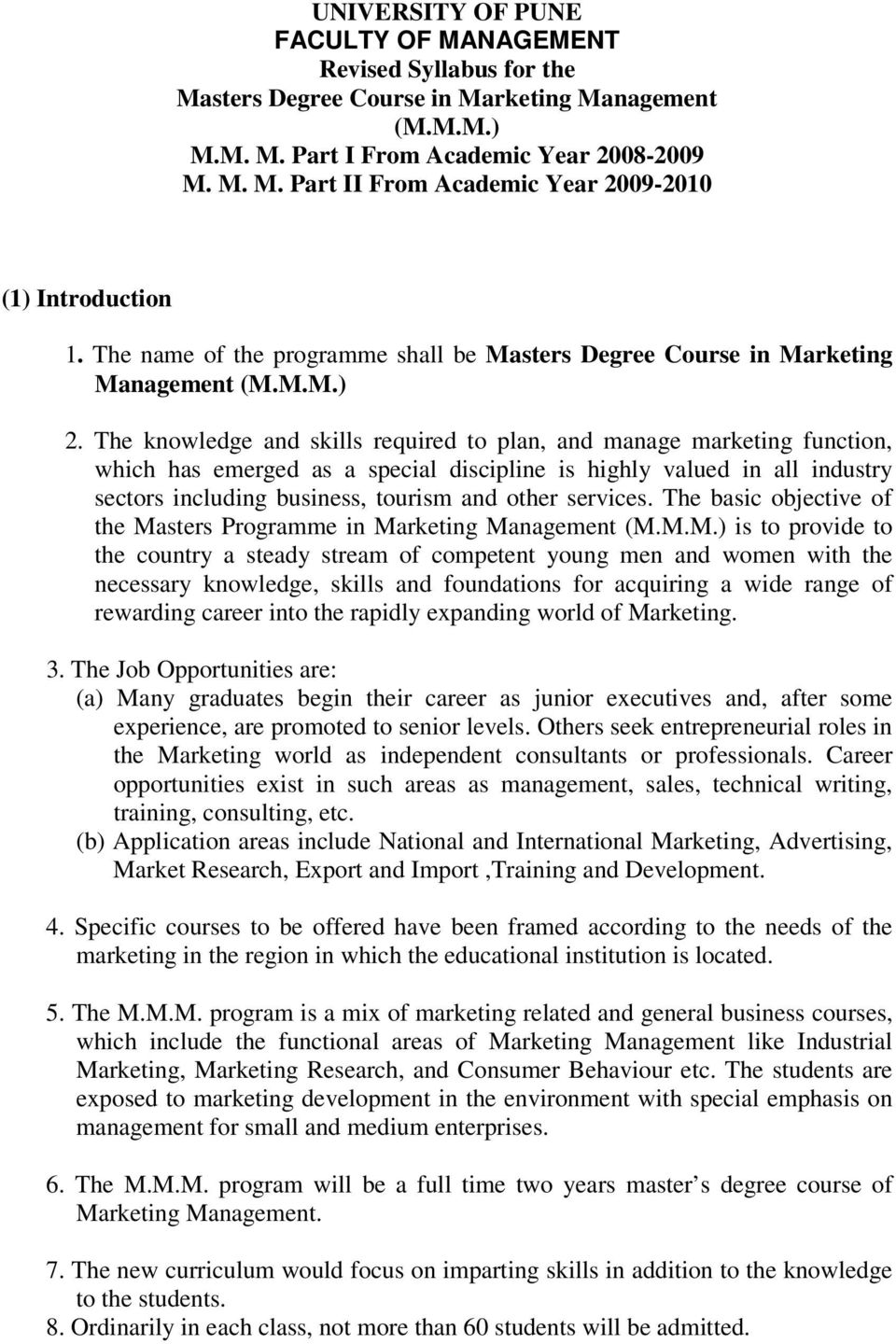
1. The name of the programme shall be Masters Degree Course in Marketing Management (M.M.M.)
|
|
|
- Robert Walker
- 10 years ago
- Views:
Transcription
1 UNIVERSITY OF PUNE FACULTY OF MANAGEMENT Revised Syllabus for the Masters Degree Course in Marketing Management (M.M.M.) M.M. M. Part I From Academic Year M. M. M. Part II From Academic Year (1) Introduction 1. The name of the programme shall be Masters Degree Course in Marketing Management (M.M.M.) 2. The knowledge and skills required to plan, and manage marketing function, which has emerged as a special discipline is highly valued in all industry sectors including business, tourism and other services. The basic objective of the Masters Programme in Marketing Management (M.M.M.) is to provide to the country a steady stream of competent young men and women with the necessary knowledge, skills and foundations for acquiring a wide range of rewarding career into the rapidly expanding world of Marketing. 3. The Job Opportunities are: (a) Many graduates begin their career as junior executives and, after some experience, are promoted to senior levels. Others seek entrepreneurial roles in the Marketing world as independent consultants or professionals. Career opportunities exist in such areas as management, sales, technical writing, training, consulting, etc. (b) Application areas include National and International Marketing, Advertising, Market Research, Export and Import,Training and Development. 4. Specific courses to be offered have been framed according to the needs of the marketing in the region in which the educational institution is located. 5. The M.M.M. program is a mix of marketing related and general business courses, which include the functional areas of Marketing Management like Industrial Marketing, Marketing Research, and Consumer Behaviour etc. The students are exposed to marketing development in the environment with special emphasis on management for small and medium enterprises. 6. The M.M.M. program will be a full time two years master s degree course of Marketing Management. 7. The new curriculum would focus on imparting skills in addition to the knowledge to the students. 8. Ordinarily in each class, not more than 60 students will be admitted.
2 2 (II) Eligibility for Admission Graduates of any faculty from any statutory University shall be eligible for admission to the M.M.M. course. (III) (IV) Number of Lectures and Practicals: Lectures and Practicals should be conducted as per the scheme of lectures and practicals. Practical Training and Project Work: At the end of the second semester of study, a student will be examined in the Project Work. (a) Project work may be done individually or in groups in case of bigger projects. However, if project is done in groups, each student must be given a responsibility for a distinct topic and care should be taken to see that progress of individual topic is independent of others. (b) Students should take guidance from an internal guide and prepare a Project report on Project Work in 2 copies to be submitted to the Director of the Institute by 30 th September of the academic year. Every student should also submit at least 3 typed copies of their project synopsis to the Institute. (c) The project should be of maximum 8,000 words. The annexure graphs, tables etc. shall not be considered for calculation of words. (d) The Project Synopsis should contain an Introduction to the project, which should clearly explain the project scope and reason for selecting the subject/ topic in detail. Also, objectives, methodology should be enclosed. (e) The Project Work should be of such a nature that it could prove useful or relevant from the marketing management angle. (f) The Project Work will be duly assessed by the internal guide of the subject and marks will be communicated by the Director to the University after receiving the seat numbers from the University along with the marks of the internal credit for theory and practical to be communicated for all other courses. (g) The project work will carry 100 marks, out of which 30 marks will be for internal assessment and 70 marks for external viva. The external viva shall be conducted by minimum two external examiners. (h) Project Work can be carried out in the Institute or outside with prior permission of the Institute (V) Assessment: 1. The final total assessment of the candidates is made in terms of an Internal assessment and an external assessment for each course. a. For each paper, 30% marks will be based on internal assessment and 70% marks for semester end examination (external assessment), unless otherwise stated. b. The division of the 30% marks allotted to internal assessment of theory papers is on the basis of tutorial work and written test of 15 marks, seminars and presentations 10 marks and attendance 5 marks. c. The internal marks will be communicated to the University at the end of each semester, but before end of the semester examinations. These marks will be considered for the declaration of the results. (VI) Examination: Examinations shall be conducted at the end of each semester i.e. during December and in May.

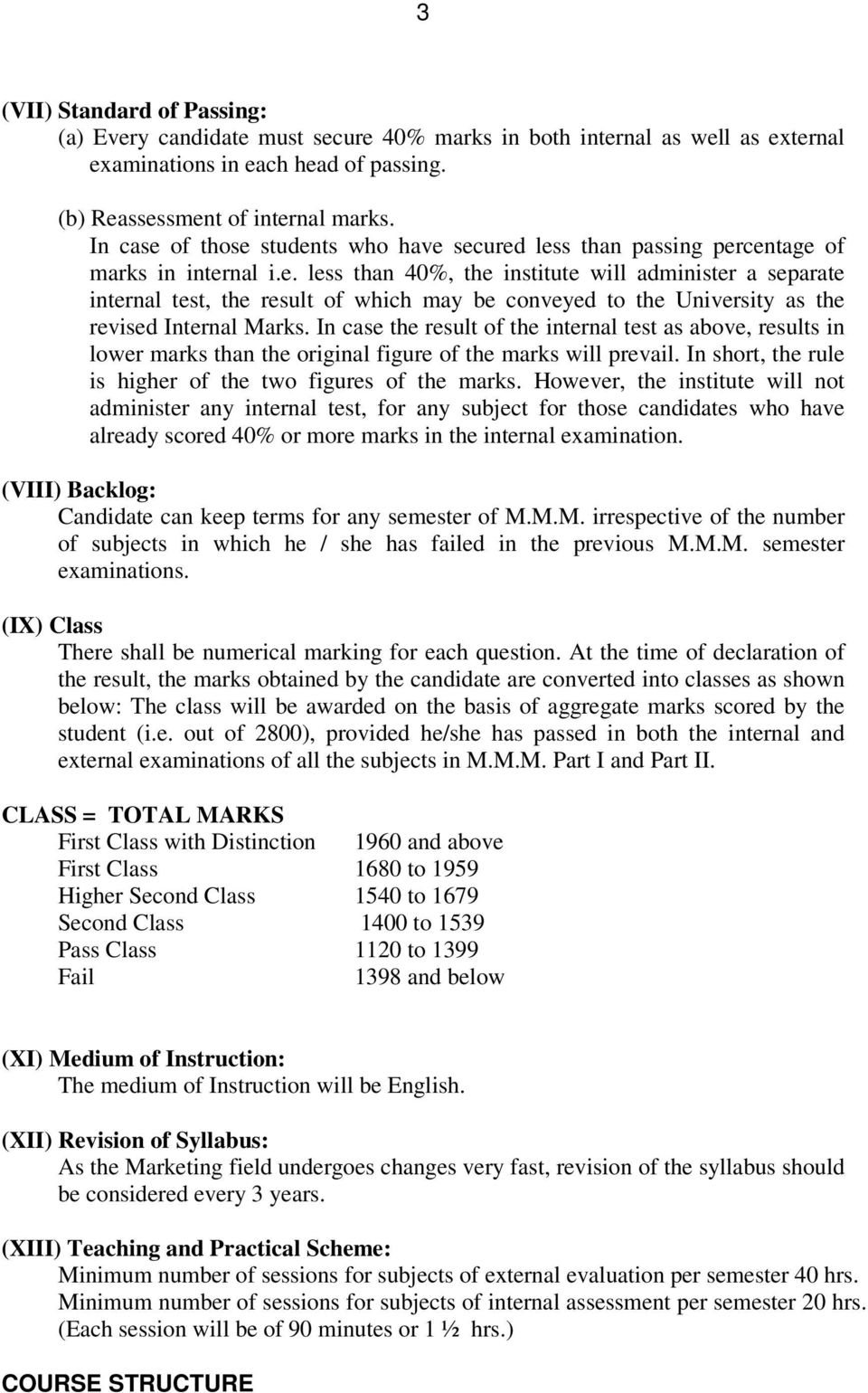
3 3 (VII) Standard of Passing: (a) Every candidate must secure 40% marks in both internal as well as external examinations in each head of passing. (b) Reassessment of internal marks. In case of those students who have secured less than passing percentage of marks in internal i.e. less than 40%, the institute will administer a separate internal test, the result of which may be conveyed to the University as the revised Internal Marks. In case the result of the internal test as above, results in lower marks than the original figure of the marks will prevail. In short, the rule is higher of the two figures of the marks. However, the institute will not administer any internal test, for any subject for those candidates who have already scored 40% or more marks in the internal examination. (VIII) Backlog: Candidate can keep terms for any semester of M.M.M. irrespective of the number of subjects in which he / she has failed in the previous M.M.M. semester examinations. (IX) Class There shall be numerical marking for each question. At the time of declaration of the result, the marks obtained by the candidate are converted into classes as shown below: The class will be awarded on the basis of aggregate marks scored by the student (i.e. out of 2800), provided he/she has passed in both the internal and external examinations of all the subjects in M.M.M. Part I and Part II. CLASS = TOTAL MARKS First Class with Distinction 1960 and above First Class 1680 to 1959 Higher Second Class 1540 to 1679 Second Class 1400 to 1539 Pass Class 1120 to 1399 Fail 1398 and below (XI) Medium of Instruction: The medium of Instruction will be English. (XII) Revision of Syllabus: As the Marketing field undergoes changes very fast, revision of the syllabus should be considered every 3 years. (XIII) Teaching and Practical Scheme: Minimum number of sessions for subjects of external evaluation per semester 40 hrs. Minimum number of sessions for subjects of internal assessment per semester 20 hrs. (Each session will be of 90 minutes or 1 ½ hrs.) COURSE STRUCTURE
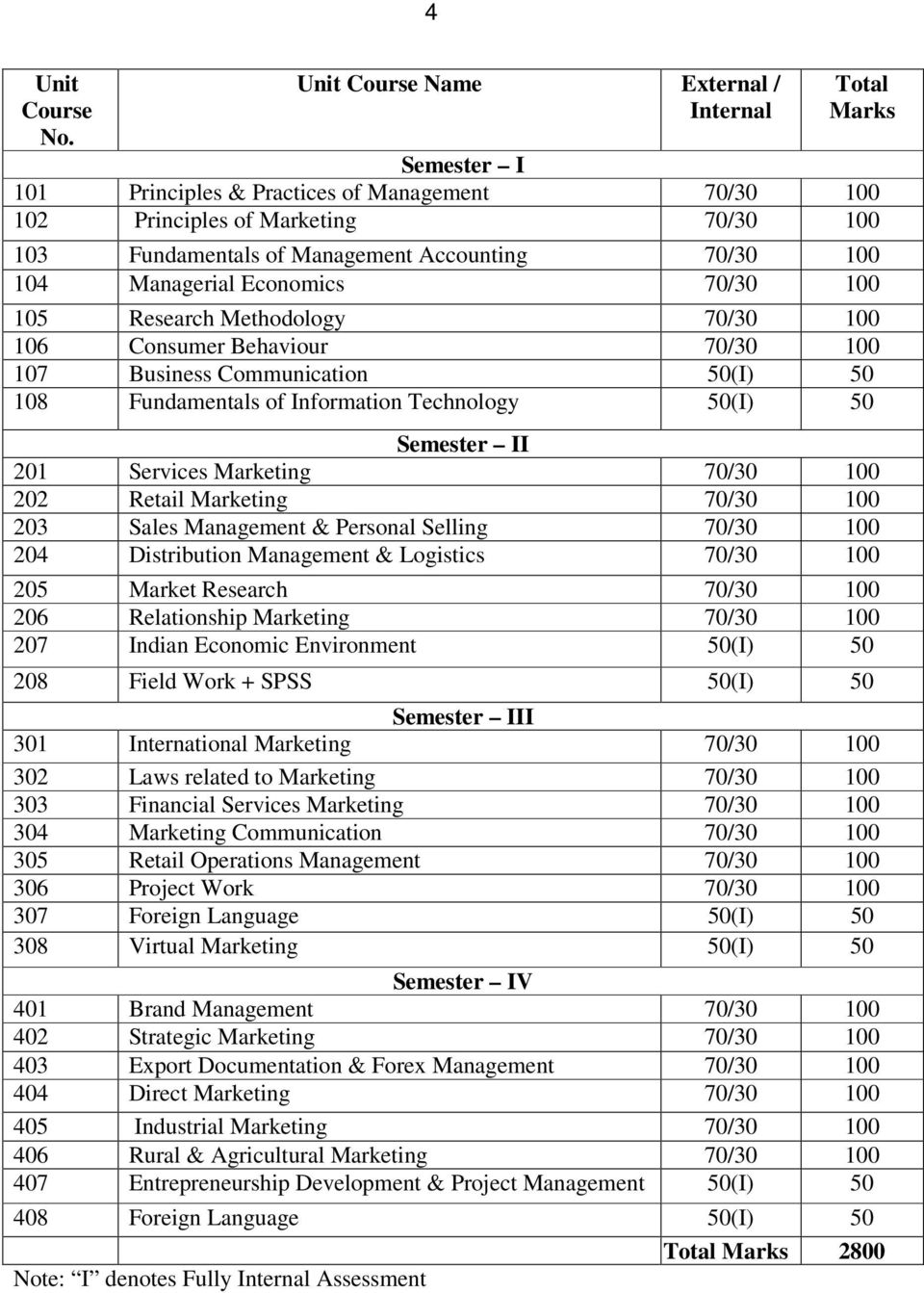
4 4 Unit Course No. Unit Course Name External / Internal Total Marks Semester I 101 Principles & Practices of Management 70/ Principles of Marketing 70/ Fundamentals of Management Accounting 70/ Managerial Economics 70/ Research Methodology 70/ Consumer Behaviour 70/ Business Communication 50(I) Fundamentals of Information Technology 50(I) 50 Semester II 201 Services Marketing 70/ Retail Marketing 70/ Sales Management & Personal Selling 70/ Distribution Management & Logistics 70/ Market Research 70/ Relationship Marketing 70/ Indian Economic Environment 50(I) Field Work + SPSS 50(I) 50 Semester III 301 International Marketing 70/ Laws related to Marketing 70/ Financial Services Marketing 70/ Marketing Communication 70/ Retail Operations Management 70/ Project Work 70/ Foreign Language 50(I) Virtual Marketing 50(I) 50 Semester IV 401 Brand Management 70/ Strategic Marketing 70/ Export Documentation & Forex Management 70/ Direct Marketing 70/ Industrial Marketing 70/ Rural & Agricultural Marketing 70/ Entrepreneurship Development & Project Management 50(I) Foreign Language 50(I) 50 Note: I denotes Fully Internal Assessment Total Marks 2800
5 5 (101) PRINCIPLES AND PRACTICES OF MANAGEMENT 1. Development of Management thought from antiquity to industrial revolution. Emergence of scientific management. Contribution of Taylor, Fayol, Weber, Bernard and Elton Mayo. Linkages between Scientific Management & Human Relations Movement. Hawthorne Experiments. 2. Overview of the process and components of management. Planning, Organizing, Directing, Staffing, Coordinating, Controlling. 3. The role of individual behaviour in organizations. Motivation and needs, Classification of motives. Contribution of Maslow, Herzberg, Alderfer, Porter and Lawler theories of motivation. 4. Foundations of Individual Behaviour. Communication and perceptions Shaping of personality. The self concept, self esteem, self efficiency. Mcgregor s Theories X & Y. 5. Leadership, Team Building & Group Dynamics. Leadership Traits. Working teams and team effectiveness. Dynamics of Group Behaviour. Influence of the group on individual and group decision making. 6. Development of management thought from industrial revolution/scientific management movement to electronic era and knowledge society of the 21 st Century. Concept of Top Management. Japanese styles of management, QCs, TQM. Knowledge workers. Corporate Social Responsibility. Reference Books 1. Principles of Management (McGraw Hill) - Koontz & O Donnel 2. Essentials of Management (Prentice Hall of India) - Joseph I, Massie 3. The Practice of Management (Allied Publishers) - Peter F Drucker 4. Tasks, Management, Responsibility & Practice - Peter F Drucker 5. Management (Prentice Hall of India) - Stoner, James AF 6. Organizational Behaviour (McGraw Hill 10th Ed) - Fred Luthans 7. Human Behaviour at Work (Tata McGraw Hill-7th Ed)- Keith Davis 8. Organizational Behaviour - Robins SP 9. Psychological Dimensions of Organizational Behaviour- Staw BM 10. Human Relations & Organizational Behaviour - R.S. Dwivedi 11. Management-global perspective -Heinz Weirich, Harold koontz

6 6 12. Principles of Management 3rd Edition P.C.Tripathi,P.N.Reddy 13. Essentials of Management-Harold Koontz,Heinz Weihrich 7th Edition 14. Principles of Management-T.Ramaswamy ( 102 ) PRINCIPLES OF MARKETING 1. Marketing Concepts Approaches to Marketing Core concepts of marketing - Marketing Process Functions of Marketing 2. Marketing Environment The changing marketing environment Analyzing needs and trends in Macro Environment and Micro Environment 3. Market Segmentation Bases for market segmentation of consumer goods, industrial goods and services Market Targeting and positioning strategies 4. New Product Decision Process Types of new products Test Marketing of a new product, Packaging Purpose, Types and New Trends in packaging 5. Marketing Mix Four P s Its significance in the competitive environment Product and Product Line Product Mix Product Life Cycle Managing the product in Product Life Cycle 6. Physical Distribution Importance and role of distribution in marketing Introduction to the various channels of distribution Promotion Tools Sales Promotion, Advertising, Personal Selling, Direct Marketing and Online Marketing as promotion tools 7. Pricing importance methods objectives factors 8. Market Evaluation and Controls Types, processes, obstacles to marketing control Marketing Audit Marketing Ethics Books Recommended 1. Marketing Special Indian Edition- Dhruv Grewal, Michael Levy 2. Marketing - Stanton,,Michael Etzel,Walker(Tata ) 3. Marketing Management - V.S.Ramaswamy and S.Namakumari 4. Principles of Marketing 9th Edition - Philip Kotler and Gary Armstrong 5. Marketing - Bovee and John Thill 6. Marketing Models - Lilien & Kotler & Moorthy 7. Case Studies in Marketing Indian context - R.Srinivas 8. Marketing Management Text And Cases in Indian Context-Dr.K.Karunakaran 9. Marketing Management Text and Cases-Biplab Bose 10. Marketing Management -S.A. Sherlekar13th Edition 11. Product Management S.A.Chunawala 12. Marketing Management - Philip Kotler

7 7 (103)FUNDAMENTALS OF MANAGEMENT ACCOUNTING 1. Cost Accounting Relationship with Financial Accounting -Cost Concept & Classification -Basic Terms: Revenue, Expense, Cost, Cost Centre, Cost Unit Preparation of Cost Sheet ( 8) 2. Materials Cost Materials purchasing, receiving, storing, issuing including pricing of issues ( LIFO, FIFO, Average method) -ABC Analysis JIT (10) 3. Overheads Identifying the overheads with the cost center Allocation, Apportionment and Absorption Under Absorption and Over Absorption of Overheads (6) 4. Elementary study of the Managerial Decision Making Techniques a. Marginal Costing Break Even Analysis, Applications of Marginal Costing in decision making Key Factor considerations b.budgetary Control Functional Budgets Flexible Budgets Standard Costing Materials Cost, Labour Cost and Sales Variance Books Recommended 1. Introduction to Management Accounting Horngreen and Sundlem 2. Principles of Management Accounting Manmohan & Goyal 3. Cost and Management Accounting S.M.Inamdar 4. Management Accounting Dr. Mahesh Kulkarni 5. Cost Accounting - Khan & Jain 6. Management Accounting 3rd Ed. - Khan & Jain 7. Theory & Problems in Management & Cost Accounting - Khan & Jain 8. Cost Accounting - Jawaharlal 9. Cost accounting -B.K.Bhar (104) MANAGERIAL ECONOMICS 1. Definition, Nature and Scope of Managerial Economics, Managerial Economics and Microeconomics and Macroeconomics, Managerial Economics and decision making. (8) 2. Meaning and determinants of demand, Demand function, Law of Demand, Market Demand, Elasticity of demand, Types of elasticity, Measurement of elasticity, Significance and uses of the elasticity, Methods of demand estimation, Demand forecasting, Meaning and significance of forecasting, Methods of demand forecasting, Forecasting of an established product, Forecasting of a new product. (10) 3. Production Function, Law of Variable Proportions, Law of supply, Elasticity of supply, Measurement of elasticity, Significance and uses of the concept of elasticity. (8)

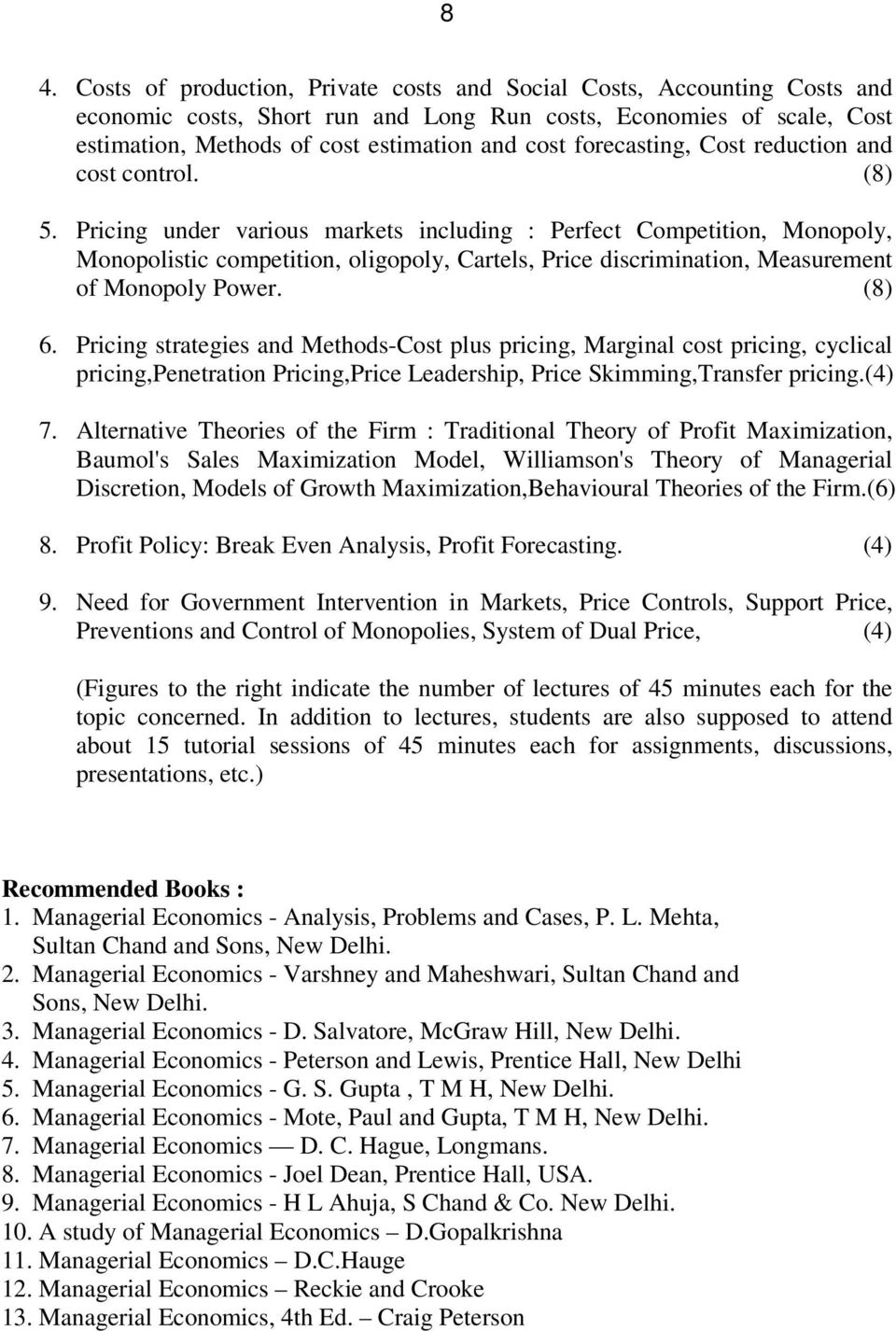
8 8 4. Costs of production, Private costs and Social Costs, Accounting Costs and economic costs, Short run and Long Run costs, Economies of scale, Cost estimation, Methods of cost estimation and cost forecasting, Cost reduction and cost control. (8) 5. Pricing under various markets including : Perfect Competition, Monopoly, Monopolistic competition, oligopoly, Cartels, Price discrimination, Measurement of Monopoly Power. (8) 6. Pricing strategies and Methods-Cost plus pricing, Marginal cost pricing, cyclical pricing,penetration Pricing,Price Leadership, Price Skimming,Transfer pricing.(4) 7. Alternative Theories of the Firm : Traditional Theory of Profit Maximization, Baumol's Sales Maximization Model, Williamson's Theory of Managerial Discretion, Models of Growth Maximization,Behavioural Theories of the Firm.(6) 8. Profit Policy: Break Even Analysis, Profit Forecasting. (4) 9. Need for Government Intervention in Markets, Price Controls, Support Price, Preventions and Control of Monopolies, System of Dual Price, (4) (Figures to the right indicate the number of lectures of 45 minutes each for the topic concerned. In addition to lectures, students are also supposed to attend about 15 tutorial sessions of 45 minutes each for assignments, discussions, presentations, etc.) Recommended Books : 1. Managerial Economics - Analysis, Problems and Cases, P. L. Mehta, Sultan Chand and Sons, New Delhi. 2. Managerial Economics - Varshney and Maheshwari, Sultan Chand and Sons, New Delhi. 3. Managerial Economics - D. Salvatore, McGraw Hill, New Delhi. 4. Managerial Economics - Peterson and Lewis, Prentice Hall, New Delhi 5. Managerial Economics - G. S. Gupta, T M H, New Delhi. 6. Managerial Economics - Mote, Paul and Gupta, T M H, New Delhi. 7. Managerial Economics D. C. Hague, Longmans. 8. Managerial Economics - Joel Dean, Prentice Hall, USA. 9. Managerial Economics - H L Ahuja, S Chand & Co. New Delhi. 10. A study of Managerial Economics D.Gopalkrishna 11. Managerial Economics D.C.Hauge 12. Managerial Economics Reckie and Crooke 13. Managerial Economics, 4th Ed. Craig Peterson
9 9 (105) RESEARCH METHODOLOGY 1. Concept of Research objectives, Motivation, Importance & types of research 2. Social research Native scope importance & limitations, functional areas of management. 3. Scientific method steps involved in a process of research. 4. Process of formulating research problem Defining problem Hypothesis formation Sources Qualities of workable hypothesis Importance of Hypothesis 5. Research Design Criteria of a good research design Types of research design 6. Sampling Meaning, Advantages, and disadvantages, Sampling Design Different types of sampling designed used for social research. 7. Measurement in research Possible sources of error in measurement, Tests of sound measurement. 8. Scaling Techniques used in social research classification of scaling- scale contraction techniques 9. Sources of data Primary data - advantages & disadvantages-sources of primary data Secondary data advantages & disadvantages- sources of secondary data. 10. Observation meaning & characteristics, types, advantages & disadvantages 11. Experimental method Definition, characteristic, and steps involved, Difficulties in experimental method, advantages & limitations. 12. Schedule & questionnaire Meaning Types of schedule Evaluation of schedule, questionnaire advantages & limitations, construction of questionnaire, layout of questionnaire, essentials of a good questionnaire, Interview meaning & role, objectives, types of interviews, the process of interviews advantages & disadvantages of interviews. 13.Interview - Meaning& role, Objectives,Types, The process, Advantages and Disadvantages 14.Processing & analysis of data procuring operations, Editing, coding, classification, tabulation, parts & types of the table, Graphics & diagrammatic

10 10 presentation of data types of diagrams Histogram, Polygon, Bar & pie charts, Pictographs. Statistical Maps 15. Report writing, Layout of report, Steps, Use of computers in research, Essential qualities of research report Recommended Books: 1. Statistical Computing S.P. Gupta 2. Mathematical Statistics S.C. Gupta & V.K. Kapoor 3. Research Methodology C.R. Kothari 4. Research Methodology Dr. V.P. Michael 5. Business statistics-leonard J.kazmier 6. Complete Business statistics-atzel (106) CONSUMER BEHAVIOUR 1. Introduction to consumer behaviour Definition of consumer behaviour applications of consumer behaviour -Consumer behaviour and marketing strategy behaviour. (1.5 hrs) 2. Consumer research-primary and secondary methods-tools used-survey, focus groups, personal interviews, projective techniques (1.5 hrs) 3. Consumer segmentation-bases of segmentation-demographic, behavioural benefit (1.5hrs) 4. Consumer modeling-economic model-psychoanalytical model sociological model- Howard Seth model-nicosia model-engel Blackwell model,vals2 Stadford model (4.5hrs) 5. External influences-culture-subculture-social class-family lifecycle stages and its Marketing implications. Influence of social class -Definition and meaning of social stratification-factors responsible for social stratification-characteristic features of social classes- social influence on consumer behaviour ( 6hrs) 6. Group Dynamics and consumer reference groups- definition and meaning of group reasons for formation of group- types of groups relevant to consumer behaviour information normative-identification-kind of influence-diffusion of innovation the diffusion process - the adoption process consumer innovativeness and personality traits. (6hrs) 7. Individual determinants-perception-factors in perception- meaning of perceptionperceptual process-factors responsible for perceptual distortion, Learning- Weber s law-classical conditioning-operant conditioning-marketing implications- Components of learning process, Personality and emotion Personality meaning and nature characteristics of personality- stages in the development of personality- personality influences and consumer behaviour
11 11 Self concept -.Attitude and behaviour- concept relationship between attitude and behaviour- factors involved in attitude formation- ( 6hrs) 8. Motivation needs - goals- dynamic characteristics of motivation consumer imagery and perceived risk, hard core behavioural perspective-social learning perspective-cognitive approach-biological approach-rational expectations psychoanalytical perspective-maslow s hierarchy of needs- Properties of motivation- Three main types of conflicts- Attitudes-definition beliefs- affectbehavioural intention-attitude changing strategies- Elaboration Likelihood model and celebrity endorsements (3hrs) 9. Self concept, situational influences and lifestyle-overview ( 3 hrs) 10. Consumer decision making process (3 hrs) 11. Consumption and post purchase behaviour: Consumer satisfaction concept, cognitive dissonance, consumer delight, Consumer Value, Consumer Value Delivery Strategies, Competitive advantage through customer value Information Customer value determination process - Measuring customer satisfaction. ( 4.5 hrs) BOOKS RECOMMENDED 1. Consumer behaviour -Schikkman Kanuk 2. Consumer market demographics in India - Edited bys.l.rao 3. Consumer behaviour -Walker 4. Understanding your customer -R.Woodruff and S.F.Gardial 5. Consumer behaviour -Davis Louden,Albert Della Bitta 6. Consumer Behaviour Hawkins, Best, Coney TMH, 9/e, Consumer Behaviour Leon Schiffman, Leslie Lazar Kanuk Pearson / PHI, 8/e 8. Consumer Behaviour In Indian Perspective Suja Nair Himalaya Publishers, Customer Behaviour A Managerial Perspective Sheth, Mittal Thomson, 10. Conceptual Issues In Consumer Behaviour Indian Context S Ramesh Kumar Pearson, 11. Cross cultural marketing Robert Rugimbana and Sonny Nwankwo 12. Customer Relationship Management Peeru Ahmed & Sagadevan Vikas Publishing 13. Consumer Behaviour - J.Paul Peter

12 12 (107)BUSINESS COMMUNICATION 1. Introduction to Communication i. Meaning and Importance of Communication. ii. Forms of Communication: Upward, downward and interactive communication in organizations, Communication networks i.e. formal or Grapevine/informal communication, interpersonal communication. iii. Types of Communication: Verbal communication (written and oral) and nonverbal communication (kinesis or body language and paralanguage). iv. Barriers in Communication. 2. Communication Skills i. Oral Presentation. ii. Written Presentation. iii. Use of Charts, Graphs etc. iv. Interview techniques. v. Effective listening skills. 3. Written Communications in Business Organisations i. Layout of a Business letter and different types of letters and letter writing ii. Different parts of a Report and Report Writing. iii. Writing s and memos. iv. Proposals. 4. Business Meetings. i. Types of Meetings. ii. Essential requirements of a meeting. iii. Writing notices for a meeting. iv. Minutes of a meeting. 5. Modern method of Communication i. Internet. ii. Audio and visual aids. iii. Teleconferencing. 6. Business Etiquettes i. Initiating Interactions ii. Dressing for Work iii. Enhancing Communication Using Non-verbal Cues iv. Business Conversation v. Managing Appointments vi. Negotiating with Customers vii. Entertaining Customers Books Recommended 1. Business Correspondence and Report Writing - R.C.Sharma 2. Business Communication - M.Balasubramanyam 3. Essentials of Business Communication - R.Pal and Kolahalli 4. Business Communication and Report Writing - Sharma, Mohan 5. Lesikar's Basic Business Communication - Lesikar 6. Business Communication by Urmila Rai & S.M. Rai

13 13 (108) FUNDAMENTALS OF INFORMATION TECHNOLOGY This paper is for internal evaluation.the objective of this subject is to give basic idea to the students about the following areas. 1. Introduction to computers-basic parts-hardware parts and its functions- Input and output devices 2. Software and Hardware-Differences Types of Software-Various application software : Word, Excel, Power point, Paint brush, General overview of these and latest application software 3. Operating systems-function, Types: Single user and Multi user-dos and Windows Operating system-how to use operating systems 4. Networking-Concept, Advantages, Disadvantages. 5. Introduction to world wide web Internet operations-online marketing- Advantages and disadvantages-problems in online transactions -Indian Scenario Reference Books. 1. Fundamentals of Information Technology: V. Rajaraman 2. Computer Studies : C.French 3. Introduction to operating system: Milan Milen Kovic 4. Introduction to computer science: ITL Solution series 5. Introduction to Networks: A. Tannenbaum 6. Introduction to Computers Peter Norton.
14 14 SEMESTER II (201) SERVICES MARKETING 1. Foundation of services marketing Introduction - The services concept- Service Industry Nature of Services, Characteristics of Services, Classification of Services Importance of Services Marketing - The Growth in Services Global & Indian Scenarios 2. Distinctive Characteristics of Services - Four I s of services - Intangibility, Inconsistency, Inseparability and Inventory 3. Services Market Segmentation Positioning and Differentiation of Services 4. Issues in Marketing of services Extended Services Marketing Mix: Going Beyond the 4 Ps. (7 Ps of Services Marketing) 5. Service Delivery Process Service Blueprints Service Mapping Managing Employees for service orientation 6. Distribution Strategies for Services Challenges in Distribution of Services 7. Personal Selling Advertising and Sales Promotion in Service Industry 8. Customer Satisfaction & Service Quality in Service Marketing Service Encounter -Role of HR & Internal Marketing - Monitoring and Measuring customer satisfaction SERVQUAL & GAP model - Handling complaints effectively - Service Failure Recovery 9. e services online Consumer Behaviour Self service technologies 10. Marketing of Social Services of Non Profit Organizations, Cases-A minimum of 5 cases encompassing the above topics to be analyzed and discussed in the class. Cases to be incorporated in the Question Paper for 20 marks. Books Recommended 1. Essence of Services Marketing Payne Adrian 2. Services Marketing: Integrating Customer Focus Across the Firm - Valarie A Zeithaml 3. Services Marketing : People, Technology & Strategy - Christopher Lovelock 4. Services Marketing Ravi Shanker 5. Strategic Services Management Boyle 6. Strategic Planning for Public Service and non profit organizations-pergamon Steps to success through service Barrier Hopsor & Mike Scallig. 8. Excellence in Services Balachandram 9. Services Marketing S M Jha 10.Services Marketing-Valarie.A.Zeithaml,Mary Jo Bitner
15 15 (202) RETAIL MARKETING 1. Retailing Definition & Importance Indian vs Global Scenario Types of Retailing Store Retailing Non Store Retailing Types of retail formats Franchising in retailing 2. Retail Marketing mix - Retail consumer buying behaviour types factors influencing - buying behaviour Segmentation positioning 3. Retail organization structure Major functional areas careers in retailing 4. Retail Location Factors affecting retail location decision Site selection Factors affecting site selection Steps in selecting site Location based retail strategies 5. Store design Interiors & exteriors - Store layout Types of layouts Factors affecting store layout Retailing image mix Store Façade 6. Retail Communication mix Sales promotion Advertising - Public relation Personal Selling Steps in planning retail communication 7. Retail Strategies Differentiation strategies Growth strategies Expansion Strategies Pricing strategies. 8. Role of IT in retailing - Electronic data exchange bar coding RFID Electronic payment systems. Cases/ Case lets to be incorporated in Question Paper Books Recommended 1. Retailing Management Swapna Pradhan 2. Retail Marketing Management Swapna Pradhan 3. Retail Management Gibson Vedamani 4. Retail Management Levy & Weitz 5. Channel Management & Retail Management Meenal Dhotre 6. Retail Marketing Management David Gilbert 7. Retail Management Ron Hasty & James Reardon 8. The Art of Retailing A.J. Lamba 9. Retail Management W. Steward 10. Retail Management Analysis, Planning & Control David Walters
16 16 ( 203 ) SALES MANAGEMENT & PERSONAL SELLING 1. Sales Management : Definition and meaning, Objectives, Sales Research, Sales Forecasting, Sales Forecasting methods, Sales Planning and control: Goal setting, Performance measurement, diagnosis and corrective actions. 2. Sales Organization : Need for Sales Organizations, their structure, Sales Managers Functions and responsibilities, Planning for major customers and sales Budget, Specific Characteristics of a successful salesman. 3. Developing the Sales Force for Industrial Customers and Consumer products : - Recruiting, Selection and Training of Sales force: Procedures and criteria extensively used as selection tools for recruiting and testing sales ability. - Areas of sales Training : Company Specific Knowledge, product knowledge Industry and Market Trend Knowledge, and Customer education. - Motivating the Sales Team : Motivation Programs - Sales Meetings, Sales Contests, Sales Compensation, ( Monetary compensation, incentive programs as motivators, Non-Monetary compensation fine tuning of compensation package, Supervising, Evaluating Sales Force Performance and Controlling Sales activities ( Sales Records and Reporting Systems ), Improving Sales Productivity Personal Selling: Basics, Salesmanship-definition- prospecting, resistance selling process and skills for effective salesmanship, Sales leads, Sales presentations, Types of calls, effective selling techniques, role of relationship marketing in personal selling, tools for personal selling, Value added selling Books Recommended 1. Building a Winning Sales Team Gini Graham & Scott 2. Sales Management Handbook Forsyth Ptrick 3. Professional Sales Management Anderson, Hair and Bush 4. Motivation and Job Satisfaction M. D. Pestonjee 5. Sales Management - Richard Rstill Edward W. Cundiff 6. Sales Management Thomos 7. International Marketing Robert Reed.. 8. Industrial Marketing Hichard M. Hill 9. Strategies for selling-gerald A.Michaelson 10. Value added selling-tom Reilly 11. Sales Management with Personal Selling Salesmanship (204) DISTRIBUTION MANAGEMENT AND LOGISTICS 1. Physical distribution - Definition, Importance participants in physical distribution process 2. Marketing Channels Definition & Importance - Different forms of channels - Functions of Marketing Channels

17 17 3. Unconventional channels - Channels for Consumer goods, Industrial Goods & Services Integrated Marketing Channels Horizontal, Vertical, Multi channel marketing Systems - International Marketing Channels 4. Supply Chain Management concept significance components Order processing Material Handling Transportation Warehousing Inventory Management Reverse Logistics 5. Wholesaling Importance & Types - Functions of Wholesaler Wholesaler Marketing Decisions Trends in Wholesaling 6. Channel Management - Channel Selection Process & criteria - Performance appraisal of Channel Members - Channel Conflicts & Techniques to resolve channel conflicts Cases/ Case lets to be incorporated in Question Paper Books Recommended 1. Channel Management Stern El Ansary 2. Distribution Management S. Eliton 3. Sales and Distribution Management S. L. Gupta 4. Channel Management & Retail Management Meenal Dhotre 5. Marketing Bovee, Thill 6. Marketing Management Philip Kotler 7. Sales And Distribution Management Text And Cases-Krishna K.Havaldar, Vasant M.Cavale ( 205 )MARKET RESEARCH 1. Introduction to Market Research Types of Research Basic & Applied, Nature, Scope, Objectives, Importance & Limitations of Market Research. 2. Sources and collection of Marketing Data. Secondary data Advantages & Limitations, Sources Govt. & Non Govt. Primary Data Advantages & Limitations, Sources, Methods of Collection Primary Data Observation, Mail, Personal Interview, Telephonic Interview, Internet Interviewing. 3. Market Research Techniques. National readership survey, Retail Store Audit, Consumer Panels, Test Marketing, Research in Advertising Decisions, Marketing Audit, Data Base Marketing, Focus Group Interviews. 4. Sampling, Questionnaire & Scaling Techniques. Probability and Non Probability Sampling, Sampling methods,sample Design. Questionnaire design and drafting. Scaling techniques like Nominal, Ordinal, Interval, Ratio, Perceptual Map, Semantic Differential, Likert, Rating & Ranking Scales.

18 18 5. Setting up & Implementation of Marketing Research Project. Steps in formulating Market Research Projects, One project for consumer durables and one for non durables to be discussed. 6. Illustrations/cases to be discussed for following topics of above mentioned chapters. Data collection methods, test marketing, focus group interviews, internet interviewing, sample design, questionnaire construction, scaling techniques. Reference Books 1. Marketing Research by Ramanuj Majumdar 2. Marketing Research by Mishra 3. Marketing Research by MV Kulkarni 4. Marketing Research by DM Sarawte. 5. Research for Marketing Decisions by Paul Green, Donald Tull. 6. Marketing Research-Rajendra Nargundkar(Tata Mc) 7. Business research Methods-Donald R.Cooper. 8. Market research-g.c.beri (206 )RELATIONSHIP MARKETING 1. Conceptual foundation of Relationship Marketing, evolution of relationship marketing, its significance in Indian context 2. Relationship marketing of Services Vs. Relationship marketing in Consumer markets 3. Buyer seller relationships. 4. Relationship marketing in Mass markets, relationship marketing and marketing strategy 5. Relationship marketing and distribution channels. 6. Role of Information Technology in building, maintaining and enhancing relationships 7. Customer profitability design and analysis Books for reference: 1. Handbook of Relationship Marketing-Jagdish Sheth,Atul Parvatiyar 2. Leading Through Relationship Marketing-Richard Batterley 3. Relationship Marketing-S.Shajahan 4. Customer relationship Management - Jagdish Seth,Atul Parvatiyar,G Shainesh

19 19 (207) INDIAN ECONOMIC ENVIRONMENT 1. Structure of the Indian Economy : Primary, Secondary and Tertiary Sectors. Changing sectoral pattern of the Indian Economy. 2. Planning in India - Achievements and Failures of Planning, Evaluation of the approach to the 11th five year plan of India. 3. Evaluation of Industrial Policy of India after 1991, Foreign Trade Policy of India. 4. Analysis of current problems like - unemployment, sickness of Industries, SEZ, Inflation, poverty, black money. 5. Critical assessment of the policy of privatization, liberalization and march towards globalization, Policy of disinvestment, Scope and appraisal of economic reforms in India. 6. Functions and working of institutions operating in money market and capital market in India. 7. Economic Legislations : a) MRTP b) FERA and FEMA c) Consumer Protection Act d) Competition Bill Recommended Books : 1. Indian Economy by Dutt and Sundharam, S Chand & Co. New Delhi 2. Indian Economy by Misra and Puri, Himalaya Publishing House, Mumbai 3. Economic Environment of Business by Misra and Puri, Himalaya Publishing House, Mumbai 4. Economic Environment of Business by M. Adhikary, Sultan Chand & Sons, New Delhi. 5. Latest references and events can be studied from journals and periodicals like Business India, Business Today, Business World, Economic Times etc. One can also refer to Economic Survey, published annually by Government of India, New Delhi. ( 208 ) FIELD WORK + SPSS The students are expected to take an on field assignment in the field of Marketing and submit the project report accordingly. The respected faculties are expected to conduct Viva on the field study conducted. The students should use statistical packages like SPSS, Mini Tab for data analysis and representation.

20 20 ( 301 )INTERNATIONAL MARKETING SEMESTER III 1. Concept of International Marketing and its scope., Objectives of International Marketing Challenges and opportunities in International Marketing Underlying forces of International Marketing, Motives behind going International 2. Global Marketing Environment Economic Environment, Socio cultural Environment, Legal and statutory framework, Need for Environmental analysis, Country Risk Analysis 3. Global Marketing Research and information System, Challenges in International Marketing, Research Process of International Marketing, Research Significance of Desk Research(Secondary Data) in International Marketing Research 4. Foreign Market Entry strategies; their merits and demerits 5. MNE and lifecycle of its products, Basic product strategies Global product designing-factors involved 6. International Pricing, Decisions and factors influencing these decisions Uniform pricing V/s Market by market pricing 7. Brief introduction to physical channels of distribution for International Markets. Difficulties in designing International Distribution channels 8. Global Advertising Issues and challenges, Merits & demerits of standardized global advertising theme, Push V/s Pull Strategies for International Markets 9. Minimum 5 case studies encompassing above listed topics to be solved in the classroom. One case study to be put as a compulsory question in the final written examination Books Recommended for International Marketing 1. International Marketing by Cateora 2. Global Marketing Management by Warren Keegan 3. Global Marketing Strategies by Jeannet 4. International Marketing Management by Subhash Jain 5. International marketing-cateora Graham(Tata ) 6. International Business Environment-Francis Cherunilam 7. Global Marketing-Foreign Entry,Local Marketing and Global Management- Johny K.Johanson

21 21 (302) LAWS RELATED TO MARKETING 1. Indian Contract Act, 1872 : Sections - 1 to 10 Ingredients of a valid contract Free consent - Sections 13 to 22 Termination of contract by performance and by legal tender or attempted performance Termination of contract by breach and its remedies Contract of agency, duties and responsibilities of Principal and agent 2. Sale of Goods Act, 1930 : Definition of Sale, Goods, Distinction between Sale and agreement to sale Distinction between condition and warranty Doctrine of Nemo dat quad Non habet, Caveat emptor and its exceptions. Rights of an unpaid seller 3. Trade Marks Act,1999 : Procedure for registration of a Trade Mark, effects of Registration ( Sections 3 to 17, 18 to 26, 28 to 32) Offences, penalties (Sections 101 to 108) 4. Consumer Protection Act, 1986 Definitions of Complainant, Complaint, Consumer, Consumer dispute Provisions regarding District Forum, State Commission, National Commission 5. Information Technology Act, Negotiable Instruments Act, Promissory Note, Bill of Exchange, Crossing of cheques, Rights of True owner, Penalties in case of dishonor of certain cheques for insufficiency of funds (Sections. 138 to 142) 7. Value Added Tax : Fundamental provisions, implications for marketing 8. Legal provisions related to the following: Copyright, patents and trademark, Labeling and packaging, food and drug adultration, vets and measures Books Recommended 1. Marketing and the laws M. A. Sujan and Haish Sujan 2. Business and Economics Laws H. K. Saharay 3. Mercantile Law N. D. Kapoor 4. Trade and Merchandise Marks Act T. R. Shriniwas 5. Elements of Mercantile Law M. C. Shukla 6. Commercial and Industrial Law Arun Kumar Sen, Jitendra Kumar Mitra
22 22 ( 303 ) FINANCIAL SERVICES MARKETING 1. Management of financial services, understanding the financial products 2. Overview of various financial services in India 3. Insurance-Meaning, advantages,various types of insurance, Financial planning process, Risk management Strategy to cover risk,introduction to IRDA, 4. Mutual funds-meaning, history and current market scenario Indian and global, Types of mutual funds, Debt funds and types of Debt schemes, Types of equity funds/growth funds, concept of hybrid funds, Mutual funds Vs. Other investments, Fund Structure, Introduction to the role and responsibility of Asset management company, Registrars, custodian, sales distribution channels. 5. Retail bank products-meaning of banking business, introduction to Various bank products Selling bank products,concept of cross selling,impact of technology on bank marketing. 6. Introduction to housing finance, Venture Capital Funds,Merchant banking, Credit cards. Books for Reference: 1. Marketing Financial services-mary Ann Pezzullo 2. Marketing of Financial services:v.a.avdhani 3. Financial services-my Khan-(TaTa) (304) MARKETING COMMUNICATION 1. Integrated Marketing Communication- Concept and the process- MarketingCommunication Mix,the value of IMC plans. 2. Relationship between Study of Consumer s Behaviour and IMC Plan 3. Sales promotion- Relationship between Sales promotion and advertising- Types and Techniques of Sales Promotion 4. Advertising- Objectives and Perspective: AIDA & DAGMAR- Classification of advertising- Functions of advertising. 5. Advertising Media- Media Types and Media mix- Media Selection, Planning and Strategy 6. Creativity in Advertising- Concept of Copy, Theme and Appeal- Copy Writing and Copy Research- Message: Design and Evaluation 7. Advertising Appropriation- Factors influencing Advertising Budget- Methods of Advertising Budgeting
23 23 8. Advertising Business- Ad agency, Types of agency- Functions and Selecting an Ad Agency- Agency-client relationship 9. Other Marketing Communication Media- Public Relations- Personal Selling- Online Marketing- Event management- Movies and Documentaries 10. Social Implications of Advertising, Moral and Ethical Issues in Advertising. Emphasis on Case Studies on Marketing Communication Mix designed by various organizations. Visit to various Advertising Agencies and understanding flow of Advertising Process. Carrying out Research Activities on Media Types, Media Planning, Media Mix. Recommended Books: 1. Integrated Advertising, Promotion and Marketing Communication- By Clow Baack 2. Foundations of Advertising: S.A.Chunawalla and Sethia 3. Advertising Management- Manendra Mohan 4. Advertising Management- Batra, Myers & Aaker 5. Advertising and Promotion: S.A.Chunawalla 6. Sales Promotion: M.N.Mishra 7. Advertising and Promotion- George Belch and Michael Belch 8. Advertising Sales and Promotion Management-S.A.Chunawala (305) RETAIL OPERATIONS MANAGEMENT 1. Retail supply management Definition & Scope Integrated supply chain planning 2. Merchandising Definition Steps in merchandise planning Merchandise hierarchy Range planning Buying process Vendor development Evaluating merchandise performance 3. Category management definition & components process manufacturer s brands Vs private label brands. 4. Store administration Floor space management Planogram Managing store inventories Quick response inventory Planning Managing displays Cashiering process Managing in store promotions and events 5. CRM in retailing process planning and implementing loyalty programs. 6. Managing retail loss and inventory shrinkage Shop lifting Employee theft. Cases/ Case lets to be incorporated in Question Paper
24 24 Books Recommended 1. Retailing Management Swapna Pradhan 2. Retail Marketing Management Swapna Pradhan 3. Retail Management Gibson Vedamani 4. Retail Management Levy & Weitz 5. Channel Management & Retail Management Meenal Dhotre 6. Retail Marketing Management David Gilbert 7. Retail Management Ron Hasty & James Reardon 8. The Art of Retailing A.J. Lamba 9. Retail Management W. Steward 10. Retail Management Analysis, Planning & Control David Walters (306) PROJECT WORK The students should submit the Project Report based upon the Summer training done by him. The institute should arrange for Project Viva and Presentation. ( 307 ) FOREIGN LANGUAGE The students are expected to learn any one of the foreign languages ( like German, French, Japanese, Chinese, Spanish ) offered at the Institute. The course syllabus should have contents like Basic reading, writing of language. It should also give contents upon the Business scenario in specific region and culture of that country. ( 308 ) VIRTUAL MARKETING 1. Role of the Internet: technological development, development of ecommerce, different commercial models, diverse roles of websites. 2. Internet strategy: virtual value chain, dis-intermediation, cybermediaries. 3. Business to Business: Intranets, and Extranets; communication, recruitment, and procurement, exchanges. 4. Consumer behaviour: flow theory; Hoffman s Many-to-Many model; Internet branding and loyalty; Internet communities; how the Internet is changing consumer behaviour. 5. Internet market research: secondary research, online focus groups, MEGS, web surveys, surveys 6. Internet retailing: reducing role of location, online shopping. 7. Internet promotion: advertising: types, measurement, effectiveness, integration; affiliation marketing, PR; word-on-line; direct marketing.
25 25 8. Website design: website design guidelines, best practice, building traffic. Convergence and future development: interactive TV, mobile Internet, PDA, groupware, SMS, interactive appliances. Suggested Books: 1. Chaffey, Mayer, Johnston, Ellis-Chadwick (2000) Internet Marketing, Prentice Hall. 2. Hagel, J and Singer M. (1999) Net Worth, McKinsey. 3. Hanson, W. (1999) Principles of Internet Marketing, International Thomson Publishing 4. Reedy, Schullo, Zimmerman, K. (2000) Electronic Marketing, Dryden. 5. Siebel, D. (1999) Futurize your Enterprise, J.Wiley. 6. esterne, J. (1999) World Wide Web Marketing, 2nd ed, John Wiley & Sons. 7. Straus, J. and Frost R. (1999) Marketing on the Internet, Prentice Hall.
26 26 SEMESTER IV (401) BRAND MANAGEMENT 1. Product Management- What is a Product- Product Personality, Types of Products- Product Line, Product Mix. 2. Product Development- What is a Product- Factors influencing design of the product- Changes affecting product management- Developing Product Strategy; Setting objectives & alternatives, Product strategy over the lifecycle, Customer analysis, Competitor analysis, Design of manufacture. 3. New product development- Product Differentiation and Positioning strategies 4. Market Potential & Sales Forecasting- Forecasting target market potential and sales- Methods of estimating market and sales potential, Sales forecasting, planning for involvement in international market. 5. Brand Management- What is a Brand- Brand Development: Extension, Rejuvenation, Re launch- Product Vs Brands, Goods and services, Retailer and distributors, People and organization, Brand challenges and opportunities, The brand equity concept, Identity and image. 6. Brand Leveraging & Brand Performance- Establishing a brand equity management system, measuring sources of brand equity and consumer mindset, Co-branding, celebrity endorsement. 7. Brand Positioning & Brand Building- Brand knowledge, Brand portfolios and market segmentation- Steps of brand building, Identifying and establishing brand positioning, Defining and establishing brand values. 8. Designing & Sustaining Branding Strategies- Brand hierarchy, Branding strategy, Brand extension and brand transfer- Managing brand over time. CASES/CASELETS TO BE INCORPORATED IN QUESTION PAPER Recommended Books: 1. Branding Concepts- Pati, Debashish 2. Brand Positioning Strategies for Competitive Advantage- Subrato Sengupta 3. The New Strategic Brand Management- Kapfere, Jean-Noel 4. Brand Management Perspectives and Practices- Das, Naveen 5. Total Brand Management: An Introduction- Chaturvedi, B.M 6. Brand Management Financial Perspectives- Ray,
27 27 (402) STRATEGIC MARKETING 1. Strategy Formulation Vision, Mission, Objectives and Goals of business and their relationship with Strategic Marketing Management. Considerations for formulation of marketing strategies for all components of Product, Price, Promotion and Distribution. 2. Strategic Marketing Management Objectives & concept of Strategic Marketing Management - Strategy Definition 3. Strategic Marketing analysis SWOT Analysis, GAP Analysis Competitive Analysis Porter s 5 forces Model of competition, BCG Matrix, GE 9 Cell Model as basic foundation of Strategic Marketing, McKinsey s 7s framework for analyzing and improving organizational effectiveness. 4. Marketing Strategy Implementation Integration of Marketing Strategies and their application to different business sectors FMCG, Industrial, & Services. Constraints in marketing strategy implementation. 5. Specific strategy initiatives New product development and introduction strategies, Planned or unplanned strategy withdrawals / obsolescence, Contingency / alternative strategic planning, Brand Strategies in FMCG markets,rural and export marketing strategies, Marketing strategies for IT and ITES industries. 6. Marketing Strategy Evaluation Marketing Audits & their scope Measurement of Marketing Performance and its feedback to next year s Marketing strategy formulation. 7. Marketing Strategy Case Studies - (One contemporary case study to be incorporated in the question paper) One case study on each of the strategy initiatives (Product, Price, Promotion and Distribution as well as People, Process & Physical Evidence) for different business sectors. Recommended Books: 1. Marketing Management: Analysis, Planning & Control: - Phillip Kotlar 2. Business Policy & Strategic Management Azar Kazmi 3. Strategic Marketing-David W.Cravens,Nigel f.piercy 4. Marketing Strategy, TMH Ed. - Boyd Walker, Mullins Larrech 5. Case Studies in Strategic Marketing Management: 6. For contemporary case studies students should refer to the periodicals and journals.
28 28 ( 403 ) EXPORT DOCUMENTATION & FOREX MANAGEMENT 1. Advantages and disadvantages of Exporting as a Market Entry strategy 2. Facilities and incentives relating to exports, Preliminaries for starting exports, Registration of exporters, sending overseas samples, appointing overseas agent 3. Arranging Finance for Exports Pre-shipment Finance, Post-shipment finance, External commercial borrowings (ECB), Exim bank finance. 4. Letter of credit (LC), Types of LC 5. Preparing Documents for Exports Document for declaration of goods under Foreign Exchange Regulations Documents for transportation of goods Documents for custom s clearance of goods Other Documents like commercial invoice, consular invoice, customs invoice, certified invoice, weight note, bill of exchange, packing list, manufacturers certificate, certificate of shipment, antiquity certificate, shipping advice etc. 6. Insuring goods against marine risks, Understanding Foreign Exchange rates and protection against their adverse movement 7. Financial and fiscal incentives provided by government and foreign exchange facilities provided by RBI and EXIM Bank 8. Institutional support from Government, semi government and autonomous organizations for exporters. Books Recommended for Export Procedures and documentation 1. Nabhi s How to Export Nabhi Publications 2. Foreign Exchange and Risk Management by C.Jeevanandam-Sultan Chand Publications 3. Export Marketing by Francis Cherrunilam 4. Essentials of Export Marketing by S.A. Chunnawals 5. Export-what,where and how by Parasram 6. International Marketing by S.S.Rathore,J.S.Rathore 7. International Trade and Export Management-Francis Cherunilam
29 29 (404)DIRECT MARKETING 1. Direct Marketing & Interactive Marketing: Direct marketing- Concept, growth & benefits, limitations variants of Direct Marketing- Main tasks lead generation, customer acquisition, development and retention. The key principles of targeting, interaction, control and continuity- Catalysts of change in modern marketing From distance selling to interactive marketing. Direct marketing in real-time interactive marketing, Direct marketing vs. marketing thru. Channels (3) 2. Traditional Methods of Direct Marketing: a) Telemarketing b) Multi Level Marketing (MLM) c) Personal Selling d) Automatic Vending Machines e) Exhibition - Trade fares f) Catalogue Marketing g) Direct Mail h) Company showrooms- factory outlets-own distribution- Increasing use of Web-based retailing (4) 3. Technology that enables Direct & Interactive Marketing: Core marketing technology components; data warehousing, business intelligence appliances, campaign management applications, sales force automation, customer interaction and contact centre applications. Customer data, different types, its value and management. Data-driven marketing planning Introduction to CRM and e-crm. The Impact of Databases - Consumer and Business Mailing Lists- Data fusion marketing research and the customer database -Setting up a customer database - structure, function, data sources, software, processors, Real-time data collection for the website. (4) 4. Integrating Direct Marketing Media: The role of brands and personalized marketing communications - Media channels in a multi media age - Building brands through response and optimizing integrated communications Differences between direct marketing media and non-direct media- Unique characteristics of addressable media (direct mail, , fax, phone, SMS) - lists, costs, duplications, privacy - Press, inserts and door-to-door - formats, costs and response. (4) 5. Technology mediated marketing channels - Interactive TV, mobile and SMS - the advance in digital marketing - Automatic vending machines- kiosk marketing (3) 6. Direct mailing- Direct response methods- Home shopping/ teleshoping network- Creating Direct Mail Advertising - Online web advertising and /permission marketing (3) 7. Data Protection and Privacy-self-regulation and codes of practice (2) Note: Cases/ Caselets to be discussed in the class & incorporated in Question Paper * Numbers in brackets indicate number of sessions of 60 minutes each.
30 30 Books Recommended: 1. Successful Direct Marketing Methods-Bob Stone and Ron Jacobs. 2. Hillstrom's Database Marketing by Kevin Hillstrom 3. The Engaged Customer-The New Rules of Internet Direct Marketing by Hans Peter Brondmo (405) INDUSTRIAL MARKETING 1. Nature of Industrial Marketing: Industrial Marketing Vs. Consumer Marketing Relational approach to Industrial Marketing- The Nature of Industrial Demand & Industrial Customer 2. Types of Industrial Products: Major Equipment; Accessory Equipment; Raw and Processed Materials; Component Parts and Sub- Assemblies; Operating Supplies; Standardized and Non-standardized parts, Industrial services 3. Factors influencing Organizational Buying: Buying Roles; Organizational Buying Decision Process; Environmental & organizational Influences 4. Organizational Influences on Buying Behaviour: Buying Roles; The Buy Grid Model; The Organizational Buying Decision Process 5. Industrial Product Decisions: Industrial Product Life Cycle Industrial Product Mix determinants viz. technology competition operating capacity shift in location of customers government controls changes in level of business activity 6. Channel Structure for Industrial Products Geographical, size, operating characteristics manufacturers and sales agents Brokers - Channel Logistics 7. Pricing for Industrial Products Pricing Objectives - Price Decision Analysis Breakeven analysis net pricing discount pricing trade discounts eographic pricing factory pricing freight allowance pricing Terms of Sale Outright purchase Hire-purchase Leasing 8. Purchasing systems Auctions-Documentation bids order placement follow up receipt and inspection 9. Promotion for Industrial products Supporting salesman Motivating distributors Stimulating primary demand Sales appeal Publicity & sponsorships Trade shows exhibits Catalogs Samples promotional letters Promotional novelties Note: Cases/ Caselets to be discussed in the class & incorporated in Question Paper
31 31 Books Recommended: 1. Industrial Marketing Hill, Alexander, Cross 2. Industrial Marketing Analysis, Planning and Control Reeder, Brierty, Reeder 3. Industrial Marketing P K Ghosh 4. Industrial Marketing Hawaldar (406) Rural and Agricultural Marketing 1. Rural marketing Features, Significance, Scope and Limitations (4) 2. Segmentation in rural marketing Classification of products and services in Rural marketing Marketing Mix for rural products (4) 3. Innovative Distribution Channels like ITC E-choupal, Godrej Adhar, HUL Shakti (4) 4. Agriculture Marketing Definition, Scope, Concept and Objectives, Differences in Agricultural and Consumer Marketing, Constraints in Agricultural marketing (4) 5. Role of Agriculture in Economic Development of India Role of Government in Agricultural Development (4) 6. Agribusiness Emerging Branches- Non Conventional forms of Agribusiness Export potential for farm products -Supporting Services (4) 7. Cooperative Marketing Concept, History, Functions Reasons for slow progress of cooperative sector (4) 8. Advantages & Limitations of Organized retailing in Agri Inputs and Outputs (2) 9. Recruitment of Human Resources in Agri marketing and new trends in Agri Marketing (2) 10. SCM In Agri Business i.e. Cold Chains, Organized procurement & warehousing (2) Note: 1. Cases/ Caselets to be incorporated in Question Paper 2. Numbers in brackets indicate number of sessions of 60 minutes each. Recommended Books 1. Agricultural Marketing in India S. S Acharya and N L Agarwal -Oxford & IBH Publishing Co Pvt Ltd Calcutta 2. Agribusiness Management in India Text & Cases - Dr. Subhash Bhave
32 32 (407 ) Entrepreneurship Development & Project Management [Marks: 80 - Total Lectures: 40 of 1.00 Hr. each] Objectives of the paper: 1. The paper would help to understand management in a holistic manner, as it would include every aspect of the business like Finance, H R, Marketing, Logistics, Organizing etc. in connection with each other. 2. Students would understand and appreciate the contribution of the entrepreneurs, those who build the economy - meet, observe, and interact with them. 3. The subject would hone the skill and spirit of entrepreneurship among the talented youth that would be of immense utility for them to take up challenges in their career as well as in personal life. 4. The student could check out their entrepreneurial attitudes that they can exploit as intrapreneurs or as entrepreneurs at the appropriate time in their life as the opportunity would arise. The syllabus: 1) The Entrepreneurship development Perspective. a. Concepts of Entrepreneurship Development Definition of Entrepreneur, Entrepreneurship, innovation, invention, creativity, Business Idea, Opportunities through change, entrepreneurship as a career, b. Theories of Entrepreneurship: i. Innovation Theory by Schumpeter & Imitating Entrepreneur Theory of Hoselitz ii. Theory of High Achievement by McClelland iii. X-Efficiency Theory by Leibenstein iv. Theory of Profit by Knight v. Theory of Social change by Everett Hagen c. Entrepreneur, Manager, Intrapreneur / Corporate Entrepreneur comparative study - Roles, Responsibilities, Career opportunities d. Traits Attributes and characteristics, skills of successful Entrepreneur e. Factors affecting Entrepreneurship Development: Social, Political, Economical, Personal f. Role of Entrepreneurs in Indian economy and in employment generation g. Entrepreneurial culture with special reference to Intrapreneurship / Corporate Entrepreneurship. 2) Creating Entrepreneurial Venture 1.1. Entrepreneurship Development Cycle 1.2. Business Planning Process Elements of Business Plan, Objectives, Market Analysis, Development of product / idea, Marketing, Finance, Organisation & Management, Ownership, Critical risk contingencies of the proposal, Scheduling and milestones.
33 33 3) Project Management 3.1. Technical, Financial, Marketing Personnel and Management feasibility Reports 3.2. Financial schemes offered by various financial institutions like Commercial Banks, IDBI, ICICI, SIDBI, SFCs, 3.3. Venture Capital Funding, Venture Capitalist 4) Entrepreneurship Development and Government 2.1. Role of Central Government and State Government in promoting Entrepreneurship with various incentives, subsidies, grants etc. with special reference to Export oriented units 2.2. Role of the following agencies in the Entrepreneurship Development 1. DIC District Industrial Center 2. SISI Small Industries Services Institute 3. EDII Entrepreneurship Development Institute of India 4. NIESBUD National Institute of Entrepreneurship and Small Business Development 5. NEDB National Entrepreneurship Development Board 5) Why do Entrepreneurs Fail elaboration on solutions for the problems. 6) Women Entrepreneurs 4.1 Reasons for Low/No Women Entrepreneurs 4.2 Role, Problems, Prospects and means to improve their prospects Note: i. Case studies of Entrepreneurs successful, failed, turnaround ventures should be discussed in the class. ii. Exercises / activities should be conducted on generating business ideas and Identifying problems and opportunities iii. Interactive sessions with Entrepreneurs, authorities of financial institutions, Government officials should be organized Changes Suggested: Books Recommended: Dynamics of Entrepreneurship Development Vasant Desai. Entrepreneurship: New Venture Creation David H. Holt Entrepreneurship Development New Venture Creation Satish Taneja, S.L.Gupta Entrepreneurship: Strategies and Resources Marc J. Dollinger Entrepreneurship Robert D. Hisrich, Michael P. Peters, Dean A. Shepherd Entrepreneurship Robert D. Hisrich, Michael P. Peters, Entrepreneurship: Education, Research and Practice A. Sahay, A. Nirjar Entrepreneurship As Strategy G. Dale Meyer, Kurt A. Heppard Entrepreneurship Development and Project Management Dr. Dilip M. Sarwate New Vistas of Entrepreneurship: Challenges & Opportunities A. Sahay, M.S.Chhikara Innovation and Entrepreneurship Peter F. Drucker Entrepreneurship and Small Business Management Siropolis Entrepreneurship Development in India Dr. C.B.Gupta, Dr. N.P.Shrinivasan
34 34 Entrepreneurship: The Social Science View Richard Swedberg The Culture of Entrepreneurship Brigitte Berger. Project management K. Nagarajan. Entrepreneurship Development - Dr. P. C. Shejwalkar The Entrepreneurial Connection - Gurmeet Naroola Thought Leaders Steven Brandt. Corporate Entrepreneurship Vijay Sathe Corporate Entrepreneurship: Entrepreneurial Development Inside Organisations Michael H.Morris, Donald F.Kuratko Intrapreneurship: Gifford Pinchot III Lead like an Entrepreneur Neal Thornberry You Too Can Become an Entrepreneur Nalinaksha Mutsuddi Make The Move: Demystifying Entrepreneurship Ishan Gupta, Rajat Khare Suggested Schedule for Marks Topic Periods Marks Weightage 1. The Entrepreneurship development Perspective Creating Entrepreneurial Venture Project Management Entrepreneurship Development and Government Why do Entrepreneurs Fail elaboration on 3 15 solutions for the problems. 6. Women Entrepreneurs 3 7. Exercises / activities 8 8. Total 40 80
Detailed Syllabus of POST GRADUATE DIPLOMA IN BUSINESS MANAGEMENT (SEMESTER SYSTEM)
 Detailed Syllabus of POST GRADUATE DIPLOMA IN BUSINESS MANAGEMENT (SEMESTER SYSTEM) 1 COURSE TITLE: POST GRADUATE DIPLOMA IN BUSINESS MANAGEMENT DURATION : 1 YEAR (Semester System) TOTAL DIPLOMA MARKS
Rural Economy - Rural - Urban disparities-policy interventions required - Rural face to Reforms. The Development exercises in the last few decades.
 MBAE 451 RURAL MARKETING Course Objectives To help the students understand and appreciate the differences and similarities between urban and rural Indian markets. To make them understand and develop marketing
MBA (Master of Business Administration) Syllabus 2011 (Term 2)
 MBA (Master of Business Administration) Syllabus 2011 (Term 2) Course Code: D M G T 4 0 4 Course Title: RESEARCH METHODOLOGY 1. An Introduction to Research: Meaning, Process, Defining, Research Problem:
DEM PRINCIPLES OF EVENT MANAGEMENT EM 011 Unit I. EVENT PLANNING & TEAM MANAGEMENT Unit I
 EVENT MANAGEMENT COURSES SYLLABUS > DEM > PGDEM > B.EM. > M.EM. Aims To give formal instructions and training to students to be future managers of the Event Industry. So that, they technical proficiency
LIST OF SUBJECTS MBA (EXECUTIVE) SEM.I 2015 1. Fundamental of Management 2. Organizational Behaviour 3. Accounting for Managers 4.
 LIST OF SUBJECTS MBA (EXECUTIVE) SEM.I 2015 1. Fundamental of Management 2. Organizational Behaviour 3. Accounting for Managers 4. Statistics for Management 5. Business Communication 6. Managerial Economics
DE 6056 DISTANCE EDUCATION. M.Com. (Marketing) DEGREE EXAMINATION, MAY 2013. MANAGEMENT CONCEPTS. (2005 and 2006 Batch) SECTION A (5 8 = 40 marks)
 Ws 17 DE 6056 11 DISTANCE EDUCATION M.Com. (Marketing) DEGREE EXAMINATION, MAY 2013. MANAGEMENT CONCEPTS (2005 and 2006 Batch) Time : Three hours Maximum : 100 marks SECTION A (5 8 = 40 marks) Answer any
LIST OF SUBJECTS MBA (EXECUTIVE) SEM.I 2011-13 1. Fundamental of Management 2. Organizational Behaviour 3. Accounting for Managers 4.
 LIST OF SUBJECTS MBA (EXECUTIVE) SEM.I 2011-13 1. Fundamental of Management 2. Organizational Behaviour 3. Accounting for Managers 4. Statistics for Management 5. Business Communication 6. Managerial Economics
Detailed Syllabus of POST GRADUATE DIPLOMA IN RETAIL MANAGEMENT (SEMESTER SYSTEM)
 Detailed Syllabus of POST GRADUATE DIPLOMA IN RETAIL MANAGEMENT (SEMESTER SYSTEM) 1 COURSE TITLE: POST GRADUATE DIPLOMA IN RETAIL MANAGEMENT DURATION : 1 YEAR (Semester System) TOTAL DIPLOMA MARKS : 900
Marketing (Marketing Principles)
 Marketing (Marketing Principles) Main Aim(s) of the Unit: To provide students with a foundation for the analysis of marketing within organizations including decision making processes, segmentation, the
Post Graduate Diploma in Human Resource and Management
 Post Graduate Diploma in Human Resource and Management Rationale The role of Human Resource has changed greatly since medieval times when the major motivational factions were basic human necessities and
Business Subject Matter Requirements. Part I: Content Domains for Subject Matter Understanding and Skill in Business
 Business Subject Matter Requirements Part I: Content Domains for Subject Matter Understanding and Skill in Business Domain 1. Business Management Candidates demonstrate an understanding of the purpose
MANAGEMENT STUDIES (MBA) DETAILED SYLLABUS FOR PART A & B PART A GENERAL PAPER ON TEACHING AND RESEARCH APTITUDE
 MANAGEMENT STUDIES (MBA) DETAILED SYLLABUS FOR PART A & B PART A GENERAL PAPER ON TEACHING AND RESEARCH APTITUDE PART-B I - Managerial Economics Nature and scope of Managerial Economics. Importance of
MARKETING. Division of Marks. Ext. Int. Total. MM-301 Advertising Management 70 30 100 3Hrs. MM-302 Sales Management 70 30 100 3Hrs.
 MARKETING Course Code Course Title Division of Marks Ext. Int. Total Duration Of Exams MM-301 Advertising Management 70 30 100 3Hrs. MM-302 Sales Management 70 30 100 3Hrs. MM-303 Product and Brand Management
Course Outline. BUSN 5050/1-3 Marketing Management (3,0,0)
 Course Outline Department of Marketing, International Business, Entrepreneurship School of Business and Economics BUSN 5050/1-3 Marketing Management (3,0,0) Calendar Description Students examine the key
Management and Marketing Course Descriptions
 Management and Marketing Course Descriptions Management Course Descriptions HRM 301 Human Resources Management (3-0-3) Covers all activities and processes of the human resources function that include recruitment,
IMS-D SUBJECT - SYLLABUS SUBJECT TITLE :INTERNATIONAL BUSINESS
 COURSE: BBA COURSE CODE: 301 SEMESTER: III SESSION: 2005-2006 ONWARD SUBJECT TITLE :INTERNATIONAL BUSINESS The objective is to impart knowledge and skill of analysis of operational processes of business
Level 4 Diploma in Advanced Hospitality and Tourism Management (VRQ) Qualification Syllabus
 Level 4 Diploma in Advanced Hospitality and Tourism Management (VRQ) Qualification Syllabus Contents Page 1. The Level 4 Diploma in Advanced Hospitality and Tourism Management Syllabus 4 2. Structure of
Contents. Chapter 1 Introduction to Sales Management 3-16. Chapter 2 The Sales Organization 17-40. Chapter 3 Sales Functions and Policies 41-54
 Contents Part- I: The Sales Perspective Chapter 1 Introduction to Sales Management 3-16 Chapter 2 The Sales Organization 17-40 Chapter 3 Sales Functions and Policies 41-54 Chapter 4 Personal Selling 55-80
Contents. Part- I: Introduction to Services Marketing. Chapter 1 Understanding Services 3-22. Chapter 2 The Nature of Services Marketing 23-38
 Contents Part- I: Introduction to Services Marketing Chapter 1 Understanding Services 3-22 Chapter 2 The Nature of Services Marketing 23-38 Part- II: The Customer Experience Chapter 3 Consumer Behavior
VIVEKANANDA GLOBAL UNIVERSITY
 VIVEKANANDA GLOBAL UNIVERSITY III & IV Semesters Scheme & Syllabus For BACHELOR OF BUSINESS ADMINISTRATION (BBA) 2014-2017 The Bachelor of Business Administration (BBA) is a 6 semester program. The following
INSTITUTE OF DISTANCE EDUCATION AND LEARNING (IDEAL),NMU, JALGAON
 INSTITUTE OF DISTANCE EDUCATION AND LEARNING (IDEAL),NMU, JALGAON QUESTIONS FOR ASSIGNMENTS PROGRAMME MBA -2 ND YEAR -2014-15 INSTRUCTION: All students of MBA Programme, Paper wise assignments are given
How To Learn Economics In India
 B.A. PROGRAMME DISCIPLINE COURSE ECONOMICS COURSE CONTENTS (Effective from the Academic Year 2011-2012 onwards) DEPARTMENT OF ECONOMICS UNIVERSITY OF DELHI DELHI 1 Syllabus for B.A. Programme - Economics
MASTER OF BUSINESS ADMINISTRATION (MBA) 800 Series
 MASTER OF BUSINESS ADMINISTRATION (MBA) 800 Series BBA 820: Managerial Functions Natural and scope of management of organizations operations. Systems approach to organizations. The management process planning,
Syllabus for Entrance Test for Admission to Ph.D. Course (Main Subject Commerce)
 Syllabus for Entrance Test for Admission to Ph.D. Course (Main Subject Commerce) Paper-I Subject related paper (Objective) Note: 50 objective type questions to be attempted. Each question carries two marks.
MM 301C Business Intelligence
 MM 301C Business Intelligence Course Objective : The objective of teaching this course is to enable students to integrate knowledge of various functional areas and technologies use for business integration.
1. ELIGIBILITY FOR ADMISSION TO THE COURSE Any Degree
 Annexure: 56.O SCAA : 29.02.2008 BHARATHIAR UNIVERSITY: COIMBATORE 641 046. Master of International Business [MIB] Course offered in Colleges REGULATIONS AND SYLLABUS (from the academic year 2008 2009)
MBA with specialisation in Human Resource Management - LM503
 MBA with specialisation in Human Resource Management - LM503 1. Objectives The objectives of this MBA Programme are as follows: (i) (ii) (iii) (iv) to impart professional education and training in Modern
SPECIALIZATION IN MARKETING MANAGEMENT 5.1 SALES MANAGEMENT
 81 SPECIALIZATION IN MARKETING MANAGEMENT 5.1 SALES MANAGEMENT RATIONALE L T P 4 2 - The purpose of this course is to develop understanding and skill about concepts, method and strategies of sales management.
Certificate Program in Health Care Management
 An Institution of National Importance Established by The BANARAS HINDU UNIVERSITY ACT XVI of 1915 Course Structure of Certificate Program in Health Care Management Under Career Oriented Courses of UNIVERSITY
MBA with specialisation in Marketing - LM501
 MBA with specialisation in Marketing - LM501 1. Objectives The objectives of the MBA Programme are as follows: (i) (ii) (iii) (iv) to impart professional education and training in Modern Management Techniques
P. G. Diploma in International Business (P.G.D.I.B.)
 P. G. Diploma in International Business (P.G.D.I.B.) 1 Objective: The objective of the P. G. / Diploma in International Business is to meet requirements of trained manpower in the vast field of foreign
BUSINESS STUDIES CLASS-XI
 BUSINESS STUDIES CLASS-XI PART A: FOUNDATION OF BUSINESS Unit-1: Nature and Purpose of Business (8 marks/10 periods) Concept and characteristic of business. Business profession and employment distinctive
AAA School of Advertising Part Time Bachelor of Arts in Marketing Communication
 AAA School of Advertising Part Time Bachelor of Arts in Marketing Communication 2014 CURRICULUM BA IN MARKETING COMMUNICATION DURATION: 4 YEARS COURSE STRUCTURE YEAR 1: 5 MODULES 1. Principles of Marketing
BMS - 301 : OPERATING SYSTEM & APPLICATION SOFTWARE
 BMS - 301 : OPERATING SYSTEM & APPLICATION SOFTWARE COURSE OBJECTIVES This paper would make students learn about the latest version MS Windows operating system. The application software covered under this
E. Program Outcomes Associate of Applied Business Degree in Accounting:
 E. Program Outcomes List program outcomes for each accredited program. Associate of Applied Business Degree in Accounting: G1: Students will demonstrate use of payroll procedures by: O1: Identifying various
Detailed Syllabus \\Iconsserver\projects\MaxValue-Phase2\Purchased_images PGPX IN HUMAN RESOURCE MANAGEMENT
 Detailed Syllabus \\Iconsserver\projects\MaxValue-Phase2\Purchased_images PGPX IN HUMAN RESOURCE MANAGEMENT Smart, Fun & Easy Way to Become A Complete Professional! Index Click on the subject for detailed
Diploma in Business Management
 Paper - Business Organization BLOCK- BLOCK-2 BLOCK-3 BLOCK-4 BLOCK-5 Nature and Scope of Business Forms of Business Organization I Forms of Business Organization II Business Promotion Methods of Raising
LCCI International Qualifications. Level 3 Certificate in Selling and Sales Management. Extended Syllabus. Effective from 2007
 LCCI International Qualifications Level 3 Certificate in Selling and Sales Management Extended Syllabus Effective from 2007 For further information contact us: Tel. +44 (0) 8707 202909 Email. [email protected]
Accounting. Management. Environment of Business. Business Law for Accountants. Stats Business & Econ I. Management
 Undergraduate Courses: Course # Course Title Course Description BUS201 Financial An introduction to basic accounting principles for measuring and Accounting communicating financial data about a business
TISCH CENTER B.S. IN HOTEL AND TOURISM MANAGEMENT COURSE DESCRIPTIONS 2011
 AS OF THE FALL SEMESTER UPDATED APRIL 15, MAJOR CORE Tourism Impacts and Issues TCHT1-DC 1000 A survey of the dimensions, operations, and issues of the global tourism industry. Topics covered include:
MICHIGAN TEST FOR TEACHER CERTIFICATION (MTTC) TEST OBJECTIVES FIELD 036: MARKETING EDUCATION
 MICHIGAN TEST FOR TEACHER CERTIFICATION (MTTC) TEST OBJECTIVES Subarea Marketing Foundations Marketing Functions Technology, Ethics, and Career Development Approximate Percentage of Questions on Test 40%
BSSC-3101 Functional English I BSSC-3103 Islamic Studies/Pak Studies BSSC-3103 Pakistan Studies BSSE-3102 Introduction to Psychology
 Course Description BSSC-3101 Functional English I This course provides the students Language skills for effective communication, organizational communication, the writing process, designing business documents,
BANGLADESH INSTITUTE OF MANAGEMENT 4 Sobhanbag, Mirpur Road, Dhaka-1207 SYLLABUS FOR PART-I
 BANGLADESH INSTITUTE OF MANAGEMENT SYLLABUS FOR PART-I Evaluation Criteria: Class Attendance : 10% Class Test : 20% Final Examination : 70% Name of Subject : 1. Principles of Marketing 2. Consumer Behaviour
GURU NANAK DEV ENGINEERING COLLEGE, LUDHIANA Deptt. Of Business Administration
 GURU NANAK DEV ENGINEERING COLLEGE, LUDHIANA Deptt. Of Business Administration No. MBA Date :- To Controller of Examination, MST-II Date Sheet Date Time MBA-I MBA-II 17/03/16 18/03/16 21/03/16 22/03/16
MADRAS CHRISTIAN COLLEGE (AUTONOMOUS) DEPARTMENT OF SOCIAL WORK (SFS) TAMBARAM CHENNAI 59 PHONE : 22396324
 MADRAS CHRISTIAN COLLEGE (AUTONOMOUS) DEPARTMENT OF SOCIAL WORK (SFS) TAMBARAM CHENNAI 59 PHONE : 22396324 DEPARTMENT OF SOCIAL WORK SELF FINANCED STREAM MADRAS CHRISTIAN COLLEGE (AUTONOMOUS) Course Structure
MARKETING INTERMEDIATE LEVEL
 Syllabus MARKETING INTERMEDIATE LEVEL Proposed for examinations sessions starting May 2017 INTERMEDIATE Level, Marketing, MATSEC 1 Syllabus objectives The syllabus is intended to encourage candidates to:
AICTE Guidelines for starting. Dual Degree course in Management
 All India Council for Technical Education (A Statutory body under Ministry of HRD, Govt. of India) 7th Floor, Chandralok Building, Janpath, New Delhi- 110 001 PHONE: 23724151/52/53/54/55/56/57 FAX: 011-23724183
Diploma in Business Management
 Diploma in Business Management 11101 Managerial Economics COURSE CONTENTS: SEM :- 1 Subject matter of Managerial Economics, nature of economic theory assumption and scope, importance of the study for a
Salem Community College Course Syllabus. Section I. Course Title: Principles Of Marketing. Course Code: BUS212
 Salem Community College Course Syllabus Section I Course Title: Principles Of Marketing Course Code: BUS212 Lecture Hours: 3 Lab Hours: 0 Credits: 3 Course Description: This course examines the business
1. Basics of Marketing 20% Defination, Scope of marketing. Core concept of marketing- Exchange, Transaction & Transfer.
 Veer Narmad South Gujarat University, Surat S.Y.B.Com. Marketing Paper I Semester - III ( In Force From June 2015-16) Objectives: 1. To impart to the conceptual knowledge in the area of marketing. 2. To
Sales Force Management
 Churchill/Ford/Walker's Sales Force Management Tenth Edition Mark W. Johnston Crummer Graduate School of Business Rollins College Greg W. Marshall Crummer Graduate School of Business Rollins College draw
FDU-Vancouver Bachelor of Science in Business Administration International Business Concentration Course Descriptions
 FDU-Vancouver Bachelor of Science in Business Administration International Business Concentration Course Descriptions Business Foundational Courses General Education DSCI 1234 Mathematics for Business
APPENDIX I POST GRADUATE DIPLOMA IN HUMAN RESOURCES DEVELOPMENT LAW ( PGDHRDL )
 APPENDIX I POST GRADUATE DIPLOMA IN HUMAN RESOURCES DEVELOPMENT LAW ( PGDHRDL ) Sr. No. Name of the Paper No. of Credits Max. Marks Min. Marks 1 Human Resources Development. 4 Theory 80 2. Organisational
THE OPEN UNIVERSITY OF TANZANIA FACULTY OF BUSINESS MANAGEMENT DEPARTMENT OF MARKETING AND ENTREPREURSHIP OME 321: SALES MANAGEMENT COURSE OUTLINE
 THE OPEN UNIVERSITY OF TANZANIA FACULTY OF BUSINESS MANAGEMENT DEPARTMENT OF MARKETING AND ENTREPREURSHIP OME 321: SALES MANAGEMENT COURSE OUTLINE INTRODUCTION: Sales management is a course that focuses
EMBA CURRICULUM - FIRST YEAR
 EMBA CURRICULUM - FIRST YEAR EMBA 0010 Professional Development Activities This required non-credit course is intended to provide opportunities to understand management skills and achieve a greater understanding
ONE YEAR PG DIPLOMA COURSE IN THE FACULTY OF COMMERCE
 Appendix -A COURSE AND EXAMINATION SCHEME POST GRADUATE DIPLOMA IN MARKETING MANAGEMENT (PGDMM) ONE YEAR PG DIPLOMA COURSE IN THE FACULTY OF COMMERCE Sr. No. Subject Course Scheme No.of Credits Examination
Diploma in Marketing
 INTRODUCTION TO MARKETING PRODUCT Nature, Scope and Importance of Marketing Basic Concepts Marketing Environment Market Segmentation Targeting and Positioning Product Strategy Product Innovation and Diffusion
a. Languages: English will be the primary language of the collection. b. Chronological Guidelines: Current and recent topics are of major interest.
 Georgia State University University Library Collection Development Policy Department of Marketing Purpose: To provide guidance in the selection of library materials to support the curriculum for the program
GURU NANAK DEV UNIVERSITY AMRITSAR
 Faculty of Economics & Business Syllabus For Post Graduate Diploma in Marketing Management (P.G.D.M.M.) (SEMESTER I & II) Session: 2013-14 GURU NANAK DEV UNIVERSITY AMRITSAR Note: (i) Copy rights are reserved.
Q1. Define Entrepreneurship? Explain the significance and various theories of entrepreneurship?
 ASSIGNMENT (PART I) Course: Entrepreneurship Development Code: CP-401 Q1. Define Entrepreneurship? Explain the significance and various theories of entrepreneurship? Q2. Explain the traits and types of
IFIM Business School. www.ifimbschool.com. Certificate Programme in Business Management for the Officers of Indian Armed Forces.
 IFIM Business School www.ifimbschool.com Certificate Programme in Business Management for the Officers of Indian Armed Forces Duration 24 weeks Scheduled from October 2009 About the Program: The programme
DIPLOMA IN MARKETING AND SALES MANAGEMENT I. INTRODUCTION
 DIPLOMA IN MARKETING AND SALES MANAGEMENT I. INTRODUCTION Among various functions of Management, Marketing has always offered highest job opportunities. Marketing Manager s job directly links company s
THE MBA PROGRAM CURRICULUM
 THE MBA PROGRAM CURRICULUM Module I Principles of Management Introduction to Management Management: An Overview: Definitions of Management; The Role of Management; Functions of Managers; Levels of Management;
MARKETING Grade: XII
 MARKETING Grade: XII Full Marks: 100 (80T+0P) Teaching Hours: 10 (10T+0P) I. Introduction In recent years, marketing has become essence in all the sectors of business like agriculture, industry, banking,
Master of Science in Marketing Analytics (MSMA)
 Master of Science in Marketing Analytics (MSMA) COURSE DESCRIPTION The Master of Science in Marketing Analytics program teaches students how to become more engaged with consumers, how to design and deliver
SRI VIVEKANANDA WOMENS DEGREE COLLEGE Ngo Colony, Opp. Old Sivalayam, Kadapa. (Affiliated to Y.V. University)
 BBM III YEAR 301- International Business Management Anatomy of international business environment: meaning of IB, international business environment and its economic, political, legal, social and cultural-
16- Master s Degree in Public Health and Public Health Sciences (Majoring Health Management, Planning and Policy)
 16- Master s Degree in Public Health and Public Health Sciences (Majoring Health Management, Planning and Policy) Students should fulfill a total of 38 credit hours: 1- Basic requirements: 10 credit hours.
FDU-Vancouver Bachelor of Science in Business Administration - International Business concentration Course Descriptions
 FDU-Vancouver Bachelor of Science in Business Administration - International Business concentration Course Descriptions ACCT 2021 Intro Financial Accounting An introduction to the concepts underlying an
Unit 4: Marketing Principles
 Unit 4: Marketing Principles Unit code: F/601/0556 QCF level: 4 Credit value: 15 credits Aim This unit aims to provide learners with understanding and skills relating to the fundamental concepts and principles
GENERAL MBA/EMBA SYLLABUS - CORE COURSES DESCRIPTIONS PART I
 GENERAL MBA/EMBA SYLLABUS - CORE COURSES DESCRIPTIONS Your LMS is the main source of learning, and will provide more guidance to the content of this syllabus. So you are advised to pay close attention
NPTEL http://nptel.iitm.ac.in
 NPTEL Syllabus Services Marketing - Web course COURSE OUTLINE Aim: At the end of the course the student will have an understanding of the service economy, the nature of services, assessing business opportunities,
Diploma in Management (Specialisation: Human Resource Management) - LM211
 Diploma in (Specialisation: Human Resource ) - LM211 1. Objectives This programme is designed to expose the students to the concepts which are important for a managerial career and to equip students with
MBA Financial Markets (With Dual Specialization) In collaboration with National Stock Exchange
 MBA Financial Markets (With Dual Specialization) In collaboration with National Stock Exchange Eligibility and Admission Process Details Graduate with 50% marks (45% for SC/ST) Appeared for All India entrance
PONDICHERRY UNIVERSITY LOYOLA COLLEGE TWINNING PROGRAMME
 PONDICHERRY UNIVERSITY LOYOLA COLLEGE TWINNING PROGRAMME IV SEMESTER MBA PROJECT WORK GUIDELINES (Marketing, Finance, International Business, Human Resource Management, Tourism & Retail Marketing) PROJECT
Business Management COURSE OUTLINE
 Management COURSE OUTLINE 1. Course Title: Management 2. CBEDS Title: Management 3. CBEDS Number: 4637 4. Job Titles: Bill & Account Collector Billing & Posting Clerk and Machine Operator Brokerage Clerk
SCHEME & SYLLABUS FOR PHD ENTRANCE TEST IN MANAGEMENT
 SCHEME & SYLLABUS FOR PHD ENTRANCE TEST IN MANAGEMENT There will be two papers Paper-I Objective type: 50 Marks This paper will consist of 50 objective type questions of 1 mark each related to basics of
Graduate Diploma in. Management. (Grad.Dip.Mgmt)
 cmi-ireland.com T: 01 492 7070 Graduate Diploma in Management (Grad.Dip.Mgmt) CMI Page 1 Graduate Diploma in Management About the Course CMI have teamed up with the ICM Institute of Commercial Management
GROUP 3 Individuals and Societies
 GROUP 3 Individuals and Societies BUSINESS AND MANAGEMENT Business and Management course is aimed at developing the understanding of business as a theory and developing the skills of applying the business
STUDY AND EVALUATION SCHEME FOR MBA SEMESTER IV w.e.f 2014-15. Marks L T P CT TA Total ESE Self Management 03 01-30 20 50 100 150
 STUDY AND EVALUATION SCHEME FOR MBA SEMESTER IV S.N Subject Code 01 MBA - 401-02 MBA - 402 03 MBA - 403 04 MBA - 404 05 MBA - 405 Subject Periods Evaluation Scheme Subject per week Sessional Exam Total
[email protected]
 Appendix 1: Qualifying Service Subjects Services covering the following subjects may qualify for the Voucher Scheme. SERVICES THAT ARE NOT ELIGIBLE INCLUDE Consultancy Services Staff and Industry Training.
Business Management and Leadership (MS)
 Business Management and Leadership (MS) ACADEMIC DIRECTOR: B. Loerinc Helft CUNY School of Professional Studies 101 West 31 st Street, 7 th Floor New York, NY 10001 Email Contact: B. Loerinc Helft, [email protected]
SYMBIOSIS INSTITUTE OF MANAGEMENT STUDIES MASTER OF BUSINESS ADMINISTRATION PROGRAM STRUCTURE 2015-17
 SYMBIOSIS INSTITUTE OF MANAGEMENT STUDIES MASTER OF BUSINESS ADMINISTRATION PROGRAM STRUCTURE 2015-17 1. OBJECTIVE To provide high quality management education to students through advancement of knowledge
Master of Hospital Administration (MHA) Syllabus
 Master of Hospital Administration (MHA) Syllabus Paper I Principles and Practice of Hospital Management and Administration Principles and practice of Management; Functions of Management; Management Techniques
BUSINESS ADMINISTRATION (Non-EMBA) COURSES Student Learning Outcomes 1
 BUSINESS ADMINISTRATION (Non-EMBA) COURSES Student Learning Outcomes 1 BA 100: Exploration of Business 1. Explain the culture of higher education. 2. Undertake critical examination and self-reflection
English-taught courses offered in 2015 spring term
 English-taught courses offered in 2015 spring term NO. Education Plan Academic Credits Terms for Course Academic school hours opening 1 Strategic Management 40 4 spring semester School of Management 2
Executive Master's in Business Administration Program
 Executive Master's in Business Administration Program College of Business Administration 1. Introduction \ Program Mission: The UOS EMBA program has been designed to deliver high quality management education
MASTER OF BUSINESS ADMINISTRATION (MBA - 3 YEARS)
 MASTER OF BUSINESS ADMINISTRATION (MBA - 3 YEARS) FIRST YEAR MBADL 10101 Principles & Practices of Mgt MBADL 10201 Organizational Behavior MBADL 10102 Marketing MBADL 10202 Computers in MBADL 10103 Accounting
Impact of CRM in Increasing Customer Awareness; An Empirical Study in Odisha Market
 Page31 Impact of CRM in Increasing Customer Awareness; An Empirical Study in Odisha Market ABSTRACT: Dr. Biswamohan Dash Principal, Swosti Group of Institution, Bhubaneswar, Odisha. This research study
Integrated Communication
 Integrated Communication Integrated Communication is a 15-credit mandatory module which sits within the suite of Level 4 modules. To gain the CIM Level 4 Certificate in Professional Marketing a pass in
Course No. Course Title Credits pre- req Course Description
 Course No. Course Title Credits pre- req Course Description ACG 2021 Intro to Financial Accounting 3 A study of basic financial accounting principles underlying assets, liabilities, and equities, including
Program Planning Guide Business Administration, Associate in Applied Science General Business Administration Track (A25120)
 Program Planning Guide Business Administration, Associate in Applied Science General Business Administration Track (A25120) Program Length: 5 semesters Career Pathway Options: Associate in Applied Science
BUSINESS STUDIES ADVANCED LEVEL
 BUSINESS STUDIES ADVANCED LEVEL OBJECTIVES 1. To provide a basic knowledge of the business environment and business activities in Hong Kong. 2. To develop an understanding of the integrated and changing
DE 7090 DISTANCE EDUCATION. M.Com. (Marketing) DEGREE EXAMINATION, DECEMBER 2013. MANAGEMENT CONCEPTS. SECTION A (5 8 = 40 marks)
 Ws 5 DE 7090 11 DISTANCE EDUCATION M.Com. (Marketing) DEGREE EXAMINATION, DECEMBER 2013. MANAGEMENT CONCEPTS Time : Three hours Maximum : 100 marks SECTION A (5 8 = 40 marks) Answer any FIVE questions.
REGULATIONS FOR THE DEGREE OF BACHELOR OF MANAGEMENT STUDIES (BMS)
 1417 REGULATIONS FOR THE DEGREE OF BACHELOR OF MANAGEMENT STUDIES (BMS) (See also General Regulations and Regulations for First Degree Curricula) Definition BMS 1 For the purpose of these regulations and
International Business Communications (IBC)
 International Business Communications (IBC) Follow us on facebook www.facebook/mlscollege and check our website mls-college.co.uk for up-to-date information on all our courses MLS International College,
MBA Dual Specialization - II Semester
 Faculty of Management Studies Pacific Academy of Higher Education and Research University MBA Dual Specialization - II Semester Code No. Name of Subject External Internal Marks Marks Total MBA -201 Marketing
The Plan Category. Middle East Academy For Training & Consulting. Training Plan 2016. Public Relations. Leadership and Management. Sales and Marketing
 Middle East Academy For Training & Consulting ل د للتدريب واإلستشارات Training Plan 2016 The plan contains about Eighteen specialty specialty contain all the programs listed. Each program contains three