
THE COMPELLING CASE FOR AIR DISC BRAKES IN HEAVY TRUCK BRAKING: A WHITE PAPER
|
|
|
- Rose Norton
- 10 years ago
- Views:
Transcription
1 THE COMPELLING CASE FOR AIR DISC BRAKES IN HEAVY TRUCK BRAKING: A WHITE PAPER Bendix Spicer Foundation Brake LLC 901 Cleveland Street Elyria, Ohio HEAVY TRUCK BRAKING & AIR DISC BRAKES

2 TABLE OF CONTENTS 1 : The Evolution of Air Disc Brakes : The Physics of Foundation Brakes : Types of Commercial Vehicle Foundation Brakes a. S-Cam Brakes b. Wedge Brakes c. Air Disc Brakes 4 : Current-Generation Air Disc Brakes : Addressing New Stopping Distance Requirements in the United States : The Growing Popularity of Air Disc Brakes on Today s Heavy Trucks HEAVY TRUCK BRAKING & AIR DISC BRAKES 2

3 THE EVOLUTION OF AIR DISC BRAKES While already highly utilized in Europe and in select North American applications, air disc brakes are experiencing continued growth in popularity on North American highways with commercial vehicle fleets and owner-operators. Previously considered a niche technology for bus, coach, fire trucks, and other special applications, air disc brakes are becoming increasingly sought out for over-the-road applications. The growth in this braking technology is being driven by several factors, including: the critical demand for brakes to respond to higher speeds and lower natural retardation; the increasing expectation for safety and performance; the need for reduced maintenance, longer service intervals, and longer lining life; reduced stopping distance requirements in the United States; and reliability improvements in disc brake technology. In 2010, Peterbilt Motors became the first North American heavy truck manufacturer to offer air disc brakes as standard equipment on a heavy truck. At the 2010 MidAmerica Truck Show, Peterbilt announced that the Bendix ADB22X air disc brake would become standard equipment on the steer axle of its Model 587. HEAVY TRUCK BRAKING & AIR DISC BRAKES 1 : 1 3

4 THE PHYSICS OF FOUNDATION BRAKES To have a full appreciation of the evolution of foundation brakes, we must first understand their physics. A fundamental rule of physics, the Law of Conservation of Energy, asserts that the total amount of energy in the universe remains constant over time. A corollary to this law is that energy can neither be created nor destroyed; it can only be transformed from one state to another. This fundamental rule also applies to heavy truck engines and brake systems. In the case of the diesel engine, the potential energy energy stored in a body is the diesel stored in the fuel tank. This potential energy is converted to kinetic energy energy associated with motion by the engine and drive train. While the drive train s key role is to move the vehicle, it is the primary responsibility of the braking system to bring it to a stop. Energy Equation The role of the foundation brake is to reduce the velocity of the vehicle to slow it down. The heavier the load and higher the speed, the greater the kinetic energy and, subsequently, the greater the braking demand. Kinetic energy is defined by the equation: KE = ½MV 2 In this equation, KE is kinetic energy, M is mass or load, and V is velocity or speed. When considering this equation, two things are clear: (1) the impact of vehicle weight on braking demand is significant, but linear; and (2) the impact of speed on brake demand is exponential. When factoring in the Law of Conservation of Energy, the kinetic energy of the moving vehicle must somehow be transformed as the vehicle slows and eventually stops. In the case of the braking system, this energy is transferred into work and heat. The brake systems ability to generate the required torque to slow the vehicle, and then dissipate this heat into the atmosphere, becomes the most important aspect of any vehicle braking system. HEAVY TRUCK BRAKING & AIR DISC BRAKES 2 : 1 4

5 Heat Dissipation and Thermal Capacity As the brake system converts energy into heat, two factors become important: (1) the amount of heat the system can retain commonly referred to as thermal capacity; and (2) the rate at which it releases that heat into the atmosphere, known as the heat dissipation rate. To illustrate this point, we can use the analogy of a common bathtub. Capacity Available = Proper Brake Function and Stopping Power Capacity Exceeded = Brake Fade and Reduced Stopping Power Normal Braking Brake Fade In the bathtub illustration, the amount of water the tub can hold is its capacity. In the case of the braking system, thermal capacity is largely dependent upon the size, shape, and material of the drum or rotor. Drum and rotor materials are primarily made of cast iron, an economic material that provides the needed thermal capacity. Lighterweight drum designs use less cast iron or a combination of iron and steel to achieve reduced weight. Unfortunately, this weight reduction comes at the expense of the system s thermal capacity. Continuing with the bathtub analogy, the rate at which water is added to the tub by the faucet is similar to the rate at which the braking system adds heat to its capacity as it transforms energy into heat during active braking. As the brakes are applied, the temperature increases. In this example, as water continues to fill the tub, the drain simultaneously removes water, preventing it from overflowing. In a steady-state condition, the tub must drain faster than the faucet adds water. The function of the drain is similar to the brake system s objective to dissipate heat. An example of how this analogy applies to the braking system is illustrated in sustained downhill braking. In this situation, the brakes are used constantly, adding heat to the system over a sustained period of time without the luxury of a complete cool down. Going back, once again, to the bathtub illustration, we analyze what will happen if the drain is unable to keep pace with the rate at which water is being added. In this scenario, the tub will overflow. Overflowing water means that the capacity of the system has been exceeded. This is parallel to the braking phenomena known as fade. Fade is the condition in which the thermal capacity of the braking system has been exceeded and the system operates at reduced effectiveness. HEAVY TRUCK BRAKING & AIR DISC BRAKES 2 : 2 5

6 TYPES OF COMMERCIAL VEHICLE FOUNDATION BRAKES Foundation Drum Brakes S-Cam Brakes The most common type of foundation drum brake is the S-Cam Brake, commonly referred to simply as Cam or Drum Brakes. Cam Brakes are actuated by applying input force from an air chamber or actuator. This force acts against a lever arm, which doubles as a slack adjuster to turn the camshaft. The head of the camshaft actuates both brakes shoes and resembles the letter S. It is this feature that gives the S-Cam Brake its name. Because of their simple design, relatively light weight, and economic cost, S-Cam Brakes are currently used on approximately 95 percent of all North American Class 5-8 air-braked vehicles. Since 1995, all air-brake equipped vehicles in the United States and in Canada have been required to use automatic slack adjusters, commonly referred to as ASAs or simply slack adjusters. The ASA keeps the brake in constant adjustment by advancing the camshaft forward as the friction material wears. As the slack moves to and from its reference point, it advances its position as the specified brake application stroke is exceeded. This helps the vehicle maintain a reasonable brake stroke as the brake lining wears. The ASA is integrated into the brake lever and is generally mounted toward the inboard side of the chassis, along with the air chamber and parking brake. S-Cam Automatic Slack Adjuster (ASA) Wedge Brakes Although no longer common in North American applications, the other major drum brake design is the Wedge Brake. There are two types of Wedge Brakes: Simplex (single actuation) and Duplex (dual actuation). With greater complexity, cost, and relatively high hysteresis (release responsiveness), Wedge Brakes have been relegated to specialty and niche applications where their robust sealing, compact packaging, and Simplex Wedge durability warrant the added weight and cost. Unlike the S-Cam Brake, the Wedge Brake s adjusting mechanism is incorporated into the housing of the brake itself. Duplex Wedge HEAVY TRUCK BRAKING & AIR DISC BRAKES 3 : 1 6

7 As a result of their design, all drum brakes S-Cam and Wedge incorporate a varying internal amplification, which is expressed by the brake factor C*. This parameter defines the relationship between the brake s braking (output) force and actuating (input) force. The brake factor C is determined by the friction coefficient of the friction material used and the mechanical advantage of the brake design. Because the friction coefficient, brake stroke, lining, and drum condition can all vary slightly between wheel-ends, the variation is amplified by the mechanical advantage of the brake design. This factor results in a greater sensitivity to variation in drum brakes. The heightened sensitivity can result in moderate levels of torque output variation between like brakes on either side of the axle. These phenomena coupled with its susceptibility to fade represent the general shortcomings of drum brakes. Air Disc Brakes Air Disc Brakes often referred to as ADBs or disc brakes offer an alternative to drum brake designs. When compared to drum brakes, air disc brakes have a number of advantages, including: No exaggeration of friction coefficient differences: This results in improved side-to-side consistency between left and right brakes. Reduced fade: Consistent contact between the friction surfaces remains, even with brake disc warm-up and radial expansion. High thermal load: Heat dissipation is efficient for internally vented brake discs. As such, it is possible to maintain high braking performance, even in demanding conditions. Minimal and consistent hysteresis: This is due to the high efficiency of the actuating mechanism. Servicing ease when changing brake pads: When compared to drum brakes, disc brakes require only a fraction of the service time. HEAVY TRUCK BRAKING & AIR DISC BRAKES 3 : 2 7

8 These advantages coupled with an increasing demand for higher performance, safety, and less frequent maintenance have resulted in the growing acceptance of conventional air disc brake designs. Early Air Disc Brake Designs Air disc brakes have been used on North American air-braked vehicles since the early 1980s. Early designs were actuated by either a single power screw or a wedge. Although relatively lightweight and economical, these initial designs were used primarily in heavy trucks and specialty vehicles. While greeted enthusiastically by fleets and end users that desired the improved performance and safety they could deliver, early air disc brake designs were plagued by a number of design shortcomings, as well as difficulties with maintenance and service. Early air disc brake designs featuring wedge and power screw actuation Design Shortcomings of Early Air Disc Brakes Initial air disc brakes were earmarked by a number of shortcomings in their design, including: a power screw design that had good apply but poor release characteristics (Hysteresis ~ 30 percent); slide pins that were chrome plated and unprotected, making them subject to flaking, corrosion, and seizing; pads that were attached to the brake caliper, making the caliper subject to clamp load and brake torque; a single-piston design, which did not provide uniform pad wear; and brake rotors that were undersized (typically 15 inches) and not optimally designed, increasing their potential for cracking. HEAVY TRUCK BRAKING & AIR DISC BRAKES 3 : 3 8

9 Maintenance and Service Challenges of Early Air Disc Brakes The first air disc brake designs also came with inherent maintenance and service challenges, including: designs that were not sealed, meaning they required regular lubrication; pad changes that were both time consuming and difficult, adding substantial cost to overall maintenance expense; exposed slide pins that often became corroded, causing caliper seizure and unequal inner-to-outer pad wear; and pad-to-rotor clearance that was dependent upon rotor vibration for proper return and clearance. HEAVY TRUCK BRAKING & AIR DISC BRAKES 3 : 4 9

10 CURRENT GENERATION AIR DISC BRAKES Lessons learned from prior technologies have enabled an evolution to the modern, effective designs that have overcome the shortcomings of both drum brakes and the early offerings of disc brakes. Today s air disc brake offers maximum stopping power, passenger car-like feel, longer pad life, reduced fade, and faster service time than their predecessors. To the delight of a rapidly growing customer base, the air disc brake of today is an engineering achievement. It is rapidly moving away from its roots as a brake for specialty and niche applications and emerging as a viable option for everyday use. Due to its wheel-end packaging, limited space inside the wheel, the valve stem location, and the axle and suspension system, special consideration must be given to the positioning of the air disc brake on the axle. It should be assumed that the size of the brake is Wheel-end Packaging dependent upon the wheel size. In addition, the floating caliper design dictates that the brake must move as it actuates. Understanding Air Disc Brake Operation To understand the intricate operation of the air disc brake, it is beneficial to first become familiar with the fundamentals of air disc brake actuation. HEAVY TRUCK BRAKING & AIR DISC BRAKES 4 : 1 10

11 The Actuation System First, the actuation system of today s air disc brake consists of the brake actuator (item 16, above) directly screwed to the brake, as well as the brake lever and the pressure piston both located within the brake itself. The brake lever (6) amplifies the actuating force produced by the brake actuator. The brake lever is supported by roller bearings on the brake caliper s back plate, which minimizes friction and hysteresis. Next, when pressurizing the brake actuator (16), the eccentrically supported lever (6) is actuated by the brake actuator s piston rod. The brake actuator force is amplified according to the lever multiplication in relation to the piston force. It is transmitted to the brake pad (4) via the bridge (7) and the screwed-on, threaded spindles on the piston (9). As a result of this transmission, the brake pad (4) is pressed onto the brake disc (3). Finally, the reaction force that is created at the brake caliper is transferred to the opposite brake pad (4), pressing it onto the brake disc with the same force. The brake actuation force produced by this action depends upon the brake pressure applied by the brake actuator (16), the brake actuator size, and the brake lever multiplication ratio. HEAVY TRUCK BRAKING & AIR DISC BRAKES 4 : 2 11

12 The Floating Caliper Design Air disc brake cutaway view The floating caliper air disc brake consists of two main components: the caliper (item 1, above) and the carrier (2). The brake caliper, which includes the actuating system and the adjusting mechanism, holds the brake actuator and applies the clamping force to the brake pads (4) on both sides of the brake rotor (3). The brake carrier (2) is rigidly mounted to the axle and carries the brake caliper (1), enabling the caliper to be axially displaced via the slide pins (5). The carrier holds the brake pads (4) and absorbs the circumferential load exerted by the application of the brakes, transferring this load to the axle. The reaction force resulting on the actuation side during each brake application causes the displacement of the brake caliper (1). This displacement is so significant that the air gap is overcome on the brake disc side where no brake actuation takes place. The clamping force compensates for the elastic deformations of the brake caliper (1) and brake pad (4). When the brake actuation has been completed, the brake caliper (1) returns to its initial zero-force position. HEAVY TRUCK BRAKING & AIR DISC BRAKES 4 : 3 12

13 In the event of wear, the wear adjusting system gradually moves the brake caliper (1) from its initial position so that a constant and small air gap between the brake pad (4) and the brake disc (3) is always on the side where no brake actuation takes place. The Internal, Automatic Adjuster Unlike most drum brake designs that have a separate, external automatic slack adjuster, air disc brakes are equipped with an internal, automatic, wear-adjusting system. The basic function of these adjusting mechanisms is the same as that of both the drum brake and first-generation disc brake designs: to maintain brake stroke and compensate for wear of the friction material. To comprehend this concept, it must first be understood that the amount of adjustment is independent of the brake force, but dependent upon the amount of the brake stroke or travel. Adjuster Mechanism Clearance is defined to ensure that the initial travel of the brake lever occurs at the beginning of each brake application without any unintentional adjustment. The piston stroke covered during this idle movement is described as the design clearance and is defined by geometric values in the adjuster drive mechanism. The mechanism only adjusts when its defined brake stroke has been exceeded. To guard against the tapered lining wear that plagued early air disc brake designs, modern ADBs feature dual or twin pistons, which are also referred to as tappets. To ensure even adjustment across both tappets, each is synchronized by a chain (1). The adjuster (2) is installed in the driving tappet and connected to the driven tappet by the chain (1). This guarantees the synchronization of both tappets. HEAVY TRUCK BRAKING & AIR DISC BRAKES 4 : 4 13

14 The Friction Couple: The Brake Pad & Rotor When specifying brake systems, the importance of the brake pad and rotor are often overlooked. In fact, because of this oversight, end users often select replacement parts that are not recommended by the brake manufacturer, which can lead to a variety of problems later in the vehicle cycle. The non like-for-like components they select are often attractively priced, but fail to meet the high standards set by the original equipment manufacturers of the vehicles and brakes. The resulting problems can include: noise, lack of stopping power, shorter pad life, rotor cracking, and uneven wear. To address these concerns and maintain the intended performance level of the foundation brake system, end users should always use original equipment as replacement parts. Carrier Spring Retention Bar Backing Plate Backing Plate Bonding Material Underlayer Friction Mat l Rotor Interface Illustration of Air Disc Brake Pad and Hardware The Brake Pad The brake pad s basic function is to provide the primary means of applying the friction material to the rotor, retain that material in the brake assembly (also known as controlled erosion), and provide a rigid surface (backing plate) for the tappets to apply the necessary force for the application of the friction material to the rotor. Because of the critical nature of the support the brake pad provides to braking activity, the friction material is an extremely important aspect of the brake assembly and its function. The brake pad helps ensure: HEAVY TRUCK BRAKING & AIR DISC BRAKES 4 : 5 14

15 High compressibility: Compressibility (= low E-module) results in even pressure distribution. As a result, the required working stroke of the brake actuator is increased and brake vibrations are damped. Thermal transmission: Good heat dissipation can relieve the thermal increases within the rotor, but results in high temperatures of the surrounding brake components. Thermal expansion: This defines the brake s required minimum air gap. The gap, in turn, defines the response behavior and the stroke requirement of the brake. Elastic recovery: Elasticity is required, even when pressure has been applied to the brake (e.g., parking brake) over a long period of time. An undesirable reduction of the air gap can result when the brake pads slowly return to their initial thickness (the memory effect). This reduction is caused by the activation of the adjusting mechanism during the actuation time of the brake. The Brake Rotor (Disc) Along with the brake pads (friction material), the rotor has the task of producing the braking torque necessary to slow or stop the vehicle. As discussed on page four of this paper in The Physics of Foundation Brakes, during braking, kinetic energy is transformed into work and heat. As the braking action takes place, torque is transmitted from the rotor to the hub, from the hub to the wheel, and from the wheel to the tire. Ultimately, stopping occurs where the tire and the Bendix Splined Disc Rotor road surface connect. It is important to understand that only a small amount of the heat generated during the stopping action is absorbed by the brake pads. This is advantageous to the brake system, as it helps provide protection to the brake and its internal components. The majority of the heat generated during stopping is absorbed and temporarily stored by the rotor. As illustrated in the bathtub example on page five, the rotor s capacity to absorb heat is finite. To maintain proper brake function, HEAVY TRUCK BRAKING & AIR DISC BRAKES 4 : 6 15

16 the rotor also has the task of acting as a heat exchanger, quickly dissipating the heat created when braking into the surrounding air. Solid rotors have limited heat dissipation characteristics. As a result, they are rarely used in heavy truck applications. Similar to most passenger car designs, most commercial vehicle rotors are vented. These vents create a significantly larger surface area for improved heat dissipation. In these designs, two iron braking surfaces are connected via webs, which are in the form of ribs (also referred to as veins) or nubs. Ventilation is produced when the rotor turns, venting the heat into the surrounding air. Examples of Rotor Veins and Nubs HEAVY TRUCK BRAKING & AIR DISC BRAKES 4 : 7 16

17 ADDRESSING NEW STOPPING DISTANCE REQUIREMENTS (RSD) IN THE U.S. For some time in the United States and Canada, there has been a desire to reduce the gap between the stopping capability of passenger cars and that of heavy trucks. Over the past five years, the drive to achieve such a reduction was the primary impetus for the increased focus on reduced (shorter) stopping distances. As a means to reach this goal, in the summer of 2009, the National Highway Traffic Safety Administration (NHTSA) issued new braking standards for commercial truck tractors. The organization s new reduced stopping distance (RSD) requirement is defined by a series of updates to the Federal Motor Vehicle Safety Standard (FMVSS) 121. These updates reduce the required stopping distance of tractors traveling at 60 miles per hour (MPH) from today s 355 feet to 250 feet a 30 percent reduction. The transition to the new RSD requirement will be completed in two phases from 2011 to Phase one which focuses on standard 6x4 tractors, takes effect August 1, It will address approximately 70 percent of all new heavy tractors built after that date. The remaining new truck tractor production, which includes 6x4 severe service tractors, as well as all 4x2 tractors, will take effect in August All vehicles in use before that date, including straight trucks, buses, and trailers, will be considered exempt. New Heavy Truck Tractor Stopping Rules Axle New Compliance Phase Configuration GVWR Requirement Date Phase 1 Standard 6x4 Below 59,600 lbs. 250 feet Aug 2011 Phase 2 6x4 Severe Service 59,600 70,000 lbs. 250 feet Aug x4 Severe Service Above 70,000 lbs. 310 feet Aug 2013 All 4x2 Heavy Tractors All 250 feet Aug 2013 Source U.S. Code of Federal Regulations Title 49: Transportation Section Air brake systems. HEAVY TRUCK BRAKING & AIR DISC BRAKES 5 : 1 17

18 The impact of these new requirements is significant. They will play an integral role in driving the need for larger, more powerful brakes and friction materials, particularly on the steer axles, where the typical brake sizes are considerably smaller and less powerful. It is important to understand that the launch of the new RSD rules will not require air disc brakes. Instead, the new mandate will bring larger, more powerful brakes into the forefront, making them the norm within the industry. As air disc brakes become more common, the corresponding price and weight delta, which in the past served as barriers to faster acceptance of the technology, will decrease. HEAVY TRUCK BRAKING & AIR DISC BRAKES 5 : 2 18

19 THE GROWING POPULARITY OF AIR DISC BRAKES ON TODAY S HEAVY TRUCKS End users consistently expect specific outcomes from their heavy truck braking systems. In addition to achieving shorter stopping distances, fleets and owner operators have an ongoing desire to reduce operating costs, improve braking stability and feel, and decrease fade all the benefits that air disc brakes decidedly provide. The chart below provides an overview of the features and corresponding benefits that air disc brakes offer to meet end user needs. Superior Performance Lower Maintenance Light Weight Shorter Stops Better Braking Feel Safety Longer Lining Life Sealed Design Quick Pad Changes Design Optimization Stops 42 feet shorter than today s drum brakes** from 60 MPH Stops 100 feet shorter than today s drum brakes** from 70 MPH Passenger car like feel Improved side to side brake consistency Greater braking power can result in fewer accidents Typically twice the lining life of drum brake applications Sealded design, no periodic lube required Sealed reliable, integrated automatic brake adjustment Quick change pads 15 minutes per brake (with wheels off) Weight comparable to high performance larger (16.5 ) front drum brakes Patented splined rotor design with Aluminum Hubs for optimized weight Lightwest dual piston air disc brake available **Standard drum brakes compared to all wheel disc brakes on a 6x4 Tractor, 59,470 pounds GVW, un-braked trailer With continued advancements in technology and increasing demand for improved safety and performance, the growth of air disc brakes is just beginning. Their superior performance, ease of maintenance, and lighter weight make air disc brakes a viable option for everyday applications, as well as the ideal solution for meeting new RSD requirements. HEAVY TRUCK BRAKING & AIR DISC BRAKES 6 : 1 19

20 901 Cleveland Street Elyria, Ohio BW Bendix Spicer Foundation Brake LLC 01/11 All Rights Reserved

Bendix Air Disc Brakes
 Bendix Air Disc Brakes Optimum Performance. Optimum Engineering. A i r D r u m B r a k e s A i r D i s c B r a k e s A i r B r a k e C h a m b e r s S l a c k A d j u s t e r s H y d r a u l i c s A major
THE FEDERAL REDUCED STOPPING DISTANCE MANDATE: IMPACT AND SOLUTIONS UPDATED AUGUST 2013
 THE FEDERAL REDUCED STOPPING DISTANCE MANDATE: IMPACT AND SOLUTIONS UPDATED AUGUST 2013 Bendix Spicer Foundation Brake LLC 901 Cleveland Street Elyria, Ohio 44035 1-866-610-9709 www.foundationbrakes.com
Spicer Axles and Tire Pressure Management Systems
 Spicer Axles and Tire Pressure Management Systems Spicer Fire and Rescue Vehicle Products Spicer Axle, Driveshaft, and Tire Pressure Management Systems Bendix Foundation Brake Systems Everything You Need.
Webinar Series. Committee. Disc Brake Wheels Off Inspection and Reline. Presents
 1 APTA Bus Webinar Technical Series Maintenance Committee Webinar Series Presents Disc Brake Wheels Off Inspection and Reline January 21, 2015 2 Introduction Welcome to today s webinar in which we will
DiscPlus DX195 and DX225 Air Disc Brakes
 Revised 11-04 Technical Bulletin Revised 1 Technical 11-04 Bulletin DiscPlus DX195 and DX225 Air Disc Brakes Inspection, Installation and Diagnostics Air Disc Brake Inspection Intervals and Procedures
BRAKE DRUM AND ROTOR SERVICE INFORMATION
 SERVICE INFORMATION To achieve maximum drum life and optimum performance, proper brake maintenance and brake balance are essential. Consult your truck or trailer manufacturer s maintenance manual for proper
Chapter 4 DEFENSIVE DRIVING
 Chapter 4 DEFENSIVE DRIVING Chapter 4 Table of Contents Chapter 4 DEFENSIVE DRIVING... 4-1 DEFENSIVE DRIVING... 4-3 Positioning The Bus... 4-3 When Making a Turn at an Intersection... 4-3 Making the perfect
The smart route to performance.
 M e r i t o r T r a n s i t B u s a n d C o a c h A x l e s The smart route to performance. Meritor Transit Bus and Coach Axles FH-946 The Industry s Axle Leader. With more than a century of axle-manufacturing
Automatic Transmission Basics
 Automatic Transmission Basics Lesson Objectives 1. Describe the function of the torque converter. 2. Identify the three major components of the torque converter that contribute to the multiplication of
1/29/2008 DR70. Baja Motorsports Inc. P.O. Box 61150 Phoenix, AZ 85082 Toll Free: 888-863-2252 PART NUMBERS PRICES ARE SUBJECT TO CHANGE 1 of 43
 DR70 Toll Free: 888-863-2252 PART NUMBERS PRICES ARE SUBJECT TO CHANGE 1 of 43 CYLINDER & CYLINDER HEAD 1 DR70-001 883099044472 CYLINDER 1 1 2 DR70-002 883099044489 GASKET, CYLINDER 1 1 3 DR70-003 883099044496
S-Cam Air Brakes. Braking Systems - Air. Operation
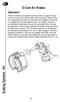 Operation S-Cam Air Brakes Trailer air brakes are operated by the tractor air supply through a series of relay and check valves. When braking is desired, the air is supplied to the axle air chamber which
Fig 1 Power Transmission system of Tractor
 POWER TRANSMISSION SYSTEM Transmission is a speed reducing mechanism, equipped with several gears (Fig. 1). It may be called a sequence of gears and shafts, through which the engine power is transmitted
How Do I Replacing My Rear Brake Pads and Rotors?
 How Do I Replacing My Rear Brake Pads and Rotors? WARNING! Always have the vehicle under inspection on level ground, in park with the emergency brake on. Always wear protective eyewear, gloves and necessary
MASTER CYLINDER. Section 2. Master Cylinder. Tandem Master Cylinder. Master Cylinder
 MASTER CYLINDER Master Cylinder The master cylinder converts the motion of the brake pedal into hydraulic pressure. It consists of the reservoir tank, which contains the brake fluid; and the piston and
(A5) Brakes Sample Questions and Answers
 (A5) Brakes Sample Questions and Answers Answers to these questions are found beginning on page 4 of this document 1. Two technicians are discussing a problem where the brake pedal travels too far before
BRAKE SYSTEMS 101. Energy Conversion Management. Presented by Paul S. Gritt
 Energy Conversion Management Presented by Paul S. Gritt Topics To Be Presented The Basic Concepts Hydraulic layouts Component functions Brake Balance Stopping Distance and Fade Formula SAE vs. Mini Baja
Chapter 18: Brakes and Clutches
 Chapter 18: Brakes and Clutches Nothing has such power to broaden the mind as the ability to investigate systematically and truly all that comes under thy observation in life. Marcus Aurelius, Roman Emperor
Suspension and Steering Systems Operation. The Steering/Suspension System (Overview)
 Suspension and Steering Systems Operation Below is an overview of the suspension and steering systems The Steering/Suspension System (Overview) "Suspension," when discussing cars, refers to the use of
Gunite Disc Brake Rotors
 Gunite Disc Brake Rotors Maintenance Manual Gunite is the industry leader in the development of brake system components for heavy-duty truck applications including air disc brake rotors. Gunite was the
US ARMY LIGHT WHEEL VEHICLE MECHANIC MOS 63B SKILL LEVEL 3 COURSE WHEELED VEHICLE BRAKING SYSTEMS SUBCOURSE NO. OD1008
 US ARMY LIGHT WHEEL VEHICLE MECHANIC MOS 63B SKILL LEVEL 3 COURSE WHEELED VEHICLE BRAKING SYSTEMS SUBCOURSE NO. OD1008 US Army Ordnance Center and School Five Credit Hours GENERAL The Wheeled Vehicle Braking
DR90. Baja Motorsports Inc. P.O. Box 61150 Phoenix, AZ 85082 Toll Free: 888-863-2252 PART NUMBERS AND PRICES ARE SUBJECT TO CHANGE 1 of 51
 DR90 Toll Free: 888-863-2252 PART NUMBERS AND PRICES ARE SUBJECT TO CHANGE 1 of 51 CYLINDER & CYLINDER HEAD Part UPC Number Description Baja Description 1 DR90-001 842645048166 CYLINDER 1 1 2 DR90-002
general, accidents caused by misjudging
 Unit 3: The Effect of Natural Forces on your Vehicle Page 1 of 11 Purpose: Acquaint the student with some of the natural forces acting on a vehicle while stopping, maneuvering, and during a crash. Explain
UNIT 1 INTRODUCTION TO AUTOMOBILE ENGINEERING
 UNIT 1 INTRODUCTION TO AUTOMOBILE ENGINEERING Introduction to Automobile Engineering Structure 1.1 Introduction Objectives 1.2 Definition 1.3 Classification of Vehicles 1.4 Layout of an Automobile Chassis
1/29/2008 DR125 / DR150. Baja Motorsports Inc. P.O. Box 61150 Phoenix, AZ 85082 Toll Free: 888-863-2252 PARTS AND PRICES ARE SUBJECT TO CHANGE 1 of 55
 DR125 / DR150 Toll Free: 888-863-2252 PARTS AND PRICES ARE SUBJECT TO CHANGE 1 of 55 CYLINDER HEAD ASSY. 1 125-001 883099006937 CYLINDER HEAD COVER 1 1 2 125-002 883099006944 BOLT M6X28 2 3 3 125-003 883099006951
Section 6 Brake Drum Failure Analysis. Brake Drum Wear Conditions. What is Normal Wear? What is Deep or Excessive Wear? WARNING. Deep, Uniform Wear
 Section Brake Drum 6 Failure Analysis WARNING To prevent serious eye injury, always wear safe eye protection when you perform vehicle maintenance or service. Figure 6.1 ASBESTOS AND NON-ASBESTOS FIBERS
DR90. Baja Motorsports Inc. P.O. Box 61150 Phoenix, AZ 85082 Toll Free: 888-863-2252 PART NUMBERS AND PRICES ARE SUBJECT TO CHANGE 1 of 51
 DR90 Toll Free: 888-863-2252 PART NUMBERS AND PRICES ARE SUBJECT TO CHANGE 1 of 51 CYLINDER & CYLINDER HEAD 1 DR90-001 842645048166 CYLINDER 1 1 2 DR90-002 842645048173 GASKET, CYLINDER 1 1 3 DR90-003
FIXED DISPLACEMENT HYDRAULIC VANE PUMPS BQ SERIES
 BQ FIXED DISPLACEMENT HYDRAULIC VANE PUMPS BQ SERIES Versatility, power, compactness and low running costs are the main characteristics of B&C vane pumps. All the components subject to wear are contained
FIXED DISPLACEMENT HYDRAULIC VANE PUMPS BQ SERIES
 BQ FIXED DISPLACEMENT HYDRAULIC VANE PUMPS BQ SERIES Versatility, power, compactness and low running costs are the main characteristics of B&C vane pumps. All the components subject to wear are contained
EVALUAT ING ACADEMIC READINESS FOR APPRENTICESHIP TRAINING Revised for ACCESS TO APPRENTICESHIP
 EVALUAT ING ACADEMIC READINESS FOR APPRENTICESHIP TRAINING for ACCESS TO APPRENTICESHIP SCIENCE SKILLS SIMPLE MACHINES & MECHANICAL ADVANTAGE AN ACADEMIC SKILLS MANUAL for The Construction Trades: Mechanical
The simulation of machine tools can be divided into two stages. In the first stage the mechanical behavior of a machine tool is simulated with FEM
 1 The simulation of machine tools can be divided into two stages. In the first stage the mechanical behavior of a machine tool is simulated with FEM tools. The approach to this simulation is different
FIXED DISPLACEMENT HYDRAULIC VANE PUMPS BQ SERIES
 BQ FIXED DISPLACEMENT HYDRAULIC VANE PUMPS BQ SERIES Versatility, power, compactness and low running costs are the main characteristics of B&C vane pumps. All the components subject to wear are contained
Wynn s Extended Care
 Wynn s Extended Care Every car deserves to receive the very best care... especially yours. How Do You Keep Your Reliable Transportation Reliable? Count on Wynn s Because Wynn s has been caring for cars
COUNTERBALANCE VALVES
 COUNTERBALANCE VALVES Introduction They are modulating valves which allow free flow into the actuator and then block the reverse flow until they feel a pilot pressure inversely proportional to the load
Eliminator Vented Disc Brake Owners Manual
 Eliminator Vented Disc Brake Owners Manual Eliminator Vented Disc Brakes Exclusive Features Whenever possible, the tendency is to use an aluminum alloy in order to reduce weight. These alloys are much
SD-23-7541. Bendix ADB 22X, ADB 225, SN6, SN7, SK7 Air Disc Brakes DESCRIPTION OPERATION. Brake Release and Adjustment
 SD-23-7541 Bendix ADB 22X, ADB 225, SN6, SN7, SK7 Air Disc Brakes DESCRIPTION Bendix Air Disc Brakes use a floating caliper design to provide foundation braking on all axles of heavy commercial vehicles,
Why Lead Screws are the Best Fit for Many Linear Motion Applications - and How to Rightly Apply Them
 Why Lead Screws are the Best Fit for Many Linear Motion Applications - and How to Rightly Apply Them Robert Lipsett, Engineering Manager, Thomson BSA Thomson Industries, Inc. San Jose, CA 800.882.8857
HYDRAULIC TABLE CART 500-LB.
 HYDRAULIC TABLE CART 500-LB. OWNER S MANUAL WARNING: Read carefully and understand all MACHINE ADJUSTMENT AND OPERATION INSTRUCTIONS before operating. Failure to follow the safety rules and other basic
Unit 24: Applications of Pneumatics and Hydraulics
 Unit 24: Applications of Pneumatics and Hydraulics Unit code: J/601/1496 QCF level: 4 Credit value: 15 OUTCOME 2 TUTORIAL 3 HYDRAULIC AND PNEUMATIC MOTORS The material needed for outcome 2 is very extensive
Unit 24: Applications of Pneumatics and Hydraulics
 Unit 24: Applications of Pneumatics and Hydraulics Unit code: J/601/1496 QCF level: 4 Credit value: 15 OUTCOME 2 TUTORIAL 2 HYDRAULIC AND PNEUMATIC CYLINDERS The material needed for outcome 2 is very extensive
SUSPENSION AND STEERING OVERVIEW
 SUSPENSION SUSPENSION AND STEERING OVERVIEW The S40/V50 has a wide track and a long wheelbase for its relative size and weight. This gives the car stable and predictable driving characteristics. It also
1993 SUSPENSION Volkswagen Front. EuroVan
 Article Text ARTICLE BEGINNING 1993 SUSPENSION Volkswagen Front EuroVan DESCRIPTION FWD independent suspension is an double-wishbone type with torsion bars mounted on upper control arm. Wheel is supported
12. REAR WHEEL/BRAKE/SUSPENSION
 12 12 12-0 SERVICE INFORMATION... 12-1 REAR BRAKE... 12-5 TROUBLESHOOTING... 12-2 REAR SHOCK ABSORBER... 12-8 REAR WHEEL... 12-3 REAR FORK... 12-9 SERVICE INFORMATION GENERAL INSTRUCTIONS When installing
Executive Report Wide Base Tires
 Summary Statement This report explores the benefits and challenges of fleet adoption regarding wide base tires. More than a couple decades ago, fleets around the world were introduced to a tire technology
1/29/2008 DR50. Baja Motorsports Inc. P.O. Box 61150 Phoenix, AZ 85082 Toll Free: 888-863-2252 PART NUMBERS PRICES ARE SUBJECT TO CHANGE 1 of 45
 DR50 Toll Free: 888-863-2252 PART NUMBERS PRICES ARE SUBJECT TO CHANGE 1 of 45 CYLINDER & CYLINDER HEAD Part UPC Number Description Baja Description 1 DR50-001 842645074424 CYLINDER 1 1 2 DR50-002 842645074431
WHAT MAKES A GOOD BRAKE DRUM
 WHAT MAKES A GOOD BRAKE DRUM There are a number of attributes that differentiate between mediocre and a good brake drum. The following highlights these and what they mean to the end user. 1. A HEAT ABSORPTION
Simple Machines. Figure 2: Basic design for a mousetrap vehicle
 Mousetrap Vehicles Figure 1: This sample mousetrap-powered vehicle has a large drive wheel and a small axle. The vehicle will move slowly and travel a long distance for each turn of the wheel. 1 People
Exam Three Momentum Concept Questions
 Exam Three Momentum Concept Questions Isolated Systems 4. A car accelerates from rest. In doing so the absolute value of the car's momentum changes by a certain amount and that of the Earth changes by:
Performance Analysis of a. for a Diesel Engine
 12 th GT-Suite User s Conference Performance Analysis of a Decompression Brake System for a Diesel Engine Ivan Miguel Trindade Vinicius J. M. Peixoto MWM International Motores November, 10th 2008 Presentation
FOR ANY QUESTIONS, PLEASE CALL US @ 727.347.9915 M-F 8:00a.m.-8:00p.m. EST. REAR BRAKES 1 AEROSPACE COMPONENTS 727.347.9915
 REAR BRAKES 1 AEROSPACE COMPONENTS 727.347.9915 REAR BRAKES Before getting started, remove all stock braking components. Pre-assembly of parts: Clean the bolts and the threads in the hat with acetone.
Suspensions AUTOMOTIVE COMFORT AND CONTROL
 1 Suspensions AUTOMOTIVE COMFORT AND CONTROL In this study unit, you ll learn about common automotive suspension systems, the components that make up these systems, and how the systems and components are
The hydraulically damped overrun control device is made up of six main elements that control and operate the braking system.
 THE OVERRUN PRINCIPLE The hydraulically damped overrun control device is made up of six main elements that control and operate the braking system. 1. The Housing 2. The Drawtube 3. The Overrun Lever of
TRAILER AXLE SPINDLE HARDWARE FRUEHAUF "PRO-PAR" AXLE AND MERITOR EARLY MODEL TP AXLE
 TRAILER AXLE SPINDLE HARDWARE FRUEHAUF "PRO-PAR" AXLE AND MERITOR EARLY MODEL TP AXLE R001561 Lockwasher 12402, 42203, 5402, 65463, E1561, L1893, L893, M1051 PIN SIZE THICK O.D. I.D. DIA. LGTH 7/32" 5-1/16"
MAXIMIZING THE OUTPUT OF YOUR BRAKES Getting Your Pedal Geometry Right
 MATCO mfg 2361 S 1560 West Woods Cross, UT 84087 801-335-0582 801-335-0581 (F) www.matcomfg.com MAXIMIZING THE OUTPUT OF YOUR BRAKES Getting Your Pedal Geometry Right Brake Specifications Energy Rating
LINEAR ACTUATORS. Linear Actuators. Linear Actuators. Linear Actuators are Actuators that creates motion in a straight line, as contrasted
 LINEAR ACTUATORS Linear Actuators Linear Actuators Linear Actuators are Actuators that creates motion in a straight line, as contrasted with circular motion of a conventional electric motor. Linear actuators
Class 5 to 7 Truck and Bus Hydraulic Brake System
 Class 5 to 7 Truck and Bus Hydraulic Brake System Diagnostic Guide 1st Edition * 5+0 Important Service tes The information in this publication was current at the time of printing. The information presented
2007 Hummer H3. 2007 BRAKES Disc Brakes - H3. Fastener Tightening Specifications Specification Application
 2007 BRAKES Disc Brakes - H3 SPECIFICATIONS FASTENER TIGHTENING SPECIFICATIONS Fastener Tightening Specifications Specification Application Metric English Backing Plate Bolts 135 N.m 100 lb ft Brake Hose
BRAKE SYSTEM DESIGN AND THEORY
 RAKE SYSTEM DESIGN AND THEORY Aircraft brake systems perform multiple functions. They must be able to hold the aircraft back at full static engine run-up, provide adequate control during ground taxi operations,
K. G. Duleep President, H-D Systems Presented at the Michelin Bibendum Berlin, May 2011
 K. G. Duleep President, H-D Systems Presented at the Michelin Bibendum Berlin, May 2011 Light-duty vehicles have received a lot of attention in the last 10 years and GHG reduction cost is understood. Only
Rear wheel brakes, servicing. Стр. 1 из 45. Note:
 Volkswagen Touareg - Rear wheel brakes, servicing Стр. 1 из 45 46-2 Rear wheel brakes, servicing Rear brakes, FN 44 brake caliper, servicing Note: After replacing brake pads, depress brake pedal firmly
Steering unit. Table of contents. Features RE 11872/05.06. Type LAGL. Frame sizes 500 to 1000 Component series 1X Maximum flow 80 l/min
 Steering unit RE 11872/05.06 /10 Type LAGL Frame sizes 500 to 1000 Component series 1X Maximum flow 80 l/min H7375 Table of contents Contents Page Features 1 Ordering code 2 Function, section 3 Device
SLACK PERFORMANCE KARTS
 SLACK PERFORMANCE KARTS SET UP GUIDE Thank you for purchasing a 2013 Slack Axiom Chassis. Performance Mfg. strives to provide you with the very best chassis and components on the market today. Your satisfaction
HAS SERIES Air Suspensions
 Superior Driver Comfort HAS SERIES Air Suspensions Greater Payloads On- and Off-Road Applications HAS Series: Choose the Right Suspension for Your Application. Hendrickson has the air suspension to fit
Name Class Date. You do twice as much work. b. You lift two identical books one meter above the ground.
 Exercises 9.1 Work (pages 145 146) 1. Circle the letter next to the correct mathematical equation for work. work = force distance work = distance force c. work = force distance d. work = force distance
Front brakes (FN- 3), servicing
 j a t Front brakes (FN- 3), servicing 46-1 Front brakes, servicing Note: Install complete repair kit. After replacing brake pads and before moving vehicle, depress brake pedal several times firmly to properly
Slide 10.1. Basic system Models
 Slide 10.1 Basic system Models Objectives: Devise Models from basic building blocks of mechanical, electrical, fluid and thermal systems Recognize analogies between mechanical, electrical, fluid and thermal
Advanced 2.7-Liter EcoBoost with Auto Start-Stop Brings New Capability and Efficiency to Next Ford F-150
 Most Capable Advanced 2.7-Liter EcoBoost with Auto Start-Stop Brings New Capability and Efficiency to Next Ford F-150 Latest EcoBoost technology in an all-new, even more efficient 2.7-liter engine that
Geometry and dimensional tolerances of engine bearings
 Geometry and dimensional tolerances of engine bearings Dr. Dmitri Kopeliovich (Research & Development Manager.) 1. Hydrodynamic lubrication Engine bearings operate mostly in the hydrodynamic regime of
E/ECE/324/Rev.1/Add.12/Rev.7/Amend.4 E/ECE/TRANS/505/Rev.1/Add.12/Rev.7/Amend.4
 6 December 2012 Agreement Concerning the adoption of uniform technical prescriptions for wheeled vehicles, equipment and parts which can be fitted and/or be used on wheeled vehicles and the conditions
Belt Drives and Chain Drives. Power Train. Power Train
 Belt Drives and Chain Drives Material comes for Mott, 2002 and Kurtz, 1999 Power Train A power train transmits power from an engine or motor to the load. Some of the most common power trains include: Flexible
2016 Price Sheet. Custom Built Replacement Chassis
 2016 Price Sheet Custom Built Replacement Chassis 5557 Chevy Car Direct Replacment Chassis 15,895 5362 Corvette Direct Replacment Chassis 15,895 5557 Chevy Car Pro Street Chassis 16,895 5362 Corvette Pro
Recommended Practice for Transit Bus In-Service Brake System Performance Testing
 Recommended Practice for Transit Bus In-Service Brake System Performance Testing Approved March 10, 2005 APTA Bus Brake Working Group Approved May 15, 2005 APTA Bus Standards Committee Abstract: This recommended
GENERAL KNOWLEDGE PRACTICE TEST
 GENERAL KNOWLEDGE PRACTICE TEST 1. Driving under the influence of any drug that makes you drive unsafely is: a. Permitted if it is prescribed by a doctor b. Against the law c. Permitted if it is a diet
KINETIC ENERGY RECOVERY SYSTEM BY MEANS OF FLYWHEEL ENERGY STORAGE
 ADVANCED ENGINEERING 3(2009)1, ISSN 1846-5900 KINETIC ENERGY RECOVERY SYSTEM BY MEANS OF FLYWHEEL ENERGY STORAGE Cibulka, J. Abstract: This paper deals with the design of Kinetic Energy Recovery Systems
CNC Vertical Machining Center Alpha-Center HD Heavy cast iron design, precise guideways, high-performance gear designed for heavy machining
 CNC Vertical Machining Center Alpha-Center HD Heavy cast iron design, precise guideways, high-performance gear designed for heavy machining Optional spindle package: 31 kw maximum power 870 Nm max. torque
BR150 Pmi Baja Reaction 150cc Go Kart (VIN PREFIX L4VM)
 Page 1 of 21 Product Information Baja Web > Product Information > Parts Lists > GOKART > BR150 Pmi Baja Reaction 150cc Go Kart (VIN PREFIX L4VM) BR150 Pmi Baja Reaction 150cc Go Kart (VIN PREFIX L4VM)
Vehicle Accident Prevention TRUCK
 Prevention TRUCK Licensing Tiller Truck Operators are not required to have a Class A license. These vehicles require the same licensing as any of our other ladder trucks or engines, Class B or BR. Class
Field Application Note
 Field Application Note Reverse Dial Indicator Alignment RDIA Mis-alignment can be the most usual cause for unacceptable operation and high vibration levels. New facilities or new equipment installations
SECTION 2B WHEEL ALIGNMENT TABLE OF CONTENTS
 SECTION 2B WHEEL ALIGNMENT TABLE OF CONTENTS Description and Operation... 2B2 Four Wheel Alignment... 2B2 Toein... 2B2 Caster... 2B2 Camber... 2B2 Diagnostic Information and Procedures... 2B3 Tire Diagnosis...
The Auto-tensioner Market and Technical Trends
 NTN TECHNICAL REVIEW No.73 2005 Technical Article The Auto-tensioner Market and Technical Trends Satoshi KITANO Tadahisa TANAKA Tomokazu NAKAGAWA Automotive engines generally use accessory drive belts,
(A4) Suspension and Steering Sample Questions and Answers
 (A4) Suspension and Steering Sample Questions and Answers Answers to these questions are found beginning on page 4 of this document 1. Two technicians are discussing the replacement of an inner tie rod
Hydraulic Hybrids from Rexroth: Hydrostatic Regenerative Braking System HRB
 Electric Drives and Controls Hydraulics Linear Motion and Assembly Technologies Pneumatics Service Hydraulic Hybrids from Rexroth: Hydrostatic Regenerative Braking System HRB Recover Energy Reduce Emissions
Meritor Trailer Products
 Meritor Trailer Products Contents LM & LC...5 TA & TC...37 TE...63 TM...77 Steering Axles...105 Flexair & Flexlite...119 Indair...171 SMT...181 AXL...193 3 4 Meritor Trailer Products Axle & Brake Parts
PTFE Slide Bearings 04/10 149
 04/10 149 1.0 GENERAL INFORMATION In a wide range of applications, PTFE Slide bearings are superior to conventional expansion plates, rollers and rocker arm type supports. They support petrochemical plant,
Operation of the overrun braking system.
 Operation of the overrun braking system. Fig 1 The overrun device can be described as the control device of the overrun brake system. A draw-bar force is produced at the coupling point by reducing the
Fremont County School District No. One, Lander, Wyoming Common Core of Knowledge and Skills For Standards and Measures/Assessment
 Level: CV.ATBR.1 Resources CV.ATBR.1.1 Students prepare and analyze CV.ATBR.1.1.1 Students will apply for a personal car personal financial information. loan via a mock-up project. Students effectively
13. REAR WHEEL/BRAKE/SUSPENSION
 13. REAR WHEEL/BRAKE/SUSPENSION 13 3.5~4.5kg-m 8.0~10.0kg-m 0.8~1.2kg-m 3.0~4.0kg-m 2.4~3.0kg-m 3.5~4.5kg-m 6.0~8.0kg-m 13-0 13. REAR WHEEL/BRAKE/SUSPENSION 13 REAR WHEEL/BRAKE/SUSPENSION SERVICE INFORMATION...
for BPW axles and axle suspensions
 BPW Special tools and calibration equipment BPW BERGISCHE ACHSEN BPW Special tools and calibration equipment for BPW axles and axle suspensions BPW SPECIAL TOOLS AND CALIBRATION EQUIPMEN BPW Special tools
5 axle Lowbed Semitrailer with Automatic Steering Model ST 70-93 L3. (Lowbed length approx. 14,000 mm) Technical Specification no.
 5 axle Lowbed Semitrailer with Automatic Steering Model ST 70-93 L3 (Lowbed length approx. 14,000 mm) Technical Specification no. ST 70-93 L3 06/02 5 axle Lowbed Semitrailer with automatic steering Model
Roller Chain Coupling
 Roller Chain Coupling Features 1. Simple structure A roller chain coupling consists of one duplex roller chain and two sprockets for a simplex chain. Handling is very simple as both the shafts (driving
Design and Modeling of Fluid Power Systems ME 597/ABE 591 Lecture 5
 Systems ME 597/ABE 591 Lecture 5 Dr. Monika Ivantysynova MAHA Professor Fluid Power Systems MAHA Fluid Power Research Center Purdue University Displacement Machines Study different design principles and
6-years/75,000 miles Comprehensive coverage Subsequent Owner Warranty $100 Deductible
 LINCOLN PREMIER LIMITED WARRANTY 6-years/75,000 miles Comprehensive coverage Subsequent Owner Warranty $100 Deductible Comprehensive Coverage Because Lincoln has always been a brand you can trust and respect,
UltiMate Torque Arms & UltiMate Torque Tubes
 UltiMate Torque Arms & UltiMate Torque Tubes Maximize productivity and increase quality control by utilizing the complete line of UltiMate Torque Arms and UltiMate Torque Tubes. Smooth, effortless movement
Using mechanical energy for daily
 unit 3 Using mechanical energy for daily activities Physics Chapter 3 Using mechanical energy for daily activities Competency Uses mechanical energy for day-to-day activities Competency level 3.1 Investigates
1.1 DOOR'S SYSTEM 1.1.1 INTRODUCTION - IRIZAR'S I6 DOOR SYSTEM
 Door's adjustment 1.1 DOOR'S SYSTEM 1.1.1 INTRODUCTION - IRIZAR'S I6 DOOR SYSTEM The vehicle's door system is designed to open and close during normal and emergency operation. As being an electro-pneumatic
Valu Guide Sheaths. Valu Guide Inserts. Optional Valu Guide Inserts. Typical Properties of Valu Guide Rail. and Hardware.
 14 gauge stainless steel The Original, Long Life Sanitary Guide Rail Valu Guide rail incorporates two outstanding materials: stainless steel and UHMW. The 14 ga. stainless steel sheath provides rigid streamlined
Rebuild Instructions for 70001 and 70010 Transmission
 Rebuild Instructions for 70001 and 70010 Transmission Brinn, Incorporated 1615 Tech Drive Bay City, MI 48706 Telephone 989.686.8920 Fax 989.686.6520 www.brinninc.com Notice Read all instructions before
Street-Lynx. Reilly MotorSports, Inc. Installation Manual
 Street-Lynx By Reilly MotorSports, Inc. Installation Manual 1 1- Begin by removing your original rear suspension disconnect your brake lines, E-brake cables, and remove the driveshaft. To prevent fire
APPLIED PNEUMATICS AND HYDRAULICS H TUTORIAL HYDRAULIC AND PNEUMATIC CYLINDERS. This work covers part of outcome 2 of the standard Edexcel module.
 APPLIED PNEUMATICS AND HYDRAULICS H TUTORIAL HYDRAULIC AND PNEUMATIC CYLINDERS This work covers part of outcome 2 of the standard Edexcel module. The material needed for outcome 2 is very extensive so
2011-14 F250 6 RADIUS ARM KIT
 92154000 Thank you for choosing Rough Country for your suspension needs. 2011-14 F250 6 RADIUS ARM KIT Rough Country recommends a certified technician installs this system. In addition to these instructions,