
Discuss the size of the instance for the minimum spanning tree problem.
|
|
|
- Spencer Charles
- 10 years ago
- Views:
Transcription
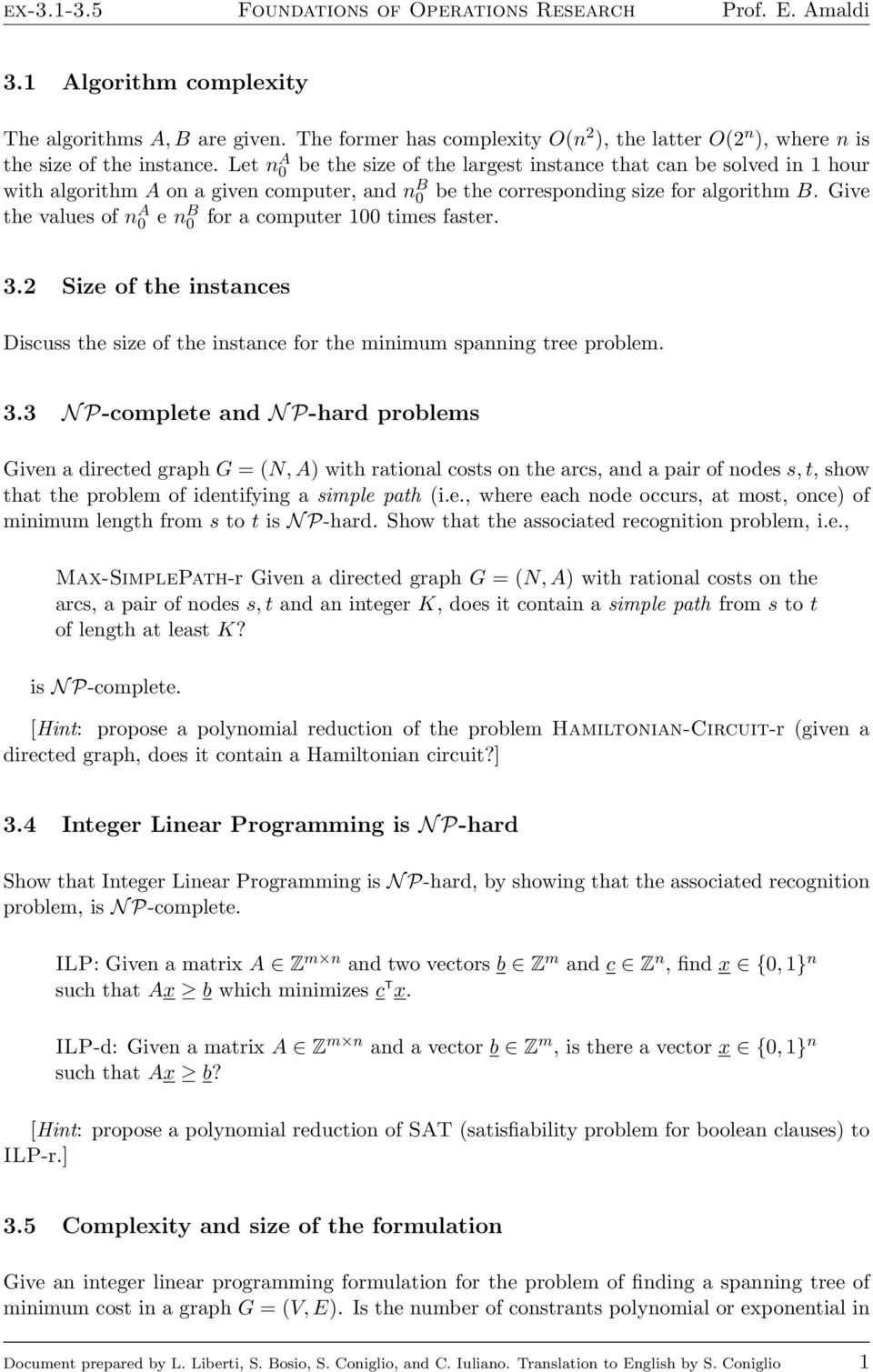
1 3.1 Algorithm complexity The algorithms A, B are given. The former has complexity O(n 2 ), the latter O(2 n ), where n is the size of the instance. Let n A 0 be the size of the largest instance that can be solved in 1 hour with algorithm A on a given computer, and n B 0 be the corresponding size for algorithm B. Give the values of n A 0 e nb 0 for a computer 100 times faster. 3.2 Size of the instances Discuss the size of the instance for the minimum spanning tree problem. 3.3 N P-complete and N P-hard problems Given a directed graph G = (N, A) with rational costs on the arcs, and a pair of nodes s, t, show that the problem of identifying a simple path (i.e., where each node occurs, at most, once) of minimum length from s to t is N P-hard. Show that the associated recognition problem, i.e., Max-SimplePath-r Given a directed graph G = (N, A) with rational costs on the arcs, a pair of nodes s, t and an integer K, does it contain a simple path from s to t of length at least K? is N P-complete. [Hint: propose a polynomial reduction of the problem Hamiltonian-Circuit-r (given a directed graph, does it contain a Hamiltonian circuit?] 3.4 Integer Linear Programming is N P-hard Show that Integer Linear Programming is N P-hard, by showing that the associated recognition problem, is N P-complete. ILP: Given a matrix A Z m n and two vectors b Z m and c Z n, find x {0, 1} n such that Ax b which minimizes c T x. ILP-d: Given a matrix A Z m n and a vector b Z m, is there a vector x {0, 1} n such that Ax b? [Hint: propose a polynomial reduction of SAT (satisfiability problem for boolean clauses) to ILP-r.] 3.5 Complexity and size of the formulation Give an integer linear programming formulation for the problem of finding a spanning tree of minimum cost in a graph G = (V, E). Is the number of constrants polynomial or exponential in Document prepared by L. Liberti, S. Bosio, S. Coniglio, and C. Iuliano. Translation to English by S. Coniglio 1
2 n = V? Is there a relationship between the size of a formulation (number of constraints and variables) and the difficilty of the associated problem? Document prepared by L. Liberti, S. Bosio, S. Coniglio, and C. Iuliano. Translation to English by S. Coniglio 2

3 Solution 3.1 Algorithm complexity Let n A, n B be the size of the largest instances which can be solved, in one hour, with algorithms A, B, on a computer 100 times faster that the original one. Since, by definition of n A 0, (na 0 )2 elementary operations are performed when using algorithm A on the original computer, 100(n A 0 )2 operations can be executed on the faster machine. Therefore, (n A ) 2 = 100(n A 0 )2 and hence n A = 10n A 0. Similarly, for algorithm B, we have that 2nB 0 operations are performed on the original computer, nb 0 are performed on the faster one, and hence n B = n B 0 + log 2(100) < n B To summarize, with algorithm A, which has quadratic complexity, we can solve instances 10 times larger, while, with algorithm B, which has exponential complexity, we can solve instances which are only larger by a tiny quantity of bits. 3.2 Size of the instances An instance for the minimum spanning tree problem amounts to a graph G = (V, E), with a weight c ij per edge {i, j} E. Recall that, given an integer i Z, log i + 1 bits are needed to code it in memory. The +1 addendum takes into account the sign bit. For nonnegative integers, log i bits suffice. For each edge {i, j} E we need to memorize the indices of the nodes where it is incident, using 2 log n bits per node, and the weights c ij, using log c max + 1 bits, where max := max ij E c ij. In total, we need log n + log m + m(2 log n + log c max + 1) bits, i.e., O(m(log n + log c max )). Note that we always suppose m > n, otherwise the graph is not connected and it admits no spanning tree. Usually, the number of bits needed to code a numerical value is taken as a constant. For instance, for a 64 bit machine, we can suppose that we d never deal with instances with more than 2 64 arcs or nodes. Similarly, we can suppose c max 2 64, so that c max can be stored in a single memory word. Under this assumption, the size of an instance is, asymptotically, O(m). Note that, for dense graphs (m n 2 ), the instance has a quadratic, O(n 2 ), size n. For sparse graphs (m < n 2 ), the size is less than quadratic, since n 2 < m 2, and more than linear, since n 2 > m. Document prepared by L. Liberti, S. Bosio, S. Coniglio, and C. Iuliano. Translation to English by S. Coniglio 3

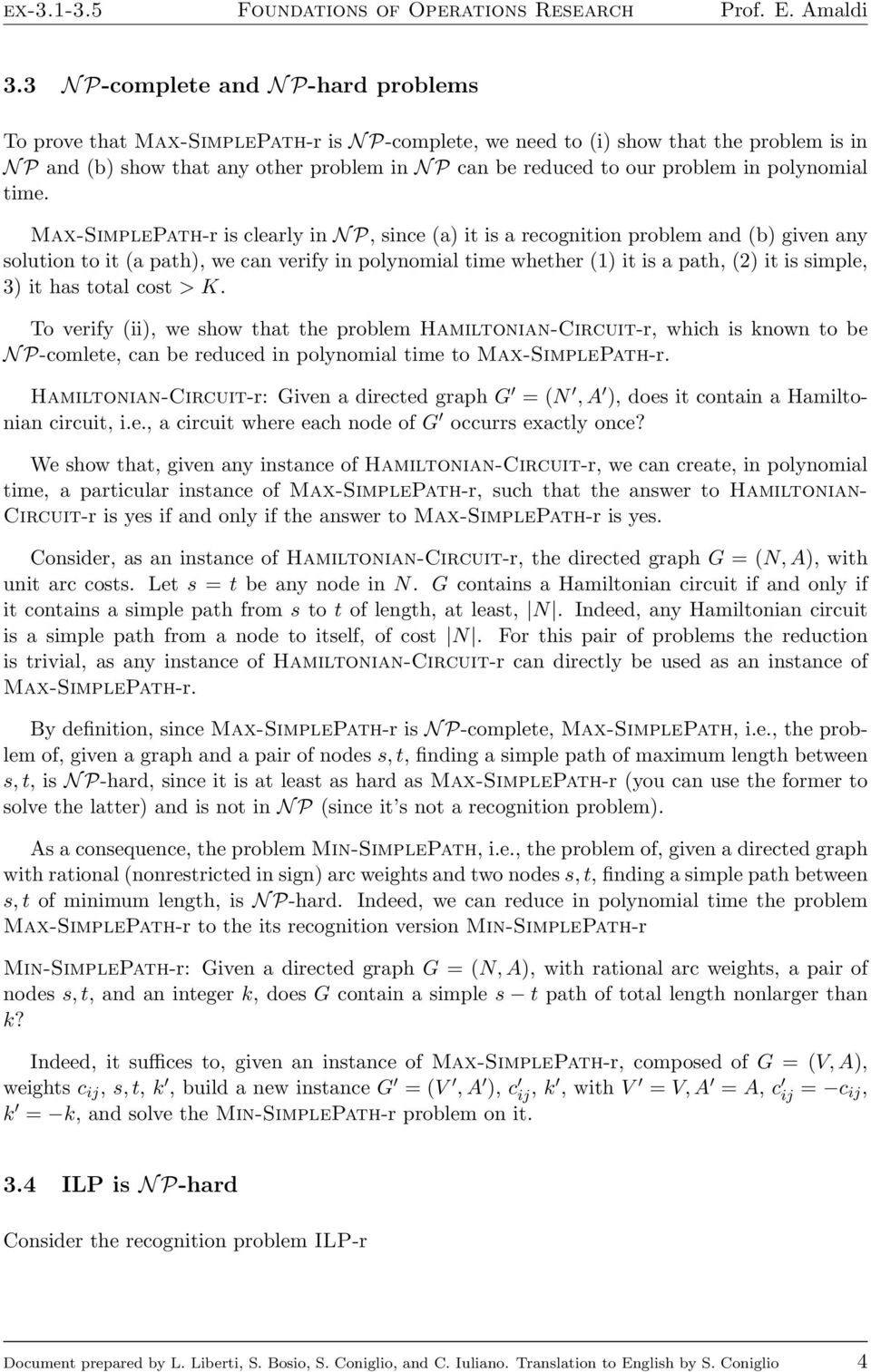
4 3.3 N P-complete and N P-hard problems To prove that Max-SimplePath-r is N P-complete, we need to (i) show that the problem is in N P and (b) show that any other problem in N P can be reduced to our problem in polynomial time. Max-SimplePath-r is clearly in N P, since (a) it is a recognition problem and (b) given any solution to it (a path), we can verify in polynomial time whether (1) it is a path, (2) it is simple, 3) it has total cost > K. To verify (ii), we show that the problem Hamiltonian-Circuit-r, which is known to be N P-comlete, can be reduced in polynomial time to Max-SimplePath-r. Hamiltonian-Circuit-r: Given a directed graph G = (N, A ), does it contain a Hamiltonian circuit, i.e., a circuit where each node of G occurrs exactly once? We show that, given any instance of Hamiltonian-Circuit-r, we can create, in polynomial time, a particular instance of Max-SimplePath-r, such that the answer to Hamiltonian- Circuit-r is yes if and only if the answer to Max-SimplePath-r is yes. Consider, as an instance of Hamiltonian-Circuit-r, the directed graph G = (N, A), with unit arc costs. Let s = t be any node in N. G contains a Hamiltonian circuit if and only if it contains a simple path from s to t of length, at least, N. Indeed, any Hamiltonian circuit is a simple path from a node to itself, of cost N. For this pair of problems the reduction is trivial, as any instance of Hamiltonian-Circuit-r can directly be used as an instance of Max-SimplePath-r. By definition, since Max-SimplePath-r is N P-complete, Max-SimplePath, i.e., the problem of, given a graph and a pair of nodes s, t, finding a simple path of maximum length between s, t, is N P-hard, since it is at least as hard as Max-SimplePath-r (you can use the former to solve the latter) and is not in N P (since it s not a recognition problem). As a consequence, the problem Min-SimplePath, i.e., the problem of, given a directed graph with rational (nonrestricted in sign) arc weights and two nodes s, t, finding a simple path between s, t of minimum length, is N P-hard. Indeed, we can reduce in polynomial time the problem Max-SimplePath-r to the its recognition version Min-SimplePath-r Min-SimplePath-r: Given a directed graph G = (N, A), with rational arc weights, a pair of nodes s, t, and an integer k, does G contain a simple s t path of total length nonlarger than k? Indeed, it suffices to, given an instance of Max-SimplePath-r, composed of G = (V, A), weights c ij, s, t, k, build a new instance G = (V, A ), c ij, k, with V = V, A = A, c ij = c ij, k = k, and solve the Min-SimplePath-r problem on it. 3.4 ILP is N P-hard Consider the recognition problem ILP-r Document prepared by L. Liberti, S. Bosio, S. Coniglio, and C. Iuliano. Translation to English by S. Coniglio 4
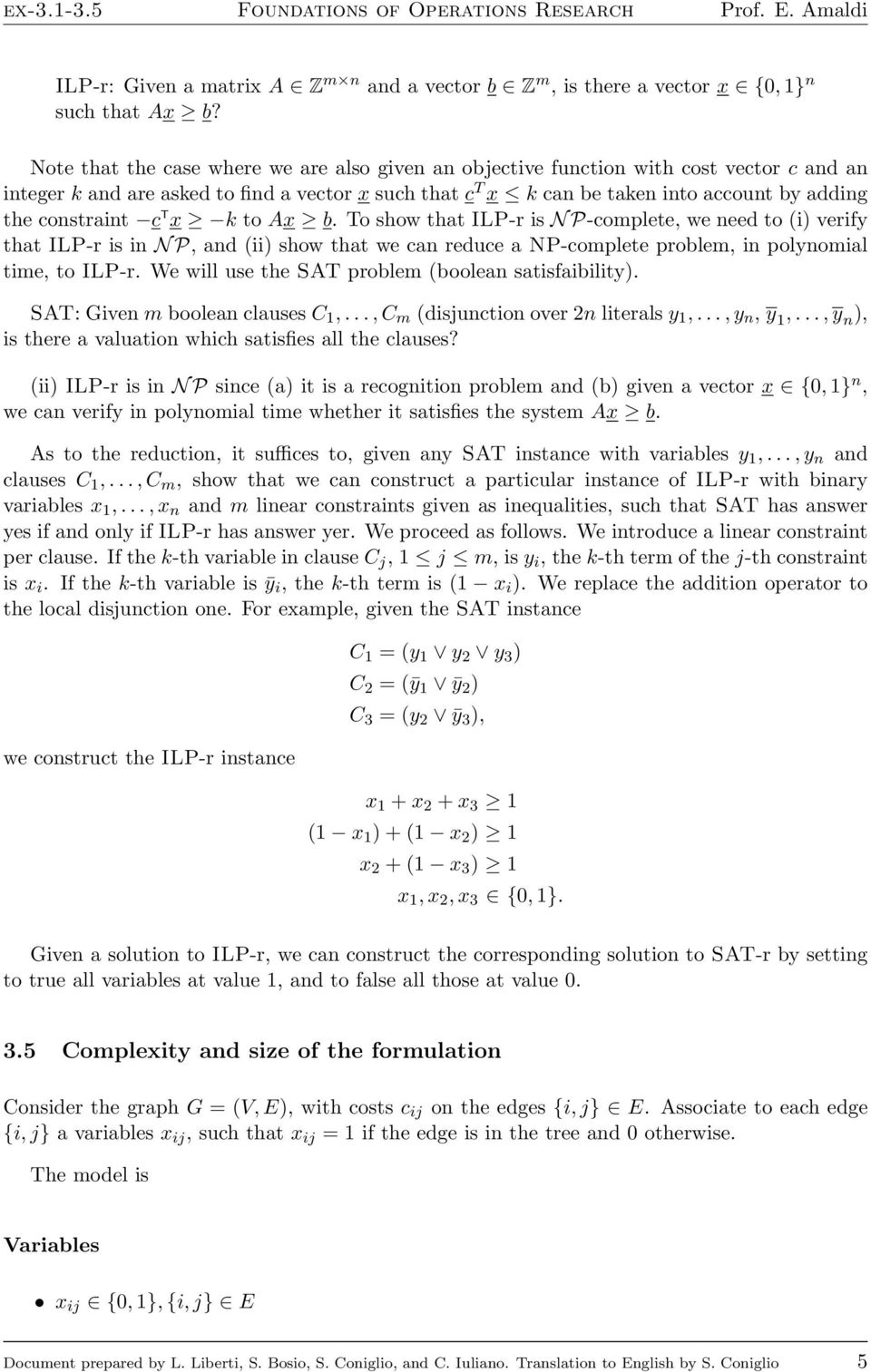
5 ILP-r: Given a matrix A Z m n and a vector b Z m, is there a vector x {0, 1} n such that Ax b? Note that the case where we are also given an objective function with cost vector c and an integer k and are asked to find a vector x such that c T x k can be taken into account by adding the constraint c T x k to Ax b. To show that ILP-r is N P-complete, we need to (i) verify that ILP-r is in N P, and (ii) show that we can reduce a NP-complete problem, in polynomial time, to ILP-r. We will use the SAT problem (boolean satisfaibility). SAT: Given m boolean clauses C 1,...,C m (disjunction over 2n literals y 1,...,y n, y 1,...,y n ), is there a valuation which satisfies all the clauses? (ii) ILP-r is in N P since (a) it is a recognition problem and (b) given a vector x {0, 1} n, we can verify in polynomial time whether it satisfies the system Ax b. As to the reduction, it suffices to, given any SAT instance with variables y 1,...,y n and clauses C 1,...,C m, show that we can construct a particular instance of ILP-r with binary variables x 1,...,x n and m linear constraints given as inequalities, such that SAT has answer yes if and only if ILP-r has answer yer. We proceed as follows. We introduce a linear constraint per clause. If the k-th variable in clause C j, 1 j m, is y i, the k-th term of the j-th constraint is x i. If the k-th variable is ȳ i, the k-th term is (1 x i ). We replace the addition operator to the local disjunction one. For example, given the SAT instance we construct the ILP-r instance C 1 = (y 1 y 2 y 3 ) C 2 = (ȳ 1 ȳ 2 ) C 3 = (y 2 ȳ 3 ), x 1 + x 2 + x 3 1 (1 x 1 ) + (1 x 2 ) 1 x 2 + (1 x 3 ) 1 x 1, x 2, x 3 {0, 1}. Given a solution to ILP-r, we can construct the corresponding solution to SAT-r by setting to true all variables at value 1, and to false all those at value Complexity and size of the formulation Consider the graph G = (V, E), with costs c ij on the edges {i, j} E. Associate to each edge {i, j} a variables x ij, such that x ij = 1 if the edge is in the tree and 0 otherwise. The model is Variables x ij {0, 1}, {i, j} E Document prepared by L. Liberti, S. Bosio, S. Coniglio, and C. Iuliano. Translation to English by S. Coniglio 5
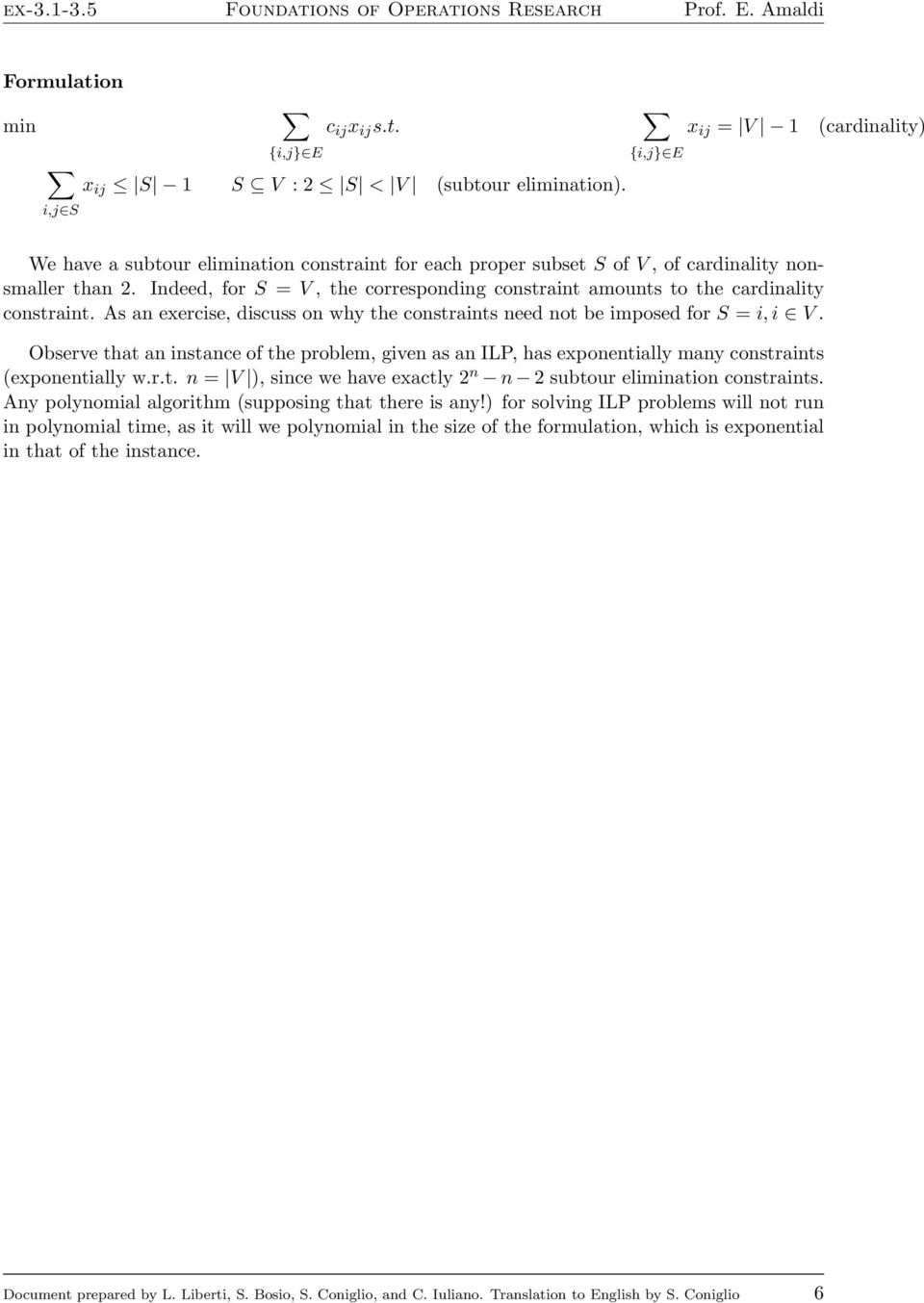
6 Formulation min c ij x ij s.t. x ij = V 1 {i,j} E {i,j} E x ij S 1 S V : 2 S < V (subtour elimination). i,j S (cardinality) We have a subtour elimination constraint for each proper subset S of V, of cardinality nonsmaller than 2. Indeed, for S = V, the corresponding constraint amounts to the cardinality constraint. As an exercise, discuss on why the constraints need not be imposed for S = i, i V. Observe that an instance of the problem, given as an ILP, has exponentially many constraints (exponentially w.r.t. n = V ), since we have exactly 2 n n 2 subtour elimination constraints. Any polynomial algorithm (supposing that there is any!) for solving ILP problems will not run in polynomial time, as it will we polynomial in the size of the formulation, which is exponential in that of the instance. Document prepared by L. Liberti, S. Bosio, S. Coniglio, and C. Iuliano. Translation to English by S. Coniglio 6
Why? A central concept in Computer Science. Algorithms are ubiquitous.
 Analysis of Algorithms: A Brief Introduction Why? A central concept in Computer Science. Algorithms are ubiquitous. Using the Internet (sending email, transferring files, use of search engines, online
Lecture 7: NP-Complete Problems
 IAS/PCMI Summer Session 2000 Clay Mathematics Undergraduate Program Basic Course on Computational Complexity Lecture 7: NP-Complete Problems David Mix Barrington and Alexis Maciel July 25, 2000 1. Circuit
One last point: we started off this book by introducing another famously hard search problem:
 S. Dasgupta, C.H. Papadimitriou, and U.V. Vazirani 261 Factoring One last point: we started off this book by introducing another famously hard search problem: FACTORING, the task of finding all prime factors
CHAPTER 9. Integer Programming
 CHAPTER 9 Integer Programming An integer linear program (ILP) is, by definition, a linear program with the additional constraint that all variables take integer values: (9.1) max c T x s t Ax b and x integral
Outline. NP-completeness. When is a problem easy? When is a problem hard? Today. Euler Circuits
 Outline NP-completeness Examples of Easy vs. Hard problems Euler circuit vs. Hamiltonian circuit Shortest Path vs. Longest Path 2-pairs sum vs. general Subset Sum Reducing one problem to another Clique
Complexity Theory. IE 661: Scheduling Theory Fall 2003 Satyaki Ghosh Dastidar
 Complexity Theory IE 661: Scheduling Theory Fall 2003 Satyaki Ghosh Dastidar Outline Goals Computation of Problems Concepts and Definitions Complexity Classes and Problems Polynomial Time Reductions Examples
1. Nondeterministically guess a solution (called a certificate) 2. Check whether the solution solves the problem (called verification)
 Some N P problems Computer scientists have studied many N P problems, that is, problems that can be solved nondeterministically in polynomial time. Traditionally complexity question are studied as languages:
Computer Algorithms. NP-Complete Problems. CISC 4080 Yanjun Li
 Computer Algorithms NP-Complete Problems NP-completeness The quest for efficient algorithms is about finding clever ways to bypass the process of exhaustive search, using clues from the input in order
Approximation Algorithms
 Approximation Algorithms or: How I Learned to Stop Worrying and Deal with NP-Completeness Ong Jit Sheng, Jonathan (A0073924B) March, 2012 Overview Key Results (I) General techniques: Greedy algorithms
5 INTEGER LINEAR PROGRAMMING (ILP) E. Amaldi Fondamenti di R.O. Politecnico di Milano 1
 5 INTEGER LINEAR PROGRAMMING (ILP) E. Amaldi Fondamenti di R.O. Politecnico di Milano 1 General Integer Linear Program: (ILP) min c T x Ax b x 0 integer Assumption: A, b integer The integrality condition
Algorithm Design and Analysis
 Algorithm Design and Analysis LECTURE 27 Approximation Algorithms Load Balancing Weighted Vertex Cover Reminder: Fill out SRTEs online Don t forget to click submit Sofya Raskhodnikova 12/6/2011 S. Raskhodnikova;
Introduction to Algorithms. Part 3: P, NP Hard Problems
 Introduction to Algorithms Part 3: P, NP Hard Problems 1) Polynomial Time: P and NP 2) NP-Completeness 3) Dealing with Hard Problems 4) Lower Bounds 5) Books c Wayne Goddard, Clemson University, 2004 Chapter
2.8 An application of Dynamic Programming to machine renewal
 ex-.6-. Foundations of Operations Research Prof. E. Amaldi.6 Shortest paths with nonnegative costs Given the following graph, find a set of shortest paths from node to all the other nodes, using Dijkstra
NP-complete? NP-hard? Some Foundations of Complexity. Prof. Sven Hartmann Clausthal University of Technology Department of Informatics
 NP-complete? NP-hard? Some Foundations of Complexity Prof. Sven Hartmann Clausthal University of Technology Department of Informatics Tractability of Problems Some problems are undecidable: no computer
Chapter 11. 11.1 Load Balancing. Approximation Algorithms. Load Balancing. Load Balancing on 2 Machines. Load Balancing: Greedy Scheduling
 Approximation Algorithms Chapter Approximation Algorithms Q. Suppose I need to solve an NP-hard problem. What should I do? A. Theory says you're unlikely to find a poly-time algorithm. Must sacrifice one
Introduction to Logic in Computer Science: Autumn 2006
 Introduction to Logic in Computer Science: Autumn 2006 Ulle Endriss Institute for Logic, Language and Computation University of Amsterdam Ulle Endriss 1 Plan for Today Now that we have a basic understanding
NP-Completeness. CptS 223 Advanced Data Structures. Larry Holder School of Electrical Engineering and Computer Science Washington State University
 NP-Completeness CptS 223 Advanced Data Structures Larry Holder School of Electrical Engineering and Computer Science Washington State University 1 Hard Graph Problems Hard means no known solutions with
SIMS 255 Foundations of Software Design. Complexity and NP-completeness
 SIMS 255 Foundations of Software Design Complexity and NP-completeness Matt Welsh November 29, 2001 [email protected] 1 Outline Complexity of algorithms Space and time complexity ``Big O'' notation Complexity
Transportation Polytopes: a Twenty year Update
 Transportation Polytopes: a Twenty year Update Jesús Antonio De Loera University of California, Davis Based on various papers joint with R. Hemmecke, E.Kim, F. Liu, U. Rothblum, F. Santos, S. Onn, R. Yoshida,
5.1 Bipartite Matching
 CS787: Advanced Algorithms Lecture 5: Applications of Network Flow In the last lecture, we looked at the problem of finding the maximum flow in a graph, and how it can be efficiently solved using the Ford-Fulkerson
! Solve problem to optimality. ! Solve problem in poly-time. ! Solve arbitrary instances of the problem. !-approximation algorithm.
 Approximation Algorithms Chapter Approximation Algorithms Q Suppose I need to solve an NP-hard problem What should I do? A Theory says you're unlikely to find a poly-time algorithm Must sacrifice one of
Efficiency of algorithms. Algorithms. Efficiency of algorithms. Binary search and linear search. Best, worst and average case.
 Algorithms Efficiency of algorithms Computational resources: time and space Best, worst and average case performance How to compare algorithms: machine-independent measure of efficiency Growth rate Complexity
THE PROBLEM WORMS (1) WORMS (2) THE PROBLEM OF WORM PROPAGATION/PREVENTION THE MINIMUM VERTEX COVER PROBLEM
 1 THE PROBLEM OF WORM PROPAGATION/PREVENTION I.E. THE MINIMUM VERTEX COVER PROBLEM Prof. Tiziana Calamoneri Network Algorithms A.y. 2014/15 2 THE PROBLEM WORMS (1)! A computer worm is a standalone malware
The Classes P and NP
 The Classes P and NP We now shift gears slightly and restrict our attention to the examination of two families of problems which are very important to computer scientists. These families constitute the
Proximal mapping via network optimization
 L. Vandenberghe EE236C (Spring 23-4) Proximal mapping via network optimization minimum cut and maximum flow problems parametric minimum cut problem application to proximal mapping Introduction this lecture:
Discrete Mathematics & Mathematical Reasoning Chapter 10: Graphs
 Discrete Mathematics & Mathematical Reasoning Chapter 10: Graphs Kousha Etessami U. of Edinburgh, UK Kousha Etessami (U. of Edinburgh, UK) Discrete Mathematics (Chapter 6) 1 / 13 Overview Graphs and Graph
Notes on NP Completeness
 Notes on NP Completeness Rich Schwartz November 10, 2013 1 Overview Here are some notes which I wrote to try to understand what NP completeness means. Most of these notes are taken from Appendix B in Douglas
Completely Positive Cone and its Dual
 On the Computational Complexity of Membership Problems for the Completely Positive Cone and its Dual Peter J.C. Dickinson Luuk Gijben July 3, 2012 Abstract Copositive programming has become a useful tool
Mathematics Course 111: Algebra I Part IV: Vector Spaces
 Mathematics Course 111: Algebra I Part IV: Vector Spaces D. R. Wilkins Academic Year 1996-7 9 Vector Spaces A vector space over some field K is an algebraic structure consisting of a set V on which are
Discrete Optimization
 Discrete Optimization [Chen, Batson, Dang: Applied integer Programming] Chapter 3 and 4.1-4.3 by Johan Högdahl and Victoria Svedberg Seminar 2, 2015-03-31 Todays presentation Chapter 3 Transforms using
! Solve problem to optimality. ! Solve problem in poly-time. ! Solve arbitrary instances of the problem. #-approximation algorithm.
 Approximation Algorithms 11 Approximation Algorithms Q Suppose I need to solve an NP-hard problem What should I do? A Theory says you're unlikely to find a poly-time algorithm Must sacrifice one of three
Reductions & NP-completeness as part of Foundations of Computer Science undergraduate course
 Reductions & NP-completeness as part of Foundations of Computer Science undergraduate course Alex Angelopoulos, NTUA January 22, 2015 Outline Alex Angelopoulos (NTUA) FoCS: Reductions & NP-completeness-
OHJ-2306 Introduction to Theoretical Computer Science, Fall 2012 8.11.2012
 276 The P vs. NP problem is a major unsolved problem in computer science It is one of the seven Millennium Prize Problems selected by the Clay Mathematics Institute to carry a $ 1,000,000 prize for the
Max Flow, Min Cut, and Matchings (Solution)
 Max Flow, Min Cut, and Matchings (Solution) 1. The figure below shows a flow network on which an s-t flow is shown. The capacity of each edge appears as a label next to the edge, and the numbers in boxes
8.1 Min Degree Spanning Tree
 CS880: Approximations Algorithms Scribe: Siddharth Barman Lecturer: Shuchi Chawla Topic: Min Degree Spanning Tree Date: 02/15/07 In this lecture we give a local search based algorithm for the Min Degree
Guessing Game: NP-Complete?
 Guessing Game: NP-Complete? 1. LONGEST-PATH: Given a graph G = (V, E), does there exists a simple path of length at least k edges? YES 2. SHORTEST-PATH: Given a graph G = (V, E), does there exists a simple
Lecture 15 An Arithmetic Circuit Lowerbound and Flows in Graphs
 CSE599s: Extremal Combinatorics November 21, 2011 Lecture 15 An Arithmetic Circuit Lowerbound and Flows in Graphs Lecturer: Anup Rao 1 An Arithmetic Circuit Lower Bound An arithmetic circuit is just like
JUST-IN-TIME SCHEDULING WITH PERIODIC TIME SLOTS. Received December May 12, 2003; revised February 5, 2004
 Scientiae Mathematicae Japonicae Online, Vol. 10, (2004), 431 437 431 JUST-IN-TIME SCHEDULING WITH PERIODIC TIME SLOTS Ondřej Čepeka and Shao Chin Sung b Received December May 12, 2003; revised February
Polytope Examples (PolyComp Fukuda) Matching Polytope 1
 Polytope Examples (PolyComp Fukuda) Matching Polytope 1 Matching Polytope Let G = (V,E) be a graph. A matching in G is a subset of edges M E such that every vertex meets at most one member of M. A matching
Page 1. CSCE 310J Data Structures & Algorithms. CSCE 310J Data Structures & Algorithms. P, NP, and NP-Complete. Polynomial-Time Algorithms
 CSCE 310J Data Structures & Algorithms P, NP, and NP-Complete Dr. Steve Goddard [email protected] CSCE 310J Data Structures & Algorithms Giving credit where credit is due:» Most of the lecture notes
Math 181 Handout 16. Rich Schwartz. March 9, 2010
 Math 8 Handout 6 Rich Schwartz March 9, 200 The purpose of this handout is to describe continued fractions and their connection to hyperbolic geometry. The Gauss Map Given any x (0, ) we define γ(x) =
A Working Knowledge of Computational Complexity for an Optimizer
 A Working Knowledge of Computational Complexity for an Optimizer ORF 363/COS 323 Instructor: Amir Ali Ahmadi TAs: Y. Chen, G. Hall, J. Ye Fall 2014 1 Why computational complexity? What is computational
Applied Algorithm Design Lecture 5
 Applied Algorithm Design Lecture 5 Pietro Michiardi Eurecom Pietro Michiardi (Eurecom) Applied Algorithm Design Lecture 5 1 / 86 Approximation Algorithms Pietro Michiardi (Eurecom) Applied Algorithm Design
3.3. Solving Polynomial Equations. Introduction. Prerequisites. Learning Outcomes
 Solving Polynomial Equations 3.3 Introduction Linear and quadratic equations, dealt within Sections 3.1 and 3.2, are members of a class of equations, called polynomial equations. These have the general
Integer Programming Approach to Printed Circuit Board Assembly Time Optimization
 Integer Programming Approach to Printed Circuit Board Assembly Time Optimization Ratnesh Kumar Haomin Li Department of Electrical Engineering University of Kentucky Lexington, KY 40506-0046 Abstract A
Data Structures and Algorithms Written Examination
 Data Structures and Algorithms Written Examination 22 February 2013 FIRST NAME STUDENT NUMBER LAST NAME SIGNATURE Instructions for students: Write First Name, Last Name, Student Number and Signature where
How To Solve A Minimum Set Covering Problem (Mcp)
 Measuring Rationality with the Minimum Cost of Revealed Preference Violations Mark Dean and Daniel Martin Online Appendices - Not for Publication 1 1 Algorithm for Solving the MASP In this online appendix
Chapter. NP-Completeness. Contents
 Chapter 13 NP-Completeness Contents 13.1 P and NP......................... 593 13.1.1 Defining the Complexity Classes P and NP...594 13.1.2 Some Interesting Problems in NP.......... 597 13.2 NP-Completeness....................
Chapter 1. NP Completeness I. 1.1. Introduction. By Sariel Har-Peled, December 30, 2014 1 Version: 1.05
 Chapter 1 NP Completeness I By Sariel Har-Peled, December 30, 2014 1 Version: 1.05 "Then you must begin a reading program immediately so that you man understand the crises of our age," Ignatius said solemnly.
The Goldberg Rao Algorithm for the Maximum Flow Problem
 The Goldberg Rao Algorithm for the Maximum Flow Problem COS 528 class notes October 18, 2006 Scribe: Dávid Papp Main idea: use of the blocking flow paradigm to achieve essentially O(min{m 2/3, n 1/2 }
Bounded-width QBF is PSPACE-complete
 Bounded-width QBF is PSPACE-complete Albert Atserias 1 and Sergi Oliva 2 1 Universitat Politècnica de Catalunya Barcelona, Spain [email protected] 2 Universitat Politècnica de Catalunya Barcelona, Spain
On the Relationship between Classes P and NP
 Journal of Computer Science 8 (7): 1036-1040, 2012 ISSN 1549-3636 2012 Science Publications On the Relationship between Classes P and NP Anatoly D. Plotnikov Department of Computer Systems and Networks,
NP-Completeness I. Lecture 19. 19.1 Overview. 19.2 Introduction: Reduction and Expressiveness
 Lecture 19 NP-Completeness I 19.1 Overview In the past few lectures we have looked at increasingly more expressive problems that we were able to solve using efficient algorithms. In this lecture we introduce
Lecture 3. Linear Programming. 3B1B Optimization Michaelmas 2015 A. Zisserman. Extreme solutions. Simplex method. Interior point method
 Lecture 3 3B1B Optimization Michaelmas 2015 A. Zisserman Linear Programming Extreme solutions Simplex method Interior point method Integer programming and relaxation The Optimization Tree Linear Programming
Dynamic programming. Doctoral course Optimization on graphs - Lecture 4.1. Giovanni Righini. January 17 th, 2013
 Dynamic programming Doctoral course Optimization on graphs - Lecture.1 Giovanni Righini January 1 th, 201 Implicit enumeration Combinatorial optimization problems are in general NP-hard and we usually
Bounded Treewidth in Knowledge Representation and Reasoning 1
 Bounded Treewidth in Knowledge Representation and Reasoning 1 Reinhard Pichler Institut für Informationssysteme Arbeitsbereich DBAI Technische Universität Wien Luminy, October 2010 1 Joint work with G.
Branch and Cut for TSP
 Branch and Cut for TSP jla,[email protected] Informatics and Mathematical Modelling Technical University of Denmark 1 Branch-and-Cut for TSP Branch-and-Cut is a general technique applicable e.g. to solve symmetric
Binary Image Reconstruction
 A network flow algorithm for reconstructing binary images from discrete X-rays Kees Joost Batenburg Leiden University and CWI, The Netherlands [email protected] Abstract We present a new algorithm
6.852: Distributed Algorithms Fall, 2009. Class 2
 .8: Distributed Algorithms Fall, 009 Class Today s plan Leader election in a synchronous ring: Lower bound for comparison-based algorithms. Basic computation in general synchronous networks: Leader election
Generating models of a matched formula with a polynomial delay
 Generating models of a matched formula with a polynomial delay Petr Savicky Institute of Computer Science, Academy of Sciences of Czech Republic, Pod Vodárenskou Věží 2, 182 07 Praha 8, Czech Republic
P versus NP, and More
 1 P versus NP, and More Great Ideas in Theoretical Computer Science Saarland University, Summer 2014 If you have tried to solve a crossword puzzle, you know that it is much harder to solve it than to verify
Analysis of Algorithms, I
 Analysis of Algorithms, I CSOR W4231.002 Eleni Drinea Computer Science Department Columbia University Thursday, February 26, 2015 Outline 1 Recap 2 Representing graphs 3 Breadth-first search (BFS) 4 Applications
INTEGER PROGRAMMING. Integer Programming. Prototype example. BIP model. BIP models
 Integer Programming INTEGER PROGRAMMING In many problems the decision variables must have integer values. Example: assign people, machines, and vehicles to activities in integer quantities. If this is
4.6 Linear Programming duality
 4.6 Linear Programming duality To any minimization (maximization) LP we can associate a closely related maximization (minimization) LP. Different spaces and objective functions but in general same optimal
Scheduling Shop Scheduling. Tim Nieberg
 Scheduling Shop Scheduling Tim Nieberg Shop models: General Introduction Remark: Consider non preemptive problems with regular objectives Notation Shop Problems: m machines, n jobs 1,..., n operations
Exponential time algorithms for graph coloring
 Exponential time algorithms for graph coloring Uriel Feige Lecture notes, March 14, 2011 1 Introduction Let [n] denote the set {1,..., k}. A k-labeling of vertices of a graph G(V, E) is a function V [k].
(67902) Topics in Theory and Complexity Nov 2, 2006. Lecture 7
 (67902) Topics in Theory and Complexity Nov 2, 2006 Lecturer: Irit Dinur Lecture 7 Scribe: Rani Lekach 1 Lecture overview This Lecture consists of two parts In the first part we will refresh the definition
Nan Kong, Andrew J. Schaefer. Department of Industrial Engineering, Univeristy of Pittsburgh, PA 15261, USA
 A Factor 1 2 Approximation Algorithm for Two-Stage Stochastic Matching Problems Nan Kong, Andrew J. Schaefer Department of Industrial Engineering, Univeristy of Pittsburgh, PA 15261, USA Abstract We introduce
Scheduling Home Health Care with Separating Benders Cuts in Decision Diagrams
 Scheduling Home Health Care with Separating Benders Cuts in Decision Diagrams André Ciré University of Toronto John Hooker Carnegie Mellon University INFORMS 2014 Home Health Care Home health care delivery
Single machine parallel batch scheduling with unbounded capacity
 Workshop on Combinatorics and Graph Theory 21th, April, 2006 Nankai University Single machine parallel batch scheduling with unbounded capacity Yuan Jinjiang Department of mathematics, Zhengzhou University
CSC 373: Algorithm Design and Analysis Lecture 16
 CSC 373: Algorithm Design and Analysis Lecture 16 Allan Borodin February 25, 2013 Some materials are from Stephen Cook s IIT talk and Keven Wayne s slides. 1 / 17 Announcements and Outline Announcements
Lecture 19: Introduction to NP-Completeness Steven Skiena. Department of Computer Science State University of New York Stony Brook, NY 11794 4400
 Lecture 19: Introduction to NP-Completeness Steven Skiena Department of Computer Science State University of New York Stony Brook, NY 11794 4400 http://www.cs.sunysb.edu/ skiena Reporting to the Boss Suppose
Can linear programs solve NP-hard problems?
 Can linear programs solve NP-hard problems? p. 1/9 Can linear programs solve NP-hard problems? Ronald de Wolf Linear programs Can linear programs solve NP-hard problems? p. 2/9 Can linear programs solve
Optimization Modeling for Mining Engineers
 Optimization Modeling for Mining Engineers Alexandra M. Newman Division of Economics and Business Slide 1 Colorado School of Mines Seminar Outline Linear Programming Integer Linear Programming Slide 2
Introduction to computer science
 Introduction to computer science Michael A. Nielsen University of Queensland Goals: 1. Introduce the notion of the computational complexity of a problem, and define the major computational complexity classes.
Cost Model: Work, Span and Parallelism. 1 The RAM model for sequential computation:
 CSE341T 08/31/2015 Lecture 3 Cost Model: Work, Span and Parallelism In this lecture, we will look at how one analyze a parallel program written using Cilk Plus. When we analyze the cost of an algorithm
CAD Algorithms. P and NP
 CAD Algorithms The Classes P and NP Mohammad Tehranipoor ECE Department 6 September 2010 1 P and NP P and NP are two families of problems. P is a class which contains all of the problems we solve using
Integer Factorization using the Quadratic Sieve
 Integer Factorization using the Quadratic Sieve Chad Seibert* Division of Science and Mathematics University of Minnesota, Morris Morris, MN 56567 [email protected] March 16, 2011 Abstract We give
Statistical machine learning, high dimension and big data
 Statistical machine learning, high dimension and big data S. Gaïffas 1 14 mars 2014 1 CMAP - Ecole Polytechnique Agenda for today Divide and Conquer principle for collaborative filtering Graphical modelling,
CSE 326, Data Structures. Sample Final Exam. Problem Max Points Score 1 14 (2x7) 2 18 (3x6) 3 4 4 7 5 9 6 16 7 8 8 4 9 8 10 4 Total 92.
 Name: Email ID: CSE 326, Data Structures Section: Sample Final Exam Instructions: The exam is closed book, closed notes. Unless otherwise stated, N denotes the number of elements in the data structure
Tutorial 8. NP-Complete Problems
 Tutorial 8 NP-Complete Problems Decision Problem Statement of a decision problem Part 1: instance description defining the input Part 2: question stating the actual yesor-no question A decision problem
THE SCHEDULING OF MAINTENANCE SERVICE
 THE SCHEDULING OF MAINTENANCE SERVICE Shoshana Anily Celia A. Glass Refael Hassin Abstract We study a discrete problem of scheduling activities of several types under the constraint that at most a single
Problem Set 7 Solutions
 8 8 Introduction to Algorithms May 7, 2004 Massachusetts Institute of Technology 6.046J/18.410J Professors Erik Demaine and Shafi Goldwasser Handout 25 Problem Set 7 Solutions This problem set is due in
The LCA Problem Revisited
 The LA Problem Revisited Michael A. Bender Martín Farach-olton SUNY Stony Brook Rutgers University May 16, 2000 Abstract We present a very simple algorithm for the Least ommon Ancestor problem. We thus
Classification - Examples
 Lecture 2 Scheduling 1 Classification - Examples 1 r j C max given: n jobs with processing times p 1,...,p n and release dates r 1,...,r n jobs have to be scheduled without preemption on one machine taking
Computational Complexity: A Modern Approach. Draft of a book: Dated January 2007 Comments welcome!
 i Computational Complexity: A Modern Approach Draft of a book: Dated January 2007 Comments welcome! Sanjeev Arora and Boaz Barak Princeton University [email protected] Not to be reproduced or distributed
A Model of Optimum Tariff in Vehicle Fleet Insurance
 A Model of Optimum Tariff in Vehicle Fleet Insurance. Bouhetala and F.Belhia and R.Salmi Statistics and Probability Department Bp, 3, El-Alia, USTHB, Bab-Ezzouar, Alger Algeria. Summary: An approach about
DEGREES OF ORDERS ON TORSION-FREE ABELIAN GROUPS
 DEGREES OF ORDERS ON TORSION-FREE ABELIAN GROUPS ASHER M. KACH, KAREN LANGE, AND REED SOLOMON Abstract. We construct two computable presentations of computable torsion-free abelian groups, one of isomorphism
V. Adamchik 1. Graph Theory. Victor Adamchik. Fall of 2005
 V. Adamchik 1 Graph Theory Victor Adamchik Fall of 2005 Plan 1. Basic Vocabulary 2. Regular graph 3. Connectivity 4. Representing Graphs Introduction A.Aho and J.Ulman acknowledge that Fundamentally, computer
2.3 Convex Constrained Optimization Problems
 42 CHAPTER 2. FUNDAMENTAL CONCEPTS IN CONVEX OPTIMIZATION Theorem 15 Let f : R n R and h : R R. Consider g(x) = h(f(x)) for all x R n. The function g is convex if either of the following two conditions
Single-Link Failure Detection in All-Optical Networks Using Monitoring Cycles and Paths
 Single-Link Failure Detection in All-Optical Networks Using Monitoring Cycles and Paths Satyajeet S. Ahuja, Srinivasan Ramasubramanian, and Marwan Krunz Department of ECE, University of Arizona, Tucson,
On Integer Additive Set-Indexers of Graphs
 On Integer Additive Set-Indexers of Graphs arxiv:1312.7672v4 [math.co] 2 Mar 2014 N K Sudev and K A Germina Abstract A set-indexer of a graph G is an injective set-valued function f : V (G) 2 X such that
How To Find Local Affinity Patterns In Big Data
 Detection of local affinity patterns in big data Andrea Marinoni, Paolo Gamba Department of Electronics, University of Pavia, Italy Abstract Mining information in Big Data requires to design a new class
Linear Codes. Chapter 3. 3.1 Basics
 Chapter 3 Linear Codes In order to define codes that we can encode and decode efficiently, we add more structure to the codespace. We shall be mainly interested in linear codes. A linear code of length
Lecture 1: Course overview, circuits, and formulas
 Lecture 1: Course overview, circuits, and formulas Topics in Complexity Theory and Pseudorandomness (Spring 2013) Rutgers University Swastik Kopparty Scribes: John Kim, Ben Lund 1 Course Information Swastik
South Carolina College- and Career-Ready (SCCCR) Algebra 1
 South Carolina College- and Career-Ready (SCCCR) Algebra 1 South Carolina College- and Career-Ready Mathematical Process Standards The South Carolina College- and Career-Ready (SCCCR) Mathematical Process