
HISTORY AND SOCIAL SCIENCE STANDARDS OF LEARNING ENHANCED SCOPE AND SEQUENCE
|
|
|
- Della Pierce
- 10 years ago
- Views:
Transcription
1 HISTORY AND SOCIAL SCIENCE STANDARDS OF LEARNING ENHANCED SCOPE AND SEQUENCE World History and Geography to 1500 A.D. (C.E.) Commonwealth of Virginia Department of Education

2 Copyright 2010 by the Virginia Department of Education P.O. Box 2120 Richmond, Virginia All rights reserved. Reproduction of these materials for instructional purposes in public school classrooms in Virginia is permitted. Superintendent of Public Instruction Patricia I. Wright Assistant Superintendent for Instruction Linda M. Wallinger Office of Standards, Curriculum, and Instruction Mark R. Allan, Director Betsy S. Barton, History and Social Science Specialist Beverly M. Thurston, History and Social Science / International Education Coordinator Edited, designed, and produced by the CTE Resource Center Margaret L. Watson, Administrative Coordinator Karen T. Westermann, Writer/Editor Bruce B. Stevens, Writer/Editor Richmond Medical Park Phone: Bremo Road, Lower Level Fax: Richmond, Virginia Web site: The CTE Resource Center is a Virginia Department of Education grant project administered by Henrico County Public Schools. NOTICE The Virginia Department of Education does not discriminate on the basis of race, sex, color, national origin, religion, age, political affiliation, veteran status, or against otherwise qualified persons with disabilities in its programs and activities.
3 Table of Contents Acknowledgments... viii Introduction... ix The Paleolithic Era to the Agricultural Revolution...1 Standard(s) of Learning...1 Sample Resources...3 Session 1: Introduction to the Paleolithic Era...4 Session 2: Classifying Prehistoric People...5 Session 3: Importance of the Neolithic Revolution...6 Session 4: Assessment...7 Attachment A: Classifying Prehistoric People...8 Attachment B: Sample Assessment Items...9 Ancient River Valley Civilizations...10 Standard(s) of Learning...10 Sample Resources...12 Session 1: Location of Ancient River Valley Civilizations...13 Sessions 2 10: Mesopotamia, Egypt, Indus River, and Huang He Civilizations...14 Session 11: Phoenician, Lydian, and Nubian Civilizations...15 Session 12: World Religions Judaism...16 Session 13: Assessment...17 Attachment A: Ancient River Valley Civilizations Map Activity...18 Attachment B: Ancient River Valley Civilizations Vocabulary...19 Attachment C: World Religions Chart...20 Attachment D: Sample Assessment Items...21 Cultures of Persia, India, and China...22 Standard(s) of Learning...22 Sample Resources...25 Session 1: Introduction to Ancient Persia...26 Session 2: Timeline of the Ancient Persian Empire...27 Session 3: The Silk Road...28 Session 4: Geography s Role in the Spread of Classical Indian Civilization...29 Session 5: Indo-Aryans and the Caste System...30 Session 6: The Gupta Empire...31 Session 7: The Hindu Religion...32 Session 8: Completing the Learning Cube...33 Session 9: The Buddhist Religion...34 Session 10: Video on Persian Civilization or Indian Civilization...35 Session 11: Classical China...36 Session 12: Confucianism and Taoism...37 Session 13: Sharing Students Learning Cubes...38 Session 14: Assessment...39 Attachment A: How to Prepare a Learning Cube for an Ancient Civilization...40 Attachment B: Sample Assessment Items...41 Ancient Greece...42 Standard(s) of Learning...42 Sample Resources...45 Session 1: Introduction to Ancient Greece...46 Session 2: The Geography of Ancient Greece...47 Session 3: Economic and Social Development of Ancient Greece...48 History and Social Science Standards of Learning Enhanced Scope and Sequence: iii

4 Session 4: Introduction to Greek Mythology...49 Session 5: Learning Cube for Greek Gods and Goddesses...50 Session 6: Ancient Athens and Sparta...51 Session 7: The Persian Wars...52 Session 8: The Peloponnesian War...53 Session 9: Pericles...54 Session 10: Contributions of Greek Culture to Western Civilization...55 Session 11: Project on Contributions of Greek Culture to Western Civilization...56 Session 12: The Conquest of Greece by Macedonia...57 Session 13: The Reign of Alexander the Great...58 Session 14: The Hellenistic Age...59 Session 15: Video on the History of Ancient Greece...60 Session 16: Student Project Presentations...61 Session 17: Review...62 Session 18: Assessment...63 Attachment A: Greek Mythology...64 Attachment B: Learning Cube for Greek Gods and Goddesses...65 Attachment C: Sample Assessment Items...66 Ancient Rome and the Rise of Christianity from 700 B.C. (B.C.E.) to 500 A.D. (C.E.)...67 Standard(s) of Learning...67 Sample Resources...71 Session 1: Introduction to Ancient Rome...72 Session 2: Video on the Roman Empire...73 Session 3: Influence of Geography on the Spread of the Roman Empire...74 Session 4: Introduction to Roman Mythology...75 Session 5: Comparing Greek and Roman Deities...76 Session 6: Democracy in Ancient Rome...77 Session 7: Roman Citizenship and Government...78 Session 8: The Punic Wars...79 Session 9: Timeline of the Roman Empire...80 Session 10: Fall of the Roman Republic...81 Session 11: The Early Roman Empire...82 Sessions 12 and 13: Oral Presentations on the Early Roman Empire...83 Session 14: Mid-Session Assessment...84 Session 15: Foundations of the Christian Religion...85 Session 16: The Spread of Christianity...86 Session 17: Significance of the Church of Rome in the Late Roman Empire...87 Session 18: Contributions of Ancient Rome to Western Civilization...88 Session 19: Decline of the Roman Empire...89 Session 20: Division of the Roman Empire...90 Session 21: Review on Ancient Rome...91 Session 22: Assessment...92 Session 23: Semester Review...93 Attachment A: Roman and Greek Deities Compared...94 Attachment B: Quiz...95 Attachment C: Foundations of the Christian Religion...96 Attachment D: Sample Assessment Items...97 Attachment E: Cube Review for the Ancient River Valleys, Greece, and Rome...98 Byzantine Empire and Russia from 300 to 1000 A.D. (C.E.) Standard(s) of Learning Sample Resources Session 1: Location of the Byzantine Empire History and Social Science Standards of Learning Enhanced Scope and Sequence: iv

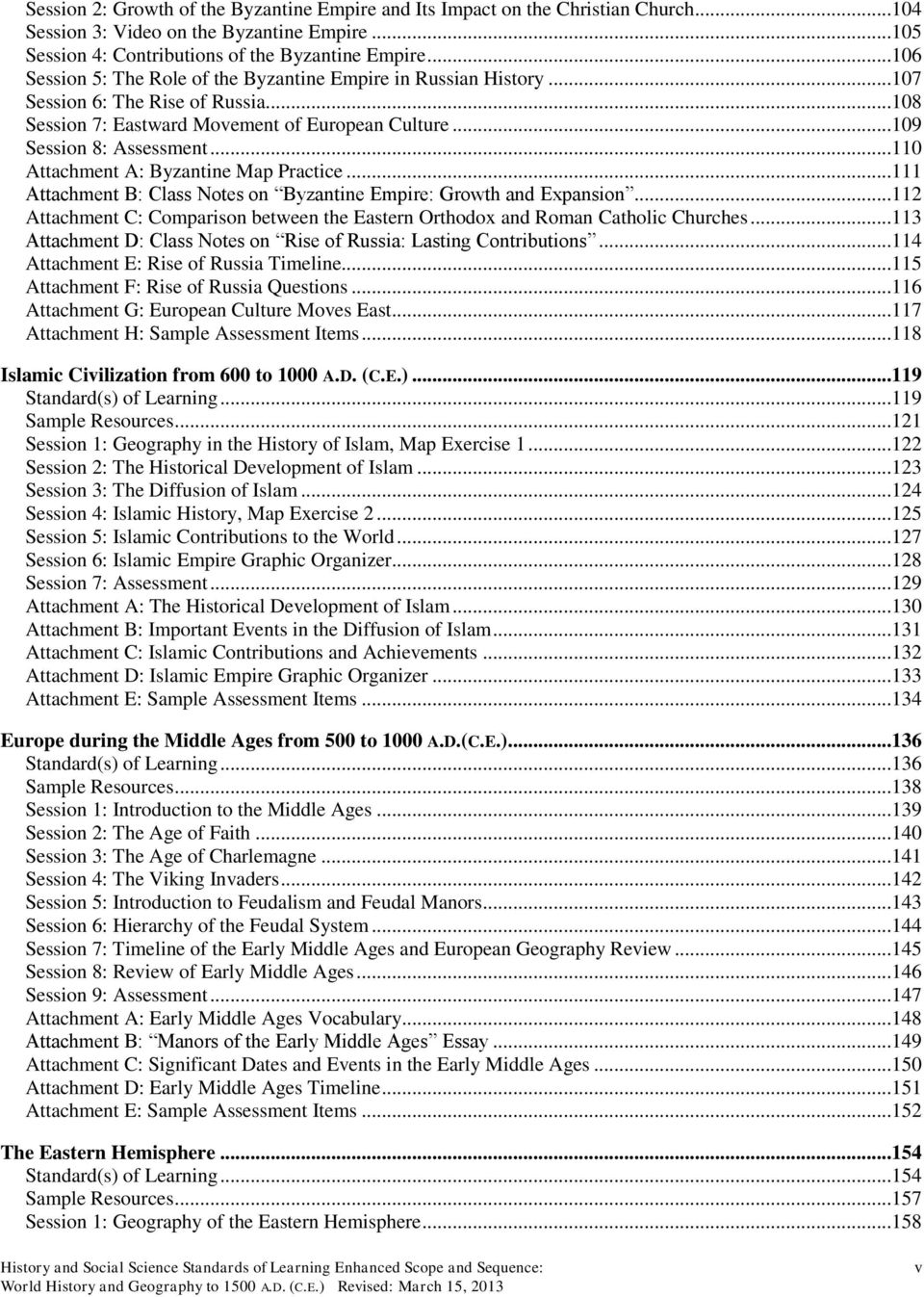
5 Session 2: Growth of the Byzantine Empire and Its Impact on the Christian Church Session 3: Video on the Byzantine Empire Session 4: Contributions of the Byzantine Empire Session 5: The Role of the Byzantine Empire in Russian History Session 6: The Rise of Russia Session 7: Eastward Movement of European Culture Session 8: Assessment Attachment A: Byzantine Map Practice Attachment B: Class Notes on Byzantine Empire: Growth and Expansion Attachment C: Comparison between the Eastern Orthodox and Roman Catholic Churches Attachment D: Class Notes on Rise of Russia: Lasting Contributions Attachment E: Rise of Russia Timeline Attachment F: Rise of Russia Questions Attachment G: European Culture Moves East Attachment H: Sample Assessment Items Islamic Civilization from 600 to 1000 A.D. (C.E.) Standard(s) of Learning Sample Resources Session 1: Geography in the History of Islam, Map Exercise Session 2: The Historical Development of Islam Session 3: The Diffusion of Islam Session 4: Islamic History, Map Exercise Session 5: Islamic Contributions to the World Session 6: Islamic Empire Graphic Organizer Session 7: Assessment Attachment A: The Historical Development of Islam Attachment B: Important Events in the Diffusion of Islam Attachment C: Islamic Contributions and Achievements Attachment D: Islamic Empire Graphic Organizer Attachment E: Sample Assessment Items Europe during the Middle Ages from 500 to 1000 A.D.(C.E.) Standard(s) of Learning Sample Resources Session 1: Introduction to the Middle Ages Session 2: The Age of Faith Session 3: The Age of Charlemagne Session 4: The Viking Invaders Session 5: Introduction to Feudalism and Feudal Manors Session 6: Hierarchy of the Feudal System Session 7: Timeline of the Early Middle Ages and European Geography Review Session 8: Review of Early Middle Ages Session 9: Assessment Attachment A: Early Middle Ages Vocabulary Attachment B: Manors of the Early Middle Ages Essay Attachment C: Significant Dates and Events in the Early Middle Ages Attachment D: Early Middle Ages Timeline Attachment E: Sample Assessment Items The Eastern Hemisphere Standard(s) of Learning Sample Resources Session 1: Geography of the Eastern Hemisphere History and Social Science Standards of Learning Enhanced Scope and Sequence: v
6 Session 2: The Effects of Trade on Culture and Language Session 3: Trade Effects and Trade Routes in the Eastern Hemisphere Session 4: Goods, Technology, and Ideas Passed along the Trade Routes Session 5: Art Project on Goods, Technology, and Ideas along the Trade Routes Session 6: Cultural Contributions of the Japanese and Chinese Session 7: The Shinto Religion Session 8: Sub-Saharan African Civilizations Session 9: The Kingdom of Zimbabwe Session 10: The Kingdoms of Ghana and Songhai Session 11: The Kingdom of Mali Session 12: Review of the Eastern Hemisphere Session 13: Assessment Attachment A: Sample Assessment Items Mayan, Aztec, and Incan Civilizations Standard(s) of Learning Sample Resources Session 1: Introduction to Civilizations in the Western Hemisphere Session 2: Civilizations in North America: The Olmecs, Mayans, and Aztecs Session 3: Civilizations in South America: The Inca Session 4: Comparison of the Civilizations in the Americas Session 5: Assessment Attachment A: Western Civilization Map Practice Attachment B: Class Notes on Civilizations in North America Attachment C: Class Notes on Civilizations in South America Attachment D: Civilizations in the Americas Attachment E: Sample Assessment Items The Late Medieval Period Standard(s) of Learning Sample Resources Session 1: Introduction to the Late Medieval Period Session 2: The Formation of Nation-States in Europe Session 3: Europe and the Muslim World Session 4: Research Project Session 5: The Black Death Session 6: Preservation and Transfer of Greek, Roman, and Arabic Cultures Session 7: Cathedrals and Religious Art in the Late Medieval Period Sessions 8 and 9: Student Presentations Session 10: Review Session 11: Assessment Attachment A: Nation-States Chart Attachment B: Class Notes on Europe and the Muslim World Attachment C: Class Notes on Crises in the Late Medieval Period Attachment D: Introduction to Decameron by Giovanni Boccaccio (Primary Source) Attachment E: Review Game Attachment F: Sample Assessment Items The Renaissance Standard(s) of Learning Sample Resources Session 1: Introduction to the Renaissance Session 2: Comparison of the Middle Ages and the Renaissance Session 3: Foundations of and Cultural Change during the Renaissance History and Social Science Standards of Learning Enhanced Scope and Sequence: vi

7 Session 4: Machiavelli s The Prince Session 5: Renaissance Art Session 6: Student Presentations Session 7: Renaissance Humanism and Literature Session 8: Key Figures of the Italian Renaissance Session 9: Comparison of the Italian Renaissance and the Northern Renaissance Session 10: The Social Criticism of Sir Thomas More and Erasmus Session 11: Review Session 12: Assessment Session 13: European History Timeline (Year Review) Attachment A: Comparison of the Middle Ages and the Renaissance Attachment B: Class Notes on Economic and Political Foundations of the Renaissance Attachment C: Class Notes on Cultural Change During the Renaissance Attachment D: Class Notes on The Spread of the Renaissance Attachment E: Comparison of the Italian Renaissance and the Northern Renaissance Attachment F: Renaissance Brochure Attachment G: Sample Assessment Items History and Social Science Standards of Learning Enhanced Scope and Sequence: vii

8 Acknowledgments Bryan E. Daniels Rockingham County Public Schools Kara Chaconas Chesterfield County Public Schools Laura Lay Chesterfield County Public Schools Angelique Clarke Chesterfield County Public Schools Drexell A. George, Jr. Fairfax County Public Schools Cathy S. Van Valzah Stafford County Public Schools Agnes Dunn (retired) Stafford County Public Schools Rebecca Mills Spotsylvania County Public Schools History and Social Science Standards of Learning Enhanced Scope and Sequence: viii

9 Introduction The History and Social Science Standards of Learning Enhanced Scope and Sequence is intended to help teachers align their classroom instruction with the History and Social Science Standards of Learning that were adopted by the Board of Education in January The Enhanced Scope and Sequence is organized by topics from the original History and Social Science Standards of Learning Scope and Sequence document and includes the content of the Standards of Learning and the essential knowledge and skills found in the History and Social Science Standards of Learning Curriculum Framework In addition, the Enhanced Scope and Sequence provides teachers with sample lesson plans aligned with the essential knowledge and skills in the Curriculum Framework. School divisions and teachers may use the Enhanced Scope and Sequence as a resource for developing sound curricular and instructional programs. These materials are intended as examples of how the knowledge and skills might be presented to students in a sequence of lessons that have been aligned with the Standards of Learning. Teachers who use the Enhanced Scope and Sequence should correlate the essential knowledge and skills with available instructional resources as noted in the materials and determine the pacing of instruction as appropriate. This resource is not a complete curriculum and is neither required nor prescriptive, but it can be a useful instructional tool. As stated above, the Enhanced Scope and Sequence is organized into units by topics found in the original History and Social Science Standards of Learning Scope and Sequence document. Each organizing topic contains the following: A related History and Social Science Standard(s) of Learning The essential understandings, knowledge, and skills that define the designated Standard(s) of Learning, as presented in the History and Social Science Standards of Learning Curriculum Framework 2008 Related sample Internet resources Lesson sessions containing various instructional activities and a list of required materials Handouts to accompany some of the instructional activities Sample assessment items covering the entire organizing topic History and Social Science Standards of Learning Enhanced Scope and Sequence: ix

10 ORGANIZING TOPIC The Paleolithic Era to the Agricultural Revolution Standard(s) of Learning WHI.2 The student will demonstrate knowledge of early development of humankind from the Paleolithic Era to the agricultural revolution by a) explaining the impact of geographic environment on hunter-gatherer societies; b) listing characteristics of hunter-gatherer societies, including their use of tools and fire; c) describing technological and social advancements that gave rise to stable communities; d) explaining how archaeological discoveries are changing present-day knowledge of early peoples. Essential Understandings, Knowledge, and Skills Correlation to Instructional Skills (to be incorporated into instruction throughout the academic year) Identify, analyze, and interpret primary and secondary sources to make generalizations about events and life in world history to 1500 A.D. (C.E.). Use maps, globes, artifacts, and pictures to analyze the physical and cultural landscapes of the world and interpret the past to 1500 A.D. (C.E.). Identify major geographic features important to the study of world history to 1500 A.D. (C.E.). Analyze trends in human migration and cultural interaction from prehistory to 1500 A.D. (C.E.). Analyze the impact of economic forces, including taxation, government spending, trade, resources, and monetary systems, on events to 1500 A.D. (C.E.). Content Explain that the life in early hunter-gatherer societies was shaped by their physical environment. Explain that Homo sapiens emerged in east Africa between 100,000 and 400,000 years ago. Explain that Homo sapiens migrated from Africa to Eurasia, Australia, and the Americas. Explain that early humans were hunters and gatherers whose survival depended on the availability of wild plants and animals. Explain that early human societies, through the development of culture, began the process of overcoming the limits set by the physical environment. Describe the hunter-gatherer societies during the Paleolithic Era (Old Stone Age), using the following information as a guide: Were nomadic, migrating in search of food, water, shelter Invented the first tools, including simple weapons Learned how to make and use fire Lived in clans Developed oral language Created cave art Explain that the beginning of agriculture, including permanent settlements, was a major step in the advance of civilization. History and Social Science Standards of Learning Enhanced Scope and Sequence: 1

11 ORGANIZING TOPIC: The Paleolithic Era to the Agricultural Revolution Identify the activities of societies during the Neolithic Era (New Stone Age): Developed agriculture (domesticated plants) Domesticated animals Used advanced tools Made pottery Developed weaving skills Explain that archaeologists continue to find and interpret evidence of early humans and their lives. Explain that archaeologists study past cultures by locating and analyzing human remains, settlements, fossils, and artifacts. Explain that archaeologists apply scientific tests, such as carbon dating, to analyze fossils and artifacts. Identify Stonehenge as an example of an archaeological site in England that was begun during the Neolithic Age and completed during the Bronze Age. Identify Aleppo and Jericho as examples of early cities in the Fertile Crescent studied by archeologists. Identify Çatalhöyük as an example of a Neolithic settlement currently under excavation in Anatolia. History and Social Science Standards of Learning Enhanced Scope and Sequence: 2
12 ORGANIZING TOPIC: The Paleolithic Era to the Agricultural Revolution Sample Resources Below is an annotated list of Internet resources for this organizing topic. Copyright restrictions may exist for the material on some Web sites. Please note and abide by any such restrictions. Virginia Standards of Learning Assessments Test Blueprint: World History and Geography: to 1500 A.D. (C.E.): 2008 History and Social Science Standards of Learning. Virginia Department of Education. istory_geo_to1500.pdf. This site provides assessment information for World History and Geography to 1500 A.D. (C.E.). Virginia Standards of Learning Spring 2007 Released Test: End of Course World History I. Virginia Department of Education. History and Social Science Standards of Learning Enhanced Scope and Sequence: 3
13 ORGANIZING TOPIC: The Paleolithic Era to the Agricultural Revolution Session 1: Introduction to the Paleolithic Era Teacher-developed pretest 1. Write the term Paleolithic Era on the board, and ask students to define it. Post their responses, and guide them into creating an accurate class definition of the Old Stone Age. 2. In order to determine the students knowledge of general world geography, administer a pretest in which they are asked to label significant historical and present-day geographic locations on a world map. Use the results of this pretest to determine gaps in the students basic geographic knowledge, and then design a brief lesson to fill in these gaps. Within the context of this world geography review, ask students where and when they think Paleolithic Era Homo sapiens first emerged and where they then migrated. Discuss the following facts: Homo sapiens emerged in east Africa between 100,000 and 400,000 years ago. Homo sapiens migrated from Africa to Eurasia, Australia, and the Americas. 3. Assign a teacher-selected reading on prehistoric people, with the goal of answering the following questions: Where and when did early humans first appear? How did this location affect their lives? What were the characteristics of the early hunter-gatherer societies? (were nomadic, used tools, used fire, lived in clans, used oral language, made cave art ) What shaped life in early hunter-gatherer societies? (their physical environment) On what did the survival of early humans depend? (availability of wild plants and animals) What enabled early human societies to the limits set by their physical environment? (the development of culture) History and Social Science Standards of Learning Enhanced Scope and Sequence: 4

14 ORGANIZING TOPIC: The Paleolithic Era to the Agricultural Revolution Session 2: Classifying Prehistoric People Attachment A: Classifying Prehistoric People 1. Solicit answers to the questions from step 3 of Session 1, based on the reading assignment, and discuss each one. 2. Distribute copies of Attachment A, and have students complete the chart, using the textbook, class notes, and additional resources. 3. Assign reading selections on the Paleolithic Era (Old Stone Age) and the Neolithic Era (New Stone Age). Instruct students to look for answers to the following questions as they read: What were the major accomplishments of hunter-gatherer societies during the Paleolithic Era (Old Stone Age)? What methods and techniques do scientists and archaeologists use that allow us to understand how early humans lived? What changes during the Neolithic Era (New Stone Age) gave rise to civilization? 4. When students are finished reading, hold a class discussion on the answers to the questions, displaying the answers on the board or by means of technology. Include in the discussion the importance of the Neolithic Revolution. 5. Assign a teacher-selected reading or other reinforcement activity. History and Social Science Standards of Learning Enhanced Scope and Sequence: 5

15 ORGANIZING TOPIC: The Paleolithic Era to the Agricultural Revolution Session 3: Importance of the Neolithic Revolution Teacher-selected video on early humans Teacher-created video-viewing guide (see instructions below) 1. Select a video describing either the development of early humans or the lives of early hunter-gatherer peoples. 2. Distribute copies teacher-created video-viewing guide, and go over it with the students. 3. Distribute copies of the video-viewing guide, and go over it with the students. Then, show the selected video. Have students use the video-viewing guide while watching and immediately following the showing in order to summarize important points, make connections, and draw conclusions. 4. As a class, discuss key information from the video. 5. Direct students to write a short essay about the significance of the Neolithic Revolution in the history of civilization. Instruct them to explain the fact that Neolithic societies developed agriculture (domesticated plants) domesticated animals used advanced tools made pottery developed weaving skills. To create a video-viewing guide for students, follow the steps below: 1. Play the video. As you note important information, pause the video, and write a question that corresponds to the information you want students to remember. An effective way to do this is to quote the video directly (you may have to replay the scene to do this) and omit the information you want students to learn, so that they can fill in the blanks. 2. Continue this process until you have watched the entire video. 3. Aim for a total of 25 to 30 questions. 4. At the end, you may also wish to add a few open-ended directives that encourage the students to think critically about the video as a whole and to summarize important points, make connections, and draw conclusions. For example, you may wish to assign these open-ended directives to help students, as appropriate: Compare and contrast selected concepts or images from different parts of the video. Consider the causes and/or effects of events presented in the video. Relate the concepts in the video to concepts studied in previous organizing topics or in previous grades. Make connections between concepts, practices, or events in the video to such things in the present day. History and Social Science Standards of Learning Enhanced Scope and Sequence: 6

16 ORGANIZING TOPIC: The Paleolithic Era to the Agricultural Revolution Session 4: Assessment Attachment B: Sample Assessment Items 1. Distribute copies of Attachment B, and have students complete the assessment. History and Social Science Standards of Learning Enhanced Scope and Sequence: 7

17 ORGANIZING TOPIC: The Paleolithic Era to the Agricultural Revolution Attachment A: Classifying Prehistoric People Name: Date: Using your textbook or other instructional resources and class notes, complete the chart. Homo habilis (early humanlike creatures) Paleolithic Mesolithic Neolithic Homo erectus (the first humans) Homo sapiens neanderthalensis (Neanderthal people) Homo sapiens (Cro-Magnon people) Neolithic people Physical characteristics Time and location Tools and technology Miscellaneous aspects of culture and daily life History and Social Science Standards of Learning Enhanced Scope and Sequence: 8

18 ORGANIZING TOPIC: The Paleolithic Era to the Agricultural Revolution Attachment B: Sample Assessment Items Asterisk (*) indicates correct answer. 1. Homo sapiens in Africa, between 100,000 and 400,000 years ago, A lived in semi-permanent settlements. B had an organized government. C had complex tools. D were nomadic.* 2. Neolithic societies A were disorganized. B relocated frequently in search of food. C had simple tools. D were also referred to as New Stone Age societies.* 3. The geographic location of hunter-gatherers occurred because of A food sources.* B religious practices. C tool making. D government regulations. 5. Scientists who study past cultures by analyzing human remains, fossils, and artifacts are called A geologists. B archaeologists.* C psychologists. D entomologists. 6. An example of a site in England that was begun during the Neolithic Age and completed during the Bronze Age is A Mesopotamia. B the Ganges. C Stonehenge.* D the Taj Mahal. 7. Which of the statements BEST characterizes Neolithic man? A The major social organization was the clan. B They migrated in search of food, water, and shelter. C They invented the first tools including simple weapons. D Technological and social advances gave rise to stable communities.* 8. Examples of early cities in the Fertile Crescent studied by archeologists are A Aleppo and Jericho.* B Cairo and Alexandria. C Jerusalem and Rome. D Athens and Sparta. 4. What important advance of Paleolithic man would fall at the question mark on the timeline above? A Developed hieroglyphics B Learned how to make and use fire* C Developed weaving D Developed pottery History and Social Science Standards of Learning Enhanced Scope and Sequence: 9

19 ORGANIZING TOPIC Ancient River Valley Civilizations Standard(s) of Learning WHI.3 The student will demonstrate knowledge of ancient river valley civilizations, including those of Mesopotamia, Egypt, the Indus River Valley, and China and the civilizations of the Hebrews, Phoenicians, and Nubians, by a) locating these civilizations in time and place; b) describing the development of social, political, and economic patterns, including slavery; c) explaining the development of religious traditions; d) describing the origins, beliefs, traditions, customs, and spread of Judaism; e) explaining the development of language and writing. Essential Understandings, Knowledge, and Skills Correlation to Instructional Skills (to be incorporated into instruction throughout the academic year) Identify, analyze, and interpret primary and secondary sources to make generalizations about events and life in world history to 1500 A.D. (C.E.). Use maps, globes, artifacts, and pictures to analyze the physical and cultural landscapes of the world and interpret the past to 1500 A.D. (C.E.). Identify major geographic features important to the study of world history to 1500 A.D. (C.E.). Analyze trends in human migration and cultural interaction from prehistory to 1500 A.D. (C.E.). Content Explain that during the New Stone Age, permanent settlements appeared in river valleys and around the Fertile Crescent. Explain that river valleys provided water and rich soil for crops as well as protection from invasion. Identify the location of the earliest river valley civilizations (about 3500 to 500 B.C. [B.C.E.]), using the following information as a guide: Mesopotamian civilization: Tigris and Euphrates River Valleys (Southwest Asia) Egyptian civilization: Nile River Valley and Nile Delta (Africa) Indian civilization: Indus River Valley (South Asia) Chinese civilization: Huang He Valley (East Asia) Explain that these river valleys offered rich soil and irrigation water for agriculture, and they tended to be in locations easily protected from invasion by nomadic peoples. Identify other early civilizations (about 2000 to 500 B.C. [B.C.E.]), using the following information as a guide: Hebrews settled between the Mediterranean Sea and the Jordan River Valley (part of Fertile Crescent in Southwest Asia). Phoenicians settled along the Mediterranean coast (part of Fertile Crescent in Southwest Asia). Nubia was located on the upper (southern) Nile River (Africa). History and Social Science Standards of Learning Enhanced Scope and Sequence: 10
20 ORGANIZING TOPIC: Ancient River Valley Civilizations Explain that river valleys were the Cradles of Civilization. Early civilizations made major contributions to social, political, and economic progress. Describe the development of social patterns of ancient river valley civilizations, using the following information as a guide: Hereditary rulers: Dynasties of kings, pharaohs Rigid class system where slavery was accepted Describe the development of political patterns of ancient river valley civilizations, using the following information as a guide: World s first states (i.e., city-states, kingdoms, empires) Centralized government, often based on religious authority Written law codes (e.g., Ten Commandments, Code of Hammurabi) Describe the development of economic patterns of ancient river valley civilizations, using the following information as a guide: Use of metal (e.g., bronze, iron) tools and weapons Increasing agricultural surplus: Better tools, plows, irrigation Increasing trade along rivers and by sea (Phoenicians) Development of the world s first cities Development of the practice of slavery within most cultures in the ancient world, taking various forms Explain that religion was a major part of life in all early civilizations. Describe the religious traditions that developed in ancient civilizations, using the following information: Polytheism was practiced by most early civilizations. Monotheism was practiced by the Hebrews. Explain that the monotheism of Abraham became the foundation of Judaism, Christianity, and Islam religions that changed the world. The Hebrews were the first to become monotheists. Identify the origins of Judaism, using the following information as a guide: Abraham Moses Jerusalem Describe the beliefs, traditions, and customs of Judaism, using the following information as a guide: Belief in one God (monotheism) Torah, which contains written records and beliefs of Jews Ten Commandments, which state moral and religious conduct Describe the spread of Judaism, using the following information as a guide: Exile Diaspora Explain that language and writing were important cultural innovations. Identify the forms of language and writing that existed in early civilizations, using the following information as a guide: Pictograms: Earliest written symbols Hieroglyphics: Egypt Cuneiform: Sumer Alphabet: Phoenicia History and Social Science Standards of Learning Enhanced Scope and Sequence: 11

21 ORGANIZING TOPIC: Ancient River Valley Civilizations Sample Resources Below is an annotated list of Internet resources for this organizing topic. Copyright restrictions may exist for the material on some Web sites. Please note and abide by any such restrictions. Ancient Egypt. The British Museum. Ancient Mesopotamia. Penn State, College of Education. 12/edpgs/su96/meso/mesopotamia.html. This site contains a lesson plan for teaching Ancient Mesopotamia. Indus Valley Civilization. MANAS: India and Its Neighbors. Social Sciences at UCLA. This site provides information on the Indus Valley Civilization. Shang Dynasty. Emuseum: China. Minnesota State University. This site provides information on the Shang Dynasty and a link to information on the Zhou Dynasty. Religions: Judaism. The British Broadcasting Corporation. The First Amendment. The First Amendment Center. Judaism. Encyclopedia Brittanica. First Freedom. The First Freedom Center. Virginia Standards of Learning Assessments Test Blueprint: World History and Geography: to 1500 A.D. (C.E.): 2008 History and Social Science Standards of Learning. Virginia Department of Education. istory_geo_to1500.pdf. This site provides assessment information for World History and Geography to 1500 A.D. (C.E.). Virginia Standards of Learning Spring 2007 Released Test: End of Course World History I. Virginia Department of Education. History and Social Science Standards of Learning Enhanced Scope and Sequence: 12
22 ORGANIZING TOPIC: Ancient River Valley Civilizations Session 1: Location of Ancient River Valley Civilizations Attachment A: Ancient River Valley Civilizations Map Activity Outline map of the world 1. Distribute copies of Attachment A and the outline map of the world, and instruct students to map the locations of the four ancient river valley civilizations, including the relevant, major landforms and cities listed. 2. Assign a reading selection on ancient river valley civilizations. History and Social Science Standards of Learning Enhanced Scope and Sequence: 13
23 ORGANIZING TOPIC: Ancient River Valley Civilizations Sessions 2 10: Mesopotamia, Egypt, Indus River, and Huang He Civilizations Attachment B: Ancient River Valley Civilizations Vocabulary The following Web resources may be helpful in teaching this session: Ancient Mesopotamia. Ancient Egypt. The British Museum. Indus Valley Civilization. Old Kingdom Egypt. History for Kids. Mesopotamia, The Sumerians. Shang Dynasty Discuss the following characteristics of ancient river valley civilizations: Division of labor Complex social institutions (e.g., for religion, government) Advanced technology Calendar Written language 2. Discuss the following questions based on the reading assigned in the previous session: What is the final step in the establishment of a civilization? What characteristics do the four ancient river valley civilizations have in common? (see list above) 3. Have students develop a timeline of events associated with each of the ancient river valley civilizations: Mesopotamia: Sumerians, Akkadians, Babylonians, Hittites, Assyrians, Chaldeans Egypt: Old, Middle, and New Kingdoms; shifts in power; causes for different kingdoms Indus River: Establishment, height, cause for collapse Huang He (Yellow River): Mythic beginnings, Shang, Zhou 4. Distribute copies of Attachment B, and have students practice using the appropriate vocabulary to discuss each civilization. In discussions, have students focus on the major achievements and contributions of each of the four civilizations. 5. Instruct students to select one of the ancient river valley civilizations and complete one of the following projects: Prepare a model from clay, wood, or paper of an artifact that is representative of your selected civilization. Write a one-page description of the item, explaining the time period the item represents, how it was used, probable material used, and what level of society would have used it. Prepare a drawing that represents the fashion of the time period. Write a one-page explanation of the fashion. Include the time period, materials used, hairstyle, composition of make-up, and other related information. Prepare a three-page report about the type of religion the inhabitants of your selected civilization observed. Prepare a drawing that represents some of the gods the inhabitants would have worshipped. Write a onepage explanation of these gods. Prepare a three-page report on the geography of the region your selected civilization occupied. You may prepare representative drawings or maps as a substitute for two pages of the report. Prepare a three-page report on the transportation available to the inhabitants of your selected civilization. You may prepare representative drawings or models as a substitute for two pages of the report. Prepare a project on a teacher-approved topic of your choice. 6. Assign a teacher-selected reading or other reinforcement activity. History and Social Science Standards of Learning Enhanced Scope and Sequence: 14
24 ORGANIZING TOPIC: Ancient River Valley Civilizations Session 11: Phoenician, Lydian, and Nubian Civilizations (None) 1. Examine with students the civilizations of the Phoenicians, Lydians, and Nubians. 2. Discuss the following questions relative to each civilization. Have students take notes during discussion. What are the major contributions of the minor civilizations that developed between 2000 and 500 B.C. (B.C.E.)? Since religion is one of the characteristics of a civilization, what was the religion of most early civilizations? Since the written language is the final characteristic of a civilization to develop, what are the forms of written language that develop in the four cradles of civilization? 3. Hold a class discussion focusing on the contributions of these civilizations and their impact on later civilizations. History and Social Science Standards of Learning Enhanced Scope and Sequence: 15
25 ORGANIZING TOPIC: Ancient River Valley Civilizations Session 12: World Religions Judaism Attachment C: World Religions Chart 1. Distribute copies of Attachment C. Describe the development of the Hebrew civilization, and have students begin filling in the Judaism row of the World Religions Chart. 2. Discuss the major contribution of the Jews, focusing on the following questions: Religion is one of the characteristics of a civilization. What was the major religion of most early civilizations? What are the basic beliefs of Judaism? How did Judaism influence later events in Western civilization? 3. Allow time for students to complete the Judaism row of the chart. Then, review it as a whole class or as a group activity. History and Social Science Standards of Learning Enhanced Scope and Sequence: 16
26 ORGANIZING TOPIC: Ancient River Valley Civilizations Session 13: Assessment Attachment D: Sample Assessment Items 1. Distribute copies of Attachment D, and have students complete the assessment. History and Social Science Standards of Learning Enhanced Scope and Sequence: 17
27 ORGANIZING TOPIC: Ancient River Valley Civilizations Attachment A: Ancient River Valley Civilizations Map Activity Using your textbook or other resources and the outline map of the world provided, locate the following: Mesopotamia Tigris River Fertile Crescent Mediterranean Sea Red Sea Babylon Euphrates River Persian Gulf Arabian Peninsula Ur Nile River Valley Nile River Nile Delta Sinai Peninsula Sahara Desert Thebes Indus River Valley Indus River Harappa Arabian Sea Bay of Bengal Hindu Kush Mountains Mohenjo-Daro Himalayan Mountains Ganges River Huang He Valley Huang He Gobi Desert Yangtze (Chang Jiang) Yellow Sea Anyang Xi Jiang History and Social Science Standards of Learning Enhanced Scope and Sequence: 18
28 ORGANIZING TOPIC: Ancient River Valley Civilizations Attachment B: Ancient River Valley Civilizations Vocabulary Mesopotamia Mesopotamia Semites ziggurat flax stylus Fertile Crescent dynasty Hammurabi Moses Nebuchadnezzar Darius I Zoroaster patriarchal confederation city-state cuneiform Hammurabi Babylonians bureaucracy Sargon I Gilgamesh Abraham Solomon Cyrus II Xerxes monotheism barter Exodus Egypt Old Kingdom Narmer/Menes monarchy pyramid pharaoh Empire Ahmose Thutmose III Nefertiti polytheism Book of the Dead Middle Kingdom Dynasty (used in Mesopotamia) theocracy Hyksos Thebes monotheism Hatshepsut Akhenaton/Amenhotep IV Ramses II hieroglyphics Indus River Valley monsoons Mohenjo-Daro Harappa subcontinent Huang He Yu the Great Xia Dynasty Shang Dynasty Mandate of Heaven loess mandate oracle bones History and Social Science Standards of Learning Enhanced Scope and Sequence: 19
29 RELIGION Judaism Christianity Islam Hinduism Buddhism Shintoism Taoism Confucianism Zoroastrianism When did this religion originate? Where did this religion originate? Who was the founder of this religion? What are the sacred writings and holy books of this religion? What rituals and practices are associated with this religion? What major laws are associated with this religion? What are the basic beliefs of this religion? ORGANIZING TOPIC: Ancient River Valley Civilizations Attachment C: World Religions Chart History and Social Science Standards of Learning Enhanced Scope and Sequence: 20
30 ORGANIZING TOPIC: Ancient River Valley Civilizations Attachment D: Sample Assessment Items Asterisk (*) indicates correct answer. 1. Which one of the following was a river valley civilization in Africa about 3500 to 500 B.C. (B.C.E.)? A Mesopotamia B Phoenicia C Hindu Kush D Egypt* 2. The most important reason man s earliest civilizations began in river valleys was because these valleys A were used for extensive trade. B offered abundant wildlife for food. C offered rich soil for agriculture.* D provided transportation for nomadic peoples. 3. One of the first written codes of law was the A Vedas. B Code of Hammurabi.* C Eightfold Path to Enlightenment. D hieroglyphics. 4. The origin of Judaism can be traced to A Abraham.* B Mohammed. C Asoka. D Gautama. If the Nile smiles, the Earth is joyous, Every stomach is full of rejoicing, Every spine is happy, Every jawbone crushes its food. Hymn to the Nile, from The Literature of Ancient Egyptians (Erman). 6. The Egyptian song above gives evidence of the Egyptian knowledge that the Nile River A floods provided them with an abundance of food.* B was necessary for trade with other civilizations. C often destroyed the crops they had planted. D provided the people with a place to honor the god Osiris. I am the Lord your God, who brought you out of the land of Egypt, out of the house of bondage. You shall have no other gods before Me. 7. The words above set the Jews apart from all other peoples of the Fertile Crescent because they demonstrate the Jews A belief in written laws. B belief in strong government. C polytheism. D monotheism.* 5. The Jews first settled A in the Tigris and Euphrates river valleys. B between the Mediterranean Sea and the Jordan River Valley.* C along the upper (southern) Nile River Valley. D along the Mediterranean coast. History and Social Science Standards of Learning Enhanced Scope and Sequence: 21
31 ORGANIZING TOPIC Cultures of Persia, India, and China Standard(s) of Learning WHI.4 The student will demonstrate knowledge of the civilizations of Persia, India, and China in terms of chronology, geography, social structures, government, economy, religion, and contributions to later civilizations by a) describing Persia, including Zoroastrianism and the development of an imperial bureaucracy; b) describing India, with emphasis on the Aryan migrations and the caste system; c) describing the origins, beliefs, traditions, customs, and spread of Hinduism; d) describing the origins, beliefs, traditions, customs, and spread of Buddhism; e) describing China, with emphasis on the development of an empire and the construction of the Great Wall; f) describing the impact of Confucianism, Taoism, and Buddhism. Essential Understandings, Knowledge, and Skills Correlation to Instructional Skills (to be incorporated into instruction throughout the academic year) Identify, analyze, and interpret primary and secondary sources to make generalizations about events and life in world history to 1500 A.D. (C.E.). Use maps, globes, artifacts, and pictures to analyze the physical and cultural landscapes of the world and interpret the past to 1500 A.D. (C.E.). Identify major geographic features important to the study of world history to 1500 A.D. (C.E.). Identify and compare political boundaries with the location of civilizations, empires, and kingdoms from 4000 B.C. (B.C.E.) to 1500 A.D. (C.E.). Analyze trends in human migration and cultural interaction from prehistory to 1500 A.D. (C.E.). Content Explain that Persia, built on earlier Central Asian and Mesopotamian civilizations, developed the largest empire in the world. Explain that Zoroastrianism was the main Persian religion, although other religions were tolerated. Describe the Persian Empire. Use the following information as a guide: Tolerance of conquered peoples Development of imperial bureaucracy Construction of road system Practice of Zoroastrianism Religion of Persia Belief in two opposing forces in the universe Explain that classical Indian civilization began in the Indus River Valley, spread to the Ganges River Valley, and then spread through the Indian subcontinent. This spread continued with little interruption because of the geographic location. Explain that physical barriers such as the Himalayas, the Hindu Kush, and the Indian Ocean made invasion more difficult. History and Social Science Standards of Learning Enhanced Scope and Sequence: 22
32 ORGANIZING TOPIC: Cultures of Persia, India, and China Explain that mountain passes in the Hindu Kush provided migration routes into the Indian subcontinent. Explain that the Indus and Ganges were the important rivers in the Indian subcontinent. Identify the Indus River Valley civilization. Harrapa and Mohenjo-Daro Explain that the Indo-Aryan people migrated into the area, creating a structured society (caste system) and blending their beliefs with those of the indigenous people. Describe the impact the Aryans (Indo-Aryans) had on India, using the following information as a guide: Migration, assertion of dominance Caste system, which influenced all social interactions and choices of occupations Identify the accomplishments of the Mauryan and Gupta Empires, using the following information as a guide: Mauryan Empire Asoka Continued political unification of much of India Contributions: Spread of Buddhism, free hospitals, veterinary clinics, good roads Gupta Empire Golden Age of classical Indian culture Contributions: Mathematics (concept of zero), medical advances (setting bones), astronomy (concept of a round Earth), new textiles, literature Explain that during the Golden Age of classical Indian culture, Indian people made significant contributions to world civilization. Explain that Hinduism was an important contribution of classical India. Explain that Hinduism influenced Indian society and culture and is still practiced in India today. Identify aspects of Hinduism, using the following information as a guide: Belief in many forms of one God Reincarnation: Rebirth based upon karma Karma: Knowledge that all thoughts and actions result in future consequences Vedas and Upanishads: Sacred writings Spread along major trade routes Explain that Buddhism was founded by Siddhartha Gautama in a part of India that is in present-day Nepal. Explain that Buddhism became a major faith when Asoka sent missionaries throughout Asia. Identify aspects of Buddhism, using the following information as a guide: Founder: Siddhartha Gautama (Buddha) Four Noble Truths Eightfold Path to Enlightenment Explain that Asoka s missionaries and their writings spread Buddhism from India to China and other parts of Asia. Explain that classical China was centered on the Huang He (Yellow River) and was geographically isolated. Invaders entered China from the north. The Great Wall was built for China s protection. Explain that Chinese culture began around 1500 B.C. (B.C.E.). Of Chinese contributions to civilization, Confucianism and Taoism are among the most noted. Explain that migratory invaders raided Chinese settlements from the north. Qin Shi Huangdi built the Great Wall as a line of defense against invasions. History and Social Science Standards of Learning Enhanced Scope and Sequence: 23
33 ORGANIZING TOPIC: Cultures of Persia, India, and China China was governed by a succession of ruling families called dynasties. Chinese rulers were considered divine, but they served under a Mandate of Heaven only as long as their rule was just. Explain that the Silk Road facilitated trade and contact between China and other cultures as far away as Rome. Identify the contributions of classical China to world civilization, using the following information as a guide: Civil service system Paper Porcelain Silk Identify the impact of Confucianism in forming the social order in China, using the following information as a guide: Belief that humans are good, not bad Respect for elders Code of politeness (still used in Chinese society today) Emphasis on education Ancestor worship Identify the impact of Taoism in forming Chinese culture and values, using the following information as a guide: Humility Simple life and inner peace Harmony with nature Explain that Yin and Yang represented opposites for Confucianism and Taoism. Explain that Chinese forms of Buddhism spread throughout Asia. History and Social Science Standards of Learning Enhanced Scope and Sequence: 24
34 ORGANIZING TOPIC: Cultures of Persia, India, and China Sample Resources Below is an annotated list of Internet resources for this organizing topic. Copyright restrictions may exist for the material on some Web sites. Please note and abide by any such restrictions. The Age of the Guptas and After. World Civilizations: An Internet Classroom and Anthology. Washington State University. This site contains textual information on the Gupta Dynasty. A map of the Gupta Empire is located at Ancient Babylonia Persian Rulers of Babylonia. Bible History Online. This site contains a timeline of Ancient Babylonia. Ancient India. World Civilizations: An Internet Classroom and Anthology. Washington State University. This site contains information on Ancient India, including historical events and figures, religion, and culture. The Aryans. World Civilizations: An Internet Classroom and Anthology. Washington State University. This site contains information on the nomadic tribes called Aryans, who invaded India during ancient times. The Caste System. Southern Nazarene University. This site contains information on the history of the caste system, British influence on the system, and Indian reactions to the British influence. Chinese Cultural Studies: Concise Political History of China. Compiled from Compton s Living Encyclopedia on America Online (August 1995) Gupta Empire. Oswego City School District Regents Exam Pre Center. This site contains information on background, mathematics and science, arts and literature, and medicine of the Gupta Empire. IranChamber.com. This site provides information on Iran. Persia. Internet Ancient History Sourcebook. This site contains information on topics including Persian history, religions, art, and architecture. The Persian Gallery. Oriental Institute Museum. The University of Chicago. This site contains information on history and ancient artifacts of Persia and photographs of related sites. The Silk Road Project. A not-for-profit artistic, cultural, and educational organization founded in 1998 by cellist Yo-Yo Ma, the Silk Road Project takes inspiration from the historic Silk Road trading route as a modern metaphor for multicultural and interdisciplinary exchange. Virginia Standards of Learning Assessments Test Blueprint: World History and Geography: to 1500 A.D. (C.E.): 2008 History and Social Science Standards of Learning. Virginia Department of Education. istory_geo_to1500.pdf. This site provides assessment information for World History and Geography to 1500 A.D. (C.E.). Virginia Standards of Learning Spring 2007 Released Test: End of Course World History I. Virginia Department of Education. The World Factbook. U.S. Central Intelligence Agency. This site provides information on nations of the world. History and Social Science Standards of Learning Enhanced Scope and Sequence: 25
35 ORGANIZING TOPIC: Cultures of Persia, India, and China Session 1: Introduction to Ancient Persia Map of ancient Persia Copies of a present-day political map of Europe, Asia, and northern Africa Attachment A: How to Prepare a Learning Cube for Ancient Civilizations The following Web resources may be helpful in teaching this session: Persia. Internet Ancient History Sourcebook. IranChamber.com. The Persian Gallery. Oriental Institute Museum Introduce the study of the ancient civilizations of Persia, India, and China by reminding students that one purpose of studying history is to gain an understanding of how present-day societies evolved. During their study of these ancient civilizations, have students look for connections to the present. For example, have them answer the question: How have the governments, culture, or religion of these civilizations impacted presentday circumstances? 2. Ask the students to make a list of what they think of when they hear the term Persian Empire. Encourage them to think of time, place, and culture. Allow a few minutes for students to write down their thoughts, then have them share their thoughts with the class. Record student responses for all to see. 3. Display a map of the ancient Persian Empire, and have students look at a map of the Persian Empire in the textbook or other instructional resources. Distribute copies of a present-day political map of Europe, Asia, and northern Africa. Instruct students to draw a line encompassing the Persian Empire on the present-day map and shade within the line to indicate present-day countries whose land was once part of the empire. 4. Display pictures of Persian culture in the classroom. The Persian Gallery Web site listed above may be helpful. 5. Explain that each student will make a learning cube showing content from this unit. A class period will be provided to work on the cubes, but have students begin collecting the information they want to include on their cubes prior to the day of that activity. Distribute copies of Attachment A, and discuss it. 6. Assign a teacher-selected reading or other reinforcement activity. History and Social Science Standards of Learning Enhanced Scope and Sequence: 26
36 ORGANIZING TOPIC: Cultures of Persia, India, and China Session 2: Timeline of the Ancient Persian Empire A timeline of the ancient Persian Empire The following Web resource may be helpful in teaching this session: Ancient Babylonia Persian Rulers of Babylonia Briefly review the beginning of the ancient Persian Empire with students. Explain that the Persian Empire developed into the largest empire in the world. Remind students of the location of the empire. Provide a brief timeline of the empire, including the various rulers. 2. Provide students with a brief explanation of the government of Persia. Display the following information: The Persian Empire was characterized by the development of an imperial bureaucracy. Explain the term imperial bureaucracy. 3. Provide students with a brief description of Zoroastrianism. Explain who Zoroaster was, and describe the basic beliefs of this religion. Display the following information: A cultural contribution to the Persian Empire was their religion, Zoroastrianism, which believed in two opposing forces in the universe and worshipped the forces of nature. 4. Assign a teacher-selected reading or other reinforcement activity. History and Social Science Standards of Learning Enhanced Scope and Sequence: 27
37 ORGANIZING TOPIC: Cultures of Persia, India, and China Session 3: The Silk Road A map of the Silk Road to display A present-day map of Europe and Asia The following Web resources may be helpful in teaching this session: The Silk Road Project. A not-for-profit artistic, cultural, and educational organization founded in 1998 by cellist Yo-Yo Ma, the Silk Road Project takes inspiration from the historic Silk Road trading route as a modern metaphor for multicultural and interdisciplinary exchange. Interactive Silk Road Map Exercise Conduct a discussion on the importance of trade routes, including the historical impact of the interstate highway system on the growth or decline of certain cites and industry. For example, encourage students to think about a highway they have traveled where businesses (e.g., motels, gas stations, stores) have closed or lost business. Encourage students to discuss why this may have happened. 2. Display a map of the Silk Road, and explain the importance of these roads to early civilizations. The Web site listed above may be of assistance. 3. Provide students with a map of Europe and Asia. Instruct them to trace the Silk Road onto their maps and create symbols to indicate the products that were traded along the Silk Road. 4. Assign a teacher-selected reading or other reinforcement activity. History and Social Science Standards of Learning Enhanced Scope and Sequence: 28
38 ORGANIZING TOPIC: Cultures of Persia, India, and China Session 4: Geography s Role in the Spread of Classical Indian Civilization Map that reflects geographic features that act as obstacles, such as rivers and mountains Maps of India 1. Display a map of Virginia, the United States, or another location that depicts rivers and mountains. Tell students they will be journeying from one location to another, and have them choose destinations that will require travel through or over geographic areas with natural obstacles. Add that there are no bridges or roads along any path they choose. Ask students to take a few minutes to write down the problems they anticipate for their journey and how the problems may be resolved. Allow time for students to share their thoughts with the class. 2. Explain that, while geographic obstacles do not present problems to present-day travelers, in the time period being studied, such obstacles were big problems. Ask students how geographic or physical barriers also may provide benefits. 3. Display the following information: Physical barriers, such as the Himalayas, the Hindu Kush, and the Indian Ocean, made invasion of the Indian subcontinent difficult. Mountain passes through the Hindu Kush provided migration routes into the Indian subcontinent. Have students locate these barriers on a map. 4. Ask students to describe the benefits of rivers. Encourage them to think in terms of such things as trade, travel, power, and irrigation. 5. Distribute black and white maps of India, and have students color the Indus and Ganges rivers. Ask students to discuss the impact the location of these rivers had on the Indian subcontinent and the spread of classical Indian civilization. 6. Assign a teacher-selected reading or other reinforcement activity. History and Social Science Standards of Learning Enhanced Scope and Sequence: 29
39 ORGANIZING TOPIC: Cultures of Persia, India, and China Session 5: Indo-Aryans and the Caste System Map of Asia The following Web resources may be helpful in teaching this session: The Aryans. World Civilizations: An Internet Classroom and Anthology. The Caste System Put the term Indo-Aryans on the board. Ask students to what or whom they think this term refers. Record their responses for all to see. 2. Provide a brief history of the Aryans, using the textbook or other instructional resources. The Web site listed above titled The Aryans may be useful. 3. Provide a map of Asia, and ask students to trace the route the Aryans used when invading India. 4. Display the following information: The Aryans migrated to India and established their dominance and a caste system, which influenced all social interactions and choices of occupations. Explain what a caste system is. Provide some examples. The Web site above titled The Caste System may be useful. 5. Assign a teacher-selected reading or other reinforcement activity. History and Social Science Standards of Learning Enhanced Scope and Sequence: 30
40 ORGANIZING TOPIC: Cultures of Persia, India, and China Session 6: The Gupta Empire Map of India The following Web resources may be helpful in teaching this session: The Gupta Empire 400 A.D. Gupta Empire Ask students to write a number line up to number Ask students if they wrote the number 0 on their line. Explain that one contribution of the Gupta Empire was the addition of 0 as a number. Ask students why this was an important contribution. 3. Distribute copies of a map of India, and ask students to locate the Gupta Empire. For a map of the Gupta Empire, see the Web site listed above titled The Gupta Empire 400 B.C.E. 4. Have students code the map with examples (e.g., mathematics, medicine, new textiles, literature) of contributions the Gupta Empire made to civilization. For more information, see the Web site listed above titled Gupta Empire. 5. Remind students that they should include information on the Guptas on their learning cubes. 6. Assign a teacher-selected reading or other reinforcement activity. History and Social Science Standards of Learning Enhanced Scope and Sequence: 31
41 ORGANIZING TOPIC: Cultures of Persia, India, and China Session 7: The Hindu Religion Attachment C: World Religions Chart (from the previous organizing topic, p. 22) 1. Have students access their World Religions Chart, and remind them of the five major world religions: Judaism, Christianity, Islam, Hinduism, and Buddhism. 2. Provide a brief history of the Hindu religion. Include the following: Location where it originated (India) Location where it is dominant today 3. Display the following information: Aspects of Hinduism: Belief in many forms of one God Belief in reincarnation: Rebirth based upon karma Karma: Knowledge that all thoughts and actions result in future consequences Vedas and Upanishads: Sacred writings Spread along major trade routes Conduct a class discussion to check for understanding of these concepts. 4. Have students fill in information about Hinduism on their World Religions Chart. 5. Remind students to bring to the next class any information that they want to include on their learning cube. History and Social Science Standards of Learning Enhanced Scope and Sequence: 32
42 ORGANIZING TOPIC: Cultures of Persia, India, and China Session 8: Completing the Learning Cube Attachment A: How to Prepare a Learning Cube for Ancient Civilizations (distributed in Session 1 of this unit) Heavy poster paper Scissors Markers Tape Print and/or online encyclopedias and other resources 1. Have students access their copy of Attachment A. Review the procedure for designing a learning cube. 2. Distribute cube-making materials, and allow time in class for students to work on completing their cubes. If possible, provide encyclopedias and other resources for students to use during this activity. 3. Help students as they divide the poster paper into six equal squares that, when cut out and taped together, will form a cube. The division of the poster paper should look like the drawing on the attachment. 4. Have students draw or write in each square one scene or fact depicting or describing an aspect of the selected civilization s culture. Ask them to include chronological time frame, location, key individuals, key events, key contributions, and other cultural information. 5. Have students cut along the dotted lines indicated in the drawing, fold along the solid lines to create a cube, and then tape the cube together. 6. Display the cubes around the room until the assessment session. History and Social Science Standards of Learning Enhanced Scope and Sequence: 33
43 ORGANIZING TOPIC: Cultures of Persia, India, and China Session 9: The Buddhist Religion Attachment C: World Religions Chart (from the previous organizing topic, p. 22) Print and/or online encyclopedias and other resources 1. Tell students that this lesson will focus on Buddhism, and have them access their World Religions Chart. Ask selected students to provide one fact they think they know about Buddhism, and record their responses for all to see. 2. Provide a brief history of the Buddhist religion. Include the following: Location where it originated Location where it is dominant today 3. Have students locate Nepal on a map. 4. Display the following information: Asoka s missionaries and their writings spread Buddhism from India to China and other parts of Asia. Aspects of Buddhism include the following: Founder: Siddhartha Gautama (Buddha) Four Noble Truths: Eightfold Path to Enlightenment: Ask students to complete the notes by researching the Four Noble Truths and the Eightfold Path to Enlightenment, using teacher-provided resources. 6. Have students fill in information on Buddhism on their World Religions Chart. 7. Assign a teacher-selected reading or other reinforcement activity. History and Social Science Standards of Learning Enhanced Scope and Sequence: 34
44 ORGANIZING TOPIC: Cultures of Persia, India, and China Session 10: Video on Persian Civilization or Indian Civilization Teacher-selected video on one or more of the civilizations studied in this organizing topic Video-viewing guide (see p. 6) 1. Distribute copies of the video-viewing guide, and go over it with the students. Then, show the selected video(s). Have students use the video-viewing guide while watching and immediately following the showing in order to summarize important points, make connections, and draw conclusions. 2. After the video(s), call on students to share information they wrote on their viewing guides. 3. Have students work in groups to create slide presentations about the civilization(s) seen in the video(s). History and Social Science Standards of Learning Enhanced Scope and Sequence: 35
45 ORGANIZING TOPIC: Cultures of Persia, India, and China Session 11: Classical China Pictures of Chinese paper, porcelain, and silk The following Web resource may be helpful in teaching this session: The World Factbook. U.S. Central Intelligence Agency. This site provides information on nations of the world. 1. Ask students to share their knowledge of China. Remind them that China is the most heavily populated country in the world. Provide some present-day information on China. The World Factbook Web site listed above may help. 2. Display the following information: Classical China was centered on the Huang He (Yellow River), which isolated it. However, it was invaded from the north. The Great Wall was built by Qin Shi Huangdi to protect against these invasions. Provide students with a few details on the Great Wall of China. 3. Continue by displaying the following information: China was governed by a succession of ruling families called dynasties. Chinese culture began around 1500 B.C. (B.C.E.). Chinese rulers served under a Mandate of Heaven only as long as their rule was just. The Silk Road facilitated trade and contact between China and other cultures as far away as Rome. Discuss each note, using the textbook or other instructional resources as a guide. 4. Remind students of the Silk Road studies earlier. Check for understanding by asking students review questions on the Silk Road. 5. Continue by displaying the following information: Classical China contributed civil service system paper porcelain silk. Display pictures or samples of Chinese paper, porcelain, and silk. 6. Assign a teacher-selected reading or other reinforcement activity. History and Social Science Standards of Learning Enhanced Scope and Sequence: 36
46 ORGANIZING TOPIC: Cultures of Persia, India, and China Session 12: Confucianism and Taoism (None) 1. Explain that the current Chinese communist government does not promote religion but that the ethics and philosophies of Confucianism and Taoism were followed in the past in China, and some in China still follow these teachings. 2. Display the following information: Confucianism: Belief that humans are good, not bad Respect for elders Code of politeness (still used in Chinese society today) Emphasis on education Ancestor worship Ask students which of these characteristics they would associate with China today, and have them defend their responses. 3. Continue by displaying the following information: Taoism: Humility Simple life and inner peace Harmony with nature *Yin and yang represented opposites for Confucianism and Taoism. Chinese forms of Buddhism spread throughout Asia. Discuss each of these notes and check for understanding. 4. Ask students to be prepared to share their learning cubes in class during the next session. * NOTE: The concept of yin yang, expressed by the symbol, is used to describe how seemingly disjunct or opposing forces are interconnected and interdependent in the natural world, giving rise to each other, in turn. The concept lies at the heart of many branches of classical Chinese science and philosophy, as well as being a primary guideline of traditional Chinese medicine and a central principle of different forms of Chinese martial arts and exercise. Many natural dualities e.g. dark and light, female and male, low and high are cast in Chinese thought as yin yang. According to the philosophy, yin and yang are complementary opposites within a greater whole. Everything has both yin and yang aspects, which constantly interact, never existing in absolute stasis. History and Social Science Standards of Learning Enhanced Scope and Sequence: 37
47 ORGANIZING TOPIC: Cultures of Persia, India, and China Session 13: Sharing Students Learning Cubes Learning cubes made by students 1. Display students learning cubes in the classroom. Use this session as a time for students to present their cubes to the class and explain the items they selected. 2. Review material with students to prepare for the assessment. History and Social Science Standards of Learning Enhanced Scope and Sequence: 38
48 ORGANIZING TOPIC: Cultures of Persia, India, and China Session 14: Assessment Attachment B: Sample Assessment Items 1. Distribute copies of Attachment B, and have students complete the assessment. History and Social Science Standards of Learning Enhanced Scope and Sequence: 39
49 ORGANIZING TOPIC: Cultures of Persia, India, and China Attachment A: How to Prepare a Learning Cube for an Ancient Civilization Heavy poster paper Scissors Markers Tape Directions 1. Select one of the civilizations studied in this unit. 2. Divide a piece of poster paper into six equal squares that, when cut out and taped together, will form a cube. The division of the poster paper should resemble the following drawing: 3. Draw or write in each square one scene or fact depicting or describing an aspect of the selected civilization s culture. Include chronological time frame, location, key individuals, key events, key contributions, and other cultural information. 4. Cut along the dotted lines, as indicated in the drawing, and fold along the solid lines to create a cube. Tape the cube together. History and Social Science Standards of Learning Enhanced Scope and Sequence: 40
50 ORGANIZING TOPIC: Cultures of Persia, India, and China Attachment B: Sample Assessment Items Asterisk (*) indicates correct answer. 1. Which of the following is a characteristic of Persian rulers? A Abuse of conquered peoples B Primitive transportation C Development of imperial bureaucracy* D Hinduism as a religion 2. A characteristic of the Aryan society of India was A a rigid caste system.* B development of a sophisticated alphabet. C Buddhism as a religion. D tolerance of conquered peoples. 3. A belief in reincarnation, karma, many forms of one major deity, and a caste system are characteristics of which of the following religions? A Hinduism* B Buddhism C Judaism D Zoroastrianism 4. The following is a sacred writing of Hinduism: A Ten Commandments B Code of Hammurabi C Upanishads* D Koran 5. Which of the following civilizations contributed a civil service system, paper, porcelain, and silk? A Indus B Gupta C China* D Egypt 6. Zoroastrianism existed in which civilization? A Phoenician B Persian* C Egyptian D Assyrian 7. During the Gupta Empire, numerous contributions were made in the areas of A technology and literature B mathematics, medicine, and literature* C music and literature D music, literature, and mathematics 8. The founder of Buddhism was A Liu Bang. B Siddhartha Gautama.* C Shi Huangdi. D Chandragupta Maurya. 9. All of the following relate to Confucianism except A ancestor worship. B respect for elders. C belief in one god.* D code of politeness. 10. China s leaders received the right to rule by A Mandate of Heaven.* B an elder chieftain. C a high priest. D military leaders. History and Social Science Standards of Learning Enhanced Scope and Sequence: 41
51 ORGANIZING TOPIC Ancient Greece Standard(s) of Learning WHI.5 The student will demonstrate knowledge of ancient Greece in terms of its impact on Western civilization by a) assessing the influence of geography on Greek economic, social, and political development, including the impact of Greek commerce and colonies; b) describing Greek mythology and religion; c) identifying the social structure and role of slavery, explaining the significance of citizenship and the development of democracy, and comparing the city-states of Athens and Sparta; d) evaluating the significance of the Persian and Peloponnesian wars; e) characterizing life in Athens during the Golden Age of Pericles; f) citing contributions in drama, poetry, history, sculpture, architecture, science, mathematics, and philosophy, with emphasis on Socrates, Plato, and Aristotle; g) explaining the conquest of Greece by Macedonia and the formation and spread of Hellenistic culture by Alexander the Great. Essential Understandings, Knowledge, and Skills Correlation to Instructional Skills (to be incorporated into instruction throughout the academic year) Identify, analyze, and interpret primary and secondary sources to make generalizations about events and life in world history to 1500 A.D. (C.E.). Use maps, globes, artifacts, and pictures to analyze the physical and cultural landscapes of the world and interpret the past to 1500 A.D. (C.E.). Identify major geographic features important to the study of world history to 1500 A.D. (C.E.). Identify and compare political boundaries with the location of civilizations, empires, and kingdoms from 4000 B.C. (B.C.E.) to 1500 A.D. (C.E.). Analyze trends in human migration and cultural interaction from prehistory to 1500 A.D. (C.E.). Analyze the impact of economic forces, including taxation, government spending, trade, resources, and monetary systems, on events to 1500 A.D. (C.E.). Content Explain that the physical geography of the Aegean basin shaped the economic, social, and political development of Greek civilization. Explain that the expansion of Greek civilization through trade and colonization led to the spread of Hellenic culture across the Mediterranean and Black seas. Explain how locations and places, including the mountains, seas, islands, harbors, peninsulas, and straits of the Aegean basin, shaped Greek economic, social, and political development and patterns of trade and colonization, using the following information as a guide: Aegean Sea Balkan and Peloponnesus peninsula, Europe, Asia Minor Mediterranean Sea History and Social Science Standards of Learning Enhanced Scope and Sequence: 42
52 ORGANIZING TOPIC: Ancient Greece Black Sea, Dardanelles Athens, Sparta, Troy Macedonia Describe the economic and social development of Greece, using the following information as a guide: Agriculture (limited arable land) Commerce and the spread of Hellenic culture Shift from barter to money economy (coins) Describe the political development of Greece, using the following information as a guide: Mountainous terrain both helped and hindered the development of city-states. Greek cities were designed to promote civic and commercial life. Colonization was prompted by overpopulation and the search for arable land. Explain that Greek mythology was based on a polytheistic religion that was integral to the culture, politics, and art in ancient Greece. Explain that many of Western civilization s symbols, metaphors, words, and idealized images come from ancient Greek mythology. Describe how mythology helped the early Greek civilization explain the natural world and the human condition, using the following information as a guide: Based on polytheistic religion Offered explanations of natural phenomena, human qualities, and life events Identify the impact of Greek gods and goddesses on later civilizations and the contemporary world, using the following information as a guide: Zeus, Hera, Apollo, Artemis, Athena, Aphrodite Symbols and images in Western literature, art, and architecture Explain that classical Athens developed the most democratic system of government the world had ever seen, although not everyone could participate in decision making. It became a foundation of modern democracies. Explain that contrasting philosophies of government divided the Greek city-states of Athens (democracy) and Sparta (oligarchy). Describe the social structure and citizenship in the Greek polis, using the following information as a guide: Citizens (free adult males) had political rights and the responsibility of civic participation in government. Women and foreigners had no political rights. Slaves had no political rights. Compare the societies of Athens and Sparta, using the following information as a guide: Athens Stages in evolution of Athenian government: Monarchy, aristocracy, tyranny, democracy Tyrants who worked for reform: Draco, Solon Origin of democratic principles: Direct democracy, public debate, duties of the citizen Sparta Oligarchy (rule by a small group) Rigid social structure Militaristic and aggressive society Explain that the Greeks defeated the Persian Empire and preserved their political independence. History and Social Science Standards of Learning Enhanced Scope and Sequence: 43
53 ORGANIZING TOPIC: Ancient Greece Explain that competition between Sparta and Athens for control of Greece helped cause the Peloponnesian War. Summarize the importance of wars with Persia, from 499 to 449 B.C. (B.C.E.), to the development of Greek culture, using the following information as a guide: Persian Wars united Athens and Sparta against the Persian Empire. Athenian victories over the Persians at Marathon and Salamis left Greeks in control of the Aegean Sea. Athens preserved its independence and continued innovations in government and culture. Summarize the importance of the Peloponnesian War ( B.C. [B.C.E.]), using the following information as a guide: Caused in part by competition for control of the Greek world: Athens and the Delian League versus Sparta and the Peloponnesian League Resulted in the slowing of cultural advance and the weakening of political power Explain that Athenian culture during the classical era became one of the foundation stones of Western civilization. Summarize the leadership of Pericles and its importance to the development of Athenian life and Greek culture, using the following information as a guide: Golden Age of Pericles (mostly occurring between the Persian and the Peloponnesian wars) Pericles extended democracy; most adult males had an equal voice. Pericles had Athens rebuilt after destruction in Persian Wars; the Parthenon is an example of this reconstruction. Identify contributions of Greek culture to Western civilization, using the following information as a guide: Drama: Aeschylus, Sophocles Poetry: Homer (Iliad and Odyssey) History: Herodotus, Thucydides Sculpture: Phidias Architecture: Types of columns, including Doric (Parthenon), Ionian, and Corinthian Science: Archimedes, Hippocrates Mathematics: Euclid, Pythagoras Philosophy: Socrates, Plato, Aristotle Explain that the Macedonian conquest of Greece followed the weakening of Greek defenses during the Peloponnesian War. Explain that Alexander the Great adopted Greek culture and spread Hellenistic influences throughout his vast empire. Summarize the Macedonian conquest and the contributions of Alexander the Great to the spread of Hellenistic culture, using the following information as a guide: Phillip II, King of Macedon Conquered most of Greece Alexander the Great Established an empire from Greece to Egypt and the margins of India Extended Greek cultural influences Describe the Hellenistic Age, using the following information as a guide: Blend of Greek and oriental elements Spread of Hellenistic culture through trade History and Social Science Standards of Learning Enhanced Scope and Sequence: 44
54 ORGANIZING TOPIC: Ancient Greece Sample Resources Below is an annotated list of Internet resources for this organizing topic. Copyright restrictions may exist for the material on some Web sites. Please note and abide by any such restrictions. Ancient Greece: Persian Wars. World Civilizations: An Internet Classroom and Anthology. Washington State University. This site provides information on the causes, phases, and results of the Persian Wars. Ancient Greece: Sparta. World Civilizations: An Internet Classroom and Anthology. Washington State University. This site provides information on the history and culture of Sparta. From Alexander to Augustus. Russo, Michael. The Hellenistic Age Sophia Project Resources. Greece Hellenistic. The History Net. This site provides information and links for the Hellenistic Age. A History of Ancient Greece. Guisepi, Robert A. The Glory That Was Greece Hum 110 Iliad Home Page. Reed College. This site provides information on the writings of Homer, including a map and a chronology. The Peloponnesian War. History of Western Civilization. Boise State University. This site provides links to the causes, phases, and outcomes of the Peloponnesian War. Study Guide for Homer s Odyssey. Temple University. Department of Greek, Hebrew, and Roman Classics. This site contains a book-by-book for Homer s Odyssey, as well as a chronology and a thematic structure of the Odyssey. Virginia Standards of Learning Assessments Test Blueprint: World History and Geography: to 1500 A.D. (C.E.): 2008 History and Social Science Standards of Learning. Virginia Department of Education. istory_geo_to1500.pdf. This site provides assessment information for World History and Geography to 1500 A.D. (C.E.). Virginia Standards of Learning Spring 2007 Released Test: End of Course World History I. Virginia Department of Education. The World Factbook. U.S. Central Intelligence Agency. This site provides information on nations of the world. History and Social Science Standards of Learning Enhanced Scope and Sequence: 45
55 ORGANIZING TOPIC: Ancient Greece Session 1: Introduction to Ancient Greece List of possible projects identified in #4 below Map of the world The following Web resource may be helpful in teaching this session: The World Factbook. U.S. Central Intelligence Agency. This site provides information on nations of the world. 1. Explain that students will examine ancient Greece and its impact on Western Civilization. Ask students to write as many facts as they know about ancient Greece and to share their lists. Record their responses for all to see. 2. Point out Greece on a world map. Provide current information on Greece. For assistance, see the World Factbook Web site listed above. 3. Assign a project on ancient Greece for students to complete over the next few weeks. Have students select from the following activities: Prepare a report comparing the governments of Athens and Sparta. Create a poster that reflects an event from the Persian Wars or Peloponnesian War. Create models of the three types of Greek columns. Create an electronic presentation on the contributions of Euclid and/or Pythagoras. The presentation should include examples of mathematics. Prepare and present a five-minute speech that describes the teachings of Socrates, Plato, or Aristotle. Without using notes, act out a memorized scene from Homer s Iliad or Odyssey in class. Precede the performance with a brief biography of Homer and a brief explanation of the context of your selected scene. Prepare a series of maps that illustrate the growth of the empire of Alexander the Great. The final map should illustrate the present-day countries whose territories were contained within Alexander s empire at its most expansive point. Develop a teacher-approved project of your choice that encompasses the Standards of Learning for WHI.5a g. 4. Provide students with guidance on selection of topics, dates reserved for research in the media center or computer lab, and a due date. History and Social Science Standards of Learning Enhanced Scope and Sequence: 46
56 ORGANIZING TOPIC: Ancient Greece Session 2: The Geography of Ancient Greece Maps of Greece that reflect geographic features Blank outline map of Greece 1. Remind students of previous lessons that addressed the impact of geography on a country s development. Ask students to share what they remember from those lessons. Prompt students with questions (e.g., How can mountains protect and isolate? How can rivers provide trade opportunities?). 2. Distribute copies of geographic maps of ancient and present-day Greece or display a large geographic map of Greece in the front of the classroom. Ask students to analyze the geography of Greece and identify natural barriers and natural routes of trade. Record their responses for all to see. 3. Provide a blank outline map of Greece to the students, and ask them to mark the location of the following: Aegean Sea Balkan and Peloponnesus peninsula Europe Asia Minor Mediterranean Sea Black Sea, Dardanelles Athens, Sparta, Troy Macedonia 4. Ask students to suggest ways the geography of Greece shaped the economic, social, and political development of Greek civilization. 5. Assign a teacher-selected reading or other reinforcement activity. History and Social Science Standards of Learning Enhanced Scope and Sequence: 47
57 ORGANIZING TOPIC: Ancient Greece Session 3: Economic and Social Development of Ancient Greece Textbook or other instructional resources 1. Use the textbook and other instructional resources to present the economic and social development of ancient Greece. Include the following: Agriculture (limited arable land) Commerce and the spread of Hellenic culture Shift from barter to money economy (coins) 2. Ensure that students understand the term arable land by providing examples through pictures and local settings. 3. Ask students to explain the meaning of the word barter. Discuss the positive and negative aspects of an economy based on barter and one based on money. 4. Display the following information: The expansion of Greek civilization through trade and colonization led to the spread of Hellenic culture across the Mediterranean and Black seas. 5. Check for understanding of the following concepts: Mountainous terrain both helped and hindered the development of city-states. Greek cities were designed to promote civic and commercial life. 6. Display the following information: Colonization was prompted by overpopulation and the search for arable land. Discuss the organization of Greek cities. Include in the discussion how overpopulation creates problems with the availability of arable land. 7. Assign a teacher-selected reading or other reinforcement activity. History and Social Science Standards of Learning Enhanced Scope and Sequence: 48
58 ORGANIZING TOPIC: Ancient Greece Session 4: Introduction to Greek Mythology Attachment A: Greek Mythology 1. Have students define the word polytheistic. 2. Explain that Greek mythology was based on a polytheistic religion that played a major role in ancient Greek society. Ask students to identify Greek gods and goddesses. Ask them to identify the area the gods or goddesses controlled. For example, Zeus was god of the sky. 3. Display the following information: Greek mythology provided explanations of natural phenomena, human qualities, and life events. Ask students to identify symbols or images in present-day society that may have been derived from Greek mythology. 4. Distribute copies of Attachment A, and have students complete the chart as the class progresses. 5. Instruct students to write the following in their charts, as well as any additional teacher-selected information: Zeus: ruler of the Olympian gods; god of sky Hera: married to Zeus; patron of marriage Apollo: son of Zeus; god of music Artemis: twin sister of Apollo; goddess of childbirth, hunting, and animals Athena: daughter of Zeus; goddess of reason Aphrodite: daughter of Zeus; goddess of love 6. Provide pictures of and interesting information about these gods and goddesses. 7. Assign a teacher-selected reading or other reinforcement activity. History and Social Science Standards of Learning Enhanced Scope and Sequence: 49
59 ORGANIZING TOPIC: Ancient Greece Session 5: Learning Cube for Greek Gods and Goddesses Attachment B: Learning Cube for Greek Gods and Goddesses Heavy poster paper Scissors Markers Tape Print and/or online encyclopedias and other resources on Greek gods and goddesses 1. Distribute copies of Attachment B and cube-making materials. Review the steps for making a learning cube. Each square on the cube should represent a different god or goddess and reflect the area he or she controlled. 2. Help students as they divide the poster paper into six equal squares that, when cut out and taped together, will form a cube. The division of the poster paper should look like the drawing at the top of the page. 3. Have students draw or write in each square one scene or fact depicting or describing an aspect of a Greek god or goddess. Ask them to include a reference to the god or goddess in present-day culture, architecture, or politics, if possible. 4. Have students cut along the dotted lines indicated in the drawing, fold along the solid lines to create a cube, and then tape the cube together. 5. Display the cubes around the room until the assessment session. History and Social Science Standards of Learning Enhanced Scope and Sequence: 50
60 ORGANIZING TOPIC: Ancient Greece Session 6: Ancient Athens and Sparta (None) The following Web resources may be helpful in teaching this session: Ancient Greece: Sparta. A History of Ancient Greece. Guisepi, Robert A. The Glory That Was Greece Draco s and Solon s Laws Explain that the social structures of the ancient Greek cities differed from one another. Athens had a more democratic system, while Sparta provided a more rigid social structure. 2. Display the following information: Athens government followed an evolution from a monarchy, to an aristocracy, then a tyranny, and finally, a democracy. Ensure that students understand the differences among these four types of government. 3. Display the following information: Draco and Solon were tyrants who worked for reform in Athens. Provide a brief background on these two men. The Draco s and Solon s Laws Web site listed above may be of assistance. 4. Display the following information: Classical Athens democratic system became a foundation for modern democracies, even though not everyone was allowed to participate in the decision making. Democratic principles that developed from Athens include the following: Direct democracy Public debate Duties of the citizen Provide a brief background of the social structure of Athens. Include the roles of women and slaves and the process for decision making. 5. Display the following information: Free adult males had political rights and the responsibility of civic participation in government. Women and foreigners had no political rights. Slaves had no political rights. 6. Explain that Sparta s government differed from Athens in that Sparta s government was an oligarchy (rule by a small group) had a rigid social structure was a militaristic and aggressive society. Briefly explain the society of Sparta. The Ancient Greece: Sparta Web site listed above may be of assistance in preparing this explanation. 7. Assign a teacher-selected reading or other reinforcement activity. History and Social Science Standards of Learning Enhanced Scope and Sequence: 51
61 ORGANIZING TOPIC: Ancient Greece Session 7: The Persian Wars Map of the Mediterranean area Teacher-prepared handout listing the various battles of the Persian Wars, along with their locations, dates, and outcomes Pictures of present-day Athenian culture The following Web resources may be helpful in teaching this session: Ancient Greece: Persian Wars. A History of Ancient Greece. Guisepi, Robert A. The Glory That Was Greece Explain that wars divide or unite nations or areas, depending on the circumstances. Provide examples such as the following: The war between the American colonies and Great Britain in the 1770s and then the friendship between the United States and Great Britain in the twentieth century The U.S. alliance with the Soviet Union in World War II and then the long Cold War between the two nations The U.S. support of Afghanistan against the Soviets in the 1980s and then the U.S. attack against terrorists in Afghanistan beginning in 2001 The U.S. support of France in World War I and World War II and the strain between these two countries before the war in Iraq in Ask students to suggest reasons that countries may be enemies at one time period and later join together, or vice versa. Record their responses for all to see. 3. Explain that the ancient Greek cities of Athens and Sparta were considered enemies until the Persian Wars from 499 B.C. to 449 B.C. (B.C.E.). Provide a brief history of the Persian Wars. The Web site above titled A History of Ancient Greece may be helpful in preparing this history. 4. Display the following information: The Persian Wars united Athens and Sparta against the Persian Empire. Provide a map for the students to trace the battles of the Persian Wars. Provide a handout that lists the various battles and their locations, dates, and outcomes. The Web site above titled Ancient Greece: Persian Wars may help in preparing this handout. Instruct students to indicate these locations on their maps. 5. Display the following information: Athens preserved its independence and continued innovations in government and culture. Have students provide examples of these innovations in government and culture. 6. Provide present-day pictures of Athens and its culture. 7. Assign a teacher-selected reading or other reinforcement activity. History and Social Science Standards of Learning Enhanced Scope and Sequence: 52
62 ORGANIZING TOPIC: Ancient Greece Session 8: The Peloponnesian War (None) The following Web resource may be helpful in teaching this session: The Peloponnesian War Remind students of the conversation from the previous session about countries or areas having a positive or negative relationship depending on circumstances. Explain that during the Persian Wars, Athens and Sparta were united against the Persians. Following the wars, Athens and Sparta again became enemies. Provide a brief history of the Peloponnesian War. The Web site above titled The Peloponnesian War: Index may help in preparing this history. 2. Display the following information: Athens and the Delian League competed with Sparta and the Peloponnesian League for control of the Greek world in the Peloponnesian War. Sparta won the war. The outcome of the Peloponnesian War resulted in slowing of cultural advance and weakening of political power. Discuss the outcome of this war, why Sparta won, and the impact of Athens s defeat on Greek culture. Encourage students to speculate on what may have happened if Athens had won. 3. Assign a teacher-selected reading or other reinforcement activity. History and Social Science Standards of Learning Enhanced Scope and Sequence: 53
63 ORGANIZING TOPIC: Ancient Greece Session 9: Pericles Brief biography of Pericles 1. Ask students to name some famous people from history, and display their responses. Ask them if they know what made these people famous. Encourage them to consider what type of contribution, positive or negative, might be significant enough for these people to be included in history books. 2. Introduce Pericles by providing a brief biography. Ask students if the biographical information suggests a contribution significant enough to be included in history books 2500 years later. 3. Display the following information: Pericles extended democracy, resulting in most adult males having an equal voice in the government. Pericles had Athens rebuilt after its destruction in the Persian Wars; the Parthenon is an example of this reconstruction. Ask students to consider which accomplishment is more significant and why. Ask them whether they would include Pericles in a history textbook and to explain why or why not. 4. Assign a teacher-selected reading or other reinforcement activity. History and Social Science Standards of Learning Enhanced Scope and Sequence: 54
64 ORGANIZING TOPIC: Ancient Greece Session 10: Contributions of Greek Culture to Western Civilization Teacher-selected video on some aspects of Greek culture (optional) Video-viewing guide (see p. 6) Pictures or slides depicting Greek sculpture and/or architecture (optional) Homer s Iliad or Odyssey and/or selections from the writings of Socrates, Plato, and/or Aristotle The following Web resources may be helpful in teaching this session: Humanities 110 Iliad Home Page. Study Guide for Homer s Odyssey Use this session to examine various aspects of Greek culture by doing one or more of the following activities: Distribute copies of the video-viewing guide, and go over it with the students. Then, show a video on some aspects of Greek culture. Have students use the video-viewing guide while watching and immediately following the showing in order to summarize important points, make connections, and draw conclusions. Display photographs of Greek sculpture and/or architecture. Read a selection from the Iliad or Odyssey. Read selections from the writing of Socrates, Plato, and/or Aristotle. Hold a class discussion on any other contribution of Greek culture to Western Civilization. The Web sites listed above may be helpful. 2. Assign a teacher-selected reading or other reinforcement activity. History and Social Science Standards of Learning Enhanced Scope and Sequence: 55
65 ORGANIZING TOPIC: Ancient Greece Session 11: Project on Contributions of Greek Culture to Western Civilization Poster paper Rulers Scissors Glue Tape Writing paper Internet access (optional) Print and/or online encyclopedias and other resources 1. Display the following information: Contributions of Greek culture to Western civilization: Drama: Plays of Aeschylus and Sophocles Poetry: Homer s Iliad and Odyssey Sculpture: Works of Phidias Architecture: Types of columns: Doric (Parthenon), Ionic, and Corinthian Science: Contributions of Archimedes and Hippocrates Mathematics: Contributions of Euclid and Pythagoras Philosophy: Writings of Socrates, Plato, and Aristotle For each of the contributions listed above, have students create one of the following products that reflects understanding of the contribution: a drawing, a rap, a poem, an essay, a learning cube, a crossword puzzle, a chart, a matching game, a children s story, or other teacher-approved product. Provide the items and resources listed under for students. 2. Assign a teacher-selected reading or other reinforcement activity. History and Social Science Standards of Learning Enhanced Scope and Sequence: 56
66 ORGANIZING TOPIC: Ancient Greece Session 12: The Conquest of Greece by Macedonia List of empires and nations (See # 3 below.) Atlas Resources on powerful countries and their governments Map of Europe Brief history of selected empires (See # 3 below.) Brief history of Macedonia Brief biography of Phillip II The following Web resource may be helpful in teaching this session: The World Factbook. U.S. Central Intelligence Agency. This site provides information on nations of the world. 1. Ask students to name the current most powerful countries in the world, and use technology to display their responses. Lead a discussion about why students think these countries are considered powerful and how long they have had their current form of government. Have resources on hand to help with this discussion. 2. Display the following list of empires or nations (NOTE: Modify the list according to your preferences): Roman Empire Austro-Hungarian Empire Great Britain Germany Egypt Soviet Union Spain Ottoman Empire Ask students whether any of the countries listed were ever considered powerful nations. Provide a brief history of some of the empires or countries listed. (The World Factbook Web site above may be of help in preparing these histories.) Point out the location of these nations and empires on a map. Ask students to describe the current world status of these countries. 3. Encourage students to discuss why a nation may lose its world-power status. Ask them how long the United States has been considered a world power, how it became a world power, and whether they believe it is possible for the U.S. to lose that status. Explain that they are going to study about a country that, at one time, controlled a large portion of the known world and now has no significant status as a world power. 4. Identify the location of Macedonia on a map, and provide present-day information about it. Include a brief history of Macedonia. (The World Factbook Web site above may be of help in preparing these histories.) 5. Display the following information: Greek defenses were weakened during the Peloponnesian War. This made Greece more vulnerable to a takeover by Macedonia several decades later under King Phillip II, when most of Greece was conquered. 6. Provide a brief biography of Phillip II. Explain that the next session will examine the rule of his son, Alexander the Great. 7. Assign a teacher-selected reading or other reinforcement activity. History and Social Science Standards of Learning Enhanced Scope and Sequence: 57
67 ORGANIZING TOPIC: Ancient Greece Session 13: The Reign of Alexander the Great Brief biography of Alexander the Great Map of Alexander s Empire Copies of a political map of modern-day Europe, Africa, and Asia The following Web resource may be helpful in teaching this session: Sophia Project Resources. The Hellenistic Age: From Alexander to Augustus. Russo, Michael Provide students with a brief biography of Alexander the Great and a map of Alexander s Empire. 2. Provide copies of a political map of modern-day Europe, Africa, and Asia, and have students highlight on it the extent of Alexander s Empire. 3. Explain that Alexander s conquest throughout Asia brought Greek cultural influences to these regions. Provide examples of these cultural influences. 4. Assign a teacher-selected reading or other reinforcement activity. History and Social Science Standards of Learning Enhanced Scope and Sequence: 58
68 ORGANIZING TOPIC: Ancient Greece Session 14: The Hellenistic Age Map of Alexander s Empire after his death Map of the Mediterranean area Historical background on the blend of Greek and oriental elements in the Hellenistic Age The following Web resources may be helpful in teaching this session: Greek Hellenistic. Sophia Project Resources. The Hellenistic Age: From Alexander to Augustus. Russo, Michael Ask students to explain what transpires in the United States government if a president dies while in office. Ask students how the United States transfers power from one leader to the other and whether the transfer is peaceful and orderly. 2. Ask students how many presidents the United States has had to date. Discuss the United States survival and growth with a system of regular rotation of power. Ask students to think of other countries that regularly have a peaceful transfer of power. Share some examples with them (e.g., United Kingdom). 3. Ask students to name some countries that have had difficult power transitions (Iraq in 2003 may be a familiar example to students). Discuss the problems of a country having no established line of succession or process for identifying a successor. 4. Explain that there was no line of succession when Alexander the Great died. Following his death his empire was divided into smaller empires. 5. Provide a map that reflects the division of Alexander s Empire following his death. The Web sites listed above may be of help. 6. Display the following information: The Hellenistic Age produced a blend of Greek and oriental elements. Hellenistic culture spread through trade. Using maps and historical background, explain the blend of Greek and oriental elements in Hellenistic culture, and detail the spread of Hellenistic culture through trade. The Web sites listed above may be of help. 7. Assign a teacher-selected reading or other reinforcement activity. History and Social Science Standards of Learning Enhanced Scope and Sequence: 59
69 ORGANIZING TOPIC: Ancient Greece Session 15: Video on the History of Ancient Greece _ Teacher-selected video or Internet resource on the history of ancient Greece Video-viewing guide (see p. 6) 1. Distribute copies of the video-viewing guide, and go over it with the students. Then, show the selected video. Have students use the video-viewing guide while watching and immediately following the showing in order to summarize important points, make connections, and draw conclusions. 2. As a class, discuss key information that students have learned from the video. History and Social Science Standards of Learning Enhanced Scope and Sequence: 60
70 ORGANIZING TOPIC: Ancient Greece Session 16: Student Project Presentations Students projects on ancient Greece 1. Allow time for students to present their projects on ancient Greece. History and Social Science Standards of Learning Enhanced Scope and Sequence: 61
71 ORGANIZING TOPIC: Ancient Greece Session 17: Review Study guide materials, e.g., class notes, student projects Watch or clock with second hand (optional) 1. Conduct a review session in preparation for the assessment. One approach is to have a class competition on ancient Greece, as follows: Have students count off to form two teams. Have students in Team 1 (Spartans?) use their class notes and textbook to prepare one question and answer on each of the following topics, for a total of three questions per student: Geography of Greece Economic and social life of ancient Greece Mythology of ancient Greece Have students in Team 2 (Athenians?) use their class notes and textbook to prepare one question and answer on each of the following topics, for a total of three questions per student: Athenian or Spartan culture Persian Wars or the Peloponnesian War Contributions of ancient Greece to Western civilization Have each team elect a Questioner and a Responder. The Questioner in Team 1 will call on a fellow team member to ask a question. The Responder in Team 2 will consult with fellow team members and then give the team s official answer. If a correct answer is given, Team 2 may now ask the next question. If the answer is incorrect, Team 1 provides the answer, and Team 1 gets to ask the next question. Have teams ask each other questions, with the teacher serving as scorekeeper and referee. Team members may confer about answers, but only the Responder may give the official answer. Set a time limit per question (30 seconds?) so that the referee can keep the game moving. 2. Remind students to review on their own for the assessment scheduled for the next class session. History and Social Science Standards of Learning Enhanced Scope and Sequence: 62
72 ORGANIZING TOPIC: Ancient Greece Session 18: Assessment Attachment C: Sample Assessment Items 1. Distribute copies of Attachment C, and have students complete the assessment. History and Social Science Standards of Learning Enhanced Scope and Sequence: 63
73 ORGANIZING TOPIC: Ancient Greece Attachment A: Greek Mythology _ Complete the following chart, using your textbook and other resources. Some information on Zeus is provided as an example. (Make Headings begin with caps) Greek God Greek goddess Area of Control Physical Characteristics Zeus Supreme ruler of Mount Olympus History and Social Science Standards of Learning Enhanced Scope and Sequence: 64
74 ORGANIZING TOPIC: Ancient Greece Attachment B: Learning Cube for Greek Gods and Goddesses Heavy poster paper Scissors Markers Tape Directions 1. Divide a piece of poster paper into six equal squares that, when cut out and taped together, will form a cube. The division of the poster paper should resemble the drawing below: 2. Draw or write in each square one scene or fact depicting or describing an aspect of a Greek god or goddess. Include a reference to the god or goddess in present day culture, architecture, or politics, if such a reference exists. Use the resources provided by your teacher to research the various Greek gods and goddesses. 3. Cut along the dotted lines, as indicated in the drawing, and fold along the solid lines to create a cube. Tape the cube together. History and Social Science Standards of Learning Enhanced Scope and Sequence: 65
75 ORGANIZING TOPIC: Ancient Greece Attachment C: Sample Assessment Items Asterisk (*) indicates correct answer. 1. The Greek civilization was located on which of the following bodies of water? A Red Sea B Nile River C Indus River D Aegean Sea* 2. Greek civilization was characterized by A polytheistic religion based on mythology.* B harmony with nature. C ancestor worship. D caste systems in religious law. 3. An important economic development in ancient Greece was A an increase in trade with Western Europe. B a shift from a money economy to a barter economy. C a shift from a barter economy to a money economy.* D the use of land routes instead of sea routes. 4. The earliest democratic system of government was developed in A classical Athens.* B Sparta. C Egypt. D India. 7. A government that is an oligarchy is characterized by A a representative rule of government. B rule by a small group.* C rule by a dictator. D rule by a monarch. 8. How did the results of the Persian Wars impact Western Civilization? A Persian influence increases greatly in the West. B Athens preserved its independence and continued innovations in government and culture.* C Persian and Greek religions merged and spread throughout the Mediterranean and beyond. D Cultural advancements slowed and the political power of the Greeks weakened. 9. What key event united the Greek city-states to a greater degree than they had been before? A The establishment of a constitution by Solon B The development of democracy in Athens C The formation of the Delian League D The fighting of the Persian Wars* 10. The significance of the Persian Wars was that A Athens and Sparta united against the Persian Empire.* B Greece emerged as the world s most powerful government. C the cultural advancements of Greek civilization slowed. D Greek democracy was extended throughout the Mediterranean area. 5. The structure shown above was built to honor which Greek goddess? A Athena* B Aphrodite C Apollo D Hera 6. What is the correct order of the evolution of democracy in Athens? A Monarchy, aristocracy, tyranny, democracy* B Aristocracy, monarchy, tyranny, democracy C Tyranny, aristocracy, monarchy, democracy D Monarchy, tyranny, aristocracy, democracy History and Social Science Standards of Learning Enhanced Scope and Sequence: 66
76 ORGANIZING TOPIC Ancient Rome to the Rise of Christianity from 700 B.C. (B.C.E.) to 500 A.D. (C.E.) Standard(s) of Learning WHI.6 The student will demonstrate knowledge of ancient Rome from about 700 B.C. (B.C.E.) to 500 A.D. (C.E.) in terms of its impact on Western civilization by a) assessing the influence of geography on Roman economic, social, and political development; b) describing Roman mythology and religion; c) explaining the social structure and role of slavery, significance of citizenship, and the development of democratic features in the government of the Roman Republic; d) sequencing events leading to Roman military domination of the Mediterranean basin and Western Europe and the spread of Roman culture in these areas; e) assessing the impact of military conquests on the army, economy, and social structure of Rome; f) assessing the roles of Julius and Augustus Caesar in the collapse of the Republic and the rise of imperial monarchs; g) explaining the economic, social, and political impact of the Pax Romana; h) describing the origin, beliefs, traditions, customs, and spread of Christianity; i) explaining the development and significance of the Church in the late Roman Empire; j) listing contributions in art and architecture, technology and science, medicine, literature and history, language, religious institutions, and law; k) citing the reasons for the decline and fall of the Western Roman Empire Essential Understandings, Knowledge, and Skills Correlation to Instructional Skills (to be incorporated into instruction throughout the academic year) Identify, analyze, and interpret primary and secondary sources to make generalizations about events and life in world history to 1500 A.D. (C.E.). Use maps, globes, artifacts, and pictures to analyze the physical and cultural landscapes of the world and interpret the past to 1500 A.D. (C.E.). Identify major geographic features important to the study of world history to 1500 A.D. (C.E.). Analyze trends in human migration and cultural interaction from prehistory to 1500 A.D. (C.E.). Identify and compare political boundaries with the location of civilizations, empires, and kingdoms from 4000 B.C. (B.C.E.) to 1500 A.D. (C.E.). Analyze the impact of economic forces, including taxation, government spending, trade, resources, and monetary systems, on events to 1500 A.D. (C.E.). Content Explain that the city of Rome, with its central location on the Italian peninsula, was able to extend its influence over the entire Mediterranean basin. Explain that the Italian peninsula was protected by the sea and the arc of the Alps mountains. Summarize the importance of geographic location to the economic, social, and political development of ancient Rome, using the following information as a guide: History and Social Science Standards of Learning Enhanced Scope and Sequence: 67
77 ORGANIZING TOPIC: Ancient Rome from 700 B.C. (B.C.E.) to 500 A.D. (C.E.) Rome: Centrally located in the Mediterranean basin and distant from eastern Mediterranean powers Italian Peninsula Alps: Protection Mediterranean Sea: Protection, sea-borne commerce Explain that Roman mythology, like Greek mythology, was based upon a polytheistic religion that was integral to culture, politics, and art. Explain that many of Western civilization s symbols, metaphors, words, and idealized images come from ancient Roman mythology. Summarize Roman mythology, using the following information as a guide: Based on the Greek polytheistic religion Explanations of natural phenomena, human qualities, and life events Describe the Roman gods and goddesses, using the following information as a guide: Jupiter, Juno, Apollo, Diana, Minerva, and Venus Symbols and images in literature, art, and architecture Explain that although women, most aliens (non-romans living in the Republic), and slaves were excluded from the governing process, the Roman Republic made major strides in the development of representative democracy, which became a foundation of modern democracy. Summarize the social structure in the Roman Republic, using the following information as a guide: Patricians: Powerful nobility (few in number) Plebeians: Majority of population Slaves: Not based on race Summarize the citizenship of the Roman Republic, using the following information as a guide: Patrician and plebeian men Selected foreigners Rights and responsibilities of citizenship (e.g., taxes, military service) Describe the features of democracy in the Roman Republic, using the following information as a guide: Representative democracy Assemblies The Senate Consuls Laws of Rome codified as Twelve Tables Explain that, after the victory over Carthage in the Punic Wars, Rome was able, over the next 100 years, to dominate the Mediterranean basin, leading to the diffusion of Roman culture. Describe the Punic Wars between Rome and Carthage from 264 to 146 B.C. (B.C.E.), using the following information as a guide: Rome and Carthage were in competition for trade. Hannibal invaded the Italian Peninsula. Three wars resulted in Roman victory, the destruction of Carthage, and expanded trade and wealth for Rome. Summarize the evolution of the Roman Empire and spread of Roman culture, using the following information as a guide: Mediterranean basin (Africa, Asia, Europe, including the Hellenistic world of the Eastern Mediterranean) Western Europe (Gaul, British Isles) History and Social Science Standards of Learning Enhanced Scope and Sequence: 68
78 ORGANIZING TOPIC: Ancient Rome from 700 B.C. (B.C.E.) to 500 A.D. (C.E.) Explain that the Roman Republic, in the face of changing social and economic conditions, succumbed to civil war, and was replaced by an imperial regime, the Roman Empire. Summarize the causes for the decline of the Roman Republic, using the following information as a guide: Spread of slavery in the agricultural system Migration of small farmers into cities and unemployment Civil war over the power of Julius Caesar Devaluation of Roman currency; inflation Summarize the origin and evolution of Imperial Rome, using the following information as a guide: First triumvirate Julius Caesar: Seizure of power, assassination Augustus Caesar: Civil war, defeat of Marc Anthony, Rome s first emperor Empire: Unified and enlarged, using imperial authority and the military Failure to provide for peaceful succession of Emperors Explain that Augustus Caesar established the Roman Empire by instituting civil service, rule by law, a common coinage, and secure travel and trade throughout the Empire. Explain that following Augustus Caesar, the Roman Empire enjoyed 200 years of peace and prosperity known as the Pax Romana. Describe the Pax Romana, using the following information as a guide: Two centuries of peace and prosperity under imperial rule Expansion and solidification of the Roman Empire, particularly in the Near East Summarize the economic, social, and political impact of the Pax Romana on the Roman Empire, using the following information as a guide: Economic impact of the Pax Romana Established uniform system of money, which helped to expand trade Guaranteed safe travel and trade on Roman roads Promoted prosperity and stability Social impact of the Pax Romana Returned stability to social classes Increased emphasis on the family Political impact of the Pax Romana Created a civil service Developed a uniform rule of law Explain that the followers of Jesus spread Christianity throughout the Roman Empire, bringing it into conflict with Roman polytheism and eventually changing Western civilization. Summarize the origins of Christianity within the Roman Empire, using the following information as a guide: Had its roots in Judaism Was led by Jesus of Nazareth, who was proclaimed the Messiah Conflicted with polytheistic beliefs of the Roman Empire Summarize the beliefs, traditions, and customs of Christianity, using the following information as a guide: Monotheism Jesus as both Son and incarnation of God Life after death New Testament, containing accounts of the life and teachings of Jesus, as well as writings of early Christians History and Social Science Standards of Learning Enhanced Scope and Sequence: 69
79 ORGANIZING TOPIC: Ancient Rome from 700 B.C. (B.C.E.) to 500 A.D. (C.E.) Christian doctrines established by early church councils Summarize how and why Christianity spread, using the following information as a guide: Popularity of the message Early martyrs inspired others Carried by the Apostles, including Paul, throughout the Roman Empire Explain that, as the Roman Empire declined in the West, the Church of Rome grew in importance, followers, and influence. Summarize the impact of the Church of Rome in the late Roman Empire, using the following information as a guide: The Emperor Constantine converted to Christianity and made it legal. Christianity later became the official state religion. The Church became a source of moral authority. Loyalty to the Church became more important than loyalty to the Emperor. The Church became the main unifying force of Western Europe. Explain that conquests and trade spread Roman cultural and technological achievements throughout the Empire. Explain that Western civilization was influenced by the cultural achievements of Rome. Summarize the contribution of ancient Rome, using the following information as a guide: Art and architecture: Pantheon, Colosseum, Forum Technology: Roads, aqueducts, Roman arches Science: Achievements of Ptolemy Medicine: Emphasis on public health (public baths, public water systems, medical schools) Language: Latin, Romance languages Literature: Virgil s Aeneid Religion: Roman mythology; adoption of Christianity as the imperial religion Law: The principle of innocent until proven guilty (from the Twelve Tables) Explain that over a 300-year period, the western part of the Roman Empire steadily declined because of internal and external problems. Summarize the following causes for the decline of the Western Roman Empire: Geographic size: Difficulty of defense and administration Economy: The cost of defense, and devaluation of Roman currency Military: Army membership starting to include non-romans, resulting in decline of discipline Moral decay: People s loss of faith in Rome and the family Political problems: Civil conflict and weak administration Invasion: Attacks on borders Summarize the division of the Roman Empire, using the following information as a guide: Move of capital by Constantine from Rome to Byzantium, renaming it Constantinople Survival of Western Roman Empire until 476 A.D. (C.E.), when it ceased to have a Roman Emperor Eastern Roman Empire (Byzantine Empire) History and Social Science Standards of Learning Enhanced Scope and Sequence: 70
80 ORGANIZING TOPIC: Ancient Rome from 700 B.C. (B.C.E.) to 500 A.D. (C.E.) Sample Resources Below is an annotated list of Internet resources for this organizing topic. Copyright restrictions may exist for the material on some Web sites. Please note and abide by any such restrictions. The History Guide: Lectures on Ancient and Medieval European History. Augustus Caesar and the Pax Romana. Kries, Steven The Punic Wars. Boise State University. This site provides a brief history of origins, phases, and results of the Punic Wars. The Spread of Christianity. Public Broadcasting Service. This site provides information on maps and archaeology related to the spread of Christianity during the time of the Roman Empire. Christianity. The Encyclopedia Britannica. The First Amendment. The First Amendment Center. Christianity. The British Broadcasting Corporation. First Freedom. The First Freedom Center. Internet History Sourcebook: Christian Origins Fordham University. This site contains numerous links to information on the history of Christianity Timeline of the Roman Empire. Parthenon Graphics. This site provides a timeline of the Roman Empire, including photographs of statues of important Roman figures. History Link 101 Ancient Rome. Ancient Rome. Rymer, Eric Virginia Standards of Learning Assessments Test Blueprint: World History and Geography: to 1500 A.D. (C.E.): 2008 History and Social Science Standards of Learning. Virginia Department of Education. istory_geo_to1500.pdf. This site provides assessment information for World History and Geography to 1500 A.D. (C.E.). Virginia Standards of Learning Spring 2007 Released Test: End of Course World History I. Virginia Department of Education. History and Social Science Standards of Learning Enhanced Scope and Sequence: 71
81 ORGANIZING TOPIC: Ancient Rome from 700 B.C. (B.C.E.) to 500 A.D. (C.E.) Session 1: Introduction to Ancient Rome Pictures of the Roman Empire The following Web resource may be helpful in teaching this session: History Link 101 Ancient Rome. Ancient Rome. Rymer, Eric Introduce the unit topic by displaying the following list of terms related to ancient Rome and having students brainstorm what they think of when they see these terms. Alps Roman gods and goddesses Patricians Plebeians Consuls Law of Rome Hannibal Julius Caesar Augustus Caesar Pax Romana Emperor Constantine Contributions of ancient Rome Byzantine Empire Display students responses beside the appropriate terms. Explain that this unit will cover all of these terms, which are related to the rise and fall of the Roman Empire. 2. Obtain pictures of scenes from the Roman Empire, such as those available on the Web site listed above and elsewhere. 3. Share pictures with students, and solicit their comments. If the pictures depict people, encourage students to think about what can be inferred from the depictions. The following questions may help students in their analysis: What are the people doing? How are they dressed? Do they seem to be important figures in society? Why, or why not? 4. Assign a teacher-selected reading or other reinforcement activity. History and Social Science Standards of Learning Enhanced Scope and Sequence: 72
82 ORGANIZING TOPIC: Ancient Rome from 700 B.C. (B.C.E.) to 500 A.D. (C.E.) Session 2: Video on the Roman Empire Teacher-selected video or Internet resource that depicts events and/or culture of the Roman Empire Video-viewing guide (see p. 6) 1. Distribute copies of the video-viewing guide, and go over it with the students. Then, show the selected video. Have students use the video-viewing guide while watching and immediately following the showing in order to summarize important points, make connections, and draw conclusions. Alternatively, ask students to write down 10 facts from the video. 2. After the video, call on students to share information they wrote on their viewing guides. 3. Have students write a brief essay using the information learned from the video. History and Social Science Standards of Learning Enhanced Scope and Sequence: 73
83 ORGANIZING TOPIC: Ancient Rome from 700 B.C. (B.C.E.) to 500 A.D. (C.E.) Session 3: Influence of Geography on the Spread of the Roman Empire Map depicting the spread of the Roman Empire Map of present-day Italy Figures on the size and population of present-day Rome 1. Explain that Rome became the dominant power in the area by the 700s B.C. (B.C.E.). By the 200s B.C. (B.C.E.), Rome dominated most of Italy, and by the 100s B.C. (B.C.E.), the Roman Empire spanned Spain, North Africa, Greece, Asia Minor, and Egypt. By the 100s A.D. (C.E.), the Roman Empire consisted of territory from Scotland to Persia, but by the 400s A.D. (C.E.), the Roman Empire began to collapse. Use a map to illustrate the growth of the Roman Empire. 2. Ask students what characteristics must have been present in Rome for it to rule such a large territory. Provide current information on the size and population of Rome. Ask students to explain how an empire that was so large and that had ruled for so long could lose its position of power in the world. 3. Display the following information: The city of Rome s central location on the Italian peninsula helped it to extend its influence over the entire Mediterranean basin. The Italian peninsula was protected by the sea and the arc of the Alps mountains. Using a map of Italy, illustrate the significance of geography to the security of Rome. 4. Assign a teacher-selected reading or other reinforcement activity. History and Social Science Standards of Learning Enhanced Scope and Sequence: 74
84 ORGANIZING TOPIC: Ancient Rome from 700 B.C. (B.C.E.) to 500 A.D. (C.E.) Session 4: Introduction to Roman Mythology Attachment A: Roman and Greek Deities Compared 1. Explain to students that they will be developing a crossword puzzle that includes Greek and Roman gods and goddesses, as well as a chart that compares the polytheistic religions of these two cultures (see Attachment A: Roman and Greek Deities Compared). 2. Display the following information: Roman mythology, based on the Greek polytheistic religion, explained natural phenomena, human qualities, and life events. The Roman gods and goddesses included Jupiter: ruler of the gods Juno: wife of Jupiter, protector of marriage Apollo: god of the sun, poetry, music, and oracles Diana: goddess of the moon, wildlife, and hunters Minerva: goddess of war, peace, and wisdom Venus: goddess of love and beauty. Instruct students to begin preparing their crossword puzzle of Greek and Roman gods and goddesses. History and Social Science Standards of Learning Enhanced Scope and Sequence: 75
85 ORGANIZING TOPIC: Ancient Rome from 700 B.C. (B.C.E.) to 500 A.D. (C.E.) Session 5: Comparing Greek and Roman Deities Pictures and/or slides of Roman gods and goddesses Descriptions of gods and goddesses Resources on Roman mythology Attachment A: Roman and Greek Deities Compared 1. Display pictures and/or slides of the Roman deities, and discuss Roman mythology, including when it seemed to lose its dominance. 2. Instruct students to complete Roman and Greek Deities Compared. 3. Assign a teacher-selected reading or other reinforcement activity. History and Social Science Standards of Learning Enhanced Scope and Sequence: 76
86 ORGANIZING TOPIC: Ancient Rome from 700 B.C. (B.C.E.) to 500 A.D. (C.E.) Session 6: Democracy in Ancient Rome (None) 1. Ask students to define the term democracy, and have a class discussion on the process of a democratic government. Go on to explain that the Roman Republic made major strides in the development of representative democracy, which became a foundation of modern democracy. 2. Ask students to define the following terms of ancient Rome in their notebooks: patricians plebeians slaves (definition should include slaves origins) 3. Have a class discussion on the definitions, and have students compare patricians and plebeians in ancient Rome to segments of present-day society in the United States. 4. Display the following information: While the Roman Republic was a representative democracy, women, non-romans living in the Republic, and slaves were excluded from the governing process. As a class, discuss how this type of government can be called a democracy. Discuss how the United States once excluded certain large groups of people from the governing process, yet it still called itself a democracy. 5. Assign a teacher-selected reading or other reinforcement activity. History and Social Science Standards of Learning Enhanced Scope and Sequence: 77
87 ORGANIZING TOPIC: Ancient Rome from 700 B.C. (B.C.E.) to 500 A.D. (C.E.) Session 7: Roman Citizenship and Government (None) 1. Ask students to define citizenship. As a class, talk about the process of attaining citizenship and the rights and responsibilities associated with U.S. citizenship. Using technology, display salient points from the discussion. 2. Display the following information: Citizenship in ancient Rome included patrician and plebeian men selected foreigners rights and responsibilities (for example, taxes and military service). As a class, have students compare Roman citizenship with U.S. citizenship. 3. Display the following information: Features of ancient Roman democracy included a representative democracy assemblies the Senate consuls laws of Rome codified as Twelve Tables. Describe each of the features of ancient Roman democracy, and have students to compare/contrast it to similar features in the United States democratic system. History and Social Science Standards of Learning Enhanced Scope and Sequence: 78
88 ORGANIZING TOPIC: Ancient Rome from 700 B.C. (B.C.E.) to 500 A.D. (C.E.) Session 8: The Punic Wars Brief history of the Punic Wars The following Web resource may be helpful in teaching this session: The Punic Wars Ask students what specific incidents and/or circumstances contributed to the United States becoming a world power. Be sure that the U.S. roles in the Spanish American War, World War I, and World War II are included in their responses. 2. Ask students whether United States victories in these and other conflicts contributed to the spread of American culture around the world. Encourage students to provide examples of this (e.g., music, literature, dance, visual arts, architecture, cinema, cuisine, fashion, language, religion, sports). Explain that Rome also was a world power and its culture spread following the Punic Wars. 3. Display the following information: Following its victory over Carthage in the Punic Wars, Rome dominated the Mediterranean basin for 100 years. This led to the diffusion of Roman culture throughout the area. 4. Provide students with a brief history of the Punic Wars, using the textbook and/or Internet resources. The Web site above titled The Punic Wars may help. Ensure the discussion includes the notes for #6 below. 5. Display the following information: Punic Wars: Rome versus Carthage ( B.C. [B.C.E.]): Competition for trade was a contributing factor to the wars. Hannibal invaded the Italian Peninsula. The three wars ended in Roman victory, the destruction of Carthage, and the expansion of trade and wealth for Rome. 6. Assign a teacher-selected reading or other reinforcement activity. History and Social Science Standards of Learning Enhanced Scope and Sequence: 79
89 ORGANIZING TOPIC: Ancient Rome from 700 B.C. (B.C.E.) to 500 A.D. (C.E.) Session 9: Timeline of the Roman Empire Drawing paper cut into strips for timeline Copies of an outline map of Europe, Africa, and Asia Teacher-provided resources, media center, and/or Internet access The following Web resource may be helpful in teaching this session: Timeline of the Roman Empire Provide each student with blank drawing paper cut into strips. Have students develop a timeline that traces the evolution of the Roman Republic from approximately 500 B.C. (B.C.E.) through the Pax Romana and the spread of Roman culture. Allow them to use the textbook and other reference materials, including the Web site listed above. 2. Have small groups of students compare their timelines and check for the following information: Mediterranean basin (Africa, Asia, Europe, including the Hellenistic world of the Eastern Mediterranean) Western Europe (Gaul, British Isles) 3. Distribute copies of an outline map of Europe, Africa, and Asia, and ask students to shade the territory that comprised the Roman Empire at its most expansive. History and Social Science Standards of Learning Enhanced Scope and Sequence: 80
90 ORGANIZING TOPIC: Ancient Rome from 700 B.C. (B.C.E.) to 500 A.D. (C.E.) Session 10: Fall of the Roman Republic (None) 1. Explain that conflict among leaders of a government can contribute to the government s collapse. Cite the collapse of the Roman Republic as an example. 2. Display the following information: The Roman Republic succumbed to civil war and was replaced by the Roman Empire. Causes of the decline of the Roman Republic include spread of slavery to support the agricultural system migration of small farmers into cities, and unemployment civil war over the power of Julius Caesar devaluation of Roman currency and inflation. 3. Discuss why each of these may have contributed to the collapse of the Roman Republic. Ask students to think about current events in the United States. Based on their knowledge of what caused the collapse of the Roman Republic, ask students to speculate on the stability of the United States. 4. Assign a teacher-selected reading or other reinforcement activity. History and Social Science Standards of Learning Enhanced Scope and Sequence: 81
91 ORGANIZING TOPIC: Ancient Rome from 700 B.C. (B.C.E.) to 500 A.D. (C.E.) Session 11: The Early Roman Empire Teacher-provided encyclopedia and/or other research material The following Web resource may be helpful in teaching this session: The History Guide: Lectures on Ancient and Medieval Europe. Augustus Caesar and the Pax Romana. Kries, Steven Have small groups of students use the textbook, the Web site above, and/or other resources to research one of the following topics of the early Roman Empire for a three-minute class presentation. Students may use maps, pictures, charts, timelines, a play, and/or other formats. First triumvirate Julius Caesar Marc Anthony Imperial authority and the military in the early Roman Empire The problem of succession of emperors Pax Romana Augustus Caesar Economic impact of the early Roman Empire: Include uniform system of money, travel and trade conditions, Roman roads, and promotion of stability. Social impact of the early Roman Empire: Include stability of social classes and increased emphasis on family. Political impact of the early Roman Empire: Include civil service and development of a uniform rule of law. The presentations should include the following components: The approximate dates related to the person or topic The importance of the person or topic Contributions and flaws of the person The legacy of the person or topic History and Social Science Standards of Learning Enhanced Scope and Sequence: 82
92 ORGANIZING TOPIC: Ancient Rome from 700 B.C. (B.C.E.) to 500 A.D. (C.E.) Sessions 12 and 13: Oral Presentations on the Early Roman Empire (None) 1. Have student groups make the class presentations they prepared during the previous session. 2. Provide information, explanations, and/or class notes to supplement student presentations, as needed. History and Social Science Standards of Learning Enhanced Scope and Sequence: 83
93 ORGANIZING TOPIC: Ancient Rome from 700 B.C. (B.C.E.) to 500 A.D. (C.E.) Session 14: Mid-Session Assessment Attachment B: Quiz 1. Have students complete the quiz on Attachment B. History and Social Science Standards of Learning Enhanced Scope and Sequence: 84
94 ORGANIZING TOPIC: Ancient Rome from 700 B.C. (B.C.E.) to 500 A.D. (C.E.) Session 15: Foundations of the Christian Religion Background material on the origins of Christianity Attachment C: Foundations of the Christian Religion Textbook and other resources with basic information about the Christian religion 1. Explain that Christianity is one of the dominant religions in the world today and that Judaism, Islam, Buddhism, and Hinduism are the other main world religions. Further, explain that Judaism, Christianity, and Islam have the same general geographic origin in the Middle East. 2. Provide a brief background on the origins of Christianity, displaying the following information: Origins of Christianity: Had its roots in Judaism Was led by Jesus of Nazareth, who was proclaimed the Messiah Conflicted with the polytheistic beliefs of the Roman Empire 3. Distribute copies of Attachment C. Have students use the textbook and other teacher-selected resources to research the basic beliefs, traditions, and customs that serve as the foundations of the Christian religion, as listed in the chart s headings. 4. After students have finished their charts, lead the class in creating a class chart by compiling all their data into one large chart. Have students add to and correct their own charts as needed. Make sure the following data are included: Jesus is regarded as both the Son of and incarnation of God. The New Testament contains accounts of the life and teachings of Jesus as well as writings of early Christians. Christian doctrines were established by early church councils. Discuss with the class any points that need explanation. (NOTE: Exercise caution in this discussion to stick to basic facts and not allow your personal beliefs or the beliefs of any individual student to affect presentation of these facts. Point out that personal beliefs, though important, are just that personal and must not be confused with facts. Also, point out that every religion is comprised of a blend of facts and beliefs.) History and Social Science Standards of Learning Enhanced Scope and Sequence: 85
95 ORGANIZING TOPIC: Ancient Rome from 700 B.C. (B.C.E.) to 500 A.D. (C.E.) Session 16: The Spread of Christianity The following Web resource may be helpful in teaching this session: The Spread of Christianity Display the class chart created in the previous session, and review the foundations of the Christian religion. 2. Discuss why and how Christianity spread, displaying the following information: Spread of Christianity: Popularity of the message Early martyrs inspired others Carried by the Apostles, including Paul, throughout the Roman Empire Slowed as a result of persecution by Roman authorities Adopted and legalized by Emperor Constantine 3. Assign a teacher-selected reading or other reinforcement activity. History and Social Science Standards of Learning Enhanced Scope and Sequence: 86
96 ORGANIZING TOPIC: Ancient Rome from 700 B.C. (B.C.E.) to 500 A.D. (C.E.) Session 17: Significance of the Church of Rome in the Late Roman Empire (None) 1. Display the following information, and briefly discuss each point: Development and significance of the Church of Rome in the late Roman Empire: The Church became a source of moral authority. Loyalty to the Church became more important than loyalty to the Emperor. The Church became the main unifying force of Western Europe. 2. Have students write a one-page essay about the impact of the Church of Rome in the late Roman Empire. 3. Assign a teacher-selected reading or other reinforcement activity. History and Social Science Standards of Learning Enhanced Scope and Sequence: 87
97 ORGANIZING TOPIC: Ancient Rome from 700 B.C. (B.C.E.) to 500 A.D. (C.E.) Session 18: Contributions of Ancient Rome to Western Civilization Information on contributions of ancient Rome to Western Civilization Textbook and other instructional resources 1. Divide the class into eight small groups, and assign one of the following topics to each group: Contributions of ancient Rome: Art and architecture: Pantheon, Colosseum, Forum Technology: Roads, aqueducts, Roman arches Science: Achievements of Ptolemy Medicine: Emphasis on public health (e.g., public baths, public water system, medical schools) Language: Latin, Romance languages Literature: Virgil s Aeneid Religion: Roman mythology, adoption of Christianity as the imperial religion Law: The principle of innocent until proven guilty (from the Twelve Tables) 2. Instruct each group to develop a two-to-three-minute presentation on their assigned topic. Presentations should answer questions such as the following: How did your assigned topic improve life for the citizens of Rome? How did your assigned topic influence life not only for the citizens of the Roman Empire but also for the rest of Western civilization? Provide examples. Students may use the textbook and supplementary teacher-provided resources. They may develop posters containing graphs, diagrams, sketches, or other visual depictions to illustrate their topic. For example, a sketch of the Colosseum, a diagram explaining Ptolemy s geocentric theory, or a brief outline of the Aeneid may be used during the presentation. 3. As each group makes its presentation, have the other students record the information in their notebooks. Provide supplemental information as needed. When all of the presentations have been made, post the list of contributions so students can check their notes. 4. Assign a teacher-selected reading or other reinforcement activity. History and Social Science Standards of Learning Enhanced Scope and Sequence: 88
98 ORGANIZING TOPIC: Ancient Rome from 700 B.C. (B.C.E.) to 500 A.D. (C.E.) Session 19: Decline of the Roman Empire Map of the Roman Empire at its most expansive time Present-day map of Europe or the world Resources on current events (e.g., print/non-print newspapers, news magazines, television, radio, Internet) 1. Display a map of the Roman Empire at its most expansive time. 2. Ask students to locate Rome on a present-day map, and discuss Rome s current status regarding its world political power. 3. As students come to understand that Rome has no political power in this day and time, refer again to the map of the Roman Empire at its most expansive time. Ask students why they think the Roman Empire, once a dominant world power, no longer has any significant power in the world. 4. Display the following information, and have students discuss each cause of decline: Decline of the Roman Empire: Geographic size: Difficulty of defense and administration Economy: The cost of defense, and devaluation of Roman currency Military: Army membership started to include non-romans, resulting in decline of discipline. Moral decay: People s loss of faith in Rome and the family Political problems: Civil conflict and weak administration Invasion: Attacks on borders 5. Have students examine weaknesses in modern-day countries that could result in a country s decline and demise. 6. Assign a teacher-selected reading or other reinforcement activity. History and Social Science Standards of Learning Enhanced Scope and Sequence: 89
99 ORGANIZING TOPIC: Ancient Rome from 700 B.C. (B.C.E.) to 500 A.D. (C.E.) Session 20: Division of the Roman Empire Blank outline map of the Roman Empire Present-day world map 1. Explain that when a country loses power, its territory is taken over by other leaders or other countries. Examples may include the Austro-Hungarian Empire following World War I, the Soviet Union following the collapse of the communist government, or Yugoslavia following its collapse. On a world map, point out the present-day territory previously controlled by these countries, and discuss their current situations. 2. Refresh students on the collapse of the Roman Empire by displaying the facts below and discussing each one. Point out all geographic areas on a map. Distribute copies of a blank outline map for students to shade, showing the shift in the Roman Empire. Division of the Roman Empire: Move of the capital by Constantine from Rome to Byzantium, renaming it Constantinople Survival of Western Roman Empire until 476 A.D. (C.E.), when it ceased to have a Roman Emperor Eastern Roman Empire (Byzantine Empire) History and Social Science Standards of Learning Enhanced Scope and Sequence: 90
100 ORGANIZING TOPIC: Ancient Rome from 700 B.C. (B.C.E.) to 500 A.D. (C.E.) Session 21: Review on Ancient Rome Study guide materials (e.g., class notes, student projects) 1. Review material about ancient Rome in preparation for a unit test. Use a question-and-answer technique that allows students or groups of students to compete for correct answers. History and Social Science Standards of Learning Enhanced Scope and Sequence: 91
101 ORGANIZING TOPIC: Ancient Rome from 700 B.C. (B.C.E.) to 500 A.D. (C.E.) Session 22: Assessment Attachment D: Sample Assessment Items 1. Distribute copies of Attachment D, and have students complete the assessment. History and Social Science Standards of Learning Enhanced Scope and Sequence: 92
102 ORGANIZING TOPIC: Ancient Rome from 700 B.C. (B.C.E.) to 500 A.D. (C.E.) Session 23: Semester Review Attachment E: Cube Review for the Ancient River Valleys, Greece, and Rome 1. Review the major characteristics of the ancient civilizations by using two cubes one cube listing the names of the ancient civilizations, and the other cube listing six characteristics of civilization. See handout Cube Review for the Ancient River Valleys, Greece, and Rome (Attachment E). 2. Show students how to shape the cubes in order to roll them like dice. Then, have them roll the cubes and answer three questions, as instructed on the handout. History and Social Science Standards of Learning Enhanced Scope and Sequence: 93
103 ORGANIZING TOPIC: Ancient Rome from 700 B.C. (B.C.E.) to 500 A.D. (C.E.) Attachment A: Roman and Greek Deities Compared Complete the following chart, using your textbook and other resources. Some information on Jupiter is provided as an example. Roman god Equivalent Greek god Area of control Jupiter Supreme ruler of the gods History and Social Science Standards of Learning Enhanced Scope and Sequence: 94
104 ORGANIZING TOPIC: Ancient Rome from 700 B.C. (B.C.E.) to 500 A.D. (C.E.) Attachment B: Quiz 1. In relation to Rome, Carthage is A west. B north. C south.* D east. 2. All of the following geographic features helped to protect Rome except the A Sahara Desert.* B Alps Mountains. C Apennines Mountains. D Mediterranean Sea. 3. How did Rome s geographic location lead to its eventual domination of the entire Mediterranean world? A The islands around Rome served as bases of operation for colonization and military conquests. B It was centrally located in the Mediterranean basin but distant from eastern Mediterranean powers.* C The Tiber River provided an easy access route for the shipment of military supplies. D The Alps and Apennines provided excellent passageways to attack other lands. 4. Rome is located on the A Anatolian peninsula. B Italian peninsula.* C Peloponnesian peninsula. D Iberian peninsula. 5. What sea played a major role in the expansion of the Roman Empire? A Java Sea B Black Sea C Mediterranean Sea* D Baltic Sea 6. Roman religion was A animistic. B monotheistic. C polytheistic.* D atheist. History and Social Science Standards of Learning Enhanced Scope and Sequence: 95
105 ORGANIZING TOPIC: Ancient Rome from 700 B.C. (B.C.E.) to 500 A.D. (C.E.) Attachment C: Foundations of the Christian Religion Use the textbook and other resources provided by your teacher to find as many facts as you can about each column heading below. Write the information in the appropriate columns. Foundations of the Christian Religion Monotheism Jesus Life After Death New Testament Doctrines History and Social Science Standards of Learning Enhanced Scope and Sequence: 96
106 ORGANIZING TOPIC: Ancient Rome from 700 B.C. (B.C.E.) to 500 A.D. (C.E.) Attachment D: Sample Assessment Items Asterisk (*) indicates correct answer. 1. One foundation of modern democracy was derived from A the New Testament. B the Roman Republic.* C the laws of Rome. D the Roman Empire. 2. Rome became the dominant force in the Mediterranean after its victory in the Punic Wars over A Spain. B Great Britain. C Gaul. D Carthage.* 3. The Roman Empire collapsed because of civil war over the power of Julius Caesar and A devaluation of Roman currency.* B an unstable civil service. C a belief in polytheism. D lack of technological advances. 4. Which of the following sequences shows the evolution of government in Rome between about 600 B.C. (B.C E.) and 500 A.D. (C.E.)? A republic, monarchy, dictatorship, empire B monarchy, dictatorship, republic, empire C monarchy, republic, dictatorship, empire* D republic, dictatorship, monarchy, empire 6. In Western society, the remnants of Roman mythology can be seen in all of the following except A religion. B images in literature. C politics.* D monumental architecture. 7. What general from Carthage led his men against the Romans in the second Punic War? A Tiberius Gracchus B Hannibal Barca* C Alexander the Great D Julius Caesar 8. The Christian religion was spread throughout the Roman Empire by A Abraham. B Paul.* C Muhammad. D Caesar. 9. Constantine relocated the capital of Rome to Constantinople. The previous name of this city was A Carthage. B Gaul. C Nazareth. D Byzantium.* 5. All of the following statements are true of Roman expansion from 700 B.C. (B.C.E.) to 500 A.D. (C.E.) except A Rome won all three Punic Wars. B Ultimately, Rome was unable to conquer Greece.* C Roman trade expanded greatly as a result of her military victories. D Carthage was utterly destroyed in the Punic Wars. History and Social Science Standards of Learning Enhanced Scope and Sequence: 97
107 ORGANIZING TOPIC: Ancient Rome from 700 B.C. (B.C.E.) to 500 A.D. (C.E.) Attachment E: Cube Review for the Ancient River Valleys, Greece, and Rome Review the major characteristics of the ancient civilizations by using two cubes (see next page) one cube listing the names of the ancient civilizations, and the other listing the characteristics of civilization. After rolling the cubes, a student will be given a choice of three questions to answer. The hardest questions will of course be given more points. The students will play within groups of four students for approximately 20 minutes. The students will then switch to another group. If a student rolls a question that has already been answered, he or she can still answer the question for half the points. This keeps students with greater knowledge on their toes, and allows students with less knowledge of the topic to advance. Characteristics of Civilization 1 Point 2 Points 3 Points Writing Name the form of writing this civilization used. Describe the form of writing this civilization used along with the implements they used to write with. Describe the form of writing this civilization used, the implements they used to write with, and the reasons writing was important. Architecture Name a major architectural structure found in this area. Name a major architectural structure found in this area, and explain why it was built. Name a major architectural structure found in this area, explain why it was built, and explain its meaning to the people. Religion What was the dominant religion for this area? A. Monotheism B. Polytheism C. Mythology-polytheism What was the dominant religion for this area, and how do we know whether the followers of this religion believed in an afterlife? What was the dominant religion for this area, how do we know whether the followers of this religion believed in an afterlife, and why was this religion adopted? Inventions/ Technology Name one important invention or type of technology attributed to this group of people. Name one important invention or type of technology attributed to this group of people, and describe how it was built. Name one important invention or type of technology attributed to this group of people, describe how it was built, and explain its affect on the surrounding groups of people. Cities Name an important city from this area. Name an important city from this area and a nearby major body of water. Name an important city from this area and a nearby major body of water, and discuss why this city became very important to this civilization. Government How do we know this civilization had a government? How do we know this civilization had a government? Name its form of government. How do we know this civilization had a government? Name its form of government. How could the leader have gained power? History and Social Science Standards of Learning Enhanced Scope and Sequence: 98

108 ORGANIZING TOPIC: Ancient Rome from 700 B.C. (B.C.E.) to 500 A.D. (C.E.) Cubes for Review Writing Government Religion Architecture Inventions Cities Mesopotamia Ancient Egypt Ancient India Ancient China Ancient Greece Ancient Rome History and Social Science Standards of Learning Enhanced Scope and Sequence: 99
109 ORGANIZING TOPIC Byzantine Empire and Russia from 300 to 1000 A.D. (C.E.) Standard(s) of Learning WHI.7 The student will demonstrate knowledge of the Byzantine Empire and Russia from about 300 to 1000 A.D. (C.E.) by a) explaining the establishment of Constantinople as the capital of the Eastern Roman Empire; b) identifying Justinian and his contributions, including the codification of Roman law, and describing the expansion of the Byzantine Empire and economy; c) characterizing Byzantine art and architecture and the preservation of Greek and Roman traditions; d) explaining disputes that led to the split between the Roman Catholic Church and the Greek Orthodox Church; e) mapping assessing the impact of Byzantine influence and trade on Russia and Eastern Europe. Essential Understandings, Knowledge, and Skills Correlation to Instructional Skills (to be incorporated into instruction throughout the academic year) Identify, analyze, and interpret primary and secondary sources to make generalizations about events and life in world history to 1500 A.D. (C.E.). Use maps, globes, artifacts, and pictures to analyze the physical and cultural landscapes of the world and interpret the past to 1500 A.D. (C.E.). Identify major geographic features important to the study of world history to 1500 A.D. (C.E.). Identify and compare political boundaries with the location of civilizations, empires, and kingdoms form 4000 B.C. (B.C.E.) to 1500 A.D. (C.E.). Analyze trends in human migration and cultural interaction from prehistory to 1500 A.D. (C.E.). Analyze the impact of economic forces, including taxation, government spending, trade, resources, and monetary systems, on events to 1500 A.D. (C.E.). Content Explain that the capital of the Eastern Roman Empire was changed to Constantinople to provide political, economic, and military advantages. Summarize the importance of the location of Constantinople, using the following information as a guide: Protection of the eastern frontier Distance from Germanic invasions in the western empire Crossroads of trade Easily fortified site on a peninsula bordered by natural harbors Summarize the role of Constantinople, using the following information as a guide: Seat of the Byzantine Empire until Ottoman conquest Preserved classical Greco-Roman culture Center of trade Explain that, as the first to codify Roman law, Justinian provided the basis for the law codes of Western Europe. History and Social Science Standards of Learning Enhanced Scope and Sequence: 100
110 ORGANIZING TOPIC: Byzantine Empire and Russia from 300 to 1000 A.D. (C.E.) Explain that, under Justinian, the Byzantine Empire reached its height in culture and prosperity. Summarize the Justinian s influence on the expansion of the Byzantine Empire and its economy, using the following information as a guide: Codification of Roman law (impact on European legal codes) Reconquest of former Roman territories Expansion of trade Explain that Greek Orthodox Christianity and imperial patronage enabled the Byzantine Empire to develop a unique style of art and architecture. Explain that Greek and Roman traditions were preserved in the Byzantine Empire. Summarize the Byzantine achievements in art and architecture, using the following information as a guide: Inspiration provided by Christian religion and imperial power Icons (religious images) Mosaics in public and religious structures Hagia Sophia (a Byzantine domed church) Explain how Greek and Roman culture survived within the Byzantine Empire, using the following information as a guide: Continued flourishing of Greco-Roman traditions Greek language (as contrasted with Latin in the West) Greek Orthodox Christianity Greek and Roman knowledge preserved in Byzantine libraries Explain that the cultural and political differences between the Eastern and Western Roman Empire weakened the unity of the Christian Church and led to its division. Summarize how the cultural and political differences between the Eastern and Western Roman Empires weakened the unity of the Christian Church and led to its division, using the following information as a guide: Eastern Church Centered in Constantinople Close to seat of power after Constantinople became capital Use of Greek language in the liturgy Western Church Centered in Rome Farther from seat of power after Constantinople became capital Use of Latin language in the liturgy Division between Western and Eastern Churches Authority of the Pope eventually accepted in the West Authority of the Patriarch accepted in the East Practices such as celibacy eventually accepted in the West Explain that Byzantine civilization influenced Russian and Eastern European civilizations through its religion, culture, and trade. Summarize the influence of Byzantine culture on Eastern Europe and Russia, using the following information as a guide: Trade routes between Black Sea and Baltic Sea Adoption of Orthodox Christianity by Russia and much of Eastern Europe Adoption of Greek alphabet for the Slavic languages by St. Cyril (Cyrillic alphabet) Church architecture and religious art History and Social Science Standards of Learning Enhanced Scope and Sequence: 101
111 ORGANIZING TOPIC: Byzantine Empire and Russia from 300 to 1000 A.D. (C.E.) Sample Resources Below is an annotated list of Internet resources for this organizing topic. Copyright restrictions may exist for the material on some Web sites. Please note and abide by any such restrictions. Byzantine Studies on the Internet. Internet History Sourcebook Project. This site provides information on Byzantium. Christianity in Armenia The First Christian Nation On Earth. This site provides insight into the first nation to adopt Christianity in 301 A.D. Cyrillic Alphabet. Friends and Partners. This site provides a list of the Cyrillic alphabet as well as verbal pronunciation of the alphabet. Eastern Orthodox Christianity: A Chronology. Princeton University. This site provides a chronology of Eastern Orthodox Christianity from the year 301 through the 1990s. Mosaic Project. History for Kids. This site provides directions on how to make a mosaic. The Ottomans. Washington State University. This site provides a brief history of the Ottomans. For more details, click on Next at the bottom of each screen. Virginia Standards of Learning Assessments Test Blueprint: World History and Geography: to 1500 A.D. (C.E.): 2008 History and Social Science Standards of Learning. Virginia Department of Education. istory_geo_to1500.pdf. This site provides assessment information for World History and Geography to 1500 A.D. (C.E.). Virginia Standards of Learning Spring 2007 Released Test: End of Course World History I. Virginia Department of Education. Welcome to Istanbul. Princeton University. This site provides information on the Hagia Sophia and other topographical information on Constantinople. History and Social Science Standards of Learning Enhanced Scope and Sequence: 102
112 ORGANIZING TOPIC: Byzantine Empire and Russia from 300 to 1000 A.D. (C.E.) Session 1: Location of the Byzantine Empire Map handout based on instructions in Attachment A: Byzantine Map Practice 1. Remind students that even though the Western Roman Empire fell at the hands of the barbarians (Germanic invaders), the excellent site and situation of the Eastern Roman Empire enabled it to last for centuries. 2. Talk about the concepts of site and situation. Have students explain the site of Constantinople and its situation. 3. Distribute the map handout for students to complete. Monitor their progress, and provide assistance as needed. 4. Ask students to give two reasons that Constantinople was an ideal location for the capital of an empire. History and Social Science Standards of Learning Enhanced Scope and Sequence: 103
113 ORGANIZING TOPIC: Byzantine Empire and Russia from 300 to 1000 A.D. (C.E.) Session 2: Growth of the Byzantine Empire and Its Impact on the Christian Church Attachment A: Byzantine Map Practice Attachment B: Class Notes on Byzantine Empire: Growth and Expansion Attachment C: Comparison between the Eastern Orthodox and Roman Catholic Churches 1. Review the Byzantine Map Practice handout, emphasizing the expansion of the empire under Justinian and the location of Constantinople. 2. Display Attachment B, and discuss each note, checking regularly for student understanding. (This activity may take two sessions.) 3. Upon completion of the notes review, explain that the differences between the Eastern and Western Christian churches would eventually lead to the Great Schism in 1054 A.D. (C.E.). Have students complete the chart, Comparison between the Eastern Orthodox and Roman Catholic Churches, using their notes, textbook, and other resources. 4. Have students write paragraphs summarizing the differences between the Eastern Orthodox Church and the Roman Catholic Church. History and Social Science Standards of Learning Enhanced Scope and Sequence: 104
114 ORGANIZING TOPIC: Byzantine Empire and Russia from 300 to 1000 A.D. (C.E.) Session 3: Video on the Byzantine Empire Teacher-selected video on the Byzantine Empire Video-viewing guide (see p. 6) 1. Provide feedback on the Comparison between the Eastern Orthodox and Roman Catholic Churches chart, assigned during the previous session. 2. Distribute copies of the video-viewing guide, and go over it with the students. Then, show the selected video. Have students use the video-viewing guide while watching and immediately following the showing in order to summarize important points, make connections, and draw conclusions. 3. As a class, discuss key information students learned from the video. 4. Define icon, and instruct students to create icons for the topics they are currently discussing. 5. Assign a teacher-selected reading or other reinforcement activity. History and Social Science Standards of Learning Enhanced Scope and Sequence: 105
115 ORGANIZING TOPIC: Byzantine Empire and Russia from 300 to 1000 A.D. (C.E.) Session 4: Contributions of the Byzantine Empire Attachment D: Class Notes on Rise of Russia: Lasting Contributions The following Web resource may be helpful in teaching this session: Mosaic Project. History for Kids Display Attachment D, and discuss each note, checking regularly for student understanding. (This may take two sessions). 2. Ask students to analyze information about the Byzantine contributions. For example, assign portions of the two versions of history that Procopius wrote about Theodora. 3. Assign a teacher-selected reading or other reinforcement activity. History and Social Science Standards of Learning Enhanced Scope and Sequence: 106
116 ORGANIZING TOPIC: Byzantine Empire and Russia from 300 to 1000 A.D. (C.E.) Session 5: The Role of the Byzantine Empire in Russian History Attachment A: Byzantine Map Practice Maps of the Byzantine Empire Photograph of the Hagia Sophia Examples of Byzantine mosaics (photographs, reproductions) Art materials for creating mosaics 1. Review with students the handout, Byzantine Map Practice from Session 1. Ask them a question such as the following: How has your understanding of this handout increased since Session 1? 2. Display a picture of the Hagia Sophia without explanation. Ask students to identify it by name and describe its architectural features. 3. Explain that the Byzantine Empire s geographic proximity to trade routes allowed diffusion of religion, culture, and goods from the Byzantines to the Slavs, who created Russia. Emphasize that the Slavs adopted Eastern Orthodox Christianity, as did people in much of Eastern Europe. St. Cyril adopted the Greek alphabet for the Slavic languages, and it became known as the Cyrillic alphabet. The people in Eastern Europe and Russia also adopted Byzantine architecture and religious art (icons). 4. Display examples of Byzantine mosaics, and discuss the artistic and symbolic features. Guide students in creating a mosaic that reflects Byzantine architecture or religious art. History and Social Science Standards of Learning Enhanced Scope and Sequence: 107
117 ORGANIZING TOPIC: Byzantine Empire and Russia from 300 to 1000 A.D. (C.E.) Session 6: The Rise of Russia Teacher-prepared list of jumbled events and dates in Russia (400 A.D. [C.E.] to 1480 A.D. [C.E.]) Attachment E: Rise of Russia Timeline Attachment F: Rise of Russia Questions 1. Distribute a list of jumbled events and dates. Have students work with a partner to organize the dates and create a timeline, using the textbook and/or other resources. 2. After students have created timelines, have them work in groups to check that all of the events are in correct order. 3. Distribute the Rise of Russia Timeline, and have students compare their own timelines to it. 4. Distribute the Rise of Russia Questions, and have students answer them. History and Social Science Standards of Learning Enhanced Scope and Sequence: 108
118 ORGANIZING TOPIC: Byzantine Empire and Russia from 300 to 1000 A.D. (C.E.) Session 7: Eastward Movement of European Culture Attachment F: Rise of Russia Questions Attachment G: European Culture Moves East Picture of a Russian church with an onion-shaped dome Picture of the Hagia Sophia Map of Asia and Europe 1. Review the Rise of Russia Questions from the previous session, which students have completed. Discuss each concept as you post the answer to each question, checking regularly for student understanding. (This may take more than one session.) 2. Display a picture of a Russian church with an onion-shaped dome, and ask students what architectural feature was borrowed from Byzantium. Display a picture of the Hagia Sophia, and ask students to point out similarities between it and the Russian church. 3. Shade in Byzantine and Russian territories on a map, and ask students to identify both. 4. Have students complete the European Culture Moves East chart. History and Social Science Standards of Learning Enhanced Scope and Sequence: 109
119 ORGANIZING TOPIC: Byzantine Empire and Russia from 300 to 1000 A.D. (C.E.) Session 8: Assessment Attachment H: Sample Assessment Items 1. Distribute copies of Attachment H, and have students complete the assessment. History and Social Science Standards of Learning Enhanced Scope and Sequence: 110
120 ORGANIZING TOPIC: Byzantine Empire and Russia from 300 to 1000 A.D. (C.E.) Attachment A: Byzantine Map Practice Using the Internet, textbook, other resource materials, and/or a mapping program, locate a map that reflects the Byzantine Empire at its height. Caution: Be sure that the map you provide to students contains all of the information you will ask them to find. 1. Make copies of the map. 2. On the reverse side of the map, copy the directions, as follows: Label place: Constantinople Label bodies of water: Mediterranean Sea Sea of Marmara Aegean Sea Black Sea Bosporus Strait Hellespont (Dardanelles) Shade in the Byzantine Empire as it was at different points in history: Byzantine Empire in 565 A.D. (C.E.) (under Justinian) Byzantine Empire in 1000 A.D. (C.E.) 3. Develop questions appropriate for students skill levels. Include the following: If you traveled from Rome to Constantinople, in what cardinal direction would you travel? What body of water separates Constantinople from Asia? What seas are connected by the Hellespont (Dardanelles)? What ruler was responsible for the expansion of the Byzantine Empire? History and Social Science Standards of Learning Enhanced Scope and Sequence: 111
121 ORGANIZING TOPIC: Byzantine Empire and Russia from 300 to 1000 A.D. (C.E.) Attachment B: Class Notes on Byzantine Empire: Growth and Expansion Growth of the Byzantine Empire Constantinople Protection of the eastern frontier Easily fortified site on a peninsula bordered by natural harbors Away from Germanic invasions, which plagued Western Roman Empire Close to major trade routes Seat of power until Ottoman Conquest in 1453 A.D. (C.E.) Crossroads of trade Goods came from Europe, Asia, and Africa. Silk and paper industries thrived. Taxes on trade and industry provided money for government. Cultural melting pot Roman law Greek culture Orthodox Christianity Age of Justinian Code of Justinian Codified Roman law Provided basis for the law codes of Western Europe Reconquest of former Roman territories Expansion of trade Public works: Building of the Hagia Sophia Byzantine Christianity Differences between East and West led to division. Great Schism occurred in 1054 A.D. (C.E.), permanently dividing the Christian Church. History and Social Science Standards of Learning Enhanced Scope and Sequence: 112
122 ORGANIZING TOPIC: Byzantine Empire and Russia from 300 to 1000 A.D. (C.E.) Attachment C: Comparison between the Eastern Orthodox and Roman Catholic Churches Name: Date: Because the Byzantine Empire and the Western Europeans could not agree on certain religious practices, a permanent split, or schism, took place in 1054 A.D. (C.E.). This schism created the Roman Catholic Church, which dominated western Europe, and the Eastern Orthodox Church, which dominated eastern Europe. Fill in the chart below to show the differences that led to the Great Schism and the similarities that still exist. Eastern Orthodox Church Roman Catholic Church Where is the seat of power? Which language is used in the church service? Who has supreme power? Who is the church leader? What are the beliefs concerning marriage of clergy? What are the religious days? What are the beliefs concerning the role of the Pope? What are the beliefs concerning icons? What are the similarities? History and Social Science Standards of Learning Enhanced Scope and Sequence: 113
123 ORGANIZING TOPIC: Byzantine Empire and Russia from 300 to 1000 A.D. (C.E.) Attachment D: Class Notes on Rise of Russia: Lasting Contributions Importance of location Steppe provided a natural highway for nomads. Network of rivers provided transportation that led to trade, particularly with the Byzantine Empire. Kiev was located at the center of trade among the Vikings, Slavs, and Byzantines. Influence of Byzantine culture Byzantine cultural influence was possible because of trade routes linking the Baltic Sea and the Black Sea. Prince Vladimir adopted Orthodox Christianity, and Russia spread it to much of Eastern Europe. St. Cyril adopted the Greek alphabet to the Slavic language, thus, creating the Cyrillic alphabet, which enabled Slavs to read the Bible. Church architecture and religious art Churches with onion-shaped domes were built, and modification of Byzantine domes occurred. Icons and mosaics were used as decoration for buildings Mongol conquest Golden Horde, led by Ghengis Khan, conquered early Russia. Massive destruction occurred; towns were destroyed and people were killed. Russia was in state of decline and cut off from Western Europe under Mongol rule. Moscow grew in importance after Kiev s destruction. Church grew more powerful because the Mongols tolerated the Eastern Orthodox Church. Trade routes between China and Eastern Europe opened up. Emergence of Russia Princes gained more power under Mongol rule and adapted the Mongol leadership model of absolute rule. Ivan the Great rejected Mongol rule and united Russia. Moscow became the capital. Russia became known as the Third Rome. Ivan the Great took the title czar (Caesar), and vowed to carry on the traditions of Rome and Constantinople. History and Social Science Standards of Learning Enhanced Scope and Sequence: 114
124 ORGANIZING TOPIC: Byzantine Empire and Russia from 300 to 1000 A.D. (C.E.) Attachment E: Rise of Russia Timeline 400 A.D. (C.E.) Slavs arrive from Central Europe. 860 Rurik establishes the first state in Russia, with Kiev as capital. 863 Cyrillic alphabet is created. 988 Prince Vladimir adopts Byzantine Christianity (Orthodox Christianity) Yaroslav the Wise rules Kiev Mongol Army (Genghis Khan and the Golden Horde) invades and conquers Russia Mongols are defeated Ivan III (The Great) creates a unified Russia Ivan the Great ends tribute to Mongols and takes the title of czar. History and Social Science Standards of Learning Enhanced Scope and Sequence: 115
125 ORGANIZING TOPIC: Byzantine Empire and Russia from 300 to 1000 A.D. (C.E.) Attachment F: Rise of Russia Questions Use the Rise of Russia Timeline to answer the following questions: 1. What two cultures blended together to create a Russian culture? 2. Where were the Slavs located before they moved into the area known as Russia? 3. Using your textbook map or another map, answer the following: What two present-day countries represent the Viking s homeland? What direction did the Vikings travel to get to Russia? 4. Why is Rurik included on the timeline? 5. When was the Cyrillic alphabet developed? 6. Using your textbook or other instructional resources, answer the following questions: Who developed the Cyrillic alphabet? Why was the Cyrillic alphabet developed? 7. What religion did Prince Vladimir adopt for the Russian people? 8. How long was Yaroslav s rule? 9. What group invaded and conquered the Russians? 10. Who was the leader of the Golden Horde? 11. What Russian leader ended Mongol rule by refusing to pay tribute? 12. How long did the Mongols rule Russia? 13. How many years passed between the time that Ivan the Great came to power and the time he took the title of czar? History and Social Science Standards of Learning Enhanced Scope and Sequence: 116
126 ORGANIZING TOPIC: Byzantine Empire and Russia from 300 to 1000 A.D. (C.E.) Attachment G: European Culture Moves East After the Western Roman Empire fell, Byzantium (the Eastern Roman Empire) became the seat of power. Constantinople became the capital city, borrowing many ideas from Rome and continuing to spread the Roman heritage. Because of the diffusion of ideas from the Western Roman Empire into Byzantium, the Byzantine Empire became known as the Second Rome. Likewise, Russia s use of Byzantine ideas resulted in Russia s claim as being the Third Rome. However, unlike the Romans, who had periods of peace, the Byzantine and Russian empires experienced much turmoil and conflict with neighboring territories. Complete the chart below to show the similarities and differences among these three empires. Roman Empire Byzantine Empire Russian Empire Capital Religion Language Leaders Neighboring Conflicts History and Social Science Standards of Learning Enhanced Scope and Sequence: 117
127 ORGANIZING TOPIC: Byzantine Empire and Russia from 300 to 1000 A.D. (C.E.) Attachment H: Sample Assessment Items Asterisk (*) indicates correct answer. 1. Which of the following does not reflect achievements of Emperor Justinian? A Codification of laws B Trade expansion C Creation of Cyrillic alphabet* D Reuniting former Roman territories 2. What language was used by the Byzantine Church? A Latin B Roman C Greek* D Cyrillic 3. The Byzantine Empire developed A after the fall of Rome.* B after the fall of Greece. C during the rise of Russia. D during the rise of England. 4. The Byzantine Empire was called the Second Rome because it preserved Roman art, literature, and Christianity among other things. What civilization called itself the Third Rome? A England B Russia* C The Vatican D France 5. All of the following are characteristics of the Western Church except: A it was centered in Constantinople.* B Latin was the dominant language. C the Church had tremendous political power. D emperors accepted the authority of the Pope. 6. Which of the following represents the best description for the word patriarch from 300 B.C. (B.C.E.) to 100 A.D. (C.E.)? A The head of a Seljuk Mosque B A general opposed to influence of Islam on Christianity C The head of the Russian government D The head of the Byzantine Church* 7. Christianity in Western Europe can best be classified as A Greek Orthodox. B Russian Christian. C Roman Catholic.* D Byzantine Christian. 8. Which was not a disagreement over Christianity between Eastern and Western Europe? A The authority of Pope B Language C Practice of celibacy D The Bible as the basis of faith* 9. The faith adopted by Prince Vladimir of Russia was A Christianity.* B Islam. C Judaism. D Buddhism. 10. What did Byzantine monks create to help newly converted Russians? A Inexpensive Bibles B The Cyrillic alphabet* C Mosques D Hymnals Assign one or more of the following as part of the student assessment: 11. Find or make an appropriate map, and have students identify the following: Byzantium territory, Mediterranean Sea, Sea of Marmara, Black Sea, Constantinople. 12. Find a picture of a mosaic, and ask students to identify the art form. 13. Find or sketch a picture of the Hagia Sophia, and ask students to identify its name and its architectural features. 14. Find or sketch a picture of a Russian church, and ask students what architectural feature was borrowed from Byzantium. 15. Shade in Byzantine and Russian territories on a map, and have students identify both. 16. Find a map that shows Byzantine trade routes, and have students identify what was traded. Also, have them answer basic questions about latitude/longitude, direction, and scale. 17. Give students a passage from Justinian s Code or another source. Ask them to identify whether the text is a primary or secondary source and to interpret information from the passage. 18. Take dates from the timeline created in class, and create questions. For example: How many years ago did the Mongol army invade and conquer Russia? History and Social Science Standards of Learning Enhanced Scope and Sequence: 118
128 ORGANIZING TOPIC Islamic Civilization from 600 to 1000 A.D. (C.E.) Standard(s) of Learning WHI.8 The student will demonstrate knowledge of Islamic civilization from about 600 to 1000 A.D.(C.E.) by a) describing the origin, beliefs, traditions, customs, and spread of Islam; b) assessing the influence of geography on Islamic economic, social, and political development, including the impact of conquest and trade; c) identifying historical turning points that affected the spread and influence of Islamic civilization, with emphasis on the Sunni-Shi a division and the Battle of Tours; d) citing cultural and scientific contributions and achievements of Islamic civilization. Essential Understandings, Knowledge, and Skills Correlation to Instructional Skills (to be incorporated into instruction throughout the academic year) Identify, analyze, and interpret primary and secondary sources to make generalizations about events and life in world history to 1500 A.D. (C.E.). Use maps, globes, artifacts, and pictures to analyze the physical and cultural landscapes of the world and interpret the past to 1500 A.D. (C.E.). Identify major geographic features important to the study of world history to 1500 A.D. (C.E.). Identify and compare political boundaries with the location of civilizations, empires, and kingdoms form 4000 B.C. (B.C.E.) to 1500 A.D. (C.E.). Analyze trends in human migration and cultural interaction from prehistory to 1500 A.D. (C.E.). Analyze the impact of economic forces, including taxation, government spending, trade, resources, and monetary systems, on events to 1500 A.D. (C.E.). Content Explain that the revelations of Muhammad form the basis of the Islamic religion, a monotheistic faith. Summarize the origins of Islam, using the following information as a guide: Muhammad, the Prophet Mecca and Medina on the Arabian Peninsula: Early Muslim cities Explain that Muhammad and his followers spread Islam. Describe the spread of Islam, using the following information as a guide: Across Asia and Africa and into Spain Geographic extent of first Muslim empire Explain that Islamic traditions and customs developed over centuries and created a distinctive Muslim culture. Summarize the beliefs, traditions, and customs of Islam, using the following information as a guide: Monotheism: Allah (Arabic word for God) Qur an (Koran): The word of God Five pillars of Islam History and Social Science Standards of Learning Enhanced Scope and Sequence: 119
129 ORGANIZING TOPIC: Islamic Civilization from 600 to 1000 A.D. (C.E.) Acknowledgment of Judeo-Christian prophets, including Moses and Jesus Explain that in the first three centuries after Muhammad s death, Muslim rule expanded rapidly, overcoming geographic barriers, and facilitated by weakened political empires. Explain how geography influenced the rapid expansion of territory under Muslim rule, using the following information as a guide: Diffusion along trade routes from Mecca and Medina Expansion despite great distances, desert environments, and mountain barriers Spread into the Fertile Crescent, Iran, and Central Asia facilitated by weak Byzantine and Persian empires Explain that political unity and the Arabic language facilitated trade and stimulated intellectual activity. Explain how political and cultural geography influenced economic, social, and political development in the early Islamic lands, using the following information as a guide: Political unity of the first Muslim empire was short-lived. Arabic language spread with Islam and facilitated trade across Islamic lands. Slavery was not based on race. Explain that major historical turning points marked the spread and influence of Islamic civilization. Identify these turning points, using the following information as a guide: Death of Ali: Sunni-Shi a division Muslim conquests of Jerusalem and Damascus Islamic capital moved to Baghdad Muslim defeat at the Battle of Tours Fall of Baghdad to the Mongols Explain that early Islamic civilization was characterized by achievements in science and the arts that transformed the Islamic world and contributed to world civilization. Explain that Islamic civilization preserved and extended ancient Greek, Persian, and Indian learning. Summarize the cultural and scientific contributions and achievements of Islamic civilization, using the following information as a guide: Cultural contributions and achievements Architecture (Dome of the Rock) Mosaics Arabic alphabet Universities Translation of ancient texts into Arabic Scientific contributions and achievements Arabic numerals (adapted from India, including zero) Algebra Medicine Expansion of geographic knowledge History and Social Science Standards of Learning Enhanced Scope and Sequence: 120
130 ORGANIZING TOPIC: Islamic Civilization from 600 to 1000 A.D. (C.E.) Sample Resources Below is an annotated list of Internet resources for this organizing topic. Copyright restrictions may exist for the material on some Web sites. Please note and abide by any such restrictions. Ancient Fertile Crescent Almost Gone, Satellite Images Show. National Geographic News. This article discusses the origins and results of environmental damage that has been done over time to the Tigris and Euphrates river basin. The sites contains photographs to illustrate the environmental crisis. Muhammad: Legacy of a Prophet. Public Broadcasting System. The links on this site provide information about the ways his teachings are reflected in Muslims lives today. The site also includes a timeline of the life of Muhammad. The Noble Sanctuary. This site provides an Online Guide to Al- Haram al_sharif in Jerusalem. It includes information on the Dome of the Rock and other historical sites in Jerusalem. Virginia Standards of Learning Assessments Test Blueprint: World History and Geography: to 1500 A.D. (C.E.): 2008 History and Social Science Standards of Learning. Virginia Department of Education. istory_geo_to1500.pdf. This site provides assessment information for World History and Geography to 1500 A.D. (C.E.). Virginia Standards of Learning Spring 2007 Released Test: End of Course World History I. Virginia Department of Education. History and Social Science Standards of Learning Enhanced Scope and Sequence: 121
131 ORGANIZING TOPIC: Islamic Civilization from 600 to 1000 A.D. (C.E.) Session 1: Geography in the History of Islam, Map Exercise 1 Map of the area from India to the Atlantic Ocean (see details in step 2 below) Colored pencils Textbook, atlas, or other instructional resources Wall map or map displayed by means of technology 1. Introduce the new unit by explaining that students will need to know important geographic locations in order to understand the development and expansion of Islam. 2. Locate a map that shows the Eastern Hemisphere or, more specifically, all of the area from India to the Atlantic Ocean. Before giving this assignment to students, make sure that the selected map contains all of the information they will be asked to identify. Copy the map on one side of a sheet, and on the other side, copy a set of directions and a set of questions, such as the following. Annotations Label the following places: Arabia India Persia Egypt Area of Byzantine Empire at its largest Spain Label the following mountains: Taurus Mountains Atlas Mountains Caucasus Mountains Pyrenees Mountains Zagros Mountains Label the following deserts: Arabian Sahara Libyan Rub al Khali Label the following bodies of water: Mediterranean Sea Red Sea Persian Gulf Arabian Sea Nile River Tigris River Questions If you were to travel from the Pyrenees Mountains to the Zagros Mountains, in what intermediate direction do you travel? What body of water separates Arabia from Egypt? How wide is the Arabian Peninsula at its widest point? 3. Have students complete the map exercise, using the textbook, an atlas, or other instructional resources to follow the given directions and answer all questions. 4. Display a map, and have students label all of the locations from their assignment to check for understanding. History and Social Science Standards of Learning Enhanced Scope and Sequence: 122
132 ORGANIZING TOPIC: Islamic Civilization from 600 to 1000 A.D. (C.E.) Session 2: The Historical Development of Islam Attachment A: The Historical Development of Islam Wall map or map displayed by means of technology 1. Instruct students to locate the Arabian Peninsula on a map, and explain that this is where Islam began. Have students use prior knowledge from previous sessions to discuss the geography of the Arabian Peninsula and how it influenced the Arabs. Emphasize the following: People in harsh environments often develop animist faiths. Mohammed forever changed that for the Muslim people by founding a monotheistic religion. 2. Display Attachment A, and discuss each concept, checking regularly for student understanding. (This may take more than one session.). 3. Assign a teacher-selected reading or other reinforcement activity. History and Social Science Standards of Learning Enhanced Scope and Sequence: 123
133 ORGANIZING TOPIC: Islamic Civilization from 600 to 1000 A.D. (C.E.) Session 3: The Diffusion of Islam Attachment B: Important Events in the Diffusion of Islam 1. Before class begins, display the dates and the events listed on Attachment B in random order, not connecting any event with any date. 2. Instruct students to put the events in chronological order as a class activity, as follows. Draw a horizontal timeline on the board, and ask students to do the same on a blank sheet of paper. Ask a student to identify the first date related to the Islamic Empire that should be on the timeline, confirm with the class, then record the date on left of the timeline. Ask another student to identify the last date that should be on the timeline, and record it on the right of the timeline. Then, have students fill in all the remaining dates in order. Next, have students match the events to the dates, writing each event next to its date. Continue the process until all dates and events have been entered. History and Social Science Standards of Learning Enhanced Scope and Sequence: 124
134 ORGANIZING TOPIC: Islamic Civilization from 600 to 1000 A.D. (C.E.) Session 4: Islamic History, Map Exercise 2 Attachment B: Important Events in the Diffusion of Islam Map of the area from India to the Atlantic Ocean (see details in step 3 below) Colored pencils Textbook, atlas, or other instructional resources 1. Lead a discussion based on the information under Discussion Items on Attachment B and on other notes. Check for understanding after the discussion by asking questions such as, Who are people of the book? What happened to conquered polytheists? 2. Locate a map that shows the Eastern Hemisphere or, more specifically, all of the area from India to the Atlantic Ocean. Before giving this assignment to students, make sure that the selected map contains all of the information they will be asked to identify. Copy the map on one side of a sheet, and on the other side, copy a set of directions and a set of questions, such as the following. Annotations Draw in and shade the lands that were conquered before Mohammed s death.* Draw in and shade the lands that were conquered under the four Rightly Guided Caliphs.* Draw in and shade the lands that were conquered under the Umayyad Dynasty.* Label the following cities: Mecca Medina Jerusalem Damascus Baghdad Constantinople Label the following bodies of water: Atlantic Ocean Indus River Draw a pair of swords where the Battle of Tours took place. Place a 1 next to the Muslim s holiest city, a 2 next to the second holiest city, and a 3 next to the third holiest city. Draw a star with a circle around it next to the Muslim capital during the Umayyad dynasty. Draw a star next to the Muslim capital under the Abbasid dynasty. (NOTE: *Depending on the students, consider drawing in the boundaries ahead of time and having students shade in the territories, using particular colors.) Questions If you were to travel from Mecca to Baghdad, what intermediate direction do you travel? How far is it from Damascus to Jerusalem? What bodies of water bordered the Islamic Empire on the east and west? Is this map a physical or political map? What projection is this map? History and Social Science Standards of Learning Enhanced Scope and Sequence: 125
135 ORGANIZING TOPIC: Islamic Civilization from 600 to 1000 A.D. (C.E.) 3. Have students complete the map exercise, using the textbook, an atlas, or other instructional resources to follow the given directions and answer all questions. 4. Display a map, and have students label all of the locations from their assignment to check for understanding. History and Social Science Standards of Learning Enhanced Scope and Sequence: 126
136 ORGANIZING TOPIC: Islamic Civilization from 600 to 1000 A.D. (C.E.) Session 5: Islamic Contributions to the World Attachment C: Islamic Contributions and Achievements 1. Explain that for the past several sessions, students have traced the history of Islam. Now they will examine the contributions that Islam made to the world. 2. Display Attachment C, and discuss each listed concept, checking regularly for student understanding. (This lesson may take two or more sessions.) History and Social Science Standards of Learning Enhanced Scope and Sequence: 127
137 ORGANIZING TOPIC: Islamic Civilization from 600 to 1000 A.D. (C.E.) Session 6: Islamic Empire Graphic Organizer Attachment D: Islamic Empire Graphic Organizer Student notes about the Islamic Empire 1. Have students use their notes to complete Attachment D, being sure to supply information for each category. History and Social Science Standards of Learning Enhanced Scope and Sequence: 128
138 ORGANIZING TOPIC: Islamic Civilization from 600 to 1000 A.D. (C.E.) Session 7: Assessment Attachment E: Sample Assessment Items 1. Distribute copies of Attachment E, and have students complete the assessment. History and Social Science Standards of Learning Enhanced Scope and Sequence: 129
139 ORGANIZING TOPIC: Islamic Civilization from 600 to 1000 A.D. (C.E.) Attachment A: The Historical Development of Islam Session 2: The Historical Development of Islam Wall map or map displayed by means of technology 1. Instruct students to locate the Arabian Peninsula on a map, and explain that this is where Islam began. Have students use prior knowledge from previous sessions to discuss the geography of the Arabian Peninsula and how it influenced the Arabs. 2. Display the following information and discuss each concept, checking regularly for student understanding. (This may take more than one session.). Emergence of a leader Mohammed attempted to spread a monotheistic religion across Asia, Africa and Spain. The revelations of Mohammed form the basis of the Islamic religion. Mohammed became a Muslim one who submits to the will of God. Mohammed spread the new religion of Islam, which united people of the Empire Islam: Surrender to Allah (God) Beliefs, traditions, and customs of Islam o Mohammed is recognized as a prophet. o There was an acknowledgment of Judeo-Christian prophets, including Moses and Jesus. o Allah (Arabic word for God) is the creator of heaven and Earth. o Qur an (Koran), the Islam holy book meaning the word of God, contains the word of God as revealed to the prophet Mohammed. Five Pillars of Islam o Creed: There is no God but Allah, and Mohammed is his Prophet. o Prayer: Five times a day facing Mecca o Alms given to the poor o Fasting during Ramadan o Pilgrimage to Mecca for those financially and physically able Diffusion of Islam Mohammed declared a jihad a holy war undertaken by Muslims against unbelievers. Islam claimed Mecca and portions of Arabia. Expansion continued after Mohammed s death, but Islam also spread through trade and travel, not just through conquest. Division of Islam After the prophet s death, there was division between the Sunni and the Shi a over the issue of who should rule. 3. Assign a teacher-selected reading or other reinforcement activity. History and Social Science Standards of Learning Enhanced Scope and Sequence: 130
140 ORGANIZING TOPIC: Islamic Civilization from 600 to 1000 A.D. (C.E.) Attachment B: Important Events in the Diffusion of Islam Important Dates and Events 570 A.D. (C.E.) Mohammed is born in Mecca. 613 Mohammed begins preaching in Mecca. 622 Hijrah (hegira, migration ) from Mecca to Medina (region of Yathrib) 630 Mohammed returns to Mecca. 632 Mohammed dies, and his teachings are collected and recorded in the Qu ran (Koran) Four Rightly Guided Caliphs rule and continue expansion of Islamic empire Umayyad Dynasty rules; capital is moved to Damascus. 690 Dome of the Rock becomes an important monument. 711 Muslims invade Spain. 732 Muslims advance into Western Europe; they are halted at the Battle of Tours. 750 Abbasid Dynasty begins, lasting until Capital is moved to Baghdad Mongols pounce on Baghdad, kill the last Abbasid ruler, and destroy the city. Discussion Items Byzantine and Persian civilizations were growing weak, and the advance of the Muslims seemed unstoppable in the 600s. Mohammed preached a monotheistic religion, which was not accepted by the polytheistic people of Mecca. In fear for his life and that of his followers, he fled to Medina. This migration, the Hijrah, marks year one in the Muslim calendar. Mohammed declared a jihad (holy war undertaken by Muslims against unbelievers), motivating Arab armies to conquer other lands. They began by expanding into Mecca. They went on to take territory throughout the Fertile Crescent, Iran, and Central Asia (facilitated by weak Byzantine and Persian empires). The Arabic language, needed to read the Koran, spread and made trade easier across Islamic lands by improving communication. Slavery was common in conquered territories, but it was not based on race. In conquered lands, polytheists were forced to convert, but monotheists like the Jews and Christians ( people of the book ) were given an option not to convert, but to lose their land and pay higher taxes. Many polytheists willingly converted. Islam spread into Africa, Southeast Asia, parts of India, and elsewhere through trade routes that connected to Mecca and Medina. Islam has three holy cities: Mecca (Kaaba and destination of pilgrimage), Medina (Hijrah), and Jerusalem (Dome of the Rock). Soon after the death of Mohammed, Islam divided into two majors groups: Sunni and Shi ite (Shi a). Sunni believed any pious Muslim could be chosen to rule the Islamic Empire. Shi a believed that the ruler should be a descendant of Mohammed. Under the Abbasid Dynasty, the empire began to crumble as Islamic rulers throughout the empire began to carve out smaller empires of their own. One such group was the Seljuk Turks, whose threats to the Byzantine Empire spurred the Crusades. History and Social Science Standards of Learning Enhanced Scope and Sequence: 131
141 ORGANIZING TOPIC: Islamic Civilization from 600 to 1000 A.D. (C.E.) Attachment C: Islamic Contributions and Achievements Cultural Architecture Mosques Domes Minarets Dome of the Rock (Jerusalem): site where Mohammed left for heaven Art forms Mosaics Calligraphy Geometric designs Arabic alphabet and language Universities Located in Cordoba, Spain, and Baghdad (House of Knowledge); much later in Timbuktu and Mali Preserved Greek and Roman learning while blending and improving on Persian and Indian discoveries Linked by trade networks throughout the empire Translated ancient Greek and Roman texts into Arabic Literature Poetry: The Rubiyat by Omar Khayyam Cultural collection: A Thousand and One Arabian Nights Scientific Arabic numerals and concept of zero (adapted from India) Al Jabr, known today as Algebra Medicine Blended Eastern (Asian) and Western (European) knowledge Established hospitals and medical schools Expansion of geographic knowledge Improved ships Perfected the astrolabe Made wide use of the compass (from China) Made the Age of Exploration and Discovery possible History and Social Science Standards of Learning Enhanced Scope and Sequence: 132
142 ORGANIZING TOPIC: Islamic Civilization from 600 to 1000 A.D. (C.E.) Attachment D: Islamic Empire Graphic Organizer Expansion Scientific Contributions Islamic Empire 600 to 1000 A.D. (C.E.) Cultural Contributions Beliefs History and Social Science Standards of Learning Enhanced Scope and Sequence: 133
143 ORGANIZING TOPIC: Islamic Civilization from 600 to 1000 A.D. (C.E.) Attachment E: Sample Assessment Items Asterisk (*) indicates correct answer. 1. The Hegira marks Mohammed s flight from Mecca to A Damascus. B Baghdad. C Jerusalem. D Medina.* 2. Which of the following is not one of the Pillars of Islam? A Giving charity B Fasting during Ramadan C Being baptized* D Making a pilgrimage 3. What city is important not only to Muslims, but to Jews and Christians as well? A Mecca B Jerusalem* C Constantinople D Cairo 4. Which of the following is true about the Koran? A It was written by Mohammed. B It has been changed over time. C It was recorded by Mohammed s followers.* D It includes the Old and New Testament. 5. Who of the following is not regarded as a prophet by Muslims? A Jesus B Paul* C Abraham D Mohammed 6. An important cultural contribution of the Muslims is the A development of gunpowder. B preservation of ancient Greek and Roman texts.* C establishment of trade with Australia. D building of churches throughout the empire. 7. As trade expanded in the Islamic Empire, many people adopted the Arabic language. This event would be best characterized by what term? A Acculturation B Ethnocentrism C Diffusion* D Xenophobia 8. When Muslims pray, they face A the East. B Mecca.* C Jerusalem. D the nearest mosque. 9. Which of the following represents the correct order of the Islamic dynasties from the seventh to the thirteenth centuries? A Umayyad, Abbasid, Seljuk* B Abbasid, Seljuk, Umayyad C Abbasid, Shi ite, Sunni D Umayyad, Shi ite, Abbasid 10. All of the following are scientific achievements of the Muslims except A invention of the compass.* B Al Jabr or Algebra. C adaptation of Arabic numerals. D medicine. 11. Where did Islam begin? A Iberian Peninsula B Africa C Arabian Peninsula* D Europe 12. Who is the founder of Islam? A Mohammed* B Zoroaster C Gautama D Abraham 13. What famous battle halted the spread of Islam into western Europe? A Hastings B Tours* C Salamis D Agincourt 14. At its height, the Islamic empire expanded from A East Asia to Europe. B the Indus River Valley to the Atlantic Ocean.* C the Nile River Valley to the Pacific Ocean. D West Africa to Scandinavia. 15. Where did traders and merchants spread Islam? A Northern Europe B Southeast Asia* C Australia D America Assign one or more of the following as part of the student assessment: 16. Find or create a map of the Islamic Empire, and have students identify important cities and geographical features. History and Social Science Standards of Learning Enhanced Scope and Sequence: 134
144 ORGANIZING TOPIC: Islamic Civilization from 600 to 1000 A.D. (C.E.) 17. Make up analogies about Islam and other religions, and leave a blank for students to complete the analogy. 19. Create a map that shows trade in the Islamic Empire, and develop questions related to the map. 18. Provide a timeline, and have students answer questions, using the timeline. History and Social Science Standards of Learning Enhanced Scope and Sequence: 135
145 ORGANIZING TOPIC Europe during the Middle Ages from 500 to 1000 A.D.(C.E.) Standard(s) of Learning WHI.9 The student will demonstrate knowledge of Western Europe during the Middle Ages from about 500 to 1000 A.D. (C.E.) in terms of its impact on Western civilization by a) sequencing events related to the spread and influence of Christianity and the Catholic Church throughout Europe; b) explaining the structure of feudal society and its economic, social, and political effects; c) explaining the rise of Frankish kings, the Age of Charlemagne, and the revival of the idea of the Roman Empire; d) sequencing events related to the invasions, settlements, and influence of migratory groups, including Angles, Saxons, Magyars, and Vikings. Essential Understandings, Knowledge, and Skills Correlation to Instructional Skills (to be incorporated into instruction throughout the academic year) Use maps, globes, artifacts, and pictures to analyze the physical and cultural landscapes of the world and interpret the past to 1500 A.D. (C.E.). Identify major geographic features important to the study of world history to 1500 A.D. (C.E.). Analyze trends in human migration and cultural interaction from prehistory to 1500 A.D. (C.E.). Identify and compare political boundaries with the location of civilizations, empires, and kingdoms from 4000 B.C. (B.C.E.) to 1500 A.D. (C.E.). Analyze the impact of economic forces, including taxation, government spending, trade, resources, and monetary systems, on events to 1500 A.D. (C.E.). Content Explain that the Roman Catholic Church grew in importance after Roman authority declined. It became the unifying force in Western Europe. Explain that during the Middle Ages, the Pope anointed the Emperors, missionaries carried Christianity to the Germanic tribes, and the Church served the social, political, and religious needs of the people. Summarize the foundations of early medieval society, using the following information as a guide: Classical heritage of Rome Christian beliefs Customs of Germanic tribes Summarize the influence of the Roman Catholic Church, using the following information as a guide: Secular authority declined, while church authority grew. Monasteries preserved Greco-Roman cultural achievements. Missionaries carried Christianity and Latin alphabet to Germanic tribes. The Pope anointed Charlemagne Emperor in 800 A.D. (C.E.). Parish priests served religious and social needs of the people. History and Social Science Standards of Learning Enhanced Scope and Sequence: 136
146 ORGANIZING TOPIC: Europe during the Middle Ages from 500 to 1000 A.D.(C.E.) Explain that the decline of Roman influence in Western Europe left people with little protection against invasion, so they entered into feudal agreements with landholding lords who promised them protection. Explain that invasions shattered Roman protection over the Empire. Describe the feudal society during the Middle Ages, using the following information as a guide: Fief Vassals Serfs Feudal obligations Explain how the medieval manor functioned as a social and economic system, using the following information as a guide: Rigid class structure Self-sufficient manors Explain that Frankish kings used military power to expand their territory. Explain that the alliance between Frankish kings and the Church re-established Roman culture (Christianity) in Western Europe. Explain the Age of Charlemagne and how he revived the idea of the Roman Empire, using the following information as a guide: Franks emerged as a force in Western Europe. The Pope crowned the Emperor. Power of the Church was established in political life. Roman culture was reinterpreted. Most of Western Europe was included in the new empire. Churches, roads, and schools were built to unite the empire. Explain that invasions by Angles, Saxons, Magyars, and Vikings disrupted the social, economic, and political order of Europe. Describe the areas of settlement of the Angles, Saxons, Magyars, and Vikings, using the following information as a guide: Angles and Saxons migrated from continental Europe to England. Magyars migrated from Central Asia to Hungary. Vikings migrated from Scandinavia to Russia. Summarize the influence of the invasions of the Angles, Saxons, Magyars, and Vikings on the development of Europe, using the following information as a guide: Manors with castles provided protection from invaders, reinforcing the feudal system. Invasions disrupted trade, towns declined, and the feudal system was strengthened. History and Social Science Standards of Learning Enhanced Scope and Sequence: 137
147 ORGANIZING TOPIC: Europe during the Middle Ages from 500 to 1000 A.D.(C.E.) Sample Resources Below is an annotated list of Internet resources for this organizing topic. Copyright restrictions may exist for the material on some Web sites. Please note and abide by any such restrictions. Einhard: The Life of Charlemagne. Medieval Sourcebook. Fordham University. This site provides information on Charlemagne and medieval history.. Evolution of Alphabets. University of Maryland. This site provides information on the evolution of the Latin character set. Medieval Times. Middle Ages. Annenburg/CPB. This site provides information on the various aspects of life during the Middle Ages. The Vikings. Public Broadcasting Service. This site contains historical and cultural information on the Vikings, including video clips, interactive sites for students, and other resources. Virginia Standards of Learning Assessments Test Blueprint: World History and Geography: to 1500 A.D. (C.E.): 2008 History and Social Science Standards of Learning. Virginia Department of Education. istory_geo_to1500.pdf. This site provides assessment information for World History and Geography to 1500 A.D. (C.E.). Virginia Standards of Learning Spring 2007 Released Test: End of Course World History I. Virginia Department of Education. History and Social Science Standards of Learning Enhanced Scope and Sequence: 138
148 ORGANIZING TOPIC: Europe during the Middle Ages from 500 to 1000 A.D.(C.E.) Session 1: Introduction to the Middle Ages Textbook or other instructional resources Teacher-developed notes Attachment A: Early Middle Ages Vocabulary The following Web resource may be helpful in teaching this session: Medieval Times Instruct students to write down the various names for this time period in history. Include the Middle Ages, medieval times, medieval period, Dark Ages, and the Age of Faith. The Age of Invasions may also be used. 2. Conduct a brainstorming activity. Ask students what comes to mind when they hear the term Middle Ages. Ask them to write three to five words or phrases that they might think of. To help them get started, remind them that they can include names of people or places, words or terms, movie titles or characters, and things they might have learned in other classes. 3. Record student responses for all to see. Correct students only if an item they mention does not fall during the Early or Late Middle Ages. Instruct students to add their classmates items to their own lists. 4. Hold a class discussion of the foundations of early medieval society, including the fall of Rome, the rise of Christianity, and the customs of the Germanic tribes. Include a geographic outline of locations where the events of the Early Middle Ages took place. 5. Assign a teacher-selected reading from the textbook or other resource. The assignment should include defining the terms found on Attachment A. History and Social Science Standards of Learning Enhanced Scope and Sequence: 139
149 ORGANIZING TOPIC: Europe during the Middle Ages from 500 to 1000 A.D.(C.E.) Session 2: The Age of Faith Attachment A: Early Middle Ages Vocabulary Textbook or other instructional resources Notes on the Age of Faith, the growth of the Catholic Church, and the concepts of Christendom The following Web resource may be helpful in teaching this session: Medieval Times Review the vocabulary from the previous session, Attachment A. Question students to determine their understanding. Ask why the term Age of Faith accurately describes the time period. 2. Discuss notes that apply to the Age of Faith, the growth of the Catholic Church, and the concepts of Christendom. 3. Assign a reading that reinforces the concepts discussed in class and includes questions the students can answer using either class notes or the reading. History and Social Science Standards of Learning Enhanced Scope and Sequence: 140
150 ORGANIZING TOPIC: Europe during the Middle Ages from 500 to 1000 A.D.(C.E.) Session 3: The Age of Charlemagne Pictures of Charlemagne Notes on the Age of Charlemagne, including information on Charlemagne s personality and accomplishments Primary source reading about Charlemagne The following Web resource may be helpful in teaching this session: Medieval Times Begin a discussion of Charlemagne by asking students why and how someone might become known in history as the Great. Provide examples such as Alexander and Ramses II as well as others students may have studied. Ask what characteristics these people share. (Responses may include military skill, leadership ability, promotion of education, various long-lasting accomplishments.) Then, ask what can be assumed about Charlemagne s reign and/or personality. 2. Show a picture of Charlemagne, and discuss notes that include his personality, accomplishments, and the Age of Charlemagne. 3. Introduce a short primary source reading about Charlemagne that can be found in most texts or primary source supplements. Read and discuss it with students. History and Social Science Standards of Learning Enhanced Scope and Sequence: 141
151 ORGANIZING TOPIC: Europe during the Middle Ages from 500 to 1000 A.D.(C.E.) Session 4: The Viking Invaders Teacher-selected quotation about Vikings Maps of Viking raids and settlements Notes on Viking history The following Web resource may be helpful in teaching this session: Medieval Times Without mentioning the Vikings, display a quotation about them by someone from the time period. Ideally, it should describe a Viking attack but not mention Vikings by name; rather, it should refer to Vikings as pagans or barbarians. Ask students to guess who is being described in the passage. 2. Use a map from the textbook or other instructional resource to show the Viking homeland and invasion routes throughout Europe. The map may also include invasion routes of the Muslims and Magyars, as all of them were active during the Age of Invasions, A.D. (C.E.). Explain that the Vikings were different from other invaders primarily because they came by ship and were difficult to defend against. 3. Discuss notes on Viking history. History and Social Science Standards of Learning Enhanced Scope and Sequence: 142
152 ORGANIZING TOPIC: Europe during the Middle Ages from 500 to 1000 A.D.(C.E.) Session 5: Introduction to Feudalism and Feudal Manors Notes on the duties and obligations of lords, vassals, and serfs, and the concept of mutual obligation for mutual benefit Primary source materials on the feudal contract and investiture Drawing of a manor Attachment B: Manors of the Early Middle Ages Essay The following Web resource may be helpful in teaching this session: Medieval Times Provide students with a definition of feudalism that reflects its overall importance as a political, military, economic, and social system based on the holding of land. 2. Display a picture of a manor, and ask students to study it and then complete the following activity: Distribute copies of Attachment B, and instruct students to complete steps 1, 2, and 3. They should include only things they see on a manor in step 2, and actions they observe occurring on a manor in step 3. Prompt students, if necessary, to remark on how nearly everything is provided for and that life at the manor is self-sufficient. 3. Have the students complete step 4 by creating a topic sentence that reflects their understanding of how life on a manor is self-sufficient. If desired, have students complete steps 5 and 6 by writing supporting facts for their topic sentence and then composing an expository essay on manors of the Early Middle Ages. 4. Provide students with a primary source example of a contract between a lord and his vassal or other description of the duties and obligations of lords, vassals, and serfs. Discuss with students the concept of mutual obligation for mutual benefit, which is the basis of feudalism. History and Social Science Standards of Learning Enhanced Scope and Sequence: 143
153 ORGANIZING TOPIC: Europe during the Middle Ages from 500 to 1000 A.D.(C.E.) Session 6: Hierarchy of the Feudal System Vocabulary list from previous session Textbook or other instructional resources Teacher-selected reading or set of questions on the feudal system 1. Instruct students to write a brief explanation of how the feudal system linked lords and vassals. Direct them to incorporate all the words from the following vocabulary list: aid feudalism fief investiture knight lord peasant serf vassal 2. Instruct students to diagram the Feudal Pyramid that shows the hierarchy of the classes in a feudal society. They may find an example in the textbook or other instructional resources to copy. They should use appropriate symbols to represent a king, greater lords, lesser lords, knights, peasants, and serfs. Instruct them to identify which classes would be considered vassals. 3. Put students into groups of three, and assign each group member to portray a lord, vassal, or serf. Instruct each group to create and write a short skit that illustrates the relationship among these three individuals. They could include an investiture ceremony, a conversation on the daily events on a manor, or a situation involving a marriage, a crime, farming, protection, or the fulfillment of an obligation. As time permits, ask for volunteers to act out their skit. History and Social Science Standards of Learning Enhanced Scope and Sequence: 144
154 ORGANIZING TOPIC: Europe during the Middle Ages from 500 to 1000 A.D.(C.E.) Session 7: Timeline of the Early Middle Ages and European Geography Review Textbook or other instructional resources Attachment C: Significant Dates and Events in the Early Middle Ages Attachment D: Early Middle Ages Timeline Blank outline map of Europe 1. Distribute copies of Attachment B, and provide students with a list of events of the Early Middle Ages without any dates attached to them. Instruct them to look up the events in the textbook or other instructional resources, find their dates, and fill in the events on the chart. Discuss the dates and events to confirm that students have filled in their charts correctly. 2. Distribute copies of Attachment C, and have students transfer the events from their charts to the appropriate places on the timeline. 3. Have students pick five or six of the events to annotate with a simple icon or symbol that represents that event. 4. Review the geography of Europe. Provide students with a blank outline map of Europe. Ask them to recall relevant places and bodies of water from previous lessons related to this time period and to label those places on the map. Then, display a completed map with all relevant places and bodies of water labeled, and ask students to check that their map is both correct and complete, correcting and adding as necessary. 5. Direct students to provide a title for their map and a key that includes a color code for water, cities, and boundaries of empires and territories. History and Social Science Standards of Learning Enhanced Scope and Sequence: 145
155 ORGANIZING TOPIC: Europe during the Middle Ages from 500 to 1000 A.D.(C.E.) Session 8: Review of Early Middle Ages Textbook and other instructional resources Preferred teacher resources 1. Conduct a review of vocabulary and concepts from the unit. One way to do this is to pair up students and ask them to create a 10-question quiz that includes several types of questions on the Early Middle Ages, for example, some true/false, multiple choice, fill in the blank, matching, and one essay. Allow students to use the textbook, Internet, notes, and other readings to develop their quiz, and instruct them not to put the answers on the paper. 2. When two pairs are finished, instruct them to exchange quizzes and answer the questions. Have pairs return quizzes to their creators for checking. History and Social Science Standards of Learning Enhanced Scope and Sequence: 146
156 ORGANIZING TOPIC: Europe during the Middle Ages from 500 to 1000 A.D.(C.E.) Session 9: Assessment Attachment E: Sample Assessment Items 1. Before assessing students understanding of the Early Middle Ages, discuss any questions they may have about concepts or vocabulary. Prompt students with questions, if necessary. 2. Distribute copies of Attachment E, and have students complete the assessment. History and Social Science Standards of Learning Enhanced Scope and Sequence: 147
157 ORGANIZING TOPIC: Europe during the Middle Ages from 500 to 1000 A.D.(C.E.) Attachment A: Early Middle Ages Vocabulary As you read the assigned reading from the textbook or other resource, look for the following vocabulary. When you find each term, write a definition of it, using the information in the reading. If you do not encounter all of these terms, or if the information for some of them is insufficient for writing definitions, you should look them up elsewhere (e.g., in a dictionary or by an Internet search) in order to write your definition. Places Rome Constantinople Papal States England Spain Byzantine Empire Aachen Normandy Ireland Iceland Scandinavia People or Groups Patrick Clovis Benedict Scholastica Gregory I Carolingian Merovingian Franks Charles Martel Pepin the Short Charlemagne Vikings Eric the Red Leif Ericson Other medieval Dark Ages monastery abbot monk Christendom knight count Missi Dominici Treaty of Verdun feudalism lord manor vassal investiture fief serf aid clergy Age of Faith longship History and Social Science Standards of Learning Enhanced Scope and Sequence: 148
158 ORGANIZING TOPIC: Europe during the Middle Ages from 500 to 1000 A.D.(C.E.) Attachment B: Manors of the Early Middle Ages Essay 1. Look at the picture or photograph. Make a list of things you see. 2. Make a list of what is happening (people/action). 3. Create a topic sentence. 4. Write supporting sentences. 5. On a separate sheet of paper, write an essay entitled Manors of the Early Middle Ages. History and Social Science Standards of Learning Enhanced Scope and Sequence: 149
159 ORGANIZING TOPIC: Europe during the Middle Ages from 500 to 1000 A.D.(C.E.) Attachment C: Significant Dates and Events in the Early Middle Ages _ In column 2 below, write the Early Middle Ages event that corresponds with the date in column 1. Date, A.D. (C.E.) Important Event in the Early Middle Ages History and Social Science Standards of Learning Enhanced Scope and Sequence: 150
160 ORGANIZING TOPIC: Europe during the Middle Ages from 500 to 1000 A.D.(C.E.) Attachment D: Early Middle Ages Timeline History and Social Science Standards of Learning Enhanced Scope and Sequence: 151
161 ORGANIZING TOPIC: Europe during the Middle Ages from 500 to 1000 A.D.(C.E.) Attachment E: Sample Assessment Items Asterisk (*) indicates correct answer. DISCUSSION/ESSAY QUESTIONS 1. Support the following statement with details: Throughout the Early Middle Ages, the Church acted as the strongest civilizing influence in Western Europe. RUBRIC: The student response included the following information: Correct use of the term Age of Faith Conversion of Clovis, Vikings, other barbarians Role of monasteries and monks in preserving manuscripts, founding schools, acting as secretaries and biographers The role of Pope Gregory I in promoting the spiritual kingdom of Christendom The church as the only institution to survive the fall of the Roman Empire 2. Discuss the feudal system of the Early Middle Ages. Define feudalism, and describe the duties of lords, vassals, and serfs. RUBRIC: The student response included the following information: Definition of feudalism, which replaced the Roman Empire after it fell, including explanations of it as a military, political, and economic system that was based on the holding and use of land Explanation of the relationship among lords, vassals, and serfs Correct use of terms such as manor, fief, aid MULTIPLE-CHOICE QUESTIONS 3. Which of the following terms does not belong on this list? A Middle Ages B medieval Europe C the Renaissance* D the Age of Faith 4. The Early Middle Ages were during the years A B C * D Which of the following was not a factor in shaping this time period? A The Eastern Orthodox Church* B Customs of barbarian tribes C Roman heritage D The Roman Catholic Church 6. Although the eastern half of the former Roman Empire thrived as the Byzantine Empire, the western half was controlled by many different groups of A Turks. B barbarians.* C Muslims. D pagans. 7. Charlemagne, King of the Franks, was also known as A Carolus Magnus. B Charles the Great. C the Holy Roman Emperor. D all of the above.* 8. Charlemagne was known for many things, including A his attack on the Pope. B ruling over a very small kingdom. C the importance he placed on education.* D his short stature. 9. From about 800 to 1000, Europe was raided by groups from the north called the A Muslims. B Huns. C Vikings.* D Vandals. 10. The Norse raiders also made settlements in all of the following places except A North Africa.* B Newfoundland. C Normandy. D Iceland. 11. Which of the following describes a manor? A A small, self-sufficient community in the feudal system* B Land owned by peasants C Communities where monks lived in poverty and worshipped God D The lands around Rome that were controlled by the Pope History and Social Science Standards of Learning Enhanced Scope and Sequence: 152
162 ORGANIZING TOPIC: Europe during the Middle Ages from 500 to 1000 A.D.(C.E.) 12. Which of the following types of people could not be vassals of a lord? A Knights B Serfs* C Women D Bishops MATCHING QUESTIONS Match the term on the left with its definition on the right. 13. investiture (c) a. agreement that divided Charlemagne s empire 14. clergy (d) b. a piece of land given to a vassal 15. papal states (e) c. symbolic gesture representing the granting of land 16. Treaty of Verdun (a) d. priests of the Church Match the person on the left with a description on the right. 18. Patrick (b) a. Viking explorer who sailed to what is now Newfoundland 19. Clovis (d) b. missionary who established Christianity in Ireland 20. Benedict (e) c. defeated the Muslims at the Battle of Tours ( the Hammer ) 21. Charles Martel (c) d. Frankish king who converted to Christianity 22. Leif Ericson (a) e. Pope who created a set of rules for monastic life 17. fief (b) e. lands ruled by the Pope History and Social Science Standards of Learning Enhanced Scope and Sequence: 153
163 ORGANIZING TOPIC The Eastern Hemisphere Standard(s) of Learning WHI.10 The student will demonstrate knowledge of civilizations and empires of the Eastern Hemisphere and their interactions through regional trade patterns by a) locating major trade routes; b) identifying technological advances and transfers, networks of economic interdependence, and cultural interactions; c) describing Japan, with emphasis on the impact of Shinto and Buddhist traditions and the influence of Chinese culture; d) describing east African kingdoms of Axum and Zimbabwe and west African civilizations of Ghana, Mali, and Songhai in terms of geography, society, economy, and religion. Essential Understandings, Knowledge, and Skills Correlation to Instructional Skills (to be incorporated into instruction throughout the academic year) Identify, analyze, and interpret primary and secondary sources to make generalizations about events and life in world history to 1500 A.D. (C.E.). Use maps, globes, artifacts, and pictures to analyze the physical and cultural landscapes of the world and interpret the past to 1500 A.D. (C.E.). Identify major geographic features important to the study of world history to 1500 A.D. (C.E.). Analyze trends in human migration and cultural interaction from prehistory to 1500 A.D. (C.E.). Identify and compare political boundaries with the location of civilizations, empires, and kingdoms from 4000 B.C. (B.C.E.) to 1500 A.D. (C.E.). Analyze the impact of economic forces, including taxation, government spending, trade, resources, and monetary systems, on events to 1500 A.D. (C.E.). Content Explain that during the medieval period, several major trading routes developed in the Eastern Hemisphere. These trading routes developed among Europe, Africa, and Asia. List the major trade routes and patterns of the Eastern Hemisphere from 1000 to 1500 A.D. (C.E.), using the following information as a guide: Silk Routes across Asia to the Mediterranean basin Maritime routes across the Indian Ocean Trans-Saharan routes across North Africa Northern European links with the Black Sea Western European sea and river trade South China Sea and lands of Southeast Asia Explain that regional trade networks and long-distance trade routes in the Eastern Hemisphere aided the diffusion and exchange of technology and culture among Europe, Africa, and Asia. Explain how trade facilitated the diffusion of goods and ideas among different cultures, using the following information as a guide: Goods History and Social Science Standards of Learning Enhanced Scope and Sequence: 154
164 ORGANIZING TOPIC: The Eastern Hemisphere Gold from West Africa Spices from lands around the Indian Ocean Textiles from India, China, the Middle East, and later Europe Porcelain from China and Persia Amber from the Baltic region Technology Paper from China through the Muslim world to Byzantium and Western Europe New crops from India (e.g., for making sugar) Waterwheels and windmills from the Middle East Navigation: Compass from China, lateen sail from Indian Ocean region Ideas Spread of religions across the hemisphere Buddhism from China to Korea and Japan Hinduism and Buddhism from India to Southeast Asia Islam into West Africa, Central and Southeast Asia Printing and paper money from China Explain that Japanese cultural development was influenced by proximity to China. Summarize the influence of geography on Japan s development, using the following information as a guide: Mountainous Japanese archipelago (four main islands) Sea of Japan or East Sea between Japan and Asian mainland Proximity to China and Korea Explain how Chinese culture influenced Japan, using the following information as a guide: Writing Architecture Buddhism Explain that Shinto and Buddhism coexisted as religious traditions in the Japanese culture. Summarize the Shinto traditions, using the following information as a guide: Ethnic religion unique to Japan Importance of natural features, forces of nature, and ancestors State religion; worship of the emperor Coexistence with Buddhism Explain that African civilizations developed in sub-saharan west and east Africa. Explain that trade brought important economic, cultural, and religious influences to African civilizations from other parts of the Eastern Hemisphere. Explain that states and empires flourished in Africa during the medieval period, including Ghana, Mali, and Songhai in west Africa, Axum in east Africa, and Zimbabwe in southeastern Africa. Identify the characteristics of civilizations in sub-saharan Africa during the medieval period, using the following information as a guide: Axum Location relative to the Ethiopian Highlands and the Nile River Christian kingdom History and Social Science Standards of Learning Enhanced Scope and Sequence: 155
165 ORGANIZING TOPIC: The Eastern Hemisphere Zimbabwe Location relative to the Zambezi and Limpopo rivers and the Indian Ocean coast City of Great Zimbabwe as capital of a prosperous empire West African kingdoms Location of Ghana, Mali, and Songhai empires relative to Niger River and the Sahara Importance of gold and salt to trans-saharan trade City of Timbuktu as center of trade and learning Role of animism and Islam History and Social Science Standards of Learning Enhanced Scope and Sequence: 156
166 ORGANIZING TOPIC: The Eastern Hemisphere Sample Resources Below is an annotated list of Internet resources for this organizing topic. Copyright restrictions may exist for the material on some Web sites. Please note and abide by any such restrictions. Accounts of Meröe, Kush, and Axum, c. 430 BCE 550 CE. Ancient History Sourcebook. This site provides information on Meröe, Kush, and Axum through accounts from classical sources. Ancient Japan. Washington State University. This site provides links to Shinto creation stories. Churchill, Robert. Ancient Japan. Handbook for the Study of Eastern Literatures. Creighton University. This site provides information about the prehistory and history of ancient Japan. Civilizations in Africa: Axum. Washington State University. This site provides information on the history, religion, and commerce of Axum. Empires of the Western Sudan: Songhai Empire. The Metropolitan Museum of Art. This site provides a map of the empire of the Western Sudan to include the Songhai Empire. Civilizations in Africa. Hooker, Richard. The Mwenemtapa. Kokugaku: Japanese Studies, Native Studies. Washington State University. This site provides information on Japanese studies, including the history of Japan. Mali: Ancient Crossroads of Africa. Prince William County. This site provides a Web site devoted to the study of Mali, designed for the Virginia Department of Education. Shinto and Shintoism Guidebook. This site is a guide to Japanese Shinto deities (Kami), shrines, and religious concepts. transclude QED. This site has information about the Black Death of the Bubonic plague in the fourteenth century. Virginia Standards of Learning Assessments Test Blueprint: World History and Geography: to 1500 A.D. (C.E.): 2008 History and Social Science Standards of Learning. Virginia Department of Education. istory_geo_to1500.pdf. This site provides assessment information for World History and Geography to 1500 A.D. (C.E.). Virginia Standards of Learning Spring 2007 Released Test: End of Course World History I. Virginia Department of Education. The World Factbook. U.S. Central Intelligence Agency. This site provides information on nations of the world. Teaching about Japan. Yamashita, Samuel Hideo. UCLA Center for East Asian Studies. This site provides information on classical Japan. History and Social Science Standards of Learning Enhanced Scope and Sequence: 157
167 ORGANIZING TOPIC: The Eastern Hemisphere Session 1: Geography of the Eastern Hemisphere Blank outline maps of the Eastern Hemisphere Atlas and/or other geographical resources 1. Ask students which continents are in the Eastern Hemisphere, and conduct a brief review of the Western Hemisphere and the Eastern Hemisphere, as necessary. 2. Distribute copies of a blank outline map of the Eastern Hemisphere, including major bodies of water and mountain ranges. Instruct students to examine the maps and select the best land or water route from a teacherselected point in Europe to a point in Asia. Remind students that the only possible mode of transportation on land is by horse or on foot. Allow a few minutes for students to develop their routes and trace them on the maps. Encourage students to use an atlas or other available resources to identify geographic, climatic, and/or wildlife obstacles that might be encountered during their journey. (This activity may be done individually or in groups of three or four students.) 3. Instruct students to determine the distance of the journey over land and to compare it to the distance of the journey by water. Then, direct students to estimate how long each journey may take by foot, horseback, or ship. 4. Hold a class discussion about distance and length of time for each journey. Conclude by discussing the reasons for the major trade routes in the Eastern Hemisphere from 1000 to History and Social Science Standards of Learning Enhanced Scope and Sequence: 158
168 ORGANIZING TOPIC: The Eastern Hemisphere Session 2: The Effects of Trade on Culture and Language (None) 1. Explain that trade among different groups contributes to a diffusion of culture and language and can promote positive and/or negative interactions between cultures. Discuss the aspects of this interaction. How may trade benefit a culture? What disadvantages may result from trading with other cultures? 2. Explain that students will examine the major trade patterns of the Eastern Hemisphere from 1000 to Assign a teacher-selected reading or other reinforcement activity. History and Social Science Standards of Learning Enhanced Scope and Sequence: 159
169 ORGANIZING TOPIC: The Eastern Hemisphere Session 3: Trade Effects and Trade Routes in the Eastern Hemisphere Map of the Eastern Hemisphere Map of trade routes (see list of routes at #2 below) Teacher-prepared class notes on Eastern trade routes The following Web resource may be helpful in teaching this session: transclude QED. This site has information about the Black Death (Bubonic plague) in the fourteenth century. 1. Explain that trade among different groups contributes to a diffusion of culture and language and can promote positive and/or negative interactions between cultures. Discuss the aspects of this interaction. How may trade benefit a culture? What disadvantages may result from trading with other cultures? Inform students that they will examine the major trade patterns of the Eastern Hemisphere from 1000 to Distribute copies of a map of the Eastern Hemisphere. Display a map of the following trade routes, and instruct students to transfer them to their map, creating a map legend to identify each route: Silk Routes across Asia to the Mediterranean basin Maritime routes across the Indian Ocean Trans-Saharan routes across North Africa Northern European links with the Black Sea Western European sea and river trade South China Sea and land to Southeast Asia The Web site listed above may be of assistance in identifying the trade routes in Europe and Asia during the fourteenth century. 3. Display and discuss class notes about Eastern trade routes, as needed. If necessary, distribute copies of the notes as a handout. 4. Assign a teacher-selected reading or other reinforcement activity. History and Social Science Standards of Learning Enhanced Scope and Sequence: 160
170 ORGANIZING TOPIC: The Eastern Hemisphere Session 4: Goods, Technology, and Ideas Passed along the Trade Routes Maps completed during the first three sessions 1. Distribute copies of a blank outline map of the Eastern Hemisphere, or instruct students to use the map on which they traced trade routes during the previous session. 2. Instruct students to annotate their map to reflect goods, technology, and ideas that traveled along the various trade routes. Have them develop or add to their map legend to reflect the following information displayed by means of technology or distributed as a handout: Goods: Gold from West Africa Spices from lands around the Indian Ocean Textiles from India, China, the Middle East, and, later, Europe Porcelain from China and Persia Amber from the Baltic Technology: Paper from China through the Muslim world to Byzantium and Western Europe New crops from India (e.g., for making sugar) Waterwheels and windmills from the Middle East Navigation: Compass from China, lateen sail from Indian Ocean region Ideas: Spread of religions across the hemisphere Buddhism from China to Korea and Japan Hinduism and Buddhism from India to Southeast Asia Islam into West Africa, Central and Southeast Asia Printing and paper money from China History and Social Science Standards of Learning Enhanced Scope and Sequence: 161
171 ORGANIZING TOPIC: The Eastern Hemisphere Session 5: Art Project on Goods, Technology, and Ideas along the Trade Routes Art supplies for all students Research materials such as history books with pictures, periodicals, and/or Internet resources 1. Instruct students to use the information from the previous session to develop a picture, poster, learning cube, children s storybook, crossword puzzle, flashcards, or chart that reflects the various products, technologies, and ideas passed along the trade routes, including the countries from which they came. Provide resource materials in the classroom to assist students in research. 2. Assign a teacher-selected reading or other reinforcement activity. History and Social Science Standards of Learning Enhanced Scope and Sequence: 162
172 ORGANIZING TOPIC: The Eastern Hemisphere Session 6: Cultural Contributions of the Japanese and Chinese Large display map of Japan Teacher-prepared class notes on the basic geography and climate of Japan Blank outline map of the Far East Teacher-provided class notes on the history of Japan (see #4 below) Pictures that reflect Chinese contributions to Japanese culture The following Web resources may be helpful in teaching this session: Ancient Japan. Kokugaku: Japanese Studies, Native Studies. Teaching about Japan Ask students to share what they know about Japan s location and culture. Record and display their responses. 2. Display a map of Japan, and describe the basic geography and climate of Japan. Distribute copies of a blank outline map of the Far East, and instruct students to label Japan, surrounding countries, and major bodies of water. 3. Provide a brief background on Japanese history and the influence of China on Japanese culture. Include the contribution of Chinese writing, architecture, and Buddhism. Provide pictures to demonstrate Chinese influence on Japanese culture. 4. Assign a teacher-selected reading or other reinforcement activity. History and Social Science Standards of Learning Enhanced Scope and Sequence: 163
173 ORGANIZING TOPIC: The Eastern Hemisphere Session 7: The Shinto Religion (None) The following Web resource may be helpful in teaching this session: Ancient Japan: Shinto Creation Stories. Shinto and Shintoism Guidebook. This site is a guide to Japanese Shinto deities (Kami), shrines, and religious concepts. 1. Display the following information: Shinto: Ethnic religion unique to Japan Importance of natural features, forces of nature, and ancestors State religion; worship of the emperor Coexistence with Buddhism Conduct a brief discussion about the Shinto religion. The Web sites listed above may be of assistance in locating supplementary information on Shinto. 2. Assign a teacher-selected reading or other reinforcement activity. History and Social Science Standards of Learning Enhanced Scope and Sequence: 164
174 ORGANIZING TOPIC: The Eastern Hemisphere Session 8: Sub-Saharan African Civilizations Blank outline map of Africa The following Web resource may be helpful in teaching this session: Accounts of Meröe, Kush, and Axum, c. 430 BCE 550 CE. Civilizations in Africa: Axum Display the following information: African civilizations developed in sub-saharan west and east Africa. Trade brought important economic, cultural, and religious influences to African civilizations from other parts of the Eastern Hemisphere. States and empires flourished in Africa during the medieval period, including Ghana, Mali, and Songhai in west Africa, Axum in east Africa, and Zimbabwe in southeastern Africa. Explain that over the next few sessions, students will study these African civilizations. 2. Distribute copies of a blank outline map of Africa. Instruct students to attach this map to their notes for reference during the discussion of the African civilizations. 3. Use a map of Africa to indicate the location of the Axum kingdom relative to the Ethiopian Highlands and the Nile River. Provide a brief background of this kingdom. Ensure students understand that Axum was a Christian kingdom. 4. Instruct students to reflect the location of the Axum kingdom on their outline maps of Africa. 5. Assign a teacher-selected reading or other reinforcement activity. History and Social Science Standards of Learning Enhanced Scope and Sequence: 165
175 ORGANIZING TOPIC: The Eastern Hemisphere Session 9: The Kingdom of Zimbabwe Teacher-prepared class notes on the present-day country of Zimbabwe Large map of Africa Individual student maps of Africa The following Web resources may be helpful in teaching this session: The World Factbook. U.S. Central Intelligence Agency. site provides information on nations of the world. Civilizations in Africa. Hooker, Richard. The Mwenemtapa. Zimbabwe: History Instruct students to locate the present-day country of Zimbabwe on a map of Africa. Provide selected information on this nation. The Web site above titled The World Factbook may be of assistance in locating information on Zimbabwe. 2. Distribute copies of a map of Africa. Instruct students to indicate the location of the ancient kingdom of Zimbabwe. Provide a brief background of this kingdom. 3. Display the following information: Zimbabwe is located near the Zambezi and Limpopo rivers and the Indian Ocean coast. The city of Great Zimbabwe served as the capital of a prosperous empire. Instruct students to locate these rivers on their maps and to reflect the location of Great Zimbabwe on their maps. 4. Assign a teacher-selected reading or other reinforcement activity. History and Social Science Standards of Learning Enhanced Scope and Sequence: 166
176 ORGANIZING TOPIC: The Eastern Hemisphere Session 10: The Kingdoms of Ghana and Songhai Individual student map of Africa (Students may use the same map used in the previous session.) Teacher-prepared class notes on the history of Ghana Teacher-prepared class notes on the history of Songhai The following Web resources may be helpful in teaching this session: Empires of the Western Sudan: Songhai Empire. The World in the 15th Century Explain that Songhai, Ghana, and Mali were west African kingdoms. 2. Provide a brief history of Ghana. Explain that the present-day country of Ghana and the ancient kingdom of Ghana Empire are not related. 3. Instruct students to reflect the location of the Ghana Empire on their map of Africa. 4. Provide a brief history of Songhai. 5. Instruct students to reflect the location of the Songhai Empire on their map of Africa. 6. Assign a teacher-selected reading or other reinforcement activity. History and Social Science Standards of Learning Enhanced Scope and Sequence: 167
177 ORGANIZING TOPIC: The Eastern Hemisphere Session 11: The Kingdom of Mali Teacher-prepared class notes on the history of Mali Outline map of ancient Mali The following Web resource may be helpful in teaching this session: Mali: Ancient Crossroads of Africa Provide a brief history of Mali. The Web site listed above is designed for Virginia third-grade Standards of Learning but is helpful for middle or high school study of Mali as well. It provides links to helpful sites, as well as artwork. This site also provides lesson plans appropriate for middle or high school use. 2. Distribute copies of an outline map of ancient Mali. Have students locate on the map the Niger River, the Sahara, and the major trade routes along which salt and gold were exchanged. Discuss why people would exchange gold for salt. 3. Assign a teacher-selected reading or other reinforcement activity. History and Social Science Standards of Learning Enhanced Scope and Sequence: 168
178 ORGANIZING TOPIC: The Eastern Hemisphere Session 12: Review of the Eastern Hemisphere Class notes from previous sessions in this organizing topic Teacher-selected video on a civilization(s) covered in this organizing topic (optional) Video-viewing guide (see p. 6) 1. You may wish to show a selected video on a civilization(s) covered in this organizing topic. If so, distribute copies of the video-viewing guide, and go over it with the students. Then, show the selected video. Have students use the video-viewing guide while watching and immediately following the showing in order to summarize important points, make connections, and draw conclusions. 2. Instruct students to review their notes in preparation for a test on the Eastern Hemisphere in the next session. History and Social Science Standards of Learning Enhanced Scope and Sequence: 169
179 ORGANIZING TOPIC: The Eastern Hemisphere Session 13: Assessment Attachment A: Sample Assessment Items 1. Distribute copies of Attachment A, and have students complete the assessment. History and Social Science Standards of Learning Enhanced Scope and Sequence: 170
180 ORGANIZING TOPIC: The Eastern Hemisphere Attachment A: Sample Assessment Items Asterisk (*) indicates correct answer. 1. Regional trade networks in the Eastern Hemisphere included the exchange of what products from China and Persia? A Indigo B Gold C Porcelain* D Tobacco 2. Religion spread across the Eastern Hemisphere. The religion of Islam spread into A China. B Japan. C West Africa.* D Eastern Europe. 3. Printing and paper money came from A India. B Persia. C Japan. D China.* 5. Which of the following kingdoms in Africa is located near the Limpopo River and the Indian Ocean coast? A Ghana B Mali C Zimbabwe* D Axum 6. The salt-gold trade encouraged cultural diffusion between north Africa and A Songhai, Timbuktu, and Axum B Zimbabwe, Egypt, and Songhai C Ghana, Mali, and Songhai* D Axum, Mali, and Ghana 7. Which west African city developed as a center of learning and trade? A Mali B Axum C Alexandria D Timbuktu* 4. Which of the following religions is characterized by a focus on the importance of natural features and worship of the emperor and is unique to Japan? A Buddhism B Shinto* C Confucianism D Islam History and Social Science Standards of Learning Enhanced Scope and Sequence: 171
181 ORGANIZING TOPIC Mayan, Aztec, and Incan Civilizations Standard(s) of Learning WHI.11 The student will demonstrate knowledge of major civilizations of the Western Hemisphere, including the Mayan, Aztec, and Incan, by a) describing geographic relationships, with emphasis on patterns of development in terms of climate and physical features; b) describing cultural patterns and political and economic structures. Essential Understandings, Knowledge, and Skills Correlation to Instructional Skills (to be incorporated into instruction throughout the academic year) Use maps, globes, artifacts, and pictures to analyze the physical and cultural landscapes of the world and interpret the past to 1500 A.D. (C.E.). Identify major geographic features important to the study of world history to 1500 A.D. (C.E.). Identify and compare political boundaries with the location of civilizations, empires, and kingdoms from 4000 B.C. (B.C.E.) to 1500 A.D. (C.E.). Analyze trends in human migration and cultural interaction from prehistory to 1500 A.D. (C.E.). Analyze the impact of economic forces, including taxation, government spending, trade, resources, and monetary systems, on events to 1500 A.D. (C.E.). Content Explain that the Mayan, Aztec, and Incan civilizations emerged in South America, Central America, and Mexico. Identify the characteristics of the Mayan, Aztecs, and Incan civilizations, using the following information as a guide: Mayan civilization Located in the Mexican and Central American rain forest Represented by Chichén Itzá Groups of city-states ruled by kings Economy based on agriculture and trade Polytheistic religion: Pyramids Aztec civilization Located in arid valley in central Mexico Represented by Tenochtitlan Ruled by an emperor Economy based on agriculture and tribute from conquered peoples Polytheistic religion: Pyramids, rituals Incan civilization Located in the Andes Mountains of South America Represented by Machu Picchu Ruled by an emperor Economy based on high-altitude agriculture Polytheistic religion History and Social Science Standards of Learning Enhanced Scope and Sequence: 172
182 ORGANIZING TOPIC: Mayan, Aztec, and Incan Civilizations Road system Identify the achievement of Mayan, Aztec, and Incan civilizations, using the following information: Calendars Mathematics Writing and other record-keeping systems History and Social Science Standards of Learning Enhanced Scope and Sequence: 173
183 ORGANIZING TOPIC: Mayan, Aztec, and Incan Civilizations Sample Resources Below is an annotated list of Internet resources for this organizing topic. Copyright restrictions may exist for the material on some Web sites. Please note and abide by any such restrictions. Aztec-History.com. This is a comprehensive Web site about the history of the Aztec. Incan Empire. Religion in the Inca Empire. This site contains information on the Incan religion, including overview, cosmology, ritual, and deities. Virginia Standards of Learning Assessments Test Blueprint: World History and Geography: to 1500 A.D. (C.E.): 2008 History and Social Science Standards of Learning. Virginia Department of Education. istory_geo_to1500.pdf. This site provides assessment information for World History and Geography to 1500 A.D. (C.E.). Virginia Standards of Learning Spring 2007 Released Test: End of Course World History I. Virginia Department of Education. History and Social Science Standards of Learning Enhanced Scope and Sequence: 174
184 ORGANIZING TOPIC: Mayan, Aztec, and Incan Civilizations Session 1: Introduction to Civilizations in the Western Hemisphere Teacher-prepared handout based on Attachment A: Western Civilization Map Practice Atlas Textbook or other instructional resources 1. Introduce the lesson by stating that many great civilizations developed in the Eastern Hemisphere, but contrary to previous thought, research has shown that great civilizations also flourished in the Western Hemisphere. This unit focuses on three of them the Mayas, Aztecs, and Incas. 2. Divide students into pairs to complete the map activity based on the information on Attachment A. Monitor student progress, and provide help, as needed. OR 3. Assign one of the following activities for students to complete: Instruct students to choose one of the three civilizations and conduct research on it in order to produce a representation of an artifact from that civilization and a one-page paper explaining the artifact and highlighting the achievements of the civilization. Instruct students to use the letters in the word Indian to create a mnemonic device that emphasizes major topics of the Indian Empires (e.g., N is for North America, where the Aztecs and Mayans lived). Instruct students to create a crossword puzzle using key concepts, people, and events from the organizing topic. Some of these activities may require two sessions to complete. History and Social Science Standards of Learning Enhanced Scope and Sequence: 175
185 ORGANIZING TOPIC: Mayan, Aztec, and Incan Civilizations Session 2: Civilizations in North America: The Olmecs, Mayans, and Aztecs Attachment B: Class Notes on Civilizations in North America 1. Conduct a class discussion about where the first inhabitants of North America came from and why they might have migrated south. Guide the discussion to identify reasons people might have settled near the Gulf Coast. 2. Display Attachment B, and review as many notes as time and student comprehension permit. Stop periodically to check for understanding by asking review questions and having students summarize the information. (This activity may take several sessions.) 3. Assign a teacher-selected reading or other reinforcement activity. History and Social Science Standards of Learning Enhanced Scope and Sequence: 176
186 ORGANIZING TOPIC: Mayan, Aztec, and Incan Civilizations Session 3: Civilizations in South America: The Inca Video on the Mayan, Aztec, and/or Inca civilizations Video-viewing guide (see p. 6) Attachment C: Class Notes on Civilizations in South America 1. Review the common characteristics of the Mayans and Aztecs. Introduce the Incas, and instruct students to develop a comparison chart that reflects similarities and differences of the three civilizations. 2. Display Attachment C, and discuss each note. Stop periodically to check for understanding by asking review questions and having students summarize the information. (This activity may take several sessions.) 3. Distribute copies of the video-viewing guide, and go over it with the students. Then, show a selected video on one or more of these civilizations. Have students use the video-viewing guide while watching and immediately following the showing in order to summarize important points, make connections, and draw conclusions. 4. Assign a teacher-selected reading or other reinforcement activity. History and Social Science Standards of Learning Enhanced Scope and Sequence: 177
187 ORGANIZING TOPIC: Mayan, Aztec, and Incan Civilizations Session 4: Comparison of the Civilizations in the Americas Attachment D: Civilizations in the Americas Teacher-provided study guide 1. Instruct students to refer to notes as a reference. Distribute copies of Attachment D, or have students draw the chart on paper. 2. Review the key civilizations by having students supply the information for each box in the chart. If they have difficulty, direct them to the appropriate section of notes. 3. Instruct students to complete a study guide for the assessment. History and Social Science Standards of Learning Enhanced Scope and Sequence: 178
188 ORGANIZING TOPIC: Mayan, Aztec, and Incan Civilizations Session 5: Assessment Attachment E: Sample Assessment Items 1. Distribute copies of Attachment E, and have students complete the assessment. History and Social Science Standards of Learning Enhanced Scope and Sequence: 179
189 ORGANIZING TOPIC: Mayan, Aztec, and Incan Civilizations Attachment A: Western Civilization Map Practice Locate a political map and a physical map of the Western Hemisphere. Be sure they contain all of the information listed below that students are expected to find. 1. Copy the political map on one side and the physical map on the other side. 2. On a separate sheet of paper, create a set of directions and a set of questions. The directions tell students what to label. Students will use the labeled maps they create to answer the questions, which will allow students to practice their map skills. 3. Have students locate and label the following on the physical map: Bodies of water: Pacific Ocean Atlantic Ocean Arctic Ocean Bering Strait Gulf of Mexico Caribbean Sea Mississippi River Amazon River Lines of latitude: Equator Tropic of Cancer Tropic of Capricorn Landforms: Appalachian Mountains Great Plains Rocky Mountains Sierra Madre Mountains Andes Mountains Isthmus of Panama Yucatan Peninsula Cities: Machu Picchu Cuzco Chichén Itzá Tenochtitlan Civilizations (Have students shade in the area where each developed and create a key for each symbol used.): Olmecs Mayans Aztecs Incans 4. Have students locate and label the following on the political map: Guatemala Colombia Mexico Ecuador Honduras Peru Belize Chile El Salvador Venezuela Nicaragua Brazil Costa Rica Argentina Panama Bolivia History and Social Science Standards of Learning Enhanced Scope and Sequence: 180
190 ORGANIZING TOPIC: Mayan, Aztec, and Incan Civilizations 5. Sample questions may include the following: What direction would the Incas have traveled before they settled down? Which modern-day country exists where the Aztecs once flourished? How long is the range of the Andes Mountains? Through what countries does the equator pass? Why did the Mayan civilizations choose to settle in their particular location? Which body of water bordered the Inca Empire? Which cities were in South America? What types of landforms dominated the area where the Incans lived? The Olmec civilization bordered which body of water? Which civilization lived primarily on the Yucatan Peninsula? Which countries exist where the Inca Empire used to be? From which continent did the first Americans migrate? Based on geography and settlement patterns, which civilization would have settled down last? What joins North America and South America? If you traveled from Chichén Itzá to Tenochtitlan, in what intermediate direction would you go? Which modern-day countries exist where the Mayans once lived? What type of climate dominates Northern and Central South America? History and Social Science Standards of Learning Enhanced Scope and Sequence: 181
191 ORGANIZING TOPIC: Mayan, Aztec, and Incan Civilizations Attachment B: Class Notes on Civilizations in North America Early inhabitants Migrated from Asia during the last Ice Age, crossing the Bering Strait by foot Hunter-gatherers: During global warming, they migrated east and south to follow the herds. Different cultures formed as they spread out. Cut off from Asia as Ice Age ended, they developed independently from cultures in the Eastern Hemisphere. Technology: Metal was rarely used; many cultures were still in the Stone Age. Wheel was used, but not for transportation. Olmec civilization Name means rubber people. Parent or base culture of Mesoamerica: Settled along the Gulf Coast Influenced area through trade; evidence of trade confirmed by Olmec jade carvings found throughout Central America Polytheistic religion: Performed ritual sacrifices Played pok-a-tok game Built temple and pyramids Went on pilgrimages Constructed Colossal Heads Achievements: Calendar Mayan civilization Located in the Mexican and Central American rain forests on the Yucatan Peninsula (present-day Mexico, Guatemala, Honduras, and Belize) Economy based on agriculture (including irrigation) and trade Groups of city-states ruled by kings: Represented by Chichén Itzá, the premier city-state Priests, nobles, and warriors upper class Everyone else peasants who paid taxes to the king (using corn) No rights for women Polytheistic religion: Pyramids History and Social Science Standards of Learning Enhanced Scope and Sequence: 182
192 ORGANIZING TOPIC: Mayan, Aztec, and Incan Civilizations Priest preoccupied with concept of time Human sacrifices Achievements: Hieroglyphics Complex 365-day calendar system Astronomy Number system Between 850 and 1000 A.D. (C.E.), city-states abandoned Aztec civilization Located in arid valley in central Mexico Represented by the capital Tenochtitlan, an island city in Lake Texcoco Government: Ruled by an emperor with absolute power Indirect rule; trade and tribute from conquered peoples held empire together. Empire built by the conquest of fierce warriors; conquest provided prisoners and slaves for religious sacrifices Right of slaves to buy freedom Economy: Based on agriculture (beans, squash, tomatoes, and peppers) Chinampa farming (practice of draining swamps and building up fields in shallow lake beds) Polytheistic religion: Chief god the sun god Priests, a special social class Recorded knowledge and ran schools Served as astronomers and mathematicians Ritualistic ceremonies performed daily Based on warfare Pyramids Frequent sacrifices Achievements: Causeways Aqueducts Canals Dams History and Social Science Standards of Learning Enhanced Scope and Sequence: 183
193 ORGANIZING TOPIC: Mayan, Aztec, and Incan Civilizations Attachment C: Class Notes on Civilizations in South America Incan Civilization Location: Developed in the Andes Mountains Area includes primarily present-day Peru and northern Chile, as well as smaller area in southern Colombia, Ecuador, Bolivia, and northwestern Argentina Important cities: Cuzco, capital Machu Picchu Government: Ruled by an emperor with absolute power Direct rule Economy: Government arranged marriage. Citizens were required to have passes for travel. Government controlled harvest. Conquered people were forced to adopt Incan ways. Based on high-altitude agriculture (potatoes, beans, squash, peanut, cotton, llamas, guinea pigs, and alpacas) Used terrace-farms Polytheistic religion: Chief god the sun god Achievements: Kept records on quipus, a system of knotted strings Demonstrated themselves to be superb engineers Created vast network of roads linking entire empire History and Social Science Standards of Learning Enhanced Scope and Sequence: 184
194 ORGANIZING TOPIC: Mayan, Aztec, and Incan Civilizations Attachment D: Civilizations in the Americas Mayan Aztec Incan Capital Present-day country or countries North America or South America Government Class structure Economy Religion Record-keeping Architecture Technology and innovations History and Social Science Standards of Learning Enhanced Scope and Sequence: 185
195 ORGANIZING TOPIC: Mayan, Aztec, and Incan Civilizations Attachment E: Sample Assessment Items Asterisk (*) indicates correct answer. 1. People arrived in the Americas by A riding across the Khyber Pass. B sailing from Africa. C driving chariots across the Isthmus of Panama. D walking across the Bering Strait.* 2. Which of the following is not true of the Incas? A They built a vast network of roads. B They forced conquered people to adopt their ways. C They lived on the Yucatan Peninsula.* D They were polytheists. 3. What mountain range runs down the west coast of South America? A Himalayas B Rockies C Appalachians D Andes* 4. Which Indian civilization was associated with the famous lost city of Machu Picchu? A Incan* B Olmec C Aztec D Mayan 5. Which of the following statements describes Mayan government? A A vizier ruled all Mayan city-states. B Only men could rule. C The emperor claimed divine power. D Each city-state had its own ruling king.* 6. Which statement is true about the Mayans, Aztecs, and Incans? A They all lived in North America. B They all were monotheists. C They all built pyramids and practiced polytheism.* D They all had a system of writing. 7. In which region did the Mayans develop? A Amazon Basin B Yucatan Peninsula* C Gulf Coast D Great Plains 8. The Mesoamerican society that is best known for creating a complex hieroglyphic language was the A Aztec. B Inca. C Maya.* D Chavin. 9. The civilization known for building a complex and organized civilization in the Andes Mountains was the A Toltec B Incan* C Mayan D Aztec 10. The Mayan civilization created a A 365-day calendar.* B road system. C capitol at Tenochtitlan. D city at Machu Picchu. History and Social Science Standards of Learning Enhanced Scope and Sequence: 186
196 ORGANIZING TOPIC The Late Medieval Period Standard(s) of Learning WHI.12 The student will demonstrate knowledge of social, economic, and political changes and cultural achievements in the late medieval period by a) describing the emergence of nation-states (England, France, Spain, and Russia) and distinctive political developments in each; b) explaining conflicts among Eurasian powers, including the Crusades, the Mongol conquests, and the fall of Constantinople; c) identifying patterns of crisis and recovery related to the Black Death (Bubonic plague); d) explaining the preservation and transfer to Western Europe of Greek, Roman, and Arabic philosophy, medicine, and science. Essential Understandings, Knowledge, and Skills Correlation to Instructional Skills (to be incorporated into instruction throughout the academic year) Identify, analyze, and interpret primary and secondary sources to make generalizations about events and life in world history to 1500 A.D. (C.E.). Use maps, globes, artifacts, and pictures to analyze the physical and cultural landscapes of the world and interpret the past to 1500 A.D. (C.E.). Identify major geographic features important to the study of world history to 1500 A.D. (C.E.). Analyze trends in human migration and cultural interaction from prehistory to 1500 A.D. (C.E.). Identify and compare political boundaries with the location of civilizations, empires, and kingdoms from 4000 B.C. (B.C.E.) to 1500 A.D. (C.E.). Analyze the impact of economic forces, including taxation, government spending, trade, resources, and monetary systems, on events to 1500 A.D. (C.E.). Content Explain that European monarchies consolidated power and began forming nation-states in the late medieval period. Explain how European nation-states expanded their territories and consolidated their power, using the following information as a guide: England William the Conqueror, leader of the Norman Conquest, united most of England. Common law had its beginnings during the reign of Henry II. King John signed the Magna Carta, limiting the king s power. The Hundred Years War between England and France helped define England as a nation. Evolution of Parliament France Hugh Capet established the French throne in Paris, and his dynasty gradually expanded their control over most of France. The Hundred Years War between England and France helped define France as a nation. History and Social Science Standards of Learning Enhanced Scope and Sequence: 187
197 ORGANIZING TOPIC: The Late Medieval Period Joan of Arc was a unifying factor. Spain Ferdinand and Isabella unified the country and expelled Jews and Moors. Spanish Empire in the Western Hemisphere expanded under Charles V. Russia Ivan the Great threw off the rule of the Mongols, centralized power in Moscow, and expanded the Russian nation. Power was centralized in the hands of the tsar. The Orthodox Church influenced unification. Explain that crusades were carried out by Christian political and religious leaders to take control of the Holy Land from the Muslims. Identify the key events and effects of the Crusades, using the following information as a guide: Key events of the Crusades Pope Urban s speech The capture of Jerusalem Founding of Crusader states Loss of Jerusalem to Saladin Sack of Constantinople by western Crusaders Effects of the Crusades Weakened the Pope and nobles; strengthened monarchs Stimulated trade throughout the Mediterranean area and the Middle East Left a legacy of bitterness among Christians, Jews, and Muslims Weakened the Byzantine Empire Explain that Mongol armies invaded Russia, Southwest Asia, and China, creating an empire. Summarize the effects of the Mongol army invasions, using the following information as a guide: Invaded Russia, China, and Muslim states in Southwest Asia, destroying cities and countryside Created an empire Explain that Ottoman Turks conquered the Byzantine Empire. Describe the effects of the Ottoman invasions of Europe. Describe the impact Ottoman invasions had on Constantinople, using the following information as a guide: Fell to the Ottoman Turks in 1453, ending the Byzantine Empire Became capital of the Ottoman Empire Explain that in the fourteenth century, the Black Death (Bubonic plague) decimated the population of much of Asia and then the population of much of Europe. Summarize the impact the Black Death (Bubonic plague) had on economic and social institutions in much of Asia and then in Europe, using the following information as a guide: Decline in population Scarcity of labor Towns freed from feudal obligations Decline of Church influence Disruption of trade Explain that education was largely confined to the clergy during the Middle Ages. The masses were uneducated, while the nobility was concerned with feudal obligations. Church scholars preserved ancient literature in monasteries in the East and West. History and Social Science Standards of Learning Enhanced Scope and Sequence: 188
198 ORGANIZING TOPIC: The Late Medieval Period Summarize how European Church scholars began to interpret and value ancient learning. Use the following information as a guide: Were among the very few who could read and write Worked in monasteries Translated Greek and Arabic works into Latin Made new knowledge in philosophy, medicine, and science available in Europe Laid the foundation for the rise of universities in Europe History and Social Science Standards of Learning Enhanced Scope and Sequence: 189
199 ORGANIZING TOPIC: The Late Medieval Period Sample Resources Below is an annotated list of Internet resources for this organizing topic. Copyright restrictions may exist for the material on some Web sites. Please note and abide by any such restrictions. Boccaccio: The Decameron Introduction. Medieval Sourcebook. This primary source gives the best description of the Black Death written during the time. The onset of the Black Death was described by Giovanni Boccaccio ( ). Internet Medieval Sourcebook. Fordham University. This site provides information on medieval history. The Mongols and the Emergence of Moscow. This site provides historical information on the Mongols. Plague and Public Health in Renaissance Europe. Institute for Advanced Technology in the Humanities. University of Virginia. This site provides information on plague and disease during Renaissance Europe. The Power of the Church in SchoolHistory.co.uk. This site provides a brief lesson on the power of the Church in The Rights of Englishmen. Jamestown Virtual Colony. This site provides a lesson plan on teaching the Magna Carta. Urban II ( ): Speech at Council of Clermont, Medieval Sourcebook. This site provides five versions of the speech. Virginia Standards of Learning Assessments Test Blueprint: World History and Geography: to 1500 A.D. (C.E.): 2008 History and Social Science Standards of Learning. Virginia Department of Education. istory_geo_to1500.pdf. This site provides assessment information for World History and Geography to 1500 A.D. (C.E.). Virginia Standards of Learning Spring 2007 Released Test: End of Course World History I. Virginia Department of Education. History and Social Science Standards of Learning Enhanced Scope and Sequence: 190
200 ORGANIZING TOPIC: The Late Medieval Period Session 1: Introduction to the Late Medieval Period _ Blank outline maps of present-day Europe and late medieval Europe Maps of present-day Europe and late medieval Europe 1. Have students consider the question, How do countries change, both physically and culturally, over time? Prompt students to describe ways that the United States has changed since Distribute copies of a blank outline map of present-day Europe for students to fill in countries, bodies of water, and mountain chains. Then, distribute copies of a blank outline map of late medieval Europe, and instruct students to color the countries of England, France, Spain, and Russia. 3. After students have completed the map activities, review the basic geography of Europe, using a modern-day map displayed using technology. Next, overlay a map of late medieval Europe (or use a pull-down map, if available) to show how Europe looked in the Middle Ages. Encourage students to identify the differences and similarities between the two maps of Europe. 4. Assign a teacher-selected reading or other reinforcement activity. Also, assign one of the following activities for completion at some point during this organizing topic: Compare political and physical maps to determine the impact of physical geography on the formation of nation-states. Complete a chart that depicts the late medieval leaders of England, France, Spain, and Russia and their political, economic, and military accomplishments. Read and discuss in writing a primary source on the Black Death. Read Pope Urban s speech at the start of the Crusades, and discuss in writing the different perspectives of Christians and Muslims. History and Social Science Standards of Learning Enhanced Scope and Sequence: 191
201 ORGANIZING TOPIC: The Late Medieval Period Session 2: The Formation of Nation-States in Europe _ Copies of selected excerpts from the Magna Carta and the U.S. Bill of Rights Attachment A: Nation-States Chart Textbook or other instructional resources The following Web resource may be helpful in teaching this session: The Bill of Rights Institute. This site provides lesson plans and other information on the Bill of Rights, as well as opportunities for teacher training. The Rights of Englishmen. Jamestown Virtual Colony. This site provides a lesson plan on teaching the Magna Carta. 1. Begin by having students consider the question, How do rulers gain more power? Elicit student responses by asking for ethical and unethical ways rulers can increase their power. 2. Display Attachment A. Using the textbook and other reference materials, discuss specific examples of nationstate building in Europe during the late medieval period. During the discussion, fill in the displayed chart, and have students complete a personal copy of the class chart. (This activity may be done in small groups instead of as a whole-class activity.) 3. After the chart is complete, have students read selected excerpts from the Magna Carta and the U.S. Bill of Rights. Discuss the similarities and differences between the two documents, as well as the influence England has had on the United States. 4. Direct students to create a timeline to display sequence of events when European countries became nationstates. Use symbols as well as words for wars, expansions, and accomplishments. 5. Have students finish the chart, and/or assign a teacher-selected reading or other reinforcement activity. History and Social Science Standards of Learning Enhanced Scope and Sequence: 192
202 ORGANIZING TOPIC: The Late Medieval Period Session 3: Europe and the Muslim World Copy of Pope Urban s speech to rally the Crusaders Attachment B: Class Notes on Europe and the Muslim World Illustrations or other artwork depicting medieval weaponry The following Web resource may be helpful in teaching this session: Urban II ( ): Speech at Council of Clermont, Medieval Sourcebook. This site provides five versions of the speech. 1. Read to the class Pope Urban s speech to rally the Crusaders. Discuss the implications of his speech. 2. Display Attachment B, and discuss each note in the first section, The Crusades and their effects. (This activity may take more than one session.) 3. Distribute copies of illustrations or other artwork depicting medieval weaponry, and have students write about warfare methods used in earlier medieval times (e.g., castles, armor, Greek fire ) compared to weaponry used in later medieval times (e.g., cannons, longbows, professional armies). 4. Assign a teacher-selected reading or other reinforcement activity. History and Social Science Standards of Learning Enhanced Scope and Sequence: 193
203 ORGANIZING TOPIC: The Late Medieval Period Session 4: Research Project Library/media resources and/or computers with Internet access 1. Assign, or allow each student to choose, a research project, such as one of the following: Research report on one of the following topics: Biography of a historical figure(s) of the late medieval period Changes in the role of women in the late medieval period Effects of the Black Death Medieval art and architecture Medieval medicine Medieval laws New methods of warfare, including the use of cannons and longbows Article for a medieval-period newspaper from France, Spain, England, or Russia on such topics as the Hundred Years War, the War of the Roses, or the Black Death. Small groups of students may work together to prepare the newspaper. Illustrated booklet about the social, economic, and political changes and cultural achievements in the late medieval period, using the following information as a guide: Characteristics of nation-states included defined territory, a central government, and a common culture. A nation-state was created in England with the emergence of Common Law under Henry II, the Magna Carta under King John, Parliament under Edward I, and a unified country under Henry VII. A nation-state was created in France with the emergence of a strong government under Philip II and Philip IV, a permanent army and taxation under Charles VII, and expansion under Louis XI. A nation-state was created in Spain with the unification of Aragon and Castile under Ferdinand and Isabella. Religious unity was created by the Reconquista, the Inquisition, and the expulsion of the Jews and Muslims. A nation-state was created in Russia with the enlargement of the Moscow Kingdom under Ivan I, the freedom from the Mongol Yoke under Ivan III (Ivan the Great), and the codification of laws under Ivan IV (Ivan the Terrible). The Crusades weakened the Pope and nobles, strengthened monarchs, stimulated trade, weakened the Byzantine Empire, and left a legacy of intolerance among Christians, Jews, and Muslims. Mongol armies invaded Russia, China, and Muslim states in Southwest Asia, destroying cities and countryside and creating an empire. Constantinople fell to the Ottoman Turks in 1453, ending the Byzantine Empire. Constantinople was renamed Istanbul and became the capital of the Ottoman Empire. The late medieval period also saw considerable death and destruction with the Hundred Years War, the War of the Roses, and the Black Death. Jewish and Muslim scholars preserved the Greek and Roman legacy of philosophy, medicine, and science. Interview of a historical figure. Students may work together in pairs, with one student role-playing the historical figure and the other student interviewing him or her. Historical figures may include William the Conqueror, Henry II, King John, Charles V, King Ferdinand and Queen Isabella, Ivan III, and Hugh Cabet. The interviewer should ask questions about that person s important contribution to history. 2. Allow the entire period for research in the library and/or on the Internet. History and Social Science Standards of Learning Enhanced Scope and Sequence: 194
204 ORGANIZING TOPIC: The Late Medieval Period Session 5: The Black Death Attachment C: Crises in the Late Medieval Period Film about the Black Death (Bubonic plague) (optional) Blank outline map of the world Article about a current or recent epidemic, such as AIDS or SARS (optional) Attachment D: Introduction to Decameron by Giovanni Boccaccio (primary source; optional) 1. Begin by defining epidemic, writing the definition on the board. Then, have students consider the question, What factors contribute to a disease becoming an epidemic? 2. Display Attachment C, and discuss each note. 3. Optional: Show a film on the Black Death (Bubonic plague). 4. Distribute copies of a blank outline map of the world. Instruct students to draw the trade routes that spread the Black Death throughout Europe. 5. Provide students with data, and have them graph the death rate of the victims of the Black Death. 6. Have students read an article about a current or recent health crisis such as one involving AIDS, Ebola, or SARS (2003). Discuss potential effects and solutions of the crisis. 7. Optional: Have students read and discuss Attachment D: Introduction to Decameron by Giovanni Boccaccio (primary source). History and Social Science Standards of Learning Enhanced Scope and Sequence: 195
205 ORGANIZING TOPIC: The Late Medieval Period Session 6: Preservation and Transfer of Greek, Roman, and Arabic Cultures Attachment B: Class Notes on Europe and the Muslim World Primary source reading by Maimonides Map of the world 1. Begin by having students consider the question, If you could preserve one technological innovation from modern times, what would it be, and why? 2. Display Attachment B, and discuss each note in the second and third sections, Fall of Constantinople, and Preservation and transfer of Greek, Roman, and Arabic cultures. Make sure students understand the preservation of knowledge by Muslim and Byzantine scholars and the transfer of this knowledge to Western Europe by Roman Church scholars working in monasteries. (This activity may take more than one session.) 3. Locate a primary source reading by Maimonides, and distribute copies of it. Read, or have students read from, the selected passage. Discuss the passage and its importance. 4. Chart medieval trade routes on a display map of the world. 5. Assign a teacher-selected reading or other reinforcement activity. History and Social Science Standards of Learning Enhanced Scope and Sequence: 196
206 ORGANIZING TOPIC: The Late Medieval Period Session 7: Cathedrals and Religious Art in the Late Medieval Period Teacher-prepared illustrations, slides, or electronic presentation on medieval-period art and architecture The following Web resource may be helpful in teaching this session: The Power of the Church in Give an illustrated lecture on medieval-period art and architecture, using illustrations, slides, or an electronic presentation. Focus on the Gothic cathedrals and use of religion in art. 2. Brainstorm with students about the growing power of the church during this time. Include both positive and negative aspects of this power. 3. Instruct students to design their own Gothic cathedral, using correct architectural terms such as apse, chancel, crossing, flying buttress, nave, rose window, transept, and vestibule. History and Social Science Standards of Learning Enhanced Scope and Sequence: 197
207 ORGANIZING TOPIC: The Late Medieval Period Sessions 8 and 9: Student Presentations Teacher-prepared quiz matching important historical figures to their accomplishments or contributions 1. Have students present their research projects assigned in Session 4. Limit presentations to about two-to-three minutes each, depending on class size. Require students to take notes. 2. Administer the matching quiz. You may want to allow students to reference the notes that they took during the presentations. History and Social Science Standards of Learning Enhanced Scope and Sequence: 198
208 ORGANIZING TOPIC: The Late Medieval Period Session 10: Review Attachment E: Review Game 1. Before beginning the Review Game, determine point values for each question. Divide students into two teams to play the game. Allow each team to request questions from the various categories. 2. Have the class play a game called Twenty Medieval Questions in which the teacher thinks of a famous figure from the late medieval period and the students have to guess who it is by asking a series of questions that can be answered by a yes or a no. History and Social Science Standards of Learning Enhanced Scope and Sequence: 199
209 ORGANIZING TOPIC: The Late Medieval Period Session 11: Assessment Attachment F: Sample Assessment Items 1. Distribute copies of Attachment F, and have students complete the assessment. History and Social Science Standards of Learning Enhanced Scope and Sequence: 200
210 ORGANIZING TOPIC: The Late Medieval Period Attachment A: Nation-States Chart Important Leaders Consolidation of Power England France Spain Russia History and Social Science Standards of Learning Enhanced Scope and Sequence: 201
211 ORGANIZING TOPIC: The Late Medieval Period Attachment B: Class Notes on Europe and the Muslim World The Crusades and their effects Attempts to win back the Holy Land from the Muslims began with a speech by Pope Urban II in 1095; the Crusades ended in Some of the Crusades were temporarily successful, but there was no permanent success. Ironically, western Christian Crusaders sacked and looted Constantinople. The Crusades weakened the Pope and nobles. The Crusades strengthened monarchs, increasing their power as papal prestige declined and nobles lost land and wealth when going on crusades. Religious intolerance increased, leaving a legacy of bitterness among Christians, Jews, and Muslims. Trade throughout the Mediterranean area and the Middle East was stimulated, and trade by Italian cities expanded. Desire for Asian goods, particularly spices, increased. Fall of Constantinople In 1453, Muhammad II (Mehmet II), an Ottoman Turk, besieged Constantinople and defeated the Byzantine Empire. Constantinople, renamed Istanbul, became the capital of the Ottoman Empire. The Hagia Sofia was changed from a Christian cathedral to an Islamic mosque. Preservation and transfer of Greek, Roman, and Arabic cultures Increased trade and awareness of the Middle East occurred after the Crusades. Muslim and Byzantine scholars preserved Greek, Roman, and Arabic texts, including writings on philosophy, medicine, science, government, and law. Roman Church scholars working in monasteries translated documents from Greek and Arabic to Latin, thereby further preserving and transferring Greek, Roman, and Arabic culture to Western Europe. This activity laid the foundations for the rise of universities in Europe and ensured that Renaissance thinkers would have access to this scholarship. The Church began to accept the idea of using reason as the guide to truth and morality (scholasticism), an idea that stemmed from Aristotle. History and Social Science Standards of Learning Enhanced Scope and Sequence: 202
212 ORGANIZING TOPIC: The Late Medieval Period Attachment C: Class Notes on Crises in the Late Medieval Period Crop failures and famine Population explosion led to increased farming and loss of soil fertility. In the 1300s, there was a little ice age that contributed to a shorter growing season and increase of famine. The Black Death This disease was started by fleas from infected rats brought through port cities in Italy. It quickly spread throughout Europe. Twenty-five million people were killed between 1347 and Terrible sanitary conditions contributed to the death toll. Due to scarcity of labor during the plague, serfs demanded wage increases. Peasants revolt in England in Peasants did not win. Jacquerie peasants revolt in France in 1358 Life on the manor was doomed. Wars The Hundred Years War ( ) was fought between France and England over land rights in France. Use of cannons made castles obsolete. The longbow was used. Use of knights and armor decreased. Use of professional armies increased. A sense of nationalism a feeling of loyalty to one s country and people emerged. Arab scientists from the Middle East to Spain passed on many ideas to Western European doctors and scientists in the fourteenth and fifteenth centuries. History and Social Science Standards of Learning Enhanced Scope and Sequence: 203
213 ORGANIZING TOPIC: The Late Medieval Period Attachment D: Introduction to Decameron by Giovanni Boccaccio (Primary Source) The onset of the Black Death was described by Giovanni Boccaccio ( ) as follows: I say, then, that the years of the beatific incarnation of the Son of God had reached the tale of one thousand three hundred and forty eight, when in the illustrious city of Florence, the fairest of all the cities of Italy, there made its appearance that deadly pestilence, which, whether disseminated by the influence of the celestial bodies, or sent upon us mortals by God in His just wrath by way of retribution for our iniquities, had had its origin some years before in the East, whence, after destroying an innumerable multitude of living beings, it had propagated itself without respite from place to place, and so calamitously, had spread into the West. In Florence, despite all that human wisdom and forethought could devise to avert it, as the cleansing of the city from many impurities by officials appointed for the purpose, the refusal of entrance to all sick folk, and the adoption of many precautions for the preservation of health; despite also humble supplications addressed to God, and often repeated both in public procession and otherwise by the devout; towards the beginning of the spring of the said year the doleful effects of the pestilence began to be horribly apparent by symptoms that showed as if miraculous. Not such were they as in the East, where an issue of blood from the nose was a manifest sign of inevitable death; but in men and women alike it first betrayed itself by the emergence of certain tumors in the groin or the armpits, some of which grew as large as a common apple, others as an egg, some more, some less, which the common folk called gavoccioli. From the two said parts of the body this deadly gavocciolo soon began to propagate and spread itself in all directions indifferently; after which the form of the malady began to change, black spots or livid making their appearance in many cases on the arm or the thigh or elsewhere, now few and large, then minute and numerous. And as the gavocciolo had been and still were an infallible token of approaching death, such also were these spots on whomsoever they showed themselves. Which maladies seemed set entirely at naught both the art of the physician and the virtue of physic; indeed, whether it was that the disorder was of a nature to defy such treatment, or that the physicians were at fault besides the qualified there was now a multitude both of men and of women who practiced without having received the slightest tincture of medical science and, being in ignorance of its source, failed to apply the proper remedies; in either case, not merely were those that covered few, but almost all within three days from the appearance of the said symptoms, sooner or later, died, and in most cases without any fever or other attendant malady. Moreover, the virulence of the pest was the greater by reason the intercourse was apt to convey it from the sick to the whole, just as fire devours things dry or greasy when they are brought close to it, the evil went yet further, for not merely by speech or association with the sick was the malady communicated to the healthy with consequent peril of common death; but any that touched the clothes the sick or aught else that had been touched, or used by these seemed thereby to contract the disease. So marvelous sounds that which I have now to relate, that, had not many, and I among them, observed it with their own eyes, I had hardly dared to credit it, much less to set it down in writing, though I had had it from the lips of a credible witness. I say, then, that such was the energy of the contagion of the said pestilence, that it was not merely propagated from man to mail, but, what is much more startling, it was frequently observed, that things which had belonged to one sick or dead of the disease, if touched by some other living creature, not of the human species, were the occasion, not merely of sickening, but of an almost instantaneous death. Whereof my own eyes (as I said a little before) had cognizance, one day among others, by the following experience. The rags of a poor man who had died of the disease being strewn about the open street, two hogs came thither, and after, as is their wont, no little trifling with their snouts, took the rags between their teeth and tossed them to and fro about their chaps; whereupon, almost immediately, they gave a few turns, and fell down dead, as if by poison, upon the rags which in an evil hour they had disturbed. History and Social Science Standards of Learning Enhanced Scope and Sequence: 204
214 ORGANIZING TOPIC: The Late Medieval Period In which circumstances, not to speak of many others of a similar or even graver complexion, divers apprehensions and imaginations were engendered in the minds of such as were left alive, inclining almost all of them to the same harsh resolution, to wit, to shun and abhor all contact with the sick and all that belonged to them, thinking thereby to make each his own health secure. Among whom there were those who thought that to live temperately and avoid all excess would count for much as a preservative against seizures of this kind. Wherefore they banded together, and dissociating themselves from all others, formed communities in houses where there were no sick, and lived a separate and secluded life, which they regulated with the utmost care, avoiding every kind of luxury, but eating and drinking moderately of the most delicate viands and the finest wines, holding converse with none but one another, lest tidings of sickness or death should reach them, and diverting their minds with music and such other delights as they could devise. Others, the bias of whose minds was in the opposite direction, maintained, that to drink freely, frequent places of public resort, and take their pleasure with song and revel, sparing to satisfy no appetite, and to laugh and mock at no event, was the sovereign remedy for so great an evil: and that which they affirmed they also put in practice, so far as they were able, resorting day and night, now to this tavern, now to that, drinking with an entire disregard of rule or measure, and by preference making the houses of others, as it were, their inns, if they but saw in them aught that was particularly to their taste or liking; which they, were readily able to do, because the owners, seeing death imminent, had become as reckless of their property as of their lives; so that most of the houses were open to all comers, and no distinction was observed between the stranger who presented himself and the rightful lord. Thus, adhering ever to their inhuman determination to shun the sick, as far as possible, they ordered their life. In this extremity of our city s suffering and tribulation the venerable authority of laws, human and divine, was abased and all but totally dissolved for lack of those who should have administered and enforced them, most of whom, like the rest of the citizens, were either dead or sick or so hard bested for servants that they were unable to execute any office; whereby every man was free to do what was right in his own eyes. Not a few there were who belonged to neither of the two said parties, but kept a middle course between them, neither laying the same restraint upon their diet as the former, nor allowing themselves the same license in drinking and other dissipations as the latter, but living with a degree of freedom sufficient to satisfy their appetite and not as recluses. They therefore walked abroad, carrying in the hands flowers or fragrant herbs or divers sorts of spices, which they frequently raised to their noses, deeming it an excellent thing thus to comfort the brain with such perfumes, because the air seemed be everywhere laden and reeking with the stench emitted by the dead and the dying, and the odors of drugs. Some again, the most sound, perhaps, in judgment, as they were also the most harsh in temper, of all, affirmed that there was no medicine for the disease superior or equal in efficacy to flight; following which prescription a multitude of men and women, negligent of all but themselves, deserted their city, their houses, their estates, their kinsfolk, their goods, and went into voluntary exile, or migrated to the country parts, as if God in visiting men with this pestilence in requital of their iniquities would not pursue them with His wrath wherever they might be, but intended the destruction of such alone as remained within the circuit of the walls of the city; or deeming perchance, that it was now time for all to flee from it, and that its last hour was come. Of the adherents of these divers opinions, not all died, neither did all escape; but rather there were, of each sort and in every place many that sickened, and by those who retained their health were treated after the example which they themselves, while whole, had set, being everywhere left to languish in almost total neglect. Tedious were it to recount, how citizen avoided citizen, how among neighbors was scarce found any that showed fellowfeeling for another, how kinsfolk held aloof, and never met, or but rarely; enough that this sore affliction entered so deep into the minds of men a women, that in the horror thereof brother was forsaken by brother nephew by uncle, brother by sister, and oftentimes husband by wife: nay, what is more, and scarcely to be believed, fathers and mothers were found to abandon their own children, untended, unvisited, to their fate, as if they had been strangers. Wherefore the sick of both sexes, whose number could not be estimated, were left without resource but in the charity of friends (and few such there were), or the interest of servants, who were hardly to be had at high rates and on unseemly terms, and being, moreover, one and all, men and women of gross understanding, and for the most part unused to such offices, concerned themselves no further than to supply the immediate and expressed wants of the sick, and to watch them die; in which service they themselves not seldom perished with their gains. History and Social Science Standards of Learning Enhanced Scope and Sequence: 205
215 ORGANIZING TOPIC: The Late Medieval Period In consequence of which dearth of servants and dereliction of the sick by neighbors, kinsfolk and friends, it came to pass a thing, perhaps, never before heard of that no woman, however dainty, fair or well-born she might be, shrank, when stricken with the disease, from the ministrations of a man, no matter whether he were young or no, or scrupled to expose to him every part of her body, with no more shame than if he had been a woman, submitting of necessity to that which her malady required; wherefrom, perchance, there resulted in after time some loss of modesty in such as recovered. Besides which many succumbed, who with proper attendance, would, perhaps, have escaped death; so that, what with the virulence of the plague and the lack of due attendance of the sick, the multitude of the deaths, that daily and nightly took place in the city, was such that those who heard the tale not to say witnessed the fact were struck dumb with amazement. Whereby, practices contrary to the former habits of the citizens could hardly fail to grow up among the survivors. It had been, as to-day it still is, the custom for the women that were neighbors and of kin to the deceased to gather in his house with the women that were most closely connected with him, to wail with them in common, while on the other hand his male kinsfolk and neighbors, with not a few of the other citizens, and a due proportion of the clergy according to his quality, assembled without, in front of the house, to receive the corpse; and so the dead man was borne on the shoulders of his peers, with funeral pomp of taper and dirge, to the church selected by him before his death. Which rites, as the pestilence waxed in fury, were either in whole or in great part disused, and gave way to others of a novel order. For not only did no crowd of women surround the bed of the dying, but many passed from this life unregarded, and few indeed were they to whom were accorded the lamentations and bitter tears of sorrowing relations; nay, for the most part, their place was taken by the laugh, the jest, the festal gathering; observances which the women, domestic piety in large measure set aside, had adopted with very great advantage to their health. Few also there were whose bodies were attended to the church by more than ten or twelve of their neighbors, and those not the honorable and respected citizens; but a sort of corpse-carriers drawn from the baser ranks, who called themselves becchini and performed such offices for hire, would shoulder the bier, and with hurried steps carry it, not to the church of the dead man s choice, but to that which was nearest at hand, with four or six priests in front and a candle or two, or, perhaps, none; nor did the priests distress themselves with too long and solemn an office, but with the aid of the becchini hastily consigned the corpse to the first tomb which they found untenanted. The condition of the lower, and, perhaps, in great measure of the middle ranks, of the people showed even worse and more deplorable; for, deluded by hope or constrained by poverty, they stayed in their quarters, in their houses where they sickened by thousands a day, and, being without service or help of any kind, were, so to speak, irredeemably devoted to the death which overtook them. Many died daily or nightly in the public streets; of many others, who died at home, the departure was hardly observed by their neighbors, until the stench of their putrefying bodies carried the tidings; and what with their corpses and the corpses of others who died on every hand the whole place was a sepulcher. It was the common practice of most of the neighbors, moved no less by fear of contamination by the putrefying bodies than by charity towards the deceased, to drag the corpses out of the houses with their own hands, aided, perhaps, by a porter, if a porter was to be had, and to lay them in front of the doors, where any one who made the round might have seen, especially in the morning, more of them than he could count; afterwards they would have biers brought up or in default, planks, whereon they laid them. Nor was it once twice only that one and the same bier carried two or three corpses at once; but quite a considerable number of such cases occurred, one bier sufficing for husband and wife, two or three brothers, father and son, and so forth. And times without number it happened, that as two priests, bearing the cross, were on their way to perform the last office for some one, three or four biers were brought up by the porters in rear of them, so that, whereas the priests supposed that they had but one corpse to bury, they discovered that there were six or eight, or sometimes more. Nor, for all their number, were their obsequies honored by either tears or lights or crowds of mourners rather, it was come to this, that a dead man was then of no more account than a dead goat would be to-day. Source: Internet Medieval Sourcebook, This site provides a collection of public domain texts related to medieval and Byzantine history. Paul Halsall, Jan., [email protected]. Permission is granted for electronic copying, distribution in print form for educational purposes, and personal use. History and Social Science Standards of Learning Enhanced Scope and Sequence: 206
216 ORGANIZING TOPIC: The Late Medieval Period Attachment E: Review Game Your teacher may wish to add categories and questions to this Jeopardy -like game to use as a review of the late medieval period. Medieval leaders Crises on the continent Nation-states Religion New world order She led France to victory in the Hundred Years War. Spread by rats, this epidemic spread like the plague. The country with strong kings named Louis and weak nobles The winning back of lands occupied by the Muslims Name for the Russian rulers Muslim leader who changed name of Constantinople to Istanbul War between England and France over land rights King and Queen of Spain Pope who urged the First Crusade Legislature in England that gained power Known as The Terrible ; killed boyars A Civil War in England; named for a flower King John was forced to accept this in Muslim leader during the Crusades Turks in the Middle East First Norman King of England The Mongols had a yoke around this country. The country with taxes such as the taille and the gabelle Court set up to punish heretics The unified country under Henry Tudor History and Social Science Standards of Learning Enhanced Scope and Sequence: 207
217 ORGANIZING TOPIC: The Late Medieval Period Attachment F: Sample Assessment Items Asterisk (*) indicates correct answer. DISCUSSION/ESSAY QUESTIONS 1. Using three countries, describe how nation-states were formed in the late medieval period. 2. Describe three major changes that took place in the late medieval period. Consider such factors as government, religion, and society. 3. Discuss the major causes and effects of the Crusades. 4. Every era has turning points in which pivotal and important actions occur. Discuss an important turning point in the late Middle Ages. 5. Describe three individuals who changed the course of European and/or world history during the late medieval period. MULTIPLE-CHOICE QUESTIONS 6. England limited the powers of kings and increased the power of the nobility with A the Codex Justinian. B the Magna Carta.* C the English Constitution. D the Civil Constitution. 7. During the late medieval period, France had all of the following except A a tax on land and salt. B a professional army. C a strong legislature.* D strong kings. 9. The Hundred Years War was between which countries? A France and Spain B Russia and France C England and the Holy Roman Empire D England and France* 10. The effects of the Crusades are all of the following except A increased trade between Asia and Europe. B decreased power of the nobility in many countries. C increased tolerance and respect among religions.* D increased demand for Asian imports. 11. In Spain, the movement to try heretics in church courts was called A the Reconquista. B the Inquisition.* C the Spanish policy. D the Papal Index. 12. With the help of Ivan the Great, Russia was freed from the A Mongols.* B Indians. C French. D Turks. 13. Chronologically, which event came last? A William of Normandy conquered England in the Battle of Hastings. B The Black Death struck for the first time. C The fall of Constantinople to the Ottoman Turks* D The First Crusade 8. The Black Death first came to Europe through A trade.* B exploration. C the Church. D the New World. History and Social Science Standards of Learning Enhanced Scope and Sequence: 208
218 ORGANIZING TOPIC The Renaissance Standard(s) of Learning WHI.13 The student will demonstrate knowledge of developments leading to the Renaissance in Europe in terms of its impact on Western civilization by a) identifying the economic foundations of the Italian Renaissance; b) sequencing events related to the rise of Italian city-states and their political development, including Machiavelli s theory of governing as described in The Prince; c) citing artistic, literary, and philosophical creativity, as contrasted with the medieval period, including Leonardo da Vinci, Michelangelo, and Petrarch; d) comparing the Italian and the Northern Renaissance, and citing the contributions of writers. Essential Understandings, Knowledge, and Skills Correlation to Instructional Skills (to be incorporated into instruction throughout the academic year) Identify, analyze, and interpret primary and secondary sources to make generalizations about events and life in world history to 1500 A.D. (C.E.). Use maps, globes, artifacts, and pictures to analyze the physical and cultural landscapes of the world and interpret the past to 1500 A.D. (C.E.). Analyze trends in human migration and cultural interaction from prehistory to 1500 A.D. (C.E.). Identify and compare political boundaries with the location of civilizations, empires, and kingdoms from 4000 B.C. (B.C.E.) to 1500 A.D. (C.E.). Analyze the impact of economic forces, including taxation, government spending, trade, resources, and monetary systems, on events to 1500 A.D. (C.E.). Content Explain that the Crusades stimulated trade by introducing Europeans to many desirable products. Explain that trade promoted frequent contacts with the Byzantine and Muslim Empires. Summarize the economic effects of the Crusades, using the following information as a guide: Increased demand for Middle Eastern products Stimulated production of goods to trade in Middle Eastern markets Encouraged the use of credit and banking Explain that new economic institutions developed during the Renaissance. Identify the economic concepts of the Italian Renaissance, using the following information as a guide: Church rule against usury and the banks practice of charging interest helped to secularize northern Italy. Letters of credit served to expand the supply of money and expedite trade. New accounting and bookkeeping practices (use of Arabic numerals) were introduced. Explain that wealth accumulated from European trade with the Middle East led to the rise of Italian city-states. Wealthy merchants were active civic leaders. History and Social Science Standards of Learning Enhanced Scope and Sequence: 209
219 ORGANIZING TOPIC: The Renaissance Summarize the benefit of geographic location to northern Italian cities during the Renaissance period, using the following information as a guide. Include an explanation of how each of these cities achieved importance and developed politically: Florence, Venice, and Genoa Had access to trade routes connecting Europe with Middle Eastern markets Served as trading centers for the distribution of goods to northern Europe Were initially independent city-states governed as republics Explain that Machiavelli observed city-state rulers of his day and produced guidelines for the acquisition and maintenance of power by absolute rule. Describe Machiavelli s ideas about power as defined in his book The Prince, using the following information as a guide: An early modern treatise on government Supports absolute power of the ruler Maintains that the end justifies the means Advises that one should not only do good if possible, but do evil when necessary Explain that the Renaissance produced new ideas that were reflected in the arts, philosophy, and literature. Patrons, wealthy from newly expanded trade, sponsored works that glorified city-states in northern Italy. Education became increasingly secular. Explain that medieval art and literature focused on the Church and salvation, while Renaissance art and literature focused on individuals and worldly matters, along with Christianity. Identify prominent Italian Renaissance artists and writers, using the following information as a guide: Leonardo da Vinci: Mona Lisa and The Last Supper Michelangelo: Ceiling of the Sistine Chapel and David Petrarch: Sonnets, humanist scholarship Explain how knowledge of the classical Greeks and Romans fostered humanism in the Italian Renaissance. Summarize humanism, using the following information as a guide: Celebrated the individual Stimulated the study of classical Greek and Roman literature and culture Was supported by wealthy patrons Explain that with the rise of trade, travel, and literacy, the Italian Renaissance spread to northern Europe. The art and literature of the Italian Renaissance changed as people of different cultures adopted Renaissance ideas. Identify how ideas of the Italian Renaissance changed as they were adopted in northern Europe, using the following information as a guide: Growing wealth in Northern Europe supported Renaissance ideas. Northern Renaissance thinkers merged humanist ideas with Christianity. The movable type printing press and the production and sale of books (e.g., Gutenberg Bible) helped disseminate ideas. Describe the books of the Northern Renaissance writers. Erasmus: The Praise of Folly (1511) Sir Thomas More: Utopia (1516) Explain that Northern Renaissance artists portrayed religious and secular subjects. History and Social Science Standards of Learning Enhanced Scope and Sequence: 210
220 ORGANIZING TOPIC: The Renaissance Sample Resources Below is an annotated list of Internet resources for this organizing topic. Copyright restrictions may exist for the material on some Web sites. Please note and abide by any such restrictions. Leonardo da Vinci. Artcyclopedia. This site provides access to art museums and copyrighted copies of Leonardo s works. Medieval History: Renaissance Studies. %2Brenaissance. This site provides numerous links to a variety of information on the Renaissance. Michelangelo Buonarroti. Artcyclopedia. This site provides access to art museums and copyrighted copies of Michelangelo s works. Niccolo Machiavelli. This site provides a brief biography of Machiavelli. Petrarch: Books and Writers. This site provides information on the life and works of Petrarch. Virginia Standards of Learning Assessments Test Blueprint: World History and Geography: to 1500 A.D. (C.E.): 2008 History and Social Science Standards of Learning. Virginia Department of Education. istory_geo_to1500.pdf. This site provides assessment information for World History and Geography to 1500 A.D. (C.E.). Virginia Standards of Learning Spring 2007 Released Test: End of Course World History I. Virginia Department of Education. History and Social Science Standards of Learning Enhanced Scope and Sequence: 211
221 ORGANIZING TOPIC: The Renaissance Session 1: Introduction to the Renaissance Map of Europe in the fifteenth century Teacher-prepared notes on important cities and centers of trade during the Renaissance 1. Begin by having students consider the question, What previous eras have experienced tremendous change? Encourage students to recall enormous change that occurred during previous eras studied in this course. Explain that the Renaissance is another example of an era of great change. 2. Distribute copies of a map of Europe in the fifteenth century. Instruct students to fill in the maps with Renaissance cities and centers of trade, including Florence, Venice, Genoa, and Flanders. 3. Present teacher-prepared notes on how each of the cities and centers of trade achieved importance and developed politically and/or culturally. Ask students to name modern-day cities and centers of trade, and discuss their responses. 4. Assign a teacher-selected reading or other reinforcement activity. History and Social Science Standards of Learning Enhanced Scope and Sequence: 212
222 ORGANIZING TOPIC: The Renaissance Session 2: Comparison of the Middle Ages and the Renaissance Attachment A: Comparison of the Middle Ages and the Renaissance Textbook or other instructional resources Slides or prints of medieval and Renaissance works of art 1. Begin by having students consider the question, How have styles in clothing and music changed over your lifetime? Relate the students experiences with cultural change to the changes that occurred between the Middle Ages and the Renaissance. 2. Have students divide into pairs to complete the Comparison of the Middle Ages and the Renaissance chart. Allow them to use the textbook or other instructional resources for this exercise. 3. Discuss the chart with the students, emphasizing the increasing role of secularism and humanism. Show students representative works of art to illustrate the differences between the Middle Ages and the Renaissance. History and Social Science Standards of Learning Enhanced Scope and Sequence: 213
223 ORGANIZING TOPIC: The Renaissance Session 3: Foundations of and Cultural Change during the Renaissance Attachment B: Class Notes on Economic and Political Foundations of the Renaissance Attachment C: Class Notes on Cultural Change During the Renaissance 1. Display Attachment B, and discuss the notes, emphasizing the rise and politics of the Italian city-states. 2. Ask students to relate Renaissance concepts to situations in the world today, posting and asking questions such as the following: Do we have patrons of the arts in today s world? What is the difference between usury in the Renaissance and today s practice of charging interest for loans and credit card purchases? Are there any similarities between the two? 3. Display Attachment C, and discuss the intellectual movements, writers, and artists of the period. (This lesson may extend to two sessions.) 4. Assign a teacher-selected reading or other reinforcement activity. History and Social Science Standards of Learning Enhanced Scope and Sequence: 214
224 ORGANIZING TOPIC: The Renaissance Session 4: Machiavelli s The Prince Excerpts from Machiavelli s The Prince Teacher-developed list of Renaissance art terms and artists 1. Begin by having students consider the question, What attributes make for a good leader? Then, introduce the political philosopher, writer, and diplomat Niccolo Machiavelli, who wrote a famous book titled The Prince. Explain that Machiavelli had some ideas on leadership that might surprise them. 2. Read selected excerpts from The Prince (e.g., It is better to be feared than loved. ) as a class. 3. Divide students into small groups, and instruct them to write down some modern-day scenarios involving conflicts and leaders (e.g., in school, at work, in the news). Have groups hypothesize about how Machiavelli would advise dealing with those scenarios. You may wish to provide students with representative scenarios to expedite the process. 4. Assign important Renaissance art terms and artists for students to identify, using a teacher-generated list. History and Social Science Standards of Learning Enhanced Scope and Sequence: 215
225 ORGANIZING TOPIC: The Renaissance Session 5: Renaissance Art Sample Renaissance works of art (from resources such as books, slides, prints, the Web, a video, and/or an electronic presentation) related to the art terms and artists assigned in the previous session 1. Begin by having students respond to the question, What art forms do today s artists use to express themselves? Have students name a variety of modern-day art forms, such as painting, sculpture, cartoons, computer art, and others. Explain that painting and sculpture were the most popular art forms during the Renaissance. 2. Show sample Renaissance works of art, using the various resources listed above, and discuss each example. 3. Divide students into groups of three to four students each, and assign each group a famous Renaissance artist to research. Possibilities include Michelangelo, Leonardo da Vinci, Raphael, Botticelli, Van Eyck, Holbein, Dürer, Masaccio, and Donatello. Research should cover not only the life of the artist, but also the artist s most famous works. Alternatively, have each group research and analyze a famous Renaissance work of art (a painting, sculpture, or example of architecture). Instruct students to prepare a detailed description of the work, looking for Greco-Roman inspiration in it, secular subject matter, use of perspective, emphasis on the individual, and portrayal of emotion. If time allows, have them compare the work to another work by the same artist or to another work in the same medium. 4. Allow students to use the remainder of the period for research. History and Social Science Standards of Learning Enhanced Scope and Sequence: 216
226 ORGANIZING TOPIC: The Renaissance Session 6: Student Presentations Samples of Renaissance works of art (see previous session) 1. Use one-third of the class period for student groups to complete their research begun in the previous session and plan a brief presentation. Presentations should provide descriptive information about the artist and the artist s most famous works, or about the work(s) or art students have analyzed. 2. Have student groups make presentations to the class. Use appropriate technology to show the artworks to the entire class as students are presenting. (NOTE: This activity could be turned into a more elaborate project, if desired.) History and Social Science Standards of Learning Enhanced Scope and Sequence: 217
227 ORGANIZING TOPIC: The Renaissance Session 7: Renaissance Humanism and Literature A teacher -selected primary source reading by Petrarch or another famous Renaissance humanist Excerpt from a Shakespearian play that is, preferably, familiar to the students Teacher-developed questions for discussion on the selected humanist and Shakespearean reading (optional) 1. Begin by asking students to answer the question, What types of literature are you most interested in reading? Elicit responses about what they read for pleasure, not just for school. Explain that they are going to examine the literature of the Renaissance. 2. Display notes on famous Renaissance humanists, and discuss their roles in Renaissance culture. 3. Divide the class into two groups. Have one group read a selected excerpt by Petrarch and the other group a selected excerpt by Shakespeare. You may wish to distribute questions to accompany the readings and have a group leader guide the discussion. Have the groups switch authors when they are done. 4. As a whole class, discuss how the authors are similar and different, and why each is very important. History and Social Science Standards of Learning Enhanced Scope and Sequence: 218
228 ORGANIZING TOPIC: The Renaissance Session 8: Key Figures of the Italian Renaissance A copy of one or more Who s Who books from the library or other source Access to the following Web site: Marquis Who's Who. Offers detailed biographies of past and current persons of note. 1. Begin by asking students whether they are familiar with a Who s Who book. Show (or describe) the contents of a real Who s Who publication. Explain that these publications can be general (e.g., Who s Who in the World) or specialized (e.g., Who s Who in American Education). Ask them to name some reasons that such a book might be useful. 2. Divide the class into three groups to prepare a Who s Who list of the Italian Renaissance. Assign artists to one group, humanists and other writers to another, and political leaders to a third. Have each group select the historical figures for their category and write a descriptive annotation about each figure. 3. Bring the groups together to report on their Who s Who lists. Ask the class whether additional names should be included in any of the categories. If so, have the entire class create the needed annotations. (NOTE: This activity could become a more extensive class project in which the information collected during this session would be transformed into an illustrated booklet. The booklet could be displayed in the classroom, or copies could be made for the students.) History and Social Science Standards of Learning Enhanced Scope and Sequence: 219
229 ORGANIZING TOPIC: The Renaissance Session 9: Comparison of the Italian Renaissance and the Northern Renaissance Attachment D: Class Notes on The Spread of the Renaissance Attachment E: Comparison of the Italian Renaissance and the Northern Renaissance Representative examples of Northern Renaissance works of art (e.g., works by Dürer, Van Eyck, Hans Holbein the Younger, Bruegel) 1. Begin by asking students to respond to the question, How do trends and culture differ from one geographical area to another? Ask students to name trends and cultural characteristics that differ from one part of the United States to another. If students have trouble thinking of examples, you may wish to prompt them to think about music, food, or other areas. 2. Display Attachment D, and discuss the notes, asking students to think about the similarities and differences between the Italian Renaissance and the Northern Renaissance. 3. As a class, have students fill in the chart on Attachment E. While completing the chart, show students representative examples of Northern Renaissance works of art. Discuss the similarities and differences between the Northern Renaissance and the Italian Renaissance, as suggested by these works of art. History and Social Science Standards of Learning Enhanced Scope and Sequence: 220
230 ORGANIZING TOPIC: The Renaissance Session 10: The Social Criticism of Sir Thomas More and Erasmus Teacher-selected excerpt from Utopia by Sir Thomas More or The Praise of Folly by Erasmus Teacher-developed questions on the More or Erasmus excerpts 1. Begin by having students consider the question, How do authors, movie directors, and/or musicians make fun of society today? Explain that Renaissance authors like Sir Thomas More and Erasmus also criticized their society. 2. Instruct students to complete a reading from Utopia or The Praise of Folly, either in small groups or as a class. 3. Have students answer teacher-developed questions on the reading to check for comprehension. 4. For additional work, instruct students to write their own critique of society, using satire or a fable. History and Social Science Standards of Learning Enhanced Scope and Sequence: 221
231 ORGANIZING TOPIC: The Renaissance Session 11: Review Teacher-developed Picture Memory cards with one Renaissance term printed on each card 1. Invite a few student volunteers to read their fable or satire from the previous session to the class. 2. Explain that this session will be a review for the test coming in the next session. The review will take the form of a Renaissance Picture Memory game. 3. Divide the class into two teams. Using the teacher-developed cards containing various Renaissance terms, have one student at a time attempt to illustrate the term visually on the board while the student s teammates guess what the term is. When the team has guessed correctly, they must then define the term to ensure mastery. Possible terms to use include the following: city-state Erasmus Flanders Florence Leonardo da Vinci Machiavelli the Medici Michelangelo perspective Petrarch Pope Julius II Raphael Renaissance Sistine Chapel The Prince History and Social Science Standards of Learning Enhanced Scope and Sequence: 222
232 ORGANIZING TOPIC: The Renaissance Session 12: Assessment Attachment F: Renaissance Brochure Computers Attachment G: Sample Assessment Items 1. Distribute copies of Attachment F, and have students create on computer a brochure that includes the information listed. They must also include a visual for each artist and inventor and a map of Italy during this time period. 2. Distribute copies of Attachment G, and have students complete the assessment. History and Social Science Standards of Learning Enhanced Scope and Sequence: 223
233 ORGANIZING TOPIC: The Renaissance Session 13: European History Timeline (Year Review) Butcher paper or other long roll of paper, such as wrapping paper Markers 1. Use a European History Timeline activity to serve as a wrap-up of European history and the start of a Standards of Learning review. Have small groups of students determine what they think are the top 10 pivotal events in European history. Have them display the events as a timeline on butcher paper or other long roll of paper. 2. After students are finished, tape the papers around the classroom walls, and have the students discuss their Top 10 Timeline. History and Social Science Standards of Learning Enhanced Scope and Sequence: 224
234 ORGANIZING TOPIC: The Renaissance Attachment A: Comparison of the Middle Ages and the Renaissance MIDDLE AGES RENAISSANCE Art Literature Role of the Church Role of the individual History and Social Science Standards of Learning Enhanced Scope and Sequence: 225
235 ORGANIZING TOPIC: The Renaissance Attachment B: Class Notes on Economic and Political Foundations of the Renaissance Economic and political foundations of the Renaissance Wealthy merchant families were involved in business and politics. In addition, many were patrons (supporters) of the arts. Medici family of Florence Cosimo de Medici was involved in banking, ruled Florence, and was a supporter of artistic and scholarly projects. Lorenzo de Medici (also known as Lorenzo the Magnificent) was involved in banking and also ruled Florence. He was a patron to many artists, most notably Michelangelo. Sforza family of Milan: Caterina Sforza ruled Milan. Isabella D Este of Mantua was a patron of the arts. Trade flourished in Italy during the Middle Ages and the Renaissance, creating unprecedented wealth in Florence, Genoa, and Venice. Goods traded included woolens, leather, and silk. Florence was particularly known for banking (Medici family) and textiles. Usury charging interest on money loaned and using letters of credit became accepted practices during the Renaissance. The Italian city-states were independent and enjoyed a democratic atmosphere. The Popes during this time resided in Avignon, France, and did not interfere in Italian politics. History and Social Science Standards of Learning Enhanced Scope and Sequence: 226
236 ORGANIZING TOPIC: The Renaissance Attachment C: Class Notes on Cultural Change During the Renaissance Intellectual movements Humanism: a movement celebrating the glory and power of human beings as an important part of the world Classicism: a return to the ideals of Greece and Rome in intellectual thought, art, and architecture Secularism: interest in the nonreligious world and enjoyment of worldly pleasures Humanism and literature Petrarch is considered the father of humanism. He wrote in prose and poetry about classical virtues and his unrequited love for a woman he called Laura. He wrote in both Italian and Latin. Supposedly, he died with a pen in his hand. The Divine Comedy by Dante emphasized politics and human interests. Dante wrote in the vernacular instead of Latin. Castiglione wrote The Courtier, a handbook on how to be a Renaissance man. Castiglione thought that men should speak Greek and Latin; be charming, polite, and witty; and be physically strong and graceful. The Prince by Machiavelli served as a secular treatise on how to be a good ruler. An idea attributed to Machiavelli is that the ends justify the means. He frequently discussed ancient leaders as illustrations of what a good ruler should do. Erasmus wrote The Praise of Folly, which poked fun at the clergy, scholars, and merchants. Erasmus was from Flanders, a center of the Northern Renaissance. Shakespeare, an English playwright, wrote about the human condition in both tragedies and comedies. Art Early Renaissance artists: Giotto di Bondone painted frescos (paintings created on wet plaster) of human figures, showing depth and emotion. Ghiberti made the bronze reliefs on the doors to the Florence Cathedral baptistery. Brunelleschi designed the dome of the Florence Cathedral, the first dome since antiquity. Donatello sculpted the first freestanding nude statue, David. Masaccio used perspective in painting to show distance and is considered the father of modern painting. High Renaissance artists: Michelangelo sculpted David and the Pieta; he is likewise known for his paintings on the Sistine Chapel ceiling and The Last Judgment on the end wall of the chapel. He also designed the dome for St. Peter s Cathedral in Rome for Pope Julius II. Leonardo da Vinci painted The Last Supper and Mona Lisa; he was also a renowned engineer and architect. A later patron of Leonardo was Francis I of France. Raphael painted The School of Athens and many paintings of the Madonna. Northern Renaissance artists: Dürer created woodcuts and engravings. Hans Holbein the Younger is famous for his portraits, including Henry VIII. Van Eyck is known for his paintings with vivid color and detail, such as The Marriage Portrait. Peter Bruegel the Elder is known for his paintings of weddings, festivals, and detailed peasant life. History and Social Science Standards of Learning Enhanced Scope and Sequence: 227
237 ORGANIZING TOPIC: The Renaissance Attachment D: Class Notes on The Spread of the Renaissance Important cultural centers of the Renaissance The center of the Italian Renaissance in the 1400s (Quattrocento) was Florence. In the 1500s, Rome became a center of art, beginning with Pope Julius II ( ). He loved art and power and built a new St. Peter s Cathedral with the help of Michelangelo. The Renaissance spread north as artists and ideas traveled. We refer to this as the Northern Renaissance. Flanders (the region of present-day Belgium) was a center of the Northern Renaissance. Art and humanism of the Northern Renaissance The Northern Renaissance saw a fusion between Christianity and humanism. Art and literature were still primarily based on religion. Northern Renaissance artists included Dürer, Hans Holbein the Younger, Van Eyck, and Peter Bruegel the Elder. Northern humanists included Erasmus and Sir Thomas More. Their writings tended to be infused with Christianity. In 1450, Johannes Gutenberg invented a printing press that used movable type. The Bible became an instant best seller. History and Social Science Standards of Learning Enhanced Scope and Sequence: 228
238 ORGANIZING TOPIC: The Renaissance Attachment E: Comparison of the Italian Renaissance and the Northern Renaissance Italian Renaissance Northern Renaissance Geographic centers Artists Literature Characteristics History and Social Science Standards of Learning Enhanced Scope and Sequence: 229
239 ORGANIZING TOPIC: The Renaissance Attachment F: Renaissance Brochure Using a computer, create a brochure that answers the following questions and includes the following information. Also include a visual for each artist/inventor and a map of Italy during this time period. 1. What was the Renaissance? 2. Name the three most important cities in Italy during the Renaissance. 3. Why did the Renaissance begin in Italy? 4. List three facts about the following artists/inventors, and name several of their works: Leonardo da Vinci Michelangelo Buonarroti Petrarch Machiavelli Sir Thomas More Desiderius Erasmus Johann Gutenberg 5. Draw a diagram of the Gutenberg printing press. History and Social Science Standards of Learning Enhanced Scope and Sequence: 230
240 ORGANIZING TOPIC: The Renaissance Attachment G: Sample Assessment Items Asterisk (*) indicates correct answer. DISCUSSION/ESSAY QUESTIONS 1. Compare and contrast the medieval era to the Renaissance. 2. Describe three important figures in the Renaissance. What did they contribute to the period? How did they change art, politics, or literature? 3. Compare and contrast Renaissance art and medieval art. What are the similarities and differences? 4. How was the Northern Renaissance different from the Italian Renaissance? How were the two alike? MULTIPLE-CHOICE QUESTIONS 5. The Renaissance first began in the city-state of A Flanders. B Florence.* C Rome. D Venice. 6. The banking family that supported the arts and were politically active were the A da Vincis. B Tudors. C Borgias. D Medicis.* 7. The center of the Northern Renaissance was A Flanders.* B Florence. C London. D Paris. 8. This Renaissance man was an artist, engineer, and scientist: A Raphael B Lorenzo de Medici C Leonardo da Vinci* D Michelangelo 9. Renaissance art includes all of the following except A sculpture that is three-dimensional. B use of perspective. C display of emotion. D religious subjects exclusively.* 10. He is considered the father of humanism and was a poet. A Shakespeare B Petrarch* C Machiavelli D Bruni 11. Machiavelli s book on secular statecraft is entitled A The Prince.* B The Book of the Courtier. C Florentine Politics. D History of Florence. 12. This poet and playwright was from England: A Sir Thomas More B Shakespeare* C Petrarch D Henry VII History and Social Science Standards of Learning Enhanced Scope and Sequence: 231
Ninth Grade History & Social Science World History I
 SEPTEMBER WHI.1 Historical Research and Geographical Analysis *(ongoing throughout year) identify, analyze, and interpret primary and secondary sources use maps, globes, artifacts, pictures identify major
Human Heritage A World History 2006
 Academic Content Standards Social Studies Minnesota Arizona Human Heritage A World History 2006 STANDARDS Strand 2: World History Concept 1: Research Skills for History PO 1. Construct charts, graphs,
World History Part I (to 1500 C.E.)
 Second Semester World History Part I (to 1500 C.E.) Dates Topic/Content/Skill S.O.L. Notes Unit 1, Geography Skills and Definitions 1/28-2/10 Maps as a visual representation of WG.1c geographic information
Virginia SOL Review and Assessment Coach Table of Contents
 Table of Contents About This Book...............................................................vii VA Page Title Virginia Standards of Learning 1 Identifying, Analyzing, and Interpreting Primary and Secondary
WORLD HISTORY AND GEOGRAPHY: ANCIENT CIVILIZATIONS
 WORLD HISTORY AND GEOGRAPHY: ANCIENT CIVILIZATIONS Students in grade six expand their understanding of history by studying the people and events that ushered in the dawn of the major Western and non- Western
NCSS Theme #1 Lesson Plan: Culture
 NCSS Theme #1 Lesson Plan: Culture Lesson Title: World Religions Lesson Author: Kathryn Yarbrough Key Curriculum Words: Judaism, Christianity, Islam, Buddhism, Hinduism, religion, monotheism, polytheism
Tennessee Curriculum Standards for High School World History Correlations to Wright Group/McGraw-Hill s World History
 Tennessee Curriculum Standards for High School World History Correlations to Wright Group/McGraw-Hill s World History Course Description: In World History High School, students study the history of humankind
Advanced Placement (AP ) Social Studies Courses
 Advanced Placement (AP ) Social Studies Courses The AP social studies courses are intended to provide a rigorous college level introduction to the social sciences for high school students. While no official
AP World History Class Notes, Bentley Brief Edition Ch 1 The Foundations of Complex Societies September 14, 2010
 This first chapter of Traditions and Encounters sets the stage for the drama of world history by tracing the development of humans from their earliest appearance on earth through the rise of important
2015.16 Seventh Grade, Social Studies, Quarter 1
 2015.16 Seventh Grade, Social Studies, Quarter 1 The Fall and Legacy of Rome and the Early Modern World Civilizations of Africa, China, and the Islamic World: Students analyze the legacy of the Roman Empire
Unit 01 - Study Questions 1. In what ways did geography and climate affect the development of human society? 2. What were the economic and social
 Unit 01 - Study Questions 1. In what ways did geography and climate affect the development of human society? 2. What were the economic and social results of the agricultural revolution? 3. What are the
SOCIAL STUDIES UNIT OUTLINES - SIXTH GRADE
 SOCIAL STUDIES UNIT OUTLINES - SIXTH GRADE In sixth grade, students are ready to deepen their understanding of the Earth and its peoples through the study of history, geography, politics, culture, and
GLOBAL REGENTS REVIEW PACKET NUMBER THREE - PAGE 1 of 19 THIS IS GLOBAL REGENTS REVIEW PACKET NUMBER THREE CHARACTERISTICS (ELEMENTS) OF CIVILIZATIONS
 GLOBAL REGENTS REVIEW PACKET NUMBER THREE - PAGE 1 of 19 THIS IS GLOBAL REGENTS REVIEW PACKET NUMBER THREE THE TOPICS OF STUDY IN THIS PACKET ARE: THE NEOLITHIC REVOLUTION CHARACTERISTICS (ELEMENTS) OF
Early man was able to overcome his physical environment because he developed what?
 SOL REVIEW QUESTIONS for World History and Geography to 1500 A.D. WHI.2 REVIEW #1 What shaped how early human societies lived their lives? On what continent did the first forms of man evolve? What form
STUDY GUIDE World History and Geography to 1500 A.D.
 STUDY GUIDE World History and Geography to 1500 A.D. WH1.2 Early development of humankind from the Paleolithic Era to the agricultural revolution a. impact of geographic environment on huntergatherer societies
3. The Buddha followed some Hindu ideas and changed others, but he did not consider himself to be a god.
 True / False Indicate whether the statement is true or false. 1. Like the ancient Greeks, Indian astronomers proposed the theory that the Earth was round and revolved around the sun. 2. During his time
Social Studies Standard Articulated by Grade Level Sixth Grade
 History Strands emphasize World history from its earliest cultures through the Enlightenment, including the early cultures of the Americas. Concept 1: Research Skills for History PO 1. Construct charts,
CHINA OVERVIEW: A BRIEF HISTORY OF CHINESE DYNASTIES. Student Handouts, Inc.
 CHINA OVERVIEW: A BRIEF HISTORY OF CHINESE DYNASTIES Student Handouts, Inc. GEOGRAPHY OF CHINA Larger than the United States Climate varies North Temperate and cold South Subtropical Erosion Floods and
An Overview of Western Civilization
 The Six Major Periods of Western Civilization (BCE = BC; CE = AD) 1. Mesopotamia, Egypt, & Hebrews (3000-500 BCE) 2. Ancient Greece (1200-200 BCE) 3. Ancient Rome (753 BCE - 476 CE) -----------------------------------------------------------------
World History 2007-2008
 Brief Description of Course World History 2007-2008 The AP program was started in 1955 by the College Board to construct standard achievement exams that would allow highly motivated high school students
Mesopotamia is the first known civilization. Mesopotamia means land between two rivers. This civilization began on the plains between the Tigris and
 Mesopotamia Review Mesopotamia is the first known civilization. Mesopotamia means land between two rivers. This civilization began on the plains between the Tigris and Euphrates Rivers. This curving strip
World History: Essential Questions
 World History: Essential Questions Content Standard 1.0: Culture encompasses similarities and differences among people including their beliefs, knowledge, changes, values, and traditions. Students will
Ancient Egypt Handouts
 Ancient Egypt Handouts Map of Egypt Lower Egypt Upper Egypt Ancient Egypt 1 Map of Egypt-Answer Sheet 30ºE 40ºE 50ºN Mediterranean Sea 40ºN Africa Alexandria Rosetta Giza Memphis Sinai Pen. Middle East
Period #1: Technological and Environmental Transformations, c. 8,000 B.C.E. - 600 B.C.E. Study Guide by Key Concepts
 Note: the question numbers are my own customization, and do NOT reflect official College Board designation. Ask yourself the question in the left column. Your answer should come close to the middle column.
Jainism Jainism also began in India; religion teaches ahimsa nonviolence - Jains believe all living things have souls and should not be hurt
 Lesson 3 Buddhism and India s Golden Age MAIN IDEAS Belief System A teacher called the Buddha developed a new religion that focused on helping people to escape suffering. Government The Maurya rulers united
Prentice Hall World Studies 2005, 8 Book Series Correlated to: Millard Public School District (Nebraska) Social Studies Standards (Grades 6-7)
 Millard Public School District (Nebraska) Social Studies Standards (Grades 6-7) Note: This is a sample correlation based on four available titles of the new 2005 series in development. Titles include:,
SSWH3 THE STUDENT WILL EXAMINE THE POLITICAL, PHILOSOPHICAL, AND CULTURAL INTERACTION OF CLASSICAL MEDITERRANEAN SOCIETIES FROM 700 BCE TO 400 CE.
 SSWH3 THE STUDENT WILL EXAMINE THE POLITICAL, PHILOSOPHICAL, AND CULTURAL INTERACTION OF CLASSICAL MEDITERRANEAN SOCIETIES FROM 700 BCE TO 400 CE. A. COMPARE THE ORIGINS AND STRUCTURE OF THE GREEK POLIS,
Unit: Prehistoric Man (Grade 5)
 Unit: Prehistoric Man (Grade 5) Content Area: Social Studies Course(s): Generic Course, Social Studies, Science, Social Studies 1 Time Period: 6 weeks Length: weeks Status: Published Unit Overview The
AP WORLD HISTORY COURSE OUTLINE
 AP WORLD HISTORY COURSE OUTLINE This course outline explains in a detailed manor the daily requirements and expectations for the student. This outline is intended to be a guide for coursework that will
CH10 Practice Test 2015
 Name Date Mastering the Content Circle the letter next to the best answer. CH10 Practice Test 2015 1. An important way historians learn about ancient Kush is through A. Syrian trade agreements. B. Sumerian
Send all inquiries to: Glencoe/McGraw-Hill 8787 Orion Place Columbus, Ohio 43240-4027 ISBN 0-07-824996-1. Printed in the United States of America
 Copyright by The McGraw-Hill Companies, Inc. All rights reserved. Permission is granted to reproduce the material contained herein on the condition that such material be reproduced only for classroom use;
Unit One Study Guide
 Unit One Study Guide Terms BCE: Before the Common Era. Referring to the time before Christ s birth. CE: Common Era. Referring to the time after Christ s birth. BC: Before Christ. Referring to the time
GLOBAL REGENTS REVIEW PACKET 6 - PAGE 1 of 22. The BYZANTINE EMPIRE (divided into 3 parts) PART 1: The BYZANTINE EMPIRE - INFLUENCE ON RUSSIA
 GLOBAL REGENTS REVIEW PACKET 6 - PAGE 1 of 22 The BYZANTINE EMPIRE (divided into 3 parts) PART 1: The BYZANTINE EMPIRE - INFLUENCE ON RUSSIA (The Byzantine Empire influenced the development of early [Kievian]
Ancient China. Vocabulary. 15. Terracotta Army collection of seven thousand life-sized sculptures made from pottery in the tomb of Shi Huangdi
 Ancient China 1. Analects the collected sayings and teachings of Confucius 2. Bronze Age (3300 1200 B.C.) time when people made weapons and tools from bronze 3. calligraphy artistic form of ancient Chinese
The Rise of Civilizations
 Page 1 of 6 The Rise of Civilizations Thousands of years ago, several societies in different parts of the world changed from hunting and gathering to farming. Some began to produce surpluses of food. Those
AP World History Summer Assignment 2011-2012 CHAPTER 1 From Human Prehistory to the Early Civilizations
 CHAPTER 1 From Human Prehistory to the Early Civilizations Focus Questions Answer the following questions or prompts using information obtained from reading Chapter 1. Define civilization. Compare & contrast
Chapter 6 Learning Guide Religion
 Chapter 6 Learning Guide Religion Key Issue 1 Where Are Religions Distributed? Pgs. 168-178 1. Define universalizing religion: 2. Define ethnic religion: Universalizing Religions 3. Give the percentage
Name Class Date. Note Taking Study Guide EMPIRES OF INDIA AND CHINA
 1 Note Taking Study Guide EMPIRES OF INDIA AND CHINA As you read this section in your textbook, complete the outline below to summarize information about the religions and empires of India and China. I.
May 26, 2015. Dear AP World History Students,
 May 26, 2015 Dear AP World History Students, Congratulations on your decision to take the AP World History class! You are about to embark upon the most rewarding, rigorous, intensive, and thought-provoking
WHI.03: Early River Valley Civilizations
 WHI.03: Early River Valley Civilizations In this space, you will create a visual representation of what you have learned in the notes that follow on pages 18-32. You will be graded on your use of space,
World History and Geography: Early Civilizations through the Decline of the Roman Empire (5 th century C.E.)
 Sixth Grade World History and Geography: Early Civilizations through the Decline of the Roman Empire (5 th century C.E.) Course Description: Sixth grade students will study the beginning of early civilizations
Egyptian History 101 By Vickie Chao
 Egyptian History 101 By Vickie Chao 1 A long time ago, before Egypt was a united country, there were two kingdoms -- Upper Egypt and Lower Egypt. Upper Egypt was in the south. It controlled the areas along
SOL REVIEW QUESTIONS for World History and Geography to 1500 A.D.
 SOL REVIEW QUESTIONS for World History and Geography to 1500 A.D. WHI.2 REVIEW #1 What shaped how early human societies lived their lives? ENVIRONMENT On what continent did the first forms of man evolve?
Late Medieval Period (WHI.12)
 Name Late Medieval Period (WHI.12) Label on Map: England, France, Spain, Russia, Holly Roman Empire, Paris, Rome, Mediterranean Sea, English Channel, Atlantic Ocean Term: Nation-state Describe: Draw: 1
History 140 Online: History of Early Civilizations
 History 140 Online: History of Early Civilizations Fall Semester 2009 Mr. Jason R. Suárez Phone: (310) 660-3593 ext. 3769 Office: SOCS 201E E-mail: [email protected] Office Hours: T/Th 6:30am-7:30am
Timeline of Egyptian History. Ancient Egypt (Languages: Egyptian written in hieroglyphics and Hieratic script)
 Timeline of Egyptian History 1 Ancient Egypt (Languages: Egyptian written in hieroglyphics and Hieratic script) Timeline of Egyptian History 2 Early Dynastic Period 3100 2686 BCE 1 st & 2 nd Dynasty Narmer
African-American History
 African-American History Reader and Workbook Richard Beck Royal Fireworks Press Unionville, New York Table of Contents Introduction...1 General Reading List...4 Vocabulary Words...6 Famous African-Americans...8
Foundations of Technology, Third Edition / Technology, Engineering, and Design
 Presentation 2.2.1 The Big Idea Technology is in a constant state of change as humans continue to improve and innovate old technologies for new applications. Need to Know When did technology begin? What
AFRICAN KINGDOMS. Ghana. Around AD 800 the rulers of many farming villages united to create the kingdom of Ghana.
 AFRICAN KINGDOMS In Africa, towns soon became part of an important trade network. Gold and salt were the most important products traded. People needed salt in their diets to prevent dehydration. There
Unit 7 The Spread of Religions
 Unit 7 The Spread of Religions Section 1 Unit Materials Questions To Consider Question 1. How did Buddhism, Christianity, and Islam spread across the world, and why are they practiced so far from their
SOL: WHI.2 Unit: Prehistory & Stone Ages Time:4-5 days Complete By:
 SOL: WHI.2 Unit: Prehistory & Stone Ages Time:4-5 days Complete By: Students will be able to: How did physical geography influence the lives of early humans? characterize the stone ages, bronze Homo sapiens
B.C. or A.D.? That is the Question Grade Six
 History Ohio Standards Connection: Benchmark A Interpret relationships between events shown on multiple-tier time lines. Indicator 2 Arrange dates in order on a time line using the conventions of B.C.
Social Studies World History Unit 01 Early Civilizations (8000 BC 500 BC) 2013 2014
 Social Studies World History Unit 01 Early Civilizations (8000 BC 500 BC) 2013 2014 1 Which geographic factor likely contributed to the beginning of the Neolithic Revolution? A changing sea levels forced
The Xenophile Historian
 The Xenophile Historian Map Gallery Map 1: The spread of civilization in thousand-year steps. The purple areas became civilized by 3000 B.C. Civilization spread to the green areas by 2000 B.C., yellow
English Language Standards. Social Studies Standards
 ADOPTED JUNE 2010 OHIO S NEW LEARNING STANDARDS: English Language Standards Ohio s New Learning Standards: Social Studies Standards MAY 2014 OHIO S NEW LEARNING STANDARDS I Social Studies 2 Table of Contents
1. Patterns and effects of interaction among societies and regions: trade, war, diplomacy, and international organizations.
 AP World History Course Syllabus Packard, Scott Boca Ciega H.S. This AP World History course will enable you to develop a greater understanding of the global processes, contacts and interactions within
Note Taking Study Guide THE BYZANTINE EMPIRE
 SECTION 1 Note Taking Study Guide THE BYZANTINE EMPIRE Focus Question: What made the Byzantine empire rich and successful for so long, and why did it finally crumble? As you read this section in your textbook,
The Neolithic Revolution
 The Neolithic Revolution The archaeologist took out his small brush and carefully removed the remaining dirt from the fragment of human skull. To help him reconstruct the life of the ancient human, he
Year 2 History: Ancient Egypt Resource Pack
 Year 2 History: Ancient Egypt Resource Pack This pack includes the following lessons: Locating Egypt The River Nile Archeology Hieroglyphics Pharaohs Every effort has been made to seek permission for the
Assignment Discovery Online Curriculum
 Lesson title: Reflections of Ancient Greece Grade level: 5-6, with an adaptation for older students Subject area: Ancient History Duration: Two or three class periods Assignment Discovery Online Curriculum
: INTRODUCTION TO EUROPEAN HISTORY
 Course Title Course Code : INTRODUCTION TO EUROPEAN HISTORY : HST114 Recommended Study Year* : Year 1 No. of Credits/Term : 3 Mode of Tuition Class Contact Hours Category in Major Prog. Prerequisites Co-requisites
history (his) History
 history (his) Mark R. Correll, Chair Mark T. Edwards David Rawson Charles E. White The fundamental purpose of the department of history, politics, and geography is to aid the student in gaining an understanding
Ch.1. Name: Class: Date: Matching
 Name: Class: Date: Ch.1 Matching Match each item with the correct statement below. a. technology e. democracy b. diffusion f. extended family c. exports g. interdependence d. climate 1. goods sent to markets
Student Signature Parent Signature Due back signed on November 3 rd 3 points extra credit
 Ancient Civilization Research Project Your Research Project will include three parts: a historical artifact that you create, research notes on your civilization, and a Power point slide show presentation
History. Bachelor of Arts Major in History. Objectives. Degree Offered. Major Offered. Minor Offered. International Studies.
 History 123 History Thomas W. Taylor, PhD, Chair Objectives Defying classification as either humanity or social science, history functions as both. It focuses on the values, as well as the ideas, personalities,
GLOBAL REGENTS REVIEW PACKET NUMBER 8 - PAGE 1 of 19 THIS IS GLOBAL REGENTS REVIEW PACKET NUMBER EIGHT
 GLOBAL REGENTS REVIEW PACKET NUMBER 8 - PAGE 1 of 19 THIS IS GLOBAL REGENTS REVIEW PACKET NUMBER EIGHT THE TOPICS OF STUDY IN THIS PACKET ARE: AFRICAN TRADING KINGDOMS JAPANESE FEUDALISM INDIA S CASTE
Four Early River Valley Civilizations. Egyptian Civilization - Nile River
 Four Early River Valley Civilizations Egyptian Civilization - Nile River Early River Valley Civilizations Egyptian Civilization - Nile River I. GEOGRAPHY A. The Nile Egypt on the Nile 1. Egypt s settlements
Office Hours: 10:00-10:50 MW or by appointment. Please call or e-mail me. 211 Normal Hall Phone 768-9438 (O) E-Mail: john.defelice@umpi.
 HISTORY 115: WORLD HISTORY to 1500 (6:30-9:15 PM Class) Dr. John F. DeFelice Associate Professor of History College of Arts and Sciences University of Maine at Presque Isle Office Hours: 10:00-10:50 MW
7 WHERE AND WHY DID THE FIRST CITIES APPEAR?
 7 WHERE AND WHY DID THE FIRST CITIES APPEAR? In this three-part video David Christian explains how the rise of agriculture led to the formation of the world s first large-scale civilizations. Fueled by
Teacher s Guide For. Ancient History: The Greek City-State and Democracy
 Teacher s Guide For Ancient History: The Greek City-State and Democracy For grade 7 - College Programs produced by Centre Communications, Inc. for Ambrose Video Publishing, Inc. Executive Producer William
Unit 4 Lesson 8 The Qin and Han Dynasties
 Unit 4 Lesson 8 The Qin and Han Dynasties Directions Read the False statements below. Replace each underlined word with one from the word bank that makes each sentence True. Word Bank Ying Zheng army copper
World History Course Summary Department: Social Studies. Semester 1
 World History Course Summary Department: Social Studies All World History courses (Honors or otherwise) utilize the same targets and indicators for student performance. However, students enrolled in Honors
Unit 2 Lesson 4 Early Human Migration and Stone Age Tools
 Unit 2 Lesson 4 Early Human Migration and Stone Age Tools Daily Warm-up True/False Read the False statements below. Replace each underlined word with one from the word bank that makes each sentence True.
6 th Grade Vocabulary-ALL CAMPUSES
 6 th Grade Vocabulary-ALL CAMPUSES 6.1 History. The student understands that historical events influence contemporary events. (B) analyze the historical background of the United States to evaluate relationships
The First Civilizations
 The First Civilizations Guide to Reading Section Preview Early civilizations introduced key belief systems through law codes and religious beliefs that have influenced Western thought. In ancient Mesopotamia,
Teacher s Guide. Student Objectives. Materials. Program Description. Onscreen Questions and Activities. Lesson Plan
 Seven Wonders of the World: Simply the Best: Teacher s Guide Grade Level: 6-8 Curriculum Focus: Ancient History Lesson Duration: Three class periods Program Description Discover the ancient "Seven Wonders
Second Grade Ancient Greece Assessment
 Second Grade Ancient Greece Assessment 1a. Which letter is labeling the Mediterranean Sea: A or B? A B 1b. Which body of water is labeled with an A? A 1c. Label the Mediterranean Sea. Then, answer the
Ancient Rome Unit Plan Unit Overview Rationale Goals and Essential questions Objectives
 Ancient Rome Unit Plan Name: Laura Johnson Unit Overview This unit will focus on Ancient Rome, the rise of the Roman Republic, the transition of that republic to an empire, and the fall of that empire.
Kindergarten-Grade 8
 A Correlation of Pearson myworld Social Studies To Pearson Learning Kindergarten-Grade 8 Introduction This document demonstrates where for Social Studies, Grades K-8, are covered in myworld Social Studies
Ancient Greece: Teacher s Guide
 Ancient Greece: Teacher s Guide Grade Level: 6-8 Curriculum Focus: Ancient History Lesson Duration: 2 or 3 class periods Program Description Warring city-states flourished into centers of culture 2,500
EARLIEST CIVILIZATIONS. Egypt and the Kingdom of Kush
 PART I Chapter 2 EARLIEST CIVILIZATIONS Egypt and the Kingdom of Kush I. The First and Second Dynasties (3100 2686 B.C.) II. 1. The natural barriers of deserts and sea insulated Egypt from invading armies
How did the histories of the Byzantine Empire and Western Europe differ during the era of third-wave civilizations?
 How did the histories of the Byzantine Empire and Western Europe differ during the era of third-wave civilizations? Western Europe. Frankish Kingdoms. Roman Catholic Church. Holy Roman Empire. Eastern
Rationale/ Purpose (so what?)
 Title: Geography of the Aegean Lesson Author: Matt Barrow and Chris Pobjecky Key Words: Aegean Basin, arable land, barter economy, money economy, Hellenic culture, colonization, polis Grade Level: 9 th
In this chapter, you will learn about the African kingdom of Kush. Kush was located on the Nile River, to the south of Egypt.
 Name: Date: Period: Lesson 10 - The Kingdom of Kush Section 1 - Introduction In this chapter, you will learn about the African kingdom of Kush. Kush was located on the Nile River, to the south of Egypt.
World History Unit 4 Empires and Kingdoms: Growth and Expansion
 The following instructional plan is part of a GaDOE collection of Unit Frameworks, Performance Tasks, examples of Student Work, and Teacher Commentary for the World History Course. World History Unit 4
Name Class Date. Ancient China Section 4
 Name Class Date Ancient China Section 4 MAIN IDEAS 1. Han dynasty government was based on the ideas of Confucius. 2. Family life was supported and strengthened in Han China. 3. The Han made many achievements
Course Descriptions MA in Archaeology and Biblical Studies Southwestern Baptist Theological Seminary
 Course Descriptions MA in Archaeology and Biblical Studies Southwestern Baptist Theological Seminary Archaeology and Archaeological Method 3000s Archaeology ARCHE 3003 Archaeology of the Ancient Near East
Muhammad Became the Prophet of Islam monotheistic, hajj, The Five Pillars of Islam include all of the following except
 World History Chapter 11 The Muslim World (622 1650) Session 1 Rise of Islam How did Muhammad become the prophet of Islam? What are the teachings of Islam? How did Islam help shape the way of life of its
HISTORY. History A.A. for Transfer Degree
 Area: Behavioral & Social Sciences Dean: Carlos Reyes Phone: (916) 484-8283 Counseling: (916) 484-8572 Degree: A.A. for Transfer - History The study of history equips the student with cultural literacy
AP World History Course Outline Raoul Bozio ([email protected]) (class website: www.edmodo.com)
 COURSE DESCRIPTION AND EXPECTATIONS: AP World History covers the history of world civilizations (approx. 8,000 B.C.E. - present). As such, this college level course will be one of the most difficult you
ORIGIN OF THE ARYANS. Argument Against Aryan Migration to the Indian Suncontinent BY K.J. SHARMA
 ORIGIN OF THE ARYANS Argument Against Aryan Migration to the Indian Suncontinent BY K.J. SHARMA Aryan in English is derived from the Sanskrit language, "Ārya" Ārya" " meaning noble, civilized or "honorable.
AP WORLD HISTORY 2014-2015 SUMMER HOMEWORK
 W elcome to the Advanced Placement World History class. This class will be the most demanding and hopefully the most interesting class you take this year. One major difference between this class and the
Mansa Musa s Pilgrimage Grade Seven
 Ohio Standards Connection: Geography Benchmark A Identify on a map the location of major physical and human features of each continent. Indicator 2 On a map, identify places related to the historical events
AP World History. Course Planning and Pacing Guide 2. Ryba Epstein. Rich East High School Park Forest, Illinois
 AP World History Course Planning and Pacing Guide 2 Ryba Epstein Rich East High School Park Forest, Illinois 2011 The College Board. College Board, Advanced Placement Program, AP, SAT, and the acorn logo
The Greeks 500 300 BC. Greek City States Early Greek sates called polis Usually built around a market or fortified hill top called an acropolis
 The Greeks 500 300 BC Greek City States Early Greek sates called polis Usually built around a market or fortified hill top called an acropolis Greek City-State Political Monarch - ruled by a single person
PERIODIZATION DIAGNOSTIC TEST. 8000BCE 600BCE 0 600CE 1450 1750 1900 Present. Period 1 Period 2 Period 3 Period 4 Period 5 Period 6 A B C D E F
 AP World History PERIODIZATION DIAGNOSTIC TEST 8000BCE 600BCE 0 600CE 1450 1750 1900 Present Directions: Identify the era in which each of the following events or developments took place by marking one
INTO WHICH CASTE HAVE YOU BEEN CAST?: INDIA'S CASTE SYSTEM Ann Crocker West Mid-High School Norman, Oklahoma
 INTO WHICH CASTE HAVE YOU BEEN CAST?: INDIA'S CASTE SYSTEM Ann Crocker West Mid-High School Norman, Oklahoma ABSTRACT: This lesson teaches about the Caste System of Ancient India by grouping students so