
NetIQ AppManager for Microsoft Lync Management Guide
|
|
|
- Russell O’Connor’
- 10 years ago
- Views:
Transcription
1 NetIQ AppManager for Microsoft Lync Management Guide July
2 Legal Notice THIS DOCUMENT AND THE SOFTWARE DESCRIBED IN THIS DOCUMENT ARE FURNISHED UNDER AND ARE SUBJECT TO THE TERMS OF A LICENSE AGREEMENT OR A NON-DISCLOSURE AGREEMENT. EXCEPT AS EXPRESSLY SET FORTH IN SUCH LICENSE AGREEMENT OR NON-DISCLOSURE AGREEMENT, NETIQ CORPORATION PROVIDES THIS DOCUMENT AND THE SOFTWARE DESCRIBED IN THIS DOCUMENT "AS IS" WITHOUT WARRANTY OF ANY KIND, EITHER EXPRESS OR IMPLIED, INCLUDING, BUT NOT LIMITED TO, THE IMPLIED WARRANTIES OF MERCHANTABILITY OR FITNESS FOR A PARTICULAR PURPOSE. SOME STATES DO NOT ALLOW DISCLAIMERS OF EXPRESS OR IMPLIED WARRANTIES IN CERTAIN TRANSACTIONS; THEREFORE, THIS STATEMENT MAY NOT APPLY TO YOU. For purposes of clarity, any module, adapter or other similar material ("Module") is licensed under the terms and conditions of the End User License Agreement for the applicable version of the NetIQ product or software to which it relates or interoperates with, and by accessing, copying or using a Module you agree to be bound by such terms. If you do not agree to the terms of the End User License Agreement you are not authorized to use, access or copy a Module and you must destroy all copies of the Module and contact NetIQ for further instructions. This document and the software described in this document may not be lent, sold, or given away without the prior written permission of NetIQ Corporation, except as otherwise permitted by law. Except as expressly set forth in such license agreement or non-disclosure agreement, no part of this document or the software described in this document may be reproduced, stored in a retrieval system, or transmitted in any form or by any means, electronic, mechanical, or otherwise, without the prior written consent of NetIQ Corporation. Some companies, names, and data in this document are used for illustration purposes and may not represent real companies, individuals, or data. This document could include technical inaccuracies or typographical errors. Changes are periodically made to the information herein. These changes may be incorporated in new editions of this document. NetIQ Corporation may make improvements in or changes to the software described in this document at any time. U.S. Government Restricted Rights: If the software and documentation are being acquired by or on behalf of the U.S. Government or by a U.S. Government prime contractor or subcontractor (at any tier), in accordance with 48 C.F.R (for Department of Defense (DOD) acquisitions) and 48 C.F.R and (for non-dod acquisitions), the government s rights in the software and documentation, including its rights to use, modify, reproduce, release, perform, display or disclose the software or documentation, will be subject in all respects to the commercial license rights and restrictions provided in the license agreement NetIQ Corporation. All Rights Reserved. For information about NetIQ trademarks, see
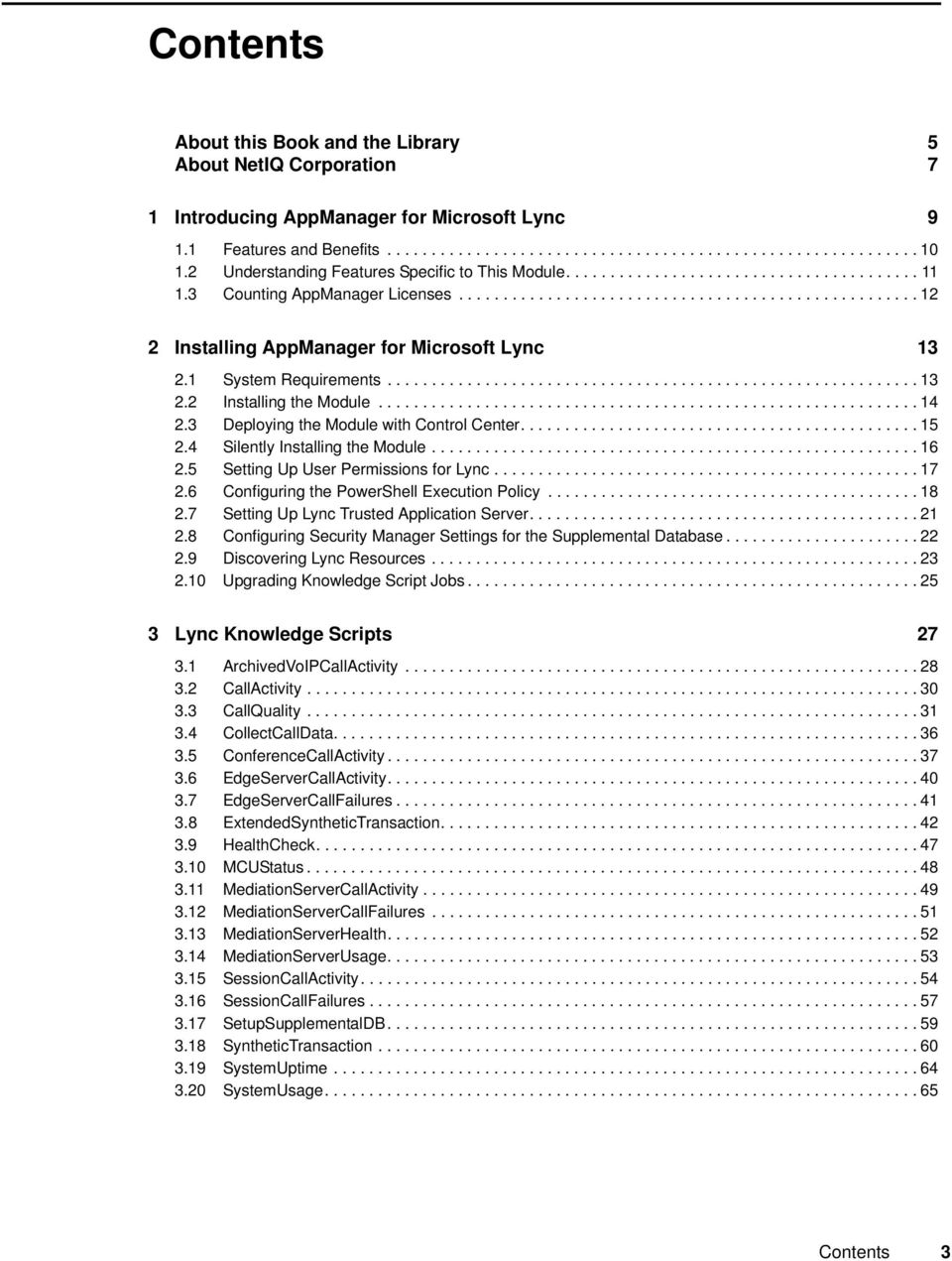
3 Contents About this Book and the Library 5 About NetIQ Corporation 7 1 Introducing AppManager for Microsoft Lync Features and Benefits Understanding Features Specific to This Module Counting AppManager Licenses Installing AppManager for Microsoft Lync System Requirements Installing the Module Deploying the Module with Control Center Silently Installing the Module Setting Up User Permissions for Lync Configuring the PowerShell Execution Policy Setting Up Lync Trusted Application Server Configuring Security Manager Settings for the Supplemental Database Discovering Lync Resources Upgrading Knowledge Script Jobs Lync Knowledge Scripts ArchivedVoIPCallActivity CallActivity CallQuality CollectCallData ConferenceCallActivity EdgeServerCallActivity EdgeServerCallFailures ExtendedSyntheticTransaction HealthCheck MCUStatus MediationServerCallActivity MediationServerCallFailures MediationServerHealth MediationServerUsage SessionCallActivity SessionCallFailures SetupSupplementalDB SyntheticTransaction SystemUptime SystemUsage Contents 3
4 4 NetIQ AppManager for Microsoft Lync Management Guide

5 About this Book and the Library The NetIQ AppManager product (AppManager) is a comprehensive solution for managing, diagnosing, and analyzing performance, availability, and health for a broad spectrum of operating environments, applications, services, and server hardware. AppManager provides system administrators with a central, easy-to-use console to view critical server and application resources across the enterprise. With AppManager, administrative staff can monitor computer and application resources, check for potential problems, initiate responsive actions, automate routine tasks, and gather performance data for real-time and historical reporting and analysis. Intended Audience This guide provides information for individuals responsible for installing an AppManager module and monitoring specific applications with AppManager. Other Information in the Library The library provides the following information resources: Installation Guide for AppManager Provides complete information about AppManager pre-installation requirements and step-bystep installation procedures for all AppManager components. User Guide for AppManager Control Center Provides complete information about managing groups of computers, including running jobs, responding to events, creating reports, and working with Control Center. A separate guide is available for the AppManager Operator Console. Administrator Guide for AppManager Provides information about maintaining an AppManager management site, managing security, using scripts to handle AppManager tasks, and leveraging advanced configuration options. Upgrade and Migration Guide for AppManager Provides complete information about how to upgrade from a previous version of AppManager. Management guides Provide information about installing and monitoring specific applications with AppManager. Help Provides context-sensitive information and step-by-step guidance for common tasks, as well as definitions for each field on each window. The AppManager library is available in Adobe Acrobat (PDF) format from the AppManager Documentation page of the NetIQ Web site. About this Book and the Library 5
6 6 NetIQ AppManager for Microsoft Lync Management Guide

7 About NetIQ Corporation We are a global, enterprise software company, with a focus on the three persistent challenges in your environment: Change, complexity and risk and how we can help you control them. Our Viewpoint Adapting to change and managing complexity and risk are nothing new In fact, of all the challenges you face, these are perhaps the most prominent variables that deny you the control you need to securely measure, monitor, and manage your physical, virtual, and cloud computing environments. Enabling critical business services, better and faster We believe that providing as much control as possible to IT organizations is the only way to enable timelier and cost effective delivery of services. Persistent pressures like change and complexity will only continue to increase as organizations continue to change and the technologies needed to manage them become inherently more complex. Our Philosophy Selling intelligent solutions, not just software In order to provide reliable control, we first make sure we understand the real-world scenarios in which IT organizations like yours operate day in and day out. That's the only way we can develop practical, intelligent IT solutions that successfully yield proven, measurable results. And that's so much more rewarding than simply selling software. Driving your success is our passion We place your success at the heart of how we do business. From product inception to deployment, we understand that you need IT solutions that work well and integrate seamlessly with your existing investments; you need ongoing support and training post-deployment; and you need someone that is truly easy to work with for a change. Ultimately, when you succeed, we all succeed. Our Solutions Identity & Access Governance Access Management Security Management Systems & Application Management Workload Management Service Management About NetIQ Corporation 7
8 Contacting Sales Support For questions about products, pricing, and capabilities, contact your local partner. If you cannot contact your partner, contact our Sales Support team. Worldwide: United States and Canada: Web Site: Contacting Technical Support For specific product issues, contact our Technical Support team. Worldwide: North and South America: Europe, Middle East, and Africa: +353 (0) Web Site: Contacting Documentation Support Our goal is to provide documentation that meets your needs. The documentation for this product is available on the NetIQ Web site in HTML and PDF formats on a page that does not require you to log in. If you have suggestions for documentation improvements, click comment on this topic at the bottom of any page in the HTML version of the documentation posted at documentation. You can also [email protected]. We value your input and look forward to hearing from you. Contacting the Online User Community NetIQ Communities, the NetIQ online community, is a collaborative network connecting you to your peers and NetIQ experts. By providing more immediate information, useful links to helpful resources, and access to NetIQ experts, NetIQ Communities helps ensure you are mastering the knowledge you need to realize the full potential of IT investments upon which you rely. For more information, visit community.netiq.com. 8 NetIQ AppManager for Microsoft Lync Management Guide
9 1 1Introducing AppManager for Microsoft Lync Microsoft Lync, formerly known as Office Communications Server (OCS), presently knows as Skype for Business, integrates enterprise-ready instant messaging, presence, conferencing, and unified communications in a single offering. Lync comes in a Standard Edition for smaller companies and an Enterprise Edition for larger companies. AppManager for Microsoft Lync provides performance and availability management for the following components: Instant Messaging (IM) Conferencing server This server provides server-managed instant messaging sessions for two users and instant message conferences for more than two users. Audio/Video (A/V) Conferencing server This server provides audio and video peer-to-peer and conferencing capabilities. Web Conferencing server This server provides data collaboration and application-sharing capabilities. Teleconferencing server This server enables audio conference integration with audio conferencing providers, or ACPs. Enterprise pool An Enterprise pool is a collection of Enterprise Edition servers running behind a load balancer for increased performance and availability. Front-end server This server hosts the various conference servers, which Microsoft calls Multipoint Control Units, or MCUs. AppManager for Microsoft Lync also monitors the following optional components: Mediation server This server provides signaling and media translation between the enterprise voice infrastructure and a basic media gateway. Edge server This server connects external users with the system so they can participate in meetings and conferences. The following Edge servers allow specific types of multimedia conferences: Access Edge server This server handles Session Initiation Protocol (SIP) traffic for calls from Lync users from outside the corporate firewall. Web Conferencing Edge server This server connects traffic between the Web Conferencing Server and external clients. Introducing AppManager for Microsoft Lync 9
10 A/V Conferencing Edge server This server provides a single, trusted connection point through which both inbound and outbound media traffic can securely traverse network address translators, or NATs, and firewalls. Director This element authenticates users. If Director is not present, the front-end server handles authentication. Archiving server This server archives instant messages for compliance purposes. Note that the AppManager for Microsoft Lync module discovers this component, but does not monitor it. Monitoring server This server gathers call data record (CDR) data, Quality of Service (QoS) data, and Quality of Experience (QoE) data. Back-end server This server tracks all data and interactions. NOTE: The Archiving, Monitoring, and Back-end servers require SQL Server database software. Supported versions include: Microsoft SQL Server 2012 Microsoft SQL Server 2008 R2 Microsoft SQL Server 2008 with Service Pack 1 or the latest service pack (64-bit only) Microsoft SQL Server 2005 with Service Pack 3 or the latest service pack (64-bit only) Note that the Archiving and Monitoring Server databases can reside on the same computer. For more information about configuring servers, see Installing SQL Server for the Archiving Database article. 1.1 Features and Benefits The following are some of the features and benefits of using AppManager for Microsoft Lync: Monitors the availability of Lync servers and the health of all services running on Lync servers Monitors the total CPU usage of a server using Lync Monitors the VoIP call metrics contained in the Monitoring (CDR) database Monitors the current call activity and call failure metrics of Edge Servers and Mediation Servers Monitors QoS metrics to predict call quality Monitors end-user experience by using Lync synthetic transactions Tracks server uptime since last reboot Tracks the number and duration of all sessions occurring on Lync servers Tracks the load placed on servers by ongoing conferences and sessions Tracks any failed conferences or sessions 10 NetIQ AppManager for Microsoft Lync Management Guide

11 1.2 Understanding Features Specific to This Module The following features will help you maximize your usage of AppManager for Microsoft Lync Lync Knowledge Script Group A Knowledge Script Group, or KSG, is a set of scripts that have their parameters already set to recommended values. To run all of the recommended scripts in a KSG at one time, simply drag and drop the KSG group onto a Lync resource in the left pane. The Lync KSG provides an easy way to get started, right out of the box. This KSG is displayed on the RECOMMENDED tab of the Knowledge Script pane, and includes the following scripts: HealthCheck, which monitors the active status of services on a Lync server. MCUStatus, which monitors the health and draining state of a Multipoint Control Unit (MCU). MediationServerHealth, which measures the global health and connectivity status of a Mediation server. SystemUptime, which monitors how long a server remains up and running after a reboot. SystemUsage, which monitors CPU usage of a Lync server and the processor time per service Call Activity Knowledge Script Group Another Knowledge Script Group is the CallActivity KSG, which enables you to monitor call activity across all the server components that have been discovered. This KSG is displayed on the Lync tab, and contains the following scripts: ArchivedVoIPCallActivity, which monitors the various VoIP call metrics contained in the Monitoring database. ConferenceCallActivity, which monitors conferences and users in conferences on a Lync server. EdgeServerCallActivity, which monitors current call activity metrics for the Edge server. MediationServerCallActivity, which monitors inbound and outbound calls of a Mediation server. SessionCallActivity, which monitors the number of current sessions on a Lync server New AppManager TreeView Objects Lync discovery generates a new application view in the Operator Console. All the new objects that can be displayed as a result of discovery will rarely be contained under a single machine in the TreeView of AppManager. Note that you must run the Discovery script on each server hosting a Lync server component so that AppManager discovers each one separately. After discovery, AppManager displays the various Lync components under the server in the TreeView on the left side of the AppManager window SystemUptime Knowledge Script To ensure that your monitored systems are being tracked after you install AppManager for Microsoft Lync, set up the parameters for the SystemUptime Knowledge Script immediately after installation. For more information, see SystemUptime. Introducing AppManager for Microsoft Lync 11

12 1.3 Counting AppManager Licenses AppManager for Microsoft Lync consumes one license for each agent computer on which Lync is discovered. 12 NetIQ AppManager for Microsoft Lync Management Guide
13 2 2Installing AppManager for Microsoft Lync This chapter provides installation instructions and describes system requirements for AppManager for Microsoft Lync. This chapter assumes you have AppManager installed. For more information about installing AppManager or about AppManager system requirements, see the Installation Guide for AppManager, which is available on the AppManager Documentation page. NOTE This release of AppManager for Microsoft Lync does not support an upgrade from the AppManager for Microsoft Office Communications Server (OCS) module. This module does not discover or monitor OCS components. If you plan to retain OCS components on any of your servers, run the AppManager for OCS module for those components. AppManager for Microsoft OCS does not support Microsoft Lync. To discover and monitor Lync components, use the AppManager for Microsoft Lync module. 2.1 System Requirements For the latest information about supported software versions and the availability of module updates, visit the AppManager Supported Products page. Unless noted otherwise, this module supports all updates, hotfixes, and service packs for the releases listed below. AppManager for Microsoft Lync has the following system requirements: Software NetIQ AppManager installed on the AppManager repository (QDB) computer, on the Lync computers you want to monitor (AppManager agents), and on all console computers Microsoft Windows operating system on the agent computers Version 7.0 or later Support for Windows Server 2008 on AppManager 7.x requires AppManager Windows Agent hotfix or later. For more information, see the AppManager Suite Hotfixes page. One of the following: Windows Server 2012 R2 Windows Server 2012 Windows Server 2008 R2 Windows Server 2008 (64-bit only) Microsoft Lync on the agent computers 2010 or 2013 Microsoft Skype for Business on agent computers 2015 Installing AppManager for Microsoft Lync 13

14 Software AppManager for Microsoft Windows module installed on repository, agent, and console computers Microsoft SQL Server for Lync Supplemental Database Microsoft.NET Framework installed on the Lync trusted application server Version or later. For more information, see the AppManager Module Upgrades & Trials page. 3.5 SQL Server 2012 or SQL Server 2012 Express SQL Server 2008 R2 (32-bit and 64-bit) SQL Server 2008 (32-bit and 64-bit) or SQL Server 2008 Express (32-bit and 64-bit) SQL Server 2005 (32-bit and 64-bit) Service Pack 4 or SQL Server 2005 Express (32-bit and 64-bit) Service Pack Installing the Module Run the module installer on the Microsoft Lync computers you want to monitor (agents) to install the agent components, and run the module installer on all console computers to install the Help and console extensions. Access the AM70-Lync-8.x.x.0.msi module installer from the AAM70_Lync_8.x.x.0 self-extracting installation package on the AppManager Module Upgrades & Trials page. For Windows environments where User Account Control (UAC) is enabled, install the module using an account with administrative privileges. Use one of the following methods: Log in to the server using the account named Administrator. Then, run the module installer.msi file from a command prompt or by double-clicking it. Log in to the server as a user with administrative privileges and run the module installer.msi file as an administrator from a command prompt. To open a command-prompt window at the administrative level, right-click a command-prompt icon or a Windows menu item and select Run as administrator. You can install the Knowledge Scripts into local or remote AppManager repositories (QDBs). The module installer installs Knowledge Scripts for each module directly into the QDB instead of installing the scripts in the \AppManager\qdb\kp folder as in previous releases of AppManager. You can install the module manually, or you can use Control Center to deploy the module to a remote computer where an agent is installed. For more information, see Section 2.3, Deploying the Module with Control Center, on page 15. However, if you use Control Center to deploy the module, Control Center only installs the agent components of the module. The module installer installs the QDB and console components as well as the agent components on the agent computer. To install the module manually: 1 Double-click the module installer.msi file. 2 Accept the license agreement. 3 Review the results of the pre-installation check. You can expect one of the following three scenarios: No AppManager agent is present: In this scenario, the pre-installation check fails, and the installer does not install agent components. 14 NetIQ AppManager for Microsoft Lync Management Guide

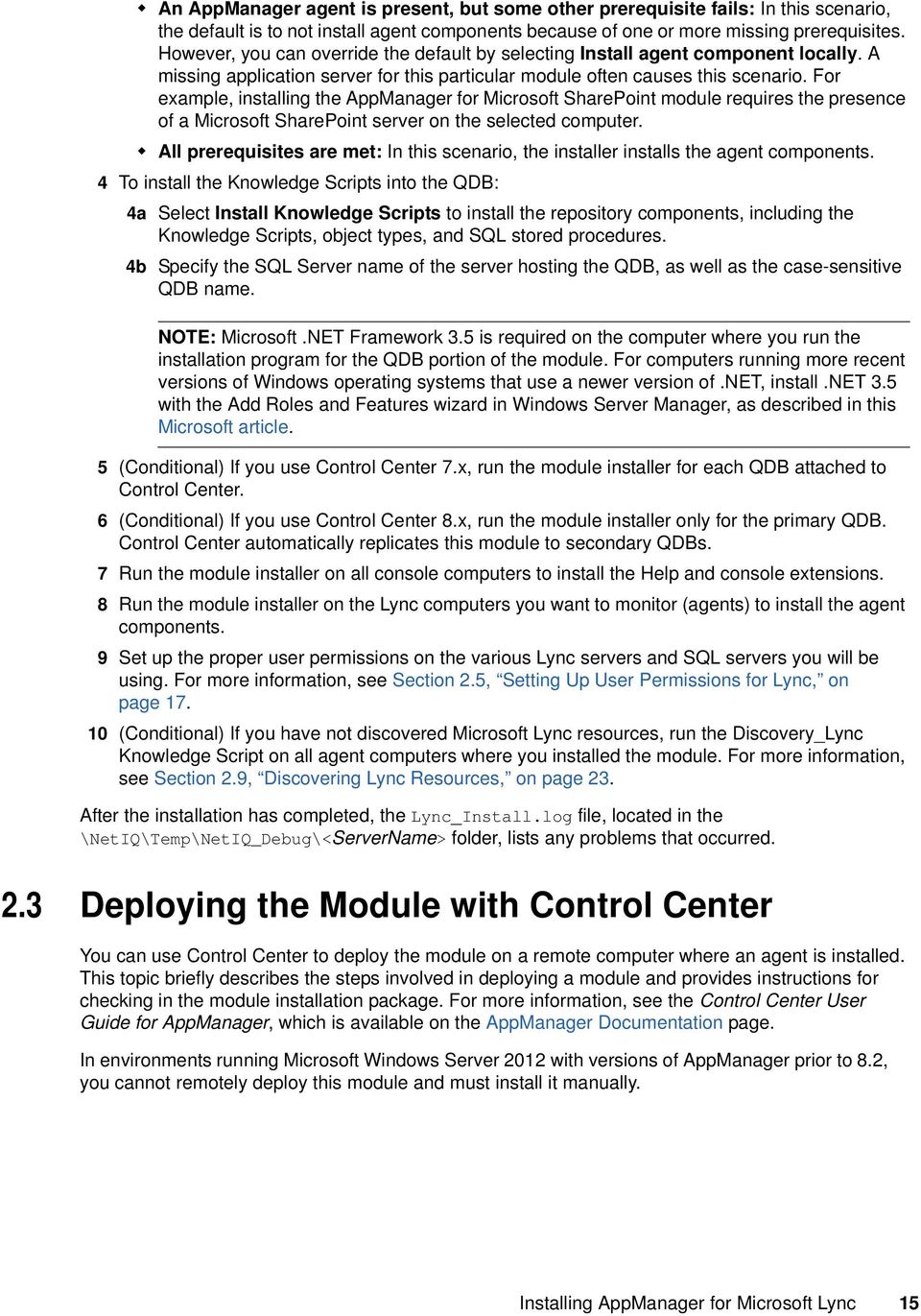
15 An AppManager agent is present, but some other prerequisite fails: In this scenario, the default is to not install agent components because of one or more missing prerequisites. However, you can override the default by selecting Install agent component locally. A missing application server for this particular module often causes this scenario. For example, installing the AppManager for Microsoft SharePoint module requires the presence of a Microsoft SharePoint server on the selected computer. All prerequisites are met: In this scenario, the installer installs the agent components. 4 To install the Knowledge Scripts into the QDB: 4a Select Install Knowledge Scripts to install the repository components, including the Knowledge Scripts, object types, and SQL stored procedures. 4b Specify the SQL Server name of the server hosting the QDB, as well as the case-sensitive QDB name. NOTE: Microsoft.NET Framework 3.5 is required on the computer where you run the installation program for the QDB portion of the module. For computers running more recent versions of Windows operating systems that use a newer version of.net, install.net 3.5 with the Add Roles and Features wizard in Windows Server Manager, as described in this Microsoft article. 5 (Conditional) If you use Control Center 7.x, run the module installer for each QDB attached to Control Center. 6 (Conditional) If you use Control Center 8.x, run the module installer only for the primary QDB. Control Center automatically replicates this module to secondary QDBs. 7 Run the module installer on all console computers to install the Help and console extensions. 8 Run the module installer on the Lync computers you want to monitor (agents) to install the agent components. 9 Set up the proper user permissions on the various Lync servers and SQL servers you will be using. For more information, see Section 2.5, Setting Up User Permissions for Lync, on page (Conditional) If you have not discovered Microsoft Lync resources, run the Discovery_Lync Knowledge Script on all agent computers where you installed the module. For more information, see Section 2.9, Discovering Lync Resources, on page 23. After the installation has completed, the Lync_Install.log file, located in the \NetIQ\Temp\NetIQ_Debug\<ServerName> folder, lists any problems that occurred. 2.3 Deploying the Module with Control Center You can use Control Center to deploy the module on a remote computer where an agent is installed. This topic briefly describes the steps involved in deploying a module and provides instructions for checking in the module installation package. For more information, see the Control Center User Guide for AppManager, which is available on the AppManager Documentation page. In environments running Microsoft Windows Server 2012 with versions of AppManager prior to 8.2, you cannot remotely deploy this module and must install it manually. Installing AppManager for Microsoft Lync 15
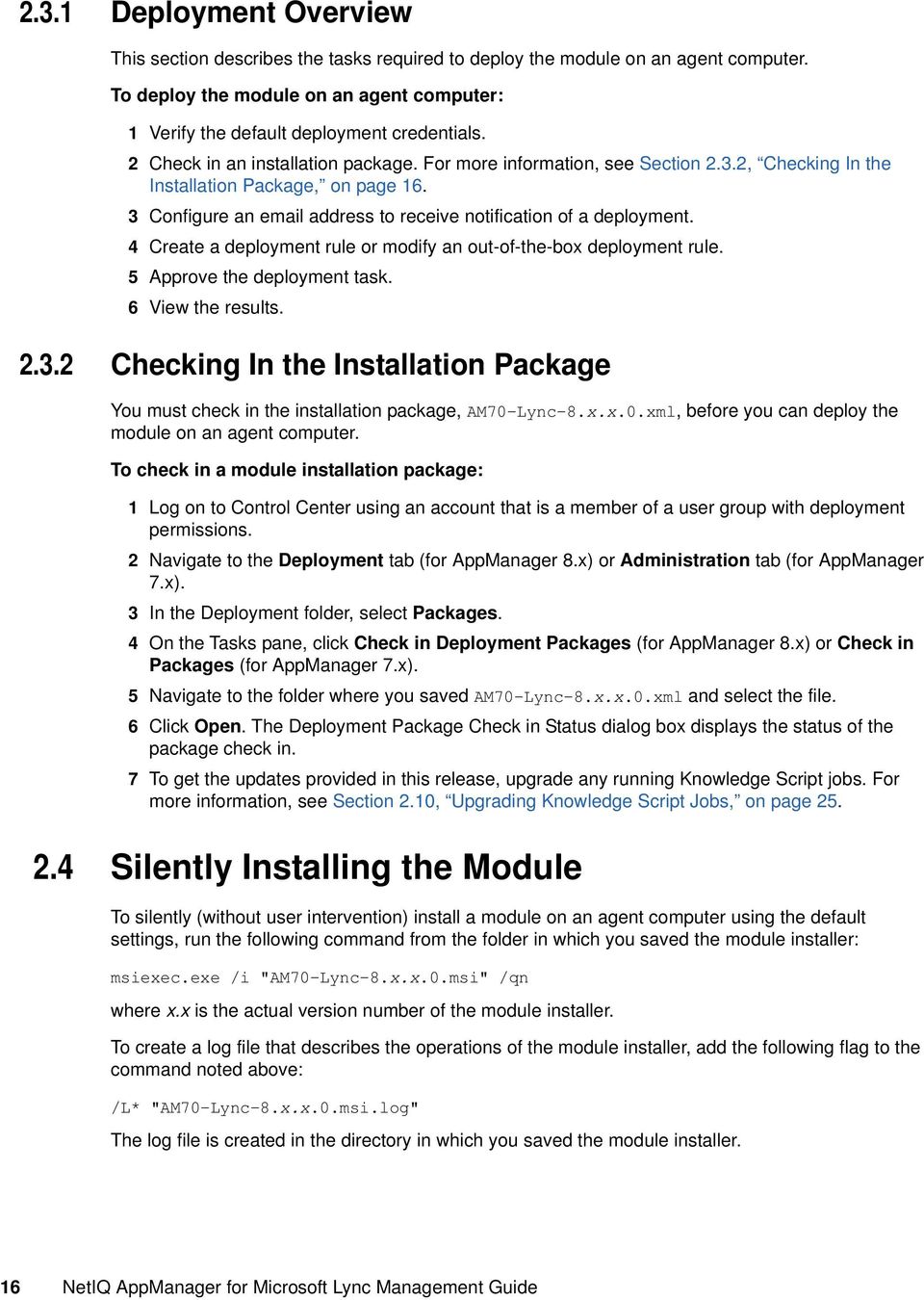
16 2.3.1 Deployment Overview This section describes the tasks required to deploy the module on an agent computer. To deploy the module on an agent computer: 1 Verify the default deployment credentials. 2 Check in an installation package. For more information, see Section 2.3.2, Checking In the Installation Package, on page Configure an address to receive notification of a deployment. 4 Create a deployment rule or modify an out-of-the-box deployment rule. 5 Approve the deployment task. 6 View the results Checking In the Installation Package You must check in the installation package, AM70-Lync-8.x.x.0.xml, before you can deploy the module on an agent computer. To check in a module installation package: 1 Log on to Control Center using an account that is a member of a user group with deployment permissions. 2 Navigate to the Deployment tab (for AppManager 8.x) or Administration tab (for AppManager 7.x). 3 In the Deployment folder, select Packages. 4 On the Tasks pane, click Check in Deployment Packages (for AppManager 8.x) or Check in Packages (for AppManager 7.x). 5 Navigate to the folder where you saved AM70-Lync-8.x.x.0.xml and select the file. 6 Click Open. The Deployment Package Check in Status dialog box displays the status of the package check in. 7 To get the updates provided in this release, upgrade any running Knowledge Script jobs. For more information, see Section 2.10, Upgrading Knowledge Script Jobs, on page Silently Installing the Module To silently (without user intervention) install a module on an agent computer using the default settings, run the following command from the folder in which you saved the module installer: msiexec.exe /i "AM70-Lync-8.x.x.0.msi" /qn where x.x is the actual version number of the module installer. To create a log file that describes the operations of the module installer, add the following flag to the command noted above: /L* "AM70-Lync-8.x.x.0.msi.log" The log file is created in the directory in which you saved the module installer. 16 NetIQ AppManager for Microsoft Lync Management Guide
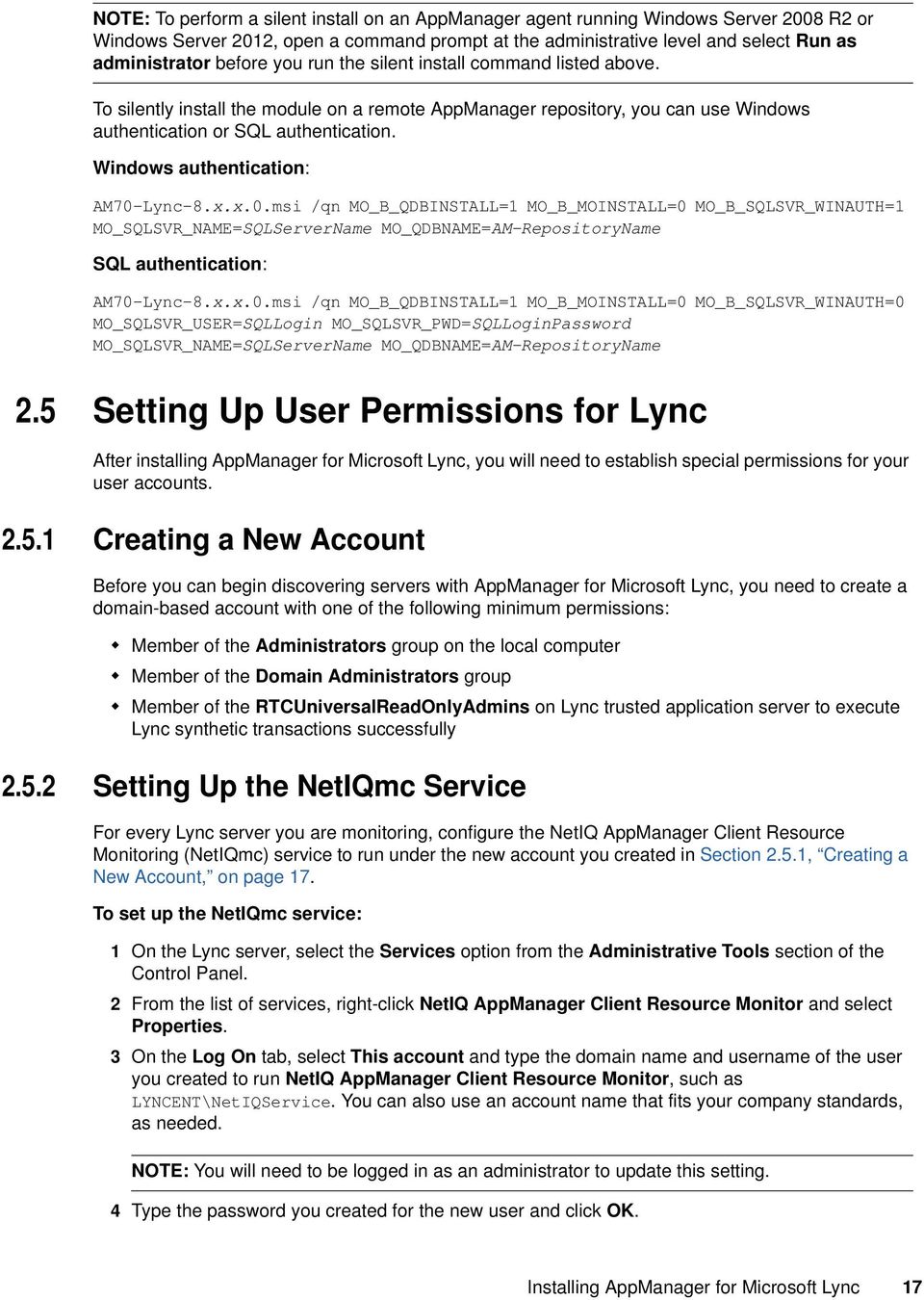
17 NOTE: To perform a silent install on an AppManager agent running Windows Server 2008 R2 or Windows Server 2012, open a command prompt at the administrative level and select Run as administrator before you run the silent install command listed above. To silently install the module on a remote AppManager repository, you can use Windows authentication or SQL authentication. Windows authentication: AM70-Lync-8.x.x.0.msi /qn MO_B_QDBINSTALL=1 MO_B_MOINSTALL=0 MO_B_SQLSVR_WINAUTH=1 MO_SQLSVR_NAME=SQLServerName MO_QDBNAME=AM-RepositoryName SQL authentication: AM70-Lync-8.x.x.0.msi /qn MO_B_QDBINSTALL=1 MO_B_MOINSTALL=0 MO_B_SQLSVR_WINAUTH=0 MO_SQLSVR_USER=SQLLogin MO_SQLSVR_PWD=SQLLoginPassword MO_SQLSVR_NAME=SQLServerName MO_QDBNAME=AM-RepositoryName 2.5 Setting Up User Permissions for Lync After installing AppManager for Microsoft Lync, you will need to establish special permissions for your user accounts Creating a New Account Before you can begin discovering servers with AppManager for Microsoft Lync, you need to create a domain-based account with one of the following minimum permissions: Member of the Administrators group on the local computer Member of the Domain Administrators group Member of the RTCUniversalReadOnlyAdmins on Lync trusted application server to execute Lync synthetic transactions successfully Setting Up the NetIQmc Service For every Lync server you are monitoring, configure the NetIQ AppManager Client Resource Monitoring (NetIQmc) service to run under the new account you created in Section 2.5.1, Creating a New Account, on page 17. To set up the NetIQmc service: 1 On the Lync server, select the Services option from the Administrative Tools section of the Control Panel. 2 From the list of services, right-click NetIQ AppManager Client Resource Monitor and select Properties. 3 On the Log On tab, select This account and type the domain name and username of the user you created to run NetIQ AppManager Client Resource Monitor, such as LYNCENT\NetIQService. You can also use an account name that fits your company standards, as needed. NOTE: You will need to be logged in as an administrator to update this setting. 4 Type the password you created for the new user and click OK. Installing AppManager for Microsoft Lync 17
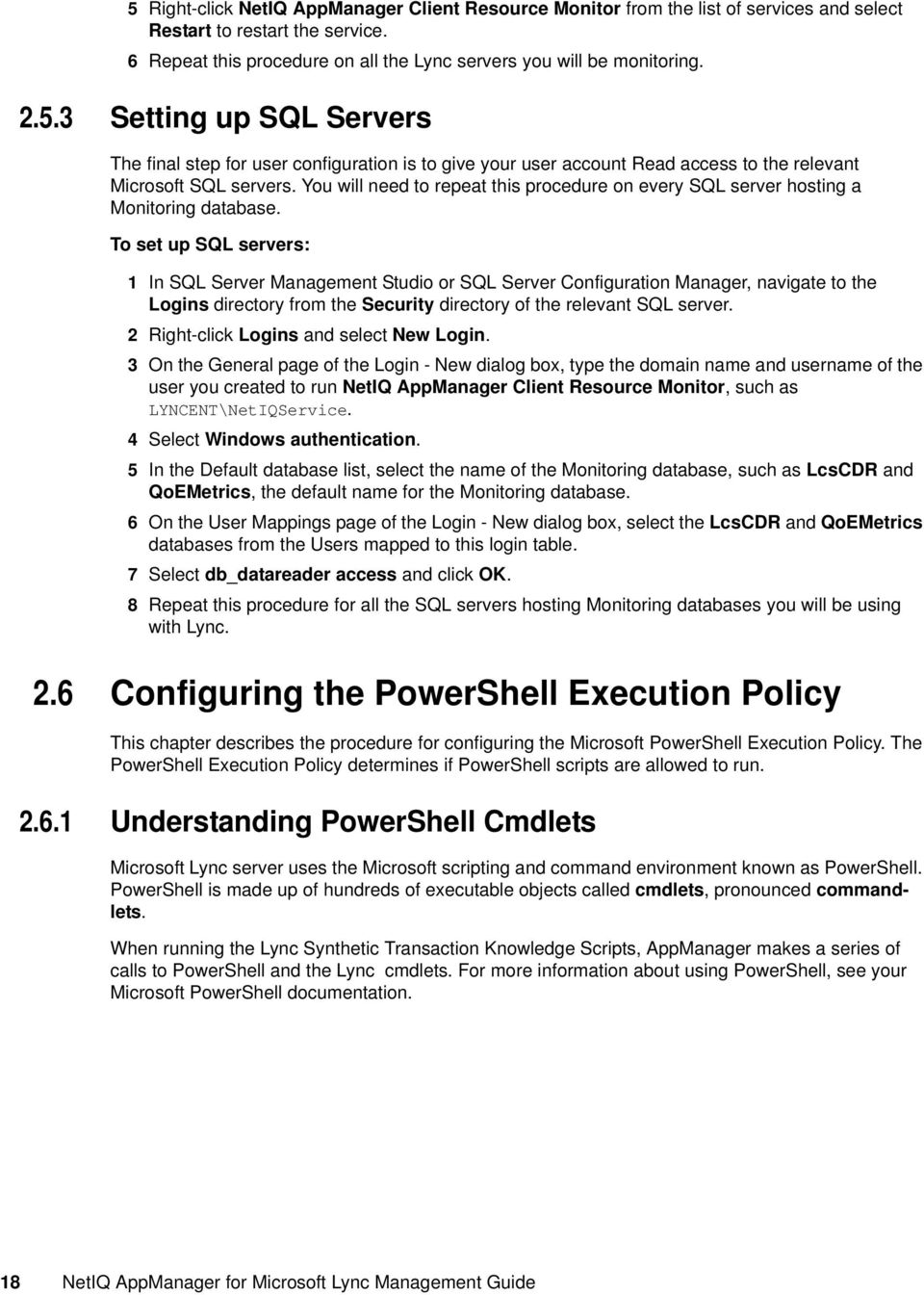
18 5 Right-click NetIQ AppManager Client Resource Monitor from the list of services and select Restart to restart the service. 6 Repeat this procedure on all the Lync servers you will be monitoring Setting up SQL Servers The final step for user configuration is to give your user account Read access to the relevant Microsoft SQL servers. You will need to repeat this procedure on every SQL server hosting a Monitoring database. To set up SQL servers: 1 In SQL Server Management Studio or SQL Server Configuration Manager, navigate to the Logins directory from the Security directory of the relevant SQL server. 2 Right-click Logins and select New Login. 3 On the General page of the Login - New dialog box, type the domain name and username of the user you created to run NetIQ AppManager Client Resource Monitor, such as LYNCENT\NetIQService. 4 Select Windows authentication. 5 In the Default database list, select the name of the Monitoring database, such as LcsCDR and QoEMetrics, the default name for the Monitoring database. 6 On the User Mappings page of the Login - New dialog box, select the LcsCDR and QoEMetrics databases from the Users mapped to this login table. 7 Select db_datareader access and click OK. 8 Repeat this procedure for all the SQL servers hosting Monitoring databases you will be using with Lync. 2.6 Configuring the PowerShell Execution Policy This chapter describes the procedure for configuring the Microsoft PowerShell Execution Policy. The PowerShell Execution Policy determines if PowerShell scripts are allowed to run Understanding PowerShell Cmdlets Microsoft Lync server uses the Microsoft scripting and command environment known as PowerShell. PowerShell is made up of hundreds of executable objects called cmdlets, pronounced commandlets. When running the Lync Synthetic Transaction Knowledge Scripts, AppManager makes a series of calls to PowerShell and the Lync cmdlets. For more information about using PowerShell, see your Microsoft PowerShell documentation. 18 NetIQ AppManager for Microsoft Lync Management Guide
19 2.6.2 Configuring the PowerShell Execution Policy The PowerShell Execution Policy determines whether PowerShell scripts are allowed to run. By default, the Execution Policy is set to Restricted. If you try to run scripts under the Restricted policy, AppManager generates error messages. The Execution Policy directly affects the Lync Synthetic Transaction Knowledge Scripts. Although the scripts that ship with AppManager for Lync are written in VBScript and installed as <scriptname>.qml, the logic for the Lync Synthetic Transaction scripts are contained in complementary PowerShell scripts that are installed on the agent computer along with the module. The PowerShell scripts use the same name as the Lync Knowledge Scripts, but with a.ps1 extension. NOTE: The digital signature encoded in a Lync Synthetic Transaction Knowledge Script is tied to the contents of the script. If you change the script, the signature is no longer valid and you cannot execute the script. If you change a Lync Synthetic Transaction Knowledge Script, you must do one of the following: Re-sign the scripts using your own digital certificate. Change the Execution Policy to either RemoteSigned or Unrestricted. A group policy that governs script execution overrides any policy changes you make with the Set-ExecutionPolicy cmdlet. For example, if the group policy forbids script execution, you cannot change the policy by running Set-ExecutionPolicy. First change the group policy to allow script execution, and then run Set-ExecutionPolicy to select a specific Execution Policy. Before AppManager can execute the PowerShell scripts, you must change the Execution Policy from Restricted to one of the following policy options: AllSigned, which allows execution of scripts that have been digitally signed by a trusted publisher. If you select the AllSigned policy, perform the steps outlined in Section 2.6.3, Trusting Lync Synthetic Transaction Scripts, on page 19. RemoteSigned, which allows local scripts to run regardless of signature, and requires trusted digital signatures only for remote scripts. Lync Synthetic Transaction Knowledge Scripts are local scripts. Unrestricted, which allows both local and remote scripts to run, regardless of signature. To change the PowerShell Execution Policy: 1 Open the Lync Command Shell on the agent computer. 2 Run the following cmdlet: Set-ExecutionPolicy <policy> where <policy> is the name of the Execution Policy you choose Trusting Lync Synthetic Transaction Scripts When a PowerShell script is executed under an AllSigned policy, PowerShell verifies that the script contains a digital signature and that the signature is associated with a trusted publisher. NetIQ Corporation signs the Lync Synthetic Transaction scripts. If you use the AllSigned policy, you must Installing AppManager for Microsoft Lync 19

20 choose to trust NetIQ Corporation by importing the NetIQ Corporation digital certificate into the local certificate store on the Lync trusted application server where you plan to execute Lync synthetic transactions. You can import the digital certificate by running one of the Lync PowerShell scripts from the command line. To import the digital certificate: 1 Open the Lync Command Shell on the agent computer. 2 Change to the AppManager\bin\PowerShell\Scripts directory. 3 Type.\Lync_SyntheticTransaction.ps1 4 Press Enter. 5 Type A at the prompt asking whether the script should be allowed to run. 6 Press Enter. These steps allow the NetIQ Corporation digital certificate to be imported into the certificate store for the user running the script. Run any script once to establish trust. At this point, trust is established only between NetIQ Corporation and the user running the script. Trust is not established for any other user. If the AppManager agent runs under a different user account, such as Local System, a domain account, or a local computer account, the agent will not have a trust relationship and will not be allowed to execute the Lync Synthetic Transaction scripts. To extend trust to all other user accounts, see Section 2.6.4, Extending Trust to All User Accounts, on page Extending Trust to All User Accounts To execute PowerShell scripts under the AllSigned Execution Policy, extend trust to all user accounts. Extending trust is a two-phase process that involves exporting the digital certificate from the current user and importing the digital certificate to all users on the local computer. Exporting the NetIQ Corporation Digital Signature Certificate To extend trust to all user accounts, first export the NetIQ Corporation digital signature certificate from the current user using the Microsoft Management Console. To export the NetIQ Corporation digital signature certificate from the current user: 1 On the Start menu, click Run. 2 In the Open field, type mmc.exe, and then click OK. 3 On the File menu in the Microsoft Management Console window, click Add/Remove Snap-in. 4 Click Add and then select the Certificates snap-in. 5 Click Add, select My user account, and then click Finish. 6 Click Close and then click OK. The Certificates-Current User node is displayed in the tree view of the Console window. 7 Expand Certificates - Current User. 8 Expand Trusted Publishers and select Certificates. 9 In the right pane, right-click the NetIQ certificate, select All Tasks, and then select Export. 10 Click Next in the Certificate Export Wizard. 20 NetIQ AppManager for Microsoft Lync Management Guide

21 11 Select DER encoded binary and then click Next. 12 Click Browse, select the Desktop icon, type NetIQ in the File name field, and then click Save. 13 Click Next, and then click Finish. Importing the NetIQ Corporation Digital Signature The next phase of extending trust to all user accounts involves importing the NetIQ Corporation digital signature to all users on the local computer. Use the Microsoft Management Console to execute the import procedure. To import the NetIQ Corporation digital certificate to all users on the local computer: 1 On the File menu in the Microsoft Management Console window, click Add/Remove Snap-in. 2 Click Add and then select the Certificates snap-in. 3 Click Add, select Computer account, and then click Next. 4 Select Local computer and then click Finish. 5 Click Close and then click OK. 6 Expand Certificates (Local Computer) and select Trusted Publishers. 7 Right-click in the right pane, select All Tasks, and then select Import. 8 Click Next in the Certificate Import Wizard. 9 Click Browse, click the Desktop icon, select NetIQ.cer, and then click Open. 10 Click Next in the Wizard. 11 Select Place all certificates in the following store. 12 Click Browse and then select Show physical stores. 13 Expand Trusted Publishers and select Local Computer. 14 Click OK. 15 Click Next in the Certificate Import Wizard, and then click Finish. After you complete both the phases of the trust process, the NetIQ Corporation certificate is contained in the certificate store for the local computer, allowing all users to execute the PowerShell scripts. 2.7 Setting Up Lync Trusted Application Server To run the Lync_SyntheticTransaction Knowledge Script, you must configure a Lync trusted application server that is capable of executing the Lync synthetic transaction PowerShell commandlets. The Lync synthetic transactions are executed on the Lync trusted application server. To set up trusted application server: 1 Add the agent computer on which you want to run the Lync_SyntheticTransaction Knowledge Script to the Lync Topology and then publish the topology. 2 Install local configuration store on the agent computer by using the Lync deployment wizard. 3 Assign the default certificate to the agent computer by using the Lync deployment wizard. 4 Launch the Lync management PowerShell and execute the following commandlet to create new trusted application: Installing AppManager for Microsoft Lync 21
22 New-CsTrustedApplication -ApplicationID <ApplicationID> - TrustedApplicationPoolFqdn <FQDN of the trusted application server> -Port Execute Enable-CsTopology from the Lync management PowerShell to enable the topology. 6 Create two Lync test users for each monitored Lync FrontEnd pools. 7 Execute the following commandlet from the Lync management PowerShell to set up the monitoring configuration for each Lync FrontEnd pool, which is monitored using synthetic transactions: New-CsHealthMonitoringConfiguration -TargetFqdn <FQDN of the FrontEnd pool> - FirstTestUserSipUri "<Test user 1 SIP URI>" -FirstTestSamAccountName "<DOMAIN\TestUser1>" -SecondTestUserSipUri "<Test User 2 SIP URI>" - SecondTestSamAccountName "<DOMAIN\TestUser2> 2.8 Configuring Security Manager Settings for the Supplemental Database To measure the call quality of the Lync deployment, you need to store the call detail records (audio, video, and call sharing) in the supplemental database. To avoid getting an error message when running the Discovery_Lync script, with Setup supplemental database parameter selected, or when running the Lync_SetupSupplementalDB Knowledege Script, use AppManager Security Manager to store the SQL user name and password information for the SQL Server. NOTE You can create the supplemental database only when you run the discovery or the Lync_SetupSupplementalDB Knowledge Script on a front-end pool server. The following configuration is required only when you want to set up the supplemental database on a SQL server configured for SQL authentication. On the Custom tab in Security Manager, complete the following fields for the SQL Server where you want to create the supplemental database: Field Label Description Specify the SQL Server name and the instance name of the SQL Server hosting the Lync supplemental database. Use the following structure: SQL$SQL Server Name\Instance Name For example: SQL$HOUSERVER2\DB1 Sub-Label Value1 Extended application support Specify the username. The user should have proper permissions to create the database on the SQL server. Specify the password for the user specified in the Sub-Label field. Select this option to encrypt the password in Security Manager. This option is required. 22 NetIQ AppManager for Microsoft Lync Management Guide
23 2.9 Discovering Lync Resources Use the Discovery_Lync Knowledge Script to discover all known resources on a Lync server. The script discovers Lync Enterprise and Standard editions, Mediation servers, and Edge servers. When AppManager discovers a Lync component, that component is displayed under the relevant server in the TreeView on the left side of the AppManager window. Before running discovery, ensure you have set up the proper user permissions on the various Lync servers and SQL servers you will be using. For more information, see Section 2.5, Setting Up User Permissions for Lync, on page 17. The default interval for this script is weekly; the default is Sundays at 3 A.M. If you delete or add a resource object, or if you make any other kind of change that might affect the monitoring of your resources, run the Discovery_Lync Knowledge Script again to update your list of resource objects. In addition, if you are running this module on AppManager 8 or later, you can use the delta discovery feature in Control Center to run discovery on a schedule to more quickly detect changes to your environment. Set the Values tab parameters as needed: Description How To Set It General Settings Job Failure Notification Event severity when job fails Raise event if discovery succeeds? Event severity when discovery succeeds Raise event if discovery succeeds with warnings? Event severity when discovery succeeds with warnings Raise event if discovery fails? Event severity when discovery fails Set up supplemental database? event that is raised when the discovery job fails. The default is 5. Select Yes to raise an event when the discovery process is successful. The default is unchecked. event that is raised when discovery succeeds. The default is 25. Select Yes to raise an event when the discovery process succeeds but generates some warnings. The default is Yes. event that is raised when discovery succeeds with warnings. The default is 15. Select Yes to raise an event when the discovery process fails. The default is Yes. If you set this Knowledge Script to raise an event when the job fails, set the event severity level for a failed discovery. The default is 10. Select Yes to set up Lync supplemental database to store call quality detail records (audio, video, and application sharing calls) on a server where SQL database exists. You need to configure the SQL server credentials in the Security Manager to create a supplemental database. For more information, see Section 2.8, Configuring Security Manager Settings for the Supplemental Database, on page 22. Raise event if database setup succeeds? Select Yes to raise an event if creation of the Lync supplemental database is successful. The default is unselected. Installing AppManager for Microsoft Lync 23
24 Description Event severity when database setup succeeds Raise event if database setup fails? Event severity when database setup fails How To Set It event in which the Lync supplemental database is created successfully. The default is 25. Select Yes to raise an event if creation of the Lync supplemental database fails. The default is unselected. event in which the Lync supplemental database is not created. The default is 15. It is possible that the supplemental database was not created because of one of the following reasons: The Discovery job was run with the Set up supplemental database parameter selected on a computer other than a front-end pool server The Discovery job was run on a computer with the Set up supplemental database parameter selected on which SQL Server is not installed The Discovery job was run on a computer with the Set up supplemental database parameter selected where Lync supplemental database was already created Start pruning job on supplemental database? Select Yes to create a SQL job that deletes data from the supplemental database. The SQL job runs every night. The default is Yes. Data is deleted from the supplemental database based on the value you specify in the Number of days to keep call detail records parameter. Number of days to keep call detail records Specify the number of days worth of call detail records to keep in the Lync supplemental database. Data older than what you specify is discarded. The default is 7 days. You can specify a maximum of 30 days. SQL Server Information SQL Server \instance name Specify the SQL Server name where you want to create the new Lync Server supplemental database along with the instance if any. If you specify both the SQL Server instance name for this parameter and the SQL Server database user name in the following parameter, these values must match the values you specified in Section 2.8, Configuring Security Manager Settings for the Supplemental Database, on page 22. If this field is left blank, then the script uses the default SQL server on the agent computer to create the supplemental database in the Lync agent where you run the discovery or the Lync_SetupSupplementalDB script. If SQL database is not present on Lync agent, then the script fails to create the database. If you do not specify the instance name, the script creates the database in the default instance. SQL database user name Specify the user name for the SQL Server where you want to create the new Lync Server supplemental database. Leave this parameter blank to use Windows authentication instead of SQL authentication. 24 NetIQ AppManager for Microsoft Lync Management Guide
25 2.10 Upgrading Knowledge Script Jobs If you are using AppManager 8.x or later, the module upgrade process now retains any changes you might have made to the parameter settings for the Knowledge Scripts in the previous version of this module. Before AppManager 8.x, the module upgrade process overwrote any settings you might have made, changing the settings back to the module defaults. As a result, if this module includes any changes to the default values for any Knowledge Script parameter, the module upgrade process ignores those changes and retains all parameter values that you updated. Unless you review the management guide or the online Help for that Knowledge Script, you will not know about any changes to default parameter values that came with this release. You can push the changes for updated scripts to running Knowledge Script jobs in one of the following ways: Use the AMAdmin_UpgradeJobs Knowledge Script. Use the Properties Propagation feature Running AMAdmin_UpgradeJobs The AMAdmin_UpgradeJobs Knowledge Script can push changes to running Knowledge Script jobs. Your AppManager repository (QDB) must be at version 7.0 or later. Upgrading jobs to use the most recent script version allows the jobs to take advantage of the latest script logic while maintaining existing parameter values for the job. For more information, see the Help for the AMAdmin_UpgradeJobs Knowledge Script Propagating Knowledge Script Changes You can propagate script changes to jobs that are running and to Knowledge Script Groups, including recommended Knowledge Script Groups and renamed Knowledge Scripts. Before propagating script changes, verify that the script parameters are set to your specifications. You might need to appropriately set new parameters for your environment or application. If you are not using AppManager 8.x or later, customized script parameters might have reverted to default parameters during the installation of the module. You can choose to propagate only properties (specified in the Schedule and Values tabs), only the script (which is the logic of the Knowledge Script), or both. Unless you know specifically that changes affect only the script logic, you should propagate the properties and the script. For more information about propagating Knowledge Script changes, see the Running Monitoring Jobs chapter of the Control Center User Guide for AppManager. Installing AppManager for Microsoft Lync 25
26 Propagating Changes to Ad Hoc Jobs or Knowledge Script Groups You can propagate the properties and the logic (script) of a Knowledge Script to ad hoc jobs started by that Knowledge Script. Corresponding jobs are stopped and restarted with the Knowledge Script changes. You can also propagate the properties and logic of a Knowledge Script to corresponding Knowledge Script Group members. After you propagate script changes to Knowledge Script Group members, you can propagate the updated Knowledge Script Group members to associated running jobs. Any monitoring jobs started by a Knowledge Script Group member are restarted with the job properties of the Knowledge Script Group member. To propagate changes to ad hoc Knowledge Script jobs or Knowledge Script Groups: 1 In the Knowledge Script view, select the Knowledge Script or Knowledge Script Group for which you want to propagate changes. 2 Right-click the script or group and select Properties propagation > Ad Hoc Jobs. 3 Select the components of the Knowledge Script that you want to propagate to associated ad hoc jobs or groups and click OK: Select Script Properties To propagate The logic of the Knowledge Script. Values from the Knowledge Script Schedule and Values tabs, such as schedule, monitoring values, actions, and advanced options. If you are using AppManager 8.x or later, the module upgrade process now retains any changes you might have made to the parameter settings for the Knowledge Scripts in the previous version of this module. 26 NetIQ AppManager for Microsoft Lync Management Guide
27 3 3Lync Knowledge Scripts Microsoft Lync combines enterprise-ready instant messaging, presence capabilities, conferencing, unified communications, and administrative controls in a single offering. Lync adds real-time conferencing hosted on servers inside the corporate firewall to existing features such as federation and public instant-messaging connectivity. AppManager for Microsoft Lync provides the following Knowledge Scripts for monitoring Microsoft Lync resources. From the Knowledge Script view of Control Center, you can access more information about any NetIQ-supported Knowledge Script by selecting it and clicking Help. In the Operator Console, click any Knowledge Script in the Knowledge Script pane and press F1. Knowledge Script ArchivedVoIPCallActivity CallActivity CallQuality CollectCallData ConferenceCallActivity EdgeServerCallActivity EdgeServerCallFailures ExtendedSyntheticTransaction HealthCheck MCUStatus MediationServerCallActivity MediationServerCallFailures MediationServerHealth MediationServerUsage SessionCallActivity SessionCallFailures SetupSupplementalDB What It Does Monitors the various VoIP call metrics contained in the Monitoring (CDR) database. Group of all CallActivity Knowledge Scripts. Monitors call quality metrics such as MOS, round trip, jitter, and packet loss. Polls Lync Quality of Experience (QoE) metrics databases for call quality metrics and saves the data to the Lync supplemental database. Monitors the number of active conferences and the number of users in those conferences. Monitors current call activity metrics of an Edge server. Monitors current call failure metrics of an Edge server. Monitors the health of the Lync deployment by executing extended Lync synthetic transaction test against the Lync Front End pools. Reports the test result and latency, which helps in understanding the end-user experience. Monitors the active status of Lync server services. Monitors the health and draining state of a Multipoint Control Unit (MCU). Monitors the current inbound and outbound calls of a Mediation server. Monitors the session failure metrics of a Mediation server. Monitors the server health metrics of a Mediation server. Monitors the server resource usage of a Mediation server. Monitors the session initiation rate of a Lync server. Monitors session failure metrics of a Lync server. Creates a Lync supplemental database to store call quality metrics (audio, video, and application sharing). Lync Knowledge Scripts 27
28 Knowledge Script SyntheticTransaction SystemUptime SystemUsage What It Does Monitors the health of the Lync deployment by executing Lync synthetic transaction test against the Lync Front End pools. Reports the test result and latency, which helps in understanding the end-user experience. Monitors the length of time a system has been up and running since a reboot. Monitors the total CPU and memory usage of a Lync server. 3.1 ArchivedVoIPCallActivity Use this Knowledge Script to monitor the various Voice over IP (VoIP) call metrics contained in the Monitoring database. This script monitors the number of total VoIP calls made, the types of calls made, the average duration of calls, the number of redirected calls, and the number of calls per gateway. A gateway is third-party hardware that connects Microsoft Lync with a public switched telephone network (PSTN), private branch exchange (PBX), or other phone system Resource Objects Monitoring Server Default Schedule The default interval for this script is 15 minutes Setting Parameter Values Set the following parameters as needed: Description General Settings Job Failure Notification Event severity when job fails event that is raised when the ArchivedVoIPCallActivity job fails. The default is 5. Monitor Total Number of VoIP Calls Raise event if total number of VoIP calls exceeds the threshold? Threshold - Maximum total number of VoIP calls Select Yes to raise an event if the number of VoIP calls exceeds the threshold. The default is Yes. Specify the maximum number of VoIP calls that can be active before an event is raised. The default is NetIQ AppManager for Microsoft Lync Management Guide
29 Description Event severity when total number of VoIP calls exceeds the threshold event that is raised when the number of VoIP calls exceeds the threshold. The default is 15. Collect data for total number of VoIP calls? Select Yes to collect data about the number of VoIP calls. The default is Yes. Monitor Total Number of UC to PSTN Calls Raise event if total number of UC to PSTN calls exceeds threshold? Threshold - Maximum total number of UC to PSTN calls Event severity when total number of UC to PSTN calls exceeds threshold Select Yes to raise an event if the number of unified communications (UC) calls to public switched telephone network (PSTN) calls exceeds the threshold. The default is Yes. Specify the maximum number of UC to PSTN calls that can be active before an event is raised. The default is 20. event that is raised when the number of calls exceeds the threshold. The default is 15. Collect data for total number of UC to PSTN calls? Select Yes to collect data about the number of UC to PSTN calls. The default is Yes. Monitor Total Number of PSTN to UC Calls Raise event if total number of PSTN to UC calls exceeds threshold? Threshold - Maximum total number of PSTN to UC calls Event severity when total number of PSTN to UC calls exceeds threshold Select Yes to raise an event if the number of PSTN to UC calls exceeds the threshold. The default is Yes. Specify the maximum number of PSTN to UC calls that can be active before an event is raised. The default is 20. event that is raised when the number of calls exceeds the threshold. The default is 15. Collect data for total number of PSTN to UC calls? Select Yes to collect data about the number of PSTN to UC calls. The default is Yes. Monitor Average Duration of Calls Raise event if average duration of calls exceeds threshold? Threshold - Maximum average duration of calls Event severity when the average duration of calls exceeds threshold Select Yes to raise an event if the average duration of calls exceeds the threshold. The default is Yes. Specify the maximum average call duration that can occur before an event is raised. The default is 20. event that is raised when the average duration of calls exceeds the threshold. The default is 15. Lync Knowledge Scripts 29
30 Description Collect data for average duration of calls? Select Yes to collect data about the average duration of calls. The default is Yes. Monitor Number of Redirected Calls Raise event if total number of redirected calls exceeds threshold? Threshold - Maximum total number of redirected calls Event severity when total number of redirected calls exceeds threshold Select Yes to raise an event if the number of redirected, or transferred, calls exceeds the threshold. The default is Yes. Specify the maximum number of calls that can be redirected before an event is raised. The default is 20. event that is raised when the number of redirected calls exceeds the threshold. The default is 15. Collect data for number of redirected calls? Select Yes to collect data about the number of redirected calls. The default is Yes. Monitor Number of Calls per Gateway Raise event if total number of calls per gateway exceeds threshold? Threshold - Maximum total number of calls per gateway Event severity when total number of calls per gateway exceeds threshold Set to Yes to raise an event if the number of calls per gateway exceeds the threshold. The default is Yes. Specify the maximum number of calls that the gateway can handle before an event is raised. The default is 20. event that is raised when the number of calls exceeds the threshold. The default is 15. Collect data for number of calls per gateway? Select Yes to collect data about the number of calls per gateway. The default is Yes. 3.2 CallActivity Call Activity is a Knowledge Script Group that enables you to monitor call activity across all the server components that have been discovered. This KSG includes all the CallActivity Knowledge Scripts, such as ConferenceCallActivity, EdgeServerCallActivity, MediationServerCallActivity, and SessionCallActivity. Refer to the appropriate Knowledge Scripts for detailed description. 30 NetIQ AppManager for Microsoft Lync Management Guide
31 3.3 CallQuality Use this Knowledge Script to monitor Lync call quality information stored in the Lync supplemental database for call quality statistics for audio, video, and application sharing calls. The statistics include round trip, jitter, packet loss, and Mean Opinion Score (MOS). The script raises an event if a monitored call quality statistic falls below or exceeds a threshold. The script generates data streams for all monitored call quality statistics of audio, video and application sharing calls. This script checks the supplemental database tables at each specified interval for new records that match your query Understanding Data Streams and Threshold Events This script generates data streams for average round trip, jitter, and packet loss for audio, video, and application sharing calls. This script also generates data streams for average MOS for audio calls. These average values are based on data from each call that passes through the Lync Server during the script s interval, which is, by default, every 5 minutes. For example, in an audio call, if the jitter of any audio stream (incoming/outgoing) is greater that 60 milliseconds, AppManager raises an event for that audio call Prerequisites Run Lync SetupSupplementalDB to create the Lync Server supplemental database. Because the Lync_CallQuality script reports on data stored in the supplemental database by a data collector service, data must exist in the supplemental database before the reporting can be successful. To place data in the supplemental database, run Lync_CollectCallData on the Lync Server being monitored before you run the CallQuality script. If the CollectCallData script stops, the data collection also stops, even if the CallQuality script is still running Resource Object Monitoring Server Default Schedule By default, this script runs every 5 minutes. NOTE: Ensure that Lync_CollectCallData Knowledge Script runs at a faster interval than this script Setting Parameter Values Set the following parameters as needed: Parameter General Settings Job Failure Notification Event severity when job fails Set the event severity level, from 1 to 40, to indicate the importance of the failure of the CallQuality job. The default is 5. Lync Knowledge Scripts 31
32 Parameter Raise event if no records found? Select Yes to raise an event if there are no records in the Lync supplemental database or when no records exist in the database that matches the filter criteria. If you select Yes and this script raises this event, check the status of the job run by the Lync_CollectCallData Knowledge Script. The default is unselected. Event severity when no records found event in which no Lync packets were found. The default is 25. Call Details Include call details? Select Yes to include call details in the events raised by this script. The default is Yes. Leave this parameter unselected to suppress the following call details: Calling Party Called Party Caller and Called Average MOS Caller and Called Average Round Trip Caller and Called Jitter Caller and Called Lost Packets Start Time End Time Duration Calling Party and Called Party details usually contain SIP address, such as Query Filters Minimum duration Use this parameter to filter out records whose call duration is less than the value you specify. Accept the default of 0 seconds to ignore the filter for minimum duration. Maximum table size Maximum duration Specify the maximum number of detail rows to include in an event message. The default is 50 rows. Use this parameter to filter out records whose call duration is greater than or equal to the value you specify. Accept the default of 0 seconds to ignore the filter for maximum duration. Calling party Party connector Specify the calling party SIP address that you want to find in the supplemental database. You can use a percentage (%) as a wildcard character. For example, if you specify %@netiq.corp, the script will search for all reported calling parties within the netiq.corp domain. Leave this parameter blank to search for any calling party. Set this parameter only if you specified a party for both the Calling party parameter and the Called party parameter. Your selection indicates how the script will connect the two parameters: AND or OR. The default is AND. 32 NetIQ AppManager for Microsoft Lync Management Guide
33 Parameter Called party Specify the called party SIP address that you want to find in the supplemental database. You can use an percentage (%) as a wildcard character. For example, if you specify %@netiq.corp, the script will search for all reported called parties within the netiq.corp domain. Leave this parameter blank to search for any called party. Monitor Audio Call Monitor Average MOS Raise event if average MOS falls below threshold? Threshold - Average MOS Event severity when average MOS falls below threshold Select Yes to raise an event if the average MOS value falls below the threshold. The default is Yes. Specify the lowest average MOS value, from 0.0 to 5.0, that must occur to prevent an event from being raised. The default is event in which the average MOS value falls below the threshold. The default is 5. Collect data for average MOS? Select Yes to collect data for charts and reports. If enabled, data collection returns the average MOS value during the monitoring period. The default is unselected. Monitor Average Round Trip Raise event if average round trip exceeds threshold? Threshold - Average round Trip Event severity when average round trip exceeds threshold Select Yes to raise an event if the average round trip value exceeds the threshold. The default is Yes. Specify the highest average round trip value, in milliseconds, that can occur before an event is raised. The default is 50 milliseconds. event in which the average round trip value exceeds the threshold. The default is 15. Collect data for average round trip? Select Yes to collect data for charts and reports. If enabled, data collection returns the amount of average round trip that occurred during the monitoring period. The default is unselected. Monitor Average Jitter Raise event if jitter exceeds threshold? Threshold - Maximum jitter Event severity when jitter exceeds threshold Select Yes to raise an event if the average jitter value exceeds the threshold. The default is Yes. Specify the highest average jitter value, in milliseconds, that can occur before an event is raised. The default is 60 milliseconds. event in which the average jitter value exceeds the threshold. The default is 15. Lync Knowledge Scripts 33
34 Parameter Collect data for jitter? Select Yes to collect data for charts and reports. If enabled, data collection returns the amount of average jitter that occurred during the monitoring period. The default is unselected. Monitor Average Packet Loss Raise event if packet loss exceeds threshold? Threshold - Maximum packet loss Event severity when packet loss exceeds threshold Select Yes to raise an event if the average packet loss value exceeds the threshold. The default is Yes. Specify the highest percentage of average packet loss that can occur before an event is raised. The default is 1%. event in which the packet loss value exceeds the threshold. The default is 15. Collect data for packet loss? Select Yes to collect data for charts and reports. If enabled, data collection returns the percentage of packet loss that occurred during the monitoring period. The default is unselected. Monitor Video Call Monitor Average Round Trip Raise event if average round trip exceeds threshold? Threshold - Average round trip Event severity when average round trip exceeds threshold Select Yes to raise an event if the average round trip value exceeds the threshold. The default is Yes. Specify the highest average round trip value, in milliseconds, that can occur before an event is raised. The default is 50 milliseconds. event in which the average round trip value exceeds the threshold. The default is 15. Collect data for average round trip? Select Yes to collect data for charts and reports. If enabled, data collection returns the amount of average round trip that occurred during the monitoring period. The default is unselected. Monitor Average Jitter Raise event if jitter exceeds threshold? Threshold - Maximum jitter Event severity when jitter exceeds threshold Select Yes to raise an event if the average jitter value exceeds the threshold. The default is Yes. Specify the highest average jitter value, in milliseconds, that can occur before an event is raised. The default is 30 milliseconds. event in which the average jitter value exceeds the threshold. The default is NetIQ AppManager for Microsoft Lync Management Guide
35 Parameter Collect data for jitter? Select Yes to collect data for charts and reports. If enabled, data collection returns the amount of average jitter that occurred during the monitoring period. The default is unselected. Monitor Average Packet Loss Raise event if packet loss exceeds threshold? Threshold - Maximum packet loss Event severity when packet loss exceeds threshold Select Yes to raise an event if the average packet loss value exceeds the threshold. The default is Yes. Specify the highest percentage of average packet loss that can occur before an event is raised. The default is 1%. event in which the packet loss value exceeds the threshold. The default is 15. Collect data for packet loss? Select Yes to collect data for charts and reports. If enabled, data collection returns the percentage of packet loss that occurred during the monitoring period. The default is unselected. Monitor Application Sharing Call Monitor Average Round Trip Raise event if average round trip exceeds threshold? Threshold - Average round trip Event severity when average round trip exceeds threshold Select Yes to raise an event if the average round trip value exceeds the threshold. The default is Yes. Specify the highest average round trip value, in milliseconds, that can occur before an event is raised. The default is 50 milliseconds. event in which the average round trip value exceeds the threshold. The default is 15. Collect data for average round trip? Select Yes to collect data for charts and reports. If enabled, data collection returns the amount of average round trip that occurred during the monitoring period. The default is unselected. Monitor Average Jitter Raise event if jitter exceeds threshold? Threshold - Maximum jitter Event severity when jitter exceeds threshold Select Yes to raise an event if the average jitter value exceeds the threshold. The default is Yes. Specify the highest average jitter value, in milliseconds, that can occur before an event is raised. The default is 100 milliseconds. event in which the average jitter value exceeds the threshold. The default is 15. Lync Knowledge Scripts 35
36 Parameter Collect data for jitter? Select Yes to collect data for charts and reports. If enabled, data collection returns the amount of average jitter that occurred during the monitoring period. The default is unselected. 3.4 CollectCallData Use this Knowledge Script to poll Lync Quality of Experience (QoE) metrics databases for call quality metrics to store the data in Lync supplemental database. This Knowledge Script raises an event when the Knowledge Script fails or when the Lync call quality metrics data collection fails Prerequisite Run SetupSupplementalDB to create the Lync supplemental database Resource Object Monitoring Server Object Default Schedule By default, this script runs every 1 minute Setting Parameter Values Set the following parameters as needed: Description How to set it General Settings Job Failure Notification Event Severity when job fails Set the event severity level, from 1 to 40, to indicate the importance of an event that is raised when the job fails. The default is 5. Monitor Call Call Failure Notification Event severity when Call fails Raise event when Call succeeds Event severity when Call succeeds Set the event severity level, from 1 to 40, to indicate the importance of an event that is raised when call data collection fails. The default is 5. Select Yes to raise an event if the job is successful. The default is Yes. Set the event severity level, from 1 to 40, to indicate the importance of an event that is raised when call data collection is successful. The default is NetIQ AppManager for Microsoft Lync Management Guide
37 3.5 ConferenceCallActivity Use this Knowledge Script to monitor the number of active conferences, and the number of users involved in those conferences, on a Lync server. The conference type can be instant message (IM), telephony, A/V, or Web Resource Object Conferences Object Default Schedule The default interval for this script is five minutes Setting Parameter Values Set the following parameters as needed: Description General Settings Job Failure Notification Event severity when job fails event that is raised when the job fails. The default is 5. Monitor IM Conferences Raise event if number of IM conferences exceeds threshold? Threshold - Maximum number of IM conferences Event severity when number of IM conferences exceeds threshold Select Yes to raise an event if the number of instant message conferences exceeds the threshold. The default is Yes. Specify the maximum number of IM conferences that can be active before an event is raised. The default is 25. event that is raised when the number of IM conferences exceeds the threshold. The default is 15. Collect data for number of IM conferences? Select Yes to collect data about the number of IM conferences. The default is unchecked. Monitor A/V Conferences Raise event if number of A/V conferences exceeds threshold? Threshold - Maximum number of A/V conferences Select Yes to raise an event if the number of A/V conferences exceeds the threshold. The default is Yes. Specify the maximum number of A/V conferences that can be active before an event is raised. The default is 25. Lync Knowledge Scripts 37
38 Description Event severity when number of A/ V conferences exceeds threshold event that is raised when the number of A/V conferences exceeds the threshold. The default is 15. Collect data for number of A/V conferences? Select Yes to collect data about the number of A/V conferences. The default is unchecked. Monitor Telephony Conferences Raise event if number of telephony conferences exceeds threshold? Threshold - Maximum number of telephony conferences Event severity when number of telephony conferences exceeds threshold Select Yes to raise an event if the number of telephony conferences exceeds the threshold. The default is Yes. Specify the maximum number of telephony conferences that can be active before an event is raised. The default is 25. event that is raised when the number of telephony conferences exceeds the threshold. The default is 15. Collect data for number of telephony conferences? Select Yes to collect data about the number of telephony conferences. The default is Yes. Monitor Web Conferences Raise event if number of Web conferences exceeds threshold? Threshold - Maximum number of Web conferences Event severity when number of Web conferences exceeds threshold Select Yes to raise an event if the number of Web conferences exceeds the threshold. The default is Yes. Specify the maximum number of Web conferences that can be active before an event is raised. The default is 25. event that is raised when the number of Web conferences exceeds the threshold. The default is 15. Collect data for number of Web conferences? Select Yes to collect data about the number of Web conferences. The default is Yes. Monitor IM Conference Users Raise event if number of IM conference users exceeds threshold? Threshold - Maximum number of IM conference users Event severity when number of IM conference users exceeds threshold Select Yes to raise an event if the number of IM conference users exceeds the threshold. The default is Yes. Specify the maximum number of IM conference users that can be active before an event is raised. The default is 10. event that is raised when the number of IM conference users exceeds the threshold. The default is NetIQ AppManager for Microsoft Lync Management Guide
39 Description Collect data for number of IM conference users? Select Yes to collect data about the number of IM conference users. The default is Yes. Monitor A/V Conference Users Raise event if number of A/V conference users exceeds threshold? Threshold - Maximum number of A/V conference users Event severity when number of A/ V conference users exceeds threshold Select Yes to raise an event if the number of A/V conference users exceeds the threshold. The default is Yes. Specify the maximum number of A/V conference users that can be active before an event is raised. The default is 10. event that is raised when the number of A/V conference users exceeds the threshold. The default is 15. Collect data for number of A/V conference users? Select Yes to collect data about the number of A/V conference users. The default is Yes. Monitor Telephony Conference Users Raise event if number of telephony conference users exceeds threshold? Threshold - Maximum number of telephony conference users Event severity when number of telephony conference users exceeds threshold Select Yes to raise an event if the number of telephony conference users exceeds the threshold. The default is Yes. Specify the maximum number of telephony conference users that can be active before an event is raised. The default is 10. event that is raised when the number of telephony conference users exceeds the threshold. The default is 15. Collect data for number of telephony conference users? Select Yes to collect data about the number of telephony conference users. The default is Yes. Monitor Web Conference Users Raise event if number of Web conference users exceeds threshold? Threshold - Maximum number of Web conference users Event severity when number of Web conference users exceeds threshold Select Yes to raise an event if the number of Web conference users exceeds the threshold. The default is Yes. Specify the maximum number of Web conference users that can be active before an event is raised. The default is 10. event that is raised when the number of Web conference users exceeds the threshold. The default is 15. Lync Knowledge Scripts 39
40 Description Collect data for number of Web conference users? Select Yes to collect data about the number of Web conference users. The default is Yes. 3.6 EdgeServerCallActivity Use this Knowledge Script to monitor call activity metrics of an Edge Server, including the number of active server connections. This script also monitors the number of connections that are slow because they are overloaded, also known as throttling. In addition, this script monitors the number of disconnected server connections Resource Object Edge Server Default Schedule The default interval for this script is five minutes Setting Parameter Values Set the following parameters as needed: Description General Settings Job Failure Notification Event severity when job fails event that is raised when the job fails. The default is 5. Monitor Active Server Connections Raise event if the number of active server connections exceeds threshold? Threshold - Maximum active server connections Event severity when threshold is exceeded Select Yes to raise an event if the number of active server connections exceeds the threshold. The default is Yes. Specify the maximum number of active server connections that can occur before an event is raised. The default is 100. event that is raised when the number of active server connections exceeds the threshold. The default is 15. Collect data for number of active server connections? Select Yes to collect data about the active server connections. The default is Yes. Monitor Throttled Connections 40 NetIQ AppManager for Microsoft Lync Management Guide
41 Description Raise event if number of throttled connections exceeds threshold? Threshold - Maximum number of throttled connections Event severity when threshold is exceeded Select Yes to raise an event if the number of throttled connections exceeds the threshold. Throttled connections are when connections are slow as a result of being overloaded. The default is Yes. Specify the maximum number of throttled connections that can occur before an event is raised. The default is 15. event that is raised when the number of throttled connections exceeds the threshold. The default is 15. Collect data for number of throttled server connections? Select Yes to collect data about the number of throttled server connections. The default is Yes. Monitor Disconnected Server Connections Raise event if number of disconnected server connections exceeds threshold? Threshold - Maximum disconnected server connections Event severity when threshold is exceeded Select Yes to raise an event if the number of disconnected server connections exceeds the threshold. The default is Yes. Specify the maximum number of disconnected server connections that can occur before an event is raised. The default is 25. event that is raised when the number of disconnected server connections exceeds the threshold. The default is 15. Collect data for number of server connections disconnected due to throttling? Select Yes to collect data about the number of server connections disconnected because of throttling. The default is Yes. 3.7 EdgeServerCallFailures Use this Knowledge Script to monitor current call failure metrics of an Edge server. This script generates a data stream for the number of connection failures and raises an event if the number of connection failures exceeds the specified threshold Resource Object Edge Server Default Schedule The default interval for this script is five minutes. Lync Knowledge Scripts 41
42 3.7.3 Setting Parameter Values Set the following parameters as needed: Description General Settings Job Failure Notification Event severity when job fails event that is raised when the job fails. The default is 5. Monitor Connection Failures Raise event if the number of connection failures exceeds threshold? Threshold - Maximum connection failures Event severity when threshold is exceeded Select Yes to raise an event if the number of connection failures exceeds the threshold. The default is Yes. Specify the maximum number of connections that can fail before an event is raised. The default is 15. event that is raised when the number of connection failures exceeds the threshold. The default is 15. Collect data for the number of connection failures? Select Yes to collect data about the number of connection failures. The default is Yes. 3.8 ExtendedSyntheticTransaction Use this Knowledge Script to monitor the health of a Lync deployment by executing the Lync extended synthetic transaction test on the Lync Front End pool. This Knowledge Script reports the result and latency of the Lync extended synthetic transaction test, which helps in understanding the end-user experience. This script generates relevant data streams for the test latency. Before running this Knowledge Script, you need to set up and configure Lync Trusted Application Server. For more information about configuring a trusted application server, see Section 2.7, Setting Up Lync Trusted Application Server, on page 21. To run this Knowledge Script, you should first discover the Lync trusted application server and every Lync FrontEnd pool within the server Resource Objects Front End Pool Default Schedule The default interval for this script is 1 hour. 42 NetIQ AppManager for Microsoft Lync Management Guide
43 3.8.3 Setting Parameter Values Set the following parameters as needed: Parameter Job Failure Notification Event severity when job fails event that is raised when the ExtendedSyntheticTransaction job fails. The default is 5. Extended Lync Test Test Peer-To-Peer PSTN Call Event severity when test fails Select Yes to run the test for Peer-To-Peer PSTN Call against your Lync Pool. event that is raised when the Peer-To-Peer PSTN Call test fails. The default is 5. Peer-To-Peer PSTN Call Latency Raise event if latency exceeds the threshold Latency threshold Event severity when Latency exceeds the threshold Collect data for latency Test Conference Join Launcher Select this option to raise an event when the peer-to-peer PSTN call latency exceeds the threshold. This option is selected by default. Specify the threshold in milliseconds for the latency of the Peer-To-Peer PSTN Call test. The default is event that is raised when the latency of Peer-To-Peer PSTN call exceeds the threshold. The default is 10. Select Yes to collect the data stream for the Peer-To-Peer PSTN Call latency. Select Yes to run the test for Conference Join Launcher against your Lync Pool. NOTE: This test is not supported for Lync Event severity when test fails event that is raised when the Conference Join Launcher test fails. The default is 5. Conference Join Launcher Latency Raise event if latency exceeds the threshold Latency threshold Event severity when Latency exceeds the threshold Collect data for latency Test Audio Conferencing Provider Select this option to raise an event when the Conference Join Launcher latency exceeds the threshold. This option is selected by default. Specify the threshold in milliseconds for the latency of the Conference Join Launcher test. The default is event that is raised when the latency of the Conference Join Launcher exceeds the threshold. The default is 10. Select Yes to collect the data stream for the Conference Join Launcher latency. Select Yes to run the test for Audio Conferencing Provider against your Lync Pool. NOTE: This test is not supported for Lync Lync Knowledge Scripts 43
44 Parameter Event severity when test fails event when the Audio Conferencing Provider test fails. The default is 5. Audio Conferencing Provider Latency Raise event if latency exceeds the threshold Select Yes to raise an event when the latency of Audio Conferencing Provider exceeds the threshold. This option is selected by default. Latency threshold (milliseconds) Specify the threshold in milliseconds for the latency of the Audio Conferencing Provider test. The default is Event severity when Latency exceeds the threshold Collect data for latency Test Audio/Video Edge Connectivity event that is raised when the Audio Conferencing Provider latency exceeds the threshold. The default is 10. Select Yes to collect the data stream for the Audio Conferencing Provider latency. Select Yes to run the test for Audio/Video Edge Connectivity against your Lync Pool. NOTE: This test is not supported for Lync Event severity when test fails event that is raised when the Audio/Video Edge Connectivity test fails. The default is 5. Audio/Video Edge Connectivity Latency Raise event if latency exceeds the threshold Select Yes to raise an event when the latency of Audio/Video Edge Connectivity exceeds the threshold. This option is selected by default. Latency threshold (milliseconds) Specify the threshold in milliseconds for the latency of Audio/Video Edge Connectivity test. The default is Event severity when latency exceeds the threshold Collect data for latency Test Data Conference event that is raised when the Audio/Video Edge Connectivity latency exceeds the threshold. The default is 10. Select Yes to collect the data stream for the Audio/Video Edge Connectivity latency. Select Yes to run the test for Data Conference against your Lync Pool. NOTE: This test is not supported for Lync Event severity when test fails event that is raised when the Data Conference test fails. The default is 5. Data Conference Latency Raise event if latency exceeds the threshold Latency threshold Event severity when Latency exceeds the threshold Collect data for latency Select Yes to raise an event when the latency of Data Conference exceeds the threshold. This option is selected by default. Specify the threshold in milliseconds for the latency of Data Conference test. The default is event that is raised when the Data Conference latency exceeds the threshold. The default is 10. Select Yes to collect the data stream for the Data Conference latency. 44 NetIQ AppManager for Microsoft Lync Management Guide
45 Parameter Test Exchange Unified Messaging Connectivity Select Yes to run the test for Exchange Unified Messaging Connectivity against your Lync Pool. NOTE: This test is not supported for Lync Event severity when test fails event that is raised when the Exchange Unified Messaging Connectivity test fails. The default is 5. Exchange Unified Messaging Connectivity Latency Raise event if latency exceeds the threshold Latency threshold Event severity when latency exceeds the threshold Collect data for latency Test Persistent Chat Select Yes to raise an event when the latency of Exchange Unified Messaging connectivity exceeds the threshold. This option is selected by default. Specify the threshold in milliseconds for the latency of Exchange Unified Messaging Connectivity test. The default is event that is raised when the Exchange Unified Messaging Connectivity latency exceeds the threshold. The default is 10. Select Yes to collect the data stream for the Exchange Unified Messaging Connectivity latency. Select Yes to run the test for Persistent Chat against your Lync Pool. NOTE: This test is not supported on Lync Test failure event severity event that is raised when the Persistent Chat test fails. The default is 5. Persistent Chat Latency Raise event if latency exceeds the threshold Latency threshold Event severity when latency exceeds the threshold Collect data for latency Test Unified Contact Store Access Select Yes to raise an event when the latency of Persistent Chat exceeds the threshold. This option is selected by default. Specify the threshold in milliseconds for the latency of the Persistent Chat test. The default is event that is raised when the Persistent Chat latency exceeds the threshold. The default is 10. Select Yes to collect the data stream for the Persistent Chat latency. Select Yes to run the test for Unified Contact Store Access against your Lync Pool. NOTE: This test is not supported on Lync Test failure event severity event that is raised when the Unified Contact Store Access test fails. The default is 5. Unified Contact Store Access Latency Raise event if latency exceeds the threshold Latency threshold Select Yes to raise an event when the latency of Unified Contact Store Access exceeds the threshold. This option is selected by default. Specify threshold in milliseconds for the latency of the Unified Contact Store Access test. The default is Lync Knowledge Scripts 45
46 Parameter Event severity when Latency exceeds the threshold Collect data for latency Test Mobile IM event that is raised when the Unified Contact Store Access latency exceeds the threshold. The default is 10. Select Yes to collect the data stream for the Unified Contact Store Access latency. Select Yes to run the test for Mobile IM against your Lync Pool. NOTE: This test is not supported for Lync Sender's SIP address Specify the Sender's SIP address in the following format: For example, Receiver's SIP address Specify the Receiver's SIP address in the following format: For example, Event severity when test fails event that is raised when the Mobile IM test fails. The default is 5. Mobile IM Latency Raise event if the latency exceeds the threshold Latency threshold Event severity when latency exceeds the threshold Collect data for latency Test XMPP IM Select Yes to raise an event when the latency of Mobile IM exceeds the threshold. This option is selected by default. Specify the threshold in milliseconds for the latency of the Mobile IM test. The default is event that is raised when the Mobile IM latency exceeds the threshold. The default is 10. Select Yes to collect the data stream for the Mobile IM latency. Select Yes to run the test for XMPP IM against your Lync Pool to determine that the instant message can be sent over Extensible Messaging and Presence Protocol gateway. NOTE: This test is not supported for Lync Receiver's address Specify the address of the receiver on which the test for XMPP IM is to be sent in the following format: For example, Event severity when test fails event that is raised when the XMPP IM test fails. The default is 5. XMPP IM Latency Raise event if latency exceeds the threshold Latency threshold Select Yes to raise an event when the latency of XMPP IM exceeds the threshold. This option is selected by default. Specify the threshold milliseconds for the latency of the XMPP IM test. The default is NetIQ AppManager for Microsoft Lync Management Guide
47 Parameter Event severity when latency exceeds the threshold Collect data for latency event that is raised when the XMPP IM latency exceeds the threshold. The default is 10. Select Yes to collect the data stream for the XMPP IM latency. 3.9 HealthCheck Use this Knowledge Script to monitor the active status of Lync server services. You can run this script on a Front-end server, a Mediation server, or an Edge server to monitor the services on that server. This script raises an event if a service fails to start, stops and then starts again, or is disabled. This script generates a data stream for service availability Resource Object Services Object Default Schedule The default interval for this script is one minute Setting Parameter Values Set the following parameters as needed: Description General Settings Job Failure Notification Event severity when job fails event that is raised when the job fails. The default is 5. Monitor Services Start a service if it is stopped? Select Yes if you want to start a stopped service. The default is Yes. Collect data for service availability? Raise event if a service fails to start? Event severity when service fails to start Raise event if a stopped service has been started? Select Yes to collect data about service availability. The default is Yes. Select Yes to raise an event if the service fails to start. The default is Yes. event that is raised when the service fails to start. The default is 5. Select Yes to raise an event if the service has been started. The default is Yes. Lync Knowledge Scripts 47
48 Description Event severity when a stopped service has been started Raise event if service is disabled? Event severity when service is disabled event that is raised when a stopped service has been started again. The default is 25. Select Yes to raise an event if the service is disabled. The default is unchecked. event that is raised when the service is disabled. The default is MCUStatus Use this Knowledge Script to monitor the health and draining state of a Multipoint Control Unit, or MCU. For example, IMMCU is an IM Conferencing server that runs as an IM service, and this script monitors the load for that server. The different health states display the level of use as well as the number of users on the server Resource Object MCUs Default Schedule The default interval for this script is five minutes Setting Parameter Values Set the following parameters as needed: Description General Settings Job Failure Notification Event severity when job fails event that is raised when the job fails. The default is 5. Monitor MCU Health State Raise event if health state is Loaded? Event severity when health state is Loaded Raise event if health state is Full? Event severity when health state is Full Select Yes to raise an event if the health state is Loaded. The default is unchecked. event that is raised when the health state is Loaded. The default is 20. Select Yes to raise an event if the health state is Full. The default is Yes. event that is raised when the health state is Full. The default is 15. Monitor MCU Draining State 48 NetIQ AppManager for Microsoft Lync Management Guide
49 Description Raise event if draining state is Requesting to Drain? Event severity when draining state is Requesting to Drain Raise event if draining state is Draining? Event severity when draining state is Draining Select Yes to raise an event if the draining state is Requesting to Drain, or attempting to close MCU services to reduce the load. The default is Yes. event that is raised when the draining state is Requesting to Drain. The default is 15. Select Yes to raise an event if the draining state is set to Draining, the process of closing MCU services to reduce the load. The default is Yes. event that is raised when the draining state is set to Draining. The default is MediationServerCallActivity Use this Knowledge Script to monitor inbound and outbound calls of a Mediation server, an optional component that connects Lync to a phone system, such as a PSTN, POTS, PBX, or some other legacy system Resource Object Mediation Server Default Schedule The default interval for this script is five minutes Setting Parameter Values Set the following parameters as needed: Description General Settings Job Failure Notification Event severity when job fails event that is raised when the job fails. The default is 5. Monitor Inbound Calls Raise event if number of inbound calls exceeds threshold? Threshold - Maximum number of inbound calls Select Yes to raise an event if the number of inbound calls exceeds the threshold. The default is Yes. Specify the maximum number of inbound calls that can occur before an event is raised. The default is 25. Lync Knowledge Scripts 49
50 Description Event severity when threshold is exceeded event that is raised when the number of inbound calls exceeds the threshold. The default is 15. Collect data for number of current inbound calls? Select Yes to collect data about the number of current inbound calls. The default is Yes. Monitor Outbound Calls Raise event if number of outbound calls exceeds threshold? Threshold - Maximum number of outbound calls Event severity when threshold is exceeded Select Yes to raise an event if the number of outbound calls exceeds the threshold. The default is Yes. Specify the maximum number of outbound calls that can occur before an event is raised. The default is 25. event that is raised when the number of outbound calls exceeds the threshold. The default is 15. Collect data for number of current outbound calls? Select Yes to collect data about the number of current outbound calls. The default is Yes. Monitor Rejected Inbound Calls Raise event if number of rejected inbound calls exceeds threshold? Threshold - Maximum number of rejected inbound calls Event severity when threshold is exceeded Select Yes to raise an event if the number of rejected inbound calls exceeds the threshold. Calls can be rejected if the Mediation server or the third-party gateway is over capacity. The default is Yes. Specify the maximum number of rejected inbound calls that can occur before an event is raised. The default is 25. event that is raised when the number of rejected inbound calls exceeds the threshold. The default is 15. Collect data for number of rejected inbound calls? Select Yes to collect data about the number of rejected inbound calls. The default is Yes. Monitor Rejected Outbound Calls Raise event if number of rejected outbound calls exceeds threshold? Threshold - Maximum number of rejected outbound calls Event severity when threshold is exceeded Select Yes to raise an event if the number of rejected outbound calls exceeds the threshold. Calls can be rejected if the Mediation server or the third-party gateway is over capacity. The default is Yes. Specify the maximum number of rejected outbound calls that can occur before an event is raised. The default is 25. event that is raised when the number of rejected outbound calls exceeds the threshold. The default is NetIQ AppManager for Microsoft Lync Management Guide
51 Description Collect data for number of rejected outbound calls? Select Yes to collect data about the number of current rejected outbound calls. The default is Yes MediationServerCallFailures Use this Knowledge Script to monitor current call failure metrics of a Mediation server, an optional component that connects Lync to a phone system, such as a PSTN, POTS, PBX, or some other legacy system Resource Object Mediation Server Default Schedule The default interval for this script is five minutes Setting Parameter Values Set the following parameters as needed: Description General Settings Job Failure Notification Event severity when job fails event that is raised when the job fails. The default is 5. Monitor Call Failures Raise event if number of call failures exceeds threshold? Select Yes to raise an event if the number of call failures exceeds the threshold. The default is Yes. Threshold - Maximum call failures Specify the maximum number of calls that can fail before an event is raised. The default is 10 percent. Event severity when threshold is exceeded event that is raised when the number of call failures exceeds the threshold. The default is 10. Collect data for number of call failures? Select Yes to collect data about the number of call failures. The default is Yes. Lync Knowledge Scripts 51
52 3.13 MediationServerHealth Use this Knowledge Script to track the global health of a Mediation server, an optional component that connects Lync to a phone system, such as a PSTN, POTS, PBX, or some other legacy system. Health statuses include Disabled, Normal, Light Load, Heavy Load, and Overload. This script also monitors total packet drops and TCP disconnects because the received packet is out of sync Resource Object Mediation Server Default Schedule The default interval for this script is five minutes Setting Parameter Values Set the following parameters as needed: Description General Settings Job Failure Notification Event severity when job fails event that is raised when the job fails. The default is 5. Monitor Health State Raise event if global health status is Heavy Load? Event severity when global health status is Heavy Load Raise event if global health status is Overloaded? Event severity when global health status is Overloaded Select Yes to raise an event if the global health status is heavy load. A health status of Heavy Load occurs when attempts to initiate new calls through the Mediation server fail. The default is Yes. event that is raised when the number of conferences exceeds the threshold. The default is 15. Select Yes to raise an event if the global health status is Overloaded. The default is Yes. event that is raised when the number of conferences exceeds the threshold. The default is 10. Monitor Dropped RTP Packets Raise event if number of dropped RTP packets exceeds threshold? Threshold - Maximum dropped RTP packets Event severity when threshold is exceeded Select Yes to raise an event if the number of dropped RTP packets exceeds the threshold. The default is Yes. Specify the number of dropped RTP packets that can occur before an event is raised. The default is 5. event that is raised when the threshold is exceeded. The default is NetIQ AppManager for Microsoft Lync Management Guide
53 Description Collect data for number of dropped RTP packets per second? Select Yes to collect data about dropped RTP packets per second. The default is Yes. Monitor TCP Disconnects Raise event if number of TCP disconnects exceeds threshold? Threshold - Maximum number of TCP disconnects Event severity when threshold is exceeded Select Yes to raise an event if the number of TCP disconnects exceeds the threshold. The default is Yes. Specify the number of TCP disconnects that can occur before an event is raised. The default is 10. event that is raised when the threshold is exceeded. The default is 15. Collect data for number of TCP disconnects? Select Yes to collect data about number of TCP disconnects. The default is Yes MediationServerUsage Use this Knowledge Script to monitor the overall resource usage of a Mediation server, an optional component that connects Lync to a phone system, such as a PSTN, POTS, PBX, or some other legacy system. Server usage data includes the number of overloaded conferences and the average time for processing audio packets Resource Object Mediation Server Default Schedule The default interval for this script is five minutes Setting Parameter Values Set the following parameters as needed: Description General Settings Job Failure Notification Event severity when job fails event that is raised when the job fails. The default is 5. Monitor Overloaded Conferences Lync Knowledge Scripts 53
54 Description Raise event if the number of overloaded conferences exceeds threshold? Threshold - Maximum overloaded conferences Event severity when threshold is exceeded Select Yes to raise an event if the number of overloaded conferences exceeds the threshold. The default is Yes. Specify the maximum number of overloaded conferences that can occur before an event is raised. The default is 50. event that is raised when the number of overloaded conferences exceeds the threshold. The default is 15. Collect data for number of overloaded conferences? Select Yes to collect data about the number of overloaded conferences. The default is Yes. Monitor Average Audio Packet Processing Time Raise event if the average processing time exceeds threshold? Threshold - Maximum average time Event severity when threshold is exceeded Select Yes to raise an event if the average audio packet processing time exceeds the threshold. The default is Yes. Specify the highest average processing time that can occur before an event is raised. The default is one second. event that is raised when the average time exceeds the threshold. The default is 10. Collect data for average time to process audio packets? Select Yes to collect data about the average processing time. The default is Yes SessionCallActivity Use this Knowledge Script to monitor the session initiation rate of a Lync server. These sessions can include the following types: instant message (IM), file transfer, remote assistance, application sharing, audio, video, or telephony sessions. This script gets session initiation data from the SessionDetails and Media Tables of the LcsCDR backend database of the Lync Monitoring server. This script reports the number of sessions initiated per minute between two consecutive job iterations. NOTE: In Lync, sessions have two users, and conferences contain three or more users Resource Object Monitoring Server 54 NetIQ AppManager for Microsoft Lync Management Guide
55 Default Schedule The default interval for this script is five minutes Setting Parameter Values Set the following parameters as needed: Description General Settings Job Failure Notification Event severity when job fails event that is raised when the job fails. The default is 5. Monitor IM Sessions Raise event if number of IM sessions exceeds threshold? Threshold - Maximum number of IM sessions Event severity when number of IM sessions exceeds threshold Select Yes to raise an event if the number of IM sessions exceeds the threshold. The default is Yes. Specify the maximum number of IM sessions that can occur before an event is raised. The default is 25. event that is raised when the number of IM sessions exceeds the threshold. The default is 15. Collect data for number of IM sessions? Select Yes to collect data about the number of IM sessions. The default is unchecked. Monitor File Transfer Sessions Raise event if number of file transfer sessions exceeds threshold? Threshold - Maximum number of file transfer sessions Event severity when number of file transfer sessions exceeds threshold Select Yes to raise an event if the number of file transfer sessions exceeds the threshold. The default is Yes. Specify the maximum number of file transfer sessions that can occur before an event is raised. The default is 25. event that is raised when the number of file transfer sessions exceeds the threshold. The default is 15. Collect data for number of file transfer sessions? Select Yes to collect data about the number of file transfer sessions. The default is unchecked. Monitor Remote Assistance Sessions Raise event if number of remote assistance sessions exceeds threshold? Select Yes to raise an event if the number of remote assistance sessions exceeds the threshold. The default is Yes. Lync Knowledge Scripts 55
56 Description Threshold - Maximum number of remote assistance sessions Event severity when number of remote assistance sessions exceeds threshold Specify the maximum number of remote assistance sessions that can occur before an event is raised. The default is 25. event that is raised when the number of remote assistance sessions exceeds the threshold. The default is 15. Collect data for number of remote assistance sessions? Select Yes to collect data about the number of remote assistance sessions. The default is Yes. Monitor Application Sharing Sessions Raise event if number of application sharing sessions exceeds threshold? Threshold - Maximum number of application sharing sessions Event severity when number of application sharing sessions exceeds threshold Select Yes to raise an event if the number of application sharing sessions exceeds the threshold. The default is Yes. Specify the maximum number of application sharing sessions that can occur before an event is raised. The default is 25. event that is raised when the number of application sharing sessions exceeds the threshold. The default is 15. Collect data for number of application sharing sessions? Select Yes to collect data about the number of application sharing sessions. The default is unchecked. Monitor Audio Sessions Raise event if number of audio sessions exceeds threshold? Threshold - Maximum number of audio sessions Select Yes to raise an event if the number of audio sessions exceeds the threshold. The default is Yes. Specify the maximum number of audio sessions that can occur before an event is raised. The default is 25. Event severity when number of audio sessions exceeds threshold event that is raised when the number of audio sessions exceeds the threshold. The default is 15. Collect data for number of audio sessions? Select Yes to collect data about the number of audio sessions. The default is unchecked. Monitor Video Sessions Raise event if number of video sessions exceeds threshold? Threshold - Maximum number of video sessions Select Yes to raise an event if the number of video sessions exceeds the threshold. The default is Yes. Specify the maximum number of video sessions that can occur before an event is raised. The default is NetIQ AppManager for Microsoft Lync Management Guide
57 Description Event severity when number of video sessions exceeds threshold event that is raised when the number of video sessions exceeds the threshold. The default is 15. Collect data for number of video sessions? Select Yes to collect data about the number of video sessions. The default is Yes. Monitor Telephony Sessions Raise event if number of telephony sessions exceeds threshold? Threshold - Maximum telephony sessions Event severity when number of telephony sessions exceeds threshold Select Yes to raise an event if the number of telephony sessions exceeds the threshold. The default is Yes. Specify the maximum number of telephony sessions that can occur before an event is raised. The default is 15. event that is raised when the number of telephony sessions exceeds the threshold. The default is 15. Collect data for number of telephony sessions? Select Yes to collect data about the number of telephony sessions. The default is Yes. Monitor Meeting Sessions Raise event if number of meeting sessions exceeds threshold? Threshold - Maximum number of meeting sessions Event severity when number of meeting sessions exceeds threshold Select Yes to raise an event if the number of meeting sessions exceeds the threshold. The default is Yes. Specify the maximum number of meeting sessions that can occur before an event is raised. The default is 15. event that is raised when the number of meeting sessions exceeds the threshold. The default is 15. Collect data for number of meeting sessions? Select Yes to collect data about the number of meeting sessions. The default is Yes SessionCallFailures Use this Knowledge Script to monitor the session failure metrics of a Lync server. This script queries the Call Detail Record server to find any known session failures. These sessions can include the following types: instant message (IM), file transfer, remote assistance, application sharing, audio, video, or telephony sessions. NOTE: In Lync, sessions have two users, and conferences contain three or more users. Lync Knowledge Scripts 57
58 This script calculates failed sessions from the SessionDetails and Media Tables of the LcsCDR backend database of the Lync Monitoring server. This script reports the number of session failures per minute between two consecutive job iterations. The SessionCallFailures script considers sessions with the following SIP Status codes as failed: 400, 401, 402, 403, 405, 406, 407, 408, 410, 413, 414, 415, 416, 420, 421, 423, 481, 482, 483, 485, 488, 493, 500, 501, 502, 503, 504, 505, 513, 600, 606 For more information about SIP status codes, see Resource Object Monitoring Server Default Schedule The default interval for this script is five minutes Setting Parameter Values Set the following parameters as needed: Description General Settings Job Failure Notification Event severity when job fails event that is raised when the job fails. The default is 5. Monitor Session Failures Raise event if number of session failures exceeds threshold? Threshold - Maximum session failures Event severity when threshold is exceeded Select Yes to raise an event if the number of session failures exceeds the threshold. The default is Yes. Specify the maximum number of session failures that can occur before an event is raised. The default is 5. event that is raised when the number of session failures exceeds the threshold. The default is 15. Collect data for number of session failures? Select Yes to collect data about the number of session failures. The default is unchecked. 58 NetIQ AppManager for Microsoft Lync Management Guide
59 3.17 SetupSupplementalDB Use this Knowledge Script to create a Lync supplemental database, including the tables and stored procedures needed to store call quality detail records (CDRs). In addition, this script creates a SQL Server job that removes old records from the supplemental database. You can also create the Lync supplemental database using the Set up supplemental database? parameter in the Discovery_Lync Knowledge Script. For more information, see Section 2.9, Discovering Lync Resources, on page Resource Object Monitoring Server Default Schedule The default interval for this script is three hours Setting Parameter Values Set the following parameters as needed: Description General Settings Job Failure Notification Event severity when job fails Raise event if database setup fails? Event severity when database setup fails Set the event severity level, from 1 to 40, to indicate the importance of an event that is raised when the SetupSupplementalDB job fails. The default is 5. Select Yes to raise an event if creation of the Lync supplemental database fails. The default is unselected. Set the event severity level, from 1 to 40, to indicate the importance of an event in which the Lync supplemental database is not created. The default is 15. It is possible that the supplemental database was not created because of one of the following reasons: The Discovery job was run with the Set up supplemental database parameter selected on a computer other than a front-end pool server The Discovery job was run on a computer with the Set up supplemental database parameter selected on which SQL Server is not installed The Discovery job was run on a computer with the Set up supplemental database parameter selected where Lync supplemental database was already created Raise event if database setup succeeds? Select Yes to raise an event if creation of the Lync supplemental database is successful. The default is unselected. Lync Knowledge Scripts 59
60 Description Event severity when database setup succeeds Start pruning job on supplemental database? Set the event severity level, from 1 to 40, to indicate the importance of an event in which the Lync supplemental database is created successfully. The default is 25. Select Yes to create a SQL job that deletes data from the supplemental database. The SQL job runs every night. The default is Yes. Data is deleted from the supplemental database based on the value you specify in the Number of days to keep call detail records parameter. Number of days to keep call detail records Specify the number of days days worth of call detail records to keep in the Lync supplemental database. Data older than what you specify is discarded. The default is 7 days. You can specify a maximum of 30 days. SQL Server Information SQL Server \instance name Specify the SQL Server name where you want to create the new Lync Server supplemental database along with the instance if any. If you specify both the SQL Server instance name for this parameter and the SQL Server database user name in the following parameter, these values must match the values you specified in Section 2.8, Configuring Security Manager Settings for the Supplemental Database, on page 22. If this field is left blank, then the script uses the default SQL server on the agent computer to create the supplemental database in the Lync agent where you run the discovery or the Lync_SetupSupplementalDB script. If the SQL database is not present on the Lync agent, then the script fails to create the database. If you do not specify the instance name, the script creates the database in the default instance. SQL database user name Specify the user name for the SQL Server where you want to create the new Lync Server supplemental database. Leave this parameter blank to use Windows authentication instead of SQL authentication SyntheticTransaction Use this Knowledge Script to monitor the health of the Lync deployment. Each Lync synthetic transaction test is executed on the Lync Front End pool. Lync_SyntheticTransaction reports the test result and latency of the Lync synthetic transaction test, which helps in predicting the end user experience. Before running this Knowledge Script, you need to set up and configure Lync Trusted Application Server. For more information about configuring a trusted application server, see Section 2.7, Setting Up Lync Trusted Application Server, on page NetIQ AppManager for Microsoft Lync Management Guide
61 To run this Knowledge Script, you should first discover the Lync trusted application server and every Lync FrontEnd pool within the server Resource Objects Front End Pool Default Schedule The default interval for this script is 1 hour Setting Parameter Values Set the following parameters as needed: Description Job Failure Notification Event severity when job fails event that is raised when the SyntheticTransaction job fails. The default is 5. Lync Test Test Instant Messaging Test failure event severity Select Yes to run the test for Instant Messaging against the Lync FrontEnd Pool. event that is raised when the Instant Messaging test fails. The default is 5. Instant Messaging Latency Raise event when latency exceeds the threshold Latency threshold Event severity when latency exceeds the threshold Collect data for latency Select Yes to raise an event when the latency of Instant Messaging exceeds the threshold. This option is selected by default. Specify the threshold in milliseconds for the latency of Instant Messaging. The default is event that is raised when the latency of Instant Messaging exceeds the threshold. The default is 10. Select Yes to collect the data stream for Instant Messaging latency. Test Group Instant Messaging Select Yes to run the test for Group Instant Messaging against your Lync Pool. Event severity when test fails event that is raised when the test for Group Instant Messaging fails. The default is 5. Group Instant Messaging Latency Raise event if latency exceeds the threshold Latency threshold Select Yes to raise an event when the latency of Group Instant Messaging exceeds the threshold. This option is selected by default. Specify the threshold in milliseconds for the latency of Group Instant Messaging test. The default is Lync Knowledge Scripts 61
62 Description Event severity when latency exceeds the threshold Collect data for latency Test Peer-To-Peer Audio/ Video Event severity when test fails event that is raised when the Group Instant Messaging latency exceeds the threshold. The default is 10. Select Yes to collect the data stream for the latency of Group Instant Messaging. Select Yes to run the test for Peer-To-Peer Audio/Video against your Lync Pool. event that is raised when the Peer-To-Peer Audio/Video test fails. The default is 5. Peer-To-Peer Audio/Video Latency Raise event if latency exceeds the threshold Latency threshold Event severity when latency exceeds the threshold Collect data for latency Test Audio Video Conference Event severity when test fails Select Yes to raise an event when the Peer-To-Peer Audio/Video latency exceeds the threshold. This option is selected by default. Specify the threshold in milliseconds for the latency of Peer-To-Peer Audio/ Video test. The default is event that is raised when the Peer-To-Peer Audio/Video latency exceeds the threshold. The default is 10. Select this option to collect the data stream for the latency of Peer-To-Peer Audio/Video. Select Yes to run the test for Audio/Video Conference against your Lync Pool. event that is raised when the Audio Video Conference test fails. The default is 5. Audio/Video Conference Latency Raise event if latency exceeds the threshold Latency threshold Event severity when latency exceeds the threshold Collect data for latency Test Presence Event severity when test fails Select Yes to raise an event when the latency of audio/video conference call exceeds the threshold. This option is selected by default. Specify the threshold in milliseconds for the latency of the Audio/Video Conference test. The default is event that is raised when latency of audio/video conference call exceeds the threshold. Select Yes to collect the data stream for the latency of audio/video conference call. Select Yes to run the test for Presence against your Lync Pool. event that is raised when the test for Presence fails. The default is 5. Presence Latency Raise event if latency exceeds the threshold Select Yes to raise an event when the latency of Presence exceeds the threshold. This option is selected by default. 62 NetIQ AppManager for Microsoft Lync Management Guide
63 Description Latency threshold Event severity when latency exceeds the threshold Collect data for latency Test Registration Event severity when test fails Specify threshold in milliseconds for the latency of Presence test. The default is event that is raised when the Presence latency exceeds the threshold. The default is 10. Select Yes to collect the data stream for the Presence latency. Select Yes to run the test for Registration against your Lync Pool. event that is raised when the Registration test fails. The default is 5. Registration Latency Raise event if latency exceeds the threshold Latency threshold Event severity when latency exceeds the threshold Collect data for latency Test Address Book Service Test failure event severity Select Yes to raise an event when the latency of Registration exceeds the threshold. This option is selected by default Specify the threshold in milliseconds for the latency of Registration test. The default is event that is raised when the latency of Registration exceeds the threshold. The default is 10. Select Yes to collect the data stream for the Registration latency. Select Yes to run the test for the Address Book service against your Lync Pool. event that is raised when the test for Address Book service fails. The default is 5. Address Book Service Latency Raise event if latency exceeds the threshold Latency threshold Event severity when latency exceeds the threshold Collect data for latency Test Address Book Web Query Event severity when test fails Select Yes to raise an event when the latency of Address Book service exceeds the threshold. This option is selected by default. Specify the threshold in milliseconds for the latency of the Address Book Service test. The default is event that is raised when the latency of Address Book service exceeds the threshold. The default is 10. Select Yes to collect the data stream for the latency of the Address Book service. Select Yes to run the test for Address Book Web Query against your Lync Pool. event that is raised when the Address Book Web Query test fails. The default is 5. Address Book Web Query Latency Raise event if latency exceeds the threshold Select Yes to raise an event when the latency of Address Book Web Query exceeds the threshold. This option is selected by default. Lync Knowledge Scripts 63
64 Description Latency threshold Event severity when latency exceeds the threshold Collect data for latency Specify threshold in milliseconds for the latency of Address Book Web Query test. The default is event that is raised when the latency of Address Book Web Query exceeds the threshold. The default is 10. Select Yes to collect the data stream for the latency of Address Book Web Query SystemUptime Use this Knowledge Script to monitor the length of time a server has been up and running since a reboot. This script generates a data stream for system uptime (hours) and raises an event if the Lync server is rebooted Resource Object Lync Servers Default Schedule The default interval for this script is five minutes Setting Parameter Values Set the following parameters as needed: Description General Settings Job Failure Notification Event severity when job fails Raise event if system reboot detected? Event severity when system reboot detected event that is raised when the job fails. The default is 5. Select Yes to raise an event if the system has rebooted. The default is Yes. event that is raised when the system has rebooted. The default is 10. Monitor System Uptime Collect data for system uptime? Select Yes to collect data about system uptime, in hours. The default is Yes. 64 NetIQ AppManager for Microsoft Lync Management Guide
65 3.20 SystemUsage Use this Knowledge Script to monitor the total CPU and memory usage of a Lync server, and to monitor the contributions of each Lync service to this usage. This script generates data streams for total CPU and memory usage for a Lync server (%) and for total CPU and memory usage by a service (%). It raises an event if a threshold set for these values is exceeded Resource Object Services Default Schedule The default interval for this script is five minutes Setting Parameter Values Set the following parameters as needed: Description General Settings Job Failure Notification Event severity when job fails event that is raised when the job fails. The default is 5. Monitor Service CPU Usage Raise event if total CPU usage for a service exceeds threshold? Threshold - Maximum service CPU usage Event severity when threshold is exceeded Select Yes to raise an event if the percentage of total CPU usage for the service exceeds the threshold. The default is Yes. Specify the maximum percentage of the CPU that can be used by the service before an event is raised. The default is 65%. event that is raised when the maximum CPU usage for the service exceeds the threshold. The default is 15. Collect data for service CPU usage? Select Yes to collect data about CPU usage for the service. The default is Yes. Monitor Total CPU Usage Raise event if total CPU usage exceeds threshold? Threshold - Maximum total CPU usage Select Yes to raise an event if the percentage of total CPU usage exceeds the threshold. The default is unchecked. Specify the maximum percentage of the total CPU that can be used before an event is raised. The default is 80%. Lync Knowledge Scripts 65
66 Description Event severity when threshold is exceeded event that is raised when the maximum CPU usage exceeds the threshold. The default is 15. Collect data for total CPU usage? Select Yes to collect data about total CPU usage. The default is unchecked. Monitor Service Memory Usage Raise event if total memory usage by a service exceeds threshold? Threshold - Maximum service memory usage Event severity when threshold is exceeded Select Yes to raise an event if the percentage of total memory usage by the service exceeds the threshold. The default is Yes. Specify the maximum percentage of memory used by the service that can be used before an event is raised. The default is 65%. event that is raised when the maximum memory used by a the service exceeds the threshold. The default is 15. Collect data for service memory usage? Select Yes to collect data about total memory usage for the service. The default is Yes. Monitor Total Memory Usage Raise event if total memory usage exceeds threshold? Threshold - Maximum total memory usage Event severity when threshold is exceeded Select Yes to raise an event if the percentage of total memory usage exceeds the threshold. The default is Yes. Specify the maximum percentage of the total memory that can be used before an event is raised. The default is 80%. event that is raised when the maximum total memory usage exceeds the threshold. The default is 15. Collect data for total memory usage? Select Yes to collect data about total memory usage. The default is Yes. 66 NetIQ AppManager for Microsoft Lync Management Guide
NetIQ AppManager for Self Monitoring UNIX and Linux Servers (AMHealthUNIX) Management Guide
 NetIQ AppManager for Self Monitoring UNIX and Linux Servers (AMHealthUNIX) Management Guide September 2014 Legal Notice THIS DOCUMENT AND THE SOFTWARE DESCRIBED IN THIS DOCUMENT ARE FURNISHED UNDER AND
NetIQ AppManager for Self Monitoring (AM Health) Management Guide
 NetIQ AppManager for Self Monitoring (AM Health) Management Guide September 2015 www.netiq.com/documentation Legal Notice THIS DOCUMENT AND THE SOFTWARE DESCRIBED IN THIS DOCUMENT ARE FURNISHED UNDER AND
How To Monitor An Exchange Server With Netiqmc On A Windows 7.X.X (Windows 7) On A Microsoft Powerbook 2.X862 (Windows) On An Ubuntu 7.5 (Windows 8) On Windows
 NetIQ AppManager for Microsoft Exchange Server 2007, 2010, and 2013 Management Guide September 2015 www.netiq.com/documentation Legal Notice THIS DOCUMENT AND THE SOFTWARE DESCRIBED IN THIS DOCUMENT ARE
NetIQ AppManager for Microsoft SharePoint Server. Management Guide
 NetIQ AppManager for Microsoft SharePoint Server Management Guide December 2013 Legal Notice THIS DOCUMENT AND THE SOFTWARE DESCRIBED IN THIS DOCUMENT ARE FURNISHED UNDER AND ARE SUBJECT TO THE TERMS OF
NetIQ AppManager for Microsoft Cluster Server. Management Guide
 NetIQ AppManager for Microsoft Cluster Server Management Guide October 2013 Legal Notice THIS DOCUMENT AND THE SOFTWARE DESCRIBED IN THIS DOCUMENT ARE FURNISHED UNDER AND ARE SUBJECT TO THE TERMS OF A
Identity as a Service Powered by NetIQ Privileged Account Manager Service Installation and Configuration Guide
 Identity as a Service Powered by NetIQ Privileged Account Manager Service Installation and Configuration Guide July 2015 www.netiq.com/documentation Legal Notice THIS DOCUMENT AND THE SOFTWARE DESCRIBED
NetIQ Directory and Resource Administrator NetIQ Exchange Administrator. Installation Guide
 NetIQ Directory and Resource Administrator NetIQ Exchange Administrator Installation Guide August 2013 Legal Notice NetIQ Directory and Resource Administrator is protected by United States Patent No(s):
NetIQ AppManager for BlackBerry Enterprise Server. Management Guide
 NetIQ AppManager for BlackBerry Enterprise Server Management Guide April 2014 Legal Notice THIS DOCUMENT AND THE SOFTWARE DESCRIBED IN THIS DOCUMENT ARE FURNISHED UNDER AND ARE SUBJECT TO THE TERMS OF
Identity as a Service Powered by NetIQ Solution Overview Guide
 Identity as a Powered by NetIQ Solution Overview Guide July 2015 www.netiq.com/documentation Legal Notice THIS DOCUMENT AND THE SOFTWARE DESCRIBED IN THIS DOCUMENT ARE FURNISHED UNDER AND ARE SUBJECT TO
Installation Guide NetIQ AppManager
 Installation Guide NetIQ AppManager April 2016 www.netiq.com/documentation Legal Notice NetIQ AppManager is covered by United States Patent No(s): 05829001, 05986653, 05999178, 06078324, 06397359, 06408335.
NetIQ AppManager for Microsoft SQL Server. Management Guide
 NetIQ AppManager for Microsoft SQL Server Management Guide January 2013 Legal Notice THIS DOCUMENT AND THE SOFTWARE DESCRIBED IN THIS DOCUMENT ARE FURNISHED UNDER AND ARE SUBJECT TO THE TERMS OF A LICENSE
NetIQ AppManager for Cisco Unified Communications Manager. Management Guide
 NetIQ AppManager for Cisco Unified Communications Manager Management Guide October 2013 Legal Notice THIS DOCUMENT AND THE SOFTWARE DESCRIBED IN THIS DOCUMENT ARE FURNISHED UNDER AND ARE SUBJECT TO THE
Dell MessageStats for Lync and the MessageStats Report Pack for Lync & OCS 7.3. User Guide
 Dell MessageStats for Lync and the MessageStats Report Pack for Lync & OCS 7.3 User Guide 2014 Dell Inc. ALL RIGHTS RESERVED. This guide contains proprietary information protected by copyright. The software
Common Driver Administration Guide. Identity Manager 4.0.2
 Common Driver Administration Guide Identity Manager 4.0.2 July 2014 Legal Notice THIS DOCUMENT AND THE SOFTWARE DESCRIBED IN THIS DOCUMENT ARE FURNISHED UNDER AND ARE SUBJECT TO THE TERMS OF A LICENSE
NetIQ Identity Manager
 NetIQ Identity Manager Security Guide December 2014 Legal Notice THIS DOCUMENT AND THE SOFTWARE DESCRIBED IN THIS DOCUMENT ARE FURNISHED UNDER AND ARE SUBJECT TO THE TERMS OF A LICENSE AGREEMENT OR A NON
NetIQ Aegis Adapter for Databases
 Contents NetIQ Aegis Adapter for Databases Configuration Guide May 2011 Overview... 1 Product Requirements... 1 Implementation Overview... 1 Installing the Database Adapter... 2 Configuring a Database
NetIQ AppManager for Cisco Interactive Voice Response. Management Guide
 NetIQ AppManager for Cisco Interactive Voice Response Management Guide February 2009 Legal Notice THIS DOCUMENT AND THE SOFTWARE DESCRIBED IN THIS DOCUMENT ARE FURNISHED UNDER AND ARE SUBJECT TO THE TERMS
NetIQ AppManager for Microsoft Hyper-V Management Guide
 NetIQ AppManager for Microsoft Hyper-V Management Guide April 2015 www.netiq.com/documentation Legal Notice THIS DOCUMENT AND THE SOFTWARE DESCRIBED IN THIS DOCUMENT ARE FURNISHED UNDER AND ARE SUBJECT
NetIQ AppManager for Microsoft Active Directory. Management Guide
 NetIQ AppManager for Microsoft Active Directory Management Guide December 2012 Legal Notice THIS DOCUMENT AND THE SOFTWARE DESCRIBED IN THIS DOCUMENT ARE FURNISHED UNDER AND ARE SUBJECT TO THE TERMS OF
NetIQ AppManager for NetBackup UNIX
 NetIQ AppManager for NetBackup UNIX Management Guide January 2008 Legal Notice NetIQ AppManager is covered by United States Patent No(s): 05829001, 05986653, 05999178, 06078324, 06397359, 06408335. THIS
NetIQ AppManager for Apache Server UNIX Management Guide
 NetIQ AppManager for Apache Server UNIX Management Guide November 2015 www.netiq.com/documentation Legal Notice For information about NetIQ legal notices, disclaimers, warranties, export and other use
NetIQ AppManager for Cisco Intelligent Contact Management. Management Guide
 NetIQ AppManager for Cisco Intelligent Contact Management Management Guide February 2012 Legal Notice THIS DOCUMENT AND THE SOFTWARE DESCRIBED IN THIS DOCUMENT ARE FURNISHED UNDER AND ARE SUBJECT TO THE
NetIQ AppManager for IBM WebSphere Application Server UNIX Management Guide
 NetIQ AppManager for IBM WebSphere Application Server UNIX Management Guide March 2015 www.netiq.com/documentation Legal Notice THIS DOCUMENT AND THE SOFTWARE DESCRIBED IN THIS DOCUMENT ARE FURNISHED UNDER
User Guide Secure Configuration Manager
 User Guide Secure Configuration Manager January 2015 www.netiq.com/documentation Legal Notice NetIQ Secure Configuration Manager is protected by United States Patent No(s): 5829001, 7707183. THIS DOCUMENT
NetIQ Aegis Adapter for VMware vcenter Server
 Contents NetIQ Aegis Adapter for VMware vcenter Server Configuration Guide May 2011 Overview... 1 Product Requirements... 1 Supported Configurations... 2 Implementation Overview... 2 Ensuring Minimum Rights
Reporting Guide NetIQ Reporting Center
 Reporting Guide NetIQ Reporting Center October 2015 www.netiq.com/documentation Legal Notice THIS DOCUMENT AND THE SOFTWARE DESCRIBED IN THIS DOCUMENT ARE FURNISHED UNDER AND ARE SUBJECT TO THE TERMS OF
NetIQ AppManager ResponseTime for Microsoft Active Directory Management Guide
 NetIQ AppManager ResponseTime for Microsoft Active Directory Management Guide August 2015 www.netiq.com/documentation Legal Notice THIS DOCUMENT AND THE SOFTWARE DESCRIBED IN THIS DOCUMENT ARE FURNISHED
NetIQ Group Policy Administrator User Guide
 NetIQ Group Policy Administrator User Guide October 2014 www.netiq.com/documentation Legal Notice THIS DOCUMENT AND THE SOFTWARE DESCRIBED IN THIS DOCUMENT ARE FURNISHED UNDER AND ARE SUBJECT TO THE TERMS
NetIQ Identity Manager
 NetIQ Identity Manager E-Mail Notification Guide December 2014 Legal Notice THIS DOCUMENT AND THE SOFTWARE DESCRIBED IN THIS DOCUMENT ARE FURNISHED UNDER AND ARE SUBJECT TO THE TERMS OF A LICENSE AGREEMENT
NetIQ AppManager for Cisco Unity Express. Management Guide
 NetIQ AppManager for Cisco Unity Express Management Guide February 2012 Legal Notice THIS DOCUMENT AND THE SOFTWARE DESCRIBED IN THIS DOCUMENT ARE FURNISHED UNDER AND ARE SUBJECT TO THE TERMS OF A LICENSE
NetIQ AppManager for IP Phone Quality. Management Guide
 NetIQ AppManager for IP Phone Quality Management Guide February 2011 Legal Notice NetIQ AppManager is covered by United States Patent No(s): 05829001, 05986653, 05999178, 06078324, 06397359, 06408335.
NetIQ AppManager for WebLogic Server UNIX. Management Guide
 NetIQ AppManager for UNIX Management Guide May 2013 Legal Notice THIS DOCUMENT AND THE SOFTWARE DESCRIBED IN THIS DOCUMENT ARE FURNISHED UNDER AND ARE SUBJECT TO THE TERMS OF A LICENSE AGREEMENT OR A NON
NetIQ AppManager for Nortel Contact Center Manager Server. Management Guide
 NetIQ AppManager for Nortel Contact Center Manager Server Management Guide July 2011 Legal Notice THIS DOCUMENT AND THE SOFTWARE DESCRIBED IN THIS DOCUMENT ARE FURNISHED UNDER AND ARE SUBJECT TO THE TERMS
Step-By-Step Guide to Deploying Lync Server 2010 Enterprise Edition
 Step-By-Step Guide to Deploying Lync Server 2010 Enterprise Edition The installation of Lync Server 2010 is a fairly task-intensive process. In this article, I will walk you through each of the tasks,
MailMarshal SMTP in a Load Balanced Array of Servers Technical White Paper September 29, 2003
 Contents Introduction... 1 Network Load Balancing... 2 Example Environment... 5 Microsoft Network Load Balancing (Configuration)... 6 Validating your NLB configuration... 13 MailMarshal Specific Configuration...
PlateSpin Migrate 11.1 Installation and Upgrade Guide
 PlateSpin Migrate 11.1 Installation and Upgrade Guide September 22, 2014 www.netiq.com/documentation Legal Notice THIS DOCUMENT AND THE SOFTWARE DESCRIBED IN THIS DOCUMENT ARE FURNISHED UNDER AND ARE SUBJECT
NetIQ SecureLogin 8.0.1 includes new features, improves usability, and resolves several previous issues.
 NetIQ SecureLogin 8.0 SP1 Readme May 2014 NetIQ SecureLogin 8.0.1 includes new features, improves usability, and resolves several previous issues. Many of these improvements were made in direct response
NetIQ Identity Manager
 NetIQ Identity Manager Management Guide October 2014 Legal Notice THIS DOCUMENT AND THE SOFTWARE DESCRIBED IN THIS DOCUMENT ARE FURNISHED UNDER AND ARE SUBJECT TO THE TERMS OF A LICENSE AGREEMENT OR A
PlateSpin Forge 4. Rebuilding Forge 4 Appliance 2. June 14, 2014
 PlateSpin Forge 4 Rebuilding Forge 4 Appliance 2 June 14, 2014 Legal Notice THIS DOCUMENT AND THE SOFTWARE DESCRIBED IN THIS DOCUMENT ARE FURNISHED UNDER AND ARE SUBJECT TO THE TERMS OF A LICENSE AGREEMENT
Dell Recovery Manager for Active Directory 8.6. Quick Start Guide
 Dell Recovery Manager for Active Directory 8.6 2014 Dell Inc. ALL RIGHTS RESERVED. This guide contains proprietary information protected by copyright. The software described in this guide is furnished
Driver for NetIQ Privileged User Manager Implementation Guide. Identity Manager 4.0.2
 Driver for NetIQ Privileged User Manager Implementation Guide Identity Manager 4.0.2 May 2014 Legal Notice THIS DOCUMENT AND THE SOFTWARE DESCRIBED IN THIS DOCUMENT ARE FURNISHED UNDER AND ARE SUBJECT
Installation and Configuration Guide. NetIQ Security and Compliance Dashboard
 Installation and Configuration Guide NetIQ Security and Compliance Dashboard June 2011 Legal Notice NetIQ Secure Configuration Manager is covered by United States Patent No(s): 5829001, 7093251. THIS DOCUMENT
NetIQ Identity Manager Setup Guide
 NetIQ Identity Manager Setup Guide July 2015 www.netiq.com/documentation Legal Notice THIS DOCUMENT AND THE SOFTWARE DESCRIBED IN THIS DOCUMENT ARE FURNISHED UNDER AND ARE SUBJECT TO THE TERMS OF A LICENSE
Installation and Configuration Guide. NetIQ Security Manager UNIX Agent
 Installation and Configuration Guide NetIQ Security Manager UNIX Agent March 2014 Legal Notice THIS DOCUMENT AND THE SOFTWARE DESCRIBED IN THIS DOCUMENT ARE FURNISHED UNDER AND ARE SUBJECT TO THE TERMS
Enterprise Server. Application Sentinel for SQL Server Installation and Configuration Guide. Application Sentinel 2.0 and Higher
 Enterprise Server Application Sentinel for SQL Server Installation and Configuration Guide Application Sentinel 2.0 and Higher August 2004 Printed in USA 3832 1097 000 . Enterprise Server Application Sentinel
Using NetIQ's Implementation of NetFlow to Solve Customer's Problems Lecture Manual
 ATT9290 Lecture Using NetIQ's Implementation of NetFlow to Solve Customer's Problems Using NetIQ's Implementation of NetFlow to Solve Customer's Problems Lecture Manual ATT9290 NetIQ Training Services
NetIQ Privileged User Manager
 NetIQ Privileged User Manager Performance and Sizing Guidelines March 2014 Legal Notice THIS DOCUMENT AND THE SOFTWARE DESCRIBED IN THIS DOCUMENT ARE FURNISHED UNDER AND ARE SUBJECT TO THE TERMS OF A LICENSE
Upgrading to MailMarshal Version 6.0 SMTP Technical Reference
 Upgrading to MailMarshal Version 6.0 SMTP Technical Reference April 19, 2005 Contents Introduction... 3 Case 1: Standalone MailMarshal SMTP Server... 3 Case 2: Array of MailMarshal SMTP Servers... 14 Additional
User Manual. Onsight Management Suite Version 5.1. Another Innovation by Librestream
 User Manual Onsight Management Suite Version 5.1 Another Innovation by Librestream Doc #: 400075-06 May 2012 Information in this document is subject to change without notice. Reproduction in any manner
Integration With Third Party SIEM Solutions
 Integration With Third Party SIEM Solutions Secure Configuration Manager February 2015 www.netiq.com Legal Notice NetIQ Secure Configuration Manager is protected by United States Patent No(s): 5829001,
PlateSpin Protect 11.0.1 Installation and Upgrade Guide
 PlateSpin Protect 11.0.1 Installation and Upgrade Guide February 2015 www.netiq.com/documentation Legal Notice THIS DOCUMENT AND THE SOFTWARE DESCRIBED IN THIS DOCUMENT ARE FURNISHED UNDER AND ARE SUBJECT
7.5 7.5. Spotlight on Messaging. Evaluator s Guide
 7.5 Spotlight on Messaging 7.5 Evaluator s Guide 2010 Quest Software, Inc. ALL RIGHTS RESERVED. This guide contains proprietary information protected by copyright. The software described in this guide
Identity as a Service Powered by NetIQ Services Director Installation Guide
 Identity as a Service Powered by NetIQ Services Director Installation Guide July 2015 www.netiq.com/documentation Legal Notice THIS DOCUMENT AND THE SOFTWARE DESCRIBED IN THIS DOCUMENT ARE FURNISHED UNDER
NetIQ Cloud Manager 2.4 Procedures Guide
 NetIQ Cloud Manager 2.4 Procedures Guide March 2015 www.netiq.com/documentation Legal Notice THIS DOCUMENT AND THE SOFTWARE DESCRIBED IN THIS DOCUMENT ARE FURNISHED UNDER AND ARE SUBJECT TO THE TERMS OF
Deploying Personal Virtual Desktops by Using RemoteApp and Desktop Connection Step-by-Step Guide
 c623242f-20f0-40fe-b5c1-8412a094fdc7 Deploying Personal Virtual Desktops by Using RemoteApp and Desktop Connection Step-by-Step Guide Microsoft Corporation Published: June 2009 Updated: April 2010 Abstract
Application Notes for Microsoft Office Communicator Clients with Avaya Communication Manager Phones - Issue 1.1
 Avaya Solution & Interoperability Test Lab Application Notes for Microsoft Office Communicator Clients with Avaya Communication Manager Phones - Issue 1.1 Abstract These Application Notes describe the
NetIQ Identity Manager Identity Reporting Module Guide
 NetIQ Identity Manager Identity Reporting Module Guide December 2014 www.netiq.com/documentation Legal Notice THIS DOCUMENT AND THE SOFTWARE DESCRIBED IN THIS DOCUMENT ARE FURNISHED UNDER AND ARE SUBJECT
Administration Guide. SecureLogin 8.0. October, 2013
 Administration Guide SecureLogin 8.0 October, 2013 Legal Notice NetIQ Product Name is protected by United States Patent No(s): nnnnnnnn, nnnnnnnn, nnnnnnnn. THIS DOCUMENT AND THE SOFTWARE DESCRIBED IN
NetIQ. How to guides: AppManager v7.04 Initial Setup for a trial. Haf Saba Attachmate NetIQ. Prepared by. Haf Saba. Senior Technical Consultant
 How to guides: AppManager v7.04 Initial Setup for a trial By NetIQ Prepared by Haf Saba Senior Technical Consultant Asia Pacific 1 Executive Summary This document will walk you through an initial setup
Installation Guide Advanced Authentication - Linux PAM Client. Version 5.3
 Installation Guide Advanced Authentication - Linux PAM Client Version 5.3 Legal Notices For information about legal notices, trademarks, disclaimers, warranties, export and other use restrictions, U.S.
Using the Message Releasing Features of MailMarshal SMTP Technical White Paper October 15, 2003
 Contents Introduction... 1 Automatic Message Releasing Concepts...2 Server Configuration...3 Policy components...5 Array Support...7 Summary...8. Using the Message Releasing Features of MailMarshal SMTP
Metalogix SharePoint Backup. Advanced Installation Guide. Publication Date: August 24, 2015
 Metalogix SharePoint Backup Publication Date: August 24, 2015 All Rights Reserved. This software is protected by copyright law and international treaties. Unauthorized reproduction or distribution of this
Installation Guide. Novell Storage Manager 3.1.1 for Active Directory. Novell Storage Manager 3.1.1 for Active Directory Installation Guide
 Novell Storage Manager 3.1.1 for Active Directory Installation Guide www.novell.com/documentation Installation Guide Novell Storage Manager 3.1.1 for Active Directory October 17, 2013 Legal Notices Condrey
Quick Install Guide. Lumension Endpoint Management and Security Suite 7.1
 Quick Install Guide Lumension Endpoint Management and Security Suite 7.1 Lumension Endpoint Management and Security Suite - 2 - Notices Version Information Lumension Endpoint Management and Security Suite
Version 4.61 or Later. Copyright 2013 Interactive Financial Solutions, Inc. All Rights Reserved. ProviderPro Network Administration Guide.
 Version 4.61 or Later Copyright 2013 Interactive Financial Solutions, Inc. All Rights Reserved. ProviderPro Network Administration Guide. This manual, as well as the software described in it, is furnished
Lab 05: Deploying Microsoft Office Web Apps Server
 Lab 05: Deploying Microsoft Office Web Apps Server DISCLAIMER 2013 Microsoft Corporation. All rights reserved. Microsoft, Active Directory, Hyper-V, Internet Explorer, Lync, PowerPoint, Silverlight, SQL
Optimizing Business Continuity Management with NetIQ PlateSpin Protect and AppManager. Best Practices and Reference Architecture
 Optimizing Business Continuity Management with NetIQ PlateSpin Protect and AppManager Best Practices and Reference Architecture WHITE PAPER Table of Contents Introduction.... 1 Why monitor PlateSpin Protect
Idera SQL Diagnostic Manager Management Pack Guide for System Center Operations Manager. Install Guide. Idera Inc., Published: April 2013
 Idera SQL Diagnostic Manager Management Pack Guide for System Center Operations Manager Install Guide Idera Inc., Published: April 2013 Contents Introduction to the Idera SQL Diagnostic Manager Management
SolarWinds Migrating SolarWinds NPM Technical Reference
 SolarWinds Migrating SolarWinds NPM Technical Reference Copyright 1995-2015 SolarWinds Worldwide, LLC. All rights reserved worldwide. No part of this document may be reproduced by any means nor modified,
How To Create An Easybelle History Database On A Microsoft Powerbook 2.5.2 (Windows)
 Introduction EASYLABEL 6 has several new features for saving the history of label formats. This history can include information about when label formats were edited and printed. In order to save this history,
QUANTIFY INSTALLATION GUIDE
 QUANTIFY INSTALLATION GUIDE Thank you for putting your trust in Avontus! This guide reviews the process of installing Quantify software. For Quantify system requirement information, please refer to the
System Administration Training Guide. S100 Installation and Site Management
 System Administration Training Guide S100 Installation and Site Management Table of contents System Requirements for Acumatica ERP 4.2... 5 Learning Objects:... 5 Web Browser... 5 Server Software... 5
Deploying System Center 2012 R2 Configuration Manager
 Deploying System Center 2012 R2 Configuration Manager This document is for informational purposes only. MICROSOFT MAKES NO WARRANTIES, EXPRESS, IMPLIED, OR STATUTORY, AS TO THE INFORMATION IN THIS DOCUMENT.
Service Level Agreement Guide. Operations Center 5.0
 Service Level Agreement Guide Operations Center 5.0 November 6, 2013 Legal Notices THIS DOCUMENT AND THE SOFTWARE DESCRIBED IN THIS DOCUMENT ARE FURNISHED UNDER AND ARE SUBJECT TO THE TERMS OF A LICENSE
Installation Guide: Delta Module Manager Launcher
 Installation Guide: Delta Module Manager Launcher Overview... 2 Delta Module Manager Launcher... 2 Pre-Installation Considerations... 3 Hardware Requirements... 3 Software Requirements... 3 Virtualisation...
Interworks. Interworks Cloud Platform Installation Guide
 Interworks Interworks Cloud Platform Installation Guide Published: March, 2014 This document contains information proprietary to Interworks and its receipt or possession does not convey any rights to reproduce,
About Recovery Manager for Active
 Dell Recovery Manager for Active Directory 8.6.1 May 30, 2014 These release notes provide information about the Dell Recovery Manager for Active Directory release. About Resolved issues Known issues System
Sentinel Management Server
 Sentinel Management Server Installation, Reinstallation, and Upgrade Guide Server Sentinel 4.4.3 and Higher April 2007 . unisys imagine it. done. Sentinel Management Server Installation, Reinstallation,
File Auditor for NAS, Net App Edition
 File Auditor for NAS, Net App Edition Installation Guide Revision 1.2 - July 2015 This guide provides a short introduction to the installation and initial configuration of NTP Software File Auditor for
Oracle Enterprise Manager. Description. Versions Supported
 Oracle Enterprise Manager System Monitoring Plug-in Installation Guide for Microsoft SQL Server Release 12 (4.1.3.2.0) E18740-01 November 2010 This document provides a brief description about the Oracle
Dell One Identity Cloud Access Manager 8.0.1 - How to Configure Microsoft Office 365
 Dell One Identity Cloud Access Manager 8.0.1 - How to Configure Microsoft Office 365 May 2015 This guide describes how to configure Microsoft Office 365 for use with Dell One Identity Cloud Access Manager
Universal Management Service 2015
 Universal Management Service 2015 UMS 2015 Help All rights reserved. No parts of this work may be reproduced in any form or by any means - graphic, electronic, or mechanical, including photocopying, recording,
NetIQ AppManager SNMP Toolkit. Management Guide
 NetIQ AppManager SNMP Toolkit Management Guide July 2012 Legal Notice THIS DOCUMENT AND THE SOFTWARE DESCRIBED IN THIS DOCUMENT ARE FURNISHED UNDER AND ARE SUBJECT TO THE TERMS OF A LICENSE AGREEMENT OR
Administration Guide NetIQ Privileged Account Manager 3.0.1
 Administration Guide NetIQ Privileged Account Manager 3.0.1 December 2015 www.netiq.com/documentation Legal Notice For information about NetIQ legal notices, disclaimers, warranties, export and other use
Server Management 2.0
 Server Management 2.0 Installation and Configuration Guide Server Management 2.0 and Higher May 2008 . unisys imagine it. done. Server Management 2.0 Installation and Configuration Guide Server Management
How To Use Netiq Access Manager 4.0.1.1 (Netiq) On A Pc Or Mac Or Macbook Or Macode (For Pc Or Ipad) On Your Computer Or Ipa (For Mac) On An Ip
 Setup Guide Access Manager 4.0 SP1 May 2014 www.netiq.com/documentation Legal Notice THIS DOCUMENT AND THE SOFTWARE DESCRIBED IN THIS DOCUMENT ARE FURNISHED UNDER AND ARE SUBJECT TO THE TERMS OF A LICENSE
Microsoft Dynamics GP. Workflow Installation Guide Release 10.0
 Microsoft Dynamics GP Workflow Installation Guide Release 10.0 Copyright Copyright 2008 Microsoft Corporation. All rights reserved. Complying with all applicable copyright laws is the responsibility of
Driver for Active Directory Implementation Guide. Identity Manager 4.0.2
 Driver for Active Directory Implementation Guide Identity Manager 4.0.2 February 2014 Legal Notice THIS DOCUMENT AND THE SOFTWARE DESCRIBED IN THIS DOCUMENT ARE FURNISHED UNDER AND ARE SUBJECT TO THE TERMS
Preparing an IIS Server for EmpowerID installation
 Preparing an IIS Server for EmpowerID installation By: Jamis Eichenauer Last Updated: October 7, 2014 Contents Hardware preparation... 3 Software preparation... 3 IIS preparation... 4 Disabling User Account
User's Guide: Beta 1 Draft
 IBM Tivoli Composite Application Manager for Microsoft Applications: Microsoft Lync Server Agent vnext User's Guide: Beta 1 Draft SC14-7414-02 IBM Tivoli Composite Application Manager for Microsoft Applications:
NovaBACKUP xsp Version 15.0 Upgrade Guide
 NovaBACKUP xsp Version 15.0 Upgrade Guide NovaStor / November 2013 2013 NovaStor, all rights reserved. All trademarks are the property of their respective owners. Features and specifications are subject
Lab 02: Deploying and Configuring Microsoft Lync Edge Server 2013
 Lab 02: Deploying and Configuring Microsoft Lync Edge Server 2013 DISCLAIMER 2013 Microsoft Corporation. All rights reserved. Microsoft, Hyper-V, Internet Explorer, Lync, Outlook, PowerPoint, SQL Server,
Microsoft Lync Server 2010
 Microsoft Lync Server 2010 Scale to a Load Balanced Enterprise Edition Pool with WebMux Walkthrough Published: March. 2012 For the most up to date version of the Scale to a Load Balanced Enterprise Edition
Digipass Plug-In for IAS. IAS Plug-In IAS. Microsoft's Internet Authentication Service. Installation Guide
 Digipass Plug-In for IAS IAS Plug-In IAS Microsoft's Internet Authentication Service Installation Guide Disclaimer of Warranties and Limitations of Liabilities Disclaimer of Warranties and Limitations
System Area Management Software Tool Tip: Integrating into NetIQ AppManager
 System Area Management Software Tool Tip: Integrating into NetIQ AppManager Overview: This document provides an overview of how to integrate System Area Management's event logs with NetIQ's AppManager.
WebTrends 7 Backup and Restore for MySQL Databases
 WebTrends 7 Backup and Restore for MySQL Databases May 2004 Edition 2004 NetIQ Corporation Disclaimer This document and the software described in this document are furnished under and are subject to the
Dell Enterprise Reporter 2.5. Configuration Manager User Guide
 Dell Enterprise Reporter 2.5 2014 Dell Inc. ALL RIGHTS RESERVED. This guide contains proprietary information protected by copyright. The software described in this guide is furnished under a software license