
End of the OTA merchant model this time for real
|
|
|
- Drusilla Harrison
- 10 years ago
- Views:
Transcription
1 2010 End of the OTA merchant model this time for real By Max Starkov H e B S d i g i t a l, I n c. A d d r e s s : 6 W 4 8 t h S t. 8 t h F l o o r, N e w Y o r k, N Y P h o n e : F a x : E - m a i l : s a l e h e b s d i g i t a l. c o m W e b : w w w. h e b s d i g i t a l. c o m
2 Back in March of 2005 I published an article The End of the Merchant Model as We Know it, co-written with Jason Price. In this article we argued that the Internet was all about transparency, efficient distribution of information, and inexpensive e-commerce transactions and was by far the most efficient marketing and distribution medium ever invented.in this sense the abnormally high merchant commissions (20%-30%) levied by online travel agencies (OTAs) constituted a temporary anomaly, not the rule. We further explained that there was a direct correlation between the traditional travel agency commission of 10% and the OTA merchant commissions, and that as the travel agency commissions would inevitably go down and one day disappear, so would the OTA merchant commissions, same as it happened in the airline and car rental sectors. Now, more than five years later, we are revisiting the same topic and trying to ascertain the future of the OTA Merchant Model. Quick Refresher: Where Did the OTA Merchant Model Come From? The Merchant Model was not invented by the OTAs and has existed long before Expedia in the form of FIT wholesale pricing arrangements with tour operators and incoming ground operators. FIT companies (FIT=Free Independent Traveler or Tourist, refers to a single traveler or a small group of up to 9 Wikipedia) like Gulliver s Travel have operated in this space for decades. The only differences are that a) in the past hoteliers did not allow wholesalers and tour operators to publish discounted/wholesale hotel rates (net + markup) if not bundled with other travel services, such as sightseeing tours, air, transportation, etc, and b) the wholesalers had to commit to and often make a deposit to secure a room allotment of any size (the other option was the so called free sale where the FIT company had to check with the hotel each time they had a reservation request by a customer, which obviously was highly impractical). Unfortunately hoteliers did not impose the same restrictions on the online travel agencies, due to a lack of understanding of how the online distribution channel worked. As a result hoteliers saw their discounted rates posted all over the Internet on OTA sites and thousands of their affiliates and for many years suffered severe consequences to rate and brand integrity. As a rule of thumb, the FIT and wholesale/net hotel rates have always been calculated as best available rate in a given season minus 20%-25% i.e times the traditional travel agency commission of 10%. The presumption has always been that FIT companies, tour operators and wholesalers are promoting the hotel via brochures, trade shows, print ads, etc thus they deserve a higher commission. On the upside for the hotel, these traditional wholesalers provided incremental revenues and occupancy via guaranteed room allotments and opaque/bundled pricing. This is definitely not the case with the OTAs who have no firm room allotment commitments and pay no deposits, and, apart from the dynamic packaging model, they do not generate incremental bookings, expose the hotel s naked rates in an unbundled fashion, and yet are entitled to the same wholesale commission levels. The Agency Model (the traditional travel agency model that relies on success fee i.e. hotel commission of typically 10% from booking revenue) continues to dominate the hospitality industry s relations with brick-and-mortar travel agencies. Unlike airlines and car rental companies, hotels pay 10% commission to any qualified travel agency (IATAN member) thus continuing to justify the existence of a higher, wholesale commission i.e. the OTA merchant commission. What is the Current Situation with the OTA Merchant Model? OTAs gained market share from the direct online channel: HeBS 2

3 The OTA Merchant Model is very much alive and even gained momentum, mostly due to the industry s desperation as a result of the three year economic downturn. OTAs gained market share at the expense of both the direct online channel and traditional travel agents. In Q3 2010, OTA share of the online CRS bookings for the top 30 hotel brands increased to 37.5% from 25.4% in Q3 of 2008 i.e. by 12.1 percentage points (etrak). Why did it happen? During the recession, many hoteliers surrendered to the temptations of the indirect channel, resulting in a significant shift from the Direct Online Channel to the indirect online channel (OTAs). Many hotel companies, including some major hotel brands, have been accommodating the OTAs with bigger discounts, unique promotions (24-hour sales), etc., thus jeopardizing their Direct Online Channel and destroying years-worth of achievements such as rate parity, best rate guarantees and more. Naturally, I do not envision a scenario where 100% of Internet bookings are made via the direct online channel i.e. via the hotel website. The OTAs and other players in the indirect online channel do play a needed role in certain areas of the travel planning and purchasing process e.g. dynamic packaging (air+hotel+car+tour) for leisure destinations. Even in pre-internet years, approximately 25% of all hotel bookings in the U.S. came via the indirect channel (travel agents, tour operators, etc). Now, 15 years after the advent of the Internet distribution channel, the most cost efficient distribution and marketing channel ever, the indirect channel contribution should not be higher than 25%. On the contrary, due to dramatic changes in travel consumer behavior, and the inherent demand to deal with the manufacturer of hotel and travel products (i.e. travel suppliers like hotels, airlines, car rental companies, etc.), we should be witnessing a decline in the indirect channel contribution. What we should not be seeing is the current industry average of a 40% OTA contribution. Cost of direct online channel vs. OTA distribution: At a typical 25% merchant commission level for independent hotels, the cost per OTA booking can exceed $100-$125/booking (ADR $200-$250/night and LOS of 2 nights). In the same time the cost of a direct booking via the hotel own website is $10-$12, including website hosting and maintenance fees, marketing spend, campaign management fees, website analytics, etc (HeBS Research). Bookings via the major hotel brand websites come at an even lower cost. In other words direct online bookings are times cheaper than OTA bookings. The $5.4 Billion leakage from the industry: As a result of this shift from Direct Online Channel to the OTA channel, including the 12.1% loss in market share to the OTAs experienced by the top 30 hotel brands, revenue leaked from hotels to the OTAs in the form of abnormally high merchant commissions will reach $5.4 billion in 2010 alone. Read more in my recent article Déj{ Vu: The Billion Dollar Leakage Continues to Drain the Hospitality Industry. As a reference point, in 2003 when Smith Travel Research (STR) coined the term leakage, the revenue "leaked" from the hotel industry to the OTAs was only $1.013 billion. The Internet Booking Tax Controversy: The OTA Merchant Model has caused another major controversy that is alienating the OTAs from local governments and tourism promotion authorities. A number of local jurisdictions in the U.S. have filed at least 40 lawsuits against some of the OTAs for unpaid tax revenue because the OTAs have been remitting room taxes calculated on the merchant net room rates rather than what the guest paid for the room. Government officials claim that municipalities across the nation are losing an estimated $1 billion per year in tax revenue that can be used toward promoting tourism to the city or in some cases, paying for schools and law enforcement. (Source USA Today, Wall Street Journal and AH&LA). How Do OTAs Make Money? HeBS 3

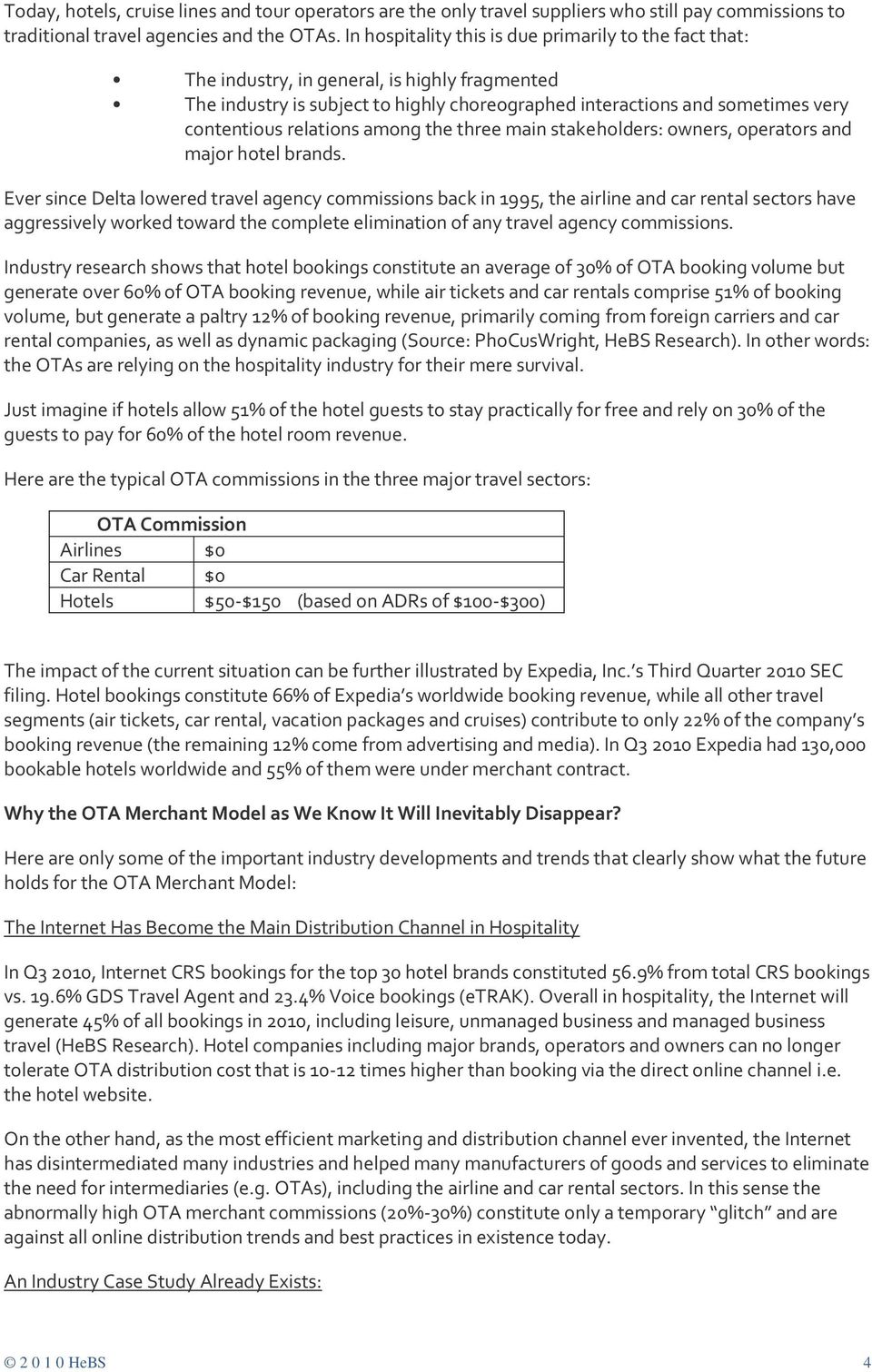
4 Today, hotels, cruise lines and tour operators are the only travel suppliers who still pay commissions to traditional travel agencies and the OTAs. In hospitality this is due primarily to the fact that: The industry, in general, is highly fragmented The industry is subject to highly choreographed interactions and sometimes very contentious relations among the three main stakeholders: owners, operators and major hotel brands. Ever since Delta lowered travel agency commissions back in 1995, the airline and car rental sectors have aggressively worked toward the complete elimination of any travel agency commissions. Industry research shows that hotel bookings constitute an average of 30% of OTA booking volume but generate over 60% of OTA booking revenue, while air tickets and car rentals comprise 51% of booking volume, but generate a paltry 12% of booking revenue, primarily coming from foreign carriers and car rental companies, as well as dynamic packaging (Source: PhoCusWright, HeBS Research). In other words: the OTAs are relying on the hospitality industry for their mere survival. Just imagine if hotels allow 51% of the hotel guests to stay practically for free and rely on 30% of the guests to pay for 60% of the hotel room revenue. Here are the typical OTA commissions in the three major travel sectors: OTA Commission Airlines $0 Car Rental $0 Hotels $50-$150 (based on ADRs of $100-$300) The impact of the current situation can be further illustrated by Expedia, Inc. s Third Quarter 2010 SEC filing. Hotel bookings constitute 66% of Expedia s worldwide booking revenue, while all other travel segments (air tickets, car rental, vacation packages and cruises) contribute to only 22% of the company s booking revenue (the remaining 12% come from advertising and media). In Q Expedia had 130,000 bookable hotels worldwide and 55% of them were under merchant contract. Why the OTA Merchant Model as We Know It Will Inevitably Disappear? Here are only some of the important industry developments and trends that clearly show what the future holds for the OTA Merchant Model: The Internet Has Become the Main Distribution Channel in Hospitality In Q3 2010, Internet CRS bookings for the top 30 hotel brands constituted 56.9% from total CRS bookings vs. 19.6% GDS Travel Agent and 23.4% Voice bookings (etrak). Overall in hospitality, the Internet will generate 45% of all bookings in 2010, including leisure, unmanaged business and managed business travel (HeBS Research). Hotel companies including major brands, operators and owners can no longer tolerate OTA distribution cost that is times higher than booking via the direct online channel i.e. the hotel website. On the other hand, as the most efficient marketing and distribution channel ever invented, the Internet has disintermediated many industries and helped many manufacturers of goods and services to eliminate the need for intermediaries (e.g. OTAs), including the airline and car rental sectors. In this sense the abnormally high OTA merchant commissions (20%-30%) constitute only a temporary glitch and are against all online distribution trends and best practices in existence today. An Industry Case Study Already Exists: HeBS 4
5 There is already a major precedent in the industry coming from Europe, where Booking.com, part of Priceline and by far the biggest OTA in Europe with over 45% market share, has successfully operated using the Commission Override Model, in which Booking.com gets a travel agency commission plus commission overrides for booking volume, better placements, etc. Booking.com s business model is so powerful and widely adopted by hoteliers in Europe that Expedia-Europe has difficulties keeping up with its main rival and has been forced to adopt a Commission Override Model, the so called Expedia Easy Manage (EEM) program back in Q2 2009, a commission-based program specifically developed to bridge the gap with the market leader Booking.com. The EEM program already has over 8,000 participating hotels. Traditional Travel Agency Commissions Will Disappear: As already discussed, the size of the travel agency commission has a direct correlation to the size of the OTA merchant commissions. I expect that over the next five years the current 10% commission will shrink to 8% then 5%, then become a flat fee of $5-$10, and finally disappear for good. The main reasons for this are the decreased importance of this channel and the GDS in general, the shift toward Internet distribution and rapidly changing consumer purchasing habits that favor suppliers, increased online expertise by the major brands and independents alike, and the improved economic situation. The GDS Travel Agent contribution to the overall CRS bookings for the top 30 hotel brands was only 19.6% in Q compared to 31.3% back in 2006 (etrak). Travel agency locations in the US have decreased by 6%-10% every year over the past 10 years. From nearly 35,000 travel agencies in the US back in 1995, there were only 15,405 travel agencies in September of 2010 (ARC, HeBS Research) and as per current trends there will be less than 14,500 travel agencies by end of A growing number of travel agency bookings for hotels are already non-commissionable (preferred corporate rates, group rates, etc) Direct Correlation between Travel Agency Commission and OTA Merchant Commission The lower the standard travel agency commission becomes, the lower the OTA merchant commission tolerated by hoteliers will be. If the standard agency commission is at the 5% level, wholesalers will be entitled to commission overrides based on booking volume 5-7 percentage points above the standard commission i.e. to maximum overall commission levels of 10% - 12%. No hotelier will be willing to grant a merchant discount to the tune of 20%-30%. In this environment the marketplace will not tolerate the OTA Merchant Model with its abnormally high margins and this model will become a thing of the past. What is the Future of the OTA Merchant Model? I firmly believe that the OTA Merchant Model will evolve over the next few years as market conditions and industry indicators improve, and as major hotel brands and other smart hoteliers increase pressure on the OTAs to lower merchant commissions and tie higher commissions to higher OTA booking productivity and bigger share of the OTA bookings. In other words, the OTA Merchant Model will be transformed: From a net merchant rate model (net rate at 20%-30% below best available rate) and no commitment to room allotments and booking volume Into a Commission Override Model where higher booking volume production will earn the OTAs better commissions or overrides above the existing traditional travel agency commission levels HeBS 5

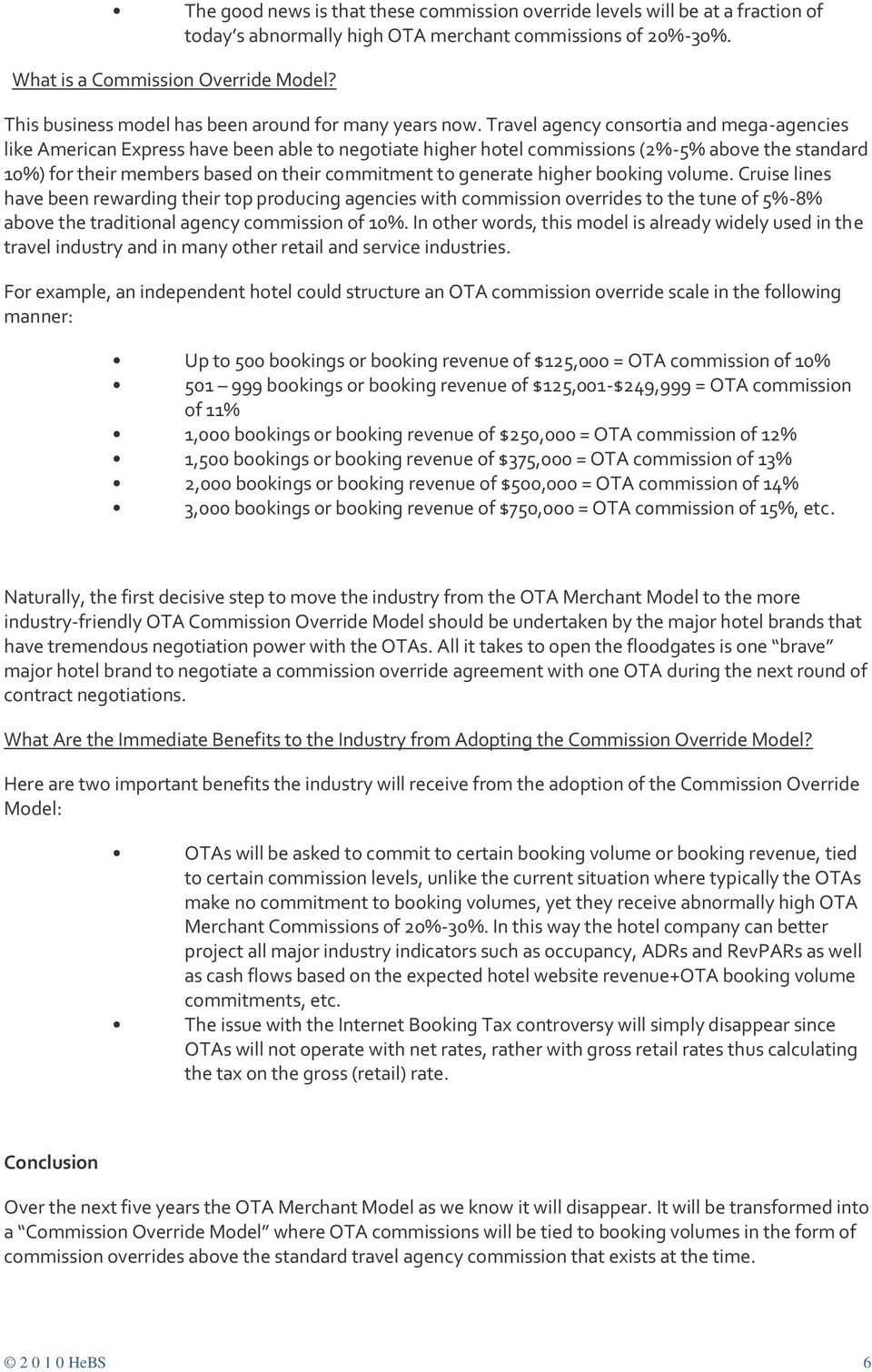
6 The good news is that these commission override levels will be at a fraction of today s abnormally high OTA merchant commissions of 20%-30%. What is a Commission Override Model? This business model has been around for many years now. Travel agency consortia and mega-agencies like American Express have been able to negotiate higher hotel commissions (2%-5% above the standard 10%) for their members based on their commitment to generate higher booking volume. Cruise lines have been rewarding their top producing agencies with commission overrides to the tune of 5%-8% above the traditional agency commission of 10%. In other words, this model is already widely used in the travel industry and in many other retail and service industries. For example, an independent hotel could structure an OTA commission override scale in the following manner: Up to 500 bookings or booking revenue of $125,000 = OTA commission of 10% bookings or booking revenue of $125,001-$249,999 = OTA commission of 11% 1,000 bookings or booking revenue of $250,000 = OTA commission of 12% 1,500 bookings or booking revenue of $375,000 = OTA commission of 13% 2,000 bookings or booking revenue of $500,000 = OTA commission of 14% 3,000 bookings or booking revenue of $750,000 = OTA commission of 15%, etc. Naturally, the first decisive step to move the industry from the OTA Merchant Model to the more industry-friendly OTA Commission Override Model should be undertaken by the major hotel brands that have tremendous negotiation power with the OTAs. All it takes to open the floodgates is one brave major hotel brand to negotiate a commission override agreement with one OTA during the next round of contract negotiations. What Are the Immediate Benefits to the Industry from Adopting the Commission Override Model? Here are two important benefits the industry will receive from the adoption of the Commission Override Model: OTAs will be asked to commit to certain booking volume or booking revenue, tied to certain commission levels, unlike the current situation where typically the OTAs make no commitment to booking volumes, yet they receive abnormally high OTA Merchant Commissions of 20%-30%. In this way the hotel company can better project all major industry indicators such as occupancy, ADRs and RevPARs as well as cash flows based on the expected hotel website revenue+ota booking volume commitments, etc. The issue with the Internet Booking Tax controversy will simply disappear since OTAs will not operate with net rates, rather with gross retail rates thus calculating the tax on the gross (retail) rate. Conclusion Over the next five years the OTA Merchant Model as we know it will disappear. It will be transformed into a Commission Override Model where OTA commissions will be tied to booking volumes in the form of commission overrides above the standard travel agency commission that exists at the time HeBS 6
7 In the same time, travel agency commissions will shrink from the current 10% level to 8% then 5% and then disappear for good in the same manner as it happened in the airline and car rental sectors. This will result in downward pressure on the current OTA merchant commissions, which are by default tied to the standard travel agency commission. OTAs will be able to earn override commissions above the standard travel agency commission only if they commit to concrete booking volumes. Naturally these commission overrides will be at a fraction of today s levels. To survive, OTAs will have to find additional value proposition and business models, such as further embrace the dynamic packaging model thus turning themselves into typical online wholesale packagers/tour operators, transform themselves into travel search engines (meta search engines) relying more on advertising rather than transaction revenue, and offering advertising programs such as pay-forposition programs, cost-per-click programs, sponsorships and display advertising. Max Starkov is chief ebusiness strategist at Hospitality ebusiness Strategies HeBS 7

Can Hoteliers Take Back the Initiative from the Online Travel Agencies (OTAs)?
 2011 Can Hoteliers Take Back the Initiative from the Online Travel Agencies (OTAs)? By Max Starkov Hoteliers can drastically reduce reliance on the OTA channel by embracing the Direct Online Channel and
U.S. Producer Price Index for Travel Agencies NAICS 561510
 U.S. Producer Price Index for Travel Agencies NAICS 561510 Andrew Baer Chief, Services Section Division of Industrial Prices & Price Indexes U.S. Bureau of Labor Statistics 29 th Voorburg Group Meeting
The OTA Billboard Effect or the Lazy Man s Approach to Hotel Distribution
 2011 The OTA Billboard Effect or the Lazy Man s Approach to Hotel Distribution By Max Starkov Hoteliers need to shift away from the OTA distribution, also known as hoteliers lazy man s approach, and invest
Erik Blachford. President and CEO, Expedia, Inc. & IAC Travel
 Erik Blachford President and CEO, Expedia, Inc. & IAC Travel Key Competitive Advantages Unique US travel brand portfolio Superior technology platform Unparalleled global reach Entrepreneurial management
CHAPTER 1 INTRODUCTION
 CHAPTER 1 INTRODUCTION 1.1 Introduction Today E-commerce is quickly changing the business models and travel industry businesses are not immune of this change.travel suppliers are reaching millions of travelers
Trends in Travel Technology. Winnie Cheung School of Hospitality & Tourism Management University of Guelph ABSTRACT
 Trends in Travel Technology Winnie Cheung School of Hospitality & Tourism Management University of Guelph ABSTRACT The use of Internet has been increasing exponentially as consumers become more tech- savvy
DIRECT & INDIRECT SALES CHANNELS
 DIRECT & INDIRECT SALES CHANNELS Knowing where your potential customers search for information and being visible in those places/channels is key to driving sales. 2 main channels: 1. Direct - both online
Jeff Edwards Head of Global Hotels Group June 2013
 Jeff Edwards Head of Global s Group June 2013 Agenda Why? Industry context and business opportunity Distribution strategy and business proposition IT Competitive environment Our strategy Our product offering
Glossary of Hospitality/Tourism Terms
 Glossary of Hospitality/Tourism Terms ABA - American Bus Association; comprised of bus companies, operators and owners Attendance Building - Marketing and promotional programs designed to increase attendance
Offline Travel Sales
 18 Managing Sales Channels for International Growth Fáilte Ireland Leisure Sales Appendix 1: Offline Travel Sales Introduction The global travel trade sector plays a significant role in distributing the
Ch 6 Revenue Management
 6-1 Ch 6 Revenue Management 6.1 History 6.2 Levels of Revenue Management 6.3 Revenue Management Strategy 6.4 The System Context 6.5 Booking Control 6.6 Tactical Revenue Management 6.7 Net Contribution
THE DIGITAL DIRECTION: HOTEL MARKETING BUDGETS AND A DIGITAL 101 FOR HOTELS PART I OF A TWO- PART SERIES
 273 Walt Whitman Road #321, Huntington Station, NY 11746 tel: 516.680.8529 [email protected] LHLcommunications.com FEBRUARY 2014 THE DIGITAL DIRECTION: HOTEL MARKETING BUDGETS AND A DIGITAL 101
TRENDS SHAPING ONLINE TRAVEL Euromonitor International. @Euromonitor
 TRENDS SHAPING ONLINE TRAVEL Euromonitor International 18 MARCH 2014 @Euromonitor @CarolineBremner GLOBAL OVERVIEW CONSUMER TRENDS IN ONLINE TRAVEL A NEW COMPETITIVE ENVIRONMENT GLOBAL OVERVIEW Global
The U.S. Hotel Advertising Marketplace: Industry Sizing and Trends 2015
 PhoCusWright White Paper The U.S. Hotel Advertising Marketplace: Industry Sizing and Trends 2015 Sponsored by Written and Researched by Tom Powell aviano sans berling FUTURA PMS-377 PMS-2617 PMS-444 669933
Russian package tours market. E-travel 2013. November, 2013
 Russian package tours market E-travel 2013 November, 2013 Travelata.ru is a leading Russian online travel agency focusing on sales of package tours online What we do? Products Package tours Last minute
HRG Loyalty Rewarding you for your loyalty
 HRG Loyalty Rewarding you for your loyalty We have a proven track record in delivering tangible benefits How do you reward your customers for their loyalty? Owners of loyalty programmes worldwide continue
TravelClick & Failte Ireland
 TravelClick & Failte Ireland GLOBAL DISTRIBUTION SYSTEMS Sue Ross & Jacqueline Reid 16 th September 2015 TravelClick provides innovative cloud-based solutions for hotels to grow their revenue, reduce costs
The Mobile Effect: Disrupting the Competitive Landscape in the Digital Travel Market
 Phocuswright White Paper The Mobile Effect: Disrupting the Competitive Landscape in the Digital Travel Market Sponsored by Written by Cathy Schetzina Walsh Researched by Marcello Gasdia This Phocuswright
THE 2016 BUDGET SEASON GUIDE FOR HOTELS & RESORTS
 THE 2016 BUDGET SEASON GUIDE FOR HOTELS & RESORTS A MULTI-CHANNEL PATH TO REVENUE With all of the familiar and emerging new channels to choose from, figuring out where to allocate your marketing dollars
B312 Hospitality and Tourism Management. Module Synopsis
 B312 Hospitality and Tourism Management Module Synopsis According to United Nation World Tourism Organization (UNWTO) report, Tourism Highlights (2008), tourism has been experiencing positive growth over
The all-in-one tourism marketing platform PRODUCT PRESENTATION
 The all-in-one tourism marketing platform PRODUCT PRESENTATION CONTENTS PRODUCT PHILOSOPHY 3 THE MARKET 4 THE PROBLEM. ONLINE MARKETING 5 THE PROBLEM. TECHNOLOGY UPDATE 6 LOCALLER: THE SOLUTION 7 LOCALLER:
Step 2. Step 2: Understanding the Travel Distribution Channels. Sales Toolkit 97
 96 Sales Toolkit Step 2: Step 2 Understanding the Travel Distribution Channels Sales Toolkit 97 Understanding the Travel Distribution Channels Confused about the difference between a DMC and an incoming
THE COST OF CHOICE. WHY HOTEL DISTRIBUTION COSTS MATTER TO CORPORATES. www.hrscorporate.com
 THE COST OF CHOICE. WHY HOTEL DISTRIBUTION COSTS MATTER TO CORPORATES. www.hrscorporate.com CONTENTS Introduction 3 Executive Summary 4 Distribution channels 8 HRS & the distribution chain 9 Why distribution
Service Producer Price Index for Travel Agency Activities ISIC 7911 NACE 79.11
 29 th meeting of the Voorburg Group Dublin September 2014 Mini Presentation Service Producer Price Index for Travel Agency Activities ISIC 7911 NACE 79.11 Joseph Keating and Niall O Hanlon Central Statistics
1.1 Traditional Model Here in the traditional model GDS is in the heart of the system (Figure 1).
 Table of Contents LIST OF FIGURES... 3 Abstract... 4 1. Introduction... 4 1.1 Traditional Model... 4 1.2 The Online Model... 5 2. AIRLINE DIRECT SERVICE... 6 3. ONLINE TRAVEL AGENTS... 6 3.1 OTA MARKET...
Airline Distribution. Air Transport Management Seminar Universidade Lusofona Lisbon 7th - 11th January 2008
 Airline Distribution Air Transport Management Seminar Universidade Lusofona Lisbon 7th - 11th January 2008 Dr Keith Mason Director Business Travel Research Centre www.businesstravelresearch.com Dept of
Online travel sales. Introduction. Appendix 2:
 31 Appendix 2: Online travel sales Introduction While it may be hard to imagine a time when all travel was booked by phone or in person, the fact is that the online travel market is barely two decades
European Tour Operators Association (ETOA) Maximise your B2B marketing: How to connect with the travel trade?
 European Tour Operators Association (ETOA) Maximise your B2B marketing: How to connect with the travel trade? Quick Facts Established since 1989 600 Members Members located in 35 countries worldwide 5.5bn
How can Independent Hotels Survive In Today s Saturated Marketing Jungle? A presentation to the. By Gabrielle Alam and Sharon Bernstein
 How can Independent Hotels Survive In Today s Saturated Marketing Jungle? A presentation to the By Gabrielle Alam and Sharon Bernstein Eyes2market Europe Eyes2market is a dynamic and creative sales and
Distribution in the Long Tail. Dennis Schaal, Tnooz
 Distribution in the Long Tail Dennis Schaal, Tnooz Definition For our purposes, travel inventory in the long tail Is NOT: Branded hotels Airlines Car rental Major cruise lines IS: Tours and activities
Techniques Applied, Perceived Barriers, and Future Trends in Phuket Hotel Industry
 Electronic Customer Relationship Management: Techniques Applied, Perceived Barriers, and Future Trends in Phuket Hotel Industry ก ก ก ก ก : ก ก ก ก ก Naruemon Pechruttanamunee ( )* Dr. Ilian Assenov (.
Be found. Get booked.
 Be found. Get booked. Distribution and Internet Marketing for Hotels Brielsoft International Brielsoft brings a new energy to the world of hotel representation and multi-channel distribution. With the
Revenue Management. Business Intelligence. Electronic Distribution
 REVENUE MANAGEMENT HOTEL PRICING Whitepaper on the function of Pricing Limitations and Opportunities Revenue Management. Business Intelligence. Electronic Distribution Table Of Contents 1. Executive Summary
BUSINESS PLAN ANALYSIS OF A NEW VENTURE FOR AN ONLINE TRAVEL ACCOMODATION RESERVATION SERVICE. Bernadett Maxwell
 BUSINESS PLAN ANALYSIS OF A NEW VENTURE FOR AN ONLINE TRAVEL ACCOMODATION RESERVATION SERVICE by Bernadett Maxwell PROJECT SUBMITTED IN PARTIAL FULFILLMENT OF THE REQUIREMENTS FOR THE DEGREE OF MASTER
From Likes to Leads :
 From Likes to Leads : Cruise agents, social media & the impact of emerging technologies A joint Amadeus North America Cruise Lines International Association survey on opportunities for the cruise industry
THE NEW ONLINE TRAVEL CONSUMER
 THE NEW ONLINE TRAVEL CONSUMER THE NEW ONLINE TRAVEL CONSUMER Featuring Euromonitor International and the ETOA 13 FEBRUARY 2014 @Euromonitor @ETOA @nsightfortravel FOLLOW TODAY S WEBINAR: #digitaltravel
Travel Agents & Tour Operators in Europe Past, Present and Future Trends
 Travel Agents & Tour Operators in Europe Past, Present and Future Trends Latvian Tourism Forum" Traveller 2020 " Riga, 9th December 2011" Michel de Blust" Secretary General " ECTAA" www.ectaa.eu" I. ECTAA,
Investor Presentation Q3 2014
 Investor Presentation Q3 2014 Disclaimers Related to forward-looking statements This presentation may contain forward-looking statements that involve risks, uncertainties and other factors concerning,
4.4. Booking.com Facts and business concept...49 4.5. Representation of Priceline's Annual Report 2011...51 4.5. Conclusion of the analysis of
 1 Table of Contents 1. INTRODUCTION...3 1.1. Background of the study...3 1.2. Hypothesis...4 1.3. Aim...4 1.4. Objectives...5 1.5. Structure of the dissertation...6 1.6. Summary...7 2. LITERATURE REVIEW...8
INTRODUCTION TO THE 2013 BENCHMARKING GUIDE
 INTRODUCTION TO THE 2013 BENCHMARKING GUIDE This guide is a supporting document for the Business Diagnostic Indicator for Hotels. It has been designed to be used by hoteliers who have completed the Business
BABTA. TravelClick. Victor Jigalin 10/18/2012
 BABTA TravelClick Victor Jigalin 10/18/2012 Agenda: Introduction to TravelClick Market Trends Business Intelligence Best practices Agency360 - Review Q&A 10/18/2012 2 TravelClick provides expert solutions
Management Commentary. Second Quarter 2015 Results
 Management Commentary Second Quarter 2015 Results The RetailMeNot, Inc. ( RetailMeNot ) earnings call will begin on August 5, 2015 at 7:00am central time (8:00am eastern time) and will include prepared
INCREASING REVENUE WITH A CLICK. Distribution Channel Revenue Management and Online Reservations Systems
 INCREASING REVENUE WITH A CLICK Distribution Channel Revenue Management and Online Reservations Systems Developing an Effective Revenue Management Strategy Aligning Sales and Revenue Management Developing
HOW DYNAMIC CONTENT PERSONALIZATION MAXIMIZES WEBSITE REVENUES AND INCREASES CUSTOMER LOYALTY BY MAX STARKOV
 BY MAX STARKOV Traditionally, hotel websites have served the same content to all site visitors regardless of their preferences, demographics, and even geographic location. Every website visitor is served
CWT ViewPoint: THE SHARING ECONOMY: HERE TO STAY. NOW WHAT? Perspective on industry-shaping developments. October 2015 Americas
 CWT ViewPoint: Perspective on industry-shaping developments October 2015 Americas THE SHARING ECONOMY: HERE TO STAY. NOW WHAT? The idea of sharing is not new but online marketplaces, with ever-increasing
Q2 2015 Results. July 2015
 Q2 2015 Results July 2015 Safe Harbor Forward-Looking Statements. Our presentation today, including the slides contained herein, contains "forwardlooking statements" within the meaning of the Private Securities
PRICING YOUR TOURISM BUSINESS A PRACTICAL STEP BY STEP GUIDE TO HELP YOU COMPLETE THE TOURISM BOOST ONLINE PRICING TOOLS
 PRICING YOUR TOURISM BUSINESS A PRACTICAL STEP BY STEP GUIDE TO HELP YOU COMPLETE THE TOURISM BOOST ONLINE PRICING TOOLS INTRODUCTION It is very important to price your tourism business correctly. Basing
Best Practices for Maximizing Your Hotel s Online Revenue & ROI
 Best Practices for Maximizing Your Hotel s Online Revenue & ROI Table of Contents Executive Summary... 2 Introduction & Methodology... 3 Websites... 4 Survey Findings The Pulse of the Industry... 5 Best
Bridging the Gap: Why Revenue Management and Marketing Must Come Together
 Bridging the Gap: Why Revenue Management and Marketing Must Come Together Bridging the Gap: Why Revenue Management and Marketing Must Come Together Robert Cross called it a Marketing Renaissance 17 years
Digital Marketing Budgets Increase, Reflecting Focus on Customer Experience
 G00255396 Digital Marketing Budgets Increase, Reflecting Focus on Customer Experience Published: 9 January 2014 Analyst(s): Laura McLellan Gartner's Digital Marketing Spending Survey shows that digital
The Future of Travel Management Companies in Latin America. Scenario Planning for Multinational Business Travel Companies in Latin America
 The Future of Travel Management Companies in Latin America Scenario Planning for Multinational Business Travel Companies in Latin America Index About Scenario Planning... 1 Abstract... 1 Methodology...
T.I.F Frequently Asked Questions
 What does T.I.F. stand for? T.I.F T.I.F. stands for Tourism Improvement Fee. The 2% T.I.F. is being charged by lodging facilities and is part of a longer term strategy to maintain and improve the competitiveness
How To Promote Your Hotel Business With Sabre Media
 Sabre Media Reach the most powerful travel audience in the world with Sabre Media s advertising opportunities. Get the ROI you deserve by spending your dollars reaching the most qualified travel buying
Online Travel Agents 101
 Topic Online Distribution Tutorial 39A Online Travel Agents 101 This tutorial outlines the role of Online Travel Agents and how to work with them. Reading time: 15 minutes Prerequisite: none Tutorials
DEMYSTIFYING PRICE OPTIMIZATION:
 HOSPITALITY Alex Dietz DEMYSTIFYING PRICE OPTIMIZATION: A REVENUE MANAGER S GUIDE TO PRICE OPTIMIZATION As analytic approaches to pricing have evolved over the last decade, one of the most common questions
Payment Technologies Forum
 Hotel Technology Next Generation Payment Technologies Forum Virtual Payment Cards A Handbook for Hoteliers Contents Executive Summary... 3 Disclaimer... 4 Introduction to Virtual Payment Cards... 5 Background...
FUTURE OF THE TRAVEL SHARING ECONOMY ITB BERLIN MARCH 2015
 FUTURE OF THE TRAVEL SHARING ECONOMY ITB BERLIN MARCH 2015 KEY TRENDS & CHALLENGES OPPORTUNITIES & FUTURE DIRECTION KEY TRENDS AND CHALLENGES Why the rise of the sharing economy? 3 Response to recession
Sabre Media Kit. powering progress
 powering progress Sabre Media Kit Our Travel Agency Media products allow you to reach: Sabre Media Travel Agency Media and Online Media Services Advertising opportunities reaching the most powerful travel
NAVY FEDERAL S BUSINESS REWARDS CARD PROGRAM DESCRIPTION
 NAVY FEDERAL S BUSINESS REWARDS CARD PROGRAM DESCRIPTION BUSINESS REWARDS Online Members with NFO access may view their BUSINESS REWARDS point history and redeem points on navyfederal.org 24 hours a day
Table of Contents The Market for Merchant Services... 1 The Basics of Payment Processing... 2 Authorization Settlement Funding... 2 Authorization...
 Table of Contents The Market for Merchant Services... 1 The Basics of Payment Processing... 2 Authorization Settlement Funding... 2 Authorization... 2 Settlement... 2 Funding... 2 Credit Card Processing
Understanding True Conversions & ROIs from Marketing Campaigns. Using Online & Offline Reservation Tracking
 Understanding True Conversions & ROIs from Marketing Campaigns Using Online & Offline Reservation Tracking 1 A Strategic Partnership to Understand the Big Picture HeBS Digital: Hospitality industry s leading
Understanding Online Travel Agencies Cost Drivers and Ways to Optimise Business in Europe
 Understanding Online Travel Agencies Cost Drivers and Ways to Optimise Business in Europe July 2010 Understanding Online Travel Agencies Cost Drivers and Ways to Optimise Business in Europe July 2010
USING DATA TO ENHANCE MARKETING EFFECTIVENESS. Anil Aggarwal CEO, Milestone Inc. [email protected] @milestonemktg October 19, 2015
 USING DATA TO ENHANCE MARKETING EFFECTIVENESS Anil Aggarwal CEO, Milestone Inc. [email protected] @milestonemktg October 19, 2015 About Milestone Digital Marketing Software and Services Unalytix
Revenue Management 101
 Revenue management 101 for small accommodation providers / 1 Revenue Management 101 for small accommodation providers Revenue management 101 for small accommodation providers / 2 12 Chapter 2 Yield management
10.3.2 Objectives of the Public Relations Services in German Speaking Market (German, Switzerland and Austria).
 THE COMPETITIVENESS AND ENTERPRISE DEVELOPMENT PROJECT (CEDP) TERMS OF REFERENCE FOR A PUBLIC RELATIONS FIRM TO REPRESENT UTB IN GERMAN SPEAKING MARKETS (GERMANY, AUSTRIA AND SWITZERLAND). 10.3.1 Project
Q1 2015 China E-commerce Report (Brief Edition) www.iresearchchina.com
 Q1 2015 China E-commerce Report (Brief Edition) www.iresearchchina.com 1 Overview of China E-commerce Market 2 Performance of China E-commerce Segments Overview of China E-commerce Market 3.48 Trillion
POWERFUL DISTRIBUTION AND REVENUE MANAGEMENT SOLUTIONS. A powerful reservation system. Central Reservation Offices (CRO), email and intra Resaweb 18%
 POWERFUL DISTRIBUTION AND REVENUE MANAGEMENT SOLUTIONS KEY FIGURES 2014 59% of TARS contribution rate to total hotel revenue on average, up by 3.7 points over the previous year 38 million reservations