
Glulam. P r o d u c t G u i d e
|
|
|
- Rolf Barrett
- 10 years ago
- Views:
Transcription
1 Glulam P r o d u c t G u i d e

2 2 A few facts about wood. WOOD The Natural Choice Engineered wood products are a good choice for the environment. They are manufactured for years of trouble-free, dependable use. They help reduce waste by decreasing disposal costs and product damage. Wood is a renewable, recyclable, biodegradable resource that is easily manufactured into a variety of viable products. We re growing more wood every day. Forests fully cover one-third of the United States and one-half of Canada s land mass. American landowners plant more than two billion trees every year. In addition, millions of trees seed naturally. The forest products industry, which comprises about 15 percent of forestland ownership, is responsible for 41 percent of replanted forest acreage. That works out to more than one billion trees a year, or about three million trees planted every day. This high rate of replanting accounts for the fact that each year, 27 percent more timber is grown than is harvested. Canada s replanting record shows a fourfold increase in the number of trees planted between 1975 and Life Cycle Assessment shows wood is the greenest building product. A 2004 Consortium for Research on Renewable Industrial Materials (CORRIM) study gave scientific validation to the strength of wood as a green building product. In examining building products life cycles from extraction of the raw material to demolition of the building at the end of its long lifespan CORRIM found that wood was better for the environment than steel or concrete in terms of embodied energy, global warming potential, air emissions, water emissions and solid waste production. For the complete details of the report, visit Manufacturing wood is energy efficient. Wood products made up 47 percent of all industrial raw materials manufactured in the United States, yet consumed only 4 percent of the energy needed to manufacture all industrial raw materials, according to a 1987 study. Percent of Percent of Material Production Energy Use Wood 47 4 Steel Aluminum 2 8 Good news for a healthy planet. For every ton of wood grown, a young forest produces 1.07 tons of oxygen and absorbs 1.47 tons of carbon dioxide. Wood: It s the natural choice for the environment, for design and for strong, lasting construction.

3 3 Glued laminated timber (glulam) redefines the possibilities for engineered wood construction. Glulam is an engineered wood product that optimizes the structural values of a renewable resource wood. Glulam members are composed of individual pieces of dimension lumber. The pieces are end-jointed together to produce long lengths which are then bonded together with adhesives to create the required beam dimensions. Because of their composition, large glulam members can be manufactured from smaller trees harvested from second- and third-growth forests and plantations. A variety of species is used. With glulam, builders and specifiers can continue to enjoy the strength and versatility of large wood members without relying on the old growth-dependent solid-sawn timbers. CONTENTS Introduction Years of Glulam Anatomy of Glulam Glulam in Nonresidential Applications Glulam in Residential Applications Designing for Fire Resistance Moisture Effects Design and Specification Considerations. 26 Glulam Specification Guide Storage, Handling and Installation Glossary of Terms About APA Glulam has greater strength and stiffness than comparable dimensional lumber. Pound for pound, it s stronger than steel. That means glulam beams can span long distances with minimal need for intermediate supports. It also means that designers and builders have virtually unlimited design flexibility when using glulam, whether the application is home construction, a commercial warehouse roof or a highway bridge. This brochure describes APA EWS trademarked glulam, addresses important design considerations, and includes a guide of recommended specifications. It also highlights just a few of the many applications where glulam is used in construction. On the Cover: Cathedral of Christ the Light in Oakland, Calif. John Blaustein 2008

4 4 100 Plus Years of Glulam In terms of current needs to optimize products from a carefully managed timber resource, glulam is one of the most resource-efficient approaches to wood building products. It is an engineered product manufactured to meet the most demanding structural requirements. But glued laminated timber is not a new product. Glulam was first used in Europe in the early 1890s. A 1901 patent from Switzerland signaled the true beginning of glued laminated timber construction. One of the first glulam structures erected in the U.S. was a research laboratory at the USDA Forest Products Laboratory in Madison, Wisconsin. The structure was erected in 1934 and is still in service today. A significant development in the glulam industry was the introduction of fully waterresistant phenol-resorcinol adhesives in This allowed glulam to be used in exposed exterior environments without concern of glueline degradation. The first U.S. manufacturing standard for glulam was Commercial Standard CS253-63, which was published by the Department of Commerce in The most recent standard is ANSI/AITC Standard A , which took effect in Anatomy of Glulam Glulam is made up of wood laminations, or lams, that are bonded together with adhesives. The grain of all laminations runs parallel with the length of the member. Individual lams typically are 1-3/8 inches thick for southern pine and 1-1/2 inches thick for Western species, although other thicknesses may also be used. Glulam products typically range in net widths from 2-1/2 to 10-3/4 inches, although virtually any member width can be custom produced. Because they are engineered products, glued laminated timbers are manufactured to meet a range of design stresses. Beams are manufactured with the strongest lams on the bottom and top of the beam, where maximum tension and compression stresses occur. This concept allows the lumber resource to be used more efficiently by placing higher grade lumber in zones that have the maximum stresses and lumber with less structural quality in lower stressed zones. Balanced and Unbalanced Beams Glulam may be manufactured as unbalanced or balanced members. The most critical zone of a glulam bending member with respect to controlling strength is the outermost tension zone. In unbalanced beams, the quality of lumber used on the tension side of the beam is higher than the lumber used on the corresponding compression side, allowing a more efficient use of the timber resource. Therefore, unbalanced beams have different bending stresses assigned to the compression and tension zones and must be installed accordingly. To ensure proper installation of unbalanced beams, the top of the beam is clearly stamped with the word TOP. Unbalanced beams are primarily intended for simple span applications. Balanced members are symmetrical in lumber quality about the mid-height. Balanced beams are used in applications, such as cantilevers or continuous spans, where either the top or bottom of the member may be stressed in tension due to service loads. They can also be used in single span applications, although an unbalanced beam is more efficient for this use. Allowable Design Properties Allowable design properties are a key factor in specifying glulam. Bending members are typically specified on the basis of the maximum allowable bending stress of the member. For example, a 24F designation indicates a member with an allowable bending stress of 2,400 psi. Similarly, a 26F designation refers to a member with an allowable bending stress of 2,600 psi. These different stress levels are achieved by varying the percentages and grade of higher quality lumber in the beam layup. Use of different species may also result in different stress designations.

5 5 To identify whether the lumber used in the beam is visually or mechanically graded, the stress combination also includes a second set of designations. For example, for an unbalanced 24F layup using visually graded Douglas-fir lumber, the layup designation is identified as a 24F-V4. The V indicates that the layup uses visually graded lumber. ( E is used for mechanically graded lumber.) The number 4 further identifies a specific combination of lumber used to which a full set of design stresses, such as horizontal shear, MOE, etc., are assigned. Some of the most common glulam beam layups with their corresponding allowable stresses are shown in Table 1. APA Glulam Design Specification, Form EWS Y117, and ICC-ES report ESR-1940 ( provide design stresses for all glulam produced by APA members. Table 1 Allowable Stresses (psi) F bx Combination ten. comp. F vx E x F c// F c F t Unbalanced Layups EWS 24F-1.8E 2,400 1, x , EWS 24F-V4/DF 2,400 1, x , ,100 EWS 24F-V3/SP 2,400 1, x , ,150 EWS 24F-E/ES1 2,400 1, x , ,050 Balanced Layups EWS 24F-V8/DF 2,400 2, x , ,100 EWS 24F-V5/SP 2,400 2, x , ,150 EWS 24F-E/ES1M1 2,400 2, x , ,050 Axis Orientation Glulam beams are typically installed with the wide face of the laminations perpendicular to the applied load, as shown in Figure 1. These are commonly referred to as horizontally laminated members. If this same member is rotated 90 degrees, such that the load is applied parallel to the wide face of the laminations, it is considered to be a vertically laminated member. Glulam members have different tabulated stress properties depending on whether the member is used in a horizontal or vertical orientation. For more information, refer to APA Glulam Design Specification, Form EWS Y117, or ICC-ES report ESR FIGURE 1 BEAM CROSS SECTION y x x Sizes Glulam is available in both custom and stock sizes. Stock beams are manufactured in commonly used dimensions and cut to length when the beams are ordered from a distributor or dealer. Typical stock beam widths include: 3-1/8, 3-1/2, 5-1/8, 5-1/2 and 6-3/4 inches, which meet the requirements for most residential construction applications. y Where long spans, unusually heavy loads or other circumstances control design, custom members are typically specified. Custom members are available in virtually any size and shape that may be required to meet the design conditions. Some of the common custom shapes that are available include curved beams, pitched and curved beams, radial arches and tudor arches.

6 6 Appearance Classification Glulam is available in a range of appearances, all looking different but having the same structural characteristics for a given strength grade. Glulam appearance classifications are: Framing. This classification is intended only for use in concealed applications. Beams with this appearance classification are provided in widths designed to fit flush with 2x4 and 2x6 wall framing. Framing-L. The same as Framing classification except that LVL laminations are used on the outermost surfaces. Industrial. Used for concealed applications or where appearance is not of primary importance. Industrial-L. The same as Industrial classification except that LVL laminations are used on the outermost surfaces. Architectural. The appearance of choice in applications where members are exposed to view, because they have a smooth, attractive finish. Stock beams are often supplied with this appearance so they may be exposed to view in the finished structure. Premium. Available only as a custom order where finished appearance is of primary importance. All appearance classifications permit natural growth characteristics with varying degrees of open voids permitted. Voids are filled as required by the appearance grade specified using inserts and wood fillers. The appearance classification is not related to lumber layup requirements and thus does not affect design values for the beam. Section Properties and Capacities When selecting a glulam member, the builder, designer or specifier must use a member with the required section properties to satisfy the load-carrying requirements. Different load capacities are possible for different stress level combinations of glulam. Tables giving the load-carrying capacities for glulam are included in the APA Data File: Glued Laminated Beam Design Tables, Form EWS S475. These beam capacities are based on loading perpendicular to the wide faces of the laminations; that is, bending about the x-x axis of the beam, as shown in Figure 1. Camber One of the most important design considerations for wood framing is deflection. For longer spans, deflection is often the controlling design factor. While any wood bending member can be designed to minimize deflection, glulam is the only engineered wood product that can be easily cambered to reduce the aesthetic effect of in-service deflections. Camber is curvature built into a fabricated member (see Figure 2) which is opposite in direction and FIGURE 2 magnitude to the calculated deflection BEAM CAMBER PARAMETERS that occurs under gravity loads. The glulam industry recommends that roof beams be cambered for 1-1/2 times the calculated dead load deflection. This will generally be sufficient to assure that the beam will not exhibit a sag over a period of many years of loading, as may occur with non-cambered wood products. To achieve a level profile, it is recommended that floor beams be only cambered for 1.0 times the calculated dead load deflection. Table 2 L = Span (ft.) Cambered Beam R = Radius of curvature (ft.) = Camber (in.) Camber for 3500-Foot Radius Span in feet: Camber in inches:

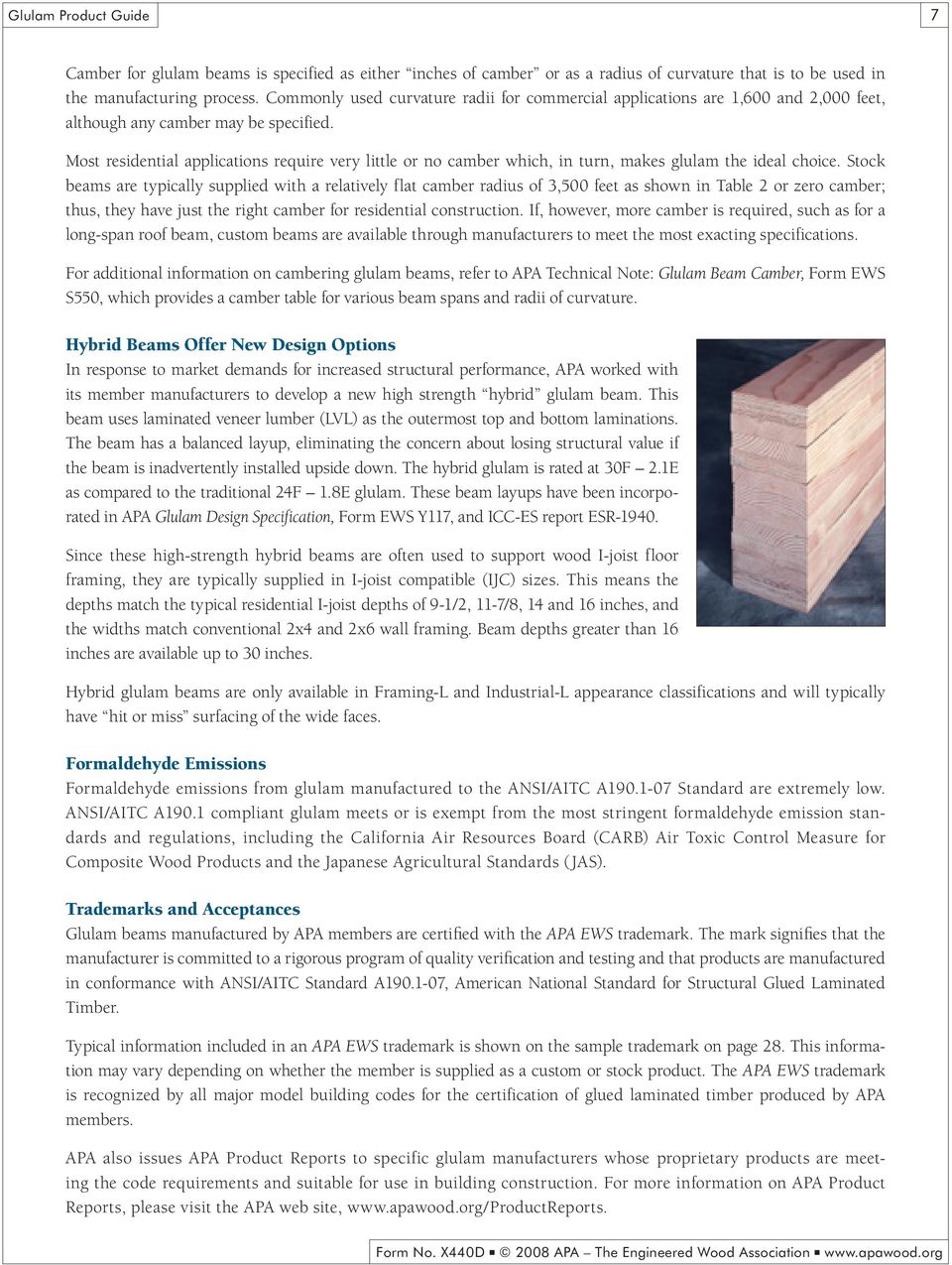
7 7 Camber for glulam beams is specified as either inches of camber or as a radius of curvature that is to be used in the manufacturing process. Commonly used curvature radii for commercial applications are 1,600 and 2,000 feet, although any camber may be specified. Most residential applications require very little or no camber which, in turn, makes glulam the ideal choice. Stock beams are typically supplied with a relatively flat camber radius of 3,500 feet as shown in Table 2 or zero camber; thus, they have just the right camber for residential construction. If, however, more camber is required, such as for a long-span roof beam, custom beams are available through manufacturers to meet the most exacting specifications. For additional information on cambering glulam beams, refer to APA Technical Note: Glulam Beam Camber, Form EWS S550, which provides a camber table for various beam spans and radii of curvature. Hybrid Beams Offer New Design Options In response to market demands for increased structural performance, APA worked with its member manufacturers to develop a new high strength hybrid glulam beam. This beam uses laminated veneer lumber (LVL) as the outermost top and bottom laminations. The beam has a balanced layup, eliminating the concern about losing structural value if the beam is inadvertently installed upside down. The hybrid glulam is rated at 30F 2.1E as compared to the traditional 24F 1.8E glulam. These beam layups have been incorporated in APA Glulam Design Specification, Form EWS Y117, and ICC-ES report ESR Since these high-strength hybrid beams are often used to support wood I-joist floor framing, they are typically supplied in I-joist compatible (IJC) sizes. This means the depths match the typical residential I-joist depths of 9-1/2, 11-7/8, 14 and 16 inches, and the widths match conventional 2x4 and 2x6 wall framing. Beam depths greater than 16 inches are available up to 30 inches. Hybrid glulam beams are only available in Framing-L and Industrial-L appearance classifications and will typically have hit or miss surfacing of the wide faces. Formaldehyde Emissions Formaldehyde emissions from glulam manufactured to the ANSI/AITC A Standard are extremely low. ANSI/AITC A190.1 compliant glulam meets or is exempt from the most stringent formaldehyde emission standards and regulations, including the California Air Resources Board (CARB) Air Toxic Control Measure for Composite Wood Products and the Japanese Agricultural Standards ( JAS). Trademarks and Acceptances Glulam beams manufactured by APA members are certified with the APA EWS trademark. The mark signifies that the manufacturer is committed to a rigorous program of quality verification and testing and that products are manufactured in conformance with ANSI/AITC Standard A , American National Standard for Structural Glued Laminated Timber. Typical information included in an APA EWS trademark is shown on the sample trademark on page 28. This information may vary depending on whether the member is supplied as a custom or stock product. The APA EWS trademark is recognized by all major model building codes for the certification of glued laminated timber produced by APA members. APA also issues APA Product Reports to specific glulam manufacturers whose proprietary products are meeting the code requirements and suitable for use in building construction. For more information on APA Product Reports, please visit the APA web site,
8 8 Glulam in Nonresidential Applic ation s Visible Beauty, Hidden Strength Glulam has a reputation for being used in striking applications, such as vaulted ceilings and other designs with soaring open spaces. In churches, schools, restaurants and other commercial buildings, glulam is often specified for its beauty, as well as its strength, for good reason. Glulam has the classic natural wood appearance that holds a timeless appeal. Aesthetics aside, there are many other applications where the strength and durability of glulam beams make them the ideal structural choice. Typical uses range from simple purlins, ridge beams, floor beams and cantilevered beams to complete commercial roof systems. In some instances, warehouse and distribution centers with roof areas The Tar River trail bridge in Rocky Mount, North Carolina features glued laminated arches. exceeding 1 million square feet have been constructed using glulam framing. In large open spaces, glulam beams can span more than 100 feet. One of the greatest advantages of glulam is that it can be manufactured in a wide range of shapes, sizes and configurations. In addition to straight prismatic sections, beams can also be produced in a variety of tapered configurations, such as single tapered, double tapered and off-centered ridges. Curved shapes range from a simple curved beam to a pitched and tapered curved beam to a complex arch configuration. Spans using glulam arches are virtually unlimited. For example, in reticulated glulam framed dome structures, arches span more than 500 feet. Glulam Trusses Add Design Options for Long Spans Glulam trusses also take many shapes, including simple pitched trusses, complicated scissor configurations and long span bowstring trusses with curved upper chords. When designed as space frames, glulam truss systems can create great clear spans for auditoriums, gymnasiums and other applications requiring large, open floor areas. Exposed Applications When manufactured with waterproof adhesives, glulam products can be fully exposed to the environment provided they are properly pressure-preservative treated. Exposed applications include utility poles and crossarms, marinas, docks and other waterfront structures and bridges. Bridges represent a growing market for glulam in pedestrian and light vehicular applications for stream and roadway crossings. Glulam is also used in secondary highway bridge designs ranging from straight girders to soaring arches. The railroads are finding glulam to be a viable structural product for use in their heavily loaded bridge structures. As loads increase on the main lines, it is necessary to upgrade bridge capacities. Adding glulam helper stringers is a viable solution for increasing capacities. In all of these uses, the strength and stiffness of glulam give builders and designers more design versatility than they have with other structural products. And, these advantages come at a cost that is competitive with other structural systems.

9 9 The Disney ICE rink in Anaheim, California features glulam arches curved to a 75-foot radius to form the ice center s roof system. The dome of this synagogue is constructed with 54 Douglas-fir glulam beams covered with a veneer of white oak. The architect achieved cost savings and energy savings with the wood design of Gunter Primary School in Gunter, Texas.

10 10 Architectural-grade glulam supports the atrium in the Garfield Commons building at Pacific Lutheran University in Tacoma, Wash.

11 11 This glulam bridge connects the Sheshan Golf Couse with a nearby luxury residential community, providing both style and functionality. The project prompted new interest in using glulam for golf couse bridges in China. Campbell Basin Lodge at Crystal Mountain, Wash. This 12,500-square-foot ski lodge includes an upscale food court and plenty of seating. The Great Wolf Lodge in Grand Mound, Wash. features 65-foot glulam beams over the enclosed water park. Durable glulam forms a resilient stair tread.

12 12 Glulam arches support the roof of the Chicago Bears practice facility in Lake Forest, Illinois. Two 107-foot poles are bolted together in this unique utility pole design. Photo courtesy of Western Archrib. This 236,000-square-foot potash storage building in Portland, Oregon features APA EWS glulam arches.

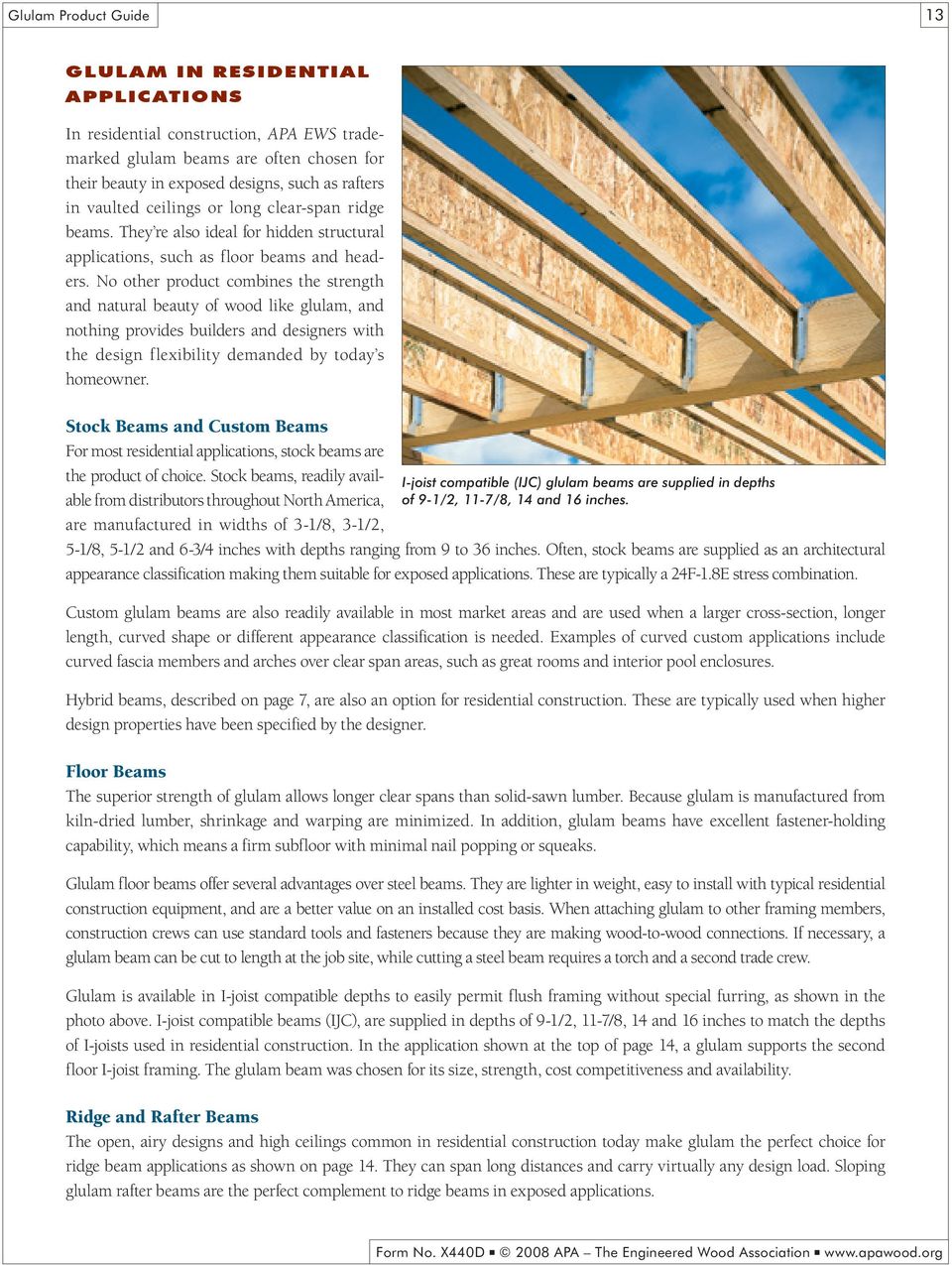
13 13 Glulam in Residential Applic ation s In residential construction, APA EWS trademarked glulam beams are often chosen for their beauty in exposed designs, such as rafters in vaulted ceilings or long clear-span ridge beams. They re also ideal for hidden structural applications, such as floor beams and headers. No other product combines the strength and natural beauty of wood like glulam, and nothing provides builders and designers with the design flexibility demanded by today s homeowner. Stock Beams and Custom Beams For most residential applications, stock beams are the product of choice. Stock beams, readily available from distributors throughout North America, are manufactured in widths of 3-1/8, 3-1/2, I-joist compatible (IJC) glulam beams are supplied in depths of 9-1/2, 11-7/8, 14 and 16 inches. 5-1/8, 5-1/2 and 6-3/4 inches with depths ranging from 9 to 36 inches. Often, stock beams are supplied as an architectural appearance classification making them suitable for exposed applications. These are typically a 24F-1.8E stress combination. Custom glulam beams are also readily available in most market areas and are used when a larger cross-section, longer length, curved shape or different appearance classification is needed. Examples of curved custom applications include curved fascia members and arches over clear span areas, such as great rooms and interior pool enclosures. Hybrid beams, described on page 7, are also an option for residential construction. These are typically used when higher design properties have been specified by the designer. Floor Beams The superior strength of glulam allows longer clear spans than solid-sawn lumber. Because glulam is manufactured from kiln-dried lumber, shrinkage and warping are minimized. In addition, glulam beams have excellent fastener-holding capability, which means a firm subfloor with minimal nail popping or squeaks. Glulam floor beams offer several advantages over steel beams. They are lighter in weight, easy to install with typical residential construction equipment, and are a better value on an installed cost basis. When attaching glulam to other framing members, construction crews can use standard tools and fasteners because they are making wood-to-wood connections. If necessary, a glulam beam can be cut to length at the job site, while cutting a steel beam requires a torch and a second trade crew. Glulam is available in I-joist compatible depths to easily permit flush framing without special furring, as shown in the photo above. I-joist compatible beams (IJC), are supplied in depths of 9-1/2, 11-7/8, 14 and 16 inches to match the depths of I-joists used in residential construction. In the application shown at the top of page 14, a glulam supports the second floor I-joist framing. The glulam beam was chosen for its size, strength, cost competitiveness and availability. Ridge and Rafter Beams The open, airy designs and high ceilings common in residential construction today make glulam the perfect choice for ridge beam applications as shown on page 14. They can span long distances and carry virtually any design load. Sloping glulam rafter beams are the perfect complement to ridge beams in exposed applications.
14 14 Exposed glulam beams in the ridge and intermediate supports for this condominium residence provide both visual drama and structural integrity. A glulam ridge beam supports the dramatic roof lines in this Western Washington home, shown under construction, left, and finished, right.

15 15 Glulam garage door header extends over adjacent narrow shear wall. (See Figure 4 for further details.) This test in the APA research center simulates seismic lateral loads over dozens of cycles to the same wall line. APA researchers can then determine the suitability of various bracing details for seismic performance, such as extending the glulam header over the narrow end wall. Glulam columns and headers provide primary support in this condominium construction.

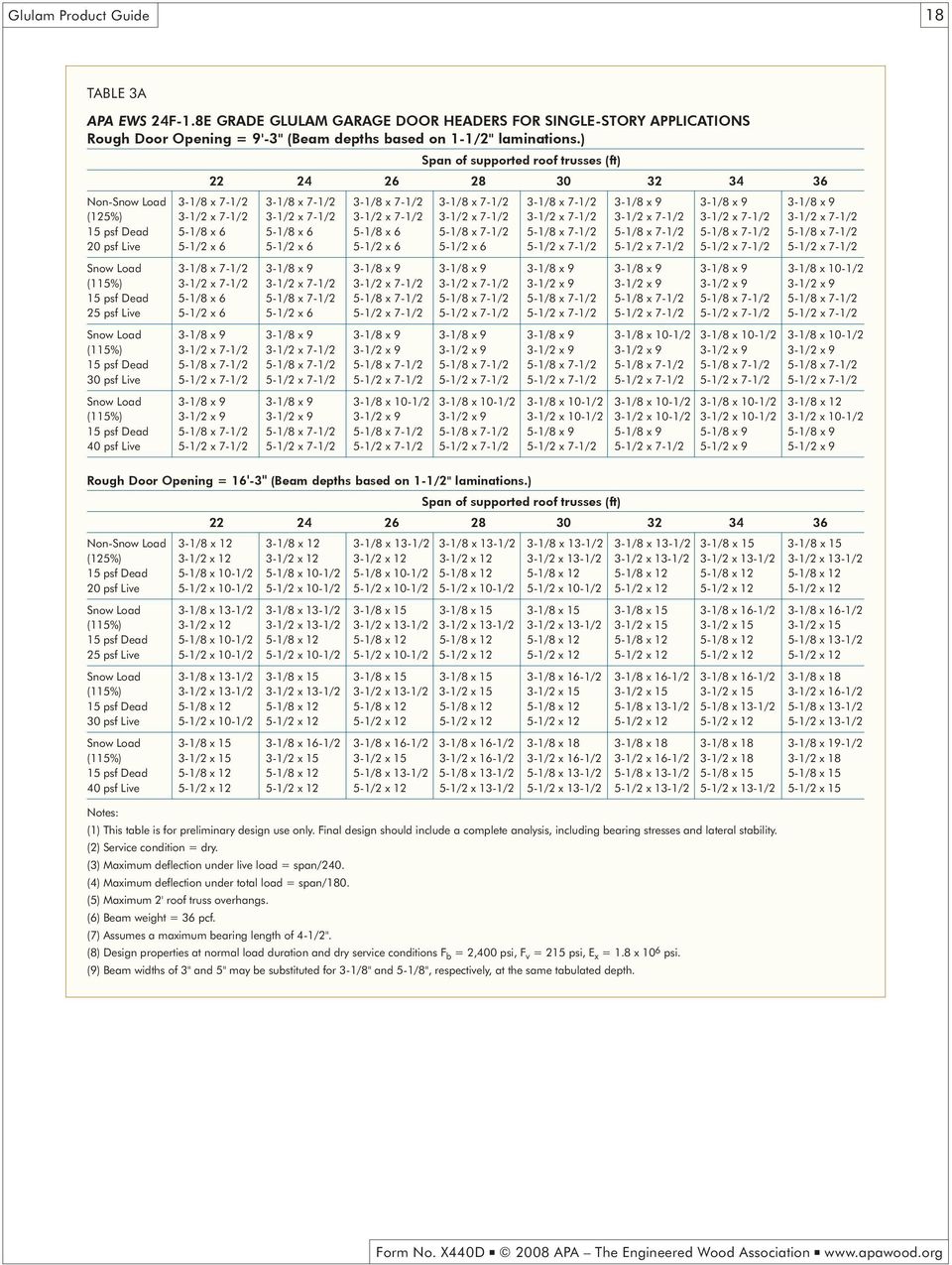
16 16 Garage Door Headers Glulam headers can easily span distances long enough to allow garage door openings for two or three cars. And because they are cut to length when you buy them, you pay only for the length you need nothing is wasted. A common width of glulam garage door header is 3-1/2 inches, which fits conventional 2x4 wall construction. For 2x6 wall construction, a 5-1/2-inch-wide glulam provides the perfect fit. Beams with widths of 3-1/8 inches and 5-1/8 inches are also used for these applications, but may require shimming. FIGURE 3 GLULAM GARAGE DOOR HEADERS DESIGN EXAMPLE The 16'-3" beam span in this figure supports roof trusses on a 28-foot-wide house with 2' overhangs, under a 15 psf design dead load and 25 psf design snow load. According to the data in Tables 3A and 3B (pages 18-19), four different sizes of glulam beams could be selected: 3-1/8" by 15", 3-1/2" by 13-1/2", 5-1/8" by 12" and 5-1/2" by 12", all suitable to carry the required design loads with the final choice being based on local availability, cost, framing compatibility and designer preference. 2' 28' Span of supported roof framing Glulam header 2' 16'-3" Clear opening

17 17 FIGURE 4 WALLS WITH 6:1 ASPECT RATIO USED WITH CONTINUOUS WOOD STRUCTURAL PANEL SHEATHING Over Concrete or Masonry Block Foundation OUTSIDE ELEVATION Extent of header (two braced wall segments) Extent of header (one braced wall segment) SIDE ELEVATION Pony wall height (a) Braced wall segment per IRC Table R Min. 3" x 11-1/4" net header Min. 1,000 lb tension strap. (a) Strap shall be centered at bottom of header. 12' max. total wall height 1 10' max. height 2' to 18' (finished opening width) Fasten sheathing to header with 8d common nails (0.131" x 2-1/2") in 3" grid pattern as shown and 3" o.c. in all framing (studs and sills) typ. Header shall be fastened to the king stud with 6-16d sinker nails (0.148" x 3-1/4") Minimum 1,000 lb strap shall be centered at bottom of header and installed on backside as shown on side elevation (a) For a panel splice (if needed), panel edges shall be blocked and occur within middle 24" of wall height Wood structural panel strength axis Min. number of studs shown (a) Min. length based on 6:1 aspect ratio. For example:16" min. for 8' height. Anchor bolt per IRC Table R typ. Min. 2"x2"x3/16" plate washer Note: (a) See IRC for additional requirements No. of jack studs per IRC Table R502.5(1&2) 16d sinker nails (0.148" x 3-1/4") in 2 3" o.c. Wood structural panel must be continuous from top of wall to bottom of wall, or from top of wall to permitted splice area 7/16" min. thickness wood structural panel sheathing Not to scale Full-length glulam headers at an end-wall provide an excellent nailing surface for structural wood panels, which help tie the beam to wall framing members on either side of the garage door opening to improve bracing. The APA Narrow Wall Bracing Method (as shown above) addresses such applications, where narrow wall sections must withstand the same lateral forces that bear on other larger wall and roof sections of the home. The connections in the frame add rigidity and improve resistance to wind and earthquake loads by effectively creating a narrow shear wall, as shown in Figure 4. For more information on the Narrow Wall Bracing Method, refer to Columns Glulam columns are straight and dimensionally true, making framing an easy task. Because glulam columns are available in long lengths, the members don t have to be spliced together, as is often necessary with sawn lumber. And, glulam columns can be exposed to view as a unique architectural feature of the framing system. Reference APA Data File: Design of Structural Glued Laminated Timber Columns, Form EWS Y240.

18 18 Table 3a APA EWS 24F-1.8E Grade Glulam Garage Door Headers for Single-Story Applications Rough Door Opening = 9'-3" (Beam depths based on 1-1/2" laminations.) Span of supported roof trusses (ft) Non-Snow Load 3-1/8 x 7-1/2 3-1/8 x 7-1/2 3-1/8 x 7-1/2 3-1/8 x 7-1/2 3-1/8 x 7-1/2 3-1/8 x 9 3-1/8 x 9 3-1/8 x 9 (125%) 3-1/2 x 7-1/2 3-1/2 x 7-1/2 3-1/2 x 7-1/2 3-1/2 x 7-1/2 3-1/2 x 7-1/2 3-1/2 x 7-1/2 3-1/2 x 7-1/2 3-1/2 x 7-1/2 15 psf Dead 5-1/8 x 6 5-1/8 x 6 5-1/8 x 6 5-1/8 x 7-1/2 5-1/8 x 7-1/2 5-1/8 x 7-1/2 5-1/8 x 7-1/2 5-1/8 x 7-1/2 20 psf Live 5-1/2 x 6 5-1/2 x 6 5-1/2 x 6 5-1/2 x 6 5-1/2 x 7-1/2 5-1/2 x 7-1/2 5-1/2 x 7-1/2 5-1/2 x 7-1/2 Snow Load 3-1/8 x 7-1/2 3-1/8 x 9 3-1/8 x 9 3-1/8 x 9 3-1/8 x 9 3-1/8 x 9 3-1/8 x 9 3-1/8 x 10-1/2 (115%) 3-1/2 x 7-1/2 3-1/2 x 7-1/2 3-1/2 x 7-1/2 3-1/2 x 7-1/2 3-1/2 x 9 3-1/2 x 9 3-1/2 x 9 3-1/2 x 9 15 psf Dead 5-1/8 x 6 5-1/8 x 7-1/2 5-1/8 x 7-1/2 5-1/8 x 7-1/2 5-1/8 x 7-1/2 5-1/8 x 7-1/2 5-1/8 x 7-1/2 5-1/8 x 7-1/2 25 psf Live 5-1/2 x 6 5-1/2 x 6 5-1/2 x 7-1/2 5-1/2 x 7-1/2 5-1/2 x 7-1/2 5-1/2 x 7-1/2 5-1/2 x 7-1/2 5-1/2 x 7-1/2 Snow Load 3-1/8 x 9 3-1/8 x 9 3-1/8 x 9 3-1/8 x 9 3-1/8 x 9 3-1/8 x 10-1/2 3-1/8 x 10-1/2 3-1/8 x 10-1/2 (115%) 3-1/2 x 7-1/2 3-1/2 x 7-1/2 3-1/2 x 9 3-1/2 x 9 3-1/2 x 9 3-1/2 x 9 3-1/2 x 9 3-1/2 x 9 15 psf Dead 5-1/8 x 7-1/2 5-1/8 x 7-1/2 5-1/8 x 7-1/2 5-1/8 x 7-1/2 5-1/8 x 7-1/2 5-1/8 x 7-1/2 5-1/8 x 7-1/2 5-1/8 x 7-1/2 30 psf Live 5-1/2 x 7-1/2 5-1/2 x 7-1/2 5-1/2 x 7-1/2 5-1/2 x 7-1/2 5-1/2 x 7-1/2 5-1/2 x 7-1/2 5-1/2 x 7-1/2 5-1/2 x 7-1/2 Snow Load 3-1/8 x 9 3-1/8 x 9 3-1/8 x 10-1/2 3-1/8 x 10-1/2 3-1/8 x 10-1/2 3-1/8 x 10-1/2 3-1/8 x 10-1/2 3-1/8 x 12 (115%) 3-1/2 x 9 3-1/2 x 9 3-1/2 x 9 3-1/2 x 9 3-1/2 x 10-1/2 3-1/2 x 10-1/2 3-1/2 x 10-1/2 3-1/2 x 10-1/2 15 psf Dead 5-1/8 x 7-1/2 5-1/8 x 7-1/2 5-1/8 x 7-1/2 5-1/8 x 7-1/2 5-1/8 x 9 5-1/8 x 9 5-1/8 x 9 5-1/8 x 9 40 psf Live 5-1/2 x 7-1/2 5-1/2 x 7-1/2 5-1/2 x 7-1/2 5-1/2 x 7-1/2 5-1/2 x 7-1/2 5-1/2 x 7-1/2 5-1/2 x 9 5-1/2 x 9 Rough Door Opening = 16'-3" (Beam depths based on 1-1/2" laminations.) Span of supported roof trusses (ft) Non-Snow Load 3-1/8 x /8 x /8 x 13-1/2 3-1/8 x 13-1/2 3-1/8 x 13-1/2 3-1/8 x 13-1/2 3-1/8 x /8 x 15 (125%) 3-1/2 x /2 x /2 x /2 x /2 x 13-1/2 3-1/2 x 13-1/2 3-1/2 x 13-1/2 3-1/2 x 13-1/2 15 psf Dead 5-1/8 x 10-1/2 5-1/8 x 10-1/2 5-1/8 x 10-1/2 5-1/8 x /8 x /8 x /8 x /8 x psf Live 5-1/2 x 10-1/2 5-1/2 x 10-1/2 5-1/2 x 10-1/2 5-1/2 x 10-1/2 5-1/2 x 10-1/2 5-1/2 x /2 x /2 x 12 Snow Load 3-1/8 x 13-1/2 3-1/8 x 13-1/2 3-1/8 x /8 x /8 x /8 x /8 x 16-1/2 3-1/8 x 16-1/2 (115%) 3-1/2 x /2 x 13-1/2 3-1/2 x 13-1/2 3-1/2 x 13-1/2 3-1/2 x 13-1/2 3-1/2 x /2 x /2 x psf Dead 5-1/8 x 10-1/2 5-1/8 x /8 x /8 x /8 x /8 x /8 x /8 x 13-1/2 25 psf Live 5-1/2 x 10-1/2 5-1/2 x 10-1/2 5-1/2 x 10-1/2 5-1/2 x /2 x /2 x /2 x /2 x 12 Snow Load 3-1/8 x 13-1/2 3-1/8 x /8 x /8 x /8 x 16-1/2 3-1/8 x 16-1/2 3-1/8 x 16-1/2 3-1/8 x 18 (115%) 3-1/2 x 13-1/2 3-1/2 x 13-1/2 3-1/2 x 13-1/2 3-1/2 x /2 x /2 x /2 x /2 x 16-1/2 15 psf Dead 5-1/8 x /8 x /8 x /8 x /8 x /8 x 13-1/2 5-1/8 x 13-1/2 5-1/8 x 13-1/2 30 psf Live 5-1/2 x 10-1/2 5-1/2 x /2 x /2 x /2 x /2 x /2 x /2 x 13-1/2 Snow Load 3-1/8 x /8 x 16-1/2 3-1/8 x 16-1/2 3-1/8 x 16-1/2 3-1/8 x /8 x /8 x /8 x 19-1/2 (115%) 3-1/2 x /2 x /2 x /2 x 16-1/2 3-1/2 x 16-1/2 3-1/2 x 16-1/2 3-1/2 x /2 x psf Dead 5-1/8 x /8 x /8 x 13-1/2 5-1/8 x 13-1/2 5-1/8 x 13-1/2 5-1/8 x 13-1/2 5-1/8 x /8 x psf Live 5-1/2 x /2 x /2 x /2 x 13-1/2 5-1/2 x 13-1/2 5-1/2 x 13-1/2 5-1/2 x 13-1/2 5-1/2 x 15 Notes: (1) This table is for preliminary design use only. Final design should include a complete analysis, including bearing stresses and lateral stability. (2) Service condition = dry. (3) Maximum deflection under live load = span/240. (4) Maximum deflection under total load = span/180. (5) Maximum 2' roof truss overhangs. (6) Beam weight = 36 pcf. (7) Assumes a maximum bearing length of 4-1/2". (8) Design properties at normal load duration and dry service conditions F b = 2,400 psi, F v = 215 psi, E x = 1.8 x 10 6 psi. (9) Beam widths of 3" and 5" may be substituted for 3-1/8" and 5-1/8", respectively, at the same tabulated depth.
19 19 Table 3B APA EWS 24F-1.8E Grade Glulam Garage Door Headers for Single-Story Applications Rough Door Opening = 9'-3" (Beam depths based on 1-3/8" laminations.) Span of supported roof trusses (ft) Non-Snow Load 3-1/8 x 6-7/8 3-1/8 x 8-1/4 3-1/8 x 8-1/4 3-1/8 x 8-1/4 3-1/8 x 8-1/4 3-1/8 x 8-1/4 3-1/8 x 8-1/4 3-1/8 x 8-1/4 (125%) 3-1/2 x 6-7/8 3-1/2 x 6-7/8 3-1/2 x 6-7/8 3-1/2 x 6-7/8 3-1/2 x 8-1/4 3-1/2 x 8-1/4 3-1/2 x 8-1/4 3-1/2 x 8-1/4 15 psf Dead 5-1/8 x 6-7/8 5-1/8 x 6-7/8 5-1/8 x 6-7/8 5-1/8 x 6-7/8 5-1/8 x 6-7/8 5-1/8 x 6-7/8 5-1/8 x 6-7/8 5-1/8 x 6-7/8 20 psf Live 5-1/2 x 6-7/8 5-1/2 x 6-7/8 5-1/2 x 6-7/8 5-1/2 x 6-7/8 5-1/2 x 6-7/8 5-1/2 x 6-7/8 5-1/2 x 6-7/8 5-1/2 x 6-7/8 Snow Load 3-1/8 x 8-1/4 3-1/8 x 8-1/4 3-1/8 x 8-1/4 3-1/8 x 8-1/4 3-1/8 x 9-5/8 3-1/8 x 9-5/8 3-1/8 x 9-5/8 3-1/8 x 9-5/8 (115%) 3-1/2 x 6-7/8 3-1/2 x 8-1/4 3-1/2 x 8-1/4 3-1/2 x 8-1/4 3-1/2 x 8-1/4 3-1/2 x 8-1/4 3-1/2 x 8-1/4 3-1/2 x 9-5/8 15 psf Dead 5-1/8 x 6-7/8 5-1/8 x 6-7/8 5-1/8 x 6-7/8 5-1/8 x 6-7/8 5-1/8 x 6-7/8 5-1/8 x 6-7/8 5-1/8 x 6-7/8 5-1/8 x 8-1/4 25 psf Live 5-1/2 x 6-7/8 5-1/2 x 6-7/8 5-1/2 x 6-7/8 5-1/2 x 6-7/8 5-1/2 x 6-7/8 5-1/2 x 6-7/8 5-1/2 x 6-7/8 5-1/2 x 6-7/8 Snow Load 3-1/8 x 8-1/4 3-1/8 x 8-1/4 3-1/8 x 9-5/8 3-1/8 x 9-5/8 3-1/8 x 9-5/8 3-1/8 x 9-5/8 3-1/8 x 9-5/8 3-1/8 x 9-5/8 (115%) 3-1/2 x 8-1/4 3-1/2 x 8-1/4 3-1/2 x 8-1/4 3-1/2 x 8-1/4 3-1/2 x 8-1/4 3-1/2 x 9-5/8 3-1/2 x 9-5/8 3-1/2 x 9-5/8 15 psf Dead 5-1/8 x 6-7/8 5-1/8 x 6-7/8 5-1/8 x 6-7/8 5-1/8 x 6-7/8 5-1/8 x 6-7/8 5-1/8 x 8-1/4 5-1/8 x 8-1/4 5-1/8 x 8-1/4 30 psf Live 5-1/2 x 6-7/8 5-1/2 x 6-7/8 5-1/2 x 6-7/8 5-1/2 x 6-7/8 5-1/2 x 6-7/8 5-1/2 x 6-7/8 5-1/2 x 8-1/4 5-1/2 x 8-1/4 Snow Load 3-1/8 x 9-5/8 3-1/8 x 9-5/8 3-1/8 x 9-5/8 3-1/8 x 9-5/8 3-1/8 x /8 x /8 x /8 x 11 (115%) 3-1/2 x 8-1/4 3-1/2 x 8-1/4 3-1/2 x 9-5/8 3-1/2 x 9-5/8 3-1/2 x 9-5/8 3-1/2 x 9-5/8 3-1/2 x 9-5/8 3-1/2 x psf Dead 5-1/8 x 6-7/8 5-1/8 x 6-7/8 5-1/8 x 8-1/4 5-1/8 x 8-1/4 5-1/8 x 8-1/4 5-1/8 x 8-1/4 5-1/8 x 8-1/4 5-1/8 x 8-1/4 40 psf Live 5-1/2 x 6-7/8 5-1/2 x 6-7/8 5-1/2 x 6-7/8 5-1/2 x 8-1/4 5-1/2 x 8-1/4 5-1/2 x 8-1/4 5-1/2 x 8-1/4 5-1/2 x 8-1/4 Rough Door Opening = 16'-3" (Beam depths based on 1-3/8" laminations.) Span of supported roof trusses (ft) Non-Snow Load 3-1/8 x 12-3/8 3-1/8 x 12-3/8 3-1/8 x 12-3/8 3-1/8 x 13-3/4 3-1/8 x 13-3/4 3-1/8 x 13-3/4 3-1/8 x 13-3/4 3-1/8 x 15-1/8 (125%) 3-1/2 x 12-3/8 3-1/2 x 12-3/8 3-1/2 x 12-3/8 3-1/2 x 12-3/8 3-1/2 x 12-3/8 3-1/2 x 12-3/8 3-1/2 x 13-3/4 3-1/2 x 13-3/4 15 psf Dead 5-1/8 x /8 x /8 x /8 x /8 x /8 x 12-3/8 5-1/8 x 12-3/8 5-1/8 x 12-3/8 20 psf Live 5-1/2 x 9-5/8 5-1/2 x /2 x /2 x /2 x /2 x /2 x /2 x 12-3/8 Snow Load 3-1/8 x 13-3/4 3-1/8 x 13-3/4 3-1/8 x 13-3/4 3-1/8 x 15-1/8 3-1/8 x 15-1/8 3-1/8 x 15-1/8 3-1/8 x 16-1/2 3-1/8 x 16-1/2 (115%) 3-1/2 x 12-3/8 3-1/2 x 12-3/8 3-1/2 x 13-3/4 3-1/2 x 13-3/4 3-1/2 x 13-3/4 3-1/2 x 13-3/4 3-1/2 x 15-1/8 3-1/2 x 15-1/8 15 psf Dead 5-1/8 x /8 x /8 x /8 x 12-3/8 5-1/8 x 12-3/8 5-1/8 x 12-3/8 5-1/8 x 12-3/8 5-1/8 x 12-3/8 25 psf Live 5-1/2 x /2 x /2 x /2 x /2 x /2 x 12-3/8 5-1/2 x 12-3/8 5-1/2 x 12-3/8 Snow Load 3-1/8 x 13-3/4 3-1/8 x 15-1/8 3-1/8 x 15-1/8 3-1/8 x 15-1/8 3-1/8 x 16-1/2 3-1/8 x 16-1/2 3-1/8 x 16-1/2 3-1/8 x 17-7/8 (115%) 3-1/2 x 13-3/4 3-1/2 x 13-3/4 3-1/2 x 13-3/4 3-1/2 x 13-3/4 3-1/2 x 15-1/8 3-1/2 x 15-1/8 3-1/2 x 15-1/8 3-1/2 x 16-1/2 15 psf Dead 5-1/8 x /8 x 12-3/8 5-1/8 x 12-3/8 5-1/8 x 12-3/8 5-1/8 x 12-3/8 5-1/8 x 12-3/8 5-1/8 x 13-3/4 5-1/8 x 13-3/4 30 psf Live 5-1/2 x /2 x /2 x /2 x 12-3/8 5-1/2 x 12-3/8 5-1/2 x 12-3/8 5-1/2 x 12-3/8 5-1/2 x 12-3/8 Snow Load 3-1/8 x 15-1/8 3-1/8 x 16-1/2 3-1/8 x 16-1/2 3-1/8 x 16-1/2 3-1/8 x 17-7/8 3-1/8 x 17-7/8 3-1/8 x 17-7/8 3-1/8 x 19-1/4 (115%) 3-1/2 x 13-3/4 3-1/2 x 15-1/8 3-1/2 x 15-1/8 3-1/2 x 16-1/2 3-1/2 x 16-1/2 3-1/2 x 16-1/2 3-1/2 x 17-7/8 3-1/2 x 17-7/8 15 psf Dead 5-1/8 x 12-3/8 5-1/8 x 12-3/8 5-1/8 x 12-3/8 5-1/8 x 13-3/4 5-1/8 x 13-3/4 5-1/8 x 13-3/4 5-1/8 x 15-1/8 5-1/8 x 15-1/8 40 psf Live 5-1/2 x 12-3/8 5-1/2 x 12-3/8 5-1/2 x 12-3/8 5-1/2 x 12-3/8 5-1/2 x 13-3/4 5-1/2 x 13-3/4 5-1/2 x 13-3/4 5-1/2 x 13-3/4 Notes: (1) This table is for preliminary design use only. Final design should include a complete analysis, including bearing stresses and lateral stability. (2) Service condition = dry. (3) Maximum deflection under live load = span/240. (4) Maximum deflection under total load = span/180. (5) Maximum 2' roof truss overhangs. (6) Beam weight = 36 pcf. (7) Assumes a maximum bearing length of 4-1/2" and minimum bearing length of 3". (8) Design properties at normal load duration and dry service conditions F b = 2,400 psi, F v = 215 psi, E x = 1.8 x 10 6 psi. (9) Beam widths of 3" and 5" may be substituted for 3-1/8" and 5-1/8", respectively, at the same tabulated depth.

20 20 Designing for Fire Resistance Fire Performance of Wood Construction The truly fireproof building does not exist. In nearly all buildings, the contents are flammable and are the critical factor in a fire. The smoke and heat generated by the burning contents can cause extensive damage and loss of life long before the structural components of the building are affected. The primary objective in any fire-rated construction is protection of human life. The combination of a variety of products and construction methods can slow flame spread and make a building fire-safe. In addition to the structural materials used, the variables involved in creating a fire-safe environment include the use of sprinkler systems, gypsum wallboard, acoustical tiles and separation walls. Sprinkler systems may be used to increase allowable floor areas for most occupancies and in some instances, sprinklers may be substituted for one-hour fire-resistive construction in certain sections of a building. Building codes vary widely, so it is important to review the codes for the geographic area in which the building is being constructed to determine fire safety requirements. Glulam Performance in Fire Glulam performs very well in the intense heat of a fire, where temperatures can achieve 1,650 F or higher. Unprotected steel members typically buckle and twist in such high temperatures, causing catastrophic collapse of both the roof and supporting walls. Wood ignites at about F, but charring may begin as low as 300 F. Wood typically chars at a rate of 1/40 inch per minute. Thus, after 30 minutes of fire exposure, only the outer 3/4 inch of the glulam will be damaged. It is important to note that the adhesives used in the manufacture of a glulam beam burn at about the same rate as the wood and do not affect the overall fire performance of the member. The char that develops insulates the glulam member and, hence, raises the temperatures it can withstand. Most of the cross section of a large glulam will remain intact when exposed to fire, and the member will continue to support load. Thus, depending on the severity of the fire and after a structural re-analysis by a qualified design professional, it is often possible to salvage the glulam members by merely removing the fire-damaged material and refinishing the surface of the member. One-hour Fire Resistance To assure a safe structure in the event of a fire, authorities base fire and building code requirements on research and testing, as well as fire histories. Based on these and other considerations, the model building codes, including the International Building Code (IBC), classify Heavy Timber as a specific type of construction and set minimum sizes for roof and floor beams to assure fire performance. Procedures are also available to determine the minimum glulam size for projects in which one-hour fire resistance of components is required. Tables 4 and 5 on page 21 illustrate this principle for glulam timber. Additional details are provided in EWS Y245, Calculating Fire Resistance of Glulam Beams and Columns. A structural member s fire resistance is measured by the time it can support its design load during a fire. An exposed beam or column sized for a minimum one-hour fire resistance will support a design load for at least one hour during standard fire test conditions which simulate an actual fire. The IBC provide a methodology for calculating the minimum size of glulam to provide a one-hour fire rating under given design conditions. An alternate procedure is given in Chapter 16 of the 2005 National Design Specifications.

21 21 Table 4 Minimum Depths at Which 6-3/4" and 8-3/4" Wide Beams can be adapted for one-hour Fire Ratings D depth depth Beam Width 3 Sides Exposed 4 Sides Exposed (in.) (in.) (in.) 6-3/4 13-1/ /4 7-1/2 13-1/2 Table 5 Minimum Depths at Which 8-3/4" and 10-3/4" Column Widths qualify for one-hour rating for Given /d Column depth depth /d Width 3 Sides Exposed 4 Sides Exposed Criteria (in.) (in.) (in.) /d /4 10-1/2 13-1/2 /d /4 7-1/ /4 7-1/2 10-1/2 FIGURE 5 SIMPLE SPAN UNBALANCED LAYUP Standard Beam Layup Compression lam at top Core lams in center Tension lam at bottom One-Hour Rated Beam Layup One core lam removed from center One tension lam added at bottom It is important to note that to qualify for a one-hour fire rating for a glulam member, it is necessary to replace one core lamination with one tension lamination, as illustrated by Figure 5. As with all other structural framing, specifications of members designed to have one-hour fire resistance should be carefully checked by a professional engineer or architect to assure compliance with all local building codes. Fire Treatments While pressure impregnated fire retardant chemicals are often used to reduce flame spread of some wood products, they are not recommended for use with glulam. If a fire retardant treatment is used, it is the responsibility of the design professional to determine the effects of the treatment on the strength of the glulam by consulting the manufacturer of the fire retardant treatment. Another option for reducing flame spread is to apply an intumescent paint to the surface of the glulam, which does not affect the structural integrity of the member. For more information on firerated construction systems and one-hour rated glulam, refer to the APA Fire-Rated Systems guide, Form W305.
22 22 Moisture E ffects Moisture Control in Wood Systems Wood is a natural, porous material which always contains some degree of moisture. Wood moisture content is a measure of the total weight of moisture in the wood as a percentage of the oven-dried weight of the wood. Wood production processes generally involve some drying. At the time of production, glulam beams typically have an average moisture content of about 12 percent. As a comparison, the moisture content of green lumber can range from 20 to 50 percent, with kiln-dried lumber at 16 percent. Once installed, glulam beams in interior applications will equilibrate to approximately 8 to 12 percent moisture content. Exact equilibrium moisture content is primarily a function of interior relative humidity and temperature. The time it takes for the moisture content of a wood member to equilibrate with its environment is a function of the beam size and interior humidity levels and can be substantial for large glulam beams. Model building codes specify minimum requirements for ventilation of floor and roof spaces. These ventilation requirements vary depending on whether or not vapor retarders are used. Consult with local codes to assure compliance. Glulam can be protected from surface moisture intrusion during transit and the construction cycle by the use of protective plastic wrapping or sealers. Surface sealants, which can be applied to the top, bottom and sides of beams, resist dirt and moisture and help control checking and grain raising. Use of a penetrating sealant is recommended if beams are to be stained or given a natural finish. Sealants can be applied to the beams before they leave the mill or they can be field applied by the contractor. The application of sealants must be part of the specification if they are to be applied at the mill. Sealants applied to the ends of beams also help guard against moisture penetration and excessive end grain checking. A coat of sealant should be field applied to the ends of beams if they are trimmed to length or otherwise field cut. For more information on moisture control in wood construction, refer to APA Build A Better Home: Mold and Mildew publication, Form A525, and Technical Notes: Controlling Decay in Wood Construction, Form EWS R495, and Moisture Control in Low Slope Roofs, Form EWS R525. Effect of Mold and Mildew Growth on Wood Components As an organic material, mold and mildew readily grow on wood if excessive moisture is present. Mold grows on wood if exposed to water or prolonged humidity in excess of 70 percent. Mold and mildew are of a different type of fungi than those that cause wood to rot. Unlike wood decay fungi, molds do not cause significant loss of the strength of wood products. Nonetheless, mold and mildew on wood may raise a health concern and indicate high moisture conditions are present. Prolonged periods of high moisture may also support the growth of wood decay fungi, which is another reason why it is important to follow proper methods of design, handling, installation and maintenance that will control moisture and inhibit the growth of mold and mildew.
23 23 Checking A common moisture-related phenomenon in wood is checking. Checking occurs naturally to wood in service. Checks are openings that occur on the surface of the wood and follow parallel to the natural grain direction of the piece. A close visual evaluation of a check will always reveal torn wood fibers. The cause of checking is shrinkage of the wood fibers as moisture is lost to the surrounding environment. Rapid drying increases this differential moisture content between the inner and outer fibers and increases the chance for checking to occur. Glulam beams typically exhibit fewer and less severe checks than comparable size sawn timbers due to their relatively low moisture content at time of manufacture. It is often difficult, however, to control the exposure of glulam to the elements during shipping, storage and erection. Glulam may pick up surface moisture during any of these stages of the construction process. FIGURE 6 CHECKING End face End check Side face Side check Checks are often observed near a glueline in a glulam member where differential drying stresses are greatest. This most often occurs near the outermost glueline where the amount of surface exposed by the outermost lamination is greatest. Checks are a natural characteristic of wood and are not considered to have a detrimental effect on the strength of the member unless they develop into a full width split. Bottom face Bottom check In bending members (beams, rafters, girders, etc.), checks are commonly observed in the face of the bottom lamination, in the side of the members, and at the end of the members. For additional information on checking and the effects of checking on the strength of glulam, refer to publications, Owner s Guide to Understanding Checks in Glued Laminated Timber, Form EWS F450, and Technical Note: Evaluation of Check Size in Glued Laminated Timber Beams, Form EWS R475. Preservative Treatments Decay growth in wood occurs when the wood moisture content exceeds percent for a prolonged time. Proper detailing and maintenance can help control moisture content and prevent decay fungi growth; however, in many applications directly exposed to the elements, or other high humidity environments, this is not possible. In these cases, it is necessary to specify the use of an appropriate pressure impregnated preservative treatment to eliminate decay and insect hazards or to specify the use of heartwood of a naturally durable species, such as Alaska Yellow Cedar, Western Red Cedar or Port Orford Cedar. Glulam may be treated after gluing and fabrication or the individual laminations may be treated prior to gluing, depending on the species of wood used and the treatment specified. The availability of preservative-treated glulam varies from one geographic area to another, so check with your supplier before specifying a particular treatment. When glulam beams are to be preservative-treated after gluing, members should be ordered to exact dimensions with all hole drilling and fabrication done prior to the treatment process. This will eliminate penetrating the treatment envelope by post-treatment cutting and drilling and help insure a long life for the member. Glulam beams that are pressurepreservative treated must be bonded with wet-use adhesives. For further information on this subject, refer to APA Technical Note: Preservative Treatment of Glued Laminated Timber, Form EWS S580.
24 24 Connection Detailing As with any structural material, proper connection detailing is essential to assure the structural performance of the member. This is also true with glulam since an improperly designed and installed connection detail may lead to a serious failure. The designer must consider the effects of moisture changes in the glulam member, proper positioning of the mechanical fasteners and the number of fasteners required to carry the loads to develop an adequate connection detail. Based on many years of experience, the glulam industry has developed details for typical connection situations. These details illustrate the right and wrong way to make these connections and indicate the consequences of an incorrect detail. The details are illustrated and described in APA Technical Note: Glulam Connection Details, Form EWS T300. Additional connection recommendations are illustrated in the Data File: Lateral Load Connections for Low- Slope Roof Diaphragms, Form Z350. The connection details shown in the Data File may be downloaded in CAD format from APA s CAD web site, located at Connection details for glulam framing are available in CAD format at Slotted bolt holes permit horizontal movement of pitched and curved glulam beam.
25 25 Notching and Drilling of Glulam Closely related to connection details is notching and drilling of glulam. Since glulam timbers are highly engineered components manufactured from specially selected and positioned lumber laminations, an improperly cut notch or a hole drilled in the wrong place can seriously affect the load-carrying capacity of the member. Only holes, notches and tapered cuts approved by the design professional of record and detailed on shop drawings should be made in a glulam member. Field notching, cutting or drilling of a glulam beam, particularly on the tension side of the member, should be avoided. Field conditions may require making a cut, notch or hole that was not originally anticipated. In some instances, these can be made in areas of the glulam which are not highly stressed and will thus have minimal effect on the structural capacity of the member. To address these specific conditions, APA has published Technical Note: Field Notching and Drilling of Glued Laminated Timber Beams, Form EWS S560. Holes and notches must be precisely located and detailed for architectural appearance and accounted for in the design of beam connections and column capacity. Structurlam photo These glulam members use notches and hidden connectors, resulting in a clean, uncluttered design.
26 26 Design and Specification Considerations Beam and Column Design To determine the load capacity and recommended size for a glulam beam, consult the following APA publications: Data File: Glued Laminated Beam Design Tables, Form EWS S475 Data File: Substitution of Glulam Beams for Steel and Solid-Sawn Lumber, Form EWS S570 Data File: Design of Structural Glued Laminated Timber Columns, Form EWS Y240 WoodUniversity.org Wood University is a free online training center designed for architects, builders and building designers. Accredited for continuing education by the American Institute of Architects and the American Institute of Building Designers, Wood University offers both introductory and advanced learning modules on engineered wood products and wood design. Log on at Proper Specification In many residential and light commercial applications, stock glulam beams meet the requirements for the job. Other residential applications and many commercial designs require custom members. In either case, the member capacity and size specified must be verified by a design professional. To properly specify a glulam member, use the Specification Guide on pages While all possible design considerations cannot be covered by a general specification of this type, most of the common specification concerns are incorporated.
27 27 Glulam Specification Guide The following is a guide for preparing specifications for structural glued laminated timber used for bending members such as purlins, beams, girders or for axially loaded members, such as columns or truss chords. A. General 1. Structural glued laminated timber shall be furnished as shown on the plans and in accordance with the following specifications. (Where other uses or requirements are applicable, modify specifications accordingly.) 2. For custom-designed members, shop drawings and details shall be furnished by the (manufacturer) and (seller) and approval obtained from the (architect) (engineer) (general contractor) and (buyer) before fabrication begins. 3. The (manufacturer) (seller) (general contractor) shall furnish connection steel and hardware for joining structural glued laminated timber members to each other and to their supports, exclusive of anchorage embedded in masonry or concrete, setting plates and items field-welded to structural steel. Steel connections shall be finished with one coat of rust-inhibiting paint. B. Manufacture 1. Materials, Manufacture and Quality Assurance Structural glued laminated timber of softwood species shall be in conformance with ANSI/AITC Standard A190.1, American National Standard for Structural Glued Laminated Timber, or other code-approved design, manufacturing and/or quality assurance procedures. 2. End-Use Application Structural glued laminated timber members shall be manufactured for the following structural uses as applicable: (Simple span bending member B) (Continuous or cantilever span bending member CB) (Compression member C) (Tension member T). 3. Design Values Structural glued laminated timber shall provide design values for normal load duration and dry-use condition. (1)(2) The design should specify a layup combination from Form EWS Y117, or specify a stress combination from Table Appearance Grade Glulam shall be (framing) (framing-l) (industrial) (industrial-l) (architectural) or (premium) grade (3) in accordance with ANSI/AITC Standard A Laminating Adhesives Adhesives used in the manufacture of structural glued laminated timber shall meet requirements for (wet-use) and (dry-use) service conditions. (1) Table 6 Glulam Stress Classes F + bx F (1) bx F c x F vx (3) E x Stress Class (psi) (psi) (psi) (psi) (10 6 psi) SC 16F-1.3E 1, SC 20F-1.5E 2,000 1, (5) SC 24F-1.7E 2,400 1, SC 24F-1.8E 2,400 1,450 (2) (4) 1.8 SC 26F-1.9E 2,600 1, (4) 1.9 SC 28F-2.1E SP 2,800 2, (6) SC 30F-2.1E SP (7) 3,000 2, (8) (6) Footnotes (1) For balanced layups, F bx shall be equal to F + bx for the stress class. Designer shall specify when balanced layup is required. (2) Negative bending stress, F bx, is permitted to be increased to 1,850 psi for Douglas-fir and to 1,950 psi for southern pine for specific combinations. Designer shall specify when these increased stresses are required. (3) For non-prismatic members, notched members, and members subject to impact or cyclic loading, the design value for shear shall be multiplied by a factor of (4) F vx = 300 psi for glulam made of southern pine. (5) E x may be increased to 1.8 x 10 6 psi for glulam made of Canadian Spruce-Pine-Fir or Eastern Spruce. (6) E x = 2.0 x 10 6 psi for members with more than 15 laminations except for hybrid glulam (see page 7). (7) Limited to maximum width of 6 inches except for hybrid glulam (see page 7). (8) F c x = 650 psi for hybrid glulam (see page 7). Design values in this table represent design values for groups of similar glued laminated timber combinations. Higher design values for some properties may be obtained by specifying a particular combination listed in Glulam Design Specification, APA Form EWS Y117 or ICC-ES report ESR Design values are for members with 4 or more laminations. Some stress classes are not available in all species. Contact glulam manufacturer for availability.
28 28 6. Camber (when applicable) Structural glued laminated timber (shall) (shall not) be manufactured with a built-in camber. 7. Preservative Treatment (when applicable) Glulam shall be pressure treated after manufacture in accordance with American Wood-Preservers Association (AWPA) Standard U1 with (creosote or creosote/coal tar solution) (pentachlorophenol in oil) (pentachlorophenol in light solvent) preservatives as required for (soil contact) (above ground) exposure. 8. Fire Resistance (when applicable) Glulam shall be sized and manufactured for one-hour fire resistance. (4) 9. Protective Sealers and Finishes Unless otherwise specified, sealer shall be applied to the ends of all members. Surfaces of members shall be (not sealed) (sealed with penetrating sealer) (sealed with primer/sealer coating). (5) 10. Trademarks Members shall be marked with the APA EWS trademark indicating conformance with the manufacturing, quality assurance and marking provisions of ANSI/AITC Standard A B IND EWS Y EWS 24F-1.8E HEADER WW 5 2 MILL 0000 ANSI/AITC A (1) Indicates structural use: B-Simple span bending member. C-Compression member. T-Tension member. CB-Continuous or cantilevered span bending member. (2) Mill number. (3) Identification of ANSI/AITC Standard A190.1, Structural Glued Laminated Timber. ANSI/AITC A190.1 is the American National Standard for glulam beams. (4) Applicable APA Glulam Design Specification. (5) Western woods (see note 6). (6) Structural grade designation. The APA EWS 24F-1.8E designation is a glulam grade commonly used in residential applications. Combining a group of six layup combinations made with Douglas-fir-Larch, Spruce-Pine-Fir, southern pine, and/or Hem fir, this grade provides strength (allowable bending stress of 2,400 psi and allowable shear stress of 215 psi) and stiffness (modulus of elasticity of 1.8 x 10 6 psi) needed for typical residential applications, while greatly simplifying the design specification. (7) Designation of appearance grade. FRAMING, FRAMING-L, INDUSTRIAL, INDUSTRIAL-L, ARCHITECTURAL, or PREMIUM. 11. Certificates (when applicable) A Certificate of Conformance may be provided by the (manufacturer) (seller) to indicate conformance with ANSI/AITC Standard A190.1 if requested. 12. Protection for Shipment Members shall be (not wrapped) (load wrapped) (bundle wrapped) (individually wrapped) with a water-resistant covering for shipment. Notes to Specifiers: (1) Dry service condition moisture content of the member will be below 16% in service; wet service condition moisture content of the member will be at or above 16% in service. When structural glued laminated timber members are to be preservative treated, wet-use adhesives must be specified. (2) An alternative to specifying a layup combination or stress combination is to specify the required allowable design stresses for the specific design application. (3) Appearance classifications are described in APA Technical Note: Glued Laminated Timber Appearance Classifications for Construction Applications, Form EWS Y110. (4) When structural glued laminated timber with one-hour fire resistance is specified, minimum size limitations and additional lamination requirements are applicable. Supporting steel connectors and fasteners also must be protected to achieve a one-hour fire rating. Cover with fire-rated (Type X) gypsum wallboard or sheathing, or 1-1/2" wood, to provide the needed protection. See page 20. (5) Specify a penetrating sealer when the finish will be natural or a semitransparent stain. Primer/sealer coatings have a higher solids content and provide greater moisture protection, and are suitable for use with opaque or solid-color finishes.
29 29 Storage, Handling and Installation APA EWS trademarked glulam beams must be stored properly and handled with care to assure optimum performance. Beams may be protected with sealants, primers or paper wrap when they leave the manufacturing plant. Sealants on the ends of beams help guard against moisture penetration and checking. A coat of sealant should be applied to the ends of any beams trimmed or otherwise cut in the field. Surface sealants, which can be applied to the top, bottom and sides of beams, resist dirt and moisture and help control checking and grain raising. Use a penetrating sealant if beams will be stained or given a natural finish. A primer coat also protects beams from moisture and dirt and provides a paintable surface. Water-resistant wrappings are another way to protect beams from exposure to moisture, dirt and scratches during transit, storage and erection. Because sunlight can discolor beams, opaque wrappings are recommended. Beams can be wrapped individually, by the bundle or by the load. If it is necessary to remove portions of the wrapping during the erection sequence to facilitate making connections, remove all of the wrapping to avoid uneven discoloration due to exposure to the sun. Glulam beams are commonly loaded and unloaded with a fork lift. For greater stability, the sides of the beams, rather than the bottoms, should rest on the forks. Supporting extremely long beams on their sides, however, can cause them to flex excessively, increasing the risk of damage. Use multiple forklifts to lift long glulam members. If a crane with slings is used to load or unload beams, provide adequate blocking between the cable and the member. Use wooden cleats or blocking to protect corners. Only non-marring fabric slings should be used to lift glulams. Using spreader bars can reduce the likelihood of damage when lifting especially long beams with a crane. When transporting beams, stack them on lumber blocking or skids when loading them on rail cars or trucks. Beams can rest on their sides or bottoms. Secure the load with straps to keep it from shifting. Protect beam corners with softeners when strapping down the load. In the distribution yard and on the job site, a well-drained covered storage site is recommended. Keep glulam members off the ground with lumber blocking, skids or rack systems. Beams should remain wrapped to protect them from moisture, dirt, sunlight and scratches. Cut slits in the bottom of the wrapping to allow ventilation and water drainage. At the job site, use similar storage provisions when possible. One of the advantages of the high strength-to-weight ratio of glulam beams is that in many residential and light commercial applications they can be installed with forklifts, front-end loaders and other commonly available construction equipment. That eliminates the time and cost required to have a crane on the job site. Additional information can be found in APA Builder Tip: Minimize Glulam Checking Through Proper Storage and Handling, Form EWS F455.
30 30 Glossary of Terms Appearance Classification: Defines the surface finish of the beam. Architectural and Industrial are the most common appearance classifications. Premium appearance beams are available as custom orders. The structural quality of glulam has no relation to the appearance grade specified. Beam: Normally a horizontal or sloping member that is designed to carry vertical loads: Simple Span: A member that is supported at both ends. Continuous: A single member that is supported at more than two bearing locations. Cantilever: A member that has one or both supports away from the ends; one of which overhangs its support. Camber: The curvature built into a beam (in a direction opposite to the expected deflection) to prevent it from appearing to sag under a loaded condition. Column: Normally a vertical member that is designed to carry loads from a beam: Concentrically Loaded: When the resultant load acts parallel to the axis of the member and is applied at its centerline. Eccentrically Loaded: When the resultant load acts parallel to the axis of the member but is applied away from its centerline. Combination Number: The identification used to describe the type of lamination layup in the glulam member, the associated allowable design stresses, and if the lumber used was visually or mechanically graded. Deflection: The vertical displacement that occurs when a beam is loaded, generally measured at positions between supports or at the end of a cantilever. Deflection Limit: The maximum amount the beam is permitted to deflect under load. Different deflection limits are normally established for live load and total load. Design Values: Allowable stress values as they are established for each glulam beam, described in terms of Bending (F b ), Horizontal Shear (F v ), Modulus of Elasticity (E) and other stresses. Equilibrium Moisture Content: Any piece of wood will give off or take on moisture from the surrounding atmosphere until the moisture in the wood comes to equilibrium with that in the atmosphere. The moisture content of wood at the point of balance is called the equilibrium moisture content and is expressed as a percentage of the weight of the oven-dried wood. Header: A beam that is used to support walls and/or floor and roof joists that run perpendicular to it. Laminations: Individual pieces of lumber that are glued together end to end for use in the manufacture of glued laminated timber. These end-jointed laminations are then face-bonded together to create the desired member shape and size. Lamination Layup: The physical arrangement of different grades of laminations throughout the depth of a glulam member. Moisture Content: The amount of water contained in the wood, usually expressed as a percentage of the weight of oven-dry wood. Purlin: A secondary structural framing member, such as a joist or rafter, that is normally supported by walls or primary beams. Radius of Curvature: A dimension that is commonly used as a means of describing the camber requirements in a glulam beam. Stock Glulams: Glulams that are manufactured to common, standard dimensions and characteristics, and kept in inventory by distributors or dealers for immediate job site delivery. (May be cut to customer-specified lengths.)
31 31 About APA APA is a nonprofit trade association of and for structural wood panel, glulam timber, wood I-joist, laminated veneer lumber and other engineered wood product manufacturers. Based in Tacoma, Washington, APA represents approximately 150 mills throughout North America, ranging from small, independently owned and operated companies to large integrated corporations. Always insist on engineered wood products bearing the mark of quality the APA or APA EWS trademark. Your APA engineered wood purchase is not only your highest possible assurance of product quality, but an investment in the many trade services that APA provides on your behalf. The Association s trademark appears only on products manufactured by member mills and is the manufacturer s assurance that the product conforms to the standard shown on the trademark. For panels, that standard may be an APA performance standard, the Voluntary Product Standard PS 1-07 Structural Plywood or Voluntary Product Standard PS 2-04, Performance Standards for Wood-Based Structural-Use Panels. Panel quality of all APA trademarked products is subject to verification through APA audit. APA s services go far beyond quality testing and inspection. Research and promotion programs play important roles in developing and improving plywood and other panel construction systems, and in helping users and specifiers to better understand and apply engineered wood products. For more information on wood construction systems, contact APA, 7011 S. 19th St., Tacoma, Washington 98466, or visit the Association s web site at
32 We have field representatives in many major U.S. cities and in Canada who can help answer questions involving APA and APA EWS trademarked products. For additional assistance in specifying engineered wood products, contact us: APA Headquarters 7011 So. 19th St. Tacoma, Washington (253) Fax: (253) Product Support HELP Desk (253) Address: Disclaimer The information contained herein is based on APA The Engineered Wood Association s continuing programs of laboratory testing, product research and comprehensive field experience. Neither APA, nor its members, make any warranty, expressed or implied, or assume any legal liability or responsibility for the use, application of, and/or reference to opinions, findings, conclusions or recommendations included in this publication. Consult your local jurisdiction or design professional to assure compliance with code, construction and performance requirements. Because APA has no control over quality of workmanship or the conditions under which engineered wood products are used, it cannot accept responsibility for product performance or designs as actually constructed. Form No. EWS X440D/Revised November 2008/0300
Owner s Guide to Understanding Checks in Glued Laminated Timber
 Owner s Guide to Understanding Checks in Glued Laminated Timber ENGINEERED WOOD SYSTEMS Checking In Glued Laminated Timber Glued laminated timber (glulam) is an engineered wood product that is used in
SUPERIOR FIRE RESISTANCE
 AMERICAN INSTITUTE OF TIMBER CONSTRUCTION SUPERIOR FIRE RESISTANCE GLULAM Glulam Because of its beauty, strength and ease of construction, wood has long been in demand as a building material. Today, structural
Chapter 6 ROOF-CEILING SYSTEMS
 Chapter 6 ROOF-CEILING SYSTEMS Woodframe roof-ceiling systems are the focus of this chapter. Cold-formed steel framing for a roof-ceiling system also is permitted by the IRC but will not be discussed;
Glulam Appearance Classifications for Construction Applications
 T E C H N I C A L N O T E Glulam Appearance Classifications for Construction Applications Number Y110C July 2010 This Technical Note clarifies the distinction between appearance considerations and structural
LP OSB Sheathing & Structural 1 Sheathing
 Rated OSB Sheathing Roof Panels Span Ratings Max. Live Load Thickness Span Rating for Roofs (lbs)** 3/8" 24/0 30 7/16" 24/16 40 15/32" 32/16 70 1/2" 32/16 70 19/32" 40/20 130 23/32" 48/24 175 1-1/8" 48
POST AND FRAME STRUCTURES (Pole Barns)
 POST AND FRAME STRUCTURES (Pole Barns) Post and frame structures. The following requirements serve as minimum standards for post and frame structures within all of the following structural limitations:
Post and Beam Construction
 Post and Beam Construction A Presentation By the Canadian Wood Council Canadian Conseil Wood canadien Council du bois Early settlers introduced the concept of post and beam construction in North America
Residential Deck Safety, Construction, and Repair
 Juneau Permit Center, 4 th Floor Marine View Center, (907)586-0770 This handout is designed to help you build your deck to comply with the 2006 International Residential Building code as modified by the
HURRICANE MITIGATION RETROFITS FOR EXISTING SITE-BUILT SINGLE FAMILY RESIDENTIAL STRUCTURES
 HURRICANE MITIGATION RETROFITS FOR EXISTING SITE-BUILT SINGLE FAMILY RESIDENTIAL STRUCTURES 101 Retrofits Required. Pursuant to Section 553.844 553.884, Florida Statutes, strengthening of existing site-built,
Building Construction. Lightweight construction. Conventional Construction
 Ventilation 53 Building Construction The firefighter s ability to safely and efficiently ventilate a building through its roof will depend to some degree on the firefighter s understanding of roof construction.
COMMONLY USED RESIDENTIAL BUILDING CODES
 COMMONLY USED RESIDENTIAL BUILDING CODES INTERNATIONAL RESIDENTIAL CODE (2009) form revised 5/10 FOUNDATION 1. DESIGN OF FORMWORK. Section 1906.1 IBC 2009, Section R404.1.2.3.6 IRC 2009, ACI 318 Section
STANDARD OPEN PATIO COVER
 STANDARD OPEN PATIO COVER BUILDING & SAFETY DIVISION 201 E. LA HABRA BLVD. LA HABRA, CA 90631 62-90-9710 Call Before You Dig 1-800-227-2600 PLEASE NOTE: This information Bulletin is made available to assist
This handout is a guide only and does not contain all of the requirements of the Minnesota State Building Code or city ordinances.
 Residential Decks Community Development Department Building Inspections Division 5200 85 th Avenue North / Brooklyn Park, MN 55443 Phone: (763) 488-6379 / Fax: (763) 493-8171 6/15 www.brooklynpark.org
Section A Roof Truss
 Section A Roof Truss Truss Types Wisconsin Truss, Inc. can build a variety of truss types, pictured below are some common examples. Common Bobtail Scissor Mono Studio Dual Slope Cathedral Tray Vault Parallel
Requirements for Fire Protection of Light Weight Floor Systems **Act 1 Revisited**
 PHRC Webinar Series Tuesday, September 9, 2014 1:00 pm Requirements for Fire Protection of Light Weight Floor Systems **Act 1 Revisited** Presented by: Bryan Heitzmann Credit(s) earned on completion of
Featuring TJ Rim Board and TimberStrand LSL
 #TJ-8000 SPECIFIER S GUIDE TRUS JOIST RIM BOARD Featuring TJ Rim Board and TimberStrand LSL Multiple thicknesses, grades, and products to cover all your rim board needs 1¼" Thickness matches lateral load
March 14, 2007. Installation of Bay, Bow and Garden Windows
 March 14, 2007 Re: Installation of Bay, Bow and Garden Windows Attached are the Atrium Companies, Inc recommendation for the installation of bay, bow and garden windows. These instructions were developed
Load Design Charts. R-CONTROL SIPs STRUCTURAL INSULATED PANELS. www.r-control.com CONTROL, NOT COMPROMISE.
 R-CONTROL s STRUCTURAL INSULATED PANELS Note: Information deemed reliable at time of printing. Please visit www.r-control.com for latest information. June 2012 CONTROL, NOT COMPROMISE. www.r-control.com
Patio Covers / Carports
 Patio Covers / Carports Building Guides for Homeowners Why Do I need a Permit? D I D Y O U K N O W? As owner-builder you are the responsible party of record on such a permit. If your work is being performed
6 RETROFITTING POST & PIER HOUSES
 Retrofitting Post & Pier Houses 71 6 RETROFITTING POST & PIER HOUSES by James E. Russell, P.E. 72 Retrofitting Post & Pier Houses Retrofitting Post & Pier Houses 73 RETROFITTING POST AND PIER HOUSES This
PART 1 GENERAL 1.1 SECTION INCLUDES
 J-1 Section 09110 Long Form Specification INTERIOR METAL STUD FRAMING This section includes lightweight, usually 0.036 inch (0.9 mm) thick or lighter, non-axial load bearing metal stud framing including
Bracing Webs in Trusses that have Dissimilar Configurations
 Bracing Webs in Trusses that have Dissimilar Configurations Released April 25, 2006 Issue: Truss Design Drawings (TDD) that are prepared in accordance with ANSI/TPI 1, National Design Standard for Metal
PERFORMANCE RATED I-JOISTS
 PERFORMANCE RATED I-JOISTS ENGINEERED WOOD SYSTEMS 2 WOOD The Miracle Material Wood is the right choice for a host of construction applications. It is the earth s natural, energy efficient and renewable
CITY OF LOS ANGELES CALIFORNIA
 BOARD OF BUILDING AND SAFETY COMMISSIONERS VAN AMBATIELOS PRESIDENT E. FELICIA BRANNON VICE-PRESIDENT JOSELYN GEAGA-ROSENTHAL GEORGE HOVAGUIMIAN JAVIER NUNEZ CITY OF LOS ANGELES CALIFORNIA ERIC GARCETTI
Fire-Retardant-Treated (FRT) Plywood
 T e c h n i c a l n o t e Fire-Retardant-Treated (FRT) Plywood Number K320 January 2009 Introduction Codes assure fire safety by controlling such things as size and design of the structure and flame-spread
Formwork for Concrete
 UNIVERSITY OF WASHINGTON DEPARTMENT OF CONSTRUCTION MANAGEMENT CM 420 TEMPORARY STRUCTURES Winter Quarter 2007 Professor Kamran M. Nemati Formwork for Concrete Horizontal Formwork Design and Formwork Design
1997 Uniform Administrative Code Amendment for Earthen Material and Straw Bale Structures Tucson/Pima County, Arizona
 for Earthen Material and Straw Bale Structures SECTION 70 - GENERAL "APPENDIX CHAPTER 7 - EARTHEN MATERIAL STRUCTURES 70. Purpose. The purpose of this chapter is to establish minimum standards of safety
CONSTRUCTION DETAILS & LOAD DESIGN CHARTS
 Office and Production 126 New Pace Rd., PO Box 279 Newcomerstown, OH 43832 1-800-446-2188, Fax: 740-498-4184 www.buildwithsips.com CONSTRUCTION DETAILS & LOAD DESIGN CHARTS Table of Contents Description
Residential Decks. Planning and Development Services Department
 Building Safety Division 8500 Santa Fe Drive Overland Park, KS 66212 (913) 895-6225 Fax (913) 895-5016 Email: [email protected] Planning and Development Services Department Residential Decks
Designing With. Designing With Structural Insulated Panels Advanced. Credit for this course is 1 AIA HSW CE Hour. Course Sponsor
 SIPA 2014 An American Institute of Architects (AIA) Continuing Education Program Provider: Structural Insulated Panel Association Designing With Structural Insulated Panels Advanced Credit for this course
Code of Standard Practice for Timber Frame Structures
 TFEC 2-2013 Code of Standard Practice for Timber Frame Structures August 2013 Preface This Code is intended to represent a reasonable consensus of what constitutes ordinary and acceptable practice within
ESR-1190 Reissued December 1, 2009 This report is subject to re-examination in two years.
 ICC-ES Evaluation Report ESR-90 Reissued December, 2009 This report is subject to re-examination in two years. www.icc-es.org (800) 423-6587 (562) 699-0543 A Subsidiary of the International Code Council
FORM DESIGN. easy to work with, and generally available.
 Forms play a major role in concrete construction. They give the plastic concrete its shape and hold it until it hardens. Forms protect the concrete, assist in curing it, and support any reinforcing rods
Fire Preventive and Fireproof Performance Test and Evaluation Procedure Manual
 BR BO-01-02 Effective from June 1, 2000 Revision: March 26, 2002 Fire Preventive and Fireproof Performance Test and Evaluation Procedure Manual (Unofficial Manual) Technical Appraisal Department, Building
Common Errors in Truss Design
 In today s competitive world of trusses, component manufacturers are always looking for ways to generate more efficient truss designs. Occasionally, truss designs need to be changed in order to be sealed
NCMA TEK CONCRETE MASONRY FOUNDATION WALL DETAILS. TEK 5-3A Details (2003)
 NCMA TEK National Concrete Masonry Association an information series from the national authority on concrete masonry technology CONCRETE MASONRY FOUNDATION WALL DETAILS TEK 5-3A Details (2003) Keywords:
Uncovered Decks & Porches
 Uncovered Decks & Porches Building Guides for Homeowners Why Do I need a Permit? D I D Y O U K N O W? As owner-builder you are the responsible party of record on such a permit. If your work is being performed
THE DOW CHEMICAL COMPANY Issued: August 1, 2008 200 LARKIN CENTER 1605 JOSEPH DRIVE MIDLAND MICHIGAN 48674 (989) 638-8655 www.dowbuildingmaterials.
 ICC EVALUATION SERVICE, INC. EvaluateP InformP Protect Los Angeles Business/Regional OfficeP 5360 Workman Mill RoadP Whittier, CA 90601 (562) 699-0543 phonep (562) 695-4694 fax DIVISION: Section: 6 WOOD
Mark Cramer Inspection Services, Inc.
 Mark Cramer Inspection Services, Inc. 492 Twentieth Avenue, Indian Rocks Beach, FL 34635-2970 (727) 595-4211 Fax (727) 596-7583 Certified Member #12085 American Society of Home Inspectors Construction
4.3.5 - Breakaway Walls
 4.3.5 - Breakaway Walls Elevation of a structure on a properly designed foundation reduces the potential for water damage from flooding. When the space below the lowest elevated floor is maintained free
Page & Turnbull imagining change in historic environments through design, research, and technology
 DCI+SDE STRUCTURAL EVALUATIONS OFFICE BUILDING, TOOL SHED & WATER TANK, AND BLACKSMITH & MACHINE SHOP BUILDINGS SAN FRANCISCO, CALIFORNIA [14290] PRIMARY PROJECT CONTACT: H. Ruth Todd, FAIA, AICP, LEED
Chapter 3 Pre-Installation, Foundations and Piers
 Chapter 3 Pre-Installation, Foundations and Piers 3-1 Pre-Installation Establishes the minimum requirements for the siting, design, materials, access, and installation of manufactured dwellings, accessory
Nanping Weishi LVL Scaffold Plank Brochure
 Nanping Weishi LVL Scaffold Plank Brochure Weishi Wood Inudstry Co., Ltd. is PFS Certified Mill. Weishi Planks are OSHA Compliant Products. Weishi Team is Aimed to Offer You the Best Quality and Service.
The better way to build TM. Installation Manual. FOUNDATION SIPs & FROST WALLS SIPs
 The better way to build TM Installation Manual FOUNDATION SIPs & FROST WALLS SIPs February 2016 PWF FOUNDATION & FROST WALL SIPs Installation Manual Table of Contents Topics General Requirements...................................
STRUCTURAL ASSESSMENT REPORT BOLINAS MARINE STATION - BOLINAS, CALIFORNIA
 STRUCTURAL ASSESSMENT REPORT BOLINAS MARINE STATION - BOLINAS, CALIFORNIA College of Marin c/o Swinerton Management & Consulting P.O. Box 144003 835 College Avenue, Building MS-3 Kentfield, California
REQUIREMENTS FOR SUBMITTING PLANS FOR NEW CONSTRUCTION
 RESIDENTIAL: REQUIREMENTS FOR SUBMITTING PLANS FOR NEW CONSTRUCTION 2 COMPLETE SETS OF PRINTS WITH ENGINEERS STAMP ON FOUNDATION PLAN INCLUDING ELECTRICAL, PLUMBING, ETC. SITE PLAN SHOWING HOUSE LOCATION
How To Make An Oriented Strand Board
 ABOUT COMPANY Mission Provide solutions to enchance customers product value. Vision - To be a leader among wood based panel producers in the region. Values Innovation, integrity and team commitment. BOLDERAJA
Custom 30 x 20-8 Garage Plan Plan #g233 By SDS-CAD Specialized Design Systems
 P O Box 34 Mendon, Utah Custom 30 x 20-8 Garage Plan Plan #g233 By Page 1 Title Page Page 2 Main Floor Plan Page 3 Foundation Plan Page 4 Elevation Views Page 5 Framing and Details Page 6 Typical Section
Certification: Building Plans Examiner. Exam ID: B3
 Certification: Building Plans Examiner Exam ID: B3 Scope: A Building Plans Examiner will be responsible for reviewing submitted plans to determine if they meet the requirements of the various Building
4. ANCHOR BOLTS AND STRAPS a. ½" anchor bolts shall be embedded 7" into concrete a maximum of 6' on center and 12" from corners and ends of plates.
 GENERAL CODE REQUIREMENTS (BASEMENTS) 1. FOOTINGS a. Footings shall be below frost line depth (42"). b. For an 8" foundation wall, footings shall be no less than 8" deep and 16" wide. c. Steel reinforcement
Fire safety in timber buildings
 Fire safety in timber buildings Introduction Fire spread in buildings is a risk to life safety for which the Building Regulations (for England and Wales 1,2, Scotland 3 and Northern Ireland 4 ) aims to
STRUCTURAL CONCEPT FOR LIGHT GAUGE STEEL FRAME SYSTEM
 Chapter 9 STRUCTURAL CONCEPT FOR LIGHT GAUGE STEEL FRAME SYSTEM 9.1 BACKGROUND Steel is widely used in the construction of multi-storey buildings. However, steel construction is seldom used and is traditionally
STRUCTURAL ASSESSMENT. Full Metal Jacket Building 0 Prince Street, Alexandria, VA
 STRUCTURAL ASSESSMENT FOR Full Metal Jacket Building 0 Prince Street, Prepared by: ALPHA CORPORATION (Alpha) 1850 S. Loudoun Street, Suite 200 Winchester, VA 22601 540-723-0704 September 22, 2010 J. Michael
Guidelines for Earthquake Bracing of Residential Water Heaters
 Guidelines for Earthquake Bracing of Residential Water Heaters Department of General Services Division of the State Architect 1102 Q Street, Suite 5100 Sacramento, CA 95814 Phone: (916) 324-7099 Fax: (916)
Fig. 2 WALL-TO-WALL PANEL CONNECTIONS CORNER WALL CONNECTION
 SIPS SCREWS WITH MINIMUM 1" PENETRATION IN WOOD MEMBER IN SIP WALL PANEL CONNECTED TO @ 24" O.C. MAXIMUM OUTSIDE SKIN EACH SIDE OF FRAMING TYP. AS RECOMMENDED BY FOAM CORE AS EACH SIDE OF FRAMING TYP.
INSTALLATION OF A BAY WINDOW
 INSTALLATION OF A BAY WINDOW Installation of a Bay Window These instructions relate to the replacement of an existing bay window or replacement of a straight window with a new bay window, in an opening
Design of Steel Structures Prof. S.R.Satish Kumar and Prof. A.R.Santha Kumar. Fig. 7.21 some of the trusses that are used in steel bridges
 7.7 Truss bridges Fig. 7.21 some of the trusses that are used in steel bridges Truss Girders, lattice girders or open web girders are efficient and economical structural systems, since the members experience
4B-2. 2. The stiffness of the floor and roof diaphragms. 3. The relative flexural and shear stiffness of the shear walls and of connections.
 Shear Walls Buildings that use shear walls as the lateral force-resisting system can be designed to provide a safe, serviceable, and economical solution for wind and earthquake resistance. Shear walls
General Approach. Structure Components. Is all lumber the same? Lumber Grades. Rafters Girders / Beams Columns. Sketch general structural layout
 General Approach Sketch general structural layout Determine roof loading Determine required lumber dimensions Transfer load down the structure Structure Components Plants Structure Components Top Side
8/18/14. Introduction to. Framing. Terminology and Concepts
 8/18/14 Introduction to Framing Terminology and Concepts Terminology: Framing Level Two points on exactly the same horizontal plane. Square Intersecting lines or faces that form an exact 90 angle. Plumb
Guidelines for Earthquake Bracing Residential Water Heaters
 Guidelines for Earthquake Bracing Residential Water Heaters Department of General Services Division of the State Architect In accordance with the Health and Safety Code Section 19215, the Division of the
Building Code Clarifications - 7. Fire Resistance
 Building Code Clarifications - 7. Fire Resistance 7.1 (15-12-030) Use of combustibles in Type III construction roof assemblies Code Section (15-12-030) Use of Combustibles was revised on May 17, 2000,
Elevating Your House. Introduction CHAPTER 5
 CHAPTER 5 Elevating Your House Introduction One of the most common retrofitting methods is elevating a house to a required or desired Flood Protection Elevation (FPE). When a house is properly elevated,
COMMERCIAL BUILDING APPLICATIONS
 EXPANDED POLYSTYRENE FOR COMMERCIAL BUILDING APPLICATIONS www.falconfoam.com Commercial Building Ap Expanded Polystyrene Insulation Falcon Foam leads the commercial building industry with products that
FINAL FAILURE INVESTIGATION WESTCHESTER NORTH LAGOON BRIDGE. Anchorage, Alaska
 FINAL FAILURE INVESTIGATION WESTCHESTER NORTH LAGOON BRIDGE Anchorage, Alaska August 2014 Prepared for: Municipality of Anchorage Project Management and Engineering P.O. Box 196650 Anchorage, Alaska 99519-6650
Materials. Estimating Steel. Players. Materials. Shop Drawings. Detailing Process. Standard shapes. Fabricated members, Built-up sections
 Materials Standard shapes W sections, C channels, Structural T, Angles, Pipes, Tubes, Rods and Plates Fabricated members, Built-up sections Adding plates to beam flanges, Stiffeners to beam webs Built
HOOVER TREATED WOOD PRODUCTS, INC. TECHNICAL NOTE FOR ADDITIONAL INFORMATION: 1-800-TEC-WOOD (832-9663)
 HOOVER TREATED WOOD PRODUCTS, INC. TECHNICAL NOTE FOR ADDITIONAL INFORMATION: 1-800-TEC-WOOD (832-9663) Fire-Retardant-Treated Wood Framed Wall Assemblies GENERAL INFORMATION Fire-resistant construction
CHAPTER 6 CONSTRUCTION TYPES
 CHAPTER 6 CONSTRUCTION TYPES SECTION 601 GENERAL 601.1 Scope. Provisions of this chapter shall govern the classification of construction type by materials and fire resistance of its elements and the use
National Council of Examiners for Engineering and Surveying. Principles and Practice of Engineering Structural Examination
 Structural Effective Beginning with the April 2011 The structural engineering exam is a breadth and exam examination offered in two components on successive days. The 8-hour Vertical Forces (Gravity/Other)
RESIDENTIAL ROOFING & RE-ROOFING, ROOF VENTILATION AND ROOF SHEATHING REQUIREMENTS MICHIGAN RESIDENTIAL CODE 2000
 RESIDENTIAL ROOFING & RE-ROOFING, ROOF VENTILATION AND ROOF SHEATHING REQUIREMENTS MICHIGAN RESIDENTIAL CODE 2000 SECTION R905 REQUIREMENTS FOR ROOF COVERINGS R905.1 Roof covering application. Roof coverings
ROOF CONSTRUCTION Roof Styles Gable Roof Hip Roof Gambrel Roof
 ROOF CONSTRUCTION The overall appearance of a building is greatly affected by the roof lines and the roofing materials. The designer has many standard designs to choose from and should be able to find
December 2013. J-Ply Roofing, Flooring and Decking
 December 2013 J-Ply Roofing, Flooring and Decking Introduction J-Ply plywood is manufactured in New Zealand by Juken New Zealand Limited (JNL) and marketed by New Zealand Wood Products Limited. The J-Ply
ATI Evaluation Service A Division of Architectural Testing Certification Services
 ATI Evaluation Service A Division of Architectural Testing Certification Services Subject to Renewal: 09/01/2016 Issued: 09/04/2015 Visit www.ati-es.com for current status Page 1 of 17 UFP Ventures II,
Common Problems with Walls
 Common Problems with Walls Common Problems with Walls There are problems and concerns that are shared by all walls and siding installations. In this article, we will learn about the following commonly
WHI 90-Minute Rated Veneered Door Frame Installation Instructions
 No. 940-03-10 INSTALLATION INSTRUCTIONS 90 MINUTE RATED VENEERED DOOR FRAME DOOR REQUIREMENTS: Consult the door manufacturer to make sure that the doors are qualified for the hardware to be installed,
INTRODUCTION STRUCTURAL DESIGN
 INTRODUCTION to STRUCTURAL DESIGN A Beginner s guide to Gravity Loads and Residential Wood Structural Design by Albert Hilton Cohen Copyright AHC 1998-2002 All rights reserved. No part of this publication
s ation lic app ntial Foamular sideor RE uide F Ily G am ation F sul In
 Family GUIDE FOR RESIDENTIAL applications Foamular Where quality and performance make a home The OWENS CORNING FOAMULAR XPS INSULATION FAMILY ALBUM is a critical feature of any home impacting overall comfort
GreenGuard Housewrap Installation Guide
 000768PACBPHW_Flashing Bro 5/23/03 2:52 PM Page 1 For the most current product information, go to www.green-guard.com. Pactiv Building Products believes the information and recommendations herein to be
AMERICAN GOTHIC PLAYHOUSE
 AMERICAN GOTHIC PLAYHOUSE Project Plan #856 Sheet 1 of 5 Pick a spot and get started with the beautiful that your kids will love. The design of the playhouse includes 35 square feet of interior space plus
9.8.1.1. General (1) This Section applies to the design and construction of interior and exterior stairs, steps, ramps, railings and guards.
 Section 9.8. Stairs, Ramps, Handrails and Guards 9.8.1. Application 9.8.1.1. General (1) This Section applies to the design and construction of interior and exterior stairs, steps, ramps, railings and
Fire Protective Options for I-Joist Floor Systems CONSTRUCTION GUIDE
 Fire Protective Options for I-Joist Floor Systems CONSTRUCTION GUIDE Wood: The Natural Choice Engineered wood products are among the most beautiful and environmentally friendly building materials. In manufacture,
H-Stud Area Separation Wall System
 12 TH EDITION 09 21 16.33/NGC H-Stud Area Separation Wall System 09 21 16.33 139 H-STUD AREA SEPARATION WALL SYSTEM The fire-protection of gypsum-based Area Separation Walls is demonstrated in dramatic
Built to Last. Built for Beauty. Good. Solid. Logix. TM
 Built to Last. Built for Beauty. Good. Solid. Logix. TM Quality, Value and Service Introducing LOGIX Insulated Concrete Forms. Based on the simple concept of interlocking blocks, LOGIX ICF gives you a
Wood use in Type I and II (noncombustible) construction
 Wood use in Type I and II (noncombustible) construction D.G. Bueche Hoover Treated Wood Products, Thomson, Georgia, USA ABSTRACT: As with many products, the building code regulates the use of wood in construction.
LIFE SAFETY UPDATE. FULL SPRINKLERING OF ALL NURSING FACILITIES ADDITIONAL CLARIFICATIONS Prepared by Eric Rosenbaum, P.E. Hughes Associates, Inc.
 LIFE SAFETY UPDATE FULL SPRINKLERING OF ALL NURSING FACILITIES ADDITIONAL CLARIFICATIONS Prepared by Eric Rosenbaum, P.E. Hughes Associates, Inc. The purpose of this update is as follows: Remind all state
TYPICAL PATIO COVERS 111
 City of Laguna Niguel Building Division 30111 Crown Valley Pkwy Laguna Niguel, CA 92677 (949) 362-4360 FAX 362-4369 www.cityoflagunaniguel.org TYPICAL PATIO COVERS 111 PLEASE NOTE: This information Bulletin
B. Related categories: The following categories contain requirements that relate to this section:
 ORIENTED STRAND BOARD PART I. - GENERAL 1.1 RELATED DOCUMENTS A. Drawings and general provisions of Contract, including General and Supplementary Conditions and Division 1 Specification Sections, apply
PDmB, Inc. Definitions
 Page 1 of 11 Definitions S Satisfactory Meets industry standards for proper material and installation NP Not Present Condition or item was not present at time of inspection NI Not Inspected Condition or
Handling, Erection and Bracing of Wood Trusses
 Handling, Erection and Bracing of Wood Trusses Follow these guidelines for safe installation of Wood Trusses. These guidelines should not be considered to be the only method for erecting and bracing of
Wood Projects Outdoors. Post Hole Specifications. Deck Span Tables. www.jon Eakes.com
 Wood Projects Outdoors Post Hole Specifications & Deck Span Tables www.jon Eakes.com Building Fences The depth of the fence posts into the ground must be at least one foot below the frost level for your
INSTALLATION. General. Important Note. Design. Transport
 General The roof trusses you are about to install have been manufactured to precise engineering standards. To ensure that the trusses perform as designed, it is essential that they be handled, erected
ICC-ES Evaluation Report
 ICC-ES Evaluation Report ESR-2369 Reissued May 1, 2010 This report is subject to re-examination in one year. www.icc-es.org (800) 423-6587 (562) 699-0543 A Subsidiary of the International Code Council
RESIDENTIAL FOUNDATION GUIDELINE Johnson County, KS
 RESIDENTIAL FOUNDATION GUIDELINE Johnson County, KS Johnson County Building Officials Association January 2008 Residential Foundation Guideline Foundation designs for one-and two-family dwellings may use
Eurocode 5: Design of timber structures
 Eurocode 5: Design of timber structures Arnold Page, BSc, BD, MIWSc. Structural timber engineering consultant Introduction BS EN 1995 consists of three parts: Part 1-1: General. Common rules and rules
GYPSUM AREA SEPARATION FIREWALLS GA-620-2011
 GYPSUM AREA SEPARATION FIREWALLS GA-620-2011 GA-620-2011 Copyright 2011 Gypsum Association All rights reserved. Printed in U.S.A. Characteristics, properties, or performance of materials or systems herein
MUNICODE SERVICES LTD.
 The Preserved Wood Foundation Guide MUNICODE SERVICES LTD. Prepared by MuniCode Services Ltd. Outline and Restrictions of this Guide The following information required for the construction of Preserved
City of Tucson and Pima County Arizona Building Code Appendix Chapter 72 Straw-Bale Structures
 City of Tucson and Pima County Arizona Building Code Appendix Chapter 72 Straw-Bale Structures SECTION 7201 - PURPOSE The purpose of this appendix chapter is to establish minimum prescriptive standards
Residential Foundations and Basements
 Residential Foundations and Basements Disclaimer All of the following information is based on the 2006 International Residential Code with Kentucky Amendments. As some information is paraphrased, article
INFORMATION BULLETIN NO.
 Requirements for Plans Review Submittal, One- and Two-Family Dwellings INFORMATION BULLETIN NO. 100 (June 26, 1998, Revised March 26, 2009) City Planning & Development - Development Services City of Kansas
SECTION 3 ONM & J STRUCTURAL ANALYSIS
 Historic Boynton Beach High School Existing Building Assessment City of Boynton Beach February 10, 2011 SECTION 3 ONM & J STRUCTURAL ANALYSIS STRUCTURAL ENGINEERS SPECIAL INSPECTORS STRUCTURAL CONDITION