
Breakaway Walls
|
|
|
- Jodie Joseph
- 10 years ago
- Views:
Transcription
1 Breakaway Walls Elevation of a structure on a properly designed foundation reduces the potential for water damage from flooding. When the space below the lowest elevated floor is maintained free of solid obstructions as well, the potential for damage from waves or debris is further reduced. In recognition of the desirability of using the sheltered space beneath elevated structures, NFIP regulations permit certain limited uses of enclosed space below the BFE. Uses such as parking of vehicles, building access, or storage are permitted, as long as the walls of any enclosures are designed as "breakaway". A breakaway wall is a wall that is not part of the structural support of the building, intended through its design and construction to collapse under specific lateral (wind and water) loading conditions without causing collapse, displacement, or other structural damage to the elevated portion of the building or supporting foundation system. To ensure that breakaway walls withstand forces from wind and everyday use, yet collapse under storm conditions, current NFIP regulations require that a breakaway wall shall have a design safe loading resistance of not less than 10 and no more than 20 pounds per square foot. The regulations allow walls with a greater loading resistance under certain conditions, and when the design is certified by a registered professional engineer or architect. The need for greater loading resistance could be a result of design requirements or required by local or state codes. In either case, the designer must certify both of the following: Breakaway wall collapse shall result from a water load less than that which would occur during the base flood The elevated portion of the building and supporting foundation system shall not be subject to collapse, displacement, or other structural damage due to the effects of wind and water loads acting simultaneously on all building components (structural and nonstructural). maximum wind and water loading values to be used in this determination shall each have a 1% chance of being equaled or exceeded in any given year (100 year mean recurrence interval) The uses that owners make of the sheltered space beneath elevated homes has historically led to a wide range of enclosure designs, from insect screening to heavy conventional walls. Screening and lattice work are the best low strength enclosures and when properly constructed can serve their intended function with little effect on the structural loadings on the house. These walls provide partial protection and security for items stored under an elevated structure. Lattice work is often used for architectural purposes as shown by figure 4-60, to visually tie the house to its surroundings. While screening and lattice provide some protection for vehicles and stored items from salt spray and other environmental conditions, full protection from the elements can only be provided by a solid wall. Walls providing this protection from the elements can be designed to withstand certain wind and water loads and to break away or fail when design loads are exceeded. Construction of walls stronger than the structural frame of the building was designed to stand will jeopardize the integrity of the structure under storm conditions. This strengthening of the walls (i.e., by using extra fasteners) so that they do not break away before damaging the structure may occur during initial construction or as a result of later

2 Breakaway Wall Designs Screening. One means for partially or fully enclosing the area below the BFE is installation of metal or synthetic screening to provide insect protection and minimal security. Screening is fastened to pilings by nails, staples, or nailed moldings, and will fail under small loads imposed by wind, velocity water, or moving debris. Replacement costs are very low. Lattice. Lattice work can be used for minimal enclosures beneath an elevated structure. If fabricated using light materials and properly connected to the foundation, lattice will break away under small water loads. No portion of the lattice wall should overlap the piles supporting the elevated structure. The wall could be butt connected to the piles. Figure Lattice enclosure under elevated structure modifications by the owner. Strong walls would allow excessive scour and damaging wave runup during severe storms, while weaker walls will break away before these effects become significant. In accordance with the current NFIP regulations, which provide the specific guidance stated above, this manual recommends that only screening, lattice work, or light breakaway walls be constructed below residential structures, unless specifically designed by a registered professional engineer or architect. As Figure 4-61 (of storm damage during Hurricane Alicia) shows, structures can survive major storms relatively intact when ground level enclosure walls break away. Figure Storm damage during Hurricane Alicia.

3 Figure 4-62 shows a lattice wall design using light crisscross lattice that is available premade and sold in 4-by-8 foot sheets. As shown in the figure, a 2-by-4 top plate is permanently nailed in to the floor beam and a 2 by 4 bottom plate is permanently attached to the grade beam. Wall studs (2-by-4's) are toe-nailed into the top and bottom plate using 2 (two) 8d nails. The premade lattice (1/4 by 1 1/2 inches) is nailed to the frame using galvanized nails. This wall will have a working strength of approximately 10 psf and will fail as a result of material failure in the lattice. Lattice walls that use larger (i.e., 1-by-4 to 1-by-8) boards have greater inherent strength than crisscross lattice, even when the open/solid space ratio is the same. While the light lattice wall will fail in the lattice material even if the frame is overbuilt, the stronger lattice wall likely will fail at the connections under a much higher loading. Because of the difficulty in accurately predicting the material strength of heavier lattice walls, it is recommended that the wall be designed to fail at the connections. The wall attachment concept and nailing systems for these heavier lattice walls are the same as described below for wood stud walls. Wood Stud Walls. Most solid breakaway walls under elevated single-family residences are of wood stud construction. A wood stud breakaway wall design is shown in figure Permanent top and bottom plates (2-by-4) are respectively nailed to the floor beam and grade beam with permanent high strength fasteners or nails. A 2-by-4 breakaway frame that consists of studs (toe-nailed with 2 (two) 10d nails) and top and bottom nailer plates is attached to the permanent top and bottom plates with nails sized and spaced to give the required lateral capacity. Care should be taken that the 10d nails do not penetrate into the top and bottom plates. The frame is then covered with plywood or other sheathing Figure Lattice Wall.

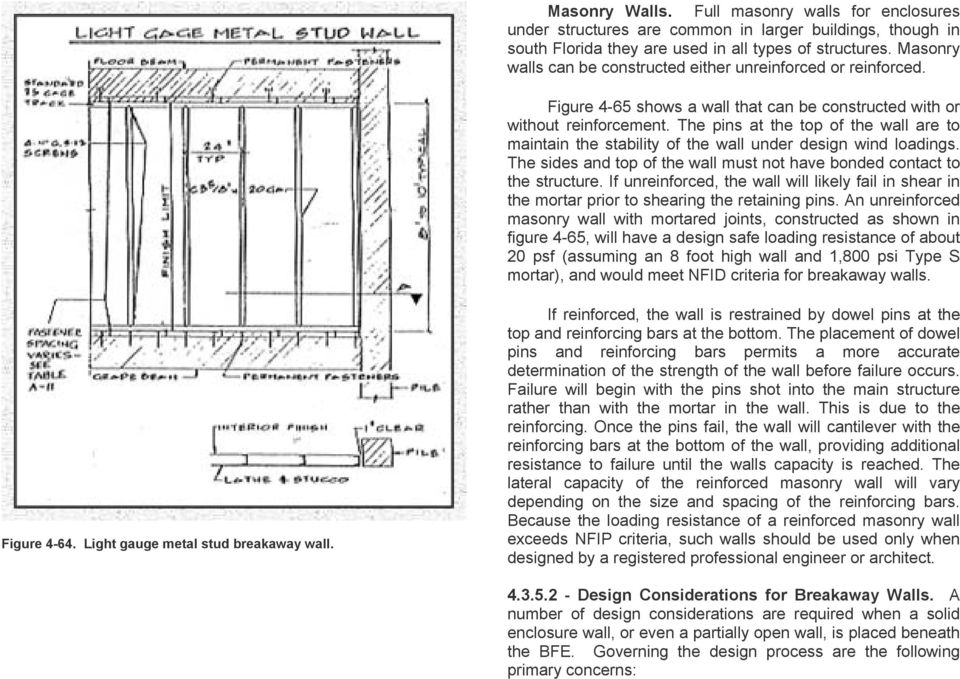
4 that is either butted to the piles or allows for a small clearance. The sheathing must not overlap the permanent plates or the piles. It is planned that the walls would be placed as a unit and then nailed as prescribed at the top and bottom to permanent nailer plates already securely attached to the floor system and grade beam or slab. The permanent nailer plate is an essential component of the wall system and provides a predictable point of attachment for the wall. The wall is designed to fail at the nailed connections to the permanent nailer plate. Various sizes and spacings of the nails could be used to achieve the desired resistance to lateral load. The capacities of 8d through 16d common nails in shear are shown on table A-11. Table A-11 provides a nailing schedule for normal combinations of breakaway wall height and pile spacing to result in wall with a design safe loading resistance between 10 and 20 psf. Metal Stud Walls. Metal studs, which have been commonly used on larger structures, are now being used more frequently on low-rise multifamily structures and to a lesser extent on single family residences. Unless properly galvanized, metal studs will corrode rapidly in the coastal environment. Figure Wood stud breakaway wall. Figure 4-64 shows a light-gauge metal stud wall design. The wall attachment concept and nailing system is the same as the wood stud wall design discussed above. Fastener capacities for the self-tapping screws commonly used to attach the metal stud wall to the more firmly secured wood nailer shown on table A-11. Note that the failure capacity of metal stud wall systems can be more accurately determined than for wood systems and a lower safety factor can be used.

5 Masonry Walls. Full masonry walls for enclosures under structures are common in larger buildings, though in south Florida they are used in all types of structures. Masonry walls can be constructed either unreinforced or reinforced. Figure 4-65 shows a wall that can be constructed with or without reinforcement. The pins at the top of the wall are to maintain the stability of the wall under design wind loadings. The sides and top of the wall must not have bonded contact to the structure. If unreinforced, the wall will likely fail in shear in the mortar prior to shearing the retaining pins. An unreinforced masonry wall with mortared joints, constructed as shown in figure 4-65, will have a design safe loading resistance of about 20 psf (assuming an 8 foot high wall and 1,800 psi Type S mortar), and would meet NFID criteria for breakaway walls. Figure Light gauge metal stud breakaway wall. If reinforced, the wall is restrained by dowel pins at the top and reinforcing bars at the bottom. The placement of dowel pins and reinforcing bars permits a more accurate determination of the strength of the wall before failure occurs. Failure will begin with the pins shot into the main structure rather than with the mortar in the wall. This is due to the reinforcing. Once the pins fail, the wall will cantilever with the reinforcing bars at the bottom of the wall, providing additional resistance to failure until the walls capacity is reached. The lateral capacity of the reinforced masonry wall will vary depending on the size and spacing of the reinforcing bars. Because the loading resistance of a reinforced masonry wall exceeds NFIP criteria, such walls should be used only when designed by a registered professional engineer or architect Design Considerations for Breakaway Walls. A number of design considerations are required when a solid enclosure wall, or even a partially open wall, is placed beneath the BFE. Governing the design process are the following primary concerns:
6 Enclosure walls must be constructed to withstand loading forces from moderately high winds, with a normal factor of safety. At a minimum, this load capacity would be the design wind load required by the local building code. If the code-required design load is greater than the 20 psf allowed by NFIP regulations, the code should prevail. At high wind speeds and/or under water loading, the wall must fail without causing damage to the foundation or superstructure, either from lateral loading or wave runup/ramping into the rest of the structure. This is the failure load or ultimate load capacity of the wall. For small enclosures or relatively close spacings, it can be assumed that all piles within the enclosed area resist wind and water loads against below the BFE. For larger enclosures or wider pile spacing, only a limited number of piles can be brought into action to resist lateral loading. Additional bracing will be required for front row piles supporting the wall receiving water loading. Solid enclosure walls below the BFE increase potential for wave scour and grade beams and piles, particularly for stronger walls. Figure Masonry breakaway wall. Wind Forces. Design for breakaway walls must consider wind forces on the house superstructure, which are transmitted to and resisted by the foundation system, as well as wind forces on the breakaway wall, which are also transmitted to the house frame and foundations until the lateral resistance of the wall or its fasteners is exceeded. The wind load on a breakaway wall is considered to be applied as a uniform load per square foot of vertical wall, which can be resolved into a resultant load applied along the fastened edge(s) of the wall.

7 Wind direction during storm events is often from offshore. However, in design of houses and breakaway walls, the wind should be assumed to blow potentially from any lateral direction relative to the house. Water Forces. In addition to wind loads on the entire house, water loads on the portions of the structure below the BFE must be considered. These water loads include both simple hydrostatic pressure from a slow rise in stillwater depth and the forces of waves against the structure. The BFE for a given is the maximum height of stillwater plus waves above which a structure must be elevated, as illustrated in Figure 4-66a. When the area below the BFE is obstructed by a wall, wave runup occurs on the wall. In this case, illustrated in Figure 4-66b, water reaches the BFE on the wall when the stillwater plus unobstructed waves remain well below the BFE. To prevent water damage to floor beams and suspended utilities, breakaway walls should be designed to fail when or before wave runup reaches the BFE. Structural Considerations. Designing for ultimate capacity requires that the breakaway wall strength at failure be predetermined, and that sizes and spacings of components be selected to assure failure at the desired location and loading. It is not sufficient for enclosure walls to merely breakaway; they must do so predictably. The best enclosure wall designs use simple construction techniques, materials, and connections. Recommended breakaway wall concepts that meet these requirements were described in the previous section. Figure 4-66 a&b. Effect of enclosure walls on waves.

8 Connections. Breakaway walls should be constructed such that they are fastened to the structural frame on two (2) opposite ends only, either top-and-bottom fastening or fastening on each side. Under lateral loading they will then bend from one plane only, stressing the connections approximately equally. Top-and-bottom connections are preferred and are recommended in this report for three reasons. First, while wind forces are essentially uniform over a flat wall, water forces will be concentrated at the bottom of the wall as the water rises. It is appropriate structurally to have the lower edge remain firmly connected at lower water levels and its connections reach their ultimate capacity uniformly across the bottom as the water rises. Second, stud walls are generally installed with the studs vertical, and should be flexed along the length of the studs. Third, and most importantly, loads on the breakaway walls need to be directed into the floor system of the first elevated floor, in order to assure distribution of the loads to adjacent piles. Side fastening would direct too great a portion of the total load into the piles on the loaded wall. Included in the above considerations is the basic premise that, unless designed by a registered professional, breakaway walls should be proportioned such that wall strength is governed by the wall's connections to the pile foundation/grade beam system and to the bottom of the elevated floor system. Experience has shown that it is more reliable -- and much easier -- to design connections to fail at a specified level of force rather than have the wall material fail internally. Working/Ultimate Strength of Fasteners. The safety factor that is used in design depends on the materials used and the accuracy with which one knows the design loads and material properties. To compensate for these uncertainties, working (or safe) load capacities of materials and connections are generally taken conservatively. The "design safe loading resistance" referred to in the NFIP regulations corresponds to a working capacity. The collapse or ultimate resistance of a wall would be higher, corresponding to the factor of safety appropriate to the wall material and fasteners used. Table A- 10 provides working and ultimate strength values for fasteners that could be used for breakaway wall connections. It is important to note the effect of the different factors of safety on the overall safe and ultimate capacities of breakaway walls. That is, walls of different construction, designed to the same standard for safe capacity, will have different ultimate capacities because of their differing factors for safety. Distribution of Wall Loads. For breakaway walls, wind and water loads cannot be distributed equally among the piles under a structure. Compared to the upper superstructure, the floor beams and joists are an insufficiently stiff system for transfer of lateral loads over any distance. It is therefore reasonable to limit load distribution to among those piles in the enclosed area, and to further limit distribution if piles are widely spaced. A breakaway wall connected to a wellconstructed floor system can transfer water or wind loads on the wall laterally for about 8 feet maximum. Therefore, only piles that are within an enclosed area, and within 8 feet of the outside walls of such enclosed space, may share the lateral loads equally with other piles within the enclosed space. For wider pile spacing perpendicular to the direction of loading, only those piles supporting the loaded breakaway wall, plus those piles attached to the breakaway walls parallel to the direction of flow, carry the lateral forces. This provides some extra margin of safety if the floor system does resist the pile deflection and distributes the forces to other piles, which are not directly subjected to the water loads. The application of

9 these recommendations to three (3) example pile configurations is shown in Figure It must further be noted that, in general, water loadings can be assumed to act in a direction perpendicular to the shoreline, but considerable variation can occur. Wind can occur from any direction. Therefore, the determination of the number of piles that would resist lateral loads from wind or waves should include consideration of loading both perpendicular and parallel to the shoreline. This would be true particularly for structures that are not aligned normal to the general orientation of the shoreline. Bracing Considerations for Breakaway Walls. For any house with enclosure walls below BFE, there is an advantage of having floor beams span in the direction of the water flow. This is because the floor beams can assist the front most piles, laterally loaded by water against a wall, to transfer the load back to the tops of piles several rows back from the breakaway wall. If the floor beams run transverse to the direction of water flow, as shown in Figure 4-68, a compression strut (an 8 by 8 or three (3) 2 by 12's, for example) should be placed between the tops of all piles assumed to carry the water loads. A similar approach should be taken for grade beams. Typical practice is to construct grade beams around the building perimeter only. Grade beams should also be installed on the interior of a building in both directions for all piles considered to carry the breakaway wall load. For the example structure shown in Figure 4-68, this recommendation would require installation of four interior grade beams. These beams will also serve to provide proper support for attachment of the interior breakaway walls. Figure 4-67.

10 Knee braces have the desirable characteristic of strengthening both the individual piles to which they are attached and the structure in general. the overall need for knee braces or other bracing is determined using table A-4. The strengthening effect of knee braces on individual piles would be especially important for front row piles supporting breakaway walls subject to water loading, and would assist the piles in resisting shear forces. The front row piles should be considered separately from the overall structure's need for bracing, and knee braces in the direction parallel to expected water forces are a minimum requirement for front row piles that support breakaway walls. Where knee braces or other bracing is used in the same plane with breakaway walls, care should be taken that the bracing does not impede the breakaway capability of the walls. Figure 4-68.

11 Nails (Wood Stud Wall) TABLE A-11 FASTENER SCHEDULE FOR BREAKAWAY WALLS Breakaway Wall Height (feet) Nail Size 8d 10d 12d 16d 8d 10d 12d 16d 8d 10d 12d 16d 8d 10d 12d 16d Pile Spacing (feet) 8 8/15 6/10 5/9-9/17 6/12 6/10 5/9-7/13 7/12 6/10-8/15 7/14 7/ /19 7/13 6/12 6/10-8/15 7/13 6/12-9/17 8/15 7/14-10/19 9/17 8/ /16 8/14 7/12-10/18 9/16 8/ /19 9/ /19 Notes: 1) Table indicates the range of total (top and bottom) nails that will result in a wall design safe loading resistance between 10 and 20 psf 2) Where an odd number of nails is shown, put the extra nail at the bottom 3) Values for other wall heights or pile spacings can be interpolated Examples: A 7 foot-high breakaway wall installed between piles spaced 10 feet apart should be fastened with no less than 8 (4 top, 4 bottom) and no more than 15 (7 top, 8 bottom) 10d nails Screws (Metal Stud Wall) Pile Spacing (feet) Breakaway Wall Height (feet) /5 4/6 4/7 5/8 10 4/6 5/8 5/9 6/ /8 6/10 6/11 7/13 Notes: 1) Table is used in same manner as nail table above 2) Based on No.6, S-12 screws

6 RETROFITTING POST & PIER HOUSES
 Retrofitting Post & Pier Houses 71 6 RETROFITTING POST & PIER HOUSES by James E. Russell, P.E. 72 Retrofitting Post & Pier Houses Retrofitting Post & Pier Houses 73 RETROFITTING POST AND PIER HOUSES This
Protecting Your Home From Hurricane Wind Damage
 T H E W I N D Protecting Your Home From Hurricane Wind Damage During a hurricane, homes may be damaged or destroyed by high winds and high waves. Debris can break windows and doors, allowing high winds
POST AND FRAME STRUCTURES (Pole Barns)
 POST AND FRAME STRUCTURES (Pole Barns) Post and frame structures. The following requirements serve as minimum standards for post and frame structures within all of the following structural limitations:
Elevating Your House. Introduction CHAPTER 5
 CHAPTER 5 Elevating Your House Introduction One of the most common retrofitting methods is elevating a house to a required or desired Flood Protection Elevation (FPE). When a house is properly elevated,
HURRICANE MITIGATION RETROFITS FOR EXISTING SITE-BUILT SINGLE FAMILY RESIDENTIAL STRUCTURES
 HURRICANE MITIGATION RETROFITS FOR EXISTING SITE-BUILT SINGLE FAMILY RESIDENTIAL STRUCTURES 101 Retrofits Required. Pursuant to Section 553.844 553.884, Florida Statutes, strengthening of existing site-built,
Protecting Your Home from Wind Damage
 Protecting Your Home from Wind Damage During severe thunderstorms or hurricanes, homes may be damaged or destroyed by high winds. Debris flying through the air can break windows and doors, allowing high
Quick RefeRence Guide comparison of Select nfip and Building code Requirements for Special flood Hazard Areas
 Quick RefeRence Guide comparison of Select nfip and Building code Requirements for Special flood Hazard Areas This guide illustrates the similarities and highlights the differences between the National
1997 Uniform Administrative Code Amendment for Earthen Material and Straw Bale Structures Tucson/Pima County, Arizona
 for Earthen Material and Straw Bale Structures SECTION 70 - GENERAL "APPENDIX CHAPTER 7 - EARTHEN MATERIAL STRUCTURES 70. Purpose. The purpose of this chapter is to establish minimum standards of safety
Chapter 3 Pre-Installation, Foundations and Piers
 Chapter 3 Pre-Installation, Foundations and Piers 3-1 Pre-Installation Establishes the minimum requirements for the siting, design, materials, access, and installation of manufactured dwellings, accessory
Summary of Coastal Construction Requirements and Recommendations
 Summary of Coastal Construction Requirements and Recommendations HOME BUILDER S GUIDE TO COASTAL CONSTRUCTION FEMA 499/August 2005 Technical Fact Sheet No. 2 Purpose: To summarize National Flood Insurance
Page & Turnbull imagining change in historic environments through design, research, and technology
 DCI+SDE STRUCTURAL EVALUATIONS OFFICE BUILDING, TOOL SHED & WATER TANK, AND BLACKSMITH & MACHINE SHOP BUILDINGS SAN FRANCISCO, CALIFORNIA [14290] PRIMARY PROJECT CONTACT: H. Ruth Todd, FAIA, AICP, LEED
Free-of-Obstruction Requirements
 Free-of-Obstruction Requirements for Buildings Located in Coastal High Hazard Areas in accordance with the National Flood Insurance Program Technical Bulletin 5 /August 2008 Table of Contents Introduction...1
SPECIFIC RATING GUIDELINES
 NATIONAL FLOOD INSURANCE PROGRAM SPECIFIC RATING GUIDELINES April 2015 FEDERAL EMERGENCY MANAGEMENT AGENCY FEDERAL INSURANCE AND MITIGATION ADMINISTRATION RISK INSURANCE DIVISION UNDERWRITING BRANCH This
Formwork for Concrete
 UNIVERSITY OF WASHINGTON DEPARTMENT OF CONSTRUCTION MANAGEMENT CM 420 TEMPORARY STRUCTURES Winter Quarter 2007 Professor Kamran M. Nemati Formwork for Concrete Horizontal Formwork Design and Formwork Design
LOWEST FLOOR GUIDE I. LOWEST FLOOR DETERMINATION
 LOWEST FLOOR GUIDE This section is to be used as a guide for identifying the lowest floor for rating buildings being considered for coverage under the National Flood Insurance Program (NFIP). I. LOWEST
Residential Deck Safety, Construction, and Repair
 Juneau Permit Center, 4 th Floor Marine View Center, (907)586-0770 This handout is designed to help you build your deck to comply with the 2006 International Residential Building code as modified by the
National Flood Insurance Program Insurance Agent s Lowest Floor Guide
 National Flood Insurance Program Insurance Agent s Lowest Floor Guide Insurance Agent s Lowest Floor Guide PUTTING IT INTO PERSPECTIVE Sections A and C of the 2009 Elevation Certificate provide fields
Chapter 6 ROOF-CEILING SYSTEMS
 Chapter 6 ROOF-CEILING SYSTEMS Woodframe roof-ceiling systems are the focus of this chapter. Cold-formed steel framing for a roof-ceiling system also is permitted by the IRC but will not be discussed;
Report on. Wind Resistance of Signs supported by. Glass Fiber Reinforced Concrete (GFRC) Pillars
 Report on Wind Resistance of Signs supported by Glass Fiber Reinforced Concrete (GFRC) Pillars Prepared for US Sign and Fabrication Corporation January, 2006 SUMMARY This study found the attachment of
LOWEST FLOOR GUIDE I. LOWEST FLOOR DETERMINATION
 This section is to be used as a guide for identifying the lowest floor for rating buildings being considered for coverage under the National Flood Insurance Program. I. LOWEST FLOOR DETERMINATION The following
6.0 Implementation: Retrofitting Gable End Walls with L-Bent Straps
 6.0 Implementation: Retrofitting Gable End Walls with L-Bent Straps Order of presentation: To give you a better appreciation of what is involved in doing a gable end bracing retrofit, the first section
Table of Contents. Comments on the Technical Bulletins should be directed to:
 Openings in Foundation Walls and Walls of Enclosures Below Elevated Buildings in Special Flood Hazard Areas in accordance with the National Flood Insurance Program Technical Bulletin 1 / August 2008 Table
Openings in Foundation Walls for Buildings Located in Special Flood Hazard Areas
 Openings in Foundation Walls for Buildings Located in Special Flood Hazard Areas in accordance with the National Flood Insurance Program FEDERAL EMERGENCY MANAGEMENT AGENCY FEDERAL INSURANCE ADMINISTRATION
Chapter 36 - STRAW BALE CONSTRUCTION SECTION 3601 - PURPOSE. SECTION 3602 - SCOPE. SECTION 3603 - DEFINITIONS.
 Austin City Code - Volume II TITLE 25 LAND DEVELOPMENT\CHAPTER 25-12 TECHNICAL CODES\ARTICLE 1: UNIFORM BUILDING CODE\25-12-3 LOCAL AMENDMENTS TO THE BUILDING CODE Chapter 36 - STRAW BALE CONSTRUCTION
STRUCTURAL CONCEPT FOR LIGHT GAUGE STEEL FRAME SYSTEM
 Chapter 9 STRUCTURAL CONCEPT FOR LIGHT GAUGE STEEL FRAME SYSTEM 9.1 BACKGROUND Steel is widely used in the construction of multi-storey buildings. However, steel construction is seldom used and is traditionally
FORM DESIGN. easy to work with, and generally available.
 Forms play a major role in concrete construction. They give the plastic concrete its shape and hold it until it hardens. Forms protect the concrete, assist in curing it, and support any reinforcing rods
SECTION 5 ANALYSIS OF CONTINUOUS SPANS DEVELOPED BY THE PTI EDC-130 EDUCATION COMMITTEE LEAD AUTHOR: BRYAN ALLRED
 SECTION 5 ANALYSIS OF CONTINUOUS SPANS DEVELOPED BY THE PTI EDC-130 EDUCATION COMMITTEE LEAD AUTHOR: BRYAN ALLRED NOTE: MOMENT DIAGRAM CONVENTION In PT design, it is preferable to draw moment diagrams
TYPICAL PATIO COVERS 111
 City of Laguna Niguel Building Division 30111 Crown Valley Pkwy Laguna Niguel, CA 92677 (949) 362-4360 FAX 362-4369 www.cityoflagunaniguel.org TYPICAL PATIO COVERS 111 PLEASE NOTE: This information Bulletin
Foundation Experts, LLC Specializes in Foundation Repair and Waterproofing
 1 Most basements show some signs of leaking and cracking. Through the years, problems with water, poor soils, grading, drainage and possible settling affect the integrity of a basement. Being able to recognize
LOWEST FLOOR GUIDE I. LOWEST FLOOR DETERMINATION. Previous Section Table of Contents
 Previous Section Table of Contents Next Section This section is to be used as a guide for identifying the lowest floor for rating buildings being considered for coverage under the National Flood Insurance
Technical Notes 3B - Brick Masonry Section Properties May 1993
 Technical Notes 3B - Brick Masonry Section Properties May 1993 Abstract: This Technical Notes is a design aid for the Building Code Requirements for Masonry Structures (ACI 530/ASCE 5/TMS 402-92) and Specifications
Foundations 65 5 FOUNDATIONS. by Richard Chylinski, FAIA and Timothy P. McCormick, P.E. Seismic Retrofit Training
 Foundations 65 5 FOUNDATIONS by Richard Chylinski, FAIA and Timothy P. McCormick, P.E. 66 Foundations Foundations 67 FOUNDATIONS Let's assume that the retrofit has been done correctly from the roofline
Walls. Add Strength and Water Resistance When Repairing Your. Replace damaged framing members when walls are open
 Add Strength and Water Resistance When Repairing Your Walls Any home repair or remodeling work you do presents an opportunity to make your home fare better in the next storm. Whether you are just replacing
Chapter. Earthquake Damage: Types, Process, Categories
 3 Chapter Earthquake Damage: Types, Process, Categories Earthquakes leave behind a trail of damage and destruction. People s lives are affected by the loss of loved ones, destruction of property, economic
http://library1.municode.com/default/docview/10251/1/101/103
 Page 1 of 8 ARTICLE II. FLOOD DAMAGE PREVENTION* *Cross references: Buildings and building regulations, ch. 67; floor elevation standards, 67-32; flood damage prevention for utility systems, 67-34; drainage
SECTION 19 RESIDENTIAL CONSTRUCTION IN FLOODZONES
 SECTION 19 RESIDENTIAL CONSTRUCTION IN FLOODZONES The purpose of the following information and documents are to clarify procedures used by the Sonoma County Permit & Resource Management Department to enforce
City of Tucson and Pima County Arizona Building Code Appendix Chapter 72 Straw-Bale Structures
 City of Tucson and Pima County Arizona Building Code Appendix Chapter 72 Straw-Bale Structures SECTION 7201 - PURPOSE The purpose of this appendix chapter is to establish minimum prescriptive standards
Floodproof Construction Requirements
 Floodproof Construction Requirements CITY OF FARGO BUILDING INSPECTION DIVISION Updated April 2015 The State of North Dakota requires that you call 1-800-795-0555 at least two business days before you
For the purposes of this Part, the following words shall have the following meanings:
 LOUISIANA REVISED STATUTES TITLE 51. TRADE AND COMMERCE CHAPTER 2. PARTICULAR GOODS PART XIV-B. MINIMUM STANDARDS FOR INSTALLATION OF MANUFACTURED HOMES Current through all 2010 Regular Session Acts 912.21.
March 14, 2007. Installation of Bay, Bow and Garden Windows
 March 14, 2007 Re: Installation of Bay, Bow and Garden Windows Attached are the Atrium Companies, Inc recommendation for the installation of bay, bow and garden windows. These instructions were developed
Prepared For San Francisco Community College District 33 Gough Street San Francisco, California 94103. Prepared By
 Project Structural Conditions Survey and Seismic Vulnerability Assessment For SFCC Civic Center Campus 750 Eddy Street San Francisco, California 94109 Prepared For San Francisco Community College District
Elevation Certificates. Brad Loar FEMA Region IV
 Elevation Certificates Brad Loar FEMA Region IV What is the purpose of the Elevation Certificate? The Elevation Certificate is an important administrative tool of the National Flood Insurance Program (NFIP).
Designed and Engineered to Perform
 History EARTH CONTACT PRODUCTS, L.L.C., is a family owned company, based in Olathe, Kansas. This company was built upon Don May s U.S. Patented fourth-generation Steel Piering System that has led to the
How to secure your property after a disaster
 How to secure your property after a disaster The Red Guide to Recovery HOuse secured properly Board-Up of Windows, Doors and Roof Hole. Lot secured with Perimeter Fencing. Fires, floods, tornadoes, hurricanes,
STANDARD OPEN PATIO COVER
 STANDARD OPEN PATIO COVER BUILDING & SAFETY DIVISION 201 E. LA HABRA BLVD. LA HABRA, CA 90631 62-90-9710 Call Before You Dig 1-800-227-2600 PLEASE NOTE: This information Bulletin is made available to assist
Protecting YOUR NEW HOME FROM Wind Damage
 Protecting YOUR NEW HOME FROM Wind Damage Blueprint for Safety... A Blueprint for Life When severe weather threatens, protecting life and property automatically becomes top priority for millions of Florida
RESIDENTIAL ROOF TRUSS INSTALLATION PROCEDURES
 RESIDENTIAL ROOF TRUSS INSTALLATION PROCEDURES Construction Safety Association of Ontario, October 2008 Prepared for the Low-Rise Residential Trade Labour-Management Health and Safety Committee CONTENTS
Repair of Earthquake-Damaged Masonry Fireplace Chimneys SOUTH NAPA EARTHQUAKE RECOVERY ADVISORY
 Repair of Earthquake-Damaged Masonry Fireplace Chimneys SOUTH NAPA EARTHQUAKE RECOVERY ADVISORY Purpose and Intended Audience The August 24, 2014 South Napa Earthquake has again served as a reminder that
LOWEST FLOOR GUIDE I. LOWEST FLOOR DETERMINATION
 Previous Section Main Menu Table of Contents Next Section This section is to be used as a guide for identifying the lowest floor for rating buildings being considered for coverage under the National Flood
NCMA TEK CONCRETE MASONRY FOUNDATION WALL DETAILS. TEK 5-3A Details (2003)
 NCMA TEK National Concrete Masonry Association an information series from the national authority on concrete masonry technology CONCRETE MASONRY FOUNDATION WALL DETAILS TEK 5-3A Details (2003) Keywords:
Handling, Erection and Bracing of Wood Trusses
 Handling, Erection and Bracing of Wood Trusses Follow these guidelines for safe installation of Wood Trusses. These guidelines should not be considered to be the only method for erecting and bracing of
STANDARD PROCEDURES FOR INSTALLATION OF METAL ROOF SYSTEMS
 ROOFING APPLICATION STANDARD (RAS) No. 133 STANDARD PROCEDURES FOR INSTALLATION OF METAL ROOF SYSTEMS 1. Scope 1.1 This application standard has been developed to provide consistent information for the
Above the Flood: Elevating Your Floodprone House. FEMA 347/ May 2000 FEMA
 Above the Flood: Elevating Your Floodprone House FEMA 347/ May 2000 FEMA Cover photograph provided by The Weather Channel. Acknowledgments The support and contributions of the following individuals and
Safe & Sound Bridge Terminology
 Safe & Sound Bridge Terminology Abutment A retaining wall supporting the ends of a bridge, and, in general, retaining or supporting the approach embankment. Approach The part of the bridge that carries
Above the Flood: Elevating Your Floodprone House. Federal Emergency Management Agency. Federal Emergency Management Agency
 FEMA 347/May 2000 Above the Flood: Elevating Your Floodprone House Mitigation Directorate 500 C Street, SW Washington, DC 20472 www.fema.gov Table of Contents Chapter 1 Introduction... 1-1 Chapter 2 Homeowner
780 CMR 120.G FLOOD-RESISTANT CONSTRUCTION AND CONSTRUCTION IN COASTAL DUNES Note that this Appendix is unique to Massachusetts
 780 CMR 120.G FLOOD-RESISTANT CONSTRUCTION AND CONSTRUCTION IN COASTAL DUNES Note that this Appendix is unique to Massachusetts 120.G.101.1 General: All buildings and structures erected in areas prone
Residential Decks. Planning and Development Services Department
 Building Safety Division 8500 Santa Fe Drive Overland Park, KS 66212 (913) 895-6225 Fax (913) 895-5016 Email: [email protected] Planning and Development Services Department Residential Decks
Detailing of Reinforcment in Concrete Structures
 Chapter 8 Detailing of Reinforcment in Concrete Structures 8.1 Scope Provisions of Sec. 8.1 and 8.2 of Chapter 8 shall apply for detailing of reinforcement in reinforced concrete members, in general. For
Uncovered Decks & Porches
 Uncovered Decks & Porches Building Guides for Homeowners Why Do I need a Permit? D I D Y O U K N O W? As owner-builder you are the responsible party of record on such a permit. If your work is being performed
Chapter 3 DESIGN AND CONSTRUCTION FEATURES IMPORTANT TO SEISMIC PERFORMANCE
 Chapter 3 DESIGN AND CONSTRUCTION FEATURES IMPORTANT TO SEISMIC PERFORMANCE To satisfy the performance goals of the NEHRP Recommended Seismic Provisions, a number of characteristics are important to the
STRUCTURAL ASSESSMENT. Full Metal Jacket Building 0 Prince Street, Alexandria, VA
 STRUCTURAL ASSESSMENT FOR Full Metal Jacket Building 0 Prince Street, Prepared by: ALPHA CORPORATION (Alpha) 1850 S. Loudoun Street, Suite 200 Winchester, VA 22601 540-723-0704 September 22, 2010 J. Michael
Repairs, Remodeling, Additions, and Retrofitting
 Repairs, Remodeling, Additions, and Retrofitting HOME BUILDER S GUIDE TO COASTAL CONSTRUCTION FEMA 499/August 2005 Technical Fact Sheet No. 30 Purpose: To outline National Flood Insurance Program (NFIP)
EAST LYME HIGH SCHOOL
 Overview: 1971 N 1966 GYM 1966 CLASSROOM WING 1966 AUD. 1971 GYM 1998 1998 POOL EAST LYME HIGH SCHOOL Original 1966 Building: The original East Lyme High School was constructed in 1966 and was composed
Post and Beam Construction
 Post and Beam Construction A Presentation By the Canadian Wood Council Canadian Conseil Wood canadien Council du bois Early settlers introduced the concept of post and beam construction in North America
SCHEMATIC AND PROJECT BUDGET APPROVAL EAST CAMPUS NURSING EDUCATION AND CLASSROOM
 Shepherd University Board of Governors June 9, 2005 Agenda Item No. 9 SCHEMATIC AND PROJECT BUDGET APPROVAL EAST CAMPUS NURSING EDUCATION AND CLASSROOM In 1994 construction began on the Byrd Science and
Load Design Charts. R-CONTROL SIPs STRUCTURAL INSULATED PANELS. www.r-control.com CONTROL, NOT COMPROMISE.
 R-CONTROL s STRUCTURAL INSULATED PANELS Note: Information deemed reliable at time of printing. Please visit www.r-control.com for latest information. June 2012 CONTROL, NOT COMPROMISE. www.r-control.com
ARCHITECTURAL TECHNOLGY 4 ADVANCED CONSTRUCTION TECHNOLOGY BASEMENT CONSTRUCTION YEAR 3 SEMESTER 1 AIDAN WALSH R00060057. Lecturer: Jim Cahill
 ARCHITECTURAL TECHNOLGY 4 ADVANCED CONSTRUCTION TECHNOLOGY BASEMENT CONSTRUCTION YEAR 3 SEMESTER 1 AIDAN WALSH R00060057 Lecturer: Jim Cahill 29 th November 2011 TABLE OF CONTENTS SUMMARY 1 MAIN BODY SECTION
OSHA Scaffold Standard for Construction. 29 CFR 1926 Subpart L
 OSHA Scaffold Standard for Construction 29 CFR 1926 Subpart L EH&S Jim Walker What is the revised OSHA scaffold standard for construction? Issued on August 30, 1996 and became effective on November 29,
SECTION 3 ONM & J STRUCTURAL ANALYSIS
 Historic Boynton Beach High School Existing Building Assessment City of Boynton Beach February 10, 2011 SECTION 3 ONM & J STRUCTURAL ANALYSIS STRUCTURAL ENGINEERS SPECIAL INSPECTORS STRUCTURAL CONDITION
National Council of Examiners for Engineering and Surveying. Principles and Practice of Engineering Structural Examination
 Structural Effective Beginning with the April 2011 The structural engineering exam is a breadth and exam examination offered in two components on successive days. The 8-hour Vertical Forces (Gravity/Other)
Status of Building Codes in New Jersey and New York: The Future of Resilience in a Post-Sandy Environment
 Status of Building Codes in New Jersey and New York: The Future of Resilience in a Post-Sandy Environment Sandy devastated properties in several states, but primarily in New York and New Jersey. Now, as
CH. 2 LOADS ON BUILDINGS
 CH. 2 LOADS ON BUILDINGS GRAVITY LOADS Dead loads Vertical loads due to weight of building and any permanent equipment Dead loads of structural elements cannot be readily determined b/c weight depends
MANUFACTURED HOUSING USED AS DWELLINGS
 MANUFACTURED HOUSING USED AS DWELLINGS SECTION AE101 SCOPE AE101.1 General. These provisions shall be applicable only to a manufactured home used as a single dwelling unit and shall apply to the following:
Elevations Certificates: Update 2009 Presented by Wendy Lathrop, PLS, CFM
 Elevations Certificates: Update 2009 Presented by Wendy Lathrop, PLS, CFM The objectives of the National Flood Insurance Program (NFIP): Reduce the exposure to flood damages through the use of minimum
INSTALLATION. General. Important Note. Design. Transport
 General The roof trusses you are about to install have been manufactured to precise engineering standards. To ensure that the trusses perform as designed, it is essential that they be handled, erected
Mark Cramer Inspection Services, Inc.
 Mark Cramer Inspection Services, Inc. 492 Twentieth Avenue, Indian Rocks Beach, FL 34635-2970 (727) 595-4211 Fax (727) 596-7583 Certified Member #12085 American Society of Home Inspectors Construction
Building Construction. Lightweight construction. Conventional Construction
 Ventilation 53 Building Construction The firefighter s ability to safely and efficiently ventilate a building through its roof will depend to some degree on the firefighter s understanding of roof construction.
Structural Damage Due to Floods
 Structural Damage Due to Floods By Craig D. Rogers, P.E. The Federal Emergency Management Agency (FEMA) reports that each year approximately 90 percent of all disaster-related property damage results from
SECTION 7 Engineered Buildings Field Investigation
 SECTION 7 Engineered Buildings Field Investigation Types of Data to Be Collected and Recorded A field investigator looking at engineered buildings is expected to assess the type of damage to buildings.
Updated Federal Emergency Management Agency Flood Insurance Rate Maps and Zoning Ordinance Update. July 16, 2015 Policy Committee
 Updated Federal Emergency Management Agency Flood Insurance Rate Maps and Zoning Ordinance Update July 16, 2015 Policy Committee FEMA Map Update Costal Analysis and mapping study by FEMA in 2009 Changes
Residential Foundations and Basements
 Residential Foundations and Basements Disclaimer All of the following information is based on the 2006 International Residential Code with Kentucky Amendments. As some information is paraphrased, article
THE DOW CHEMICAL COMPANY Issued: August 1, 2008 200 LARKIN CENTER 1605 JOSEPH DRIVE MIDLAND MICHIGAN 48674 (989) 638-8655 www.dowbuildingmaterials.
 ICC EVALUATION SERVICE, INC. EvaluateP InformP Protect Los Angeles Business/Regional OfficeP 5360 Workman Mill RoadP Whittier, CA 90601 (562) 699-0543 phonep (562) 695-4694 fax DIVISION: Section: 6 WOOD
Expected Performance Rating System
 Expected Performance Rating System In researching seismic rating systems to determine how to best classify the facilities within the Portland Public School system, we searched out what was used by other
Featuring TJ Rim Board and TimberStrand LSL
 #TJ-8000 SPECIFIER S GUIDE TRUS JOIST RIM BOARD Featuring TJ Rim Board and TimberStrand LSL Multiple thicknesses, grades, and products to cover all your rim board needs 1¼" Thickness matches lateral load
The better way to build TM. Installation Manual. FOUNDATION SIPs & FROST WALLS SIPs
 The better way to build TM Installation Manual FOUNDATION SIPs & FROST WALLS SIPs February 2016 PWF FOUNDATION & FROST WALL SIPs Installation Manual Table of Contents Topics General Requirements...................................
COMMONLY USED RESIDENTIAL BUILDING CODES
 COMMONLY USED RESIDENTIAL BUILDING CODES INTERNATIONAL RESIDENTIAL CODE (2009) form revised 5/10 FOUNDATION 1. DESIGN OF FORMWORK. Section 1906.1 IBC 2009, Section R404.1.2.3.6 IRC 2009, ACI 318 Section
Common Errors in Truss Design
 In today s competitive world of trusses, component manufacturers are always looking for ways to generate more efficient truss designs. Occasionally, truss designs need to be changed in order to be sealed
What is Seismic Retrofitting?
 What is Seismic Retrofitting? SEISMIC RETROFITTING A Seismic Retrofit provides existing structures with more resistance to seismic activity due to earthquakes. In buildings, this process typically includes
REQUIREMENTS FOR SUBMITTING PLANS FOR NEW CONSTRUCTION
 RESIDENTIAL: REQUIREMENTS FOR SUBMITTING PLANS FOR NEW CONSTRUCTION 2 COMPLETE SETS OF PRINTS WITH ENGINEERS STAMP ON FOUNDATION PLAN INCLUDING ELECTRICAL, PLUMBING, ETC. SITE PLAN SHOWING HOUSE LOCATION
June 2007 CHAPTER 7 - CULVERTS 7.0 CHAPTER 7 - CULVERTS 7.1 GENERAL
 7.0 7.1 GENERAL For the purpose of this manual, culverts are defined as structures that are completely surrounded by soil and located below the surface of the roadway parallel to the general direction
Sun Windows General Information Sun New Construction Window Installation Instructions
 Sun Windows General Information Section 1 G F H H H A. Apply Weather Resistive Barrier B. Apply Sill Flashing Tape C. Place Waterproof Sill Shims D. Caulk Back of Nail Fin Sides & Top, Set Window, Fasten
GUIDELINES FOR UTILITY INSTALLATIONS Part 1 - Wire Lines and Communications Cables
 Engineering Department SEPTEMBER, 2007 GUIDELINES FOR UTILITY INSTALLATIONS Part 1 - Wire Lines and Communications Cables General Requirements This section applies to all public and private utilities,
CONDOMINIUMS I. METHODS OF INSURING CONDOMINIUMS. Previous Section Table of Contents. Important Notice to Agents/Producers:
 Previous Section Table of Contents Next Section Important Notice to Agents/Producers: CONDOMINIUMS Boards of directors of condominium associations typically are responsible under their by-laws for maintaining
STANDARD REQUIREMENTS FOR BONDING OR MECHANICAL ATTACHMENT OF INSULATION PANELS AND MECHANICAL ATTACHMENT OF ANCHOR AND/OR BASE SHEETS TO SUBSTRATES
 ROOFING APPLICATION STANDARD (RAS) No. 117 STANDARD REQUIREMENTS FOR BONDING OR MECHANICAL ATTACHMENT OF INSULATION PANELS AND MECHANICAL ATTACHMENT OF ANCHOR AND/OR BASE SHEETS TO SUBSTRATES Scope 1.1.
Firewalls. By Gary Sturgeon, B.Eng., MSc., P.Eng. Technical Services Engineer, CCMPA. w w w. c c m p a. c a 5A-0
 By Gary Sturgeon, B.Eng., MSc., P.Eng. Technical Services Engineer, CCMPA 5A-0 This Chapter of the CCMPA Metric Technical Manual has been largely reproduced from Firewalls, A Design Guide, published by
Final inspections are completed by site visit only. Access to fenced yards shall be planned.
 ROOFING RESIDENTIAL BUILDING INSPECTIONS DEPARTMENT www.ci.blaine.mn.us This handout is intended only as a guide and is based in part on the 2015 Minnesota State Building Code, Blaine City ordinances,
Proposed Minimum Subterranean Termite Treatment Standards
 Proposed Minimum Subterranean Termite Treatment Standards Introduction This document is intended to serve as a model for states considering the adoption of standards for soil application of termiticides.
CHAPTER 3 page 69 LOCAL FLOODPLAIN REGULATIONS AND NFIP STANDARDS
 CHAPTER 3 page 69 LOCAL FLOODPLAIN REGULATIONS AND NFIP STANDARDS LOCAL FLOODPLAIN REGULATIONS AND NFIP STANDARDS, page 69 THE PARTICIPATION OF A COMMUNITY IN THE NFIP IS MADE POSSIBLE BY ITS ADOPTION